NOTE. Fig. 4 has been found to be not available for this edition.
PREFACE
The dangers of house-flies to the health of the community
have come into such recent prominence that the appearance
of Major Hurlstone Hardy's book should fill a want.
It is written lucidly and clearly, yet in that popular style
which is so frequently lacking in scientific works. This is
a great advantage. Too often scientists are prone to
bring out works couched in terms which cannot be understood
by an interested public that is not versed in technical
terms. Thus matter which is of the greatest general
importance is passed unread by many, and is, in consequence,
not acted upon.
Major Hardy has a knowledge of these deadly insects
which, in my opinion, is unsurpassed, because he has the
personal experience of practical experiment combined
with the instincts of the naturalist. The result is an
account both accurate and interesting which should prove
of the greatest value.
The discovery of the transmission of disease by mosquitoes
required the passage of a decade before its essentials
were grasped by the public mind; that of the prevention
of small-pox required a century. But the dangers of
house-flies is rapidly becoming known in consequence of
the popular literature, which is growing, describing the
details of the lives of these loathly creatures. In this way
only can such knowledge be spread—a knowledge which
must become general before flies and the maladies they
convey can be generally and satisfactorily dealt with. It
is of little use to make great discoveries and then to hide
them on the musty bookshelves of learned societies.
Instead, they should be adapted to practical purposes
applied for the good of suffering humanity; and the best
way to do this is to bring out well-written, interesting, and
easily read books of this kind, so that all who run may
read and their readings endure. This book should assist
much to accomplish this end. Thus we may look forward
confidently to the day when house-flies, and the diseases
they carry, are things of the past. The "Book of the Fly"
must take its place in the history of the events which are
to lead up to the winning of that goal.
Halford Ross
(of the John Howard McFadden Researches at the
Lister Institute of Preventive Medicine).
THE BOOK OF THE FLY
CHAPTER I THE HOUSE-FLY, A PRODUCT OF HUMAN INSANITATION
With the present day zeal for popularising interest
in common things (called nature study) there has
arisen the demand for knowledge practically useful
and thoroughly up-to-date, yet in a form free from
much of the technical terminology and treatment
which are essential in the student's more fully
developed scientific handbook.
The "House-fly" is a fit subject for a simplified
study of this kind, and the present booklet is an
attempt to afford information very different to that
of the "popular" works, which only were accessible
to the writer's hands between fifty and sixty years
ago; the writers of those old books all followed the
lead of the reverend and learned contributors to the
famous and monumental "Bridgwater Treatises." "The
Wonders of Nature explained," "Humble Creatures"
(a study of the earth-worm and the house-fly, in
popularised language), "The Treasury of Knowledge,"
"Simple Lessons for Home Use," were the kind of
cheaper works in touch with a past generation;
these latter and other later well-intended publications
will now be found to be somewhat deficient or even
a little misleading entomologically; they abounded
in pious sentimentality and mostly attempted an
aggravatingly grandiose literary style, but all have
rather failed in teaching practical economic utility,
in connection with which nature-knowledge can be
rendered as interesting as any other kind of instructive
literature. The tribe of two-winged flies, in
particular, has not even yet received a full and adequate
study by scientists. A preference has ever been shown
towards those other branches of entomology, which
may be more interesting to the cabinet-specimen collector,
but which cannot pretend to have an equal
hygienic and economic importance to humanity.
The presence of the house-fly in our dwellings is
often submitted to as an irritating but an inevitable
nuisance; yet very certain remedial measures would
almost exterminate the creature, which is a dangerous
and filthy peril. To many people it will seem a most
incredible exaggeration when told that it is really
worse than any one of the less common creatures
universally regarded with horror and disgust as pestiferous
vermin. The surmise may be true that the
disgusting body louse carried bacteria, which spread
the "black death"; and, even though the rat's flea
has been found to be the carrier transmitting bubonic
plague, yet amongst people living now in civilised
communities within the temperate zones these parasites
cannot be ranked as dangerous equally with the house-fly.
The modern crusade against the house-fly is not
based on any such new discovery, as is that against
the mosquito gnats, which are the means of spreading
zymotic diseases mainly in the tropics. The malignity
of the fly is recorded in most ancient history and folk-lore,
yet not very long ago there prevailed amongst
certain classes opinions very different to those of old
as well as to those of the present day. A short anecdote
will perhaps amuse as well as explain those misplaced
sentiments, which have not quite died out.
In the middle of the last century there was a boy,
thought to be too delicate to be sent to school, who
early earned for himself the character of being a strange
child. When barely more than nine years old he
visited an Aunt who was a veritable exemplar of genteel
breeding and propriety after the early Victorian
pattern. There he was seriously reprimanded for the
"cruelty" of feeding his secret pets, which were garden
spiders, with flies which were, so the Aunt said, "poor
innocent creatures made by God for a useful purpose,"
but, she inconsequentially added,—"Spiders were
horrid." The strange child replied that the Devil
made the flies, and that God made the spiders to eat
them. The astonished Aunt then elicited the fact that
the strange child's father had explained, during a Sunday
Bible lesson, that Beelzebub (the Devil) meant Lord-of-flies.
This strange child was taken a walk over Doncaster
Heath by the Aunt's maid. There a dead rabbit was
seen from which maggots were crawling, and the maid
explained that it was fly-blown. Next they both stroked
and patted a patient donkey, and the strange child
observed maggots rolling out of the donkey's nostril[1]
on to the ground; he wondered much that live animals
should be fly-blown. He also saw with pity some
cows, around whose eyes flies clustered.
Pondering on these matters, one day he confided to
the Aunt his confirmed opinion in these words—"It
seems, Aunt, to me that people who won't kill flies
deserve to be fly-blown." Doubtless, it would have
been better if he had expressed himself thus—People
who will not kill fleas deserve to be flea-bitten; and
people who will not wage war against flies deserve to
be fly-tormented. However, the horrified Aunt mistook
the observation for insult and impudent rebellion,
and what ensued need not be related as pointing no
useful moral. The strange child was merely a genuine
early nature student ahead of the times by some fifty
or sixty years. In due course he learnt a more orthodox
account of "Creation," and the existence of mysteries
in facts physiological and spiritual, which can
only be imperfectly comprehended in this world.
His craving for nature study was not satisfied with
the reading of most of the cheap books then published
for the diffusion of knowledge. Collecting butterflies
and moths sufficed for some of his schoolfellows in
later years, but, not then having access to really good
handbooks, he became an original investigator in wide
fields of nature study, and thus learnt that many statements
and opinions, which ordinarily even at the
present day pass current as facts, are erroneous and
misleading. Accordingly, the reader need not be surprised
at some statements in the following pages at
variance with what may be met with elsewhere.
1. Stevens' Book of the Farm and many other publications describe the
similar affliction of sheep by Œstrus ovis but omit to notice
the case of the donkey, which I have witnessed several times, but have
never seen a horse or pony thus afflicted. There is a fly termed
Œstrus nasalis, of which the victimised host is uncertain, for Linnæus
was mistaken in stating that the larvæ are found in the fauces of
"horses, asses, mules, stags, and goats," entering by the nostril.
The old fanciful dogma that everything existing was
actually created "in the beginning," and "for a purpose,"
was once ardently championed as controverting
aggressive Voltairean atheism, but it must be now recognised
as an unwarranted assumption, deduced from
an orthodox doctrine of "design," which in itself seems
acceptably agreeable with the idea of unity, consistency,
and perfection in Creation and The Creator. In fact
the said "fanciful" dogma never really was an integral
part of Christian Catholic doctrine. The house-fly, as
we know it, is absolutely the developed product of
human insanitation; scientifically and practically it is
a new "species" of an old "genus" established by
a long course of breeding in man-made environments.
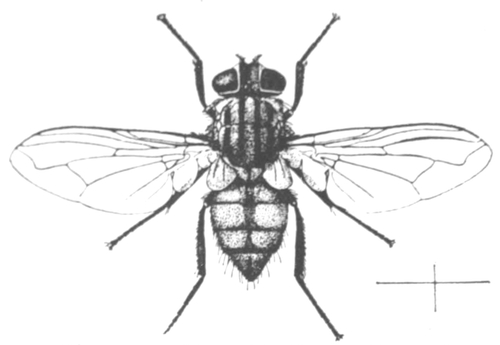
Fig. 1. The House-Fly, Female, Enlarged.
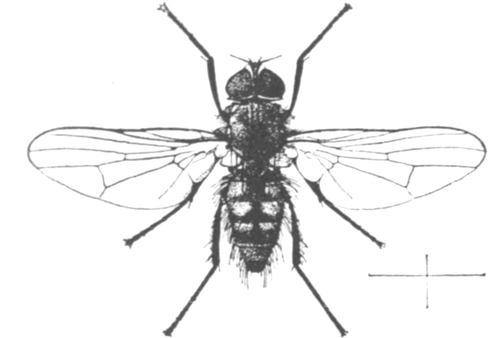
Fig. 2. The Lesser House-Fly, Male, Enlarged.
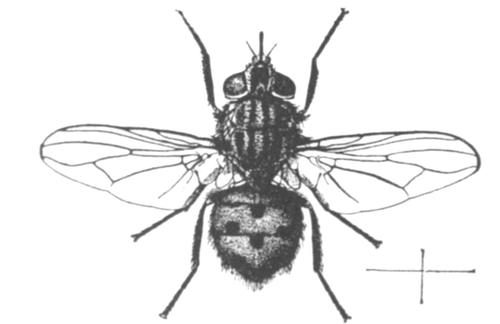
Fig. 2a. The Stable-Fly, Female, Enlarged.
CHAPTER II THE IDENTIFICATION OF THE COMMON HOUSE-FLY
Although there are several other kinds of flies which
occasionally visit the dwellings of mankind, there is
one super-abundant species, Musca domestica, to which
the name of "house-fly" pre-eminently belongs. In
the scientist's discriminating judgment, when viewed
microscopically, it differs substantially from others; but
it differs very little in general appearance from certain
outdoor flies and from one not uncommon indoor
smaller companion, Fannia canicularis, which is not
classified amongst the Muscidæ but amongst the
Anthomyidæ. This latter has been fitly termed the
"lesser House-fly;" it has the same habit of delighting
to pester man as much as or more than cattle outdoors.
Both these flies join with several others in frequenting
stables and cow-sheds.
These two flies and the familiar "blue-bottle" (again
it seems that we are liable to confuse two species) are
the special subject of our present study; but it will be
as well to take passing notice of some few other
members of the tribe classified by scientists as belonging
to the order Diptera. The species of this order
native to Great Britain are said to number nearly three
thousand, of which quite two hundred of largish sizes
are exceedingly common and widely distributed.
This order is characterised by the fact that all the
species are furnished with one pair of wings only:— dis = double,
pteron = wing; they all undergo a metamorphosis
analogous to that of four-winged insects.
The dipterid flies are apt to be popularly recognised
as flies (with fat bodies) and gnats (with slim bodies);
but they may be more intelligently classified (with a few
anomalous exceptions) as flies (a) having a trunk-like
mouth or proboscis (miscalled a tongue), terminating
with bilobed suctorial lips, and as flies (b) having a
bayonet-like trunk, or a sheaf-like tubular spike with
skin-piercing lancets. No two-winged flies have stings;
the tail of the female, which terminates with the
ovipositor and is retractile in a telescopic manner, is
very soft and quite unlike the sting of the ichneumon
or the ovipositor of the "saw-fly," both of which
possess two pairs of wings like bees and wasps, and
therefore are classified with the insect race called
Hymenopteræ.
Omitting Aphides (green-flies, plant-lice, and the
like) which are an "order" by themselves, and excluding
gnats of slim form, mosquitoes, and midges, which
are mainly crepuscular, nocturnal, or shade frequenting,
we might try unscientifically to sub-divide the more
conspicuously sunshine-loving and day-flying flies
into:—(1) flower and honey seeking flies; (2) cattle
pestering sweat-flies; (3) skin-piercing, blood-sucking
flies; (4) insectivorous flies; (5) fungus flies; (6)
carrion and filth flies; and to these must be added
another small group (7) which comprises those of the
wondrous family of the Œstridæ, the most horrible
though not the most injurious of the animal persecuting
and torturing flies; this last group, strange to
say, are absolutely destitute of any mouth and feed
only in the maggot stage. In many cases, however,
it happens that the males and the females differ in
feeding habits as well as in colours and markings,
whilst only their patterns of wing-veins and some
less prominently apparent features are constant in the
two sexes. These circumstances discountenance the
above grouping.
Again, if we tried to group our flies with adequate
regard to their very diverse habits of life, in the larval
stage as well as to their subsequent metamorphoses,
we should find that these are details which are obscure
and in many cases unknown or imperfectly recorded.
However, after much study and many revisions, a
scientific classification has been contrived based upon
the minutely differentiated characteristics which are
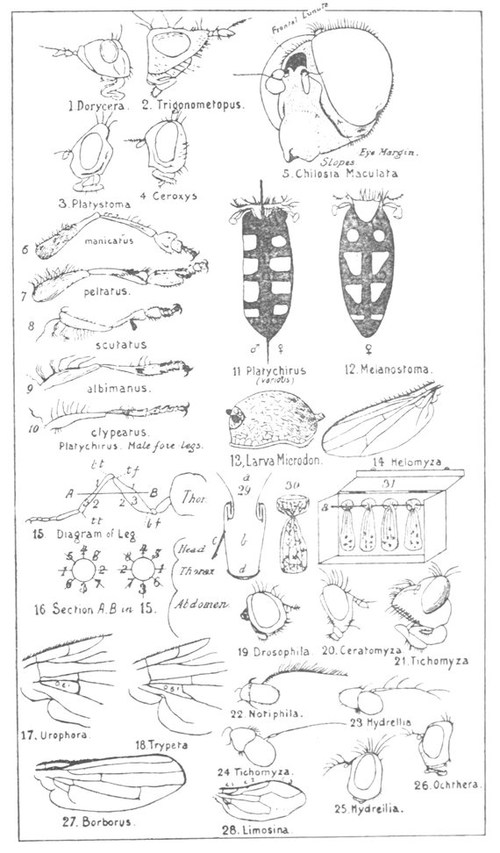
technically explained in the Appendix to this booklet.
Whilst the notorious house-frequenting flies above-mentioned
and the blue-bottle are remarkably omnivorous
in their feeding, the great majority of outdoor
flies are quite otherwise inclined, and do not find much
attraction in anything but their own individual preferences.
Indeed, the breeze-flies, and many others,
avoid human habitations; even the grey blow-fly, unlike
the blue-bottle, rather seems shy of the house. In the
above grouping, according to feeding habits, the house-fly
must be preferably consorted with (2) sweat-flies,
but the blue-bottle with (6) carrion flies; however,
the house-fly and the blue-bottle are very near akin,
and by reason of similarity of wing-pattern both
are included in the family of the Muscidæ.
In the entomological systematist's classification
the primary separation of flies into two sub-divisions
starts with a difficulty, for it is based upon circumstances
often obscure and in some cases at least
imperfectly known.
The first sub-division, Diptera Orthorrhapha, comprises
those flies which in the stage of the pupa or chrysalid
disclose the outline of the perfect insect; in the
other sub-division, Diptera Cyclorrhapha, there are
grouped together all those flies of which the larvæ make
for themselves a puparium or barrel-like case out of
their larval skin.
The first mentioned sub-division comprises all the
gnats, midges, and most of the slender flies which are
outside the scope of the present work, but it also
includes a few kinds of more stoutly built flies, to
which some allusion will be made in the following
pages, as for example, the breeze-flies, Tabanidæ.
The second sub-division comprises many families,
including the muscid-like flies, of which the house-fly
is the type. The flies of this type are to be found in
the families of Muscida, Anthomyida, Tachinida, and
Cordylurida, comprising nearly 700 British species, of
which many rather closely resemble one another when
superficially observed.
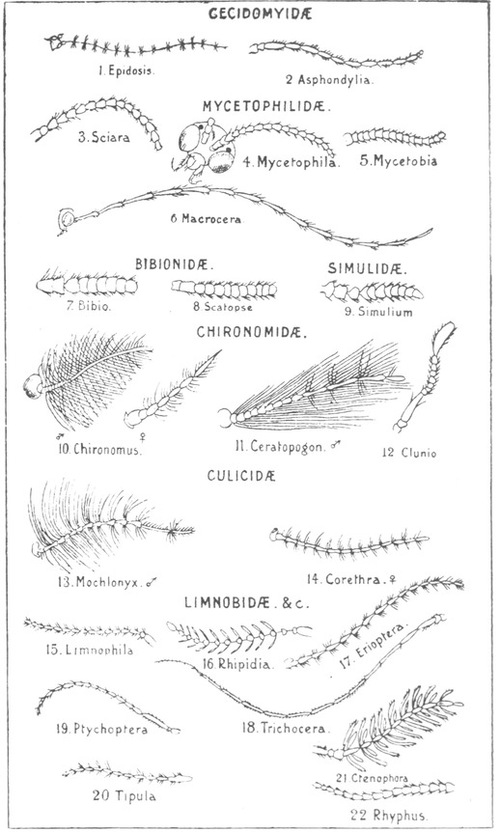
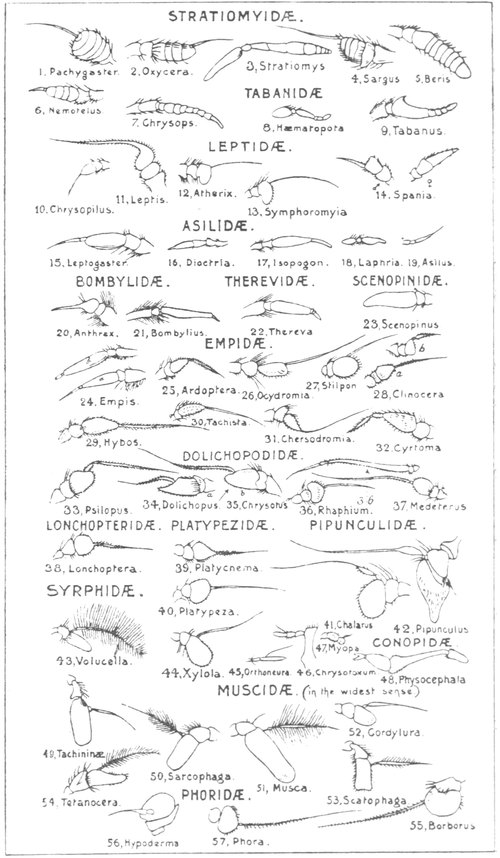
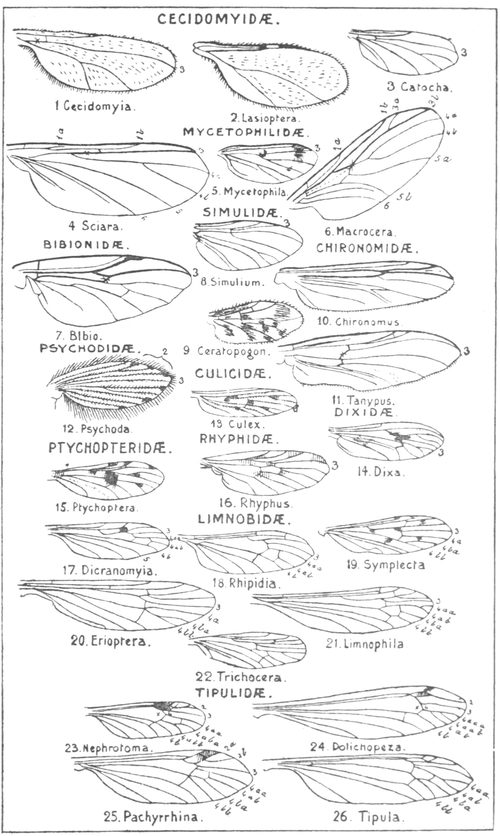
The approved classification of flies is to some extent
dependent upon the formation of the antennæ, but the
unique feature of the systematic differentiation is based
upon a very intricate method of scrutinising, identifying,
and numbering the vein-like strengthening ribs
called veins, nervures, or nerve-lines, which, starting
from the shoulder, mark with characteristic patterns
the transparent tissue of the wing. We are rather
compelled to follow something like this plan (simplified)
for the purpose of clearly distinguishing the "lesser
house-fly" from the common "house-fly."
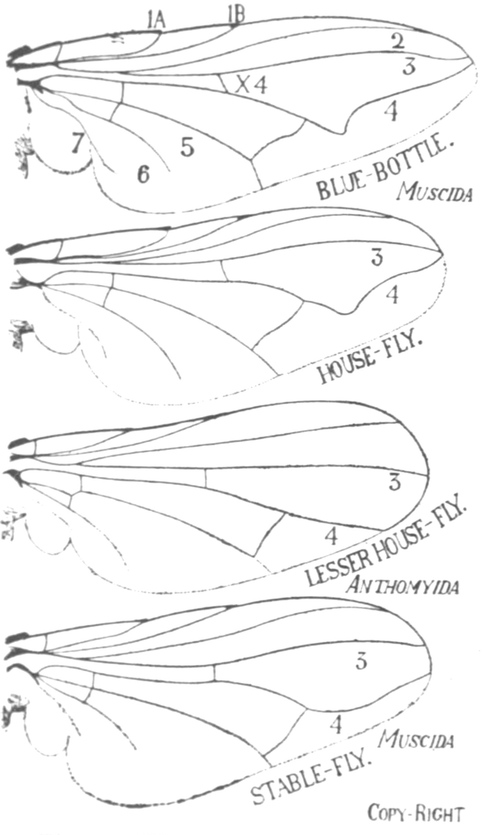
In the accompanying illustrations rather similar
patterns of wings are shown; these are typical of
the Muscidæ
and Anthomyidæ, which, taken together,
comprise amongst others all the cattle and human pestering
"sweat-flies"; only a few really blood-sucking
flies are included amongst the Muscidæ.
In critically comparing these four patterns, the chief
feature to be observed is the small rib-like nervure
called the "discal" "cross-vein," which is situate in the
very middle of the wing, and which connects the lowest
of a group of longitudinal nerve-lines or veins in the
front (or upper) half of the wing to the uppermost of
the other group of longitudinal nerve-lines in the hind (or
lower) half of the wing. Three "main" longitudinal
lines, technically termed "veins," are theoretically
recognised as constituting the upper group and four
"main" longitudinal lines the lower group; but these
"veins" (numbered 1, 2, 3, 4, 5, 6 and 7) will be found
to be varied in different families and genera, each often
with characteristic diverging branches, whilst some
veins may be rather inconspicuous or quite absent.
We will here devote our attention only to two such
"veins," those respectively termed "vein 3" and "vein
4" which are connected in the very middle of the
wing, as above mentioned, by the small but always
distinct "discal" "cross-vein." The illustrated
patterns herewith show wings divided into about twelve
compartments or cells, to all of which learned entomological
writers give troublesome technical names, not
nearly so intelligible as the nomenclature symbols of
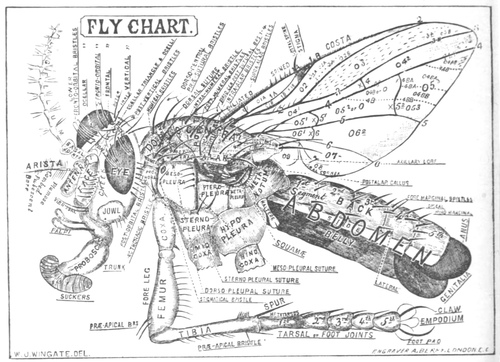
the late Rev. W. J. Wingate, explained in the Appendix
herewith. For present purposes a simple observation
of the (externomedial) vein "V, 4," where it is the
lower boundary of the (subapical) cell "O, 42," will
suffice.
Fig. 3. Wing patterns contrasted.
The pattern of
the first figure illustrates the wing of
the common blue-bottle;
here "vein 4"
does not run at all
straight in the last
part of its course, but
curiously bends very
suddenly upwards
at an angle and
meets the margin
very near to "vein
3." In the wing of
a large blue-bottle
it will be easy to
recognise this plan.
The pattern of
the second figure is
rather similar, for
the vein 4 likewise
has a sudden bend
upwards; it terminates
practically contiguous with vein 3 at the
margin. This pattern is characteristic of the "house-fly";
thus it will be easy for the reader to identify the
common house-fly by the close resemblance of its
wing pattern to that of the blue-bottle, with which it
is classified in the family of the Muscidæ.
In the pattern of the next figure the vein 4 runs
comparatively straight throughout and meets the
margin at a spot intermediate between the third and
fifth veins; here all the main nerve-lines diverge more
evenly and terminate more equi-distantly apart; this
latter plan is the wing pattern which will suffice to
identify the lesser house-fly, but it is shared with all
the Anthomyidæ, and more or less with some others,
which are very common outdoor flies.
The pattern of the lowest figure illustrates the wing
of the common blood-sucking stable-fly, Stomoxys
calcitrans, which only occasionally invades the house.
Here the vein 4 is deflected upwards towards the
margin ending near the termination of the vein 3, but
the bend is a smoothly rounded curve and not a
curiously abrupt angle, as in the first and second figures.
If the reader will study the house-fly in captured
specimens, he will be able to observe that they slightly
differ in their inconspicuous colouration and markings.
The male of the lesser house-fly is sometimes more
observable than the male of the commoner house-fly,
by reason of his being a most indefatigable dancer
with companions in mid air around any central
ornament, and also by reason of his possessing pale
patches, more or less yellowish grey, on the sides of the
abdomen; but such markings are also in some degree
observable in other male flies, being very conspicuously
of a brighter yellow in the common small outdoor
raven-fly, M. corvina. The back of the thorax of the
house-fly is marked sometimes distinctly, sometimes
indistinctly, with four dark lines on an ash-grey background;
the lesser house-fly has three faintly darkish
lines only. Quite a number of outdoor flies have
similar markings, but these often look like closely
adjacent or indistinct spots. The wing pattern is the
readiest guide for distinguishing the lesser house-fly,
both male and female. The males of the hairy (almost
bristly) raven-fly also indulge in the dancing habit, but
still more so do those of the latrine-fly, Fannia scalaris,
which may be distinguished by its uniformly ashy-grey
abdomen.
These common co-inhabitants of our dwellings vary
in size according to their nourishment when in the larval
stage (maggots); after the perfect insect emerges from
the puparium, it swells out and fattens, but does not
grow in the real sense of the word. If 1000 house-flies
will weigh an ounce, then it may be calculated that
1600 average specimens of the other kind will likewise
weigh an ounce.
In representing that the house-fly exceeds the lesser
house-fly in numbers in the proportion of twenty or
thirty to one, it must be borne in mind that the occurrence
of the latter varies widely—casually according to
the locality, and temporarily according to the time of
the year, being more commonly observed when and
where the other kind is scarce.
The lesser house-fly has summer broods at longer
intervals than has the common house-fly. Towards
the end of the summer its last brood hibernates in the
puparium, and emerges as early as the end of March
or early in April, whilst the common house-fly is not
usually observable until a later date, although it is
credited with more generally braving the dangers of
attempting to hibernate in the imago stage. My
attempts to test the capability of the house-fly by aiding
October and November flies to hibernate invariably
terminated in the creature's death long before springtime.
However, it is very apparent that under the
shelter and encouragement of warm winter environments
in towns, amidst restaurants, bakeries, large
hotels and certain factories, as well as and even more
than in mews, adult flies of the latest autumn broods
can, to some extent, survive mid-winter with very little
or no prolonged hibernation.
CHAPTER III SOME OTHER FLIES AND THEIR DIVERSE HABITS
Just as the common "house-fly" and the "lesser
house-fly" are often in error regarded as the same
species with an insignificantly small difference of size,
so the identity of each in turn may be confused with
several other species which are not uncommon, but
they are all normally outdoor flies.
The chief of these is the excessively common stable-fly,
Stomoxys calcitrans, whose generic and specific
designations are well given, for they mean "sharp-mouth,"
"kicking," the latter word denoting the action
of the tormented horse; it has a long, thin, stiff, skin-piercing,
shining black trunk, furnished with two
lancets. It is an eager blood sucker. In size and
colour it rather resembles the house-fly, but anyone
who is keen sighted will recognise it at once by its
bayonet-like trunk, held projecting prominently in
front of its head. It is much addicted to basking outdoors
on sunny walls, but on the approach of darkness
or of inclement weather it will occasionally seek
shelter indoors. Its wing pattern rather resembles
that of the common house-fly, as has been previously
explained.
Round about dairy farms Hæmatobia stimulans, a
fly slightly smaller than the stable-fly, with a striped
thorax and a blood-sucking trunk, will often leave the
cattle to assail humanity. A still smaller, somewhat
hairy, muscid type of fly, Lyperosia irritans, is also a
common aggressor of oxen throughout the summer.
Musca corvina, the raven-fly, is smaller than the
house-fly; it has very distinct dark markings; the
abdomen of the female is chequered, but that of
the male has a black central stripe on a yellowish
abdomen. It frequents gardens, parks, and meadows.
It is much less prolific than the house-fly, with which
it shares the sweat-fly pestering habit.
Cyrtoneura simplex is a little smaller and more
common than the species last mentioned; its larvæ
are bred in the dung of cows and other animals which
it very severely pesters. However, many species of
dung-bred flies do not in the least participate in the
cattle-pestering habit.
The Anthomyidæ are a family of about 250 small and
medium sized garden frequenting and country flies,
mainly of flower and honey seeking habits. Nevertheless,
some are dung-frequenting; none are blood-sucking,
but several are cattle-pestering sweat-flies, which,
even more pertinaciously than the house-fly, will circle
round one's head and repeatedly buzz against one's face.
Of these, the small Hydrotœa irritans and Hy. dentipes
are amongst the worst offenders. A few of the Anthomyidæ
are vegetarian garden pests; the larvæ of the
cabbage-fly, the root-fly, the onion-fly and the celery-fly
are, in some seasons, very destructive. The so-called
"turnip-fly" is a small striped beetle of the
same genus, Phillotreta, as the unstriped "flea-beetle"
of the hop-fields. The larvæ of the majority of the
species of the family of Anthomyidæ are, more or less,
feeders on decadent vegetable matter, but some, like
those of the genus Fannia, are preferentially feeders
on dung. The female of the latrine fly, Fannia scalaris,
so closely resembles the lesser house-fly that only
the expert with a magnifying glass, after a careful
examination, can tell which is which; the male differs
from the male of the lesser house-fly by being without
the yellowish patches on the abdomen.
There is a larger and less common muscid fly, with
an ashy-grey body, but with reddish legs, named by
entomologists Muscina stabulans, which not only in
body colour, but also in the pestering habit, resembles
the house-fly; its Latin specific name is rather objectionable
as too suggestive of the common "stable-fly,"
which name belongs to Stomoxys calcitrans above-mentioned;
its larvæ have been found in cow-dung,
but they can also flourish on vegetarian fare.
The common blue-bottle is now named Calliphora
erythrocephala (red-head), and it can be
recognised by its reddish face and black hairs for a
beard, whilst the less common blue-bottle, named
Calliphora vomitoria, may be said to have a reddish
beard upon a black face; the latter has the blue colour
more evenly distributed over the abdomen, whereon
the former has dark markings.
Polietes lardaria is a fly sometimes mistaken for
the blue-bottle; its specific name is rather too suggestive
of resemblance in habit. It may be recognised
by its having four black stripes on the thorax, by its
large white squamæ, and its tesselated glaucous abdomen;
its wing pattern classifies it as belonging to the
Anthomyidæ, whilst the true blue-bottles belong to
the Muscidæ, and the grey blow-flies to a section
(Sarcophagina) of the Tachinidæ.
There are some other outdoor flies which are not
very dissimilar to the common blue-bottle, but they
are more soberly coloured, ranging from bluish black
to speckled and tinted greys; some of these have a
pattern on the shiny upper surface of the abdomen
which is conspicuously and beautifully chequered.
Closely akin to these latter is the large grey blow-fly,
or flesh-fly, Sarcophaga carnaria; it is much referred
to in entomological books as of marvellous fecundity.
The female deposits not eggs in a few hundreds, but
already hatched maggots to the number of many
thousands. Amongst half-a-dozen rarer kinds of
smaller grey blow-flies the females differ in their
striped markings, but their respective males seem quite
indistinguishable apart.
Notwithstanding the prodigious fecundity of the
grey blow-fly, the credit of being a practically useful
scavenger of carrion must be given only to the blue-bottle,
which is of a more robust habit, and which so
promptly monopolises available matter that Sarcophaga
carnaria and her congeners are sometimes,
perforce, compelled to give their larvæ a mere vegetarian
diet.
The yellow cow-dung fly, Scatophaga stercoraria, is
inoffensive, and one of the commonest flies observable
in the course of a country-side ramble. It and its
congeners are distinct in habits and appearance from
any of the other flies above-mentioned. In this species
the male is larger than the rather more smooth and
dull-coloured female. Its body is furry but slender;
it has small eyes and head parts. In repose it holds
its wings parallel close above the abdomen, more
like the "breeze-flies," or true "gad-flies," than the
ordinary muscid flies. Although its proboscis does
not seem as formidable as that of more insectivorous
flies, yet it may sometimes be observed pouncing upon
some small fly, which it holds with its powerful legs.
This fly does not appear to be very predaceously
inclined; perhaps it is only "acting a part," like some
other creatures, including the amorous male of the
common frog, which, failing to secure a more natural
and complacent "partner in the dance," will in springtime
seize upon and very persistently cling to an
astonished carp.
Amongst many flies with bodies favoured with a
brilliant metallic sheen, several species of green-bottle
flies (Luciliæ) are notorious. Of these latter L. Cæsar
is the most common, but L. Sericata is by far the
worst in England, not uncommonly laying eggs upon
sheep; many are of a brilliant golden green, but some
vary towards a coppery green; all have red eyes and
silvery faces. In summer-time these flies seize every
opportunity of depositing their eggs upon any sores
or skin wounds of animals; their larvæ normally feed
on carrion and dung. The green-bottle, like the blue-bottle
flies, are fond of both sweets and filth, but they
do not pester wholesome animals as do the sweat-flies.
Next to the Muscidæ the most often observed and
easily recognisable as a distinct family of flies are the
Syrphidæ, which include the "hover-flies," the drone-flies
(often mistaken for the male of the hive-bee), and
a number of other very common flies of a generally
similar full-bodied shape, in most of which colour
stripes and bands more or less suggest a comparison
with wasps. The numerous species native to Great
Britain are widely distributed, and, excepting the rare
and very hairy Merodon narcissi, of which the larvæ
feed on liliaceous bulbs, none is injurious and some
are beneficial. Nearly all the flies of this family
frequent flowers. The habit of many to hover for
hours about a favoured spot, as if for mere pleasure, is
remarkable; but it is not generally recognised that
some of these hover-flies (of the genus Syrphus) are
hawking for winged aphides and other small insects,
which they quickly suck dry and drop whilst still on
the wing. Many of the flower-frequenting Syrphidæ
are great devourers of pollen; all have strongly
developed suctorial mouth parts.
The larvæ of the various syrphid flies differ greatly
in appearance and habit; some are terrestrial; some
aquatic; some semi-aquatic; some feed on decadent
vegetation; some on sewage and filth, and some are
insectivorous. Most useful to the horticulturist are
those of the genus Syrphus, which feed on green-fly
and other aphides. The most curious in shape are the
"rat-tail" maggots of the common drone-fly, Eristalis
tenax (also others of allied genera), which can extend
their long tubular tails and breathe atmospheric air
through the same whilst lying under water. The larvæ
of the genus Volucella are found dwelling in the
nests of bumble-bees and wasps; it is rather uncertain
how far they are commensal, or parasitic, or devourers
of dead matter. Some of the syrphid flies are single-brooded,
but some at least are double or treble-brooded
in the year; records are wanting about many, and
which, if any other than the common drone-fly, are
multi-brooded. Anyhow, none appears to breed in
Great Britain as rapidly as do the house-fly, the blue-bottle,
and other muscid flies.
The larvæ of Conops flavipes are parasitic in the
body of the adult bumble-bee, and they pupate therein.
The small family of the Stratiomyidæ contains a
few fairly common species called soldier-flies; these
are interesting as linking Orthorrhapha with Cyclorrhapha;
their larvæ are some aquatic (the star-tailed
maggots), others terrestrial, and some have hard shell-like
skins; but they are not so curiously like a creeping
marine limpet as are those belonging to the genus
Microdon (of the Syrphidæ), which are rare and
wonderful dwellers in ants' nests.
There is a curiously shaped race of parasitic flies
which cling to the host like a louse, called Hippoboscidæ;
these have more than the usual provision of claws to
their feet, both in the number (normally two) and size
of the claws. The forest or spider-fly attaches itself
to some part of the body out of reach of the horse's
tongue. The ked, tick, or sheep louse-fly has a similar
mode of life, and, after selecting its host, it becomes
wingless. These flies, strange to say, nurse and nourish
their larvæ within the oviduct, and, when one might
think that they were laying their eggs, they are depositing
pupæ or larvæ just ready to pupate. There are
some species of the family of the louse-flies which
infest birds.
The true gad-flies of the family of Tabanida were,
and sometimes still are called "blinden breeze-flies,"
and sometimes dun-flies; by a very easy mistake the
countryman's word "blinden" (blind) has got changed
by authors in books to "blinding," which is nonsense,
and misses a wonderful instance of old-folk knowledge;
the females are amongst the most inveterate blood-sucking
flies, but the males are mere idle loiterers in
summer sunshine on flowers; the eggs are laid on
herbage in moist situations; the maggots and pupæ of
many of these species are said "to be found in the
soil," and some, if not all the larvæ, are predaceous,
attacking worms and underground larvæ of various
insects. They are more or less midsummer flies
and are single-brooded. There are several largeish
species (of the genera Tabanus and Therioplectes) found
in Great Britain, and they are diversely distributed,
being respectively woodland, moorland, lowland, and
highland inhabitants. The great ox-gad-fly is as large
as a bumble-bee, though more long than broad in
body, but the term gad-fly is often wrongly given to the
worble-fly, which is really more bee-like, being furry
and rounder in body. The genus Hæmatopota comprises
three smaller sized extra vicious blood suckers,
H. pluvialis, rather common, H. italica, very local,
and H. crassicornis, darker in colour and with spotted
and dark tinted wings. Several of the large gad-flies
have dull-tinted wings. They have large, shallow,
brightly shining and curiously banded compound eyes,
but no "ocelli"; they all seem to be at least semi-blind,
and the females are rather sluggish, except
between the hours of 11 a.m. and 5 p.m. in bright
midsummer sunshine. The females hunt entirely by
scent and are easily captured when attacking human
beings; they alight on their victims with a stealthy
silent approach. They appear unable to discriminate
between clothing and bare skin as suitable spots for
feeding. Amongst a band of mountaineering pedestrians,
on a sunny day, it was observable that there
would be a dozen or more "blinden breeze-flies"
settling on the back of one, whilst the rest of the party
were only favoured now and then by one or two apiece.
It was apparently the smell of the "home-spun" coat
which attracted; the colour of the garment did not
seem to be the cause of the selection. Sunshine loving
flies prefer white and pale colours. If a dog could
speak, he would explain the smell of some "finished"
cloth, but, for the sake of the fastidious, the secret is
not here disclosed.
Very closely allied to the true breeze-flies in habit of
life are the species of the genus Chrysops, of which
two only are often met with in England, namely
Ch. cœcutiens and Ch. relicta; these flies are very
keen blood suckers; they are smaller, slightly more
slender and brighter coloured than the commoner
Tabanidæ; it is characteristic of the genus Chrysops that
the antennæ are quite twice the length of the remarkably
short horns of the majority of common full-bodied
flies; all the species possess beautiful golden glittering
eyes (whence the name Chrysops), and their wings are
spotted and tinted.
One of the most horribly disgusting but serious facts
connected with flies is observable most conspicuously
amongst the wondrous family of the Œstrida. These
pass the larval stage of life, not on, but inside the
bodies of living animals; and the perfect insect, strange
to say, is absolutely destitute of a mouth opening.
Much misrepresentation has been prevalent, based
entirely upon surmise, connecting "myiasis" in mankind,
which is various but very rare, with the common
infliction of horses and horned cattle with Œstrid
maggots. Myiasis is the medical term given to all the
various forms of animal infliction by internal parasitic
maggots, and this subject is reserved for discussion in
the next chapter.
The characteristics and natures of the very numerous
tribes and families of other kinds of flies will be found
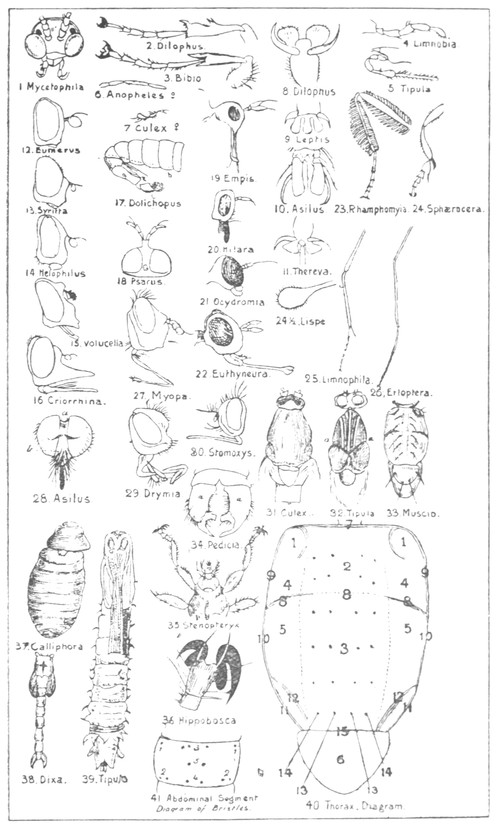
summarised in the Appendix of this booklet.
CHAPTER IV MYIASIS AND THE ŒSTRIDÆ
The family of the Œstridæ is the most curious and
horrific of all the different tribes of flies; it is very
limited in species, of which five or six are prevalent
throughout Great Britain. The worst of these could
be almost exterminated with ease, but unfortunately
mistaken ideas have prevailed, and graziers commonly
believe that though the sheep's nostril fly is conspicuously
harmful and dangerous, the horse's bot-fly
and its congeners are negligible as regards the
practical health of the host. The bot-fly and the
worble-flies are all of a largish size, only the sheep's
nostril fly and Œstrus hæmorrhoidalis, which latter
infests the throat and rectum of the horse, are of a
medium size.
It has been known from very ancient times that
man himself was not exempt from some fly, which was
imagined to resemble the horse's bot-fly, and it has
been wrongly surmised that many different creatures
and all ruminant animals were more or less subject to
the attacks, each one of its own kind, of œstrid fly. It
is undeniable that man is sometimes internally afflicted
with dipterid larvæ, but it is most certain that the fly
to be incriminated is not a congener of the horse's
bot-fly.
An old illustrated French encyclopædic work gives
coloured pictures of the flies and larvæ of Œstrus bovis
(the worble-fly of the ox) and of Œstrus equi (the bot-fly
of the horse), but only the larvæ of a so-called
Œstrus hominis is figured. Recently, however, new
attempts have been made to identify the species
causing intestinal myiasis, of which the larvæ are
observable from time to time in the course of post-mortem
examinations and during anatomical study.
Of recent years it has been suggested that the lesser
house-fly is addicted to such a manner of breeding;
then later that another species of the same genus has
been found to be the real culprit. However, the
peculiar larvæ of these last-mentioned flies do not in
the least resemble the fat round larvæ of the true bot-fly
or of the worble-fly, which are correctly represented
in the above-mentioned French work, nor the round
and rather smooth maggots which were observed in
Westminster Hospital nearly fifty years ago, and at other
places from time to time both before and since, giving
rise to much wonder and discussion, and also to very
incredible tales.
Another more credible surmise attributes the offence
of human intestinal myiasis to Muscina stabulans; if
this be correct, the infliction would be probably due
to the subject having eaten damaged and egg-laden
plums or similar fruit, for M. stabulans is credited
with being normally, though not exclusively, fruitarian
or vegetarian.
If any one of the above suppositions be true, it does
not exclude any other one, amongst many explanatory
surmises, from being possible. Judging from the remarkable
attractiveness of the odour of humanity to the
common house-fly, and from the fact of the maggots
possessing well developed tenter-hooks on their heads
(somewhat like those which the bot-fly maggots use
for internal attachment), it is just as likely, nay more
likely, that this species (as the writer stated for the
information of the authorities of Westminster Hospital
nearly fifty years ago) is more than any other capable
of adopting such a life-cycle existence; these maggots
would mature after five or six days feeding and then
emerge. If there were a veritable "Œstrus hominis,"
however rare, the hairy and peculiar female would be
conspicuously observable, a persistent hoverer about
the person of her victim until she had attached eggs
to his body, from which the maggots would not emerge
until after nine months. Most of the tropical flies,
which are said to similarly attack humanity, may be
rather compared to the green-bottle flies which infest
sheep, but the latest medical records and reports profess
to identify ten or twelve species of very different genera
as having myiasic capabilities.
The family of Œstrida has been fitly divided into
three sections, namely, the Gastrophilinæ (the larvæ
living in the gullet, the stomach, or the intestines), the
Hypoderminæ (worble-flies), and the Œstrinæ (nasal
or nostril flies); all the species are hairy or furry, and
the gravid females fly slowly with loud buzzing, in a
characteristic attitude peculiar by the bending downwards
of abdomen and tail, with a much extruded
ovipositor.
The sheep's nostril-fly, Œstrus ovis, has a chequered
abdomen and is less hairy than others; it is the type of
the section to which the generic term Cephalomyia is
given in some books; species of this section attack
deer and other animals.
The section termed Hypoderminæ comprises the
"worble" flies or "marble" flies. One may imagine
that the latter name indicates in the mind of the cowherd
the appearance of the round pustulent boils on
the hide of the suffering animal, and that the former
name is a corruption of "worm-hole," originating with
the tanner, observant of the deterioration of injured
hides. A mixing of the terms worm-hole and marble
probably originated the name "warble." The maggots
live under the skin on the back of oxen, and breathe
externally through openings in the boil-like excrescences.
The discoloured flesh of infected oxen is called
"flecked." Two species of worble-flies are prevalent,
one or the other, in many parts of England.
The third section, to which the sub-family termed
Gastrophilina is sometimes applied, comprises the
"bot-fly," which commonly infects the horse; it is the
imperfect knowledge of this latter which has led to
erroneous surmises explanatory of the horribly disgusting
fact of human intestinal myiasis.
All the species of all the three sections are single-brooded.
Although the flies themselves can inflict no
immediate pain, at their mere sight all the animals out
at grass on the farm are seized with an instinctive
terror, conspicuously greater than when attacked and
copiously bled by any "blinden" breeze flies, which,
however, fly more silently and settle on their victims
very furtively. One can understand the violent efforts
of the horse to free himself from the exceedingly
painful bites of a newly attached forest-fly, but one
can only wonder at the frantic galloping of oxen and
horses to and fro when a non-biting œstrid fly buzzes
about like a harmless fat bumble bee and slowly
approaches.
The females of all the worble-flies, the nostril-flies,
and the bot-fly are short-lived, appearing on the wing
in August, possibly seen a few days earlier. In the
act of ovipositing they make themselves very conspicuous;
they lay their eggs whilst hovering in the
air, their extruded ovipositors attaching glutinous eggs
to their victims. The hatching of the eggs of the
bot-fly is assisted by the habit of animals to lick
themselves and each other, when certainly their warm,
moist tongues will convey into their mouths the newly
emerged bot-fly's maggots, which many months later
are to be found attached to the internal lining of the
unwilling host's stomach. When fully grown in June,
these maggots loosen their hold, are discharged with
the dung, and pupate in the soil.
No satisfactory account has yet been given as to the
early stages of the maggots of the worble-flies. The
eggs, having been attached to hairs on the host's hide
in August, the prominent round pustulent swellings,
called worbles, wherein the maggots dwell, do not
become conspicuous until the following months of
April and May. It is a reasonable surmise that the
obscure and long first-period of the maggot's existence
may more or less conform to that of some of those
flies which are also single-brooded but are predaceous
or parasitic on insects. The newly hatched maggot
perhaps can crawl, but does not feed until after several
moults; at each moulting the strange creature becomes
smaller and smaller, but probably at the same time is
provided with a new head well suited for the purpose
of that period; firstly, with a burrowing or grappling
head, and in due time with a feeding suctorial mouth,
and then only does practical growth begin. No dipterid
flies, at all events, known to be native to Great
Britain, possess skin-piercing ovipositors.
I have been astonished to read in current literature
much about œstrid flies which is not in agreement
with my long course of personal observation; for
instance, one high authority (F. R. S.) writes that œstrid
"flies" appear from May until October, and hints that
their egg-laying aggressions upon their victims are not
conspicuously observable. I feel confident that the
facts are quite otherwise.
That the bot-flies normally (and a few others abnormally,
but for short periods only) pass a very long
larval stage in the stomach and alimentary canal of
herbivorous animals is one of the greatest marvels
of insect life. All other growing creatures, which
normally breathe in free air, require a certain large
amount of breathable oxygen; and they would be
stupefied or killed by a much smaller percentage of
carbonic dioxide and other fermentive gases of digestion
than undoubtedly exist in the strange abode
wherein the bot-fly maggots dwell during the entire
period of their feeding career. It has been stated that
fly maggots artificially ingested into the human system
have emerged alive in a normal condition, but the
repulsive and objectionable experiment is not stated
to have procured well nourished and full grown normally
pupating larvæ. Some of the maggots of human
intestinal myiasis are not perhaps amenable to artificial
culture up to the stage of final metamorphosis; and
they do not appear to have developed a breed or new
species with a distinct habit of life. All the credible
accounts of human intestinal myiasis point towards
some fly which is plural-brooded, and of which the
larvæ develop rapidly and promptly quit the body all
at once; otherwise more than one infection must have
occurred. The tales of prolonged continuous breeding,
with slow and prodigiously copious emergings at
intervals, should be altogether discredited.
It is an amply warranted criticism to say that recently
published records by authorities, in an endeavour to
comprise every reported instance of myiasic infection,
seem to countenance mere coarse Gargantuan jokes.
On the other hand, it is painful to read such a "cock-and-bull"
story as that of the doctor about his elderly
lady patient, up whose nostril a gravid female blue-bottle
flew and successfully performed the prolonged
and delicate operation of laying therein a large batch
of eggs, in spite of all attempts to expel the invader
by violent sneezing. Day by day the said doctor
observed the terrible injury, and the symptoms accompanying
the growth of the feeding maggots, whilst the
injection of a spoonful of paraffin would have effected
an instantaneous cure.
CHAPTER V GENERAL LIFE HISTORY
Whereas the blue-bottle rarely enters the dwellings
of mankind, except gravid females led by the sense of
smell in search of fish, or flesh meat, and (less eagerly)
sweets, both species of house-fly and both sexes seem
to delight in the mere odour of humanity; breeding
females will seek the larder and the dust-bin, but others
will very provokingly pervade all quarters. Although
avoiding a dark or deeply shaded room, the house-fly
seems to like partial shade; it will be content to remain
indoors and to rejoice in a warm kitchen, even
on a hot summer's day, whilst all the other kinds of
flies are enjoying the outdoor sunshine. It may be
said of nearly a dozen other species, occasionally observable
crawling on window panes, that they are "outdoor"
flies, and that their occurrence indoors is accidental.
In fact, they are mostly observed when trying
to escape.
Next after human habitations, stables, cow-sheds and
pig-sties are the delight of the breeding female house-fly.
Round about and in these latter resorts she
associates with an immense host of rather small sized
flies, and amongst a few others of equal size with the
skin-piercing and blood-sucking stable-fly; but many
stablemen are ignorant of the difference of the two
kinds of flies and of the serious suffering of their horses
from the bites of the stable-fly. This lamentable ignorance
was shared by the joint authors of "Humble
Creatures," published in 1858, when Neo-Darwinism
was in vogue, and many books were published for
popularising a knowledge of common things and
spreading an interest in nature-study; this publication,
which is still (1914) in print and very little revised, has
probably led some later would-be nature-study teachers
to follow suit in confusing the characteristics of the
two species. Very often the fly most numerously
breeding in the manure heaps of the mews will be
Borborus equinus, or some other of the same family,
which are characterised by a very simple pattern of
wing nervures and by the absence of squamæ or scales
behind the wings; also the ankle joints of the feet are
most peculiarly short and broad. B. equinus, and a
great host of other dung breeding flies of a still smaller
size, may be considered beneficial insects; they do not
pester cattle, and their larvæ make food more scarce
for injurious flies.
The breeding habits of the blue-bottle are very conspicuous
by reason of its haste and boldness in taking
possession of dead animals. It is incapable of breeding
in horse or cow dung, to which latter the green-bottle
fly often resorts.
The blue-bottle deposits her eggs, 500 or 600, preferably
on dead fish, or flesh, and sometimes on the
sores or the flesh of wounded animals, but both the
house-flies preferably affect dung, carrion, garbage, and
all kinds of fermenting vegetable matter. It has been
commonly but not truly said that the principal breeding
places of the house-fly are the mews and the farmyards
where manure is allowed to accumulate; the
house-fly has a preference for horse dung before cow
dung, which is preferred by some other kinds of flies;
however, near towns, the domestic dust-bins, heaps of
market garbage, and deposits of town refuse give rise
to a worse plague of house-flies than stables. All these
flies deposit batches of white eggs, and are careful to
place them as much as possible in crevices and shielded
from exposure to strong light, or from draughts.
The two house-flies and the blue-bottle have similar
larval stages, but their larvæ, called maggots, differ.
The larvæ avoid daylight and cannot withstand dryness.
As the larvæ feed, they have the power of ejecting or
excreting a juice, which dissolves the food before they
imbibe the material; their mouths are suctorial and
are destitute of teeth or biting jaws.
The larva of the house-fly is an eyeless and legless
maggot, one half inch long when full grown and extended;
twelve cylindrical segments may be counted
in its body, or even thirteen if we separately distinguish
the small head segment, which may be withdrawn, and
but little observable; five or six rear segments are of
nearly equal stoutness when only half grown; afterwards
counting from the three stoutish rear segments,
the others taper towards the very small head.
The middle and rear segments have pad-like bristly
processes underneath, which aid the maggots in
creeping, in which action they also make much use
of the head segment's grappling hook. The maggots
feed voraciously, but they seem, like the larvæ of the
honey bee, to pass out very little anal excreta; some have
thought that, like what is said of bee larvæ, no excrement
is discharged until after the imago has emerged
from the puparium; but such conduct seems altogether
incredible. In the bee-hive doubtless the assiduous
workers ever wash their babies clean and lick up all
matter, just like domestic cats and dogs, when nursing
their young.
The larva of the blue-bottle, called a gentle, is proportionately
larger but very similar, except that the
rear segment possesses a ring of tubercles, which may
have some useful function in connection with two
breathing tracks, which have their orifices at that part
of the body.
The larva of the lesser house-fly is very peculiar;
all its segments have projecting tubercles; its whole
body is rather louse-shaped, having not cylindrical
but somewhat flattened segments, of which the middle
are the broader, and those near the head and tail the
narrower.
The transformations in the case of the blue-bottle
are typical of the house-fly and others of closely related
families and genera which are many-brooded within
the year; these creatures develop very rapidly immediately
after emerging from the egg. Some other kinds
of dipterid maggots, which are single-brooded, pass a
very prolonged and obscure early period of skin-shedding
and non-feeding, a preparatory sort of baby-hood
metamorphosis; then at last they begin to feed
voraciously and to follow the general habits of other
maggots. Some maggots curiously refuse to feed
except in company; probably some are unable to feed
on dung except where other species are providing the
necessary dissolving juice.
When the common maggots or gentles have ceased
feeding, they burrow into the ground or crawl away,
often to a considerable distance, apparently seeking a
secluded, a more wholesomely clean, and a dryer spot.
During this migrating time, they are palatable food
for many birds, which would not eat them in their
former food-loaded or unscoured state. Indeed, it is
doubtful whether either a vulture or a raven could eat
a fly-blown carcase without danger of myiasic punishment.
The skin of the larva whilst growing is transparent,
but, when about to pupate, it thickens and
becomes an opaque creamy white.
The most marvellous part of the metamorphosis of
the blue-bottle is concealed, when the gentle becomes
the pupa; according to Réaumur the embryonic fly
develops most curiously inside the puparium by a
procedure not exactly like the change from the caterpillar
to the chrysalid in the case of the butterfly.
After a pause of a day or two, the front segments of the
fully fed maggot contract, so that the body assumes a
barrel-like shape; the skin then hardens, and turning
a reddish brown it becomes a much contracted shell
or case called the puparium. However, the long
slender maggot has done something more than merely
shrink and shape itself conformably to the case; it has
withdrawn its embryonic head, so small as to be hardly
distinguishable microscopically, together with its
embryonic legs, wings and thorax into its embryonic
abdomen! As the development proceeds, and the
embryonic members of the future perfect insect acquire
their destined shape, the immensely increased head
and the thorax with its appendage members slowly
emerge, and the partly inverted integument of the
abdomen rolls back, disclosing the shape of a fly not
before recognisable.
Other naturalists would have it believed that the
true account of the transformation is as follows,—when
the maggot has shrunk and freed its body inside its
skin which forms the case or puparium, all its pre-existing
internal organs become absolutely dissolved;
then out of the fluid mass a new growth ensues, constituting
the pupa with its recognised shape. This
account is the one represented in most modern
entomological books, and is based partly upon B. T.
Lowne's monographic work on the blow-fly.
The comparative embryologist of our day is inclined
to be a hyper-theorist, and so it seems that some have
not remained content with either of the above accounts;
to them, apparently, the production of the large and
complex head of the imago out of a single small
anterior segment of the maggot requires a more recondite
explanation, and must be brought into harmony
with analogous facts. To this end some degree of
linked support is found by the investigations of microscopic
anatomy, and it has been conjectured that not
one or two head segments, but five are lying blended
and embryonically hidden in the larvæ, all ready to
bud forth. However, for fear of wearying too much
with the theories of advanced erudite scientists, the
following jeu d'esprit is presented, instead of a more
elaborate and sober attempt, to lure the unscientific
lay reader to an extreme hypothetical conception of
the "essential unity" underlying the apparent diversities
of Nature within that vast domain of the Kingdom
of Fauna, which is obviously outside the later creation
of a vertebrate Animalia.
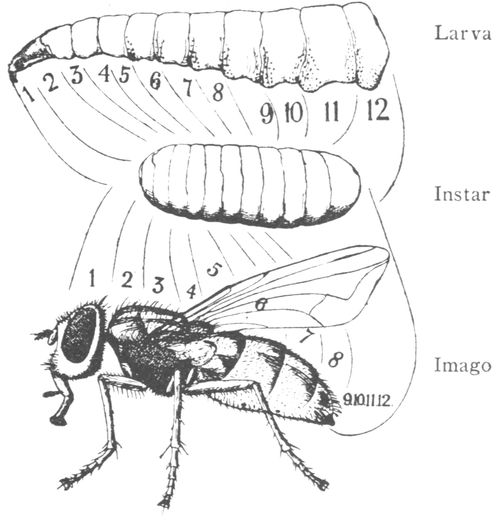
Fig. 5. Illustrating the debatable continuity of a 12-segmented structure throughout the metamorphosis.
The futurist's dogmatic CREDO of creative progress,
"For him who would meritoriously pass his histological
examinations, and qualify as a Professor and
Doctor of Science, above all it is necessary that he
should acknowledge the unicellularity of the primæval
OVUM (or egg), whence proceeds the seventeen-segmented
boneless ANNELID (or worm), out of
which there develops the quadrangular articulated
crustacean INSTAR (or shell-encased aurelian), which
metamorphosises into the winged IMAGO (the angelic?
or diabolic? fly); in the contemplation of this
knowledge alone is there supreme Darwinian Modernismal
salvation and felicity." Amen.
In view of the prosaic illustration of transmutation,
figure 5 above, the futurist disciple will have to accept
the seventeenness of segmentation by something like
faith without sight.
The quadrangularity of the crustacean stage is based
upon the idea that the wings bud out from the two
upper corners, whilst the legs develop from the lower
corners of the transmuting instar.
Perchance the reader will desire information about
the use of this curious word "instar," which has not the
honour of notice in Dr. Sir J. Murray's New English
Dictionary. One might well feel proud of the opportunity
of adding the smallest item to such a stupendous
and monumental work, but I fear I am only qualified to
venture a fair guess. Virgil, I believe, used this term
in allusion to the legendary wooden horse of the
Greeks at their siege of Troy. Some time less than
one hundred years ago entomologists recognised that
the words aurelian, chrysalis, and pupa were none of
them an inherently fit term of general application to
the stage of insect life to be indicated. After many
attempts, this latest proposed substitute seems to be
gaining favour.
The fly emerges after bursting apart the first four
segments of the puparium; this it does by a curious
provision, whereby it can inflate a chamber in its head
in a queer, balloon-like fashion, making a bag-like
extrusion, which it uses as a punching and pushing
machine.
After emerging from the ground, the fly withdraws
the bag-like extrusion and cleans itself. Its body soon
grows fit and it becomes very active, as long as daylight
and warm weather favour it; otherwise it seeks
shelter and becomes quiescent; however, artificial
light and heat will awaken it to nocturnal activity.
Sweets, carrion, and filth are all attractive to the blue-bottle,
but the house-fly and the lesser house-fly also
find extraordinary attraction in both man and his
dwelling.
Considering the superfluity of other flies, and the
multitude of other insects ever ready to do duty as
devourers of carrion, garbage, and filth, the scavenging
services of the larvæ of the house-fly can be well
dispensed with.
In civilised communities cremation in a refuse
destructor is the only sanitary method of treating town
refuse. The economic value of the fly is very little,
and consists merely in its food value for certain birds.
In warm weather the scavenging capabilities of all
the carrion and filth feeding maggots are very remarkable,
and there appears no exaggeration in the statement
by Linnæus, that the progeny of three flesh flies
can eat up the carcase of a horse sooner than it could
be devoured by a lion.
When a batch of eggs has matured in the abdomen
of the female, she is most careful in the location and
manner of their disposal. Guided by the sense of
smell, she will not lay her eggs except in contact with
food, or in places securing her progeny access to their
intended food. By the use of her soft, slender ovipositor,
which is telescopically extensile and flexible, the eggs
are deposited in shaded and concealed situations.
The house-fly is credited with laying batches of eggs
at intervals, perhaps four or more times, and about 150
on the first occasion, then 100, and less on subsequent
occasions. Under favourable circumstances the eggs
may hatch within a few hours of their being laid.
The maggots of midsummer broods may be full grown
and pupate in six days, and the perfect insect may
emerge from the puparium in another ten days of warm
weather, but in cold weather the pupæ of autumnal
broods may remain dormant for several weeks, or even
months. When nine or ten days old the mature fly may
begin to lay eggs; hence, with such a life-cycle, in a
month of very favourable weather the progeny of a
single pair may number, say, 500; in two months'
time the number may become 250 times 500; and in
three months' time many millions!
CHAPTER VI THE STRUCTURE OF THE HOUSE-FLY
The house-fly has quite the typical insect form, inasmuch
as there are three well defined sections of body—the
head, the chest or thorax, and the abdomen;
also it has three pairs of legs, each with nine joints, of
which five joints constitute what may be called the
foot. The twelve segments of the maggot are observable
as twelve rings in the puparium, but in the fly the
three which form the thorax look like one, whilst the
eight which should theoretically exist in the abdomen
look like four or five, until the rings of the ovipositor
are counted.
The illustration on page 39 will make plain how
the permanence of the twelve-segment structure (conspicuous
in the larval stage) has been thought to persist
throughout the life-cycle, but at the same time will
disclose how great is the change in the relative
proportions of these segments.
The prominent features of the hemispherical head
are the two large compound eyes and the proboscis or
trunk-like mouth. The antennæ or horns are very short
appendages with three joints; small plume-like
projections, called arista, are attached to the third
segment; the horns hang down over a hollow in the
middle of the face, and are insignificant in size when
compared with those of other kinds of insects; but
their structure viewed under the microscope is intricate,
and they may be efficient organs of sense perception,
probably in part auditory. The really unique feature
is the retractile and suctorial proboscis, which is often
incorrectly regarded as the tongue; it is normally held
doubled up and withdrawn towards a hollow under the
head, whence it is from time to time extruded. The
structure of this member is characteristic of the entire
tribe to which the house-fly belongs; it is a fusion or
combination of mouth parts, which in other insects are
used more or less separately for the various functions
of inspecting, biting, masticating, drinking and
swallowing. In the house-fly the proboscis is
absolutely suctorial, and is not provided with the
lancets used by the blood-sucking flies for piercing the
skin. Two maxillary palpi are attached to the upper or
basal part of the proboscis, which is called the rostrum
(a snout); the lower part is called the haustellum (a
pump), and it has at the end a pair of soft cushion-like
lobes or lips, which, when spread apart, form a heart-shaped
pad with an opening in the centre. The maxillary
palpi are used for feeling and probably smelling.
Each mouth-lobe has a main collecting central channel
and thirty subsidiary cross channels of a wonderfully
complex character. Imbibed fluids pass from the
mouth-lobes to the gullet along a passage in the
haustellum and the rostrum.
As with many other flies and other insects, there are
on the top of the head very small simple and rather
inconspicuous eyes called ocelli, three in number,
between the large and prominent compound eyes,
which latter are said to possess each four thousand
facets. The compound eyes of the male fly are
proportionately larger than those of the female; it is
quite observable that they approach each other more
closely at the top of the head, a feature of sex differentiation
which is shared with bees, wasps, and many
other insect creatures. It is thought that a single
brain image arises from the combined views of the
four thousand facets of the compound eyes blending
with the view conveyed through the "ocelli." However,
it is a most curious fact that it is the inconspicuous
ocelli which are of supreme importance visually. The
compound eyes have doubtless some special function,
but throughout the insect world the size of compound
eyes is not a certain indication of keenness of sight.
The vision of the fly is good for distinguishing the
movement of any broad mass, but it is rather ineffective
for observing a thin line, as may be proved
by slowly lowering a knife blade, with a steady hand,
when its body may be severed before the fly takes
alarm. It is a remarkable fact that the family of
Tabanida (blood-sucking breeze flies), which are
destitute of "ocelli," are the dullest sighted of all flies;
in fact, at least semi-blind. Moses Harris observed
that a blue-bottle became practically blindfolded when
its ocelli were covered with an opaque pigment.
Probably this is the case with other insects. Bees,
which require long distance sight for home returning,
are well provided with ocelli. Butterflies, however,
without the use of ocelli have a distinct faculty of daylight
vision for a moderate distance. The investigation
of sight by blindfolding is very difficult in flies.
There are two cephalic ganglions, which are regarded
as the brain; these are situated in the upper part of
the head close to the neck. There are also ganglions
in the thorax with connections extending into the
abdomen.
The thorax is mainly occupied with the powerful
muscles which actuate the attached wings, the legs, and
the small appendages called halteres or balancers, which
are supposed to be obsolete hind wings. There are
three unequal segments in the thorax; the pair of front
legs belong to the first segment, the wings and the pair
of middle legs are attached to the second larger segment,
whilst the third is connected with the hind legs and
the halteres.
The breathing apparatus of the fly is distributed in
portions over the head, thorax, and abdomen; it consists
of a number of internal air-sacks with membranous
ducts ramifying everywhere; the largest air-sacks are
in the abdomen near the waist. There is a pair of
external spiracles to each segment of the body, and
these lead to the air-sacks.
The lines on the wings of the house-fly called
nervures have already been alluded to in Chapter II.
These nervures are strengthening ribs to the transparent
tissues of the wings. The tissues are double
(top and bottom) enclosing the nervures, which are so
united to the connections called trachæ of the air-sacks,
that the newly emerged fly helps to extend its limp and
crumpled wings by a process of inflating the nervures.
The stomach is located partly in the thorax and
partly in the abdomen. A passage from the gullet
passes through the neck into the lower part of the
thorax, where are the entrances to two long capacious
chambers, of which the upper one is the true stomach
and the lower one a store pouch, which latter may be
likened to the honey bag of the bee. The fly habitually
regurgitates liquid food stored in this pouch, and,
somewhat after the manner of the cow chewing the
cud, passes the same back into the true stomach,
whence it proceeds onwards through the digestive track.
The abdomen holds all the other ordinary internal organs
including that which may be called the heart, and
which lies above the stomach; it consists of a long
muscular tubular vessel with four contractile chambers.
Although the organ called the brain is located in the
head, and although that called the heart is in the
abdomen, yet some sense of control over bodily motions
curiously exists separately in the ganglions of different
parts of the body. This fact seems to make it possible
for one extremity of the body to continue performing
a pleasurable action (say, the head drinking honey)
after the other extremity has endured a painful catastrophe
(say, amputation of the abdomen). However,
it may be fairly surmised that no creatures of a lower
grade than warm-blooded vertebrate animals feel
pleasure and pain in any way at least after the manner
of mankind.
The most vital part of the fly is not the head but the
thorax. A severe squeeze on the thorax will effectually
paralyse and kill the creature. Muscular movements
of different parts of the fly's body, which continue after
severance or other fatal injury, cannot be regarded as
visible proof of a slow death and prolonged sensibility.
Possessed of six legs, each with nine joints, the fly
exercises a unique capability of walking; the legs are
moved three at a time, a front and a hind leg on one
side advancing simultaneously with the middle leg on
the other side; thus the fly proceeds most securely
always poised on three feet, which are so well furnished
with pads, claw-like hooks, and hairs, that it can walk
over polished glass and can even walk upside-down
along comparatively smooth surfaces.
In comparison with the more heavily constructed
wasp, with its four wings, the house-fly, with its two
wings, is the more alert and active flier. The wasp is
more robust than the fly and will be active in weather
too inclement for the latter; however, some of the
frail and slender gnats will brave cold temperatures
impossible for the wasp.
CHAPTER VII DISTRIBUTION AND CONCENTRATION OF FLIES
It might be supposed that a strongly developed house
haunting proclivity would not be consistent with a
disposition to roam far afield from the locality of birth.
Many clever experiments have been made with marked
flies released and recaptured within measured distances
and times. After an immensity of pains taken, very
little profitable knowledge has been arrived at thereby.
Little of what we really want to know is indicated by
such a fact as that, out of hundreds or of thousands of
marked flies released, one per cent was recaptured at
spots as remote as a mile within two or three days, or
by such a fact as that a large percentage should be
observed to remain within a more limited home circuit.
The variable factors of temperature, wind, sunshine
and rain inevitably tend to discredit the reliability of
the observed results following any such experiments.
Close observations of the habits of the house-fly reveal
the very appurtenant fact that the movements of
newly-hatched flies, for their first six or seven days'
active life, differ from those of a more mature age, when
the breeding instinct has grown strong. The latter
are disposed to locate themselves for the rest of their
lives in and about one attractive spot, and they are indisposed
to fly high above ground or to travel far,
unless it be with the object of leaving an unsatisfying
locality and discovering a better place. However, the
younger flies seem to feel no such restrictive influence,
for, as soon as they have become fit and the weather
suits, they show an inclination to fly high and thus may
travel to very remote places. It is just the same with
peacock, red admiral, and tortoise-shell butterflies,
which I have often reared and released for adding
to the interest and beauty of a flower garden. In
sunny weather many or most will soon wander never
to return; those which have remained a few days
continue residence close round about, especially if
nettles, the food plant, grow in the neighbourhood.
It would be of great interest if we could discover
how far a plague of flies arising from unsanitory
surroundings in one locality is liable to spread to the
injury of other localities.
On this subject nothing useful can be said other
than can be safely surmised from the known habits of
the fly. The female has none of the attachment of the
honey-bee to its hive and community; she is not
moved by an instinct like that of the wandering bumble-bee
in spring to found a colony; she is indeed very
solicitous about the disposal of her eggs, but she is not
impelled by any desire to place successive deposits in
one locality.
The lesser house-fly has proclivities similar to those
of the common house-fly, but probably she travels less
far afield although a little more inclined to outdoor
life.
Very little is known about most of the common outdoor
sweat-flies. Some breed in dung, and may be
many-brooded and otherwise resemble the house-fly in
prolific increase; others are more consistently vegetarian
in the larval stage and slower in development; and
some are possibly even single-brooded, like certain
foreign large sized flies which fortunately appear only
for a few weeks of summer weather, for they have a
curious semi-blood-sucking habit of feeding after or
alongside the skin-piercing flies, and their suctorial
mouths are capable of further inflaming wounds and
carrying infection from one animal to another.
The robust blue-bottle very closely resembles the
house-fly in an inclination to spread the brood.
Mature females, however, do sometimes show a slight
temporary kind of "homing" instinct; having secured
a cosy corner and a well sheltered retreat in a sunny
wall, the occupant will battle for its possession, buffeting
new comers.
Some of the smaller filth flies and many of the fungus
flies have their lives, in the imago stage, influenced and
shortened by their extra early sexual maturity; the
females are fertilised whilst newly hatched and their
wings limp and unfolded. This fact accounts for our
seldom seeing some kinds of these flies abroad except
females; and these are never seen to indulge in dances,
flirtations, and games of chasing and buffeting each
other, after the manner of so many kinds of flies.
They habitually fly low; nevertheless they travel very
great distances, for, though short, their flights are
incessant when searching for their special kind of food.
The most disinclined to roam of all common flies
is the stable-fly. None other is a more eager seeker of
sunshine, but when basking on a sunny wall it seems
unwary and sluggish; it is seldom to be seen far from
where horses or cattle are stationed or stabled; however,
it will make very long journeys hovering about a
driven horse or reposing on the car.
A plague of flies of local origin will not take many
weeks of summer weather to spread, but it is generally
observable that plagues of flies, like many other occurrences,
are simultaneous co-incidences distributed over
wide areas and at places remote from each other.
CHAPTER VIII NATURAL ENEMIES AND PARASITES
Flies, which are such insidious and pertinacious
persecutors of man and beast, are themselves the prey
of innumerable enemies; many species are much
sought for by birds, they are devoured by lizards
and toads, and they are equally preyed upon by
predaceous insects. Those flies which have bodies
with banded colours, and which otherwise somewhat
resemble bees and wasps, probably escape being the
victims of some birds; but the tribe of flies does not,
like the beetles, the lepidopteræ, and some other
insects, furnish instances of other common protective
devices, such as bearing and voiding offensive
secretions, or attempted concealment in repose by
mimicry of environment.
All insectivorous birds are fond of a diet of flies,
and we may largely attribute the spring-time immigration
of the beautiful swallow tribe to the fact that
in the northern parts of the temperate zone swarms of
soft bodied dipterous insects abound, and there replace
the hard cased and more chitonous insects of
hotter countries. The true swallow, the house martin,
and the sand martin, all require a special food for their
nestlings; and they also then require the longer
summer days and the prolonged twilight of our
northern clime for the frequent feeding of their young.
The prevalence of flies near houses partly accounts for
the partiality of the swallow for nesting under the
eaves of our dwellings, where unfortunately the
aggressive, the pampered, and the demoralised sparrow
in towns generally prevents successful breeding by
appropriating its nest and sometimes by eating its
eggs. People who desire to favour the breeding of
the swallow should destroy the nests immediately
after the migratory departure of the builders. Their
retention until the following spring is in no way an
enticement for rehabitation; on the contrary, it favours
the objectionable habit of the sparrow to use them for
a night resort, whereby they become very foul with
bird vermin. The cleanly swallow annually desires a
newly built habitation, and a bare peg projecting two
inches from the house-wall will much encourage swallows
to start the foundations of a nest thereon.
Ground feeding birds of many kinds eagerly search
for flies, their pupæ, and their larvæ; even some
finches will add flies to their diet in the nesting
season. Chaffinches are very fond of the house-fly
at all times.
The wasps are assiduous hunters of flies, and, though
possessing less agility than their prey, they manage to
pounce upon many victims. Very common enemies
are the predaceous Empidæ, of which numerous
species are native to Great Britain. Less common,
but very observable when met with, are the closely
related robber-flies, Asilidæ, which are hardly ever
to be seen on a hot midsummer day without a captured
fly held between their strong front legs. The largest
of the robber-flies, A. crabroniformis, is a conspicuously
fine insect. It equals the hornet in length, but is
more slender in body, tapering throughout the abdomen
towards the tail; it resembles the queen hornet
in colour. The dragon-flies also eat flies, but they
mostly feed upon winged aphides, gnats, and the like
small game.
More secret destroyers of the fly brood are a few
rather obscure creatures akin in their nature to the
ichneumon flies, which are parasitic mainly but not
exclusively on lepidopteræ. Likewise, certain insectivorous
beetles share in the good work of fly
destruction.
Flies are often observable encumbered with minute
vermin; some of these are true lice, and some are
allied parasites called false-scorpions or chelifers.
These are acquired whilst frequenting dung and refuse
heaps, where they abound; thus, probably cheese-mites
and the like are conveyed by flies into our
larders and warehouses.
It is not only the web-weaving spiders which prey
upon the proverbially "silly" flies; there are also
roving spiders which do not contrive webs, and some
of these are nocturnal feeders; the latter can only be
seen in daylight by looking for them underneath stones
and in other hiding places.
Other fly destroyers are internal parasites, and these
include thread worms (Nematoidea), as well as Protozoa
of obscure kinds. These are being scientifically
studied by experts, and their life-history is as curious
as that of others of the same order, in that they pass
from one host to another, which fact for long helped
to baffle investigation. Some have now been proved
capable and others are suspect of baneful possibilities.
The house-fly fungus, Empusa muscæ, which is prevalent
in autumn, has ever attracted popular wonder
and much scientific attention. It has been much
written about and plentifully illustrated, but the
complete life-cycle of this peculiar parasitic growth
is not yet understood; much that has been published
as of fact is mere "copy" repeated in one book after
another, originally in fact rather a matter of conjecture,
based upon the idea that fungic propagation must be
on exactly parallel lines with known biologic processes
of a botanic order.
The house-fly fungus seems to have a superficial
resemblance to some of the common "moulds," but
mycologically examined there is good reason for
classifying it with a family (Entomophthoreæ), which
may be capable of an alternative form of fructificative
development.
The originating germ somehow at some time must
be supposed to have effected a lodgment in the body
of the fly or possibly that of the maggot. Later on,
one cannot say when, fungic spawn (a pulpous
mycelium) starts a course of development, invades
every part of the body, quickly kills the fly, and fixes
it to the spot to which in its last moments it has
crawled, often a window-pane. Its corpse is now
swollen with the spawn developed into masses termed
hyphal; but these should not be called hyphal (thread)
but quasi-sclerotia, bodies intermediate in a process of
normal development between the mycelium and the
fruiting stage; fungic fructification ensues with great
rapidity; and the corpse becomes suffused with an
appearance of white mouldy excrescences, filiform
conidiophores, of which the club-like tips make a
copious ærial discharge of white spores; when these
adhere to a glass or window-pane they imprint thereon
a remarkable halo. Attempts to artificially infect other
flies with these spores are common failures or have led
to contrary conclusions.
The period from the first symptoms of distress to
the death of the fly, and from that time to the spore
discharge is wonderfully short. The infectious germs
may have been long dormant in the fly, and very likely
may have been acquired in the maggot stage. In the
absence of exact knowledge, we can only make conjectures
from observations of some kindred fungic
parasites, which are not very uncommon amongst the
chrysalids of certain moths, beetles, and the pupæ of
some annual wild bees. In these cases it seems very
unlikely that the infection was incurred otherwise than
in the caterpillar or larval feeding stage. Dampness
and insanitary conditions seem to favour the spreading
of such disease, especially amongst artificially reared
larvæ when crowded together and closely confined.
Other kinds of flies do not, so often as the house-fly,
perish from Empusa muscæ, but I have seen a
common yellow cowdung-fly, as early as June, thus
affected.
In spite of all antagonists the brood of the house-fly
flourishes and multiplies, but this is because great
opportunity and encouragement is provided by the
neglect of good sanitation by mankind.
CHAPTER IX DISSEMINATORS OF DISEASE
The house-fly may seem at first much less to be
dreaded than any one of the painfully "biting" or (to
be correct) skin-piercing and blood-sucking flies; yet
it should be regarded as a much greater enemy to
humanity and a more dangerous peril than any of
those other flies, of which some short mention and
description has now been given. Its life-history and
its fecundity have been already alluded to; its rapid
growth and maturity counterbalance the fact that it is
short lived.
From ancient times there has been a consensus of
opinion that there was in some way a connection of
cause and effect between swarms of flies and the
spread of disease. In the plagues of Egypt, in the
reign of Pharaoh of the Exodus, it will be remembered
how, after "the land was corrupted by reason of the
swarms of flies," Exodus viii. 24, there came "a
very grievous murrain" upon cattle, Exodus ix. 3,
followed by a "plague of boils and blains" upon man
and beast.
In our present day insect life is being scientifically
investigated with the view of establishing the connection,
and of discovering fully the serious rôle of
disseminating disease, of which the house-fly has long
been suspect. The microscope reveals much, and the
art of bacterial culture now explains how it is true that
the superabundant creature, which has persistently
followed civilised man into every quarter of the globe,
has ever had a share in conveying contagion beyond
that of any other household pest.
That the house-fly is bred in filth matters not much.
After emerging from the puparium its first voidance of
fæcal matter may be contaminated with live baneful
germs, but it voids itself before its first flight. Having
six legs it stands upon two pairs, whilst with the other
pairs, at one time the front pair and at another time the
hind pair, it works frequently and vigorously at
brushing and stroking down every part of its body.
Though it starts its new life quite a wholesome newborn
creature, and though it must be credited with
being a most assiduous remover of dirt from its own
body, yet from the human point of view its subsequent
life is a persistently disgraceful career.
It is the evil course of the newly-hatched and self-cleaned
fly not to restrict its diet to the honey of
flowers, as do some of its relations. Its food includes
excrement, sputum, and every kind of putrefying
organic matter likely to be swarming with micro-organisms
of a character deleterious to humanity. It
is certain that, when only a few days old, a fly will
practically abound internally and externally (on the
feet) with dangerous germs, as amply proved by
methods of laboratory culture. As it feeds, it walks
over the food; and the hairy joints of its feet, when
microscopically viewed, appear conspicuously liable to
carry germs in spite of frequent attempts at self-cleaning.
Wherever it alights and walks, it prospects
with a touch of its trunk, which is the main instrument
of evil. It has a very filthy habit, from time to time, of
depositing pale vomit spots as well as dark-coloured
fæcal droppings. These defilements are visible,
wherever it may alight on walls, windows, ceilings,
and especially on pendent ornaments, whereon the
males delight to rest.
Its manner of feeding upon solid food is to pour
forth a copious supply of saliva, to regurgitate some
previously imbibed fluid draught, and then to re-imbibe;
thus, besides devouring soft food, it dissolves,
befouls, and feeds on crystalline sugar and other hard
dry food materials.
Its regurgitated fluid commonly swarms with bacteria,
microbes, and the like. Imbibed bacteria are not
inevitably killed in the digestive process of the fly, for
its excrement has been found to abound with well
recognisable infective germs. In the market, the shop,
the larder, and on our tables, the house-fly seeks every
opportunity of befouling and contaminating human
food.
The varieties of micro-organisms are multitudinous,
doubtless many more in number than the microscopist
and the bacteriologist expert have yet isolated and
registered as capable of identification. Granted that
the majority of these are non-pathogenic to humanity,
still a formidable number, including some which are
very generally disseminated, are virulently pathogenic,
and many are suspect. There is no need to give a list
of all the infectious diseases which man and beast are
liable to contract, but the germs of nearly all may be
carried from place to place, from creature to creature,
and from person to person, through the intervention or
agency of the house-fly. The medical profession are
convinced that infantile mortality from epidemic
diarrhœa must be attributable to summer flies.
In the matter of food which becomes fly-infected after
having been cooked, or of food like milk, butter, and
fruit, which are consumed raw, it should be known
that a single pathogenic germ of ultra-microscopic
dimensions, having obtained lodgment in the body,
may there multiply and originate a fatal disease. On
the other hand, raw meat which has been infected may,
after the bacteria have been all killed by cooking,
contain excreted poison in deleterious quantity. The
decomposition of infected meat begins ten or twelve
hours before the bad odour is perceptible.
Fortunately the omnipresent germs which most
commonly deteriorate our food are not very actively
deleterious, or are only slightly debilitating; yet
wherever such less obnoxious germs get lodgment,
there the ready prepared and most favourable breeding
place for the worser kind is to be found. The various
species of these evil things are not always exterminating
competitors; they sometimes flourish in company, and
dwell together, like the seven devils within the exorcised
and sane man after his relapse, as mentioned in the
Scripture.
That food gets fly-blown and maggot-infected is a
very disgusting fact, but the plainly visible result is
of little hygienic significance apart from the more
concealed facts of the fly-borne conveyance of zymotic
diseases.
Internal protozoal parasites and parasitic worms
breed in and are disseminated by the house-fly; so also
are the fungic spores of fermentive yeasts, of moulds,
and the like, but these latter are mainly disseminated
by mere air currents. The eggs of tape-worms and
the like are carried by dung-frequenting flies to food,
especially to semi-putrid food devoured by dogs and
pigs.
Some of the skin-piercing and blood-sucking flies
are pestiferous in a more direct way than any of the
tribes of filth and sweat-flies. They are the usual or
suspected agents whereby anthrax, cattle-plague, swine
fever, glanders, and other diseases are spread far and
wide. Some of these last blood-sucking flies will
travel with and on the bodies of transported animals
for long distances; of course there can be no doubt
also as to the capability of disease dissemination by
the direct independent flight of flies to long distances
with favouring weather and breeze. Such evils are
prevalent throughout the temperate zones, but circumstances
are far worse in the tropics, where Glossina
morsitans, considered by some to be a near relation of
our Stomoxys calcitrans, transmits the microscopic
trypansomes which cause the devastating "sleeping
sickness" of mid-Africa. This last reference, and
other discoveries of the fly-borne germs of recurrent
fevers, should bring into prominent notice a very
pertinent fact; which has not yet received adequate
scientific investigation. All the bites of our common
blood-sucking insects, flies, gnats, midges, fleas, etc.,
are each kind of them wounds, sometimes very inflammatory,
sometimes but little or not at all so;
furthermore, the worst inflammatory wounds not
uncommonly show feverish symptoms of a well marked
periodic character, quiescent intervals being followed
by revived inflammation in the same spot. These facts
almost prove, or at least strongly suggest, an explanation
that in the latter cases the source of pathogenic
trouble is of a microbic character, and that periodic
recurrence of feverish and inflammatory symptoms is
the time of the spore-swarming of breeding microbes;
the difference between these latter and those of a more
severe and often fatal kind in the tropics being that
the one class finds the human body a fit host in which
to multiply but the other class does not, and accordingly
the latter grow weaker until their breed dies out.
Similar effects can be observed in cattle and other
animals, but all creatures, after suffering much from fly-bites
at first, afterwards become for a time more or less
immune.
CHAPTER X REMEDIAL MEASURES
We have seen in Chapter VIII that the checks
which Nature has imposed upon the prolific breeding
of the house-fly have been insufficient to protect
civilised mankind from ancient times continuously up
to the present day. This defect need now no longer
be endured; but, alas, communities and individuals
are ever slow to be warned, and averse to practise
newly advised methods of sanitation. In few other
directions is there greater promise of advancement in
general public health and comfort than by preventive
measures against the breeding of the house-fly.
Effective measures comprehensible to all who consider
the subject are so easy of application, that, if universally
carried out, the house-fly might become a rare insect
in a very few years' time. It is, however, of fundamental
importance that the public should be made to
comprehend the case; else the power necessary for
enforcing suitable regulations by the local authorities
will not be obtainable.
Preventive measures must constitute the supreme
objective of an anti-fly crusade. The habits of the
house-fly and its life-history make it clear how
successful breeding may be prevented. The breeding
places are local and accessible; the food substances
of the larvæ are capable of being put under control;
and the maggot stage is the opportune period wherein
the fly plague is most obviously open to attack.
In all town and suburban parishes a house to house
collection of domestic refuse and garbage must be
made, not weekly, but bi-weekly in summer, and the
material must be cremated in a dust destructor furnace
within a few days of its collection; thus neither larvæ
nor pupæ therein would survive; no alternative
disposal otherwise than by cremation should be
attempted. Furthermore, and above all else, only
refuse collecting bins of an authorised pattern should
be employed. Contrary to the prevalent idea these
should not be fly-proof and not have air-tight
covers; they should freely admit air all round
and should encourage the access of breeding flies.
They should stand preferably in open daylight places
and should be egg-traps for flies which, thus encouraged,
would hardly ever deposit their eggs elsewhere;
the result would be that all maggots and pupæ would
be inevitably cremated.
It may be objected that, if open dust-bins are used,
house-flies after visiting the same may return to the
house and subsequently contaminate food in the larder.
There will be such a possibility, but the danger thereof
can be minimised, and would in fact be nearly automatically
cured, as prospective fly progeny perished.
Furthermore, there are circumstances which indicate
that the said danger would not be great, and anyhow
nothing comparable to the baneful effects which are
now endured. The worst germs are not those of
newly discarded food remnants; the commonest and
well-known bad smelling germ of ordinarily "tainted"
meat, which is exceptionally attractive to the house-fly
and the blue-bottle, is fortunately, after cooking, not
so dangerous as some of those other deleterious micro-organisms
mentioned in the last chapter. Taking one
thing with another the balance of benefits and disadvantages
will incline overwhelmingly in favour of
open dust-bins, wherein food remnants may purposely
become fly-blown. An improved dust-bin lid has been
contrived which combines with the cover a centrally
held wire-gauze "balloon" fly-trap, wherein flies will
congregate and be imprisoned when attempting to
leave.
Unfortunately air-tight dust-bins have been very
generally recommended as a grand device of hygienic
value; hence it is most necessary that unthinking people
at large should be informed how much better it is to use
open bins which can catch and secure for destruction
prospective fly-broods. It may be asked—why not
trap and kill the breeding females? The reply is that
to do so will be good, as is to be explained in the next
chapter; but contrivances for the latter procedure are
apt to be less effectively put into general operation.
The fly swarms of mews, arising from accumulations
of stable manure, will be difficult to alleviate without
stringently enforced measures, but it is a mistaken
notion to believe that town flies are bred in stables to
such an extent that the invaders of our dwellings and
town restaurants, shops, and markets, are merely or
mainly the overflow of the mews. The concentration
of many kinds of flies is very dense around ill-kept
mews, and in midsummer-time a large percentage will
be true house-flies. Frequent removal and cremation
of stable manure would be quite effectual, but there is
reason to think that, if proper care be taken, no such
drastic procedure as cremation will be absolutely
necessary, unless perhaps for the months of July and
August.
There are two matters involved in sanitary stable
reform—one is the proper structure of the stable floor
and the treatment of the litter whilst in use for
bedding; the other is the disposal of the horse
droppings and the discarded litter called stable manure.
If the floor be good and the bedding be well kept and
fairly dry, which is often not the case, then the effective
breeding of flies will be in the dung-pit and the
external manure heap. From a sanitary point of view
these latter are indeed almost everywhere ill-kept.
The general fate of maggots living on the floor of
well-kept horse-boxes is to end their lives drowned in
the drains to which they descend, when or before they
pupate.
In these days of motor-cars and fewer horses the
horticulturist everywhere is eager to buy good stuff;
now stable manure to be good must be fresh and free
from the garbage with which stable men wantonly
corrupt the same, instead of consigning such extraneous
refuse to a proper separate dust-bin for collection and
cremation. So much can be done remuneratively with
a regular supply of clean fresh manure, that it seems
almost worth while transgressing the proper limits of
this booklet and writing chapters on mushroom culture
and on the intensive hot-bed cultivation, with the aid
of "cloches" or bell glasses, called French gardening.
It may be thought that such cultures will of themselves
breed swarms of flies. Though such is not necessarily
the case, the liability by common carelessness is very
great.
The expert horticulturist has a special preparatory
treatment for fresh manure intended for hot-beds; new
manure in heaps rapidly "heats," and is ærated by
being turned over two or three times on separate days
before being packed close for the hot-bed. This
process of treatment rather disagrees with the breeding
of the house-fly. Mushrooms and all the fungus tribe
breathe by inhaling oxygen and exhaling carbon dioxide;
and so it happens that even insects which
delight to feed on mushrooms, are somewhat repelled
by the special atmosphere of very actively growing
mycelium or spawn.
The amateur entomologist and the nature-student
will observe that the flies which pester the gardener at
work are mainly other than the common house-fly.
The reader, nevertheless, will like to know if something
more cannot be done to stable manure for exterminating
maggots, whether of house-flies or the many various
filth flies, already hatched and growing therein. Well,
"something" indeed can be done by the use of some
insecticide. Hitherto chloride of lime has been employed,
but the most approved insecticide for the
purpose is a solution of iron sulphate—two pounds in
one gallon of water; this is said not to deteriorate
the horticultural value of stable manure. However,
in fine weather, the spreading out and drying of freshly
received manure practically rids it of fly maggots, which
cannot survive this simple procedure. The mere burial
of fly-blown dung and stable litter without prior treatment
is quite inefficient. Insanitary heaps of neglected
manure, which terribly swarm with maggots, much
deteriorate in horticultural value.
Farmyards and the scattered dwellings of rural
districts remain to be considered, and no doubt
herein the difficulty is great, but not hopeless. The
latter will be persuaded to follow suit when the
good effects of town and suburban policy become
apparent.
Something more than usual is desirable for the protection
of cattle from the breeze and the œstrid flies
at midsummer. The latter, at all events, could be
easily exterminated by giving butterfly nets and encouragement
to children, who would enjoy the fun.
Although the close approach of strangers may alarm
grazing animals, after the latter have galloped away a
very good chance will occur of capturing the slow
flying gravid female worble-fly with a butterfly net,
or of felling her to the ground with a suitable instrument;
if missed on the first attempt, other chances
can be got again and again by waiting until the said
same fly has returned to threaten her intended victims.
The writer has often succeeded in felling the slow
flying gravid female worble-fly with a mere walking
stick. It is strange that no farmers' entomological
friend has hitherto suggested so common-sense a
remedy as butterfly nets, which should be of a dark
green colour. A company of our popular boy scouts,
marching in a skirmishing line on an August Bank
Holiday (or a preceding Saturday), over ground where
grazing animals are observed showing behaviour conspicuously
indicative of attacks by œstrid flies, would
enjoy doing grandly useful execution. Every capture
should be substantially rewarded.
In an organised campaign of house-fly extermination
it may rather be expected that the principal trouble
will be with the stable men of unsanitary mews.
In the United States of America very stringent bye-laws
have been made and enforced. Some of these,
perhaps, deserve consideration for adoption, with
judicious improvements, in England, but the policy
of the OPEN DUST-BINandCREMATION raises new
hopes of success far beyond any advantages hitherto
obtained in America.
CHAPTER XI CONTROL WITHIN THE HOUSE
Many minor plans have been proposed for obviating
or alleviating the perils and plague of invading fly
swarms; several such plans may be well carried out on
a private domestic scale, but one cannot expect any of
them to be adopted universally. In domestic methods
people will prefer some one plan, some another, whilst
some will not personally aid in the work of fly
destruction in any single way perseveringly. This
latter circumstance emphasises the necessity of a
dominant control by local authority for the safeguarding
of all inhabitants, including the delinquents themselves
in spite of themselves.
The plan, as detailed in the last chapter, of enticing
breeding females to lay their eggs within depositories
of discarded food remnants and garbage, can be
practised on a smaller scale with great advantage everywhere.
Kitchen refuse of many kinds, not neglecting
potato and turnip parings, cabbage leaves, or even
tea leaves, should all be collected in brown paper bags,
which should be left open for a few days in suitable
places round about the house for the free access of
gravid female house-flies. Every such collection
should he cremated on the third day. In a paper, read
at a recent congress of the Royal Sanitary Institute, on
"Destruction and Prevention of Household Pests,"
Dr. Gay advised rich and poor, in every household,
whether or not a sanitary dust-bin was in use, instantly
to wrap up in paper all such fly-breeding materials in
readiness for cremation. However, to do so would be
missing the much more effectual course of applying
my "egg-trap" plan of collections in exposed open
bags for cremation on the third day.
For indoor use insecticide methods are more suited;
and the best of these are immensely more effective than
some popular devices, which make a remarkable display
and sell well, but which the purchasers soon
become neglectful to keep in constant use. Traps in
the form of wire-gauze cages, and glass non-return
bottles belong to this latter class of contrivances; when
seen crowded with struggling victims, the employment
of such articles captivates many observers; but their
real efficiency will be found to fall far short of general
expectation. The explanation will be apparent when
the use of the wire-cage trap is contrasted with the
success of a good fly poison. Given, say, a dwelling
room on a midsummer day containing ten female flies
and ten idle dancing male flies; in such cases not
more than half the females and one quarter of the
males will get imprisoned within four or five hours by
the employment of the wire-cage trap, but with a good
method of setting poison nine-tenths of the females
and half the males may be killed within the same
period. In the case of poisoning, the dead have to
be swept up, whilst fly traps have the advantage of
collecting the victims; but, unless the inmates are
carefully destroyed, a few will manage sometimes to
escape from the traps, especially as side window light
changes and daylight fades. In these fly traps it is
only the perseverance of the prisoners in struggling
towards outer light which prevents their exit by the
entrance aperture.
Stickfast adhesive papers and suspended tapes and
strings look very effective when seen crowded with
accumulated captures; but, again, these "exhibition"
appearances are as deceptive in suggestions of real
efficiency as are the crowded cage traps last mentioned;
moreover, sticky messes are not commendable or convenient
articles for placing where most wanted.
Truly, suspensory strings are attractive resting resorts
for dancing males, but the worst agents of Beelzebub
are the females, which have a keener appetite for food
and for pestering humanity.
There remain for consideration insecticide poisons.
A great choice of materials can be supplied by the
chemist's shop, and various methods of using them
have been recommended. In old times country people
prepared decoctions of Amanita muscaria, the fly toadstool,
a large orange-scarlet, or crimson, mushroom-shaped
fungus commonly appearing in autumn in
woods where birch trees abound. Strange to say, such
decoction will poison flies of many kinds, although
they, and many different creatures, feed with impunity
on other fungi which are more deadly poisonous to
mankind.
Effective poisons are such good exterminators of
flies, that the main consideration is how to safely and
most suitably employ them. There are some people
who have an invincible aversion to the mere thought
of poison purposely administered by way of food or
drink, though possibly they do not have an equally
strong repugnance to the use of insecticides used for
stifling. However, one cannot help running counter
to much misplaced sentimental humanitarianism in
some people on some subjects; reasons and arguments
will not move them, for they do not wish to think
otherwise than as their prejudices influence them.
The house-fly is itself a poisoner of our food, and it,
or rather she (the offender being nearly always female),
is a more dangerous and a more subtilely baneful
enemy than, for instance, the human flea, which even
the Brahmans or the disciples of Buddha may kill.
Fumigatory insecticides, though occasionally useful,
may be left out of consideration in discussing the rival
merits of means in a warfare against the house-fly.
A liquid or moist food poison employed in a safe
and effective way will excel every other weapon of
warfare within the house. One of the newest recommended
substances is formalin, which has the advantages
of being a disinfectant, a strong fly-poison not
avoided by flies, and not dangerous or attractive to
domestic animals. A tablespoonful of (40 per cent.)
formalin should be mixed with one half pint of milk
and water; this, when exposed in saucers or shallow
dishes, is said to be an attractive and a fatal bait. It
would be evidently dangerous and objectionable to
use some other commoner poisons in the same way;
but it is the opinion of some users that formalin and
milk is not sufficiently alluring.
Contrary to a generally prevalent idea a powerful
odour is not required as an indoor allurement for the
common house-fly; again, a saucer or shallow dish
with liquid contents is not a good method of presenting
the fatal bait. Placed on a table, or on a window sill,
or on a shelf, a saucer is liable to be tipped up and its
contents spilt; moreover, the form of such receptacles
is radically faulty by reason of the strenuous walking
habits of the fly on the level. Out of many flies walking
over a table ten or twelve may pass by, or round,
an overhanging saucer's rim to one fly that will mount
the same and sip inside. However, let such a saucer
or plate be placed on a table upside-down, and let
a slightly moist substance be placed in the shallow
central depression, which ordinarily is the base, then
the said ten or twelve flies will all mount and sample
the moist substance, even though it be not apparently
attractive in smell; an inclined plane is ever an irresistible
invitation to mount and prospect the summit.
It is another great mistake to suppose that an extra
tasty food material is desirable as a bait. The same
kind of mistake is made by people baiting a mouse
trap with toasted cheese, whilst a bit of dry bread, or
better still, a green pea, would much better entice a
common mouse. Strong smelling and saccharine
foods immensely attract the blue-bottle and the wasp,
which are thus enticed indoors and induced to become
occasional visitors to our tables; but the house-fly
requires little of such lures; indoors she is an inquisitive
prospector, who will never pass by any moist material
without testing its quality. Moreover, the use of
poisoned milk, or even jam, should be rather avoided
for fear of injury to dog or cat; furthermore, it is
dangerous to place a piece of bread in a saucer of
liquid fly-poison, as is sometimes done, to serve as a
sop and as a standing stage. However, there is one good
lure well worth mentioning; it is beer-dregs with or
without a little sugar; moistened yeast is good, and the
advantage of beer-dregs with just a little sugar is due
to the mild yeast-like odour of slow fermentation,
which may fail if formalin be the insecticide ingredient.
The handiest and safest preparation of fly-poison is
that sold in the form of a dry flypaper, which is said
to contain arsenic as the deadly ingredient. A very
small piece of one of the sheets ordinarily sold should
be placed on the summit of an inverted saucer; a mere
spoonful of water now and then will suffice to moisten
the same; there is little or no advantage in sprinkling
a little sugar thereon, unless beer-dregs are added.
This plan of using moistened poison paper is clean; it
is safer than using a more fluid bait, and the ingredient
is certainly efficient; the slightest taste thereof by an
inquisitive fly ensures its speedy death. Another
poison which has been recommended is a strong
decoction of tea-leaves, to which a little sugar and
beer may perhaps be added.
It is said that the smell of geraniums is odious to
the house-fly, and so pots of these plants may be grown
beneficially on window-sills. Certain other odours
and scents are believed to be likewise more or less fly
deterrent, but their use is not effective warfare against
fly propagation. Paraffin painted on window-sills is
said to be very efficient.
Flies may be easily prevented from entering the
open windows of any room, which has windows only
on one side, by the use of venetian or louvre blinds or
shutters, or of many kinds of screens, although the
apertures thereof may allow of ample room for flies to
pass to and fro. If, however, there be windows on
two sides of a room, then venetian blinds and the like
will be useless, and window screens must have very
close meshes to be effective. The house-fly will pass
through netting only when there is light shining on the
further side. A knowledge of this fact is very important
in the planning of hospital wards. In a sick room, if
there be windows on two sides, one in summer time
should be darkened when the other is open for
ventilation.
The protection of the larder and the screening of
food should never be neglected, but what is of even
greater importance is the prevention of access by flies
to fæcal matter, or to purulent and all unhealthy discharges
from the sick room.
CHAPTER XII THE SERVICE AND UTILITY OF FLIES
It is often asked—have not house-flies some use in
Nature? The only true answer is that they are warning
signals.
They certainly do join with a multitude of other
flies in promiscuous scavenging services, and they can
be very active agents therein; but this work only
aggravates the fact of their dangerous partiality to
mankind, together with all his belongings and surroundings.
These creatures may well be imagined to
have developed out of some primæval species by reason
of the increase of mankind upon this planet. The mere
presence of the house-fly denotes some nuisance more
or less remote; the local density of the brood indicates
the degree and the proximity of unsanitary conditions.
Under present circumstances the visitation of the
house-fly is Nature's intimation that peril of a very
insidious character is about. Very properly, Nature's
messenger will not be denied, and pertinaciously manifests
herself to us indoors!
It has already been explained that the scavenging
service of the house-fly can be altogether dispensed with,
inasmuch as there is a sufficiency of other less noxious
flies and creatures devoted to such work. Reflecting
on the Story of Creation, and the mission of man as
first a gardener, and then, when expelled from Paradise,
destined to more laboriously cultivate the earth,
it may be held to be man's allotted duty not only to
wage war against weeds, but likewise to distinguish
friends and foes of all kinds, and treat accordingly
creatures even of all branches of the animal kingdom,
whether insects, reptiles, birds, or mammals, favouring
one and exterminating another. This will be to
rule the earth and "subdue it" (Genesis i. 28). Nemesis
will inevitably chastise man unless he rectifies the
consequences of his own delinquencies, whether they
be direct or indirect. The "good service" of the
house-fly is comparable with that of the flea, which
performs an unwelcomed and indirect "service,"
inciting the housewife to have well-swept floors and
clean bedding.
The unalloyed good service of insectivorous flies is
quite apparent. The details of their life-history and
a description of their different characteristics would
make an interesting volume, but the limitations of the
present work preclude such enlargement of its scope.
It certainly stands to the credit of the blue-bottle
that she is by far our best native scavenger of carrion;
so good, indeed, that none other as an assistant is
needed. She may just possibly sometimes convey
germs and contaminate food, but she does not so
directly assail man. Her larger size makes her easy for
exclusion from the domestic food store. So eager and
alert is the female in searching for meat, dead animals,
and fish, that our other native carrion-feeding flies are
at a great disadvantage in the struggle for existence;
so prompt is she in monopolising carrion, that would-be
competitors often have to be content with laying
their eggs in less rich food materials. The blue-bottle
can withstand temperatures a few degrees colder than
can those flies to which she is nearest akin; and she
seems capable somehow of sheltering herself better.
Even as late as the middle of winter, sometimes, a dead
bird may be found to be fly-blown under circumstances
which indicate that the eggs must have been laid in
frosty weather, when flies are not seen at large. The
explanation is that the blue-bottle will for a short time
awake, and venture outside her retreat in a sheltered
south wall, warmed by a few hours of winter sun. She
does not hibernate in early winter in such a continuous
state of rigid torpor as, for instance, does the queen
wasp; probably few or none survive the winter by a
real hibernation, the progenitors of the first spring
broods emerging at a date no earlier than do their
rivals and congeners.
As a bird food or a fishing bait gentles are superior
to the maggots of any other dipterid insect. So-called
ants' eggs and meal-worms are more highly appreciated
by the fancier for bird food, but they are expensive.
The pupæ called "ants' eggs" can only be had fresh
for a short period of summer, and dried stock for the
rest of the year requires much labour to obtain and
prepare. Meal-worms are the cleanest and the easiest
to propagate of all similar larvæ; but they are very slow
growing compared with gentles; in the natural state
the life-cycle from the egg to the feeding worm, then
the pupa or chrysalid, and finally the beetle, Tenebrio
molitor, occupies a twelvemonth's time; but, like many
other insects which have accommodated themselves to
human surroundings, they can increase more rapidly.
By rearing a number of broods, each in a separate
vessel, and by hastening the development and propagation
of some broods more than others, meal-worms
may be obtained fresh throughout the year; the amount
of trouble and attention required is accordingly great.
The artificial rearing of gentles is easy, rapid, and
cheap. Generally it is not well or methodically
managed, and consequently it is then a horribly malodorous
nuisance. However, with proper care the
process can be managed without offensiveness, and it
will immensely repay all trouble.
A more restricted variety of birds relish gentles, but
no insect food is more wholesome for any of the
galinaceous tribe.
A spot in the open air, preferably
sheltered from the north or east wind
and from mid-day sun, should be
chosen. There an inverted earthenware
sea-kale pot or a similar vessel
should be fixed on a stand or table
twenty inches high from the ground;
the table should have a central hole
corresponding to that in the sea-kale
pot. The hole in the pot should be
obstructed with a wire-cage strainer, or
a piece of perforated wood or metal,
above which a few sticks or a bunch
of straw may be placed.
Fig. 6.
Apparatus for the cleaner breeding of gentles.
Fly-blown dead animals, fish, offal, or suitable food
remnants should be placed from time to time in such
a receptacle, which should be surmounted with a
removable rain-proof cover and shade of ample size.
The latter should allow a two-inch space or a little more
underneath all around the rim of the pot for ventilation.
Underneath the table or stand a wide and more or less
shallow pan or dish should be placed, and a little clean
sharp sand placed therein.
The gentles, whilst growing and feeding, are called
"green" gentles; their skin is transparent, and in this
state chickens do not like eating them; and it is as
well so, for then the half-grown gentles would be
capable of temporarily becoming deleterious internal
parasites in the birds' crop. As soon as they are full
grown they crawl away from the food material and will
fall through the strainer-like obstruction in the bottom
hole of the pot into the pan on the ground underneath.
They are then termed clean or "scoured" gentles and
are fit for bird-food or for fishing-bait.
If taken out of the pan and placed in boxes with a
little sand, they will keep three days, more or less,
according to the weather; they then pupate, and in a
few days, or weeks, or months, according to temperature,
emerge as blue-bottles. As pupæ they are good and
convenient food for domestic fowls, and for all
pheasants and like game-birds.
If receptacles as above directed are situate in a fowl-run,
the hens will never leave the ground dish
unwatched as long as full fed gentles are maturing.
Hens thus fed are prolific layers of eggs, but of course
they must be otherwise fairly fed with farinaceous and
suitable other food and healthy grit. The maggots of
no other flies are worth similarly cultivating; those
that feed on vegetable refuse are more offensive in
smell than common gentles; the maggots of the fungus
flies are comparatively clean creatures and free from
bad smell, but the largest are small.
CHAPTER XIII A CAMPAIGN OF EFFECTIVE WARFARE
Several authors of recent books, and lately also able
lecturers, have done much to awaken people to a realisation
of the dangers of our ever recurrent summer plague
of flies. The advent of the petrol motor-car and other
automobile vehicles has at the most but very slightly
improved the state of affairs within town areas, where
mews were formerly much more numerous. The
public press has followed suit, but something more in
the way of a sustained effort for hygienic reform is
desirable. The terrible European war should not preclude
consideration of the subject, for the scourges of
fly-borne contagion have ever followed armies and
rivalled the casualties of the very battlefield. Bands
of enthusiasts everywhere should keep going a veritable
anti-fly campaign as one of the most urgent needs
of practical sanitation. Otherwise active support of
the cause will soon languish and be obliterated amongst
the multitudinous ever-changing questions of the day,
political and other, which, as newspaper editors are
persuaded, have the attention of the public for the
time being. In spite of the incontestible prospects of
universal benefit it may not be easy to engage a large
body of public support without something like an
organised propagandist movement.
If any readers of this booklet are disposed to join
and form a central body with a view of ultimately
founding an association for promoting the work of fly
extermination, the writer will be glad to find or meet
with an honorary secretary and helpers who will work
in the cause and economise in the necessary expenditure
of all contributions received. After the preliminary
efforts of starting such an association, its work will be
not only to urge the local sanitary authorities everywhere
to adopt the best possible course of action, but
also to incessantly move public opinion to compel
Parliament to pass laws, capable of administration, for
the public welfare in this matter.
The present booklet had its origin very many years
ago in the author's idea of writing an account of the
house-fly and its kindred, which would be interesting
and more truthful than much then to be found in
current literature. Such off-hand inconsiderate writing,
as appears in the "Elements of Entomology," by
W. S. Dallas, F.L.S., requires to be controverted;
therein it is stated that the house-fly, which is "troublesome,
does very little actual damage, for our only
real grounds of complaint are to be summed up in
the tickling sensation which its feet cause," &c. "In
its larvæ state, however, it lives inoffensively enough
in dung." It has now seemed timely to publish my
long-delayed work, re-written with the object of more
urgently interesting the general public in the cause of
the anti-fly campaign. Still, the author trusts that both
the deeper and the less entomologically inclined nature
students will find therein not only useful, but also some
novel information, given with not too much entomological
technicality.
There is no English work sufficiently modern and
comprehensive for a study of our native flies. In
1776, Moses Harris, who originated or elaborated the
study of wing patterns, published his "Exposition of
English Insects," in which more than 300 flies are
figured and described; they have the old Linnæan classification
and nomenclature, of course, and the work is
scarce. All later attempts by English authors in the way
of a more comprehensive student's guide book have been
left incomplete. Another excellent, but expensive work,
Curtis's "Genera of British Insects," contains about
250 illustrations and descriptions of flies; but most of
these are rather rarities, and the amateur in search of
a facile guide to the commoner objects of the country-side
will be apt to be disappointed. For the sake of
readers possibly eager of advancing further in the study,
and in the absence of any commendable guide book,
a short appendix has been added to the present work,
for help in identifying more numerous species and
those of many families and genera not mentioned in the
foregoing pages. With the leave of the Northumberland,
Durham, and Newcastle-upon-Tyne Natural
History Society some valuable plates of illustrations
are herewith reprinted, and explanatory notes are
added, mainly from the volume of the Society's transactions
for 1906, a most valuable work and compilation
by the late Rev. W. J. Wingate, of Bishop Auckland.
This learned entomologist has succeeded in giving a
marvellously comprehensive amount of clear condensed
guidance. It is a great privilege that the present
booklet has been allowed to borrow from such a source
of knowledge, valuable far beyond the locality of its
authorship.
Other illustrations which have been borrowed appear
with the leave of His Majesty's Office of Works, out
of Reports to the Local Government on Public Health
and Medical Subjects.
FLY CHART.
Plate I. (APPENDIX)
APPENDIX
INDEX TO TERMS AND SYMBOLS OF THE WINGATE FLY CHART, PLATE I.
This Index, together with the following "Table of Wing-cells and
Veins," the "Glossary," and plates, II, III, IV, V, VI and VII, will
explain the theoretical Diagram entitled The Fly Chart, illustrating
characteristic features and exterior parts, by the study of which the
reader may learn to differentiate all the sixty families which contain
species native to Great Britain.
A = the Head, comprising nine regions and parts (A, I to A, IX).
A, I, the Vertex, which contains (1) the Ocellar Triangle; (2)
the Ocelli; (3) the Vertical Triangle, a coloured patch
surrounding the ocellar triangle; (7) the Vertical Orbit, the
sides of the vertex close to the compound eyes. The
Bristles hereabouts are (4) the Vertical (inner and outer);
(5) the Post-vertical; and (6) the Ocellar.
A, II, the Compound Eyes, large and often hairy.
A, III, the Frons is the forehead between the eyes; it contains
(1) the Frontal Stripe; (2) the Frontal Orbits at the sides
of the frontal stripe; (3) the Frontal Lunule (plate VII, 5)
a crescent immediately above the antennæ. The Bristles
hereabouts are (4) one pair of Frontal; a row, or rows of
(5) Fronto-orbital; and (6) Lower Fronto-orbital. The (7)
Eye Margin is a narrow, often glistening, white line close
to the eye.
A, IV, Antennæ, jointed processes springing from between the
eyes just below the frons; those with numerous joints are
illustrated in plate II, others in plate III. The Frontal Suture
in the middle of the face is a little pit in which short
antennæ often lie close together. The (1) Basal Joints are
the two next the head; (2) the Flagellum, all the joints, when
numerous, taken together; (3) the First Joint is next the
head; (4) the Second Joint; (5) the third Joint (plate III, 1-9)
is sometimes ringed; (6) the Arista, or Seta, is a plume, spine,
or bristle springing from the third joint at some point of its
upper surface between the base and the tip.
A, V, the Face is the region above the so-called mouth and below
the antennæ; the ridges bounding the face on each side
are (1) the Facialia; here are (2) the Facial Bristles; (3) the
Mystax (pl. VI, fig. 28) is peculiar.
A, VI, the Cheeks, spaces at the sides between A, II and A, V (I).
A, VII, the Jowls, parts below A, VI and the so-called mouth.
A, VIII, the Mouth, more or less of a cavity into which (3) the
Proboscis (the jointed sucking trunk) can be sometimes
partly withdrawn; the proboscis has a basal joint called the
Rostrum (a snout); the other joint is called the Haustellum
(a pump) and has the tip variously adapted as for mere surface
suction, or for deep insertion, or for piercing. (1) the
Peristome is the region surrounding the mouth; (2) the Vibrissæ
are strong bristles close to the sides of the mouth, or
A, V (I); (4) the Palpi, two feelers (or perhaps smelling
organs) attached to the proboscis.
A, IX, the Back of the Head; here (I) Post-orbital Bristles are
sometimes found, that is to say, behind the eyes, A, II.
B = the Thorax, the middle portion of the fly bearing the organs
of locomotion.
B, I, the Dorsum. The diagram on plate VI, fig. 40 illustrates
the upper surface of this region; this part is bounded in
front by (a) the Neck; behind by (b) the Scutellar Suture
(15) or Seam; at the sides by (c) the Dorso-pleural Sutures
(9-9) running from the front corners to the front of the
Wing Bases; by (d) the Wing Bases (10-10); and by (e) the
Scutellar Bridges, which are ridges (11-11) running with
right and left inclines to the root of (6) the Scutellum.
The Dorsum is crossed by (8) the Dorsal Suture, behind
which are the Alar Regions (5-5); here on each side is a
ridge (12-12) the Alar Frenum; rows of minute bristles on
the centre are termed Acrostichal.
B, II, the Sides, or Pleuræ, specified separately in connection
with—
B, III, the Breast, or Sternum; (1) the Prothorax is below the
shoulder and above the fore-leg; (2) the Meso-pleura is
contiguous to the prothorax and the shoulder; here in the
upper front corner is the "Stigma," a prominent respiratory
orifice, below which the large Stigmatical Bristle may be
found; the (3) Ptero-pleura is below the wings and behind
the meso-pleura; (4) the Meta-pleura is "a more or less
tubercular piece below the region between the root of the
wing and the haltere"; (5) the Sterno-pleura is above the
middle leg and below the Sterno-pleural Suture, where it
bounds the meso-pleura; (6) the Hypo-pleura is behind the
sterno-pleura and above the hind leg.
B, IV, the Meta-Notum is the part of the thorax behind and beneath
B, I (6), the scutellum.
C = Appendages of the thorax.
C, I, Fore-legs, Mid-legs, and Hind-legs; every leg has nine
joints [particularised illustrations on plate VII]; (1) Coxæ
are the joints attached to the body; (2) Trochanters very
small and inconspicuous; (3) Femora or Thighs; (4) Tibiæ
or Shins; (5) First Tarsal Joint or Metatarsus; (6) Second
Tarsal Joint; (7) Third; (8) Fourth; (9) Fifth Tarsal Joint;
(10) the Knees are where the Thighs and Shins join; (11)
Claws, Foot-pads, and Empodium are appendages of the fifth
tarsal joint.
C, II, Wings [see Table of wing-cells and veins]; the quarters
of the wing are the Fore and the Hind Basal Regions and
the Fore and the Hind Apical Regions. The Stigma is a
thickened portion of the wing at the middle of the fore
margin.
C, III, the Halteres.
C, IV, Squamæ are scale-like appendages beneath the wings
and above the halteres; they seem to have some attachment
to the roots of the wings; a small inner lobe is called the
antisquama, but it is a feature not of much use in classifying
and differentiating species.
D = the Abdomen has numerous ringed sections; in the Sub-order,
Cyclorrhapha in eight segments, but commonly divided into
four or five conspicuous segments and three or four more
smaller, less visible, and much modified in the sexual
terminal segments.
D, I, the first abdominal segment is the Basal Segment.
D, II, the last of those more visible is the Anal Segment or Anus.
D, III, the abdominal termination, see plate VI, fig. 17.
D, IV, the chief segments consist each of an Upper Plate joined
to an Under Plate by Membranous Sides, often concealed.
D, V, Abdominal Bristles, see plate VI, fig. 41.
E = Bristles, Hairs, etc.; fine short furry hairs are called Pubescence;
"Hairs" are longer and stronger; Bristles are still
stronger; but a very thick bristle is called a Spine, if on the
costa, and a Spur, if on the leg; the larger bristles on B or
on D are called Macrochætæ.
F = Stripes and Bands; a long marking, when parallel (or nearly
so) to the major axis of the body, leg, or wing, is called a
Stripe; when lying at right angles (or nearly so) it is called
a Band. For "frontal stripe" see A, III (1).
O = Cells of the wing [see the following Table]; the rib-like
nervures are termed Veins; these divide the area of the
wing into more or less twelve compartments called Cells or
Areolets.
V = Longitudinal Veins [see the following Table]; two groupings
within the margin can be recognised; the principal veins
of the Fore Region are numbered, 1, 2, and 3, whilst those
of the Hind Region are numbered, 4, 5, 6 and 7 respectively;
some have branches, a, b, c, etc., when sections (separately
referred to) may have index numerals attached.
X = Cross-Veins [see the following Table]; one very significant
X-vein termed X, 4 (or the Discal X) in the middle of the
wing connects the longitudinal V, 4 to the V, 3, which are
thus to be identified even in very abnormal patterns.
The cross-veins and cells are symbolised by having attached to the
letters X and O respectively the indicative and qualifying figures
and letters belonging to the V upon which they rest, that is to say,
the V (or part of V) which is the lower boundary.
TABLE OF WING CELLS AND VEINS
O, 1.—Costal Cell (undivided), or Costal Areolet.
O, 1a1.—The Humeral Cell }
O, 1a2.—Second Costal Cell } Costal Cell, when divided.
O, 1b.—Subcostal Cell }
O, 2.—Marginal Cell (resting on V, 2).
O, 3.—Submarginal Cell (resting on V, 3).
O, 41.—Cell resting on 41 (the 1st part of V, 4), a "basal" cell.
O, 42.—Cell resting on 42 (the 2nd part of V, 4).
O, 4b.—Cell resting on 4b (a lower branch of V, 4).
O, 51.—Cell resting on 51 (the 1st part of V, 5), a "basal" cell.
O, 52.—Cell resting on 52 (the 2nd part of V, 5), a "discal" cell.
O, 53.—Cell resting on 53 (the 3rd part of V, 5), a "marginal" cell.
O, 6.—The Anal Cell.
O, 7.—The Axillary Cell.
O, 8.—The Subaxillary Cell.
O, 9.—The Alula, or Axillary Lobe.
V, c (or C).—The Costal Vein, or Costa, bounding the front Margin.
V, c1a.—Part of the Costa (often ciliated and spined)
reaching to the end of V, 1a.
V, 1a.—The upper branch of the V, 1.
V, 1b.—The lower branch of the V, 1.
V, 2.—Second (longitudinal) Vein.
V, 2b.—Lower branch of V, 2.
V, 3.—Third or Cubital Vein.
V, s.—The "Vena Spuria," a thickening of the wing (characteristic
of Syrphidæ), an imperfect V between V, 3 and V, 4 crossing
X, 4.
V, h.—A "Hang" V (or Appendix) a more or less irregular incomplete
V.
V, 4.—Fourth Vein, often much branching.
V, 5.—Fifth Vein.
V, 6.—The Anal Vein.
V, 7.—The Axillary Vein.
X, 1a.—The Humeral Cross-vein, connecting V, 1a to V, c.
X, 1b.—The Subcostal X-vein, connecting V, 1b to V, 1a.
X, 2.—Cross-vein connecting V, 2 to V, 1b.
X, 4.—Discal, Middle, or Central X-vein.
X, 51.—Lower Cross-vein, connecting V, 51 to V, 4.
X, 52.—Lower Marginal Cross-vein, connecting V, 52 to V, 4 (or to
some branch of V, 4).
X, 6.—Anal Cross-vein.
GLOSSARY OF TERMS WITH INDEX REFERENCES
Abdomen D
Acrostichal B, I
Alar frena B, I (12-12)
Alula, or Axillary lobe O, 9
Anal Vein V, 6
Antennæ, or Horns A, IV
Anus D, II
Apical Region C, II
Arista, or Seta [plate III] A, IV (6)
Axillary Vein V, 7
Basal Region C, II
Breast, or Sternum B, III
Bristles, Spines, Hair, etc. E
Calcar, Spur, or Thorn E
Cells of Wings, or Areolets O
Cheeks or Genæ A, VI
Costa V, c
Coxæ, or body-joints C, I (1)
Cubital Vein V, 3
Dorsum [plate VI] B, I
Empodium, claws and pads C, I (11)
Eye Margin A, III (7)
Face and Facialia A, V
Femora, or Thighs C, I (3)
Forceps [plate VI, fig. 17]
Frons A, III
Frontal Lunule [plate VII, 5] A, III (3)
Frontal Stripe A, III (1)
Frontal Suture A, IV
Halteres C, III
Hang Vein, or Appendix V, h
Hypo-pleura B, III (6)
Jowls A, VII
Knees C, I (10)
Meso-pleura B, III (2)
Meta Notum B, IV
Meta-pleura B, III (4)
Meta-tarsus C, I (5)
Mouth A, VIII
Mystax A, V (3)
O = Cell of wing C, II
Ocelli A, I (2)
Ocellar Triangle A, I (1)
Orbits A, I (7) and A, III (2)
Palpi A, VIII (4)
Peristome A, VIII (1)
Pleuræ, or Side regions B, II
Proboscis A, VIII (3)
Prothorax B, III (1)
Ptero-pleura B, III (3)
Scutellum B, I (6)
Scutellar Bridges B, I (11-11)
Shoulders or Humeri [plate VI, 40] B, I (1-1)
Squamæ, or Calyptræ C, IV
Sterno-pleura B, III (5)
Stigma of Pleura B, III (2)
Stigma of Wing C, II
Stripe or Band F
Sutures A, IV, and B, I
Tarsi, or Tarsal (foot) Joints C, I (5-9)
Tibiæ, or Shins C, I (4)
Thorax B
Trochanter C, I (2)
V = longitudinal Veins C, II
Vena Spuria V, s
Vertex, or Crown A, I
Vibrissæ, or Mouth Bristles A, VIII (2)
X = Cross-Veins of Wings C, II
ALPHABETIC LIST OF FAMILIES
Name
Family
Analytic
No.
Ref.
Agromyzidæ
LIII
127, 138
Anthomyidæ
XXXIII
74
Asilidæ
XVIII
40
Astiadæ
LV
126
Bibionidæ
IV
11
Bombylidæ
XIX
42
Borboridæ
LVI
106
Braulidæ
LIX
143
Cecidomyidæ
II
3
Chironomidæ
VI
14
Chloropidæ
LI
111
Conopidæ
XXIX
54, 60
Cordyluridæ
XXXIV
82
Culicidæ
IX
18
Cyrtidæ
XXII
38
Dixidæ
X
19a
Dolicopodidæ
XXIV
50, 65
Drosophilidæ
L
114, 131
Empidæ
XXIII
45, 49, 66a
Ephydridæ
XLIX
113
Geomyzidæ
XLVIII
132
Helomyzidæ
XXXVI
80
Heteroneuridæ
XXXVII
78
Hippoboscidæ
LVIII
144
Leptidæ
XVII
31, 37
Limnobidæ
XII
23
Lonchæidæ
XLIII
92
Lonchopteridæ
XXV
51
Micropezidæ
XL
103, 109
Milichidæ
LII
129
Muscidæ
XXXII
73
Mycetophilidæ
III
10
Nycteribidæ
LX
145
Œstridæ
XXX
62
Opomyzidæ
XLV
139
Orphnephilidae
VII
19b
Ortalidæ
XLI
87, 104
Phoridæ
LVII
140
Phycodromidæ
XXXV
89, 116
Phytomyzidæ
LIV
68, 125
Piophilidæ
XLVII
120
Pipunculidæ
XXVII
58
Platypezidæ
XXVI
53
Psilidæ
XXXIX
101, 135
Psychodidæ
VIII
16
Ptychopteridæ
XI
21
Pulicidæ
I
0
Rhyphidæ
XIV
8
Sapromyzidæ
XLIV
93
Scenopinidæ
XXI
44
Sciomyzidæ
XXXVIII
86, 95
Sepsidæ
XLVI
83, 102, 121, 136
Simulidæ
V
13
Stratiomyidæ
XV
28
Syrphidæ
XXVIII
59
Tabanidæ
XVI
30
Tachinidæ
XXXI
72
Therevidæ
XX
43
Tipulidæ
XIII
24
Trypetidæ
XLII
97
PLATE II
Family Type-Forms of Antennæ in the first section, or Flies
with many-jointed Antennæ—NEMOCERA
II.—CECIDOMYIDÆ
1. Epidosis longipes, ♂
2. Asphondylia sarothamni
III.—MYCETOPHILIDÆ
3. Sciara thomæ
4. Mycetophila cingulum
5. Mycetobia pallipes
6. Macrocera lutea
IV.—BIBIONIDÆ
7. Bibio marci, ♀
8. Scatopse notata
V.—SIMULIDÆ
9. Simulium reptans
VI.—CHIRONOMIDÆ
10. Chironomus plumosus
11. Ceratopogon femoratus, ⚲
12. Clunio marinus
IX.—CULICIDÆ
13. Mochlonyx velutinus
14. Corethra plumicornis, ♀
XII.—LIMNOBIDÆ
15. Limnophila dispar
16. Rhipidia maculata, ⚲
17. Erioptera flavescens
18. Trichocera hiemalis
XI.—PTYCHOPTERIDÆ
19. Ptychoptera contaminata
XIII.—TIPULIDÆ
20. Tipula gigantea
21. Ctenophora pectinicornis
XIV.—RHYPHIDÆ
22. Rhyphos cinctus
Plate II. (appendix).
PLATE III
Family Type-Forms of Antennæ in the second section, or Flies
with three or few-jointed Antennæ
XV.—STRATIOMYIDÆ
1. Pachygaster atra
2. Oxycera pulchella
3. Stratiomys chamæleon
4. Sargus cuprarius
5. Beris chalybeata
6. Nemotelus uliginosus
XVI.—TABANIDÆ
7. Chrysops cæcutiens
8. Hæmatopota pluvialis
9. Tabanus bovinus
XVII.—LEPTIDÆ
10. Chrysopilus auratus
11. Leptis scolopacea
12. Atherix ibis
13. Symphoromyia melaena
14. Spania nigra
XVIII.—ASILIDÆ
15. Leptogaster cylindrica
16. Dioctria œlandica
17. Isopogon brevirostris
18. Laphria marginata
19. Asilus crabroniformis
XIX.—BOMBYLIDÆ
20. Anthrax hottentota
21. Bombylius major
XX.—THEREVIDÆ
22. Thereva annulata
XXI.—SCENOPINIDÆ
23. Scenopinus fenestralis
XXIII.—EMPIDÆ
24a. Empis livida
24b. Empis borealis
25. Ardoptera irrorata
26. Ocydromia glabricula
27. Stilpon lunata
28a. Clinocera stagnalis
28b. Clinocera lota
29. Hybos grossipes
30. Tachista arrogans
31. Chersodromia hirta
32. Cyrtoma spuria
XXIV.—DOLICHOPODIDÆ
33. Psilopus wiedemanni
34a. Dolichopus longicornis
34b. Dolichopus discifer
35. Chrysotus gramineus
36. Rhaphium longicorne
37. Medeterus diadema
XXV.—LONCHOPTERIDÆ
38. Lonchoptera lutea
XXVI.—PLATYPEZIDÆ
39. Platycnema pulicaria
40. Platypeza picta
XXVII.—PIPUNCULIDÆ
41. Chalarus spurius
42. Pipunculus campestris
XXVIII.—SYRPHIDÆ
43. Volucella bombylans
44. Xylota sylvarum
45. Orthoneura elegans
46. Chrysotoxum arcuatum
XXIX.—CONOPIDÆ
47. Myopa buccata
48. Physocephala rufipes
XXXI.—TACHINIDÆ
49. Zophomyia temula
50. Sarcophaga carnaria
XXXII.—MUSCIDÆ
51. Calliphora vomitoria
XXXIV.—CORDYLURIDÆ
52. Coniosternum obscurum
53. Scatophaga stercoraria
XXXVIII.—SCIOMYZIDÆ
54. Tetanocera ferruginea
LVI.—BORBORIDÆ
55. Borborus nitidus
XXX.—ŒSTRIDÆ
56. Hypoderma bovis
LVII.—PHORIDÆ
57. Phora incrassata
Plate III. (appendix).
PLATE IV
Family Type-Forms of the Wings of NEMOCERA
II.—CECIDOMYIDÆ
1. Cecidomyia rosaria
2. Lasioptera rubi
3. Catocha latipes
III.—MYCETOPHILIDÆ
4. Sciara thomæ
5. Mycetophila cingulum
6. Macrocera lutea
IV.—BIBIONIDÆ
7. Bibio pomonæ
V.—SIMULIDÆ
8. Simulium reptans
VI.—CHIRONOMIDÆ
9. Ceratopogon illustris
10. Chironomus plumosus
11. Tanypus monilis
VIII.—PSYCHODIDÆ
12. Psychoda sexpunctata
IX.—CULICIDÆ
13. Culex annulatus
X.—DIXIDÆ
14. Dixa maculata
XI.—PTYCHOPTERIDÆ
15. Ptychoptera contaminata
XIV.—RHYPHIDÆ
16. Rhyphus cinctus
XII.—LIMNOBIDÆ
17. Dicranomyia stigmatica
18. Rhipida maculata
19. Symplecta punctipennis
20. Erioptera fuscipennis
21. Limnophila nemoralis
22. Trichocera hiemalis
XIII.—TIPULIDÆ
23. Nephrotoma dorsalis
24. Dolichopeza sylvicola
25. Pachyrrhina crocata
26. Tipula gigantea
Plate IV. (appendix).
PLATE V
Family Type-Forms of the Wings in the second section, or
Flies with few-jointed Antennæ
XV.—STRATIOMYIDÆ
1. Sargus cuprarius
XVI.—TABANIDÆ
2. Tabanus bovinus
XVII.—LEPTIDÆ
3. Leptis scolopacea
XVIII.—ASILIDÆ
4. Asilus crabroniformis
5. Isopogon brevirostris
XIX.—BOMBYLIDÆ
6. Bombylius major
7. Anthrax hottentota
XX.—THEREVIDÆ
8. Thereva nobilitata
XXI.—SCENOPINIDÆ
9. Scenopinus fenestralis
XXIII.—EMPIDÆ
10. Empis livida
11. Ocydromia glabricula
12. Stilpon lunata
XXII.—CYRTIDÆ
13. Acrocera globulus
XXIV.—DOLICHOPODIDÆ
14. Dolichopus plumipes
15. Medeterus diadema
XXV.—LONCHOPTERIDÆ
16. Lonchoptera lutea, male.
The dotted line shows V, 6
in the female.
XXVI.—PLATYPEZIDÆ
17. Platypeza picta
XXVII.—PIPUNCULIDÆ
18. Verralia aucta
XXVIII.—SYRPHIDÆ
19. Syritta pipiens
19-1/2. Eumerus sabulonum
20. Eristalis tenax
21. Brachyopa bicolor
XXIX.—CONOPIDÆ
21-1/2. Physocephala rufipes
XXX.—ŒSTRIDÆ
22. Gastrophilus equi
23. Œstrus ovis
XXXI.—TACHINIDÆ
24. Gymnosoma rotundatum
25. Cercomyia thoracica
26. Dexiosoma caninum
27. Sarcophaga carnaria
XXXII.—MUSCIDÆ
28. Calliphora erythrocephala
29. Mesembrina meridiana
XXXIII.—ANTHOMYIDÆ
30. Anthomyia pluvialis
XXXIV.—CORDYLURIDÆ
31. Scatophaga stercoraria
XXXVIII.—SCIOMYZIDÆ
32. Tetanocera ferruginea
XXXIX.—PSILIDÆ
33. Psila fimentaria
XLII.—TRIPETIDÆ
34. Tephritis corniculata
LVII.—PHORIDÆ
35. Phora rufipes
XL.—MICROPEZIDÆ
36. Micropeza corrigiolata
LI.—CHLOROPIDÆ
37. Centor cereris
LIV.—PHYTOMYZIDÆ
38. Chromatomyia affinis
LVI.—BOBORIDÆ
39. Limosina fontinalis
LVIII.—HIPPOBOSCIDÆ
40. Hippobosca equina
Plate V. (appendix).
PLATE VI
1. Head of Mycetophila to show the position of the two ocelli.
2. Fore-leg of Dilophus
3. Fore-leg of Bibio
4. Palpus of Limnobia
5. Palpus of Tipula
6. Palpus of Anopheles
7. Palpus of Culex
8. Foot of Dilophus
9. Foot of Leptis
10. Foot of Asilus
11. Foot of Thereva
12. Profile of Eumerus
13. Profile of Syritta
14. Profile of Helophilus
15. Profile of Volucella
16. Profile of Rhingia
17. End of abdomen of Dolichopus
4
(a) the forceps
(b) the pennis
(c) the lamellæ
18. Head of Psarus, viewed from above, showing frontal process
19. Shape of the proboscis in Empis
20. Shape of the proboscis in Hilara
21. Shape of the proboscis in Ocydromia
22. Shape of the proboscis in Euthyneura
23. Hind leg of Ramphomyia pennata
24. Hind leg of Sphœrocera subsultans
24-1/2. Palpus of Lispe tentaculata
25. Leg of Limnophila—tibia spurred
26. Leg of Erioptera—tibia not spurred
27. Head and double-jointed proboscis of Myopa
28. Head of Asilus—front view
4
(a) the hollowed vertex
(b) the mystax
29. Head of Drymia
30. Head and proboscis of Stomoxys calcitrans
31. Dorsum of Culex—no cross-seam
32. Dorsum of Tipula—cross-seams (a—a), (disregarding
characters other than cross-seams)
33. Dorsum of Muscid (disregarding characters other than cross-seams)
34. Extremity of abdomen of Pedicia rivosa
35. Head of Stenopteryx sunk in shoulders
36. Foot and claws of Hippobosca
37. Puparium of Calliphora
38. T-shaped emergence-orifice in the pupa of Dixa—dorsal aspect
39. A mummy-pupa (Tipula)
40. Diagram of the Dorsum
4
(1-1) Humeri or Shoulders
(2) Præ-sutural Central Region
(3) Post-sutural Central Region
(4-4) Post-humeral Region
(5-5) Alar Regions
(6) The Scutellum
(7) The Neck
(8) Dorsal Suture
(9-9) Dorso-pleural Sutures
(10-10) Wing bases
(11-11) Scutellar Bridges
(12-12) The Alar Frena
(13-13) Inner rows of Dorso-central Bristles
(14-14) Outer rows of Dorso-central Bristles
(15) The Scutellar Suture
41. Diagramatic Chætotaxy of an Abdominal Segment
4
(1-1) Side Fore-marginal bristles
(2-2) Side Hind-marginal bristles
(3) Central Fore-marginal bristles
(4) Central Hind-marginal bristles
(5) Discal bristles
Plate VI. (appendix).
PLATE VII
1. Profile of Dorycera graminum
2. Profile of Trigonometopus frontalis
3. Profile of Platystoma seminationis
4. Profile of Ceroxys crassipennis
5. Head of Chilosia maculata ♂
6. Fore-leg of Platychirus manicatus, ♂ (5 should be 6).
7. Fore-leg of Platychirus peltatus, ♂
8. Fore-leg of Platychirus scutatus, ♂
9. Fore-leg of Platychirus albimanus, ♂
10. Fore-leg of Platychirus clypeatus, ♂
11. Platychirus, ♂ and ♀, quadrate spotting
12. Melanostoma mellinum, ♀ triangular spotting
13. Larva of Microdon
14. Wing of Helomyza pallida
15 & 16. Diagram of a fly's leg.
Vide C, I, on page 91.
15. As viewed from behind
16. As viewed, horizontal section (through A-B)
4
(b.f.) base of femur
(t.f.) tip of femur
(b.t.) base of tibia
(t.t.) tip of tibia
(1) upper or outer side
(2) under or inner side
(3) hinder side
(4) fore side
(5) upper fore side
(6) upper hind side
(7) under hind side
(8) under fore side
17 & 18. Base of wing, illustrating the difference in O, 61
respectively in
17. Urophora
18. Trypeta
19. Profile of Drosophila
20. Profile of Ceratomyza denticornis
21. Profile of Tichomyza fusca
22. Antennæ of Notophila cinerea; note the "thorn" on second joint
23. Antennæ of Hydrellia griseola
24. Antennæ of Tichomyza fusca
25. Profile of Hydrellia griseola
26. Profile of Ochthera mantis
27. Wing of Borborus equinus
28. Wing of Limosina sylvatica
29. Section of a collector's net, showing 4
(a) the small end of a large net;
(b) a detachable muslin bag;
(c) elastic closing the bag;
(d) transparent celluloid end
30. A small bag, closed and detached
31. Box for carrying bags
Plate VII. (appendix).
NUMBERED LIST OF FAMILIES,
Together with references to the Analytical Table and Notes.
The sequence of the numbering indicates some proximity of
relationship, in most cases at least, in respect of some particulars.
Nos. Refs. Families—Notes
I —. Pulicidæ: fleas regarded as flies with atrophied or undeveloped wings. About 30 native species.
II 3. Cecidomyidæ: mostly gall-gnats, minute and midge-like, or very frail, slender and gnat-like. Cecidomyia destructor is the notorious Hessian-fly, injurious to cereal crops.
III 10. Mycetophilidæ: fungus-gnats; 34 genera; many common species. The marvellous "army-worm," the larvæ of Sciara militaris, which (being not a feeder on fungi) may be classified either separately or as belonging to this family, has been observed travelling in Continental forests in millions, described as massed together with a viscous mucus in bands said to be as large as 5 or 6 inches wide, 1 inch deep, and 50 or more feet long!
IV 11. Bibionidæ: 40 species of small and medium sizes; commonly the males are black, but the females of some species coloured; Bibio marci, of a largish size, pubescent, and black, sometimes appears in great numbers on fine spring days, as likewise do some smaller black species of the same genus; ocelli absent; semi-blind.
V 13. Simulidæ: midge-like flies, mostly with wings, limbs, and bodies of short length; the largest, Simulium reptans, only 2-3 mm., is common; its larvæ are aquatic. Some foreign species are called sand-flies and are much dreaded poisonous blood-suckers.
VI 14. Chironomidæ: midges and many small, slender and gnat-like flies; Ceratopogon pulicaris, C. bipunctatus, and C. varius are our commoner native blood-sucking midges, of which the larvæ have been found under the damp bark of decadent trees; the larvæ of some others are aquatic, as also are all those of the long slender non-blood-sucking species, including those of the very common harlequin-fly, Chironomus plumosus, as also of several congerers, including Ch. dorsalis, of which the larvæ are known as "pond blood-worms."
VII 19b. Orphnephilidæ (darkness-loving): all foreign flies,
except one rare.
VIII 16. Psychodidæ: minute moth-like flies; they have been
named owl-midges from a peculiar manner of holding their
wings in repose.
IX 18. Culicidæ: the true gnats or mosquitoes; 5 genera, 18
native species; three common, including Culex pipiens;
larvæ abundant about marshy land and everywhere in water
from which fish are absent, even in brackish water, but particularly
in the stagnant water of small pools and vessels.
X 19a. Dixidæ: a few small and gnat-like flies; larvæ aquatic.
XI 21. Ptychopteridæ: larvæ in shallow muddy pools.
XII 23. Limnobidæ: 32 genera and more than 100 species;
generally marsh and fen slender flies, large and small, rather
resembling "crane-flies"; the larvæ live some in decaying
vegetable matter, some in fungi, some are aquatic, and some
are unknown; two species called "winter-gnats," genus
Trichocera, are very common.
XIII 24. Tipulidæ: true crane-flies or daddy-long-legs; about
60 species; larvæ (leather-jackets) underground in turf, or in
decadent matter.
XIV 8. Rhyphidæ: three native species; slender and of medium
size; larvæ in rotting vegetable matter.
XV 28. Stratiomyidæ: 12 genera, 40 or more species; proboscis
imperfect; wings rather small in comparison with the
body, which is free from hairiness; a few are those large and
conspicuously bright-coloured flies, which are called "soldier-flies";
the larvæ of the genus Stratiomys are known as "star-tailed"
maggots.
XVI 30. Tabanidæ: breeze-flies; ocelli absent; the short well-developed
proboscis of the blood-sucking female pierces the
skin of mammalia; the abdomen is somewhat pubescent,
never hairy; semi-blind; larvæ in damp earth, predaceous.
XVII 31, 37. Leptidæ: a family of few species resembling some
Empidæ rather than the flies of any preceding family. Leptis
scolopacea is a large fly, common in meadows, yellowish body
with black spots.
XVIII 40. Asilidæ: the "robber-flies," which are more boldly
voracious than any other raptorial flies, preying on winged
insects, large and small; terrestrial predaceous larvæ.
XIX 42. Bombylidæ: furry, hovering, bee-like flies, mostly very
long-tongued; bodies very rotund but with legs singularly
thin; larvæ, some parasitic on the larvæ of ground bees, some
unknown.
XX 43. Therevidæ: non-raptorial flies; smaller, shorter, and
more feeble than Asilidæ; though differing much in wing-pattern
superficially like some Leptidæ or some Empidæ.
XXI 44. Scenopinidæ: a very limited family of smallish flies.
Scenopinus fenestralis, the "window-fly" was formerly thought
to breed amidst old carpets and musty neglected clothing,
but its larvæ have been found to be therein predaceous
devourers of the larvæ of clothes-moths and fleas; larvæ of
other species feed on fungi.
XXII 38. Cyrtidæ: quite unlike any of the preceeding or succeeding
families; flies with diminutive heads and large rotund
abdomens; proboscis very short or obsolete; the larvæ of
some are said to be parasitic on spiders.
XXIII 45, 49, 66a. Empidæ: an extensive family; about 200
species, mostly of small sizes; of slender habit, and of dull
colours; there are 30 genera and the characteristics of some
are peculiar; the life-history and habits of most are unrecorded;
though with bodies of feeble appearance, some
have the proboscis well developed and are predaceous on small
insects. Amongst the most curious are some species of the
genus Hilara, of which the males have the first tarsal joint of
the fore-leg thickened and flattened; some species of this
genus, not very uncommon, fly and float about carrying
"veils" or small cob-web-like attachments.
XXIV 50, 65. Dolichopodidæ: long-legged; a large family of 42
genera; some species of medium size but mostly small,
amongst which latter bright metallic colours, often golden
green, are common. The life-history of only a few is known.
XXV 51. Lonchopteridæ: a few small slender flies with long
pointed wings.
XXVI 53. Platypezidæ: small flies; the peculiar broad flat
larvæ of some of the genus Platypeza have been found in
fungi.
XXVII 58. Pipunculidæ: small and uncommon flies with abnormally
large eyes.
XXVIII 59. Syrphidæ: a most interesting group of 51 genera;
"hover-flies," and other various, conspicuous, large and medium
sized flies (only a few small), very distinctly characterised
and differentiated; the wings show the "vena spuria," and
the face is without a "frontal suture." The larvæ are very
diversified; some are terrestrial, some aquatic, some insectivorous,
some parasitic or commensal in the nests of Hymenoptera.
XXIX 54, 60. Conopidæ: the wings show no "vena spuria"; the
known larvæ are parasitic on Hymenoptera and Orthoptera.
XXX 62. Œstridæ: a few very distinct species; proboscis and
mouth parts atrophied; very hairy except one very rare;
parasites of mammalia.
XXXI 72. Tachinidæ: 100 genera, more than 250 native species;
with great difficulty classed in divisions, which may rank as
separate families; stoutness of body and abundance of strong
hairs, or rather bristles, are so generally apparent that many
species may be guessed to belong to this family rather than
to the closely related Muscidæ. Many of the larvæ are
parasitic on various insects.
XXXII 73. Muscidæ: 15 genera, comprising 36 native species,
mostly very common, and many superabundant throughout
summer by reason of rapid breeding.
XXXIII 74. Anthomyidæ: 4 sub-families (Mydæinæ, Anthomyinæ,
Homalomyinæ, Cœnosinæ), 36 genera, and nearly
300 native species; difficult to characterise, but many rather
resemble the lesser house-fly in size, and more or less in
appearance, habit, and life-history, but some seem attracted
rather more to flowers and others drawn only towards dung.
XXXIV 82. Cordyluridæ: 29 genera; absence of squamæ
apparent; otherwise generic features and general sizes and
bodily shapes of species vary considerably. The yellow cow-dung
fly, Scatophaga stercoraria, is the commonest species of
this large family.
XXXV 89, 116. Phycodromidæ: sea-shore flies.
XXXVI 80. Helomyzidæ: 8 genera; the costa of wings very
"pectinate"; wings large and abdomen small.
XXXVII 78. Heteroneuridæ: 3 native species; smallish
elongated wings; the larvæ, which live in rotten wood, can
jump, somewhat like the cheese-hopper maggots.
XLVI 83, 102, 121, 136. Sepsidæ: several are common small
dung-flies, with black bodies, somewhat ant-like.
XLVII 120. Piophilidæ: the "cheese-hopper" maggots are
larvæ of Piophila casei; seven other species.
XLVIII 132. Geomyzidæ: 12 species.
XLIX 113. Ephydridæ: nearly 100 species; life-history of few known.
L 114, 131. Drosophilidæ: larvæ leaf-miners. The pale
yellow "fruit-fly," Drosophila fenestrarum, loves the cider-press
and fermenting fruit.
LI 111. Chloropidæ: numerous family; in the genus Chlorops
are many beautiful little flies.
LII 129. Michilidæ: 2 native species.
LIII 127, 138. Agromyzidæ: some are leaf-miners.
LIV 68, 125. Phytomyzidæ: leaf-miners.
LV 126. Astiadæ: 2 species; life-history unknown.
LVI 106. Borboridæ: first tarsal joint (C, 1, 5) of hind leg
conspicuously thick and short; small species of the genera
Borborus and Spherocera often abound in the dung-pits of
mews. The larvæ of some have been found on rotting
potatoes and on confervæ.
LVII 140. Phoridæ: a numerous family of small flies; 6 genera.
LVIII 144. Hippoboscidæ: the females of some shed their
wings, and all live a lice-like life attached to animals.
LIX 143. Braulidæ: eyeless and with strangely atrophied body
appendages; found in bee-hives.
LX 145. Nycteribidæ: wingless parasites on bats; with small
heads held in a curious posture.
ANALYTICAL TABLE OF FAMILIES
Order—Diptera
1 (141). Insects with the head distinct from the thorax, with one pair
of wings, one pair of halteres, 5-jointed tarsi, proboscis not
spirally coiled; with a well defined pupal stage intermediate
between the larval stage and the perfect insect.
1-1/2 (52-1/2). Frontal lunule absent.
Sub-order I.ORTHORRHAPHA (comprising 25 families);
flies with "mummy-pupæ," see plate VI, figs. 38 and 39.
2 (25). Antennæ many-jointed (plate II).
NEMATOCERA (thread-horns)—
3 (4). Vein endings round the margin (plate IV, figs. 1, 2, 3) not
more than 6.
Cecidomyidæ, II
4 (3). Vein endings more than 6.
5 (20). Thorax (plate VI, 31) without B, I, 8 conspicuous.
6 (15). Costa ending at apex of wing (plate IV, 4-11).
7 (12). Ocelli as in plate I, or as in plates VI, I and II, 4.
8 (9). Discal cell (O, 4b or O, 52) present (plate IV, 16).
Rhyphidæ, XIV
9 (8). Discal cell absent (plate IV, 4-7).
10 (11). Antennæ long (plate II, 3-6); or, if short, coxæ elongated.
Mycetophilidæ, III
11 (10). Antennæ as in plate II, 7 and 8; coxæ not elongated.
Bibionidæ, IV
12 (7). Ocelli absent.
13 (14). Antennæ (plate II, 9) shorter than B; wings (plate IV, 9)
broad.
Simulidæ, V
14 (13). Antennæ (plate II, 10, 11) longer; wings narrow (plate IV
9-11).
Chironomidæ, VI
15 (6). Costa (plate IV, 12-14) around hind margin.
16 (17). Wings held roof-like, hairy; X only at base (plate IV, 12).
Psychodidæ, VIII
17 (16). Wings flat over D; X on middle of wing.
18 (19). Veins hairy (plate IV, 13).
Culicidæ, IX
19 (18). Veins bare.
19a (19b). Antennæ long; V, 4 and V, 2 forked; X, 4 (plate
IV, 14) ending in V, 2.
Dixidæ, X
19b (19a). Antennæ very short but 11-jointed; no veins forked.
Orphnephilidæ, VII
20 (5). Thorax (plate VI, 32) with a strong cross seam.
21 (22). V, 6 absent (plate IV, 15).
Ptychopteridæ, XI
22 (21). V, 6 present.
23 (24). V, 1a ending in costa and (plate IV, 17-22) united to V,
1b by X, 1b; last joint of palpi (plate VI, 4) never
whip-like.
Limnobidæ, XII
24 (23). V, 1a ending in V, 1b; and, except for X, 1a at
its base, not united by X (plate IV, 23-26); palpi (plate VI, 5).
40 (41). Vertex hollowed out between the eyes (plate VI, 28).
Asilidæ, XVIII
41 (40). Vertex flat or raised, eyes not protruding.
42 (43) (44). V, 4 ending in 3 branches (plate V, 6, 7) between V, 3
and V, 5.
Bombylidæ, XIX
43 (42) (44). V, 4 ending in 4 branches (plate V, 8) between V, 3
and V, 5.
Therevidæ, XX
44 (42) (43). V, 4 ending in 2 branches (plate V, 9); antennæ
(plate III, 23) without A, IV, 6.
Scenopinidæ, XXI
45 (35). O, 61 short (plate V, 10) not nearly reaching hind margin.
Part ofEmpidæ, XXIII
46 (34). V, 3 not forked (plate V, 11-12, 14-17).
47 (52). Alulæ absent or rudimentary.
48 (51). Apex of the wing rounded.
49 (50). X, 4 placed generally beyond X, 51, at most only a little before it;
V, 5 with 2 X-veins bounding a discal cell (plate
V, 11); or, if only one, then X, 5 is placed before, or, at most
(plate V, 12) only a little beyond X, 4.
Part ofEmpidæ, XXIII
50 (49). X, 4 placed very near the base of the wing; V, 5 with only one X-vein
placed far beyond X, 4; no discal cell (plate V, 14, 15).
Sub-order II. CYCLORRHAPHA (families XXVI—LX); flies
which escape from a puparium, formed of the indurated
larval skin, through a circular orifice made by pushing off
its head end (plate VI, 37).
PROBOSCIDEA—
53 (54). Antennæ (plate III, 39, 40) with a long seta or bristle.
Platypezidæ, XXVI
54 (53). Antennæ (plate III, 48) with a short seta or spine.
56 (61). O, 61 long (plate V, 18-21-1/2) extending nearly to hind
margin: D without strong bristles (macrochætæ).
57 (60). Proboscis of moderate length (plate VI, 12-16) generally
retracted.
58 (59). Vena spuria (plate V, 18) absent; A, II very large; O,
42 open.
Pipunculidæ, XXVII
59 (58). Vena spuria present (plate V, 19-21); O, 42. closed;
A, II moderate.
Syrphidæ, XXVIII
60 (57). Proboscis projecting far in front, very thin and long, often
double-kneed (plate VI, 27); no vena spuria (plate V,
21-1/2).
Part ofConopidæ, XXIX
61 (56). O, 61 short, not nearly reaching margin, or absent
(plate V, 12, 22-39) abdomen often with strong bristles.
62 (63). Proboscis and palpi atrophied.
Œstridæ, XXX
63 (62). A, VIII, 3 and 4 distinctly present.
64 (67). X, 51 absent, X 52 present, i.e., only one X-vein on V, 5
and that beyond X, 4.
65 (66). X, 4 very near base of wing (plate V, 14, 15); X, 5
far beyond X, 4.
Part ofDolichopodidæ, XXIV
66 (65). X, 4 more towards middle of wing (plate V, 12, 36, 37)
nearer X, 5.
66a (66b). Proboscis directed straight downwards.
Part ofEmpidæ, XXIII (genus Stilpon)
66b (66a). A, VIII, 3 retracted [ordinary Muscid type]
pass on to 108 of this table.
67 (64). X, 51 present, that is, a X-vein on V, 5 before, or under X, 4;
or no X-veins on V, 5.
68 (69). No X-veins on V, 5.
Part ofPhytomyzidæ, LIV
69 (68). At least X, 51 present, generally also X, 52.
70 (75). Squamæ distinctly present though sometimes small.
MUSCIDÆ CALYPTERÆ—
71 (74). V, 4 angled or bent towards V, 3 (plate V, 24-29).
72 (73). D with E (macrochætæ and hairs) on middle segments;
otherwise A, IV, 6 is bare or bare on the tip-half (plate III,
49-50).
Tachinidæ, XXXI
73 (72). D without macrochætæ though often with rather strong
hairs; A, IV, 6 fully plumed or combed (plate III, 51).
Muscidæ, XXXII
74 (71). V, 4 going straight or nearly straight to margin (plate V, 30).
Anthomyidæ, XXXIII
75 (70). Squamæ absent or rudimentary.
MUSCIDÆ ACALYPTERÆ—
76 (105). V, 1a distinctly present, nearly as thick as V, 1b,
which generally ends in the fore margin at or beyond the middle of
the wing (plate V, 31, 32, 34).
77 (84). Vibrissæ present (plate VIII, 2) together with more or less
hair.
78 (79). V, 44 four or five times as long as V, 43 (i.e., X, 52
nearer X4 than to wing margin).
Heteroneuridæ, XXXVII
79 (78). V, 44 about equal to V, 43, or only a little longer.
80 (81). Costa with spines in addition to the ciliation (plate VII, 14).
Helomyzidæ, XXXVI
81 (80). Costa without a row of spines, only ciliated.
82 (83). A, III (5) present, or, if absent, then body never shining
black.
Cordyluridæ, XXXIV
83 (82). Fronto-orbital bristles absent; body always shining black.
Part ofSepsidæ, XLVI
84 (77). Vibrissæ absent; mouth with short hairs or bare (plate VII,
1, 3, 4); or, if the hairs are strong, all of same length and
strength.
85 (88). A, IV very long and horizontal; A, IV (4) as long or longer
than A, IV (5) of which the upper edge is concave (plates
III, 54; VII, 1).
86 (87). Profile not triangular; face perpendicular or slightly retreating.
Part ofSciomyzidæ, XXXVIII
87 (86). Profile triangular; A, V retreating (plate VII, 1) almost
horizontally.
Part ofOrtalidæ, XLI
88 (85). Antennæ not long, or, if long, drooping; A, IV (4) shorter
than A, IV (5) of which the upper edge is straight or convex.
89 (90). Brown or black shore flies with flat horny thorax and with
strong mouth hairs.
Part ofPhycodromidæ, XXXV
90 (89). Otherwise than 89.
91 (94). O, 51 and O, 61 very small and indistinct.
92 (93). Only one fronto-orbital bristle on each side; tibiæ all without
the præ-apical bristle.
Lonchæidæ, XLIII
93 (92). A, III (5) on each side; the præ-apical E on some of the
C, I (4).
Sapromyzidæ, XLIV
94 (91). O, 51 and O, 61 fairly large and quite distinct.
95 (96). Hind tibiæ with a præ-apical bristle.
Part ofSciomyzidæ, XXXVIII
96 (95). Hind tibiæ without the præ-apical bristle.
97 (98). A, III (6) present and close to A, II; V, 1a sharply bent
up at its end (plate V, 34). Wings usually spotted; ovipositor
protruding.
99 (104). Legs long; abdomen narrow and long, contracted at base.
100 (103). V, 4 straight or nearly so. Shining black species.
101 (102). V, 6 reaching to the wing margin; abdomen narrow,
more than twice as long as the thorax.
Part ofPsilidæ, XXXIX
102 (101). V, 6 not nearly reaching margin; D rather broad.
Part ofSepsidæ, XLVI
103 (100). V, 4 much bent towards V, 3. Brown species.
Part ofMicropezidæ, XL (genus Calobata)
104 (99). Legs normal; D comparatively short and broad, never
contracted at base.
Part ofOrtalidæ, XLI
105 (76). V, 1a absent or rudimentary, much thinner than V, 1b,
which latter ends at or before the middle of the fore margin.
106 (107). Hind C, I (5) thickened and shorter than the next joint.
Borboridæ, LVI
107 (106). Hind metatarsus longer than and not thicker than C, I(6).
108 (115). X, 51 absent, X, 52 present (i.e. only one X-vein on V, 5
and that placed beyond X, 4 (plate V, 36).
109 (110). Legs long and thin; abdomen very long.
Part ofMicropezidæ, XL (genus Micropeza)
110 (109). Legs short and strong; D oval or elliptical.
111 (112). A, III (6) absent; A, IV (5) round, or, if lengthened, then
A in profile is triangular.
Chloropidæ, LI
112 (111). A, III (6) present; A, IV (5) generally long or oval; A
in profile never triangular.
113 (114). Head square; face strongly convex (plate VII, 21);
O, 61 absent. Not orange coloured species.
Ephydridæ, XLIX
114 (113). Head round or semi-circular; face not arched (plate
VII, 19); O, 61 present, or, if absent, then the species orange
coloured.
Part ofDrosophilidæ, L.
115 (108). X, 51 present, or, if absent, then X, 52 also absent (i.e.,
either two X-veins or no X-veins on V, 5) (plate V, 33, 38).
116 (117). Scutellum of the male extraordinarily long and squared
off behind; costa thickened from the end of V, 1 to the wing
tip.
Part ofPhycodromidæ (genus Thyreophora)
117 (116). B, I (6) usually short, and somewhat triangular; costa
normal.
118 (133). Mouth bristles present.
119 (122). Fronto-orbital bristles absent.
120 (121). Wings without a black spot near the tip.
Piophilidæ, XLVII
121 (120). Wings with a black spot near the tip.
Part ofSepsidæ, XLVI
122 (119). Fronto-orbital bristles present.
123 (128). X, 52 before middle of wing (both X, 4 and X, 52 near the
base and exceedingly near together) or no X-vein on V, 5.
124 (127). X, 52 immediately under X, 4 (or nearer the base), or
X, 51 and X, 52 both absent (plate V, 38).
125 (126). Arista bare or nearly so.
Part ofPhytomyzidæ, LIV
126 (125). Arista with long hairs on one side.
Astiadæ, LV
127 (124). X, 52 present and placed further from base than X, 4.
Part ofAgromyzidæ, LIII
128 (123). X, 52 at or beyond the middle; X, 4 and X, 52 neither
very near to the wing base nor to one another.
129 (130). Arista bare; body short and broad.
Milichidæ, LII
130 (129). Arista plumose, combed, or pubescent, or, if bare, then
the body always narrow and long.
131 (132). Arista thinly but long haired, plumose, or combed.
Part ofDrosophilidæ, L
132 (131). Arista thickly and short haired, pubescent, or bare.
Geomyzidæ, XLVIII
133 (118). Mouth bristles absent.
134 (137). O, 51 and O, 61 large and very prominent.
135 (136). Antennæ moderately long or very long, male genitalia
not prominent.
Part ofPsilidæ, XXXIX
136 (135). Antennæ short; male genitalia prominent, and club-shaped.
Part ofSepsidæ, XLVI (genus Tetanura)
137 (134). O, 51 and O, 61 small and not very prominent.
138 (139). Light grey or silvery species.
Part ofAgromyzidæ, LIII
139 (138). Orange or brownish-red species.
Part ofOpomyzidæ, XLV
140 (26). Wings with two short very thick veins (in fore-basal region)
whence spring a few very fine unbranched veins. X-veins
absent (plate V, 35).
Phoridæ, LVII
141 (1) (52-3/4). Body of a horny or leathery nature; head sunk into a
hollow in the thorax (plate VI, 35). No proper proboscis or
palpi; claws very large (plate VI, 36). Perfect insect parasitic.
EPROBOSCIDEA—
142 (145). Head fairly large; wings sometimes shed or absent.
143 (144). Eyes, ocelli, scutellum, halteres, and wings all absent;
last tarsal joint combed with bristles.
Braulidæ, LIX
144 (143). Eyes and scutellum present; last tarsal joint with well
developed claws.
Hippoboscidæ, LVIII
145 (142). Head small, when at rest thrown back upon the dorsum;
always wingless.
This work is presented as is, with no changes to the spelling,
except for confirmed typos. Printer's errors, where obvious,
and original spelling have been retained.
Variations in hyphenation and compound words have been preserved.
Table of Contents, List of Illustrations, etc. Discrepancies: many of the
items in the front matter sections do not match the titles in the book's
content section.