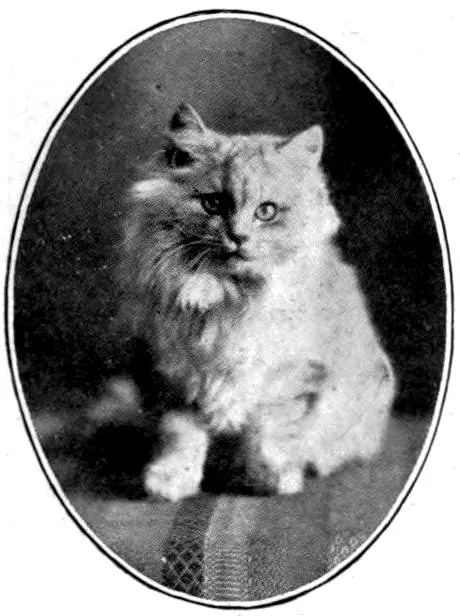
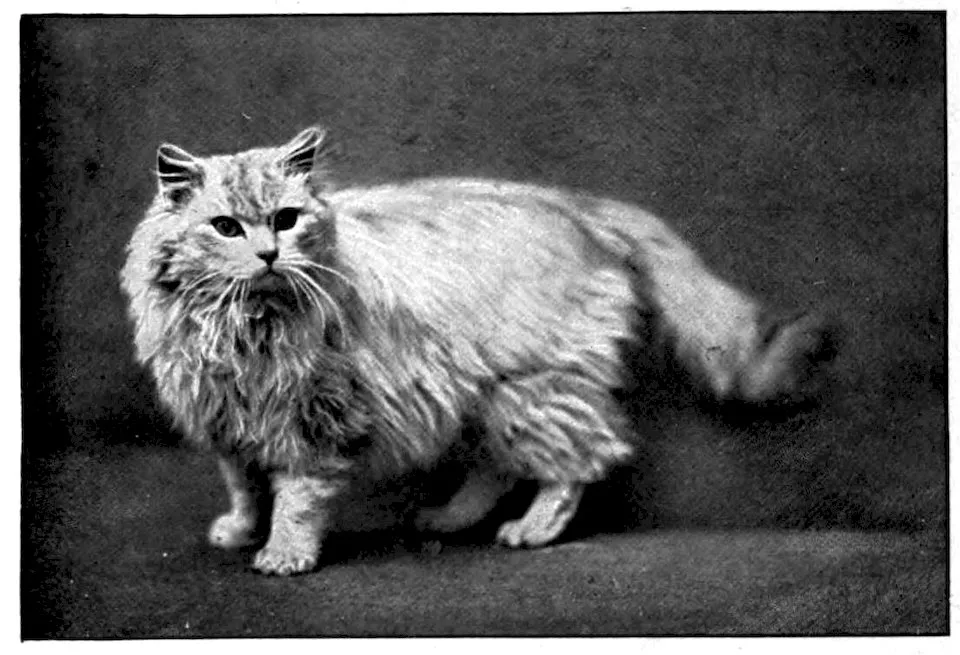
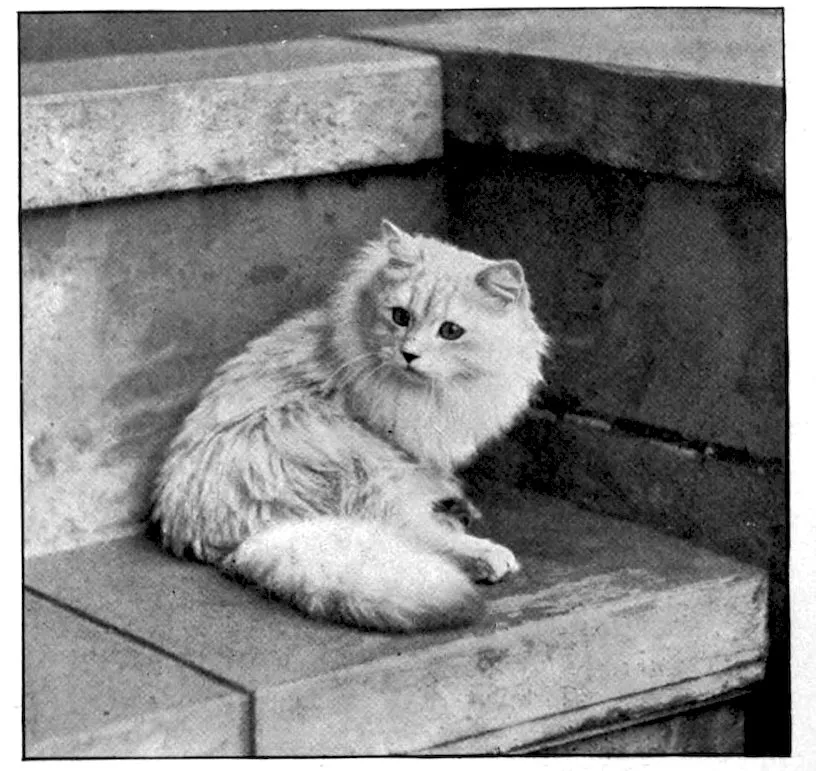
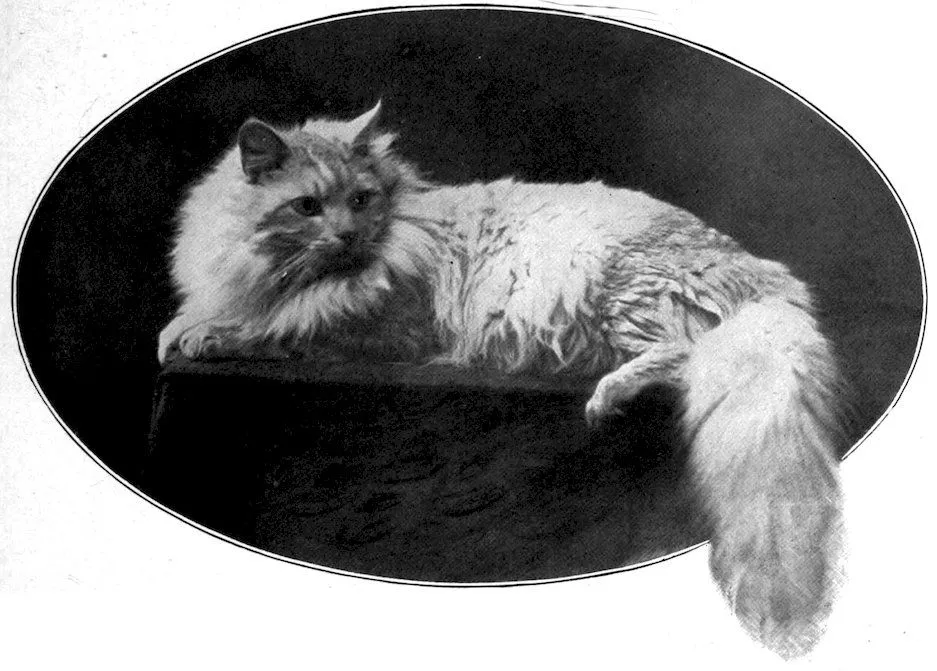
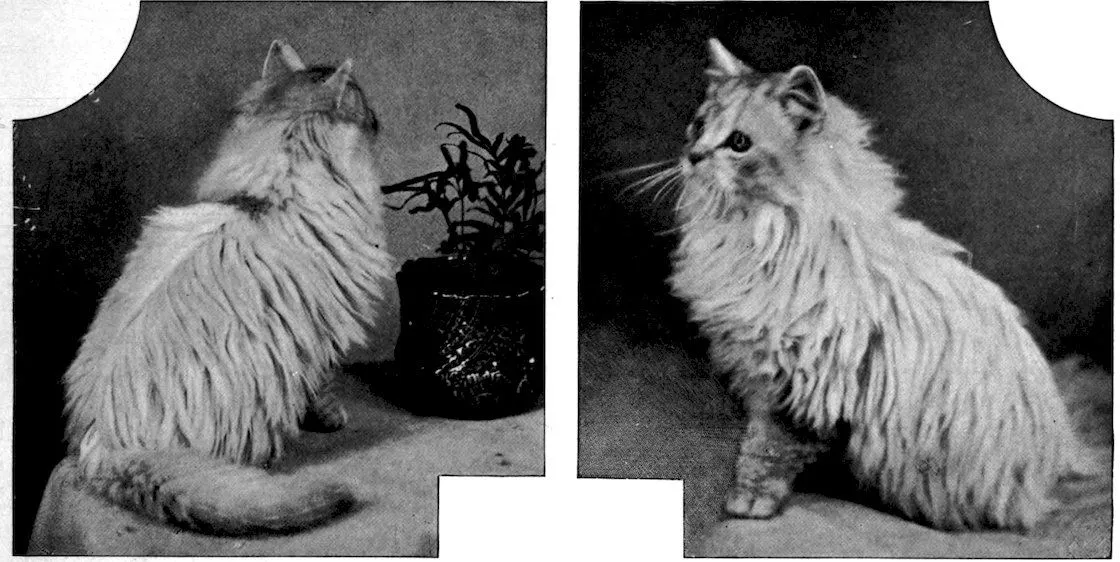
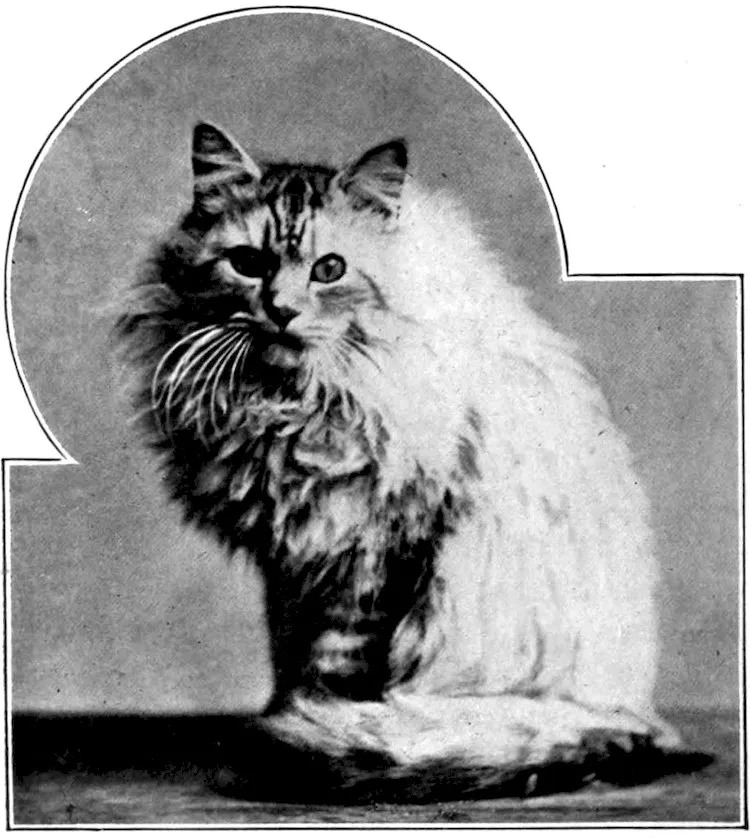
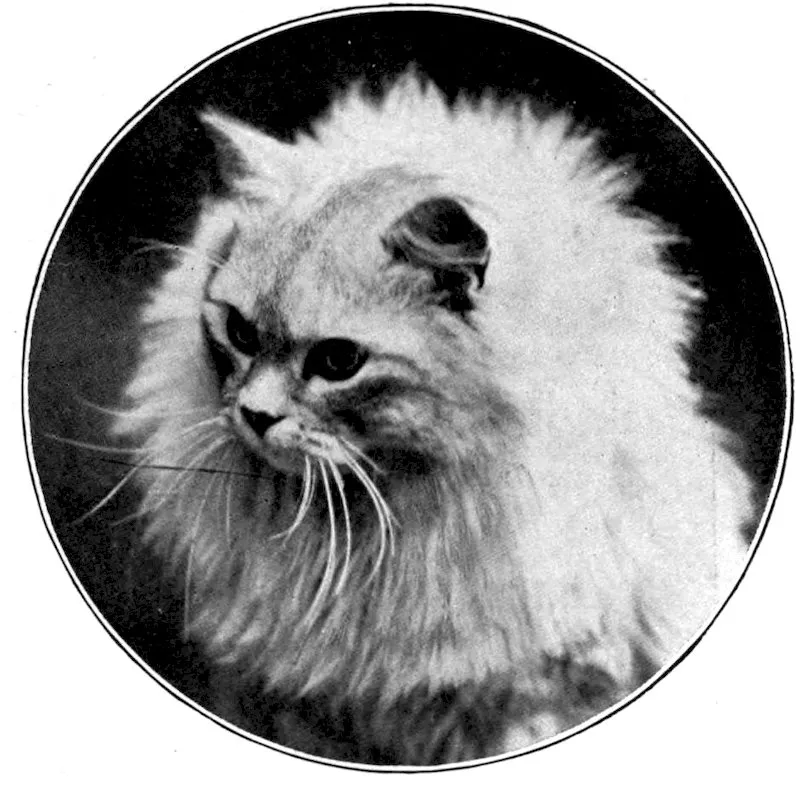
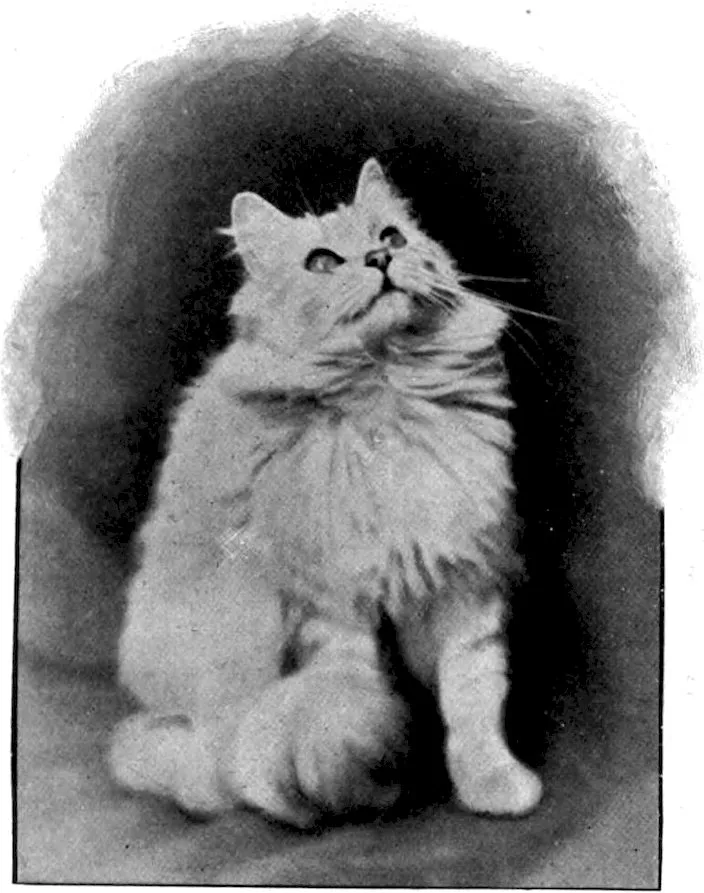
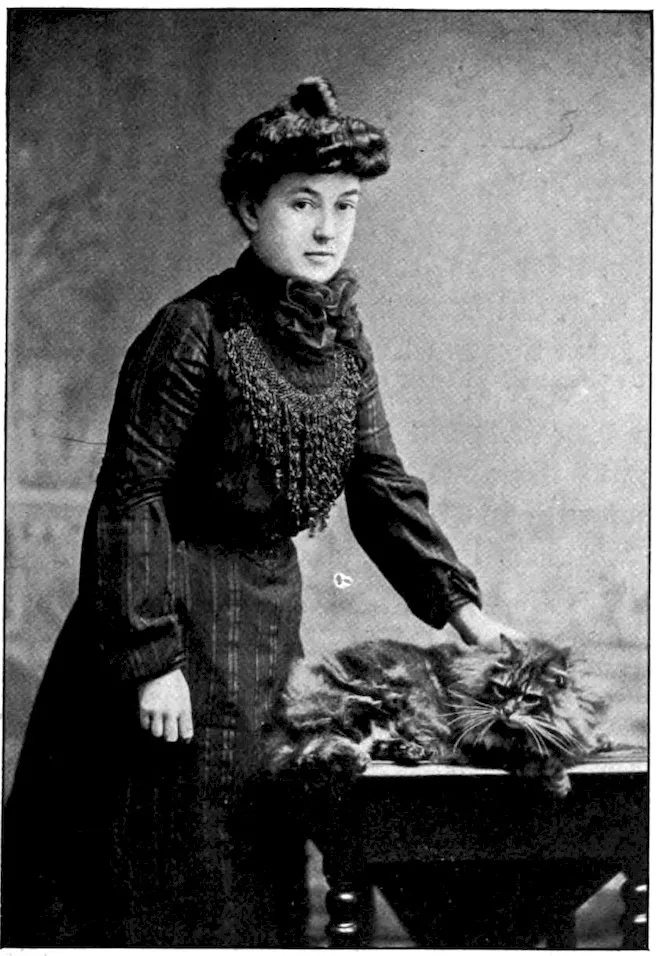
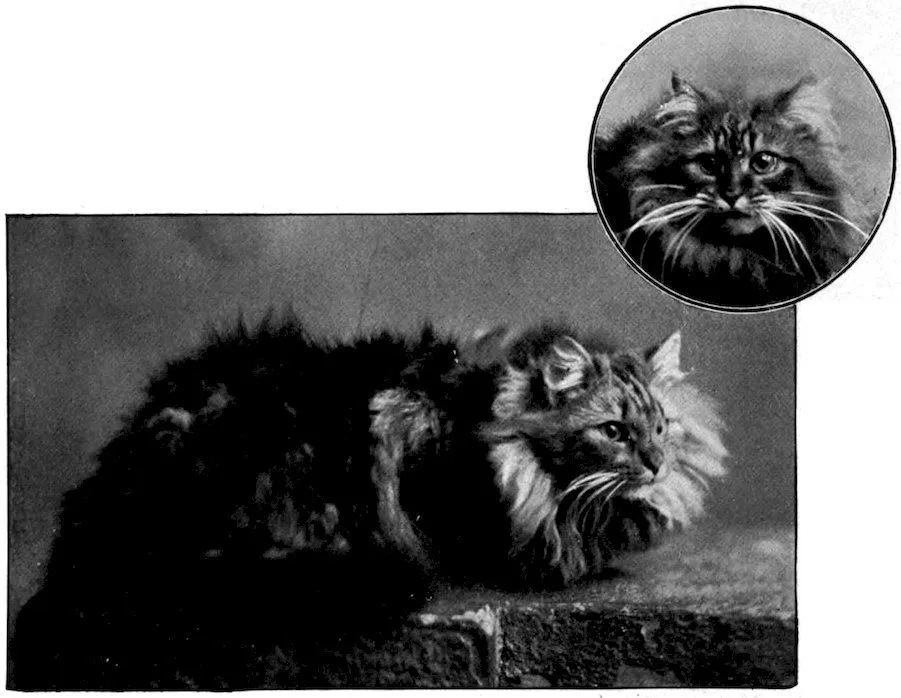
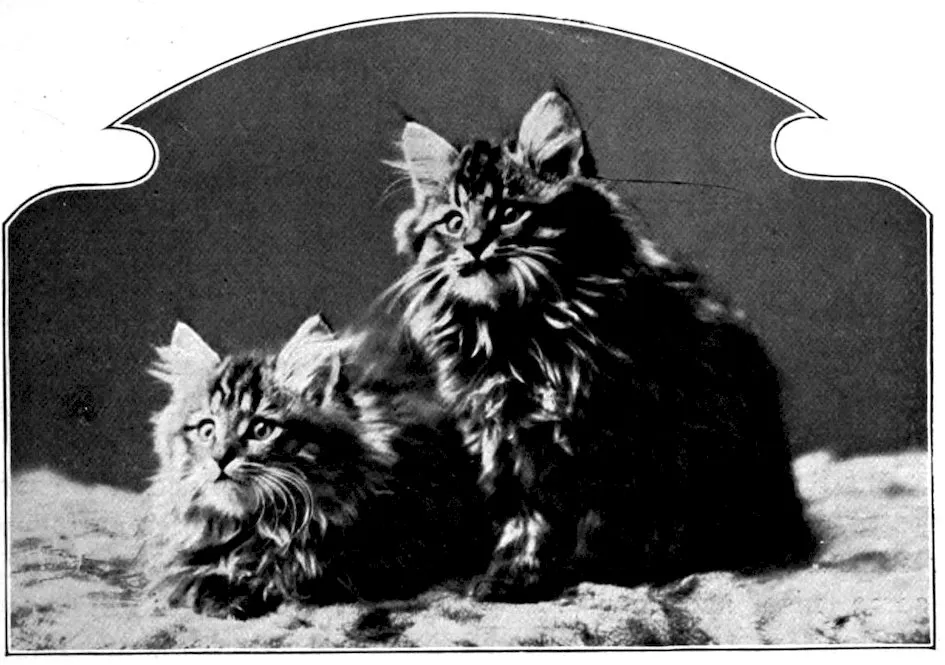
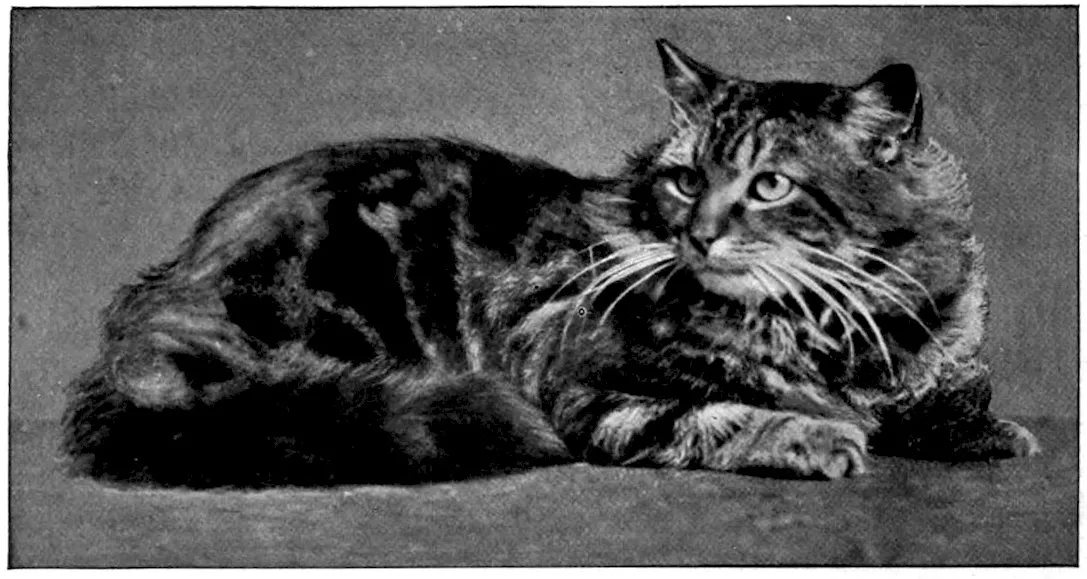
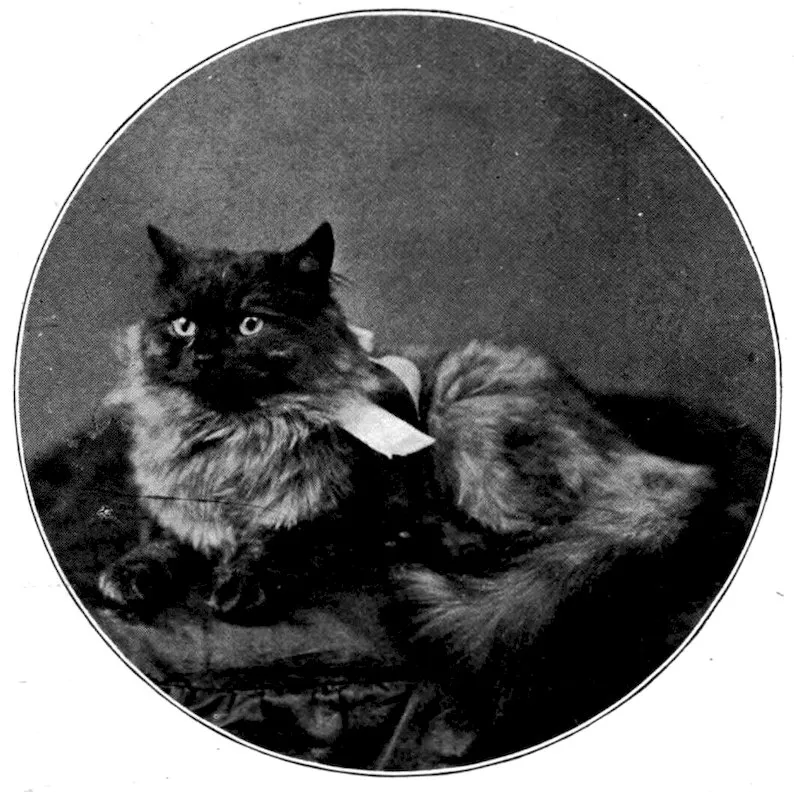
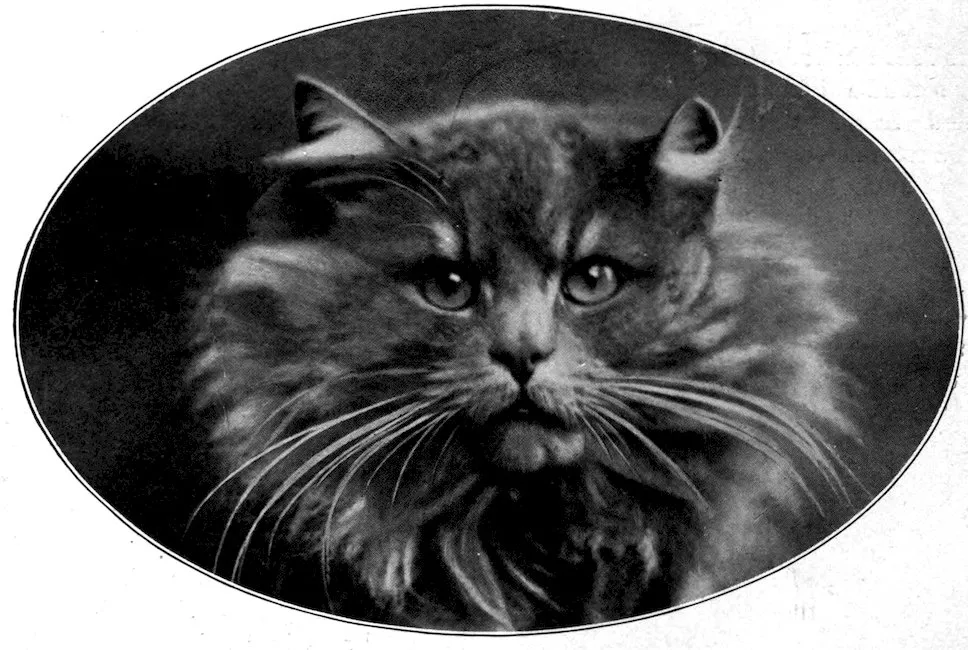
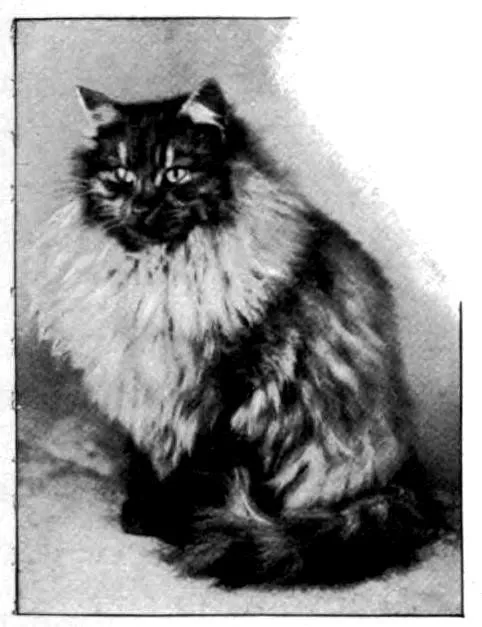
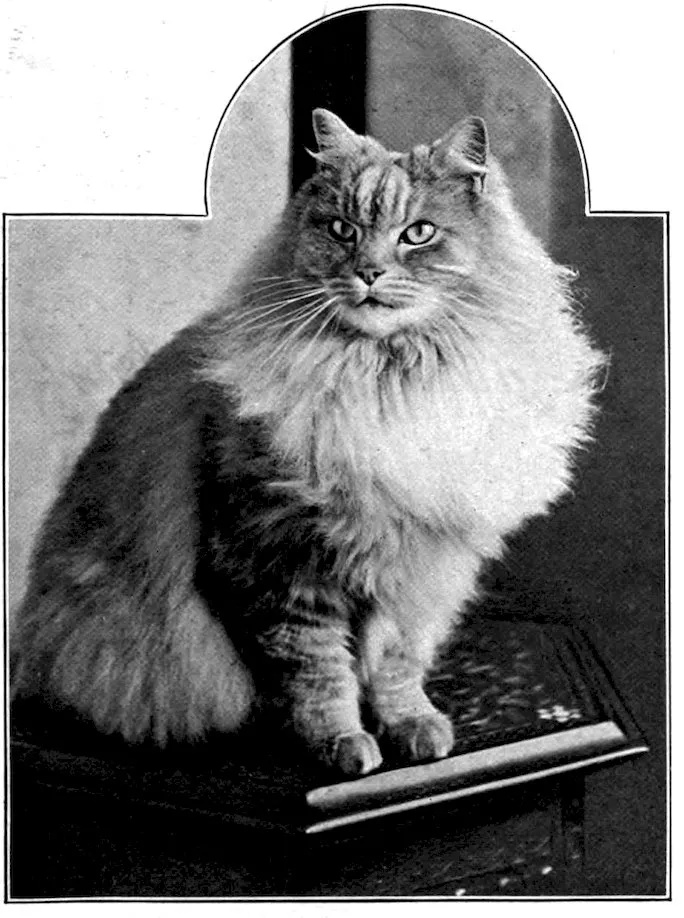
Colour breeding is a most fascinating
pursuit; but, unfortunately, the average
cat fancier lacks the patience to follow
it out to a satisfactory conclusion.
There is no doubt that by judicious cross-breeding
new colours could be produced, and
I think that they will be produced in time.
I have seen a chocolate-brown cat and a yellow
cat with black stripes, and no doubt they will
appear again; also chestnut-brown cats and
white cats striped with black may be bred.
The point which I wish to discuss on this
occasion is not so much the experimental cross
as the cross which is desirable to improve
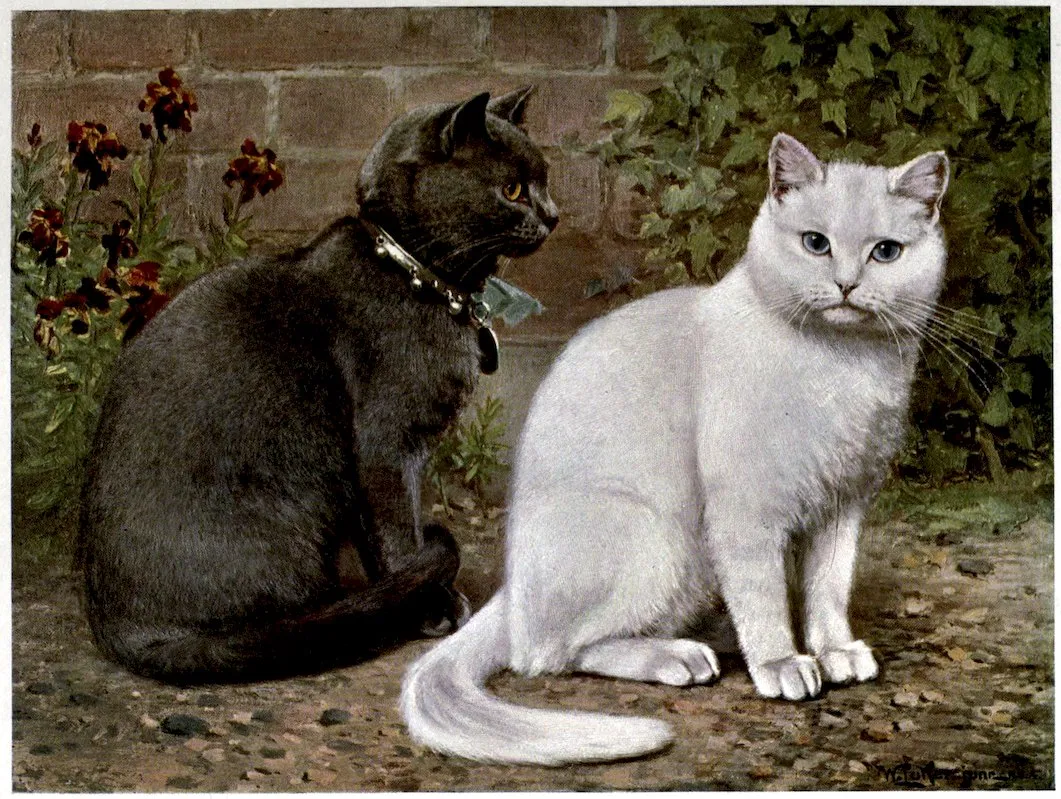
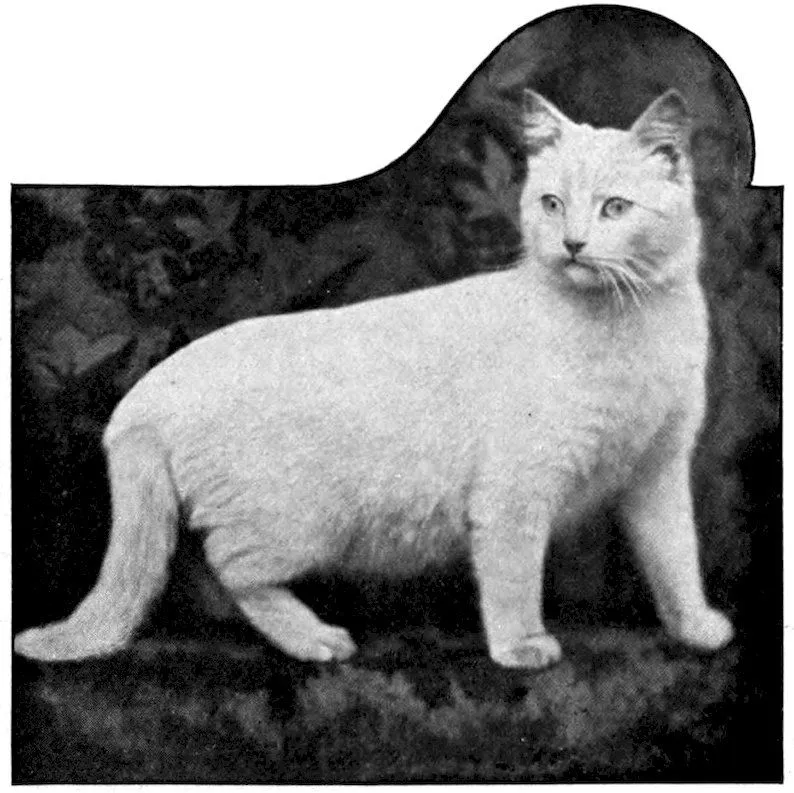
existing colours. I do not consider that a
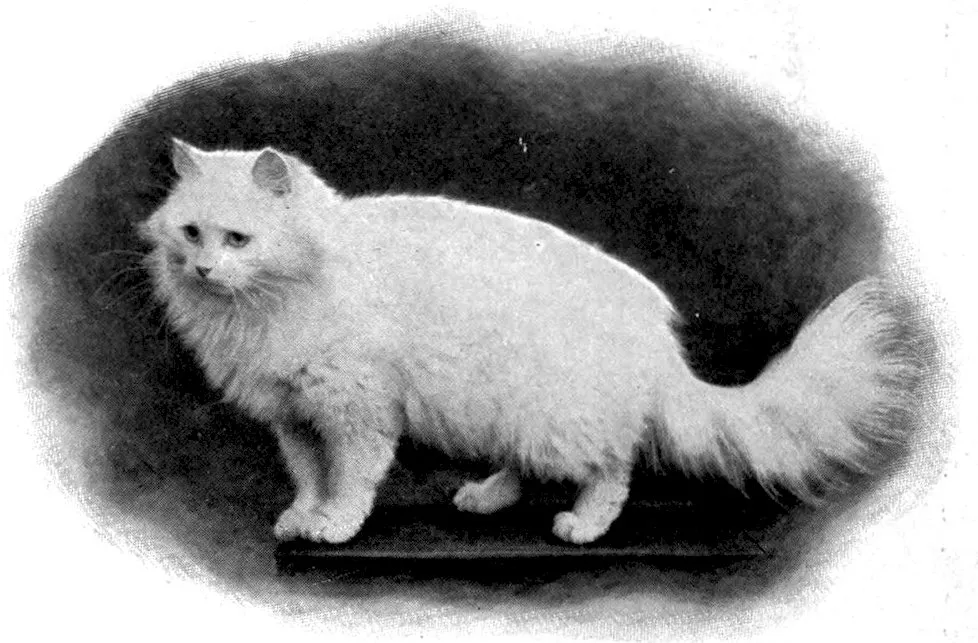
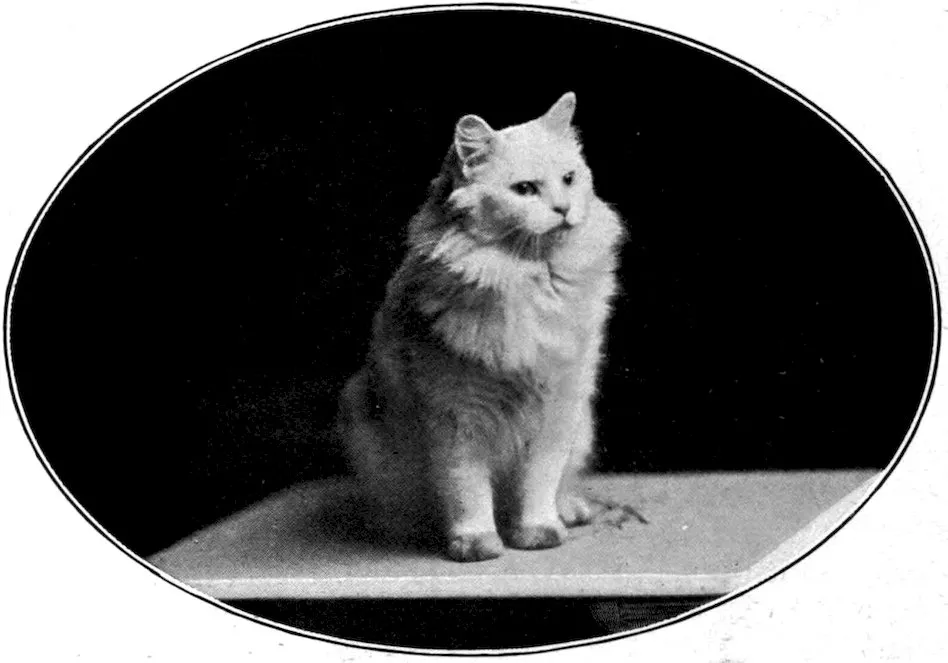
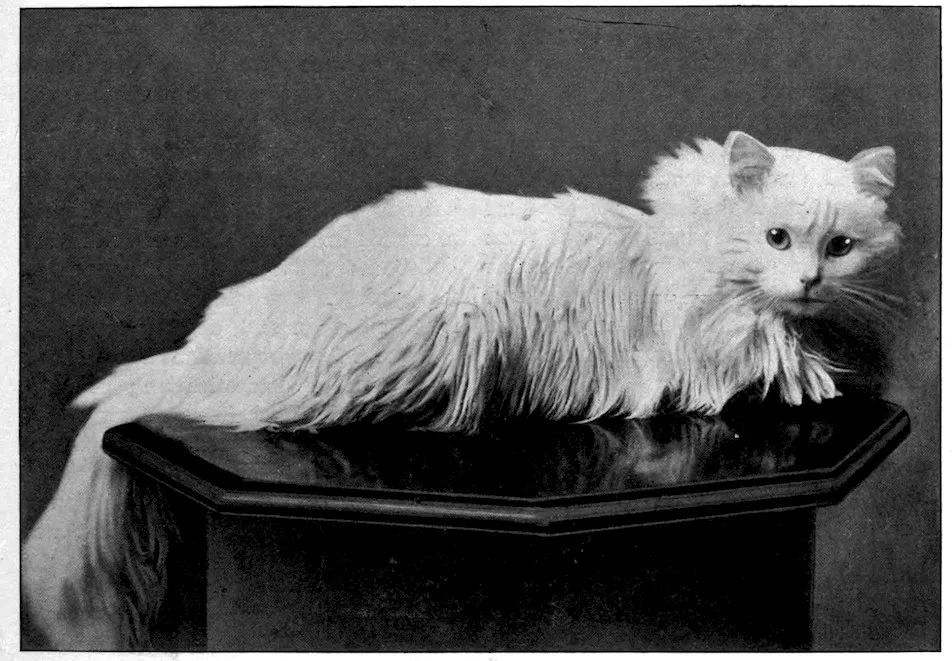
white cat should be crossed with any other
colour. There is no advantage to be gained
in this case by crossing, as we already have
white cats good in bone, substance, head,
shape, etc., and no other colour of cat possesses
blue eyes. I do not for a moment suggest
that good white cats have not been bred from
coloured parents, but this is unnecessary and
undesirable, because there is a risk of introducing
coloured patches and smudges and
yellow or green eyes, and there is no corresponding
advantage to be gained. In the same way
I do not consider that it is a good thing to
breed from white cats with yellow or odd eyes.
Blue-eyed kittens have been bred from two
yellow-eyed parents, and frequently when one
parent has yellow or odd eyes the kittens are
all blue-eyed, but this can in no way be
depended upon.
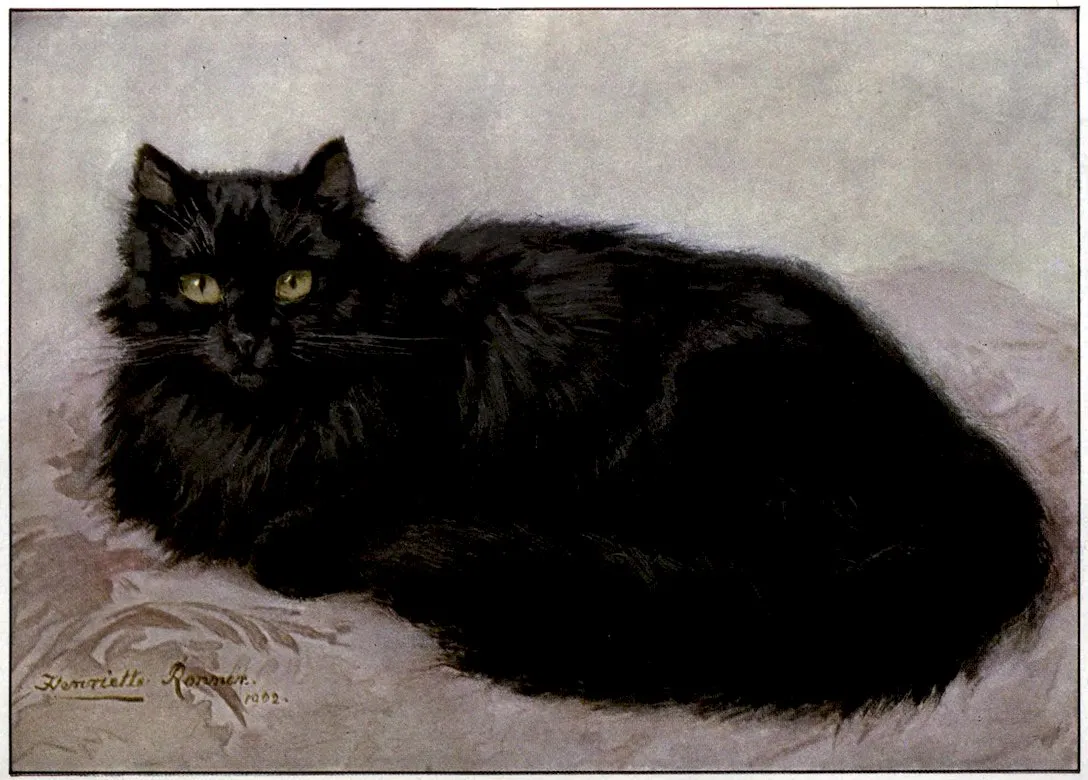
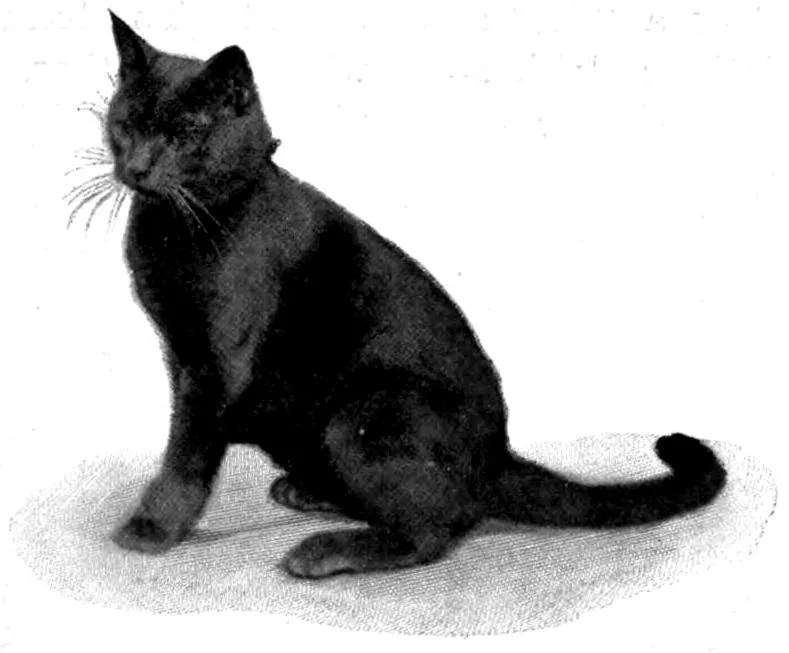
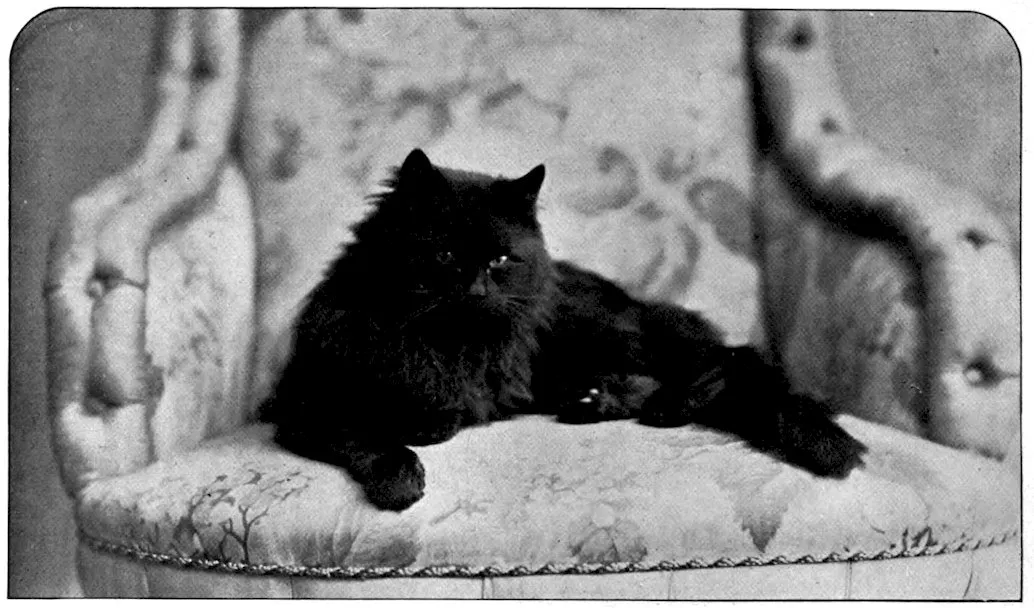
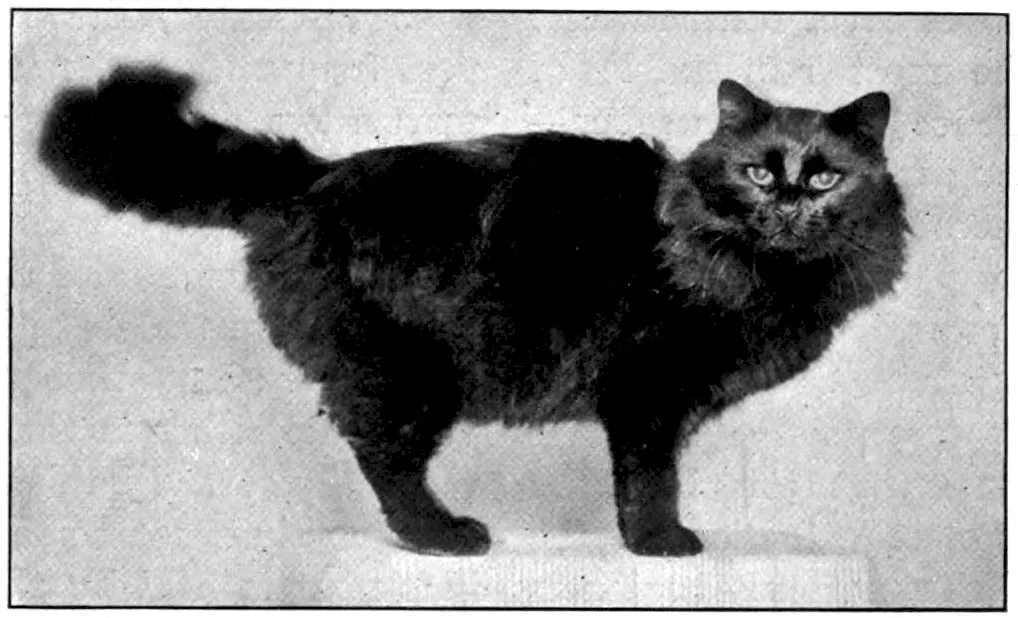
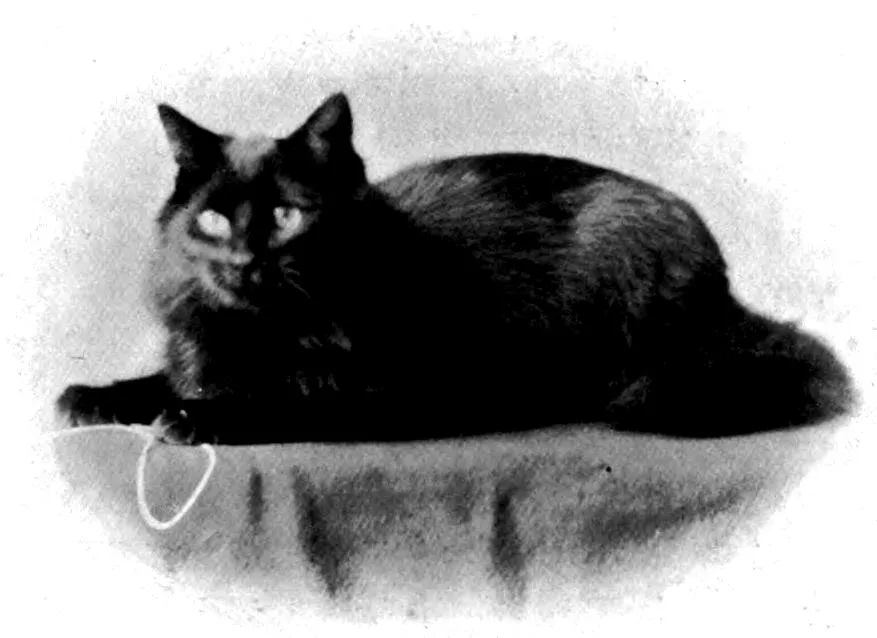
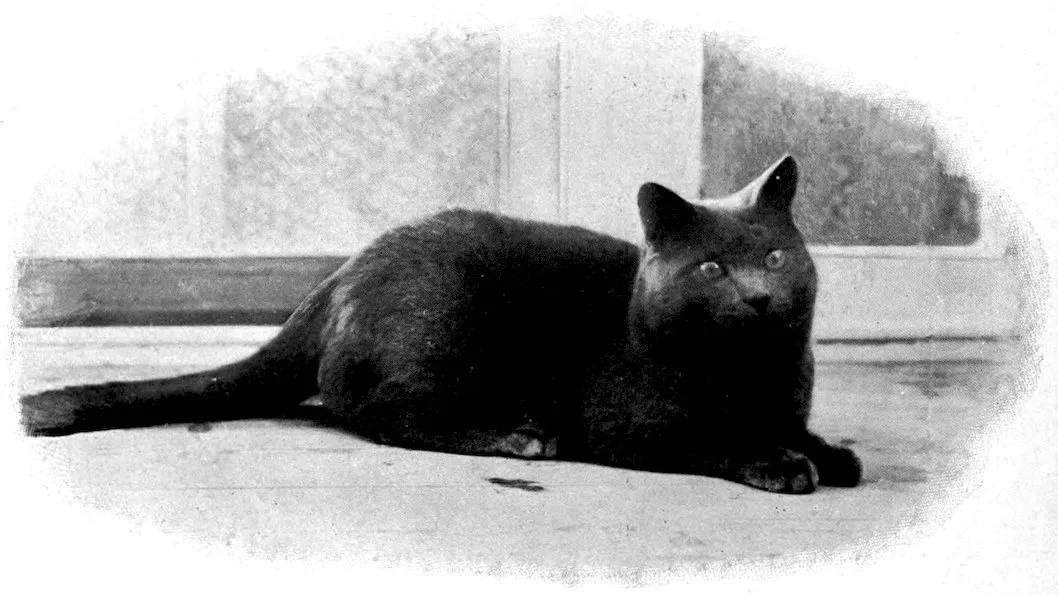
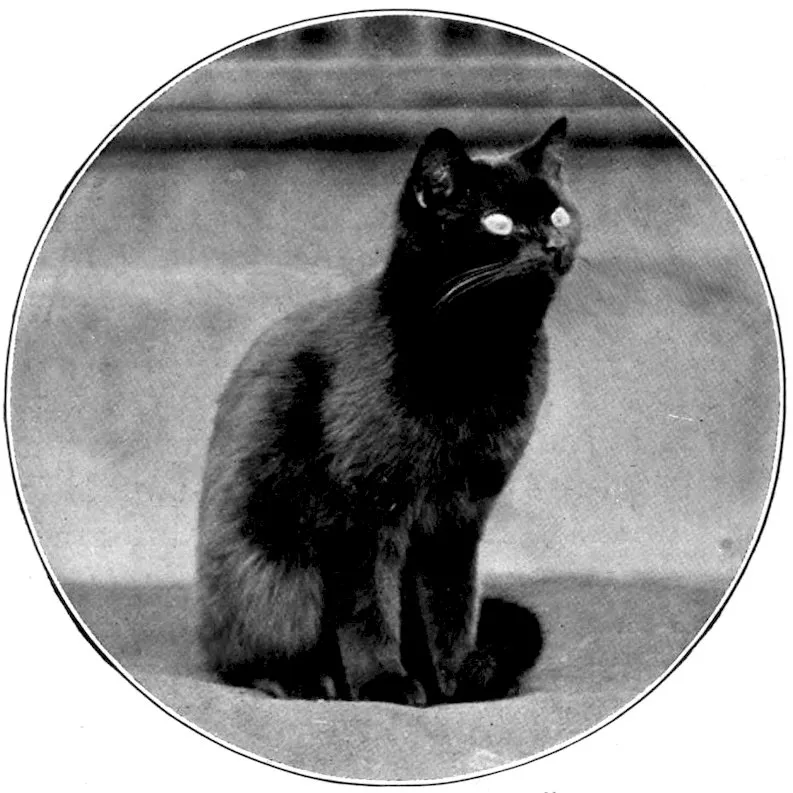
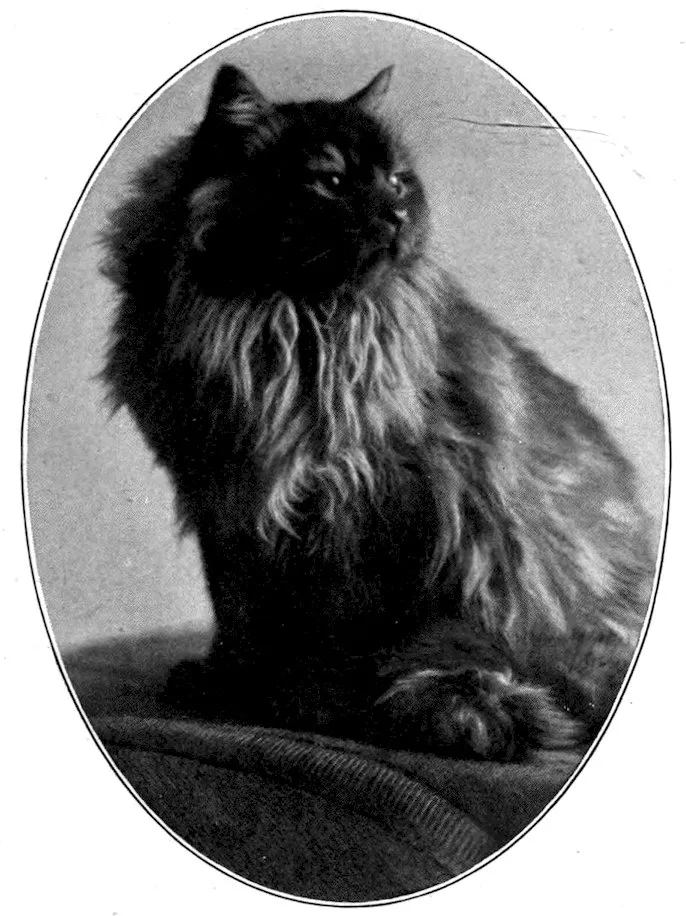
Black cats are a little more difficult to
handle than whites, because a white is necessarily
white, while there is sometimes a diversity
of opinion where a black is concerned.
The most important point to keep before us
in black-breeding is the colour of eyes.
Whatever we cross with we must be careful
that we do not lose the orange eyes, for they
345are most elusive, and we are, therefore, somewhat
limited in our selection of suitable crosses.
A smoky or dirty black is an abomination,
and for this reason I consider that from the
point of view of the black cat all crosses with
blues, smokes, or silvers should be avoided;
in any case a good silver would be impossible
because of its green eyes. A rusty black is
undesirable, but a rusty kitten usually makes
a better-coloured cat than a smoky one, though
there are notable exceptions to this rule. A
good orange-eyed tortoiseshell or red tabby, or
an orange, are all suitable mates for a black.
A curious thing I have noticed is that the best
blacks are bred from bright clear-coloured
cats, and that dull colours, such as smokes,
blues, and fawns, do not, as a rule, produce
good-coloured kittens. For this reason I
should prefer blacks bred from an orange-eyed
silver tabby to those bred from a dark brown
tabby. On the whole, a brightly coloured
tortoiseshell will be found to throw the best
blacks.
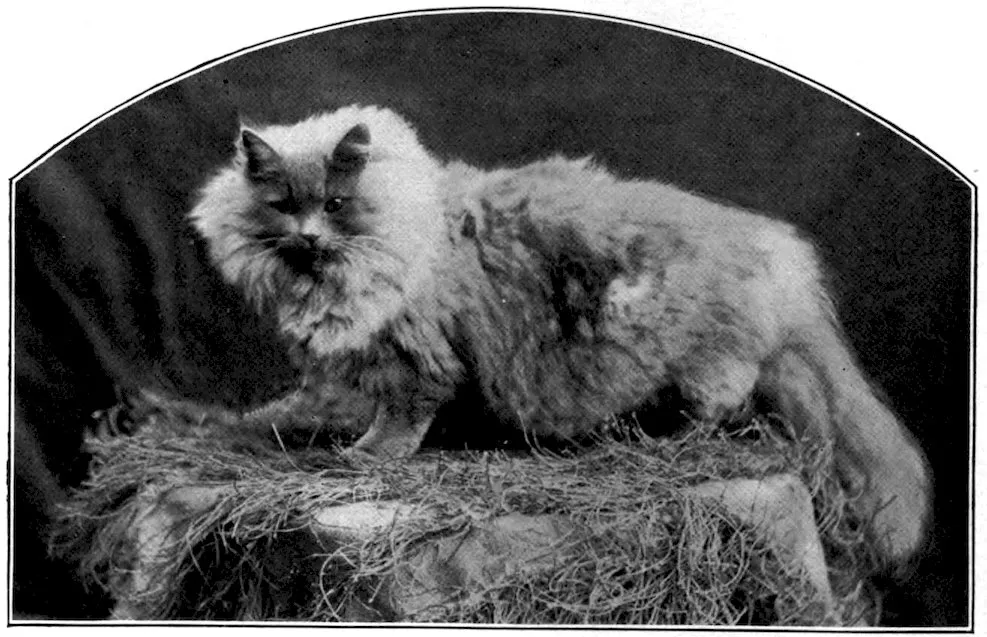
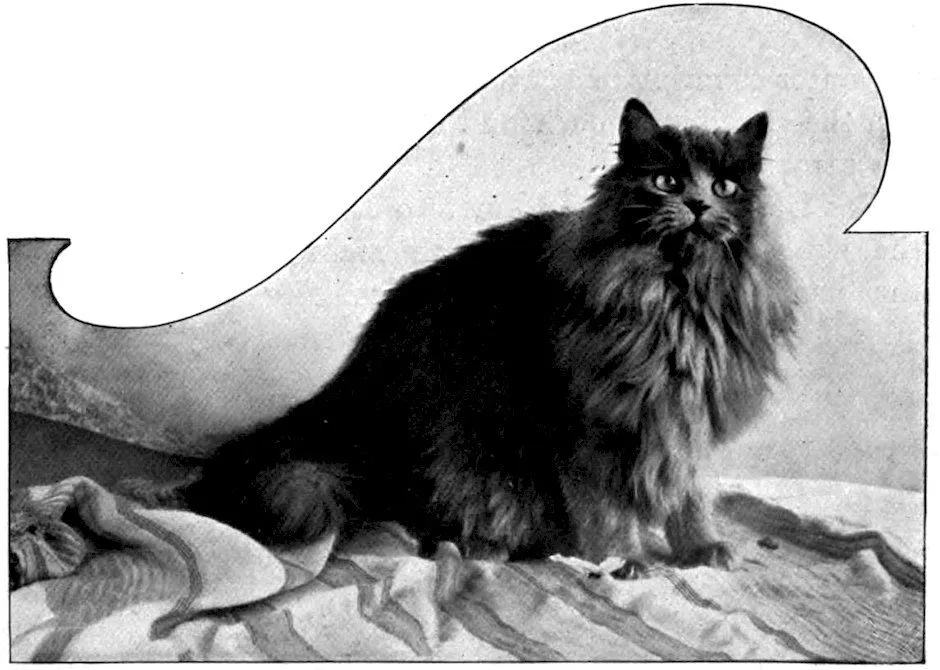
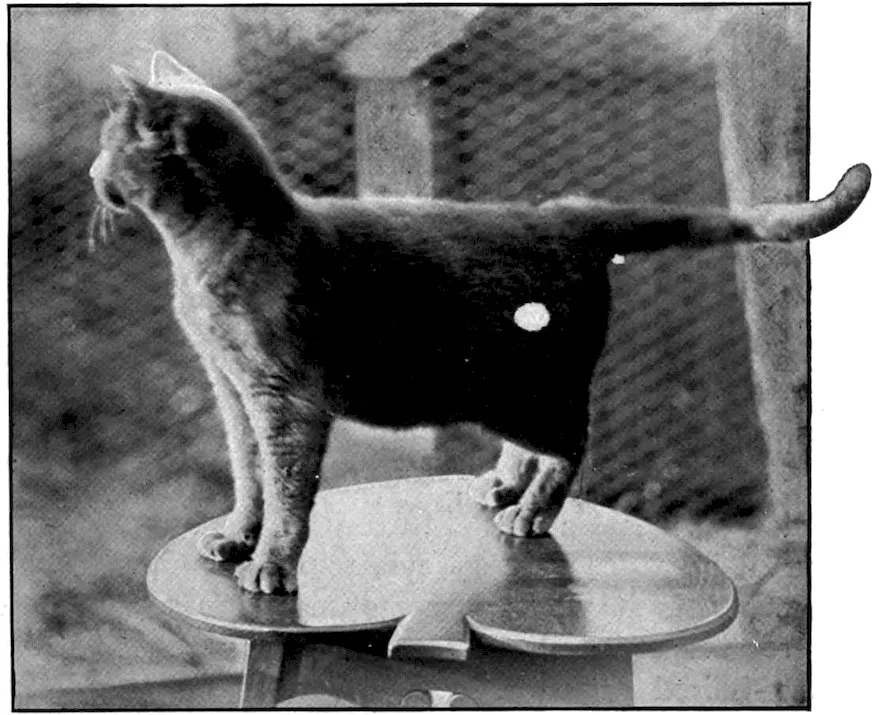
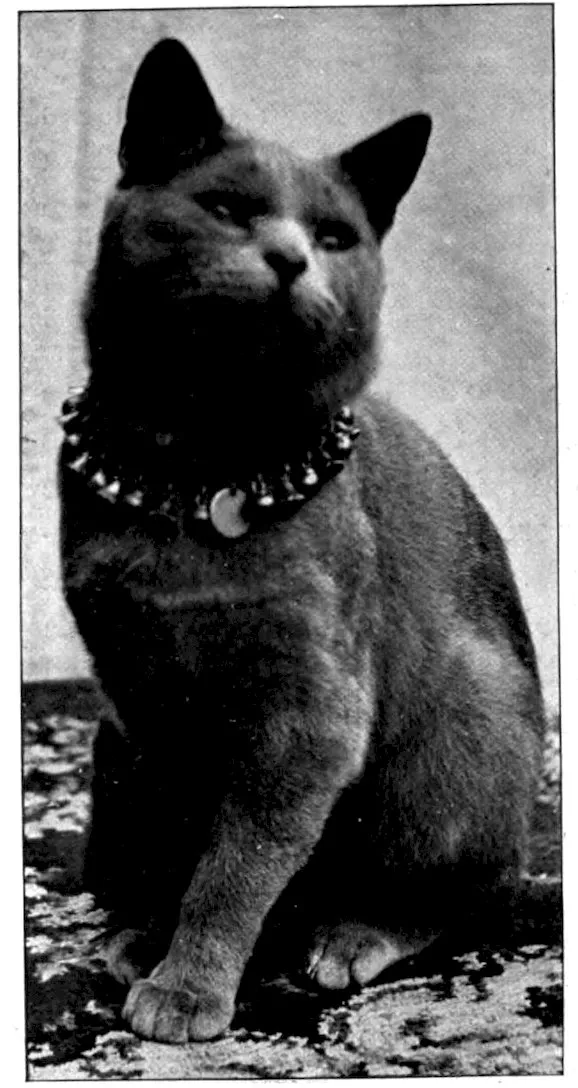
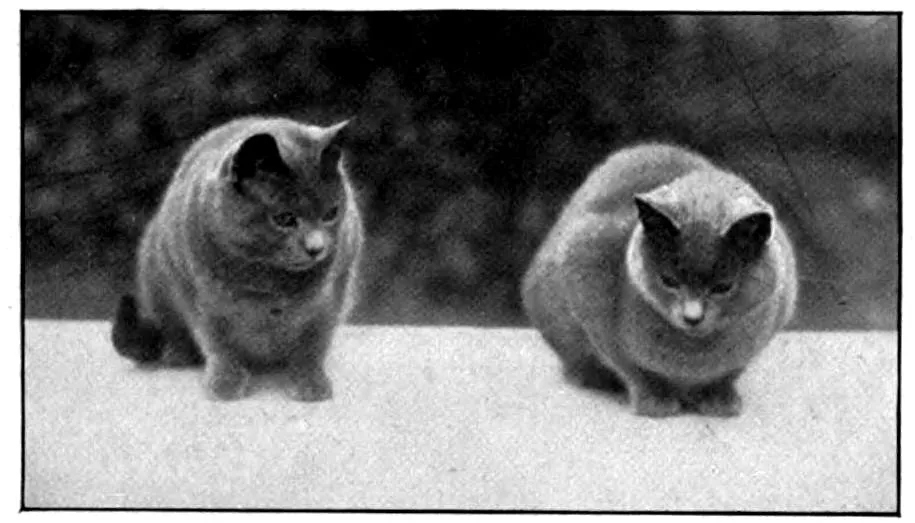
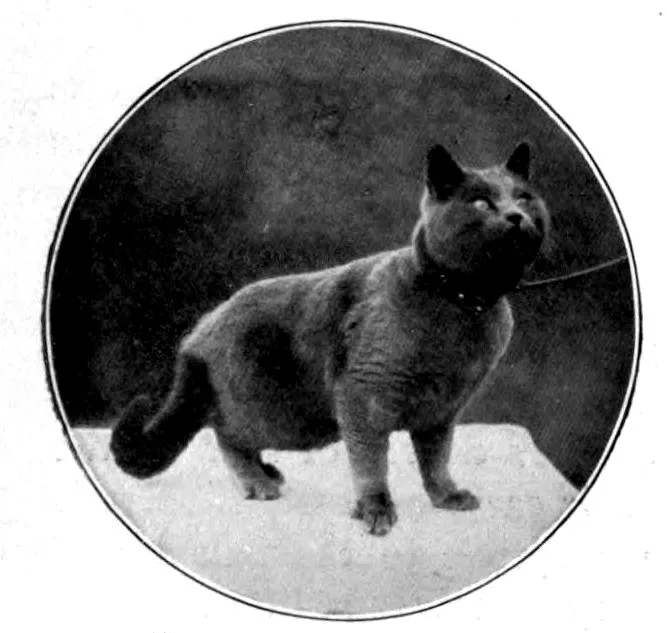
Of the crossing of blues with any other
colour I do not approve, because we have
many different blue strains, among which can
be found all the different points which are
desired. Comparisons are odious, but if I
refer to the Bath show of 1903 I can explain
what I mean. “Skellingthorpe Patrick” is
a beautiful cat in all points except eyes,
but “Don Carlos” and several other blue
males in the class had glorious orange eyes.
I have often heard that crossing a blue with
a white will produce very pale blue kittens;
I have not found this to be so, and
it seems unlikely, for mate a black cat with
a white one as often as you like, and you may
wait a lifetime before they breed a blue kitten;
therefore why should a dark blue and a white
produce a pale blue kitten? Sometimes crossing
with a black is recommended “to get the
orange eyes,” but it must be remarked that
the proportion of black cats with good orange
eyes is quite as low as that of blues. When
this cross is resorted to, let the black parent
be the male, as otherwise the kittens may very
likely all be black.
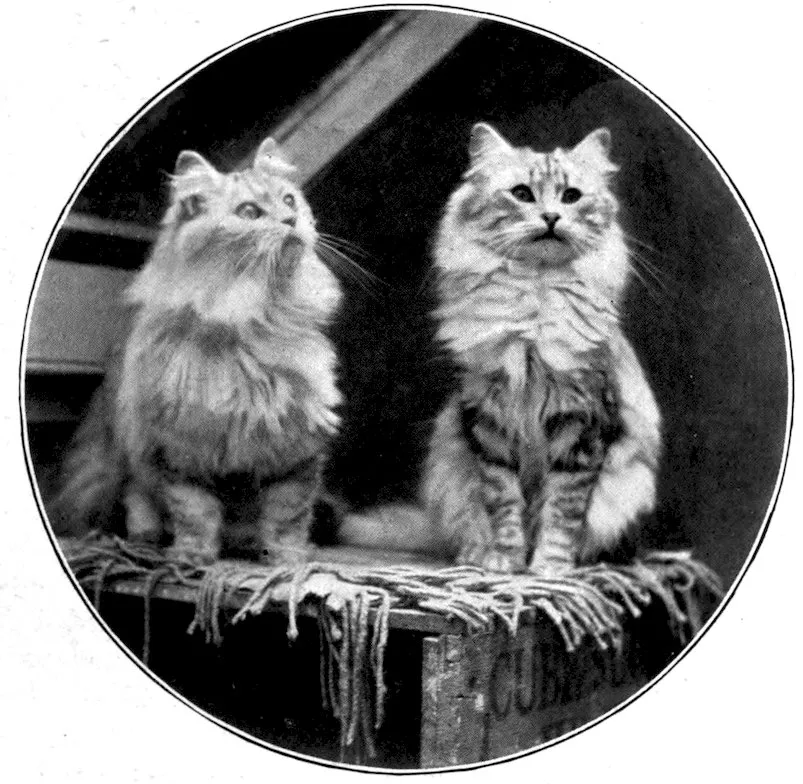
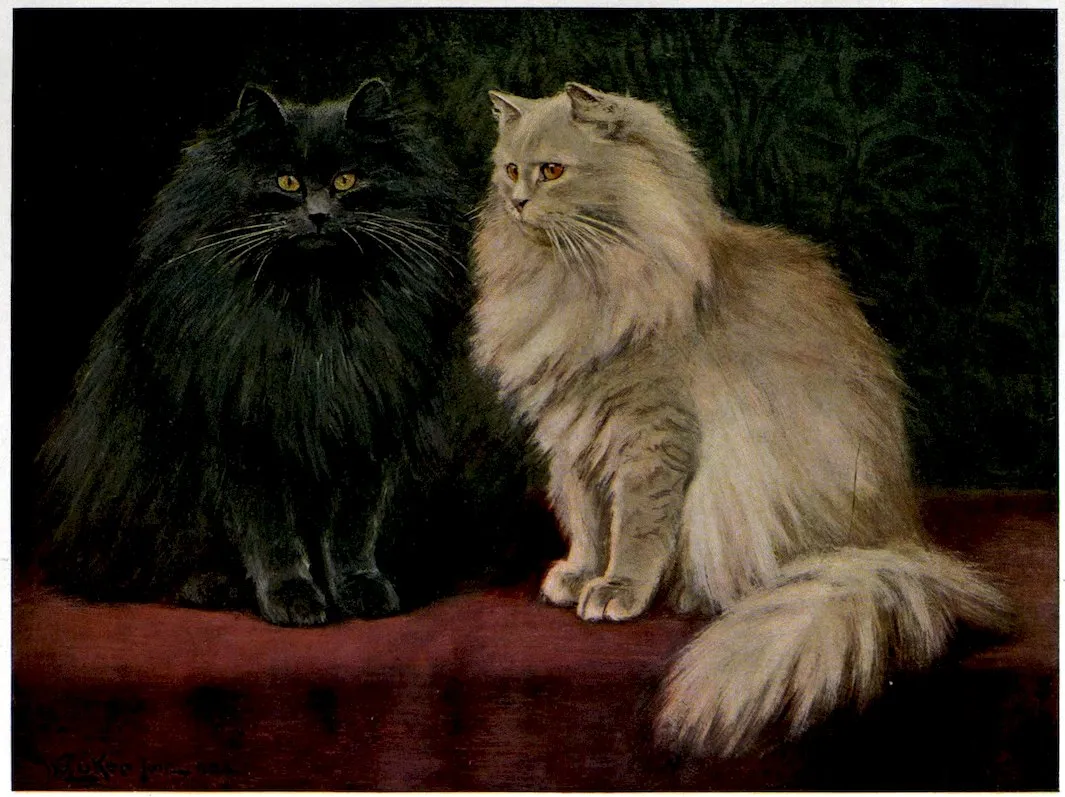
We now get to the subject of chinchilla
breeding; it is a matter of common knowledge
that chinchillas were produced as the
result of careful in-breeding, and, therefore,
until the breed is more firmly established, any
sudden out-cross is likely to cause a reversion
to the barred ancestors. The idea, then, is to
cross with whatever is least likely to introduce
stripes—i.e. a self-coloured cat, or preferably a
shaded one. Of course, any tinge of red or
brown is to be avoided, and, therefore, the only
shaded cat left to us is the smoke, and a green-eyed
smoke is certainly the safest cross we can
get, as it is sufficiently akin to the chinchilla
to obviate the risk of a violent out-cross. The
black is, I think, the next best cross, for it is
just possible that the colours may not interfere
with one another, and that we shall get
pure black and clear silver kittens—of course,
a green-eyed black must be used. Third on
the list comes the
white; but this
cross makes for absence
of markings,
and therefore demands
great caution,
as thereby the black
noses and eyelids
which add so much
to the charm of a
chinchilla may be
lost and the result be
merely a dingy, dirty
white cat. This animal,
though not particularly
attractive
in itself, is, I need hardly say, invaluable
for crossing again either with a clear-coloured
chinchilla, a black, or even a blue.
A blue cross is, as a rule, rather objectionable,
because it seems to produce a muddy,
dull colour, but there is no doubt that it
may occasionally be resorted to with success.
I should suggest that the blue parent (a green-eyed
one, of course) should be the sire, as
when the reverse is the case the kittens are
frequently blue tabby.
I do not think any colours besides those I
have mentioned should be crossed with chinchillas,
though I must confess that chinchilla
kittens occasionally turn up most unexpectedly.
I recollect a very pale one appearing in a litter
whose sire was a cream of brown tabby and
cream parentage, and whose dam was a pale
blue bred from a blue and a blue tabby. There
347may have been silver tabby blood in the
strain, but certainly no chinchilla. For all
this I do not recommend a cream or tortoiseshell
cross, as the chances are all against the
kittens being any good, and it is laying up a
store of disappointments in the next generation.
We have all possessed cats which,
though beautiful in themselves, never threw
a kitten worth keeping.
I had a little cat myself
bred from two chinchilla
parents. The
dam was a well-known
winner, and her ancestry
was, I knew, irreproachable,
and the
sire’s appeared to be
equally so, though I
was told afterwards
that he often sired
brown tabby kittens.
But my queen (herself
a prize-winner), no
matter how she was
mated, invariably
threw brown tabby
kittens.
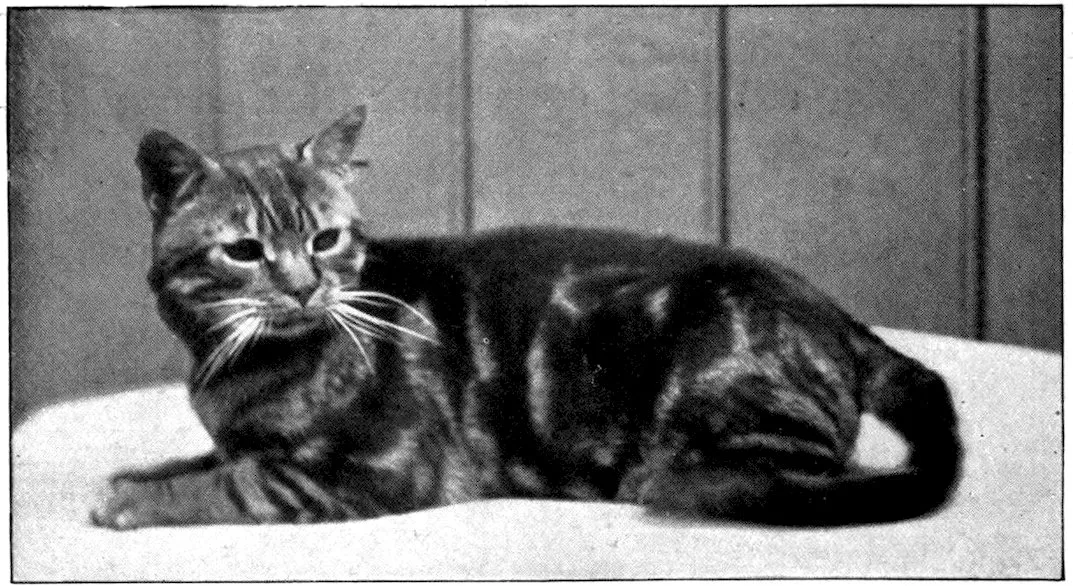
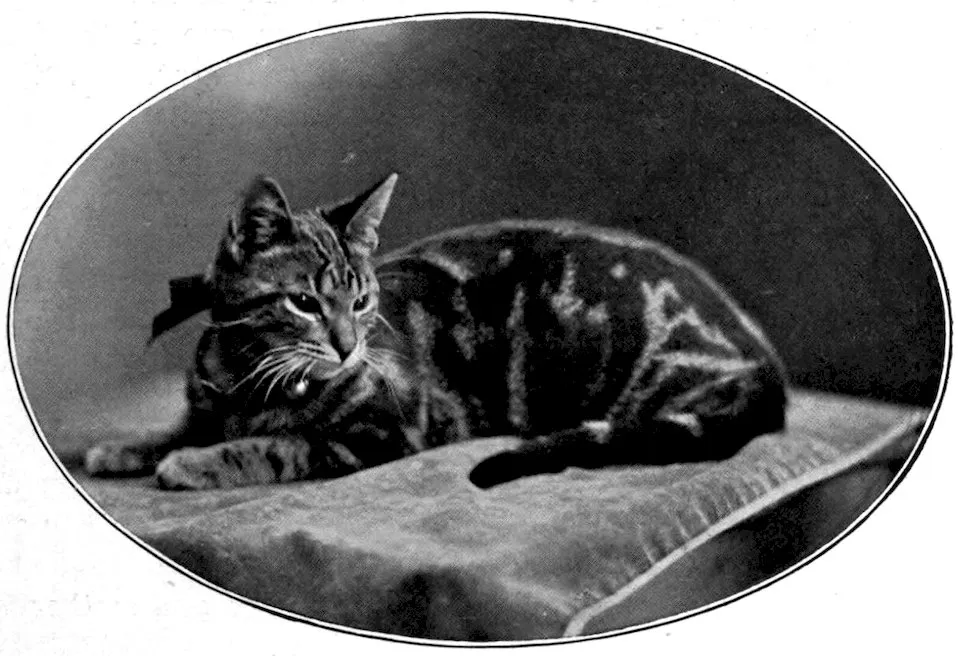
We now come to the
very fascinating subject
of tabbies, and I may
as well say at once that
any amount of crossing
is for the present desirable
and even necessary,
but it must be
done systematically and under a careful and
experienced eye. The novice is likely to fail
because he does not understand the essential
points of a tabby. Let him keep before his
mind the fact that if two distinct black stripes
run the whole length of the spine and if the
chest markings are good there is not likely to
be much wrong with his cat’s other markings.
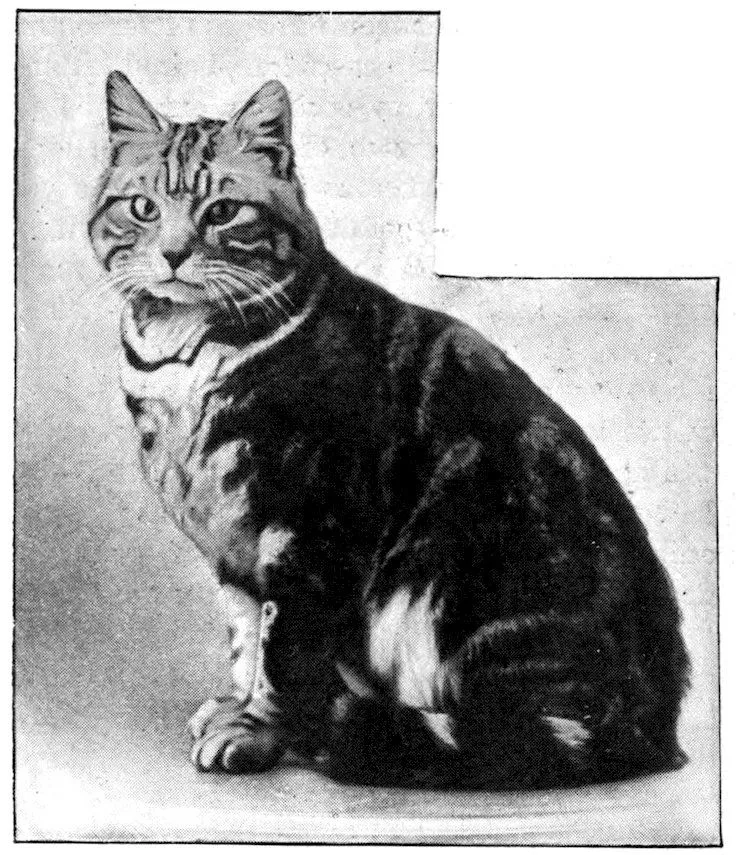
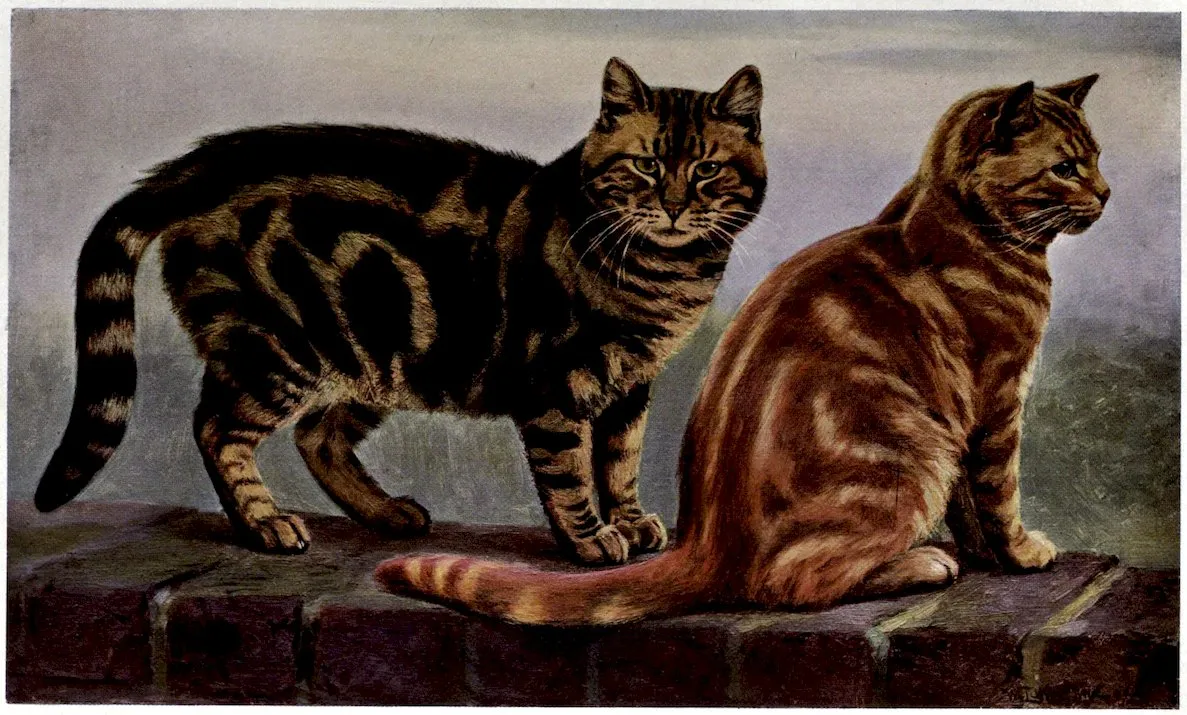
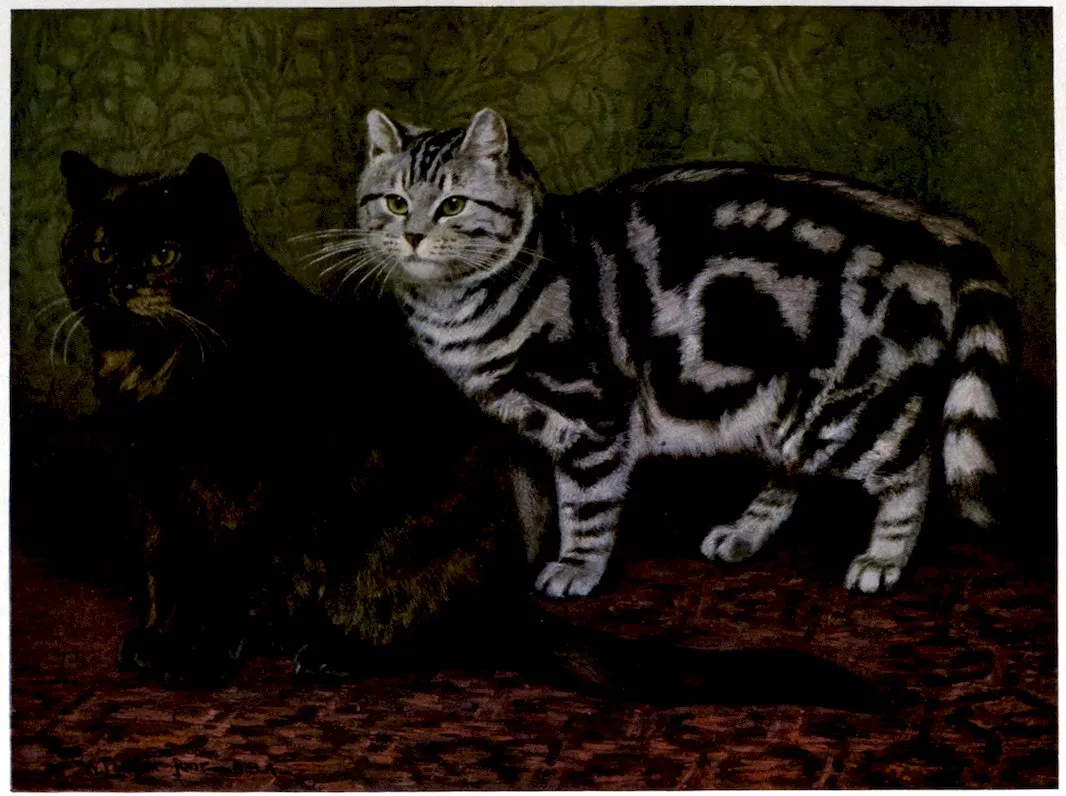
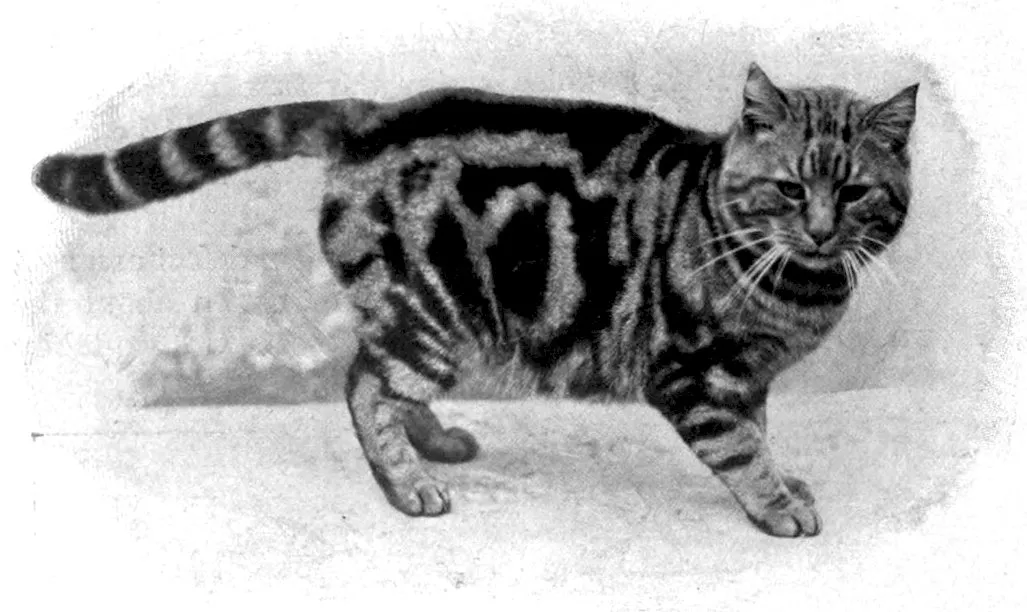
In the brown tabby, the markings have
become too heavy, they have run together and
spread into a heavy black saddle; while the
ground colour has lost warmth and white chins
are prevalent. With the “sable” cat, be it
understood, I have no fault to find; I can
forgive him even his white chin, because he is
such a magnificent animal; but he is not a
tabby, and should not be shown as such.
In the brown tabby we want dense black
markings on a clear golden-brown ground.
The black is there right enough, but it wants
“breaking up.” A cross of strongly marked
red tabby is the thing;
not a “self-orange,”
mind you—that would
only make things
worse—but the best-coloured
red, with a
dark chin, that can be
found. When the
markings want intensifying,
as may be the
case after the red cross,
we must mate with a
black; but I do not
think this will be necessary,
as brown tabbies
rarely “wash out” as
silvers do. It is curious
to note that many
years ago I bred quantities
of beautifully
marked silver tabbies
and brown tabbies from
a brown tabby sire and
a sandy, silver tabby
dam, both of unknown
pedigree. The silvers
were clear and pure in
colour, with capital black markings, and the
browns had good rich colouring. This is a
cross I should certainly hesitate to recommend,
but there are possibilities concealed
therein, and it is worth an occasional experiment
with the sole object of rescuing the
degenerate tabby markings.
It is a curious fact that while the tabby is
supposed to be the common ancestor of all
our cats, the tabby markings should be the
most difficult point to retain in the pedigree
cat.
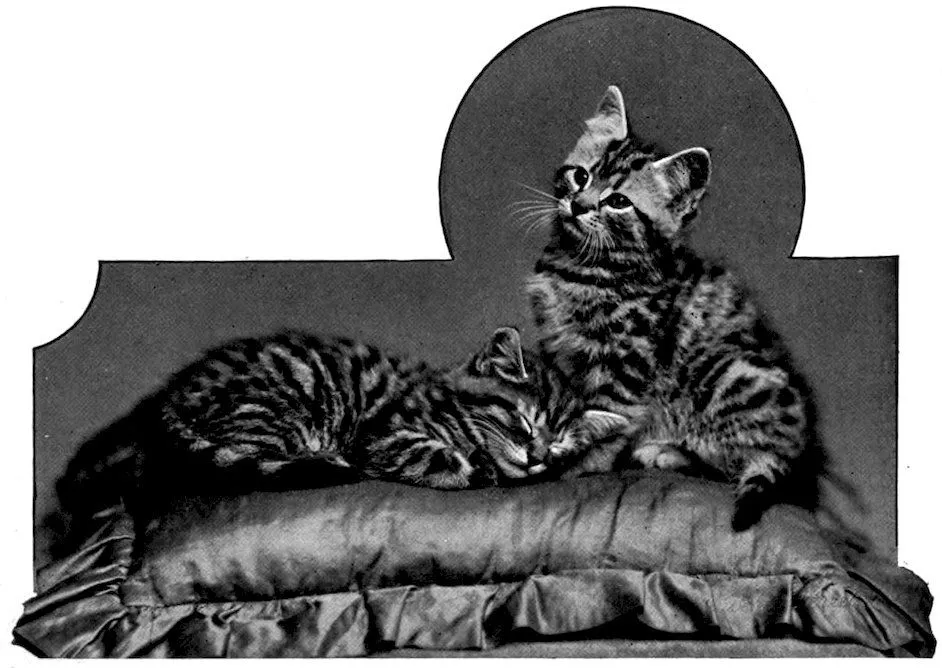
It is, I know, the general opinion that the
craze for chinchillas has ruined the silver tabby,
but I do not feel convinced that this is so. I
am of the opinion that the constant breeding
of silver tabby to silver tabby will eventually
result in the production of poorly marked cats.
Let me give an example: “Felix Mottisford”
was a very heavily barred son of “Champion
Felix,” and “Patz” was also heavily barred
and bred from silver tabbies. Two of their
kittens were “Silver Midget” and “My
Fairy.” “Midget” was a prettily marked
silver tabby, but much lighter than her
parents, and showed a strong tendency to
throw unmarked kittens. “Fairy” was certainly
a silver tabby, but her markings were
entirely on the surface, and as she grew older
faded away until she was more shaded than
barred. Mated with a blue, she produced four
chinchilla kittens; mated with “Lord Southampton,”
there were two well-marked silver
tabbies and two chinchillas (this litter included
“Dimity” and “Abbess of Broomholme”);
mated with “Silver Lambkin,” there was one
chinchilla kitten—“Fitz Eustace”—and the
rest were silver tabbies; by “Tuan,” a much
more marked cat, the kittens were all chinchillas
(“Tuan,” I may mention, was a distant
cousin of “Fairy”); by “Silver Lustre”
there were two chinchillas and two silver
tabbies. I then parted with her, and she
afterwards had, by “Silver Chieftain,” a litter
of silver tabbies and chinchillas, including
“Silver Tangle” and “Silver Sprite.” After
that date I have no record of her doings, but
it can be seen that she certainly showed an
inclination on her own account towards chinchilla
kittens, and this, I take it, was the result
of the continued mating together of silver
tabby cats. I do not consider any other cross
than black is admissible in a silver tabby strain,
but the introduction of black blood is necessary
from time to time if markings are to be
retained. I go so far as to say that a cross of
green-eyed black in every third generation
would be a wise precaution.
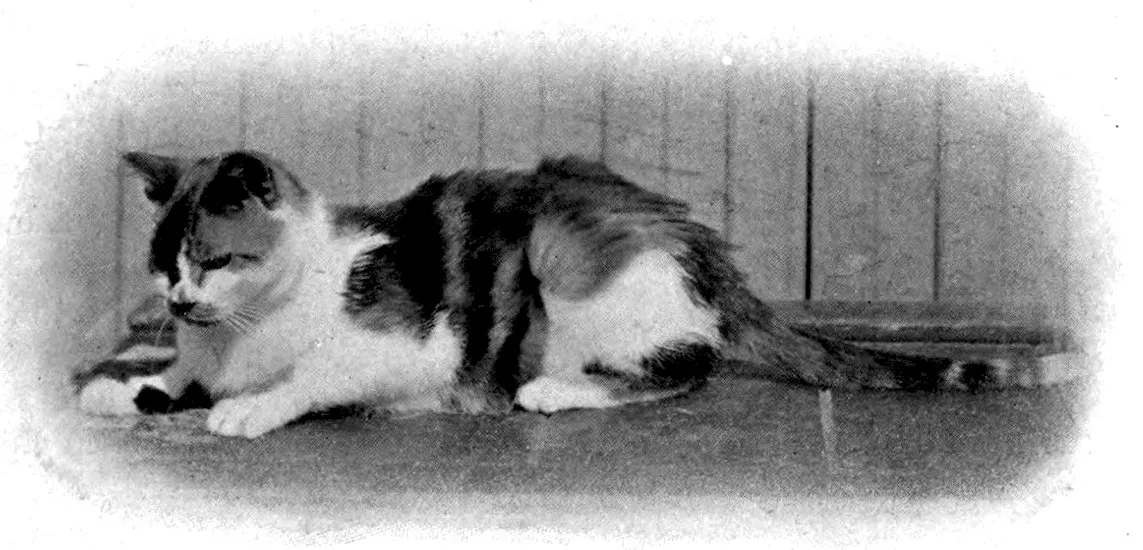
The red tabby, the orange, and the tortoiseshell
are rather hopelessly mixed up at present.
The self-orange (so-called) did not exist a few
years ago, but of late a premium has been put
on absence of marking, and a lot of cats with
self-coloured or shaded bodies and striped faces
appear in the orange classes and win all the
prizes. I have no fault to find with the shade
of colour of these cats; they are a beautiful
bright clear orange, but if they are to be self-coloured
the face markings
must go. Crossing with blue
gets over this difficulty, but
we immediately lose brightness
of colour and get dull
yellows and fawns. Tortoiseshell
is a safe cross, but the
ancestry of the tortoiseshell
must be carefully inquired
into, and one bred from black
and tortoiseshell is best, or
we can go direct to the black.
Tabby cats or any of a blue
or grey colour should be
avoided in this connection.
Clear, pale yellow creams
may be bred from oranges and
tortoiseshells; but these must
not be confounded with the
349fawn-coloured cats, often called creams, which
are more common and easy to breed. Though
creams and fawns occasionally appear in the
same litter this is generally
the fault of their ancestors,
and can be accounted for if
the pedigree is known on both
sides. As a matter of fact,
I have never seen one of
these clear yellow creams
which was not descended,
however remotely, from
Mrs. Kinchant’s strain. Examples
of the colour I mean
are “Cupid Bassanio,”
“Zoroaster,” “Dairy Maid,”
“Mistletoe,” and a few of
their descendants.
To breed fawn creams is,
comparatively, a simple matter,
as a cross of blue and
orange will almost invariably
produce some fawn
kittens, especially if the dam
is blue. When the dam is orange or tortoiseshell
there will often be a number of blue
tortoiseshell kittens which are valueless.
Some people like them to breed fawn creams
from, but I have never found them more useful
for this purpose than a correctly coloured
tortoiseshell.
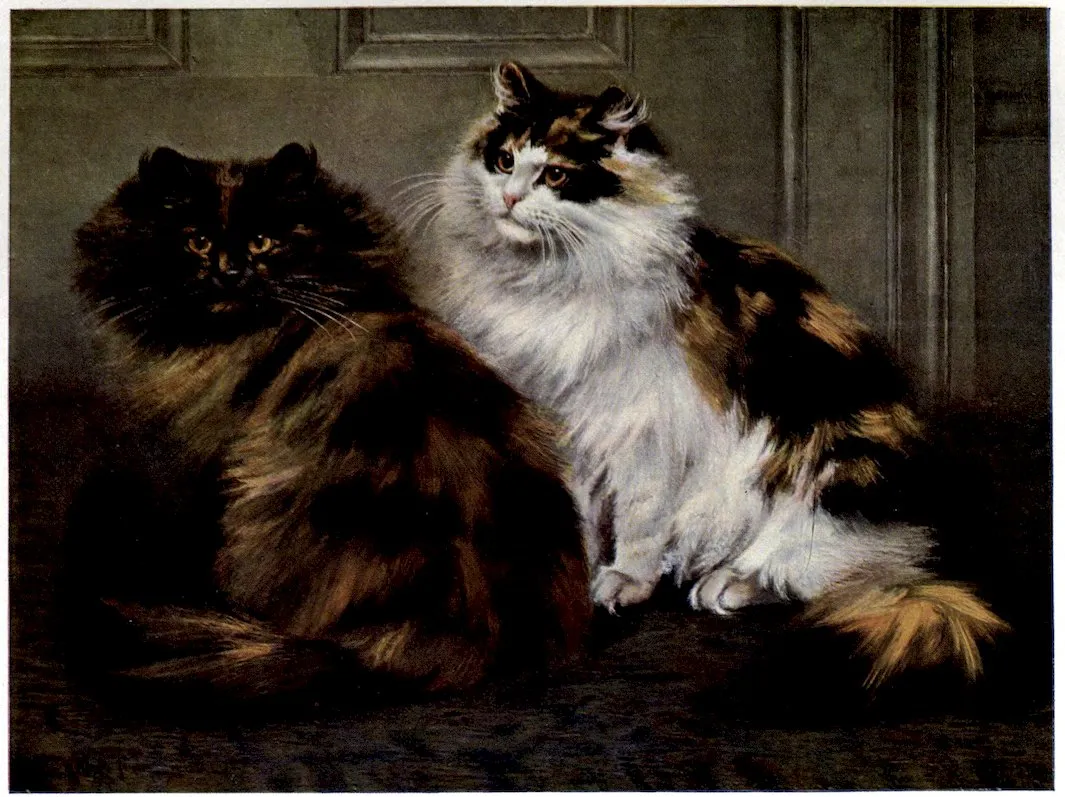
Tortoiseshells are entirely neglected by
fanciers nowadays, and are only used as a
stepping-stone to more fashionable colours.
There is no doubt that a tortoiseshell can be
got to breed anything! I knew a queen which
bred magnificent blacks, blues, creams, oranges,
fawns, and smokes, whether mated to a blue,
a cream, or a smoke, and I believe she also
threw chinchilla kittens to a chinchilla sire.
To breed tortoiseshells for the show pen we
must not indulge in any haphazard matings.
The fault of the tortoiseshells is, as a rule, that
the red and yellow has run all over the black,
and instead of having a clear patchwork of red,
yellow, and black, we have a blur containing
a preponderance of yellow. The obvious
remedy is our old friend the black. All the
best tortoiseshells are bred from blacks, and
a black and a red tabby or
orange will generally throw
some good tortoiseshells. To
produce tortoiseshell-and-whites
cross a tortoiseshell
with a black-and-white rather
than with a white, but avoid
red tabby, as a tortoiseshell-and-white
cat frequently
shows tabby markings for
this breeding.
The red tabby has nearly
died out among long-haired
cats, though it flourishes in
the short-haired variety, but
by crossing a brown tabby
with an orange it might be
revived. No doubt there
would be a few mismarked
kittens in the litter, but the
chances would be in favour
of a good red tabby, and the colour could
then be preserved by crossing with black
and tortoiseshell only.
Of course, it is no use trying experiments in
cross-breeding in the hope of obtaining definite
results unless we are satisfied as to the pedigree
of the cats employed for at least two
generations, or all our calculations may be
upset. For example, when breeding for
chinchillas, if we used a black bred from
a brown tabby mother the results would be
disastrous.
A point to be carefully noted in cross-breeding
is to select a cat with eyes of a colour
desired in the breed which he is destined to
improve, whether those eyes would be correct
in his own family or not. This suggests a use
for our rejected green-eyed blues and blacks
and our orange-eyed silvers.
My notes, as may be observed, are on the
subject of long-haired cats, but they will be
found equally applicable to short-hairs.
THE DISEASES OF CATS, AND THEIR TREATMENT. — ADMINISTRATION OF MEDICINE. — DISEASES OF THE STOMACH. — WORMS, OR INTERNAL ANIMAL PARASITES. — DISEASES OF THE KIDNEYS. — DISEASES OF AIR PASSAGES AND LUNGS. — DISTEMPER. — DISEASES OF THE EAR. — DISEASES OF THE EYE. — DISEASES OF THE SKIN. — EXTERNAL ANIMAL PARASITES. — PAINLESS DESTRUCTION OF CATS.
358
By HENRY GRAY, M.R.C.V.S.
In the treatment
of
the diseases
of the
cat, the correct
method
of administering
whatever
medicaments
are
deemed necessary
is a
most important
consideration.
To the
uninitiated
and timid the
task is generally
a difficult
one, and may, in some cases, appear almost
impossible; but with a little practice, aided
by courage and determination, the difficulties
can nearly always be overcome. The administration
of medicine, however, is seldom so
easy in the case of the cat as in that of
the dog.
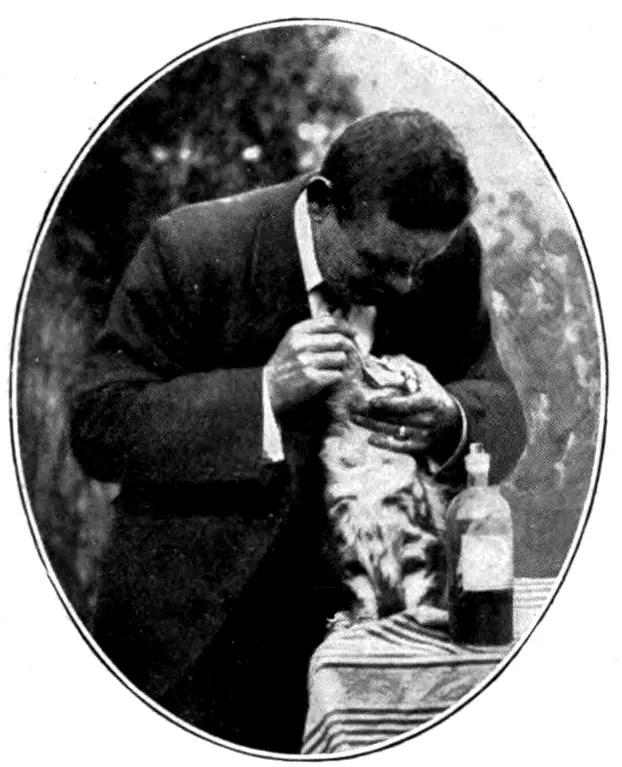
Some cats are so gentle that the mouth
can easily be opened by means of the index
finger and thumb of the left hand acting
as a wedge between the jaws. The palm of
the hand rests on the top of the head, while
the finger and thumb gently but firmly press
the cheeks at the angle of the jaws inwards,
until they intervene between the finger and
thumb of the operator and the posterior teeth
of the patient.
The jaws being thus kept open, and the
head at the same time raised, the right hand
of the operator drops the pill or powder at the
back of the mouth between the tongue and
palate. This having been accomplished, the
right hand is passed under the lower jaw, so
as to keep the head raised until the animal
swallows, while the left hand is withdrawn
from its previous position and the jaws allowed
to close, thus facilitating the act of swallowing.
For the administration of liquid medicine
it is not necessary to open the mouth. The
operator grasps the head with his left hand,
and taking the spoon in his right he slowly
and carefully drops the liquid between the
teeth, or into the space between the cheek and
teeth, at the angle of the mouth. For the cat,
a coffee-spoon is preferable to a tea-spoon, and
care must be taken that too much is not
poured into the mouth at once. The dose
should be administered drop by drop, and
time allowed for swallowing.
Vomiting, though a symptom common to
many diseases, may be quite natural in some
instances, such as over feeding or during the
weaning period, when the mother cat eats a
lot of animal food and then brings it home
and vomits it up for her young kittens to feed
upon.
The act consists of ejecting the contents
of the stomach up through the gullet and then
out of the mouth.
The causes of vomition are various: Worms
travelling from the bowel into the stomach,
emetics, expectorants, poisons, foreign bodies
(as hair, cork, pins, etc.); bad or altered food,
blood poisoning, distemper, gastritis, tumours,
tuberculosis, jaundice, diseases of the kidneys,
etc., may produce it.
It may also occur from parasites in the
ear, foreign bodies in the mouth, and as a
symptom of brain disease, such as meningitis.
Treatment.—This depends upon the cause,
which should be removed if possible. When
due to foreign bodies or altered food, an emetic
(especially the hypodermic injection of ¹⁄₄₀ to
¹⁄₂₀ grain of apomorphine hydrochloride) would
most likely remove the source of trouble. If
the foreign body cannot be removed by simple
means, an operation may be deemed necessary.
If due to inflammation of the stomach, bismuth
and aërated soda-water are of great value.
Ice and cocaine or chloretone are occasionally
useful when these have failed. Sometimes it
is necessary to wash the stomach out with
mild antiseptics. If of nervous origin, a hypodermic
injection of ¹⁄₁₂ to ⅛ grain of morphine, or
359five-minim doses of tincture of opium or bromide
of potassium, given by the mouth, may prove
successful. When resulting from tumours or
tuberculosis, humanity dictates that the lethal
chamber should be called into requisition and
the animal put out of its misery. Easily
assimilable and non-irritating food only
should be given for a few days. Aërated
soda-water forms the best drinking fluid.
Gastritis, or inflammation of the stomach,
is sometimes called gastric fever, and when of
a mild type, gastric catarrh. Its causes are
variable. It may be due to altered or decomposed
food, distemper, microbes of various
kinds, large doses of emetics or aperients,
mineral poisons, chills, absorption of dressing
applied to the skin, or licking the same off.
It is also caused by worms, especially the broad-necked
tapeworm (Tænia crassicollis), travelling
into the stomach and setting up irritation.
Again, diseases of the uterus, liver, kidneys,
and other organs give rise to gastritis. It
frequently rages as an epizöotic, causing considerable
mortality in some catteries, especially
after cat shows.
Symptoms.—The disease is ushered in by
sudden vomiting of the food, followed by the
repeated rejection of ropy mucus, and then,
if the case is severe, this is succeeded by a thin,
clear, greenish-yellow or bloody fluid; saliva
flows from the mouth, the thirst is great,
especially for cold water, which is generally
expelled almost as soon as taken; there is
a distressed appearance, restlessness, or a frequent
shifting of the posture. As a rule, the
animal prefers to lie on its belly full length,
with its limbs resting on cold objects.
Pressure on the region of the stomach
causes moaning and sometimes vomiting.
After the lapse of some time, when a fatal
termination is advancing, the eyes appear
sunken, the pupils become dilated, the expression
is sad, the animal becomes cold and
indifferent to his surroundings, the mouth
gives off an offensive odour, and the coat is
dull, open, and lustreless. The animal dies
either in a comatose state or from sudden
failure of the heart during a fit of vomiting.
Treatment.—If recognised early, an emetic
is sometimes very useful in cutting short the
complaint. No food or ordinary water should
be allowed until twenty-four to forty-eight
hours have elapsed since the last vomiting;
but a teaspoonful of Brand’s essence of beef
jelly and two to four teaspoonfuls of aërated
water should be given every four hours.
Bismuth subnitrate or carbonate in five-grain
doses may be shaken on the tongue an hour
before these two latter are administered.
If this means of treatment should prove
ineffectual after twenty-four hours, one may
conclude that the disease is of a severe type,
and in this case one to five minims of the
liquid extract of opium in a little mucilage, or
chloretone, ½ to 2½ grains, should be given
every three hours. Feeding by means of rectal
suppositories, or injection of an ounce of milk
containing a little common salt, may be
attempted. Finally, if this fail, washing out
the stomach with borax or boracic acid, or
chinosol and warm water, and a hypodermic
injection of bullock’s or sheep’s serum might
be tried. In gastric inflammation due to infection
the hypodermic injection of quinine
hydrochloride or trichloride of iodine will sometimes
answer when everything else has failed.
Cocaine and orthoform have no advantage over
opiates, especially the denarcotised preparations,
in soothing the stomach. Ice in small
pieces pushed down the throat sometimes
answers in assuaging the thirst when the soda-water
does not. In the chronic form, doses
of ⅛ to ½ grain of calomel or mercury with
chalk given with bismuth three times a day
are beneficial in many instances.
Enteritis, or inflammation of the intestines
or bowels, frequently co-exists with
gastritis, and then the disease takes on the
term of gastro-enteritis. The causes, like those
of gastritis, are various. It may be due to
infection, bad food, drugs, foreign bodies, chills,
distemper, intussusception or irritating enemas,
etc. There also seems to be a special contagious
type of this disease which frequently
causes great mortality in catteries, especially
with kittens. Generally the small intestine
forms the seat of the disease, which may in
rare cases, however, extend the whole length
of the bowel, which is sometimes lined with a
croupy or diphtheritic membrane.
The symptoms are restlessness, great pain,
frequent crying or moaning, offensive and
profuse and frequent diarrhœa, the dejections
varying in colour and consistence and frequently
containing blood, and sometimes vomiting,
especially when the stomach is implicated;
thirst is intense, food is refused, the animal is
cold, haggard, and depressed; its fur is dull,
open, and lustreless, and becomes soiled, giving
off an abominable odour. When the abdomen
360is manipulated, the animal cries or moans from
the pain caused. If the pupils are dilated and
the expression has an anxious appearance, and
emaciation is rapid, a fatal termination may
be anticipated.
The treatment varies according to the cause.
If the case is seen in the early stage a tea- to a
dessert-spoonful of castor-oil containing 1 to 2½
minims of liquid extract of opium may be
given at once, to clear out any irritating
material from the bowels and also to allay
pain and irritation; or morphine in ¹⁄₁₅ to ¹⁄₁₂
grain doses may be injected under the skin
every four hours. Bismuth salicylate, in five-grain
doses, should be dropped on the tongue
about the same time. Starch enemas containing
liquid extract of opium may also be
administered. Boiled milk containing bicarbonate
of soda should be given in small and
repeated quantities.
Turpentine stupes frequently applied to the
abdomen are recommended, but, where this is
objected to, the floor of the abdomen may be
painted with tincture of capsicum, or tincture
of iodine, until soreness is produced, the hair
being first clipped off.
In those cases of epizöotic nature, isolation
is called for. The food and surroundings
should be changed, and the catteries and
utensils thoroughly cleansed and disinfected.
In the chronic form a powder composed of
bismuth salicylate 2 to 5 grains, and β-naphthol
1 to 2½ grains, should be shaken on
the tongue three times a day. Milk and rice
form the best diet.
Diarrhœa, like vomiting, is not a disease
of itself, but an expression of many different
affections. It may be salutary or otherwise.
It may be due to aperients, irritating or
indigestible food, microbes, diseases of the
bowels, kidneys, and liver. It frequently
results from distemper or gastro-enteritis,
tuberculosis, intestinal catarrh, and from licking
applications put on the skin in the treatment
of skin affections. Sour milk, tainted
milk or fish, and chills will also induce it. In
kittens improper food, especially during hot
weather, is a common cause.
The symptoms are a looseness of the dejections
from the bowels, which are passed
several times a day. The stools vary in
colour according to the food taken by the
animal, or according to the severity of the
cause; they are generally of a very offensive
odour, and may contain blood.
Treatment.—If the cause of the diarrhœa is
due to irritating food, a dose of castor-oil will
be beneficial. When due to catarrh of the
bowels, the carbonate, subnitrate, or salicylate
of bismuth, in five-grain doses, two or three
times a day, is the most appropriate treatment.
If it is associated with distemper or
typhus, the bismuth salts mentioned above, or
tannablin or tannigen, in 2½- to 5-grain doses,
are suitable. For chronic diarrhœa, 2½ to 5
grains of salicylate of bismuth, with 1 to 5
grains of β-naphthol, given three times a day on
the food, is generally followed by recovery.
Failing this, a mixture composed of dilute
sulphuric acid, concentrated infusion of cloves,
and concentrated infusion of hæmatoxylin
should be tried.
When the diarrhœa is due to irritation of
the so-called large or posterior bowel, injections
containing starch, laudanum, and tannic acid
should be used.
As long as the diarrhœa lasts, no meat or
meat infusions should be given, but milk, rice-pudding,
bread and milk, and such-like food
are suitable.
Constipation is an impaction of fæces in
the hind bowel, and is generally due to weakness
of this portion of gut, or results from a
cleanly animal having no place to evacuate
its fæces in. Sometimes it is due to a ball of
fur, and occasionally foreign bodies, such as
cat’s-meat skewers, being swallowed along with
the meat by a greedy animal. When due to
paralysis of the bowel, which is occasionally
seen in young cats, the abdomen becomes
distended by the fæces in the bowel. It also
occurs as a symptom of spinal paralysis. The
non-passage of fæces seen in cats when not
well and not taking solid food must not be
confounded with constipation.
The symptoms, as a rule, are the non-passage
of fæces for some time, distension of
the abdomen, and impaction of the bowel with
fæces which can be felt by manipulating the
abdomen.
Treatment.—A dose of castor-oil and an
enema of soapy water or glycerine will generally
put matters right. If these means do not
succeed, massage or kneading of the bowels,
by grasping the abdomen with the hand and
alternately compressing and relaxing the grasp,
will assist to stimulate the intestines to force
on their contents. Of course, this only applies
when impaction is due to soft material and
not hard foreign bodies, which, in this latter
361case, should be removed by the fingers or
forceps. If any irritation of the mucous
membrane, evidenced by frequent straining as
if to pass fæces, remains after the bowels have
been relieved, an enema of warm salad oil,
containing a few drops of liquid extract of
opium, will allay it, and prevent straining.
In case of the bowel remaining weakened or
paralysed so as to bring about a recurrence of
the constipation, pills containing ¹⁄₁₆ grain of the
alcoholic extract of nux vomica should be administered
morning, noon, and night after food.
Cats, like all other animals, are liable to
be infested with worms, which may not cause
any disturbance, unless in great numbers or
when another disease is in existence.
The Common Round-worm is very prevalent
in young kittens, generally when they are
living on milk, upon which these worms thrive.
Their natural residence in the cat is in the
small intestine, but sometimes they wander
from here into the stomach, and set up vomiting
and occasionally convulsions.
Treatment.—The worms should be expelled
and the animal fed on nutritious and stimulating
food, such as raw fish, raw meat, and
fresh birds. The milk, to which is added a
pinch of salt, should be boiled. The best
remedy to expel these worms is santonin
given along with or followed by an aperient.
The following is a convenient formula:—
| Santonin |
1 grain. |
| Calomel |
½ „ |
This powder is to be dropped on the back
of the tongue of an adult cat after fasting
twelve hours, every other morning, until four
doses have been given. Half this quantity is
suitable for a cat three or four months old, and
a quarter for a kitten of a month to six weeks
of age.
The commonest Tapeworm of the cat is
the Tænia elliptica vel felis, with which fifty
per cent. or more are affected. It is caused
by fleas, lice, and mange-mites which have at
some time or another infested the cat.
They do not seem to cause much harm,
even when numbering hundreds. In one case
that I encountered the cat was in the pink of
condition, and yet I found 700 of these worms.
It is a delicate tapeworm with joints resembling
a cucumber in outline. The ripe
joints, which are often of a reddish tint, frequently
become detached, and pass with the
fæces, on which they are seen. They are
generally termed by fanciers maw-worms.
Treatment.—The worms should be expelled,
and fleas, lice, or mange-mites destroyed, so as
to prevent a recurrence of the trouble.
Another tapeworm of the cat is the Tænia
crassicollis, or broad-necked species. It is
seen only in cats that kill and eat rats and
mice, in the liver of which the larval form of
this parasite resides.
It is a big, coarse tapeworm, measuring
eighteen to thirty inches in length, and having
no well defined neck.
Treatment.—For the expulsion of tapeworms
there are many remedies, the best of
which are areca nut, kamala, oil of male fern,
pomegranate, and kousso, but as the dose of
these in the crude is generally too bulky for
the cat, it is advisable to give either of them,
with the exception of the male fern, in their
alkaloidal form, as:—
| Koussein |
½ to 2 grains. |
| Kamalin |
½ to 2 „ |
| Arecoline |
¼ to ½ grain. |
| Pelletierine |
¼ to ½ „ |
Any one of these may be given either in
pill or tabloid form, or rubbed up with milk
sugar, as a powder on an empty stomach after
the animal has fasted at least twelve hours, and
repeated every third or fourth morning. A
dose of castor-oil or jalap should be given
an hour after. The oil of male fern is best
administered in a capsule. Powdered pumpkin
seed may be sprinkled on the food.
Diseases of the kidneys, such as degeneration,
fatty degeneration, parasitic disease,
tuberculosis, cancer, acute and chronic Bright’s
disease, and calculi are not rare, but, as
the space at our command is limited, we
only mention them.
Incontinence, or the involuntary passage
of urine, is usually due to weakness of the
bladder, brought about by over-distension.
It sometimes results from injury to the spine
and calculi.
The treatment that is best suited for this is
the administration of ¹⁄₁₆ grain of the alcoholic
extract of nux vomica and ½ grain of quinine
in a pill three times a day. If there be
irritability of the bladder, soda bicarbonate
2 grains and extract of henbane ⅛ grain in a
pill should be given.
362Retention of urine is generally caused by
a calculus or chalky material blocking up the
urethra or canal leading from the bladder, and
preventing the exit of the fluid. If relief
is not given to the bladder—that is, if the
obstruction is not immediately removed—the
urine decomposes and then sets up inflammation
of the bladder, and death takes place
from uræmic poisoning.
Symptoms.—The cat seems in pain, and
makes ineffectual attempts to pass its urine;
it strains to no purpose; it seems restless,
getting up, lying down, rolling on its side,
swishing its tail, looking towards its side, and
crying. After a time the animal becomes
drowsy and indifferent. If the abdomen is
manipulated, the bladder will be felt to be
distended, hard, and painful.
Treatment.—The only rational treatment is
to remove the obstruction and pass the catheter
immediately, a special silver catheter, half the
size of the smallest human catheter, being required
for this purpose. If the urine is bloody,
it may be necessary to wash out the bladder
with a warm solution of boracic acid and
alkalis and sedatives, but no meat or meat
extracts should be given.
A Common Cold, or coryza, or acute nasal
catarrh, or cold in the head, is caused by
exposing the cat to the inclement weather, or
washing it and not thoroughly drying afterwards.
It may also be due to the irritating
vapours of chloroform or ether used by
inhalation to produce anæsthesia. Letting a
cat out in the cold and wet after it has been
used to a warm, dry dwelling sometimes results
in a cold. It is not contagious, but is frequently
mistaken for distemper.
Symptoms.—There is frequent sneezing, and
sometimes a cough; a clear watery discharge
trickles from the corner of the eyelids and
nostrils. After a time this discharge becomes
gluey, thick, and yellowish or greenish; the
eyelids become partially closed, and the haw
protrudes over the front of the eyeball; food
is refused, or sparingly eaten; the fur is dull
and open; warm or dark corners are sought
for; the animal trembles and seems miserable.
If the throat is sore, there is a cough; the
breathing is wheezy, and a discharge may
issue from the angles of the mouth. These
symptoms generally pass away in a few days.
Treatment.—Where many cats are kept, an
animal suffering from “a cold” should be
isolated from the rest as soon as possible, as
it is difficult to distinguish a simple case
of “catarrh” from the early stage of a case of
distemper. A warm place, well ventilated, but
free from draughts, is essential.
Raw meat, scraped and given three times
a day, is the best diet. Fish, milk, bread and milk,
or rice-pudding should be offered.
A small pilule of half a grain of quinine
sulphate should be dropped at the back of
the mouth three times a day. The nostrils
and eyelids should be sponged with a warm
solution of boric acid, containing eight grains
to the ounce of water, and afterwards smeared
with a little white vaseline three times a day.
Sanitas or turpentine should be sprinkled on
the floor of the room. Great relief is often
given by inhaling the fumes of eucalyptus oil
dropped into a jug of boiling water.
Chronic Nasal Catarrh, sometimes called
“feline glanders,” differs from the preceding
complaint, inasmuch as it runs a longer and
more persistent course; it may, however, follow
on simple catarrh which has been neglected.
Distemper is one of the commonest causes of
it, but it is also seen after diphtheria. It may
occur as a symptom of tuberculosis, foreign
bodies in the nasal channels, malignant growths,
such as sarcoma or cancer attacking the turbinated
bones, diseased bone, or teeth, etc.
When neglected, it may last for months or
even years, and is frequently incurable.
Symptoms.—There is a persistent gluey,
odourless, or sometimes fœtid discharge either
of a gelatinous or yellowish appearance, with
or without streaks of blood from the nostrils,
the outsides of which are sometimes ulcerated.
The throat may be swollen; the appetite and
general condition of the animal are often preserved.
Sometimes there is an abscess in the
inner corner of the eye.
Treatment.—In those cases that are due to
malignant tumours or tuberculosis, and, in
consequence, incurable, merciful destruction of
the animal is called for. If due to foreign
bodies—as fish-bones, pieces of grass, or food,
or to diseased teeth—they should be removed.
Syringing the nostrils, so as to wash the
diseased lining membrane of the nasal channels,
with some mild antiseptic is the only means to
insure success. The mode of procedure is this:
A skilled assistant must firmly secure the
animal between his hands—that is, he holds
the limbs firmly—then the operator grasps the
363head with his left hand, taking care to keep
the mouth shut by means of the thumb and
index finger, and steadies it on the table; and
with the right hand he carefully and gently
passes the pipe of the syringe up one of the
nasal channels and then presses out the fluid.
When this is finished, the other nostril is
served the same.
The following is a suitable formula for the
solution to be injected:—
| Alum |
30 grains. |
| Boric Acid |
2 drachms. |
| Liquid Extract of Hydrastis |
2 „ |
| Warm Water |
½ pint. |
This should be used every other day until
some benefit is derived from it. If the disease
is not amenable after a fortnight’s adoption of
this treatment, the following should be substituted:—
| Tincture of Iodine (B. P.) |
10 minims. |
| Glycerine |
6 ounces. |
| Warm Water |
1 ounce. |
Pills of iron, quinine, arsenic, and such-like,
as well as plenty of flesh food along with
cod-liver oil, should be given. Fresh air is
invigorating, and a change to the seaside sometimes
does miracles. Eucalyptus sprinkled
about the cat’s box is useful, because it acts
not only as an antiseptic, but as a stimulant
to the mucous membrane of the nostrils.
Bronchitis, or inflammation of the bronchial
or air tubes, may occur as a sequel
to catarrh or during its course, and may also
accompany distemper. It is also due to small
worms in the tubes; washing followed by exposure
to draughts; medicine, especially light
powders, going down the windpipe, etc. It is
frequently due to tuberculosis.
Symptoms.—There is a frequent cough, the
breathing is wheezy, and sometimes quickened
or difficult. The desire for warmth is great;
there is shivering, and perhaps a discharge
from the eyes and nose. On listening to the
chest by means of the stethoscope, wheezing
or hissing or bubbling sounds will be heard.
Treatment.—The animal should be kept in
a constant temperature of 60° F., and have
warm milk and beef administered to it. The
throat and sides should be rubbed with oil of
mustard. Inhalations of steam are useful
when expectoration seems difficult. Kermes
mineral (two grains) and powdered squill (one
grain) should be given.
Pneumonia, or inflammation of the substance
of the lungs, may be due to various
causes, such as exposure to cold, chills after
washing, medicines passing down the windpipe,
foreign bodies, blood-poisoning, small
worms, and principally distemper or tuberculosis.
It may be associated with pleurisy
or bronchitis, and is then termed pleuropneumonia
or bronchopneumonia respectively;
and also sometimes with a purulent collection
or tuberculosis, and then it receives the names
septic pneumonia or tubercular pneumonia, or
phthisis.
Symptoms.—At first there is intense shivering,
a great desire for warmth, loss of appetite,
dull appearance, dull cough, sickness, difficulty
of breathing, which after some days becomes
laboured or panting. On auscultation of the
chest the characteristic sounds may be heard.
At first fine crepitations, then a day or two
after the tubular or blowing sounds, and when
convalescence sets in the fine crackling or
crepitating sounds are heard again. The
cough becomes more frequent and the appetite
increases. On the other hand, if there be
no improvement, the coat becomes dull and
open, the eyes sunken, and the pupils dilated;
the flanks move up and down like a pump-handle,
and the breath becomes fœtid; food
is totally refused, and diarrhœa sets in, a fatal
termination is to be anticipated.
Treatment.—The animal should be kept in
a temperature of 60° F., and fresh air, but no
draughts, allowed. The sides are to be rubbed
with oil of mustard, or painted with tincture
of iodine, or an ointment composed of one part
of tartar emetic to eight of lard. Quinine
sulphate, ½ grain; alcoholic extract of nux
vomica, ¹⁄₁₆ grain; and extract of digitalis,
⅛ grain, in a pill, may be administered every
four hours, and nourishing food given. In the
case of tubercular pneumonia, which is generally
chronic, the animal should be destroyed.
Pleurisy, or inflammation of the covering of
the lungs or internal lining of the chest cavity,
in the cat as well as in the dog, is chiefly due
to tuberculosis. It may, however, result from
pneumonia, abscess in the lung, cancer, parasites,
injuries, foreign bodies, gunshot wounds,
cold, etc. It is generally accompanied with a
dirty sanious, or clear amber-tinted, or port-wine-coloured
fluid, sometimes containing
yellowish white strings of lymph floating in it
in the chest cavity. One or both sides may
be affected. It is usually fatal.
Symptoms.—The cat has an anxious, painful
facial expression, and moans, or rather grunts,
364and sometimes attempts to bite when the chest
is touched or made to move; the abdomen is
retracted, and the breathing, which is short
and jerky, seems to be performed by the flanks.
There is a slight or suppressed cough, but this
is often absent. The animal wastes away, the
coat becomes dull and open and lustreless, and
the hairs are easily pulled out. The creature
hides under the furniture and refuses its food,
and when a fatal termination is at hand,
the flanks move up and down like a pump-handle,
the breathing becomes difficult and
suffocative, the mouth, which is offensive,
being opened at every inspiratory and expiratory
effort; the tongue becomes purplish,
the elbows turn out, the cat assumes a squatting
position on all fours, and a fœtid diarrhœa
sets in.
Treatment.—Although generally fatal, treatment
may be desired to be attempted. The
chest should be painted with tincture of iodine
or oil of mustard; if there be much pain, a
hypodermic injection of morphine will prove
useful, and a pill composed of ¼ grain powdered
digitalis leaves, ½ grain sulphate of
quinine, and 1 grain of iodide of potassium,
administered three times a day. When the
breathing becomes difficult in consequence of
the accumulation of fluid in the chest cavity,
it may be deemed advisable to draw the fluid
off by means of a trocar. Nourishing liquid
food, such as milk, Mosquera’s beef jelly, or
eggs, should be given, little and often.
Distemper is a contagious, inoculable fever,
due to a specific microbe (the cocco-bacillus,
or pasteurella of Lignières), and is similar, if
not identical, to that causing distemper in
the dog. Krajewsky, Laosson, Lignières, and
others have experimentally demonstrated its
identity, but I have never observed the cat
naturally giving the dog distemper, nor vice
versâ, and I believe this is the experience of
most veterinary surgeons in this country.
The microbe of distemper—which belongs
to the same class of micro-organisms, the
pasteurella, that causes influenza in the horse,
fowl cholera, swine-fever, guineapig distemper,
etc.—is generally found in the blood,
which it alters to such a degree as to make so
profound an impression on the system as to
diminish its natural resistance to the ordinary
germs, which become, in consequence, increased
in virulence, and cause the various phenomena
by which we know the disease. It is difficult
to detect in the body after about a week.
The disease varies in severity according to
the degree of virulence of the microbe. If
this is very virulent, it causes a very acute or
septic disease, as is observed in the typhus or
gastro-enteric outbreak, which kills off a large
number of animals within a few days or even
hours. If it is of a milder strength, we get
the subacute form with localisations, such as
we usually see in distemper. There is also a
chronic form, which lasts a long time, and
which tries the patience of the owner as well
as the vitality of the sufferer. Finally, a
chronic wasting or cachectic form is sometimes
observed; it resembles the “going light” in
birds and other animals, and may be mistaken
for starvation, which it simulates very
much.
The microbe may exist in a healthy cat’s
body for weeks without causing it any disturbance
until, perhaps, the animal catches
cold, or is depressed in some other manner.
However, an apparently healthy animal with
this microbe in it may be infective for other
cats.
Period of Incubation.—This varies according
to the degree of virulence of the microbe and
the state of the cat’s system and the surroundings
in which it is kept. A very virulent
infection has a much shorter period of incubation
than a mild infection. Whereas the
former may cause distemper in from two to five
days, the latter takes from one to three weeks.
It seems doubtful whether the specific microbe
causes the symptoms we usually see in distemper,
or if these are due to a secondary
infection resulting from the invasion of the
normal microbes of the body, which have
become virulent, and prey upon their hosts.
Duration of the Disease.—This, like the
period of incubation, varies also according to
the degree of virulence of the virus. A very
virulent virus kills in a few days or even hours,
or the animal recovers very quickly. It is
not so with a virus of a milder degree of virulence,
which may cause symptoms that take
from one to five or six weeks to disappear,
if the animal recover. In other cases the
disease shows itself in so mild a form that it
appears like an ordinary catarrh, and recovery
is established within a few days.
In a few instances death takes place suddenly
before any premonitory symptoms have
had time to develop.
365The principal sources of propagation of the
infection are cat shows, catteries (especially
those belonging to people who exhibit), homes
for lost and stray cats, and institutions that
take in these animals as boarders. The cat
dealer’s shop is not free from blame—many
newly purchased kittens develop distemper a
few days after purchase, contracted, no doubt,
at the dealer’s. Many cases have been traced
to the cattery where the female has been sent
to stud. Hampers, cages, and persons coming
from infected catteries are so many media of
contagion. Even if a cat has apparently recovered
from the disease, it may still give off
infection and contaminate other cats for a
variable but uncertain period.
Although the disease may be seen at all
times of the year, it is most prevalent during
spring and autumn, especially if the weather
is changeable and wet.
Moisture of the atmosphere favours the
increase of distemper. Wet, following very
dry weather, continuous dampness and rain,
all predispose an animal to the disease. Where
catteries or homes for lost and strays are continuously
being washed out and not properly
dried, especially in damp weather, before the
cats are allowed into the rooms, distemper is
very prevalent.
Where too many cats are crowded into a
given space, especially if the place is badly
lighted and not very well ventilated, this is
favourable for the contamination of the inmates.
The mortality varies according to the breed
of the animal, its surroundings, and the degree
of virulence of the infection. Seasons and
periods have also some bearing on it. Commonbred
cats allowed to roam out in the open at
their will are more likely to recover from the
disease, but if confined to cages or in catteries,
or in the house, the mortality is quite twenty-five
per cent. The long-haired cats are less resistant
against it, and as many as fifty percent.
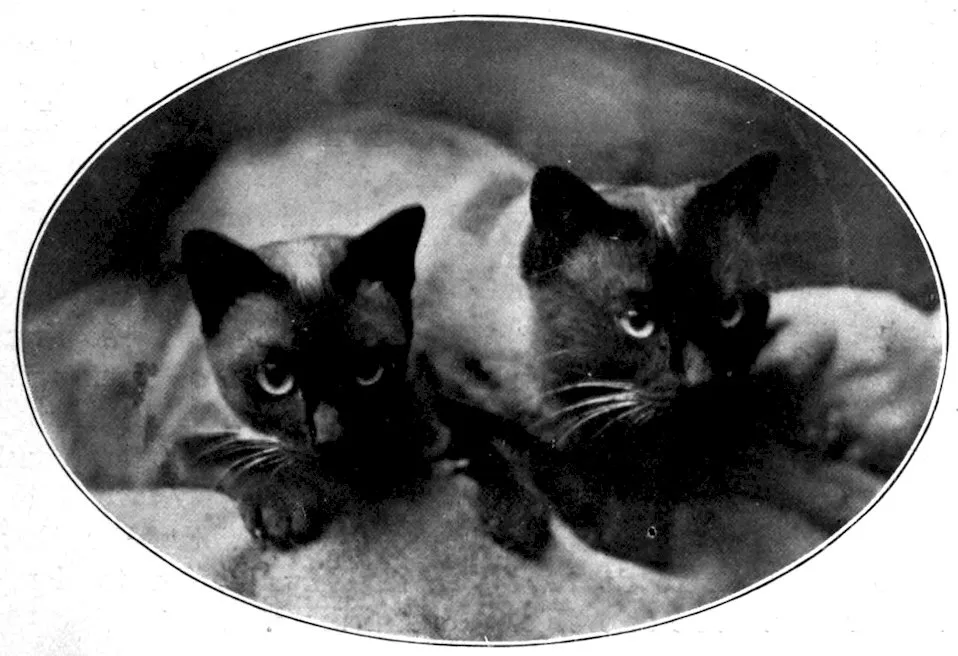
die. In the Siamese breed of cats, the fatality
is as high as ninety out of every hundred. The
younger the animals, the greater the deathrate;
yet, on the other hand, if old animals
are very fat or anæmic from want of fresh air
and exercise, the mortality is just as high.
Many cats are resistant at one time against
the infection, others have it in a mild form, and
yet others have it severely; but this does not
always prevent them from having it again at
some future period. My experience is that a
cat may frequently have a recurrence of distemper
at least two or three times, and then
succumb to it.
One season it may appear as a contagious
catarrh, another season as an infectious sore
throat, and at other times as a bronchitis or
pneumonia, and, lastly, as a contagious gastritis
or gastro-enteritis. Frequently all these
forms may co-exist in a single outbreak, and
often a single animal exhibits the whole of
these manifestations. For the convenience of
description of the symptoms of this multiform
malady we divide it into five principal forms,
as follow:—
1. The Catarrhal, attacking chiefly the
eyes and nostrils.
2. The Pharyngeal or Tonsillar, affecting
the region of the throat.
3. The Pulmonary or Chest form.
4. The Abdominal or Gastro-enteric.
5. The Cachectic or Wasting.
The Catarrhal form of distemper is that
which is generally seen in the cat, and is the
least fatal of any. The first symptoms noticed
are a watery discharge from one and sometimes
both eyes, the lids of which may be
partially or completely closed, so as to hide
the front of the eye, and a frequent licking of
the upper lip and nose as if they were parched
and burning. After a day or so the inner
lining of the eyelids may be very much reddened,
swollen, and giving rise to a yellow-white
or greenish-white thick discharge, which
adheres to the lids and seals them together.
There may also be shivering fits, a dull open
coat, and a great desire for warmth (this being
so intense in some cases that the animal frequently
gets under the grate when a fire is in
it). There is sneezing, followed by a snuffling
kind of breathing; the nostrils discharge a
thick, ropy, whitish or greenish matter, which
clings to their openings, and very often closes
them up. When the pharynx or larynx is the
seat of catarrh there are frequent fits of coughing.
The appetite is diminished or absent, but
thirst is, as a rule, great. There may also be
seen at times vomiting, diarrhœa, or constipation.
Emaciation is gradual and slight, or
rapid and great, varying according to the
severity of the symptoms.
The breathing is not much altered in the
majority of cases, but in a few instances it
becomes frequent. The temperature rises
a few degrees, but this is variable, and it is
sometimes normal. The body and limbs feel
366cold to the touch, and sometimes give off an
offensive odour. The tongue, lips, hard and
soft palates, and gums (especially around the
teeth) are occasionally ulcerated. Now and
again the eyes become the seat of ulceration,
which on rare occasions becomes perforated; at
other times they become affected with a severe
inflammation, which extends to the whole eyeball
and destroys this organ. There is at
times dulness or drowsiness, and the animal
seeks dark corners or gets under the furniture.
Many cats from sheer nervousness, especially
in strange places, avoid the fire and seek
obscure or lofty positions. Recovery generally
takes place within a fortnight or three weeks,
but death may take place within twenty-four
to forty-eight hours from the commencement
of the attack.
The Pharyngeal, Tonsillar, or Throat form
is the most deadly manifestation of distemper.
The first symptom to attract attention is
the drivelling of clear, ropy albuminous
saliva from the corners of the mouth. The
animal crouches upon all four of its limbs;
there is a frequent gulping movement,
and a sound is emitted from the throat as
if there was an attempt to swallow the thick
ropy saliva which clings about the mouth and
pharynx; the swallowing seems difficult or
impossible; food is refused, but thirst is
constant, although the animal seems incapable
of swallowing; there is a great dulness or
depression, and the cat appears indifferent to
its surroundings.
On examination of the outside of the throat
it is found swollen and painful, the glands are
enlarged, and there appears to be a gurgling
noise at each inspiration and expiration. On
inspection of the mouth and back of the throat,
the tongue and pharynx are found to be
covered with a thick, ropy, bubbling saliva,
the mucous membrane is swollen and congested,
and the soft palate is of a pinkish or
even dark reddish arborescent appearance, due
to the congested state of the small blood-vessels.
Sometimes ulcers appear on the hard
and soft palates. After a day or so the depression
increases, there is a discharge from
the eyes and nostrils, which appears at first
as a clear viscid fluid, and afterwards becomes
yellowish or dirty green in colour, and, if the
animal lives long enough, ultimately bloody,
in consequence of it irritating the mucous
membranes and surrounding skin of the eyes
and nose. There may also be a catarrhal or
purulent fœtid discharge from one or both
ears, but this is quite exceptional, and is
mostly seen in cases having a fatal termination.
If the prostration is very great, and there is
rapid loss of weight and condition, and the
discharge from the mouth, nostrils, and eyes
becomes fœtid, coupled with total loss of
appetite, and no abatement of the other
symptoms, a fatal termination is to be anticipated.
Late in the complaint the pharyngeal
mucus may become of a dirty colour or
sanious; purple spots appear on the tongue,
gums, and lips, and there is a moan or cry
emitted at each respiratory effort; convulsive
movements of the muscles of the temples,
shoulders, and thighs set in, and death takes
place from intoxication. The temperature
rises at first, but when a fatal termination
is to be anticipated it falls below the normal.
The Pulmonary or Chest form, although not
so frequently seen in the cat as in the dog, may
appear from the outset as a distinct localisation,
or follow or intervene during an attack
of the other forms as a complication. It may
or may not be ushered in by shivering fits;
the coat becomes dull and open, there is
sneezing or coughing, or both; tears run from
the eyes, and mucus issues from the nostrils,
and there is a great desire for warmth. The
temperature is elevated, and varies from 102.5°
to 106°, but rarely running a typical course.
The cough, when present, is frequent and
rattling or harsh, and sometimes dull. On
listening to the chest wheezing, rattling, or
blowing, or rubbing, or splashing sounds may
be heard. Emaciation is either gradual or
rapid, thirst is generally great, but the appetite
is diminished or absent.
The breathing is either quickened or the
inspiratory and expiratory efforts may be
prolonged and accompanied or not with a
moan or grunt, which is sometimes associated
with fluid in the chest cavity, which is known
by the pumping or lifting action of the flanks,
this effusion in one or both of the pleural sacs
being either of a clear greenish or amber-tinted
or bloody or dirty yellowish appearance,
and sometimes of a fœtid odour. Besides
pleurisy, which is only occasionally encountered,
there may be pneumonia, bronchopneumonia,
or bronchitis, according to the
structure of lung involved in this form of
distemper. (For a description of these localisations
or complications, see under their
respective headings.)
367The lesions of the lungs may be slight, and
yet the symptoms may be severe; on the
contrary, the lesions may be extensive, and
the resulting symptoms comparatively slight.
If the fever remains high, the appetite abolished,
the pupils dilated, the breathing plaintive
and very rapid, and prostration great, death
soon takes place from failure of the heart due
to intoxication. In many cases, though, the
fever is not intense, and yet death supervenes.
The Abdominal, Gastric, or Gastro-enteric
form of distemper is oftener seen than either
the pharyngeal or pulmonary form, and may
occur as a very acute and rapidly fatal
manifestation, or as a chronic disease. It
frequently accompanies the other forms. In
acute cases there is sudden vomiting of food,
quickly followed by a frequently repeated
ejection of thick, slimy, and frothy mucus,
and ultimately by a thin, watery, serous fluid,
which is of an olive-green or yellowish appearance.
The thirst is intense, and no sooner is
water sipped than it is expelled. There is frequent
diarrhœa; the stools at first seem fluid,
then become watery, sometimes bloody, and
very fœtid. The appetite is suppressed, and
the animal becomes cold and indifferent to its
surroundings, the facial expression is pinched,
the eyes are semi-closed; the coat is dull and
open, and on pressure over the region of the
stomach pain is evinced by a moan or cry,
and death usually takes place in a few hours.
There is not as a rule any discharge from the
eyes and nostrils.
In the subacute cases, beyond a slight
catarrhal discharge from the eyes and nostrils,
there may be either vomiting or diarrhœa—often
both—and at other instances vomiting
and constipation. When the bowels are the
principal seat of the disease, vomiting is rare,
but diarrhœa is generally persistent. Thirst
is great, and food is refused or taken sparingly.
The animal is dull, cries if moved or if the
abdomen is manipulated; emaciation is rapid,
and the animal dies in a state of exhaustion.
In the chronic cases there may or may not
be any catarrhal symptoms, but there is a
chronic and persistent diarrhœa, and sometimes
vomiting. The appetite is capricious
or sometimes ravenous, thirst moderate, and
emaciation gradual, and liquid fæces may be
expelled on the least effort, as by coughing;
the fur or pelage around the tail becomes
soiled, and, in consequence, the animal gives
off an offensive odour.
In some instances the breath becomes
fœtid; the teeth, gums, tongue, and lips are
covered with a dirty brown or greenish slimy
material; and frequently the gum around the
neck of the teeth is spongy, and bleeds on the
slightest touch. Occasionally the bone into
which the teeth are inserted becomes exposed,
ulcerated, or necrosed. Ulcers are at times
seen on the lips and tongue.
The Chronic Cachectic or Wasting form is
sometimes encountered as a chronic wasting
malady, not showing many symptoms beyond
gradual emaciation, great weakness, intense
thirst, ravenous or capricious appetite, and
occasionally diarrhœa. At other times the
animal goes off its appetite, sits about in a
mopish manner, has a staring and dull coat,
the mucous membranes are pallid, the haw protruding
over the front of the inner portion of
the eyeballs, and becomes light in weight.
It very occasionally happens in these
wasting cases that the skin becomes the seat
of parasitic mange, and, in consequence, gives
off an offensive mousy or mouldy odour. If
treatment is not skilfully and early adopted,
death takes place, and on post-mortem examination
the remains simulate those of an
animal having died from starvation. It may
follow on the other forms of manifestation.
Skin eruptions are rarely noticed in distemper
of the cat, but sometimes one sees on
kittens a scabby eruption resembling ecthyma,
the discharge of which mats the hairs in these
young creatures. Female cats, when pregnant,
frequently abort—in fact, nearly every cat in
this condition in a cattery affected with distemper
will miscarry, making it appear as if
it were a special contagious disease.
The ears occasionally become the seat of
acute catarrh or ulceration, and give rise to
an offensive discharge. This complication is
mostly associated with the pharyngeal form.
The cornea of the eye is sometimes the
seat of ulceration, which generally disappears
as the animal recovers. The whole eyeball
occasionally partakes of inflammation, which
destroys it.
When the eyes of young kittens become the
seat of catarrh, the eye is generally destroyed,
and consequently the sight is lost. The
nervous type, showing itself as excitement,
convulsions, chorea, meningitis, or paralysis,
although seen, is somewhat rare in this
creature.
Death may occur either suddenly from
368convulsions, or rapidly from intoxication, or
slowly from exhaustion.
When due to intoxication, clonic, convulsive,
or twitching movements of the muscles
of the temples, shoulders, and hind limbs
precede, and are even seen shortly after,
death. Frequently death takes place without
any symptoms of the disease having been
noticed. In this case it appears to be due to
the rapidity of the formation of the toxin or
poison of the microbe, which causes intense
shock to the system.
Diagnosis.—In many instances this disease
is mistaken for a simple catarrh, diarrhœa, or
sore throat—a mistake unfortunate where other
cats are concerned. It is true that the first
stage of distemper frequently resembles either
of these simple complaints, which are not contagious,
and generally only affect one out of
several animals kept together, and run their
course in a few days; whereas in distemper the
disease usually runs a prolonged course, is very
prostrating, and in many instances fatal, and,
beyond all, contagious. On the other hand, it
may resemble diphtheria, which is contagious,
but has false membranes on the soft palate,
pharynx, larynx, and tonsils, which are absent
in distemper.
Prognosis.—Distemper is a most treacherous
disease, and one of which even an expert
cannot foretell the result. Many instances
occur in which an animal appears to be on
the right road towards recovery, when a
relapse suddenly sets in and carries off the
poor creature. If the appetite is moderate,
the emaciation not rapid or great, the diarrhœa
not intense or too frequent, and no complications
set in after the end of the first week,
recovery may be anticipated. On the other
hand, if the weakness be progressive and
prolonged, emaciation rapid and great, an
offensive odour is given off from the body,
eyes sunken in their orbits, pupils dilated,
and the facial expression is haggard, death is
to be expected. Again, relapses (which are
commonly encountered), early youth, obesity,
complications, the breed of the animal (such
as Siamese and long-haired varieties, especially
light-coloured animals), are generally unfavourable
towards a certain recovery.
Chronic nasal catarrh, chronic pneumonia
or phthisis, and persistent diarrhœa may also
give trouble after the distemper has run its
ordinary course, and will have to be reckoned
with.
Treatment.—An old maxim is, “Prevention
is better than cure,” and ought to be carried
out as far as possible by isolating all those
animals that have been in contact with the
infection.
Animals coming from homes for lost and
stray cats, cat shows, dealers in cats, should
be kept apart from those in the cattery for at
least a fortnight, to see if they develop the
complaint. The place of isolation should have
no communication with the building or house
in which the majority of healthy cats are
kept. The baskets, cages, clothing, etc.,
should be thoroughly washed and disinfected
before they are used again for sound cats. It
ought not to be forgotten that persons who
have been in contact with sick animals may
carry the infection on their hands or clothes.
When distemper has declared itself in a
cattery and the inmates have recovered, the
place should be thoroughly scrubbed, disinfected,
and afterwards lime-washed or repainted.
Boiling water and soda, used with
the aid of a scrubbing-brush, is much more
reliable to remove infection than many of the
so-called disinfectants, which frequently do
not destroy the virus, but often injure the
cats. After the habitation has been scrupulously
cleansed, it may be well to disinfect it
with chlorinated lime (1 lb. to the gallon of
cold water), which should be brushed all over
the floor, walls, partitions, etc. Baskets,
hampers, etc., should be served likewise.
Metal and earthenware utensils may be boiled
in strong soda-water.
Before any cats are again put into the
place, the doors and windows should be opened
for at least a week, and fresh air and daylight
admitted, as they are the best destructors of
micro-organisms.
Where valuable cats are kept and the risk
of distemper is great, it would be advisable
for the owner to have the cats immunised, or
rendered proof against the disease, by means
of the Pasteurian system of vaccination with
the attenuated microbe of distemper, as introduced
into practice by Professor Lignières and
Dr. Phisalix. Several degrees of strength of
the vaccine are used. The animal is at first
vaccinated or inoculated with a mild degree
of virus, and afterwards with vaccine of
gradually increased virulence, so that the
most virulent virus (which would quickly kill,
or cause the disease in a severe form in
an animal not previously inoculated with the
369milder vaccines) would not produce any disturbance
in the vaccinated creature.
Medical or Curative Treatment.—The sick
animal should be kept in a well-lighted and
well ventilated but not draughty room, which
ought to be dry, and kept at a temperature of
about 60°. The floor should be covered with
a thick layer of fresh pine sawdust, heaps of
which should be placed in tins, boxes, or old
coal-scuttles for the convenience of the animals.
If the cat is seen in the first stage of the
disease, an emetic of ¼ to ½ grain of tartar
emetic in a teaspoonful of warm water may
be given to clear out the stomach and bronchial
tubes. In place of this drug, ¹⁄₃₀ to ¹⁄₂₀ grain
of hydrochloride of apomorphine in tabloid
form may be injected under the skin. After
the emetic has passed off, easily digested and
nourishing food, such as milk, should be
offered, and, if refused, forced upon the
animal. When the appetite is fairly good,
⅛ to ¼ grain of calomel may be given twice a
day, but must be stopped as soon as it causes
vomiting or intense diarrhœa.
When the appetite is bad, quinine sulphate
(½ grain) given three times a day for a lengthened
period may be useful in remedying it.
The eyes and nostrils should be bathed
three times a day with the following lotion:
| Chinosol |
3½ grains, |
| Rose-water |
8 ounces; |
and then smeared with an ointment composed
of—
| Boracic Acid |
½ drachm, |
| Cold Cream |
4 drachms. |
When the throat is very much inflamed, it
should be painted on the outside, after all
the hair is clipped off from ear to ear, with
tincture of iodine or the ætherial tincture of
capsicum, three times a day, until soreness is
produced. As it is a difficult job to paint the
inside of the cat’s throat, the following powder
dropped on the tongue will act in a similar
manner:—
| Quinine sulphate |
½ grain, |
| Borax |
2½ grains. |
| To be given morning, noon, and night. |
If there is either pleurisy or pneumonia, or
both combined, the hair should be cut off
over the ribs, and the skin painted with a
solution of tartar emetic (composed of 1 drachm
of the drug to an ounce of spirit), and then
wrapped up with a binder, under which a
layer of cotton-wool is placed.
In case there is repeated vomiting, a powder
composed of—
| Bismuth carbonate |
5 grains, |
| Cocaine hydrochloride |
⅛ grain, |
should be shaken on the tongue every four
hours until twenty-four hours have elapsed
since the last vomiting took place. If there
should be a persistent and profuse diarrhœa,
it must be moderated, but not suppressed,
by means of 2½ grains of tannigen given morning,
noon, and night. When there are any
convulsions or much pain, ⅙ to ¼ grain of
extract of opium in pill should be administered
morning and night.
Light and easily digested food—such as
peptonised milk, Mosquera’s beef jelly, Benger’s
peptonised food, etc.—should be given in small
and repeated quantities during the earlier or
active stages of the disease. Later on, in the
convalescent stage, scraped raw beef, boiled
fish, rice-pudding, etc., may be offered.
Parrish’s chemical food and cod-liver oil,
given by some cat-owners during the acute
stage of distemper when there is no appetite,
are harmful and cruel remedies.
The external ear in the cat is short, upright,
triangular, pointed, and opens in front. Its
apex in some cats—especially Persians—has a
tuft of hair growing from the inside. In the
outer margin the ear doubles on itself, forming
a pouch, in which lumps of dirt, ear-mites,
etc., frequently accumulate.
A Serous Cyst, or abscess, forms between
the skin and cartilage of the inside, and sometimes
also of the outside, of the ear or ears.
The ear is swollen, feels tense, has a bluish
or reddish tint, but is not very painful. The
contents of this swelling are a thin, reddish
fluid and a blood clot, which separate the skin
from the cartilage and its covering.
It is always associated with ear-mites, and
generally results in the ear shrinking and becoming
drawn down, which, when both ears
are affected, give the animal a peculiar appearance,
resembling some wild variety of the
cat tribe that usually carries these organs in
a semi-pendulous manner.
Treatment.—It can be prevented by keeping
the cat’s ears clean and free from ear-mites.
When it is present, the cyst should be freely
opened (which can be done painlessly by previously
injecting a few drops of a 4 per cent.
solution of cocaine), the blood clot carefully
370removed, and the inner surface of the cavity
washed out with a 5 per cent. solution of
chinosol. The ear must be gently pulled
every day to prevent shrinking, and, consequently,
deformity.
True Canker is an inflammation of the
deeper part of the cavity of the ear, accompanied
with a chronic fœtid, whitish, cheesy,
or gluey discharge, and sometimes ulceration,
and, rarely, warty-looking growths. It usually
runs a long course, unless skilfully treated, and
is liable to recur.
Treatment.—The ear should be carefully
washed out with tincture of calendula, and
then well dried with cotton-wool, and afterwards
have finely sifted boracic powder blown
down the cavity. This treatment should be
carried out at least every other day until
recovery takes place.
Quite 90 per cent. of long-haired varieties
and cross-breeds suffer from Parasitic Canker.
It is seen in kittens a month old, as well
as in aged cats, and is conveyable to the dog.
The ferret also is liable to it.
It is due to the ear-mite called Symbiotes
auricularum, which was first found in the ear
of the dog by Professor Hering, of Stuttgart,
in 1834, and in the cat by Huber, of Memingen,
in 1860.
It resembles the mange and cheese mites in
general characters, and is only with difficulty
seen with the naked eye. When viewed in
strong sunlight, it appears as a small whitish
or cinnamon-coloured woolly speck, resembling
a grain of meal or flour crawling about on the
brownish dirt in the ears. These mites nearly
always collect together in large colonies.
There is frequent scratching of the ears with
the hind limb. The cat suddenly stops, sits
down, inclines its head to one side, and
scratches away as if it gave it great pleasure
to do so. In some cases, however, it becomes
quite frantic, and swears. Frequently there
is an abrasion of the skin behind the ears due
to this scratching, and occasionally the flap of
the ear becomes the seat of a serous abscess,
which I have described.
When the mite wanders over the drum of
the ear, especially in warm weather, some cats
are seized with convulsions, others become
delirious, and many reel about as if intoxicated.
Treatment.—The ears should be washed out
with warm soap and water, and then well dried
with cotton-wool, and afterwards have a liniment
composed of oil of stavesacre (2 drachms)
and almond oil (6 drachms), mixed together,
and poured in every day until all signs of irritation
have passed away, care being taken to
wipe off the superfluous dressing from the
ears after each dressing.
In certain respects the eye of the cat differs
from that of the other domesticated animals.
It resembles the eye of the dog in its shape,
which is somewhat rounded and globular. The
membrana nictitans, haw, or third eyelid, is not
so well developed as in some other animals, as
the cat is able to protect the eye with the paw
to a considerable extent. The tapetum lucidum
is of a brilliant metallic golden yellow or
greenish (in Siamese and albino cats pinkish
colour), and is so well developed that it probably
enables the animal to see better at night, by
reflecting the rays of light a second time
through the retina.
It is also the cause of the well-known glare
of the cat’s eyes in the dark.
The iris, or curtain, is yellowish-green, orange,
or golden in most cats; sometimes it is amber-coloured,
and in other cases golden, with a
tinge of metallic green around the pupillary
circumference. Some cats, especially white
cats, have the iris of one of the eyes of a bluish
white appearance, and the other a golden,
amber, or greenish golden colour.
The Siamese cat and many white cats have
pale blue or bluish eyes. The shade of the iris
generally varies with the colour of the cat’s
fur, and is taken into consideration in the
judging of points at shows.
The pupil, or opening in the centre of the
iris, when widely dilated, is circular in shape,
but when contracted it becomes vertically
elliptical, and may become so narrow as to
appear as a mere thin perpendicular slit.
The optic disc, or entrance of the optic nerve
before it expands in the cavity of the eyeball
to form the retina, is small, round, and cupped,
and of a clear grey colour, and the veins in it
can be distinguished from the arteries which
radiate from the optic disc. The choroidal
vessels are rarely seen, but in the Siamese cat
they are seen in the red peripheral zone.
Kittens, like puppies, are, as a rule, born
with the eyelids closed, and this condition lasts
usually from nine to twelve days, when the
membrane joining the two lids together wastes
and finally gives way. Sometimes, however,
371the eyelids do not become separated, or only
become so at one part, so that surgical intervention
may be necessary to separate the
partially or completely closed lids.
I have, on several occasions, seen kittens
born with their eyes open, but have not been
able to satisfy myself if the condition was due
to any prolongation of the period of uterogestation.
The eyelids are sometimes the seat of ringworm,
mange, follicular scabies, or eczema, and
as these affections are usually present in other
parts of the body, they can easily be diagnosed
by means of the naked eye or the microscope.
The best remedy for any of these diseases,
when situated on the eyelids, is:—
| Yellow oxide of mercury |
4 grains. |
| White vaseline |
1 ounce. |
These ingredients are to be well mixed by a
competent chemist, and a small piece, about
the size of a pea, is to be well rubbed on the
affected part or parts every morning. Care
must be taken that no superfluous ointment is
left on the hairs, as most cats will rub it off
with their paws, which they will immediately
lick, and so may become poisoned.
The eyelids occasionally become turned inwards,
so that the hairs covering it rub on the
glassy portion of the eyeball, and frequently
set up irritation, inflammation, and opacity,
and a copious discharge of tears. This is
termed entropium, and requires an operation.
When the eyelid is turned outwards from the
eyeball, the condition takes the name of
ectropium, which rarely calls for any interference,
as it does not injure the animal, even
if it is unsightly. A very rare anomaly of the
eyelid in the cat is when the hairs of it take
an unusual direction, and rub on the glassy
portion of the eyeball, and, like entropium, set
up irritation, inflammation, and smokiness of
it. This is termed trichiasis, and requires an
operation to remedy it.
The eyelids are also subject to wounds,
bruises, abscesses, warts, and Meibomian cysts,
which do not call for special attention. The
third eyelid, haw, or membrana nictitans—though,
as before stated, it is not so well
developed in the cat as in some other animals—is
liable, in debilitating diseases, such as distemper,
anæmia, etc., to protrude persistently
over the inner part of the front of the eyeball.
It will, however, resume its normal position
as the cat regains strength, and should, therefore,
on no account be removed. It frequently
becomes inflamed during distemper, catarrh,
or ophthalmia, or from injuries, but should
not in these cases be removed, as if it were a
foreign body or new growth; a simple soothing,
antiseptic lotion will put it right as the original
disease abates and strength is regained.
Frequently in the cat, as in the dog, just
below the inner angle of the eye socket an
abscess forms. This is due to pus in the cavity
of the jaw bones, called also the antrum of
highmore, above the teeth, and is generally
caused by some disturbance or disease of the
tooth. When the tooth immediately below
the abscess is removed, and the abscess cavity
is washed out with some astringent, recovery
usually takes place. It should, however, be
borne in mind that the teeth below the eye
are frequently diseased, and no abscess is
caused by them.
A fistula may form immediately below the
inner angle of the eyelids. It results from an
abscess which opens, and then heals up, to
break out again. This process goes on until a
permanent opening or fistula remains, from
which a discharge of matter issues. This is
connected with some disturbance, or even
disease, of the tooth or teeth immediately
below it. When the tooth or teeth are removed,
and the opening occasionally well
washed out with some astringent, it heals up,
and no further trouble is seen. However, it
is sometimes due to tuberculosis, and the
mere removal of teeth does not do away with
the fistula. It is mostly mistaken for a
lachrymal fistula.
Sometimes the conjunctiva, or the pinkish
membrane lining the inner surface of the eyelids
and the front of the eyeball, becomes the
seat of disease.
A non-inflammatory swelling of it is seen,
due to an infiltration of serum. This is called
chemosis. It has the appearance of a palish
pink swelling all round the eye, which seems
sunken in the orbit but does not seem inflamed
or painful. It may quickly disappear
on dropping a few minims of a 4 per cent.
solution of cocaine hydrochloride into the
eye. It is liable to recur at some future
time.
Conjunctivitis, or inflammation of the membrane
covering the inner lining of the eyes and
the front of the eyeball, is also termed external
or simple ophthalmia. It is frequently seen in
the cat during distemper, diphtheria, catarrh,
372or from an injury to, or presence of a foreign
body in, the eye.
The animal evidently dreads the light, as
the eyelids are partially closed, and the haw is
drawn a little way over the front of the eyeball.
Tears run down the face, and, if the eyelids
are separated, and the internal lining thus
exposed, it will be found that it is swollen and
reddened from the distension of the small
blood-vessels. After a day or two, the discharge
alters in character, and instead of being
watery, as before, appears as yellowish white
thick matter, flowing from or sticking to the
inner corner of the eye. The lining membrane
may become so swollen that it laps over the
lids, and the eyeball seems to have sunk into
its orbit.
Sometimes it is associated with the presence
on the conjunctiva of small, round, pinkish
bodies, the size of a pin’s head, which completely
disappear as the affection passes off,
leaving the mucous membrane as they found
it. Frequently, there are reddish-yellow granulations
or greyish-white, semi-transparent, or
glistening bodies, of the size of a rape-seed or
less, scattered over the conjunctival membrane,
or protruding from it.
To these two latter varieties of conjunctivitis
the terms of follicular and granular are respectively
applied. They both seem contagious.
Treatment.—If the catarrh of the eyes is due
to a foreign body, it must be removed. The
cat should be kept in a dark, warm place, free
from draughts and away from the fire, and the
eye bathed with a warm lotion composed of
the following ingredients:—
| Boracic acid |
8 grains. |
| Cocaine hydrochloride |
8 „ |
| Rose-water |
1 ounce. |
If there are any granules on the conjunctiva,
the lining membrane of the lids should be
everted, after the eye has been cocainised, and
painted with a 10 per cent. solution of nitrate
of silver or rubbed with a stick of copper
sulphate, care being taken that the superfluous
material is afterwards washed off with warm
water.
The Purulent Ophthalmia of the New-born is
seen in young kittens as soon as their eyes are
opened, or even before, and is a very serious
complaint, as it generally attacks the eyeball,
which it destroys, and consequently the sight
is lost. This disease seems contagious.
There is a bulging of the eyelids, which are
glued together. When these are separated, a
thick, yellowish matter flows out, the eyes are
ulcerated and perforated, the inner surfaces of
the eyelids are inflamed, and soon after the
contents of the eye protrude as a fleshy mass.
Treatment.—If the eyes are destroyed, the
animal should be put into the lethal chamber
at once. On the other hand, if there is no
ulceration of the eyeball, the eyelids should be
separated and the eyes and under-surface of
the eyelids constantly irrigated for a quarter
of an hour at a time with a warm solution of
chinosol. The eyelids must not be allowed to
become sealed up, else matter will collect and
press on the delicate eyeballs and destroy
them. It may be advisable to paint the inside
of the eyelids with a 10 per cent. solution of
nitrate of silver.
The cornea, or clear, glassy transparent membrane
of the front of the eyeball, is frequently
involved in the disease just described, or it
may become inflamed or ulcerated independent
of it.
Inflammation of the cornea, termed Corneitis,
keratitis, or external ophthalmia, may result
from conjunctivitis, injuries, distemper, diphtheria,
or disease of the brain or nerves, sunstroke,
etc.
It is very prevalent during the cold winds
of spring, and in the majority of instances
seems to be contagious. It appears in the
form of patchy congestion or inflammation,
or at a later stage as ulceration.
One or both eyes may be affected. There
is a dread of light, a continual flow of tears,
and frequent winking of the eyelids, or almost
complete closure of them. The cornea, usually
glassy and transparent, becomes clouded by
a smoky or milky white film, which has a
rounded or irregular form.
Blood-vessels, which in the normal state are
absent, appear on the cornea, spreading from
a part or all round the circumference towards
the centre of the eye. If the inflammation is
intense and prolonged, the eyeball perforated,
and the contents bulge outwards and become
rough, dirty, and leathery in appearance, this
condition is generally seen either as the result
of an injury, or from improper treatment, or
neglect of a simple affection of the eye. In
distemper the inflammation usually expends
itself on some particular spot or spots in one or
both eyes. These spots may appear as mere
milky white patches, or they may present an
appearance which might lead an ordinary
observer to the conclusion that a small piece
373had been dug out of the eye. They may
occur either in the centre of the cornea, or a
little above it, or sometimes a little towards
the outer angle of the eye.
At the outset the cornea at the particular
spot or spots in which the inflammation is
localised becomes softened, then bulges, and
finally gives way, so that a depression or ulcer
is left on the eye. Some time after this ulcer
becomes filled up with granulations of a dirty
red colour, which afterwards become absorbed,
when the cure is complete. Frequently two
ulcers appear side by side.
Sometimes, when these ulcerations are improperly
treated or neglected, or associated
with great debility or anæmia, the white speck
remains as a permanent blemish, or in the
more serious cases the ulcer perforates the
eye, and the contents of which bulge and cause
what is termed a staphyloma, from its resemblance
to a grape, or the whole eye may become
involved in the inflammation and be totally
destroyed. In these cases of the destroyed or
“lost” eyes, the whole eyeball has a greenish-white
appearance, and seems to bulge out from
the socket in consequence of the general
swelling of the organ. It may give way or
become ulcerated, giving rise to a continual
discharge, and if not removed causes great
pain and exhaustion.
Treatment.—The cat should be kept in the
dark, and soothing antiseptics applied to the
eye.
The solution recommended for conjunctivitis
is also very serviceable here. If the eye affection
is due to distemper or any other general disease,
it is, of course, necessary to treat this disease,
in addition to the local applications to the eye.
When ulceration takes place, the following
drops are recommended:—
| Eserine salicylate |
½ grain. |
| Distilled water |
2 drachms. |
To be instilled between the eyelids, by means
of an eye-dropper, two or three times a day.
If, however, there is much vascularity, the
following drops are advisable:—
| Atrophine sulphate |
½ grain. |
| Cocaine hydrochloride |
6 grains. |
| Distilled water |
2 drachms. |
After all the acute symptoms have passed
away, the indolent granulations may require
treatment. A suitable application for this
purpose is:—
| Chinosol |
3½ grains. |
| Rose-water |
8 ounces. |
To bathe the eye, by means of allowing the
lotion to drop by squeezing a piece of lint
saturated with it between the eyelids several
times a day.
When the eye is irretrievably lost, and suppuration
commences in the interior of the eye,
it is necessary to remove the whole eyeball.
However, this should not be performed in the
case of distemper until after the original disease
abates, else removal of one eye will probably
end in destruction of the other.
General Remarks on the Eye.—In all affections
of the eyes, a careful examination of them
should be made by an experienced qualified
veterinary surgeon. As, however, in some
out-of-the-way places professional aid is difficult,
if not impossible, to obtain, a few brief
hints as to general treatment should be useful.
Many amateurs, in their anxiety to effect a
speedy and complete cure, attempt too much,
use powerful and irritating drugs (often also in
improper proportions), and frequently, with
the best intentions in the world, succeed in
permanently injuring or even destroying the
sight. It is therefore better, in the absence of
professional aid, and especially in the earlier
stages of inflammation of the eyes, to trust to
mild and palliative treatment, and to “give
nature a chance.”
In all cases of recent inflammation, soothing
applications should be used, such as warm
infusion of poppy-heads or camomile flowers,
warm milk, cocaine drops, etc. If the inflammation
is associated with increased tension
of the eyeball, due to an excessive quantity of
fluid within it, or is accompanied by deep
ulceration, the increased tension should be
reduced by means of the eserine drops.
Lotions containing either lead or silver nitrate
should not be used in inflammation of the
cornea associated with ulceration, as the former
is apt to leave a white spot or patch, and the
latter a brown or blackish stain.
Last, but by no means least, animals affected
with disturbance of the eyes should be kept
in the dark, or at any rate away from the fire
or from any glaring light, and should be shielded
from draughts. The general health should also
be looked to, and nourishing food given.
The cat is very fortunately free from many of
the skin complaints that affect the dog. Nevertheless,
domestication and improper surroundings—the
curses of health—demand a few
374victims now and again, and hence the much-maligned
cat is not exempt from this bane.
The diseases are either contagious and conveyable
from one cat to another, or simple and
not spread by contact.
The contagious skin diseases are due either
to an animal parasite (as in mange) or to a
vegetable parasite (as in ringworm).
Sarcoptic Mange is a contagious skin disease
of the cat due to an animal parasite or
mange-mite, termed Sarcoptes minor, var. cati.
It generally attacks ill-fed, neglected, and
badly housed cats which are allowed to stray,
and is seen chiefly in the autumn. It frequently
occurs as an epizöotic, and where no
attention is bestowed on the victims it is very
fatal.
The adult or mature mite has an almost
circular body. When viewed under the microscope,
its limbs seem to be under its body. It
has eight pairs of legs in the adult and six in
the larval stage. In the female the hind legs
are provided at the extremities with bristles
only; but in the male the central pair of hind
legs are provided with suckers, although the
outer pair have bristles. It does not excavate
a subcutaneous gallery, or burrow, like the
mange-mites of other animals, but makes a
simple nest, that appears as a minute eminence.
The larvæ, nymphæ, and males wander in the
midst of the crusts.
It is capable of being transmitted to man,
and to the dog, rat, horse, and ox.
Whatever part of the body it first touches,
it always goes to the head to do its injurious
work. At first small reddish pimples, no
larger than a pin’s head or a turnip-seed,
appear; these exude a yellowish fluid which
dries and forms crusts. The animal scratches,
the hair falls off, numerous other scales
appear, and become thicker and thicker, until
the whole head and ears become encased in a
cast of dirty yellowish crusts. The crusts may
be absent in young kittens or cats, but slightly
adherent scales are seen instead.
After a time the disease spreads to the neck
and shoulders, elbows and thighs, or even to
the whole body. In kittens or young cats
the complaint is more likely to spread to
various parts of the body, but in older animals
it is generally confined to the head, or head
and neck, but may, as in young cats, spread to
the other parts or to the whole body, the skin
of which, after some time, becomes wrinkled,
and gives off a musty odour.
The nostrils and eyes may be blocked up by
the thickened crusts, so that the animal can
see, or breathe through the nostrils, only with
difficulty. The cat hides or strays away, it
mopes and seems sad; it becomes emaciated,
and indifferent to its surroundings, and finally
succumbs to exhaustion or some concurrent
disease. It may be associated with ringworm
or parasitic ear canker; it is nearly always
accompanied by the elliptical tapeworm.
It quickly kills within five or six weeks if
no treatment or attention is bestowed on
the cat, especially if young; but where it is
partially treated, it may linger for months,
even years. Cold weather retards its progress,
but its energy is renewed in the following
spring. It spreads slowly on well-cared-for
cats.
Treatment.—The mangy cat should be kept
isolated from the healthy animals, and kept
away from children. Its basket, bedding, or
cage should be boiled, burnt, or thoroughly
disinfected. The cat must be carefully dressed
with sulphurated lime lotion, which should be
applied by means of a piece of lint every day,
taking care that the animal is kept warm and
well fed.
Follicular Mange is due to a caterpillar-shaped
mite—the Demodex or Acarus folliculorum,
var. cati—which inhabits the sebaceous
follicles of the skin. It is sometimes found in
the ears, nose, and head of the cat, but rarely
causes severe itchiness. It produces pimples
and scabs, which are only of short duration,
and seldom occasions trouble. It is frequently
associated with sarcoptic mange. The parasite
is a quarter smaller than that of the dog.
Treatment.—A lotion composed of sulphurated
potash (1 drachm), glycerine (½ oz. to
6 parts of rose-water), applied by means of
lint to the affected part once a day, generally
suffices to cause its disappearance.
Grey Ringworm, or Tinea tonsurans, is not
a common affection of the cat. It is due to a
vegetable parasite or mould, termed the Trichophyton
felineum, which attacks the hairs, these
becoming much altered and broken, and their
ends split up and frayed like a brush. There
will be noticed circular or oval bald patches,
covered with an abundance of scales, which are
of a slaty or greyish appearance, and vary
according to the colour of the animal. These
are seen on the head and limbs and round the
eyelids and mouth, but also on other parts of
the body. They may run into one another,
375and form large patches. There may be itchiness
and scratching; and in this latter case
the crusts may be covered with blood and
resemble eczema.
Treatment.—As this disease is conveyable to
other cats, to the horse, ox, dog, and children,
the affected animal should be isolated and
the patches dressed with tincture of perchloride
of iron once every third day. (Whole
families, and even a whole school, have been
known to become affected with ringworm
from a cat.)
Yellow Ringworm, or Tinea favosa, or favus,
also termed “honeycomb ringworm,” is a
commoner disease in the cat than grey ringworm.
It is due to a vegetable parasite named
Achorion Quinckeanum, which causes at first
yellow-coloured crusts that are arranged as
cup-shaped masses, which disturb the hairs so
that they are shed. These cup-shaped masses
resemble a honeycomb in appearance, hence its
name. The sulphur-yellow colour after a time
changes to a dirty yellow or grey. The patches
may be circular or zigzag, and raised above the
skin, but the centre is depressed so as to give
them a cup-shaped appearance. They vary in
size from a pin’s head to a shilling, or larger.
They may run into one another, so that the
circular form is no longer present. The hairs
are stiff and lustreless, and can be easily pulled
out. They seem to grow in the centre of the
“cups.” After a time the parasite loosens the
hair in the follicle, so that it is shed.
It prefers to affect the root of the claws, or
the belly, sides of the chest, elbows, head, base
of ears, nose, and then spreads all over the
body. When it attacks the head, it ensheaths
the face and scalp as if clay had been moulded
to the parts, so that the eyes become hidden
from view.
The cat hides itself, or strays away; it
moans or mews, crouches on all fours, and
seems utterly miserable. The skin gives off
an abominable odour, which resembles mouldy
decaying wood in a damp, dark building, or
a mousy smell. When the disease is in an
advanced stage, the animal dies from exhaustion
or some concurrent disease.
It affects old cats as well as young ones, and
it is said they contract it from mice and rats,
which become affected behind the ears. A
week or a fortnight elapses before any symptom
appears after infection. Young animals are
easily infected, but older ones may resist it.
It is transmissible to children and adults, from
cat to cat, from man to cat, and from rats and
mice to man and cat. It may be associated
with mange and parasitic ear canker.
Treatment.—The cat affected with yellow
ringworm should be kept away from children
and other cats: the affected patches may
be painted with the following:—
| Salicylic acid |
1 drachm. |
| Ether |
2 drachms. |
| Spirit of wine |
½ ounce. |
| Glycerine |
4 drachms. |
| Camphor-water |
to 3 ounces. |
The term Eczema is given to all those skin
eruptions that are characterised by pimples
and vesicles followed by scabs and scales, and
accompanied with great itchiness.
It is said to be non-contagious, and as far
as the cat is concerned this seems to me to be
true. On the other hand, in the dog some of
the varieties of eczema appear to be spread
by contact. It very often runs a chronic
course, and frequently recurs.
It generally affects the back, loins, root of
tail, and back of the thighs, although any part
of the body may be attacked. There is great
itchiness, the animal bites or licks itself, the
skin becomes red, pimples the size of a head
of a millet seed, or even a small pea, appear;
these, after a time, burst, and a fluid issues
from them and dries, forming scabs. Sometimes
the itchiness is so intense as to cause the
animal to bite or lick itself until the skin
becomes raw and bleeding. In rare instances
it produces a kind of mania for licking, which
is followed by epileptiform seizures. The hair
falls off, leaving bare patches, or it becomes
matted together by the gluey discharge and
ultimately sheds itself.
In suckling cats, after sudden deprivation of
their offspring, an eczematous eruption may
appear on the belly, back, and loins, but it is
not, as a rule, severe.
The she-cat, especially of the light-coloured
variety, when not allowed to breed, is often
troubled with a scattered vesicular eruption,
which is too difficult to eradicate, and is very
liable to recur.
In the castrated male cat it is very common
to find a papular and vesicular eruption, which
breaks out every spring and autumn.
The causes of eczema in the cat are an unnatural,
sedentary life and an abundance of
rich food without any compensatory or sufficient
exercise in the fresh air. Hot weather,
especially when accompanied by wet, predisposes
376to it, but the affection is seen also in
the cold months of the year.
Treatment.—The animal suffering from
eczema should be allowed as much exercise
of its functions in the open air as possible.
Grass or freshly boiled green vegetables, or
asparagus, should be put within its reach.
Raw meat, uncooked fish with the bones in, or
birds with the feathers on, or bullock’s liver
are suitable as ordinary food. Rice-pudding,
oatmeal, and milk should not be given.
The treatment of the skin is chiefly local.
The itchiness must be allayed. This can be
obtained by applying precipitated sulphur
(2 drachms), zinc oxide (2 drachms), mixed in
olive oil (2 ounces) twice a day to the affected
parts. If the eruptions are spread over a
wide area, the hair should be cut off close to
the skin before applying the dressing. For
internal treatment a powder composed of
calomel (⅛ to ¼ grain) and bicarbonate of
sodium (2½ to 5 grains) should be given twice
a day. If the disease runs a chronic course,
arsenic bromide or iodide (¹⁄₁₀₀ grain in a
pilule) should be given three times a day.
The Cat Flea (Pulex serraticeps, var. cati).—The
cat flea is identical with, but rather
smaller than, that of the dog. It differs from
the flea of mankind (Pulex irritans) by having
black, blunt spines, seven to nine in number,
arranged as the teeth of a comb, at the posterior
border of the prothorax and at the
inferior border of the head. It is a troublesome
pest by irritating and disturbing rest. It
prefers to attack the cat when she is suckling.
The flea plays an important part in the
evolution of the elliptical tapeworm (Tæma
elliptica) by harbouring the intermediary
cysticercus, the ingestion of which gives rise
to the development of this tapeworm in the
intestine.
Treatment.—The cat should have powdered
pyrethrum well rubbed into its skin, and then
combed out, care to be taken that the combings
are burnt. The crevices or corners of the
cat’s house should be sprinkled with oil of
turpentine, or Sanitas powder.
Fortunately for the cat, it is affected with
only one variety of louse, the Cat Louse (Trichodectes
subrostratus), which differs from the flea
in being wingless and not jumping from but
only quitting the cat by accident. It has
three-articled antennæ; the head has five sides
to it; the body is oval, and in the female
notched behind. Its colour is yellowish-brown.
It is not a blood-sucker, but attacks the
hair and eats the epidermis, preferably that of
the head, neck, back, and limbs, where it
causes intense itching. It develops rapidly
upon poorly fed, weak, or debilitated animals.
There is, besides itchiness, loss of hair, scurfiness,
and nits (eggs) in more or less large
numbers, which by their presence indicate that
the skin has not received sufficient attention.
The nits, or eggs, are attached to the hair.
Treatment.—The hair may be sprayed with
equal parts of vinegar and concentrated infusion
of quassia. Moreover, should the
animal lick itself after this dressing is applied,
it will act as a tonic. Raw meat, or
fish, cod-liver oil, etc., should be given.
A knowledge of how painlessly to destroy a
cat’s life is very important to the owner of a
cat who is not in reach of a veterinary surgeon—the
proper person to undertake this duty
under ordinary circumstances.
The most humane method is to place
the animal in a small air-tight box, into
which has been placed previously two to four
drachms of chloroform on a sponge or piece of
lint or cotton-wool, which produces at first
anæsthesia or painless sleep, and afterwards
death from failure of the respiration and heart.
It does not cause a suffocative feeling or sensation
like coal gas, or spasm, as does prussic
acid. Care must be taken not to take the cat
out of the box too soon, or else life, not quite
extinct, may return.