The land to which people belong always helps to
form their character and to influence their history,
and the land of Greece, its mountains and plains,
its sea and sky, was of great importance in making
the Greeks what they were. The map shows us
three parts of Greece: Northern Greece, a rugged
mountainous land; then Central Greece with a
fertile plain running down to more mountains; and then,
across a narrow sea, the peninsula known as the
Peloponnesus. One striking feature of the whole
country is the nearness of every part of it to the sea.
The coast is deeply indented with gulfs and bays,
and the neighbouring sea is dotted with islands. It
is a land of sea and mountains.
The soil is not rich. About one-third of the
country is mountainous and unproductive and consists of
rock. Forests are found in the lower lands, but they
are not like our forests; the trees are smaller and the
sun penetrates even the thickest places. The trees
most often found are the laurel, the oleander and the
myrtle. The forests were thicker in ancient times;
they are much thinner now owing to the carelessness
of peasants who, without thinking of the consequences,
have wastefully cut down the trees.
The land used by the Greeks for pasture was that
which was not rich enough for cultivation. Goats
and sheep and pigs roamed over this land, and the
bees made honey there. In ancient times there was
no sugar and honey was a necessary article of food.
The cultivated land lay in the plains. The
mountains of Greece do not form long valleys, but they
enclose plains, and it was here that the Greeks
cultivated their corn and wine and oil, and that their
cities grew up separated from each other by the
mountains. Corn, wine and oil were absolutely
necessary for life in the Mediterranean world.
Every Greek city tried to produce enough corn,
chiefly wheat and barley, for its inhabitants, for
the difficulties and sometimes dangers were great
when a city was not self-sufficing. Wine, too, was
necessary, for the Greeks, though they were a
temperate nation, could not do without it. Oil
was even more important, for it was used for cleansing
purposes, for food and for lighting. Even to-day
the Greeks use but little butter, and where we eat
bread and butter, they use bread and olives or bread
and goat's cheese. The olive is cultivated all over
Greece, but especially in Attica, where it was
regarded as the gift of Athena herself. It was looking
across the sea to Attica that—
In Salamis, filled with the foaming
Of billows and murmur of bees,
Old Telamon stayed from his roaming,
Long ago, on a throne of the seas;
Looking out on the hills olive-laden,
Enchanted, where first from the earth
The grey-gleaming fruit of the Maiden
Athena had birth.[1]
The olive is not a large tree and its chief beauty
is in the shimmer of the leaves which glisten a
silvery-grey in the sunshine. Olive trees take a long time
to mature. They do not yield a full crop for sixteen
years or more, and they are nearly fifty years old
before they reach their fullest maturity. It is no
wonder that the olive is a symbol of peace.
Herodotus, the earliest of the Greek historians,
wrote that "it was the lot of Hellas to have its
seasons far more fairly tempered than other lands." The
Mediterranean is a borderland, midway between
the tropics and the colder North. In summer the cool
winds from the North blow upon Greece making the
climate pleasant, but in winter they blow from every
quarter, and according to the poet Hesiod were "a
great trouble to mortals." Greek life was a summer
life, and the ancient Greeks lived almost entirely
out-of-doors: sailing over the sea, attending to all
their affairs in the open air, from the shepherd
watching his flock on the mountain side to the
philosopher discussing politics in the market place.
But the Greeks were a hardy race, and though
the winter life must have been chilly and
uncomfortable, life went on just the same, until the
warm spring sunshine made them forget the winter
cold.
What kind of people were made by these surroundings
and what was their spirit?
The hardy mountain life developed a free and
independent spirit, and as the mountains cut off
the dwellers in the different plains from each other,
separate city-states were formed, each with its own
laws and government. This separation of communities
was a source of weakness to the country as
a whole, but it developed the spirit of freedom and
independence in the city dweller as well as in the
mountaineer. As all parts of Greece were within
easy reach of the sea, the Greeks naturally became
sailors. They loved the sea and were at home upon
it, and this sea-faring life developed the same spirit
of freedom and independence.
The mild climate relieved the Greeks of many
cares which come to those who live in harsher lands,
but the atmosphere was clear and bracing, which
stimulated clear thinking. The Greeks were the
first great thinkers in the world; they were possessed
of a passion for knowing the truth about all things in
heaven and earth, and few people have sought truth
with greater courage and clearness of mind than the
Greeks.
The poor soil of their land made it necessary for
them to work hard and to form habits of thrift and
economy. It was not a soil that made them rich
and so they developed a spirit of self-control and
moderation, and learned how to combine simple
living with high thinking to a greater degree than
any other nation has ever done. But if their soil
was poor, they had all round them the exquisite
beauty of the mountains, sea and sky, surroundings
from which they learned to love beauty in a way
that has never been excelled, if, indeed, it has ever
been equalled.
The spirit of a nation expresses itself and its
history is recorded in various ways: in the social
relations of the people both with each other and
with other nations, and this is called its political
history; in its language which expresses itself in its
literature; and in its building, which is its
architecture. The Greek people were lovers of freedom,
truth, self-control and beauty. It is in their political
history, their literature and their architecture that
we shall see some of the outward and visible signs
of the spirit that inspired them, and the land of
Greece is the setting in which they played their part
in the history of civilization.
The city-dwellers in Greece lived in the plains
separated from their neighbours by mountains, and
this caused the development of a large number of
separate communities, quite independent of each
other, each having its own laws and government,
but there were three things which all Greeks had in
common wherever they lived: they spoke the same
language, they believed in the same gods, and they
celebrated together as Greeks their great national
games.
The Greeks called themselves Hellenes and their
land Hellas. Like the Hebrews and the Babylonians,
they believed that there had been a time
when men had grown so wicked that the gods determined
to destroy the old race of man and to create a
new one. A terrible flood overwhelmed the earth,
until nothing of it was left visible but the top of
Mount Parnassus, and here, the old legend tells us,
a refuge was found by two people, Deucalion and his
wife Pyrrha, who alone had been saved on account
of their righteous lives. Slowly the waters abated,
until the earth was once more dry and habitable,
but Deucalion and Pyrrha were alone and did not
know what they should do. So they prayed to the
gods and received as an answer to their prayer the
strange command: "Depart, and cast behind you
the bones of your mother." At first they could not
understand what was meant, but at length Deucalion
thought of an explanation. He said to Pyrrha:
"The earth is the great mother of all; the stones are
her bones, and perhaps it is these we must cast
behind us." So they took up the stones that were
lying about and cast them behind them, and as they
did so a strange thing happened! The stones thrown
by Deucalion became men, and those thrown by
Pyrrha became women, and this race of men peopled
the land of Greece anew. The son of Deucalion
and Pyrrha was called Hellen, and as the Greeks
looked upon him as the legendary founder of their
race, they called themselves and their land by his
name.
These earliest Greeks had very strange ideas as
to the shape of the world. They thought it was
flat and circular, and that Greece lay in the very
middle of it, with Mount Olympus, or as some
maintained, Delphi, as the central point of the whole
world. This world was believed to be cut in two
by the Sea and to be entirely surrounded by the
River Ocean, from which the Sea and all the rivers
and lakes on the earth received their waters.
In the north of this world, were supposed to live
the Hyperboreans. They were the people who lived
beyond the North winds, whose home was in the
caverns in the mountains to the North of Greece.
The Hyperboreans were a happy race of beings who
knew neither disease nor old age, and who, living in
a land of everlasting spring, were free from all toil
and labour.
Far away in the south, on the banks of the River
Ocean, lived another happy people, the Aethiopians.
They were so happy and led such blissful lives, that
the gods used sometimes to leave their home in
Olympus and go and join the Aethiopians in their
feasts and banquets.
On the western edge of the earth and close to the
River Ocean were the Elysian Fields, sometimes
called the Fortunate Fields and the Isles of the
Blessed. It was to this blissful place that mortals
who were specially loved by the gods were transported
without first tasting of death, and there they
lived forever, set free from all the sorrows and
sufferings of earth, it was a land—
Where falls not hail, or rain, or any snow,
Nor ever wind blows loudly; but it lies
Deep-meadow'd, happy——.
The Sun and the Moon and the Rosy-fingered
Dawn were thought of as gods who rose out of the
River Ocean and drove in their chariots through the
air, giving light to both gods and men.
What kind of religion did the Greeks have? Now
religion may be explained in many different ways,
and there have been many different religions in the
world, but there has never been a nation that has
had no religion. From the earliest times men have
realized that there were things in the world that
they could not understand, and these mysteries
showed them that there must be some Being greater
than man who had himself been created; and it is
by what is called religion that men have sought to
come into relationship with this Being greater than
themselves.
The Egyptians in their religious beliefs had been
very much occupied with the idea of the life after
death, but at first the Greeks thought of this very
little. They believed that proper burial was necessary
for the future happiness of the soul, and want of
this was looked upon as a very serious disaster, but
beyond the insisting on due and fitting burial
ceremonies their thoughts were not much occupied with
the future. The reason of this was probably because
the Greeks found this life so delightful. They were
filled with the joy of being alive and were keenly
interested in everything concerning life; they felt at
home in the world. The gods in whom the Greeks
believed were not supposed to have created the world,
but they were themselves part of it, and every phase
of this life that was so full of interest and adventure
was represented by the personality of a god. First,
it was the outside life, nature with all its mysteries,
and then all the outward activities of man. Later,
men found other things difficult to explain, the
passions within them, love and hatred, gentleness and
anger, and gradually they gave personalities to all
these emotions and thought of each as inspired by a
god. These gods were thought of as very near to
man; men and women in the Heroic Age had claimed
descent from them, and they were supposed to come
down to earth and to hold frequent converse with
man. The Greeks trusted their gods and looked to
them for protection and assistance in all their affairs,
but these gods were too human and not holy enough
to be a real inspiration or to influence very much
the conduct of those who believed in them.
The chief gods dwelt on Mount Olympus in Thessaly
and were called the Olympians; others had
dwellings on the earth, in the water, or in the
underworld. Heaven, the water and the underworld were
each under the particular sovereignty of a great
overlord amongst the gods.
Three brethren are we [said Poseidon], Zeus and myself
and Hades is the third, the ruler of the folk in the
underworld. And in three lots are all things divided,
and each drew a domain of his own, and to me fell the
hoary sea, to be my habitation for ever, when we shook
the lots; and Hades drew the murky darkness, and Zeus
the wide heaven, in clear air and clouds, but the earth
and high Olympus are common to all.[1]
Zeus was the greatest of the gods. He was the
Father of gods and men, the lord of the lightning
and of the storm-cloud, whose joy was in the thunder.
But he was also the lord of counsel and ruler of
heaven and earth, and he was in particular the
protector of all who were in any kind of need or distress,
and he was the guardian of the home. The court
of every house had an altar to Zeus, the Protector
of the Hearth. A great statue of Zeus stood in the
temple at Olympia. It was the work of Pheidias
and was considered one of the Seven Wonders of the
ancient world.[2] This statue was destroyed more
than a thousand years ago by an earthquake, but a
visitor to Olympia in ancient times tells us how
perfectly it expressed the character of the god:
His power and kingship are displayed by the strength
and majesty of the whole image, his fatherly care for
men by the mildness and lovingkindness in the face; the
solemn austerity of the work marks the god of the city
and the law—he seems like to one giving and bestowing
blessings.[3]
Hera was the wife of Zeus. She was "golden-throned
Hera, an immortal queen, the bride of
loud-thundering Zeus, the lady renowned, whom all the
Blessed throughout high Olympus honour and revere
no less than Zeus whose delight is the thunder."[4]
Poseidon went to Olympus when he was summoned
by Zeus, but he was the God of the Sea, and
he preferred its depths as his home. His symbol
was the trident, and he was often represented as
driving over the waves in a chariot drawn by foaming
white horses. All sailors looked to him for
protection and they sang to him: "Hail, Prince, thou
Girdler of the Earth, thou dark-haired God, and with
kindly heart, O blessed one, do thou befriend the
mariners."[5]
Athena, the grey-eyed Goddess, was the Guardian
of Athens, and she stood to all the Greeks, but
especially to the Athenians, as the symbol of three
things: she was the Warrior Goddess, "the saviour
of cities who with Ares takes keep of the works of
war, and of falling cities and the battle din."[6] She
it was who led their armies out to war and brought
them home victorious. She was Athena Polias, the
Guardian of the city and the home, to whom was
committed the planting and care of the olive trees and
who had taught women the art of weaving and given
them wisdom in all fair handiwork; she was the wise
goddess, rich in counsel, who inspired the Athenians
with good statesmanship and showed them how to
rule well and justly; and she was Athena Parthenos,
the Queen whose victories were won, and who was
the symbol of all that was true and beautiful and
good.
Apollo, the Far Darter, the Lord of the silver bow,
was the god who inspired all poetry and music. He
went about playing upon his lyre, clad in divine
garments; and at his touch the lyre gave forth sweet,
music. To him
everywhere have fallen all the ranges of song, both on
the mainland and among the isles: to him all the cliffs are
dear, and the steep mountain crests and rivers running
onward to the salt sea, and beaches sloping to the foam,
and havens of the deep.
When Apollo the Far Darter "fares through the hall
of Zeus, the Gods tremble, yea, rise up all from their
thrones as he draws near with his shining bended
bow."[7] Apollo was also worshipped as Phoebus the
Sun, the God of Light, and like the sun, he was
supposed to purify and illumine all things.
Following Apollo as their lord were the Muses,
nine daughters of Zeus, who dwelt on Mount
Parnassus. We are told that their hearts were set on
song and that their souls knew no sorrow. It was
the Muses and Apollo who gave to man the gift of
song, and he whom they loved was held to be blessed.
"It is from the Muses and far-darting Apollo that
minstrels and harpers are upon the earth. Fortunate
is he whomsoever the Muses love, and sweet flows
his voice from his lips."[8] The Muse who inspired
man with the imagination to understand history
aright was called Clio.
The huntress Artemis, the sister of Apollo, was
goddess of the moon as her brother was god of the
sun. She loved life in the open air and roamed over
the hills and in the valleys, through the forests and
by the streams. She was the
Goddess of the loud chase, a maiden revered, the slayer
of stags, the archer, very sister of Apollo of the golden
blade. She through the shadowy hills and the windy
headlands rejoicing in the chase draws her golden bow,
sending forth shafts of sorrow. Then tremble the crests
of the lofty mountains, and terribly the dark woodland
rings with din of beasts, and the earth shudders, and the
teeming sea.[9]
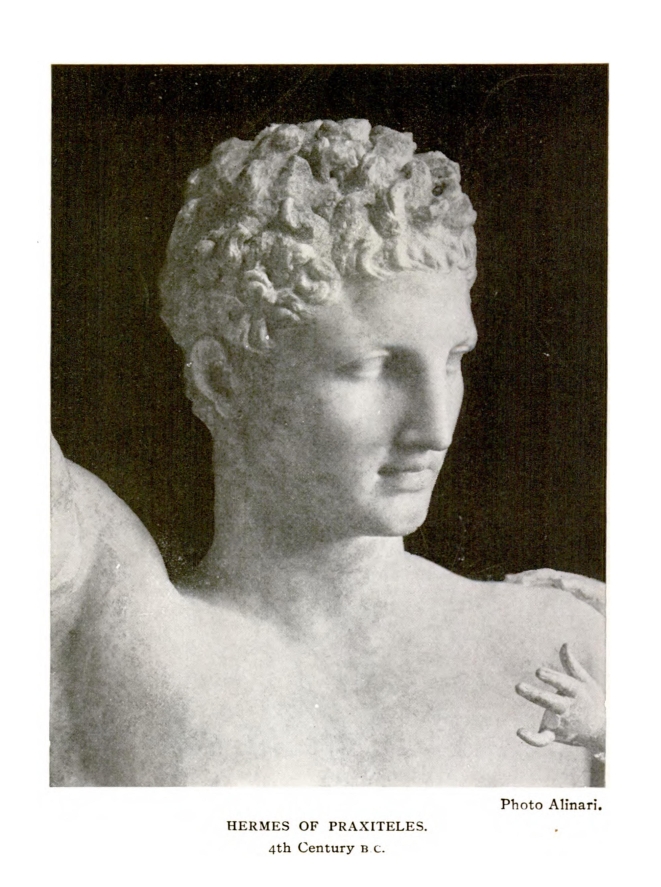
Hermes is best known to us as the messenger of
the gods. When he started out to do their bidding,
beneath his feet he bound on his fair sandals, golden,
divine, that bare him over the waters of the sea and over
the boundless land with the breathings of the wind. And
he took up his wand, wherewith he entranceth the eyes of
such men as he will, while others again he awaketh out of
sleep.[10]
Hermes was the protector of travellers, and he was
the god who took special delight in the life of the
market place. But there was another side to his
character, he was skilful in all matters of cunning
and trickery, and legend delighted in telling of his
exploits. He began early. "Born in the dawn,"
we are told, "by midday well he harped and in
the evening stole the cattle of Apollo the Far
Darter."[11]
Hephaestus was the God of Fire, the divine
metal-worker. He was said to have first discovered the
art of working iron, brass, silver and gold and all
other metals that require forging by fire. His
workshop was on Mount Olympus and here he used
to do all kinds of work for the gods. Perhaps his
most famous piece was the divine armour and above
all the shield he made for Achilles. Some great
quarrel in which he was concerned arose in Olympus,
and Zeus, in rage, threw him out of heaven. All
day he fell until, as the sun was setting, he dropped
upon the isle of Lemnos.
Athena and Hephaestus were always regarded as
benefactors to mankind, for they taught man many
useful arts.
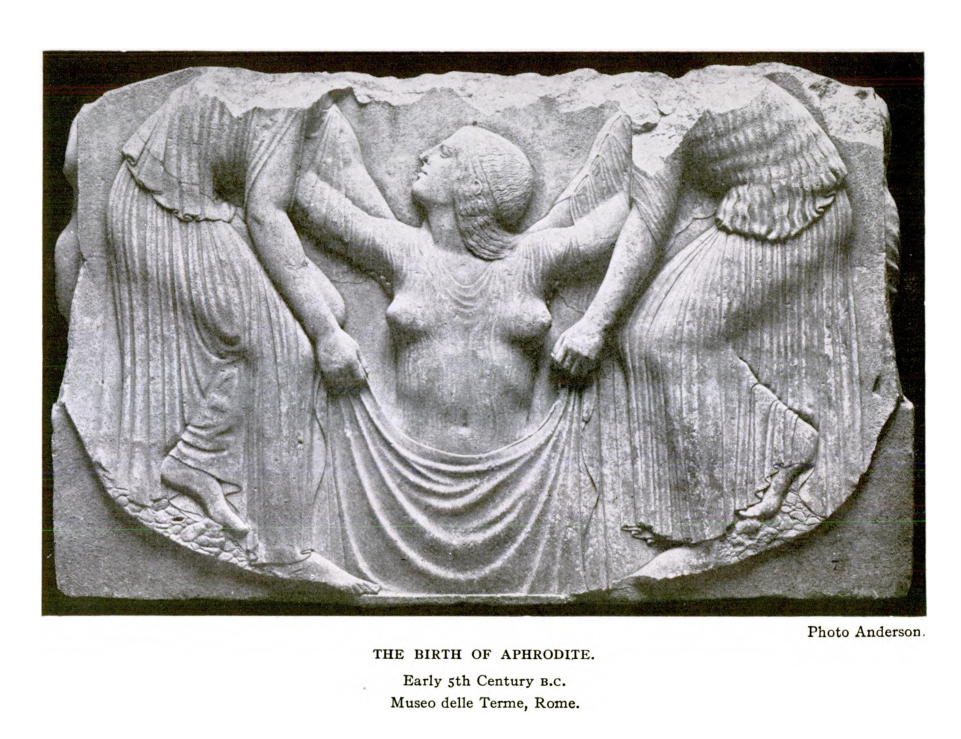
THE BIRTH OF APHRODITE.
Early 5th Century B.C.
Museo delle Terme, Rome.
Sing, Muse, of Hephaestus renowned in craft, who
with grey-eyed Athena taught goodly works to men on
earth, even to men who before were wont to dwell in
mountain caves like beasts; but now, being instructed in
craft by the renowned craftsman Hephaestus, lightly the
whole year through they dwell, happily in their own
homes.[12]
Hestia, the Goddess of the Hearth, played an
important part in the life of the Greeks. Her altar
stood in every house and in every public building,
and no act of any importance was ever performed,
until an offering of wine had been poured on her
altar.
Laughter-loving, golden Aphrodite was the Goddess
of Love and Beauty. She rose from the sea
born in the soft white foam. "She gives sweet gifts
to mortals and ever on her lovely face is a winsome
smile."[13]
To the ancient Greeks the woods and streams, the
hills and rocky crags of their beautiful land were
dwelt in by gods and nymphs and spirits of the wild.
Chief of such spirits was Pan,
the goat-footed, the two-horned, the lover of the din of
the revel, who haunts the wooded dells with dancing
nymphs that tread the crests of the steep cliffs, calling
upon Pan. Lord is he of every snowy crest and mountain
peak and rocky path. Hither and thither he goes,
through the thick copses, sometimes being drawn to the
still waters, and sometimes faring through the lofty crags
he climbs the highest peaks whence the flocks are seen
below; ever he ranges over the high white hills and at
evening returns piping from the chase breathing sweet
strains on the reeds.[14]
These were the chief gods in whom the Greeks
believed. How did they worship them? The centre
of their worship was the altar, but the altars were
not in the temples, but outside. They were also
found in houses and in the chief public buildings of
the city. The temple was looked upon as the home
of the god, and the temple enclosure was a very
sacred place. A man accused of a crime could flee
there and take refuge, and once within the temple,
he was safe. It was looked upon as a very dreadful
thing to remove him by force, for it was believed
that to do so would bring down the wrath of the god
upon those who had violated the right of sanctuary.
In the houses the altars were those sacred to
Hestia, to Apollo and to Zeus. The altar of Hestia
stood in the chief room of the house, a libation was
poured out to her before meals, and special sacrifices
were offered on special occasions; always before
setting out on a journey and on the return from it,
and at the time of a birth or of a death in the house.
The altar of Apollo stood just outside the door.
Special prayers and sacrifices were offered at this
altar in times of trouble, but Apollo was not
forgotten in the time of joy: those who had travelled
far from home stopped to worship on their return;
when good news came to the house sweet-smelling
herbs were burnt on his altar, and a bride took
sacred fire from it to offer to Apollo in her new home.
The Greeks had no stated day every week sacred
to the gods, but during the year different days were
looked upon as belonging specially to particular gods.
Some of these days were greater than others and
were honoured by public holidays. Others caused
no interruption in the every-day life.
Priests were attached to the temples, but sacrifices
on the altars in the city or in the home were
presented by the king or chief magistrate and by the
head of the household. The Greeks did not kneel
when they prayed, but stood with bared heads.
Their prayers were chiefly for help in their
undertakings. They prayed before everything they did:
before athletic contests, before performances in the
theatre, before the opening of the assembly. The
sailor prayed before setting out to sea, the farmer
before he ploughed and the whole nation before
going forth to war. Pericles, the great Athenian
statesman, never spoke in public without a prayer
that he might "utter no unfitting word."
As time went on, the gods of Olympus seemed less
near to mortal men, and they gradually became less
personalities than symbols of virtues, and as such
they influenced the conduct of men more than they
had done before. Athena, for example, became for
all Greeks the symbol of self-control, of steadfast
courage and of dignified restraint; Apollo of purity;
and Zeus of wise counsels and righteous judgments.
A particular form of worship specially practised
by the Athenians was that known as the Sacred
Mysteries, which were celebrated every autumn and
lasted nine days. This worship centred round
Demeter and was celebrated in her temple at Eleusis
near Athens. Demeter was the Corn-Goddess and
it was the story of her daughter Persephone who
was carried off by Hades, lord of the realm of the
dead, that was commemorated in the Sacred Mysteries.
Her daughter was playing and gathering flowers, roses
and crocuses and fair violets in the soft meadow, and lilies
and hyacinths, and the narcissus. Wondrously bloomed
the flower, a marvel for all to see, whether deathless gods
or deathly men. From its root grew forth a hundred
blossoms, and with its fragrant odour the wide heaven
above and the whole earth laughed, and the salt wave
of the sea. Then the maiden marvelled and stretched
forth both her hands to seize the fair plaything, but the
wide earth gaped, and up rushed the Prince, the host of
many guests, the son of Cronos, with his immortal horses.
Against her will he seized her and drove her off weeping
and right sore against her will, in his golden chariot, but
she cried aloud, calling on the highest of gods and the
best ... and the mountain peaks and the depths of
the sea rang to her immortal voice.[15]
Demeter heard the cry, but could not save her
daughter, and she went up and down the world
seeking her. She reached Attica and was kindly
treated, though the people did not at first know she
was a goddess. When she had revealed herself to
them, she commanded them to build her a temple
at Eleusis. But still her daughter did not return
to her, and the gods of Olympus took no heed of her
lamenting. Then she put forth her power as Goddess
of the Corn, and she caused it to stop growing
over all the earth. A fearful famine followed, and
Zeus tried to persuade her to relent. But she
declared that "she would no more forever enter on
fragrant Olympus, and no more allow the earth to
bear her fruit until her eyes should behold her
fair-faced daughter."[16]
At last Zeus consented to interfere and sent
Hermes to bring Persephone back to the earth.
When Persephone saw the messenger, "joyously and
swiftly she arose and she climbed up into the golden
chariot and drove forth from the halls; nor sea, nor
rivers, nor grassy glades, nor cliffs could stay the
rush of the deathless horses,"[17] until they reached the
temple where dwelt Demeter, who when she beheld
them rushed forth to greet her daughter. But
before leaving Hades, the God had given Persephone
a sweet pomegranate seed to eat, a charm to prevent
her wishing to dwell forever with Demeter, and it
was then arranged that Persephone should dwell
with Hades, the lord of the realm of the dead, for
one-third of the year, and for the other two-thirds
with her mother and the gods of Olympus.
This was the story round which centred the
worship of the Sacred Mysteries at Eleusis. There
came a time when the worship of the gods of Olympus
did not satisfy the longings of the Greeks for some
assurance that the soul was immortal and that there
was a life after the death of the body. Demeter
grew to be a symbol to the Greeks of the power of
the gods to heal and save and to grant immortality.
Her story became an allegory of the disappearance
of the corn and fruit and flowers in the winter and
of their return in the spring, bringing with them
gifts to men of hope and life. At the festival of
Eleusis, a kind of mystery play on the whole legend
was acted. All those who attended the festival
were required to prepare for it by a certain ritual
of fasting and sacrifice, and it was believed that in
the life after death all would be well with those who
had taken part in the festival with pure hearts and
pure hands.
The greatest religious influence in Greece was
probably that of the Oracle. This was the belief
that at certain shrines specially sacred to certain
gods, the worshipper could receive answers to
questions put to the god. In very early times signs
seen in the world of nature were held to have special
meanings: the rustling of leaves in the oak-tree, the
flight of birds, thunder and lightning, eclipses of
both the sun and moon or earthquakes. It is easy
to understand how this belief arose. A man,
perplexed and troubled by some important decision he
had to make, would leave the city with its bustle
and noise, and go out into the country where he
could think out his difficulty alone and undisturbed.
Perhaps he would sit under a tree, and as he sat
and thought, the rustling of the leaves in the breeze
would soothe his troubled mind and slowly his duty
would become clear to him, and it would seem to
him that his questions were answered. Looking up
to the sky he would give thanks to Zeus for thus
inspiring him with understanding. On his return
home he would speak of how he had heard the voice
of Zeus speaking to him in the rustling of the leaves,
and so the place would gradually become associated
with Zeus, and others would go there and seek
answers to their difficulties, hoping to meet with the
same experience, until at last the spot would become
sacred and a shrine would be built there, and it
would at length become known from far and near as
an Oracle. Plato said of these beginnings of the
oracles that "for the men of that time, since they
were not so wise as ye are nowadays, it was enough
in their simplicity to listen to oak or rock, if only
these told them true." Other places would in the
same way become associated with other gods, until
seeking answers at Oracles became a well-established
custom in Greece.
The great oracles of Zeus were at Olympia, where
the answers were given from signs observed in the
sacrifices offered, and at Dodona, where they were
given from the sound of the rustling of the leaves in
the sacred oak-tree. But the greatest oracle in all
Greece was that of Apollo at Delphi. It was at
Delphi that Apollo had fought with and slain the
Python, and it was thought that he specially
delighted to dwell there, and had himself chosen it as
the place where he would make known his will.
Here methinketh to stablish a right fair temple, to be
a place of oracle to men, both they that dwell in rich
Peloponnesus and they of the mainland and sea-girt
isles, seeking here the word of wisdom; to them all shall I
speak the decree unerring, rendering oracles within my
wealthy shrine.[18]
Delphi had been sacred to Apollo ever since these
legendary days, and a great shrine and temple was
built there in his honour.
When a Greek came to consult Apollo, he had first
to offer certain sacrifices, and he always brought
with him the richest gifts he could afford which were
placed in the treasury of the god. Then he entered
the temple and placed his request in the hands of a
priest, who took it into the innermost sanctuary and
gave it to the prophetess, whose duty it was to
present the petition to the god himself and receive the
answer. In ancient times it was believed that a
mysterious vapour arose in this sanctuary through
a cleft in the rocky floor, and that this vapour,
enveloping the prophetess, filled her with a kind of
frenzy in the midst of which she uttered the words
of the answer given her by Apollo. This answer
was written down by the priests and often turned
into verse by them and then taken out to the
enquirer. Sometimes these answers were quite plain
and straightforward, such as the one which has
remained true through all the ages. It was the
oracle from Apollo at Delphi which said of the poet
Homer: "He shall be deathless and ageless for
aye." But sometimes the answers were like a riddle that
required much thinking over to understand, and
sometimes they were so worded that they might
mean either of two things, each the opposite of the
other! The oracle at Delphi was frequently consulted
by the Greeks at great crises of their history,
and it had great influence. It was the priests who
in writing down the answer really determined its
nature. They were men who were in constant touch
with distant places, they had had much experience
with human nature, and they were well fitted to
give guidance and advice in all kinds of difficult
matters. The oracle at Delphi was thus a power
in the worldly affairs of the Greeks, but it was more
than that, it was also a source of moral inspiration.
It encouraged all manner of civilization and the
virtues of gentleness and self-control, it marked the
great reformers with its approval, it upheld the
sanctity of oaths, it encouraged respect and reverence
for women. On one of the temples were inscribed
the sayings "Know thyself" and "Nothing in
excess." It was said that these had been placed there
by the ancient sages, and in later times they became
famous as maxims in the teaching of the great
philosophers.
The oracle was not always right in its interpretations;
it sometimes failed in seizing the highest
opportunities that lay before it, but as Greek history
unfolds itself before us, we can see a gradual raising
of moral standards, which was due in great measure
to the influence of the oracle of Apollo at Delphi.
The Greeks were bound together by their language,
by their religion, and also by their great
national games. The origin of these games is still
somewhat in doubt. They probably began as some
kind of religious ceremony in connection with burials,
such as the Funeral Games described by Homer
that were held in honour of Patroclus. But whatever
may have been their origin, they were firmly
established in the earliest times of historic Greece.
Greece was never free for long at a time from
warfare. The very fact that the country was divided
into so many small and independent states bred
jealousies and hatreds, and state was often at war
with state. This made it necessary that every Greek
citizen should be ready at any moment to take up
arms in defence of his home, and so he had to be
physically always in good condition. This was
brought about by regular athletic training which
was an important part of the education of every
Greek. It was considered just as bad to have an
ill-trained body as it was to have an ill-trained mind,
and one reason why the Greeks so despised the
barbarians, as they called all those who were not of
Greek race, was because the barbarian did not train
his body to the same extent, and because he loved
so much luxury.
All Greeks, then, received athletic training, and
this training aimed at developing a beautiful body,
for it was believed that to run gracefully was as
important as to run swiftly, but though the Greeks
loved contests and competition and strove hard for
the victory, because they cared so much for grace of
movement they did not lay much stress on record-breaking,
and so they kept no records of exceptional
athletic feats, which prevents us from knowing
details of some of their great athletic achievements.
Games were held in nearly every Greek city and
were a source of great pride to the citizens. The
more important festivals were those held in honour
of Poseidon at Corinth and called the Isthmian
Games, those at Delphi which commemorated the
slaying of the Python by Apollo and called Pythian
Games, and the greatest of all, held every four years
at Olympia in honour of Zeus, and known as the
Olympic Games. These games were the oldest in
Greece and they were at all periods the most
important. The first were held, if tradition tells
truly, before Greece had begun her history, and the
last long centuries after she had ceased to be a free
state. The first games in historic times were held
in 776 B.C. and the interval between each festival
was called an Olympiad. These Olympiads constituted
the Greek calendar, which took 776 B.C. as
its starting point.
This great festival at Olympia was held in August
or September and lasted five days. It was a national
affair and Greeks from all over the Greek world went
to Olympia to take part in it. For a whole month a
truce was proclaimed throughout Greece, all warfare
had to stop, and all ordinary business and pleasure
gave way to the greater business of going to Olympia.
The games were usually held from the eleventh to
the sixteenth day of this month of truce, the days
before and after being given up to the journey to and
from Olympia. All roads were declared safe for
these days, and great was the punishment meted out
to any who dared molest the pilgrims to Olympia,
for they were going to pay honour to Zeus and were
considered as specially under his protection. Visitors
thronged every road and they came from every
direction. They came from all the Peloponnesian
states, from Corinth, Athens and Thebes. They
came from the far-off Greek colonies, some from the
shores of the Black Sea, looking almost like the
nomads with whom they came so much in contact;
some from Ionia, men clad in rich robes and of
luxurious habits learnt from their Oriental
neighbours; others from the western colonies, from Italy
and Southern Gaul; and yet others, dark and
warm-blooded men, from distant Africa. Yet all were
Greeks, bound together in spite of their differences
by the common ties of blood and religion. Some
were rich, and were accompanied by slaves who
brought everything necessary for their comfort,
others were poor, who tramped the roads footsore
and weary, but sustained by the thought of the joys
of the festival when they reached their goal.
The gathering together of so many visitors brought
all kinds of people to Olympia: merchants with rich
and rare goods for sale, for a regular fair was carried
on during the festival, makers of small statues hoping
for orders to be placed in the temples, poets who
wanted to recite their poems, musicians ready to
play on their lyres to any who would listen,
gymnastic trainers from all over Greece who hoped to
learn some new method that would improve their
own teaching, people of all and every kind. Only
there were no women. The games were considered
too public a festival for it to be fitting for women to
be present, and the journey was too long and difficult
for them to undertake it. The women who lived
near Olympia had a festival of their own, when they,
too, raced and were awarded prizes, but it was at a
different time from the great national festival.
There was no city at Olympia and but few buildings
beyond the temples, so when the throng of
visitors arrived, the first thing they did was to
provide sleeping quarters for themselves. Certain
people were allowed to sleep in some of the porticoes
of the buildings connected with the temples, others
had brought tents and a regular camp arose. Booths
of all kinds were erected in which the merchants
displayed their wares; friends and acquaintances
from different parts of Greece met and talked over
all that had happened to them since they last met.
Many announcements, too, were made by heralds
at this time; the terms of treaties between different
Greek states were recited in public, for in those days
of difficult communication between states, such a
gathering as that at Olympia ensured that news
made public then would be widely spread amongst
the different states.
Then there were visits to be made to the great
temple of Zeus and sacrifices to be offered. From
the middle of the fifth century B.C. onwards every
visitor to Olympia went reverently into the temple
to gaze at the great statue of Zeus.[1] This statue
was said to be so marvellously wrought that "those
who enter the temple there no longer think that they
are beholding the ivory of India and gold from
Thrace, but the very deity translated to earth by
Pheidias," and it was said that to have made such
a life-like image of the god, either Zeus must have
come down from heaven and shown himself in a
vision to Pheidias, or Pheidias must have gone up
to heaven and beheld him there.
The god is seated on a throne, he is made of gold and
ivory, on his head is a wreath made in imitation of the
sprays of olive. In his right hand he carries a Victory,
also of ivory and gold; she wears a ribbon, and on her
head is a wreath. In the left hand of the god is a sceptre
curiously wrought in all the metals; the bird perched on
the sceptre is an eagle. The sandals of the god are of
gold, and so is his robe. On the robe are wrought
figures of animals and lily flowers. The throne is adorned
with gold and precious stones, also with ebony and ivory;
and there are figures painted, and images wrought on it.[2]
It is said that "when the image was completed
Pheidias prayed that the god would give a sign if
the work were to his mind, and immediately, they
say, Zeus hurled a thunderbolt into the ground."[3]
"Fare ye to Olympia," said an ancient writer, "that
ye may see the work of Pheidias, and account it a
misfortune, each of you, if you die with this still
unknown." And so gracious and full of
loving-kindness was the face of the god, that
if any one who is heavy-laden in mind, who has drained
the cup of misfortune and sorrow in life, and whom sweet
sleep visits no more, were to stand before this image,
he would forget all the griefs and troubles of this mortal
life.[4]
But what of the competitors in the games? They
had all been at Olympia for the last thirty days
undergoing a final and special training. Only men of
pure Greek blood might compete, and no one who
had been convicted of any crime or who was guilty
of any impiety or disrespect to the gods. Each
candidate had to prove that in addition to his regular
athletic training, he had received special training for
ten months before coming to Olympia. When they
had practised for the last time, the competitors were
addressed by one of the officials in charge. He said
to them:
If you have exercised yourself in a manner worthy of
the Olympic Festival, if you have been guilty of no
slothful or ignoble act, go on with a good courage. You
who have not so practised, go whither you will.[5]
The names of those who were to enter for the games
were then written up on a white board, and should
a man withdraw after that, he was branded as a
coward. As soon as the competitor was finally
enrolled, a boar was offered in sacrifice to Zeus, and
then he had to take a solemn oath that he was a full
Greek citizen, that he had fulfilled all the conditions
necessary for the games, that he would abide by the
rules of the contest, and that he would play fair, and
such was the spirit of honour and fairness in which
the games were played, that in more than a thousand
years there appear the names of only six or seven
competitors who were guilty of breaking their oath.
The first day of the festival was given up to
sacrifices and processions. The different states always
sent official representatives to the Games, and these
would make public entrance in their chariots, richly
arrayed and bearing costly gifts to place in the
treasury of the temple. The next three days were
devoted to the actual contests.
Long before the dawn on the first of these three
days, every seat in the stadium was occupied. It
was situated at the foot of a hill, and every available
spot on the slope of this hill was used by the
spectators. Should anyone leave his place, even for an
instant, it would be lost, and there the spectators
sat the whole day through, until the sun went down.
What refreshments they needed, they brought with
them. The sun beat down on their bare heads, for
the Games were in honour of Zeus and he was looked
upon as present, and no one might enter the presence
of the Father of Gods and Men with covered head.
Not until the setting sun gave the signal for the
end of the day's contests, did they hurriedly rush off
to their tents and snatch an hour or two of sleep
before the coming of the dawn warned them to rise
and secure their seats for the next day's spectacle.
The contests probably took place in the following
order: First, there were the foot races: there were
several of these varying in length from two hundred
yards to three miles. The shortest race of two
hundred yards was for a long time the race which
brought greatest honour to the winner. Then
followed the pentathlon which consisted of five
contests: throwing the discus, throwing the spear,
running, jumping and wrestling, and the winner was
required to have won three out of the five. In the
pentathlon, in particular, great importance was
attached to the gracefulness of every movement, and
the jumping, discus and spear throwing were
generally accompanied by the music of the flute. Then
came what was later regarded as the greatest and
most exciting race of all, the four-horse chariot race.
This was a race that poets loved to describe. Homer
tells us how the charioteers
all together lifted the lash above their steeds, and smote
them with the reins and called on them eagerly with
words: and they forthwith sped swiftly over the plain;
and beneath their breasts stood the rising dust like a
cloud or whirlwind, and their manes waved on the
blowing wind. And the chariots ran sometimes on the
bounteous earth, and other whiles would bound into the
air. And the drivers stood in the cars, and the heart of
every man beat in desire of victory, and they called
every man to his horses, that flew amid their dust across
the plain.[6]
The boxing and wrestling matches came last, and
these were the roughest and fiercest of all the contests.
On the last day of the festival the prizes were
awarded. They were very simple, but more highly
valued than greater honours could have been. Each
prize consisted of a wreath of olive, which had been
cut from a sacred olive tree with a golden knife by
a boy especially chosen for the purpose, and an old
tradition required that both his parents should be
alive. These wreaths used at one time to be placed
on a tripod in the sight of all the people, later, a
beautiful table of gold and ivory was made for them. A
herald announced the name of the victor, his father's
name and the city from which he came, and then one
of the judges placed the wreath on his head. This
was the proudest moment of his life, and though
other rewards followed on his return home, nothing
ever quite equalled that glorious moment.
The last day of the festival was given up to
sacrifices to Zeus, followed by banquets and feasting
which lasted late into the night. Every kind of
honour was shown the victors: poets wrote odes
celebrating their victories, and sculptors made models
for statues of them, for to every athlete who had won
three victories was granted the honour of being
allowed to have his statue erected in the open space
outside the temple of Zeus.
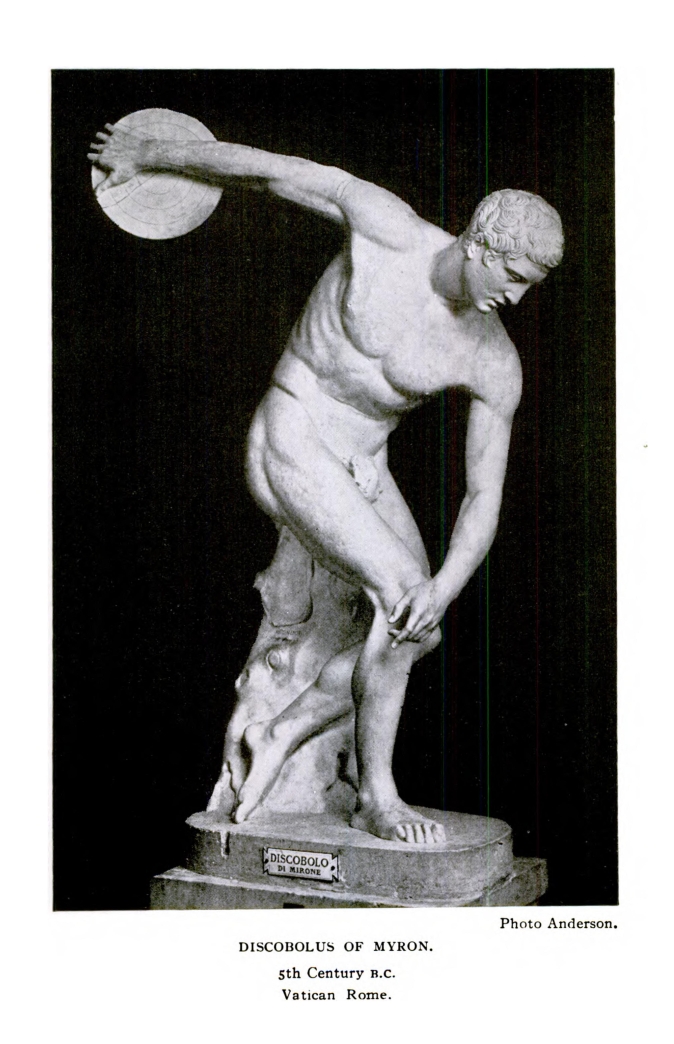
DISCOBOLUS OF MYRON.
5th Century B.C.
Vatican Rome.
The festival over, the victors and their friends and
the great throng of spectators returned to their
homes. The victors were not only proud on
account of their own achievements, but for the glory
they had brought to their city. The news of the
approaching arrival of a victor was sent on ahead, and
the day of his return to his native city was always
honoured by a public holiday. In some places it
was an old custom to pull down a part of the city
wall and make a special entrance, in order that he
who had brought the city such glory might enter by
a path never before trodden by other men. Songs of
triumph were sung to greet him, and he was led to
his father's house along a road strewn with flowers.
Rich gifts were presented to him, and in every way
he was treated as a man whom the city delighted to
respect and honour. At Athens the returning
victors were honoured by being allowed to dine
thenceforth at the public expense in the hall where the
councillors and great men of the city took their meals.
Pausanias, the traveller to whom we owe descriptions
of so much in ancient Greece that has now
perished, visited Olympia, and he tells us that
many a wondrous sight may be seen, and not a few tales
of wonder may be heard in Greece; but there is nothing
on which the blessing of God rests in so full a measure
as the rites of Eleusis and the Olympic Games....
and Pindar, the Greek poet who has most often sung
of the Olympic Games, summed up the feelings of
every victor in the words: "He that overcometh
hath, because of the games, a sweet tranquillity
throughout his life for evermore."
Whenever men live together in communities, no
matter how small they may be, some form of law has
to be observed, in order to maintain order, and that
there may be justice between man and his neighbours.
The form that this law takes in different
places and in different communities is what is called
government.
The earliest form of government in Greece was,
like all primitive government, that of the family, and
the word of the head of the family was law to all
those belonging to it. The land on which they lived
belonged to the family as a whole, not to separate
individuals, and the dead were always buried there,
until in time the family claimed as their own that
land, where they had lived for generations, and where
their ancestors were buried.
After a time it became more convenient for families
to join together and live in one community. By
this means the labour of cultivating the land could
be more evenly distributed, and in times of attack
from enemies, larger and stronger forces could be
used for defence. This grouping of families
together made a village and the strongest and most
capable man in the village would become its chief.
In time, just as families had found it more to their
advantage to group themselves together and form
villages, so did the villages living in the same
neighbourhood find it a better thing to join together and
form a still larger community, which became known
as a kingdom, because instead of having a chief they
were ruled by a king. At first the kings, like the
chiefs, were chosen because of their ability and power,
later the office became hereditary and was handed
down from father to son.
Now because the Greek communities lived in the
plains, separated from each other by mountains,
instead of forming one large kingdom, they formed
a great many small ones. There was in ancient
times no King of Greece, but Athens, Sparta,
Corinth, Thebes and countless other cities had their
own independent forms of government, their own
rulers, their own armies, their own ships, and except
that they were all Greek and were all bound together
by ties of language and religion, they were quite
independent of each other. All these independent
cities became known in time as City-States, for to the
Greek the state meant the city, the territory
immediately surrounding it was included in the state,
but the city was the most important part of it.
All communities are always governed in one of three
ways: either by one man, or by a few men, or by
many men, and the Greeks tried all these ways, until
they found the one that answered best to their ideals
of what a city-state should be. All states did not
develop in the same way, but one stands out from the
others as having most nearly reached the Greek ideal.
That state was Athens. Her story shall be told in
its own place; in this chapter we will see what the
Greeks thought an ideal state should be, and what
they believed to be the duties of a good citizen.
The Greek philosopher Aristotle wrote a book in
which these ideals were set forth.[1] He believed that
the end for which the State existed was that all its
citizens could lead what he called a "good life," and by
that he meant the life which best gives opportunities
for man to develop his highest instincts, and which
makes it possible for every citizen to develop his own
gifts whatever they may be, in the highest and
truest way. To realize such a life there must be law
and order in a state, and Aristotle considered that
the first thing necessary to ensure this was that the
state must not be too large. He believed that the
greatness of a state was not determined by the size
of its territory or the number of its population, but
that though a certain size and certain numbers
helped to make a state dignified and noble, unless
these were combined with good law and order, the
state was not great. States, he said, were like
animals and plants or things made by human art
which, if they are too large, lose their true nature and
are spoilt for use. But how is one to know when the
limit in size and population has been reached? Is
there any test by which it can be discovered whether
a state has grown or is in danger of growing too
large?
Aristotle answered this question by saying that
the state must be large enough to include opportunities
for all the variety and richness of what he
called the "good life," but not so large that the
citizens could not see it or think of it in their minds as
one whole of which they knew all the parts. He also
thought it necessary that the character of all citizens
should be well-known, an impossibility in too large a
community, but how else, he asked, could men elect
their magistrates wisely?
The duty of the State was, then, to ensure the
possibility of a "good life" to all its citizens. What was
the Greek ideal of citizenship? First of all, every
citizen was expected to take a direct and personal
share in all the affairs of the State. To the Greek
there was no separation between private and public
life, all things concerning the State were his affairs,
and it was expected that everyone should have an
opinion of his own, that he should think clearly on
all matters of common interest and not allow
himself to be swayed by his feelings without honestly
thinking the matter out, and to a Greek, thinking
meant straight thinking, the power to know right
from wrong, to judge justly without prejudices or
passion, to separate the important from the
unimportant, and to follow undismayed wherever the truth
might lead.
This belief in the duty of the citizen to be personally
active in the affairs of the State tended to keep
the State small, for if every citizen was to attend the
meetings of the Assembly, the latter must be of such
a size that everyone could be heard if he desired to
speak, and it was necessary that a very short journey
should bring the country-dweller into the city to
attend to the State business, for frequent journeys and
long absences from his farm or his flocks would be
impossible for the countryman.
Further, the Greek believed that wealth was allowed
to a man only as a trust. Certain privileges
and rights came to him because of its possession, but
they were privileges and rights that required of their
owner distinct duties. The more a man had, the
more did the State require of him; he had to give his
time to the making of laws, his wealth built ships,
bore the expense of public festivals, adorned the city
with beautiful buildings, it was spent not on himself
alone, but shared with his fellow-citizens, and given
to that which was their common interest. This
resulted in a passionate devotion of every Greek to his
city, for every individual had a definite share in some
way or other in the making of it, and by the sacrifice
of his life in times of danger, he proved again and
again that he was in very truth ready to die for it.
The ideal city demanded very high standards of
her citizens, and no Greek State attained these
perfectly. But in their search for what they conceived
to be the highest perfection, the Greeks found out
truths both concerning government and the real
meaning of citizenship that have remained one of the
priceless possessions of mankind.
Of all the city-states in Greece, two stand out
from the others as having played the leading part in
Greek history. These two are Athens, which most
nearly approached the ideal city-state, and Sparta,
the foremost military state in Greece.
Sparta was the chief city in the peninsula in the
south of Greece called the Peloponnesus, or the Land
of Pelops, one of the ancient mythical heroes of that
land. During the period of the Greek migrations,
the Peloponnesus was probably the last district to be
settled, and the tribes which came down into it were
called the Dorians. They invaded Laconia, of which
the chief city was Sparta, and settled it and the
surrounding country. Only the citizens of the city
itself were called Spartans; those who owed allegiance
to the city, but who lived in the country outside
were known as Lacedaemonians.
Unlike most other Greek cities, which were well
fortified and defended by a citadel built on high
ground, Sparta, "low-lying among the caverned
hills," had grown out of a group of villages and had
no walls. But if she had no outward signs of security
from her foes, she had the mightiest warriors in
Greece ready to defend her to the utmost. Lycurgus,
the wise man of Sparta, was once consulted as to
whether it would not be a wise thing to build a wall
round the city, and he answered those who came to
him with the words: "The city is well fortified which
hath a wall of men instead of brick."
The Spartans were always afraid of attack from
their slaves. These had been the former inhabitants
of the land and had been conquered and made slaves
by the Spartans. These slaves were called Helots;
they were severely and often cruelly treated by their
masters, and were always ready to revolt when
opportunity came. This was one of the reasons that
made the Spartans spend more time than other
Greeks in military training. This common danger
also had the result of drawing all Spartans very
closely together, and of making them subordinate all
other interests to the supreme duty of protecting the
state.
The Spartans always held Lycurgus to have been
their great lawgiver, though they never agreed as to
when he lived. It is probable that the laws were
not made by one single lawgiver, but that many wise
men, whose names were unknown to later generations,
had helped to create the laws over a long
period of time. As Lycurgus was the wise man whose
name was known to the Spartans, they came to look
back to him as their only lawgiver, because it was by
the government he was supposed to have established
and the laws he made that Sparta became so great a
state. He was the brother of a King of Sparta who
died leaving a child as his heir. Everyone thought
that Lycurgus would take the opportunity to seize
the throne and make himself King, but he declared
that he would only rule until his nephew should be
old enough to become King. Some people, however,
would not believe this, and plots were made
against his life. This decided Lycurgus to leave
Sparta for a time and to visit some other countries
with the intention of learning things from them that
might be of use to his own land. He went first to
Crete, where,
having considered their several forms of government,
and got an acquaintance with the principal men amongst
them, some of their laws he very much approved of and
resolved to make use of them in his own country. From
Crete he sailed to Asia, with design, as is said, to examine
the difference betwixt the manners and rules of life of
the Cretans who were very sober and temperate, and
those of the Ionians, a people of sumptuous and delicate
habits, and so to form a judgment. Lycurgus was much
missed at Sparta, and often sent for, "for kings indeed
we have," the people said, "who wear the masks and
assume the titles of royalty, but as for the qualities of
their minds, they have nothing by which they are to be
distinguished from their subjects."
Lycurgus only, they said, knew both how to rule and
how to make the people obey him.
So Lycurgus returned, but on his way he went to
Delphi to consult Apollo, and the oracle called him
"beloved of God," and said to him:
Lo, thou art come, O Lycurgus, to this rich shrine of
my temple, Beloved thou by Zeus and by all who possess
the abodes of Olympus. Whether to call thee a god, I
doubt, in my voices prophetic, God or a man, but rather
a god I think, O Lycurgus.[2]
The oracle then went on to say "that his prayers
were heard, that his laws should be the best, and the
commonwealth which observed them the most
famous in the world."
On his return to Sparta, the first thing Lycurgus
did was to reform the government. This was now
to consist of three parts: the Kings, the Senate or
Council, and the Assembly. Sparta had always had
two Kings at a time, who succeeded each other from
father to son. It was they who had the right of
commanding the army in war, they were always
accompanied by a bodyguard of specially picked men, at the
public sacrifices and games they had special seats of
honour, and at all banquets and feasts double
portions of everything were served to them. When it
was necessary for the State to consult the Oracle, it
was one of the Kings who decided on the messenger
to be sent.
The Senate or Council consisted of the two Kings
who were members by right of their birth, and of
twenty-eight other men who were elected as Senators
for life. Every candidate had to be sixty years old,
for Lycurgus believed that until a man had reached
that age, he was not wise enough nor fit enough to be
entrusted with the supreme authority over the lives and
highest interests of all his countrymen. The manner of
their election was as follows: the people being called
together, some selected persons were locked up in a room
near the place of election, so contrived that they could
neither see nor be seen, but could only hear the noise of
the assembly without; for they decided this, as most
other affairs of moment, by the shouts of the people.
This done, the competitors were not brought in and
presented all together, but one after another by lot, and
passed in order through the assembly without speaking
a word. Those who were locked up had writing tables
with them, in which they recorded and marked each
shout by its loudness, without knowing in favour of
which candidate each of them was made, but merely
that they came first, second, third, and so forth. He
who was found to have the most and loudest acclamations
was declared senator duly elected. Upon this he
had a garland set upon his head, and went in procession
to all the temples to give thanks to the gods.
The duties of the Senate were to prepare all the
laws and matters of public interest which were to be
brought before the general Assembly; it acted as a
court of justice for criminal cases, and its deliberations
carried great weight.
Every Spartan citizen over thirty years of age was
a member of the Assembly. It was the duty of the
Spartans in the Assembly to give or withhold
approval of all the matters brought before them by the
Senate. It was they who elected the Senators and
all other magistrates, and they declared war and
made peace. In spite of this Assembly of citizens,
the government of Sparta was really in the hands of
the Senate, for the members of the Assembly might
not discuss the laws submitted for their approval,
but only ratify or reject them. At no time were the
ordinary citizens given much opportunity to speak
at length in public. The Spartans did not like long
speeches, and Lycurgus believed that no one should
be allowed to talk much unless he could say a great
deal that was useful and to the point in a few words.
This way of talking became so characteristic of the
men of Laconia, that it was called by their name,
and even today speech that is short and sharp and to
the point is called laconic. Many stories are told of
this Spartan manner of speech. King Leonidas
said once to a man who was speaking about some
important matter, but at the wrong time and place,
"Much to the purpose, Sir, elsewhere"; and one who
kept pressing for an answer to the question "Who is
the best man in Lacedaemon?" received as his answer:
"He, Sir, that is least like you."
Long after the death of Lycurgus, another special
body of men was elected to help in the government.
These men were called Ephors, and there were five of
them. It was their business to watch the conduct of
the Kings, to see that the laws were all carried out
and that order and discipline were maintained in the
state. Probably no other Greek state would have
submitted to such oversight, but the Spartans were
well-disciplined and did not look upon such an office
as one that interfered in any way with their personal
freedom. Plato, writing long after of their authority,
said that it was, "exceedingly like that of a
tyrant."
Having established the government, Lycurgus
next set himself to introduce what he considered good
customs amongst the Spartans. The first thing he
did was to re-distribute the land amongst the
citizens. He found that some were very rich and others
poor, and he determined that they should all live
together sharing in everything alike. So he divided
the land into lots and distributed it equally amongst
all the citizens. After this had been done, and the
time of harvest had come, Lycurgus, "seeing all the
stacks standing equal and alike, smiled, and said to
those about him, 'methinks all Laconia looks like one
family estate just divided among a number of
brothers.'"
During his travels in other parts of the world,
Lycurgus had had opportunities to compare rich
states with poor ones, and he had concluded that the
richest were not always the best governed, and that
wealth did not always bring happiness. He was
determined that the Spartans should become good
soldiers and that they should be great in war, for he
believed that simple habits and simplicity of living
were more easily acquired by a nation of warriors
than by one devoted only to peace. To this end he
wanted to have neither rich nor poor in Sparta, but
that all should be alike. Lycurgus, however, was
wise enough to know that some people would always
manage to make more money or to save more than
others, so instead of dividing up all the money in the
state equally between everyone, he
commanded that all gold and silver coin should be called
in, and that only a sort of money made of iron should be
current, a great weight and quantity of which was but
very little worth; so that to lay up twenty or thirty
pounds there was required a pretty large closet, and, to
remove it, nothing less than a yoke of oxen.
Not only did this prevent any one man from becoming
too rich, but it lessened the crime of theft in
Sparta, for no one would want to steal what was of
no value.
This lack of money also resulted in doing away
with luxuries; for
there was no more means of purchasing foreign goods;
merchants sent no shiploads into Laconian ports; no
gold or silversmith, engraver or jeweller set foot in a
country which had no money, so that luxury wasted
to nothing and died away of itself.
Everything needed in their houses had to be made by
the Spartans themselves, with only the simplest
tools, and the houses were roughly built. The law
required that the
ceilings of their houses should only be wrought by the
axe, and their gates and doors smoothed only by the
saw, and as no man would furnish such plain and
common rooms with silver-footed couches and purple
coverlets and gold and silver plate,
all Spartans grew accustomed to the plainest and
simplest surroundings.
It is reported that one of their Kings was so little used
to the sight of any other kind of work, that being
entertained at Corinth in a stately room, he was much
surprised to see the timber and ceiling so finely carved and
panelled, and asked his host whether the trees grew so
in his country.
The last law made by Lycurgus to ensure simplicity
of living was that all Spartan men and youths
should eat at common dining-tables, and they were
only allowed to eat such food as was permitted by
the law. Each table seated about fifteen men, who
shared in providing the food; each of them was
"bound to bring in monthly a bushel of meal, eight
gallons of wine, five pounds of cheese, two and a half
pounds of figs and some very small sum of money to
buy flesh and fish with." All the food was prepared
in a very simple manner, but "their most famous dish
was the black broth, which was so much valued that
the elderly men fed only upon that, leaving what
flesh there was to the younger." Other Greeks,
however, thought this black broth very disagreeable.
It was the custom that at any one table, only those
should sit who were friendly to each other. When a
newcomer wanted to join a certain table, all those
already seated at it voted as to whether they would
have him or not. An urn was passed round the table
and everyone present dropped into it a small ball of
bread. Those who voted for the newcomer dropped
their balls without altering their shape, those who
voted against him flattened the ball with their fingers
before placing it in the urn. One flat ball was enough
to exclude a man from the table.
When dinner was over, "every man went to his
home without lights, for the use of them was on all
occasions forbidden, to the end that they might
accustom themselves to march boldly in the dark."
Lycurgus was determined that every Spartan
should be so trained that he might become a good
soldier, and some of his most important laws
concerned the education of children. As soon as a child
was born, he was carried to
the elders of the tribe to which he belonged; their business
it was carefully to view the infant, and if they found
it stout and well-made, they gave order for its rearing,
but if they found it puny and ill-shaped, ordered it to be
taken to a cavern on Mount Taygetus, where it was left
to perish, for they thought it neither for the good of the
child itself, nor for the public interest that it should be
brought up, if it did not, from the very outset, appear
made to be healthy and vigorous.
There was a belief in Sparta that wine was more
strengthening than water for a bath, and so the first
bath a baby had was always in wine.
There was much care and art, too, used by the nurses;
the children grew up free and unconstrained in limb and
form, and not dainty and fanciful about their food; not
afraid in the dark, or of being left alone; without any
peevishness or ill-humour. Upon this account, Spartan
nurses were often hired by people of other countries.
At the age of seven, Spartan boys left their homes
and their mothers, and the State took charge of the
rest of their education.
As soon as they were seven years old they were to be
enrolled in certain companies and classes, where they
all lived under the same order and discipline, doing their
exercises and taking their play together. Of these, he
who showed the most conduct and courage was made
captain; they had their eyes always upon him, obeyed his
orders, and underwent patiently whatsoever punishment
he inflicted; so that the whole course of their education
was one continued exercise of a ready and perfect
obedience. Reading and writing they gave them, just
enough to serve their turn; their chief care was to make
them good subjects, and to teach them to endure pain
and conquer in battle.
As they grew older, Spartan boys were taught to
undergo all kinds of hardships. They wore very
little clothing, even in the cold of winter, and one coat
had to serve them for a year.
After they were twelve years old they lodged together
in little bands upon beds made of the rushes which grew
by the banks of the river Eurotas, which they were to
break off with their hands without a knife. The old
men had an eye upon them at this time, coming often
to the grounds to hear and see them contend either in
wit or strength with one another, and this seriously
and with much concern; so that there scarcely was any
time or place without someone present to put them in
mind of their duty, and punish them if they had neglected
it.
Besides all this, there was always one of the best and
honestest men in the city appointed to undertake the
charge and governance of them; he again arranged them
into their several bands, and set over each of them for
the captain the most temperate and boldest of those
they called Irens, who were usually twenty years old.
This young man, therefore, was their captain when they
fought, and their master at home, using them for the
offices of his house; sending the oldest of them to fetch
wood, and the weaker and less able, to gather salads and
herbs and these they must either go without or steal;
which they did by creeping into the gardens, or conveying
themselves cunningly and closely into the eating-houses;
if they were taken in the act, they were whipped without
mercy, for thieving so ill and awkwardly. They stole,
too, all other meat they could lay their hands on, looking
out and watching all opportunities, when people were
asleep or more careless than usual.
If they were caught, they were not only punished with
whipping, but hunger too, for they were then
reduced to their ordinary allowance, which was
purposely kept very small, in order to force them to use
cunning and skill if they wanted to add to it. "So
seriously did the Lacedaemonian children go about
their stealing, that a youth having stolen a young
fox, and hid it under his coat, suffered it so to tear
with its teeth and claws, that he died rather than
let it be seen."
In every way the Spartan youths as they grew up
were severely disciplined. Every year the older
boys were whipped in public before the altar of
Artemis, in order to teach them to endure pain
without crying out, and it is said that some boys died
under this whipping rather than utter a complaint.
The Iren used to stay a little with them after supper,
at which time he would bid one of them sing a song, to
another he put a question which required an advised and
deliberate answer; for example, Who was the best man
in the city? What he thought of such an action of such
a man? They accustomed them thus early to pass a
right judgment upon persons and things, and to inform
themselves of the abilities or defects of their countrymen.
Besides this, they were to give a good reason for
what they said, and in as few words as might be; he that
failed of this, or answered not to the purpose, had his
thumb bit by his master. Sometimes the Iren, did this
in the presence of the old men and magistrates, that they
might see whether he punished justly or not; and when
he did amiss, they would not reprove him before the
boys, but, when they were gone, he was called to account,
and underwent correction, if he had run far into either
of the extremes of indulgence or severity.
Furthermore, in his desire firmly to implant in their
youthful souls a root of modesty Lycurgus imposed upon
these bigger boys a special rule. In the very streets they
were to keep their two hands within the folds of the
cloak; they were to walk in silence and without turning
their heads to gaze, now here now there, but rather to
keep their eyes fixed upon the ground before them. And
you might sooner expect a stone image to find a voice
than one of those Spartan youths; to divert the eyes of
some bronze statue were less difficult.[3]
Not very much time was spent by the boys in
learning to read and write; most of their education
was given to their gymnastic training, to running,
jumping, boxing and wrestling, and to every kind of
exercise that would fit them to be brave and hardy
soldiers. They learnt some music, chiefly singing,
but they only sang such songs as would put life and
spirit into them, and their battle songs were sung
with great enthusiasm.
During a war, the Spartan young men were treated
a little less severely than when in training at home.
They were allowed to curl and adorn their hair, to
have costly arms and fine clothes. They had better
clothes, too, and their officers were not so strict with
them. They marched out to battle to the sound of
music. "It was at once a magnificent and terrible
sight to see them march on to the tune of their flutes,
without any disorder in their ranks, any discomposure
in their minds or change in their countenance,
calmly and cheerfully moving with the music to the
deadly fight."
Spartan discipline did not end when the boys and
youths had become men.
Their discipline continued still after they were grown
men. No one was allowed to live after his own fancy;
but the city was a sort of camp, in which every man had
his share of provisions and business set out, and looked
upon himself not so much born to serve his own ends as
the interest of his country.
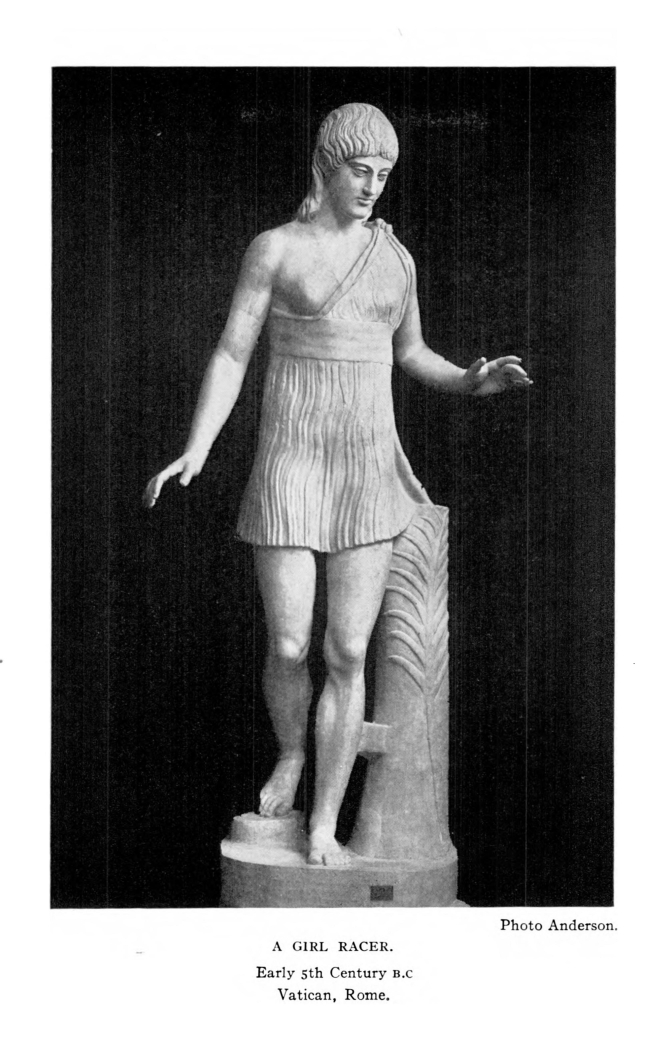
A GIRL RACER.
Early 5th Century B.C
Vatican, Rome.
The girls were educated at home, but, like the
boys, they were given a gymnastic training, and they
learned to run and wrestle, to throw the quoit and
dart, and to be as strong and brave as their brothers.
As the Spartan boys were trained to become good
soldiers, ready to die for Sparta, so were the girls
trained to become good wives and mothers of Spartan
men, and if they could not themselves die for their
country, to be willing to sacrifice those whom they
loved the best. Every Spartan when he went to
war, carried a shield that was so heavy that if he fled
from the enemy, he would have to throw it away,
so it was considered a great disgrace to return home
without one's shield; if he died in battle the Spartan
was carried home upon it. The Spartan mothers
knew this, and when they said farewell to their sons
who were setting out to war, they bade them return
home with their shields or upon them.
The Spartans held their women in great honour;
they listened to their counsel and often acted upon it.
A lady of another city once said to a Spartan, "You
are the only women in the world who can rule
men." "With good reason," was the answer, "for we are
the only women who bring forth men."
Having established all these laws and customs,
Lycurgus forbade the Spartans to travel, for he was
afraid that contact with foreign people would teach
them bad habits and make them discontented with
their simple way of living. "He was as careful to
save his city from the infection of foreign bad habits,
as men usually are to prevent the introduction of a
pestilence."
At last the time came when Lycurgus felt that his
laws and customs were firmly established, and that
they were all familiar to the people, but he was
afraid that after his death they might be changed.
So he thought of a plan whereby he might make
them last forever. He called a special Assembly of
the people together and told them that everything
was well-established, but that there was still one
matter on which he would like to consult the Oracle.
Before he departed on this journey, he made the two
Kings, the Senate and the whole Assembly take a
solemn oath that they would observe his laws without
the least alteration until his return. "This done,
he set out for Delphi, and having first offered a
sacrifice to Apollo, he asked the god whether his laws were
good and sufficient for the happiness and virtue of
his people." The Oracle answered that the laws
were excellent, and that the state which kept them
should be greatly renowned. Lycurgus sent this
oracle in writing to Sparta, and then having once
more offered a solemn sacrifice, he took leave of his
friends, and in order not to release the Spartans from
the oath they had taken, he put an end to his own
life, thus binding them to keep his laws for ever. Nor
was he deceived in his hopes, for Sparta continued to
be one of the greatest of the Greek states, so Plutarch
tells us, as long as she kept the laws of Lycurgus.
Athens was the most beautiful city in Greece. It
grew up at the foot of the high rock known as the
Acropolis, which in the earliest times was the citadel
that defended the city. The Acropolis had very
strong walls, and the main entrance was guarded by
nine gates, which must have made it almost impossible
for an enemy to take, and there was a well within
the fortress, so that there was always water for those
who defended it. But history has told us almost
nothing about the mighty lords who built this fortress
or about the life of the people over whom they
ruled.
But if history is silent, legend has much to say.
The earliest rulers of Athens were Kings, and of
these one of the first was Cecrops. All kinds of
stories gathered round his name, and it was
believed that he was not altogether human, but a being
who had grown out of the earth and was half-man
and half-serpent. It was when he was King that
the contest took place as to whether Athena, the
grey-eyed Goddess of Wisdom, or Poseidon, Lord of
the Sea, should be the special guardian of the city.
The victory was awarded to Athena, who, taking her
spear, thrust it into the ground, whereupon an olive
tree marvellously appeared. Poseidon gave the
horse as his gift to Athens, and legend adds that,
striking the rock with his trident, he brought forth
clear salt water, which he also gave to the Athenians.
For all time the olive was associated not only with
Athena, but with Attica and Athens her city, and to
the Athenian, the sea became almost like a second
home.
The ancient kings claimed descent from the gods.
They were not only the lawgivers, but they acted as
judges, as chief priests, and in time of war as generals.
All who were oppressed had the right to appeal to
the judgment seat of the King and his decisions were
final. Though the King was the supreme ruler,
there were assemblies of the chief men, always called
the Elders, and of the People, who met whenever the
King called them together. These gatherings are
important, not because of any real power they
possessed in early times, for they only met to hear
what the King intended to do and never to
discuss, but because it was from these assemblies
that the power of the people to govern themselves
developed.
The greatest of the early Kings was Theseus, he
who slew the Minotaur and freed Athens from paying
tribute to Minos the Sea-King of Crete. His greatest
claim to be held in the remembrance of his countrymen
was that it was believed to have been Theseus
who united all Attica under the leadership of Athens.
Before this time all the towns and villages in Attica
had been independent, but he "gathered together all
the inhabitants of Attica into one town, and made
them people of one city ... and gave the name of
Athens to the whole state."[1] Legend tells of him
that he was good and merciful to all who were in need,
and a protector of all who were oppressed, but he
offended the gods in some way, and died in exile far
from Athens. Long centuries after, Cimon, an
Athenian general, took possession of the island in
which it was said that Theseus had been buried.
Cimon
had a great ambition to find out the place where Theseus
was buried and by chance spied an eagle on a rising
ground, when on a sudden it came into his mind, as it
were by some divine inspiration, to dig there, and search
for the bones of Theseus. There were found in that
place a coffin of a man of more than ordinary size, and a
brazen spear-head, and a sword lying by it, all of which
he took aboard his galley and brought with him to
Athens. Upon which the Athenians, greatly delighted,
went out to meet and receive the relics with splendid
processions and with sacrifices, as if it were Theseus
himself returning alive to the city. His tomb became a
sanctuary and refuge for slaves, and of all those of mean
condition that fly from the persecution of men in power,
in memory that Theseus while he lived was an assister
and protector of the distressed, and never refused the
petitions of the afflicted that fled to him.[2]
It is not known with any certainty how long the
rule of the Kings lasted in Athens, but they seem to
have slowly lost their power and at last other
magistrates were appointed to help them rule. The
earliest Kings had been hereditary rulers; when they
became less powerful, though they were no longer
the sole rulers of Athens, these hereditary Kings still
kept their office for life. Later they ruled for life
but were elected; the next change made was to elect
a new king every ten years, and at last the greatest
change of all took place when the old office of King
was done away with, and the power that had once
been in the hands of one man was entrusted to three:
the Archon, a Greek title meaning ruler, who was the
chief representative of the State and who gave his
name to the year, the King-Archon, who was the
chief priest and who had authority over all the
sacrifices offered by the State, and the Polemarch, or
War-Archon, who was the chief general. Six other
archons were also elected whose duty it was to assist
the others and to see that the laws of the State were
obeyed.
Not everyone could be an Archon; only men from
noble families could be elected, and so the power
passed into the hands of a few men. The rule of a
few is called an oligarchy, and it was the second step
the Athenians took on their way to be a self-governing
community.
At first this rule was good, for by experience the
nobles learnt a great deal about the art of governing;
they realised that order was better than disorder in a
state, and they set high standards of devotion to
public duty. But the nobles all belonged to one
class of people, they were the best educated and the
more wealthy, and instead of using their advantages
of position and education and wealth as a trust for the
good of the whole state (the ideal developed in later
years by the Athenians), they grew to consider these
things their own exclusive property and they became
very narrow and intolerant. They considered
themselves in every way superior to the common people,
and began to make laws which benefited themselves
alone, ignoring the rights of others, especially those
of the poor.
Now the nobles had acquired their power because
of their opposition to the rule of one man, but when
the authority had been placed in their hands, they
proved themselves equally unable to be just towards
all, and their rule became as intolerant as that of
the Kings. Then it was that their authority was
questioned in its turn, and the people began to ask
each other questions. What is the difference, they
asked, between rich and poor, between the noble and
the plain man, between the freeman and the slave?
Who, they asked, are citizens, and what does it mean
to be a citizen? The more the people questioned, the
greater grew the oppression and injustice of the
nobles, and conditions in Athens grew very bad.
Many things helped to create this spirit of discontent:
there had been wars, the harvests had been bad
and famine had resulted, and there were very harsh
laws which allowed debtors who could not pay their
debts to sell themselves as slaves. Quarrels arose,
and more and more the people questioned as to the
justice of all this. They said:
But ye who have store of land, who are sated and overflow,
Restrain your swelling soul, and still it and keep it low;
Let the heart that is great within you be trained a lowlier way;
Ye shall not have all at your will, we will not forever obey.[3]
It was at this time of confusion and distress that
Solon, one of the Seven Wise Men of Greece,
appeared. By birth he was a noble, but he was a poor
man and in the early part of his life he had been a
merchant. There came a time later when the merchant
was not looked upon as the equal of the noble,
for Plutarch, in writing the life of Solon about seven
hundred years after his death, makes an apology for
his having been engaged in trade.
In his time, as Hesiod says, "Work was a shame to
none," nor was any distinction made with respect to
trade, but merchandise was a noble calling, which
brought home the good things which the barbarous
nations enjoyed, was the occasion of friendship with their
kings, and a great source of experience.
Solon enjoyed the experience of travelling and seeing
new things, a delight that remained with him even to
the days of his old age, for when he was old he
would say that he
Each day grew older, and learnt something new.
Just before this time Athens had been at war with
Megara, a neighbouring state, over the possession of
Salamis, which had formerly belonged to Athens, an
island so near the Athenian harbour that it was
absolutely necessary that it should belong to Athens.
But the war had been long and unsuccessful, and no
victory had been gained by either side. The Athenians
were so "tired with this tedious and difficult
war that they made a law that it should be death for
any man, by writing or speaking, to assert that the
city ought to endeavour to recover the island." Solon
felt this to be a great disgrace, and knowing
that thousands of Athenians would follow, if only one
man were brave enough to lead, he composed some
fiery verses which he recited in the market place.
I come as a herald, self-sent, from Salamis, beautiful island,
And the message I bring to your ears, I have turned it into a song.
Country and name would I change, rather than all men should say,
Pointing in scorn, "There goes one of the cowardly, lazy Athenians,
Who let Salamis slip through their fingers, when it was
theirs for a blow!"
On then to Salamis, brothers! Let us fight for the
beautiful island,
Flinging afar from us, ever, the weight of unbearable shame.[5]
Only parts of these verses have come down to us,
but they so inspired the Athenians that it was
determined to make one more effort to regain Salamis,
and this time they were successful. Salamis was
recovered, but conditions in Athens remained as
unhappy as before. Solon was now held in such high
honour that we are told, "the wisest of the Athenians
pressed him to succour the commonwealth." He
consented, and was elected Archon in 594 B.C.
The first thing Solon did was to relieve the debtors.
He did this by cancelling all debts and by setting
free all who were slaves for debt, and by forbidding
by law any Athenian to pledge himself, his wife or his
children as a security for debt. This brought such
relief to the state that the act was celebrated by a
festival called the "Casting off of Burdens."
Solon wanted to bring order into the distracted
city he loved, for he held that order was one of the
greatest blessings a state could have, so he set to
work to reform the government of the state, to
reduce the power of the nobles and to give justice to
the people. "First, he repealed all Draco's laws,"
(Draco had been an earlier lawgiver in Athens),
"because they were too severe, and the punishments too
great; for death was appointed for almost all offences,
so that in after times it was said that Draco's laws
were written not with ink, but blood."
Solon reformed the government of the state in
such a way, that even the poorest citizens had
political rights. They could not all be Archons, but
Athens, like Sparta and other Greek states, had her
general Assembly of the people, and they could all
vote at this, and they could all take part in electing
the magistrates. Whilst recognizing the rights of
the poorer citizens, Solon believed in preserving a
certain part of the power of the nobles, and he
arranged the taxation and public service to the state in
such a way that the greater the wealth of a man and
the higher his position, the more the state demanded
of him, both in service and money. Solon himself
said of these laws:
I gave to the mass of the people such rank as befitted their need,
I took not away their honour, and I granted nought to their greed;
While those who were rich in power, who in wealth were glorious
and great,
I bethought me that naught should befall them unworthy their
splendour and state;
So I stood with my shield outstretched, and both were safe
in its sight,
And I would not that either should triumph, when the triumph
was not with the right.[6]
Solon did not please everyone with his laws, and
when
some came to him every day, to commend or dispraise
them, and to advise, if possible, to leave out, or put in
something, and desired him to explain, and tell the
meaning of such and such a passage, he, knowing that
it was useless, and not to do it would get him ill will, it
being so hard a thing, as he himself says, in great affairs
to satisfy all sides, bought a trading vessel, and having
obtained leave for ten years' absence, departed, hoping
that by that time his laws would have become familiar.
He stayed away the ten years and then returned to
Athens. He took no further part in public affairs,
but was reverenced by all and honoured until his
death.
During his travels, Plutarch tells us that he visited
Croesus, the rich King of Lydia. This visit could
never have taken place, for Solon died in Athens just
as Croesus came to the throne. As a matter of fact,
Plutarch knew that quite well, but he says that he
must tell so famous a story, even if it were not true,
because it was so characteristic of Solon and so
worthy of his wisdom and greatness of mind, and
that it would be foolish to omit it because it did not
agree with certain dates about which in any case
everybody differed!
They say that Solon, coming to Croesus at his request,
was in the same condition as an inland man when first
he goes to see the sea; for as he fancies every river he
meets with to be the ocean, so Solon, as he passed through
the court, and saw a great many nobles richly dressed,
and proudly attended with a multitude of guards and
footboys, thought everyone had been the king, till he
was brought to Croesus, who was decked with every
possible rarity and curiosity, in ornaments of jewels,
purple and gold, that could make a grand and gorgeous
spectacle of him. Now when Solon came before him
and seemed not at all surprised, he commanded them to
open all his treasure-houses and carry him to see his
sumptuous furniture and luxuries, though he did not
wish it; and when he returned from viewing all, Croesus
asked him if ever he had known a happier man than he.
And when Solon answered that he had known one Tellus,
a fellow-citizen of his own, and told him that this Tellus
had been an honest man, had had good children, a
competent estate, and died bravely in battle for his country,
Croesus took him for an ill-bred fellow and a fool. He
asked him, however, again, if besides Tellus, he knew
any other man more happy. And Solon replying, Yes,
two men who were loving brothers and extremely dutiful
sons to their mother, and when the oxen delayed her,
harnessed themselves to the waggon and drew her to
Hera's temple, her neighbours all calling her happy, and
she herself rejoicing; then, after sacrificing and feasting,
they went to rest, and never rose again, but died in the
midst of their honour a painless and tranquil death.
"What," said Croesus angrily, "and dost thou not
reckon us amongst the happy men at all?" Solon,
unwilling either to flatter or exasperate him more, replied,
"The gods, O King, have given the Greeks all other gifts
in moderate degree, and so our wisdom, too, is a cheerful
and homely, not a noble and kingly wisdom, and him
only to whom the divinity has continued happiness unto
the end, we call happy."
This story is not only characteristic of Solon, but
of the Greek spirit. That spirit did not like the
extreme of extravagance and luxury and display, and
it believed that there was glory that money could
not buy. The Greek who had been rewarded by a
wreath of olive leaves had achieved the greatest
success known in Greece. This was once told to a
noble who had come with the Persian King to invade
Greece, and when he heard it, he exclaimed to the
King: "What kind of men are these against whom
thou hast brought us to fight, who make their
contest not for money but for honour!" That was the
spirit of Greece.
Athens did not attain her political freedom without
a struggle. She passed from the rule of One man,
the King, to the rule of the Few, the oligarchy, and
then through the legislation of Solon to the rule of
the Many, the people. But during this period of
change, attempts were made from time to time by
powerful leaders to get the rule entirely into their
own hands. These leaders who wanted to seize the
power and rule alone were called by the Greeks
Tyrants. There was always the danger that such a
ruler, with no authority in the state to control him,
would become harsh, and oppressive, but this was
not always the case. Though the rule of one man
alone is never the best kind of rule, some of the Greek
Tyrants made a real contribution to the states they
governed. They were generally well-educated men,
who encouraged art and literature; they were
always ambitious men, and they often dreamed of
extending their power beyond the limits of their own
state, and though it was a purely personal and selfish
ambition, the efforts at realizing it brought the
Greeks into contact with things which had hitherto
lain beyond their horizon, for in the Age of the
Tyrants, no Greek had yet dreamed dreams or seen
visions of empire.
A man was not always successful in his efforts to
become a Tyrant. About forty years before Solon
was made Archon, Cylon, a rich Athenian, of good
family and popular as a winner at Olympia, tried to
seize the power. He consulted the Oracle, which
told him to make the attempt at the time of the great
festival of Zeus. He took this, as all Greeks would,
as meaning the Olympic Games, so he waited until
the time came for them, and then he and his friends
attacked the Acropolis and actually took possession
of the citadel. But it seemed that the Oracle, giving
one of those answers of which the meaning was
uncertain, had referred to the festival held in honour of
Zeus near Athens and not to that at Olympia, and
Cylon's attempt was unsuccessful. Some of the
conspirators fled, and others took refuge in the
Temple of Athena. Here they were safe, for no one
would dare touch anyone who had placed himself
under the protection of the goddess in her sanctuary.
But there was no food or drink in the temple, and as
nobody brought them any, some of them died of
hunger, and Cylon was forced to escape secretly.
Then the Archon told the remainder that if they
would surrender, their lives should be spared. They
consented, but not quite trusting the Archon, they
fastened a long rope to the Statue of Athena and
held it as they descended the hill, so that they might
still be secure under the protection of the goddess.
Half-way down the hill, however, the rope broke,
and the Archon, declaring that this showed that
Athena had withdrawn her protection, had the men
put to death. This was looked upon as a great
crime by the Athenians, for they considered it not
only treachery, but also sacrilege, and it made the
Archon many enemies. These declared that as a
punishment for this act a curse would rest on him and
on all his descendants. His family was descended
from Alcmaeon, and so the curse was spoken of as the
curse on the Alcmaeonids, and the enemies of this
family always attributed to it any calamities that
happened to the city.
The most famous Tyrant in Athens was Peisistratus.
Whilst Solon was away on his travels, quarrels
broke out again, and when he returned, though he
took no active part in affairs, he tried by privately
talking with the leaders of the various factions to
restore peace, but he was unsuccessful. "Now
Peisistratus was extremely smooth and engaging in his
language, a great friend to the poor and moderate in his
resentments, so that he was trusted more than the
other leaders."[7] In this way he became very popular,
and he deceived people into thinking that he was
only desirous of serving the state, when in reality he
was doing all in his power to further his own
ambition and to become sole ruler of Athens. In order to
gain supporters, he appeared one day in the market
place in his chariot, which was sprinkled with blood,
and he himself appeared to be wounded. On being
asked what was the matter, he said his enemies had
inflicted these injuries upon him. One of his friends
then declared that the Athenians should not permit
such a thing to happen, and advised that a bodyguard
of fifty men should accompany him to protect him
from any further assault. This was done, whereupon
with their help, Peisistratus took possession of the
Acropolis. But his power was not great enough to
hold it, and he and his followers were driven out of
Athens.
Peisistratus soon returned, however, having
thought of a curious plot by which he might deceive
the Athenians into believing it to be the will of the
gods that he should rule. During a festival,
accompanied by a large number of youths, he entered
Athens in his chariot, and at his side stood a tall and
beautiful woman, dressed as Athena herself and
carrying a shield and spear. The people shouted that
the goddess herself had come from Olympus to show
her favour to Peisistratus, and he was received as
Tyrant. But again he was driven out by his enemies.
He stayed away ten years, and then once more he
collected an army and advanced on Athens. Once
more he was successful and entered the city. This
time no one opposed him, he became sole ruler and
remained so until his death some ten years later.
Peisistratus showed himself to be a wise ruler; he
improved the city and brought water into it by an
aqueduct, and he built new roads. Along these
roads, especially in places near springs and fountains,
were placed small statues of Hermes, and on the
pedestals under some of them verses were engraved,
perhaps similar to the following lines, to cheer the
traveller on his way:
I, Hermes, by the grey sea-shore
Set where the three roads meet,
Outside the wind-swept garden,
Give rest to weary feet;
The waters of my fountain
Are clear and cool and sweet.[8]
It was Peisistratus who made the law that men
wounded in battle and the families of those who were
killed should be cared for by the state. He built a
new Temple to Athena and made her festival more
splendid, and he had the ancient poems of Homer
collected and written down, so that they might be
more carefully preserved. But good ruler as he was,
he was still a Tyrant, and during his rule the people
were deprived of their right to govern themselves,
but so long as he lived, no one opposed him.
After his death, his sons Hippias and Hipparchus
succeeded him, but they forgot that, after all, they
could only remain Tyrants if the people permitted it,
and they grew insolent, harsh and overbearing. Two
young Athenians formed a plot to assassinate these
oppressors at the next festival. The day came, and
Hipparchus was slain, though Hippias escaped. The
conspirators were instantly seized and put to death,
and Hippias continued to rule alone. He became
more and more cruel and the Athenians were bowed
down under his oppression. At last the Spartans
came to their help. They came, because for some
time whenever they sent to Delphi to ask any advice
of the Oracle, the answer always came, "First set
Athens free." With this help, Hippias was driven
out and sent into exile.
Athens was free. The rule of the Tyrants was
over, and Athens was once more able to rule herself,
to become that state of which, when it was asked
"what shepherd rules and lords it o'er their people?"
the answer could be given, "Of no man are they
called the slaves or subjects."[9]
The Greeks were a sea-faring people, and they
were an adventurous people. Their own land was
small, but the islands of the Aegean formed stepping-stones,
as it were, to the coast of Asia Minor, and
the Aegean world was very familiar to the Greek
sailor. Greek galleys were found in most ports, and
the Greek trader became a formidable rival of the
Phoenician.
As they sailed from island to island and on to the
mainland, the Greeks came to realize that some of
these places would make suitable homes, and by
degrees they began to colonize them; that is to say,
parties of settlers went from their mother-cities to
found new homes overseas. Pioneers, adventurous
explorers, had always gone out first and brought back
reports of the new land. A suitable site required a
good water supply, and fertile land where corn could
be grown, and the vine and the olive cultivated. The
settlers needed timber from which they could build
their ships, and of course a good harbour was
necessary. They also hoped to find friendly natives who
would help them in their farm-work and who would
in no way oppose them or interfere with their plans.
The natives must have looked with eyes of wonder
upon the newly arrived Greeks. Most of them had
never seen men of this kind before. The only foreign
traders they knew were the Phoenicians, and they
came only to trade, to exploit the people and to
exhaust the resources of the place in order to gain gold.
They knew only these "greedy merchant men with
countless gauds in black ships."[1] But these
newcomers were different. A Greek poet has described
this Greek adventure over the sea, and the wonder of
those who received the strangers:
A flash of the foam, a flash of the foam,
A wave on the oarblade welling,
And out they passed to the heart of the blue:
A chariot shell that the wild waves drew.
Is it for passion of gold they come,
Or pride to make great their dwelling?[2]
All kinds of considerations took the Greeks over
the sea to found new homes for themselves: some of
them were discontented with their government and
wanted to go where they could establish a new one;
owing to the increasing population their home-cities
became over crowded which created difficulties in the
supply of food, and many thought a new land would
give them greater and better opportunities; others
found that the trade of the colonies was a source of
wealth; and others went just for the love of
adventure. Whenever a body of men decided to sail away
and found a colony, they first consulted the Oracle
at Delphi as to whether they would be successful,
and whether Apollo approved of the place they had
chosen and would bless their enterprise. They then
chose a leader, whose name was always held in
honour and handed down as the founder of the
colony. On leaving the mother-city, the colonists
went in procession to the Town Hall and there they
received fire from the sacred hearth, which they took
with them, and from which they kindled the fire on
their own sacred hearth in their new home.
These colonies were quite independent of the
mother-city as far as government was concerned, but
the colonists looked back to the home from which
their race had sprung with great affection; wherever
they went they were still Greeks, they spoke the
Greek language and they worshipped the Greek
gods.
Colonies were founded not only in the islands of
the Aegean, but along the coasts of the Black Sea,
which the Greeks called the Euxine. These latter
colonies, of which Byzantium (the ancient name for
Constantinople) was the greatest, became very
important to the Greeks, for they supplied them with
grain which grew abundantly on the northern shores,
and with iron from the Hittite land in the South-East.
The greatest of all the colonies in the East were the
Ionian colonies, those in the eastern part of the
Aegean and on the coast of Asia Minor. The Greeks
who colonized them were descended from the Ionian
tribes who had settled in Greece, and so this whole
region became known as Ionia. Herodotus tells us
that the "Ionians had the fortune to build their cities
in the most favourable position for climate and
seasons of any men whom we know." Miletus was the
greatest of the Ionian cities, and it developed a very
rich civilization some time before the great days of
Athens.
Great thinkers came out of Ionia. Thales, one
of the Seven Wise Men of Greece, the philosopher
and man of science, studied the heavens, and he
foretold an eclipse of the sun in a certain year, which
came to pass. The Babylonians before him had
made similar studies, but he carried on their work
and made greater advances. He questioned in his
mind what his discoveries might mean, and for the
first time in the world he declared that the
movements of the sun and moon and stars were
determined by laws, and that the eclipse of the sun was
due to certain movements of the heavenly bodies,
and had nothing to do with the anger of the Sun-God.
This was the first step in the freeing of men's
minds from superstition, and though man had a long
way to go and many things to learn before he could
take the second step, it was Thales of Miletus and
other Ionian philosophers in the sixth century
B.C. who first set men to thinking about the real meaning
of the things they saw about them in the world of
nature. What we to-day call science was born in
Ionia more than two thousand years ago. Many
wise sayings of Thales have been preserved. It was
he who said: "God is the most ancient of all things,
for He has no birth: the world is the most beautiful
of all things, for it is the work of God: ... time is
the wisest of all things, for it finds out everything."[3]
Another wise man of science who lived in Miletus
was Anaximander. He was one of the earliest
mapmakers, and he and Hecataeus, who wrote a
Geography as a "text to Anaximander's map," were
amongst the first thinkers who developed the science
of Geography.
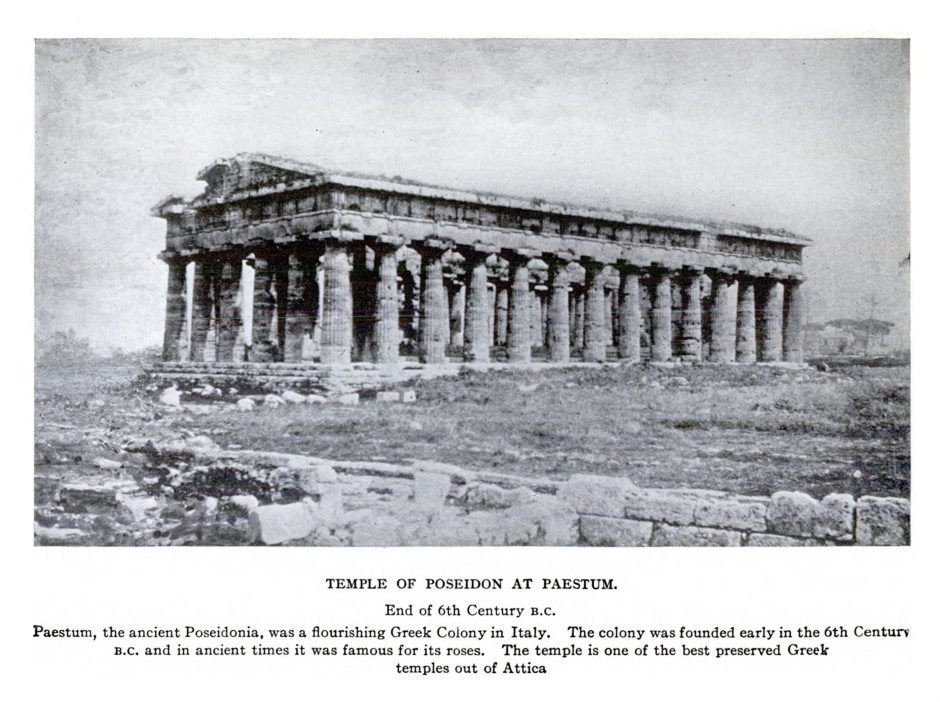
TEMPLE OF POSEIDON AT PAESTUM.
End of 6th Century B.C.
Paestum, the ancient Poseidonia, was a flourishing Greek Colony in Italy. The colony was founded early in the 6th Century B.C. and in ancient times it was famous for its roses. The temple is one of the best preserved Greek temples out of Attica
The Ionian colonies could claim poets as well as
men of science. Chios is said to have been the
birthplace of Homer, and Lesbos, one of the largest
of the island colonies, was famous as the home of
Sappho, not only the first woman whose poetry
has come down to us, but one of the great poetesses
of the world. Unfortunately we have only a few
fragments of her poems.
THE GIFTS OF EVENING
Thou, Hesper, bringest homeward all
That radiant dawn sped far and wide,
The sheep to fold, the goat to stall,
The children to their mother's side.[4]
The face of Greece was turned towards the East,
but adventurous spirits have always turned towards
the unknown West; the Phoenicians had already
explored western regions and the Greeks soon followed.
The Elysian Fields lay to the west and what might
man not discover if he sailed in that direction? The
Greeks did not find the Elysian Fields, but they did
what proved to be of the most momentous importance
in the history of the civilization of the world.
They founded colonies in the south of Italy, and
these became so flourishing that the whole region was
known as Magna Graecia. These Greeks brought
their writing, their art, and their poetry and planted
them securely in the land that was one day to be
ruled by a city, which was then only a little
settlement at the foot of seven hills. Rome became
mightier than Greece in the art of governing a great
empire, and the day was to come when she would
rule Greece herself, but in the development of her
civilization Rome acknowledged the Greeks as her
teachers.
Other Greek colonies were founded at Syracuse in
Sicily, and along the north coast of the Mediterranean
to what is now Marseilles, and in the south a few
were established along the shores of Africa to
Naucratis in Egypt. The colonies in the south of Spain
and along the north coast of Africa from the Pillars
of Hercules to Carthage were in the hands of the
Phoenicians, but by the end of the sixth century
B.C. the prevailing civilization in the Mediterranean was
Greek.
The Ionian colonies occupied the coast land of
Asia Minor, but the mainland behind them was the
Kingdom of Lydia. For a long time the Ionians
lived in peace, developing their science, thinking out
their ideas, and growing in power. But at the
beginning of the sixth century B.C. a new race of kings
came to the Lydian throne. They were vigorous and
ambitious, and did not approve of the important
coast towns with good harbours being in the hands
of Greeks. So they attacked them, beginning with
Miletus which was besieged. The siege lasted
eleven years, but the city did not surrender. At
last the Lydians realized that Miletus was being
saved by her harbour, and though it could get no
food or supplies of any kind by land, everything
needed was brought to the city by water. So the
King of Lydia gave up the idea of conquering
Miletus, and he made a treaty of peace with her.
It was probably not only the impossibility of
conquering a seaport that made the King of Lydia give
up the siege of Miletus, but the knowledge that a
war cloud had arisen in the east which was steadily
drawing nearer his land. This was the army of the
Medes, a nation which had already helped to destroy
Assyria, and whose army was now coming towards
Lydia. Several battles took place with no very
decisive result, but at length the two armies met in a
battle
in which it happened, when the fight had begun, that
suddenly the day became night. And this change of the
day Thales the Milesian had foretold to the Ionians.
The Lydians, however, and the Medes, when they saw
that it had become night instead of day, ceased from
their fighting and were much more eager both of them
that peace should be made between them.[5]
So peace was made, and soon after the King of Lydia
died, and Croesus succeeded him.
Now the Ionian cities, when they saw their
independence threatened, ought to have combined
together and made a joint stand against their enemies,
but each separate city so prized its independence
and so feared anything that might even seem to lessen
it, that they stood alone, and when Croesus, being at
peace with the Medes, determined to get possession
of these Ionian cities, he was able to attack them one
by one and to overpower them. He allowed them to
keep their own independent government, but he
required them to pay him a regular yearly tribute.
This was the first time in Greek history that Greeks
had paid a tribute to anybody; before the reign
of Croesus, all Greeks everywhere had been free.
Croesus left a certain amount of independence to the
Ionian cities, because of his admiration for the Greeks
and their civilization. He sent rich and splendid
gifts to Apollo, and in return was made a citizen of
Delphi, and at the Pythian Games his envoys were
given special seats of honour.
By this time Cyrus, the Mede, had become King
of Persia, and Croesus watched his increasing power
with great anxiety. He saw that war was bound to
come, so he sent a message to the Oracle at Delphi
asking if he should march against the Persians.
What Herodotus called a "deceitful" answer came
back, that if he crossed the river Halys a great
empire would be destroyed. Thinking, of course, that
this meant the destruction of the Persian empire,
Croesus crossed the river and met Cyrus in battle.
Now the Lydians were famous for their horses, and
horsemen were an important part of their army.
Cyrus knew this, so he thought of a plan whereby he
might defeat them. He ordered all the camels which
were in the rear of his army carrying the provisions
and baggage, to be unloaded and the camels brought
to the front, and there well-armed men were mounted
on them. He did this "because the horse has a fear
of the camel and cannot endure either to see his form
or to scent his smell; and so soon as the horses
scented the camels and saw them, they galloped
away to the rear, and the hopes of Croesus were at
once brought to nought."[6]
The Lydians were defeated and withdrew into
Sardis, the capital. But after a short siege Cyrus
took the city, and Croesus lost his kingdom. He did
not want to fall into the hands of the Persians, so he
had a great pyre erected, and after pouring out a
libation to the gods, he mounted it and bade his
slaves set it on fire that he might perish in the flames,
rather than fall alive into the hands of his conqueror.
But suddenly clouds arose in the sky and rain fell,
extinguishing the flames. It was thought that this
must be the doing of Apollo, to whom Croesus had
always shown much honour, and hearing of it, Cyrus
commanded that he should be taken down from the
pyre and brought into his presence. "Croesus," he
asked him, "what man was it who persuaded thee to
march upon my land and so to become an enemy to
me instead of a friend?" And Croesus answered,
O King, that I did this was to your gain and my loss,
and the fault lies with the god of the Hellenes who led
me to march against you with my army. For no one
is so senseless as to choose of his own will war rather than
peace, since in peace the sons bury their fathers, but in
war the fathers bury their sons. It was the will, I
suppose, of the gods that these things should come to pass
thus.[7]
Lydia was now added to the Persian Empire and
only the Ionian cities were still independent. But
even in the face of the great danger from Persia, they
did not unite, and one by one Cyrus conquered them
until Ionia had been reduced to subjection, and when
the cities on the mainland had been conquered, then
the Ionians in the islands, being struck with fear by
these things, gave themselves to Cyrus, who passing
over the upper parts of Asia, subdued every nation,
passing over none.[8]
And thus it came about, that the Greeks who lived
in Asia lost their independence, and became subject
to the Great King of Persia.
[1] Odyssey, XV.
[2] Euripides: Iphigenia in Tauris, translated by Gilbert Murray.
[3] Diogenes Laertius.
[4] Poem of Sappho, translated by Sir Rennell Rodd in Love,
Worship and Death.
[5] Herodotus, I.
[6] Herodotus, I.
[7] Herodotus, I.
[8] Ibid.
The rule of the Lydian Kings over the Ionian
cities in Asia Minor had not been a hard one, but
that of the Persians was different, for they established
tyrants in all the Greek cities, and required the
assistance of their soldiers and sailors in their wars,
things which were very bitter to the freedom-loving
Greeks.
When Darius had become King, he determined,
like the Great Kings before him, to add yet more
lands to his empire, and so made ready an army which
was to invade Scythia, the region north of the Black
Sea. As the Persians themselves were not naturally
sailors, the Greeks in the Ionian cities were forced to
send a large number of ships to the help of this
expedition.
Darius and his army set out, and, arriving at the
River Ister (now known as the Danube), were joined
by the Ionian ships. Here Darius commanded that
a bridge of boats should be built, and then taking a
cord in which he tied sixty knots, he called the
Ionian leaders together and said to them:
Men of Ionia, do ye now keep this rope and do as I
shall say:—So soon as ye shall have seen me go forward
against the Scythians, from that time begin, and untie
a knot on each day: and if within this time I am not here,
and ye find that the days marked by the knots have
passed by, then sail away to your own lands. Till then,
guard the floating bridge, showing all diligence to keep
it safe and to guard it. And thus acting, ye will do for
me a very acceptable service.
Having said this Darius hastened forward on his
march.
Scythia was a land totally unknown to the Persians,
and strange tales were told in after years of the
adventures of the King and his army. The
Scythians were a nomad people, and they believed
themselves to be invincible. When they heard that
Darius was in their land with the intention of
conquering it, they "planned not to fight a pitched
battle openly, but to retire before the Persians and to
drive away their cattle from before them, choking up
with earth the wells and the springs of water by which
they passed and destroying the grass from off the
ground." For some time Darius pursued this mysterious
people, but he could never come up with them.
Now as this went on for a long time and did not cease,
Darius sent a horseman to the King of the Scythians and
said as follows: "Thou most wondrous man, why dost
thou fly for ever, when thou mightest do of these two
things one?—if thou thinkest thyself able to make
opposition to my power, stand thou still and cease from
wandering abroad, and fight; but if thou dost acknowledge
thyself too weak, cease then in that case also from
thy course, and come to speech with thy master, bringing
to him gifts of earth and of water." To this the King of
the Scythians made reply: "My case, O Persian, stands
thus: Never yet did I fly because I was afraid, either
before this time from any other man, or now from thee;
nor have I done anything different now from that which
I was wont to do also in time of peace: and as to the
cause why I do not fight with thee at once, this also I
will declare unto thee. We have neither cities nor land
sown with crops, about which we should fear lest they
be captured or laid waste, and so join battle more
speedily with you; but know this that we have sepulchres
in which our fathers are buried; therefore come now,
find out these and attempt to destroy them, and ye shall
know then whether we shall fight with you for the
sepulchres or whether we shall not fight. Before that,
however, we shall not join battle with thee. About
fighting let so much as has been said suffice; but as to
masters, I acknowledge none over me but Zeus my
ancestor and Hestia the Queen of the Scythians. To
thee then in place of gifts of earth and water I shall send
such things as it is fitting that thou shouldest receive;
and in return for thy saying that thou art my master, for
that I say, woe betide thee."
The King of Scythia sent gifts to Darius as he had
promised, strange and mysterious gifts. He sent
him a bird, a mouse, a frog and five arrows. At first
the Persian could not imagine what these gifts might
mean, but one of his wise men interpreted them as
meaning that "unless ye become birds and fly up to
the heaven, or become mice and sink down under the
earth, or become frogs and leap into the lakes, ye
shall not return back home, but shall be smitten by
these arrows."
The Scythians continued to lead the Persians from
place to place in this strange campaign, until at last
they brought them back again to the Ister where the
Ionians were guarding the bridge of boats. The
Scythians arrived first, and they tried to persuade
the Ionians to break up the bridge, so that Darius
would find no means of escape and would then fall
into their hands. Some of the Greeks were in favour
of doing this, but the Tyrant of Miletus, who wanted
to keep on good terms with Darius, advised against
such treachery and his word prevailed. In order to
get the Scythians away, they pretended, by moving a
few of the boats,, that they were going to destroy the
bridge, but when Darius came, after a moment's fear
that he had been deserted, he found the bridge still
there, and he crossed safely and returned to his own
land.
When Darius learned that it was owing to the
advice of the Tyrant of Miletus that the bridge had
been saved, he sent for him and praised him highly
for what he had done, telling him he knew him to be a
man of understanding and well-disposed towards
him, and that in consequence he wished him to go
with him to Susa, to eat at his table and to be his
counsellor. Darius did this because in reality he
distrusted him and preferred that he should be near him
in Susa, where his movements could be watched.
In the meanwhile a kinsman of this Tyrant had
been left in his place at Miletus, and when a rebellion
broke out in Naxos, he undertook to put it down,
hoping that this would bring him favour from the
King. Unfortunately for him, he was unsuccessful,
and as he very much feared the wrath of the King, he
decided that as he could not put down the rebellion,
he would himself join it. The Greeks in Miletus
were more than willing to revolt from the Persian
yoke and they were joined by other Ionian cities.
But they did not feel strong enough to stand alone
against Persia, so they sent ambassadors to Greece
asking for help from their kinsmen there. Sparta
was asked first. The ambassador appealed to the
King and told him that the Ionians felt it was a
disgrace not only to themselves but also to the Spartans,
who were looked upon as the leaders of all men of
Greek birth, that they should be slaves instead of
freemen. "Now therefore," he said, "I entreat you
by the gods of Hellas to rescue from slavery the
Ionians who are your own kinsmen." He then went
on to describe the Persians whom he might conquer,
the wealth of their land and all the benefits that
would come to him if he would help the Ionians to
become free. The King told him he would think it
over and give him an answer on a day following.
When the day came, the King asked the ambassador
from Miletus how many days' journey it was from
the sea of the Ionians to the residence of the King.
Now it must be remembered that no part of Greece
was far from the coast, and that no Greek, not even a
Spartan who was a soldier rather than a sailor, was
happy if he felt out of reach of the sea. So the
feelings of the Spartan King can be understood, when
he was told that to reach the city of the King of
Persia was a journey of three months from the sea.
His mind was quickly made up. "Guest-friend
from Miletus," he said, "get thee away from Sparta
before the sun has set; for thou speakest a word which
sounds not well in the ears of the Lacedaemonians,
desiring to take them a journey of three months away
from the sea."
The ambassador then went to Athens, where he
was more successful. The Athenians sent twenty
ships to help the Ionians, and the Eretrians, out of
gratitude for help once received from Miletus when
they were in need, added five. With this assistance,
the Greeks marched to Sardis and seized it. But a
house accidentally caught fire, and the fire began to
spread over the whole town. This gave the Persians
time to rally from the surprise of the attack and
they drove out the Greeks, who scattered in dismay.
Some were overtaken and slain, and the rest
retreated to their ships.
Darius was in Susa at this time, and the news of
the burning of Sardis was taken to him there. He
did not take much account of the Ionians who had
taken part,
because he knew that they at all events would not escape
unpunished for their revolt, but he enquired who the
Athenians were; and when he had been informed, he
asked for his bow, and having received it and placed an
arrow upon the string, he discharged it upwards towards
heaven, and as he shot into the air he said: "Zeus, that
it may be granted me to take vengeance upon the
Athenians!" Having so said he charged one of his
attendants, that when dinner was set before the King
he should say always three times: "Master, remember
the Athenians."
Darius remembered the Athenians, but he had
first to punish the Ionian cities for their share in the
revolt. One by one he attacked them, and they fell
before him, until at last only Miletus was left. Her
only hope of safety lay in her sea-defences, and all the
ships the Ionians could collect were gathered at Lade,
an island just outside the harbour of Miletus. Now
the Ionians had copied many of the customs of their
Lydian neighbours, and they were more luxurious and
led softer lives than their kinsmen on the mainland.
Efforts were made by one of the Greek leaders to
make the Ionians drill and exercise themselves every
day, that they might all be in good condition when
the day of battle should come. For a time they
submitted, but they were lazy and unaccustomed to
such toil, and the hard work and exercise so
exhausted them, that they declared they would prefer
slavery to such hard work as was being forced upon
them. So they refused to drill any more, and "they
pitched their tents in the island like an army, and
kept in the shade, and would not go on board their
ships or practise any exercises."
There could only be one result to this. The Persians
gave battle and the Ionians were defeated, some
of them even disgraced themselves by sailing away
without fighting at all. The men of Chios refused to
play the coward and fought to the end, but there
were too few of them to turn the tide of battle and
the Persians overcame them completely. Miletus
was taken by storm, the city was destroyed by fire,
the men were all put to death, and the women and
children sent as slaves to Susa.
The news of the fall of Miletus was a terrible blow
to the Greek world. Up to that time she had been
the greatest of the Greek cities. She was rich, not
only in material wealth, but in all that concerned the
intellectual life, and now she had fallen! It was,
above all, a blow to the Athenians, for Athens and
Miletus were closely bound by ties of kinship, and
when an Athenian dramatist
composed a drama called the "Capture of Miletus," and
put it on the stage, the body of spectators fell to weeping,
and the Athenians moreover fined the poet heavily on
the ground that he had reminded them of their own
calamities; and they ordered also that no one in future
should represent this drama.
Thus it came about that again the Ionians became
the subjects of the Persian King. They had been
punished to the utmost for daring to revolt from his
power, and there was no fear that they would do it
again. Darius was now free to remember the
Athenians.
In 492 B.C. Darius sent Mardonius, a general who
was high in his favour, across the Hellespont with
orders to march through Thrace and Macedonia, and
having firmly secured their allegiance, to march on to
Greece, where Athens and Eretria were to be severely
punished for their share in the burning of Sardis.
Darius had several reasons for this expedition: the
punishment of Athens and Eretria was the one about
which most was said, but as it never entered his mind
that he could be defeated, Darius probably intended
so to destroy the cities on the mainland that the
Greeks in Ionia would see that it would be useless to
rely on the help of their kinsmen should they ever
think of another revolt, and so to punish the
European Greeks that they would never dare to interfere
again in the affairs of the Persian Empire. But
underneath all these reasons were dreams of
conquest. The Great King had visions of subduing the
whole of Greece and of extending his empire into
Europe.
Preparations were made and Mardonius set out.
A fleet was to sail close to the coast and to keep in
constant touch with the army. All went well until
Mount Athos was reached and here a great storm
arose.
The north wind handled them very roughly, casting
away very many of their ships. It is said that the
number of ships destroyed was three hundred, and more than
twenty thousand men; for as this sea which is about
Athos is very full of sea monsters, some were seized by
these and so perished, while others were dashed against
the rocks; and some of them did not know how to swim
and perished for that cause, others again by reason of
cold.
The army fared little better, for it was attacked by
some Thracian tribesmen, and though Mardonius
forced them to submit to him, he suffered so much
loss in the fighting, that as his fleet also had been
almost entirely destroyed, he was obliged to depart
back to Asia having gained no honour in this
undertaking.
Two years went by, and then another expedition
was planned. Before it started, Darius sent
messengers to Athens and Sparta and other Greek states
demanding of them earth and water, the symbols of
submission to the Great King. Some states agreed
to the demand, either because they were struck dumb
with terror at the mere thought that the Great King
might invade their land, or because they thought that
he was certain to conquer and that by submitting at
once they would secure themselves and their land
from destruction. Athens and Sparta, however,
refused uncompromisingly. The messengers were
thrown by the Athenians into a pit, and by the
Spartans into a well, and told that if they wanted earth
and water they could get them for themselves. On
hearing what had happened to his messengers, Darius
gave orders to the generals to set out at once for
Greece, and to punish every state which had refused
submission by enslaving all the inhabitants and
bringing them bound to Susa. In particular, Athens
and Eretria, for their other misdeeds, were to receive
the severest treatment. So the expedition started.
Remembering the disaster at Mount Athos, the
fleet sailed this time across the Aegean, touching at
Naxos, the first of the Ionian cities that had revolted,
and which now received its punishment by being
burnt and its people enslaved. Then the Persians
went on to Delos, where they offered sacrifices to
Apollo, and from there they sailed to Eretria which
they immediately attacked. The city held out for
six days and then traitors within the walls opened the
gates to the Persians who entered and took the city.
They burnt it to the ground and carried off all the
inhabitants into slavery. And so Eretria was
punished for her share in daring to burn a city of the
Great King.
News of these movements of the Persians had, of
course, reached Athens, but up to this time the
Athenians had not considered them as having any
dangerous consequences to themselves. But Eretria
was not very far from Athens, and when the news
of the utter destruction of this city arrived, the
Athenians realized the full extent of their peril.
Now Hippias, the exiled Tyrant, had taken refuge
with the Persians, but he had never given up hope
of one day returning to Athens. He was at this
very time plotting with friends in the city, and the
Persians, knowing this, hoped for their aid in taking
Athens. So the Athenians were threatened with
dangers both from within and without.
It is easy to imagine the dismay of the Athenians
when they heard that Eretria had been destroyed,
and that the Persians, the conquerors of the world,
were even then on their way to Athens. How could
they hope, with their small army, to stand against
the great empire? Help must be had, and that
quickly. To whom should they turn, if not to
Sparta, the foremost military state in Greece, and
which, should Athens fall, would be the next state
attacked? Self-defence, if no other reason, would
surely bring them with speed to Athens. So the
Athenians sent Pheidippides, a swift runner, with a
message imploring help. The distance from Athens
to Sparta is a hundred and fifty miles, and the hours
must have seemed very long to the Athenians as
they waited for his return with the answer. But so
swiftly did he run that he was back before they had
dared expect him. How had he done it? For two
days and nights he had raced "over the hills, under
the dales, down pits and up peaks," and in less than
forty-eight hours he had reached Sparta. He rushed
into the midst of their Assembly with but scant
ceremony, and passionately entreated them to come
to the help of Athens.
But to this cry for help the Spartans gave but a
cool answer. They would come, certainly, but must
wait five days until the moon was full when it was
their custom to sacrifice to Apollo, and to break this
custom would be to slight the god. When the full
moon had come, then they would send help to the
Athenians. Pheidippides only waited long enough
to receive the answer, and then with despair in his
heart, he started back to Athens. Over the hills and
the plains, through woods and across streams he
raced, appealing in his heart to the gods to whom
Athens had ever shown honour, yet who seemed to
have deserted her in her utmost need. Was there
no help? Suddenly he stopped; whom did he see,
sitting in a cleft of a rock? It was Pan, the Goat-God.
"Stop, Pheidippides," he cried, and stop he did.
Graciously and kindly did the god then speak to
him, asking him why it was that Athens alone in
Greece had built him no temple, yet he had always
been and would forever be her friend. And now
in her peril, he would come to her aid. He bade
Pheidippides go home and tell Athens to take heart,
for Pan was on her side.
If Pheidippides had run swiftly before, now he ran
as if wings had been given to him. He hardly
touched the earth but seemed to race through the
air, and burst upon the waiting Athenians who had
not dared expect him so soon, with the news that
Sparta indeed had failed them, but that Pan, mighty
to save, would fight for them!
But now grave news was brought: the Persians
were landing in Attica. It was September of the
year 490 B.C., and the hot summer days had not yet
passed away. The Athenians could not wait for the
Spartans, they must go out alone and meet the foe.
They marched twenty-four miles in the heat over a
rough and rugged road, until they reached the plain
of Marathon. There they found the Persians.
Now the Persians had probably never intended to
fight at Marathon. They hoped that the friends of
Hippias in Athens would in the end betray the city
to them, and their plan in landing where they did was
to bring the Athenian army away from the city, and
if possible to keep it away, until they should have
received the expected signal from the traitors. The
plain of Marathon is surrounded by hills except
where it slopes down to the sea. The Athenians
occupied the stronger and higher positions, the
Persians were encamped near the sea, and their ships
were anchored close to the coast. For several days
the armies watched each other and waited. The
Athenians counted the days until the moon should
be full, when there was hope that the Spartans
might come; the Persians knew that every added
day gave the conspirators more time to do their
treacherous work in the city. And so both sides
waited.
Suddenly help came to the Athenians from an
unexpected quarter, help which cheered and inspirited
them. Through a cloud of dust on one of the roads
leading down into the plain, they saw the gleam of
spears and helmets. It could not be the Spartans,
for they would not come from that direction. As
the men drew nearer, they were found to be an army
from Plataea, a little city in Boeotia, to which, when
some years before Thebes had threatened her
independence, Athens had sent succour. Now, though
not thought of by the Athenians as an ally, because
she was small and not powerful, she had remembered
those who had befriended her in the hour of need,
and had come down with all her fighting men to help
Athens in her peril.
Miltiades was the Athenian general at Marathon.
He knew why the Persians were waiting, and when
messengers brought him word that they were
embarking some of their men, knowing that this meant
their intention to sail round to Athens, because the
conspirators in the city were ready to act, he gave
the signal to attack. There were probably two
Persians to every Greek, so the Greek army had been
arranged in the best way to face these odds. The
centre line was thin, but the wings were very strong.
On the first onslaught from the Persians this centre
gave way, but the wings immediately wheeled round
and attacked the Persians with such force that these
gave way before them and fled down to the shore.
The Greeks pursued, and there was terrific fighting
and slaughter. Seven of the Persian ships were
destroyed by fire, but the others escaped. The
Persians fled to these remaining ships, leaving over
six thousand dead on the plain and quantities of
rich plunder. They set sail for Athens, and knowing
that the Athenian army was still on the plain of
Marathon, they hoped to find the city undefended
and that the traitors would open the gates to them.
But the Athenians who had won at Marathon were
not going to let their city fall into the hands of the
enemy, so when they saw the Persian ships setting
sail, wearied as they were with the strain of battle,
they marched over the twenty-four miles of rough
road to the defence of their beloved city, leaving
only a small force behind to guard the bodies of the
slain and to prevent thieves from carrying off the
plunder.
On his return from Sparta, Pheidippides had been
asked what reward should be given him for the race
he had run. All he asked was to be allowed to fight
for Athens, and when the Persians had been driven
away, then to wed the maid he loved and to dwell in
his own home. It was given him as he asked. He
fought in the fight at Marathon, but when the victory
had been gained, one more race was asked of him.
Over the rough road he ran to Athens to shout in the
ears of the waiting Athenians: "Athens is saved!" But
his heart could not contain such great joy, and
having delivered his message, he died.
The Athenian army reached Athens before the
enemy, and when in the moonlight the Persian ships
sailed into the bay near Athens, there, ready to meet
them, were the same men who had defeated them at
Marathon earlier in the day. The Persians were not
willing to meet them again so soon; they realized
that they had indeed suffered grievous defeat, and
commands were given for the broken army and
crippled fleet to set sail for Asia.
The Spartans came as they had promised, but too
late to take any part in the battle.
There came to Athens two thousand of them after the
full moon, making great haste to be in time, so that they
arrived in Athens on the third day after leaving Sparta:
and though they had come too late for the battle, yet
they desired to behold the Medes; and accordingly they
went on to Marathon and looked at the bodies of the
slain; and afterwards they departed home, commending
the Athenians and the work which they had done.
But no part of the honour of Marathon belonged to
Sparta.
The Athenians lost about two hundred men in the
battle. They were buried where they had fallen, a
great mound was erected over their graves, and their
names were inscribed on tall pillars near by. Much
rich plunder was left by the Persians on the plain,
some of which was offered to Apollo as a
thank-offering for the victory. The Athenians built a
beautiful little temple, known as the Treasury of
the Athenians, at Delphi, and Pan was not forgotten.
A grotto on the side of the Acropolis was dedicated
to him, where sacrifices were offered in memory of
his help and encouragement when both had been
sorely needed.
The Greeks who had fought at Marathon had
many tales to tell of the battle, and many a wondrous
deed was said to have been performed. It was
thought that the gods themselves and the ancient
heroes of Athens had taken part. Pan, they said,
had struck such fear into the hearts of the Persians
that they had fled in disorder and terror, a terror
ever after known as a panic. Some even said that
Theseus and other heroes had been seen, and for a
long time the spirits of those who had been slain
were thought to haunt the battlefield.
The battle of Marathon was one of the great events
in history. For the first time the East and the West
had met in conflict, and the West had prevailed.
The Athenians were the "first of all the Hellenes
who endured to face the Median garments and the
men who wore them, whereas up to this time the
very name of the Medes was to the Hellenes a terror
to hear." Never before had a little state faced the
world empire of the Persians and conquered. The
Greek soldiers had shown themselves capable of
facing the Persians, long looked upon as the
conquerors of the world, and of prevailing against them.
The civilization of the East had met with a check on
the very threshold of Europe, and Athens had saved
Greece. But the Great Kings of Persia were not
accustomed to defeat; would they accept this, and
was Greece and, through Greece, Europe, safe, or
would the Persians come again?
(a) The Persians
The Persians came again. When the report came
to Darius of the battle which was fought at
Marathon, the King, who even before this had been
greatly exasperated with the Athenians on account
of the attack made upon Sardis, then far more than
before displayed indignation, and was still more
determined to make a campaign against Hellas. He at once
sent messengers to the various cities of the Empire
and ordered that they should get ready their forces.
Each city or community was called upon to send
more men than at the former time, and to send also
ships of war, and horses, provisions and transport
vessels. When these commands had been carried
all round, all Asia was moved for three years, for
all the best men were being enlisted for the
expedition against Hellas, and were making preparations.
But before the expedition was ready, a rebellion
broke out in Egypt, and soon after Darius died, and
"thus he did not succeed in taking vengeance upon
the Athenians."
Darius was succeeded by his son Xerxes. The
first thing he did was to crush Egypt, and then he
turned his attention to Greece. Mardonius, the
general who had been forced to retire from Thrace
after the wreck of the fleet off Mount Athos, was
anxious to persuade the King to undertake another
invasion. He probably wanted to retrieve the
reputation he had lost on the former occasion, and
hoped that if Greece became a Persian province, he
would be made governor. "Master," he would say
to the King, "it is not fitting that the Athenians,
after having done to the Persians very great evil,
should not pay the penalty for that which they have
done," and he would add that Greece was "a very
fair land and bore all kinds of trees that are cultivated
for fruit and that the King alone of all mortals
was worthy to possess it."
Xerxes did not need much persuasion. He came
of a race of kings whose word was the law of the
Medes and Persians that changeth not, and his
wrath was great against the states that had not only
refused to submit to the Persian King, but had
actually defeated his army in battle. He would
wreak his vengeance upon them for what they had
done, and he declared that he would march an army
through Europe against Greece, in order, as he said,
"that I may take vengeance on the Athenians for all
the things which they have done both to the Persians
and to my father. I will not cease until I have
conquered Athens and burnt it with fire."
Our knowledge of the preparations made for this
invasion by Xerxes comes from Herodotus.[2] He may
have exaggerated some things in his account, but
his history was written for the Greeks of his own
time and he wanted to make clear to them how great
was the difference between the East and the West;
how much better their freedom and independence
were than the slavery endured by states which were
ruled by the Great King. For these states had no
voice in the affairs of the Empire; if the King went
to war, they had to follow him and lay down their
lives for causes in which they had no concern, and
which generally only ministered to the greed and
avarice of their rulers.
Having decided on the invasion of Greece, Xerxes
sent heralds throughout the Empire proclaiming the
war and bidding all fighting men make ready and
join the King at Sardis. There the troops were
mustered, and in the spring of 480 B.C. ten years
after the battle of Marathon, Xerxes and his army
were ready to set out. They were to march to the
Hellespont, and then, by way of Thrace and Macedonia,
to descend into Greece. The fleet was to join
the army at the Hellespont, and by sailing close to
the shore, to keep in constant touch with the army
on land.
At last all was ready and the day came for the
army to leave Sardis. First the baggage-bearers led
the way together with their horses, and after these,
half the infantry of all the nations who followed the
Great King. Then a space was left, after which
came the King himself. Before him went first a
thousand horsemen, chosen from amongst the
noblest Persians, and then a thousand spearmen;
these were followed by ten sacred horses with rich
trappings, and behind the horses came the sacred
chariot of the great Persian god, drawn by eight
horses, with the reins held by a charioteer on foot,
for no human creature might mount upon the seat
of that chariot. Then followed Xerxes himself,
attended by spearmen chosen from the best and most
noble of all the Persians. They were in turn followed
by a body of men known as the Immortals, of which
there were always ten thousand. They bore this
name, because if any one of them made the number
incomplete, either by death or illness, another man
filled his place, and there were never either more or
fewer than ten thousand. These were the very
flower of the Persian army; nine thousand of them
carried spears ending with silver pomegranates, and
the spears of the thousand who guarded the front
and rear were ornamented with pomegranates of
gold.
Now of all the nations, the Persians showed the
greatest splendour of ornament and were themselves
the best men, and they were conspicuous for the
great quantity of gold they used. The Medes and
Persians wore tunics and trousers, for which the
Greeks always felt the greatest contempt because
they were worn by the Barbarian and not the Greek,
and soft felt caps on their heads. They carried
wicker shields and had short spears and daggers and
bows and arrows. Besides these a host of nations
followed the Great King: there were Assyrians,
famous throughout all ancient history as a great
fighting race, with bronze helmets, linen breastplates,
and wooden clubs studded with iron; there were
Bactrians with bows of reed and short spears;
Scythians with their pointed sheepskin caps, and
their battle axes; there were Caspians dressed in
skins and wielding short swords; there were men of
strange and savage appearance, some wearing dyed
garments, with high boots, others dressed in skins,
and all bearing bows and arrows, daggers and short
spears. Arabians came too, with their loose robes
caught up ready for action and long bows in their
hands; and dark Ethiopians, fearful to look upon in
their garments made of the skins of the leopard and
the lion; these fought with long bows with sharp
pointed arrows, and with spears and clubs, and
when they went in to battle, each man painted half
his body white and half of it red. And other
Ethiopians there were, who wore upon their heads horses'
scalps with the ears and manes still attached.
Many more nations and tribes were represented in
this mighty army. Some carried small shields and
small spears and daggers, others wore bronze helmets
to which the ears and horns of an ox were attached.
All these and many more made up the army of the
Great King; they came from North and South, from
East and West, and from the islands of the sea, and
they marched in magnificent array from Sardis to
the shores of the Hellespont, where the fleet was to
meet them. When Xerxes reached the strait, he
had a throne of white marble built for him and there
he took his seat and gazed upon his army and his
ships. Now Xerxes had given orders that a bridge
should be built across the Hellespont over which his
army should pass into Europe. But when the strait
had been bridged over, a great storm arose which
destroyed the bridge. When Xerxes heard of it, he
was exceedingly enraged and bade his soldiers
scourge the Hellespont with three hundred strokes
of the lash, and he let down into the sea a pair of
fetters. Whilst this was being done, the sea was
thus addressed:
Thou bitter water, thy master lays on thee this penalty,
because thou didst wrong him, though never having
suffered any wrong from him; and Xerxes the King will
pass over thee, whether thou be willing or no.
The sea was punished in this way, and command was
given to cut off the heads of those who had had charge
of building the bridge. Not with impunity was the
Great King disobeyed. A new bridge was then
built, stronger and more secure than the first, and
over this the army passed in safety.
In order that no accidents might happen, honour
was paid to the gods, and incense and fragrant
perfumes were burnt upon the bridge and the road was
strewn with branches of myrtle. The crossing was
to take place early in the morning, and all were
ready before the dawn broke. As the sun was rising,
Xerxes poured a libation from a golden cup into the
sea, and prayed to the Sun that no accident might
befall him till he had conquered Europe, even to its
furthest limits. Having prayed, he cast the cup
into the Hellespont and with it a golden mixing bowl
and a Persian sword, as gifts to the powers of the sea.
When Xerxes had done this, the great army passed
over the bridge in brilliant array. It took seven
days and seven nights without any pause for the
whole army to pass over and it is said that at the
end, a man who dwelt on that coast and who had
watched the crossing, exclaimed:
Why, O Zeus, in the likeness of a Persian man and
taking for thyself the name of Xerxes instead of Zeus,
hast thou brought all the nations of men to subdue
Hellas? Was it not possible for thee to do it without
the help of these?"
When the whole army had crossed over safely,
Xerxes inspected it. He drove through all the ranks
in his chariot, and scribes who accompanied him
wrote down for him the names of all the nations who
were represented. When he had done this, the
ships were drawn down into the sea, and Xerxes,
changing from his chariot to a ship of Sidon, sat
down under a golden canopy and sailed along by the
prows of the ships and inspected his fleet. The ships
then set sail, and were to go along the coast to
Therma where the land army was to meet them
again.
Xerxes and the army then proceeded on their
march through Thrace and Macedonia. Messengers
had been sent on ahead some time before to make
arrangements for provisioning this great host. All
the towns through which the Persians passed were
compelled to provide food and drink for the men and
the animals with them. It was a tremendous
undertaking, and scarcity and want were left behind as
the invaders passed on. The inhabitants had to
provide great quantities of wheat and barley, they
were made to give up the best of the fatted cattle,
their birds and fowls, and to provide everything in the
way of gold and silver needed for the service of the
table. All this was a great hardship to the people
of the land, and in one place they went in a body to
their temple and entreated the gods that for the
future they would keep them from such evil.
Nevertheless they offered up a thanksgiving to the gods
for all the mercies they had shown to them in the
past, and especially for having granted that Xerxes,
whilst in their city had only thought good to take
food once in each day, for it would have been
altogether impossible for them to have provided him
with breakfast in the same manner as dinner.
The fleet sailed safely to Therma and was joined
there by the army as had been arranged. So far all
had gone well for the Persians. They had succeeded
in a great achievement, for apparently without any
serious mishaps, this tremendous army had been
transported from Sardis right round the Aegean and
had been fed and cared for on the way. The
difficulties must have been very great, and only splendid
organization could have done it successfully. But
it had been done, and now Xerxes, in order to wreak
his vengeance on one Greek city, stood with his army
composed of the fighting men of forty-six nations on
the very threshold of Greece. From Therma he
could look across to the mountains of Thessaly, he
could see snow-topped Olympus, the home of the
gods who watched over the fortunes of the
freedom-loving Greeks. The Athenians had withstood the
Persians at Marathon, but now the whole of the
eastern world was marching against them. Could
they withstand that mighty host, or would they be
forced to submit?
(b) The Greeks
Ten years had passed between the battle of
Marathon and the arrival of Xerxes on the borders of
Greece. In the years preceding 490 B.C. the Persian
power had been a terror to the Greek. Not content
with subduing Asia even to the dim borders of India,
the Great Kings had pushed their way to the Aegean
and had even conquered the Greeks who dwelt along
its eastern coasts. Then, like an ominous war-cloud,
this mighty power had crossed the sea to Greece
itself. But there the unexpected had happened.
At Marathon the Persians had sustained at the
hands of a small state, till then comparatively
unknown, the first great defeat they had ever met with.
The Plataeans had helped, it is true, but their
numbers had been small and it was the Athenians who
had really defeated the Persians. Since then the
Athenians had enjoyed a great reputation for their
military power. Myths and legends had woven
themselves round the name of Marathon with the
result that the power of the Athenians was reputed
greater than perhaps it actually was, and that of
Persia was certainly depreciated. If she had been
as formidable as had always been supposed, how
could the Athenians have defeated her almost
unaided? So for a number of years the Greeks had
felt less terror at the name of Persia, and they had
been enjoying a certain feeling of security little
realizing how false it was.
But suddenly they were shaken out of their calm.
Rumours of the Persian preparations for an
invasion of Greece reached them, rumours which were
doubtless exaggerated, but which nevertheless had
much truth in them. It is amazing how in spite of
slow and difficult communication news was swiftly
carried in those days from place to place. So the
Greeks were fairly well-informed as to what the
Persians were doing. At this crisis the Athenians
took the lead, and
if anyone should say that the Athenians proved to be the
saviours of Hellas, he would not fail to hit the truth;
these were they who, preferring that Hellas should
continue to exist in freedom, roused up all of Hellas. Nor
did fearful oracles which came from Delphi and cast
them into dread, induce them to leave Hellas.
The first thing the Greeks did was to hold a
conference at Corinth, which was attended by envoys
from all the leading states except Argos and Thebes,
which stood aloof. At this conference the Greeks
made three important decisions. They resolved
that they would reconcile all their own differences
and bring to an end the wars they had with one
another; as Hellenes they would unite against the
common foe. Then they determined to send spies
to Asia, who should bring back accurate reports of
the preparations and power of Xerxes. And lastly,
they would send messengers to the colonies in Sicily,
Corcyra and Crete asking for assistance.
Three spies set out, but they were captured in
Sardis and condemned to death. When Xerxes,
however, heard what had happened, he sent for the
spies, who were brought into his presence. To their
surprise, instead of being led out to immediate
execution, Xerxes commanded that they should be led
round and shown the whole army, both foot and
horse, and when they had seen everything, they were
to be set free to return home. He did this, because
he said that
if the spies had been put to death, the Hellenes would
not have been informed of his power, how far beyond
any description it was; while on the other hand by putting
to death three men, they would not very greatly damage
the enemy; but when these returned back to Hellas, he
thought it likely that the Hellenes, hearing of his power,
would deliver up their freedom to him themselves, before
the expedition took place, and thus there would be no
need for them to have the labour of marching an army
against them.
Little did Xerxes know the kind of freedom-loving
people with whom he had to deal. So the
spies looked at everything and then returned to
Greece.
Meanwhile the messengers to the colonies returned.
The answers to the appeal for support were very
disappointing. Neither Sicily, Corcyra nor Crete
would help. They either refused outright or made
uncertain answers. They seem to have thought
more of their own preservation than of the safety of
Greece as a whole; they thought the Persian would
probably win, and they preferred either to be on
the winning side, or to be in such a position that
they could make good terms with the Persian, did
he conquer.
The Greeks now made ready to go out with their
armies to meet the Persian foe. The chief command
was given to Sparta, the greatest military state in
Greece, and they marched to the Vale of Tempe in
the north of Thessaly, where they hoped to meet
Xerxes and prevent him from coming into Greece.
When they got there, however, they found that it
would not be possible to hold the pass against the
enemy, for it was so situated that the Persians could
attack them by sea as well as by land, and there was
another path over the mountains by which the
Persians could attack them in the rear. So the Greeks
withdrew to Corinth, in order to deliberate further
where they would meet the enemy. This retreat
from Thessaly took place while Xerxes and his army
were crossing the Hellespont, and it had important
consequences for the Persians, for the Thessalians,
hitherto never very loyal to Greece, seeing the other
Greeks leave their land, "took the side of the Medes
with a good will and no longer half-heartedly, so that
in the course of events they proved very serviceable
to the King."
The Greeks now decided on making a stand much
further south at Thermopylae. This was a narrow
pass and easier to defend, so they resolved
to guard it and not permit the Barbarian to go by into
Hellas, and they resolved that the fleet should sail to
Artemisium, for these points are near to one another, so
that each division of their forces could have information
of what was happening to the other.
At Thermopylae the Greeks awaited the Persians.
It was midsummer in the year 480 B.C. when the
Persian host left Therma and marched down through
Thessaly to the Pass of Thermopylae. The Persians
encamped before the Pass and a scout was sent forward
to bring back information as to what the Greeks
were doing. Only a small force of Greeks was
defending the Pass, the main part of the Greek army
was kept back further to the south to defend the
Isthmus. A small body of about three hundred
Spartans had been sent under their King Leonidas
to defend the Pass of Thermopylae, and, if possible, to
prevent the Persians from advancing further into
Greece. These three hundred men were the picked
body-guard of the King, a force in which only fathers
of sons might serve, so that their families might not
die out of Sparta.
The Persian scout went cautiously forward, and
to his great surprise saw some of the Spartans
practising athletic exercises and others combing their
long hair. He could not see the rest, as an ancient
wall built across the Pass hid them from sight. He
returned to Xerxes and reported on what he had seen.
The King sent for a Greek who was in his camp and
asked him what this behaviour of the Spartans might
mean. He told him that they were following an
ancient Spartan custom, for "whenever they are
about to put their lives in peril, then they attend to
the arrangement of their hair." The Spartans
knew against what odds they had to fight, but their
duty had placed them where they were, and no
Spartan ever retreated or turned his back upon his
foe.
The Great King intended to attack at the same
moment both by land and by sea. The fleets were
at Artemisium, and there were four times as many
Persian ships as Greek. A hot and sultry summer's
day had passed, and the signal to attack was expected
in the morning. But at early dawn the sea began
to be violently agitated and a strong east wind arose,
thunder rumbled in the distance, and soon a terrible
storm broke. The Greek ships were in safety, but
a large number of Persian ships were wrecked and
great treasure was lost. For three days the storm
continued, and for three days Xerxes had to wait
before he could attack the Pass. When on the fourth
day the storm died down, the sea fight began.
Three times over the Greeks attacked the Persian
ships, and each time they prevailed against them.
After the third fight, news was brought to
Themistocles, the Athenian admiral, that two hundred
Persian ships, sailing to the Greek rear, had been
lost in the storm, so that there was nothing more to
fear from an attack in that direction. The Greeks
succeeded in throwing the Persian ships into
confusion and so crippled the fleet, that they finally
won the battle. It was then that Xerxes gave the
order to his army to attack the Pass.
For the whole of a hot summer's day the Persians
attacked. First the Medes tried to force the Pass,
but it was narrow, and as they met the Spartan
spears, down they went, man after man. Hour
after hour this continued, but every attack was
repulsed and hardly a Spartan fell. Then the Medes
withdrew and the Immortals took their place. They
were fresh and greatly superior to the Spartans in
numbers, but neither could they prevail against
them. At times the Spartans would make a pretence
of turning to flight, but when the Barbarians
followed after them with shouting and clashing of
arms, then they turned and faced the Barbarians
and slew large numbers of them. The Spartans
lost a few men, but at the end of the day the Persians
drew back, exhausted and defeated, and the Spartans
still held the Pass.
The next day, the same thing happened. So
great was the slaughter of the Persians on this day
that three times Xerxes leapt up from the seat from
which he was watching the fight, in deadly fear for
his army. But by the end of the day the Pass had
not been taken, and again the Persians withdrew,
exhausted and driven back, leaving large numbers
of their companions lying dead before the Pass.
Xerxes was in great straits as to what he should
do next, when he was told that a man desired
audience of him. He was a Greek who lived in that
region, and he offered, if the Persian would reward
him with enough gold, to lead his army by a path
known to him, but of which the Spartans were
ignorant, over the mountain to a spot from which the
Pass might be attacked in the rear. It was a long
and difficult path, but the traitor knew it well and
would guide them surely. The reward was promised,
and about the time when the lamps were lit in the
camp, the Immortals with their commander set out
under the guidance of the traitor. All through the
long black night they climbed by a steep and rocky
path, and when dawn appeared they had reached the
summit of the mountain. In this region a thousand
men of Phocis were stationed to protect their own
country and the path which led down to the valley
below. They could not see the Persians as they
climbed, for the sides of the mountain were covered
with oak trees, but in the great silence which falls
upon nature just before the dawn, suddenly these
men heard an unexpected sound. It was the
Persians stepping on the dried oak leaves which lay
thickly on the ground beneath their feet. The
Greeks started up and when the Persians, coming
suddenly upon them, discharged their arrows at
them, they retreated to a higher position close at
hand, where they waited for the expected attack.
To their surprise, however, the enemy turned away
and left them. On went the traitor followed by the
Persians, until they were on the road in the rear of
Leonidas.
While it was yet night, scouts came down from
the mountains where they had been keeping watch,
and told Leonidas that the Pass was turned, and
that the enemy was approaching it from the rear.
Leonidas knew what that meant, the end had come,
but he commanded Spartans and he knew that
whilst one remained alive, the Pass would not be
taken.
At sunrise, according to the arrangement made
with the traitor, Xerxes attacked. The Spartans,
knowing that they were going forth to death, now
advanced further out into the broader space in front
of the Pass, where there was more room. And then
followed a fight which will never be forgotten. The
Barbarians made attack after attack, and the
Spartans slew them and drove them back every time.
Many were driven into the sea and perished, and
many more were trodden down while still alive and
trampled to death, and there was no reckoning of
the number that perished. Two brothers of Xerxes
fell fighting, and then Leonidas fell. The Spartans
fought for the body of their King; most of their
spears were by this time broken, so they fought and
slew the Persians with their swords. Four times the
Persians had almost taken the body of the King, and
four times they were driven back by the Spartans,
when word came that the Immortals were attacking
the Pass in the rear. Then the remaining Spartans
placed themselves with the body of Leonidas behind
the wall, and there they made their last defence.
On this spot those who still had them defended
themselves with daggers, and those who had no
weapons left, fought with their hands and teeth,
until, overwhelmed by the Barbarians who were
now assailing them both in the front and in the rear,
they were surrounded and cut down, until not a
Spartan was left alive.
And so the Persians took the Pass, and the road to
Athens lay clear before them.
The Spartans were buried where they fell, and a
pillar was erected to the memory of those who had
died so great a death in defending the Pass. On it
was inscribed the simple words:
Stranger, bear word to the Spartans that we lie here
obedient to their charge.
The Persians had taken the Pass of Thermopylae;
Thebes, the chief city in Boeotia, was anxious to be
on the winning side and was a medizing state; there
was nothing to save Athens from the conquering
Persian army.
But in this dark hour, a statesman arose in Athens
who was to restore her confidence and to make her
place secure among the free nations of the world.
This man was Themistocles, already known to the
Athenians as the admiral who had defeated the
Persians at Artemisium. He came of a humble
family, but the laws made by Solon and later law-givers
made it possible for him, in spite of his birth,
to rise to the highest position in the state.
From his youth Themistocles had been of a vehement
and impetuous nature, of a quick intelligence, and a
strong and aspiring bent for action and great affairs.
The holidays and intervals in his studies he did not
spend in play or idleness, as other children, but would be
always inventing or arranging some oration or speech
to himself, so that his master would often say to him:
"You, my boy, will be nothing small, but great one way
or other, for good or else for bad." He received
reluctantly and carelessly instructions given him to improve
his manners and behaviour, or to teach him any pleasing
or graceful accomplishment, but whatever was said to
improve him in sagacity or in management of affairs, he
would give attention to beyond one of his years. And
when in company he was obliged to defend himself
because he could not play on any stringed instrument,[3]
he would retort that though he could not do that, yet
were a small and obscure city put into his hands, he
would make it great and glorious. It is said that
Themistocles was so transported with the thoughts of
glory, and so inflamed with the passion for great actions,
that though he was still young when the battle of
Marathon was fought, upon the skilful conduct of the general
Miltiades being everywhere talked about, he was observed
to be thoughtful, and reserved, alone by himself;
he passed the nights without sleep, and avoided all his
usual places of recreation, and to those who wondered
at the change, and inquired the reason of it, he gave the
answer that "the trophy of Miltiades would not let him
sleep."[4]
This was the man who was now to help Athens, and
he possessed the very qualities most needed in the
serious position in which she found herself.
For Themistocles was a man whose natural force was
unmistakable; this was the quality for which he was
distinguished above all other men; from his own native
acuteness, and without any study either before or at the
time, he was the ablest judge of the course to be pursued
in a sudden emergency, and could best divine what was
likely to happen in the remotest future. Whatever he
had in hand he had the power of explaining to others,
and even where he had no experience he was quite
competent to form a sufficient judgment; no one could
foresee with equal clearness the good or evil intent which
was hidden in the future.
This foresight was shown in the belief held by
Themistocles, who "when others were of opinion that
the battle of Marathon would be an end to the war,
thought it was but the beginning of far greater
conflicts,"[5] and because of this belief he did his best to
encourage the Athenians to be ready for whatever
might happen.
Themistocles believed that the chief thing necessary
for Athens was a fleet, and he persuaded the
Athenians, though with great difficulty for they
could not at first see the necessity, to build ships.
There was not very much money in Athens just then,
and without money ships could not be built. But
at this critical time, an unexpectedly large sum of
money was paid into the public treasury. This was
the revenue from the silver mines at Laurium in the
south of Attica, which the Athenians were intending
to divide amongst themselves. "Then Themistocles
persuaded them to give up this plan of division and
to make for themselves with this money two hundred
ships." This they did, and they also improved the
harbour of Athens, and
henceforward, little by little, turning and drawing the
city down towards the sea in the belief that with their
ships they might be able to repel the Persians and
command Greece, Themistocles, so Plato tells us, turned the
Athenians from steady soldiers into mariners and
seamen and gave occasion for the reproach against him,
that he took away from them the spear and the shield
and bound them to the bench and the oar.[6]
Themistocles did not accomplish this without
opposition. He had a rival in Athens, Aristeides,
a man who had grown up with him and played with
him as a boy, but who had always taken the opposite
sides in whatever they were doing. Unlike
Themistocles, Aristeides belonged to a noble family, and
whenever Themistocles took the side of the people,
Aristeides favoured the nobles. Even as boys they
were at variance with each other, and they soon made
proof of their natural inclinations; the one being ready,
adventurous and subtle, engaging readily and eagerly in
everything; the other of a staid and settled temper,
intent on the exercise of justice, not admitting any degree
of falsity or trickery, no not so much as at his play.[7]
Of all his virtues, it was the justice of Aristeides which
most appealed to the people; it never failed under
any circumstances, and so they gave him the
surname of the Just.
Now Aristeides believed that the building of a
navy for Athens was too great a change from the
former policy of the city. The Athenians had won
the battle of Marathon and had thereby secured
their reputation as soldiers, and he thought it very
ill-advised and dangerous to depart from the old
traditions and to put all their strength into war
ships. Themistocles thought otherwise, and the
two leaders came into violent conflict with each
other.
There was at Athens a custom known as Ostracism.
This was a law which once a year allowed the
Athenians to banish for ten years any citizen who had, as
they thought, assumed too much power or had
become too popular. They were always afraid that
such power might lead to a return of the Tyranny,
and in their passionate desire to prevent that, they
were often led to banish those who deserved a better
reward for their services. In times of national
danger, those who had been ostracized were sometimes
recalled before their term of exile was over;
otherwise they were not allowed to return until ten
years had passed. The sentence of ostracism could
not be passed unless at least six thousand votes were
cast. Each vote was written on a piece of broken
pottery, called an ostrakon and then placed in an urn
set up in a special place for the purpose. The
conflict between Themistocles and Aristeides grew so
great that the Athenians decided that one or the
other of them must give way and leave Athens, and
they decided to hold an ostracism. This resulted
in the banishment of Aristeides, and Themistocles
was left to carry out his aims for Athens without
opposition. It is said that during the voting,
an illiterate fellow, meeting Aristeides and not
recognizing him, gave him his sherd and begged him to write
Aristeides upon it; and he being surprised, asked if
Aristeides had ever done him any injury. "None at
all," said he, "neither know I the man: but I am tired
of hearing him everywhere called the Just." Aristeides,
hearing this, is said to have made no reply, but returned
the sherd with his own name inscribed.[8]
Aristeides was a noble and a conservative, and
opposed to the changes which Themistocles felt to be
so necessary if Athens was to keep her freedom, but
he was a man whose honour has never been called in
question, who gave of his best to his country without
ever asking for reward, and who, when he was later
recalled to power and his great rival was falling into
disgrace, never, as far as is known, by word or deed,
treated him in any way that was mean-spirited or
ungenerous.
Thanks to Themistocles, the Athenians now had
a navy and a good harbour, but that would not
protect them from the army of Xerxes which was
advancing through Boeotia towards Attica. In their
alarm, they sent messengers to Delphi to ask the
advice of the Oracle, but the answer they received
filled them with despair. They were told to leave
their home, for all was doomed to destruction, that
fire and the War-God were about to bring ruin upon
them, that there was no hope for them, but that
they would steep their souls in sorrow. The Athenians
could not believe that such a fate awaited them,
and they sent again to the Oracle, entreating Apollo
to look upon them with favour. At last they
received the following answer, with which they
returned to Athens:
Pallas cannot prevail to soften Zeus the Olympian,
Though she assail him with words and ply him with counsels of wisdom,
Yet will I give thee afresh an answer firm and unchanging:
Conquered must lie the land where stands the fortress Cecropian,
Conquered the peaceful mead of sacred Cithaeron; but thenceforth
Zeus, wide-gazing, permits to keep in honour of Pallas
Walls of wood unshaken to shelter thee and thy children.
Wait not for horse nor for foot that come to ruin thy country,
Out of the mainland afar; but rather yield to the foeman,
Turning thy back in flight, for yet shalt thou meet him in battle.
O divine Salamis! how many children of women
Shalt thou slay at the sowing of corn or the ripening of harvest![9]
With this answer the Athenians returned home,
and there great discussion arose as to the meaning
of the Oracle. Some interpreted it as meaning that
they should build a fence of wood round the city,
others that the "walls of wood" could only mean
ships, and that they should leave everything and
betake themselves to their fleet. Then there were
some who thought that the last lines foretold a
terrible defeat for Athens, but Themistocles rose up
in the Assembly and declared that had the god
meant that, he would have said "Salamis the cruel
or the merciless," but since he had said "Salamis the
divine," the slaughter must refer to the enemy and
not to the Athenians. Themistocles was also on
the side of those who held that the wooden walls
were the ships, and he persuaded the Athenians to
remove to a place of safety out of Attica their wives
and children, and as much of their property as they
could. This they did, and then leaving only a few
men to guard the Acropolis, the fighting men betook
themselves to their ships and anchored near the
island of Salamis.
All this was done none too soon, for
the Barbarians had now arrived in Attica and all the
land was being laid waste with fire. They reached
Athens, and took the lower city, and then finding that
there were still a few of the Athenians left in the temple,
they took their post upon the rising ground opposite the
Acropolis and besieged them. The Athenians continued
to defend themselves although they had come to
the extremity of distress, so for a long time Xerxes was
not able to capture them. But at length, finding a place
where no one was keeping guard, because no one would
have supposed that any man could ascend that way, the
Persians forced their way up to the Acropolis, and after
entering the gates they slew all the defenders, plundered
the temple and set fire to the whole of the Acropolis.
And so Athens fell into the hands of the Barbarians.
Athens was burnt, her walls had been destroyed,
but the Athenian men had not yet been defeated;
they were with the fleet at Salamis, and ready to
fight to the death for the freedom of their state.
They were joined there by ships from the other
Greek states, but when the news of the burning of
Athens reached the Greek commanders, those who
came from the Peloponnesus, especially the Spartans,
were unwilling to remain at Salamis any longer,
but wanted to sail to their homes, and should the
enemy pursue them, make their last stand there.
Themistocles opposed this policy with all his might,
and a hot discussion followed. The Corinthian
admiral taunted Themistocles with wishing to stay
and fight at Salamis, because he had now no native
land, to which he replied that where there were
Athenian ships and Athenian men, there was Athens,
and that moreover it was a larger land than Corinth,
seeing that the Athenians had sent two hundred
ships, more than the ships of all the other Greeks
put together. In spite of his passionate appeal, the
commanders of the other Greek ships decided to set
sail and leave the Athenians to fight the Barbarians
alone.
In these desperate straits, Themistocles thought of
a stratagem by which he might force a battle, before
his allies had time to desert him. He sent a secret
messenger, whom he could trust, in a boat to the
encampment of the Barbarians and charged him to
give this message to Xerxes:
The commander of the Athenians sent me privately
without the knowledge of the other Hellenes, (for, as it
chances, he is disposed to the cause of the King, and
desires rather that your side should gain the victory than
that of the Hellenes), to inform you that the Hellenes are
planning to take flight, having been struck with dismay;
and now it is possible for you to win a great victory, if
you do not permit them to flee away: for they are not of
one mind with one another and they will not stand
against you in fight, but ye shall see them fighting a
battle by sea with one another, those who are disposed
to your side against those who are not.
Xerxes received this message with joy and
immediately acted upon it, and began to surround the
Greeks so that not one might escape. Whilst this
was being done, Aristeides, the banished rival of
Themistocles, whose sentence had been lifted in this
hour of peril when Athens needed all her sons,
suddenly returned from Aegina to the Athenian fleet,
with the news that it was impossible for any of the
Greeks to sail away because they were even then
surrounded by the enemy. Aristeides gave this
news first to Themistocles, saying to him that if at
other times they had been rivals, there was only one
kind of rivalry in which they could now engage, a
rivalry as to which should do more service to his
country. The news he brought was true, and the
Greeks could not now escape a battle.
The sea-fight began as the day dawned. Xerxes
had erected a great throne for himself from which he
could watch the events of the day; "and full in view
of all the host the throne stood on a high knoll hard
beside the sea."
Aeschylus, a great Athenian poet, who was himself
present at the battle, wrote a play called the
Persians in which a messenger takes the news of
Salamis to the mother of Xerxes, waiting at Susa
for the return of her son. Never before had he been
defeated, but now she must listen to a tale of woe:
'Twas this began all our disaster, Queen:
A demon or fell fiend rose—who knows whence?—
For from the Athenian host a Hellene came,
And to thy son, to Xerxes, told this tale,
That when the mirk of black night should be come,
The Greeks would not abide, but, leaping straight
Upon the galley thwarts, this way and that
In stealthy flight would seek to save their lives.
Soon as he heard, discerning neither guile
In that Greek, nor the jealousy of heaven,
This word to all his captains he proclaims,
That, when the sun should cease to scorch the earth,
And gloom should fill the hallowed space of sky,
In three lines should they range their throng of ships
To guard each pass, each sea-ward surging strait;
And others should enring all Aias' Isle:
Since, if the Greeks should yet escape fell doom,
And find their ships some privy path of flight,
Doomed to the headsman all these captains were.
Thus spake he, in spirit over-confident,
Knowing not what the gods would bring to pass.
With hearts obedient, in no disarray,
Then supped our crews, and every mariner
To the well-rounded rowlock lashed his oar.
But when the splendour faded of the sun,
And night came on, each master of the oar
A-shipboard went, and every man-at-arms.
Then rank to rank of long ships passed the word:
And, as was each appointed, so they sailed.
So all night long the captains of the ships
Kept all the sea-host sailing to and fro.
And night passed by, yet did the Hellene host
Essay in no wise any secret flight.
But when the day by white steeds chariot-borne,
Radiant to see, flooded all earth with light,
First from the Hellenes did a clamorous shout
Ring for a triumphant chant; and wild and high
Pealed from the island rock the answering cheer
Of Echo. Thrilled through all our folks dismay
Of baffled expectation; for the Greeks
Not as for flight that holy paean sang,
But straining battleward with heroic hearts.
The trumpet's blare set all their lines aflame.
Straightway with chiming dip of dashing oars
They smote the loud brine to the timing cry,
And suddenly flashed they all full into view.
Foremost their right wing seemly-ordered led
In fair array; next, all their armament
Battleward swept on. Therewithal was heard
A great shout—"On, ye sons of Hellas, on!
Win for the home-land freedom!—freedom win
For sons, wives, temples of ancestral gods,
And old sires' graves! this day are all at stake!"
Yea, and from us low thunder of Persian cheers
Answered—no time it was for dallying!
Then straightway galley dashed her beak of bronze
On galley. 'Twas a Hellene ship began
The onset, and shore all the figure-head
From a Phoenician: captain charged on captain.
At first the Persian navy's torrent-flood
Withstood them; but when our vast fleet was cramped
In strait-space—friend could lend no aid to friend,—
Then ours by fangs of allies' beaks of bronze
Were struck, and shattered all their oar-array;
While with shrewd strategy the Hellene ships
Swept round, and rammed us, and upturned were hulls
Of ships;—no more could one discern the sea,
Clogged all with wrecks and limbs of slaughtered men:
The shores, the rock-reefs, were with corpses strewn.
Then rowed each bark in fleeing disarray,
Yea, every keel of our barbarian host,
They with oar-fragments and with shards of wrecks
Smote, hacked, as men smite tunnies or a draught
Of fishes; and a moaning, all confused
With shrieking, hovered wide o'er that sea-brine
Till night's dark presence blotted out the horror.
That swarm of woes, yea, though for ten days' space
I should rehearse could I not tell in full.
Yet know this well, that never in one day
Died such a host, such tale untold, of men.[10]
Xerxes, the Great King, was defeated, and his one
desire now was to return home to Asia. He left his
general, Mardonius, in Thessaly with a picked body
of men, who should carry on the war in the spring,
but he himself, with what was left of his army,
marched back through Macedonia and Thrace, to the
Hellespont and so back to his own land. It was a
very different march from the triumphant one he
had made earlier in the year. The inhabitants of
the lands through which they had passed had no
fear of a defeated King, and it was difficult to obtain
provisions. The Persians seized what crops there
were,
and if they found no crops, then they took the grass
which was growing up from the earth, and stripped off
the bark from the trees and plucked down the leaves,
and devoured them. Then plague seized upon the army
and some of them who were sick the King left behind.
In such manner did Xerxes return home.
In the meanwhile, Mardonius and his army spent
the winter in Thessaly. When the spring came,
(this was the spring of 479 B.C.), he sent a messenger
to the Athenians who spoke these words to them:
Athenians, there has come a message from the King
which speaks in this manner: I remit to you all the
offences which were committed against me, and this I
say: I will give you back your own land and any other in
addition, and you shall remain independent; and I will
rebuild all your temples, provided you will make a treaty
with me.
The Spartans heard that this message had come, and
they sent messengers to Athens imploring the
Athenians to make no terms with the Barbarian, for they
feared that if Athens became subject to Persia, there
would be no safety left for them. They offered to
send supplies to Athens to make up for the loss of
their harvest, destroyed by the Persians, to support
the families of those Athenians who had been slain,
to do almost anything, in fact, if only the Athenians
would stand firm.
The Spartans need not have feared. The freedom-loving
Athenians were not likely to submit to a
barbarian foe. They sent back to the Persian this
answer:
So long as the sun goes on the same course by which
he goes now, we will never make an agreement with
Xerxes, but trusting to the gods and heroes as allies, we
will go forth to defend ourselves against him.
To the Spartans they said:
It was natural, no doubt, that you should be afraid
lest we should make a treaty with the Barbarian; but it
was an unworthy fear for men who knew so well the
spirit of the Athenians, namely that there is neither so
great quantity of gold anywhere upon the earth, nor any
land so beautiful, that we should be willing to accept it
and enslave Hellas by taking the side of the Medes. Be
assured of this, that so long as one of the Athenians
remains alive, we will never make an agreement with
Xerxes. We are grateful for your thought toward us,
but we shall continue to endure as we may, and not be
a trouble in any way to you. But send out an army as
speedily as you may, for the Barbarian will be here
invading our land at no far distant time. Therefore
before he arrives here in Attica come to our rescue
quickly in Boeotia.
Thus the Athenians made answer, and upon that the
envoys went away back to Sparta.
When the messengers returned to Mardonius with
the answer from Athens, the Persian general marched
out of Thessaly down through Boeotia into Attica,
and for the second time the Barbarian burnt Athens.
Xerxes had left but little to burn, Mardonius left
nothing. He then marched back into Boeotia and
set up his camp in the region between Thebes and
Plataea. Here he waited for the Greeks. There
was some delay before they came, for the Spartans
made various excuses for not setting out, but at
length under their King, Pausanias, they marched
out and joined the Athenians. And then at Plataea
was fought the last great battle in this great war.
All day long it raged, and at first it seemed as if the
Persians were gaining, but whilst the outcome of the
battle was still in doubt, Mardonius was killed, and
with him fled all the hopes of the Persians. They
took to flight, but were pursued and overtaken by
the Greeks and very few were left alive. The Greeks
then entered the camp of the Persians, and they
gazed in astonishment at the riches they found there.
There were "tents furnished with gold and silver,
and beds overlaid with gold and silver, and mixing
bowls of gold, and cups and other drinking vessels." One
tenth of this rich plunder was sent to Delphi
and the rest divided amongst those who had fought
the battle. A bronze statue of Zeus was sent as an
offering to Olympia, and one of Poseidon was sent to
the Isthmus. It was further resolved that the land
belonging to Plataea should be held sacred for ever,
and that never again should fighting take place on
it.
After the Persians had taken the Pass of Thermopylae,
the body of Leonidas had been taken and
cruelly used in revenge for his having dared to
withstand the Great King, and to slaughter so many of
his Persian soldiers. It was suggested to Pausanias
that he should take vengeance for this barbarous act
by mutilating the body of Mardonius who had fallen
in the battle.
Stranger [he answered], thou holdest me as nought
by advising me to do such a thing. These things it is
more fitting for Barbarians to do than for Hellenes, and
even with them we find fault for doing so. I do not
desire in any such manner as this to please those who
like such things. As for Leonidas, he has been greatly
avenged already by the unnumbered lives which have
been taken of these men. As for thee, come not again
to me with such a proposal, nor give me such advice;
and be thankful, moreover, that thou hast no punishment
for it now.
In the Persian camp, the Greeks found the tent of
Xerxes himself, which he had left for Mardonius,
not wishing to be cumbered with too much baggage
in his flight from Greece. When Pausanias saw it,
he,
seeing the furniture of Mardonius furnished with gold and
silver and hangings of different colours, ordered the
bakers and the cooks to prepare a meal as they were
used to do for Mardonius. Then when they did this as
they had been commanded, it is said that Pausanias
seeing the couches of gold and of silver with luxurious
coverings, and the tables of gold and silver, and the
magnificent apparatus of the feast, was astonished at
the good things set before him, and for sport he ordered
his own servants to prepare a Laconian meal; and as,
when the banquet was served, the difference between the
two was great, Pausanias laughed and sent for the
commanders of the Hellenes; and when these had come
together, Pausanias said, pointing to the preparation of
the two meals severally: "Hellenes, for this reason I
assembled you together, because I desired to show you
the senselessness of this leader of the Medes, who having
such fare as this, came to us who have such sorry fare as
ye see here, in order to take it away from us." Thus
it is said that Pausanias spoke to the commanders of
the Hellenes.
After the battle of Salamis, the Persian ships had
withdrawn to Samos, and those of the Greeks to
Delos, where they had spent the winter. In the
spring, when the armies were marching out to meet
at Plataea, the fleets moved slowly towards the
Ionian coast, and on the same day as the battle of
Plataea, so Herodotus tells us, they met in a fierce
sea-fight, in which the Persians were completely
routed. Thus on the same day, by land and sea, the
Barbarian was defeated and Greece was free. She
had proved that right was greater than might, and
that in the cause of freedom the weaker might stand
against the stronger and prevail.
The Persian had been defeated, and Greece was
free. The Athenians had suffered more than any
other state, for they had been forced to leave their
city to be occupied by the enemy, and twice it had
been burnt to the ground. Now, however, they
were free to return. The city was utterly destroyed,
but a great hope for the future filled their hearts
when they found that the sacred olive tree on the
Acropolis, which had been burnt by the Persians,
was not dead after all, but had sent up fresh green
shoots. Athena had not deserted them.
Themistocles was now the acknowledged leader of
Athens, and the hero of all Greece.
At the next Olympic Games, when he entered the
course, the spectators took no further heed of those who
were contesting for the prizes, but spent the whole day
in looking at him, showing him to the strangers, admiring
him, and applauding him by clapping their hands, and
other expressions of joy, so that he himself, much
gratified, confessed to his friends that he then reaped the
fruit of all his labours for the Greeks.[1]
He was by nature a great lover of honours and glory,
and he liked to appear superior to other people.
After the battle of Salamis when numbers of the
Persian dead were washed ashore, "he perceived
bracelets and necklaces of gold about them, yet
passed on, only showing them to a friend that
followed him, saying, 'Take you these things, for you
are not Themistocles.'"[2]
It was this man who had given Athens her navy
by means of which she had defeated the Barbarian,
and he now realized that if she was to keep her
independence, the city must be well fortified. The
Athenians were more than willing to follow his
advice, and everyone in the city, men, women and even
children worked hard to rebuild the walls. Now
the Spartans were becoming more and more jealous
of the increasing power of the Athenians, and when
they heard of the new walls that were rising all round
Athens, they sent envoys there to tell the Athenians
that they held any such fortification of their city
unnecessary. They thought it wiser that there
should be no strongly-walled city in Attica, for
should an enemy ever capture it, the citadel could
be used as a base from which the enemy would go
out and conquer other places. If war should come
again, and the Athenians should feel insecure in their
city, Sparta would gladly welcome them in the
Peloponnesus. Themistocles suggested that he
should go to Sparta and talk everything over with
the Spartan leaders, and he set out accordingly.
He left instructions that during his absence the work
on the walls should go on with all possible speed
and that messengers were to be sent to tell him when
the work was finished. But the Spartans were not
satisfied with the excuses and explanations given
them by Themistocles, so he suggested that they
should send messengers to Athens to find out the
truth for themselves. They had hardly started
when the Athenian messengers arrived with the
news that the walls were built. Themistocles then
told the whole truth to the Spartans, telling them
that Athens was in every way the equal of Sparta
and would take no orders from her as to what she
should do or not do in her own land. The Spartans
were angry, but they did not show it at that time,
and Themistocles returned home to Athens.
Themistocles next set to work to fortify the harbour
of the Peiraeus. Athens is a few miles inland
from the sea, and the Peiraeus is her harbour. It
is a peninsula with a deep bay on one side, in which
ships can lie safely at anchor. A strong wall was
built all round this peninsula, and the narrow
entrance to the harbour was made secure by chains
which could easily be drawn across in such a way as
to prevent, whenever necessary, the entrance of any
ships. The city and the harbour were then
connected by Long Walls, which practically formed a
fortified road down to the sea. This gave Athens
all the advantages of a seaport, and an enemy would
find it as difficult to take Athens as it had been to
take Miletus.
The Persians had been defeated in Greece, but
the Ionian Greeks in Asia Minor were still subject
to the Great King. Now that the war was over,
these Greeks appealed to the states on the mainland
to help them. Athens took a special interest in
these Ionian colonies as they had been settled by
men of close kinship to the Athenians. So the
Hellenes deliberated about removing the inhabitants
of Ionia, and considered where they ought to settle them
in those parts of Hellas of which they had command,
leaving Ionia to the Barbarians: for it was evident to
them that it was impossible on the one hand for them
to be always stationed as guards to protect the Ionians,
and, on the other hand, if they were not stationed to
protect them, they had no hope that the Ionians would
escape from the Persians. Therefore it seemed good to
these of the Peloponnesians who were in authority that
they should remove the inhabitants of the trading ports
which belonged to those peoples of Hellas who had taken
the side of the Medes, and give that land to the Ionians
to dwell in; but the Athenians did not think it good that
the inhabitants of Ionia should be removed at all, nor
that the Peloponnesians should consult about Athenian
colonies; and as these vehemently resisted the proposal,
the Peloponnesians gave way.[3]
The Spartans not only gave way, but when an
Athenian fleet set sail for the Hellespont, the
Spartans sent twenty ships with Pausanias, the general
who had commanded at Plataea, to join the
expedition. The combined fleets took Sestos and then in
the following year Byzantium. Pausanias was left
in command at Byzantium, and soon after a strange
change was observed in him. His manner became
overbearing and proud, and he gave up his Spartan
habits of simple living, and adopted Persian ways,
even dressing as a Persian. All this was so suspicious
that he was recalled to Sparta, but as nothing was
proved against him, he returned to Byzantium.
Here he entered into correspondence with Xerxes
and offered, in return for gold and the Great King's
daughter as his bride, to betray Greece to the
Persians. Though this was not known in Sparta till
later, his conduct became sufficiently suspicious for
the Spartans to recall him a second time, but at first
they could find no definite proofs of his treachery.
At last one of his slaves gave evidence against him.
For some time Pausanias had been sending messengers
to Asia Minor, and this particular slave had
noticed that none of these messengers ever returned.
When in time it became his turn to be sent, instead
of bearing the message to the East, he took it to one
of the Ephors, who opened it and found in it proofs
of treachery and betrayal of Greece to the Barbarian,
with instructions to kill the slave who brought the
message. The news that his messenger had been
intercepted reached Pausanias, who immediately
fled from his house and took refuge in a chamber
adjoining the shrine in one of the temples. Here
he was secure, but the Ephors, in order to prevent
his escape, gave orders that the doorway should be
blocked up, and, imprisoned in the little chamber,
Pausanias slowly starved to death. He was only
taken out when he was just at the point of death, in
order that the body of a traitor might not profane
the temple.
Whilst these things had been taking place in
Sparta, Themistocles had been at the head of affairs
in Athens. He had many enemies amongst the
Athenians, and they accused him of many wrong
acts. These were never definitely proved against
him, and the records of the end of his career are so
scanty that it is difficult to know how much truth
there was in the accusations, but there were
undoubtedly a number of suspicious facts of which his
enemies made use. Amongst other things he was
accused of taking bribes. He denied it, yet when
he left Athens, he possessed a strangely large fortune,
the sources of which were never explained.
Themistocles had a very biting tongue, and when his
enemies attacked him, he would remind them, much
oftener than was necessary, of the great services he
had performed for Greece and for Athens in particular,
and this arrogant boasting made him hated by
many people who might otherwise have been his
friends. A last serious accusation brought against
him was that he was in communication with the
Persians and was about to play the traitor. There
was no proof of this, but Themistocles believed in
the policy of making peace with the Persians. There
was no fear that they would again attack the Greeks,
and Themistocles saw that wealth and prosperity
would most surely come to Athens through her
trade, and so he advocated peaceful relations with
the great empire of the East, in order that Athenian
merchants might go safely in and out of her trading
ports, and so add to the wealth and importance of
Athens. But this was a very unpopular policy to
hold in Athens, and feeling grew more and more
bitter against Themistocles, until at last he was
ostracized. He left Athens and wandered from
place to place. No city would give him a welcome,
partly because he was feared, and partly because
Athens was now a powerful state, and no one wanted
to offend her by giving shelter to one of her exiles.
Sometimes he was forced to flee for his life, and once
the only way in which he could safely be sent out of
a city was to hide him in a litter which was placed
in a closed carriage in the manner in which ladies
usually travelled, and so "he was carried on his
journey, and those who met or spoke with the driver
upon the road were told that he was conveying a
young Greek woman out of Ionia to a nobleman at
court."[4]
After this and similar adventures, homeless, a
wanderer from city to city, Themistocles the man
who had saved Greece, who had laid the foundations
of the greatness of Athens, who had been the bitterest
and most relentless enemy of the Persians, this man
came to Susa, and prostrating himself before Artaxerxes,
who had succeeded Xerxes as King, he said to
him:
"O King, I am Themistocles the Athenian, driven into
banishment by the Greeks. The evils that I have done
to the Persians are numerous, but I come with a mind
suited to my present calamities; prepared alike for
favours or for anger. If you save me, you will save
your suppliant; if otherwise, you will destroy an enemy
of the Greeks."[5]
The King rejoiced greatly over the arrival of
Themistocles, and he "was so well pleased, that in
the night, in the middle of his sleep, he cried out for
joy three times, 'I have Themistocles the
Athenian.'"[6] The courtiers around the King were less
pleased, and they spoke of Themistocles as "a subtle
Greek serpent."
At the end of a year Themistocles was able to
speak the Persian language quite easily and he
became very intimate with the King, who
honoured him above all strangers who came to the
court.
There are no records to tell us of all the many
things that must have passed through the heart and
mind of Themistocles, exiled from Greece and living
with the Persian, but tradition has handed down to
us the hope that at the end his ancient love and
loyalty to Athens triumphed, for it is said that the
Great King summoned him to help the Persians in
an expedition against Greece, but that Themistocles,
rather than sink to such a depth of shame, drank
poison, and so put an end to his own life. It was a
tragic end to a great man, who had done great deeds
for his country. But his character was not strong
enough to stand the strain of the continued accusations,
insults and injustices of his enemies, and in
the hour of testing he failed and turned his back
upon his country. Though almost certainly innocent
of the worst of that of which he was accused
while still in Athens, his later actions place him, if
not with those who became actual traitors to their
country, at least with those whose loyalty and honour
have been indelibly stained.
This flaw in the character of Themistocles was one
that was very common in Greece. The Greeks were
not a grateful people. They, and the Athenians in
particular, were always afraid that too much power
in the hands of one man would lead them back to a
Tyranny, and so they frequently failed to recognize
or reward in a way that was fitting or lasting those
who had done great deeds for them. The Greek
patriot loved his state passionately, yet it was a love
that not uncommonly turned to hate, if it was met
by ingratitude, and the saddest pages in Greek
history are those on which are recorded the names of
Greek traitors.
Athens could never have become the great state
she did, but for the work of Themistocles, and in
spite of all that he did in the closing years of his life,
one would like to believe that the story preserved
by Plutarch is true. He tells us that long years
after the death of Themistocles, there was a
tomb near the haven of Peiraeus, where the sea
is always calm, which was reputed to be that of
the great Athenian statesman, and that it was said
of it:
Thy tomb is fairly placed upon the strand,
Where merchants still shall greet it with the land;
Still in and out 'twill see them come and go,
And watch the galleys as they race below.[7]
Was it, perhaps, possible that the Athenians of a
later generation, recognizing what Themistocles had
done for Athens, forgave him, and brought his body
home to rest near the great harbour which he
himself had made?
The recall of Pausanias from Byzantium left the
Spartans in Asia Minor with no commander. Sparta
had never been very much in earnest about freeing
the Ionians, and the Ionians, very naturally, felt
more confidence in a sea-power than in one whose
strength lay chiefly in her army, and so they turned
to Athens for leadership.
Themistocles was in exile, and his old rival
Aristeides was now the most powerful leader in Athens.
He believed that it was the duty of the Athenians
to do all in their power to free their kinsmen in the
Ionian cities from the Persian rule, and to this end,
he and the Ionian leaders formed a league, known as
the Confederacy or League of Delos. It took its
name from the island of Delos where the meetings
were held, and where the treasury of the League was
kept. Delos was chosen because it could easily be
reached by all the members of the League, and also
because it was a place specially honoured by Apollo,
for legend said he had been born there, and before
Delphi had become so important, his chief sanctuary
had been in his island birthplace.
The object of the League was the freeing of all
Hellenes in Asia Minor and the islands of the Aegean
from the Persians, and, having secured their liberty
to help them maintain their independence. For
this purpose money and ships were needed. "By
the good will of the allies, the Athenians obtained the
leadership. They immediately fixed which of the
cities should supply money and which of them ships
for the war against the Barbarians,"[8] and as they were
desirous to be rated city by city in their due proportion,
they gave Aristeides command to survey the countries
and to assess everyone according to their ability and
what they were worth; and he laid the tax not only
without corruption and injustice but to the satisfaction and
convenience of all. Aristeides, moreover, made all the
people of Greece swear to keep the league, and himself
took the oath in the name of the Athenians, flinging
wedges of red-hot iron into the sea, after curses against
such as should break their vow.[9]
The contributions were collected every spring by
ten specially appointed men, called Hellenic
Stewards, who brought the money to Delos where it was
placed in the treasury of the League. The League
began its work at once, and one by one the Greek
cities in Asia Minor and the islands in the Aegean
were set free, until at length not one was left under
the rule of Persia. As each city became independent,
it joined the League, which grew in strength
and importance as its numbers increased. Athens
was its acknowledged leader; not only did she
determine the amount each member should contribute,
but the Hellenic Stewards were all Athenians, and
affairs of the League were governed by Athenian
law. Slowly the relationship of Athens to the other
members of the League changed. At first the states
had regarded themselves as allies of each other and
of Athens, but as the power of Athens grew, she
began to look upon these Greek states less as allies
than as subjects who were bound to follow her lead
and do her bidding. At length this relationship was
so well-recognized that in some states Athens exacted
this oath of allegiance from those who enjoyed her
protection as members of the Delian League:
I will not revolt from the people of the Athenians in
any way or shape, in word or deed, or be an accomplice
in revolt. If any one revolts I will inform the Athenians.
I will pay the Athenians the tribute, and I will be a
faithful and true ally to the utmost of my power. I will help
and assist the Athenian people if anyone injures them;
and I will obey their commands.[10]
In name, Athens together with all the island states
in the Aegean and the Ionian cities in Asia Minor,
were allies and independent. Their envoys still
met at Delos, supposedly to take counsel with each
other, but in fact they were subject to Athens and
obeyed her commands. The League had been formed
in 477 B.C. and for twenty-three years Delos was its
headquarters. Then it was suggested that the
treasury should be moved to Athens, and that the
meetings should in future be held there. No longer
was Athens merely the leading state amongst her
allies. The removal of the treasury from Delos
to Athens made her in name as well as in fact not
simply the leading state of a Confederation, but the
Athenian Empire.
Athens was now an Empire and was recognized
as such. The island states in the Aegean as well as
the Ionian cities on the mainland of Asia Minor were
bound to her by ties of allegiance. The heart of
the Empire was Athens, and settlers from many
different places were welcomed there, if they brought
with them something that contributed to the welfare
of the city: the sculptor, the worker in gold,
silver or other metals, the potter, the dyer, the
leather-worker, and the merchant who brought
costly wares from distant lands, all these and many
more were welcomed.
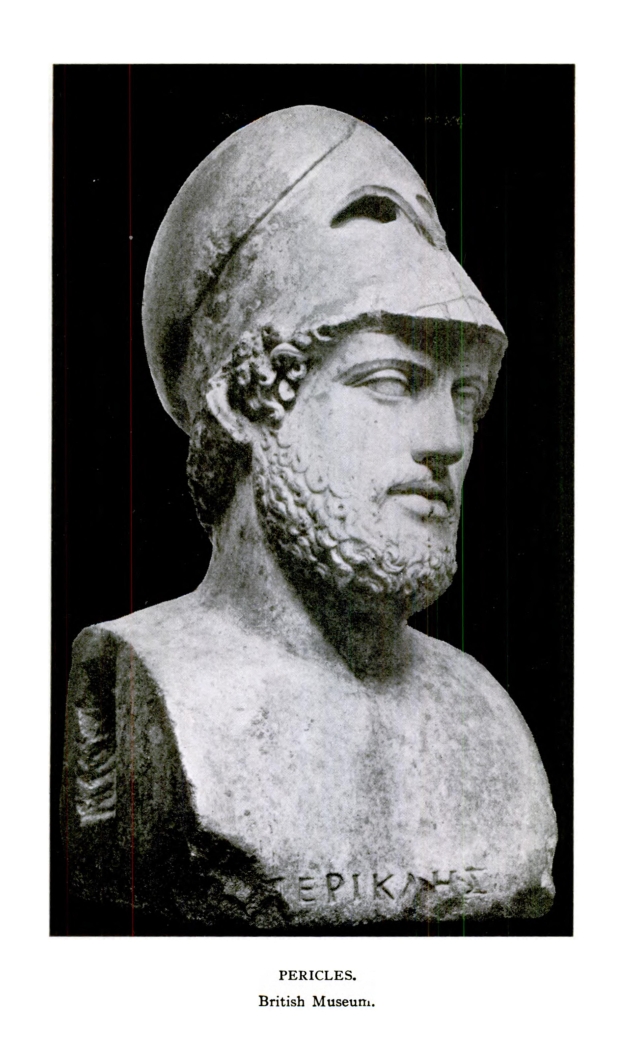
PERICLES.
British Museum.
Themistocles had been exiled, Aristeides was dead,
and a statesman named Pericles now took the leading
part in Athenian affairs. His boyhood had been
spent during some of the most thrilling years of
Athenian history. As a child he had become a
hero-worshipper of the men who had fought at
Marathon; he must have been amongst the older
children who were forced to flee from Athens on the
approach of Xerxes; and though not old enough to
fight, he was old enough to understand how much
hung upon the outcome of the battle of Salamis, and
he probably spent that great day in sound, if not
also in sight, of the conflict between the two hostile
fleets. His father was the commander of the fleet
which in the following year defeated the Persian on
the same day on which was fought the battle of
Plataea and one can imagine the youth, returning to
his beloved Athens, glorying in the deeds of his
father and his countrymen, and resolved to take his
part in making Athens a great and glorious city.
Pericles belonged to a noble family, and he had
been educated by some of the great philosophers of
his day. Like Thales of Miletus, these men
believed that nature was governed by laws that had
nothing to do with the good-will or anger of the
gods, and one of them, though still believing in the
existence of many gods, held the belief that the world
had been created by one Mind alone, and he taught
Pericles to share this belief. This helped to free the
mind of Pericles from superstition, and on several
occasions he tried to free others from the fears
which superstition brings. He was once on board
his ship when an eclipse of the sun took place. The
darkness filled everyone with terror, and it was
looked upon as a sign of the wrath of the gods.
Pericles, therefore, perceiving the steersman seized
with fear and at a loss what to do, took his cloak and held
it up before the man's face, and, screening him with it
so that he could not see, asked him whether he imagined
there was great hurt, or the sign of any great hurt in this,
and he answering no, "What," said he, "does that differ
from this, only that which has caused that darkness there,
is something greater than a cloak."[11]
Although by birth belonging to the nobles, Pericles
took the side of the people in Athens, partly, at first,
because he did not want to do anything that might
make it even seem that he was aiming at the sole
power of a Tyrant. He soon became the acknowledged
leader, and he then
entered on quite a new course and management of his
time. For he was never seen to walk in any street but
that which led to the market-place and the council hall,
and he avoided invitations of friends to supper, and all
friendly visiting and intercourse whatever. He also
presented himself at intervals only, not coming at all
times into the Assembly, but reserving himself for great
occasions.[12]
In many ways Pericles showed himself superior to
the men around him, and because of this superiority
and for his great power in public affairs he was given
the surname of the Olympian. Like Zeus, he was
said to speak with
thundering and lightning, and to wield a dreadful
thunderbolt in his tongue. Pericles, however, was very
careful what and how he was to speak, insomuch that
whenever he was to speak in the Assembly, he prayed
the gods that no one word might unawares slip from him
unsuitable to the matter and the occasion.[13]
Under the leadership of Pericles, Athens rose to be
a great state. The Age of Pericles was a short one,
lasting only for about fifty years in the last part of
the fifth century B.C., but it was a period which was
great not only in material prosperity, but also in
every form of intellectual and artistic beauty. The
work of Pericles
which gave most pleasure and ornament to the city of
Athens, and the greatest admiration and even astonishment
to all strangers, and that which is now Greece's
only evidence that the power she boasted of and her
ancient wealth are no romance or idle story, was his
construction of the public and sacred buildings.[14]
The story of these buildings will be told in its own
place; for more than two thousand years they have
testified to the greatness of the people who built
them.
By the laws Pericles made it became possible for
every free-born Athenian citizen, no matter how
poor he was, to take an active part in the government
of the State, thus completing the work of the
earlier lawgivers and making Athens a democracy,
a state ruled by the many.
It was the custom in Athens, that the bodies of
Athenians who had been slain in battle should be
brought home, and buried in special tombs which
were situated in a very beautiful spot outside the
walls. Only after the battle of Marathon were the
dead, in recognition of their great valour against the
Barbarian, buried on the field. All others were
brought home and given a public funeral. There
was always buried with them an empty coffin, as a
symbol of all those whose bodies were missing and
could not be recovered after the battle. It was
believed that this wish to do honour to the dead and
to give them fitting burial would ensure their
happiness in the life after death, which every Greek
believed to be imperilled if there was lack of proper
burial. At the close of the funeral ceremonies, some
great orator was always asked to deliver a suitable
oration. On one such occasion, Pericles was the
orator, and in the great Funeral Speech he made,
he set forth to the Athenians what he considered
Athens stood for in the world. There are no better
words in which to describe the greatness of Athens
at this time and the ideals at which she aimed, so
listen to the words of Pericles, describing the city he
loved:
Our form of government does not enter into rivalry
with the institutions of others. We do not copy our
neighbours, but are an example to them. It is true that
we are called a democracy, for the administration is in
the hands of the many and not of the few. But while
the law secures equal justice to all alike in their private
disputes, the claim of excellence is also recognized; and
when a citizen is in any way distinguished, he is preferred
to the public service, not as a matter of privilege,
but as the reward of merit. Neither is poverty a bar,
but a man may benefit his country whatever the obscurity
of his condition.... A spirit of reverence pervades
our public acts; we are prevented from doing
wrong by respect for authority and for the laws, having
an especial regard to those which are ordained for the
protection of the injured as well as to those unwritten
laws which bring upon the transgressor of them the
reprobation of the general sentiment.
And we have not forgotten to provide for our weary
spirits many relaxations from toil; we have regular games
and sacrifices throughout the year; at home the style of
our life is refined; and the delight which we daily feel in
all these things helps to banish melancholy. Because of
the greatness of our city the fruits of the whole earth
flow in upon us; so that we may enjoy the goods of other
countries as freely as of our own.... We are lovers
of the beautiful, yet simple in our tastes, and we
cultivate the mind without loss of manliness. Wealth we
employ, not for talk and ostentation, but when there is
a real use for it. To avow poverty with us is no
disgrace; the true disgrace is in doing nothing to avoid it.
An Athenian citizen does not neglect the state because
he takes care of his own household; and even those of us
who are engaged in business have a very fair idea of
politics. We alone regard a man who takes no interest
in public affairs, not as a harmless, but as a useless
character; and if few of us are originators, we are all
sound judges of a policy.... In doing good, again,
we are unlike others; we make our friends by conferring,
not by receiving favours.... To sum up, I say that
Athens is the school of Hellas ... for in the hour of
trial Athens alone among her contemporaries is superior
to the report of her.... We have compelled every
land and every sea to open a path for our valour, and
have everywhere planted eternal memorials of our friendship
and of our enmity. Such is the city for whose sake
these men nobly fought and died; they could not bear
the thought that she might be taken from them; and
every one of us who survives should gladly toil on her
behalf.... Day by day fix your eyes on the greatness
of Athens, until you become filled with the love of
her; and when you are impressed by the spectacle of her
glory, reflect that this empire has been acquired by men
who knew their duty and had the courage to do it....
And now, when you have duly lamented, everyone
his own dead, you may depart.[15]
Almost in the centre of Attica lies a plain
surrounded in the distance by hills: towards the East,
Mount Hymettus, the home of goats, purple with
thyme and filled with the murmur of bees; and to
the North, Mount Pentelicus, famous for its shining
white marble, that gleamed a rosy-red when the
sun went down. Rising straight out of the plain
is a great oval-shaped rock, the famous Acropolis
of Athens, once its citadel and fortress, but
transformed by Pericles into a great shrine for Athena.
From this rock the land sloped gently to the sea.
The plain was watered by the Cephisus, the only
stream in Attica which did not run dry in the
summer, and along its banks were olive groves, adding
their touch of dark grey-green to the landscape.
In the centre of this plain, at the foot of the
Acropolis, was Athens.
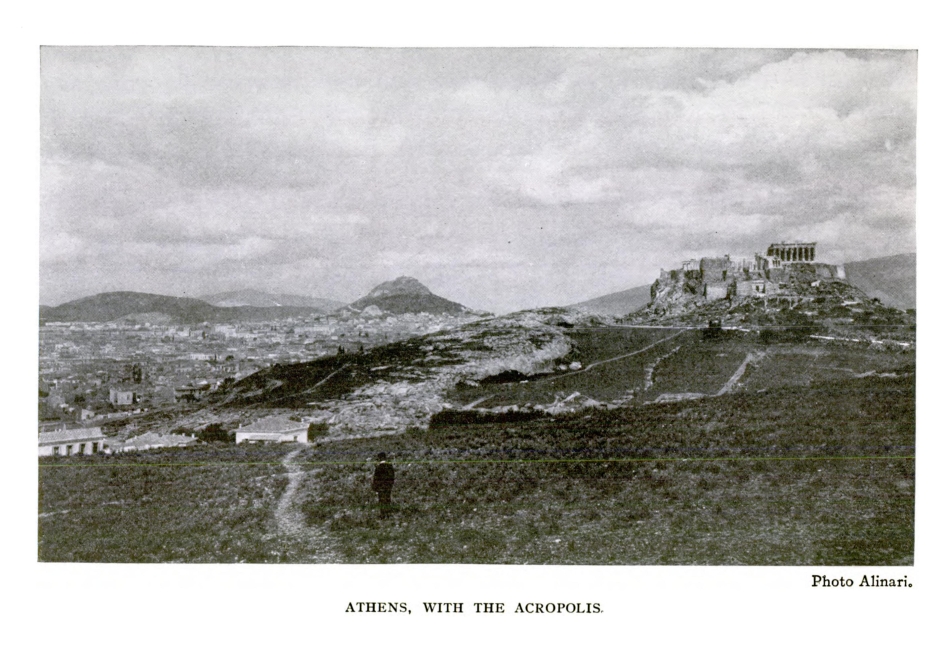
ATHENS, WITH THE ACROPOLIS.
Roads from all directions led to Athens, but the
Greeks, unlike the Romans, were not great road-makers,
and except for those used for processions
on festivals, such as the Sacred Way that led to
Eleusis, the roads in Attica were not in good repair,
and foot-passengers when they went on a journey
generally preferred the shorter paths over the hills.
In the early morning, the roads outside the city
were thronged with people coming in from the
country on various kinds of business. Chief of these
were the farmers, bringing their fruit and vegetables
and other produce to sell in the market, but merchants
from distant lands were also to be seen bringing
their wares along the road from the Peiraeus. The
city was entered by gates in the great wall which
had been built by Themistocles after the Persian
Wars, and from the gates, the streets all led to the
Market Place, or Agora, as it was called by the
Greeks. The streets were narrow, crooked and
dark, and were not paved, and the houses on each
side presented a very dull appearance, for the
windows rarely faced the street. The streets were
dirty, too, for all kinds of refuse were thrown into
them. This absence of light and air did not make
for health, and so very often pictures of Apollo,
the Bringer of Health, were painted on the walls.
The Athenians spent their wealth on their great
public buildings, and there was very little to
distinguish one private house from another. Demosthenes,
writing at a later time, said of the Athenians
of the age of Pericles:
The public buildings they constructed for us; the
number and beauty of the temples, and of the offerings
they contained, are such that their successors can never
surpass them; but in private life they practised so great
a moderation, that even if any of you knew which was
the house of Aristeides or Miltiades or any of the famous
men of old, you would find it no more pretentious than
those of its neighbours.
The water in Athens came from wells and springs
and fountains, many of which were at the street
corners, and it was the task of the slave maidens to
draw the water from the fountain and to carry
it home in vessels which they carried on their
heads.
It is evident that Athens was a city very different
from a well-equipped modern city, and that it
lacked a great deal of what we consider necessary.
But the Athenian of the fifth century B.C. had
extraordinarily little use for things, and he laid no stress
on comfort. He was content to have houses without
drains, beds without sheets or springs, and rooms
as cold or as hot as the open air. He could tell the
time without a clock, cross the sea without a
compass, fasten his clothes (or rather his two pieces of
cloth) with two pins instead of rows of buttons,
and wear sandals without stockings or even go
barefoot. He warmed himself over a pot of ashes,
judged law-suits in the open air on a cold winter's
morning, studied poetry without books, learned
geography without maps, and politics without a
newspaper. The Athenians were civilized without
being comfortable.[1] Of course much of this simple
life was possible because of the climate, and modern
standards of cleanliness need in no way conflict
with a simple life; nevertheless it is the glory of
the Athenians that they not only believed but
practised the belief, that the things of the mind
and spirit are greater than those of the body.
The daily life of Athens centred in the Agora.
If the streets approaching it were mean and dirty,
the Agora itself, the centre of public life, was wide
and spacious and surrounded by dignified and
beautiful buildings. In shape it was a great open
square, two sides of which were taken up with
public buildings and temples. On the remaining sides
were the Stoas or Porches. These consisted of a
roof supported by a row of columns in front and a
wall at the back. Each stoa was a covered walk,
protected from the glare of the sun, the biting of the
cold wind, and from the rain, and whatever the
weather might be, the Athenian could always find
a pleasant sheltered place where he could walk and
talk with his friends. One of these Porches was
known as the King's Porch. It was used as one of
the law-courts, and on the wall at the back were
inscribed the laws of Solon, and it was here that
every archon had to take his oath of office. The
most frequented of the stoas was the Painted Porch,
so called because its wall was decorated with frescoes,
one of which was a great painting of the battle
of Marathon.
The centre of the Agora was a great open space,
part of it free for the public to walk in, and part of
it full of booths and stalls where was sold everything
needed by the Athenians.
There were three classes of people in Athens:
the citizens, who were all free-born Athenians; the
foreign residents who were called metics; and the
slaves. In outward appearance there was often very
little difference between them, but only the citizens
might vote, and they alone had any privileges.
The metics were generally well-to-do; they were
merchants and bankers and helped very largely
to create the wealth which made Athens great.
The morning life of Athens centred in the Agora,
but when the afternoon came, this was gradually
deserted, and the Athenians who had gathered
there earlier in the day went along the roads that
led out of the city to the different Gymnasia. These
were originally places devoted to the games
practised by all Athenians, but they gradually became
used more as parks, where the young men played
games and the older men watched and talked.
The Academy was the greatest of the gymnasia,
and philosophers used to frequent it, and with
their pupils discuss all the many things in which
the keen and adventurous minds of the Athenians
were interested. Plato, one of the greatest of the
philosophers, was a well-known figure at the Academy.
Rising above the city, watching over it and guarding
it, was the Acropolis, crowned by temples and
statues. A great statue of Athena looked down
upon the city at her feet, at the busy Agora and
the public buildings in which the government of
the state was carried on, at the narrow streets lined
with the houses of the citizens, and, beyond the
walls, at the pleasant roads leading, on one side,
out to the gymnasia and the country beyond, and,
on the other, down to the harbour busy with the
trade of Athens and where the galleys went in and
out on their voyages all over the Mediterranean
world.
A visitor to the Agora in the morning would have
found Athenians of all kinds going about their daily
business and he would have had opportunity to
see how they dressed. The morning crowd in the
Agora consisted almost entirely of men; to see
Athenian women a stranger would have to be
invited to their houses, a rare privilege but seldom
accorded, or to have visited Athens during a
festival, when women were allowed to take part in the
great processions which went up to the shrine of
Athena on the Acropolis. But men of all classes
could be seen every day in the Agora: the working-man
going to his work, the countryman selling the
produce of his farm, slaves doing the daily marketing
for the household, and men of leisure walking
about and talking to their friends.
The chief garment worn by all these men was the
chiton or tunic. It was made by taking an oblong
piece of cloth, cutting it the required length and
then folding it round the body, so that it hung from
the neck to the knees. It was fastened at the neck
with a pin, sometimes beautifully wrought in gold,
in such a way that arm-holes were made, and one
side was always left open. A girdle kept the folds
of the chiton in place, and it was generally tight
enough to disguise the fact that one side was open.
A man's chiton seldom came below his knees, but
the wearer could always regulate the length, and
workmen and all those engaged in active occupations
were generally well-girded, that is, they pulled up
the chiton, so that it was short, with part of it
hanging over the girdle. Older men usually allowed
the chiton to hang to its full length.
In the house, the chiton was the only garment
required, and workmen and all young men engaged
in active pursuits seldom wore anything else out of
doors, but out of the house, the older men generally
added a mantle known as the himation. This was
another oblong piece of cloth, but larger than that
used for the chiton, which was thrown over the left
shoulder, brought round under the right arm to the
front of the body, and then thrown again over the
left shoulder. The himation was not, as a rule,
pinned and so it had to be very carefully adjusted
in order that its folds might hang well. It was a
very difficult thing to put on a himation gracefully,
and it was often the work of a special slave to
arrange it before his master went out of doors. The
folds had to hang well, and it had to be of the right
length, for if it was too short, the Athenian thought
the wearer looked like a rustic come to the city
for the first time, and to wear it too long was a sign
of ostentation and needless display.
The only other garment sometimes worn by
men was the chlamys, a short cloak worn by the
young men. It was circular, gathered round the
neck and fastened by a pin or clasp, and hung over
the back and left shoulder reaching to the waist.
The chlamys was generally of a bright colour; the
chiton and himation were more often white, though
sometimes colours were used, but beautifully
designed borders were frequently embroidered in
colours on both the chiton and himation, and an
Athenian crowd presented a bright and gay scene.
Athenian men seldom wore anything on their
heads, unless they were travelling, when they wore
a close-fitting cap, either with or without a brim,
but they generally wore sandals on their feet, though
this was not considered absolutely necessary.
The dress of the Athenian women consisted, like
that of the men, of a chiton and himation, but the
woman's chiton was longer; it reached to her feet
and was fuller, and it often had short sleeves. No
Athenian woman could ever appear out of doors
without her himation, and this was often so arranged
that it was drawn over her head, forming a hood.
This was generally the only form of head covering
worn by Athenian women, though if they went out
in the sun they sometimes took parasols.
Athenian women probably used more colours in
their dress than the men; a particularly beautiful
saffron-yellow was a favourite colour, especially for
their bridal dresses, and on such occasions their
dress was enriched by gold ornaments, necklaces,
bracelets and rings. Ornaments of various kinds
were freely used by the Athenian women in their
dress, but the Greeks disliked anything that had no
purpose but show, and their jewels were so arranged
as to enrich their appearance without taking away
from its simple dignity and beauty.
"I do not spend my days indoors," said an Athenian
once, "my wife is quite capable of managing our
domestic affairs without my aid."[2] This probably
expressed the feeling of most Athenian men, for
they gave very little time to their houses. These
were the places where the women of the family
spent nearly all their hours, but where the men did
little more than sleep and have their meals. In
the summer time an Athenian house was probably
a pleasant place, though we should have found it
lacking in nearly everything that we consider
necessary, but in the winter it would have been
uncomfortably chilly and draughty.
It has already been noticed that an Athenian
house usually presented a blank wall to the street,
for it was built round a court on to which all the
rooms opened. The houses were generally of one
story only, though a few occasionally had more,
and the rooms drew all their light and air from the
court. Socrates once said that a perfect house should
be one that was cool in summer and warm in winter,
and of such a convenient size that the owner
could keep all his possessions in it with ease and
security.
The front door was always kept carefully shut and
bolted, but a knocker, often in the form of a ring in
a lion's mouth, announced the visitor, who was
admitted by the porter, a slave who sat in a small
room just inside the door. The door opened into a
courtyard, which in a good-sized house would be fairly
large, but badly paved. This was the men's court.
A row of columns all round the sides supported a
roof which made a kind of verandah, from which
small rooms opened. These rooms do not seem
to have had any light or air except that which
entered from the court, and they must have been
dark and uncomfortable. They were used only by
the grown sons of the family and by the male slaves.
In the middle of the court stood an altar to Zeus
the Protector of the Home, on which fragrant
incense always burned, and fresh garlands of flowers
and leaves would be placed on it every day.
Leading out of the men's court was the dining-hall.
There would be no table, for the guest did
not go to the table, but the table, a low one, was
brought to him as he sat or reclined on a beautifully
carved couch. The most sacred spot in the
house was in this room, the altar of Hestia, on which
burned the sacred fire of the family hearth. There
might be a row of large vases against one wall, and
if one of them bore the inscription, "I am from
the Games at Athens," the family would take care
to preserve it as one of their greatest treasures,
for the words meant that the vase had been a prize
won by some member of the family in the Athenian
Games.
A door opposite that which led from the men's
court into the dining room, opened into another
court, that of the women. This was similar to the
men's court, but more often planted with flowers
and shrubs. The women's rooms, nearly as small
and dark and uncomfortable as those of the men,
opened from the women's court, and the kitchen
was probably at the back of it. On one side of this
court there was a large chamber, the best furnished
in the house, where the master and mistress slept.
All the furniture in these rooms was simple, but
of beautiful design. The chief things used were
couches, footstools, low chairs and tables and
chests. The latter took the place of closets and
cupboards. There were lamps and bronze candelabra,
and large numbers of cases used by the Athenians
as ordinary water-jugs, wine jars and drinking
cups, all of the most graceful shapes and forms and
beautifully painted.
The life of the Athenian house centred in the
women's court, though during the daytime when the
men of the house were absent, the women used the
men's court almost as much as their own. The
moment, however, they heard the sound of the
knocker on the front door, they fled to their own
part of the house, lest they should be caught
unawares by a male visitor.
Such was probably the house of a well-to-do
Athenian, a very much more comfortable and
well-furnished house than that of the Spartan, yet
lacking in almost everything that we associate with
the idea of comfort. But the Athenian succeeded
in being civilized without being comfortable; his
well-being was in no way dependent on things,
and believing that his wealth was something to be
used for the good of the whole community, he spent
it on the temples and public buildings of the city
rather than on his own private dwelling. It may be
true that the little use the Athenian made of his
own house made him less interested in it than in the
other buildings of the city, but whether he carried
it to an extreme or not, it was his public-spirited
point of view that gave him that greater interest in
the public welfare than in his own private affairs.
The earlier Greeks believed that a state should
be self-supporting, that the farmers should produce
enough food, and the craftsmen everything needed
in daily life. But from the time of Solon onwards
this became increasingly difficult in Athens, for
owing to the arrival of settlers who came from many
different places, attracted by the possibilities of
work in the growing state, the population increased,
and it became impossible to produce enough food.
This had a very important influence on Athens, for
instead of being self-sufficing and secure within her
own walls, she became dependent for her life on
the food supplies, and especially on the corn, that
came to her from Egypt and the Black Sea colonies,
and in the time of war it was absolutely necessary
that the routes to these places should be kept open.
Very strict laws were passed to regulate the corn
trade and to make sure that enough would always
be brought to Athens. No Athenian merchant
might take corn to any other harbour than the
Peiraeus, and none might leave Egypt or the Black
Sea ports unless he had a certain amount of corn on
board his ship.
The fact that the Athenian merchant had to go
to distant places for corn increased his trade in
other articles. He was at home on the sea, and his
many-oared ship passed swiftly over the waters of
the Aegean, stopping at many places: at the ports
of Ionian colonies, where he found his kinsfolk,
eager to hear the latest news from the mainland
and especially from Athens; at the ports of the
Barbarians, where he rejoiced that he was a Greek
and did not dwell amongst these strangers. The
Athenian merchant sailed in his own ship, and
beyond his final destination, generally had no
definite route in mind. He was guided by the
favourable winds, or by rumours of suitable trading ports
where he would find good opportunities for
exchanging his goods. He left Athens with oil, honey
from Hymettus, and the far-famed Athenian pottery,
the chief exports, and he exchanged these for
the corn and fish of the Black Sea ports, the wool of
Miletus, the perfumes and spices of Syria, the linen
and papyrus and the all-important corn of Egypt,
the wine of Chios, the cypress wood of Crete, the
dates of Phoenicia, the rugs and cushions of
Carthage; while in such ports as Carthage and Miletus
he found articles which had reached these places
by caravans from still more distant lands. In
Carthage he obtained ivory and ebony from Africa,
and in Miletus richly woven carpets and rugs from
Babylon.
All this trade brought wealth to Athens, and it
taught the quick Athenian mind, always alert and
interested in any new thing, "new ways of enjoying
life."
Most of the industries carried on in any large city
were to be found in Athens, but the industry for
which she was best known throughout the Mediterranean
world was that of the potter, and Athenian
vases were exported in very large quantities. But
these vases were not mere ornaments; each had its
own particular use as a household utensil, an
offering to a god, or as an offering at a tomb.
Vases for different purposes were made of different
shapes; each was beautiful in form, but with its
beauty it combined usefulness. The handles on
the water jars are placed just where they are most
needed, the oil pours out of the narrow neck of the
oil jug drop by drop so that the quantity could be
easily regulated, and the drinking cup has a slight
curve to the rim, so that one can drink out of it
quite easily without spilling the liquid.
There are certain well known forms of these
vases: the Amphora is a large two-handled vase
which was used for storing oil and other liquids;
the Hydria has three handles and was used for
carrying water; the Krater is a large vase in which
wine and water were mixed; the Lekythos is a jug
with a narrow neck used for pouring out oil slowly
in small quantities; and the Kylix is a wide and
shallow drinking cup. A large amphora, often full of
oil, was given as a prize for some of the athletic
contests at the Panathenaic games held in Athens.
Such an amphora can always be recognized, as it
bears on one side the figure of Athena with the
inscription: "I am from the Games at Athens,"
and on the other a painting depicting the contest
for which the vase was a prize.
The quarter in Athens given up to the potters
was known as the Cerameicus, and here there were
a number of workshops owned by different
vase-makers. At the head of each establishment was the
master; but he was a craftsman as well as manager
and was able to do everything connected with
the industry: he could not only make the vase, but
also design and paint it. His workmen, however,
did most of the turning, shaping and polishing of
the vases. When the vase had been made, it was
given to the artist who painted the design on it,
after which it had to be dried, baked and glazed.
The black glaze that was used in Athens was one of
the great discoveries of the ancient potters' art.
Time never spoiled it, and it seems as fresh today as
when it was first put on the vases. In some cases it
has peeled off in small flakes, but that only happens
when the clay beneath is damp; otherwise it
remains unchanged.
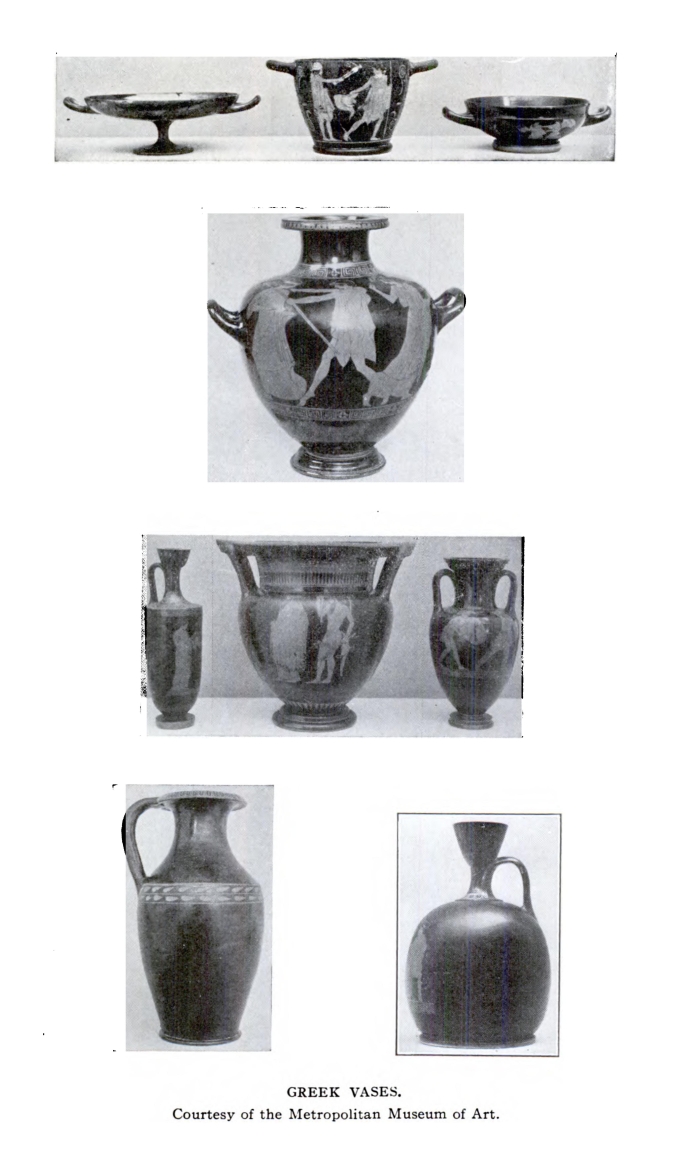
GREEK VASES.
Courtesy of the Metropolitan Museum of Art.
The earlier vases were painted in black on the
red background of the clay; later, the artist sketched
his design on the red clay and gave the vase back to
the workman, who painted in the background in
black and then returned it to the artist, who
retouched his design and in some cases added here and
there a touch of colour.
Besides the rooms for the workmen and artists,
and the court where the ovens were placed, a potter's
workshop required storerooms where the finished
vases were kept, and a room where the master
received his customers and sold his pottery.
The subjects of the paintings on the vases were
always carefully chosen and were suited to the use
to which the vase was to be put. The large vases
had graver and more serious subjects, the kylix
had more animated scenes. This cup was used at
banquets and on festive occasions, and so the
artists painted gay and merry scenes on it, and as
they tried to attract buyers by the novelty of their
designs, the kylix paintings show a great deal of
originality. The subjects were taken from mythology,
or showed battle scenes, or subjects connected
with daily life. If all our other sources of knowledge
of life in Athens were suddenly lost to us, the vases
would still be a rich mine of information, as in one
way or another they represent all the varied experiences
of human life.
In all their art the Greeks were chiefly interested
in representing the human form. They themselves
did not realize that in doing this they were taking a
step onward in man's great adventure of learning
how to live, but in all the many ways in which they
represented man, they showed him going forth into
the outside world of nature, conscious that he had
the power to make of it a world in which he felt at
home. Part of the greatness of the Greeks came
from the fact that they did this unconsciously. The
craftsmen and vase-painters themselves were in no
way regarded as the equals of the great sculptors.
The Athenians regarded them as quite lowly workers,
but they were artists nevertheless, proved so
by the fact that though there was often copying of
a general design, the artist never copied mechanically,
but put into his work something that was his
own. In all the great quantity of Greek vases in the
world today no two have been found exactly alike,
and so the craftsmen, though they were unconscious
of how later ages would regard their work,
knew the satisfaction that comes from creating
beauty in any form, and they said of their work
that "there is no sweeter solace in life for human
ills than craftsmanship; for the mind, absorbed in
its study, sails past all troubles and forgets them."[3]
The day began early in Athens, and as soon as the
sun was up everyone was stirring: the workman was
off to his work, the schoolboy to school, and every
booth and stall in the Agora was laden with articles
to attract the buyers who were expected in the market.
Before leaving his house, the Athenian gentleman
had his breakfast, a little bread soaked in wine, after
which one of his house-slaves saw that his himation
hung in graceful folds, and then, accompanied by
one or more slaves carrying baskets, he set forth for
the Agora. Here the morning marketing was done,
but unless he was giving a very important banquet
in the evening, the gentleman did not himself
attend to the household marketing; his slaves did that
for him and took the purchases home. Their
master, in the meantime, would walk up and down the
Agora, or take a turn or two in one of the Porches,
where he would meet some of his friends, or go to
the barber's shop, where he would be sure to hear
the latest news of the day: Pericles had proposed to
build another temple, and there was much discussion
as to whether the state could afford it; the
Spartan army was said to be stronger than ever,
and Sparta had always been jealous of Athens; was
she secretly getting ready for a war, and if so should
not Athens be prepared, or were those right who
believed that the greatness of Greece lay in a policy
of peace with Sparta? Perhaps the Olympic Games
were being held and the news had just come and
spread like wildfire through the city, that the
Athenians had covered themselves with glory,
especially in the chariot race, and that the victors were
even then on their way home, so all must be in readiness
to receive them. Or was it known that a
galley had just returned from a trading voyage on
the Aegean, and that the sailors were reporting that
there was a good deal of discontent in some of the
islands, and that threats were being made of
withholding some of the tribute money unless the
islanders were allowed greater independence? These and
many more burning questions of the day were
made known and discussed without the use of newspapers.
But the Athenian gentleman did not spend all
his morning in talk. If he were wealthy, he would
have definite duties required of him by the State:
he had to fit out and keep in good order one or more
triremes for the navy, and there would be interviews
with the captain as to the number of men he
required and how much they should be paid; there
were estimates for repairs to be gone over, and
designs for a new and splendid figure-head on the
prow of the ship to be approved. Or perhaps it
was his turn to provide for one of the choruses in
the coming dramatic festival, and he must see to
it that this chorus was well-trained and that no
expense was spared in making it better than any
of the others, so that he might win the prize.
Then there were other duties towards the State
that were demanded of every free-born citizen. He
must sit on the jury and judge law-suits whenever
he was called upon to do so, and as the Athenians
were very fond of such suits the demand came very
often. Aristophanes, a dramatist who wrote a number
of plays in which he made fun of a great many of
the Athenian characteristics, said of the juryman:
He is a law-court lover, no man like him.
Judging is what he dotes on, and he weeps
Unless he sits on the front bench of all.[1]
In some way or other every Athenian citizen took
part in the actual government of the state, and
in the time of Pericles about nine thousand men held,
during the year, some kind of state position. These
officials were chosen by the people and were seldom
re-elected, so that not only was everybody in turn
responsible for certain functions, but everyone was
capable of intelligently discussing the affairs of
the state, and this was done at great length every
day whenever Athenian citizens met together.
About once every ten days, the Agora was
deserted in the morning, and every free-born Athenian
citizen over thirty years of age, both rich and
poor, was expected to go to the Pnyx, the meeting
place of the Assembly. In times of war, or when
some very important question in which everyone
was interested had to be settled, no one stayed away,
and there would be great hurrying in the early
morning in order to get a good place.
The Pnyx was a great open-air place of assembly,
west of the Acropolis and not far from the city
wall. In shape it was a sloping semi-circle, part of
which was supported by a wall. There were no
seats, and the citizens had to make themselves
as comfortable as they could on the bare ground.
Facing the slope was a rock cut in the form of a
platform and mounted by steps on each side. This
was called the Bema, and here the orators stood
when they addressed the Assembly. In front of the
Bema was the altar on which was offered the sacrifice
that always opened the Assembly, and behind
it on a rock were seats for the state officials who had
charge of the meeting.
There were doubtless many days when the business
in hand was not very interesting, but there
were times when excitement ran high and no one
was absent. It is not difficult to imagine the scene.
Not far off rose the rock of the Acropolis, symbol of
the strength and glory of Athens and of the
guardianship of Athena; in the dim distance was the sea,
the great bond of union between Athens and the
islands of the Aegean and the East, and a symbol
of the protecting power of Poseidon; overhead
stretched the blue Greek sky; and there below in
the Pnyx was the densely packed crowd of Athenians,
deliberating on matters on which hung their
very life or death. It was there that the decision
was made to march to Marathon and to face the
unnumbered Persian foe; that Themistocles pleaded
passionately for a navy; that the messengers from
Delphi brought back the answer about the "wooden
walls"; that Aristeides persuaded the Athenians
to free the Ionians from their Persian masters and
to form the Delian League which led Athens to
become an Empire; and it was there, too, that Pericles
in stately and measured tones urged the Athenians
to beautify their city as no other city in the
world had ever been beautified before.
These and similar occupations took up the morning
of the Athenian gentleman. After a light meal
in the middle of the day, he would go to the Academy
or one of the other gymnasia, where he would spend
the cool of the day in exercising himself, or in
watching the youths at their games; in walking in the
pleasant groves talking over the events of the day
with his friends; or in discussing with some philosopher
all kinds of questions concerning new interpretations
of old beliefs and new ideas about man,
whence he comes and whither he goes. Some of
these were questions which were discussed for the
first time in the history of the world, and never
before and but seldom since has there been such an
eager desire to know the truth about all things, as
there was in this Athens of the fifth century B.C.
But as the evening drew on and it grew dusk, the
Athenians left the gymnasia and returned to the
city. All day long they had been in company, and
in the evening the most was made of every opportunity
to meet again, for they held that "to eat
your dinner alone was not dining but feeding," so
it was very likely that the day would end by a
banquet. If that were so, the guests would all have
been invited in the morning, either by the host
himself when he met them, or by a message carried by a
slave. Preparations were usually made for more
than the invited number of guests, as it was a
common custom for guests to bring some additional
friends of their own, and uninvited guests would
often come without any special bidding. Since
leaving the gymnasia, all the guests would have
been at their homes. There they would have bathed
and clad themselves in fresh chitons and mantles,
and slaves would accompany them to the house of
their host.
At a banquet the guests reclined on couches, and
the food was brought to them on low tables. The
evening meal was the chief meal of the day in Athens.
It began with fish or meat and vegetables, and
when this course was over, the tables were removed,
water was poured over the hands of the guests, and
garlands were often passed round. Then came the
second course of fruits, confectionery and various
kinds of sweetmeats, after which the tables were
again removed, and replaced by smaller ones on
which stood beautifully shaped drinking cups. The
guests were given more garlands and wreaths, and
the slaves brought in the large kraters, in which
the wine and water were mixed, and the after-dinner
entertainment of the evening began.
This entertainment was called the Symposium,
and it began with the pouring out of three libations:
to the Olympian gods, to the Heroes, and to Zeus.
Then the health of the hosts and of his guests was
drunk; after which began the entertainment. This
consisted of conversation, singing, listening to music,
watching dancers, in playing games, telling stories
or passing round jests. Just what was done at the
Symposium depended on the kind of guests present.
"When the company are real gentlemen and
men of education," said Plato, you will see no
flute-girls, nor dancing girls, nor harp girls; they
will have no nonsense or games, but will be
content with one another's conversation." More
often, however, the guests were less serious. They
enjoyed the music of the flute and other instruments,
they played games, and watched dancing,
they "chatted and talked pleasant nonsense to one
another."
When the party came to an end, a libation was
offered to Hermes, the slaves were called, who
attended their masters home, lighting their way with
torches or lamps. The older men would go sedately
home, the younger would keep up their merriment
and go noisily and boisterously through the streets
until, having knocked at the doors of their houses,
the sleepy porter would wake up and let them in,
and silence would at length reign in the streets of
the city.
What, in the meantime, was the Athenian lady
doing? She was at home, managing all the household
affairs and bringing up the children. She
educated her sons until they were seven years old,
when they went to school, and her daughters until
they were about fifteen, when they were considered
old enough to be married.
The Greek writer Xenophon wrote an account of
what were considered the duties of an ideal Athenian
wife. He imagines the husband of a young bride
telling her what he expected of her, and in what way
he hoped the household affairs would be managed.
You will need to stay indoors, despatching to their
toils without, such of your domestics whose work lies
there. Over those whose appointed tasks are indoors
it will be your duty to preside, yours to receive the
stuffs brought in, yours to apportion part for daily use,
and to make provision for the rest, to guard and garner
it so that the outgoings destined for a year may not be
expended in a month. It will be your duty when the
wools are brought in to see that clothing is made for those
who have need. Your duty also to see that the dried
corn is made fit and serviceable for food. Then, too,
if any of the household fall sick, it will be your care to
tend them to the recovery of their health.
But there are other cares and occupations which are
yours by right. This, for instance, to take some maiden
who knows nothing of carding wool, and to make her
skilful in the art, doubling her usefulness; or to receive
another quite ignorant of housekeeping or of service,
and to render her skilful, loyal, serviceable, till she is
worth her weight in gold. But the greatest joy of all will
be to prove yourself my better; to make me your faithful
follower; knowing no dread lest as the years advance
you should decline in honour in your household, but
rather trusting that though your hair turn gray, yet in
proportion as you come to be a better helpmate to myself
and to the children, a better guardian of our home,
so will your honour increase throughout the household
as mistress, wife and mother, daily more dearly prized.[2]
Some further good advice was then given, and the
husband concluded by recommending exercise as
the best means of preserving both health and
beauty. He said:
I counsel you to oversee the baking woman as she
makes the bread, to stand beside the housekeeper as she
measures out her stores; to go on tours of inspection to
see if all things are in order as they should be. For, as
it seems to me, this will be at once walking exercise and
supervision. And as an excellent gymnastic, I urge you
to knead the dough, and roll the paste; to shake the
coverlets and make the beds; and if you train yourself
in exercise of this sort you will enjoy your food, grow
vigorous in health, and your complexion will in very
truth be lovelier.[3]
Added to all these occupations was the education
of the children. The Athenian lady had nurses
for them, Spartan slave-women, if they were to be
had, for their discipline was sterner than that
of other Greeks, and the Spartan nurses had the
reputation of being able to keep their young charges
in particularly good order. All kinds of toys were
provided for the children, hoops and balls,
spinning-tops and go-carts, dolls and toy animals. The
Athenian mother learnt to be a good story-teller,
for it was in these early days that the children
wanted stories told them, and many a tale would
she relate of the gods and heroes of old, of the
nymphs and spirits of the forests and mountains,
of the sea and of the air. And when night came and
the children must go to bed, then she would sing
them to sleep with a slumber song:
Sleep children mine, a light luxurious sleep,
Brother with brother: sleep, my boys, my life:
Blest in your slumber, in your waking blest.[4]
The girls had to be trained to all the duties of an
Athenian wife, and there was much to learn in the
short years of their girlhood. It was a domestic
training that they were given; of other things they
learned as much or as little as their mother knew
herself and was able to teach them, probably not
more than a little reading and writing. A girl was
not encouraged to take up any kind of intellectual
pursuits, and during her life before her marriage
she was generally "most carefully trained to
see and hear as little as possible, and to ask the
fewest questions."[5]
But it was not all work for the maiden, and many
a time did she sit in the swing in the courtyard and
idle away a warm afternoon gently swinging to and
fro, and many a merry game of ball did she have
with her companions. It was she who made the
fresh garlands and wreaths for the altars or the
house, and who, when the moon was full, laid
offerings on the tomb of her grandparents, and, most
glorious of all her girlhood privileges, it was she
who helped to weave the robe taken to the temple of
Athena at the time of the great Panathenaic festival
and who bore baskets of offerings to the goddess
in the great procession.
When the Athenian maiden married, all this life
came to an end, and she took upon her young shoulders
the training of her own household, even as she
had seen her mother do. Her marriage had usually
been arranged for her, and she often knew but little
of her future husband. Before the marriage day,
she offered all her girlhood treasures to Artemis,
the goddess who had watched over her childhood.
Her tambourines and pretty ball, and the net that
confined her hair, and her dolls and dolls' dresses,
Timareta dedicates before her marriage to Artemis, a maiden to
a maiden as is fit; do thou, daughter of Leto, laying
thine hand over the girl Timareta, preserve her purely
in her purity.[6]
When these symbols of her youth had passed
from her keeping into that of the goddess, the
maiden was dressed in beautiful raiment, crowned
with a wreath and covered with the bridal veil for
the marriage ceremony. This took place in the
evening on a day when the moon was full, and
when she was ready, the bride was led by her
attendant maidens to the court where the bridegroom
and her parents and the invited guests awaited her.
The marriage took place in the court, a sacrifice was
offered and a libation poured out to the gods, and
then the marriage feast followed, at which cakes of
sesame were always eaten. This was the only
occasion on which women were allowed to be present
at a feast, but through it all the bride remained
closely veiled. When the feast was over, the bridal
chariot was driven up to the door, and the bride
took her seat in it beside her husband, her mother
walked behind it bearing the marriage torch with
which the fire on the hearth of her new home would
be lighted, the guests surrounded it and with
flute-playing and singing escorted the bride to her new
home.
If the bridegroom lived in a distant place, the
bridal procession broke up at the gates of the city,
but if he lived in Athens, he and his bride were
escorted to the door of his house, where they were
met by his mother, and then, to the music of a
marriage song, the bride was led into her new home.
Did the Athenian lady have no amusements or
recreations? Did she leave all that was gay behind
her when she became a wife? The Athenian lady
seldom left the house, and never unless attended
by a female slave. She had practically no society
but that of her slaves. The peasant woman in the
fields and the few women who sold in the market
had the society of their friends, but such
companionship was denied to the well-born lady. She
saw no men, except those of her own family. If her
husband dined at home alone, she shared his meal,
but if he had guests she was unseen. From time to
time she took part in the great religious festivals and
processions, and occasionally she was permitted
to be present in the theatre when a tragedy was
performed, but she was never permitted to see a
comedy for the wit and humour were often coarse
and were considered unfitting for her ears.
In many ways it was a strange life that the Athenian
lady lived, one that seems as if it were in
contradiction to all that the Athenians held of the
highest importance, for the
Athenian lady lived in the house among a people that
lived out of doors. Among a people who gave great
importance to physical training she was advised to take
her exercise in bedmaking. At a time when the human
spirit was at its freest she was enclosed on all sides.
Art and thought and letters were reaching the highest
development they were ever to know, but for her they
hardly existed.
But whatever was the actual life of the Athenian
lady, the Athenian ideal of womanhood was very
high. In the wondrous temple that stood high above
the city, looking down upon it and guarding it,
was the figure that symbolized to the Athenians all
that was good and beautiful and true, and it was
the figure of a woman. It was always the figure of a
woman that represented Victory, and nearly all the
great Greek dramas deal with the fate of a woman,
who was generally the wife or daughter of a King.
The Sacred Mysteries of Eleusis, mysteries of such
deep meaning that it was said that "partakers in
them had better hopes concerning death and all
eternity," centred round the story of the love and
sorrow of a woman. A race that could produce such
great figures as these must have thought nobly of
womanhood.[7]
And so, in spite of her subordinate position in
the background, the Athenian woman was of real
influence in Athens. She reigned supreme in the
household, and as her sons grew up, they recognized
in her those qualities which every Greek and
especially the Athenian, was taught to value so highly:
that quiet courage which by its very steadfastness
overcomes all the little anxieties and annoyances of
daily life; and that self-control and self-mastery
which, putting self in the background, sets free the
individual for service to others. The Athenian
ideal of service was that the man should give it
wholly to the state, and the woman wholly to her
home, but narrow as was her horizon, limited as
were her opportunities, the Athenian woman
exercised an influence in Athens, that helped to
strengthen and preserve some of the noblest
Athenian qualities.
The chief aim of Athenian education was the
building of character. The Athenians were more
concerned that their sons should grow up to be
good citizens, loving what was beautiful and hating
all that was ugly, than that they should know any
great number of facts. The object of any education
is to teach a child how to live, and a system of
education is good or bad according as it fulfils this
aim. As different states and countries, at different
periods, have had different ideals as to what is
meant by living, so they will all have had different
kinds of education, each thought out in such a way
as best to train the child for that conception of life
believed in by his state or country. For example,
the Spartan conception of life was that every
citizen should be a good soldier, able to defend his
country and to go out and fight her wars. Whether
the Spartan ideal was a good one or not, may be
questioned, but it cannot be denied that Spartan
education was an excellent preparation for such a
life.
The Athenians had a much wider ideal than the
Spartans. They, too, believed in the training of the
body, and in making patriotic citizens who would
count it a glory to die in defence of their city, but
they also believed that it was a glory to live for their
city, and to this end they trained the mind and the
imagination as well as the body. To an Athenian
a good man was a good citizen, one who, being
physically perfect, would be able to defend his city in
time of war, who, being able to think, would be
capable of governing, and loving all that was
beautiful would set high standards of taste in art, in
letters, and in conduct. Praxiteles gave outward
form to this ideal in his statue of Hermes, and
though the Athenian ideal was not complete,
Athenian education produced a warrior like Miltiades,
statesmen like Themistocles and Pericles, a poet
like Sophocles, artists like Pheidias and Praxiteles,
philosophers like Socrates and Plato, and a historian
like Thucydides.
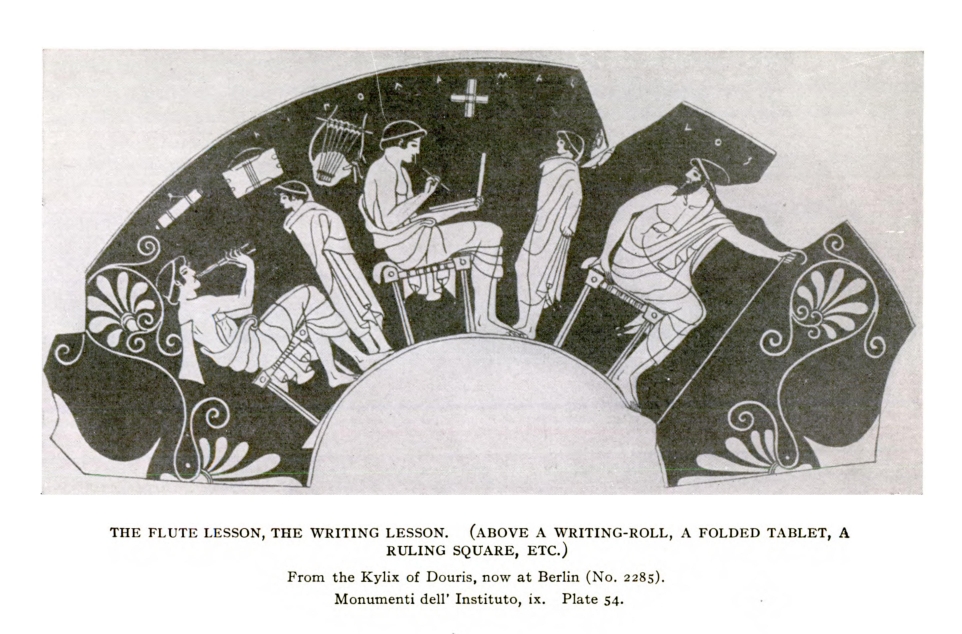
THE FLUTE LESSON, THE WRITING LESSON. (ABOVE A WRITING-ROLL, A FOLDED TABLET, A
RULING SQUARE, ETC.)
From the Kylix of Douris, now at Berlin (No. 2285).
Monumenti dell' Institute, ix. Plate 54.
The Athenians believed that training which
aimed only at money-making, or bodily strength,
or mere cleverness apart from intelligence, was mean
and vulgar and did not deserve to be called education.
True education, they held, made a child long
to be a good citizen and taught him both how to
rule and to obey. It must not be supposed that the
Athenians despised wealth or the power of wealth.
Only a wealthy state could have built the Parthenon
or celebrated the great Panathenaic Festival,
but the Athenians despised mere money-making,
and they believed that a man's success was not to
be measured by the amount of money he had made,
but by the use to which he put it, and they believed
that an education which taught a boy to be
industrious and thrifty, to despise self-indulgence and
luxury, to think straight and see clearly, would
make him a better citizen than one which aimed
only at making him a successful man of business.
So they aimed at giving every boy a good education.
First among things, [said one of their teachers], I
reckon human education. For if you begin anything
whatever in the right way, the end will probably be
right also. The nature of the harvest depends upon
the seeds you sow. If you plant good education in a
young body, it bears leaves and fruit the whole life long,
and no rain or drought can destroy it.[1]
The Athenian boy went to school when he was
seven years old. At this age he was placed in the
charge of a pedagogue, a trusted slave who accompanied
him when he went to school, carried his books
for him, and helped him, when necessary, with his
lessons. The pedagogue was also expected to keep
him in good order, to teach him good manners, to
answer all his many questions, and to punish him
whenever he thought fit, which was probably very
often.
Schools opened early, so early that Solon made a
law forbidding schoolmasters to open their schools
before sunrise and requiring them to be closed before
sunset, so that the boys should not have to walk
about the dark and empty streets. The Athenian
boy, then, had to be early astir. "He gets up at
dawn, washes the sleep from his eyes, and puts on his
cloak. Then he goes out from his father's house with
his eyes fixed upon the ground, not looking at
anyone who meets him." (A modest and unassuming
appearance in public was required of every
boy.) "Behind him follow attendants and pedagogues,
bearing in their hands the implements of virtue,
writing-tablets or books containing the great deeds
of old, or, if he is going to a music-school, his
well-tuned lyre."[2]
Arrived at the school, the pedagogue remained in
an ante-room, where he waited with all the other
pedagogues until morning school was over. The
boy entered a larger room beyond, where he settled
down to his lessons. The boys sat on low benches
with their writing-tablets on their knees, and the
master sat on a higher chair in front of them. Lyres
and other musical instruments, a book-roll or two,
or perhaps some drinking-cups hung on the walls.
Athenian boys were taught three main subjects:
letters, music and gymnastics. The first thing
connected with letters was to be able to read and write.
The first writing lessons were given on wooden
tablets covered with wax, and for a pen a stylus with
a sharp metal point was used. With this stylus the
letters were scratched on the wax. When a boy
had learnt to write better, he was allowed to write
on papyrus with a reed dipped in a kind of sticky
substance which took the place of ink.
When the boy has learned his letters [we are told],
and is beginning to understand what is written, as before
he understood only what was spoken, they put into his
hands the works of great poets, which he reads sitting
on a bench at school; in these are contained many
admonitions, and many tales, and praises of ancient
famous men, which he is required to learn by heart, in
order that he may imitate them and desire to become
like them.[3]
Athenian boys had no books for children—they
began by reading great poetry and literature. Much
of the literature they learnt by heart, standing in
front of the master who recited it to them, and they
learnt it by repeating it after him line by line. In
this way they mastered passages from the Iliad and
the Odyssey, and though it must have been unusual,
it was not an unknown feat for a boy to be able to
recite the whole of those poems by heart. "My
father," said one man speaking of his school days,
"in his pains to make me a good man, compelled
me to learn the whole of Homer's poems, and even
now I can repeat the Iliad and the Odyssey by
heart."[4] Reciting poetry in an Athenian school
was by no means a dull affair, for the boys acted as
they recited. The art of reciting poetry was held
in high esteem not only in Athens, but all over
Greece, and in all places where the Greek tongue was
spoken and where Greek ideals prevailed. During
the disastrous war that Athens waged against Sparta
at the end of the fifth century B.C. an Athenian
expedition was sent to Sicily. After a terrible fight
in the harbour of Syracuse, the Athenians were
utterly defeated, and all those who survived the
battle were taken as prisoners and confined in the
stone quarries near the city.[5] They were exposed
to the sun and the rain and almost starved to death.
But any man who could recite a chorus or one of
the scenes from a play of Euripides, the great
Athenian poet, was given his freedom and allowed to
return home.
A certain amount of arithmetic was also taught,
for it was considered a good training for the mind.
"No branch of education is considered so valuable
a preparation for household management and politics,
and all arts and crafts, sciences and professions, as
arithmetic; best of all by some divine art, it arouses
the dull and sleepy brain, and makes it studious,
mindful and sharp,"
and it was said of arithmetic that "those who are
born with a talent for it are quick at all learning,
while even those who are slow at it, have their
general intelligence much increased by studying
it."[6] But Athenian children, like others, sometimes
found it difficult to learn, and "I am pretty sure,"
said an Athenian, "that you will not easily find
many sciences that give the learner and student
so much trouble and toil as arithmetic."[7]
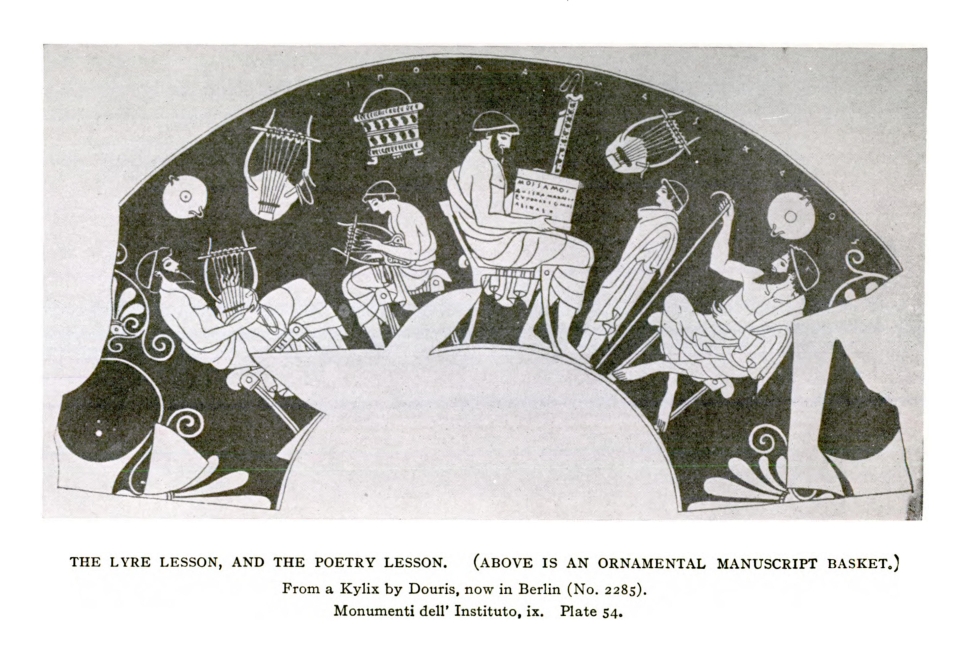
THE LYRE LESSON, AND THE POETRY LESSON. (ABOVE IS AN ORNAMENTAL MANUSCRIPT BASKET.)
From a Kylix by Douris, now in Berlin (No. 2285).
Monumenti dell' Instituto, ix. Plate 54.
Part of the day was given to the study of letters,
and then the boys went to the music school, where
they learnt to play the lyre and to sing. A song
accompanied by the music of the lyre was a favourite
part of the entertainment after a banquet, and every
Athenian gentleman was expected to be able to
sing and play whenever he was called upon. So
much was it the mark of a gentleman, that "He
who doesn't know the way to play the lyre" became
a proverbial expression for an uneducated person.
Very little is known about Greek music, but it
was considered very necessary that the music taught
should be of an ennobling and inspiring kind. The
Lydian melodies were held to be altogether too
soft and sentimental, and the Athenians preferred
those known as Dorian, because they were simpler
and sterner and of a kind to inspire men to noble
and manly deeds. Aristotle who wrote so much
about the ideal state, wrote also about the education
an ideal state should give to its children. He
held that "music is neither a necessary nor a useful
accomplishment in the sense in which letters are
useful, but it provides a noble and worthy means of
occupying leisure time," and Aristotle, like all
Athenians, believed that it was the part of a good
education to teach not only how to work well,
but also how to use leisure well. The Athenians
thought music was a good medicine for all ills.
One philosopher, when his temper had been ruffled
and he felt irritated and tired, used to take up his
harp and play, saying, "I am calming myself."
In the afternoon the boys were taken by their
pedagogues to the palaestra or wrestling-school,
where they learned gymnastics. It was as important
that the boy should have a well-trained, graceful
body, as that he should have a clear and well-furnished
mind, and so he spent a good part of each day
running, jumping, wrestling, and throwing the
discus under a special master.
According to Plato, this education turned the
Athenian boy from being "the most unmanageable
of animals" into "the most amiable and divine
of living beings." This change had not taken place
without many a punishment of the boy, and it was
a proverb that "he that is not flogged cannot be
taught." Not long ago an old Greek papyrus was
discovered which gives a vivid account of the
discipline that was thought necessary by both parents
and teachers, for the schoolboy who preferred, as he
probably often did, to play games instead of
learning his lessons. A mother brought her truant boy,
Cottalus, to his schoolmaster, Lampriscus, to
receive a flogging for his misdeeds, and she said:
Mother.
Flog him Lampriscus,
Across the shoulders, till his wicked soul
Is all but out of him. He's spent my all
In playing odd and even; knuckle bones
Are nothing to him. Why, he hardly knows
The door of the Letter School. And yet the thirtieth
Comes round and I must pay—tears no excuse.
His writing tablet which I take the trouble
To wax anew each month lies unregarded
In the corner. If by chance he deigns to touch it
He scowls like Hades, then puts nothing right
But smears it out and out. He doesn't know
A letter till you scream it twenty times.
* * * *
Yet he knows
The seventh and the twentieth of the month,
Whole holidays, as if he reads the stars,
He lies awake o' nights dreaming of them.
But, so may yonder Muses prosper you,
Give him in stripes no less than—
Lampriscus (briskly).
Right you are.
Here, boys, hoist him
Upon your backs. I like your goings on,
My boy! I'll teach you manners! Where's my strap,
With the stinging cow's tail?
Cottalus (in terror).
By the Muses, Sir,—Not with the stinger.
Lampriscus.
Then you shouldn't be so naughty.
Cott.
O how many will you give me?
Lamp.
Your mother fixes that.
Cott.
How many, mother?
Mother.
As many as your wicked hide can bear
(They proceed with the flogging).
Cott.
Stop!—That's enough! Stop!
Lamp.
You should stop your ways.
Cott.
I'll never do it more, I promise you.
Lamp.
Don't talk so much, or else I'll bring a gag.
Cott.
I won't talk,—only do not kill me,—please.
Lamp. (at length relenting).
Let him down, boys.
Mother.
No, leather him till sunset.
Lamp.
Why, he's as mottled as a water snake.
Mother.
Well, when he's done his reading, good or bad,
Give him a trifle more, say twenty strokes.[8]
Children were not always well behaved in other
ways, it seems, and complaints were made by their
parents that the children contradicted them and
did not always rise when their elders came into the
room, that they chattered too much before company,
crossed their legs when they sat down, and
completely tyrannized over their pedagogues.
But in spite of all his misdemeanours and
punishments, in letters, music and gymnastics, the
Athenian boy was educated until he was eighteen
years old. The stories of the ancient heroes who
had fought at Troy, and those of more recent times
who had defeated the Persians filled him with
enthusiasm for his race and a love of freedom for his
city. Having to learn many things without the
aid of books, his mind grew quick, alert and observant,
and his music and gymnastics taught him the
beauty of self-control and dignified restraint.
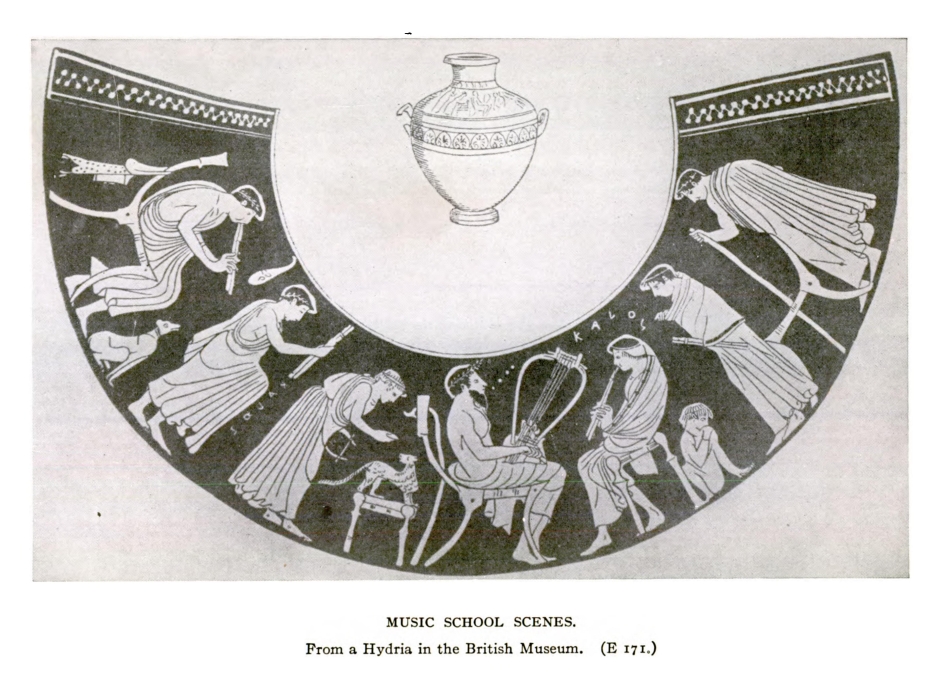
MUSIC SCHOOL SCENES.
From a Hydria in the British Museum. (E 171.)
At eighteen, the Athenian youth left school.
The state did not give him the full rights of a
citizen until a few years later, and until then he was
required to perform certain military duties, but he
was no longer a boy, and he was considered old
enough to understand the meaning of citizenship,
and to know what were its duties and privileges.
So it was then, at the time of leaving his boyhood
behind, and entering upon the richer and fuller
life before him, that the youth took the oath of the
Ephebi or young men. He was given the shield and
spear of the warrior, and then in the temple, before
Zeus, the Lord of Heaven, and in the presence of
the highest Athenian magistrates, he swore:
"Never to disgrace his holy arms, never to forsake his
comrade in the ranks, but to fight for the holy temples,
alone or with others: to leave his country, not in a worse,
but in a better state than he found it; to obey the
magistrates and the laws, and defend them against attack;
finally to hold in honour the religion of his country."
The Greek drama began as a religious observance
in honour of Dionysus. To the Greeks this god
personified both the spring and the vintage, the latter
a very important time of year in a vine-growing
country, and he was a symbol to them of that
power there is in man of rising out of himself, of
being impelled onwards by a joy within him that
he cannot explain, but which makes him go forward,
walking, as it were, on the wings of the wind, of the
spirit that fills him with a deep sense of worship.
We call this power enthusiasm, a Greek word which
simply means the god within us.
From very early times, stories of his life were
recited at the religious festivals held in honour of
Dionysus, and then stories of the other gods and of
the ancient heroes were told as well. It was from
these beginnings that the drama came. Originally,
the story was told in the form of a song, chanted at
first by everyone taking part in the festival, and
later by a chorus of about fifty performers, and
at intervals in the song the leader would recite part
of the story by himself. By degrees the recitation
became of greater importance than the song; it
grew longer, and after a time two people took part
in it and then three; at the same time the chorus
became smaller and of less importance in the action
of the drama, until at last it could consist of only
fifteen performers.
A Greek drama was in many ways much simpler
than a modern drama. There were fewer characters,
and usually only three speaking actors were
allowed on the stage at once. There was only one
story told and there was nothing to take the
attention of the audience away from this. The Chorus,
though it no longer told the story, was very important,
for it set the atmosphere of the play, and lyrics
of haunting loveliness hinted at the tragedy that
could not be averted, because of terrible deeds done
in the past, or if, indeed, there might be any help,
the imagination was carried forward on wings of
hope. The Chorus also served another purpose.
In a modern drama, when the tragedy of a situation
becomes almost too great for the audience to bear,
relief is often found in some comic, or partly comic,
episode which is introduced to slacken the tension.
Shakespeare does this constantly. But comic
episodes were felt to be out of place in a Greek drama,
and therefore when a tragic scene had taken place,
the Chorus followed it by a song of purest poetry.
In one play of Euripides, a terrible scene of tragedy
was followed by a song in which the Chorus prayed
for escape from such sorrows on the wings of a
bird to a land where all was peace and beauty.
They sang:
Could I take me to some cavern for mine hiding,
In the hill-tops where the Sun scarce hath trod;
Or a cloud make the home of mine abiding,
As a bird among the bird-droves of God.
And the song goes on to carry the imagination to a
spot
Where a voice of living waters never ceaseth
In God's quiet garden by the sea,
And Earth, the ancient life-giver, increaseth
Joy among the meadows, like a tree.[1]
In the great Greek dramas, the Chorus is a constant
reminder that, though they cannot understand
or explain them, there are other powers in the world
than the wild passions of men.
The great dramatic festival in Athens was held in
the spring in the theatre of Dionysus, to the
south-east of the Acropolis. The theatre in Athens never
became an everyday amusement, as it is today, but
was always directly connected with the worship of
Dionysus, and the performances were always preceded
by a sacrifice. The festival was only held once
a year, and whilst it lasted the whole city kept
holiday. Originally, admission to the theatre was free,
but the crowds became so great and there was such
confusion and sometimes fighting in the rush for
good seats, that the state decided to charge an
admission fee and tickets had to be bought beforehand.
But even then there were no reserved seats, except
for certain officials who sat in the front row. In
the time of Pericles, complaints were made that the
poorer citizens could not afford to buy tickets, and
so important was the drama then considered, that
it was ordered that tickets should be given free to
all who applied for them.
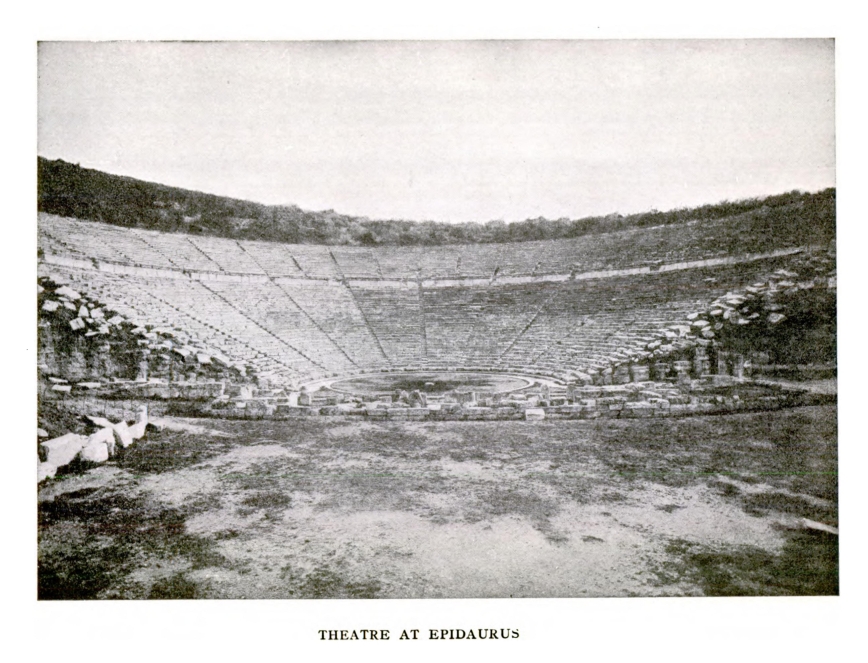
THEATRE AT EPIDAURUS
An Athenian audience was very critical, and
shouts and applause, or groans and hisses showed
its approval or disapproval of the play being acted.
Several plays were given in one day, and a prize was
awarded to the best, so the audience was obliged
to start at dawn and would probably remain in
the theatre until sunset. Let us go with an Athenian
audience and see a play which was first performed
in the latter half of the fifth century B.C.
The theatre is a great semi-circle on the slope of
the Acropolis, with rows of stone seats on which
about eighteen thousand spectators can sit. The
front row consists of marble chairs, the only seats
in the theatre which have backs, and these are
reserved for the priests of Dionysus and the chief
magistrates. Beyond the front row, is a circular
space called the orchestra, where the Chorus sings,
and in the centre of which stands the altar of
Dionysus. Behind the orchestra, is the stage on
which the actors will act, at the back of which is
a building painted to look like the front of a temple
or a palace, to which the actors retire when they
are not wanted on the stage or have to change
their costumes. That is the whole theatre and all
its stage scenery. Overhead is the deep blue sky,
the Acropolis rises up behind, and the olive-laden
hills are seen in the distance. Much will have to
be left to the imagination, but the very simplicity
of the outward surroundings will make the audience
give all their attention to the play and the acting.
When the play begins, there will only be three
actors on the stage at once. They will wear very
elaborate costumes, and a strange-looking wooden
sole called a cothurnus or buskin, about six inches
high, on their shoes, to make them look taller and
more impressive, and over their faces a curious mask
with a wide mouth, so that everyone in that vast
audience will hear them. There will be no curtain
and the play is not divided into different acts. When
there is a pause in the action, the Chorus will fill
up the time with their song. If it is tragedy, we
shall not see the final catastrophe on the stage, but
a messenger will appear who will give us an account
of what has happened. All this is very different
from the way in which a modern play is given, but
some of the greatest dramas the world possesses
were written by Athenian dramatists and acted
on this Athenian stage more than two thousand years
ago.
On this occasion the play we are to see is "Iphigenia
in Tauris," written by Euripides, one of the
greatest of the Athenian dramatists.
The legends and traditions from which most of
the Greek plays took their plots were, of course,
well known to the Athenians. They were stories
commemorating some great event, or explaining
some religious observance, but naturally these
legends were differently treated by different
dramatists, each of whom brought out a different side of
the story to enforce some particular lesson which
he wished to bring home to the people, and this is
especially true of the legends like that of Iphigenia
connected with the Fall of Troy.
In the opening speech of this play, Iphigenia
very briefly tells her story up to the moment when
the play begins. Just as the Greeks had been ready
to sail for Troy, they were wind-bound at Aulis.
The wise men were consulted as to the meaning of
this, and how the gods who must in some way have
been offended, might be appeased, so that fair winds
might send them on their way. Calchas, the seer,
told them that Artemis demanded the sacrifice of
Iphigenia, daughter of Agamemnon, King of Argos,
the great leader of the host, and her father sent for
her accordingly. The maiden was at home with her
mother, and the messenger who was sent to Argos
to bring her was charged to say that her father
desired to wed her to the hero Achilles. She
came and the sacrifice was offered, but at the
supreme moment, Artemis carried Iphigenia away and
placed her in the land of the Tauri, a wild and
barbarous tribe, as their priestess. These Tauri
had an image of Artemis in a temple, to which they
sacrificed all strangers who were cast on their shores,
and it was the duty of the priestess to consecrate
each victim before he was slain. Here, performing
this rite, had Iphigenia lived for more than ten
years, but never yet had a Greek come to this wild
land. She knew, of course, nothing of what had
happened at Troy or afterwards; she did not know
that on his return home her father had been slain
by Clytemnestra his wife, or that Orestes, her
brother, had avenged that death by slaughtering
his own mother, after which deed he had wandered
from place to place pursued by the relentless torment
of the Furies. Bitter against the Greeks for
having willed her sacrifice at Aulis, Iphigenia says
of herself that she is "turned to stone, and has no
pity left in her," and she half hopes that the day will
come when a Greek shall be brought to her to be
offered in his turn to the goddess.
In the meantime, Orestes, tormented beyond
endurance by the Furies, had gone to the Oracle of
Apollo, to ask how he might be purified from his
sin, and Apollo had told him to go to the land
of the Tauri and bring back to Attica the image of
Artemis his sister, so that it might no longer be
stained by the blood of the human sacrifices. And
so it comes about that Orestes is the first Greek who
will be brought to Iphigenia for sacrifice to Artemis.
It is at this moment that the play opens.[2]
CHARACTERS OF THE PLAY
IPHIGENIA.
ORESTES, her brother.
PYLADES, friend to Orestes.
THOAS, King of Tauris.
A HERDSMAN.
A MESSENGER.
CHORUS of captive Greek Women, handmaids to
Iphigenia.
THE GODDESS, PALLAS ATHENA.
The scene shows a great and barbaric Temple on a
desolate sea-coast. An altar is visible stained with
blood. There are spoils of slain men hanging from the
roof. Iphigenia, in the dress of a priestess, comes out
of the Temple, and in a speech that serves really as a
Prologue to the play, she tells her story. At the end of
her speech, which is haunted throughout by a sense of
exile and homesickness, she describes a strange dream
she has just had, which she interprets as meaning that
Orestes, her brother, is dead. She then goes into the
Temple.
Voice.
Did some one cross the pathway? Guard thee well.
Another Voice.
I am watching. Every side I turn my eye.
(Enter Orestes and Pylades. Their dress
shows they are travellers. Orestes is
shaken and distraught.)
Orestes.
How, brother? And is this the sanctuary
At last, for which we sailed from Argos?
Pylades.
For sure, Orestes. Seest thou not it is?
Orestes.
The altar, too, where Hellene blood is shed.
Pylades.
How like long hair those blood-stains, tawny red!
Orestes.
And spoils of slaughtered men—there by the thatch.
Pylades.
Aye, first-fruits of the harvest, when they catch
Their strangers!—'Tis a place to search with care.
(He searches while Orestes sits.)
During this search, Orestes, in a speech
addressed to Apollo, explains why they
are there, and expresses hopelessness
at their ever accomplishing the will of
the god, and even suggests their turning
back. But Pylades encourages him and bids
him take courage, for, he says,
Danger gleams
Like sunshine to a brave man's eyes, and fear
Of what may be is no help anywhere.
Orestes.
Aye, we have never braved these leagues of way
To falter at the end. See, I obey
Thy words. They are ever wise. Let us go mark
Some cavern, to lie hid till fall of dark.
God will not suffer that bad things be stirred
To mar us now, and bring to naught the word
Himself hath spoke. Aye, and no peril brings
Pardon for turning back to sons of kings.
(They go out towards the shore.)
After they are gone, enter gradually the
women of the Chorus. These are Greek
women who have been taken captive in
war by King Thoas, and so they are
friendly to the exiled and lonely Iphigenia,
for they are just as homesick as she is.
They come now in obedience to a call from
her to assist in mourning for Orestes, who,
she is convinced by her dream, is dead.
Chorus.
Peace! Peace upon all who dwell
By the Sister Rocks that clash in the swell
Of the Friendless Seas.
* * * *
From Hellas that once was ours,
We come before thy gate,
From the land of the western seas,
The horses and the towers,
The wells and the garden trees,
And the seats where our fathers sate.
Leader.
What tidings, ho? With what intent
Hast called me to thy shrine and thee,
O child of him who crossed the sea
To Troy with that great armament,
The thousand prows, the myriad swords?
I come, O child of Atreid Lords.
(Iphigenia, followed by attendants, comes
from the Temple.)
Iphigenia.
Alas! O maidens mine,
I am filled full of tears:
My heart filled with the beat
Of tears, as of dancing feet,
A lyreless, joyless line,
And music meet for the dead.
For a whisper is in mine ears,
By visions borne on the breath
Of the Night that now is fled,
Of a brother gone to death.
Oh sorrow and weeping sore,
For the house that no more is,
For the dead that were kings of yore
And the labour of Argolis!
Iphigenia and the Chorus then lament
together over the ruin and loss that has
befallen the House of Agamemnon.
Suddenly the Leader of the Chorus stops them.
Leader.
Stay, yonder from some headland of the sea
There comes, methinks a herdsman, seeking thee.
(Enter a Herdsman. Iphigenia is still on her knees.)
Herdsman.
Daughter of Clytemnestra and her King,
Give ear! I bear news of a wondrous thing.
Iphigenia.
What news, that so should mar my obsequies?
Herdsman.
A ship hath passed the blue Symplegades,
And here upon our coast two men are thrown,
Young, bold, good slaughter for the altar-stone
Of Artemis.
(She rises.)
Make all the speed ye may;
'Tis not too much. The blood-bowl and the spray!
Iphigenia.
Men of what nation? Doth their habit show?
Herdsman.
Hellenes for sure, but that is all we know.
Iphigenia.
No name? No other clue thine ear could seize?
Herdsman.
We heard one call his comrade "Pylades."
Iphigenia.
Yes. And the man who spoke—his name was what?
Herdsman.
None of us heard. I think they spoke it not.
Iphigenia.
How did ye see them first, how make them fast?
Herdsman.
Down by the sea, just where the surge is cast,—
Iphigenia.
The sea? What is the sea to thee and thine?
Herdsman.
We came to wash our cattle in the brine.
Iphigenia.
Go back, and tell how they were taken; show
The fashion of it, for I fain would know
All.—'Tis so long a time, and never yet,
Never, hath Greek blood made this altar wet.
The herdsman tells his tale of how the
men were taken prisoners. Iphigenia
hears in silence and at the end of it says:
'Tis well. Let thy hand bring them, and mine own
Shall falter not till here God's will be done.
(Exit Herdsman.)
Iphigenia then gives way to her feelings.
There are strangers to be sacrificed; to
that she is accustomed, but these men
are Greeks. Yet she herself suffered
bitter things at the hands of the
Greeks; should she not avenge these?
By degrees, however, as she thinks of
her youth, of her home, she melts, and
at length withdraws into the Temple,
raging against the cruel deed that she
must do, and not at all sure that she
can nerve herself to do it.
The coming of these Greeks has brought
Greece vividly back to the thoughts of
the Chorus. All Greeks loved the sea
and were seafarers, and the arrival of
these two adventurous men reminds
these exiled women of their home, and
in their imagination they see the ship
cross the sea, until it touches the
Friendless and cruel shore.
Chorus.
But who be these, from where the rushes blow
On pale Eurotas, from pure Dirces,
That turn not neither falter,
Seeking Her land, where no man breaketh bread,
Her without pity, round whose virgin head
Blood on the pillars rusts from long ago,
Blood on the ancient altar.
A flash of the foam, a flash of the foam,
A wave on the oar-blade welling,
And out they passed to the heart of the blue;
A chariot shell that the wild waves drew.
Is it for passion of gold they come,
Or pride to make great their dwelling?
* * * * *
Through the Clashing Rocks they burst:
They passed by the Cape unsleeping
Of Phineus' sons accurst:
They ran by the star-lit bay
Upon magic surges sweeping,
Where folk on the waves astray
Have seen, through the gleaming grey,
Ring behind ring, men say,
The dance of the old Sea's daughters.
The guiding oar abaft
It rippled and it dinned,
And now the west wind laughed
And now the south west wind;
And the sail was full in flight,
And they passed by the Island White:
Birds, birds, everywhere,
White as the foam, light as the air;
And ghostly Achilles raceth there,
Far in the Friendless Waters.
A sail, a sail from Greece,
Fearless to cross the sea,
With ransom and with peace
To my sick captivity.
O home, to see thee still,
And the old walls on the hill!
Dreams, dreams, gather to me!
Bear me on wings over the sea;
O joy of the night, to slave and free,
One good thing that abideth!
Leader.
But lo, the twain whom Thoas sends,
Their arms in bondage grasped sore
Strange offering this, to lay before
The Goddess! Hold your peace, O friends.
Onward, still onward to this shrine
They lead the first-fruits of the Greek.
'Twas true, the tale he came to speak,
That watcher of the mountain kine.
O holy one, if it afford
Thee joy, what these men bring to thee,
Take thou their sacrifice, which we,
By law of Hellas, hold abhorred.
(Enter Orestes and Pylades, bound, and
guarded by Taurians. Re-enter Iphigenia.)
Iphigenia.
So be it.
My foremost care must be that nothing harms
The temple's holy rule.—Untie their arms.
That which is hallowed may no more be bound.
You, to the shrine within! Let all be found
As the law bids, and as we need this day.
(Orestes and Pylades are set free; some
Attendants go into the Temple.)
Ah me!
What mother then was yours, O strangers, say,
And father? And your sister, if you have
A sister: both at once, so young and brave
To leave her brotherless! Who knows when heaven
May send that fortune? For to none is given
To know the coming nor the end of woe;
So dark is God, and to great darkness go
His paths, by blind chance mazed from our ken.
Whence are ye come, O most unhappy men?
From some far home, methinks, ye have found this shore
And far shall stay from home for evermore.
Orestes asks Iphigenia not to make their
fate worse by dwelling on it, nor to
pity them. They know where they
are and the cruel custom of the land.
Iphigenia.
Say first—which is it men call Pylades?
Orestes.
'Tis this man's name, if that will give thee ease.
Iphigenia.
From what walled town of Hellas cometh he?
Orestes.
Enough!—How would the knowledge profit thee?
Iphigenia.
Are ye two brothers of one mother born?
Orestes.
No, not in blood. In love we are brothers sworn.
Iphigenia.
Thou also hast a name: tell me thereof.
Orestes.
Call me Unfortunate. 'Tis name enough.
Iphigenia.
I asked not that. Let that with Fortune lie.
Orestes.
Fools cannot laugh at them that nameless die.
Iphigenia.
Why grudge me this? Hast thou such mighty fame?
Orestes.
My body, if thou wilt, but not my name.
Iphigenia.
Nor yet the land of Greece where thou wast bred?
Orestes.
What gain to have told it thee, when I am dead?
Iphigenia.
Nay: why shouldst thou deny so small a grace?
Orestes.
Know then, great Argos was my native place.
Iphigenia.
Stranger! The truth!—From Argos art thou come?
Orestes.
Mycenae, once a rich land, was my home.
Iphigenia.
'Tis banishment that brings thee here—or what?
Orestes.
A kind of banishment, half forced, half sought.
Iphigenia.
Wouldst thou but tell me all I need of thee!
Orestes.
'Twere not much added to my misery.
Iphigenia.
From Argos!—Oh, how sweet to see thee here!
Orestes.
Enjoy it then. To me 'tis sorry cheer.
Iphigenia.
Thou knowest the name of Troy? Far doth it flit.
Orestes.
Would God I had not; nay, nor dreamed of it.
Iphigenia.
Men fable it is fallen beneath the sword?
Orestes.
Fallen it is. Thou hast heard no idle word.
Iphigenia.
Fallen! At last!—And Helen taken too?
Orestes.
Aye; on an evil day for one I knew.
Iphigenia.
Where is she? I too have some anger stored—
Orestes.
In Sparta! Once more happy with her lord!
Iphigenia.
Oh, hated of all Greece, not only me!
Orestes.
I too have tasted of her wizardry.
Iphigenia.
And came the armies home, as the tales run?
Orestes.
To answer that were many tales in one.
Iphigenia.
Oh, give me this hour full! Thou soon wilt die.
Orestes.
Ask, if such longing holds thee. I will try.
Iphigenia.
A seer called Calchas! Did he ever come?
Orestes.
Calchas is dead, as the news went at home.
Iphigenia.
Good news, ye gods!—Odysseus, what of him?
Orestes.
Not home yet, but still living, as men deem.
Iphigenia.
Curse him! And may he see his home no more.
Orestes.
Why curse him? All his house is stricken sore.
Iphigenia.
How hath the Nereid's son, Achilles, sped?
Orestes.
Small help his bridal brought him! He is dead.
Iphigenia.
A fierce bridal, so the sufferers tell!
Orestes.
Who art thou, questioning of Greece so well?
Iphigenia.
I was a Greek. Evil caught me long ago.
Orestes.
Small wonder, then, thou hast such wish to know.
Iphigenia.
That war-lord, whom they call so high in bliss—
Orestes.
None such is known to me. What name was his?
Iphigenia.
They called him Agamemnon, Atreus' son.
Orestes.
I know not. Cease,—My questioning is done.
Iphigenia.
'Twill be such joy to me! How fares he? Tell!
Orestes.
Dead. And hath wrecked another's life as well.
Iphigenia.
Dead? By what dreadful fortune? Woe is me!
Orestes.
Why sighest thou? Had he any link with thee?
Iphigenia.
I did but think of his old joy and pride.
Orestes.
His own wife foully stabbed him, and he died.
Iphigenia.
O God!
I pity her that slew—and him that slew.
Orestes.
Now cease thy questions. Add no word thereto.
Iphigenia.
But one word. Lives she still, that hapless wife?
Orestes.
No. Her own son, her first-born, took her life.
Iphigenia.
O shipwrecked house! What thought was in his brain?
Orestes.
Justice on her, to avenge his father slain.
Iphigenia.
Alas!
A bad false duty bravely hath he wrought.
Orestes.
Yet God, for all his duty, helps him not.
Iphigenia.
And not one branch of Atreus' tree lives on?
Orestes.
Electra lives, unmated and alone.
Iphigenia.
The child they slaughtered—is there word of her?
Orestes.
Why, no, save that she died in Aulis there.
Iphigenia.
Poor child! Poor father, too, who killed and lied.
Orestes.
For a bad woman's worthless sake she died.
Iphigenia.
The dead King's son, lives he in Argos still?
Orestes.
He lives, now here, now nowhere, bent with ill.
Iphigenia.
O dreams, light dreams, farewell! Ye too were lies.
* * * * *
Leader.
We too have kinsmen dear, but, being low,
None heedeth, live they still or live they not.
Iphigenia. (With sudden impulse.)
Listen! For I am fallen upon a thought,
Strangers, of some good use to you and me.
* * * * *
Stranger, if I can save thee, wilt thou bear
To Argos and the friends who loved my youth
Some word? There is a tablet which, in ruth
For me and mine ill works, a prisoner wrote,
Ta'en by the king in war. He knew 'twas not
My will that craved for blood, but One on high
Who holds it righteous her due prey shall die.
And since that day no Greek hath ever come
Whom I could save and send to Argos home
With prayer to any friend: but thou,
I think, dost loathe me not; and thou dost know
Mycenae and the names that fill my heart.
Help me! Be saved! Thou also hast thy part,
Thy life for one light letter—
(Orestes looks at Pylades.)
For thy friend,
The law compelleth. He must bear the end
By Artemis ordained, apart from thee.
Orestes.
Strange woman, as thou biddest let it be,
Save one thing. 'Twere for me a heavy weight
Should this man die. 'Tis I and mine own fate
That steer our goings. He but sails with me
Because I suffer much. It must not be
That by his ruin I should 'scape mine own,
And win thy grace withal. 'Tis simply done.
Give him the tablet. He with faithful will
Shall all thy hest in Argolis fulfil.
And I—who cares may kill me. Vile is he
Who leaves a friend in peril and goes free
Himself. And, as it chances, this is one
Right dear to me; his life is as my own.
Iphigenia.
O royal heart! Surely from some great seed
This branch is born, that can so love indeed.
God grant the one yet living of my race
Be such as thou! For not quite brotherless
Am even I, save that I see him not,
Strangers—Howbeit, thy pleasures shall be wrought.
This man shall bear the message, and thou go
To death. So greatly thou wilt have it so.
Orestes then asks somewhat of the ritual
by which Iphigenia will consecrate the
victim, and where he will be buried.
Iphigenia promises that he shall be
duly buried according to the Greek
customs, and then she goes into the
temple to get the tablet. During her
absence Orestes and Pylades have a
long argument as to which shall bear
the tablet to Argos, and which remain
in the island to be sacrificed. It is
finally decided that Pylades shall go
back to Greece and Orestes shall remain.
(Enter Iphigenia from the Temple.)
Iphigenia.
Go ye within; and have all things of need
In order set for them that do the deed.
There wait my word.
(Attendants go in.)
Ye strangers, here I hold
The many-lettered tablet, fold on fold.
Yet—one thing still.
Iphigenia then tells Pylades that she is
afraid that, once safe and free, he will
forget the promise made when he was
in danger of his life, and so she makes
him swear in the name of Zeus, that he
will faithfully bear the message. She,
on her side, in the name of Artemis,
swears that she will in very truth set
him free. Pylades then reminds her
that he might be shipwrecked and so
lose the tablet, and asks that in that
case he may be relieved from his vow.
But Iphigenia, in her desperate longing
for deliverance refuses this, and
instead, says that she will tell him what
is written in the tablet. If it should
be lost, he must then bear the message
by word of mouth.
Pylades.
For thy sake and for mine 'tis fairer so.
Now let me hear his name to whom I go
In Argolis, and how my words should run.
Iphigenia. (Repeating the words by heart.)
Say: "To Orestes, Agamemnon's son
She that was slain in Aulis, dead to Greece
Yet quick, Iphigenia sendeth peace:"
Orestes.
Iphigenia! Where? Back from the dead?
Iphigenia.
'Tis I. But speak not, lest thou break my thread.—
"Take me to Argos, brother, ere I die,
Back from the Friendless Peoples and the high
Altar of Her whose bloody rites I wreak."
Orestes. (aside.)
Where am I Pylades? How shall I speak?
Iphigenia.
"Else one in grief forsaken shall, like shame
Haunt thee."
Pylades. (aside.)
Orestes!
Iphigenia. (overhearing him.)
Yes: that is the name.
Ye gods above!
Pylades.
Why callest thou on God
For words of mine?
'Tis nothing. 'Twas a road
My thoughts had turned. Speak on.—No need for us
To question; we shall hear things marvellous.
Iphigenia.
Tell him that Artemis my soul did save,
I wot not how, and to the altar gave
A fawn instead; the which my father slew,
Not seeing, deeming that the sword he drew
Struck me. But she had borne me far away
And left me in this land.—I charge thee, say
So much. It is all written on the scroll.
Pylades.
An easy charge thou layest on my soul,
A glad oath on thine own. I wait no more,
But here fulfil the service that I swore.
Orestes, take this tablet which I bear
To thine own hand, thy sister's messenger.
Orestes.
I take it, but I reck not of its scrip
Nor message. Too much joy is at my lip.
Sister! Beloved! Wildered though I
My arms believe not, yet they crave for thee.
Now, filled with wonder, give me my delight!
(He goes to embrace her. She stands speechless.)
Leader.
Stranger, forbear! No living man hath right
To touch that robe. The Goddess were defiled!
Orestes.
O sister mine, O my dead father's child,
Agamemnon's child; take me and have no fear,
Beyond all dreams 'tis I thy brother here.
Iphigenia.
My brother? Thou?—Peace! Mock at me no more.
Argos is bright with him and Nauplia's shore.
Orestes.
Unhappy one! Thou hast no brother there.
Iphigenia.
Orestes—thou? Whom Clytemnestra bare?
Orestes.
To Atreus' firstborn son, thy sire and mine.
Iphigenia.
Thou sayest it: Oh, give me some proof, some sign!
Old things of home are remembered between
the two, and at length Iphigenia
is convinced.
Iphigenia. (falling into his arms)
Beloved! Oh, no other, for indeed
Beloved art thou! In mine arms at last,
Orestes far away.
Then follows a scene in which Iphigenia
gives herself up to one emotion after
another, and when Orestes reminds her
that they are not yet safe, she suggests
one wild plan after another.
Iphigenia.
And now, what end cometh?
Shall Chance yet comfort me,
Finding a way for thee
Back from the Friendless Strand,
Back from the place of death—
Ere yet the slayers come
And thy blood sink in the sand—
Home unto Argos, home?
Hard heart so swift to slay
Is there to life no way?—
No ship!—And how by land?—
A rush of feet
Out to the waste alone.
Nay: 'twere to meet
Death, amid tribes unknown
And trackless ways of the waste—
Surely the sea were best.
Back by the narrow bar
To the Dark Blue Gate!—
Ah God, too far, too far!—
Desolate! Desolate!
What god or man, what unimagined flame,
Can cleave this road where no road is, and bring
To us last wrecks of Agamemnon's name
Peace from long suffering?
But Iphigenia has not yet learnt all, and
at length Orestes tells her why he is
there. He repeats the words of Apollo:
"Go seek the Taurian citadel:
Seize there the carven Artemis that fell
From heaven, and stablish it on Attic soil.
So comes thy freedom,"
And he continues:
"Sister, in this toil
Help us!—If once that image I may win
That day shall end my madness and my sin:
And thou, to Argos o'er the sundering foam
My many-oared barque shall bear thee home.
O sister, loved and lost, O pitying face,
Help my great peril; help our father's race.
For lost am I and perished all the powers
Of Pelops, save that heavenly thing be ours!"
This news somewhat sobers Iphigenia.
She is confronted now with a very
different thing from saving her brother's
life. That had just now seemed
almost impossible, but compared to
this new demand, it seemed almost
easy. This is an act of madness; it
will be considered a most fearful act
of sacrilege to steal the image of
Artemis, yet Orestes asks for her help
to do it. And then there is herself and
her own hopes! She might perhaps
succeed in saving his life and fleeing
with him, but to steal the statue and
then go with him is a task beyond any
hope of accomplishment. What shall
she do? She deliberately decides that
she will save his life and give him the
statue, and then she herself will
confront the angry King and give her life
for her brother.
Iphigenia.
I must wait then and be slain:
Thou shalt walk free in Argolis again,
And all life smile on thee.—Dearest, we need
Not shrink from that. I shall by mine own deed
Have saved thee. And a man gone from the earth
Is wept for. Women are but little worth.
But Orestes refuses to accept the sacrifice.
Orestes.
I stand with thee
One-hearted here, be it for life or death,
And either bear thee, if God favoureth,
With me to Greece and home, or else lie here
Dead at thy side.
* * * * *
Iphigenia.
To steal for thee the image, yet not die
Myself! 'Tis that we need.
They then begin to discuss every possible
means of escape, and at last an idea
comes to Iphigenia. She will tell the
King that Orestes has come from
Greece with his mother's blood upon
him, and that therefore it would be
a great offence to sacrifice him to the
goddess. Before he is sacrificed, he
must be cleansed in the waves of the
sea. But his very presence has denied
the image of the goddess, and so that,
too, must be taken to the shore and
purified. Pylades shares in the guilt
of his friend and will accompany him
to the shore, and Iphigenia will go
down with the image. The rest must
be the work of Orestes, and he must
arrange that they are taken on board
his ship and so escape. It is a
dangerous and a daring plan, but there is no
hope anywhere else.
Iphigenia, Orestes and Pylades will thus
be saved, if saving be possible, but
what of the Chorus, of these Greek
women, companions of the exile and
loneliness of Iphigenia? They are
indeed "true of heart and faithful found,"
for with no hope of going home themselves,
ignored even by Iphigenia in
this tremendous moment of her own
hope, they loyally promise secrecy
about all that concerns the plot. Yet
they, too, crave for home and they
give voice to their longings. They see
in imagination the Greek land. Once
again the misery of their capture and
enslavement comes before them, but
they rise above their sorrow as they
sing of what it will mean to Iphigenia
to cross the sea, to behold her home
once again, and to reach the land of
freedom.
Chorus.
Bird of the sea rocks, of the bursting spray,
O halcyon bird,
That wheelest crying, crying, on thy way;
Who knoweth grief can read the tale of thee:
One love long lost, one song for ever heard
And wings that sweep the sea.
Sister, I too beside the sea complain,
A bird that hath no wing.
Oh, for a kind Greek market-place again,
For Artemis that healeth woman's pain;
Here I stand hungering.
Give me the little hill above the sea,
The palm of Delos fringed delicately,
The young sweet laurel and the olive-tree
Grey-leaved and glimmering;
* * * * *
Ah, the old tears, the old and blinding tears
I gave God then,
When my town fell, and noise was in mine ears
Of crashing towers, and forth they guided me
Through spears and lifted oars and angry men
Out to an unknown sea.
They bought my flesh with gold, and sore afraid
I came to this dark East
To serve, in thrall to Agamemnon's maid,
This Huntress Artemis, to whom is paid
The blood of no slain beast;
Yet all is bloody where I dwell, Ah, me!
Envying, envying that misery
That through all life hath endured changelessly.
For hard things borne from birth
Make iron of man's heart, and hurt the less.
'Tis change that paineth; and the bitterness
Of life's decay when joy hath ceased to be
That makes all dark the earth.
Behold,
Two score and ten there be
Rowers that row for thee,
And a wild hill air, as if Pan were there,
Shall sound on the Argive sea,
Piping to set thee free.
Or is it the stricken string
Of Apollo's lyre doth sing
Joyously, as he guideth thee
To Athens, the land of spring;
While I wait wearying?
Oh, the wind and the oar,
When the great sail swells before,
With sheets astrain, like a horse on the rein;
And on through the race and roar,
She feels for the farther shore.
Ah me,
To rise upon wings and hold
Straight on up the steeps of gold
Where the joyous Sun in fire doth run,
Till the wings should faint and fold
O'er the house that was mine of old.
Or watch where the glade below
With a marriage dance doth glow,
And a child will glide from her mother's side
Out, out, where the dancers flow:
As I did, long ago.
Oh, battles of gold and rare
Raiment and starred hair,
And bright veils crossed amid tresses tossed
In a dusk of dancing air!
O Youth and the days that were!
(Enter King Thoas, with Soldiers.)
Thoas.
Where is the warden of this sacred gate,
The Greek woman? Is her work ended yet
With these two strangers? Do their bodies lie
Aflame now in the rock-cleft sanctuary?
Leader.
Here is herself, O King, to give thee word.
(Enter, from the Temple, Iphigenia, carrying
the Image on high.)
Thoas.
How, child of Agamemnon! Hast thou stirred
From her eternal base, and to the sun
Bearest in thine own arms, the Holy One?
Iphigenia.
Back, Lord! No step beyond the pillared way.
Thoas.
But how? Some rule is broken?
Iphigenia.
I unsay
That word. Be all unspoken and unwrought!
Thoas.
What means this greeting strange? Disclose thy thought.
Iphigenia.
Unclean the prey was that ye caught, O King.
Thoas.
Who showed thee so? Thine own imagining?
Iphigenia.
The Image stirred and shuddered from its seat.
Thoas.
Itself?—Some shock of earthquake loosened it.
Iphigenia.
Itself. And the eyes closed one breathing space.
Thoas.
But why? For those two men's blood-guiltiness?
Iphigenia.
That, nothing else. For, oh! their guilt is sore.
Thoas.
They killed some of my herdsmen on the shore?
Iphigenia.
Their sin was brought from home, not gathered here.
Thoas.
What? I must know this.—Make thy story clear.
Iphigenia. (She puts down the Image and moves nearer to Thoas.)
The men have slain their mother.
Thoas.
God! And these
Be Greeks!
Iphigenia.
They both are hunted out of Greece.
Thoas.
For this thou hast brought the Image to the sun?
Iphigenia.
The fire of heaven can cleanse all malison.
Thoas.
How didst thou first hear of their deed of shame?
Iphigenia.
When the Image hid its eyes, I questioned them.
Thoas.
Good. Greece hath taught thee many a subtle art.
Iphigenia.
Ah, they too had sweet words to move my heart.
Thoas.
Sweet words? How, did they bring some news of Greece?
Iphigenia.
Orestes, my one brother, lives in peace.
Thoas.
Surely! Good news to make thee spare their lives—
Iphigenia.
My father too in Argos lives and thrives.
Thoas.
While thou didst think but of the goddess' laws!
Iphigenia.
Do I not hate all Greeks? Have I not cause?
Thoas.
Good cause. But now—What service should be paid?
Iphigenia.
The Law of long years needs must be obeyed.
Thoas.
To work then, with thy sword and hand-washing!
Iphigenia.
First I must shrive them with some cleansing thing.
Thoas.
What? Running water, or the sea's salt spray?
Iphigenia.
The sea doth wash all the world's ills away.
Thoas.
For sure. 'Twill make them cleaner for the knife.
Iphigenia.
And my hand, too, cleaner for all my life.
Thoas.
Well, the waves lap close by the temple floor.
Iphigenia.
We need a secret place. I must do more.
Thoas.
Some rite unseen? 'Tis well. Go where thou wilt.
Iphigenia.
The Image likewise must be purged of guilt.
Thoas.
The stain hath touched it of that mother's blood?
Iphigenia.
I durst not move it else, from where it stood.
Thoas.
How good thy godliness and forethought! Aye,
Small wonder all our people holds thee high.
Iphigenia.
Dost know then what I fain would have?
Thoas.
'Tis thine to speak and it shall be.
Iphigenia.
Put bondage on the strangers both.—
Thoas.
Why bondage? Whither can they flee?
Iphigenia.
Put not thy trust in any Greek.
Thoas. (To attendants)
Ho, men! Some thongs and fetters, go!
Iphigenia.
Stay; let them lead the strangers here, outside the shrine—
Thoas.
It shall be so.
Iphigenia.
And lay dark raiment on their heads—
Thoas.
To veil them, lest the Sun should see.
Iphigenia.
And lend me some of thine own spears.
Thoas.
This company shall go with thee.
Iphigenia.
Next, send through all the city streets a herald—
Thoas.
Aye; and what to say?
Iphigenia.
That no man living stir abroad.
Thoas.
The stain of blood might cross their way.
Iphigenia.
Aye, sin like theirs doth spread contagion.
Thoas. (To an attendant)
Forth, and publish my command—
Iphigenia.
That none stir forth—nor look—
Thoas.
Nor look. How well thou carest for the land!
Iphigenia.
For one whom I am bound to love.
Thoas.
Indeed, I think thou hat'st me not.
Iphigenia.
And thou meanwhile, here at the temple, wait, O King, and—
Thoas.
Wait for what?
Iphigenia.
Purge all the shrine with fire.
Thoas.
'Twill all be clean before you come again.
Iphigenia.
And while the strangers pass thee close, seeking the sea—
Thoas.
What wouldst thou then?
Iphigenia.
Put darkness on thine eyes.
Thoas.
Mine eyes might drink the evil of their crime?
Iphigenia.
And, should I seem to stay too long—
Thoas.
Too long? How shall I judge the time?
Iphigenia.
Be not dismayed.
Thoas.
Perform thy rite all duly. We have time to spare.
Iphigenia.
And God grant this cleansing end as I desire!
Thoas.
I join thy prayer.
Iphigenia.
The door doth open.
* * * * *
(She takes up the Image again.)
There passeth here a holy thing; begone,
I charge thee, from the road.
* * * * *
Begone and tremble from this road: fly
swiftly, lest ye be defiled.
O Queen and Virgin, Leto-born, have pity!
Let me cleanse this stain,
And pray to thee where pray I would: a
clean house shall be thine again,
And we at last win happiness. Behold, I
speak but as I dare;
The rest—Oh, God is wise, and thou, my
Mistress, thou canst read my prayer.
(The procession passes out. Thoas and
the bystanders veiled; Attendants in
front, then Iphigenia with the Image,
then veiled soldiers, then Orestes and
Pylades bound, the bonds held by other
veiled soldiers following them. Thoas
goes into the Temple.)
Here follows a song from the Chorus which
fills the interval during which the cleansing
ceremonies are supposed to be taking
place. At the end of the song there enters
a messenger running.
Messenger.
Ho, watchers of the fane! Ho, altar-guard,
Where is King Thoas gone? Undo the barred
Portals, and call the King! The King I seek.
Leader.
What tidings—if unbidden I may speak?
Messenger.
The strangers both are gone, and we beguiled,
By some dark plot of Agamemnon's child:
Fled from the land! And on a barque of Greece
They bear the heaven-sent shape of Artemis.
Leader.
Thy tale is past belief.—Go, swiftly on,
And find the King. He is but newly gone.
Messenger.
Where went he? He must know of what has passed!
Leader.
I know not where he went. But follow fast
And seek him. Thou wilt light on him ere long.
Messenger.
See there! The treason of a woman's tongue!
Ye are all in the plot, I warrant ye!
Leader.
Thy words are mad! What are the men to me?
Go to the palace, go!
Messenger. (Seeing the great knocker on the Temple door.)
I will not stir
Till word be come by this good messenger
If Thoas be within these gates or no.—
(Thundering at the door.)
Ho, loose the portals! Ye within! What ho!
Open, and tell our master one doth stand
Without here, with strange evil in his hand.
(Enter Thoas from the Temple.)
Thoas.
Who dares before this portal consecrate
Make uproar and lewd battering of the gate?
Thy noise hath broke the Altar's ancient peace.
Messenger.
Ye gods! They swore to me—and bade me cease
My search—the King was gone. And all the while—
Thoas.
These women? How? What sought they by such guile?
Messenger.
Of them hereafter! Give me first thine ear
For greater things. The virgin minister
That served our altar, she hath fled from this
And stolen the dread Shape of Artemis,
With those two Greeks. The cleansing was a lie.
Thoas.
She fled? What wild hope whispered her to fly?
Messenger.
The hope to save Orestes. Wonder on!
Thoas.
Orestes—how? Not Clytemnestra's son?
Messenger.
And our pledged altar-offering. 'Tis the same.
Thoas.
O marvel beyond marvel! By what name
More rich in wonder can I name thee right?
Messenger.
Give not thy mind to that. Let ear and sight
Be mine awhile; and when thou hast heard the whole
Devise how best to trap them ere the goal.
Thoas.
Aye, tell thy tale. Our Tauric seas stretch far,
Where no man may escape my wand of war.
The Messenger gives Thoas an excited
account of what has happened, ending
by saying that if he send out pursuers
immediately, he may even yet seize
the fugitives. Thoas gives his orders.
Thoas.
Ho, all ye dwellers of my savage town
Set saddle on your steeds, and gallop down
To watch the heads, and gather what is cast
Alive from this Greek wreck. We shall make fast,
By God's help, the blasphemers.—Send a corps
Out in good boats a furlong from the shore;
So we shall either snare them on the seas
Or ride them down by land, and at our ease
Fling them down gulfs of rock, or pale them high
On stakes in the sun, to feed our birds and die.
Women: you knew this plot. Each one of you
Shall know, before the work I have to do
Is done, what torment is.—Enough! A clear
Task is afoot. I must not linger here.
While Thoas is moving off, his men
shouting and running before and behind
him, there comes a sudden blasting
light and thunder-roll, and Athena is
seen in the air confronting them.
This sudden appearance of a god to
solve a problem at the end of a play is
known as the deus ex machina, and
there was actually some kind of machine
by which the god appeared as if
suspended in the air.
Athena.
Ho, whither now, so hot upon the prey,
King Thoas? It is I that bid thee stay,
Athena, child of Zeus. Turn back this flood
Of wrathful men, and get thee temperate blood.
Apollo's word and Fate's ordained path
Have led Orestes here, to escape the wrath
Of Them that hate. To Argos he must bring
His sister's life, and guide that Holy Thing
Which fell from heaven, in mine own land to dwell.
So shall his pain have rest, and all be well.
Thou hast heard my speech, O King. No death from thee
May snare Orestes between rocks and sea:
Poseidon for my love doth make the sore
Waves gentle, and set free his labouring oar.
And thou, O far away—for, far or near
A goddess speaketh and thy heart must hear—
Go on thy ways, Orestes, bearing home
The Image and thy sister. When ye come
To god-built Athens, lo, a land there is
Half hid on Attica's last boundaries,
A little land, hard by Karystus' Rock,
But sacred. It is called by Attic folk
Halae. Build there a temple, and bestow
Therein thine Image, that the world may know
The tale of Tauris and of thee, cast out
From pole to pole of Greece, a blood-hound rout
Of ill thoughts driving thee. So through the whole
Of time to Artemis the Tauropole
Shall men make hymns at Halae. And withal,
Give them this law. At each high festival,
A sword, in record of thy death undone,
Shall touch a man's throat, and the red blood run—
One drop, for old religion's sake. In this
Shall live that old red rite of Artemis.
And thou, Iphigenia, by the stair
Of Brauron in the rocks, the Key shall bear
Of Artemis. There shalt thou live and die,
And there have burial.
* * * * *
Ye last, O exiled women, true of heart
And faithful found, ye shall in peace depart,
Each to her home: behold Athena's will.
Orestes,
Begone. Lead forth thy sister from this shore
In peace; and thou Thoas, be wroth no more.
Thoas.
Most high Athena, he who bows not low
His head to God's word spoken, I scarce know
How such a one doth live. Orestes hath
Fled with mine Image hence.—I bear no wrath.
Nor yet against his sister. There is naught,
Methinks of honour in a battle fought
'Gainst gods. The strength is theirs. Let those two fare
Forth to thy land and plant mine Image there.
I wish them well.
These bondwomen no less
I will send free to Greece and happiness,
And stay my galleys' oars, and bid this brand
Be sheathed again, Goddess, at thy command.
Athena.
'Tis well, O King. For that which needs must be
Holdeth the high gods as it holdeth thee.
Winds of the north, O winds that laugh and run,
Bear now to Athens Agamemnon's son;
Myself am with you, o'er long leagues of foam
Guiding my sister's hallowed Image home.
(She floats away.)
Chorus.
Some women.
Go forth in bliss, O ye whose lot
God shieldeth, that ye perish not!
Others.
O great in our dull world of clay,
And great in heaven's undying gleam,
Pallas, thy bidding we obey:
And bless thee, for mine ears have heard
The joy and wonder of a word
Beyond my dream, beyond my dream.
The play is over, and the sun is setting, so we,
with the rest of the Athenians, must wend our way
homewards. As we look up at the temples on the
Acropolis, bathed in the golden evening light, we
feel no surprise at the joy beyond their dreams of
the lonely, exiled Greek women, who had heard the
joy and wonder of the word that bade them return
to a land of such surpassing loveliness.
A Greek temple was not a place where people
met to worship, and it was never intended to hold
a very large number of people. The religious
ceremonies were carried on in the great spaces outside
the temples, and sacrifices were offered on the
altars which were always in the open air. The temple
was the dwelling-place of the god and the treasury
where the gifts brought by the worshippers were
kept.
Greek temples varied in size, but they were all
built on the same general plan. The whole building
was looked upon as the home of the god, and so
the chamber in which the statue was placed was
the central point, and all the other parts of the
building were so constructed that they harmonized with
the main purpose of the temple. Just as a Greek
play had only one story in it and no other episodes
were allowed to distract the attention of the
audience from the working out of the plot, so a Greek
temple expressed one thought and nothing in the
architecture was allowed to disturb it.
The earliest form of temple was the shrine, an
oblong building with a portico, which had at first
only two pillars in front, but which were later
extended into a row of pillars across the whole front
of the building. Then a portico was built at both
ends of the temple, and lastly, in some temples a
row of columns was built all round the building, with
a double row in the portico at each end. Above the
portico was a triangular gable called the pediment,
which was usually filled with sculpture.
The Greeks used three kinds of columns in their
buildings. The Doric column was the simplest;
it had no base and tapered very slightly up to the
capital which consisted of a thick slab of stone.
The Doric was the type most often used by the
Greeks, and in its simplicity and perfection of form
it symbolized the finest Greek spirit. The Ionic
column stood on a base; it was more slender than
the Doric, and the capital consisted of two very
graceful spirals. The Ionic was a lighter type of
column than the Doric and was used a great deal by
the Greeks in Asia Minor. A third type was introduced
later, called the Corinthian. The capitals of
this column were richly carved in the form of leaves,
but the Greeks never liked it as much as the simpler
and more graceful types, and it was not very much
used until Roman times. All the columns were fluted.
The Greeks never used ornament for the sake of
ornament. The column was used as a support and
ornament was felt to be entirely out of place on it,
but the decoration on the capital served a purpose.
As the eye followed the fluting upwards to where
the vertical line met the horizontal, the simple
decoration of the capital served to make the
transition from one line to the other less abrupt. In
Greek architecture no part of a building that bore
any strain was ornamented, and wherever ornament
was used it was always in harmony with the
general purposes of the building.
These were the main characteristics of Greek
temples. Hie greatest Athenian temples were on
the Acropolis, the ancient citadel of Athens, which
had been transformed by Pericles into a dwelling-place
for Athena.
The fittest place for a temple or altar was some site
visible from afar, and untrodden by foot of man, since
it was a glad thing for the worshipper to lift up his eyes
afar off and offer up his prayer.
Socrates.[1]
The Acropolis was approached by a flight of steps
leading to the Propylaea or Entrance Porch. Six
great Doric columns stood at the entrance, and
opening out to right and left of the main hall were
other porticoes, the walls of which were decorated
with paintings showing the deeds of ancient heroes.
The roof was of white marble, and standing at this
entrance one could catch a glimpse of the sea in
the distance. Tradition held that it was on this
spot that Aegeus stood to watch for the ship that
should being back Theseus, and that it was from
this high rock that he cast himself down in despair
when he saw the ship returning with black sails, a
sign, as he thought, that his son was dead.
To the right of the Propylaea, in the south-west
corner of the Acropolis, was the little temple of
Athena Nike, Athena of Victory. In this temple
the goddess herself represented Victory, so she had
no wings, which were always given by the Greeks
to statues of Victory, and the temple came to be
known as that of the Wingless Victory. A wonderful
view is to be had from this temple, and the site
for it was chosen, because from where it stands
Salamis is in sight, and it was to be forever a
thank-offering to Athena for the victory gained there over
the barbarian foe.
Passing through the Propylaea, one came out upon
the Acropolis, where rising up in majesty was the
great bronze statue of Athena Promachos, Athena
the Warrior Queen, Foremost in Fight, who went
out to war with the armies of Athens and brought
them home victorious. Pheidias, the great
Athenian sculptor who had made the image of Zeus in
the temple at Olympia, had made this statue, using
for it the bronze which had been found amongst the
Persian spoils after the battle of Marathon. The
goddess stood upright, clad in armour and holding
a spear in her hand. The tip of this spear was
gilded, and it was said that sailors as they drew near
the land could see it gleaming in the sunshine, and
when they saw it they knew that home was near.
A little further, on the north side of the Acropolis,
was the Erechtheum, called after the mythical
King of Athens, Erechtheus. It was a very
beautiful temple, and one of the porches has always
been known as the Porch of the Maidens, because
instead of being supported by columns, it is
supported by the figures of six maidens. When the
figure of a woman is used for this purpose, it is
called in architecture a Caryatid.
A temple to Athena had always stood on this
spot since memory began, and it was hallowed by
all kinds of associations. Near the temple was
the sacred olive tree of Athena, and within its
walls was the old and most holy wooden statue of
Athena, said to have dropped from heaven. It
was in this temple that the goddess was worshipped
in a more intimate way, for this was Athena Polias,
the Guardian of the City and the Home. It was for
this ancient wooden statue that specially chosen
Athenian maidens wove the beautiful robe called the
peplos, which was carried at the time of the
festival held every four years to the temple and
presented to the goddess.
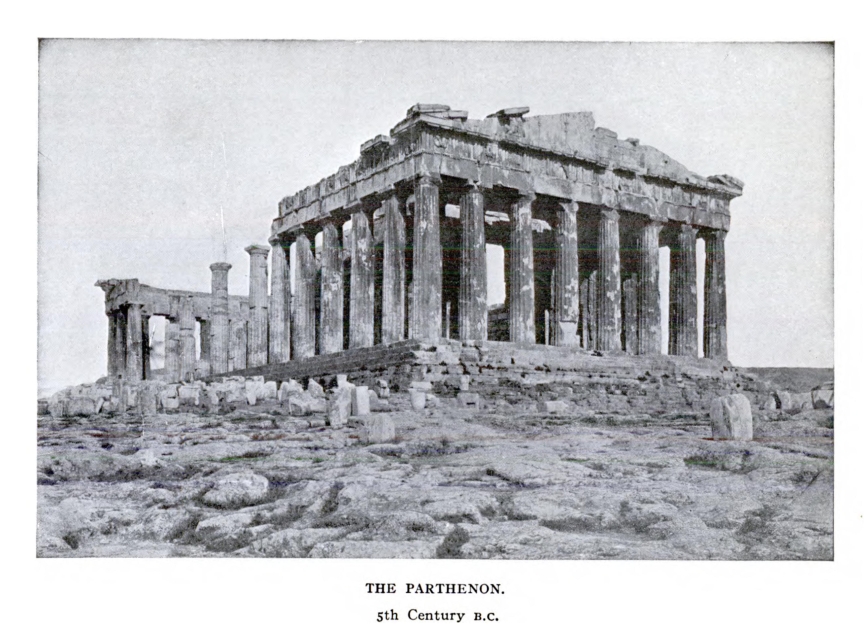
THE PARTHENON,
5th Century B.C.
But greater than all else on the Acropolis was
the Parthenon, created by Ictinus the architect,
and Pheidias the sculptor. This most beautiful
Greek temple in the world stood on the south side
of the Acropolis. It was a Doric building
surrounded by forty-six great pillars, and to the
Athenian this building was the very soul of Athens.
Elsewhere on the Acropolis it was Athena the
goddess who was worshipped: Athena the Warrior,
Athena the Guardian of the City, and in one place,
though without a temple, Athena the Inspirer of all
Arts and Crafts. But here in the Parthenon Athena
was more than the goddess, she symbolized Athens
itself, all the achievements of Athens in war and
peace, and the spirit that guided the Athenians.
The sculpture on the east pediment represented
the birth of Athena. It was the old Homeric poem
interpreted in stone.
Her did Zeus the counsellor himself beget from his
holy head, all armed for war in shining golden mail,
while in awe did the other gods behold it. Quickly did
the goddess leap from the immortal head, and stood
before Zeus, shaking her sharp spear, and high Olympus
trembled in dread beneath the strength of the grey-eyed
Maiden, while Earth rang terribly around, and the sea
was boiling with dark waves, and suddenly brake forth
the foam. Yes, and the glorious son of Hyperion checked
for long his swift steeds, till the maiden took from her
immortal shoulders her divine armour, even Pallas
Athena; and Zeus the counsellor rejoiced.[2]
Zeus rejoiced not only because Athena was born,
but because she symbolized the birth of Athens;
as she sprang from the head of Zeus arrayed in all
the symbols of power, so surely was it the will of
the gods that Athens should be great and powerful.
The sculpture on the west pediment represented
the contest of Athena with Poseidon for the
possession of Athens. Poseidon represented material
prosperity. His gift to Athens was the sea, over
which sailed her ships, colonizing and trading and
bringing wealth to the state. But Athens was not
to be ruled by Poseidon; she was to account the
things of the mind and spirit of greater value than
those of material prosperity, and the victory was
given to Athena.
The pediments symbolized the will of the gods for
Athens. All round the building under the cornice
were smaller groups of sculptures called metopes,
and these represented in stone the way in which
Athens had fulfilled the will of the gods for her.
First, there were battles between gods and giants,
the conflict between order and disorder, and in
every case order had triumphed; then there followed
battles between the ancient heroes of legend and
tradition and all kinds of evil forces in nature, and
in these battles Theseus, the hero-king, fought for
Athens and prevailed.
The Parthenon was built after the Persians had
been driven out of Greece. The Greeks called all
who were not of Greek blood Barbarians, and they
believed that it was the will of the gods that in every
conflict between Greek and Barbarian, the Greek
should in the end prevail. The Greek of the fifth
century B.C. thought of all history as the working
out of the great drama of the victory of the Greek
spirit over that of the Barbarian, and the records of
this drama are seen in political history in the
development of the Athenian Empire, in literature, in
the history of Herodotus, and in art in the building
of the Parthenon.
But the Parthenon symbolized more than the history
of Athens, it was also the symbol of her religious
life. On the outer wall, under the colonnade,
was the great frieze symbolizing the Panathenaic
procession, that great procession which every four
years wound its way up to the Acropolis. This was
the festival of Athena, and at the east end of the
building was a group of gods and goddesses waiting
for her coming. They were waiting for her in her
own city, where she would take the foremost place.
In the solemn procession all classes of Athenians
were represented: noble maidens, bearing baskets
with offerings for the sacrifice; youths with
offerings, and youths on horseback; chariots; grave
elders and priests; and cattle for the sacrifice.
Aliens, too, were there, for it was not only Athens
that was symbolized, but the Athenian Empire;
symbol of what Athens hoped would be a united
Greece. It is very difficult to distinguish between
Athenian patriotism and religion. To the Athenian,
the city was Athena, and Athena the city, and
the Parthenon was the crown of both.
The Parthenon was entered by the eastern porch.
The light inside was dim, but as the eye grew
accustomed to the dimness, the statue of Athena slowly
became clearly visible. There she stood, a great
figure nearly forty feet high. She was clad in a
sleeveless garment that reached to her feet,
bracelets in the form of serpents were on her arms, the
aegis with the head of Medusa covered her breast.
In her right hand the goddess bore an image of
Victory, and her left hand rested on a shield, inside
of which was coiled a snake. The statue was made
of gold and ivory, and it was to the Athenians the
symbol of all that was best in the Athenian ideals.
Their passionate desire for freedom, their unfaltering
search for truth, their great love of beauty were
all personified for them in the calm and queenly
figure of her whose battles were won, of Athena
Parthenos. Having offered their sacrifices outside,
they entered her temple with awe, believing that "he
who enters the incense-filled temple must be holy;
and holiness is to have a pure mind."[3]
Such was the Acropolis of the fifth century B.C.
But now the statues and the altars have disappeared,
the columns are broken, and the temples stand in
ruins. Is it just the lapse of time that has wrought
such destruction on those matchless buildings?
When Plutarch saw them, they had been standing
for about five hundred years, and he said that there
was still a bloom of newness upon them that seemed
to preserve them from the touch of time, as if the
hand that had wrought such buildings gave them the
spirit of eternal youth.
At the beginning of the fifth century A.D. Alaric
the Goth invaded Greece, but he left Athens
undisturbed. The great statue of Athena Promachos
was still standing, and the story was told later
that as the barbarian chieftain approached the
Acropolis, the goddess Athena appeared before
him, clad in mail, with her spear outstretched in
defence of her city. He was so much awed by the
vision that he withdrew and troubled Athens no
more, and he sent messengers to the Roman rulers
of the city and made peace with them.
Not long after, an edict was passed ordering all
pagan temples in the Roman Empire, for Greece
then formed part of it, to be closed or else converted
into Christian churches, and from that time onwards
nothing has been heard of the statue of Athena
Parthenos, though a small copy of it was found
later. The Parthenon itself was changed into a
Christian church, dedicated to the Virgin Mary, and
it remained so until Athens was captured by the
Turks in 1458. They changed the Christian church
into a Turkish mosque and built a minaret at one
corner. No further changes took place until the end
of the seventeenth century, when during a war of
the Turks with Venice, the Venetians were bombarding
the Acropolis. The Venetians were told that
powder was being stored in the Acropolis, and for
several days they directed their fire against it. At
first there was no result, even the guns, it was said,
refusing to do such deadly work on so glorious a
building. But at length a shell was thrown into it,
the powder exploded, the roof crashed in and a part
of the walls collapsed.
The Parthenon was nothing but a ruin, and for
more than a hundred years the sculptures of Pheidias
lay neglected on the ground, broken and defaced.
But at the beginning of the nineteenth century the
attention of Lord Elgin, who was British Ambassador
at Constantinople, was called to the danger
that threatened them from the ignorance and
indifference of the Turks and the unscrupulousness of
travellers and visitors, who often defaced and
carried off pieces of sculpture, and he made
arrangements by which the British Government was allowed
to buy the Parthenon sculptures and remove them
to the British Museum.
Yet in spite of the ruin, the destruction and the
loss, what is still left of the ancient temples and
statues is of such beauty, that those who look upon
it believe with the Greek poet that it will "live as a
song for all who love music, living and yet to be, as
long as earth or sun remain."
Athens in the middle of the fifth century B.C. was
in very truth as Pericles had said, the "school of
Hellas." For half a century after the Barbarian
had been driven out of Greece, Athens went forward
on the wings of youth and hope and aspiration
towards the fulfilment of her great ideal, that of the
perfect citizen in the perfect state. Everything
that was worth while in human life lay in that
direction: Freedom, Order and Progress; Truth
and Beauty; Knowledge, Virtue and Religion; and
in the Greek world it was Athens who was the leader
in all these things.[1]
And Athens realized this. The ideals set forth
by Pericles in the Funeral Speech placed her in the
position of a chosen people in the midst of a
barbarian world, and it was to be her mission to save
civilization for the world. Athens was a democracy,
and her freedom, her thought and her art were
not the special possession of a small privileged
group but of the whole body of citizens. Yet there
was a flaw in the Athenian ideal of democracy; it
was built upon slavery. The result of this was that
in some things the Athenians were able to reach a
point of perfection from which they could make no
further advance. Their greatest sculpture and
architecture were flawless in their simplicity and
beauty. They have been copied and imitated, but
never surpassed. The Greek stage set certain
limitations to the drama, but within these limitations
the dramas of the great Athenian dramatists were
well-nigh perfect. Other small nations in the
history of the world have fought for their freedom
just as passionately and with as much self-control,
unbroken will and self-sacrifice, and have obtained
it, but it was Athens who first showed the world
that right is stronger than might and will ultimately
prevail. In their search for truth, the Athenian
philosophers went as far as it was possible for them to
go, but the very fact that they accepted the
institution of slavery as a normal condition of life,
made any further advance in political thinking
impossible. The history of the world shows that
progress in political thought has always come from the
struggle of an unprivileged class to obtain its just
rights, and this could not take place in Athens, for
the unprivileged were slaves, and slaves were slaves
and slaves they must always remain.
Athens fell, but her fall did not only or even chiefly
come about because her democracy was founded
upon slavery. In her great days Athens had been
the Liberator of all the enslaved Greeks. Sparta
had never been interested in the fate of the Greeks
who were still under the Persian yoke, and it was
Athens who had created the Delian League, and who
had delivered the Ionians from their foreign rulers.
But from being their Liberator, Athens gradually
became their Mistress, and little by little she used
her position in the League as a means to increase
her own power. That which in the beginning had
been organized by the statesman who was called
by his fellow-citizens the Just, that which had
symbolized the Athenian ideal of freedom, became the
instrument by which Athens became not only an
Empire, but a Tyrant. And Pericles permitted it
to be so.
Pericles had many opponents in Athens. Some
disapproved of his imperial policy, and others
accused him of extravagance in spending so much of
the public money on temples. The most serious
accusation brought against him was that in
beautifying Athens he was spending not only money from
the Athenian treasury, but also using that which
belonged to the Delian League. This latter accusation
was true, and the people called for an ostracism.
But it resulted in the support of Pericles by the
majority of the Athenians, and in the banishment of
his opponent.
Pericles knew what he was doing when he used
the money from the treasury of the Delian League.
To Athens had been committed the trust of defending
the allied islands and cities from Persian aggression
and it was the money contributed by the allies
for the cost of this defence that was kept in the
treasury of the League. Pericles maintained that the
beautifying of Athens was a symbol of her might and
power, that the great buildings employed labour
and encouraged commerce, both of which added to
her prosperity, and that these outward signs of her
wealth and might added to her ability to protect
her allies. He had won for Athens the foremost
position in Greece, and he was determined that she
should keep it. To this end he argued that Athens
was justified in using the money of the League,
because the way in which it was being spent added
not only to the glory but also to the security of all.
Pericles was also a great lover of all that was
beautiful, and he was honestly desirous that the
youth of Athens should grow up in a city that
should be a joy for ever, that would make them
good and useful citizens, and inspire them with an
abiding love for and pride in her. But there is a
flaw in the character of a man who holds that the
end, even if it is a great and glorious one, justifies
any means.
Now Attica was very small, and in the days of her
prosperity the population of Athens had increased
so much that the state could no longer produce
enough food to support the people. The far-seeing
policy of Themistocles had made Athens stronger
on sea than on land, and by the time of Pericles,
the salvation of Athens lay in her navy. She was
increasing her sea-power in all directions and
establishing herself as mistress all over the Aegean and
on the shores of the Euxine. This policy was not
only dictated by the greed of power, but by the
absolute necessity that if Athens were to live, she
should control all the trade routes by which corn
reached Greece. Without the corn from the shores
of the Euxine, Athens would starve.
Sparta was a great land power, and at first this
increasing sea-power of Athens did not touch her
very closely, but it did affect Corinth, the next
sea-power in Greece after Athens. As long as Athens
confined her interests to the Aegean and the East,
Corinth was not alarmed, but when the Athenians
turned to the West and showed their intention of
establishing their power there, the Corinthians
became seriously alarmed, for this threatened their
interests in Sicily and the South of Italy. Corinth
had always been hostile to Athens, and she now
appealed to Sparta, asking for help to crush Athens.
Corinthian envoys went to Sparta, and in a powerful
speech one of them set forth the grievances of
the Greek world against Athens, representing her
power, and entreating the Spartans to lay aside their
policy of inaction and to join with them in crushing
the Tyrant state.
"Time after time we have warned you of the mischief
which the Athenians would do to us, but instead of
taking our words to heart, you chose to suspect that
we only spoke from interested motives. If the crimes
which the Athenians are committing against Hellas
were being done in a corner, then you might be ignorant,
and we should have to inform you of them: but now,
what need of many words? Some of us, as you see,
have been already enslaved; they are at this moment
intriguing against others, notably against allies of ours;
and long ago they had made all their preparations in
expectation of war.... And you have never considered
what manner of men are these Athenians with
whom you will have to fight, and how utterly unlike
yourselves. They are revolutionary, equally quick in
the conception and in the execution of every new plan;
while you are conservative, careful only to keep what
you have, originating nothing, and not acting even
when action is most necessary. They are bold beyond
their strength; they run risks which prudence would
condemn; and in the midst of misfortune they are full
of hope. Whereas it is your nature, though strong, to
act feebly; when your plans are most prudent, to
distrust them; and when calamities come upon you, to
think that you will never be delivered from them. They
are impetuous, and you are dilatory; they are always
abroad, and you are always at home. For they hope
to gain something by leaving their homes; but you are
afraid that any new enterprise may imperil what you
have already. When conquerors, they pursue their
victory to the utmost; when defeated, they fall back the
least. Their bodies they devote to their country as
though they belonged to other men; their true self
is their mind, which is most truly their own when
employed in her service. When they do not carry out an
intention which they have formed, they seem to have
sustained a personal bereavement; when an enterprise
succeeds, they have gained a mere instalment of what
is to come; but if they fail, they at once conceive new
hopes and so fill up the void. With them alone to hope
is to have, for they lose not a moment in the execution
of an idea. This is the life-long task, full of danger and
toil, which they are always imposing upon themselves.
None enjoy their good things less, because they are
always seeking for more. To do their duty is their only
holiday, and they deem the quiet of inaction to be as
disagreeable as the most tiresome business. If a man
should say of them, in a word, that they were born
neither to have peace themselves nor to allow peace to
other men, he would simply speak the truth.
"In the face of such an enemy, Lacedaemonians, you
persist in doing nothing. But let your procrastination
end. Do not allow friends and kindred to fall into the
hands of their worst enemies; or drive us in despair to
seek the alliance of others; in taking such a course we
should be doing nothing wrong either before the Gods
who are the witnesses of our oaths, or before men whose
eyes are upon us. For the true breakers of treaties are
not those who, when forsaken, turn to others, but those
who forsake allies whom they have sworn to defend.
We will remain your friends if you choose to bestir
yourselves; for we should be guilty of an impiety if we
deserted you without cause; and we shall not easily
find allies equally congenial to us. Take heed then;
you have inherited from your fathers the leadership of
Peloponnesus; see that her greatness suffers no
diminution at your hands."
Thus spake the Corinthians. Now there happened to
be staying at Lacedaemon an Athenian embassy which
had come on other business, and when the envoys had
heard what the Corinthians had said, they felt bound
to go before the Lacedaemonian assembly, not with the
view of answering the accusations brought against them
by the cities, but they wanted to put before the
Lacedaemonians the whole question, and make them
understand that they should take time to deliberate and not
be rash. They also desired to set forth the greatness of
their city, reminding the elder men of what they knew,
and informing the younger of what lay beyond their
experience. They thought that their words would sway
the Lacedaemonians in the direction of peace. So they
came and said that, if they might be allowed, they too
would like to address the people.[2]
The Athenians were invited to speak, and they
reminded the Spartans of how Athens had done more
than any other State to save Greece from the
Persian invader, and that Sparta herself owed her
liberty to the undismayed courage of Athens.
We maintain, [they said], that we rendered you a service
at least as great as you rendered us. The cities from
which you came to help us were still inhabited and you
might hope to return to them; your concern was for
yourselves and not for us; at any rate you remained at
a distance while we had anything to lose. But we went
forth from a city which was no more, and fought for
one of which there was small hope; and yet we saved
ourselves, and bore our part in saving you. If, in order
to preserve our land, like other states, we had gone over
to the Persians at first, or afterwards had not ventured
to embark because our ruin was already complete, it
would have been useless for you with your weak navy
to fight at sea, but everything would have gone quietly
just as the Persian desired.[3]
The Athenians then attempted to justify their
imperial policy and to point out that, had the
situation been reversed, and had it been the
Lacedaemonians who had acquired an empire, they would
have found it just as necessary as had Athens to
rule with a strong hand, and that they would have
been even worse hated than was Athens. They
concluded with a passionate appeal for peace:
Do not then be hasty in deciding a question which is
serious; and do not, by listening to the misrepresentations
and complaints of others, bring trouble upon yourselves.
Realize, while yet there is time, the inscrutable
nature of war; and how when protracted it generally
ends in becoming a mere matter of chance, over which
neither of us can have any control, the event being
equally unknown and equally hazardous to both. The
misfortune is that in their hurry to go to war, men begin
with blows, and when a reverse comes upon them, then
have recourse to words. But neither you, nor we, have
as yet committed this mistake; and therefore while
both of us can still choose the prudent part, we tell you
not to break the peace or violate your oaths. Let our
differences be determined by arbitration according to
the treaty. If you refuse, we call to witness the Gods,
by whom you have sworn, that you are the authors of
the war; and we will do our best to strike in return.[4]
The Spartans did not heed the plea for peace, and
in 431 B.C. the long dreary war, known in history as
the Peloponnesian War, began and dragged itself
out for nearly thirty years. Compared to modern
warfare the actual fighting was not on a very large
scale, and we seem to be reading of battles between
what were, after all, only rather small states. But
though the states were small, the statesmen who
guided their policies and the men who fought for
them were men of human passions like ours; and
though the method of warfare has changed, the effect
of war on the minds and lives of men and women
living at the time has changed very little. The
future is hidden from the eyes of each generation of
men, but the past lies open before them; and to
those who read the past with understanding comes
enlightenment when similar difficulties surround
them, for the past shows not only the beginning and
the middle, but also the end of the story.
When the Peloponnesian War broke out, almost
fifty years had gone by since the Persian had been
driven out of Greece, and the heroes of Marathon,
of Thermopylae and of Salamis had already passed
into history. That war had been between the Greek
and the Barbarian, this war was between Greek
and Greek, and it rapidly spread over almost the
whole Greek world. The real cause was the rivalry
between Athens and Sparta, and it was fought to
determine which should be supreme in Greece.
Athens was a great sea-power, Sparta a great
land-power; Athens was a freedom-loving democracy,
Sparta was still governed by an oligarchy; Athens
was dependent for her life on the corn that came
from afar, Sparta was practically self-sufficing.
When the war began, each side was confident and
sure of victory. How was it to end?
During the first part of the war Athens was
supreme at sea; and she strengthened her hold on all
the trade routes. But she did not dare meet Sparta
in a great open pitched battle on land, for the
military power of the latter was no legend, but a most
formidable fact.
Everything, however, did not go well with Athens
during those first few years. Every year the
Spartans had invaded Attica and burnt and plundered
the land surrounding Athens. This had driven all
the country people into the city, where conditions
became very congested and intolerable. And then
it was that a scourge fell upon Athens from which
she never recovered. For two long summers and
two long winters the Angel of Death stood over the
city and darkened it with his wings and smote the
inhabitants, so that one out of every four died.
It was the Plague. The whole dreadful story can be
read in the pages of Thucydides: how it began in the
Peiraeus and then spread to Athens; of the sufferings
of those who were seized with it, the rapidity with
which it spread and the impossibility of caring for
the sick or burying the dead; of the lawlessness in
the disorganized terror-stricken city; and of all
the misery which came from seeing the inhabitants
of the city dying in such numbers and from knowing
that without the walls the country was being ravaged.
When the horror had passed and Athens once
more lifted up her head, she was no longer the Athens
of old. Her spirit was not only broken but changed.
The war and the plague together lay heavy upon
the Athenians, and they blamed Pericles because
he had persuaded them to go to war, declaring that
he was the author of all their troubles. Once again he
made a great speech to them, reminding them that
Athens had never yet yielded to misfortune, and
that the greatest states and the greatest men are
those who, when misfortunes come, are the least
depressed in spirit and the most resolute in action.
But Pericles did not live to guide Athens through
the troubled waters which lay ahead of her. He
had experienced the same misfortunes as his
fellow-citizens. His sister, his sons, and the friends who
were nearest to him had died of the plague, and he
himself was ill. As he lay dying, some of his friends
who were still alive were sitting near him, and they
spoke together of his greatness, his power and the
number of his victories. They did not think he
was conscious, but he heard all that they said, and
when they had finished, asked them why they did
not speak or make mention of that which was the
most excellent and greatest thing of all. "For," said
he, "no Athenian, through my means, ever wore
mourning."[5]
Pericles had been a good general; he had added
to the power of Athens both at home and abroad;
and he had made her defences more secure by
completing the Long Walls which had been begun by
Themistocles. As a statesman, Pericles was an
imperialist, and he believed that the Athenian
Empire, which had grown naturally out of the
position of Athens as Liberator of the Ionian Greeks,
embodied the right relationship between Athens and
her allies. Like Themistocles, he had a deep
distrust of Sparta, and believing that sooner or later
war with her was inevitable, he did all that lay in
his power to make Athens ready when that day
should come.
Though of noble birth, Pericles had always been
on the side of the people in Athens, and during his
rule the powers of the people were very much
extended. Every office in the state was filled by
popular election each year, so that there was constant
change amongst those in authority and Athens
could never be sure of any settled policy in her
affairs either at home or abroad. The supreme and
final authority lay in the Assembly, but like all
popular assemblies, it could be swayed and, at
several critical moments in the history of Athens,
was swayed, by sudden bursts of passion, or by the
fiery eloquence of an unwise or an ambitious and
self-seeking speaker. But as long as Pericles lived,
the dangers of the democracy he had developed were
not very apparent, for he was trusted absolutely,
and he kept a wise, firm and restraining hand on
the passions of the people.
Pericles died in the year 429 B.C., and in the years
following his death the results of a long war began
to be felt. Food became scarce and prices were
high; it was difficult to get servants, for in the
general disorganization of life that had come with the
plague, slaves had escaped in large numbers;
the young men of Athens were no longer to be
seen in the Agora and other public places, for
all men capable of bearing arms were with the
army.
Four years after the death of Pericles, Sparta made
offers of peace, but feeling ran very high in Athens
and it was believed that a peace then would not be
lasting, so the offer was rejected and it was
determined to carry on the war to the bitter end.
There is nothing that so well describes conditions
in Athens during these war years as the comedies of
Aristophanes. They carry us back to those
exciting days and it is amazing to see how much
freedom of speech was allowed. The Knights, the
Clouds, and the Wasps were all written in these
years, and they are full of the excitement of the
time, and often of outspoken criticism of those
responsible for the carrying on of the war. But the
war brought a lowering of ideals, and even where
there was victory, there was also sorrow and loss
and the ruin of homes. Euripides, one of the great
dramatists of the time, in the Trojan Women, a
play written during the war, stripped war of all its
glamour and showed the misery that comes to the
conquered:
And they whom Ares took,
Had never seen their children: no wife came
With gentle arms to shroud the limbs of them
For burial, in a strange and angry earth
Laid dead. And there, at home, the same long dearth
Women that lonely died, and aged men
Waiting for sons that ne'er should turn again,
Nor know their graves, nor pour drink-offerings,
To still the unslaked dust. These be the things
The conquering Greek hath won!
* * * * * * *
Would ye be wise, ye Cities, fly from war!
Yet if war come, there is a crown in death
For her that striveth well and perisheth
Unstained: to die in evil were the stain![6]
Pericles was dead, and Cleon who had succeeded
him as leader of the people had no power to inspire
the Athenians to be true to their highest ideals,
and as conditions grew more and more difficult,
Athens was forced at length to give herself up to a
fight for her life. Anger, suspicion and hatred took
the place of the old ideals, and it seemed as if her
strength had turned to weakness and despair. And
then Athens sealed her own doom, for to save her
own citizens from heavy taxation in order to carry
on the war, without asking their consent she doubled
the amount of the tribute paid to her by her allies
every year, and so she broke the Charter once made
in good faith between them.
But the end had not yet come. For a time
success lay with the Athenians, and they forced a
Spartan garrison to surrender to them at Sphacteria on
the west coast of the Peloponnesus, a victory which
greatly encouraged them. But the years dragged on
and the war continued and there seemed no end in
sight. Then it was that Brasidas, a Spartan
general, marched North from the Peloponnesus through
Boeotia and Thessaly until he reached Amphipolis,
an Athenian colony on the borders of Thrace and
Macedonia, which he besieged. Cleon had gone to
Amphipolis to help the Athenians and he was
expecting assistance from an Athenian general who
was marching to the relief of the city. But he did
not arrive in time, and Amphipolis was taken by the
Spartans. Both Cleon and Brasidas were killed,
and Athens exiled the general who had failed to
arrive in time. He devoted the period of his exile
to gathering materials for a history of the war, and
though he may have been unsuccessful as a general,
he became one of the greatest historians, not only of
Greece, but of the world. His name was Thucydides.[7]
The surrender of Amphipolis brought a lull in
the war, and owing to the efforts of the Athenian
general, Nicias, in 421 B.C. a peace was made, which
was to last for fifty years.
The Peace of Nicias did not last very long,
however. Athens and Sparta were both too jealous of
each other to be really reconciled, and neither kept
to the terms of peace. There was a party in Athens
which favoured peace, but it was not so powerful
nor so popular as the war party, and its leader,
Nicias, did not possess the qualities of leadership
which characterized the leader of the other side.
This leader was Alcibiades, a young man who had
recently risen to power and who was very popular.
He was of noble birth, rich, very good-looking and of
great personal charm. He lisped when he spoke,
but it was said that this "became him well and
gave a grace and persuasiveness to his rapid speech."
When he began to study, he obeyed all his other
masters fairly well, but refused to learn to play the
flute, because he said it disfigured the face, and also
because it was not possible to speak or sing whilst
playing it. Alcibiades was a leader of fashion
amongst the Athenian youths and as soon as it
became known that he despised the flute, playing on
it went out of fashion and became generally neglected.
Alcibiades was sought out by many people who
liked to be in his company chiefly because of his
great personal beauty, but it is evident that at this
time he must have shown many noble qualities and
a good disposition, for Socrates, the great
philosopher, showed much affection for him. Socrates
saw that his wealth and position caused him to be
flattered and made so much of by all kinds of
people that he feared he would be corrupted by it,
and he resolved, if possible, that his good qualities
should be preserved. On his side, Alcibiades
recognized the great worth of Socrates and listened
willingly to his teaching.
Both Socrates and Alcibiades took part in one of
the early campaigns of the Peloponnesian War.
They shared the same tent and stood next to each
other in battle, and in one sharp fight both behaved
with special bravery. This was the occasion on
which Alcibiades was wounded, but Socrates threw
himself before him and protected him and beyond
any question saved his life.
Alcibiades had great advantages for entering public
life; his noble birth, his riches, the personal
courage he had shown in many battles and the
multitude of his friends and dependents threw open the
doors for him. His popularity had also increased
because of his success at the Olympic games. He
had spent great sums of money on horses and
chariots, and never did anyone else send so many as
seven chariots to the Games. And they were so
well equipped that in one race he carried off the first,
second and fourth prizes, which far outdid any
distinction that ever was known or thought of in that
kind.[8]
But Alcibiades did not follow the wise teaching of
Socrates, and he grew luxurious, dissipated and
lawless in his way of living; he wore long purple robes
like a woman, which dragged after him as he went
through the market place; and he had a soft and
luxurious bed prepared for him on his galley. All
this made him disliked by a great number of
Athenians and gradually raised up enemies for him; yet
such was his personal charm, his eloquence, his
courage and his beauty that the Athenians made excuses
for his excesses, indulged him in many things and
gave soft names to his faults, attributing them to
his youth and good nature.[9]
Such was the man, unstable, ambitious and
unscrupulous to whom was entrusted the guidance of
affairs at Athens at this most critical hour of her
fortunes.
Up to this time the relations of Athens with the
Greeks beyond the sea had been chiefly confined to
those in Ionia, but there were rich lands dwelt in by
Greeks to the West, especially in Sicily and the
South of Italy. Even in the life-time of Pericles
the Athenians had cast a longing eye upon Sicily,
but they did not attempt anything there till after
his death. An opportunity for interference in
Sicilian affairs was given them in 415 B.C. when the
Peace of Nicias had brought a period of truce in the
war with Sparta. The Greeks in one of the cities in
Sicily appealed to Athens for help against Syracuse
which was oppressing them, and Alcibiades seized
upon this as the first step in an Athenian conquest
of Sicily. This was but the beginning of his
ambitious plan, for he dreamed not only of the mastery
of Sicily, but of nothing less than the conquest of
Carthage and of Athenian rule over the whole
Mediterranean world.
Alcibiades roused Athens to enthusiasm for an
expedition to Sicily and the young men, in particular,
shared his hopes and ambitions and listened to
him when he talked of the wonders of the countries
to which they were going, so that great numbers of
them might be seen sitting in the wrestling grounds
and public places, drawing on the ground maps of
Sicily and the situation of Carthage. Nicias,
conservative, experienced and loyal, saw that it was
not the welfare of Athens but his own personal
ambition and love of glory that was moving Alcibiades,
and did everything in his power to dissuade the
people from following such a rash and ambitious
policy. He told them that even if they conquered
Sicily they could not hope to keep it, and that the
course they were in favour of pursuing would only
add to the hatred already felt for them by Sparta,
and could only end in disaster.
But the Athenians were deaf to the pleas of Nicias,
and it was voted that the expedition should take
place.
Then the preparations began. Lists for service were
made up at home and orders given to the allies. The
city had newly recovered from the plague and from the
constant pressure of war; a new population had grown
up; there had been time for the accumulation of money
during the peace; so that there was abundance of
everything at command.
While they were in the midst of their preparations,
the Hermae or square stone figures carved after the
ancient Athenian fashion, and standing everywhere at
the doorways both of temples and private houses, in
one night had nearly all of them throughout the city
their faces mutilated. The offenders were not known,
but great rewards were publicly offered for their
detection, and a decree was passed that anyone, whether
citizen, stranger, or slave, might without fear of
punishment disclose this or any other profanation of which
he was cognizant. The Athenians took the matter
greatly to heart; it seemed to them ominous of the
fate of the expedition; and they ascribed it to
conspirators who wanted to effect a revolution and to
overthrow the democracy.
Certain metics and servants gave information, not
indeed about the Hermae, but about the mutilation of
other statues which had shortly before been perpetrated
by some young men in a drunken frolic; and of this
impiety they accused, among others, Alcibiades. A
party who were jealous of his influence over the people
took up and exaggerated the charges against him,
clamorously insisting that he was at the bottom of the
whole affair. In proof they alleged the excesses of his
ordinary life, which were unbecoming in the citizen of
a free state.
He strove then and there to clear himself of the
charges, and also offered to be tried before he sailed
(for all was now ready), in order that, if he were guilty,
he might be punished, and if acquitted, might retain
his command. But his enemies feared that if the trial
took place at once he would have the support of the
army, and that the people would be lenient. They
therefore exerted themselves to postpone the trial. To
this end they proposed that he should sail now and not
delay the expedition, but should return and stand his
trial within a certain number of days. Their intention
was that he should be recalled and tried when they
had stirred up a stronger feeling against him, which
they could better do in his absence. So it was decided
that Alcibiades should sail.
About the middle of summer the expedition started
for Sicily. Early in the morning of the day appointed
for their departure, the Athenians and such of their
allies as had already joined them went down to the
Peiraeus and began to man the ships. The entire
population of Athens accompanied them, citizens and
strangers alike. The citizens came to take farewell,
one of an acquaintance, another of a kinsman, another
of a son; the crowd as they passed along were full of
hope and full of tears; hope of conquering Sicily, tears
because they doubted whether they would ever see
their friends again, when they thought of the long
voyage on which they were sending them. At the moment
of parting the danger was nearer; and terrors which
had never occurred to them when they were voting the
expedition now entered into their souls. Nevertheless
their spirits revived at the sight of the armament in all
its strength and of the abundant provisions which they
had made. The strangers and the rest of the multitude
came out of curiosity, desiring to witness an enterprise
of which the greatness exceeded belief.
No armament so magnificent or costly had ever been
sent out by any single Hellenic power. Never had a
greater expedition been sent to a foreign land; never
was there an enterprise in which the hope of future
success seemed to be better justified by actual power.
When the ships were manned and everything required
for the voyage had been placed on board, silence was
proclaimed by the sound of the trumpet, and all with one
voice before setting sail offered up the customary prayers;
these were recited, not in each ship, but by a single
herald, the whole fleet accompanying him. On every
deck both officers and men, mingling wine in bowls,
made libations from vessels of gold and silver. The
multitude of citizens and other well-wishers who were
looking on from the land joined in the prayer. The
crews raised the Paean, and when the libations were
completed, put to sea.[10]
In due time they reached Sicily, where the generals
in command held a conference as to the best way of
beginning the attack.
In the meantime the enemies of Alcibiades in
Athens took up the charges of impiety which had
been made against him and did not rest until an
order had been sent to Sicily ordering his return
that he might be brought to trial.
From every quarter suspicion had gathered around
Alcibiades, and the Athenian people were determined
to have him tried and executed; so they sent a
summons to him and to others against whom information
had been given. He was ordered to follow the officers
home and defend himself, but the latter were told not
to arrest him; for the Athenians, having regard to their
interests in Sicily, were anxious not to cause excitement
in their own camp, or to attract the attention of the
enemy.[11]
So Alcibiades and those who were accused with
him left Sicily. They sailed in their own ship, but
were escorted by the Athenian galley sent for them.
Before reaching Greece, both ships put in at a port
in Italy, and here Alcibiades and his companions
left their ship and disappeared, "fearing to return
and stand their trial when the prejudice against them
was so violent. They were sought for, but the crew
of the galley could not find them and so they gave up
the search and returned home."[12]
Before making plans for a further escape,
Alcibiades lay concealed for a short time in Italy. It
seemed strange to one who was with him that he
had not enough faith in Athenian justice to return
home and face a trial, but when asked if he did not
trust his own native country, Alcibiades replied: "In
everything else, yes; but in a matter that touches
my life, I would not trust even my own mother,
lest she might by mistake throw in the black ball
instead of the white."[13] As Alcibiades did not
appear in Athens to answer the charges against him,
the Assembly convicted him and his companions of
impiety, confiscated their property, sentenced them
to death, and pronounced a solemn curse on their
names. When this news reached him, all he said was:
"I will make them feel that I am alive."
Alcibiades kept his word. He crossed to the
Peloponnesus and went first to Argos. When he
found there was no hope of his returning to Athens,
he sent a message to Sparta, asking for a safe-conduct
to that city, and assuring the Spartans that he would
make them amends by his future services for all
the mischief he had done them while he was their
enemy. The Spartans gave him the security for
which he asked, and he went to them eagerly, and
was well received. In return for this, he betrayed
the weak points of his native city to her enemies
and gave them valuable advice as to the best means
of conquering Athens.
Now one characteristic of Alcibiades was the
extraordinary ease with which he could adapt himself
to his surroundings. Whenever he saw that it was
to his own interest to adopt the habits and ways of
those with whom he came in contact, he did so
with no hesitation. At Sparta, he gave himself up
to athletic exercises, he cut his hair short, bathed in
cold water and dined on black broth; in Ionia, he
was luxurious, gay and indolent; in Thrace, always
drinking; in Thessaly, ever on horseback; and when
later he lived with the Persian satrap, he exceeded
the Persians themselves in magnificence and pomp.[14]
But though in Sparta Alcibiades lived as a
Spartan and appeared devoted to their interests, he was,
nevertheless, an Athenian, and the Spartans did
not trust him. The Greeks never wholly trusted
each other, and lack of sincerity in their political
relations was one of the weak points in their
character. When Alcibiades found that he was looked upon
with suspicion in Sparta and that his life was
actually in danger, he fled to Ionia and took refuge with
the Persian satrap with whom he soon became a
great favourite. And, indeed, the charm of daily
intercourse with this extraordinarily fascinating and
dangerous man was more than any one could resist.
Even those who feared and envied him could not
but take delight, and feel a friendliness towards
him, when they saw him and were in his company.
It was only in his absence that his real character
was recognized.
And now followed a period of disloyal intrigue
with the Persians. Alcibiades advised them to
interfere in the war between Athens and Sparta,
and sometimes to help one side and sometimes the
other, until both should be so exhausted that the
Persian King could easily overcome them. Thus,
not content with betraying Greek to Greek,
Alcibiades descended to the shameful depths of
betraying Greece to the Barbarian.
Alcibiades had been summoned back to Athens
at the very beginning of the expedition to Sicily.
It was in the summer of 415 B.C. that the Athenian
fleet had set out with such magnificence and with
such high hopes. Two years later, news was brought
to Athens which at first the Athenians would not
believe, so appalling was it. There had been a
fearful battle in the harbour at Syracuse, the
Athenians had been utterly vanquished, and great
numbers had been imprisoned in the quarries which
were deep and narrow.
The sun by day was still scorching and suffocating,
for they had no roof over their heads, while the autumn
nights were cold. They were only allowed about half
a pint of water and a pint of food a day. Every kind of
misery which could befall man in such a place befell
them. The Athenians had been utterly and at all
points defeated. Fleet and army had perished from the
face of the earth; nothing was saved, and of the many
who went forth, few returned home.[15]
The Athenians were at first in utter despair.
Whichever way they looked there was trouble; they
were overwhelmed by their calamity, and they were
in fear and consternation unutterable. The citizens
mourned and the city mourned; they had lost the
flower of their youth, and there were none to replace
them. And when they saw an insufficient number of
ships in their docks, and no crews to man them, nor
money in the treasury, they despaired of deliverance.
During the following winter all Hellas was stirred
by the great overthrow of the Athenians in Sicily. The
states which had been neutral determined that the
time had come when, invited or not, they could no
longer stand aloof from the war; they must of their
own accord attack the Athenians. They considered, one
and all, that if the Sicilian expedition had succeeded,
they would sooner or later have been attacked by them.
The war would not last long, and they might as well
share in the glory of it. The Lacedaemonian allies,
animated by a common feeling, were more eager than
ever to make a speedy end of their protracted
hardships. But none showed greater alacrity than the
subjects of the Athenians, who were everywhere willing
even beyond their power to revolt; for they judged
by their excited feelings, and would not admit a
possibility that the Athenians could survive another
summer.[16]
Athens was hated because from being the great
deliverer of Greece, she had become a tyrant and
an oppressor, and the small states who had been
ruled by her were more than ready to transfer their
allegiance to Sparta who held out promises of
freedom from oppression if they would join her. Yet
Sparta was at this very time bargaining with the
Persian King and promising that she would recognize
his right to rule over all that the Great Kings had
formerly ruled, even the Greeks who lived in Asia
Minor, in return for money with which Sparta could
pay her sailors. Never had Athens sunk so low as
that. The end was not far off, but Athens, having
recovered from her first overwhelming despair,
regained some of her old courage. She economized
in every way, so that new ships could be built, and
she kept on the alert, lest she should be taken
unawares by some surprise attack.
It was at this moment that Alcibiades began to
intrigue and plot for a return to Athens. Gradually
his friends gained the upper hand, the government
of Athens had not been successful and it was
overthrown. It had been said that the feeling of the
Athenians towards Alcibiades was that "they love,
they hate, but cannot do without him," and they
proved the truth of the saying by recalling him. As
of old, when once they came under the charm of his
personality, the Athenians yielded to their
enthusiasm for him.
As soon as he was landed, the multitude who came out
to meet him scarcely seemed so much as to see any of
the other captains, but came in throngs about Alcibiades,
and saluted him with loud acclamations, and followed
him; those who could press near him crowned him with
garlands, and they who could not come up so close yet
stayed to behold him afar off, and the old men pointed
him out, and showed him to the young ones.[17]
Yet there was bitterness mixed with this rejoicing,
for the Athenians remembered that it was by following
the advice of this man that some of their greatest
disasters had fallen upon them.
The story of all that followed may be read in the
pages of Thucydides and Xenophon. For a time
Athens seemed to regain her old power and she won
so great a victory over the Spartans that these
proposed a peace, but it was to be a peace as between
equals, and Athens would hear of no peace, unless
she herself should dictate it. So the war continued,
until the ill-success of some ships in an engagement
with the Spartans caused the people to turn once
more against Alcibiades, and again he was exiled.
After that the end came quickly. In 405 B.C. one
last great battle was fought in which the Athenians
were utterly defeated. The news of this disaster was
taken to Athens, and it was night when the messenger
arrived. When the tale was told
a bitter wail of woe broke forth. From Piraeus, following
the line of the Long Walls up to the heart of the
city, it swept and swelled, as each man to his neighbour
passed on the news. On that night no man slept. There
was mourning and sorrow for those that were lost, but
the lamentation was merged in even greater sorrow for
themselves, as they pictured the evils they were about
to suffer. On the following day the public assembly
met, and, after debate, it was resolved to block up all
the harbours save one, to put the walls in a state of
defence, to post guards at various points, and to make all
other necessary preparations for a siege.[18]
The Spartans came and closed in upon Athens. A
hundred and fifty ships were moored off the Peiraeus,
and a strict blockade was established against all
merchant ships entering the harbour.
The Athenians, finding themselves besieged by land and
sea, were in sore perplexity what to do. Without ships,
without allies, without provisions, the belief gained
hold upon them that there was no way of escape. They
must now, in their turn, suffer what they had
themselves inflicted upon others.[19]
At last, starved into submission, they surrendered,
and terms were made with Sparta. They were
bitter and humiliating terms:
That the Long Walls and fortifications of Peiraeus should
be destroyed; that the Athenian fleet, with the exception
of twelve vessels, should be surrendered; that the
exiles should be restored; and lastly, that the Athenians
should acknowledge the headship of Sparta in peace
and war, leaving to her the choice of friends and foes,
and following her lead by land and sea.[20]
The Athenians themselves were made to help in
the destruction of the walls, and as they did so,
their enemies rejoiced to the music of the flute,
believing that with the fall of Athens would dawn a
day of liberty for Greece.
For over thirty years Sparta ruled in Greece. At
the beginning of the Peloponnesian War, she had
demanded of Athens that she should restore the
liberties of all the Greeks who were her allies. Athens
had refused, and now the Greek world waited
anxiously to see what use Sparta would make of her
great victory.
It soon became evident that the rule of Sparta
was not to be a light one. Military governors were
placed in every city of the old Delian League, and
the citizens were forced to pay a heavy tribute to
Sparta. Thirty men were set to rule in Athens, and
for the eight months that these Thirty were in
power, Athens endured cruelty, tyranny and
lawlessness. The Spartan domination soon became so
unendurable that one by one a number of Athenians
fled from the city and took refuge in Thebes: in
Thebes, who had hitherto been one of the bitterest
enemies of Athens, but who now realized that
freedom and justice were not to be found in the
Spartan ideal of empire, for it was nothing less than
empire at which Sparta was aiming. At last a
sufficient number of exiles had gathered at Thebes for
them to make an attempt to drive out the Thirty
from Athens. They were successful, and the old
Athenian form of government was restored.
But there was no real peace, and for a few years
fighting went on in different places. Sometimes
Sparta was successful, sometimes Athens, but
nothing decisive happened. At last Sparta began to
intrigue with Persia, and in 386 B.C., Artaxerxes the
King interfered in the affairs of Greece, and
proposed terms of peace, known as the King's Peace,
which were accepted. The Greek cities in Asia
Minor were to belong once more to the Persians, and
all the other Greek city-states were to be
independent, and the treaty concluded with the words:
"Should any refuse to accept this peace, I,
Artaxerxes, will make war upon them, with the help of
those who are of my mind, both by land and sea,
with ships and with money."
It was a betrayal of Greece to the ancient foe.
The Greek states had never been able to unite for
long at a time. Had they been able to hold together,
and especially had Athens and Sparta done so, they
could have prevailed against the Persian in Asia
Minor and maintained the independence of their
kinsmen in Ionia. But their jealous fears of
anything that might limit their freedom as independent
states made any permanent alliance impossible,
and the long years of the Peloponnesian War, of all
wars in history one of the most humiliating, because
so unnecessary and unjustifiable, had bred hatreds
and suspicion, greed and jealousy, from which Greece
never recovered. But though politically her power
was gone, her work for the world was not finished.
Artaxerxes, the King of Persia, had a younger
brother, Cyrus, who was accused to him of plotting
against his life. He had Cyrus seized and would
have put him to death, but his mother made
intercession for him and so his life was spared. This
set Cyrus to thinking, not only how he might avoid
ever again being in his brother's power, but how,
if possible, he might become King in his stead. Now
Cyrus was a man who was much beloved. He was
honourable, upright and chivalrous, and marvellously
skilled in horsemanship. He understood, not
only how to make friends, but also how to keep them,
and any man who did him willing service was sure to
win his reward. For this reason, Cyrus was always
able to command men who were willing to follow
him in any undertaking, no matter how dangerous
it might be.
In order to possess himself of the throne of his
brother, it was necessary for Cyrus to raise an
army, and he sent trusted agents to various places
to collect as many men as would be willing to follow
him on a hazardous expedition. Amongst other
men who joined his army were a great many Greeks.
Though the King's Peace was not made for some
years after this, the great battles of the
Peloponnesian War were over, and there were large
numbers of men, who had spent so many years in
fighting that they were restless and unwilling to return
to their old settled life. About ten thousand Greeks
joined the army of Cyrus, and in 401 B.C. they set
out. These Greeks had not been told the real object
of the expedition; they thought they were to fight
against some hill-tribes in Asia Minor, and they
joined the rest of the army in Sardis, not knowing
the long march they were about to begin.
At first all seemed to be going well, but when they
had gone for some distance, the Greeks began to
suspect that they were going further than they had
expected, and some of them wanted to turn back.
But Cyrus promised to give them more pay, and they
continued their march. On they went, until they
reached the Euphrates. They crossed the river,
and for some days they continued their march along
the opposite bank until they reached Cunaxa, not
far from Babylon. Here at length Cyrus met the
Persian army, which came against him under the
King, his brother. A fierce battle followed, in which
the Greeks were victorious, but Cyrus was killed,
and so the victory availed them nothing. The
Persians entrapped the Greek generals and murdered
them, and there was nothing left for the Greeks to
do, but in some way or other to return to Greece.
But Greece was more than a thousand miles off,
and they did not know the way; they had no leaders,
they were in a strange land and surrounded by
enemies, and they had no means of procuring supplies
by the way. Nevertheless, they decided in spite of
all these difficulties, to choose new generals and to
start.
Chief of the new generals was a young Athenian
called Xenophon, and he advised the Greeks, there
were ten thousand of them, to burn all the baggage
that they did not need and to set out and find their
way back as best they could to Greece. They
followed his advice, and Xenophon himself has given
us the account of that March of the Ten Thousand
back to Greece. He called his story the Anabasis
or the March Up Country and he tells us how they
went through strange and unknown lands, and how
they suffered from enemies, from the cold and from
hunger. They followed the Tigris for a time and
passed the ruins of Nineveh, but so complete had
been the destruction of that proud city that the
retreating Greeks did not know that they were
treading her beneath their feet.
Winter came on, and the cold was terrible. In
one place they marched through deep snow, with the
north wind blowing in their teeth, benumbing the
men. They suffered from snow-blindness and
frostbite, and some of them in despair refused to go on.
But in spite of all these hardships, the greater
number went on, until at length they reached a city
where they were given a friendly reception. The
governor of the city gave them a guide, who
promised that within five days he would lead them to a
place from which they would see the sea, "and," he
added, "if I fail of my word, you are free to take my
life." He kept his promise, and on the fifth day
they reached a mountain which the men in front
immediately climbed. From the top they caught
sight of the sea, a symbol to the Greeks of home and
safety. A great cry arose and the shout grew louder
and louder, so that Xenophon feared that something
extraordinary had happened and he mounted his
horse and galloped to the rescue. But as he drew
nearer, he heard the soldiers shouting and passing
on to each other the joyful cry: "Thalatta!
Thalatta!" "The Sea! The Sea!" When all had
reached the summit, they fell to embracing one
another, generals and officers and all, and the tears
flowed down their cheeks.
The Sea was the Euxine, and without very great
difficulty the Greeks found ships which took them
home. But before they left the spot from whence
they had first seen the sea, they erected a great
pile of stones, on which they laid all that was left
to them of their scanty possessions, some skins, and
wicker shields and staves, and these they dedicated
to the Gods of Greece for having granted them so
great a deliverance.
Up to the end of the Peloponnesian War, the
history of Greece had been chiefly the history of
Athens and Sparta. The end of the war left Sparta
supreme, but she did not know how to use her
power. She was stern and harsh, cared little for
literature, and disliked changes. She had not the
imagination to put herself in the place of Athens and
to understand how she should rule such independent,
sea-faring, intellectually alert and artistic
people. The short period of her supremacy ended
in failure, and then she was, in her turn, overthrown
by another Greek state. This state was Thebes, a
state which had not hitherto played a very
honourable part in Greek history. Always jealous of
Athens, she had taken every opportunity to side
against her. She had treated the sturdy, independent
little city of Plataea with great cruelty; she had
sided with the Barbarian invader during the Persian
Wars and with Sparta during the Peloponnesian
War, and it was only when the Spartan rule became
intolerable to friends and enemies alike, that she
offered a refuge to the Athenian exiles.
The city of Thebes lay in the rich plains of Boeotia,
where meat and corn and wine were to be had
abundantly. The near by hills provided excellent
hunting, and the Thebans were a people known to
their neighbours as loving pleasure and all the good
things of the world, as being good fighters, but men
who were intellectually dull. There were some
exceptions, however, for Thebes produced two men
of genius: Pindar, the poet, and Epaminondas, the
mighty general.
Pindar was born in the sixth century B.C. but he
lived to be an old man, and the Persians had been
driven out of Greece before he died. He was a
noble, and his poems are the last lyrics that sing
of an order of society that was about to give way
to the rule of the people. Many of Pindar's lyrics
were written in honour of the winners at the
Olympic Games, and in reading them one can almost
see the chariot racing along the course, and hear the
people shouting, and feel the joy of the victor as he
receives his prize. Pindar was very conservative;
he belonged to a generation which had not yet
begun to question the existence of the gods, and all
his poems are filled with unquestioning faith in
them and in their righteousness. Especially did he
delight to honour Apollo, and long after his death
it was believed that he was particularly dear to the
god, for it was said that every night at Delphi he
was honoured by the summons: "Let Pindar the
poet come in to the supper of the god."
But if Thebes had had no honoured past in history,
she was rich in legend and story. Thebes had
been founded by Cadmus in obedience to the word
of Apollo. On the spot where the city was to be built,
he had slain a fearful dragon, and taking the dragon's
teeth he had sown them in the ground as a sower sows
his seed, and immediately a host of armed men had
sprung up from the ground, who became the first
citizens of the new city. With their help, Cadmus
built a citadel which was known through all the
days of Theban history as the Cadmeia.
Thebes was surrounded by strong walls and the
city was entered by seven gates. Another story
told how the foundations of these walls and
gateways had been laid by Amphion, who then took
his lyre and played such divine music on it that the
walls rose by magic as he played, until they stood
in such strength that they completely protected the
city, and later were able to endure a great siege.
But the gods had not always smiled upon Thebes.
Pindar tells us that "for every good a mortal receives
from the gods, he must likewise receive two evils,"
and this seemed to be true of the royal house of
Thebes. Dark and tragic are the tales of the fate
of these ancient rulers. It was Oedipus, who having
first guessed the answer to the riddle of the Sphinx,
then in ignorance killed his own father and became
King, only to learn in later years of what he had
done, and to be driven forth from his kingdom, blind
and helpless. Other legends tell of Antigone, the
faithful daughter of Oedipus, who accompanied him
in his wanderings and tended him until his death.
Epaminondas was born in Thebes late in the fifth
century B.C. He belonged to a very old family, one
of the few which claimed to be descended from the
dragon's teeth sown by Cadmus. Though of an
ancient family, he was poor, but he was among the
best educated among the Thebans; he had been
taught to play the harp and to sing to its accompaniment,
to play the flute and to dance. A wise philosopher
was his instructor, to whom he was so
attached that, young as he was, he preferred the
society of the grave and stern old man to that of
companions of his own age. After he grew up and began
to practise gymnastics, he studied not so much to
increase the strength as the agility of his body; for
he thought that strength suited the purposes of
wrestlers, but that agility made a man a better
soldier, so he spent most of his time in war-like
exercises.
Epaminondas, we are told, was
modest, prudent, grave, wisely availing himself of
opportunities, skilled in war, brave in action and of
remarkable courage. He was so great a lover of truth that he
would not tell a falsehood, even in jest; he was also
master of his passions, and gentle in disposition. He
was a remarkable keeper of secrets, a quality no less
serviceable sometimes than ability to speak eloquently.[1]
Amongst the statesmen who helped to make
Greece great, none were more honourable or of
greater integrity than Epaminondas. It was not
possible to corrupt or bribe him and he was entirely
free from covetousness. This was shown when the
envoy of King Artaxerxes the Persian came to
Thebes to bribe Epaminondas with a large sum of
gold (to get the Thebans to help the King), but
Epaminondas said to him:
There is no need for money in this matter; for if the
King desires what is for the good of the Thebans, I am
ready to do it for nothing; if otherwise, he has not
sufficient silver or gold to move me, for I would not exchange
the riches of the whole world for my love for my
country. I do not wonder that you have tried me thus as
you did not know me, seeing that you thought me like
yourself, and I forgive you; but get you away
immediately lest you corrupt others, though unable to
corrupt me.[2]
Under Epaminondas, Thebes became the ruling
power in Greece, but only for a very short time.
The Thebans were good soldiers only as long as they
had inspiring leaders, without a great leader they
were unable to hold what they had gained. One
of the characteristics of a great man is that he
knows how to use his opportunities, and Epaminondas
had this gift. The story of his life is the story
of a great general. At his side was his friend
Pelopidas, a man of extraordinary courage, of great
enthusiasm, and of utter devotion to his leader.
Epaminondas made the Theban army a very formidable
fighting force, and with this powerful army
he set himself to break the power of Sparta and to
put that of Thebes in its place. In 371 B.C. the
Spartans were defeated by the Thebans under
Epaminondas in a great battle at Leuctra, not far from
Thebes, and this victory made Thebes for the time
the chief military power in Greece. For nine years
she kept her power, though fighting continued.
Epaminondas wanted to capture Sparta itself, and
he marched four times down into the Peloponnesus.
In spite of the long marches his men were obliged
to make, they were in splendid condition. They
had implicit faith in their general and would follow
him anywhere. "There was no labour which they
would shrink from, either by night or by day; there
was no danger they would flinch from; and with
the scantiest provisions, their discipline never failed
them."[3]
The Thebans had marched for the fourth time to
the Peloponnesus, and they were at Mantinea, and
here in 362 B.C. Epaminondas fought his last great
battle against Sparta. Thebes was victorious, but
she bought her victory dearly, for Epaminondas
was mortally wounded. As he was carried from the
field, he asked for the two captains who stood nearest
to him and would take his place. But he was told
that both had been killed. "Then make peace with
the enemy," he murmured, and drawing out the
spear which had wounded him, he fell back dead.
Epaminondas was dead, and there was no one
to take his place. He had broken the power of
Sparta, and the Peloponnesus was now divided into
a number of camps, each at war with the other, and
confusion reigned everywhere in Greece. Thebes had
been no more able to unite Greece than Sparta had
been, but under Epaminondas the art of war had
been so developed and changed that in the hands of
a commander of genius, an army had become a more
formidable weapon than had ever before been deemed
possible.
Six years before the battle of Mantinea, a
half-barbarian boy of fifteen had been brought from
Macedonia to Thebes as a hostage. This boy was
Philip of Macedon, and he spent three years in
Thebes, learning all that the greatest military state
then in Greece could teach him. He was destined
himself to be a great commander, and the father of
one yet greater. There was now no Greek state
powerful enough to uphold Greek freedom. As a
statesman, Epaminondas had failed, for he left
nothing but confusion behind him, but as a general
of genius, he was the teacher of Philip and Alexander
of Macedon, whose growing power was now to
menace the freedom, not only of Greece, but of the
world.
History is the story of the way in which man
has learned how to live, and in learning this, man
has come from time to time to periods of great
change: periods when the old order of things has
changed, passing into the new. These times are
always very difficult for those who live in them, for
so much of the old seems to be undergoing destruction
that the building of the new is not noticed,
for those who destroy generally make more noise
than those who build.
Greece was living through one of these periods
of change when Philip became King of Macedon.
Not very much is known about the early Macedonians.
They were partly barbarian, and partly
Greek, and when they first appear in history were
very disunited. In the plains dwelt a number of
tribes, who were said to be of Greek origin. They
were closely bound to the King and the chief of
them were known as his Companions. Scattered
about the hills were numerous tribes, more
barbarian than Greek, who looked on the King of
Macedonia as their overlord, but who were a constant
source of danger to him, as they were frequently
struggling for independence. When a weak king
ruled, the story of Macedonia became that of petty
warfare with these hill-tribes, but strong kings were
always trying to unite these warring elements into a
nation.
In 359 B.C., Philip became King of Macedonia.
He had spent three years in Thebes, where he had
seen the transformation that the military genius of
Epaminondas had effected in the Theban army,
and now at the age of twenty-four, he found
himself ruler of Macedonia. But his inheritance was
one that might have daunted the stoutest heart.
He had no allies and no money; enemies surrounded
him on all sides, and there was no unity in his
kingdom. But he had youth, a few faithful friends,
unbounded ambition, and a body fit to endure any
hardships. Philip never asked anything of his
soldiers that he was not ready to do himself, yet he was
not a man whom they loved, and he inspired fear
rather than affection.
Philip had three definite aims in his policy: to
create a standing army, one that would be ready
to march and fight at all times, in winter as well as
summer; to unite all Macedonia into a real
kingdom, and then to unite all Greece under his rule.
Having done that, he intended to march into Asia
against the Persian King.
Philip created his army, he subdued and united
Macedonia, and then he was ready to turn to Greece.
Athens, Sparta and Thebes were now all weak. The
power of the city-state was passing away and was
to yield in time to the new idea of national unity,
but it was not to yield without a conflict. The
struggle between Philip and the Greek states was
more than a struggle between a strong state and
several weak ones; it was a conflict of ideas. On
the one side was Athens and the states who sided
with her, the last representatives of the independent
city-state who still jealously guarded their
political freedom; on the other side was Philip, who
represented this new idea of national unity. He
determined to subdue most of Greece by force,
but he would have liked Athens to yield to him of
her own free will. The power of her fleet and her
armies had been broken, but her thought, her art
and her culture remained. Could Philip have been
received by Athens with good-will, and been
recognized by her as the leader of all Greece; he would
have held it of greater importance than any military
victory. He wrote letters to her statesmen, sent
special envoys to Athens to plead his cause, he tried
to prove to her that her fears of him were groundless,
and he treated the very soil of Attica as if it
were sacred. It is a striking picture: Philip, the
warrior, at the head of a powerful army, lowering
his sword before the politically weak little state,
because of the might of her spirit. And that spirit
was not dead. One more flash of the old Athenian
independence flamed out in the defiance she hurled
at Philip.
Philip advanced. He seized and held Thermopylae,
the gateway into Greece; he upheld the rights
of Delphi against a neighbouring state and was
recognized by the Oracle as the defender of Apollo.
Then he marched into Boeotia, where Athens and
Thebes made a last tremendous stand against him.
In 338 B.C. one of the decisive battles of the world
was fought at Chaeronea. On one side was an army
of the last representatives of the old city-state, a
confused array of men, some of them citizen-soldiers
serving without pay, some of them hired mercenaries;
and on the other side, the first great army of
one united nation. The battle was fought on a hot
summer's day, and it was fierce and long, but at
length the Greeks gave way and Philip was victorious.
He had little mercy for Thebes, and she drank
the cup of bitterness to the dregs. Some of her
leaders were banished, others were put to death, a
Macedonian garrison was placed in the city and all
Theban lands were confiscated.
Athens was treated with greater mercy. On the
day of the victory over her, Philip
did not laugh at table, or mix any amusements with
the entertainment; he had no chaplets or perfumes;
and as far as was in his power, he conquered in such a
way that nobody might think of him as a conqueror.
And neither did he call himself the King; but the
general of Greece. To the Athenians, who had been his
bitterest enemies, he sent back their prisoners without
ransom, and restored the bodies of those that were
slain in battle for burial, and he sent Alexander his son
to make peace and an alliance with them.[1]
Underlying all his ambition, all his reliance on
military power, was yet the feeling, partly unconscious
yet there, that, after all, the things of the spirit
were greater than those of pomp and power, and
he longed for recognition from Athens. But Athens,
though forced to recognize his supremacy, never
accepted him willingly.
Philip's next move was to organize an expedition
into Asia, in order to crush the power of Persia, and
as such an expedition would take Philip out of
Greece, most of the Greek states agreed to join
it. But first he returned to Macedonia, where
enemies were always to be found stirring up hostility
to him. A royal marriage gave a good excuse for
a great public festivity, and a procession was planned,
in which Philip, robed in white, was to walk in
state. It must have been a moment of great
triumph. His ambitions were fulfilled. The
Macedonian army was the greatest in the world, he had
united the hostile elements in his kingdom and
made of them a nation, he had conquered Greece
and been recognized as the chief general of all the
Greek armies, and now he was about to set forth to
conquer Persia. He was still young, and there
seemed nothing to prevent the fulfilment of every
further ambition. But suddenly, as the stately
procession moved forward, a man darted out from
the crowd of spectators, buried his dagger deep in
the heart of the King, and Philip fell dead.
He was succeeded by his son Alexander, who in a
speech to the Macedonians summed up the achievements
of his father. He said to them:
My father found you, vagabond and poor, most of you
clad only in skins, tending a few sheep on the
mountain sides, and to protect them you had to fight against
the border tribes, often with small success. Instead of
the skins, my father gave you cloaks to wear and he
led you down from the hills into the plains and made
you the equal in battle of the neighbouring barbarians,
so that your safety depended no longer on the inaccessibility
of your mountain strongholds, but on your own
valour. He taught you to live in cities, and he gave
you good laws and customs, and instead of being the
slaves and subjects of those barbarians by whom you
and your possessions had long been harried, he made
you lords over them. He also added the greater part
of Thrace to Macedonia, and by seizing the most
conveniently situated places on the sea-coast, he threw
open your country to commerce. He made it possible
for you to work your mines in safety. He made you
rulers over the Thessalonians, of whom you had
formerly been in mortal fear, and by humbling the Phocians
he gave you, instead of a narrow and difficult road into
Greece, a broad and easy one. To such a degree did he
humble the Athenians and Thebans, who had ever been
ready to fall upon Macedonia, that instead of your
paying tribute to the former and being vassals to the
latter, both states turned to us for protection. He marched
into the Peloponnesus and after setting affairs there in
order, he was publicly declared commander-in-chief of
the whole of Greece in the expedition against the
Persian. And he considered this great distinction not as
personal honour to himself, but as a glory for Macedonia.[2]
The new King was only twenty years old. It
seemed as if his father had been cut off at the height
of his career, and that his death could mean nothing
but disaster to the power of Macedonia. But what
seems like a tragedy and the failure of human hopes,
is sometimes the door through which an individual
or a nation passes to greater things. Philip had done
his work. He was a great soldier and had made great
conquests, but he inspired no love and he lacked the
imagination which would have made him see with
the eyes of the conquered, and so rule them that
they would have become real parts of a mighty
whole. His son was young, but he had this gift,
and so the tragedy of his father's death was the
beginning of new and greater opportunities for him,
and the door through which Greece was to pass
from the old order into the new.
Though forced to acknowledge the political
supremacy of Philip, Athens had never given him
the real homage he so greatly desired, that of the
spirit. And that she persisted in her refusal was
largely due to the orator Demosthenes.
Politically, Athens was now weak, and her constant
wars were a great strain on all her resources.
But at this time, most of her fighting was done at a
distance from Athens and by hired mercenaries.
A great change had come over her since the days of
Marathon and Salamis. No longer was it the pride
of the Athenians that her citizens themselves
defended her, and though the young men liked to
boast that their forefathers had fought at Marathon,
they preferred a more pleasure-loving life than was
possible in a camp, and so they paid other men to
go out and fight for them.
Demosthenes fought against this spirit, and
when Philip made advances to Athens and tried to
conclude an alliance with her, Demosthenes made
speech after speech against such a policy, imploring
the people not to make terms with the stranger,
but to make ready for war, and to give their own
lives on the battle-field instead of paying others to
die for them.
Demosthenes had been a delicate child, very shy
and with a stammer in his speech. He grew up,
however, with a passion for oratory, and he would
go to hear the noted orators of his time and listen
to every word they said, going home afterwards
to practise the art of speaking himself. The first
time he spoke in public, he met with discouragement,
for his style was awkward, his voice weak
and he stammered. He determined, however, that
he would overcome all these obstacles, and
he built himself a place to study in underground, and
hither he would come constantly every day to form his
action, and to exercise his voice; and here he would
continue, oftentimes without intermission, two or three
months together, shaving one half of his head, that so
for shame he might not go abroad, though he desired it
ever so much.[3]
It was known that Demosthenes worked very
hard over his speeches, and that he never spoke in
the Assembly unless he had thought over the
subject and prepared what he intended to say. It
became a matter of joke in Athens that instead of
depending on inspiration, his speeches "smelt of
the lamp." In his old age, Demosthenes told some
of his friends how he had overcome his defects of
speech:
His inarticulate and stammering pronunciation he
overcame and rendered more distinct by speaking with
pebbles in his mouth; his voice he disciplined by
declaiming and reciting speeches or verses when he was
out of breath, while running or going up steep places;
and that in his house he had a large looking-glass,
before which he would stand and go through his exercises.[4]
To cure a habit he had of raising his left shoulder
while speaking, he suspended a naked sword over
it whenever he practised, and he would stand on
the sea-shore during a storm to declaim, so that
he might accustom himself to the uproar in a
public assembly.
Demosthenes has been called the greatest of
orators. Opinions have differed since, as to whether
his policy was the wisest for Athens to follow at that
moment, but every word he uttered was inspired
by a passionate love for Athens, and he at all times
entreated the Athenians to be true to their own
great spirit and their ancient patriotism.
Never to this day, [he said on one occasion], has this
People been eager for the acquisition of money; but
for honour it has been eager as for nothing else in the
world. It is a sign of this that when Athens had money
in greater abundance than any other Hellenic people,
she spent it all in the cause of honour; her citizens
contributed from their private resources, and she never
shrank from danger when glory was to be won. Therefore
she has those eternal and abiding possessions, the
memory of her actions, and the beauty of the offerings
dedicated in honour of them, the Porticoes which you
see, the Parthenon, the Colonnades, the Dockyards.
The speeches of Demosthenes against the policy
of making friends with Philip are known as the
Philippics, a word which has become part of later
language, and in the greatest of these, he shows the
Athenians how their lowered ideals have permitted
political corruption and were leading them
to destruction.
What is the cause of these things? [he asked], for as
it was not without reason that the Hellenes in old days
were so prompt for freedom, so it is not without reason
or cause that they are now so prompt to be slaves.
There was a spirit, men of Athens, a spirit in the mind
of the People in those days which is absent today, the
spirit which vanquished the wealth of Persia, which
led Hellas in the path of freedom, and never gave way
in face of battle by sea or land; a spirit whose extinction
today has brought universal ruin and turned Hellas
upside down. What was this spirit? It was nothing
subtle or clever. It meant that those who took money
from those who aimed at dominion or at the ruin of
Hellas were execrated by all. Where are such
sentiments now? They have been sold in the market and
are gone.[5]
In burning words Demosthenes pleaded with the
Athenians to fight themselves with their old spirit
for their freedom.
I wonder that you, men of Athens, who once raised
your hand against Sparta in defence of the rights of
the Hellenes ... who spent your own fortunes in
war contributions and always bore the brunt of the
dangers of the campaign, that you, I say, are now
shrinking from marching, and hesitating to make any
contribution to save your own possessions.... This
is our own personal and immediate duty; and I say
that you must contribute funds, you must go on service
in person with a good will.... You must get rid of
all excuses and all deficiencies on your own part; you
cannot examine mercilessly the actions of others, unless
you yourselves have done all that your duty requires.[6]
Demosthenes possessed the power of appealing to
both the reason and the emotions of his hearers, and
in the end Athens followed his advice. But it
resulted in disaster. Those who had opposed
Demosthenes, especially the statesman Aeschines, turned
upon him in anger, and accused him of sacrificing
the lives of the young men, and of spending their
treasure for nothing. Athens had followed his
advice and had been beaten, and now Philip was her
master. As Aeschines and his opponents had been
laying such stress on the consequences of his policy,
Demosthenes defended himself in what was, perhaps,
the greatest of his speeches. In one part of
it he warned the Athenians that what he had to say
might startle them, but
let no one, [he said], in the name of Heaven, be amazed
at the length to which I go, but give a kindly
consideration to what I say. Even if what was to come was
plain to all beforehand; even if all foreknew it; even if
you, Aeschines, had been crying with a loud voice in
warning and protestation, you who uttered not so much
as a sound; even then, I say, it was not right for the
city to abandon her course, if she had any regard for
her fame, or for our forefathers, or for the ages to come.
As it is, she is thought, no doubt, to have failed to
secure her object, as happens to all alike, whenever
God wills it: but then, by abandoning in favour of
Philip her claim to take the lead of others, she must
have incurred the blame of having betrayed them all.
Had she surrendered without a struggle those claims
in defence of which our forefathers faced every
imaginable peril, who would not have cast scorn upon you,
Aeschines—upon you, I say; not, I trust, upon Athens
nor upon me? In God's name, with what faces should
we have looked upon those who came to visit the city,
if events had come round to the same conclusion as
they now have, if Philip had been chosen as commander
and lord of all, and we had stood apart, while others
carried on the struggle to prevent these things; and
that, although the city had never yet in time past
preferred an inglorious security to the hazardous
vindication of a noble cause? What Hellene, what foreigner,
does not know that the Thebans, and the Spartans
who were powerful still earlier, and the Persian King
would all gratefully and gladly have allowed Athens
to take and keep all that was her own, if she would
do the bidding of another, and let another take the
first place in Hellas? But this was not, it appears, the
tradition of the Athenians; it was not tolerable; it
was not in their nature. From the beginning of time
no one had ever yet succeeded in persuading the city
to throw in her lot with those who were strong, but
unrighteous in their dealings, and to enjoy the
security of servitude. Throughout all time she has
maintained her perilous struggle for pre-eminence, honour
and glory. And this policy you look upon as so lofty, so
proper to your own national character that, of your
forefathers also, it is those who have acted thus that
you praise most highly. And naturally, for who would
not admire the courage of those men, who did not fear
to leave their land and their city, and to embark upon
their ships that they might not do the bidding of
another; who chose for their general Themistocles (who
had counselled them thus), and stoned Cyrsilus to death,
when he gave his voice for submission to a master's
orders—and not him alone, for your wives stoned his
wife also to death. For the Athenians of that day did
not look for an orator or a general who would enable
them to live in happy servitude; they cared not to
live at all, unless they might live in freedom. For
everyone of them felt that he had come into being, not
for his father and his mother alone, but also for his
country. And wherein lies the difference? He who
thinks he was born for his parents alone awaits the
death which destiny assigns him in the course of nature:
but he who thinks that he was born for his country also
will be willing to die, that he may not see her in
bondage, and will look upon the outrages and the indignities
that he must needs bear in a city that is in bondage
as more to be dreaded than death.
Now were I attempting to argue that I had induced
you to show a spirit worthy of your forefathers, there
is not a man who might not rebuke me with good reason.
But, in fact, I am declaring that such principles as
these are your own; I am showing that before my time
the city displayed this spirit, though I claim that I,
too, have had some share, as your servant, in carrying
out your policy in detail. But in denouncing the
policy as a whole, in bidding you be harsh with me, as one
who has brought terrors and dangers upon the city, the
prosecutor, in his eagerness to deprive me of my
distinction at the present moment, is trying to rob you of
praises that will last throughout all time. For if you
condemn the defendant on the ground that my policy
was not for the best, men will think that your own
judgment has been wrong, and that it was not through
the unkindness of fortune that you suffered what befell
you. But it cannot, it cannot be that you were wrong,
men of Athens, when you took upon you the struggle
for freedom and deliverance. No! by those who at
Marathon bore the brunt of the peril—our forefathers.
No! by those who at Plataea drew up their battle-line,
by those who at Salamis, by those who off Artemisium
fought the fight at sea, by the many who lie in the
sepulchres where the People laid them, brave men, all
alike deemed worthy by their country, Aeschines, of
the same honour and the same obsequies—not the
successful or the victorious alone! And she acted justly.
For all these have done that which it was the duty of
brave men to do; but their fortune has been that which
Heaven assigned to each.[7]
At the age of twenty, Alexander succeeded to
Philip's throne. He is one of the personalities in
history who have most appealed to the imagination,
not only of his contemporaries, but of all ages. He
had the beauty of a young Greek god, a brilliant
mind and personal charm which endeared him to his
companions. From his father he had inherited great
military genius, extraordinary powers of organization,
tireless energy and inordinate ambition; and
from his mother, a wild, half-barbarian princess, a
passionate nature, given to outbursts of fierce and
uncontrolled anger, and a romantic imagination.
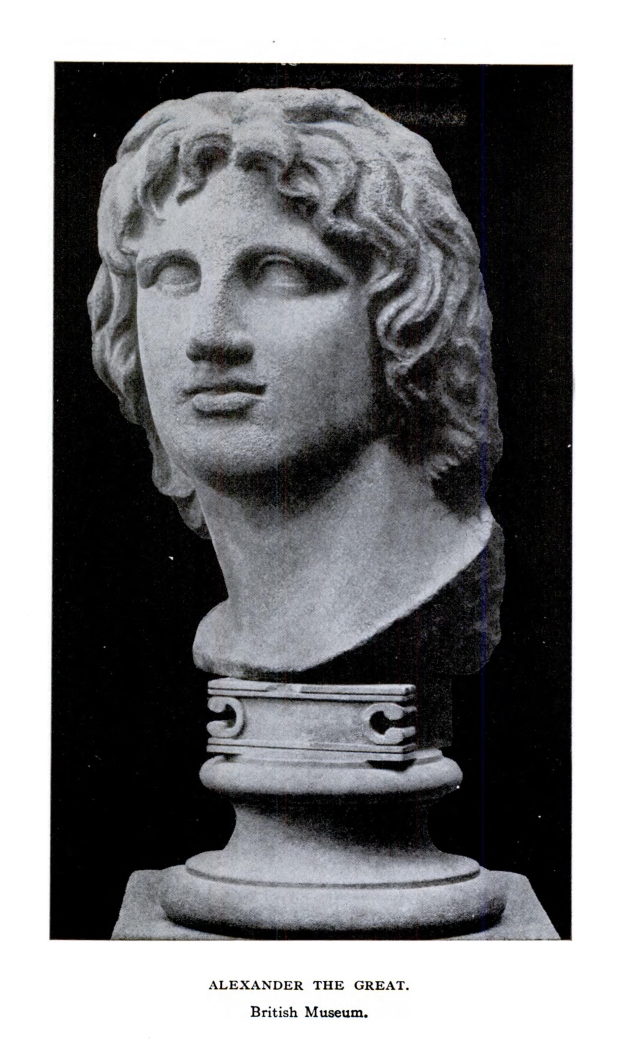
ALEXANDER THE GREAT.
British Museum.
During the boyhood of Alexander, his father was
constantly away at war, but he saw to it that his
son was well educated. His first teachers accustomed
him to a Spartan discipline, and so trained his
body that in later years he was able to undergo
fatigue and endure hardships that astonished all who
were with him.
When Alexander was twelve years old, an episode
occurred which convinced his father that he needed
the best guidance that could be found for him. A
horse, Bucephalus by name, was offered to Philip
for the sum of thirteen talents, and the King, with
the Prince and many others,
went into the field to try him. But they found him so
very vicious and unmanageable that he reared up when
they endeavoured to mount him, and would not so much
as endure the voice of any of Philip's attendants. Upon
which as they were leading him away as wholly useless
and untractable, Alexander, who stood by, said: "What
an excellent horse do they lose for want of address and
boldness to manage him!" Philip at first took no notice
of what he said; but when he heard him repeat the same
thing several times, and saw he was much vexed to see
the horse sent away, "Do you reproach," said he to him,
"those who are older than yourself, as if you knew more,
and were better able to manage him than they?" "I
could manage this horse," said he, "better than others
do." "And if you do not," said Philip, "what will you
forfeit for your rashness?" "I will pay," answered
Alexander, "the whole price of the horse." At this the
whole company fell a-laughing; and as soon as the wager
was settled amongst them, he immediately ran to the
horse, and taking hold of the bridle, turned him directly
towards the sun, having, it seems, observed that he was
disturbed at and afraid of the motion of his own shadow;
then letting him go forward a little, still keeping the reins
in his hands and stroking him gently, when he found him
begin to grow eager and fiery, with one nimble leap he
securely mounted him, and when he was seated, by little
and little drew in the bridle, and curbed him without
either striking or spurring him. Presently, when he
found him free from all rebelliousness he let him go at
full speed. Philip and his friends looked on at first in
silence and anxiety for the result; till seeing him turn and
come back rejoicing and triumphing for what he had
performed, they all burst out into acclamations of
applause; and his father, shedding tears, it is said, for joy,
kissed him as he came down from his horse, and in his
transport said: "O my son look thee out a kingdom
equal to and worthy of thyself, for Macedonia is too little
for thee!"[8]
It was evident that Alexander would not submit to
be controlled in what he did, but that a steady
guiding hand was needed to develop his best nature, and
so Philip sent for the philosopher Aristotle, who was
his tutor for four years. Aristotle taught him the
best that Greece could offer in literature, philosophy
and natural science. Alexander had no small
opinion of his own powers, and considered himself
quite the equal, if not the superior, of the best minds
of his time, and he wanted to be recognized as such.
Later, when Aristotle had published some of his
writings, Alexander wrote to him: "You have not
done well to publish your books of oral doctrine;
for what is there now that we excel others in, if
those things which we have been particularly
instructed in be laid open to all?"[9] Alexander had
been born with a love for study, and his education
gave him a real appreciation of all that was best in
Greek thought. He used to sleep with a copy of
Homer under his pillow, and he told Aristotle that
he would "rather excel others in the knowledge of
what is excellent than in the extent of his power
and dominion."[10] Alexander grew to love his tutor
greatly, and in after years he would say that as from
his father he had received life, so from Aristotle had
he learned to lead a good life.
Such a personality soon made Alexander the idol
of Macedonia, but, as in the case of his father, that
was not enough; Macedonian, and therefore in
the eyes of Greece a half-barbarian, he wanted to
be accepted by the Greeks as a Greek and to receive
their hero-worship. Like Philip, he was determined
to march into Asia, subdue the Persian King and
become a world ruler, but it was necessary that he
should subdue Greece first. He did this very
quickly, and in 335 B.C., one year after he became
King, he marched against Thebes, which had organized
a revolt against him. He came upon the city
with almost magical swiftness, for in thirteen days he
had transported his army two hundred and fifty
miles. A rumour had spread in Greece that he was
dead, but suddenly, there he was before the walls of
Thebes. In two days all was over. The city was
razed to the ground, and the inhabitants either
slain or sold into slavery. Yet in the midst of all
the horror, Alexander gave an order which seized
upon the Greek imagination: the house of Pindar was
to be left untouched for no war was being waged
against Greek civilization.
Alexander went to Corinth, where he was elected
General of the army that was to invade Persia. He
was surrounded by men who praised and flattered
him, but one man refused to take any notice of him
whatever. This was the cynical philosopher
Diogenes.
Alexander found him in a cask by the roadside. When
he saw so much company near him, he raised himself a
little, and vouchsafed to look upon Alexander; and
when Alexander kindly asked whether he wanted
anything. "Yes," said, he, "I would have you stand from
between me and the sun." Alexander was so struck at
this answer, and surprised at the greatness of the man,
who had taken so little notice of him, that as he went
away he told his followers, who were laughing at the
moroseness of the philosopher, that if he were not
Alexander, he would choose to be Diogenes.[11]
The time had now come when at the head of a
mighty army, Alexander could start for Asia. This
army was made up of Macedonians and of men from
all the most warlike states of Greece. It had been
thoroughly trained and disciplined, and it served
under a general only twenty-two years of age, it is
true, but who had already shown himself a military
genius and who was adored by every soldier from
the highest to the lowest. It was an army that
was never to know defeat.
Alexander did not hide his purpose from the Persian
King, for he sent him word that he considered
himself lord of Asia: "I, Alexander, consider the
whole of thy treasure, and the whole of thy land to
be mine." To the Greeks this did not represent
any over-weening pride, for Alexander was but
expressing the belief that was held by Aristotle, the
greatest Greek thinker of the age, that Greeks were
justified in enslaving the Barbarian.
No story of conquest is more romantic than that
of Alexander. On first reaching Asia Minor he went
to Ilium, where he dedicated his armour to Athena,
and took in its place some weapons which tradition
said had been used in the Trojan War, and he laid
a wreath on the tomb of Achilles. Then he started
on his march. He came, whilst passing through
Asia Minor, to Gordium, where he saw the celebrated
Gordian knot, by which the yoke was fastened
to the pole of an ancient chariot. An old prophecy
had been made that the man who untied this knot
would rule the world. Alexander tried to loosen it,
but losing patience, he took his sword and cut it.
He meant to rule the world, and he knew that his
empire would only be won by the sword.
Alexander marched through Syria into Egypt, and
when he was in Egypt, he made a journey through
the desert of Libya to consult the oracle, Zeus Ammon.
Few men would have started upon so long and
dangerous a journey without misgivings, for there was
likely to be scarcity of water, and violent winds that
would blow about the poisonous sand of the desert and
cause the death of those who inhaled it. But Alexander
was not to be turned from anything he was bent upon;
for hitherto fortune had helped him in all his plans,
and the boldness of his temper gave him a passion for
overcoming difficulties. In this journey the gods seemed
to favour him as usual, for plentiful rains fell, which
not only relieved the soldiers from fear of dying of thirst,
but made the sand moist and firm to travel on and
purified the air. Besides, some ravens kept up with them
in their march, flying before them and waiting for
them if they fell behind; but the greatest miracle of
all was that if any of the company went astray in the
night, the ravens never ceased croaking until they were
guided to the right path again.
Having passed through the wilderness, they came to the
place where the high-priest of Ammon bade Alexander
welcome in the name of the god, and called him son of Zeus.
And being asked by the King whether any of his father's
murderers had escaped punishment, the priest charged
him to speak with more respect, since his was not a
mortal father. Then Alexander desired to know of
the oracle if any of those who murdered Philip were yet
unpunished, and further concerning dominion, whether
the empire of the world should be his? This, the god
answered, he should obtain, and that Philip's death
was fully revenged, which gave him so much satisfaction
that he made splendid offerings to Zeus, and gave
the priests very rich presents.[12]
Before leaving Egypt, Alexander founded the city
of Alexandria,
which takes its name from him. The position seemed to
him a very fine one in which to found a city, and he
thought it would become a prosperous one. Therefore
he was seized by an ardent desire to undertake the
enterprise, and he marked out the boundaries of the
city himself, pointing out where the market-place was
to be constructed, where the temples were to be built,
stating how many there were to be, and to what Greek
gods they were to be dedicated, and specially marking
a spot for a temple to the Egyptian Isis. He also
pointed out where the wall was to be carried out. The
soothsayers, (pondering upon certain lucky omens), told
Alexander that the city would become prosperous in
every respect, but especially in regard to the fruits of
the earth.[13]
Before his death, Alexander founded many cities
called by his name, but the Alexandria of Egypt
was the greatest, and the one that was to survive
even to the present day. For more than two thousand
years it has held its position as one of the chief
ports in the Eastern part of the Mediterranean.
Alexander did not intend that it should become the
capital of Egypt, but he did intend that it should
take the place of Tyre, so that the trade coming
from the East should be in the hands of Greeks and
not of Phoenicians.
The army worshipped Alexander, and he knew how
to appeal to the imagination of his followers and to
gain their devotion. He was once detained by a
serious illness, caused by bathing in an ice-cold
river. One of his physicians had prepared medicine
for him, but before he had taken it, one of his
commanders sent the King a letter bidding him
beware of Philip (the physician) who, he said, had
been bribed by Darius to poison him. Having read
the letter, Alexander
put it under his pillow without showing it to anybody,
and when Philip came in with the potion, he took it with
great cheerfulness and assurance, giving him the letter
to read. It was well worth being present to see Alexander
take the draught and Philip read the letter at the
same time.[14]
On one occasion
he had made a long and painful march of eleven days,
during which his soldiers suffered so much from want of
water that they were ready to give up. While they were
in this distress it happened that some Macedonians
who had fetched water in skins upon their mules from a
river they had found out came about noon to the place
where Alexander was, and seeing him almost choked
with thirst, presently filled a helmet and offered it to
him. He asked them to whom they were carrying the
water; they told him to their children, adding that if
his life were but saved, it was no matter for them though
they all perished. Then he took the helmet into his
hands, and looking round about, when he saw all those
who were with him stretching their heads out and looking
earnestly after the drink, he returned it again with
thanks without taking a drop of it. "For," said he,
"if I alone should drink, the rest will be out of heart." When
the soldiers heard him speak in this way, they
one and all cried out to him to lead them forward boldly,
and began whipping on their horses. For whilst they
had such a King they said they defied both weariness and
thirst, and looked upon themselves to be little less than
immortal.[15]
On another occasion the hardships endured by the
army were so great that the men were almost ready
to refuse to follow Alexander any further. But he
called them together, and spoke to them, reminding
them that he asked no one to suffer what he
himself did not suffer.
I often sit up at night to watch for you, [he said],
that you may be able to sleep. Who is there of you who
knows that he has endured greater toil for me than I
have for him? I have been wounded with the sword in
close fight; I have been shot with arrows; and though
I have suffered these things for the sake of your lives,
your glory, and your wealth, I am still leading you as
conquerors over all the land and sea, all rivers,
mountains and plains.[16]
And the magic of his personality silenced all their
murmuring and banished all their discontent.
Followed by this devoted army, Alexander started
on a marvellous campaign which led him to the
uttermost limit of the then known world, even beyond
the Indus into India. In battle after battle he met
those who opposed his path and conquered them.
Alexander did not know the meaning of the word
impossible. He was told once that a certain
mountain pass was impracticable. For other men, it
would have been, but Alexander gave orders that his
spearmen should cut steps in the steep rock, and
where before only the surest-footed goats had
climbed, Alexander and his men passed in safety.
His men followed him over snowy mountains in
winter, and across thirsty deserts in summer, up and
down the lower ranges of the Himalaya Mountains,
where the best European armies of today can only
go with difficulty. They crossed the plains of India
in the rainy season, and even went through that
country so unfit for human habitation that Mohammedan
conquerors of a later age declared it was a
place fit only to be dwelt in by the souls of the lost.
Nothing stopped Alexander, not the mountain
barrier, nor the deep river, nor the burning sands.
On he went, until he reached what he believed to
be the River Ocean that girdled the earth.
Everywhere Alexander had been victorious, until
even the Great King of Persia himself was utterly
defeated and Alexander was seated upon his throne.
He burnt the Persian palace at Persepolis in order
"to take vengeance on the Persians for their deeds
in the invasion of Greece, when they razed Athens
to the ground and burnt down the temples. He also
desired to punish the Persians for all the other
injuries they had done the Greeks."[17]
When the news of the victories of Alexander over
the Persians reached Greece, great was the
amazement. For centuries, the name of the Great King
had stood for all that was powerful and invincible.
Though he had been driven out of Greece, he was
still believed to be omnipotent in Asia. The
general feeling was voiced by one of the orators,
speaking of what was happening in the Athenian Assembly:
What is there strange and unexpected that has not
happened in our time? We have not lived the life of
ordinary men, and the things we have seen will become
a tale of wonder to posterity. Is not the King of the
Persians, he who channelled Athos, he who bridged the
Hellespont, he who demanded earth and water of the
Greeks, he who dared to write in his letters that he
was lord of all men from the rising of the sun unto its
setting, is he not struggling now, no longer for lordship
over others, but already for his life?
Alexander had conquered the Great King and
seated himself on the royal throne of Persia under
the canopy of gold. But now that he had reached
the summit of his ambition and was master of the
greatest empire in the world, a change came over
him, and he began to indulge his passions and to
give himself up to all kinds of dissipation. He
dressed like a Persian, which deeply offended the
Greeks, who became jealous of the increasing
favour the King showed to the Barbarian.
Slowly the leaders of Alexander's army began to
realize the change that was taking place in their
general, and though he gained in popularity with the
Persians, he began to lose some of the devotion
hitherto felt for him by the Greeks and Macedonians,
and he was becoming estranged from his old
followers. At length they realized that it was not
a Greek conquest that would enslave Asia of which
he dreamed, but of a world empire, in which the
Barbarian would live on equal terms with the Greek.
Alexander was far-seeing beyond his age, and he
had learned that men whose customs are alien to those
in which he had been brought up were not always to
be despised, and that if he dreamed of holding the
world empire he had conquered, he could only do
so by treating all parts of it alike, and by encouraging
intercourse between the different races which
composed it. However wise this may have been, it
is not difficult to understand the feeling of the
older Greeks who had been educated to feel a gulf
between them and the Barbarian that nothing could
ever bridge. The climax of the estrangement
between Alexander and his old companions came in a
tragic scene at a banquet. Alexander and his friends
had been drinking fast and furiously, then songs had
been sung, some of which ridiculed the Macedonian
officers who had recently been unfortunate in a
skirmish. The older men present were offended,
but Alexander laughed and had the song repeated.
Clitus, who had been an old and trusted friend of
the King, said angrily: "It is not well to make a jest
of Macedonians among their enemies, for, though
they have met with misfortunes, they are better
men than those who laugh at them." Angry words
passed between him and the King, until, unable
to control his rage, Alexander snatched a spear from
one of his guards and ran it through the body of
Clitus, who fell dead to the ground. Dead silence
followed this mad deed, and Alexander was sobered
by the sight of the man he had loved lying dead at
his feet, slain by his own hand. He drew the spear
out of the body and would have killed himself with
it, had the guards not interfered and led him by
force to his chamber. All that night and the next
day he wept bitterly and would speak to no one.
At length one of his friends entered the room where he
lay and said to him in a loud voice:
Is this the Alexander whom the whole world looks to,
lying here weeping like a slave for fear of what men
will say? It is Alexander himself who, by the right of
his conquests, should be the law to decide what is right
and wrong. Do you not know, Alexander, that Zeus
is represented with Justice and Law on either side of
him, to show that all the deeds of a conqueror are
lawful and just?[18]
The King was soothed by these words, for he was
only too ready to believe, as his friend had said,
that whatever he might choose to do was right. But
he was spoiled by such flattery which only increased
his arrogance and made him yield more to his
passions than before.
Having conquered and established an empire which
extended from Greece and Macedonia in Europe across
Asia to India, and which included Egypt and Libya,
Alexander prepared to set out on yet another
expedition to the West and to enter Arabia. He was in
Babylon, and spent a long day attending to military
duties. Towards evening, he left his chair of state to
take a little relaxation. During his absence, a
half-crazy man appeared, who, without any warning, sat
himself down on the King's seat. The attendants
looked on in horror at such an act, which seemed to
them great impiety, but they did not dare turn him
out, for suddenly superstitious fears took hold of
them, and in frightened voices they whispered to
each other that this could foretell nothing but some
great calamity.
It was in the early summer of 323 B.C. that
Alexander was ready to start on his march, but the night
before he was to leave Babylon, he became ill of a
fever. For a few days he was still able to attend
to some business from his bed, but he grew rapidly
worse. Suddenly the army realized that he was
dying, and his old friends, forgetting whatever
estrangement had come between them, entreated
to be allowed to see him once more. They were
admitted to the chamber where he lay, and passed
in silence before him. He was so weak that he
"could not speak, and only touched the right hand
of each, and raised his head a little, and signed
with his eyes." The next day Alexander was dead.
Deep and awe-struck silence fell upon the city and
camp for four days, and then, his generals having
found amongst his papers plans for the western
campaign, they endeavoured to carry them out. But
they were not successful, and never again did the
great army fight under one leader. Having lost the
almost magical inspiration of Alexander's leadership,
his successors were unable to keep the empire
which he had conquered.
Almost from the moment of his death, Alexander
was worshipped as a god. He was the great hero of
his age, and even in his life-time, it was believed that
he was half-divine. Dying so young, he was only
thirty-three, possessed of great strength and god-like
beauty, capable of rare generosity, brave almost
to recklessness, planning conquests so far-reaching
that they appealed to the imagination of everyone,
given to outbursts of savage anger and vindictive
rage, all these characteristics were looked upon as
more than human. For more than two thousand
years, the name of Alexander has been immortal in
the East. There is hardly an ancient city from
Babylon almost to the borders of China, that does
not claim Alexander as its founder; his name still
clings to old traditions and legends; to this very day
the Parsees curse him for having caused the destruction
of the ancient sacred Persian writings when he
captured Persepolis and burnt it. Later generations
of men have differed as to the lasting value of some
of his work, but the name of Alexander, and the
story of his hero-deeds have become a permanent
possession of the imagination of mankind.
What man achieves is, in regard to its permanent
value, of less importance than the spirit in which
he achieves it; what one learns is of less importance
than how one learns; learning facts is of less
importance than developing certain qualities of mind. It
is not possible, and were it possible it would not be
desirable, to reproduce in modern life, the conditions
of a past age, but certain qualities of the mind
and spirit are undying, and some of the greatest of
these qualities have come to us from the Greeks.
History is the story of the way in which man has
learned and is still learning, how to live: of how through
long centuries he has sought to satisfy the practical
needs of his body, the questioning of his mind, and the
searching of his spirit.[1]
Mankind is still engaged upon the high adventure
for this three-fold quest, and not yet has any one
civilization succeeded in bringing into perfect
accord the demands of the body, of the mind, and of
the spirit. If, in the beginning of this story in the
ancient world, the Hebrews stand supreme amongst
the teachers of those who have sought to satisfy the
searching of the spirit, so are the Greeks the great
teachers of those who have sought to satisfy the
questioning of the mind. The Greeks gave to the
mind of man three definite qualities: the love of
Freedom, the love of Truth, and the love of Beauty.
These are practical qualities which show themselves
quite definitely in what the Greeks did, in what they
thought and in what they built, or in other words,
in their political history, their literature and their
art.
It must not be thought that the Greeks perfectly
fulfilled their great ideals. Greek history shows
quite clearly that they did not. If the story of the
Greeks as it has been told in this book has emphasized
their ideals rather than their failure always to
attain these, it is because their ideals are the
imperishable gifts they have given to the world. But the
Greeks were not dreamers; they were practical
men, keen and interested in all the practical affairs
of every day life. Their history shows how they
failed in perfectly carrying out their ideals because
of certain weaknesses of character and of certain
conditions and limitations in their life from which
the men of to-day can learn many useful lessons. The
greatness of the Greeks lies, not in what they did
not do or did imperfectly, but in their spirit, that
spirit which in their political history, their literature
and their art sought for Freedom, for Truth, and
for Beauty.
The Greeks showed the world the way to Freedom.
They won their own national freedom against
almost overwhelming odds, for never before had a
small country maintained her independence in the
face of a great empire, and been victorious. They
also maintained a political freedom, which they
carried too far, for the inability of Greek states to
form alliances and to unite was one of the sources
of weakness which finally led to their downfall.
Nevertheless the spirit of sturdy independence is
one that has endured. The Greeks carried their
vision of freedom further than the political
independence of each state, and one of their chief
characteristics was their personal freedom. In a speech
to the Athenian army before the battle in the
harbour at Syracuse, Nicias "reminded them that they
were the inhabitants of the freest country in the
world, and how in Athens there was no interference
with the daily life of any man."[2] Modern times are
apt to pride themselves on the freedom of speech
allowed to all, but no modern state permits greater
liberty of speech (and some would not tolerate as
much) than was allowed in Athens in the fifth
century B.C. when Aristophanes wrote his satirical
comedies.
The Greeks loved Truth. By this is not meant
truthfulness, for the Greeks were insincere and
never trusted even one another, but the spirit
which desired to see all things straight, "with an
unclouded clearness of mind"; the spirit which could
distinguish clearly between right and wrong, which
could judge without prejudice or passion, above all
the spirit which knew its own limitations and which
acknowledged what it did not know. Perhaps the
greatest Greek searcher for truth was Socrates, and
some knowledge of his life and teaching will show
us what is our debt to Greece in the story of how
the mind of man has gained freedom in its search
for truth.
During the last years of the Peloponnesian War,
a strange figure might have been seen in Athens: a
short, ugly, odd-looking man, poorly-clad and
utterly indifferent to criticism of his habits or
appearance, but a man to whom every one listened when
he began to speak. This was Socrates, the Greek
philosopher.
His father was a stone-cutter and a poor man, but
he seems to have given to his son the best education
that was to be had in Athens, for Socrates often
quoted from Greek literature, especially from
Homer, and he speaks of having studied with his
friends "the treasures which the wise men of old
have left us in their books."
Very little is known of the early life of Socrates,
but he passed his youth and early manhood during
the greatest years of Athenian history. He was
born ten years after the Persian had been defeated
at Plataea and driven out of Greece; as a boy, he
had seen the Long Walls being built; he had grown
up in the Athens of Pericles, a contemporary of
Sophocles, and Euripides, of Pheidias and of
Thucydides. When the clouds gathered over Athens and
war came, he served in the army as a common
soldier; he had lived through the short-lived
triumphs and the tragic disasters which befell the city;
he had been hungry when food was scarce, he had
seen Athens besieged and taken; he had watched
the Long Walls destroyed, and he had lived through
the Terror when the Thirty ruled Athens. It was a
life lived in very stirring times, and Socrates had
taken his share in the happenings. During the war,
he served in one of the northern campaigns, and he
amazed everyone by his extraordinary power of
enduring hunger and thirst, and all the hardships
of a cold Thracian winter. One of his friends says
of this time that
his fortitude in enduring cold was surprising. There was
a severe frost, for the winter in that region is really
tremendous, and everybody else either remained
indoors, or if they went out had on an amazing quantity
of clothes, and were well shod, and had their feet
swathed in felt and fleeces: in the midst of this,
Socrates with his bare feet on the ice and in his ordinary
dress marched better than the other soldiers who had
shoes, and they looked daggers at him because he
seemed to despise them. Another tale of what he did
on this expedition is worth hearing. One morning, he
was thinking about something which he could not
resolve; he would not give it up, but continued
thinking from early dawn until noon—there he stood fixed
in thought; and at noon attention was drawn to him
and the remark ran through the wondering crowd that
Socrates had been standing and thinking about
something ever since the break of day. At last in the
evening after supper, some Ionians out of curiosity (I should
explain that this was not in winter but in summer),
brought out their mats and slept in the open air that
they might watch him and see whether he would stand
all night. There he stood until the following morning,
and with the return of light he offered up a prayer to
the Sun and went his way.[3]
At the close of the war Socrates was in Athens, a
man now of over sixty years of age. He held one
or two offices of state, when he was known for his
fearless refusal to do what he thought was wrong.
On one occasion he refused to obey orders that were
given him, because he believed that obedience would
involve him in doing what he thought to be wrong.
"I showed," he said, "not by mere words but by
my actions, that I did not care a straw for death:
but that I did care very much indeed about doing
wrong."
Socrates was very poor and as he would take no
money for his teaching, his means of livelihood were
very scanty. He went about barefoot and had only
one cloak which he wore until it was so old that it
became a matter of joke amongst his friends. He
not only had no luxuries of any kind, but hardly
the bare necessities of life, yet he was quite content
and used to say: "How many things there are
which I do not want." Socrates married Xanthippe,
a woman of a most violent temper. He used to say
that one ought to live with a restive woman, just
as horsemen manage violent-tempered horses; and
"as they," said he, "when they have once mastered
them, are easily able to manage all others; so I,
after managing Xanthippe, can easily live with
anyone else whatever."[4]
The Athenians had always been intellectually
very alert and had tried to solve all kinds of
problems. They asked how it was that things came into
being, how they continued to exist, of what they
were made and similar questions. But when Athens
had become an Empire and ruled over many men and
states, the questions began to change. People were
less interested in how things originated, than in
questions arising from their daily experience. They
asked, what is a state, what is a citizen, what is
justice, what is temperance, courage, cowardice
and so on. In order to answer these questions, a
body of teachers had arisen in Athens who were
called Sophists, or Wise Men. They taught every
kind of subject and established a number of schools.
The older Greek teachers did not like these
Sophists, partly because they took money for their
teaching, and hitherto, though Athenian philosophers
had accepted presents, they had never charged
definite fees; partly because they taught so many
subjects that it was thought they could teach
nothing thoroughly; partly because they seemed
to aim at teaching young men to argue in order to
get the better of their opponents rather than to
seek for Truth; and above all, because they were
often sceptical as to the existence of the gods. There
were some very good teachers amongst the Sophists,
and they opened up a great many new fields of
thought to the Athenians, but a weak side to their
teaching was that they only stated general
principles, and often asserted as absolute facts things
that never had been definitely proved one way or
the other. They used words carelessly without
stopping to think of their real meaning, and they
never suggested that there was anything they did
not know.
Socrates saw that though the teaching of the
Sophists might increase information it was fatal to
real thinking, and he began to teach in Athens in
order to show what real thinking was. He taught
in no school, had no classes and took no pay. He
was willing to talk to any and everyone who would
listen to him. He ever
lived in the public eye; at early morning he was to be
seen betaking himself to one of the promenades or
wrestling grounds; at noon he would appear with the
gathering crowds in the market-place; and as day
declined, wherever the largest throng might be
encountered, there was he to be found, talking for the most
part, while anyone who chose might stop and listen.[5]
Socrates talked to and questioned everyone and
tried to show people what real knowledge was. He
was filled with a passionate belief in the importance
of truth above all things. He said that to make
inaccurate statements and to use words with a wrong
or careless meaning was "not only a fault in itself,
it also created an evil in the soul." He showed
those who listened to him the evil that came from
pretending to know what one did not know, and the
first step in his teaching was to make them realize
their ignorance. To this end he questioned and
cross-examined them, until they contradicted
themselves, or found no answer and generally ended in
hopeless difficulties, simply because they would not
acknowledge at the beginning that they did not
know what he had asked. One of his friends once
said: "Indeed, Socrates, I no longer believe in my
answers; everything seems to me to be different
from what it used to seem," and another speaking
of him said: "Socrates makes me acknowledge my
own worthlessness. I had best be silent for it seems
that I know nothing at all."
Socrates believed that Virtue was Knowledge,
that if a man knew a thing was wrong, he would
not do it, and that those who knew what was right
would always do it. In this Socrates was not wholly
right; he only saw a part of the truth, but his
greatness lies in that he was the first to teach the
importance of having a reason for what we believe,
of learning accurate habits of mind, and that the
search for knowledge is one rich in imagination and
beauty.
Socrates was always arguing, talking, questioning,
but he was never rude or discourteous to those
who disagreed with him, he never brought his own
personal feelings into his arguments, and he never
descended to expressions of wounded pride or
irritation.
The teaching of Socrates opened the minds of
those who listened to him to the possibilities to which
knowing the truth might lead them, and he had great
influence over numbers of young Athenians. It was
all new to them, they had never heard anything like
it before. "Mere fragments of you and your words,"
said one of them, "even at second-hand, and however
imperfectly repeated, amaze and possess the
soul of anyone who hears them," and he went on
to say,
I have heard Pericles and other great orators and I
thought that they spoke well, but I never had any
similar feeling; my soul was not stirred by them, nor was I
angry at the thought of my own slavish state. But
this Socrates has often brought me to such a pass that
I have felt as if I could hardly endure the life I am
leading. For he makes me confess that I ought not to live
as I do, neglecting the wants of my own soul. And he is
the only person who ever made me ashamed, and there
is no one else who does the same.[6]
But if Socrates gained friends, his method of
exposing the ignorance of others also gained him
enemies. No one before had ever thought such thoughts,
and to ordinary Athenians his questioning was
wicked. But Xenophon, one of his friends, tells us
that "no one ever heard him say or saw him do
anything impious or irreverent, and he was so
piously and devoutly religious that he would take
no step apart from the will of heaven." Yet his
enemies maintained that he disbelieved in the
gods. His teaching was all the more disturbing
because Athens, having been defeated by Sparta,
had just lived through the terrible months of the
rule of the Thirty, and though these had been driven
out, (this was in the year 399 B.C.), Athens was in a
state of unrest, of fear and of suspicion. Anyone
who taught anything new was looked upon as a
possible enemy to the state, and the enemies of
Socrates seized this opportunity to bring definite
accusations against him. They said: "Socrates is
guilty, inasmuch as he does not believe in the gods
whom the city worships, but introduces other strange
deities; he is also guilty inasmuch as he corrupts
the young men, and the punishment he has incurred
is death."[7]
A trial followed. In an Athenian trial, first the
accusers made their speeches, and then the accused
was allowed to defend himself. Plato, the great
pupil of Socrates, has given us the speech made by
his master at his trial, a speech known as the Apology
of Socrates. In it, the philosopher, an old man
now of over seventy, set forth the principles which
had guided him in his teaching.
He began by saying that he had never taught men
to disbelieve in the gods, and that the accusation of
impiety against him was false, but he did say that
it was fair to ask him just what he had been trying
to do which had given rise to these reports. He then
told them the story of how a friend of his had gone
to Delphi, and had asked the Oracle if there were
any man wiser than he, and that the Oracle had
answered that there was no man.
Now see why I tell you this. I am going to explain
to you the origin of my unpopularity. When I heard of
the Oracle I began to reflect. What can God mean by
this dark saying? I know very well that I am not wise,
even in the smallest degree. Then what can he mean by
saying that I am the wisest of men? It cannot be that
he is speaking falsely, for he is a god and cannot lie.
And for a long time I was at a loss to understand his
meaning: then, very reluctantly, I turned to seek for
it in this manner. I went to a man who was reputed to
be wise, thinking that there, if anywhere, I should
prove the answer wrong, and meaning to point out to
the Oracle its mistake, and to say, "You said that I
was the wisest of men, but this man is wiser than I
am."
But Socrates went on to say that after talking to
this man, who was a politician, he found that he
was not wise because he thought he knew things
that he did not know, and because he would not
acknowledge his ignorance. He tried to prove to
him that he was not wise, but only succeeded in
making him his enemy.
Next, [said Socrates], I went to another who was
reputed to be still wiser than the last, with exactly the
same result. And there again I made him, and many
other men, my enemies.
By reason of this examination, Athenians, I have made
many enemies of a very fierce and bitter kind, who have
spread abroad a great number of calumnies about me,
and people say that I am a "wise man." For the
bystanders always think that I am wise myself in any
matter wherein I convict another man of ignorance. But,
my friends, I believe that only God is really wise: and
that by this oracle he meant that men's wisdom is worth
little or nothing. I do not think that he meant that
Socrates was wise. He only made use of my name, and
took me as an example, as though he would say to men:
"He among you is the wisest, who, like Socrates, knows
that in very truth his wisdom is worth nothing at
all." And therefore I still go about testing and examining
every man whom I think wise, whether he be a citizen
or a stranger, as God has commanded me: and whenever
I find that he is not wise, I point out to him on
the part of God that he is not wise. And I am so busy
in this pursuit that I have never had leisure to take
any part worth mentioning in public matters, or to
look after my private affairs. I am in very great
poverty by reason of my service to God.[8]
Socrates then went on to prove that nothing in his
teaching could corrupt the young men, as his
enemies declared he was doing, and to prove his belief
in the gods. He knew that he was on trial for his
life, but no fear of death stopped him from speaking
that which he believed to be the truth.
My friends, [he said], if you think that a man of any
worth at all ought to reckon the chances of life and
death when he acts, or that he ought to think of
anything but whether he is acting rightly or wrongly, and
as a good or bad man would act, you are grievously
mistaken. It would be very strange conduct on my
part if I were to desert my post now from fear of death
or of any other thing, when God has commanded me, as
I am persuaded that he has done, to spend my life in
searching for wisdom, and in examining myself and
others. That would indeed be a very strange thing: and
then certainly I might with justice be brought to trial
for not believing in the gods; for I should be disobeying
the Oracle, and fearing death, and thinking myself
wise when I was not wise. For to fear death, my friends,
is only to think ourselves wise, without being wise: for
it is to think that we know what we do not know. For
anything that man can tell, death may be the greatest
good that can happen to them: but they fear it as if
they knew quite well that it was the greatest of evils.
And what is this but that shameful ignorance of thinking
that we know what we do not know?
Athenians, if you put me to death, you will not easily
find another man to fill my place. God has sent me
to attack the city, as if it were a great and noble horse,
to use a quaint simile, which was rather sluggish for its
size, and which needed to be roused by a gadfly: and
I think that I am that gadfly that God has sent to the
city to attack it; for I never cease from settling upon
you as it were at every point, and rousing and exhorting,
and reproaching each man of you all day long.[9]
Socrates then referred to the custom in Athens
that when a man was on trial for his life, his wife and
children sometimes appeared in court in order to
appeal to the pity of the judges and so obtain a
favourable sentence, but he refused to do that, for
knowing that the judges had taken an oath to
administer justice justly, he believed that such an
act on his part would be an attempt to make them
break their oaths.
Were I to be successful and to prevail on you by my
prayers to break your oaths, I should be clearly teaching
you to believe that there are no gods; and I should
be simply accusing myself by my defence of not
believing in them. But, Athenians, that is very far from
the truth. I do believe in the gods as no one of my
accusers believes in them: and to you and to God I
commit my cause to be decided as is best for you and
for me.
Socrates was found guilty by 281 votes to 220,
and the penalty to be inflicted was death. He had
the right under Athenian law to suggest an
alternative penalty.
What counter-penalty shall I propose to you Athenians?
What I deserve, of course, must I not? What
is a suitable reward to be given to a poor benefactor
who requires leisure to exhort you? There is no reward,
Athenians, so suitable for him as a public maintenance
in the Prytaneum. It is a much more suitable reward
for him than for any of you who has won a victory at
the Olympic Games with his horse or his chariots. So
if I am to propose the penalty which I really deserve, I
propose this—a public maintenance in the Prytaneum.
Or shall I propose imprisonment? And why should I
pass the rest of my days in prison, the slave of successive
officials? Or shall I propose a fine, with imprisonment
until it is paid? I have told you why I will not do
that. I should have to continue in prison, for I have no
money to pay a fine with. Shall I then propose exile?
Perhaps you would agree to that. Life would indeed
be very dear to me if I were unreasonable enough to
expect that strangers would cheerfully tolerate my
discussions and reasonings, when you who are my
fellow-citizens cannot endure them, and have found them so
burdensome and odious to you that you are seeking now
to be released from them. No indeed, Athenians, that
is not likely. A fine life I should lead for an old man, if
I were to withdraw from Athens, and pass the rest of my
days in wandering from city to city, and continually
being expelled.[10]
The alternatives were not accepted, as indeed
Socrates knew they would not be, and he was
condemned to die. He accepted the sentence calmly,
"and with infinite gentleness and manliness. No
one within the memory of man, it is said, ever bowed
his head to death more nobly."[11] But death offered
no terrors to Socrates.
If death [he said to his judges] is a journey to
another place, and the common belief be true, that there
are all who have died, what good could be greater than
this? Would a journey not be worth taking, at the end
of which, in the other world, we should be released
from the self-styled judges who are here, and should
find the true judges who are said to sit in judgment
below? Or what would you not give to converse with
Orpheus and Homer? I am willing to die many times
if this be true. And above all, I could spend my time
in examining those who are there, as I examine men
here, and in finding out which of them thinks himself
wise, when he is not wise. What would we not give, my
judges, to be able to examine the great leader of the
expedition against Troy, or Odysseus, or countless
other men and women whom we could name?. It would
be an infinite happiness to converse with them, and to
live with them, and to examine them. Assuredly there
they do not put men to death for doing that. For besides
the other ways in which they are happier than we are,
they are immortal, at least if the common belief be
true.
But now the time has come, and we must go hence; I
to die, and you to live. Whether life or death is better
is known to God, and to God only.[12]
Socrates was taken to prison where he spent a
month before his sentence was carried out. The
delay was caused by the voyage of the sacred ship,
said to be that of Theseus, which had only just set
out on its annual voyage to Delos, and no Athenian
could be put to death during its absence.[13] He spent
this month talking to his friends, especially to Crito,
who was very devoted to him, and who entreated
him to escape from prison, an escape for which he
could very easily have arranged. But the brave
old man, loyal to his principles to the end, refused,
and he reminded Crito how all his life he had taught
that the greatest misfortune that could befall a
man was to do wrong, and the greatest crime a man
could commit against his state was to break her
laws.
The last day arrived. The story of that day has
been told by one who was present:
I will try to relate the whole story to you from the
beginning. On the previous days I and the others who
had always met in the morning at the court where the
trial was held, which was close to the prison; and then
we had gone in to Socrates. We used to wait each
morning until the prison was opened, conversing: for
it was not opened early. When it was opened, we used
to go in to Socrates, and we generally spent the whole
day with him. But on that morning we met earlier
than usual; for the evening before we had learnt, on
leaving the prison, that the ship had arrived from
Delos. So we arranged to be at the usual place as early
as possible. When we reached the prison, the porter,
who generally let us in, came out to us and bade us wait
a little, and not to go in until he summoned us himself;
"for the Eleven," he said, "are releasing Socrates from
his fetters, and giving directions for his death today." In
no great while he returned and bade us enter. So
we went in and found Socrates just released, and
Xanthippe, you know her, sitting by him, holding his child
in her arms. When Xanthippe saw us, she wailed
aloud, and cried, in her woman's way, "This is the last
time, Socrates, that you will talk with your friends, or
they with you." And Socrates glanced at Crito, and
said, "Crito, let her be taken home." So some of Crito's
servants led her away, weeping bitterly and beating her
breast.[14]
Once more Socrates and his friends conversed,
and once more he expressed his joy at "going to
the place where he hoped to gain the wisdom that
he had passionately longed for all his life." They
talked together until later in the day, and then
he rose and went into another room to bathe
himself:
Crito went with him and told us to wait. So we
waited, talking of him and dwelling on the greatness
of the calamity which had fallen upon us: it seemed
as if we were going to lose a father, and to be orphans
for the rest of our life. When he had bathed, and his
children had been brought to him, he had two sons
quite little, and one grown up, and the women of his
family were come, he spoke with them in Crito's
presence and gave them his last commands; then he sent
the women and children away, and returned to us. By
that time it was near the hour of sunset, for he had
been a long while within. When he came back to us he
sat down, but not much was said after that.
Presently the gaoler came in and told him that the
hour had come for him to die:
I have found you, [he said], the noblest and best
man that has ever come here; and now I am sure that
you will not be angry with me, but with those who
you know are to blame. And so, farewell, and try to
bear what must be as lightly as you can; you know why
I have come.
With that he turned away weeping and went out.
Then Crito made a sign to his slave who was standing
by, and the slave went out, and after some delay
returned with the man who was to give the poison,
carrying it prepared in a cup. When Socrates saw him, he
asked, "You understand these things, my good sir,
what have I to do?"
"You have only to drink this," he replied, "and to
walk about until your legs feel heavy, and then lie down;
and it will act of itself." With that he handed the cup
to Socrates, who took it quite cheerfully, without
trembling, and without any change of colour or of
feature, and looked up at the man with that fixed glance of
his, and asked, "What say you to making a libation of
this draught? May I, or not?" "We only prepare so
much as we think sufficient, Socrates," he answered.
"I understand," said Socrates. "But I suppose that I
may, and must, pray to the gods that my journey hence
may be prosperous: that is my prayer; be it so." With
these words he put the cup to his lips and drank the
poison quite calmly and cheerfully. Till then most of
us had been able to control our grief fairly well; but
when we saw him drinking, and then the poison
finished, we could do so no longer: my tears came fast in
spite of myself: it was not for him, but at my own
misfortune in losing such a friend. Even before that
Crito had been unable to restrain his tears, and had
gone away, and Apollodorus, who had never once
ceased weeping the whole time, burst into a loud cry,
and made us one and all break down by his sobbing
and grief, except only Socrates himself. "What are
you doing, my friends?" he exclaimed. "I sent away
the women chiefly in order that they might not offend
in this way; for I have heard that a man should die in
silence. So calm yourselves and bear up." When we
heard that we were ashamed, and we ceased from
weeping.[15]
Socrates then walked about a little, but soon lay
down on the couch, and slowly the numbness crept
over him. He knew that when it reached his heart,
he would die. Once more he spoke. "Crito," he
said, "I owe a cock to Aesculapius; do not forget
to pay it." These were his last words, for in a few
minutes he was dead.
Such was the end [said the friend who was with him
to the last] of a man who, I think, was the wisest and
justest, and the best man that I have ever known. But
I did not pity him, for he seemed to me happy, both in
his bearing and in his words, so fearlessly and nobly
did he die. I could not help thinking that the gods
would watch over him still on his journey to the other
world, and that when he arrived there it would be well
with him, if it was ever well with any man.[16]
The word philosophy means the love of wisdom,
and to the Greeks this wisdom was the serious effort
made to understand both the world and man.
To us philosophy generally means a wise understanding
of the right way of living, but with the Greeks
it included a great deal of what we to-day call
science. Greek philosophy was concerned with finding
out the origins of things, and from that knowledge
to build up a right way of life. We do not to-day go
to the Greeks to learn science: their answers to
the questions asked were, some of them, wrong, and
some of them inadequate. But modern science has
been made possible by the qualities of mind which
the Greeks brought to their enquiries: their
passionate desire to know the truth about things, their
power of going behind old superstitions, and of
seeing things as they really are, their open-mindedness
and willingness to accept new truths, their
powers of patient study and observation and of
reaching the unknown from the known.
The earliest Greek philosophers lived in Ionia in
the sixth century B.C., and the greatest of them
were Thales of Miletus and Pythagoras of Samos.
Something has already been said about Thales.[17] He
went further than the Egyptians and Babylonians
had done, not so much because of the new
discoveries he made, but because he brought to those
discoveries not only the desire to know that they
were facts, but the desire to go behind the facts and
find out the reason for their existence.
Thales lived to be an old man, but neither age nor
infirmities lessened his zeal for learning, and
it is said that once he was led out of his house by an
old woman for the purpose of observing the stars, and
he fell into a ditch and bewailed himself, on which
the old woman said to him: "Do you, O Thales, who
cannot see what is under your feet, think that you shall
understand what is in heaven?"[18]
Pythagoras of Samos lived later in the sixth
century than Thales. He was a great traveller and
seems to have visited not only the mainland of
Greece, but also Egypt and Crete, where he had
many rare experiences going into the innermost parts
of temples where as a rule no strangers were
admitted. He also went to Italy where he founded
a school, and gathered about three hundred pupils
round him.
Though it was not believed by the world at large
until nearly two thousand years later, Pythagoras
taught that the world was round, and, as far as is
known, he was the first thinker who made this
discovery. It was Pythagoras who laid the foundations
for later mathematical knowledge, especially in
geometry and arithmetic, and who taught that there
was a science of numbers apart from their use as
a practical means of calculation.
In the fifth century B.C., Athens had become an
Empire and the "school of Hellas," and the centre
of Greek learning was found there and no longer in
Ionia. The story of Socrates has already been
told.[19] This great teacher did not write anything himself
because he believed that it was a greater thing for a
man to live well than to write well, and that his
particular way of teaching and constant intercourse
with his fellow-men was the best way of teaching
those truths in which he believed. The account of
his life and teaching, however, was written down
and given to the world by his pupil Plato, who
carried on his master's work. Plato was about
twenty-eight years old when Socrates was put to death, and
for twelve years after that time he travelled. Then
he returned to Athens, bought a house and garden
(unlike Socrates he was well-off), and spent the
next forty years of his life teaching in the Academy.
Plato was an idealist, and in addition to his writings
about Socrates, he has left us the Republic, the
picture of what he thought an ideal state should be,
and some other works in which he discusses at
great length what things it is most worth while
that men should pursue in life, and why they should
pursue them. He taught that goodness was worth
being sought after for its own sake and not for any
material reward that comes from pursuing it. In
all his teaching he emphasizes the fact that the
greatest things in life and those which are eternal
are not always the things that can be seen, and that
the soul of man does not live on material things
but on wisdom, beauty, truth and love. The
importance of Plato in this teaching was that he was
the forerunner of the great Christian writers who
believed with St. Paul that "the things which are
seen are temporal, but the things which are not seen
are eternal."[20]
As a young man, Plato had seen in Athens under
the rule of the Thirty, the lawlessness and
confusion that arose from a tyrannously ordered state,
and the Republic was an attempt to show what he
thought life in an ideal state might be. His vision
is not a very practical one, but Plato was not a
practical statesman. The great value of the Republic
to the world to-day is that just because its ideals
could never be wholly carried out, the questions
which all statesmen in all ages have had to settle,
could be and were fearlessly discussed, unhampered
by the compromises and conventions which beset
modern politics.
Plato could write of other things besides politics
and ideals. He had a gift for poetry which comes
out in many a fairy-tale that he introduces here and
there into his writings, knowing that sometimes a
great truth can be more easily driven home in such
a form. Socrates and a friend were once walking by
the stream Ilissus. It was a hot summer's day, and
as they were barefoot, they cooled their feet in the
water and then sat down under the shade of a
plane-tree to rest and talk. And as they rested,
Socrates told his friend the legend of the
grasshoppers. They were said to have been
human beings in an age before the Muses. And when
the Muses came and song appeared they were ravished
with delight; and singing always, never thought of
eating and drinking, until at last in their forgetfulness
they died. And now they live again in the grasshoppers;
and this is the return which the Muses make to them:
they neither hunger nor thirst, but from the hour of
their birth they are always singing, and never eating or
drinking; and when they die they go and inform the
Muses in heaven who honours them on earth.[21]
When Philip of Macedon wanted the best Greek
teacher known as a tutor for his son Alexander, he
sent for Aristotle. We know very little about the
life of Aristotle. He had been a pupil of Plato at
the Academy for twenty years and had learnt the
best of all that great philosopher could teach him.
On his return from Macedonia, he founded a school
of his own at Athens, the Lyceum, where he spent
the rest of his life teaching and studying. He died
in 322 B.C., one year after his pupil Alexander. But
if little is known of the details of his life, we know
something of his character from things that Alexander
said about him, and the esteem in which he
held him, and something of the kindliness of his
nature from his will which has been preserved. He
made provision for all who had faithfully served
him and gave many of his slaves their freedom. He
had been twice married, and his second wife "who
behaved so well towards me," was so provided for
that she could marry again, and he made arrangements
for the marriage of his daughter. In reading
of the life of the Athenian man and the Athenian
woman, their ways seem to lie far apart and the
wife to have had very little share in the interests of
her husband. In his will Aristotle gives us a glimpse
of the place which the wife sometimes, at least, held.
He left directions that the bones of his first wife,
the wife of his youth, were to be taken from their
resting-place and buried with his, and this was to
be done "as she herself charged."
The work of Aristotle is amazing, for he not only
wrote on every conceivable subject, but wrote as a
master. For more than a thousand years after his
death, the books he wrote were studied in schools
and universities, and formed the foundation of all
education. He wrote on astronomy, mathematics,
biology, botany and many other subjects, and he
has not only been called the Father of Natural Science,
but his writings remained the standard authority
on many scientific subjects for centuries after
his death. Aristotle was more practical than Plato,
though less inspiring as a writer. As we have already
seen, he, too, wrote about an ideal state in his
Politics.[22] Aristotle believed that the life of a state
was like that of an individual; that the aim of both
should be noble living, and that peace and justice
between states was just as important as between
individuals. But he did more than describe an ideal
state; he described the education which such a
state should give to its youth, the result of which
should be not that a man should boast that his
state was great and glorious, but that, being the
citizen of such a state, in all that he did he should
strive to be worthy of her.
Greek philosophy and science had begun in Ionia
and then passed to Athens. To the thinkers of the
fourth century B.C. the fall of Athens must have
seemed a great disaster, but in reality it was of the
utmost service to the world. The Greek spirit was
one of those imperishable things that cannot die,
and it was to go out from Athens and spread over a
wider world than it had hitherto known. It spread
first to Alexandria where, in the Hellenistic Age,
the next great group of philosophers and men of
science were to be found.
The word history is a Greek word and means an
enquiry. The Greeks were not the first people in
the world who wrote history, but they wrote it as
it had never been written before, and some of the
greatest history in the world is that which was
written by Greeks. These writers were not
content with merely narrating events that had taken
place, they made what the word history means, an
enquiry. They possessed the imagination, not only
to describe events and scenes vividly, but to feel
as the people about whom they were writing felt,
and to understand the passions that moved them at
great crises of their history. They were the first
historians who took the trouble to find out why
nations and individuals acted as they did, and to sift
their evidence, finding out what was true and what
was false.
The oldest of the Greek historians was Herodotus,
the Father of History, an Ionian born in Halicarnassus
in 484 B.C. He spent a good part of his life
travelling, during which time he collected materials
which he afterwards used in his history. He was a
man who was intensely interested in everything he
saw, a very credulous traveller, for he seems to
have believed almost everything that was told him:
old traditions, all kinds of miraculous occurrences,
and many things that it is evident could never
have happened. Though he undoubtedly believed
a great deal that was not true, he did not swallow
all that was told him, for after narrating some
marvel he will say: "I am bound to report all that is
said, but I am not bound to believe it."
Herodotus was a deeply religious man, and he
lived before the disturbing days when men began to
question the existence of the gods. To him history
was a great drama, the plot of which was the
triumph of the Greek over the Barbarian, which he
saw as the will of the gods, and to him, as to all
devout Greeks of his day, all wrong-doing, all
disobedience to the will of the gods brought its own
punishment, its retribution, what the Greeks called
its Nemesis.
As a story-teller, Herodotus is unrivalled. He
wrote his history in order that "the great and
wonderful deeds done by the Greeks and Persians should
not lack renown," and the earlier books which give
an account of all he had learnt in his travels in the
East, of Egypt and Babylonia, of Lydia and Persia,
lead up to the great climax, the invasion of
Greece by the Persians.[23] In the pages of Herodotus
we live again, as we live nowhere else, through all
the excitement and thrill of the days when Greece
fought the Barbarian and drove him out of the
land.
The greatest of the Greek historians was Thucydides,
great not only among the Greek writers, but
among the historians of the world. He was born
about 471 B.C., and he wrote the history of the
Peloponnesian War. Thucydides was an Athenian,
a man of wealth and good position, and was one of
the few who had the plague and recovered from it.
As the war went on, he was anxious to fight and help
to bring it to a victorious close, but a far greater
career was in store for him. He was elected a
general and sent at the head of an army to relieve
Amphipolis and prevent its surrender to the
Spartans. But he arrived too late, the city had been
taken, and he was exiled in consequence.[24] To this
exile we owe his history.
Thucydides is one of the most accurate and
impartial of historians. He was filled with an
abiding love for Athens, but, unlike some Athenians, he
felt no bitterness towards her for exiling him. The
only remark he makes about his banishment is that
it gave him the opportunity to write his history.
He was scrupulously fair to both sides, and he
tells us himself of the care he took to be accurate
and to accept nothing on the evidence of mere
tradition.
Men do not discriminate, [he said], and are too ready
to receive ancient traditions about their own as well as
about other countries; and so little trouble do they take
in the search after truth; so readily do they accept
whatever comes first to hand. Of the events of the war
I have not ventured to speak from any chance information,
nor according to any notion of my own; I have
described nothing but what I either saw myself, or
learned from others of whom I made the most careful
and particular enquiry. The task was a laborious one,
because eye-witnesses of the same occurrences gave
different accounts of them, as they remembered or were
interested in the actions of one side or the other. If he
who desires to have before his eyes a true picture of
the events which have happened, and of the like events
which may be expected to happen hereafter in the order
of human things, shall pronounce what I have written
to be useful, then I shall be satisfied. My history is an
everlasting possession, not a prize composition which
is heard and forgotten.[25]
Unlike Herodotus, Thucydides did not trace
events to the will of the gods, but he held that the
deeds of men and the use or misuse they made of
their opportunities were responsible for them. He
never moralizes, but in the clear and reasoned order
in which he narrates events the story is carried down
from the beginning to its inevitable conclusion.
Thucydides has preserved for all time the memory
of what Athens was in her greatest days, and the
ideals of one of her great statesmen.[26] But the
claim of his book to be an "everlasting possession"
is justified not because of the actual history he
recorded, but because of the critical and scientific
way in which he made his enquiry which has
become a model for all later historians.
Thucydides left the story of the Peloponnesian
War unfinished; he never even finished the last
sentence. The story was completed by Xenophon.
He was not a great historian like his predecessors,
but he has left us valuable information about the
later events of the war in the Hellenica, the
romantic tale of adventure which tells how a band of Ten
Thousand Greeks found their way home from the
heart of Mesopotamia,[27] and the Economist, a
delightful picture of a Greek household.[28]
There is one other Greek writer, who, though he
did not write history, has left us much valuable
historical information. This was Plutarch (A.D. 46-120)
who lived long after the great days of Greece
had passed. He was a Greek from Boeotia, a
well-educated man who had many friends with whom
he was wont to discuss all kinds of subjects:
Philosophy, history, literature, or politics, and he was
also a writer. The great work for which his name is
remembered is the Parallel Lives of the Greeks and
Romans. These are the biographies, arranged in
pairs of a Greek and a Roman, each pair followed
by a comparison between the two. Plutarch never
imagined that he was writing history, and in these
Lives there is no wide view over a whole period, but
in each life there is a vivid picture of a personality
and a character. Plutarch knew how to choose
picturesque details and anecdotes, and he was
attracted by simple, upright, honourable, patriotic
characters, which makes his book a storehouse of
stories about such men. Few biographies in the
world have been read so widely or have achieved
such immortality as have the Lives of Plutarch, and
probably none have done more to encourage
manliness and the spirit of good sportsmanship.
A classic is a work of art or of literature that
never dies, a book that will be read forever, no
matter when or by whom it was written. We have said
that when the history of a nation is recorded in
language we call it literature, but by such literature is
meant not only historical writing, but whatever
takes the form of letters. The history of a nation
is an enquiry into how that nation thinks as well as
into what it does, and its philosophers, historians
and dramatists are as much a part of its history as
its statesmen and men of action. The great Greek
dramatists were men living the life of their time,
and it was a time when stirring things were
happening. The dramas of Aeschylus, Sophocles and
Euripides were written during the period which began
with the repulse of the Persians, which included
the golden days of Pericles, and which saw the tragic
changes which came over Athens during the
long-drawn-out misery of the Peloponnesian War.
Now the great Greek dramas are among the classics
of the world.[29] There are various reasons for
this, but one, and not the least, is that they are the
outward expression of that love of beauty and of
self-control that is one of the priceless gifts of Greece
to the world. To the Greek, beauty meant perfection
in all that he did, the association of beautiful
words and forms with beautiful deeds and scenes.
To him beauty was the same as goodness, and
ugliness was evil. And beauty meant self-control,
the absence of all excess and exaggeration. The
Greek dramatists had no models to guide them, yet
they produced works that almost perfectly
attained this Greek ideal of Beauty.
The oldest of these dramatists was Aeschylus.
He took an active part in the Persian Wars, and he
thought this of so much greater importance than any
literary success he had achieved, that his epitaph,
said to have been written by himself, saying nothing
about his poetry, states only that he fought the
Persians. His name and birthplace were inscribed and
then that "the grove of Marathon can bear witness
to his good soldierhood, and the long-haired Mede
who felt it." One of the few Greek plays of which
the plot was not taken from ancient Greek legend
was the Persians of Aeschylus,[30] interesting because
it is the first historical play written by a poet who
took part himself in the events of which it tells.
The greatest work of Aeschylus was a Trilogy, (i.e.,
three consecutive plays bearing on the same subject):
the Agamemnon, the greatest of all his plays; the
Libation-Bearers, and the Furies. These tell the
tale, so often told in the Greek drama, of the murder
by his wife of Agamemnon on his return from Troy,
of Orestes who avenged his father's death, of the
Furies who followed him as a result of his deed, and
of how in the end he found release. These plays
are haunted throughout by the belief that over
certain families hangs a curse, that the sins of their
fathers are visited on their children, and that from
this punishment there is no escape. Aeschylus was
filled with the realization of the power of the great
unseen forces that move the world, but he believed
that if on one side there were the Furies demanding
blood for blood, on the other were Apollo and
Athena, symbols of the self-control that could
overcome the heritage of anger and of passion.
Sophocles lived through the great years of Athens.
Only sixteen years old when the battle of Salamis was
fought, he must have been filled with all the
enthusiasm of youth over the victory. It was said of
Sophocles that he had "such charm of character
that he was loved by everybody wherever he went." Life
seems to have been happy and prosperous for
him from the beginning. He won the first prize at
the festival with his first play, and when he was
only twenty-eight he won a prize over Aeschylus
who was then nearly sixty.
The greatest plays of Sophocles are those which
tell of the ancient legends of Thebes: of Oedipus as
King, and then as Outcast, and of Antigone, who in
one play—Oedipus at Colonus—goes forth with her
exiled father, and in another, the great play that
bears her name, was faced with the terrible problem
of having to break either the laws of God or those
of the state, and of deciding which she would do.
By all who understand the real greatness of the
Greek drama, Sophocles is accounted the greatest
of the dramatists. He represents in literature the
spirit that Athena Parthenos represented on the
Acropolis: a spirit of reverence, of the serenity that
comes when the conflict is over and the victory
won, and of triumphant belief in all that is good and
beautiful and true.
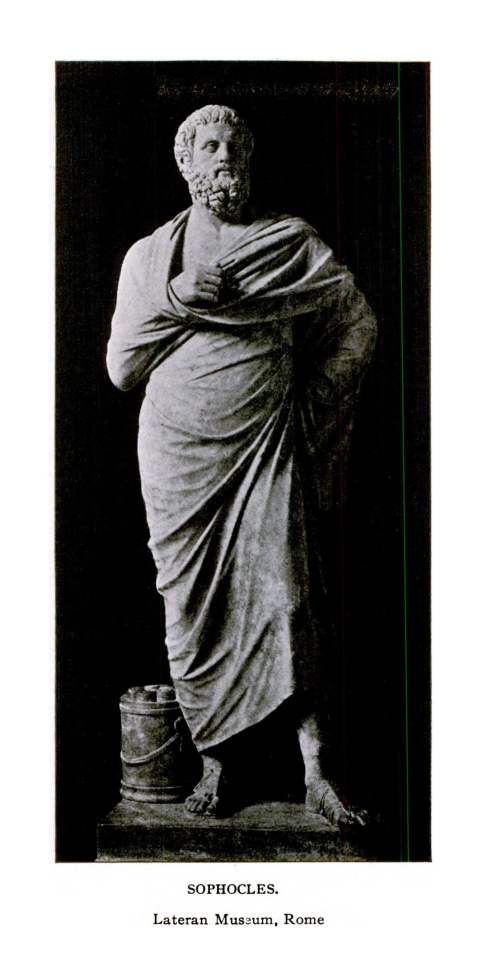
SOPHOCLES.
Lateran Museum, Rome
Very different from either Aeschylus or Sophocles
was Euripides. According to tradition, he was
born in the island of Salamis on the very day of
the battle. As he grew up, he became a friend of
Socrates, but for the most part he lived a solitary
life, not very much liked, and taking as little part
in public life as he could. He was essentially a
student, and was one of the first Athenians to
collect a library. Euripides lived in Athens during the
Peloponnesian War, a period of restless questioning,
of breaking away from old traditions and beliefs,
of lowering of the old ideals. The war had
brought a new spirit and Euripides represented it.
He criticized customs and beliefs which he thought
were unworthy of the best spirit in Athens, he questioned
belief in the gods, and in one great play, the
Trojan Women,[31] he showed the misery brought by
war. He was the first poet to strip war of its
glamour and to show it as it affected the conquered. In
the Electra and in Iphigenia in Tauris,[32] Euripides
deals with the familiar tragedy of Orestes, pursued
by the Furies after the murder of his mother, and
in the Alcestis he tells the old tale of how a noble
woman was willing to sacrifice her life for that of a
selfish husband, and of how she was brought back
from the gates of Hades by Heracles.
The strength of Euripides lies in his wonderful
portrayal of character. He judges his characters
by the standards of the men and women of his own
day and not by those of the gods and heroes, and he
is a merciless critic. This makes his dramas most
extraordinarily vivid and human, but it also
accounts for some of the criticism and dislike he met
with in his own day.
Aristophanes wrote comedies.[33] His plays are
based on the daily life of his time, and, to
understand them, one must know what were the political
questions of his day, who were the leaders, who
were the writers, the gossip of the Agora and the
barber's shop, the likes and dislikes of the men
amongst whom he lived. But to those who know
enough of these things to follow his allusions, the
plays of Aristophanes are full of interest, and we
learn a great deal about life in Athens from
them.
Aristophanes was younger than Euripides, but,
unlike the older man, he was very conservative,
and he disliked the new ways by which the Sophists
were teaching the youths, for he believed that the
new methods would make them irreverent, good at
idle talk but at nothing else, shallow and effeminate.
He constantly compared the young men of his own
day with those of the generation that had fought at
Marathon, and in comparing them he found them
wanting, for to him the heroes of the age of
Marathon represented all that was best in Athenian
manhood.
The Greeks loved Beauty, especially the Athenians
of the fifth century B.C., but they did not spend
all their time in a conscious search for it. They
were very busy about and interested in a great many
other things: the administration of the city, relations
with other states, often fighting, trading and
travelling, building ships and sending out colonies.
We have already seen what the Greeks meant by
Beauty,[34] and an appreciation of it touched all
these things.
Now a great mistake has been made in modern
times in that art has too often been looked upon as
a luxury, as something that the rich can have but
not the poor, something that has not very much
to do with a practical every-day life. But to
believe that is to misunderstand altogether what art
is, for art is something that is done, not something
that is merely looked at. All men have within them
a vision of what kind of world they would make,
if it was left to them to order, and in its widest
meaning art is the outward and concrete expression
of that vision. To confine art to architecture,
sculpture and painting, is to rob it of half its
meaning. The forms of art are as many and varied as
are the interests of every-day life, and this belief is
one of the great gifts of Greece to the world. It was
not given to every Greek to be a great artist. Not
every one could be an Aeschylus and write the Agamemnon,
a Sophocles and write the Antigone, a Pheidias
and create the Parthenon, or a Praxiteles and model
the Hermes, but every one could work in the spirit
of which these great works are the supreme examples.
The history of a nation is an enquiry into how that
nation expresses itself in stone and marble, as well
as into what it thinks and does; and its architects,
artists and sculptors stand beside its historians,
philosophers, dramatists and statesmen as the men
who have made its history.
In its narrower, modern sense, art is the
outward sign of the spirit of a nation as it is expressed
in painting and in stone and marble. Except for
the vase-paintings, Greek painting has almost
entirely disappeared, but the achievements of the
Greeks in architecture and sculpture are amongst
the greatest that the world has ever seen. Something
has already been said about Greek architecture[35];
the same spirit expressed itself in Greek
sculpture. To know the Greeks and the real worth
of what they have given to the world, it is not
enough to read about them; one must learn to know
them at first-hand. To do that one must read
what they wrote (if not in Greek, then in
translations), and look at what they built and at their
sculpture (if not at the originals, then by means of
casts and photographs), and when one does that,
one begins to know a little of what the spirit was
that produced such things. The Greeks considered
that the human form was the most fitting subject
for representation in sculpture, yet they were not
great portrait makers; that was left for a later race
to achieve. What they aimed at doing was to give
outward expression to those qualities of the mind
and spirit which they, as a people, prized so highly:
Beauty, Self-control, Harmony, Restraint. The
greatest Greek sculpture was, as it were, the answer,
wrought in marble, to the prayer of Socrates to
Pan: "Beloved Pan, and all ye other gods who
haunt this place, give me beauty in the inward soul;
and may the outward and the inward man be at one."[36]
The Greeks lived at a time when so much was
being done for the first time, and to all their art
they brought a spirit of Youth and of Joy in
creation, yet also a spirit of Patience in achieving
results, for they were never in a hurry, and they
knew that there were no short cuts to the
perfection which was to them so important a part of
beauty. Their statues are very idealistic, but their
idealism was practical, and though, as we know,
they did not always fulfil their ideals, they knew that
fulfilment was possible. Though the sculpture
of the Greeks represented man, not as he always
was, but as they believed he might be, did he but
follow where his best instincts led, it did sometimes
result in something that to them was not only an
ideal, but something so real and life-like that they
could say of a sculptured figure of a Sleeping Ariadne:
Strangers, touch not the marble Ariadne, lest she
even start up on the quest of Theseus.[37]
Alexander was a great conqueror and he won
for himself a mighty empire. But that empire did
not last, for his successors were unable to hold it
together. It would almost seem as if he had crowded
into his short reign of barely thirteen years, hero
deeds and marvellous exploits, which however
much they may have done to enrich tradition and
to appeal to the imagination, were hardly of any
great permanent value. Alexander, however, did
more than create a passing empire; he did more
than any other one man to spread the knowledge of
Greek civilization over the world. Wherever he
passed with his conquering army he founded cities,
where he established colonies of Greeks: men
who spoke the Greek tongue, who worshipped the
Greek gods, who read and loved Greek literature, and
who lived according to Greek ideals. Such cities
were founded in Egypt, in Asia Minor, in Syria,
in Babylonia, in Persia and even in the distant
lands till then unknown, further to the mysterious
East.
But Alexander did yet more to spread Greek
civilization than by the founding of cities. All the
great ports of the Eastern Mediterranean were in
his hands, which meant that Greek merchants were
established there, and that the whole commerce of
that region was in the hand of Greeks.
The history of Greek civilization may be divided
into two periods. The first lasted until the days of
Alexander; it included the early experiments made
by Greek states in the art of governing themselves,
the repulse of the Barbarian, the great days of
Athens, the disastrous Peloponnesian War. Through
all this period Greece was learning how to do things.
She was in the making and was creating what was
to live as long as men should love what was great,
but she was living for herself. This period is called
the Hellenic Period.
Beginning with Alexander, Greek civilization
stepped out into a new age. Greece was no longer
living for herself, she was living for the world.
Greek civilization had been far-flung over Asia;
the Barbarian was adopting Greek customs, Greece
was the teacher of the world, in science, in art, and
in all that was meant by civilized living. This
period lasted from the time of Alexander until
Greece became part of the Roman Empire in 146
B.C., and is known as the Hellenistic Age. The
centre of Greek civilization was now no longer
in Athens, but in Alexandria, the city in Egypt
founded by Alexander, and which from its situation
was the natural link between the East and the
West.
Alexandria had not been founded for very many
years before she was the rival of Carthage, that
powerful commercial city founded by the Phoenicians,
as mistress of the Mediterranean, and in the
Eastern Mediterranean, known as the Levant, she
held undisputed sway. From that time to the
present day Alexandria has been the door through
which the commerce of the East and the West has
passed.
In the Hellenistic Age, Alexandria developed into
a very beautiful city. Temples and all kinds of
public buildings, great palaces and gardens, docks
and warehouses were built. At the entrance to
the harbour stood a great lighthouse, called the
Pharos from the island on which it stood, and
which was considered so great a marvel that it was
numbered amongst the Seven Wonders of the
ancient World.
This period was in many ways like a more modern
one. Greek civilization had stepped out into
a new world. The conquering armies of Alexander,
going out to the ends of the earth, had made
communication possible between places that had hitherto
hardly known of each other's existence. Science
had made such remarkable strides that man's power
over nature had been enormously increased, and
the increase of scientific knowledge was affecting
the old religious beliefs in the gods. Nothing
seemed to be quite the same as it had hitherto
been, and then, as at all such times, the minds of
men were affected by the changes. Some became
more conservative than before and wanted nothing
changed, because to them the old was necessarily
the best, and there was only evil in what was new.
Others went to the other extreme and wanted
everything changed, because to them the new must
necessarily be better than the old. But quietly in
between these two extremes were the thinkers,
those who were keeping alive that Greek spirit
which knew that the vision of the whole truth had
not yet been given to any man, and that the way
to progress was not by destroying the old, but by
building upon it in order to go on from a firm
foundation to a fuller knowledge of the truth. Not to
Thales, nor to Socrates, nor to Aristotle, nor yet to
the men of the twentieth century has the complete
vision of the truth of all things been vouchsafed, but
to those who follow the quest in the spirit of the
Greeks of old is granted to add a little to the progress
of human knowledge.
It was in the Museum at Alexandria that the
thinkers worked. This Museum was founded by
Ptolemy Soter, one of the rulers of Egypt after the
break-up of Alexander's empire, and very much
developed by his son, Ptolemy Philadelphus. This
Museum, the Temple of the Muses, was what today
would be called a university. It had lecture
halls where mathematicians, astronomers, poets and
philosophers taught; courts and porches where men
walked and talked, houses where the men of learning
lived. Above all, it had a Library, which
contained several thousand books. This library was
catalogued by Callimachus, the first librarian of
whom there is any record, and there were a hundred
and twenty books of his catalogue. Book, however,
is a wrong word to use for the collection in the
Alexandrian Library, for there were no books then, as
we know them. Rolls took the place of books, and
Callimachus soon found that the big rolls were
very inconvenient. It is said that he complained
that "a big book is a big nuisance," and that it
was when he was librarian that the plan of dividing
the large rolls into a number of smaller ones
was thought of. These were easier to handle, but
one work required a great many of the smaller rolls,
and thirty-six were required for the Iliad and the
Odyssey.
As the fame of the Library spread, students from
all over the Greek world came to Alexandria, and
there was a great demand for additional copies of
the works in the Library. For more than three
centuries, Alexandria was the great book-producing
mart in the world. The Museum possessed a good
collection of the best known copies of the works of
the classic writers, and Ptolemy Philadelphus very
much enlarged this collection. He bought every
copy of all existing Greek works he could find, and
as he paid very high prices for them, there was a
steady flow of books to Alexandria from all over
the civilized world. It is said that he refused to
send food to the Athenians at a time of famine
unless they agreed to give him certain copies they
still possessed of the works of Aeschylus, Sophocles
and Euripides. He paid liberally for them, not
only in the promised shipment of corn but also in
silver.
As more and more copies of the classic writers
were wanted, a regular publishing trade arose in
Alexandria. Callimachus was not only the Librarian
of the Library, but a publisher of the works of
classic writers. Large numbers of copyists were
employed whose business it was to make careful
and accurate copies of the works required. This
accounts for the fact that in certain works of ancient
literature it is sometimes difficult to know what is
the really original form of certain lines or passages,
because in spite of their care, the copyists made
mistakes, and unfortunately many original copies
of the classics were lost in the great fire which
destroyed the Library in the last century B.C. The
Alexandrian school of copyists was a very famous
one, and Alexandrian Editions of the classics were
considered the very best to be had.
Not only were Greek works copied, but other
literature was translated into Greek and then copied.
It was in Alexandria that the oldest manuscript
of the Old Testament we possess was transcribed.
It was a translation of the whole of the Old
Testament from Hebrew into Greek, made, according to
tradition, by a group of seventy Jewish scholars,
whence comes its name, the Septuagint. These
scholars were encouraged to undertake this work
by the King, who is said to have provided the means
for their support whilst they were engaged on the
translation, and who gave them a special quarter
of the city in which to live.
Greek science had been born in Ionia, and during
the Hellenic Period of Greek civilization, it had gone
hand in hand with philosophy. The earliest days
of pure science came in the Hellenistic Age, and its
home was in Alexandria. Amongst the many names
of men of this time who contributed something of
value to science, there are two which must be
remembered: those of Euclid and Archimedes.
Euclid lived in Alexandria. He was a mathematician
and wrote a great work on geometry. No
scientific work in the world has lived in quite the
same way as has this book of Euclid, for since the
time that the Elements of Euclid were written, it
was used as a school text book without interruption
until a very few years ago.
Archimedes was probably the greatest of the
Greek scientific thinkers of the third century B.C.
He did not live in Alexandria; he was a native of
Syracuse in Sicily, but he was in close touch with
all the scientific work that was being done there.
He was a great scientific investigator, the inventor
of many practical and ingenious devices and
discovered the principle of moving heavy bodies by
means of pulleys and levers. An extraordinarily
large ship was made for the King of Syracuse, a
ship of marvel to that age. It contained a gymnasium,
gardens of most wonderful beauty and full of
rich plants, a temple to Aphrodite, a drawing-room
with its walls and doors of boxwood, having a bookcase
in it, a bath-room with three brazen vessels for
holding hot water, and a fish-pond. All the
furnishings were of the most exquisite craftsmanship,
and all the rooms had floors of mosaic, in which the
whole story of the Iliad was depicted in a most
marvellous manner. There were doors of ivory,
beautiful couches, and it was full of pictures and
statues, goblets and vases of every form and shape
imaginable. But the ship was so large that no one
could move it. Archimedes, however, we are told,
launched it by himself with the aid of only a few
people. For having prepared a helix (probably some
mechanical contrivance with pulleys), he drew this
vessel, enormous as it was, down to the sea. And
it was said that Archimedes was the first person who
ever invented this helix.[1]
Archimedes believed it possible to move greater
bodies even than the ship, and he is said to have
boasted: "Give me a place to stand on, and I
will move the earth."
This great inventor did other things which struck
the imagination of the men amongst whom he lived,
for of some of them they had never seen the like
before. During the siege of Syracuse by the
Romans, in 212 B.C., Archimedes invented marvellous
war-engines: strange grappling hooks which, it was
said, could seize an enemy's ship and overturn it in
the sea, and he showed the Syracusans how to set
up a water pump in their ships, so that should
water get into the hold, it could be pumped out and
the ship saved from sinking. He is also said to
have made some arrangement of mirrors and burning
glass by means of which the Roman ships were
set on fire. But in spite of all these inventions,
the Romans took the city, and Archimedes was
killed. He was found by a Roman soldier, sitting
in his house and paying no heed to any danger, but
intent on drawing mathematical diagrams on the
ground. Looking up and seeing the enemy, all he
said was: "Stand away, fellow, from my diagram." The
soldier, not knowing who he was, killed him.
It is said that on his deathbed Alexander
bequeathed his empire "to the strongest," but there
was no one general able enough or strong enough to
succeed him, and for about fifty years after his
death, his empire was torn by strife and bloodshed.
At last some kind of peace and order was restored,
but the one great empire of Alexander had disappeared,
and the civilized world was broken up into
a number of independent states, of which the most
important were the Kingdoms of Syria, Egypt and
Macedonia. During the long wars which had preceded
this settlement, many battles had been fought
on Greek soil. The Greeks were not strong enough to
prevent this and neither were they able to maintain
their independence when Macedonia became a
kingdom. She was too powerful and strong a neighbour
and Greece fell under her rule. Tyrants were
established in the Greek cities, a deep humiliation
to the freedom-loving Greek.
But once more the old Greek spirit flared up and
the tyrants were driven out. From time to time
in the history of Greece, states had joined together
in various leagues and alliances, but the inability
of the Greeks to combine for long, even when their
very life demanded it, had prevented such leagues
from lasting any great length of time. But in 281
B.C. when once again the independence of Greece
was threatened, one of these old leagues was revived,
the Achaean League. It lasted for nearly a century
and is of the greatest interest to modern times,
for until the union of the American states, about two
thousand years later, there was nothing in the
history of the world like it again.
The Achaean League was not an alliance, but a
real federation of states, with one central
government. Each separate state kept its own sovereign
rights over all its domestic affairs, but questions of
war and peace, the support of the army, and all
relations with foreign states were controlled by the
federal government. It was the only experiment in
ancient times of real federal government.
The head of the League was called the General,
and it was under the general Aratus that it became
very powerful. Almost all the more important of
the Greek states entered the League, with the
exception of Athens and Sparta. Neither by persuasion,
nor by force, unless she might be recognized as head
of the League, would Sparta consent to become a
member, and so powerful was she in the Peloponnesus
that Aratus begged the aid of Macedonia to
subdue her. Sparta was conquered, but Macedonia
regained her supremacy in Greece, and the
power of the Achaean League was broken.
The old Greece of history no longer existed.
Greek civilization had spread over the Mediterranean
world, but the free and independent city-state
had disappeared and nothing lasting had taken its
place. Alexander himself, and still more his
successors, had failed to create an empire which gave
to those who belonged to it any sense of citizenship
in it. The Hellenistic world was a Greek
civilization, but it failed to arouse in men of Greek
birth that patriotism which the city-state had
inspired.
The creation of a world state of which men were
to be proud to call themselves citizens and for which
they would gladly die, was to be the work of another
great power, which even as the old Greece was
passing, was growing strong in the West. Rome was
steadily conquering the civilized world. Already
she ruled over Italy and was extending her power
over the Eastern Mediterranean. She conquered
Macedonia, and one by one the old free states of
Greece and those of the Achaean League lost their
independence, until in 146 B.C. Corinth, rich,
commercial, gay Corinth, was taken by Rome, and
Greece became a Roman province. The citizens of
this great state, which was to include, not only
Greece and the Levant, but the whole Mediterranean
and lands far beyond its shores, were to
be proud of the name of Roman. Yet Rome, destined
to be the Mistress of the World, and in political
power an empire, succeeding where Greece
had failed, owed all that was most worth while
in the things of the higher intellectual life of
the mind to Greece. The Greek spirit was never
to die.
This book has been intended for those who were
reading about Greece for the first time. The following
list is for those older readers of the book who would
like to know more about this great civilization. It only
contains suggestions as to how to begin, and is
therefore not in any way a complete bibliography.
I. Books about Greece
GROTE. History of Greece. This book
was written some time ago, but it is still the most
famous history of Greece.
C. H. and H. B. HAWES. Crete the Forerunner of Greece.
BAIKIE. The Sea Kings of Crete.
R. W. LIVINGSTONE. The Greek Genius and its
Meaning to Us.
R. W. LIVINGSTONE. (Edited by) The Pageant of Greece.
R. W. LIVINGSTONE. (Edited by) The Legacy of Greece.
GILBERT MURRAY. The Rise of the Greek Epic.
A. E. ZIMMERN. The Greek Commonwealth.
E. N. GARDINER. Greek Athletic Sports and Festivals.
ETHEL B. ABRAHAMS. Greek Dress.
EMILY JAMES PUTNAM. The Lady.
E. POTTIER. Douris and the Painters of
Greek Vases.
G. M. A. RICHTER. The Craft of Athenian Pottery.
G. M. A. RICHTER. Handbook to the Classical
Collection in the Metropolitan Museum, New York. An excellent
introduction to the study of Greek Art.
KENNETH J. FREEMAN. The Schools of Hellas.
A. E. HAIGH. The Attic Theatre.
E. A. GARDNER. A Handbook of Greek Sculpture.
D. G. HOGARTH. Philip and Alexander.
PUTNAM. Authors and their Public in Ancient Times.
MAHAFFY. Social Life in Greece.
MAHAFFY. Alexander's Empire.
II. Greek Writers
No reading about Greece can take the place of
reading what the Greeks themselves wrote. References to
Greek writers will have been found all through this
book and in the list of acknowledgments at the beginning.
The following list of the more important writers
and their works referred to in this book has been put
together for the purpose of easier reference.
HOMER. The Iliad, translated by Lang, Leaf and Myers.
HOMER. The Odyssey, translated by Butcher and Lang.
HOMER. The Homeric Hymns, translated by Andrew Lang.
AESCHYLUS. Translated by A. S. Way and also by
E. M. Cookson.
AESCHYLUS. The Agamemnon, translated by Gilbert Murray.
SOPHOCLES. Translated by R. C. Jebb.
SOPHOCLES. Oedipus, King of Thebes, translated by
Gilbert Murray.
EURIPIDES. Translated by Gilbert Murray.
ARISTOPHANES. Translated by B. B. Rogers.
The Frogs, translated by Gilbert Murray.
PLATO. Translated by Benjamin Jowett.
PLATO. The Republic, translated by Davies and Vaughan.
PLATO. Trial and Death of Socrates, translated
by F. J. Church.
ARISTOTLE. Politics, translated by Benjamin
Jowett and also by J. E. C. Welldon.
HERODOTUS. Translated by G. C. Macaulay.
THUCYDIDES. Translated by Benjamin Jowett.
XENOPHON. Translated by H. G. Dakyns.
PLUTARCH. Translated by Dryden, revised by A. H. Clough.
DEMOSTHENES. Public Orations, translated by
A. W. Pickard-Cambridge.
The Claim of Antiquity, an excellent pamphlet
published by the Oxford University Press, gives a much
fuller and more complete list of books and translations
for those who would like further suggestions.
III. Greek Sculpture and Architecture
Not every one can go to Greece or even to Sicily, but
most museums have good collections of casts and
models. Greek sculpture is not all found in one place, but
scattered through the museums of the world. Those
who can go to London, Paris, Rome and Naples, if
nowhere else, can get first-hand knowledge of some of
the greatest things the Greeks produced. For the
sculptures from the Parthenon are in the British
Museum; most beautiful things are in the Museo delle Terme
in Rome (to see the other half of the Throne of
Aphrodite one must go to the Museum of Fine Arts in Boston,
Massachusetts), and Sophocles is in the Museum of the
Lateran. From Naples one can go to Paestum, once the
Greek colony of Poseidonia, famous in ancient times for
its roses, and see the Temple of Poseidon. It has never
been restored, and is one of the best preserved Greek
temples to be seen anywhere out of Attica. There it
stands, as it has stood for over two thousand years,
looking out towards the sea, solitary, now, and desolate,
yet in its loneliness most beautiful.
All these things are merely suggestions as to one way
of beginning. Those who begin will find no difficulty
in going on.
A
Academy, 194, 211, 381
Achaean League, 407
Acropolis, 91, 190, 194; temples
on, 278 ff.; later history of
284 ff.
Aegean civilization, 5
Aeschylus, 107, 163, 390, 395,
402, 412
Aethiopians, 44
Agamemnon of Aeschylus, 391,
395, 412
Agamemnon, Tomb of, 6, 25, 26
Agora, 191, 207
Alaric the Goth, 284
Alcestis of Euripides, 393, 412
Alcibiades; early life of, 302 ff.;
Sicilian expedition, 305 ff.;
summoned to Athens, 309; the
traitor, 310 ff.; recalled to
Athens, 314; exiled, 315
Alcmaeonids, 104
Alexander; youth and education,
342 ff.; policy, 345; conquests
of 347 ff.; death of, 356;
empire of, 398, 406
Alexandria, 400 ff.; Museum at,
401; Library, 401; book-publishing
in, 402; science in
404 ff.
Alexandrian editions, 403
Amphipolis, 301
Amphora, 203
Anabasis of Xenophon, 318,
320, 412
Anaximander, 112
Antigone of Sophocles, 392, 412
Aphrodite, 51
Apollo, 48, 52, 53
Apology of Socrates, 371, 373,
374
Aratus, 407
Archimedes, 404
Architecture, 277 ff.
Archon, 94
Ariadne, 7
Aristeides; character of, 156;
rivalry with Themistocles,
156; ostracism of, 158;
return of, 162; forms Delian
League, 180
Aristophanes; comedies of, 209,
300, 393, 412
Aristotle; Politics of, 72, 384,
412; views on education, 227,
384; tutor to Alexander the
Great, 344; at the Lyceum,
383; will of, 383; "Father of
Natural Science," 383
Artaxerxes, 317
Artemis, 49, 217
Artemisium, 149
Athena, 47, 48, 50; birth of, 280;
contest with Poseidon, 92,
281; symbol of Athens, 283
Athenian Dress, 195 ff.
Athenian Education, 221 ff.
Athenian Government; rule of
one man, 91 ff.; oligarchy, rule
of the few, 94 ff.; rule of the
many, 96 ff.
Athenian House, 198
Athenian Life, 190 ff.
Athenian Pottery, 203 ff.
Athenian Trade, 201
Athens; situation and appearance,
190 ff.; classes of people,
194; burnt by Xerxes, 161;
burnt by Mardonius, 168;
during Persian War, 144;
Long Walls, 173, 298; fortifications
of, 172; becomes an empire,
183; enemies of, 291 ff.;
during Peloponnesian War,
296 ff.; downfall of, 315
Athos, Mount, 126
Arrian, 334, 349, 351, 353
Assembly; Spartan, 79; Athenian, 210, 299
B
Banquet of Xenophon, 225, 412
Bema, 210
Brasidas, 301
Byzantium, 110, 175
C
Cadmus, 324
Callimachus, 403
Caryatid, 280
Cecrops, 91
Cerameicus, 204
Chaeronea, 332
Chios, 112, 125, 202
Chiton, 195
Chlamys, 196
Cimon, 93
Citizenship, Greek ideals of,
73 ff.
City-State, 70 ff.
Cleon, 301
Clio, 49
Clouds of Aristophanes, 300, 412
Colonies, 108 ff.; Ionian, 110 ff.;
in Italy, 113; in Sicily, 113; in
Egypt, 113
Constitution of the Lacedaemonians
of Xenophon, 88
Corinth; council at, 145; urges
Sparta to make war on
Athens, 291; fall of, 408
Crete, 6 ff.; legends of, 7 ff.;
dress, 11; writing, 15; religion,
13; life in, 16 ff.; amusements,
18
Crito, 374
Croesus, 100 ff.; conquers Ionian
colonies, 115; war with Cyrus, 116
Cunaxa, 319
Cylon, 103
Cyrus the Great, 115; conquers
Sardis, 116; conquers Ionian
colonies, 117
Cyrus the Younger, 318 ff.
D
Daedalus, 8
Darius, 118 ff.; Scythian expedition
of, 118 ff.; determines to
invade Greece, 124, 126
Delos, 128; Confederacy of, 180
Delphi, 43; oracle at, 57 ff.;
Treasury of Athenians at, 134
Demeter, 54 ff.
Demosthenes, 335 ff.; 412
Deucalion, 42
Diogenes, 346
Dionysus, 232
Dodona, 57
Dorians, 75
Draco, 98
Drama, 233
Dramatists; Aeschylus, 390;
Aristophanes, 393; Euripides,
392; Sophocles, 392
Dress; Athenian, 195; Cretan,
11; Homeric, 28
E
Economist of Xenophon, 198,
215, 216, 412
Education; Athenian, 221 ff.;
Spartan, 84 ff.
Electra of Euripides, 393, 412
Eleusis, 54, 220
Elysian Fields, 44
Empire; Athenian, 183, 282;
Alexander's, 398, 406
Epaminondas, 325 ff.
Ephors, 80
Erechtheum, 279
Eretria; joins Ionian revolt, 123;
burnt by Persians, 128
Euclid, 404
Euripides, 39, 109, 226, 234, 238,
300, 392 ff., 402, 412
Evans, Sir Arthur, 12
F
Funeral Speech, 187
G
Games; Isthmian, 61; Olympic,
60 ff.; Pythian, 61
Gordian Knot, 347
Greece; divisions of, 37; trees
of, 37; products of, 38; climate
of, 39
Greek Art, 394 ff.
Greek Characteristics, 40
Greek Spirit, 102, 358
H
Hades, 54 ff.
Hecataeus, 112
Hellenic Period, 399
Hellenica of Xenophon, 315,316,
327, 412
Hellespont, 141
Hellenistic Age, 398 ff.
Helots, 76
Hephaestus, 50
Hera, 47
Hermes, 49, 106
Hermes of Praxiteles, 222, 395
Herodas, translation from Mime
III, 228 ff.
Herodotus, 39, 78, 111, 115, 117,
118 ff., 136 ff., 174, 282,
385 ff., 412
Hestia, 51, 52, 199
Himation, 196
Hipparchus, 106
Hippias, 106, 128
Hippolytus of Euripides, 234,
412
Historians; Herodotus, 385 ff.;
Plutarch, 389; Thucydides,
386 ff.; Xenophon, 388
Homer, 22, 58, 112, 225, 411
Homeric Age, 27 ff.; dress, 28;
palaces, 28 ff.; furniture, 30 ff.
Homeric Hymns, 47, 48, 49, 50,
51, 52, 54, 55, 58, 281, 411
Houses; Athenian, 198 ff.;
Cretan, 16; Homeric, 28
Hydria, 203
Hyperboreans, 43
I
Iliad, 6, 8, 19, 20, 22, 46, 68, 106,
402, 411
Ionian Colonies, 110, 202;
conquered by Croesus, 115;
conquered by Cyrus, 117; appeal
to Athens for help, 174
Ionian Revolt, 122
Iphigenia in Tauris of Euripides,
238 ff.; 393, 412
Isthmian Games, 61
K
King's Peace, 317
Knights of Aristophanes, 300,
412
Knossos, 8; palace of, 10;
destruction of, 20
Krater, 203
L
Lacedaemonians, 75
Laconia, 75
Lade, 124
Laurium, 156
Lawgivers; Draco, 98; Lycurgus,
76 ff.; Solon, 96 ff.
Lekythos, 203
Leonidas, 148
Lesbos, 112
Leuctra, 327
Long Walls, 173, 298, 316
Lyceum, 383
Lycurgus, 76 ff.; travels of, 77;
at Delphi, 78; government of,
76 ff.; death of, 90
Lydia, 114
M
Macedonians, 329
Magna Graecia, 113
Mantinea, 327
Map-makers, 112
Marathon, 130 ff.
Mardonius, 125, 137, 166, 168
Mediterranean, 3 ff.
Memorabilia of Xenophon, 278,
373
Metopes, 282
Minoan Civilization, 8
Minos, 7
Miletus, 111, 202; siege of by
Lydia, 114; revolt against
Darius, 122; fall of, 124
Militiades, 131
Muses, 49
Music, 227
Mycenae, 25 ff.; 32
Mycenaean Civilization, 5
N
Naucratis, 113
Naxos, 122, 127
Nicias, 302
O
Odyssey, 7, 8, 19, 22, 29, 30, 50,
402, 411
Oedipus at Colonus of Sophocles,
392, 412
Oedipus the King of Sophocles,
392, 412
Oligarchy, 94
Olympia; oracle at, 57; statue of
Zeus at, 64
Olympic Games, 60 ff.
Olympus, 43, 46
Oracle; origin of, 56; oracles of
Zeus, 57; of Apollo, 57
Oracles; about Homer, 58; given
to Lycurgus, 78; to Cylon,
103; to Spartans, 107;
"deceitful answer" to Croesus,
115; of the wooden walls, 159
Orations; Funeral Speech of
Pericles, 187 ff.; of
Demosthenes, from Third Philippic,
338; from Second Olynthiac,
339; On the Crown, 339 ff.
Ostracism, 157
P
Palaestra, 227
Pan, 51, 129, 134
Panathenaic Festival, 204, 217,
283
Parnassus, 42, 49
Parthenon, 280 ff.
Pausanias, Spartan General; at
Plataea, 168 ff.; at Byzantium,
175; suspicious conduct of,
175; death of, 176
Pausanias the Traveller, 25, 64,
69
Pedagogue, 223
Pediment, 277
Peiraeus, 173, 202
Peisistratus, 104 ff.
Pelopidas, 326
Peloponnesian War; causes, 291
ff.; course of war, 296 ff.;
Sicilian Expedition, 305 ff.;
defeat of Athens, 315 ff.
Pentathlon, 67
Pericles, 53; early life of, 183;
leader of Athens, 185; Funeral
Speech of, 187 ff.; beautifies
Athens, 289; policy during
Peloponnesian War, 297; death
of, 298; imperial policy of,
298 ff.
Persephone, 54 ff.
Persians of Aeschylus, 163, 412
Persian Wars, 118 ff.; invasion
under Mardonius, 125; Marathon,
125 ff.; invasion under
Xerxes, 136 ff.; Thermopylae,
148 ff.; Salamis, 161 ff.
Phaedo of Plato, 375, 377
Phaedrus of Plato, 382, 412
Pheidias, 46, 64, 279, 395
Pheidippides, 129, 132
Philip of Macedon, 328; King of
Macedonia, 330; policy of,
330; conflict with Greek
states, 331 ff.; destroys Thebes,
332; death of, 333
Philippics of Demosthenes, 338,
412
Philosophers; Aristotle, 72, 227,
383 ff., 412; Plato, 380 ff., 412;
Pythagoras, 379; Socrates,
361 ff; Thales, 111, 379
Philosophy, Greek, 378
Pindar, 69, 323
Plague in Athens, 297
Plataea; aids Athens before
Marathon, 131; battle of, 168
Plato, 57, 194, 225, 226, 228,
363, 367, 371, 373, 374, 375,
377, 380 ff., 412
Plutarch, 75, 90, 93, 96, 154,
156, 158, 172, 177, 178, 180,
181, 185, 186, 284, 298, 304,
309, 310, 314, 336, 337, 345,
346, 389, 412
Pnyx, 210
Polemarch, 94
Politics of Aristotle, 72, 384, 412
Poseidon, 47, 92, 281
Praxiteles, 222, 395
Propylaea, 278
Protagoras of Plato, 225, 412
Ptolemy Philadelphia, 401
Ptolemy Soter, 401
Pyrrha, 42
Pythagoras, 379
Pythian Games, 60
R
Religion; Cretan, 13; Greek,
44 ff.
Republic of Plato, 226, 381, 412
S
Sacred Mysteries, 54 ff., 220
Salamis, 97; battle of, 163 ff.
Sappho, 112
Sardis; taken by Cyrus, 116;
burnt by Ionians, 123;
Persian army at, 138
Schliemann, 23 ff.
Science; in Ionia, 111; in
Alexandria, 404 ff.
Scythia, 118
Senate, Spartan, 78
Septuagint, 403
Sicily, 113
Sicilian Expedition, 305 ff.
Socrates, 278, 303, 396; early
life, 361 ff.; Socrates and the
Sophists, 364; Socratic
method of teaching, 366;
accusations against, 368; trial
off 368; Apology of, 368 ff.;
death of, 374 ff.
Solon; early life of, 96; war over
Salamis, 97; Archon, 98;
reforms of, 98 ff.; travels of
100; Solon and Croesus, 100 ff.
Sophists, 364
Sophocles, 392, 395, 402, 412
Sparta; situation of, 75; government
of, 76 ff.; customs, 81 ff.;
education, 845.; position of
women, 89; aids Athens in
expelling Hippias, 107; refusal
to join Ionian revolt, 123;
refuses immediate help before
Marathon, 129; at
Thermopylae, 148 ff.; jealousy of
Athens, 172 ff.; policy towards
Ionian colonies, 174; during
Peloponnesian War, 287 ff.;
supremacy of, 316
Sphacteria, 301
Statues; Zeus at Olympia, 64;
Hermes of Praxiteles, 222;
Athena Promachos, 279, 284;
Athena Polias, 280; Athena
Parthenos, 283; Sophocles, 413
Stoa, 193
Strabo, 4
Symposium, 213
Symposium of Plato, 363, 367,
412
Syracuse, 113, 226, 405; battle
in harbour of, 312
T
Temples, 14, 276 ff.; Athena
Nike, 279; Erechtheum, 279;
Parthenon, 280 ff.; Paestum,
413
Ten Thousand, March of the, 318
Thales, 111, 379
Theatre, 232 ff.
Thebes, 153, 317; early history
of, 322; legends of, 324; supremacy
of, 325 ff.; defeated by
Philip of Macedon, 332;
destroyed by Alexander, 346
Themistocles; early life and
character, 153; at Artemisium,
150; builds a navy, 155;
rivalry with Aristeides, 156;
at Salamis, 161 ff.; popularity
of, 171 ff.; fortifies Athens,
172; accusations against, 176;
ostracized, 177; at the Persian
court, 177; death of, 178
Theocritus, 216
Therma, 143
Thermopylae, 148 ff.
Theseus, 7, 92, 93; ship of, 9, 374
Thucydides, 7, 155, 181, 189,
297, 302, 308, 309, 314, 360,
386 ff., 412
Tiryns, 27;
Trojan War, 22, 347
Trojan Women of Euripides, 39,
300, 412
Troy, discovery of, 24
Tyrants, 102 ff.; Cylon, 103;
Peisistratus, 104 ff.
W
Wasps of Aristophanes, 209, 300,
412
Women, position of; in Athens,
214 ff.; in Sparta, 89
Writing, Cretan, 15
X
Xanthippe, 363
Xenophon, 88, 198, 214, 215,
216, 225, 278, 314, 315, 318,
327, 373, 388, 412
Xerxes, 136 ff.
Z
Zeus, 7, 46, 52, 53, 199, 231