It is fortunate that we are not all provided with equally
favourable sites and soils. How monotonous would
gardening become if one knew that he had but to act,
deed for deed, as his neighbour in order to attain exactly
the same garden result. We should feel disposed to
throw down our spades and trowels if the end of our
efforts might be foreseen by looking over our neighbour's
boundary. If the difficulties to be overcome could be
formally catalogued, the whole art of gardening would
be reduced to a wooden system in which there would
be little room for surprise or pleasure. But Fate has
decreed that our gardens shall differ in spite of the
apish copying spirit which still fills so many of our
breasts. Our sites vary, our soils vary, and our atmospheric
conditions vary to such an extent that any
gardener, if he is to produce a result of any worth,
must perforce use his native intelligence in order to
overcome the specific difficulties peculiar to his plot
of earth.
Gardening readers will remember Dean Hole's story
of the enthusiastic flower-loving navvy who, obtaining
the post of gatekeeper on the railway, was provided
with nothing but a barren gravel pit as apology for a
garden. "Twelve months afterwards," says the Dean,
"I came near the place again—was it a mirage which I
saw on the sandy desert? There were vegetables,
fruit-bushes and fruit-trees, all in vigorous health; there
were flowers, and the flower-queen in her beauty,
'Why, Will,' I exclaimed, 'what have you done to[13][14]
the gravel-bed?' 'Lor' bless yer,' he replied, grinning,
'I hadn't been here a fortnight afore I swopped
it for a pond!' He had, as a further explanation informed
me, and after an agreement with a neighbouring
farmer, removed with pick and barrow his sandy stratum
to the depth of three feet, wheeled it to the banks of an
old pond, or rather to the margin of a cavity where a
pond once was, but which had been gradually filled up
with leaves and silt; and this rich productive mould he
had brought home a distance of two hundred yards,
replacing it with the gravel, and levelling as per contract."
That man's garden was a real living creation: it was
indeed a "great work." And it is in everything true
that great natural possessions, though they may render life
more comfortable and possibly more apparently successful,
yet make the battle the tamer and less interesting.
Indeed the greater the odds to be overcome, the more
magnificent will every victory appear, and the gardener
who creates a flowery Eden out of a piece of bare and
starving desert has scored a greater success than his who
but grows beautiful flowers and delicious fruits where
soil and site and surroundings have been entirely on his
side.
I am writing in a garden which is as remarkable an
example of difficulties overcome as was the garden of
Dean Hole's navvy. Those who are familiar with the
sand-dunes or towans which form so pronounced a
feature of much of the northern coast-line of Cornwall,
will realize that these scarcely afford ideal spots for
easily made gardens. A thin coating of poor grass,
reeds, wild thyme and occasional sea-hollies form the
only drapery for the blown sand which makes up the
whole body of soil.
Yet it was on such a spot that a friend of mine pitched
his camp, or rather built his cottage, and set to work to
create a garden. His aim in life being to kill care, he
desired nothing more eagerly than to be constantly
occupied. For three years he spent fully one half of
his days in bringing into his territory leafmould and
soil, clay and manure. He soon had a good protective
screen of pines, euonymus, privet and hazel, and only
then did he seriously begin to plant his garden. He
had, during those three years, raised crops of clover,
trifolium and the like, digging them again into the newly
created soil from whence they came.
He read all the gardening books on which he could
lay hands, he saw all the gardens within walking distance,
and he studied the wants of every flower before
he sowed or planted it, just as though it were an
honoured guest whom he were inviting. He had no
rule-and-compass scheme before his eyes, and planted
his shrubs and flowers in those situations where they
might most healthily yield their beauty and their fragrance.
Such paths as his garden has are merely gravelled
developments of the beaten tracks which usage indicated as
necessary or convenient; and I am afraid that they would
meet with the disapproval of that great authority, Mr
Reginald Bloomfield, who has said that a garden "should
be laid out in an equal number of rectangular plots where
everything is straightforward and logical."
My friend is nearly twenty years older than when he
began to create his garden, and it has already acquired
much of the character of an old house to which successive
additions have been made. The year through, the earth
is draped and decorated with beautiful plants, Aconites,
Snowdrops, Crocuses, Primroses, Violets, Fritillaries,
Columbines, Pinks, Roses, Lilies, Sunflowers and all the
host of old-fashioned flowers.
The great problems of "architectural" gardening,
"landscape" gardening, and the rest, did not interest him.
So simple and unpretentious was his little house that an
attempt at terraces, clipped evergreens, and the like,
would have struck a jarring note at once. Therefore,
it is quite in keeping that beautiful flowers and beautiful
shrubs border one's way right up to the entrance door;
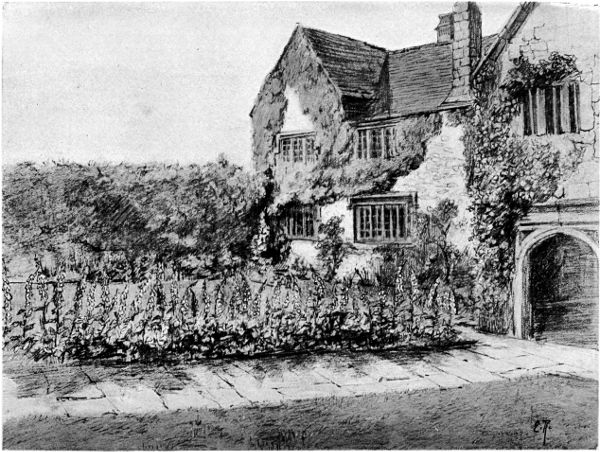
nor does Nature end there, for over all the outer walls
are trained lovely and fragrant climbers—Clematis, Rose,
and Honeysuckle—which give the idea that the cottage
does indeed "nestle" in the garden.
Through the open windows also, at almost any time
of the year, pours the delicious scent of leaf and flower—of
Winter Sweet, Violets, or Sweet Peas; of Stocks,
or Mignonette; of Wallflowers, or Roses. Just to name
a few of the plants whose scent fill the rooms, what
glories are thereby called up:—Honeysuckle and Jasmine,
Lily of the Valley, Lilac and Narcissus, Carnation,
Syringa and Heliotrope, Thyme, Bergamot, and Aloysia!
These, and a hundred other fragrances mingled together
in infinitely varying combinations, give sensuous joys
which even the most jaded can but appreciate. For
there is probably no pleasure so democratic as that which
is yielded by the fragrance of flowers and leaves. The
colour and form of plants require a little attention for
their appreciation, but their odour overwhelms our senses
whether we attend or no. The variety of perfumes
yielded by plants is almost as great as their forms, for
blossom of Apple and of Jonquil, leaf of Strawberry,
Currant and Sweet Gale gives each an æsthetic pleasure
peculiar to itself.
In Elizabethan times, a royal visit seems to have been
preceded by a process of sweeting the house, which
consisted in filling the rooms with scent of crushed
leaves and flowers, scattering also extracts and essences
of fragrant plants. This sweeting of the rooms is a
continuous process through the open windows of the
cottage, and no queenly visit would induce any augmentation
of it.
Through the trees, which now have grown to
moderate size, may always be seen the most beautiful
setting which a beautiful garden can have—the ever
restless sea. The contrast is good and effective, and
is calculated to prevent any undue development of
horticultural vanity.
I thought of Ruskin's statement that "the path of a
good woman is indeed strewn with flowers, but they
rise behind her steps, not before them," when one day I
sat on a quaint old seat under a pear tree in this little
flowerful garden; for it is literally behind his steps,
not before them, that all the beauty of my friend's garden
has sprung up. Each beautiful leaf and stem and flower
are products of his labour and care almost as much as
of sun and rain. Yet to a stranger the garden shows
no sign of human fingers, human muscles, or human
interference.
To many, possibly to most, there is attractiveness in a
garden of well-kept, straight-bordered paths, of tidy beds
symmetrical beyond reproach, of plants arranged like
soldiers under review; but to me such gardens—however
pleasant to look at—seem unsuited to repose and
impossible to sit and dream in.
This garden is very different. It has no trees cut to
the shape of peacocks or wind-mills, no hideous collection
of stakes and raffia, which goes by the name of
"the carnation bed" (after the manner of Thackeray's
"library where the boots are kept"). It is merely a
bit of enclosed and humanised natural beauty, a place
where one may quietly enjoy delightful flowers and
delightful fragrance without the jarring condition of
viewing behind the scenes all the time that the performance
is being enacted. Every flower in the garden
was originally planted by my friend, and has been
regularly watched over and tended by him ever since,
yet not one but looks as though it had been planted
at the creation of the world and had been subject
only to the forces of Nature all its life. There is a
suggestion of woodland, a suggestion of hedgerow, a
suggestion of hillside, yet, of course, the garden differs
from them all. It is the absence of bare earth—for
scarcely one inch of soil lies undraped by plants—which
partly gives the garden that feeling of settled-down-ness.
A half-dressed person, a half-papered wall, a half-filled
bookcase, a half-finished house—all these things
hinder the feeling of repose. So it is that nearly all
gardens, looking, as they do, to be in a state of preparation
and incompleteness, make restfulness out of the
question. But in this garden repose seems the natural
emotion, and to sit there beneath a tree and read or chat
is always the appropriate thing.
It is not, however, that the earth is all draped which
alone causes the feeling of rest. This is due very largely
to the fact that the garden is not a "show-garden,"
was not created for show, but for the satisfaction of its
creator.
The "comfortable feel" of the garden is largely
assisted also by the nature of the flowers and plants
which he has elected to cultivate: Gilly-flowers, Pinks
and Purple Columbines, Sweet Carnations, Daffodils
and lovèd Lilies. To quote Korumushi, a poet of
the race which has the spirit of flower-worship in its
heart—
"No man so callous, but he heaves a sigh
When o'er his head the withered Cherry-flowers
Come fluttering down."
And no man is so devoid of feeling as to be unmoved
by the sight of the flowers associated with the ideals
of the race—the flowers which Chaucer loved, and
Shakspere.
I have seen a beautiful garden, containing none but
flowers mentioned by Shakspere. This, however, was
after all but a piece of pretty pedantry, and necessitated
the absence of Foxgloves, Forget-me-Nots,
Snowdrops, and other beautiful flowers. It is indeed
strange that he, the greatest poet of gardens as of other
things, never mentions these flowers, although they must
have been well known to him. Speaking of the Snowdrop,
Gerard, who was a contemporary of Shakspere,
said: "These plants doe grow wilde in Italy, and the
parts adjacent, notwithstanding our London gardens have
taken possession of most of them many years past."
This rather indicates that the Snowdrop then held a
very different place in the gardener's heart, from the
place which it since has won; and doubtless the same
holds good of the other flowers which Shakspere left
unmentioned. If Shakspere were writing now, using
the names of flowers as he used them—"not to show
his own knowledge," but because the particular flowers
supplied the appropriate simile or key to sentiment—he
could scarcely fail to mention the Foxgloves or Lady's
Fingers, the sweet Forget-Me-Nots, and, more beautiful
still, the chaste, unflinching Snowdrops. A flower takes
time—generations even, it may be—really to eat its way
into the heart of man; for it is not enough that it be
merely beautiful or merely fragrant—attractive to our
senses though these properties are—in order that we
may really become incorporate with a flower. But it
must, in addition, be full of association, and have been
long watched and lovingly studied. There is one book,
difficult now to obtain, containing a record of the truest
appreciation and most careful study of flowers, and of
the beauty of flowers, which we have in the language.
That book is called "Flowers and Gardens," by Dr
Forbes Watson, and the following passage from its
pages beautifully explains the sentiment of the gardener
who grows mainly old-fashioned flowers, or, at any rate,
flowers with which he has been long familiar—
"We make the acquaintance of any individual existence
under an immense number of different aspects, and
it is the sum of all these aspects which constitutes that
existence to us. A Snowdrop, for instance, is not to me
merely such a figure as a painter might give me by copying
the flower when placed so that its loveliness shall be
best apparent, but a curious mental combination or selection
from the figures which the flower may present when
placed in every possible position, and in every aspect
which it has worn from birth to grave, and coloured by
all the associations which have chanced to cling around
it. To the bodily eye which beholds it for the first time
it might be of no consequence what lay within the petals,
though even then the imagination would be whispering
some solution of the secret; but to the eye of mind,
when the flower has been often seen, that hidden green
and yellow which is necessary to complete the harmony
becomes distinctly visible—visible, that is, in that strange,
indefinite way in which all things, however apparently
incompatible, seem present and blended together when
the imaginative faculty is at work. The common Star
of Bethlehem (Ornithogalum umbellatum) is a good illustration
of the working of this principle. When I look
at the beautiful silver-white of the inner surface of the
petals, my mind is always dwelling upon and rejoicing
in the fact that their outer side is green, though of
that green outside I cannot see a hair's breadth. Again,
we find the same principle at work in the feeling which
compelled the old sculptors to finish the hidden side of
the statue. They said, 'For the gods are everywhere.'"
There are people of whom we say (indeed, it is possibly
true of everyone)—à bas the cynics—that the more
intimately we know them, and the longer we know them,
the more we see to love and admire. So it is with a
really beautiful plant, and for this reason they who would
obtain all the possible pleasure and beauty from their
gardens should become, not gardeners only, but also
botanists and students of poetry and of beautiful form.
In spite of Shakspere's omission, then, I advise everyone
to grow many species of Snowdrops; indeed, for a
week or two in February, my friend's sea-side garden
seems to be all draped with their green leaves and serene
green-white "drops," yet not one podgy, graceless double
flower is there among them all. For he agrees with
Forbes Watson that the "doubling" of beautiful flowers
generally results in deformity and the destruction of all
beauty and meaning. Double Roses, Pinks, and Carnations,
he grows of course; for their fragrance, their
history, and, in the case of Roses, their continuous bloom
compensate to some extent for the loss of character in
the petals, and for the "pen-wiper" appearance which
has only too often been given to the individual flowers.
To return to the Shakspere garden, one finds that
Shakspere's floral year practically began with the
Daffodil.
"When Daffodils begin to peer,
With heigh! the doxy o'er the dale,
Why, then comes in the sweet o' the year."
The yellow Crocus seems to have been introduced
into English gardens whilst Shakspere was writing his
plays, and there was then, alas, no Gardeners' Chronicle
to bring him the news. Gerard describes it as having
"flowers of a most perfect shining yellow colour, seeming
afar off to be a hot glowing coal of fire. That pleasant
plant was sent unto me from Robinus, of Paris, that
painful and most curious searcher of simples." What
pictures are summoned before our minds' eyes even by
the few words just quoted: "pleasant plant;" "sent
unto me from Robinus of Paris;" "that painful and
most curious searcher of simples." Each phrase shows
a type of mind or a view of life.
The garden of my friend is a "pleasant" garden, and
he, too, is a "curious searcher" of beautiful and pleasant
plants. That is why his garden seems to be an old-fashioned
garden, and not because it is at all like Shakspere's
garden, or Mary Arden's garden, or the hideous
Elizabethan gardens pictured in the "Hortus Floridus,"
published in 1614. His, though not by any means a
Tottenham Court Road product, is no Wardour Street
garden, but is old-fashioned in the sense that some of
Heal's bedsteads are old-fashioned, or that beautiful
English prose is old-fashioned as contrasted with the
English of the yellow press.
He would not be without his Snowdrops, and quite
as emphatically would he not be without his Crocuses.
Great clumps everywhere, among the shrubs, at roots of
trees and by the path-sides, radiate light and beauty
like so many fairyland flashes. First come the violet
cups of Crocus imperati, often before January has
passed; then the brilliant array of yellow Crocus luteus
(overwhelming the Snowdrops, by then well past
their chief beauty and chief interest), followed by
Crocuses of every shade of purple, lavender, and white.
These, like the Snowdrops, are left quite undisturbed
year after year, and if there be some little falling off in
the size of the flowers, which is doubtful, there is more
than compensation in the added beauty which the resulting
gradation of colour and natural grouping yield.
When I think of these glories, I can but reflect on how
much beauty that academic "Shakspere-garden" goes
lacking. Indeed, we shall all do well to steer clear
of formulas and rigidity, as well in our lives as in our
garden-beds.