A healthy and natural birth usually takes place after
the fifteenth day of the ninth month of pregnancy. It may
be delayed until the end of the month, but is seldom so
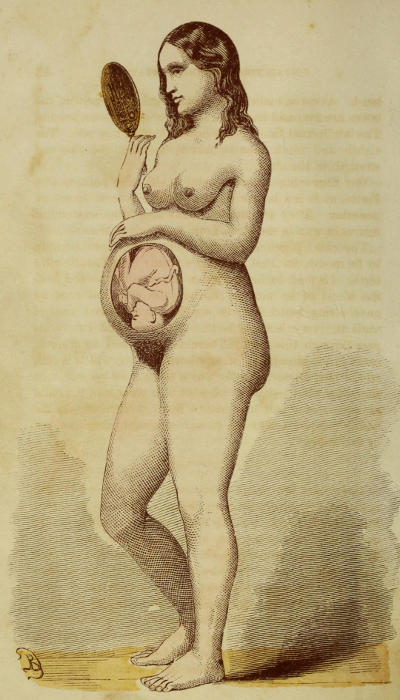
protracted. Shortly before labor is to commence, the belly
sinks, and the hitherto snug-fitting dress will become loose.
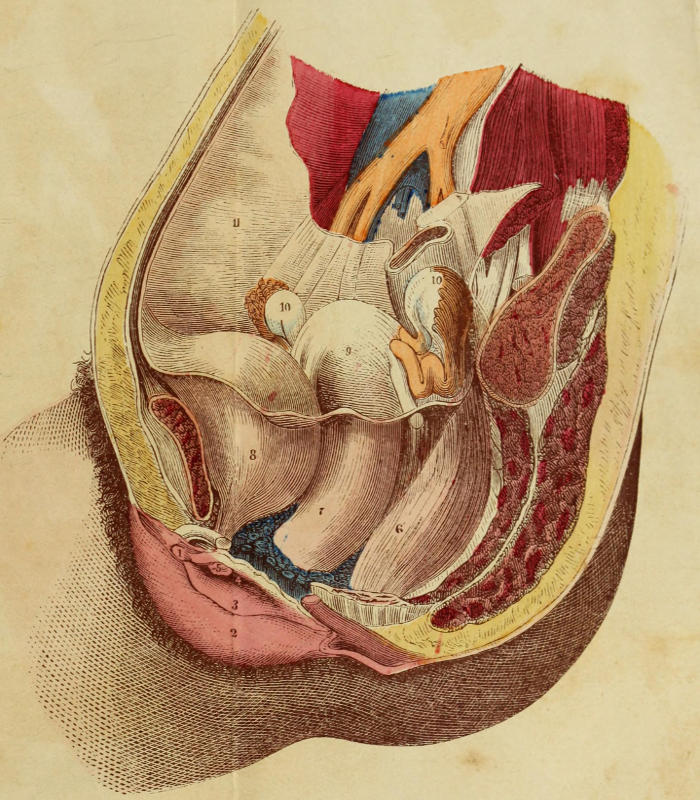
This is caused by the descent of the womb into the bottom
of the belly. The motions and weight of the child are
also felt to be lower than usual, and if in a natural position,
the head will fall down to the orifice of the womb,
and press upon it. This drives forward the membranes
which restrain the water at the orifice, and at the proper
moment they break, and labor then commences.
Labor is caused by involuntary contractions of the uterus
and abdominal muscles. By their force the liquor
amnii flows out, the head of the fœtus is engaged in the
pelvis, it goes through it, and soon passes out by the valve,
the folds of which disappear. These different phenomena
take place in succession, and continue a certain time: they
are accompanied with pains more or less severe, with
swelling and softening of the soft parts of the pelvis and
external genital parts, and with an abundant mucous secretion
in the cavity of the vagina. All these circumstances,
each in its own way, favor the passage of the fœtus.
The precursory signs of labor are as follows: Two or
three days before it is to commence, a flow of mucus takes
place from the vagina, and the external genital parts swell
and become softer: it is the same with the ligaments that
unite the bones of the pelvis; the mouth of the womb
flattens, its opening is enlarged, its edges become thinner,
and slight pains, known under the name of flying pains,
are felt in the loins and abdomen. At the next stage pains
begin to be felt in the lower part of the back, or lumbar
region, and tend towards the womb, or the rectum: these
occur at intervals of fifteen to thirty minutes, and each is
accompanied with contraction of the womb, and tension
of its neck, which begins to open. If a finger is now introduced
into the vagina, a considerable tumor may be
felt, which is a protrusion of the membrane coverings of
the fœtus, containing the first waters. The pains gradually
become stronger up to the time when the membranes break,
and labor actually begins.
The uterus now contracts on itself, and is applied to the
surface of the fœtus. Soon the pains and contractions of
the uterus increase considerably, and are accompanied by
the contraction of the abdominal muscles. The woman
should favor this state of things by making all the muscular
efforts in her power, (straining.) As the labor progresses,
her pulse will become stronger and more frequent;
her face becomes animated; her eyes grow brighter; her
whole body is in extreme agitation; perspiration flows in
abundance; until the head of the child descends into the
lower strait of the pelvis.
At this stage there is a discharge of whitish matter from
the vagina, and pains occur which extend from the small
of the back, or loins, and the groins, down towards the
front, or private parts; and sometimes the membranes will
even protrude through the external opening. Presently a
strong pain comes on, crack go the membranes, the liquor
amnii gushes out with a rush, deluging the bed. After
this there are longer intervals between the pains, and on
the midwife’s introducing her finger, she can feel the head
of the child. As the pains increase in intensity, the patient
is apt to scream, though some women of firmness
will suppress their feelings: she lays hold of a towel,
which is commonly fastened to the bed-post for this purpose,
and bears down with all her might: her pulse now is
rapid, and her skin is hot; the process still goes bravely
on; the pains are now more frequent, stronger and lasting.
The head of the child now gradually descends lower
and lower in the vagina until it presses on the perinœum,
or outer edge of the private part adjoining the anus. In
this stage of the labor an inexperienced midwife would
think that a few pains more would expel the child, but
although the head rests upon the perinœum, and shows
itself at the external orifice, yet it may be some hours before
it is expelled, more especially if it is a first child; but
if the second or third, half-a-dozen more pains will generally
be sufficient to complete the process.
During this time the woman usually suffers some from
head-ache, looks intensely red in the face, and often experiences
a trembling of the lower limbs.
The outer passage will now begin to enlarge gradually,
and the head appears. When it is advanced as far as its
ears, it is said to be “in the passage.” When the birth
has advanced one-third, the midwife may assist the expulsion
if she chooses, though Nature alone would accomplish
it. When the child is born, the midwife should lay it upon
her knees, with its face down, so as to give exit to the
mucus, waters, &c., from the mouth, if any has been imbibed,
which is most generally the case.
Now that the child is born, there is a freedom from pain
and the mother feels rejoiced at the sudden transition from
severe suffering to comparative ease. In about ten minutes
she again begins to experience pains, which are, however,
slight, or less violent than before, in the region of the uterus,
coming and going about every five minutes. On examination,
the accoucheuse will find a quantity of clotted
blood expelled, and on passing up the finger along the
cord, she will discover the after-birth, or placenta, as it is
called, forced into the upper part of the vagina. If not
attached to the womb, which is easily known by carefully
pulling at the cord, the midwife will separate it gently, by
introducing her hand. The navel-string must be divided
as soon as the child is born; which may be done with a
pair of scissors, having first tied a string as well on the
child’s side of the cord as the mother’s, to prevent hemorrhage.
The placenta being taken away, the labor is now
over.
An hour after, let the mother take a little oil of sweet
almonds, to ease the after pains; and let a poultice of oil
of sweet almonds, and two or three new-laid eggs, be boiled
together, and laid to the parts, renewing at every six
hours for two days. Fifteen days after the birth, the parts
may be bathed with an astringent decoction of red roses,
alum, or nut-galls in red wine, in order to brace them.
The following is the formula I usually employ: Red-rose-leaves,
1 ounce; Alum, 2 drams; Ordinary Claret, half a
pint. Put them into a sauce-pan and let them boil for five
or ten minutes. After having stood for fifteen or twenty
minutes to cool, strain, and apply warm to the parts.
The above is a brief description of a healthy delivery;
and such are the usual ones. In some cases, however, the
labor may be tedious and difficult, when the lower part of
the belly must be covered with a flannel cloth dipped in a
hot decoction of bitter herbs, as tanzy, hops, wormwood
and catnep, of each a small handful, to which put three
pints of equal parts vinegar and water; boil for half an
hour in a covered vessel. Wring the flannel out and apply
warm over the region of the womb, which will relieve the
tension and ease the pain, besides gently stimulating the
uterus to contract more forcibly on its contents, whereby
the labor is facilitated.
Stimulating injections by the bowels, may now and then
be administered—especially if the woman be at all costive.
The midwife should also push back with her longest finger
the os coxygis, which tends to excite the labor and ease
the pain. If the parts are in a stiff, straitened condition,
as in the first child, especially if the woman is not young,
emollient liniments are to be used, and the parts must be
anointed with fresh butter or oil, and to be dilated gently
with the hand. If there is a tumor, carbuncle, or membrane
opposing the birth, the assistance of an experienced
surgeon is required.
Always in difficult labors, the patient should be made as
cheerful as possible by her friends, by the recital of lively
and amusing anecdotes, and by every species of encouragement
in their power; as a depressed and melancholy state
of mind invariably retards the labor.
Women in labor, who have a languid circulation and a
weak constitution, are benefited by cordials and good nourishment.
Let half a glass of wine be given every two
hours, which will invigorate the system, and render the
action of the uterus more powerful.
If the feet present first, the midwife must be very cautious
lest there be twins, and lest she should take a foot of
each. The feet must be wrapped in a dry napkin, and the
child must be drawn gently, till the waist is in the orifice
of the uterus. Then the infant’s hands must be drawn
down close to the sides; and if the nose be turned towards
the pubic bone in front, it should be placed in an opposite
direction to prevent any obstacle. If the chin is embarrassed,
the midwife must disengage it, by putting her finger
into the mouth, in order to turn to advantage. In case the
infant’s head presents across the passage, or laterally, it
must be gently thrust back, and carefully turned to its
natural situation. If the shoulder presents, the same tact
and talent must be employed, although the difficulty is
greater. If the belly, hip, or thigh appears first, the child
must be extricated by gentle traction made at the feet, and
the mother must lie flat on her back. If one or both hands
are directed upward, above the head, and lie close to it, the
case is not so bad as some would apprehend; for they will
keep the orifice equally dilated till the head passes, and
thus prevent strangling.
When the fœtus dies before the time of birth, and the
membranes are not yet ruptured, it will not putrefy; therefore
the work must be left to Nature, for the pains of labor
will at length come on spontaneously. Baudelocque says,
if the navel-cord first appears, and is compressed soon after
by the head of the infant, its life is in danger; and the
remedy is to return the infant, and reduce the cord, till the
head fills the opening. But if this cannot be done, the woman
must be put in a suitable posture, and the child must
be extracted by the feet.
When the placenta first presents itself, which is known
by its spongy, soft texture, and the great quantity of blood
flowing at the same time, it requires speedy assistance.
If the membranes are entire, they should be broken, the
placenta and membranes should be returned into the
uterus, and the child be extracted by the feet (which is
more readily effected in the membranes than in the uterus),
and put into a proper situation. When there is a great
flow of blood from untoward accidents, the infant should
be immediately delivered by art, though the mother be not
in true labor.
I would caution all how they use the instruments when
the mouth of the womb is not fully opened, and never to
resort to them unless actually compelled to do so by some
serious danger which is to be apprehended from delay.
Many cases of this kind do occur, it is true, in large cities,
if one happens to have a large practice in this branch of
the Healing Art.