Gay: Principles and Practice of Judging
Live-Stock.
Goff: Principles of Plant Culture.
Guthrie: The Book of Butter.
Harper: Animal Husbandry for Schools.
Harris and Stewart: The Principles of
Agronomy.
Hitchcock: Text-book of Grasses.
Jeffery: Text-Book of Land Drainage.
Jordan: Feeding of Animals. Revised.
Livingston: Field Crop Production.
Lyon: Soils and Fertilizers.
Lyon, Fippin and Buckman: Soils; Their
Properties and Management.
Mann: Beginnings in Agriculture.
Montgomery: The Corn Crops.
Morgan: Field Crops for the Cotton-Belt.
Mumford: The Breeding of Animals.
Piper: Forage Plants and their Culture.
Sampson: Effective Farming.
Thom and Fisk: The Book of Cheese.
Warren: Elements of Agriculture.
Warren: Farm Management.
Wheeler: Manures and Fertilizers.
White: Principles of Floriculture.
Widtsoe: Principles of Irrigation Practice.
THE BOOK OF ICE-CREAM
BY WALTER W. FISK ASSISTANT PROFESSOR OF DAIRY INDUSTRY, NEW YORK
STATE COLLEGE OF AGRICULTURE AT
CORNELL UNIVERSITY
New York
THE MACMILLAN COMPANY
1919
All rights reserved
Copyright, 1919 By THE MACMILLAN COMPANY
Set up and electrotyped. Published November, 1919.
PREFACE
The older ones of us look back on the ice-cream of our
youth as a luxury, to be expected on festivals and holidays.
The rising generation, however, is coming to look
on it as a food. Once the manufacture of the confectionery
shop and the household, it is now produced in great
quantities by concerns devoting themselves to it entirely,
making it by highly developed standardized processes.
A line of special machinery has been perfected for its
manufacture. The subject is taught in the colleges. Yet
the home manufacture has not passed and should not
pass; rather should the product be made more frequently
and in larger quantity in the household.
No longer must one offer an excuse for a book on ice-cream.
This book is made for class-room and laboratory
use, growing out of the author’s teaching experience;
the manufacturer’s interest has been set forth; yet it
is hoped that the housewife will find directions for her
use.
Acknowledgment is due the following parties for
valuable assistance either for the illustrations, or definite
information or helpful criticisms: Henry Vogt Machine
Co., Louisville, Ky.; Wheats Ice Cream Co., Buffalo,
N. Y.; DeLaval Separator Co., New York, N. Y.; Jamison
Cold Storage Door Co., Hagerstown, Md.; Merrell-Soule
Co., Syracuse, N. Y.; The Ekenberg Co., Cortland, N. Y.;
Chapin-Sacks Mfg. Co., Washington, D. C.; The Creamery
Package Mfg. Co., Chicago, Ill.; York Mfg. Co.,
York, Pa.; Davis-Watkins Dairymen’s Mfg. Co., Chicago
Ill.; J. G. Cherry Co., Cedar Rapids, Ia.; Emery Thompson
Machine and Supply Co., New York, N. Y.; T. D.
Cutler, Ice-Cream Trade Journal, New York, N. Y.;
Brunswick Refrigerating Co., New Brunswick, N. J.;
L. O. Thayer, The International Confectioner, New York,
N. Y.; Mojonnier Bros., Chicago, Ill.; Sharples Separator
Co., West Chester, Pa.; Joseph Burnett Extract Co.,
Boston, Mass.; Nafis Glass Co., Chicago, Ill.; J. E. Reyna,
Dept. of Drawing, New York State College of Agriculture,
Ithaca, N. Y. The following members of the
Dairy Dept. of the New York State College of Agriculture
at Cornell University, Ithaca, N. Y.: W. A. Stocking,
H. E. Ross, T. J. McInerney, W. E. Ayres, G. C. Dutton,
H. C. Troy, E. S. Guthrie, G. C. Supplee.
Method of securing supply, 5; Quality of milk and cream desired, 6; Why
milk and cream are not of the desired quality, 7; The flavor of foods eaten by the cow, 8; The
absorption of flavors and odors in the atmosphere, 9; The unhealthy condition of the cow, 10;
The bacteria in the milk, 11; The sediment test, 12; How to prevent the growth of
micro-organisms in the milk and cream, 13; Milk and cream production and handling, 14;
Clarifier, 15; The chemical composition of the milk and cream, 16.
CHAPTER III
MANUFACTURED MILK PRODUCTS AS RELATED TO ICE-CREAM
Condensed and Evaporated Milk: Method of manufacture, 17; Standards for condensed milk,
18; Conditions essential for a milk condensory, 19; Supply of condensed milk for the ice-cream
plant, 20. Milk Powder: Standards for milk powder, 21; Powdered milk processes,
22; Merrell-Soule powdered milk, 23; History
of Merrell-Soule process, 24; Uses of Merrell-Soule powder in ice-cream, 25; Ekenberg powdered
milk, 26; Uses of Ekenberg powder in ice-cream, 27; Butter, 28.
CHAPTER IV
SUGAR, CHOCOLATE PRODUCTS, FRUITS, STABILIZERS AND FILLERS
Sugar, 29; Invert sugar, 30; Sugar-saving substitutes, 31;
Cocoa and cocoa products, 32; Manufacture of chocolate and cocoa, 33; Composition of cocoa products,
34; Adulteration of cocoa and standards of purity, 35; Chocolate sirup, 36;
Fruits, 37; Nuts, 38; Stabilizers and fillers, 39; Gelatine,
40; Preparing gelatine for use in the ice-cream, 41; Gum tragacanth, 42; Other
substances used as binders, 43; Eggs, 44; Starchy fillers, 45; Prepared ice-cream
powders, 46; Rennet, 47.
Vanilla Extract: Nature of vanilla plant, 48; Curing vanilla beans, 49;
Marketing vanilla beans, 50; Production of vanilla beans, 51; The ingredients of vanilla extract,
52; The chemistry of vanilla, 53; Adulteration of vanilla extract, 54. Lemon
Extract: Preparation of lemon oil, 55; The chemistry of lemon oil, 56; Orange extract,
57; Fruit extracts, 58.
Terms used, 89. Natural Ice: The ice field, 90; The ice-house,
91; Harvesting and storing, 92; Amount of ice needed, 93; Use of ice and
salt mixture, 94. Mechanical Refrigeration: Principles of mechanical refrigeration, 95;
Materials used in mechanical refrigerating systems, 96; Operation of refrigerating machines, 97;
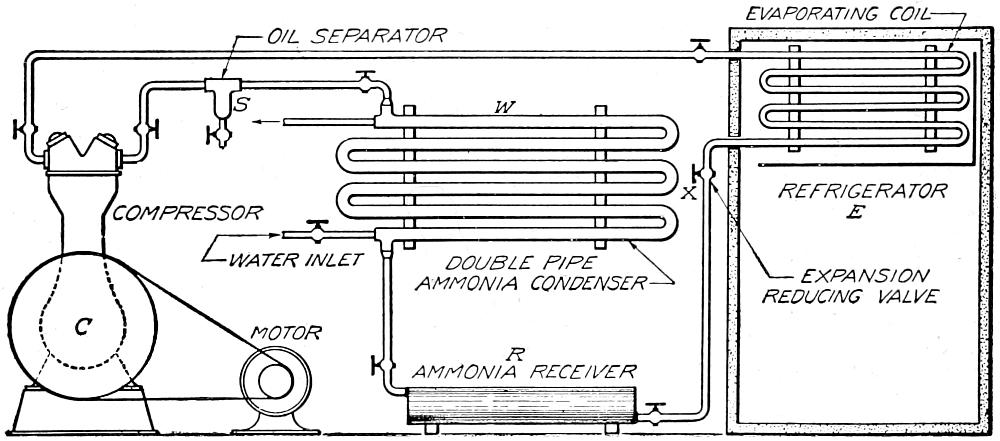
The compression system, 98; Parts of a compression system, 99; Operation of direct expansion compression
system, 100; Location of evaporating coils, 101; Notes on operating compression system,
102. Absorption Systems: Operation of absorption refrigerating systems, 103; Arrangement of
double pipe and atmospheric absorption machines, 104.
Purpose of freezing, 108; Rate of freezing, 109; Proper method of freezing,
110; Over-run or swell, 111; Condition of ice-cream when removed from freezer,
112; Freezing sherbets and ices, 113.
Methods of hardening, 114; Hardening in ice and salt mixture, 115; The slush-box
or brine-box method of hardening, 116; The hardening-room, 117; The still-air type,
118; The gravity air-type, 119; The forced-air type, 120; Defrosting the
coils, 121; Time required for hardening, 122; Effects of hardening on quality,
123; Fancy molded ice-cream, 124.
Score-cards, 125; Explanation of characteristics mentioned in score-card, 126; Defects
in ice-cream, 127; Defects in flavor, 128; Defects in body and texture, 129; Defects
in richness, 130; Defects in appearance, 131; Defects in package, 132.
Sources of bacteria in ice-cream, 133; The effect of freezing and hardening on the bacterial count,
134; Types of organisms in ice-cream, 135; The total-acid groups, 136; The inert
group, 137; The alkali group, 138; The peptonizing group, 139; Colon Bacilli in
ice-cream, 140; Difficulties in studying the bacteriology of ice-cream, 141.
The Babcock Test: Testing whole milk for fat, 142; Composite samples of milk,
143; Measuring the sample, 144; Adding the acid, 145; Whirling the sample,
146; Reading the test, 147; Appearance of a completed test, 148; Care of
the test-bottles, 149; Testing cream, 150; Cream testing apparatus, 151;
Sampling cream, 152; Making the cream test, 153; Tempering the fat and reading the percentage,
154; Testing skim-milk, 155; Modifications of the Babcock test for ice-cream, 156;
The glacial acetic and hydrochloric acid test, 157; The sulfuric acid test, 158; Acetic and sulfuric acid
test, 159; The lactometer, 160; Calculating the solids not fat in the milk, 161;
Testing milk for acidity, 162; Test for formaldehyde, 163; Test for boiled milk, 164.
Testing Butter for Fat, Moisture, and Salt: Preparing the sample, 165; Testing butter for fat, 166;
Testing butter for moisture, 167; Testing butter for salt, 168; Test for viscosity,
169; Standardization, 170; Benkendorf test for over-run in ice-cream, 171;
Test to determine the hardness of ice-cream, 172. Mojonnier Tester: General preliminary information,
173; Testing evaporate, sweetened condensed, bulk condensed milk, ice-cream (mix or melted) for fat or total solids,
174; Fat determination, 175; Total solids determination, 176; Testing butter,
177; Testing fresh milk, skim-milk, whey, and buttermilk for fat and total solids, 178; Testing powdered
milk, cocoa, malted milk and milk chocolate for fat and total solids, 179; Testing cream for fat and total solids,
180; List of precautions to observe in operating Mojonnier tester, 181. Mojonnier Over-run
Tester: Adjusting cups for mix, 182; Actual operation, 183; Controlling the over-run,
184; Savings and economics, 185.
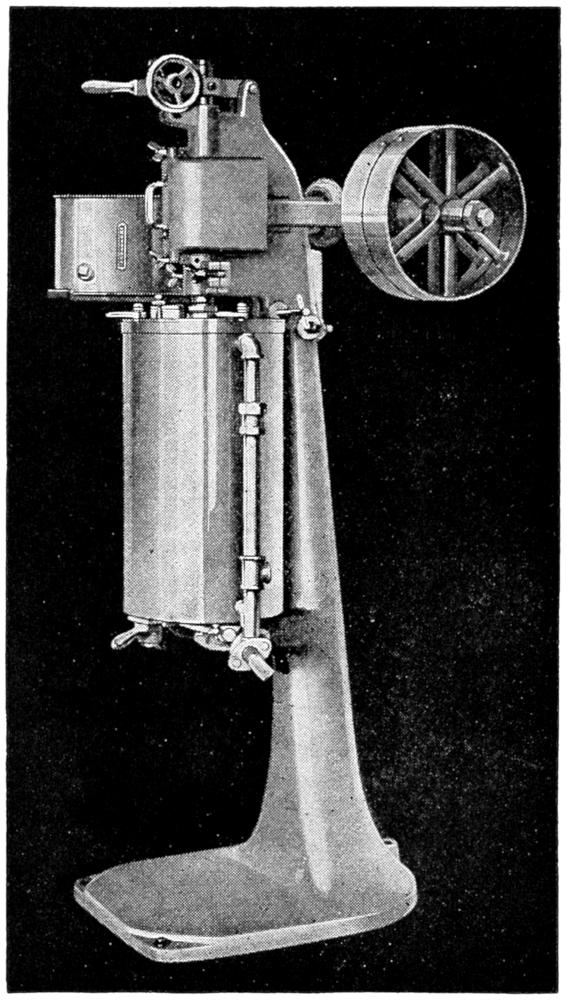
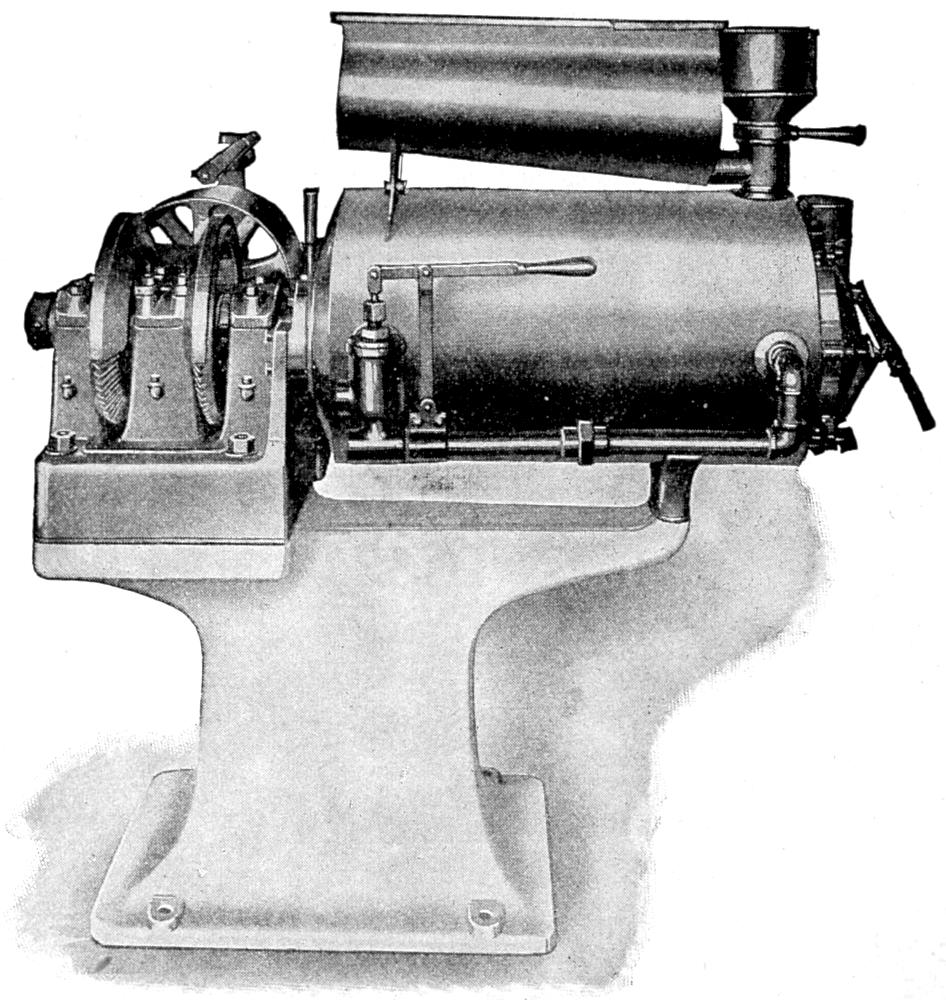
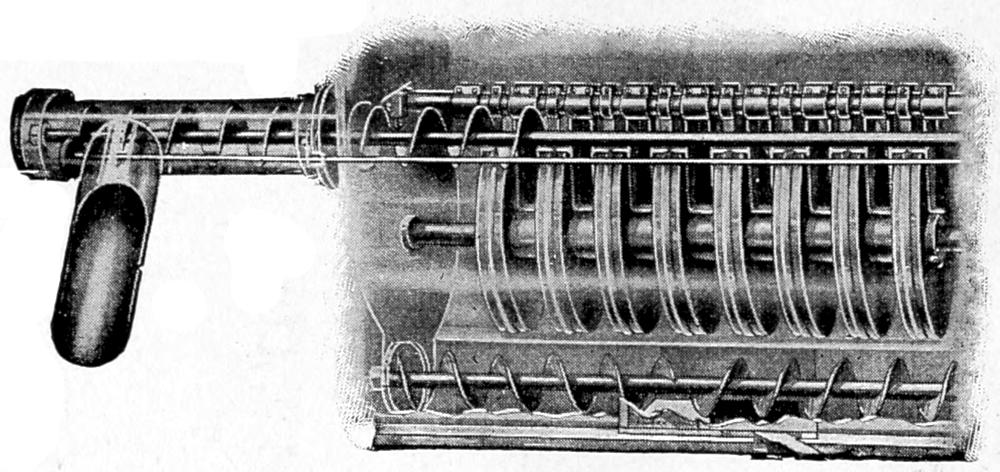
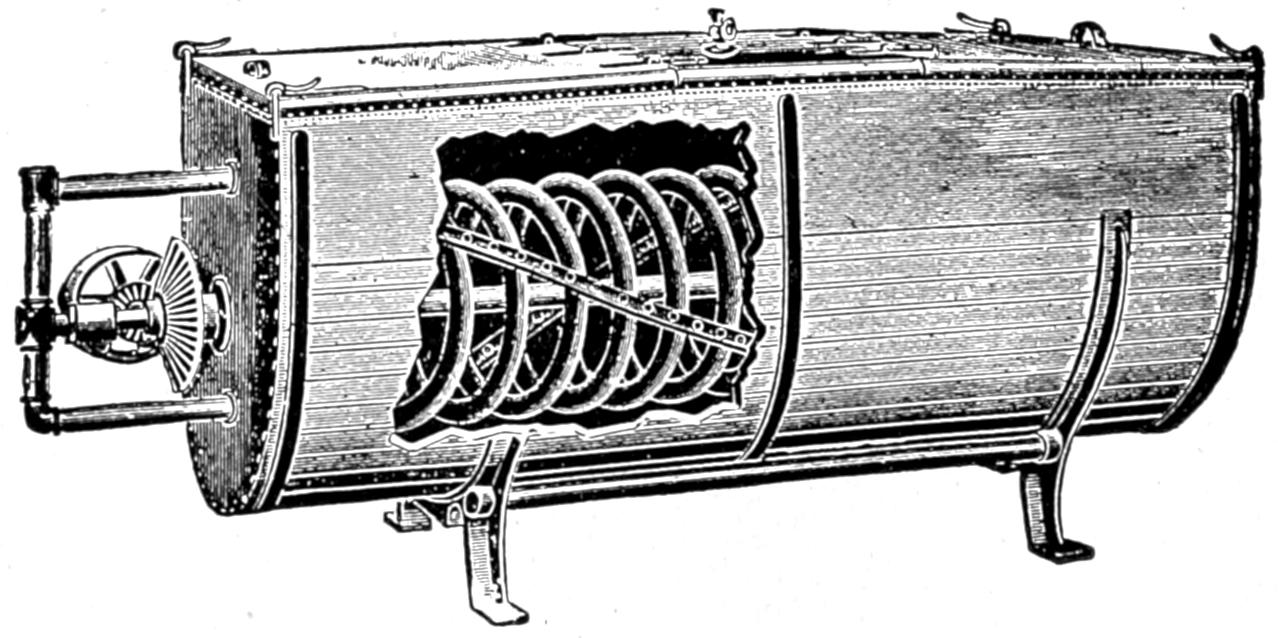
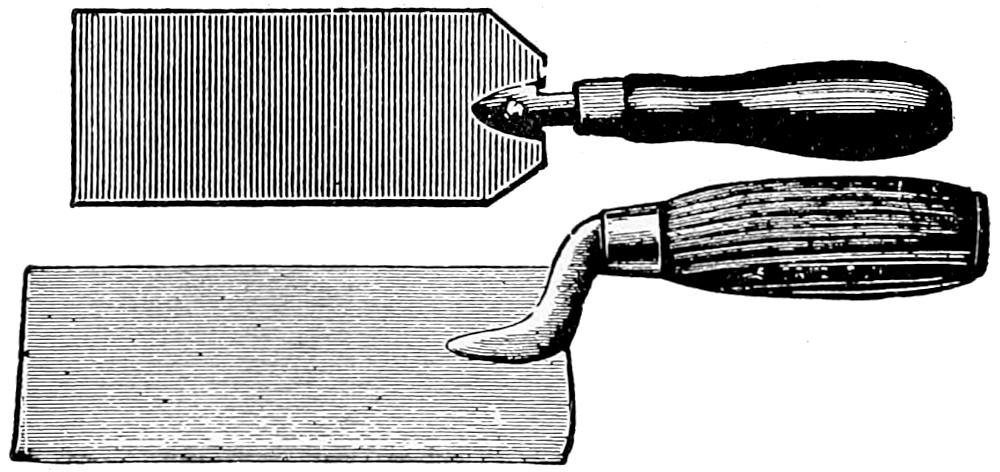
—Freezing discs of freezer shown in Figs. 17 and 18. The scrapers
for removing the frozen ice-cream from the discs and the screw to force it out of the delivery spout are shown. (Courtesy of Creamery Package
Manufacturing Co., New York City.)
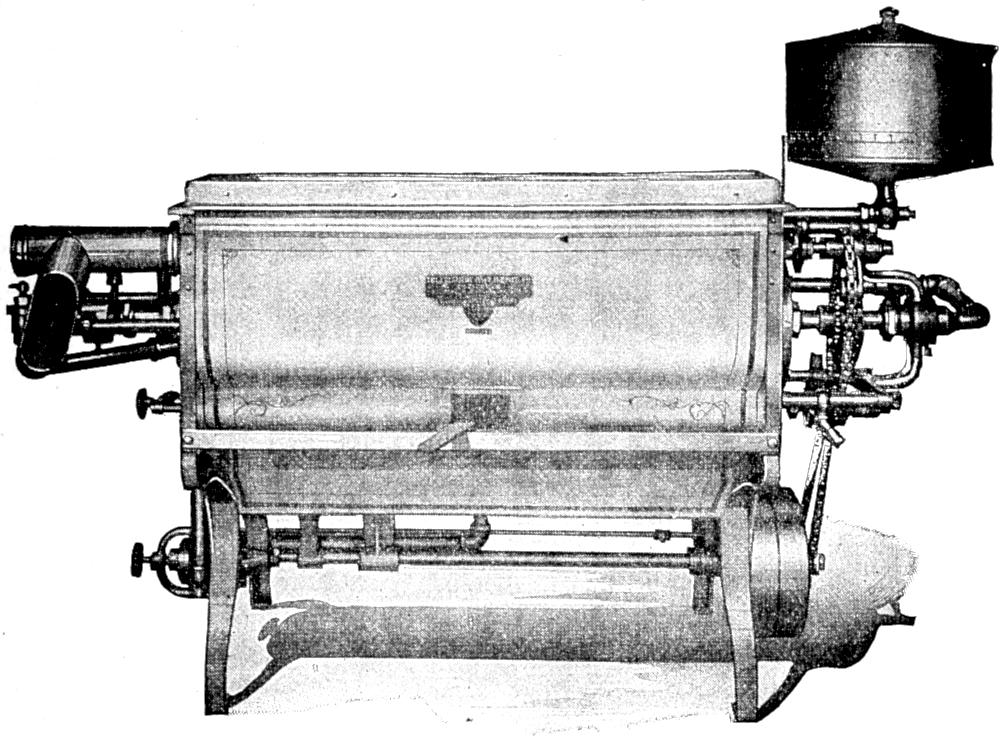
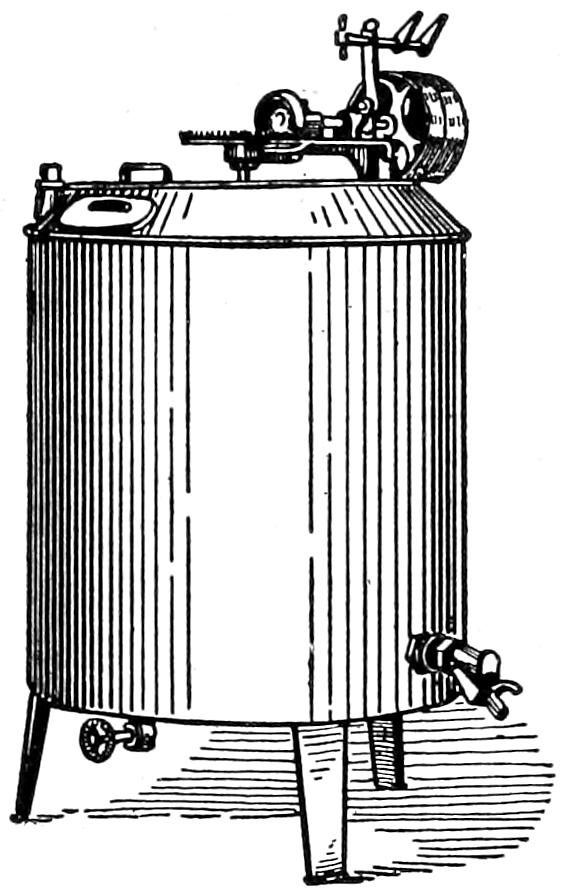
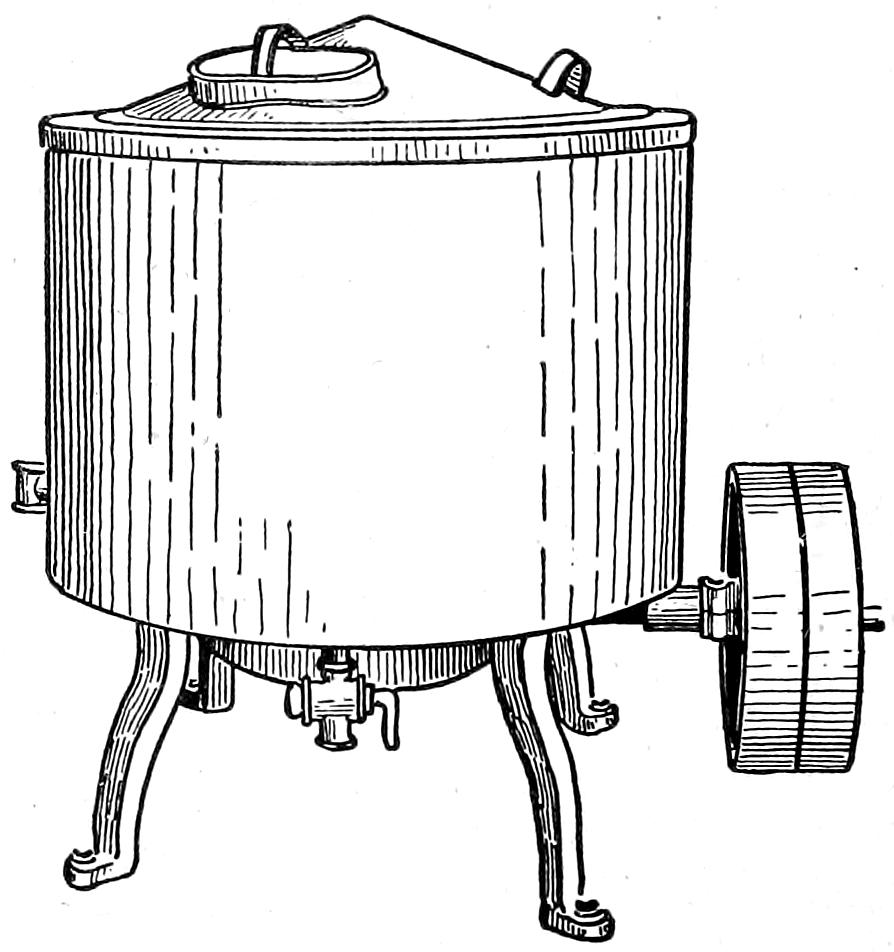
—Alaska ice-cream mixer. The side is cut away showing the coils and
insulation. The mechanical agitator is seen at the bottom. The cover fits air tight so that by means of an air pump and air pressure the mix may be forced to the freezer. (Courtesy of Creamery Package Manufacturing Co., New York City.)
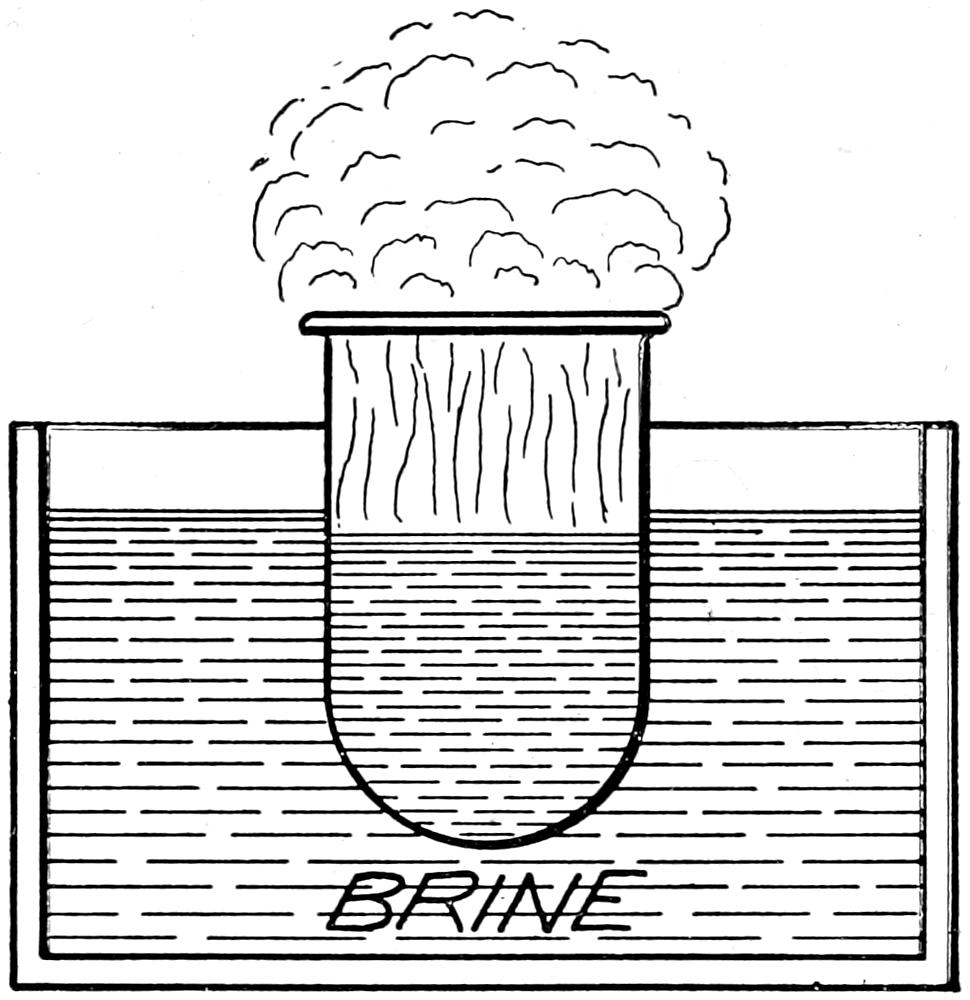
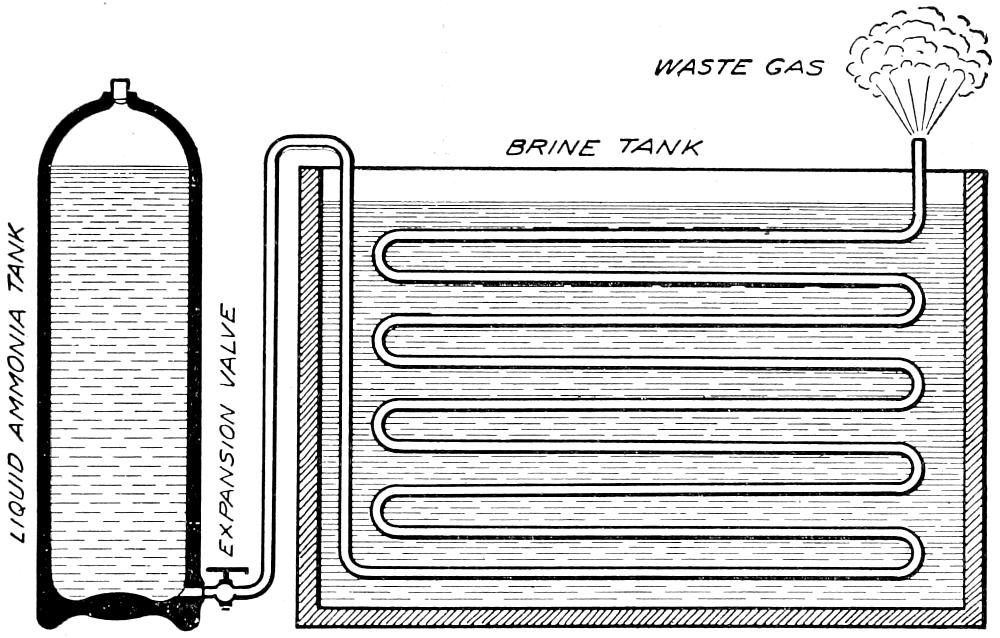
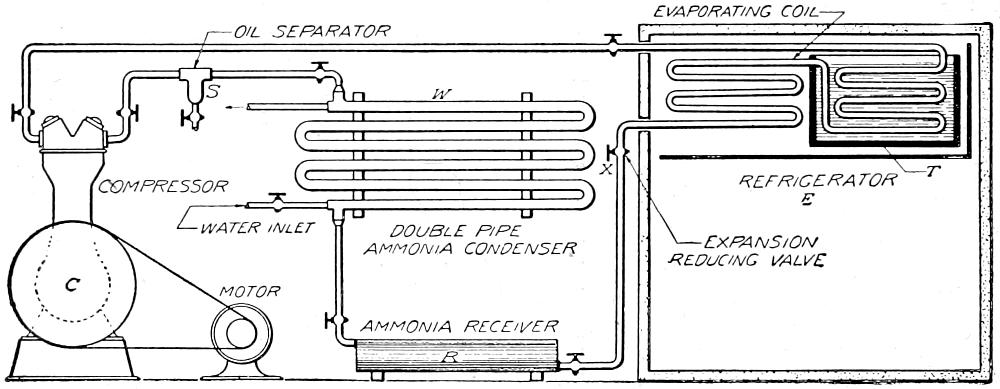
—Compression system of refrigeration in which the flow
of liquid is regulated by expansion valve and the liquid changes to a gas in the coil of pipe thereby cooling the brine. The gas then
passes off into the atmosphere
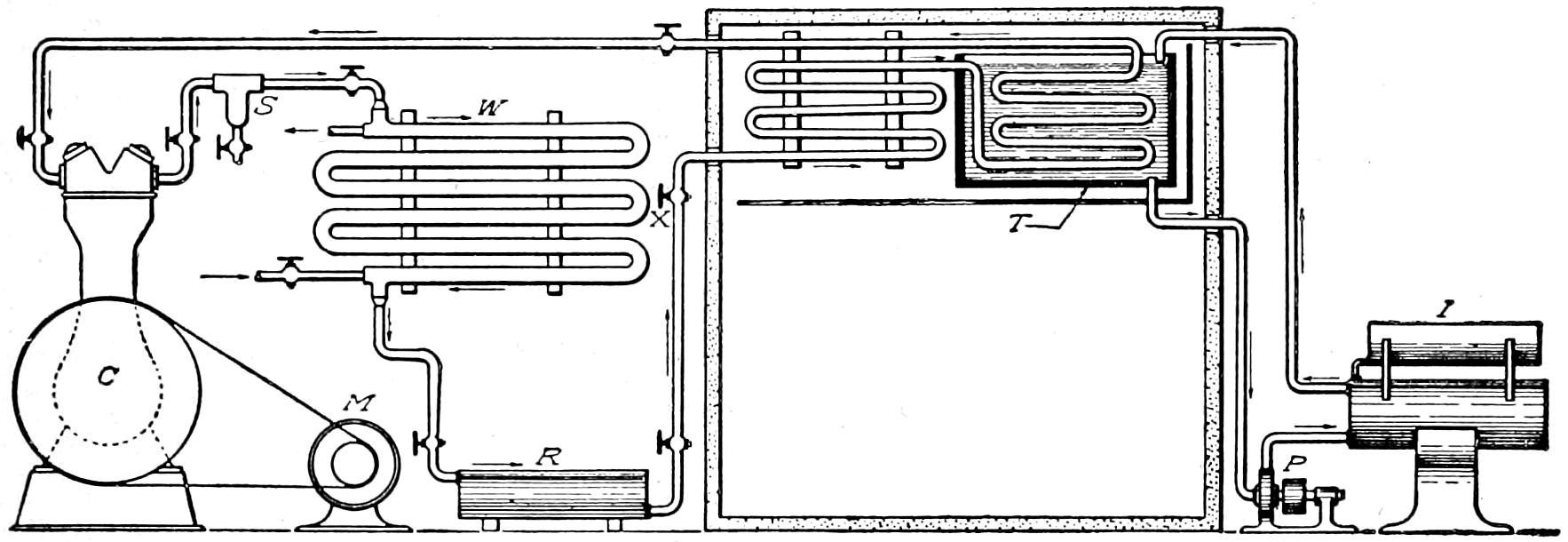
—Combination of direct expansion and brine storage tanks. This is
the same system as shown in Fig. 45 with the brine tank (T) added in the refrigerator
—Arrangement where it is desired to use cold brine for cooling
in some machine such as an ice-cream freezer. This is the same refrigerating system as shown in Figs. 45 and 46
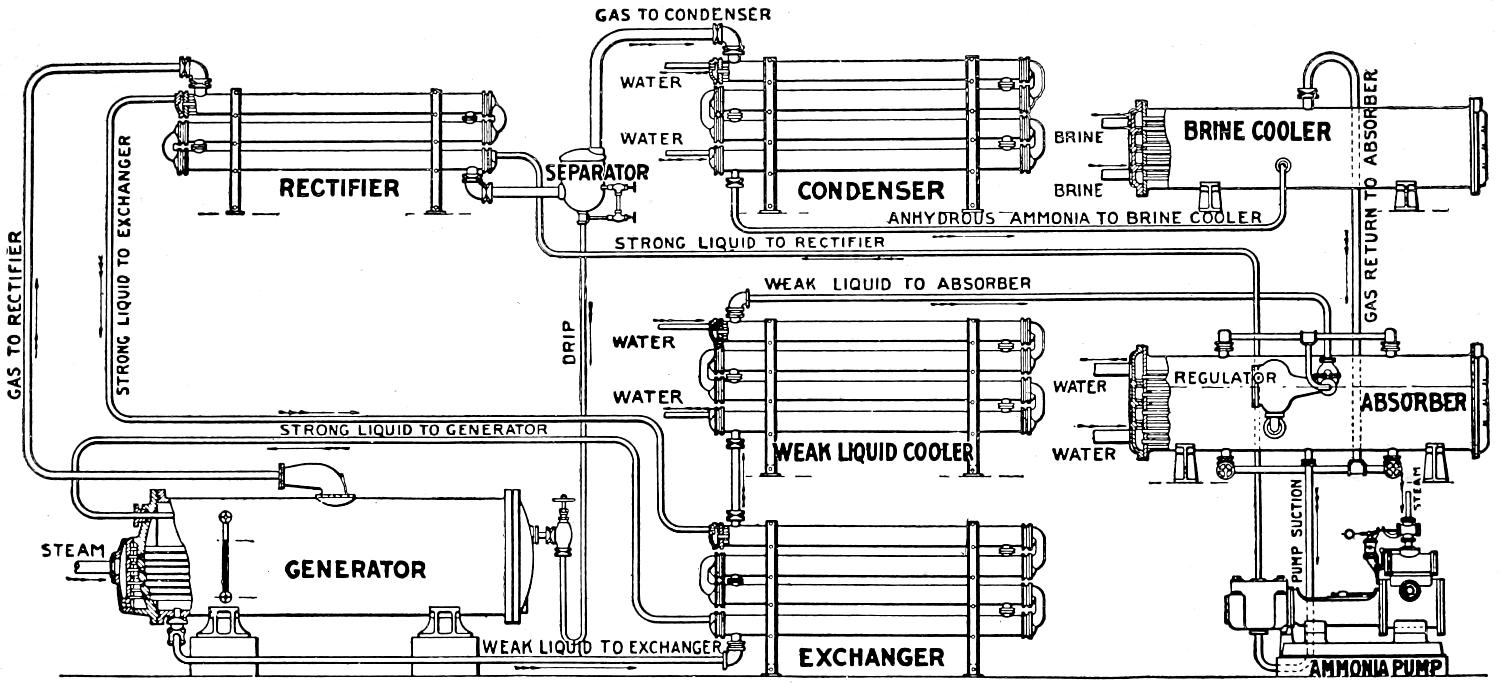
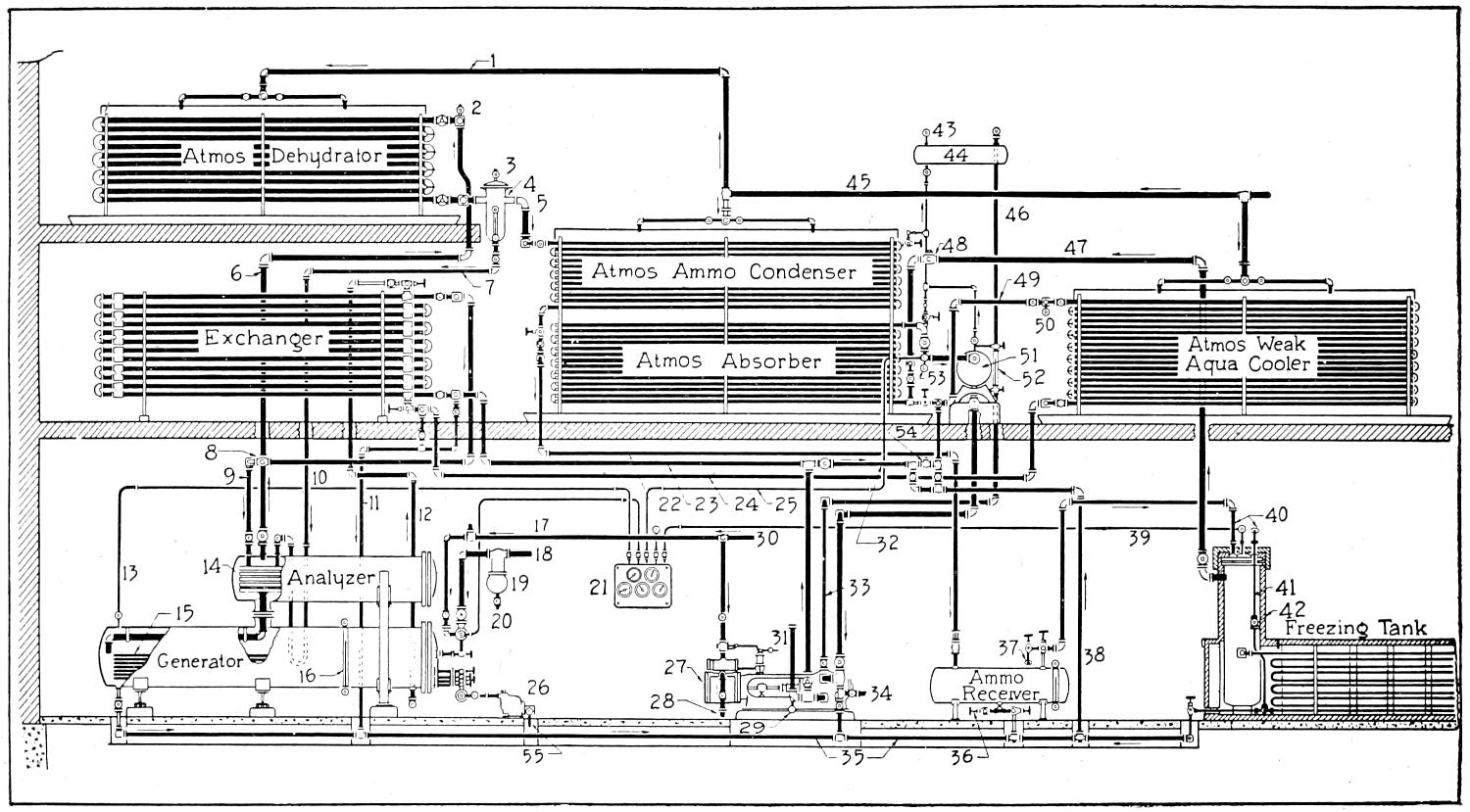
—Diagram of the Vogt absorption refrigerating machine, showing
pipe connections and directions in which the liquids and gases travel throughout the entire system. (Courtesy of Henry Vogt Machine Co.,
Louisville, Kentucky.)
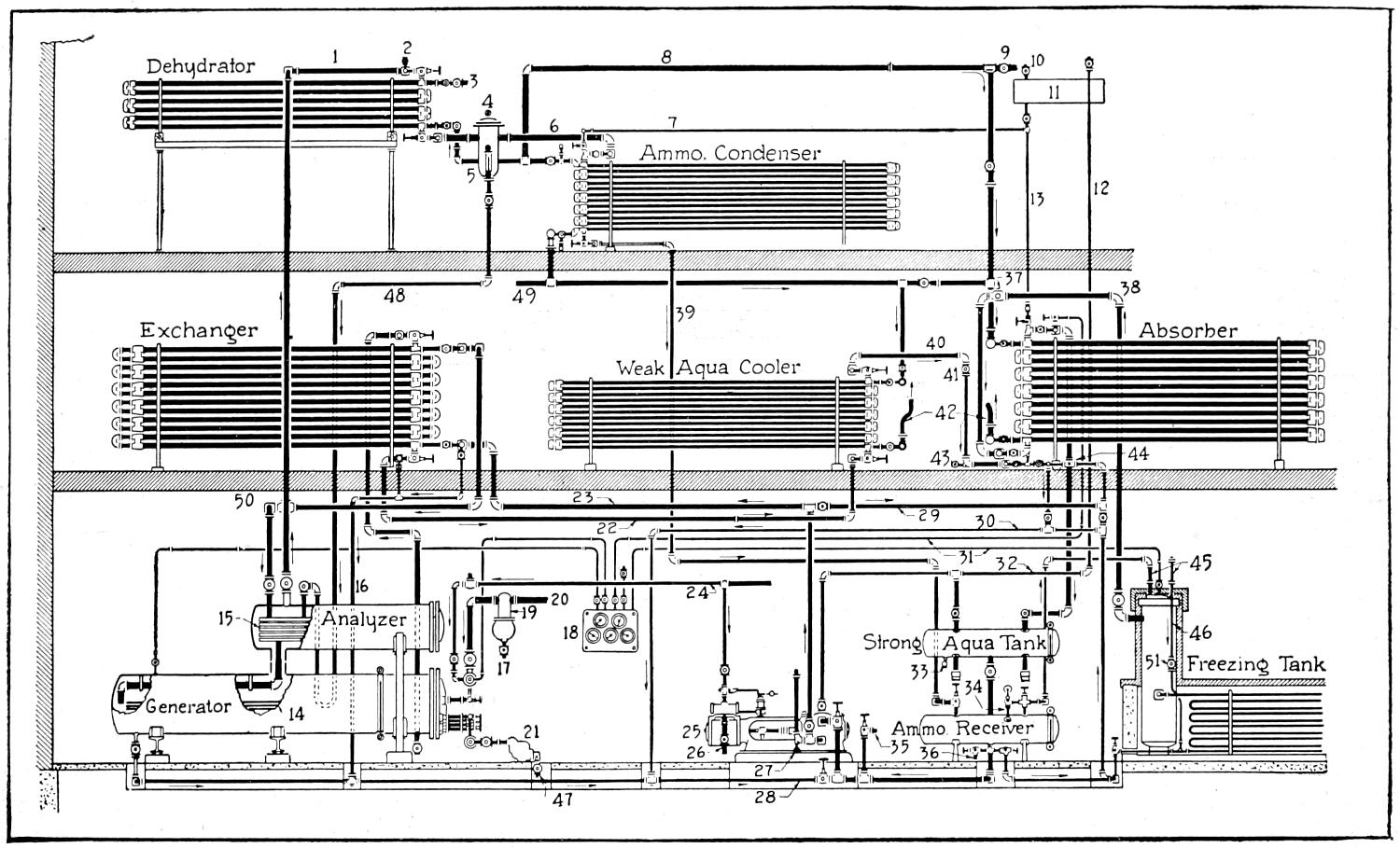
—General arrangement of double pipe absorption refrigerating machine,
showing the connections and the direction in which the liquids and gases flow. (Courtesy of York Manufacturing Company, York, Pa.)
—General arrangement of atmosphere absorption machine showing
the connections and the direction in which the liquids and gases flow. (Courtesy of York Manufacturing Company, York, Pa.)
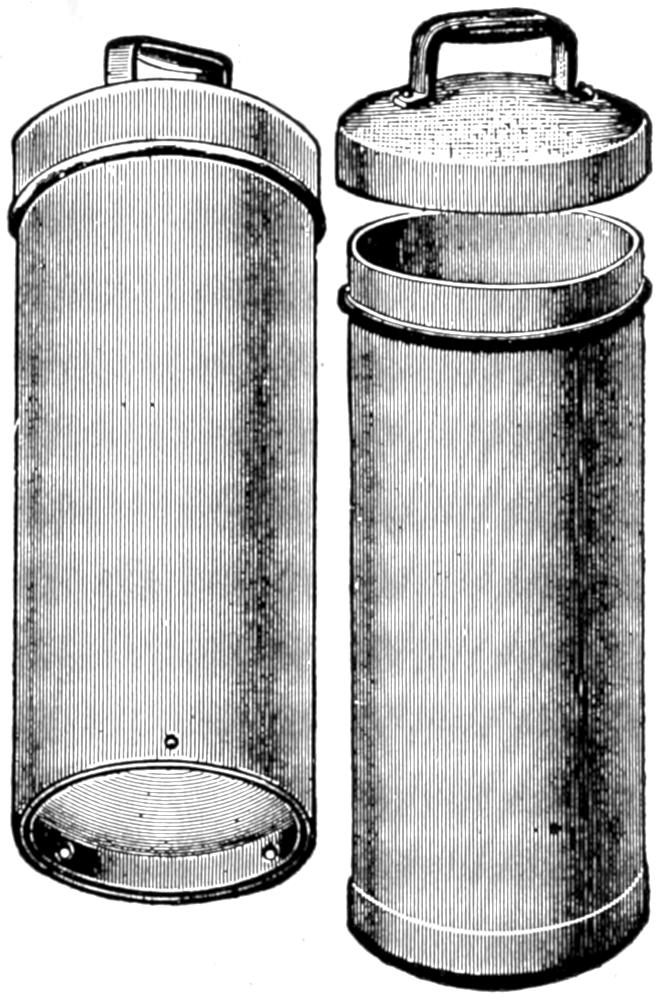
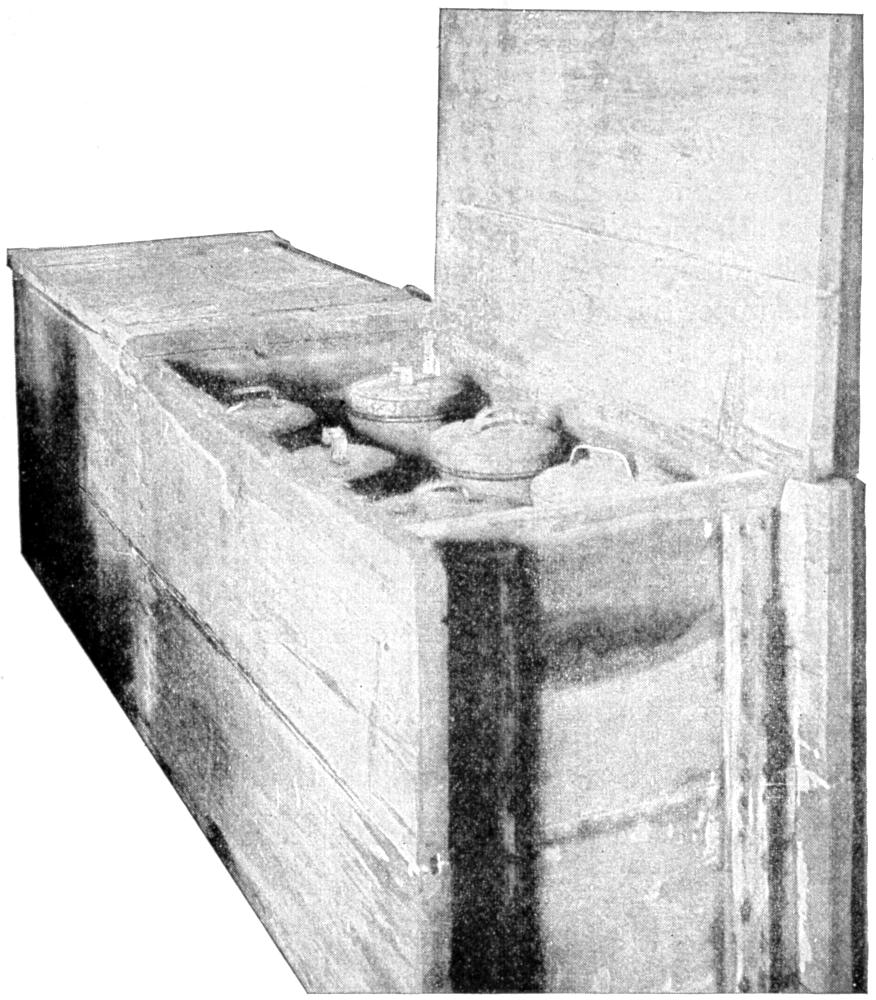
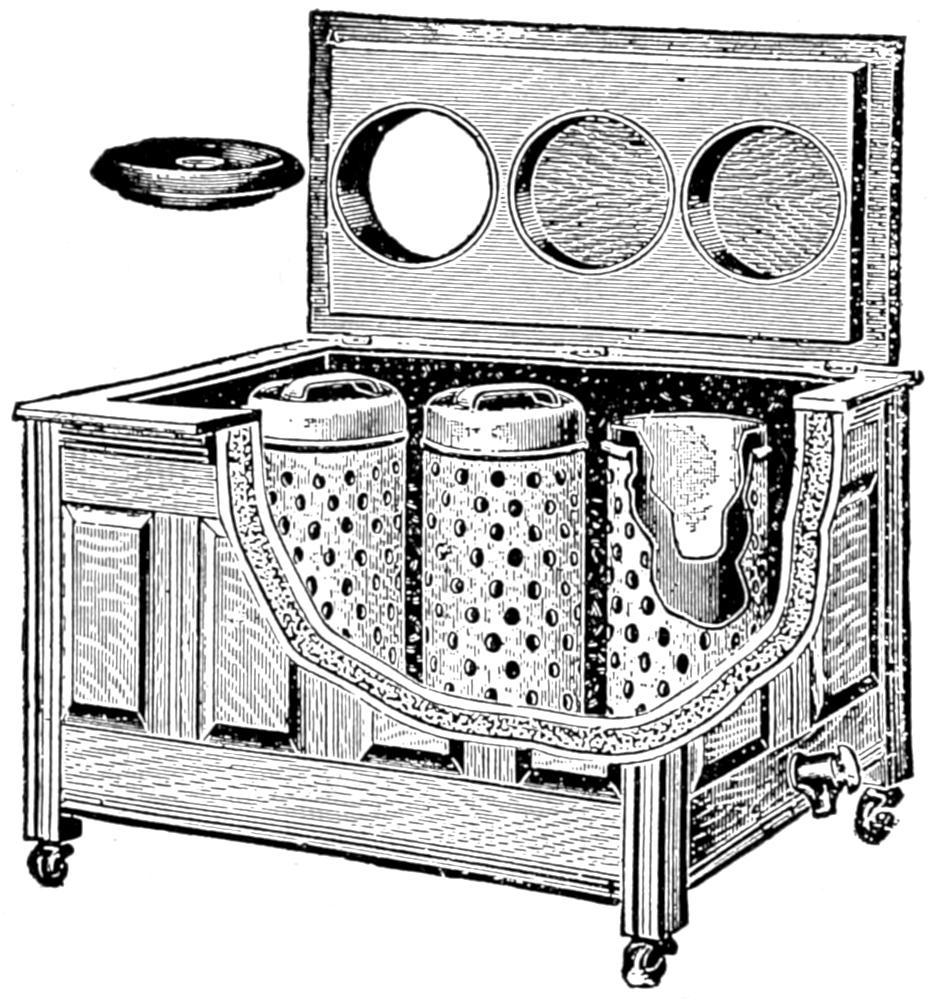
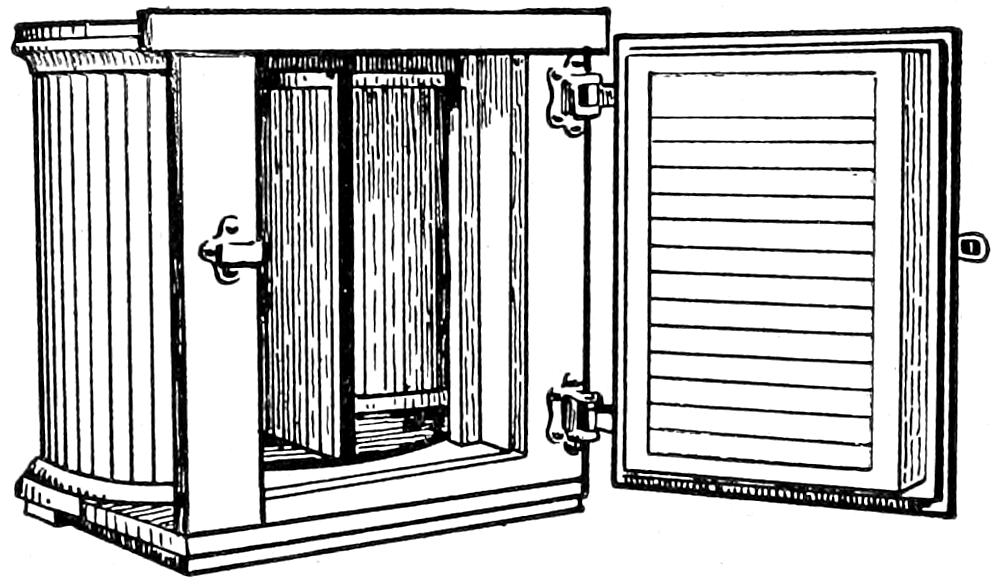
—Plank box for hardening ice-cream in a salt and ice mixture.
The cans are placed in perforated cylinders so that the cans may be changed and the ice will not fall in and fill the
space
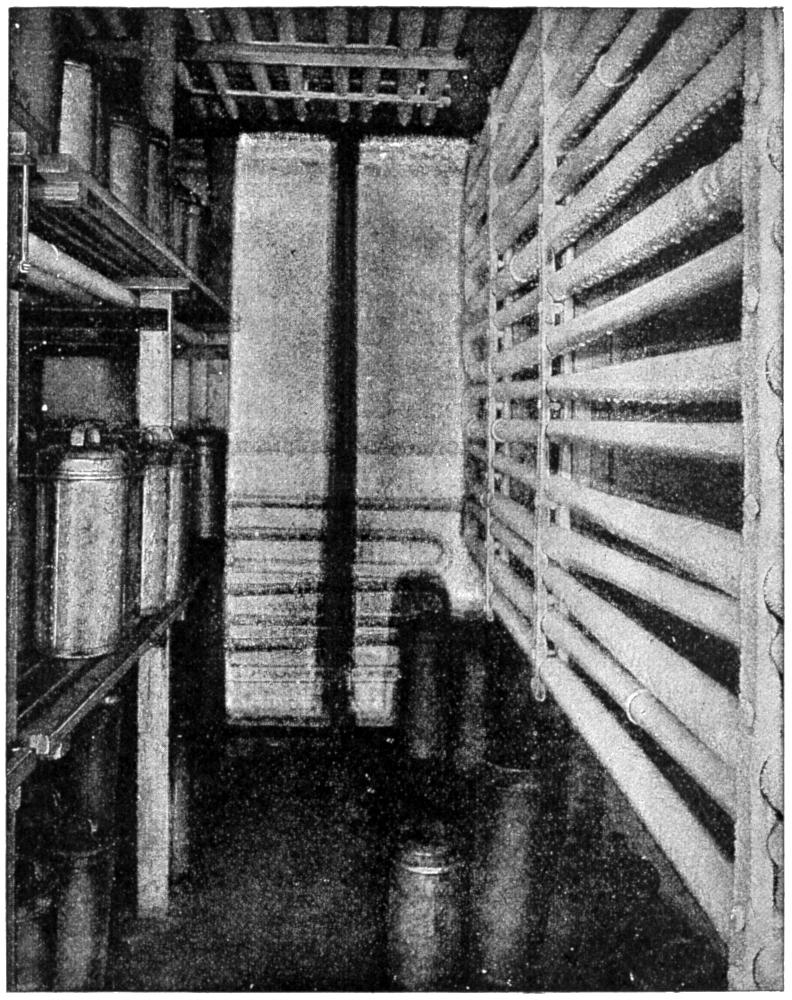
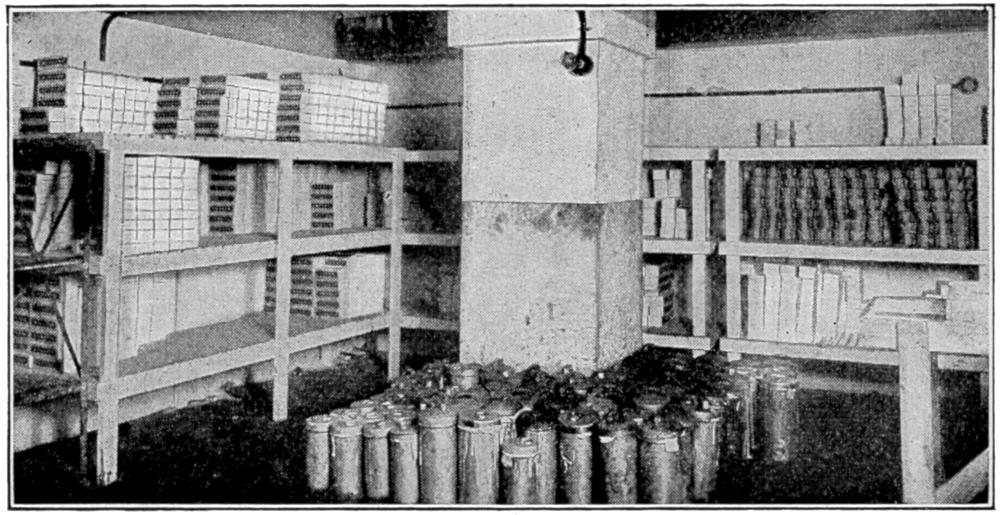
—Still-air hardening-room showing evaporating coils forming
shelves on which the pack-cans of ice-cream are placed to harden. Other evaporating coils may be seen on the sides and ceiling. (Courtesy of
Brunswick Refrigerating Co., New Brunswick, N. J.)
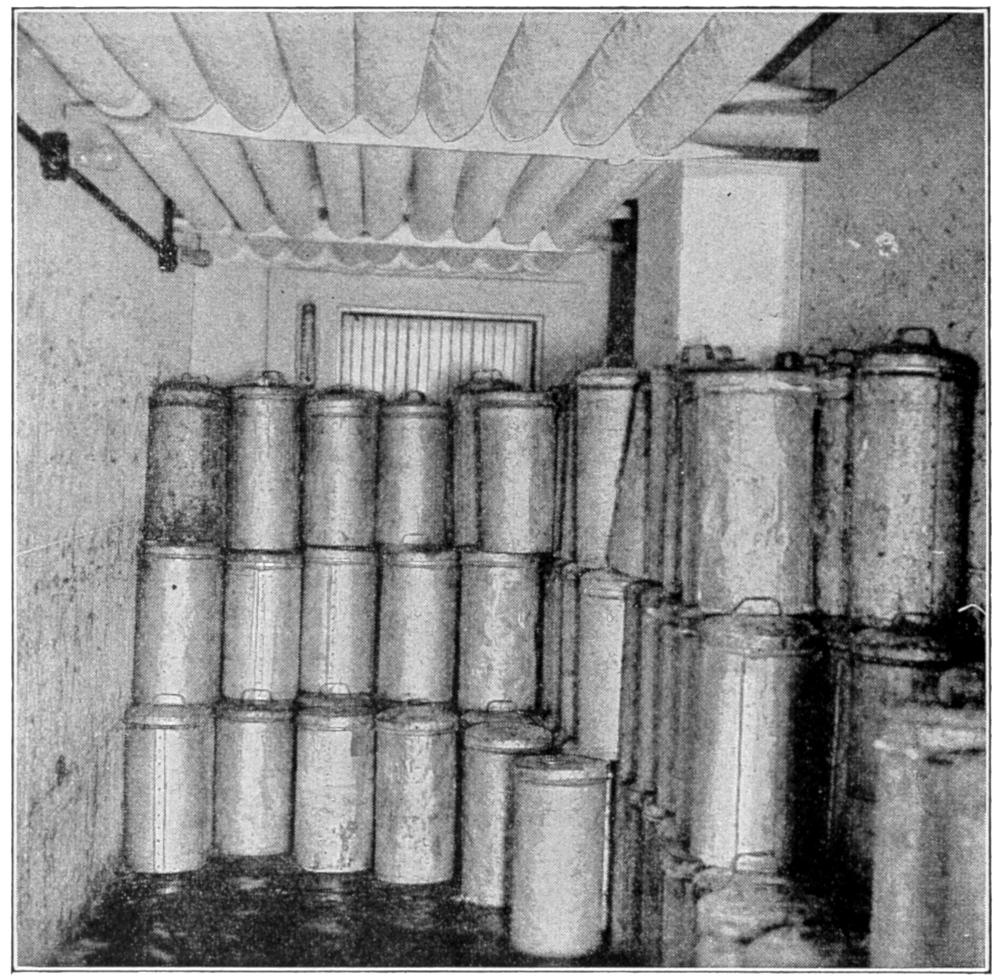
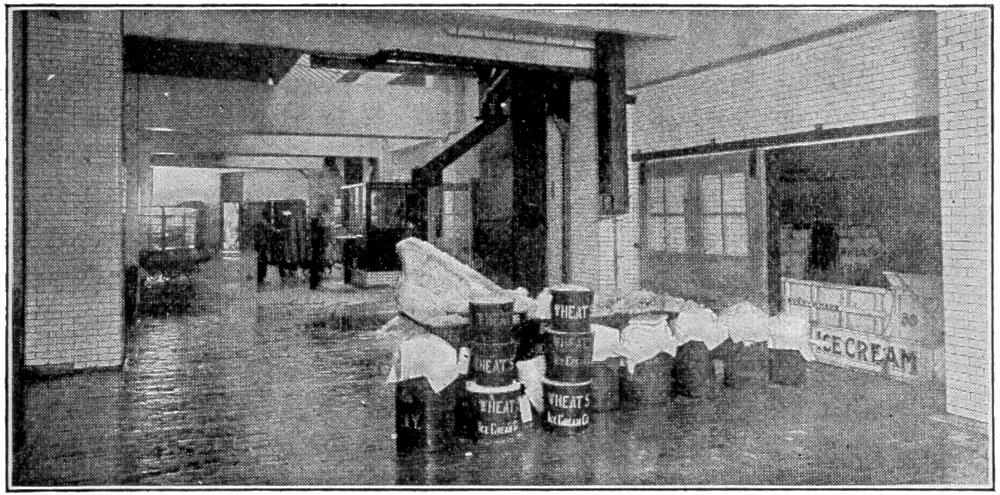
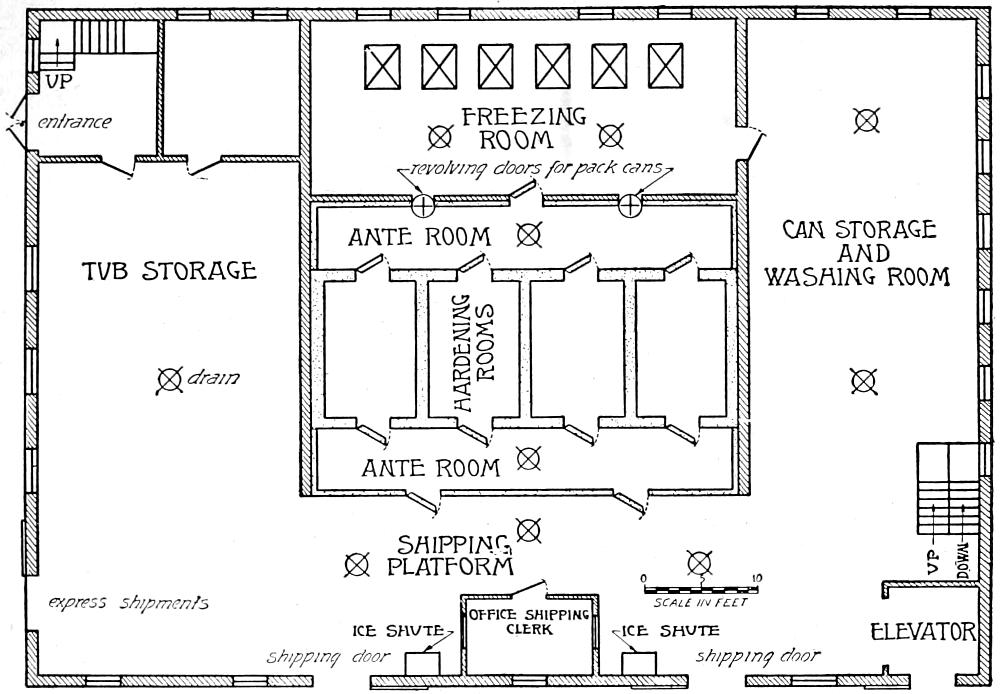
—The value of skylights is shown by the well-lighted freezing-room,
considerable floor space above being sacrificed for this purpose. (Courtesy of Wheat’s Ice Cream Co., Buffalo, N. Y.)
277
THE BOOK OF ICE-CREAM
CHAPTER I GENERAL STATEMENTS ON ICE-CREAM — 1. Materials used in ice-cream. — 2. Definition of ice-cream. — 3. Problems of ice-cream-making. — 4. Ice-cream-making a science.
THE BOOK OF ICE-CREAM
Ice-cream is known commonly to-day as a food, although
in the past it was considered and used only as a
delicacy or dessert. Because of the rapid growth of the
industry and the large number and varying amounts of
materials that can be used in the making of ice-cream,
its composition may be varied within wide limits. The
Federal Government and most of the States have set
standards for ice-cream. Some products, such as custards,
sherbets, ices and the like, are usually included
in the general discussion of ice-creams but technically
should not be classed with them.
—The basis of ice-cream
is some dairy product or a combination of dairy products,
such as milk, cream, skim-milk, condensed milk, milk
powder, homogenized or emulsified milk or cream, and
the like. These materials contain varying amounts of
fat and solids not fat, ranging from 0 to several per cent.
Either one or all may be used, as the manufacturer determines,
to give the ice-cream the desired amount of fat
and milk solids. The price often determines the kind and
amounts of the different materials to be used. It is important
that these dairy products be clean; otherwise the
ice-cream may have an undesirable flavor.
Sugar in some form must be used to sweeten ice-cream.
Granulated sugar was employed ordinarily before the
war. However, in conserving for the war, it was found
that various sirups could be substituted. Corn sirup was
commonly used, and some invert sugar, maple sirup and
honey in smaller amounts.
A large variety of materials may be utilized to flavor
the ice-cream. The extracts commonly employed are
vanilla and lemon. Fruits, either fresh, canned, preserved,
dried or candied, may be used as flavoring, various
bread or cake products, such as macaroons, sweetened
wafers and sponge cake, and also caramel and chocolate
products, usually chocolate or cocoa.
A little color of the proper shade to give the product
the characteristic tint suggested by the flavor is commonly
added.
If the ice-cream is not consumed as soon as it is made,
ice crystals soon separate, causing it to become grainy
in texture. In order to prevent this, some form of
“stabilizer” is added, commonly gelatine. However,
gum tragacanth or some of the prepared ice-cream powders
may be used.
—Because of the large variation
of materials, both in quantity and kind, that may
be used in its making, the definitions of ice-cream are
more or less elastic. The various dictionaries give the
following definitions: Webster,—“Ice-cream is milk or
cream sweetened, flavored, and congealed by a freezing
mixture, sometimes instead of cream the materials of a
custard are used”; Century,—“Ice-cream is a confection
made by congealing variously flavored cream or custard
in a vessel surrounded with a freezing mixture;” Standard,—“Ice-cream
is cream, milk or custard sweetened
and flavored and frozen by a freezing mixture, being
usually agitated by a dasher in the process to make it of
uniform consistency.” The United States Department
of Agriculture bases its definition[1] on the composition
of the finished ice-cream. Its definitions are as follows:
Ice-cream is a frozen product made from cream and
sugar with or without a natural flavoring and contains
not less than 14 per cent of milk-fat.
Fruit ice-cream[1] is a frozen product made from cream,
sugar and sound, clean, mature fruits, and contains not
less than 12 per cent of milk-fat.
Nut ice-cream[1] is a frozen product made from cream,
sugar and sound non-rancid nuts and contains not less
than 12 per cent of milk-fat.
[1] Office of the Secretary, U. S. Dept. Agr., Bul. 19, 1906.
The National Association of Ice-Cream Manufacturers
defines ice-cream and the adulterated product as follows:
That for the purpose of this act ice-cream is hereby
defined and standardized:
First: Ice-cream is a frozen compound, varied as to
kind and proportion of ingredients within the limits
established by custom and usage.
Second: Ice-cream consists chiefly of a sweetened and
flavored mixture of cream, or cream and milk, or
milk, with or without added milk-fat in the form of
sound sweet butter or as contained in condensed,
evaporated or concentrated milk or in milk powder,
and with or without added milk solids not fat in the
form of skim-milk powder or as contained in milk
powder or in condensed, evaporated or concentrated
skim-milk, or of a sweetened and flavored homogenized
or emulsified mixture of sound, sweet butter,
milk powder or skim-milk powder and water, with
the addition of gelatine, vegetable gum, or other
wholesome stabilizer.
Third: Standard ice-cream contains not less than
eight (8) per cent milk-fat and the content of milk-fat
and milk solids not fat combined shall not be
less than eighteen (18) per cent except when the
ingredients of standard ice-cream include eggs, fruit
or fruit juice, cocoa or chocolate, cake, confections
or nuts, such reduction of the percentage of milk-fat
and milk solids not fat as may be due to the addition
of such ingredients shall be allowed.
Fourth: When ice-cream is sold or offered for sale
without designation of its kind, quality or grade on
a label, brand, or tag attached to the package or
container, or, in case of removal from the original
package or container, by a notice conspicuously
posted in or at the place where such ice-cream is sold
or offered for sale, it shall be deemed that such ice-cream
is sold or offered for sale as of the grade of and
for standard ice-cream, or better. That for the
purposes of this act ice-cream shall be deemed to be
adulterated:
(1) If in quality or grade it is lower than the professed
standard of quality or grade which it is sold
or offered for sale.
(2) If it contains any added poisonous or other
added deleterious ingredient which may render
such ice-cream injurious to health.
(3) If it contains any rancid or renovated or process
butter, or any fat or oil other than milk-fat and
the fat or oil of contained eggs or nuts and the fat
or oil of substances used for flavoring purposes
only.
(4) If it consists in whole or in part of any filthy or
decomposed substance which may render such
ice-cream injurious to health, or is otherwise so
contaminated that such ice-cream is injurious to
health.
That for the purpose of this act ice-cream shall be
deemed to be misbranded:
First: If the label, brand, tag or notice under which
it is sold or offered for sale is false or misleading in
any particular as to the kind, grade or quality or
composition of such ice-cream; or if any notice to
the purchaser required by this act to be given is
omitted.
Second: If it is sold or offered for sale as the product
of one manufacturer when in reality it is the product
of another manufacturer: or if on the label, brand,
tag or notice under which it is sold or offered for
sale there is any false statement concerning the
sanitary conditions under which such ice-cream is
manufactured.
So far the description of ice-cream has mentioned only
the materials to be used and in some cases the chemical
composition in so far as percentage of fat is concerned.
It is evident that there is considerable difference of opinion
regarding the minimum percentage of fat that the
ice-cream should contain. It would seem that it might
not only be desirable to mention the materials which
could be employed, but also the percentage of fat and
total solids or milk solids not fat, by means of a sliding
scale. In the description, no account is taken of the
bacterial-content of the ice-cream. The number of organisms
may or may not give an indication of the quality
of the materials used and the sanitary condition under
which the manufacturing and handling is done. When
a bacterial standard for milk is universally recognized
and enforced, then a bacterial standard for ice-cream
may be enforced. It is to be desired that an adequate
definition of ice-cream will be forthcoming and that this
definition will be enforced. This will do much to improve
the quality of the product.
—The successful
making of ice-cream calls for an understanding of the complex
factors involved. These factors are: The production
and handling of the milk and the milk products employed;
the chemical and bacteriological composition of the milk
products; the various tests used, such as fat, acid, tests
for swell and the like; the blending of the flavors of the
various products to secure the characteristic flavor desired;
the freezing process and subsequent handling of
the ice-cream; the construction and operation of the
machinery. A working knowledge of the combination of
the above factors is necessary to make ice-cream of uniform
quality. After the manufacture, the marketing of
the product is a vital question and it should receive constant
attention and study.
—Only recently has the
making of ice-cream been recognized as founded on science.
This is probably because in the past most of the ice-cream
was made in small amounts largely in the household, while
now it is manufactured in large quantities in commercial
plants.
In these large plants and in the agricultural colleges,
considerable attention has been paid recently to the
making of ice-cream. No description of the process can
replace experience. Description of appearance of the
ice-cream and conditions during the making process, in
terms definite and clear enough to be readily understood
by beginners, has been found to be impossible. Certain
principles and essentials of practice can be presented,
which form the foundation for intelligent work. The
more study given to the process, and the better the underlying
principles are understood, the further we will depart
from rule-of-thumb practice.
CHAPTER II MILK AND CREAM AS RELATED TO ICE-CREAM — 5. Method of securing supply. — 6. Quality of milk and cream desired. — 7. Why milk and cream are not of the desired quality. — 8. The flavor of foods eaten by the cow. — 9. The absorption of flavors and odors in the atmosphere. — 10. The unhealthy condition of the cow. — 11. The bacteria in the milk. — 12. The sediment test. — 13. How to prevent the growth of micro-organisms in the milk and cream. — 14. Milk and cream production and handling. — 15. Clarifier. — 16. The chemical composition of the milk and cream.
Several milk products are commonly used in ice-cream,
namely: whole and skimmed-milk, cream, condensed
milk, evaporated milk, milk powder and butter.
These may be utilized singly or in combinations. The
most important characteristic of the milk products is
their flavor which should be clean and sweet; if not, it is
likely to impart its undesirable flavor to the ice-cream.
Much might be written on the production, care and
composition of the milk and cream. Space will not permit
this, but the essential factors as related to ice-cream
will be discussed.
—The ice-cream industry
offers an entirely different problem from the other
branches of the dairy industry in relation to securing a
supply of milk and cream. This is due to the location.
There are usually brokers or commission men who are
willing to handle butter, cheese, condensed milk and
other dairy products which are not comparatively as
perishable as ice-cream. Therefore, the butter, cheese,
and condensed milk plants are located where they can
secure easily a supply of raw milk, which is in the country.
On the other hand, there are no brokers or commission
men who handle ice-cream; therefore, the ice-cream
is sold directly to the retailer or consumer. Because
of the ease of delivery, the ice-cream plant is located in
the center of population, namely, the city or village. It
has not proved satisfactory, either from the view point
of quality or cost of production, to make the ice-cream
near the supply in the country and ship the finished
product to the city.
Due to the location of the ice-cream plant in the city,
there are four ways of securing the raw materials:
1. Buy milk and cream from dealer.
2. Operate creamery in country and get supply from it.
3. Use surplus from other dairy operations, and purchase
necessary balance.
4. Use of homogenized or emulsified milk and cream.
Each ice-cream concern will have to decide, after carefully
considering all the factors, which method is best
adapted for its use. Each has its advantages and disadvantages.
Buying milk and cream from dealer.
Advantages:
1. No surplus to dispose of.
2. Minimizes labor in the ice-cream plant.
3. Requires less capital.
Disadvantages:
1. Uncertainty of cream supply.
2. No control of quality.
3. Higher cost of cream.
4. No control of fat-content of cream.
5. Must have separate supply of condensed milk.
6. At mercy of cream dealer.
7. Difficult to dispose of any surplus.
Operating creamery in country and getting supply from it.
Advantages:
1. Certain of known supply.
2. Better control of quality.
3. Easy to dispose of any surplus.
4. Usually a cheaper supply.
5. Can secure cream of desired fat-content.
6. Can pay patrons better price for milk.
7. May make own supply of condensed milk.
8. More independent.
Disadvantages:
1. Requires more capital.
2. Requires more labor.
3. Requires more management.
4. Must deal directly with the dairy-men.
5. Transportation.
6. Must find suitable location.
Using surplus from other dairy operations and purchasing
necessary balance.
Advantages:
1. Makes an outlet for surplus.
2. Economy of delivery.
Disadvantages:
1. May make too large a business.
2. May not have necessary equipment, especially
refrigerator.
3. May not be able to purchase necessary
balance of supply. Disadvantages same as
buying from dealer.
4. If side line, may not give it proper attention.
5. May not have surplus only part of year so
balance of year do not care to operate.
Use of homogenized or emulsified milk and cream.
Advantages:
1. When big demand can quickly make supply
of cream.
2. Sweet cream can be secured in localities where
it can not be produced easily, especially the
South.
3. Does not necessitate carrying a large surplus
of cream.
4. Usually a cheap supply of cream.
Disadvantages:
1. Tendency to try to use butter and milk products
of inferior quality.
2. Because of the physical nature of homogenized
cream, try to use less fat in it.
—Regardless of
how obtained, the cream and milk should be of the desired
quality for ice-cream manufacture. The cream
should be clean flavored and sweet. In some plants,
when the cream is slightly sour, a neutralizer is added,
but this practice should not be followed. Better care,
better holding methods or both should be employed to
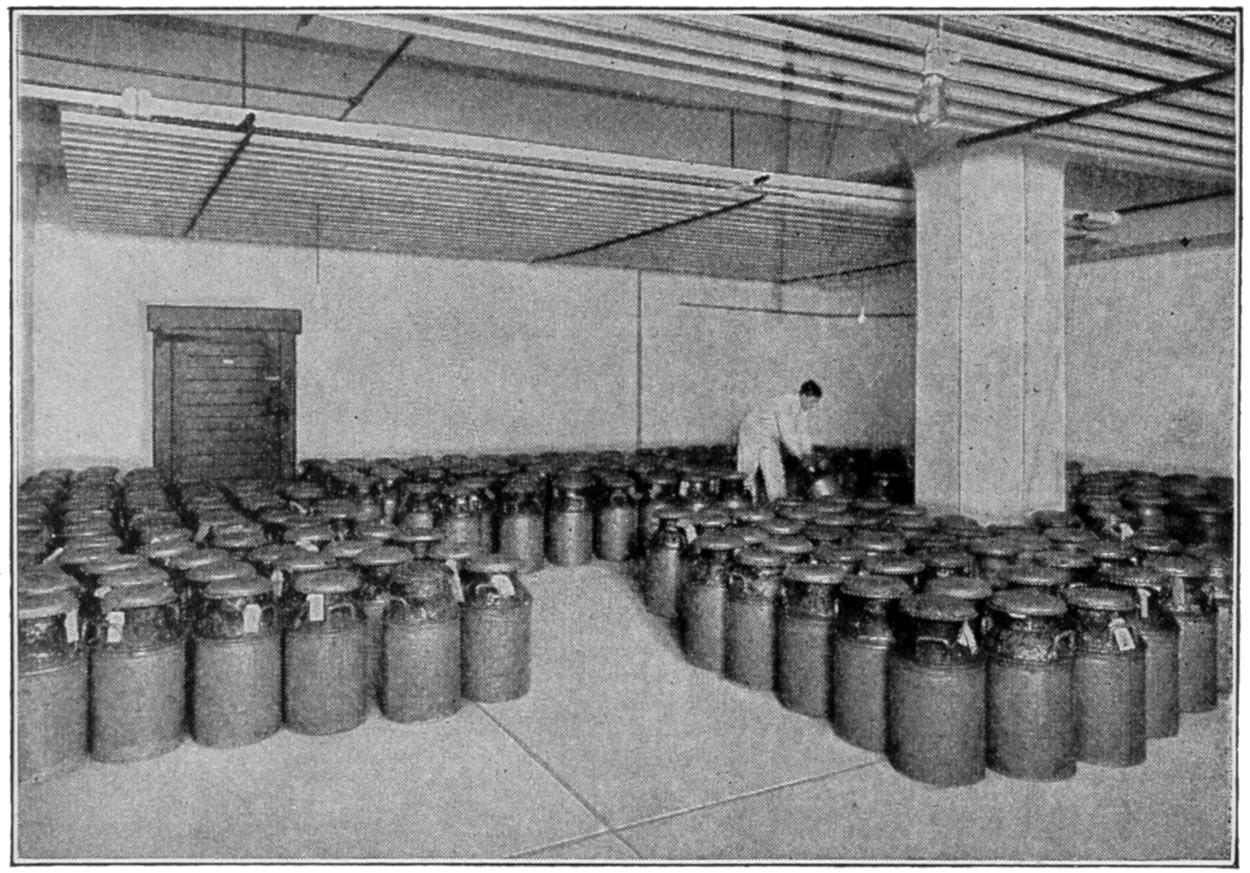
insure sweet cream. The refrigerated room in which
milk and cream are stored in a large ice-cream plant is
shown in Fig. 1. Cream for ice-cream-making should
not have more than 0.24 per cent of acid by the acid test.
(For use of acid test, see Chapter XIV.) In order to insure
sweetness, cream is usually pasteurized. Pasteurization[2]
is heating to a temperature sufficiently high, usually
145° F. and held at this temperature for a sufficient
period, usually thirty minutes, to kill most of the organisms
in the milk and then rapidly cooling to 50° F. or
below. When pasteurized cream and milk are used, there
is not the danger from disease organisms that there is
from raw cream. An “aged” cream is to be desired for
ice-cream-making because it is more viscous. By “aged”
is meant the holding of the cream for a period after separating
before it is made into ice-cream. Usually it is
aged for twenty-four to thirty-six hours. While aging it
must be kept cold so it will not sour and it should not be
frozen. It is hard to melt frozen cream and it is liable to
cause the ice-cream to be grainy.
[2] Ayres, S. H., “The Present Status of the Pasteurization of
Milk,” U. S. Dept. Agr. Bul. 342, 1916.
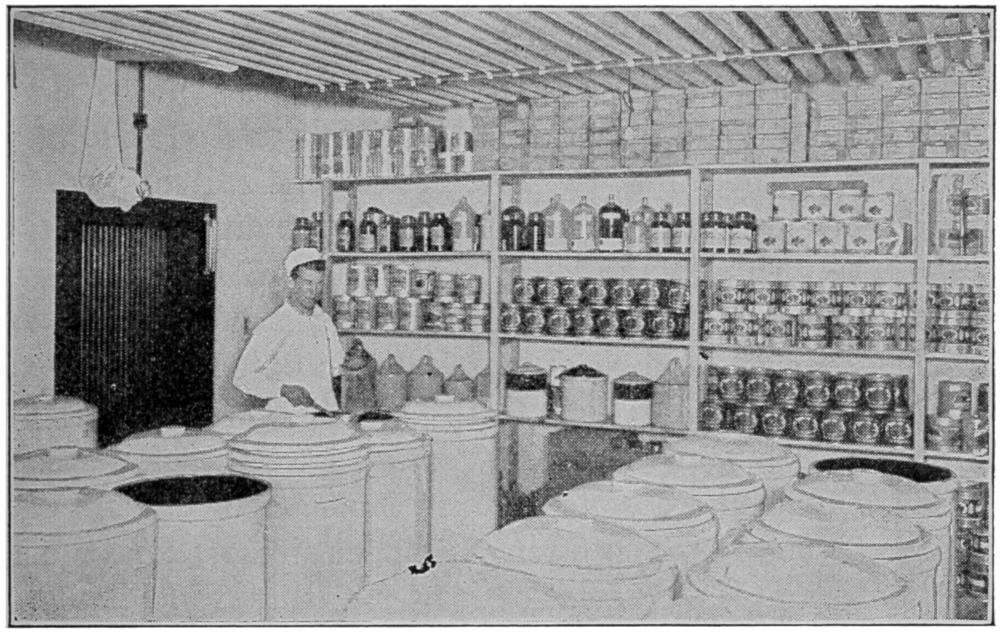
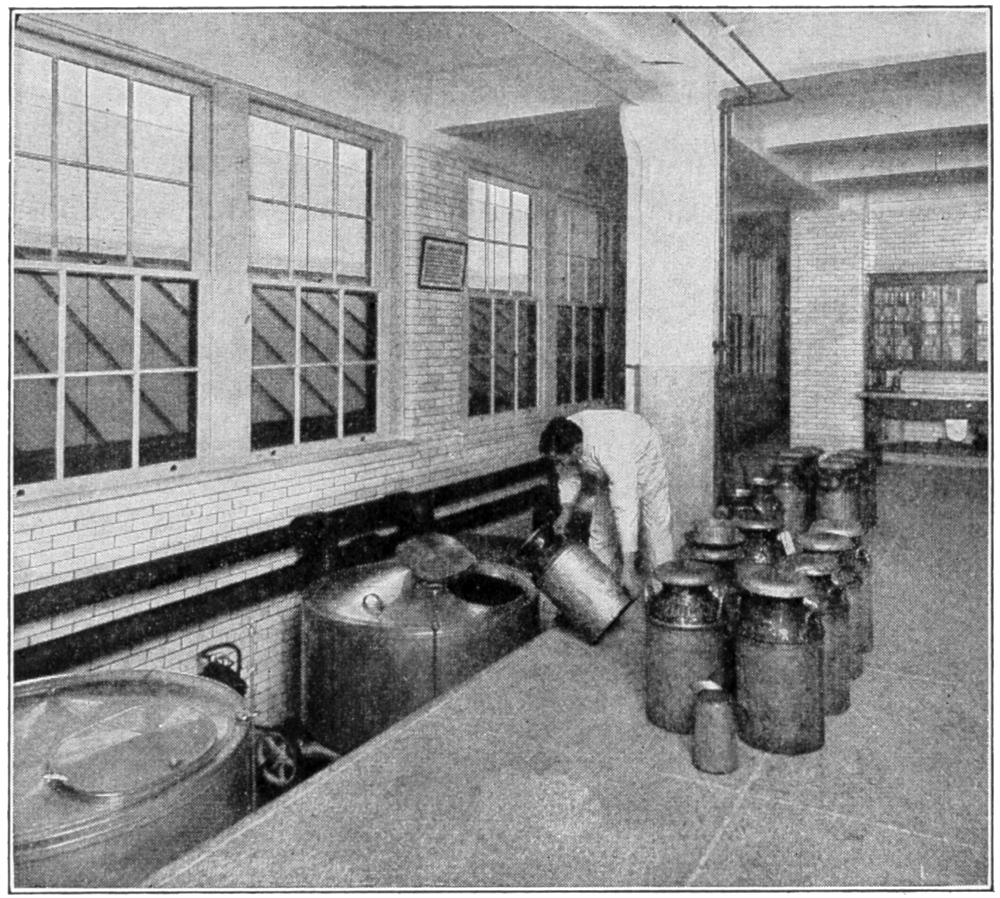
Fig. 1.—Refrigerated room for storing milk and cream in a large
ice-cream plant.
The demand for ice-cream fluctuates with the weather
changes. When it is hot there is an extensive demand but
if the weather rapidly becomes cool this demand suddenly
decreases or vice versa. This means that the ice-cream-maker
either must carry or have at his disposal a variable
supply of cream. When hot weather increases the demand,
there may not be time to age the cream or it may
be held so long that it becomes sour. Homogenized or
emulsified cream is to be desired for ice-cream-making
because it gives a smoother body and texture to the
product. This is undoubtedly due to the fat globules and
other solids being broken up into smaller particles by the
process.
—Some
milk and cream has undesirable flavors which may
be more or less pronounced. These are due to: the flavor
of foods eaten by the cow; the absorption of flavors and
odors from the atmosphere; the health of the cow; the
bacteria present. If not properly handled, the milk and
cream will soon become sour.
—The presence
of undesirable flavors in the milk is due many times to
the cows eating foods with very pronounced flavors.
Most common of these foods are onion, garlic, turnips,
cabbage, decayed ensilage, various pasture weeds, and
the like. The flavoring oils are volatile and so are able
to pass easily through all the tissues of the animal, and
in a short time pass off through the various excretory
channels. During the time that the food is undergoing
digestion, these volatile oils are not only present in the
milk, but all the tissues of the animal. By the time the
process of digestion is completed, the volatile flavors will
have passed away largely. Therefore, if the time of
milking and feeding are properly regulated, a dairy-man
may feed considerable quantities of strong-flavored food,
without any appreciable effect on the flavor of the milk.
To do this successfully, the cows should be fed immediately
before or after milking, preferably the latter. This
allows time for the digestive process to take place, during
which time the volatile substances will have passed away.
While, if the milking occurred three or four hours after
feeding, these volatile substances would be present in the
milk and so flavor it.
In the case of those plants which grow wild in the
pasture and to which the cows have continued access, it
is much more difficult to overcome the bad flavor in
the milk. The only thing which can be done is to allow
the cows to pasture for a short time immediately
after milking. This will make it necessary to supplement
the food of the pasture with dry feed, or to have
another pasture where these undesirable plants do not
grow.
—Milk,
especially when warm, possesses a remarkable
ability to absorb and retain odors in the surrounding
atmosphere. For this reason, the milk should be exposed
only in a surrounding of clean pure air. Some of the
common sources of these undesirable odors are: bad smelling
stables; unclean cows; aërating milk near hog pens,
barnyards, swill barrels, and like odoriferous sources;
strong-smelling feeds in the stable during milking, and
the like. The only way to overcome these undesirable
flavors and odors in the milk is not to expose the milk to
them. The safest policy is to remove the source of the
odor.
—Milk secreted
just before or just after parturition is different in physical
properties and chemical composition from that secreted
at any other time during the lactation period.
This milk is known as colostrum. It is considered unfit
for human food, either as milk or products manufactured
from the milk. Most states consider colostrum adulterated
milk, and prohibit its sale fifteen days before or
five days after parturition.[3]
[3] N. J. Agricultural Law, 1913, section 30; Mich. Agricultural
Law, 1915, section 77; Wis. Agricultural Law, 1913, section 4601-49-5.
Whenever disease manifests itself in the cow, the milk
should be discarded at once as human food. Some diseases
are common both to the cow and man, such as
tuberculosis and foot-and-mouth disease. If such diseases
are present in the cow, the milk acts as a carrier for
them to man. Digestive disorders of any sort in the cow
are frequently accompanied by undesirable flavors in the
milk. These are not believed to be due to the food eaten,
but to the bad condition of the animal. On resuming a
normal condition, these undesirable flavors disappear.
This is especially noticeable when cows are turned out
to pasture for the first time in the spring, or when they
are pastured on rank fall feed, such as second-growth
clover.
—The bacteria are
microscopic unicellular plants without chlorophyll. Besides
bacteria, there are other forms of the lowest orders
of the vegetable kingdom found in milk, such as yeasts
and molds. The general characteristics of yeast and
bacteria are somewhat similar. Bacteria are very widely
distributed throughout nature. They are so small that
they may float easily in the air or on particles of dust.
They are so resistant to adverse conditions of growth
that they may be present in a dormant or spore stage,
and thereby not be recognized readily; when suitable
environments for growth are again produced, germination
takes place at once. They are found in all surface
water, on the surface of the earth, and upon all organic
matter. There are a great many different groups of
bacteria, some beneficial and some harmful to man. As
they are so small, it is difficult to differentiate between
the beneficial and harmful groups, except by the results
produced or by a careful study in an especially equipped
laboratory. Bacteria have many forms, the three common
forms being: spherical (coccus); rod-like or cylindrical
(bacillus); and corkscrew (spirillum). The bacteria
reproduce very rapidly by fission, that is, a transverse
partition forms in the cell and when this partition is
completed, the cell is divided. There are then two bacteria
where there was but one before. In some cases, this
division has taken place regularly in twenty to thirty
minutes. Like other plants, they are very sensitive to
a food supply, to temperature, and to moisture, as conditions
of growth. Inasmuch as the bacteria are plant
cells, they must imbibe their food from materials in solution.
They may live on solid substances, but the food
elements must be rendered soluble before they can be
utilized. Bacteria prefer a neutral or slightly acid medium
for growth, rather than an alkaline reaction; however,
there are many exceptions to this. The food for bacteria
must contain carbon, hydrogen, oxygen, and nitrogen,
together with small amounts of mineral matters. Organic
compounds make available food supplies. Ordinary
milk furnishes a very favorable medium for the growth
of bacteria because it contains an adequate and easily
available food supply. In milk, there are certain groups
of bacteria, which are ordinarily present, but any others
which happen to get into the milk will live and rapidly
multiply. Most forms of bacteria are dependent on temperature
as a condition of growth. There is a range of
temperature, more or less wide, at which the bacteria
will grow and multiply with the greatest rapidity. This
is called the optimum temperature and varies with the
different groups of bacteria, but for most it is between
75° F. and 95° F. Growth of most of the bacteria found
in milk will take place between 40° F.-45° F. to 105° F.-115°
F. Above and below these temperatures growth
is retarded, and, if carried to extremes, life will be destroyed.
Like plants which form structures called seeds
to carry them through conditions unfavorable to growth,
so some groups of bacteria form spores. The spores are
exceedingly resistant to unfavorable conditions of growth,
such as heat, cold, drying, food supply, and even chemical
agents. It is this property which makes it difficult to
destroy some bacteria.
Because of the harmful effect of the micro-organisms
in the milk and cream, precautions should be taken to
keep them out. If they do enter, their growth can be
checked by keeping the milk and cream cold. What has
been said regarding bacteria is true of molds and yeasts.
—The amount of solid material
or dirt in the milk is an indication of the amount of bacterial
contamination. It should be remembered that the
strainer will take out the solid material, but the soluble
portion and the bacteria will be left in the milk or cream.
Thus an efficient strainer will defeat the sediment test.
There are several sediment tests on the market. The
test consists of filtering about a pint of milk through a
cotton disc filter about an inch in diameter. The solid
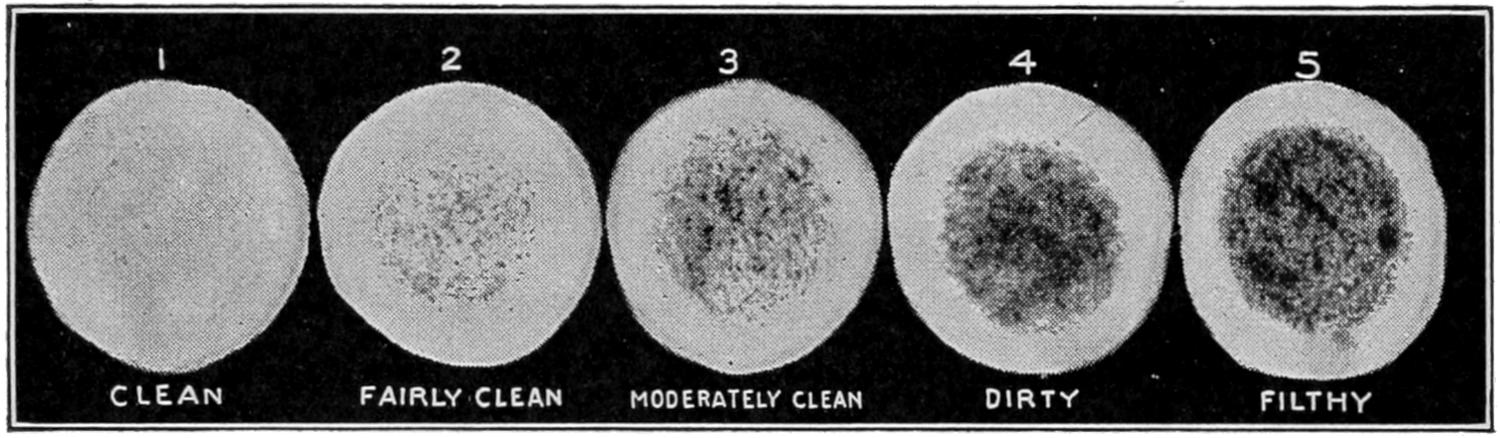
material or dirt is left on the filter. (Fig. 2.) The amount
of dirt would indicate the amount of contamination in
the milk. Much improvement in the quality of the milk
has been accomplished by the use of the sediment test,
because the cotton discs with the dirt are posted where
each patron can see them and pride causes the careless
dairy-man to take more pains in the care and handling
of his milk.
1
2
3
4
5
CLEAN
FAIRLY CLEAN
MODERATELY CLEAN
DIRTY
FILTHY
Fig. 2.—Filters from sediment tests showing the amount of dirt
in different samples of milk. These are the grades made by the
New York City Board of Health.
—Next in importance to clean production
in the care of milk and cream, is the prevention
of growth or development of the organisms in it. This
is accomplished by cooling and keeping the milk and
cream cold and covered. If they are produced clean and
kept covered, there are certain to be some micro-organisms
in the milk and unless cooled these will develop and
quickly spoil the milk and cream. Ross[4] and McInerney
give the following summary regarding the cooling of
milk and cream:
[4] Ross, H. E., and McInerney, T. J., “Cooling milk,” Cornell
Reading Courses, Vol. V, No. 102, 1914.
“Milk becomes cool, of course, when it gives up its
heat to some substance colder than itself, and in order to
have a rapid exchange of temperatures between two
substances it is necessary that they have approximately
the same density. On account of the great difference in
density between air and milk, the latter will cool very
slowly in air even though the temperature of the air is
rather low. If milk is allowed to cool by standing in a
cold atmosphere, it will do so unevenly, and by the time
the milk in the center of the can is cooled, that part near
the walls of the can may be frozen. The fat is not evenly
distributed in frozen milk; therefore it is not so good as
normal milk.
“1. The bacteria-content of milk held at a temperature
of 50° F. increases slowly, while the bacteria-content of
milk held at 90° F. increases rapidly.
“2. At a temperature of 90° F. bacteria increase rapidly
in milk that had either a small or a large amount of bacteria
in it originally.
“3. Cooling milk by placing the cans in a tank of ice
water is a practical method for use in farm dairies. To
cool the milk rapidly it must be stirred at frequent intervals.
“4. Stirring the milk at intervals of five minutes
caused a sufficiently rapid drop in temperature. Rapidity
of cooling due to stirring the milk at intervals of
five minutes and at intervals of ten minutes was very
slight.
“5. When sufficient quantities of ice were used, stirring
the water in the cooling tank had little effect on the
rapidity of cooling.
“6. In order to obtain the best efficiency from the
conical type of cooler, it is absolutely necessary to stir
the water inside the cooler.
“7. Lower temperatures can be obtained by using
brine and ice than with ice water alone.”
Stocking[5] shows the effect of temperature on the development
of the bacteria in milk by the following experiment:
A sample of milk, which was thoroughly mixed,
was divided into six equal parts. The six bottles were
placed in water at different temperatures for twelve
hours, at which time the germ-content of each lot was
determined. The six bottles were then all placed together
in a temperature of 70 degrees and allowed to
remain until they curdled. As each sample curdled, the
time was recorded. The difference in the germ-content
and the keeping time is the result of the difference in
temperature for a period of twelve hours only, and shows
what may happen easily in milk which is allowed to stand
overnight without thorough cooling.
[5] Stocking, W. A., Jr., “Problems of the milk producers,” N. Y.
State Dept. Agr., Circ. 10, 1910.
Table I
Effect of different temperatures for twelve hours on the growth
of bacteria and on the keeping quality of milk
I
II
Kept at 45 degrees
Kept at 50 degrees
Number of bacteria 9,300
Number of bacteria 18,000
Curdled in 75 hours
Curdled in 72 hours
III
IV
Kept at 55 degrees
Kept at 60 degrees
Number of bacteria 38,000
Number of bacteria 453,000
Curdled in 49 hours
Curdled in 43 hours
V
VI
Kept at 70 degrees
Kept at 80 degrees
Number of bacteria 8,800,000
Number of bacteria 55,300,000
Curdled in 32 hours
Curdled in 28 hours
—The
following diagram shows the main sources of contamination
and the undesirable methods of handling by which
the quality of milk and cream is impaired:
Sources of contamination and undesirable methods of handling
On the farm
-
Atmosphere in the stable
-
Dust from feed
Dust from floor and bedding
Cows
-
Exterior of udder and flank
Coat
Utensils
-
Dirty utensils
Rusty utensils
Milker
-
Dirty clothes
Dirty hands
Wetting the teats
Cooling
-
Air and dust
Dirty utensils
Transportation from farm to creamery
-
Exposed to sun and dust
Carried in dirty utensils
Creamery
-
Careless methods
-
Allowing milk to stand before separating
Allowing cream after separated to stand before cooling
Not cooling cream to low enough temperature
Dirty equipment
Transportation from creamery to ice-cream manufacturer
-
Use of dirty rusted cars. Allowing to stand on railroad platforms, in the sun uncovered
Lack of can jackets
Poor delivery service
Lack of refrigerator cars
Too long shipments
Ice-cream manufacturer
-
Holding cream too long
Lack of refrigerator space to hold cream
Dirty equipment and utensils
The above shows that the producer controls most of
the factors which concern the sources of initial contamination.[6]
After the milk leaves the producer, if it is not
properly handled, the organisms in it may develop or if
exposed to dirty conditions more contamination may take
place. The important factors in the production and
handling of milk are: clean utensils, clean healthy cows,
small-top milk-pails, proper cooling and maintaining of
low temperature, 50° F. or below. The importance of
can jackets to aid in keeping the cream cold should not
be overlooked, especially when shipping in hot weather.
The quality of the milk and cream is largely determined
by the time it is delivered at the ice-cream plant.
[6] Ayres, S. H., Cook, L. B., Clemner, P. W., “The four essential
factors in the production of milk of low bacterial content,” U. S.
Dept. Agr., Bul. 642, 1918.
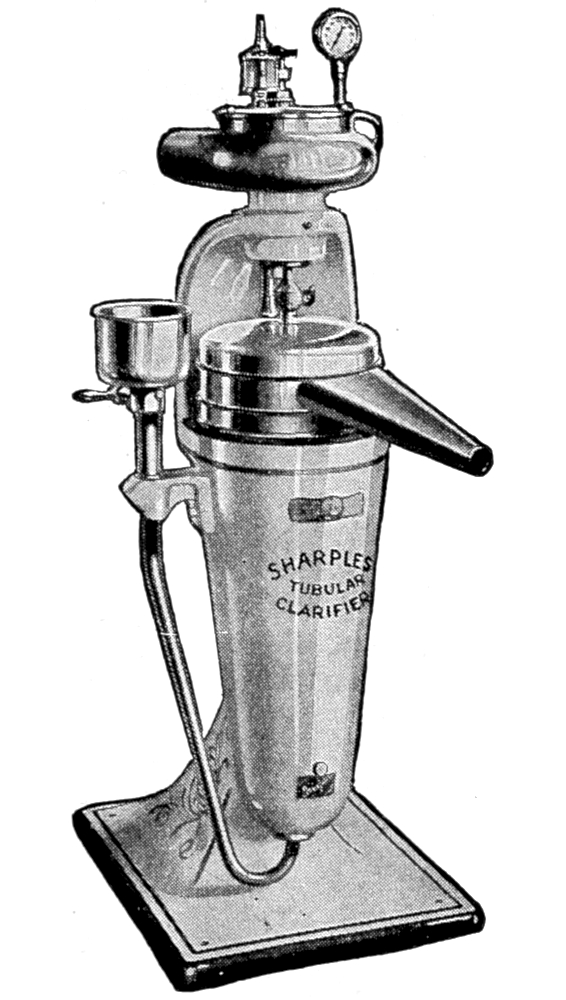
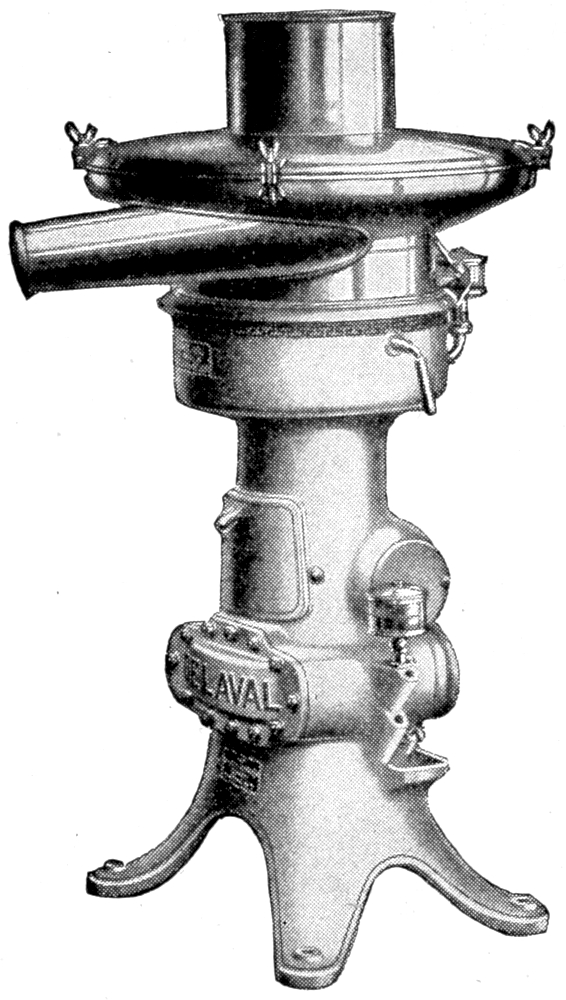
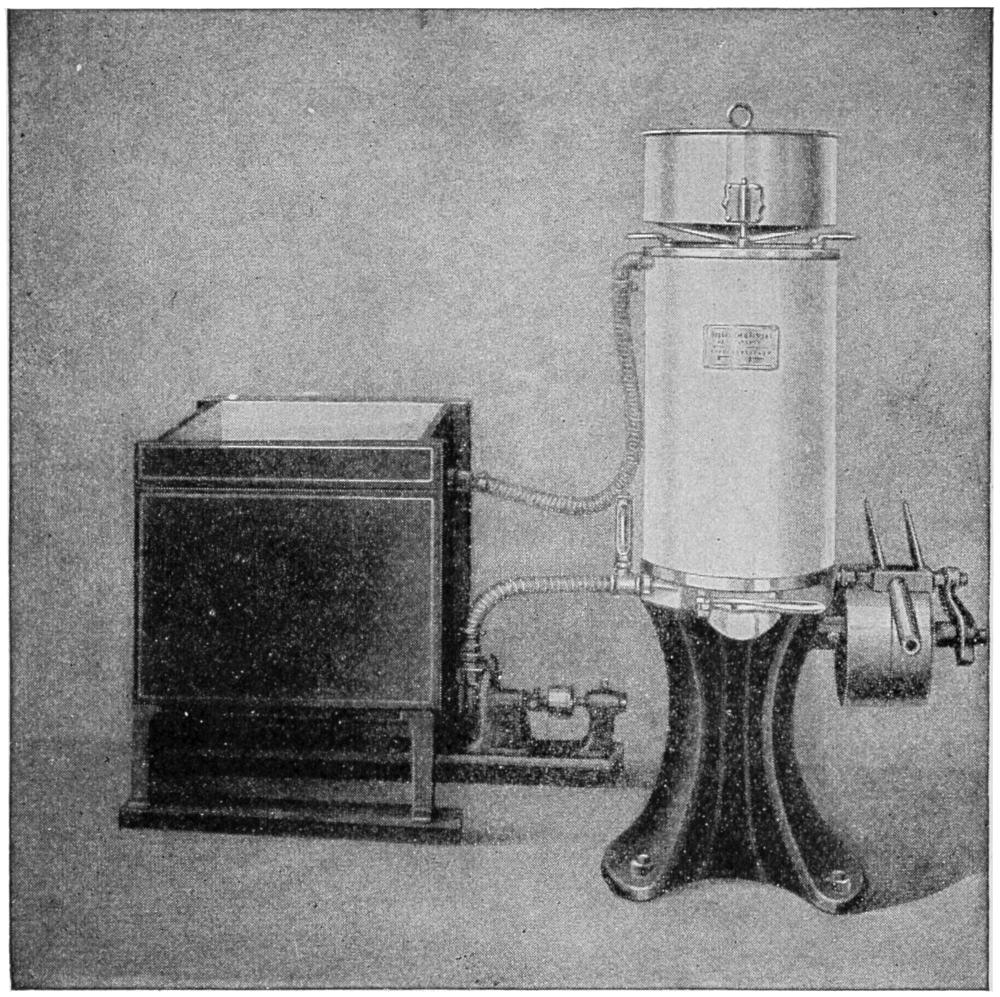
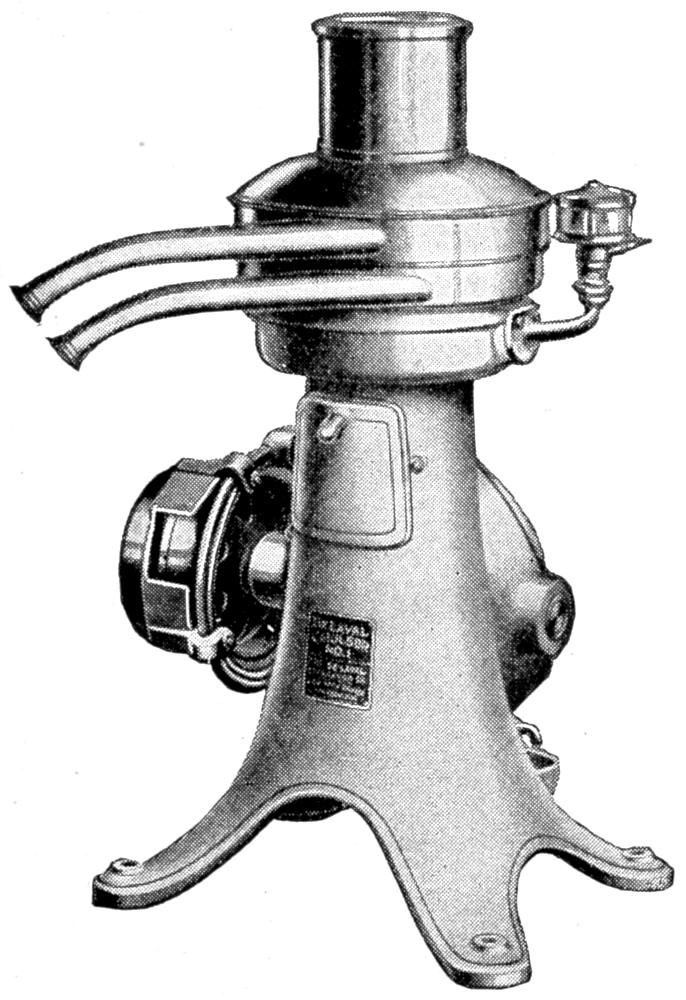
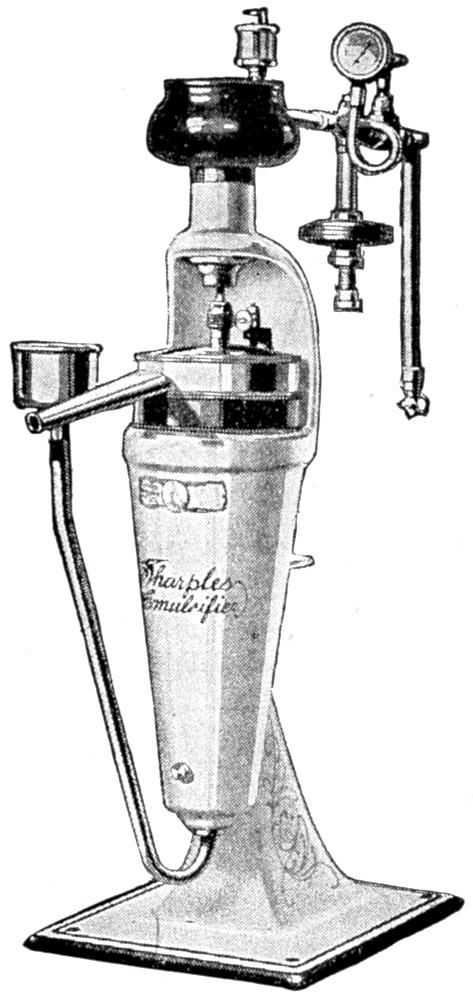
Fig. 3.—Sharples milk
clarifier.
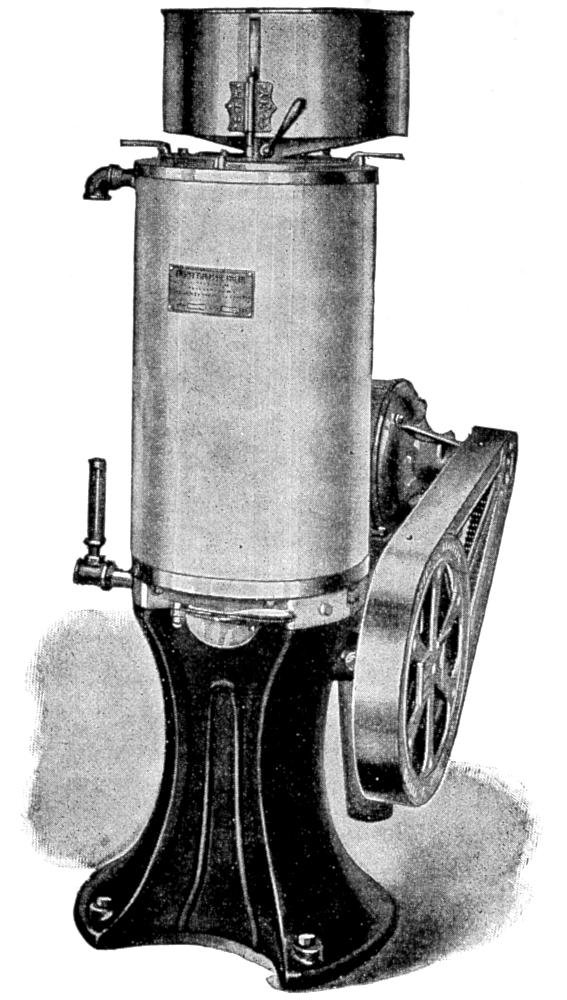
Fig. 4.—De Laval milk clarifier
turbine drive.
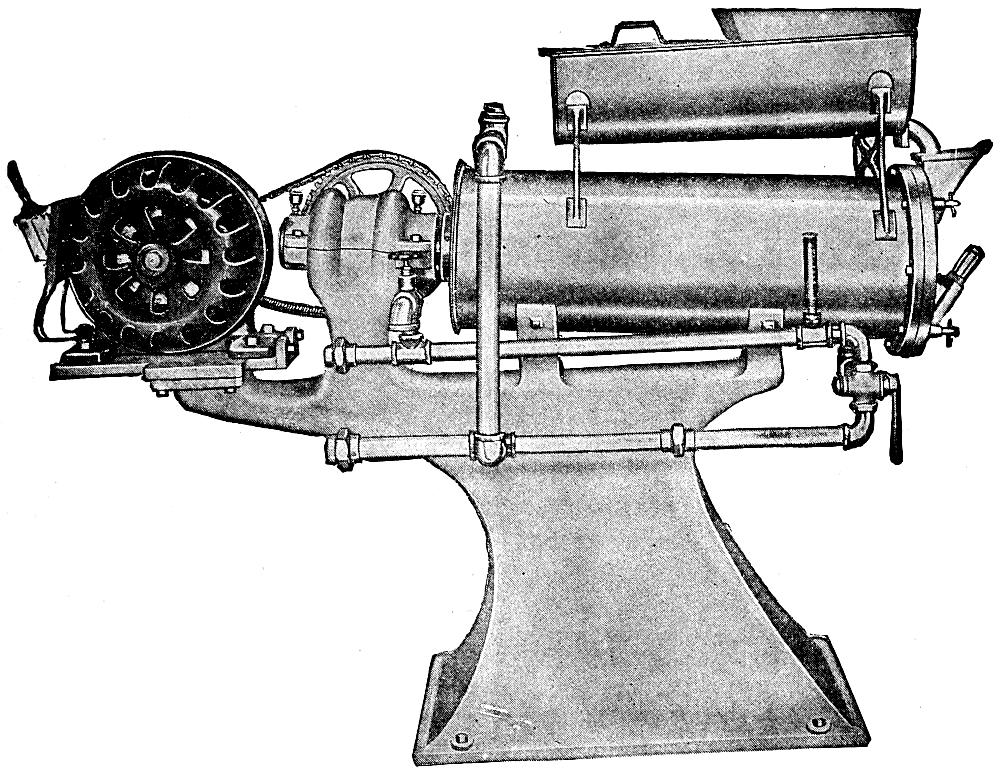
—If solid or semi-solid dirt either visible
or invisible is in the milk, it can be removed by the use
of a clarifier. This is a specially devised machine (Figs.
3 and 4) which takes out the dirt by centrifugal force.
It is desirable to clarify milk and cream for ice-cream-making.
Besides removing dirt which gets into the milk
during handling, the clarifier also takes out blood corpuscles
and pus cells which are sometimes secreted with
the milk.
—It
is not possible here to discuss in detail the composition
of the milk and cream and the factors influencing
it. Ross[7] gives the composition of milk, cream and
skimmed-milk as follows:
[7] Ross, H. E., “Composition of milk and some of its products,”
Cornell Reading Course, Vol. 11, No. 32, 1913.
Table II
Showing composition of milk
Average
Maximum
Minimum
Water
87
.0
90
.69
80
.32
Sugar
5
.0
6
.03
2
.11
Fat
4
.0
6
.47
1
.67
Casein
2
.6
4
.23
1
.79
Albumen
0
.7
1
.44
.25
Ash
0
.7
1
.21
.35
Table III
Showing composition of cream
Cream high in fat
Cream low in fat
Water
29
.0
76
.6
Fat
67
.5
15
.2
Casein
-
1
.2
3
.1
Albumen
Sugar
2
.2
4
.5
Ash
0
.1
0
.6
Table IV
Showing composition of skimmed-milk
Water
90
.60
Fat
.10
Sugar
4
.95
Casein
3
.15
Albumen
.42
Ash
.78
From the view point of the ice-cream-maker, the fat
and solids not fat are of special consideration. Each
state has standards for milk, cream and skimmed-milk.
(See Table XV.) The federal standards[8] are as follows:
Milk is the fresh clean, lacteal secretion obtained by the
complete milking of one or more healthy cows, properly
fed and kept, excluding that obtained within fifteen days
before and ten days after calving and contains not less
than eight and one-half (8.5) per cent of solids not fat
and not less than three and one-quarter (3.25) per cent
of milk-fat.
[8] Office of the secretary, U. S. Dept. Agr., Circ. 19, 1906.
Skim-milk is milk from which a part or all of the cream
has been removed, and contains not less than nine and
one-quarter (9.25) per cent of milk solids. Cream is that
portion of milk, rich in milk-fat, which rises to the surface
of milk on standing, or is separated from it by centrifugal
force, is fresh and clean and contains not less than eighteen
(18) per cent of milk-fat.
Milk and cream should be purchased on the fat test
and not by measure, the price being based on the fat-content.
For method of testing, see Chapter XIV.
Because of the variable composition of milk and cream,
it is necessary to standardize them for use in ice-cream-making.
For method of standardization, see Chapter XIV.
CHAPTER III MANUFACTURED MILK PRODUCTS AS RELATED TO ICE-CREAM — CONDENSED AND EVAPORATED MILK — 17. Method of manufacture. — 18. Standards for condensed milk. — 19. Conditions essential for a milk condensory. [10] — 20. Supply of condensed milk for the ice-cream plant. — MILK POWDER — 21. Standards for milk powder. — 22. Powdered milk processes. — 23. Merrell-Soule powdered milk. — 24. History of Merrell-Soule process. — 25. Uses of Merrell-Soule powder in ice-cream. — 26. Ekenberg powdered milk. [13] — 27. Uses of Ekenberg powder in ice-cream. — 28. Butter.
Besides the milk and cream, several other manufactured
milk products are used in ice-cream. What has
been said previously about the milk and cream applies
also to the milk for these products. The quality, especially
the flavor, is very important.
There is a difference between condensed and evaporated
milk, but because of their similarity, both in composition
and manufacture, they will be considered together.
Condensed milk usually has sugar added to
preserve it, although some ice-cream-makers use it without
added sugar, when it is known as plain in contrast to
sweetened condensed milk. The evaporated milk is
usually sterilized in sealed cans to preserve it, no sugar
being added. More condensed milk is employed in making
ice-cream than evaporated milk. The condensed is
usually shipped to the ice-cream manufacturer in bulk,
either in milk-cans or barrels.
—The water is removed
from the milk by heating under reduced pressure. The
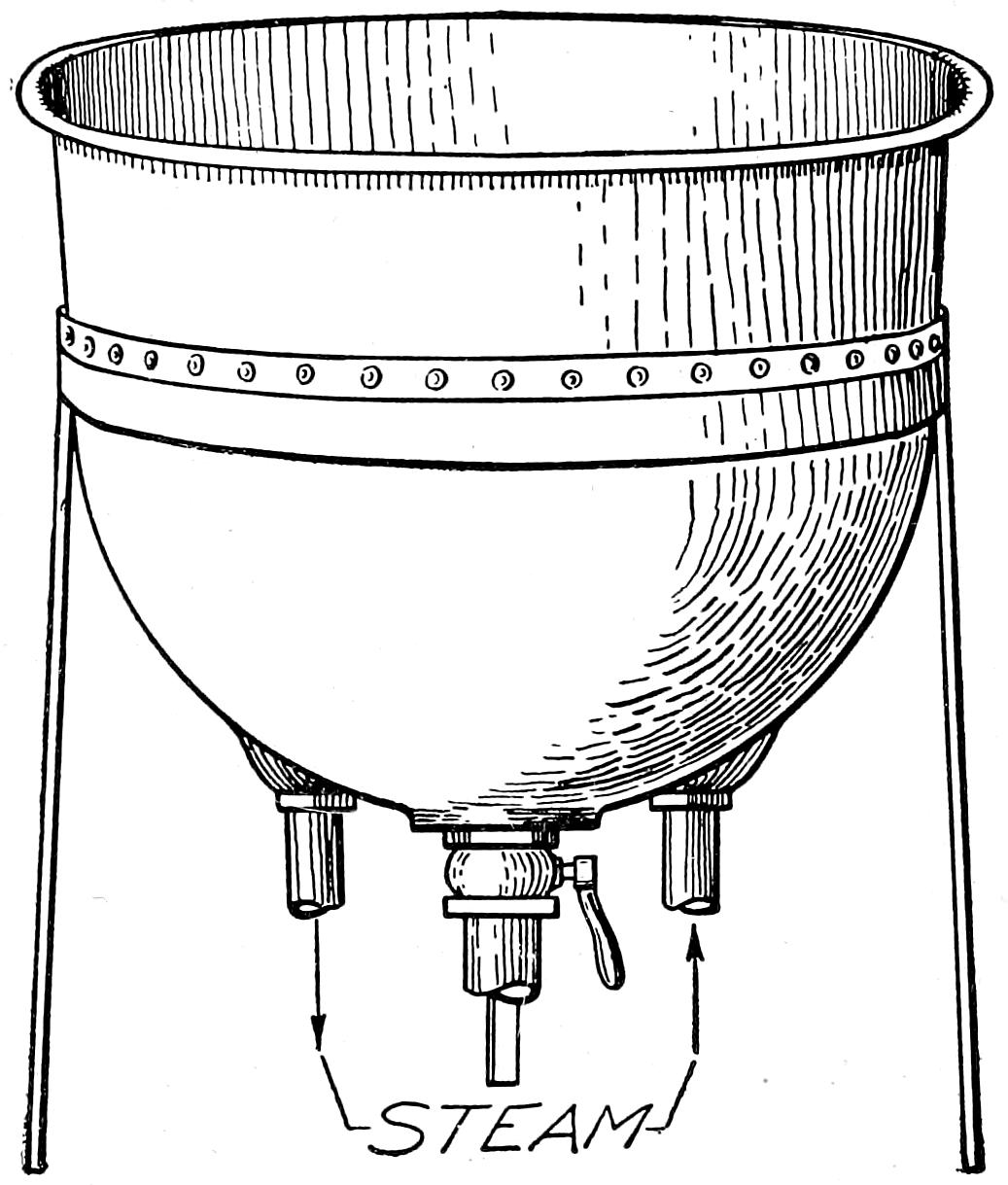
heating is usually done in a copper pan. (Fig. 5.) This
is accomplished by means of a steam jacket on the bottom
and usually one or two steam coils in the pan. Before
drawing the milk into the pan, it is heated in an open
copper vessel, by turning direct steam into the milk.
This container is called the hot well or fore warmer. The
temperature varies according to whether plain or sweetened
condensed is being made. The sweetened is heated
higher to dissolve the sugar. The object of heating under
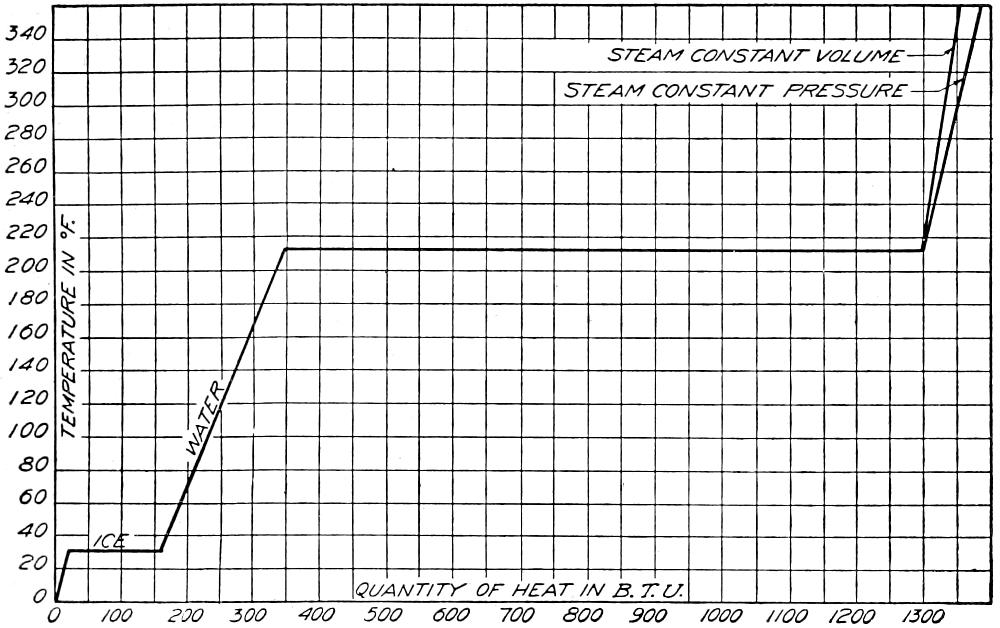
reduced pressure is to reduce the boiling point. At ordinary
pressure milk would boil at the same temperature
or a little above that of water. At this temperature the
milk could not be condensed without imparting a pronounced
cooked flavor and caramelizing a part of the sugar.
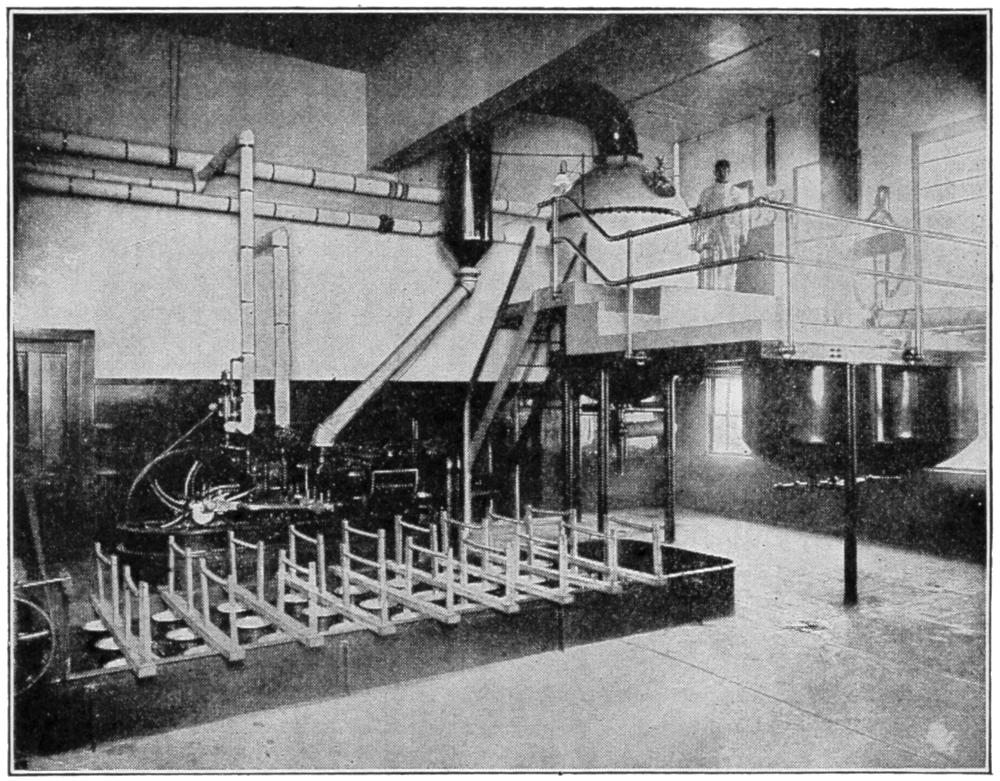
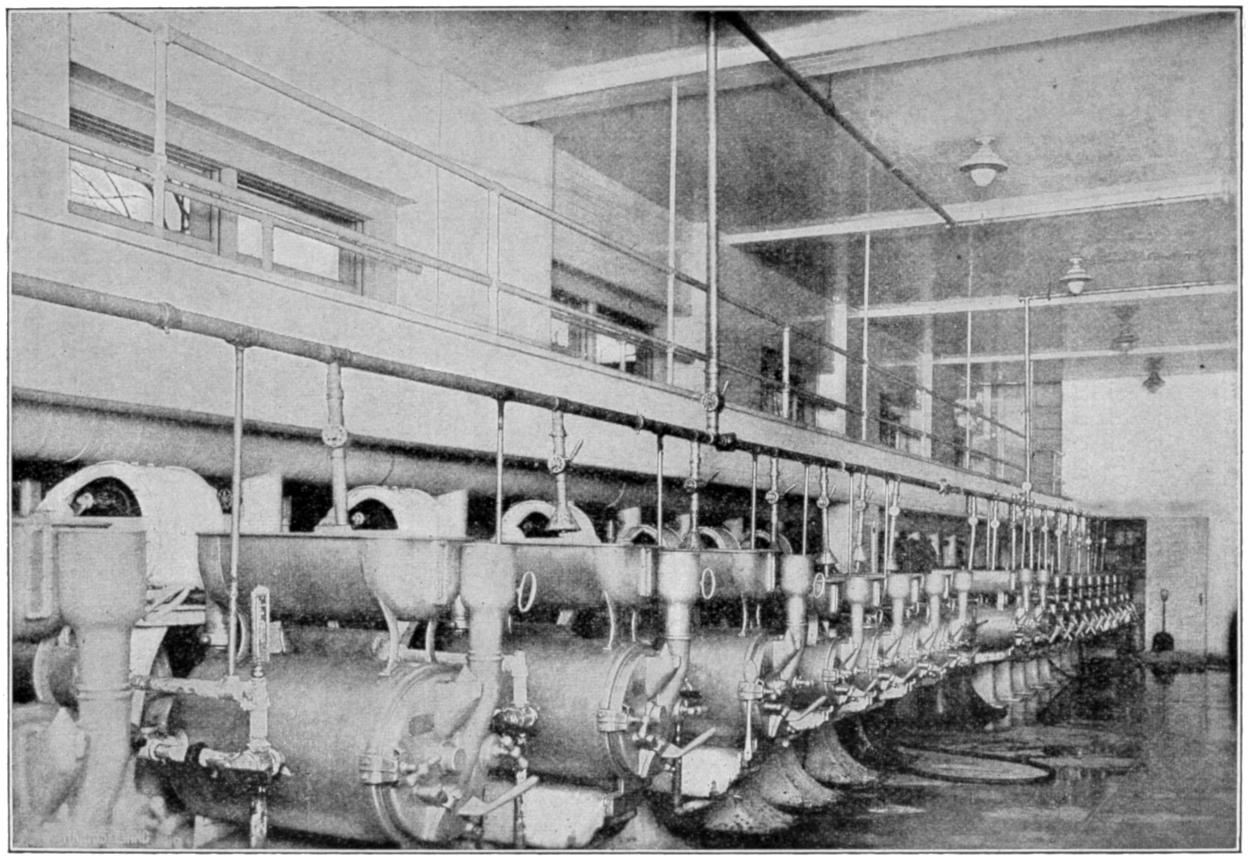
Fig. 5.—View of modern condensory showing hot wells, vacuum pan,
vacuum pump and cooling tanks.
The vacuum in the pan is produced by means of a
vacuum pump. A vacuum equal to a column of mercury
about 25 inches is usually maintained. The condenser
is located at the top of the pan and is directly connected
with it. As the milk boils, the vapor passes from the pan
into the condenser. In the latter the vapor comes in
contact with a spray of cold water which causes it to
condense. The pump carries off the condensing water
and the condensed vapor. When the desired density is
reached, the milk is drawn from the pan and cooled. The
proper concentration of the milk is determined by a
special graduated scale known as the Baumé. A more
recent method is an electric resistance. If sweetened
condensed is being made, the sugar is added to the milk,
the mixture of sugar and milk are heated to dissolve the
sugar before drawing them into the pan.
Sometimes the milk is superheated; this consists of
turning live steam into the milk just at the time that the
desired concentration is reached. It gives the condensed
milk more of a “livery” appearance, which is probably
due to the precipitation of the albumen.
The length of time required for condensing the milk
to the desired consistency varies with the amount of
milk in the pan, amount of heating surface, size and
capacity of vacuum pump, and amount and temperature
of water in the condenser.
—The following
standards are given by the United States Department
of Agriculture:[9]
[9] Office of the Secretary, U. S. Dept. Agr., Food Inspection, Decision
170, 1917.
“Sweetened condensed milk, sweetened evaporated
milk, sweetened concentrated milk, is the product resulting
from the evaporation of a considerable portion of the
water from the whole, fresh, clean, lacteal secretion
obtained by the complete milking of one or more healthy
cows, properly fed and kept, excluding that obtained
within fifteen days before and ten days after calving, to
which sugar (sucrose) has been added. It contains, all
tolerances being allowed for, not less than twenty-eight
per cent (28.0 per cent) of total milk solids, and not less
than eight per cent (8.0 per cent) of milk fat.
“Condensed skimmed milk, evaporated skimmed milk,
concentrated skimmed milk, is the product resulting from
the evaporation of a considerable portion of the water
from skimmed milk, and contains, all tolerances being
allowed for, not less than twenty per cent (20.0 per cent)
of milk solids.
“Sweetened condensed skimmed milk, sweetened evaporated
skimmed milk, sweetened concentrated skimmed
milk, is the product resulting from the evaporation of a
considerable portion of the water from skimmed milk to
which sugar (sucrose) has been added. It contains, all
tolerances being allowed for, not less than twenty-eight
per cent (28.0 per cent) of milk solids.”
Condensed or evaporated milk should be purchased
only on its composition, both fat and solids not fat. For
method of testing, see Chapter XIV.
—“First.
The plant should be located in a community
which is not only thoroughly adapted in every way to a
high standard of extensive dairy farming, but is already
far advanced in such development. The herds of cows
should be large, healthy, well cared for, and of a breed
or breeds that produce a grade of milk reasonably adapted
for condensing purposes and the production of a standard
product.
[10] These conditions are taken from the U. S. Dept. Agr., Weekly
News Letter, Vol. II, No. 45.
“Second. In establishing a plant for condensing milk
by the vacuum process it is of primary importance that
the location provide an abundant, steady supply of pure,
cold water, independent of the supply required for boiler
use. The quantity of water required to condense a given
quantity of milk will, of course, vary with the operating
conditions, such, for example, as the temperature of the
condensing water and the temperature (or the pressure)
of the vapor to be condensed. A general idea of the
importance of water supply can be obtained from the
authoritative estimate that about 3 gallons of water
are required for the condensing of one pound of fresh
milk (about one pint). Difficulty in obtaining an adequate
supply of good, pure, cold water is a cause of serious
embarrassment to some of the commercial condensories
now established, and the lack of it has been the cause of
many failures.
“Third. An abundant supply of milk is an absolute
necessity. The exact quantity required daily will, of
course, vary with the size of the plant. Several reliable
authorities have estimated that for the profitable production
of condensed milk on a commercial scale the
supply of raw milk to the factory should not fall below
15,000 pounds a day. This estimate is exclusive of the
daily supply of milk normally required for other purposes
by the community. Furthermore, if the finished product
is to be of marketable quality, the milk received at the
condensory must be of exceptionally high grade; that is,
clean and pure. While first-class milk is essential for the
manufacture of a first-class dairy product of any kind,
it is absolutely necessary if a condensed milk factory is to
be a success. If a few cans of low-grade milk are not
detected at the receiving platform of a condensory, the
slight defects in the raw milk are multiplied in the process
of condensing it, and the result is practically certain to
be the complete loss of the whole batch, which may
represent a financial loss of several hundred dollars. This
statement may be illustrated concretely: It is claimed by
authorities that raw milk containing as much as 0.2 per
cent acid (calculated as lactic acid) is not fit for condensing
purposes. This does not necessarily mean that it
would taste sour, but if accepted and condensed in the
ratio of 2.25 to 1 (it may be more but is seldom less), the
acidity, increasing in the same ratio, would reach 0.45
per cent, which would be practically certain to cause a
sour taste in the finished product. Every housewife
knows that sour milk will coagulate or curdle on heating,
and that the higher the temperature the more rapid is
the curdling process and the finer the curd. This makes
it unfit for cooking purposes. In the commercial production
of evaporated milk, the product must be sterilized
in the cans at a very high temperature in order to insure
a good keeping quality. It is obvious, therefore, that if
milk is delivered to the factory with a slight excess of
acidity, it would probably be impossible to sterilize the
product obtained from it without producing a hard curd,
which would make the product absolutely unsalable, and
thus a total loss to the manufacturer. Furthermore,
excessive acidity, which is principally caused by improper
care and handling of the milk, is not the only
condition that may render milk unfit for condensing.
Other undesirable qualities of the milk may also be
induced by poor health and improper care of the cows,
by the kind and the condition of their feed, and by
many other details of imperfect management of the
dairy farms.
“The services of experts thoroughly qualified by training
and long experience in this particular line will be
required to detect and guard against these unfavorable
conditions.
“Fourth. Adequate facilities for marketing constitute
another essential to the commercial success of a condensed
milk plant. Commercial success, of course, implies a
profitable market for the product—a market which is
readily and directly accessible to the plant without adding
excessively to the cost of manufacture, either in the form
of high freight rates or long hauls from the condensory
to a railroad. As already indicated, the successful manufacture
of condensed milk on a commercial scale requires
a large output of the finished product—a very much
larger output than is likely to be consumed in the local
market; therefore, in selecting a location, favorable
transportation facilities to a good market or markets are
a consideration of vital importance to ultimate success.
“Fifth. In establishing and operating a condensory,
the necessity of adequate capital is another important
question. The cost of buildings and equipment will, of
course, vary with the purchase of superior or inferior
materials and workmanship, as well as size of the plant,
and, in some measure, the kind of condensed milk to be
produced. In any case, however, the buildings should
be thoroughly substantial, more so than is commonly
considered necessary for a creamery or a cheese factory.
The major part of the equipment is a very highly specialized,
more or less complicated, and very expensive type.
The proper operation of the equipment, especially the
vacuum pan, and the sterilizer when the product is sterilized
in cans, calls for a high degree of skill and large
experience, if serious losses are to be avoided and a standardized
legal product is to be produced. The cost of
buildings, equipment, and operation of a plant for the
manufacture of evaporated milk (unsweetened condensed
milk for household use) will illustrate the capital required
for the manufacture of any other form of condensed milk.
Some reliable authorities have conservatively estimated
that adequate buildings and equipment for a minimum
production on a commercial scale would cost in the
neighborhood of $25,000, exclusive of working capital.
The markets for condensed milk at best are very unstable.
Frequently, the manufactured product must be held
several months before it is marketed. In the meantime,
the plant must be kept in operation, for which a very
considerable surplus capital must be provided. The
same authorities estimate this item at $10,000. It therefore
appears that in establishing and operating a milk
condensory, capital to the amount of at least $35,000
must be provided. That this estimate is conservative is
indicated by the fact that manufacturers of condensed
milk have stated that a capital of $50,000 is usually
necessary to operate a condensed milk factory.
“Sixth. Commercial success in any manufacturing
enterprise usually requires much more than merely placing
the product upon the market. A demand for the
product must be firmly established and a regular trade
developed before success is assured. To attain such a
result the new product must meet the keen competition
of similar products already well established. There are
many well-established brands of condensed milk now on
the market. There may be room for many more, but
new brands, regardless of their quality, must expect to
overcome strong competition before a firm foothold is
gained. This usually requires extensive advertising and
a competent, vigorous sales force, which entails a heavy
expense. Good salesmanship and advertising must be
continued. The necessity of a thoroughly organized
selling organization should, therefore, not be overlooked.”
—From the above conditions essential for a condensory,
it is evident that an ice-cream plant would not be justified
in trying to operate one, unless also they maintained
a large milk and cream receiving plant in the country. It
is the usual practice for the ice-cream manufacturer to
purchase the supply of condensed milk. However, some
plants have a condensory in connection with their country
plant, which is operated successfully. When the supply
of condensed milk is purchased, the basis of payment
should be the composition. For the methods of testing
condensed milk, see Chapter XIV.
In certain localities, especially the South where it is
hard to secure milk and cream, milk powder and butter
are often emulsified or homogenized to make cream.
Milk powder is also employed in the same way to meet
sudden demands for cream. Milk powder is often used
in ice-cream to increase the milk solids not fat and thereby
give a firmer body and a smoother texture. The composition
varies in fat from skim to whole milk.
—The following standards
are given by the United States Department of
Agriculture:[11]
[11] Office of the Secretary, U. S. Dept. Agr., Food Inspection Decision
170, 1917.
“Dried milk is the product resulting from the removal
of water from milk, and contains, all tolerances being
allowed for, not less than twenty-six per cent (26.0 per
cent) of milk fat, and not more than five per cent (5.0
per cent) of moisture.
“Dried skimmed milk is the product resulting from
the removal of water from skimmed milk and contains,
all tolerances being allowed for, not more than five per
cent (5.0 per cent) of moisture.”
—Two patented processes
of making powdered milk are in general use in
this country at the present time, the Merrell-Soule and
the Ekenberg.
[12]—“The desired
process must, it was evident, be one which would not affect
the active principles or the nutritive qualities of
milk, nor change its chemical reactions in any way. The
product when reaching the consumer must be, in every
essential quality, fresh milk.
[12] This article is taken from the publication, “Merrell-Soule Powdered
Milk for the Dairy, Creamery and Ice Cream Plant,” Merrell-Soule
Co., Syracuse, N. Y., 1918.
“The methods known as condensation and evaporation,
also the earlier milk powder processes, were efforts
to achieve the desired result. But in none of them was
the goal completely attained, as it is to-day in Merrell-Soule
Powdered Milk—the product of a perfected
process.
“Liquid Milk is seven-eighths water. Merrell-Soule
Powdered Milk contains approximately 2 per cent of
moisture. Transportation cost is thus reduced to a very
small percentage of the expense of shipping liquid milk.
The fact that powdered milk may be shipped by freight,
while liquid milk must go by express or baggage, means
an additional saving.
“The expense of shipping powdered milk is also, of
course, much lower than the transportation cost of the
condensed product.
“The Merrell-Soule process reduces the bacteria count
to a remarkably low figure, and it is a demonstrated fact
that the bacteria which are to be found in the fresh-made
powder tend to die off, rather than propagate, during
storage.
“Merrell-Soule Powdered Milk is quickly and easily
dissolved in water, and the ‘reconstituted’ liquid milk
thus obtained is pure, fresh milk, with the delicate odor
and unmistakable flavor of fresh milk, and with every
chemical reaction and nutritive property of fresh milk
retained unchanged.”
—“The history
of powdered milk dates back to the middle of the last
century, when an inventor named Grimwade patented, in
England, the first commercially usable process.
“He added carbonate of soda to fresh milk, evaporated
it in open-jacketed pans, with constant agitation, until
a dough-like substance resulted; added cane sugar,
pressed the mixture between rollers into ribbons, dried it
still further, then pulverized it.
“This process, cumbersome and unsatisfactory as it
must have been, was in practice for some years. Other
processes followed at intervals for half a century, but the
real commercial development of the industry dates back
only about twenty years.
“It was in 1899 that a machine for the drying of milk
by what has since become known as the ‘double roll’
process was invented by W. B. Gere, since deceased, then
secretary of the Merrell-Soule Co., and I. S. Merrell,
first vice president of the company. But the ‘dry milk’
which resulted from this process was not satisfactory, and
for that reason was not put on the market by the Merrell-Soule
Company.
“Several other processes were then tried out, but none
proved satisfactory until Lewis C. Merrell, brother of
I. S. Merrell, hit upon the spraying of milk into a regulated
current of heated air. This gave the quality that
had been desired, and the next thing was to determine
the commercial value of the process.
“In January, 1905, a building owned by the Merrell-Soule
Company at Fayetteville, N. Y., was equipped,
and powdered milk was produced, in a small way, by this
spray process. Enough was marketed, and with sufficiently
gratifying results, to warrant the company in
going ahead with the enterprise.
“Meantime, patents had been applied for, and the
patent office had referred the Merrell-Soule Company
to a United States patent granted in 1901 to Robert
Stauf, of Posen, Germany, which seemed to cover the
process. F. C. Soule, president of the Merrell-Soule
Company, thereupon went to Germany and bought not
only the United States patent held by Stauf, but also
thirteen foreign patents owned by Stauf and his associates.
“The wisdom of the purchase of all the patents held
by the Stauf interests has since been amply demonstrated.
In 1915, patent litigation which had been in the courts
for three years was decided by the Court of Appeals in
favor of the Merrell-Soule Company, the decision being
based on this company’s possession not only of its own
patents, but also of the basic patents governing the spray
process of powdered milk manufacture.
“Following the success of the experiment at Fayetteville,
the construction of the first Merrell-Soule Powdered
Milk factory, at Arcade, N. Y., was begun in 1906. Before
this factory was completed, it had been discovered
that a better product could be obtained by condensing
the milk in a vacuum pan before spraying. This resulted
in new patents covering what was known as the Merrell-Gere
process, embodying the original Stauf method and
the improvement mentioned.
“Since then many other improvements have been
made at the Merrell-Soule plants, many other patents
taken out. The first powdered milk factory, at Arcade,
was followed by a second, at Little Valley, N. Y., in
1909. Since then factories have been established at
Frewsburg, N. Y., Union City, Pa., Waterford, Pa.,
Farmersville Station, N. Y., Warsaw, N. Y., Gainesville,
N. Y., Attica, N. Y., and Omaha, Neb.
“Consumption of milk has increased from 18,000
quarts per day, in 1906, at Arcade, to 300,000 quarts per
day, at the present time, in the ten factories. The output
of powdered milk has grown from 2,500 pounds per day,
twelve years ago, to a present capacity of 50,000 pounds
per day.
“These products include Powdered Skimmed Milk,
Butterfat Powders, of varying butterfat content, ‘Cream
Powders,’ which contain up to 72 per cent. butterfat, and
Powdered Buttermilk.”
—“The
ice-cream manufacturer demands a milk or cream product
which is clean, which will not sour quickly, which is
not a breeder of bacteria, and which gives him the largest
percentage of milk solids in proportion both to its bulk
and its cost. All these essentials he finds in Merrell-Soule
powdered milk. Its powdered form insures the
greatest possible purity and cleanness, as is attested by
many authorities. There need be no loss through souring,
no sticky, half-empty cans standing around, gathering
flies and breeding bacteria, when Merrell-Soule
powdered milk is used. The ice-cream man makes up
just what he needs for the day’s business. He can make
up a big supply of cream, for a sweltering day’s run, or
a small amount for a cool day. A sudden drop in temperature
will not leave him with a lot of cream on hand
that must either be used or spoiled. It has been proved
that Merrell-Soule powdered milk shows a far smaller
bacteria count than any other form of milk, and it offers
no breeding place for microbes.
“Merrell-Soule powdered milk can be put to many
uses in the ice-cream factory:—
“1. In the production of milk or cream from powdered
skimmed milk, butter and water.
“2. The production of skimmed milk from powder
and water.
“3. The standardization of the milk solids in the ice-cream
batch.
“4. Furnishing the necessary skimmed milk solids.
“5. Blending butter and the powdered skimmed milk
with liquid whole milk of any fat content, for the complete
total milk solids of the batch.
“Other uses could be mentioned, but these will give
the ice-cream maker an idea of the importance of Merrell-Soule
powdered skimmed milk in his business.
“Many of the large ice-cream makers are beginning to
realize the losses which they incur every year through
using condensed milk to raise the per cent of milk solids
in their ice-cream.
“By the use of powdered skimmed milk they have an
easy and accurate means of holding the solids to any
desired percentage.
“Merrell-Soule powdered skimmed milk does not take
the place of gelatines, ice-cream powders and the like, which
prevent the ice crystals in ice-cream, but it does provide
the solids, not fats, which give ‘body and texture’ to
the ice-cream and makes it smooth, velvety and palatable.
“Almost every ice-cream maker has his own formula
for his mix, which gives the best satisfaction to the trade
he serves, and for this reason we will not print any ice-cream
formulas. We will be glad, however, to furnish
formulas which have given good results, to any ice-cream
maker who applies to us.
“In our own experimenting, and in practical work in
some of the large ice-cream factories, we have found the
powdered skimmed milk to be a wonderful help to ice-cream
makers in a great many ways.”
—“The Ekenberg process
was invented by Dr. Martin Ekenberg of Stockholm,
Sweden. Dr. Ekenberg had experimented with milk
drying for some years, and his father, who was an eminent
chemist, also, had devoted considerable time to this
problem.
[13] This description was given by L. P. Bennett, president of the
Ekenberg Co., Cortland, N. Y.
“The Ekenberg process is the result of these investigations,
and the machine which Dr. Ekenberg invented,
he called the Ekenberg Exsiccator. This consists of a
single drum with conical shaped ends, revolving in a
vacuum chamber. The milk is introduced into the chamber
through various pipes and is sprayed into the conical
or bowl shaped ends of the revolving drum,—the drum
being heated by steam at a low temperature. The vacuum
maintained in the chamber, is from 25 to 27 inches,
and as a result, the temperature in the chamber is low,
not exceeding 100° F.
“The milk upon being introduced into the bowl shaped
ends is evaporated to a considerable degree and then
passes off into the suction pipe of a pump, from which the
milk is again introduced into the vacuum chamber, this
time upon the periphery of the drum, to which it adheres,
and is then removed by a series of scrapers or knives.
It will be seen that the milk is only upon the drum during
about two-thirds of one revolution. The dried product
falls into another chamber which is separated from the
main vacuum chamber by a series of air locks, so that it
may be removed at will from the exsiccator, without
stopping the continuous working of the machine.
“When the dried product is removed, its condition is
that of light fluffy flakes. It is then allowed to stand in
a chamber heated to about 90° F. for about one hour,
during which time, the lactose crystallizes. From this
chamber it is removed, and then milled in the same manner
as wheat is milled in the manufacture of wheat flour.”
—“Ekenflor
is the trade name given to the many grades of powdered
milk made from skimmed milk, partly skimmed milk,
or whole milk. In using Ekenberg Powdered Milk for
ice-cream it is not necessary to change the present formulas,
but only to adapt then to the use of milk in dry form.
“The raw milk from which Ekenflor is made is drawn
from inspected dairies and is manufactured in clean
sanitary factories and is therefore of the finest quality.
“Ekenflor does not sour or draw flies, and its use by
the ice-cream maker can not fail to reduce the chance of
unsanitary conditions in his factory and his losses from
spoiled milk.
“There is always ‘a feast or a famine’ in the raw-milk
market, and as our powdered skimmed milk keeps almost
indefinitely without cold storage, it is always ready for
immediate use, no matter how sudden or great the demand
may be. Its use makes the ice-cream manufacturer
independent of his local supply of milk or cream or
condensed milk and of the local prices.”
—For the making of emulsified or homogenized
cream, butter is ordinarily employed to supply
the milk-fat. Unsalted butter that is clean flavored and
made from clean cream is to be desired. If the butter is
produced from inferior cream or has any undesirable flavor,
the cream made from it will have the same undesirable
flavor.
It is the usual practice to store the butter during the
period of low prices, which is commonly the summer, and
then to use it when prices are high, usually the winter.
The question of the kind of butter and method of storage
is a very vital one. It is generally considered that sweet
cream butter holds better in storage. The temperature
of storage should be as near 0° F. as possible.
The successful storing of butter, requires an intimate
knowledge both of market conditions and the desired
quality of butter for storage. The daily prices and movements
of butter, in and out of storage, and the daily
receipts in the different markets and the sales, may be
obtained from the daily and weekly reports made by the
Bureau of Markets, United States Department of Agriculture.
In New York City, the market reports are also
made in the “Price Current,” published by the Urner
Barry Company. Before storing butter, these reports
should be studied carefully, to make sure that the market
conditions will warrant storage. The quality of the butter
can be determined by the market grades or by the actual
examining by an expert butter judge. Usually when the
ice-cream manufacturer purchases butter for storage,
the quality will be determined by the market grade, as
personal examination is seldom possible.
CHAPTER IV SUGAR, CHOCOLATE PRODUCTS, FRUITS, STABILIZERS AND FILLERS — 29. Sugar. — 30. Invert sugar. — 31. Sugar-saving substitutes. — 32. Cocoa and cocoa products. — 33. Manufacture of chocolate and cocoa. — 34. Composition of cocoa products. — 35. Adulteration of cocoa products and standards of purity. — 36. Chocolate sirup. — 37. Fruits. — 38. Nuts. — 39. Stabilizers and fillers. — 40. Gelatine. — 41. Preparing gelatine for use in the ice-cream. — 42. Gum tragacanth. — 43. Other substances used as binders. — 44. Eggs. — 45. Starchy fillers. — 46. Prepared ice-cream powders. — 47. Rennet.
Besides the milk products, a number of other materials
are used in ice-cream. These are embodied in small
amounts but their quality is of vital importance. For
this reason they are briefly discussed.
—For sweetening the ice-cream, granulated
sugar is usually employed. This may be either cane- or
beet-sugar, and should be free from all visible dirt.
Sugar seems to contain many mold spores and so should
be examined to determine the presence of mold or bacteria.
However, during the war, in order to conserve the
supply of granulated sugar, various substitutes were
used, such as corn sirup, invert sugar, honey and maple
sirup.
—Ruehe[14] gives the following directions
for making invert sugar:
[14] Ruehe, H. A., “Conserving sugar in ice cream manufacture,”
Ill. Exp. Sta. Circ. 219, 1918.
“Cane sugar (or beet sugar) can be inverted by the
simple process of heating in the presence of an acid. The
chemical reaction that takes place results in the same
products being formed as are formed when the sugar
(sucrose) is taken into the human body, the sugar forming
equal parts of dextrose and levulose. The following
formula may be used in making invert sugar syrup of
such sweetness that a pound of the syrup will replace a
pound of sugar:
100 pounds of sugar
44 pounds of water
50 grams of powdered tartaric acid
These ingredients are mixed together and boiled for 30
to 35 minutes. If boiled longer than 35 minutes, the
syrup darkens in color and a flavor develops which tends
to make the syrup resemble glucose syrup, and this is
somewhat undesirable. This solution boils at a temperature
of about 221 degrees Fahrenheit. A steam
pressure kettle can be used very satisfactorily or an open
candy kettle over a steady fire may be used. If the solution
is boiled too vigorously, there will be too large a
loss by evaporation. Ordinarily the loss will be from
3 to 5 per cent.
“The above formula should make 140 pounds of syrup,
and if there is considerable loss due to evaporation, the
syrup can be brought up to this weight by the addition
of water. The resultant invert sugar syrup is not unlike
strained honey in appearance and taste. It contains
about 71.4 per cent of sugar and it tastes considerably
sweeter than a sugar syrup of the same strength. It does
not crystallize, and it mixes readily with the ingredients
of the ice cream. It can be used in the same proportions
as sugar, the amount necessary for ten gallons of ice
cream being 6.5 to 7 pounds. It gives very satisfactory
results in freezing and a pleasant flavor in the finished
product.
“It can be readily seen that by using the above method
the sugar supply can literally be stretched, for with only
71.4 per cent as much sugar as is now being used in ice
cream, the same degree of sweetness can be obtained.”
—Frandsen,[15] while working
on sugar-saving substitutes, reached the following
conclusions:
[15] Frandsen, J. H., Rovner, J. W., and Luithly, John, “Sugar-saving
substitutes in ice cream,” Neb. Exp. Sta., Bul. 168, 1918.
“1. Four formulas have been worked out which save
from 30 per cent to 50 per cent of cane sugar in the mix:
I.
44
lbs. 17 per cent cream
4
lbs. cane sugar
1
³⁄₄
lbs. corn syrup (glucose)
4
oz. vanilla
4
oz. gelatine
II.
44
lbs. 17 per cent cream
2
.9
lbs. cane sugar
2
.9
lbs. corn syrup
4
oz. vanilla
4
oz. gelatine
III.
44
lbs. 17 per cent cream
1
¹⁄₄
lbs. cane sugar
4
¹⁄₂
lbs. invert sugar
4
oz. vanilla
4
oz. gelatine
IV.
44
lbs. 17 per cent cream
1
¹⁄₄
lbs. corn syrup
1
¹⁄₄
lbs. invert sugar
2
¹⁄₄
lbs. cane sugar
4
oz. gelatine
4
oz. vanilla
“2. The ice cream prepared according to these four
formulas meets the requirements of good ice cream.
“3. Corn syrup dissolves with difficulty in cold cream.
When added to cream before pasteurizing, it dissolves
readily.
“4. In hydrolyzing the syrups, excessive heating
should be avoided.
“5. When invert sugar and corn syrup are used as the
only source of sweetening, a rather noticeable syrupy
flavor is imparted to the ice cream.
“6. When invert sugar, cane sugar and corn syrup are
used in the proportions indicated in Formula No. 4, no
objectionable flavor is noticeable.
“7. It is thought that hydrolyzing corn syrup in the
presence of an acid will enhance its sweetening properties.
“8. In addition to saving cane sugar, all four formulas
lower the cost of sweetening per gallon of ice cream.
“9. Corn sugar can replace 50 per cent of cane sugar
in the mix.
“10. None of the substitutes so far tried will satisfactorily
replace all the cane sugar in the ice cream mix.”
—The various chocolate
and cocoa preparations are manufactured from the
bean of the tree Theobroma Cacao, of the family of Sterculiaceæ.
This tree averages 13 feet in height, and its
main trunk is from 5 to 8 inches in diameter. It is a
native of the American tropics, being especially abundant
and growing under best conditions in Mexico, Central
America, Brazil and the West Indies.
The cocoa beans of commerce are derived chiefly from
Ariba, Bahia, Caracas, Cayenne, Ceylon, Guatemala,
Haiti, Java, Machala, Maracaibo, St. Domingo, Surinam
and Trinidad. Besides these, the Seychelles and Martinique
furnish a small amount.
The plant seeds, or beans, grow in pods, varying in
length from 23 to 30 centimeters, and are from 10 to 15
centimeters in diameter. The beans, which are about
the size of almonds, are closely packed together in the
pod. Their color when fresh is white, but they turn
brown on drying.
The gathered pods are first cut open, and the seeds
removed to undergo the process of “sweating” or fermenting,
which is conducted either in boxes or in holes
made in the ground. This process requires great care
and attention, as on it depends largely the flavor of the
seed. The sweating operation usually takes two days,
after which the seeds are dried in the sun until they
assume their characteristic warm red color, and in this
form are shipped into our markets.
—For the
production of chocolate and cocoa, the beans are cleaned
and carefully roasted, during which process the flavor is
more carefully developed, and the thin, paper-like shell
which surrounds the seed is loosened and is very readily
removed. The roasted seeds are crushed, and the shells,
which are separated by winnowing, form a low-priced
product, from which an infusion may be made having a
taste and flavor much resembling chocolate.
The crushed fragments of the kernel or seed proper are
called cocoa nibs, and for the preparation of chocolate
they are finely ground into a paste and run into molds,
either directly or after being mixed with sugar and vanilla
extract or spices, according to whether plain or sweet
chocolate is the end product.
For making cocoa, however, a portion of the oil or fat
known as the cocoa butter is first removed, by subjecting
the ground seed fragments to hydraulic pressure, usually
between heated plates, after which the pressed mass is
reduced to a very fine powder, either directly or by treatment
with ammonia or alkalies, to render the product
more soluble. It is held that the large amount of fat
contained in the cocoa seeds (varying from 40 to 54 per
cent) is difficult of digestion to many, such as invalids
and children, and hence the desirability of removing
part of the fat.
—The chief constituents
of the raw cocoa bean, named in the order of
their relative amount, are fat, protein, starch, water,
crude fiber, ash, theobromine, gum and tannin. In the
roasting there is reason to believe a volatile substance is
developed much in the nature of an essential oil, which
gives to the product its peculiar flavor, and is somewhat
analogous to the caffeol of coffee.
Tannin, the astringent principle of cocoa, exists as
such in the raw bean, but rapidly becomes oxidized to
form cocoa red, to which the color of cocoa is due.
—The following are the United States standards:
“Standard chocolate should contain not more than 3 per
cent of ash insoluble in water, 3.5 per cent of crude fiber, and
9 per cent of starch, nor less than 45 per cent of cocoa fat.
“Standard sweet chocolate and standard chocolate
coating are plain chocolate mixed with sugar (sucrose),
with or without the addition of cocoa butter, spices, or
other flavoring material, containing in the sugar and
fat-free residue no higher percentage of either ash, fiber
or starch than is found in the sugar and fat-free residue
of plain chocolate.
“Standard cocoa should contain percentages of ash,
crude fiber, and starch corresponding to those of plain
chocolate, after correcting for fat removed.
“Standard sweet cocoa is cocoa mixed with sugar (sucrose)
containing not more than 60 per cent of sugar, and
in the sugar and fat-free residue no higher percentage of
either ash, crude fiber, or starch than is found in the
sugar and fat-free residue of plain chocolate.
“The removal of fat, or the addition of sugar beyond
the above prescribed limits, or the addition of foreign
fats, foreign starches, or other foreign substances, constitutes
adulteration, unless plainly stated on the label.
“The most common adulterants of cocoa are sugar
and various starches, especially those of wheat, corn and
arrowroot. Starch is sometimes added for the alleged
purpose of diluting the cocoa fat, instead of removing
the latter by pressure, thus, it is claimed, rendering the
cocoa more digestible and more nutritious. Unless its
presence is announced on the label of the package, starch
should be considered as an adulterant. Cocoa shells are
also commonly employed as a substitute for, or an adulterant
of, cocoa. Other foreign substances found in cocoa
are sand and ground wood fibre of various kinds. Iron
oxide is occasionally used as a coloring matter, especially
in cheap varieties.
“Such adulterants as the starches and cocoa shells are
best detected by the microscope. The presence of any
considerable admixture of sugar is made apparent by the
taste. Mineral adulterants are sought for in the ash.”
—Ice-cream may be flavored by
pouring a chocolate sirup over it. The following materials
are used in making the sirup:
Dissolve the gelatine in 10 pints of cold water, heat
to the boiling point, then add 15 pounds granulated
sugar, stirring occasionally until dissolved. Triturate
1 pound granulated sugar with the powdered cocoa and
sodium chloride until thoroughly mixed, then add to the
hot solution; boil for ten minutes, stirring constantly;
strain while hot and when cool, add the vanilla.
—Many different fruits may be used to
flavor ice-cream. The principal ones are pineapple,
cherry, strawberry, raspberry, lemon, orange, peaches,
and the like. In their season, the fresh ripe fruit is used
as a flavoring. For the period when the fresh fruit cannot
be obtained, the fruit may be canned, preserved without
chemicals, preserved with chemicals, or dried. Only
fresh ripe fruits should be employed, whether used fresh
or held in some manner; since for ice-cream-making the
fruit must be broken into small pieces, it is often cheaper
to obtain from canneries small fruits or broken or crushed
pieces.
In some of the large ice-cream plants the fruits are
preserved in large jars (Fig. 6) by the addition of sugar
and kept cold but not frozen. Fruits preserved in this
way give the product a flavor similar to fresh fruits.
Fruit extracts may be derived from the fruit, by fractional
distillation in dilute alcohol. These extracts should
not be confused with artificial or imitation flavors. The
latter are often coal tar ethers or esters. In order to
obtain the desired flavor, it is usually necessary to combine
fruit extracts with the canned and preserved fruits.
—Only sound non-rancid nuts should be
employed to flavor ice-cream. For flavoring, the nut
meats should be blanched by soaking in hot water, and
then removing the outer coating or covering; these
blanched nuts should then be ground. Often broken nuts
can be secured cheaply. A flavoring extract may be made
from the nuts. In many respects this is desirable because
a more pronounced flavor is obtained. For example,
pistachio nuts give a very weak extract. It is the custom
to use pistachio flavoring and color the ice-cream green.
Fig. 6.—Fruit storage in large ice-cream plant.
—If ice-cream is not consumed
as soon as made, ice crystals will begin to form
unless some stabilizer is used. This is a substance added
to ice-cream to prevent the formation of ice crystals
which cause a grainy bodied product. Stabilizers are
sometimes known as “holders” or “colloids” and commonly
as “binders.” A “filler” is some substance added
to the ice-cream to cheapen it, usually to replace the
milk-fat and milk solids not fat. A “filler” may serve
the purpose of a “binder” or a “stabilizer,” but a stabilizer
cannot take the place of a “filler.” The common
stabilizers are gelatine and gum tragacanth. The common
fillers are the various starches, such as cornstarch,
rice flour, arrowroot, wheat flour, eggs, an excess of
gelatine and the like.
—Commercial gelatine is an animal
product made from bones, hides, skins, tendons, horn
piths, tannery trimmings and any kind of connective
tissue from the animal’s body. Pure gelatine is an amorphous,
more or less transparent substance of vitreous
appearance. It is brittle when dry, free from color, taste
and smell. Gelatine and glue are manufactured from
the same materials, more care being used in making
gelatine.
The detail process of making gelatine varies in the
different factories, but the general steps are as follows:
Treating and cleaning the raw material; dissolving gelatine;
concentrating; chilling and spreading; drying;
finishing; including grinding and packing. Gelatine is
put on the market in sheet, flake, shredded and powdered
form. If made from clean materials, no objection can be
raised against its use as a food. Gelatine swells in cold
water, absorbing five to ten times its weight of water.
This is sufficient water to dissolve it at a temperature of
85° F. to 90° F. The strength or gelatinizing power of
different samples of gelatine varies within wide limits.
The following is a simple method to compare different
gelatines: Take ten grams of the sample and soak over
night in 100 cubic centimeters of cold water. The next
morning dissolve the gelatine at a temperature of 80° C.
First note the odor. It should not be pronounced or
disagreeable. Determine length of time it takes for a
50 cubic centimeter pipette full to run out. Note the
time it takes to gelatinize. Test the strength with a
jelly tester which is a simple arrangement to determine
the weight necessary to force a plunger into the
gelatine.
Fig. 7.—Steam-jacketed kettle for
heating gelatine.
—In
order to utilize gelatine in ice-cream, it must be brought
into solution. A steam-jacketed copper kettle is usually
employed for heating the gelatine (Fig. 7). If a smaller
quantity is taken or a special gelatine cooker is not available,
a double boiler or a can set in water can be used.
Whatever utensil is selected to cook the gelatine, it should
be kept clean. In many ice-cream factories, the gelatine
cooker is badly neglected. Before the gelatine is heated,
it should be soaked
in cold water. One
pound of gelatine
should be put into
about eight quarts of
water. Some prefer
to use milk instead
of water. The gelatine
should be stirred
into the water rather
than the water poured
on to the gelatine.
This will to a large
extent eliminate the
formation of lumps
which would require
excessive heating to
break them down.
The gelatine should be soaked from twenty to thirty minutes
in cold water before the heat is applied. This soaked
or soft gelatine should then be placed in a water-jacketed
heater and heated to a temperature of 165° F. to 170° F.
In case the gelatine is soaked in milk, it should not be
heated above 145° F. A higher temperature is very liable
to give it a cooked or scorched flavor. At this lower temperature,
it is advisable to hold it ten or fifteen minutes to
make sure that the gelatine is all broken down. It is necessary
to heat the gelatine to the temperature mentioned
above to secure the best results. The eye cannot determine
when the gelatine is all broken down. There is danger
of over-heating; it should not be held at high temperature
for long periods of time nor allowed to boil. In putting
the gelatine into the mix, it should be done at the
above mentioned temperatures for dissolving; not all at one
time, but poured in slowly and with as rapid agitation of
the mix as possible, and it will distribute itself more evenly
before it has time to congeal. A good gelatine will jelly
at a temperature of 85° to 90°, according to the proportions
used; so that when pouring gelatine into a mix
with a temperature probably of 45° or 50°, it is very
liable to harden and make the ice-cream lumpy.
—This is a compound gum obtained
from a shrub, a species of Astragalus. In July or
August the leaves are stripped from the shrub and a hole
made in the bark. The shape of the hole regulates the
form of the gum, a longitudinal cut making the leaf or
flake form, a puncture the thread form, and an irregular
hole a knob-like mass. The gum is gathered by the
natives. Dry weather gives a whitish colored gum which
is best; wet and dusty weather give an inferior yellowish
gum.
Gum tragacanth will absorb fifty times its weight of
water. For use in ice-cream, the gum is soaked in water,
one ounce of gum absorbing two quarts of water. At
least twenty-four hours should be allowed for this absorption.
Before being put in the ice-cream, the mixture
should be strained to remove any lumps. If it is not all
to be used as soon as soaked, a gum stock may be prepared
by adding sugar at the rate of two pounds for each
quart of water. This will act as a preservative. Gum
tragacanth is odorless and tasteless. Just how it acts as
a binder is not known.
—Two plants,
Irish and Iceland moss, are sometimes used as binders.
The former is a sort of algæ and the latter a lichen. They
are both very low in food value.
—In some kinds of ice-cream, eggs are necessary
to give the characteristic body and texture. When
eggs are employed, it is usually as a filler, since it is possible
to reduce the percentage of either the milk-fat or
milk solids not fat or both. The usual practice is to
separate the yolks and whites of the eggs. The yolks are
cooked with the cream if used and the whites beaten and
added just before the ice-cream is frozen. Eggs usually
give ice-cream a smooth texture and a firm body. They
also impart a characteristic flavor.
—Several starchy substances, such
as cornstarch, rice flour, arrowroot and wheat flour, are
sometimes used in large quantities and so become fillers.
They give a characteristic starchy flavor to the ice-cream.
They are often employed to cheapen the product.
The starches are ordinarily cooked before using
but sometimes are mixed with the sugar and used without
cooking.
—A large number
of prepared substances, both powders and liquids, is on
the market. These are often used in the place of some
other binder. They may contain any or all of the materials
previously mentioned, and in addition they often
contain sugar to give both bulk and weight. These
powders are usually added to the ice-cream by mixing
with the sugar. Many times, in proportion to the results
obtained, they are found to be expensive.
—Another binder is some form of rennet.
Its use is not common and is ordinarily in combination
with other materials.
CHAPTER V FLAVORING EXTRACTS [16] — VANILLA EXTRACT — 48. Nature of vanilla plant. — 49. Curing vanilla beans. — 50. Marketing vanilla beans. — 51. Production of vanilla beans. — 52. The ingredients of vanilla extract. — 53. The chemistry of vanilla. — 54. Adulteration of vanilla extract. — LEMON AND ORANGE EXTRACTS — 55. Preparation of lemon oil. — 56. The chemistry of lemon oil. — 57. Orange extract. — 58. Fruit extracts.
[16] This article on flavoring extracts is furnished by the Joseph Burnett
Extract Co., Boston, Mass.
Because of the distinct taste which the flavoring extract
imparts to the ice-cream, it is important that it be
of good quality. The vanilla extract is most common, but
lemon, orange, pistachio, almond, various fruit, and others
are used to some extent.
Flavoring extracts are prepared commonly by grinding
or chopping the sources of their various flavors and steeping
or dissolving them in alcohol; or by distilling them,
wholly or fractionally; or, when necessary for any reason,
simulating them by chemistry, or by the use of a flavor
source to all intents the same as the original.
Extract of vanilla, properly made, is the pure essence
of the vanilla bean, dissolved in alcohol.
Although there are fifty or more kinds of vanilla plant,
the only one with a fruit suitable for use in flavoring
extract is Vanilla planifolia, so called by botanists for
its flat leaves. It is a native of the valley of Mazantla,
in Vera Cruz, Mexico, seemingly the only place where
conditions of soil and climate suffice to bring it to its
highest point of cultivation. The other vanillas, native
to various parts of Spanish America, are fit only for use
in perfumery and soap, because, though aromatic, they
are rank in taste.
—The plant of vanilla
is an orchid, having roots in the air as well as in the
ground. It clings to trees or frames, twining around
them as it grows, and favors most a light, loose soil, well
drained, with “quilted sunshine and leaf-shade,” a condition
naturally brought about by the foliage of the
protecting trees. In Mexico it is grown from cuttings set
out in the forest, one to a tree; this support, together
with 70 to 90 degrees of continued heat, frequent rains,
and a final dry season being needful to its best growth.
Frost is deadly, and in too close planting disease is likely
to ravage the crop.
After eighteen months, the vine is clipped to check its
growing until it bursts into flower, which occurs in September.
The stem of the vanilla is thick and round, the
leaves large, smooth and pointed, the flower beautiful,
much resembling the tuberose, and delightfully fragrant.
Formerly the blossoms were fertilized by a small bee,
which carried the pollen from one to another, for the
plant is of two sexes. At present this is done by hand—a
better way, inasmuch as only the best flowers need be
fertilized, the plant thereby keeping vigorous and healthy.
Artificial pollenizing developed from transplanting vanilla
in the island of Reunion, where the crops originally failed
for lack of insects to carry the pollen.
Following each blossom comes a small pod, but most
of these pods fall off. The remaining ones mature in
about six weeks, growing in bunches of six to ten, and
resembling bananas, being five to ten inches long, yellow
green, and banana-like in shape. They are watery and
tasteless, without the pleasant aroma of vanilla, the
well-known taste and smell of which must be brought
out by curing. If left on the vine, they ripen slowly, but
usually they are picked before they ripen, as otherwise
they split in curing. When this happens they are known
to the trade as “splits,” and are considered undesirable
on account of their full and heavy flavor.
—After picking, the Mazantla
beans are transported to Papantla, the largest town
in the valley, to be cured. The process is laborious, and
although somewhat primitive, very simple.
The beans are exposed on frames to the sun by day and
by night are wrapped in blankets under cover. This
continues, in fair weather, for about a month; then the
beans are dried indoors for forty days more, until they
turn a deep rich brown in color, and become delightful to
the smell. If the weather is wet, they are moistened,
blanketed, and heated in ovens, the heat being moderate
and varied with the size of the beans; after which they
are by turns exposed to the air and heat until cured. The
sun drying is preferred, as it gives the beans better keeping
qualities. Such is the process in effect, but in fact
each bean is treated separately; for proper curing, to
bring out the desired fine qualities of taste and smell, is
of the utmost moment; and only native judgment, or the
skill born of long handling, ever gives the real adroitness.
Badly cured beans lack any stable taste or smell, and are
likely to become moldy. Their use in trade is made
possible, in this case, by scraping and chopping them up
with poor and broken beans and those that fell early
from the vines; then they are sold under the name of
“Mexican cuts,” chiefly to manufacturers of cheap extracts.
—The long fine beans,
resembling thin cigars, are molded, pulled, and tied in
bundles of 100 to 150, varying in length from six to
eleven inches, and in weight from twelve to twenty-four
ounces. The bundles are packed forty to a tin, and
shipped four tins to a case in sweet-smelling cedar
boxes. The entire Mexican output is consigned to the
United States, where it brings from seven to ten dollars
a pound.
The Aztecs knew the properties of vanilla, and are
said to have called the plant thilxochitl. They used the
bean in making chocolate, through which it became
familiar to their Spanish conquerors, and thus to Europe.
The name vanilla is derived from the Spanish word vaina,
meaning sheath or pod, and the suffix -illa, little. The
use of vanilla in chocolate was its only notable one for
many years, although during that time great medical
properties were claimed for it. It was not until the eighteenth
century that some person now unknown discovered
its general utility for flavoring.
—Vanilla cultivation
in Mexico was in the hands of the Indians for centuries,
but in 1896 the government, claiming they had no title,
drove them off and sold the land to Greeks, who now
control the industry there.
Almost every European power has tried to grow vanilla
in the tropics, outside of Mexico. Many of the early
trials were failures; none has been a complete success, at
least in so far as rivaling the fine quality of the Mexican
product is concerned. Cuttings were transplanted in the
island of Reunion and grown by artificial pollenizing, as
has been said, but the resulting beans were not as good
as the parent beans of Mexico. Reunion was formerly
known as Bourbon Monarchy, but the French, who had
every reason to hate the name, rechristened the island;
the beans, notwithstanding, are still called Bourbon
beans.
Vanilla grows in Reunion much as it does in Mexico, except
that it takes longer to develop. The great difference
is in the curing, for there, owing to the climate, the sun
treatment is inexpedient. The beans, placed in baskets,
are plunged into hot water for about twenty seconds,
drawn out to drain for as many minutes, and then wrapped
in blankets to be sunned during the warm hours for five
to eight days. They are housed at night as in Mexico,
but drying is also hastened chemically with chloride of
calcium (the basis of lime). After curing, the beans are
straightened, graded by size, smell, and soundness,
bundled and packed in tins which weigh, when ready for
export, from ten to twenty pounds each.
Tahiti exports a particularly inferior quality of beans.
They are grown from Mexican or Bourbon slips, but the
change of soil and climate imbues them with an unmistakable
rankness, to which, up to within a few years,
were added careless growing and packing, in nowise improving
them. Although inspection by the French colonial
government has somewhat bettered the care of these
beans, their flavor is probably unchangeable. Tahiti
beans are all shipped to the United States, whence those
not used are reshipped to Europe. They are sorted here
into three grades: pink label, best; white, fair; green,
poor; but the only real difference is their length and
appearance.
A small crop of beans grown from Mexican slips is
raised in the island of Guadeloupe; they are known to the
trade as “South Americans,” and are of low quality,
without the finer characteristics of good vanilla.
The average world’s production of vanilla is as follows:
Mexican:
Whole beans
240,000
pounds
Cuts
80,000
„
Bourbon:
(From all sources)
700,000
„
Tahiti
450,000
„
South American
25,000
„
Total
1,495,000
„
—Vanilla beans,
glycerine, sugar and alcohol are the only ingredients
requisite or advisable in a vanilla extract; consequently
the excellence of such an extract rests in the quality of
the beans and of the alcohol employed, and in the means
and skill devoted to employing them.
The process at its best is chopping or grinding the
beans and treating them with dilute alcohol of 20 to 70
per cent strength, in the proportion of one part of the
bean to ten parts of the liquid, the alcohol acting as a
solvent. The old-fashioned and as yet unequaled way
is to treat the beans by steeping and dissolve out the
soluble matter. The chopped beans are placed in a cask
and the dilute alcohol poured over them; they are then
left to soak for one to twelve weeks, when the extract is
drawn off and the sugar added to it, and it is either bottled
immediately or aged. Aging greatly improves it, but few
manufacturers care to assume the added cost.
Another method of obtaining the extract is by distillation;
that is, by evaporating and condensing the liquid
in which the beans have been steeped. There is also a
machine which effects the result more rapidly by pumping
the liquid steadily through the chopped beans, at an
even temperature. Many other means are also employed.
They are all cheaper than the old-fashioned way, but
have nothing to recommend them from the consumer’s
point of view. Distillation, for example, might ruin the
delicate flavor of choice Mexican beans; while no process
would ever impart one to Bourbons or Tahitis.
—Given the highest
grade of Mexican beans and pure cologne spirit—the
trade name for doubly distilled alcohol—with the old-fashioned
method of compounding them, and there remains
to vanilla extract-making only the knowledge and
skill available in the process. These, however, are far
from comprising the whole secret of success. Although
seemingly a matter of chemistry, extract-making has
always been a stumbling-block to the chemist. Chemically,
there is no difference between the richest Mexican
beans and the wretchedest Tahitis, but to even a normal
nose the difference is striking and immediate.
There is still much to be learned about the chemistry
of vanilla. Its flavor is known to be due to natural vanillin,
the chief flavoring principle of the plant, and to certain
gums and resins, but of these last next to nothing is
known. Yet if aptitude and experience still play the
leading part in well-made extracts, chemistry without
question takes the center of the stage in the adulterated
ones.
Under the present law (1913), an extract may be sold
as “extract of pure vanilla” if it is made of genuine vanilla
beans; consequently “Mexican cuts,” “splits,” and rank
Tahitis can be and are sold under this label; whereas
some extracts, though strictly speaking not adulterated,
are really worse than some adulterated ones. These
“cheap vanillas” are made possible by the difference in
cost between fine Mexican beans and poor defective ones,
or beans of other growth; a matter, as a rule, of four or
five dollars a pound; and are readily exposed by a comparative
test in cookery or on the tongue.
—A common adulterant
of cheap vanillas is artificial coumarin. Real
coumarin is an aromatic crystalline substance found in
the Tonka bean or cumaru. Tonka beans were formerly
rampant in imitation vanillas, but their present high
price, due to their use in cheap tobacco, has practically
curtailed this activity. The Tonka, with its real coumarin,
was bad enough—the theory has even advanced
that hay fever is due to the presence in the air of coumarin
from plants—but artificial coumarin, as flavoring, is
worse. It is a powerful drug; a coal tar product, heart
depressant and active poison.
Artificial vanillin produced by chemistry also is employed
plentifully, not only in substitution but also for
strengthening weak pure extracts. The real vanillin is
one of the odorous principles of the vanilla bean, taking
the form of tiny crystalline needles of hot bitter taste.
It is imitated chemically by combining oxygen and
eugenol, a colorless compound from oil of cloves, of bay,
of cinnamon leaves, or of allspice; or by coniferin, a compound
ether obtained from wood. Lacking the necessary
gums and resins, it does not taste like real vanilla, and
needless to say, its composition is not such as to inspire
confidence.
Coumarin and vanillin are ordinarily used together in
adulterating; the mixture is then sweetened and artificially
colored, with prune juice added. This sometimes brings
a substantial profit of 150 per cent to its manufacturer.
Fortunately detection of these subterfuges by simple
means is not difficult. A suspected extract can be tested
by holding a tablespoon of it over a lamp or other flame
until about two-thirds of the liquid has evaporated; then,
if on adding water to the remaining third until the spoon
is full, the extract remains clear, undoubtedly it is not
vanilla but an artificial product. Taste and smell, if one
is familiar with true vanilla, are often test enough; coumarin
in particular can be recognized by its odor, which
is like that of Indian grass or “wood grass.”
The best test for the quality of vanilla is to pour a few
drops on a lump of sugar, and then suck the extract
through the lump. To determine the relative values of
two or more extracts, a separate lump should be used for
each. The distinction between good and bad will then
be marked sharply. Finally, to avoid adulterated extracts,
the label should be read carefully.
Owing to its refreshing aroma, convenience in use, and
low cost, lemon extract holds popular favor as second to
vanilla.
Extract of lemon is made by dissolving lemon oil,
chiefly from skin of the fruit, in alcohol. To conform to
the government standard, the compound must contain
at least 5 per cent of the oil.
The world’s yearly yield of lemon oil is about two
million pounds, of which southern Italy and Sicily produce
the most, although there is some output from France
and Spain. The best is shipped from Messina.
—Lemon trees flower
in the summer, and the fruit is picked from November to
February. As the oil from the later fruit has the richer
color, many makers prefer it, but the earlier oil has the
finer flavor.
Lemon oil is extracted most satisfactorily by washing
and paring the lemon skin so that it comes off in one
piece, and then pressing it against a clean sponge. The
sponge absorbs the oil, and when full is squeezed into a
container from which the oil is filtered and packed in
sealed copper vessels, holding either ten or twenty-five
pounds, for shipment.
In France the fruit is sometimes rolled about in vessels
driven full of spikes, the oil running into a receptacle
below. Another method is to press the whole fruit in a
large vat, add water, and distill the resulting mixture.
This has been tried in California, although without success,
since the oil thus secured is very bitter, tasting
strongly of turpentine.
—The oil is known
to contain a large amount of terpenes or principles chemically
like turpentine, which would account for such a
taste or smell in a poor or stale product. These, with
6 to 10 per cent of citral, the chief flavor-giving constituent
of lemon oil, would seem to identify the peculiar
lemon taste; although there are certain unknown esters,
or compound ethers, corresponding to the salts in metals,
which also are taken to be factors of it. Citral is
found in exactly the same form in limes, mandarins,
and oranges.
Adulteration of lemon extract consists usually in either
lowering the required amount of oil, or using in place of
it citral, oil of lemon-grass, or some other natural oil
containing citral. These substitutes naturally fail to
give the true flavor, because they are lacking in terpenes,
and presumably in the esters just mentioned. Many
makers, to weaken the extract, lessen the alcohol; this
indicates that their product cannot be made of lemon oil,
because this will not dissolve in dilute alcohol. In most
cases, weakened extracts are made of citral.
Terpenless lemon and orange extracts are made from
lemon and orange oils from which the terpenes have been
removed. They are much in favor among makers of low-grade
flavors because they are soluble in very weak alcohol,
and because considerably less oil is needed to make
the extract. On account of the removal of the terpenes,
the flavor is of course quite different from that of the true
oils.
Using stale lemon oil in extract is not against the law,
but no one is likely to buy more than once a product so
compounded, for its foul taste of turpentine will ruin any
cooking in which the extract is used.
To test lemon extract a little should be poured from the
bottle, the cork replaced, and the bottle shaken for a few
seconds. If the bubbles disappear at once, there is no
water in the extract, and it is probably pure. If they
disappear slowly, there is water in it, and the extract can
contain no lemon oil. Or a teaspoonful of the extract
may be added to a glass of water; if small drops of oil
come to the surface, and the water, on standing, becomes
cloudy, the extract is probably pure. But if the extract
dissolves immediately, leaving the water clear, it is not
pure, and contains no lemon oil.
No adulterated extract of any kind is really cheap. It
is an actual fact that in a test of an adulterated lemon
extract against a pure one costing twice as much, the
pure one at but double the cost was found to be ten times
as strong, in addition, of course, to its having by far the
better flavor.
—Like lemon, orange extract must
contain at least 5 per cent of the fruit oil. The only
chemical difference between orange and lemon oil is that
the former has an infinitely small proportion of flavoring
esters not found in lemon. The two fruits are grown in
the same countries and in the same way, the methods of
producing the two oils are identical, and the tests for the
adulteration of the one extract hold good for the other.
—Raspberry, strawberry, cherry,
apple, pineapple, banana, and other familiar fruit flavors
constitute a class of flavoring extracts similar in character
and similarly made. They can be derived from their
respective fruits, although previous to 1911 this was
thought impossible. Up to that time, imitation extracts
had been compounded chemically from coal tar ethers and
esters, and ether was added often to give them pungency.
They all tasted alike and none of them tasted like any
fruit. One difficulty in making real fruit extracts was
the lack of the essential oils in the several fruits; another,
the change brought about in the delicate esters, the cause
of the flavor, by cooking, since great heat destroys them.
Pure fruit extracts are in every way immeasurably superior
to the old unwholesome and unhealthful ether
preparations, of which purchasers should beware. Fruit
flavors labeled artificial or imitation are of the type; if
not labeled, they can be detected by the odor of ether
rising when the cork is drawn.
Because of the large variety of materials used and the
different methods of blending and preparing them, it is
desirable to have a classification of ice-creams. Several[17]
classifications have been made but the following, based on
the materials used and the method of preparing them,
seems best adapted for general use. These classifications
have been based on the materials employed, the flavoring
materials used, and the form in which the ice-cream was
put up for market.
[17] Mortensen, M., “Classification of ice cream and related frozen
products,” Ia. Exp. Sta., Bul. 123, 1911; Washburn, R. M., “Principles
and practice of ice cream making,” Vt. Exp. Sta., Bul. 155,
1910; Frandsen, J. H., and Markham, E. A., “The manufacture
of ice cream and ices,” Orange Judd Co., 1915.
—The following is
based on the materials used; the subclasses are divided
according to the flavoring materials.
I. Plain ice-cream, often known as Philadelphia ice-cream,
is made from cream, sugar, and flavoring, with or
without condensed milk or some stabilizer. This class
may be subdivided as follows:
(1) Plain—flavors are used such as vanilla, chocolate,
caramel, coffee, mint, maple.
(2) Fruit—fresh or canned fruits are employed for
flavors, such as peaches, strawberries, cherries, pineapples,
raspberries.
(3) Nut—nuts such as walnuts, almonds, chestnuts,
pistachio, furnish the flavoring.
(4) Bisque—materials are used for flavoring such as
macaroons, marshmallows, grapenuts, sponge cake.
(5) Mousse—rich whipped cream sweetened and flavor
folded in, sometimes eggs are used.
II. Cooked ice-cream, often known as French or Neapolitan,
is made from cream, sugar, eggs, and flavoring.
As custards they sometimes contain flour or cornstarch.
This class may be subdivided as follows:
(1) Parfaits or French—flavors such as vanilla, chocolate,
and the like are the most common but various fruits
are sometimes used.
(2) Puddings—these are highly flavored with various
dried and candied fruits, nuts, and spices and eggs.
(3) Custards—these contain flour, cornstarch, or other
similar ingredients and are almost always flavored with
vanilla.
III. Sherbets and ices are made from water or milk,
sugar, often egg albumen and a stabilizer, and flavored
with fruit juices or other natural flavorings.
(1) Ices—made from water, sugar, and some natural flavoring
without eggs or a stabilizer. This may include granites
and frappés. Granites are frozen with little agitation,
while frappés are only semi-frozen to a slushy consistency.
(2) Water sherbets—made the same as ices with the
addition of egg-whites and sometimes a stabilizer. If the
whole egg is used, they are sometimes called souffles.
(3) Punches—ices or water sherbets flavored with
liquors or highly flavored with fruit juices and spices.
(4) Milk sherbet—made from whole or skimmed-milk,
sugar, and egg-whites, with or without a stabilizer
and flavored with some natural flavoring.
(5) Lacto[18]—made from skimmed or whole sour milk
instead of sweet milk but in other respects resembling
milk sherbets.
[18] Mortensen, M., “Lacto, a frozen dainty product,” Ia. Exp. Sta.,
Bul. 140, 1913.
—A large number of receipts
or formulas for ice-cream might be given. Each manufacturer
usually has a receipt for his own use, which is
slightly different from any other. Ordinarily ice-cream
manufacturers employ the same classes of materials but
in different amounts. The receipts given are typical of
those used and give satisfactory results. So far as possible
receipts will be given which use the various materials and
at the same time vary the composition.
—These receipts may be used
as a basis for other ice-creams by substituting other
flavors. These provide a basis for all plain ice-creams.
Receipt No. 1.
40
lbs.
20 per cent cream
9
„
sugar
4
oz.
gelatine dissolved in 4 lbs. water
4
„
vanilla
Receipt No. 2.
32
lbs.
20 per cent cream
8
„
whole or skimmed-milk condensed
9
„
sugar
4
oz.
gelatine dissolved in 4 pounds of water
4
„
vanilla
Receipt No. 3.
26
lbs.
18 per cent cream
14
„
skimmed-milk condensed
8
„
sugar
4
oz.
gelatine dissolved in 4 pounds water
4
„
vanilla
Receipt No. 1 will test from 14-15 per cent of fat.
Receipt No. 2 will test 13-14 per cent fat if whole milk
condensed is used and 11-12 per cent of fat if skimmed-milk
condensed. Receipt No. 3 will test 8-9 per cent of
fat.
—Either chocolate or cocoa
may be employed to give the chocolate flavor. Some
manufacturers prefer one and some the other. A thick
chocolate sirup may be purchased from some flavor
manufacturing concerns. A pound to a pound and a
quarter of chocolate or cocoa is sufficient for a ten-gallon
mix. The chocolate or cocoa may be softened in either
water or milk. The cocoa forms a liquid much easier.
The best way to prepare either is to put it into a double
boiler and cook until a thick sirup is formed. About two
quarts of milk or water is sufficient for a pound or a pound
and a quarter of chocolate or cocoa. This can be used
with the mixes given for vanilla ice-cream. Some manufacturers
of ice-cream prefer some vanilla with the chocolate,
believing that it imparts a better flavor.
—This may be made by substituting
caramel flavor for the vanilla in each receipt.
The flavor may be obtained by caramelizing or carefully
burning sugar or by adding prepared caramel flavor. The
amount of either which should be used depends on the
strength of the flavor.
—Ice-cream may be flavored by
the addition of coffee. The amount to use will depend
on its strength. The coffee should be strained and only
the liquid portion added. It may be substituted for the
vanilla in the receipts.
—Maple sirups or prepared
maple flavor may be used to flavor ice-cream in place of
the vanilla. The amount depends on the strength of the
materials used.
—Various flavors of fruit ice-cream
may be made by substituting the fruit for the
vanilla in the receipts already given. Either the fresh
fruit or the preserved or canned ones may be used. In
many cases the fruit sirups or extracts are employed
either alone or with the fruits. It is usually customary to
add a small amount of color to mix with the fruit in order
to give the product the characteristic fruit color. This
is not necessary but adds to the appearance of the ice-cream.
The amount of fruit necessary depends on its
flavor; for example, fruits with a very pronounced flavor,
such as raspberry will go further than a fruit with a very
delicate flavor such as peach. Usually two quarts of
preserved fruits are enough to make ten gallons of ice-cream.
The fruit should be chopped before adding.
—Various nuts may be employed
to flavor ice-cream but they are not commonly used
alone. The most common is pistachio. In this case the
nut itself is not utilized ordinarily but an imitation flavor,
and the ice-cream colored green. This is a trade custom.
—Various bread products may
be used to flavor ice-cream, the result being called bisque.
The common material is macaroons, but other materials
such as sponge cake, grape nuts, and dried cakes may be
added. The material should be dried and then ground
through a food chopper before it is added to the ice-cream.
—This differs from the other plain ice-creams
as the cream is whipped first and the flavoring
then folded inside. Various flavors may be used, but
maple is the most common.
Cook sugar to heavy thread. Beat the eggs and yolks
and pour sugar in slowly. Beat on ice until cold. Add
whipped cream, mixing thoroughly. Fruits and nuts may
be added.
—No basic receipts can be given
for Class II as for Class I, in which the various flavoring
materials may be substituted. Most of the cook-books
give numerous receipts which belong to this class. In
fact there are so many receipts for cooked ice-creams
that only a few of the better ones can be given; they are
usually made in small quantities.
—The use of eggs makes an ice-cream
of different flavor and body. This is the main difference
between parfait and the plain ice-creams in Class I. Usually
the eggs are cooked either in all or a part of the mix
before they are added to the freezer.
Receipt No. 1.
40
lbs.
20 per cent cream
10
„
sugar
4
oz.
vanilla
8
doz.
eggs well beaten
Beat the egg-yolks till smooth, add the sugar, and beat
again till it is dissolved. Beat the whites to a stiff froth
and stir into the yolks and sugar. Mix all with the cream
and cook in a double boiler to a temperature of 180° F.
for fifteen minutes. Cool to 40° F., add vanilla and
freeze.
Receipt No. 2.
40
lbs.
28 per cent cream
10
„
sugar
4
oz.
vanilla
8
doz.
eggs well beaten
2
qts.
crushed strawberries
Beat whole eggs together, add to the mix and freeze,
or the whites may be beaten separately if desired and
added after the mix is partly frozen.
Receipt No. 3.
40
lbs.
25 per cent cream
12
„
sugar
4
oz.
vanilla
4
lbs.
chopped walnut meats
yolks of 8 dozen eggs
Beat the egg-yolks till smooth, add the sugar and beat
again. Then add to the cream and cook in a double
boiler to 180° F. for fifteen minutes. Cool, add the balance
of the mix, and freeze.
Other nuts or fruits may be substituted for those
mentioned in the above receipts.
—This product is usually very rich and
is a combination of cream, sugar, eggs, spices, various
fruits and nuts.
Receipt No. 1.—Nesselrode
32
lbs.
28 per cent cream
10
doz.
eggs
10
lbs.
sugar
6
oz.
vanilla
4
lb.
chopped
walnut meats
3
„
„
candied
cherries
3
„
„
„
fruits
4
„
„
raisins
Cook the egg-yolks with the cream. Beat the whites
and add when partly frozen.
Receipt No. 2.—English Plum
32
lbs.
25 per cent cream
8
doz.
eggs
12
lbs.
sugar
3
„
cocoa or chocolate
5
„
assorted fruits that do not pulp
2
„
seeded raisins
3
„
dates
4
„
walnut meats
4
tablespoonfuls
ground cinnamon
1
„
ginger
1
„
ground cloves
Use the eggs as directed under receipt No. 1. Chop
the fruits and nuts fine.
—A custard is usually made of milk,
sugar, flavoring, cornstarch or flour and the process is
rather long. Quantities given in receipts are for hand
freezers.
Receipt No. 1.
6
qts.
milk
3
lbs.
sugar
24
eggs
12
tablespoonfuls
cornstarch
6
„
vanilla or to taste
Put the milk over the fire in a farina or double water
boiler. Moisten the cornstarch with a little cold milk so
that it can be added to milk without lumping. When the
milk is hot, add the cornstarch and stir until it begins to
thicken. Beat the eggs and sugar together until light and
then add them to the hot milk. Cook a few minutes,
take from the fire, flavor and cool and freeze same as
ice-cream.
Other flavors, as coffee or chocolate, may be made by
substituting these flavors for the vanilla.
Cook the tapioca in 2 quarts of milk for ten minutes,
then add the remainder of the milk, the sugar and the
salt. Cook ten minutes longer. Remove from the fire
and add the egg-yolks well beaten. Then add the extract,
cool and freeze. When nearly done add the cream previously
beaten to stiff froth and finish freezing. A large
number of receipts for custard ice-cream may be found
in the various cook-books.
are usually made either of water
or milk, with or without eggs and flavoring. Some kinds
are frozen without agitation and some beaten like ice-cream
while freezing.
are simply water sweetened, flavored and
frozen. They become grainy in texture very quickly.
Receipt No. 1.
48
lbs.
water
20
„
sugar
6
„
lemon juice
Receipt No. 2.
48
lbs.
water
20
„
sugar
2
„
lemon juice
4
qts.
pineapple juice
Receipt No. 3.
48
lbs.
water
20
„
sugar
2
„
lemon juice
4
qts.
finely pulped strawberries
—The only difference between
water sherbet and ices is that eggs are used in the former
and not in the latter.
Receipt No. 1.
48
lbs.
water
16
„
sugar
1
lb.
lemon juice
4
qts.
grated pineapple (or pineapple juice)
6
oz.
gelatine in 4 lbs. water, if desired
24
egg-whites beaten stiff and added when mixture is partly frozen
Receipt No. 2. Same as No. 1 except replace the pineapple
with grape juice.
Receipt No. 3. Use same mix as No. 1 except replace
the pineapple with orange juice. Boil the water and sugar
to a clear sirup, then strain and cool before freezing.
—The essential difference between ices,
water sherbets and punches, is the material used for
flavoring.
Receipt No. 1.
48
lbs.
water
20
lbs.
sugar
1
„
lemon juice
1
qt.
brandy and rum mixed
Receipt No. 2.
48
lbs.
water
20
„
sugar
1
lb.
lemon juice
1
qt.
orange juice
2
qts.
wine
4
oz.
gelatin in part of water
Receipt No. 3.
48
lbs.
water
20
„
sugar
1
qt.
lemon juice
1
„
raspberry juice
1
„
grape juice
cloves, cinnamon, allspice, and nutmeg to taste
—These are similar to water sherbets
except milk is used in place of water.
Receipt:
48
lbs.
milk
16
„
sugar
5
ozs.
gelatine in 2 qts. water
1
lb.
lemon juice
4
qts.
fruit flavoring
12
egg-whites beaten stiff and added after mixture is partly frozen
Flavors: Orange, grape, cherry, pineapple, and strawberry.
If lemon is desired, use only 2 quarts of lemon
juice with 1 quart of orange juice.
—This is the only receipt in which sour
milk is used.
Mix in the order given in the formula. Other flavors
may be substituted for the grape juice.
CHAPTER VII EQUIPMENT — 80. Freezers. — 81. Mixers. — 82. Gelatine kettles. — 83. Hardening the ice-cream. — 84. Packing-cans. — 85. Ice crushers. — 86. Ice-cream can-washers. — 87. Emulsors, creamers, and homogenizers. — 88. Cost of equipment.
The size and kind of equipment will depend on the
extent of the business and the available capital. It is not
considered economical to install a mechanical refrigerating
system unless at least seventy-five gallons of ice-cream
are manufactured a day.
Certain factors should be considered when purchasing
machinery; the construction and adaptability of the
machine for the type of work it is intended to do; the
ease of making repairs; the ease of cleaning; the durability
of the machine; the protection to gearing from ice and
salt.
Fig. 8.—Hand freezer with tub and can
cut away showing ice and salt mixture
and beaters and scrapers in the
can.
Fig. 9.—Hand freezer
with fly wheel, using
salt and ice mixture
for freezing. The capacity
is five gallons.
Fig. 10.—Power driven tub and can freezer, using a salt and ice
mixture. The can, dasher, cover and gears are shown removed.
Fig. 11.—Horizontal brine freezer attached to salt and ice brine
box. The pump is behind the box.
—The general principle of the ice-cream
freezer is the same in all makes; however, the application
may be varied. The unfrozen ice-cream or mix is placed
in a container, usually called the freezing-can. This can
is surrounded by the freezing material, either cold circulating
brine or an ice and salt mixture. In the can is the
beater or dasher. To this is attached two scrapers which,
when rotated, scrape the frozen ice-cream from the sides.
The can itself may revolve or stand still, depending on
the type of freezer. The dasher may revolve or stand
still, depending on whether the can revolves or stands
still. In most freezers there is another part of the dasher
which revolves to help beat up the ice-cream. The
freezers may be divided into two general classes. The
one
class consists of a tub and can in which an ice and
salt mixture is used between the tub and can. This type
of freezer is made to run by hand or mechanical power,
and varies in size from a few pints to ten gallons. The
largest hand size is usually five gallons; these have a
flywheel. The types of hand freezers are shown in Figs.
8 and 9. A power-driven tub and can freezer, using a
salt and ice mixture in the tub for freezing, is shown in
Fig. 10. The other class is the brine freezer. In this,
cold brine is forced around the freezing-can. The freezer
runs by mechanical power, either belt-driven or directly
connected to an electric motor. The brine may be made
from an ice and salt mixture, or it may be cooled by an
artificial refrigerating system. There are two general
types of brine freezers. One has the freezer in a horizontal
position and the other in a vertical. Advantages are
claimed for both. The arrangement of brine freezers
when the brine is obtained from a salt and ice mixture is
shown in Figs. 11 and 12. The brine as it comes from the
freezer is sprayed over the ice and as it trickles through
is cooled again. It is then pumped around the freezer
again. The ice is held in the box by means of a heavy
wire screen; otherwise, it would clog the pump.
Fig. 12.—Vertical belt driven brine freezer connected to ice and salt
brine box. Pump is shown between freezer and box.
Fig. 13.—Perfection brine freezer, direct motor drive.
Some of the types of brine freezers in common use are
shown in Figs. 13, 14, 15, and 16. Most of these may be
either belt or direct motor-driven. The usual size is ten
gallons. In some cases they have been made larger but
these are not in common use. It is the usual practice to
have a supply tank just above the freezer-can which can
be filled, while one can is freezing. The mix for the next
freezer is placed in this supply can and will then run
quickly from it into the freezer.
Fig. 14.—Progress vertical belt drive brine freezer.
Fig. 15.—Emery Thompson vertical direct motor drive brine freezer.
Another brine freezer is the disc which may be used
either as a batch or continuous freezer. A front view of
this is shown in Fig. 17. The supply can is seen on one
side and the delivery spout on the other. A glass plate
over the freezing discs allows the process to be seen at
any time. A side view is seen in Fig. 18, showing the
brine box and pump. The freezing discs are illustrated
in Fig. 19, also the scrapers to remove the ice-cream
from the discs and the screw to force the ice-cream along.
When used as a batch freezer, the ice-cream is drawn
from the bottom.
Fig. 16.—Fort Atkinson horizontal belt drive brine freezer.
Fig. 17.—Disc brine freezer either continuous or batch.
Fig. 18.—Side view of
freezer shown in Fig. 17.
Arrangement of brine
tank and pump are
shown.
Fig. 19.—Freezing discs of freezer shown in Figs. 17 and 18. The
scrapers for removing the ice-cream from the discs and the
screw to force it out of the delivery spout are shown.
Fig. 20.—A pasteurizer or ripener used as an ice-cream mixer.
Strips are attached to the coils to prevent the settling of the
sugar on the bottom.
—When large quantities of ice-cream are
made, a container of some sort, with a mechanical agitator
to stir the contents, is used to mix the ice-cream ingredients.
Some of these mixers are provided with coils in
which water or brine may be circulated to control the
temperature. Some may be operated as a pasteurizer.
An ordinary cream ripener might be used as a mixer if
the sugar could be prevented from settling to the
bottom. Some manufacturers have accomplished this
by placing a strip of iron on the coils which will reach
almost to the bottom of the ripener. Such an arrangement
is shown in Fig. 20. An ordinary starter can
might be utilized as a mixing vat or can. (Fig. 21.)
Fig. 21.—Minnetonna
starter can or ice-cream
mixer.
A number of ice-cream mixers are
commonly used, as shown in Figs. 22,
23, and 24. Most of these have
coils which carry cold water or brine
to cool the mix. In some these
coils act as the agitator and in
others they are placed in a jacket
around the mixer. In order to keep
the materials properly mixed if the
coils themselves do not serve as the
agitator, there is some form of mechanical
agitator. These agitators
may be belt or direct motor-driven.
—In most
plants where much ice-cream is made,
a special kettle is employed to dissolve the gelatine.
(Fig. 7.) This consists of a copper steam-jacketed kettle.
With this the gelatine and water may be heated
without danger of burning. The size of these kettles
depends on the amount of gelatine used.
—Some means of keeping
the ice-cream cold after it is removed from the freezer
must be provided. This may be a specially cooled room
known as a hardening room or the ice-cream may be
packed in a mixture of salt and ice. These methods of
hardening will be discussed later.
Fig. 22.—Alaska ice-cream mixer. The side is cut away showing
the coils and insulation. The mechanical agitator is seen at the
bottom. By means of the tight fitting cover and the air pump,
the mix may be forced to the freezer by air pressure.
Fig. 23.—Wizard ice-cream mixer.
Fig. 24.—Emery Thompson ice-cream
mixer.
—In order that the freezer may be
kept in use, as soon as the ice-cream is sufficiently frozen,
it is removed and placed in other cans to harden. These
are known as packing-cans (Fig. 25) and are made of
heavy iron and tinned and fitted with a cover. The cans
vary in size from one quart to
five gallons and the ice-cream
is hardened and delivered in
these. When ready for delivery,
these pack-cans are
placed in tubs which should
be a little higher than the
pack-can to allow for ice over
the top. There should be a
space also of 2-4 inches between
the sides of the can and
the tub to allow for the ice
and salt. The ice-cream may
be packed in small oblong containers
known as bricks, usually
containing one or two pints.
Fig. 25.—Two types of ice-cream
packing-cans.
The ice-cream may be hardened in a larger brick mold
which will make several smaller bricks. When hard the
ice-cream is cut into the smaller bricks, wrapped in parchment
paper and placed in a paper carton. This is the
usual method of handling brick ice-cream. Several different
layers may be placed in each brick.
—The ice must be broken into small
pieces for freezing or packing the ice-cream. This may
be done by hand with an ice spud or cracker. (Figs. 26
and 27.) If much ice is to be cracked or crushed, a mechanical
crusher should be used. (Fig. 29.) The small
ones run by hand power but turn rather hard. The
crushers run by mechanical power are more frequently
seen in ice-cream plants. These vary in size.
Fig. 26.—Ice
spud.
Fig. 27.—Ice cracker.
Fig. 28.—Perforated
ice shovel.
Fig. 29.—Ice crusher with
tight and loose pulley
for mechanical power.
The teeth or picks
on the drum may be
seen.
Fig. 30.—The perfection
ice-cream can-washer
and sterilizer.
—The washing of the ice-cream
pack-cans by hand in an ordinary sink consumes
much time. In the
larger plants an ice-cream
can-washer is
used. This consists
of sprays of water
and revolving brushes.
The cans are usually
brushed both on the
inside and outside.
Some types of ice-cream can-washers and sterilizers are
shown in Figs. 30 and
31. When washed,
the cans should be
sterilized.
Fig. 31.—Fort Atkinson ice-cream can-washer
and sterilizer.
Fig. 32.—De Laval centrifugal emulsor.
—These
machines
vary considerably
in mechanical
construction as shown
in Figs. 32, 33, 34, 35,
and 36. Nevertheless,
the making of
cream from butter,
milk powder, condensed
milk or skim-milk
is accomplished
by each machine. The
force used to break up
and mix the materials
varies with the different machines. One type which uses
steam as the force to break up the material is illustrated
by Fig. 33. The amount of steam pressure required varies
with the different makes. Another type of machine
which uses centrifugal force as the means of breaking up
the materials is illustrated by Figs. 32 and 36. In this
type, the materials are broken up or mixed by being
thrown by centrifugal force through a very small opening
or narrow space. The other type of machine, which is
operated by valve pumps, is illustrated in Figs. 34 and
35. By means of the pumps the materials are forced
through a very small opening against some hard material.
This machine, known as a homogenizer, breaks the materials
into very small particles; for example, cream that
has been homogenized cannot be re-churned in butter
because of this. A good quality of cream may be made
from any of the following combinations according to the
DeLaval Separator Company:
Skim-milk powder—water—butter—(preferably uncolored
and unsalted).
Whole-milk powder—water—butter.
Condensed skim-milk—water—butter.
Condensed whole milk—water—butter.
Skim-milk—skim-milk powder—butter.
Skim-milk—condensed skim-milk—butter.
Whole milk—skim-milk powder—butter.
Whole milk—condensed skim-milk—butter.
Fig. 33.—Perfection cream-maker and emulsifier.
Fig. 34.—Progress homogenizer.
Fig. 35.—Gaulin homogenizer.
One should never lose sight of the fact that the better
the quality of the materials used, the better will be the
flavor of the cream. It is impossible to make first-quality
cream from poor materials. The whole milk and skim-milk
must be clean and sweet. Skim-milk powder should
be dry, loose, and fluffy. The condensed milk should be
clean flavored and fresh. Off-flavored condensed milk or
milk that is grainy or gritty should never be used. The
manufacturers of the various machines send specific
directions for their operation. To insure success, these
directions should be followed carefully. It is the usual
practice first to put the milk
powder into solution, then to cut
the butter into small pieces and
put it into the milk. If skim-milk
is used, the butter is put
directly into it. The milk and
butter are then heated to a temperature
high enough to melt
the butter, usually 130° to 150° F.
It is then run into the machine.
Because of the tendency of the
butter to rise to the top, the materials
must be kept in constant
agitation until run into the machine.
Otherwise, the butter
would be at the top and would
not run into the machine until
the other materials had all run
through.
Fig. 36.—Sharples centrifugal
emulsor.
Some makers emulsify or
homogenize the whole ice-cream
mix. In this case, the flavoring extracts and fruits
are not added until after the mix has been through the
machine. It is the general opinion that the emulsifying
or homogenizing of the whole mix makes a smoother
body and texture in the product.
Advantages in the use of emulsors and homogenizers:
1. Smoother body in ice-cream.
2. Less time required for ageing cream, especially
pasteurized.
3. Not necessary to carry so large a stock of raw
materials.
4. Ice-cream of more uniform composition.
Disadvantages in the use of emulsors and homogenizers:
1. The disadvantage in the use of the homogenizer
is in its abuse since a homogenized cream will
appear richer than it really is. There is a
tendency to use less solids, especially fat.
2. Danger of using inferior materials.
3. If cream is not needed for ice-cream and has been
homogenized, it cannot be churned.
—Because of the constant
change in price, it is impossible to give even estimates of
cost of equipment. The price might be correct to-day
and incorrect to-morrow. The cost of equipment based
on the gallonage of ice-cream is usually higher for the
smaller plant. In order to obtain accurate prices, the
various dairy supply houses should be consulted.
CHAPTER VIII REFRIGERATION AS APPLIED TO ICE-CREAM-MAKING — 89. Terms used. — NATURAL ICE — 90. The ice field. — 91. The ice-house. — 92. Harvesting and storing. — 93. Amount of ice needed. — 94. Use of ice and salt mixture. — MECHANICAL REFRIGERATION — 95. Principles of mechanical refrigeration. — 96. Materials used in mechanical refrigerating systems. — 97. Operation of refrigerating machines. — 98. The compression system. — 99. Parts of a compression system. — 100. Operation of direct expansion compression system. — 101. Location of evaporating coils. — 102. Notes on operating compression system. — ABSORPTION SYSTEM — 103. Operation of absorption refrigerating system. — 104. Arrangement of double pipe and atmospheric absorption machines.
In the making of ice-cream, refrigeration is necessary.
In the following discussion only the underlying principles
as applied to operation will be taken up. The details of
construction are discussed by refrigerating engineers in
various text-books.[21]
Refrigeration is the interchange of heat units. The
cooling for ice-cream-making may be obtained either
from natural ice or from mechanical refrigerating machines.
These will be discussed under their separate heads.
—In order easily to comprehend
the principles of refrigeration, it is necessary to understand
the terms used.[22]
[22] Bowen, John T., “The application of refrigeration to the handling
of milk,” U. S. Dept. Agr. B. A. I., Bul. 98.
“British thermal unit.—A British thermal unit
(B. T. U.) is the quantity of heat required to raise 1
pound of pure water 1 degree Fahrenheit, at or near its
maximum density, 39.1° F. Some authorities consider
a British thermal unit as the heat required to raise 1
pound of pure water from 61° to 62° F. For practical
purposes, however, it may be considered the heat required
to raise the temperature of 1 pound of water 1 degree
Fahrenheit.
“Sensible heat.—Sensible heat is the heat that may
be felt by the hand or measured by a thermometer.
“Latent heat.—Latent or ‘hidden’ heat is the heat
which is expended in molecular work of separating the
molecules of the substance and can not be measured by
a thermometer. Every substance has a latent heat of
fusion, required to convert it from a solid to a liquid, and
another, latent heat of vaporization, required to convert
it from a liquid to a gas or vapor. Thus, if heat is applied
to a pound of ice at 32° F. it will begin to melt, and no
matter how much heat is applied, the ice will not get any
hotter. After every particle of ice has melted, we will
have 1 pound of water at 32° F., the same temperature
as the ice before heat was applied. Experiments have
shown that it requires 144 British thermal units to melt
1 pound of ice at 32° F. into water at 32° F.; hence the
latent heat of fusion of ice is said to be 144.
“If heat is applied to 1 pound of water at 212° F., the
water will remain at 212° F. under atmospheric pressure
until all of it has been evaporated into steam at 212° F.
This has been found to require 970.4 British thermal
units; hence the latent heat of vaporization of steam at
atmospheric pressure is said to be 970.4 B. T. U.
“Specific heat.—The specific heat of a substance may
be defined as the ability of that substance to absorb heat
compared to that of water. Water being one of the
hardest of all substances to heat, its specific heat is taken
at unity. A better understanding of latent and specific
heat may be had by studying the diagram in figure 42
which shows graphically the relation of heat to temperature.
“Ton refrigeration.—Refrigeration, or ice-melting capacity,
is a term applied to represent the cold produced,
and is measured by the latent heat of fusion of ice, which
is 144 B. T. U. per pound. In other words, it is the heat
required to melt 1 pound of ice at 32° F. into water at the
same temperature. The capacity of a machine in tons of
‘ice melting’ or ‘refrigeration’ does not mean that the
machine would make that amount of ice, but that the
cold produced is equivalent to the melting of the weight
of ice at 32° into water at the same temperature. Therefore
1-ton refrigeration is equal to 144 × 2,000, or 288,000
B. T. U. A 1-ton refrigerating machine is a machine that
has a capacity sufficient to extract from an insulated
bath of brine 200 B. T. U. per minute, 12,000 B. T. U.
per hour, or 288,000 B. T. U. per 24 hours.
“Absolute pressure.—Absolute pressure is pressure
reckoned from a vacuum. Pressure gauges in general use
are arranged to indicate pressure in pounds per square
inch above atmospheric. To convert gauge pressure to
absolute pressure, 14.7 pounds, the weight per square
inch of air pressure at sea level, must be added.”
Only in the cold or northern latitudes can a supply of
natural ice be obtained. In the warm regions a refrigerating
machine or ice made by an artificial refrigerating
system must be used. The harvesting of ice is a very
simple process, yet it involves a large number of details.
Success in obtaining a crop of ice requires careful attention
to each detail.
—It is important that the water from
which the ice is to be made be free from contamination.
If weeds grow in the pond in the summer, they should be
removed in the fall. If green spawn or algæ grow profusely,
they can be eliminated by the use of copper sulfate.[23]
The crystals may be placed in a cloth sack,
which is hung to a pole and trailed through the water
until the salts are dissolved. One or two treatments of
the sulfate in the season, at the rate of 1 pound to
100,000 gallons (13,000 cubic feet) of water will be sufficient
to keep down such growth and make the water
clear and pure. The area of the ice field or pond should
be large enough to fill the ice-house at a single cutting,
some allowance being made for waste. The water should
be deep enough so that there will be at least from eighteen
inches to two feet under the ice at the time of harvesting.
Snow often interferes with the ice formation. If the ice
is thin, and the fall of snow heavy, the latter may sink
the ice. If the snow remains on the ice, it acts as an
insulator and so prevents the freezing. The snow may
be handled in either of two ways; it may be scraped off
the ice by hand or with a horse scraper, or the snow may
be soaked with water. In the latter practice, there is
danger of a crust forming and so preventing the formation
of ice and hindering future scraping.
[23] Corbett, L. C., “Ice houses,” U. S. Dept. Agr., Farmers Bul.
475, 1915.
—The main essentials of a good
ice-house are insulation, ventilation, and drainage. The
house should be so located that there will be good drainage.
If proper drainage is not provided, the water acts
as a conductor of heat and so causes the ice to melt faster.
It is desirable, but not necessary, that the ice-house have
a north exposure and shaded with trees to keep off the
heat of the sun. It should be located as near the place
where the ice will be used as possible. There is a wide
range of variation in type of construction and cost of
materials in the erection of a satisfactory ice-house. The
walls may be insulated so that the ice is simply piled in
the house. This is the most expensive type of construction.
In contrast to the insulated house, a bin may be
built and the cakes of ice piled close together in it so that
there will be a space about one foot to eighteen inches
around the sides between the ice and the bin. This space
should be filled with sawdust or hay and an equal amount
placed over the top, which acts as an insulator. This is
the cheapest form of construction and is somewhat wasteful
since the top of the pile is exposed to the direct rays
of the sun and the rains. The usual type of ice-house is
a form of construction between the two extremes mentioned
above. It consists of a cheap board frame to hold
the insulation on the sides and a roof. The gables should
be partly open to give a circulation of air.
A cubic foot of ice weighs about 58 pounds and requires
about 35 cubic feet for a ton. Allowance for
the spaces between the cakes of ice should be made
when figuring the capacity of the house. The usual
practice is to figure from 43-46 cubic feet for each ton
of ice.
—Ice is not usually harvested
until at least 8-12 inches thick. This will depend
on the location and the season. The size of the cakes
vary, but the usual sizes are 22 × 32 inches; 20-22 × 28;
22 × 42-44. The cakes of ice may be sawed with a hand-saw.
(Fig. 37.)
On a large field, the ice may be cut with an ice-plow
drawn by horses. (Fig. 38.) On this plow is a marker to
show where the next cut should come. Thus if the first
cut is straight, a straight mark will be made to be followed
for each succeeding cut. The ice-plow does not cut entirely
through the ice, but it should be adjusted to cut
nearly through. This will make the breaking off of the
cakes easy. If the field is large enough, it is usually
plowed each way. This cuts the ice into cakes. Therefore,
after plowing all that is necessary is to separate the
cakes. This is accomplished by breaking or splitting
with a splitting-fork. (Fig. 39.) On a small field, the ice
is sometimes plowed only one way. In this case the
cakes are sawed off with the hand-saw.
Fig. 37.—Hand ice-saw.
Fig. 38.—Ice-plow with marker.
Either a perpendicular or inclined elevation with their
conveyors should be used to put the ice into the house.
Only regular shaped cakes should be stored, all broken
ones being rejected because they do not pack closely,
hence allow too much waste and air space. The cakes
should be packed closely together and yet allow air circulation.
In order to secure this, it is best to run the rows
of cakes one way in one tier, the other way in the next
tier and so on. Each tier should be planed smooth before
the next is placed on it. This may be done by a large
planer on the ice incline or by hand in the house. The
insulation should be put around the sides as the house is
filled. When all the ice is in the house, the insulation,
either hay or sawdust, should be immediately placed
over the top. The ice should be watched and if the hay
or sawdust has settled
so that the ice is exposed
to the air, more
should be added. It
is best to fill the house when it is freezing temperature. If
it is thawing the cakes of ice will have water on them, later
this will freeze and it will be almost impossible to remove
the cakes without breaking them. When taking the ice
out, each tier should first be removed before the one below
is disturbed. After each removal of ice the covering
over the top should be replaced.
Fig. 39.—Splitting fork.
—It is difficult to know
exactly how much ice to store to meet the needs of the
summer. Some ice goes farther than others; some years
there is more waste than others. The following figures
compiled by the “Ice Cream Trade Journal” will give a
fair idea of the amount required to a gallon of ice-cream:
Amount of ice used for 100 gallons, 1,928 pounds. This
was divided as follows: freezing, 614 pounds; hardening
and storing, 914 pounds; shipping, delivering, and icing
cabinets, 400 pounds.
—Under normal conditions
ice melts slowly. In order to obtain a quick
change of temperature and one below that of the ice, a
salt and ice mixture is used. Bowen[24] gives the following
discussion of cooling by salt and ice mixtures: “When
two solid bodies, as salt and ice, mix to form a liquid a
certain amount of heat becomes latent, called the latent
heat of solution. Since this latent heat is taken from the
mixture itself the temperature falls correspondingly.
The temperature obtained by a salt and ice mixture depends
principally on the relative proportions of the mixture,
and to a less extent on the rate at which the heat is
supplied from the outside, the size of the ice lumps and
salt particles, and the amount and density of the resulting
brine. Hence it is impracticable to give other than approximate
temperatures with fixed ratios of salt and ice. The
following curve (Fig. 40) shows the approximate temperature
obtained with different proportions of salt and ice.
[24] Bowen, John T., “The application of refrigeration to the handling
of milk,” U. S. Dept. Agr. B. A. I., Bul. 98.
Fig. 40.—Approximate temperatures obtained with different
proportions of ice and salt.
“One pound of ice, in melting, absorbs 144 B. T. U.
This is known as the latent heat of fusion of ice. Salt in
dissolving also absorbs heat, called the latent heat of
solution, which varies in amount, depending on the
density and temperature of the resulting brine.
“The heat of solution of salt in water at 32° F. varies
from 58 to 16 B. T. U., depending on the final strength of
the brine obtained.
“The following curve (Fig. 41) shows the amount of
refrigeration available per pound of ice and salt mixture.
The figures were calculated from the melting of ice at
32° F. into a liquid at the same temperature. If, however,
the salt is added to the ice at a temperature varying from
32° F. or, if the resulting brine is allowed to escape at a
temperature other than 32° F., the amount of available
refrigeration must be corrected accordingly. These
corrections are determined by multiplying weights, in
pounds of salt and brine, by their respective specific heats
and by their difference in temperature from 32° F. The
specific heat of dry salt may be taken as 0.214, as the
specific heat of salt brine varies with its density.
Fig. 41.—Refrigeration available with different percentages of salt.
“Usually salt when added to ice is of a higher temperature
than that of the ice; consequently the correction for
its heat above 32° F. must be subtracted from the available
refrigeration shown by the curve, Fig. 41; and if the brine
is allowed to escape at a temperature below 32° F. the refrigeration
lost in the discharge brine must be subtracted,
while, on the other hand, if the discharge brine is at a temperature
higher than 32° F. the correction must be added.
“If given amounts of ice and salt, at a temperature of
32° F. are mixed together and the mixture supplied with
sufficient heat to melt the ice and dissolve the salt and
raise the temperature of the resulting brine to the original
temperature of 32° F., then the total amount of heat
absorbed by the reaction will be the sum of the latent
heat of the ice and the heat of solution of the salt to form
the resulting brine of the density which will result from
the particular proportion of salt and ice chosen. As an
example, under the foregoing conditions, if 100 pounds of
dry salt are added to 900 pounds of ice the total available
refrigeration is 1,000 × 133 = 133,000 B. T. U. The available
refrigeration per pound of mixture, 133 B. T. U., is
taken from the curve in Fig. 41. If the salt added is at
a higher temperature than 32° F., say 60° F., then the
available refrigeration will be 133,000 - [100 × 0.214 (60 -
32)] = 132,401 B. T. U., or 132.4 B. T. U. per pound of
mixture. If the resulting brine is allowed to escape at
25° F., the available refrigeration is 133,000 - [1,000 ×
0.892 (32 - 25)] = 126,756 B. T. U., or 126.7 B. T. U.
per pound of mixture. Or, in other words, there is lost in
the first case 100 × 0.214 (60 - 32) = 599 B. T. U., and in
the second case, 1,000 × 0.892 (32 - 25) = 6,244 B. T.
U., or a total loss, if the salt is added at 60° F. and the
brine allowed to escape at 25° F., of 599 + 6,244 = 6,843
B. T. U. Under these conditions the available refrigeration
is 133,000 - 6,843 = 126,157 B. T. U., or 126 B. T. U.
per pound of mixture.”
A large number of small ice-cream plants do not use
mechanical refrigeration, but natural ice. It is not considered
economical either in labor or cost to attempt to
employ ice if seventy-five or more gallons of ice-cream are
made a day. The size of the mechanical refrigerating machine
varies, but the underlying principles are the same.
—Bowen
gives the following concise but plain description of these
principles:[25]
[25] Bowen, J. T., “The application of refrigeration to the handling
of milk,” U. S. Dept. Agr. B. A. I., Bul. 98.
“When a solid or a liquid changes its state or condition,
as when a solid is converted into a liquid or a liquid into
a gas or vapor, the change of state or condition is in each
case accompanied by the absorption of heat. This absorption
of heat, as previously explained, is called ‘Latent Heat’;
that is, heat that cannot be measured by a thermometer;
and in order to transfer a substance from one
state to another it is only necessary to supply or extract
heat. For instance, if we take 1 pound of ice at zero
temperature, Fahrenheit scale, and apply heat, the temperature
will rise until it reaches 32°. If we continue the
application of heat, the ice will begin to melt, and after
we have supplied sufficient heat the 1 pound of ice will
have changed to water at 32° F., the same temperature
at which the ice commenced to melt. If the application
of heat is continued the water will grow warmer, but at
a slower rate. It now takes about double the amount of
heat to raise the 1 pound 1 degree as water that it did to
raise the 1 pound 1 degree as ice. In other words, the
specific heat of water is approximately double that of ice.
“When sufficient heat has been added to raise the 1 pound
of water to a temperature of 212° F., another
critical point is reached at which further application of
heat to the water, under atmospheric pressure, will not
increase its temperature, but changes it into steam at a
temperature of 212°. The relation of heat to temperature
is shown in Fig. 42.
“It will be noted from Fig. 42 that to raise the temperature
of the 1 pound of ice from zero to the melting point
(32° F.) 16 B. T. U. were expended; in melting the ice,
144 B. T. U.; in raising the water to the boiling point,
180 B. T. U.; and to evaporate the water, 970.4 B. T. U.
If the operation is reversed, the heat being extracted
instead of being added, the curve will follow backward
on itself to the starting point.
“The latent heat of fusion and the latent heat of vaporization
are represented on the diagram by the two lines
parallel to the horizontal base line, the length of the lines
representing to scale the amount of heat expended in
molecular work in separating the molecules of the substances.
Starting from the left, the rising lines represent
the heat required to raise the temperature of the ice,
water, steam at constant volume, and steam at constant
pressure, respectively.”
Fig. 42.—Diagram showing relation of heat to temperature.
—“The
same law applies to liquified anhydrous
ammonia, carbon dioxid and sulphur dioxid, which are
the substances most commonly used in commercial refrigerating
machines. These liquids are extremely volatile,
their change of state takes place very rapidly, and their
latent heat is absorbed at a corresponding rate. Their
boiling point is sufficiently low, under atmospheric or
other conveniently produced pressure, to give the temperature
desired. Although the same principles underlie
the use of all such fluids, their physical properties vary,
and consequently demand different treatment in order
to produce the best results.
“The theoretical requirements of a good refrigerant
are: A low boiling point at ordinary pressure, a large
latent heat of vaporization, and a small specific volume.
A low boiling point is desirable, because it makes operation
possible with comparatively low pressure in all parts
of the system; therefore, the machines and accessories
may be of lighter construction, with smaller loss of gas
by leakage. As the latent heat of vaporization is, to a certain
extent, a direct measure of the cooling effect, it is
obvious that the greater the heat of vaporization the better
the refrigerant. The specific volume of the refrigerating
agent determines the volume of the cylinders of the compressor,
consequently the size and weight of the machine.
“In comparing the three refrigerating agents which
are considered applicable to the dairying industry, viz.,
ammonia, carbon dioxid, and sulphur dioxid, it will be
noted by referring to tables giving the main characteristics
of the agents that, assuming the limits of operation
are between 5° F. and 85° F., the absolute pressures are:
Ammonia from 27 to 175 pounds, carbon dioxid from
290 to 1,000 pounds, and sulphur dioxid from 9 to 65
pounds. Taking the boiling points of the liquids at the
temperature at which the liquid boils under atmospheric
pressure, it will be noted that there is a wide difference
in their boiling points as well as their latent heats of
vaporization. Ammonia boils at 28.5° F. below zero and
has a latent heat of vaporization of 572.8 B. T. U. Carbon
dioxid boils at 110° F. below zero and has a latent
heat of vaporization of 140 B. T. U. at a pressure of 182
pounds per square inch absolute. The latent heat at
atmospheric pressure is not definitely known. Sulphur
dioxid boils at a temperature of 14° F. and has a latent
heat of vaporization of 162.2 B. T. U.
“For practical purposes the value of a refrigerant
depends upon its boiling point, its latent heat of vaporization,
and upon the pressure at which it can be
used.
“To maintain a zero temperature with ammonia as
the refrigerant an absolute pressure of 30 pounds per
square inch is required in the evaporating coils; with
carbon dioxid, 310 pounds absolute; and for sulphur
dioxid, 10 pounds.
“Ammonia has a much greater latent heat of vaporization
and the working pressures are not excessive, but
it has the disadvantage that it corrodes brass or any
other copper alloy; consequently only iron or steel can
be used in the construction of those parts of the machine
with which the agent comes in contact. The pressures
of carbon dioxid are so high as to cause trouble in keeping
the stuffing box and joints tight. A relief valve is often
placed in the high-pressure side of the system in order to
protect it from excessive high pressures. It is noncorrosive,
nonexplosive, and is not dangerous to life when
diluted with air. The high pressures necessary, combined
with the small specific volume of the gas, make it suitable
for use with a very compact machine. As the lower
pressure of sulphur dioxid is below the atmospheric, any
leakage of air will be into the system and will cause corrosion
of the metal by forming sulphurous acid. The
low pressures required in using sulphur dioxid as a refrigerant
in connection with its large specific volume
makes a large and cumbersome machine necessary. The
ratios of the volumes of the cylinders necessary for a
given capacity of machine, taking that of carbon dioxid
as one, are approximately as follows: Carbon dioxid 1,
ammonia 4.4, sulphur dioxid 13.”
—The refrigerating
material commonly used in ice-cream plants
is ammonia. There are two types of ammonia machines,
the compression and the absorption systems.
—The following, Fig. 43,
shows the simplest compression system of refrigeration.
The liquid ammonia in the small container is allowed to
evaporate but it really
boils. In order to boil
or to change from a
liquid to a gas, it
must absorb heat.
This heat is taken
from the surrounding
material, in this case
brine. This cools the
brine in the container
in which the vessel
of ammonia is placed.
In this case, there is
no control of the rate
of evaporation of the
ammonia.
Fig. 43.—Simplest compression system
of refrigeration.
An arrangement by which the evaporation or escape
of gas can be controlled is shown in Fig. 44. The flow of
liquid is regulated by an expansion valve and the liquid
is carried into a brine tank or refrigerating room and from
the coil of pipe in there gas is allowed to escape in the
atmosphere. The change from a liquid to a gas in this
coil of pipe cools the surrounding substance, either brine
or air. This is the usual arrangement of the compression
system; the remainder of the system is to return the evaporated
liquid or gas back to a liquid in the ammonia tank.
—The functions
and principal parts of a compression system of refrigeration
are as follows:
Compressor.—This is a specially designed valve pump.
It takes the gas from the evaporating coils, compresses
it and forces it into the condensing coils. This reduces
its volume and produces heat.
Fig. 44.—Compression system of refrigeration in which the flow of
liquid is regulated by the expansion valve. The liquid changes
to a gas in the coil of pipe, thereby cooling the brine. The gas
finally passes off into the atmosphere.
Oil-traps.—In the compressor, there is danger of some
oil becoming mixed with the ammonia. The purpose of
the trap is to separate the oil from the ammonia. It is
usually placed next the compressor.
Condensing coils.—This consists of a double coil of
pipe, one within the other. Cold water is circulated in
the inner pipe and the ammonia in the space between
the inner and outer pipe. In the condensor the heat is
taken up by the water and the ammonia again becomes
a liquid.
Ammonia receiver or storage tank.—From the condensing
coils, the liquid ammonia passes into a receiving or
storage tank until wanted for use again.
Expansion valve.—It is by means of this valve that the
evaporation of the ammonia is regulated or, in other
words, the rate of flow of the ammonia from the receiving
tank is regulated by this valve.
Evaporating coils.—These coils are usually located in
the material to be cooled, ordinarily the air of the refrigerator
or a brine tank. In these coils, because of the
reduced pressure, the ammonia liquid evaporates or boils
and in doing so takes up heat. This, as has been explained
before, causes the cooling. From the evaporating coils
the ammonia gas goes back to the condensor. This
makes a complete circuit for the ammonia.
—The
following diagram, Fig. 45, shows the complete
system of direct expansion refrigerating. When the
evaporation coils are placed in the refrigerator and the
heat is taken directly from the air, it is known as the
direct expansion system.
Fig. 45.—Complete system of direct expansion refrigerating machine.
The liquid ammonia passes from the ammonia receiver
(R) through the expansion valve (X) into the
evaporating coils (E). Here the ammonia changes from
a liquid to a gas and in so doing takes up heat from the
refrigerator. The ammonia gas passes to the compressor
(C). From the expansion valve to the compressor is
what is usually known as the low pressure side because
here the pressure is reduced in order that the ammonia
can boil or evaporate. For this reason the expansion
valve is sometimes called the reducing valve. The gas
is compressed in the compressor (C), then passes through
the oil-trap (S) where the oil is taken out and then through
the condensing coils (W) where the heat is absorbed and
the gas changed to a liquid and back to the ammonia
receiver (R). From the compressor to the expansion
valve is what is known as the high side because of the
pressure caused by the compression.
—As explained
above, the location of the evaporating or expansion coils
in the refrigerator so that the heat is taken directly from
the air is known as the direct expansion method of refrigeration.
In order to keep a refrigerator cold with this
method, it is necessary to run the compressor almost
continuously. In some cases the evaporating or expansion
coils are placed in brine tanks. The heat is then
taken from the brine which in turn cools the air. By the
use of the brine tanks, the compressor may be stopped
and the cold brine will tend to maintain a more uniform
temperature in the refrigerator while the compressor is
not running.
A combination of the direct expansion and brine storage
tanks is shown in Fig. 46. This is a common arrangement
in refrigerators where a low temperature is desired and it is
not economical to run the compressor continuously. The
brine storage tanks are sometimes called congealing tanks.
In some cases it is desirable to have refrigeration in
some place where it is not possible to use either the direct
expansion or the brine storage system; for example, to
freeze ice-cream. In this case the expansion coils are
located in a brine tank and the cold brine pumped to the
place where refrigeration is desired. Such an arrangement
is shown in Fig. 47. The brine flows from the tank
(T) in the refrigerator to the pump (P). It is then pumped
through the ice-cream freezer (I) and back to the brine
tank. The latter may be separate from the refrigerator
and contain cans of water for the making of artificial ice.
Most plants make artificial ice for packing the ice-cream
for delivery.
Fig. 46.—Combination of direct-expansion and brine storage tanks.
This is the same system as shown in Fig. 45 with the brine
tank T added in the refrigerator.
—In
order to operate a refrigerating machine economically,
certain factors must be given constant attention. When
ammonia is passing through the expansion valve, it
should be covered partially with frost or the part where
the pressure is reduced will be frosted as will the pipe
leading from it into the refrigerator. This cannot be
prevented. The proper adjustment of the expansion
valve is very important. If too wide open, the flow of
liquid will be too rapid, it will not all vaporize in the
evaporating coils and so will take heat from the air after
leaving the refrigerator, causing the pipe from the refrigerator
to the compressor to become covered with
frost. This is a waste and may cause a high pressure on
the low side.
Fig. 47.—Arrangement where it is desired to use cold brine in some
machine such as an ice-cream freezer. This is the same refrigerating
system as shown in Figs. 45 and 46.
Usually the low pressure side carries 10-20 pounds
pressure and the high side 125-150 pounds.
If the ammonia passes the expansion valve too fast,
as mentioned above, it may cause the compressor to
labor too hard and so cause pounding. If not enough
ammonia is passing the expansion valve, the rate of refrigeration
is reduced.
The cost of operating a refrigerating machine varies.
The principal items are: 1, Power; 2, water; 3, incidentals
(refrigerant oil, and the like); 4, repairs. No figures can
be given for the cost of a ton of refrigeration because of
the variation in the price of each of the items mentioned.
Some very compact refrigerating systems are on the
market especially adapted for making ice-cream in places
where space is limited. The principle of operation of
these machines is the same as all other expansion systems.
The absorption system is not as common as the compression.
When used, it seems to be very satisfactory.
—The
following principles of operation, and Fig. 48 of an
absorption refrigerating machine, are contributed by
Henry Vogt Machine Company.
“The first step is pumping a strong charge of what is
technically known as aqua ammonia, or, in plain terms,
a solution of water and anhydrous ammonia, from the
absorber into the bottom pipe of the rectifier. It is then
forced upward through the inner pipes or tubes and out
from the top through a pipe connected to the top of the
exchanger where the strong liquid passes down through
the inner pipes or tubes and out at the bottom through
a pipe connecting with the ammonia generator.
“Within the generator the ammonia gas is driven off
from the strong solution by the heat in the steam coils,
leaving a weak solution of aqua ammonia in the lower
part of the generator.
“The generated gas, under pressure passing out at the
top of the generator, enters the rectifier through the top
connection and is forced downward through the outer
pipes. In transit through the rectifier, the strong aqua
absorbing some of the heat in the gas, condenses whatever
moisture is in it. The gas passes out of the bottom of the
rectifier into a separator where baffle plates separate the
moisture from the gas.
Fig. 48.—Diagram of the Vogt absorption refrigerating machine, showing pipe connections and directions
in which the liquids and gases travel throughout the entire system.
Fig. 49.—General arrangement of double pipe absorption machine, showing the connections and the direction
in which the liquids and gases flow.
1. H. P. gas; 2. Purge; 3. Water outlet; 4. Purge; 5. H. P. trap;
6. H. P. gas; 7. Purge; 8. Water; 9. To sewer; 10. Purge; 11.
Purge drum; 12. Equalizing main; 13. Purge; 14. Steam coils;
15. Trays; 16. Pump-out; 17. Drain; 18. Gauge board; 19.
Oil trap; 20. Exhaust steam; 21. Trap; 22. Weak aqua main;
23. Strong aqua main; 24. Boiler steam; 25. Aqua ammonia
pump; 26. Exhaust; 27. Drain; 28. Pump-out; 29. Pump-in;
30. Pump-out; 31. Gauge lines, 32. Equalizing main; 33.
S. A. Draw-off; 34. Charging connection; 35. Charging connection;
36. Drain; 37. Check; 38. L. P. Gas; 39. Ammonia liquid;
40. Weak aqua; 41. Regulating valve; 42. Water outlet; 43.
W. A. Draw-off; 44. Check; 45. Liquid mains; 46. Accumulator
W. A. Draw-off; 44. Check; 45. Liquid mains; 46. Accumulator;
47. Outlet; 48. Drip; 49. Fresh water main; 50. Check;
51. Expansion valve.
Fig. 50.—General arrangement of atmospheric absorption machine, showing the connections and the direction
in which the liquids and gases flow.
1. Water main; 2. Purge; 3. Purge; 4. H. P. Trap; 5. H. P. Gas;
6. H. P. Gas; 7. Drip; 8. Check; 9. Strong aqua; 10. Drip;
11. Pump-out; 12. Weak aqua; 13. Gauge; 14. Trays; 15.
Steam coils; 16. Gauge glass; 17. Boiler steam; 18. Exhaust
steam; 19. Grease trap; 20. Drain; 21. Gauge board; 22.
Liquid main; 23. Strong aqua main; 24. Weak aqua main;
25. Gauge; 26. Trap; 27. Aqua ammonia pump; 28. Exhaust;
29. Drain; 30. From boiler; 31. Air chamber; 32. Pump-in; 33.
Equalizing main; 34. Charging connection; 35. Pump-out and
blow-in; 36. Drain; 37. Charging connection; 38. Blow-in line;
39. Gauge line; 40. Liquid main; 41. Accumulator; 42. Expansion
valve; 43. Purge; 44. Purge drum; 45. Water main;
46. Equalizing main; 47. Gas main; 48. Check; 49. W. A.
main; 50. W. A. Draw-off; 51. Strong Aqua tank; 52. Gauge
glass; 53. S. A. Draw-off; 54. Check.
“The moisture is trapped back to the generator while
the dry gas continues to the condenser, where it enters
at the top of the shell or coils. Being brought into contact
with the water cooled surface of the condenser, the
sensible as well as the latent heat of the ammonia is extracted,
and the gas quickly liquifies. This liquid ammonia
is conducted to the brine cooler or refrigerating
coils where it evaporates by absorbing the heat contained
in the brine or air surrounding the coils, thus performing
the work of refrigeration. The vapor or gas thus formed
is piped to the bottom of the absorber.
“The weak aqua ammonia, in the meantime, passes
from the bottom of the generator to the bottom of the
exchanger and flows upward through the outer pipes for
the purpose of exchanging the heat with the strong aqua
ammonia flowing downward through the inner pipes.
“From the top of the exchanger the weak aqua is
conducted to the bottom of the weak aqua cooler, flowing
up through the outer pipes to be further reduced in temperature
by cooling water passing down through the
inner pipes. Finally it flows in the top of the absorber
where the ammonia vapor from the refrigerating coils,
owing to its great affinity for water, is rapidly absorbed
by the weak aqua, forming again the strong solution of
aqua ammonia. The double cycle of circulation is thus
completed. The same operation is repeated indefinitely.”
—There are several types of the
absorption machines. The general arrangement and the
direction of the flow of gases and liquids are shown in
Figs. 49 and 50.
CHAPTER IX PREPARING THE MIX — 105. Importance of preparing the mix. — 106. Usual procedure in preparing the mix. — 107. Temperature of the mix.
Mix is a term applied to the unfrozen ice-cream. It is
sometimes called “batch” or “batter.” The amount of
mix prepared at one time may be enough for one or several
freezers or for a whole day’s freezing.
—The preparing
of the mix is one of the most important phases of
the ice-cream business, because of the control of flavor,
the effect on the body and texture, and financial considerations.
If the flavors were always uniform, it would be a simple
matter to prepare the mix. This not being the case, it
requires considerable practice and skill to know exactly
how to blend them. The mixer of the different materials
should know which must be rejected and which used and
in what flavors of ice-cream. The sour or acid flavor can
be determined easily in the milk products by means of the
acid test. For its use, see Chapter XIV. Besides this,
many other undesirable flavors are present in the materials.
For example, it would be unwise to try to mix
acid fruits with cream already high in acid, since this
probably would cause a pronounced sour taste and might
curdle the cream. Some makers believe that the flavor
added to the ice-cream will cover up any bad flavors in
the milk products, but this is not the case. If there is
any undesirable flavor in the materials it can be detected
in the ice-cream. Of course the person preparing the mix
has the receipt or formula but this is only a general guide;
the final test is the taste. Each mix should be tasted
before it is frozen to make sure that the flavor is correct.
If not palatable in the mix, it will not be in the ice-cream.
In some cases, it is necessary to have the flavor more
pronounced in the mix than is desired in the finished
product because the flavor may freeze out or become less
pronounced.
From the financial viewpoint, mixing is one of the most
important parts of the whole enterprise. Here the question
of whether the business is to be a success or failure
is largely determined by the cost of the materials. After
the materials have been determined, it is necessary to
see that the exact amount is used in each mix. This
means that each mix must be standardized, both for fat
and total solids. For method of standardization, see
Chapter XIV. An example may illustrate what a small
loss will amount to in dollars and cost a gallon. Suppose
1000 pounds of cream testing 20 per cent fat were desired
and instead of this it tested 20.5 per cent fat. This would
use 5 pounds more fat which at $1.00 a pound would
equal $5.00; the wages for a good man. This 1000 pounds
of cream would make approximately 250 gallons of ice-cream.
The $5.00 additional cost for 20.5 per cent cream
would make the ice-cream cost 2 cents a gallon more.
This shows that a small divergence in cost a gallon may
make a big total difference especially noticeable if near
the dividing line between profit and loss. Another example
indicates how carefully the mix may be standardized
to reduce cost. An ice-cream plant found that the
mix could contain .21 per cent of acidity without injury
to the quality of the product. Each material was tested
for acidity (see Chapter XIV), and because there was an
abundant supply of buttermilk for which there was no
market, the mix was standardized to .21 per cent acidity
by the use of buttermilk. This reduced the cost by using
a material for which there was no market. The body and
texture are largely determined by the materials employed,
although the freezing and subsequent handling has a
decided influence on the quality.
Too much study cannot be given to the question of the
materials to be used in the mix nor too much pains taken
to see that each mix is properly standardized.
—Much
detail variation in preparing the mix is possible and yet
obtain accuracy and good quality of ice-cream. The
usual procedure is as follows: The milk products are
first put into the container in which the mixing is to be
done. In a large ice-cream plant some type of the mechanical
mixer, Figs. 20, 21,
22, 23, and 24, is used. A
view of a mixing-room is shown in Fig. 51. The mixers
are just above the level of the floor, making it easy to put
materials into them. In this case, the mixers are above
the freezers so that the mix flows by gravity. Each
material should be weighed or measured accurately.
After the materials are mixed together, it is often desirable
to test them to make sure that the desired standardization
has been obtained. The sugar is weighed next into
the mix. The amount will vary according to the flavor
and materials used. For example, with sweetened condensed
milk, less sugar will be required. Time should be
allowed before freezing for the sugar to dissolve. This
can be hastened by stirring, which may be done by a
mechanical or hand agitator, depending on the size of
the mix. Whichever method is employed, care should
be exercised not to stir the mix enough to cause the fat
to churn. This would cause lumps of fat or butter in the
ice-cream.
Fig. 51.—Mixing room in large ice-cream plant.
The stabilizer is added next. In some cases, such as
the prepared ice-cream powders, it should be mixed with
the dry sugar and added with it. If gelatine or gum
tragacanth is used, it should be applied slowly and the
mix agitated to prevent lumps forming. For method of
preparing gelatine, see Chapter IV. If color is desired,
it should be put in just before the flavor. This will prevent
streaks in the ice-cream. Lastly, the flavor should
be added, care being taken to use the exact amount. In
the case of fruit ice-cream, the fruit may not be put in
until the mix is partly frozen. If acid fruits are stirred
in the mix before partly freezing, the cream might curdle.
If the fruit is added to the mix and then frozen in an
upright freezer, there is danger of it settling to the bottom.
If it is desired to emulsify or homogenize the whole
mix, this should be done before the flavoring materials
are added. The flavoring might be lost during the process
and pieces of fruit would clog the machine.
When ready to freeze, the mix should be tasted to
make sure that everything has been added and that the
mix has the proper flavor. Of course little can be told
about the body and texture of the resulting product by
tasting the mix. But the flavor is a good index of that
of the ice-cream.
—As will be pointed
out in connection with over-run, the temperature of the
mix when it enters the freezer is very important. If too
warm, the cream will churn before it will beat up or whip.
Most of the mechanical mixers possess some means of
controlling the temperature of the mix. But the operator
should make sure that the mix is at the desired temperature.
It should never enter the freezer above 60° F. and
the nearer 40° F. the better.
CHAPTER X FREEZING PROCESS — 108. Purpose of freezing. — 109. Rate of freezing. — 110. Proper method of freezing. — 111. “Over-run” or “swell.” — 112. Condition of ice-cream when removed from freezer. — 113. Freezing sherbets and ices.
The principles of freezing are the same whether a
large or small freezer is employed. It is usually harder to
control the process in a small receptacle. In a large plant
the freezers are arranged in a row or battery, as shown
in Fig. 52. One man operates six to eight, with a helper
to carry the ice-cream to the hardening-room.
—Freezing is for the purpose
of cooling the mix and getting it in such condition that
it is edible while frozen. If frozen without agitation it
would be icy and grainy. If the mix is placed in the
freezer too warm, it is liable to churn. Freezing incorporates
air into the ice-cream and so gives pore space. The
increase in volume due to freezing is known as “swell”
or “over-run.”
—If the freezing is not properly
done, the result is a loss in both quality and quantity
of ice-cream. The rate or time required to freeze is affected
by different factors, depending on the type of
machine used.
In the brine freezer, the rate is dependent on the following
factors: 1. Temperature of brine; 2. rate of flow of
brine; 3. temperature of materials when put into freezer;
4. materials in mix; 5. speed of the freezer.
Fig. 52.—Battery of freezers in a large ice-cream plant.
In the tub and can freezer the rate is dependent on the
factors: 1. Proportion of salt and ice; 2. amount of brine;
3. mixture of salt and ice and brine; 4. speed of freezer;
5. temperature of materials when put into freezer; 6.
materials in mix.
Ice-cream should not be frozen too fast or too slowly
nor for too long or short a period. If the extremes occur,
the quality and quantity are affected.
Results of freezing too rapidly:
1. Cannot obtain swell.
2. Causes cream of poor quality.
1. Soggy or heavy—due to lack of air space.
2. Grainy in texture.
3. Does not hold well in storage.
Results of freezing too slowly:
1. Cream is liable to churn, causing chunks of butter
in the ice-cream.
2. Greasy ice-cream.
3. Cannot obtain swell.
4. Ice-cream usually lumpy.
Results of not freezing enough:
1. Ice-cream is watery.
2. Ice crystals separate while hardening.
3. Do not obtain proper swell.
4. Fat rises to surface of the ice-cream.
Results of freezing too much or too long:
1. Liable to churn cream.
2. Lose swell.
3. Ice-cream is liable to be greasy.
4. Ice-cream is soggy and heavy.
The rate of freezing can be regulated much easier in
the brine than in the tub and can freezer. In the former
the condition of the ice-cream can be seen without stopping
the machine, and also the temperature taken. On
the other hand, with the tub and can freezer, the machine
must be stopped each time and the cover removed in
order to see the condition of the ice-cream or to take the
temperature of it. With the brine freezer the rate of
flow of the brine can be regulated. The temperature of
the brine alone is not important, but the rate of flow
must be considered. In the tub and can freezer the proportion
of ice and salt can be regulated, but this is not
very satisfactory. The ratio of salt to ice regulates the
rate of freezing. (See page 108.) Usually one part salt
to twelve to eighteen parts of ice is the correct proportion.
The finer the ice and salt, the more rapid the freezing.
The rate of freezing is also affected by the amount of
sugar and solids in the ice-cream. The effect of sugar on
the temperature is shown in Table V.
Table V
Effect of sugar on freezing
Percentage of sugar in solution
Temperature of freezing Degrees F.
Skim-milk
31
.03
5 per cent
solution
of
sugar
30
.40
10 per cent
„
„
„
29
.70
14 per cent
„
„
„
28
.60
25 per cent
„
„
„
27
.07
The effect of a large percentage of sugar on the freezing
is especially noticeable in the case of sherbets and ices.
These freeze much slower than ice-cream.
—The question might
be asked as to the proper way to freeze ice-cream. Because
of the many factors involved, the only direct answer
is to state that the process should result in a mellow body,
smooth texture and medium swell. The colder the mix
when it enters the freezer, down to 40° F., the better the
control. It should take from twelve to twenty minutes
to freeze. The mix should be cooled quickly to 32° F.,
then the flow of brine partly shut off and the cream allowed
to whip. When the cream is nearly whipped,
the brine should be turned on gradually and the cream
allowed to freeze. When the mix is partly frozen, the
fruit should be added, soon enough so that there will be
time for it to become uniformly distributed in the mix.
It is the usual practice to crush the whole fruits before
putting them in the freezer. This can easily be done by
forcing them through a food chopper. The cream should
come from the freezer at a temperature of 26° F.-28° F.
The appearance of the ice-cream and its temperature is
a good index when frozen enough. It should have its
peculiar characteristic (dead) not shiny appearance.
When the thermometer is placed in the freezer and drawn
out, the ice-cream should adhere to it and the part remaining
on the thermometer should retain its identity
for a few minutes.
Experiments[26] show that between 29° F. and 26° F.,
the volume of the ice-cream increases as the cream whips.
The flow of brine, therefore, should be regulated so that
the cream will be at the temperature at which it will
whip, for the maximum of time. If the freezer is run with
the mix too warm, the cream will churn, and if the mix
is too cold, the cream will not whip.
[26] Washburn, R. M., “Principles and practice of ice cream making,”
Vt. Exp. Sta., Bul. 155, 1910.
In a tub and can freezer it is difficult to control the
factors regulating the rate of freezing. When the mix
begins to thicken and so turns hard, the speed of the
freezer is increased. This beats up the ice-cream and
causes more swell. When the dasher and ice-cream are
removed, the freezing-can will float in the brine, causing
considerable difficulty when the next mix is ready to be
frozen, since it will not easily go back in place. If the
freezing-can cannot be centered in the tub, the cold brine
should not be wasted, but should be dipped out and
poured back after the can is in place. This saves considerable
ice. In many plants, no attempt is made to
center the can in the brine, this being dipped out as soon
as the ice-cream is removed.
One of the important factors in freezing is to obtain
the proper swell. So far as this is concerned, the time to
draw the ice-cream from the freezer can be told by the
over-run tester. (See Chapter XIV.)
—It should be the aim
of the person freezing the ice-cream to obtain the proper
over-run with each freezer. A large number of factors
affect the amount of swell, and the possible combinations
of these must be known. If too much swell is obtained,
the ice-cream will be very porous, light and fluffy, and
have a grainy texture; if not swell enough, it will be very
heavy and soggy and may or may not be grainy in texture.
For the best results, a medium swell is to be desired.
The factors affecting swell[27] may be divided into two
general classes: kind and preparation of materials used,
manner or method of freezing.
[27] Washburn, R. M., “Principles and practice of ice-cream-making,”
Vt. Exp. Sta., Bul. 155, 1910; Baer, A. C., “Ice-cream making,”
Wis. Exp. Sta., Bul. 262, 1916; Mortensen, M., “Factors which influence
the yield and consistency of ice-cream,” Ia. Exp. Sta., Bul.
180, 1918; Ellenberger, H. B., “Swell in ice cream,” Thesis, Graduate
School, Cornell Univ., 1915.
I. Kind and preparation of materials used.
1. Age, viscosity, acidity, and fat-content of milk
and cream.
2. Size of fat globules in cream.
3. Ageing of mix.
4. Pasteurizing of milk and cream.
5. Use of homogenizer.
6. Use of emulsor.
7. Methods of mixing.
8. Use of condensed mix.
9. Amount of sugar.
10. Different kinds of flavoring.
11. Fillers and binders.
12. Total solids in mix.
The older the milk and cream and the more acidity
they contain, the more viscous they will be. This is to
be desired since it will whip more readily. For test for
viscosity, see Chapter XIV. The more fat present in the
milk and cream the more viscous they will be and the
smaller the fat globules, the more the cream and milk
will whip. It is commonly known that in order to obtain
viscosity and swell, aged cream must be secured. Instead
of ageing the milk and cream, some manufacturers age
the whole mix. If only the former are aged and these
should sour, they could be churned into butter. However,
if the sugar and flavoring are added to the mix and
the whole aged and in the process become sour, the cream
would not make good butter when churned. Therefore,
there is danger of greater loss when the whole mix is aged.
Pasteurization temporarily destroys the viscosity of the
milk and cream and as a result pasteurized cream must
be aged longer to restore the viscosity. The homogenizer
and emulsor breaks the solids of the milk and cream into
smaller particles. In some plants the whole mix is homogenized
or emulsified before going to the freezer. This
increases the viscosity and because of this and of the
smaller particles, more swell is possible without sacrificing
quality. With the emulsor, cream can be made from butter
and skim-milk, but it lacks the force of the homogenizer,
and so cannot break up the solids as can the latter. Emulsified
cream is more viscous than raw cream of the same age.
While mixing, care should be exercised not to churn
the cream. If churning takes place, it reduces the solids
and so the possible swell. By the use of condensed or
powdered milk, the amount of total solids in the mix is
increased. Condensed milk usually causes the mix to
become more viscous. The amount of sugar is important
only because of its bulk; the more sugar added, the more
solids in the ice-cream. The swell is affected by the
flavoring since some flavors add more bulk.
Authorities disagree as to the effect of binders and
fillers on swell. If some cause an increased swell, this is
very slight. The total solids in the mix have a decided
influence on the amount of swell that can be obtained
without injury to the quality of the ice-cream; the more
solids in the mix, the more swell.
II. Manner or method of freezing.
1. Speed of dasher in freezer.
2. Temperature of mix entering the freezer.
3. Temperature of brine and rate of flow.
4. Temperature of mix while whipping.
5. Time of whipping.
6. Total time to freeze.
7. Temperature of ice-cream when drawn from
freezer.
8. The amount of mix in the freezer.
The manufacturers of the different freezers have
studied their machines and determined the speed at which
they should run. The ice-cream-maker should see that
the freezer runs at the speed indicated.
The nearer the temperature of the mix to 40° F. when
put into the freezer, the easier it is to obtain the swell.
Mortensen[28] says “that a temperature of about 6° F.
for the circulating brine would be the most desirable
when using a 20 per cent raw cream. For pasteurized
cream a temperature of from 8 to 10° F. gave the best
results, while for emulsified cream about 10° F. and for
homogenized cream 14° F. proved the most satisfactory.”
No record of the rate of flow of brine is recorded.
The temperature and flow of the brine should
be such that the desired swell is obtained together with
the quality.
[28] Mortensen, M., “Factors which influence the yield and consistency
of ice-cream,” Ia. Exp. Sta., Bul. 180, 1918.
Washburn[29] shows that the mix whips at certain temperatures,
usually from 32° F. to 29° F. The length of
time of whipping has a decided influence on the quality
of the ice-cream and the amount of swell.
[29] Washburn, R. M., “The principles and practice of ice-cream-making,”
Vt. Exp. Sta., Bul. 155, 1910.
The total time to freeze has a noticeable effect on the
quality of the ice-cream and the amount of swell. If
frozen too quickly, swell will not be obtained and if too
long, swell will be lost.
Washburn[30] proves that the temperature at which the
ice-cream is drawn from the freezer has a marked effect
on the swell. If frozen too cold, the swell is lost.
[30] Washburn, R. M., “The principles and practice of ice-cream-making,”
Vt. Exp. Sta., Bul. 155, 1910.
According to Mortensen[31] the amount of mix in the
freezer influences the swell. For the best results, the
freezer should be about half full.
[31] Mortensen, M., “Factors which influence the yield and consistency
of ice-cream,” Ia. Exp. Sta., Bul. 180, 1918.
Certain combinations of the factors mentioned above
will increase the swell, while certain ones will decrease it.
To obtain swell:
1. Have viscous milk and cream.
2. Age the milk and cream or mix.
3. If pasteurized milk and cream are used, they
should be aged until viscous.
4. The cream and milk or whole mix should be
homogenized or emulsified.
5. Condensed milk in the mix would aid in obtaining
swell.
6. The mix should contain at least 30 per cent of
total solids.
7. The dasher should run at the required speed.
8. Mix should enter freezer as near 40° F. as possible.
9. There should be a supply of cold brine, from
6° F. to 10° F.
10. The cream should be whipped for a moderate
time in the freezer.
11. The mix should fill the freezer half full.
12. It should require 12-20 minutes to freeze.
13. The ice-cream should not be below 27° F. when
drawn from the freezer.
The converse of these conditions will cause a decrease
in the amount of swell.
—When taken from the freezer, the ice-cream
is in a semi-solid condition. It is soft enough to flow
from one container to another and yet hard enough to
retain the incorporated air. In order to use the freezer
over and over, the ice-cream is usually placed in pack-cans
to harden. A parchment paper is put over the top
of the can before going to hardening-room. The ice-cream
can be drawn from brine freezers directly into the pack-cans.
With the tub and can ice freezers, it is necessary
to dip the ice-cream from the freezer into the pack-cans.
This is more easily done if the dasher is first removed.
—The foregoing statements
apply to ice-cream and may or may not be applicable
to sherbets and ices. Because of the higher percentage
of sugar and water, the latter usually freeze more slowly.
Any difference in procedure is noted under the receipt
for sherbets and ices.
CHAPTER XI HARDENING ICE-CREAM — 114. Methods of hardening. — 115. Hardening in ice and salt mixture. — 116. The slush-box or brine-box method of hardening. — 117. The hardening-room. — 118. The still-air type. — 119. The gravity-air type. — 120. The forced-air type. — 121. Defrosting the coils. — 122. Time required for hardening. — 123. Effect of hardening on quality. — 124. Fancy molded ice-cream.
Ice-cream which is of good quality up to this stage in
the manufacturing process may be spoiled or the quality
impaired by improper hardening. The object, as its
name indicates, is to harden the semi-frozen product after
it is frozen in the freezer. During the time that the ice-cream
is hardening, the flavors of the different ingredients
blend to give the desired characteristic flavor.
—The ice-cream may be
hardened in the freezer, but this allows only one mix to
be frozen and the machine cannot be used again until
the product is consumed. This method is ordinarily
followed with the small hand freezers. With the larger
freezers, however, the ice-cream is hardened in pack-cans
(Fig. 25) or bricks. (Fig. 58.) This allows the freezer
to be used over and over. The ice-cream can be drawn
directly from the brine freezer into the pack-cans or
bricks; however, with the salt and ice freezer, the ice-cream
must be dipped by hand. Various ladles or scoops
have been devised for this purpose. (Fig. 53.) These are
more or less rounded on the edge to scrape the sides of
the freezing-can.
The ice-cream in the pack-cans or bricks may be hardened
in any one of several ways: packing in an ice and
salt mixture, setting in cold brine, setting in a cold room
called a hardening-room. The first two are not advisable
for a large ice-cream plant because of the work and space
required.
Fig. 53.—Different styles of transfer
ladles or scoops.
—When the
ice-cream is hardened in a salt and ice mixture, the cans
are placed usually in a large plank box, Fig. 54, so that
there will be a space of four to six inches between the
cans and the box. The size of the box will be determined
by the amount of ice-cream manufactured. If five-gallon
cans are used, it is advisable to build the box in compartments
which will hold six. This will require a box
26 inches wide by 32
deep by 36 long,
outside measurement,
with a hinged cover
for each compartment.
The box should be
made of two-inch
matched lumber so
that it will not leak.
There should be a hole
in the side near the
bottom so the brine
can be drawn off. Before
beginning to freeze, it is advisable partly to pack the
cans in the box. A layer of four to six inches of cracked ice
should be placed in the bottom of the box, then the cans
placed in position and the box filled about two-thirds the
height of the can with cracked ice. Some salt should be
sprinkled on the ice and the box filled to the top of the
cans with cracked ice. This cools the cans so that there
will be no melting when the ice-cream is put in. The ice-cream
may be poured directly from the freezer into the
pack-cans or first it may be put into some container which
is easier to handle and then poured from it into the pack-can.
When all the cans in the compartment are full,
they should be covered to a depth of four to six inches
with ice and salt. These may be mixed before putting in
the box or they may be placed in alternate layers. The
proportion of salt to ice for hardening is about one part
of salt to eighteen or twenty parts of ice by weight. Most
of the salt should be placed in the upper third of the ice,
because as the ice melts the salt goes into solution and so
is carried to the bottom of the box where it comes into
contact with ice where there is little or no salt. For
packing, a coarse salt is to be preferred as it dissolves
more slowly. After standing overnight in the pack-cans,
the ice-cream should be hard. It may be shipped out or
held until wanted. If shipped the cans may be packed
in tubs, observing the same precaution of placing the salt
in the upper third of ice. Instead of packing in a tub, the
cans may be put in a box or cabinet on the delivery
wagon. If the ice-cream is to be held in the hardening-box,
it should be repacked twice a day. This is done by
jamming down the ice and salt. The cans should then
be recovered with ice and salt. The brine which forms
should be allowed to escape from time to time so that it
will not run into the cans or cause them to float. The
following figures on the amount of ice and salt used were
obtained by the “Ice-Cream Trade Journal.”[32] They are
the average of a number of plants:
Fig. 54.—Plank box for hardening ice-cream in a salt and ice mixture.
The cans are placed in perforated cylinders so that they
may be changed and the ice will not fall in and fill the space.
—In
this method, the pack-cans instead of being
packed in ice and salt are placed in a box or tank of brine.
This brine is usually cooled by means of a mechanical
refrigerating system, and circulated with a pump. Great
care must be exercised or the brine will get into the ice-cream.
—In the large ice-cream
plants, a cold room is maintained in which the pack-cans
are set to harden. This room is cooled by mechanical
refrigeration and the temperature should be very near
0° F. or below. There are three general types of hardening-rooms,
depending on the location of the evaporating
coils and the air circulation.
—This type of hardening-room
is used in the smaller ice-cream plants. The evaporating
coils are placed directly in the hardening-room and
usually arranged in such a way that shelves are formed
with parts of the coils on which the cans of ice-cream are
put to harden. (Fig. 55).
—In this system the coils
are placed in a bunker-room directly over the hardening-room
and designed so the air will circulate in a natural
manner.
Fig. 55.—Still-air hardening-room showing evaporating coils forming
shelves on which the pack-cans of ice-cream are placed to harden.
Other evaporating coils may be seen on the sides and ceiling.
—This system locates the
coils in a bunker-room usually, directly over the hardening-room,
and the air is forced to circulate by means of
a fan or blower. (Fig. 56). The forced-air system is considered
the most efficient. The effect is the same as the
temperature of the air on the body. With the same
temperature, the cold is more noticeable and more penetrating
on a windy day than when the air is still. The
same is true in the hardening of the ice-cream. The
objection to the still-air hardening-room is the longer
time required to harden the product. The objection to
the forced-air room is the danger of losing too much
refrigeration when the doors are opened unless the fan
causing the air circulation is stopped before opening.
[33]—“One of the most troublesome
things to be contended with in ice-cream hardening-rooms,
cooled by means of refrigerating machines, is the
accumulation of frost or snow on the coils, and up to the
present time no thoroughly satisfactory method has been
devised which will meet with success under all conditions,
taking into consideration, method of operation, design
of coils, and the like.
[33] Carpenter, M. R., “Defrosting of coils in hardening-rooms.”
“Ice-Cream Trade Journal,” Vol. XI, No. 4.
“The most serious objection to this accumulation is
the loss in efficiency, which may amount to as much as
50 or 75 per cent, depending on the thickness of the coating
and the interference with the air circulation. The
other objections are of minor importance and need not
be considered here.”
1. Cooper system.
The Cooper system consists of a trough perforated at
the bottom and placed directly over each stack of coils,
and in which are put lumps of chloride of calcium. This
substance, on coming in contact with moisture in the
air, will dissolve slowly and drip down over the coils,
thereby keeping them practically free of frost at all times.
It may be asserted that this is not a defrosting device;
however, prevention is better than cure.
This system can be applied to the first and second
types of rooms, as in these cases the floor under the coils
is made water-tight and arranged to catch the drip from
the coils. It is not suitable for use in the third type,
however, as the drippings would fall upon the cream-cans
and on the floor of the room. It is possible to catch these
drippings and by boiling or evaporation recover the
calcium, which can be used over again or in strengthening
the brine in the tanks.
Fig. 56.—Forced-air hardening-room.
The objection to this system is the labor involved in
placing it in the troughs, for usually the coils are close
together and are in a room with little space around and
over them for a man to work; also, the rooms being cold,
it is a very uncomfortable task. It may be possible, in
designing rooms, to provide space in which to work, or
to fill the cans outside the room and then place in position.
2. Cold brine drip system.
This system consists of a means of spraying cold brine
(calcium or salt) over the coils. Over each stack of coils
is placed a trough, slotted or perforated pipe, similar to
the water pipe or trough on atmospheric condensers.
Brine from the main tank or circulating system is turned
into the trough and allowed to drip over the coils either
continuously or intermittently as may be required.
In this system the brine must be very strong or it will
freeze on the lower coils, especially if the frost is allowed
to accumulate to any extent before defrosting, or unless
the coils are out of commission entirely during the operation.
This brine is sometimes allowed to drain directly
back into the brine tank, although this is poor policy as it
weakens the brine and has a tendency to make it (in the
case of calcium brine) acid, owing to its contact with the
air. A better way, if it is possible to do so, is to drain it
back into a tank, where it can be boiled and thus brought
to its proper strength before returning to the main tank.
This system has the advantage of being operated with
little labor and under comfortable conditions, providing
the controlling valves are placed outside the room and
of easy access. In case the frost is allowed to accumulate
to any extent, this system will not work as quickly as
may be desired. One great advantage, however, is that
it will not warm up the hardening-room, and if operated
often and properly it will keep the coils free of frost and
not require the room to be out of commission. This
system is suitable for use in first and second types of
rooms.
3. Hot brine system.
This is arranged the same way as the cold brine drip
system as far as interior arrangement on coils is concerned,
but instead of using brine from the main tank, a special
tank with steam coil is provided and the brine is pumped
into the trough in a hot condition and allowed to drain
directly back into the tank. This system is quick in its
results. A heavy deposit of frost can be removed in this
way and it is easily operated.
The principal objection is the great amount of moisture
it will cause to be deposited on the walls and ceiling of
the room. It also requires the room to be out of commission
a short time while being operated. However, it
does not seem to have much effect on the temperature
after it is shut off.
This method can also be made a cold brine system by
boiling off after using, then letting it stand until it is cold
before utilizing again. However, it will still deposit some
moisture and it has been found best to keep the room out
of commission while operating. Another tank with refrigerating
coil placed so as to cool this brine before using might
be beneficial, although in this case it resolves itself into system
No. 1. This can be applied to first and second types.
4. Air blast system.
In this system the air is so designed that the bunker-room
can be shut off from the hardening-room and openings
arranged so that the circulation fan can draw warm
air from outside, blow it across the coils and discharge it
at the opposite end. This is a very satisfactory and
quick method, although it leaves some moisture deposited
on the walls of the room and has a tendency to warm
things up a little. This system, of course, needs a fan
and is suitable for the first type only.
5. Hot gas system.
This is a radical change from those systems considered,
as it works from the inside out. The success of this system
depends on the design of the coils, headers and connections.
The coils are arranged in such a way that they
are, by opening and closing a few valves, converted into
an ammonia condenser with the hot ammonia gas from
the discharge of the compressor entering the top pipe of
coils, and, as it is liquefied, running by gravity back to
the ammonia receiver. In operating, it is necessary to
have the room out of commission unless the coils can be
arranged in independent batteries.
This system can be applied to any type of room provided
the coils are properly designed and the receiver on
a level below the lowest coil. Also, there must be enough
additional refrigeration to enable the compressor to
continue in operation in order to supply the hot gas.
6. Warm liquid system.
The coils, headers and piping are so arranged that the
liquid ammonia on its way to other rooms can be passed
through coils which are to be defrosted. It is self-evident
that it is necessary to maintain the same pressure on
these coils as obtains in the main liquid line, also that a
considerable amount of ammonia must be expanding at
other points in order to keep a quantity of liquid flowing
through the coils.
When conditions are right, this system is very satisfactory,
as it can be operated with a minimum of labor
and has the advantage of conserving all the energy previously
expended in freezing the ice on the coils. In applying,
special consideration must be given to the method
by which the ammonia is fed into the coils. It is more
easily applied to the flooded system, as in this case it is
only necessary when defrosting is completed to cut off
the flow of hot liquid, open the suction line from coils and
allow the liquid remaining in the coils to expand or evaporate
to accumulator, without danger of flooding over into
the compressor. After this liquid is partly evaporated,
the valve on the feed line from accumulator is opened,
and the coils are again in full operating condition.
In applying this system to direct expansion coils, care
must be exercised to provide means either to drain the
liquid back into the ammonia receiver before opening the
outlet from coils into the main suction line, or to expand
this liquid through other coils; otherwise, the liquid is
liable to reach the compressor with disastrous results.
The application of this system should be attempted
only by those thoroughly competent to consider all phases
of the situation and if properly applied is one of the most
efficient and satisfactory methods of defrosting yet devised.
It can be applied to practically any type of room
providing, as stated, the other conditions are suitable.
It has been the writer’s experience that the coils in
forced-air circulating types give the most trouble, due to
the heavy frost, partly from the very rapid accumulation
and partly for the reason that these coils being out of
sight are more likely to be neglected, and after the ice
has become very heavy it is exceedingly difficult to get it
all off, without keeping the room out of use for a long time.
The gravity system also gives some trouble, but is not
affected quite so quickly as the forced-air type, owing
partly to the design of the coils which necessitates greater
space between pipes. The still-air type causes very little
difficulty and some of these have been run a whole season
without being defrosted and without having their efficiency
materially reduced.
A large percentage of hardening-rooms have no arrangements
for defrosting and as a result it is often necessary
to shut down and remove the ice. All kinds of methods
are used, such as scraping by hand, spraying with water
by means of a hose, placing salamanders in the room or
simply leaving the doors open and allowing the temperature
of the room to rise to such a point that the frost
will melt.
—The time necessary
for hardening varies, but usually twelve hours is
sufficient. The time depends on the rate of removal of
heat or the amount of cold supplied and the insulation.
The refrigerating boxes should be well insulated. This
is especially necessary because of the great difference
between the temperature of the hardening-room and that
of the surrounding atmosphere. Undoubtedly cork makes
the best insulation. The thickness varies, but it should
be at least six or eight inches thick. Cork should be kept
dry or it is not a good insulator. When the ice-cream
becomes hard, it should be held at a low enough temperature
so that it will not soften or melt. After hardening,
if the ice-cream melts or softens it is liable to cause the
separation of the ice crystals and so result in a grainy
textured product. If it becomes soft, the fat is likely to
rise unless the cream has been homogenized. Ice-cream
should not be held in the hardening-room for more than
seven days.
When an ice and salt mixture is employed to harden
the ice-cream, the rate of hardening is determined by the
amount of salt used. The coarse, slow dissolving salt is
to be preferred for hardening.
—The two qualities
of ice-cream affected by hardening are the flavor and
body and texture. While hardening, the flavors of the
different materials used blend to give the desired characteristic
flavor. Some flavors, especially vanilla, will
freeze out while hardening. The body and texture are
affected only through neglect. If the pack-cans are
allowed to stand after they are filled, before being placed
in the hardening-room, some of the ice-cream next to the
sides and bottom will melt, causing a grainy or icy texture.
The same may occur if there is water in the bottom of the
pack-cans when the ice-cream is put in.
Fig. 57.—Brick ice-cream trowels.
Straight and bent handles.
Fig. 58.—Quart and sectional brick molds. The sectional bricks
hold several quarts.
—There are two kinds
of fancy molded ice-cream,
bricks and
molds to represent
various objects. The
ice-cream is the same
with the exception of
the form in which it
is hardened. Sometimes
a little more
stabilizer is used to make the cream more firm. The
brick offers many possible combinations. Each kind of
ice-cream is put into the brick in a layer. Each layer
is leveled with a brick trowel. This trowel is square
on the end and just the width of the brick. (Fig. 57.)
A different flavor and color of ice-cream forms each
layer. In some cases the center is a sherbet or pudding.
Mortensen suggests a center layer of solid frozen fruit and
calls such ice-cream Aufait. The size of the brick varies
from a pint to several quarts. (Fig. 58.) It is the customary
practice to use sectional bricks (Fig. 58) which are
the exact size to hold six to eight quart bricks. These
may have a single or double lid. When hard, the ice-cream
is taken from the sectional brick and cut into
either quart or pint sizes. In a large factory, a special
hardening-room is employed for brick ice-cream, which
is kept as near 0° F. as possible. (Fig. 59.) The contents
are taken from the brick mold by applying cold water
until sufficient frost has been drawn from the mold to
allow the ice-cream to slide out. When a large number is
made, a special brick-cutting machine may be used. This
will cut the bricks much faster and more uniform in size
than by hand. Sometimes if a knife is run around the
sides of the brick it will help loosen the ice-cream. Care
should be taken not to melt the ice-cream too much.
In some instances the bricks are packed in square, instead
of round pack-cans for delivery. In this case a
large number of bricks would be delivered to the same
place. The bricks are wrapped in parchment paper,
put into paper cartons and packed in ice and salt for
delivery.
Fig. 59.—Brick hardening-room.
By means of a specially devised mold or brick known
as a center mold (Fig. 60), any letter, figure or form of
object may be made in the center of the ice-cream. To
accomplish this, two different colored ice-creams must
be used. The form is produced by having one cover of
the mold with a tube of the desired shape to form the
center figure. The space around the tube is filled with
one colored ice-cream and the tube or center with the
color desired in the center. When the brick is sliced,
this design is in the center of each piece of ice-cream.
Fig. 60.—Center mold and examples.
Fig. 61.—Individual ice-cream molds and ice cave for packing
molds.
By means of special molds, ice-cream may be hardened
to represent almost any object. (Fig. 61.) These molds
are hinged pewter metal. They vary in size from one or
two quarts to an individual service. These cannot be
packed in an ordinary pack-can without jamming. They
usually are wrapped separately with waxed paper and
hardened and delivered in an ice cave (Fig. 61), which
consists either of a round or square pack-can into which
a frame with shelves fits. The molds of ice-cream are
placed on these shelves.
CHAPTER XII JUDGING AND DEFECTS OF ICE-CREAM — 125. Score-cards. — 126. Explanation of characteristics mentioned in score-card. — 127. Defects in ice-cream. — 128. Defects in flavor — 129. Defects in body and texture. — 130. Defects in richness. — 131. Defects in appearance. — 132. Defects in package.
The judging of ice-cream is the comparing of one
product with another or of the one in question with the
ideal. In order to make this comparison more simple,
a score-card has been devised. This gives a numerical
value to each of the characteristics of the material to be
judged and makes comparisons easy. The judge should
be familiar with the various qualities and defects of the
material under his inspection.
—Several score-cards[34] have been
suggested for ice-cream, but no one is in universal use as
is the case with both butter and cheese.
[34] Baer, A. C., “Ice-cream-making,” Wis. Exp. Sta., Bul. 262, 1916;
Mortensen, M., “Classification of ice-creams and related frozen products,”
Ia. Exp. Sta., Bul. 123, 1911; Washburn, R. M., “Principles
and practice of ice-cream-making,” Vt. Exp. Sta., Bul. 155, 1910;
Frandsen, J. H., and Markham, E. A., “The manufacture of ice-cream
and ices,” Orange Judd Company, 1915.
In the New York State College of Agriculture at Cornell
University, two score-cards are used. They are as
follows:
Score-card No. 1
Score-card No. 2
Flavor
45
Flavor
40
Body and texture
35
Body and texture
25
Richness
10
Bacterial count
15
Appearance
5
Richness
10
Package
5
Appearance
5
Package
5
Total
100
Total
100
These score-cards consider the same characteristics
except that No. 2 includes the bacterial count. Naturally
the inclusion of another characteristic changes the numerical
value of the others. Score-card No. 1 is for use
only when there is not time to make a bacterial count,
such as for laboratory work. When an exact comparison
is desired, the bacterial count should be made. If undesirable
or large numbers of organisms are present, they
affect usually the flavor and body and texture, although
this is not always true. For this reason, the numerical
value given to bacterial count has been taken from flavor
and body and texture.
—If
the ice-cream is to receive a perfect score,
the characteristics should be as defined. If not, the ice-cream
is defective and the score should be cut.
Flavor.—The ice-cream should have a pronounced
flavor which will blend with that of the cream to give a
clean, desirable typical flavor.
Body and texture.—The body should be firm and mellow.
It should not be tough or rubbery, neither soft or mushy.
The texture should be smooth and velvety and entirely
free from graininess and lumpiness.
Richness.—If the ice-cream meets the legal requirements,
it should be given a perfect score. If it falls below,
it should be scored zero.
Appearance.—The ice-cream should have an attractive
appearance and be of the characteristic uniform color.
Package.—The package should be neat and clean and,
if for long shipment, some provision should be made to
protect the ice on top of the packing-tub.
Bacterial count.—An ice-cream which has a count of
20,000 should be considered perfect. For each increase
of 20,000 above this, one point should be deducted from
the score.
If a number of samples is to be scored, it is the usual
custom to examine several to gain an idea of how the
quality runs. This is called establishing a key or standard.
When this has been done, all the samples can be
scored and the best will not be rated too high nor the
poorest too low.
—It is almost impossible
to make an ice-cream which does not have some defect.
These can be discussed best under the characteristics as
given in the score-card.
of ice-cream are largely due to
objectionable flavors in the materials employed, or to
the use of too much or too little of certain ingredients.
Some of the common causes are:
1. Use of cream of bad flavor.
2. Use of cheap flavoring extracts.
3. Use of too little or too much sugar.
4. Use of materials which do not give the characteristic
flavor.
5. Disagreeable flavor due to use of poor fruits.
6. Lack of flavor due to use of too small an amount
of flavoring materials.
7. Too pronounced a flavor or not pronounced
enough.
8. Condensed milk flavor.
9. Salty ice-cream.
10. Gelatine or gum tragacanth flavor.
Of the ten causes mentioned all but number one are
within the control of the ice-cream manufacturer. However,
the flavor of the cream is a very vital question and
the one usually causing the greatest difficulty.
—The texture refers
to the molecular structure. As the ice-cream is an emulsion
of materials of varying specific gravities, it is difficult
always to get these different ingredients to mix in the
same manner. The greatest defect in the texture of
the ice-cream is graininess. This may be caused by the
incorporation of too much air or the separation of the
water crystals. After the ice-cream has been transferred
from the freezer to the pack-cans, the latter should be
placed at once in cold surroundings; if not, the cream
around the outside and bottom of the can will melt and
on being hardened will be grainy, due to the melting and
separation of the water crystals. Graininess may be due
to a lack of binder or sometimes to the crystallization of
the sugar in the condensed milk.
The body of the ice-cream refers to the structure as a
whole. The common defects in body are hard, brittle,
soft or watery. In order to obtain an ideal body, the
ice-cream must contain a certain amount of milk-fat and
other solids; also this cream must be frozen properly.
If the ice-cream lacks solids, the body is very likely to be
soft or watery. The age of the cream, whether or not it
has been pasteurized, and method of freezing, have a
decided effect on the body.
Sometimes in freezing the fat becomes churned; this
results in chunks of fat in the ice-cream. It is caused by
the freezer running too fast or by putting the cream into
the freezer too warm.
The following summary of two bulletins gives the
effect of solids on the smoothness and keeping qualities
of ice-cream and the effect of binders on the melting
and hardness. These directly affect the body and
texture.
Effect of solids on smoothness and keeping quality of
ice-cream:[35]
[35] Brainard, W. K., “Smoothness and keeping qualities in ice-cream
as affected by solids,” Va. Exp. Sta., Tech. Bul. 7, 1915.
“1. Smoothness and keeping quality or stability of
texture of ice-cream are closely associated.
“2. Smoothness depends upon the amount and fineness
of division of solids present other than those in true
solution, within limits, that is, the smoothness depends
upon the size and distribution of ice crystals which in
turn depend upon the number and nearness together of
minute solid particles which interfere with crystallization
and reduce the size of the ice crystal.
“3. Colloidal solutions of solids other than fat are
best adapted to ice-cream-making. The finer the division
the better.
“4. The finer the emulsion of the fats the better the
homogenizer has its application in this respect.
“5. The keeping qualities of ice cream depend upon
the stability of the mix. That is, the keeping qualities
of ice cream made from a given mixture will depend upon
the disposition of the solids in that mixture to separate
from the liquid, which in turn depends upon the fineness
of division of the solids. The finer the division, the
better the keeping qualities up to the point at which the
solid merges into a true solution.”
Effect of binders on the melting and hardness of ice-cream:[36]
[36] Holdaway, C. W., and R. R. Reynolds, “Effect of binders upon
the melting and hardness of ice-cream,” Va. Exp. Sta., Bul. 211,
1916.
“Plain ice-cream.—In plain ice-cream (control) as the
per cent of fat increases the cream becomes softer. A
medium amount of butter fat, combined with other material
than milk solids, produces a stiff cream. When too
much fat is present whipping takes place, producing a
cream that is soft and fluffy in appearance. Ice-cream
made from eight per cent cream is no harder than from
nineteen per cent cream, while thirty per cent plain cream
is much softer than eight per cent or nineteen per cent
cream. In plain ice-cream the presence of fat increases the
power to resist melting. This resistance is most noticeable
between the melting of the eight per cent and nineteen
per cent cream. Thirty per cent cream shows the power
to resist melting to a less degree.
“Cream containing gelatine.—Gelatine in a large or
small quantity produces similar effects, depending upon
the richness of the cream used. The power to withstand
pressure and the melting resistance increases as the
amount of gelatine increases, when compared with the
control ice-cream with a similar fat content. The hardest
and most heat resisting ice-cream is produced with a
medium per cent of fat and a large amount of gelatine.
With gelatine, the presence of fat seems to be essential to
produce hardness and melting resistance until a point is
reached where whipping affects the texture. After whipping
begins the incorporated air reduces the hardness and
melting resistance. Ice-cream containing one ounce of
gelatine per gallon has more the appearance of pudding
than ice-cream. Four ounces of gelatine gives about the
same hardness as four ounces of cornstarch, but it is much
better, producing a smoother cream which is more stable
under ordinary conditions.
“Cream containing gum tragacanth.—Gum tragacanth
with a low per cent of fat produces an ice-cream that is
slightly harder, with slightly more power to resist heat
than plain ice-cream. As the per cent of fat is increased
with this filler, the power to resist pressure and heat decreases,
falling below plain cream, showing that gum
tragacanth acts as a filler and not as a binder. Its most
noticeable effects are on the texture of the ice-cream, because
of the nature of the gum, is to impart a smoothness
which becomes sliminess when large quantities are used.
“Cream containing cornstarch.—When cornstarch is used
as a filler a slight increase in hardness and melting resistance
is noticeable with nineteen per cent when compared
with eight per cent ice-cream. Also it produces an
ice-cream that has more resistance to heat than plain ice-cream
of the same per cent fat. When used as a filler it
compares favorably with a similar amount of gelatine but
the starch ice-cream is more granular than the gelatine,
while gum tragacanth produces a smooth soft cream.”
—The only defect in richness
is a lack of fat and solids not fat. The ice-cream should
meet the legal standards; if not it is defective.
—Many times the ice-cream
does not have an attractive appearance. It may
be rough, grainy and coarse, or partly melted. Often it
will melt on the outside and run while the inside will be
very hard. The ideal ice-cream is one which will have the
same degree of softness throughout. The color is not
always characteristic as the fruit may not be distributed
uniformly.
—Anything which detracts
from the neatness of the package is a defect. Badly
dented or rusted cans are not attractive. The tubs may
not be clean or neatly painted or lettered. The parchment
paper circles being omitted from the top of the can
constitutes a defect.
CHAPTER XIII BACTERIA IN RELATION TO ICE-CREAM — 133. Sources of bacteria in ice-cream. — 134. The effect of freezing and hardening on the bacterial count. — 135. Types of organisms in ice-cream. — 136. The total-acid groups. — 137. The inert group. — 138. The alkali group. — 139. The peptonizing group. — 140. Colon bacilli in ice-cream. — 141. Difficulties in studying the bacteriology of ice-cream.
Much might be written regarding the factors affecting
the growth of bacteria, the preparation of the media, the
incubating temperature, the counting; this is all discussed
in the various text-books on bacteriology. Here only the
relation of bacteria to ice-cream will be considered.
It is commonly recognized that ice-cream contains
large numbers of bacteria. The table No. VI[37] on page 171
shows the average bacterial count of ice-cream and the
highest and lowest counts in various cities and at different
times in the same city.
[37] Hammar, B. W., “Bacteria and ice cream,” Ia. Exp. Sta., Bul.
134, 1912.
This table indicates that ice-cream made in different sections
of the United States has some extremely high counts
and the average is comparatively high when one considers
the count of milk and cream produced under clean conditions.
The redeeming feature is that ice-cream can be
produced with low bacterial count. This shows the need
of a bacterial as well as chemical standard.
—There are two
sources of bacteria in ice-cream, the materials employed
and the utensils which come in contact with the ice-cream.
The latter source is entirely under the control of the
manufacturer. If materials used have a low bacterial
count, there is no reason why the ice-cream should not
be low in bacteria. If this is the case and the ice-cream
has a high count, it would indicate that the maker was
careless and the utensils dirty.
Table VI
Summary of Bacterial Investigations of Ice-cream
Source of ice-cream
Date of investigation
No. samples examined
Average bacterial count per c. c.
Highest count
Lowest count
Philadelphia
1905-06
49
17,833,031
79,000,000
70,000
Boston
1906-07
35
23,000,000
150,000,000
1,000,000
Washington
1906-07
263
26,612,371
365,000,000
137,500
Chicago
1909
89
16,662,134
125,000,000
20,000
Chicago
1910
386
15,401,000
100,000,000
20,000
Chicago
1911
1,800,000
200,000,000
90,000
Milwaukee
26
8,000,000,000
200,000
Des Moines
1911
10
19,920,000
39,000,000
4,200,000
I. S. C. Cream
1911-12
12
19,775,000
72,000,000
500,000
Ellenberger[38] found the minimum and maximum number
of bacteria in the materials used in the mix as given in
Table VII:
[38] Ellenberger, H. B., “A study of the bacterial growth in ice-cream,”
Thesis, Cornell Univ., 1917.
Table VII
The Minimum and Maximum Bacterial Content of the Ingredients used in the Mix
Minimum
Maximum
Standard cream per c. c.
1,150
37,600,000
Condensed milk per c. c.
31,500
59,800,000
Sugar per gram
20
255
Gelatine
48
891
Flavoring vanilla
10
321
The important fact brought out by the above table is
that the milk products are the source of most of the
bacteria in the ice-cream. This emphasizes the need of
dairy products manufactured and marketed under the
most cleanly conditions. The ice-cream-maker in most
cases has little control over these factors. For the production
and handling of milk, see Chapter II. The numbers
of bacteria may be reduced materially by pasteurization.[39]
This destroys the viscosity so that milk or cream that has
been aged and then pasteurized must be aged again to
regain it. There is great danger while ageing either
pasteurized or raw cream of a material increase in the
numbers of bacteria. Great pains must be taken to cool
and hold or age it at a low enough temperature so that the
organisms will not develop. If this is not done, the result
would be practically the same as if it had not been pasteurized,
so far as numbers of organisms are concerned.
[39] Ellenberger, H. B., “A study of the bacterial growth in ice-cream,”
Thesis, Cornell Univ., 1917; Hammar, B. W., “Bacteria and
ice-cream,” Ia. Exp. Sta., Bul. 134, 1912; Hammar, B. W., and Goss,
E. F., “Bacteria and ice-cream,” Part II, Ia. Exp. Sta., Bul. 174,
1917.
Hammar gives the count of different samples of gelatine
as follows:
Table VIII
Bacterial Count of Samples of Gelatine
Sample No.
Bacteria in 1 c. c. of ice-cream due to gelatine
Bacteria per gram
1
113,000,000
565,000
2
14,000,000
70,000
3
35
0
.2
4
4,200
21
5
85,000
425
This table shows the need of testing to make sure that
the supply of gelatine is low in number of bacteria. Usually
in the better or more expensive grades, the bacterial content
is lower, but this is not necessarily true. The method
of preparation has much influence on the bacterial
content of ice-cream. (See Chapter IV.)
Sugar contains very few organisms. The greatest danger
is that dirt may get into the sugar due either to exposure or
sifting through the cloth sacks.
The flavoring materials may have a decided influence on
the bacterial content of the ice-cream. Vanilla contains
very few organisms, but such flavors as fruits may have
large numbers of bacteria, especially if they are not sound.
Hammar[40] reaches the following conclusions regarding
the bacterial content of the materials used in the manufacture
of the ice-cream:
[40] Hammar, B. W., “Bacteria and ice-cream,” Ia. Exp. Sta., Bul.
134, 1912.
1. The cream unless pasteurized is the greatest source
of the bacteria in ice-cream.
2. After pasteurization cream can be stored at 0° C.
for several days with no important increase in the number
of bacteria developing at 37° C. on agar.
3. The bacterial content of gelatine is very valuable and
some probably add large numbers of bacteria to ice-cream
in which they are used.
4. The vanilla extract plays a very small part in detaining
the bacterial content of ice-cream.
5. The sugar is comparatively unimportant as regards
the number of bacteria in the ice-cream made with it, if it
has been properly protected from dirt.
All the utensils, unless clean, may be a source of contamination
to the ice-cream. When machines are selected,
the ease of cleaning should not be overlooked. All seams
should be flushed with solder. This leaves no crevices in
which bacteria and dirt can lodge, and makes cleaning
easy. The cleaning of the freezer should receive special
attention.
—Authorities agree that there is an increase
in the number of organisms in ice-cream during the
freezing process, as determined by the plate method.
This may be accounted for by the agitation in the freezer
breaking up the clusters of bacteria. This cluster would
give only one colony on a plate, but after being broken up
might result in several colonies. This is not a real increase
in the number of bacteria. The same holds true with
other machines, such as the clarifier.[41]
[41] Hammar, B. W., “Studies on the clarification of milk,” Ia.
Exp. Sta., Res. Bul. 28, 1916; McInerney, T. J., “Clarification of
milk,” N. Y. Cornell Exp. Sta., Bul. 389, 1917.
Ellenberger found that there were no radical changes in
the total number of bacteria in ice-cream during hardening.
There seems to be a tendency toward a slight decrease
in the first two or three days with a more noticeable
increase and corresponding decrease again between the
sixth and twentieth days, after which there is only a very
gradual falling off in numbers. The lower temperatures
may have a destructive effect on some types of organisms.
There may be a reorganization with the survival of the
fittest.
—The bacterial
flora of ice-cream in summer and winter was studied
by Ayers and Johnson.[42] They divided the samples into
summer and winter and the bacteria into groups by the
milk-tube method of differentiation.
[42] Ayers, S. H., and Johnson, W. T., Jr., “A bacterial study of ice-cream,”
U. S. Dept. Agr., Bul. 303, 1915.
Table IX
Showing the Groups of Organisms and the Percentage in Each
Group
71 Summer samples per cent
28 Winter samples per cent
Acid-coagulating group
49
.82
30
.84
Acid-forming group
20
.72
38
.03
Inert group
13
.98
4
.81
Alkali-forming group
1
.86
5
.42
Peptonizing group
13
.62
20
.90
—“As seen in Table No.
IX of the average bacterial flora of summer ice-cream
70.54 per cent is made up of the total group of acid-forming
bacteria, and during the winter 68.87 per cent.
While using the milk-tube method of differentiation the
reactions of the litmus milk tubes are recorded after 2, 5
and 14 days, and the total acid-forming group is composed
of those bacteria which produce acid in litmus milk during
the 14 days’ incubation. Those bacteria which form acid
and peptonize the milk are included in the peptonizing
group. The total-acid group can be further divided into
those which produce acid and coagulate the milk and those
which simply form acid within 14 days. Since the reaction
is recorded after 2, 5, and 14 days, the rapidity of the
growth of the acid-forming bacteria can be determined,
and this serves as an additional means of separating the
group. In Table No. X the percentages of the acid-coagulating
and the simple acid-forming groups of bacteria
are shown, based on the 2, 5 and 14 day reaction in
litmus milk.”
Table X
Changes in the Percentage of the Total-acid Group of Bacteria
in Ice-cream when Determined by Litmus-milk Reactions after
Various Lengths of Incubation
Per cent reacting after incubation for
Bacterial group
2 days per cent
5 days per cent
14 days per cent
Averages of 71 summer samples:
Acid-coagulating
26
.31
41
.52
49
.82
Acid-forming
35
.43
25
.58
20
.72
Average of 28 winter samples:
Acid-coagulating
8
.20
25
.02
30
.84
Acid-forming
44
.51
41
.30
38
.03
“An examination of Table No. X shows that among
the summer samples 49.82 per cent of the bacteria produced
acid and coagulated the milk after 14 days. After
2 days 26.31 per cent produced this reaction. This shows
that a little more than half, or 52.81 per cent of the bacteria
which were in the ice-cream produced the reaction within
48 hours. The remaining 47.19 per cent coagulated milk
more slowly and may represent a different variety of acid-forming
bacteria. Turning again to the table and considering
the acid-coagulating group of the winter series,
it will be seen that of the 30.84 per cent which produced
the reaction only 8.20 per cent produced acid and coagulated
milk in 2 days. Therefore only 26.69 per cent of the
acid coagulating group of the winter samples were active
enough to produce the reaction in 48 hours, while 52.81 per
cent of this group in the summer samples brought about
the change in 2 days.
“There is little to be said regarding the acid-forming
bacteria which simply produce acid. Many of them grow
slowly and do not show an acid reaction for several days in
litmus milk. The milk-tube method furnishes a means of
determining the difference in the rapidity with which the
bacteria produce acid. As may be seen in Table No. X the
percentage of the acid-forming group of bacteria was
highest when determined by the 2-day reactions and
lowest when based on the 5 and 14 days’ reactions. This is
explained by the fact that many bacteria have simply
formed acid after two days in litmus milk and later may
coagulate or peptonize the milk, and are therefore thrown
into another group.”
—“The inert group of bacteria in
ice-cream comprises those which produce no change in litmus
milk during the 14 days’ incubation at 30° C. (86° F.).
By this method of grouping there are, of course, included
in the inert group those cultures which fail to grow in
milk and tubes of litmus milk, and which would also be
included even though the lack of growth were caused by
failure to inoculate the tubes properly. However, this
last possibility is small. The inert group is of little interest,
on the whole, since the bacteria produce no apparent
change in milk, and in all probability the same is true of
ice-cream.”
—“The alkali-forming group of
bacteria is made up of organisms capable of producing an
alkaline reaction and no other apparent change in litmus
milk during the 14 days’ incubation at 30°C (86°F). This
group does not include bacteria which produce an alkaline
reaction together with visible signs of peptonization.
While there are in the literature references which deal
with types of alkali-forming bacteria, this group has rarely,
if ever, been considered when the flora of milk has been
under discussion. The authors in some previous work
on bacteria in milk showed that considerable numbers of
this group were present in milk. In a later piece of work
we have shown the numbers of this type of bacteria in
milk, together with some of the cultural reactions of the
alkali-forming bacteria. These bacteria, however, give
very few positive reactions with the usual cultural media,
and it is impossible to give much information regarding
this group. A detailed bacteriological and chemical
study of these organisms is under way in the research
laboratories of the Dairy Division.
“It will be seen from Table XI that during the summer
series of ice cream samples the average sample contained
1.86 per cent of the alkali group of bacteria, and during
the winter series 5.42 per cent. In general, the alkaline
reaction is not noticeable until after four or five days’
incubation in litmus milk. Occasionally, however, the
reaction is in evidence in 48 hours. This group percentage
for the summer season was 1.86 after 14 days and only
0.15 per cent based on the 2-day reaction. Therefore,
only 8.06 per cent of the bacteria of the alkali group produce
an alkaline reaction within 48 hours. Among the
samples collected during the winter season only 3.13 per
cent of the bacteria of this group were capable of producing
the reaction within two days. Whether this indicates a
different variety of organism can not be said with assurance.”
Table XI
Changes in the Percentage of the Alkali Group of Bacteria in
Ice-cream when Determined by Litmus-milk Reactions after
Various Lengths of Incubation
Per cent reacting after incubating for
Alkali group
2 days per cent
5 days per cent
14 days per cent
Average of 71 summer samples
0
.15
1
.03
1
.86
Average of 28 winter samples
.17
4
.00
5
.42
“At present we are unable to state the significance of
this group of bacteria in milk and ice-cream, but it is
evident that they are not present in ice-cream in large
numbers, as are the bacteria of other groups.
“Alkali-forming bacteria were not found in each sample
examined, but this does not prove that there were none
present in the ice-cream. Since these organisms are
present in small numbers compared to the rest of the
bacteria, it is not surprising that none should be found on
plates in which the dilution had to be high in order to take
care of the large total number of organisms.”
—“The peptonizing group
is probably the most interesting if not the most important
group of bacteria in ice-cream. This group consists of
what are commonly known as the putrefactive bacteria;
that is to say, they attack primarily the proteins, decomposing
them into less complex organic bodies. Bacteria of
this class are usually considered undesirable in articles of
food, and it is to them that intestinal troubles are sometimes
attributed, perhaps with or without justification.
Whatever their true effect is will not be discussed in this
paper, but because bacteria of this group are looked upon
with suspicion it is therefore of great importance.
“Among this group there are a large number of different
types of organisms. Many rapidly peptonize the casein of
milk and render milk alkaline or slightly acid, while others
first attack the lactose and only produce a slight peptonization
after several days’ growth. From the milk-tube
method of differentiation of the bacterial groups it
was possible to gain some information as to the extent of
these different classes of peptonizers. In Table No. XII
are shown the average percentages of the peptonizing
group in summer and winter samples of ice cream. Based
on the 14-day reaction among the summer samples, 13.62
per cent of the bacteria belonged to the peptonizing
group. According to the 2-day reaction, there were
5.93 per cent. Therefore 43.54 per cent of the peptonizing
bacteria were sufficiently active to produce a peptonization
within two days. Among the winter samples 34.06 per
cent of the peptonizing bacteria were sufficiently active to
peptonize milk within 48 hours. These active peptonizing
bacteria are more important than the slower-acting
varieties, since their peptonizing action is usually more
complete than that of the latter-named varieties, and if
any harm is produced by this group, they are most likely
to be the organisms concerned.”
Table XII
Changes in the Percentage of the Peptonizing Group of Bacteria
in Ice-cream when Determined by Litmus-milk Reactions after
Various Lengths of Incubation
Per cent reacting after incubation for
Peptonizing group
2 days per cent
5 days per cent
14 days per cent
Average of 71 summer samples
5
.93
9
.76
13
.62
Average of 28 winter samples
7
.12
13
.58
20
.90
—Since the presence of
colon bacilli has been understood in water analysis to
indicate fecal contamination, many investigators and
boards of health apply the same tests to milk and naturally
then to ice-cream with the same idea. In water
analysis, lactose-bile fermentation tubes are employed for
the examination for colon bacilli. By using different
dilutions, the maximum number of gas-forming bacteria
in a given amount of water may be determined. This
preliminary test has to be followed by confirmatory ones
in which cultures are isolated and their characteristics
studied in order to prove the presence of colon bacilli.
Ayers and Johnson used this method to some extent but
endeavored to prepare a synthetic medium which would
restrict the growth of the larger number of bacteria in ice-cream
and at the same time would allow colon bacilli to
develop and produce characteristic reactions. Ice-cream
contained a much larger number of gas-forming organisms
in the summer season. A large number of media were used
in an attempt to devise a suitable medium for the detection
of Bacillus Coli in ice-cream and the results show that
there is no entirely satisfactory method known at present.
—As
has already been pointed out, one of the greatest
difficulties in studying the bacteriology of ice-cream is
the lack of a suitable culture media. Because of the low
temperature at which the ice-cream is hardened and held,
some investigators believe that there is a gradual change of
the types of organisms or the survival of the fittest.
This brings up the question as to the temperature at which
the cultures should be incubated. Until a suitable media
is prepared and a uniform temperature of incubation used,
the counts of the organisms in ice-cream made by different
investigators will not be comparable.
CHAPTER XIV TESTING — THE BABCOCK TEST [43] — 142. Testing whole milk for fat. — 143. Composite samples of milk. — 144. Measuring the sample. — 145. Adding the acid. — 146. Whirling the sample. — 147. Reading the test. — 148. Appearance of a completed test. — 149. Care of the test-bottles. — 150. Testing cream. — 151. Cream testing apparatus. — 152. Sampling cream. — 153. Making the cream test. — 154. Tempering the fat and reading the percentage. — 155. Testing skim-milk. — 156. Modifications of the Babcock test for ice-cream. — 157. The glacial acetic and hydrochloric acid test. — 158. The sulfuric acid test. — 159. Acetic and sulfuric acid test. — 160. The lactometer. — 161. Calculating the solids not fat in the milk. — 162. Testing milk for acidity. — 163. Test for formaldehyde. — 164. Test for boiled milk. — TESTING BUTTER FOR FAT, MOISTURE, AND SALT — 165. Preparing the sample. — 166. Testing butter for fat. — 167. Testing butter for moisture. — 168. Testing butter for salt. — 169. Test for viscosity. — 170. Standardization. — 171. Benkendorf [48] test for over-run in ice-cream. — 172. Test to determine the hardness of ice-cream. — MOJONNIER TESTER — 173. General preliminary information. — 174. Testing evaporated, sweetened condensed, bulk condensed milk ice-cream (mix or melted), for fat and total solids. — 175. Fat determination. — 176. Total solids determination. — 177. Testing butter. — 178. Testing fresh milk, skim-milk, whey, buttermilk for fat and total solids. — 179. Testing powdered milk, cocoa, malted milk and milk chocolate for fat and total solids. — — 180. Testing cream for fat and total solids. — — 181. List of precautions to observe in operating Mojonnier tester. — — MOJONNIER OVER-RUN TESTER — 182. Adjusting cups for mix. — 183. Actual operation. — 184. Controlling the over-run. — 185. Savings and economies.
The determination of the composition of dairy products
is a very simple yet important part of the ice-cream
business. The fat and the solids not fat are the constituents
usually determined. The most accurate method
by which to buy all raw materials is on the basis of their
composition. The finished product should be tested to determine
its composition, regardless of whether or not it is
sold on this basis. The testing of the finished product is
necessary to check up the amount of materials used. By
this means an accurate cost account can be kept and
any variation in the composition of the product quickly
discovered.
[43] Troy, H. C., “The Babcock test and testing problems,” Cornell
Reading Course Lesson 118, 1916; Ross, H. E., and McInerney,
T. J., “The Babcock test with special reference to testing cream,”
N. Y. Cornell Exp. Sta., Bul. 337, 1913; Hunziker, O. F., “Testing
milk and cream for butter fat,” Ind. Exp. Sta., Circ. 42, 1914.
The amount of fat in milk, cream and skim-milk can
be ascertained quickly and accurately by means of the
Babcock test. The essential requirements are that the
operator be careful not to break the glassware and that
the measurements are accurately made.
—The sampling is the
most important operation of the test. “The sample to
be tested should be thoroughly mixed before it is measured
out. Mixing is done by shaking the vessel in which the
milk is contained, or better still, by pouring the milk
from one vessel into another. The fat in milk is lighter
than the other constituents and soon rises to the surface.
Unless great care is exercised an unfair sample will be
taken. If the sample is an old one, such as a composite
sample, it should be heated to a temperature of not over
85° F. in order to soften the fat. The sample should not
be heated above 85° F., since the fat is likely to separate
in the form of an oil and when so separated it is impossible
to remix it evenly throughout the sample.”
—The purpose of
taking composite samples is to reduce the labor and expense
of testing. The true composite sample consists of
aliquot portions of milk of several deliveries from the
same patron. Composite sample jars must have a tight
seal in order to prevent evaporation of moisture. Pint
jars sealed with glass stoppers, cork stoppers, metal caps
or screw tops may be used for this purpose. Bottles
with paper caps and jelly glasses with tin lids do not
furnish tight seals; they should not be employed.
A separate jar is used for each patron and each jar
must bear the respective patron’s number. The jars
should be thoroughly clean and, in order to guard against
errors, they should be arranged on convenient shelves
near the weigh-can in numerical order, grouping the jars
of patrons of the same route together. Correct composite
samples may be obtained by the use of a milk thief or a
graduated pipette. If the milk thief is used, it is inserted
into the weigh-can of milk of the entire delivery of one
patron. The milk in the tube rises to the level of that
in the weigh-can. The milk thief is then emptied into
the sample jar. In case the graduated pipette is
employed, a certain quantity of milk is taken
for every pound delivered by the patron (usually
about .1 cubic centimeter for every pound of
milk delivered). The milk thief is the handier
instrument of the two, but when the amount of
milk delivered by different patrons varies considerably,
the samples of milk from the larger
producers are often too ample to be practical.
Fig. 62.—Babcock
milk pipette.
Other so-called composite samples are taken
by using the same measure for all milk receipts.
In this case a small dipper holding about one
ounce is commonly employed. With this dipper
a sample of milk is taken daily from the weigh-can
of each patron’s milk and transferred into
the sample jar. This method of composite
sampling is not mathematically correct and the
results tend to be less reliable, although experimental
data show that the results average
practically the same as when aliquot portions
are taken. Evaporation causes the percentage
of fat and other solids to increase, yielding misleading
tests. It also tends to dry the milk on
the surface, causing the formation of a tough,
leathery layer. In this condition it is difficult
to secure a representative portion for the test.
This can be prevented: by giving the sample jar
a gentle rotary motion after each addition of
milk; by replacing the stopper properly after
each addition of the milk; and by protecting
the sample from excessive heat. Fermentation
may be prevented by the addition of a small
amount of preservative, such as corrosive sublimate,
potassium bichromate or formaldehyde. It is
usually best to have the temperature of the milk from 60°
to 70° F. when measured into the test bottle; however,
variation within reasonable limits will not affect the test
since the coefficient of expansion of the milk
is not high enough appreciably to affect
the amount measured by the pipette.
Fig. 63.—Babcock
whole
milk test-bottle.
—The instrument
for measuring the milk for the test is
called a pipette. (Fig. 62.) It has only one
graduation, 17.6 cubic centimeters, equivalent
to 18 grams. The sample is measured by
drawing the milk above the graduation and
then placing the index finger over the end of
the pipette. By carefully releasing the finger,
the column of milk can be lowered
until the bottom of the meniscus is on a
level with the 17.6 c. c. mark on the pipette.
It is absolutely necessary that the mark on
the pipette be held on a level with the eye,
so as to show when the column of milk is
on a level with the mark. The milk is then
transferred from the pipette to the test-bottle.
(Fig. 63.) The pipette and the test-bottle
should be slanted so that the milk
will run down the bottle neck and not be
forced out by the air coming from the
bottle. Whole-milk test-bottles are of two kinds, those
reading as high as 10 per cent and graduated in fifths,
and those reading as high as 8 per cent and graduated
in tenths. In each case the graduations give readings
directly in terms of percentage, since the graduated
part of the neck is made to hold a column of fat
which is a definite percentage of the weight of the milk
taken.
Fig. 64.—Acid measures for
Babcock test.
—Sulfuric acid is added to the
milk in the test-bottle, by means of a special measure
which has only one graduation, 17.5 cubic centimeters.
(Fig. 64.) The purpose of adding the acid is to destroy
all the milk solids except the fat, which it does by moist
combustion. In this process great heat is produced.
This is advantageous, since
the fat must be kept in a
liquid condition in order to
perform the test properly.
The neck of the test-bottle
gives percentage readings only
when the fat is in a liquid
condition. In adding the sulfuric
acid, the bottle should
be slanted, the same as in
adding milk. As the acid is
poured in, the bottle should
be revolved so that the acid
will wash down any milk
that adheres to the neck. If this is not done, the
milk dries on the neck and is lost in the test; it
also causes a cloudy bottle-neck and obscures the fat
column when the test is completed. The acid and milk
should be mixed thoroughly as soon as the acid is added
to the bottle, else portions of the sample might be
charred and so lock up small particles of fat. It is well
to mix the contents of the bottle for at least half a minute
after all the milk has apparently been dissolved by the
acid. The mixing is done by holding the bottle by the
neck between the thumb and the index finger, and giving
it a rotary motion from the wrist (Fig. 65); if an up-and-down
motion is used, the contents of the bottle are likely
to be spilled.
The strength of the acid is reckoned in terms of its
density, which should be 1.82 to 1.83. A special instrument
is used for testing the density, and, since this instrument
is seldom available in a dairy or a creamery,
one of the best ways of testing the acid is actually to
perform a test with it and
note the results. The acid
should be of such strength
that it will turn the contents
of the bottle to a
dark brown as soon as
mixed, and the mixture
should turn an intense
black after standing for
about one minute. The
best acid is colorless, yet
it may be fairly dark and
yet be fit for use. The
acid should never contain any undissolved material, since
this is likely to rise with the fat and obscure the reading.
Fig. 65.—Diagram showing the
motion and position of a
test-bottle while mixing the
milk and the acid.
—After the acid and milk are
thoroughly mixed, the samples are ready for whirling.
The centrifuges used are of three main types (Fig. 66),
those driven by hand power, by steam, and by electricity.
The steam machines usually are considered best, since
with them it is easy to maintain the proper temperature
during the process of whirling. The hand and electric
machines should perform equally as good work, provided a
high enough temperature is maintained to keep the fat in a
liquid condition. The frame of the hand machine should
always be filled with hot water before the bottles are
whirled. In case of the four-bottle machines, which have
no frames, the bottle cups, which are made large for that
purpose, should be filled with hot water. Great care should
be taken to have the machines balanced; by this is meant
that for every bottle on one side of the machine there
should be a bottle on the opposite side. The machines
should also be well oiled, especially those driven by steam,
which, because of the heat, soon dry out.
Fig. 66.—Hand and power Babcock centrifuges.
The sample is whirled for five minutes and then filled
with hot water to the base of the neck, then whirled for
two minutes and hot water again added so as to bring the
fat within the graduated part of the neck. The sample is
then whirled for one minute in order to bring all the fat
into the graduated neck. Some operators of the Babcock
test make two separate runs instead of three, filling the
bottles to within the graduated neck after the first run.
While this may give fairly good results, it is better to make
three separate runs as indicated above and fill to the base
of the neck the first time. This washes the fat free from
any sediment and gives a clearer reading than would otherwise
be obtained.
—The sample should be read at
once, before the fat column has had time to cool. In
reading, the bottle should be held between the thumb and
the index finger and the fat column should be on a level
with the eye. The fat column in a whole-milk bottle is
not large enough to be greatly affected by temperature
unless it is extremely hot or cold. With a steam centrifuge,
the temperature may be extremely high and thus
the reading may be slightly increased. This danger may
be avoided by allowing the bottles to stand for a minute
at room temperature before reading. There is greater
danger of reading the fat column at too low than at too
high a temperature. It does not take long for the fat
column to harden, and if the room is at all cold it is safer
to set the test-bottles in water at about 140° F., having the
water come above the fat column in the bottle. The extreme
points of the column should be included in the reading
(Fig. 67) since this method makes up very closely for
minute particles of fat which are not brought to the surface
during the process of testing.
There are two methods of reading the percentage of
fat in the neck of the bottle. The first is to obtain the
difference between the bottom and the top of the fat
column; if, for example, the bottom of the fat column
rests on the 1.7 per cent mark and the top on the 5.8 per
cent mark, the percentage of fat is 4.1 (5.8 - 1.7 = 4.1).
The second method of reading is to count the whole percentage
and the tenth percentage marks covered by the
fat column. Some operators make use of dividers in
reading the fat column. The exact space covered is
obtained, and one point of the dividers is placed on the
zero mark and the other point against the graduated mark.
The latter point will indicate the percentage of fat. There
is no objection to this method, provided the fat column is
never measured when it is above or below the graduations
on the neck of the bottle. This is often done, yet there is
no certainty that the space above or below
the graduations is of the same size
as it is within the graduations; in fact,
it is usually larger. It is, therefore, easy
to see the inaccurate results that may
be obtained by taking a reading when
the fat column is without the graduated
part of the bottle neck.
—In
a completed test the fat should be
straw-yellow in color; the ends of the fat
column should be clearly and sharply
defined; the fat should be free from
specks and sediment; the water in the
neck just below the fat should be clear;
and the fat should be in the graduated
part of the neck. Some of the defects
and remedies are explained in the following
paragraphs.
Fig. 67.—Proper
way to read the
percentage of fat
in a Babcock
whole milk test-bottle.
If the fat column is too dark in color,
the acid may have been too strong, or too
much may have been used, or the temperature
of the milk and the acid may
have been too high just before mixing,
Mixing too slowly might also permit charring of part of
the fat. The charred or darkened condition of the fat may
be corrected to some extent by using less acid, by cooling
both milk and acid below 60° F. just before mixing, and
by rapid, vigorous mixing continued for about a minute
after all casein has been dissolved.
If the fat column is too light in color, the acid was either
too weak or too cold. This condition may be corrected to
some extent in succeeding tests by using more acid and
by having the milk and the acid at a slightly higher
temperature when brought together.
If the acid is not of the correct strength (specific gravity
1.82 to 1.83), it will be difficult to obtain a correct test,
but the trouble may be overcome partially by using more
acid when it is weak and less when it is too strong.
—As soon as all the bottles
are read, they should be emptied. If allowed to stand
until cold, they are more difficult to clean. The cleaning
will be accomplished much more easily if the bottles are
shaken violently up and down as the contents run out.
A viscous sediment is formed by the action of the sulfuric
acid on the milk, and the hot acid helps to loosen
this if the bottles are well shaken. All Babcock glassware
should be kept clean and bright. This can be done best by
washing in hot water and washing-powder, and then
rinsing in hot water. If many bottles are employed, a
block and a top-board are very useful. The block has
holes bored in it, of a size just large enough to hold the
bottles, and it may be made to contain any desired number.
The holes in the top-board are large enough to admit
the passage of the necks through them and the board
rests on the shoulders of the test-bottles. In using this
block and board, a number of bottles can be emptied at
once and the hot bottles will not burn the hands of the
operator.
—In testing cream there are three
main factors to be considered: first, taking the sample;
second, getting the correct quantity of cream into the test-bottle;
and third, correct reading of the completed test.
—There are several
forms and sizes of cream test-bottles.
(Fig. 68.) The six-inch
nine-gram bottles are preferable,
especially for use in hand testers.
This form has a scale graduated
to read from 0 to 50 per cent, the
smallest scale divisions equaling
.5 of 1 per cent.
The balance for weighing cream
test samples should be sensitive
to .1 of a gram. There are
several different types on the
market.
An ordinary four-quart pail
would serve as a vat in which
to bring the fat in the cream
test-bottle to the proper temperature
before adding the meniscus
remover and reading the
test. The vat should be of such
depth that when it is nearly full
of water and the cream test-bottles
are placed upright in it,
the upper surface of the water
and of the fat columns will be
on about the same level.
The thermometer should be of a
form that registers each temperature
degree between the freezing and boiling points of water.
That would permit of its use for a variety of purposes.
Fig. 68.—Babcock cream
test-bottles.
—Cream differs from milk in
containing a higher percentage of fat. Cream testing
30 per cent of fat would contain 70 per cent of skimmed-milk
substance, or milk-serum. Before sampling, the fat
should be distributed evenly by thorough mixing or
pouring. If the cream is old or lumpy or some has dried
on the container, it should be warmed to about 95° F.
and the lumps passed through a strainer before mixing.
Then about two ounces should be placed in the sample
bottle.
—The test sample must
be weighed instead of measured because:
1. The percentage of fat and the specific gravity of
cream vary widely, and the weight of a definite volume
would vary accordingly.
2. Cream may contain bubbles of air or of carbon
dioxide.
3. Cream varies so widely in viscosity (sticky quality)
that the amount delivered or the amount remaining in
the pipette would be unknown.
In testing cream 9 grams are used. The bottle should
be balanced on the scales, and a 9-gram weight placed on
the opposite side. The sample is mixed thoroughly, and
by means of a pipette the cream transferred to the test-bottle
until the scales exactly balance. About 9 cubic
centimeters of water are next added to the test-bottle.
(This water may be measured with sufficient accuracy
in the acid measure by filling it a little over halfway to
the mark.) About 15 cubic centimeters of the acid should
be placed in the test-bottle, and the contents mixed
thoroughly. The cream and acid mixture should not
turn black, but should remain coffee color. About 15
cubic centimeters of acid give the proper concentration
to dissolve the solids not fat, since the fat forms such a
large part of the mixture and does not go into solution.
The bottles should be centrifuged and the water
added exactly as in testing whole milk.
—When
the last whirling is completed,
the test-bottles should be transferred
to the tempering vat
containing water held at a temperature
of 140° F. The water
should be tempered in advance,
and should be deep enough to
surround the necks of the bottles
to the top of the fat columns.
After four minutes the bottles
should be taken from the water,
and the meniscus remover added
at once by placing the tip of a
dropping pipette containing
some of the substance against
the inside of the bottle’s neck,
which is held in a slightly
slanting position. The red
liquid is allowed to run slowly
down the inside of the neck
and spread over the fat to a
depth of about one-fourth of
an inch. It should not mix
with the fat.
Fig. 69.—Method of reading
the percentage of fat
in a Babcock cream test-bottle.
The meniscus remover is made from a purified mineral
oil that has been colored red with alkanet root. It is
sometimes called glymol. When placed on the top of a
fat column in a cream test-bottle, it flattens the curved
surface, which is known as the meniscus. The test should
be read immediately by subtracting the number on the
scale at the bottom of the fat column from the number
at the line of division between the fat and
the meniscus remover. (Fig. 69.) Thus,
if the bottom line of the fat column reads
12 and the line between the meniscus remover
and the fat at the top, 39, the
percentage of fat would be 27.
—A special
bottle is used for testing skimmed-milk.
(Fig. 70.) The graduated neck of the
test-bottle has a very small bore in order
to measure the fat accurately. A second
neck with larger bore is attached to provide
a convenient means of filling the
bottle. The smallest divisions on the
scale usually indicate .01 of 1 per cent,
but on some bottles .05 of 1 per cent.
Fig. 70.—Babcock
skim-milk
test-bottle.
The same care is necessary in mixing
and sampling skimmed-milk and buttermilk
that is required for whole milk, and
the same pipette is used in measuring out
the sample. The skimmed-milk is added
to the test-bottle through the larger neck.
Since a little more acid is necessary thoroughly
to free the fat in skimmed-milk, the measure
should be filled to about a quarter of an inch above the
mark. About one-half of the acid should first be added,
and the mixture shaken thoroughly; then add the remainder,
and again shake it vigorously for about a minute.
One should avoid throwing undissolved casein into the
small neck while mixing the milk with the acid. The
bottles are then centrifuged and filled in the same manner
as in testing whole milk, except that the first whirling
should be continued for ten minutes instead of five,
in order to bring up all the smaller fat globules. The
percentage of fat is read immediately on completing the
final whirling.
—The
Babcock test as already explained cannot be used to
test ice-cream, because it contains a large percentage of
sugar. This sugar would char or burn and so interfere
with the reading of the test. The following[44] are three
modifications of the Babcock test.
[44] Sproule, W. H., “Cheese and butter-making,” Ont. Agr. Coll.,
Guelph, Canada, Bul. 266, 1918.
—“A
representative sample of the ice-cream is taken and
melted and thoroughly mixed; a 9 gram sample is weighed
into an 18 gram Babcock cream test bottle. A mixture
is prepared using equal parts of glacial acetic acid and
concentrated hydrochloric acid. Twenty cubic centimeters
of this acid mixture is added to the 9 gram sample
of ice-cream in the test bottle and is then well shaken.
The bottle is placed in a water bath of 120° F. to 130° F.,
and shaken at intervals until a brown color appears.
It is then placed in the Babcock centrifuge and the test
completed in the same way as for testing cream and the
reading multiplied by two.”
—“To make the test with
sulfuric acid, a 9 gram sample is weighed into an 18 gram
test bottle. About 9 cubic centimeters of lukewarm
water is then added to dilute the sample, in order to have
about 18 cubic centimeters of mixture in the bottle. The
sulfuric acid is then added slowly, a little at a time, at
minute intervals, shaking well after each addition until
a chocolate brown color appears in the bottle. No definite
amount of acid can be stated as the quantity will
vary with different ice-creams. As soon as the chocolate
brown color appears in the ice-cream a little cold water
may be added to check the action of the acid. The bottle
is then placed in the centrifuge and the test completed
in the usual way. The reading is multiplied by two.”
—“Weigh a 9 gram
sample of ice-cream that has been thoroughly mixed.
About 9 cubic centimeters of water are then added to
dilute the sample. Add 5 cubic centimeters of acetic
acid and then add carefully 6 to 8 cubic centimeters of
sulfuric acid. Centrifuge, and then add water the same
as in other tests. If using an 18 gram bottle, multiply
the reading by two, to obtain the per cent fat in the ice
cream. A 9 gram bottle which is graduated to give the
percentage of fat directly needs no correction when reading.”
—Because not only the fat but
all the solids are utilized in the ice-cream, it is important
to know the amount of total solids and the solids not fat
in the milk. This is ascertained by determining the
specific gravity of the milk and knowing the fat-content;
the solids not fat can then be calculated. The specific
gravity of liquids is measured by an instrument called a
hydrometer. Its use is based on the fact that when a
solid body floats in a liquid, it displaces a volume of
liquid equal in weight to its own. Hydrometers are in
many cases so made that the specific gravity can be read
at the point where the scale is even with the upper surface
of the liquid. A hydrometer especially adapted to milk
is called a lactometer. There are two in common use,
the Quevenne and the Board of Health.
The Quevenne lactometer is a long slender hollow piece
of glass weighted at the bottom to make it float
in the milk in an upright position. (Fig. 71.)
The upper end is slender and contains the scale
which is graduated from 15 at the top to 40
at the bottom. Each reading on the scale corresponds
to the point marked specific gravity
on a hydrometer, except that the figures are
not complete. For example, 15 on the Quevenne
scale means a specific gravity of 1.015;
a reading of 30 means a specific gravity of
1.030, and so on. The Quevenne lactometer
is graduated to give correct readings at 60° F.
The milk should be at this temperature; if
above or below this, a correction must be made
to the reading. The temperature should not
be more than 10 degrees above or below 60° F.
The correction for each degree in variation
can be made by adding or subtracting 0.1 from
the lactometer reading, as the case may be.
If the temperature is above 60° F., the correction
is added to the lactometer reading; if below
60° F., it is subtracted. The reading
should be taken when the lactometer is floating
free in the milk. The scale is read exactly
at the surface of the milk. The better
lactometers have a thermometer with the
scale just above or opposite the lactometer
scale.
Fig. 71.—Quevenne
lactometer.
The Board of Health lactometer is very similar to the
Quevenne except that the scale is graduated from 0 to
120. (Fig. 72.) The point on the scale that floats at the
surface in water is represented by 0, and 100 represents
the specific gravity of 1.029. On the Board
of Health lactometer the 100 degrees or divisions
from 0 to 100 equal 29 divisions on the
Quevenne. Therefore, one division on the
Board of Health equals 0.29 of a division on
the Quevenne. To convert Board of Health
reading to Quevenne, multiply by 0.29 and to
convert Quevenne to Board of Health, divide
by 0.29. The correction for temperature above
or below 60 F. is made the same as with the
Quevenne, except 0.3 is added or subtracted
from the lactometer reading instead of 0.1 as
with the Quevenne.
—When the lactometer reading and the
fat-content of the milk are known, there are
several formulas for calculating the solids not
fat. In the following, L equals Quevenne
lactometer reading at 60° F.; F. the percentage
of fat in the milk, and S. N. F. the solids
not fat in the milk.
L + 0.7F3.8
= S. N. F. L + F4
= S. N. F. L4
+ 0.2F + 0.14 = S. N. F.
Fig. 72.—Board
of
Health
lactometer.
—Several tests on the
market are used to determine the amount of acid in milk.
Each is based on the principle of chemistry, that acids
and alkalies tend to neutralize each other. The acidity
of milk is of two kinds, apparent and real. The apparent
acidity is due to the acid reaction of the acid phosphates
and casein. It usually varies from .08 to .1 per cent.
The real acidity is due to
the action of the bacteria
on the milk-sugar. It is
usually assumed when determining
the acidity of
milk, that all the acidity is
due to the presence of the
lactic acid.
Fig. 73.—Nafis acid test.
The process by which
the acidity is determined
is called titration. A
known quantity of milk is
placed in a cup or flask
and an alkali of known
strength measured into it
by means of a burette.
(Fig. 73.) The unit of
measure is the cubic centimeter.
The burette is
usually graduated into
tenths of a cubic centimeter. The point at which all the
acid in the milk is neutralized by the alkali is told by
means of an indicator. The one commonly used is
phenolphthalein. This is colorless in the presence of
acid and pink in the presence of alkali. If two or
three drops of indicator are put in the milk, the color
will not change because it is acid. When just enough
alkali has been added to neutralize the acid, the color
will change to pink. The alkali should be added slowly
and gradually the acid will be neutralized by the alkali
until at last a uniform pink color appears, which will
slowly fade away. All the acid has been neutralized and
the amount of alkali used should be read from the burette,
when the first change to a uniform pink color is noted.
The different acid tests on the market are sold under
various trade names, such as Nafis, Manns, Marschalls
and Farringtons. Each is based on the same principle
but uses different amounts of milk and alkali solutions
of various strengths. However, in each test the amount
of milk and strength of the alkali solution are such that
the number of cubic centimeters of alkali used are read
directly as the percentage of acid in the milk. This
eliminates all calculations. If the strength and amount
of the alkali solution required to neutralize the acid in the
milk is known, and the amount of milk used, accurately
measured, the percentage of acid can be calculated.
It is a chemical fact that one cubic centimeter of a normal
solution of alkali will neutralize exactly .09 grams of lactic
acid. In actual practice an alkali solution weaker than a
normal solution is employed. This is because the latter is
so strong that only a small amount would be used, hence a
small variation in the amount would make a big variation
in the final percentage. A ¹⁄₁₀ or ¹⁄₂₀ normal solution
(expressed n/10 or n/20) is commonly used. One
cubic centimeter of a n/10 alkali solution would neutralize
.009 grams of lactic acid. An example will illustrate
how to figure the results. Suppose it took 4 c. c. of n/10
alkali solution to neutralize the acid in 18 grams of milk.
What is the percentage of acidity in the milk? One cubic
centimeter of n/10 alkali will neutralize .009 grams of
lactic acid. Four cubic centimeters will neutralize 4 ×
.009 = .036 grams of acid; .036 grams of acid divided
by 18, the grams of milk used, multiply by 100, equals
.20 per cent acidity in the milk. This may be expressed
thus:
.009 × No. c. c. alkali usednumber of grams material used
× 100 = per cent of acidity
Then the above problem would be expressed thus:
.009 × 418
× 100 = .20 per cent acidity
—Sometimes formaldehyde
is added to the milk to preserve it. It can be detected
easily when making the Babcock test. The required
amount of milk is measured with the pipette into
the test-bottle and a few drops of ferric chloride added.
The required amount of sulfuric acid is next put in. If
formaldehyde is present, a lavender-colored ring will
appear between the layer of acid and the layer of milk.
If the contents of the bottle are slowly mixed, the dissolving
casein will take on a lavender color. The test
will not work if the milk is too old or too much of the
formaldehyde has been added. Because of the presence
of ferric salts in the sulfuric acid as impurities, it is not
always necessary to add the ferric chloride although it
is best to do so.
—It is often desirable to
know whether or not milk has been boiled. The following
test will give this result: Two sets of reagents may be
used: (1) hydrogen peroxide, potassium iodide and starch,
(2) hydrogen peroxide and paraphenylenediamine hydrochloride.
In milk there is an enzyme glactase which may
be destroyed by heat. When the milk has not been
heated, this enzyme sets free the oxygen from the oxidizing
agent. In case of the first materials, the glactase
splits up the hydrogen peroxide. The free oxygen splits
up the potassium iodide and liberates free iodine. The
starch in the presence of free iodine turns blue. In the
second case, the free oxygen acts on the paraphenylenediamine
hydrochloride and turns the solution blue.
In either case if a blue color results, the milk has not
been boiled. Hydrogen peroxide often contains sulfuric
acid. When this is the case, the reagent is useless for the
test with starch as the free acid would break up the
potassium iodide. If this condition exists a blue color
would result, whether or not the milk had been pasteurized.
When large quantities of butter are used in the making
of ice-cream, it is important that it be tested. Sweet or
unsalted butter is best adapted for the making of ice-cream.
If a sample is suspected or tastes salty, a test
should be made to determine the exact percentage. In
order to make cream of a desired percentage of fat, the
composition of the butter must be known.
—Experiments[45] indicate
that the salt and moisture in the butter are not uniformly
distributed. This shows the need of careful
sampling and preparation of the sample before testing.
The sample should be placed in a wide-mouth ground-glass
stoppered glass jar. The bottle should be kept
stoppered to prevent evaporation. A hardwood stick is
best for stirring. The bottle containing the sample to
be tested should be warmed to a temperature of 110°-120°
F. until the butter is the consistency of thick cream.
This may be done by placing the bottle in warm water.
While it is being warmed, it should be stirred to obtain
a uniform mixture. It should not be heated too much
or the water and fat will separate and it is almost impossible
to mix them again. When the butter is about the
consistency of thick cream, it should be cooled and stirred
thoroughly while cooling. This insures a uniform composition
in the butter. The cooling should continue
until the butter is quite firm.
[45] Lee, C. C., Hepburn, N. W., and Barnhart, F. M., “Studies of
factors influencing the composition of butter,” Ill. Exp. Sta., Bul.
137, 1909; Guthrie, E. S., and Ross, H. E., “Distribution of moisture
and salt in butter,” N. Y. Cornell Exp. Sta., Bul. 336, 1913.
—After the sample has
been prepared to test as outlined above, 3-5 grams of
this butter should be weighed into a cream test-bottle.
The addition of warm water, warm enough so that the
fat will melt, will bring the weight of the butter and water
to approximately 18 grams. Sufficient acid to give a
light brown color should be added. It will take less acid
than for cream because there are fewer solids not fat.
The procedure is the same as in testing cream for fat.
After the test has been read, the percentage of fat in the
butter must be calculated.
—Several moisture
tests[46] are on the market. The following is a very simple
one:
[46] Ross, H. E., “Butter moisture tests,” N. Y. Cornell Exp. Sta.,
Bul. 281, 1910.
The apparatus used is an alcohol lamp, iron stand,
asbestos sheet, hot pan lifter, aluminum cup for holding
the sample, and a very sensitive scale. To make the test,
10 or 20 grams of the prepared sample of butter as described
in paragraph 165, should be weighed into the
aluminum cup. The cup should be dry and about the
same temperature as the room. The alcohol lamp is then
placed under the iron stand and the asbestos sheet on the
stand. The lamp is lighted and the cup put on the asbestos
sheet. It is well to light the lamp at least two or
three minutes before placing the cup on the asbestos in
order to heat it and save time. The heat of the flame
may be increased or diminished by raising or lowering
the wick. The cup should always be handled with the
hot pan lifter, as by so doing it will be kept clean and
errors in weight due to dirt on the cup will be avoided.
While the sample is heating, it should be shaken from
time to time as this breaks up the blanket of casein on the
surface and hastens the escape of moisture. As soon as
the casein has lost its snow-white color, the cup should
be removed from the flame. When the moisture has all
been driven from the sample, a slightly pungent odor may
be noticed. This may also be used as a guide to tell when
the sample has been heated enough. The foam begins to
subside at this point. Often one or two small pieces of
casein are slow to give up their moisture. This is indicated
by the snow-white color of the pieces. Evaporation can
be hastened by shaking the sample with a rotary motion
and thoroughly mixing these pieces with the hot liquid.
If this is not done, one might have to heat the sample
so long that some of the fat, which had already given up
its moisture, would volatilize.
After all the moisture is driven off, the sample is allowed
to cool to room temperature. While cooling, the cup
should be covered with something (a sheet of paper will
do) to prevent the sample taking up moisture from the
atmosphere. After cooling, the cup is placed on the
scales. The sample is lighter than before heating, because
it has lost its moisture. The loss in weight divided by
the weight of butter taken gives the percentage of moisture
in the sample of butter.
—The following test has
been devised by H. C. Troy of Cornell. The materials
used are: One ten cubic centimeter burette graduated to
tenths of a cubic centimeter; Babcock milk pipette; one
white cup; one pint bottle marked to show the line at
the upper surface of the liquid when the bottle contains
300 cubic centimeters; standard tenth normal silver nitrate
solution (dissolve 17.5 grams of so-called chemically
pure silver nitrate in water and make the volume up to
1000 cubic centimeters); 10 per cent solution of potassium
chromate for indicator.
To make the test, three or four ounces of the butter
should be softened by warming to a pasty condition in
a fruit jar or wide-necked bottle. It should be mixed thoroughly
with a table knife or strip of wood in order evenly
to distribute the moisture. Ten grams of the mixed butter
should be weighed into a dish and washed with hot
water into the pint bottle. (If a moisture test was made
on ten grams of the butter, the substance remaining in
the cup may be used for the salt test.) Enough hot water
should be added to bring the surface up to the 300 cubic
centimeters mark on the bottle, the stopper placed in
the bottle and shaken vigorously for about half a minute.
The bottle should rest for about five minutes, and a Babcock
milk pipette of the watery portion drawn (17.6
cubic centimeters) and placed in a white cup. Three or
four drops of the potassium chromate solution should be
added, stirred, and run in the standard silver nitrate
solution from the burette, with constant stirring until
the color of the substance in the cup changes to a permanent
brownish red. On the burette scale the amount of
standard silver nitrate solution used may be read.
Each one-tenth of a cubic centimeter of standard silver
nitrate solution employed equals one-tenth of 1 per cent
of salt in the butter.
—It is often desirable to test
milk, cream or the ice-cream mix for viscosity. There
are several viscometers for the purpose. The simplest
way to determine the viscosity is to heat and draw out
the end of a pipette so that it has a very small opening.
The pipette can then be filled with the material to be
tested. The length of time required to empty the pipette
determines the viscosity. The more viscous the material,
the longer it takes to run out of the pipe. In order to
make comparisons, the materials should be at the same
temperature each time. This is a very important factor.
—One of the main requirements
for a successful ice-cream business is uniformity of quality.
In order to obtain this, it is necessary to have a product
each time containing the same percentage of fat. As it
is impossible always to secure cream of a uniform fat-content,
the cream and milk used in the ice-cream must
be standardized.[47]
[47] Ross, H. E., Guthrie, E. S., and Fisk, W. W., “Practical examples
in dairy arithmetic,” Cornell Reading Course, Vol. 5, No. 98.
Standardizing milk or cream consists in raising or lowering
the fat-content to a fixed standard. This is done
by adding to the material milk or cream of a higher or
lower percentage of fat. In standardization two classes
of problems are involved: first, one in which a certain
fixed amount of milk is to be made up or a certain amount
of standardized milk is desired; and second, in one in
which a certain amount of milk or cream is to be used and
enough of another product added to make the mixture
test a certain percentage of fat. In the latter case, the
amount of the mixture is indefinite.
The original method of computing problems in standardization
is long and difficult, but a comparatively simple
scheme has been devised by R. A. Pearson. The method
is as follows:
Draw a rectangle and place in the center of it the percentage
of fat desired. Place at the left-hand corners of
the rectangle the percentages of fat in the materials to
be mixed. Subtract the number in the center from the
larger number at the left of the rectangle. Place the remainder
on the diagonally opposite right-hand corner of
the rectangle. Subtract the smaller number on the left-hand
corner from the number in the center and place the
remainder on the diagonally opposite right-hand corner
of the rectangle.
The two numbers on the right-hand corners of the
rectangle represent the number of pounds of material
required. If these two numbers
are added they will express the
number of pounds of the mixture,
which will contain a percentage
of fat expressed by the
number in the center of the rectangle. In each case
the number on the right-hand corner corresponds in fat
test to the number on the left-hand corner directly
opposite.
Problem: How many pounds of 40 per cent cream and
3 per cent milk must be mixed to make milk testing 5
per cent? Using the diagram as described, the result
shown in diagram above is obtained.
This means that if 2 pounds of 40 per cent cream are
mixed with 35 pounds of 3 per cent milk, the result will
be a 37 pound mixture testing 5 per cent. Answer.
Problem: How many pounds of 28 per cent cream and
3 per cent milk will be required to make 500 pounds of a
mixture testing 4 per cent? In this problem a definite
number of pounds of the mixture is required.
According to the diagram, 1
pound of 28 per cent cream is required
to every 24 pounds of 3
per cent milk to make a mixture
testing 4 per cent. This would
make 25 pounds of the mixture, but 500 pounds is the
amount desired. In other words, the number of pounds
desired is 20 times larger than the number of pounds on
hand (500 ÷ 25 = 20). The amounts must be kept in
the proportion of 1 : 24. Therefore, in order to get a 500
pound mixture it is necessary to multiply both the 1 and
the 24 by 20. This would give a result of 20 pounds of
28 per cent cream and 480 pounds of 3 per cent milk,
which mixed will equal 500 pounds of 4 per cent milk.
Answer.
This problem may also be worked by simple proportion:
1 : 25 :: x : 500
25 x = 1 × 500
25 x = 500
x = 20, number of pounds of 28 per cent cream there
will be in the 500 pound mixture. Answer.
If there are 20 pounds of 28 per cent cream in the 500
pound mixture, the remainder will necessarily be 3 per
cent milk.
Therefore, 500 - 20 = 480, number of pounds of 3 per
cent milk. Answer.
The number of pounds of 3 per cent milk can be found
directly by simple proportion:
24 : 25 :: x : 500
25 x = 24 × 500 = 12,000
x = 480, number of pounds of 3 per cent milk. Answer.
Proof: In working problems in standardization it is
always wisest to prove the answer, as this is the best
method of checking the work for mistakes.
According to the conditions of the problem there would
be 500 pounds of 4 per cent milk. This amount of milk
would contain 20 pounds of fat (500 × .04 = 20). According
to the results the 500 pounds would be made up
of 480 pounds of 3 per cent milk and 20 pounds of 28
per cent cream. The 480 pounds of 3 per cent milk would
contain 14.4 pounds of fat (480 × .03 = 14.4). The 20
pounds of 28 per cent cream would contain 5.6 pounds
of fat (20 × .28 = 5.6). 14.4 + 5.6 = 20
Since the 500 pounds contain 20 pounds of fat, and the
materials of which the 500 pounds are made up furnish the
20 pounds of fat, the problem is worked correctly.
Problem: How many pounds of 3 per cent milk must
be mixed with 150 pounds of 28 per cent cream to make
a mixture testing 4 per cent? In
this problem the number of
pounds to be made up is not definitely
known.
Working the problem by the
rectangle method, 1 part of 28 per cent cream is required
for 24 parts of 3 per cent milk. According to the terms
of the problem, 150 pounds of 28 per cent cream must
be used, and this is 150 times as large as in the above
proportion.
The 28 per cent cream and 3 per cent milk must be
kept in the proportion of 1 : 24, and since the amount of
28 per cent cream is to be increased 150 times, the 3
per cent milk must also be increased 150 times. This
would give 150 pounds of 28 per cent cream (1 × 150)
and 3600 pounds of 3 per cent milk (150 × 24 = 3600),
making in all 3750 pounds (150 + 3600 = 3750) of a 4
per cent mixture.
This problem may also be worked by simple proportion:
24 : 1 :: x : 150
x = 3600, the number of pounds of 3 per cent milk
required.
Proof: The 3750 pounds of 4 per cent milk will contain
150 pounds of fat (3750 × .04 = 150).
If the 150 pounds of 28 per cent cream and 3600 pounds
of 3 per cent milk furnish 150 pounds of fat, the problem
is correct.
3600 × .03 = 108, number of pounds of fat in milk.
150 × .28 = 42, number of pounds of fat in cream.
108 + 42 = 150, number of pounds of fat in mixture.
Answer.
The percentage of fat, or solids not fat, or total solids
in a given batch may be computed if the percentage
composition of the materials is known. Compute the
total number of pounds of the desired material in each of
the products used and divide by the total weight of the
batch. For example, to find the percentage of fat in a
batch, compute the pounds of fat in each material and
find the total number of pounds of fat. Dividing the
result by the total weight of the mix will give the percentage
of fat in the mix. The solids not fat or total
solids may be computed in the same way. By reversing
these calculations, the percentage of fat necessary in the
milk or cream to yield a mixture containing a certain
percentage of fat can be computed.
Fig. 74.—Apparatus for testing ice-cream over-run by the Benkendorf
method.
—With
this simple outfit (Fig. 74), it is possible at all times
and without data as to the volume or weight of the “mix,”
for the manager of the factory to determine the over-run
in any lot of ice-cream made by his employees.
[48] Benkendorf, G. H., et al., “Some improved dairy tests and
methods,” Wis. Exp. Sta., Bul. 241, 1914.
Method of making the over-run test.
To obtain a 50 cubic centimeter sample, the metal
sampler should be pressed down into the hardened ice-cream
until it is entirely below the surface, and allowed
to remain there for a minute or two, to become chilled.
Then it should be drawn out and the protruding ice-cream
removed from both ends of the sampler with a case knife
or small piece of flat metal. (When a continuous freezer
is used, a metal sampler with a closed bottom, like a cup,
can be held under the spout of the freezer until heaping
full, then the surplus scraped off.)
The 200 cubic centimeter flask should be filled exactly
to the mark on the neck with hot water and the sampler
held in the funnel, the stem of which is inserted in the
neck of the 250 cubic centimeter flask, a little of the hot
water poured over the sampler until the ice-cream slips
out of it, then all the remaining hot water slowly poured
over this.
The foam which appears in the neck of the 250 cubic
centimeter flask should be destroyed by adding 1 cubic
centimeter (or 2 cubic centimeters if necessary) of ether
with the pipette. As soon as the foam has disappeared,
the flask may be filled with water exactly to the 250 cubic
centimeter mark by means of the burette, which has
previously been filled to the zero mark.
How to make the calculations.
The number of cubic centimeters of water and ether
used to bring the volume up to the 250 cubic centimeters
mark, represents the shrinkage which the 50 cubic centimeter
sample of ice-cream has undergone when melted.
Subtracting this shrinkage from 50 gives the original
volume of the “mix” before freezing. To determine the
percentage of over-run, the number of cubic centimeters
of shrinkage should be divided by the number of cubic
centimeters that were in the original mixture.
Example:
Cubic centimeters
Sample used
50
Ether used to reduce foam
1
Water used to bring to 250 c.c. mark
15
.5
Water and ether used (15.5 + 1)
16
.5
Volume of “mix” before freezing (50 - 16.5)
33
.5
Per cent of over-run (16.5 ÷ 33.5)
49
.25
per cent
—The
apparatus[49] used for determining hardness was
reproduced from the description of a similar piece of
apparatus by A. E. Perkins. It consisted of a wooden
frame made of 2 × 4-inch lumber, with cross pieces on
the bottom so that it stood firmly in an upright position.
A cross piece, about one foot from the bottom of the
frame, made the support for holding the sample. At the
top of this support was an adjustable wooden screw for
holding the electro-magnet. By adjustment with this
screw, the magnet could be lowered or raised several
inches. This adjustment was necessary so that the height
of the needle could be made constant with all samples.
The drop frame which holds the needle and which is held
up by the magnet until the electric current from the
batteries is broken, was made from very light ³⁄₈-inch
piping, the width being sufficient to give a free drop
without touching the mold, and long enough to reach
below the platform when the magnet was at its highest
point. The wires from the magnet led to a cut-off key
on the side frame and from there to a pair of dry cells
from which the current was derived. The needles were
of different sizes but the same weight, thus eliminating
the necessity of adjustments to obtain constant weight.
The needles were marked from their points upward, in
centimeters and fractions thereof, to show the depth of
penetration. The height of the drop was always 100
millimeters, being measured carefully with a metric rule
before each determination.
[49] Holdaway, C. W., and Reynolds, R. R., “Effects of binders upon
the melting and hardness of ice-cream,” Va. Exp. Sta., Bul. 211,
1916.
In making the determination, the frame with a suitable
needle and weights is suspended from the electro-magnet,
and the material to be tested placed in position beneath
the needle, the height being regulated as already described.
The frame is then released by means of the key. The
depth of penetration is ascertained from the marks on
the needle and confirmed by measuring with the metric
rule. The suspension of the weights far below the needle
brings the center of gravity of the falling portion of the
apparatus below the point of the needle, causing the latter
invariably to assume a vertical position, rendering it
much easier to ascertain the true depth of penetration
than would be the case if the point of the needle were at
or below the center of gravity. After its release by the
electro-magnet, the apparatus meets with no resistance
in its fall, except that offered by the air, until the point
of the needle reaches the surface of the cream. The
amount of weight acting on the needle is known and the
distance through which it falls is constant. If, however,
too much weight or too small a needle is employed, the
latter continues to sink slowly, making an accurate reading
of the depth of penetration impossible. In the reverse
case, with too large a needle or too little weight, the penetration
is of course much less and the percentage of experimental
error proportionately greater. As there was a
large variation in the hardness of the various fillers, three
sets of needles were employed and in this way much of
the error was eliminated. The size of the needles were:
large ⁵⁄₁₆ inch or 7.93 millimeters, medium ⁴⁄₁₆ or 6.35
millimeters, and small ³⁄₁₆ or 4.76 millimeters in diameter.
The tests were made by allowing each needle to penetrate
the ice-cream three times. The point of penetration was
varied from center to points near the edge as there was a
possibility of the cream being harder near the edge than
in the center. The depth of penetration of each needle
was expressed in millimeters. The work was done in a
cold storage with the temperature near 0°C.
Fig. 75.—Mojonnier tester for fat and total solids.
Considerable time is required to make some of the tests,
after the chemical method, such as those for solids in
the different milk products. Mojonnier Brothers have
devised a test both for fat and solids which is accurate
and saves much time. A description of this test follows.
The machine is shown in Fig. 75. The numbers on the
arrows refer to numbers in the text, as follows:
(1) All tests for butter-fat are made upon this side.
(2) All tests for total solids are made upon this side.
(3) Butter-fat extraction flasks in centrifuge baskets.
(4) Eight 3½ inch aluminum dishes for butter-fat tests (the
larger ones). The one tall counterpoise counterbalances each dish.
Fat dishes have no covers.
(5) Eight 3-inch aluminum dishes for solids tests (the smaller
ones). The one short counterpoise counterbalances each dish.
Cover prevents absorption of moisture from the air during weighing.
Counterpoise balances both dish and cover.
(6) Fat vacuum oven. The temperature in this oven is maintained
at 135 deg. C. Thermometer (10) extends into vacuum
oven and rests on hot plate. The mercury bulb fits snugly in
removable brass mercury well. Once a month this mercury well
should be refilled with mercury. Be careful to see that the well
always forms good contact with hot plate. Regulate temperature
by rheostat (15).
(7) Cooling chamber. Water at room temperature from the
tank (28) in bottom part of the fat tester, is pumped by means
of circulating pump in power unit (20) through the flat hollow
sheet brass plate inside the cooling chambers and from there
into pipe back of tester back into tank. Operator must watch
outlet on cooling chamber and see that water is flowing at all
times while the motor is turned on. If water is not running, you
may know that the water in the storage tank is low. Keep tank
filled at all times. In winter to prevent freezing, put a gallon
of denatured alcohol into tank.
(8) Solids oven. Maintained at 100 deg. C. Regulate temperature
by means of rheostat (16). Follow instructions in (6)
above closely for method of placing thermometer. Keep joints
at door clean, and grease with vaseline sliding surfaces. This
insures a more perfect vacuum.
(9) A 250 deg. C. thermometer for solids oven. Wire on rubber
connections.
(10) A 250 deg. C. thermometer for fat oven.
(11) Vacuum gauge is on main suction line from vacuum
pump. This registers vacuum of either oven, or of both ovens
simultaneously.
(12) Solids plate. Maintained at 180 deg. C. The thermometer
can be placed in nickel plated mercury well with base
that rests directly upon plate. See that this side is level.
(13) Fat plate. Maintained at 135 deg. C. During the evaporation
of ether from the dishes, the temperature falls. Some
operators prefer to keep temperature at 150 deg. C. to start and
place dishes only halfway upon plate. As the plate cools, the
dish may be pushed over until it is entirely upon hot plate.
(14) Rheostat for fat plate. Turning rheostat handle forward
increases temperature. Turning handle backward decreases
temperature. It is important to see that the lever on handle
makes good contact with separate buttons and not with two
buttons at a time. As soon as right button has been found that
maintains constant temperature, mark this point upon rheostat
rim. In starting up tester, each day, you may turn handle on
full and then when temperature is up to within 10 degrees of
right point, turn handle back to previously marked button.
Same instructions apply for all rheostats.
(15) Rheostat for fat oven.
(16) Rheostat for solids oven.
(17) Rheostat for solids plate.
(18) Handle for centrifuge.
(19) In case the operator forgets temperature and time for
treating samples at various points, he may notice the temperature
and time below each snap switch for each hot plate.
(20) The power unit consists of a high vacuum pump, a water
circulating pump, and a suction fan all driven by a single motor.
Vacuum pump must be submerged in oil furnished with tester.
Fill chamber up to air cock with oil.
(21) Automatic burettes. The cans holding the water, ammonia,
alcohol, ethyl ether and petroleum ether are placed in
this order. This is the order in which these reagents are added
to the flasks containing the weighed sample of milk. Each division
delivers the proper amount for a single extraction.
(22) Place this hood over fat dishes when evaporating off
ether, so that the suction fan may draw off ether fumes to outside
of building.
(23) Fasten these legs to floor with lag screws.
(24) This side need not be fastened to floor. In case it is
necessary to take out power unit, it is necessary only to disconnect
connections in rear of machine and move this part of
machine forward.
(25) The balance is the heart of the machine. Operator must
keep it level, clean and handle it carefully. Raising and lowering
knife edges must be done gradually and with care. Make it a
habit of cleaning balance daily. The weights must be kept clean,
and as soon as you notice that some of the smaller weights are
wearing out, order new ones.
(26) This cock exhausts vacuum from oven when cock (27) is
closed. It must be kept closed when vacuum is turned on oven.
(27) This cock puts vacuum from main line into vacuum oven.
Set of cocks at right is for solids oven, and at the left for fat
oven.
(28) In top of fat plate holder there is a hole communicating
with suction fan on power unit. When the exhaust pipe on
suction fan is run out of window of laboratory and the hood is
over the dishes, all fumes of ether will be driven from the room.
(29) Screw stool to floor.
(30) A wash stand for washing all glassware should be provided.
—In the operation
of the Mojonnier tester, several steps remain the
same regardless of the product being tested. Among these
are the following:
(1) How to use the balance.
Two types of balances are in principal use—namely, the old
type with graduated beam and rider, and the new type called
“Chainomatic” with the chain and vernier. The care to give
to either type of balance is the same. The difference is in the
method of balancing the object to be weighed, and of reading
the weight. These points will be discussed separately.
A balance is a delicate instrument, and care needs to be exercised
in its use at all times. The weights likewise require careful
handling. Lack of care in the weighing operations may lead to
entirely erroneous results, and thus defeat the object aimed at,
namely, accuracy of the tests.
The balance is inclosed in a glass case to shield it from dust,
air currents, and moisture. Perhaps the largest factor affecting
accuracy in weighing,—granting other conditions to be right, is
temperature. If the object to be weighed is of a lower temperature
than the balance case, it will weigh apparently more than
its actual weight. If of a higher temperature than the balance
case, it will weigh apparently less than its actual weight. The
object should, therefore, be as closely as possible of the same
temperature as that of the air in the balance case. The water
cooled desiccator used upon the Mojonnier tester has been designed
primarily to facilitate the equalizing of the temperature
between the dishes to be weighed and the balance case. See,
therefore, that the temperature of the water in the circulating
system is as nearly as possible the same as the temperature of
the balance case.
All parts of the balance and weights should be kept free from
dust. A cover to be placed over the balance case at night
serves a very useful purpose. Use a camel’s hair brush to remove
the dust from both the balance and the weights. A small beaker
partly filled with sulfuric acid should be kept in one corner of
the balance case. Replace the sulfuric acid when it becomes
saturated with moisture.
Protect the balance against vibration, and see that it is in
exact level. The air bubble in the spirit level should be in the
exact center. This can be readily accomplished by means of the
leveling screws under the balance case.
The balance should be in exact equilibrium at all times. That
is, the pointer should oscillate an equal number of divisions on
each side of zero upon the pointer scale. If the pointer swings
too far to the right, turn the adjusting screw upon the beam
to the right. If it swings too far to the left, turn the adjusting
screw to the left.
Place object to be weighed upon the left hand pan, and the
weights or counterpoises upon the right hand pan. Handle the
weights with the forceps only, using the right hand. Use the
left hand to release the beam from the support, and to raise or
lower the balance door. The weights should be placed upon the
pan in a systematic order, beginning with a weight that is judged
to be somewhat too heavy. Lower weights are then tried in
succession in a systematic order until equilibrium results.
Upon the old style balance, adjustments under 5 or 10 milligrams
(depending upon the construction of the balance) are
made by means of the rider. Keep the balance door closed
while the final adjustment is being made. Determine the relation
between the divisions upon the rider beam, and the pointer
scale. This relation varies with different balances, but when
once ascertained upon a given balance it remains a constant
value, and if applied in making a weighing, a great deal of time
can be saved. For example, if the pointer oscillates six divisions
to the right of zero, and four divisions to the left, with a balance
having a relation of .0002 gram to one division upon the pointer
scale, the rider is moved .0004 gram to the right to bring the
balance into equilibrium.
Upon the Chainomatic balance, adjustments under .0500 gram
are made by means of the screw and vernier. Determine the
relation between the divisions upon the vernier, and the pointer
scale. If the pointer swings too far to the right, lower the slide,—if
too far to the left, raise the slide. About .003 gram upon
the vernier usually equals one division upon the pointer scale.
Exercise great care in recording the weights. A double check
should be made by reading both the weights upon the balance
pan, and the weights that are missing from the set. The weights
should be placed upon a paper near the front of the balance case,
with the values of the weights marked upon the place where the
respective weights are kept. Remember that one misread weight
will spoil an entire test. Upon the Chainomatic balance read
weights as follows:
(a) Sum of all gram weights equals whole number.
(b) Sum of 100 or multiple of 100 milligrams equals first
decimal.
(c) Sum of 10 or multiple of 10 milligrams equals second
decimal.
Out of a possible total of 100 milligrams, 50 milligrams are obtained
from the fractional weight, and 50 milligrams from the
vernier beam.
(d) The third decimal is obtained from the vernier beam.
Read the value of the line just above the small 0 upon the slide.
(e) The fourth decimal is the value upon the slide that is in
an exact line with any given line upon the vernier beam.
(2) Care to give to the power unit and the water circulating unit.
Keep the water tank well filled with water. Add about one
quart light machine oil to the water in the tank to keep the
water pump well lubricated. If the tester is located in a cold
room in winter, add one gallon denatured alcohol to the tank to
prevent freezing.
Keep the vacuum pump chamber properly filled with the right
kind of oil. The oil should just about reach the top of the pistons,
as indicated by the glass upon the side, or cock upon the end.
Give the motor proper care. It should receive the same attention
as given to any motor, that is, it is to be kept cleaned
and well lubricated.
Should any knocks develop upon the power unit, remedy the
same immediately. The construction is very simple, and with
a little study, the care and operation of the power unit should
be readily learned.
(3) Care to give to the vacuum ovens and coolers.
Keep sufficient mercury in the mercury well to insure good
contact between the thermometer and the mercury well. The
mercury well should rest directly upon the hot plate. Otherwise
incorrect temperature will be indicated by the thermometer.
Keep the ground joint between the lid and the oven thoroughly
cleaned. In case that it is difficult to get the proper amount of
vacuum, look first to this place for trouble. Sometimes it may
be necessary to use a small amount of vaseline, but as a rule,
the best results are obtained by keeping the ground joints thoroughly
clean. Be sure that the thermometer opening, and the
openings upon the bottom of the oven are thoroughly sealed.
It may be necessary to replace the rubber tubing at these points
in case that leakage develops.
Be sure to see that the cooling desiccators are kept from freezing
temperatures. If the water in the cooling plates should
freeze, it would ruin the plates. Watch the water coming out
of the coolers, in order to be sure that the circulation is correct.
(4) General care of the tester.
Keep the tester clean and free from the accumulation of unnecessary
material at all times. It is impossible to do accurate
work if the apparatus is not in the best of condition. All japanned
parts can be cleaned either with engine oil, applied to a
clean cloth, or by washing with good soap and water.
(5) How to clean the dishes and the glassware.
The solids dishes should be soaked in water after the test
has been completed, and the solids then removed by means of a
brush suited to the purpose. They should then be thoroughly
cleaned and dried, and placed in the vacuum oven until required
for further use. The fat dishes should be treated with a small
quantity of gasoline until the fat is all dissolved, and this treatment
repeated a second time. Finally, the dishes are to be
cleaned with a dry cloth, and placed in the vacuum oven until
needed. Do not use any water upon the fat dish.
All glassware should be washed either immediately after being
used, or it should be placed in water until washed. Extraction
flasks should be thoroughly washed with tap water and then
washed out with distilled water. If flasks become dirty, wash
with washing powder and shot, or use washing powder with a
brush specially designed for this flask. Clean pipettes with brush
and water. Use washing powder, if necessary. Rinse successively
with water, alcohol, and ether, and then dry by holding at
exhaust cock leading to the vacuum oven, or place upon pipette
holder between fat oven and cooler.
(6) How to heat the dishes before weighing.
Give both the solids and the fat dishes the same treatment
before weighing the same empty as is given to them when the
same are to be weighed with the solids or the fat respectively in
the same. Do not attempt to weigh dishes that have not been
heated previous to being weighed.
(7) How to cool the dishes.
Transfer the solids and the fat dishes from the respective
vacuum ovens to the respective coolers, and weigh the same as
rapidly as possible. Weigh the solids dish with the cover on,
and the fat dish without any cover.
(8) How to adjust temperatures.
The temperatures upon the two outside hot plates and the
two vacuum ovens can be closely regulated by means of the
rheostats. If the voltage is constant, the temperature will
remain very near to the point desired for a long period of time
after the rheostats have been properly adjusted. Ascertain by
test, just where it is necessary to hold the rheostat in order to
get the required temperature. After this point is once ascertained,
the rheostat can be set at the point required and the
temperature allowed to come up automatically, when starting
in the morning.
(9) How to prepare the samples.
Care and good judgment requires to be exercised in preparing
samples of the various dairy products preparatory to weighing
out samples of the same for the test. This is explained more in
detail in the more extended descriptions following the various
products outlined in these directions.
(10) How to weigh samples for the fat test.
Several methods are in use for weighing the samples for the
fat test, depending on the product that is being tested. The
weighing cross with the short pipettes can be used successfully
on a number of dairy products. Numerous advantages are
gained by using this method, provided the product to be tested
permits of its use. Five different samples can be weighed with
only six weighings, and if care is taken, great accuracy is obtainable.
Several products can be pipetted out, taking ten grams
and where possible, this is a very accurate method. The pipettes
are graduated to discharge ten grams of whole milk at 60 deg.
F., allowing 15 seconds for draining the pipette after the milk
has all run out, and then blowing out the last drop of milk in
the pipette. Again, when sample shows signs of separation of
fat, the only satisfactory method is to warm up the sample until
the fat is melted, and mix thoroughly. While stirring the well
mixed sample, pipette out a sample into a cleaned, dried and
weighed extraction flask suspended from the balance beam. If
flask is wet on inside it should be weighed with cork.
(11) Size of samples to take for the fat test.
The size of sample to use varies, depending on the product
being tested, and it ranges from one gram in the case of butter,
to ten grams in the case of raw milk. See instructions in diagram.
(12) How to add the reagents.
The reagents should be added in the following order: Water,
ammonia, alcohol, ethyl ether and petroleum ether. The burettes
upon the dispensing cans are graduated to deliver the proper
charge required. See instruction diagram.
(13) How to shake the flask.
If only one sample is being tested, this can be shaken by hand.
As many as four samples can be shaken at one time in the shakers
furnished with the equipment. The flask should be held with
large bulb down and small bulb extending upward. In this
position they are shaken vigorously lengthwise of flask. After
shaking five or six times, allow liquid in small bulb to run back
into large bulb. Repeat this operation at least four times. There
is no danger in shaking the samples too much, but rather of not
shaking them enough.
(14) How to centrifuge the flask.
If only one sample is being centrifuged at a time, place a
counterpoise upon the opposite side of the centrifuge in order to
balance the head. Always see that there is about the same weight
upon both sides of the centrifuge.
(15) How to pour off the ether solutions.
Remove the cork by twisting carefully from the flask. Pour
off the ether solution as completely as possible, taking care not
to allow any of the liquid under the ether to flow out of the
flask. This can be avoided if the dividing line between the ether
solution and the remaining solution is carefully watched, while
pouring off. In the first extraction, a larger amount of the ether
solution can remain in the flask than in the second extraction.
In the second extraction the fat dish should be placed on the
tester top, and the operator should look down on the ether
solution as it is being poured off, observing the point where the
ether has been all removed. By following this method, all but
one or two drops of the ether solution should be recovered, provided
the dividing line was in the right place before pouring off.
(16) How to bring up the dividing line.
Inability to pour off the ether solution closely is due to the
fact that the dividing line between the ether solution and the
remaining solution is too low in the lower bulb of the flask.
At the end of the first extraction, the dividing line can remain
without change, taking care to pour off the ether solution as
closely as possible, regardless of the position of the dividing line.
At the end of the second extraction, remove the stopper from
the flask, and drop in sufficient distilled water from the burette
into the extraction flask to raise the dividing line to the desired
point. This should be done just before pouring off the ether.
If this procedure is followed, it becomes possible to remove the
ether almost to the last drop.
(17) How to evaporate the ether from the dish.
It is important to maintain the proper temperature upon the
outside hot plate. If the temperature is allowed to go below
135 deg. it takes too long to evaporate the ether solution. On
the other hand, if it rises much above 135 deg. there is danger of
the ether boiling out over the top of the dish. If the plate is
too hot, it is best to place only part of the dish in contact with
the plate. We recommend that the hood be placed over the
dishes, and that the ether fumes be blown out of the room by
means of the blower. It is dangerous to allow the ether fumes
to evaporate into the working room, and besides it makes it
very unpleasant for the operator to work in contact with these
vapors.
(18) How to heat the fat dish in the oven.
Do not transfer the fat dish to the vacuum oven until all
of the ether solution has been evaporated upon the outside plate.
If this is not done, the contents of the dish are quite likely to
spatter in the oven. It is very important to maintain the proper
temperature conditions, and also the proper vacuum upon the
fat dishes, while the same are being heated in the oven. If for
any reason, there should be difficulty in attaining either the
proper heat or the proper vacuum, the trouble should be immediately
investigated and removed.
(19) How to weigh the fat dish.
The fat dishes are to be transferred from the vacuum oven
to the cooler, in which they are to remain for seven minutes
before being weighed. The weighing should be done as promptly
as possible.
(20) How to calculate the percentage of butter-fat.
Divide the weight of the butter-fat by the weight of the sample
taken. Multiply the result thus obtained by 100 in order to
arrive at the percentage of butter-fat in the sample.
(21) Weight of sample to take for the solids test.
This varies with the product to be tested, ranging from .25
of a gram in the case of sweetened condensed milk, to 2 grams
in the case of fresh milk.
(22) How to weigh the solids sample into the dish.
The samples can be weighed from the weighing cross, or in
several cases it is advantageous to weigh the samples directly
into the solids dish.
(23) How to add water to the samples in the dish.
For this purpose, always use best distilled water. It is well
to run a blank upon the water to determine if it is free from solid
matter. Reject any water that may contain any solid matter.
Add sufficient water to make up the total volume, not to exceed
2 cubic centimeters. Agitate the sample with the water in the
dish so that the remainder will be uniformly distributed over the
bottom of the dish.
(24) How to treat the sample upon the outside hot plate.
It is very important to have the outside hot plate as nearly
180 deg. as possible. If the temperature is less than 180 deg.
there will be insufficient bubbling of the sample, so that the
surface will be improperly broken. If a temperature above 180
deg. is used, there is great danger of the samples spattering out
of the dish. Heat the samples in the dish until they just begin
to turn brown. This is one of the most important steps in the
entire operation, and unless properly watched, an error may be
introduced at this point. Insufficient heating may give high
results, and over heating may give low results.
(25) Temperature and vacuum to maintain in solids oven.
Keep the solids oven at a temperature of as nearly 100 deg. as
possible. This applies to all products to be tested. Also see
that there is at least 20 inches of vacuum upon the vacuum oven.
If the tester is properly operated, it should be possible to maintain
25 inches of vacuum at all times.
(26) How long to retain the dish in the solids oven.
This varies with the products to be tested. The minimum
time is ten minutes and in the case of sweetened condensed milk,
in order to get absolute results, it is best to dry the samples an
hour and a half.
(27) How to cool the solids dish.
Transfer the dish from the oven to the cooler promptly, and
keep the same in the cooler for five minutes with the water circulating
during this time.
(28) How to heat the solids dish.
Always weigh the solids dish with the dish cover upon the
dish. Make the weighings as rapidly as possible, as otherwise
the sample is quite likely to absorb moisture from the atmosphere.
(29) How to calculate the percentage of total solids.
Divide the weight of the total solids by the weight of the
sample taken, and multiply the result by 100, which will give
the percentage of total solids in the sample.
(30) Order of operations in testing evaporated milk for butter-fat
and total solids with Mojonnier tester.
In the following outline, the procedure described is that used
in the case of evaporated milk. The procedure in the case of
other products is much the same, but as described in directions,
differences may occur in the methods of weighing the samples;
the size of the samples to use; the quantity of water or the reagent
to add; the method of shaking, and the method of centrifuging.
The outline presumes that only one operator is doing the work.
When speed is required, a helper to the operator can materially
shorten the time required. In that case, the order of operations
will need to be slightly modified.
(1) See that respective dishes have been in vacuum oven at
least five minutes while ovens are heated with vacuum on.
(2) Place respective dishes in cooling ovens, turn pump on,
and set bell for five minutes for solids and seven minutes for fat.
(3) Weigh solids dish first—being careful to put cover on dish,
and record weight and number upon laboratory report. Put
dish back into cooling oven.
(4) Weigh fat dish without cover. Record weight and number
upon laboratory report, and put fat dish back in cooling oven.
(5) Fill one 5-gram and one 1-gram pipette with milk, and
place upon weighing cross.
(6) Weigh above and note weight on laboratory report under
“pipettes plus milk” column.
(7) Transfer milk in 5-gram pipette to extraction flask, and
return empty pipette to weighing cross.
(8) Weigh again, and note weight in fat column under “pipettes.”
(9) Put above weight in solids column of laboratory report,
also under heading of “pipettes plus milk.”
(10) Transfer milk from one gram pipettes to the weighed
solids dish, and return pipette to weighing cross.
(11) Place weighing cross upon balance, weigh, and record
weight under the heading “pipettes.”
(12) Add equal volume of distilled water to solids dish, distribute
evenly, and place on solids hot plate.
(13) When evaporation has taken place, put in solids oven.
(14) Turn on vacuum and set bell for ten minutes.
(15) At this point take extraction flasks with milk in and
make first extraction, centrifuge and pour ether into fat dish.
(16) Make second extraction, same as 15.
(17) During above period solids bell will ring and solids dish
should be transferred to cooling oven, and bell set for five minutes.
(18) As soon as ether has evaporated, place dish in fat oven,
turn vacuum on, and set bell for five minutes.
(19) When solids bell rings, weigh dish and record weight.
(20) When fat test bell rings, transfer to cooling oven, and
set bell again for seven minutes.
(21) Complete subtractions on laboratory report.
(22) Weigh fat dish, turn pump off, and finish calculations.
(23) From tests obtained, determine what material to add to
standardize batch.
—The process is outlined in the following
steps:
(1) Wash solids dishes with warm water and fat dishes with
gasoline. Dry with a towel and place into heated vacuum oven
for five minutes, with vacuum on. At the end of five minutes, put
these dishes into cooler and with pump still running, keep them
there for five minutes before weighing. Do not turn off motor
until last dish is weighed out of cooling chamber.
(2) While dishes are being heated and cooled, wash pipettes
with water, alcohol and ether, and dry by applying vacuum at
exhaust cock upon tester. Always use clean and dry pipettes
for each different sample. Aim to clean pipettes as well as all
glassware, immediately after using.
(3) It is very important to keep the extraction flasks clean.
Wash these with warm water immediately after extraction is
finished. Wash with washing powder and shot when necessary.
(4) Keep solids dishes in cooler for at least five minutes, weigh
accurately to .0001, using the proper counterpoise. Weigh solids
dishes with cover on. Keep fat dishes in cooler for seven minutes
before being weighed. Fat dishes do not have cover.
(5) Use pipettes as follows: Fill 5-gram pipettes up to 5
gram mark for butter-fat and 1 gram pipette up to 1 gram
mark for total solids. If duplicates are to be run, fill two pipettes
from the same sample. As pipettes are filled, place lower end
into cleaned and dry rubber tubes which are pressed upon knobs
at ends and center of weighing cross. Either five or less samples
for butter-fat or five or less for total solids may be pipetted
out.
(6) Weigh the cross with the pipettes containing the milk on
chemical balance accurately to .0001 gram. Run milk from
pipette into proper flask, or 3 inch dish if making solids test. The
pipettes may be distinguished by the number upon each cross.
Replace pipette and weigh again. Difference in weight gives
weight of sample. Repeat until all samples are run into proper
flasks, and into weighed solids dishes if solids are determined
along with the fat.
For fat in sweetened condensed milk use a 5-gram sample.
The 5-gram pipette delivers approximately 5 grams between the
5 gram mark and the base of the bowl of the pipette.
Some operators prefer to mix 200 grams of sweetened condensed
milk with 200 grams of water, weighing these carefully
upon a Harvard trip scale sensitive to .1 gram. In this case,
care must be exercised to obtain the exact weight of both milk
and water and to stir these thoroughly with glass or metal rod
before taking sample. A tall tumbler, a one-pound bottle or a
quart cup, make good containers in which to make mixture. A
10-gram sample of this mixture is used. This is best weighed
out by using two 5-gram pipettes on weighing cross.
For total solids, weigh out ¹⁄₂ (.5000) to ³⁄₄ (.7500) gram of
this mixture. If the undiluted milk is used, take as nearly ¹⁄₄
(.2500) gram as possible.
For regular 8 per cent plain bulk condensed milk, use same size
samples and treat same as evaporated milk. For 12 per cent
superheated condensed milk, mix 100 grams milk with 300 grams
water upon Harvard trip scale. Weigh 10 gram sample of this
mixture into flask for fat, and a 2 gram sample into solids dish
for solids. Multiply percentages obtained by 4 for correct percentages,
when a 1 to 4 dilution is made.
—The following steps should
be followed when making the fat test.
(1) Remove flask from holder and run 4 cubic centimeters
water (one charge on water burette) into each flask. Be careful
not to add more. Shake well until all of sample is mixed with
water. This can be done without inserting cork.
For sweetened condensed milk, if not diluted with water, add
8 cubic centimeters of hot water with a pipette. To get hot
water, place fat dish filled with distilled water upon solids plate.
If sweetened milk has been previously diluted with water and a
10 gram sample has been used, it is not necessary to add water.
It is very necessary to shake the flasks containing the sweetened
condensed milk very thoroughly after the addition of each reagent.
Sweetened condensed milk requires more shaking than
any other liquid milk product.
(2) Before replacing flask into holder, add 1¹⁄₂ cubic centimeters
C. P. ammonia, one charge on burette. Shake well so
that all of sample is well mixed with ammonia. This can be
done without inserting cork.
(3) Add 10 cubic centimeters of 95 per cent alcohol. Insert
cork, twisting cork in firmly, using best quality corks only. Replace
the flask into flask holder. Shake thoroughly, and see
that no milk adheres to any part of flask undissolved. In case
particles of milk stick to side of flask, shake thoroughly until
these are washed away. It is of utmost importance to shake
thoroughly at this point.
(4) Add 25 cubic centimeters ethyl ether, insert corks and
shake vigorously, lengthwise of flask, with liquid in large bulb
of flask, and small bulb extended upward. Stop shaking at end
of five seconds until all liquid has run into large bulb and repeat
vigorous shaking for four five-second periods.
(5) Add 25 cubic centimeters petroleum ether and shake in
same way.
(6) Place extraction flasks into centrifuge and whirl for thirty
turns at speed of about 600 revolutions a minute. Have centrifuge
balanced with small oil sample bottles furnished with
tester. Double time for sweetened condensed milk.
(7) Place four 3¹⁄₂ inch dishes in line on shelf adjoining hot
plate, keeping them in order in which their weights were posted
on record sheet. Aim to have numbers on flasks correspond with
number of dishes.
(8) Pour ether extraction above dividing line into proper
dishes and slide dishes over onto hot plate which should be held
at a temperature of 135 deg. C, as indicated by thermometer
inserted in nickel plated mercury well. Be careful to pour off
no solid matter. Cover dishes with hood.
(9) Repeat the extraction, shaking first to prevent formation
of precipitate, then adding successively 5 cubic centimeters of
95 per cent alcohol, then 25 cubic centimeters ethyl ether and
then 25 cubic centimeters petroleum ether, and shake vigorously
after the addition of each of above three reagents for four five-second
periods.
(10) Whirl in centrifuge for thirty turns.
(11) Move aluminum dishes back upon shelf adjoining hot
plate, when almost dry, and pour the second extraction into
proper dishes. Never pour extraction into hot dish. Remove
dish from hot plate as soon as ether is all evaporated.
(12) When all of ether has evaporated, place dishes into
vacuum oven which should have a temperature of 135 deg. C.
Keep them there for five minutes after the vacuum gauge shows
at least 22 inches of vacuum.
(13) Place dishes into cooler for seven minutes, with pump
outfit running. See that water is running through cooling plates.
(14) Place counterpoise for dish and the approximate weight
for fat on right hand balance pan.
(15) Transfer dish to left hand balance pan and weigh quickly
to 0.10 milligram (0.0001 gr.).
(16) Weight of fat divided by weight of sample taken, multiplied
by 100 represents percentage butter-fat.
—The steps in making
the test are as follows:
(1) The temperature of the hot plate in the solids vacuum
oven must be 100 deg. C. The temperature of the outside solids
plate must be 170 deg. to 180 deg. C.
(2) To weighed milk in solids dish, add about 1 cubic centimeter
water and distribute mixture evenly over bottom of dish,
immediately after weighing. For sweetened condensed milk,
use hot water, or place momentarily on hot plate and distribute
evenly over dish by shaking sidewise very carefully after cold
water is added.
(3) Place not more than two dishes at once upon hot plate,
which must be perfectly level. Allow all visible moisture to
evaporate. During the evaporation turn the dishes around with
crucible tongs slowly so as to produce an even boiling over the
whole bottom surface of the dishes. The dishes must be watched
carefully during the evaporation. This step should require not
more than two minutes. The end point is reached when bubbling
and crackling ceases and sample shows first trace of brown.
Vigorous boiling without spattering and complete evaporation
are fundamentally essential.
(4) Place dishes into vacuum oven which must be at 100
deg. C. and turn on the vacuum. Heat for ten minutes. In the
case of sweetened condensed milk keep it for ninety minutes in
vacuum oven, or heat for twenty minutes and deduct 30 per cent
from result. The gauge should register not less than 22 inches of
vacuum. If for any reason you cannot obtain at least 22 inches of
vacuum, then leave your dishes in oven for twice the regular
time.
(5) Remove from oven and place into cooler. Allow dishes to
cool for five minutes.
(6) Weigh dishes with covers on, being careful to weigh quickly
and very exactly.
(7) Weight of dry solids divided by weight of milk taken,
multiplied by 100, represents percentage total solids.
—Both the fat and the moisture
may be determined by this test. The sample may be
prepared in either of two ways:
Method I. Remove about one-half pound butter from the
different parts of the churn or tub with a butter trier, and put
this into wide-mouthed bottle or Erlenmeyer flask fitted with
rubber stopper having a thermometer in the center of the stopper,
and reaching down into the mass of butter. Heat bottle in hot
water until thermometer reaches 40 deg. C. or 104 deg. F. If
this temperature is not exceeded, there is very little danger of
the butter-fat spreading rapidly from the curd. Shake vigorously.
Method II. Another very satisfactory method of preparing
butter for sampling is to put butter as it comes from churn or
tub into Mason jar, beaker, glass tumbler, or wide-mouthed
bottle, any of which may be covered tightly to prevent evaporation.
Allow these to stand in warm room or in warm water
until the butter is soft enough so that it may be stirred thoroughly
with table knife, spatula, or a mechanical stirrer. At
temperature of about 75 deg. to 80 deg. F. butter stirs into a
waxy form from which water or casein will not separate. In
this form, it is put into boat or flask to be weighed.
Fat determination:
(1) If sampling method I is used, measure (about) 1 gram
into weighed butter boat. Weigh quickly and insert boat into
flask. If sampling method II is used, put about 1 gram of the
butter sample into weighed boat, weigh quickly, and insert into
extraction flask.
(2) Remove flask from holder and add to extraction flask 9
cubic centimeters hot water from aluminum dish placed on fat
plate. Mark 10-gram pipette up to 9 cubic centimeter and use
this for measuring hot water. Shake vigorously so as to mix
butter thoroughly with water.
(3) Before replacing flask into holder, add 1¹⁄₂. cubic centimeters
C. P. ammonia and shake thoroughly, making sure that
butter is thoroughly mixed with ammonia.
(4) Add 10 cubic centimeters of 95 per cent alcohol. Insert
cork. Replace flask into flash holder. Shake flask thoroughly
with cork inserted. Use best quality corks only.
(5) Cool flask by running cold water over lower end of extraction
flask, if flask is very hot. This is not ordinarily necessary.
(6) Add 25 cubic centimeters ethyl ether. Insert corks, shake
vigorously until all butter is dissolved out of boat. Then add
25 cubic centimeters petroleum ether and repeat operation.
(7) Centrifuge flasks, turning handle thirty turns after centrifuge
has reached a speed of about 600 revolutions a minute.
(8) Pour off extractions into proper weighed 3¹⁄₂ inch aluminum
dishes. Repeat above extraction, adding successively 5 cubic
centimeters of 95 per cent alcohol, then 25 cubic centimeters of
each ether. Excepting for very accurate work, a third extraction
is not necessary. The second extraction will remove all but .10
to .15 per cent of the butter-fat. For factory control work this
would be a good margin of safety.
(9) Evaporate off ether at 135 deg. C. on “fat plate,” and
when all of ether is off, dry fat in fat oven held at 135 deg. C.
for five minutes after the vacuum has reached at least 22 inches.
(10) Cool, weigh, and calculate percentage butter-fat as in regular
fat test.
To determine moisture in butter:
If sampling method I is used, keep butter at 140 deg. F. and
mix thoroughly and while well mixed, weigh 1 gram into the
solids dish as quickly as possible to prevent evaporation. If
second method of sampling is used, weigh 1 gram of butter into
the solids dish. Heat on hot plate at 180 deg. C. until foaming
ceases, and then place in vacuum oven held at 100 deg. C.
for seven minutes. Cool, weigh and calculate percentage solids;
100 less this figure represents percentage moisture.
—The fat test is made as follows:
(1) Use the 10 gram pipettes for measuring out 10 grams of
milk into cleaned but not necessarily dried Mojonnier extraction
flask. Use only 10 gram pipettes furnished with tester and do
not use 10 cubic centimeter pipettes. The pipette is graduated
to deliver 10 grams of milk, after allowing all milk to run out
and letting it drain for fifteen seconds longer, then blowing gently
to remove last drop. The pipette must be perfectly clean and
dry before being used. Wash frequently with sulfuric acid,
water, alcohol, and ether to insure having a clean pipette.
(2) Make extractions exactly as in test for butter-fat in condensed
milk, excepting that no water need be added, and in
second extraction only 15 cubic centimeters of each ether need
be used.
(3) Percentage butter-fat is obtained by multiplying the
weight of the extracted butter-fat by 10.
(4) If any of these products have soured badly, double the
quantity of ammonia in the regular extraction and shake until
all particles are dissolved.
Total solids determination:
Determining total solids as in evaporated milk, excepting that
a 2-gram sample is weighed out, and no water need be added
to spread the milk over the bottom of the dish.
Mix the sample thoroughly, making sure that it is sufficiently
pulverized, and representative of the entire lot to be tested. In
the case of milk chocolate, pulverize the sample very thoroughly,
in a close grained mortar. Transfer the pulverized sample
promptly to a sealed jar. Mix before removing portions for
testing.
Butter-fat determination:
(1) Weigh out rapidly, to prevent absorption of moisture
from the air, about 1 gram of milk powder into butter boat. In
case of malted milk, milk chocolate and cocoa, weigh out a 0.5
gram sample.
(2) Add 8.5 cubic centimeters of hot water to flask. Insert
cork. Heat flask in water boat, and shake thoroughly until
the sample is well mixed.
(4) Add 10 cubic centimeters of 95 per cent alcohol. Shake
thoroughly. Cool the flask, if necessary.
(5) Continue the extraction exactly as directed under the
butter-fat determination, paragraphs 4, 5, 6, and 7, inclusive.
Total solids determination:
Use .3000 gram sample. Add 2 cubic centimeters distilled
water to the sample in this dish. Otherwise continue the determination
exactly as directed under total solids determination
in cheese.
Mix sample thoroughly in the container. If the cream has
been homogenized, it can be weighed with the weighing pipettes
as described under 5, page 230 of these directions. If the cream
is churned or lumpy it has to be heated until the fat is all just
barely melted, and the entire mixture is uniform. Cream is a
product that is subject to many variations in composition,
degree of acidity, and physical condition. For these reasons,
the operator needs to exercise the best judgment possible. The
method of operation may require, at times, slight modification,
depending on the condition of the sample.
Butter-fat determination:
(1) For cream testing under 15 per cent butter-fat, take about
a 2 gram sample, using 2-gram pipette. For cream testing over
15 per cent butter-fat take a 1-gram sample. If practicable,
weigh out of pipette as described under 5, page 230. Otherwise
weigh the sample in the butter boat, or directly into the extraction
flasks, which were previously weighed.
(2) Remove flask from the holder and add enough water to
make a total of 10 cubic centimeters. Insert cork and mix
thoroughly.
(3) Before replacing flask in holder, add 1.5 cubic centimeters
(one charge) of ammonia. If the cream is sour add 3 cubic
centimeters of ammonia. This is very important.
(4) From this point to the end of the test, continue as stated
on page 231, beginning at paragraph 2 to paragraph 16, inclusive.
At the end of the second extraction it may be necessary to add
quite a little more alcohol, in order to bring the dividing line up
to the required height.
Total solids determination:
Use a 1.0 gram sample. Add 1 cubic centimeter distilled
water to the sample in the dish. Otherwise proceed exactly as
directed in sections 3 to 7 of page 233.
(1) Before the reagents are put into the cans, be sure that
the cans are thoroughly cleaned by washing all parts, first with
warm water, then alcohol and then ether. Every third or fourth
time cans are filled, empty out last portion of reagents, and use
for cleaning purposes.
(2) The bottoms of all dishes should be kept as flat as possible.
Any bulging may be worked out by resting dishes upon marble
plate in front of balance, rubbing entire bottom surface with
thumbs. Operator should observe this every time dishes are
cleaned. This is very important.
(3) The calcium chloride in the coolers should be changed
every three or four weeks. The same calcium chloride may be
used over and over by drying the used calcium chloride in tin
dishes placed upon hot plate held at 135 deg. C. for at least five
hours.
(4) The bottles should be whirled in the centrifuge until the
ether extraction is perfectly clear. About thirty turns at a normal
speed are to be recommended. For sweetened condensed milk
this time must be doubled.
(5) Be sure to keep extraction flasks perfectly clean. Wash
often with sulfuric acid and washing powder, if necessary. If
particles cling to the sides put in small shot, washing powder and
hot water, and shake thoroughly.
(6) Keep temperature regulated as nearly to standard temperature
as possible.
(7) Never pour off extraction into a hot dish. Remove dish
from plate before second extraction is run into dish.
(8) Be careful to pour off ether into dishes slowly at first and
gradually increase stream until full stream is running.
(9) In using weighing pipettes, make sure that neck of flask
is free from water when pipette is inserted.
(10) Always use clean and dried pipettes.
(11) If the samples for solids have to stand for any length of
time, add the water just as soon as they are measured out, otherwise
there is a tendency to dry and a good mixture with water
cannot be obtained. Keep dishes upon marble plate beside the
balance, and not on hot plate support.
(12) Redistill ethyl ether and petroleum ether, unless they
are known to be pure. This is unnecessary if these are bought
from a reliable firm.
(13) Make sure that water is always running through cooling
plate. Watch pipe back of cooler. If tester is located in cold
room in winter, add a gallon of denatured alcohol to tank to
prevent freezing.
(14) Always aim to weigh empty dishes just before you are
ready to use them. It is not advisable to weigh them a long time
before they are used.
(15) It is fundamentally important to see that weights are
read and posted rightly. Operator should-keep his weights in
systematic order upon balance pan. When a reading is taken,
it should be checked at least three times. Learn to make weighing
absolutely correct. One figure misread may cost a month’s
salary.
(16) Every operator should from time to time have a sample
checked by a thoroughly reliable laboratory. Mojonnier Bros.
Company, Chicago, Illinois, maintain such a laboratory exclusively
for this purpose. Charges very moderate.
If results on fat are high as compared with check results, the
cause may be one of the following:
(a) Not keeping bottoms of dishes flat.
(b) Improper shaking and centrifuging shown by non-fatty
residue in dish.
(c) Improper reagents (if in doubt run test upon reagents substituting
water for milk).
(d) Temperature in fat oven too low.
(e) Dirt has gotten into dish after ether was poured into it.
(f) Improper reading or posting of weights. Weights have
lost weight from use.
If results on fat are low as compared with check results, the
cause may be one of the following:
(a) Leaky corks. Use best corks obtainable.
(b) Insufficient shaking.
(c) Adding too much water.
(d) Having dividing line too low, so that too much ether is
left behind. If such is the case, add more alcohol to bring line
to the proper height, before pouring off, or make a third extraction.
(e) Too high temperature in vacuum oven.
(f) Not having water running through cooler. Tank must be
kept filled.
(g) Improper reading or posting of weights.
If results on total solids are too high, as compared to check
results the cause may be one of the following:
(1) Bottoms of dishes are not kept flat.
(2) Evaporation upon solids plate has not been carried far
enough. Be sure to manipulate dish so that vigorous boiling
takes place upon the entire surface of the bottom of the dish.
Do not remove dish until all visible moisture is off or until first
trace of brown coloration appears.
(3) Improper reading or recording of weights. Weights have
lost weight from use.
(4) Dirt has fallen into dish after sample has been weighed
into it.
(5) Temperature in vacuum oven is too low.
(6) Vacuum is not up to standard.
If results on total solids are too low, the cause may be one of
the following:
(1) Sample is browned too much upon outside hot plate.
(2) Temperature in vacuum oven is above 105 deg. C.
(3) Milk spattered from dish. This will not happen if temperature
is kept at 180 deg. C.
(4) Improper reading or recording of weights.
(5) Water is not running through cooler.
A simple test for determining the percentage of swell
or over-run has been devised by Mojonnier Brothers.
This can be used in connection with the freezing to obtain
a uniform over-run on each freezer of ice-cream. The
tester is shown in Fig. 76.
The over-run tester should be placed in the freezer-room
between two freezers, as it is designed to work both
sides. The base or pedestal should be levelled carefully
as follows: Place level on surface just over the pedestal
cabinet. This should be levelled in both ways. When
pedestal is levelled, fasten securely with lag screws or
bolts to floor, using same method employed in fastening
base of freezers to floor.
In large freezer-rooms when a girl makes over-run
tests and records the over-run and advises the freezer
man when to draw, one over-run tester for each six freezers
will suffice. When the freezer man makes his own tests
and records, one over-run tester will suffice for each four
freezers; that is, two freezers on either side.
—The cup should be adjusted
for every batch, except in some ice-cream plants,
where the butter-fat and total solids are carefully standardized.
In such cases, after the cup has been adjusted,
it will require very little, if any, adjusting thereafter.
For instance, if the mix is standardized to 8 per cent butterfat
and 33 per cent total solids and is kept at this standard
by careful testing, no adjustments need be made. The
threads of the cup are slightly greased with vaseline before
being shipped. They should be slightly greased
occasionally, to facilitate free action.
Fig. 76.—Mojonnier over-run tester.
The following directions should be followed:
See that the telescopic base of over-run cup is unscrewed
as far as is necessary to hold 500 gram mix (counterpoised
by the 0 per cent weight. This will be a little less than
one pint). Place empty cup in suspended cup holder.
Fill dipper with the finished mix from hopper, or pipe
line, and pour in the mix until dial indicator points to 0 per
cent. The mix should contain all ingredients, namely,
sugar, gelatine, and the like.
Remove the cup of mix from the scale, place the slotted
base on the metal cleat underneath the weighing frame.
Adjust this telescopic base by turning cup around so that
the top of mix comes exactly even with the top of the cup.
Carefully lock the base of the cup in position by means
of the knurled locking ring.
After the cup is adjusted, empty the mix back into the
hopper over the freezer, and rinse out the cup in a pail or
five-gallon can of warm water, making ready for the over-run
determinations. There is now a fixed relation between
the capacity, and the weight of the cup and the markings
on the scale dial.
—A heaping cup of frozen ice-cream
should be drawn from the freezer, scraping excess
off with the broad plated knife, to an even level. Cup is
placed in suspended weighing frame. The dial indicator
will immediately show the percentage of over-run. If it
points to 60, it indicates 60 per cent over-run; if to 90,
90 per cent and so on. Two operators may use the same
over-run tester at the same time if desired, one working
from either side. Repeated use of the tester will enable
the operator to handle the work with considerable dexterity
and speed.
—While there is no set
rule that can be followed regarding the control of over-run,
the following may offer some suggestions to operators:
There are two approved methods for operating the Mojonnier
ice-cream over-run tester.
1. By a special tester, either a girl or a man whose sole
duties are to test the frozen ice-cream carefully, and notify
the freezer man when to draw the ice-cream from the
freezers, that is, after it has reached the desired over-run.
In this method, one operator may run six freezers for
each over-run tester.
2. When the freezer man makes his own tests just before
drawing the ice-cream from the freezers. In order
properly to control the over-run, there should be one
tester for each four freezers.
The first method applies particularly when from one
to eight freezers are used. The second method applies to
large plants having more than eight freezers in use, and
where there is difficulty in procuring adequate help, or
when it becomes necessary to change help frequently.
First operation: When starting to freeze a new batch, see that
over-run cup is adjusted as described.
Second operation: Draw exactly five gallons of cream into the
hopper above freezers when using a ten-gallon freezer. (If larger
freezers are used, draw a volume into the hopper equal to one-half
rated capacity of freezer.) It is well to graduate and mark
very plainly the one-half capacity upon the hopper of the freezer.
Third operation: Run mix into the freezers as usual, filling all
four freezers, while the freezers are running.
Fourth operation: Turn on the brine and continue whipping.
Fifth operation: The brine temperature and the brine pressure
should be such that about 100 per cent over-run can be obtained
with the brine turned off, and by turning on the brine again,
will result in the over-run going down too quickly. If turning
on the brine after whipping does not reduce the over-run, it is
an indication of poor brine temperature. In that case, shutting
down the machine for a short time is advisable, in order to get
the brine temperature down to a point where freezing may be
done efficiently, and the yield or over-run kept under proper
control.
It is well to regulate the proper pressure according to the
brine temperature until the desirable over-run is obtained.
There is a fixed relation between these two factors, and by using
the over-run test as a guide, it is possible to adjust the pressure
to the temperature necessary to obtain the best over-run.
Brine valves on each freezer should be kept in good condition
so that when they are turned off, there is no flow of brine through
the freezer. A leaky valve may cause the over-run to refuse to
go up, due to the low temperature of the batch, thus preventing
proper whipping. Whip with the brine on until the ice-cream
is quite stiff. At this point, take test for over-run. If a satisfactory
over-run is procured, turn on brine and draw off batch.
If a satisfactory over-run has not yet been obtained, turn on the
brine and continue whipping until by repeated test, the proper
over-run is obtained. After the freezer is emptied, this operation
is repeated in the same way.
Many operators make it a point to draw off ice-cream when
over-run shows between 90 and 100. Ice-cream with over-run
of more than 110 per cent is usually not a satisfactory commercial
product.
Sixth: Record under the proper freezer number on the freezer-room
blank, the final over-run test indicated when the cream
is drawn. Do not record any but the final result. This will
form a valuable check on the volume of ice-cream as recorded
in the hardening-room. It is possible in this way for the manager
of the plant to obtain an accurate idea of how careful the over-run
has been controlled.
Operating under the second method, or when a girl makes the over-run
tests.
Under this method, the helper in the freezer-room should not
draw off the ice-cream until it has been carefully tested and controlled.
One girl can test and control the over-run of ice-cream
from six freezers with one over-run tester, having three freezers
on each side. She can keep close watch of the frozen cream
through the peep hole in top of the freezer. As soon as the cream
seems to be of the proper consistency, a test of the over-run
should be made.
Principal causes of variation in over-run:
The following factors influence the over-run:
(1) Milk solids in the mix
(2) Butter-fat in the mix
(3) Speed of freezers
(4) Proper ratio between solids
not fat and butter-fat
(5) Age of mix
(6) Acidity of mix
(7) Brine pressure
(8) Brine temperature
(9) Time of freezing
(10) Amount of mix drawn into freezer
(11) Blades of dasher dull or worn
(12) Slipping of belt
(13) Leaky brine valves
(14) Type of freezers
Table XIII
Summary of Methods of Making Fat Tests and Total Solids Tests with the Mojonnier Tester
Product to be tested
How to prepare samples
How to weigh fat sample
Size of sample to take for fat test
Reagents to add, and how to shake, First extraction
How long to centrifuge
Reagents to add, and how to shake—Second extraction—Use no ammonia,
add water after centrifuging as indicated. A few drops of phenolphthalein indicator will make a much more distinct dividing line.
How long to centrifuge
How to raise dividing line
How long to keep sample in oven and cooler
How to weigh solid sample
Size of sample to take for solids
Amount of water to add to sample in dish
How long to keep sample in oven and cooler
Water
Ammonia
Alcohol
Ethyl ether
Petroleum ether
Alcohol
Ethyl ether
Petroleum ether
Fresh milk
Mix thoroughly
Measure with 10 gram pipette. Drain pipette 15 seconds
10 grams
No water
1.5 c.c. Shake thoroughly
10 c.c. Shake half minute
Add 25 c.c. Shake for one minute
Add 25 c.c. Shake for one minute
30 turns
5 c.c. Shake 20 sec.
15 c.c. Shake 20 sec.
15 c.c. Shake 20 sec.
30 turns
If necessary to raise dividing line, add the necessary distilled water just before pouring off
5 min. in oven at 135° C. 7 min. in cooler at room temp.
Use cross and 2 gram pipette, or pipette about 2 grams directly into dish upon balance
2 grams
none
10 min. in oven at 100° C. 5 min. in cooler at room temp.
Skim-milk
Mix thoroughly. Get representative sample
„
„
„
1.5 c.c. Shake very thoroughly
„
„
„
„
„
„
„
„
„
„
„
„
„
„
Whey
„
„
„
„
1.5 c.c. Use more if whey is acid. Shake thoroughly
„
„
„
„
„
„
„
„
„
„
„
„
„
„
Buttermilk
Mix thoroughly
„
„
„
1.5 c.c. Shake thoroughly
„
„
„
„
„
„
„
„
„
„
„
„
„
„
Evaporated milk
Shake in can very thoroughly
Use cross and 5 gram pipette
Weigh about 5 grams
Use 4 c.c. Shake thoroughly
„
„
„
„
„
„
25 c.c. Shake 20 sec.
25 c.c. Shake 20 sec.
„
„
„
Use cross and 1 gram pipette, or pipette about 1 gram directly into dish upon balance
1 gram
1 c.c.
„
Bulk unsweetened condensed milk
Mix very thoroughly. Get representative sample
„
„
„
„
„
„
„
„
„
„
„
„
„
„
„
„
„
„
Bulk, extra heavy unsweetened condensed milk
„
Use cross and one 5 gram pipette
About 3 grams
7 c.c. Shake very thoroughly. Hot water preferred
1.5 c.c. Shake very thoroughly
10 c.c. Shake one minute
„
„
„
„
„
„
„
„
„
Use cross and 5 gram pipette, or pipette about 5 grams directly into dish upon balance
50 gram
2 c.c.
„
Sweetened condensed milk
Proceed without diluting. Mix thoroughly
Use cross and 5 gram sample
About 5 grams
8 c.c. hot water. Shake until thoroughly mixed
1.5 c.c. Shake thoroughly
„
„
„
60 turns
„
„
„
60 turns
„
„
Use cross and pipette, or pipette about quarter gram directly into dish upon balance
.25 gram
„
90 min. in oven at 100° C., or 20 min. and deduct .30% from total. 5 min. in cooler at room temp.
Ice-cream mix
Mix thoroughly. Heat slightly if necessary to melt fat
Use cross and 5 gram pipette and weigh rapidly or weigh directly into flask
„
6 c.c. Shake thoroughly
„
„
„
„
30 turns
„
„
„
30 turns
„
„
Use cross and 1 gram pipette, or pipette about 1 gram directly into dish upon balance
1 gram
1 c.c.
10 min. in oven at 100° C. 5 min. in cooler at room temp.
Cream testing less than 25% b. f.
Mix thoroughly. Heat slightly if necessary to melt fat
Use weigh cross with 2 gram pipette. If necessary use boat or weigh directly into flask
About 2 grams
6 c.c. Shake thoroughly
1.5 c.c. Use 3.0 c.c. if cream is acid. Shake thoroughly
10 c.c. Shake half minute
Add 25 c.c. Shake for one minute
Add 25 c.c. Shake for one minute
30 turns
5 c.c. Shake 20 sec.
25 c.c. Shake 20 sec.
25 c.c. Shake 20 sec.
30 turns
If necessary to raise dividing line, add the necessary distilled water just before pouring off
5 min. in oven at 135° C. 7 min. in cooler at room temp.
Use cross and 1 gram pipette, or pipette about 1 gram directly into dish upon balance
1 gram
1 c.c.
10 min. in oven at 100°C. 5 min. in cooler at room temp.
Cream testing more than 25% b. f.
„
„
About 1 gram
8 c.c. Shake thoroughly
„
„
„
„
„
„
„
„
„
„
„
Use cross and 1 gram pipette, or pipette about half gram directly into dish upon balance
.50 gram
„
„
Malted Milk
Mix thoroughly. Get representative sample
Use butter boat, or weigh directly into flask
.5 gram
10 c.c. hot. Shake thoroughly
1.5 c.c. Shake very thoroughly
„
„
„
„
„
„
„
„
„
„
Weigh sample directly intov dish upon balance
.30 gram
2 c.c.
20 min. in oven at 100° C. 5 min. in cooler at room temp.
Milk chocolate
Pulverize in close grained mortar. Transfer to sealed jar
„
„
„
„
„
„
„
„
„
„
„
„
„
„
„
„
„
„
Cocoa
Mix thoroughly. Get representative sample
„
„
„
„
„
„
„
„
„
„
„
„
„
„
„
„
„
„
Cheese
Pulverize in close grained mortar. Transfer to sealed jar
7 min. in oven at 100° C. 5 min. in cooler at room temp.
Skimmed-milk powder
Pulverize in close grained mortar. Transfer to sealed jar
Use butter boat or weigh directly into flask
About 1 gram
8.5 c.c. Hot water. Shake thoroughly
1.5 c.c. Shake thoroughly
10 c.c. Shake one minute
„
„
„
„
15 c.c. Shake 20 sec.
15 c.c. Shake 20 sec.
„
„
„
„
.30 gram
3 c.c.
10 min. in oven at 100° C. 5 min. in cooler at room temp.
Whole-milk powder
„
„
„
„
„
„
„
„
„
„
25 c.c. Shake 20 sec.
25 c.c. Shake 20 sec.
„
„
„
„
„
„
„
—By using the Mojonnier
over-run tester intelligently, the operator can insure the
management an even uniform product from day to day,
at an economical cost. Many plants have increased their
over-run test, and at the same time turned out a more
satisfactory product.
Success depends on how carefully and consistently the
tester is operated. The operator can soon make himself
very valuable to the management of the ice-cream factory.
The tester removes guess-work from the freezer-room
practice and places it on a scientific basis.
CHAPTER XV MARKETING AND BUSINESS MANAGEMENT — 186. Demand for ice-cream. — 187. Food value of ice-cream. — 188. Locating a market. — 189. Method of delivery. — 190. Cost of delivery. — 191. Packages used for delivery. — 192. Advertising. — 193. Salesmen. — BUSINESS MANAGEMENT — 194. Purchase of raw material. — 195. Price of dairy products. — 196. Book-keeping system. — 197. Shipping clerk. — 198. Report blanks. — 199. Losses. — 200. Pack-cans and tubs. — 201. Rusty pack-cans. — 202. Soft ice-cream. — 203. Transferring. — LAWS — 204. Sanitary conditions and adulterated milk and cream. — 205. Babcock test. — 206. Purchasers or vender’s license. — 207. Legal standards.
The question of a market for the product is most
vital. If the ice-cream is manufactured and a market
cannot be found, the business is a failure. This is more
especially true with ice-cream than the other dairy products
since practically no middle-men or commission
merchants will handle it. Another vital question is the
cost of marketing; if too high, the apparent profits of
manufacture may be required to meet this cost and again
the business is a failure.
—The growing demand
for ice-cream is indicated by the figures in Chapter XVII.
The question might naturally be asked why this demand
is increasing. There are three possible answers to this.
The consumer in the past regarded ice-cream as a delicacy
to be indulged in only on special occasions. Now the
food value is recognized and it is being consumed in large
quantities as a food.
In the past it was often difficult to secure ice-cream in
a satisfactory condition. This was due to a poor delivery
system and a lack of knowledge regarding the handling.
At present, however, these difficulties have been overcome
largely.
In the hot summer weather, persons like to eat or drink
some substance which is pleasing to the taste and at the
same time has a cooling effect on the body; and no dish
can replace ice-cream for this purpose.
This condition, namely, the demand for ice-cream in
summer and the lack of it in winter, is a matter of great
concern to the manufacturer. It gives him an unequal
distribution of his business throughout the year. This
is a decided disadvantage for several reasons: 1. It is
hard to secure satisfactory help for a short period of
time; 2. It is difficult to obtain milk products in sufficient
quantities only for the hot weather; 3. It requires a large
investment in equipment which is used only a part of the
year. The usual result is that the ice-cream manufacturer
is forced to pay a higher price for his milk products,
if he takes them only during the summer. On the other
hand, if the milk products are purchased by the year, a
profit is realized during the period of large demand and
the balance of the year they are handled in some other
way with a view of breaking even or reducing the loss as
much as possible. In order to be sure of help for the
rush season, it is usually necessary to keep at least a part
of the necessary summer force during the slack season.
They can be employed in cleaning the plant and making
the necessary repairs for the next rush season. The
creating of a market for ice-cream in the winter is an
unsolved problem. It has been overcome partially in
some plants by making fancy or special ice-creams. They
usually require more labor and hence sell at a higher
price and are in demand for various society functions
which are more common in the winter.
—Up to the present
no investigations have been made dealing with the food
value or healthfulness of ice-cream. It would seem that
the previous statements about the food value of milk,
cream, and butter would apply to ice-cream. Miss Rose[50]
gives the following summary regarding the value of milk
as a food:
[50] Rose, Flora, “Milk a cheap food,” Cornell Reading Course,
Lesson III, 1917.
“With all the evidence in, no food bears the investigation
of nutritive properties better than does milk. It is
impossible to escape the conviction that not only is it a
cheap food, but it is one whose value can hardly be estimated
in terms of dollars and cents. It has been pointed
out that:
1. Although milk is not the cheapest source of energy
that can be bought, it is nevertheless an important source
of energy, and the energy-yielding substances, the protein,
the milk-sugar, and the milk-fat, have special value.
2. Milk is a cheap source of protein because the protein
that it contains is of a kind particularly valuable for
building tissue.
3. Ordinarily milk is the cheapest and most valuable
source of lime, unless it is discovered that lime in water
can take the place of lime in milk.
4. Milk is a valuable and cheap source of phosphorus.
5. Milk is deficient in iron, but the iron that it contains
is particularly well utilized by the body.
6. Milk is the most important of the three foods,
milk, eggs, and meat, which are the chief sources of a
factor in foods that is soluble in fat, that is essential to
growth and health, and that is called “fat-soluble A.”
7. Milk is one of the most important sources of a
factor in foods that is soluble in water, that is essential
to growth and health, and that is called “water-soluble
B.”
Jerome Alexander[51] shows the effect of gelatine on the
digestibility of milk products. The chief constituents
of ice-cream are crystalloids; that is, substances that can
form crystals, whereas gelatine is a most characteristic
member of the group of non-crystallizing substances
known as colloids. Research has shown that colloids or
hydrosols as they are sometimes known may be divided
into two classes or groups; depending on the way they
behave when they dry out. The first group which includes
those that can be redissolved after being dried,
such as gelatine, are called the reversible colloids or
reversible hydrosols. The second group, which includes
those that cannot be redissolved after drying, such as
pure colloidal metals, oxides and the like, are known as
irreversible colloids or irreversible hydrosols. The reversible
colloids are not sensitive but will stand the addition
of most substances without coagulation. In the case
of ice-cream, the addition of gelatine tends to prevent the
coagulation of casein, which is an irreversible colloid and
the important proteid or nitrogenous constituent of
cows’ milk. For this reason gelatine renders ice-cream
more readily digestible and therefore more healthful; as
is well known, milk is immediately coagulated on coming
in contact with the acid juices of the stomach. But in
the presence of gelatine the casein is either prevented
from coagulating or if it does coagulate the clots or curds
are so fine grained that they dissolve very easily in the
process of digestion.
[51] Alexander, Jerome, “The beneficial effect of gelatine upon the
digestion of milk and cream,” “Ice-cream Trade Journal,” Vol. 5,
No. 2.
The composition of ice-cream varies with the materials
used. The flavoring material affects the percentage composition.
The following are fair examples of the chemical
composition of commercial vanilla ice-cream containing
different percentages of fat:
Table XIV
Composition of Ice-cream Containing Different Percentage of Fat
Sample Number
Fat
Protein
Carbo- hydrates
Water
Ash
1
8
.5
3
.0
22
.50
65
.0
1
.0
2
14
.0
2
.2
20
.00
63
.0
0
.8
3
8
.0
4
.0
21
.10
66
.0
0
.9
Ice-cream is often considered a possible source of ptomaine
poison and typhoid fever. If not properly handled
and allowed to melt and then returned and refrozen or
made from poor materials, there may be danger of disease.
But under the sanitary condition of most of the plants,
especially the large ones, there is no more danger from
ice-cream poisoning than from any other class of food.
—Believing that there is a
general demand for ice-cream, the question naturally
follows where is the most desirable location or market.
Because of the large number of consumers, the city naturally
offers the best market. If a large plant is planned,
the usual system is to wholesale the ice-cream to the
retailer. If a smaller plant is desired, the market may
be a retail business only; in this case it may be a hotel,
drug-store, soda fountain or summer resort. Several
creameries are located on trunk lines of improved roads
and make ice-cream as a side line, catering entirely to
automobile parties.
—For the retailer the question
of delivery is very simple, but for the wholesaler it is
a very perplexing problem. There are three ways by
which the wholesaler may make delivery: by express,
automobile truck, wagons and horses.
If the plant is in a large city, the ice-cream may be
shipped by express to retailers in the surrounding small
towns. The distance that shipments can be made by
express depends on the facilities of the railroad. If on
a main line with fast trains, shipments may be sent 300-500
miles. Ice-cream should not be shipped so far that
it will soften before it reaches the retailer.
In the city, the manufacturer must decide which is the
more economical, to use horses and wagons or automobiles.
Each has its advantages and disadvantages, some of which
are as follows:
Advantage of automobile truck:
1. Can make quicker delivery than horses and wagon.
2. Can carry larger load.
Disadvantage of automobile truck:
1. Large initial cost.
2. Requires higher salaried person to operate it than
to drive horses.
3. Cannot be used year round in some snowy localities.
4. Engine may be left running while making delivery.
This is expensive.
5. Large loss in case of accident.
Advantage of horses and wagons:
1. Can be used year around.
2. Easy to get person to drive horses.
3. Not as expensive as large truck to purchase.
Disadvantages of horses and wagons:
1. Slower than automobile truck.
2. Liable to tire out in hot weather.
—This is so variable that even
average figures would be misleading. The cost of delivery
should be based both on the cost a gallon and the cost a
load. These figures should be watched and a reason found
for a marked increase. Otherwise, the cost of delivery
may grow so that it will consume all profits. One of the
large items is the ice necessary to pack the ice-cream in
the retailer’s cabinets.
Fig. 77.—Ice-cream packing
tubs.
—When drawn from
the freezer, the ice-cream is placed in pack-cans or brick
molds. When delivery is
made to the retailer, the ice-cream
is usually left in the
pack-can. For delivery by
express or to the individual
consumer, the can is packed
in a tub with ice and salt.
The size of the tub varies
with that of the pack-can.
(Fig. 77.) The small tubs
usually have bails and the
large tubs handles on the side.
For city delivery of wholesale ice-cream, the wagon or auto
truck (Fig. 78) is equipped with a cabinet and the cans
packed in these cabinets. This eliminates the heavy tubs.
Ice and salt are carried for packing the ice-cream in the
retailer’s cabinet. Most manufacturers furnish the retailer
with a cabinet (Fig. 79) in which the ice-cream is packed
until retailed. These cabinets are usually insulated.
They are made in various sizes to hold one or several pack-cans
of ice-cream. In the cabinet is usually a form which
fits around each can so that it may be removed and another
full one put in without the ice caving in. This
form has numerous holes in it so that the cold air and
brine can get to the pack-can. The cabinet is fitted with
a large cover in which are smaller openings and covers
for each can. These smaller openings are used when dipping
the ice-cream.
Fig. 78.—Auto delivery truck for ice-cream.
Before delivery to the consumer or the retailer, the brick
ice-cream is usually taken from the mold and wrapped
in paper. This eliminates the return of the metal form.
These bricks may then be packed in ice and salt or simply
wrapped in additional paper, depending on how long the
ice-cream must be kept before it is to be consumed. Several
paper carriers have been devised, but they are not in
general use.
The retailer makes his deliveries directly to the consumer,
either to be eaten immediately or carried home.
When delivery is made to be consumed immediately,
the ice-cream is dished with a measuring disher and placed
in an individual dish. There are a large number of styles
of these dishers. (Fig. 80.) Each has some sort of a knife
or scraper to remove the ice-cream from the disher. The
size is expressed in
the number that it
takes to make a quart.
The disher is used as
the measure whether
the ice-cream is sold
by the dish, in the
soda glass or cone.
A large amount is sold
in the latter. There
is no objection to the
cone itself if it is
made of pure harmless
materials. It is
often sold from push
carts and venders’
wagons, where there
is great opportunity
for dirt to get into the ice-cream both before and after
it reaches the consumers’ hands.
Fig. 79.—Ice-cream cabinet with sides
cut away showing insulation and
perforated cylinders in which the
pack-cans of ice-cream set.
Another device through which a large amount of
ice-cream is sold is the ice-cream sandwich machine.
This places a slice of brick ice-cream between two
wafers.
When the ice-cream is sold by the retailer to the consumer
to be carried away and consumed later, it is packed
in a heavy manilla paper pail. These vary in size from
a pint to two quarts. If the ice-cream is hard and the
pail wrapped in paper, it may be held for an hour or more
before it begins to melt.
While the ice-cream may be made of high grade materials
and under the most sanitary conditions, many of the
places where it is retailed are not clean. The single-service
paper plate and spoon are to be desired in preference
to the dish and silver-plated spoon which is rinsed
off in cold water. It is to the advantage of the manufacturer
to see that the places where his ice-cream is sold
are kept in a clean sanitary condition.
Fig. 80.—Different styles of ice-cream dishers.
—The manufacturer must keep the
attention of the public centered on his ice-cream. This
can be done only by advertising. There are several ways,
but the best is to let the product advertise itself. If an
ice-cream appeals to the desires of the consumer and is
uniform, it will be in demand.
The newspapers may be employed also as an advertising
medium. In some localities the advertisement has
appeared for so long in some particular space in the paper
that the consumer has become accustomed to look there
to learn what special ice-creams will be made for holidays
and Sundays.
The paid reading advertisement in the newspaper is a
form commonly used. This differs from the ordinary
form in being printed the same as any news item. It
should not be too long and should be concise and clear
to the reader.
The society columns should be watched and an effort
made to sell one’s ice-cream at any large gathering. This
is especially true of church functions. The person in
charge may be communicated with either by telephone
or a neat attractive letter. Extra effort should be made
to have the ice-cream of good quality. It may not be
profitable to furnish ice-cream at these functions, but if the
advertising feature is considered it will be very valuable.
The bill-board is another means of advertising and is
very effective in impressing the name of the ice-cream on
the public. It is usually expensive.
The results of advertising are ordinarily hard to
measure exactly, but it is a necessary part of the business.
The value of advertising in the winter, when there is not
a large demand for ice-cream and many specialties have
to be manufactured, should not be overlooked. There
are many schemes for advertising, and which will be tried
and which rejected will have to be determined by the
manufacturer. The underlying principle is the same in
all. They should be attractive; they should state some
fact about the ice-cream; the wording should be such as
to induce the reader to try a dish. The value of advertising
is especially difficult for a beginner to see. The
amount of money that can or should be used for advertising
will have to be determined by several facts, such
as number of local newspapers, number of towns where
ice-cream is sold, amount of education necessary to create
a demand.
Under no circumstances, in any advertisement or in
any other way, should a manufacturer run down the quality
of his competitors’ products.
It is often desirable to have some short attractive
expression to use with the advertisement.
—In the large plants, salesmen are
necessary to call on the trade to sell the ice-cream and
adjust any differences that may arise. The kind of salesman
has much to do with the success of the business.
He should be neat and clean in appearance; he must have
the faculty of getting along with people; he must have
good business ability and be able to make sales. It is
not the first sale that counts but the repeated orders that
are necessary to put the business on a firm foundation.
The success of a plant is not alone in being able to make
ice-cream of good quality, although this may be the major
item. The business management is very important.
This consists of the buying, handling the workmen, making
the sales and in general keeping track of the financial
end of the plant. In many cases it is necessary to check
up the losses.
—All raw materials used
in the ice-cream should be purchased on the basis of their
composition rather than by quantity. For example, it is
very poor business to buy milk and cream for a certain
price a quart or gallon regardless of the percentage of fat
contained. The percentage of fat in the milk is largely
influenced by the season of the year and the lactation
period. Even more variable is the percentage of fat in
the cream, the fat-content varying from the same creamery
or same separator. Some of the causes of variation in
the test of cream are: 1. Adjustment of the cream screw;
2. Richness of milk separated; 3. Amount of material used
to flush the bowl; 4. Speed of the separator; 5. Temperature
of milk when separated; 6. Rate of flow of the milk
to the machine.
The composition of the other materials will vary the
same as does the milk and cream. Each shipment should
be tested to make sure that it is of the proper composition.
This may take some time, but it pays in the end.
—There is no market
quotation for any except the manufactured dairy products
such as butter and cheese. Ordinarily the price of
milk and cream follows that of these manufactured products
very closely. The price of butter and cheese are
quoted daily in New York City in the “Price Current”
published by the Urner Barry Company. From this the
price of milk and cream can be estimated. In some cases,
the price of the fat in the cream is based on the price of
butter.
—A simple yet complete
set of books should be kept. A cost system seems best
adapted and the most simple.
To obtain a cost system it is very essential that every
penny should be accounted for and charged to the account
for which the expenditure was made. The numerous
accounts that will have to be maintained in order to keep
this system should be classified under the headings of
production costs and sales costs. In opening the accounts
for production cost, it is necessary that the following
heads should be carried:
1. Milk, cream, butter. Express should be added to the cost
of the above where any of the same is shipped.
2. Labor. Salaries for ice-cream maker, mixers, and helper.
The remaining help throughout the plant is carried under a
different heading which does not apply specifically to the production
department.
3. Supplies used. This account should be carried under
several different headings, as:
4. Ice and salt (when ice and salt are used for the freezing of
the cream). But in case mechanical refrigeration is employed
for freezing and ice and salt for hardening, it should be charged
to the production cost; otherwise it should be figured into the
sales cost just the same as delivery or other expense.
5. Water and steam.
6. Sundry expense.
By keeping these accounts monthly, the production
cost for every month is computed for the year.
Sales cost should include:
1. Rent.
2. Salaries. (a) Executive. (b) Office. (c) Salesmen. (d) Delivery drivers. (e) Labor. (Can-washers and such other help as is employed).
3. Advertising.
4. Ice (as used in packing for deliveries).
5. Miscellaneous expenses.
6. Taxes.
7. Insurance.
8. Bad debts.
9. Postage and stamps.
10. Trucks, or horse and wagon expense.
11. Traveling expense.
12. Telephone and telegraphic expenses.
13. Salt.
14. Depreciation.
15. Repairs and replacements.
16. Stationery.
17. Shrinkage.
18. Such other items of sales cost as you may see fit to carry under separate headings.
Taking the number of gallons sold, it is an easy matter
to divide this into any one of the numerous accounts
under either the head of production or sales cost, which
will give the cost a gallon of this account and place the
manager in a position to keep in touch with every account
as to the actual cost a gallon each month. By making
comparisons month after month, it will be easy to determine
wherein the costs are excessive.
—No ice-cream business is too
small or too large to have a shipping clerk. In a small
plant, the shipping may not require all one man’s time
so that he may have other duties. The shipping platform
and office of the shipping clerk in a large ice-cream plant
is shown in Fig. 81. It is the duty of the shipping clerk
to see that the orders are properly put up and that they
are delivered on time. He must check the ice-cream to
the drivers and see that each has the correct amount of
salt and ice. It is sometimes the custom of the drivers
to take extra ice and salt and sell it on the side. He must
also check back any ice-cream returned by the drivers.
The position of shipping clerk is one of the most important
in the whole business management.
Fig. 81.—Shipping platform and office of shipping clerk in a large
ice-cream plant.
—Every person who has charge
of any part of the ice-cream business should make a
report. By means of these daily reports, any leaks or
losses may be checked up. It also makes easy the keeping
track of the business. Forms for these reports are
not included because the demand in each plant would
probably be different. The receiving-room report should
show the amount of milk and milk products received and
the percentage of fat in each and the total receipts. The
mixing-room report should indicate the amount of materials
used. The freezing-room report should show the
number of freezers of ice-cream made, the swell obtained
in each and the total gallons. The shipping-room report
should tell the number of gallons shipped out. The
drivers’ report should show the amount of ice-cream
received, the amount returned and the amount sold, to
whom sold, whether cash or credit, and the cash and
credit should equal the amount sold. These reports may
be combined more or less, depending on the size of the
plant. A loose-leaf or card system for filing in many
cases would reduce the office work.
—In any business there are more or less
losses. These are usually inversely in proportion to the
efficiency of the business management. In ice-cream
marketing, certain leaks or losses are liable to occur and
these should receive special mention.
—Undoubtedly there is no
part of the business that causes the manager more anxiety
than the return of the empty pack-cans and tubs. This
is especially true when a considerable part of the ice-cream
is shipped by express. Many schemes have been
tried to return these tubs, such as paying the drivers a
percentage for the return of a certain number, charging
the person to whom the ice-cream was sold for the can
and tub, hiring a special man to look up the can and tub,
and many others. The one commonly used by manufacturers
is to have a distinctive color on the tub, their name
and address and also a number. The shipping tags are
made with a stub that is perforated so that it can be
detached easily. When the tag is attached to the tub,
the number is placed on both the tag and the stub. The
stub should contain date and name and address of the
party to whom shipped. It is often desirable to have the
gallons and kind of ice-cream shipped on both the stub
and the tag. This stub is filed in the office and when the
tub is returned the tag is taken off and sent in and the
stub bearing the same tub number put with it, indicating
that tub has been returned. By looking at the stubs for
which the corresponding tags have not been returned, it can
be seen readily to whom, where, and when the tubs were
shipped and what parties are not returning the empties.
—Because of the salt that must
be used to harden the ice-cream, more or less gets on to
the pack-cans and rusts them, especially if they are not
washed as soon as emptied. These rusty cans may be
retinned. Another satisfactory plan is to line the can
with heavy manilla paper. These liners may be purchased
to fit any size pack-can.
—Often the top of the can of ice-cream
will become soft, due to the lack of salt and ice
on top. Sufficient may have been put on but it jarred
off while handling. This loss can be avoided by tying
a piece of heavy paper or burlap over the top of the can.
Heavy canvas covers may be purchased.
Sometimes a large amount of refrigeration is lost by
putting the ice-cream into the hardening-room through
the large door where
persons pass in and
out. A small revolving
door (Fig. 82)
will reduce this loss.
There is a very rapid
change of air when
the hardening-room
door is opened. The
greater the difference
in temperature,
the more rapid the change. Soft ice-cream soon ruins
the reputation of the business.
Fig. 82.—Revolving door used for putting
the ice-cream into the hardening-room.
—When drawn from the freezer, the
ice-cream should be put into the size pack-can in which
it will be delivered to the consumer or retailer. If it is
necessary to transfer from one can to another, there is a
big loss in volume. This loss is probably caused by squeezing
the ice-cream into the other container, which closes
the air spaces.
When the ice-cream is handled in the retail store, a loss
may be caused by the heaping up of the dishes. Several
scrapers or levelers have been devised to insure a uniform
sized dish. If the dishers are kept in hot water, they will
work much better in hard ice-cream. Some sort of scraper,
of which there are several on the market, should be used
to scrape the ice-cream from the sides of the can.
Several laws apply to ice-cream. Some of these refer
to the production of the milk and the balance are standard
of quality based on chemical composition or standards
for materials used.
—Most of the states have laws dealing with the
sanitary conditions under which milk and cream may be
produced. The following law[52] of Wisconsin is a good
example:
“Adulterated milk, what constitutes. Section 4607a.
In all prosecutions under the preceding section, or any
other section of these statutes, or laws amendatory thereof
or supplementary thereto, relating to the sale of adulterated
milk or adulterated cream, the term adulterated
milk shall mean: Milk containing less than three per
centum of milk fat, or milk containing less than eight and
one-half per centum of milk solids not fat, or milk drawn
from cows within eight days before or four days after
parturition, or milk from which any part of the cream has
been removed, or milk which has been diluted with water
or any other fluid, or milk to which has been added or
into which has been introduced any coloring matter or
chemical or preservative or deleterious or filthy substance
or any foreign substance whatsoever, or milk drawn from
cows kept in a filthy or unhealthy condition, or milk drawn
from any sick or diseased cow or cow having ulcers or
other running sores, or milk drawn from cows fed unwholesome
food, or milk in any stage of putrefaction, or milk
contaminated by being kept in stables containing cattle
or other animals. The term adulterated cream shall
mean containing less than eighteen per centum of milk
fat, or cream taken from milk drawn from cows within
eight days before or four days after parturition, or cream
from milk to which has been added or introduced any
coloring matter or chemical or preservative or deleterious
or filthy substance or any foreign substance whatsoever,
or cream from milk drawn from cows kept in a filthy or
unhealthy condition, or cream from milk drawn from any
sick or diseased cow or cow having ulcers or other running
sores, or cream from milk drawn from cows fed unwholesome
food, or cream contaminated by being kept in stable
containing cattle or other animals, or cream to which has
been added or into which has been introduced any coloring
matter or chemical or preservative or deleterious or
filthy substance or any foreign substance whatsoever, or
cream in any stage of putrefaction; provided, that nothing
in this act shall be construed to prohibit the sale of pasteurized
milk or cream to which viscogen or sucrate of
lime has been added solely for the purpose of restoring
the viscosity, if the same be distinctly labeled in such manner
as to advise the purchaser of its true character; and
providing that nothing in this act shall be construed as
prohibiting the sale of milk commonly known as ‘skimmed
milk,’ when the same is sold as and for ‘skimmed milk.’
Milk drawn from cows within eight days before or four
days after parturition, or milk to which has been added
or into which has been introduced any coloring matter
or chemical or preservative or deleterious or filthy substance,
or milk drawn from cows kept in a filthy or unclean
condition, or milk drawn from any sick or diseased
cow or cow having ulcers or other running sores, or milk
drawn from cows fed unwholesome food, or milk contaminated
by being kept in stables containing cattle or other
animals and cream from any such milk, or cream in any
stage of putrefaction are hereby declared to be unclean
and unsanitary milk or unclean and unsanitary cream,
as the case may be.”
Most of the states have laws which determine the legal
standard of milk. Anyone selling milk which does not
meet the legal standard is liable to be fined. The laws of
most states prohibit the taking of anything from or the
adding of anything to the milk. This prohibits skimming
and watering. Skim-milk must be sold as such.
—Some states have laws specifying
that all glassware used in the Babcock test shall be standardized.
Standard glassware shall bear a certain brand
to identify it. This brand is placed on it after being
tested by the proper state official. Some of the states
have laws requiring the operator of the Babcock test to
procure a license.
—In some states a
concern to purchase milk or cream from the producer must
have a license. This is to prevent parties not financially
responsible from buying milk and later beating the producer.
The license is given only on the filing of a bond.
In some cities ice-cream cannot be sold without a
license. This is for the purpose of controlling sanitary
conditions.
—Most states have legal standards
for dairy products. The standard for the different
states is given in Table XV[53].
[53] Melvin, A. D., “Legal standards for dairy products,” A8, 1916.
U. S. DEPARTMENT OF AGRICULTURE
BUREAU OF ANIMAL INDUSTRY
A. D. MELVIN, Chief of Bureau
LEGAL STANDARDS FOR DAIRY PRODUCTS
(Revised to July 1, 1915)
In the following statement, prepared in the Dairy Division of
the Bureau of Animal Industry, are given the standards for dairy
products as established in the several states, including Alaska,
the District of Columbia, Hawaii, the Philippines, and Porto
Rico. In all cases, unless otherwise expressed, the percentages
stated represent minimum standards.
The department publishes these figures as given by various
state authorities, but does not guarantee the correctness of the
standards given.
[80] Less than 16. This applies to all butter made in United States territory.
No reports gave standards for powdered milk.
CHAPTER XVI CONSTRUCTION AND ARRANGEMENT OF THE FACTORY — 208. Location of the plant. — 209. Arrangement of machinery. — 210. Loading platform. — 211. Light. — 212. Ventilation. — 213. Floors. — 214. Ceilings and side-walls. — 215. Sinks and cupboards. — 216. Locker-rooms. — 217. Cleanliness. — 218. Cleaning utensils. — 219. Cleaning the floor. — 220. Storeroom and workshop. — 221. Sanitary codes. — Ohio sanitary code:
The exterior construction of the ice-cream plant is of
little importance as long as the building is large and strong
enough to hold the business, and is neat and clean. The
building may be of brick, wood, hollow tile, cement block
or any other satisfactory material. The interior arrangement
should receive careful study and planning. In a
new building, devoted to the manufacture of ice-cream,
the details usually can be included in the plans. However,
it is often necessary to use some building which was
not especially constructed or arranged for ice-cream-making.
An old building usually can be rearranged so
that it will be suitable and fairly convenient. It should
be large enough to give sufficient room for the machinery
and space for working. If a new building is being constructed,
the plans should be made with a view of possible
needs for enlargements. The building should not be so
large that there will be waste space. This causes unnecessary
expense and requires useless labor to keep clean.
Certain considerations should be kept in mind, whether
building a new plant or rearranging an old building. These
are discussed in the following paragraphs.
—For the ease of delivery,
the plant should be located as near the center of the city
as possible. If it is planned to ship much ice-cream by
express, a location near the express company is desirable.
If it is a small plant and expects to conduct a retail business
principally, the location should be on one of the main
streets of the town in order to reach as many of the consuming
public as possible. Usually sewage connections
can be secured in any part of the city so this factor need
not be considered. The question of a clean atmosphere
about the factory is of much importance; if located in a
manufacturing section of the city, it is almost impossible
to keep the factory clean because of the smoke and
cinders.
Fig. 83.—Plan of small ice-cream plant.
—Because of the large
number of difficult makes of the same kind of machine
and the variation in size of the different types, it is impossible
to make exact plans without knowing the exact size
of the machine. In a small plant all the machinery is
usually located on the same floor. Such an arrangement
is shown in Fig. 83. This is intended as both a retail and
wholesale plant. The retail salesroom might be omitted
and the plans used for a small wholesale plant. A small
boiler for heating water for washing and sterilizing the
utensils might be located in the basement. If desired,
tanks for the making of ice might also be placed in the
basement. Such a plan is shown in Fig. 84. The arrangement
should be such as to follow the natural sequence of
the process as far as possible. The second story or attic
might be used as a storeroom.
Fig. 84.—Basement plan of large ice-cream plant.
The exact location of the machines is not indicated,
since this will depend on their size. However, the rooms
are large enough so that the exact placing of the machines
is not a difficult problem.
The basement, first and second floor plans of a wholesale
plant are shown in Figs. 84, 85, 86. For the reasons
previously mentioned, the exact location of the machines
is not indicated.
Fig. 85.—First floor plan of plant shown in Fig. 84.
Fig. 86.—Second floor plan of plant shown in Figs. 84 and
85.
—There should be ample room
for the loading of the ice-cream and the unloading of the
empties and the returned ice-cream. The loading platform
should be protected from the storms. Such a platform
in a large ice-cream plant is shown in Fig. 87; note
the chutes for the loading of crushed ice. Often the wagon
or auto storage is a part of the same space as the loading
platform.
Fig. 87.—A loading platform in a large ice-cream plant.
—The question of proper light in the ice-cream
plant has been neglected. This may be because
the buildings in the city are close together and it is difficult
to get light except from the ends of the building
which are exposed to the street or alley. Many of the
smaller plants are in the basement and in these it is impossible
to have anything but artificial light. The natural
light may be secured from windows or skylights. The
sacrifice of space for skylights is shown in Fig. 88. Light
seems to be a stimulus to keep the plant clean. It also
makes it more pleasant and cheerful. It is believed that
sunlight tends to disperse disease germs. It would
be a great benefit if it were necessary for all ice-cream
plants to have a certain amount of window space in each
room.
—Next to light, the question of proper
ventilation is neglected. The windows, doors and skylights
may serve as a means. If they are used for this
purpose and are screened against flies, there is danger of
considerable dirt getting in. In some of the large plants,
a very extensive system of ventilation is employed. In
these, no air is allowed to enter except through this system,
and all the entering air is either filtered or washed or both.
The air is circulated by a large fan. This insures only
clean pure air entering the manufacturing rooms. The
importance of pure air about food products cannot be
over-emphasized. It is difficult to ventilate a basement
properly. All doors and windows should be screened
against flies. There should be no stable in connection
with the manufacturing rooms.
Fig. 88.—The value of skylights is shown by this well lighted freezing-room,
considerable floor space above being sacrificed for this purpose.
—The floors should be of some non-absorbent
waterproof material that can be cleansed easily.
Concrete undoubtedly is the best material, when both
cost and adaptability are considered. The floor should
slope towards drains which will carry away the water.
These should be connected with the city sewage system,
septic tank, or cesspool. If sewage connections cannot
be obtained, a cesspool or septic tank must be installed,
preferably the latter. The drains should have sealed
traps to prevent the escape of sewage gas into the plant.
Some prefer to have the drain in the center of the floor
and others at the side; this is immaterial so long as it
works effectively.
—The ceilings and side-walls
should be kept clean. If they are constructed of
various tiles or plasters, they can be washed. If made of
wood, they should be kept painted. If painted white or
light colored, it helps to make the room lighter.
—Proper facilities should be
provided properly to wash and sterilize the utensils. There
is usually a lack of sinks for washing utensils in the ice-cream
plants. After the utensils are properly cleaned,
there should be a place where they can be kept until
wanted again. Tables, shelves, and cupboards offer suitable
places to keep utensils when not in use.
—Every plant where food products
are manufactured should be provided with a locker-room
in which the employees can change their clothes.
Each person should have a separate locker. The locker-room
should also contain a lavatory and shower-baths
and facilities for washing the hands and face. The locker-room
should be kept neat and clean.
—The average consumer appreciates
food products produced in clean plants. There is
no better advertisement than to invite the public to see
the factory. The plant and employees should be so clean
that it will make a strong impression and the visitors in
turn will tell others. The employees should wear clean
white suits. If the plant is large enough, a laundry for
washing may be included in the equipment.
—Few ice-cream-makers know
how to clean the utensils thoroughly. The following is a
good method: (1) Rinse off the milk and grease with
lukewarm water. (2) Wash in hot water as hot as the
hands can stand. To this water add some washing-powder
to cut the grease. There is a tendency to use too
much washing-powder. Enough to burn the hands should
not be used. (3) Scrub the utensils in the washing solution
with a brush. Do not use a cloth. (4) Rinse with
warm water. (5) Scald with boiling water or live steam.
The utensils may be dipped in boiling water or boiling
water may be poured over them. They may be placed in
a sterilizer and live steam applied. The heating kills most
of the bacteria and is usually sufficient to dry the utensils.
In no case should a cloth be employed for drying.
—The proper cleaning of the
floor is not considered by many as a necessary part of
the manufacturing process. However, it is very important
in the clean appearance of the plant that the floor
be clean. Often too much water is used and yet the floor
is not clean. The best method is as follows: (1) Rinse
the floor with water thrown from a pail; (2) sweep up all
loose dirt; (3) make a hot solution of washing-powder,
a little stronger than for washing utensils, and spread
this on the floor and scrub with floor broom, scrub toward
the drain; (4) rinse with clean warm water thrown from
a pail. If the hose is used, too much time and water are
wasted.
—No ice-cream plant
is complete unless it includes a storeroom and workshop.
More or less supplies must be stored and it helps the
general appearance of the plant materially if there is a
special room for this purpose. More or less repairs are
necessary, so that a workshop should be provided. It
is desirable to have this near or a part of the storeroom.
—Many states have ice-cream-makers’
organizations or associations. The state organizations
are united in a National Association of Ice-Cream-Makers.
Many of these associations have adapted
sanitary codes. Following are some samples:
1. All factories or shops shall be open to the public at
all times.
2. Workrooms must be thoroughly clean and free
from dust, foul atmosphere and contamination, and shall
be well lighted, to the end that there shall be no dark
corners where rubbish or dirt may accumulate.
3. One square foot of glass surface exposed to natural
light, unobscured by buildings or other devices nearer
than ten feet, for each ten square feet of floor surface of
the workrooms must be provided. Basements shall not
be used as workrooms unless these provisions can be met.
4. Garbage and all waste material subject to decomposition,
must be removed daily to the outside and deposited
in a can provided exclusively for this purpose,
composed of impervious material and provided with a
tight fitting cover. Covers must be kept on the cans at
all times except when entering or removing the material.
5. The side-walls and ceilings of all workrooms shall be
well plastered, tiled or wainscoated or ceiled with metal
or lumber and shall be well painted to the end that they
may be readily cleaned and they shall be kept free from
dust, dirt and foreign matter and clean at all times.
6. The floors of all workrooms shall be impermeable
and be made of cement, tile laid in cement, or other
suitable non-absorbent material which can be flushed
and washed clean with water. Floors shall be sloped to
one or more drains which must be properly connected to
the sewerage system.
7. Store and storage rooms for materials must be kept
clean and free from objectionable odors.
8. Doors, windows and other openings of every workroom
shall be screened during the fly season with screens
not coarser than 14-mesh wire gauze, or in any other
manner equally effective keep the workrooms free from
flies and vermin at all seasons of the year.
9. All factories or shops shall have convenient toilet
rooms, separate and apart from the workrooms, and no
toilet rooms shall be within or connected directly with a
workroom, either by a door, window or other opening.
The floors of the toilet room shall be of cement, tile or
other non-absorbent material, and shall be kept clean at
all times. Toilet rooms shall be furnished with separate
ventilating flues or pipes discharging into soil pipes or on
the outside of the building in which they are situated.
Lavatories and washrooms shall be adjacent to toilet
rooms and shall be supplied with soap, running water and
clean towels and shall be maintained in a sanitary condition.
Workroom employees before beginning work and
after visiting toilet rooms shall wash their hands and arms
thoroughly in clean water.
10. No person shall live or sleep in any building used
as a factory or shop, unless the factory or shop is separated
by impervious walls, without doors or windows or other
openings from the parts of the building used for living
or sleeping purposes.
11. No horses, cows or other animals shall be stabled
or kept in any building where ice-cream is made, unless
the factory or shop is separated from the place where the
horses, cows or other animals are stabled or kept by
impervious walls without doors, windows or other openings.
12. No person suffering from an infectious disease,
which can be transmitted through ice-cream, shall work
in an ice-cream manufacturing plant.
13. All workroom employees shall be clean in person
at all times and shall wear clean washable clothing and
caps. They shall not smoke or chew tobacco while at
work. They shall not touch the product with their hands
at any time. Employees may be specially designated to
cut and wrap brick ice cream and to fill fancy moulds and
as this work necessitates some handling of the product,
such employees must be scrupulously clean and wear
clean, washable clothing and caps.
14. All wagons, trucks, drays, cans and tubs, platforms
and racks, shall be so constructed that they may
readily be cleaned and they shall be kept clean. Utensils
must be of smooth non-absorbent material, as tin, or
tinned copper, the seams of which are flushed smooth
with solder.
15. Suitable means or appliances shall be provided for
the proper cleansing or sterilizing of freezers, vats, cans,
mixing cans or tanks, piping and all utensils used as
containers for ice-cream or raw material, and all tools
used in making or the direct handling of ice-cream, and
all such apparatus, utensils, and tools after use shall be
thoroughly cleansed and scalded with boiling water or
sterilized with steam. The water supply for washing
utensils must be free from contamination.
16. No person shall use any vessel used in the manufacture
and sale of ice-cream for any other purpose.
17. Soft or melted ice cream or any other ice-cream
shall not be refrozen under any circumstances.
18. Milk and cream must be stored only in clean receptacles
in clean refrigerators. Milk or cream which has
undergone various fermentations, gaseous, bitter or otherwise,
shall not be used in the manufacture of ice-cream.
Flavoring extracts, condiments, syrups, fruits, nuts and
other materials used as food must be securely protected
from dust, dirt, vermin, flies and other contamination,
and must be kept and stored only in clean receptacles.
Decomposed, decayed, fermented or rancid food material
shall not be used. Ice-cream must be stored only in clean
receptacles in clean refrigerators.
19. It is expressly declared that the object of this code
is to insure a pure and clean product, made, stored and
handled under clean conditions, and no technical defect
in the construction of any clause shall relieve any person
of the obligation of complying with the letter and spirit
of this code in its entirety.
20. All creamery and condensery operators, ice-cream
manufacturers and all other dealers in milk and cream,
and their customers must cleanse all receptacles used in
shipping milk and cream as soon as they are emptied,
when same are to be returned by railroad, trolley, or
boat, in order to prevent the development of dangerous
bacteria to threaten the health of the consumers of the
product.
Sanitary code of the association of ice-cream manufacturers
of New York state.
1. All factories or shops shall be open to the public at
all times.
2. Workrooms must be thoroughly clean and shall be
well ventilated and well lighted to the end that there
shall be no dark or concealed corners where rubbish or
dirt may accumulate.
3. The side-walls and ceilings of all workrooms shall be
well plastered or tiled or ceiled with metal. If plastered or
ceiled with metal, they shall be kept well painted with
oil paint to the end that they may readily be cleaned and
they shall be kept clean at all times.
4. The floors of all workrooms shall be impermeable
and be made of cement, tile laid in cement, or of other
suitable non-absorbent material which can be flushed and
washed clean with water. Floors shall be sloped to one or
more drains which must be properly connected with the
sewerage system.
5. Storerooms for materials shall be kept clean and free
from objectional odors.
6. Doors, windows and other openings of every workroom
shall be screened during the fly season, and all workrooms
and storerooms shall be kept free from flies at all
seasons of the year.
7. All factories or shops shall have convenient toilet
rooms separate and apart from the workrooms, and no
toilet room shall be within or connected directly with a
workroom either by a door, window or other opening.
The floors of the toilet rooms shall be of cement, tile or
other non-absorbent material, and shall be kept clean at
all times. Toilet rooms shall be furnished with separate
ventilating flues or pipes, discharging into soil pipes or on
the outside of the building in which they are situated.
Lavatories and washrooms shall be adjacent to toilet
rooms and shall be supplied with soap, running water and
clean towels, and shall be maintained in a sanitary condition.
Workroom employees beginning work and after
visiting toilet room shall wash their hands and arms
thoroughly in clean water.
8. No person shall be allowed to live or sleep in any
building used as a factory or shop, unless the factory or
shop is separated by impervious walls, without doors or
windows or other openings from the parts of the building
used for living or sleeping purposes.
9. No horses, cows or other animals shall be stabled or
kept in any building where ice-cream is made, unless the
factory or shop is separated from the places where the
horses, cows or other animals are stabled or kept by impenetrable
walls without doors, windows or other openings.
10. No person suffering from an infectious disease,
which can be transmitted through ice-cream, shall be employed
in an ice-cream manufacturing plant.
11. All workroom employees shall be clean in person at
all times and shall wear clean, washable clothing and caps.
They shall not smoke or chew tobacco while at work.
They shall not touch the product with their hands at any
time. Employees may be specially designated to cut and
wrap brick ice-cream and to fill fancy molds, and as this
work necessitates some handling of the product, such
employees must be scrupulously clean, and wear clean,
washable clothing and caps.
12. All wagons, truck, drays, cans and tubs, platforms
and racks shall be so constructed that they may be readily
cleaned, and they shall be kept clean.
13. Suitable means or appliances shall be provided for
the proper cleansing or sterilizing of freezers, vats, mixing
cans or tanks, piping and all utensils used as containers for
ice-cream, and all tools used in making or the direct handling
of ice-cream, and all such apparatus, utensils and
tools after use shall be thoroughly cleansed and rinsed with
boiling water or sterilized with live steam.
14. Vessels used in the manufacture and sale of ice-cream
shall not be employed for any other purpose by any
person.
15. No member shall take back any broken package of
ice-cream, nor any unbroken package which contains
soft or melted ice-cream. No ice-cream shall under any
circumstances be melted and refrozen.
16. It is expressly declared that the object of this Code
is to insure a clean product, made, stored and handled
under cleanly conditions, and no technical defect in the
construction of any clause shall relieve any member of the
obligation of complying with the letter and the spirit of
this Code in its entirety.
CHAPTER XVII HISTORY AND EXTENT OF THE INDUSTRY — 222. Early history. — 223. Development of ice-cream in the household. — 224. Development of wholesale ice-cream. — 225. Extent of the industry.
The history of the development of the ice-cream industry
is only fragmentary. This may be because the industry
has developed very gradually. Exact figures
showing the size of the industry are lacking, no authentic
figures ever having been brought together. The facts
relating to the history of the industry have been gathered
and very well put together by F. M. Buzzell, in an article
in the “Ice-cream Trade Journal,” Vol. 5, No. 3. The
history as given here is a copy of the above article.
—“From motives of comfort and
health, the instinct of man in all ages and climates has
been to maintain his physical (if not his mental) being at a
temperature as nearly normal as possible. Thus we find
the natives of Iceland and other very cold climates living
upon heat-producing foods, fats, tallow candles, and such
delicacies, while the South Sea Islander lunches on a little
fruit or cereal, or other food producing a minimum of
bodily heat. This rule applies also to liquid refreshment.
Hot weather creates a demand for cooling drinks, and vice
versa. And we, in our day, when we sit in the coolest
spot to be found on some sweltering August night, and
sip our favorite cold drink, are actuated by the same motive
which has influenced our ancestors from the more
recent past back to the days of Job and Solomon the Wise.
For the Bible tells us indirectly that the people of Palestine
knew and appreciated the refreshing quality of snow in
time of harvest. The Jews, the ancient Greeks and
Romans were all accustomed to the use of snow for cooling
wines and other beverages, and it is to-day used in this
way in certain parts of Spain and Turkey.
“Only those southern localities which were favored with
the proximity of snow-capped mountains could enjoy the
luxury of a snow-cooled beverage or dessert. Where snow is
not obtainable, liquids were, and still are, cooled in porous
jars, and urns exposed to cool breezes, or, in lack of a
breeze, swung about to create a current of air. The
principle is a familiar one. The most common method of
preserving snow was to saturate it with water, having
packed it closely into some receptacle, of considerable size
probably, and allowing it to freeze into a kind of porous
ice, from which blocks could be cut as required for use.
To chill a dessert or a liquid, the dish containing it was
imbedded in a larger vessel partly filled with snow and
particles of ice, and the open space closely packed with
it. It was then allowed to stand until it had become as
cold as possible or as desired.
“Alexander the Great is said to have been very fond of
iced beverages, and one of our modern varieties, the
Macedoine, it is said, was named for the great Macedonian.
Snow and ice were used at the table in the court of Henry
III of France in the hot summer months. The Italians, it
is claimed, made the first improvement in the original
method of cooling, which improvement was to dissolve
saltpetre in water and pour a little of the solution in with
the snow and ice surrounding the dish to be cooled. Later,
it was found that better results were attained by dropping
the saltpetre directly into the snow and ice, and at the
same time revolving the vessel containing the substance to
be chilled. By this means the mixture in the vessel could
be brought to a fairly solid state. Wines were commonly
iced in this way, then water, sweetened and flavored with
various juices or other flavorings, was made into a sort
of water ice. Water ices and such refreshments are still
the rule in the Orient, while ice-cream, as we know it, is
rare.
“There is no reliable record of the first water ices.
Dates and places are either lacking altogether in the vague
allusions made to them or are so indefinite as to be of no
value. It is probable that they were brought to France
from Italy by Catherine de Medici, who preferring cookery
to which she was accustomed, brought her staff of cooks
with her. The date is given as about 1550. Water ices
are said to have been made by Contreaux, an Italian who
established a famous café in Paris. Lemonade was invented
about 1630: to whom the credit belongs is not
known. From water ices to mixtures containing milk or
cream and eggs, was apparently a logical progression, but
history is vague on the question of who first made ice-cream.”
—“It
is recorded that in Rome, a certain Quintus Maximus
Gurges, nicknamed ‘The Glutton,’ a well known writer
of those times on subjects pertaining to the table wrote a
recipe in one of his books for a dish that somewhat resembled
ice-cream. The name ice-cream is one of modern
origin, the original terms being butter ice, or cream ice,
the latter being to-day favored in England. The earlier
forms, after the ices containing milk or cream, which were
really the first ice-creams known, were called butter ice
probably because of their rich butter-like consistency,
being made from rich cream and spaddled. Cream ice is
said to have been known in Paris in 1774. Recipes for
water ices and milk ices, it is claimed, were brought from
Asia by Marco Polo, who visited Japan in the fifteenth
century. Cream ice is mentioned in an account of a
banquet given by Charles I, of England. The dish was
made by a French cook named De Mireo, and it is related
that the king was so well pleased with the ‘frozen milk,’ as
he called it, that he pensioned the cook with twenty
pounds a year on condition that he would not divulge the
secret of making the dessert, nor make it for anyone but
him. Another account says that the first ice-cream was
set before the Duc de Chartres on a hot day in August,
1774, by his chef, who had depicted the duke’s coat-of-arms
on the cream. Again we find in an account of an
entertainment given by Louis XIV, of France, that
‘toward the end of the feast, his chef caused to be placed
before each guest, in silver gilt cup, what was apparently a
freshly laid egg, colored like those of Easter, but, before
the company had time to recover from their surprise at
such a novelty at dessert, they discovered that the supposed
eggs were a delicious sweetmeat, cold, and compact
as marble.’ It is also claimed that a certain Carlo
Gatti first introduced cream ices into England.
“A French cook, Clermont, residing in London, gave
instructions for making sweet ices in a book he published
in 1776. English cook books one hundred and fifty years
old give recipes for cream ices in which cream and milk,
sugar, eggs, arrowroot or flour and flavoring were used.
Recipes have always varied according to the whim or
desire of the maker, and there is no similarity in the
amounts of cream or milk to be used.
“It is a question whether Germany or England first
made ice-cream, but it is generally conceded that the
Germans led the English in making fancy moulded creams.
“We deduce from the foregoing bits of narrative that
ice-cream was not apparently discovered, but rather was
the result of a slow process of evolution or development,
which was taking place in different localities at about the
same time. History states that ice-cream was first sold
in New York by a Mr. Hall, at 75 Chatham street, now
Park Row. Ice-cream is mentioned in an account of a
ball given by a Mrs. Johnson, December 12, 1789, and was
introduced to the city of Washington by Mrs. Alexander
Hamilton at a dinner at which President Jackson was
present. She had become familiar with the dish in New
York. The first advertisement of ice-cream appeared in
a New York paper, the Post Boy, dated June 8, 1786,
and reads as follows: ‘Ladies and gentlemen may be
supplied with ice-cream every day at the City Tavern by
their humble servant, Joseph Crowe.’ A negro, one
Jackson who had worked at the White House in Washington
after Mrs. Hamilton introduced ice-cream to President
Jackson, learned the recipe and started a confectionery.
He sold his cream readily at one dollar per
quart. Others imitated him, but Jackson held his custom
and prospered by making the best goods and died
wealthy.”
—“Jacob
Fussell is admitted to be the father of the wholesale ice-cream
business. The year 1851 found him in the milk business
at Baltimore. His supply of milk came into Baltimore
on the Northern Central Railway from York county, Pa.
A few of his customers wanted cream, and finding that
satisfactory results were not obtained by ordering cream
intermittently to supply an unsteady demand, he made
arrangements for a regular shipment. Here again a difficulty
presented itself, for at times he found his stock of
cream accumulating, which must be disposed of in the best
way possible. To utilize this surplus he conceived the
idea of making ice-cream, the retail price of which at
this time by the few confectioners who sold it was sixty
cents per quart. The idea proved an inspiration, for the
ice-cream business soon overshadowed the milk business,
which was in time disposed of. Mr. Fussell believed in
the value of printers’ ink and advertised his new business,
and then, as now, intelligent advertising paid. Devoting
his entire attention to the ice-cream business, he prospered
in it, and built up a large business, the success of which
has continued through three generations to the present
day. In 1852 and 1853 he tried out a scheme for making
his ice-cream at the source of supply of his raw material,
rather than at the distributing point, but it did not prove
successful, for while the ice-cream was actually produced
cheaper in the country, the fact that his own attention
was divided between the two establishments, and that
the stock at the selling end could not be readily controlled,
counteracted the lesser manufacturing cost, and the result
was that the project was abandoned and not repeated.
In 1856 the Baltimore business was left with a partner
and a factory was opened in Washington, D. C. In 1862
Boston was added to the chain of plants. Here a large
exporting firm, who had made considerable money shipping
ice to London, India, and Brazil, saw a new outlet for ice
in the ice-cream business. They attempted to induce Mr.
Fussell to go to Brazil and start a factory there, and offered
to back him with the necessary capital if he wanted it,
but he was not interested. Failing to get him to send one
of his men over, they arranged for one of their own men
to learn the art of making ice-cream, and paid a modest
$500 for the formula. How the South American venture
fared is not recorded. In 1864 the New York house of
Fussell was started and continued with the usual success.
Here the prevailing price among confectioners was $1.25
per quart. A Mr. Brazleton, of Iowa, a friend of Mr.
Fussell, losing his fortune in the panic of 1857, came to
Washington and learned the ice-cream business. He went
back west and opened a factory in St. Louis, later going
to Cincinnati and Chicago.
“American enterprise was not long in taking up the
new industry, and the growth of the business had commenced.
However, the real development, the day of
large figures in the business, had its beginning not over
fifteen years ago. The brine or refrigerating system of
freezing ice-cream has been efficiently applied only within
the past five years, and has now only fairly begun.
“The first real progress toward artificial refrigeration
is said to have been made by a German in 1867, and it
was then used only in breweries, and to a very limited
extent. Ice making by artificial means came next. The
use of refrigerating processes for making ice-cream was
probably begun in a way by chance, for large ice manufacturing
establishments put on an ice-cream department
to utilize the broken or waste ice, and the possibility of
applying mechanical refrigeration to the making of ice-cream
was no doubt thus discovered.
“Ice-cream is not today, as in past years, a luxury.
Its lowered cost brings it within reach of the masses: no
longer is it something which may be enjoyed only by the
rich. It is fairly entitled to a place in the class of necessities.
Ice-cream is in high favor in England, where the
climate favors its use the year through. And it is used
by nearly all steamship lines, especially those making
long trips in warm climates. The passengers, who do
not relish the indifferent quality of most foreign made
goods, demand American ice-cream. Every express
steamer of the North German Lloyd Line leaves New
York with not only a supply to care for the wants of its
own passengers, but enough to furnish the Japanese,
Chinese, and Australian service of the company. For the
far eastern service the cream is carried in refrigerated
compartments to Bremerhaven and there transferred to
ships sailing for ports in India, China, Japan and Australia.
“It does not seem proper to close this paper without
some allusion to our friend of the lawn party, ice-cream
wagon, and county fair—the ice-cream cone. I have
heard that it was introduced in this country at the St.
Louis exposition. I have found directions for preparing
a refreshment called ‘fried ice-cream,’ sometimes known
as ‘Alaska pie,’ or ‘Alaska fritters.’ The method is,
briefly to dip a cube of hard ice-cream into a thin fritter
batter and then plunge it into very hot lard or olive oil.
The pastry forms a good protector from the heat and
hardens so quickly that the cream is not softened in the
least. Another more elaborate form is said to be served in
certain New York cafés today. The fried ice-cream was
introduced at the World’s Fair in Chicago in 1893. It
occurred to me that these freak varieties may have suggested
the idea of the ice-cream sandwich and ice-cream
cone. Whatever the origin, we will have to admit that
the cone has sold many a gallon of ice-cream and made
many a dollar for those engaged in the business.
“And I believe that the future historian of this business,
who shall recount the progress of its development during
the years from 1900 to 1910, cannot but remark upon that
decade as being epoch making in the annals of the trade.”
—While no census figures
of the industry have ever been assembled, careful estimates
and surveys have been made by both T. D. Cutler
of the “Ice-Cream Trade Journal” and L. O. Thayer of
the “International Confectioner.” The results of these
surveys are shown in Table XVI. In comparison to the
value of ice-cream, the 1910 census gives the following
values for the year 1909, for butter, cheese, and condensed
milk; value of all dairy products, $596,413,463.00;
value of butter, cheese, and condensed milk made in factories,
$274,557,718.00; total investment in equipment,
$71,283,624.00. Regarding the distribution of the wholesale
plants in the United States, the North Atlantic states
have the most, with the Middle West a close second.
The production of ice-cream in the South is growing very
rapidly. This is possible because of the homogenizers
and emulsifiers and mechanical refrigeration.
Table XVI
Production and Value of Ice-cream in the United States
The text as used in this e-text is as printed in the source document. Unless listed below, inconsistent spelling, hyphenation, punctuation,
capitalisation, spacing, etc. and errors in grammar and style have been retained; the contents have not been changed or corrected unless
listed below, and may not reflect current standards or practices.
Sorted lists and tables: irregularities in the sorting order have not corrected.
Differences in wording between the Table of Contents and the section headings in the text, and between the List of Illustrations
and the illustration captions, have not been standardised.
Depending on the hard- and software used to read this text and their settings, not all elements may display as intended.
Page 94, Fig. 30, The perfection ice-cream can-washer and sterilizer: presumably perfection is the brand, and might have been capitalised.
Page 179, Table XI, first column row Winter samples: there is no integer printed before .17 in the source document, which is likely erroneous (as shown by the
value above).
Page 268-271: several of the footnotes listed ([58], [64], [65], [69], [70], [71], [74], [77], [78] and [79]) do not occur in the table.
Changes made:
Tables and illustrations were moved out of text paragraphs. Footnotes have been moved to
underneath paragraph(s) where they are referenced. Some illustrations have been rotated.
The table on pages 268-270 and the associated footnotes have been recombined into a single table and list of footnotes.
Minor obvious typographical and punctuation errors were corrected silently.
Page xiii, Fig. 12: Verticle belt driven... changed to Vertical belt driven....
Page xv, item 36: opening bracket deleted from ...Sharples Separator Co. (West Chester....
Page 71: ...ice-cream manufacterers employ... changed to ...ice-cream manufacturers employ....
Page 77, Receipt 2: ...of vanilla to taste... changed to ...of vanilla or to taste... as elsewhere; Follow directions
given for No. 1 moved from ingredients list to directions.
Page 173: Hammer reaches the following conclusions... changed to Hammar reaches the following conclusions....
Page 179, Table XI, bottom row: .17 changed to 0.17 for consistency.
Page 223: ...the cooling dessicators are kept... changed to ...the cooling desiccators are kept....
Table after Page 244, heading column 16: ...keep sample in oven and cooler in... changed to ...keep sample in oven and cooler...;
row Sweetened condensed milk, last column: 00 min. in oven... changed to 90 min. in oven....
Page 266: ...to indentify it changed to ...to identify it.
Page 267: Table[53] XV changed to Table XV[53].
Page 268-271: pages 269 and 270 (the list of footnotes) are, apart from the final remark on page 269 (No reports
gave standards for powdered milk), identical and have been included once only.
Index: entry Andels changed to Audels; Ruche, H. A. changed to Ruehe, H. A.