A VIEW ACROSS THE AGES
AN INTRODUCTION TO THE BOOK OF HISTORY
BY THE RIGHT HON. VISCOUNT BRYCE
W
WHEN
History, properly so called, has emerged from those tales of the
feats of kings and heroes and those brief entries in the roll of a
temple or a monastery in which we find the earliest records of the
past, the idea of composing a narrative which shall not be confined to
the fortunes of one nation soon presents itself.
The First True Historian
Herodotus—the first true historian, and a historian in his own line
never yet surpassed—took for his subject the strife between Greeks and
Barbarians which culminated in the Great Persian War of B.C.
480, and worked into his book all he could ascertain regarding most of
the great peoples of the world—Babylonians and Egyptians, Persians
and Scythians, as well as Greeks. Since his time many have essayed to
write a Universal History; and as knowledge grew, so the compass of
these treatises increased, till the outlying nations of the East were
added to those of the Mediterranean and West European world which had
formerly filled the whole canvas.
Scientific History only now Possible
None of these books, however, covered the field or presented an
adequate view of the annals of mankind as a whole. It was indeed
impossible to do this, because the data were insufficient. Till some
time way down in the nineteenth century that part of ancient history
which was preserved in written documents could be based upon the
literature of Israel, upon such notices regarding Egypt, Assyria,
Babylon, and Iran as had been preserved by Greek or Roman writers,
and upon those writers themselves. It was only for some of the Greek
cities, for the kingdoms of Alexander and his successors, and for
the city and Empire of Rome that fairly abundant materials were then
available. Of the world outside Europe and Western Asia, whether
ancient or modern, scarcely anything was known, scarcely anything even
of the earlier annals of comparatively civilised peoples, such as
those of India, China, and Japan, and still less of the rudimentary
civilisations of Mexico and Peru. Nor, indeed, had most of the students
who occupied themselves with the subject perceived how important a
part in the general progress of mankind the more backward races have
played, or how essential to a true History of the World is an account
of the semi-civilised and even of the barbarous peoples. Thus it was
not possible, until quite recent times, that the great enterprise
of preparing such a history should be attempted on a plan or with
materials suitable to its magnitude.
The last seventy or eighty years have seen a vast increase in our
materials, with a corresponding widening of the conception of what a
History of the World should be. Accordingly, the time for trying to
produce one upon a new plan and enlarged scale seems to have arrived;
not, indeed, that the years to come will not continue to add to the
historian’s resources, but that those resources have recently become
so much ampler than they have ever been before that the moment may be
deemed auspicious for a new departure.
The nineteenth century was marked by three changes of the utmost
consequence for the writing of history.
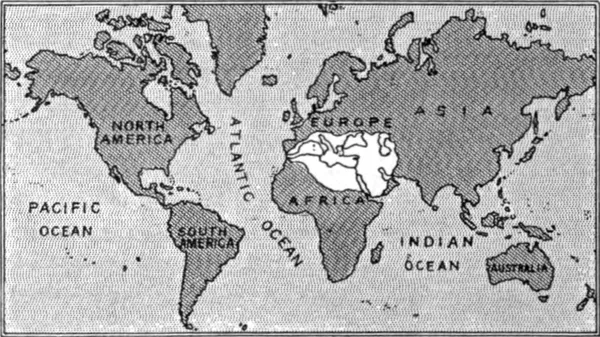
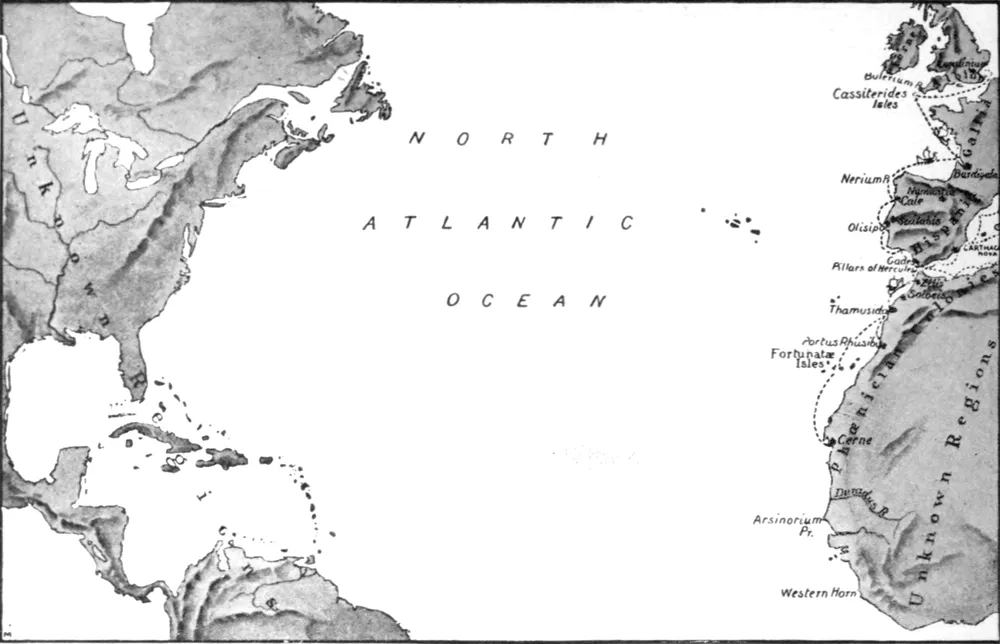
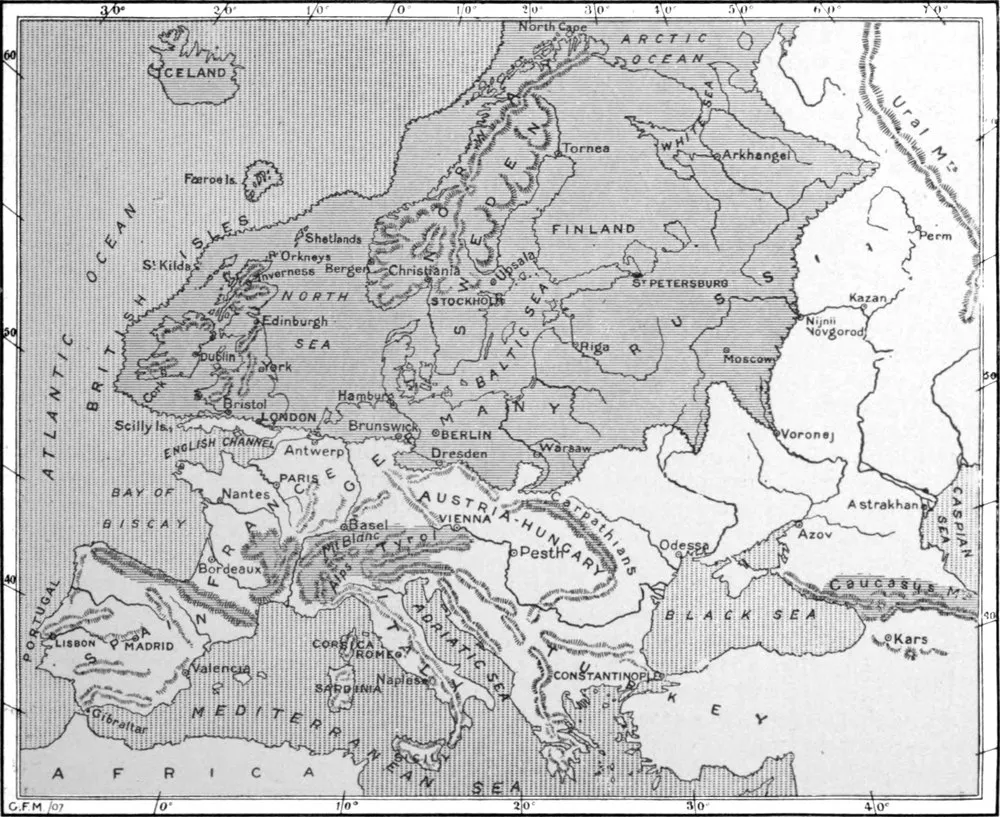
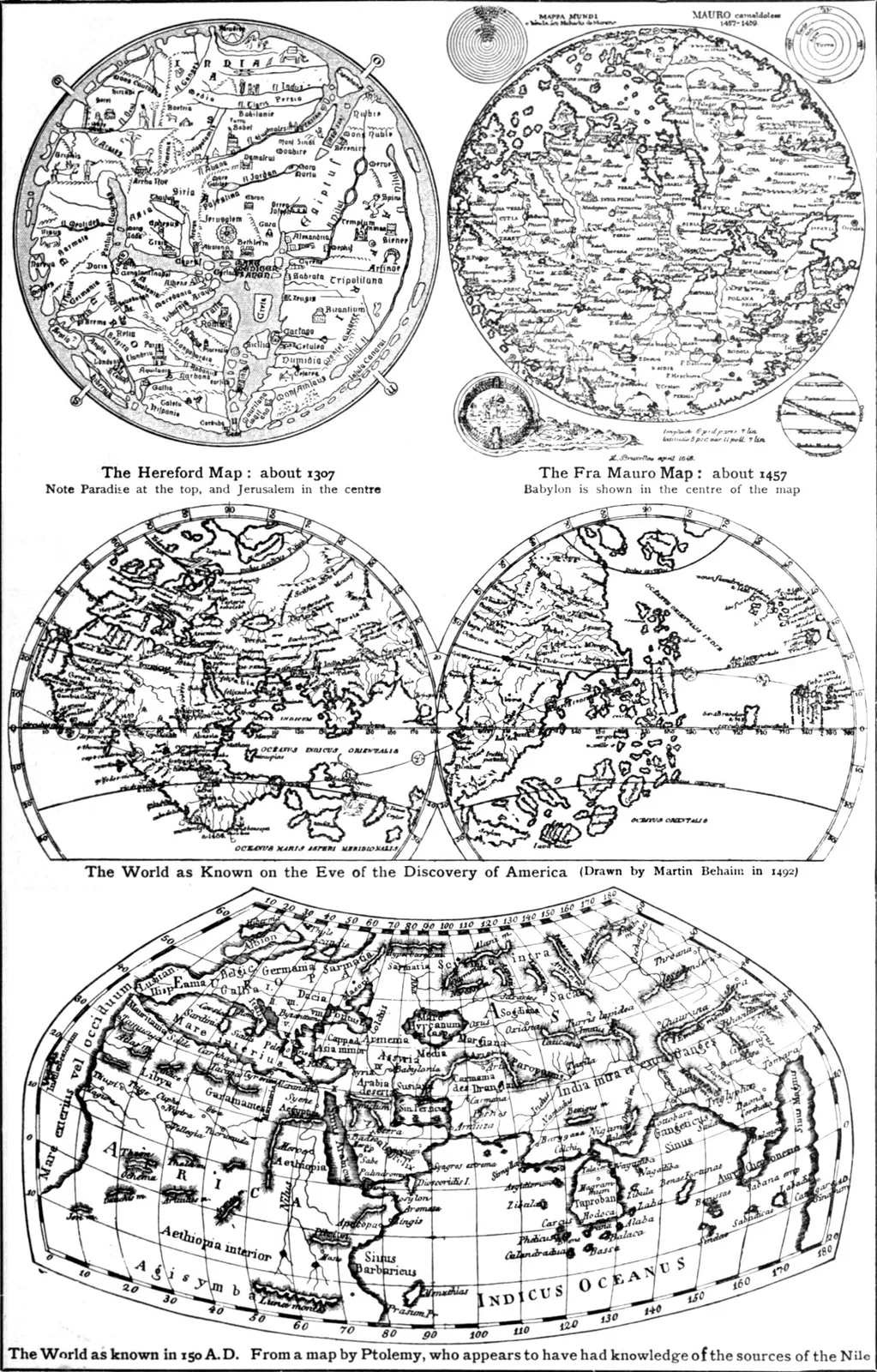
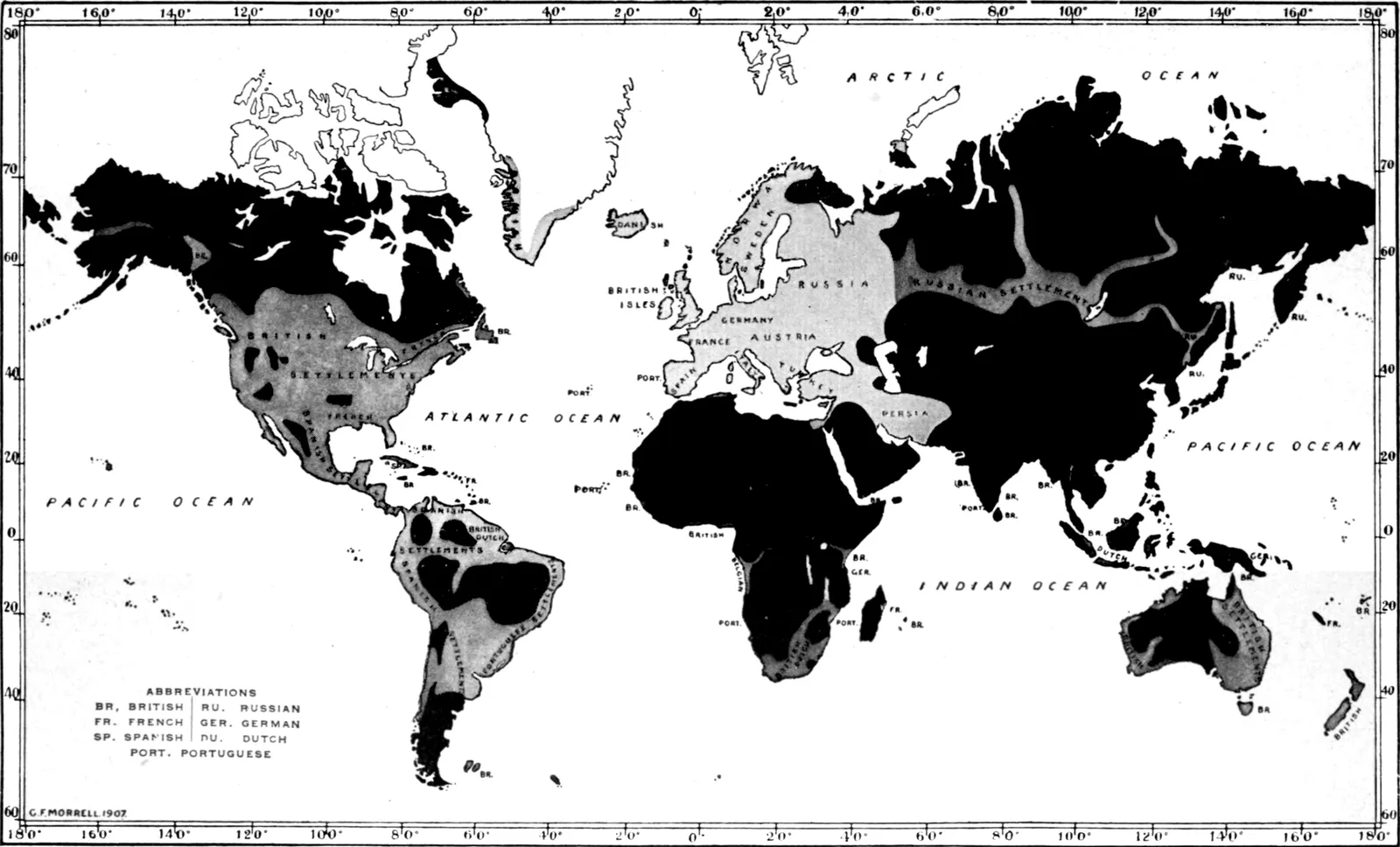
THE WORLD AS KNOWN TO ITS FIRST HISTORIAN
The world as known to Herodotus is shown by the white part
of this map, indicating the limited range of ancient geographical knowledge.
New Material and New Methods
That century, in the first place, has enormously widened our knowledge
of the times hitherto called prehistoric. The discovery of methods
for deciphering the inscriptions found in Egypt and Western Asia,
the excavations in Assyria and Egypt, in Continental Greece and in
Crete, and to a lesser extent in North Africa also, in the course of
which many inscriptions have been collected and fragments of ancient
art examined, have given us a mass of knowledge regarding the nations
who dwelt in these countries larger and more exact than was possessed
by the writers of classical antiquity who lived comparatively near
to those remote times. We possess materials for the study not only
of the political history but of the ethnology, the languages, and
the culture of the nations which were first civilised incomparably
better than were those at the disposal of the contemporaries of Vico
or Gibbon or Herder. Similar results have followed as regards the Far
East, from the opening up of Sanskrit literature and of the records
of China and Japan. To a lesser degree, the same thing has happened
as regards the semi-civilised peoples of tropical America both north
and south of the Isthmus of Panama. And while long periods of time
have thus been brought within the range of history, we have also
learnt much more about the times that may still be called prehistoric.
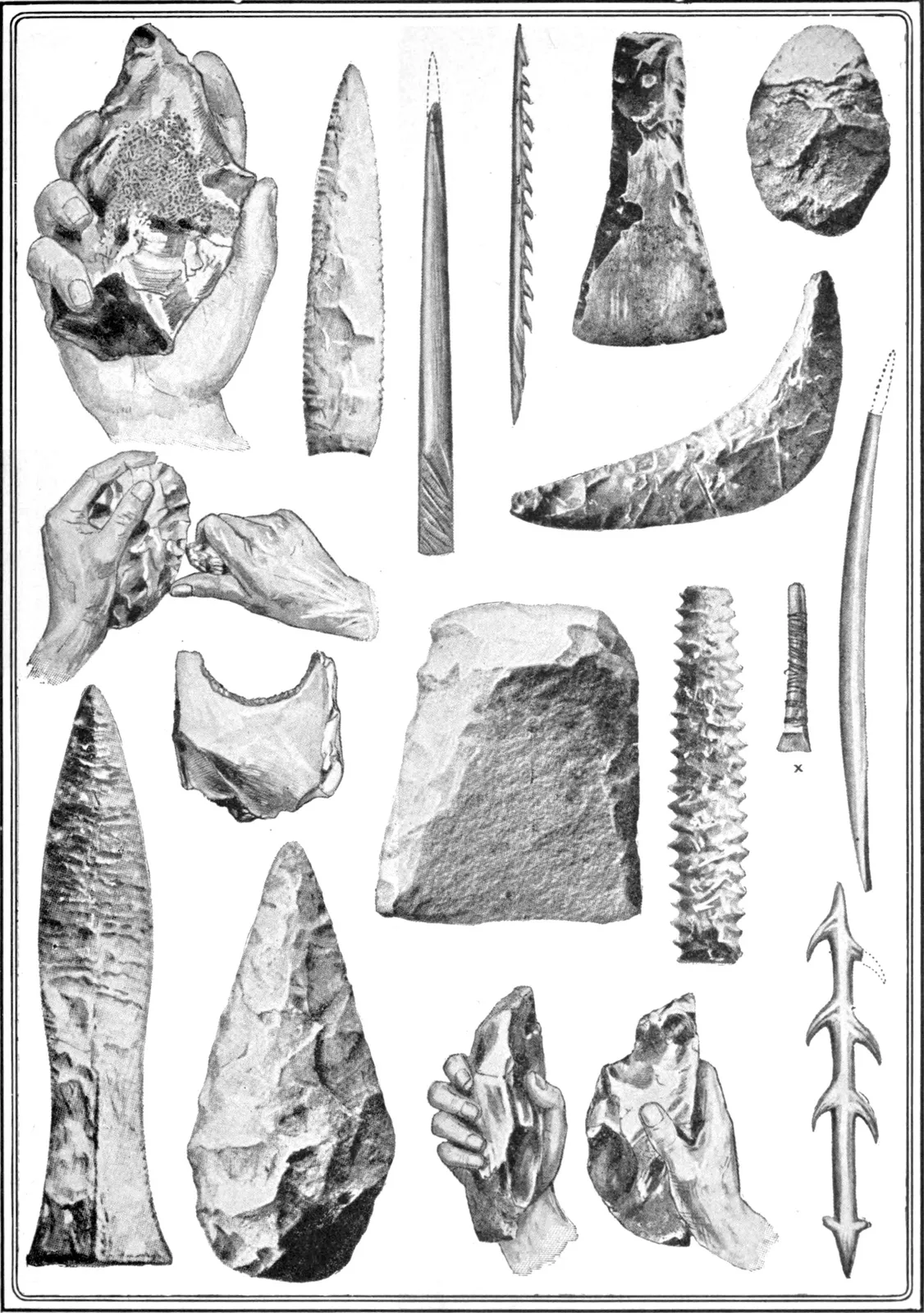
The investigations carried on in mounds and caves and tombs and
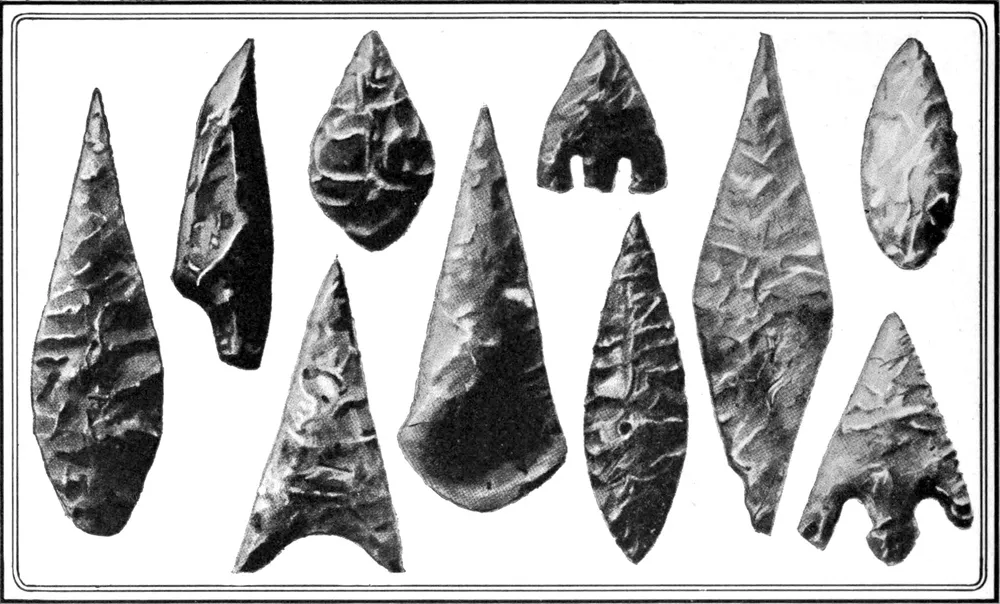
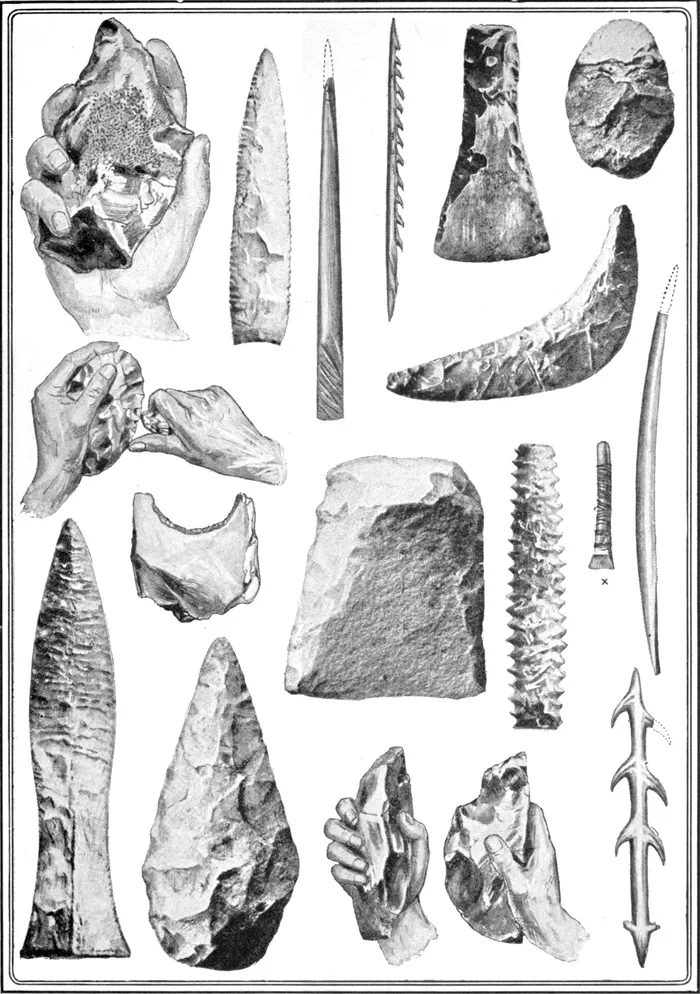
lake-dwellings, the collection of early stone and bronze implements,
and of human skulls and bones found along with those of other animals,
have thrown a great deal of new light upon primitive man, his way
of life, and his migrations from one region to another. As history
proper has been carried back many centuries beyond its former limit,
so has our knowledge of prehistoric times been extended centuries
above the furthest point to which history can now reach back. And this
applies not only to the countries previously little explored, but to
such well-known districts as Western Europe and the Atlantic coast of
America.
Secondly, there has been during the nineteenth century a notable
improvement in the critical method of handling historical materials.
Much more pains have been taken to examine all available documents
and records, to obtain a perfect text of each by a comparison of
manuscripts or of early printed copies, and to study each by the aid
of other contemporary matter. It is true that, with the exception of
Egyptian papyri and some manuscripts unearthed in Oriental monasteries
(besides those Indian, Chinese, and other early Eastern sacred books
to which I have already referred), not very much that is absolutely
new has been brought to light. It is also true that a few of the most
capable students in earlier days, in the ancient world as well as since
the Renaissance, have fully seen the value of original authorities
and have applied to them thoroughly critical methods. This is not a
discovery of our own times. Still, it may be claimed that there was
never before so great a zeal for collecting and investigating all
possible kinds of original texts, nor so widely diffused a knowledge of
the methods to be applied in turning them to account for the purposes
of history. Both in Europe and in America an unprecedentedly large
number of competent men have been employed upon researches of this
kind, and the result of their labours on special topics has been to
provide the writer who seeks to present a general view of history
with materials not only larger but far fitter for his use than his
predecessors ever enjoyed. Then with the improvement in critical
apparatus, there has come a more cautious and exact habit of mind in
the interpretation of facts.
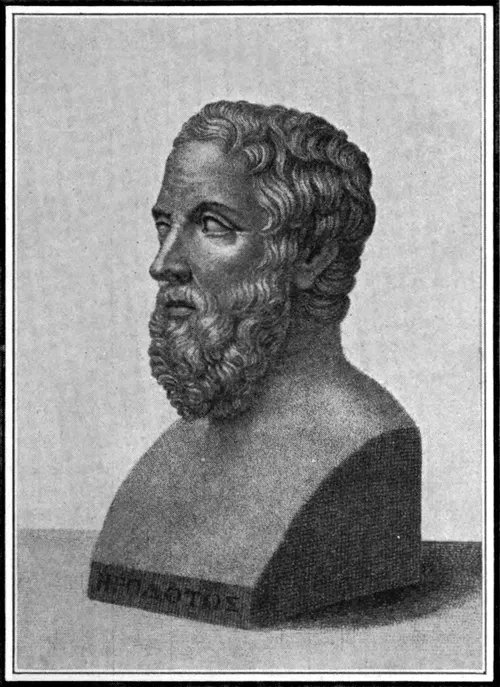
“THE FATHER OF HISTORY”
Herodotus, the first historian, was born between B.C.
470–480 at Halicarnassus, a Greek colony in Asia Minor
Thirdly, the progress of the sciences of Nature has powerfully
influenced history, both by providing new data and by affecting the
mental attitude of all reflective men. This has happened in several
ways. Geographical exploration has made known nearly every part of the
surface of the habitable globe. The great natural features of every
country, its mountain ranges and rivers, its forest or deserts, have
been ascertained. Its flora and fauna have been described, and thereby
its capacity for supporting human life approximately calculated. The
other physical conditions which govern the development of man, such as
temperature, rainfall, and the direction of prevalent winds have been
examined. Thus we have acquired a treasury of facts relating to the
causes and conditions which help the growth of civilisation and mould
it into diverse forms, conditions whose importance I shall presently
discuss in considering the relation of man to his natural environment.
Although a few penetrating minds had long ago seen how much the
career of each nation must have been affected by physical phenomena,
it is only in the last two generations that men have begun to study
these phenomena in their relation to history, and to appreciate their
influence in the formation of national types and in determining the
movement of races over the earth’s surface.
Not less remarkable has been the increase in our knowledge of the
more remote and backward peoples. Nearly every one of these has now
been visited by scientific travellers or missionaries, its language
written down, its customs and religious rites, sometimes its folk lore
also, recorded. Thus materials of the highest value have been secured,
not only for completing our knowledge of mankind as a whole, but for
comprehending in the early history of the now highly civilised peoples
various facts which had previously remained obscure, but which became
intelligible when compared with similar facts that can be studied in
their actuality among tribes whom we find in the same stage to-day as
were the ancestors of the civilised nations many centuries ago.
Progress of the Sciences
The progress thus achieved in the science of man regarded as a part
of Nature has powerfully contributed to influence the study of human
communities as they appear in history. The comparative method has
become the basis for a truly scientific inquiry into the development of
institutions, and the connection of religious beliefs and ceremonies
with the first beginnings of institutions both social and political has
been made clear by an accumulation of instances. Whether or no there
be such a thing as a Science of History—a question which, since it
is mainly verbal, one need not stop to discuss—there is such a thing
as a scientific method applied to history; and the more familiar men
have become with the methods of inquiry and canons of evidence used in
physical investigations, so much the more have they tended to become
exact and critical in historical investigations, and to examine the
causes and the stages by and through which historical development is
effected.
Historical Knowledge in Our Time
In noting this I do not suggest that what is popularly called the
“Doctrine of Evolution” should be deemed a thing borrowed by history
from the sciences of nature. Most of what is true or helpful in that
doctrine was known long ago, and applied long ago by historical and
political thinkers. You can find it in Aristotle, perhaps before
Aristotle. Even as regards the biological sciences, the notion of
what we call evolution is ancient; and the merit of Darwin and other
great modern naturalists has lain, not in enouncing the idea as a
general theory, but in elucidating, illustrating, and demonstrating the
processes by which evolution takes place. The influence of the natural
sciences on history is rather to be traced in the efforts we now see to
accumulate a vast mass of facts relating to the social, economic, and
political life of man, for the sake of discovering general laws running
through them, and imparting to them order and unity.
Although the most philosophic and diligent historians have always aimed
at and striven for this, still the general diffusion of the method in
our own time, and the greatly increased scale on which it is applied,
together with the higher standard of accuracy which is exacted by the
opinion of competent judges, may be, in some measure, ascribed to the
examples which those who work in the spheres of physics and biology and
natural history have so effectively set.
Finally, the progress of natural science has in our time, by
stimulating the production and exchange of commodities, drawn the
different parts of the earth much nearer to one another, and thus
brought nearly all its tribes and nations into relations with one
another far closer and far more frequent than existed before.
Oneness of the Human Race
This has been done by the inventions that have given us steam and
electricity as motive forces, making transport quicker and cheaper,
and by the application of electricity to the transmission of words. No
changes that have occurred in the past (except perhaps changes in the
sphere of religion) are comparable in their importance as factors in
history to those which have shortened the voyage from Western Europe to
America to five and a half days, and made communication with Australia
instantaneous. For the first time the human race, always essentially
one, has begun to feel itself one, and civilised man has in every part
of it become a contemporaneous observer of what passes in every other
part.
The general result of these various changes has been that while the
materials for writing a history of the world have been increased, the
conception of what such a history should be has been at the same time
both enlarged and defined. Its scope is wider; its lines are more
clearly drawn. But what do we mean by a Universal History? Briefly, a
History which shall, first, include all the races and tribes of man
within its scope; and, secondly, shall bring all these races and tribes
into a connection with one another such as to display their annals as
an organic whole.
Importance of the Small Races
Universal history has to deal not only with the great nations, but also
with the small nations; not only with the civilised, but also with the
barbarous or savage peoples; not only with the times of movement and
progress, but also with the times of silence and apparent stagnation.
Every fraction of humanity has contributed something to the common
stock, and has lived and laboured not for itself only, but for others
also, through the influence which it has perforce exercised on its
neighbours. The only exceptions we can imagine are the inhabitants of
some remote isle, “far placed amid the melancholy main.” Yet they, too,
must have once formed part of a race dwelling in the region whence they
came, even if that race had died out in its old home before civilised
man set foot on such an oceanic isle in a later age. The world would
have been different, in however small a measure, had they never
existed. As in the realm of physical science, so in that of history no
fact is devoid of significance, though the true significance may remain
long unnoticed. The history of the backward races presents exceptional
difficulties, because they have no written records, and often scarcely
any oral traditions. Sometimes it reduces itself to a description of
their usages and state of life, their arts and their superstitions, at
the time when civilised observers first visited them. Yet that history
is instructive, not only because the phenomena observable among such
races enlarge our knowledge, but also because through the study of
those which survive we are able to interpret the scanty records we
possess of the early condition of peoples now civilised, and to go
some way towards writing the history of what we have hitherto called
prehistoric man.
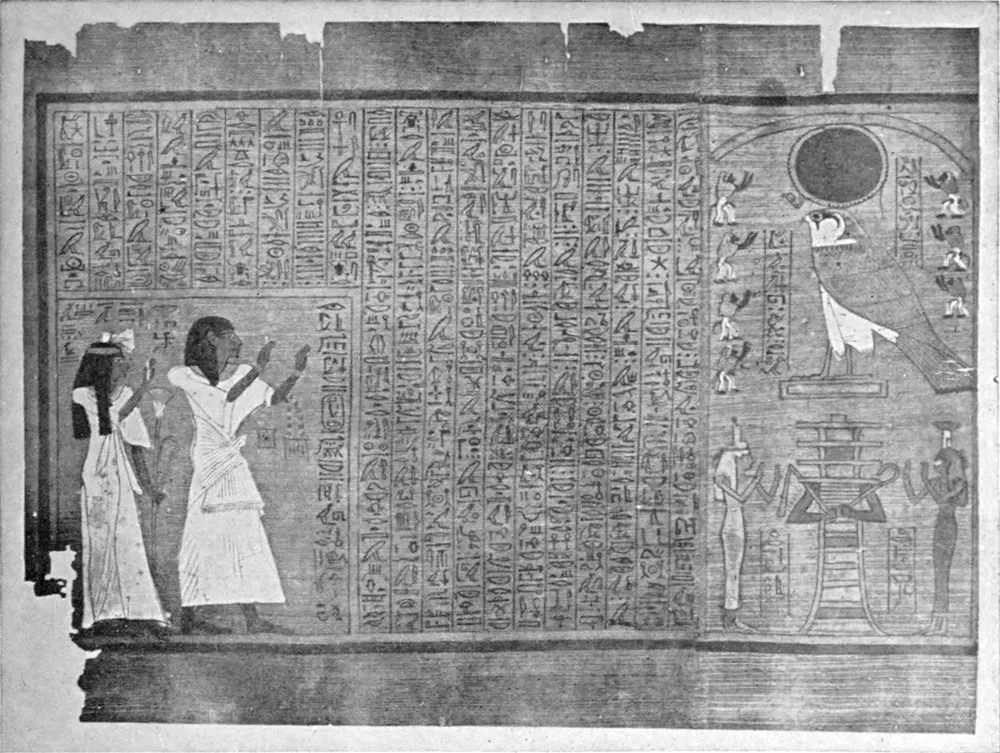
ANCIENT EGYPT’S STRANGE BOOKS AND PICTORIAL RECORDS,
MADE OF PAPYRUS
Papyrus, a tall, graceful, sedgy plant, supplied the
favourite writing material of the ancient world, and many priceless records of
antiquity are preserved to us in papyri. The pith of the plant was pressed flat
and thin and joined with others to form strips, on which records were
written or painted. The above is a photograph of a piece of Egyptian
papyrus, showing both hieroglyphics and picture-writing. The oldest
piece of papyrus dates back to B.C. 3500.
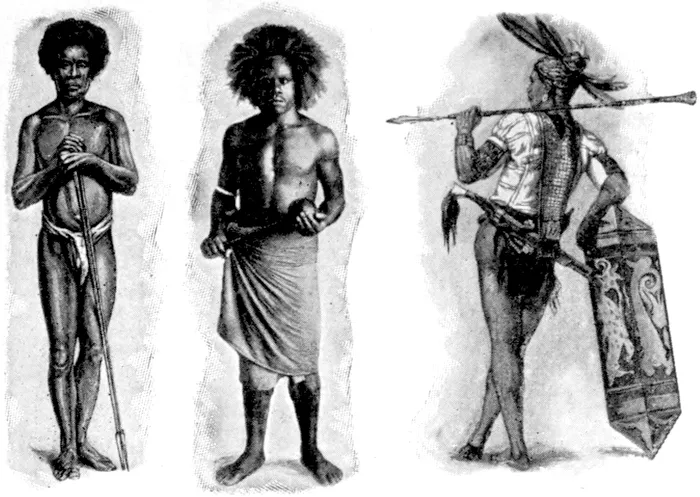
Thus such tribes as the aborigines of Australia, the Fuegians of
Magellan’s Straits, the Bushmen of South Africa, the Sakalavas of
Madagascar, the Lapps of Northern Europe, the Ainos of Japan, the
numerous “hill-tribes” of India, will all come within the historian’s
ken. From each of them something may be learnt; and each of them
has through contact with its more advanced neighbours affected
those neighbours themselves, sometimes in blood, sometimes through
superstitious beliefs or rites, frequently borrowed by the higher races
from the lower (as the Norsemen learnt magic from the Lapps, and the
Semites of Assyria from the Accadians), sometimes through the strife
which has arisen between the savage and the more civilised man, whereby
the institutions of the latter have been modified.
Obviously the historian cannot record everything. These lower races
are comparatively unimportant. Their contributions to progress, their
effect on the general march of events, have been but small. But they
must not be wholly omitted from the picture, for without them it would
have been different. One must never forget, in following the history of
the great nations of antiquity, that they fought and thought and built
up the fabric of their industry and art in the midst of a barbarous or
savage population surrounding them on all sides, whence they drew the
bulk of their slaves and some of their mercenary soldiers, and which
sometimes avenged itself by sudden inroads, the fear of which kept the
Greek cities, and at certain epochs even the power of Rome, watchful
and anxious. So in modern times the savages among whom European
colonies have been planted, or who have been transported as slaves to
other colonies—sometimes, as in the case of Portugal in the fifteenth
century, to
Europe itself—or those with whom Europeans have carried on trade, must
not be omitted from a view of the causes which have determined the
course of events in the civilised peoples.
Great Works of Little Peoples
To dwell on the part played by the small nations is less necessary
here, for even a superficial student must be struck by the fact that
some of them have counted for more than the larger nations to whose
annals a larger space is commonly allotted. The instance of Israel is
enough, so far as the ancient world is concerned, to show how little
the numbers of a people have to do with the influence it may exert. For
the modern world, I will take the case of Iceland.
The Culture of the Icelanders
The Icelanders are a people much smaller than even was Israel. They
have never numbered more than about seventy thousand. They live in an
isle so far remote, and so sundered from the rest of the world by an
inhospitable ocean, that their relations both with Europe, to which
ethnologically they belong, and with America, to which geographically
they belong, have been comparatively scanty. But their history, from
the first settlement of the island by Norwegian exiles in A.D.
874 to the extinction of the National Republic in A.D. 1264,
is full of interest and instruction, in some respects a perfectly
unique history. And the literature which this handful of people
produced is certainly the most striking primitive literature which any
modern people has produced, superior in literary quality to that of the
Continental Teutons, or to that of the Romance nations, or to that of
the Finns or Slavs, or even to that of the Celts. Yet most histories
of Europe pass by Iceland altogether, and few persons in Continental
Europe (outside Scandinavia) know anything about the inhabitants of
this isle, who, amid glaciers and volcanoes, have maintained themselves
at a high level of intelligence and culture for more than a thousand
years.
The small peoples have no doubt been more potent in the spheres
of intellect and emotion than in those of war, politics, or
commerce. But the influences which belong to the sphere of creative
intelligence—that is to say, of literature, philosophy, religion and
art—are just those which it is peculiarly the function of a History
of the World to disengage and follow out in their far-reaching
consequence. They pass beyond the limits of the country where they
arose. They survive, it may be, the race that gave birth to them. They
pass into new forms, and through these they work in new ways upon
subsequent ages.
The Wide Scope of History
It is also the task of universal history so to trace the march of
humanity as to display the relation which each part of it bears to the
others; to fit each race and tribe and nation into the main narrative.
To do this, three things are needed—a comprehensive knowledge, a
power of selecting the salient and significant points, and a talent
for arrangement. Of these three qualifications, the first is the least
rare. Ours is an age of specialists; but the more a man buries himself
in special studies, the more risk does he incur of losing his sense of
the place which the object of his own study fills in the general scheme
of things. The highly trained historian is generally able to draw from
those who have worked in particular departments the data he needs;
while the master of one single department may be unable to carry his
vision over the whole horizon, and see each part of the landscape in
its relations to the rest.
In other words, a History of the World ought to be an account of the
human family as an organic whole, showing how each race and state
has affected other races or states, what each has brought into the
common stock, and how the interaction among them has stimulated
some, depressed or extinguished others, turned the main current this
way or that. Even when the annals of one particular country are
concerned, it needs no small measure of skill in expression as well
as of constructive art to trace their connection with those of other
countries. To take a familiar example, he who writes the history of
England must have his eye always alive to what is passing in France on
one side, and in Scotland on the other, not to speak of countries less
closely connected with England, such as Germany and Spain. He must let
the reader feel in what way the events that were happening in France
and Scotland affected men’s minds, and through men’s minds affected the
progress of events in England. Yet he cannot allow himself constantly
to interrupt his English narrative in order to tell what was passing
beyond the Channel or across the Tweed.
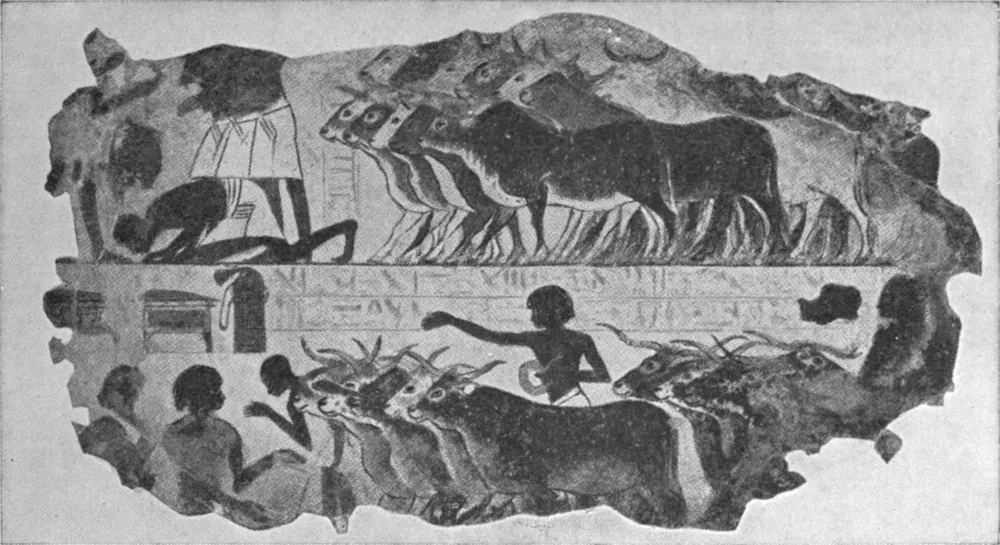
VIVID SCENES OF ANCIENT LIFE DEPICTED BY CONTEMPORARY
ARTISTS
The walls of the tombs in Egypt form a great picture
gallery of the vanished life of that country and are invaluable to the historian.
This fragment from the British Museum shows how vividly the domestic figures
were realised.
Unity of Universal History
Obviously, this difficulty is much increased when the canvas is widened
to include all Europe, and when the aim is to give the reader a just
impression of the general tendencies of a whole age, such an age as,
for instance, the sixteenth century, over that vast area. If for a
History of the World the old plan be adopted—that of telling the
story of each nation separately, yet on lines generally similar, cross
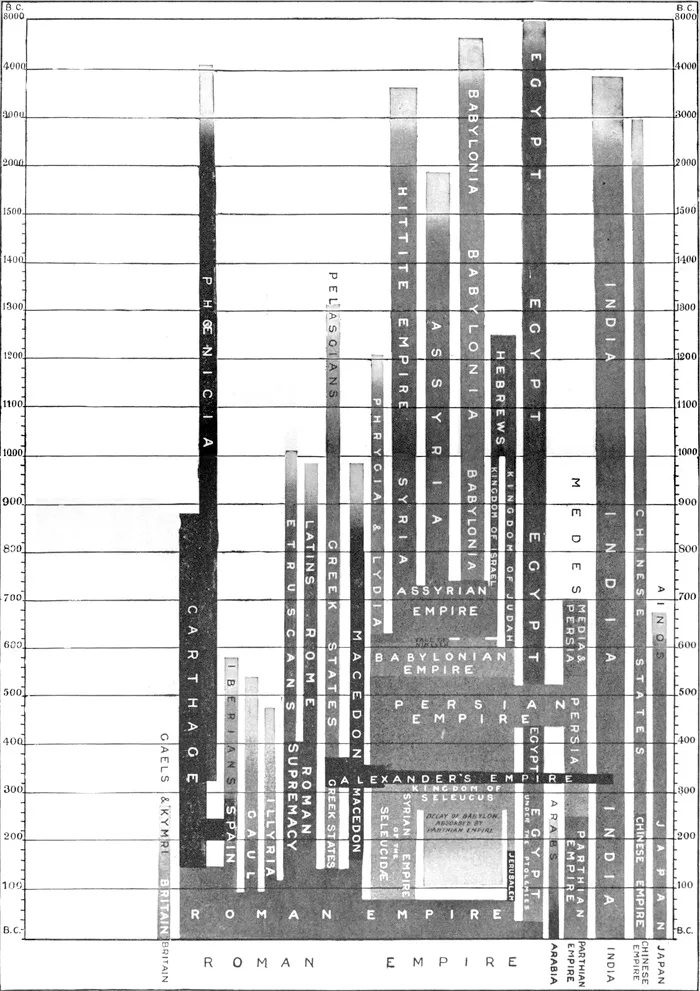
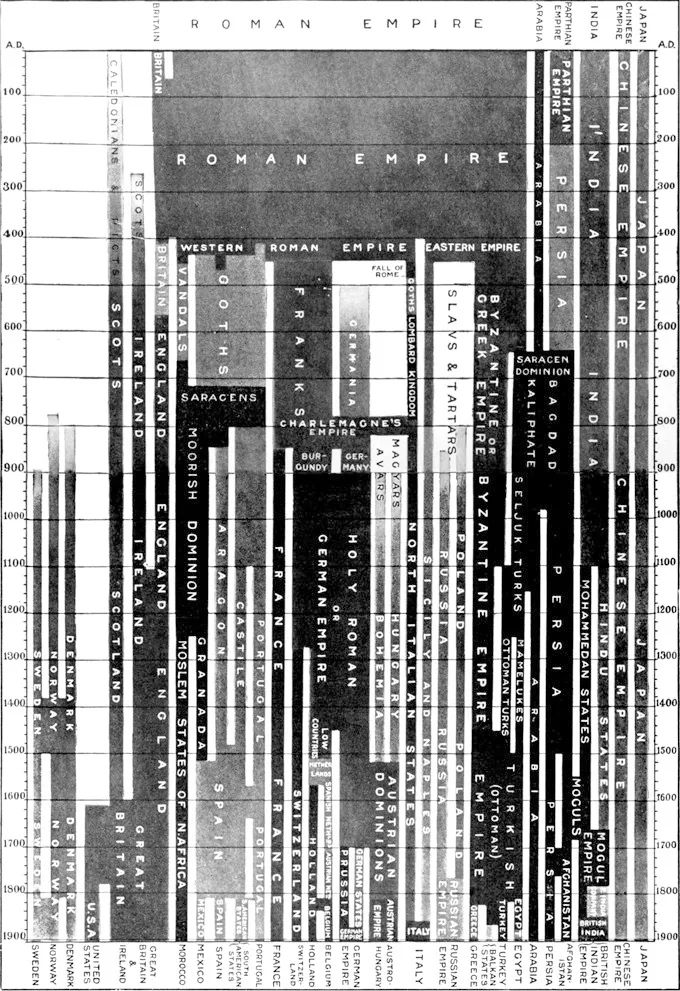
references and a copious use of chronological tables become helpful,
for they enable the contemporaneity of events to be seen at a glance,
and as the history of each nation is being written with a view to that
of other nations, the tendencies at work in each can be explained and
illustrated in a way which shows their parallelism, and gives to the
whole that unity of meaning and tendency which a universal history must
constantly endeavour to display. The connection between the progress
or decline of different peoples is best understood by setting forth
the various forms which similar tendencies take in each. To do this
is a hard task when the historian is dealing with the ancient world,
or with the world outside Europe even in mediæval and post-mediæval
times. For the modern European nations it is easier, because, ever
since the spread of Christianity made these nations parts of one great
ecclesiastical community, similar forces have been at work upon each of
them, and every intellectual movement which has told upon one has more
or less told upon the others also.
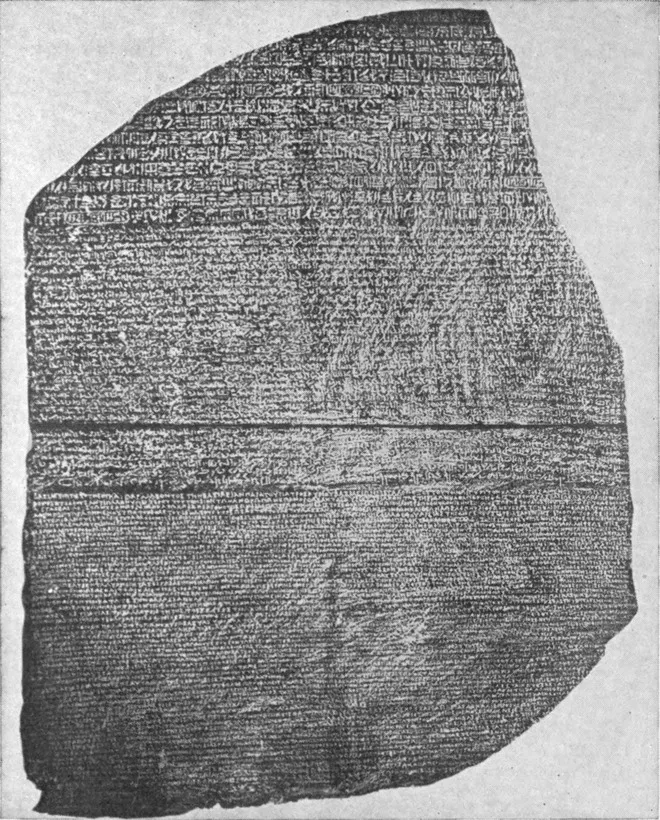
THE MASTER-KEY TO THE HIEROGLYPHICS
The inscribed stone found at Rosetta, in the Nile delta,
in 1799, now preserved in the British Museum. It gave the key to the hieroglyphic
writings of Egypt. It is a decree of Ptolemy Epiphanes, promulgated
at Memphis in B.C. 196, and as it is inscribed in hieroglyphic and in
the script of the country as well as in Greek, it thus solved the long
standing mystery of the hieroglyphics of the monuments, which before
its discovery had been quite unintelligible.
Central Line of Human Development
The Study of Human Society
Each Race a Distinct Entity
Such a History of the World may be written on more than one plan,
and in the light of more than one general theory of human progress.
It might find the central line of human development in the increase
of man’s knowledge, and in particular of his knowledge of Nature and
his power of dealing with her. Or that which we call culture, the
comprehensive unfolding and polishing of human faculty and of the
power of intellectual creation and appreciation, might be taken as
marking the most real and solid kind of progress, so that its growth
would best represent the advance of man from a savage to a highly
civilised condition. Or if the moral and political sphere were selected
as that in which the onward march of man as a social being, made to
live in a community, could best be studied, the idea of liberty might
be made a pivot of the scheme; for in showing how the individual
emerges from the family or the tribe, how first domestic and then
also prædial slavery slowly disappears, how institutions are framed
under which the will of one ruler or of a small group begins to be
controlled, or replaced as a governing force, by the collective will
of the members of the community, how the primordial rights of each
human creature win their way to recognition—in tracing out all these
things the history of human society is practically written, and the
significance of all political changes is made clear. Another way,
again, would be to take some concrete department of human activity,
follow it down from its earliest to its latest stages, and group
other departments round it. Thus one author might take religion, and
in making the history of religion the main thread of his narrative
might deal incidentally with the other phenomena which have influenced
it or which it has influenced. Or, similarly, another author might
take political institutions, or perhaps economic conditions—i.e.,
wealth, labour, capital, commerce, or, again, the fundamental social
institutions, such as the family, and the relations of the ranks and
classes in a community, and build up round one or other of these
manifestations and embodiments of the creative energy of mankind the
general story of man’s movement from barbarism to civilisation. Even
art, even mechanical inventions, might be similarly handled, for both
of these stand in a significant relation to all the rest of the life of
each nation and of the world at large. Nevertheless, no one of these
suggested lines on which a universal history might be constructed
would quite meet the expectations which the name Universal History
raises, because we have become accustomed to think of history as being
primarily and pre-eminently a narrative of the growth and development
of communities, nations, and states as organised political bodies,
seeing that it is in their character as bodies so organised that they
come into relation with other nations and states. It is therefore
better to follow the familiar plan of dealing with the annals of each
race and nation as a distinct entity, while endeavouring to show
throughout the whole narrative the part which each fills in the general
drama of human effort, conflict, and progress.
A universal history may, however, while conforming to this established
method, follow it out along a special line, which shall give prominence
to some one leading idea or principle. Such a line or point of view has
been found for the present work in the relation of man to his physical
environment—that is to say, to the geographical conditions which have
always surrounded him, and always must surround him, conditions whose
power and influence he has felt ever since he appeared upon the globe.
This point of view is more comprehensive than any one of those above
enumerated. Physical environment has told upon each and every one of
the lines of human activity already enumerated that could be taken to
form a central line for the writing of a history of mankind. It has
influenced not only political institutions and economic phenomena, but
also religion, and social institutions, and art, and inventions. No
department of man’s life has been independent of it, for it works upon
man not only materially but also intellectually and morally.
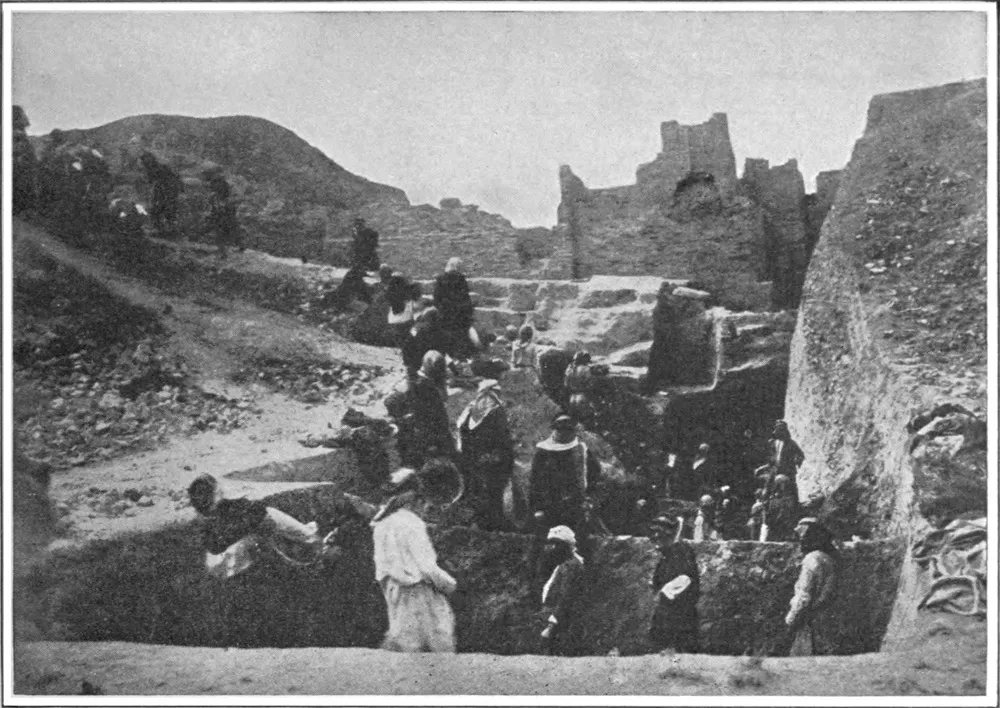
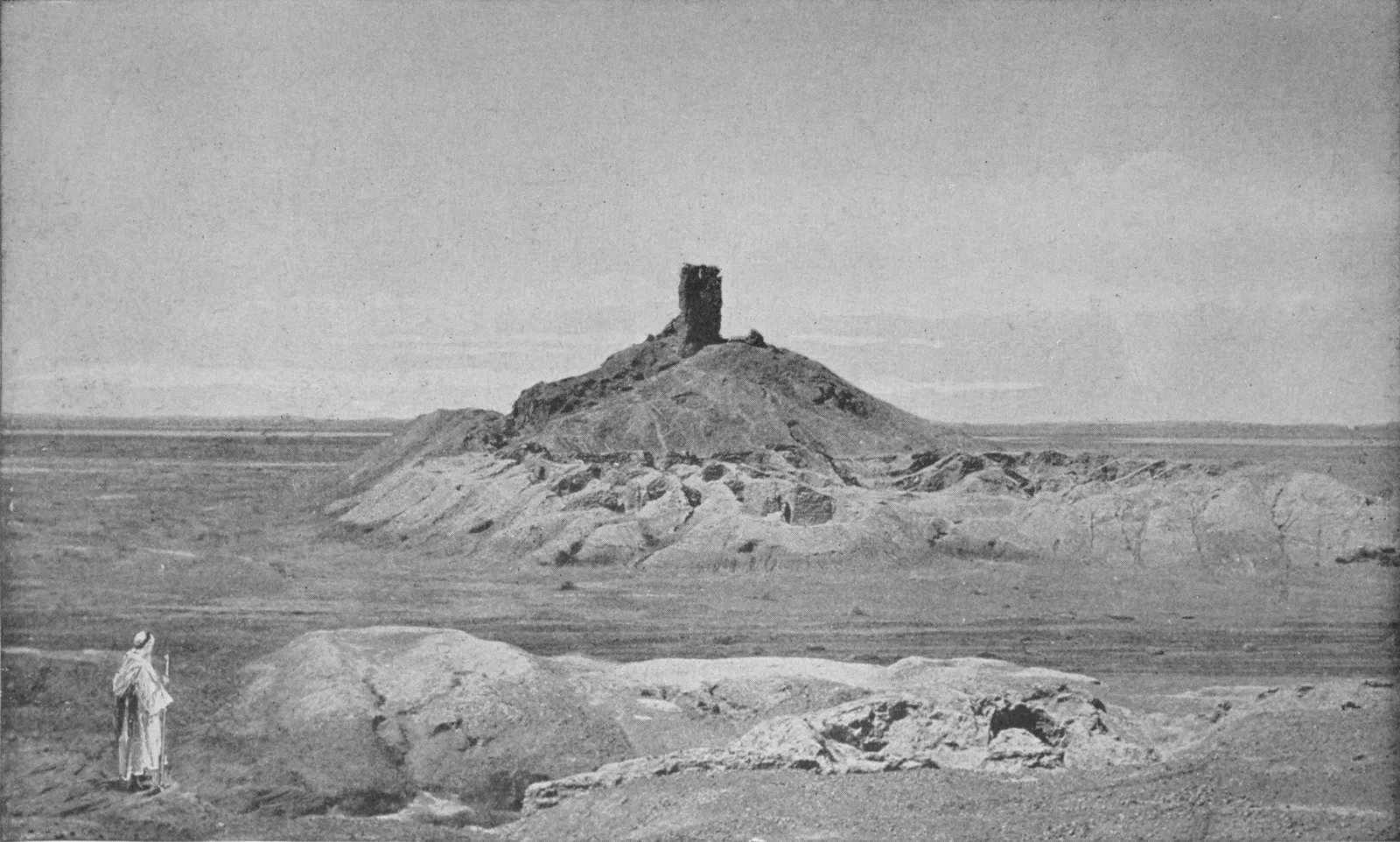
UNEARTHING THE RUINS OF ANCIENT BABYLON IN THE TWENTIETH
CENTURY
This photograph illustrates how present-day exploration
brings the remains of the ancient wonder cities of Babylonia to light after the
sleep of ages. Much valuable knowledge of Babylon has been acquired
quite recently as a result of excavations now being carried on under
the supervision of English, American, French, and German explorers.
As this is the idea which has governed the preparation of the present
book, as it is constructed upon a geographical rather than a purely
chronological plan (though, of course, each particular country and
nation needs to be treated chronologically), some few pages may
properly be devoted here to a consideration of the way in which
geography determines history, or, in other words, to an examination of
the relations of Nature, inorganic and organic, to the life of man.
MAN’S PLACE IN NATURE’S KINGDOM
T
THOUGH
we are accustomed to contrast man with Nature, and to look upon
the world outside ourselves as an object to be studied by man, the
conscious and intelligent subject, it is evident, and has been always
recognised even by those thinkers who have most exalted the place man
holds in the Cosmos, that man is also to be studied as a part of the
physical universe. He belongs to the realm of Nature in respect of his
bodily constitution, which links him with other animals, and in certain
respects with all the phenomena that lie within the sphere of biology.
All creatures on our earth, since they have bodies formed from material
constituents, are subject to the physical laws which govern matter; and
the life of all is determined, so far as their bodies are concerned,
by the physical conditions which foster, or depress, or destroy life.
Plants need soil, moisture, sunshine, and certain constituents of the
atmosphere. Their distribution over the earth’s surface depends not
only upon the greater or less extent to which these things, essential
to their existence, are present, but also upon the configuration of
the earth’s surface (continents and oceans), upon the greater or
less elevation above sea level of parts of it, upon such forces as
winds and ocean currents (occasionally also upon volcanoes), upon the
interposition of arid deserts between moister regions, or upon the flow
of great rivers. The flora of each country is the resultant (until man
appears upon the scene) of these natural conditions.
Natural Conditions of Life
We know that some plants are also affected by the presence of certain
animals, particularly insects and birds. Similarly, animals depend
upon these same conditions which regulate their distribution, partly
directly, partly indirectly, or mediately through the dependence of
the animal for food upon the plants whose presence or absence these
conditions have determined. It would seem that animals, being capable
of moving from place to place, and thus of finding conditions suitable
for their life, and to some extent of modifying their life to suit the
nature around them, are somewhat more independent than plants are,
though plants, too, possess powers of adapting themselves to climatic
surroundings; and there are some—such, for instance, as our common
brake-fern and the grass of Parnassus—which seem able to thrive
unmodified in very different parts of the globe.
Man the Servant of Nature
The primary needs of man which he shares with the other animals are an
atmosphere which he can breathe, a temperature which he can support,
water which he can drink, and food. In respect of these he is as
much the product of geographical conditions as are the other living
creatures. Presently he superadds another need, that of clothing. It
is a sign that he is becoming less dependent on external conditions,
for by means of clothing he can make his own temperature and succeed
in enduring a degree of cold, or changes from heat to cold, which
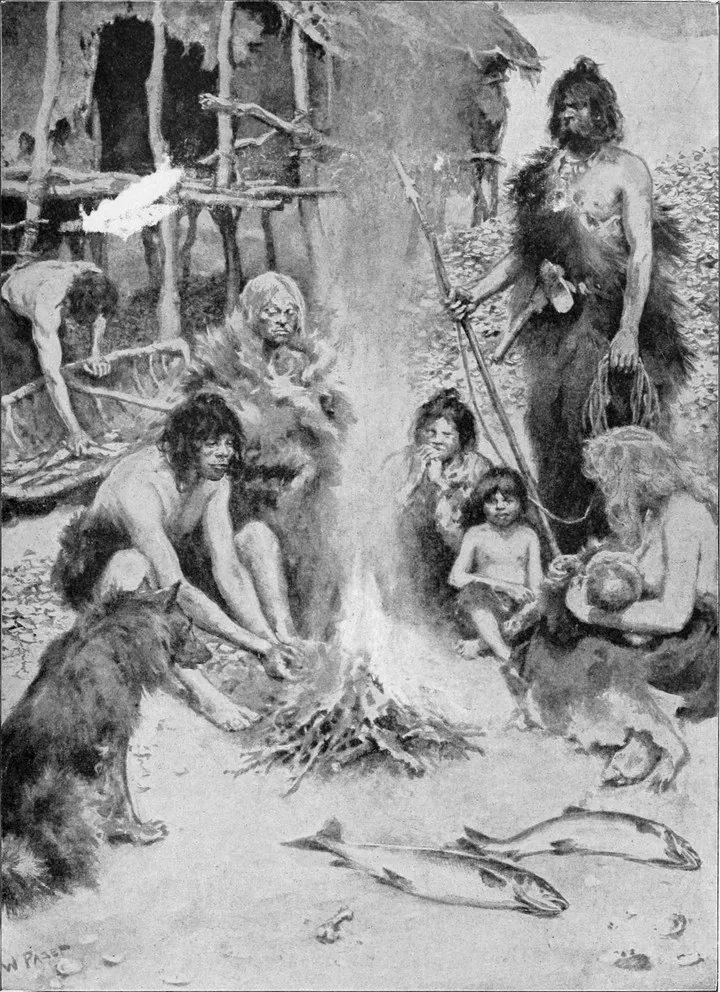
might otherwise shorten his life. The discovery of fire carries him a
long step further, for it not only puts him less at the mercy of low
temperatures, but extends the range of his food supplies, and enables
him, by procuring better tools and weapons, to obtain his food more
easily. We need not pursue his upward course, at every stage of which
he finds himself better and still better able to escape from the
thraldom of Nature, and to turn to account the forces which she puts
at his disposal. But although he becomes more and more independent,
more and more master not only of himself, but of her, he is none the
less always for many purposes the creature of the conditions with which
she surrounds him. He always needs what she gives him. He must always
have regard to the laws which he finds operating through her realm. He
always finds it the easiest course to obey, and to use rather than to
attempt to resist her.
Here let me pause to notice a remarkable contrast between the earlier
and the later stages of man’s relations to Nature. In the earlier
stages he lies helpless before her, and must take what she chooses to
bestow—food, shelter, materials for clothing, means of defence against
the wild beasts, who are in strength far more than a match for him. He
depends upon her from necessity, and is better or worse off according
as she is more or less generous.
Man’s Advance in Knowledge
But in the later stages of his progress he has, by accumulating a store
of knowledge, and by the development of his intelligence, energy, and
self-confidence, raised himself out of his old difficulties. He no
longer dreads the wild beasts. They, or such of them as remain, begin
to dread him, for he is crafty, and can kill them at a distance. He
erects dwellings which can withstand rain and tempest. He irrigates
hitherto barren lands and raises abundant crops from them. When he has
invented machinery, he produces in an hour clothing better than his
hands could formerly have produced in a week. If at any given time
he has not plenty of food, this happens only because he has allowed
his species to multiply too fast. He is able to cross the sea against
adverse winds and place himself in a more fertile soil or under more
genial skies than those of his former home. As respects all the primary
needs of his life, he has so subjected Nature to himself, that he can
make his life what he will.
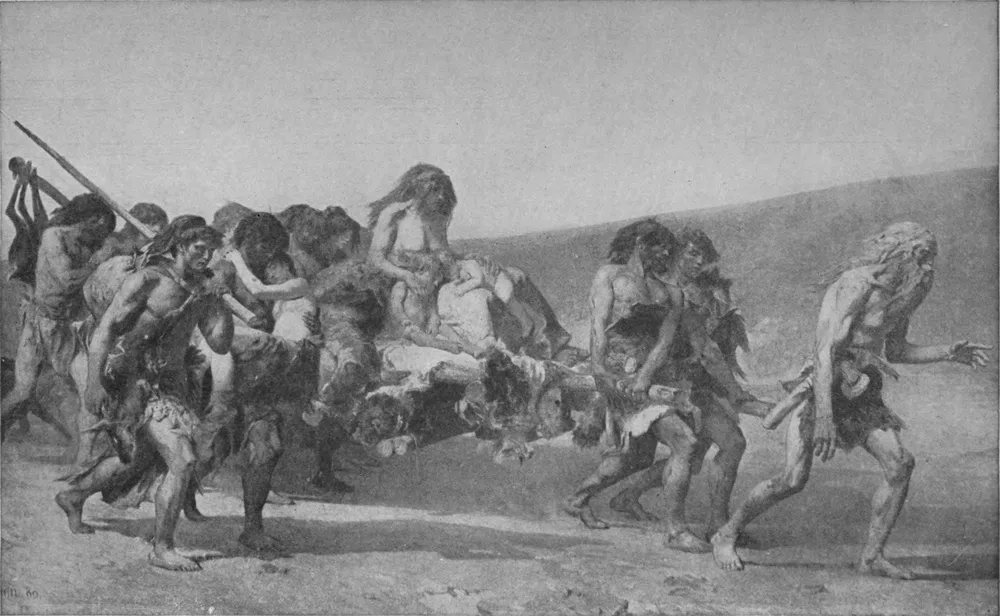
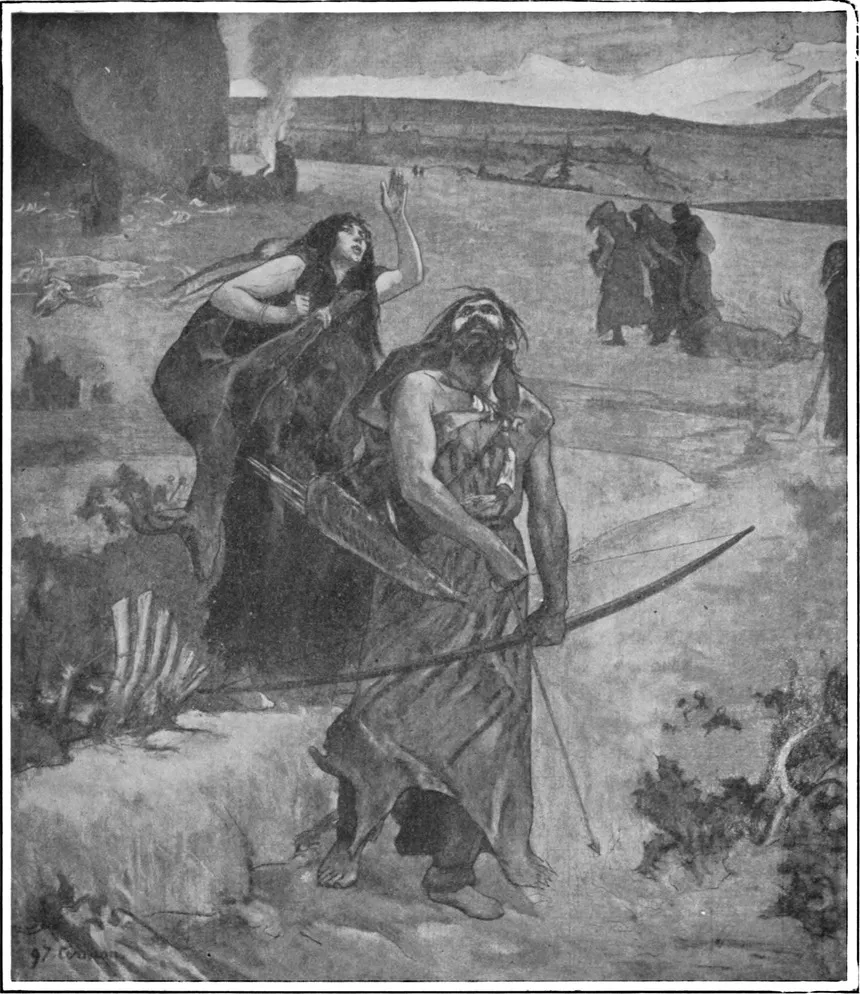
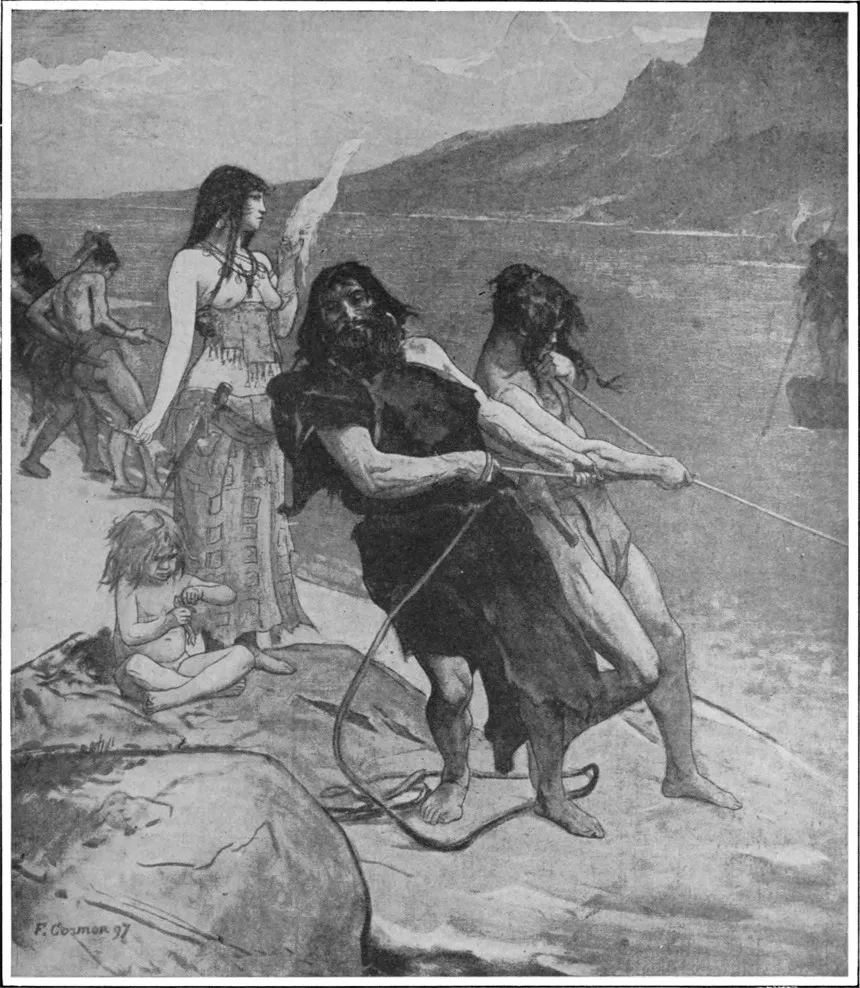
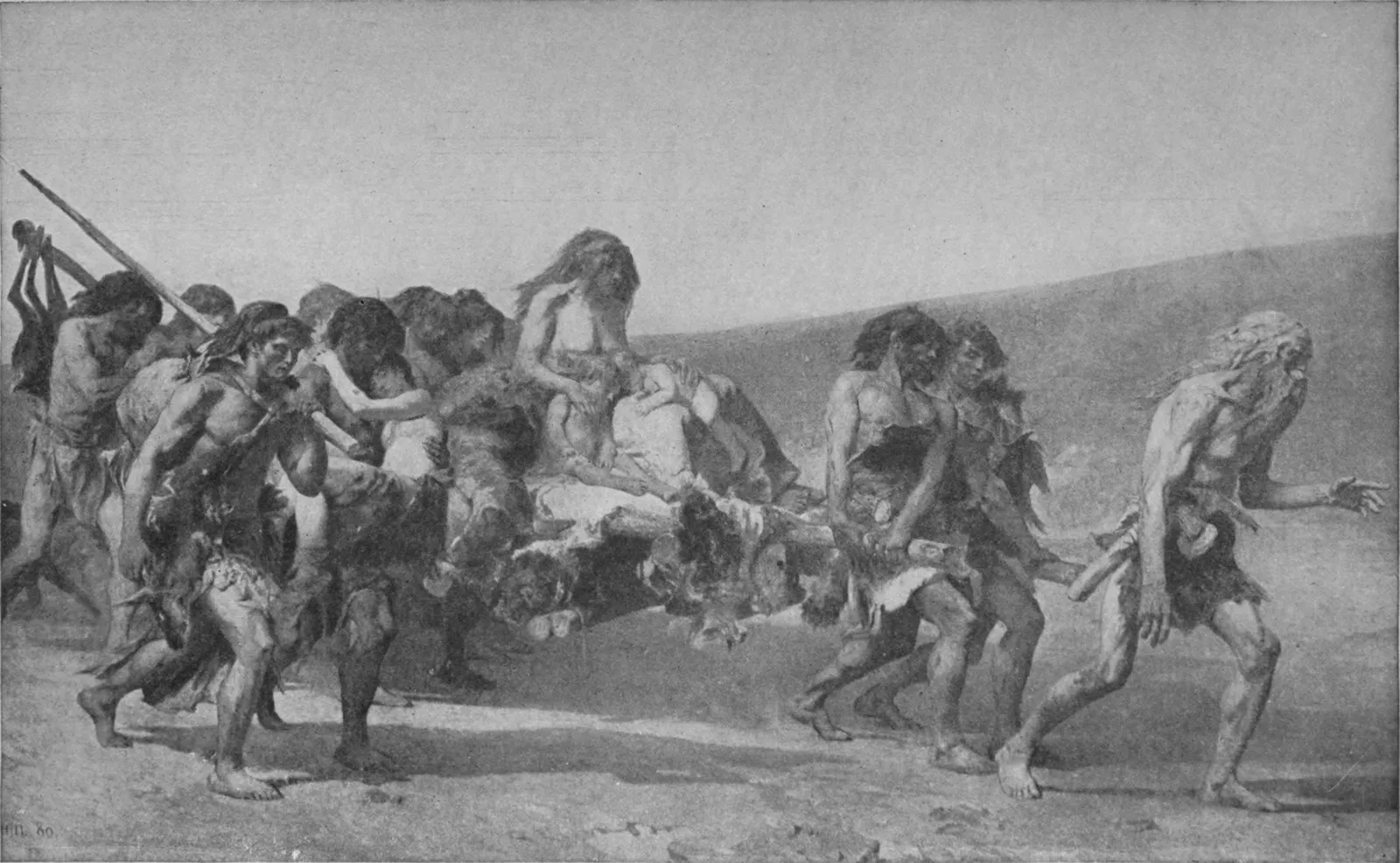
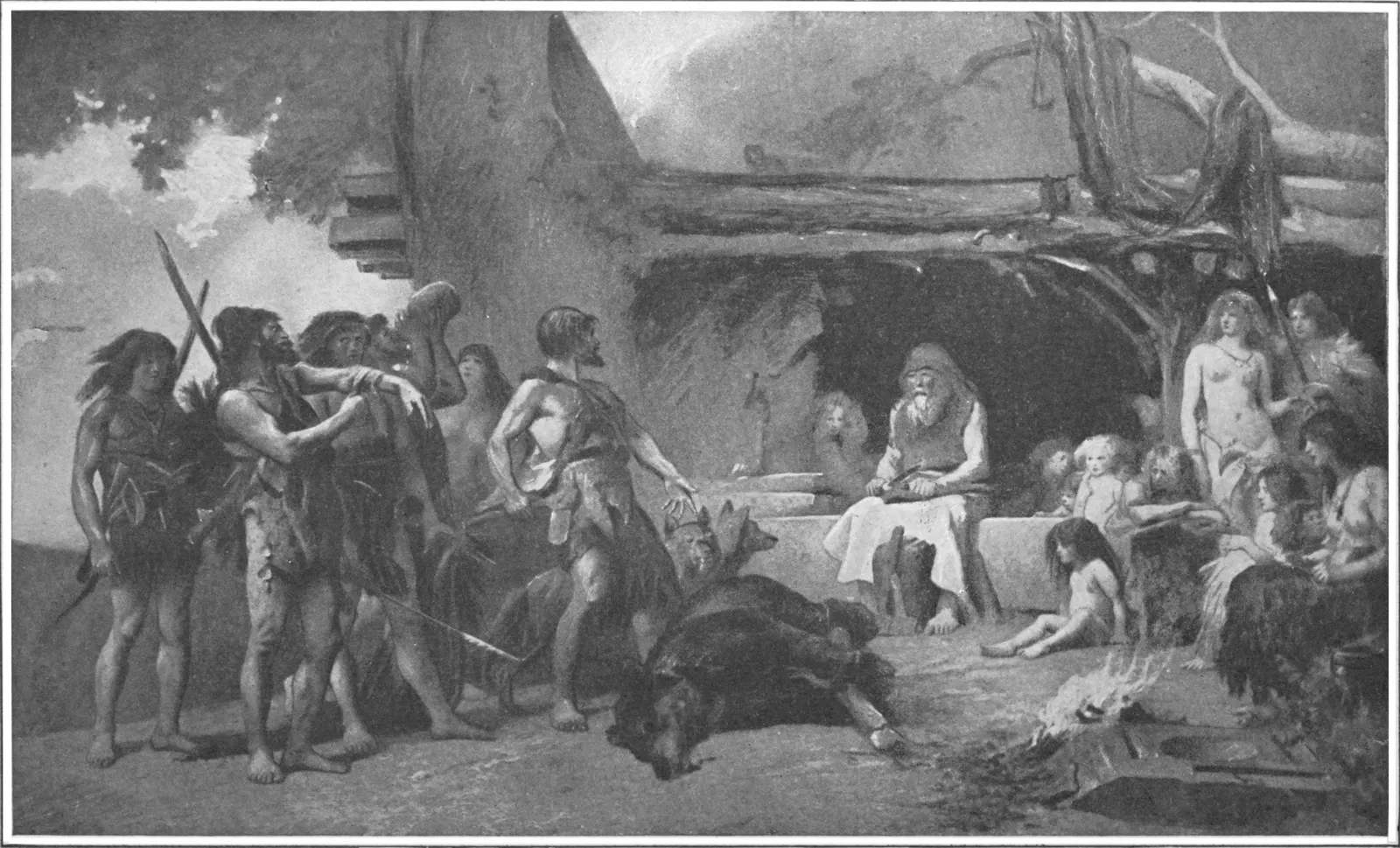
Neurdein
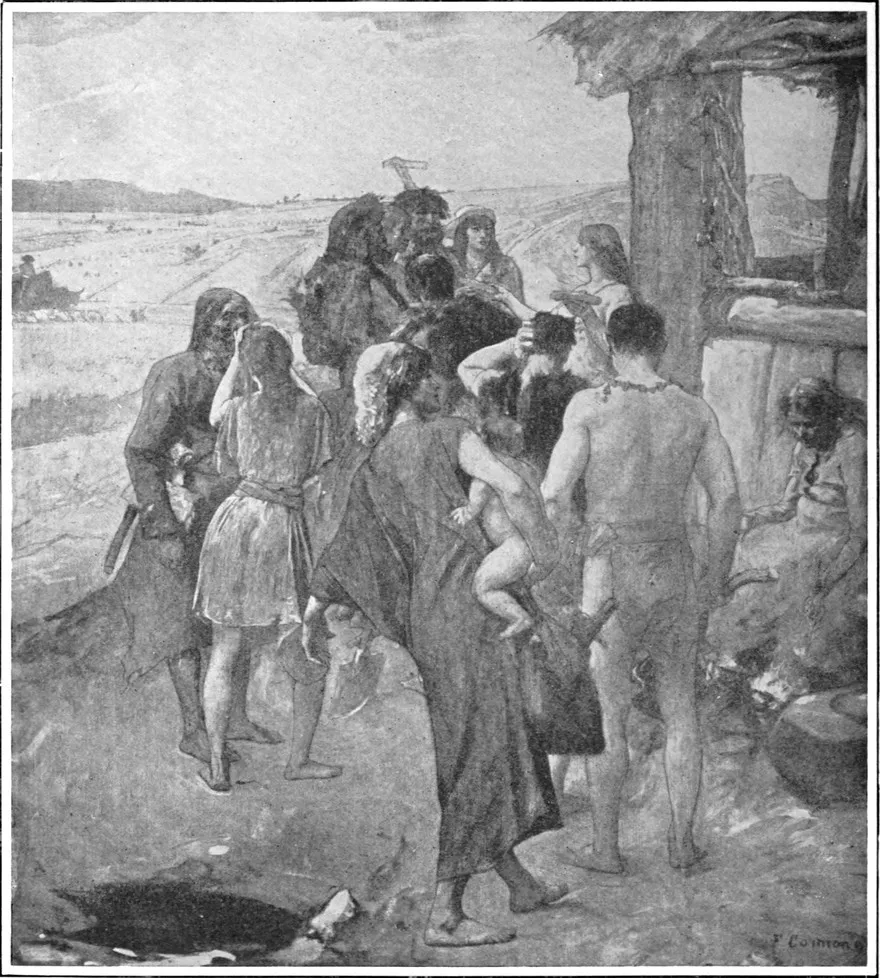
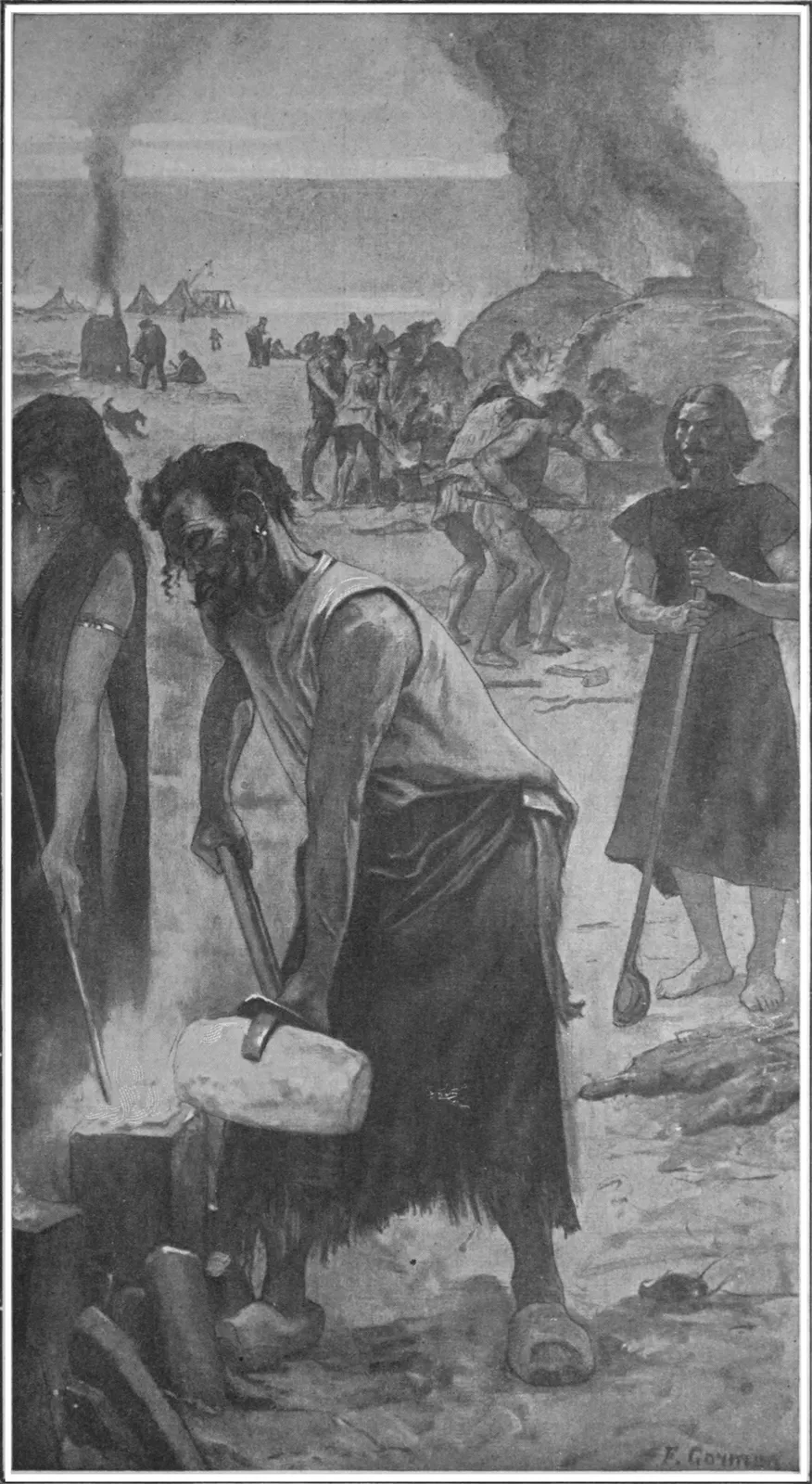
THE FIRST WANDERERS OF THE EARTH: TRIBAL MIGRATION IN
PREHISTORIC TIMES
From the painting of “Cain” by Ferdinand Cormon
LARGER IMAGE
Man the Master of Nature
All this renders him independent. But he now also finds himself drawn
into a new kind of dependence, for he has now come to take a new view
of Nature. He perceives in her an enormous storehouse of wealth, by
using which he can multiply his resources and gratify his always
increasing desires to an extent practically unlimited. She provides
forces, such as steam and electricity, which his knowledge enables him
to employ for production and transport, so as to spare his own physical
strength, needed now not so much for effort as for the direction of
the efforts of Nature. She has in the forest, and still more beneath
her own surface in the form of minerals, the materials by which these
forces can be set in motion; and by using these forces man can, with
comparatively little trouble, procure abundance of those materials.
Thus his relation to Nature is changed. It was that of a servant, or,
indeed, rather of a beggar, needing the bounty of a sovereign. It
is now that of a master needing the labour of a servant, a servant
infinitely stronger than the master, but absolutely obedient to the
master so long as the master uses the proper spell. Thus the connection
of man with Nature, changed though his attitude be, is really as close
as ever, and far more complex. If his needs had remained what they
were in his primitive days—let us say, in those palæolithic days
which we can faintly adumbrate to ourselves by an observation of the
Australian or Fuegian aborigines now—he would have sat comparatively
lightly to Nature, getting easily what he wanted, and not caring to
trouble her for more. But his needs—that is to say, his desires, both
his physical appetites and his intellectual tastes, his ambitions and
his fondness for comfort, things that were once luxuries having become
necessaries—have so immeasurably expanded that, since he asks much
more from Nature, he is obliged to study her more closely than ever.
Man’s New Relations to Nature
Thus he enters into a new sort of dependence upon her, because it is
only by understanding her capacities and the means of using them that
he can get from her what he wants. Primitive man was satisfied if he
could find spots where the trees gave edible fruit, where the sun was
not too hot, nor the winds too cold, where the beasts easy of capture
were abundant, and no tigers or pythons made the forest terrible.
Civilised man has more complex problems to deal with, and wider fields
to search. The study of Nature is not only still essential to him, but
really more essential than ever. His life and action are conditioned
by her. His industry and his commerce are directed by her to certain
spots. That which she has to give is still, directly or indirectly,
the source of strife, and a frequent cause of war. As men fought long
ago with flint-headed arrows for a spring of water or a coconut grove,
so they fight to-day for mineral treasures imbedded in the soil. It
is mainly by Nature that the movements of emigration and the rise of
populous centres of industry are determined.
Though Nature still rules for many purposes and in many ways the
course of human affairs, the respective value of her various gifts
changes from age to age, as man’s knowledge and power of turning them
to account have changed. The things most prized by primitive man are
not those which semi-civilised man chiefly prized, still less are they
those most sought for now.
Using Natural Wealth
In primitive times the spots most attractive, because most favourable
to human life, were those in which food could be most easily and
safely obtained from fruit-bearing trees or by the chase, and where
the climate was genial enough to make clothing and shelter needless,
at least during the greater part of the year. Later, when the keeping
of cattle and tillage had come into use, good pastures and a fertile
soil in the valley of a river were the chief sources of material
well-being. Wild beasts were less terrible, because man was better
armed; but as human enemies were formidable, regions where hills and
rocks facilitated defence by furnishing natural strongholds had their
advantages.
Still later, forests came to be recognised as useful for fuel, and
for carpentry and shipbuilding. Mineral deposits, usually found in
hilly or mountainous districts, became pre-eminently important sources
of wealth; and rivers were valued as highways of commerce and as
sources of motive power by the force of their currents. To the Red
Indians of the Ohio valley the places which were the most attractive
camping-grounds were those whither the buffaloes came in vast herds to
lick the rock salt exposed in the sides of the hills. It is now not the
salt-licks, but the existence of immense deposits of coal and iron,
that have determined the growth of huge communities in those regions
whence the red man and the buffalo have both vanished. England was
once, as New Zealand is now, a great wool-growing and wool-exporting
country, whereas she is to-day a country which spins and weaves far
more wool than she produces.
Ancient Harbours and Modern
So, too, the influence of the sea on man has changed. There was a
time when towns were built upon heights some way off from the coast,
because the sea was the broad high road of pirates who swooped down
upon and pillaged the dwellings of those who lived near it. Now that
the sea is safe, trading cities spring up upon its margin, and sandy
tracts worthless for agriculture have gained an unexpected value as
health resorts, or as places for playing games, places to which the
inhabitants of inland districts flock in summer, as they do in England
and Germany, or in winter, as they do on the Mediterranean coasts of
France. The Greeks, when they began to compete with the Phœnicians in
maritime commerce, sought for small and sheltered inlets in which their
tiny vessels could lie safely—such inlets as Homer describes in the
Odyssey, or as the Old Port of Marseilles, a city originally a colony
from the Ionian Phocæa. Nowadays these pretty little rock harbours
are useless for the large ships which carry our trade. The Old Port
of Marseilles is abandoned to small coasters and fishing-boats, and
the ocean steamers lie in a new harbour which is protected, partly by
outlying islands, partly by artificial works.
The World-Importance of Medicine
So, too, river valleys, though still important as highways of traffic,
are important not so much in respect of water carriage as because they
furnish the easiest lines along which railways can be constructed. The
two banks of the Rhine, each traversed by a railroad, carry far more
traffic than the great stream itself carried a century ago; and the
same remark applies to the Hudson. All these changes are due to the
progress of invention, which may give us fresh changes in the future
not less far-reaching than those the past has seen. Mountainous regions
with a heavy rainfall, such as Western Norway or the coast of the
Pacific in Washington and British Columbia, may, by the abundance of
water power which they supply, which can be transmuted into electrical
energy, become sources of previously unlooked-for wealth, especially
if some cheap means can be devised of conveying electricity with less
wastage in transmission than is at present incurred. Within the last
few years considerable progress in this direction has been made. Should
effective and easily applicable preventives against malarial fever
be discovered, many districts now shunned, because dangerous to the
life of white men, may become the homes of flourishing communities.
The discovery of cinchona bark in the seventeenth century affected
the course of events, because it provided a remedy against a disease
that had previously baffled medical skill. If quinine had been at the
disposal of the men of the Middle Ages, not only might the lives of
many great men, as for instance of Dante, have been prolonged, but
the Teutonic emperors would have been partially relieved of one of
the chief obstacles which prevented them from establishing permanent
control over their Italian dominions. Rome and the Papal power defended
themselves against the hosts of the Franconian and Hohenstaufen
sovereigns by the fevers of the Campagna more effectively than did the
Roman people by their arms, and almost as effectively as did the Popes
by their spiritual agencies.
Bearing in mind this principle, that the gifts of Nature to man
not only increase, but also vary in their form, in proportion and
correspondence to man’s capacity to use them, and remembering also
that man is almost as much influenced by Nature when he has become her
adroit master as when she was his stern mistress, we may now go on to
examine more in detail the modes in which her influence has told and
still tells upon him.
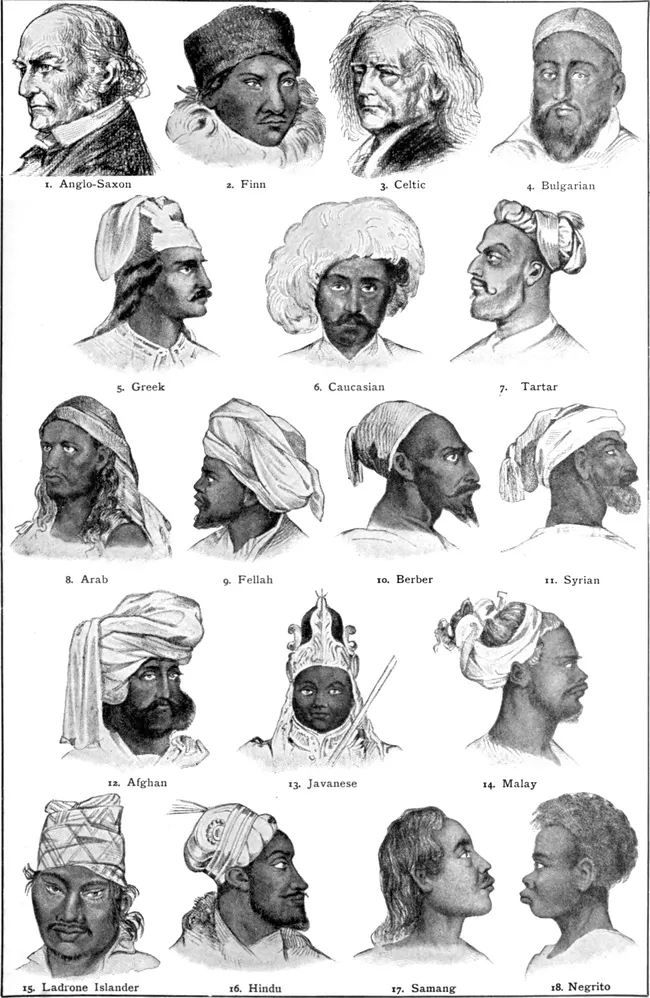
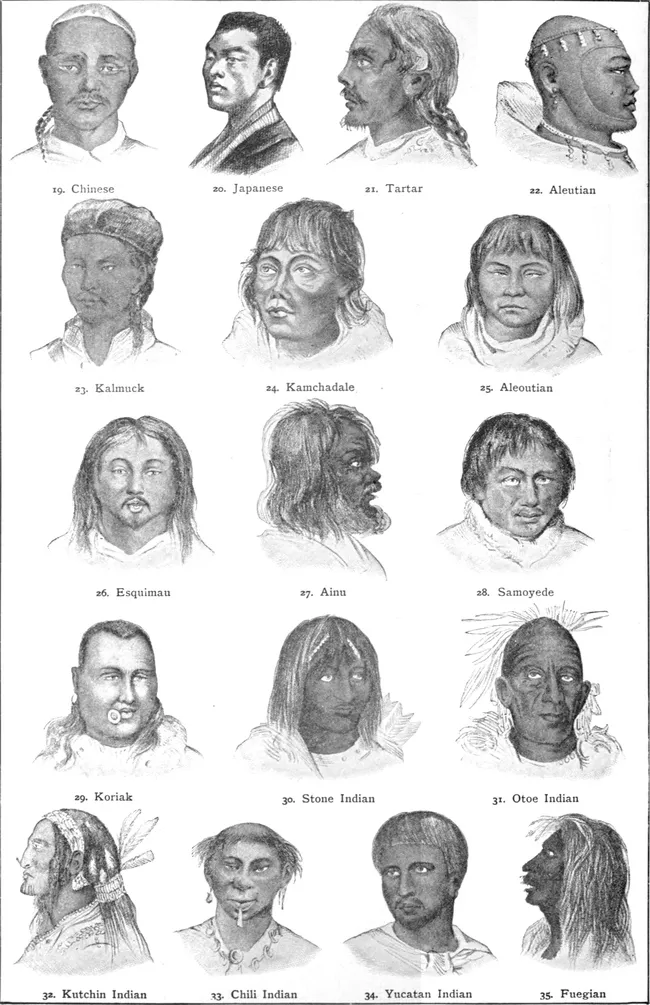
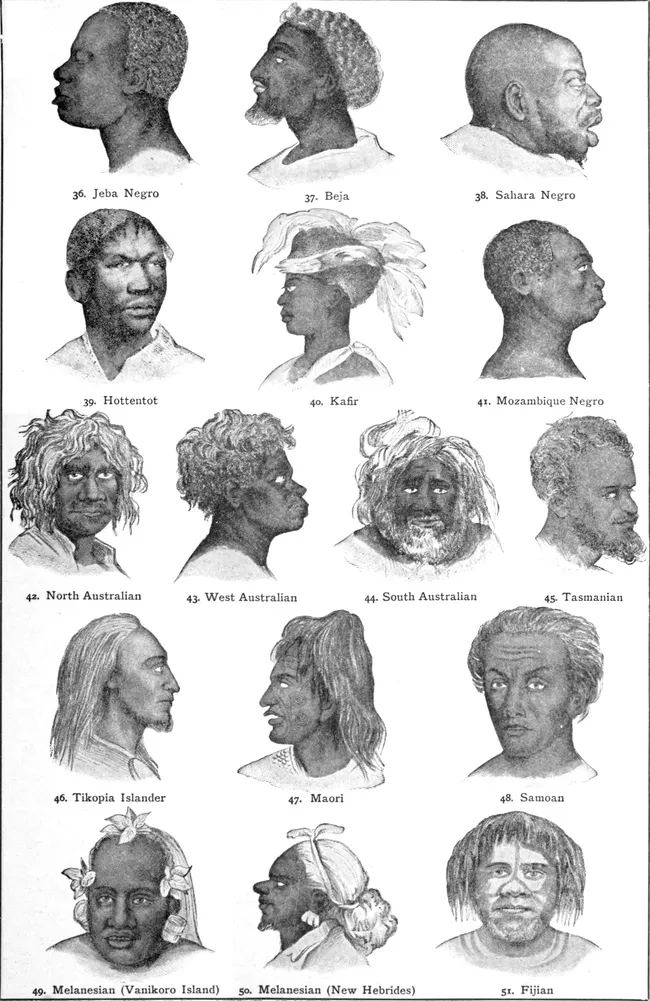
The Problem of Racial Distinctions
It has long been recognised that Nature must have been the principal
factor in producing, that is to say, in differentiating, the various
races of mankind as we find them differentiated when our records begin.
How this happened is one of the darkest problems that history presents.
By what steps and through what causes did the races of man acquire
these diversities of physical and intellectual character which are now
so marked and seem so persistent? It has been suggested that some of
these diversities may date back to a time when man, as what is called a
distinct species, had scarcely begun to exist. Assuming the Darwinian
hypothesis of the development of man out of some pithecoid form to
be correct—and those who are not themselves scientific naturalists
can of course do no more than provisionally accept the conclusions at
which the vast majority of scientific naturalists have arrived—it
is conceivable that there may have been unconnected developments of
creatures from intermediate forms into definitely human forms in
different regions, and that some of the most marked types of humanity
may therefore have had their first rudimentary and germinal beginning
before any specifically human type had made its appearance. This,
however, is not the view of the great majority of naturalists. They
appear to hold that the passage either from some anthropoid apes, or
from some long since extinct common ancestor of man and the existing
anthropoid apes—this latter alternative representing what is now the
dominant view—did not take place through several channels (so to
speak), but through one only, and that there was a single specifically
human type which subsequently diverged into the varieties we now see.
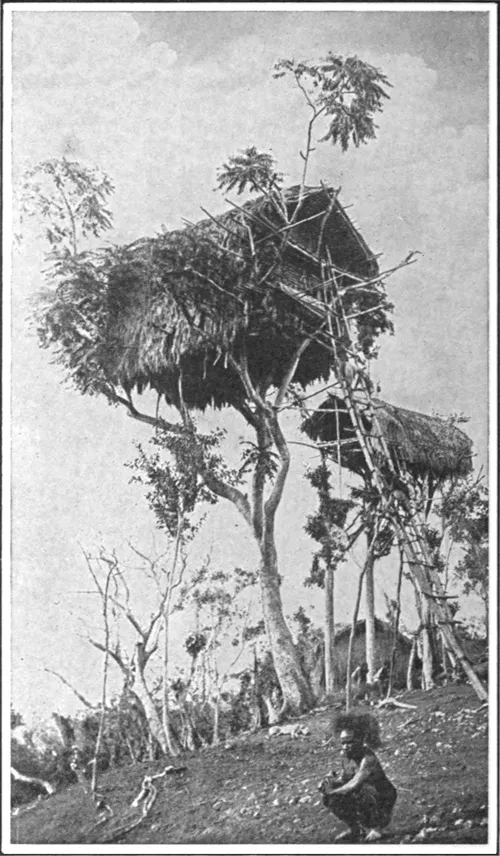
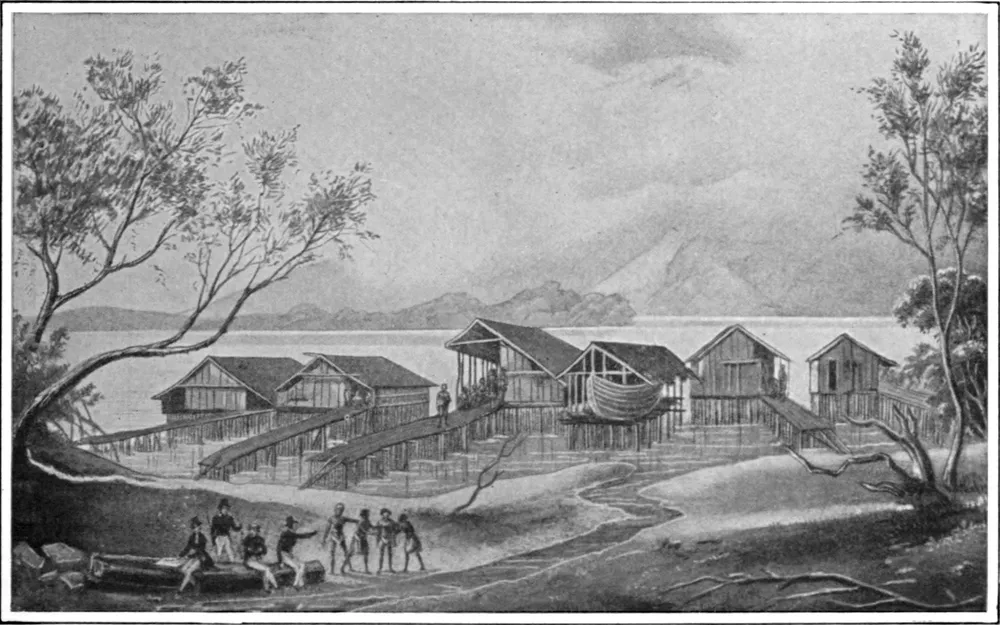
TREE DWELLERS IN THE TWENTIETH CENTURY
We must remember that such terms as “The Stone Age,” “The
Bronze Age,” and so forth, are only loosely applied. The ages so called did
not close at certain periods. There are races now living in all the
conditions of these past ages. This photograph, for example, shows the
actual tree dwellings of the Papuans in New Guinea to-day—one of the
most primitive forms of human habitation.
If this be so, it is plain that climate, and the conditions of life
which depend upon climate, soil, and the presence of vegetables and
of other animals besides man, must have been the forces which moulded
and developed those varieties. From a remote antiquity, everybody has
connected the dark colour of all, or nearly all, the races inhabiting
the torrid zone with the power of the sun; and the fairer skin of
the races of the temperate and arctic zones with the comparative
feebleness of his rays in those regions. This may be explained on
Darwinian principles by supposing that the darker varieties were
found more capable of supporting the fierce heat of the tropics. What
explanation is to be given of the other characteristics of the negro
and negroid races, of the usually frizzled hair, of the peculiar nose
and jaw, and so forth, is a question for the naturalist rather than
for the historian. Although climate and food may be the chief factors
in differentiation, the nature of the process is, as indeed is the
case with the species of animals generally, sometimes very obscure.
Take an instance from three African races which, so far as we can
tell, were formed under similar climatic conditions—the Bushmen,
the Hottentots, and the Bantu, the race including those whom we call
Kaffirs. Their physical aspect and colour are different. Their size and
the structure of their bodies are different. Their mental aptitudes
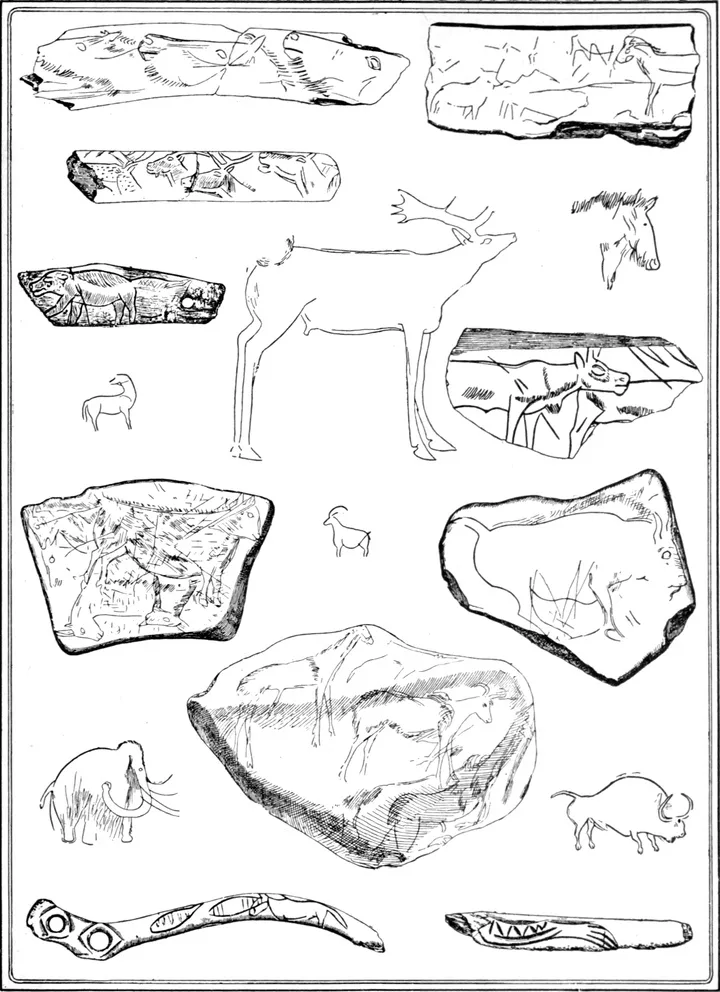
are different; and one of the oddest points of difference is this, that
whereas the Bushmen are the least advanced, intellectually, morally,
and politically, of the three races, as well as the physically weakest,
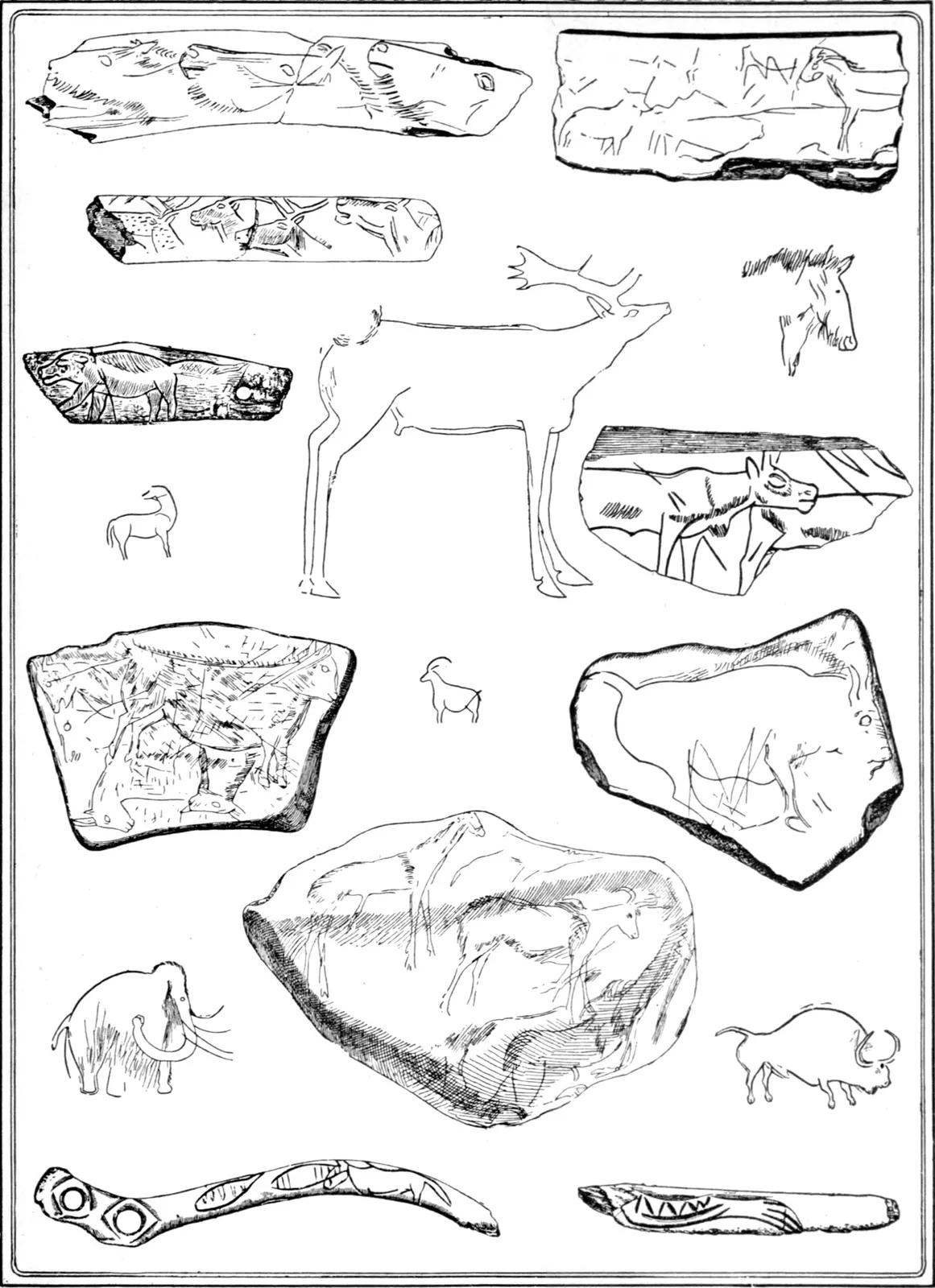
they show a talent for drawing which is not possessed by the other two.
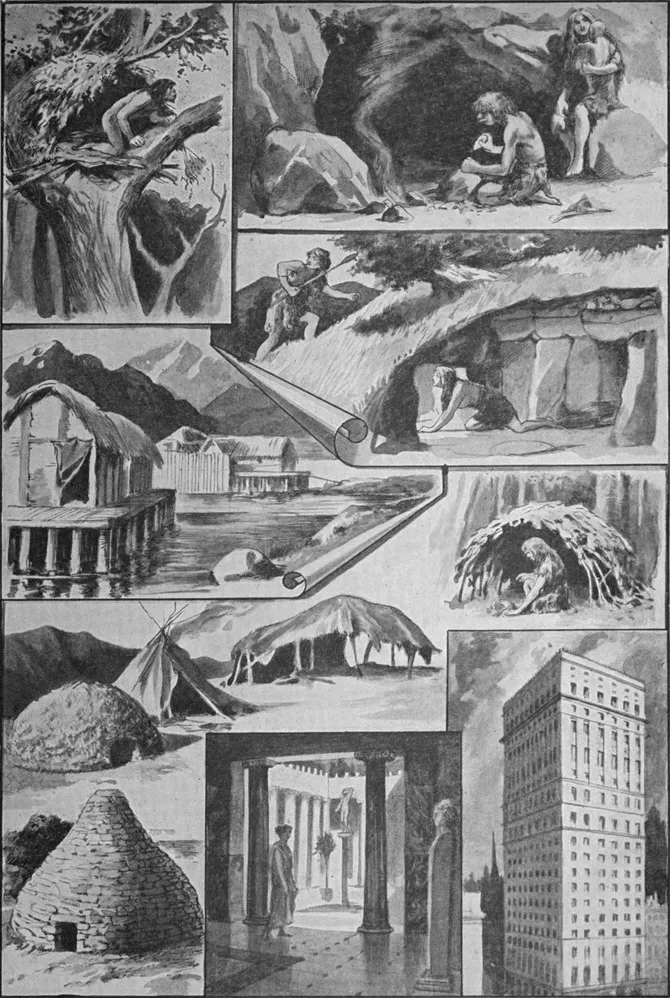
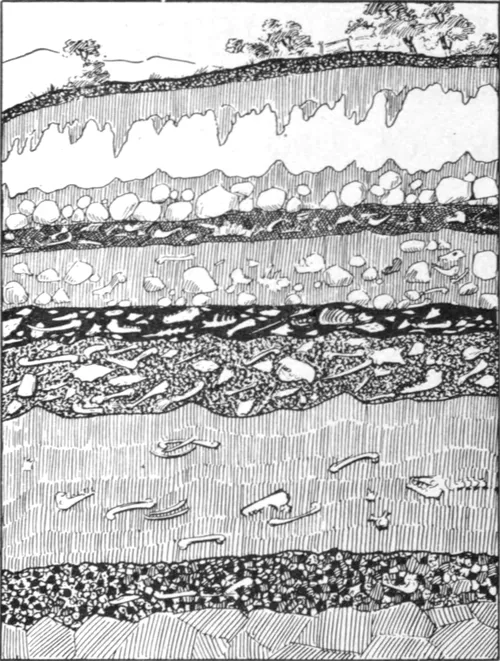
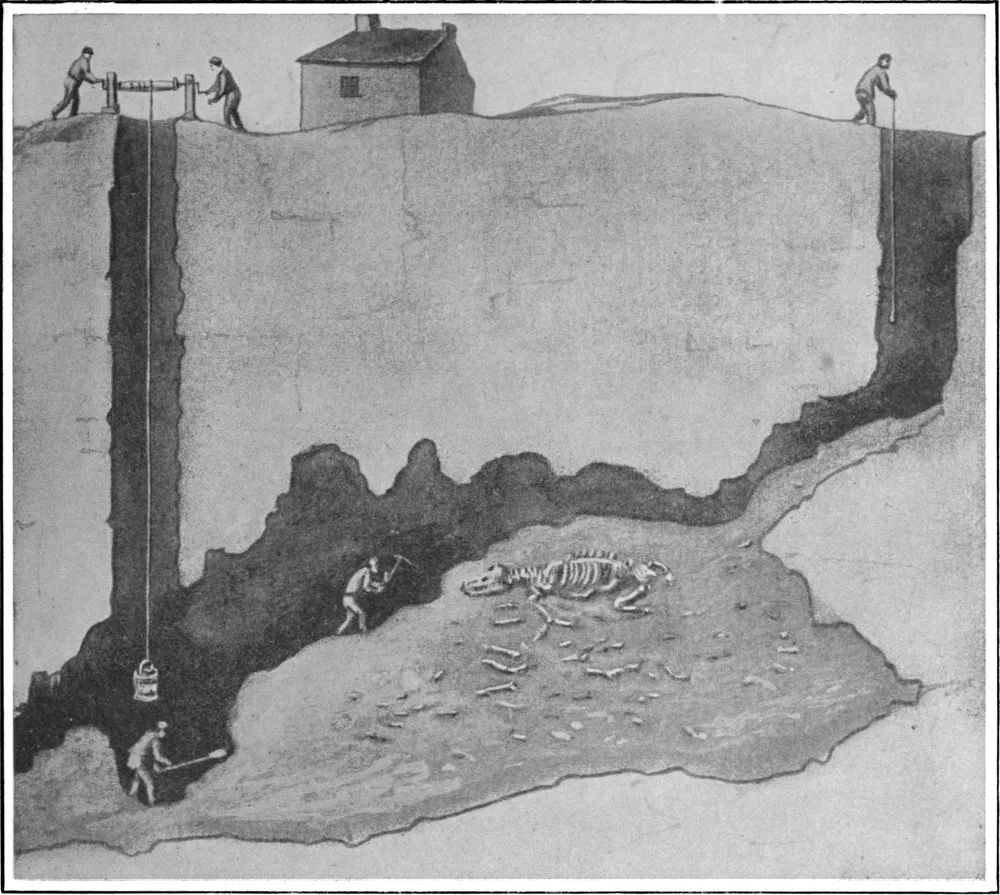
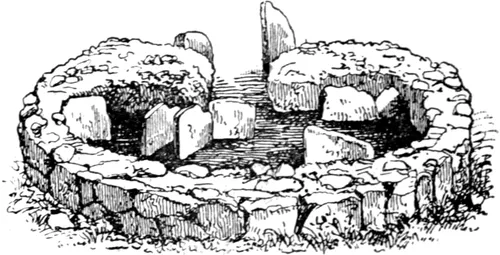
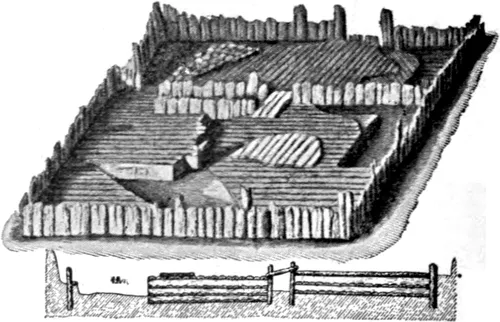
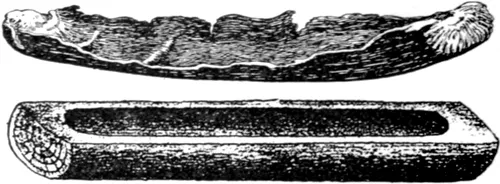
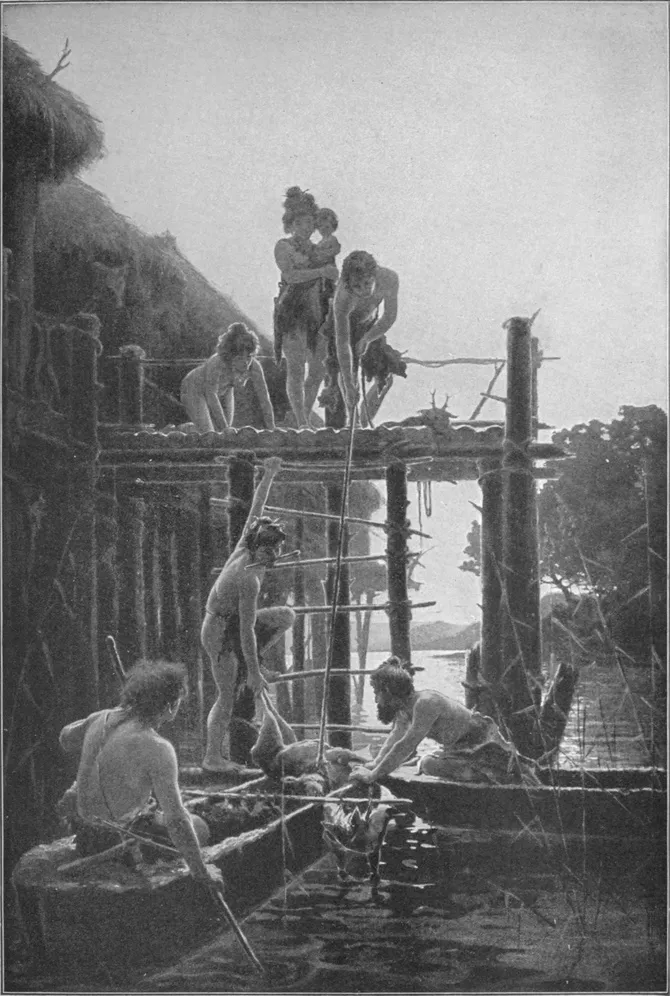
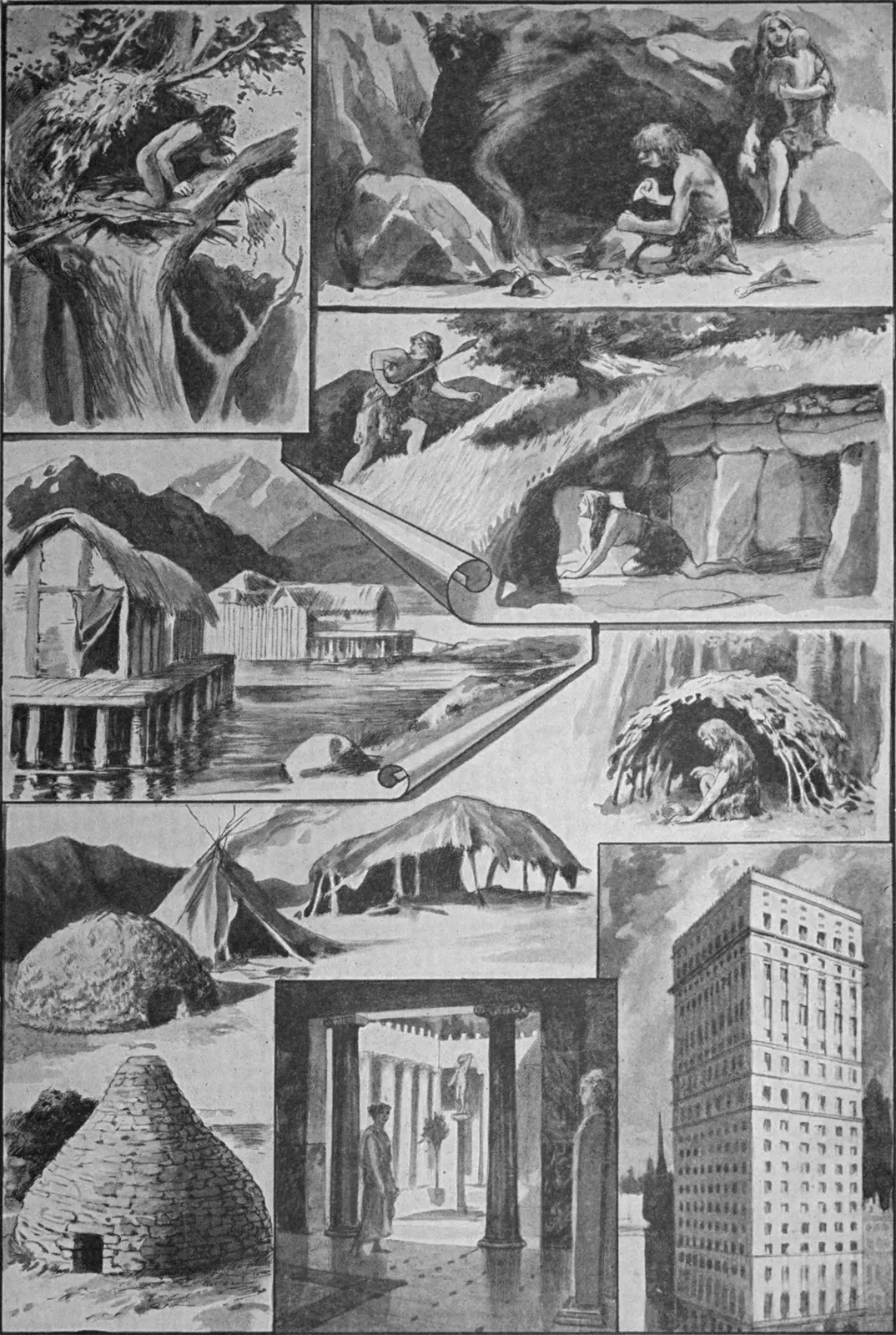
THE HABITATIONS OF MAN IN ALL AGES OF THE WORLD’S
HISTORY
At first man built twig huts in trees, but becoming better
matched with his animal foes he took to caves and underground habitations.
Our illustration of the latter shows a section through the soil. Lake
dwellings marked a distinct advance. Other varieties of primitive
habitations are the leaf hut, the tents of skin, the mud hut, and
the beehive hut of stone. Roman villas are still models of beauty.
American “skyscrapers” are peculiar to our time; but all early forms
of dwellings, while marking progress, have existed contemporaneously
throughout history.
LARGER IMAGE
Is the Race Mystery Insoluble?
In this case there is, of course, a vast unknown fore-time during
which we may imagine the Bantu race, probably originally formed in a
region other than that which it now occupies (and under more favourable
conditions for progress), to have become widely differentiated
from those which are now the lower African races. We still know
comparatively little about African ethnography. Let us, therefore,
take another instance in which affinities of language give ground for
believing that three races, whose differences are now marked, have
diverged from a common stock. So far as language goes, the Celts,
the Teutons, and the Slavs, all speaking Indo-European tongues, may
be deemed to be all nearly connected in origin. They are marked by
certain slight physical dissimilarities, and by perhaps rather more
palpable dissimilarities in their respective intellectual and emotional
characters. But so far as our knowledge goes, all three have lived for
an immensely long period in the colder parts of the temperate zone,
under similar external conditions, and following very much the same
kind of pastoral and agricultural life. There is nothing in their
environment which explains the divergences we perceive; so the origin
of these divergences must apparently be sought either in admixture with
other races or in some other historical causes which are, and will for
ever remain, in the darkness of a recordless past.
Mixing of the World’s Peoples
How race admixture works, and how it forms a new definite character
out of diverse elements, is a subject which anyone may find abundant
materials for studying in the history of the last two thousand years.
Nearly every modern European people has been so formed. The French,
the Spaniards, and the English are all the products of a mixture, in
different proportions, of at least three elements—Iberian (to use
a current name), Celts, and Teutons, though the Celtic element is
probably comparatively small in Spain, and the Teutonic comparatively
small both in Spain and in Central and Southern France. No small part
of those who to-day speak German and deem themselves Germans must be
of Slavonic stock. Those who to-day speak Russian are very largely of
Finnish, to some small extent of Tartar, blood. The Italians probably
spring from an even larger number of race-sources, without mentioning
the vast number of slaves brought from the East and the North into
Italy between B.C. 100 and A.D. 300. In the cases of
Switzerland and Scotland the process of fusion is not yet complete.
The Celto-Burgundian Swiss of Neuchatel is still different from the
Allemanian Swiss of Appenzell; as the Anglo-Celt of Fife is different
from the Ibero-Celt of the Outer Hebrides. But in both these cases
there is already a strong sense of national unity, and in another three
hundred years there may have arisen a single type of character.
The Unique Case of Iceland
An interesting and almost unique case is furnished by Iceland, where
isolation under peculiar conditions of climate, food, and social life
has created a somewhat different type both of body and of mental
character from that of the Norwegians, although so far as blood goes
the two peoples are identical, Iceland having been colonised from
Western Norway a thousand years ago, and both Icelanders and Norwegians
having remained practically unmixed with any other race—save that
some slight Celtic infusion came to Iceland with those who migrated
thither from the Norse settlements in Ireland, Northern Scotland, and
the Hebrides—since the separation took place. But by far the most
remarkable instance of race admixture is that furnished in our own time
by the United States of North America, where a people of predominantly
English stock (although there were in the end of the eighteenth century
a few descendants of Dutchmen, with Germans, Swedes, and Ulster
Irishmen, in the country) has within the last sixty years received
additions of many millions of Celts, of Germans and Scandinavians, and
of various Slavonic races. At least a century must elapse before it
can be seen how far this infusion of new blood will change the type of
American character as it stood in 1840.
There are, however, two noteworthy differences between modern race
fusions and those which belong to primitive times. One is that under
modern conditions the influence of what may be called the social and
political environment is probably very much greater than it was in
early times. The American-born son of Irish parents is at forty years
of age a very different creature from his cousin on the coast of Mayo.
The other is that in modern times differences of colour retard or
forbid the fusion of two races. So far as the Teutonic peoples are
concerned, no one will intermarry with a negro; a very few with a
Hindu, a Chinese, or a Malay. In the ancient world there was but little
contact between white men and black or yellow ones, but the feeling of
race aversion was apparently less strong than it is now, just as it was
much less strong among the Spaniards and Portuguese in the sixteenth
and seventeenth centuries than it is among Americans or Englishmen
to-day. It is less strong even now among the so-called “Latin races;”
and as regards the Anglo-Americans, it is much less strong towards the
Red Indians than towards negroes.
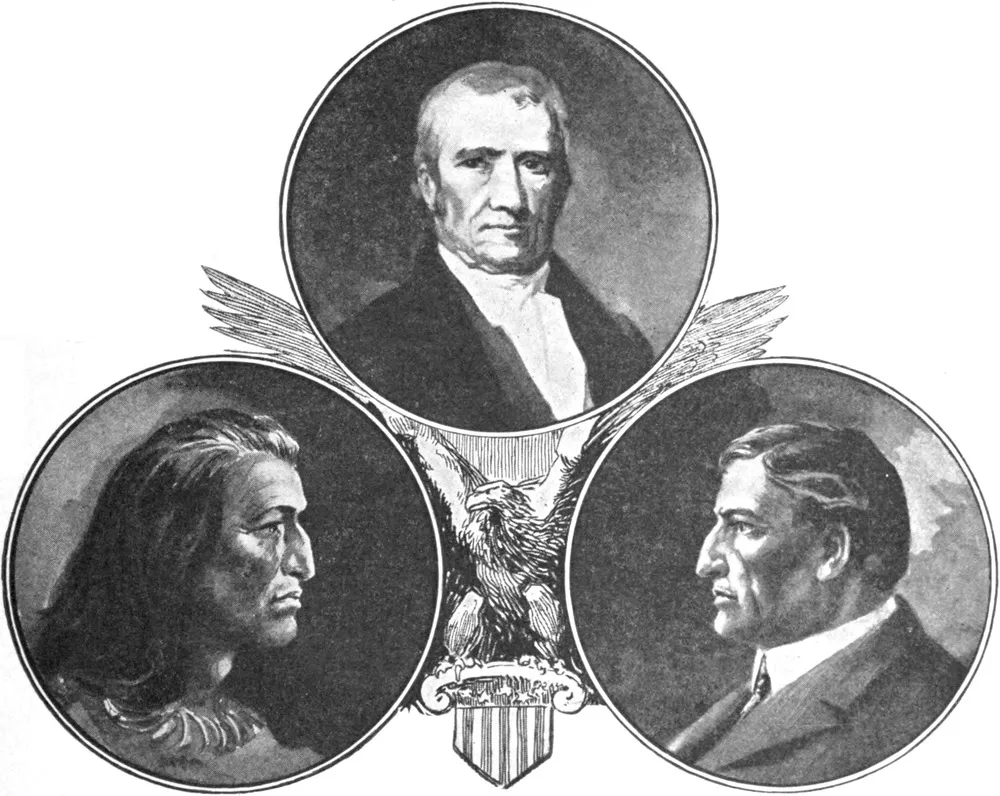
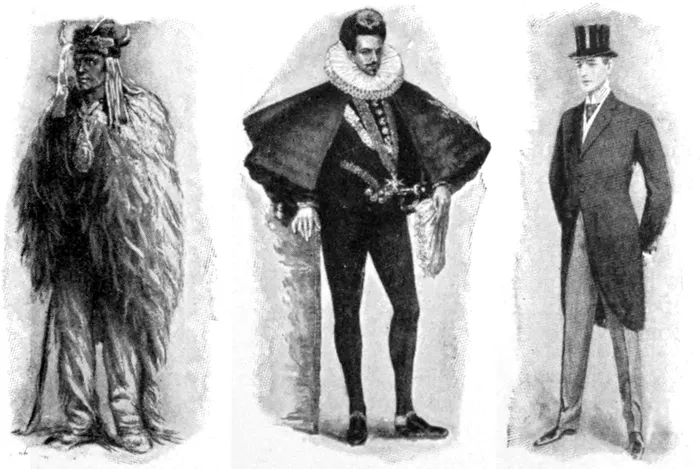
THE REMARKABLE INFLUENCE OF ENVIRONMENT ON PHYSICAL
APPEARANCE
Mr. Bryce points out that the physical features of a
people are determined chiefly by their environment. These illustrations show
(at top) a typical English settler in the old Colonial days of America,
a native Red Indian (left) and a typical American of to-day (right).
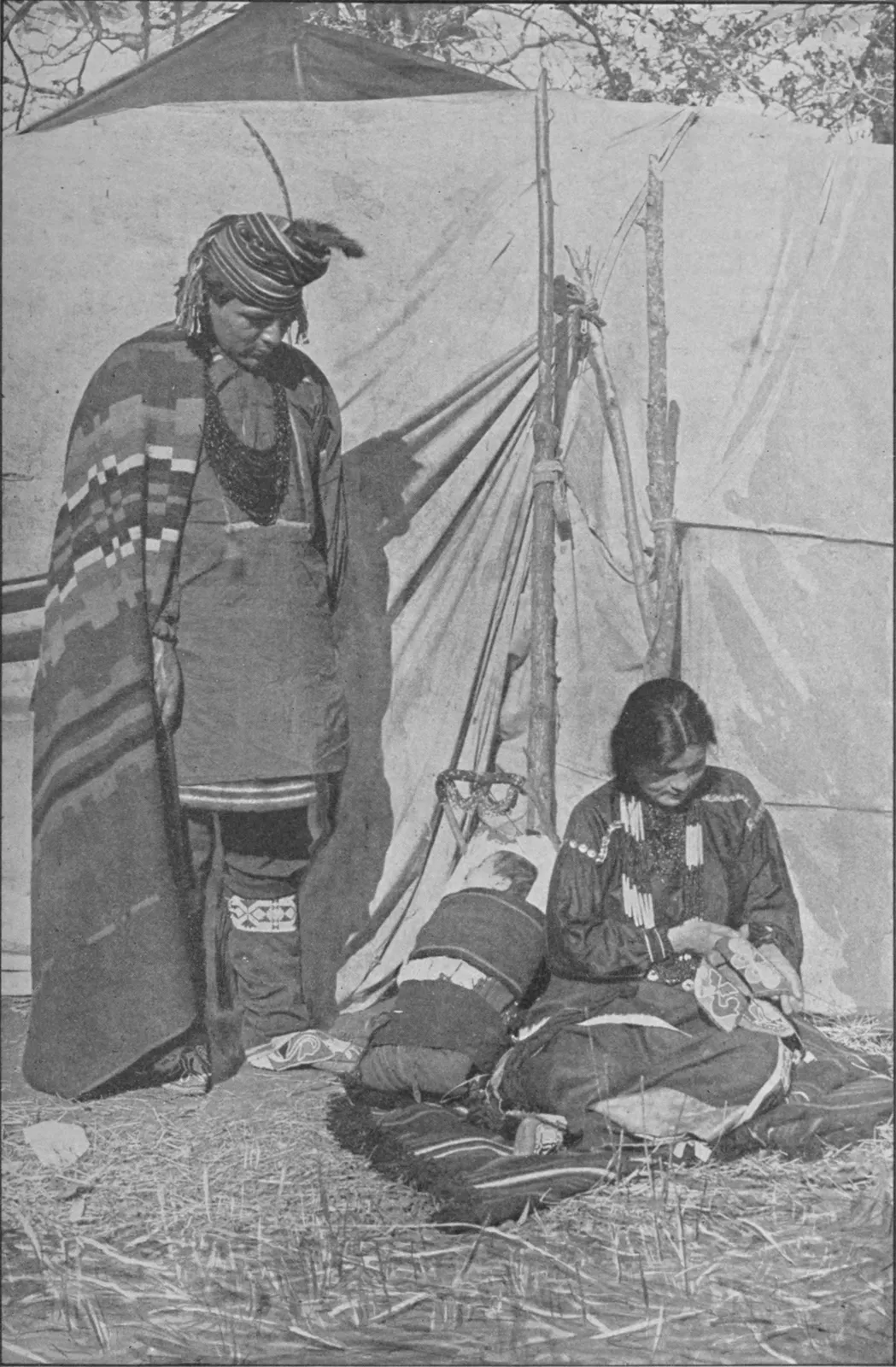
Without any intermingling of red men and white, the modern American,
thanks to climatic conditions, resembles the Red Indian far more
closely than he does his own ancestors of the Colonial days.
As Nature must have been the main agent in the formation of the various
races of mankind from a common stock, so also Nature has been the chief
cause of their movements from one part of the earth to another, these
movements having been in their turn a potent influence in the admixture
of the races. Some geographers have alleged climate—that is to say,
the desire of those who inhabit an inclement region to enjoy a softer
and warmer air—as a principal motive which has induced tribes of
nations to transfer themselves from one region to another.
It is no doubt true that the direction of migrations has almost always
been either from the north towards the south, or else along parallels
of latitude, men rarely seeking for themselves conditions more severe
than those under which they were born. But it is usually not so much
the wish to escape cold that has been an effective motive as the wish
to find more and better food, since this means an altogether easier
life. Scarcity of the means of subsistence, which is, of course, most
felt when population is increasing, has operated more frequently
and powerfully than any other cause in bringing on displacements
of the races of man over the globe. The movement of the primitive
Aryans into India from the plateaux of West Central Asia, probably
also the movement of the races which speak Dravidian languages from
South Central Asia into Southern India, and probably also the mighty
descent, in the fourth and fifth centuries A.D., of the
Teutonic races from the lands between the Baltic and the Alps into the
Roman Empire, had this origin.
The Colonising Impulse
In more advanced states of society a like cause leads the surplus
population of a civilised state to overflow into new lands, where there
is more space, or the soil is more fertile. Thus the inhabitants of
Southwestern Scotland, partly, no doubt, at the suggestion of their
rulers, crossed over into Ulster, where they occupied the best lands,
driving the aboriginal Celts into the rougher and higher districts,
where their descendants remain in the glens of Antrim, and in the hilly
parts of Down, Derry, and Tyrone. Thus the men of New England moved
out to the West and settled in the Mississippi Valley, while the men
of Virginia crossed the Alleghanies into Kentucky. Thus the English
have colonised Canada and Australia and New Zealand and Natal. Thus the
Russians have spread out from their ancient homes on the upper courses
of the Dnieper and the Volga all over the vast steppes that stretch
to the Black Sea and the Caucasus, as well as into the rich lands of
Southwestern Siberia. Thus the surplus peasantry of Germany has gone
not only to North America, but also to Southern Brazil and the shores
of the Rio de la Plata.
The Need of Native Labour
In another form it is the excess of population over means of
subsistence at home that has produced the remarkable outflow of the
Chinese through the Eastern Archipelago and across the Pacific into
North America, and that has carried the Japanese to the Hawaiian
Islands. And here we touch another cause of migration which is
indirectly traceable to Nature—namely, the demand in some countries
for more labour or cheaper labour than the inhabitants of the country
are able or willing to supply. Sometimes this demand is attributable to
climatic causes. The Spaniards and Portuguese and English in the New
World were unfitted by their physical constitutions for out-of-door
labour under a tropical sun. Hence they imported negroes during the
sixteenth and two following centuries in such numbers that there are
now about eight millions of coloured people in the United States alone,
and possibly (though no accurate figures exist) as many more in the
West Indies and South America. To a much smaller extent the same need
for foreign labour has recently brought Indian coolies to the shores
of the Caribbean Sea, and to the hottest parts of Natal, as it brings
Polynesians to the sugar plantations of Northern Queensland.
What Determines Race Movements
Two other causes which have been potent in bringing about displacements
and mixtures of population are the desire for conquest and plunder
and the sentiment of religion. But these belong less to the sphere of
Nature than to that of human passion and emotion, so that they scarcely
fall within this part of our inquiry, the aim of which has been to
show how Nature has determined history by inducing a shifting of races
from place to place. From this shifting there has come the contact
of diverse elements, with changes in each race due to the influence
of the other, or perhaps the absorption of one in the other, or the
development of something new out of both. In considering these race
movements we have been led from the remote periods in which they began,
and of which we know scarcely anything except from archæological and
linguistic data, to periods within the range of authentic history.
So we may go on to see how Nature has determined the spots in which
the industry of the more advanced races should build up the earliest
civilisations, and the lines along which commerce, a principal agent
in the extension of civilisation, should proceed to link one race with
another.
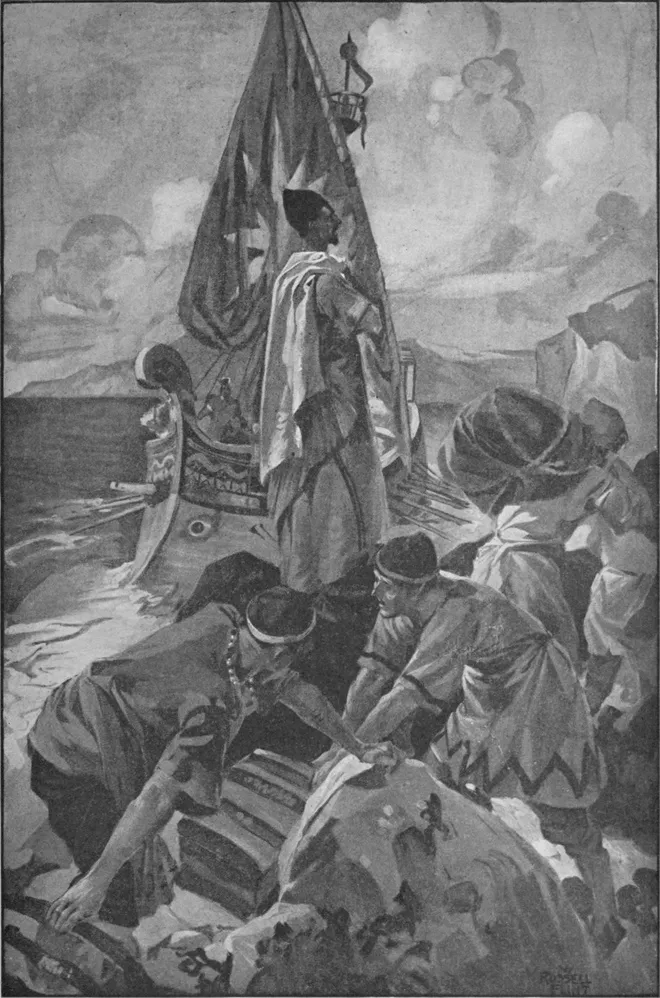
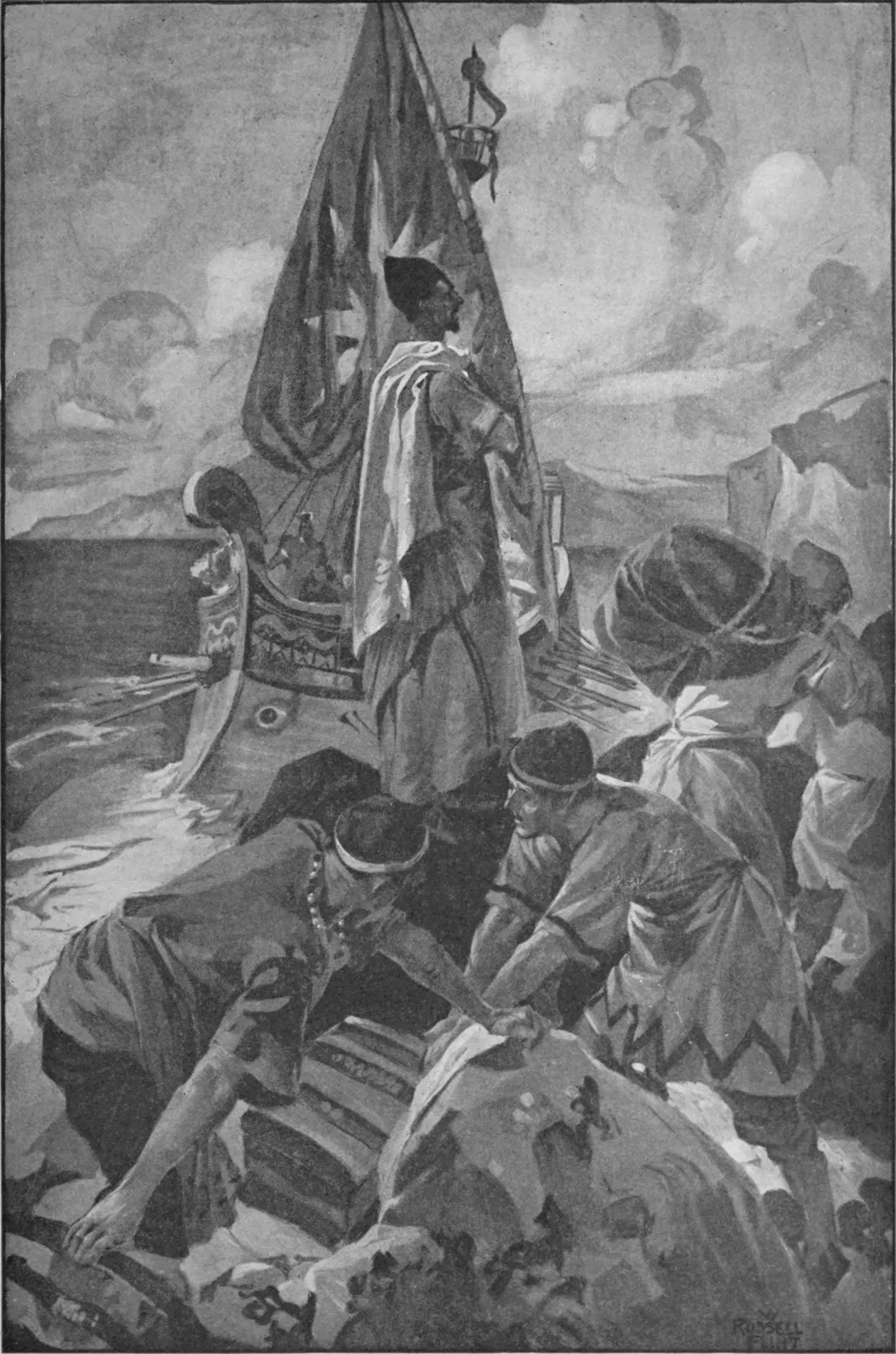
THE MERCHANT MARINERS OF THE ANCIENT WORLD
The earliest agents in the diffusion of trades and the
arts were the Phœnicians, who from their great cities of Tyre, Sidon, and
Carthage conducted a sea-borne traffic with lands as remote as England, and
whose adventurous sailors, despite the smallness of their vessels, are
believed even to have succeeded in rounding the Cape of Good Hope.
LARGER IMAGE
Isolation of Eastern Peoples
It was long since observed that the first homes of a dense population
and a highly developed civilisation lay in fertile river valleys,
such as those of the Lower Nile, the Euphrates, the Tigris, the
Ganges, the Yang-tse-kiang. All these are situate in the hotter parts
of the temperate zone; all are regions of exceptional fertility.
The soil, especially when tillage has become general, is the first
source of wealth; and it is in the midst of a prosperous agricultural
population that cities spring up where handicrafts and the arts arise
and flourish. The basins of the Lower Nile and of the Lower Euphrates
and Tigris are (as respects the West Asiatic and Mediterranean world)
the fountain-heads of material, military, and artistic civilisation.
From them it spreads over the adjacent countries and along the
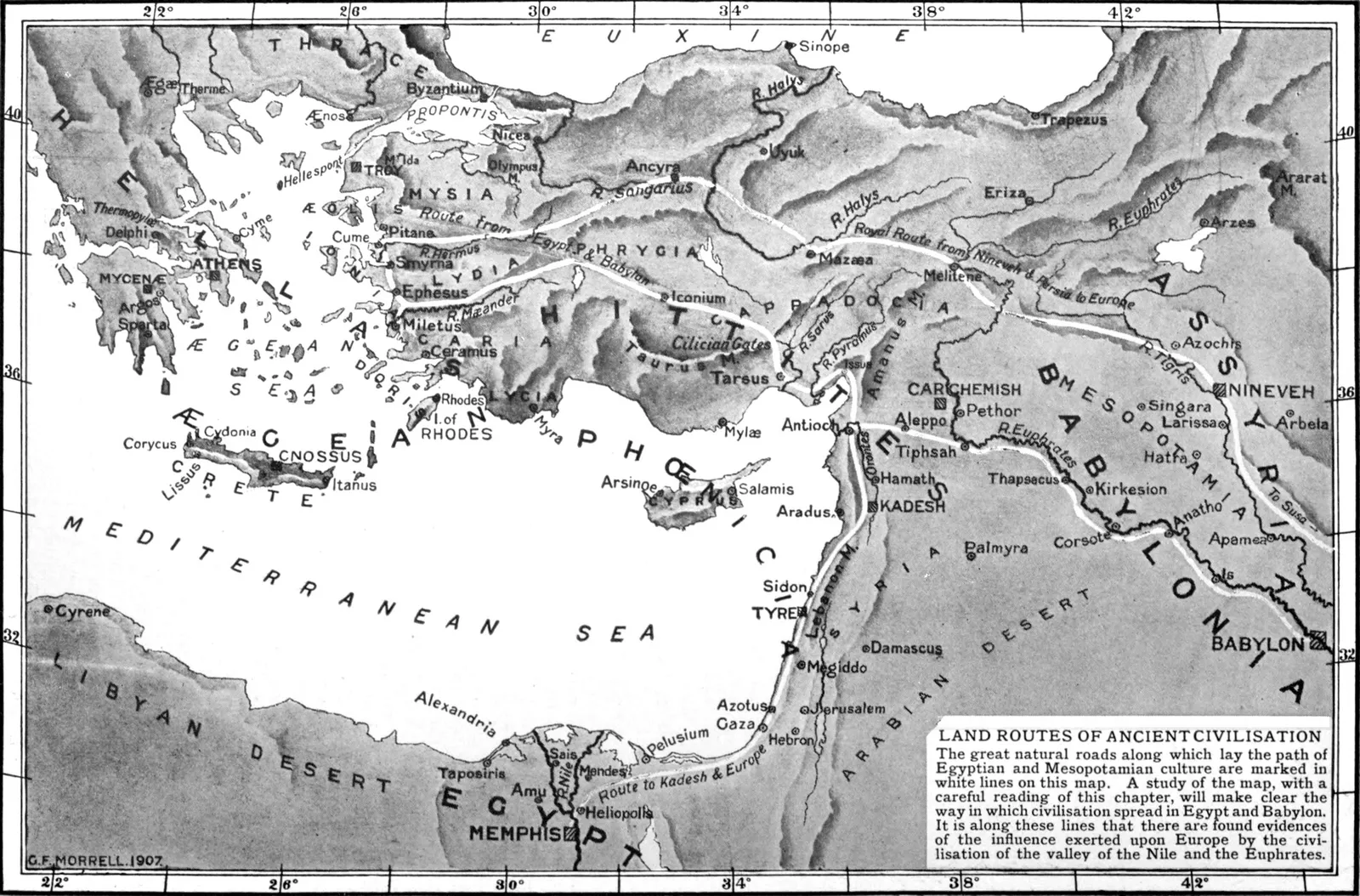
coasts of Europe and Africa. On the east, Egypt and Mesopotamia are
cut off by the deserts of Arabia and Eastern Persia from the perhaps
equally ancient civilisation of India, which again is cut off by lofty
and savage mountains from the very ancient civilisation of China.
Nature forbade intercourse between these far eastern regions and the
West Asian peoples, while on the other hand Nature permitted Egypt,
Phœnicia, and Babylon to influence and become teachers of the peoples
of Asia Minor and of the Greeks on both sides of the Ægean Sea. The
isolation and consequent independent development of India and of
China is one of the most salient and significant facts of history. It
was not till the end of the fifteenth century, when the Portuguese
reached the Malabar coast, that the Indian peoples began to come into
the general movement of the world; for the expedition of Alexander
the Great left hardly any permanent result, except upon Buddhist art,
and the conquests of Mahmud of Ghazni opened no road to the East from
the Mediterranean West. Nor did China, though visited by Italian
travellers in the thirteenth century, by Portuguese traders and Jesuit
missionaries in the sixteenth and seventeenth, come into effective
contact with Europe till near our own time.
As the wastes of barren land formed an almost impassable eastern
boundary to the West Asian civilisations, so on the west the expanse
of sea brought Egypt and to a less extent Assyria (through Phœnicia)
into touch with all the peoples who dwelt on the shores of the
Mediterranean. The first agents in the diffusion of trade and the arts
were the Phœnicians, established at Tyre, Sidon, and Carthage. The next
were the Greeks. For more than two thousand years, from B.C.
700 onwards, the Mediterranean is practically the centre of the
history of the world, because it is the highway both of commerce and
of war. For seven hundred years after the end of the second century
B.C., that is to say, while the Roman Empire remained strong,
it was also the highway of civil administration. The Saracen conquests
of the seventh century cut off North Africa and Syria from Europe,
checked transmarine commerce, and created afresh the old opposition
of East and West in which a thousand years earlier Herodotus had
found the main thread of world history. But it was not till after the
discovery of America that the Mediterranean began to yield to the
Atlantic its primacy as the area of sea power and sea-borne trade.
Influence of the Seas in History
Bordered by far less fertile and climate-favoured countries, and closed
to navigation during some months of winter, the Baltic has always held
a place in history far below that of the Mediterranean. Yet it has
determined the relations of the North European states and peoples. So,
too, the North Sea has at one time exposed Britain to attack from the
Danish and Norwegian lords of the sea, and at other times protected
her from powerful continental enemies. It may indeed be said that in
surrounding Europe by the sea on three sides, Nature has drawn the main
lines which the course of events on this smallest but most important of
the continents has had to follow.
Magellan and American Politics
Of the part which the great bodies of water have played, of the
significance in the oceans of mighty currents like the Gulf Stream, the
Polar Current, the Japan Current, the Mozambique Current, it would be
impossible to speak within reasonable compass. But two remarks may be
made before leaving this part of the subject. One is that man’s action
in cutting through an isthmus may completely alter the conditions as
given by Nature. The Suez Canal has of late years immensely enhanced
the importance of the Mediterranean, already in some degree restored by
the decay of Turkish power, by the industrial revival of Italy, and by
the French conquests in North Africa. The cutting of a canal at Panama
will change the relations of the seafaring and fleet-owning nations
that are interested in the Atlantic and the Pacific. And the other
remark is that the significance of a maritime discovery, however great
at first, may become still greater with the lapse of time. Magellan,
in his ever memorable voyage, not only penetrated to and crossed the
Pacific, but discovered the Philippine Islands, and claimed them for
the monarch who had sent him forth. His appropriation of them for
the Crown of Spain, to which during these three centuries and a half
they have brought no benefit, has been the cause which has led the
republic of the United States to depart from its traditional policy of
holding to its own continent by taking them as a prize—a distant and
unexpected prize—of conquest.
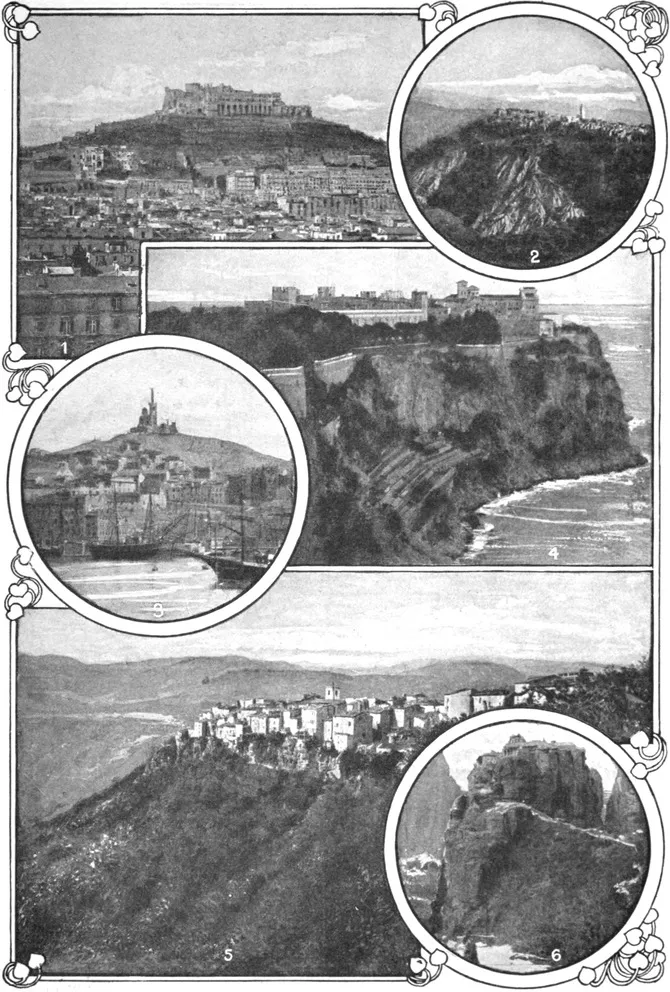
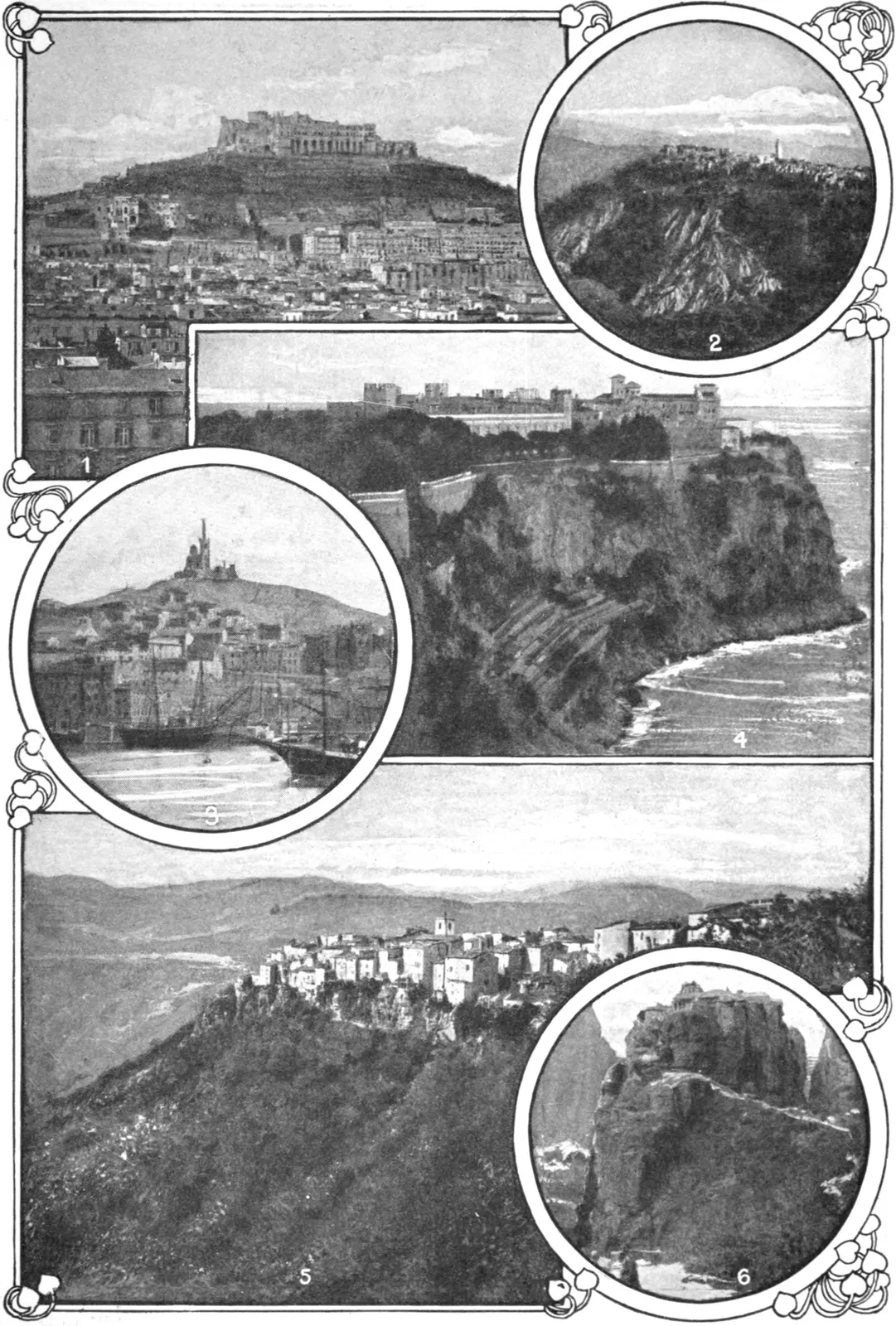
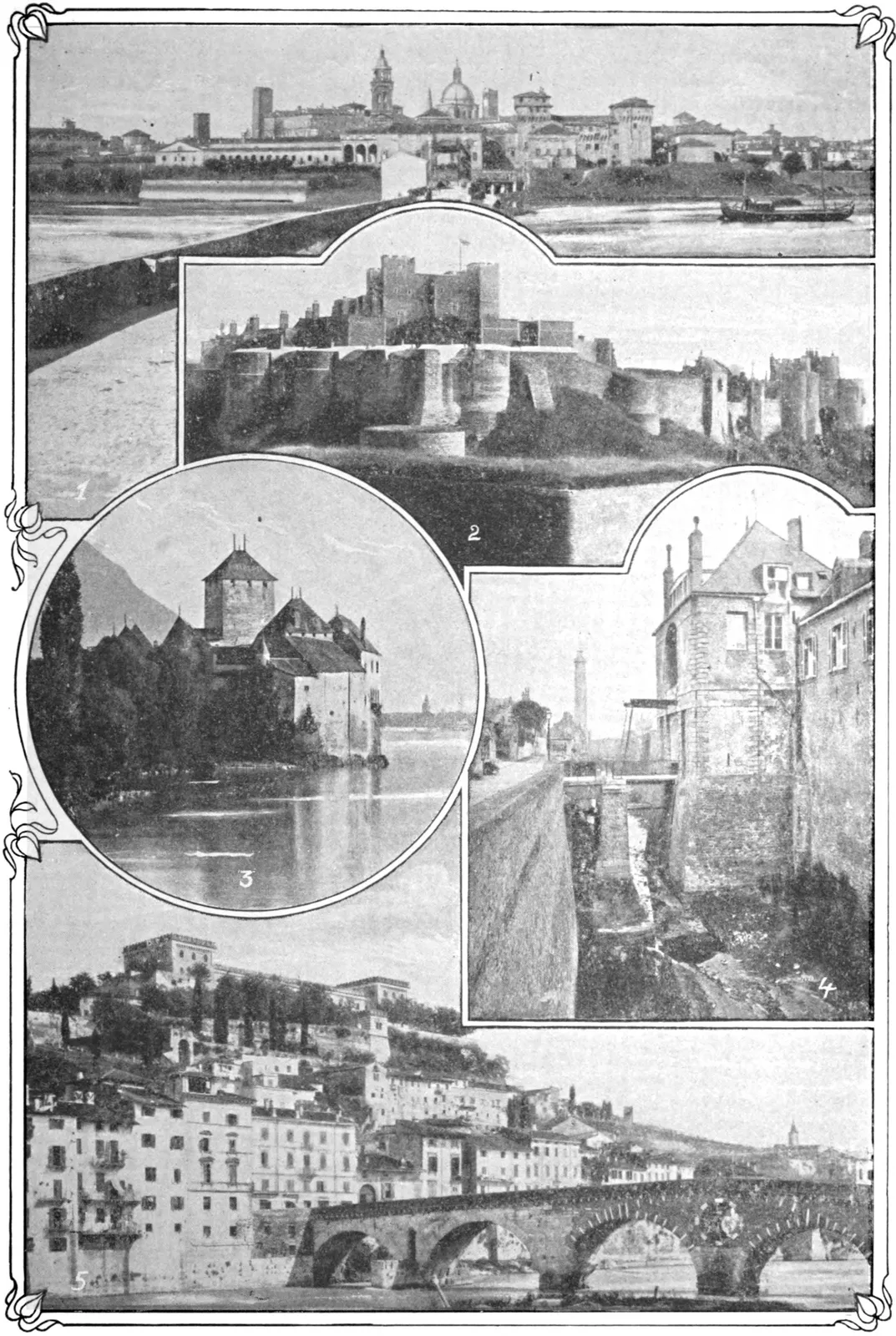
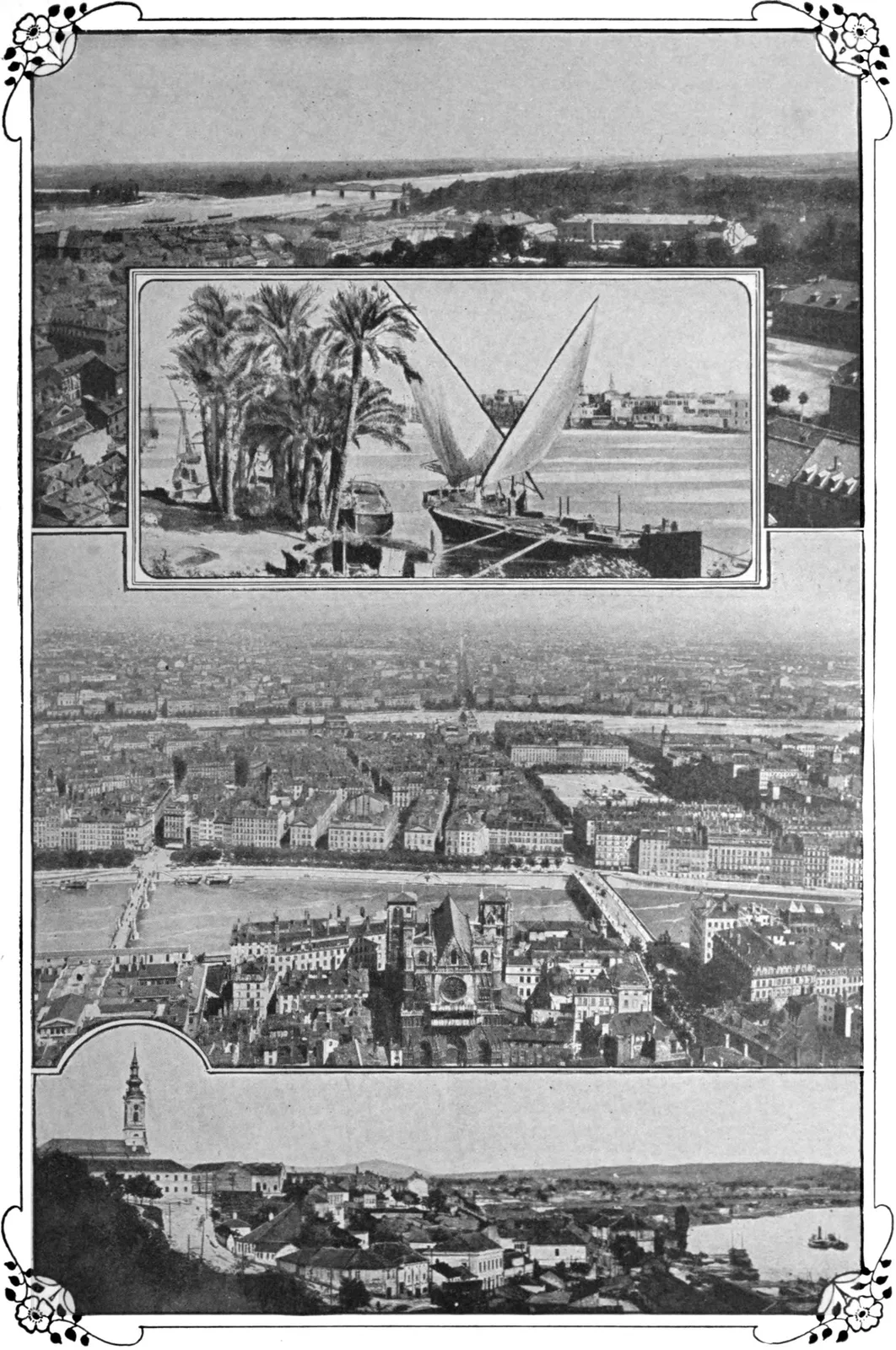
HOW NATURE DETERMINES THE SITES OF CITIES
Most towns and communities founded more than 300 years ago
were on easily defensible hills, by the side of navigable rivers, or inlets of
the sea. Our illustrations show (1) Naples, (2) Bonsuna, (3) Old Port
and hill of Marseilles, (4) Monaco, (5) St. Cézaire, and (6) the Greek
Monastery of St. Balaam.
Photos. by Frith and Underwood & Underwood
LARGER IMAGE
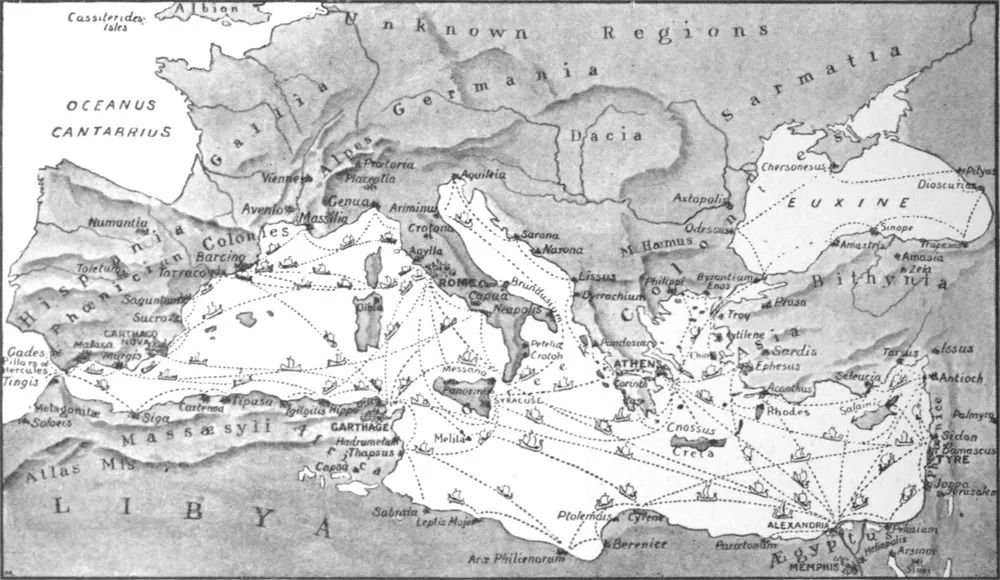
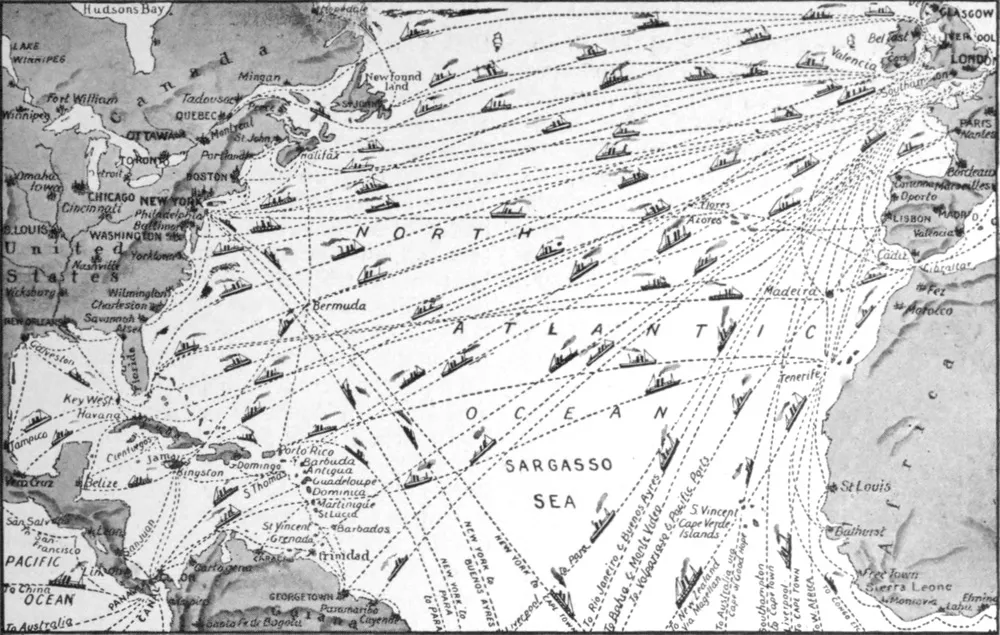
THE SHIFTING OF THE CENTRE OF THE WORLD’S COMMERCE
These two maps, which have been very carefully prepared
from the most reliable authorities, indicate at a glance the relative importance
of the Mediterranean and the Atlantic as highways of commerce in the time
of Julius Cæsar, B.C. 102–44.
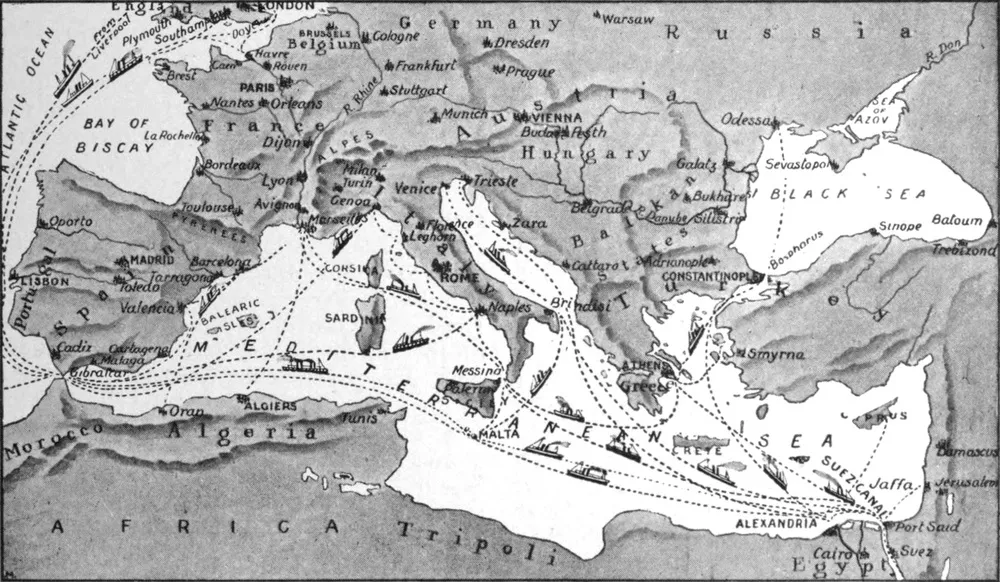
HOW THE MEDITERRANEAN HAS GIVEN PLACE TO THE ATLANTIC
Here is the contrast to the
opposite page. In our time the
Atlantic has become the centre of the world’s commerce, and the Mediterranean has
sunk in importance. It would be almost deserted but for the routes to
India via the Suez Canal.
A few words may suffice as to what Nature has done towards the
formation of nations and States by the configuration of the surface
of the dry land—that is to say, by mountain chains and by river
valleys. The only natural boundaries, besides seas, are mountains and
deserts. Rivers, though convenient frontier lines for the politician
or the geographer, are not natural boundaries, but rather unite than
dissever those who dwell on their opposite banks. Thus the great
natural boundaries in Asia have been the deserts of Eastern Persia,
of Turkestan, and of Northern Arabia, with the long Himalayan chain
and the savage ranges apparently parallel to the Irawadi River, which
separate the easternmost corner of India and Burmah from South-Western
China. To a less extent the Altai and Thian Shan, and, to a still
smaller extent, the Taurus in Eastern Asia Minor, have tended to divide
peoples and States. The Caucasus, which fills the space between two
great seas, has been at all times an extremely important factor in
history, severing the nomad races of Scythia from the more civilised
and settled inhabitants of the valleys of the Phasis and the Kura.
Even to-day, when the Tsar holds sway on both sides of this chain, it
constitutes a weakness in the position of Russia, and it helps to keep
the Georgian races to the south from losing their identity in the mass
of Russian subjects.
The Place of Mountains in History
Without the Alps and the Pyrenees, the annals of Europe must have been
entirely different. The Alps, even more than the Italian climate,
proved too much for the Romano-Germanic Emperors of the Middle Ages,
who tried to rule both to the north and to the south of this wide
mountain region. The Pyrenees have not only kept in existence the
Basque people, but have repeatedly frustrated the attempts of monarchs
to dominate both France and Spain. The mass of high moorland country
which covers most of the space between the Solway Firth and the lower
course of the Tweed has had something to do with the formation of
a Scottish nation out of singularly diverse elements. The rugged
mountains of Northern and Western Scotland, and the similar though less
extensive hill country of Wales, have enabled Celtic races to retain
their language and character in both these regions.
What Steam-power has Done
On the other hand, the vast open plains of Russia have allowed the
Slavs of the districts which lie round Novgorod, Moscow, and Kiev to
spread out among and Russify the Lithuanian and Finnish, to some extent
also the Tartar, races, who originally held by far the larger part of
that area. So, too, the Ural range, which, though long, is neither
high nor difficult to pass, has opposed no serious obstacle to the
overflow of population from Russia into Siberia. That in North America
the Alleghanies have had a comparatively slight effect upon political
history, although they did for a time arrest the march of colonisation,
is due partly to the fact that they are a mass of comparatively low
parallel ranges, with fertile valleys between, partly to the already
advanced civilisation of the Anglo-Americans of the Atlantic seaboard,
who found no great difficulty in making their way across, against the
uncertain resistance of small and non-cohesive Indian tribes. A far
more formidable natural barrier is formed between the Mississippi
Valley and the Pacific slope by the Rocky Mountains, with the deserts
of Arizona, Utah, Nevada, and Idaho. But the discovery of steam power
has so much reduced the importance of this barrier that it does not
seriously threaten the maintenance of a united American republic.
In one respect the New World presents a remarkable contrast to the
Old. The earliest civilisations of the latter seem to have sprung up
in fertile river valleys. Those of the former are found not on the
banks of streams like the Nile or Euphrates, but on elevated plateaux,
where the heat of a tropical sun is mitigated by height above sea
level. It was in the lofty lake basin of Tezcuco and Mexico, and on the
comparatively level ground which lies between the parallel ranges of
the Peruvian and Bolivian Andes, that American races had reached their
finest intellectual development, not in the far richer, but also hotter
and less healthy river valleys of Brazil, or (unless we are to except
Yucatan) on the scorching shores of the Caribbean Sea. Nature was in
those regions too strong for man, and held him down in savagery.
How Nature fixes Sites of Cities
In determining the courses of great rivers, Nature has determined the
first highways of trade and fixed the sites of many cities. Nearly all
the considerable towns founded more than three centuries ago owe their
origin either to their possessing good havens on the sea-coast, or to
the natural strength of their position on a defensible hill, or to
their standing close to a navigable river. Marseilles, Alexandria, New
York, Rio de Janeiro, are instances of the first; Athens, Edinburgh,
Prague, Moscow, of the second; Bordeaux, Cologne, New Orleans,
Calcutta, of the third. Rome and London, Budapest, and Lyons combine
the advantages of the second with those of the third. This function of
rivers in directing the lines of commerce and the growth of centres
of population has become much less important since the construction
of railroads, yet population tends to stay where it has been first
gathered, so that the fluviatile cities are likely to retain their
preponderance. Thus the river is as important to the historian as is
the mountain range or the sea.
Climate and Commerce
From the physical features of a country it is an easy transition to
the capacities of the soil. The character of the products of a region
determines the numbers of its inhabitants and the kind of life they
lead. A land of forests breeds hunters or lumbermen; a land of pasture,
which is too rough or too arid or too sterile for tillage, supports
shepherds or herdsmen probably more or less nomadic. Either kind of
land supports inhabitants few in proportion to its area. Fertile and
well-watered regions rear a denser, a more settled, and presumably a
more civilised population. Norway and Tyrol, Tibet and Wyoming, and the
Orange River Colony, can never become so densely peopled as Bengal or
Illinois or Lombardy, yet the fisheries of its coast and the seafaring
energy of its people have sensibly increased the population of Norway.
Thus he who knows the climate and the productive capacity of the
soil of any given country can calculate its prospects of prosperity.
Political causes may, of course, intervene. Asia Minor and the Valley
of the Euphrates, regions once populous and flourishing, are now thinly
inhabited and poverty-stricken because they are ruled by the Turks.
But these cases are exceptional. Bengal and Lombardy and Egypt have
supported large populations under all kinds of government. The products
of each country tend, moreover, to establish definite relations between
it and other countries, and do this all the more as population,
commerce, and the arts advance. When England was a great wool-growing
and wool-exporting country, her wool export brought her into close
political connection with the wool-manufacturing Flemish towns. She is
now a cotton-manufacturing country, needing cotton which she cannot
grow at all, and consuming wheat which she does not grow in sufficient
quantities. Hence she is in close commercial relations with the United
States on one side, which give her most of her cotton and much of her
wheat, and with India, from which she gets both these articles, and to
which she exports a large part of her manufactured cotton goods.
Common Needs make for Peace
So Rome, because she needed the corn of Egypt, kept Egypt under a
specially careful administration. The rest of her corn came from
Sicily and North Africa, and the Vandal conquest of North Africa dealt
a frightful blow to the declining Empire. In these cases the common
interest of sellers and buyers makes for peace, but in other cases
the competition of countries desiring to keep commerce to themselves
occasions war. The Spanish and Dutch fought over the trade to India in
the earlier part of the seventeenth century, when the Portuguese Indies
belonged to Spain, as the English and French fought in the eighteenth.
And a nation, especially an insular nation, whose arable soil is not
large enough or fertile enough to provide all the food it needs, has
a powerful inducement either to seek peace or else to be prepared for
maritime war. If such a country does not grow enough corn or meat at
home, she must have a navy strong enough to make sure that she will
always be able to get these necessaries from abroad. Attica did not
produce all the grain needed to feed the Athenians, so they depended on
the corn ships which came down from the Euxine, and were practically at
the mercy of an enemy who could stop those ships.
Of another natural source of wealth, the fisheries on the coast of
a country, no more need be said than that they have been a frequent
source of quarrels and even of war. The recognition of the right of
each state to the exclusive control and enjoyment of the sea for three
miles off its shores has reduced, but not entirely removed, the causes
of friction between the fishermen of different countries.
Minerals and Civilisation
Until recently, the surface of the soil was a far more important source
of wealth than was that which lies beneath the surface. There were
iron mines among the Chalybes on the Asiatic coast of the Euxine in
ancient times; there were silver mines here and there, the most famous
being those at Laurium, from which the Athenians drew large revenues,
gold mines in Spain and Dacia, copper mines in Elba, tin mines in the
south-west corner of Britain. But the number of persons employed in
mining and the industries connected therewith was relatively small both
in the ancient world and, indeed, down till the close of the eighteenth
century. The immense development of coal-mining and of iron-working
in connection therewith has now doubled, trebled, or quadrupled the
population of large areas in Britain, Germany, France, Belgium, and
the United States, adding vastly to the wealth of these countries
and stimulating in them the growth of many mechanical arts. This new
population is quite different in character from the agricultural
peasantry who in earlier days formed the principal substratum of
society. Its appearance has changed the internal politics of these
countries, disturbing the old balance of forces and accelerating the
progress of democratic principles.
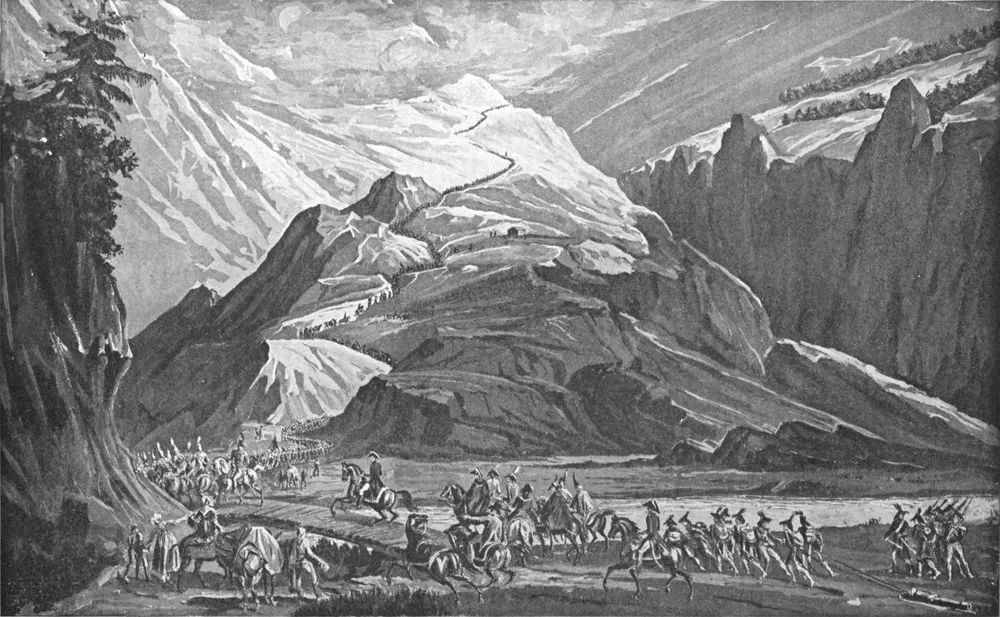
THE PLACE OF MOUNTAINS IN HISTORY: NATURE’S BARRIERS TO
MAN’S EXPANSION
Without the Alps the annals of Europe must have been
entirely different. The mountains were too much for the emperors of the Middle
Ages, although Hannibal, the great Carthaginian general, succeeded
in crossing them two centuries before Christ, a feat which Napoleon
repeated 2,000 years later. Our engraving illustrates Napoleon crossing
the Alps.
LARGER IMAGE
Nor have minerals failed to affect the international relations of
peoples and States. It was chiefly for the precious metals that the
Spaniards explored the American Continent and conquered Mexico and
Peru. It was for the sake of capturing the ships bringing those metals
back to Europe that the English sea-rovers made their way to the
American coasts and involved England in wars with Spain. It was the
discovery in 1885 of extensive auriferous strata unexampled in the
certainty of their yield that drew a swarm of foreign immigrants into
the Transvaal, whence arose those difficulties between them and the
Dutch inhabitants previously established there which, coupled with the
action of the wealthy owners of the mines, led at last to the war of
1899 between Britain and the two South African Republics.
Man’s Fight with Nature
The productive capacity of a country is, however, in one respect very
different from those great physical features—such as temperature,
rainfall, coast configuration, surface character, geological structure,
and river system—which have been previously noted. Those features are
permanent qualities which man can affect only to a limited extent,
as when he reduces the rainfall a little by cutting down forests, or
increases it by planting them, or as when he unites an isle, like
that of Cadiz, to the mainland, cuts through an isthmus, like that
of Corinth, or clears away the bar at a river mouth, as that of the
Mississippi has been cleared.
Exhausting the Mineral Wealth
But the natural products of a country may be exhausted and even
the productive capacity of its soil diminished. Constant tillage,
especially if the same crop be raised and no manure added, will wear
out the richest soils. This has already happened in parts of Western
America. Still the earth is there; and with rest and artificial help
it will recover its strength. But timber destroyed cannot always be
induced to grow again, or at least not so as to equal the vigour
of primeval forests. Wild animals, once extirpated, are gone for
ever. The buffalo and beaver of North America, the beautiful lynxes
of South Africa and some of its large ruminants, are irrecoverably
lost for the purposes of human use, just as much as the dinornis,
though a few individuals may be kept alive as specimens. So, too, the
mineral resources of a country are not only consumable, but obviously
irreplaceable. Already some of the smaller coalfields of Europe have
been worked out, while in others it has become necessary to sink much
deeper shafts, at an increasing cost. There is not much tin left in
Cornwall, not much gold in the gravel deposits of Northern California.
The richest known goldfield of the world, that of the Transvaal
Witwatersrand, can hardly last more than thirty or forty years. Thus in
a few centuries the productive capacity of many regions may have become
quite different from what it is now, with grave consequences to their
inhabitants.
These are some of the ways in which Nature affects those economic,
social, and political conditions of the life of man the changes in
which make up history. As we have seen, that which Nature gives to
man is always the same, in so far as Nature herself is always the
same—an expression which is more popular than accurate, for Nature
herself—that is to say, not the laws of Nature, but the physical
environment of man on this planet—is in reality always changing. It is
true that this environment changes so slowly that a thousand years may
be too short a period in which man can note and record some forms of
change—such, for instance, as that by which the temperature of Europe
became colder during the approach of the glacial period and warmer
during its recession—while ten thousand years may be too short to note
any diminution in the heat which the sun pours upon the earth, or in
the store of oxygen which the earth’s atmosphere holds.
Progress of Modern Invention
Man Cannot Disregard Nature
But as we have also seen, the relation to man of Nature’s gifts
differs from age to age as man himself becomes different, and as his
power of using these gifts increases, or his need of them becomes
either less or greater. Every invention alters those relations. Water
power became less relatively valuable when steam was applied to the
generation of motive force. It has become more valuable with the new
applications of electricity. With the discovery of mineral dyes, indigo
and cochineal are now less wanted than they were. With the invention
of the pneumatic tyre for bicycles and carriages, caoutchouc is more
wanted. Mountains have become, since the making of railways, less of
an obstacle to trade than they were, and they have also become more
available as health resorts. Political circumstances may interfere
with the ordinary and normal action of natural phenomena. A race may
be attracted to or driven into a region for which it is not physically
suited, as Europeans have gone to the West Indies, and negroes were
once carried into New York and Pennsylvania. The course of trade which
Nature prescribes between different countries may be hampered or
stopped by protective tariffs; but in these cases Nature usually takes
her eventual revenges. They are instances which show, not that man can
disregard her, but that when he does so, he does so to his own loss.
It would be easy to add further illustrations, but those already given
are sufficient to indicate how multiform and pervading is the action
upon man of the physical environment, or in other words, how in all
countries, and at all times, geography is the necessary foundation
of history, so that neither the course of a nation’s growth, nor its
relations with other nations, can be grasped by one who has not come to
understand the climate, surface, and products of the country wherein
that nation dwells.
There is no Unmixed Race left
This conception of the relation of geography to history is, as has been
said, the leading idea of the present work, and has furnished the main
lines which it follows. It deals with history in the light of physical
environment. Its ground plan, so to speak, is primarily geographical,
and secondarily chronological. But there is one difficulty in the way
of such a scheme, and of the use of such a ground plan, which cannot
be passed over. That difficulty is suggested by the fact already
noted—that hardly any considerable race, and possibly no great nation,
now inhabits the particular part of the earth’s surface on which it was
dwelling when a history begins. Nearly every people has either migrated
bodily from one region to another, or has received such large infusions
of immigrants from other regions as to have become practically a new
people. Hence it is rare to find any nation now living under the
physical conditions which originally moulded its character, or the
character of some at least of its component elements. And hence it
follows that when we study the qualities, aptitudes, and institutions
of a nation in connection with the land it inhabits, we must always
have regard not merely to the features of that land, but also to those
of the land which was its earlier dwelling-place. Obviously, this
brings a disturbing element into the study of the relations between
land and people, and makes the whole problem a far more complicated one
than it appeared at first sight.
Nature’s Race Factory
Where a people has migrated from a country whose physical conditions
were similar to those under which its later life is spent, or where it
had reached only a comparatively low stage of economic and political
development before the migration, the difficulties arising from this
source are not serious. The fact that the English came into Britain
from the lands round the mouth of the Elbe is not very material to
an inquiry into their relations to their new home, because climate
and soil were similar, and the emigrants were a rude, warlike race.
But when we come to the second migration of the English, from Britain
to North America, the case is altogether different. Groups of men
from a people which had already become highly civilised, had formed
a well-marked national character, and had created a body of peculiar
institutions, planted themselves in a country whose climate and
physical features are widely diverse from those of Britain.
If, for the sake of argument, we assume the Algonquin aborigines of
Atlantic North America as they were in A.D. 1600 to have been
the legitimate product of their physical environment—I say “for the
sake of argument,” because it may be alleged that other forces than
those of physical environment contributed to form them—what greater
contrast can be imagined than the contrast between the inhabitants
of New England in this present year and the inhabitants of the same
district three centuries earlier, as Nature, and Nature alone, had
turned them out of her factory? Plainly, therefore, the history of the
United States cannot, so far as Nature and geography are concerned,
be written with regard solely, or even chiefly, to the conditions of
North American nature. The physical environment in which the English
immigrants found themselves on that continent has no doubt affected
their material progress and the course of their politics during the
three centuries that have elapsed since settlements were founded in
Virginia and on Massachusetts Bay.
Beginnings of Race History
But it is not to that environment, but to earlier days, and especially
to the twelve centuries during which their ancestors lived in England,
that their character and institutions are to be traced. Thus the
history of the American people begins in the forests of Germany,
where the foundations of their polity were laid, and is continued in
England, where they set up kingdoms, embraced Christianity, became one
nation, received an influx of Celtic, Danish, and Norman-French blood,
formed for themselves that body of customs, laws, and institutions
which they transplanted to the new soil of America, and most of which,
though changed and always changing, they still retain. The same thing
is true of the Spaniards (as also of the Portuguese) in Central
and South America. The difference between the development of the
Hispano-Americans and that of their English neighbours to the north is
not wholly, or even mainly, due to the different physical conditions
under which the two sets of colonists have lived.
It is due to the different antecedent history of the two races. So a
history of America must be a history not only of America, but of the
Spaniards, Portuguese, French, and English—one ought in strictness
to add of the negroes also—before they crossed the Atlantic. The only
true Americans, the only Americans for whom American nature can be
deemed answerable, are the aboriginal red men whom we, perpetuating the
mistake of Columbus, still call Indians.
Geography as a Basis of History
This objection to the geographical scheme of history writing is no
doubt serious when a historical treatise is confined to one particular
country or continent, as in the instance I have taken of the Continent
of North America. It is, however, less formidable in a universal
history, such as the present work, because, by referring to another
volume of the series, the reader will find what he needs to know
regarding the history of the Spaniards, English, and French in those
respective European homes where they have grown to be that which they
were when, with religion, slaughter, and slavery in their train, they
descended upon the shores of America.
Accordingly the difficulty I have pointed out does not disparage the
idea and plan of writing universal history on a geographical basis.
It merely indicates a caution needed in applying that plan, and a
condition indispensable to its utility—viz., the regard that must be
had to the stage of progress at which a people has arrived when it is
subjected to an environment different from that which had in the first
instance helped to form its type.
THE GROWTH OF MODERN KNOWLEDGE
W
WE
have now considered some of the ways in which a universal history,
written with special reference to the physical phenomena of the earth
as geographical science presents them, may bring into strong relief
one large and permanent set of influences which determine the progress
or retrogression of each several branch of mankind. Upon the other
principles which preside over and direct the composition of such a
work, not much need be said. They are, of course, in the main, those
which all competent historians will follow in writing the history of
any particular people.
But a universal history which endeavours to present in a short compass
a record of the course of events in all regions and among all peoples,
since none can safely be omitted, is specially exposed to two dangers.
One is that of becoming sketchy and viewy. When a large object has to
be dealt with on a small scale, it is natural to sum up in a few broad
generalisations masses of facts which cannot be described or examined
in detail. Broad generalisations are valuable when they proceed from a
thoroughly trained mind—valuable, even if not completely verifiable,
because they excite reflection. But it is seldom possible to make them
exact. They necessarily omit most of the exceptions, and thus suggest a
greater uniformity than exists.
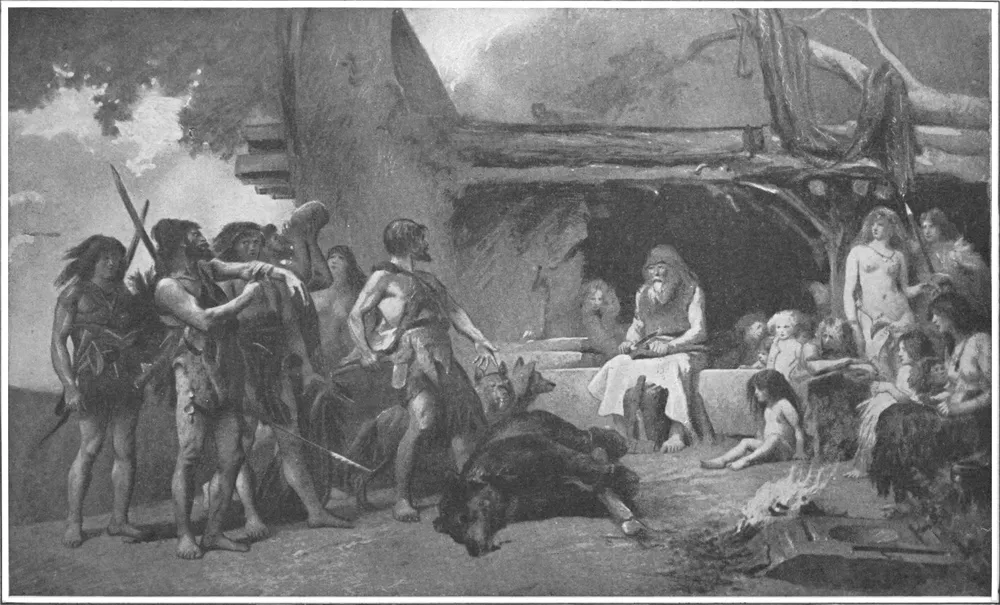
Neurdein
THE STONE AGE: HUNTERS RETURNING FROM THE CHASE
From the painting by Ferdinand Cormon
LARGER IMAGE
Need of Care in History
The other danger is that of sacrificing brightness and charm of
presentation. When an effort is made to avoid generalisations, and
to squeeze into the narrative as many facts as the space will admit,
the narrative is apt to become dry, because compression involves
the curtailment of the personal and dramatic element. These are the
rocks between which every historian has to steer. If he has ample
space, he does well to prefer the course of giving all the salient
facts and leaving the reader to generalise for himself. If, however,
his space is limited, as must needs be the lot of those who write a
universal history, the impossibility of going into minute detail makes
generalisations inevitable, for it is through them that the result
and significance of a multitude of minor facts must be conveyed in a
condensed form.
New Minds and New Facts
All the greater, therefore, becomes the need for care and sobriety in
the forming and setting forth every summarising statement and general
conclusion or judgment. Probably the soundest guiding principle
and best safeguard against error is to be found in shunning all
preconceived hypotheses which seek to explain history by one set of
causes, or to read it in the light of one idea. The habit of magnifying
a single factor, such as the social factor, or the economic, or
the religious, has been a fertile source of weakness in historical
writing, because it has made the presentation of events one-sided,
destroying that balance and proportion which it is the highest merit
of any historian to have attained. Theory and generalisation are the
life-blood of history. They make it intelligible. They give it unity.
They convey to us the instruction which it always contains, together
with so much of practical guidance in the management of communities
as history is capable of rendering. But they need to be applied with
reserve, and not only with an impartial mind, but after a painstaking
examination of all the facts—whether or no they seem to make for the
particular theory stated—and of all the theories which any competent
predecessor has propounded.
For the historian, though he must keep himself from falling under the
dominion of any one doctrine by which it is sought to connect and
explain phenomena, must welcome all the light which any such doctrine
can throw upon facts. Even if such a doctrine be imperfect, even if it
be tainted by error, it may serve to indicate relations between facts,
or to indicate the true importance of facts, which previous writers
had failed to observe, or had passed too lightly over. It is thus
that history always needs to be re-written. History is a progressive
science, not merely because new facts are constantly being discovered,
not merely because the changes in the world give to old facts a new
significance, but also because every truly penetrating and original
mind sees in the old facts something which had not been seen before.
A universal history is fitted to correct such defects as may be
incident to that extreme specialism in historical writing which is now
in fashion. The broad and concise treatment which a history of all
times and peoples must adopt naturally leads to efforts to characterise
the dominant features and tendency of an epoch or a movement, whether
social, economic, or political.
The Side Streams of History
Yet even here there is a danger to be guarded against. No epoch, no
movement, is so simple as it looks at first sight, or as one would
gather from even the most honest contemporary writer. There is always
an eddy at the side of the stream; and the stream itself is the
resultant of a number of rivulets with different sources, whose waters,
if the metaphor may be extended, are of different tints. Let any man
study minutely a given epoch, such as that of the Reformation in
Germany, or that of the Revolutionary War in America, and he will be
surprised to find how much more complex were the forces at work than
he had at first supposed, and on how much smaller a number of persons
than he had fancied the principal forces did in fact directly operate.
Or let any one—for this is perhaps the best, if the most difficult,
method of getting at the roots of this complexity—study thoroughly
and dispassionately the phenomena of his own time. Let him observe how
many movements go on simultaneously, sometimes accelerating, sometimes
retarding, one another, and mark how, the more fully he understands
this complex interlacing, so much the less confident do his predictions
of the future become. He will then realise how hard it is to find
simple explanations and to deliver exact statements regarding critical
epochs in the past.
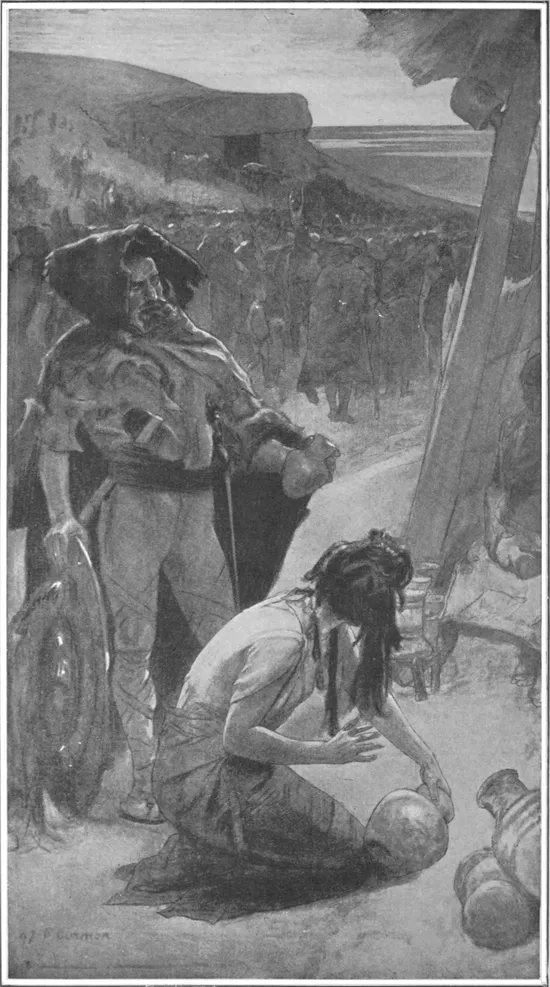
Mercier
THE FIRST INDUSTRIES: POTTERY
From the painting by Ferdinand Cormon
LARGER IMAGE
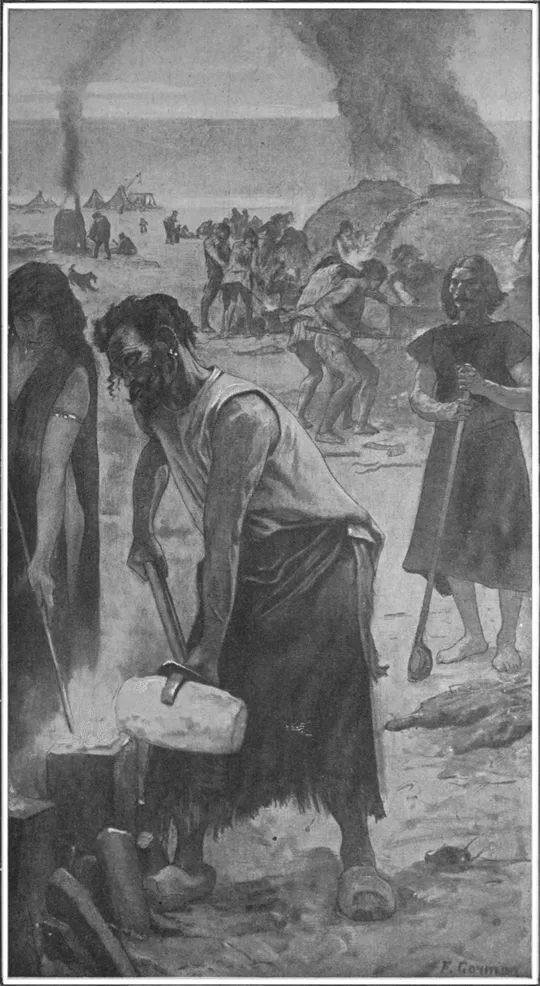
Mercier
THE FIRST INDUSTRIES: THE FORGE
From the painting by Ferdinand Cormon
LARGER IMAGE
The Main Stream of History
Nevertheless, the task of summarising and explaining is one to which
the writer of a History of the World must address himself. If he has
the disadvantage of limited space, he has the advantage of being able
to assume the reader’s knowledge of what has gone before, and to invite
the reader’s attention to what will come after. Thus he stands in a
better position than does the writer who deals with one country or one
epoch only for making each part of history illustrate other parts,
for showing how similar social tendencies, similar proclivities of
human nature, work similarly under varying conditions and are followed
by similar, though never identical, results. He is able to bring out
the essential unity of history, expunging from the reader’s mind the
conventional and often misleading distinctions that are commonly drawn
between the ancient, the mediæval, and the modern time. He can bring
the contemporaneous course of events in different countries into a
fruitful relation. And in the case of the present work, which dwells
more especially on the geographical side of history, he can illustrate
from each country in succession the influence of physical environment
on the formation of races and the progress of nations, the principles
which determine the action of such environment being everywhere
similar, though the forms which that action takes are infinitely
various.
Is there, it may be asked, any central thread in following which the
unity of history most plainly appears? Is there any process in tracing
which we can feel that we are floating down the main stream of the
world’s onward movement? If there be such a process, its study ought to
help us to realise the unity of history by connecting the development
of the numerous branches of the human family.
One such process has already been adverted to and illustrated. It is
the gradual and constant increase in man’s power over Nature, whereby
he is emancipated more and more from the conditions she imposes on
his life, yet is brought into an always closer touch with her by the
discovery of new methods of using her gifts. Two other such processes
may be briefly examined. One goes on in the sphere of time, and
consists in the accumulation from age to age of the strength, the
knowledge, and the culture of mankind as a whole. The other goes on in
space as well as in time, and may be described as the contraction of
the world, relatively to man.
The Great Increase of Population
The accumulation of physical strength is most apparent in the increase
of the human race. We have no trustworthy data for determining the
population, even of any one civilised country, more than a century
and a half ago; much less can we conjecture that of any country
in primitive or prehistoric times. It is clear, however, that in
prehistoric times—say, six or seven thousand years ago, there were
very few men on the earth’s surface. The scarcity of food alone would
be sufficient to prove that; and, indeed, all our data go to show it.
Fifty years ago the world’s population used to be roughly conjectured
at from seven to nine hundred millions, two-thirds of them in China and
India. It is now estimated at over fifteen hundred millions. That of
Europe alone must have tripled within a century, and can hardly be less
than four hundred millions. That of North America may have scarcely
exceeded four or five millions in the time of Christopher Columbus, or
at the date of the first English settlements, though we have only the
scantiest data for a guess. It may now be 130,000,000, for there are
over a hundred millions in the United States alone, about fifteen in
Mexico, and eight in Canada, besides the inhabitants of Central America.
The Prolific Power of White People
Physical & Intellectual Power
The increase has been most swift in the civilised countries, such
as Britain, Germany, Russia, and the United States; but it has
gone on in India also since India came under British rule (famines
notwithstanding), and in the regions recently colonised by Europeans,
such as Australia, Siberia, and Argentina, the disappearance of
aborigines being far more than compensated for by the prolific power
of the white immigrants. Some regions, such as Asia Minor and parts
of North Africa, are more thinly peopled now than they were under the
Roman Empire, and both China and Peru may have no larger population
than they had five, or ten, or fifteen centuries ago. But taking
the world at large, the increase is enormous, and will apparently
continue. Even after the vacant cultivable spaces which remain in
the two Americas, Northern Asia, and Australasia have been filled,
the discovery of new modes of enlarging the annually available stock
of food may maintain the increase. It is most conspicuous among the
European races, and is, of course, due to the greater production in
some regions of food, and in others of commodities wherewith food can
be purchased. It means an immense addition to the physical force of
mankind in the aggregate, and to the possibilities of intellectual
force also—a point to be considered later. And, of course, it
also means an immense and growing preponderance of the civilised
white nations, which are now probably one half of mankind, and may,
in another century, when they have risen from about five hundred
to, possibly, one thousand or fifteen hundred millions, be nearly
two-thirds.
Modern Man Stronger than his Ancestors
As respects the strength of the average individual man, the inquiry
is less simple. Palæolithic man and neolithic man were apparently
(though here and there may have been exceptions) comparatively feeble
creatures, as are the relics of the most backward tribes known to us,
such as the Veddas of Ceylon, the Bushmen, the Fuegians. Some savages,
as, for instance, the Patagonians, are men of great stature, and some
of the North American Indians possess amazing powers of endurance. The
Greeks of the fifth century B.C., and the Teutons of the time
of Julius Cæsar, had reached a high physical development. Pheidippides
is said to have traversed one hundred and fifty miles on foot in
forty-eight hours. But if we think of single feats of strength, feats
have been performed in our own day—such as Captain Webb’s swimming
across the Straits of Dover—equal to anything recorded from ancient
or mediæval times. To swim across the much narrower Hellespont was
then deemed a surprising exploit. Nor do we know of any race more to
be commended for physical power and vigour of constitution than the
American backwoodsmen of Kentucky or Oregon to-day. The swords used by
the knights of the fifteenth century have usually handles too small for
many a modern English or German hand to grasp.
America’s Mingled Races
Isolated feats do not prove very much, but there is good reason to
believe that the average European is as strong as ever he was, and
probably more healthy, at least if longevity is a test of health.
One may fairly conclude that with better and more abundant food,
the average of stature and strength has improved over the world at
large, so that in this respect also the force of mankind as a whole
has advanced. Whether this advance will continue is more doubtful. In
modern industrial communities the law of the survival of the fittest
may turn out to be reversed, for it is the poorer and lower sections
of the population that marry at an early age, and have the largest
families, while prudential considerations keep down the birth-rate
among the upper middle-class. In Transylvania, for instance, the
Saxons are dying out, because very few children are born to each pair,
while the less educated and cultured Rumans increase fast. In North
America, the Old New England stock of comparatively pure British blood
has begun to be swamped by the offspring of the recent immigrants,
mostly Irish or French Canadians; and although the sons of New England,
who have gone West, continue to be prolific, it is probable that the
phenomena of New England will recur in the Mississippi Valley, and
that the newcomers from Europe who form the less cultivated strata
of the population—Irish, Germans, Italians, Czechs, Poles, Slovaks,
Rumans—will contribute an increasing proportion of the inhabitants.
Some of these, and especially the Irish and the Germans and the
Scandinavians, are among the best elements in the American population,
and have produced men of the highest distinction. But the average
level among them of versatile aptitude and of intellectual culture is
slightly below that of the native Americans.
Now, the poorer sections are in most countries, though of course not
always to the same extent, somewhat inferior in physical as well as in
mental quality, and more prone to suffer from that greatest hindrance
to physical improvement, the abuse of alcoholic drinks.
We come next to another form of the increase of human resources, the
accumulation of knowledge, and of what may be called intellectual
culture and capacity, for it is convenient to distinguish these two
latter from knowledge.
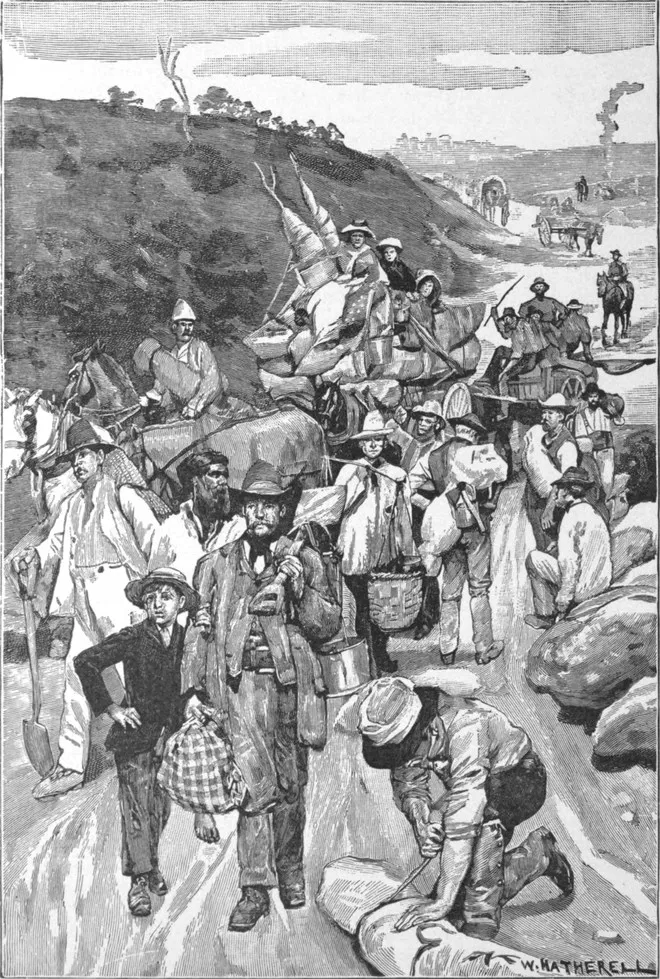
PIONEERS OF MODERN CIVILISATION
The discovery of precious metals is a great factor in
progress. Seekers after gold are chief among the pioneers who help to carry
civilisation into new lands.
Inventions Mean Progress
In knowledge there has been an advance, not merely a tolerably
steady and constant advance, but one which has gone on with a sort
of geometrical progression, moving the faster the nearer we come to
our own time. Whatever may have befallen in the prehistoric darkness,
history knows of only one notable arrest or setback in the onward
march—that which marks the seventh, eighth, and ninth centuries of
the Christian era. Even this set-back was practically confined to
Southern and Western Europe, and affected only certain departments
of knowledge. It did not, save, perhaps, as regards a few artistic
processes, extinguish that extremely important part of the previously
accumulated resources of mankind which consisted in the knowledge of
inventions. It is in respect of inventions, especially mechanical and
physical or chemical inventions, that the accumulation of knowledge has
been most noteworthy and most easy to appreciate.
A history of inventions is a history of the progress of mankind, of a
progress to which every race may have contributed in primitive times,
though all the later contributions have come from a few of the most
civilised. Every great invention marks one onward step, as one may see
by enumerating a few, such as the use of fire, cooking, metal working,
the domestication of wild animals, the tillage of the ground, the use
of plough and mattock and harrow and fan, the discovery of plants
or trees useful for food or for medicine, the cart, the wheel, the
water-mill (overshot, undershot, and turbine), the windmill, the
distaff (followed long, long after by the spinning-wheel), the loom,
dyestuffs, the needle, the potter’s wheel, the hydraulic press, the
axe-handle, the spear, the bow, the shield, the war-chariot, the
sling, the cross-bow, the boat, the paddle, the oar, the helm, the
sail, the mariner’s compass, the clock, picture-writing, the alphabet,
parchment, paper, printing, photography, the sliding keel, the
sounding-lead, the log, the brick, mortar, the column, the arch, the
dome, till we come down to explosives, the microscope, the cantilever,
and the Röntgen rays.
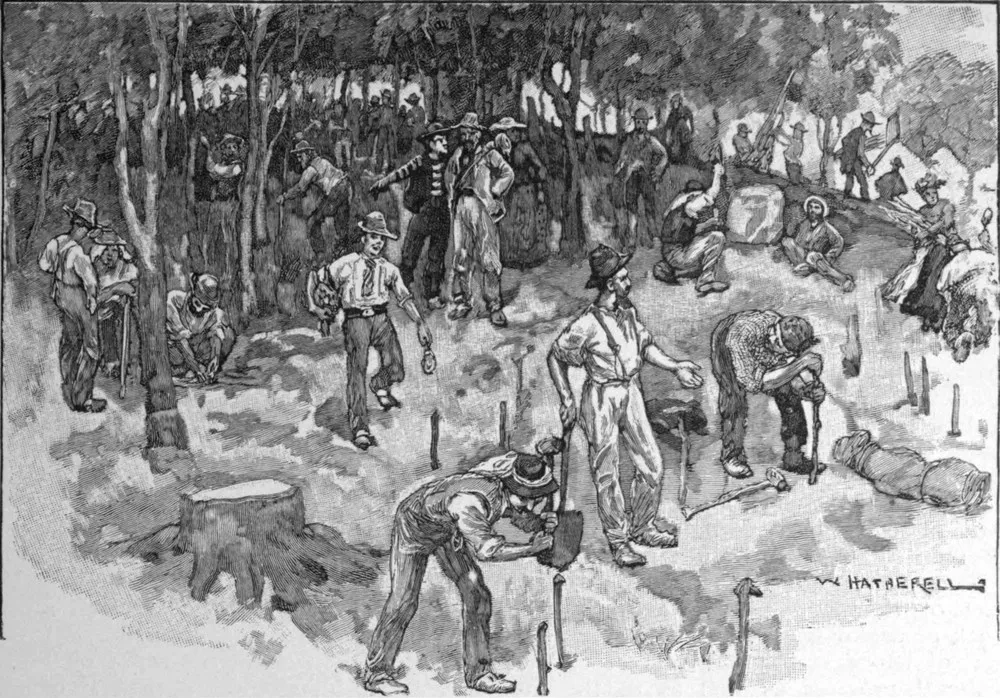
THE FIRST SETTLEMENT OF A NEW CITY
Many flourishing cities in South Africa, Australia, and
America have grown up around the sites where the first gold-seekers pegged out
their claims in unexploited territories and began digging for the precious
metal.
The history of the successive discovery, commixture, and applications
of the metals, from copper and bronze down to manganese, platinum, and
aluminium, or of the successive discovery and utilisation of sources of
power—the natural sources, such as water and wind, the artificially
procured, such as steam, gas, and electricity—or of the production and
manufacture of materials available for clothing, wool, hair, linen,
silk, cotton, would show how every step becomes the basis for another
step, and how inventions in one department suggest or facilitate
inventions in another. Recent discoveries in surgery and medicine, such
as the use of antiseptics, tend to improve health and to prolong life;
and in doing so, they increase the chances of further discoveries being
made.
The Prolonging of Life
Who can tell what the world may have lost by the early death of many a
man of genius? One peculiar line of discovery which at first seemed to
have nothing to do with practice has proved to be of signal service;
the working out of mathematical methods of calculation by means of
which the mechanical and physical sciences have in recent times made a
progress in their practical application undreamt of by those who laid
the foundations of geometry and algebra many centuries ago. It may,
indeed, be said that all the sciences need one another, and that none
has been without its utilities for practice, since even that which
deals with the heavenly bodies has been used for the computation of
time, was used by the agriculturist before he had any calendars to
guide him, and has been of supreme value to the navigator. It has also
been suggested that an observation of sun spots may enable the advent
of specially hot seasons, involving droughts, to be predicted.
Another kind of knowledge also grows by the joint efforts of many
peoples, that which records the condition of men in the past and the
present, including history, economics, statistics, and the other
so-called social sciences. This kind also is useful for practice, and
has led to improvements by which nearly all nations have profited,
such as an undebased currency, banking and insurance, better systems
of taxation, corporations, and joint stock companies. With this we may
couple the invention of improved political institutions.
The accumulation of knowledge, especially of scientific knowledge
applied to the exploitation of the resources of Nature, means the
accumulation of wealth—that is to say, of all the things which
men need or use. The total wealth of the world must have at least
quadrupled or quintupled within the last hundred years. Nearly all of
it is in the hands or under the control of the civilised nations of
European stock, among whom the United States stands foremost, both
in rate of economic growth and in the absolute quantity of values
possessed.
Knowledge Means Wealth
Two further observations belong to this part of the subject. One is
that this stock of useful knowledge, the accumulation of which is the
central fact of the material progress as well as of the intellectual
history of mankind, now belongs to (practically) all races and states
alike. Some, as we shall note presently, are more able to use it than
others, but all have access to it. This is a new fact. It is true
that most races have contributed something to the common stock; and
that even among the civilised peoples, no one or two or three (except
possibly the Greeks as respects ancient times) can claim to have
contributed much more than the others. But in earlier ages there were
peoples or groups of peoples who were for a time the sole possessors
of inventions which gave them great advantages, especially for war.
Superior weapons as well as superior drill enabled Alexander the Great,
and afterward the Romans, to conquer most of the civilised world.
Horses and firearms, with courage and discipline, enabled two Spanish
adventurers to seize two ancient American empires with very scanty
forces, as they enabled a handful of Dutch Boers to overcome the hosts
of Mosilikatze and Dingaan. So there were formerly industrial arts
known to or practised by a few peoples only. But now all inventions,
even those relating to war, are available even to the more backward
races, if they can learn how to use them or can hire white men to do
so for them. The facilities of communication are so great, the means
of publicity so abundant, that everything becomes speedily known
everywhere.
Inventions are now Universal
The other observation is that there is now no risk that any valuable
piece of knowledge will be lost. Every public event that happens, as
well as every fact of scientific consequence, is put on record, and
that not on a single stone or in a few manuscripts, but in books, of
which so many copies exist that even the perishable nature of the
material will not involve the loss of the contents, since, if these
contents are valuable, they will be transferred to and issued in other
books, and so ad infinitum. Thus every process of manufacture is
known to so many persons that while it continues to be serviceable it
is sure to be familiar and transmitted from generation to generation
by practice as well as by description. We must imagine a world totally
different from the world we know in order to imagine the possibility of
any diminution, indeed of any discontinuance of the increase, of this
stock of knowledge which the world has been acquiring, and which is not
only knowledge but potential wealth.
When one passes from knowledge considered as a body of facts
ascertained and available for use to the thing we call intellectual
aptitude or culture—namely, the power of turning knowledge to
account and of producing results in spheres other than material—and
when we inquire whether mankind has made a parallel advance in this
direction, it becomes necessary to distinguish three different kinds of
intellectual capacity.
The first may be called the power of using scientific methods for
investigating phenomena, whether physical or social.
No Decrease of Knowledge is now Likely
The second is the power of speculation, applied to matters which
have not hitherto been found capable of examination by the methods
of science, whether observational, experimental, or mathematical.
The third is the power of intellectual creation, whether literary or
artistic.
The methods of scientific inquiry may almost be classed with the
ascertained facts of science or with inventions, as being parts of
the stock of accumulated knowledge built up by the labour of many
generations. They are known to everybody who cares to study them, and
can be learnt and applied by everybody who will give due diligence.
Just as every man can be taught to fire a gun, or steer a ship, or
write a letter, though guns, helms, and letters are the result of
discoveries made by exceptionally gifted men, so every graduate in
science of a university can use the methods of induction, can observe
and experiment with a correctness which a few centuries ago even the
most vigorous minds could scarcely have reached.
Original Thinkers are still Rare
Because the methods have been so fully explained and illustrated as to
have grown familiar, a vast host of investigators, very few of whom
possess scientific genius, are at work to-day extending our scientific
knowledge. So the methods of historical criticism—so the methods
of using statistics—are to-day profitably applied by many men with
no such original gift as would have made them competent critics or
statisticians had not the paths been cut by a few great men and trodden
since by hundreds of feet. All that is needed is imitation—intelligent
and careful imitation. Nevertheless, there remains this sharp contrast
between knowledge of the facts of applied science and knowledge of
the methods, that whereas there is no radical difference between the
ability of one man and that of another to use a mechanical invention,
such as a steam plough or an electric motor-car, there is all the
difference in the world between the power of one intellect and another
to use a method for the purposes of fresh discovery. Knowledge
fossilised in a concrete invention or even in a mathematical formula is
a sort of tool ready to every hand. But a method, though serviceable
to everybody, becomes eminently fruitful only when wielded by the same
kind of original genius as that which made discoveries by the less
perfect methods of older days. This is apparent even in inquiries which
seem to reside chiefly in collection and computation. Everybody tries
nowadays to use statistics. Many people do use them profitably. But the
people who by means of statistics can throw really fresh and brilliant
light on a problem are as few as ever they were.
Advantage of Modern over Old Thinkers
When we turn to the exercise of speculative thought on subjects not
amenable to strictly scientific—that is to say, to exact—methods,
the gain which has come to mankind by the labour of past ages is of
a different order. Metaphysics, ethics, and theology, to take the
most obvious examples, are all of them the richer for the thoughts of
philosophers in the past. A number of distinctions have been drawn,
and a number of classifications made, a number of confusions, often
verbal, have been cleared up, a number of fallacies detected, a number
of technical terms invented, whereby the modern speculator enjoys a
great advantage over his predecessor. His mind has been clarified, and
many new aspects of the old problems have been presented, so that he is
better able to see all round the old problems.
The Living Thought of Past Ages
None of the great thinkers, from Pythagoras down to Hegel, has
left metaphysics where he found it. Yet none can be said to have
built on the foundations of his predecessors in the same way as the
mathematicians and physicists and chemists have added to the edifice
they found. What the philosophers have done is to accumulate materials
for the study of man’s faculties and modes of thinking, and of his
ideas regarding his relations to the universe, while also indicating
various methods by which the study may be pursued. Each great product
of speculative thought is itself a part of these materials, and for
that reason never becomes obsolete, as the treatises of the old
physicists and chemists have mostly become. Aristotle, for instance,
has left us books on natural history, on metaphysics and ethics, and
on politics. Those on natural history are mere curiosities, and no
modern biologist or zoologist needs them. Those on metaphysics and
ethics still deserve the attention of the student of philosophy,
though he may in a certain sense be said to have got beyond them. The
treatise on politics still keeps its place beside Montesquieu, Burke,
and Tocqueville. Or, to take a thinker who like Aristotle seems very
far removed from us, though fifteen hundred years later in date, St.
Thomas of Aquinum discusses questions from many of which the modern
world has moved away, and discusses them by methods which many do not
now use, starting from premises which many do not accept. But he marks
a remarkable stage in the history of human thought, and as a part of
that history, and as an example of extraordinary dialectical ingenuity
and subtlety, he remains an object of interest to those least in
agreement with his conclusions.
Every Great Thinker Affects Others
Every great thinker affects other thinkers, and propagates the impulse
he has received, though perhaps in a quite different direction.
The teaching of Socrates was the starting point for nearly all
the subsequent schools of Greek philosophy. Hume became the point
of departure for Kant, who desired to lay a deeper foundation for
philosophy than that which Hume seemed to have overturned. All these
great ones have not only enriched us, but are still capable of
stimulating us. But they have not improved our capacity for original
thinking. The accumulation of scientific knowledge has, as already
observed, put all mankind in a better position for solving further
physical problems and establishing a more complete dominion over
Nature. The accumulation of philosophic thought has had no similar
effect. In the former case each man stands, so to speak, on the
shoulders of his predecessors. In the latter he stands on his own feet.
The value of future contributions to philosophy will depend on the
original power of the minds that make them, and only to a small extent
(except by way of stimulus) on what such minds may have drawn from
those into whose labours they have entered.
Ebb-Tides of Intellectual Culture
When we come to the products of literary and artistic capacity, we
find an even vaster accumulation of intellectual treasure available
for enjoyment, but a still more marked absence of connection between
the amount of treasures possessed and the power of adding fresh
treasures to them. Since writing came into use, and, indeed, even in
the days when memory alone preserved lays and tales, every age and
many races have contributed to the stock. There have been ebbs and
flows both in quantity and quality. The centuries between A.D.
600 and A.D. 1100 have left us very little of high merit in
literature, though something in architecture; and the best of that
little in literature did not come from the seats of Roman civilisation
in Italy, France, Spain, and the East Roman Empire.
Some periods have seen an eclipse of poetry, others an eclipse of art
or a sterility in music. Literature and the arts have not always
flourished together, and musical genius in particular seems to have
little to do with the contemporaneous development of other forms of
intellectual power. The quantity of production bears no relation to
the quality, not even an inverse relation; for the pessimistic notion
that the larger the output the smaller is the part which possesses
brilliant excellence, has not been proved. Still less does the amount
of good work produced in any given area depend upon the number of
persons living in that area. Florence, between A.D. 1250 and
A.D. 1500 gave birth to more men of first-rate poetical and
artistic genius than London has produced since 1250; yet Florence had
in those two and a half centuries a population of probably only from
forty to sixty thousand. And Florence herself has since A.D.
1500 given birth to scarcely any distinguished poets or artists, though
her population has been larger than it was in the fifteenth century.
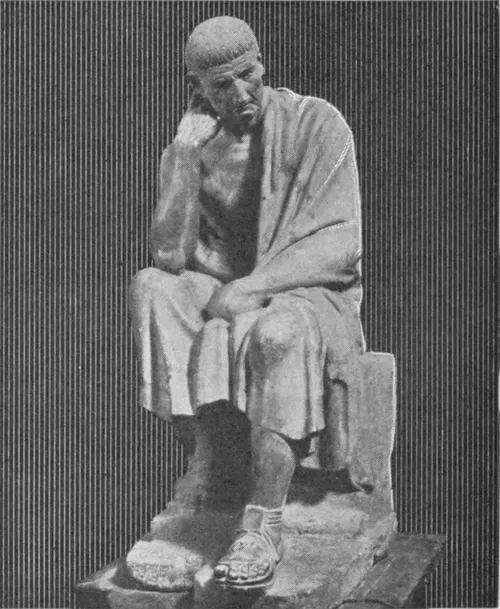
Mansell
THE MIND OF THE ANCIENT WORLD
Aristotle (B.C. 384–322) whose influence is greater
in some lines than that of St. Thomas of Aquinum, who represents mediæval thought,
1500 years later.
The increase in the world’s stock of intellectual wealth is one of the
most remarkable facts in history, for it represents a constant increase
in the means of enjoyment. Such losses as there have been nearly all
occurred during the Dark Ages; but there is now little risk that
anything of high literary or musical value will perish, though, of
course, works of art, and especially buildings and carvings, suffer or
vanish.
The increase does not, however, tend to any strengthening of the
creative faculty. There is a greater abundance of models of excellence,
models of which form the taste, afford a stimulus to sensitive minds,
and establish a sort of technique with well-known rules. The principles
of criticism are more fully investigated. The power of analysis grows,
and the appreciation both of literature and of art is more widely
diffused. Their influence on the whole community becomes greater, but
the creative imagination which is needed for the production of original
work becomes no more abundant and no more powerful. It may, indeed, be
urged, though our data are probably insufficient for a final judgment,
that the finer qualities of poetry and of pictorial and plastic art
tend rather to decline under the more analytic habit of mind which
belongs to the modern world. Simplicity, freshness, spontaneity come
less naturally to those who have fallen under the pervasive influence
of this habit.
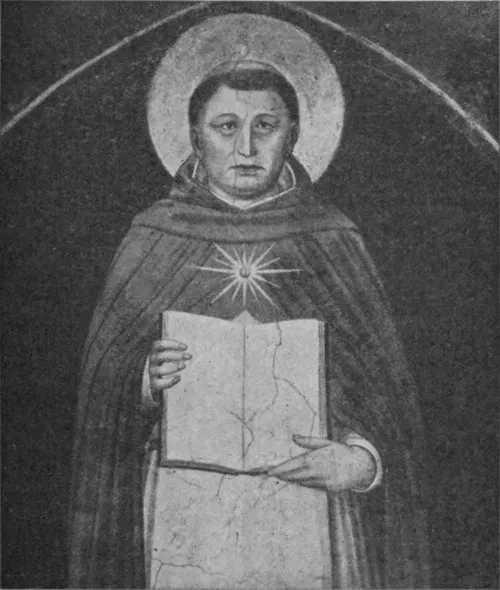
Mansell
THE MIND OF THE MEDIÆVAL WORLD
St. Thomas of Aquinum, 1500 years later than Aristotle,
represents mediæval thought. St. Thomas, however, influences the life and thought
of many thousands to-day.
Effect of Thought on Mankind
There remains one other way in which the incessant play of thought
may be said to have increased or improved the resources of mankind.
Certain principles or ideas belonging to the moral and social
sphere—to the moral sphere by their origin, to the social sphere by
their results—make their way to a more or less general acceptance, and
exert a potent influence upon human life and action. They are absent
in the earliest communities of which we know, or are present only in
germ. They emerge, sometimes in the form of customs gradually built
up in one or more peoples, sometimes in the utterances of one gifted
mind. Sometimes they spread impalpably; sometimes they become matter
for controversy, and are made the battle-cries of parties. Sometimes
they end by being universally received, though not necessarily put into
practice. Sometimes, on the other hand, they continue to be rejected
in one country, or by one set of persons in a country, as vehemently
as they are asserted by another. As instances of these principles or
ideas or doctrines, whatever one is to call them, the following may be
taken: The condemnation of piracy, of slavery, and of treaty-breaking,
of outrages on the bodies of dead enemies, of cruelty to the lower
animals, of the slaughter of prisoners in cold blood, of polygamy,
of torture to witnesses or criminals; the recognition of the duty of
citizens to obey the laws, and of the moral responsibility of rulers
for the exercise of their power, of the right of each man to hold
his own religious opinion and to worship accordingly, of the civil
(though not necessarily of the political) equality of all citizens;
the disapproval of intoxication, the value set upon female chastity,
the acceptance of the social and civil (to which some would add the
political) equality of women.
Men who Contributed to Progress
Slavery was Destroyed by Sentiment
All these dogmas or ideas or opinions—some have become dogmas in
all civilised peoples, others are rather to be described as opinions
whose truth or worth is denied or only partially admitted—are the
slow product of many generations. Most of them are due to what we may
call the intelligence and sentiment of mankind at large, rather than
to their advocacy by any prominent individual thinkers. The teachings
of such thinkers have, of course, done much to advance them. Everybody
would name Socrates and Confucius as among the men who have contributed
to their progress; some would add such names as those of Mohammed and
St. Francis of Assisi. Christianity has, of course, made the largest
contributions. How much is due to moral feeling, how much to a sense
of common utility, cannot be exactly estimated. Economic reasonings
and practical experience would have probably in the long run destroyed
slavery, but it was sentiment that did in fact destroy it in the
civilised States where it had longest survived.
How much these doctrines, even in the partial and imperfect application
which most of them have secured, have done for humanity may be
perceived by anyone who will imagine what the world would be if they
were unknown. They form one of the most substantial additions made to
what may be called the intellectual and moral capital with which man
has to work this planet and improve his own life upon it. And the most
interesting and significant crises in history are those which have
turned upon the recognition or application of principles of this kind.
The Reformation of the sixteenth century, the French Revolution, the
War of Secession in the United States, are familiar modern examples.
Intellect Mightier than Population
Putting all these forms of human achievement together—the extension
of the scientific knowledge of Nature with consequent mastery over
her, the scientific knowledge of social phenomena in the past and
the present, the records of philosophic speculation, the mass of
literary and artistic products, the establishment, however partial and
imperfect, of regulative moral and political principles—it will be
seen that the accumulation of this vast stock of intellectual wealth
has been an even more important factor than the increase of population
in giving man strength and dignity over against Nature, and in opening
up to him an endless variety of modes of enjoying life—that is to say,
of making it yield to him the most which its shortness and his own
physical infirmities permit. The process by which this accumulation has
been carried along is the central thread of history. The main aim of a
history of the world must be to show what and how each race or people
has contributed to the general stock. To this aim political history,
ecclesiastical history, economic history, the history of philosophy,
and the history of science, are each of them subordinate, though it is
only through them that the process can be explained.
In these last few pages intellectual progress has been considered apart
from the area in which it has gone on, and apart from the conditions
imposed on it by the natural features of that area. A few words are,
however, needed regarding its relation to the surface of the earth. The
movement of civilisation must be considered from the side of space as
well as from that of time.
Contraction of the World
Space is a material element in the inquiry because it has divided
the families of mankind from one another. Some families, such as the
Chinese and the Peruvians, have developed independently, some, such as
the South and West European peoples, in connection with, or perhaps
in dependence on, the development of other races or peoples. Hence
that which each achieved was in some cases achieved for itself only,
in other cases for its neighbours as well. The contributions made by
different races have—at any rate during the last four thousand years,
and probably in earlier days also—been very unequal; yet none can
have failed to contribute something if only by way of influencing the
others. Inequality in progress would seem to have become more marked
in the later than in the earlier periods. Indeed, some races, such as
those of Australia, appear during many centuries, possibly owing to
their isolation, to have made no progress at all. They may even have
receded.
When we regard the evolution and development of man from the side of
his relations to space, three facts stand out—the contraction of the
world, the overflow of the more advanced races, and the consequent
diffusion all over the world of what is called civilisation.
By the contraction of the world, I mean the greater swiftness, ease,
and safety with which men can pass from one part of it to another, or
communicate with one another across great intervening spaces. This has
the effect of making the world smaller for most practical purposes,
while the absolute distance in latitude and longitude remains the same.
The progress of discovery is worth tracing, for it shows how much
larger the small earth, which was known to the early nations, must have
seemed to them than the whole earth, which we know, seems to us.
THE ARTISTIC GENIUS OF TWO CITIES
A COMPARISON OF THE NATIVE POETS & ARTISTS OF FLORENCE
& LONDON
“The quantity of production,” says Mr. Bryce, “bears no relation
to the quality. Still less does the amount of good work produced
in any given area depend upon the number of persons living in
that area. Florence between A.D. 1250 and A.D. 1500 gave birth to
more men of first-rate poetical and artistic genius than London
has produced since 1250; yet Florence had in those two and a
half centuries a population of probably only from forty to sixty
thousand. And Florence herself has since A.D. 1500 given birth to
scarcely any distinguished poets or artists, though her population
has been larger than it was in the fifteenth century.”
THE GENIUS OF THE GOLDEN AGE OF FLORENCE, 1250 TO 1500, FAR EXCEEDED
THAT OF LONDON FROM 1250 TO THE PRESENT DAY
Poets and Artists Born in Florence from 1250–1500
- Alberti, Leon Battista, 1404–1472, architect, painter
- Albertinelli, Mariotto, 1474–1515, painter
- Andrea del Sarto, 1487–1531, painter
- Angelico da Fiesole, Fra Giovanni, 1387–1455, painter
- Botticelli, Alessandro, 1447–1510, painter
- Cavalcanti, Guido, 1255–1300, poet, philosopher
- Cimabue, Giovanni, 1240–1302, painter
- Credi, Lorenzo di, 1459–1537, painter
- Dante, Alighieri, 1265–1321, poet
- Donatello, 1386–1466, sculptor and painter
- Ghiberti, Lorenzo, 1378–1455, sculptor
- Ghirlandajo, Domenico, 1449–1494, painter
- Gozzoli, Benozzo, 1420–1498, painter
- Leonardo da Vinci, 1452–1519, painter, sculptor
- Lippi, Fra Filippo, 1412–1469, painter
- Lippi, Filippino, 1459–1504, painter
- Lorenzo, Don, 1370–1425, painter
- Medici, Lorenzo de, 1448–1492, poet
- Orcagnia, Andrea di Cione, 1329–1368? sculptor, painter
- Perugino, Vannucci Pietro, 1446–1524, painter
- Pesellino, Francesco di, 1422–1457, painter
- Pesello, Giuliano, 1367–1446, painter, sculptor
- Pollajuolo, Antonio, 1429–1498, sculptor, painter
- Pollajuolo, Piero, 1443–1496, sculptor, painter
- Robbia, Andrea della, 1437–1528, sculptor
- Robbia, Luca della, 1399–1482, sculptor
- Rossi, Giovanni Battista de, 1494–1541, sculptor, painter
- Ruccellai, Giovanni, 1475–1525, poet
- Spinello, Aretino, 1334–1410, painter
- Ucello, Paolo, 1397–1475, painter
- Verocchio, Andrea, 1435–1488, sculptor, painter
THE LAST FOUR HUNDRED YEARS OF FLORENTINE CULTURE HAVE BEEN LESS
PRODUCTIVE THAN THE PRECEDING TWO AND A HALF CENTURIES
Poets and Artists Born in Florence since 1500
- Allori, Christofano, 1577–1621, painter
- Bronzino, Angelo, 1502–1572, painter
- Cellini, Benvenuto, 1500–1571, sculptor
- Cigoli, Luigi Cardi da, 1559–1613, painter
- Cortona, Pietro da, 1596–1669, architect, painter
- Dolci, Carlo, 1616–1686, painter
- Doni, Antonio Francesco, 1513–1574, author
- Furini, Francesco, 1604–1646, painter
- Ligozzi, Jacobino, 1543–1627, painter
- Poccetti, Bernardino, 1542–1612, painter
- Salviati, Francesco, 1510–1563, painter
- San Giovanni, Giovanni da, 1599–1636, painter
- Santi di Tito, 1538–1603, painter
- Tacco, Pietro, 1580–1640, sculptor
- Venusti, Marcello, 1515–1579, painter
The Only Great Poet Born in London from 1250–1500
- Chaucer, Geoffrey, 1328–1400
Poets and Artists Born in London since 1500
- Blake, William, 1757–1827, poet and painter
- Browning, Robert, 1812–1889, poet
- Byron, Geo. Gordon Noel, Lord, 1788–1824, poet
- Defoe, Daniel, 1659–1731, author
- Ford, Edward Onslow, 1852–1901, sculptor
- Gilbert, Alfred, R.A., 1854– —, sculptor
- Gray, Thomas, 1716–1771, poet
- Hogarth, William, 1697–1764, painter
- Hood, Thomas, 1799–1845, poet
- Hunt, William Holman, 1827–1910, painter
- Jonson, Ben, 1573–1637, poet and dramatist
- Keats, John, 1795–1821, poet
- Lamb, Charles, 1775–1834, essayist
- Linnell, John, 1792–1882, painter
- Lucas, John Seymour, 1849– —, painter
- Milton, John, 1608–1674, poet
- Morland, George, 1763–1804, painter
- Pope, Alexander, 1688–1744, poet
- Richmond, Sir William Blake, 1843– —, painter
- Rossetti, Dante Gabriel, 1828–1882, poet, painter
- Ruskin, John, 1819–1900, author and art critic
- Spenser, Edmund, 1552–1599, poet
- Stothard, Thomas, 1755–1834, painter, illustrator
- Swinburne, Algernon, 1837–1909, poet
- Walker, Frederick, 1840–1875, painter
- Watts, George F., 1817–1904, painter, sculptor

The Small World of the Ancients
The most ancient records we possess from Assyria, Egypt, Palestine,
and from the Homeric poems, show how very limited was the range of
geographical knowledge possessed by that small civilised world from
which our own civilisation has descended. Speaking roughly, that
knowledge seems in the tenth century B.C. to have extended
about one thousand miles in each direction from the Isthmus of Suez.
However, the best point of departure for the peoples of antiquity is
the era of Herodotus, who travelled and wrote B.C. 460–440.
The limits of the world as he knew it were Cadiz and the Straits of
Gibraltar on the west, the Danube and the Caspian on the north, the
deserts of Eastern Persia on the east, and the Sahara on the south,
with vague tales regarding peoples who lived beyond, such as Indians
far beyond Persia, and pygmies beyond the Sahara. He reports, however,
not without hesitation, a circumnavigation of Africa by Phœnicians in
the service of Pharaoh Necho.
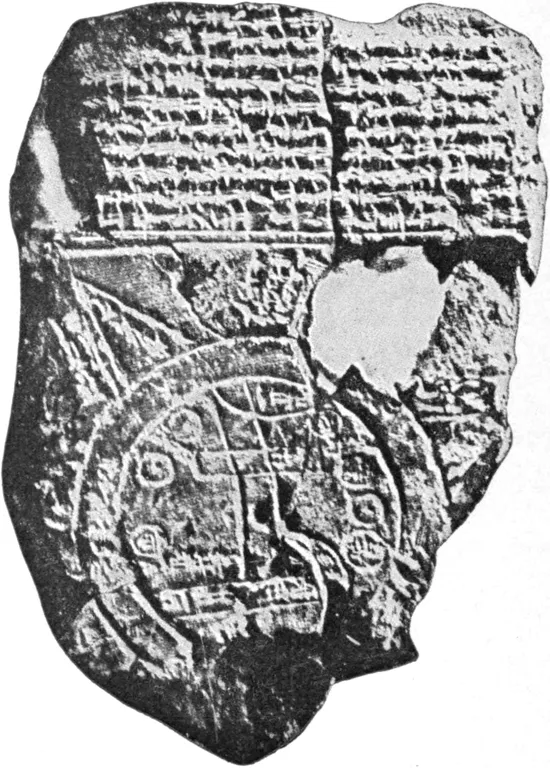
THE FIRST KNOWN MAP OF THE WORLD
This Babylonian map is probably of the eighth century B.C.
The two circles are supposed to represent the ocean, while the River Euphrates
and Babylon are shown inside them. The upper part of the tablet is a
cuneiform inscription.
Discovery advanced very slowly for many centuries, though the march
of Alexander opened up part of the East, while the Roman conquests
brought the Far North-West, including Britain, within the range of
civilisation; and occasional voyages, such as that of Hanno along
the coast of West Africa, that of Nearchus through the Arabian Sea,
and that of Pythias to the Baltic, added something to knowledge.
Procopius in A.D. 540 can tell us little more regarding
the regions beyond Roman influence than Strabo does five and a half
centuries earlier. The journeys of Marco Polo and Rubruquis throw only
a passing light on the Far East. It is with the Spanish occupation of
the Canary Isles, beginning in 1602, and with the Portuguese voyages
of the fifteenth century, that the era of modern discovery opens. The
re-discovery of America in 1492, for it had been already visited by
the Northmen of Greenland and Iceland in the eleventh century, and the
opening of the Cape route to India in 1497–1498, were hardly equal
to the exploit of Magellan, whose circumnavigation of the globe in
1519–1520 marks the close of this striking period. Thereafter discovery
proceeds more slowly. Some of the isles of the central and southern
Pacific were not visited till the middle of the eighteenth century,
and the north-west coast of America as well as the north-east Coast of
Asia, remained little known till an even later date. Those explorations
of the interior of North America, of the interior of Africa, of the
interior of Australia, and of East Central Asia, which have completed
our knowledge of the earth, belong to the nineteenth century. The first
crossing of the North American Continent north of latitude 40° was not
effected till A.D. 1806.
The Thirst for New Territories
The desire for new territory, for the propagation of religion, and,
above all, for the precious metals, were the chief motives which
prompted the voyages of the fifteenth and sixteenth centuries. These
motives have remained operative; and to them has been added in more
recent times the spirit of pure adventure and the interest in science,
together with, increasing measure, the effort to secure trade. But the
extension of trade followed slowly in the wake of discovery. China and
Japan remained almost closed. The policy of Spain sought to restrict
her American waters to her own ships, and the commerce they carried
was scanty. Communication remained slow and dangerous across the oceans
till the introduction of steam vessels (1825–1830).
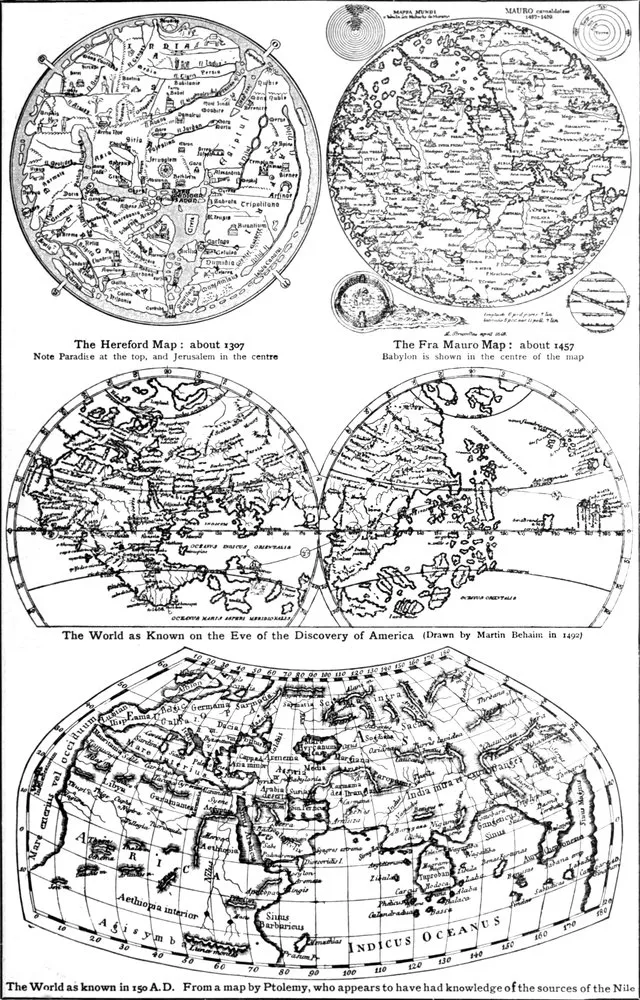
THE FIRST MAPS: SOME EARLY GEOGRAPHERS’ IDEAS OF THE WORLD
LARGER IMAGE
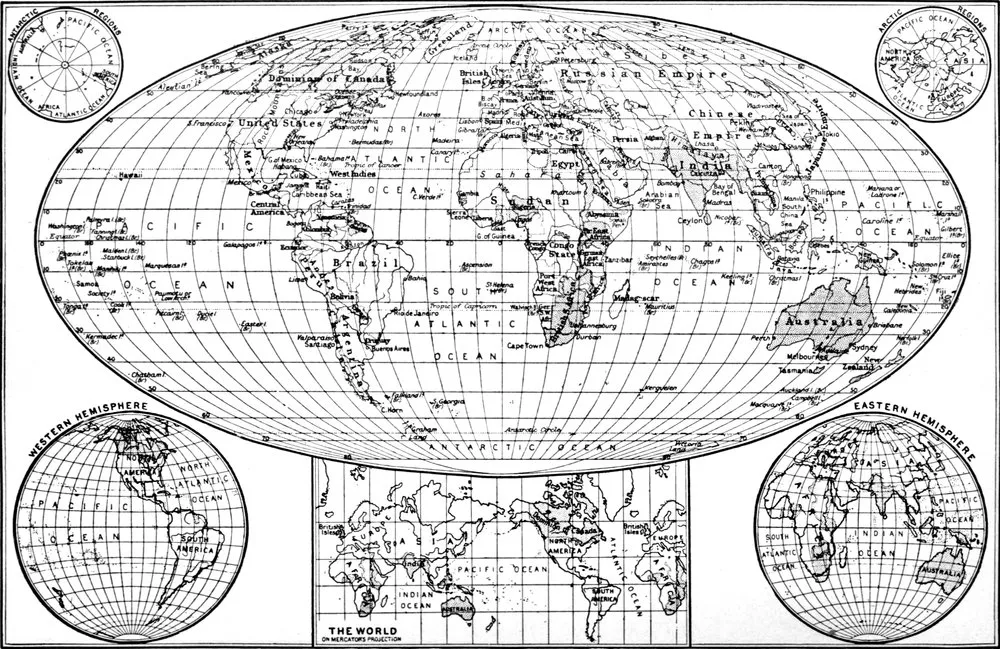
THE MODERN REPRESENTATION OF THE WORLD: SHOWN ON THREE
DIFFERENT PROJECTIONS
In each case the British Empire is shaded
LARGER IMAGE
Modern Representation of the
World; Western Part
Modern Representation of the
World; Eastern Part
Round the World in 40 Days!
Land transport, though it had steadily increased in Europe, remained
costly as well as slow till the era of railway construction began in
1829. The application of steam as a motive power and of electricity as
a means of communicating thought has been by far the greatest factor
in this long process of reducing the dimensions of the world, which
dates back as far as the domestication of beasts of burden, and the
invention, first of paddles and oars, and then of sails. The North
American Continent can now be crossed in five days, the South American
(from Valparaiso to Buenos Ayres) in under two, the Transandine tunnel
having now been pierced. The Continent which stretches from the Baltic
to the North Pacific can now be traversed in twelve days. By means of
the Trans-Siberian line and its steamship connection with the ports
of Japan, it is now possible to go round the globe in less than fifty
days. Indeed, the journey has recently been done in forty days. Nor
is this acceleration of transit more remarkable than its practical
immunity, as compared with earlier times, not only from the dangers
for which Nature is answerable, but from those also which man formerly
interposed.
The increase of trade which has followed in the track first of
discovery and latterly (with immensely larger volume) of the
improvement of means of transport, has been accompanied not only by the
seizure of transoceanic territories by the greater civilised States,
but also by an outflow of population from those States into the more
backward or more thinly-peopled parts of the earth. Sometimes, as
in the case of North America, Siberia, and Australia, the emigrants
extinguish or absorb the aboriginal population.
Europeanisation of the World
Sometimes, as in the case of India, Africa, and some parts of
South America, they neither extinguish nor blend with the previous
inhabitants, but rule them and spread what is called civilisation
among them—this civilisation consisting chiefly in a knowledge
of the mechanical arts and of deathful weapons accompanied by the
destruction, more or less gradual, of their pre-existing beliefs
and usages. Sometimes, again, as in the case of China, and to some
extent also of the Mussulman East, though political dominion is not
established, the process of substituting a new civilisation for the old
one goes on despite the occasional efforts of the backward people to
resist the process. The broad result is everywhere similar. The modern
European type of civilisation is being diffused over the whole earth,
superseding, or essentially modifying, the older local types. Thus,
in a still more important sense than even that of communications, the
world is contracted and becomes far more one than it has ever been
before. The European who speaks three or four languages can travel over
nearly all of it, and he can find on most of its habitable coasts, and
in many parts of the lately-discovered interior, the appliances which
are to him necessaries of life. The world is, in fact, becoming an
enlarged Europe, so far as the externals of life and the material side
of civilisation are concerned. The dissociative forces of Nature have
been overcome.
Triumph of Natural Science
Putting together the two processes, the process in time and the
process in space, which we have been reviewing, it will be seen that
the main line of the development of mankind may be described as the
transmission and the expansion of culture—that is to say, of knowledge
and intellectual capacity. The stock of knowledge available for use and
enjoyment has been steadily increased, and what each people accumulated
has been made available for all. With this there has come assimilation,
the destruction of weaker types of civilisation, the modification by
constant interaction of the stronger types, the creation of a common
type tending to absorb all the rest. Assimilation has been most
complete in the sphere ruled by natural science—that is to say, in
the material sphere, less complete in that ruled by the human sciences
(including the sphere of political and social institutions), still
less complete in the sphere of religious, moral, and social ideas, and
as respects the products of literature and art. Or, in other words,
where certainty of knowledge is attainable and utility in practice
is incontestable, the process of assimilation has moved fastest and
furthest.
Nature & the Unity of Mankind
The process has been a long one, for its beginnings reach back beyond
our historical knowledge. So far as it lies within the range of
history, it falls into two periods, the earlier of which supplies an
instructive illustration of the later one which we know better. The
effort which Nature—that is to say, the natural tendencies of man as a
social being—has been making towards the unification of mankind during
the last few centuries, is her second great effort. The first was in
progress from the time when the most ancient records begin down to the
sixth and seventh centuries of the Christian era.
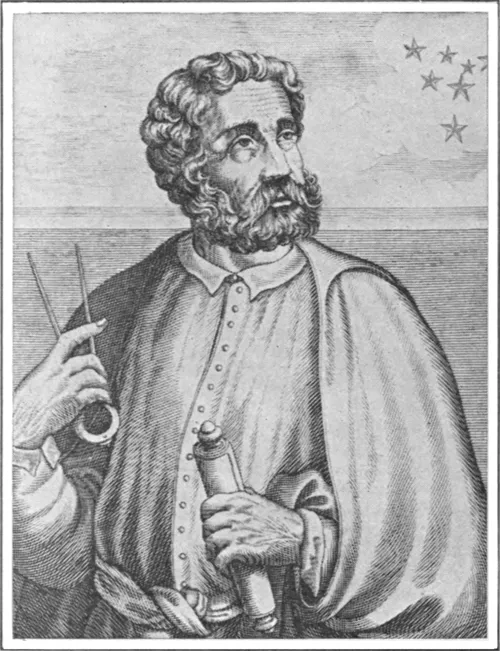
THE FIRST TRAVELLER ROUND THE GLOBE
The great exploit of Ferdinand Magellan, who
circumnavigated the globe in 1519–1520, ranks among the events of world
importance, and was the culminating achievement of the greatest period of
discovery in the world’s history.
Greek civilisation, which itself had drawn much from Egypt, as well
as from Assyria, Phœnicia, and the peoples of Asia Minor, permeated
the minds and institutions (except the legal institutions), of the
Mediterranean and West European countries, and was propagated by the
governing energy of the Romans. In its Romanised form it transformed
or absorbed and superseded the less advanced civilisations of all
those countries, creating one new type for the whole Roman world. With
some local diversities, that type prevailed from the Northumbrian
Wall of Hadrian to the Caucasus and the deserts of Arabia. The still
independent races on the northern frontier of the Empire received a
tincture of it, and would doubtless have been more deeply imbued had
the Roman Empire stood longer.
Christianity, becoming dominant at a time when the Empire was already
tottering, gave a new sense of unity to all whom the Greco-Roman type
had formed, extended the influence of that type still further, and
enabled much that belonged to it (especially its religious, its legal,
and its literary elements) to survive the political dominion of the
Emperors and to perpetuate itself among practically independent States
which were springing up. The authority of Papal Rome helped to carry
this sense of unity among civilised men through a period of ignorance,
confusion, and semi-barbarism which might otherwise have extinguished
it. Nevertheless, we may say, broadly speaking, that the first effort
towards the establishment of a common type of civilisation was, if not
closed, yet arrested by the dissolution of the Roman Empire in the
West. Close thereupon came the rise of Islam, tearing away the Eastern
provinces, and creating a rival type of civilisation—though a type
largely influenced by the Greco-Roman—which held its ground for some
centuries, and has only recently shown that it is destined to vanish.
Conquest and Civilisation
The beginnings of the second effort toward the unification of civilised
mankind may be observed as far back as the eleventh and twelfth
centuries. Its effective and decisive action may, however, be assigned
to the fifteenth, when the spread of literary and philosophic culture,
and the swift extension of maritime discovery, ushered in the modern
phase wherein we have marked its irresistible advance. This phase
differs from the earlier one both in its range—for it embraces the
whole earth and not merely the Mediterranean lands—and in its basis,
for it rests not so much upon conquest and religion as upon scientific
knowledge, formative ideas, and commerce. Yet even here a parallelism
may be noted between the ancient and the modern phase. Knowledge and
ideas had brought about a marked assimilation of various parts of the
ancient world to each other before Roman conquest completed the work,
and what conquest did was done chiefly among the ruder races. So now,
while it is knowledge and ideas that have worked for the creation of
a common type among the peoples of European stock, conquest has been a
potent means of spreading this type in the outlying countries and among
the more backward races whose territories the European nations have
seized.
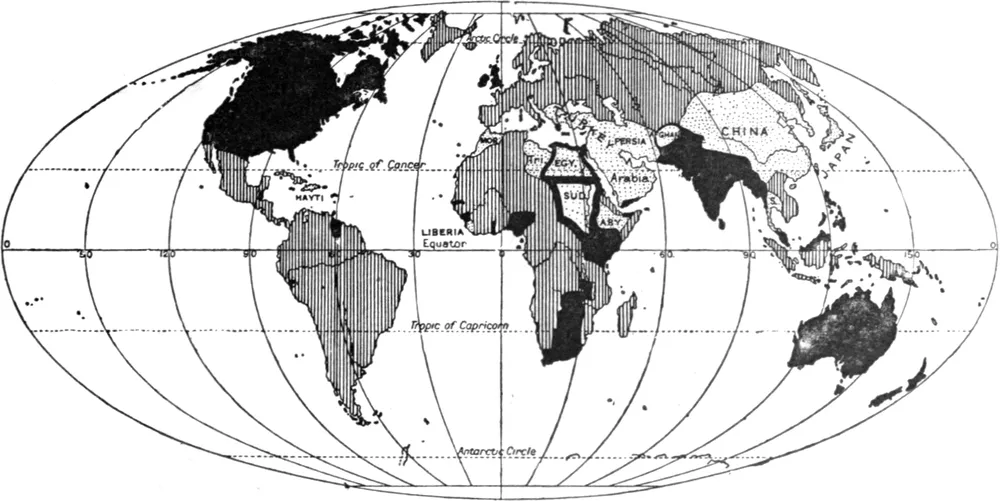
THE EUROPEANISATION OF THE WORLD
European civilisation is being diffused all over the earth,
superseding or essentially modifying the older local types. The solid black
portions of this map represent territory under Anglo-Saxon control; the
shaded parts are under other European control, and the dotted parts
under Asiatic and African control.
Language a Unifying Influence
The diffusion of a few forms of speech has played a great part in both
phases. Greek was spoken over the eastern half of the Roman world
in the second century A.D., though not to the extinction of such
tongues as Syriac and Egyptian. Latin was similarly spoken over the
western half, though not to the extinction of the tongues we now call
Basque and Breton and Welsh; and Latin continued to be the language
of religion, of law, of philosophy, and of serious prose literature
in general till the sixteenth century. So now, several of the leading
European tongues are spoken far beyond the limits of their birthplace,
and their wide range has become a powerful influence in diffusing
European culture. German, English, Russian, Spanish, and French are
available for the purposes of commerce, and for those who read books
over nineteen-twentieths of the earth’s surface. The languages of the
smaller non-European peoples are disappearing in those places where
they have to compete with these greater European tongues, except in
so far as they are a medium of domestic intercourse. Arabic, Chinese,
and in less degree Persian are the only non-European languages
which retain a world importance. English, German, and Spanish are
pre-eminently the three leading commercial languages. They gain ground
on the rest, and it is English that gains ground most swiftly. The
German merchant is no doubt even more ubiquitous (if the expression be
permitted) than is the English; but the German more frequently speaks
English than the Englishman or American speaks German.
Linking the Nations Together
It has already been observed that assimilation has advanced least
in the sphere of institutions, ideas, and literature. The question
might, indeed, be raised whether the types of thought, of national
character, and of literary activity represented by the five or six
leading nations are not rather tending to become more accentuated.
The self-consciousness of each nation, taking the form of pride or
vanity, leads it to exalt its own type and to dwell with satisfaction
on whatever differentiates it from other types. Nevertheless there are
influences at work in the domain of practice as well as of thought,
which, in creating a common body of opinion and a sense of common
interest among large classes belonging to these leading nations, tend
to link the nations themselves together. Religious sympathy, or a
common attachment to certain doctrines, such as, for instance, those
of Collectivism, works in this direction among the masses, as the
love of science or of art does among sections of the more educated
class. As regards the peoples not of European stock, who are, broadly
speaking, the more backward, it is not yet possible to say what will be
the influence of the European type of culture upon their intellectual
development.
The material side of their civilisation will after a time conform to
the European type, though, perhaps, to forms that are not the most
progressive; and even such faiths as Buddhism and Islam may lose their
hold on those who come most into contact with Europeans. But whether
these peoples will produce any new types of thought or art under the
stimulus of Europe, as the Teutons and Slavs did after they had been
for centuries in contact with the relics of Greco-Roman culture, or
whether they will be overborne by and merely imitate and reproduce what
Europeans teach them—this is a question for conjecture only, since the
data for predictions are wanting.
It is a question of special interest as regards the Japanese, the
one non-European race which, having an old civilisation of its own,
highly developed on the artistic side, has shown an amazing aptitude
for appropriating European institutions and ideas. Already a Japanese
physiologist has taken high rank among men of science by being one of
the discoverers of the bacillus of the Oriental plague.
DOES HISTORY MAKE FOR PROGRESS?
O
ONE
of the questions which both the writers and the readers of a
History of the World must frequently ask themselves is whether the
course of history establishes a general law of progress. Some thinkers
have gone so far as to say that this must be the moral of history
regarded as a whole, and a few have even suggested that without the
recognition of such a principle and of a sort of general guidance of
human affairs towards this goal, history would be unintelligible, and
the doings of mankind would seem little better than the sport of chance.
What is the Test of Progress?
What Mankind has Achieved
Whatever may be thought of these propositions as matters of theory,
the doctrine of a general and steady law of progress is one to which
no historian ought to commit himself. His business is to set forth and
explain the facts exactly as they are; and if he writes in the light
of a theory he is pretty certain to be unconsciously seduced into
giving undue prominence to those facts which make for it. Moreover,
the question is in itself a far more complex one than the simple word
“progress” at first sight conveys. What is the test of progress? In
what form of human advance is it to be deemed to consist? Which of
these forms is of the highest value? There can be no doubt of the
advance made by man in certain directions. There may be great doubt
as to his advance in other directions. There may possibly be no
advance but even retrogression, or at least signs of an approaching
retrogression, in some few directions. The view to be taken of the
relative importance of these lines of movement is a matter not so much
for the historian as for the philosopher, and its discussion would
carry us away into fields of thought not fitted for a book like the
present. Although, therefore, it is true that one chief interest of
history resides in its capacity for throwing light on this question,
all that need here be said may be expressed as follows:
There has been a marvellous advance in man’s knowledge of the laws
of Nature and of his consequent mastery over Nature.
There has been therewith a great increase in population, and, on
the whole, in the physical vigour of the average individual man.
There has been, as a further consequence, an immense increase in
the material comfort and well-being of the bulk of mankind, so that
to most men necessaries have become easier of attainment, and many
things which were once luxuries have become necessaries.
Against this is to be set the fact that some of the natural resources
of the world are being rapidly exhausted. This would at one time have
excited alarm; but scientific discoveries have so greatly extended
man’s capacity to utilise other sources of natural energy, that people
are disposed to assume that the loss of the resources aforesaid will be
compensated by further discoveries.
The Gain and the Loss
As to progress other than material—that is to say, progress in
intellectual capacity, in taste, in the power of enjoyment, in virtue,
and generally in what is called happiness—every man’s view must
depend on the ideal which he sets before himself of what constitutes
happiness, and of the relative importance to happiness of the ethical
and the non-ethical elements which enter into the conception. Until
there is more agreement than now exists or has ever existed on these
points, there is no use in trying to form conclusions regarding the
progress man has made. Moreover, it is admitted that nearly every
gain man makes is accompanied by some corresponding loss—perhaps a
slight loss, yet a loss. When we attempt to estimate the comparative
importance of these gains and losses, questions of great difficulty,
both ethical and non-ethical, emerge; and in many cases our experience
is not yet sufficient to determine the quantum of loss. There is room
both for the optimist and for the pessimist, and in arguing such
questions nearly everybody becomes an optimist or a pessimist. The
historian has no business to be either.
There is another temptation besides that of delivering his opinion on
these high matters, of which the historian does well to be aware—I
mean the temptation to prophesy. The study of history as a whole,
more inevitably than that of the history of any particular country
or people, suggests forecasts of the future, because the broader the
field which we survey the more do we learn to appreciate the great and
wide-working forces that are guiding mankind, and the more therefore
are we led to speculate on the results which these forces, some of them
likely to be permanent, will tend to bring about.
Modern Mastery of Nature
This temptation can seldom have been stronger than it is now, when we
see all mankind brought into closer relations than ever before, and
more obviously dominated by forces which are essentially the same,
though varying in their form. Yet it will appear, when the problem is
closely examined, that the very novelty of the present situation of
the world—the fact that our mastery of Nature has been so rapidly
extended within the last century, and that the phenomena of the
subjugation of the earth by Europeans and of the ubiquitous contact
of the advanced and the backward races are so unexampled in respect
of the area they cover—that all predictions must be uttered with the
greatest caution, and due allowance made for elements which may disturb
even the most careful calculations. It may, indeed, be doubted whether
any predictions of a definitely positive kind—predictions that such
and such things will happen—can be safely made, save the obvious ones
which are based on the assumption that existing natural conditions
remain for some time operative.
A Glimpse into the Future
Taking this assumption to be a legitimate one, it maybe predicted that
population will continue to increase, at least till the now waste but
habitable parts of the earth have been turned to account; that races,
except where there is a marked colour line, will continue to become
intermingled; that the small and weak races, and especially the lower
set of savages, will be absorbed or die out; that fewer and fewer
languages will be spoken; that communications will become even swifter,
easier, and cheaper than they are at present; and that commerce and
wealth will continue to grow, subject, perhaps, to occasional checks
from political disturbance.
There are also some negative predictions on which one may venture,
and with a little more confidence. No new race can appear, except
possibly from a fusion of two or more existing races, or from the
differentiation of a branch of an existing race under new conditions,
as the Americans have been to some slight extent differentiated from
the English, and the Brazilians from the Portuguese (there having been
in the latter case a certain admixture of negro blood), and as the
Siberians of the future may be a different sort of Russians. Neither
is any new language likely to appear, except, mere trade jargons (like
Chinook or pigeon English), because the existing languages of the
great peoples are firmly established, and the process of change within
each of these languages has, owing to the abundance of printed matter,
become now extremely slow. Conditions can hardly be imagined under
which such a phenomenon as the development of the Romance languages out
of Latin, or of Danish and Swedish out of the common Northern tongue of
the eleventh century, could recur.
THE PEOPLES OF THE WORLD AT PEACE
From the statuary groups on the Albert Memorial.
LARGER IMAGE
It may seem natural to add the further prediction that the great States
and the great religions will continue to grow and to absorb the small
ones. But when we touch topics into which human opinion or emotion
enters, we touch a new kind of matter, where the influences now at work
may be too much affected by new influences to permit of any forecast.
Conditions might conceivably come into action which would split up some
or most of the present great States, and bring the world back to an age
of small political communities.
So, too, though the lower forms of paganism are fast vanishing, and
the four or five great religions are extending their sway, it is
conceivable that new prophets may arise, founding new faiths, or that
the existing religions may be split up into new sects widely diverse
from one another. Even the supremacy of the European races, well
assured as it now appears, may be reduced by a variety of causes,
physiological or moral, when some centuries have passed.
THE PEOPLES OF THE WORLD AT PEACE
From the statuary groups on the Albert Memorial.
LARGER IMAGE
Whoever examines the predictions made by the most observant and
profound thinkers of the past will see reason to distrust almost all
the predictions, especially those of a positive order, which shape
themselves in our minds to-day.
JAMES
BRYCE
WHEN HISTORY WAS DAWNING — — THE MATERIAL PROGRESS OF MANKIND — THE HIGHER PROGRESS OF MANKIND — — THE SEVEN WONDERS OF ANCIENT CIVILISATION — — THE RISE OF CIVILISATION IN EGYPT — — — — — — TYPES OF THE CHIEF LIVING RACES OF MANKIND — ETHNOLOGICAL CHART OF THE HUMAN RACE — — THE BIRTH & GROWTH OF NATIONS — LAND AND WATER AND THE GREATNESS OF PEOPLES — THE INFLUENCE OF ENVIRONMENT IN THE LIFE OF NATIONS — THE SIZE AND POWER OF NATIONS — THE FUTURE HISTORY OF MAN —
THE WORLD BEFORE HISTORY—VI
Professor JOHANNES RANKE
T
THE
discovery of Drift Man, his distinction from man of the later
Stone Age, the investigation of the Palæolithic and Neolithic strata
of culture of Europe and of the whole earth, and the scientific
reconstruction of the earliest forms of civilisation based on these,
are due solely to the natural-science method of research.
It was only when the exact methods of palæontology and geology had been
brought to bear with all their rigour on the study of ancient man by
savants schooled in natural science that solid results were obtained.
On this sure foundation the science of history now continues building,
and uses, even for the later periods, so far as recorded information is
not available, and to supplement it, the same methods of palæontology
and natural science which were applied so successfully to the earliest
stages of the evolution of mankind.
Time-Table of Prehistoric Periods
The first point is to collect the relics of the periods of the
evolution of culture which follow on the later Stone Age, and to
separate them according to geological strata, uninfluenced by those
older pseudo-historic fancies by which the deepening of our historical
knowledge has so long been hindered. By carefully separating and
tracing the earth’s strata till we come to those that furnish remains
of times recorded in history, it has been possible to establish first
a relative chronology of the so-called later prehistoric periods of
Central Europe, whose offshoots pass immediately into recorded history.
By digging, after the same method of palæontological science,
through stratum after stratum in the oldest centres of culture,
especially in the Mediterranean countries, and by arranging the
products by strata—uninfluenced by historical hypotheses—after
the same natural-science method of research which has produced such
remarkable results in Central Europe, the most surprising conformity
in the evolution of culture in widely remote regions has been shown.
It was found that in the Mediterranean countries, and also in Egypt
and Babylonia, forms of culture already belong to the time of real
history which were first recognised in Central Europe as preliminary
prehistoric stages of historical strata; so that it was possible also
to establish an absolute historical chronology for those instead of the
relative prehistoric one.
Europe’s Prehistoric Night
Thus times which, as regards Central Europe, were hitherto wrapped in
prehistoric night are enlightened by history. Although, as regards
Central and Northern Europe, we cannot name the peoples who were the
bearers of those forms of culture, and although we disdain to give them
a premature nomenclature of hypothetical names, yet their conditions of
life and culture and the progressive development of these, in manifold
contact and intercourse with neighbouring and even far remote historic
peoples and periods, have risen from the darkness of thousands of
years; and their relation in time to the latter has been recognised.
Thus prehistoric times have themselves become history. The historical
account of every single region has henceforth to begin with the
description of the oldest antiquities of the soil that tell of man’s
habitation, in order thereby to obtain the chronological connection
with the evolution of the history of mankind generally. That is the
palæontological method of historical research.
Landmarks of Early Culture
The palæontology of man has proved the Stone Age to be a general
primary stage of culture for the whole human race. All further general
progress in culture was affected by the discovery of the art of
metal-working—the extraction of the metals from their ores and the
casting and forging of them. The later and latest eras of culture are
the Metal Ages, as opposed to the Stone Ages. It is not the use of
metal in itself, but the above-mentioned metallurgical arts, that form
the criterion of the advance of culture beyond the bounds of the Stone
Age. Where, as in some parts of America, native copper was found in
abundance, this red malleable mineral could probably be worked in the
same way as stone, without any further progress necessarily developing
therefrom. The same may apply to meteor-iron, which is said to have
been used for arrows, together with stone points, by American tribes
who were otherwise in the age of stone and but poorly civilised.
From stone to metallic form
Growth of the stop-ridge
Growth of the wings
THE TRANSITION FROM STONE TO IRON
This series of diagrams, reproduced from specimens in
the British Museum, by permission of the Trustees, shows how the stone axehead
was used as the model for the metal axe or celt, and how that in turn was
modified as workers gained experience in the use of the metal
In civilised lands it is chiefly metal casting and the forging of the
heated metal which have made it possible to produce better weapons and
tools and more valuable ornaments. The worked metals are first copper,
then the alloy of copper and tin that bears the name of classical
bronze, and to these are soon added gold and—especially in districts
rich in the metal, as in Spain—silver. Later on the extraction of iron
from its ores and the forging of that metal are discovered.
According to this course of metallurgical progress the first metal
period is distinguished as the Bronze Period, which is begun by a
Copper Period lasting more or less long in different places. The second
or later metal period is the Iron Period, in which we are living at the
present day. In the course of time, by gradually displacing bronze and
copper from the rank of metals worked for weapons and tools, this Iron
Age has developed to its present stage.
In Central Europe the pile-dwellings in the lakes of Western
Switzerland again present us with specially clear and uninterrupted
series of illustrations of the progress of culture from the Stone
Age to the Iron Age. Ending the Stone Age, we find first a period
of transition, in which, while stone continued to be principally
employed, a few ornaments, weapons, and tools of metal began to be
used. This metal is at first almost exclusively copper, with only
very little bronze; iron is quite absent. Copper objects have been
found in Western Switzerland by Victor Gross, most extensively in
Fenel’s lake-dwelling station, which otherwise still belongs to the
Stone Age. The majority of these are small daggers, formed after the
pattern of the flint daggers; some already possess rivetings for
fastening the blade to a handle. There are also chisels and small awls
in bone handles, beads, and small ornamental leaves, and hatchets
of the form of the simplest stone hatchets, with the edge hammered
out and broadened. Much has proved the existence of a Copper Period
corresponding to this description in the lake-dwelling in the Mond
See in Austria, and in Hungary the remains of a Copper Period are
particularly frequent. Parallel cases also occur in many other parts of
Europe, particularly, as Virchow has proved, in the Spanish Peninsula,
and in the Stone Age graves of Cujavia in Prussian Poland. These are
the more important as they are most closely related to the conditions
of culture discovered in the ancient strata of Hissarlik-Troy. Further
unmistakable analogies occur with very ancient finds in Cyprus, and
probably even with the oldest remains of Babylonian culture hitherto
known. Here, too, we may include the finds of copper in the Stone Age
of America.
The Passing of the Stone Age
So that in the normal and complete evolution of culture there seems to
be first a stratum of copper as the connecting link between the Stone
and Metal Ages; and this must be missing in those regions in which
progress from the stone to the metal culture was only brought about at
a relatively later period by external influences. This applies not only
to all modern races in an age of stone, who obtained metal in recent
times only through contact with European nations who had been living in
the Iron Period for thousands of years, but, curiously enough, also to
the greater part of Africa, where the use of iron was prevalent at a
prehistoric period.
Just as the modern Stone races passed straight from the Stone Age
into the most highly-developed Iron Age of the most advanced culture,
so also the stone stratum of Central and South Africa is immediately
overlaid by a stratum of iron culture, which was brought there in
ancient times, probably direct from Egypt. As there is in Egypt and
throughout North Africa a regular development from the Copper-bronze
Period to the complete iron culture, corresponding to the progress
of the metal cultures of Europe and Asia, the point of time is thus
chronologically fixed at which this important element of culture was
transmitted from Europe to the blacks of Central and South Africa.
WEAPONS USED BY MAN IN THE PERIODS OF DAWNING HISTORY
Reproduced chiefly from specimens in the British Museum.
Advancing Civilisation in Bronze Age
In Western Switzerland the transition period of copper is followed
without a gap in the development by the Bronze Period proper. With the
introduction of bronze all the conditions of life were more highly
developed in the sense of increased culture. With better tools the
stations of the Bronze Age could be erected at a greater distance from
the bank, often two hundred to three hundred yards; the space they
take up is also much greater. The piles are not only better preserved,
according as the time of their being driven in more nearly approaches
our own, but they are also better worked, are often square, and the
points that are rammed into the lake-bottom are better cut. The
settlements of the Bronze Age often cover an area of several hundred
square yards, and are no longer comparatively mean villages, as in the
Stone Age; the pile settlements of the Bronze Age are well-organised
market towns and even flourishing small cities, where a certain luxury
already prevails. The products of their industry are graced by that
beauty and elegance of form that only an advanced civilisation can
create. As in the Stone Age, so also in the Bronze Age of Central
and Northern Europe, the most important working-implement, which
was, however, also used as a weapon, was the axe, or celt. The most
primitive forms of axes, like the above-mentioned copper axes, still
resemble the simple stone axes: like these, they have no special
contrivance for fastening the handle. In more developed forms of axes
such contrivances for fastening the handle appear first in the form of
slight flanges, which become wider and wider; finally they develop into
regular wings, which, by curving towards one another, develop into two
almost closed lateral semi-canals on the upper side of the celt. In the
hollow celts a simple socket for the handle was cast in the making; an
additional means of fastening the handle was provided in a loop, which
also occurs on winged celts. Besides the celt, or axe-blade, broad
and narrow chisels of bronze occur in various forms for working wood.
A second chief type of instrument is the one-edged bronze knife with
elegantly curved back and a handle tongue.
THE HILL OF TROY, IN WHICH IS RECORDED A WONDERFUL STORY
OF MAN’S PROGRESS
Seven towns of Troy were built upon this hill, one above
the ruins of the other, the earliest dating from 3000 B.C.; and the brilliant
excavations of Dr. Henry Schliemann, which have won him immortal fame, have
contributed more to our knowledge of the history of mankind than any other
excavations in our time, as on this site is concentrated a continuous record of
man’s progress from the late Stone Age to the height of Greek civilisation.
The manner in which iron was found in the lake-dwellings, as mentioned
above, shows the gradual development of a period of transition between
a Bronze and an Iron Age. In spite of the difference in the material
which the lake-dwellers used for making their weapons and tools in the
periods of transition, they still imitate the old forms received from
their forefathers. Just as the first metal axes of copper are copies
of the stone axes, so also, when iron first became known, were weapons
made of this metal which corresponded in form to the bronze weapons
that had hitherto been used.
The Bronze Period was first proved to have been a complete form of
culture in the North of Europe—in North Germany and Scandinavia. We
have now succeeded in establishing the fact that it was a preliminary
stage of the Iron Age, in locally original development, in all ancient
centres of culture. It is very remarkable that the civilised states
of the New World also employed only copper and bronze as working
metals. Thus the Peruvians did not know iron any more than the other
American peoples until they came in contact with European influences.
Besides copper and bronze they had tin and lead, gold and silver. The
Peruvian bronzes contain silver to the extent of five to ten per cent.
There are axes or celts of bronze similar to the rudest of the first
European beginnings in metal corresponding in form to the simple stone
axe. Many of the other forms of weapons and implements familiar in the
Bronze Age of the Old World were also made of bronze or copper in
America; semi-lunar knives with a handle in the middle, lance-heads
and arrow-heads, swords, war-clubs like morning stars, etc. At the same
time weapons and implements of stone still remained in use.
In the Old World progress beyond bronze is everywhere due to iron.
EXCAVATIONS IN THE TEMPLE OF ATHENA AT TROY
Dr. Schliemann’s discoveries in the ruins of this temple
and the ruins of older buildings beneath it were among the richest in the entire
annals of archæological research.
One place has been found and most completely investigated after the
method of palæontological research, with all the help afforded by
archæological and historical science, where, in overlying geological
strata, the evidences have been found of a progressive development
of culture from the end of the Stone Age down to the brilliant days
of Græco-Roman history. There the chronological connection has been
obtained, not only for the metal periods, but also for the end of the
Neolithic Period. This most important place is Troy, the citadel-hill
of Hissarlik, by the excavation of which Henry Schliemann has won
immortal fame. Schliemann’s excavations, supplemented and completed
in decisive manner by Dörpfeld, have brought about the most important
advancement of the history of mankind that our age can show.
A WINE MERCHANT’S CELLAR IN ANCIENT TROY
Nine colossal earthen jars were discovered by Dr.
Schliemann in the depths of the Temple of Athena. They had evidently belonged
to some wine merchant’s cellar in the pre-Hellenic period.
Virchow’s name is inseparably associated with Schliemann’s.
Furtwängler, in his account, based on personal observation, of the
results of the excavations at Troy, has accomplished the great service
of exactly determining the chronological connections of the prehistoric
with the historic eras, and thereby linking the former to history.
On the spot on which tradition placed Homeric Troy (says Furtwängler)
there really has stood a stately citadel, which was contemporaneous
with the golden age of Mycenæ, the epoch of the Agamemnon of legend,
was intimately related to Mycenæan culture, and at the same time
corresponds most exactly to the idea of Troy underlying the old epic.
Seven Towns on One Hill
The citadel-hill of Troy terminates a ridge of heights stretching
westward from Mount Ida, almost parallel to the Hellespont, and
slopes steeply into the Trojan plain or the valley of the Scamander.
The natural hill itself is not very high, but it was overlaid by
enormous layers of ruins of buildings and walls, whereby it has been
considerably increased not only in height, but also in breadth. Stratum
after stratum lies one upon the other like the leaves of a bud, so that
the history of the habitation of this venerable place from the most
ancient times can be read from these strata which have been opened up
by Schliemann and Dörpfeld, as from the leaves of a book. The original
ground of the hill-plateau now lies some sixty feet above the plain,
but the latter may have been raised something like sixteen to twenty
feet by alluvial deposits since the Trojan War. The whole stratum
of ruins lying on the original ground of the hill, which Schliemann
opened up, amounts to about fifty-two and a half feet. Schliemann
distinguished seven or eight different layers or strata, corresponding
to as many towns which were successively built on this hill, one on the
ruins of the other.
The lowest stratum, lying immediately on the original ground, belongs
accordingly to the oldest, or first town, on the citadel-hill of Troy.
Furtwängler says:
The First Town of Troy
By moderate computation this settlement must belong to the first
half of the third millennium before Christ, but it may very well
date back even to the fourth millennium. The inhabitants already
used copper implements in addition to stone ones. Their whole
culture is most closely connected with that which prevailed in
Central Europe during the Copper Period. Clay vessels of the Copper
Period from Lake Mond, in Austria, agree completely with those of
the first Trojan town. Troy represents only an offshoot of Central
European culture, and its inhabitants were in all probability of
European origin.
We have already learned that the Copper Period is the end of the
Neolithic Period and the beginning of the Metal Age. In the first
Trojan town there is still extraordinarily little metal used, the
axes, hatchets, knives, and saws still being of stone, of the familiar
Central European types, and of the same materials, among which nephrite
is particularly frequent. Other materials are serpentine, diorite,
porphyry, hematite, flint, etc.
The First Period of Troy’s Glory
The forms of these implements correspond entirely to those of the later
Stone Age of Europe. The character of the ceramics also conforms in
many respects, according to Virchow, to that of the European Stone
Age; and the Stone Age finds at Butmir, in Bosnia, and similar ones
in Transylvania seem especially to offer close analogies. It would be
a highly important step toward connecting history with the Neolithic
Period if the first town could be even more closely investigated,
and perhaps more sharply divided from that second stratum which lies
between it and the stratum described by Schliemann as the second or
burnt city, and which Schliemann afterward separated into two strata,
corresponding to two towns. Perhaps the metal comes only from the
second or higher stratum under the burnt city. In that case the oldest
would belong purely to the Stone Age. The ceramics would seem to
contradict this. Furtwängler continues:
High above the first town, a deep layer of débris, is the level
surface of the second town, which must at least be dated back to
the second half of the third millennium before Christ. It was the
first period of Troy’s glory. Mighty walls protected the citadel.
Three different building periods may be distinguished. The walls
were brought out a long way and strengthened, and magnificent new
gates were built. During the third period of this second city a
prince, fond of splendour, had the old narrow gateway replaced by
magnificent propylæa and a large hall-erection with a vestibule.
A great conflagration destroyed his citadel. A treasure was found
by Schliemann—he called it Priam’s treasure—in the upper part of
the citadel wall, which was made of straw bricks. The tools of the
second city are still partly of stone, but also partly of bronze,
so that they already belong to the Bronze Age.
THE EXCAVATIONS AT TROY: REVEALING THE WALL OF THE
ACROPOLIS
A view of the great substruction wall of the acropolis
of the second city of Troy, on the west side, close to the south-west gate:
(a) is the paved road, which leads from the S.W. gate down to the plain; (b) is
the continuation of the great acropolis-wall of the second city on the west side
of the S.W. gate; (c) is the foundation of the paved road and the quadrangular
pier to strengthen it; (d) marks the masonry added by the third settlers.
LARGER
IMAGE
The Early Culture of Troy
The general character of culture is, according to Furtwängler, still
essentially Central European. And yet many an individuality has
developed, and the influence of Babylonian culture is everywhere
apparent, although it does not go very deep. To this influence our
authority chiefly attributes the occurrence of a few pots turned on the
wheel, especially flat dishes; for the potter’s wheel was still quite
unknown at that time in Europe, and even at a post so far advanced
toward the East as Cyprus, while in Egypt and Babylonia it had been in
use from the earliest times. In this period also Troy inclines more to
Central Europe as its centre of gravity, but remains far behind the
peculiar development that bronze work attained there; in the metal
tools no advance is made on the forms of the Copper Period. Into any
close relation with Cyprus it does not come; only the basis of their
culture is common to both. But this basis had a wide range, relics from
German districts being often more closely related to the Trojan ones
than are those from Cyprus.
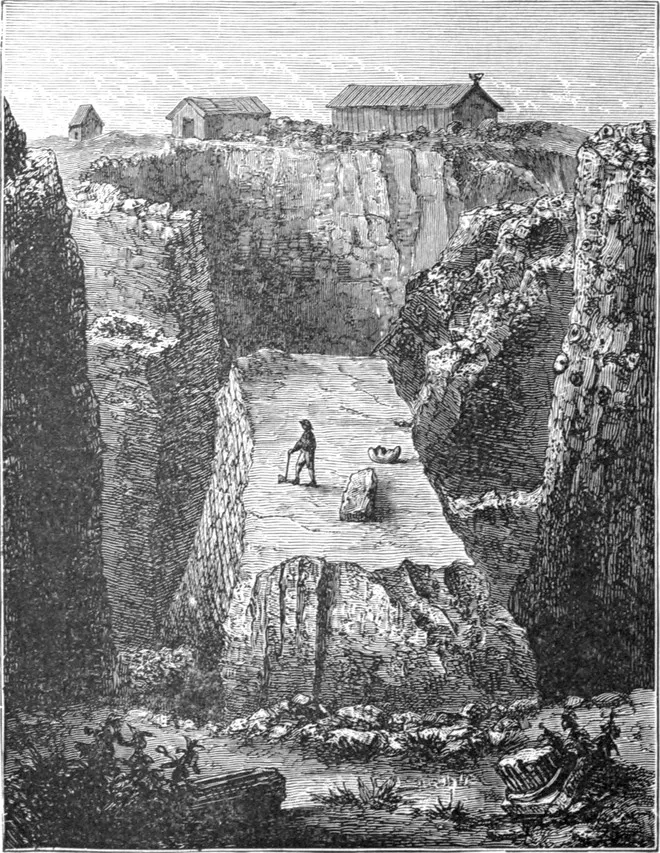
TROY: THE GREAT TOWER OF ILIUM
The top of the tower is 26 ft. below the surface of the
hill. The foundation is on the rock 46 ft. deep; the height of the tower is
20 ft.
The brilliant period of the second city is followed by a long
period of decline for Troy. Ruins are piled upon ruins, walls
rise upon walls, but each poorer than the others; no new citadel
walls, no gates, no palaces belong to this period, in which three
strata—the third, fourth, and fifth towns—are distinguished. The
first half of the second millennium before Christ must at least be
regarded as the time of this deposit. The inhabitants evidently
remained the same, and their culture is that of the second city.
But no progress was made; nothing but stagnation; the same forms of
vessels continue to be made, the same decorated whorls. Naturally,
no active intercourse with abroad could develop in this period.
And yet this was the time when an active civilised life began to
develop on the islands of the Ægean Sea and on the east coast of
Greece, which was to bloom in all its splendour in the following
period. To this time the finds at Thera belong, where the pottery,
all turned on the wheel, is already painted with a so-called
varnish colour which shines like metal, and in which plants,
flowers, and animals are treated in quite a new and promising
naturalistic style hitherto unheard of in Europe. In Cyprus, too,
the decoration of pottery developed exceedingly in wealth and
variety in this period of the Bronze Age. Troy, on the other hand,
is poor and degenerate.
But a new period of prosperity arrived for Troy, too; this is the
sixth town. Rich and powerful princes again ruled in this citadel.
They enlarged it far beyond its former compass. They built strong
new walls—the old ones had long since sunk in ruins—not of small
stones and straw bricks as before, but of large, smooth blocks, and
gates and turrets. They did not have the sloping mound of ruins
levelled, as the lords of the second city had done; they let the
new buildings rise in terraces, on the ruins of the old; stately
mansions with wide, deep halls, covered the acropolis. Constant
intercourse existed with the princes of Greece, who at that
time—the second half of the second millennium before Christ—built
their citadels with cyclopean walls. The Trojans employed the same
peculiar, constantly-recurring small projections in their walls
that we find in a Mycenæan town on Lake Copaïs in Bœotia.
And, above all, the Trojans now provided themselves with those
beautiful vessels painted with shining colour that characterise
Mycenæan culture in Greece, and whose natural style had so
wonderfully developed there on the basis of the attempts that
we found at Thera. In Troy these things caused some imitation,
but the results remained far behind the originals. The living,
imaginative conception of the natural was closed to the Trojan; the
home-made pottery kept, on the whole, to its unpainted vessels,
although these were now almost entirely made on the wheel.
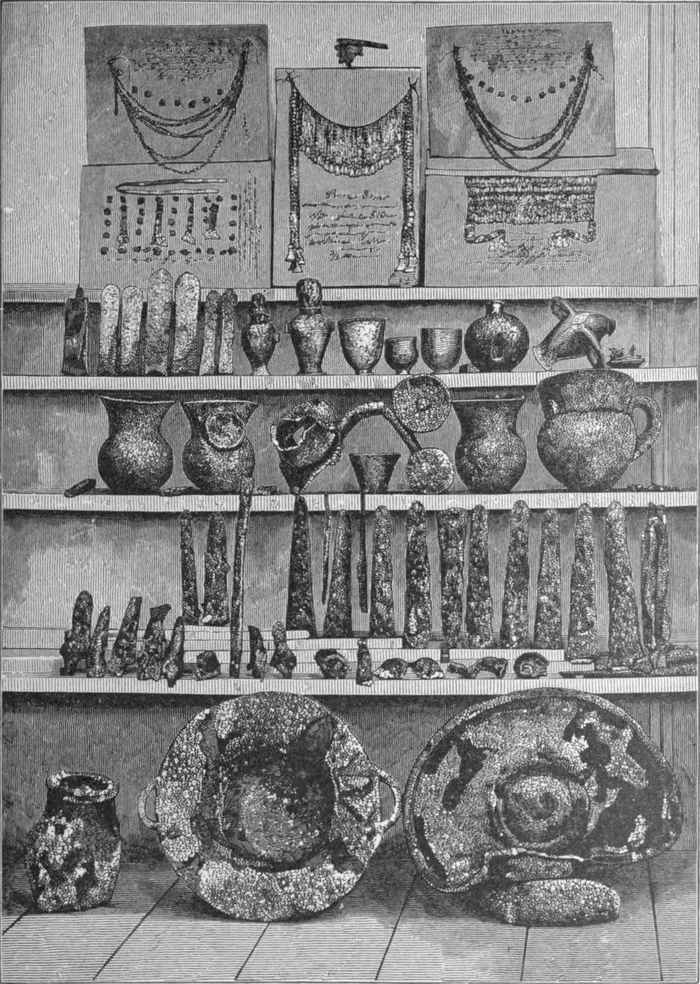
THE TREASURE OF PRIAM, KING OF TROY: A COLLECTION
REVEALED BY THE EXCAVATIONS
This remarkable collection of regal treasure comprises
the key of the treasure-house (at top of picture in centre); and, under and
about the key, a number of golden diadems, fillets, earrings, and smaller
jewels. On the shelf below there are a number of silver talents and vessels
of silver and gold; while below them is a series of silver vases and a curious
plate of copper. A variety of weapons and helmet crests of copper and bronze
are displayed beneath, and on the floor are a vessel, a cauldron and a shield,
all made of copper.
Yet what chiefly interests us is the historical. The sixth town,
too, was suddenly given up, destroyed, and burnt. What follows it
are again only poor settlements. Its destruction must have taken
place about the end of the Mycenæan epoch of culture. The seventh
town, which is built immediately on the ruins of the sixth, shows,
already, other and later culture. It had long been suspected that
a historical kernel was concealed in the legend of Troy—now we
have the monumental confirmation. There really was a Troy, which
was strong and great at the same time as the rulers of Mycenæ,
rich in gold and treasure, held way in Greece. And that Troy was
destroyed—we may now safely affirm, from this agreement between
relics and legend—by Greek princes of the Mycenæan epoch, whom the
legend calls Agamemnon and his men.
The seventh and eighth towns, built soon after the destruction of the
sixth, show an interruption in the intercourse with Greece. There the
Mycenæan period was broken by the displacement of peoples known as
the Doric migration, and that rich civilised life was replaced by a
relapse into the semi-barbaric conditions of the North. In Troy, too,
we perceive a period of decline, “a relapse into a stage long since
past; black hand-made vessels, which in their form and decoration are
strikingly like the home-made pots usual in Italy, especially Etruria
and Latium, in the first part of the first millennium before Christ.”
Finally, the seventh town also furnishes inferior imported Greek vases
with painting, though coming not from Greece itself, but from the coast
of Asia Minor, where Greeks had settled in connection with the Doric
migration. “The Æolic colonisation of Troas brought Ilium no fresh
prosperity. Other places rose, Troy remained a miserable village.
In the Hellenistic period the sky clears over Troy. What Alexander
intended, Lysimachus carried out; he restores Ilium to the place of a
real city with new walls, and erects a magnificent temple to Athene
on the top of the acropolis.... Yet artistic creation came to no real
perfection. It was only when the great men of Rome, mindful of their
Trojan ancestors, began to interest themselves in the place, that new
life bloomed on Troy’s ruins.”
Thus the geological-archæological method relates history, merely
relying upon the monuments of the soil, without requiring written
evidences. Pre-history has here attained its end; it has become history.
JOHANNES
RANKE
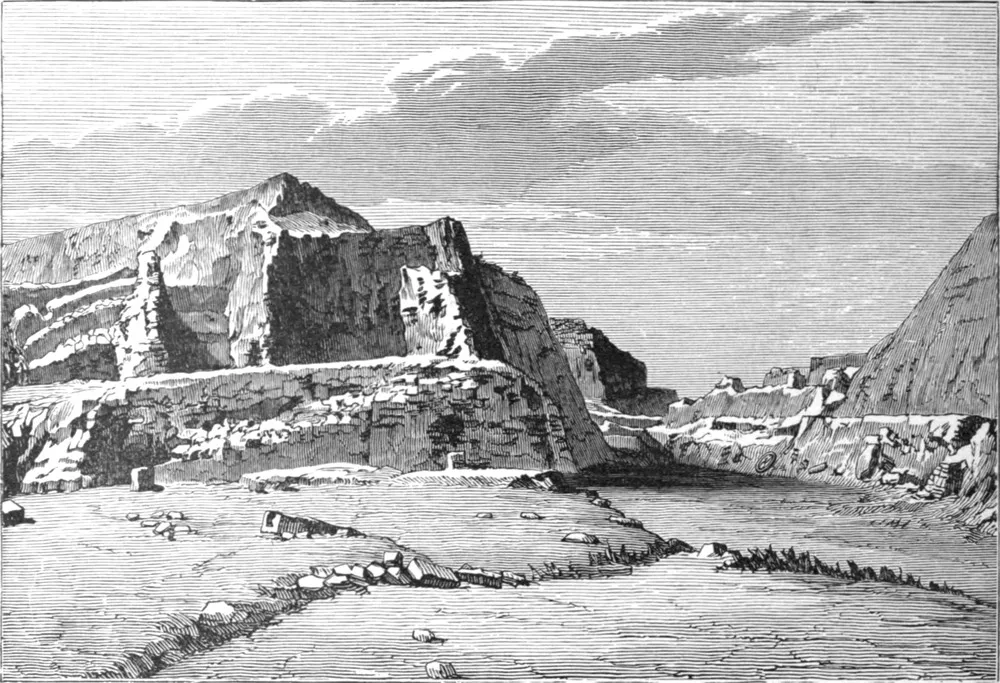
A VIEW SHOWING THE REMARKABLE CHARACTER OF THE
EXCAVATIONS AT TROY
Some idea of the enormous work involved in unearthing
ancient Troy will be gathered from the fact, made clear in this view, that
the ground-level before excavating was above the height of these buildings.
A deep trench was cut, as shown in the illustration, through the whole hill
of Hissarlik, the citadel town.
T
THE
opinion that our own circumstances and affairs are the only
standard for judging universal history has long been obsolete. Our day,
with its conceptions, beliefs, hopes, and endeavours, is but a tiny
portion of the past; for thousands of years peoples have existed who
have lived in other intellectual spheres than ours, who have pursued
other ideals.
The study of history does not consist in an examination of the past
projected, as it were, into the present; it is the study of the past
considered as a part of the constant coming and going of men. And in
order to become qualified as historians we must first of all attain
a point of view from which we may, independently of time, behold
history with all its great events file by; as though we were men who
had ascended to some elevation in the universe from which they could
look down upon the whole earth lying as a unity before them. This
is rendered possible through the power of abstraction gained from a
study of history; it enables us, on the one hand, to adapt ourselves
to strange times and beliefs, and, on the other, to look upon our own
day—all time to its contemporary men—objectively, as a mere hour
of the ages of human development. We must learn to escape from the
present, to withdraw ourselves from that which we may call the tyranny
of our own time.
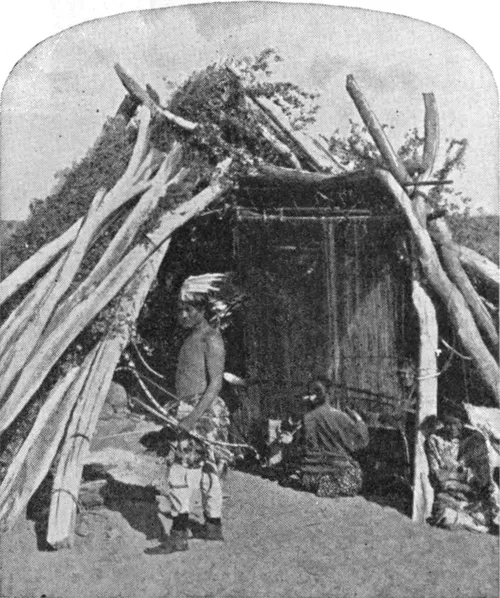
THE PRIMITIVE ART OF WEAVING
The art of weaving arose from plaiting, and soon developed
to perfection, the American Indians and most primitive peoples of our own day
being skilled weavers.
From universal history we obtain a picture of the development of
humanity—that is, the development of the various active germs or
principles inherent in man. By these are meant the active principles
innate in mankind in the aggregate, in contradistinction to those which
may exist in single individuals or in single races.
The result of development is called “civilisation”—the state of
intellectual being, and of outward, material life, attained by a
people through evolution. Although spiritual and material culture flow
into each other, they may be separated to this extent: as a physical
being endowed with senses, man endeavours to obtain satisfaction of
his needs, and strives for a position in relation to his environment
corresponding with the efforts he has made to obtain welfare; as
a feeling, inquiring, spiritual being he contains within him an
ever-present desire to fuse the multitude of separate impressions he
receives into unity, and to struggle forward until he arrives at a
conception of the world and of life.
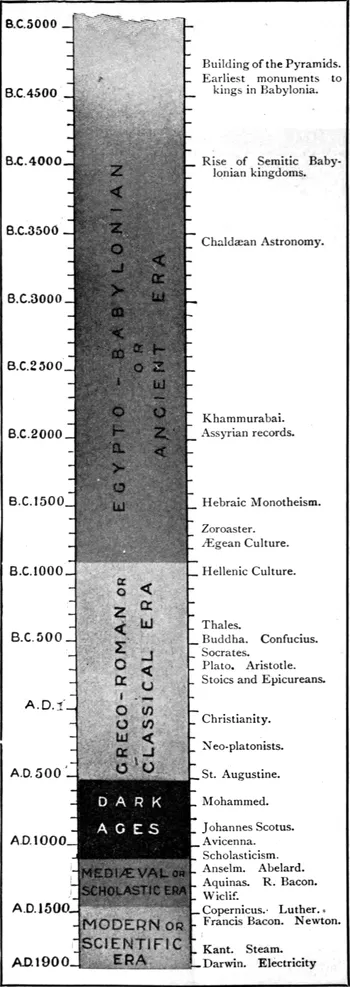
OUR OWN DAY COMPARED WITH THE HISTORIC PAST
Our day, with its conceptions, beliefs, hopes, and
endeavours, is but a tiny portion of the past; for thousands of years peoples
have existed who have lived in other intellectual spheres than ours, who have
pursued other ideals.
LARGER
IMAGE
“Material civilisation” is the mode of life through which the obstacles
opposed to humanity may be overcome. By the surmounting of obstacles is
meant the conquering of enemies, particularly of hostile animals, the
obtaining of means for the preservation of existence, and the employing
of these means for the increase of bodily welfare. In respect of
material civilisation man passes through stages that differ widely from
one another, that vary according to the manner in which the necessities
for existence are obtained, and according to the way in which enemies
are withstood for the safeguarding of life, welfare, and acquisitions
already gained. Races are spoken of as supporting themselves by the
chase and fishing, or by cattle-breeding and farming, according to
whether they are accustomed to derive subsistence directly from “nature
unadorned,” or by means of the cultivation and utilisation of natural
products.
No sharp line of distinction, however, may be drawn. It is inadmissible
to speak of races as supporting themselves solely by hunting and
fishing, for the very same peoples feed on products of the soil
wherever they are found and recognised as means of subsistence. They
live, it is true, upon flesh and fish, but also upon roots and the
fruit of wild trees. While in this state of civilisation, man avails
himself only of that which Nature places before him; he neither adapts
Nature to his desire, to his needs, or to his manner of living, nor
understands how to do it. He can make no further use of Nature than
to acquire a knowledge of the sources of supply, of how to seize time
and opportunity, and to overcome the obstacles of life in his own
territory. He ascertains the haunts of game, discovers how to obtain
fish, explores for wild honey or edible roots, learns to climb the
tallest trees and to let himself down into the deepest caves; but
he lacks the ability to cultivate Nature, to cause her to produce
according to his will.
Gradually the one phase amalgamates with the other. It is not seldom
that hunting tribes have small tracts of land on which they raise a few
edible plants. Observation of Nature teaches them that germs develop
from fallen seeds, and leads of itself to the idea that it is not best
to allow plants to grow up wild, and that it would be expedient to
clear the surrounding ground for their better growth. And when this
stage is reached, the next step—not to allow seeds to spring up by
chance, but to place them in the soil one’s self—is not very far off;
and thus the mere acquisition of Nature’s raw vegetable products gives
place to agriculture. Often enough we observe instances of the men of
a group carrying on hunting operations, while the women are not only
occupied with their domestic employments, but also till the soil; thus
the men are hunters and fishers, and the women are agriculturists.
Domestic work led the latter to take up the cultivation of plants,
even as it led them to the other light feminine handicrafts; while
the repairing of weapons and of contrivances used for the capture of
animals lay within the province of the men.
MANKIND’S PROGRESS IN HABITS OF DRESS
This series of typical pictures is intended roughly to
illustrate the upward progress of man from the almost nude savage to the neatly
and conveniently dressed gentleman of to-day. The Elizabethan dandy is, of
course, as fully dressed as man can be, and is introduced only as indicating
the great change of sartorial ideas in modern times.
The discovery of how to produce fire by artificial means, independently
effected in all parts of the world—as was also the discovery of the
art of navigation—was of the greatest importance for the entire
future. Fire was first a result of chance.
When lightning set a portion of the forest in flames, and caused a
multitude of animals or fruits to be roasted, men put it to practical
use. They recognised the advantage that fire gave them and sought to
preserve it. The retention of the fire which had been sent down from
heaven became one of the most weighty and significant of functions. Man
learned how to keep wood-fibres smouldering, and how to blow them into
flame at will; he also learned that it was possible to convey fire, or
the potentiality of fire, along with him in his wanderings. But even
then success was uncertain until a lucky chance led him to discover
how to produce flames at will, by rubbing two sticks together or by
twirling one against the other. These actions were originally performed
for other purposes—to bore holes in a piece of wood, or to rub it into
fibres; finally, one or the other was carried out with such vigour that
a filament began to burn, and the discovery was made. Sparks from flint
must have suggested a second method of kindling a fire; certainly
the art of igniting soft filaments of wood by means of a spark—thus
enabling the very smallest source of combustion to be used for human
purposes—was known to man in the earliest times. The obvious results
of the use of fire are means of obtaining warmth and of cooking food.
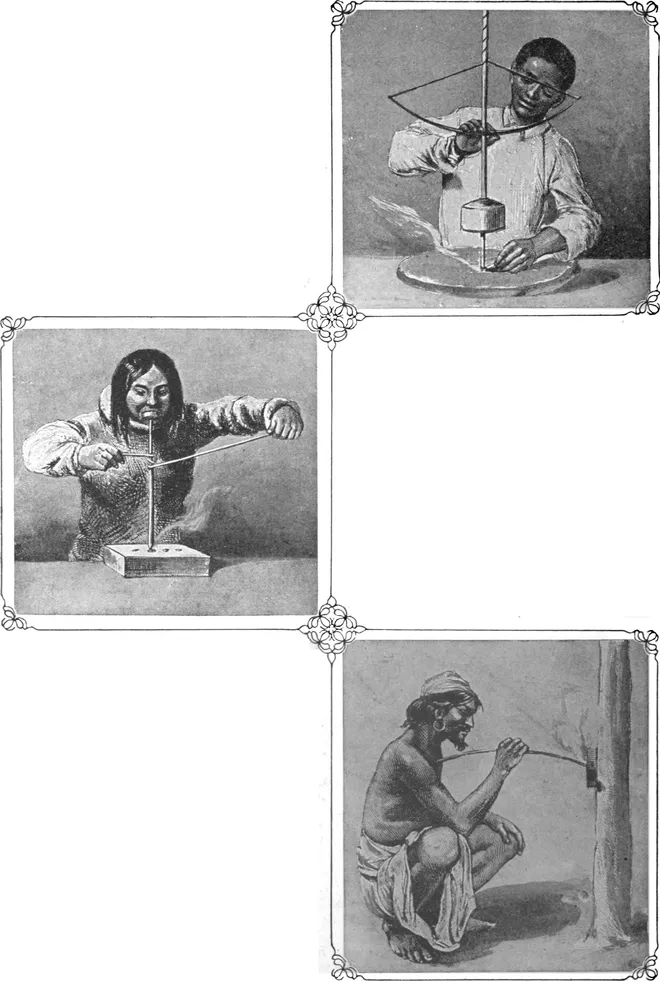
AN INGENIOUS INDIAN FIRE DRILL
ESQUIMAU MAKING FIRE BY FRICTION
THE GAUCHO’S WAY OF GETTING A LIGHT
LARGER
IMAGE
Self-defence had already led to the use of weapons, and, at the same
time, the contrivances for hunting and fishing must have become
more and more perfect. A very low degree of civilisation is that of
races unacquainted with the bow and arrow, and familiar with club or
boomerang only—who know how to make use merely of the weight of a
substance, or, as in the case of the boomerang, of a peculiar means of
imparting motion.
The time previous to the discovery of the art of working in metal was
the Age of Stone. It was a natural transition period during which men
began to learn to make use of the malleable metals, which could be
hammered and beaten into various shapes, and finally discovered how
to work in iron. Iron, by being placed in the fire, brought to a white
heat, and smelted, was rendered capable of being put to such uses as
were impossible in the case of brittle materials—bone or stone, for
example. Many races never acquired the art of working even in the
softer metals, and procured metallic implements from other peoples.
The great importance of metal-working is borne out by the fact that
the position of the smith, even in legendary times, has been of the
utmost significance. The Ages of Stone and of Metal belong to the most
important stages of civilisation.
Having made himself weapons, man did not employ them in fights with
animals only; he also used them on his fellow-men, and at the same time
arose the necessity for protective coverings—that is, the need for a
means of neutralising the effect of weapons on the body. Thus followed
the invention of the shield as a portable shelter, of the coat of mail
and of the helmet, and of armour in general in all its different forms
and varieties.
Together with weapons, utensils are characteristic of material culture.
Utensils are implements used in the arts of peace, domestic and
industrial; they are instruments which enable us to increase power
over Nature. Some utensils have undergone the same transformations as
have weapons; others have their own independent history. Just as the
edges of shells served as patterns for knife-blades, so did hollow
stones, the shells of crustaceans or of tortoises, become models for
dishes and basins. From the discovery of the imperviousness of dried
earth, the potter’s art developed; it became possible to mould clay
into desired shapes while moist, and then, when dry, to employ it in
its new form as a vessel for holding liquids; for that which has always
been of the greatest importance in the making of utensils has been
the taking advantage of two opposite characteristics displayed by a
material during the different stages of its manufacture—plasticity,
which admits of its first being moulded into various forms, and another
quality, which causes it afterward to stiffen into solidity and
strength.
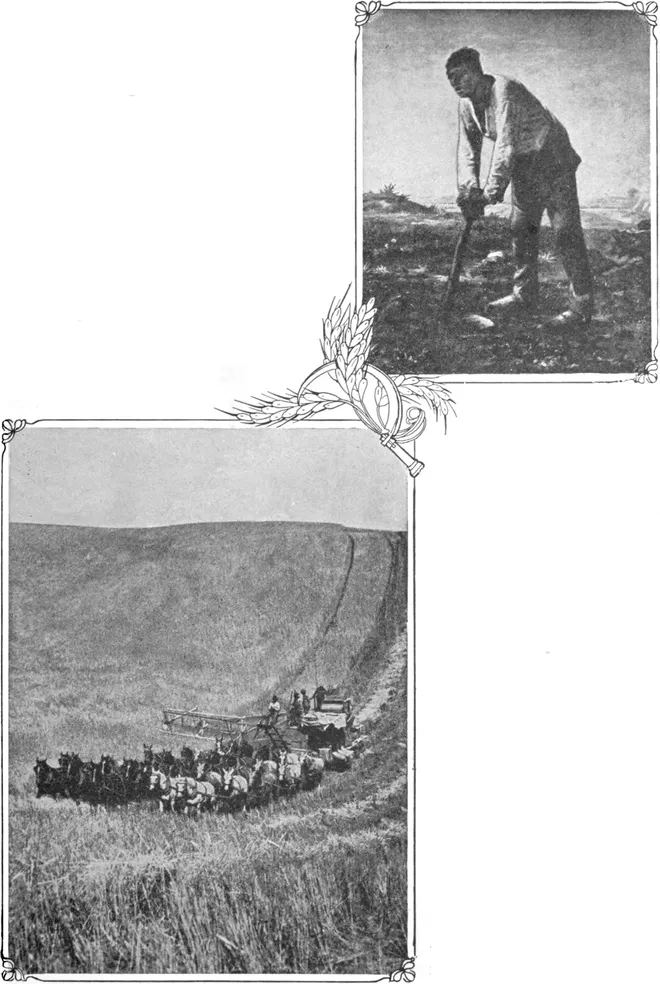
Mansell
THE MAN WITH THE HOE
From the painting by Millet
Underwood & Underwood
THE WONDERFUL ADVANCE IN AGRICULTURE
These pictures present a striking contrast: the
sullen clod with his primitive
hoe, and the great Canadian reaper drawn by thirty horses, both in
use to-day.
LARGER
IMAGE
Growth of the Textile Arts
A further acquisition was the art of braiding and plaiting, the joining
together of flexible materials in such a way that they held together
by force of friction alone. Thus coherent, durable fabrics may be
produced, and by joining together small parts into an aggregate it is
also possible to give a definite form to the whole and to adapt it to
various uses. The quality of adaptability is especially developed in
the products of plaiting, but the quality of imperviousness is lacking.
Wickerwork was used not only in the form of baskets, but also in other
shapes, as means for protection and shelter, as material for sails, as
well as for tying and binding. The art of weaving arises from plaiting,
and along with it come methods for spinning thread. It thus becomes
possible to make an immense number of different useful articles out of
shapeless vegetable material. Fibres are rendered more durable by being
bound together, and textures formed from threads are adapted to the
most various uses of life. This has an influence on the development of
weapons also: bow-strings, slings, and lassos presuppose a rudimentary
knowledge, at least, of the textile arts; and as knowledge increases,
so are the products improved in turn.
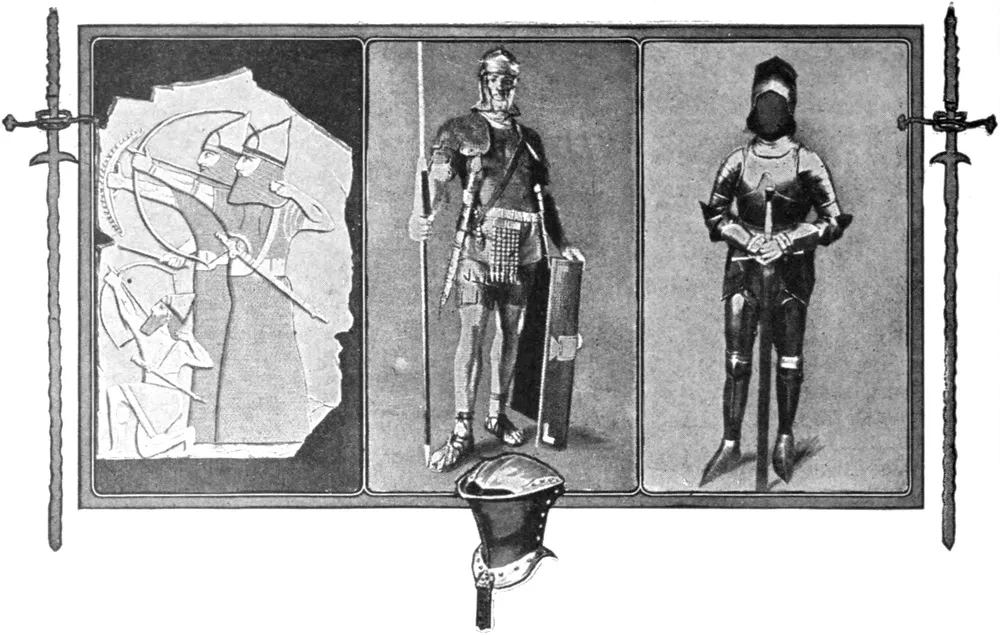
MAN’S METAL DRESS: THE DEVELOPMENT OF ARMOUR FROM
ANCIENT TO MEDIÆVAL TIMES
The way in which man has protected himself against his
foes in battle, and the gradual progress and decline of such methods, is shown
in these pictures. The first is from the monuments of Nineveh, and shows the
earliest form of chain mail. In the second we see the armour of the Roman
legionary, while the third shows the heavy accoutrement of a mediæval warrior.
A helmet of the same period is also shown.
Means for conveyance are also invented, that difficulties arising
from distance may be overcome. At first men carry burdens upon their
backs, heads, or shoulders, or in the hand, placing whatever they
wish to transport in a utensil—a basket or a piece of cloth—thus
producing a coherent whole; later, in order to render conveyance
still more convenient, handles are invented. Objects are dragged
along the ground, and from an effort to save them from injury the
idea of sledges develops. Things that are round enough are rolled
to their destinations; this leads to the invention of rollers and
wheels, materials of required form being brought into combination with
rudimentary agents of circular motion, and thus, through a rotary, a
horizontal movement is obtained; and so the force of gravity is made
use of, consistency of motion procured, and the hindering effect of
friction overcome to the greatest possible degree.
Means for carrying inanimate objects once invented, it is not long
before they are put to use for the conveyance of man himself; thus
methods for the transportation of human beings are discovered in the
same manner as the means for the carriage of goods.
Man’s First Boats
In primitive times transportation by water is employed to a far greater
extent than by land. Man learns how to swim in the same way as other
animals do, by discovering how to repress his struggles, transforming
them into definite, regular movements. The sight of objects afloat
must, through unconscious analysis—experience—have taught men to make
light, water-tight structures for the conveyance of goods upon water,
and, later, for the use of man himself. The pole by which the first
raft was pushed along developed into the rudder. Kayaks and canoes were
built of wood, of bark, and of hides. In this connection, moreover,
an epoch-marking invention was that of cloths in which to catch the
wind—sails; and this, too, was a result of observation and experience.
Man had known the effect of the wind upon fluttering cloth, to his
loss, long enough before he hit upon the idea of employing it to his
advantage. Finally he learned that by adjusting the sails he might make
use of winds blowing from any direction.
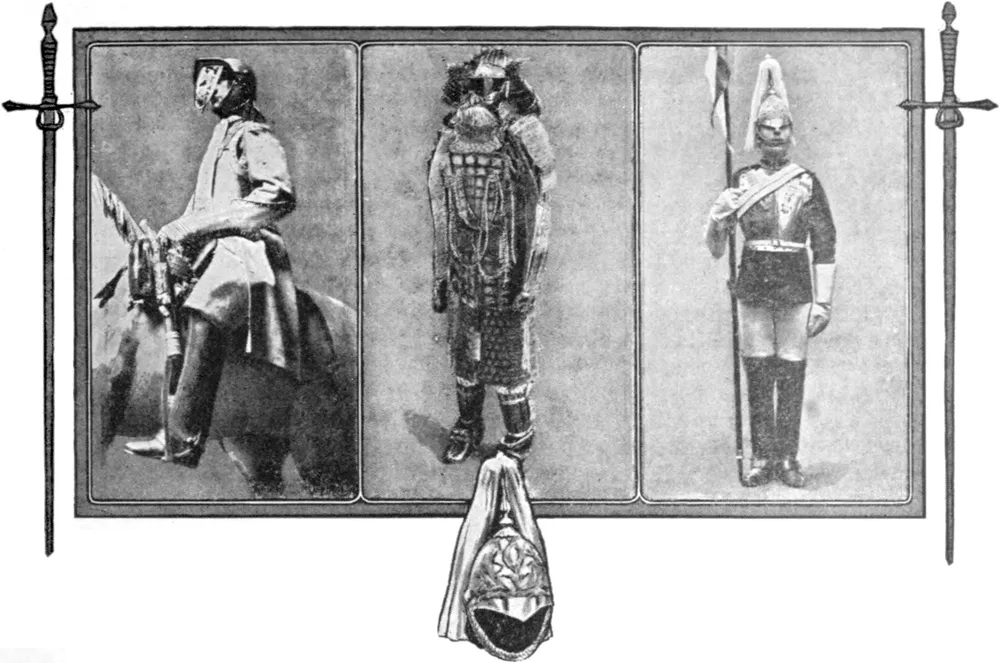
MAN’S METAL DRESS: THE GRADUAL MODIFICATION OF ARMOUR IN
MODERN TIMES
The invention of gunpowder and firearms rendered the
protection of armour useless, and by the sixteenth century it had been greatly
modified. The first of these pictures shows the slight armour worn by James II.
The second is a suit of Japanese armour, discarded in our own time; while the
last is a portrait of a present day Life-guardsman, whose cuirass is more
ornamental than useful.
Man’s First Houses
Habitations are structures built in order to facilitate and assure
the existence of man and the preservation of his goods. Indeed, the
presence of caverns caused men to recognise the protective virtue of
roof and wall, and the knowledge thus acquired gave rise in turn to
the making of artificial caves. Holes beneath overhanging banks and
precipices led to the building of houses with roofs extending beyond
the rambling walls. Perhaps the protection afforded by leafy roofs,
and the walls formed by the trunks of trees in primeval forests, may
also have turned men’s thoughts to the construction of dwellings.
Houses of various forms were built, circular and rectangular; some with
store-rooms and hearths. The use of dwellings presupposes a certain
amount of consistency in the mode of living, the presence of local
ties, and a general spirit favouring fixed and permanent residence.
Nomadic races use movable or temporary shelters only—waggons, tents,
or huts.
Home and Dress
The houses of stationary peoples become more and more firm and stable.
At first they are built of earth and wickerwork, later of stone, and
finally of bricks, as among the Babylonians. Foundations are invented,
dwellings are accurately designed as to line and angle; the curved line
is introduced, bringing with it arches both round and pointed, as may
be seen in the remains of Roman and Etruscan buildings. The structure
is adorned, and it becomes a work of art.
But man also dwelt over the water, sometimes erecting his habitations
upon rafts and floats, often upon structures that rose from beneath the
surface. Thus was he, dwelling in communities of various sizes, secure
from the attacks of land enemies. Even to-day there are uncivilised
peoples who live over water, constructing their homes upon piles.
Taming of the Wild
Clothing, however, was invented partly that in cold climates men might
survive the winter, partly for the sake of ornament. In tropical
regions man originally had no knowledge of the necessity for clothing:
garments are masks, disguises; they bear with them a charm; they
are the peculiar property of the medicine-men or of those who in
the religious dance invoke the higher powers. Modesty is a derived
feeling; it cannot exist until a high state of individualisation has
been attained, until each man desires exclusive possession of his wife,
and therefore wishes to shield her from the covetousness of other men.
With the knowledge of dress, a desire for adornment, the effort to
assist Nature in producing certain definite æsthetic effects, arises.
Less uniformity in the appearance of the body is wanted, and this
brings tattooing and the use of ornament into vogue. Later there is a
fusing of these several aims; clothing becomes protection, veil, and
ornament in one, fulfilling all three functions at the same time.
Another epoch-marking discovery, often arrived at while races are
still in the state of subsistence by hunting, is the domestication of
animals. This may have originated in the practice of provoking one
beast to attack another in order to vanquish them both the more easily.
Further development, bringing with it the idea of totemism and the
notion that the soul of an animal dwells in man, drew him nearer to his
animal neighbours; and he sought them out as comrades and attendants.
The taming of wild creatures arose from two sources—human egoism, and
the innate feeling of unity and identification with Nature common to
all savages; hence on the one hand, the subjugation of animals, and,
on the other, their domestication. Neither employment rendered it by
any means less possible for men to hold animals in reverence, or to
attribute to them virtue as ancestral spirits.
Such acquisitions of external culture accompany man during the
transition from his subsistence by the pure products of Nature
to the cultivation of natural resources, cattle-breeding and
agriculture—occupations necessitating the greatest unrest and
mobility. The simple life in Nature incites men to wander forth that
they may discover land adapted for their support; they rove about in
search of roots as well as of living prey. The breeding of domestic
animals also causes them to travel in the hope of finding ground for
pasture; nor does agriculture in its primitive form tend to establish
permanence of residence, although it contains within itself latent
possibilities of developing a settled life, one of the most important
factors in the progress of mankind.
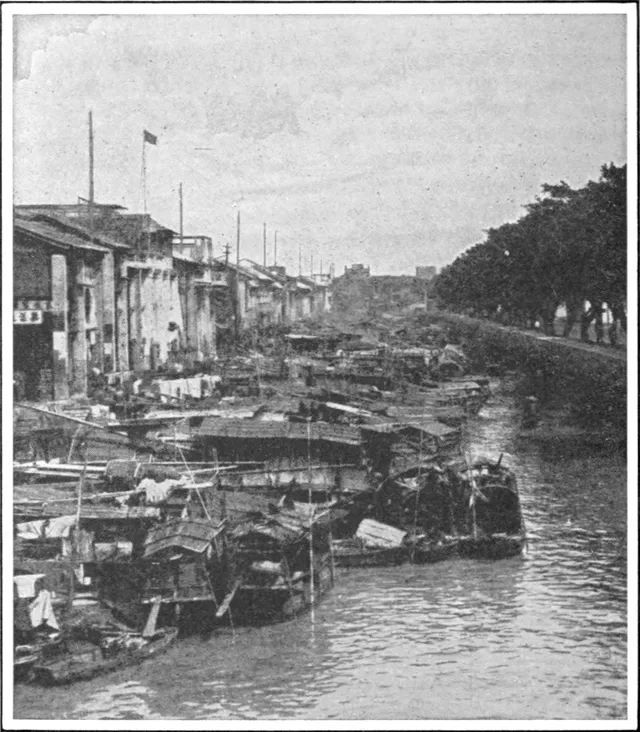
PRIMITIVE DWELLINGS OF TO-DAY: HOUSE-BOATS AT CANTON
Not only are there lake-dwellers to-day, as we have seen,
but even large communities, as at Canton, in China, live in boats.
Mankind “Settling” Down
Only fixed, domestic peoples are able to create great and lasting
institutions, to store up the results of civilisation for distant
later races, and to establish a developed, well-organised commercial
and civil life. The transition from nomadism to life in permanent
residences has, therefore, been one of the greatest steps in the
development of humanity. At the time of the beginnings of agriculture,
however, man was still a periodic wanderer. According to the
field-grass system of cultivation, seed is sown in hastily-cleared
ground, which soon becomes exhausted and is then abandoned. A migration
follows and new land is cleared. This system continues until men learn
to cultivate part of the land in a district, allowing the remainder
to lie fallow for a time in order that the soil may recover; thus
they remain fixed in their chosen district. Various circumstances—for
example, the danger of enemies from without, and the difficulties
attending migration—must have led to this change, the transition to
the system of alternation of crops. The wanderings are confined to less
extensive regions, the same fields are returned to after a few years,
until finally the relation of patches under cultivation to fallow land
is reduced to a system, and the time of wandering is past.
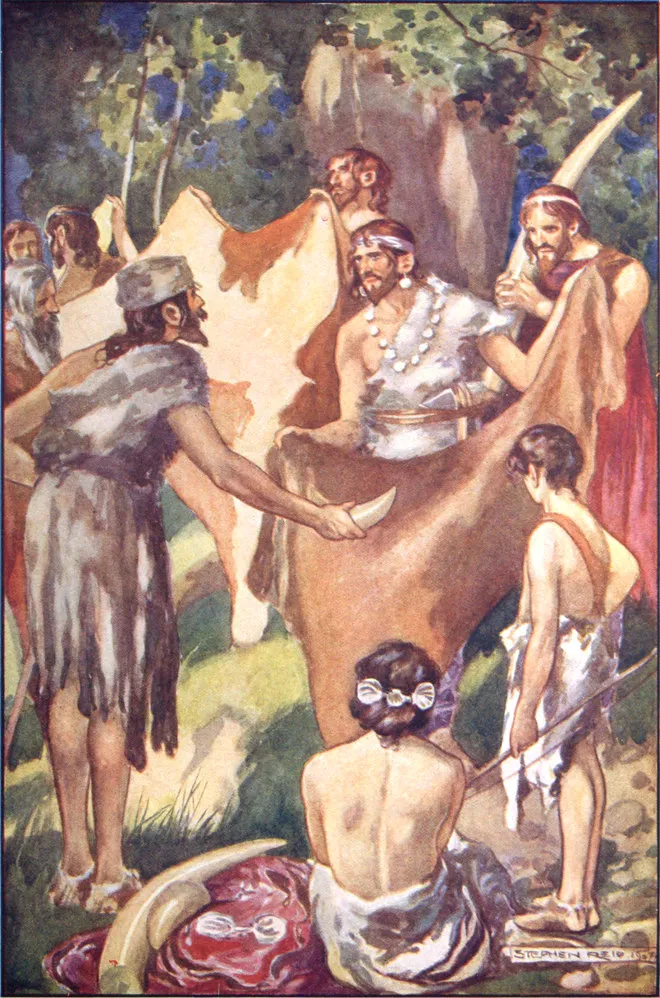
THE BEGINNINGS OF COMMERCE: PRIMITIVE PEOPLE BARTERING
IVORY TUSKS AND BULL-HIDES
LARGER
IMAGE
The coming of the Craftsman
With fixed residence the forms of communities alter. The group settles
in a certain district, homes are built close to one another, and the
patriarchal organisation gives place to the village, which, with
its definite boundaries, is thenceforth the nucleus of the social
aggregate. Often several village communities have fields and forests in
common, and a common ownership of dams and canals; Nature takes care
that they do not become isolated, but unite together in close contact
for common defence and protection. With agriculture is associated the
working up of raw products. These are fashioned into materials for the
support of life and for enjoyment; furniture for dwellings, clothing,
tools, utensils, and weapons are made. For, however much agriculture
favours a life of peace, so rarely does man live in friendship with
his fellows that agricultural peoples also find it necessary to arm
themselves for war.
At first manufacture is not separated from farming; the agriculturist
himself prepares the natural products, assisted by the members of
his family. Later, it is easily seen that some individuals are
more skilled than others; it is also recognised that skill may be
developed by practice and that employments must be learned. Therefore
it is requisite that special individuals of the community should
prepare themselves for particular activities in the working up of raw
products and pursue these activities in consistency with the needs
of the society—trade or craft. The craftsman at first labours for
the community; in every village the tailor, cobbler, smith, barber,
and schoolmaster is supported by society at large. The craftsman
receives his appointed income—that is, his portion of the common
supply of food; and, in addition, every one for whom he expends his
labour gives him something in compensation, or finds him food while
employed about his house, until, finally, a systematic method of
exchange is established; and with this another advance—an epoch for
civilisation—is arrived at.
The First Labour Problem
This is the division of labour. It is found advantageous not only that
the craftsman be employed as he is needed, but also that he produce a
supply of products peculiar to his trade; for the times of labour do
not in the least harmonise with the times of demand. Although during
the first periods of industrial life men sought more or less to adjust
these factors, in later times they become wholly separate from one
another. There is always, in addition, labour ready to be expended on
casual needs; in more advanced phases of civilisation this condition of
affairs is not avoided; but wherever labour can be disassociated from
fortuitous necessity, the capacity for production is greatly increased.
Commodities are manufactured during the best seasons for production
and are preserved until the times of need; thus men become independent
of the moment. Here also, as in other problems of civilisation, it is
necessary to surmount the incongruities of chance, and to render all
circumstances serviceable to our purposes.
Crafts and Trades Developing
Exchange and division of labour are the great factors of the progress
of a civilisation based upon industrialism. Crafts and trades develop
and improve; greater and greater skill is demanded, and consequently
the time of preparation necessary for the master craftsman becomes
longer and longer. The worker limits himself to a definite sphere of
production and carries his trade forward to a certain perfection. His
wares will then be more eagerly sought for than those made by another
hand; they are better, yet cheaper, for his labour is lightened by his
greater skill. His various fellow craftsmen, and the agriculturist
also, must exchange their goods for his; for the more specialised the
work of an individual, the more necessary the community is to him, in
order that he may satisfy all his various requirements. Exchange is
at first natural; that is, commodities are traded outright, each
individual giving goods directly in return for the goods he receives.
The production of the community as a whole has become far richer, far
more perfect. The labour of the organised society produces more than
the activity of separate individuals.
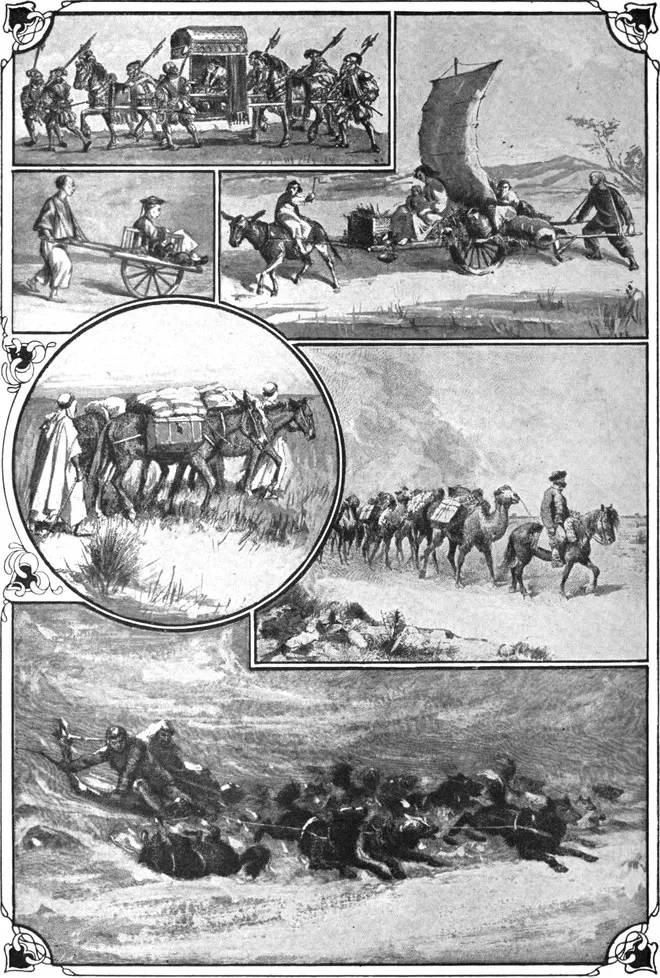
THE BEARERS OF MAN’S BURDENS: PRIMITIVE AND NATURAL
METHODS OF CARRYING
These illustrations show a palanquin borne by horses;
the Chinese single-wheel cart and the same assisted by a donkey and a sail;
pack mules and camels; and a sledge drawn by Esquimau dogs.
LARGER
IMAGE
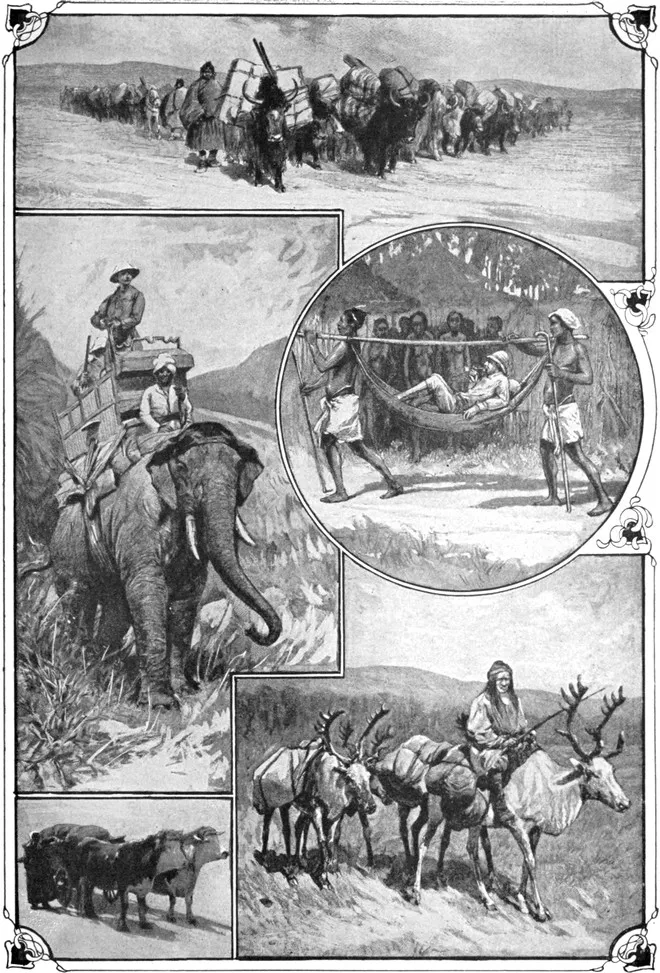
SOME METHODS OF CONVEYANCE IN VARIOUS AGES AND COUNTRIES
In this plate are illustrated a caravan of yaks; the
elephant with a howdah; the African litter; reindeers as pack animals; and the
familiar bullock waggon of France—a few of the many methods of carrying
used by man.
LARGER
IMAGE
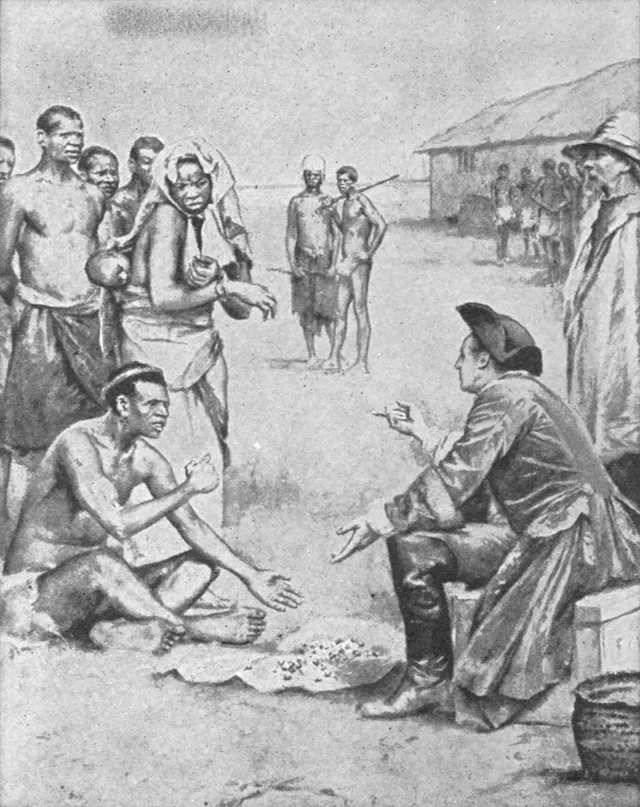
PRIMITIVE MONEY: SELLING A SLAVE FOR COWRIES
Cowries, which are small shells, are a very primitive
form of money, still used in parts of Africa and in Siam. They were formerly
so used in India, where $150,000 worth used to be imported annually. In Africa
5,000 shells are equivalent to $1.
Here, again, is shown the impulse of man to free himself from the
exigencies of the moment, to lift himself above the fortuitous
differences that arise between supply and demand. The more varied the
production, the more difficult it becomes to find men who are able to
offer the required commodity in exchange for what has been brought
to them. An escape from this embarrassment lies in the discovery of
a universal measure of exchange value and medium of exchange—money.
Money is the means of adjustment which renders traffic between men
independent of individual requirements.
Mediums of exchange, particularly necessary for the carrying on of
traffic between different communities, which exist in large quantities
and can be divided up into parts, make their appearance in very early
times. At first their values are more or less empirical, dependent
upon the conditions of individual cases, until gradually a medium
obtains general recognition and thus becomes money. The same need for
surmounting the lack of uniformity in individual requirements has led
the most different peoples in the world to the invention of money.
Naturally, many different things have been employed as mediums of
exchange; these vary according to geographical situations, conditions
of civilisation, and the customs of races. Pastoral tribes at first
employed cattle; but tobacco, cowries, strings of flat shells, bits of
mother-of-pearl, rings, and hides are also used. At last it is found
that metal is stable, durable, divisible, and of generally recognised
value; and finally the precious metals take precedence of all others.
Finally this form of money is adopted by all civilised races.
Division of labour originates in the development of the handicrafts, in
the distinction made between the labour of working up the raw material
and that of its production. With the help of a currency it leads to a
complete transformation, not only of economic relations, but also of
the social conditions of men.
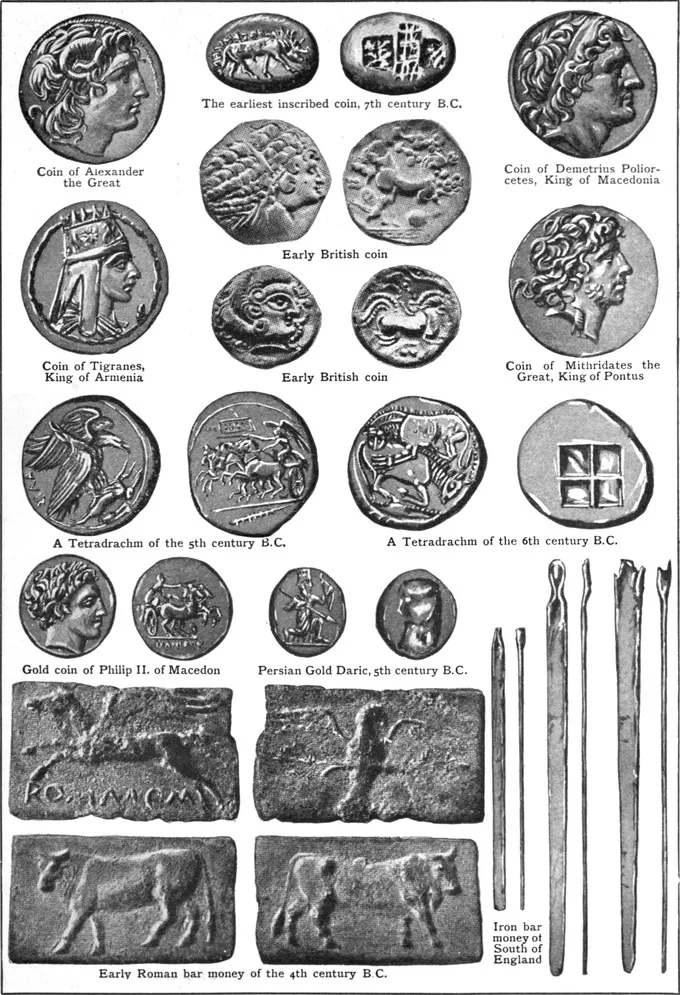
THE BEGINNING OF MONEY: SOME OF THE EARLIEST KNOWN COINS IN
EXISTENCE
Of these coins, chiefly from the British Museum, the
South England iron currency bars are perhaps most interesting. Our reproduction
of these is one-tenth actual size. It will be noticed that the handles and the
sizes vary.
LARGER
IMAGE
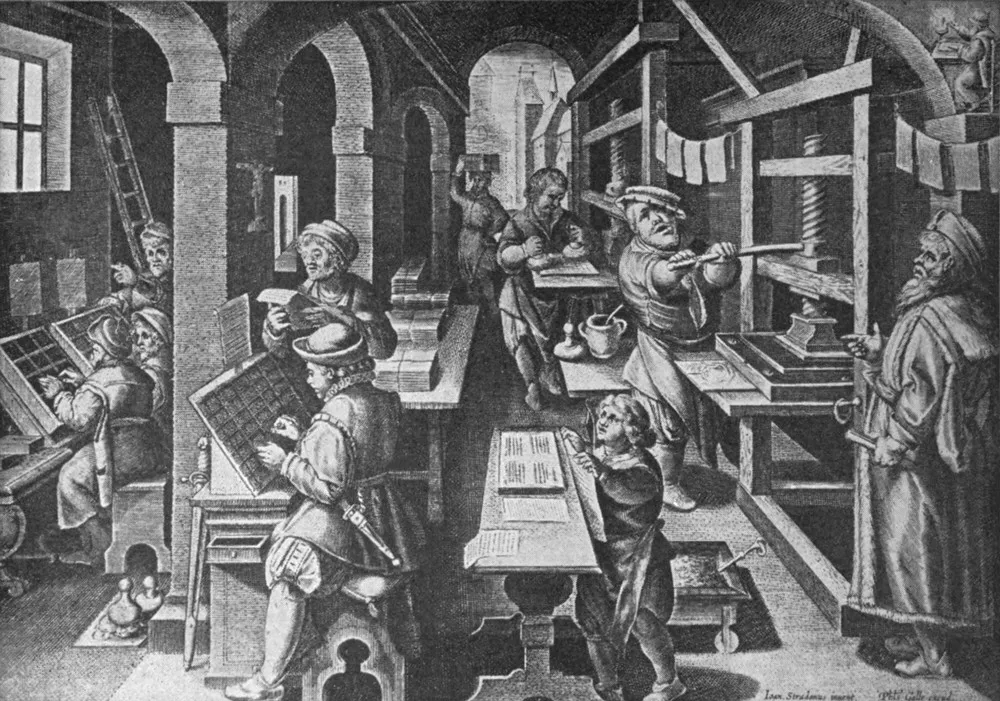
THE BEGINNING OF PRINTING: STRADANUS’S PRINTING OFFICE
AT ANTWERP IN THE YEAR 1600
From a very rare engraving in the British Museum.
THE DEVELOPMENT OF PRINTING: THE LARGEST PRESS IN THE
WORLD
How great has been the progress in the art of printing is
seen from these two pictures. The modern Hoe printing press is a marvel of
mechanism. The first editions of this History were printed on a similar machine.
Markets and Prices
Country becomes city; centres of population which rest upon an
industrial basis arise; in many cases growth of the various
manufacturing industries is furthered by unfavourable agricultural
conditions. Such industrial centres require markets and market-places;
it is necessary for the producers of raw materials to come to market
from the country with their goods, in order that they may meet
together with the craftsmen of the city, and with other producers from
the country who offer their wares in turn. The market town is the
point of departure for further culture. Here, too, the endeavour to
harmonise individual incongruities exists. Fruit is sent to market;
each man has his choice; an exchange value is determined by means of
comparison, through analysis of the individual prices which themselves
do not furnish any rational determination of worth, and therefore
expose both buyer and seller to chance. Thus a market-price develops.
The city is the living agency promoting industry and exchange; it
brings its population into contact with the population of the country
by means of the market, and prevents men from separating into isolated,
unsympathetic, or even hostile groups.
Here industry flourishes—arts, crafts, and large manufactures. In
the latter, division of labour is developed to a maximum degree,
and production in factories derives a further impulse through the
introduction of machinery. Machines, in contrast to implements and
utensils, are inanimate but organised instruments for labour, requiring
subordinate human activity only (attendance) so that they may impart
force and motion in a manner corresponding with the designs of the
inventor. Machinery is originally of simple form, dependent on water or
wind for motive power—rude mills, and contrivances for the guiding of
water in canals or conduits belong to its primitive varieties.
The Use of Natural Forces
But man’s power of invention increases, and in the higher stage of
industrial evolution the facilities for labour are enormous. We have
but to think of steam and of electricity with all their tremendous
developments of power. Finally the discovery of the unity of force
leads men to look upon Nature as a storehouse of energy and to devise
means by which natural forces may be guided, one form of energy
converted into another and transferred from place to place; and thus
man becomes almost all-powerful. He is not able to create, it is true,
but he may at least mould and shape to his desire that which Nature
has already formed. Thus the discovery how to direct the forces of
Nature enables us again, according to the principle already cited, to
escape the disabilities of human differentiation with its attendant
incongruities.
Boundless Growth of Commerce
As already stated, division of labour leads to exchange; exchange leads
to commerce. Commerce is exchange on a large scale, organised into a
system with special regard to the production of a store, or supply. The
latter requires a certain knowledge of trade; the centres of demand
must be sought out, and the goods transported to these centres. In this
way a fruitful reciprocal action develops; and as production influences
trade, so may trade influence production, governing it according to
the fluctuations of demand, and leading to the creation of stores of
commodities for which a future market is to be expected. Thus commerce
presupposes special knowledge and special skill; it develops a special
technique through which it is enabled to execute its complicated
tasks. Men who live by trade become distinct from craftsmen; and the
mercantile class results. Merchants are men whose task is to effect
an organised exchange of natural and manufactured products. Commerce
always displays an impulse to extend itself beyond the borders of
single nations—not to remain inland only, but to become a foreign
trade also; for the products of foreign countries and climates, however
valuable they may be, would be inaccessible except for commerce.
Thus trade becomes both import and export. The first step is for the
tradesman or his representative to travel about peddling goods, or for
an owner of wares or money to offer capital to an itinerant merchant
with the object that the latter may divide the profits with him later
on. This leads to the sending of merchandise to a middleman, who
places it on the market in a distant region—commission business. The
establishment of a branch or agency in a foreign country, in order to
trade there while in immediate connection with the main business house,
follows; and, finally, merchants deal directly with foreign houses
without the intervention of middlemen, thus entering into direct export
trade. This, of course, presupposes a great familiarity with foreign
affairs and confidence in their soundness; consequently it is possible
only in a highly developed state of civilisation.
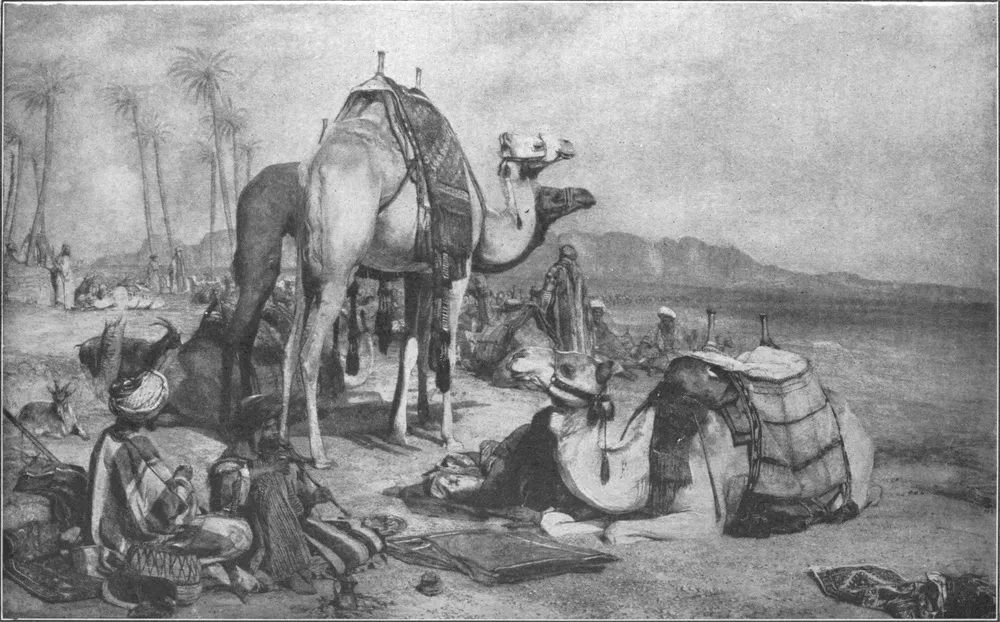
“THE SHIP OF THE DESERT”: THE CARAVAN IS THE OLDEST
EXISTING MEANS OF COMMUNICATION BETWEEN PEOPLES
From J. F. Lewis’s picture “The Halt in the Desert,” in
the South Kensington Museum
(Photo, Mansell)
LARGER
IMAGE
Birth of New Trades and Institutions
Foreign trade is carried on overland by means of caravans, and,
in later times, by railways; over sea, through a merchant
marine—sailing vessels and steamships. The magnitude of commerce, its
peculiar methods, and its manifold, varying phases combine to produce
new and surprising phenomena: traffic by sea leads to insurance and
to different forms of commercial associations; intercourse by caravan
gives rise to the construction of halting-stations, establishments for
refreshment and repair, that finally develop into taverns and inns. And
that which first arose from necessity is subsequently turned to use
for other purposes: insurance is one of the most fruitful ideas of the
present day; hotels are an absolute necessity.
Commerce is able to bring further contrivances and institutions into
being, here, again, overcoming individual incongruity by means of
combination. Trade cannot always be carried on directly between the
places of production and of consumption; one district requires more,
another less; it would be difficult to supply all from one centre
of distribution. Thus an intermediate carrying trade is developed,
rendering the surmounting of obstacles less difficult and increasing
the stability of the market. The demands of the middleman are
compensated for by these advantages.
Commerce Brings the World Together
Thus the world’s commerce develops, and that which is accomplished
by market traffic in lesser districts is brought about by the
concentrative influence of bourses, or exchanges, in the broadest
spheres. Here, as in the smaller markets, the tendency is for all
prices to seek a level, to become as independent as possible of
individual conditions; and so commerce between nations, and the
possibility of ordering goods from the most distant lands, bring with
them an adjustment: world prices are formed; and to establish these,
is the business of the exchanges. The exchange is a meeting together
of merchants for the transaction of business by purchase or sale. It
has acquired still more the character of a world institution since
men have been able to interchange advices by means of telegraph and
telephone; it is possible for the bourses of different countries to
transact business with one another from moment to moment, so that the
ruling prices of the world can be immediately known. It has already
been stated that commerce leads to a taking up of residence in foreign
countries; it also leads to colonisation, and it is chiefly due to
commerce that civilisation is introduced into foreign lands.
Supply of Human Labour
In earlier centuries the labour question was settled by means of the
legal subjection of certain classes of men, until complete injustice
was reached in slavery. The system was rendered still more efficient
by making slave-ownership hereditary. Slavery, originated in wars and
man-hunting, in times when there were but few domesticated animals
and no machines, when utensils, were very imperfect and a more or
less developed mode of life could only be conducted by means of the
manual labour of individuals. Therefore, in order to obtain labourers,
men resorted to force, introducing a slave population of which the
individuals were either divided among households or kept in special
slave habitations. The industry of the slave was often increased by the
promise of definite privileges or private possessions. He was often
granted a home and family life, and thus he became a bondman—burdened
and taxed and bound to the soil, it is true, but otherwise looked
upon as a man possessed of ordinary rights and privileges. Even
during the days of slavery there were instances of emancipation, and
the possibility was opened up of rising to the social position of a
slave-owner.
The evolution of a free working class, with recompense for labour,
is one of the most important chapters in the history of modern
civilisation. The chief sphere of development is that of the crafts
and trades. The power of guilds often induces legislation in their
favour; thus they become monopolies, and only such individuals as are
members of an association may adopt its particular trade or craft
as a profession. Sometimes the unity of a guild is broken, and the
individual right to form judgments enters in place of the rules laid
down by the corporation. From this results competition, which finally
leads up to free competition. Through free competition, the encumbering
rigidity of the guilds is avoided; it leads to a high development
of the individual, and is therefore a great source of progress; it
discloses the secrets of the craft, freeing men from deeply-rooted
prejudices in regard to different vocations; and it increases man’s
inventive capacity, producing new methods for carrying on trades and
new combinations and connections.
THE PROMISE OF PEACE: THE HAGUE CONFERENCE OF THE
NATIONS OF THE WORLD IN 1907
Nothing could more effectively illustrate the ideal of
international peaceful co-operation to which hopeful historians look forward
than this photograph of the representatives of all the leading Powers of the
world, met together at The Hague, in the year 1907, to promote the amity of
nations and the eventual abolition of war.
LARGER
IMAGE
S
SPIRITUAL
culture may develop in the directions of knowing and of
feeling. These two forms of the manifestation of consciousness are
originally not to be separated from each other; but as time goes on,
a preponderance of one or the other becomes noticeable. Language is
the first result of spiritual culture: the communication of thoughts
by means of words (sound pictures of ideas). Language arises from the
necessities of life, from the need for communication among the members
of a social aggregate.
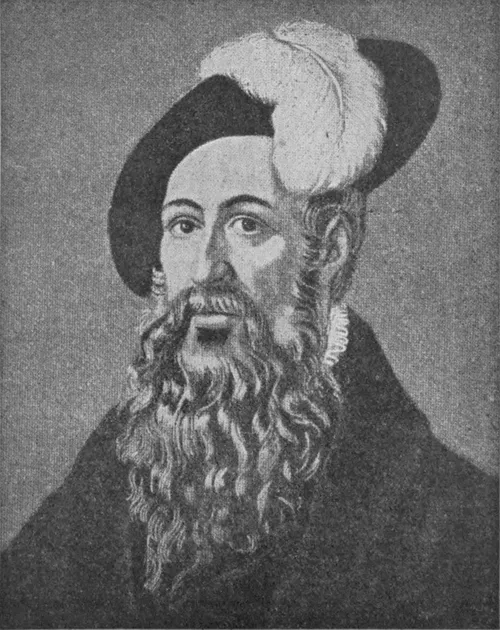
GUTENBERG, THE INVENTOR OF PRINTING
Nothing has eclipsed the printing press as an agency of
man’s intellectual and spiritual advancement.
A much later acquisition, the art of writing, or the fixation of
language in a definite, permanent form, stands in close connection with
speech. Writing develops according to two systems: the one based on
the symbolising or picturing of ideas—picture-writing, hieroglyphics;
and the other on the breaking up of the speech-sounds of a language
into a notation of syllables or letters—syllabic or letter writing.
According to the first method thoughts are directly pictured; according
to the second, sounds, not ideas, are represented by symbols—that is,
the sounds which stand for the ideas are transformed into signs. The
transition from sign to syllabic writing comes about in this manner:
if, during its development, a language uses the same sound to express
various conceptions, men represent this sound by one sign; and whenever
a foreign word is reproduced in writing it is first separated into
syllables, and the syllables are then pictured by the same signs as
are employed to represent similar sounds—but different ideas—in the
native speech. Thus symbols are employed more and more phonetically,
and less and less meaning comes to be attached to them. This process
must continue its development if the pronunciation changes as time
goes on; the old writing, with its national symbol-method, may be
retained; but with the changing of speech-sounds the new writing is
altered; syllables are now represented by signs, and combinations
of syllables are reproduced by means of a combination of their
corresponding symbols. Thus phonetic writing was not an invention, but
a gradual development. Together with the phonetic symbols, ideograms or
hieroglyphs also exist, as in Babylonian. It is especially interesting,
and indicative of the unity of the human mind, that the transition to
syllabic writing has been arrived at independently by different races;
the Aztecs, for example, exhibit a wholly independent development.
The Spreading of Ideas
Communication by writing may be either single or private, or general
and public; in the latter case plurality is attained through such
methods as the affixing of bills and placards, or by means of
transcripts or reproductions of the original copy. At first the latter
are made in accordance with the ordinary methods of writing; and in
slave-holding communities—Rome, for example—slaves who wrote to
dictation were employed as scribes. The discovery of a method by which
to obtain a plurality of copies through a single mechanical process was
epoch-making. The printing-press has performed a far greater service
to humanity than have most inventions; for, with the possibility of
producing thousands of copies of a communication, the thoughts embodied
in it become forces; they may enter the minds of many individuals who
are either convinced or actually guided by them. Ideas become active
through their suggestion on the masses of the population. This may lead
to a one-sided rule of public opinion; but a healthy race will travel
intellectually in many directions, and various beliefs supplement one
another, struggle together, conquer, and are conquered. In this manner
thoughts awaken popular movements, rousing a people to a hitherto
unknown degree, and forcing men to think and to join issues. Thus the
Press becomes a factor in civilisation of the very first importance.
The necessity for periodic communication, together with curiosity
that refuses to wait long for information, leads to the establishment
of regularly recurrent publications; and thus, in addition to the
book-press, the newspaper-press, that has learned how to hold great
centres of population under its control, appears. Naturally this method
of aiding the progress of civilisation has its disadvantages, as have
all other methods; the conception of the world becomes superficial;
individuality loses in character; not only a certain levelling of
education, but also a levelling of views of life and of modes of
thought, results. But, on the whole, knowledge is spread abroad as it
never was before.
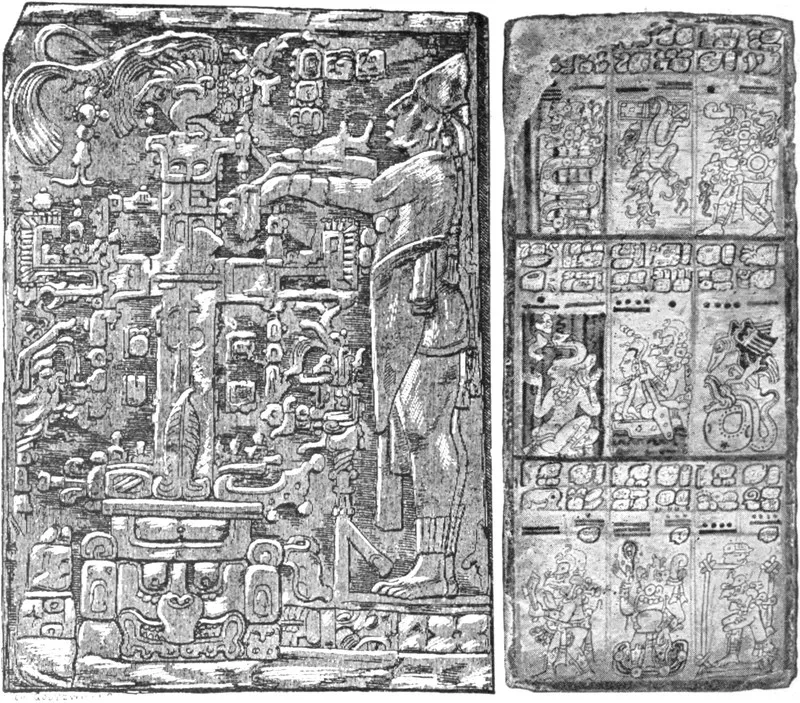
EXAMPLES OF AZTEC HIEROGLYPHIC SCULPTURE AND WRITING
The hieroglyphics and script of the Aztecs were
independently developed. The first illustration is from a sculpture in Mexico,
and the other is a small reproduction of a page of the Maya manuscript at
Dresden. In both cases the symbolism is only imperfectly understood at
present.
Man, as a thinking being, craves for a conception of life; and in his
inmost thoughts he seeks for an explanation of the double relationship
of Man to Nature and of Nature to Man, striving to bring all into
harmony. This he finds in religion.
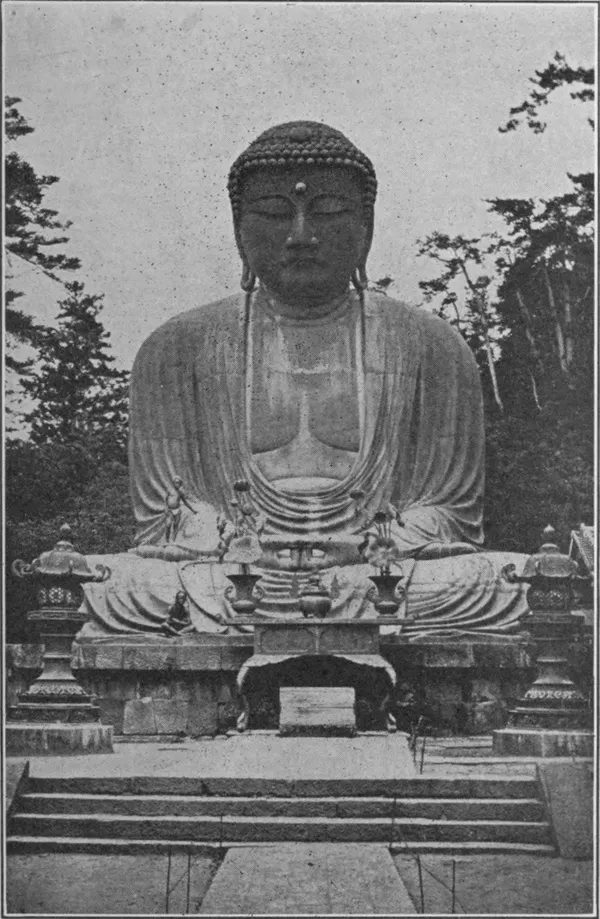
Frith
THE GREAT BUDDHA AT KAMAKURA, IN JAPAN
Professor Kohler points out that in the history of the
world’s religions, although the belief in the omnipotence of God has become so
widespread, it is not thought inconsistent that a Buddha, claiming to incarnate
the Supreme Being completely within himself, should appear.
Man’s Craving for Religion
Beginnings of Nature Worship
The Realm of Shadows
Religion is belief in God; that is, belief in spiritual forces
inseparable from and interwoven through the universe—forces that
render all things distinct and separate, yet make all coalescent and
firm, permeating all, and giving to every object its individuality.
Man is impelled by Nature to conceive of the universe as divine. This
idea exhibits itself universally among primitive folk in the form
of animism—a belief that the entire internal and external world is
animated, filled with supernatural beings that have originally no
determinate nature, but which may appear in the most varied of forms,
may vanish and may create themselves anew, as clouds arise from unseen
vapour in the air. Spirits are supposed to be not far removed from
man; families as well as individuals consider themselves to stand more
or less in connection with them; and men, too, have a share in the
invisible world when they have cast aside the garment of the body in
dream or in death. Thus, every man is thought to have his protecting
spirit, his manitou, that reveals itself to him through signs and
dreams. Special incarnations, objects in which supernatural beings
are inherent or with which they are in some way connected, are called
“fetiches”; hence arises fetichism, in regard to which the strangest
ideas were held in previous centuries when the science of anthropology
was unknown. Trees, rocks, rivers, bits of wood, images of one’s own
making—any of these are thought capable of containing beings of divine
nature. Naturally, the tree or the fragment of wood or of stone is not
worshipped, as men formerly thought, but the spirit that is believed
to have entered it. In many cases the belief approaches worship of
Nature, especially among agricultural peoples. Divinity is recognised
in the shape of factors essential to agriculture—sun, sky, lightning,
thunder; these being the beneficent deities, in contrast to whom are
the earth-spirits who bring pestilences, earthquakes, and other evils
to mankind. Thus the cult is refined; spirits are no longer attached
to fetiches, but men worship the heavens, and the earth also. Religion
accompanies man from birth to death. Spirits both for good and for evil
are supposed to hover about him at his very birth. The soul of some
being—perhaps an animal, perhaps an ancestor—enters into the new-born
child, and from this spirit he receives his name.
Oftentimes there is a new consecration at the time of marriage;
often when an heir-apparent succeeds to the chieftainship. At his
decease primitive folk believe that man enters the realm of shadows.
At first he hovers over the sea or river of death, and often only
after having passed through many hardships does he arrive in the new
kingdom, where he either continues to live after the manner of his
former existence, or, according to whether his life on earth has been
good or evil, inhabits a higher or a lower supernatural sphere. To
the dead are consecrated their personal possessions—horses, slaves,
wives even—that they may make use of them during the new existence;
men go head-hunting in order to send them new helpmates. On the other
hand great care is often taken that the spirits of the departed,
satisfied with their new existence, may no longer molest the world of
the living: propitiative offerings are made; men avoid mentioning the
name of the departed, that he may not be tempted to visit them with
his presence; they seek to make themselves unrecognisable during the
time immediately following his death, wear different clothes, and adopt
other dwelling-places. Sometimes the light placed near the deceased for
the purpose of guiding him back to his old home is moved further and
further away, so that his ghost, unable to find the right path, shall
never return.
Thus the belief in spirits encompasses primitive man, following him
step by step.
The Belief in Many Gods
Happiness found in Religion
From animism develops worship of heroes and polytheism, with their
attendant mythological narrations. The idea of the unity of the
supernatural world becomes lost; and the indefinite forms of spirit
become separate, independent beings, that are developed more and
more in the direction of the souls either of animals or of men.
This splitting up of the deity, which destroys the tendency toward
unity in religion, is followed by a reaction that comes about partly
through a belief in creation by a father of the gods, partly through
acceptance of a historical origin of the mythological world from a
single source (theogonic myths), and partly through direct banishment
of the plurality of gods and a new formation of the belief in a unity
according either to theistic or to pantheistic ideas. In spite of the
conception of a world permeated and pervaded by God alone, the belief
that certain persons and places are more powerful in respect to the
divinity than others is retained; and the appearance from time to time
of a Buddha who incarnates and manifests the Supreme Being directly and
completely within himself—in a special manner apart from other natural
phenomena—is also not looked upon as inconsistent.
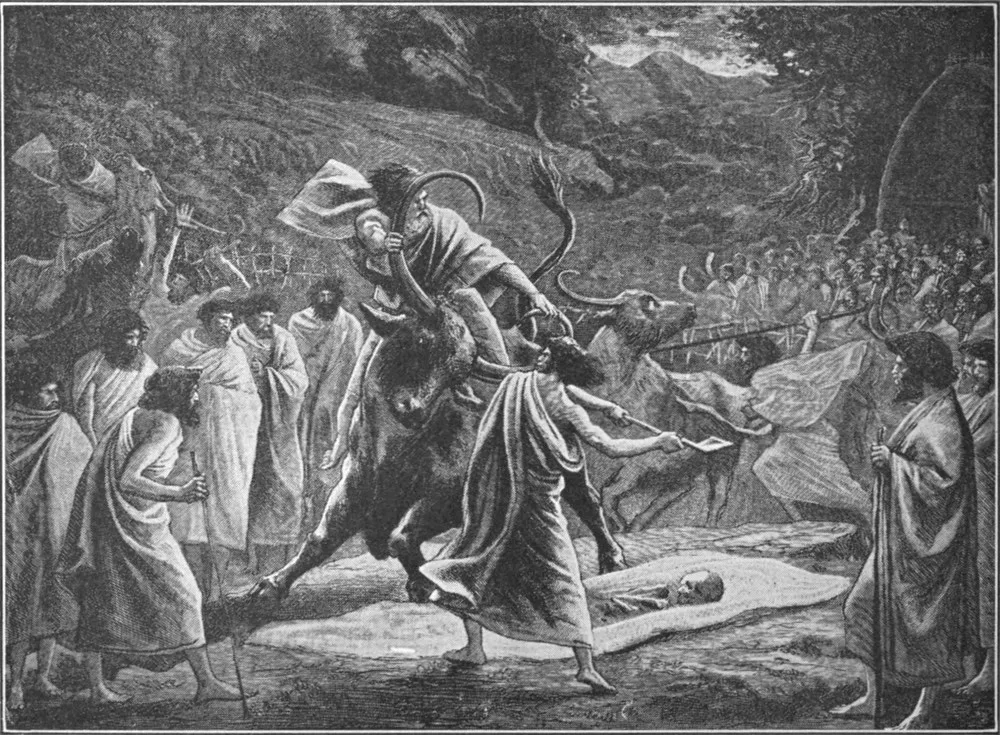
A STRANGE RELIGIOUS RITE: FUNERAL SACRIFICE OF THE TODAS
IN SOUTHERN INDIA
The elaborate and extraordinary funeral rites of the Todas
illustrate admirably the older notions of life and death. A funeral endures for
several days; the body is cremated; last of all the buffaloes of the deceased
are slaughtered at the grave and thought to enter into mystic reunion with their
master. In olden times a whole troop would be slaughtered, but under British
influence the number has been limited to one for a common person and two for a
chief.
Religion is a thing of the emotions, not merely in the sense of having
its origin in fear, or in the remembrance of lasting sensations derived
from visions or dreams, but emotional in so far that it satisfies
the necessity felt by men for a consistent life-conception—not an
intellectual but an emotional conception. It is not the matter-of-fact
desire for knowledge that finds its expression in religion, but the
joy of the heart in a supreme power, the call for help of the needy,
and the consciousness of our own insignificance and our mortality.
Judgment is not yet abstracted from the other psychic functions;
indeed, it really retires behind the emotions.
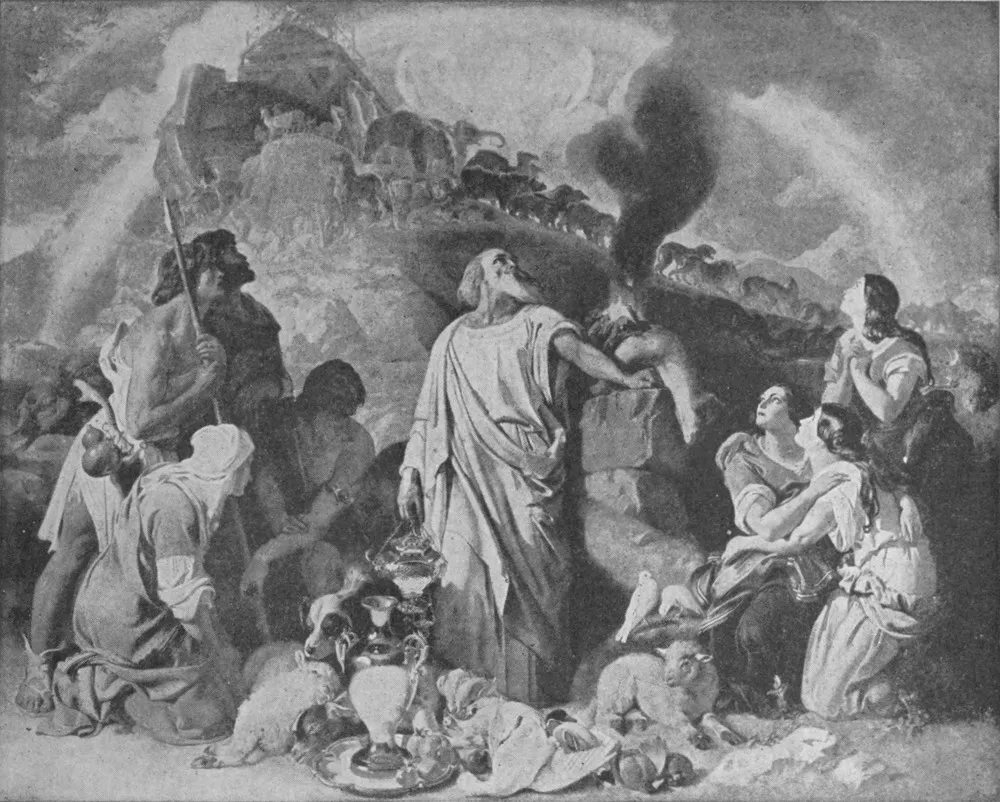
NOAH’S SACRIFICE
From the painting by Daniel Maclise, R.A.
The Basis of Worship
The Growth of the Priesthood
When men thus believe in divinity, if the belief have an active
influence on the emotions, it follows that the individual must
establish some connection between himself and the object of his
worship. This is brought about through certain actions, or through the
creation of circumstances in which special conditions of consecration
are perceived, and therewith the possibility of a close relationship
with the Supreme Being. The acts through which this relationship may be
brought about, taken collectively, are embraced in the word “worship,”
and if performed according to a strict system they are called “rites.”
Sacrifice has an important place among the ceremonies observed in
accordance with ritual. It is based on a conception of the wants and
necessities of the higher beings, and, in later times, is refined
into a representation of man’s ethical feelings—unselfishness and
gratitude, which give pleasure to the Deity and thus contribute to
its happiness. But sacrifice does not retain its unselfish character
for any great length of time. Man thinks of himself first: he makes
offerings to the good spirits, but more particularly to the evil
gods, in order to pacify their fury and appease their evil desires.
Sacrifices are also offered to the dead, and from such offerings and
memorials is developed the idea of a “family” or “clan,” which outlives
the individual.
Thus, emotion is the principal active agent; but intellectual power
also must gradually lay its hold on the system of belief. The
principles discovered are formulated into a science and the cultivation
of this science becomes the special duty of the priesthood, often as
a secret art—esoteric system—in which concealment is conducive to
the maintenance of the exclusiveness and peculiar power of the priest
class. The science becomes partly mythologic-historical, partly
dogmatic, and partly ritualistic.
Out of Religion Came Art
The artistic instinct develops partly in connection with worship,
partly in the direction of its practical application to life; and
although no very sharp line of distinction is drawn between the two
tendencies, the germ at least of the difference between the fine
and the industrial arts is thus in existence from the very earliest
times. Worship gives rise to images and pictures, at first of the
very roughest form. They are not mere symbols; they are the garments
or habitations with which the spirit invests itself. The spirit
may take up its abode anywhere according to the different beliefs
of man—in a plant, an animal, a stone, above all, in a picture or
effigy that symbolically reflects its peculiarities. Therefore, the
ghosts of ancestors are embodied in ancestral images. Just as skulls
were reverenced in earlier times, in later days the images of the
dead (korwar) are worshipped. Such images are the oldest examples
of the art of portraiture; and the oldest dolls are the rude puppets
which according to the rites of many races—the American Indians, for
example—widows must wear about them as tokens, or as the husks or
wrappers of their husbands’ doubles.
Religion itself becomes poetry. The belief in the identity of spirits
of the departed with animals, and the myths of metamorphosis, take
the form of fables and fairy tales; the cosmogonic and theogonic
conceptions develop into mythologies; hero sagas become epics; the
myths of life in Nature become a glorification of the external world,
an expression of unity with Nature, and thus a form of lyric poetry.
Artistic Expression of Life
Everyday life, too, demands artistic expression. At first the childish
passion for the changing pictures that correspond with different ideas
of the imagination joins with the desire to impress others, and finery
in dress and ornamentation result. This has developed in every clime.
Tattooing arises not only from a religious motive, but also from the
desire for ornament. The painting of men’s bodies, the often grotesque
ideas, such as artificial deformation of the head, knocking out and
blackening of teeth, ear ornaments and mutilation of ears, pegs thrust
through the lips, and various methods of dressing the hair, may be in
part connected with religious conceptions, for here the most varied of
motives co-operate to the same end. Yet, on the other hand, there is no
doubt that they are also the outcome of a craving for variation in form
and in colour. In the same way the dance is not only an act of worship;
it is also a means of giving vent to latent animal spirits: thus,
dances are often expressions of the tempestuous sensual instincts of a
people.
The Birth of the Drama
The dance exhibits a special tendency to represent the ordinary affairs
of life in a symbolic manner; thus there are war and hunting dances,
and especially animal dances in which each of the participants believes
himself to be permeated by the spirit of some animal which throughout
the dance he endeavours to mimic. In this way dramatic representation,
which is certainly based on the idea of personification, on the notion
that a man for the time being may be possessed by the spirit of some
other creature that speaks and acts through him, originates. Thus
arose the primitive form of masques, in which men dressed themselves
up to resemble various creatures, real or imaginary, as in the case
of the animal masques of old time; for according to the popular idea
the spirit dwells in the external, visible form, and through the
imitation or adoption of its outward appearance we become identified
with the spirit whose character we assume. Among many races not only
masks proper were worn, but also the hides and hair or feathers of the
creatures personated. Dramatic representation was furthered by the
dream plays—especially popular among the American Indians—in which
the events of dreams are adapted for acting and performed. Even as men
seek illumination in dreams as to questions both divine and mundane, so
do they anticipate through dreams the dramatic representations which
shall be performed on holidays as expressions of life.
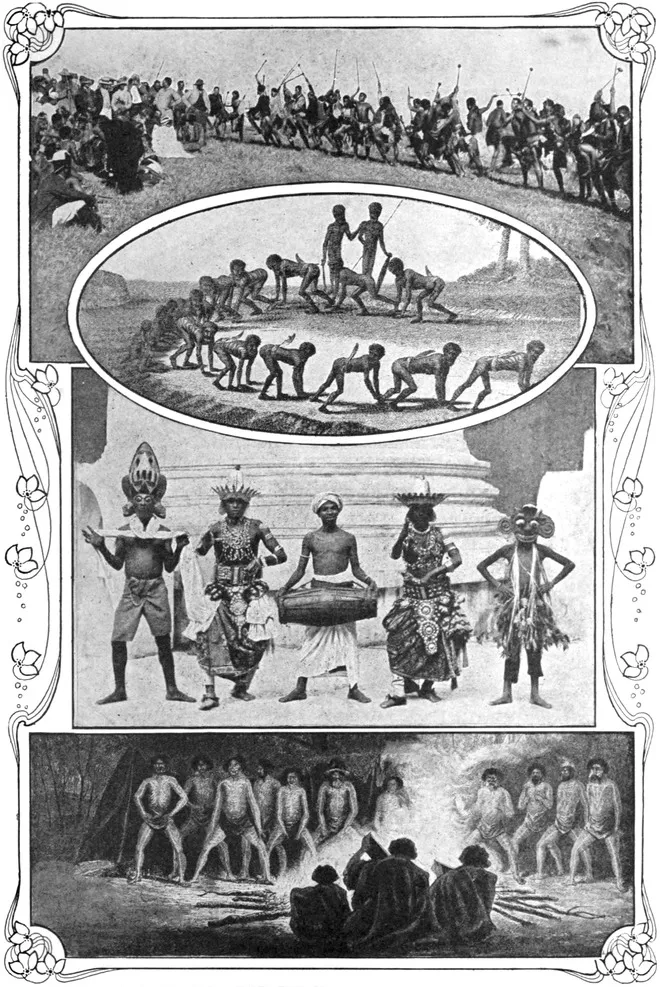
SAVAGE DANCES: THE FAR-OFF BEGINNINGS OF THE DRAMA
The dance is an effort to give symbolic expression to
affairs and moods of everyday life. Thus the Zulu wedding dance is self-evident
in its purpose. The second illustration depicts a strange religious dance of the
Australian natives, associated with totemism or animism. The third picture shows
dancers in Kandy endeavouring to banish evil spirits, and the last illustrates an
Australian corroboree. From such sources the drama has been slowly evolved.
LARGER
IMAGE
Art & Play in the Life of Man
Play is a degeneration of the dance, and it arises less from
the instinct for beauty than from a desire to realise whatever
entertainment and excitement may be got from any incident or
occurrence. From another special inclination originate those satirical
songs of Northern peoples, written in alternating verses, in which
the national tribunal and the voice of the people are given expression
at the same time. Thus they have a truly educative character. These are
the preliminary steps to the free satire and humour that gleam through
the lives of civilised peoples, now like the flicker of a candle, now
like a purifying lightning flash, freeing men from life’s monotony, and
illuminating the night of unsolved questions. Capacity for organised
play is a characteristic that lifts man above the lower animals. The
expression of individuality without any particular object in view,
the elevation of self above the troubles of life, and free activity,
uncoerced by the necessities of existence, are characteristic both of
play and of art. Thus play, as well as art, exhibits to a pre-eminent
degree man’s consciousness of having escaped, if only temporarily,
from the coercion of environing nature; being without definite object,
it proves that he can find employment when released from the pressure
of the outer world—that is, when he is momentarily freed from his
endeavour to establish a balance between himself and the necessities
of life, with a view to overcoming the latter. Man stands in close
connection with his environment and with the immutable laws of nature;
but in play and in art he develops his own personality—a development
that neither in direction nor in object is influenced by the outer
world and its constraint.
Fall of Man and Rise of the Race
The step that leads to the overcoming of custom is the recognition
of right. “Right” is that which society strictly demands from every
individual member. Not all that is customary is exacted by right;
a multitude of the requirements of custom may be ignored without
opposition from the community as a whole, although, of course, detached
individuals may express their displeasure. The aggregate, however,
grants immunity to all who do not choose to follow the custom. In other
words, the separation of custom from right signifies the development
of a sharper line of demarcation between that which is and that which
ought to be. In primitive times “is” and “ought to be” are fairly
consonant terms; but gradually a spirit of opposition is developed;
cases arise in which custom is opposed, in which the actions of men
run counter to a previous habit. Man is conscious of the possibility
of raising himself above the unreasoning tendencies toward certain
modes of conduct, and he takes pleasure in so doing—the good man as
well as the evil. Whoever oversteps the bounds of custom, even through
sheer egotism, is also a furtherer of human development; without sin
the world would never have evolved a civilisation; the Fall of Man was
nothing more than the first step toward the historical development of
the human race.
This leads to the necessity for extracting from custom such rules
as must prove advantageous to mankind, and this collection of
axioms—which “ought to be”—becomes law.
Custom, Right, and Morality
The distinction between right and custom was an important step. The
relativity of custom was exposed with one stroke. Many, and by no means
the worst members of communities, emancipate themselves from custom. It
is the opening in the wall through which the progress of humanity may
pass. Nor do the demands of right remain unalterable and unyielding.
A change in custom brings with it a change in right; certain rules of
conduct gradually become isolated owing to the recession of custom,
and to such an extent that they lose their vitality and decay. And
as new customs arise, so are new principles of right discovered.
In this manner an alteration in the one is a cause of change in
the other—naturally, in conformity with the degree of culture and
contemporary social relations. Custom and right mutually further each
other, and render it possible for men to adapt themselves to newly
acquired conditions of civilisation.
Together with right and custom a third factor appears—morality. This
is a comparatively late acquisition. It, too, contains something of
the “ought to be,” not because of the social, but by virtue of the
divine authority or order based on philosophical conceptions. Morals
vary, therefore, as laws vary, according to peoples and to times. The
rules of morality form a second code, set above the social law, and
they embody a larger aggregate of duties. The reason for this is that
men recognise that the social system of rules for conduct is not the
only one, that it is only relative and cannot include all the duties
of human beings, and that over and beyond the laws of society ethical
principles exist.
Naturally conflicts arise between right and morals, and such struggles
lead to further development and progress.
The late appearance of ideas of morality proves that ethical
considerations were originally foreign to the god-conceptions. The
spirits, fetiches, and world-creators of different beliefs are at
first neutral so far as morals are concerned; myths and legends are
invented partly from creation theories, partly from historic data, and
partly through efforts of the imagination. In primitive beliefs there
is no trace of an attempt to conceive of deities as being good in the
highest—or even in a lower—sense; and it would not be in accordance
with scientific ethnology to appraise, or to wish to pass judgment
on, religions according to the point of view of ethics. Not until the
importance of morality in life is realised, and the profound value
of a life of moral purity recognised, do men seek in their religious
beliefs for higher beings of ethical significance, for morally perfect
personalities among the gods.
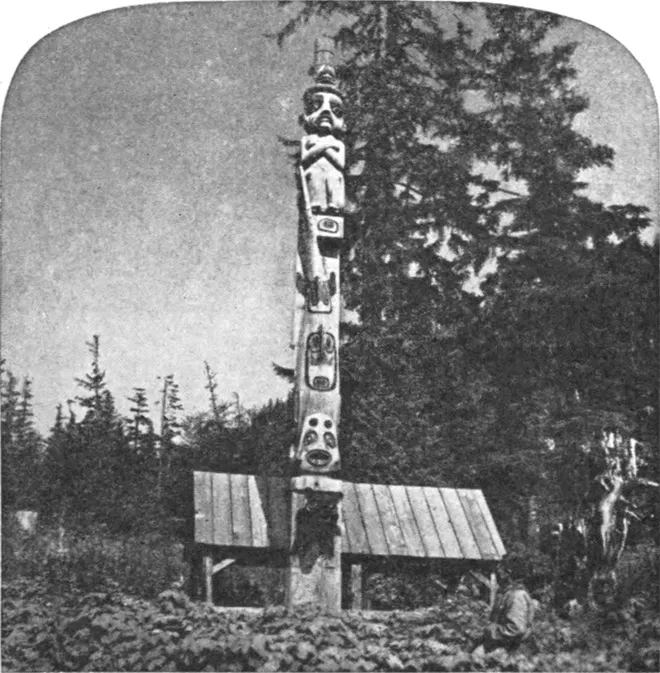
Underwood & Underwood
THE EMBLEM OF A TRIBE: ALASKAN INDIAN TOTEM
This mysterious “totem” distinguishes a family or tribe of
the old Hydah Indians and is erected at Wrangel in Alaska.
Different elements of civilisation vary greatly in their development
in different civilised districts; one race may have a greater tendency
toward intellectual, another toward material culture. No race has
approached the Hindoos in philosophic speculation, yet they are as
children in their knowledge of natural science. One people may develop
commerce to the highest extent, another poetry and music, a third the
freedom of the individual. The language of the American Indians is in
many respects richer and more elegant than English. Therefore nothing
is farther from the truth than to say that, in case one institution of
civilised life is found to exist in a hunting people, another in an
agricultural race, or the one in an otherwise higher, and the other
in an otherwise lower nation or tribe, the institution in question
must have reached a state of perfection corresponding with the general
development of the people possessing it. According to this, the
monogamic uncivilised races were further advanced than the polygamous
Aryans of India and the Mohammedans; and the Polynesians, with their
skill in the industrial arts and their dramatic dances, perhaps in a
higher state of civilisation than Europeans!
Development fulfils itself in communities of men. Except in a human
aggregate it cannot come to pass; for the germs of development which
are brought forth by the potentiated activity of the many may exist
only in a society of individuals.
It has therefore been a significant fact that from the very beginning
men have joined together in social aggregates, partly on account of an
instinctive impulse, partly because of the necessity for self-defence.
Thus it came about that primitive men lived together in wandering,
predatory hordes, or packs. The individuals were bound to one another
very closely; there was no private life; and the sex-relationships were
promiscuous. Men not only dwelt together in groups, but the groups
themselves assimilated with one another, inasmuch as marriages were
reciprocally entered into by them. So far as we are able to determine,
one of the earliest of social institutions was that of group-marriage.
Individuals did not first unite in pairs, and then join together
in groups—such would soon have fallen asunder; on the contrary,
group-marriage itself created the bond that held the community
together; the most violent instinct of mankind not only united the few
but the many, indeed, complete social aggregates.
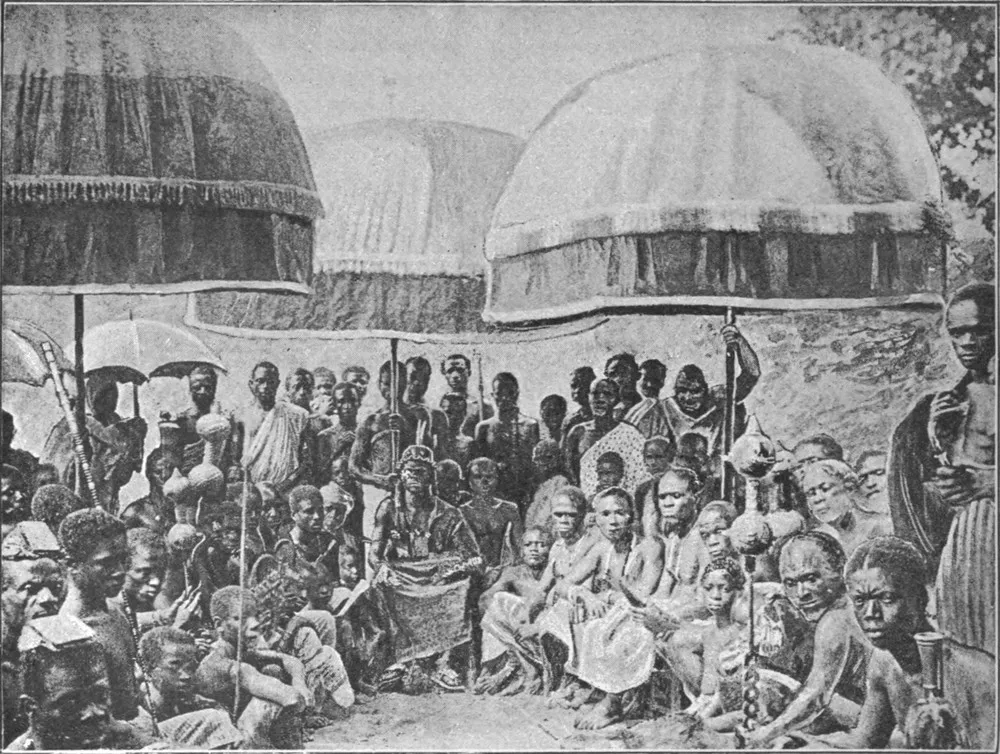
THE BEGINNINGS OF MONARCHY: AFRICAN CHIEF SEATED IN
STATE AMONG HIS HEADMEN
The tribal state has a fixed form of government. The
chiefs or patriarchs of the various families stand at the head of affairs, the
position of chief being either hereditary or elective. In most cases, however,
it is determined by a combination of both methods, a blood descendant being
chosen, provided he is able to give proof of his competence.
Group-marriage is the form of union established by the association of
two hordes, or packs, according to which the men of one group marry the
women of the other; not a marriage of individual men with individual
women, but a promiscuous relationship, each man of one group marrying
all the women of the other group—at least in theory—and vice versâ;
not a marriage of individuals, but of aggregates. Certainly with such
a sex-relationship established, sooner or later regulations develop
from within the community, through which the marital relationships of
individuals are adjusted in a consistent manner; but the principle
first followed was, as community in property, so community in marriage;
and this must of itself lead to kinships entirely different from those
with which we are familiar.
Group-marriage was closely bound up with religious conceptions; single
hordes, or packs, considered themselves the embodiment of a single
spirit. And since at that time spirits were only conceived of as things
that existed in nature, the horde felt itself to be a single class of
natural object—some animal or plant, for example; and the union of
one pack with another was analogous to the union of one animal with
another. Each group believed itself to be permeated by the spirit of
a certain species of animal, borrowed its name thence and the animal
species itself was looked upon as the protecting spirit. The ancestral
spirit was worshipped in the animal, and the putting to death or
injuring of an individual of the species was a serious offence.
Such a belief is called Totemism. “Totem”—a word borrowed from the
language of the Massachusetts Indians—is the natural object or animal
assumed as the emblem of the horde or tribe, and correspondingly the
group symbolised by the class of animal or natural object is called a
Totem-group.
This belief led to a close union of all who were partakers of the
spirit of the same animal; it also strictly determined which groups
could associate with one another. And as the totem-group mimicked the
animal in its dances, and fancied itself to be possessed by its spirit,
it also ordered the methods of partaking of food, and all marriage,
birth, and death ceremonies in accordance with this conception. It
is said that, the totem being exogamous, marriages were not possible
within the totem, but only without it. Precisely so; for the original
conception was not that individuals formed unions, but that the whole
totem entered the marriage relationship; a single marriage would have
been considered an impossibility.
To which totem the children belonged—to the mother’s, to the father’s,
or to a third totem—was a question that offered considerable
difficulty. All three possibilities presented themselves; the last
mentioned, however, only in case the child belonged to another group,
a sub-totem, and in that event its descendants could return to the
original totem.
The First Ideas of Kinship
Descent in the male or in the female line occasioned in later times
the rise of important distinctions between nations. If a child follow
the mother’s totem, we speak of “maternal kinship”; conversely, of
“paternal kinship” in case of heredity through the father. Which of
these is the more primitive, or did tribes from the very first adopt
either one or the other system, thus making them of equal antiquity, is
a much-vexed question. There is reason to believe that maternal kinship
is the more primitive form, and that races have either passed with more
or less energy and rapidity to the system of descent through males, or
have kept to the original institution of maternal succession. There
are many peoples among whom both forms of kinship exist, and in such
instances the maternal is undoubtedly the more primitive; from this it
appears very probable that development has thus taken place, the more
so since there are traces of maternal kinship to be found in races
whose established form is paternal.
Growth of Marriage
As time passed, marriage of individuals developed from group-marriage
or totemism. Such unions may be polygamous—one man having several
wives—or polyandrous—one woman having several husbands. Both forms
have been represented in mankind, and, indeed, polygamy is the general
rule among all races, excepting Occidental civilised peoples. The
form of marriage toward which civilisation is advancing is certainly
monogamy; through it a complete individual relationship is established
between man and wife; and although both individualities may have
independent expression, each is reconciled to the other through the
loftier association of both. Nearly associated with
monogamy is the belief in union after death; it arises from the
religious beliefs prevalent among many peoples. Among other races there
is at least the custom of a year of mourning, sometimes for husband,
sometimes for wife, often for both.
Marriage of individuals has developed in different ways from group
or totem marriage: sometimes it was brought about through lack of
subsistence occasioned by many men dwelling together; sometimes it
arose from other causes. One factor was the practice of wife-capture:
whoever carried off a wife freed her, as it were, from the authority
of the community, and established a separate marriage for himself.
Marriage by purchase was an outcome of marriage by capture and of the
paying of an indemnity to the relatives of the bride; men also learned
to agree beforehand as to the equivalent to be paid. The practice of
acquiring wives by purchase developed in various directions, especially
in that of trading wives and in the earning of wives by years of
service. Gradually the purchase became merely a feigned transaction;
and a union of individuals has evolved—now sacerdotal, now civil in
form—from which every trace of traffic and of exchange has disappeared.
Religion Ennobles Marriage
Thus already in early times marriage had become ennobled through
religion. It is a widespread idea that through partaking of food in
common, blood-brotherhood, or similar procedures, a mystic communion of
soul may be established; and in case of marriages brought about by the
mediation of a priesthood the priest invokes the divine consecration.
Marriage is thereby raised above the bulk of profane actions of life;
it receives a certain guarantee of permanency; indeed, in many cases,
by reason of the mystic communion of souls, it is looked upon as
absolutely indissoluble.
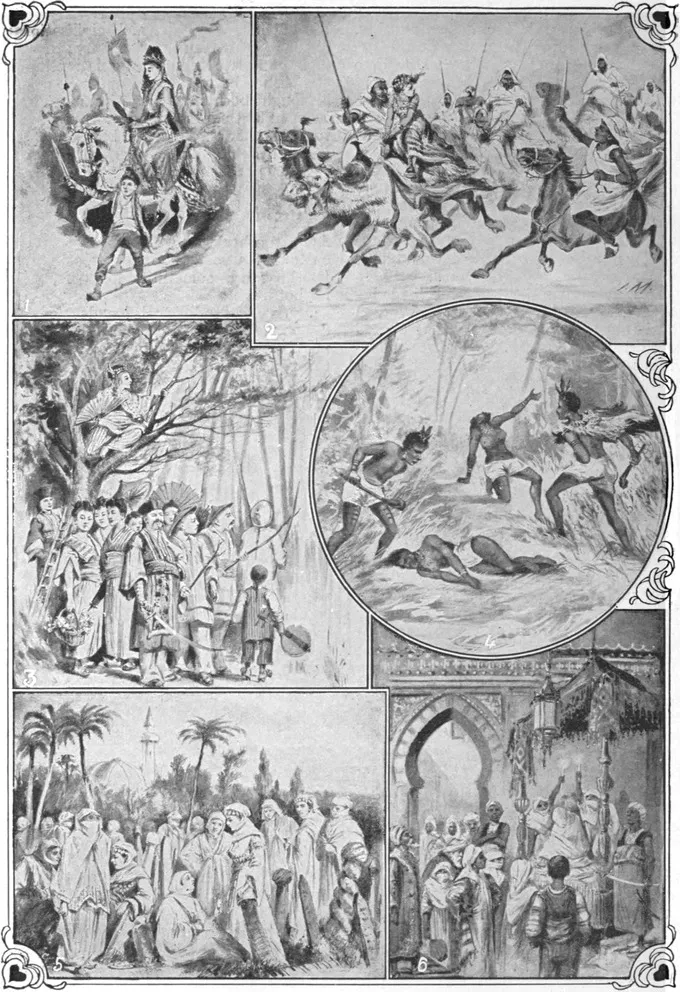
THE IDEA OF MARRIAGE: WEDDING CUSTOMS IN MANY LANDS
In countries where women are subservient to men the idea
of marriage by capture or by compulsion prevails. The Bedouin bride (2) makes a
pretence of escaping and is pursued by the bridegroom and his kinsmen. Some
Africans (4) show their love by knocking down their prospective brides. The
Moorish bride (6) shrouded and seated in bed is an object of curiosity. 1, 3,
and 5 represent respectively the marriage customs of Persians, Chinese, and
Moslems.
LARGER
IMAGE
The ownership of property also was originally communistic, and the
idea of individual possession has been a gradual development. The idea
of the ownership of land, especially when developed by agricultural
peoples, is of a communistic nature; and, from common possession,
family and individual ownership gradually comes into being. It is
brought about in various ways, chiefly through the division of land
among separate families: at first only temporary, held only until the
time for a succeeding division arrives; later, owned in perpetuity. Nor
was it a rare method of procedure to grant land to any one who desired
to cultivate it—an estate that should be his so long as he remained
upon it and cultivated the soil, but which reverted to the community,
on his leaving it. There gradually developed a constant relationship
between land and cultivator as agriculture became more extended and
lasting improvements were effected on the soil. Land became the
permanent property of the individual; it also became an article of
commerce.
Ownership of movable property even was at first of communistic
character. Clothing and weapons, enchantments effectual for the
individual alone, such as medicine-bags or amulets, were, to be sure,
assigned to individuals in very early times; but all property obtained
by labour, the products of the chase or of fishing, originally belonged
to the community, until in later days each family was allowed to claim
the fruits of its own toil, and was only pledged to share with the
others under certain conditions. Finally, individuals were permitted
to retain or to barter property which they had produced by labour; and
exchange, especially exchange between individuals, attained special
significance through the division of labour.
The individualisation of the ownership of movable property was
especially furthered by members of families performing other labour,
outside the family, in addition to their work within the family circle.
Although the fruit of all labour accomplished within the family was
shared by the members in common, the results of work done outside
became the property of the particular individual who had performed the
labour. Consequent expansion of the conception of labour led men to
one of the greatest triumphs of justice, to the idea of establishing
individual rights in ideas and in combinations of ideas, to the
recognition of intellectual or immaterial property—right of author or
inventor—one of the chief incentives to modern civilisation.
THE CHURCH AND MARRIAGE: A WEDDING SCENE
In very early times marriage had assumed a religious
significance and came to be regarded among the sacred as opposed to the secular
functions of life.
On the other hand, individual rights in transactions led to conceptions
concerning obligations and debts. Exchange, either direct or on terms
of credit, brought with it duties and liabilities for which originally
the persons and lives of the individuals concerned were held in pledge,
until custody of the body—which also included possession of the corpse
of a debtor—was succeeded by public imprisonment for debt, and finally
by the mere pledging of property, imprisonment for debt having been
abolished—a course of development through which the most varied of
races have passed.
Rights of Property
The relation of the individual to his possessions led men at first to
place movable property in graves, in order that it might be of service
to the departed owner during the life beyond; hence the universal
custom of burning on funeral pyres, not only weapons and utensils, but
animals, slaves, and even wives. In later times men were satisfied with
symbolic immolations, or possessions were released from the ban of
death and put into further use. The property of the deceased reverted
to his family, and thus the right of inheritance arose. There was no
right of inheritance during the days of communism; on the death of a
member of the family a mere general consolidation of property resulted;
with individual property arose the reversion of possessions to the
family from which they had been temporarily separated. Thus property
either reverted to the family taken as a whole, or to single heirs,
certain members of the family; hence a great variety of procedure
arose. Up to the present day inheritance by all the children, or
inheritance by one alone, exists in Eastern Asia as in Western nations.
In like manner criminal responsibility was originally collective;
the family or clan was held responsible for the actions of all its
individual members except those who were renounced and made outcasts.
Such methods of collective surety still exist among many exceedingly
developed peoples; but the system is gradually dying away, the tendency
being for the entire responsibility to rest upon the individual alone.
Beginning of the Community
The state is a development of tribal, or patriarchal, society. The
tribal group is a community of intermarried families, all claiming
descent from a common ancestor. From tribal organisation the principle
is developed that participation in the community is open only to such
individuals as belong to one or other of the families of which it is
composed; and the political body thus made up of individuals related
either by blood or through marriage is called a patriarchal, or
tribal, state. This form of community was enlarged even in very early
times, advantage being taken of the possibility of adopting strangers
into the circle of related families, and of amalgamating with them.
Still, the fundamental idea that the community is composed of related
families always remains uppermost in the minds of uncivilised peoples.
The tribal state gradually develops into the territorial state. The
connection of the community with a definite region becomes closer;
strange tribes settle in the same district; they are permitted to
remain provided tribute is paid and services are performed, and are
gradually absorbed into the community, the strangers and the original
inhabitants—plebeians and patricians—united together into one
aggregate. Thus arises the conception of a state which any man may join
without his being a member of any one of the original clans or families.
Growth of the Idea of a State
In this way the idea of a state becomes distinct from that of a people
bound together by kinship, the latter being especially distinguished by
a certain unity of external appearance, custom, character, and manner
of thought. This is not intended to suggest that an amalgamation of
different race elements in a state and an assimilation of different
modes of thought and of feeling are not desirable, or that a spirit
analogous to the sense of unity in members of the same family is not
to be sought for; such a condition is most likely to be attained
if a certain tribe or clan take precedence of the others, as the
most progressive, to which the various elements of the people annex
themselves.
“IN THE NAME OF JUSTICE”: SOME OLD METHODS OF TORTURE
These pictures represent: 1. Roman gaolers cutting off a
Christian’s ears. 2. The cangue as still used in China. 3. A prisoner on the rack
in Mediæval England. 4. Torture of the Iron Chair. 5. The ordeal of fire and
branding.
LARGER
IMAGE
Tribes and their Chiefs
The tribal state has a fixed form of government. The chiefs or
patriarchs of the various families stand at the head of affairs, the
position of chief being either hereditary or elective. In most cases,
however, it is determined by a combination of both methods, a blood
descendant being chosen provided he is able to give proof of his
competence. In addition there is often the popular assembly. In later
times many innovations are introduced. Passion for power united to a
strong personality often leads to a chieftainship in which all rights
and privileges are absorbed or united in the person of one individual;
so that he appears as the possessor of all prerogatives and titles,
those of other men being entirely secondary, and all being more or
less dependent upon his will. Religious conceptions, especially,
have had great influence in this connection. Nowhere is this so
clearly shown as in “teknonymy,” an institution formerly prevalent
in the South Pacific islands, according to which the soul of the
father is supposed to enter the body of his eldest son at the birth
of the latter, and that therefore, immediately from his birth, the
son becomes master, the father continuing the management of affairs
merely as his proxy. Other peoples have avoided such consequences
as these by supposing the child to be possessed by the soul of his
grandfather, therefore naming first-born males after their grandfathers
instead of after their fathers. Another outcome of the institution of
chieftainship is the chaotic order of affairs which rules among many
peoples on the death of the chieftain, continuing until a successor
is seated on the throne—a lawless interval of anarchy followed by a
regency.
The power of a chieftain is, however, usually limited by class rights;
that is, by the rights of sub-chieftains of especially distinguished
families, and of the popular assembly, among which elements the
division of power and of jurisdiction is exceedingly varied. These
primitive institutions are rude prototypes of future varieties of
coercive government, of kingship, either of aristocratic or of
republican form, in which the primitive idea of chieftainship as the
absorption of all private privileges is given up, and in its place the
various principles of rights and duties of government enter.
Growth of Military Classes
Class-differentiation with attendant privileges and prerogatives is
especially developed in warlike races, and in nations which must be
ever prepared to resist the attacks of enemies, by the establishment of
a militant class. The militant class occupies an intermediate position
between the governing, priest, and scholar classes on the one hand,
and the industrial class—agriculturists, craftsmen, merchants—on the
other. Employment in warfare, necessary discipline, near association
with the chieftain, and the holding of fiefs for material support give
to this class a unique position. Thus the warrior castes developed
in India, the feudal and military nobility in Japan, the nobility in
Germany, with obligations and service to feudal superiors and to the
Court. This system survives for many years, until at last feudal tenure
gradually disappears, and its attendant prerogatives are swallowed up
by all classes through a universal subjection to military service;
although even yet a distinct class of professional soldiers remains at
the head of military affairs and operations, and will continue to do
so as long as there is a possibility of internal or external warfare.
However, here too the militant class is absorbed into a general body
of officials. Officials are citizens who not only occupy the usual
position of members of the state, but to whom in addition is appointed
the execution of the life functions of the nation, as its organs; in
other words, such functions as are peculiar to the civic organisation
in contradistinction to the general functions exercised and actions
performed by individual citizens as independent units. Officialism
includes to a special degree duty to its calling and to the public
trust, and there are also special privileges granted to officials
within the sphere appointed for them.
The Birth of Parliaments
In a society governed by a chieftain, as well as in a monarchy, there
is a popular assembly or consultative body; either an unorganised
meeting of individuals, or an organised convention of estates founded
on class right. A modern development, that certainly had its prototype
in the patriarchal state, is the representative assembly, an assembly
of individuals chosen to represent the people in place of the popular
gathering. The English Government, with its representative legislative
bodies, is a typical example in modern civilisation.
One of the chief problems encountered not only in a society ruled by a
chieftain, but also in states of later development, whether governed
by a potentate or by an aristocracy, is the relation of temporal to
spiritual power. Sometimes both are united in the head of the state, as
in the cases of the Incas of Peru and of the Caliphate. Sometimes the
spiritual head is distinct and separate from the temporal; frequently
the two forces are nearly associated, a member of the imperial family
being chosen for the office of high-priest, as among the Aztecs.
Often, however, the two functions are completely independent of each
other, as among many African races, the medicine-man occupying a
position entirely independent of the chieftain. Such separation may, of
course, lead to friction and civil war; it may also become an element
furthering to civilisation, a source of new ideas, opening the way
to alliances between nations, and setting bounds to the tyranny of
individuals, as exemplified in the relation of the Papacy to the Holy
Roman Empire.
State Justice a Momentous Step Forward
The form of state in which the functions of government are exercised
by a chieftain contributes greatly to state control and enforcement
of justice. The realisation of right had been from the first a social
function; but its enforcement was incumbent on the unit group of
individuals (families or tribes bound together by friendship). The
acquisition by the state of the power to dispense justice and to make
and enforce law is one of the greatest events of the world’s history.
The idea of all right being incorporated in the chieftain (and social
classes) played an important part in bringing about this condition of
affairs; for as soon as this conception receives general acceptance,
the chieftain, and with him the state, become interested in the
preservation and enforcement of justice, even in its lower forms in
the common rights of the subjects. On the other hand, not only the
interests of chieftainship, but also those of agriculture and commerce,
are furthered by the preservation of internal peace; and internal peace
calls for state control of justice and enforcement of law.
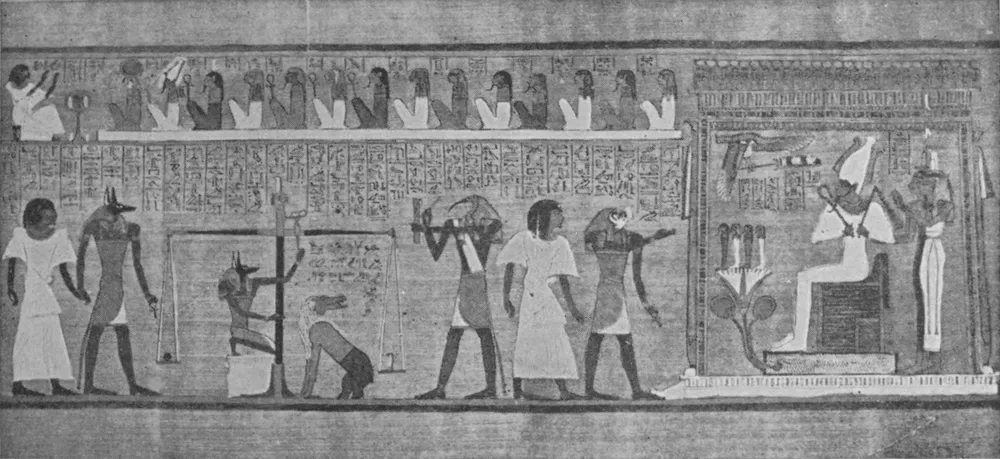
Mansell
AN EARLY EGYPTIAN REPRESENTATION OF JUSTICE
“The Judgment of the Dead” as illustrated by innumerable
paintings on the walls of Egyptian temples and tombs.
Moreover the religious element worked to the same end. Wickedness was
held to be an injury to the deity, whose anger would be visited upon
the entire land—a conception that lasted far into the Middle Ages,
and according to which the fate of Sodom and Gomorrah was held to be
typical of the effect of the curse of God. Already in primitive times
religion led to a strange idea of justice—secret societies consecrated
by the deity took upon themselves the function of enforcing right,
instituting reigns of terror in their districts, maintaining order in
society, and claiming authorisation from the god with whose spirit
they were permeated. Later, influenced by all these causes, the social
aggregate took over the control of justice. It was already considered
to be the upholder of right, the servant of the deity, the maintainer
of public peace, the dispenser of atoning sacrifices, etc.; and so
the various elements conceived of as justice, which had previously
been distributed among the single families, tribes, associations, and
societies, were combined, and placed under state control.
AN EARLY CONCEPTION OF THE SPIRIT OF JUSTICE: THE
JUDGMENT OF SOLOMON
Reproduced from the picture by the French artist, Nicolas
Poussin, who flourished in the first half of the seventeenth century.
LARGER
IMAGE
THE MODERN IDEAL OF JUSTICE
From the fresco by Gerald Moira in the New Central
Criminal Court, London. Most of the figures are studies from well-known public
men of recent years.
LARGER
IMAGE
Terror & Tyranny of Religion
The Ordeal and the Curse
Certain forms for the dispensation of justice, judging of crimes, and
determining of punishments were developed. Thus arose the different
forms of judicial procedure, which, for a long time bore a religious
character. The deity was called upon to decide as to right and
wrong—divinity in the form of natural forces. Hence the judgments
of God through trial by water, fire, poison, serpents, scales,
or—especially in Germany during the Middle Ages—combat, or decision
by the divining eye, that was closely allied to the so-called trial by
hazard. A peculiar variety of ordeal is that of the bier, according
to which the body of a murdered man is called into requisition, the
soul of the victim assisting in the discovery of the murderer.
Ordeals are undergone sometimes by one individual, sometimes by two.
An advance in progress is the curse, which takes the place of the
ordeal, the curse of God being called down upon an individual and
his family in case of wrongdoing or of perjury. The curse may be
uttered by an individual in co-operation with the members of families.
Thus arise ordeals by invocation and by oath with compurgators.
Originally a certain period of time was allowed to pass—a month, for
example—for the fulfilment of the curse. In later times, whoever
took the oath—oath of innocence—was held guiltless. Witnesses
succeeded to conjurers; divining looks were replaced by circumstantial
evidence; and, instead of a mystic, a rational method of obtaining
testimony was adopted. The development was not attained without certain
attendant abuses; and the abolition of ordeal by God was among many
peoples—notably the inhabitants of Eastern Asia, the American Indians,
and the Germans of the Middle Ages—succeeded by the introduction of
torture. In many lands torture stood in close connection with the
judgment of God; in others it originated either directly or indirectly
in slavery. According to the method of obtaining evidence by torture,
the accused was forced through physical pain to disclosures concerning
himself and his companions, and, in case he himself were considered
guilty, to a confession. However barbarous and irrational, this system
was employed in Latin and Germanic nations excepting England, until the
eighteenth century, in some instances even until the nineteenth.
The Slow Building up of Law
Evolution of the Modern State
Judgment was first pronounced in the name of God; in later times,
in the name of the people or of the ruler who appeared as the
representative of God. The principles of justice, the validity of which
at first depends upon custom, are in later times proclaimed and fixed
as commands of God. Thus systems of fixed right come into being first
in the form of sacred justice, then as commands of God, and finally
as law. Law is a conception of justice expressed in certain rules and
principles. Originally there were no laws; the standard for justice was
furnished to each individual by his own feelings; only isolated cases
were recorded. As time advanced, and great men who strove to bring
about an improvement in justice arose above the generality of mankind;
when the ruling class became differentiated from the other classes;
when it was found necessary to root out certain popular customs—then,
in addition to the original collection of precedents, there arose law
of a higher form: law that stood above precedent, that altered custom,
and opened up new roads to justice. Great codes of law have not been
compilations only; they have led justice into new paths. Originally a
law was looked upon as an inviolable command of God, as unalterable
and eternal; its interpretation alone was earthly and transitory.
As years passed, men learned to recognise that laws themselves were
transitory; and it became a principle that later enactments could alter
earlier rules. The relations of later statutes to already established
law, and how the laws of different nations influence one another, are
difficult, much-vexed questions for the solution of which special
sciences have developed—transitory and international law. Judgment and
law are intimately concerned with justice, the conception of right as
evolved from the double action of life and custom. To this development
of justice is united an endeavour of the state or government not only
to further welfare by means of the creation and administration of
law, but also to take under its control civilising institutions of
all sorts. This was originally a feature of justice itself; certain
practices inimical to civilisation were interdicted and made punishable
offences. Already in the Middle Ages systems of police played a great
part among governmental institutions, especially in the smaller states.
Subsequently the idea was developed that not only protection through
the punishment of crime, but also superintendence of and promotion of
the public weal, should be administered by law; and thus the modern
state developed with its policy of national welfare. With this arose
the necessity for a sharper distinction to be drawn between justice and
the various actions of an administration; and thus in modern times men
have come to the system—based on Montesquieu—of the separation of
powers and independence of justice.
Justice varies according to the development of civilisation, and
according to the function that it must perform in this development; in
like manner every age creates its own material and spiritual culture.
Every poet is a poet of his own time.
Right Way to View History
The notion of natural right, however unhistorical it was in itself,
characterised a period of transition in so far as it enabled men to
form a historical conception—a conception of what might be: for, by
contrasting actual with ideal justice, we are enabled to escape the
bonds of the opinions of a particular time, and to look upon such
opinions and views objectively and independently. Yet it is certainly
a foolish proceeding to consider an ideal, deduced principally from
conceptions and opinions of the present, to be a standard by which
to measure the value of historical events of all times, sitting in
judgment over the great names of the past with the air of an inspector
of morals. The office of the historian as judge of the dead is quite
differently constituted. Every age must be judged in accordance with
the relation which it bears to the totality of development; and every
historical personage is to be looked upon as a bearer of the spirit of
his day, as a servant of the ideas of his time. Thus it is quite as
wrong to pronounce moral censure on the men of history, as it is wrong
to judge an era merely according to its good or evil characteristics.
A period must be estimated according to what it has either directly or
indirectly accomplished for mankind.
Conception of a United World
There are common factors of civilisation shared by nations themselves,
through which many contradictions disappear. The religious
civilisations of Christianity, Mohammedanism, Judaism, Buddhism and
Confucianism have been the determining factors of the intellectual and
emotional life, even influencing the course of events, in vast regions.
And thus it is also comprehensible that in the judicial life of nations
there is an endeavour for a closer approach, and also the existence
of equalising tendencies. In spite of countless variations in detail,
there is a certain unity of law in the entire Mohammedan world; and
although the hope of establishing the unity of Roman canonistic law
over the whole of Christendom has not been realised none the less it
was a tremendous idea: that of a universal empire founded on the Roman
law of the imperators, and placed under the rule of the German emperor,
thus ensuring the continuance of the law of the Roman people—an idea
that swayed the intellects of the Middle Ages up to the fourteenth,
even to the fifteenth century, and according to which the emperor
would have been the head of all Europe, the other sovereigns merely
his vassals or fief-holders. This idea, once advocated by such a great
spirit as that of Dante, has, like many others, passed into oblivion;
and in its place has arisen the conception of independent laws of
nations. Yet the original idea has had great influence: it has led to
a close union of Christian peoples; it opened a way for Roman law to
become universal law, although, to be sure, English law, completely
independent of that of Rome, has grown to unparalleled proportions as a
universal system, entirely by reason of the marvellous success of the
English people as colonists. Likewise international commerce will of
itself lead to a unification of mercantile, admiralty, copyright, and
patent law.
Then the idea of an international league must develop, arising from
the idea of the unity of Christian nations. We have advanced a great
distance beyond the time when every foreigner was considered an enemy,
and when all foreign phenomena were looked upon as strange or with
antipathy. Rules for international commerce are developed; state
alliances are entered into for the furtherance of common interests and
for the preservation of peace. Many tasks which in former times would
have been executed by the empire are now undertaken by international
associations; and the time for the establishment of international
courts of arbitration for the adjustment of differences between states
is already approaching.
Common Interests of Mankind
It also seems probable that states will unite to form political
organisations, wholly or partially renouncing their separate positions.
Thus nations will be replaced by a federal state, and a multitude of
unifying ideas which would otherwise be accomplished with difficulty
will come to easy realisation. Federal states were already in existence
during the times of patriarchal communities: an especially striking
example is that of the admirably constituted federation of the Iroquois
nations.
Universal Transmission of Culture
The vision of no man may pierce through to the ultimate end of
the processes of history, and to advance hypotheses is a vain
endeavour—quite as vain as it would be to expect Plato to have
foretold the life of modern civilisation or the imperial idea of
mediæval times, or Dante to have foreseen modern industrialism or the
character of industrial peoples. To-day we are more certain than ever
that no process of development, however simple it may have been, has
ever taken place according to a fixed model; all developments have had
their own individualities according to place and to time. Thus we must
forego discussion of the future.
However, there is another point of view. Development of nations as well
as of individuals leads either to progress or to decay. No people may
hope to live eternally; and how many acquisitions already gained will
be lost in the future it is impossible to say. If a nation declines,
it either becomes extinct or is annihilated by another state; it
becomes identified with the newer nation, and disappears with its own
character; thus its civilisation may also disappear. This is a serious
possibility. It is the Medusa head of the world’s history which we must
face—and without stiffening to stone.
Influence of Peoples on One Another
There is one truth, however, the knowledge of which fills us with hope
for the future: it is the fact that the results of development and
civilisation are often transfused from one people to another, so that
a given development need not start again from the very beginning. This
is owing to the capacity which races have for absorbing or borrowing
civilisations. Absorption of culture is by no means universal; it
does not prevent the occasional disappearance of civilisation,
for every civilisation has before it at least the possibility of
death. Nevertheless the transmission and assimilation of culture is
constantly taking place. There are various ways in which it may be
brought about. A conquering nation may bring its own civilisation
with it to the conquered; culture is often forced upon the latter
by coercive measures. The conquerors may acquire culture from the
vanquished; or assimilation of culture may come about without the
subjection of a people, through the unconscious adoption of external
customs and internal modes of thought. Finally, culture may be
borrowed consciously from one nation by another, the one state becoming
convinced of the outward advantages and inner significance of the
foreign civilisation.
In this way the problem of development becomes very complicated; many
institutions of vanished races thus continue to live on. Certainly the
race that acquires a foreign civilisation must, among other things,
be so constituted in its motives and aspirations as to lose the very
nerves of its being, its very stability, in order that, intoxicated
with the joy of a new life, all traces of its past existence may be
allowed to break up and disappear. On the other hand, many a promising
germ of culture possessed by a vigorous people may come to grief, owing
to the influence of acquisitions from without. But, in return, a race
that knows how to assimilate foreign culture may obtain a civilisation
of such efficiency as it would never before have been capable of
attaining, by reason of the fact that its power is established on a
recently acquired basis, and because it has been spared a multitude of
faltering experiments.
Progress Goes on For Ever
Civilisation may be mutually obtained from reciprocal action, nations
both giving and taking. Such a relation naturally arises when states
enter into intercourse with one another, when they have become
acquainted with one another’s various institutions and are able to
recognise the great merits of foreign organisations and the defects
of their own. Especially the world’s commerce, in which every nation
wishes to remain a competitor, compels towards mutual acceptance of
custom and law; no nation desires to be left behind; and each discovers
that it will fall to the rear unless it borrow certain things from the
others. Such reciprocal action will be the more effective the more like
nations are to one another, the better they understand each other, and
the more often they succeed not only in adopting the outward forms,
but in absorbing the principles of foreign institutions into their own
beings.
Thus we may hope that even if the nations of to-day decay and
disappear, the labour of the world’s progress will not be lost; it will
constantly reappear in new communities which may rejoice in that for
which we have striven, and which we have acquired by the exertion of
our own powers.
JOSEPH
KOHLER
From the French of Victor Hugo
By HAROLD BEGBIE
The Temple of Diana at Ephesus speaks:
The sun standeth in the high places of the mountains,
Full of brightness and mirth is the dawn.
But my loveliness is not shamed by him,
Neither is it dimmed;
For, behold and consider well, the sun is not more than thought.
That which yesterday I was, to-morrow I shall be:
I live: I wear upon my brow the moving ages and the spirit of man,
And genius, and art:
These things are more wonderful than the sun.
Senseless is the stone in the earth,
And the granite is not more than the formless night;
The alabaster knoweth not the dayspring,
Porphyry is blind,
And marble is without understanding;
But let Ctesiphon pass,
Or Dædalus, or Chresiphon,
And fix his eyes, full of the divine flash,
Upon the ground where the rocks slumber,
And lo, they awake, they tremble, they are stricken with understanding;
The granite, lifting some vague and troubled eyelid,
Struggleth to behold his master:
The rock feeleth within himself the breathing of the unhewn statue,
The marble stirs in the midnight of his darkness,
Because that he is aware of the soul of a man.
The buried alabaster desireth to rise up from the grave,
Earth shudders, it trembleth violently,
It feels upon it the will of a man;
And behold, beneath the gaze of him who passeth with creation in his eyes,
From the deeps of the sacred earth
The sublime palace comes forth and mounts upward.
When she has made an end, the Gardens of Babylon
sing their laud of Semiramis:
Glory to Semiramis,
Who reared us up on the arches of the great bridges
Whose span outraceth time.
This great queen was wont to delight herself beneath our floating branches;
In the midst of the ruin of two empires
She laughed in our groves,
She was happy in our green places;
She conquered the kings of far countries,
And when the man had humbled himself before her,
Lo, she would go upon her way,
She would come hither,
She would sigh gleefully under our branches,
Very pleasantly would she lie down on the skins of panthers.
And after the Gardens have sung, there is heard
the voice of the Mausoleum of Halicarnassus:
I am the monument of a heart that knew itself infinite;
Death is not death beneath my dome of blue,
Beneath my dome, death is victory,
Death is life.
Here hath death so much of gold and of precious stone
That he boasteth himself thereof;
Behold, I am the burial which is a pageant,
And the sepulchre which is a palace.
Then, like a great thunder, the voice of
Jupiter:
I am the Olympian,
The lord of the muses;
All that which hath life, or breath, or love, or thought, or growth.
Groweth, thinketh, liveth, loveth, and breatheth in me.
The incense of supplication which rises to my feet
Trembles with terror and affright;
The slope of my brow doth touch the axis of the world;
The tempest speaketh with me before he troubles the waters;
I endure without age;
I exist without pang;
Unto me one thing only is impossible—
To die.
After Jupiter, from the island of Pharos sounds
the voice of the great Lighthouse:
In the midst of the mighty waters
I tarry for the ceasing of the centuries.
Sostratus the Cnidian built me,
He built me that there might be thrown
Across the rolling waters,
And through the darkness where lurketh destruction,
A rebuke to the lovely vanity of the stars.
After the Lighthouse, the Colossus at
Rhodes:
I am the true Lighthouse.
Rhodes lies at my threshold.
Before the steadfast gaze of my unsleeping eyes
Winter maketh white the mountains.
I behold the deep waters in their cavernous mists;
I am the sentinel whom none cometh to relieve;
I look forth upon the coming of the night,
And upon the coming of the dawn
I behold the lifting of the mists,
I behold the terror of the sea,
With the immense dreaming of Colossus.
And last speaks the Pyramid of Cheops:
The desert, spread like a table, lieth beneath my foundations.
Lo, from some mysterious gateway of the night
I lift unto heaven my stair of terror,
And out of the darkness itself seemeth it that I am builded.
The sphinxes dropped their broods in the caverns;
The centuries went by; the winds passed sighing;
And Cheops said again: I am eternal!
Then, after a profound silence, the creeping worm
of the sepulchre lifteth up his voice:
I say unto you Buildings that ye rise, and arise still more!
Set ye up a stone above a stone,
Above cities lift yourselves up, O temples!
Lift up yourselves, like Babel!
Column above column;
Higher and yet higher;
Let palaces arise upon the hollow places
And let nothingness be fastened upon the foundations of night!
Ye are like smoke,
Therefore exalt yourselves with the clouds!
Set not an end to your boasting!
Mount up, mount up, for ever!
Lo, in the dust beneath your feet I crawl and wait.
Small am I, O mighty ones,
And yet I say unto you,
From the going down of the sun to his rising up,
From all the corners of the earth,
Everything which hath substance and which hath being,
The thing which is sorrowful,
And the thing which is glad,
Descend unto me.
And I only have strength, and I only endure for ever,
For behold, I am death.

THE HANGING GARDENS OF BABYLON
The Hanging Gardens have been attributed to Semiramis,
although Nebuchadnezzar is also said to have built them to please one of his
wives, who, coming from a hilly country to Babylon, in the midst of a vast and
barren plain, sighed for some reminder of the leafy beauty of her old home. The
gardens, built in the form of a square extending some 700 feet on each side,
rose to a great height in terrace upon terrace supported by massive pillars. A
remarkable hydraulic system kept their multitudinous plants and trees in almost
perpetual verdure.
LARGER
IMAGE
THE PYRAMIDS OF EGYPT
For six thousand years the Pyramids have thrown their
shadow across the sands of Egypt. The stone of which they are built would make
a great wall from Cairo to New York; the white marble which covered them would
have built more king’s palaces than Egypt has had need of. The building of the
Great Pyramid employed 100,000 slaves for 30 years, and the geometrical perfection
of it is a marvel to this day. Khufu, or Cheops, who built the Great
Pyramid—probably as his tomb—reigned about 4700 B.C., so that the
pyramid is more than three times as old as the Roman Empire.
LARGER
IMAGE
THE MAUSOLEUM AT HALICARNASSUS
This famous monument of antiquity was erected in the year
354 B.C. to the memory of King Mausolus of Caria by his widow Artemisia, at
Halicarnassus, the beautiful Greek city-colony on the shores of the Ægean Sea.
Some idea of its size will be gathered from the fact that it was surrounded by
an esplanade which measured over three hundred feet on each side, while its total
height was nearly a hundred and fifty feet. The statue existed almost intact
until the fourth century of our own era, and was finally destroyed in the Middle
Ages by the Turks.
LARGER
IMAGE
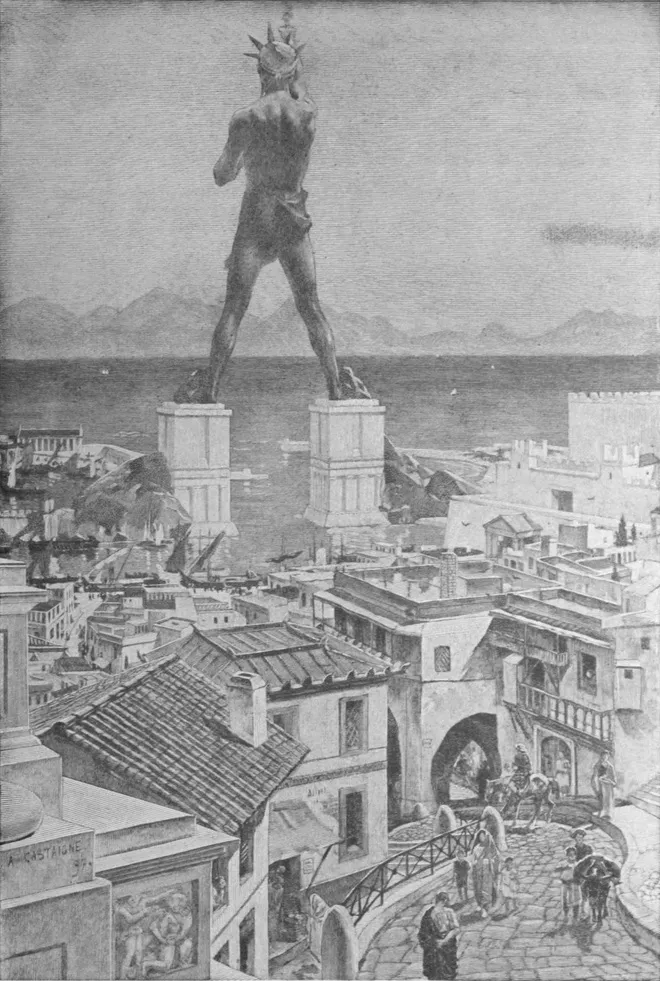
THE COLOSSUS OF RHODES
This short-lived achievement of ancient art dated from about
300 B.C. It was the largest of a hundred statues to the sun-god raised in the
island of Rhodes, any one of which, said Pliny, would have made famous the place
where it stood. Dedicated to Apollo, who was thought to have delivered Rhodes
from Demetrius Poliorcetes, it was made from the engines of war which that
besieger left behind. One finger of it was larger than an ordinary statue. An
earthquake in 224 B.C. destroyed it, but even in its broken and fallen state it
was long the wonder of Rhodes.
LARGER
IMAGE
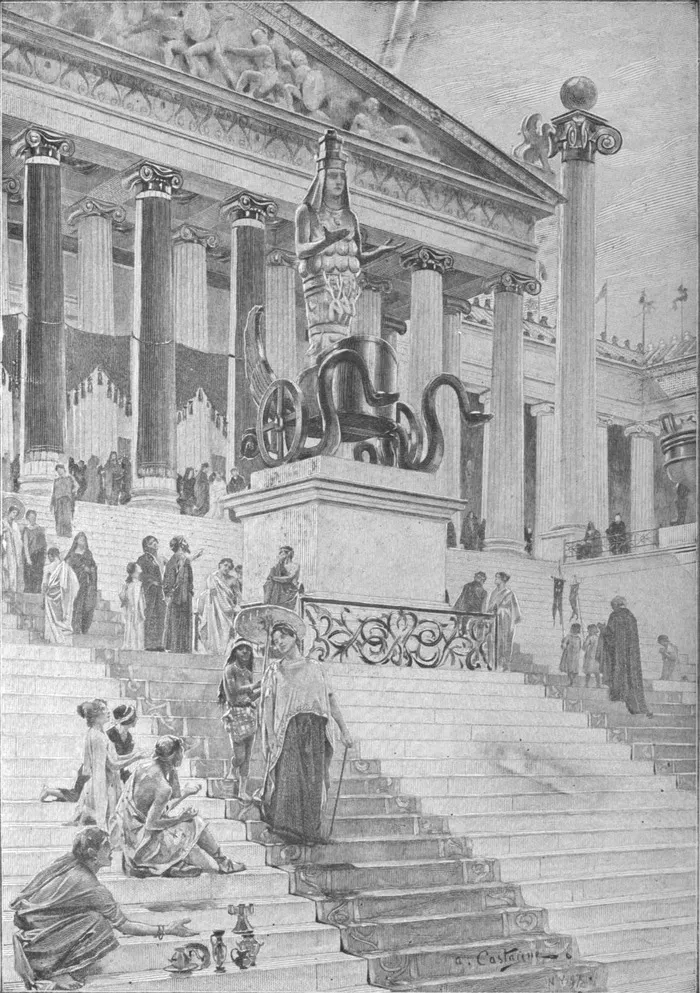
THE TEMPLE OF DIANA AT EPHESUS
“Great is Diana of the Ephesians.” Her temple was burned
down in 356 B.C., and subsequent to that year the great temple famed in history
was erected by the Ionians. It is said to have taken 220 years to construct, and
measured about 400 feet in length and 200 feet in width, while it contained no
fewer than 127 Ionic columns nearly 65 feet high. The temple was despoiled by
Nero and destroyed by the Goths in 262 A.D., but some of its ruins still
remain.
LARGER
IMAGE
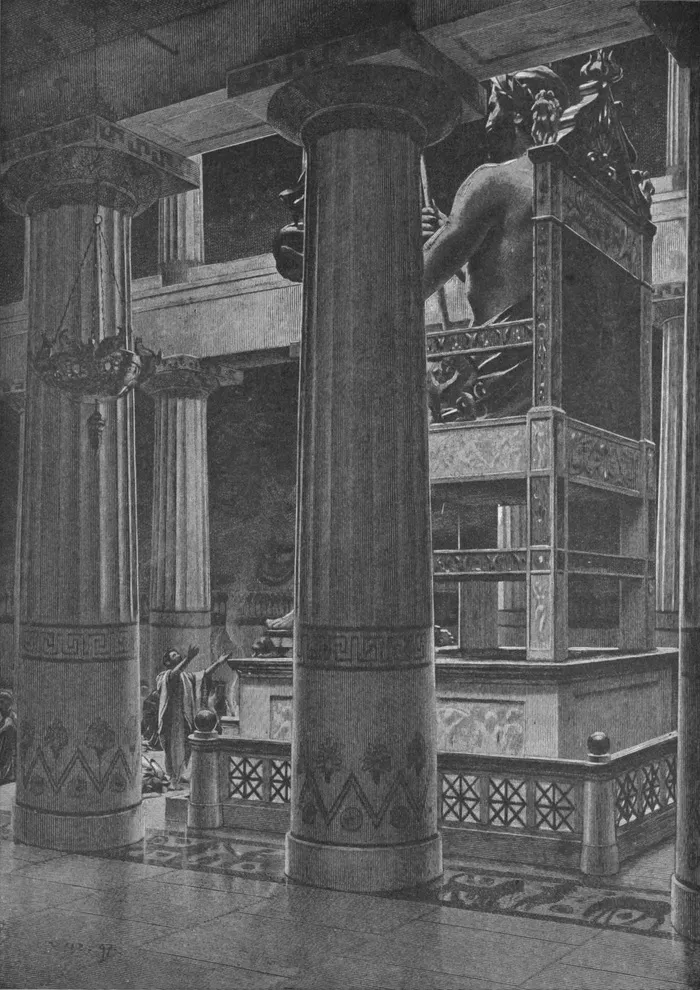
THE STATUE OF JUPITER ON OLYMPUS
The world-famous statue of Jupiter was the work of the great
sculptor Phidias. It measured 43 feet in height above the base. The body of the
god was carved from ivory, and the drapery was of solid gold. No other statue of
such magnitude, of such artistic perfection, or of such precious material, has
been known to history. Among the ruins of the temple are still to be seen the
remains of the black marble mosaic on which the statue stood.
LARGER
IMAGE
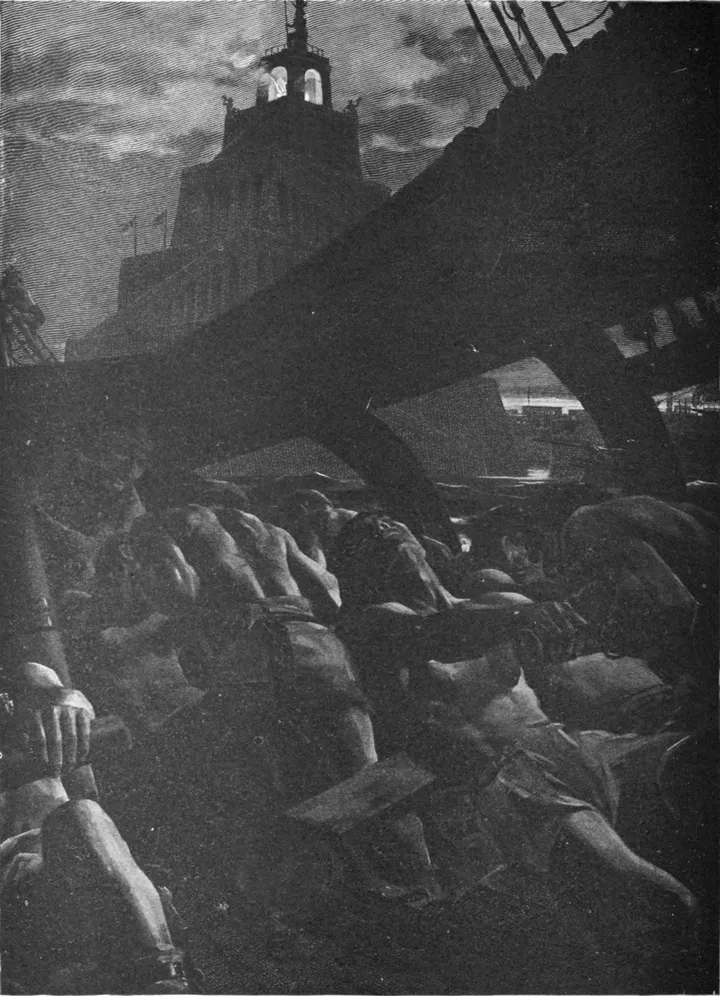
THE LIGHTHOUSE OF ALEXANDRIA
On the island of Pharos, close to Alexandria, stood the
famous lighthouse erected by Ptolemy Philadelphus about 280 B.C. Constructed of
white marble, in a series of vast stages of vaulted masonry, it reached the
height of 520 feet, and in its summit burned night and day, an immense beacon
fire of wood, which could be seen 30 miles at sea. The lighthouse was gradually
destroyed by earthquakes and the action of the sea, but existed in some condition
to the end of the 13th century.
LARGER
IMAGE
BIRTH OF CIVILISATION
AND THE GROWTH OF RACES
BY PROFESSOR FLINDERS PETRIE
I
IN
looking back to the beginning of civilisation in any country, we
have to deal with the physical changes which the land has undergone,
and to consider the conditions which promoted or hindered the advance
of its inhabitants. The nature of a country largely rules the nature of
its people, both bodily and mentally; and it may even be true that, if
sufficient time be given, the same character and structure will always
be produced by equal conditions.
Civilisation 10,000 Years ago
How we can Fix the Date
From historical records, and the cemeteries that have been examined, it
appears that the beginning of a continuous civilisation in Egypt must
be set as far back as about 10,000 years ago, or 8000 B.C.
The question then is how far the condition of the country at that
age was similar to that now seen? The present state is quite new,
geographically speaking, as the deposit of mud by the Nile, providing
a suitable soil, is only a matter of a few thousand years. The
accumulation of deposit is about 5 in. in a century (4·7 at Naukratis,
5·1 at Abusir, 5·5 at Cairo); and the depth of it is not less than
26 ft., and varies in different places down to 62 ft. The lower
depths are, however, often mixed with sand beds, and do not show the
continuous mud deposit; hence the average depth of 39 ft. is too large,
and if we accept 35 ft., it will certainly be a full estimate. At the
average rate of deposit, this would be formed in 6,000 years. But, on
the other hand, the deposit may have been slower at the beginning, and
hence the age would be earlier. Also, the full depth may be greater,
owing to some borings hitting on ground which was originally above the
river. Hence the extreme limits of age of Nile deposit in different
positions are perhaps 7,000 to 15,000 years, and probably about 10,000
years may be a likely age for the beginning of continuous Nile mud
stratification. Hence it is clear that the start of the civilisation
was about contemporary with the first cultivable ground.
Stone Age in Egypt
The First Dwellers in the Land
Earlier than the Nile deposits there must have been some rainfall,
enough to keep up the volume of the river, and to prevent its
slackening, so as to deposit its burden. We must picture, then, the
country as having enough rainfall for a scanty vegetation in the
valleys, while the Nile flowed down a mighty stream, filling the whole
bed as it now does in flood, and bearing its mud out to the sea, except
in some backwaters which were shoaling up. Such a land would support a
small population of hunters, who followed the desert game and snared
hippopotami in the marshes. The Nile had been in course of recession
for a long period before it began to rise again by filling its bed.
The gravels high above the present Nile contain flints flaked by human
work; much as in Sinai such flakes are found, deep in the filling of
the valleys which belong to a pluvial period. Yet after the Nile had
retreated down to the present level, man appears to have been still
in the Palæolithic stage, as freshly flaked, unrolled flints have
been found at the lowest surface level of the desert. As the country,
while drying up, and before mud deposits were laid down, would have
only been suited for occupation by hunters, it seems probable that
Palæolithic Man had continued in Egypt until the beginning of the
Nile deposits—that is to say, till the beginning of the continuous
civilisation as discovered in the cemeteries.
BUSHMAN TYPE.
On turning to the remains of the earliest
burials, we find that in many cases female figures of the Bushman—or
more precisely Koranna—type, were placed in the graves; while at
the same time long, slender figures of the European type are also
found. The inference is that the Palæolithic race of the Koranna
type was known to the earliest civilised race in Egypt, and that
they were being expelled and exterminated, as only female figures
are found—representing captive slave women—and even these soon
disappear. Thus it would seem that Egypt, as an almost desert region,
before the formation of the cultivable mud flats, was the last home
on the Mediterranean of the hunters who continued in the Palæolithic
stage. The physical type of the figures which we can attribute to this
earliest population has the Bushman characteristics of fatness of the
thighs and hips, with a deep lumbar curve; and a line of whisker covers
the jaws of the female figures, akin to the fur on the bodies of women
on the Brassempouy and Laugerie-Basse ivory carvings. This indicates
that they belonged to a cold climate, and had not been developed in
Egypt. As, however, man had certainly dwelt in the Nile valley for
long ages, this northern indication points to a comparatively recent
invasion from a colder to a warmer climate, such as has been the rule
throughout historical times.
Time Without Dates
PREHISTORIC PERIOD.
The beginning of the continuous
civilisation of the country must be placed at about 8000 B.C.
The written history extends back to the first dynasty, and places that
at 5500 B.C., and this is checked at the sixth, twelfth, and
eighteenth dynasties by records of the rising of Sirius, and of the
seasons in the shifting year, which agree to this dating in general.
For the length of the prehistoric age before these written records
there is no exact dating. But, as in a given district of Egypt, where
all the desert has been searched, the prehistoric graves are about as
numerous as those made during the six thousand years of the historic
time, at least 2,000 or 3,000 years must be allowed. The amount of
change in every kind of production during this age is considerable; and
as we can trace two cycles of civilisation, which usually occupy about
1,500 years each in the later times, it is likely that 2,500 years
is too little rather than too long a period. As no definite scale of
years can be used, the dating of the graves of this age is treated as a
matter of sequence. From a careful statistical classing of the pottery,
it is practicable to put about a thousand of the fullest graves into
their original order; this series is then divided into 50 equal parts,
and these are numbered from 30 to 80. Thus, sequence date 30 is the
earliest type of graves yet found, and S.D. 80 is of the age
of Mena, the founder of the first dynasty. The sequence dates are given
below for each stage of the prehistoric times.
THE FIRST INHABITANTS OF EGYPT
As female figures of the Bushman type are found in the
very earliest Egyptian graves, it is thought that this race was native to the
country and was gradually expelled by the first civilised people. The photograph
illustrates one of the figures taken from a grave.
EARLIEST BURIALS.
The earliest graves found are shallow
circular hollows on the desert, about 30 in. across, and a foot deep.
The body lies closely doubled up, wrapped in goat-skins. There are very
few objects placed with these burials; a single cup of pottery, red,
with black top; rarely, a slate palette for grinding face-paint; and,
in one grave, a copper pin to fasten the goat-skin. Pottery was in a
simple stage, and weaving was quite unknown. These graves are classed
as sequence date 30.
POTTERY OF FIRST EGYPTIAN CIVILISATION
The pottery of the first period of Egyptian civilisation
is characterised by raised white lines on a red body, and from the fact that it
closely resembles the pottery of the Kabyle people, who live in North Africa
to-day, it is thought the first Egyptian civilisation may have come from the
west. These examples are before 7000 B.C.
Civilisation Emerging from the Mists
FIRST CIVILISATION.
The next period is that of the white
patterns on red (S.D. 31 to 34). This use of lines of raised
white slip is the same as on the present Kabyle pottery, and the
patterns are so closely alike on the ancient and modern that this
forms a strong evidence for a Western connection of the people. In
this period the main lines of the civilisation become clearly marked.
The fine flint chipping with delicate serrated edges; the polished
red pottery, of circular and of fancy forms; the tall round-bottomed
stone vases; the slate palettes for face-paint, of animal forms and of
rhombic shape; the use of sandals; the ivory combs with animal figures;
the disc-shaped mace-head—all of these were in use with the white
cross-lined pottery, and stamp the general type of the beginning of
the civilisation. We have before us a settled population, with strong
artistic taste in handicraft, but not in copying Nature; with patience
for very long and skilful work, and probably organised, therefore,
under chiefs who commissioned such labour; yet with sufficient general
demand for fine things to have raised hand pottery to its highest
level; with strong beliefs about a future life, as shown by the uniform
detail of the position of the body and the nature of the offerings in
the grave; with the arts of spinning and weaving; fairly clothed, as
shown by the use of sandals; fighters, with finely-made and treasured
weapons; with the use of personal marks for property—altogether much
in the stage which we now see in the highest races of the Pacific or
Central Africa.
EASTERN INVASION.
This civilisation had lasted for a few
centuries when we see a change come over it. On searching the types
of pottery we see many new forms arising from S.D. 38 to 43,
while many older types disappear between S.D. 40 and 44.
These changes serve to stamp the point of the change, but it is in
other respects that the differences are most visible. The black-topped
pottery, red polished, and fancy forms of pottery cease to develop
after 43, whereas the decorated pottery, with brown line patterns on
buff ware, is scarcely known till 40, and the late class of pottery
begins at 43. In the stone vases the forms of tall tubular shape,
with handles, cease at 40, and the barrel forms begin at 39, and are
dominant by 42. In flint work the various new types begin from 39 to
45; the disc mace dies out about 40, and the pear-shaped mace begins at
42. In the slate palettes old types vanish and new ones arise from 37
to 42. The same is seen in ivories. Foreign intercourse was increased,
as silver (from Asia Minor?), lazuli (from Persia?), serpentine and
hæmatite (from Sinai?) all come into use from 38 to 40. In copying
Nature, the steatopygous figures of the Bushman type are only found
before 38, and human figure amulets are known from down to 44. Animal
figure amulets begin in 45. Multiple burials in graves are common down
to 40, and continue till 43; only single burials are known later.
Invasion from the East
What Mythology Says
The racial changes that are thus indicated by these widespread
differences can only be traced by the different products. The white
line pottery characteristic of the earliest people is closely like
that of the Kabyles, and the similarity of the skull measurements
show that there is no bar to accepting the connection with the North
African race. But the details of the new people, using animal amulets,
a face veil, wavy-handled pottery like that of early Palestine, and the
Asiatic silver and lazuli, all point to their coming in from the East.
This change may be further linked with the religious traditions. This
later mythology taught that Osiris had found the Egyptians in a brutal
existence, and he had taught them agriculture, laws, and worship; this
appears to be the tradition of the bringing in of cultivation by
the earliest civilisation at S.D. 30. His worshippers were
allied with those of Isis, who were a kindred tribe. Hence Osiris is
said to have married his sister Isis. The myth further shows that this
civilisation was attacked treacherously by the tribe who worshipped
Set, in confederacy with an Ethiopian queen, and they succeeded in
suppressing the worship of Osiris and removing his remains to Byblos in
Syria. This seems to agree to the influx of Asiatic influence, about
S.D. 40, which we have noticed above. The correction of the
calendar from 360 to 365 days, is attributed to the beginning of the
civilisation (at S.D. 30) by the myth that Osiris and his
cycle of gods were born on the extra five days.
PREHISTORIC SHIPS: THE EARLIEST PICTURES OF EGYPTIAN
VESSELS
The pottery of the second period of Egyptian civilisation
is rich in representations of prehistoric ships. The vessels are shown with many
oars, and the cabins are placed amidship with a gangway between. It is gathered
from these crude drawings that in prehistoric times there was a considerable
shipping trade along the coast of Egypt.
SECOND CIVILISATION.
The second prehistoric civilisation, of
which we have traced the Asiatic source, is specially marked by the use
of a hard buff pottery, on which designs are often painted in brown
outline. The art of these has no connection with that of the early
white line designs; the habit of covering figures with cross lines, and
the imitation of basket-work, have entirely disappeared; and, on the
contrary, the plant, ostrich, and ship designs are quite new.
What, then, were the connections of these people? One indication
is gleaned from carvings at the close of the prehistoric age. Two
tributaries of the new king of Egypt are shown bearing stone vases
of the style of those of the second prehistoric civilisation,
S.D. 45–75. They have large pointed noses, and wear pigtails,
and another tributary of the same type wears a long robe. Hence we may
see that they came from a cold region where stone vases were wrought;
and that by the form of the vase they were probably the same people as
the later prehistoric stock. Yet, on the other hand, we occasionally
find pottery vases of that people in the earlier prehistoric age, so
that they must have been in touch with Egypt throughout. The more
likely source for them was the mountainous region, where snow sometimes
lies, between Egypt and the Red Sea; and certainly this was the source
of the rare igneous rocks used for the prehistoric vases.
The general conclusion would be, then, that a people occupying the
mountainous region east of Egypt had an independent civilisation, and
were in touch with the early prehistoric people of the Nile valley.
Then about S.D. 38 they began to push down into Egypt, and
fully entered it by S.D. 44, bringing with them various
different points of their own civilisation, and expelling the Osiris
worship in favour of Set, who was their god. They probably brought in
the Semitic elements to the Egyptian language, along with the other
Asiatic connections.
Fleet of Prehistoric Ships
SHIPPING.
Under this new order of things we see much more
foreign and maritime connection. The introduction of silver from Asia,
of lazuli from Persia, of hæmatite from Sinai, of serpentine from
the Arabian desert—all show this. On the vases we see the starfish
painted, and one of the most usual decorations was the figure of a
great galley or ship. These ships are shown with oars on the pottery
vases, and without oars or sails on the tomb paintings. From the
proportion of the figures they appear to have been as much as 50 ft,
long, and this is confirmed by the oars, which number up to sixty.
Neither indication is exact; but the tendency would be to exaggerate
the size of the figures, and certainly not to diminish them, and so
aggrandise the ship. The shipbuilding in the early history may prepare
us for the earlier rise of such work, when we read of Senefru building
sixty ships of a hundred feet long in one year.
What the Ships Were Like
These prehistoric ships were all of one pattern. Amidships were the
large cabins, and there was no poop or forecastle structure, probably
because of the want of support fore and aft, the flotation being mainly
in the middle. The two cabins were separated by a broad gangway across
the boat, and joined above the gangway by a bridge from roof to roof.
Lesser cabins projected fore and aft from the main cabins. On the roofs
were rails at the corners, so as to secure top cargo without getting
in the way of loading it up. In a large ship there was an upper cabin
on the hinder main one, a light shelter shaded with branches. From the
back of the hinder cabin stood up a tall pole bearing a solid object as
a standard, which we shall notice below. At the stern was the steersman
seated by an upright post, to which was probably lashed the steering
oar, as in the historical boats. In the bows was a low platform, with a
rail round it, for the look-out, shaded with branches. The cabins were
narrower than the beam, and left free space for rowers on each side.
Trade in Those Days
FOREIGN IMPORTS.
Vessels of this large size certainly imply a
corresponding importance of commerce. We have noted already the foreign
imports into Egypt; and others imply more distinctly a sea intercourse.
From S.D. 33 down to S.D. 68 there is found black
pottery with incised basket-work patterns [page 238] filled in with
white. It is always rare, only occurring in less than 1 per cent.
of the graves, and in only one case was there more than a solitary
example. It is entirely disconnected from the Egyptian types, but it
is closely akin to pottery found on the north of the Mediterranean,
in Spain (Ciempozuelos), in Bosnia, and in the earliest town of Troy.
At the close of the prehistoric age the black pottery of the late
Neolithic city of Knossos is found in the lowest levels of the temple
at Abydos. And in the royal tombs of the first dynasty there many
vases and pieces have been found which are clearly of the earliest age
of painted Ægean pottery. Considering that the bulk of the trade must
have been for perishable goods—oil and skins from Crete and Greece,
corn and beans from Egypt—it is not to be expected that a great amount
of breakable pottery would pass and be preserved in burials. There
are, moreover, some tallies left to us besides the northern pottery.
Throughout the later prehistoric age emery was regularly in use for
all the grinding and polishing of stone vases and of carnelian beads;
and so common that one excelsior spirit in search of a tour de force
had even cut a vase out of block emery, as being the hardest known
material. This emery, so far as we know, must have come from Smyrna.
Again, the gold of the first dynasty contains a large amount of silver.
This points to its source from the Pactolus region, where electrum was
found, rather than from Nubia, where the gold is free from silver.
CONNECTION OF THE SHIPPING.
When we look at the evidence of
the ships themselves we see that it points to their having been used
at sea rather than on the Nile. It is impossible to row a ship up
against the Nile stream, which runs at three miles an hour, and sailing
or towing is the only way to go southward in Egypt. But in only one
instance is a ship with a sail represented, while there are many dozens
of figures of rowing vessels. The galley has always been the type of
business ship on the Mediterranean. All through the classical wars
the rowing galley was the mainstay of power. The Homeric catalogue
of ships, the Phœnician coinage, the Assyrian sculptures, the Greek
fleets, the Carthaginian navy and its destroyers of Rome, the pirates
of Liburnia and Lycia, down to the Venetian fleet and the French
galleys of a couple of centuries ago, all show the dominance of the oar.
ARTICLES ILLUSTRATIVE OF THE EARLY CIVILISATION OF
EGYPT
(1) Slate palettes on which paint for rubbing round the
eyes was ground; (2) adze heads and harpoons, the harpoons at the sides being of
bone, the others of copper; (3) beautifully flaked flint knife; (4) serpent
amulet of stone; (5) maces of quartzose rock, very effective weapons; (6) forked
lances of flint; (7) combs of ivory; (8) vases carved from hard stone; (9) black
incised pottery, a foreign import into early Egypt.
LARGER
IMAGE
Port Ensigns Carried
The nature of the standards upon poles carried by the ships has been
variously interpreted. We can distinguish the elephant, bird on a
crescent, and fish; the two or four pair of horns, the bush, and the
branch; the rows of two, three, four, or five hills; the crossed
arrows, and the harpoon, besides other forms which we cannot identify.
The question is, what view will account for these most completely?
Some have thought they were emblems of gods, and that the boats
were sacred to divinities; but there are many which cannot be thus
explained. Others have thought that they indicated tribes; but the
rarity of repetitions, and the absence of any duplicates together, are
against this. Marks of personal ownership have been suggested; and this
is not impossible, as they might be well dedicated to special gods. But
the prominence of the groups of hills as signs agrees best with their
being marks of the ports from which they hailed; the divine emblems
would naturally be those of the god of the port, the number of hills
would be very likely to distinguish different ports, the elephant, the
bush, or the fish might well be the mark of a port. And the parallel
in later times of such being distinctive ensigns for ports—as in
the ensign of Gades found in the Red Sea—agrees to this usage. The
carrying of a port ensign in an age of independent city-states was
equivalent to a national flag in later times; and it was essential for
showing friends or foes.
We have dwelt at length on the detail of this shipping, as it is the
most important subject for showing the extent and character of the
early civilisation. It takes two to trade as well as to quarrel; and
these large ships were not rowed about the Mediterranean unless there
was a paying trade to be done on those coasts, a people civilised
enough to produce goods that were wanted and to require foreign stuff
in exchange, and a society stable enough to enable goods to be stocked
in bulk and traded without any serious risk of fraud or force.
Ingenuity of the Hunters
Mode of Ostrich Hunting
HUNTING. The main occupation represented in the prehistoric
paintings is hunting. The bow and arrow was used. The bow was a single
piece of wood, painted red and covered with zigzag white lines; the
arrow was of reed, with a point several inches long of hard wood.
The forked lance of flint was also a favourite weapon [p. 238]; it
was inserted at the end of a wooden shaft, which was controlled by a
long thong of leather ending in alabaster knobs which kept it from
entirely flying from the fingers. Thus the lance could be thrown by
a man in ambush to cut the legs of a gazelle, while, if it missed,
it was jerked back by the elastic thong, and so saved from breaking
the delicate edge of flint. These forked lances are found throughout
nearly all the prehistoric time; and they continued in use in North
Africa till the Roman Age, when Commodus borrowed thence their use for
hunting the ostrich. This lance retained by a thong was the parallel
to the favourite harpoon used in fishing. Another mode of hunting was
the trap. This is represented as being formed of pointed splints or
stakes, lashed together like spokes of a wheel, with the points around
a central hollow. Such traps to catch the legs of animals are used now
in Africa, and an example was found at the Ramesseum, dating perhaps
from the twentieth dynasty. Sticks or clubs were used in hunting and in
fighting.
STANDARDS OF EGYPTIAN SHIPS
There has been much speculation as to the significance of
the standards carried by the most ancient of the Egyptian vessels, as recorded
on pottery and elsewhere. Some examples of these standards are here given. The
most reasonable supposition is that these devices indicated the port from which
the vessel sailed.
FIGHTING. The earliest representation of fighting is on a
vase of the white slip on red, at the beginning of the prehistoric
age. On that a man with long, wavy hair appears to be spearing another
man in the side. Later, there are the fighters on the Hierakonpolis
tomb, at about S.D. 63. On this hooked sticks are used, and
the fighters are clad with a spotted animal’s hide on the back. One
man has been killed, and another is hard pressed, fallen on one knee.
To save himself from blows he has taken off the hide and is holding it
up, thus anticipating the use of the shield. It seems likely that the
Egyptian shields of hide stretched on a frame of sticks were directly
copied from this use of the hide that was otherwise worn on the body.
In another group a black man is holding three red captives bound with a
black cord, while two red men approach him to deliver their kindred.
Fighting with Maces
The weapons mostly found are the stone maces [page 238]. These were
sharp-edged discs in the earlier age, a form which is very effective
in a mixed fight, as it cannot be turned aside like a battleaxe, but
must cut in whatever direction it falls. These maces were usually made
of porphyry and other quartzose rocks. The mace used in the later age
was of a pear shape, and this form was continued into the historic
times, and perpetuated in the conventional scene of the king striking
an enemy, even in the latest times. The handle holes in these maces are
very small, and this shows that probably the handles were dried thongs
of hide. Nothing else would be sufficiently tough and elastic. The
flint dagger was probably also used, and certainly the copper dagger. A
very fine example of this, dated to S.D. 55 or 60, is wrought
with a quadrangular blade, giving the utmost strength and lightness, a
better design than that of any daggers of the historic times.
THE FIRST PICTURES OF FIGHTING
The earliest representation of fighting, at the beginning
of the prehistoric age, shows a man with long, wavy hair, spearing another man in
the side. Later, are fighters on the Hierakonpolis tomb, using hooked sticks and
clad in piebald hides of animals.
TOOLS. Tools of metal begin with small, square chisels of
copper at S.D. 38. The intermediate examples have not been
found till we reach a fine large chisel of copper at the close of the
prehistoric. Adzes of copper [p. 238] begin at S.D. 56, or
earlier, and increase in size down to historic times; they continued
to be the favourite tool of the Egyptians for both wood and stone
working until Greek times. Borers are usually tapered, to work in soft
material. Needles of copper appear as early as S.D. 48, and
the fastening pins of copper begin with the very earliest graves of
S.D. 30.
Flint working was the greatest artistic industry of the prehistoric
age. The surfaces were not merely reduced by haphazard flaking, but
the flints were ground into form, and then reflaked in a marvellously
regular manner with uniform parallel grooves [page 238]. The finishing
of the edges by deep serrations of the fineness of forty to the inch,
and the chipping out of delicate armlets of flint, show also the same
astonishing skill and perfection of hand work. The Scandinavian flint
chipping used to be regarded as the most perfect, but the Egyptian work
entirely surpasses it in regularity and boldness.
STONE VASES.
Hard stones were largely employed for making
vases [page 238]. In the earlier age tall, cylindrical forms were
used, and in the later age barrel forms. The earlier material was
usually basalt, but syenite, porphyry, alabaster and limestone were
also used. The later materials included slate, grey limestone, breccia,
serpentine, and diorite. The hollowing out of these vases was by
grinding, but the outside was entirely formed by chipping and polishing
without rotary motion. The perfect regularity of the forms, and the
fine taste shown in the curves of the outlines, as well as the hardness
of the material, place the vase working higher than any work of the
historic times.
1,000 Forms of Pottery
POTTERY. Pottery was greatly developed, although the wheel
was not used, and all the forms were entirely modelled by hand and
eye without mechanical guidance. The outlines are true and fine, the
circularity is astonishingly regular, although all the trimming and
polish runs vertically; and it was as easy in such a mode of building
to make oval, doubled, or square forms, all of which are found. The
specially later pottery is the decorated, with brown-red lines on a
hard buff body. The forms are clearly copied from those of the stone
vases; and the patterns are derived from the fossils and veins in
the stone, or from the cordage net in which the vases were slung for
carrying. Next appear aloes and other bushes, and figures of ships,
which we have already noticed. Rows of ostriches and of hills are also
favourite designs.
Other pottery of this ware, but not decorated, has a curious type
of projecting ledge, wavy up and down, for handles. Beginning at
S.D. 40 as a globular vessel, the type narrows to an upright
jar; by S.D. 60 the handles dwindle, becoming united around
it as a wavy band of pattern; by S.D. 70 the jar at last
becomes a cylinder; by S.D. 75 the band becomes a mere line;
and then after S.D. 80—in the first dynasty—the jar dwindles
to a rough tube like a thumbstall. The contents of such jars similarly
deteriorate. At first, perfumed ointment was put in them, then it was
covered with a layer of mud to retain the scent; the mud increased
until it was merely scented mud, then only plain mud was used, and
lastly they were left empty. Beside many other forms of this hard ware
there was also a long series of types in a rough brown pottery, which
passed on into the ordinary pottery of the first dynasty. As there are
over a thousand different forms of this prehistoric pottery known, and
their study has been the key to the whole arrangement of that age, this
subject is a very wide one, which we have barely noticed here.
PREHISTORIC POTTERY OF EGYPT
The later pottery of the prehistoric period is
characterised by brown-red lines on a hard buff body. The forms and
decorations have been copied from earlier stone vases, and from the nets in
which they were carried.
A Constant Personal Possession
SLATE PALETTES.
A constant personal possession was the slab
of slate upon which the green malachite or red ochre was ground for
colouring around the eyes. Usually a brown pebble crusher accompanies
it; and the dead often have a little leather bag of malachite in the
hands. These slate palettes begin with a plain rhomb form, probably
derived from the natural cleavages of the slate rock. Well-formed
animal figures were also carved as slate silhouettes; the deer,
hippopotamus, and turtle are the oldest, and the fish also comes into
the earlier age. The double bird type begins with the second age,
and all the types continuously degrade by repeated copying until
their original form is quite indistinguishable at the close of the
prehistoric age [page 238].
PERSONAL OBJECTS.
Ivory carving is common, mainly for long
combs to fasten up the hair. These usually have an animal on the top
of them; but they only belong to the earlier age, suggesting that
the hair was worn shorter in the second period. Decorated tusks of
ivory are also early; they were fastened on to leather work, probably
to close the openings of water skins. Ivory spoons belong only to the
second period, as likewise do the forehead pendants of shell.
Amulets of animal forms were frequent in the second period. They are
generally cut in stone, carnelian, serpentine, porphyry, and coloured
limestones. The forms are the bull’s head (which continued in use into
historic times), the hawk, serpent [p. 238], frog, fly, scorpion, claw,
vase, and spear head. The meanings attached to them are quite unknown.
Games are found, as shown by the ivory draughtsmen, the small balls
or marbles, the stone gateway and ninepins [page 242], the figures of
lions and hares, and the throwing slips for obtaining a count as with
dice.
What the People Wore
CLOTHING. The clothing of men was, at most, the kilt of linen,
or an animal’s hide put over the body. Often only a belt was worn,
with three narrow strips hanging down in front. A usual covering was
a belt with a sheath attached to it to hold up the genitals. With the
pleated kilt was also worn a belt having apparently a jackal tail hung
behind. On some figures there is merely a double rope round the waist.
These various forms may belong to different peoples and periods; but
there are hardly enough examples to prove any distinctions, as the
varying circumstance of the figures, captive and conquered, resting and
working, rich and poor, in heat and in cold, may easily have led to the
different dress that we see. Women are represented with a white linen
petticoat from the waist to the feet. Leather was a favourite material
for clothing, as well as for bags. It was painted with patterns, and
decorated with beads, reminding us of the North American work.
The Oldest Capital of Egypt
DECAY OF CIVILISATION.
All of this civilisation gradually
decayed; the pottery is seen becoming coarser, good work dying out in
rougher copying, new types seldom appearing, cheaper and poorer objects
being more usual. There is ground, however, for supposing that at some
time in this age there was a central rule at Heliopolis. There are many
traditions of a principality there, which must certainly have been
before the dynasties. The sacred emblem preserved in the temple was the
shepherd’s crook, haq, which served for the title of “prince” in all
later times; the other sacred emblem was the whip, and these two were
the royal emblems of Osiris. The title of the nome was “the princes’
territory,” and this capital retained in later ages the reputation of
being the centre of learning and theology. And on the fragment of the
early annals known as the “Palermo Stone” there is shown a long row of
kings of Lower Egypt before the dynasties; these cannot have ruled at
Memphis, as that was a new foundation by Menes.
THE EARLIEST GAME OF NINEPINS
These ninepins, the gate to play through, and the porphyry
balls were all found in a child’s grave.
History as Reflected in Mythology
End of Prehistoric Times
HISTORY IN MYTHOLOGY.
Of the breakup of this civilisation we
may trace some relation in the mythology. After Isis had recovered
the body of Osiris, and the worship of the Osiris and Isis tribes
had revived again from the Semitic invasion of Set worshippers, Set
again attacked the Osiris worship, and scattered the body of Osiris
into fourteen parts in different places. This refers probably to
the distribution of parts of the body to different districts, when
it was cut up in the funeral ceremonies, according to prehistoric
usage. These parts of Osiris were kept at sixteen nomes in Egypt in
historic times, six in the Nile valley and ten in the Delta, probably
the original nomes of the country. The civil discord implied in this
persecution must have weakened the land; and then came the attack by
the hawk worshippers from the south. In the legend of Horbehudti, or
Horus of Edfu, we read that the crocodiles and hippopotami (animals of
Set), attacked him, and his servants, armed with metal weapons, smote
and conquered them, slaying 381 before the city of Edfu. Then the
worshippers of Horus allied themselves with the sun worshippers, and
“Horbehudti changed his form into that of a winged sun disc,” and “took
with him Nekhebt the goddess of the South and Uazet, the goddess of
the North, in the form of two serpents, that they might destroy their
enemies in the bodily forms of crocodiles and hippopotami.” That is
to say, the Horus, Ra, and serpent goddess tribes were all allied to
attack the domination of the Set tribe. They gradually drove them back,
and “Set went forth and cried out horribly”; he was finally struck down
at Pa-rehehu. “Thus did Horbehudti, together with Horus, the son of
Isis, who had made his form like unto that of Horbehudti.” That is to
say, the rest of the Horus worshippers joined the Horus-Ra party.
The final battle and expulsion of Set was at Zaru on the eastern
frontier of Egypt. This, in mythological form, seems to give the
history of the driving out of the Semitic population of the later
prehistoric age, by the dynastic race descending from Upper Egypt, at
the close of the prehistoric period. An actual result of this war,
all through later times, was the multitude of towns named Samhud, or
“United to Behudti,” marking the allies of the Horus party.
HISTORICAL SLATE
PALETTES. Of the period of the conquest by
the dynastic races, which closed the prehistoric age, there is an
invaluable series of monuments carved on slate. These carved slates
are the elaborated outcome of the slate palettes used for grinding
the face paints throughout the prehistoric age. A similar elaboration
of a simple article is familiar in modern times in the snuff-box. A
plain receptacle of bone or wood was decorated, plated, made of silver
and of gold, inlaid with diamonds and painted with the costliest
miniatures, and yet—it was but a snuff-box. So the plain slip of
slate was carved into animal outlines, had animals scratched on it,
then signs in relief upon it, and at last was covered with the most
elaborate carvings, and yet—it was but a paint grinder, and had always
the pan for colour carved on it, exactly of the shape of the pans on
the painters’ palettes of that age. Every stage can be shown, from a
formless slate to an artistic scene in relief. There are many stages to
be seen in the artistic development.
A. In the prehistoric age are the scratched outlines.
B. The well-incised elephant is as early as S.D. 33–41;
and with it are those signs in low relief.
C. The high relief sign is of S.D. 60–63.
D. On the boat slate, the drawing is much more detailed than on the
boats of the Hierakonpolis tomb of S.D. 63. We can hardly
separate this from the work of the artistic new-comers, and it may
well be about S.D. 70–75.
E. The animal slate seems to be next, as the treatment of the
lion’s hair is unlike the following.
F. The four-dog slate, being a coarser but more elaborated design
of the same type, may well be next.
G. The hut slate shows for the first time the arrangement of lion’s
mane as on the ivory lions of King Zer.
H. The gazelle slate shows the same treatment more advanced.
J. The towns slate shows the wiry detail of muscles, beginning to
appear in archaic manner.
K. The bull slate has the same style carried out fully and finely.
L. The Narmer slate has a less forcible and smoother treatment of
the bull, and brings us down to touch with the historic times.
The figures can be seen in Capart’s “Primitive Art in Egypt,” where
they may be identified by these letters, corresponding to the
paragraphs above: A, B, figures 61, 62; C, 63; D, 169; E, 171–2; F,
173–4; G, 170; H, 177–80; J, 175–6; K, 181–2; L, 183–4.
RACIAL TYPES.
These slate carvings not only show the art of
the time, but they present the different races and the details of their
life, more fully than we find them for many centuries later. We see
six different types of physiognomy in the early remains, and learn how
complex the racial history must be at the most remote period accessible
to us.
A. The aquiline type is that of the principal prehistoric race,
closely like the Libyan on the west and the Amorite on the east.
When mixed with negro it produced the exact type of a European-Negro
mulatto. Probably equal to the Libyan. [See Heads 1 to 4 on next page.]
EGYPT IN THREE PERIODS OF ITS CIVILISATION
This map of Egypt shows Egypt in three of its early
periods. (1) The earliest centres of culture were at the places where parts of
Osiris were preserved in the prehistoric age, here named. (2) The second period
is shown by other centres being placed in the right geographical order, all here
numbered I to XIX, following down each branch of the Nile. (3) The third period
is when other centres were inserted in the lists in the wrong order, here
numbered 8 to 20. These three stages of Egypt’s history are all before the
monarchy.
LARGER
IMAGE
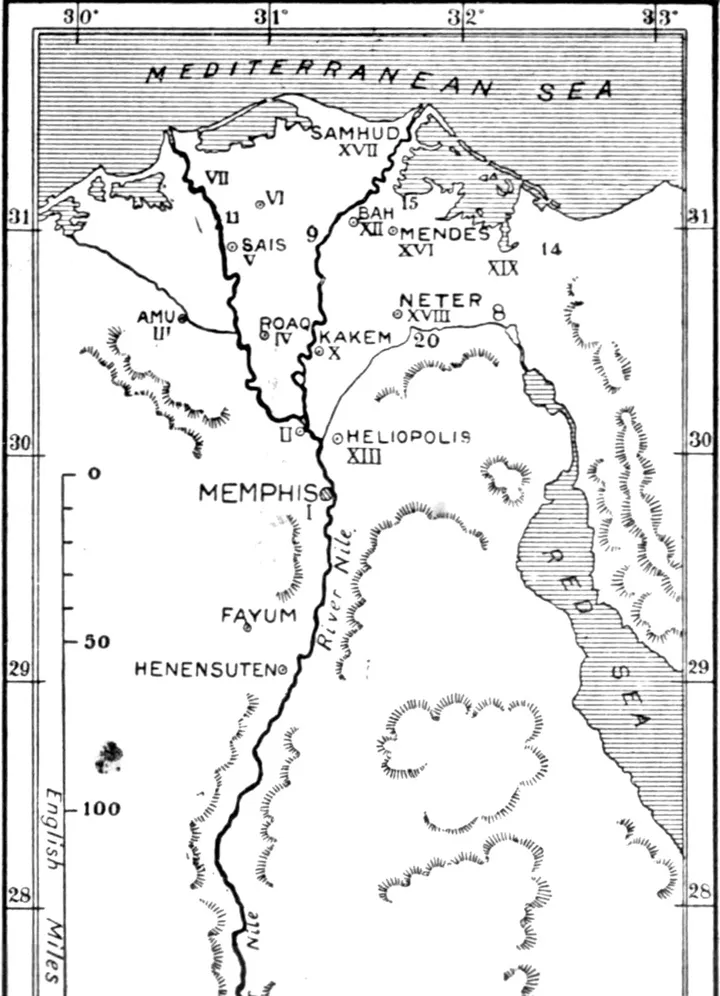
[Northern Part of Preceding Map]
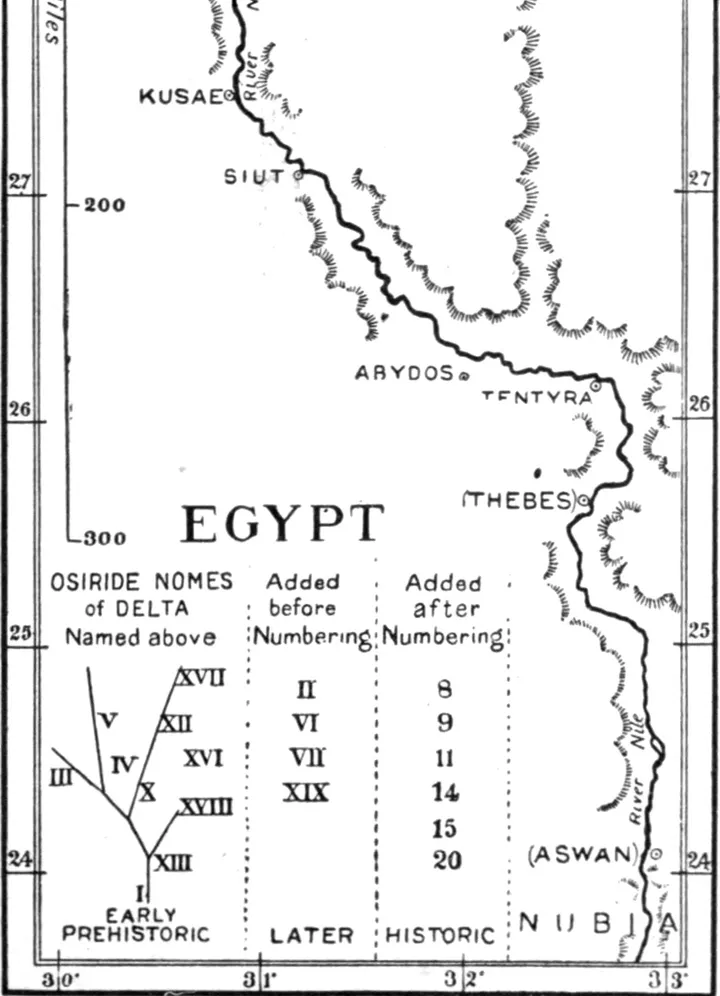
[Southern Part and Legend of Preceding Map]
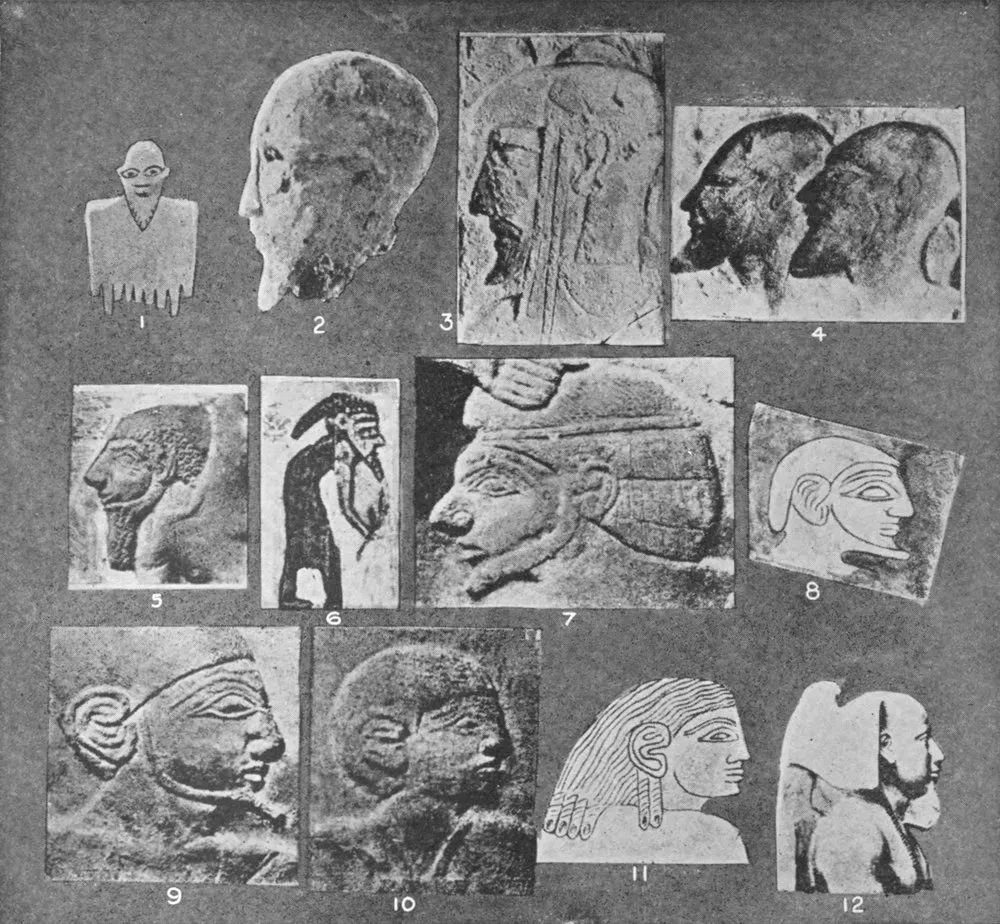
THE EARLIEST PORTRAITS OF VARIOUS RACES IN EGYPT
Numbers 1 and 2 are the aquiline type, similar to 3, the
Libyan, and 4 the Amorite. 5 is the curly hair type, 6 the sharp-nosed type,
7 the short-nosed type, 8 the forward beard type, 9–11 the straight-faced type
of dynastic conquerors. 12 is King Khafra of the Pyramid age, reverting to the
original type of 1 and 2.
B. The sharp-nosed type, firstly, with the hair in a pigtail,
bringing stone vases as tribute, and sometimes dressed in long robe;
secondly, with bushy hair and armed with spear, throw-stick, mace, bow
and arrows. Probably the Arabian mountain race mixed with Libyan. See
figure 6 on this page.
C. The curly hair type, with plaited beard, conquered and destroyed
by type B. Probably from North Syria, by sculptures there. See figure 5
on this page.
D. The forward beard type, with close-cut hair; much like the
figures on early Naukratite vases. Probably a coast people of Libyan
connection. See figure 8 on this page.
E. The short-nosed type, a variety of D, apparently belonging to the
Fayum. Fig. 7.
F. The straight-faced type of the dynastic conquerors. See figures
9–11 on this page.
All of these different peoples were in continual mixture and struggle
during the few centuries before the first dynasty. Looking to the
tribal hints given by the mythology, it seems probable that:
A represents the early Osiris and Isis worshippers; B the first
dominance of Set; C the second irruption of Set; D and E the allied
Osiris and Isis worshippers of the Delta and coast who helped to
expel Set; and F the hawk Horus worshippers, who took the lead in
driving out B and C by alliance with A, D and E.
Earliest Promise of Greatness
DYNASTIC RACE.
The most essential difference between the
prehistoric and the dynastic people is in their artistic capacity.
The earlier peoples, though highly skilled in mechanical detail and
handling, were yet very crude in their copying of any natural forms.
But as soon as we reach the dynastic race we find that there is an
artistic sense and power in their work, which puts even the roughest
of it far above all that had gone before. The earliest examples of
their sculpture appear to be the colossal figures of the god Min, found
at Koptos. These are of the most primitive style possible, the limbs
scarcely marked off from the trunk, and no details of form attempted.
But on the side of each there is a patch of hammer-work outlining some
figures, perhaps a copy of embroideries on a skin pouch hung at the
side. These are figures of a deer’s head and pteroceras shells on one,
swordfish, shells, and standards of the god on another, and the same
objects, together with an ostrich, elephant, hyena, and calf on the
third. All are but roughly hammered round, yet the spirit and correct
forms of the animals are of an entirely different order from anything
that had yet appeared in Egypt. The promise of all the artistic
triumphs of thousands of years to come is clearly seen in these
decorations of the rudest statues known.
Mystery of Dynastic Race
The source of this dynastic race can only be inferred. Though marked
off from the earlier inhabitants by their artistic taste, and by their
use of hieroglyphic writing, we know so very little of the early
history of any other lands near Egypt that we cannot yet trace any
link to their original source. On looking in various directions, it
seems at least clear that they do not belong to the southern tribes, to
which they have no resemblance; nor can we suppose that the Libyans,
who appear to be one with the prehistoric people, would also supply
a race so different in face and in habits. The north and Syria seem
barred by the earliest centres being at Abydos and Hierakonpolis in the
south of Egypt, from which they conquered the north.
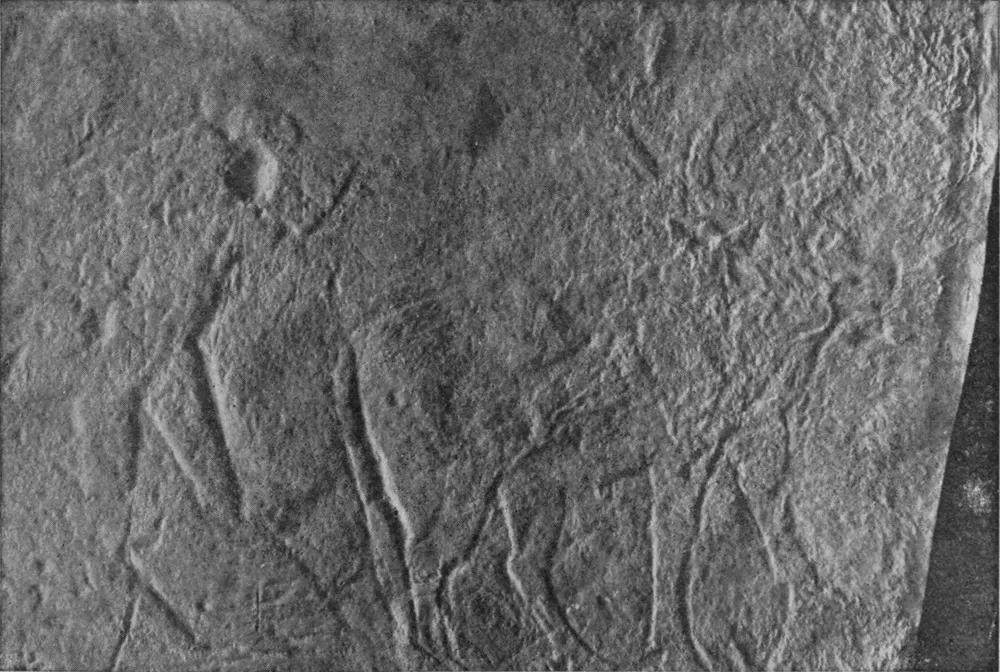
THE FIRST PROMISE OF THE ARTISTIC TRIUMPHS OF EGYPT
These animal figures were wrought by hammering around on the
surface of the colossal statue of the god Min, found at Koptos, and show the
beginning of the wonderful art of Ancient Egypt. It is the work of the earliest
dynastic people, who have passed beyond the stage of making rude scratches on
walls and on pottery, and have arrived, as the figures of the ox and the hyæna
prove, at a real conception of the methods of sculpture.
The Way the Conquerors Came
Lastly, no source seems open except the East, the road from which
joined the Nile at Koptos. It is there that the earliest statues have
been found, and the decoration on those comprises the swordfish and
pteroceras shell belonging to the Red Sea. Such seems to have been
the road of the dynastic race into Egypt; but the origin of that race
yet awaits research. There are undoubtedly some Babylonian elements
in their culture, and somewhere at the south end of the Red Sea lay
Punt—the “divine land” of the Egyptians. Thus we are tempted to
look to some migration from Southern Arabia, whence also may have
proceeded the kindred Sumerian culture, a few centuries later. From
this centre in Pūn, or Punt, it may have conquered and colonised Egypt,
and then later passed on up the Red Sea to the coast of the Pœni and
their later Punic colony—Phœnicia and Carthage. Such is a pleasing
co-ordination, but whether we shall ever recover the evidence to prove
or disprove it hangs upon the chance of the past and the activity of
the future.
CONQUEST OF EGYPT.
The conquest of Egypt spread down from the
south to the north. The earliest centres were Abydos and Hierakonpolis.
Probably Edfu was as important, or more so; but the great Ptolemaic
temple there being still complete, the remains of the earliest kingdom
are sealed beneath its pavements. The conquest must have been a gradual
process; it is described as such in the myth, many times and in many
successive places was Set defeated and repelled. And the probability is
that tribal war of such a kind would only gradually transfer district
after district from one holder to the next. We know how in England the
conquest occupied three centuries, from the Saxon landing to the first
Saxon king of all the land. So it may well have been in Egypt.
Kings Before History
We read in Manetho of ten kings of Thinis (Abydos) who ruled for 350
years before the first dynasty of kings of all Egypt. And we know, from
the fragment of the Palermo Stone, that at least thirteen kings of
Lower Egypt were recorded before the first dynasty. It is obvious from
this, and from the probabilities of the conquest, that there were Kings
of Upper Egypt before the first dynasty; and there is no reason for not
accepting this statement of Manetho as being equally correct with his
account of the first dynasty, which we can verify. Of the actual course
of the conquest, one fragment of carved slate has preserved the record.
Seven towns are represented upon it, each attacked by one animal of
the standards of the allies. These towns may be tolerably identified
by comparing the hieroglyphics placed within them with the names known
in historic times. The upper row of four towns seem to be Mem in the
Fayum, Hipponon, Pa-rehehui, and possibly Abydos; and the lower three
towns were probably in the delta, though there are the uncertainties
of two northern similar names.
Graves of Unknown Kings
DYNASTY O. The contemporary remains that appear to belong to
this age of the Kings of Abydos (which we may call Dynasty O) are the
tomb chambers and funeral objects in the royal cemetery at Abydos. The
plan of that cemetery shows a sequence of each later tomb being placed
next to the previous tomb, and generally a receding further back into
the desert as time went on. Now, in front of the tomb of Zer, the
second king of the first dynasty, there are three large tombs alike,
and four lesser ones. As objects of Mena, the first king, were found
here, the other tombs are presumably those of six kings before the
first dynasty, by their position. The actual objects found in these
tombs are all of a more archaic style than those of Mena or any later
king. The tombs themselves are all lesser and simpler than those of Zer
and later kings. And the names of kings found here are all without the
vulture and uræus title, but with only neb neb, the double lordship
of Egypt. The whole of the evidence, therefore, goes to show that we
have six tombs of the Thinite kings before Menes.
The names of these earlier kings, so far as we trace them, are Ka,
Ro, Zeser, Zar, Nar, and Sma. Of these, Nar, or Narmer, has the most
important remains—part of an ebony tablet, and an alabaster jar
from his tomb, and the great slate palette, a great mace head, with
scene of a festival, and an ivory cylinder, from Hierakonpolis. The
next in importance is Zar, or the “Scorpion King,” of whom there is
a great carved mace head, and also some vases. The objects of the
carvings appear to be celebrations of the sed festival; this appears
originally to have been the slaying of the king every thirty years,
making him Osiris, one with the god, while his daughter was married
to the new king. By the time of these carvings, it appears that the
king took the place of Osiris in the ceremonials, and his successor
masqueraded as the new king, and was henceforth the crown prince—the
heir to the kingdom.
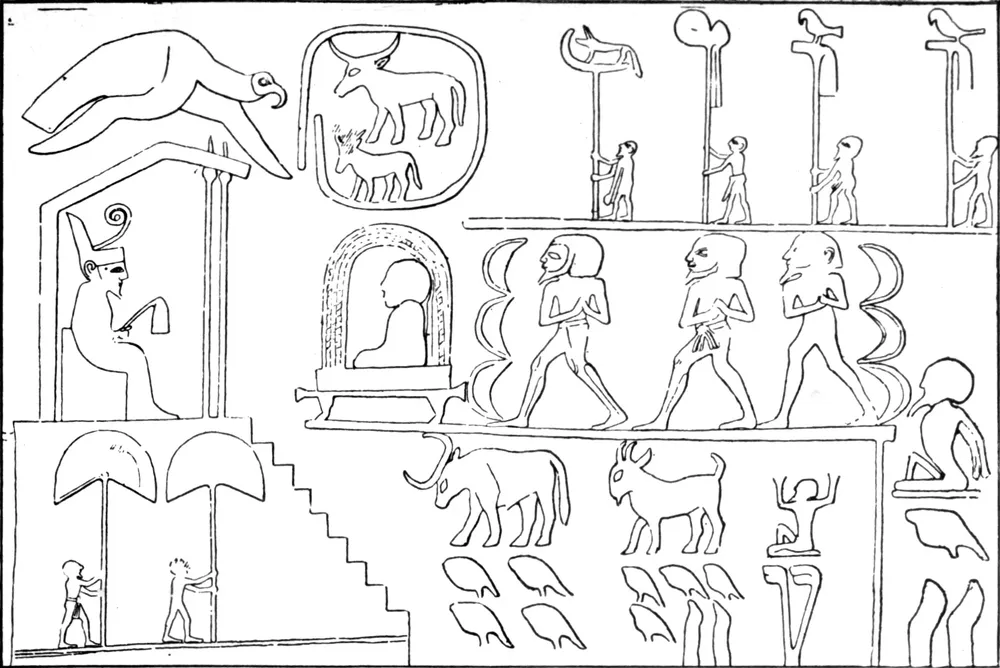
A FESTIVAL SCENE OVER 7,000 YEARS AGO, IN THE REIGN OF
KING NARMER, 5,500 B.C.
A record of the festival of Narmer, a king of Abydos, who
reigned before the first dynasty of kings of all Egypt. It indicates that when
the festival of his own death was celebrated, in accordance with the ancient
custom of killing the king every thirty years to make him one with Osiris the
god, no fewer than 120,000 captives, 400,000 oxen, and 1,422,000 goats were
offered. The numerical system is here seen to be complete up to millions.
Planting and Building
There were brought to the festival of Narmer 120,000 captives, 400,000
oxen, 1,422,000 goats; and the system of numeration was as complete
before Menes as it was in any later time. The other mace head of
King Zar shows part of the festival, and also the ceremony of the
king hoeing the bank of a canal, probably at the inundation. We see
the reclamation of the land, with men busy embanking the canals, and
cultivating a palm tree in an enclosure of reeds, while they lived in
reed huts with plaited dome tops, and used boats with a very high,
upright stem. The carved slate palette of Narmer shows him grasping the
chief of the Fayum, prepared to smite him, a scene which was repeated
for five thousand years in all the Egyptian triumphs. The metal
water-pot and sandals are carried behind the king by his body servant.
On the other side of the palette is the king going to a triumphal
ceremony, preceded by the scribe, thet, and four men of different
types bearing the standards of the army, possibly connected with the
four territorial divisions of the army found under Ramessu II. Before
them lie ten slain enemies, with their heads cut off and put between
their legs. The carving of the detail, and particularly the muscular
anatomy of the king’s figure, is extraordinarily fine and firm, and as
true as any work of later time.
WRITTEN HISTORY.
Having now dealt with the history as drawn
from the remains which have come to light, we now enter from this
point on the continuous written history, which has come down from hand
to hand without a break to our own times, during over seven thousand
years. This history was compiled by the high-priest and scribe Manetho
of Sebennytos in the Delta, and only a fragment of his work has been
preserved on its full scale; but three later writers have given
epitomes of it, and it is on their lists that we have to depend. These
are Julius Africanus (221 A.D.), Eusebius (326 A.D.),
and George the Syncellus (792 A.D.).
The Men Who Handed Down the Story
An Ancient Historian and His Figures
Unfortunately, much confusion has been caused by scholars not being
content to accept Manetho as being substantially correct in the main,
though with many small corruptions and errors. Nearly every historian
has made large and arbitrary assumptions and changes, with a view to
reducing the length of time stated. But recent discoveries seem to
prove that we must accept the lists as having been correct, however
they may have suffered in detail. A favourite supposition has been that
the dynasties named were arbitrary divisions of later times; but the
earlier lists also show such divisions as far back as the eighteenth
dynasty, and kings founding a dynasty used to copy the titles of the
founder of the previous dynasty, showing that the change was recognised
at the time.
Another idea has been that the dynasties were contemporary. But, on
the contrary, in the overlapping of the tenth and eleventh and also
the twenty-fifth and twenty-sixth dynasties, we can trace that Manetho
was very careful to cut off from one dynasty all the time which he
allows to another. As regards the general character of the whole length
of time, we can show that Manetho’s version in 271 B.C. at
Sebennytos was the same as that given to Herodotus two hundred years
earlier at Memphis. Herodotus was told that from Menes to his time were
330 kings, and the totals of Manetho are 192 + 96 + 50 to Artaxerxes =
338, so that, in spite of corruption in detail, the totals seem to have
been correctly maintained.
In earlier times we can compare Manetho with the fragments of the
Turin papyrus, written in the eighteenth dynasty; and here, in one of
the most disputable points—the kings of the thirteenth dynasty—the
average of eleven reigns legible in the papyrus is 6½ years, and
Manetho states sixty kings in 453 years, or 7½ years’ average. The
general character of a great number of short reigns in this age is
quite supported. Then in the eighteenth dynasty there is a rising of
Sirius in the movable calendar, in the twelfth dynasty another rising
of Sirius, and some seasonal dates, and in the sixth dynasty are two
seasonal dates. [Owing to the ignoring of leap year, the Egyptian
months shifted round the seasons in 1,460 years; hence any seasonal
date can only recur once in 1,460 years, and fixes an absolute date in
that cycle.] All of these agree with Manetho; and though the seasonal
dates are vague, they at least show that there is not an error of
several centuries in the total. In the earliest times there is the
account of the first dynasty, the names and succession of which are
verified by the sculptured lists in the nineteenth dynasty and by the
actual graves of the kings. Every accurate test that we can apply shows
the general trustworthiness of Manetho, apart from minor corruptions.
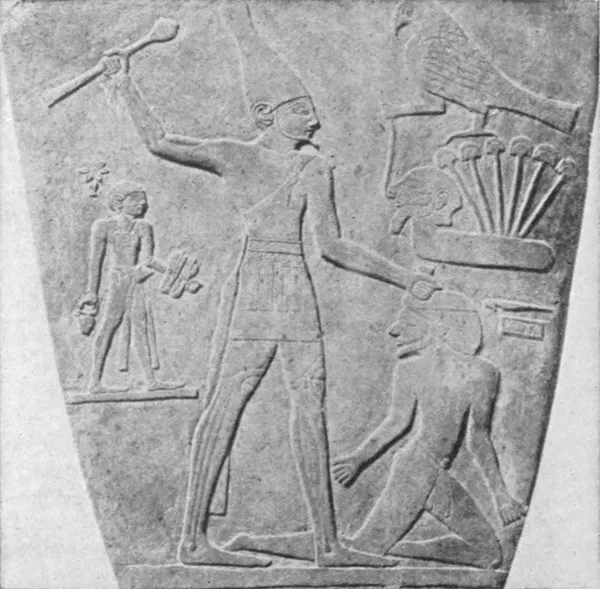
THE EARLIEST DETAILED SCULPTURE
This carved slate palette of King Narmer shows him
grasping the chief of the Fayum, prepared to smite him, a scene which was
repeated for five thousand years in all the Egyptian triumphs. The sculpture
shows anatomical treatment for the first time in art.
Material for History of Early Times
It is naturally a question what sort of material existed for an
accurate history of the early times. The fragment of annals known as
the Palermo Stone was engraved in the fifth dynasty, and it recorded
the principal events of all the years back to the beginning of the
kingdom, a thousand years before, the height of the Nile for every
year, the length of every king’s reign and of interregnum to the exact
days. With such a record of the most remote times carefully maintained
we have every reason to suppose that the high-priests and sacred
scribes had adequate information as to the general course of their
history. And we can see by the Turin papyrus how in the eighteenth
dynasty there was a full historical list of all the kings, with their
length of reigns, dynasties, and summations of numbers and years
at each of the large divisions. Thus it is proved that there were
historians at various periods who compiled and edited the history, and
so provided a solid groundwork for later writers, such as Manetho.
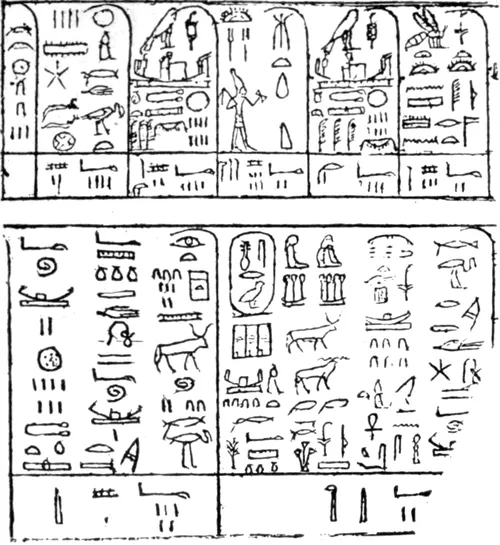
A RECORD OF EVENTS IN 4750 B.C.
A part of early annals known as the Palermo Stone. Each
compartment contains the events of one year, with the height of the Nile in cubits
stated below it. The lower right division records: “Building of a ship 170 feet
long, and of 60 ships 100 feet long. Conquest of negroes, bringing 4,000 men,
3,000 women, and 200,000 cattle. Building a wall of the palaces of King Sneferu.
Bringing 40 ships of cedar (from Syria).” The left division reads: “Making 35
hunting lodges and 122 tanks for cattle. Building a ship of cedar 170 feet long,
and two other ships of 170 feet. 7th census of cattle.”
The Witness to Early Civilisation
The materials that we have for studying the civilisation of the early
dynasties are the royal tombs and steles, the tablets of the annals,
the sealings of officials, the inscribed stone bowls, glazed pottery,
ivory, and wood, the rock steles of Sinai, fragments of buildings of
the second dynasty and onward, the steles of private persons and their
graves.
In the Kings’ Tombs
ROYAL TOMBS.
The tombs show that brickwork was familiar on
a large scale. The prehistoric houses and tomb chambers were by no
means slight. The town at Naqada has house-walls about two feet thick,
and a town wall nearly eight feet thick. The brick-lined tombs are
sometimes as large as 8 ft. by 12 ft. The kings’ tombs of Dynasty O
are about 10 ft. by 20 ft. Those of Narmer, Sma, and Mena are about
17 ft. by 26 ft., with walls 5 ft. to 7 ft. thick. Under Zer there is
a great extension; the brick pit is 39 ft. by 43 ft.; it contained a
wooden chamber 28 ft. by 34 ft., and it was surrounded by many rows
of graves—318 in all. The later tombs of the first dynasty are less
imposing. At the end of the second dynasty the tomb of Khasekhemui
consisted of fifty-eight chambers covering a ground 223 ft. long and
40 ft. wide. The sizes of bricks were between 9 in. and 10 in. long,
half as wide, and under 3 in. thick, in the prehistoric and through the
first and second dynasties. Wood was used on a large scale. The royal
tombs show beams for framing of about 10 in. wide and 7 in. deep, and
18 ft. or 20 ft. long, and these beams supported chamber sides and
floors formed of planks 2 in. or 3 in. thick. The roof was made of
similar beams, covered with boards and mats, which sustained 3 ft. or
4 ft. of sand laid over the tomb. Such was an extension of the roofs
of poles and brushwood which were laid over the prehistoric tombs, and
over the lesser tombs of the officials of the early kings. The sign for
royal architect in the earliest inscriptions is that of a carpenter,
the “two-axe man.”
The stone steles were of limestone in the first dynasty, and in the end
of the first dynasty the steles of Oa are of black quartzose stone.
Those of Perabsen in the second dynasty are of very tough syenite.
The carving of all these is in high relief, finely and boldly cut in
a simple, clear style. At the end of the second dynasty a stone-built
chamber appears for the first time; the blocks have naturally cloven
surfaces so far as possible, and the rest of the faces are dressed
with a flint adze. Of the same reign of Khasekhemui there is a granite
door-jamb with signs in high relief. Granite had already been wrought
flat for pavements in the previous dynasty, at the tomb of Den.
Egypt’s Annual Record
The Honour that Kings Died for
TABLETS OF ANNALS.
The greater part of the inscriptions of
this age are on small square tablets of ebony and of ivory, which were
found in the royal tombs. These each have a hole in the top corner,
and the sign of a year—the palm stick—down the side, as there is
by the side of the entries of the events of each year on the early
annals. They thus appear to be each the record of a year, and to have
been strung together by the corner holes. There has not yet been any
authoritative study of the meaning of these earliest inscriptions,
which are very difficult to understand, owing to the transitory
condition of ideographs having not yet yielded to syllabic usage.
We can, however, glean many points about the civilisation from them.
The towns were fortified with battlemented walls. The shrines were
small sanctuaries, with a large court in front, like the temple courts
of later times. At the entrance to the court were two tall poles,
apparently with flags, which later developed into the row of masts
with streamers in front of the pylon. The great festival at the close
of each thirty years was one of the most important, already noticed
here under Narmer. The sanctuary for it had two shrines back to back,
each with a flight of steps, apparently for Upper and Lower Egypt. The
dancing of the new king, or the crown prince as king, before the old
Osirified king in the shrine, was one of the main events of the feast.
The types of temple furniture were already fixed in the forms which
lasted for several thousand years; the barks of Harakhti are shown with
the same hangings at the prow, and are double—for the E. and W.—as
in the temple of Sety I. Large bowls of electrum were offered in the
temples by the king. Wild cattle were hunted by trap nets, as was done
much later in Greece. And there is shown a long road, with resthouses
and palm-trees, leading up to the great temple in the reign of King Zer.
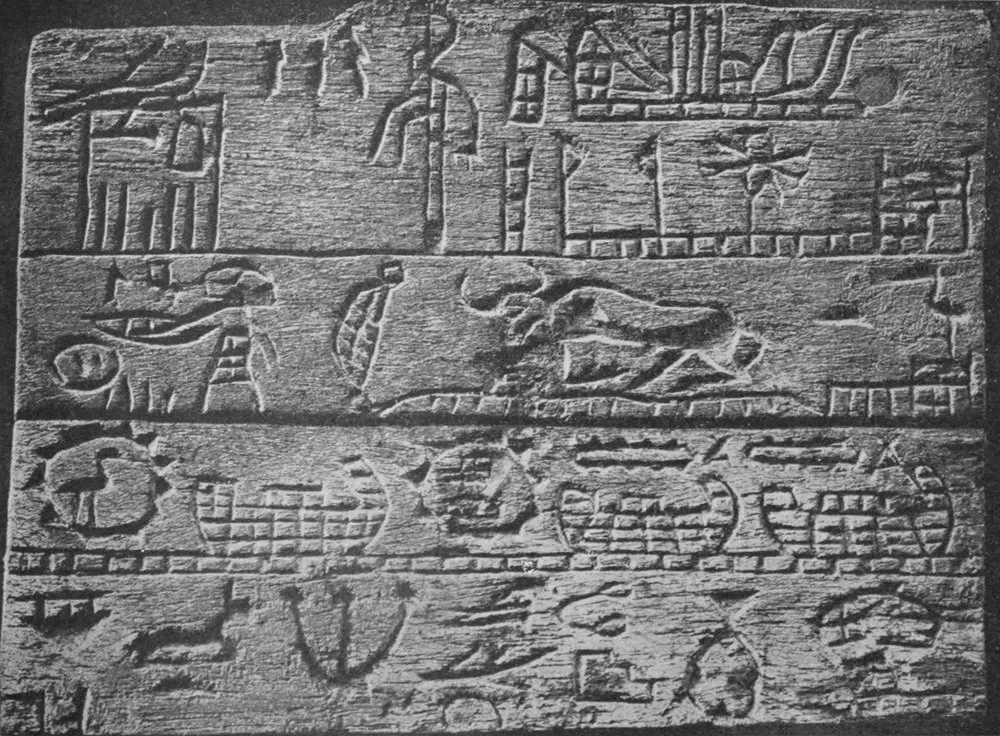
A RECORD OF A YEAR’S EVENTS: EBONY TABLET OF KING MENA,
5500 B.C.
The greater part of the inscriptions of the first dynasty
are on small square tablets of ebony and of ivory. These each have a hole in the
top corner, and the sign of a year—the palm stick—down the side. They
thus appear to be each the record of a year, and to have been strung together by
the corner holes. They were found scattered in the tombs.
Officers of the Empire
SEALINGS. The clay sealings of officials show much of the
organisation of the country. The oldest titles, under Zer, are the
“Commander of the Inundation” and “Commander of the Cattle.” In the
reign of Zet we find a “Commander of the Elders” and “Archon,” or chief
of the city; also the temple property, or “Inheritance of the Chief
God,” is named. Under Merneit and Den there is a prince (ha). The
vizier was “Commander of the Centre,” probably the major domo of the
Court, and also “Over-head of the Commanders.” There are further named
a “Royal Sealer of the Vat of Neit,” the “winepress of the north,” and
a “Deputy of the Treasury.” In later reigns there is an “Over-head” of
a city. And under the second dynasty the titles are “Royal Sealer of
all Deeds,” “Scribe of Accounts of Provisions,” “Sealer of Northern
Tribute,” “Collector of Lotus Seed,” and “Chief Man Under the King.”
These titles are from but a very small part of the bureaucracy, only
those whose seals were affixed to the royal provision which was placed
in the tomb; but they suffice to show the regular organisation of the
government at that age.
THE SEAL OF AN EGYPTIAN OFFICIAL
Much exact knowledge of the life of ancient Egypt is
derived from the clay seals of high officials. The oldest known titles are those
of “Commander of the Inundation.” The seal here is that of the “Southern Sealer
of all Documents of King Sekhem-ab,” 5100 B.C.
STONE VASES.
The stone vases for the royal palaces were
cut in many kinds of hard rock. The rarer kinds are rock crystal,
serpentine, and basalt; limestones, porphyry and syenite were more
usual; and the commonest materials were metamorphic rocks formed from
volcanic ash verging into slate, dolomite, marble, and alabaster. These
materials were mostly selected for their beauty. The red porphyry is
the rarest, being only known in a bowl of the time of Mena, and two
prehistoric pieces. Black porphyry with very large detached white
crystals belongs only to the age of Mena. Pink granite, blue-grey
volcanic ash, the quartz crystal, and the pink limestones are all very
beautiful materials. The hardness does not seem to have been aught but
an attraction, as the finest work is always put on the best materials;
whereas the soft alabaster and slate did not seem to challenge any
great amount of care. The working of the inside was always done by
grinding with blocks, sometimes having first removed the axis by a tube
drill hole. The outside was dressed by chipping, hammer-dressing, and
hand polishing; sometimes done by circular motion on a block, but often
by crossing work by hand. The readiness with which oval forms were made
shows how little depended on circular motion.
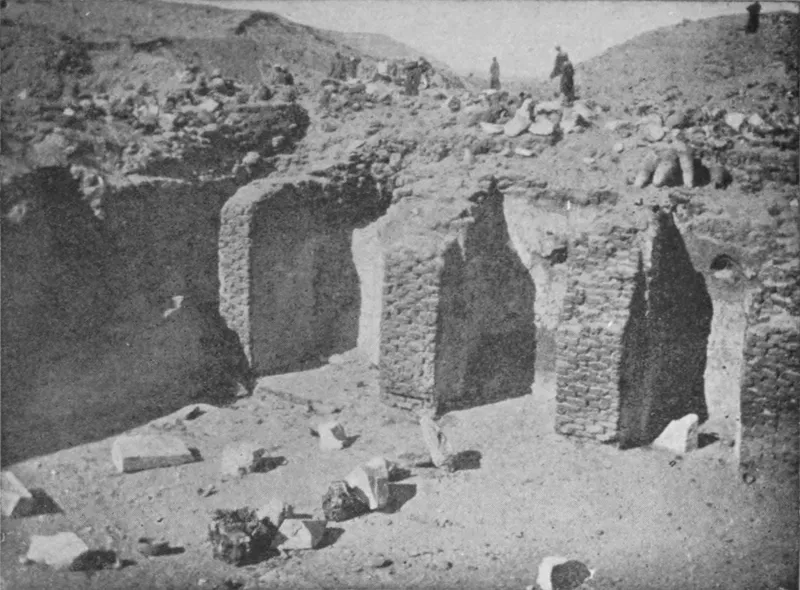
TOMBS OF KING ZER OF THE FIRST DYNASTY, 5400 B.C.
Brickwork was common in the houses and tomb-chambers of
the prehistoric period, and in the time of the kings of Abydos the building of
the tombs was greatly extended. Here are seen the brick partitions to contain
offerings, around a wooden chamber now destroyed. Beyond this all round were
318 graves of the royal servants.
Two-Colour Glazing
The use of glazing had been already invented early in the prehistoric
age, as far back as S.D. 31; but it was only applied to beads
and small amulets. The earliest glazed pottery vase known is of Mena,
and this has his name in violet glaze inlaid in the green glazed body.
Glazed vases continued to be made throughout the first and second
dynasties, but became rarer, and they have not been found revived till
much later times. But ivory and wood were largely used for carved
objects, sometimes of elaborate design. One of the most distinguishing
points of the age of the early kings was the minute carving in
imitation of leafage and basket-work, which was mainly done in slate,
but also in wood. The fragments which remain show most elaborate
patterns worked out with minute attention to detail. Nothing of the
same kind is known in any other age.
Remains of the Oldest Sculpture
MONUMENTS. There are but few monumental remains from these
early dynasties. The great rock-cut scene of Semerkhet conquering
a Bedawy chief in Sinai is the main example. The figures are only
summarily cut in the natural face of the sandstone; but the truth of
the outline is better than in any of the more pretentious work of later
times in that region. The scene of Sanekht—early third dynasty—is
much poorer, and that of his successor, Zeser, is scarcely legible, the
work is so rude and slight. The private tablets which were put over the
graves around the royal tombs show that the fine work was limited to
a small number of royal artists in the first dynasty, and that there
was no general school of able men such as arose in later times. The
figures and hieroglyphics are rudely hammered out, and the drawing is
but clumsy. There is seldom more than just the name of the deceased. By
the time of Den many are distinguished as the Akhu-ka, the “glorious
soul”; while there is also a class apparently named “people of King
Setui, daughter of the captive”—i.e., slaves born of captives taken
in his wars.
THE EARLIEST SCULPTURE
There are but few monumental remains from the early
dynasties. The great rock-cut scene of Semerkhet, of which this shows a part,
is the main example. The figures are only summarily cut in the natural face of
the sandstone; but the truth of the outline is better than in any of the more
pretentious work of later times in the same region.
It appears that the use of fine materials was at its height under
Mena and Zer. Zer has the largest and best-built tomb, Zet shows the
greatest delicacy in work, and Den seems to have had the most showy
objects. The changes in about five generations here were much like
those in an equal time from Amenhotep I. to III. in the eighteenth
dynasty. Then decay markedly set in, and there was no revival until the
Pyramid kings. But some development in the use of materials went on;
and Zeser, of the third dynasty, is said to have built a stone palace;
while Khasekhemui, a generation earlier, had a limestone chamber for
his tomb, and carved granite for the door-jambs of his temple, at
about 4950 B.C. These instances are the earliest use of stone
for construction that are yet known; though as early as the middle of
the first dynasty King Den had a pavement of red granite in part of his
tomb.
Age of the Pyramid Builders
PYRAMID BUILDING.
We now approach to the well-known age of
the pyramid builders, when the civilisation appears at its highest
development in most respects. We shall not deal with this in detail, as
it falls into the ordinary historical period which appears elsewhere in
this work [see Egypt]. But it may be useful to give the most essential
facts of the material civilisation, which may otherwise be lost sight
of in the mass of the history.
In stonework the accuracy reached its highest point in the fourth
dynasty, when the Pyramid of Khufu was constructed with an average
error of less than 1 in 15,000 of length, and even less in angle. The
later work fell off from this accuracy; but in the twelfth dynasty
the granite sarcophagus of Senusret II. was wrought with an average
error in straightness and parallelism of under seven-thousandths of
an inch, and an error of proportions between different parts of less
than three-hundredths of an inch. There was no attempt to reach this
high degree of accuracy in the later work. In sculpture the main
character of the work of the Pyramid kings is its dignity and grandeur,
representing individualism on the highest plane of abstraction.
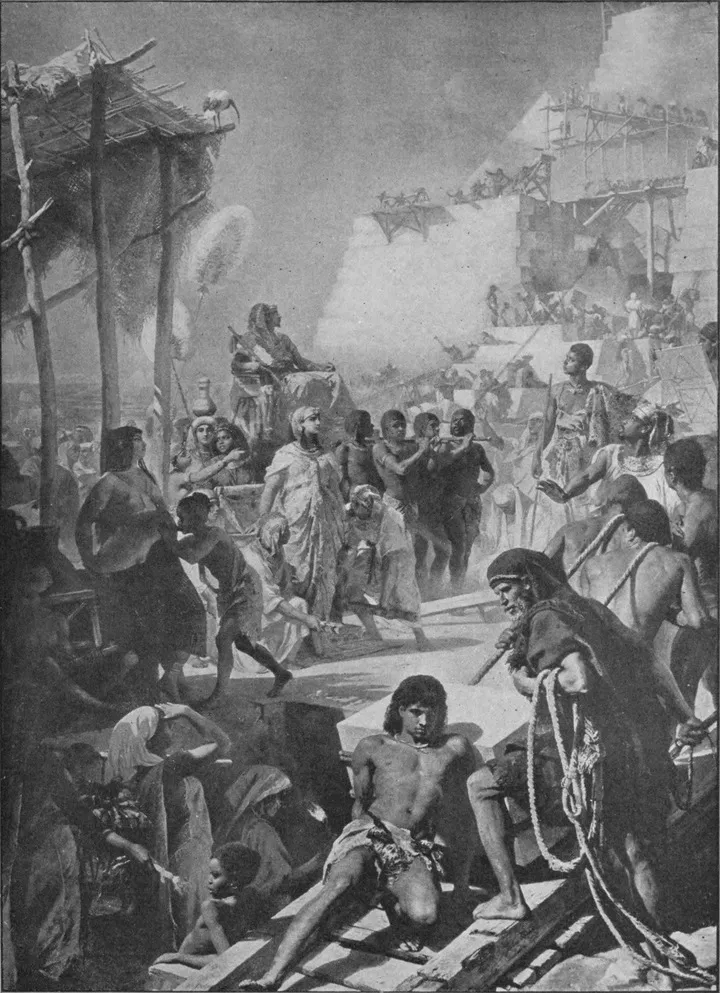
THE BUILDING OF THE PYRAMIDS IN THE ZENITH OF EGYPTIAN
CIVILISATION
The age of the Pyramid builders may be regarded as the
height of Egyptian civilisation. The greatest accuracy in stonework was reached
during the fourth dynasty, when the Pyramid of Cheops, or Khufu, was constructed
with an average error of less than 1 in 15,000 of length, and of even less in
angle. In the twelfth dynasty the granite sarcophagus of Senusret II. was wrought
with an average error in straightness and parallelism of under seven-thousandths
of an inch.
LARGER
IMAGE
The Great Navy of Egypt
Under the twelfth dynasty the personality is weaker and the style that
of a formal school, highly trained but dependent upon training. In the
eighteenth dynasty the vivacity of expression is directed to a purely
personal appeal, more of emotion than of character. After that there
is nothing but copying, good or bad. The growth of shipping at the
early date of Sneferu, the end of the third dynasty, is surprising;
and the record that we happen to have shows how much probably went on
at other times, there being built, in one year sixty ships of 100 ft.
long, in the next year two of 170 ft. long.
METALS. The use of copper is as remote as the beginning of
the continuous civilisation in the prehistoric age, about 8000 B.C.
It increased in quantity down to the eighteenth dynasty, and it was
hardened by using arsenical copper ores, and leaving oxide in it; this,
with hammering made it equal to soft steel for working purposes. Rare
instances of tin, probably derived from natural mixture in the ore, are
known from the third dynasty; but there was no regular use of it until
we find pure tin, also known about 1500 B.C. Thence bronze
was the main material until Roman times. Iron had been sporadically
found in the fourth, sixth, twelfth, and other dynasties, and was known
for about 4,000 years before it came into general use in Greek times.
This agrees with its having been obtained from native masses rarely
discovered, as has been the case in North and South America. Such
native iron is the result of volcanic action on iron ore in contact
with carboniferous strata. All these conditions exist in Sinai, and
hence native iron might be found there. By about 800 B.C. iron
was used for knives, but with a handle of bronze cast upon it to save
the rarer metal. The iron tools in Egypt from the seventh to fifth
century B.C. are all Assyrian or Greek, and it is not till
Ptolemaic or Roman times that bronze tools disappear.
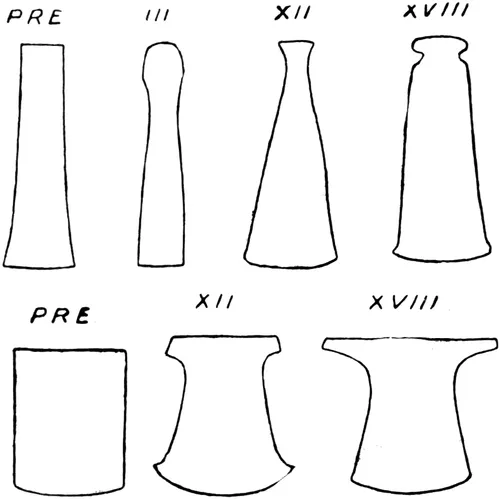
TOOLS OF ANCIENT EGYPTIANS
The plain strip of copper used for an adze in the early
prehistoric age became in historic times widened at the edge, and had a slight
contraction at the top; but the straight strip was kept up for 7,000 years
without any attempt at a haft, simply lashed on to a bent handle. It is not
till about 800 B.C. that any use of a haft occurs in Egypt, and then only for
a hoe. The different dynasties are indicated in the examples here given.
Oldest Rock Drills
The forms of tools varied very little. The plain strip of copper, which
was used for an adze in the early prehistoric age, became in historic
times widened at the edge, and had a slight contraction at the top to
assist in binding it on; but the straight strip was kept up for 7,000
years without any attempt at a haft, simply lashed on to a bent handle.
It is not till about 800 B.C., or later, that any use of a
haft occurs in Egypt, and then only for a hoe; while in Babylonia axes
cast with a strong haft were used before 3000 B.C. Nor was a
haft used for a hammer—a smooth stone in the hand was the only beating
tool; while for striking tools a wooden mallet was used, cut out of a
block. The axe began as a plain rectangle of copper, sharp on one edge;
projections at the back were added, until they were half as long as the
breadth of the axe, but no haft was attempted. The saw was used before
the pyramid period; and also the saw and tube drill set with hard
stones for cutting granite. Drills for boring vases were usually blocks
of stone fed with sand and water, or probably emery for cutting the
harder stones. Socketted chisels were an Italian invention in the later
Bronze Age, about 900 B.C., and were copied by the Greeks, in
iron, about 500 B.C.; but they were never used except under
Greek influence in Egypt. Shears are also Western, and were unknown
till Greek times in Egypt.
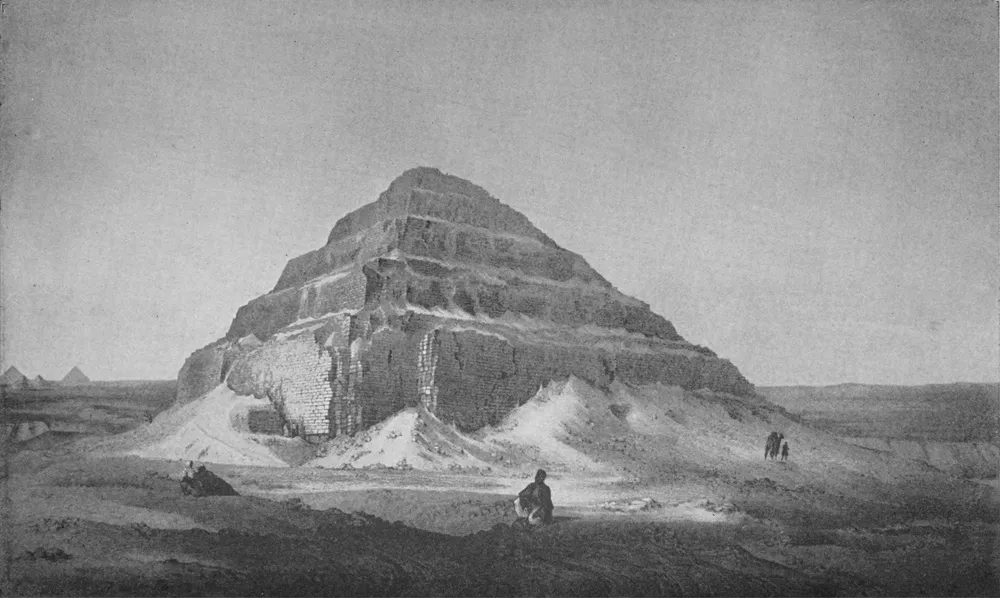
ONE OF THE WORLD’S OLDEST MONUMENTS: THE GREAT STEP
PYRAMID AT SAKKARA
This pyramid was built by King Neterkhet of the third
dynasty, about 4900 B.C.
LARGER
IMAGE
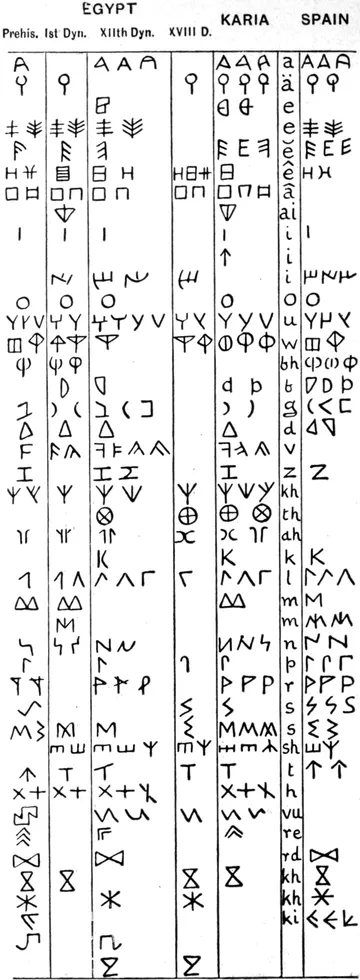
THE BEGINNING OF THE ALPHABET
The signary which was used in various early ages is here
shown, as it has been gathered from examples of over 100 signs found in Egypt.
Closely related to these are the early alphabets of Karia and Spain, the latter
alphabet containing over 30 signs. It is from this prehistoric signary that the
present Roman alphabet has been gradually selected during past ages.
LARGER
IMAGE
GLAZING AND GLASS.
The very ancient art of glazing, already
used in two colours under Mena, did not take any new form till the
eighteenth dynasty, when it was greatly varied by new colours and
new applications. Large objects, five feet high, were covered with a
single fusing of glaze; minute ornaments, for stitching on garments,
blazed with the brightest red, green, blue, or yellow; while whole
inscriptions were executed in coloured glaze hieroglyphs, inlaid in
the white stone walls. Glass, however, was not made separately until
about the time of Tahutmes III., 1500 B.C. There is no earlier
example of true glass, nor any representation of working glass. All
the truly Egyptian glass was wrought pasty, and never blown.
Blown vases belong entirely to the Roman age and later times. The large
blown glass lamps of Arab age, covered with fusible enamel designs, are
highly skilled pieces of work. The uses of glass to the Egyptian were
mainly for beads, for coloured inlays in wood of shrines or coffins,
and for variegated glass vases. The beads were made by winding a thread
of glass on a wire; the vases, likewise, were made by modelling on an
infusible core, held on a mandrel, and winding coloured glass threads
on the body. The inlays were often of one colour, generally deep blue
imitating lazuli; but often mosaics were used, made of a bundle of
glass threads fused together, drawn out, and then cut off in slices.
Such are all of Greek or Roman age. An important use of glass in Roman
and Arab times was for weights, and for stamps impressed on glass
bottle measures, inscribed with the names of the ruler and the maker.
Taste of the Times
Lastly we may note the variations in the nature of the Egyptian
literature, as reflecting the civilisation. The earliest tales are
those of magical powers, belonging to the pyramid age. Next, in the
Middle Kingdom, comes the contrast between town and country, and the
tales of adventure in foreign lands. In the New Kingdom the contrasts
of character are the main interest, and, in the late tales, the
pseudo-historical romance of the great tournament of the Delta, or the
antiquarian interests of a priest. These subjects of romance varied as
much or more than the actual grammar and language.
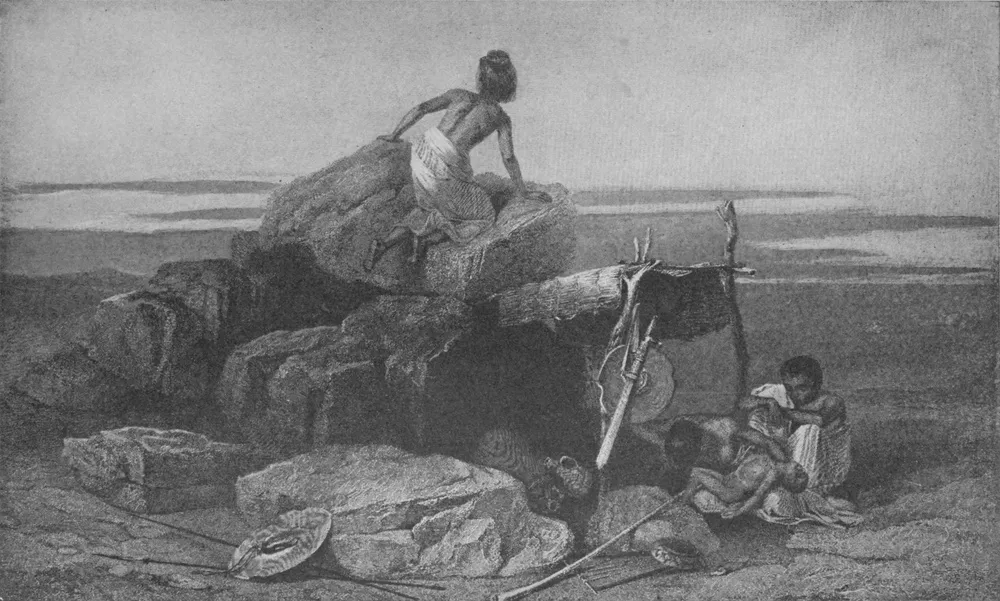
THE WANDERERS OF THE DESERT, AMONG WHOM EGYPTIAN
CIVILISATION GREW UP
LARGER
IMAGE
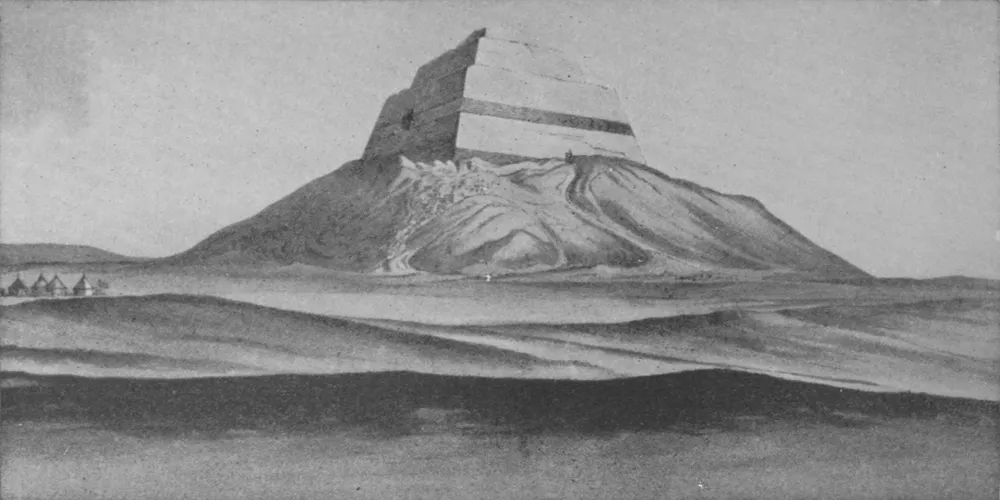
PYRAMID OF MEIDUM: BUILT BY SENEFERU, LAST KING OF THE
THIRD DYNASTY
This tomb was begun as a square block of masonry, and was
enlarged by successive coats, which are here seen. Then one smooth coating
of sloping blocks was put over all from bottom to top, and so the first real
pyramid appeared in 4700 B.C. The pyramid coating has been destroyed and only
the base remains under the rubbish mounds.
ALPHABET. One subject of great European interest should be
noted here, as Egypt has thrown much light upon it. The origin of the
alphabets of the Mediterranean has been disputed, without historical
knowledge of the examples of such signs in early ages. The Egyptian
hieratic and the archaic Babylonian signs may have, perhaps, added a
few to the Mediterranean signary, but neither source can at all account
for it. The alphabet is by no means a clean cut series of 22 signs;
it is a very complex tangle of parallel groups of signs in different
lands, more or less alike. Of these groups two of the largest are
those of Karia and Spain, comprising over 30 signs, and these have many
points of peculiarity in common. This is sufficient to show that the
fuller alphabet is the original form, from which the shorter lists have
been selected. Now, in Egypt there are found scratched on pottery and
woodwork over 100 signs, and these comprise the forms of the fuller
alphabet. Moreover, these Egyptian examples are found at about 1200
B.C., or only a few centuries before the Karian and Spanish
alphabets, again in 3000 B.C., in 5500 B.C., and
before 7000 B.C. Of 41 alphabetic signs, 19 occur in 1200–1400
B.C., 32 in 3000 B.C., 27 in 5500 B.C.,
and 31 in 7000 B.C. As we have not a very large amount of
material, the occurrence of from 19 to 32 out of 41 signs is as much
as we could expect, as all the 41 occur in one period or another.
The early date of these puts all derivation from the subsequent
hieroglyphics entirely out of the question. We can as yet only say that
a large signary of 40 or more linear forms was in continuous use from
before 7000 B.C. downwards, and that these furnish all the
forms of the fuller alphabets, those of the short Phœnician and Greek
list of later time.
We have now outlined the rise of civilisation in Egypt, apart from the
history of the country, which is dealt with separately; and we turn
to the other great valley of early civilisation, in Mesopotamia, to
compare the resemblances and the differences between the two lands.
W. M. FLINDERS
PETRIE
NOTABLE DATES OF ANCIENT CIVILISATION
|
|
EGYPT
|
|
|
BABYLONIA
|
|
B.C.
|
|
|
B.C.
|
|
|
8000
|
Continuous civilisation of prehistoric
age began
|
S.D. 30
|
Before
|
|
|
7000
|
Asiatic invasion
|
S.D. 40
|
6000
|
Susa founded
|
|
5800
|
Invasion of dynastic race
|
|
|
|
|
5500
|
Mena rules all Egypt
|
S.D. 80
|
5000
|
Ea founds Eridu and civilises the land
|
|
4700
|
Khufu builds Great Pyramid
|
|
4700
|
Earliest monuments of Kings
|
|
|
|
|
4500
|
Urnina
|
|
4000
|
Invasion from north
|
|
3800
|
Sargon and Naramsin, Semitic rule
|
|
3400
|
Middle Kingdom, twelfth dynasty
|
|
3300
|
Gudea
|
|
2500
|
Hyksos invasion, fifteenth dynasty
|
|
|
|
|
2250
|
Second Hyksos movement
|
|
2280
|
Elamites conquer Babylonia
|
|
|
|
|
2129
|
Hammurabi
|
|
1580
|
New Kingdom, eighteenth dynasty
|
|
1572
|
Kassite dynasty
|
|
1380
|
Tell el Amarna letters
|
|
1380
|
Burnaburiash
|
|
701
|
Taharqa (Tirhakah)
|
|
690
|
Sennacherib
|
|
570–26
|
Aahmes (Amasis)
|
|
556–38
|
Nabonaid, fall of Babylon
|
T
THE
first impression that strikes the reader in passing from the
Egyptian to the Mesopotamian civilisation is the lack of that unity and
conciseness which makes history in the Nile valley so intelligible, and
its problems so well defined.
Disunion of Early Babylonia
In place of the well ordered history of Manetho, with its numbered
dynasties, and totals stated throughout, there is practically nothing
stated before Nabunasir in 747 B.C. The mythological extracts
from Berosus, and the list of Ktesias, which cannot be identified with
any known facts, give no help in arranging the outlines of the history.
In place of the uniform language and writing, which develops without a
break during the whole history of Egypt, there is the entire break from
Sumerian to Semitic. In place of the continuous importance of Egyptian
capitals, there is the change from the principalities to Babylon, and
thence to Nineveh. In place of the unified kingdom of the Nile valley,
through the whole written history, the greater part of the documentary
period is filled with rival principalities, within thirty or forty
miles of each other, the tops of whose temples must have been visible
over the entire territory of their respective states.
As the general scale of Egypt is so familiar to the modern reader and
traveller, it will be well to compare Mesopotamia with that. Babylon
was twice as far from the sea as Cairo; and from Babylon to Nineveh
was the distance from Cairo to Sohag. Or in other terms, starting from
the sea, Babylon was as distant as Oxyrhynchos, Nineveh in place of
Thebes, and the highlands of Carchemish, Commagene, and Lake Van were
the equivalent of Nubia. The old land of Shumer was just the size of
the Delta, and Akkad as large as Middle Egypt. The principalities of
Eridu, Lagash, Ur, Erech, and others, were as far apart as those of the
Delta—Bubastis, Benha, Sais, or Sebennytos. Indeed, it seems as if
this were a natural unit-size of early dominions in a fertile plain.
The Nile and the Euphrates
Though the relative age of the beginning of civilisation on the Nile
and the Euphrates is yet an uncertain matter, still it is clear
that the unification of Egypt long preceded that of Babylonia. The
earliest date of the scattered Sumerian kings is about that of the
fourth dynasty; the earliest Semitic dynasty—Sargon and Naramsin—was
contemporary with the ninth dynasty, and the rise of the dynasties of
Babylon is of the later Hyksos age of the sixteenth dynasty.
Sea-shore Moved 47 Miles
EUPHRATES VALLEY.
The conditions of the Euphrates valley are
very different from those of the Nile. On the Egyptian coast the river
runs into a strong current in the Mediterranean, which sweeps away
its sediment and prevents any continuous growth of the coast. But the
Mesopotamian rivers reach the sea-level at the head of a deep bay,
the Persian Gulf, and hence there has been a continuous formation of
new land at the estuary. The Mesopotamian valley and the Persian Gulf
form one long drainage valley gently sloping down to a distance about
twenty miles outside Hormuz, where the valley bottom drops suddenly
three miles into the floor of the Indian Ocean. The slope of this
valley so far as submerged, is about 1 ft. to the mile, and it is
probably even less in the Babylonian plain, where sea-shells are found
as far up as Babylon. This valley has been filled, and the sea-shore
pushed downward, 47 miles in 2,200 years, or 115 ft. yearly, since
Spasinus Charax—now Mohammerah—was founded on the shore in the time
of Alexander. The account of a sea expedition to Elam by Sennacherib
is usually interpreted as showing a more rapid growth; but in the
uncertainty how far he went down a channel before entering the Persian
Gulf, it is not decisive.
How far back the extension of land has been going on, and whether
it was continuous to above Babylon, has not yet been proved. The
appearance of the map much suggests that the original drainage bed
ended—i.e., the valley was submerged—at about the nearing of the
two rivers by Sippara, and that all below this is the filling up of the
estuary. Should this growth have extended uniformly back so far, it
would give limits to the possible ages of cities—5000 B.C.
for Eridu, 8000 B.C. for the whole plain of Shumer, 10,000
B.C. for Nippur, and earlier for the site of Babylon. This
would bar the southern region from being as old as Memphis, and Eridu
was probably open sea when Menes laid out his capital.
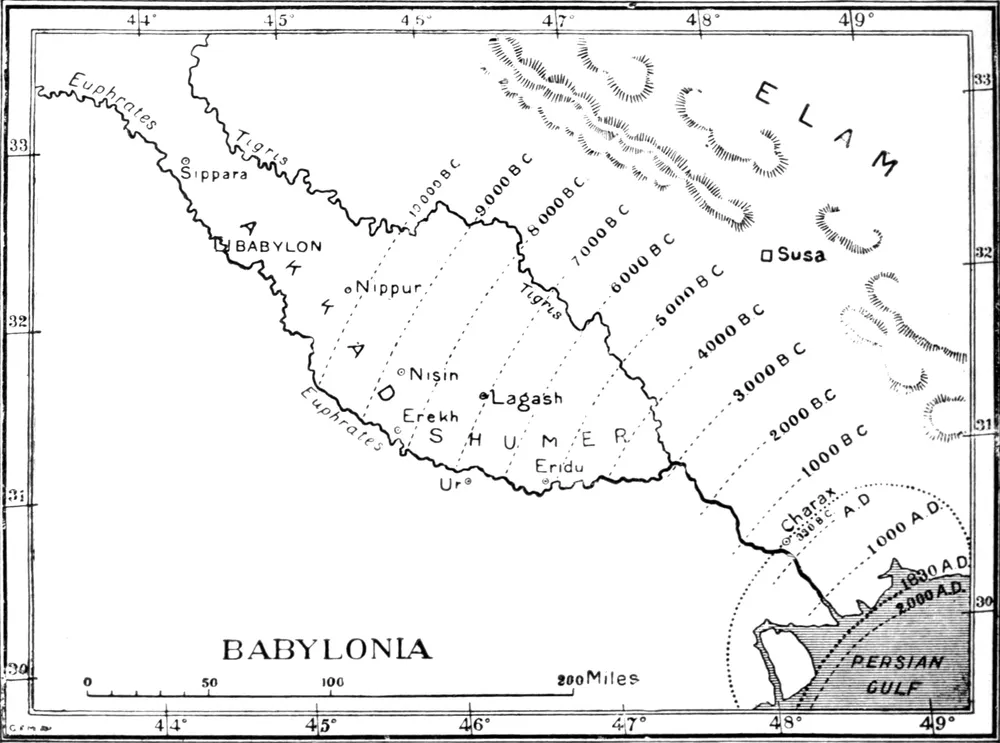
THE PLAIN OF BABYLONIA: ITS EXTENT AT DIFFERENT PERIODS
IN HISTORY
This map shows how the Plain of Babylonia has been
extended down by silting since 10,000 B.C. The dotted lines, marked 330 B.C. and
1830 A.D., show the known positions of the coast, as it shifted by silting up.
These give an approximate scale of dating for the coast-line of earlier ages,
which is marked here at each thousand years.
RANGE OF CIVILISATION.
In looking for the earliest movements
of people that we can trace, it seems that the Semites must have
extended from Northern Arabia into Upper Mesopotamia and Assyria. In
short, Semitica stretched up to the mountain ranges of Armenia and
Media. But the culture was barbaric, and probably they were nomads who
had no fixed centres of life or stable organisation which could resist
any united movement. At this period the Persian Gulf probably extended
as far as Babylon. On their eastern flank were the mountain tribes, in
what is known as Parthia and Media, south of the Caspian. How remote
is the beginning of civilisation in this region has been found in the
last few years. On the north-east extremity of Parthia, in the far end
of Hyrcania, stands a group of mounds, near the modern Askabad, not far
from the celebrated Turkoman stronghold of Geok Tepe. Here are 14 ft.
of town ruins with iron, 15 ft. with copper and lead, about 70 ft. of
ruins with wheel-made pottery and domesticated animals, and 45 ft. of
remains with only rude hand-made pottery. What ages these represent we
cannot judge until the full account by Prof. Pumpelly is issued. But
in any case a very long period is involved. If the accumulation is at
the rate found in Palestine, 4½ ft. per century, the periods would
be perhaps 1,500 years for the wheel pottery, and 1,000 years for the
rough pottery, before the beginning of the age of copper.
At the other side of these countries stands the great mound of Susa,
with over 80 ft. of ruins. The inscriptions show that about 26 ft. of
the height was accumulated between about 4500 and 500 B.C., or
in about 4,000 years. Yet before that there is a depth of about 50 ft.
comprising three periods. In the upper of these is elementary cuneiform
writing on tablets. Below that is a period of rather rough, thick
pottery, painted with chequer patterns and closely-crossed lines, of
the style common in early Syria and Cyprus. And at the bottom of all is
a great quantity of very fine, thin wheel-made pottery of buff tints,
with decoration of thin diagonal lines, rows of ostriches, and various
patterns all derived from basket-work.
Measuring the Depths of Time
If the scale of accumulation of the historic times were to apply
here, it would reach back to 12,000 B.C.; but if the far
quicker scale found in Palestine applied, it would hardly reach 6000
B.C. In any case we have here evidence of a civilisation
apparently much earlier than that of Babylonia, and none of this
earliest fine pottery has been found in the great plains. The highland
civilisation may have begun as early, or earlier, than that of Egypt;
but that of Babylonia started probably later than the North African
culture on the Nile. Seeing, then, that there was a very early
civilisation at Susa on the west of Media, and that further east on the
limits of Parthia we meet another early centre, it is not surprising
that the inhabitants of these regions united to spread down into the
fertile plain which was created by the growing delta of Mesopotamia.
These people belonged neither to the Semite of Arabia nor to the Aryan
of Persia and India, but used an agglutinative language of entirely
different structure from these others, and most akin to Turkish or
Finnish. Having descended from their mountain homes, the people were
known as Akkadu, probably meaning “highlanders,” though there are
other open derivations. And hence the northern part of the Babylonian
plain, next to the Semitic Assyrians, was the land of Akkad; while the
southern part, next to the sea, was known by the native Babylonian name
of Sumer, or Shumer.
China’s Links with Babylon
SUMERIANS. The civilisation of the Sumerians was more akin to
that of the Chinese than to western types, especially in its art, its
picture writing and devotion to literature, its capacity for town life,
and its religious ideas. The cognate origins of the people may well
account for this, and some more precise resemblances led Terrien de
Lacouperie to the view that Chinese civilisation was an offshoot from
the Sumerian stock in its old Parthian home.
The elements of life were well developed by the Sumerians. They were
great agriculturists, and wrote works on the main industry of man, much
as the Carthaginians wrote standard works prized later by the Romans.
They fermented the grape and corn, and had alcoholic drinks. Cattle of
all kinds were raised, and prized as stock, which was fed on grass or
grain or oilcake. The horse is mentioned first in Semitic times, Abut
2000 B.C. Dates and figs were the principal fruits grown; and,
indeed, the date palm seems to have had a far more important place in
the civilisation than it did in that of Egypt. Both wool and leather
were used for clothing, as might be expected.
Materials for the Great Buildings
BUILDING. The main structural industry of the country was
that of brickmaking and building. Immense piles of brickwork were
made to support the temples, marking clearly the custom of the
highlander Akkadi worshipping on the hilltops. The brick ziggurat,
or five-stepped pyramid, at Nippur was 190 ft. by 128 ft., and about
a hundred feet high. The earliest baked bricks are 8·7 in. by 5·6 in.
by 2·2 in., and they were enlarged to 12 in. by 7·8 in. by 1·9 in.
within the Sumerian age. Toward the close of that time large square
bricks were used. Sargon made baked bricks 18 in. square and 3½ in.
thick. From the time of Ur-Engur (3200 B.C.) onward the baked
bricks were 11 in. or 12 in. square. Beside the baked brick used for
pavements, drains, facings, and important work, the great bulk was
made up of crude brick as in Egypt. For important purposes, such as
store-rooms, the inside of chambers was lined with a coat of bitumen,
rendering them damp-proof; and such a lining was used on tanks. Pottery
is abundant in all ages, but we still need a study of the pottery such
as has been made in Egypt, so that it can be used to date excavations
in general. Stands for jars, framed of wood, were used as in Egypt; and
also the clay sealings were of the same type in both lands. Stone vases
were made to imitate pottery; and this suggests that the highlanders
were only using basket-work when they descended into the plain, and
therefore did not possess any types of stonework.
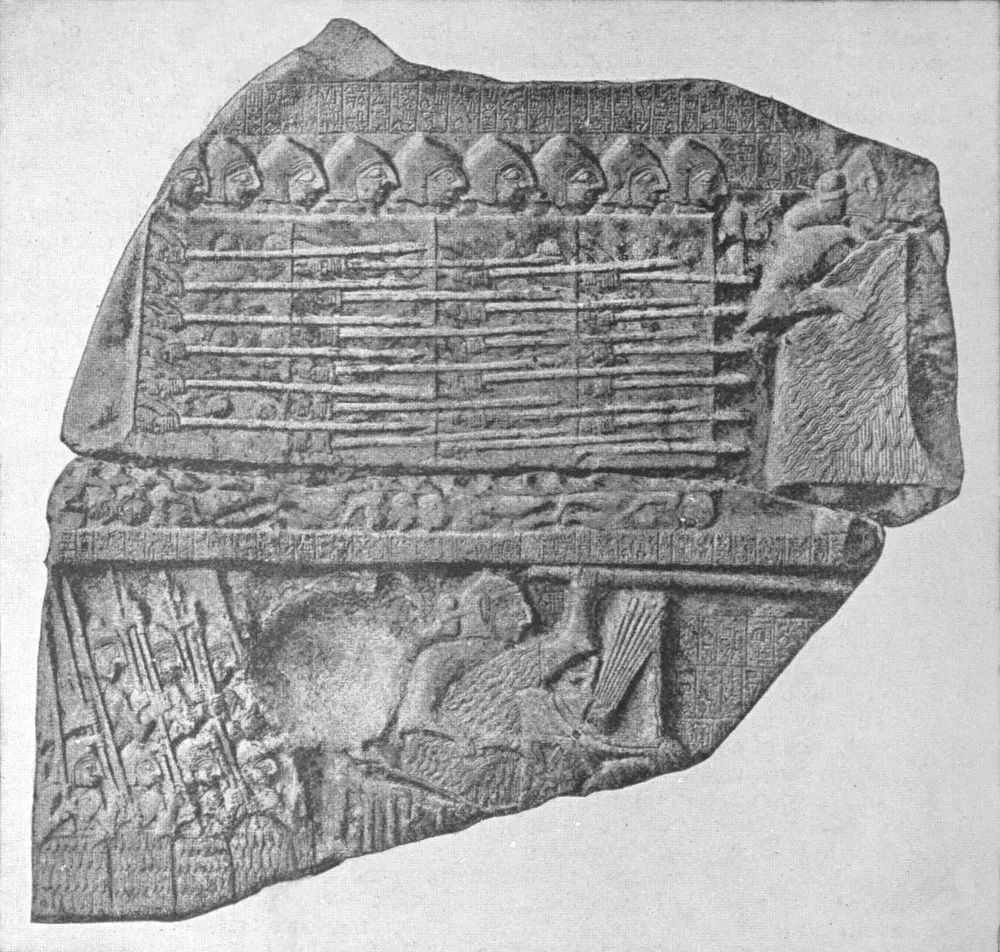
THE ANCIENT BABYLONIANS AND THEIR WEAPONS OF WAR
There is a fine study of weapons on a carving of Eannatum
(4400 B.C.), where spears about 7 ft. long, with blade heads, are figured.
Shields are shown reaching from the neck to the ankles, straight-sided, used
edge to edge as a shield wall by a phalanx of soldiers. The heads of the men are
covered by well-formed peaked helmets reaching down to the nape of the neck,
with nose pieces.
TOOLS AND WEAPONS.
The common tools were used, such as knives
and drills; and great skill was developed in seal engraving upon hard
stone cylinders. Of weapons there is a fine study on a carving of
Eannatum (4400 B.C.), where spears of about 7 ft. long, with
blade heads, are shown; also shields reaching from the neck to the
ankles, straight-sided, and used edge to edge as a shield wall by a
phalanx of soldiers; while the heads are covered by well-formed peaked
helmets, with nose pieces, and reaching down to the nape of the neck.
Bows and arrows and daggers were also used; and stone mace-heads, of
the pear shape used in Egypt, were important ceremonially, and often
bear inscriptions. Woodwork was elaborated with carving, and used for
bed-steads and stools, as seen in the seats of the gods figured on
seals and tablets.
CLOTHING. Clothing varied a good deal. A primitive custom of
nudity when offering to the gods was continued down to the close of the
Sumerian age, as shown on the tablet of Ur-en-lil. The kilt was worn
with a fringe, not reaching the knee; or it was worn from the waist to
the ankles, as by shepherds. A robe over the left shoulder reaching to
the knee was used with a deep fringe all down the front edge and round
the bottom. A long robe reaching to the ankles is shown on the figures
of Gudea. But the most characteristic dress was that of ribbed woollen
stuff, much like that of the fifth century B.C. in Greece,
as on the Running Maiden. This stuff was worn as a flounced petticoat
(Urnina 4500 B.C.), or in a longer form over the left shoulder
and down to the ankles, as by Eannatum and Naram-Sin. A splendid
flounced cape and long robe of this stuff is shown as worn by Ishtar on
the Anubanini rock stele, about 3600 B.C.
SCIENCE AND ART.
The system of number, weight, and measure
was peculiarly Babylonian. Some people have theorised about all later
standards having been derived in various intricate ways from those of
Babylon. But it is very unlikely that standards should not arise in
different centres, and still more unlikely that the complex derivations
should be formed when the whole object would be to maintain a system in
common.
Science in Sumeria
But there is no question of the great advance of the Sumerian in these
matters. The sexagesimal system, which is far more convenient for many
purposes than the decimal, and which we still retain for time and
for angle, was due to the Sumerian intellect, while the standards of
weight, the talent, maneh, and shekel, were also from the same source.
And we cannot doubt that the cubit was already in use by a people
living in cities and carrying on business.
The style of art was clumsy, owing to the habit of crowding together
as much as possible into the space, in order to form the record. The
human forms are thick and short, and detail is firmly and perseveringly
repeated. It entirely lacks, in its early stages, the spontaneous truth
of the early dynastic work in Egypt. At the close of the Sumerian age,
under Naramsin, there is a fine bold design in groups of figures, well
proportioned, and with good action, recalling curiously the spirit of
late Greek work from Praxiteles to the Pergamene warriors. The stages
of change cannot yet be distinguished, owing to the scarcity of the
dated examples that we have.
Loss of History
LITERATURE AND WRITINGS.
It is in literature that we know
the Sumerian best. Unhappily, other branches of archæology have been
neglected, and even destroyed, in the eager search for tablets, and yet
more tablets. By the thousand they are found, and hurriedly removed,
while the architecture, crafts, and art-history are thrown aside in the
process. The hunter for tablets in Babylonia, and for papyrus in Egypt,
is a heartless wrecker, without any interests beyond his own line.
When so much has been sacrificed for the written record, we must glean
all we can from it for the history of the civilisation, as most of the
other material that might have been preserved has been sacrificed.
The Sumerian language was the sole language of civilisation, until,
at about 4000 B.C., the Semite began to conquer and to take
part in the advance of the world. Yet the older tongue was by no means
extinguished; it held its place as the official religious and literary
language, like Latin in Europe. The literature of the world was in
Sumerian, and only gradually did the new Semite intruders translate the
older works or rise to writing a literature of their own.
The Sumerian literature was for long accompanied by a Semitic
translation, like Latin and Saxon gospels; and syllabaries,
vocabularies, and grammatical lists were written to teach the Semite
the old religious language. Legal documents were drawn up in Sumerian,
and it only gradually lost its precedence from 4000 B.C. down
to 1600 B.C., when it was almost extinct, being only revived
as a literary curiosity in the seventh century B.C.
How the Semite Made His Notes
The writing was a pictorial system like the Egyptian hieroglyphics. And
so long as the Sumerian used it he clung to the pictorial origin even
though obscured by the lineal style of drawing. On papyrus or parchment
it is easy to make curved forms, and such were adopted in drawing the
signs originally. But on clay, which was the all-available material in
the Babylonian plain, impressing lines is far neater than scratching
them up; and the handy tool for making impressions was a slip of wood
with a square end. Hence all the curves tended to become four or
five-sided outlines, and all the detail became built up of little lines
tapering off to one end, or “digs” with the corner of the stylus. Yet
down to the close of the Sumerian age the forms of the objects can
still be discerned, and they are still pictures rather than mere
immaterial symbols.
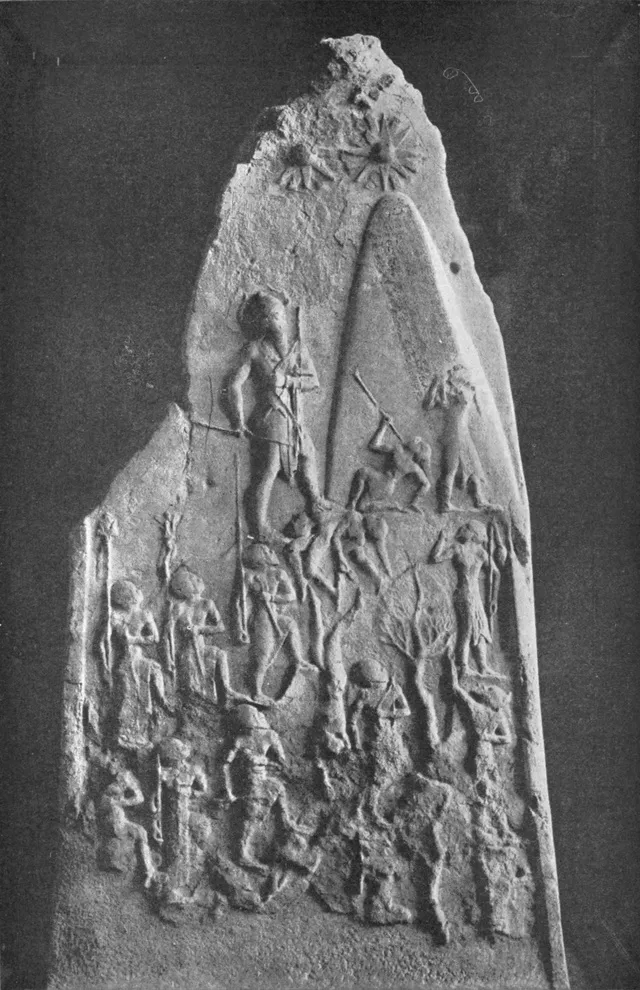
Mansell
THE FINEST EARLY BABYLONIAN ART: TRIUMPH OF KING NARAMSIN,
3750 B.C.
This work, found in Susa, is curiously free and pictorial;
it is unrivalled by any early carvings, and most resembles the action and spirit
of late Greek sculpture. It marks the great period of the fusion of the Sumerian
and Semite.
LARGER
IMAGE
The Semite, however, changed all this. He learned merely the sound
values of certain forms, their meaning could not appeal to him, and
he built up his words out of these sounds or syllables. He found it
inconvenient to write in vertical columns, which was the constant
Sumerian habit, and turned his tablet sideways to his hand, so as to
make his signs along a horizontal line of writing. Hence these signs
became familiar to him on their sides, and as they had to him no
pictorial values, the position was indifferent. Lastly, he produced a
syllabary of signs written with combinations of four forms of impress,
a long line wider at one end, a short line, a tall triangle, and a
small equilateral triangle, written in horizontal lines; and each sign
was standing on what had originally been its side. The wedge-shaped
form of these lines has given rise to the name of wedge-writing, or
cuneiform writing for this system.
The Story of a Language
The knowledge of this writing survived Greek influence for some four
centuries after Alexander, only becoming extinct at the close of the
first century of our era. In its long history, double that of the Roman
alphabet at present, it had been used for very diverse languages. The
Sumerian inventor had handed it on to the Semitic intruder, and he had
passed it to the Syrian, the Mitannian, the Hittite, and the Vannic
peoples. Probably it had kept its hold in its first home in Elam, where
it is found in historic times, and thence it became the writing of
Persia, and even of the Parthian, before it became extinct. The variety
of languages and the extent of country which it covered is much like
the scope of the Roman alphabet in Europe to-day.
LAW AND RELIGION.
In matters of law the Sumerian was well
advanced. The needs of city life which he had developed necessarily
required a full definition of rights and duties. The first law book was
that of Ea, the god of civilisation, the Oannes of the later legends
of Berosus. The decisions of judges were kept in abstract, and such
case-made law served as a body of precedent to guide decisions. The
position of women was on a level with that of men; in the Sumerian
hymns the woman takes precedence, and one of the great Sumerian
divinities was Ishhtar, who became Ashtaroth of Syria, Athtar of
Arabia, and hence Hathor of Egypt. In the Semitic system the goddess
is but a feeble companion of a god; but Ishtar was the great divinity
of war, to whom the kings owed their triumphs, as well as the queen of
love, who ruled the course of nature.
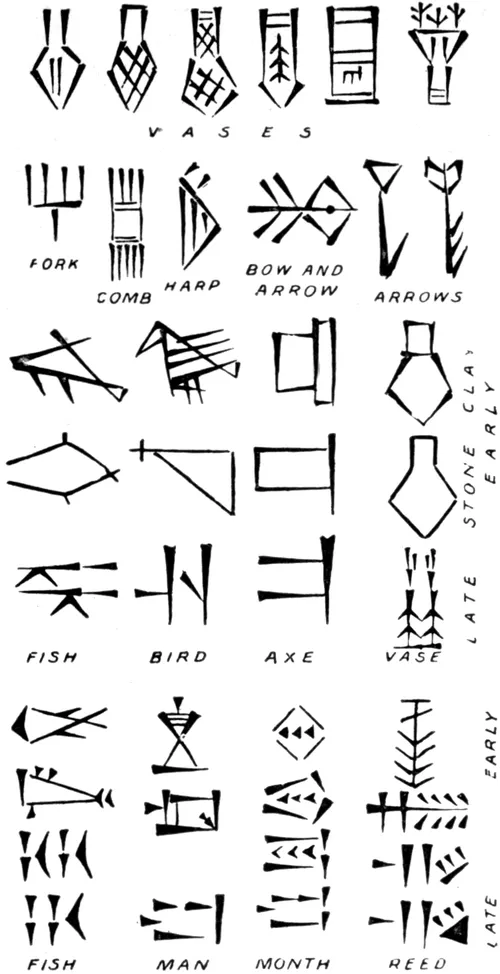
THE DECAY OF PICTURE-WRITING
This illustrates the decay of pictures into signs, and shows
very clearly how the cuneiform writing was developed from the earlier
hieroglyphics. It will be noticed that the word originally rendered by a crude
drawing of the object—“fish,” for example—retains even in its final
cuneiform style some resemblance to the tail of a fish. The cuneiform lettering
was necessary to the Babylonians, as clay was the most abundant material in their
land and could best be marked upon in lines without curves.
The religion of the Sumerians was like that of other Turanian races.
These peoples have an aversion to the idea of a personal god, to
which the Semitic peoples cling. The Samoyede believes in a multitude
of local spirits, the Chinese have their impersonal Heaven and the
host of gnomes or earth spirits. Thus also the Sumerian thought of
all objects as having a zi or spirit, good or evil, which needed to
be appeased by the weak or commanded by the sorcery of the strong.
Shamanism was the type of religion; and books of exorcisms and magic
spells were in permanent use. The importance of the principalities
naturally led to their local spirits being of general importance; and
hence the political changes brought Sin the moon god of Ur, or Utuki
the sun god of Sippar and Larsa, or Marduk of Babylon, into a leading
position, and led toward the Semitic type of deities. How far this
change was due to the beginning of Semitic influence we cannot now say.
Other native gods were less personal, such as Ana the sky, Enlila the
earth, and Ea the sea.
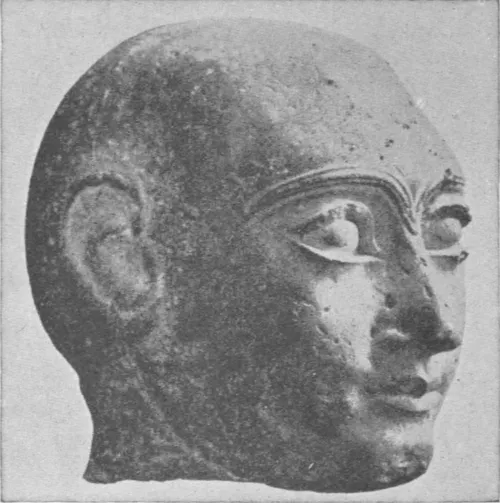
THE SUMERIAN TYPE OF BABYLONIAN
The fact that the shaven type of face appears in all the
monuments back to 4500 B.C. indicates that the Sumerians were shaven as they
were the older of the two main races in Babylonia.
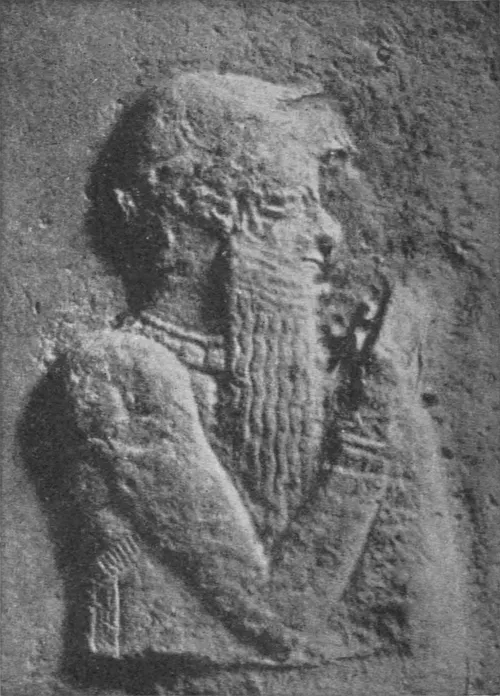
THE SEMITIC TYPE OF BABYLONIAN
Men with full beards are not represented on Babylonian
monuments until 3750 B.C.; hence it is clear that such figures represented
people of the Semitic type. This portrait is from a sculpture of King
Hammurabi.
TYPES OF RACES.
The physical type of the people is shown to us
by the early monuments, though we hardly yet know enough of the early
history to understand them fully. Two main types stand out entirely
apart, the shaven and the full-haired. And when it is seen that the
shaven type is that of all the earliest human figures, dating from 4500
B.C. and extending down to even 2100 B.C., while the
full-haired type is not found on men before 3750 B.C., it is
clear that the shaven is the Sumerian and the bearded is the Semitic
type. The remarkable point is that the gods are represented with long
hair tressed up and long beards from 4400 B.C.; and as early
as we can go back there is never a figure of a beardless god. The
reason probably is that personal gods were of Semitic origin, their
worship was borrowed, and hence their forms. If so, we must see a large
Semitic influence already acting on the earliest known Sumerian art.
The variations of type may perhaps lead to some further distinctions.
The full, curly, square-ended beard and long hair are usual for the
gods, as seen under Eannatum (4400), Urenlil (4000), Gudea (3300), and
Hammurabi (2100). The same beard, but with the hair done up into a disc
(as on the Tello heads and Hammurabi), is worn by the King Anubanini
(3600). The long and rather pointed beard is seen on Naramsin (3750),
and Hammurabi (2100). The short, square beard is seen on the god, under
Eannatum (4400), and on men about Naramsin’s age [see the seal of
Ubilishtar]. The shaven type has a wide face, with a large prominent
aquiline nose, best seen in the head from Tello. This type is that of
all the human figures on the scenes of Urnina (4500), Eannatum (4400),
and Urenlil (4000); and in the figures of the Scribe Kalhi (cylinder,
3750), Gudea (stele, 3300), the heads of the same age from Tello, and
the later head of beautiful work at Berlin. The general conclusions may
be that the beard was worn and admired by Semites, who elaborated a
very full type for the gods; and that the Semitic influx, though ruling
under Naramsin at Sippara, north of Babylon, was yet subordinate at the
later date of Gudea, in the Sumerian south.
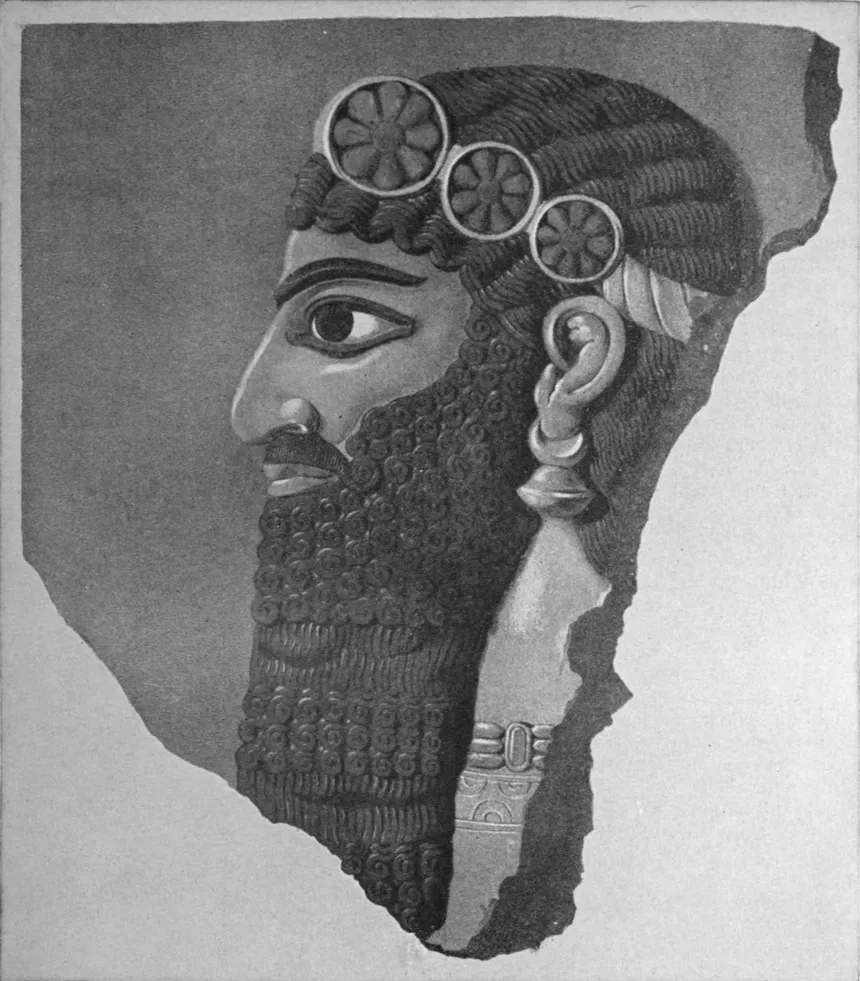
THE FAMILIAR BEARDED TYPE OF ASSYRIAN GODS AND MEN
Although the full-haired faces are later in appearing on
the monuments of Babylonia, all figures of gods are shown as possessed of full
beards and a wealth of hair. A familiar example is here reproduced. It is
supposed that the Semitic race in Assyria was the first to personalise the
deities, and hence the resemblance of the images to the features of the
Semites.
SEMITIC AGE.
We now turn to the later stage of the
civilisation, as it flourished under the mixed race of Sumerians and
Semites, partaking of the culture of the older race and the higher
moral tone of the less advanced people. The Sumerians, as we have
noted, had pushed down from the Median highlands into the growing
plain of Babylonia, while the earlier Semites remained to the north
in Assyria, and to the west in Naharaina and Syria. Sooner or later
a fusion was inevitable; as we have seen already, the gods were of a
Semitic type at a very early time, and gradually the union took place
during three thousand years, until in the later times the product was
unified in one strong civilisation which spread its strength far and
wide to the Crimea, to Egypt, and to the deserts of Central Asia.
BUILDING. The old skill and abilities found a wide scope in
this larger frame of life. The fundamental craft of brickwork was
carried on to a vast extent. Every city had its great pile of an
artificial hill of bricks, built in stages to support the temple of
its god high above all. Immense walls surrounded the cities; those of
Babylon were some nine miles around, and are stated to have been 85 ft.
high and 340 ft. thick, surrounded by a moat lined with burnt brick
laid in bitumen. Not only was brickwork used on this great scale in the
Babylonian plain where stone was a luxury, but the force of example was
so strong that the Assyrian, in his highland home, kept up the same
scale of brickbuilding as his teachers, and used brick for his palaces
and temples when stone would have been much more easily available.
In Babylonia, as in Egypt, the supply of material for brickmaking on
a large scale is a serious question. For the great walls of cities,
obviously a surrounding ditch was an advantage; but for the materials
of houses, temples, and ziggurats, great pits had to be dug, or older
buildings pulled down. At Nippur it was found that the later builders
had torn down a long piece of the disused city wall and dug out a great
pit below and around it. So in Egypt the outskirts of every village has
its perilous hole where the bricks are made, which, in course of time,
becomes a stagnant pond, and every ancient temple, with its fortifying
wall, was built out of a large pit at its side which became the sacred
lake of the temple.
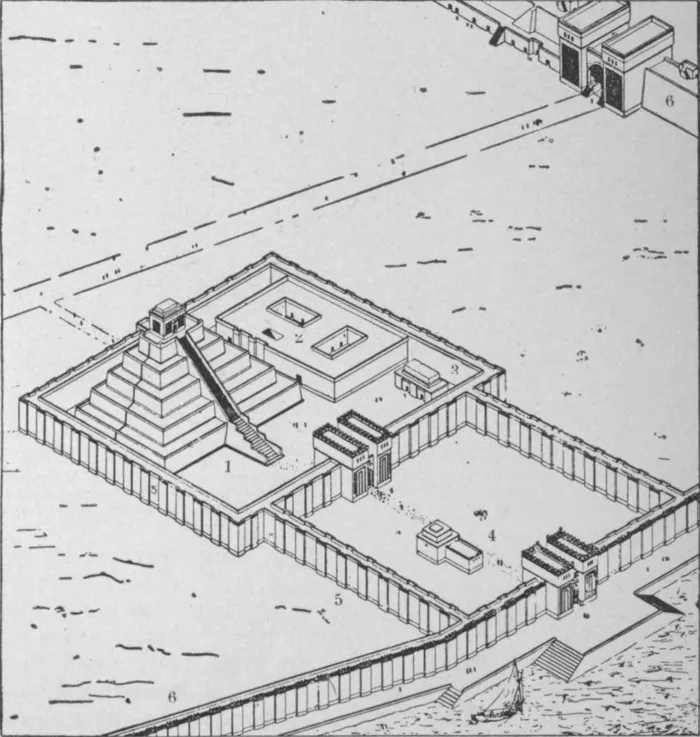
A TEMPLE PLATFORM, OR ZIGGURAT, OF BABYLONIA
This restoration of the Temple of Bel at Nippur, from the
designs of Hilprecht and Fisher, gives a good idea of the massive character of
Assyrian architecture. The portion marked (1) consists of a stage tower with a
shrine at top and a long stairway leading thereto; (2) is the temple proper;
(3) house for “honey, cream and wine”; (4) “place for the delight of Bur-sin”;
(5) is the inner wall and (6) the massive outer walls.
A higher branch of building was the use of glazed bricks. In Egypt
the use of glazed tiles for coating walls was boldly carried out in
the earliest dynasties, before 5000 B.C.; but there was no
glazing of the bricks, because in so dry a climate the Egyptian was
never induced to burn his bricks. In the wet and damp of Babylonia,
on the contrary, burnt bricks were usual, and all the facings and
main divisions of structure were in the indissoluble material, which
held together and protected the mass of crude brickwork within it.
It was, however, mainly, or only, in the later times—from the ninth
century onwards—that bricks glazed on the outer face were used for
building. It seems that this was done not so much for utility—like our
modern use of glazed bricks—as for the artistic effect of colours and
designs. The grandest example of such work that is known is the façade
of coloured glazed brick in relief, representing the royal archers,
from Susa of the Persian age, now in Paris, restored from the fragments.
Beside baked brick, pottery was used on a large scale. Great jars
occur in the earliest times, and cylindrical drains of large size,
sufficiently wide for a man to descend in them for repair. In later
times coffins of baked pottery of the Parthian age, and glazed coffins
of slipper shape, dating from the Sassanian period, are very common on
most of the city ruins. Unfortunately, sufficient attention has not yet
been given to the pottery of any age.
A KING’S EMBROIDERIES
This illustrates the richness of the decoration on the
breast of an Assyrian king, whose complete attire is seen in the
other picture on this page.
Wood was largely used in the more wealthy ages, but it was always
valuable, as large timber had to be brought from a distance. The great
halls of the palaces were all roofed with timber beams, and panels of
cedar lined the walls where stone was not used. Probably palm trunks
and palm leaves served for ordinary roofing, as in Egypt at present.
CLOTHING. Clothing became far more elaborate than in earlier
ages, and the dominance of the more northern people brought a fuller
dress into customary use. The Assyrian covered the whole body with a
tunic down to the knees, and the upper classes wore a robe to the feet.
Rich embroideries were usual among both Babylonians and Assyrians,
and the splendour of Babylonian garments was spread far in other
lands by trade. The cap was either cylindrical or conical, and the
royal head-dress in Assyria was practically the modern tarbush, which
has again been imposed on the East by the Turk. Sandals were used in
Assyria, and the boot so characteristic of the Hittite was also brought
in from the cold mountainous country. Women wore a long, thin robe
to the feet, covered sometimes by a tunic and a cape. But Ishtar is
always shown in a ribbed dress flounced from top to bottom. This is the
regular women’s dress of the western Semites; and its use, like that of
the beard for the male deities, points to the strong Semitic influence
on the appearance and character of the divinities.
DRESS IN ASSYRIA’S GOLDEN AGE
Rich embroideries were usual among Babylonians and
Assyrians, and the splendour of Babylonian garments was spread far in other
lands by trade. The royal head-dress in Assyria was practically the modern
tarbush, which has again been imposed on the East by the Turk.
The armour of the Assyrian was much the same as that in the early
Sumerian days. The pointed helmet became rather taller, and did not
cover the back of the head. The spear, and the bow and arrow, were
the main weapons as before. The old straight-sided shield was also
used in Assyrian times, but was partly superseded by the round shield
considerably coned. The extension of the kingdom brought in various
auxiliaries, who differed from the older Babylonians. Slingers,
northern horsemen clad in leather, and mountaineers with woodman’s
axes, all added new branches to the army.
Sculpture 5,000 Years Ago
ART. The arts were carried to great perfection by the mixed
population. Broadly speaking, the best work is that of the early
age of Naramsin (3750 B.C.), and that of the late age of
Ashur-bani-pal (640 B.C.). Though not so fine, yet probably
the Hammurabi sculptures are the highest between the early and late
schools. This would give intervals of 1,650 and 1,460 years between the
successive waves of art, and about 1,450 years more to the glories of
Baghdad, a period much like that found on the Mediterranean, though not
coincident with it.
The finest work of Naramsin (3750 B.C.) is his great stele
from Susa, now in Paris. It is remarkably pictorial in style, agreeing
in this with the pieces of a limestone stele representing rows of
combatants from Tello, also in Paris. The figure of the king is lithe,
active, romantic in attitude, the enemies and his soldiers are full of
animation. No Oriental sculpture has had quite the same life in it; and
it recalls the pictorial style of Crete and the later Greek sculpture.
The art of Gudea (3300 B.C.) is more cold and formal, and has
not the same fine sense of proportion; it is distinctly a period of
survival and not of artistic instinct, as seen, for instance, on the
limestone relief in Berlin. The age of Hammurabi (2100 B.C.)
shows careful portraiture, but not the spirit of the earlier age;
the work is well finished, and there was no hesitation in handling
materials boldly, as on the great black stele of the laws, now in
Paris. There was a fine sympathetic treatment in private sculpture, as
shown in the beautiful limestone head of a Sumerian in Berlin [see page
266].
Fine Later Art
The last great age was that of the Assyrian Empire. Under
Ashur-nazir-pal (885) the work is fine and severe, but without much
expression. Shalmaneser III. (860) troubled more about history than
about art, and his principal remains are the long records of the black
obelisk and the Balawat gates, which are but clumsy in the forms. Under
Sennacherib (705) there is a breadth of composition, as in the siege
of Lachish, which is worthily aided by a more pictorial style, while
under Ashur-bani-pal (668–626) the art reaches both grace and vigour,
as in the splendid natural scenes of the wild-ass hunt, in the lion
hunt, and in the garden feast with the queen.
GUDEA LED BY A GOD
This shows the Babylonian art at 3300 B.C., inferior to
the earlier style of Naramsin. The original is in Berlin Museum.
MECHANICS. The mechanical arts were also greatly developed.
The large size of the buildings, the great quantities of stone
transported for the sculptures, and the immense size of many
blocks—the bulls weigh nearly 50 tons each—all show that there was
not only considerable skill, but also large ideals and directive
ability. Layard found that three hundred men were wanted for drawing
his cart bearing the great bull; and the sledge used by the Assyrians
for the transport must have needed as many, or more. Long levers are
represented as having been used in a very effective manner; but the
placing of such great blocks exactly in the right position required far
more ability than the mere transport. The forms of tools were much in
advance of those used by the Egyptians. As far back as Naramsin, the
copper axes were all well hafted, generally with rings raised round the
edges of the haft hole to strengthen the band and prevent it splitting.
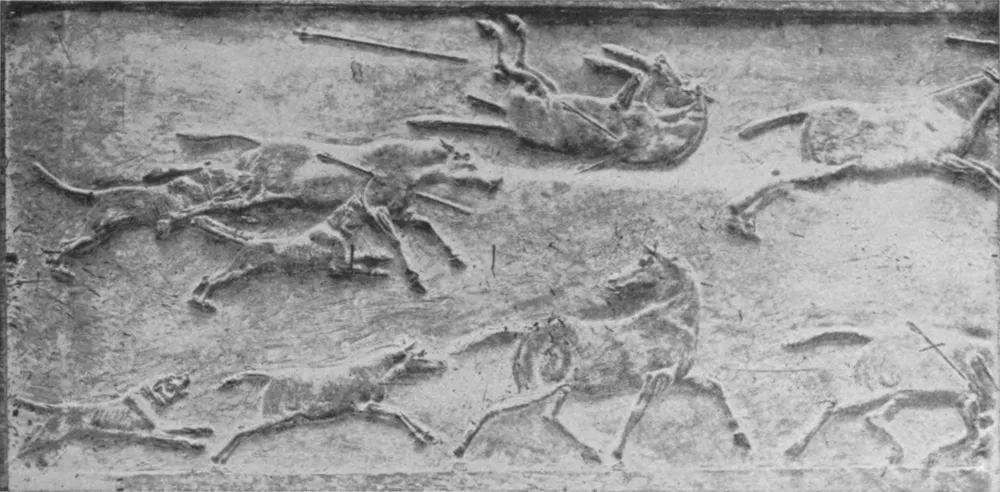
AN ARTISTIC TRIUMPH OF ASSYRIAN SCULPTURE
Under Ashur-bani-pal (668–636 B.C.) Assyrian art reached
both grace and vigour, as is manifest in the splendid natural scene of the
wild-ass hunt, which is here reproduced from the original in the British
Museum.
Modern Tools of Ancient Workers
The forms of the iron tools are also excellent; and iron seems to have
been common in Assyria at an earlier date than in any other country,
probably from the tenth or twelfth century B.C. Certainly the
set of Assyrian tools left at Thebes by an armourer of Esarhaddon in
670 B.C., show that the principles, and even the exact forms,
of modern tools had already been reached. The chisels and rasp have
not been improved since; the saw is the same as the modern Oriental
pull-saw, but the teeth have not an alternate set; the centre-bits and
files anticipate our forms, but have not reached the complete stage.
The material of most of the edge tools is steel, showing that the
hardening was then understood. The cutting of seals in hard stones
was an early art, but it was well maintained, and some of the most
beautiful specimens are the chalcedony cylinders such as that of
Sennacherib in London. The engraving of the inscriptions also shows
that cutting in hard stones was freely done on a great scale; but the
writing, being entirely in straight lines, was much easier to engrave
than the figures of natural objects of the Egyptian signs. Probably
emery powder or copper was the means used, as in Egypt.
The Books of Babylonia
The use of an official stamp of guarantee on uniform pieces of silver
was adopted by the time of Nebuchadnezzar, but as this is two centuries
later than Greek coinage it was probably copied from that. In one
respect the Mesopotamian never equalled the Egyptian. The Memphite
school of work had attained to a mechanical accuracy which we can
scarcely gauge; their errors on large pieces of work were only a
matter of thousandths of an inch. But the Mesopotamian never did a
piece of passably square or regular stonework; the inequalities and
skew angles are glaring, even in highly elaborated works of art. The
sense of accuracy was quite untrained, and neither Semite nor Sumerian
show any ability in this line. Egypt, on the contrary, started with
a prehistoric race which excelled in exquisitely true handwork and
dexterous flint flaking, and with the artistic sense of the dynastic
people added, the combination was one of the highest that the world has
seen.
LITERATURE. To give any adequate idea of the literature of
Babylonia is far beyond our scope, and only the main classes of it can
be named in this outline. These were:
1. Theology and Omens. 2. History. 3. Despatches and
Correspondence. 4. Language and Translation. 5. Mathematics. 6.
Astronomy. 7. Geography and Natural History. 8. Medicine.
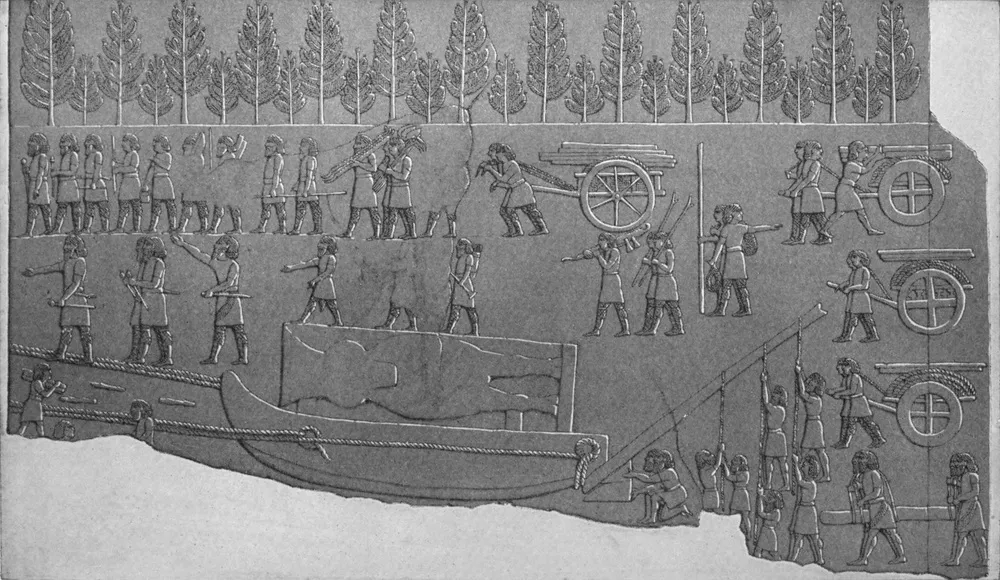
HOW THE GREAT STATUES WERE MOVED: A CONTEMPORARY RECORD
FROM THE MONUMENTS OF NINEVEH
The large size of the buildings of Assyria, the great
quantities of stone transported for the sculptures, and the immense size of many
blocks—the bulls weighing nearly 50 tons each—all show that there was
not only considerable skill, but also large ideals and directive ability. Layard
found that 300 men were wanted for drawing his cart bearing the great bull; and
the sledge used by the Assyrians for the transport must have needed as many or
more. The tools used were much in advance of those of the Egyptians.
LARGER
IMAGE
The striking omission is that of literature in the form of tales or
poetry of actual life; there seems, amid all the myriads of tablets,
to be nothing similar to the tales of the various periods of Egypt. We
look in vain for the tales of the magicians, the romances of adventure,
of love, or of history, which restore to us the living view of Egyptian
thought. The Babylonian was severely commercial or scientific, and his
poetical ideas were only developed in his theology; he seems to have
had no play of fancy or taste for the excitement of story-telling.
Similarly in the Middle Ages the “Thousand and One Nights,” though
often referring to Baghdad, are yet tales of entirely Egyptian source
and idea.
Wonderful Training of Babylonians
But for his own purposes the Babylonian was well educated from a
literary point of view, and, considering the complexity of his
writing, he was probably better trained than any modern people except
the Chinese. The hundreds of signs which he had to remember had long
lost their pictorial significance, and needed an attentive memory and
long training; yet not only in public documents, but also in private
letters, mistakes are but rarely found. Classification of the signs,
classified lists of words of Sumerian and Semitic, grammatical works,
and reading books were the apparatus used. Even the peasantry and
sometimes the slaves learned to write, and there was hardly more
need of a professional scribe than there is in England to-day. But
this general education belonged to the Sumerian stock, and was much
diminished where the Semite was in the majority, so that in Assyria
only the upper classes could write, and nail-marks of contracting
parties are common. The feeling for literature kept the names of great
writers in remembrance, and the authors of the main religious pieces,
such as the Epic of Gilgames, are still known. The Egyptian, on the
other hand, has not preserved the name of a single author; even Pentaur
was probably only a scribe. The honouring of literature led to the
Assyrian kings amassing great libraries, and to the princes becoming
librarians and secretaries. The copying of ancient tablets for the new
libraries was a large business, carefully planned; and the scribe was
required to exactly state where his original was defective and what
uncertainties existed in the reading. Even private persons sought to
obtain favour by presenting copies of works to the temple libraries.
Shall We Find an Assyrian State History?
Of the classes of writings, the religious works are noticed later; the
historical writings are mainly Assyrian, recording the constant wars
with other lands, and the tribute and booty brought from them. That
there was a complete State history is shown by the ready allusions to
the time since certain events had happened. Ashur-bani-pal recounts
1,635 years since the Elamite king had carried off an image. Nabonidus
searched for and found the tablet of Naramsin, which he says had
not been seen for 3,200 years; he recites that there were 800 years
from his time to Shagarakti-buriash, and 700 years from Burnaburiash
to Hammurabi. These references show that we may hope to recover a
complete State history from Assyria, as we may hope yet for a complete
historical papyrus from Egypt.
The despatches and correspondence give full light on detail of politics
and affairs, showing the conditions of various countries; and where
a sufficient number have been preserved together it is possible to
build up a continuous history of a period, as in the case of the
Tellal-Amarna letters. The yearly annals of a reign belong more to the
historical division, and such records of Sennacherib, Ashur-bani-pal,
and others are of the highest value. The private letters give a full
view of the current life; and the business documents, especially
receipts, are the commonest of all records, showing the trade, the law,
and the business of the country in all its fulness.
Beginning of Astronomy
The tablets dealing with the Sumerian and Semitic languages together,
and the translations from one to the other, we have noted already. The
mathematical tablets are multiplication tables, lists of multiples of
measures, tables of squares and cubes, and plans with measurements
along the sides, which show the practical use of the science. The
astronomical records were already tabulated in the time of the early
Semitic Empire, Sargon having compiled for his library a work in
seventy-two books, the title of which is rendered “The Observations
of Bel.” The purpose of this was astrological, like the great mass of
short tablets reporting observations of a later date. But the inquiries
involved a considerable familiarity with astronomical movements, and
a mass of records which became of great value to the student. The
astronomical tablets of the Seleucid period are of special value, as
they often contain valuable historical matter.
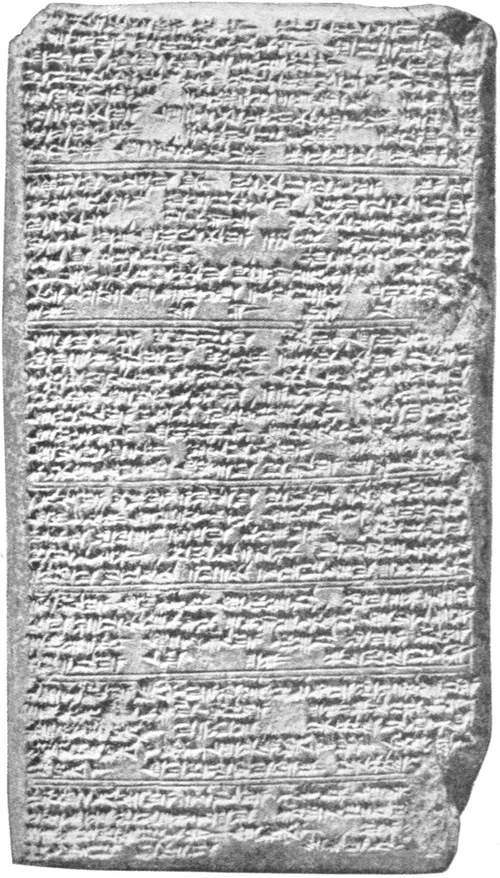
A KING’S LETTER OF 1400 B.C.
A clay tablet letter from Tushratta, King of Mitani, to
Amenophis III., King of Egypt, announcing the despatch of valuable gifts and
begging Amenophis to send him a large quantity of gold as payment for expenses
incurred by his grandfather in sending gifts to the King of Egypt, and also as
a gift in return for his daughter, a princess of Mitani, whom Amenophis had
married.
LAW. In the domain of law the Babylonian had early formulated
a code from the actual working of decisions. Case-made law was his
basis, as in most countries, and abstracts of important cases were
carefully preserved as precedents. No torture was used upon witnesses,
and ample investigation of the right of a case seems to have been
usual, with full cross-examination. High penalties were stipulated for
the infringement of sales or contracts. The status of women was equal
to that of men in the Sumerian, but became inferior in the Semitic
law. Slavery was rather an assignation of labour than a control of the
person, as a slave family could not be separated. Slaves could hold
property, own other slaves, give witness, and were sometimes well
educated. The family union was strong, as inherited land could not be
sold without assent of relatives, and boys and girls alike inherited
intestate property.
The detail of the laws form a long study, but we may here note the main
sections of the great code of Hammurabi, showing the scope of the laws,
and stating the number of enactments.
- Witchcraft 2
- Legal falsehood 3
- Theft 3
- Loss 5
- Child and slave stealing 7
- Robbery 5
- Royal messengers and officers 16
- Agriculture 24
- Accounts 8
- Licensed traders 6
- Marriage property 19
- Women 32
- Votaries property 7
- Adoption 10
- Assault 20
- Doctors 13
- Builders 6
- Shipping 7
- Cattle 12
- Hire 25, and
- Slaves 5
- Distraint & deposit 13
Thus the whole scope of an agricultural and commercial community was
well safeguarded, and little doubt left as to general principles and
penalties. All this must have been the product of innumerable cases and
difficulties for two or three thousand years, before such a complete
code was set up.
HISTORY IN MYTHOLOGY.
The religion has usually occupied a
large part of the attention and interest given to Mesopotamia; it
is comparatively well known owing to the quantity of documents and
representations. Here we need only mention such points as bear on the
general civilisation. We have already noticed how the purely Sumerian
Shamanism, or belief in the spirit of every object, which needed to be
appeased, had been tinctured by the worship of personal deities of the
Semitic neighbours, and how this influence was shown by borrowing the
Semitic beard for the gods and flounced robe for the goddesses, and
occasionally for the gods. Thus the Semite was the missionary of theism
as against animism.
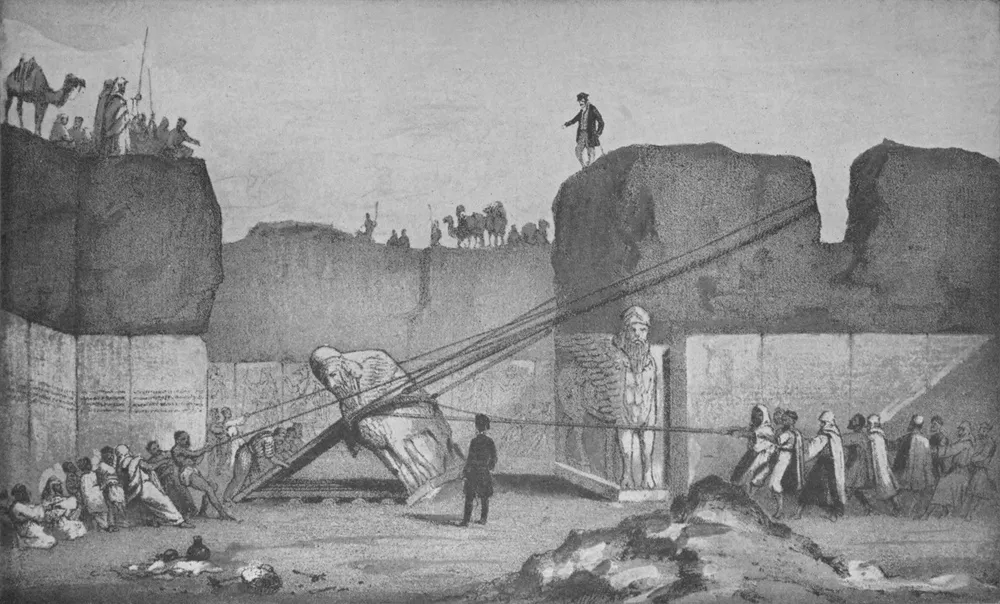
SIR A. H. LAYARD’S EXCAVATORS LOWERING ONE OF THE GREAT
WINGED BULLS FOUND IN NINEVEH
These bulls weighed fifty tons each. Layard found that three
hundred men were necessary to pull the cart on which the bulls were placed.
LARGER
IMAGE
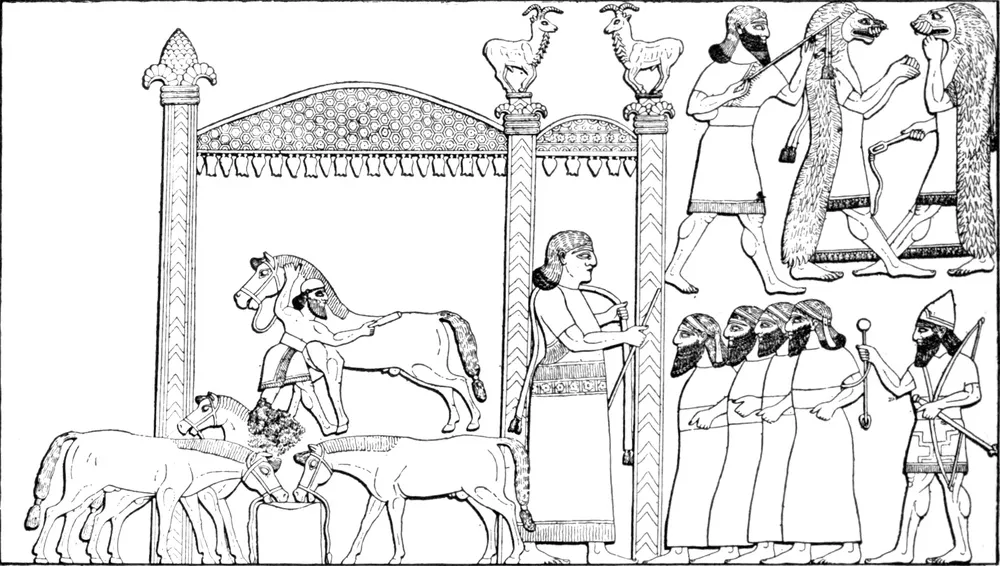
A CAMP SCENE IN THE DAYS OF NINEVEH’S POWER
The interior of a castle, indicated by a kind of
ground-plan with towers and battlements, is divided into four compartments. In
each is a group of figures, either engaged in domestic occupations or in
preparations for a religious ceremony. The pavilion is supported by columns,
probably of painted wood, and the canopy is adorned with a fringe of alternate
flowers and buds, like the usual Egyptian border. Beneath the canopy is a groom
cleaning a horse with a curry-comb. A eunuch at the entrance is receiving four
prisoners. Above are two mummers dressed in the skins of lions, while a figure
with a staff appears to be the keeper of these monsters.
On the other hand, the civilisation of Babylonia is expressly stated to
have been given by Ea, or Oannes, who rose from the sea of the Persian
Gulf; he passed the day among men, and taught letters and sciences
and arts—the building of cities and temples, and the use of laws and
geometry. Also he showed the uses of seeds and fruits, and softened
and humanised the people, who had lived in a lawless manner like wild
beasts. This full ascription of civilisation to sea immigrants shows
that it cannot be set down as an indigenous growth, or as due to
the Sumerian, or still less to the Semite. The date of this movement
is roughly indicated by Ea, belonging to the city of Eridu; and 5000
B.C. is the earliest date at which we can suppose the ground
of that city to have been dry land. Such must be taken as the extreme
limit of the early civilisation, and what we find of the early kings
of about 4700 B.C. is the first efficient rise of monumental
history in the land. All this is parallel to the early civilisation
in Egypt. That also came in apparently from the Red Sea at about 5800
B.C., as the civilising movement which changed the prehistoric
age to the dynastic. And it came only a few centuries earlier than the
mission of Ea. It may be possible that there is one common source of a
seafaring people for both civilisations, and, if so, we might look to
Hadhramot as being in the most likely common centre. At least, it is
always convenient to explain the unknown by the unknown.
The nature gods of Apsu and Tiamat, the ocean and the chaos, described
in the first tablet of the Creation series, belong to the primitive
Sumerian. “The waters of these mingled in union, and no fields were
embanked, no islands were seen; when the gods had not come forth, not
one; when they neither had being nor destinies.” And afterward “Evil
they plotted against the great gods.” After an attempt of Anshar
(perhaps the same as the Egyptian Anher, the sky god) to subdue Tiamat
(tablet 2), Marduk, the sun god, gains the victory; and in tablets 3
and 4, the supremacy of Marduk is finally confirmed by all the gods. In
this we seem to have the echoes of a tribal history as in the Egyptian
theology. The Shamanistic worship of a confused host of warring and
malignant spirits, is at last subdued by the worshippers of personal
gods under Semitic influence, and of these the people of the sun god
take in the end the leading place. All of these changes were, however,
long before the political domination of the Semite, which began about
3800 B.C., with Sargon.
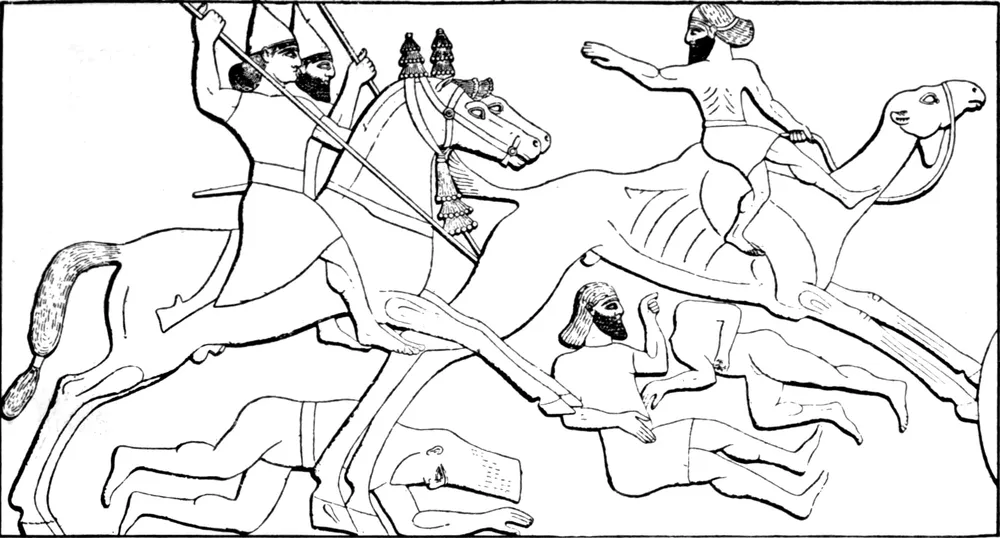
A CHASE IN THE DESERT, RECORDED ON THE MONUMENTS OF
NINEVEH
The series of which this bas-relief formed a part appears
to have recorded the conquest by the Assyrians of an Arab tribe or nation who
made use of the camel in war as a beast of burden. This sculpture belongs to a
later period than the bas-relief from the North-West Palace at Nineveh
reproduced below.
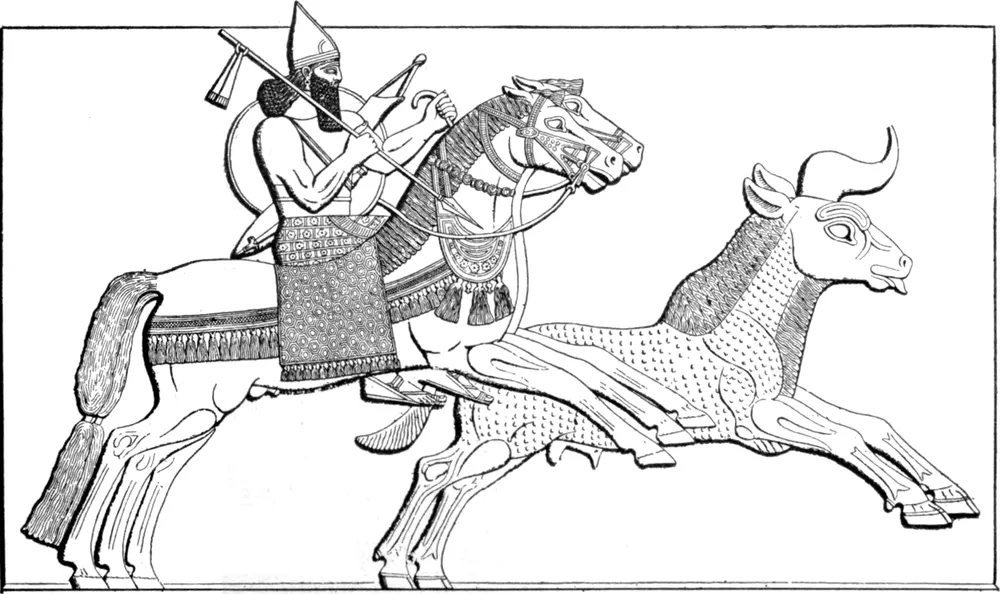
ROYAL SPORT IN THE DAYS OF ANCIENT NINEVEH
This bas-relief probably formed part of a subject
representing the King of Nineveh in his chariot hunting the wild bull. The
warrior rides on one horse and leads a second, richly caparisoned, for the use
of the monarch. Numerous small marks on the body of the animal probably denote
long and shaggy hair.
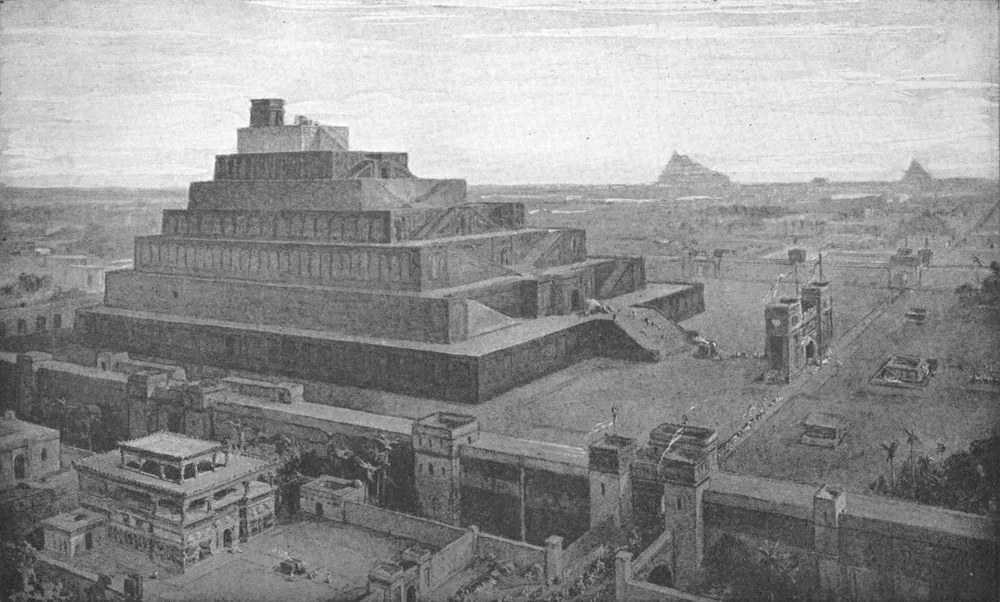
BABYLON: THE WONDER CITY OF ANCIENT CIVILISATION AT THE
HEIGHT OF ITS POWER
LARGER
IMAGE
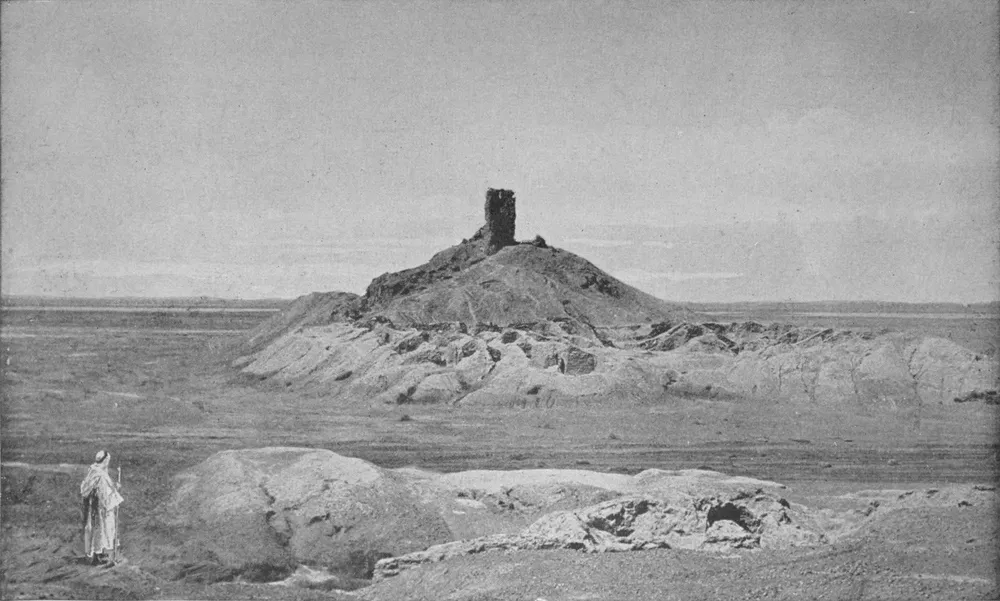
NIMRUD: ALL THAT IS LEFT OF ONE OF THE WONDER CITIES OF
ANCIENT BABYLONIA
A view of Birs Nimrud, the traditional site of the Tower of
Babel. On the plain below are the silent ruins of the ancient city, once filled
with a teeming population.
LARGER
IMAGE
A VIEW OF HILLAH, THE MODERN BABYLON
We have now reviewed the questions of the rise of civilisation, as
apart from the ordinary history of the countries, which is dealt with
in its proper place in this work. Though it is difficult, and rather
misleading, to look at civilisation and the political history apart,
yet, so much has come to light in recent years to clear our view of the
origins of culture that we may be allowed to focus our attention on
that view of man, apart from his better known history. We seem at last
to have reached back to a definite beginning of arts and capacities on
both the Nile and the Euphrates, and to have touched a condition of
things that seems to point in both lands to some external source of a
yet pre-existing culture, which yet has to be traced. I am happy to add
that one of our greatest Babylonian scholars, Dr. Pinches, concurs in
the view of his subject which is here presented.
W. M. FLINDERS
PETRIE
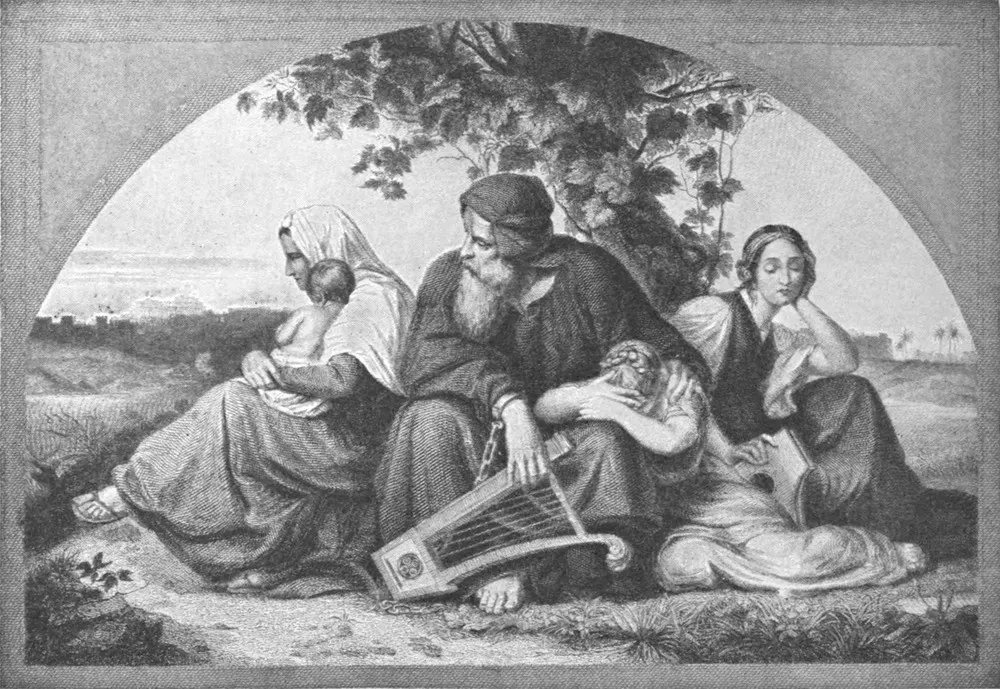
THE EXILES IN BABYLON
“By the rivers of Babylon there we sat down; yea, we wept.”
From the painting by Bendemann.
“O
TUT
of the East came Light” has been the text on which all great
historians of civilisation have preached, from the authors of the
Mosaic literature down through Greek and Roman times to our own. Hebrew
writers have looked back to Mesopotamia; Greek writers to Egypt; Roman
writers to Greece; writers of Western and Northern Europe and the
New World to Rome, Greece, and Palestine. Their belief is justified
in so far as it is based on two great facts. Man first found in the
warm, alluvial valleys of Southern Asia and North-Eastern Africa the
conditions of climate and soil most favourable to his upward progress
from the savage state; and from these regions, so soon as with increase
of numbers he was moved to migrate, his steps were turned by the
geographical conditions surrounding his early homes, in a general way,
westward. He knew not yet how to cross broad seas; deserts, sandy
steppes, high mountains and tropical forests and swamps were equally
deterrent. The Polar ice-sheet, which had extended in Pleistocene
times to the Caspian, Black Sea, and Danube basins, and still lay,
in the dawn of human civilisation, far south of its present limits,
probably rendered, with its wide fringe of impassable moraine, forest,
and tundra country, all the lands included in the present Empire of
Russia singularly inhospitable. Whoso looks at the map of the Western
Hemisphere, bearing these facts in mind, will see at once that the
line of least resistance, and, indeed, the only possible line, led
the men of the great sub-tropic river valleys towards and along the
Mediterranean coasts.
Civilisation from Without
In so far, therefore, as European civilisation is a state of things
due to influences from without, it is due to the East; but that is
very far from the whole explanation of its origin. The impulse to rise
above savagery has not always—not, indeed, usually—come to peoples
from without; and probably in primitive time, when communications
were slow and difficult to a degree which we can hardly realise, the
origin of local culture was seldom or never to be accounted for thus.
In modern days there have been obvious instances to the contrary; but
even now it remains to be seen how far civilisations originated among
absolutely barbarous peoples by contact with higher races are real and
living growths. Examples of the modification and possible elevation
of ancient indigenous societies by incoming aliens, such as have been
seen in Mexico or Peru, India or Japan, Egypt or Barbary, are not
in point; for in these cases local civilisations certainly existed
long before the foreign influence. We must look to the history of the
relations of white and negro, or other savage, races in the homes of
the latter, and the results of such inquiries are far from conclusive.
Does civilisation so originated grow and thrive? Do even the races
thus civilised themselves any longer thrive and grow? Our antipodean
colonies, and the story of the native races of North America, if there
were no other instances, would not admit a categorical affirmative.
Nay, rather, the evidence so far available tends to discount the
permanence of transferred civilisation, and to throw doubt on the
continued vitality of races so civilised.
The Escape from Savagery
Conditions Essential for Civilisation
It is necessary to raise this question at the outset of the present
essay because it has been too often assumed, both implicitly and
explicitly, by historians of our civilisation, that all the cultural
development of Central, Western, and Northern Europe has been due to
alien influence, exerted from the south and south-east, and mainly by
the agency of the Greek, Græco-Roman, and Græco-Romano-Semitic (the
Christian) systems. Maine’s famous dictum that “Nothing moves in the
world which is not Greek in origin” has long dominated our thoughts.
Yet that magnificent generalisation is contrary not only to inherent
probability, but to known fact. Escape from the savage state, as Buckle
showed, depends in the first place on the existence of such conditions
of geographical environment as favour the accumulation of wealth and
the development of a leisured class—that is, such as conduce to the
production of a good deal more than the minimum necessary for life.
It can, therefore, have taken place wherever man found comparatively
genial climate and remunerative soil, and, in process of time, made for
himself, by clearing forests or draining swamps, an arable area which
would feed him and his more abundantly than was absolutely necessary.
Where these conditions were presumably present it is unreasonable to
suppose that the beginnings of civilisation were deferred age after
age, until late in time some stimulus chanced to be imparted by an
alien race or races which had, after all, advanced towards their
own civilisation, albeit earlier, through the operation of similar
conditions elsewhere. In the European areas inhabited by the Celtic
and Germanic peoples, for instance, long before we have the slightest
reason to believe that these can have come into intimate relation with
the civilisations of the South and East, both climate and soil were
unquestionably favourable, and local civilisations cannot but have been
originated independently. As has been well said, “Man everywhere has
the same humble beginnings”; and, up to a certain point, which is found
to be, in fact, far later than the inception of some kind of culture,
he will satisfy his primitive needs and desires in very much the same
ways.
Spontaneous Civilisation in Europe
Under certain conditions, known to have arisen independently in
many different regions of the earth, articles of luxury and art,
irrefragable witnesses to incipient civilisation, begin to be produced
spontaneously. To what remote periods have not cave deposits thrown
back the history of artistic effort in the valleys of Gaul? And what
credit, in reason, can be given to Greece, or even to Rome, for the
elaborate social order of the Teutonic tribes, which was of ancient
standing when first the Romans penetrated beyond the Danube and Rhine?
So well rooted in the soil, so potent and so widely diffused were
the Teutonic and Celtic social systems, that in the history of our
actual civilisation they are factors as worthy of consideration as the
influences of Rome, Greece, or Palestine. If Græco-Roman Christianity
came greatly to modify them in the end, they had, perhaps, ere that,
modified Christianity itself hardly less; and the social superiority
of the northern and western adherents of the now dominant religion is
probably as much due to character and habits developed before ever its
creed was formulated, as the dominance of the Turkish peoples in the
Islamic system is undoubtedly due to social characteristics evolved in
the oases and steppe-lands of Central Asia far back in the “Times of
Ignorance.”
Let it, therefore, be understood that in the following pages it is not
necessarily the whole origin of European civilisation that is being set
forth, but the modification and heightening of probably pre-existent
European culture by the first influences of the Nearer East which
can be supposed to have reached it. Of these influences the effect
is to some extent a matter of inference only. We cannot always, or,
indeed, often, point with any assurance to actual results of their
action. In great part we must still be content with little more than a
demonstration that directly along certain lines of communication, or
indirectly through certain intermediaries, the civilisations of the
South could, or did, come into relation with European areas at an early
age.
The Two Great Sea Routes
The sea routes which were most likely to be used in ruder ages by
Levantine mariners, after leaving the Nile estuaries or the Syrian
ports—which, as a matter of fact, are known to have been most
used—are: that which followed the littoral of Asia Minor to Rhodes,
whence it bifurcated, to Crete on the one hand, and to the Ægean isles
and coasts on the other; or that striking across the narrow strait
to Cyprus, and thence by way of Rhodes, or directly, to Crete. In
connection with both these routes, the importance of Crete and Rhodes,
and especially the former, must be obvious. Thence the Cyrenean and
Carthaginian projections of Africa were reached with greater ease than
by way of the littoral to west of Egypt, which, for some hundreds of
miles, is desert, reef-girt, almost harbourless, and pitilessly vexed
by an on-shore wind. From Carthage, Sicily and the Italian peninsula
were readily accessible, or the Gibraltar strait and the Iberian shores
could be made after coasting a littoral much kinder to navigation than
that between Egypt and the western bight of the Syrtis.
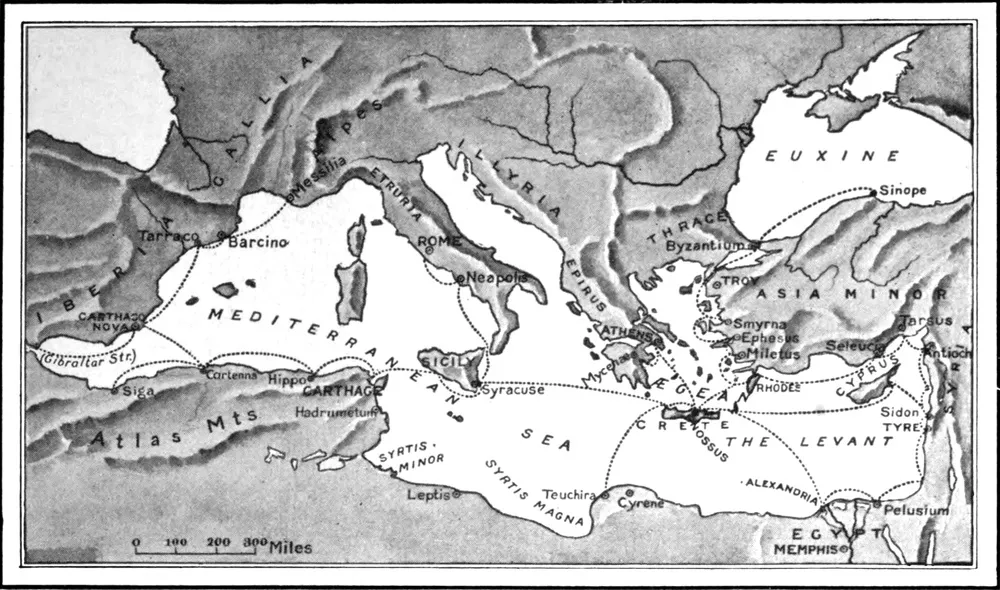
THE GREAT SEA ROUTES OF ANCIENT CIVILISATION
Along the routes marked in this map lay the course of
Ægean and Phœnician civilisation. The importance of Crete and Rhodes in the
spreading of civilisation is clearly seen; they may be called the “half-way
houses” between Mesopotamian culture, with its seat in the valley of the
Euphrates, and Egyptian culture, in the valley of the Nile.
The Two Great Land Routes
The land routes in chief were also two. The Nile valley, closed by
desert on the western side, had comparatively easy access to the great
natural road which, leading northwards through Syria, passes at first
along the Palestinian littoral, and then through the central cleft
between the Lebanons to the Orontes valley. Mesopotamian traders,
following up the Euphrates till they had left the desert part of its
course behind them, fell into this same road in the region of Aleppo
and Antioch. Thence by the easy passes which turn the southern end of
Mount Amanus, the combined caravans reached Tarsus, penetrated Taurus
by the gap of the Cilician Gates, and found themselves on the plateau
of Asia Minor with a choice of easy routes leading either to the rich
western littoral, or the north-western straits, and from any and
every point offering safe passage to South-eastern Europe. This was
the only land route for Egyptian civilisation. But the Mesopotamian
had an alternative one, leading by way of the upper Tigris valley to
the north of Taurus and the Cappadocian plateau, whence it descended
the Sangarius and debouched, like the first route, on either the
north-western or the western coast of Anatolia.
The Royal Road up into Asia
In speaking of such land routes, we do not, of course, mean to imply
the existence of any made road, nor even of a single track. When most
definite, they probably resembled the Syrian Pilgrim Way—a skein of
separate paths now spreading widely, now running into and across one
another; and doubtless the early tracks diverged far more than this,
and making great elbows, followed now one valley, now another, to meet
again only after many days. One of the great lines from Mesopotamia to
the western Anatolian coast, that described last in our enumeration,
came to be defined more strictly than the rest, perhaps by the Kings
of Nineveh and their “Hittite” rivals and allies in Cappadocia, and
was known in the Persian era to the Greeks as the Royal Road “of all
who go up into Asia.” But at the much earlier time with which we are
most concerned, the influences of the East did not rush westward
torrent-wise in one bed, but soaked slowly, finding a way now here, now
there, in one general westward direction, and sending offshoots far out
to right and left of the main streams.
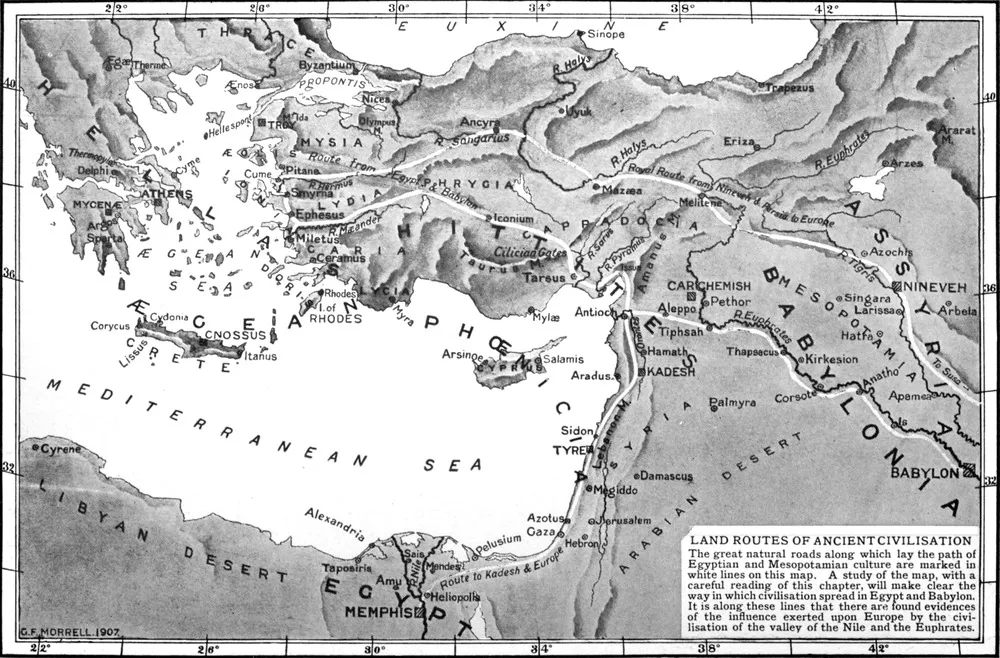
LAND ROUTES OF ANCIENT CIVILISATION
The great natural roads along which lay the path of
Egyptian and Mesopotamian culture are marked in white lines on this map. A
study of the map, with a careful reading of this chapter, will make clear
the way in which civilisation spread in Egypt and Babylon. It is along these
lines that there are found evidences of the influence exerted upon Europe by
the civilisation of the valley of the Nile and the Euphrates.
LARGER
IMAGE
[Western Part of Preceding Map]
[Eastern Part and Legend of Preceding Map]
Half-way Houses of Civilisation
It has been said that there is evidence of the routes just indicated
having been, in fact, those most used. It is upon these lines, and
no others, that we find certain remarkable focuses of early culture
disposed as half-way houses between the Mesopotamian and Egyptian
civilisations on the one hand, and continental Europe on the other.
These are, in relation to the sea routes, first, the prehistoric
Ægean civilisation, focused from the first in Crete, but extended
to all isles and peninsulas of South-eastern Europe from Cyprus to
Sardinia and Spain; and, secondly, the Phœnician, originated on the
Syrian coast, but focused also at a later time at a second point
much farther west—namely, on that Carthaginian projection, whence
lay easy sea-ways to Sicily and Italy and all the western seas. Hard
by the Egyptian land route lay this same Phœnician society; while
all about its point of junction with the Euphrates road, on both its
continuations north-westward, and on the northern road from Mesopotamia
so soon as this had passed Euphrates, was established the singular
but as yet little understood civilisation which we call Hittite. How
early we may assume the latter’s existence in North Syria is still
doubtful; but since the discoveries of Winckler at Boghaz Keui,
there is little question that it was focused in prehistoric time in
Northern Cappadocia, whence its influence seems to have radiated
southward to the confines of Palestine, and westward to Lydia and
almost the shore of the Ægean Sea. It is to this North Cappadocian
region that the Tigris route from Assyria and Babylonia, which was
afterwards the Persian “Royal Road,” tended. Among these civilisations
the most important for our present purpose is the Ægean, because its
geographical area touched at some point all the westward roads, whether
by sea or land; and, moreover, because it is the one which actual
evidence both dates from the remotest antiquity and most clearly proves
to have been operative on Europe, especially on the most expansive of
its early cultures, the Hellenic. The recent exploration of Crete, due
in the main to Messrs. Arthur Evans and Federico Halbherr, has enhanced
enormously the significance of the civilisation revealed to the modern
world at Hissarlik and Mycenæ by the faith and fervour of Henry
Schliemann.
Far-back Evidences of Culture
We are now assured of certain facts of much moment to our inquiry.
Firstly, that this civilisation was developed originally from its
rudest beginnings within the Ægean area itself. This is proved by
evidence of the uninterrupted evolution of fabrics and decoration,
especially in ceramic ware, produced at Cnossus from the dawn of the
historic Hellenic period right back to Neolithic time. At various
points in this long retrocession we can place the Cnossian culture
in synchronic relation with the Egyptian by the presence both of
Egyptian objects in the Ægean strata, and Ægean in the Egyptian. These
points correspond with the highest developments respectively of the
New, Middle, and Old Pharaonic Empires—moments at which we should
naturally expect to find evidence of international communication. The
earliest point indicated by these synchronisms lies possibly as far
back as the First Dynasty, if certain vases, exported apparently from
the Ægean as vehicles for colouring matter, and found by Dr. Petrie at
Abydos, are accepted as of the remote date to which their discoverer
attributed them; but in any case the contemporaneity of some part of
the Old Empire period with the Ægean civilisation is assured, and that,
moreover, when the latter was already far advanced beyond its rudest
origins, as represented by the contents of the thick strata of yellow
clay which underlie the earliest structures at Cnossus.
The Ægean Civilisation is Native
Thus is the indigenous origin of Ægean civilisation assured. So also
is the independence of its after development. The typical Cretan
pottery, known as the “Kamares” style and lineally descended from
Neolithic ware, which attained, about the acme of the Pharaonic
Middle Empire a perfection both of fabric and ornament worthy of the
highest ceramic products of any age, remained absolutely distinct.
The same independence characterises a later ceramic product of the
Ægean, a glazed ware with monochrome decoration, which went into Egypt
abundantly under the Eighteenth Dynasty, and especially when Amenhotep
IV., “Khuenaten,” was reigning in his new capital at Tell-el-Amarna.
Nor is Ægean art distinctive only in its humbler products. The
frescoes, the plaster reliefs, the chased work in precious metals,
the ivory carvings, and the gem intaglios of the Ægean area, of which
Sir Charles Newton said thirty years ago that they were not to be
confounded with products of any other glyptic art, show the development
and retention of an individual naturalistic style—a style which
reacted on the fresco paintings of Egypt itself under Khuenaten.
Finally, to clinch the proof of its independence with the strongest
possible argument, the Ægean civilisation, as soon as it became
articulate, evolved for itself, in Crete at any rate, a system of
writing, displayed to us on some thousands of surviving clay documents,
which was purely its own, and cannot be interpreted by comparison with
any other known script.
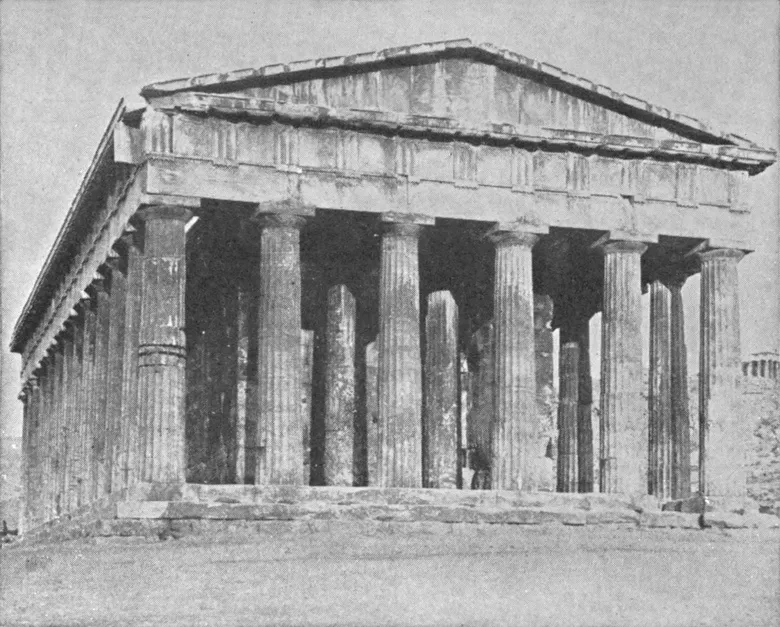
THESEION TEMPLE, ATHENS: DORIC ORDER OF ARCHITECTURE
The perfection of the Hellenic style, derived from Ægean
architecture. 5th century B.C.
TEMPLE OF WINGLESS VICTORY: IONIC ORDER
The perfection of the second Hellenic style, refined
from the Doric, probably in the first place by Asiatic Greeks. Fifth century
B.C.
The Contact of Early Civilisations
Secondly, it is now known that this civilisation, of remote indigenous
origin and independent development, reached a very high point of
achievement in many respects which afford the best-known tests of
culture—namely, in its artistic products, extant examples of which
offer ample evidence of wonderfully close study of natural forms, of
mastery of decorative principles and their execution, and of a sort
of idealistic quality, which has been rightly called “a premonition
of the later Hellenic”; also, in architectural construction and
the organisation of domestic comfort, as displayed in the palaces
at Cnossus and Phæstus, with their superposed stories, their broad
stairways of many flights, their rich ornament, their arrangements
for admitting air and light, and their astonishing systems of
sanitation and drainage. The written documents found, though still
undeciphered, plainly attest an advanced knowledge of account-keeping
and correspondence. The frescoes and gem scenes, as well as many
surviving objects of luxury, attest the existence of a leisured and
pleasure-loving class; and, lastly, the tribute-tallies of Cnossus
support the inference which is legitimately drawn from the uniformity
of certain material objects all over the Ægean area at certain
periods—notably that contemporaneous with the earlier part of the
Eighteenth Egyptian Dynasty—and also from the wide range of certain
place-names, that there was an extensive imperial organisation.
The centre of this empire, as well as the original focus of the
civilisation, was almost beyond question in Crete. The prejudice in
favour of other focuses raised by the priority of Ægean discoveries
elsewhere, especially those made in the Argolid, has been greatly
weakened by demonstration of the superior catholicity and quality of
Cretan culture, and by recognition of the failure of Mycenæ to offer
evidence of anything like the same antiquity. And no more need be
said here to counteract it than that, if Buckle’s statement of the
climatic and geographical conditions necessary to the first development
and upward progress of culture be sound, those conditions were never
present in plenitude anywhere in the Ægean area except in Crete. There
are found in the most conspicuous degree the combination of these
geographical features—large tracts of fertile and deep lowland soil;
mountains so situated as to cause abundant precipitation, and so high
as to store snow against the early summer; absence of both swamps and
desert areas; and a climate not prone to extremes.
What Crete has Taught us
Like all other high civilisations the Ægean both borrowed and lent.
Since its debts could be contracted only with contemporary cultures as
high as its own, they were owed mainly to Egypt and Babylonia, while
its loans went out chiefly to lower civilisations further removed
than itself from the eastern centres, those, namely, of the European
continent. As regards Egypt, something has been said already of its
intercourse with the Ægean in all ages of the latter’s prehistoric
period. The evidence of that intercourse, known even before the
exploration of Crete, was fairly abundant, though limited almost
entirely to later ages of Ægean culture, often called particularly
“Mycenæan.” The “pre-Cretan” case was set forth very concisely in a
paper read before the Royal Society of Literature in 1897 by Professor
Flinders Petrie, who enumerated the objects of Egyptian fabric or style
found on Ægean sites, notably at Mycenæ, and in Cyprus and Rhodes; and
of objects of Ægean style or fabric found in Egypt, notably at Thebes,
Memphis and Tell-el-Amarna and in the Fayum. One word of warning only
may be added—that the occurrence of such imported objects, especially
if they be of the amulet class, on a site of a certain date does not
necessarily imply exact contemporaneity with the period at which the
objects were actually produced; for they may well have been carried
hither and thither in the stream of trade for some time ere coming to
rest, and been long preserved afterwards. Some of the Cypriote and
Rhodian tombs, for example, in which scarabs and other Egyptian objects
of the Eighteenth Pharaonic Dynasty have been found, are probably
considerably later than that dynasty.
Crete has largely reinforced this evidence, not only by throwing it
back to a much earlier time than that of the Eighteenth Dynasty, but by
proving that in its later periods Ægean art had come to be considerably
modified, both in forms and in motives and treatment of decoration,
by the art of Egypt. We have then to do, not merely with mutually
imported objects, but, much more than was previously understood, with
the mutual action of influences—the strongest possible proof of close
intercourse. On the Ægean side, our sole concern at present, are now
found scenes represented in fresco-painting or metal-work—for example,
the mural scene with a river and palms at Cnossus, and the well-known
cat-hunting scene inlaid on a Mycenæan poniard—and also decorative
motives which are of obvious Egyptian parentage. Other motives proclaim
their alien origin by more or less mistaken treatment. The best
instance in point is the use made of the lotus motive in Greece and the
isles, where the flower was never domiciled.
PALLAS ATHENA, THE MAIDEN GODDESS OF ATHENS
One of the chief glories of the art of ancient Greece left
to the modern world. Athena was the goddess and protectress of Athens, and her
statue stood at the height of the Acropolis, dominating the city.
LARGER
IMAGE
THE SUPREME MONUMENT OF ANCIENT GREECE LEFT TO THE
MODERN WORLD
The Venus of Milo, one of the noblest examples of Greek
art, and one of the most famous statues extant. Found at Milo, in Crete, about
100 B.C., and now in the Louvre, Paris.
LARGER
IMAGE
Influence of Egypt and Mesopotamia
For influences of the Mesopotamian civilisation we have to look in the
main to the early civilisations of Syria and Asia Minor; but evidence
is not wholly wanting on Ægean sites. A Babylonian cylinder came to
light at Cnossus; the fashion of dress, especially female, as shown in
Ægean frescoes and gems, is very like the Babylonian, from whatever
primitive garments it had been developed; and in other respects also
the intaglio class of Ægean art products shows at least as much
Mesopotamian as Egyptian influence. It has borrowed the decoration of
both cylinders and scarabs; but it proves its essential independence
all the time by never adopting the forms of either of those
characteristic alien vehicles of glyptic art.
Religious Ideas of Early Times
Lastly, in the most important of all aspects of early civilisation—the
religious—we now know that the Ægean approximated very closely to the
old civilisations to south and east of it. The main idea of its cult
was that which seems to have been the oldest and the most dominant in
such cults—namely, the worship of the reproductive force of Nature.
This idea was embodied, as soon as divinities were imagined in human
shape, in feminine form, the desired relation of divinity to humanity
being expressed by the addition of a son-consort. How far other
features of this cult, common to the south-eastern lands—such as the
descent of the son to the human race, his periodical death at the hands
of the latter, and his joyful resurrection—were present, we do not yet
know. It would probably be false to ascribe the presence of this cult
idea in Ægean civilisation to any foreign influence, for it seems to
be a necessary expression of the religious sense of many peoples, and
is as likely to have been as indigenous in the case of Rhea and Zeus
(to give the Divine pair their possible Ægean names) as in those of
Isis and Osiris, or Ashtaroth and Tammuz-Adon. But we may note first
that here was a vital bond of affinity between the Ægean folk and their
mainland neighbours on east and south, and second, that long before
historic Hellenic times, the former had arrived at that essential
condition of progressive civilisation, an anthropomorphic conception of
divinity.
The Greek Debt to Ægean Civilisation
Enough has now been said to show that Ægean civilisation was both a
broad channel through which influences of Asiatic and Egyptian culture
could and did flow, and also in itself of such importance as to be
likely to exert influence on nascent civilisation in Europe. To see
whether it did so, we look first to the culture which succeeded it in
its own area, the Hellenic culture of the historic age, about whose
action, exerted indirectly on all subsequent civilisation, there is
no possible doubt. And at the outset stress must be laid on the fact
that we are dealing, in respect of the two civilisations in question,
with one and the same geographical area. There is here no question of
alien influences dependent on short or long communications by sea
or land. The Hellenic race, if indeed to be distinguished from all
elements in the earlier Ægean, came into the very domain of the latter,
and experienced by actual contact the full force of the pre-existent
culture. This being so, the probability of heavy debts having been
contracted by the later culture to the earlier is enormous; and it
becomes all but certainty when the few facts which we know about the
early history of the Hellenic peoples proper come to be considered
in the light of ascertained general laws governing the relations of
intermingled races.
Emerging of Historic Hellenism
It is clear that the Hellenic tradition of a great descent of peoples
from the north into mainland Greece and the western isles, about 1000
B.C., enshrines substantial fact. These peoples, possessed of
iron weapons, were superior to the Ægean folk in war, but evidently
inferior in the softer social arts. The Greeks called them Dorians, a
name afterwards associated with the most distinctive, but the least
cultivated, of the historic races of the peninsula—a race, however,
possessed in its full form of the conception of the city-state; which
implied the subordination of the individual to the corporate body, and
was the chief social message to be taught thereafter by the Greek to
the world.
Without calling these invaders by any one name, or supposing Northern
folk to have made then their first appearance in the Ægean area, we may
safely see in this Greek tradition the record of a cataclysmic change
out of which historic Hellenism was to issue at the last. In proof of
the invader’s inferiority in the useful arts we have the undoubted
fact that the command of the Greek seas, formerly held by Cretans and
other Ægean folk, passed for some centuries into Semitic hands—the
hands of those Sidonian Phœnicians whose coming, but as yet incomplete,
“thalassocracy,” is reflected in the most important of contemporary
documents, the Homeric lays, and, under the lead of the Tyrians, was to
grow greater yet. To illustrate their inferiority in the luxurious arts
we have the dry, uninventive style of artistic decoration known as the
“Geometric,” which also lasted for some centuries. It is evident that
the newcomers were conquering soldiers, who destroyed, but could not of
their own virtue create.
A GREAT CITY OF ANCIENT CIVILISATION: THE BUILDING OF
CARTHAGE BY DIDO
From the painting by Turner, in the National Gallery.
LARGER
IMAGE
Now, the course of events after all such conquests, if permanent but
not exterminative, is the same. The rude military invaders, finding
themselves deficient in woman-folk, take not only slaves but wives from
the civilised people of the soil. The resultant children tend more
and more, as time goes on, to be influenced by their native mothers.
In them previous culture begins to revive, and ere many generations
are past, so completely is the new race assimilated by the old that
the language in general use is that not of the conquerors but of the
conquered.
Hellas and its Conquerors
The New Civilisation in Greece
For a crucial instance we need look no further than to the after
history of the Norman invaders of Britain; and we might almost assume,
were there no actual memorials of the fact, that the civilisation which
arose anew in the Ægean area, after the tumultuous period reflected in
the Homeric lays and the Greek tradition of early Asiatic colonisation,
was largely influenced by what had been there in the Ægean Age. There
is, however, proof that such was indeed the fact. As will presently
be pointed out, the long period of unrest had allowed other alien
influences to enter Hellas notably the Semitic from Phœnicia. But
beside what appears to be Asiatic, and also beside what was new and
distinctively Hellenic in the historic culture, which became prominent
from the ninth century onwards (and this includes such all-important
features as the conceptions of a supreme Father-God, and of the
city-state—an idea of social order as obdurate to southern influences
as our own Germanic social order has proved)—beside all this, the
“non-Hellenic” elements in the civilisation are almost entirely such
as may be referred to Ægean prototypes. Hellenic art, which flourished
pre-eminently among the non-Dorian inhabitants, is distinguished from
Eastern art by just those distinctive qualities of both realism and
idealism which distinguished the highest art of the Ægean Age. Hellenic
religion has for its oldest, most universal, and most popular deities
various feminine impersonations, indistinguishable from the earlier
Mother-Goddess. The chief of these is the unwedded Artemis-Aphrodite,
supreme patroness of life all through the historic period of pagan
Greece, the essential features of whose cult are still dominant in the
observance of the Greek peasant-worshippers of the Christian Virgin.
Hellenic cult is full of interesting survivals of the Tree and Stone
ritual amply attested in Ægean cult. Hellenic custom retained many
traces of a matriarchal system, appropriate to a society exclusively
devoted to the Great Mother, whom Hellas took in name and actual
primitive form to her pantheon under the names of Rhea and Kybéle. The
Dorian and Ionian styles of architecture can be directly affiliated
to the Ægean as revealed in Mycenæan tombs and Cnossian frescoes, and
the Greek house is a development of the earlier domestic plan. Certain
notable exceptions go far to prove the rule. The dress of the upper
class, and the fashion of body-armour and weapons, seem to have been
determined henceforth by the new folk. These are just the features
in civilisation which conquering invaders would naturally introduce
and retain. It is hardly necessary to add that if Ægean civilisation
seriously influenced that of historic Hellas, it seriously influenced
at second hand that of Western and Central Europe.
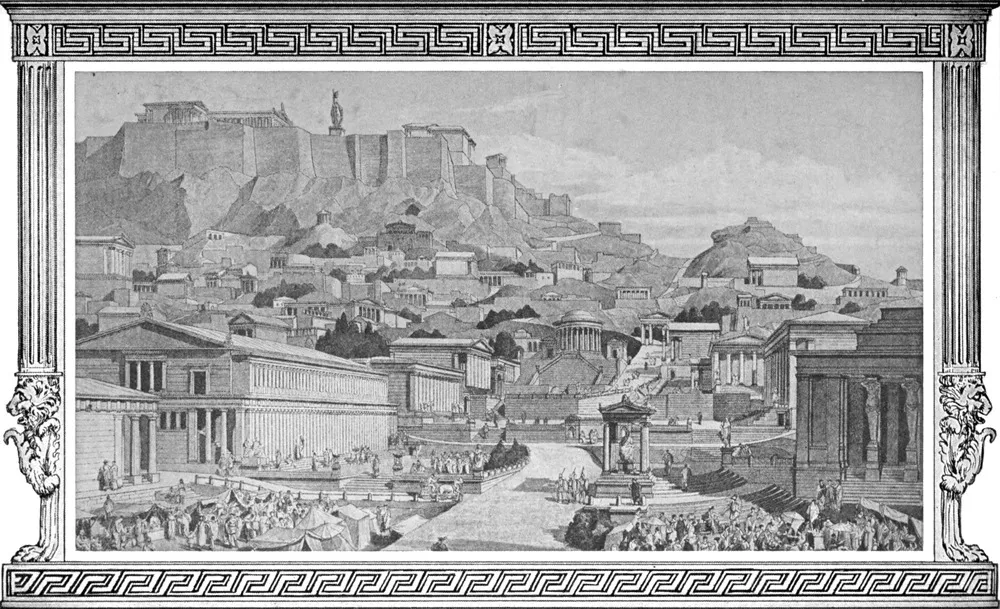
ATHENS IN THE HEIGHT OF HER CIVILISATION: THE MARKET
PLACE RECONSTRUCTED WITH THE ACROPOLIS IN THE BACKGROUND
LARGER
IMAGE
Other Ægean Influences in Europe
Commercial Communication with Europe
Hellenic civilisation, however, was perhaps not the only medium
through which Ægean influence affected inner Europe. In Scandinavian
tomb-furniture certain presumably foreign decorative motives, notably
the returning spiral and the triquetra, which are identical with
characteristic Ægean types, make their appearance in the first part of
the local Bronze Age; and these have been noticed also, at a slightly
later period, in the art of early Ireland, at that time the most
civilised of the British Isles. In point of form also some Northern
weapons in bronze resemble those of the Far South. If the spiral motive
stood alone, the affiliation of this distant decorative art to the
Ægean would be very doubtful, since Nature, whether through the forms
assumed by vegetable tendrils or animal horns, or through those of
shavings of wood or metal, might easily have suggested the ornament
independently. But taken together with other related motives, and
the evidence of assimilation of weapon-forms, these spirals raise a
presumption in favour of an early obligation of North Europe to Ægean
civilisation. A possible explanation of this fact, if fact it be, has
been found in the communication which appears to have been created
by the Ægean demand for Baltic amber; and early ways for this traffic
have been traced by Dr. Arthur Evans up the Adriatic, and also overland
from the Ægean shores to the Danube basin, whence, from a point near
the later Carnuntum, a combined route ran up the Moldau to the Elbe
system. Further, it is the opinion of Professor Montelius and some
other archæologists that not only certain bronze forms and decorative
motives, but the usage of this metal itself was derived in Scandinavia
from the south, somewhere before 1000 B.C. Since pure copper
and pure tin hardly occur in Sweden among objects of this age, it has
been held that the bronze was imported ready made in the mass. But
Sweden contains large natural copper deposits, and tin is also found;
and, therefore, this opinion is not universally accepted. Indeed, some
authorities reverse the debt, and actually derive Ægean knowledge of
bronze from Europe. If, however, the first derivation be ever proved,
we shall have to refer the first use of metal weapons—an enormous step
forward in social progress—in North and Central Europe to the Southern
civilisations, such as the Egyptian, which had certainly known and used
bronze for at least a thousand years before we find it in Sweden. It
is sometimes maintained that Cyprus was the first, and long the sole,
source of copper, which travelled north by way of Asia Minor and the
Ægean to Hungary and inner Europe; but this is not proved. In any case,
for some reason, bronze seems to have become known to the Scandinavians
and Danes earlier than to the Gallic peoples.
Influences in Western Europe
Yet more evidence is there of possible Ægean communication with Central
Europe after the introduction of iron, which seems not to have reached
Scandinavia till almost the Christian Era. Transylvanian, Russian,
and Balkan graves have yielded to recent explorers abundance of both
weapons and decorated articles of personal use and adornment, closely
resembling fabrics in the later periods of Ægean civilisation. Further
into the European continent we have again the various evidence of
the early Iron Age graves of the Salzkammergut on the south-eastern
fringe of the Bavarian plain. This “Hallstatt” culture, as it is
called, from the location of the chief cemetery, presents both in
character and development an extraordinarily close parallel to that
of the Ægean Geometric Age. About the same period we know also that a
civilisation was in progress in the fertile lands round the head of
the Adriatic, which is called Veneto-Illyrian, and shows even stronger
evidence of Ægean influence than the Hallstatt culture; as, indeed,
might be expected, if it be remembered that in Southern and Central
Italy, as well as Sicily, forms and decoration, obviously learned from
Ægean civilisation, as well as actual imported Ægean objects, had
been plentiful ever since the bloom of the Ægean age. A visit to the
local collections in Syracuse, Bari, and Ancona, will establish this
fact to the satisfaction of any archæologist. These two civilisations,
that of the Salzkammergut and that of the North Adriatic lands, have
important bearing on the development of all Western Europe; for we
know that the Celtic peoples, who penetrated south of the Alps in the
sixth and fifth centuries B.C., learned much from both, and
especially from the second; and graves, furnished after they had been
pressed back again into Switzerland and Gaul, show abundant evidence
of what is called “sub-Ægean” influence—that is, of form and ornament
probably derived ultimately from Ægean culture, but indirectly, or
after undergoing considerable degradation. Through various subsequent
intermediaries, notably the Belgic tribes, these derivatives passed
ultimately to our own islands, and we find their influence operative on
early English art.
Civilisations Help One Another
At the same time it is necessary to add that this derivation of the
higher developments of mid-European and Scandinavian culture in the
Bronze and Early Iron ages from the influence of Ægean civilisation
is far from certain, whatever be the case for the Adriatic lands.
Knowledge obtained since Dr. Evans and Dr. Montelius first expressed
their views, especially in regard to the so-called Neolithic or
“Butmir” pottery, which has a very wide range in South-Eastern Central
Europe, has not strengthened their case, but rather tended to suggest
that the continental culture developed independently to, though in a
parallel direction with, that of the southern peninsulas and isles. If
this view ultimately prevail, it will illustrate the opinion, to which
we personally incline, that the derivation of civilisations, one from
another in early times, is the exception and not the rule, except in
respect of minor matters.
The Vigorous Hittite Civilisation
Two other intermediary civilisations of the South-east remain to
be considered—the Hittite and the Phœnician. The first is still,
unfortunately, very little known to us, and we are hardly in a position
to say much about its influence on Europe until more small objects of
use and ornament have been discovered on Hittite sites. The general
facts so far ascertained, which make such influence probable, are
these. This civilisation, characterised and distinguished from all
others by a very individual art, and by a system of writing apparently
independent of the Mesopotamian and Egyptian systems, but in its later
development showing kinship to Mediterranean systems, lay across all
the mainland routes from inner Asia and Egypt to South-eastern Europe.
Its monuments have been found scattered thickly from the valley of the
Syrian Orontes northwards, to within 150 miles of the Black Sea, and
westward to the last passes which lead down from the Anatolian plateau
to the Ægean littoral. So far as we can judge at present, its place
of origin was Cappadocia, but its later focus was possibly in North
Syria; while its period of florescence ranges back from about the sixth
century B.C. for at least a thousand years.
It was, as we know from many written records, in frequent collision
with both Egypt and Assyria, and in its southern home and latest period
came under Mesopotamian domination. As is to be expected, therefore,
its monuments show very strong Mesopotamian, and less strong Egyptian,
influence. At the last, indeed, those of North Syria approximate very
closely indeed to the contemporary Assyrian of the Sargonid Age. At the
same time, however, they retain sufficient individuality never to be
mistaken for other than Hittite; they represent facial types, dress,
and fashion of arms which are peculiar; and the inscriptions they bear
are always couched in a script having no relation to cuneiform writing.
Europe and Hittite Influence
This vigorous civilisation, occupying the great land bridge from Asia
into Europe in the dawn of the historic Hellenic period, and eminently
receptive of Mesopotamian influences, cannot but have been a medium
through which these reached the Ægean Sea, and so told on Europe. But
this did not take place to any appreciable extent in what is known as
the prehistoric period. The Cretan products, and those of the other
Ægean Isles and mainland Greece, betray very little Mesopotamian
influence, and none that we can reasonably trace to the Hittites. So
far as we can see, the Ægean culture was much more ancient than the
Hittite, and if there was kinship between them we are bound, on the
evidence, to derive the latter from the former, and not vice versa.
There is a certain relation between late Ægean art and products
of inland Asia Minor, but it indicates influence passing eastward
rather than westward; and even on the remoter Ægean sites of Asia
Minor—Hissarlik, for instance—non-Ægean traces are but slight, and do
not suggest the influence of a strong civilisation focused inland.
The Hittite Pathway of Civilisation
Part Played by the Phœnicians
In the early Hellenic Age, on the other hand, we have to note
considerable Mesopotamian influence on Greek culture, and, at the
same time, certain evidence of counter influence, both sub-Ægean and
Græco-Lydian, on Mesopotamia, which is as yet not fully understood.
But whether both or either of these respective influences were
transmitted through the Hittite civilisation is still very doubtful.
The Egyptian influence on archaic Anatolia, especially on Rhodes, and
even on the Greek mainland, seems clearly to have come by way of the
sea; and considering the part which the Phœnicians had been playing
for some time previously as transmitters of things eastern, there is a
probable alternative westward route for Mesopotamian influence also.
In Cyprus, at any rate, this influence, which at a certain period
has left strong traces, certainly came for the most part through the
western Semites. The claim of the Hittites, however, is not to be
denied altogether. Their script seems undoubtedly to have been the
parent of the Lycian and other local Anatolian systems. Phrygian art
and writing attest Græco-Lydian influence inland; Ionian culture was
certainly not unaffected by the Lydian in which many students recognise
a western offshoot of the Hittite; and there are a few features in
Ionian cult and in cult representations which seem to be owed rather
to the religious system of the central plateau than to that native to
the Ægean area. In this state of suspense we must leave the question,
adding only these final remarks, that Greek tradition itself ascribed
some of the arts and luxuries of its civilisation—for example, the
coining of money—to Lydian invention, and also affiliated to Lydia a
whole western culture, that of Etruria; while it is an undoubted fact
that a Mesopotamian standard of weight-currency travelled to the Ægean,
and thence affected all western commerce, but by what channel we do not
certainly know. There is an unknown quantity in all this problem—viz.,
Lydia. We have reason to suspect the latter of a considerable influence
on early Hellenic civilisation, both as creator and transmitter, but
must await further evidence.
The part played by the Phœnicians in transmitting influences of
civilisation from East to West is far more certain, and is now much
better understood than it was a few years ago. Much vague exaggeration
of it has been swept away by recent demonstration that there is
practically nothing of probable Phœnician origin in the remains of
the Ægean culture. The script of the latter is wholly independent;
the typical Phœnician vehicles of glyptic art, the cylinder and the
scarab, were never naturalised in the early Ægean; the whole path of
the latter’s artistic development was distinct; and the Ægean religious
representations, once regarded as Semitic, are now seen to be native.
On the other hand, decadent and derived Ægean forms and motives appear
among the earliest Phœnician known to us. Influence, if it passed at
all, between the Ægean and the Syrian coast lands, in the prehistoric
age, moved from west to east.
Origin of Our Written Language
Semitic Influence in Greek Art
In short, we now know that the Phœnicians did not begin to spread over
the western sea and influence Europe till the break up of the Ægean
civilisation. The Homeric lays and Hellenic myths reflect the inception
of a Semitic expansion, which must be placed after 1100 B.C.
Even in Homer there is more mention of Greek ships than of Sidonian,
and the Tyrian power is yet to come. The latter pushed westward later,
and the founding of Carthage, usually dated in the eighth century,
marks its first great achievement along those distant sea-routes,
which certainly the Semites had been coming to know during a couple of
centuries of huckstering trade, even if the dependence of the early
Hellenes on Phœnician knowledge of these waters has been overrated.
But, in any case, during the interval between the fall of Ægean power
and the rise of the Hellenic maritime cities these Semites counted
for much. Even in the light of Cretan discovery, we need not question
their responsibility for the Greek alphabet, and thus, indirectly, for
the ultimate medium of written communication used throughout European
civilisation; nor need it be doubted that Hellenic writers, who trace
early instruction in trade and barter to visits of Semitic ships to
their coasts, show real, though limited, knowledge of fact. Phœnician
factories were certainly established on Greek shores, and left Semitic
forms among later Greek place-names; and it is quite possible that
political power was exercised at one time by Semitic colonists in parts
of Hellas. Sufficient Phœnician art products have been found on archaic
Hellenic sites, to prove that, in the period between 1000 and 500
B.C., the Ægean coasts were often visited by these Semites.
Such objects are especially numerous in Rhodes, a convenient stage on
the westward sea route, and they radiate over not only Ionia and the
Hellenic lands, but also into the further Mediterranean, to Sicily and
its neighbouring islands, to Italy and South Gaul, and to Sardinia and
Spain. Carthage probably had much to say in their western distribution.
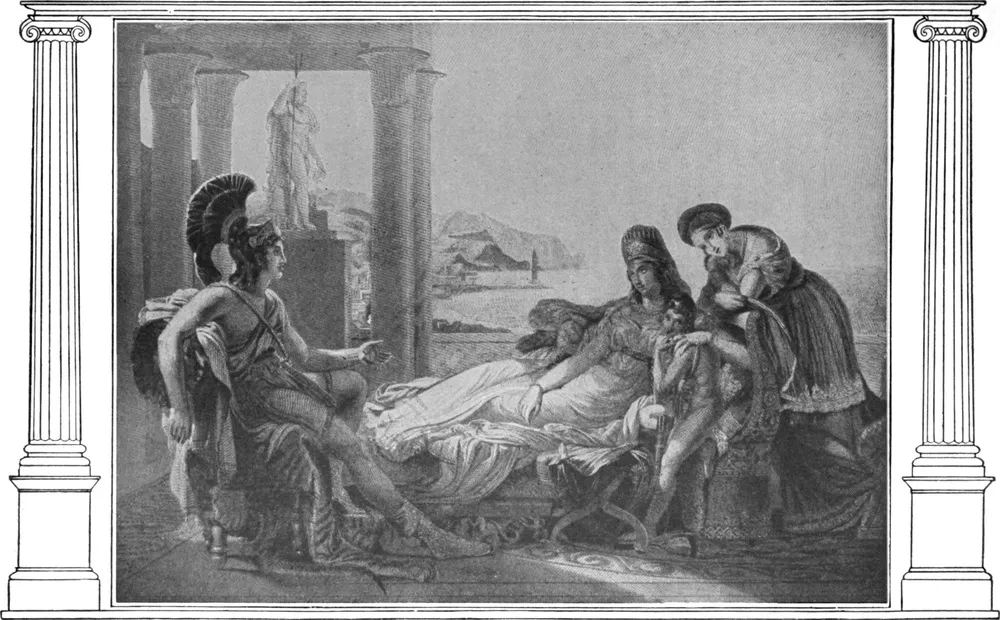
ÆNEAS AND DIDO: THE QUEEN OF CARTHAGE LISTENING TO THE
STORY OF THE SIEGE OF TROY
From the Painting by P. Guerin, in the Louvre.
LARGER
IMAGE
No Phœnician Influence in Britain
Of Semitic influence on archaic Greek art there is considerable
evidence. After the Geometric Age, we find in the Greek lands pottery
and metal-work showing certain motives and arrangement of decoration
foreign to Ægean art, and referable ultimately to the Mesopotamian and
Egyptian. Such are the animals and monsters disposed in concentric
friezes and zones on Cypriote bowls, Corinthian vases, and the Cretan
shields of the Idaean Cave. But this influence, strong and undoubted
as it was, must not be over estimated. As the Hellenes rose to power,
their instinct of sincerity and naturalism, inherited from Ægean
civilisation, revolted against, and triumphed over, this parasitic
Semitic art, and already in the ninth or eighth century we find a
Græco-Lydian influence, which owes nothing to Phœnician, breaking
back to the east and creating the ivories of the Sargonid Age at
Nineveh. Phœnician objects thenceforward become fewer and fewer in
Hellenic strata, and in the sixth century B.C. they virtually
vanish. By this time Phœnicia had become a subject country, about to
give up the last ghost of its independence to the Greeks themselves, as
its western offshoot, Carthage, was also to surrender a little later to
another civilisation near akin to the Greek. But, needless to say, the
Semite has had his full revenge for the short tenure of his earliest
predominance in European waters. The fall of Phœnicia cleared the way
for another Semitic family to capture international trade, and, first
with one creed and then another, to conquer the Greeks, the Romans, and
the World.
There are, of course, possibilities of direct Phœnician intercourse
with non-Mediterranean Europe—for example, with England’s
south-western coasts; but they need not detain us. For whether certain
Semites came to Cornwall in quest of tin or no, it is certain that
by these no lasting influence of civilisation passed in to England.
Neither the religion, the speech, nor the script of Britain owed them
anything. Recent scholarship tends to discredit any Semitic element
even in English south-western place-names.
The Origins of our Civilisations
Such, in brief outline, are the channels through which the
civilisations of the South-eastern river-valleys could communicate
with primitive Europe. It is easier to point them out than to say
exactly what flowed along them. Seldom can so definite a debt be
recorded as that under which we lie to the Semites of Phœnicia, for the
names and the forms of the written characters which, presumably, they
themselves had borrowed from Egypt, and modified ere they passed them
westwards. Usually the obligation must be stated much more vaguely,
being confined, as in the case of Ægean influences, to little more than
a general responsibility for the spirit, and for many forms of the
expression, of the first great artistic growth on the mainland soil of
Europe, as well as for certain persistent and dynamic features in South
European cults.
Thus, it becomes even more apparent at the end of our discussion than
it was at the beginning that when all has been said about influences of
Egypt and Mesopotamia, and influences of the intermediate civilisations
of the Ægean, Syria, and Asia Minor, only a very small part of the
whole story of incipient European civilisation has been told. Nor is
it to be expected that the origin of our culture should be capable
of being adequately expressed in terms of other cultures, developed
at a great distance and under different geographical conditions.
Civilisations, destined to be living growths, spring, it seems, of
themselves, and the debts which they can incur at the first are very
small and mostly in small things. It is only when they are come to
adult estate, have bred men of wealth and leisure with open and
receptive minds, and have broken through the geographical barriers
about them, that they begin to borrow at large.
In the Childhood of Europe
One of the intermediate civilisations of which we have treated, the
Ægean, the only one whose own origins are fairly well known, offers
proof in point. Its remains indicate but trifling obligations to
neighbouring Egypt till a very late period, that which, in Crete,
we call the Third Minoan. Thereafter, in the space of two or
three generations, the evidence of its debt increases at a wholly
disproportionate rate. So too, no doubt, in the misty period of the
childhood of Central and Western Europe, little was borrowed from
abroad that was essential to civilisation; and the heavy obligations
which we owe to the Eastern lands fall in ages much more recent.
They fall, in fact, in those times which saw the Anatolian cult of
Kybéle and Attis, the Egyptian cult of Isis and Horus-Harpocrates,
the Mesopotamian cult of Mithra, and, far more momentous, of course,
than these, Christianity—Hebrew in origin if modified by Greek
conceptions—brought by a greater intermediary civilisation than any
with which we have had to deal, to the knowledge of inner European
races already long emerged from savagery, and able and eager to borrow.
DAVID
GEORGE HOGARTH
I
IT
is a familiar fact that offspring resemble their parents on the
whole, but differ from them in details. For example, the child of a
human being is always another, but never an exactly similar, human
being.
These differences in detail are of two sorts, inborn and acquired.
Inborn or innate differences arise “by nature”; the child is inherently
unlike the parent—taller or shorter, fairer or darker, and so forth.
Acquired differences, on the other hand, are due to the conditions
under which parents and children have lived. Thus, owing to better or
worse surroundings, the child may develop better or worse than the
parent and so be taller or shorter, or a greater exposure to weather
may render him darker or fairer.
Things We Cannot Inherit
It was formerly believed by scientific men, and is still believed by
the public, that traits acquired by the parent tended to be inherited
by the child—that is, reproduced as inborn traits. Thus it was
supposed that if a man were made strong by exercise, or injured by
accident, his child would tend to inherit, in some degree at least, the
acquired benefit or injury, and as a result be naturally stronger or
more defective than the parent was at the start.
Acquired Traits not Hereditary
But very prolonged and careful investigation has proved that this is
certainly an error. For example, though for æons human beings have been
learning to speak and walk, and make a multitude of other acquirements,
yet none of these are ever inherited. In fact, owing to the evolution
of memory and the retrogression of instinct, man, of all animals,
acquires the most and inherits the least. Every child has to begin
afresh and learn what its ancestors learnt; all are born ignorant;
none speak or walk “naturally.” Each starts where the parent began,
not where he left off. The parental traits, if reproduced at all, are
always of the same kind in the child as in the parents, and appear
in the same way. That is, the inborn traits of the parent are always
inborn in the offspring; the acquired traits are never anything but
acquirements resulting from the same causes as they did in the parent.
In brief, the acquirements of the parent are never transmuted into
inborn characteristics in the child. They are never inherited. It is
admitted on all hands that inborn differences—variations, as they
are termed technically—tend to be inherited.
Thus, if the parent is naturally darker than the grandparent, the
child tends in colour to resemble the former more than the latter.
Since the child may vary from the parent in the same direction as the
latter varied from the grandparent, these inborn differences may be
accentuated in subsequent generations. It is due to this fact that
plant and animal breeders have improved domesticated species. They are
able to benefit the individual by improving his surroundings, but the
race they can improve only by breeding from the best. In other words,
when they have the latter end in view, they must build on natural
variations, not on acquirements.
A Great Problem of Science
Differences among Kindred
One of the most important problems in the whole range of science is the
question as to what causes offspring to differ in this inborn, natural
way from their parents. Many theories have been formulated, and the
subject is still to some extent under discussion; but the evidence is
overwhelming that variations—natural differences—are not generally
caused, as most people believe, by anything that happens to the parent
before the birth of the child, but are “spontaneous.” The subject is
a large and intricate one, and we have not space to discuss it at
length. One or two facts, however, may be mentioned. The members of
a litter of puppies, kittens, or pigs, may differ naturally amongst
themselves and from their parents in all sorts of ways—in colour,
shape, size, hairiness, disposition, and so on. One puppy may present
points of resemblance to the father, another to the mother, a third to
some ancestor, while a fourth may be unlike any of its predecessors.
Since, practically speaking, the puppies were all conditioned alike
before birth, it is evident that these great differences must be
“spontaneous.” They cannot have been caused by such things as the good
or ill health of the parents, their food, or the life they led, for, in
that case, the puppies would all have varied in the same way.
Again, malaria is, in effect, a universal disease on the West Coast
of Africa. Individuals differ naturally in their powers of resisting
it, some taking it lightly and some severely; but almost every negro
suffers, and many children perish of it. If the sufferings of the
parents caused children to be born weaker “by nature,” it is evident
that every individual would start life inferior to his predecessor at
the start, and the race would thus degenerate and ultimately become
extinct. On the other hand, if variations are “spontaneous,” if, quite
unaffected by the sufferings of the parents, some children are born
naturally different, naturally more or less resistant to malaria than
their predecessors, it is plain that the weeding out of the unfittest,
the weak against the disease, would ultimately make the race resistant
to it. In the one case the race would drift to destruction; in the
other it would undergo protective evolution. Obviously, the latter is
what has happened. Negroes show no signs of any kind of degeneration,
but they are of all races the most resistant to malaria.
Suffering Produces Strength
Similarly, Englishmen who have been much exposed to consumption and
measles, natives of India who have been much afflicted by enteric
fever and dysentery, Esquimaux who have suffered from cold, Arabs who
have endured heat, Chinamen and Jews who have long dwelt under that
complex of ill conditions found in slums and ghettos, are none of them
degenerate, but, on the contrary, have become resistant, each race
to its own particular ill-conditions in proportion to its sufferings
in the past. In fact, it may be laid down as a general rule that
races strengthen only when exposed to ill conditions, and deteriorate
only when the conditions are so favourable that the unfit are not
eliminated. An example of the latter is seen when prize breeds of
animals and plants, however well nourished and cared for, are no longer
bred with care. It follows that races, if not exterminated, are not
injured but strengthened by ill conditions, by the elimination of the
unfittest, as gold is refined by fire.
Survival of the Fittest
It is a remarkable fact that many people are able to accomplish the
surprising feat of knowing that races have become inured to ill
conditions, and of believing at the same time that the offspring of
people exposed to such conditions tend, as a rule, to be degenerate.
It is as if they believed that two and two make four, and two more
six, but that if a great number of two’s are added together the total
result is a minus quantity. Obviously the two beliefs are incompatible.
A race cannot degenerate in every generation and yet emerge in the end
strengthened from the struggle. The confusion has arisen because the
two diametrically opposite propositions are seldom considered together,
and in part also from a mistaken interpretation of what is observed in
such situations as the slums of cities. Here puny children are seen to
be derived from puny parents, and it is assumed that the children are
degenerate because the parents have suffered.
As a fact we have no reason to doubt that the children are affected in
precisely the same way as the parents. On the one hand, slums are sinks
into which descend people naturally inferior, people who have varied
spontaneously from their ancestors in such a way as to be feeble,
physically or mentally, and who reproduce their like. On the other
hand, the conditions are such that even the naturally strong, both
parents and children, develop badly. Doubtless, owing to the constant
elimination of the unfit, the latter—the naturally strong—are by far
the more numerous. There is nothing to show that, if they were removed
in early life to better surroundings, they would not develop just as
well as the offspring of country folk.
An Evolution that has now Ceased
The fact that races grow resistant to the ill conditions to which
they are exposed, and degenerate when placed under particularly good
conditions, is decisive proof that offspring are not, as a rule,
innately affected by the surroundings of their parents. No doubt
exceptions occur, but these are amongst the most unfit, and the race
is soon purged of them. Thus European dogs are said to degenerate when
taken to India. But the existence of old-established native races of
dogs is proof that the degenerative process is not perpetual. Malaria
and many other ill conditions are quite normal parts of the environment
of the races exposed to them, and have been so for thousands of years.
Except for occasional unfavourable variations, which are quickly
eliminated, they have long purged the races of those strains that
tended to become degenerate under their influence.
After man—through the evolution of the structures and faculties
which distinguish him from the lower animals, the large brain, with
its accompanying memory, the organs of speech, the hand, the erect
attitude—had achieved the conquest of the earth, his selection and
evolution along the ancestral lines gradually diminished, and has now
almost ceased. At the present day clever, strong, or active people do
not on the average have an appreciably more numerous progeny than those
who are not exceptionally endowed. No modern race is intellectually
superior to the Greeks who flourished more than two thousand years ago.
The brains, the hands, the organs of speech, the erect attitude, have
not altered. Apparently nothing more than traditional knowledge has
improved.
The gradual accumulation of traditional knowledge during prehistoric
times enabled man to cultivate animals and plants, and so to increase
and regulate his supply of food. As a consequence his numbers
multiplied. Areas of country which formerly supported only a few
wandering hunters now afforded sustenance to growing multitudes of
agriculturists, who often dwelt together for mutual protection in
villages. Commerce followed agriculture, towns and cities arose, and
civilisation dawned.
Civilisation implies a dense and settled community, protected from
most of the dangers which beset wild animals, and in which, therefore,
the elimination of the unfit is no longer of the kind that weeded out
the brute and the utter savage. Some sort of elimination does occur,
however, for, even in the most civilised states, multitudes of people
perish in youth, before they have contributed their full quota of
offspring to the race.
Natural Selection at Work
We have excellent opportunities of studying this elimination and noting
whether it results in evolution. Indeed, man presents the only instance
in Nature in which we are able to observe natural selection actually
at work. In all modern states statistics are compiled which set out
the causes of death, the mortality from each cause, and the ages of
its victims. By comparing races which have been much afflicted by this
or that cause of mortality with races that have been little or not at
all affected, we are able to ascertain the resulting racial change, if
any. As may be noted by everyone, civilised people perish, with rare
exceptions, of disease.
MANKIND’S LONG BATTLE AGAINST BACTERIA
Resistance of Races to Disease
W
WE
have just seen that every race is resistant to every disease
precisely in proportion to its past experience of it. It follows that
the evolution of civilised peoples is against disease. If any other
kind of evolution is now occurring, no one as yet has been able to
demonstrate it, though many unproved guesses have been made. Mere
alterations in traditional knowledge is not evolution. Children may
derive it just as well from other people as from their parents.
The vast majority of deaths from disease are of zymotic origin. A
zymotic or microbic disease is caused by the entrance into the body of
minute animals or plants (microbes), which find their nutriment there.
There are many species of microbes, each disease being due to one. Some
species are mainly air-borne, and infect through the breath; others are
water-borne; others earth-borne; yet others insect-borne; while a few
pass by actual contact from an infected to a healthy person.
The Way Disease is Spread
Some diseases—for example, consumption and leprosy—are of indefinite
but always prolonged duration; others, like measles, are short and
sharp. In the case of the latter, for reasons we need not dwell on
here, the body after an attack becomes, for a longer or shorter time,
an unfit habitation for the microbes of that particular species. The
rapid recovery which occurs in these “acute” diseases, indeed, implies
the banishment of the microbes. The air-borne diseases—measles,
influenza, smallpox, and the like, all of that acute type which confers
immunity against subsequent attacks—are very infective, spreading
through a susceptible population with great rapidity. Under favourable
conditions the water-borne diseases also—cholera, dysentery, enteric
fever, and the like—may spread very quickly. Chief amongst the
earth-borne diseases is consumption. It is contracted chiefly in
such dark, ill-ventilated, and crowded houses as are built by the
inhabitants of cold and temperate climates.
The disease-producing microbes are an infinitesimal proportion of the
total number of bacterial and protozoan species. In Nature it is not
easy to find a speck of earth or a drop of water from which these
minute living beings are absent. All decay, by means of which the dead
bodies of plants and animals are returned to the soil, is due to them.
The Immense Antiquity of Diseases
It is a safe assumption that the microbes of human diseases have
evolved from non-parasitic species. The niche they now occupy in
Nature is the human body. Two things formed essential parts of
this evolution—first, the microbes became capable of existing and
multiplying for a shorter or longer period in the body; secondly,
they evolved means of passing from one living body to another. The
latter must have been the more difficult process. Under favourable
circumstances several species of microbes—for example, those of
putrefaction, which are ordinarily non-parasitic—are capable of
entering the human body and becoming virulent; but, since they cannot
secure passage from one individual to another, they die out, and
their virulence is lost. Historical evidence renders it probable that
all known human diseases are of immense antiquity, the so-called new
diseases being merely newly-observed diseases. It appears probable,
therefore, that, owing to constant persecution by disease, by continued
survival of the fittest, humanity has grown so resistant that no
species of microbe which has not undergone concurrent evolution is now
able to establish itself as a regular parasite.
Obviously, since the microbes of human diseases draw their nutritive
supplies from man, they cannot persist except amongst populations
so crowded that they are able to pass from one individual to another
in unending succession. When the succession fails, the disease dies
out, and is not renewed, except from foreign sources. Microbic disease
is never contracted in desert places far from human settlements, and
even in modern times it is comparatively rare amongst nomadic tribes,
and, seemingly, was quite unknown in Arctic regions and in many
Pacific islands before its introduction by Europeans. These maladies,
therefore, must have made their appearance only after men had peopled
certain regions in considerable numbers.
Progress of Sanitary Science
On the other hand, we have no certain evidence that any
well-established parasitic disease has ever completely died out. The
chances are all against such an occurrence in the past. When once
established as parasites, the microbes, owing to the constant growth
of human population, found a constantly augmented food supply, and
therefore constantly increased opportunities of reaching fresh fields
of conquest. Sanitary science is still in its infancy. Preventive
measures, and perhaps other agencies, have caused the disappearance
of leprosy from several countries, but it is still prevalent in many
quarters of the globe. Contagious diseases have spread very widely.
Earth and air borne diseases have become endemic instead of merely
epidemic. Consumption is always with us, and almost every child
contracts measles, whooping-cough, chicken-pox, and common cold.
Small-pox has been replaced by vaccination, which is merely modified
small-pox. Malaria has spread but little during the historic epoch, but
only because its microbes were already present in almost every place
where the mosquitoes that convey it are able to exist.
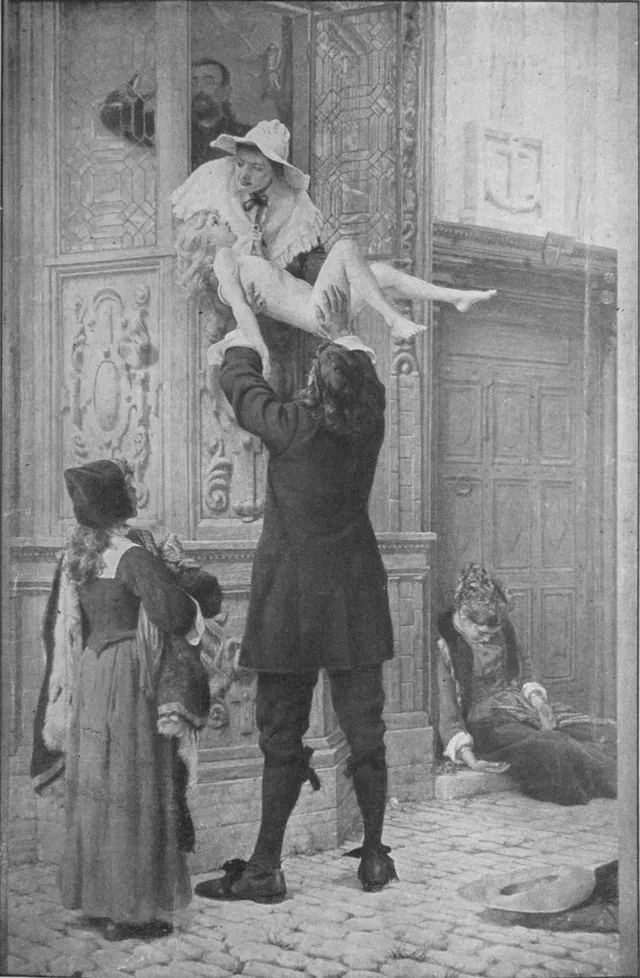
THE DAYS OF THE PLAGUE IN LONDON
Dr. Archdall Reid, in his essay on race supremacy,
explains that the evolution of civilised peoples is against disease, and the age
of pestilence and plague is passing. This picture of an incident in the greatest
plague that has affected London in historical times—in the year
1665—is from the painting by F. W. Topham, R. I.
LARGER
IMAGE
All our information indicates the Eastern Hemisphere as the place of
origin both of man and of his microbic diseases. Parts of it have been
inhabited by a dense and settled population from a time immensely
remote. “Behind dim empires ghosts of dimmer empires loom.” Beyond
the traces of the oldest civilisations we find evidences of primitive
agricultural communities, and far beyond these the remains of the
cave-men and hunters of the Stone Age. Even a race of hunters tends
to increase faster than the food supply. Doubtless the pressure of
population in the Old World led to the colonisation of the New. But
even in the New World there are signs of a civilisation so ancient that
some authorities have placed its beginnings as far back as a score
or more of thousands of years. With the exception of malaria, it is
extremely doubtful whether any zymotic disease existed in the whole of
the New World at the time of its discovery by Columbus.
The subject is involved in obscurity; but, while it is evident that
the European adventurers introduced many diseases, there is no clear
indication that they found and brought back one. Apparently all the
diseases which have been prevalent in Europe and America during the
last four hundred years were prevalent in the former continent before
the fifteenth century. Venereal disease and yellow fever have sometimes
been regarded as exceptions. But the former was well known to the
Roman physicians, and was common during the Middle Ages. Moreover, the
inhabitants of the New World take the disease in a very acute form, and
it is not found in remote communities to which Europeans have had no
access. Yellow fever was first noted with certainty in the West Indies
in the middle of the seventeenth century. The records of the time “tell
of the importation of the disease from place to place, and from island
to island.”
Origins of Rare Diseases
Not till more than a century later was it observed on the West Coast
of Africa. There can be no doubt, however, that the earlier observers
confused yellow fever with bilious malaria, and that it was present
both in the West Indies and Africa long before a differential diagnosis
was made. The fact that of all races negroes are most resistant to the
disease would seem to indicate West Africa as the place of origin. In
any case, it is certain that, with the exception of malaria, zymotic
diseases, if not entirely absent, were extremely rare in the New World.
THE DISAPPEARANCE OF THE NATIVE RACES
The Age of Pestilence is Passing
Z
ZYMOTIC
disease, then, arose amongst the slowly-growing populations of
the Old World. Air and insect borne diseases may have arisen amongst
the early hunters and nomads. Similar forms of disease, murrains
as they were anciently termed—for example, distemper, rinderpest,
the horse sickness in South Africa, the rabbit plague in Northern
Canada, and the cattle fever in Texas—occur among lower animals,
when these are present in considerable numbers. With the exception of
tuberculosis and leprosy, endemic disease was probably almost unknown
in the sparsely-peopled ancient world. The facts that air and water
borne diseases spread very rapidly, that the illnesses caused by them
are comparatively short and sharp, and that recovery is followed by
immunity, must have caused rapid exhaustion of the food supply of the
microbes. Under such conditions the persistence of the pathogenic
species was maintained among the scanty populations by a passage to new
and perhaps very distant sources of supply.
Introduced by travellers, or spreading from tribe to tribe, they
appeared suddenly in epidemic form as plagues and pestilences, and,
disappearing as suddenly, were not known again till a fresh generation
furnished a fresh supply of food.
When, however, in spite of war, famine, and pestilence, the human race
increased to such an extent that the number of fresh births furnished a
perennial supply of food, while at the same time a rising civilisation
and improved means of communication lessened the isolation of various
communities, then many diseases slowly passed from an epidemic to an
endemic form. Pestilence grew rare, but every individual was exposed
to infection, and, during youth, either perished from, or acquired
immunity against, the more prevalent forms of disease.
Measles a National Scourge
When endemic, zymotic disease—at any rate, disease against which
immunity can be acquired—is far less terrible than when epidemic.
Modern examples of ancient epidemics may be seen in isolated regions.
In Pacific islands, for example, air-borne disease spreads like a
flame. The whole community is stricken down. The sick are left untended
and perish in multitudes. The entire business of the community is
neglected, and famine frequently follows. Under such conditions measles
or whooping-cough, diseases which we in England are accustomed to
regard as scarcely more than nuisances, may rise to the level of a
great national disaster. Thus, in 1749, 30,000 natives perished of
measles on the banks of the Amazon. In 1829 half the population died in
Astoria. In 1846 measles committed frightful ravages in the Hudson Bay
territory. More recently a quarter of the total inhabitants was swept
away in the Fiji group of islands.
Sanitation is Sometimes Powerless
At the dawn of history, long after the evolution of zymotic disease,
the population of the Eastern Hemisphere was still sparse and
scattered. Even as late as the Norman Conquest that of England was
barely two millions—about one-third of the number now present in
London. Means of communication were poor and beset by dangers. A
journey from York to London was then a more serious affair than a
journey from London to San Francisco to-day. Water and air borne
diseases were, therefore, absent during long periods of time. When
they came they spread as epidemics. Accordingly we read of plague and
pestilence; of diseases suddenly becoming epidemic and sweeping away a
fourth or half of entire communities. Historians are apt to attribute
these immense catastrophes partly to the bad sanitation of the period
and partly to diseases which have died out of the world, or, at any
rate, out of Europe. Doubtless they are right in a few instances.
But, apart from diseases which spread under special circumstances
from tropical centres, had sanitation, under modern conditions of
intercommunication and crowding, tends to render water-borne disease
endemic, not epidemic. Over air-borne disease it has no effect.
Measles, whooping-cough, chicken-pox, influenza, common cold, and
small-pox (in a modified form) are as common as ever.
Plagues “the Wrath of God”
The character of these ancient epidemics, their special symptoms as
indicated in old literature, their sudden and portentous appearance,
which men attributed to the wrath of God, their tremendous infectivity
and rapid spread, their equally sudden and complete departure as of
Divine anger assuaged, point rather to air and water borne diseases of
the types now endemic and comparatively harmless among us, but still
so fearful in their effects on isolated communities. Like the light
flashed from a child’s mirror on a darkened wall, so they flickered and
swept forwards and backwards from end to end of the Old World—from
the Malay Peninsula to the North Cape of Norway, from Kamschatka to the
south point of Africa. A parallel may be found in the recent epidemic
of rinderpest amongst the herbivorous animals of Africa. Years might
pass, old men might remember, the peoples might sacrifice to their
gods; but when a fresh generation of those who knew not the disease
had arisen, when the harvest of the non-immune was ripe and ready,
the diseases would return to the dreadful reaping. Behind them the
earth was heaped with the dead, and the few and stricken survivors
grubbed for roots to satisfy their hunger. To-day sanitation has nearly
abolished water-borne diseases, and, in a population largely immune,
epidemics of air-borne disease, like a light thrown on a sunlit wall,
are but faint shadows of that which they were in their old days of
awful power.
Growth of Resisting Power
The progress of consumption was different; it was never truly epidemic.
Owing to its low infectivity, to its lingering nature, to the fact that
no immunity could be acquired against it, it did not spread suddenly
when first introduced, but when once established its virulence did
not abate within measurable time. In other words, it was endemic from
the beginning. It made its home in the hovels of the early settlers
on the land. In such situations—as in Polynesian villages—modern
Englishmen do not take the disease. But their remote ancestors were
more susceptible; they could be infected by a smaller dose of the
bacilli. Gradually, as civilisation advanced, the conditions grew
more stringent; men gathered into larger and denser communities, into
hamlets and villages in which they built houses ill lighted and worse
ventilated.
With the rise of towns, and ultimately of great cities, the stringency
of selection continually increased; and with it, step by step, the
resisting power of the race. To-day Englishmen dwell under conditions
as impossible to their remote ancestors as to the modern Red Indians.
In fact, no race, especially in cold and temperate climates, is now
able to achieve civilisation, to dwell in dense communities, unless it
has previously undergone evolution against tuberculosis. But of this
more anon.
So during the long sweep of the ages microbic diseases strengthened
their hold on the inhabitants of the Eastern Hemisphere, who in turn
slowly evolved powers of resistance. In like manner antelopes grew
swift and wild sheep active when persecuted by beasts of prey. Then,
when the germs of disease were rife in every home and thick on the
garments of every man, there occurred the greatest event in human
history, the vastest tragedy. Columbus, sailing across an untracked
ocean, discovered the Western Hemisphere. The long separation between
the inhabitants of the East and West ended. The diseases of the Old
World burst with cataclysmal results on the New.
3,500,000 Destroyed by Small-pox
The ancient condition of the Eastern Hemisphere was reproduced in
the West. Again we read of plague and pestilence, of water-borne and
air-borne diseases coming and going in great epidemics, and of the
famines that followed. Measles and cholera piled the earth with the
dead. The part played by small-pox was even greater. When taken to the
West Indies in 1507 whole tribes were exterminated. A few years later
it quite depopulated San Domingo. In Mexico it destroyed three and a
half millions of people. Prescott describes this first fearful epidemic
as “sweeping over the land like fire over the prairies, smiting down
prince and peasant, and leaving its path strewn with the dead bodies of
the natives, who—in the strong language of a contemporary—perished
in heaps like cattle stricken with murrain.” In 1841 Catlin wrote of
the United States: “Thirty millions of white men are now scuffling for
the goods and luxuries of life over the bones of twelve millions of red
men, six millions of whom have fallen victims to small-pox.”
But the principal part was played by tuberculosis. Air-borne and
water-borne diseases generally left an immune remnant, but against
tuberculosis no immunity could be acquired. Red Indians and Caribs
could not in a few generations achieve an evolution which the
inhabitants of the Old World had accomplished only after thousands of
years, and at the cost of hundreds of millions of lives. Civilisation,
which implies a dense and settled community with cities and towns,
had suddenly become a necessity, but remained an impossibility to all
the inhabitants of the temperate parts of the West. It is a highly
significant fact that throughout the New World no city or town has its
native quarter, whereas every European settlement in Asia and Africa
has its native suburbs. The aborigines of the New World are found only
in remote or inaccessible parts.
A Plague that Spread like Fire
The following is an example of the manner in which tuberculosis went to
work: “The tribe of Hapaa is said to have numbered some four hundred
when the smallpox came and reduced them by one-fourth. Six months
later, a woman developed tubercular consumption; the disease spread
like fire about the valley, and in less than a year two survivors, a
man and a woman, fled from the newly-created solitude.... Early in the
year of my visit, for example, or late in the year before, a first case
of phthisis appeared in a household of seventeen persons, and by the
end of August, when the tale was told to me, one soul survived, a boy
who had been absent on his schooling.”
The Caribs of the West Indies are almost extinct. The Red Indians
are going fast, as are the aborigines of cold and temperate South
America. The Tasmanians have gone. The Australians and the Maoris are
but a dwindling remnant. As surely as the trader with his clothes, or
the missionary with his church and schoolroom appears, the work of
extermination begins on Polynesian islands. Throughout the whole vast
extent of the New World the only pure aborigines who seem destined to
persist are those which live remote in mountains or in the depths of
fever-haunted forests, where the white man is unable to build the towns
and cities with which he has studded the cooler and more “healthy”
regions of the north and south.
Races that Decline before the Whites
Many explanations, or pseudo-explanations, have been offered to
account for the disappearance of the natives. We are told that they
cannot endure “domestication,” that they “pine like caged eagles”
in confinement, that the change produced by civilisation makes them
infertile, as the change produced by captivity makes some wild animals
infertile, and so forth. But the only peoples who are disappearing
are those of the New World, some of whom were by no means savage. In
Asia and Africa are many tribes far lower in the scale of civilisation
who have persisted in constant communication with dense and settled
communities from time immemorial. Notwithstanding all that has been
written, the people of the New World do not wither away mysteriously
when brought into contact with the white man. They die as other men
do of violence, or famine, or old age, or disease. But deaths from
all these causes, except the last, are now comparatively rare amongst
them—much rarer than formerly during the time of their perpetual wars.
The vast majority die of imported diseases—exactly the same diseases
as white men die of. But their mortality is invariably much higher than
that of white men, and they perish on an average at a younger age.
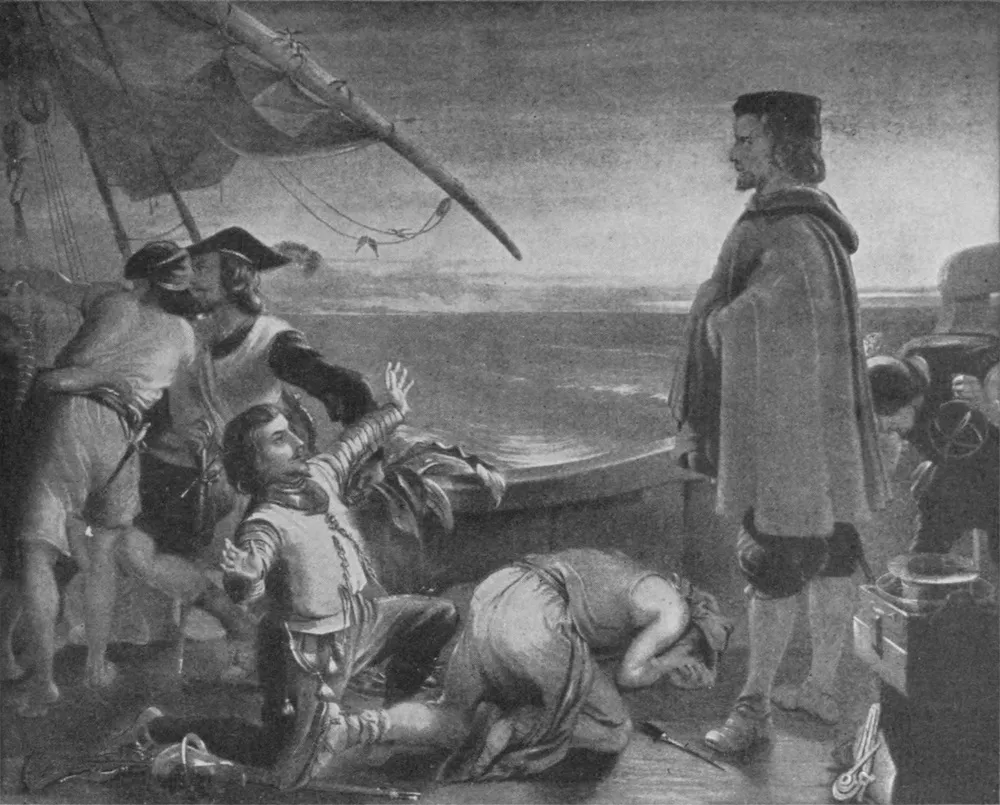
THE EVE OF “THE VASTEST TRAGEDY IN HISTORY”: COLUMBUS
SIGHTING AMERICA
“The greatest event and the vastest tragedy in human
history” is Dr. Archdall Reid’s striking description of the discovery of America
by Columbus. It ended the long separation between the inhabitants of East and
West, and the diseases of the Old World burst with cataclysmal results upon the
New. The picture, by George Harvey, shows Columbus approaching America, his
rebellious crew pleading for pardon.
All this is not mere hypothesis. It can be proved by reference to
carefully collected and tabulated statistics published by every
department of Public Health in America, Australasia, and Polynesia. The
cause of the sterility cannot be demonstrated with the same precision;
but it is hardly necessary to invent fanciful causes when a reasonable
one is to hand. The high mortality indicates a high sick-rate, and
presumably illness is as much a cause of sterility in the New World as
in the Old, among savages as among civilised people.
The Spanish conquest of the West Indies was followed by the swift
disappearance of the natives. To that end the Spaniards unconsciously
adopted the most effectual means possible. They satisfied their greed
by forcing the natives to labour in plantations and in mines, and
their religious enthusiasm by compelling attendance in churches and
cathedrals. In other words, they placed the natives under conditions
the most favourable for acquiring the diseases which they imported by
every vessel. When the native population dwindled, it was replaced by
negro slaves from West Africa.
Africans Die in our Civilisation
The history of negro migrations is extremely interesting and
illuminating. There are no accounts of negro conquest outside the
limits of Africa, but from very ancient times a constant stream of
slaves has passed to Southern Europe and Asia, where they have been
employed mainly in domestic service, and in more modern times to
America, where their occupation has been mainly agricultural. The
invasion of Asia has continued to our own day. But one may search
from Spain to the Malay peninsula and, except in recent importations,
find scarcely a trace of a negro ancestry. Yet slaves, like cattle,
are valuable property, more cheaply bred than imported. In Eastern
countries they have often been kindly treated, and many have attained
to wealth and power. Like the African soldiers in Ceylon, of whom it
is recorded that, though many thousands were imported by the Dutch
and English, hardly a descendant survives, all perished in a few
generations, the elimination of the unfit being so stringent as to
cause extinction, not evolution. A permanent colony of native Africans
in the midst of an ancient consumption-infested civilisation is
impossible.
Fate of Natives of America
The fate of the negro migrations into America has been different. The
race had undergone some evolution against consumption in Africa, and,
therefore, was more resistant than the vanishing aborigines. In its
new home, employed in agriculture in a hot climate where white men
and tubercle bacilli, also recent importations, were as yet few in
numbers, it was placed under the best conditions possible. Gradually,
as the stringency of selection waxed, it evolved resisting power.
To-day, American negroes are able to dwell even in Northern cities,
though it is said “every other adult negro dies of consumption.” After
the discovery of America the principal maritime races of Western
Europe competed for its possession. Spain and Portugal, then powerful
nations, had the first start in the race, and chose the seemingly
richer tropics. But the forests of the centre and south were defended
by malaria, which raised a barrier against immigration, and by heat
and light, which raised a barrier against tuberculosis. Moreover, the
Spaniards and the Portuguese intermarried freely with the aborigines,
and the mixed race which resulted inherits in half measure the
resisting power of both stocks. At the present day this mixed race,
with a leavening of mulattoes, pure Spaniards, Portuguese, and negroes,
inhabits the cities and more civilised parts. Even in tropical America
the pure aborigines are found, speaking generally, only beyond the
verge of civilisation. Farther south the disappearance of the natives
has been more complete, and the cooler, healthier, and more open pampas
are settled by a race more purely European.
THE TRIUMPH OF THE ANGLO-SAXON PEOPLES
Expansion of the Anglo-Saxon
T
THE
weaker British and French were shouldered into the seemingly
inhospitable north. But the British won the battle of Quebec, and
the French immigration soon ceased. That little fight is half
forgotten, but it is doubtful if any battle in history had results
half so important. It placed all North America in the grasp of the
Anglo-Saxon, and gave his race enormous space for expansion. Unchecked
by malaria, the new-comers gathered into communities and built towns
and cities such as those which across the Atlantic were the homes of
tuberculosis. The cold forced them to admit little air and light into
their dwellings. The aborigines melted away from the borders of the
settlements. Under the conditions there was little intermarriage. In
that climate Indian women, and even half-caste children, could not
exist within stone walls. The few white men who took native wives
preserved them only while living a wild life remote from their kin.
The British conquest of North America and Australasia resembles the
Saxon conquest of Great Britain. The natives have been exterminated
within the area of settlement. It is in sharp contrast to their
conquests in Asia and Africa. Both in the Old World and in the New
the subjugation of the natives was accompanied by many wars and much
bloodshed, and probably the conflicts in the former were more prolonged
and destructive than those in the latter. But in no part of the Old
World have the British exterminated the natives. They do not supplant
them; they merely govern them. Southern Asia and East and West Africa
are defended by malaria. The British cannot colonise them, and the
natives have undergone such evolution against tuberculosis that
they are capable of resisting the hard conditions imposed by modern
civilisation. In South Africa, where there is little malaria, Europeans
share the land with the natives, but the latter are likely to remain in
an overwhelming majority.
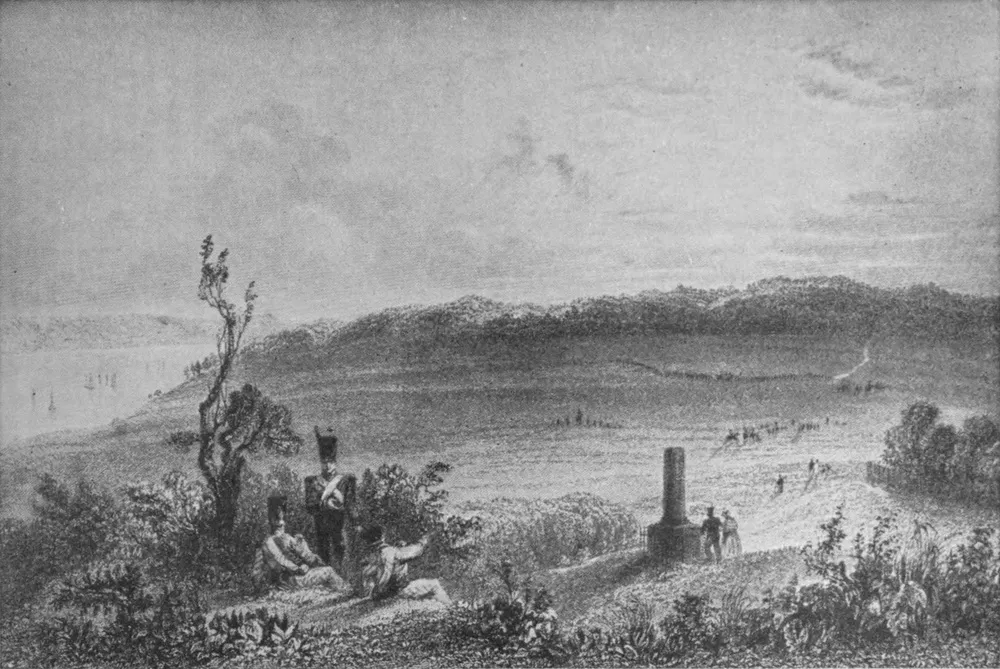
WHERE THE ANGLO-SAXON RACE OBTAINED POSSESSION OF NORTH
AMERICA
On the Plains of Abraham, outside Quebec, the British and
French troops fought in 1759, and the battle placed all North America in the
grasp of the Anglo-Saxon, giving his race enormous space for expansion. It is
doubtful, says Dr. Archdall Reid, if any battle in history had results half so
important as this, although it is half forgotten.
If history teaches any lesson with clearness it is this—that conquest,
to be permanent, must be accompanied with extermination, otherwise in
the fulness of time the natives expel or absorb the conquerors. The
Saxon conquest of England was permanent; of the Norman conquest there
remains scarcely a trace. The Huns and the Franks founded permanent
empires in Europe; the Roman Empire, and that of the Saracens in Spain,
soon tumbled into ruins. It is highly improbable, therefore, that
the British will retain their hold on their Old World dependencies.
A handful of aliens cannot for ever keep in subjugation large and
increasing races that yearly become more intelligent and insistent
in their demands for self-government. But no probable conjunction of
circumstances can be thought of that will uproot the Anglo-Saxons from
their wide possession in the New World. The wars of extermination are
ceasing with the spread of civilisation. We have ransacked the world,
and now know every important disease. Diseases cannot come to us as
they came to our forefathers and to the Red Indians, like visitations
from on high. All the diseases that are capable of travelling have
very nearly reached their limits; the rest we are able to check. Even
in the unlikely event of a new disease arising, it would affect other
races equally. Canada and Australasia, like the United States, may
separate from the parent stem, but the race will persist. If ever a
New Zealander broods over the ruins of London, he will be of British
descent.
The Natural History of Mankind
The natural history of man is, in effect, a history of his evolution
against disease. The story unfolded by it is of greater proportions
than all the mass of trivial gossip about kings and queens and the
accounts of futile dynastic wars and stupid religious controversies
which fill so large a space in his written political history. In the
latter, as told by historians, groping in obscurity and blinded by
their own preconceptions, men and events are often distorted out of all
proportions. A clever but prejudiced writer may pass base metal into
perpetual circulation as gold. Luther and the Reformation are accepted
as Divine by many people; they are reviled as diabolical by more.
Cromwell was long regarded as accursed; to-day he is half-deified. How
many of us are able to decide, on grounds of fact, not of fiction,
whether the Roman Empire perished because the Romans, becoming
luxurious, sinned against our moral code, as ecclesiastic historians
would have us believe, or because a disease of intolerance and
stupidity clouded the clear Roman brain and enfeebled the strong Roman
hand, as Gibbon would have us think? But the natural history of man
deals, without obscurity and without uncertainty, with greater matters.
Study it, and the mists clear away from much even of political history.
We see clearly how little the conscious efforts of man have influenced
his destiny. We see forces unrecognised, enormous, uncontrolled,
uncontrollable, working slowly but mightily towards tremendous
conclusions—forces so irresistible and unchanging that, watching them,
we are able even to forecast something of the future.
The mere political results of man’s evolution against disease are of
almost incalculable magnitude. The human races of one half of the world
are dying, and are being replaced by races from the other half. Not
all the wars of all time taken together constitute so great a tragedy.
A quite disproportionate part in this great movement has been borne
by our own race. It has seized on the larger part of those regions in
which the aborigines were incapable of civilisation, because incapable
of resisting consumption, and were undefended by malaria. In the void
created by disease it has more room to spread and multiply than any
other race.
Disease Mightier than the Sword
Other races may dream of foreign conquests, but the time for founding
permanent empires is past. There remains for them only temporary
conquest, in a few malarious parts of the world in which Europeans
cannot flourish and supplant the natives. Spain and Portugal lost their
opportunity when they turned from the temperate regions and chose the
tropics. France lost her opportunity on the Heights of Abraham. Germany
is more than a century too late in the start. Russia can conquer
only hardy aliens who will multiply under her rule and ultimately
assert their supremacy. In times now far remote in the history of
civilised peoples, the sword was the principal means for digging deep
the foundations of permanent empires. Its place was taken by a more
efficient instrument. A migrating race, armed with a new and deadly
disease, and with high powers of resisting it, possesses a terrible
weapon of offence. But now disease has spread over the whole world and
so is losing its power of building empires. The long era of the great
migrations of the human race, of the great conquests, is closing fast.
Possibilities of the Black Races
It is generally supposed by historians and others that races that
disappear before the march of civilisation are mentally unfitted for
it. The assumption is not supported by an iota of real evidence. To be
mentally incapable a race must be of very defective memory. Recently
a school of Australian natives, who belong to one of the “lowest”
of races, took the first place in the colony. Negroes occupy a very
inferior position in America, especially in Anglo-Saxon territories.
But they are stamped by glaring physical differences, are treated with
great contempt and jealousy by the whites, and their acquired mental
attitudes, therefore, do not develop under good conditions. It is very
possible that they are mentally inferior to the whites; but not so
inferior as is commonly believed.
Russian peasants, though not sharply differentiated by physical
peculiarities from the governing classes, are equally scorned by
them, and show a mental development hardly, if at all, superior
to the negroes of United States. The Latins of South America seem
very incapable of orderly government, but they are the heirs of a
civilisation older than our own. At any rate, while it is conceivable
the American negroes and some other races are incapable of building
up a highly-enlightened society by their own efforts, it is manifest
that they are able to persist and multiply when civilised conditions
are imposed on them. Not so the aborigines of the New World, some of
whom—for example, the Maoris and the Polynesians—are admittedly
of good mental type. They perish swiftly and helplessly of bodily
ailments.
Very clearly, then, human races are capable or incapable of
civilisation, not because they are mentally, but because they are
physically, fit or unfit.
G. ARCHDALL
REID
A
AN
attempt is made in these pages to compile a dictionary of the main
existing races of the world, arranged in alphabetical order. The
accompanying Ethnological Chart on page 352, will enable the reader
to see at a glance the relationship of the various main divisions,
families, and stocks under which these races are distributed. The
Dictionary and the Chart, if used in conjunction, will thus supply
information about any race named in the list, and will tell the
inquirer to what branch of the human race it belongs. It is obviously
impossible to make the Dictionary inclusive of every tiny and
out-of-the-way tribe of Africa or South America, but all important
races are included. If the reader wants to know something about the
Abyssinians, he will look them up in the Dictionary, and find that they
are partly Semitic Himyarites, partly Hamitic Gallas, etc. The Chart
will then show him that the Hamitic and Semitic families belong to the
great Caucasic Division of mankind, that the Himyarites are one of the
main stocks of the Semitic family, and that the Gallas belong to the
Eastern branch of the Hamitic family. The student should familiarise
himself with the names and places of the families and chief stocks of
mankind, as given in the Chart, and so greatly facilitate the task of
reference. The intention of both Chart and Dictionary is, of course, to
serve as a kind of index to the History proper, which must be consulted
for further information. As far as can be discovered, no previous
attempt has been made to summarise the conclusions of modern ethnology
in this convenient form. The illustrations depict some of the most
interesting races.
Ababua. A tribe of Sudanese negroes in Central Africa. See
WELLE GROUP.
Abaka. See NILITIC
GROUP.
Abkhasians. A Western Caucasian tribe occupying the Black
Sea coast from Pitzunta to Mingrelia, akin to CIRCASSIANS
(q.v.).
Abo, or Ibo. See NIGERIAN
GROUP.
Abors. An Assamese tribe in the Brahmaputra Valley,
belonging to the Tibetan branch of the Southern Mongolic family.
Wild jungle-dwellers.
Absarakas. See SIOUAN.
Abukaya. A negro tribe in the Sudan. See
NILITIC
GROUP.
Abunda. A settled and fairly civilised race of Bantu
Negroes, occupying the seaboard and inland districts of Portuguese
West Africa, south of Ambriz.
Abyssinians. A mixed race of Hamitic, Semitic, and Negro
stock, inhabiting Abyssinia (from Arabic habashi—mixed). The
main racial element—Abyssinians proper—consists of brown-skinned
Semitic Himyarites, who probably emigrated from Arabia in
prehistoric times, and profess themselves descended from the
Queen of Sheba. Since the sixteenth century Abyssinia has been
over-run by the Hamitic Gallas (q.v.), who have largely mingled
their blood with this older element. There is also a considerable
admixture of Sudanese Negro blood. Since the fourth century the
religion of Abyssinia has been a corrupt form of Christianity; the
mediæval myth of Prester John perhaps relates to this fact.
Acadians. French settlers of seventeenth century in Nova
Scotia.
Achcæans. See ARGIVES.
Achinese. A warlike Malay race of Sumatra, long at war with
the Dutch colonists.
Accras. See GA.
Achuas, or Wochua. A pygmy Negrito race,
well-proportioned, though dwarfish, inhabiting the forests of
the Welle and Aruwimi districts in Central Africa, and living by
hunting.
Adamawa Group. A group of Sudanese Negro tribes inhabiting
the district of the Upper Benue in Northern Nigeria.
Adansis. Negro tribe on Guinea coast. See TSHI.
Æolians. See HELLENES.
Aetas. A Negrito race of the Philippine Islands, belonging
to the Oceanic family of Ethiopic Man. Short of stature,
black-skinned, with woolly hair, they present many points of
resemblance to the Negritoes of Central Africa. There are many
crosses between Aetas and Malays.
Afars. A nomadic Turki tribe of Persia. See also
DANAKILS.
Afghans. A race of Iranian stock, belonging to the great
Aryan family, who form about half the population of Afghanistan.
They are divided into various tribes, of which the Duranis are the
dominant one, the Ghilzais the most warlike, and the Yusufzais the
most turbulent. There are also large tribes known as Pathans, who
are of the same stock as the Afghans, but are classed separately.
The Afghans are a handsome and athletic race, inured to war from
their childhood, lawless and treacherous, but sober and hardy.
Throughout the nineteenth century they were a constant source of
trouble to British India, but a new era seems to have opened under
the present Amir. For non-Afghan inhabitants of Afghanistan, see
HAZARAS,
KIZIL-BASHIS,
and TAJIKS.
Afridis. A warlike and turbulent Pathan race, occupying the
neighbourhood of the Khyber Pass, and often at war with the English.
Afrikanders. Persons of European descent born and living in
South Africa.
Agaos. An indigenous Hamitic race of Northern Abyssinia.
Ahoms. Primitive inhabitants of Assam, belonging to the
Indo-Chinese stock of the Southern Mongolic family.
Ainus. An aberrant family of Caucasic Man in the Far East.
They were probably the aboriginal inhabitants of Japan, but are
now few in number, and confined to Yezo, the Kurile Islands, and
part of Sakhalin. They have regular and often handsome features
of Caucasic type, but are of low stature, and characteristically
marked by an abundance of coarse, black, wavy or crisp hair on
head, face, and body, whence they are commonly called the “Hairy
Ainus.”
Akawais. See CARIBS.
Akkas. A pygmy Negrito race of the Welle district in Central
Africa, akin to the Achuas (q.v.), who are specially interesting
because they are represented on Egyptian monuments of 3400
B.C., with their existing racial characters.
Akkads, or Akkadians. An extinct Mesopotamian
race, founders of the oldest known civilisation in Babylonia,
who belonged to the Northern Mongolic family, and probably to
the Turki or Finno-Ugrian stock. They invented the cuneiform
alphabet, which was adopted by their Semitic successors—see
BABYLONIANS—and it is thought that they may have been the
ancestors of the Chinese.
Akpas. See NIGERIAN
GROUP.
Alani. A warlike nomadic race, probably belonging to the
Turki stock of the Northern Mongolic family, and allied to the
Tartars (q.v.). In the fifth century they made settlements in
Gaul and Spain, where they were absorbed by the Vandals and the
Visigoths respectively. The remnant left in the East of Europe were
conquered in the thirteenth century by the Golden Horde, and their
name disappeared from history.
Albanians, or Arnauts. The warlike race of
mountaineers who inhabit Albania, on the western coast of the
Balkan Peninsula. They are semi-civilised, live in a perpetual
state of tribal warfare, and make admirable soldiers, forming the
best part of the Turkish Army. They are probably the oldest of the
Balkan races, and represent the earliest Aryan immigrants into
Europe [see ILLYRIANS]. They are partly Christian, partly
Mohammedan.
Albigenses. A heretical sect, mostly of Provençal descent,
who appeared in the South of France about the eleventh century, and
were rigidly persecuted until they became extinct in the middle of
the thirteenth century.
Alemanni. An ancient German tribe on Upper Rhine, of
Teutonic stock, from whom the modern Swabians and Swiss are in
great part descended.
Aleutians. Natives of Aleutian Islands, belonging to Eskimo
stock of Northern American family.
Alfuros. A half-breed race between Malays and Papuans: in
Malaysia, a term given by Malays to their rude non-Mohammedan
neighbours.
Algonquian. A group of North American Indian tribes,
formerly inhabiting the Central and Southern States of America,
east of the Rocky Mountains, and as far south as South Carolina,
now gathered into Indian Reservations. They include the Algonquin,
Blackfoot, Cheyenne, Cree, Delaware, Fox, Illinois, Massachusett,
Mohican, Ojibway, Sac, Shawnee, and many smaller tribes.
Alibamus. See MUSKHOGEAN.
Ali-Elis. See TURKOMANS.
Alsatians. Natives of Alsace, of High German stock, allied
to the Swabians (q.v.).
Amadis. See WELLE
GROUP.
Ama. Prefix of many Bantu racial names, as Ama-Zulu,
Ama-Xosa. See ZULU, etc.
American. One of the four main divisions of the human race,
comprising three families, occupying North, Central, and Southern
America respectively. Typically red-skinned, with lank, black hair,
retreating foreheads, high-bridged noses, and either long or broad
skulls—dolichocephalic or brachycephalic.
Americans. The English-speaking white inhabitants of the
United States, mainly of Anglo-Saxon descent. See also
LATIN AMERICANS.
Amharas. Natives of Central Abyssinia, of Hamitic descent.
Amorites. A branch of the ancient Libyan race, of Semitic
origin, inhabiting Canaan before the arrival of the Israelites from
Egypt.
Anatolian Turks. See TURKS.
Andamanese. Natives of Andaman Islands, a race belonging to
the Oceanic Negrito family, possibly representing the primitive
type from which both Negroes and Papuans have sprung. They exhibit
the lowest stage of civilisation.
Andis. See LESGHIANS.
Angles. A Teutonic race of Low German stock, who formerly
inhabited the country round Schleswig, in North Germany. In the
fifth century they migrated in large numbers to Britain, and with
the Jutes and Saxons formed the stock of the Anglo-Saxon or English
people.
Anglo-Saxons. A general name now given to the
English-speaking races of English, Scotch, and even Irish and Welsh
descent, who inhabit the British Empire; in a wider sense, to all
people of British descent.
Annamese. Natives of Annam, or Cochin-China, belonging to
the Indo-Chinese stock of the Southern Mongolic family; now under
French rule.
Apaches. See ATHABASCAN.
Appalachis. See MUSKHOGEAN.
Arabs. One of the main branches of the Semitic family,
inhabiting the Arabian peninsula. They are usually divided into
two branches, the Ishmaelites of the north and the Joktanides of
the south. The latter probably represent the oldest Arab stock,
and may be of African origin. The primitive Arabs were nomadic
horse-breeders and shepherds, very warlike, and of fine physical
development. Under Islam they reared an enduring religious
civilisation, which has had the greatest influence on the world
after Christianity.
Arakanese. Natives of Arakan, in Lower Burma, of
Indo-Chinese stock.
Aramæans. One of the main groups of the Semitic family,
Syro-Chaldeans, who anciently inhabited Syria, Palestine, and the
Euphrates Valley. The modern Syrians (q.v.) belong to it.
Araucanians. The chief Indian race of Chili, possessing an
ancient civilisation like those of Peru and Mexico, though less
advanced. The Araucanians are probably the finest native race of
the New World. They are a fierce and warlike people, who have
always preserved their independence.
Arawaks. A group of South American Indian tribes in the
Guianas, including Maypuris, Wapisianas, Atorais and others.
Arcadians. A race of ancient Greece, inhabiting the central
highlands of the Peloponnesus, whose seclusion from the world
caused them to be identified with the quality which we still call
Arcadian simplicity.
Arecunas. See CARIBS.
Argentines. White natives of the Argentine Republic in South
America, mainly of Spanish descent.
Argives. Natives of Argos, the most important state of
Homeric Greece: hence a generic term for Greeks or Hellenes in the
Homeric Age. Achæans is another term similarly used.
Armenians. Natives of Armenia, the mountainous country round
Mount Ararat, now divided between Russia, Persia, and Turkey.
They belong to the Iranian stock of the Aryan family, blended
with Semitic blood, and with a still older unknown but probably
non-Aryan element. They are not warlike, but of quick intelligence
and specially successful in commerce.
Arnauts. See ALBANIANS.
Aryans. The most important family of Caucasic Man, to
which all the chief civilisations of modern times belong. A
tall, fair-skinned, long-headed race, whose origin is still
doubtful—though it was probably in Central Asia—and who
spread in prehistoric times over the whole of Europe and parts
of Asia and Africa. Almost all modern Europeans are of Aryan
descent. The family is also called INDO-EUROPEAN or
INDO-GERMANIC, but these names are open to objections from
which the term Aryan is free.
Ashantis. See TSHI.
Assamese. Natives of Assam, between India and Burma,
belonging to the Hindu stock of the Aryan family.
Assinaboins. See SIOUAN.
Assyrians. One of the main branches of the Semitic family.
The Assyrians founded a great empire in the northern part of
Mesopotamia, of which Nineveh was the capital, and afterwards
conquered the older Babylonian state (710 B.C.) and Egypt
(671 B.C.), thus forming the first world-empire known to
history. Within a century Assyria had become a Median province, and
its people ceased to have an independent existence.
Athabascan or Tinney. A group of North American
Indian tribes, formerly inhabiting Alaska and the greatest part of
Canada. It includes the Apaches, Chippewayans, Hupas, Kutchins,
Navajos, Tacullis, and Umbquas.
Athenians. The most important race of ancient Greece, whose
city of Athens was the earliest centre of civilisation in the
historical age of Europe.
Australians. The aborigines of Australia, a branch of the
Oceanic Negro family. Their numerous tribes present a general
uniformity of physical and mental development, under which two main
types may be recognised. The earlier of these is probably that
shown by the extinct Tasmanians (q.v.), one of the lowest races
in point of culture yet discovered, who were probably still in
the earliest stage of the Stone Age. The other type was perhaps
akin to the Dravidians of India, or to a very low Caucasic race.
The Australians are among the lowest of savage races, and present
many features which have thrown light on the manners, customs and
beliefs of primitive man.
Australians. White inhabitants of Australia, mostly of
Anglo-Saxon descent.
Austrians. Inhabitants of the Austrian empire, including
a great diversity of races. The name is properly applied only to
the German-speaking people, of High-German Teutonic stock, who
predominate in Austria proper.
Auvergnats. Natives of Auvergne, in Central France. A short,
sturdy, dark, round-skulled race, formerly regarded as typical
Aryan Celts, but possibly descended from an older non-Aryan people.
Much employed in Paris as porters.
Avars. See LESGHIANS.
Avars. A Tartar tribe, belonging to the Turki stock of the
Northern Mongolic family, who appeared in the district round the
Caspian Sea about the fourth century, and later made predatory
raids over a large part of Eastern Europe. They were subdued by
Charlemagne, and disappeared from history in the ninth century.
They seem to have been closely allied to the Huns, whom they
resembled in physical characteristics and warlike qualities.
Awawandias. Bantu Negroes of the Nyassa plateau in British
Central Africa.
Aymaras. A race of South American Indians in Bolivia,
probably related to the Incas (q.v.) and perhaps their ancestors.
Azandeh, or Niam-Niam. Sudanese Negroes of the Welle
group. Notorious cannibals.
Aztecs. The dominant Indian race in Mexico at the arrival
of the Spanish invaders. They entered the country about the end of
the thirteenth century, and founded the city of Mexico in 1325.
Around it they reared a remarkable civilisation and a sanguinary
religion. They were warlike, ferocious and cruel, but had a
considerable aptitude for the arts of peace. Their empire was
destroyed by Cortes in 1521, and annexed to Spain. Every trace of
Aztec nationality was suppressed, but their name still lingers
among the Nahuan Indians, and their blood is mixed with that of
the conquerors. Many attempts have been made to find an Old World
origin for Mexican culture, but they are not convincing.
Babylonians. The Semitic race which founded one of the
greatest of ancient civilisations in the rich alluvial plains of
Chaldæa and on the arid plateau of Mesopotamia. Their history is
too long to summarise here, but it may be stated that the Semitic
peoples, variously known as Babylonians, Chaldæans, Elamites,
Medians, and Assyrians, invaded and dispossessed at different times
the primitive Mongolic race of Akkads (q.v.). Their earliest
settlement seems to have been at Ur of the Chaldees, on the right
bank of the Euphrates. Babylon and Nineveh were afterwards the
seats of the Babylonian and Assyrian powers, whilst Elamite and
Median conquerors intervened at various times. These powerful
Semitic races made great advances in art, science, literature,
religion, and social policy. Their first incursion, probably
from Arabia, into the Euphrates Valley dates back to about 3800
B.C.
Baggaras. A fierce and warlike race settled in the
Anglo-Egyptian Sudan, and formerly dominant under the Mahdi.
Baghirmis. See LAKE
CHAD GROUP.
Bakairi. See CARIBS.
Bakatla, Bakwena. Bantu Negroes of Bechuana stock.
Bakwiri. Bantu Negroes settled in the Cameroons.
Balinese. A Malayan race of the East Indian Archipelago.
Balolo. Bantu Negroes of the Middle Congo; one of the finest
negro races.
Balong. Bantu Negroes of West Africa.
Baltis. A hardy Tibetan race, inhabiting the Alpine valley
of the Upper Indus.
Baluba, or Basonge. A dominant Bantu Negro race of
the Kassai basin in Equatorial Africa.
Baluchis, or Beluchis. Natives of Baluchistan, south
of Afghanistan, of Iranian (Aryan) descent, with a mingling of
Tartar (Mongolic) blood. The dominant race of the country is the
Brahui, aboriginals who are probably of Mongolic descent, allied to
the Dravidians (q.v.) of India. The Brahui are of Mongolic type,
short, with round flat faces, hospitable and generous. They are the
more settled portion of the inhabitants. The Baluchis are chiefly
nomads, taller, with more Aryan features, a warlike and predatory
people.
Balunda. Bantu Negroes of South Central Africa, occupying
the Congo-Zambesi divide.
Bamangwato. Bantu Negroes of north Bechuanaland; Khama’s
semi-civilised people.
Bambaras. See MANDINGAN.
Banandi. Bantu Negroes of apish type, in the Semliki forests.
Bangalas. Bantu Negroes of Middle Congo, on the Ubangi river.
Bantus. One of the two subdivisions of the African Negro
family of Ethiopic Man, occupying the southern half of the African
continent, south of the Cameroons and Albert Nyanza. A Negro race
modified from the Sudanese type by Hamite influences.
Banyai. Bantu Negroes, south of the Middle Zambesi.
Banyoro. See WANYORO.
Bapedi. Bantu Negroes of Bechuana stock.
Bareas. Sudanese Negroes inhabiting the Abyssinian slopes.
Barguzins. See BURIATS.
Baris. See NILITIC
GROUP.
Barolongs. Bantu Negroes of Bechuana stock, between Vryburg
and Molopo river. Mafeking is their capital.
Barotse. Bantu Negroes of Bechuana stock, about headwaters
of Molopo river.
Barrés. South American Indians in Venezuela and Guiana.
Basés. Sudanese Negroes of Abyssinian slopes, a very low
negroid type.
Bashkirs. A branch of the Turki stock of the Northern
Mongolic family. They are first mentioned in the tenth century as
a warlike and idolatrous race, noted for their large, round, short
heads, from which their name is derived. They now inhabit the
Orenberg and Perm districts of Russia, on the western slopes of the
Ural. Some are settled agriculturists, others pastoral nomads.
Bashukulumbwe. Bantu Negroes of Kafue basin in Zambesia.
Basimba or Cimbebas. Aboriginal Negroes of South
Angola; a low Bantu type, or possibly Negrito, allied to Bushmen.
Basonge. See BALUBA.
Basques. One of the few non-Aryan races still existing
in Europe, where they inhabit the districts on the French and
Spanish sides of the Western Pyrenees. They originally occupied a
much wider area in this neighbourhood, and preserve their ancient
costume and language. Their ethnological affinities are still in
dispute, but the best opinion is that they represent the ancient
Iberians (q.v.), a Western Hamitic race, related to the Berbers
of North Africa on the one hand and to the Picts of Scotland and
the ancient Irish on the other. Probably they have occupied their
present home since Neolithic times. They are mainly agriculturists,
with all the rustic virtues, and make excellent soldiers and
servants.
Bassas. See LIBERIAN
GROUP.
Bastaards. See GRIQUAS.
Bastarnæ. See GOTHS.
Basutos. The most civilised race of Bantu Negroes, of the
Bechuana stock, who inhabit the rugged uplands of Basutoland, a
British Crown Colony. They have long been subjected to European
and Christian influence, under which they have presented the
sole instance of a pure negro community, which has made itself
self-supporting and approximately civilised. They have succeeded in
assimilating Western culture, and their little State—which always
preserved its independence against other natives and Boers—is a
very flourishing example of what the negro can do under favourable
auspices.
Batanga. Bantu Negroes of the Cameroons.
Batavi. An ancient German race inhabiting the island formed
by the Meuse and an arm of the Rhine. Ancestors of the modern Dutch.
Bateke. Bantu Negroes of Congo, above Stanley Pool.
Batjans. See INDONESIAN.
Batlapi. Bantu Negroes of Bechuana stock, near Vryburg.
Batonga or Batoka. Bantu Negroes of Zambesia,
Manicaland and Tongaland.
Battaks. A pre-Malay race of North Sumatra, probably allied
to the Polynesians (q.v.).
Batwas. A pygmy (q.v.) Negrito race south of Congo, allied
to Bushmen.
Batwanas. Bantu Negroes of North Bechuanaland.
Bavarians. A branch of the High German stock of the Teutonic
family, in Bavaria.
Bayansis. Bantu Negroes of Middle Congo, on Kwa River.
Strong negro element.
Bechuanas. A main stock of Bantu Negroes, occupying what
is known as British Bechuanaland. The name is of European origin,
and has no native significance as applied to the race, but is a
convenient general term.
Bedawi or Bedouins. Nomadic Arabs (q.v.) who
inhabit the deserts of Arabia and the neighbouring countries,
and live by stock-breeding and robbery. Their breed of horses is
world-famous. They are independent, chivalrous and hospitable. They
correspond to the Biblical Ishmaelites, whose race and customs they
preserve practically unchanged.
Bejas. A race of Eastern Hamites, of splendid physique,
occupying the eastern seaboard of Africa north of Massowah,
including Bisharis, Hadendowas, and other tribes.
Belgae. The northernmost of the three races occupying Gaul
in Cæsar’s time, probably of Low German stock, with perhaps a
Celtic element.
Belgians. The inhabitants of Belgium, formerly the Spanish
or Austrian Netherlands, of very mixed origin. The natives are
either Flemings of Teutonic stock, or
Celtic Walloons (q.v.).
Mingled with these are large numbers of German, French and Dutch
immigrants; and constant crossing of blood has tended to produce a
truly Belgian type out of all these fluctuating elements. They are
among the most patient and productive of agriculturists, mostly
small proprietors; and they possess flourishing manufactures and a
rich commerce through the great port of Antwerp.
Beluchis. See BALUCHIS.
Bengalis. The majority of the natives of Bengal belong to
the Hindu stock of the Aryan family, which was probably the first
to develop a true civilisation and a great literature (in the
ancient Sanscrit tongue). The typical Bengali is quick-witted,
versatile, and successful in the arts of peace, but not
warlike—though the native army of the old East Indian Company
was largely recruited from Bengal. The Bengali Babu, of the
professional or lower official class, is well known.
Beluchis. See BALUCHIS.
Benin. See NIGERIAN
GROUP.
Berbers. A Western Hamitic race occupying the Atlas
Mountains and the Northern Sahara, of predatory and warlike habits.
They are known in Algeria as Kabyles, and in Sahara as Tuaregs.
Largely dark-haired and swarthy, with prominent noses, they belong
to the Melanochroid branch of Caucasic Man. They correspond to the
ancient Numidians.
Betsimisarakas. One of the three main divisions of the
Malagasy, or Malayo-African race which inhabits Madagascar. They
occupy the east coast.
Bhils. Primitive and still wild non-Aryan inhabitants of
Central India, of Kolarian family (q.v.).
Bisharis. See BEJAS.
Blackfoot Indians. See ALGONQUIAN.
Bœotians. A branch of the Æolian race in ancient Greece. The
Bœotians were supposed to be peculiarly dull, and were the typical
rustic clowns of Greek literature.
Boers. White inhabitants of Cape Colony, the Transvaal, and
the Orange River Colony, mainly of Dutch descent, with a French
Huguenot element and a sprinkling of Negro blood. They were the
original colonists of South Africa, which they entered in 1652. A
race of farmers (Boer is derived from the Dutch boor, peasant),
they also proved themselves to be hardy pioneers and admirable,
though not at all romantic, fighters, learning in long native
wars the arts of strategy, which they exercised so well against
the English in the South African War of 1899–1902. They have
now accepted the English rule, and promise to be among our most
flourishing African subjects.
Bohemians. See CZECH.
Bolivians. White natives of Bolivia in South America, of
Spanish descent, with a considerable admixture of Indian blood.
Bongos. See NILITIC
GROUP.
Botocudos. South American Indians on eastern seaboard of
Brazil.
Brahui. See BALUCHIS.
Brazilians. White natives of Brazil, mainly of Portuguese
descent, but with a considerable admixture, in many districts, of
Indian and negro blood.
Bretons. Natives of Brittany, descended from a short,
round-headed, dark race, generally called Celtic, but perhaps
pre-Aryan.
Bribris. South American Indians of Costa Rica.
Britons. (1) The ancient Britons were a Celtic race, whose
remnants are still to be found in the Welsh (q.v.). They attained
a considerable degree of civilisation under the Roman conquerors,
and adopted Christianity. The Anglo-Saxon conquest of Britain
drove most of them back into Wales, Cornwall, and other outlying
portions of the island, whilst the remainder were either destroyed
or assimilated. (2) In the wide modern sense, Britons are the white
citizens of the British Empire.
Bugis or Buginese. Natives of Boni in Celebes; a
primitive Malay race.
Bulalas. See LAKE
CHAD GROUP.
Bulgars. A branch of the Finns (q.v.), who were originally
settled on the banks of the Volga. In the sixth century they
crossed the Danube and conquered the modern Bulgaria, then occupied
by the Slavonic Slovenians (q.v.). A speedy fusion took place
between the Slovenians and the Bulgars, who adopted the language
and customs of the former, and rose to greatness as a Slav power.
In the ninth and tenth centuries they ruled the greater part of
the Balkan Peninsula, and warred successfully with the Byzantine
Empire, which, however, subjected them in 1019 under Basil II.,
“the slayer of the Bulgarians.” Later they passed under the Turkish
rule, and ceased to have an independent national existence down to
the nineteenth century.
Bulgarians. Inhabitants of the modern Balkan state of
Bulgaria, descended from the Bulgars (q.v.) with considerable
admixtures of Greek and Turkish blood.
Bulloms. See TEMNÉ
GROUP.
Burgundians. An ancient people of Teutonic race (High
German), who were originally settled between the Oder and Vistula.
In the fifth century they invaded Gaul, where they formed the first
kingdom of Burgundy, between the Aar and the Rhone. There were many
later Burgundian kingdoms and duchies, of which the last and most
famous was that of Charles the Bold, annexed to France in 1477. The
Burgundians are now French subjects, but still show traces of their
Teutonic origin.
Buriats. The Western or Siberian branch of the Mongol stock
of the Northern Mongolic family. They occupy the vicinity of Lake
Baikal The majority are nomad pastors, but some have taken to
agriculture. A peace-loving, but lazy and drunken people; they
include various tribes, such as the Barguzins, Selengese, Idinese,
Kudaras and Olkhonese.
Burmese, or Burmans. A short-statured, thick-set and
flat-featured people, approaching the Chinese type, the principal
race of the Indo-Chinese stock of the Southern Mongolic family.
They inhabit Burma—now a British possession—and are excitable,
turbulent, and given to dacoity, or highway robbery. They make
good farmers and shopkeepers, but are not warlike or methodical.
Burus. See INDONESIANS.
Bushmen. A nomadic Negro race of South Africa, who stand at
the lowest stage of human culture. They are probably the aborigines
of South Africa, where they have been dispossessed by Hottentots
and Bantus from the north. They are thin and wiry, of small
stature, not unlike the Hottentots in colour and features. They
live by hunting, and possess a curious mythology. Their artistic
powers, comparable to those of Palæolithic Man, are shown in the
remarkable rock-drawings on the walls of their caves.
Calchaquis. South American Indians, in Plate River district.
Cambojans. Natives of Cambodia, Mongoloid approaching
Caucasic type.
Canaanites. One of the main branches of the great Semitic
family, inhabiting Palestine and the Mauritanian sea-coast in
ancient times, including Jews, Phœnicians,
Carthaginians, Moabites,
Amorites, Idumæans and Philistines (q.v.). A fierce and warlike
people, with a remarkable genius for religion, which has greatly
influenced the modern world.
Canadians. White natives of Canada, of mixed French and
Anglo-Saxon descent.
Caribs. South American Indians, formerly occupying the West
Indian Islands, and now the shores of the Caribbean Sea, including
Macusi, Bakairi, Akawai, Arecuna, and Rucuyenne tribes. They are
strongly built, warlike and fierce, but honourable. The term
cannibal is supposed to be a corruption of their name based on
their habits.
Carthaginians. Natives of one of the great empires of the
ancient world, which was founded at Carthage, near the modern
Bizerta, by Phœnician colonists in the ninth century B.C.,
and was destroyed by Rome in 146 B.C. Carthage was the
great rival of Rome as a Mediterranean power. Its inhabitants
belonged to the Canaanite stock of the Semitic family, and were a
nation of traders, cruel and gloomy in temperament, worshippers of
Moloch with human sacrifices. Though in Hannibal they produced one
of the greatest of generals, they were not warlike, and trusted
chiefly to mercenaries, wherefore they fell.
Catalans. Natives of North-east Spain, mostly of Gothic
descent, and still distinct from other Spaniards in language and
costume. Honest and enterprising, turbulent, and intensely devoted
to liberty.
Caucasians. One of the families of Caucasic Man, inhabiting
the mountainous region of the Caucasus, and divided into
southern, western, and eastern branches [see GEORGIANS,
CIRCASSIANS,
CHECHENZES, LESGHIANS].
They include a great number of different tribes, who seem to have
settled there from the earliest historical times. Some of these,
the Melanochroid highlanders, like the Georgians, Circassians, and
Lesghians, present an almost ideal standard of physical beauty,
whilst others are squat and ungainly. Some ethnologists see in the
Caucasus the primitive home of the Aryan family, from whom the
Caucasians would, on this view, be an offshoot. The Ossets (q.v.)
are certainly Aryan. The Caucasians are very warlike, and struggled
till quite recently with success against the Russian domination.
Caucasic. One of the four great divisions of the human race.
Type, white-skinned, square-jawed (orthognathous), skull between
broad and long (mesocephalic), hair soft, straight, or wavy; in
intelligence, enterprise, and civilisation, much superior to other
divisions.
Cayugas. See IROQUOIAN.
Celts. See KELTS.
Chakhars. A branch of Eastern Mongols, settled on the
south-east boundary of the Desert of Gobi.
Chaldæans. See BABYLONIANS.
Chamorros. Aborigines of the Ladrone Islands, so named from
their thievish propensities. A branch of the Oceanic Mongolic
family, probably allied to the Formosans (q.v.).
Chancas. See INCAS.
Chaudors. A nomad tribe inhabiting the steppes east of the
Caspian and south of the Oxus. See TURKOMANS.
Chapogirs. See TUNGUSES.
Charruas. An extinct race of South American Indians in South
Brazil, peculiar for their extremely black colour with lank hair.
Chechenzes. A branch of the Eastern stock of the Caucasian
family, inhabiting the northern slopes of the Eastern Caucasus.
Their chief tribes are Ingushis, Kishis, and Tushis.
Cheremisses. See FINNS.
Cherokees. A brave and warlike tribe of North American
Indians. See IROQUOIAN.
Cheyennes. See ALGONQUIAN.
Chibchas. South American Indians of Bogota.
Chichimecs. See NAHUANS.
Chickasaws. See MUSKHOGEANS.
Chilians. White natives of Chili, of Spanish descent, with a
mixture of Araucanian Indian blood.
Chinese. One of the most numerous races of the world,
inhabiting the Chinese Empire. They are a stock of the Southern
Mongolic family, and it is thought by some ethnologists that they
are descended from the Mongolic Akkads (q.v.) of Mesopotamia.
There is a remarkable uniformity in the physical type presented by
the Chinese in all climates and environments; they are the most
homogeneous of great peoples. They are yellow-skinned, short in
stature, with obliquely set eyes, high cheek-bones, long skulls,
and broad faces, with slight prognathism. They possess an ancient
and highly organised civilisation, which is characterised by
its conservatism and slowness to accept new ideas—so different
in this from the Japanese. The Chinese are naturally frugal,
industrious, and patient; they are excellent agriculturists, and
very gregarious; they despise war, but make excellent soldiers when
drilled by Europeans or Japanese. They are eminently literary, and
have a high system of morality. There are many local varieties,
such as the Puntis of the Canton districts, the Hakkas of Swatow,
the Hoklas of Fohkien, the Dungans (q.v.), which need not be
farther particularised.
Chinooks. A nearly extinct tribe of North American Indians
on the Columbia River, on whose language is based the Chinook
jargon, or traders’ Lingua Franca of British Columbia.
Chins. See SINGPHOS.
Chippewayans. See ATHABASCAN.
Chiquitos. South American Indians of Upper Paraguay basin.
Chiriguanos. South American Indians of Bolivia.
Chitralis. Natives of Chitral, in the Hindu Khush, rough,
hardy hillmen, closely allied to the Kafirs (q.v.) of Kafiristan.
Chocos. A tribe of South American Indians of Matto Grosso.
Choktaws. See MUSKHOGEAN.
Chontals. Central American Indians of Nicaragua.
Chols. See MAYA-QUICHÉ.
Chorasses. See KALMUKS.
Chorotegans. Central American Indians of Nicaragua.
Chukchis. A Northern Mongolic race of North-east Siberia,
closely akin to the American Eskimo in features and customs. They
are of high character and very independent, but at a low stage of
civilisation, and live by reindeer-breeding and hunting. A branch
of the Chukchis, differing mainly in language, is known as the
Koryaks.
Chunchos. South American Indians on tributaries of Beni
River in Peru.
Cimbebas. See BASIMBA.
Circassians, or Tcherkesses. A race of Caucasian
mountaineers, formerly inhabiting the Black Sea coast between Anapa
and Pitzunta, of high physical type, who maintained an unavailing
struggle against Russia till 1864, when their subjugation was
followed by a wholesale emigration of the Circassian tribes to
the Turkish Empire. Allied to them are the Abkhasians
and Kabards (q.v.).
Colombians. White natives of Colombia, in Central America,
mostly of Spanish descent, with an admixture of Indian and negro
blood.
Comanches. See SHOSHONEAN.
Conibos. South American Indians of Peru.
Copts. Christian descendants of the ancient Egyptians
(q.v.), of middle stature, slender limbs, and pale complexion,
who inhabit Egypt, and preserve the language and customs of the
last period of ancient Egyptian civilisation. They are essentially
townsmen, clerks, or artisans.
Coras. See
OPATA-PIMA.
Cornish. A race of Brythonic or P Celts, akin to Welsh
and Bretons, inhabiting Cornwall in earlier times; now absorbed
in English stock. Their language became extinct in seventeenth
or eighteenth century. The crossing of the Cornish Celts with
Anglo-Saxons has given birth to a singularly fine race of hardy
fishermen and miners.
Corsicans. The aborigines of Corsica were probably a Western
Hamitic race, allied to the Ligurians (q.v.). They were followed
by Ionian invaders, and in turn by Carthaginian, Roman, Vandal,
Hun, Gothic, Saracenic, and Italian conquerors, each of whom has
added something to the mixture of blood in the modern Corsicans,
a turbulent, lawless, and warlike race (now belonging to France),
whose greatest son was Napoleon.
Costa Ricans. White natives of Costa Rica, in Central
America, mostly of pure Spanish descent.
Crees. See ALGONQUIAN.
Creek Indians. See MUSKHOGEAN.
Creoles. Persons born in past or present French, Spanish, or
Portuguese colonies, of pure European descent.
Cretans. An ancient race of prehistoric culture [see
MYCENÆANS]; in modern times chiefly Greek, mixed with Turk.
Croats. Inhabitants of Croatia, now mainly of Slavonic race,
mingled with an earlier short, dark race of non-Aryan descent.
One of the motley races of the Austrian Empire. They are warlike,
turbulent, and eager for independence.
Cro-Magnon. A prehistoric race settled in the Vezere
district of France, which may be taken as the primitive type of
Caucasic Man. It is only known by a few skulls and other relics,
and probably dates back to the Glacial Period.
Crow Indians. See SIOUAN.
Cymry. See WELSH.
Czechs, or Bohemians. The most westerly branch of the
Slavonic stock of the Aryan family, now occupying Bohemia, Moravia,
and other parts of Austria. They are closely allied to the Slovaks
of Hungary. They migrated from the Upper Vistula district to the
modern Bohemia in the fifth century. Long an independent kingdom,
and a bulwark of Christendom against the Turks, Bohemia passed to
Austria in 1526. During the last century there has been a great
recrudescence of the Czech nationality and language. The Czechs as
a race are very musical and artistic.
Daflas. A Tibetan race inhabiting the northern border of
Assam.
Dahomans. See EWE.
Dakotas. See SIOUAN.
Dalmatians. A Southern Slavonic race, crossed with Gothic
blood. A fine race of hardy seamen, they manned the Venetian
fleets, but now belong to Austria.
Damaras, or Hau-Khoin. See HEREROS.
Danakils, or Afars. An Eastern Hamitic race settled
in the vicinity of Obock, between Abyssinia and the Red Sea. They
are nomad pastors and fishermen, well-built, and slender.
Danes. Natives of Denmark, belonging to the Scandinavian
stock of the Aryan family. Denmark was originally inhabited by
the Angles, Saxons, and Jutes, who colonised England. On their
departure, the Danes from Zealand settled on the deserted lands,
and there reared the kingdom which still exists. The early Danes
were brave warriors and skilled seamen, who for a time ruled Saxon
England under Canute. Their descendants, of comparatively pure
blood, preserve these characteristics, and are also industrious
agriculturists.
Dards. A warlike and hardy race of Aryan descent, inhabiting
the mountainous country around Gilgit, in North-west India, of whom
the Hunzas and Nagars are the chief tribes.
Dargos. See LESGHIANS.
Delawares. A North American Indian race with whom William
Penn dealt in the 17th century: now fairly civilised. See
ALGONQUIAN.
Didos. See LESGHIANS.
Dinkas. See NILITIC
GROUP.
Dogras. An Aryan race in the Punjab, between the Chinab and
the Ravi, who contribute excellent soldiers to the British Native
Army.
Dorians. See HELLENES.
Dravidas, or Dravidians. Indigenous non-Aryan
inhabitants of South India, including the Telingas or Telugu of the
Nizam’s Dominions, the Tamils of Karnatic and Ceylon, the Kanarese
of Mysore, the Malayalim of Malabar Coast, those wild hunters the
Gonds of Vindhya Hills, the Sinhalese of Ceylon, and perhaps the
Veddahs (q.v.). A Mongoloid race originally, which has been
assimilated to the Caucasic type by long intermixture of blood.
Druses. A brave, handsome and industrious white race, who
have been settled in the Lebanon district of Syria for at least 800
years, and owe their unity to the possession of a special religion.
Their origin is uncertain, but they are probably of a mixed stock,
to which Arabs, Kurds, and Persians have all contributed. They are
fair-haired and of light complexion. They are very warlike, have
always preserved their independence against the Turks, and are the
inveterate enemies of the Maronites (q.v.).
Dungans. Southern Mongolic inhabitants of Zungaria, between
Tian-Shan and Altai. Allied to Chinese (q.v.).
Durbats. See KALMUKS.
Duranis. See AFGHANS.
Dyaks. The aborigines of Borneo, probably akin to the Malays
(q.v.), whom they resemble physically, though of greater average
stature. They are active and warlike, and formerly indulged in
the practice of head-hunting, now dying out. The Sea-Dyaks were
bold and inveterate pirates. They possess a considerable degree of
indigenous civilisation, and their moral character is very fine.
Easter Islanders. (1) See POLYNESIANS. (2) Easter
Island once possessed an older race of inhabitants, now extinct,
who have left very remarkable traces in the shape of numerous
colossal statues, thin-lipped and disdainful, standing on platforms
of Cyclopean masonry, as well as many stone houses with thick
walls, painted on the inside. Nothing farther is known of their
race or history.
Ecuadorians. White natives of Ecuador, in South America, of
Spanish descent; noted for their laziness and political instability.
Edomites. See IDUMÆANS.
Egbas. See YORUBAS.
Egyptians. (1) The ancient inhabitants of Egypt—known
to them as Khem, the Biblical Mizraim—who reared one of the
oldest and most important civilised states of the ancient world.
The aborigines of Egypt were apparently a Palæolithic branch of
Ethiopic Man, allied to the modern Bushmen. They were dispossessed
and practically exterminated, probably about 7000 B.C.,
by a slender, fair-skinned race of European type, belonging to
the Hamitic family, and resembling the modern Berbers (q.v.) in
many respects. These were probably the same as the ancient Libyans
(q.v.). Later this race was modified by the introduction of a
Semitic element, partly from Syria, partly from the Phœnician
conquerors who founded dynastic rule in Egypt under Menes, between
5000 and 4000 B.C. Their later history is written on their
imperishable monuments, and need not be summarised here. In later
times the Egyptian racial type was modified by Greek and Roman
influence. The ancient Egyptians were highly skilled in agriculture
and engineering, warlike but not aggressive, and with a highly
developed literature and religion. (2) The modern Egyptians are
partly descended from the ancient Egyptians, whose racial type
as represented on the monuments is still to be found in purity,
mingled with Bedouin Arabs, Turks, Syrians, and other races. See
COPTS and
FELLAHIN.
English. Natives of England; used in a wider sense as
equivalent to citizens of the British Empire [See BRITONS,
ANGLO-SAXONS]. The English people are a Low German branch
of the Teutonic stock of the Aryan family, with a faint Celtic
element derived from the primitive Britons, a strong Scandinavian
element (especially in the north-east), derived from the invading
Danes and Norsemen in the ninth to eleventh centuries, and a
considerable Norman element—Norse modified by French culture. The
typical Englishman is white-skinned and fair-haired, belonging to
the Xanthochroi, but there are many deviations due to modifying
influences. The race is eminently warlike and aggressive, and makes
the most successful colonisers known to the world.
Erie Indians. See IROQUOIAN.
Erse. See IRISH.
Eshi-Kongo. A semi-civilised race of Bantu Negroes,
belonging to the ancient Kongo Empire, now Portuguese West Africa.
Eskimos, or Innuits. An Arctic aboriginal race,
now inhabiting Greenland and the northern coasts of the American
continent. They are nomadic, live by hunting and fishing, and are
inured to extremes of cold. They are very broad-headed, fat, and
of short stature, with flat quasi-Mongolic features. They seem
to occupy a place midway between the North American Indian and
the Mongolic type, and there is some reason to suppose that they
represent a prehistoric Mongoloid incursion from Northern Asia, or
perhaps from Indo-Malaysia.
Esthonians. A branch of Baltic Finns (q.v.) settled in
Esthonia, and possessing an ancient ballad literature and mythology.
Ethiopians. An ancient Berber tribe, settled in Egypt at
least 5,000 years ago, now represented by the fair Berbers of
Mauritania. Homer called them “blameless,” because he knew so
little about them. See NUBIANS.
Ethiopic. One of the four great divisions of the human race,
occupying Africa, Australia, and many islands of the Eastern Ocean.
Its members are typically black-skinned and woolly haired, with
projecting jaws and broad skulls.
Etruscans. An ancient Italian people, inhabiting Etruria
in North Italy in pre-Roman times. They probably consisted of an
aboriginal Pelasgian (q.v.) race, modified by a dominant race of
invaders, who may have been of Mongolic type, or perhaps akin to
the Hittites (q.v.). The Etruscans may be classed as Hamitic.
They had a distinctive civilisation, and made great progress in
art, of which many monuments remain. The Etruscan confederation,
of which Veii was the chief city, long warred with the rising
power of Rome, under whose dominion it fell in the fourth century
B.C. Families of undoubted Etruscan descent are still
found in North Italy.
Europeans. Natives of Europe, mainly Aryan.
Ewe. A group of Sudanese Negro tribes of Guinea Coast. The
best known are the Dahomans, or natives of the ancient kingdom
of Dahomey, on the Slave Coast. Of small stature, but robust and
warlike, they are noted for their great human sacrifices and their
employment of female warriors or “Amazons.” Now under French rule.
The Togos are also an Ewe tribe.
Fans. A race of powerful and aggressive warriors, who
intruded into Gaboon-Ogoway district about the middle of the
nineteenth century; possibly related to
Azandeh or Fulahs
(q.v.). Cannibals, but otherwise of higher intellect and morality
than the average Negro, from whom they differ in physical type.
Fantis. See TSHI.
Fellahin. The labouring peasantry of modern Egypt,
industrious but not warlike, descendants of ancient Egyptians, with
a mixture of Syrian and Arab blood.
Felup. A group of Sudanese Negro tribes on Casamanza and
Cacheo estuaries.
Fertits. See NILITIC
GROUP.
Fijians. Natives of Fiji, belonging to the Melanesian stock
of the Oceanic Negro family. Formerly ferocious cannibals, they are
now civilised.
Filipinos. See PHILIPPINES.
Fingus, or Ama-Fingu. Bantu Negroes of the Kafir
division in South-east Africa, regarded by Zulus and Ama-Xosa as an
inferior race.
Finno-Ugrian. A stock of the Northern Mongolic family,
including (1) Ugrian or Siberian Finns, of which the chief races
are Soyots, Ostyaks,
Samoyedes, Voguls,
Permian Finns, Siryanians,
and Magyars (q.v.); (2) European Finns, divided into:
(a) Volga Finns, (b) Baltic Finns.
Finns. The Finns proper are the inhabitants of Finland,
between Russia and Norway. They are a Northern Mongolic race, of
Finno-Ugrian stock, who are supposed to have originated beside
the head waters of the Yenisei River. They entered Finland about
the end of the seventh century and established themselves there,
being afterwards annexed, first by Sweden and then by Russia.
They are a strong, hardy race, who make excellent seamen, with
round faces, fair hair and blue eyes. They are honest, highly
moral and religious, and possess a remarkable ballad and folk-tale
literature, of which the Kalevala is the chief example. The
Baltic Finns of allied race include Esthonians,
Karelians, Lapps,
Livonians and Tavastians (q.v.). The Volga Finns are another
branch of the same people, whose chief tribe was the ancient
Bulgars (q.v.). The Mordvins and Cheremisses, still settled on
the banks of the Volga in small communities, belong to the same
race.
Flathead or Salish Indians. A mixed race of North
American Indians, in British Columbia and Montana.
Flemings, or Flemish. The inhabitants of Flanders,
now divided between Belgium and Holland, descended from Belgic
tribes settled there in Cæsar’s time. They are a Low German branch
of the Teutonic stock. They are an industrious and honest, though
phlegmatic, people, who played a great part in mediæval commerce.
Formosans. Natives of Formosa, of mixed Malayan and Negrito
descent. They were divided into three classes by the Chinese
invaders: the Pepohwan, civilised agriculturists, under Chinese
rule; Sekhwan, settled tribes who acknowledged Chinese rule; and
Chinhwan, the wild savage tribes of the mountains, who waged
unceasing war against the invaders. The island has now passed under
Japanese dominion. The Formosans in general approximate to the
Malay type, but are more sturdily built.
Fox Indians. See ALGONQUIAN.
Franks. A confederation of Germanic tribes, dwelling on the
Middle and Lower Rhine in the third century. They belonged to the
High German branch of the Teutonic stock. In the third and fourth
centuries they began to invade Gaul, where they established a
Frankish kingdom under Clovis (481–511), who adopted Christianity.
This later developed into the modern State of France. The Franks
were a brave and stalwart race of warriors, with blue eyes and long
flowing hair, well-built and large-limbed. They were a nation of
democratic fighting men, who practised agriculture in the intervals
of war.
French. The inhabitants of modern France, a race of
mixed origin. Among their ancestors are the Celtic Gauls, the
Teutonic Belgae and Franks,
the Hamitic Iberians, the Romans,
and the Scandinavian Normans (q.v.). They are probably the
quickest-witted and most intelligent race of modern Europe.
Extremely warlike and aggressive in earlier days, they are now
displaying greater devotion to the arts of peace, especially
agriculture. Paris has long been the chief centre of ideas in
Europe.
Frisians. A Teutonic race of Low German stock, living
between Scheldt and Weser in Roman times, now belonging to the
Netherlands.
Fuegians. Natives of Tierra del Fuego in South America,
savages of a very low physical and mental type.
Fulahs. A warlike and predatory race of Saharan Hamites,
formerly occupying small communities throughout the West and
Central Sudan, who over-ran the native Hausa States about
1800–1810, and founded the empire of Sokoto.
Furs. See NUBA
GROUP.
Ga. A Sudanese Negro group in Guinea, including Accras and
Krobos.
Gaels. See HIGHLANDERS.
Gaikas and Galekas. See XOSAS.
Galchas. Highlanders of Hindu Kush and Turkistan, of Iranian
descent.
Gallegos. Natives of Galicia, in Spain, of Gothic descent.
Gallas. A branch of Eastern Hamites, occupying Gallaland,
south of Abyssinia. The finest people in all Africa, strongly
built, of a light chocolate colour. They are distinguished for
their energy and honesty. They are divided into numerous tribes,
and are inveterate foes of the Somalis.
Gallinas. Sudanese Negroes of Sierra Leone.
Garamantes. An ancient Hamitic race inhabiting the
neighbourhood of Tripoli in Roman times.
Garhwalis. Tibetan natives of Garhwal, on the border of
Tibet.
Gascons. Natives of Gascony, of Basque descent, modified
by Frank and French blood. They are notorious for their lively
imagination and boasting “Gasconades.”
Gauchos. A mixed race of Spanish and Indian descent,
admirable horsemen, who are the chief herdsmen of Uruguay and the
Argentine Republic. See PUELCHES.
Gauls. In Cæsar’s time the Gauls occupied the central part,
and formed the chief race, of modern France, which, after them,
was called Gaul. They probably belonged to the Brythonic division
of the Celtic stock, being closely allied to the ancient Britons,
as well as to the modern Welsh and Bretons, who respectively
represent the remnants of the primitive Celtic population of
England and France. It is possible that there was a still earlier
Celtic element in France, corresponding to the Goidelic division of
the Celtic stock. Mingled with the Celtic element in the Gauls were
traces of the earlier Iberian and Ligurian aborigines (q.v.). The
Gauls were blue-eyed, fair-haired and long-headed, in distinction
to the older dark-eyed, black-haired, round-headed type, which is
more commonly known as Celtic, but is probably characteristic of
an older race. Under Roman rule the Gauls acquired a considerable
degree of civilisation. They were dispossessed in the decline of
the empire by Franks, Burgundians and Visigoths (q.v.), but
became in part ancestors of the modern French.
Georgians. The chief race of the Southern Caucasus, a fine
athletic race of pure Caucasic type, noted for the personal beauty
of its individuals. The Georgians were formerly fierce and warlike,
but under Russian rule have become industrious in the arts of
peace. They are noted for a passionate love of music. They first
appear in history in the time of Alexander the Great, when they
were already settled in their mountains. The Georgian kingdom had
an independent existence for about seven centuries, but suffered
much from Mongolian and especially Turkish invasions. Georgia
and Circassia furnished the majority of white slaves for Turkish
harems. In 1801 Georgia was annexed to Russia. Other important
South Caucasian races are the Imerians and the Mingrelians, who
closely resemble the Georgians in physical characteristics, but
have displayed less aptitude for civilisation.
Gepidæ. See GOTHS.
Getæ. An ancient race of Thracian (q.v.) descent, who
settled in Wallachia in the fourth century B.C. They
were warlike and turbulent, but were conquered by Trajan and
incorporated in the Roman Empire. In later centuries they appear to
have been fused with the Goths (q.v.).
Germans. The Germans first appear in history as a multitude
of independent and warlike tribes living amongst the dense forests
which stretched in Roman times from the Rhine to the Vistula.
They belonged to the Teutonic stock of the Aryan family. They
were a tall and vigorous race, with long, fair hair and fierce
blue eyes, who delighted in war and the chase. Their democratic
social organisation has greatly influenced all Teutonic history;
their love of liberty was a passion. At an early period they were
divided into High and Low Germans, differing in type, according as
they inhabited the central and southern portions of modern Germany
or the low-lying lands towards the North Sea and the Baltic. The
chief races of the former were the Goths, Franks, Burgundians,
Swiss, Swabians, Austrians; of the latter, Saxons, Angles, Jutes,
Frisians, Flemings, Batavi—from whom the modern English and
Dutch are descended, whilst the High Germans represent the modern
Germans. These are a very enterprising, thorough, and industrious
race, alike in war and peace, and have thus given birth to one of
the greatest Powers of the modern world.
Ghilzais. See AFGHANS.
Gilyaks. A Siberian Mongolic race of Saghalien.
Gipsies. A nomadic race, which was first described as
appearing in Europe in the fifteenth century, and is now found in
nearly all civilised countries. At first they were believed to come
from Egypt, and their name is a corruption of “Egyptians.” They
have a dark, tawny skin, black hair and eyes, are small-handed
and often very handsome, and live by tinkering, basket-making,
fortune-telling, and other arts which can be practised on the
road. Their chief characteristic is independence and love of a
wandering life. Their origin is still uncertain; though their
language, Romany, is known to be a corrupt dialect of Hindi, which
supports the older theory that they are of Indian descent. A later
and well-supported theory is that they are the descendants of the
prehistoric race which introduced metal-working into Europe. On
this view they must have existed in Europe from time immemorial,
without being noticed in literature. The gipsy problem still awaits
solution.
Goajiris. See TUPI-GUARANI.
Golden Hordes. See KIPCHAKS.
Gonaquas. Hottentot Negro half breeds on Kafirland frontier.
Goads. See DRAVIDAS.
Goths. One of the chief Teutonic races of ancient times,
who played a great part in European history from the third to
the eighth century, but have left no descendants as a distinct
race. They first appear in history in the third century, as a
confederation of German tribes who had made a settlement in the
district north of the Lower Danube. They soon split up into two
distinct peoples, the East Goths or Ostrogoths, and the West Goths
or Visigoths. There was a third and unimportant race of Mœsogoths,
settled in Mœsia, for whom Ulfilas made his famous translation of
the Scriptures. The Goths were extremely warlike and aggressive,
a typical race of German warriors. The Ostrogoths remained north
of the Danube, where they were subjugated for a time by the Huns
of Attila. Recovering their independence, they invaded Italy,
destroyed the Western Empire, and established a new kingdom under
Theodoric. This was conquered by the Byzantine Narses in 552,
after which the Ostrogoths disappear from history. The Visigoths,
unwilling to submit to the Huns, crossed the Danube and settled in
the Roman Empire, where they furnished many recruits for the army.
In 395 they rebelled, and under Alaric invaded Italy and besieged
Rome. Afterwards they founded kingdoms in the south of Gaul and in
Spain, where the Visigoths ruled till the invasion of the Saracens,
and where their blood is still found incorporated with that of
the older races. A branch of the Ostrogoths which settled in the
Crimea preserved its nationality and language down to the sixteenth
century, or even later. The Bastarnæ, Gepidæ, and perhaps the
Vandals (q.v.), were branches of the Gothic race.
Greeks. (1) For ancient Greeks, see HELLENES. (2)
The modern Greeks are partly descendants of ancient Greeks, with a
large admixture of Albanian, Wallachian and Slavonic elements. They
are great in commerce, but not warlike.
Griquas. A race of Hottentot-Dutch half-breeds, also known
as Bastaards, in Griqualand.
Guaicuris. Central American Indians of Lower California.
Guanches. Aborigines of Canary Islands: so-called “White
Africans,” probably of Berber Hamitic stock.
Guatemalans. White natives of Guatemala, in Central America,
of Spanish descent.
Guatusas. Central American Indians of Costa Rica.
Guebres. See PARSEES.
Gujeratis. Natives of Gujerat in Western India, Aryans of
Hindu stock.
Gurkas. The dominant race of Nepal, who claim a Hindu
(Aryan) origin, but have probably acquired a Mongoloid tinge from
inter-marriages. They are of small stature, yet eminently warlike,
and supply some of the best troops to our Indian Army.
Gypsies. See GIPSIES.
Hadendowas. See BEJAS.
Haidas. North American Indians in British Columbia.
Hamites. A family of Caucasic Man, belonging to the
Melanochroid or dark type, ranging in colour from white to brown,
and even black; hair soft, straight or wavy; skull, medium
(mesocephalic); square-jawed (orthognathous); generally of fine
physical development. Divided into Eastern Hamites—e.g., Somali,
and Western Hamites—e.g., Berbers and Basques. Closely related
to Semites.
Hau-Khoin. See HEREROS.
Hausas. The most important Sudanese Negro race of Northern
Nigeria. Keen traders, physically well developed, they make
excellent soldiers, and are largely utilised for this purpose by
their British rulers. The Hausa States were over-run by the Hamitic
Fulahs (q.v.) about 1800–1810, and now form part of the Empire of
Sokoto. The Hausa language is the common medium of commerce in the
Central Sudan.
Hawaiians. Natives of Hawaii, of brown Polynesian stock,
akin to Maoris. A remarkably fine and handsome race, steadily
decreasing since contact with European civilisation and diseases.
Peculiarly subject to leprosy.
Haytians. Natives of the negro republic of Hayti, descended
from negro slaves imported by the earlier Spanish and French
owners, who freed themselves at the time of the French Revolution.
The Spanish portion afterwards formed the Dominican Republic in
the eastern part of the island. Of mixed Bantu and Sudanese Negro
descent, with a cross of white blood.
Hazaras. Mountaineers of N.W. Afghanistan, a vigorous and
turbulent race of Mongolo-Persian descent, often troublesome to
British India.
Hebrews. See JEWS.
Hellenes. Inhabitants of ancient Greece, which they called
Hellas. The Proto-Hellenes, or aborigines, were probably of
Pelasgian origin, belonging to the Western Hamitic family, of
whom the ancient Cretans and Mycenæans (q.v.) may represent the
ancestral type. These were followed by the true Hellenes—Achæans
or Argives—divided into three main branches—Dorians, Ionians, and
Æolians. Later they were divided into many local states, such as
Athens and Sparta. The modern Greeks are in part descended from the
Hellenes, crossed with Albanian, Wallachian, and Turkish blood. It
is to the Hellenes that we owe the first important developments of
civilisation in Europe.
Helveti. Ancient inhabitants of Switzerland in Cæsar’s time,
probably a German tribe, from whom the modern Swiss are in part
descended.
Hereros, or Ovaherero. Bantu Negroes inhabiting the
plains of Damaraland, or German South-West Africa. The Damaras or
Hau-Khoin are a cross between Hereros and the Hottentot aborigines.
A pastoral nation who migrated thither about two centuries ago from
the inland districts, and dispossessed the aboriginal Hottentots,
now represented by the Namas of Namaqualand, with whom they
are perennially at war. Recently they rose against the German
authorities, and have given them much trouble. A fine, warlike race.
Highlanders. The Gaelic-speaking inhabitants of Northern
Scotland, a branch of the Goidelic or Q Kelts, also known as Gaels.
They are descended from the ancient Scots (q.v.), who originally
migrated from Ireland in the fifth century. One of the finest races
of the British Islands, who give them their finest soldiers.
Himyarites. A branch of the Semitic family (“Red Men,”
whence the Red Sea), formerly occupying Arabia Felix and Abyssinia;
they form the main stock of the Abyssinian race. They included the
kingdoms of the Minæans and Sabæans, the latter being identified by
some with the Biblical Sheba.
Hindus. A stock of the Aryan family, comprising a large
proportion of the natives of India, described under the headings
of Kashmiris, Punjabis, Rajputs, Marathas, Bengalis, Sindis,
Gujeratis, Assamis, etc. The original Hindus entered India—hence
called Hindustan—from the north-west at some prehistoric time, and
soon became the predominant race in the peninsula.
Hittites. A forgotten but once mighty people of Semitic
race, who contested the entry of the Israelites into Canaan, and
waged war with Egypt and Assyria for many centuries. Little is
known about them, but they seem to have reared a mighty empire
between Lebanon and the Euphrates, which endured for more than a
thousand years, and was destroyed by the Assyrian Sargon II. in 717
B.C.
Hondurans. White natives of Honduras, of Spanish descent;
few in numbers, the population being mostly of mixed blood.
Hor-Soks. A primitive Mongol-Turki race of the Tibetan
plateau.
Hottentots, or Khoi-Khoin. The aboriginal Negro
inhabitants of South Africa, which they shared with the Bushmen
(q.v.). Possibly the Bushmen are degraded Hottentots, or the
Hottentots are a cross between the Bantus from the north and the
Bushmen, who would on this view be the true aborigines. The only
surviving race of pure Hottentots are the Namas of Namaqualand: the
Damaras, Griquas, Gonaquas, and Koranas, are other races in which
Hottentot blood is mixed with that of Bantu Negroes or of Europeans
(mostly Boers). The Hottentots are a distinct branch of the Negro
family, marked by extremely long heads and high cheek-bones, a
brownish-yellow complexion, with other physical peculiarities
exemplified in the so-called “Hottentot Venus,” and also found in
the Bushmen. Their language is peculiar for its unique “clicks,”
which no European can pronounce, and which seem to stand between
articulate and inarticulate speech.
Hovas. The dominant Malagasy race of Madagascar, of Malay
descent, mixed with Bantu Negro blood from Africa. They stand
nearest to pure Malays of all Malagasy peoples. The existing French
Protectorate was only established after much fighting with the
warlike Hovas, who had conquered all the other native tribes.
Huastec. See MAYA-QUICHÉ.
Hungarians. See MAGYARS.
Huns. A nomad race of the Northern Mongolic family,
probably of Turki stock, who settled in the neighbourhood of the
Volga and the Urals about the dawn of the Christian era. In the
fourth century they conquered and dispossessed the Ostrogoths and
Visigoths on the Danube. Under Attila, in the fifth century, they
invaded Greece and Gaul, and pushed their arms as far as Rome,
which was only saved by the diplomacy of the Pope. Their cruel
fierceness in war caused their great leader to be known as the
Scourge of God. Like the Mongols, they were essentially a race of
horsemen, and their “deformed figures and hideous Mongolic faces”
added to the terror which they inspired. After Attila’s death in
453 the Huns fell to pieces, and soon were absorbed into other
nations—especially, perhaps, the Bulgars.
Hunzas. See DARDS.
Hupas. See ATHABASCAN.
Hurons, or Wyandots. A North American Indian race of
Iroquoian stock, formerly inhabiting the shores of Lake Huron.
Hyksos. A Northern Mongolic race who invaded Egypt
and established the dynasty of the Shepherd kings about 2000
B.C.
Ibeas. A Negro race which recently invaded the Cameroons
from the East: they bring down ivory from the unexplored interior.
Either Bantu, or Sudanese—perhaps connected with the Azandeh
(q.v.).
Iberi, or Iberians. An ancient race of Western
Hamites, related to the fair Berbers of Mauritania. The Basques
are probably descended from them, and there is good reason
for identifying them with the Picts of Scotland and the Irish
aborigines.
Ibo. See ABO.
Icelanders. Inhabitants of Iceland, originally Norwegians,
who settled there about the end of the ninth century. A typical
tall, fair-haired, blue-eyed Scandinavian race. The Icelandic Sagas
form the chief part of ancient Scandinavian literature.
Idumæans or Edomites. A warlike Semitic race of
Canaanite stock, thought to be descended from Esau, who were
conquered by the Israelites under Saul and David, and again by
Judas Maccabæus in 165 B.C., after which they disappear
from history.
Ife. See YORUBAS.
Igorrotes. An industrious agricultural race of the
Philippine Islands. Indonesians of Malay descent, with a possible
Chinese or Japanese element.
Illinois Indians. See ALGONQUIAN.
Illyrians. A savage piratical race of the eastern Adriatic
sea-board, who were conquered by the Romans, and were the last of
the Balkan peoples to be civilised. Probably the modern Albanians
are descended from them, and they were among the first Aryan
immigrants to Europe.
Ilocanos. A Malay race of the Philippine Islands.
Imerians. See GEORGIANS.
Incas. The chief of the six Indian races, including the
Quichuas and the warlike Chancas, which formerly occupied the
central mountain-region of Peru. The Incas became the dominant
race about 1000 A.D., and built up a vast and peaceful
civilisation, in which a purely socialistic government was
successfully administered. This Inca Empire was destroyed by the
Spanish under Pizarro in 1533, but the Inca Indians still survive
as a race in Central Peru, where they are known as industrious and
honest agriculturists.
Indians. Native races (1) of India; (2) of North, Central,
and South America.
Indo-Chinese. A section of the Southern Mongolic family,
inhabiting the countries between India and China.
Indo-European, Indo-German. See ARYAN.
Indonesians. The light-coloured, non-Malay inhabitants of
the Eastern Archipelago and South Sea Islands, who are of Caucasic
type, and are mostly brown-skinned Polynesians (q.v.). They also
include the Batjans of Batjan I., the Burus, Korongui, and Suvu of
the Malay Archipelago, and the Mentawey Islanders (q.v.).
Ingushis. See CHECHENZES.
Innuits. See ESKIMOS.
Ionians. (1) One of the three main Hellenic races of ancient
Greece. (2) Greek inhabitants of the coast districts and islands of
Western Asia Minor, forming the Ionian League, who passed in the
sixth century B.C. under the Persian sway.
Iowa Indians. See SIOUAN.
Iranians. Ancient inhabitants of the Asian plateau bounded
by the Indus, the Tigris, and the Hindu Kush. A stock of the Aryan
family, now including Persians, Afghans,
Baluchis, Kurds, and
Armenians (q.v.).
Irish. (1) The aborigines of Ireland, probably Iberians
(q.v.). (2) The later Erse-speaking inhabitants of Ireland,
a branch of the Goidelic or Q Celts. (3) Modern inhabitants of
Ireland, mostly Celtic, but largely mixed with Teutonic elements in
the north.
Iroquoian. One of the families of North American Indians,
including the Iroquois, or “Six Nations,” who comprised the
Mohawks, Oneidas, Onondagas, Senecas, Tuscaroras and Cayugas;
the Hurons, or Wyandots, including the Eries, and the Cherokees.
Their territory was Upper Canada, round the great lakes, New York,
and the Virginian Highlands, and they played a large part in the
Franco-British warfare of the eighteenth century. They are now few
in numbers and confined to Indian Reservations in the U.S. and
Canada.
Israelites. See JEWS.
Italians. (1) Ancient inhabitants of Italy, of Ligurian
stock, probably Eastern Hamites, related to the Pelasgians [see
LATINS and ROMANS]. (2) Modern Italians, mostly
of Latin stock, crossed with Teutonic (Gothic and Lombard) blood.
Italic. A stock of the Aryan family, including ancient and
modern Italians (with ancient Romans), modern French, Spanish,
Portuguese, and Roumanian, with Latin (Spanish and Portuguese)
Americans.
Jallonké. See MANDINGAN.
Jangalis. An aboriginal Indian tribe, inhabiting the forest
district north of Cuttack—the most primitive race in all India.
Perhaps an early Dravidian (q.v.) stock.
Japanese. A race of the Northern Mongolian family, probably
originating in Korea, whence they spread to Japan and dispossessed
the Ainu aborigines, about the dawn of the Christian era. The
most enterprising and civilised people in Asia, often called “the
English of the Far East.” They possess a singularly high standard
of honour and patriotism, which was the main factor in their recent
victory over Russia, and they are eminently warlike, besides
producing industrious agriculturists and enterprising traders.
Of short but sturdy stature, white skin and yellow or sallowish
complexion, oblique eyes, black hair.
Jats. A numerous agricultural race of the Punjab in
North-west India. They are probably of an Aryan stock, but
ethnologists disagree as to their history, assigning them ancient
Scythian invaders, the Rajputs, or the Gipsies, for ancestors.
Javanese. A Malay race inhabiting Java, where they
dispossessed the Negrito aborigines [see KALANGS] in
prehistoric times. The Sundanese and Madurese are allied tribes,
possessing parts of the island of Java, now under Dutch rule.
Jebus. See YORUBAS.
Jews, Hebrews, or Israelites. The most
important of Semitic races, of the ancient Canaanite stock. The
Israelites descended from Abraham, who came from Mesopotamia to
Canaan about 2000 B.C.; thence they migrated to Egypt, and
returned to take possession of Palestine. Their history is familiar
to all from the Bible. After the Roman capture of Jerusalem under
Titus, 70 A.D., the Jews—as they were now called—were
dispersed through the world, but they have retained their racial
characteristics in remarkable purity through long persecutions, and
now play a great part in the commerce and finance of nearly all
civilised countries, though they have no national unity or racial
home.
Jivaros. South American Indians, in Peru, on the head-waters
of the Amazon.
Jolofs. See WOLOFS.
Jutes. Early inhabitants of Jutland, a Low German branch of
Teutonic stock, who invaded England in the fifth century and made
the first Teutonic settlement in that country, in Kent.
Kabards. A Western Caucasian race, allied to the Circassians
(q.v.) and presenting a high standard of physical beauty.
Kabyles. See BERBERS.
Kacharis. Natives of the Terai at the foot of the Himalayas,
belonging to the Tibetan stock of the Southern Mongolic family.
Kafirs, or Kaffirs. Generic name of the fierce and
warlike Bantu Negro races which occupied the south-eastern seaboard
of South Africa when Europeans first colonised that country. They
then held all the coast lands from the Gamboos to the Limpopo.
The southern part (Kaffraria) belonged to the Kafirs proper, and
the northern (Zululand) to the Zulus, an allied race, but usually
distinguished from the Kafirs, or Ama-Xosa, whose chief tribes are
Galekas, Gaikas
and Tembus (q.v.). Throughout the greater part
of the nineteenth century the English settlers were engaged in
constant Kafir wars, which resulted in the gradual subjugation of
both Kafirs and Zulus.
Kafirs. Fair-skinned mountaineers of Kafiristan, between
the Kabul River and Hindu Kush. An offshoot of the Aryan family,
thought by some to be descendants in part of the Greek troops with
which Alexander the Great invaded India.
Kakhyens. A race of freebooters, inhabiting the northern
frontiers of Burma, whence they raid the more civilised
agriculturists of the plains and levy blackmail. A Southern
Mongolic race of Indo-Chinese stock.
Kalangs. A recently extinct Negrito race of Java, remnants
of the aborigines of that island; small, black and woolly-haired,
with very retreating forehead and projecting jaws. The most
ape-like of human beings, and the nearest approach yet found to the
“missing link” between man and ape. They belonged to the Oceanic
Negro family.
Kalmuks. The Western Mongol stock of the Northern Mongolic
family, scattered through Central Asia, and extending into Southern
Russia. Nomadic pastors, owning large flocks and herds, and living
in tents on the great steppes, they include the tribes of the
Chorasses, Turguts, Khoshots, and Durbats. A large horde of Kalmuks
invaded Russia in 1650, and settled there for a century, but in
1771 most of them were expelled, and endured great sufferings on
the march to China, so brilliantly described by De Quincy. These
were mainly Khoshots and Durbats.
Kamchadales. A Siberian branch of the Northern Mongolic
family, inhabiting Kamchatka; a hardy race of hunters and fishers.
Kanakas. A name given to South Sea Islanders, generally
by sailors and traders, and especially to Polynesian labourers
imported to Queensland.
Kanakas, or Bakanaka. Negro aborigines of Angola,
probably akin to the Bushmen. Other similar tribes are the Korokas,
Kulabes, Kwandes and Kwisses.
Kanarese. Mongoloid aborigines of Mysore in India. See
DRAVIDIANS.
Kanembu, Kanuris. See LAKE
CHAD GROUP.
Kara-Kalpaks, or Black Bonnets. A branch of the Turki
stock of the Northern Mongolic family, dwelling on the south-east
of the Aral Sea and in the Oxus basin. A pacific pastoral race,
dominated by their warlike relatives, the nomadic Kirghiz, and now
subject to Russia.
Kara-Kirghiz. See KIRGHIZ.
Karelians. An Eastern branch of Baltic Finns dwelling in
the eastern parts of Finland and adjoining provinces of Russia.
Probably a Slavo-Mongolic mixture in which the original Mongolic
element has been largely eliminated.
Karens. Inhabitants of Burma, of the Indo-Chinese branch
of the Southern Mongolic family. Largely Christianised. Formerly
oppressed by the Burmans, than whom they are less clever, but more
industrious. Agriculturists.
Karons. A Negrito race of New Guinea, of very degraded type,
and addicted to cannibalism.
Kargos. See NUBA
GROUP.
Kashmiris. Natives of Kashmir, belonging to the Hindu
branch of the Aryan family. Of fine physique, but corrupt and
untrustworthy.
Kassonké. See MANDINGAN.
Kazaks. See KIRGHIZ.
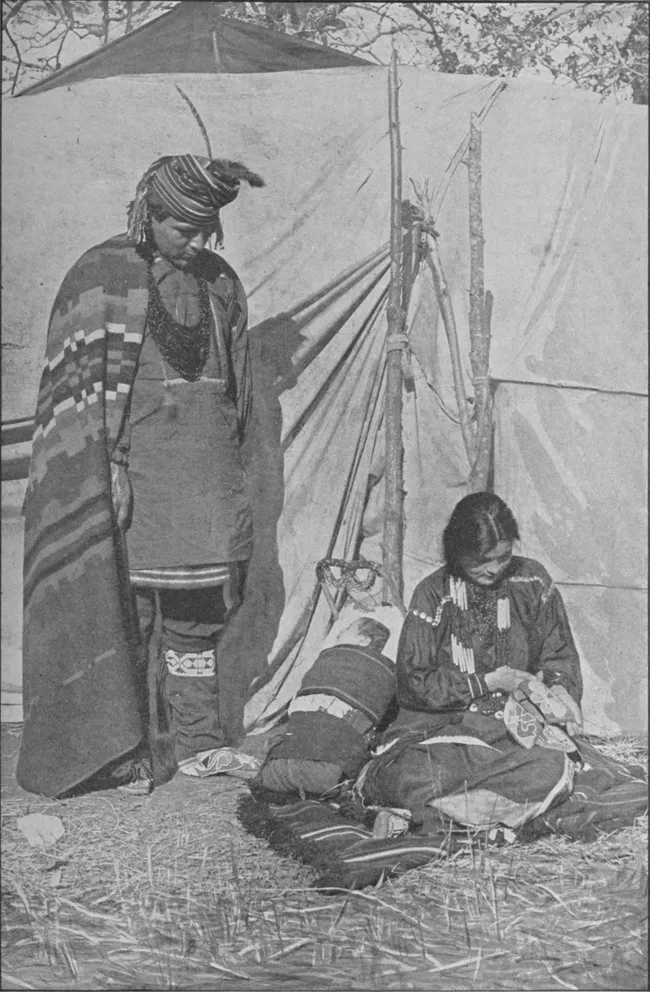
Underwood & Underwood
A RED INDIAN CHIEF AND HIS FAMILY
LARGER
IMAGE
Kelts, or Celts. A stock of the Aryan family which
settled in France and the British Islands in prehistoric times. The
Gauls and Belgæ of Cæsar’s time and the early Britons represent
them. They are divided into two branches, Goidelic and Brythonic
Celts, respectively known also as Q and P Celts, from a linguistic
peculiarity. The former are represented in modern times by Irish,
Manx, and Scottish Highlanders; the latter by Welsh, Cornish,
and Bretons. The typical Celt was probably a tall, broad-headed
individual, with prominent nose, high cheek-bones, light hair and
eyes. The small, round-headed, dark race which is also classed as
Celtic, is more probably an earlier Hamitic type, allied to the
Basques (q.v.).
Khulkas. A nomadic race of Eastern Mongols, occupying the
Gobi desert.
Khamtis. An Assamese race—Indo-Chinese stock of Southern
Mongolic family—in the Brahmaputra Valley.
Khasis. An Indo-Chinese hill tribe of Southern Mongolic
family, in Khasi Hills of Assam.
Khoi-Khoin. The name given to themselves by the Hottentots
(q.v.).
Khoshots. See KALMUKS.
Kickapoos. See ALGONQUIAN.
Kiowas. A North American Indian race in Oklahoma.
Kipchaks. A Turki race of Northern Mongolic family, settled
in eleventh century between Urals and Don. In the middle of the
thirteenth century, Batu Khan, a son of Genghiz Khan, led them
to conquer all Central and South Russia, where they founded the
Empire of the Golden Horde. It was broken up by Tamerlane about
1390, and from its fragments arose the Khanates of Astrakhan, the
Crimea, etc., now absorbed by Russia. From the Eastern Kipchaks
are descended the Kirghiz (q.v.), one of whose hordes is still
known as Kipchak. The modern Kipchaks are nomadic, and live by
stock-feeding in the steppes of western Turkestan.
Kirantis. A Tibetan race of East Nepal, of Southern Mongolic
family.
Kirghiz. A nomadic people of Central Asia, where they occupy
the vast steppes which lie to the north of Turkestan. They are
descended from the Kipchaks (q.v.) of the Golden Horde. They
form a group of the Turki stock of the Northern Mongolic family.
The Kara-Kirghiz, who inhabit the uplands between the Issik-Kul
and the Kuen-Lun, are the oldest Turki nomads of whom there is any
historical record, and are divided into On and Sol—right and left
wings. The Kirghiz proper, who call themselves Kazaks, or “riders,”
roam from Lake Balkash to the Volga, over the vast level steppes,
where they dwell in skin tents and support themselves by breeding
camels, horses, oxen, sheep and goats. They live in the saddle, and
were formerly a warlike people, who once could put 400,000 fighting
men in the field. They are divided into four hordes—Great, Middle
or Kipchak, Little, and Inner. They are all now under Russian
dominion.
Kishis. See CHECHENZES.
Kissis. See TEMNÉ
GROUP.
Kizil-Bashis. Persianised Turkis of Afghanistan, belonging
to Turki branch of Northern Mongolic family, who supply the chief
commercial classes of Afghanistan.
Kolajis. See NUBA
GROUP.
Kolarians. One of the three non-Aryan races to which the
primitive inhabitants of India belonged, of the Indo-Chinese stock
of the Southern Mongolic family. They entered Bengal from the
north-east, and are now represented by a few scattered tribes, like
the Santals, Mundas, Kurkus, and Bhils.
Koranas. See HOTTENTOTS.
Koreans. Natives of Korea, belonging to the Koreo-Japanese
stock of the Northern Mongol family. They stand midway between
Chinese and Japanese, the latter being probably their descendants,
and are taller, with lighter complexion and more regular features,
than the typical Mongol. Their civilisation is of Chinese origin.
They are not warlike, but are prosperous agriculturists.
Korokas. See KANAKAS.
Korungas. See WADAI
GROUP.
Koryaks. An Arctic race of North-east Siberia, allied to the
Chukchis (q.v.).
Krej. See NILITIC
GROUP.
Krim-Tartars. See TARTARS.
Krus, or Krooboys. Sudanese Negroes of Liberian
Group. Bold and skilful boatmen, employed for that purpose all
along the West African Coast.
Kulabes. See KANAKAS.
Kulfans, Kunjaras. See NUBA
GROUP.
Kurds. Native of Kurdistan, partly nomad and pastoral,
partly settled and agricultural. A fierce and warlike people, they
are much given to raiding, and were utilised by the Sultan to
oppress the Armenians. They have settled in Kurdistan from time
immemorial, and belong to the Iranian stock of the Aryan family.
Kurile Islanders. See AINUS.
Kurinis. See LESGHIANS.
Kurkus. A broken Kolarian tribe, allied to the Santals of
Central India, belonging to the Indo-Chinese branch of Southern
Mongolic family.
Kutchins. See ATHABASCAN.
Kwandes, Kwisses. See KANAKAS.
Ladakhis. Natives of Ladakh in the Upper Indus Valley,
belonging to the Tibetan stock of the Southern Mongolic family,
conquered by Kashmir in seventeenth century.
Lake Chad Group. A group of Sudanese Negro tribes,
inhabiting the districts round Lake Chad, including Kanembus,
Kanuris, Baghirmis (warlike slave-raiders), Mandaras, Yedinas,
Logons, Mosgus, Bulalas, Saras, etc.
Lampongs. Malay inhabitants of Southern Sumatra.
Lamuts. See TUNGUSES.
Landumans. Sudanese Negroes of Senegambia.
Laos. See SHANS.
Lapps. A branch of the Finno-Ugrian stock of the Northern
Mongolic family, inhabiting the parts of Norway, Sweden, Finland,
and Russia collectively known as Lapland. They are the shortest and
broadest-skulled people in Europe. Most of them are nomads, who
live by their vast reindeer herds, though some have become settled
and live by fishing and hunting. They are closely allied to the
Baltic Finns, and like them show traces of a mixture of Caucasic
blood.
Lascars. A term applied to sailors of Indian and Malay
seafaring races, employed on British vessels.
Latins. The ancient inhabitants of Latium, the district
of Central Italy which lay between the Tiber and the Liris, and
included the Roman Campagna. They absorbed the earlier allied races
of Oscans, Sabines, Samnites and Umbrians, and formed a league
of thirty cities, which warred for some generations with Rome and
then fell under the Roman dominion. Rome itself was originally a
Latin city. The ancient population of Italy was divided into three
grades: Roman citizens—not necessarily residents in Rome—Latins,
and Italians. The Latins are a branch of the Italic stock of the
Aryan family.
Latin or Romance Races. A name often given to the
modern races which speak a Romance language derived from Latin, and
belong in whole or part to the Italic stock of the Aryan family.
They include Italians, French (including Provençals), Spaniards,
Portuguese, and Roumanians.
Latin Americans. The white inhabitants of South America, of
Spanish or Portuguese descent, and speaking these languages.
Lazes. See GEORGIANS.
Lencan. A group of semi-civilised Central American Indian
tribes, including Chontals, Ramas, Payas, Wulwas, and Guatusas.
Lepchas. Natives of Sikkim and Bhutan, belonging to the
Tibetan stock of the Southern Mongolic family.
Lesghians. A branch of the Eastern stock of the Caucasian
family, inhabiting the Eastern Caucasus. Wild mountain tribes,
who long offered an unavailing resistance to the Russian arms
under Shamyl (1859). Their chief tribes are the Avars (the most
cultivated and powerful), Andis, Dargos, Didis and Kurinis.
Lettic. A stock of the Aryan family, including Letts,
Lithuanians and the extinct Pruczi, Borussians, or Old Prussians,
from whom modern Prussia takes its name. The Letts and Lithuanians
in the fifteenth century formed a united people, inhabiting the
south-west of Russia, from Courland to Odessa. Afterwards they
passed under Polish and then Russian dominion. They are now mostly
peasant agriculturists. They are fair and well-built, with fine
features and blue eyes.
Letts. See LETTIC.
Liberian Group. Sudanese Negro tribes, inhabiting the Grain
Coast of West Africa. The Krus or Krooboys (q.v.), Queahs and
Bassas are their chief tribes.
Liberians. Natives of the negro republic of Liberia on the
Guinea Coast, partly descended from freed slaves of all races, but
mainly belonging to the Liberian group.
Libyans. An ancient fair-haired and light-skinned race of
Northern Africa, akin to the modern Berbers, belonging to the
western stock of the Hamitic family. They are depicted on Egyptian
monuments of fifteenth century B.C.
Ligures, or Ligurians. An ancient race of the western
stock of the Hamitic family, probably the aborigines of North-West
Italy round Genoa, to whom the Siculi, Sards and Corsicans were
apparently akin.
Limbas. See TEMNÉ
GROUP.
Lithuanians. See LETTIC.
Livonians. A branch of Baltic Finns, belonging to the
Finno-Ugrian stock of the Northern Mongolic family; a dwindled
remnant now inhabits the Baltic provinces of Russia.
Logons. See LAKE
CHAD GROUP.
Lolos. A fair-complexioned aboriginal race on the frontiers
of China and Tibet, belonging to the Chinese stock of the Southern
Mongolic family.
Lombards. A race of Teutonic stock, formerly settled in the
district of the Lower Elbe, who invaded Italy in 568, and there
founded a powerful Lombard kingdom under Alboin and his successors.
The Lombards were at first fierce warriors and little more; but
they soon fell under the influence of Italian civilisation, and
were merged into the Italian race when Charlemagne destroyed their
independence in 774. Their name and some traces of their racial
character still remain in Lombardy, between the Alps and the Po.
Luchuans. Natives of the Luchu or Liu-Kin Archipelago,
between Japan and Formosa, resembling the Japanese, but with
differences which are attributed to a cross of the aboriginal Ainu
blood. They belong to the Koreo-Japanese stock of the Northern
Mongolic family.
Lushais. A warlike race of Tibetan stock inhabiting the
Lushai Hills on the confines of Assam, Bengal and Burma.
Mabas. See WADAI
GROUP.
Macedonians. A warlike people of ancient Greece, who
attained their greatest power under Alexander the Great. They were
not true Hellenes, but a race of wild mountain tribes probably
of Hamitic origin. Modern Macedonia is peopled by an extremely
mixed race of Greeks, Bulgarians, Turks, etc., among whom some
descendants of the ancient Macedonians may no doubt be found.
Macusis. See CARIBS.
Madis. See NILITIC
GROUP.
Madurese. A Malay race inhabiting Java, and allied to the
Javanese (q.v.).
Magars. A Tibetan tribe of Western Nepal.
Magwangwaras. A fierce predatory race of Bantu Negroes,
occupying the head-waters of the Rovuma River in East Central
Africa.
Magyars. A warlike and now highly civilised race belonging
to the Finno-Ugrian stock of the Northern Mongolic family. They
first appeared in Europe about a thousand years ago, being
probably Scythian (q.v.) immigrants from the Caspian district.
They conquered the Roman provinces of Pannonia and Dacia, and
there founded the Kingdom of Hungary in the year 1000. They are
still the dominant race in Hungary, which now forms part of the
Austro-Hungarian Empire, and preserve their Finno-Ugrian speech.
They are a chivalrous and highly intelligent race, whose Mongolic
descent is no longer perceptible in their white skins and regular,
often handsome features. Probably this is due to frequent crossing
of blood with German, Slav and Roumanian neighbours.
Mahrattas. See MARATHIS.
Makololos. A warlike branch of the Basuto race of Bantu
Negroes who, in 1835, moved north and conquered the Barotses, only
to be reduced by them to vassalage about 1864.
Makuas. A savage cannibal race of Bantu Negroes, living
north of the Zambesi in Portuguese East Africa.
Malagasy. A Malayo-African people of mixed blood, inhabiting
Madagascar. The Hovas (q.v.) are the dominant tribe.
Malays. The dominant native race of Malaysia, the chief
stock of the Oceanic Mongolic family. They are of a distinctly
Mongolic physical type, of low stature and yellowish colour,
with high cheek-bones, black lank hair and broad skulls. They
may be divided into three races: the Orang-Benua, or men of the
soil, the indigenous Malay tribes at a low stage of culture; the
Orang-Laut, or men of the sea, who live by fishing and piracy;
and the Orang-Malayu, or civilised Malays proper. They inhabit
the southern provinces of Sumatra, the native states of the Malay
Peninsula (Kelantan, etc.), the British Straits Settlements (Johor,
Perak, Selangor, etc.), parts of Borneo, Ternate, Tidor and the
Banda Islands, and many islands of the Malay Archipelago. They
have wandered as far as Madagascar, where the Malagasy (q.v.)
are Malays crossed with Negro blood. They were formerly warlike
and much given to piracy, but are now the chief trading race
of South-eastern Asia. Their origin is dubious, but Sumatra is
generally regarded as their original home. Of kindred blood are
many so-called Proto-Malay races, such as the Achinese,
Javanese, Sundanese,
Dyaks, etc. (q.v.).
Malayalim. See DRAVIDIANS.
Manchus. The dominant native race of Manchuria, who
conquered China in the seventeenth century and founded the existing
Chinese dynasty. They are of the Mongol stock of the Northern
Mongolic family. They first appear in history in the thirteenth
century, when a number of nomad Manchu tribes were formed into
a single people. They probably originated in Siberia, where the
Tunguses (q.v.) represent their primitive stock.
Mandans. See SIOUAN.
Mandaras. See LAKE
CHAD GROUP.
Mandingans. The chief race of Sudanese Negroes in the
Western Sudan, with numerous branches between the Upper Niger and
the coast, including Mandé or Mandingoes, Bambaras, Jallonkés,
Kassonkés, Masinas, Sarakolés, Solimas, Susus, etc. Timbuctoo was
formerly the capital of the Mandingan empire, before it fell under
Berber domination. A large proportion of American Negroes are
descended from slaves of Mandingan origin.
Mangbattu. Sudanese negroes of Welle group, noted for their
pronounced cannibalism.
Mangkassara. Malay natives of Macassar, in Celebes, under
Dutch rule.
Manipuris. Natives of Manipur, between Burma and Assam,
mostly wild hillmen of mixed Burmese and Hindu blood, but classed
with the Indo-Chinese stock of the Southern Mongolic family.
Man-Tses. Inhabitants of the mountain districts of Sze-chuen
in China, akin to Lolos (q.v.). m
Manx or Manxmen. Inhabitants of the Isle of Man,
belonging to the Celtic stock of the Aryan family, and the Goidelic
or Q Celt branch of it. There is a strong Scandinavian element in
their blood, from the numerous invasions of the old Norse pirates.
Their customs are also strongly marked by the Scandinavian element.
Manyuemas. Warlike Bantu Negroes of the Upper Congo, long
allied with the Arab slave-traders.
Maoris. The aborigines of New Zealand, belonging to the tall
brown race of Polynesians (q.v.), a branch of the Indonesian
family. A brave, generous and warlike people, who are said to have
reached New Zealand from the Pacific islands about a thousand
years ago, they are one of the few native races which promise to
assimilate western civilisation with success.
Marathis, or Mahrattas. A numerous Indian race of
mixed origin, probably of aboriginal (Dravidian) blood in the main,
with a Hindu element. They inhabit West and Central India, where
they became the dominant power under Sivaji in the seventeenth
century. The English had long and bloody contests with these wild
and warlike mountaineers, who founded several great native states,
some of which (Gwalior and Indore) survive to this day.
Maronites. A sturdy, warlike Christian race of mountaineers
in the Lebanon, belonging to the Syrian branch of the Aramæan stock
of the Semitic family. Implacable foes of the Druses, with whom
they are constantly at war.
Marquesans. See POLYNESIANS.
Masais. A branch of the Eastern Hamites, settled in British
East Africa on the Tana River. A finely-built race, whom only
their chocolate colour and frizzy hair prevent from passing for
Europeans. Extremely warlike and intelligent, they are confirmed
raiders and cattle lifters.
Mashonas. Natives of Mashonaland, in South-eastern Rhodesia,
formerly the half-fabulous empire of the Monomotapa, and the home
of a forgotten civilisation, to which the ruins of Zimbabye and
other similar relics bear witness. The Mashonas are Bantu Negroes,
a peaceful, industrious people, who were subjugated about 1838 by
the Matabeles under Umsilikatzi, and are now under British rule.
Massachusett Indians. See ALGONQUIAN.
Massalits. See WADAI
GROUP.
Matabeles. A branch of the Zulu race of Bantu Negroes, which
was expelled from Zululand in 1838, and conquered the Mashonas, in
modern Rhodesia, under Umsilikatzi. Like the Zulus, they were proud
and fearless warriors, who were only subjugated with difficulty by
the English in 1893, and revolted unsuccessfully in 1896.
Matacoans. A South American Indian race on the Vermejo River
in Argentine.
Mauri. See MOORS.
Maviti. Bantu Negroes of the Upper Shiré in British South
Central Africa, of Zulu stock, who came as conquerors from the
south.
Maya-Quiché. A group of Central American Indian races,
mostly in Yucatan and Guatemala. It includes the Mayas of Yucatan,
Zendals and Zotzils of Chiapas, Quichés, Chols, Pokomans, and
Zutugils of Guatemala, Huastecs and Totonacs of Vera Cruz. Like the
Aztecs, the Mayas possessed an ancient civilisation and system of
picture writing.
Maypuris. See ARAWAKS.
Mbengas. Indigenous Bantu Negroes of French Equatorial
Africa, about Corisco Bay.
Melanesians. The indigenous natives of the Western Pacific
Islands, forming a distinct stock of the Oceanic Negro family of
Ethiopic Man. They are long-skulled, or dolichocephalic, with the
lowest cephalic index of all known races, prognathous, broad-nosed,
of a sooty-black colour, with black frizzy hair, and of low
stature. They are at a low stage of culture, being very savage,
bloodthirsty, and treacherous, mostly cannibals and head-hunters,
with little social organisation. They include the Fijians and the
natives of the New Hebrides, the Solomon, Admiralty, Bismarck,
and Loyalty Islands, New Britain, New Ireland, New Caledonia, and
other islands of the Eastern Pacific. They are closely allied to
the Papuans (q.v.), under which name some ethnologists prefer to
class the whole body of Melanesians.
Melanochroi. A suggested division of Caucasic Man, in which
a pale skin is typically accompanied by dark hair and eyes; it
would thus include the Hamitic and Semitic families, with the
Hellenic, Italic, and Celtic stocks of the Aryan family.
Mendis. See TEMNÉ
GROUP.
Mentawey Islanders. A remnant of the aboriginal Polynesian
race dispossessed by the Malays, off the coast of Sumatra.
Mestizos. Cross-breeds between Europeans and Indians, in
Spanish and Portuguese America.
Mexicans. See AZTECS and
NAHUANS. Also the
modern inhabitants of Mexico, who are of Spanish descent, with a
strong infusion of Indian blood.
Micmacs. An Indian race of Nova Scotia, in whom some
ethnologists think that a trace of Norse blood, dating from the
pre-Columbian discovery of America, is perceptible.
Minæans. See HIMYARITES.
Mingrelians. See GEORGIANS.
Minh-huongs. Franco-Annamese half-breeds in Cochin China, an
increasing race who make very valuable colonists.
Minnetarees. See SIOUAN.
Mishmis. A wild Tibetan hill tribe occupying the
jungle-covered hills through which the Brahmaputra flows, on the
northern border of Assam. Warlike and turbulent.
Missouri Indians. See SIOUAN.
Mixtecs. An ancient Mexican race, contemporary with the
Toltecs (q.v.), probably represented by the modern Miztecs of
Oajaca.
Moabites. An ancient pastoral race of Semitic origin,
ethnologically cognate with the Israelites, who dwelt on the east
of the Dead Sea, and are now extinct.
Mœsogoths. See GOTHS.
Mohawks. See IROQUOIAN.
Mohicans. One of the most famous and warlike of redskin
races, immortalised by Fenimore Cooper. See ALGONQUIAN.
Mojos, or Moxos. A yellowish Indian race of Bolivia,
akin to the Chiquitos.
Mokis. See SHOSHONEAN.
Mongolic. One of the four great divisions of mankind.
Typically characterised by yellowish skin, broad, flat features
with prominent cheek-bones, broad skulls, mesognathous jaws, and
oblique, almond-shaped eyes, with black, lank and coarse hair. The
Manchus are a typical Mongolic race. The Mongolic races are mostly
found in Asia, which is chiefly peopled by their stocks. The name
“Mongolic” has replaced the older “Turanian.”
Mongols. A stock of the Northern Mongolic, otherwise known
as Mongolo-Tartar or Ural-Altaic, family, from whom the general
term of Mongolic is derived. The name seems originally to have
meant “brave,” and the Mongols have provided some of the most
fierce and warlike races of history. They originated as scattered
tribes in modern Mongolia. Under Genghiz Khan they were formed
into a confederacy which conquered the whole of Central Asia in
the thirteenth century, thanks to an unlimited supply of hardy and
very mobile horsemen. The existing Mongol tribes, nomad pastors
of Mongolia in Central Asia, are divided into Sharras or Eastern
Kalmuks, or Western Buriats,
or Siberian Mongols, and Tunguses,
including Manchus (q.v.).
Montenegrins. A Servian race of civilised mountaineers,
inhabiting the rugged district of Montenegro; the only Balkan race
which preserved independence and Christianity against the Turkish
conquerors. Their history is one of constant warfare with the
Turks, and they have thus preserved the primitive virtues of the
warrior in great perfection.
Moors. The ancient Moors, or Mauri, were the inhabitants
of the Roman province of Mauretania, roughly including the modern
Algeria and Morocco. They were probably of mixed descent, partly
Semitic from Arabia, partly Western Hamitic from indigenous
sources. In modern times the name is applied (1) to the invaders
and conquerors of Spain in the Middle Ages, who were mostly of Arab
and Berber stock; (2) to the present inhabitants of Morocco and
the Barbary States, of the same stocks, with a large infusion of
Sudanese Negro blood. The Moors have always been a turbulent and
warlike people, who furnished the most notorious pirates of modern
history, thanks to their commanding position on the great highway
of sea-borne commerce.
Moquis. See PUEBLO
INDIANS.
Mordvins. A branch of the Finns (q.v.), forming small
communities on the banks of the Volga.
Mosgus. See LAKE
CHAD GROUP.
Mossis. See NIGERIAN
GROUP.
Mpongwes. A Bantu Negro race on the Gaboon Estuary in French
Equatorial Africa, given to drink and boasting, of little economic
value, though once powerful.
Mulattos. Half-breeds between whites and negroes.
Mundas. A Kolarian race of Lower Bengal, with possible
traces of Negroid blood.
Mundrucus. See TUPI-GUARANI.
Mundus. See NILITIC
GROUP.
Mushi-Kongo. Bantu Negroes of Portuguese West Africa, still
in an absolutely savage state.
Muskhogean, or Appalachian. A group of North American
Indian tribes, formerly occupying the south-eastern corner of the
present United States, south of Tennessee, and east of Arkansas.
Formerly a powerful confederacy of warlike hunters, they are now
extinct or confined to Indian reservations. The chief tribes are
Alibamus, Apalachis, Chickasaws, Choktaws, Creeks or Muskhogees,
and Seminoles.
Mycenæans. The inhabitants of ancient Mycenæ, one of the
chief centres of prehistoric culture in Greece before the Homeric
age. Recent excavations, at Mycenæ itself, at Cnossos in Crete, and
other contemporary sites of government, have thrown light on the
remarkable civilisation which then existed. The Mycenæans, Cretans,
and their kindred peoples were probably a mixed Caucasic race,
with affinities to the later Aryan Achæans and to the aboriginal
Hamitic Pelasgians; but nothing is yet certainly known of their
ethnological place.
Nagars. See DARDS.
Nagas. Aborigines of the Naga Hills, in South Assam,
semi-savage and formerly accustomed to raid the British provinces;
now under British rule. They are of Tibetan stock.
Nahuans, or Mexican Indians. The aboriginal
inhabitants of modern Mexico, whose history dates back to the sixth
century. The oldest of the Nahuan races was that of the Toltecs,
who established a civilisation marked by architectural and
artistic monuments still existing, north of the valley of Anahuac.
They were followed by the ruder Chichimecs and the Aztecs (q.v.).
Other branches of the same race are the Pipils and the Niquirans of
Nicaragua.
Naimans. (1) See SHARRAS. (2) A tribe of the Middle
Horde of the Kazaks. See KIRGHIZ.
Nairs. A Hindu tribe of Malabar, distinguished by their
peculiar marriage customs. They practise polyandry, and a Nair’s
property descends not to his own but to his sister’s children.
Namas or Namaquas. A Hottentot tribe of Namaqualand,
the true aborigines and the principal representatives of the
Hottentots (q.v.). Scattered in small pastoral groups.
Natchez Indians. An extinct North American Indian race,
formerly inhabiting the region of the Lower Mississippi.
Navajos. See ATHABASCAN.
Neanderthal Man. A race of primitive man, represented
only by a skull and a few bones found in a limestone cave of the
Neanderthal in Rhenish Prussia in 1856. The most ape-like race yet
known, and probably the oldest.
Negritoes. A branch of Ethiopic Man, found in Central
Africa, and in the Andamans, the Malay Peninsula and the
Philippines, akin to negroes but of smaller stature and more
ape-like. Possibly the primitive stock from which the Negroes
(q.v.) were developed.
Negroes. The most numerous branch of Ethiopic Man, divided
into African (Sudanese, Bantu, and Hottentot-Bushman) and Oceanic
(Papuan, Melanesian, and Australian) sections. American Negroes
are descended from African slaves, mostly of Sudanese origin. See
HAYTIANS.
Nempés. See NIGERIAN
GROUP.
Nestorians. A Syrian race, belonging to the Aramæan stock of
the Semitic family, distinguished by a special form of Christian
belief, who were driven out of the Roman Empire in the fifth
century, and whose descendants now form a special community in
the mountain ranges of Kurdistan. They are poor and illiterate. A
branch of Nestorians is found in Travancore, where they go by the
name of Syrian Christians.
New Guinea Natives. See PAPUANS.
New Zealanders. (1) Aborigines [see MAORIS]. (2)
White inhabitants of New Zealand, of Anglo-Saxon descent.
Nez Percés. A tribe of North American Indians, in British
Columbia and Idaho, part of whom are well advanced in civilisation.
Niam-Niam. See AZANDEH.
Nicaraguans. White natives of Nicaragua, in Central America,
of Spanish descent, with Indian and negro elements.
Nicobarese. Natives of the Nicobar Islands, of Malay blood
mixed with that of the Mongolic aborigines. Formerly given to
piracy.
Nigerian Group. A group of Sudanese Negro tribes, all of
allied stocks, inhabiting the Niger Delta, the Oil River, Lower
Benue, and Niger region, including the Niger Bend. Amongst them are
the people of Benin—noted for their vast human sacrifices—the
Abo, Nempé, Nupé, Akasa, Qua, Efik, Okrika, Akpa, Mossi, Sienereh,
and many other tribes.
Nilitic Group. Another group of Sudanese Negro tribes,
inhabiting the districts of the White Nile, Sobat, and the northern
slopes of the Nile-Congo divide. They include the Abaka, Abukaya,
Bongo, Shuli, Falanj, Madi, Bari, Nuer, Shilluk, Dinka, Mundu,
Rol, Mittu, Krej, and Fertit tribes. They are mainly hard-working
agriculturists, from whom the British draw material for excellent
soldiery.
Niquirans. See NAHUANS.
Nogais. A race of Caucasian Tartars (q.v.) inhabiting the
steppes of the Kuma River; nomadic cattle-breeders.
Normans. Natives of Normandy, descended from the Norsemen
(q.v.) who settled on the French coast under Rolf the Ganger in
the beginning of the tenth century. The history of the Normans, who
conquered England and Sicily, is well known. The modern Normans
still preserve many signs of their Scandinavian ancestry, which
distinguish them from their French or Breton neighbours.
Norsemen or Northmen. A name given in the Middle
Ages to the piratical emigrants from Denmark, Iceland, Sweden,
and Norway, who descended on the coasts of England, France,
Germany, and Southern Europe. They called themselves Vikings. These
sea-rovers came, in the first instance, for portable plunder, but
in many cases they were tempted by the look of the more fertile
lands of the south to make settlements, among which those of the
Danes in England and Ireland and of the Norwegians in Normandy,
England, and Sicily were the most lasting and important.
Norwegians. A branch of the Scandinavian stock of
the Aryan family. They are probably descended from Teutonic
immigrants—perhaps of Gothic race—who entered the Scandinavian
peninsula in prehistoric times, and drove out the aboriginal Lapps
or Finns. Another theory makes Scandinavia the original home of
the Aryans, of whom, on this view, the Norwegians would represent
the primitive stock. Their history begins in the ninth century,
when a Norwegian kingdom was established by Harold Fairhair.
The old Norwegians were extremely warlike and piratical [see
NORSEMEN]. Their modern descendants are a peaceful and
industrious race, the most simple and democratic people of Europe,
who recently threw off the Swedish rule and re-established the
ancient Norwegian kingdom.
Nsakkaras. See WELLE
GROUP.
Nuba Group. A group of Sudanese Negro tribes, occupying
Nubia, Dar-Fur, and Kordofan, in the Egyptian Sudan. They include
the Furs, Nubas, Nile Nubians, Tumalis, Kargos, Kulfans, Kolajis,
and Kunjaras. They are an active and warlike race, in which the
primitive Negro blood has frequently been modified by Semitic
(Arab) and Hamitic influences. They supply many of our Sudanese
regiments.
Nubians. Ancient inhabitants of Nubia, probably identical
with Ethiopians (q.v.), but modified by the infusion of Negro
blood. They established a Nubian kingdom in the Upper Nile basin
about the sixth century.
Nuers. See NILITIC
GROUP.
Numidians. An ancient Hamitic race, inhabiting the district
now known as Algeria. They were fine horsemen, warlike, but
treacherous, and were conquered by Rome B.C. 46. See
BERBERS.
Nupés. See NIGERIAN
GROUP.
Nutkas. A collective name given to the Indian tribes of
Vancouver Island and the adjoining districts of British Columbia.
Obongos. A Bushman-like race of pygmy Negritoes discovered
by Du Chaillu on the western coast of equatorial Africa, physically
and mentally degenerate.
Ojibbeways. See ALGONQUIAN.
Okrikas. See NIGERIAN
GROUP.
Olkhonese. A tribe of Buriats (q.v.) inhabiting the
district of Lake Baikal.
Omaguas. See TUPI-GUARANI.
Omahas. See SIOUAN.
Onondagas. See IROQUOIAN.
Opata-Pima. A group of Central American Indian races, allied
to the Nahuan group (q.v.), but of lower mental and physical
type. It includes the Cora, Yuma, Papago, Tarahumara and Tepeguana
tribes.
Orang-Benua, Orang-Lauts. See MALAYS.
Ordos. See SHARRAS.
Orochs. A nomadic tribe of the Siberian Tunguses (q.v.).
Osages. See SIOUAN.
Oscans. A primitive Italic race inhabiting Campania, who
were conquered by and amalgamated with the Samnites (q.v.) in the
fifth century, B.C. Their language was a ruder form of
Latin.
Osmanlis. See TURKS.
Ossets. An isolated Aryan race inhabiting the Central
Caucasus, and differing in language and customs from their
Caucasian neighbours. They are probably allied to the Iranian
stock, though some suppose them to be descended from Gothic
settlers.
Ostrogoths. See GOTHS.
Ostyaks. A Ugrian race of Mongolic physical type, allied
to the Samoyedes (q.v.), inhabiting the Obi basin in Western
Siberia. They are mainly nomads, hunters and reindeer breeders.
They are kind, gentle and honest, and show considerable artistic
power.
Otoes. See SIOUAN.
Otomis. An Indian race of Mexico, assumed on linguistic
grounds to represent the oldest of American Indian stocks.
Ottomans. See TURKS.
Ovaherero. See HEREROS.
Ovampos. The chief Bantu Negro race of German South-west
Africa, tall and well-proportioned, with regular features—a fine
Negro type. They are industrious agriculturists, given to raiding
and inter-tribal warfare.
Oworos, Oyos. See YORUBAS.
Pampas Indians. See PUELCHES.
Pangasinans. A semi-civilised Malayan race in the Philippine
Islands.
Papagos. See OPATA-PIMA.
Papuans. The savage aborigines of New Guinea and the
neighbouring islands of the Torres Strait and East Malaysia.
They belong to the Oceanic division of Ethiopic Man, and are
allied to the African Negro, though they stand at a somewhat
higher intellectual level. They are of Negroid physical type,
characterised specially by their mops of frizzy hair; colour,
a sooty brown to black, with projecting jaws, thick lips and
retreating foreheads; nose sometimes flat, but oftener hooked
and of Jewish appearance. The race has probably been modified by
Malayan and Polynesian intermixture. Probably the Melanesians and
the Australian aborigines are closely related to the Papuans. They
are a fierce and treacherous race, hostile to strangers, and given
to cannibalism and head-hunting. They show much agricultural skill,
and in some cases are susceptible of European civilisation.
Paraguay Indians. See TUPI-GUARANI.
Parsees. Followers of Zoroaster, of Persian descent, who
have settled in India, chiefly near Bombay, where they have become
one of the most thriving sections of the community, owing to their
marked ability for commerce. A small remnant of Parsees, known as
Guebres, is still to be found in Persia itself.
Parthians. A warlike people of the ancient world, inhabiting
a district of Northern Persia. They seem to have been of Scythian
(q.v.) descent, and were noted for their habit of fighting
on horseback and discharging their most fatal arrows whilst in
pretended flight. Under Mithridates (171–138 B.C.), the
Parthians became supreme in Persia, and afterwards warred for long
successfully with the Romans.
Patagonians or Tehuelches. Natives of the most
southerly region of the American continent, noted for their great
stature, in many cases approaching the gigantic. They are one of
the physically strongest races of the earth, of a yellowish brown
colour, with well-formed and regular features. They are nomadic
tribes of Araucanian (q.v.) descent, who live by fishing and
hunting; and peacefully disposed to strangers.
Pathans. See AFGHANS.
Payaguas. A South American Indian race, in the Argentine,
whose wealth of silver ornaments gave a name to the Rio de la Plata.
Pawnees. A brave warlike tribe of North American Indians,
akin to the Shoshonean group (q.v.) and formerly settled in
Nebraska.
Pechenegs. An ancient Mongolic race of Turki stock, a branch
of the Kipchaks (q.v.).
Pelasgians. The pre-Aryan inhabitants of Greece, apparently
the aborigines of that country, who were dispossessed by the
Aryan Hellenes. Little or nothing is known of their racial
characteristics and affinities; but the excavations recently made
at Mycenæ, Knossos, etc., show that they had reached a high stage
of civilisation in prehistoric times on the Ægean coast. Probably a
branch of the Western Hamitic family, resembling Berbers (q.v.)
in physical type. See MYCENÆANS and
ETRUSCANS.
Permians. A branch of the Finnish race, inhabiting the
district of Perm in Russia, and closely resembling the Karelians
(q.v.).
Persians. The ancient Persians were the main branch of the
Iranian stock of the Aryan family, a civilised and warlike nation,
who taught their sons “to ride, to shoot with the bow, and to speak
the truth.” They reared a great empire under Cyrus (B.C.
537) and his successors, which was destroyed by Alexander the Great
and divided in 324 B.C. The modern Persians, known as
Tajiks, and as Tats on the west of the Caspian, are the descendants
of the ancient Persians with a considerable admixture of alien
blood, due to a long period of Arab and Turkish domination.
They present a fine Aryan type, however, and are cultivated and
commercial, though not warlike.
Peruvian Indians. See INCAS.
Peruvians. White natives of Peru, partly of pure Spanish
descent, partly crossed with Indian blood.
Philippine Islanders. The natives of the Philippines belong
to three distinct races—Negritoes, Indonesians and Malays.
The Negritoes are known as Aetas (q.v.). The Indonesians are
confined to the island of Mindanao; they are light-skinned, tall
and well-developed physically. Their chief tribe is that of the
Igorrotes. The Malays are brown-skinned, with black hair and flat
noses, being crossed with Negrito blood. Their chief tribes are the
Visayans, Tagalogs, Bicols, Ilocanos, Cayagans, Pangasinans and
Pampangas. These are all Christianised and fairly civilised. The
interior is occupied by wild and savage tribes of similar race,
and by the dwarfish and nomadic Negritoes. Many of these tribes
practise head-hunting, cannibalism, and human sacrifices. The more
civilised tribes, with the Spanish-Indian half-breeds, known as
Filipinos, are turbulent and lawless, the source of much trouble to
the new American as to the old Spanish rulers.
Philistines. An ancient race inhabiting the Mediterranean
seaboard to the south-west of Judæa, who warred much with the
Israelites, and were finally subdued by them. They were probably
a Canaanitish people, belonging to the Semitic family; but some
regard them as an immigrant Hamitic race, perhaps related to the
Cretans or Pelasgians. The assumed inferiority of their culture
to that of the Israelites has given rise to the modern use of
“Philistine” as a term of reproach.
Phœnicians. The greatest seafaring and trading nation of
ancient times, and the earliest of Mediterranean sea-powers.
A branch of the Canaanite stock of the Semitic family, they
inhabited the Mediterranean coast between Latakia and Acre, their
chief cities being Tyre and Sidon. They possessed a remarkable
polytheistic religion, disfigured by human sacrifices. They were
an inventive race, to whom we owe glass and Tyrian purple. They
seem to have entered Phœnicia from the direction of the Red Sea
in prehistoric times, and were at first subject to Egypt, but
about 1300 B.C. reared a great maritime empire, which
endured for nearly a thousand years and was destroyed by Alexander
the Great. They were the great traders of the ancient world, and
carried on a commerce which ranged from Cornwall to Ceylon and
Senegal. The Carthaginians (q.v.) were a colony of Phœnicians.
Phrygians. An ancient pastoral people of Asia Minor, closely
related to the Armenians (q.v.), who were absorbed by the
Persians in the sixth century B.C.
Picts. The aborigines of ancient Scotland, a short,
round-headed, dark race, probably a branch of the Iberian stock of
the Western Hamitic family, and thus closely related to the Basques
(q.v.). The Picts were a wild and warlike race, who harassed the
Roman province of Britain, and were exterminated by the invading
Scots from Ireland in the early part of the Christian era. The
whole Pictish problem is still unsolved by ethnologists, some of
whom hold that the Picts were a Celtic race, allied to the modern
Welsh or to the Scottish Highlanders of to-day.
Picuris. See PUEBLO
INDIANS.
Pipils. See NAHUANS.
Pitcairn Islanders. Half-breed descendants of Englishmen
(the mutineers of the “Bounty”) and Tahitian women. A peaceful and
idyllic race.
Pocomans, Poconches. See
MAYA-QUICHÉ.
Poles. A stock of the Western Slavonic family, originally
dwelling between the Vistula and the Oder. In the tenth century
Poland became an independent European Power, and remained an
elective kingdom down to its partition in the eighteenth century
between Russia, Austria and Prussia. The Polish peasantry have
always been industrious and successful agriculturists, whilst the
nobility were turbulent and warlike. The Poles who live under
Austrian and German rule are fairly contented, but those of
Russian Poland have carried on a long and often bloody series of
struggles for liberty. Of late years, Russian Poland has become a
manufacturing country, under German influence. The Poles have a
considerable literature, and are eminently musical.
Polynesians. The chief stock of the Indonesian (q.v.)
family, the tall, brown-skinned race of Caucasic type who inhabit
the chief islands of the Eastern Pacific, and are generally
known as South Sea Islanders. Their chief races are the Maoris
(q.v.) of New Zealand, the Marquesans, Tahitians, Tongans and
Samoans, besides the natives of Easter, Gambier, Hervey, and other
smaller islands. They are of tall stature—only surpassed by the
Patagonians—muscular frame, regular and often handsome features,
with brown skins, square jaws, and broad skulls. They probably
originated in Malaysia, where they are still represented by the
Battaks of North Sumatra, some Dyak races, and certain tribes
of the Philippines and Gilolo. They are a gay, pleasure-loving
people, formerly addicted to cannibalism, but otherwise of pleasing
manners, and are now rapidly acquiring civilisation, though their
numbers are everywhere decreasing under the influence of European
manners and diseases.
Poncas. See SIOUAN.
Portuguese. Natives of Portugal, a mixed race, probably
of Iberian or Basque origin, with later Celtic elements. After
falling successively under Roman, Visigothic, and Saracen dominion,
they formed an independent kingdom in the twelfth century. The
early Portuguese were enterprising seamen, who contributed largely
to the exploration of the world, and founded many colonies in
Africa, which they still possess. Brazil is their chief American
settlement, now independent.
Provençals. Natives of Provence, in the South of France.
Their primitive Ligurian (q.v.) stock was modified by many
successive influences, such as the Greek colonists, who founded
Marseilles, the Roman settlers in the Provincia (Provence), and,
later, Gothic and Saracen invaders. The Provençals are a gay,
impulsive and pleasure-loving people, markedly distinct from the
more staid and industrious inhabitants of Northern France.
Pruczi, or Old Prussians. See LETTIC.
Prussians. The earliest inhabitants of Prussia were Slavonic
tribes [see LETTIC]. The modern Prussians, the dominant
race of the German Empire, belong to the High German branch of the
Teutonic stock.
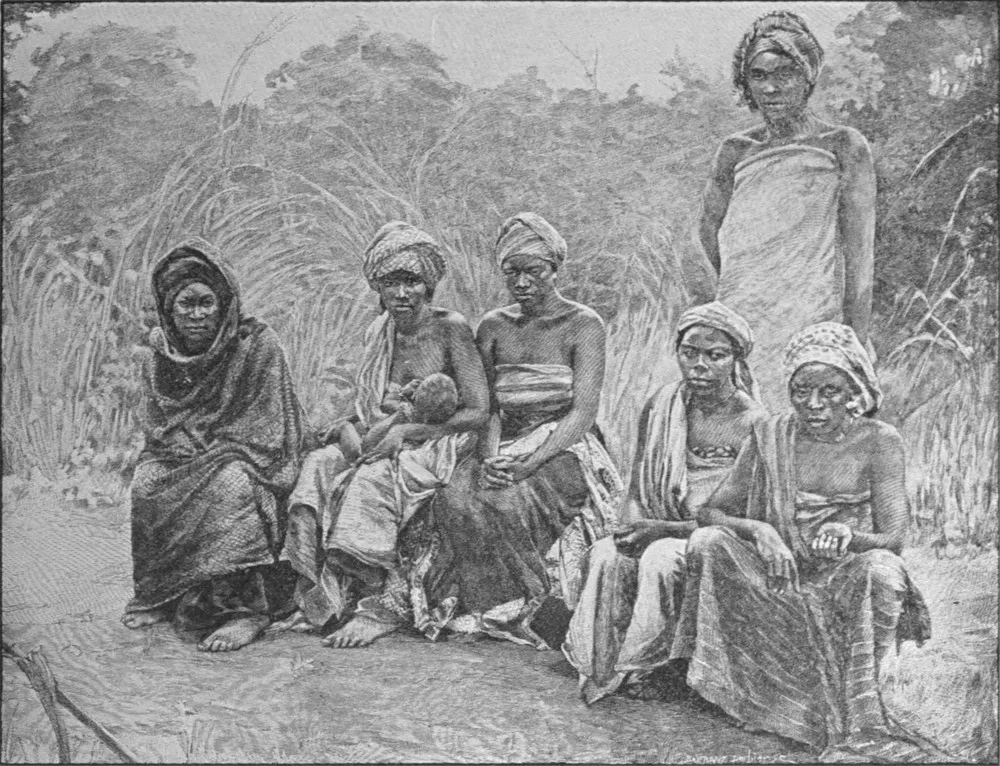
WOMEN OF THE NUPÉ TRIBE IN NIGERIA
The Nupé tribe is a family belonging to the Nigerian
group of Sudanese Negroes. They inhabit chiefly the town of Lokoja, in West
Africa. [See under
Nigerian group].
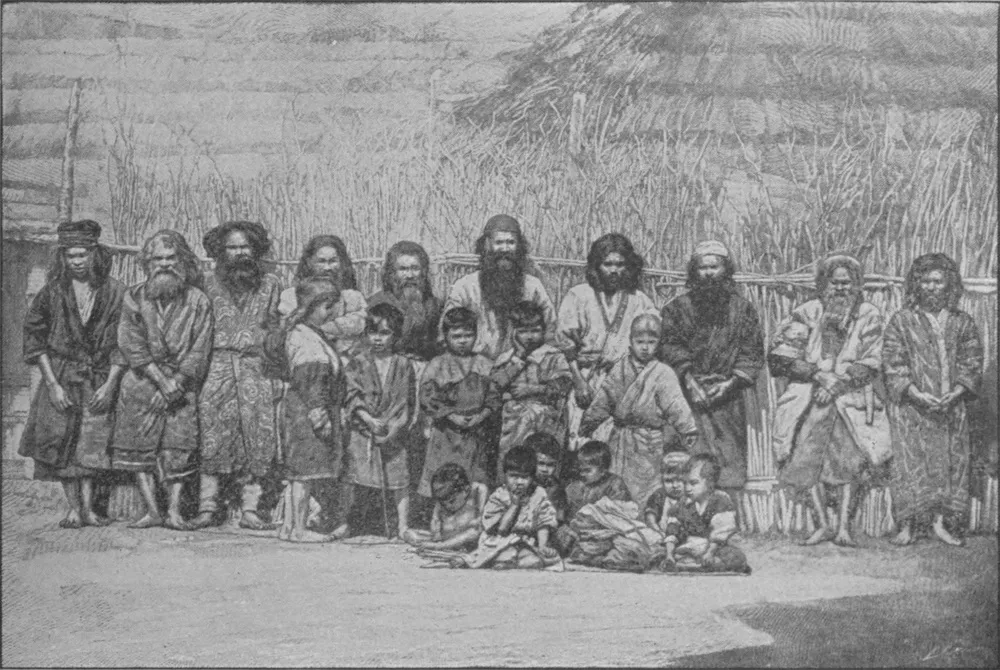
THE AINUS, PROBABLY THE ORIGINAL INHABITANTS OF JAPAN
The Ainus are a declining race, now confined to a small
area in the Far East. They have, as is seen in this picture, handsome features
and an abundance of hair. [See
page 312].
Pueblo Indians. A semi-civilised race of North American
Indians, dwelling in New Mexico and Arizona. They inhabit
“pueblos,” or huge houses, often large enough to contain a whole
tribe under one roof. They possess interesting religious and
social customs, much studied by anthropologists. Their chief tribes
are the Zunis, Teguas, Taos, Picuris, and Tusayas. The Moquis of
Arizona are closely related to them.
Puelches, or Pampas Indians. A strongly-built,
dark-skinned race of South American Indians, who inhabit the great
plains or pampas from the Saladillo to the Rio Negro in Argentina.
They are expert horsemen, from whom the Gauchos (q.v.) are
derived.
Punjabis. Natives of the Punjab, in North-West India, mostly
Jats and Sikhs (q.v.) belonging to the Hindu stock of the Aryan
family. An agricultural and warlike people.
Puntis. See CHINESE.
Pygmies. Dwarfish Negrito races of Central Africa, long
considered to be mythical, but now well known to ethnologists. They
include the Akkas and Wochuas of the Welle Basin, the Obongos of
the Gaboon, the Batwas of South Congo, etc. In very early times
they were known by repute to the Egyptians—on whose monuments they
appear in the thirty-fourth century B.C.—and the Greeks.
They live by the chase in the Central African forests, and use
poisoned arrows. Other small races, such as the Bushmen, Lapps,
Kalangs, Samangs, etc., have contributed to the fame of the Pygmies.
Quas. A Sudanese Negro tribe on the Ivory Coast, belonging
to the Nigerian group (q.v.).
Quapaws. See SIOUAN.
Queahs. See LIBERIAN
GROUP.
Quichés. A race of Central American Indians in Guatemala,
rivalling the Aztecs in the possession of an ancient civilisation
and a curious mythology. See
MAYA-QUICHÉ.
Quichuas. See INCAS.
Rajputs. The predominant race of Rajputana, in Central
India, belonging to the Hindu stock of the Aryan family. They are a
proud and warlike aristocracy of soldiers and landowners, who rule
many native states, of which Jaipur, Jodhpur and Udaipur are the
most important.
Ramas. See LENCAN.
Redskins. A term given in common parlance to North American
Indians, from their colour.
Rejangs. A Malayan race of Sumatra, akin to the Achinese
(q.v.).
Rols. See NILITIC
GROUP.
Romans. The most powerful and warlike, and in every sense
the greatest race of ancient Europe, who acquired the dominion of
the Western world, and laid the foundations of modern civilisation.
The city of Rome was founded by Alban shepherds, of Latin (q.v.)
race, in the eighth century B.C. Oscan,
Sabine, Samnite,
and Umbrian (q.v.) elements were added to the original stock, and
thus the great Roman character was moulded. Rome later extended her
power over the whole of Italy, and then over the whole of the known
world.
Romance Races. See LATIN
RACES.
Romansch. Natives of the Grisons in Switzerland, speaking a
Romance dialect, and probably of Italic race.
Roumanians, or Vlachs. Natives of the modern
Roumanian kingdom, the leading Balkan State, composed of the older
principalities of Wallachia and Moldavia, which were long subject
to the Turks. The Vlachs (Wallachs, a name akin to our Welsh) are
probably descended from the Latin-speaking inhabitants of the
ancient Roman province of Dacia, a tribe of Thracian descent,
which was subjugated by Trajan in the second century. They have
preserved their language, but their blood has been mingled with
that of numerous conquerors—Goths, Huns, Slovenians, Albanians,
Turks, etc. The Roumanian peasantry are a hardy and thrifty race,
retaining their old warlike traditions.
Rucuyennes. See CARIBS.
Russians. The chief of the Slavonic races inhabiting
European Russia, and divided into Great, White, and Little
Russians. The physical distinction between these races is
attributed to the mixture of the primitive Russian stock
respectively with Finnish, Lithuanian, and Turkish blood. The
original Russians belonged to the Slavonic stock of the Aryan
family, and seem to have been settled in prehistoric times between
the Danube, the Elbe, and the south coast of the Baltic. Thus they
must have entered Russia from the west in the early centuries
of our era. There they conquered and drove out or assimilated
the aborigines of Northern Mongolic (Finno-Turkish) stock, and
established a number of small states, agricultural in character,
which long suffered from Tartar invasion, notably that of the
Golden Horde [see KIPCHAKS], and were gradually moulded
into a single kingdom, with Moscow for its capital. Modern Russia,
with its vast Asiatic dependencies, is one of the greatest
Empires in the world, but it is in a state of transition, and its
civilisation is consequently backward. The Russian peasants are
very patient, industrious, and thrifty. When well led, they are
admirable soldiers. Their chief occupation is agriculture.
Ruthenians. A branch of the Little Russian race, who inhabit
the district of the Carpathians in Galicia and Hungary; poor, but
hardy cultivators of the soil.
Sabæans. See HIMYARITES.
Sabines. An ancient Italic race, who inhabited the district
between the Central Apennines—their ancestral home—and Rome.
The Samnites were their descendants or near kinsmen, and the
Umbrians were less closely related to them. When Rome was founded
there was a strong Sabine element in its population, as indicated
by the story of the Rape of the Sabine Women, and the statement
that several of the early kings of Rome were of Sabine blood. The
Sabines and Samnites warred against Rome for many years, but both
were ultimately subdued and incorporated in the Roman State.
Sac Indians. See ALGONQUIAN.
Sakais, or Samangs. An aboriginal Negrito race of
the Malay Peninsula; a wild and uncivilised people, with black
skins and woolly hair, often approaching the ape-like in physical
development and intelligence.
Sakalavas. One of the principal groups of the Malagasy
tribes, inhabiting the west coast of Madagascar; of mixed Malay and
negro blood, and akin to the Hovas (q.v.).
Salish. See FLATHEADS.
Samangs. See SAKAIS.
Sambos, or Zambos. Half-breeds sprung from Negro and
Indian parents.
Samnites. See SABINES.
Samoans. A Polynesian (q.v.) race, of fine physical
development, lazy and pleasure-loving, inhabiting the Samoan group
of islands.
Samoyedes. A Finno-Ugrian race, inhabiting the Obi basin in
Siberia, once widely spread over the extreme north of Europe and
Asia. They are short and dark haired, with Mongolic features, brave
and honest, live by hunting and fishing, and are still in the Stone
Age.
Samsams. A mixed Malayo-Siamese race, forming a large part
of the population of the Malayan States of Kedah and Ligor.
Santals. A negro-like aboriginal tribe of Orissa in India,
agriculturists, of the Kolarian family (q.v.).
Saracens. A term applied in the Middle Ages to the Moslem
enemies of Christendom, especially to the nomadic Arabs and
Bedouins of the Syrian deserts.
Saras. See LAKE
CHAD GROUP.
Sarakolés. See MANDINGAN.
Sards, or Sardinians. The aboriginal inhabitants
of Sardinia, probably of the Western Hamitic family, akin to the
Iberians or Ligurians (q.v.). The modern Sardinians are descended
from this race, with considerable admixtures of alien blood from
the Carthaginian, Roman, Saracen, Spanish and Italian owners of the
island in successive periods.
Sarmatians. An ancient nomadic and warlike people, probably
akin to the Scythians (q.v.), who roamed over the wide plains of
Eastern Europe. Fine horsemen. They were destroyed by the Goths in
the fourth century, and disappeared from history.
Sassaks. Natives of Lombok in the Sunda Islands, of Malayan
race.
Savoyards. Natives of Savoy, originally a short,
round-skulled, dark race, akin to the Auvergnats (q.v.), now
largely mingled with Teutonic blood.
Saxons. (1) The Old Saxons originally inhabited the estuary
of the Elbe and the neighbouring islands. They were a warlike race,
of Low German stock, whose name is said to be derived from the
“Saxes,” or heavy knives which they used in war. They were one of
the most adventurous of Teutonic races, and made many piratical
and colonising excursions, of which the most important was their
settlement in Britain in the fifth century, where they united with
the Angles (q.v.) to lay the foundation of the modern English
people. (2) The Saxons who remained on the Continent gradually
extended their dominion till it reached modern Saxony. Under
Charlemagne the Saxon power was subordinated to that of the Franks.
Saxony later became an independent duchy, which is still one of
the chief States of the German Empire. The modern Saxons are less
adventurous than their ancestors, very industrious, and successful
in agriculture and industry, and make excellent soldiers.
Scandinavians. A main stock of the Aryan family, sometimes
classed as a branch of the Teutonic stock, including the
Icelanders, Norwegians, Danes and Swedes, as well as the old
Norsemen and Normans (q.v.). Some ethnologists regard them as
the original stock of the Aryan family. They are tall, blue-eyed,
fair-haired, warlike, and good sailors and colonists.
Scots or Scotch. (1) The ancient Scots were a
Celtic race, belonging to the Goidelic or Q Celts (q.v.),
originally settled in Ireland—the ancient Scotia—whence they
made settlements in the fifth century in modern Scotland, to which
they gave their name. They were gradually driven back into the
Highlands by Anglo-Saxon, Norman and Danish invaders, and are now
represented by the Highlanders (q.v.) or Gaels. (2) The modern
Scots, or Lowland Scots, are mainly of Anglo-Saxon race, modified
by Norman, Danish, and Flemish elements. They are one of the
finest and most hardy and industrious races in the world, equally
successful in the arts of war and peace.
Scythians. An ancient nomadic and warlike race, found in the
seventh century B.C. on the vast plains of South-eastern
Europe, where they lived by cattle-breeding and raiding. They dwelt
in tent-covered waggons, fought on horseback with bows and arrows,
and made drinking-cups of their enemies’ skulls. Their origin is in
dispute. Some regard them as a Mongolic race, which was modified by
association with Aryan races, and others as an Aryan stock; their
kinsmen, the Sarmatians (q.v.), were almost certainly Aryans.
They made several incursions into Asia, where they conquered a
large tract of Northern India and established a kingdom which
lasted till about the fourth century A.D. The Rajputs and Jats
(q.v.) are sometimes held to be their descendants.
Selengese. See BURIATS.
Seljuks. A warlike Turkish people who were settled on
the Jaxartes in the eleventh century and afterwards founded a
considerable empire in Western Asia. See TURKS.
Seminoles. See MUSKHOGEAN.
Semites. An important family of Caucasic Man, who probably
originated in North Africa, from a similar stock to that of the
Hamites. They are characterised by fine regular features, large
aquiline noses, black eyes and hair, white skins, long skulls and
square jaws. They are very intellectual, though less practical
than the Aryan type; poets, prophets, and dreamers, rather
than men of action. They have given the world its two greatest
religions—Christianity and Islam. Their chief divisions are
Assyrians, Aramæans,
Canaanites, Arabs and Himyarites (q.v.).
In the modern world they are best known from the ubiquitous Jews
(q.v.).
Seneca Indians. See IROQUOIAN.
Serbs. See SERVIANS.
Serers. Sudanese Negroes inhabiting Senegambia in the Cape
Verde district. They are the tallest of Negro races, with herculean
frames, and are akin to the Wolofs (q.v.)
Servians, or Serbs. A race of Southern Slavonic
stock, now inhabiting Servia. They were at first identical with
the Croats (q.v.), and seem to have originated in the Carpathian
district, whence they migrated into the Balkan peninsula in
the seventh century. The Serbs then separated from the Croats,
and in the twelfth century founded a powerful Servian kingdom,
which was conquered by the Turks in the fifteenth. The Servians
recovered their independence in 1830, under Milosh Obrenovitch. The
Servians are a well-built race, proud and martial in temperament,
quick-tempered and prone to deeds of violence, as their recent
revolution witnessed.
Shangallas. A mixed negroid race of the Abyssinian slopes.
Sudanese Negroes with a Hamitic infusion.
Shans. Natives of the independent Shan States, lying to
the north of Siam. They are identical with the Laos, and closely
related to the Siamese (q.v.). They belong to the Indo-Chinese
stock of the Southern Mongolic family, and are probably descended
from an aboriginal race of China, which appeared on the Upper
Irawadi about 2,000 years ago. They are a peaceful, pleasure-loving
people, mainly agricultural, but not unwarlike. They have a sallow
skin and Mongoloid features.
Sharras, or Eastern Mongols. A branch of the
Mongol stock of the Northern Mongolic family. They are a nomad,
tent-dwelling, pastoral race, who roam over the great steppes of
Central Asia. They include the Khalkas, north of the Gobi Desert,
the Tanguts of Northern Tibet, the Chakars, Barins, Durbans, Uruts,
Naimans, and Ordos south of the Gobi. They are descended from the
older Mongols (q.v.), whom they resemble in physical type.
Shawnees. See ALGONQUIAN.
Shilluks. See NILITIC
GROUP.
Shoshonean. A group of North American Indian tribes, all
belonging to the Shoshone or Snake family, formerly occupying
Idaho, Utah, and Wyoming, with neighbouring districts. They include
the Shoshones or Snakes, Bannocks, Comanches, Utahs, and Mokis.
With the exception of the warlike Comanches, they are a peaceful
race, who have received the white invaders with friendship.
Shulis. See NILITIC
GROUP.
Siamese. Natives of Siam, belonging to the Indo-Chinese
stock of the Southern Mongolic family. They are closely related to
the Shans (q.v.). They are of medium height, olive complexion,
with slightly flattened noses, prominent lips, and black hair. They
are a peaceful and indolent race, who have recently shown promise
of assimilating Western civilisation. Their blood is largely mixed
with Chinese and Malay. Siam is still independent, forming a buffer
state between British and French possessions.
Siberian. A stock of the Northern Mongolic family, including
the Chukchi, Koryak,
Kamchadale, Gilyak,
and Yukaghir tribes (q.v.).
Sicani, Siculi. See SICILIANS.
Sicilians. The primitive inhabitants of Sicily were the
Sicani, probably a Hamitic race allied to the Ligurians (q.v.).
They were followed by the Siculi, an Aryan race of Italic stock,
who crossed from Italy about 1000 B.C. They were civilised
and modified by Phœnician, and especially Greek settlers, with
later Norman and Saracen influences. Of all these elements the
modern Sicilians are compounded. They are a handsome, industrious,
and amiable race, but turbulent, lawless, given to blood-feuds and
brigandage.
Sienerehs. See NIGERIAN
GROUP.
Sikhs. A powerful and warlike race of Northern India, united
by a common religious faith, dating from the eighteenth century,
and mainly of Jat (q.v.) descent. Under Ranjit Singh, at the
beginning of the eighteenth century, they reared a formidable
military power in the Punjab, which was conquered by the British
in 1846–1849. The Sikhs contribute many of the best and most
trustworthy troops to the Indian Army.
Silurians. A dark, round-skulled, short race who inhabited
South Wales and the neighbouring districts of England in Roman
times. They were probably of Iberian stock, related to the ancient
Picts and modern Basques.
Sindis. Natives of Sind in North-West India, of Hindu
descent.
Singphos. A wild, daring hill-tribe of Tibetan stock
bordering on the Assam valley, formerly given to raiding, but
now peaceful agriculturists. The Chins of the Arakan uplands are
probably an identical race; they are still predatory.
Sinhalese. See DRAVIDIANS.
Siouan. A numerous and formerly powerful group of North
American Indians, inhabiting the western prairies between the
Mississippi and the Rocky Mountains. Their chief tribe was the
Sioux or Dakotas, warriors of fine physique, courage, and military
skill, who long maintained a successful resistance against the
white settlers. Other allied tribes were the Assinaboins, Omahas,
Poncas, Kaws, Osages, Quapaws, Iowas, Otoes, Missouris, Winnebagos,
Mandans, Minnetarees, Absarakas or Crows, Tutelos, and Catawbas.
Sioux, or Dakotas. See SIOUAN.
Siryanians. A tribe of Ugrian Finns, dwelling on both sides
of the Northern Urals, resembling the Samoyedes (q.v.), except
in their white colour and fair hair, probably due to a mixture of
Slavonic blood. See FINNO-UGRIAN.
Slavonic Races, Slavs or Slavonians. A main
stock of the Aryan family, occupying the greater part of Eastern
Europe, and formerly extending as far west as the Elbe. Many
ethnologists consider them to be the primitive Aryan stock. They
are a peaceful and industrious agricultural and pastoral race,
broad-skulled, with fair hair and blue eyes; though the primitive
type has been much modified by intermixture of blood, especially
with Mongolic races, who have imprinted a Tartar character on
many Slavonic physiognomies. The Slavs are divided into Eastern
(Russians and Ruthenians),
Western (Czechs and Slovaks,
Poles and Wends or Sorbs), and Southern (Bulgarians,
Servians, and Croats,
Dalmatians, Slovenians,
and Montenegrins). See under these heads.
Slovaks. See CZECHS.
Slovenians. A branch of Southern Slavonic stock, inhabiting
Styria, Carinthia, and adjoining districts.
Solimas. See TEMNÉ
GROUP.
Somalis. An Eastern Hamitic race of Somaliland in North-East
Africa. They are a pastoral people, of good physique, handsome
features, and light-brown colour, warlike and independent. The
original Hamitic stock—closely akin to that of the Gallas
(q.v.)—is modified by Semitic and Negro blood. They make
excellent soldiers and servants.
Sonrhays. A Negro race of the Middle Niger, in whom the
Sudanese stock is modified by Arab and Berber elements.
Sorbs. See WENDS.
Soyots. A tribe of Ugrian Finns, mixed with Tartar blood, in
the Sayan Mountains of South Siberia. See FINNO-UGRIAN.
Spaniards, or Spanish. The earliest known race
of Spain was the Hamitic Iberians (q.v.), now represented by
the Basques. They were modified by Celtic invasions, which gave
birth to the Celt-Iberian races of Central and Western Spain,
who struggled so long against the Roman arms, by which they were
finally subjugated and further modified. In the fifth century
the Vandals and Visigoths (q.v.) invaded Spain, and founded
a Gothic monarchy, which fell before the Saracens in 711. The
Visigothic refugees in the northern mountains gradually recovered
the country, and the kingdoms of Leon, Navarre, Castile, and Aragon
were ultimately united into a single state. The modern Spaniards
are thus of mixed race, in which the Iberian and Visigothic are
the predominant elements. They are haughty, brave, and warlike, by
which qualities they once owned the greatest power in Europe. But
they are turbulent and lacking in political skill, so that Spain
has decayed. There are now signs of a return to prosperity.
Spanish Americans. White natives of Central and South
American States, except Brazil.
Spartans. Natives of Sparta, the greatest state of ancient
Greece after Athens, of Dorian stock, eminently warlike and
patriotic, but wanting in art or literature.
Sudanese. Full-blooded Negroes inhabiting the Western,
Central, and Eastern or Egyptian Sudan—i.e. most of Africa
north of the Victoria Nyanza. They are black in colour, with
woolly hair, projecting jaws, long skulls, broad, flat feet and
projecting heels, and form one of the main divisions of Ethiopic
Man. They are less intelligent and susceptible of civilisation
than the Bantus (q.v.), in whom the Negro blood is modified by
Hamitic or Semitic admixtures. They are mostly of strong physique,
warlike and predatory, fond of music and bright colours, with the
most elementary notions of art and religion. They may be divided
for convenience into several racial groups (q.v.), such as Wolof,
Felup, Toucouleur, Mandingan, Temné, Nigerian, Nilotic, Liberian,
Lake Chad, Wadai, Welle, Nuba, and Nilotic, besides the Tshi, Ga,
Ewe, and Yoruba peoples of the Guinea district.
Suevi. See SWABIANS.
Sundanese. Natives of the Sunda Islands, of Malayan stock,
closely allied to Javanese (q.v.).
Susus. See MANDINGAN.
Sutughils. See
MAYA-QUICHÉ.
Swabians. Natives of Swabia, an ancient duchy occupying the
south-western part of the modern German Empire; descended from the
ancient Suevi, with whom the Alemanni (q.v.) were amalgamated. A
strong, large-boned, and good-humoured race of High German stock.
The Alsatians are closely allied to them.
Swahilis. Natives of Zanzibar and the adjoining mainland,
Bantu Negroes, with a strong infusion of Arab blood, which has made
them superior in intelligence and enterprise to the average negro.
They play a large part in the commerce of East Africa, and their
language—Ki-Swahili—is the principal medium of communication
throughout the part of Africa between the Equator and the Zambesi.
Swazis. Natives of Swaziland, a native state on the
south-east of the Transvaal. A cross between Zulus and other
Kafirs, they are industrious and warlike.
Swedes. Natives of Sweden, a branch of the Scandinavian
stock. They seem to have been originally a Teutonic race, who
entered Northern Sweden about 3,000 years ago, and drove out the
aboriginal Lapps and Finns. The inhabitants of Southern Sweden
were called Goths, and may have been the ancestors of the Teutonic
Goths. In time they amalgamated with the Swedes, and formed one
nation, which has been an independent kingdom through most of the
Christian era. The Swedes are warlike, and successful in commerce
and industry; they make good sailors, and possess a considerable
literature.
Swiss, or Switzers. The prehistoric inhabitants of
Switzerland were the unknown builders of the lake dwellings. At the
dawn of history, in Cæsar’s time, the country was largely occupied
by a Celtic race, the Helvetii. Later, Switzerland was invaded by
Teutonic races of High German stock, Alemanni, Burgundians, etc.
The modern Swiss are mostly descended from these races; there
is also a considerable mixture of French, Italic and Romansch
elements. The Swiss have always been a warlike race, who preserved
the independence of their mountainous country through all ages, and
in earlier times furnished excellent mercenary soldiers to foreign
armies. They are now very industrious and successful in many arts
and crafts, such as watchmaking, wood-carving, hotel-keeping, etc.
They are a simple and handsome race, possessing in full measures
the virtues of the mountaineer.
Syrians. The ancient Syrians were a branch of the Aramæn
stock of the Semitic family, and the modern Syrians are their
descendants, with some Arab and Turkish elements added. They are
tall, with white skins and dark complexions, black eyes and hair,
often very handsome, and approaching the Jewish type. They are not
warlike, but succeed in commerce.
Tacullis. See ATHABASCAN.
Tahitians. Natives of Tahiti, of Polynesian stock;
pleasure-loving and polite, but immoral and untrustworthy; now
civilised but formerly noted for their cruelty.
Taipings. The Chinese rebels who attacked the dynasty from
1850 to 1864.
Tajiks. See PERSIANS.
Talaings. An Indo-Chinese race who preceded the Burmese
in the Irawadi Delta, and founded a state of which Pegu was the
capital. They were subjugated by Burmese in the eighteenth century.
Talamancas. Wild hunting Indians, perfectly uncivilised, who
occupy the forest-covered Atlantic slopes of Costa Rica.
Tamils. Natives of Northern Ceylon and the Indian Carnatic.
See DRAVIDAS.
Taos. See PUEBLO
INDIANS.
Tanguts. Nomadic Mongols of Northern Tibet. See
SHARRAS.
Tarahumaras. See
OPATA-PIMA.
Tarascans. A group of Indian tribes inhabiting the province
of Michoaca in Mexico.
Tartars or Tatars. The modern Tartars are inhabitants
of the Russian Empire, belonging to the Turki stock of the Northern
Mongolic family. They are divided into various geographical
subdivisions, such as the Kazan, Astrakhan, Crimean (or Krim)
Caucasian and Siberian Tartars. The name has no definite ethnical
significance. The Tatars—a Manchu word meaning “archers” or
“nomads”—were Mongol tribes who were first so named in the ninth
century. They formed a large part of the hordes of Genghiz Khan
[see MONGOLS] and stood in the van of the mediæval Mongol
incursions into Europe, whence they attracted an attention out of
proportion to their importance. Europeans called them Tartars,
confusing the name Tartar with the Greek Tartarus or Hell. See
TURKI.
Tasmanians. The extinct aborigines of Tasmania, akin to the
Australians (q.v.), but of a still lower Oceanic Negro type. They
held a place at the very bottom of humanity, alike in physique,
intelligence and culture, being still in the early Stone Age;
savage, untamable, and degraded.
Tatars. See TARTARS.
Tats. See PERSIANS.
Tavastians. A branch of the Baltic Finns, with thick-set
figures, small blue eyes, light hair, and white skins, probably
the consequence of an admixture of German blood with the original
Finnish stock. They inhabit central Finland.
Tazis. See TUNGUSES.
Teguas. See PUEBLO
INDIANS.
Tehuelches. Another name for the gigantic Patagonians
(q.v.) of South America.
Telugus. See DRAVIDIANS.
Tembus, Amatembu, or Tambukies. A group of
Kafir (q.v.) tribes in Tembuland, to the north of the Kei River
in Cape Colony. Formerly warlike and troublesome, now settled to
agriculture and subjected to British rule.
Temné Group. A group of Sudanese Negro tribes, inhabiting
the Sierra Leone district of West Africa, including the Temnés or
Timnis, Kissis, Sherbros, Gallinas, Bulloms, Solimas, Limbas, and
Mendis.
Tepeguanas. See
OPATA-PIMA.
Teutons. An important stock of the Aryan family, inhabiting
England and the Scottish Lowlands, with the United States and
British Empire, Germany, Holland, and parts of Austria and
Switzerland, Denmark, Norway, and Sweden. The Teutonic races are
divided into Low German and High German divisions, to which some
add, but others do not, Scandinavians.
Thlinkits. A race of North American Indians inhabiting the
Pacific coast from Mount St. Elias to the Simpson River, and the
adjacent islands. They live chiefly by fishing and hunting.
Thos. An Indo-Chinese race of Lao descent [see
SHANS], in the north of Tongking.
Thracians. The ancient inhabitants of Thrace, on the west
of the Black Sea. Their origin is dubious, but they are generally
assumed to have belonged to the Aryan family, and been related
to the Teutons and the Greeks. They were wild hill tribes, who
acquired in later days a certain amount of Roman culture and spoke
the Latin language. There is some probability that they were the
ancestors of the Vlachs or Roumanians (q.v.).
Thuringians. A High German tribe inhabiting Thuringia in the
fifth century, probably a branch of the Suevi (q.v.). Now merged
into the modern Saxons.
Tibetans, or Bod-Pa. Natives of Tibet, forming
the Tibetan stock of the Southern Mongolic family, and allied
to the minor races of Lepchas, Baltis,
Ladakhis, etc. (q.v.).
The Tibetans are akin to the Burmese, with Mongolic features,
broad-shouldered and muscular. They are a secluded and archaic
race, with many curious customs, such as polyandry. Their religion
is full of elaborate ceremonials, and the land abounds in
monasteries.
Tibbus. A race inhabiting the oases of the Sahara,
intermediate between Berbers and Negroes; perhaps descended from
the ancient Garamantes (q.v.).
Timnis. See TEMNÉ
GROUP.
Tinné, or Tinney. See ATHABASCAN.
Tobas. A warlike and predatory race of South American
Indians on the Rio Vermejo in Bolivia.
Tocantins. See TUPI-GUARANI.
Todas. An isolated group of Caucasic race inhabiting the
Nilgiri Hills, and distinguished from the neighbouring Dravidian
tribes by their fine physique and regular features of Caucasic
type; a dying race.
Togos. See EWE.
Toltecs. The oldest of Nahuan (q.v.) races, who
established a semi-civilised State in Mexico before the Aztecs.
Tongans. See POLYNESIANS.
Tongas, or Amatonga. A Kafir race of peaceful
agriculturists, occupying Tongaland, to the north of Zululand.
Tonkinese. A branch of the Annamese (q.v.), skilled in
agriculture and dyke-building.
Toucouleurs. Sudanese Negroes of Senegambia, probably
crossed with Hamitic blood; formerly dominant in the Western Sudan.
Tshi Group. A group of Sudanese Negro tribes of the Guinea
Coast, including the warlike Ashantis, Fantis and Adansis.
Tuaregs. The predatory Berber (q.v.) Nomads of the Sahara.
Tudas. See DRAVIDIANS.
Tumalis. See NUBA
GROUP.
Tunguses. A branch of the Mongol stock of the Northern
Mongolic family, who lead a nomad existence in the mountains of
East Siberia and the Amur region. They are of Mongolic physical
type, with square skulls, low stature, and wiry, well-knit figures.
They are distinguished by fine moral qualities, a fearless race of
hunters, industrious, trustworthy, and self-reliant. Their main
tribes are the Lamuts, or “sea people,” Orochs, Chapogirs, Golds,
and Tazis. The modern Tunguses probably represent the primitive
stock of the Manchus (q.v.).
Tupi-Guarani. A wide-spread family of South American
Indians, in Brazil, including numerous distinct tribes, of which
the Chiriguanas of Bolivia, Caribunas of the Rio Negro, Paraguay
Indians, Tupinambas of the Para coast, Mundrucus of the Tapajos,
Omaguas, Goajiris and Tocantins, are the most important. They are
copper-coloured, thick-set and muscular, with broad features,
black hair and sometimes obliquely set eyes. They are of apathetic
nature, and are slow to acquire civilisation.
Tupinambas. See TUPI-GUARANI.
Turanian. An ethnological term, now abandoned, roughly
corresponding to the Northern Mongolic or Ural-Altaic family.
Turguts. See KALMUKS.
Turkanas. An African Hamitic race, allied to the Masais
(q.v.), and dwelling between Lake Rudolf and the Nile.
Turki, or Turks. An important and wide-spread stock
of the Northern Mongolic family, dwelling in Central Asia, Asia
Minor, and in European Turkey. The primitive Turki stock—the
Chinese Tu-kiu and ancient Turcæ—seem to have inhabited the Altai
region as early as the second century B.C. Thence they
spread far and wide, and founded many powerful and predatory,
but unstable empires. The Huns (q.v.) who followed Attila were
largely of Turki stock. Their chief modern race is that of the
Ottoman Turks [see TURKS], who raised their empire on the
ruins of Constantinople in 1453. Other Turki races are the Yakuts,
Usbegs, Naimans Andijanis, Nogais, Tartars, Bashkirs, Kizil-Bashis,
Anatolian Turks, etc. They are closely allied to the Kirghiz,
Kipchaks, Kara-Kalpaks and Turkomans (q.v.). The Turki physical
type, of Mongol origin, has been modified by intermixture with
Caucasic races.
Turks, Osmanlis, or Ottoman Turks. The
dominant inhabitants of the Turkish Empire in Europe and Asia
Minor, the most powerful of Turki races. They trace their descent
from the Seljuks, a confederacy of Turki tribes who were settled
on the Jaxartes in the eleventh century, and there adopted Islam.
They conquered Persia and established kingdoms in Syria—the great
Saladin was one of their princes—and Asia Minor, or Anatolia.
The true Ottoman Turks entered the service of the Seljuk rulers
in the thirteenth century, being driven from Kharasan by the
advance of the Mongol hordes, and under Othman and his successors
they became the dominant Turk race. They reared a great military
power, and soon invaded Europe, where they destroyed the Eastern
Empire in the middle of the fifteenth century and founded the still
existing Turkish Empire. The Ottoman Turks are proud, ignorant
and fanatical, but honourable and upright. They make admirable
soldiers, when properly led, but are surpassed in the arts of peace
by their subject races, Greeks, Bulgarians, Jews, etc.
Turkomans. A race of Turki nomads who inhabit the steppes
east of the Caspian and south of the Oxus. They include such tribes
as the Chaudors, Tekkes (Akhal and Merv), Salors, Yomuds, Goklen,
and Ali-Elis. They were formerly noted for their predatory and
man-stealing habits, but under Russian rule have been forced to
live a more peaceful life. m
Tusayas. See PUEBLO
INDIANS.
Tuscaroras. North American Indians. See IROQUOIAN.
Tushis. See CHECHENZES.
Tushilange. A branch of the Baluba (q.v.).
Tutelos. See SIOUAN.
Tyrolese. Natives of the Tyrol, the ancient Rhaetia, a
mountainous district now belonging to the Austrian Empire. They are
of High German Teutonic stock, and are noted for their patriotism
and bravery, illustrated by their resistance under Hofer to the
arms of Napoleon. They are industrious and thrifty, but backward in
education, and devout Catholics.
Tyrrhenes. An ancient pre-Hellenic race of Greece, found in
Thrace and Etruria, who probably belonged to the Pelasgian stock of
the Hamitic family, giving birth to the Etruscans (q.v.).
Ugrian. A branch of the Finno-Ugrian stock (q.v.)
including the Samoyedes, Voguls,
Ostyaks, Soyots and Siryanians of
Siberia, the Permian Finns of Russia, and the
Magyars of Hungary. See under these heads.
Umbquas. See ATHABASCAN.
Umbrians. An ancient Italic race, perhaps allied to the
Etruscans (q.v.) or the Samnites, afterwards subjugated by Rome.
Ural-Altaic. A term applied to the Northern Mongolic family
of races, corresponding nearly to the older Turanian. It includes
the Mongol, Turki, Finno-Ugrian, Siberian, and Koreo-Japanese
stocks.
Uruts. See SHARRAS.
Utahs. See SHOSHONEAN.
Uzbegs. Nomadic Turki race of the Oxus Basin.
Vaalpens. A Negrito race of the Kalahari Desert, probably a
half-breed between Bechuanas and Bushmen, formerly the serfs of
the dominant Bantu races, but now freed under British rule.
Vandals. A Teutonic race, settled at the dawn of the
Christian era in North-east Germany between the Oder and the
Vistula. Like the Goths, whom they physically resembled, they were
a warlike and roving race. Early in the fifth century they invaded
Gaul and formed a settlement in Spain, where Andalusia (anciently
Vandalitia) preserves their name. Later, under the fierce Genseric,
they crossed to Africa and over-ran Mauretania, where they
established a short-lived piratical Empire. In 534 it was destroyed
by a Byzantine army under Belisarius, and the Vandals thereafter
disappeared as a separate race. Their name has become a by word on
account of their turn for devastation.
Vaudois. See WALDENSES.
Veddahs. A primitive hunting people of Ceylon, who are
sometimes classed as Dravidian, but more probably represent the
still older (Negrito?) aborigines of the island. They are dwarfish,
of dark complexion, with features intermediate between the Hindu
and Papuan types. They rank among the rudest and least civilised
of races, being equally unable to laugh, count, or cook. They are
dying out.
Veis, or Vey. A Sudanese Negro race, of Mandingan
stock, on the West Coast of Africa, who are said to be the only
Negro race who have invented an alphabet.
Venezuelans. White natives of Venezuela, of Spanish descent.
Most of them are crossed with Indian blood.
Vikings. See NORSEMEN.
Visigoths. See GOTHS.
Voguls. A nomadic Finno-Ugrian race who inhabit both slopes
of the Urals. They closely resemble the Ostyaks
and Samoyedes (q.v.). m
Vuaregga, Vuarua, Vuarunga, Vuavinza.
Bantu Negro tribes inhabiting the Congo basin and the Tanganyika
district.
Wachaga. A predatory Bantu race on the southern slopes of
Kilimanjaro.
Wadai Group. A group of Sudanese Negro tribes inhabiting
Wadai and East Darfur, including Birkits, Massalits, Korungas,
Mabas (mixed with Hamitic blood), and other tribes. They are mainly
of pastoral habit.
Waganda. A Bantu Negro race who founded the kingdom of
Uganda and attained a remarkable degree of civilisation before the
arrival of white men. They are very intelligent, and their skill in
the industrial arts has caused them to be called the Japanese of
Africa. They are also warlike, and formerly indulged in frequent
plundering and slave hunting raids among the surrounding races.
Wagogo. A Bantu Negro race of German East Africa.
Wahehe. See WASAGARA.
Wa-Huma. A conquering pastoral race, of Eastern Hamitic
stock, who migrated from Gallaland and penetrated as far south
as Unyamwezi, founding various kingdoms on the way. They are of
Hamitic features, fair complexion, and tall stature; very warlike.
The ruling classes of Uganda and Unyoro are of Wa-Huma origin. The
Wa-Huma are a branch of the Gallas (q.v.). Among their tribes are
the Wajiji, Warundi, Waruanda, etc.
Wajiji. See WA-HUMA.
Waldenses, or Vaudois. A heretical sect which
originated in the South of France in the twelfth century, and was
formed into a separate race by persecution; of French, Swiss, and
Italian elements. They are now settled in Savoy.
Walloons. Natives of South-eastern Belgium, of mixed Celtic
and Romanic stock, probably descended from the ancient Belgae
(q.v.). They are tall, bony, and of strong physique, and are very
successful in industry, as shown in the great manufacturing town of
Liege.
Wanyamwezi. A warlike Bantu race of German East Africa, who
formerly composed a powerful predatory state.
Wanyoro. Natives of Unyoro, in British East Africa, of Bantu
race, skilled in industrial arts, and formerly allied with Arab
slave-traders.
Wapisianas. See ARAWAKS.
Wapokomo. The chief Bantu race of the Tana basin, skilled
boatmen and hunters, formerly under Masai domination, now acquiring
civilisation under British rule.
Warraus. An aboriginal Indian race of British Guiana.
Warua. A powerful, warlike, and barbarous Bantu race of the
Lualaba district in the Congo Free State, forming a powerful native
state, and skilled in industry and rude art.
Waruanda, Warundi. See WA-HUMA.
Wasagara. A warlike and widespread Bantu people of German
East Africa; fierce mountaineers, much given to marauding. The
Wahehe, who claim Zulu affinities, are one of their tribes.
Waswahili. See SWAHILIS.
Wataveita. A mild and settled agricultural Bantu race
inhabiting the slopes of Kilimanjaro in German East Africa.
Welle Group. A group of Sudanese Negro races inhabiting the
region of the Upper Welle River in Central Africa, including the
cannibal Niam-Niam, or Azandeh, the Mangbattu, Nsakkara, Amadi,
Ababua, and other tribes.
Welsh, or Cymry. The chief surviving branch of the
Brythonic or P Celts, inhabiting Wales, where they preserve their
ancient language and customs. They probably represent the ancient
Britons who inhabited England at the time of the Anglo-Saxon
immigrations. “An old and haughty nation, proud in arms.”
Wends. A stock of the Western Slavonic family, settled in
the north and east of Germany in the sixth century. They were
gradually absorbed by the Teutonic Germans. A remnant of the
Wendish race, preserving their ancient language and customs,
survives in Lusatia, on the borders of Saxony and Prussia, where
they are also known as Sorbs.
Winnebagos. See SIOUAN.
Wochuas. See PYGMIES.
Wolofs. Sudanese Negroes, dwelling between Lower Senegal and
Gambia; very black, but with regular features, indicating a trace
of Hamitic blood. Their chief branch is that of the Jolofs.
Wulwas. See LENCAN.
Xanthochroi. A suggested division of Caucasic Man, opposed
to the Melanochroi, characterised by fair hair, blue eyes, and rosy
complexion. It would thus include the Teutonic, Scandinavian, and
Slavonic stocks of the Aryan family.
Xosas, or Amaxosa. The southern stock of the Kafir
race (q.v.), allied to the Zulus, or northern stock. They are
eminently warlike, and have an interesting system of social
organisation. They are of Bantu origin, immigrants from the north,
who have dispossessed the Hottentot or Bushman aborigines. They are
tall, well-built, and muscular, with Negro features and complexion,
and woolly hair. They are semi-nomadic cattle-breeders and hunters,
but many have taken to the settled pursuits of agriculture. They
were long at war with the British and Boer settlers, but are now a
peaceful and contented people under British rule.
Yakuts. A Mongolic race of Turki stock, inhabiting the
province of Yakutsk in East Siberia. They are of middle height,
with black hair, flat noses, and narrow eyes. They are laborious
and enterprising, and show more aptitude for civilisation than the
Buriats or Tunguses. They inhabit log “yurtas” in winter, but camp
out in summer. Cattle-breeding, and to a less degree agriculture,
are their chief occupations.
Yankees. Natives of the New England States. In a wider
sense, the northern inhabitants of the United States.
Yaos. Agricultural aborigines of French Indo-China, perhaps
allied to the Chinese proper.
Yedinas. See LAKE
CHAD GROUP.
Yomuds. See TURKOMANS.
Yorubas. A group of Sudanese Negro races inhabiting the
eastern half of the Slave Coast district, and united by a common
Yoruba language, though much broken up by political feuds. They
are peacefully disposed, industrious, and friendly to strangers.
Their main pursuit is agriculture, but they also practise many
industries; they are the best architects in Africa. Their chief
tribes are those of Egba, Jebu, Oworo, Ondo, Ife, and Oyo.
Abeokuta, the Egba capital, owes its fame to the success with
which it held out as a city of refuge against the slave-hunters of
Dahomey and Ibadan.
Yukaghirs. A nomadic tribe of north-east Siberia, probably
identical with the Tunguses (q.v.).
Yumas. See
OPATA-PIMA.
Yuruks. A nomadic Turki race in the Konia vilayet of
Turkey-in-Asia.
Yusufzais. See AFGHANS.
Zambos. See SAMBOS.
Zaparos. South American Indians, on the Upper Napo in Peru.
Zapotecs. Central American Indians of Oajaca in Mexico.
Zendals, Zotzils. See
MAYA-QUICHÉ.
Zulus, or Amazulu. A very warlike Bantu race, allied
to the Xosas and other Kafir tribes, whom they resemble in physique
and organisation. Originally a small Kafir clan, the Zulus were
raised to eminence at the beginning of the nineteenth century by
the genius of Tchaka, a kind of Negro Napoleon, who established
a severe military despotism, and dominated South Africa from the
Zambesi to Cape Colony by the courage and military skill of his
regiments. Tchaka’s descendants ruled Zululand proper, and waged
war against Kafirs, Boers, and English, until their country was
annexed by Britain in 1887. The Zulus are both physically and
mentally one of the finest of African races.
Zunis. See PUEBLO
INDIANS.
GROUPED ACCORDING TO PHYSIOLOGICAL RELATIONSHIP
This Chart, intended for reference in connection with the Dictionary
of Races beginning on page 311, gives a view of the various main
divisions, families, and stocks into which the human race is divided
by ethnologists. It is impossible to give a complete list of the
individual races within the necessary limits, but the chief typical
races are named under each stock in the right-hand column. The races
marked with an asterisk are extinct.
|
ETHIOPIC DIVISION
|
|
Family
|
Stock
|
|
Typical races
|
|
AFRICAN
NEGRO
|
|
Sudanese
|
|
Mandingan
|
|
Ashanti
|
|
Hausa
|
|
Azandeh
|
|
Bantu
|
|
Herero
|
|
Wanyamwezi
|
|
Basuto
|
|
Waganda
|
|
Ama-Xosa (Kafir)
|
|
Zulu
|
|
Hottentot-Bushman
|
|
Nama
|
|
Griqua
|
|
Bushman
|
|
AFRICAN
NEGRITO
|
|
Pygmy
|
|
Wochua
|
|
Akka
|
|
Obongo
|
|
OCEANIC
NEGRO
|
|
Papuan
|
|
New Guinea
natives
|
|
Melanesian
|
|
Fijian
|
|
Solomon
Islanders
|
|
Australian
|
|
Australian
aborigines
|
|
Tasmanian*
|
|
OCEANIC
NEGRITO
|
|
Negrito
|
|
Andamanese
|
|
Sakai
|
|
Aeta
|
|
MONGOLIC DIVISION
|
|
Family
|
Stock
|
|
Typical races
|
|
NORTHERN
MONGOLIC
|
|
Mongol
|
|
Sharra
|
|
Kalmuk
|
|
Buriat
|
|
Tungus
|
|
Turki
|
|
Turks
|
|
Tartars
|
|
Bashkirs
|
|
Kirghiz
|
|
Turkoman
|
|
Finno-Ugrian
|
|
Samoyede
|
|
Magyar
|
|
Finn
|
|
Bulgar
|
|
Lapp
|
|
Siberian
|
|
Chukchi
|
|
Kamchadale
|
|
Koreo-Japanese
|
|
Korean
|
|
Japanese
|
|
Dravidian(?)
|
|
Tamil
|
|
SOUTHERN
MONGOLIC
|
|
Tibetan
|
|
Tibetan
|
|
Balti
|
|
Lushai
|
|
Indo-Chinese
|
|
Burmese
|
|
Siamese
|
|
Bhil
|
|
Annamese
|
|
Chinese
|
|
Chinese
|
|
Punti
|
|
Lolo
|
|
OCEANIC
MONGOLIC
|
|
Malaysian
|
|
Malay
|
|
Dyak
|
|
Javanese
|
|
Malagasy
|
|
Hova
|
|
Philippine
|
|
Visayan
|
|
Ilocano
|
|
Formosan
|
|
|
|
AMERICAN DIVISION
|
|
Family
|
Stock
|
|
Typical races
|
|
ARCTIC
|
|
Eskimo
|
|
Eskimo
|
|
Aleutian
|
|
NORTH
AMERICAN
INDIAN
|
|
Athabascan
|
|
Apache
|
|
Navajo
|
|
Algonquian
|
|
Delaware
|
|
Mohican
|
|
Blackfoot
|
|
Iroquioan
|
|
Huron
|
|
Mohawk
|
|
Cherokee
|
|
Thlinkit
|
|
Thlinkit
|
|
Haida
|
|
Haida
|
|
Chinook
|
|
Chinook
|
|
Siouan
|
|
Sioux
|
|
Dakota
|
|
Omaha
|
|
Shoshonean
|
|
Shoshone
|
|
Utah
|
|
Comanche
|
|
Pawnee
|
|
Muskhogean
|
|
Choktaw
|
|
Seminole
|
|
Natchez
|
|
Natchez*
|
|
Kiowa
|
|
Kiowa
|
|
Salish
|
|
Flathead
|
|
Pueblo
|
|
Zuni
|
|
Taos
|
|
CENTRAL
AMERICAN
INDIAN
|
|
Otomi
|
|
Otomi
|
|
Opata-Pima
|
|
Cora
|
|
Tarahumara
|
|
Guaicuri
|
|
Guaicuri
|
|
Tarascan
|
|
Tarascan
|
|
Nahuan
|
|
Toltec
|
|
Aztec
|
|
Mexican
|
|
Maya-Quiché
|
|
Maya
|
|
Quiché
|
|
Huastec
|
|
Lencan
|
|
Chontal
|
|
Guatusa
|
|
Bribri
|
|
Bribri
|
|
Talamanca
|
|
Talamanca
|
|
Zapotec
|
|
Zapotec
|
|
Miztec
|
|
Miztec
|
|
Chorotegan
|
|
Chorotegan
|
|
SOUTH
AMERICAN
INDIAN
|
|
Inca
|
|
Quichua
|
|
Chanca
|
|
Aymara
|
|
Aymara
|
|
Chibcha
|
|
Chibcha
|
|
Choco
|
|
Choco
|
|
Zaparo
|
|
Zaparo
|
|
Jivaro
|
|
Jivaro
|
|
Mojo
|
|
Mojo
|
|
Chiquito
|
|
Chiquito
|
|
Barré
|
|
Barré
|
|
Charrua
|
|
Charrua*
|
|
Chuncho
|
|
Chuncho
|
|
Conibo
|
|
Conibo
|
|
Carib
|
|
Macusi
|
|
Rucuyenne
|
|
Arawak
|
|
Maypuri
|
|
Wapisiana
|
|
Warrau
|
|
Warrau
|
|
Botocudo
|
|
Botocudo
|
|
Tupi-Guarani
|
|
Paraguay
|
|
Caribuna
|
|
Tupinamba
|
|
Payagua
|
|
Payagua
|
|
Matacoan
|
|
Matacoan
|
|
Toba
|
|
Toba
|
|
Araucanian
|
|
Araucanian
|
|
Puelche
|
|
Puelche
|
|
Gaucho
|
|
Patagonian
|
|
Patagonian
|
|
Fuegian
|
|
Fuegian
|
|
CAUCASIC DIVISION
|
|
Family
|
Stock
|
|
Typical races
|
|
HAMITIC
|
|
Eastern
|
|
|
|
Egyptian
|
|
Somali
|
|
Galla
|
|
Masai
|
|
Western
|
|
Numidian
|
|
Berber
|
|
Iberian
|
|
Basque
|
|
Pict*
|
|
Ligurian
|
|
Corsican
|
|
Pelasgian
|
|
Mycenæan*
|
|
Etruscan*
|
|
SEMITIC
|
|
Assyrian
|
|
Chaldæan*
|
|
Aramæan
|
|
Syrian
|
|
Hittite*
|
|
Canaanite
|
|
Israelite
|
|
Phœnician*
|
|
Carthaginian*
|
|
Arab
|
|
Arab
|
|
Bedouin
|
|
Himyarite
|
|
Abyssinian
|
|
ARYAN
|
|
Hindu
|
|
Punjabi
|
|
Bengali
|
|
Iranian
|
|
Afghan
|
|
Persian
|
|
Armenian
|
|
Kurd
|
|
Hellenic
|
|
Albanian
|
|
Greek
|
|
Italic
|
|
Roman
|
|
Italian
|
|
French
|
|
Spanish
|
|
Portuguese
|
|
Latin American
|
|
Keltic
|
|
Goidelic
or
Q Kelts
|
|
Irish
|
|
Manx
|
|
Highland Scottish
|
|
Brythonic
or
P Kelts
|
|
Welsh
|
|
Breton
|
|
Cornish*
|
|
Lettic
|
|
Lithuanian
|
|
Lettish
|
|
Slavonic
|
|
Russian
|
|
Czech
|
|
Polish
|
|
Servian
|
|
Scandinavian
|
|
Norwegian
|
|
Swedish
|
|
Danish
|
|
Teutonic
|
|
Low
German
|
|
Old Saxon*
|
|
Dutch
|
|
Flemish
|
|
Anglo-Saxon
|
|
High
German
|
|
German
|
|
Saxon
|
|
Swiss
|
|
Austrian
|
|
CAUCASIAN
|
|
Southern
|
|
Georgian
|
|
Western
|
|
Circassian
|
|
Eastern
|
|
Chechenz
|
|
Lesghian
|
|
INDONESIAN
|
|
Polynesian
|
|
Samoan
|
|
Maori
|
|
Marquesan
|
|
AINU
|
|
Ainu
|
|
Ainu
|
MAKING OF THE NATIONS
AND THE INFLUENCE OF NATURE
BY PROFESSOR RATZEL
I
IN
order that the cosmic conception of the life of man may be more
than a mere isolated idea, incapable of being applied and developed,
it is necessary to indicate the relation which human life bears to the
collective life of the earth.
Man is Bound up with the Earth
Human existence is based upon the entire development of vegetable
and animal life; or, as Alexander von Humboldt said, in reality the
human race partakes of the entire life on earth. Just as plants
and animals, vegetable and animal remains and products, occupy an
intermediate position between man and the inanimate substance of the
earth, so almost without exception the life of man depends not directly
upon the earth, but upon the animals and plants, which in turn are
immediately bound to the earth by the necessities of existence. It is
the dependence of later and more evolved types upon the earlier and
less evolved. In 1845 Robert Mayer, the German scientist, published
his epoch-making thesis on “The Relations of Organic Motion to
Metabolism,” in which he described the vegetable world as a reservoir
wherein the rays of the sun are transformed into life-supporting
material and are stored up for use. According to his view the physical
existence of the human race is inseparably linked together with this
“economic providence”; and he even went so far as to connect it with
the instinctive pleasure felt by every eye at the sight of luxuriant
vegetation.
Man’s Fight with Plants and Animals
Spreading Life Over all the Earth
The history of mankind shows how various are the elements contained
in this reservoir, and how manifold their action. Originally plants
and animals share the soil with man, who must struggle with them for
its possession. The plains favour and the forests obstruct historical
movement; the inhabitant of the tropics is hardly able to overcome the
growth of weeds that covers his field; for the Esquimau the vegetable
world exists but two months in the year, and then only in stunted,
feeble species. The unequal distribution of edible plants has in a
large measure been the cause of divergence in the developments of
different races. Australia and the Arctic countries have received
almost nothing; the Old World has had abundance of the richest gifts
showered upon it, Asia receiving more than Africa or Europe. The
most valuable of domestic animals are of Asiatic origin. America’s
pre-European history is incomparably more uniform than that of the Old
World, and this is owing to her moderate endowment of useful plants
and almost complete lack of domestic animals. The transplanting of
vegetable species from one part of the earth to another, carried on
by man, is one of the greatest movements in the collective life of
the world. Its possibilities of extension cannot be conjectured; for
the successful diffusion of single cultivated plants—the banana,
for example—over a number of widely separated countries is yet
problematical. This process can never be considered to have come to an
end so long as necessity forces man to get a firmer and firmer hold on
the store of earthly life.
The relations of man to the earth are primarily the same as those of
any other form of life. The universal laws of the diffusion of life
include also the laws of the diffusion of the human species. Hence the
study of the geographical distribution of man must be looked upon only
as a branch of the study of the geographical distribution of life, and
a succession of the conceptions belonging to the latter.
The Material Tie that Binds Men Together
To these conceptions belong the main area of distribution, the
habitable world, and all its various parts: zones, continents, and
other divisions of the earth’s surface, especially seas, coasts,
interiors of lands, bordering regions, divisions exhibiting continuity
with others as links in a chain, and isolated divisions. Also
relations as to area: the struggle for territory, variations in the
life development in small or inextensive regions, in insular or in
continental districts, on heights of land and plateaus, and, in
addition, the hindrances and the aids to development presented by
different conformations; the advance development in small, densely
populated districts; or the protection afforded by isolated situations.
All must be included. Finally, properties of boundaries must be
conceived of as analogous to phenomena occurring on the peripheries of
living bodies.
As races are forms of organic life, it follows that the state cannot
be comprehended otherwise than as an organised being; every people,
every state is organic, as a combination of organic units. Moreover
there is something organic in the internal coherence of the groups and
individuals from which a state is formed. However, in the case of a
people and a state, this coherence is neither material nor structural;
states are spiritual and moral organisms. But, together with the
spiritual, there is also a material coherence between the individual
members of a race or a nation. This is the connection with the ground.
The ground furnishes the only material tie that binds individuals
together into a state; and it is primarily for this reason that all
history exhibits a strong and ever-increasing tendency to associate the
state with the soil—to root it to the ground, as it were.
The State and the Soil
The earth is not only the connecting principle, but it is also the
single tangible and indestructible proof of the unity of the state.
This connection does not decrease during the course of history, as
might be supposed, owing to the progressive development of spiritual
forces; on the contrary, it ever becomes closer, advancing from the
loose association of a few individuals with a proportionately wide
area in the primitive community, to the close connection of the dense
population of a powerful state with its relatively small area, as in
the case of a modern civilised nation. In spite of all disturbances,
the economic and political end has ever been to associate a greater and
greater number of individuals with the soil. Hence the law that every
relation of a race or tribe to the ground strives to take a political
form, and that every political structure seeks connection with the
ground. The notion of an unterritorial and a territorial epoch in the
history of man is incorrect; ground is necessary to every form of
state, and also to the germs of states, such as a few negroes’ huts
or a ranch in the Far West. Development consists only in a constant
increase in the occupation and use of land, and in the fact that, as
populations grow, so do they become ever more firmly rooted in their
own soils.
If One State Embraced the Whole Earth
At the same time the nature of the movements of peoples must change.
Penetration and assimilation of one race by another occur instead
of displacement of one by another; and with the rapid decrease of
unoccupied territory the fate of the late-comers in history is
irrevocably sealed. Since the state is an organism composed of
independent individuals and households, its decay cannot be analogous
to the death and corruption of a plant or an animal. When plants decay,
the cells of which they are composed decay also. But in a decayed state
the freed individuals live on and unite together into new political
organisms; they increase, and the old necessity for growth continues
in the midst of the ruin. The decay of nations is not destruction;
it is a remodelling, a transformation. A great political institution
dies out; smaller institutions arise in its place. Decay is a life
necessity. Nothing could be more incorrect than the idea that the
growth of nations would come to an end were one state to embrace the
whole earth. If this were to happen, long before the great moment of
union came, there would be a multitude of processes of growth already
in operation, ready to rebuild in case of decadence, and to provide
for a new organisation if needed. As yet the political expansion of
the white races over the earth has not resulted in uniformity, but in
manifoldness.
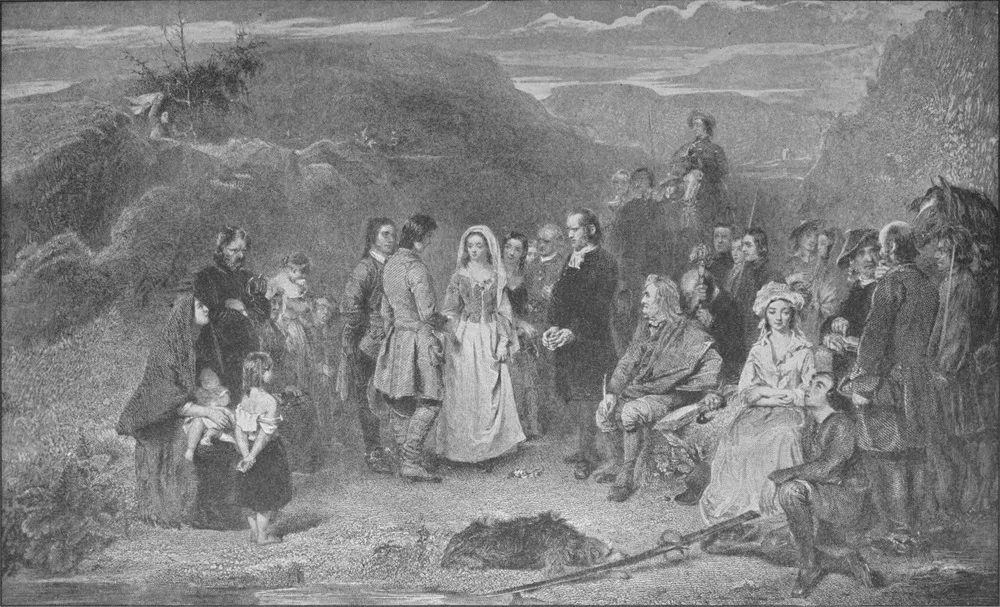
THE PEOPLE OF THE MOUNTAINS: SHOWING THE INFLUENCE OF
ENVIRONMENT ON CHARACTER
This picture, by Alexander Johnston, illustrates the
keynote of Professor Ratzel’s chapters on the influence of the earth on
character. Johnston represents a marriage among the Scottish Covenanters, who,
persecuted under the Stuarts, took to the moss-hags and the hills, of whose
stern ruggedness their own stern independence was the outcome and counterpart.
LARGER
IMAGE
Earth and the Movements of Peoples
All conditions and relations of peoples and states that may be
geographically described, delineated, surveyed, and, for the greater
part, even measured, can be traced back to movements—movements that
are peculiar to all forms of life, and of which the origin is growth
and development. However various these movements may be in other
respects, they are always connected with the soil, and thus must be
dependent upon the extent, situation, and conformation of the ground
upon which they take place. Therefore, in every organic movement we
may perceive the activity of the internal motive forces which are
peculiar to life, and the influences of the ground to which the life
is attached. In the movements of peoples, the internal forces are the
organic powers of motion common to all creatures, and the spiritual
impulses of the intellect and will of man.
In many a view of history these forces alone appear; but it must not
be forgotten that they are conditioned by the fact that they cannot be
active beyond the general limits of life, and they cannot disengage
themselves from the soil to which life is bound. In order to understand
historical movements it is first necessary to consider their purely
mechanical side, which is shown clearly enough by an inquiry into the
nature of the earth’s surface. Neglect of this occasions a delay in
the understanding of the true character of such movements. Men merely
spoke of geography, and treated history as if it were an atmospheric
phenomenon.
National Emigrations in History
Nations are movable bodies whose units are held together by a
common origin, language, customs, locality, and often necessity for
defence—the strongest tie of all. A people expands in one direction
and contracts in another; in case of two adjacent nations, a movement
in the one betokens a movement in the other. Active movements are
responded to by passive, and vice versa. Every movement in an area
filled with life consists in a displacement of individuals. There are
also currents and counter-currents: when slavery was abolished in the
Southern States of America, an emigration of white men from the South
was followed by an influx of ex-slaves from the North, thus causing an
increase in the black majority of the South.
Why Nations Must Seek New Homes
Such external movements of peoples assume most varied forms. History
takes a too narrow view in considering only the migrations of nations,
looking upon them as great and rare events, historical storms as it
were, exceptional in the monotonous quiet of the life of man. This
conception of historical movements is very similar to the discarded
cataclysmic theory in geology. In the history of nations, as in
the history of the earth, a great effect does not always involve a
presupposition of its being the immediate result of a mighty cause.
The constant action of small forces that finally results in a large
aggregate of effect must be taken into account in history as well as in
geology. Every external movement is preceded by internal disturbance:
a nation must grow from within in order to spread abroad. The increase
of Arabs in Oman led to an emigration to East Africa along highways of
traffic known to times of old. Merchants, craftsmen, adventurers, and
slaves left their native land and drew together in Zanzibar, Pemba,
and on the mainland. The process was repeated from the coast to the
interior, and as a result of the aggregate labour of individuals as
merchants, colonists, and missionaries, Arabian states grew up in
the central regions of Africa. Instances of the occupation of vacant
territories are of the greatest rarity in history as we are acquainted
with it. The best example known to us is the settlement of Iceland
by the Northmen. The rule is, a forcing in of the immigrating nation
between other races already in possession; the opposition of the latter
often compels the former to divide up into small groups, which then
insinuate themselves peacefully among the people already established in
the land.
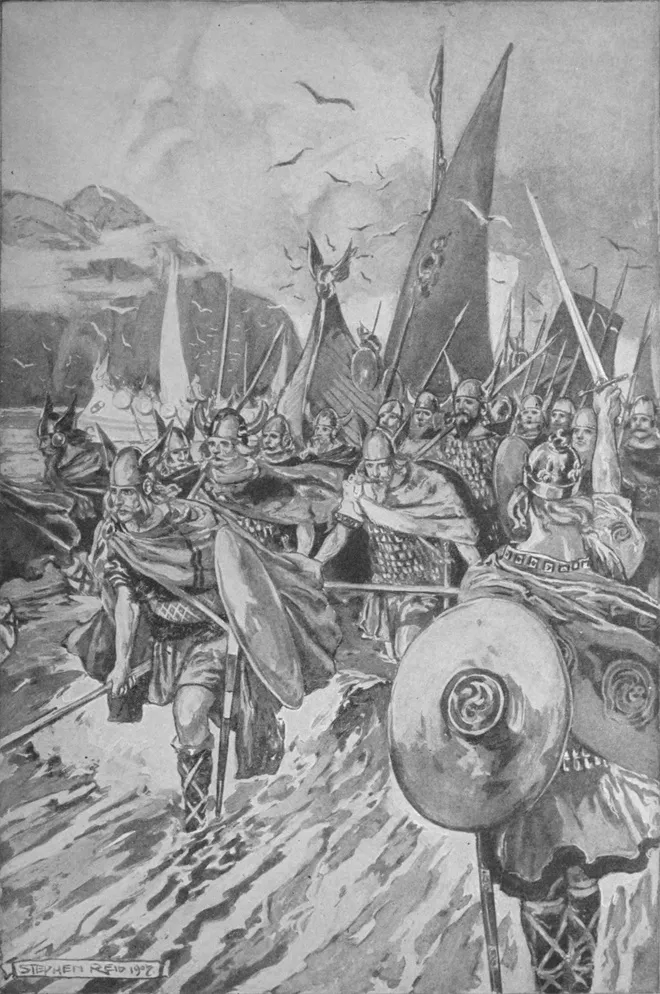
THE NORTHMEN TAKING POSSESSION OF ICELAND
Instances of peoples taking possession of uninhabited
lands and settling therein are extremely rare. Iceland is the best example known.
The hardy Northmen took possession of it in the ninth century, but found the
country untenanted.
LARGER
IMAGE
The Human Will Knows no Obstacle
The movements of nations resemble those of fluids upon the earth: they
proceed from higher altitudes to lower; and obstacles cause a change of
course, a backward flow, or a division. Though at first there may be a
series of streams running along side by side, there is a convergence
at the goal, as shown by the migration of different peoples to a
common territory; there is concentration when there are hindrances to
be overcome, and a spreading out where the ground is level and secure.
One race draws other races along with it; and, as a rule, a troop of
wanderers come from a long distance will be found to have absorbed
foreign elements on its way. But it would be wrong to look upon the
movements of nations as passive onflowings, or even to deduce a natural
law from the descent of tribes from the mountains to the river valleys
and to the sea—an idea that once led to the acceptance of the theory
of the Ethiopian origin of Egyptian civilisation. Either the wills
of individuals unite to form a collective will, or the will of a
single man imposes itself upon the aggregate. The human will knows no
insurmountable obstacle within the bounds of the habitable earth.
Bursting Nature’s Barriers
As time goes on, all rivers and all seas are navigated, all mountains
climbed, and all deserts traversed. But these have all acted as
obstructions before which movements have either halted or turned aside,
until finally they have burst the barriers. At least two thousand years
passed from the time of the first journey of a Phœnician ship out
through the Pillars of Hercules into the Atlantic until the arrival of
the day when a voyage across was ventured from Southern Europe. The
Romans turned at the Alps, both to the right and to the left, seven
hundred years after their city had been founded, but how many nooks in
the interior of those mountains were unknown to them even centuries
later! Yet to-day Europe feels the effect of this circumstance, the
fact that the Romans did not advance straight through the Central Alps
into the heart of the Teutonic country. They followed a roundabout way
through Gaul, and thus Mediterranean culture and Christianity were
brought to Central Europe from the west instead of from the south;
hence the dependence of the civilisation of Germany upon that of France.
It is precisely the Romans who, contrasted with barbarians, show us
that will or design in the movements of nations does not necessarily
increase with growth of culture, even though culture constantly
puts more means of action at its disposal, improved methods of
transportation, by which the way may be lightened. The mounted bands
of Celts and Germans crossed the Alps quite as easily as did the Roman
legions; and in spreading about and penetrating to every corner of
the Alps and the Pyrenees, the barbarians were always superior to the
Romans.
The Great Wanderers of the Earth
Wandering tribes of semi-civilised people are smaller, less
pretentious, and less encumbered. In every war that has taken place in
a mountain land, the greater mobility of untrained militia has often
led to victories over regular troops. Races of inferior culture are
invariably more mobile than those of a higher grade of civilisation;
and they are able to equalise the advantages of the superior modes of
locomotion with which culture has supplied the latter. Mobility also
indicates a weaker hold upon the ground, and thus uncivilised peoples
are more easily dislodged from their territories than are nations
capable of becoming, as it were, more deeply rooted. In nomadic races,
mobility bound up with the necessity for an extensive territory assumes
a definite form, and, owing to a constant preparedness for wandering
and to the possession of an organised marching system, such peoples
have been among the greatest forces in Old World history.
Movements of nations are often spoken of as if certain definite
directions were forced upon them by some mysterious power. This view
not only wraps itself in the garment of prophecy—for example, when
announcing that the direction in which the sun travels must also be
that of history—but it formally presupposes a necessary east-to-west
progression of historical movements, endeavouring to substantiate
its doctrine by citation of examples, from Julius Cæsar to the
gold-seekers of California. But this necessity remains always in
obscurity. Not only is it contradicted by frequently confirmed reflex
movements in historical times, but it is also disproved still more by
the great migrations which have taken place on the same continent in
contrary directions. In Asia the Chinese have spread over the entire
area of interior plain and desert, westward to the nation-dividing
barriers of the Pamir Mountains; other Asiatic races have overflowed
into Europe—also from east to west. Contrariwise, ever since the
sixteenth century we have seen the Russians at work conquering the
entire northern part of the continent, constantly pressing on towards
the east. Even the sea proved no obstacle, for they both discovered and
acquired Alaska during the course of this same movement.
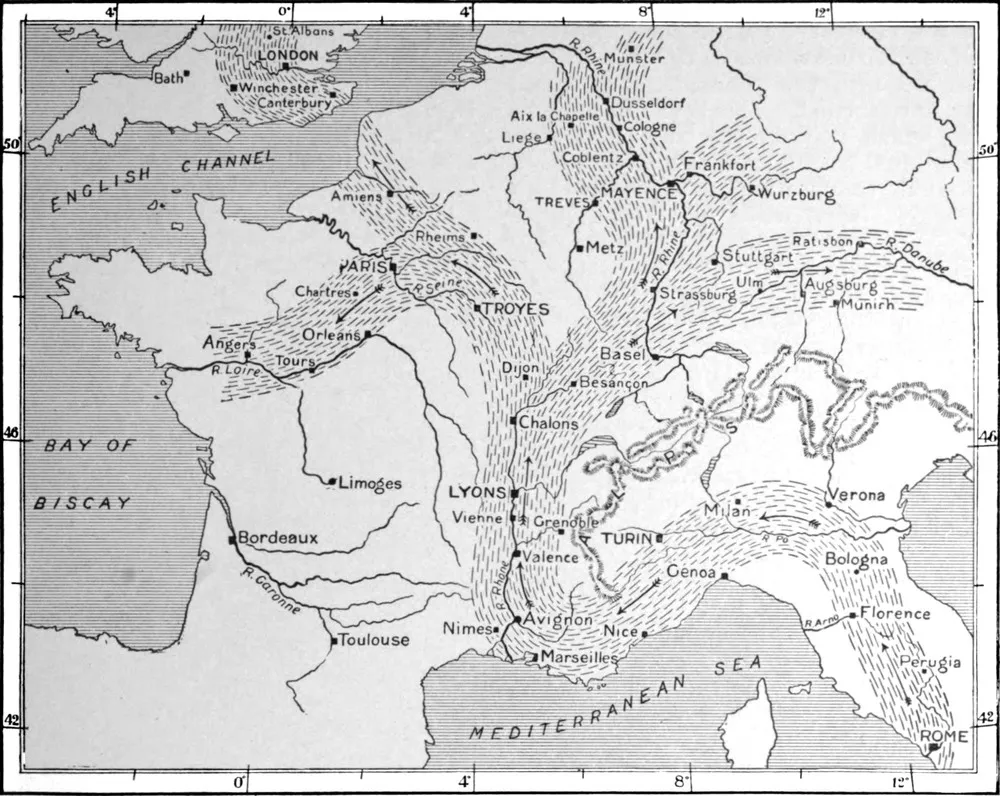
HOW CIVILISATION SPREAD THROUGH EUROPE
The inexorable influence of physical conditions on the
life of the peoples is well illustrated by the influence of the Alps in
deflecting the path of Mediterranean culture. These mountains hemmed in the
north of the Roman Empire and forced the Romans, in their expansion, to the
west. Hence Mediterranean culture and Christianity were carried to Central
Europe from the west instead of from the south, and the civilisation of Germany
depends on that of France. The map shows the route followed by the stream of
Roman civilisation.
We shall not attach any universal significance to such fashionable
terms employed in historical works as political or historical
attraction, elective affinity or balance; least of all shall we presume
to discover occult, mysterious sources for them. It is obvious that a
powerful nation will overflow in the direction of least resistance; and
in the case of a strong Power confronting one that is weak there is a
constant movement toward the latter. Thus, from the earliest times,
Egypt has pressed on toward the south; and everywhere in the Sudan
we find traces of similar movements to the south as far as Adamawa,
where they are still to-day in energetic continuance. The history of
colonisation in America shows a turning of the streams of immigration,
in the south as well as in the north, towards the more thinly settled
regions; the more thickly populated are avoided. The migrations of
nations, which took place during periods of history when a surplus of
unoccupied land existed, were determined to a great extent by natural
causes. The more numerous nations become, the greater the obstacles
to migration, for most of these obstacles arise from the very nations
themselves.
Nations increase with their populations; lands with enlargement of
territory. So long as a country has sufficient area, the second form
of growth need not of necessity follow the first—the race spreads
out over the gaps which are open in the interior, and thus internal
colonisation takes place. If there is need for emigration, occupiable
districts may be found in the lands of another people—for centuries
Germans have thus found accommodation in Austria, Hungary, Poland, and
America.
How New States are Born
Of course, such colonists gradually become absorbed into the people
among whom they have settled. This is simple emigration, which is
therefore connected with the internal colonisation of a foreign land.
External colonisation first comes into being when a state acquires
territory under its control, into which territory, if it be suitable, a
portion of the inhabitants of the state move and settle. Colonisation
is not necessarily a State affair from the first. If a race inhabit
a country so sparsely as the Indians did America in the sixteenth
century, a foreign people, having the power of spreading out, may press
into the gaps with such success that this initial internal colonisation
may also be advantageous from a political standpoint. The State then
intervenes and appropriates the territory over which groups of its
inhabitants have previously acquired economic control.
The emigrants formed a social aggregate in the new country, and from
this aggregate a state, or the germ of a state, develops. Since such
an economic-social preparatory growth greatly assists in the political
acquirement of land, it is obvious that this form of colonisation
is especially sound and effectual. The opposite method follows when
a state first conquers a territory which it occupies later with its
own forces; this is colonisation by conquest. It can be capable of
development only when subsequent immigration permanently acquires the
land as a dwelling-place.
Why Rome’s Empire Endured Long
Conquest that neither can nor will take permanent possession of the
soil is characteristic of a low stage of culture; thus the Zulu states
in Africa, surrounded by broad strips of conquered yet uncontrolled
territory, and the old “world-empires” of Western Asia, exhausted
themselves in vain efforts to obtain lasting increase of area through
aggressive expeditions. That the Roman Empire lasted a longer time than
any of the preceding universal empires was due to the single fact that
agricultural colonisation invariably followed in the footsteps of its
political conquests.
The enlargement of a nation’s area is associated with soil and
inhabitants. If the increase of territory—for example, through
conquest—is much more rapid than the increase of population, an
inorganic, loosely connected expansion results, which, as a rule,
is soon lost again. If, on the contrary, population increases at a
proportionately greater rate than area, a crowding together, checks to
internal movements, and over-population follow. In consequence, great
discrepancies between growth of territory and increase of population
lead to the most varied results. The conquering nation expands over
extensive regions for which there are no inhabitants. Passive races in
India and in China become so crowded together that it is impossible for
their soil to support them any longer; hence a continuous degradation
and recurrent periods of famine, which may bring with them a relatively
feeble and unorganised emigration.
The Modern Nations as Colonisers
There are nations with whom conquest and colonisation seem to follow
in most profitable alternation: this appears to have been the case
with all colonising countries of modern history that have followed the
example of the Roman Empire. But there are great contrasts presented
even by these nations. Germany, Austria, and Russia, in immediate
connection with their conquered provinces, have colonised and expanded
toward the east. In spite of a rapid increase of population, Germany
has been backward in establishing trans-marine colonies, while France,
with a proportionately smaller increase of population, began by
colonising in all directions, but occupied more land than she was able
to master; for which reason colonization in the history of France has
taken more or less the character of conquest. England, on the contrary,
with a vigorous emigration and an expansive movement in all directions,
presents an example of the soundest and strongest method of founding
colonies which has been seen since early times.
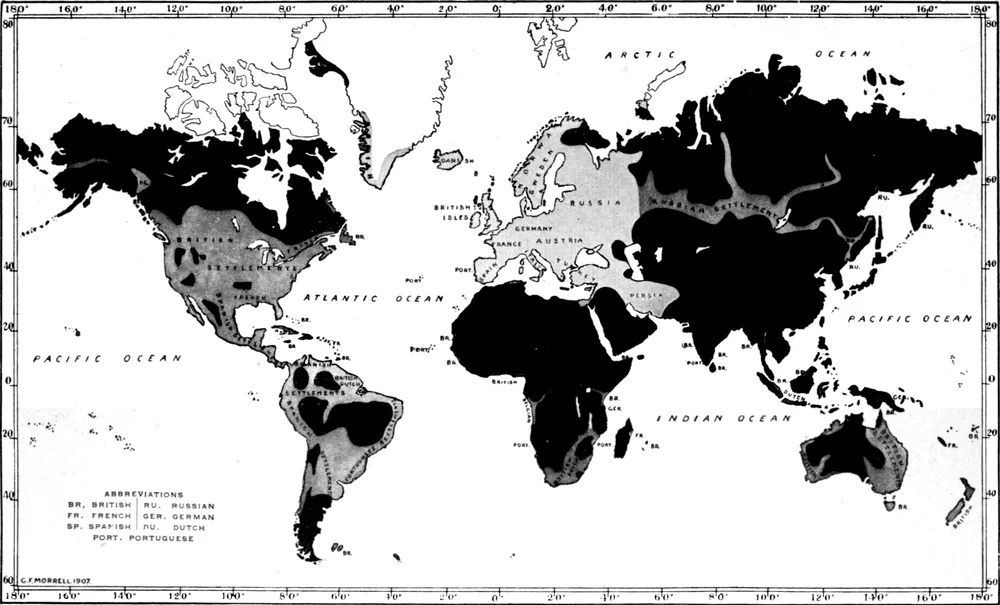
THE EXPANSION OF THE WHITE RACES THROUGHOUT THE WORLD
This map illustrates the extent to which the white races
have spread into other than their native lands. The pale tint, as on the British
Isles, indicates the native land of the whites; the darker tint shows where
whites have settled down; while the black portions represent those parts of the
earth where the coloured races predominate.
LARGER
IMAGE
Some New National Problems
Through the entire course of history an ever-increasing value attached
to land may be traced; and in the expansion of nations we may also
see that mere conquest is growing less and less frequent, while the
economic acquisition of territory, piece by piece, is becoming the
rule. The getting of land assumes more and more the character of a
peaceful insinuation. The taking possession of distant countries
without consideration for the original inhabitants, who are either
driven away, or murdered—speedily with the aid of bullets, or slowly
with the assistance of gin or contagious diseases or by being robbed of
their best land—is to-day no longer possible. Colonisation has become
a well-ordered administration combined with instruction of the natives
in useful employments. The old method has left scarcely a single
pure-blooded Indian east of the Mississippi in the United States, and
not one native in Tasmania; the new method has before it the problem
how to share the land with negroes—in the Transvaal with 74 per cent.
and in Natal with 82 per cent. Climatic conditions are also to be taken
into consideration, for Caucasians are able to develop all their powers
in temperate regions only; a hot climate impels them to ensure the
co-operation of black labour through coercion.
Mankind Ages with Civilisation
During the course of centuries a motley collection of countries has
developed, all of which are called colonies, although they stand in
most striking contrast with one another. Several are nations in embryo,
to which only the outward form of independence is lacking; not a few
have once been independent; and many give the impression that they will
never be fit for self-government. There are some in which the native
population has become entirely extinct, such as Tasmania, Cuba, and
San Domingo; others in which the original inhabitants, still keeping
to their old customs and institutions, are guided and exploited by a
few white men only; and, finally, colonies in which the rulers and the
natives have assimilated with one another, as in Siberia. Once upon
a time such tokens of the youth of races as may be seen in rude but
remunerative labour on unlimited territory were widespread in many
colonies. But the new countries fill up visibly, and even they show
that mankind, as a whole, ages the more rapidly the more the so-called
progress of civilisation is hastened. However, an examination of the
peoples of the present day shows that the differences in age between
mother-countries and colonies will, indeed, continue for a long time
yet. Such differences exist between west and east Germans as well as
between New Englanders and Californians; they are even to be detected
in Australia, between the inhabitants of Queensland and of New South
Wales. Such differences are shown not only in the characteristics of
individuals, but also in the division of land and in methods of labour.
Nations Hold fast to Nature
Divergence and differentiation are the great factors of organic
growth. They govern the increase of nations and states from their
very beginnings. Since, however, these organisms are composed of
independent units, differentiation does not consist in an amalgamation
and transformation of individuals, but in their diffusion and grouping.
Therefore the differentiation of nations becomes eminently an affair
of geography. Never yet has a daughter people left its mother-country
to become an independent state without a previous disjunction having
taken place. All growth is alteration in area, and, at the same time,
change in position. The further growth extends away from the original
situation, the sooner dismemberment follows. In Australia, New South
Wales spreads out towards the north, and at the new central point,
Brisbane, a new colony, Queensland, is formed, which already differs
materially from New South Wales. And Queensland itself expands towards
the north, beyond the tropic of Capricorn into the torrid zone; and a
younger, tropical North Queensland develops.
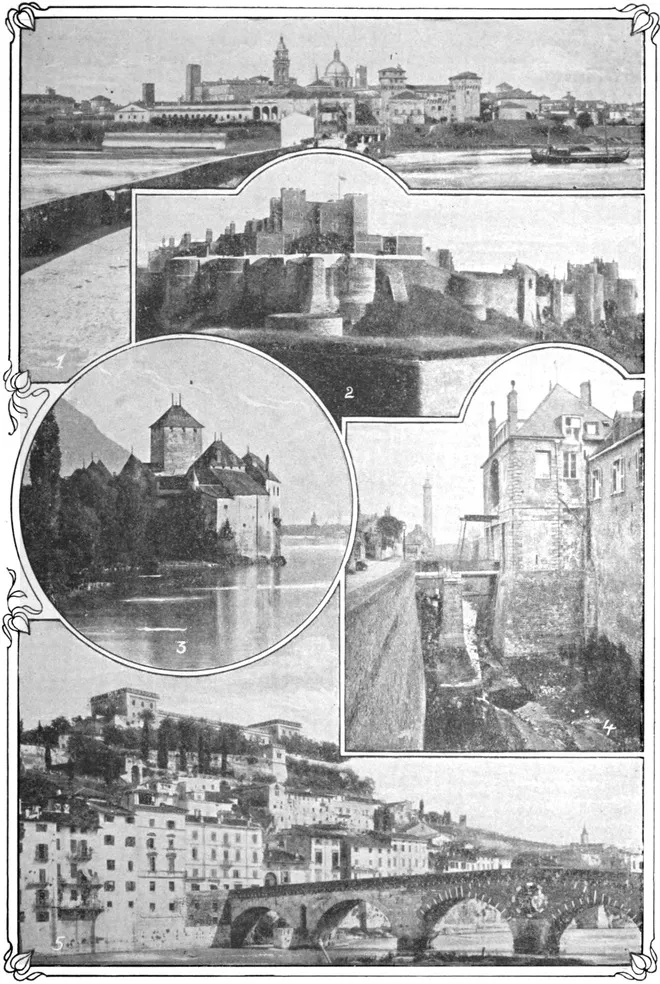
LANDMARKS OF PAST AGES: FAMOUS FORTRESSES THAT HAVE
CEASED TO BE OF USE
With the changing conditions of politics, places once of
enormous importance have often become mere curiosities. There are in Europe
to-day hundreds of useless castles, fortresses, and harbours. Even Dover Castle
is of little strategic value. The fortresses illustrated are (1) Mantua, (2)
Dover, (3) Chillon, (4) Calais, (5) Verona.
Photographs by Frith and Neurdein
LARGER
IMAGE
The Genius of the Coloniser
The fact that nations hold fast to their natural conditions of
existence, even when growth impels them towards expansion in various
directions, is a great controlling force in historical movement. Russia
expands in its northern zone to the Pacific ocean; England continues
its growth on American soil, across the Atlantic, in almost the same
latitude. The Phœnicians, as a coast-dwelling people, remained on
the coasts and on the islands; the colonising Greeks ever sought out
similar situations to those of their native land; the Netherlanders
are found everywhere in Northern Germany as colonists of the moors
and marshes. All German colonies beyond the Alps and the Vosges have
disappeared; and the few Germans that remain are Latinised. Nations
that are accustomed to a limited territory, as were the Greeks,
always search for a similar limited area; on the other hand, the
Romans discovered a main factor of empire-building in their judicious
agricultural colonisation of broad plains; and the Russians sought
and found in Siberia the endless forests, steppes, and vast rivers
of their native land. Every nation, in expanding, seeks to include
within its area that which is of the greatest value to it. The
victorious state acquires the best positions and drives the conquered
race into the poorest districts. For this reason competition between
the colonizing nations has become very keen; they all judge of the
character of territory according to the same standard. Therefore,
wherever England has colonised, only a gleaning remains for the rest of
the Northern and Central European Powers.
Differentiation, arising from the valuation of land, is the cause of
a constant creation of new political values and of a constant lapsing
of old. Every portion of the world has its political value, which,
however, may become dormant, and must then be either discovered or
awakened. Such a discovery was the selection of the Piræus as the
harbour for Athens from among a number of bights and bays.
The World is Being Centralised
Every settlement and every founding of a city is at bottom an awakening
of dormant political value. Capacity for recognizing this value is
a part of the genius of a statesman, whose policy may be called
far-seeing partly because he is able to discern the dormant value while
yet on the most distant horizon. It is obvious that political values
vary; each is determined by the point of view from which it is looked
upon. The French and the German valuations of the Rhine borderland
are very different. Every nation endeavours to realise the political
value which it recognises; and in respect to political growth, ends are
set up in the shape of the portions of the earth to which that growth
aspires. Peculiarities in the conformation of states may be traced
back to an appreciation of the value of coasts, passes, estuaries, and
the like. With the spreading out and the concentration of nations,
such portions of the world as are important from a political point of
view have marvellously increased both in number and in value. But for
this very reason a choice of selection has become necessary, and this
we see in the use of fewer Alpine passes during the age of railways
than before, and in the concentration of a great commerce into fewer
seaports—into such as are capable of accommodating vessels of the
deepest draught. Others must withdraw from competition. To-day there
are hundreds of worthless harbours, passes, and fortresses in Europe
that were once situated on the highways of historical movement; now
however, they are avoided, deserted by the current of traffic.
All the Rubbish of Civilisation
There are more things necessary to an understanding of the dependence
of history on natural conditions than a mere knowledge of the land
upon which the development has taken place, particularly than a mere
knowledge of the ground as it was when history found it. Although each
country is in itself an independent whole, it is at the same time
a link in a chain of actions. It is an organism in itself, and, in
respect to a succession or a group of lands forming a whole, of which
it is a member, it is also an organ. Sometimes it is more organism than
organ; sometimes the opposite is true; and an eternal struggle goes
on between organism and organ. If the latter be a subjected province,
a tributary state, a daughter country, a colony, or member of a
confederation, the striving for independence is always a struggle for
existence.
This by no means presupposes a state of war. Not only war, but the
outwardly peaceful economic development of the world’s industries
reduces organisms to organs. When the wholesale importation of bad but
cheap products of European industries into Polynesia or Central Asia
causes decay in the production of native arts and crafts, it is a loss
to the life of the whole people; henceforth the race will be placed
in the same category with tribes that must gather rubber, prepare
palm-oil, or hunt elephants to supply European demand, and who in
turn must purchase threadbare fabrics, spirits that contain sulphuric
acid, worn-out muskets, and old clothes—in a word, all the rubbish of
civilisation.
Their economic organisation dies; and in many cases this is also
the beginning of the decline and extinction of a people. The
weaker organism has succumbed to the more powerful. Is the case so
different—that of Athens, unable to live without the corn, wood, and
hemp of the lands on the Northern Mediterranean coast?—or of England,
whose inhabitants would starve were it not for the importation of meat
and grain from North America, Eastern Europe, and Australia?
In vain have men sought for characteristics in the rocks of the
earth and in the composition of the air by which one land might be
distinguished from another.
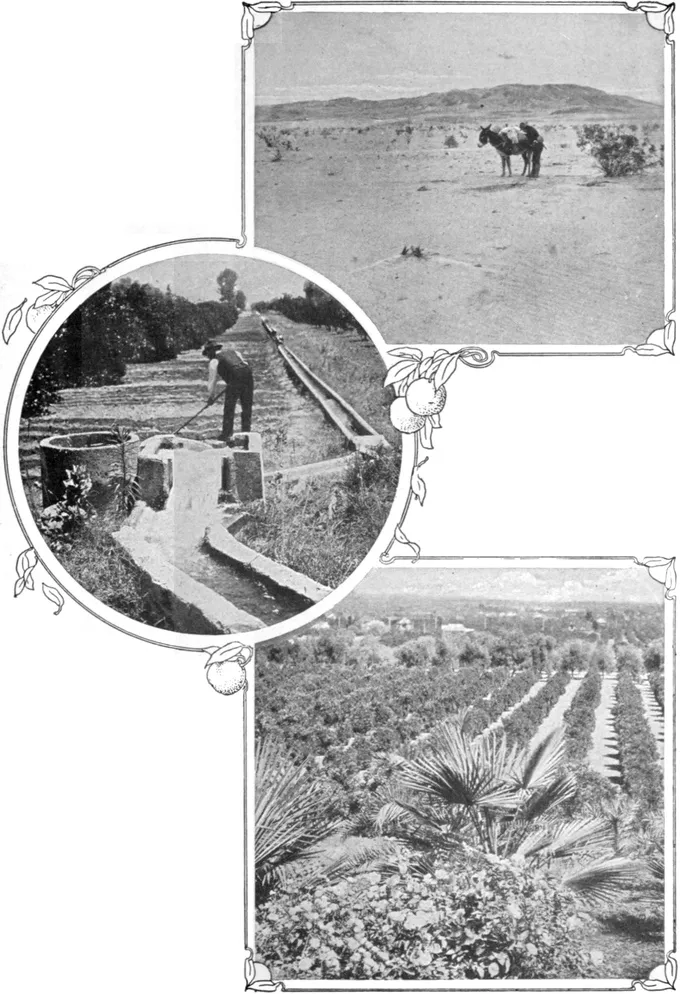
Underwood and Underwood.
MAN’S WONDERFUL TRIUMPH OVER NATURE
By irrigation the arid desert of California has been made
to blossom as the rose in the luxurious orange groves of Riverside. These views
show the desert, the method of irrigation, and the result of man’s labour.
LARGER
IMAGE
How Man is Levelling the Earth
The idea of great, lasting, conclusive qualitative variations in
different parts of the earth is mythical. Neither the Garden of Eden
nor the land of Eldorado belongs to reality. There is no country
whose soil bestows wondrous strength upon man or an exuberance of
fruitfulness upon woman. In India precious stones are as little apt
to grow out of the cliffs as silver and gold are likely to exude
from fissures in the earth. Nor is there any basis for the slighter
differences between the Old World and the New which the philosophers
of history of the eighteenth century believed they had discovered.
The opinion that the New World produces smaller plants, less powerful
animals, and finally a feebler humanity, was not unconditionally
rejected by even Alexander von Humboldt. The degeneration and wasting
away of the American Indians would certainly be a less disgraceful
phenomenon could it be attributed to some great natural law instead
of to the injustice, greed, and vices of the white men. In the
course of development of the European daughter-nations in America
we cannot recognise any such great and universal distinction. The
course of history in America, just as in corresponding periods of
time in Northern Asia, in Africa, and in Australia, only confirms the
belief that lands, no matter how distant from one another they may
be, whenever their climates are similar, are destined to be scenes of
analogous historical developments.
It is certain that, so far, one of the greatest results of the labour
of man has been the levelling and overcoming of natural differences.
Steppes are made fertile through irrigation and manuring; the
contrast between open and forest land becomes less and less—indeed
the destruction of forests is being far too rapidly and widely
carried out—the acclimatisation of men, animals, and plants causes
variations to disappear more and more as time passes. We can look
forward to a time when only such extremes as mountains and deserts will
remain—everywhere else the actions of the earth will be equalised. The
process by which this is carried out may be described shortly. Man, in
spite of all racial and national differences, is fundamentally quite as
much of a unity as the soil upon which he dwells; through his labour
more and more of this character of unity is transmitted to the earth,
which, as a result, also becomes more and more uniform.
History from Heaven to Earth
One of the most powerful of the ties by which history is bound to
Nature is that of its dependence on the ground. At the first glance
any given historical development is involved with the earth only—the
earth upon which the development takes place. But if we search deeper
we shall find that the roots of the development extend even to the
fundamental principles of the planetary system. By this it is not meant
that every history must be founded on a cosmological basis, that it
must begin with the creation, or, at least, with the destruction of
Troy, as was once thought necessary; but it is certainly safe to say
that a philosophy of the history of the human race, worthy of its name,
must begin with the heavens and then descend to the earth, filled with
the conviction that all existence is fundamentally one—an indivisible
conception founded from beginning to end on an identical law.
The 316,250,000 square miles of the earth’s surface is the first area
with which history has to do. Within it all other surface dimensions
are included; it is the standard for measurement of all other areas,
and also comprehends the absolute limits of all bodily life. This area
is fixed and immutable so far as the history of mankind is related to
it, although in respect to the history of the world it is not to be
looked upon as having been unalterable in the past, or as being likely
to remain unchanged in the future.
316,250,000 Miles of History
The earth’s surface may be divided into three unlike constituent
parts—84,250,000 square miles of land, 220,000,000 square miles of
water, and 13,750,000 square miles of ice-covered, and for the greater
part unexplored, land and sea in the Northern and Southern Polar
regions. The land is the natural home of man, and all his historical
movements begin and end upon it. The size of states is computed
according to the amount of land which they include; their growth has
derived its nourishment from the 84,250,000 square miles of earth as
from a widespread fundamental element. The sea is not to be looked upon
as an empty space between the divisions of land, merely separating them
one from another, for the 220,000,000 square miles of water are also of
historical importance, and the area of every ocean and of every portion
of an ocean has its historical significance. History has extended
itself over the sea, from island to island, from coast to coast, at
first crossing narrow bodies of water, later broad oceans; and states
whose foundations arose from connections by sea remain dependent on the
sea. The Mediterranean held together the different parts of the Roman
Empire just as the oceans unite the Colonies of the British Empire.
The variations of the earth’s form from that of a perfect oblate
spheroid are so small that they may be entirely disregarded from the
point of view of history. All portions of the earth’s surface may be
looked upon as of equal curvature; the pyriform swelling which Columbus
believed to be a peculiarity of the tropic zones in the New World was
merely an optical illusion. Thus all portions are practically similar,
and uniformity obtains over the entire earth to such an extent that
there is room left only for minor inequalities in configuration. To
these belong the differences in level between lands and seas, highlands
and lowlands, mountains and valleys. Such variations amount to very
little when compared with the earth as a whole; for the height of the
tallest of the Himalayas added to the earth’s radius would increase its
length by about 1⁄700 only; and the same may be said of the greatest
depressions beneath the level of the sea—inequalities that cannot be
represented on an ordinary globe. Their great historical significance
is due chiefly to the fact that the oceans and seas occupy the
depressions, from which the greatest elevations emerge as vast islands.
Irregular Surface of the Earth
The remaining irregularities of the earth’s surface are not sufficient
to produce any permanent variations in the diffusion of races or of
states. Their influence is merely negative; they may only hinder or
divert the course of man in his wanderings. Even the Himalayas have
been crossed—by the Aryans in the west, and by the Tibetans in the
east; and British India has extended its boundaries far beyond them to
the Pamirs. The historian is concerned with but two of the variable
qualities of the land—differences in level and differences in contour.
Variations in constitution, development, elementary constituents,
and the perpetual phenomena of transformation and dissolution which
present a thousand problems to the geographer, scarcely exist for the
historian. Nor are those great inequalities, the depressions in which
the seas rest, of any interest to him. It is indifferent whether the
greatest of such depressions be covered by five miles of water, or,
as we now know, by almost six miles. The fact that the Mediterranean
reaches its greatest depth in the eastern part of the Ionian Sea has
nothing whatever to do with the history of Greece.
Depths of The Sea
To be sure, there is a general connection between the depth of the
Mediterranean, shut up within the Straits of Gibraltar, and the
climate of the neighbouring regions, which has a direct influence on
the inhabitants of Mediterranean countries; but it is a very distant
connection, and it is only mentioned here in order to remind the reader
that there is not a single phenomenon in Nature that is not brought
home to mankind at last. Still, as a rule, history is concerned with
the depths of the sea only in so far as they are the resting-places for
submarine telegraph cables; and this is a fact of very recent times.
It may be said that the formation of the earth’s crust occurred at a
period too
remote to have had any influence on the history of man, and that
therefore all questions concerning it should be left to geology. The
first statement may be admitted, but the latter does not follow by
any means; for if the whole Mediterranean region from the Caucasus to
the Atlas Mountains, and from the Orontes to the Danube, is a region
of uniform conformation, it is purely by reason of a uniformity in
development. In the same manner there is an extensive region of uniform
conformation to the north, between the Atlantic Ocean and the Sudetic
Mountains in Austria.
Nature Divides and Unites
There are great features of the earth’s conformation that are so
extensive that groups of nations share them in common. Russia and
Siberia occupy the same plain upon which the greater portions of
Germany, Belgium, and Holland are situated. Germany and France share
the central mountain system which extends from the Cévennes to the
Sudeten, or Sudetic Mountains. A mere participation in a common
geological feature produces such affinity and relationship as may be
seen in the Alpine states, in Sweden and Norway, and in the nations
of the Andes. This reminds us of the groups of nations that surround
seas; but that which separates the Baltic states binds them together;
and the mountains that unite the Swiss cantons also separate them from
one another. Lesser features of conformation divide countries and often
exhibit gaps and breaches in development, for the reason that they
divide a political whole into separate natural regions. The history
of the lowlands of North Germany differs greatly from that of the
mountainous districts of the same country; the lowlands of the Po and
Apennine Italy are two different lands. The great contrast between the
hilly manufacturing west of England and the low-lying agricultural
east extends throughout English history; and in like manner the
highlands and the lowlands are opposed to each other in Scotland.
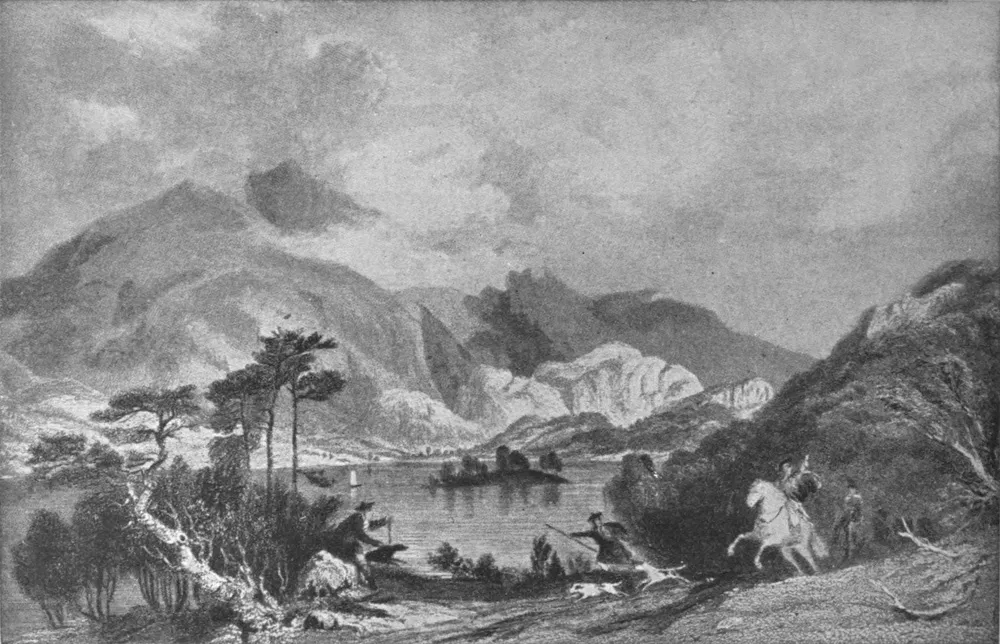
SCENERY THAT SHAPES CHARACTER: THE INFLUENCE OF THE
MOUNTAINS
The stories of mountain peoples are very similar; the
Highlanders of Scotland, Wales, Switzerland, the Cevennes, and Tyrol, have many
characteristics in common, owing their rugged nature and independence to
environment.
Wherever mountain formations occur largely in a country, the question
arises whether, in spite of all diversity, they unite to form a whole,
or whether they exist as separate, independent neighbouring parts.
The elements of the surface formation of the earth are not only
historically important in themselves as units, but also on account
of the way in which they are connected with one another. We have in
Greece an example of an exceedingly intricate mountain system in which
barren plateaus are interspersed with fertile valleys and bays. Owing
to the sea, such bays as those of Attica, Argos, and Lamia are to a
high degree self-dependent; they became little worlds in themselves,
independent states, which could never have grown into a united whole
had they not been subjected to external pressure.
The reverse of this state of disunion, arising from the juxtaposition
of a great number of different formations, is the division of
North America into the three great regions of the Alleghanies, the
Mississippi Valley, and the Rocky Mountain plateau, which gradually
merge into one another and are bound into a whole by the vast central
valley. Austria-Hungary includes within itself five different mountain
features—the Alps, Carpathians, Sudeten, the Adriatic provinces, and
the Pannonian plains. Vienna is situated where the Danube, March,
and Adria meet, and from this centre radiates all political unifying
power. If a still closer-knit unity is co-existent with a diversified
geological formation of insular or peninsular nature, as in Ireland or
Italy, it follows that this unity binds the orographic divisions into
an aggregate. The discrepancies between Apennine Italy, Italy of the
Po Valley, and Alpine Italy, which have been evident in all periods of
history, formed, in their rise and in their final state of subjugation
to political force, an example of dissimilarity of mountain features
existing within peninsular unity.
The great continental slopes are also important aids to the overcoming
of orographic obstacles to political unity. In Germany there is a
general inclination towards the north, crossed and recrossed by a
number of mountain chains and successions of valleys. It is not to
be denied that the intersecting elevations have furthered political
disunion. Without doubt, a gradual slope from the southern part of
Germany to the sea, with a consequent partition of the country by
the rivers into strips extending from east to west, would have been
attended by a greater political unity. Again, but in another way, the
preponderance of any one orographic element has a unifying effect on
all the other elements, as we have seen in North America, where the
simple, even course of development has been in conformity with the
existence of geological formations on a large scale.
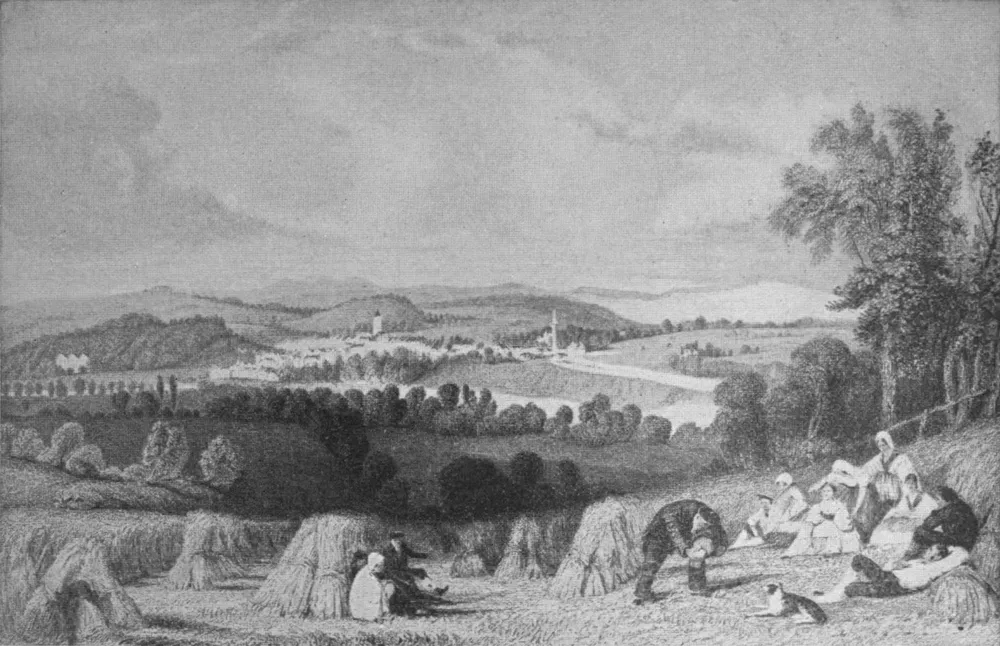
THE SOFTENING EFFECT OF THE RICH AND FRUITFUL LOWLANDS
Whereas mountains breed independence and rugged character
in their inhabitants, the more fruitful lowlands develop a gentler race, loving
the companionship of communities. The lowlands, also, are the homes of mixed
races.
There are internal differences in formation in every mountain range
and in every plain, all of which have different influences on history.
The steep fall of the Alps on the Italian side has rendered a descent
into the plains of the Po far easier than a crossing in the opposite
direction, where many obstacles in the shape of mountain steeps,
elevated plateaus, and deep river valleys surround the outer border
of the Alps. Again, penetration from the plains to the interior of
the Alps is less difficult in the west, where there are no southern
environing mountains, than in the east, where there is such a
surrounding mountain chain. The compact formation of the Alps in the
west crowds obstacles together into a small space, where they may be
overcome with greater labour and in a shorter time than in the east,
among the broadened-out chains of mountains, where there are numerous
smaller hindrances to progression spread out over a wider territory.
The route from Vienna to Trieste is twice as long as that from
Constance to Como.
In mountain passes orographic differences are concentrated within very
limited areas, and for this reason passes are of great importance in
history. The value of gorges and defiles increases with their rarity,
and their number varies greatly in different mountain chains. The
Pindus range is broken but once, by the cleft of Castoreia, and an easy
passage from Northern to Central Greece is possible only by way of
Thermopylæ; the short overland route from Persia to India is through
the Khyber or Bolan Passes. The Rhætian Alps are rich in defiles and
gorges; but the mountain ridges are poor in crossing-places, and, as a
rule, the elevation of the passes decreases towards the east.
Nature’s Place in History
The possibility of journeying over the Himalayas increases as we travel
westward. During the Seven Years’ War the great difference between
the accessible, sloping Erz-Gebirge of the Bohemian frontier and the
precipitous, fissured, sandstone hills of the Elbe was very apparent.
Mountain passes are always closely connected with valleys and rivers;
the latter form the ways leading to and from the former. The valleys
of the Reuss and the Tessin are the natural routes to the pass of St.
Gothard; and were it not for the gorges of the Inn and the Etsch in
the northern and the southern Alps, the Brenner Pass would not possess
anything like its present supreme importance. Wherever such entrances
to passes meet together or cross one another, important rallying-points
either for carrying on traffic or for warlike undertakings are formed;
such places are Valais, Valteline, and the upper valley of the Mur.
Coire is a meeting-point of not less than five passes—the Julier,
Septimer, Splügen, St. Bernardin, and Lukmanier. The value of passes
varies according to whether they cross a mountain range completely
from side to side, or extend through only a part of it. When the
Augsburgers, on the way to Venice, had got through the Fern Pass, or
that of Leefeld, the Brenner still remained to be crossed; but when the
Romans had surmounted the difficulties of Mont Genevre, the ridges of
the Alps were no longer before them; they were in Gaul.
There are also passes through cross ridges that connect mountain
chains, such as the Arlberg, that pierces a ridge extending between
the northern and the central Alps. Passes of this sort are of great
importance to life in the mountains, for, as a rule, they lead from one
longitudinal valley to another, such valleys extending between ridges
being the most fertile and protected districts in mountainous regions.
In this manner the Furka Pass connects Valais, the most prosperous
country of the Alps during the time of the Romans, with the upper Rhine
valley; and the Arlberg connects the Vorarlberg with the upper valley
of the Inn.
Value of Mountain Passes
Mountain passes are not only highways for traffic, they are the
arteries of the mountains themselves. Commerce along the mountain ways
leads to settlements and to agriculture at heights where they would
hardly have developed had it not been for the roads; and the highest
permanent dwellings are situated in and about passes. The Romans
established their military colonies in the neighbourhood of passes,
and the German emperors rendered the Rhætian gorges secure through
settlements. There are political territories that are practically
founded on mountain passes. The kingdom of Cottius, tributary to the
Romans, was the land of the defiles of the Cottian Alps; Uri may be
designated as the country of the north Gothard, and the Brenner Pass
connects the food-producing districts of the Tyrol with one another.
Battlefields of Mountain Borderlands
The transition point from one geological formation to another is
invariably the boundary line between two districts that have different
histories. The movements in one region bring forces to bear on the
movements in the other. Hence the remarkable phenomena which occur on
mountain borderlands. The historical effects of mountainous regions
are opposed by forces that thrust themselves in from without; external
powers anchor themselves, as it were, in the mountains, seeking to
obtain there both protection and frontier lines. Rome encroached more
and more upon the Alps, first from the south, and then from the west
and the north, by extending her provinces. Austria, Italy, Germany,
and France have drawn up to the Alps on different sides; they merely
fall back upon the mountains, however; their centres lie beyond. The
same phenomenon is shown in the regions occupied by different races.
Rhætians, Celts, Romans, Germans, and Slavs have penetrated into the
Alps; but the bulk of their populations have never inhabited the
mountainous districts. The question as to which nation shall possess
a mountain chain or pass is always decided on the borders. Here are
the battlefields; here, too, are the great centres of traffic whose
locations put one in mind of harbours situated at points where two
kinds of media of transmission come into contact with each other. This
margin, like that of the sea, also has its promontories and bays.
THE BANDIT’S WIFE
The effect of life in the hills is clearly seen in this
picture by Leopold Robert, who painted it after living among the “Brigands of
the Mountains” and studying their wild and picturesque life. The association
of peoples with mountains develops a rugged character and gives that strength
and independence which mountain races have displayed in history.
Height of land obstructs historical movements and lengthens their
course. The Romans remained at the foot of the Alps for two centuries
before they made their way into them, forced to it by the constant
invasion of Alpine robbers who descended from the heights as if
sallying forth from secure fortresses. Long before this the Romans
had encircled the western side of the Alps and had begun to turn the
eastern side. The colonies on the Atlantic coast of America, the
predecessors of the United States, had been in existence for almost
two hundred years before they passed the Alleghanies; and it is certain
that this damming up of the powerful movement towards the west, which
arose later, had a furthering influence on the economic and political
development of the young states. The passes of the Pyrenees occur at
about two-thirds of the distance from the level ground to the summits
of the mountains; in the Alps the elevation of the gorges is but
one-half or one-third that of the mountain tops; hence, as a whole, the
Alps are more easy of access than the Pyrenees. The Colorado plateau is
a greater obstacle than the Sierra Nevada range in California, which,
although of much greater elevation, slopes gently and is interspersed
with broad valleys. It was due rather to the forests than to the
moderate elevation of the central mountains of Germany that their
settlement was delayed until the twelfth and thirteenth centuries.
The influence of the broad, desert tableland of the great basin in
separating the western from the Mississippi states is greater than
that of the Rocky Mountains with peaks more than twelve thousand feet
in height. The extensive glacial formations and the sterility of the
mountains in Scandinavia have held Sweden and Norway asunder, and at
the same time have permitted the Lapps and their herds of reindeer to
force themselves in between like a wedge. The broad, elevated steppes
of Central Tien-schan enabled the Kirghese to cross the mountains with
their herds and to spread abroad in all directions.
Little Worlds on the Heights
Man in Touch with Nature
In such cases the natives of tablelands and mountainous regions,
who inhabit little worlds of their own on the heights, themselves
contribute not a little towards rendering it difficult to pass through
their countries. The most striking example of this is Central Asia
with its nomadic races, whose influence in separating the great
coast-nations of the east, west, and south from one another has been
far more potent than that of the land itself. And these nomads are a
direct product of the climate and the soil of this greatest plateau
in the world. The dry tablelands of North America, from the Sierra
Madre in Mexico to Atacama in the south, were in early times inhabited
by closely related races, having more or less similar institutions
and customs. A like effect of life on plateaus, shown in the Caucasus
Mountains, that have preserved their character as a barrier against
both Romans and Persians, and have been crossed by the Russians
only in recent times, points to a further reason for the sundering
influence of the wall-like position of mountains between the steppes
and the sea. Phenomena similar to those observed in Central Asia
and in North America occur on a smaller scale in every mountainous
country—extensive uninhabited tablelands in which man and free nature
come into direct contact with each other. Independent development
is thus assured to the dwellers on mountains, and to their states a
preponderance of territory over population. The political importance
of Switzerland is not owing to its three millions of inhabitants,
but to the impossibility of occupying one-fourth of the Alps. The
position—almost that of a Great Power—held by Switzerland during
the fifteenth and sixteenth centuries was due to the union of this
element of strength (and the fact that Switzerland, by reason of its
situation, includes many of the most important commercial routes in
Europe) with the mountain-bred spirit of liberty and independence of
its people. In other respects, too, mountain states stand pre-eminent
among nations—as Tyrol outshone all other Austrian provinces in 1809,
so the mountain tribes of the Caucasus were the only Asiatics able to
offer any permanent resistance to the advance of the Russians. The
broad, rough character of a highland country is an active force; in
all mountain wars it has led to the spreading out of armies and to the
lengthening of columns.
Mountains the Friends of Weak Nations
The support afforded by mountains to weak nations that without the
protection of a great uninhabited region would not have been able to
maintain their independence can be likened only to the protection
which, as we have seen, is given by the sea. Switzerland has often
been compared to the Low Countries; and there is even a still greater
resemblance between city cantons such as Basle and Geneva and ports
like Hamburg and Lübeck. It was owing to similar reasons that the
strongholds of French Protestantism during the sixteenth century
were the Cévennes, Berne, and La Rochelle. The protection given by
mountains must not be looked upon as of an entirely passive nature,
for the rugged nature of mountaineers, and their concentration within
small areas where a development is possible, rendering them conscious
of independence and assisting them to preserve it, are also a result
of life in the highlands. In low-lying countries difference in levels
cannot exceed a thousand feet; and, as the variations in conformation
are correspondingly small, the lowlands offer fewer hindrances to
historical movements than do rivers, seas, and marshes—thus there is
a greater opportunity for the development of such movements upon the
plains. Consequently there is a rapid diffusion of races over extensive
regions whose boundaries are determined by area rather than by
conformation.
Effect of Mountains on People
Lowlands hasten historical movements. There is no trace of the
retarding and protecting effects of the highlands in lands where,
as Labu said of Saxony, a nation dwells together with its enemies
on the same boundless level. Nomadism is the form of civilisation
characteristic of broad plains and extensive tablelands. But the
Germanic races of history, a great part of which were no longer
nomads, exhibited a hastening in their movement towards the west when
they reached the lowlands; for they appeared on the lower Rhine at
an earlier time than on the upper Rhine, delayed in their wanderings
towards the latter by the mountainous, broken routes. Long after the
Celts had disappeared from the lowlands, when their memory only was
preserved in the names of hills and rivers, they still continued to
exist in the protected mountain regions of Bohemia. In like manner, in
later times, the Slavs maintained themselves in natural strongholds
after they had vanished from the plains of Northern Germany. Compare
the conquest of Siberia, accomplished in a century, with the endless
struggles in the Caucasus. And what lowland country can show remnants
of people equivalent to those of the Caucasus?
The Natural Strongholds of Nomad Races
The lowlands are also regions of the most extensive mingling of races.
We have but to think of Siberia or the Sudan. In the development of
states, lowlands take precedence over mountainous district. Rome
expanded from the sea-coast to the Apennines, and from the valley of
the Po to the Alps; the conquest of Iberia began in the one great
plain of the peninsula, in Andalusia, and in the lowlands of the Ebro;
and foreign control of Britain ended at the mountains of Scotland and
Wales. In North America colonisation spread out in broad belts at
the foot of the Alleghanies before it penetrated into the mountains.
In Southern China the mountains with their unsubdued tribes are like
political islands in the midst of the Mongolised hills and plains.
The lesser the differences in level, and the smaller the conformations
of the earth, the more important are those differences that remain
within heights of less than a thousand feet above the sea. Elevations
of a dozen yards were of the greatest importance on the battlefields
of Leipzig, Waterloo, and Metz. The significance of the little rise in
the land of Gavre, near Ghent, lies in the fact that even at times of
flood a foundation for a bridge will remain firm upon it. The slightest
elevation in the lowland cities of Germany and Russia offers such a
contrast in altitude to its surroundings that a fortress, a cathedral,
or a kremlin is erected upon it. The two ridges that extend through the
plains of North Germany are not only very prominent in the landscape,
but also in history. Owing to their thick forests, their lakes and
marshes, and small populations, they are peculiarly like barriers; and
the breaches in them are of importance to the geography both of war and
of commerce. The battles fought against Sweden and Poland, round about
the points where the Oder and the Vistula cross these regions, are to
be counted among the most decisive struggles in the history of Prussia.
Nature at Waterloo
Wherever there are no differences in level, a substitute is sought in
water. In such cases wide rivers or numerous lakes and marshes form
the most effective obstacles, boundaries, and strongholds. Finally
the plains approach the sea and are submerged by it; and here lowland
countries find a support safer than that of the mountains, and richer
in political results. North Germany is supported by the sea; South
Germany by mountains. Which boundary is the more definite, the more
capable of development, politically and economically? Political
superiority is ever connected with the protection and support of the
sea.
The influences of vegetation upon historical movements are often more
important than those of the earth-formation itself. Wherever extensive
lowland regions are overgrown with grass, we always find mobile nomadic
races that, with their large herds and warlike organisations, are
great causes of disturbance in the development of neighbouring lands.
Since the form of vegetable growth which covers grass steppes and
prairies is dependent on climate, it follows that nomadism is prevalent
throughout the entire northern sub-temperate zone, where such grass is
abundant—from the western border of Sahara to Gobi. Nomadic races of
historical significance are even to be seen in the New World—for
example, the Gauchos of the Pampas, and the Llaneros of Venezuela.
THE GREATEST PLATEAU IN THE WORLD: ITS PEOPLE, AND ITS
INFLUENCE IN HISTORY
This is a typical scene of life in Central Asia, the
greatest plateau in the world, whose people, the direct product of the climate
and the soil, inhabiting little worlds of their own on the heights, have
exercised an enormous influence in separating the great coast nations of the
east, west, and south from one another.
LARGER
IMAGE
A MOUNTAIN PASS: A NATURAL FACTOR OF VAST IMPORTANCE IN
HISTORY
Mountain passes have been of great importance in history.
The Romans established their military colonies in the neighbourhood of passes,
and there are political territories practically founded on mountain passes. This
is a picture of an entrance to the famous Bolan Pass, through which, and through
the Khyber Pass, lie the shortest overland routes from Persia to India.
LARGER
IMAGE
NOMADIC PEOPLES OF THE NEW WORLD
Wherever there are vast lowland countries covered with
grass, nomadic peoples are found moving from place to place with their herds.
There are many such peoples in the Old World and a few in the New World,
notable among the latter being the Gauchos of the Pampas, types of whom are
here seen.
In comparison with plains and prairies, forests are decided hindrances
to historical movements. Peoples are separated from one another by
strips of woodland; the state and the civilisation of the Incas ceased
at the fringe of primeval forest of the east Andes. Thickly-wooded
mountains present the most pronounced difficulties to historical
movements. The appearance of the oldest large states and centres of
culture on the borders of steppes, in the naturally thinly-wooded
districts at the mouths of rivers, and on diluvial plains, seems
natural enough to us when we think of the difficulties presented by
life in a forest glade to men who had only stone implements and fire at
their command.
A description of the difficulties encountered during Stanley’s one
hundred and fifty-seven days’ journey through the primeval woods of
Central Africa gives us a very clear conception of what are termed
“hindrances” to historical movements. The early history of Sweden has
been characterised as a struggle with the forest; and this description
is valid for every forest country. The forest divides nations from each
other; it allows only small tribes to unite, and creates but small
states, or, at the most, loosely bound confederations. It is only where
a great river system forms natural roads, as in the regions of the
Amazon and the Congo, that great forest districts may be rapidly united
to form a state. In other cases settlements in forest clearings and
road-breaking precede political control.
In this way the Chinese conquered the races of the western half of
Formosa in two hundred years; in the eastern half the land is still
under forest and the natives have also retained their independence.
The existence of small states, with their many obstacles to political
and economic growth, still continues in forest regions alone; and the
roaming hordes of hunters inhabiting them belong to the simplest forms
of human societies.
THE MAKING OF THE NATIONS—II
Professor FREDERICK RATZEL
S
SINCE
man is a creature capable only of life on land, bodies of water
must at one time have been the greatest obstacles to his diffusion.
Thus the original family of human beings could have inhabited only one
portion of the earth, to which it was restricted by impassable barriers
of water. We know that in early geological times the division of the
earth’s surface into land and water was subject to the same general
laws as to-day; therefore such a portion of the earth could not have
been more than a part of the total land in existence—a larger or
smaller world-island.
Early Man’s Greatest Invention
The first step beyond the bounds of this island was the first step
towards the conquest of the whole earth by man. The first raft was
therefore the most important contrivance that man could have invented.
It not only signified the beginning of the acquisition of all parts of
the earth to their very farthest limits, but also—and this is far more
important—the potentiality for all possibilities of divergence and
temporary separation offered by our planet. It brought with it escape
from the development that always turns back upon itself, travelling in
a circle, and the progress that constantly consumes itself—factors
inseparable from life confined within a small area; it led to the
creation of fruitful contrasts and differences, and to wholesome
competition—in short, to the beginning of the evolution of races and
peoples. Looked at from this point of view, even the discovery of
Prometheus has been of less moment to the progress of mankind than that
of the inventor who first joined logs together into a raft and set out
on a voyage of discovery to the nearest islet.
Why the Sea is Important
From the time of this first step onward, the development of the human
race was so intimately connected with the uninhabitable water that
one of its most powerful incentives lay in the struggle with the sea.
And so little have we advanced from this condition that the stoutest
race of the present day is one that from a narrow island commands the
ocean. England’s strength is a proof of the tremendous importance of
the sea as a factor of political power and of civilisation. But not
to exaggerate the significance of the ocean, we may at the same time
remember that it consists in the fact that, by means of the sea, open
highways are presented from land to land. Command of the sea is a
source of greatness to nations, for it facilitates dominion over the
land.
By reason of its consistency the water is an important agent of
levelling and equalising effects. As we perceive this in Nature, so
do we also in history. A race familiar with the sea in one place is
familiar with it in all regions. The Normans off the coast of Finland,
and the Spaniards in the Pacific, found the same green, surging
element, moved by the same tides, subject to the same laws. The ocean
has an equalising effect upon the coasts even; the dunes of Agadir and
of the harbour at Vera Cruz awaken memories of home in the mind of the
sailor from Hela. The diffusion of the sea over three-quarters of the
earth’s surface must also be taken into account. Thus the influence
of the ocean in rendering men familiar with different parts of the
world is far greater than that of the land. From the ocean comes a
constant unifying influence which ever tends to reduce the disuniting
effect of the separation of land from land. As yet no attempt to extend
boundaries beyond the land out over the sea has been followed by
lasting success.
No Nation can Possess the Sea
The Sea’s Unifying Influence
No nation can or ever will possess the sea. Carthage and Tarentum
wished to forbid Italian vessels the passage of the Lacinian capes by
treaty; the Venetians desired dominion over the Adriatic to be granted
them by the Pope; Denmark and Sweden strove for a dominion over the
Baltic Sea; but all this is against the very nature of the sea; it is
one and indivisible. Only near by the coast, within the three-mile
limit of international law, and in landlocked bays, may it be ruled as
land is ruled. The claims of the Americans concerning the sovereignty
of Behring Sea have never been recognised, and England can retain
dominion over the Irish Sea only by means of her naval power. The ocean
has a unifying influence on the land, even when this influence consists
only in the same ends to be attained being placed before different
nations. During a time of the greatest disunion, German cities that lay
far enough from one another were united by Baltic interests. The union
of scattered land-forces prepared the way for the opening up of wider
horizons to England in the sixteenth century in the same manner as for
Italy and Germany in the nineteenth.
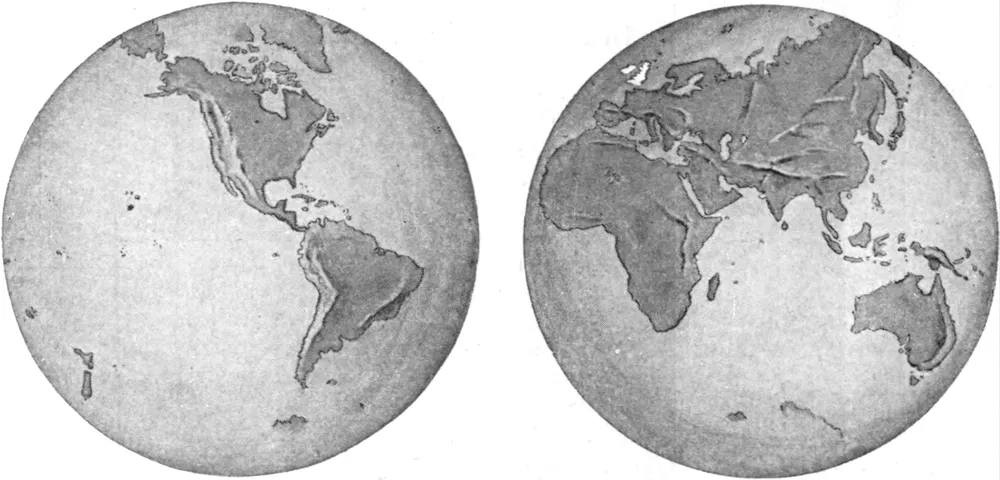
THE LITTLE ISLAND THAT RULES THE SEA
The command of the sea is the source of national greatness, as it
facilitates dominion over land. England from a narrow island dominates the sea.
The tiny part of white in the Eastern Hemisphere on this page shows how relatively
insignificant Great Britain is to the vast world of waters where her shipping is
supreme.
Sea power is far more closely connected with traffic than is land
power; in fact, the foundation of sea power is trade and commerce. It
is, however, more than mere commercial power and monopoly of trade.
In spite of all egoism, greed, and violence there remains one great
characteristic peculiar to maritime Powers, spared even by Punic faith
and Venetian covetousness. Even the neighbourhood of the ocean is
characterised by its vast natural features; rivers broaden as they
approach the sea, great bays lie within the coasts, and, though the
latter may be flat, the horizon lines of their low dune landscapes are
broad. The horizons of maritime races are also broad. Whether it be the
hope of profit from commerce or of gain from piracy that lures men
forth, many a ship has returned to port bearing with it inestimable
benefits to mankind; for the greatest maritime discoveries have not
been mere explorations of new seas, but of new lands and peoples. Such
discoveries as these have contributed most to the broadening of the
historical horizon. Even political questions expand, assume a larger
character, and often become less acute, when they emerge from the
narrow limits of continental constraint upon the free and open coasts.
This is true even of the Eastern Question, to the solution of which
definite steps were taken upon the Mediterranean when it seemed to have
come to a deadlock in the Balkan peninsula.
Short-lived Nations of the Sea
The Fall of Maritime Nations
The ocean is no passive element to maritime races. By deriving power
from the sea they become subject to the sea. The more strength they
draw from the ocean, the less firm becomes their footing upon the
land. Finally, their power no longer remains rooted in the land,
but grows to resemble that of a fleet resting upon the waves; it
may with but small expenditure of effort extend its influence over
an enormously wide area, but it may also be swept away by the first
storm. As yet all maritime nations have been short-lived; their rise
has been swift, often surprisingly so; but they have never remained
long at the zenith of prosperity, and, as a rule, their decay has been
as rapid as their elevation to power. The cause of the fall of all
maritime nations has been the smallness of their basis, their foreign
possessions, widely separated from one another and difficult to defend,
and their dependence upon these foreign possessions. In many cases
the over-balancing of political by economic interests, the neglect
of materials for defence, and effeminacy resulting from commercial
prosperity, have also contributed to their destruction.
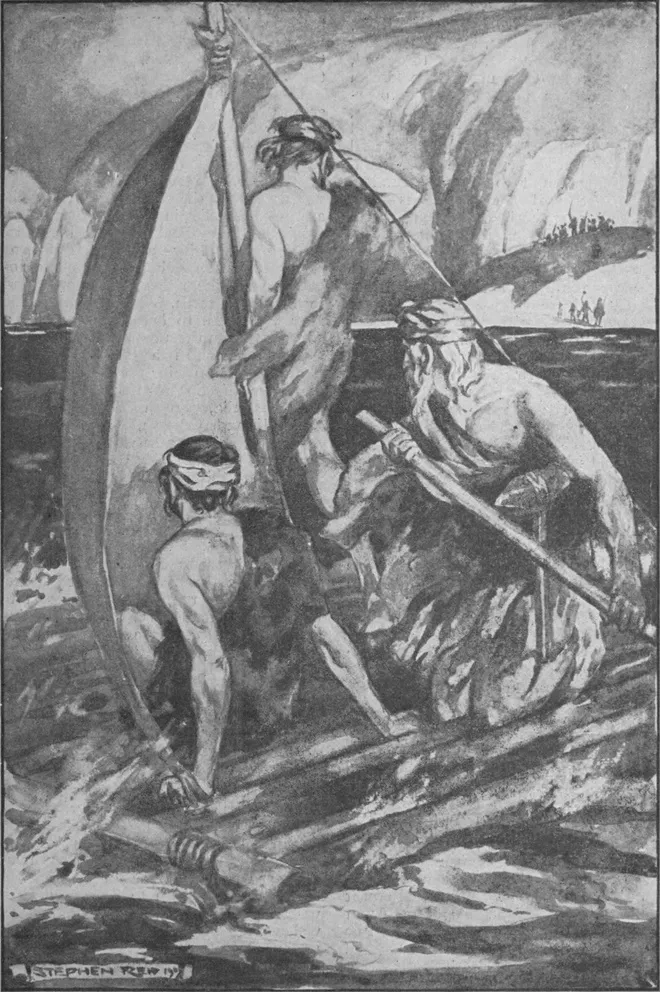
MAN’S FIRST STEP TOWARDS THE CONQUEST OF THE EARTH
The most momentous event in the early history of man was
the launching of the first raft. That moment was instinct with all the mighty
conquests and discoveries yet to be accomplished over seas; and even the
discovery of fire, says Professor Ratzel, has been of less moment to the progress
of mankind than that of the inventor who first joined logs together into a raft
and set out on a voyage of discovery to the nearest islet.
LARGER
IMAGE
Special combinations of characteristics arising from the geographical
positions of oceans, continents, and islands are connected with the
broad features common to oceanic continuity. These characteristics
are reflected from the sea back to the land, and there give rise to
historical groups. The historical significance of such groups is
expressed in their names even—Mediterranean World, Baltic Nations,
Atlantic Powers, and Pacific Sphere of Civilisation. They are
primarily the results of commerce and exchange, and of the furthering,
correlating influences of all coasts and islands. When they united all
peninsulas, islands, and coasts of the Mediterranean into one state the
Romans merely set a political crown upon the civilised community that
had developed round about, and by means of, this sea.
Uniqueness of the Mediterranean
And if we wish rightly to estimate the significance of Roman expansion
from a Central European point of view, we may express our conception
very shortly—the diffusion of Mediterranean culture over Western and
Central Europe. It was at the same time a widening of the horizon of a
landlocked sea to that of the open ocean. The Atlantic Ocean succeeded
to the Mediterranean Sea. The Americans and the Russians, and the
Japanese, repeating their words, maintain that in the same manner the
Pacific must succeed to the Atlantic; but they forget the peculiar
features of the Mediterranean, especially its conditions of area. It is
no more probable that such a compact, isolated development will occur
again than that the history of Athens will repeat itself on the Korean
peninsula or at Shantung. The greater the ocean, the farther is it
removed from the isolated sea. It was not the Atlantic that succeeded
to the Mediterranean, but the broad world-ocean that succeeded to the
narrow basin called the Mediterranean Sea. There have always been
differences between the various divisions of the main sea; and these
variations will ever continue to be prominent, although constantly
tending to become less and less so.
The vast Potentialities of the Pacific
The Pacific will always remain by far the greatest ocean, including,
as it does, forty-five per cent. of the total area of water. Owing to
its great breadth, the Pacific routes are from three to four times as
long as those of the Atlantic. The Pacific widens toward the south;
and Australia and Oceania lie in the opening, thus furnishing the
Pacific with its most striking peculiarity—a third continent situated
in the Southern Hemisphere, together with the richest series of island
formations on earth. Whatever the Pacific may contribute to history,
it will be a contribution to the annals of the Southern Hemisphere;
and if a great independent history develop in the antipodes, it will
have the Southern Pacific, bounded by Australia, South America, New
Zealand, and Oceania, for its sphere of action. The area of the
Atlantic Ocean is but half that of the Pacific. Nor is it for this
reason alone that in comparison with the latter it is an inland rather
than a world sea; for, owing to its narrowness between the Old and the
New Worlds, the branches it puts forth, and the islands and peninsulas
that it touches, it shortens the routes from one coast to the other.
In it there is more of a merging of land and sea than a separation;
and to-day it is chiefly a European-American ocean. The Indian Ocean
is both geographically and historically but half an ocean. Even though
important parts of it may be situated north of the equator, it is too
much enclosed to the north; it widens to the south, and thus belongs to
the Southern Hemisphere.
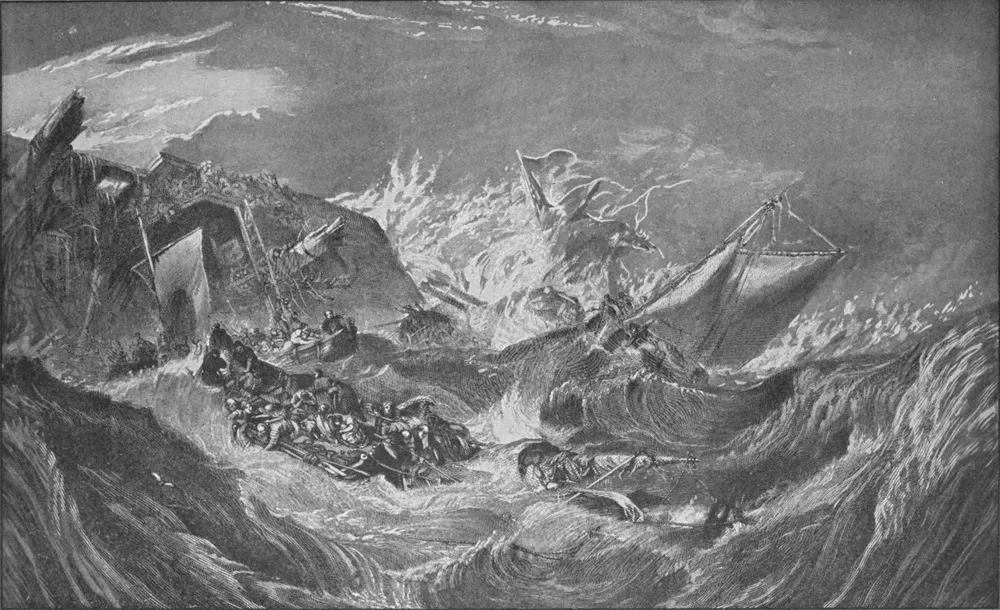
A STORM SUCH AS MAY SWEEP AWAY A NATION’S POWER
All maritime nations, says Professor Ratzel, have been
short-lived. The more strength they draw from the ocean the less firm becomes
their footing upon the land, and their power grows to resemble that of a fleet
resting upon the waves; it may extend its influence over an enormous area, but
it may also be swept away by a single storm.
LARGER
IMAGE
The Coast the Threshold of the Land
The great oceans open up broad areas for historical movements, and
through their instrumentality peoples are enabled to spread from
coast to coast in all directions; the inland seas, on the contrary,
cause the political life of the nations bordering upon them to be
concentrated within a limited area. The Mediterranean will ever remain
a focus towards which the interests of almost all European Powers
concentrate. It has, moreover, become one of the world’s highways
since the completion of the Suez Canal. The Baltic somewhat resembles
the Mediterranean; but it would be saying too much to look upon its
position as other than subordinate to that of the greater sea. The area
of the Baltic is but one-seventh that of the Mediterranean; and it is
lacking in the unique intercontinental situation of the latter. In many
respects it resembles the Black Sea rather than the Mediterranean,
especially by reason of its eastern relations.
Originally the coast was the threshold of the sea; but as soon as
maritime races developed it became the threshold of the land. In
addition it is a margin, a fringe in which the peculiarities of sea
and land are combined; and for this very reason sea-coasts have a
historical value greatly disproportionate to their area, especially as
they constitute the best of all boundaries for the nations that possess
them. Here harbours are situated, fortresses, and the most densely
populated of cities. Owing to their close connection with the sea, the
inhabitants of coasts acquire characteristics which distinguish them
from all other peoples. Even if of the same nationality as their inland
neighbours—as, for example, the Greeks of Thrace and of Asia Minor and
the Malays of many of the East Indian islands—their foreign traffic
nevertheless impresses certain traits and features upon them which in
the case of the Low Countries led almost to political disruption.
Living and Dead Coasts
A coast is more favoured than an interior in all things relating to
commerce and traffic; yet neither may enjoy permanent life alone
without the other. The French departments of the Weser and of the Elbe
were among the most ephemeral of the political results achieved by the
short-lived Napoleonic era. With the sea at their backs it is easy for
the inhabitants of a coast to become detached from their nation, and
but a simple matter for them to spread over other coasts. Ever since
the time of the Phœnicians there have been numerous colonists of coasts
and founders of coast states. The Normans are most typical in European
history. The expansion of coast colonies towards the interior is one
of the most striking features of recent African development. Thus
coasts are to be looked at from within as well as from without. To many
races—such as Hottentots and Australians—the coast is dead compared
with the interior; for Germany the coast has been politically dead for
centuries. A river-mouth is best suited to carrying the influences of
the coast inland.
All ancient historians supposed that the Mediterranean Sea, with
its many bays, peninsulas, and islands, schooled the Phœnicians in
seamanship. This, however, is not so. Nautical skill is transmitted
from one people to another, as may be seen from some of the most
obvious cases in modern history. No maritime people has become great
through its own coast alone. It is not the coast of Maine, with its
numerous inlets and bays, that has produced the best seamen, but the
coast of Massachusetts, naturally unfavourable for the most part;
and it has produced the best seamen for the reason that the inland
districts bounded by it are far more productive and furthering to
commerce than are the interior regions of Maine.
The Place of the Coast in History
Nature has forced races to take to the sea only in such countries as
Norway and Greece, where the strips of coast are narrow and the inland
territory poor. In order to have political influence it is sufficient
to have one foot on the sea-coast. Aigues-Mortes, with its swampy
environment, was sufficient to extend France to the Mediterranean
during the reign of St. Louis; Fiume sufficed for Hungary. Forbidding
desert coasts have had a peculiarly retarding effect on historical
development. It was necessary to rediscover the Australian mainland,
to touch at more favourable points, one hundred and thirty years after
the time of Tasman; thus the history of the settlement of Australia by
Europeans originated, not with him, but with Cook.
As portions of the general water area, rivers are branches or runners
of the sea, extending into the land—lymphatic vessels, as it were,
bearing nourishment to the ocean from the higher regions of the
earth. Therefore they form the natural routes followed by historical
movements from the sea inland and vice versa. A solid foundation of
truth underlies those rivers of legendary geography that joined one
sea with another. The connection of the Baltic and the Black Sea via
Kieff is not that described by Adam of Bremen; but Russian canals have
established a water-way, following out the plan indicated by Nature,
just as the Varangians also realised it in a ruder way by dragging
their boats from the Dwina to the Dnieper. By uniting the Great Lakes
to the Mississippi by means of the Illinois River, the French provided
a waterway from the North Atlantic Ocean to the Gulf of Mexico, a line
of power in the rear of the Atlantic colonies. The latter fell back on
salt water, the former on fresh. The Nile, flowing parallel to the Red
Sea from Tanasee in the Abyssinian highlands, shares with the Red Sea
even to-day in the traffic between Eastern and East-central Africa. The
railway from Mombasa to Uganda completes a western Mediterranean-Indian
line of connection, as a road along the Euphrates to the Persian Gulf
would an eastern, each following the direction of rivers running
parallel to the Red Sea. We can clearly see the transition of the
functions of oceans to fresh, shallow water, to sounds and lagoons, in
which sea traffic is furnished with smoother, quieter routes under the
shelter of the coasts.
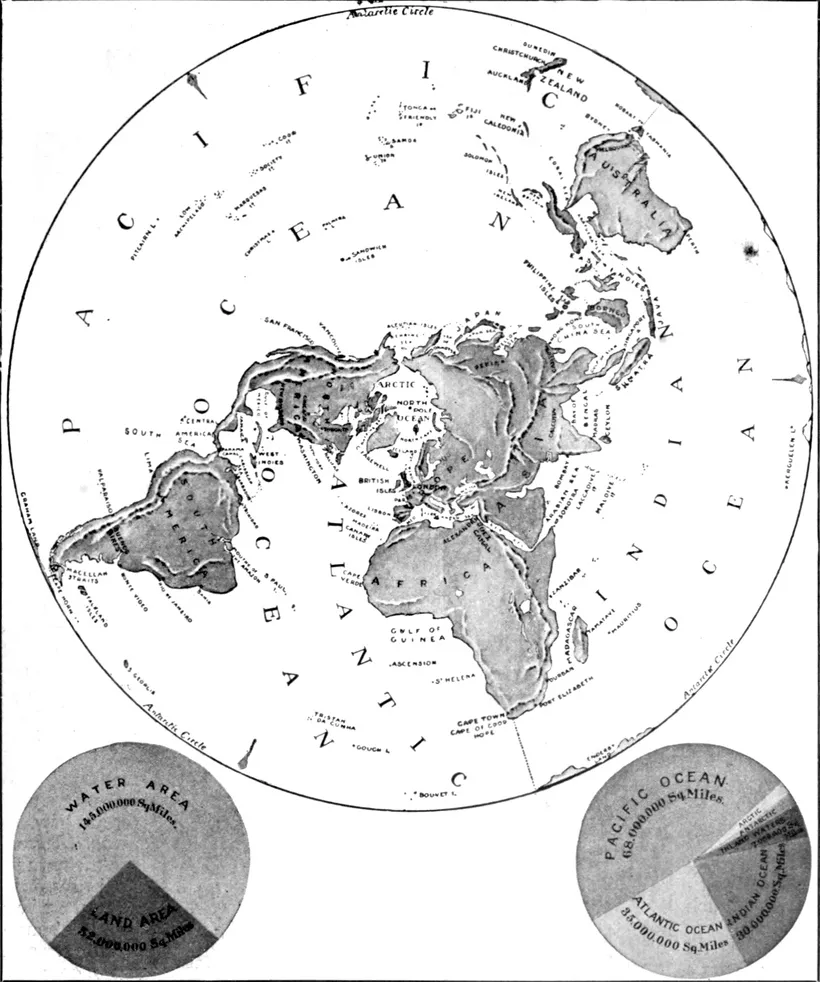
THE OCEANS OF THE WORLD
This map, on a projection used by mariners, shows the
relative sizes of the great oceans, viewed from above. The natural advantage
of the position of the British Isles for communicating with the ocean’s highways
is clearly seen, and the vast area of the Pacific is strikingly indicated.
In truth, only portions of the lines of traffic follow rivers; for
rivers flow from highland to lowland, watersheds breaking their course
here and there. In comparison with the oceans, rivers are but shallow
channels, the continuity of which may be broken by every rocky ledge.
Thus different regions for traffic arise at various points in the same
stream. Only that part of Egypt which is situated north of the first
cataract is Egypt proper; the territory to the south was conquered from
Nubia. The farther we travel up a stream the less water and the more
rapids and falls we shall find; therefore traffic also decreases in
the direction toward the river’s source. It may be seen from this that
there is but little probability of truth in the analogy drawn between
the flowing of rivers from elevations to plains and the migrations
of nations and directions in which states expand. History shows that
migration and development follow a direction contrary from that in
which rivers flow.
Maritime and terrestrial advantages are concentrated where a river
joins the sea; especially characteristic of such districts are deltas,
at an early date rendered more efficient for purposes of commerce
through canals and dredging. The fertility of the alluvial soil, the
lack of forest occasioned by frequent floods, and the protection
afforded by the islands of the delta, may have had not a little
influence on the choice of such regions as settlements for man. At
all events, estuaries and deltas, both small and great, were in the
earliest times centres of civilisation. Egypt and Babylonia both
testify to this; the colonising Greeks also showed a preference for
river mouths. Miletus, Ephesus and Rome were states situated at the
mouths of rivers, and so were the ancient settlements on the Rhone,
the Guadalquivir, and the Indus. It would not be possible, however,
to deduce from this proofs of a potamic phase of civilisation and
formation of nations preceding the Thalassic, or Mediterranean. Estuary
and delta states are far more a result of the Mediterranean culture.
The latter led to the settlement of favourable districts on various
coasts, all of which were finally swallowed up into the Roman Empire
during the period of its northern and eastern expansion.
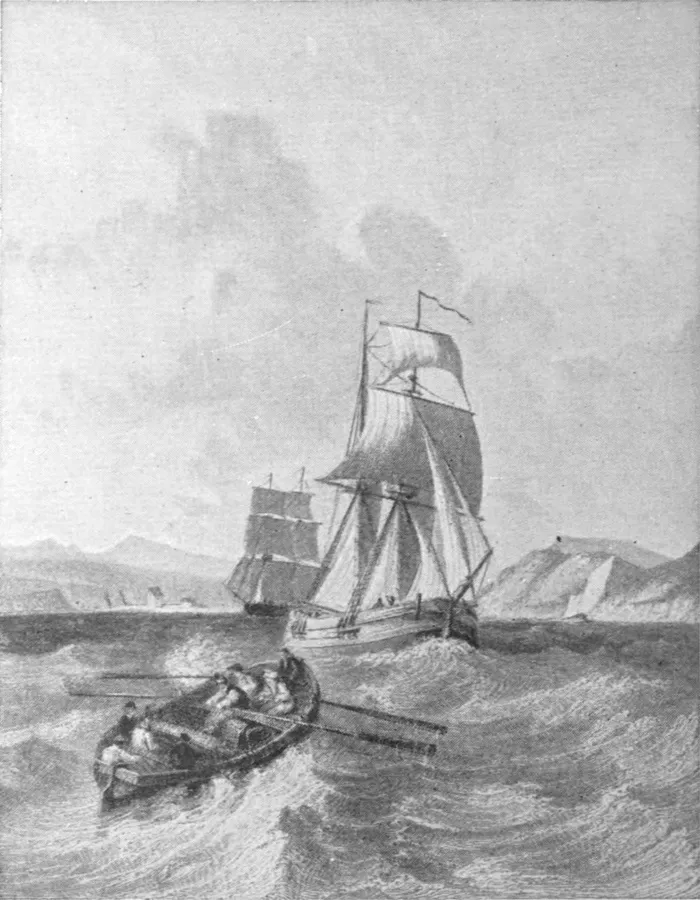
THE ORIGIN OF SEAFARING PEOPLES
It is not sufficient to have a favourable sea-coast in
order to breed a race of sea-going people. The land behind the coast-line must
be fertile and productive, else no inducement exists for seafaring. This
condition is everywhere present along the British shores, of which this is a
typical coasting scene.
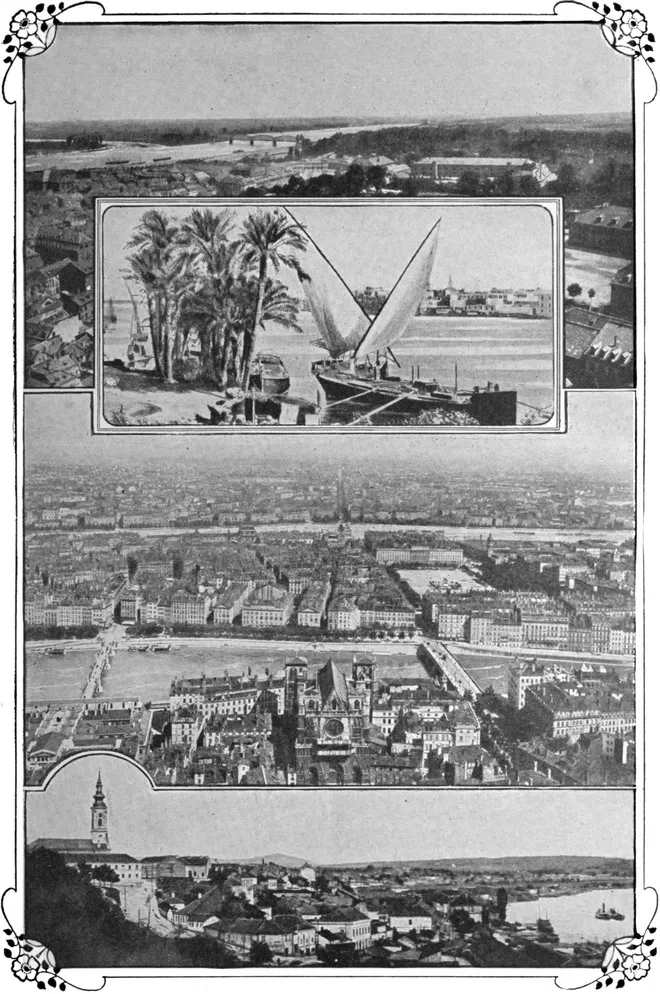
THE JUNCTIONS OF GREAT RIVERS ARE LANDMARKS OF HISTORY
Where two rivers join, two lines of political tendencies
always meet, and their junction is the point whence political forces must be
controlled. This is the significance of the situations of Mainz (1 at top),
Khartoum (2), Lyons (3), and Belgrade (4)
Photos: Frith and Photochrome
LARGER
IMAGE
Rivers as Highways of Development
Another much more evident process of development through the
instrumentality of rivers was shown at the time when traffic began
to extend itself over wide areas. Rivers are the natural highways
in countries which abound in water, and are of so much the greater
importance because in such lands other thoroughfares are frequently
wanting. Taken collectively, rivers form a natural circulatory system.
In America at the time of the exploration and conquest, in Siberia, in
Africa to-day, they are natural arteries by means of which exchange
and political power may be extended. The more accessible a river is
to commerce, the more rapidly political occupation increases about
its basin, as has been shown by the Varangians in Russia and the
Portuguese in Brazil. The best example of a country having developed
through conformity with a natural river system and in connection with
it is that of the Congo State, with part of its boundaries drawn
simply along the lines of watersheds. Mastery among rival colonies is
determined by the results of the struggle for the possession of rivers;
this has been as clearly shown by the St. Lawrence and the Mississippi
in America, as by the Niger and the Benuwe in Africa. The influence of
riverways in furthering the path of political development may be best
seen in the contrast between South America and Africa; the colonising
movement came to the latter more than 300 years later than to the
former continent.
Every river is a route followed by political power, and is therefore
at the same time a point of attraction and line of direction. The
Germans have pushed their way along the Elbe between the Danes and the
Slavs, and along the Vistula between the Slavs and the Lithuanians or
old Prussians. The river that supports an embryonic nation holds it
together when developed. The influence of the Mississippi was directed
against the outbreak of the Civil War in America. As pearls are strung
along a cord, so the provinces of new and old Egypt are connected
by the Nile. Austria-Hungary is not the Danube nation only because
the river was the life nerve of its development, but also because
eighty-two per cent. of Austro-Hungarian territory is included within
the regions drained by it. When the natural connection of rivers is
broken then this power of cohesion ceases. The political and economic
disunion of the Rhine, the Main, and other German rivers preceded the
dissolution of the German Empire.
Rivers as Sources of Power
Where two rivers join there is always a meeting of two lines of
political tendencies, and the place of their junction is the point
whence the political forces must be controlled and held together. This
is the significance of the situations of Mainz, Lyons, Belgrade, St.
Louis, and Khartoum. The course followed by flowing water is far less
direct than that of historical movements; the latter take the shortest
way, and do not continue along the stream where a loop is formed; or
they may follow a tributary that runs on in the original direction of
the main stream, as in the case of the very ancient highway along the
Oder and the Neisse to Bohemia. The sides of sharp angles formed by a
river in its course lead to a salient point as, Regensburg and Orléans.
A tributary meeting the main stream at this point forms the best route
to a neighbouring river, or the angle may become a peninsula, so
bounded by a tributary stream at its base as almost to take the form of
an island.
Rivers as Dividers of Land
Breaks in the continuity of the land occasioned by rivers are caused
rather by the channel in which the water flows than by the river
itself. Thus we often find that dry river-beds are effective agents of
this dividing up of the land. Permanent inequalities of the earth’s
surface are intensified by flowing water. Therefore a river system
separates the land into natural divisions. These narrow clefts are ever
willingly adopted as boundary lines, especially in cases where it is
necessary to set general limits to an extensive territory. Thus Charles
the Great bounded his empire by the Eider, Elbe, Raab, and Ebro.
Smaller divisions of land are formed by the convergence of tributaries
and main streams, and again still smaller portions are created by the
joining together of the lesser branches of tributaries, these taking
an especially important place in the history of wars: for example,
those formed by the Rhine, Weser, Elbe, and Oder, and on a lesser
scale by the Moselle, Seille, and Saar. Fords are always important; in
Africa they have even been points at which small states have begun to
develop. Rivers as highways in time of war no longer have the value
once attributed to them by Frederick the Great, who called the Oder
“the nurse of the army.” Yet rivers were of such great moment in this
respect in the roadless interior of America during the Civil War that
the getting of information as to water-levels was one of the most
important tasks of the army intelligence department. Rivers will always
remain superior to railways as lines of communication during time of
war, at least in one respect, for they cannot be destroyed.
THE MAKING OF THE NATIONS—III
Professor FREDERICK RATZEL
U
UPON
the earth, with its varied configuration and formation of land and
sea, are many kinds of hindrances and limits to life.
The most obvious effect of natural region and natural boundary lies
in the counteracting forces opposed by the earth through them to a
formless and unlimited diffusion of life. Isolated territory furthers
political independence, which, indeed, is of itself isolation. The
development of a nation upon a fixed territory consists in a striving
to make use of all the natural advantages of that territory. The
superiority of a naturally isolated region lies in the fact that
seclusion itself brings with it the greatest of all advantages. Hence
the precocious economic and political development of races that dwell
on islands or on peninsulas, in mountain valleys and on island-like
deltas.
The Rise and Death of Isolated States
Often enough growth that originates under such favourable conditions
leads to ruin. A young nation deems itself possessed of all so long
as it has the isolation that ensures independence; it sees too late
that the latter has been purchased at the price of a suffocating lack
of space; and it dies of a hypertrophy of development—a death common
to minor states. This was the cause of the swift rise and decline of
Athens and of Venice, and of all powers that restricted themselves to
islands and to narrow strips of coast.
Natural Boundaries of a State
A State must Forsake its Boundaries
The more natural boundaries a state possesses, the more definite are
the political questions raised by its development. The consolidation
of England, Scotland, and Wales was simple and obvious, as patent
as if it had been decreed beforehand, as was also the expansion of
France over the region that lies between the Alps and the Pyrenees,
the Mediterranean and the Atlantic Ocean. On the other hand, what a
fumbling, groping development was that of Germany, with her lack of
natural boundary in the east! Thus in the great geographical features
of lands lie pre-ordained movements, constrained by the highest
necessity—a higher necessity in the case of some than of others.
The frontier of the Pyrenees was more necessary to France than that
of the Rhine; an advance to the Indian Ocean is more necessary to
Russia than a movement into Central Europe. Growth is soundest when a
state expands so as to fill out a naturally bounded region—as, for
example, the United States, that symmetrically occupy the southern half
of the continent of North America, or Switzerland, extending to the
Rhine and Lake of Constance. There are often adjustments of frontiers
which force the territory of a nation back into a natural region, as
shown in the case of Chili, which gave up the attempt to extend its
boundaries beyond the Andes, in spite of its having authorisation to do
so, founded on the right of discovery, the original Spanish division
of provinces, and wars of independence. A favourable external form is
often coincident with a favourable internal configuration which is
quite as furthering to internal continuity as is the external form to
isolated development. The Roman Empire, externally uniform as an empire
of Mediterranean states, was particularly qualified for holding fast
to its most distant provinces, by reason of the Mediterranean Sea that
occupied its very centre. Everything that furthers traffic is also
favourable to cohesion. Hence the significance of waterways for ancient
states, and of canals and railways for modern nations. Egypt was the
empire of the Nile, and the Rhine was at one time the life-vein of the
empire of Charles the Great. A state does not always remain fixed in
the same natural region. However advantageous they may have been, it
must, on increasing, forsake the best of boundaries. Since one region
is exchanged for another, the law of increasing areas comes into force.
Every land, sea, river region, or valley should always be conceived
of as an area that must be discovered, inhabited, and politically
realised before it may exert any influence beyond its limits. Thus the
Mediterranean district had first to complete its internal development
before it could produce any external effect.
First Continent State
This internal development first took possession of the small
territories, and, mastering them, turned to the greater. Thus we may
see history progress from clearings in forests, oases, islands, small
peninsulas, such as Greece; and strips of coast, to great peninsulas,
such as Italy; isthmian situations of continental size, such as Gaul;
only to come to a halt in half continents such as the United States and
Canada, and continents. Europe—next to the smallest continent—has
had the richest history of all, but with the greatest breaking up of
its area into small divisions. Australia, the smallest continent, is
the earliest to unite its parts into a continental state. Development
expends all its power in bringing the areas of the three greatest
land-divisions into play, and in opposing their one hundred and five
million square miles to the ten and a half million of the smaller
divisions; their economic action is already felt to a considerable
degree. Thus there arises an alternation of isolation and expansion,
which was clearly shown in the history of Rome, whose territory grew
from the single city, out over the valley of the Tiber, into Apennine
Italy, into the peninsula, across the islands and peninsulas of the
Mediterranean, and finally into the two adjacent continents.
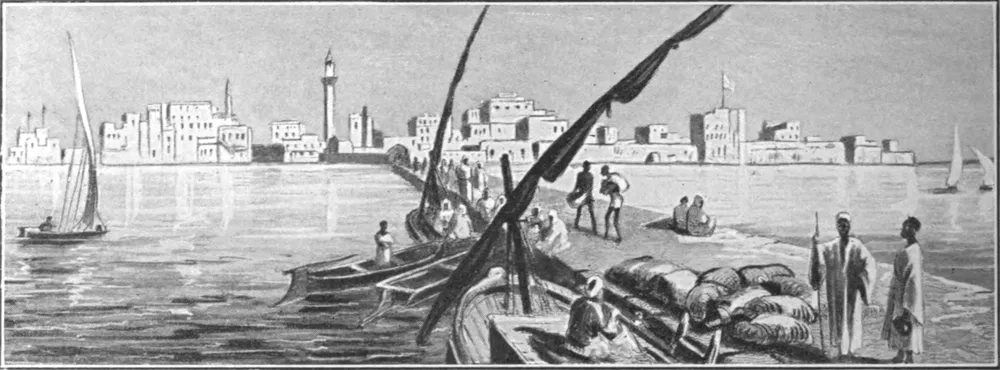
THE HOTTEST PLACE IN THE WORLD IS INHABITED BY MAN
No climate has triumphed over the endurance of man. Massowah,
the most important town in the Italian Colony of Eritrea, in North Africa, is the
hottest place in the world, but, like the coldest known place, it is inhabited.
Nature and National Destiny
The boundaries of natural regions are always natural boundaries.
Although this delicate subject may be left to political geography, it
is by no means to be neglected by those who are interested in history,
boundary questions being among the most frequent causes of wars. In
addition, boundaries are the necessary result of historical movements.
In case two states strive against each other in expanding, the motion
of both is impeded, and the boundary lies where the movement comes to
a halt. It is in the nature of things that growing states are very
frequently contiguous to uninhabited regions, not to other states.
This contiguity is always a source of natural boundaries. The most
natural of all arise from adjacency to uninhabitable regions: first
the uninhabitable lands, then the sea. The boundary at the edge of the
uninhabitable world is the safest; for there is nothing beyond. The
broad Arctic frontiers of Russia are a great source of power. A high
mountain range, also, may separate inhabited regions—which are always
State territory—by an uninhabited strip of land. After all, the sea,
marshes, rivers even, are uninhabitable zones. But traffic brings
connection with it, and the Rhine, which to the Romans was a moat,
especially well adapted as a defence, is now, with its thirty railway
bridges and thousands of vessels plying up and down and across, far
more of a highway and a means of communication than a dividing line.
The position, form, and movements of the earth seem far enough removed
from the deeds and destinies of peoples, yet the more we contemplate
the latter, the more we are led to consider the earth’s inclination
to its axis, its approximately spherical form, and its motion, which,
combined, are the cause of the recurrence in fixed order of day and
night, summer and winter.
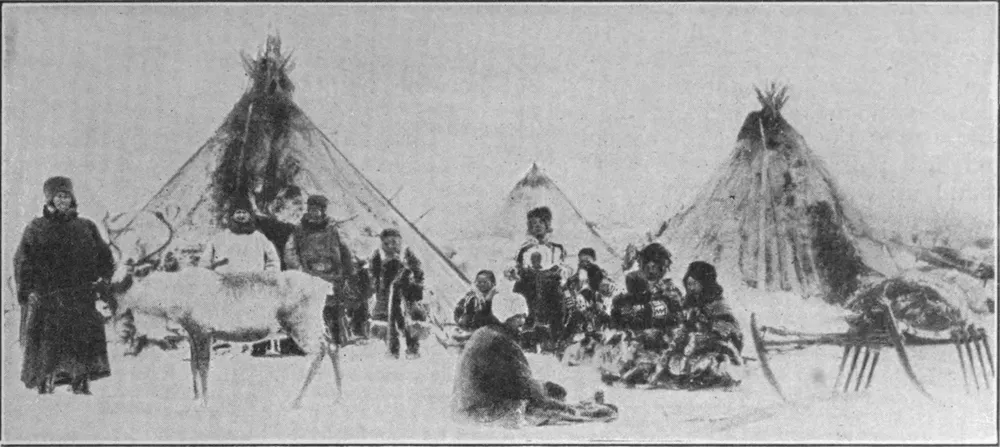
INHABITANTS OF THE COLDEST PLACE IN THE WORLD
Man is the most adaptable of living creatures. There is no
climate in the world in which he cannot live. The lowest temperatures taken have
been at Verkhoyansk, in Siberia, but the place is inhabited by people, of whom we
give a group.
The effects of these great earthly phenomena are differently felt
in every country; for they vary according to geographical location.
Practically, that which most conforms to any given situation north
or south of the equator is the climate of a land. Day and night are
of more even length at the equator than in our country; but beyond
the Polar circles there are days that last for months, and nights
equally long. Scarcely any annual variation in temperature is known to
the inhabitants of Java, while in Eastern Siberia Januarys of fifty
degrees below freezing-point and Julys of twenty degrees above zero of
Centigrade, winters during which the mercury freezes, and summers of
oppressive sultriness, are contrasted with one another.
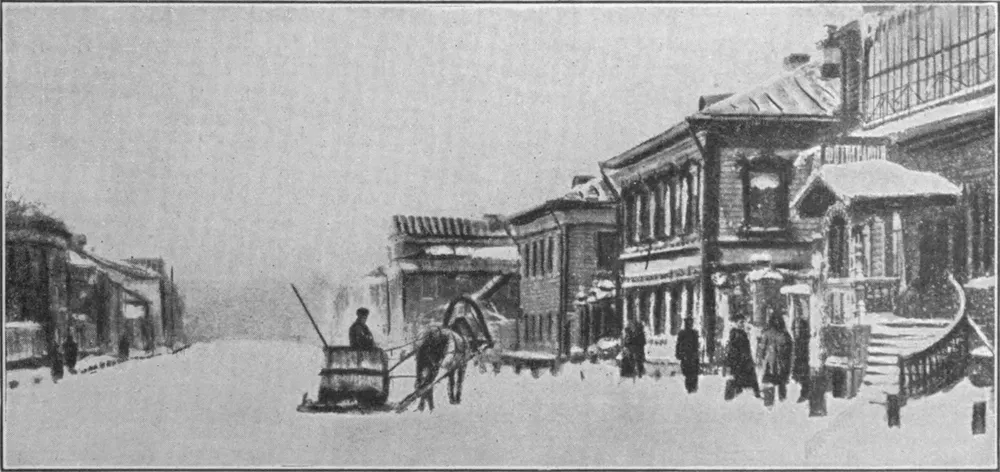
MAN’S TRIUMPH OVER CLIMATE: THE COLDEST PLACE IN THE
WORLD
Just as man has established himself in the torrid heat of
Massowah, so he can endure the highest degree of cold. The coldest place in the
world, Verkhoyansk, of which this is a photograph, is the capital of a
Siberian province.
In our temperate region there is rain, as a rule, during all months,
but as far north as Italy and Greece the year is divided into a dry
and a wet season. Great effects are produced over the entire earth and
upon all living creatures by the thus conditioned climatic differences.
They must be considered at the very beginning of every investigation
into history. Since we know that a fluctuating distribution of heat is
caused by the 23½° inclination of the earth’s axis, investigation
also leads us to a knowledge of further phenomena, to a consideration
of the dependence of the winds and of the precipitation of heat upon
this very same condition.
The First Question about a Country
And thus we come into contact with the thousand connecting threads by
which man’s economic activity, health, distribution over the earth,
even his spiritual and his political life, are inseparably bound
up with the climate. Hence the first question that should be asked
concerning a country is: What is its geographical situation? A land may
be interesting for many other reasons besides nearness or remoteness
from the equator; but that which is of the greatest interest of all
to the historian is a consideration of the manifold and far-reaching
effects of climate.
The study of human geography teaches us that climate affects mankind
in two ways. First, it produces a direct effect upon individuals,
races, indeed the inhabitants of entire zones, influencing their
bodily conditions, their characters, and their minds; in the second
place, it produces an indirect effect by its influence on conditions
necessary to life. This is due to the fact that the plants and animals
with which man stands in so varied a relationship, which supply him
with nourishment, clothing, and shelter, which, when domesticated and
cultivated, enter his service, as it were, and become most valuable
and influential assistants and instruments for his development and
culture, are also dependent upon climate. Important properties of the
soil, the existence of plains, deserts, and forests, also depend upon
climate. Effects of climate, both direct and indirect, are united in
political-geographical phenomena, and are especially manifest in the
growth of states and in their permanence and strength.
Man can Bear all Climates
There is no climate that cannot be borne by man; of all organic beings
he is one of the most capable of adapting himself to circumstances.
Men dwell even in the very coldest regions. The place where the lowest
temperatures have been measured, Verkhoyansk, with a mean January
temperature of -54° F., is the capital of a Siberian province; and a
district where the temperature is of the very hottest, Massowah, is the
most important town in the Italian colony of Eritrea.
However, both heat and cold, when excessive, tend to lessen population,
the size of settlements, and economic activity. The great issues of
the world’s history have been decided on ground situated between the
tropic of Cancer and the Polar circle. The question as to whether the
northern half of North America should be English or French was decided
between the parallels of 44° and 48° north latitude; and in the same
manner the settlement as to whether Sweden or Russia should be supreme
in Northern Europe took place a little south of 60° north. Holland
did not lose and regain her Indian possessions in the neighbourhood
of the equator, but in Europe; and Spain fell from the high estate
of sovereign over South and Central America because her power as a
European nation had decayed.
Strange Divergence of a Race
The coldest countries in the world are either entirely uninhabited—as
Spitzbergen and Franz Josef’s Land—or very thinly populated. Some are
politically without a master—the two territories just mentioned, for
example; some are politically occupied, as is Greenland, but are of
very little value. History teaches that traffic between such colonies
and the mother country may cease entirely without the mother country
suffering any loss thereby. The hottest regions in the world are for
the most part colonies or dependencies of European Powers. This applies
to the whole of tropical Africa, Asia, Australia, and Oceania, and
partly to tropical America.
The exclusion of European nations from grasping for possessions in
America was not determined upon in the compromised territory of
tropical America, but in the United States, a short distance south of
39° north latitude. What a difference in the parts played in history
by the two branches of the Tunguse race, the one held in subjection
in the cold latitude of Russia, the other conquering China, and now
the sovereign power in the more temperate climate of that country;
or between the Turks who, as Yakuts, lead a nomadic life in the Lena
valley, and the Turks who govern Western Asia! Latham called the region
extending from the Elbe to the Amoor—within which dwell Germans,
Sarmatians, Ugrian Finns, Turks, Mongolians, and Manchurians, peoples
who strike with a two-edged sword—a “Zone of Conquest.” Farther to
the north nations are poor and weak; toward the equator, luxurious
and enervated. The inhabitants of this central zone have over-run
their neighbours both to the north and to the south, while never,
either from the north or from the south, have they themselves suffered
any lasting injury. The Germans have advanced from the Baltic Sea to
the Mediterranean; the Slavs inhabit a territory that extends from
the Arctic Ocean to the Adriatic Sea; the Turks and Mongolians have
penetrated as far south as India; and there have been times when
Mongolians ruled from the Arctic Ocean to Southern India. Finally, the
Manchurians have extended their sphere of influence over Northern Asia
as far south as the tropic of Cancer.
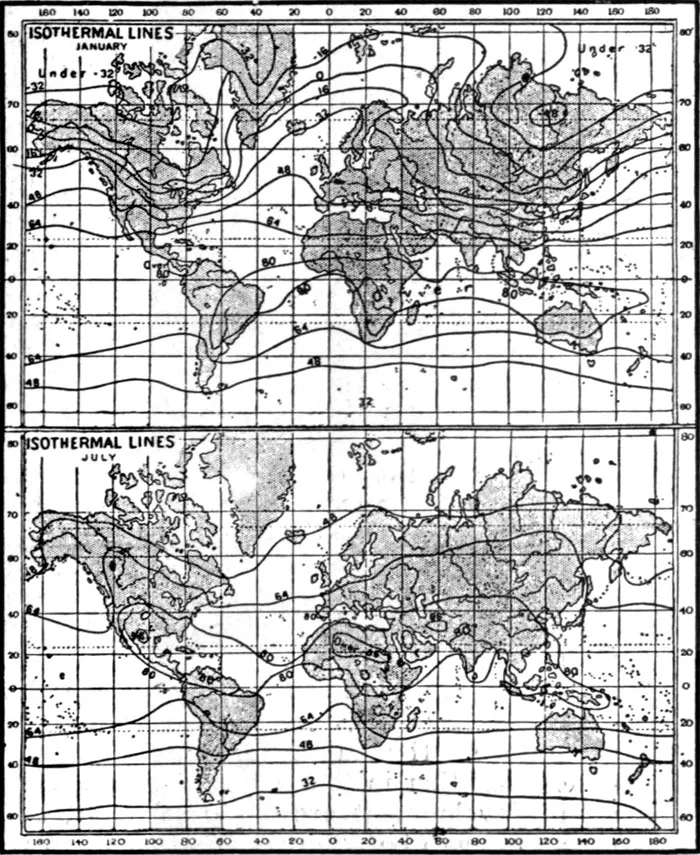
EFFECT OF CLIMATE ON THE COURSE OF HISTORY
A map on which the isothermal lines are drawn is rich in
historical instruction. Where the lines diverge we have regions of equal
temperature; where they crowd together, districts of different mean annual
temperatures lie close together. The crowding of climatic variations in any
region enlivens and hastens the course of history.
These differences occur over again in more restricted areas, even
within the temperate zone itself. The inhabitants of the colder
portions of a country have often shown their superiority to the men who
dwell in the warmer districts. The causes of the contrast between the
Northerners and the Southerners, which has dominated in the development
of the United States, may for the most part be clearly traced: the
South was weakened by the plantation method of cultivation, and
slavery; its white population increased slowly, and shared to a lesser
degree than did the Northerners in the strengthening, educating
influences of agriculture and manufacturing industries. Thus after a
long struggle that finally developed into a war, the North won the
place of authority.
Sunbeams and Rainfall in History
In Italy and in France the superiority of the north over the south is
partially comprehensible; and in Germany the advantages possessed by
Prussia, at least in area and in sea coast, are obvious. But when in
English history also the north is found to have been victorious over
the south, conditions other than climatic must have been the cause. In
this case elements have been present that are more deeply-rooted than
in sunbeams and rainfall alone.
We must call to mind the zone-like territories of early times, occupied
by peoples from which the nations of to-day are descended; the boundary
lines have disappeared, but the northern elements have remained in the
north, and the southern elements in the south. It is well known that
Aristotle adjudged political superiority and the sphere of world-empire
to the Hellenes because they surpassed the courageous tribes of the
north in intelligence and in mechanical instinct, and were superior to
the both intelligent and skilful inhabitants of Asia in courage. “As
the Hellenic race occupies a central geographical position, so does
it stand between both intellectually.” The thought that this union of
extreme intellectuality and power in arms on Hellenic soil could be the
result of ethnical infiltration did not seem to have occurred to the
philosopher. The fundamental idea of Aristotle, the aristocratic state,
in which the talented Hellene alone was to rule over bondmen of various
origins, who were, above all, to labour for him, could not have been
possible had his views been otherwise. And yet he had clearly seen that
the two talents—for war and for industry—were unequally distributed
among the different Hellenic stocks, and that they were also variable
according to time.
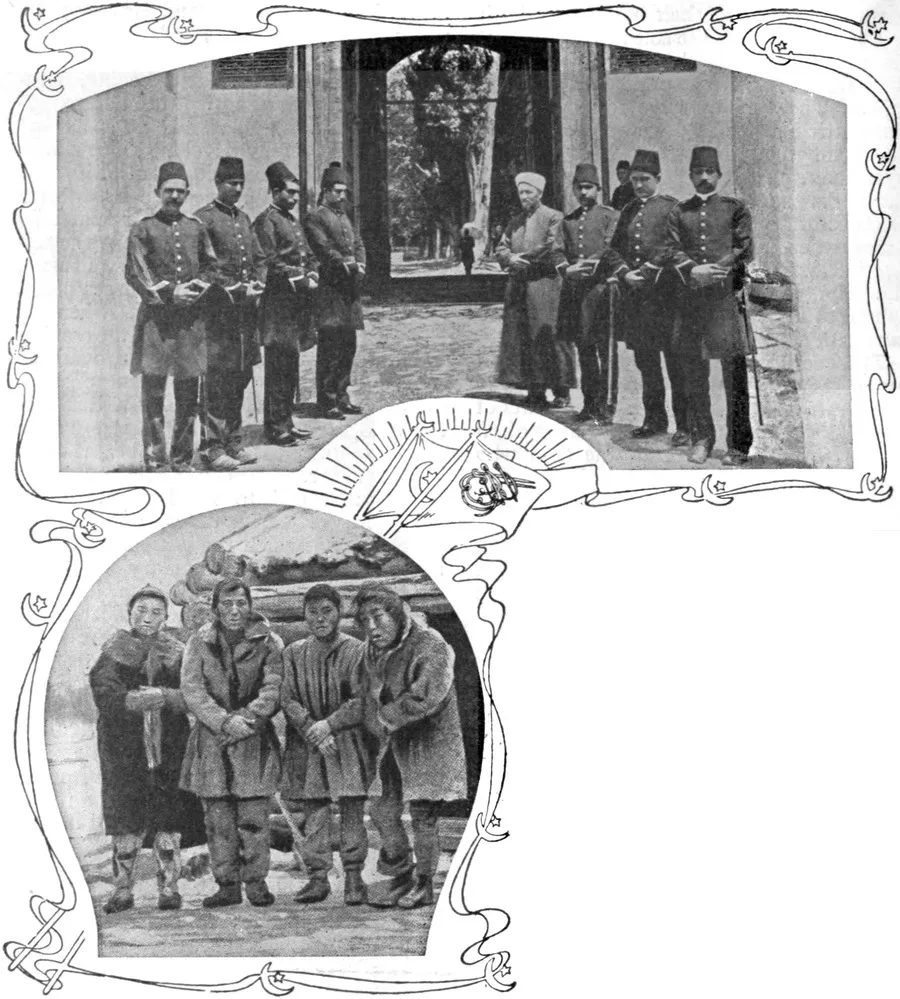
HOW THE SAME PEOPLES DIFFER
The Yakuts, who lead a nomad life in the valley of the Lena,
and the Turks who govern Western Asia, are of the same stock, but the genial
climate has enabled the Turks to flourish while the cold has kept the Yakuts
poor. These groups represent both branches of the stock.
Considering the influence even of slighter differences in climate,
the locations of regions of similar mean annual temperature, and the
distances which separate them from one another, cannot be otherwise
than important. A map on which the isothermal lines are drawn is rich
in historical instruction. Where the lines diverge we have regions of
equal temperature; where they crowd together, districts of different
mean annual temperatures lie close to one another. The crowding of
climatic variations in any region enlivens and hastens the course of
history in that region. If the variations occur only at long intervals,
all parts of a large territory having approximately equal mean annual
temperatures, then climatic contrasts, which act as a ferment, as it
were, are not present to any appreciable extent, and their effects lose
in intensity and are dispelled.
Where are greater combinations of contrasting climatic elements to
be found than in Greece and in the Alps? The joining together of the
natives of rich, fruitful Zürich with the poor shepherds of the forests
and mountains was of the utmost importance to the development of the
Swiss Confederation. It was also a union of regions of mild and cold
temperatures. The possession of Central European and Mediterranean
climates, that shade into one another without any sharp line of
demarcation, is a great advantage to France. If climatic differences
approach one another in too great a contrast, clefts in development are
likely to occur, such as the gap between the Northern and the Southern
States in America, and that between North and South Queensland. If it
be possible to adjust the political differences, then the union of
areas of different temperatures has an invigorating effect, as shown
by the history of the American Southern States since 1865.
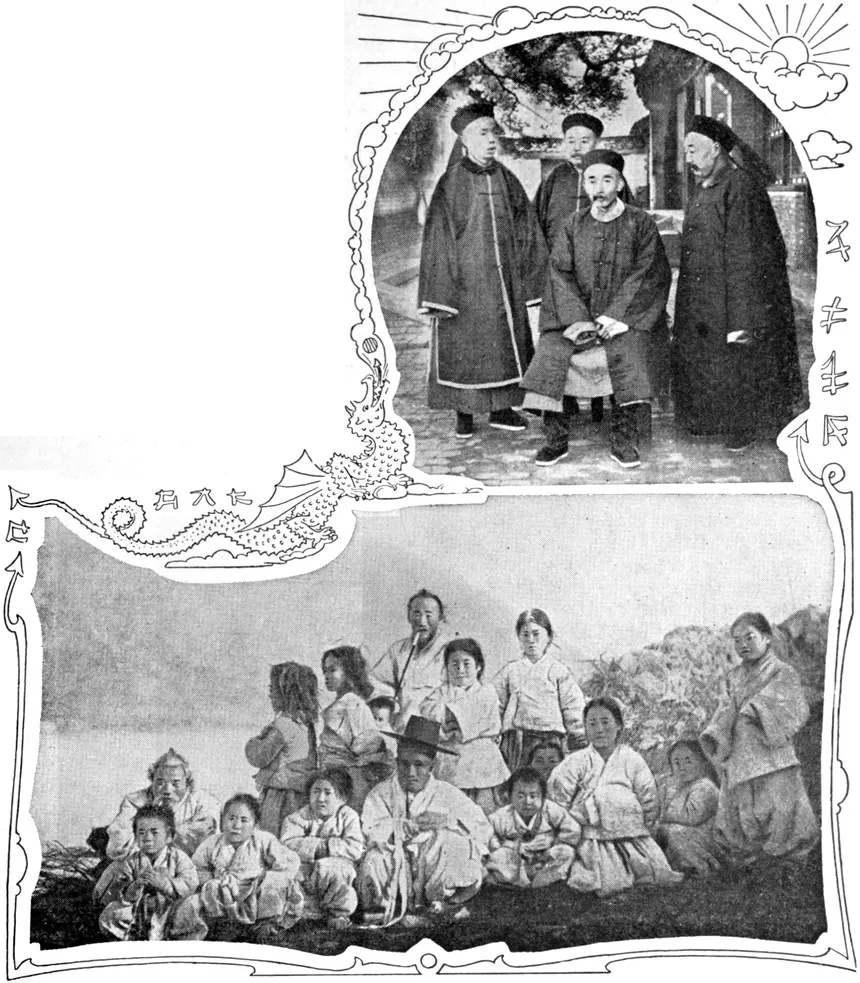
THE EFFECTS OF CLIMATE ON THE POWER OF PEOPLES
There is a world of difference between the two branches of
the Tunguse race: the one is a poor people living in cold regions and subject to
Russia; the other is the ruling race of the Chinese Empire, flourishing in a
temperate climate. The upper group is composed of ruling Tunguses in China and
the lower group represents Tunguses subject to Russia.
Winds blowing in a constant direction for many months at a time were
of great assistance to navigation during the days of sailing vessels,
which, indeed, have not yet been entirely supplanted by steamships.
Before the time of steam vessels all traffic on the Indian Ocean was
closely connected with the change of the monsoons; and important
political expansions have followed in the track of the same winds—for
example, the diffusion of the Arabs along the east coast of Africa
and in Madagascar. The influence of the trade winds on the Spanish
and Portuguese discoveries along the Atlantic coast of America is
well known. The south-eastern trade winds have been a cause of both
voluntary and involuntary emigrations of Polynesian races. It may be
clearly seen from the history of Greece what advantage was obtained by
the race that won the alliance of the coast of Thrace and the wind that
blows south from it with constancy during the entire fair season, often
eight months long.
Where the wind is most variable, visiting entire countries with
storms, to the great destruction of lives and property, the result is
a stirring up of the survivors to exertions that cannot fail to be
strengthening both to body and to mind, and of direct benefit to life
in general. At the same time that the people of Holland were engaged in
forcing back the ocean, they won their political liberty. In another
part of the North Sea coast the Frisians receded farther and farther
south, owing to the invasions of the sea and the attacks of the
natives of Holstein. The tempest that scattered the armada of Philip
II. was one of the most important political events of the time; and
it is not to be denied that the snowstorm in Prussian Eylau, at the
beginning of the battle in which Napoleon suffered his first defeat,
contributed not a little to the result.
One of the Greatest Problems
Acclimatisation is one of the greatest of human problems. In order that
a nation shall expand from one zone into another, it must be capable
of adapting itself to new climates. The human race is, as a whole, one
of the most adaptable of all animal species to different conditions of
life; it is diffused through all zones and all altitudes up to about
thirteen thousand feet above the level of the sea. But single nations
are accustomed to fixed zones and portions of zones; and long residence
in foreign climates leads to illness and loss of life.
Climate and Will-Power
In some races the individuals are of a more rigid constitution than
in others, and are thus less capable of adaptation. Chinamen and Jews
adapt themselves to different climates far more easily than do Germans,
upon whom residence in the southern part of Spain even, and to a still
greater degree in Northern Africa, is followed by injurious effects.
The constant outbreaks of destructive disease before which the German
troops withered away are to be counted amongst the greatest obstacles
opposed to the absorption of Italy into the German Empire. During the
Spanish discoveries and conquests in America in the sixteenth century,
whole armies wasted away to mere handfuls. The greatest hindrances to
German colonisation in Venezuela are climatic diseases. Medical science
has, to be sure, pointed out such deleterious influences as may be
traced to unsuitable dwelling-places, nutrition, clothing, etc.; and
the losses to Europe of soldiers and officials in the tropics have been
greatly reduced. But even to-day deaths, illnesses, and furloughs make
up the chief items in the reports sent in from every colony in the
tropics. British India can only be governed from the hills, where the
officials dwell during the greater part of the year.
Climatic influence is not limited to bodily diseases. One of the first
effects of life in warm climates upon men accustomed to cold regions
is relaxation of what is known as will-power. Even the Piedmontese
soldier loses his erect carriage in a Neapolitan or Sicilian garrison.
Englishmen in India count on an ability to perform only half the amount
of work they would be capable of at home. Many inhabitants of northern
countries escape the bodily diseases of the tropics; but scarcely one
man of an entire nation is able to resist the more subtle alterations
in spirit.
The Peoples of North and South
Their historical influence extends only the deeper for it. The
conquering nations that advance from north to south have invariably
forfeited their power, determination, and activity. The original
character of the Aryans who descended into the lowlands of India
has been lost. A foreign spirit rings through the Vedic hymns. West
Goths and Vandals alike lost their nationalities in Northern Africa
and Spain, as the Lombards lost theirs in Italy. In spite of all
emigration, immigration, and wandering hither and thither, there always
remains a certain fixed difference between the inhabitants of colder
and those of warmer countries; it is the nature of the land, moulding
the more ductile character of a people into its own form. There are
differences also between the northern and the southern stocks of the
same race, and thus climate exerts here greater and there lesser
influence upon nations and their destinies.
Since it lies in the nature of climatic influences to produce
homogeneity among those peoples who inhabit extensive regions of
similar mean annual temperatures, it follows that a unifying effect
is also produced on political divisions that might otherwise be
inclined to separate from one another. In the first place, a similar
climate creates similar conditions of life, and thus the northern and
southern races of each hemisphere, with their temperate and their
hot climates, differ widely. Climate is also the cause of similar
conditions of production over large territories. Leroy-Beaulieu rightly
mentioned climate—above all, the winter, during which almost every
year the whole land from north to south is covered with snow—as next
in importance to the configuration of the country in its unifying,
cohesive effects on the Russian Empire. Winters are not rare during
which it is possible to journey from Astrachan to Archangel in
sledges; and both the Sea of Azov and the northern part of the Caspian
Sea are frozen over during the cold months, as well as the Bay of
Finland, the Dnieper as well as the Dwina.
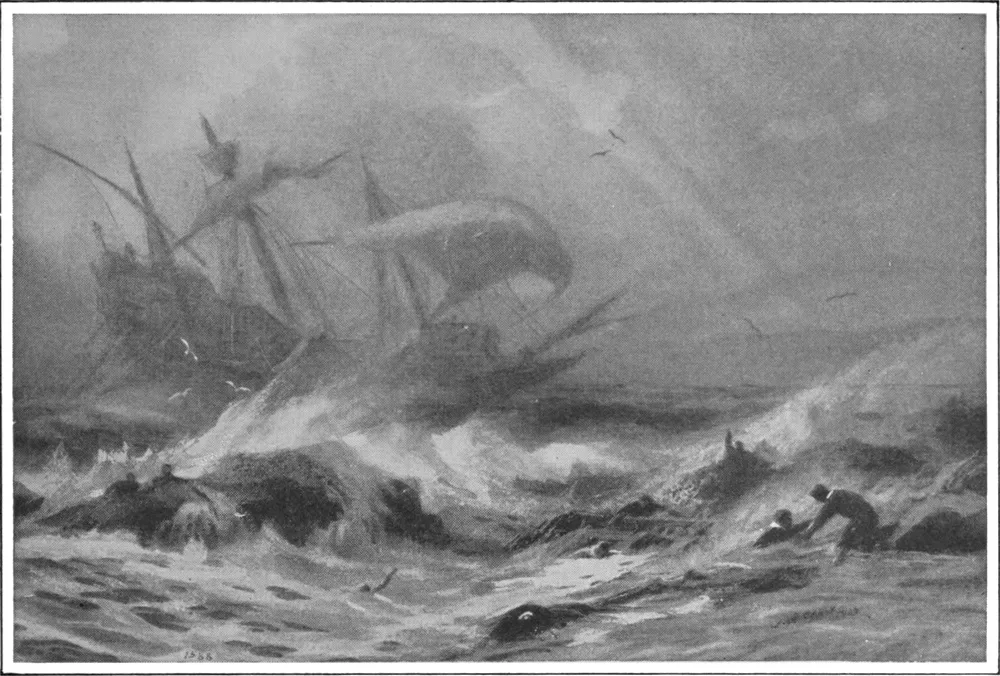
A STORM THAT CHANGED THE COURSE OF HISTORY: THE WRECK OF
THE ARMADA
The weather has greatly influenced the course of history
and helped to mould the fate of nations. The tempest that scattered the Spanish
Armada in 1588 was one of the most important political events of the time. This
picture, from the painting by J. W. Carey, illustrates the wreck of the galleon
“Girona,” at Giant’s Causeway.
Situation determines the affinities and relations of peoples and
states, and is for this reason the most important of all geographical
considerations. Situation is always the first thing to be investigated;
it is the frame by which all other characteristics are encircled.
Of what use were descriptions of the influence of the geographical
configuration of Greece on Grecian history, in which the decisive point
that Greece occupies a medial position between Europe and Asia, and
between Europe and Africa, was not insisted upon above all? Everything
else is subordinate to the fact that Greece stands upon the threshold
of the Orient. However varied and rich its development may have been,
it must always have been determined by conditions arising from its
contiguity with the lands of Western Asia and Northern Africa. Area
in particular, often over-valued, must be subordinated to location.
The site may be only a point, but from this point the most powerful
effects may be radiated in all directions. Who thinks of area when
Jerusalem, Athens, or Gibraltar is mentioned? When it is found that the
Fanning Islands or Palmyra Island is indispensable to the carrying out
of England’s plans in respect to telegraphic connection of all parts of
the empire with one another, merely because these islands are adapted
for cable stations on the line between Queensland and Vancouver, is it
not owing to their location alone, without consideration as to area,
configuration, or climate?
Every portion of the earth lends its own peculiar qualities to
the nations and races that dwell upon it, and so does each of its
subdivisions in turn. Germany, as a first-class Power, is thinkable
only in Europe. There cannot be either a New York or a St. Petersburg
in Africa. Our organic conception of nations and states renders it
impossible for us to look upon situation as something lifeless and
passive; far rather must it signify active relations of giving and
receiving. Two states cannot exist side by side without influencing
each other. It is much more likely that such close relationships result
from their contiguity; that, for example, we must conceive of China,
Korea, and Japan as divisions of a single sphere of civilisation,
their history consisting in a transference, transplanting, action, and
reaction, leading to results of the greatest moment. Some situations
are, indeed, more independent and isolated than others; but what would
be the history of England, the most isolated country in Europe, if all
relations with France, Germany, the Netherlands, and Scandinavia were
omitted? It would be incomprehensible.
The more self-dependent a situation is, the more is it a natural
location; the more dependent, the more artificial, and the more it
is a part of a neighbourhood. Connection with a hemisphere or grand
division, identity with a peninsula or archipelago, location with
respect to oceans, seas, rivers, deserts, and mountains, determine the
histories of countries. It is precisely in the natural locality that
we must recognise the strongest bonds of dependence on Nature. Apart
from all other features peculiar to Italy, her central position in the
Mediterranean alone determines her existence as a Mediterranean Power.
However highly we may value the good qualities of the German people,
the best of these qualities will never reach so high a development in
the constrained, wedged-in, continental situation of their native land
as they would in an island nation; for Germany’s location is more that
of a state in a neighbourhood of states than a natural location, and
for this reason more unfavourable than that of France.
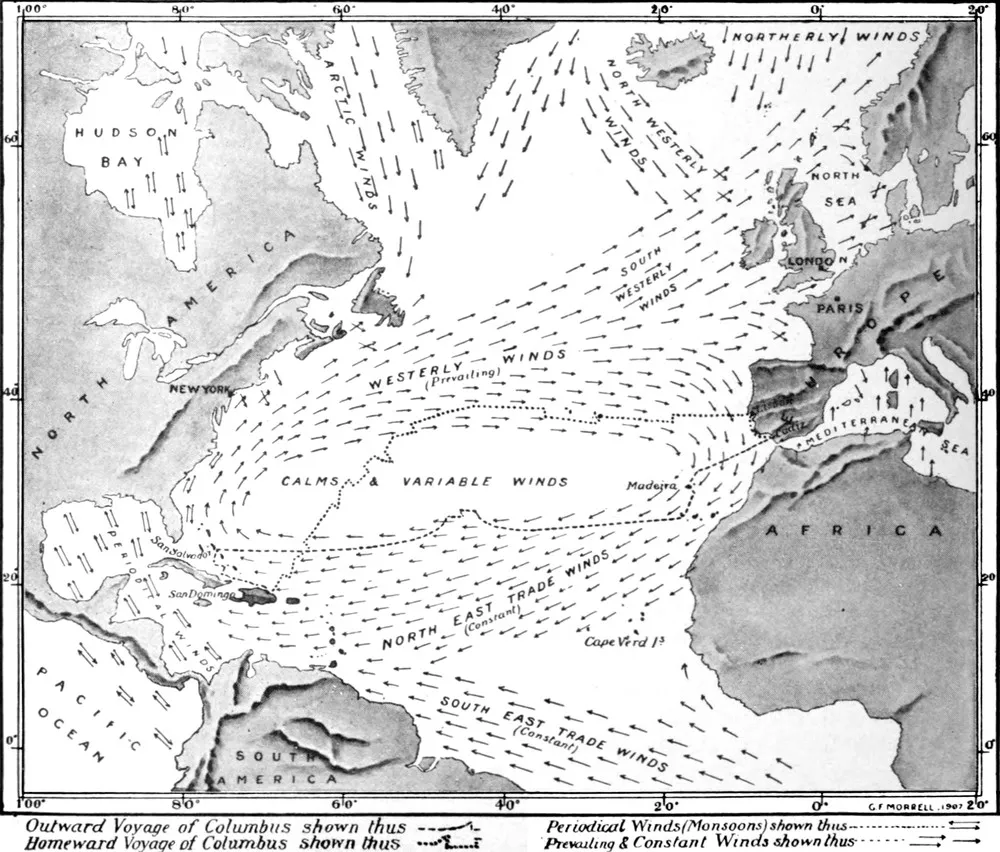
POLITICAL EXPANSION HAS FOLLOWED IN THE TRACK OF THE
WINDS
This map illustrating the trade winds and prevailing winds
shows how important were these winds before the days of steam vessels. It shows
that the outward voyage of Columbus was entirely along the track of the north-east
trade winds. Where the arrows cross, as off the North-west of Scotland, we have
regions of wind disturbances.
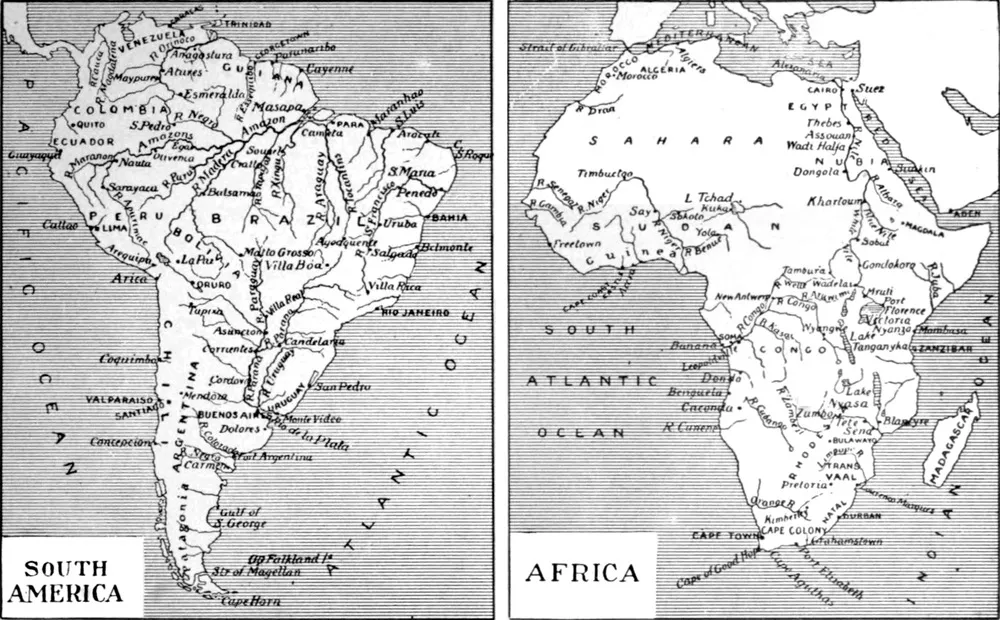
THE RIVERS OF TWO CONTINENTS AND THEIR INFLUENCE IN
CIVILISATION
The influence of riverways in furthering political
development may be best seen in the contrast between South America and Africa;
the colonising movement came to Africa three hundred years later than to South
America.
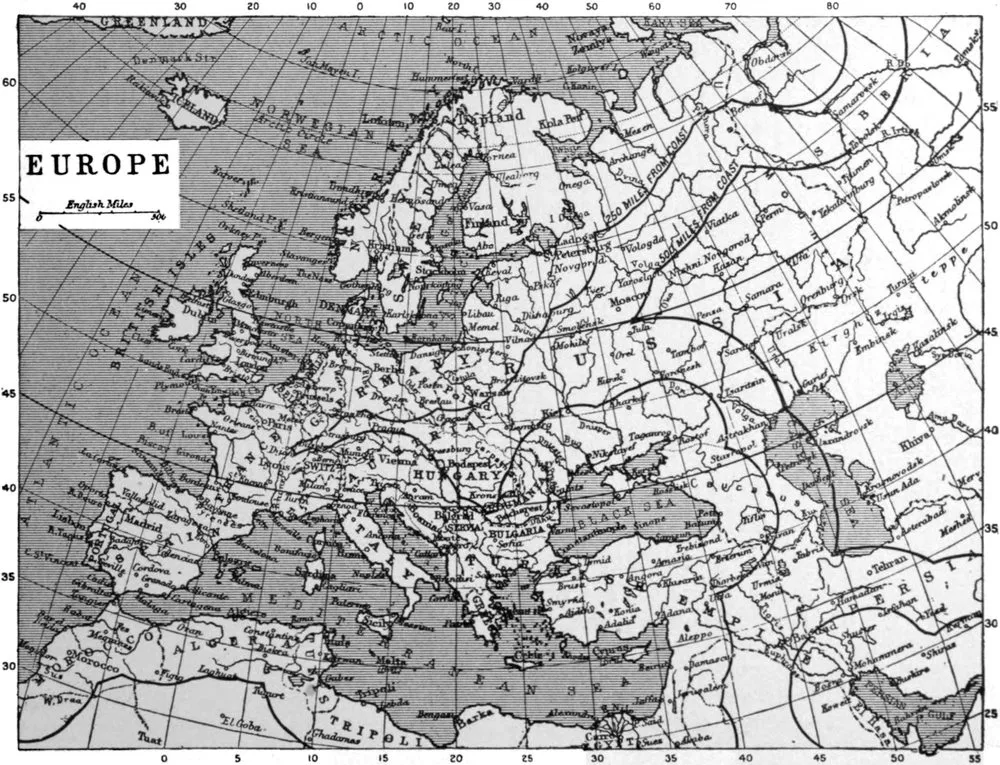
EUROPEAN COUNTRIES AND THEIR NEARNESS TO THE SEA
A country’s prosperity depends greatly upon its relation
to the sea. This map shows the boundaries of European countries, and the black
lines indicate those countries that lie within 250 and 500 miles from the
sea-coast.
THE RELATION OF RIVERS AND THE SEA TO THE CIVILISATION
OF COUNTRIES
The Ideal Situation for a State
Natural localities of the greatest importance result from the
configuration and situation of divisions of the earth’s surface. The
extremities of continents—such as the Cape of Good Hope, Cape Horn,
Singapore, Ceylon, Tasmania, and Key West—are points from which
sea power radiates; and at the same time they are the summits of
triangular territories that extend inland and are governed from the
apex. In the same way all narrowings of parts of continents are of
importance. France occupies an isthmian position between ocean and
sea; Germany and Austria between the North Sea, the Baltic, and the
Adriatic. Some states are situated on the coast, occupying a bordering
position; others occupy an intermediate location. And the more isolated
situations are all fundamentally different, according to whether they
are insular, peninsular, or continental. Situations in respect to the
oceans are even more various. How different are Atlantic locations in
Europe from those on the Mediterranean, the Baltic, or the Black Sea!
Only a few nations occupy a position fronting on two great oceans. The
ideal natural situation for a state may be said to be the embracing
of a whole continent within one political system. This is the deeper
source of the Monroe Doctrine.
Contrasts and Comparisons
Similar locations give rise to similar political models. Since
there are several types of location, it follows that the histories
of such locations assume typical characters. The contrast between
Rome and Carthage, their association with each other, exhibiting the
reciprocal action of the characters of the northern and southern
Mediterranean coasts, is repeated in similarly formed situations in
Spain and Morocco, in Thrace and Asia Minor, and on a smaller scale
in the Italian and Barbary ports. In all these places events similar
to those in Roman and Punic history have taken place. Japan and
England are unlike in many respects; yet not only the peoples, but
also the political systems, of the two island nations have insular
characteristics. Germany and Bornu are as different from each other
as Europe is from Africa, but central location has produced the same
peculiarity in each—a source of power to the strong nation, of ruin to
the weak.
Contiguity with neighbouring states brings with it important
relationships. The most striking examples of such contiguity are to
be seen in nations that are cut off from the coast of their continent
and completely surrounded by other countries. Owing to the constant
reaching out for more territory, such a situation in Europe, as well
as in other continents, signifies unconditional loss of independence.
Only connection with a great river can prevent the dissolution of a
nation so situated. The instinctive impulse to extend its boundaries
to the sea, shown by all nations, arises from the desire to escape
an insulated continental position. Only the very smallest of states,
such as Andorra and Liechtenstein—which, moreover, do not aspire
to absolute independence—could have existed for centuries in the
positions that they occupy. A medial situation held by one country
between two others is also, in point of risk, comparable to a
completely encompassed position. France was so situated when Germany
and Spain were under the same ruler. The alliance of two neighbouring
lands may place a third state in a similar position.
What is National Progress?
Whatever the individual locations of neighbouring states may be,
their number is a matter of great importance. It is better to have a
multitude of weak neighbours than a few strong ones. The development
of the United States that gradually ousted France from the south,
Mexico from the west, and Spain from both south and west, in order
to be in touch with the sea on three sides, has, with the decrease
in neighbouring Powers, resulted in an enviable simplification of
political problems.
A nation covering various dispersed and scattered situations is to be
seen at the present day only in regions of active colonisation and in
the interiors of federal states. Powerful nations are consolidated
into a single territory. We may see everywhere that when the area of
distribution of a form of life diminishes in extent, it does not simply
shrink up, but transforms itself into a number of island-like sites,
giving the appearance that the form, of life is proceeding from a
centre of the conquest of new territory. In what does the difference
lie between islands of progress and of recession? With nations and
states progress lies in the occupation of the most advantageous sites;
retrogression lies in their loss and sacrifice. The American Indians,
forced back from oceans, rivers, and fertile regions, form detached
groups of retrogression; the Europeans who took these sites from
them formed isles of progress as, one after another, they seized the
islands, promontories, harbours, river-mouths, and passes.
THE MAKING OF THE NATIONS—IV
Professor FREDERICK RATZEL
The State and its Territory
I
IT
is not without reason that so much importance is attached to extent
of surface in geography. Area and population represent to us the two
chief characteristics of a state; and to know them is the simplest
means—often too simple—for obtaining a conception of the size and
power of a nation. We cannot conceive of any man, much less a human
community, without thinking of surface or ground at the same time.
Political science may, through a number of clever conclusions, reduce
the area of a state to a mere national possession; but we all know that
territory is too tightly bound up with the very life of a state for
it to assume a position of so little importance. In a nation, people
and soil are organically united into one, and area and population
are the measure of this union. A state cannot exchange or alter its
area without suffering a complete transformation itself. What wonder,
then, that wars between nations are struggles for territory? Even in
war the object is to limit the opponent’s sphere of action; how much
more does the whole history of nations consist in a winning and losing
of territory. The Poles still exist as they did in former times; but
the ground upon which they dwell has ceased to belong to them in a
political sense, and thus their state has been annihilated.
The Vast Modern Empires
During the course of history we constantly see great political areas
emerging from the struggle for territory. We see nations from early
times to the present day increasing in area: the Persian and Roman
Empires were small and mean compared with those of the Russians,
English, and Chinese. Also the states of peoples of a lower grade of
culture are insignificant compared with the states of more advanced
races. The greatest empires of the present day are the youngest;
the smallest—Andorra, Liechtenstein, San Marino, Monaco, appear to
us only as venerable, strange petrifications of an alien time. The
relation of surface to the growth of spheres of commerce and of means
of communication is obvious. Communication is a struggle with area;
and the result of this struggle is the overcoming of the latter. The
process is complicated because, as control is gained over area, one
also acquires possession of its contents: advantages of location,
conformation, fertility, and, by no means least, the inhabitants of
the territory themselves. But the loss in value of all these things,
brought about by their being widely scattered throughout an extensive
area, can be overcome only by a complete control of the region over
which they are spread.
Traffic Leads to Empire
The development of commerce is the preliminary history of political
growth. This applies to all races, from Phœnicians to North Americans,
who point out to us a post of the American Fur Company as the germ
from which Nebraska developed. Every colony is a result of traffic;
even in the case of Siberia, merchants from European Russia travelled
thither as far as the Ob about three centuries before its conquest. The
phrase “conquests of the world’s commerce” is perfectly legitimate.
The building of roads is a part of the glory of the founders and
rulers of nations. To-day, tariff unions and railway politics have
taken the place of road-making. It has always been so; both state and
traffic have had the same interest in roads and thoroughfares. Traffic
breaks the way, and the state improves and completes it. It seems to
be certain that the firmly organised state in ancient Peru opened
the roads which were later a service to traffic. In a lower phase of
development we may see commerce leading directly to the establishment
of states; in a higher, to victory in war, arising from commercial and
railway communication. It would be impossible for France to construct
the Sahara Railway without first subjugating the Tuareg and seizing
their country. Highways of traffic as weapons for hostile states, the
important part played by commercial nations and the culture of strictly
industrial and commercial peoples, the endeavour of traffic to be of
service to the policies of states, and, finally, the powerful reactions
caused by the removal and disuse of thoroughfares of commerce to races,
nations, and to entire spheres of civilisation—can only be indicated
here.
Every Trader Bears his State with him
Every political movement, whether it be a warlike expedition or a
peaceful emigration, is preceded by movements which are not political.
Inquiries must be made and relations instituted; the object must be
determined, and the road explored. All the while that knowledge of the
world beyond the bounds of a country is being gained, there is also
an imperceptible broadening of the geographical horizon; and this not
only widens out, but becomes clearer. Fabulous tales are circulated as
to the terrors of strange countries; but the fear gradually vanishes
as our knowledge increases, and with the latter a spirit of political
enterprise awakens One can say that every trader who passes the bounds
of his country bears his state with him in his load of merchandise. To
be sure, there are both long preparations made and quick leaps taken
in the processes of commerce. Roman merchants prepared the way to a
knowledge of Gaul and its conquest. But how different the attitude
of the Romans to Gaul before and after the time of Cæsar! What a
difference in the Spanish estimate of the worth of American colonies
before the days of Cortez and Pizarro, and afterward! The broader and
clearer the geographical horizon grows, the greater become political
schemes and standards of policy.
Causes of National Success and Failure
The widening of the geographical horizon and the clearing up of
mysteries beyond are invariably a result of the travels of individuals
or of groups for peaceful purposes. The first of these purposes
is commerce; the chase and fishing are also to be taken into
consideration; and the involuntary wanderings of the lost and strayed
are not to be excluded. Europe possessed a Pytheas and a Columbus who
discovered new worlds; and every primitive community had its explorers,
too, who cleared paths from one forest glade to another. If such
pioneers return, they also bring back with them contributions to the
general stock of knowledge of the world without, and it becomes less
difficult for others to follow in their footsteps; finally armies
or fleets may advance, conquering in their tracks. Whenever traffic
makes busy a multitude of men, and employs extensive means by which to
carry on its operations, the truth of the saying, “The flag follows
trade,” is finally established in its broadest sense. With all this
struggling and labouring, territory does not fall to the state simply
as a definite number of square miles. Just as single individuals bring
enlightenment to the state, in the same manner the idea of area arises
in the intelligence of the aggregate.
When we say that an area increases, we must remember that by this we
mean that the intelligence which views it and the will that holds it
together have increased, and naturally, also, that which is requisite
for rendering intelligence and will capable for their work. In this
lies one of the greatest differences that exist between nations, one of
the greatest causes of success and failure in development.
A disposition for expansion that advances boundaries to the farthest
possible limit is a sign of the highest state of civilisation. It is a
result of an increase both of population and of intellectual progress.
Small States in Fine Situations
There is something very attractive in the small political models of
early times: those city-states whose development had in definiteness
and in precision a great deal of the lucidity and compactness of
artistic compositions. Lübeck and Venice are more attractive than
Russia. The concentration of the forces of a small community in a
limited, beautifully situated, and protected location, is a source of
a development that takes a deeper hold on all the vital powers of a
people, employing them more extensively, and therefore ending in a more
rapid and definite perfection of historical individuality. Thus small
areas take the lead of large territories in historical development; and
we may see many examples of a slow but sure transference of leadership
from the small area to the large, and of the gradual diffusion of
progress in the latter. Thus Italy followed Greece; Spain, Portugal;
England, Holland.
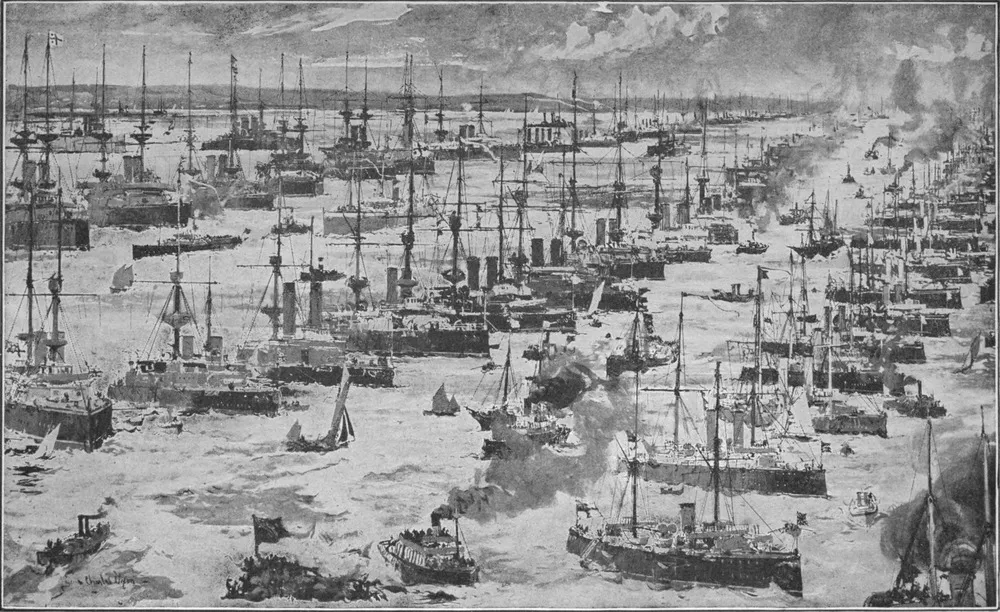
THE COMMAND OF THE SEAS: GREAT BRITAIN’S MIGHTY
MACHINERY OF DEFENCE
Great Britain’s strength is a proof of the tremendous
importance of the sea as a factor of political power. This is a bird’s-eye view
of the British Navy assembled at Spithead.
LARGER
IMAGE
The opposite of this is precocity in growth: the earlier a state
marks out its limits without consideration for later expansion, the
sooner the completion of its development. The growth in area of Venice
and the Low Countries stood still, while all about them territories
increased in size. The development of small countries flags unless the
increase of population within a limited area leads to that disquiet and
emigration and expulsion of citizens especially characteristic of small
nations: the horizon grows too narrow for the times; patriotism becomes
local pride; and the most important life forces are impaired. Thus
minor nations, through which races are separated into little groups,
develop: the great national economic and religious cohesive forces are
broken up; and even the political advantages of the ground are reduced
in value through disintegration.
Founding of States by Strangers
Under such conditions the impulse for new growth must be brought in
from without. The native, who is acquainted with only one home, is
always inferior to the foreigner, who has a knowledge of two lands
at least. It is remarkable how numerous are the traditions of the
establishment of states by strangers. Sometimes these are mighty
hunters, as in Africa; often they are superior bearers of civilisation,
as in Peru; and an especially large number of them have descended
to the earth from heaven. In the face of history which tells of
the foundation of a Manchurian dynasty in China and a Turkish in
Persia, of the establishment of the Russian Empire by wandering North
Germans, and that of the great nations in the West Sudan by the Fulah
shepherds—these mythical accounts, although they may appear decidedly
incredible when taken singly, as a whole are probable enough. The
foundation of the nation of Sarawak in Borneo by Brooke is reality and
corresponds with many of the old legends of the formations of states.
A Great Turning-point in History
The broad conception of a state, which acts as a ferment does on
a disrupted mass, is introduced from one neighbouring nation into
another, each sharing in its production. When such territories are
adjacent, the state situated in the most powerful natural region
overgrows the other. The more mobile race brings its influence to
bear on the less mobile, and possibly draws the other along with it.
The more compact, better organised and armed state intrudes on weaker
nations, and forces its organisation upon them. A nation left to itself
has a tendency to split up into small groups, each of which seeks to
support its own life upon its own soil, heedless of the others; and
as such groups increase, they always reproduce in their own images:
families families, and tribes tribes. We find all sorts of measures
taken by some nations to limit an increase in growth that would carry
them beyond their old boundaries and place them under new conditions
of life. Many an otherwise inexplicable custom of taking human life is
a result of this tendency; perhaps, in some cases, even cannibalism
itself. This impulse towards limitation would have rendered the growth
of nations impossible had not the antithetical force of attraction
of one to another led to growth and amalgamation. Truly, the advance
from a condition of isolated, self-dependent communities to one of
traffic between state organisms, which must of necessity lead to ebb
and flow and union of one group with another, is one of the greatest
turning-points in the history of man.
Nations as Neighbours
Since the tendency has been for territory to become the exclusive
reward of victory in the competition of nations, balance of territorial
possessions has grown to be one of the chief ends of national
policies. The phrase “balance of power,” which has been so often
heard since the sixteenth century, is no invention of diplomats, but
a necessary result of the struggle for expansion. Hence we find an
active principle of territorial adjustment and balance in all matters
concerning international politics. It is not yet active in the small
and simple states of semi-civilised peoples; such states are much more
uniform, for they have all originated with a uniformly weak capacity
for controlling territory. In addition, the principle of territorial
isolation hinders the action of political competition. As soon,
however, as necessity for increased area leads to the contiguity of
nations, the conditions alter. The state that occupies but a small
region strives to emulate its larger neighbour. It either gains so much
land as is necessary to restore equality, or forces a decrease in the
neighbour’s territory.
The Balance of Power
Both alternatives have been of frequent occurrence. Prussia expanded
at the expense of Schleswig and Poland in order to become equal in
territory to the other great Powers. The whole of Europe fought
Napoleon until France had been forced back within such boundaries as
were necessary to international balance. Austria lost provinces in
Italy and replaced them with others in the Balkan Peninsula. This
loss and gain appears to us, in looking over an easily epitomised
history, such as that of France, as an alternation of violent waves
and temporary periods of rest attained whenever a balance is reached.
Therefore it is not owing to chance that the areas of Austria, Germany,
France, and Spain may be respectively designated by 100, 86, 84, and
80, that the area of Holland is to that of Belgium as 100 is to 90, and
that the United States stands to Canada as 100 to 96. To be effective,
such balances must presuppose equal civilisations, similar means for
the acquirement of power. Rome was so superior to her neighbours in
civilisation that she could not permit any territorial balance. Perhaps
the adoption of the River Halys as the boundary between Media and Lydia
was a first attempt to establish a national system on the principle of
balance instead of “world” dominion.
A New British Empire is not Conceivable
Our standards for measuring the areas of countries have constantly
increased during the growth of historical territories. The history of
Greece is to us but the history of a small state; and how many years
shall pass before that of Germany, Austria, and France will be but the
history of nations of medium size? England, Russia, China, and the
United States include the better half of the land of the world; and
to-day a British Empire in the other half could not be conceivable.
Development has ever seized on greater and greater areas, and has
united more and more extensive regions into aggregates. Thus it has
always remained an organic movement. The village-state repeats itself
in the city-state, and the family-state in the race-state, the smaller
ever being reproduced in greater forms. The smallest and greatest
nations alike retain the same organic characteristics more or less
closely united to the soil.
Area Does Not Mean Power
The surface of a state bears a certain relation to the surface of the
globe, and according to this standard is the land measured upon which
the inhabitants of a nation live, move, and labour. Thus it may be said
that the 208,687 square miles of the German Empire represent about
1⁄940 of the entire surface of the earth; further, that the empire
has a population of 60,500,000, from which the ratio of 5·45 acres to
each individual follows. Although it is true that wholly uninhabited
or very thinly populated regions, high mountains, forests, deserts,
etc., may be valuable from a political point of view, nevertheless the
whole course of the world’s history shows us that, as a general rule,
the value of territory increases with the number of inhabitants that
dwell upon it. Thus, before their disunion, Norway-Sweden, with an area
of 297,000 square miles—two-fifths greater than that of the German
Empire—but with a population of 6,800,000, cannot be looked upon as a
first-class Power; while Germany closely approaches the Russian Empire
in strength, for although its area is but 1⁄43 that of the latter, its
population is only one-half less. Thus area alone is never the deciding
factor of political power. In the non-recognition of this fact lies the
source of the greatest errors which have been made by conquerors and
statesmen. The powerful influence that small states, such as Athens,
Palestine, and Venice, have exerted on the history of the world proves
that a great expanse of territory is by no means indispensable to great
historical actions. The unequal distribution of mankind over a definite
area is a much more probable source of political and economic progress.
Civilisation and political superiority have always attended the
thickly populated districts. Thus the whole of development has been a
progression from small populations dwelling in extensive regions to
large populations concentrated in more limited areas. Progress first
awoke when division of labour began to organise and differentiate among
heaped-up aggregates, and to create discrepancies promoting life and
development. A simple increase of bodies and souls only strengthens
that which is already in existence by augmenting the mass. In China,
India, and Egypt, population has increased for a long time; but
development of civilisation and of political power has been unable to
keep pace with it.
THE MAKING OF THE NATIONS—V
Professor FREDERICK RATZEL
Man and the Universe
L
LOOKING
back upon the history of man, it appears to us the history of
the human race as a life phenomenon bound and confined to this planet
alone. We are thus unable to form any conception of progress into the
infinite, for every tellurian life-development is dependent upon the
earth, and must always return to it again. New life must follow old
roads. Cosmic influences may broaden or narrow the districts within
which man is able to exist. This was experienced by the human race
during the Glacial Period, when the ice sheet first drove men toward
the equator, and later, receding, enabled them once more to spread out
to the north. The limits of world life in general depend upon earthly
influences; and thus, for mankind, progress limited by both time and
space is alone possible.
Perhaps it would be well, for the elucidation of the question of
development, were geography to designate as progress only that which
from sufficient data may be established as such beyond all doubt. Thus,
to begin with, we have learned to know of a progress in space—man’s
diffusion over the earth—which proceeds in two directions. The
expansion of the human race signifies not only an extension of the
boundaries of inhabited land far into the Polar regions, but also the
growth of an intellectual conception of the whole world.
Manifold Growth of Mankind
Together with this progress there have been countless expansions
of economic and political horizons, of commercial routes, of the
territories of races and of nations—an extraordinarily manifold
growth that is continually advancing. Increase of population and of
the nearness of approach of peoples to one another goes hand in hand
with progressing space. Mankind cannot become diffused uniformly over
new areas without becoming more and more familiar with the old. New
qualities of the soil and new treasures have been discovered, and thus
the human race has constantly been made richer. While these gifts
enriched both intellect and will, new possibilities were all the while
arising, enabling men to dwell together in communities; the population
of the earth increased, and the densely inhabited regions, at first but
small, constantly grew larger and larger.
History is the Growth of Differences
With this increase in number, latent abilities came to life; races
approached one another; competition was entered into; interpenetration
and mingling of peoples followed. Some races acted mutually in
powerfully developing one another’s characteristics; others receded
and were lost, unless the earth offered them a possibility of
diffusion over better protected regions. Already we see in these
struggles the fundamental motive of the battle for area; and at the
same time, on surveying this progress, we may also see the limit set
to it—that increase in population is unfavourable to the progress of
civilisation in any definite area, if the number of inhabitants become
disproportionately large in respect to the territory occupied. Many
regions are already over-populated; and the numbers of mankind will
always be restricted by the limits of the habitable world.
Already in the differences in population of different regions lie
motives for the internal progress of man; but yet more powerful
are those incentives to the development of internal differences in
races furnished by the earth itself through the manifoldness of its
conformation.
The entire history of the world has thus become an uninterrupted
process of differentiation. At first arose the difference between
habitable and uninhabitable regions, and then within the habitable
areas occurs the action brought about by variations in zones, divisions
of land, seas, mountains, plains, steppes, deserts, forests—the whole
vast multitude of formations, taken both separately and in combination.
Through these influences arise the differences which must at first
develop to a certain extent in isolation before it is possible for
them to act upon one another, and to alter, either favourably or
unfavourably, the original characteristics of men.
Earth’s Variety Reflected in its Peoples
All the variations in race and in civilisation shown by different
peoples of the world, and the differences in power shown by states, may
be traced to the ultimate processes of differentiation occasioned by
variations in situation, climate, and soil, and to which the constantly
increasing mingling of races, that becomes more and more complex with
the diffusion of mankind over the globe, has also contributed. The
birth of Roman daughter states, and the rise of Hispano-Americans
and Lusitano-Americans from some of these very daughter nations, are
evidences of a development that ever strives for separation, for
diffusion over space, which may be compared only to the trunk of a
tree developing, and putting forth branches and twigs. But the bole
that has sent forth so many branches and twigs was certainly a twig
itself at one time; and thus the process of differentiation is repeated
over and over again. Progress in respect to population and to occupied
area is undoubted; but can these daughter nations be compared to Rome
in other respects? They have shown great powers of assimilation and
great tenacity, for they have held their ground. Nevertheless, their
greatest achievement has been to have clung fast to the earth; in other
words, to have persisted. Certainly this is far more important than the
internal progress in which the branches might perhaps have been able to
surpass the older nation.
Decisive Element in a Nation
It is an important principle that since all life is and must be closely
attached to the soil, no superiority may exist permanently unless it be
able to obtain and to maintain ground. In the long run, the decisive
element of every historical force is its relation to the land. Thus
great forces may be seen to weaken in the course of a long struggle
with lesser forces whose sole advantage consists in their being more
firmly rooted in the soil. The warlike, progressive, on-marching
Mongols and Manchus conquered China, it is true, but they have been
absorbed into the dense native population and have assumed the native
customs. The same illustration applies to the founding of nations by
all nomadic races, especially in the case of the Southern European
German states that arose at the time of the migration of Germanic
peoples. The health and promise of the English Colonies in Australia
present a striking contrast to the gloom that reigns over India, of
which the significance lies only in a weary governing, conserving, and
exploiting of three hundred millions of human beings. In Australia the
soil is acquired; in India only the people have been conquered. Will
a time ever come when all fertile lands will be as densely populated
as India and China? Then the most civilised, evolved nation will have
no more space in which to develop, maintain, and root its better
characteristics; and the success of a state will not result from the
possession of active forces, but from vegetative endowments—freedom
from wants, longevity, and fertility.
The Goal of the Nations
Even though the future may bring with it a union of all nations in the
world into the one great community already spoken of in the Gospel of
John, growth may take place only through differentiation. And thus
there is no necessity for our sharing the fear that a world-state would
swallow up all national and racial differences, and all variations in
civilisation.
From the fact that history is movement, it follows that the geographer
must recognise the necessity for progress in space in the sense of a
widening out of the historical ground, and a progressive increase of
the population of this ground; further, a development toward the goal
of higher forms of life together with an uninterrupted struggle for
space between the older and newer life-forms. Yet, for all this, the
definite bounds set to the scene of life by the limited area of our
planet always remain.
Finally, all development on earth is dependent on the universe, of
which our world is but a grain of sand, and to the time of which
what we call universal history is but a moment. There must be other
connections, definite roads upon which to travel, and distant goals,
far beyond. We surmise an eternal law of all things; but in order to
know, we should need to be God himself. To us only the belief in it
is given.
FREDERICK
RATZEL
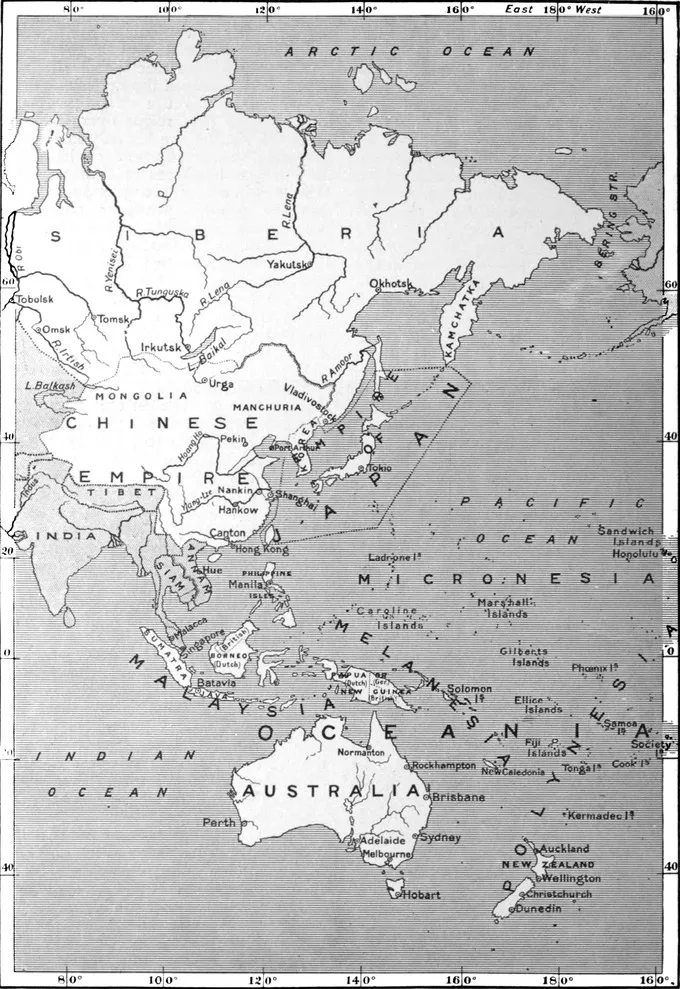
THE FAR EAST DIVISION OF THE HISTORY OF THE WORLD
This History begins with the East and comes westward round
the world. Japan is therefore the first country to come into its survey, and from
Japan we travel to Siberia, which, though extending far west, must be treated as
one. After Siberia come China and Korea; and Australia, Oceania, and Malaysia all
come into the “Far East” when thus treated geographically. The whole of the white
portion of this map is treated in the Grand Division which now opens.
LARGER
IMAGE