The wyfe of Bath was so wery, she had no wyl to walk;
She toke the Priores by the honde, “Madam, wol ye stalk
Pryvely into the garden to se the herbis growe?”
. . . And forth on they wend
Passing forth softly into the herbery.
Prologue to Beryn—Urry’s Edition.
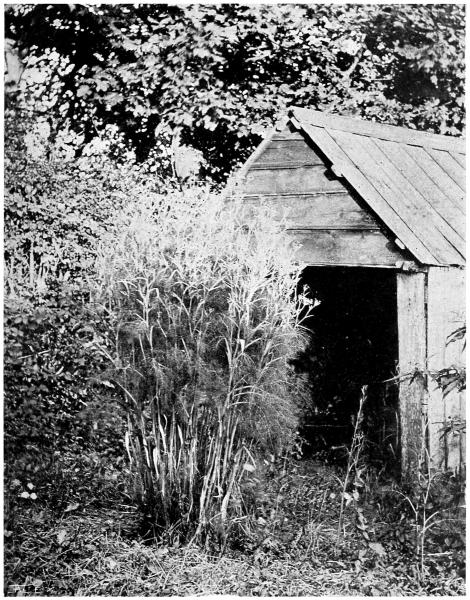
Alexanders, Allisanders, the black Pot-herb or Wild
Horse-Parsley, as it is variously called, grows naturally
near the sea, and has often been seen growing wild near
old buildings. The Italians call it Herba Alexandrina,
according to some writers, because it was supposed
originally to have come from Alexandria; according to
others, because its[38] old name was Petroselinum Alexandrinum,
or Alexandrina, “so-called of Alexander, the
finder thereof.” The leaves are “cut into many parcells
like those of Smallage,” but are larger; the seeds have
an “aromaticall and spicy smell”; the root is like a little
radish and good to be eaten, and if broken or cut
“there issueth a juice that quickly waxeth thicke, having
in it a sharpe bitterness, like in taste unto Myrrh.”
The upper parts of the roots (being the tenderest) and
leaves were used in broth; the young tops make an
“excellent Vernal Pottage,” and may be eaten as salad, by
themselves or “in composition in the Spring, or, if they
be blanched, in the Winter.” They were chiefly recommended
for the time of Lent, in a day when Lent was
more strictly kept than it is now, because they are
supposed to go well with fish. Alexanders resemble
celery, by which it has been almost entirely supplanted,
and if desired as food should be sown every
year, for though it continues to grow, it produces
nothing fit for the table after the second year. Pliny
says it should be “digged or delved over once or twice,
yea, and at any time from the blowing of the western
wind Favonius in Februarie, until the later Equinox in
September be past.” The reference to Favonius reminds
one of those lines of exquisite freshness translated
from Leonidas.
’Tis time to sail—the swallow’s note is heard!
Who chattering down the soft west wind is come.
The fields are all a-flower, the waves are dumb,
Which ersts the winnowing blast of winter stirred.
Loose cable, friend, and bid your anchor rise,
Crowd all your canvas at Priapus’ hest,
Who tells you from your harbours, “Now, ’twere best,
Sailor, to sail upon your merchandise.”
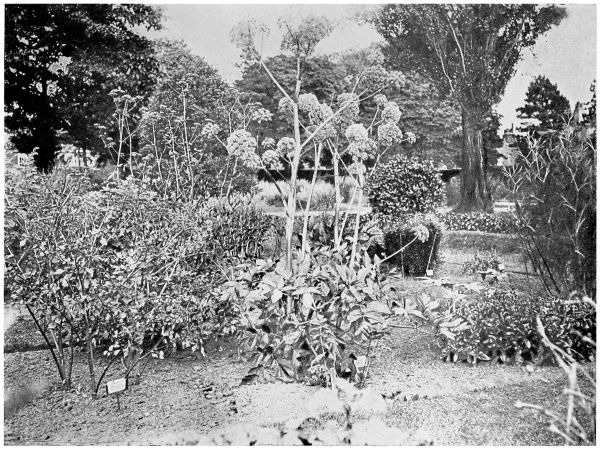
ANGELICA
Contagious aire, ingendring pestilence,
Infects not those that in their mouths have ta’en,
Angelica that happy Counterbane,
Sent down from heav’n by some celestial scout,
As well the name and nature both avow’t.
Du Bartas—Sylvester’s Translation, 1641.
And Master-wort, whose name Dominion wears,
With her, who an Angelick Title bears.
Of Plants, book ii.—Cowley.
As these lines declare, Angelica was believed to have
sprung from a heavenly origin, and greatly were its
powers revered. Parkinson says, “All Christian nations
likewise in their appellations hereof follow the Latine
name as near as their Dialect will permit, onely in Sussex
they call the wilde Kinde Kex, and the weavers wind their
yarne on the dead stalkes.” The Laplanders crowned
their poets with it, believing that the odour inspired them,
and they also thought that the use of it “strengthens
life.” The roots hung round the neck “are available
against witchcraft and inchantments,” so Gerarde says,
and thereby makes a concession to popular superstition,
which he very rarely does. A piece of the root held in
the mouth drives away infection of pestilence, and is good
against all poisons, mad dogs or venomous beasts!
Parkinson puts it first and foremost in a list of specially
excellent medicinal herbs that he makes “for the profit
and use of Country Gentlewomen and others,” and
writes: “The whole plante, both leafe, roote, and seede
is of an excellent comfortable sent, savour and taste.”
No wonder with such powers that it gained its name.
Angelica comes into a remedy for a wound from an arquebusade
or arquebuse, called Eau d’Arquebusade, which was
first mentioned by Phillippe de Comines in his account of
the battle of Morat, 1476. “The French still prepare it
very carefully from a great number of aromatic herbs.
In England, where it is the Aqua Vulneria of the Pharmacopœias,
the formula is: Dried mint, angelica tops
and wormwood, angelica seeds, oil of juniper and spirit
of rosemary distilled with rectified spirit and water
(Timbs).” It must be borne in mind that Timbs wrote
some time ago, and that the knowledge of modern French
scientists, like that of our own, has increased since then.
Although it is of no value in medicine (it is next to
none when cultivated) our garden angelica also grows
wild, and can be safely eaten. Gerarde is amusing on
this point. He says it grows in an “Island in the North
called Island (Iceland?). It is eaten of the inhabitants,
the barke being pilled off, as we understand by some
that have travelled into Island, who were sometimes
compelled to eate hereof for want of other food; and
they report that it hath a good and pleasant taste to
them that are hungry.” The last words are significant!
Formerly, the leaf-stalks were blanched, and eaten as
celery is, but now they are chiefly used, candied, for
dessert. The art of candying seems to have been
brought closer to perfection abroad than at home in
Turner’s time, for he says: “The rootes are now condited
in Danske, for a friend of mine in London, called
Maister Aleyne, a merchant man, who hath ventured
over to Danske, sent me a little vessel of these, well
condited with honey, very excellent good. Wherefore
they that would have anye Angelica maye speake to
the Marchauntes of Danske, who can provide them
enough.” The fruit is used to flavour Chartreuse and
other “cordials.”
Dr Prior confirms Evelyn, in calling Bonus Henricus
Blites, but the older herbalists seem to have given this
name to another plant of the same tribe, the Chenopodiaceæ,
because they treat of Blites and Bonus Henricus in separate
chapters. Parkinson is very uncomplimentary to them.
“Blitum are of the species Amaranthum, Flower Gentle.
They are used as arrach, eyther boyled of itself or stewed,
which they call Loblolly.... It is altogether insipid
and without taste. The unsavouriness whereof hath in
many countries grown into a proverb, or by-word, to
call dull, slow or lazy persons by that name.” The
context points to the nickname coming from “Blites,”
but no such term of reproach now exists, though the contemptuous
sobriquet “Loblolly-boy” is sometimes seen in
old-fashioned nautical novels. Blites were said to be
hurtful to the eyes, a belief that draws a scathing remark
from Gerarde, “I have heard many old wives say to their
servants, ‘Gather no Blites to put in my pottage, for
they are not good for the eyesight’; whence they had
those words I know not, it may be of some doctor that
never went to school.” Culpepper mentions that wild
blites “the fishes are delighted with, and it is a good and
usual bait, for fishes will bite fast enough at them if
you have but wit enough to catch when they bite.”
Altogether this insipid vegetable gives scope for a good
many sharp things to be said.
Blitum capitatum, usually known as strawberry-spinach,
is sometimes grown in flower gardens.
The modern Latin name for this dock is Rumex Sanguineus,
but Gesner had a more imposing title, Sanguis
draconis herba (Dragon’s blood plant). These names are,
of course, derived from the crimson colour of its veins,
and are the finest thing about it. The little notice it
does get is not unmixed praise. “Among the sorts of
pot-herbes, Blood-worte hath always been accounted a
principall one, although I doe not see any great reason
therein.” This is Parkinson’s opinion, but the italics are
mine.
As true as steel,
As Plantage to the moon.
Troilus and Cressida, iii. 2.
And plantain ribb’d that heals the reaper’s wound,
And marg’ram sweet, in shepherds’ posies found.
The School-Mistress.—Shenstone.
Buck’s-horne is distinct from Buckshorn Plantain
(Plantago Coronopus), but it is the latter which is chiefly
interesting, and which is meant here. In Evelyn’s day
the Latin name was Cornu Cervinum, and other names are
Herba Stella, Herb Ivy and Corne de Cerf. Some kinds
of plantain were considered good for wounds, but the
saying that “plantage” is true to the moon is hard to
solve. Buck’s-horne is a plant that has gone altogether
out of fashion. In 1577 Hill wrote, “What care and
skil is required in the sowing and ordering of the
Buck’s-horne, Strawberries and Mustardseede,”—and
how odd it looks now to see it coupled with the two other
names, as a cherished object to spend pains upon! Le
Quintinye says that the leaves, when tender, were used
in “Sallad Furnitures... and the little Birds are very
greedy of them.” It used to be held profitable for agues
if “the rootes, with the rest of the herb,” were hung
about the necke, “as nine to men and seven to women
and children, but this as many other are idle amulets of
no worth or value... yet, since, it hath been reported
to me for a certaintie that the leaves of Buck’shorne Plantane
laid to their sides that have an ague, will suddenly
ease the fit, as if it had been done by witcherie; the
leaves and rootes also beaten with some bay salt and
applied to the wrestes, worketh the same effects, which
I hold to be more reasonable and proper.” Parkinson is
very ready to lay down the law as to the limits of empiricism.
He is very severe about a superstition connected
with Mugwort, but though the same tradition exists of plantain,
and (under Mugwort) he quotes Mizaldus as mentioning
it, he says nothing about this folly here. Aubrey,
however, gives an account of it in his “Miscellanies.”
“The last summer, on the day of St John Baptist, I
accidently was walking in the pasture behind Montague
House; it was twelve o’clock. I saw there about two
or three and twenty young women, most of them well
habited, on their knees, very busie, as if they had been
weeding. I could not presently learn what the matter
was; at last a young man told me that they were looking
for a coal under the root of a plantain, to put under
their heads that night, and they should dream who
would be their husbands. It was to be found that day
and hour.” This miraculous “coal” also preserved the
wearer from all sorts of diseases.
Diana!
Have I (to make thee crowns) been gathering still,
Fair-cheek’d Eteria’s yellow camomile?
Br. Pastorals.
Flowers of the field and windflowers springing glad
—In airs Sicilian, and the golden bough
Of sacred Plato, shining in its worth.
. . . With phlox of Phœdimas and chamomile,
The crinkled ox-eye of Antagoras.
Trans. from Meleager.
The healthful balm and mint from their full laps do fly,
The scentful camomile.
Polyolbion, Song xv.
Falstaff. Though the Camomile the more it is trodden on the faster it
grows, yet youth the more it is wasted the sooner it wears.—I. Henry
IV. ii. 4.
The camomile is dedicated to St Anne, mother of the
Virgin Mary, and Mr Friend thinks that the Latin name
of wild camomile, Matricaria, comes from a “fanciful
derivation” of this word, from mater and cara, or “Beloved
Mother.” The name camomile itself is derived from
a Greek word meaning “earth-apples,” and its pleasant,
refreshing smell is rather like that of ripe apples. The
Spaniards call it Manzanilla, “a little apple.” It was
grown “both for pleasure and profit, both inward
and outward diseases, both for the sicke and the sound,”
and was “planted of the rootes in alleys, in walks, and
on banks to sit on, for that the more it is trodden upon
and pressed down in dry weather, the closer it groweth
and the better it will thrive.” This was a common
belief in earlier days, as Falstaff’s remark shows.
Culpepper is as trenchant as usual on the subject.
“Nichersor, saith the Egyptians, dedicated it to the sun,
because it cured agues, and they were like enough to
do it, for they were the arrantest apes in their religion
I have ever read of.” Why his indignation is so much excited
is not clear, but probably it is because Agues (being
watery diseases) were under the moon, and therefore they
should have dedicated a herb that cured agues to the
Moon. However, he holds to the view that camomile
is good for all agues, although it is an herb of the sun—who
has nothing to do with such diseases, as a rule.
Turner criticises Amatus Lusitanus with some shrewdness.
This writer, who had apparently taken upon him
to teach “Spanyardes, Italians, Frenchmen and Germans
the name of Herbes in their tongues, writeth that
Camomile is commonlye knowne,” and with this bald
statement contented himself. “Wherefore it is lykely
he knoweth nether of both [kinds of Camomile].
Wherefore he had done better to have sayde, ‘I do
knowe nether of both, then thus shortly to passe by
them.’ Camomile is still officinal, and is used for fomentations.
‘If taken internally it should be infused with
cold water, as heat dissipates the oil.’”
Feverfew is so nearly related to camomile that it may
be mentioned here. Indeed some writers call it “a
Wild Camomile,” and give it Matricaria Parthenum for
a Latin name. Most botanists, however, place it “in
the genus Pyrethrum.” Mr Britten calls it Pyrethrum
Parthenium. “Feverfew” comes from “febrifuge,”
for it was supposed to have wonderful power to drive
away fevers and agues; and it is still a favourite remedy
with village people. Nora Hopper brings it in among
the fairies:—
There’s many feet on the moor to-night,
And they fall so light as they turn and pass,
So light and true, that they shake no dew,
From the featherfew and the Hungry-Grass.
The Fairy Music.
This plant is also called Spanish Cardoon or Cardoon
of Tours. It is a kind of artichoke “which becomes a
truly gigantic herbaceous vegetable. The tender stalks
of the inner leaves are sometimes blanched and stewed,
or used in soups and salads”; but it is much less used in
England than on the Continent. Cardoons are said to
yield a good yellow dye.
Percely, clarey and eke sage,
And all other herbage.
John Gardener.
“Clary, or more properly Clear-eyes,” which indicates
one of its supposed chief virtues plainly enough.
Wild Clary was called Oculus Christi, and was even
more valued than the garden kind. Clary was once
“used for making wine, which resembles Frontignac,
and is remarkable for its narcotic qualities.”[39] It was
also added to “Ale and Beere in these Northern regions
(I think the Netherlands are meant here) to make it the
more heady.” The young plant itself was eaten, and
an approved way of dressing it was to put it in an
omelette “made up with cream, fried in sweet butter”
and eaten with sugar and the juice of oranges or lemons.
It is now sometimes used to season soups, and Hogg
tells us that it was used “in Austria as a perfume;
in confectionery, and to the jellies of fruits, it communicates
the flavour of pine-apple.” The herbalists
speak of a plant called Yellow Clary or “Jupiter’s
Distaff,” and Mr Britten suggests that this was Phlomus
fruticosa.
Dittander or Pepperwort grows wild in a few places
in England, but was once cultivated. It was sometimes
used as “a sauce or sallet to meate, but is too hot,
bitter and strong for everyone’s taste.” These qualities
have gained it the names of Poor Man’s Pepper, and
from Tusser, Garden Ginger. Culpepper’s opinion is
briefly expressed: “Here is another martial herb for you,
make much of it.” It is so “hot and fiery sharpe”
that it is said to raise a blister on the hand of anyone
who holds it for a while, and therefore (on homœopathic
principles) it was recommended “to take away marks,
scarres... and the marks of burning with fire or Iron.”
Elecampane, the beauteous Helen’s flower,
Mingles among the rest her silver store.
Rapin.
“Some think it took the name from the teares of Helen,
from whence it sprang, which is a fable; others that she
had her hands full of this herbe when Paris carried her
away; others say it was so called because Helen first
found it available against the bitings and stingings of
venomous beasts; and others thinke that it tooke the name
from the Island Helena, where the best was found to
grow.” Parkinson gives a wide choice for opinions on
the origin of Elecampane, the two first “fables” are
very picturesque. The radiant gold of the flowers
would be gorgeous but beautiful, in a loose bunch, in a
meadow, though in-doors they would be apt to look big
and glaring. Gerarde speaks of them being “in their
braverie in June and July,” and adds that the root “is
marvellous good for many things.” Since the days of
Helen the fairies have laid hold of the plant, and another
name for it (in Denmark) is Elf-Dock. Elecampane
has had a great reputation since the days of Pliny, and
was considered specially good for coughs, asthma and
shortness of breath. Elecampane lozenges were much
recommended, and the root was candied and eaten as a
sweetmeat till comparatively lately. It is said to have
antiseptic qualities, and according to Dr Fernie has been
used in Spain as a surgical dressing.
Fenugreek “hath many leaves, but three alwayes set
together on a foot-stalke, almost round at the ends, a
little dented about the sides, greene above and grayish
underneath; from the joynts with the leaves come forth
white flowers, and after them, crooked, flattish long
hornes, small pointed, with yellowish cornered seedes
within them.” This description is very exact, and,
indeed, the conspicuous horn-like pods, singularly large
for the size of the plant, are its most marked characteristic.
Turner says: “This herbe is called in Greek
Keratitis, yt is horned, aigō keros yt is gotes horne, and
ŏ onkeros, that is cows horne.” Fenugreek was a
Favourite of the “antients,” and Folkard gives an
account of a festival held by Antiochus Epiphanus, the
Syrian king, of which one feature was a procession,
where boys carried golden dishes containing frankincense,
myrrh and saffron, and two hundred women,
out of golden watering-pots, sprinkled perfume on the
assembled guests. All who went to watch the games
in the gymnasium were anointed with some perfume
from fifteen gold dishes, which held saffron, amaracus,
lilies, cinnamon, spikenard, fenugreek, etc. In England
it was used for more prosaic purposes, “Galen and
others say that they were eaten as Lupines, and the
Egyptians and others eate the seedes yet to this day as
Pulse or meate.” The herb, he continues, he has never
heard of as being used in England, because it was very
little grown, but the seed was used in medicine. Gerarde
gives us one of its pleasantest preparations as a drug.
In old diseases of the chest, without a fever, fat dates
are to be boiled with it, with a great quantitie of honey.
In 1868 Rhind[40] writes that the seeds are no longer
given in medicine, and but rarely used in “fomentations
and cataplasms.” Since that date, I should imagine, it is
even more rarely used. Fenugreek was at one time
prescribed by veterinary surgeons for horses.
This plant is otherwise known as Fat Hen, Shoemaker’s
Heels, English Mercury, or as Evelyn says,
Blite. He begins with praise: “The Tops may be
eaten as Sparagus or sodden in Pottage, and as a very
salubrious Esculent. There is both a white and red,
much us’d in Spain and Italy”; but he finishes lamely
for all his praise: “’tis insipid enough.” Gerarde says:
“It is called of the Germans Guter Heinrick, of a certaine
good qualitie it hath,” and its name is much the most
interesting thing about it. Various writers have tried
to attach it to our successive kings of that name, with a
want of ingenuousness and ingenuity equally deplorable.
Grimm[41] traces it back till he finds that this was one of
the many plants appropriated to Heinz or Heinrich—the
“household goblin,” who plays tricks on the maids or
helps them with their work, and asks no more than a
bowl of cream set over-night for his reward—who, in
fact, holds much the same place as our Robin Goodfellow
holds here.
Sequestered leafy glades,
That through the dimness of their twilight show
Large dock-leaves, spiral fox-gloves, or the glow
Of the wild cat’s-eyes, or the silvery stems
Of delicate birch trees, in long grass which hems
A little brook.
Calidore—Keats.
La tulipe est pour la fierté,
Pour le malheur la patience.
La Petite Corbeille.
The Herb-Patience does not grow in every man’s garden.
Proverb.
Herb-Patience was also called Patience-Dock or
Monk’s Rhubarb. The French call Water-Dock,
Patience d’eau and Parelle des Marais, so the name of
the quality that is, in nursery rhyme, a “virtue,” and
a “grace,” clings to this dock! Parkinson compares it
unfavourably with Bastard Rhubarb, though he says
the root is often used in “diet beere”; but Gerarde
calls it an “excellent, wholesome pot-herbe,” and relates
a tale, in which responsibilities are treated with such
delightful airiness that it must be repeated here. He
begins by saying that he himself is “no graduate, but a
country scholler,” but hopes his “good meaning will be
well taken, considering I doe my best, not doubting but
some of greater learning will perfect that which I have
begun, according to my small skill, especially the ice
being broken unto him and the wood rough-hewed to
his hands.” Nevertheless, he (who dictates on these
matters, to a great extent, through his Herbal) thinks
that the learned may gain occasionally from his knowledge.
“One John Bennet, a chirurgion, of Maidstone in
Kent, a man as slenderly learned as myselfe,” undertook
to cure a butcher’s boy of an ague. “He promised him
a medicine, and for want of one for the present (he himselfe
confessed unto me) he tooke out of his garden three
or four leaves of this plant” and administered them in
ale, with entire success. “Whose blunt attempt may
set an edge upon some sharper wit and greater judgment
in the faculties of plants.” Any anticipation that his
experiment might lead to disaster does not seem to have
troubled him! The root of Patience-Dock “boiled in
the water of Carduus Benedictus” was also given at a
venture for an ague, and this experiment was tried by
“a worshipfull gentlewoman, mistresse Anne Wylbraham,
upon divers of her poore Neighbours, with good success.”
Mistress Anne Wylbraham must have been a woman of
temerity!
Garden-patience used to be a good deal cultivated as
spinach, but is now very much ignored, partly because few
people know how to cook it. The leaves should be
used early in the spring while they are still tender, and
the flavour will be very much improved if about a
fourth part of common sorrel is added to them. This
way of dressing patience-dock was very popular in
Sweden, and is described as “forming an excellent
spinach dish.” Patience is sometimes spoken of as
“passions,” but this name properly belongs to Polygonum
Bistorta, the leaves of which were the principal
ingredient in a herb-pudding, formerly eaten on Good
Friday in the North of England. Parkinson also speaks
in this chapter of the “true rhubarb of Rhapontick,”
which has “leaves of sad or dark-greene colour... of
a fine tart or sourish taste, much more pleasant than the
garden or wood sorrell.” Dr Thornton, however, says
that Parkinson was mistaken, and that the first seeds of
true rhubarb were sent “by the great Boerhaave to our
famous gardener, Miller, in 1759”—more than a hundred
years later. Very soon after Miller had it, rhubarb was
cultivated in many parts of England and in certain
localities in Scotland.
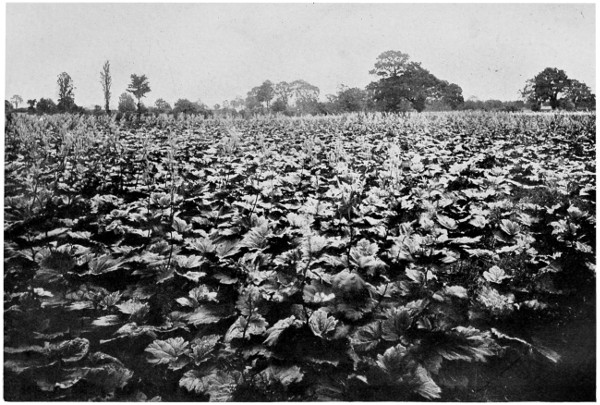
A FIELD OF ENGLISH RHUBARB
Here hore-hound ’gainst the mad dog’s ill
By biting, never failing.
Muses Elysium.
Pale hore-hound, which he holds of most especiall use.
Polyolbion, Song xiii.
Folkard says that horehound is one of the five plants
stated by the Mishna to be the “bitter herbs,” which
the Jews were ordered to take for the Feast of the
Passover, the other four being coriander, horse-radish,
lettuce and nettle. The name Marrubium is supposed
to come from the Hebrew Marrob, a bitter juice. De
Gubernatis writes that horehound was once regarded
as a “contre-poison magique,” but very little is said
about it on the whole, and it is an uninteresting
plant to look at, and much like many others of the
labiate tribe. Long ago the Apothecaries sold “sirop
of horehound” for “old coughs” and kindred disorders,
and horehound tea and candied horehound are still made
to relieve the same troubles. Candied horehound is
made by boiling down the fresh leaves and adding
sugar to the juice thus extracted, and then again boiling
the juice till it has become thick enough to pour into
little cases made of paper.
Then comes Daffodil beside
Our ladye’s smock at our Ladye-tide.
An Early Calendar of English Flowers.
When daisies pied and violets blue
And lady-smocks all silver white
And cuckoo-buds of yellow hue
Do paint the meadows with delight.
Love’s Labour Lost, v. 2.
And some to grace the show,
Of lady-smocks do rob the neighbouring mead.
Wherewith their looser locks most curiously they braid.
Polyolbion, Song xx.
And now and then among, of eglantine a spray,
By which again a course of lady-smocks they lay.
Song xv.
The honeysuckle round the porch has wov’n its wavy bowers,
And by the meadow-trenches blow the faint, sweet cuckoo flowers,
And the wild march-marigold shines like fire on swamps and hollows gray.
The May Queen.—Tennyson.
“Cuckoo-flower” is a name laid claim to by many
flowers, and authorities differ as to which one Shakespeare
meant by it. Certainly not the plant under
discussion, which is the one we most generally call
Cuckoo-flower to-day, for there can be no doubt that
this is the “lady’s-smocks” of the line above,—letting
alone the fact that the “cuckoo-buds” in the song being of
“yellow hue” put the idea out of court. Lord Tennyson’s
lines point equally clearly to the Cardamine pratensis.
Lady’s-smock is said to be a corruption of “Our Lady’s
Smock,” and to be one of the plants dedicated to the
Virgin, because it comes into blossom about Ladytide;
though as a matter of fact the flower is seldom seen so
early. It is remarkable how many attentions this graceful,
but humble and scentless flower has received; and
besides all the poets Isaac Walton mentions it twice:
“Look! down at the bottom of the hill there, in that
meadow, chequered with water-lilies and lady-smocks.”[42]
And later: “Looking on the hills, I could behold them
spotted with wood and groves—looking down in the
meadow, could see there a boy gathering lilies and
lady’s-smocks, and there, a girl cropping culverkeys and
cowslips, all to make garlands suitable to this present
month of May.” It is difficult to be positive about
culverkeys. Columbines, bluebells, primroses and an
orchis have all been called by this name at different
times. The primrose is cut out of the question here
by its colour, for in the poem which has been quoted a
little while before Davors sings of “azure culverkeys.”
The columbine is rarely found in a wild state and flowers
later in the year, the orchis is hardly “azure,” so on the
whole it looks as if the likeliest flower would be the
wild hyacinth. To return to the lady’s-smocks, Gerarde
says they are of “a blushing, white colour,” and like
the “white sweet-john.” In the seventeenth century
their titles were various and he gives some of them, and in
doing so he shows an ingenuous, very pleasing clinging
to the names familiar to his youth. “In English,
cuckowe flowers, in Northfolke, Canterbury bells, at
Namptwich in Cheshire, where I had my beginning,
ladiesmocks which hath given me cause to christen it
after my country fashion.” Parkinson finds that “these
herbes are seldom used eyther as sauce or sallet or in
physick, but more for pleasure to decke up the garlands
of the country-people, yet divers have reported them
to be as affectuall in the scorbute or scurvy as the
water-cresses.” The plant was regarded as an excellent
remedy for these evils by the inhabitants of those
northern countries where salted fish and flesh are largely
eaten. The leaves are slightly pungent and somewhat
bitter; and in the early part of the nineteenth century it
was regarded as an ordinary salad herb, so that its reputation
in that respect must have risen since Parkinson’s
days.
Langdebeefe is mentioned with scanty praise. “The
leaves are onely used in all places that I knew or ever
could learne, for an herbe for the pot among others.”
It is difficult to be absolutely certain as to the identity
of the plant, for Gerarde places it with Bugloss, and
Parkinson, among the Hawkweeds. Mr Britten says,
however, that both writers referred to Helminthia echoides,
but that Echium vulgare, Viper’s Bugloss, is the plant
that Turner called Langdebeefe, and Viper’s Bugloss is
still called Langdebeefe in Central France. Near Paris,
however, Langue de bœuf means Anchusa Italica. “The
leaves,” says Gerarde, “are like the rough tongue of an
oxe or cow, whereof it took its name,” and he gives
another instance of the insouciance of contemporary
physicians. They “put them both into all kindes of
medicines indifferently, which are of force and vertue to
drive away sorrow and pensiveness of the minde, and to
comfort and strengthen the heart.” “Both” refers to
Bugloss and “little wilde Buglosse,” which he has just
informed us grows upon “the drie ditch bankes about
Pickadilla.” Times change!
Gerarde describes two kinds of Liquorice: the first
has “woody branches... beset with leaves of an overworne
greene colour, and small blew floures of the
colour of an English Hyacinth.” From the peculiar
shape and roughness of the seed-pods it was distinguished
by the name of “Hedge-hogge Licorice.” This kind
was very little used. Common Liquorice resembles it
very closely, but has less peculiar seed-vessels.
The cultivation of licorish in England began about the
year of Queen Elizabeth’s reign, and it has been much
grown at Pontefract (whence Pontefract lozenges are
named), Worksop, Godalming and Mitcham. It must
have been once an extremely profitable crop. “There
hath been made from fifty Pound to an hundred Pound
of an Acre, as some affirm.” The caution expressed in
the last three words is rather nice. “I. W.,” the
author of this bit of information (he gives no other
signature), published his book in 1681, and was
evidently of a very patriotic disposition. He is indignant
that “although our English Liquorice exceeds any
Foreign whatsoever,” yet we “yearly buy of other
Nations,” and Parkinson is of much the same opinion:
“The root grown in England is of a fame more weake,
sweete taste, yet far more pleasing to us than Licorice
that is brought us from beyond Sea,” which is stronger
and more bitter. A later writer prefers English roots
on the ground that those imported are often “mouldy
and spoiled.” “With the juice of Licorice, Ginger and
other spices there is made a certaine bread or cakes
called Gingerbread, which is very good against the
cough.” It is not the light in which Gingerbread is
usually looked upon. Liquorice administered in many
ways was a great remedy against coughs. Boiled in
faire water, with Maiden-haire and Figges, it made a
“good ptisane drinke for them that have any dry cough,”
and the “juice of Licoris, artificially made with Hyssoppe
water,” was recommended against shortness of
breath. Extract of Liquorice is to be found in the
Pharmacopœia, and it is imported as “Spanish juice.”
The extract must be made from the dried root, or else it
will not be so bright when it is strained. Dr Fernie
says that Liquorice is added to porter and stout to give
thickness and blackness.
Mr Britten says: In Lyte and other early works,
this [name] is applied to Levisticum officinale, but in
modern British books it is assigned to Ligusticum Scoticum.
It grows wild near the sea-shore in Scotland and
Northumberland. Lovage “has many long and great
stalkes of large, winged leaves, divided into many parts,
... and with the leaves come forth towards the toppes,
long branches, bearing at their toppes large umbells of
yellow flowers. The whole plant and every part of it
smelleth somewhat strongly and aromatically, and of an
hot, sharpe, biting taste. The Germans and other
Nations in times past used both the roote and seede
instead of Pepper to season their meates and brothes,
and found them as comfortable and warming.”[43] Turner
mentions Lovage amongst his medical herbs and
Culpepper says: “It is an herb of the Sun, under the
sign Taurus. If Saturn offend the throat... this is
your cure.”
With many a curve my banks I fret,
By many a field and fallow
And many a fair by foreland set,
With willow, weed and mallow.
The Brook.—Tennyson.
The spring is at the door,
She bears a golden store,
Her maund with yellow daffodils runneth o’er.
.......
After her footsteps follow
The mullein and the mallow,
She scatters golden powder on the sallow.
Spring Song.—N. Hopper.
Parkinson praises mallows both for beauty and virtue.
“The double ones, which for their Bravery are entertained
everywhere into every Countrywoman’s garden.
The Venice Mallow is called Good-night-at-noone,
though the flowers close so quickly that you shall
hardly see a flower blowne up in the day-time after 9
A.M.” Some medical advice follows, in which “All sorts
of Mallowes” are praised. “Those that are of most
use are most common. The rest are but taken upon credit.”
The last remark comes quite casually, and apparently
those that were “but taken upon credit,” would be
comprehended in the “all sorts” and administered
without hesitation. French Mallows (Malva crispa) is
most highly recommended as an excellent pot-herb!
indeed all wild mallows may be used in that capacity, and
the Romans are said to have considered them a delicacy.
Marsh Mallow (Althæa officinalis) has very soothing
qualities, and was, and is, much used by country people
for inflammation outwardly and inwardly. It contains a
great deal of mucilage, in the root particularly. Timbs
says: “Dr Sir John Floyer mentions a posset (hot
milk curdled by some infusion) in which althœa roots
are boiled”; and it must have been a “comforting” one.
In France, the young tops and leaves are used in spring
salads. “Many of the poorer inhabitants of Syria,
especially the Fellahs, the Greeks, and the Armenians,
subsist for weeks on herbs, of which the Marsh Mallow
is one of the most common. When boiled first, and
then fried with onions and butter, they are said to form
a palatable dish, and in times of scarcity, consequent
upon the failure of the crops, all classes may be seen
striving with eagerness to obtain the much desired plant,
which fortunately grows in great abundance.”[44] In Job
xxx. 3, 4 we read: “For want and famine they were
solitary, fleeing into the wilderness in former time
desolate and waste. Who cut up mallows by the
bushes.” Smith’s “Dictionary of the Bible,” however,
casts doubt on this mallow being a mallow at all, and
though admitting that it would be quite possible,
decides that the evidence points most clearly to Atriplex
Halimus.
Gerarde says the Tree Mallow “approacheth nearer
the substance and nature of wood than any of the others;
wherewith the people of Olbia and Narbone in France
doe make hedges, to sever or divide their gardens and
vineyards which continueth long;” and these hedges
must have been a beautiful sight when in flower.
The Hollyhock, of course, belongs to this tribe, and
was once apparently eaten as a pot-herb, and found
to be an inferior one. It has been put to other uses,
for Hogg says that the stalks contain a fibre, “from
which a good strong cloth has been manufactured, and
in the year 1821 about 280 acres of land near Flint in
Wales were planted with the Common Holyhock, with
the view of converting the fibre to the same uses as
hemp or flax.” It was also discovered in the process
of manufacture, that the plant “yields a blue dye, equal
in beauty and permanence to that of the best indigo.”
This experiment however successful in results, cannot
have been justified from a commercial point of view,
and was not often repeated, and there is now no trace of
its having been ever tried.
In other languages, the Hollyhock has very pretty
names; “in low Dutch, it was called Winter Rosen, and in
French, Rose d’outremer.”
Hark! hark! the lark at heaven’s gate sings
And Phœbus ’gins to rise,
His steeds to water at those springs
On chalic’d flowers that lies;
And winking Mary-buds begin
To ope their golden eyes.
Cymbeline, ii. 3.
The marigold that goes to bed wi’ the sun,
And with him rises weeping.
Winter’s Tale, iv. 3.
The purple Violets and Marigolds
Shall, as a carpet, hang upon thy grave
While summer days do last.
Pericles, iv. 1.
Marigolds on death-beds blowing.
Two Noble Kinsmen. Introd. Song.
The Marigold observes the sun,
More than my subjects me have done.
So shuts the marigold her leaves
At the departure of the sun;
So from the honeysuckle sheaves
The bee goes when the day is done.
Br. Pastorals, book iii.
But, maiden, see the day is waxen old,
And ’gins to shut in with the marigold.
Br. Pastorals, book i.
Open afresh your round of starry folds
Ye ardent marigolds!
Dry up the moisture from your golden lids
For great Apollo bids
That in these days your praises should be sung.
I stood tiptoe, etc.—Keats.
The marigold above, t’ adorn the arched bar,
The double daisy, thrift, the button batchelor,
Sweet William, sops-in-wine, the campion.
Polyolbion, Song xv.
The crimson darnel flower, the blue bottle and gold.
Which though esteemed but weeds, yet for their dainty hues
And for their scent not ill, they for this purpose choose.
Ibid.
The yellow kingcup Flora then assigned.
To be the badges of a jealous mind,
The orange-tawny marigold.
Br. Pastorals.
The Marigold has enjoyed great and lasting popularity,
and though the flower does not charm by its
loveliness, the indomitable courage, with which, after
even a sharp frost, it lifts up its hanging head, and
shows a cheerful countenance, leads one to feel for it
affection and respect. In the end of January (1903) here
in Devon there were some flowers and opening buds,
though ten days before the ice bore for skating. The
Latin name refers to its reputed habit of blossoming on
the first days of every month in the year, and in a fairly
mild winter this is no exaggeration. Marigolds are dedicated
to the Virgin, but this fact is not supposed to have
had anything to do with the giving of their name, which
had probably been bestowed on them before the Festivals
in her honour were kept in England, “Though doubtless,”
says Mr Friend, “the name of Mary had much
to do with the alterations in the name of Marigold,
which may be noticed in its history.” There is an idea
that they were appropriated to her because they were
in flower at all of her Festivals; but on this notion
other authorities throw doubt. In ancient days Marigolds
were often called Golds, or Goules, or Ruddes;
in Provence, a name for them was “Gauche-fer[45] (left-hand
iron) probably from its brilliant disc, suggestive
of a shield worn on the left arm.” Chaucer describes
Jealousy as wearing this flower: “Jealousy that werede
of yelwe guides a garland”; and Browne calls the
“orange-tawny marigold” its badge.
There was a very strong belief that the flowers
followed the sun, and many allusions are made to this;
amongst them, two melancholy lines which are said to
have been drawn from some “Meditations” by Charles
I., written at Carisbrooke Castle.
“The marigold observes the sun,
More than my subjects me have done.”
Shakespeare refers often to this idea, and the flower
was obviously “to earlier writers the emblem of constancy
in affection and sympathy in joy and sorrow,
though it was also the emblem of the fawning courtier
who could only shine when everything is bright.”
(Canon Ellacombe). Marigolds have figured in heraldry,
for Marguerite of Valois, grandmother of Henri IV.,
chose for her armorial device a marigold turning towards
the sun, with the motto, Je ne veux suivre que lui seul.
About the fifteenth century the Marigold was called
Souvenir, and ladies wore posies of marigolds and heartsease
mingled, that is, a bunch of “happiness stored in
recollections,” a very pretty allegorical meaning. But it
has been the symbol of memories anything but happy, for
curiously enough, this sun’s flower means Grief in the
language of flowers, and in many countries is connected
with the idea of death. This thought occurs in Pericles
and in the song in “Two noble Kinsmen.” In
America, one name for them is death-flowers, because
there is a tradition that they “sprang upon ground
stained by the life-blood of these unfortunate Mexicans
who fell victims to the love of gold and arrogant
cruelty of the early Spanish settlers in America.”[46]
However, to restore the balance of happiness, one learns
that to dream of Marigolds augurs wealth, prosperity,
success, and a rich and happy marriage! In Fuller’s
“Antheologia, or the Speech of Flowers”—a most
amusing tale—the Marigold occupies a prominent
place. The scene opens with a dispute in the Flowers’
Parliament between the Tulip and the Rose. “Whilst
this was passing in the Upper House of Flowers, no less
were the transactions in the Lower House of the Herbs;
where there was a general acclamation against Wormwood.
Wormwood’s friends were casually absent that day, making
merry at an entertainment, her enemies (let not that
sex be angry for making Wormwood feminine) appeared
in full body and made so great a noise, as if some mouths
had two tongues in them.” Wormwood and the Tulip
were eventually both cast out of the garden, and lying
by the roadside addressed themselves to a passing Wild
Boar, telling him of a hole in the hedge, by which he
may creep into the garden and revenge them, and amuse
himself by destroying the flowers. At the moment he
enters, “Thrift, a Flower-Herb, was just courting
Marigold as follows: ‘Mistress of all Flowers that
grow on Earth, give me leave to profess my sincerest
affections to you.... I have taken signal notice of your
accomplishments, and among other rare qualities, particularly
of this, your loyalty and faithfulness to the Sun,
... but we all know the many and sovereign virtues in
your leaves, the Herb Generall in all pottage.” He then
proceeds to praise himself, “I am no gamester to shake
away with a quaking hand what a more fixed hand did
gain and acquire. I am none of those who in vanity of
clothes bury my quick estate as in a winding sheet.”
The Marigold demurely hung her head and replied, “I
am tempted to have a good opinion of myself, to which
all people are prone, and we women most of all, if we
may believe your opinions of us, which herein I am afraid
are too true.” But she is not deceived by his flattery.
“The plain truth is you love me not for myself, but for
your advantage. It is Golden the arrear of my name, which
maketh Thrift to be my suitor. How often and how
unworthily have you tendered your affections even to a
Penny royal itself, had she not scorned to be courted by
you. But I commend the girl that she knew her own
worth, though it was but a penny, yet it is a Royal one, and
therefore not a match for every base Suitor, but knew
how to value herself; and give me leave to tell you that
Matches founded on Covetousness never succeed.” At
this point in her spirited reply the Boar approached.
“There is no such teacher as extremity; necessity hath
found out more Arts than ever ingenuity invented. The
Wall Gillyflower ran up to the top of the Wall of the
Garden, where it hath grown ever since, and will never
descend till it hath good security for its own safety.”
Other thrilling scenes follow, and finally the Boar is put
an end to by the gardener and “a Guard of Dogs.”
Marigolds stood as a standard of comparison, and
Isaac Walton uses the common saying, “As yellow as
a Marigold.” Among the various titles of different kinds
of Marigold Gerarde gives the oddest, for he calls one
variety Jackanapes-on-horseback; Fuller calls it the
“Herb-Generall of all pottage,” and it was much
esteemed in this capacity. Gay says:
Fair is the gillyflour, for gardens sweet,
Fair is the marigold, for pottage meet.
The Squabble.
“The yellow leaves of the flowers are dried and kept
throughout Dutchland against winter, to put into broths,
in physical potions, and for divers other purposes in such
quantity that in some Grocers or Spice Sellers houses
are to be found barrels filled with them and retailed by
the penny more or less, insomuch that no broths are well
made without Marigolds.” One is reminded of the
childish heroine in Miss Edgeworth’s charming story
“Simple Susan” and how she added the petals of Marigolds,
as the last touch, to the broth she had made for
her invalid mother! Parkinson observes that the flowers
“green or dryed are often used in possets, broths and
drinks as a comforter to the heart and spirits,” and that
Syrup and Conserve are made of the fresh flowers; also
“the flowers of Marigold pickt clean from the heads and
pickled up against winter make an excellent Sallet when
no flowers are to be had in a garden, which Sallet is
nowadays in the highest esteem with Gentles and Ladies
of the greatest note.” There is a tone of patronage in this
last remark which is rather irritating. “Some used to
make their heyre yellow with the floure of this herbe,”
says Turner, and severely censures the impiousness of
such an act. A hundred years ago, according to Abercromby,
the flowers were chiefly used to flavour broth
and to adulterate Saffron, but they must be even less
employed now than then.
Dr Fernie says that the flowers of Marigold were
much used by American surgeons during the Civil War,
in treating wounds, and with admirable results. “Calendula
owes its introduction and first use altogether to
homœopathic practice, as signally valuable for healing
wounds, ulcers, burns, and other breaches of the skin
surface.” Personal experience leads me to suggest that
it is an excellent household remedy.
The Corn Marigold (Chrysanthemum segetum) used
to be called Guildes, and it was once so rampant that
a law was passed by the Scottish Parliament to fine
negligent farmers who allowed it to overrun their lands.
Hence the old Scots saying—
The Gordon, the Guild, and the Watercraw
Are the three worst ills the Moray ever saw.
Peniriall is to print your love,
So deep within my heart,
That when you look this nosegay on
My pain you may impart,
And when that you have read the same,
Consider wel my woe.
Think ye then how to recompense
Even him that loves you so.
A Handful of Pleasant Delites.
C. Robinson.
Then balm and mint helps to make up
My chapter, and for trial,
Costmary, that so likes the cup,
And next it, pennyroyal.
Muses’ Elysium.
Lavender, Corn-rose, Pennyroyal sate,
And that which cats[47] esteem so delicate
After a while slow-pac’d with much ado,
Ground pine, with her short legs, crept hither too.
Of Plants, book ii.—Cowley.
In France, Italy, and Spain, the children make a crêche
de noël at Christmas time; that is, they make a shed
with stones and moss, and surround it with evergreens
powdered with flour and cotton-wool, to make a little
landscape. In and about this shed are placed the gens
de la crêche; little earthen figures representing the Holy
Family, and the Three Kings with their camels, and the
Shepherds with their flocks, the sheep being disposed
among the miniature rocks and bushes. On Christmas
eve, or else sometimes on Twelfth Night, I think, these
are saluted with the music of pipes and carol singing.
De Gubernatis says that the children of Sicily always
put pennyroyal amongst the green things in their crêches,
and believe that exactly at midnight it bursts into flower
for Christmas Day.
Other names for it are Pulioll Royal and Pudding-grasse,
“and in the west parts, as about Exeter,
Organs.” It is still called organs in the “West parts,”
and organ-tea used to be a favourite drink to take out to
the harvesters. In Italy pennyroyal is a protection
against the Evil Eye, and in Sicily, they tie it to the
branches of the fig-tree, thinking that this will prevent
the figs falling before they are ripe. It is there also
offered to husbands and wives who are in the habit of
“falling out” with each other. “The Ancients said that
it causeth Sheepe and Goates to bleate when they are
eating of it.” To produce all those wonderful effects,
it must have a great deal of magic about it. Gerarde
says it grows “in the Common neare London, called
Miles End, about the holes and ponds thereof in sundry
places, from whence poore women bring plentie to sell
in London markets.” Would that it could be found at
“Miles End” now! He gives in passing a sidelight on
the comfort in travelling, in the good old days: “If
you have when you are at the sea Penny Royal in great
quantitie, drie and cast it into corrupt water, it helpeth
it much, neither will it hurt them that drinke thereof.”
This inevitable state of things, in making a voyage, is
faced with philosophic calm. “A Garland of Pennie
Royal made and worne on the head is good against
headache and giddiness.”
The worts, the purslane and the mess
Of water-cress.
Thanksgiving.—Herrick.
De la Quintinye thought Purslane “one of the
prettiest plants in a kitchen-garden, the red or golden being
the most agreeable to the eye and the more delicate and
difficult to raise than the green. The thick stalks of
Purslain that is to run to seed, are good to pickle in
Salt and Vinegar for Winter Sallads.” I do not agree
with him; the leaves are pretty enough, but thick,
fleshy, and of no special charm. The graceful Coriander
or the lace-like leaves of Sweet Cicely are far more to
be admired. But even Purslane, which looks quite
prosaic, was mixed up with magic long ago, for strewn
about a bed, it used[48] “in olden times to be considered
a protection against evil spirits.” Among a vast number
of diseases, for all of which it is highly recommended,
“blastings by lightening, or planets, and for burning
of gunpowder” are named and Turner says, “It helpeth
the teeth when they are an edged,” so it had many
uses!
Evelyn finds that “familiarly eaten alone with Oyl
and Vinegar,” moderation should be used, but remarks
that it is eminently moist and cooling “especially the
golden,” and is “generally entertained in all our sallets.
Some eate of it cold, after it has been boiled, which Dr
Muffit would have in wine for nourishment.” Not a
tempting dish, by the sound of it! The Purslanes are
found from the Cape of Good Hope and South America
to the “frozen regions of the North.” The root of
one variety Leuisia redeviva, called Tobacco root (because
it has the smell of tobacco when cooked), has great
nutritive qualities. It is a native of North America,
and is boiled and eaten by the Indians, and on long
journeys it is of special use, “two or three ounces a day
being quite sufficient for a man, even while undergoing
great fatigue.” (Hogg.)
Ram-ciches, Ramshead, or Chick Pea, gains the two
first names from the curious shape of the seed pods
which are “puffed up as it were with winde in which
do lie two, or at the most three seeds, small towards
the end, with one sharp corner, not much unlike to a
Ram’s head.” Turner says that the plant is very ill for
newe fallowed ground and that “it killeth all herbes
and most and sounest of all other ground thistel,” which
seems a loss one could survive. According to Parkinson
the seeds are “boyled and stewed as the most
dainty kind of Pease there are, by the Spaniards,” and
he adds that in his own opinion, “they are of a very
good relish and doe nourish much.” They are still
eaten and appreciated by the country people in the south
of France and Spain. Like Borage, Ram-ciches is particularly
interesting to students of chemistry; for it is
said that “in very hot weather the leaves sparkle with
very small tears of a viscous and very limpid liquid,
extremely acid, and which has been discovered to be
oxalic acid in its pure state.”[49]
The Citrons, which our soil not easily doth afford,
The Rampions rare as that.
Polyolbion Song, xv.
De Gubernatis tells a most curious story from Calabria
almost exactly that of Cupid and Psyche, but it begins
by saying that the maiden, wandering alone in the fields,
uprooted a rampion, and so discovered a stair-case leading
to a palace in the depths of the earth.
One of Grimm’s fairy tales is called after the heroine,
Rapunzel (Rampion), for she was given this plant’s name,
and the whole plot hangs on Rampions being stolen from
a magician’s garden. There is an Italian tradition that
the possession of a rampion (as that of strawberries,
cherries, or red shoes), would excite quarrels among
children, which would sometimes go as far as “murder.”
Even in a land of quick passions and southern blood, it
can hardly be thought that this tradition had much
ground to spring from, and I have not heard of it as
existing further north. Parkinson says that the roots
may be eaten as salad or “boyled and stewed with
butter and oyle, and some blacke or long pepper cast on
them.” The distilled water of the whole plant is excellent
for the complexion, and “maketh the face very
splendent.” Evelyn thought Rampions “much more
nourishing” than Radishes, and they are said to have
a “pleasant, nutty flavour”; in the winter the leaves
as well as the roots make a nice salad. Even if it is not
grown for use, it might well, with its graceful spires
of purple bells, be put for ornament in shrubberies.
Parkinson has said of Honesty, that “some eate the young
rootes before they runne up to flower, as Rampions are
eaten with vinegar and oyle”; but Evelyn warns us apropos
of this very plant (with others) how cautiously the
advice of the Ancient Authors should be taken by the
sallet gatherer (Parkinson was probably quoting from
the “Ancients” when he said this); “for however it
may have been in their countries, in England Radix
Lunaria is accounted among the deadly poisons!” One
cannot help wondering if Parkinson or Gerarde ever
knew those hardy individuals they allude to as “some,”
and who tried the experiment!
Rocambole is a kind of garlic, but milder in flavour,
and it is a native of Denmark. De la Quintinye seems
to confuse it with Shallots (Allium ascalonium), as he
writes of “Shallots or Rocamboles, otherwise Spanish
Garlick.” Evelyn, speaking of Garlic as impossible—one
cannot help feeling with a smothered wistfulness—says:
“To be sure, ’tis not fit for Ladies’ Palates, nor
those who court them, farther than to permit a light
touch in the Dish, with a Clove thereof, much better
supplied by the gentler Rocambole.”
Various plants claim the name of Rocket, but it was
Eruca sativa that was used as a salad herb. Parkinson
explains the Italian name Ruchetta and Rucola Gentile
thus: “This Rocket Gentle, so-called from the Italians,
who by that title of Gentle understand anything that
maketh one quicke and ready to jest, to play.” It is
certainly not specially gentle in the ordinary sense of the
words, for it has leaves “like those of Turneps, but
not neere so great nor rough”; and if eaten alone, “it
causeth head-ache and heateth too much.” It is,
however, good in Salads of Lettuce, Purslane, “and
such cold herbes,” and Turner observes that “some use
the sede for sauce, the whiche that it may last the
longer, they knede it with milke or vinegre, and make
it into little cakes.” It has a strong peculiar smell, and
is no longer used in England; though Loudon says that
in some places on the Continent it makes “an agreeable
addition to cresses and mustard in early spring.” Culpepper
found that the common wild Rocket was hurtful
used alone, as it has too much heat, but to “hot and
choleric persons it is less harmful” (one would have
imagined that it would have been the other way) and
“for such we may say, a little doth but a little harm,
for angry Mars rules them, and he sometimes will be
rusty when he meets with fools.” This is altogether a
dark saying, but it gives little encouragement to those
who would make trial of Rocket.
This plant gained its name in a singular way. It is
said to have first appeared in London in the spring
following the Great Fire, “when young Rockets were
seen everywhere springing up among the ruins, where
they increased so marvellously that in the summer the
enormous crop crowding over the surface of London
created the greatest astonishment and wonder.”[50]
Nor Cyprus wild vine-flowers, nor that of Rhodes,
Nor Roses oil from Naples, Capua,
Saffron confected in Cilicia.
Nor that of Quinces, nor of Marjoram,
That ever from the Isle of Coös came,
Nor these, nor any else, though ne’er so rare
Could with this place for sweetest smells compare.
Br. Pastorals, Book I.
Clown. I must have Saffron to colour the Warden pies.
Winter’s Tale, iv. 2.
You set Saffron and there came up Wolf’s bane. (Saying to express
an action which has an unexpected result.)
Saffron has been of great importance since the earliest
days, and it is mentioned in a beautiful passage of the
Song of Solomon. “Thy plants are an orchard of
Pomegranates, with pleasant fruits, Camphire with
Spikenard, Spikenard and Saffron, Calamus and Cinnamon,
with all trees of Frankincense, Myrrh and Aloes,
with all the chief spices,” iv. 13, 14.
Canon Ellacombe says that the Arabic name, Al
Zahafaran was the general name for all Croci, and extended
to the Colchicums, which were called Meadow
Saffrons. It is pointed out by Mr Friend that, further,
the flower has given its name to a colour, and had given
it in the days of Homer, and he remarks how much
more exactly the expression “Saffron-robed” morning
describes the particular tints seen sometimes before sunrise
(or at sunset) than any other words can do. Saffron
Walden in Essex, whose arms are given on page 101,
and Saffron Hill in London (which once formed part of
the Bishop of Ely’s garden), are also obviously named
after it, and as is seen in the former case it has given
arms to a borough. As to its introduction into England
Hakluyt writes (1582): “It is reported at Saffron
Walden that a pilgrim proposing to do good to his
country, stole a head of Saffron, and hid the same in
his Palmer’s Staffe, which he had made hollow before of
purpose, and so he brought the root into this realme
with venture of his life, for if he had been taken, by the
law of the countrey from whence it came, he had died
for the fact” (“English Voyages,” vol. ii.). Canon
Ellacombe thinks that it was probably originally brought
here in the days of the Romans, and found “in a
Pictorial Vocabulary of the fourteenth century, ‘Hic
Crocus, Anee Safryn,’ so that I think the plant must have
been in cultivation in England at that time.” In the
work of “Mayster Ion Gardener,” written about 1440,
one of the eight parts into which it is divided is wholly
devoted to a discourse, “Of the Kynde of Saferowne,”
which shows that Saffron must have been a good deal
considered in his day. The Charity Commission of
1481 mentions two Saffron-gardens; and in the churchwarden’s
accounts at Saffron Walden, in the second
year of Richard III.’s reign, there is an entry, “Payd to
John Rede for pyking of V unc Saffroni, xii.” The
town accounts of Cambridge show that in 1531 Saffron
was grown there; and at Barnwell in the next parish
the prior of Barnwell had ten acres.
Some old wills, too, throw some light on the subject.
In the will of Alyce Sheyne of Sawstone, in 1527, “a
rood of Saffron” is left to her son. In 1530 (1533?)
John Rede, also of Sawstone, leaves his godson a “rood
of Saffron in Church Field,” and William Hockison of
Sawstone, bequeathed in 1531, “to Joan, my wife, a
rood of Saffron, and to my maid, Marger, and my son,
John, half an acre.” As may be easily inferred from
these legacies, Saffron was very largely grown at
Sawstone, and the two adjoining parishes, as well as at
Saffron Walden. The first man to introduce it into
Saffron Walden to be cultivated on a really large scale
was Thomas Smith, Secretary of State to Edward VI.,
and in 1565, it was grown in abundance. In 1557
Turner speaks of Saffron-growing, as if this was very
general, but it must be remembered that he started life
in Essex, farmed successively in Suffolk and Norfolk,
and returned to his native county to a farm at Fairstead,
and having never moved very far from the special home
of the industry, he naturally took as an ordinary proceeding,
what would have been very unusual in other
parts of the country. It can never have been very
widely cultivated; for Turner, whose “Herbal” gives
an immense deal of information, and who wrote when
the industry was in full swing, omits all mention of
Saffron, though he speaks of, and evidently knew
Meadow Saffron.
This is a strong sign that cultivation must have been
confined to certain localities, chiefly in the eastern
counties, though in the west it was grown at Hereford
and surrounding districts to a very considerable extent.
I do not mean to imply that none was grown in neighbouring
counties, but the evidence is not easy to get,
and I have not gone deeply enough into the subject to
find it, but the Saffron of Hereford was famed.
At Black Marston in Herefordshire, in 1506 and again
in 1528, leave was granted by the Prioress of Acornbury,
to persons to cultivate Saffron extensively.
In 1582, in spite of a continued demand for it, the
cultivation of Saffron seems to have decreased, for
Hakluyt writes in his “Remembrances for Master S.”
[what to observe in a journey he is about to undertake].
“Saffron groweth in Syria.... But if a vent might be
found, men would in Essex (about Saffron Walden) and
in Cambridgeshire, revive the trade for the benefit of
setting the poore on worke. So would they do in
Herefordshire by Wales, where the best of all Englande
is, in which place the soil yields the wilde “Saffron”
commonly.” The soil there still yields the wilde Saffron
so commonly that at the present moment it is regarded
with disfavour, as being quite a drawback to some
pasture lands, but it is no longer grown there for
commercial purposes. Neither Gerarde (1596) nor
Parkinson (1640) mention Saffron-growing as an industry,
but in 1681 “I. W.” gives directions for
cultivating and drying it. “English Saffron,” he says,
“is esteemed the best in the world; it’s a plant very
suitable to our climate and soil.” At Saffron Walden it
continued to be grown for commerce for over two
hundred years, but has now been uncultivated in that
locality for more than a century. In Cambridgeshire,
however, it flourished to a later date, and the last
Saffron grower in England was a man named Knot,
who lived at Duxford in Cambridgeshire, and who grew
Saffron till the year 1816.
This is Turner’s advice for cultivating it.
When harvest is gone,
Then Saffron comes on.
A little of ground,
Brings Saffron a pound.
The pleasure is fine,
The profit is thine.
Keep colour in drying,
Well used, worth buying.
And also:—
Pare Suffron between the two St Mary’s
days[51]
Or set or go shift it, that knoweth the ways...
In having but forty foot, workmanly dight
Take Saffron enough for a lord or a knight.
August’s Husbandry.
From old records it seems to have been grown in
small patches of less than an acre, and to have been
a most profitable crop. “I. W.,” in his directions says,
for drying it, “a small kiln made of clay, and with a
very little Fire, and that with careful attendance,” is
required. “Three Pounds thereof moist usually making
one of dry. One acre may bear from seven to fifteen
Pound, and hath been sold from 20s. a Pound to £5 a
Pound.” The last price sounds as if it existed only in his
imagination, and one cannot really think that it was given
often! But on one occasion, Timbs says, an even higher
sum was reached, for when Queen Elizabeth paid a visit
to Saffron Walden, the Corporation paid five guineas
for one pound of Saffron to present to her. Though
this was exceptional, the usual prices for it were very
high; and to show this, and also the enormous amount
that was used in cooking, Miss Amherst quotes from
some old accounts of the Monastery of Durham: “In
1531, half a pound of ‘Crocus’ or Saffron was bought
in July, the same quantity in August and in November,
a quarter of a pound in September, and a pound and a half
in October.” So much for the quantity; as to the price,
a merchant of Cambridgeshire charged them in 1539-1540
for 6½ lbs. Crocus, £7, 8s.
Saffron used to be much employed to colour and to
flavour pies and cakes, and it was this reason that Perdita
sent the “Clown” to fetch some, when she was making
“Warden” (Pear) pies for the sheep-shearing. Saffron
cakes still prevail in Cornwall, and come over the border
into the next county, and a chemist, in Somerset, said
quite lately, that thirty years since, he used to sell
quantities of Saffron at Easter-time, but that much less
is asked for now. It seems to have been specially used
in the materials for feasting at this season. Evelyn tells
us that the Germans made it into “little balls with
honey, which afterwards they dry and reduce to powder,
and then sprinkle over salads” for a “noble cordial.”
For medicinal purposes Saffron is imported, for in spite
of “I. W.’s” praise, that grown in England is far from
equalling that of Greece and Asia Minor, though in any
case it is only now used as a colouring matter. The
saying which survives, “So dear as Saffron,” to express
anything of worth, is a proof of how great its value
once was; and it is true that the plant was credited with
powers nothing short of miraculous. Perhaps Fuller
tells us the most startling news: “In a word, the
Sovereign Power of genuine Saffron is plainly proved
by the Antipathy of the Crocodiles thereunto. For the
Crocodile’s tears are never true save when he is forced
where Saffron groweth (whence he hath his name of γξοκό-ςτπλθ
or the Saffron-fearer) knowing himselfe to be all
Poison, and it all Antidote.”
After this, Gerarde’s assertion that for those whom
consumption has brought “at death’s doore, and almost
past breathing, that it bringeth breath againe,” sounds
moderate. On the doctrine of Signatures, Saffron
was prescribed for jaundice and measles, and it is
also recommended to be put into the drinking water
of canaries when they are moulting. Irish women are
said to dye their sheets with Saffron, that it may give
strength to their limbs. Saffron has long been much
esteemed as a dye, and Ben Jonson tells us of this use for
it in his days in lines that literally rollick:—
Give us bacon, rinds of walnuts,
Shells of cockles and of small nuts,
Ribands, bells, and saffron’d linen,
All the world is ours to win in.
The Gipsies Metamorphosed.
Gerarde says: “The chives (stamens) steeped in
water serve to illumine or (as we say) limme pictures
and imagerie,” and Canon Ellacombe quotes from an
eleventh century work, showing that it was employed
for the same purpose then. “If ye wish to decorate
your work in some manner, take tin, pure and finely
scraped, melt it and wash it like gold, and apply it with
the same glue upon letters or other places which you
wish to ornament with gold or silver; and when you
have polished it with a tooth, take Saffron with which
Silk is coloured, moistening it with clear of egg without
water; and when it has stood a night, on the following
day, cover with a pencil the places which you wish
to gild, the rest holding the place of silver.”—Theophilus,
Hendrie’s Translation.
Meadow-Saffron, or Colchicum, yields a drug still much
prescribed, of which Turner uttered a caution in 1568.
He says it is a drug to “isschew.” He warns those
“syke in the goute” (for whom it was, and is, a standard
remedy) that much of it is “sterke poyson, and will
strongell a man and kill him in the space of one day.”
Drugs must, indeed, have been administered in heroic
measures at that time—if he really ever heard of such
a case at first hand. It is from the corm, or bulb, of
the plant that Colchicum is extracted.
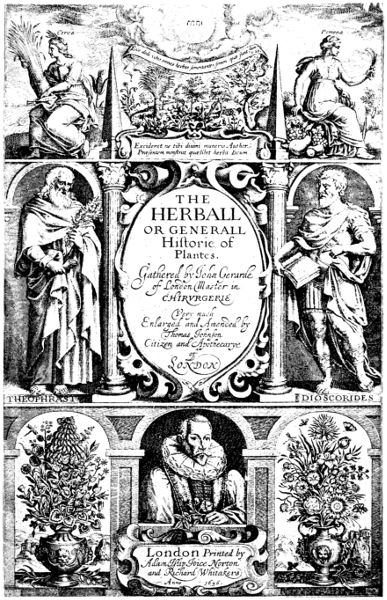
TITLE-PAGE OF GERARD’S “HERBAL”
Edgar. Half way down
Hangs one that gathers Samphire, dreadful trade!
Methinks he seems no bigger than his head.
King Lear, iv. 6.
Samphire is St Peter’s Herb, and gains the distinction
either because it grows on sea-cliffs, and so is appropriate
to the patron of fishermen, or more probably, because
it flourishes on rocks, and its roots strike deep into
the crevices. The French call it Herbe de St Pierre and
Pierce-Pierre, from its peculiar way of growing; and the
Italians have the same name, but call it Finocchio marino
as well; and this title, translated to Meer-finckell, was
also the German and Dutch name, according to Parkinson.
It is strongly aromatic, “being of smell delightfule
and pleasant, and hath many fat and thicke leaves, somewhat
like those of the lesser Purslane... of a spicie
taste, with a certaine saltness.” Gerarde praises it pickled
in salads. Edgar’s words show that it must have been
popular in Elizabethan days, and so it was for more than
a hundred years after as “the pleasantest Sauce”; and
Evelyn considered it preferable to “most of our hotter
herbs,” and “long wonder’d it has not long since been
cultivated in the Potagère as it is in France. It groweth on
the rocks that are often moistened, at the least, if not overflowed
with the sea water,” a verdict which tallies with
the saying that Samphire grows out of reach of the
waves, but within reach of the spray of every tide. I
have found it growing in much that position on rocks
on the seashore in Cornwall. Two other kinds of
Samphire, Golden Samphire (Inula Crithmifolia) and
Marsh Samphire (Salicornia Herbacea), are sometimes sold
as the true Samphire, but neither of them have so good
a flavour.
The Skirret and the leek’s aspiring kind,
The noxious poppy-quencher of the mind.
The Salad.—Cowper.
“This is that siser or skirret which Tiberius the
Emperour commanded to be conveied unto him from
Gelduba, a castle about the river of Rhine,” and which
delighted him so much “that he desired the same to be
brought unto him everye yeare out of Germanie.” Evelyn
found them “hot and moist... exceedingly wholesome,
nourishing and delicate... and so valued by the
Emperor Tiberius that he accepted them for tribute”—a
point that Gerarde’s statement hardly brought out.
“This excellent root is seldom eaten raw, but being
boil’d, stew’d, roasted under the Embers, bak’d in Pies
whole, slic’d or in Pulp, is very acceptable to all Palates.
’Tis reported they were heretofore something bitter,
see what culture and education effects.” On the top of
these congratulations, perhaps it is unkind to say the
reported bitterness has a very mythical sound, for long
before Evelyn’s time, the Dutch name for skirret was
Suycker wortelen (sugar root), and that Marcgrave
has extracted “fine white sugar, little inferior to that of
the cane” from it. But from Turner’s account there
seems to have been formerly some confusion as to the
identity of the plant, and one claimant to the title
was somewhat bitter, so perhaps this was the cause of
the remarks in Acetaria. In Scotland, Skirrets were
called Crummock. Though few people seem to have
appreciated them so much as did our ancestors, they
were till lately sometimes boiled and sent to the table,
but are now hardly ever seen.
Smallage is merely wild celery, and all that is
interesting about it is Parkinson’s description of his first
making acquaintance with sweet smallage—our celery,
which has been already quoted. He merely says of
ordinary smallage that it is “somewhat like Parsley, but
greater, greener and more bitter.” It grows wild in
moist grounds, but is also planted in gardens, and
although “his evil taste and savour, doth cause it
not to be accepted unto meats as Parsley,” yet it has
“many good properties both for inward and outward
diseases.”
Stone-crop, Stone-hot, Prick-Madam or Trick-Madam
is a Sedum, but which Sedum the old Herbalists called by
these names is not absolutely clear, it was probably
Sedum Telephium or Sedum Album. Evelyn speaks of
“Tripe-Madam, Vermicularis Insipida,” which seems to
point to the latter, as that used to be called
Worm-grass. He says Tripe-madam is “cooling and
moist,” but there is another Stone-crop of as pernicious
qualities as the former are laudable, Wall-pepper, Sedum
Minus Causticum (most likely our Sedum Acre). This is
called by the French, Tricque-Madame, and he cautions
the “Sallet-Composer, if he be not botanist sufficiently
skilful” to distinguish them by the eye, to “consult
his palate,” and taste them before adding them to the
other ingredients.
Sweet Cicely or Sweet Chervil was apparently less
of a favourite than its romantic name would seem to
warrant, for I can find no traditions concerning it.
“Chervil” (of which this is a variety) says Gerarde, “is
thought to be so called because it delighteth to grow
with many leaves, or rather that it causeth joy and
gladness.” There does not seem much connection
between these two interpretations. He continues that
“the name Myrrhus is also called Myrrha, taken from his
pleasant flavour of Myrrh.” Sweet Cicely has a very
pleasant flavour, with this peculiarity, that the leaves
taste exactly as if sugar had just been powdered over
them, but personally I have never been able to recognise
myrrh in it. It is a pretty plant, with “divers great and
fair spread wing leaves, very like and resembling the
leaves of Hemlocke... but of sweet pleasant and
spice-hot taste. Put among herbes in a sallet it addeth
a marvellous good rellish to all the rest. Some
commend the green seeds sliced and put in a sallet of
herbes. The rootes are eyther boyled and eaten with oyle
and vinegare or preserved or candid.” Sweet Cicely is
very attractive to bees, and was often “rubbed over the
insides of the hives before placing them before newly-cast
swarms to induce them to enter,” and in the North
of England Hogg says the seeds are used to polish
and scent oak floors and furniture.
Lelipa—Then burnet shall bear up with this
Whose leaf I greatly fancy,
Some camomile doth not amiss
With savory and some tansy.
Muses’ Elysium.
The hot muscado oil, with milder maudlin cast
Strong tansey, fennel cool, they prodigally waste.
Polyolbion, Song xv.
The name Tansy comes from Athanasia, Immortality,
because its flower lasts so long, and it is dedicated to
St Athanasius. It is connected with various interesting
old customs, and especially with some observed at
Easter time. Brand quotes several old rhymes in
reference to this.
Soone at Easter cometh Alleluya.
With butter, cheese and a tansay.
From Douce’s Collection of Carols.
On Easter Sunday be the pudding seen
To which the Tansey lends her sober green.
The Oxford Sausage.
Wherever any grassy turf is view’d,
It seems a tansie all with sugar strew’d.
From Shipman’s Poems.
The last lines occur in a description of the frost in 1654.
None of these quotations refer to the plant alone; but to
that kind of cake or fritter called taansie, and of which
Tansy leaves formed an ingredient. Tansy must be
“eaten young, shred small with other herbes, or else,
the juiyce of it and other herbes, fit for the purpose
beaten with egges and fried into cakes (in Lent and in the
Spring of the year) which are usually called Tansies.”
Though Parkinson speaks of their being eaten in Lent
(as they no doubt were), the special day that they were
in demand was Easter Day, and of this practice Culpepper
has a good deal to say. Tansies were then eaten
as a remembrance of the bitter herbs eaten by the Jews at
the Passover. “Our Tansies at Easter have reference to
the bitter herbs, though at the same time ’twas always the
fashion for a man to have a gammon of bacon, to show
himself to be no Jew.” This little glimpse of an old
practice comes from Selden’s Table Talk and the idea of
taking this means to declare one’s self a Christian is really
delightful. I must quote again from Brand to show another
very extraordinary Easter Day custom. “Belithus,
a ritualist of ancient times, tells us that it was customary
in some churches for the Bishops and Archbishops themselves
to play with the inferior clergy at hand-ball, and
this, as Durand asserts, even on Easter Day itself. Why
they should play at hand-ball at this time rather than
any other game, Bourne tells us he has not been able
to discover; certain it is, however, that the present
custom of playing at that game on Easter Holidays for a
tansy-cake has been derived from thence.” Stool-ball was
apparently a most popular amusement and Lewis in his
English Presbyterian Eloquence criticises the tenets of
the Puritans, and observes with disapproval that all
games where there is “any hazard of loss are strictly
forbidden; not so much as a game of stool-ball
for a tansy is allowed.” From a collection of poems
called “A Pleasant Grove of New Fancies,” 1657,
Brand extracts the following verses:—
At stool-ball, Lucia, let us play
For sugar, cakes and wine
Or for a tansey let us pay,
The loss be thine or mine.
If thou, my dear, a winner be,
At trundling of the ball,
The wager thou shalt have and me,
And my misfortunes all.
Let us hope that the stake was handsomer than it
sounds! Brand quotes another very curious practice in
which Tansies have a share, once existing in the North.
On Easter Sunday, the young men of the village would
steal the buckles off the maidens’ shoes. On Easter
Monday, the young men’s shoes and buckles were taken
off by the young women. On Wednesday, they are
redeemed by little pecuniary forfeits, out of which an
entertainment, called a Tansey Cake, is made, with dancing.
One cannot help wondering how this cheerful, if
somewhat peculiar custom originated! In course of
time Tansies came to be eaten only about Easter-time
and the practice seems to have acquired at one period
the lustre almost of a religious rite in which superstition
had a considerable share. Coles (1656) and
Culpepper (1652) rebel against this and show with
force and clearness the advantages of eating Tansies
throughout the spring. Coles ignores the ceremonial
reasons and says that the origin of eating it in the
spring is because Tansy is very wholesome after the
salt fish consumed during Lent, and counteracts the ill-effects
which “the moist and cold constitution of winter”
has made on people... “though many understand it not
and some simple people take it for a matter of superstition
to do so.” This shows plainly that the idea of eating
Tansies only at Easter, was pretty widely spread. Culpepper
as usual is more incisive. He first gives the same
reason that Coles does for eating Tansies in the spring;
then: “At last the world being over-run with Popery,
a monster called superstition pecks up his head, and...
obscures the bright beams of knowledge by his dismal
looks; (physicians seeing the Pope and his imps, selfish,
began to do so too), and now, forsooth, Tansies must be
eaten only on Palm and Easter Sundays and their neighbour
days. At last superstition being too hot to hold, and
the selfishness of physicians walking in the clouds; after
the friars and monks had made the people ignorant, the
superstition of the time, was found out by the virtue of
the herb hidden and now is almost, if not altogether left
off. Scarcely any physicians are beholden to none so
much as they are to monks and friars; for wanting of
eating this herb in spring, maketh people sickly in
summer, and that makes work for the physician. If
it be against any man or woman’s conscience to eat
Tansey in the spring, I am as unwilling to burthen their
conscience, as I am that they should burthen mine; they
may boil it in wine and drink the decoction, it will work
the same effect.” “The Pope and his imps” is a grand
phrase! A more militant Protestant than Culpepper it
would be difficult to find, even in these days.
From other writers, it seems that the phase of associating
Tansies exclusively with Easter, must have worn
itself out, for we find many descriptions of them on
distinctly secular occasions. At the Coronation Feast of
James II. and his Queen, a Tansie was served among the
1445 “Dishes of delicious Viands” provided for it, and
I must quote some of the others:—“Stag’s tongues,
cold; Andolioes; Cyprus Birds, cold and Asparagus; a
pudding, hot; Salamagundy; 4 Fawns; 10 Oyster
pyes, hot; Artichokes; an Oglio, hot; Bacon, Gammon
and Spinnage; 12 Stump Pyes; 8 Godwits;
Morels; 24 Puffins; 4 dozen Almond Puddings, hot;
Botargo; Skirrets; Cabbage Pudding; Lemon Sallet;
Taffeta Tarts; Razar Fish; and Broom Buds, cold.”[52]
These are only a very few out of an immense variety
that are also named.
Many recipes for a “Tansy” exist, and very often
have only the slightest resemblance to one another,
but this is rather a nice one and is declared by its transcriber
to be “the most agreeable of all the boiled
Herbaceous Dishes.” It consists of: “Tansey, being
qualify’d with the juices of other fresh Herbs; Spinach,
green Corn, Violet, Primrose Leaves, etc., at entrance of the
spring, and then fry’d brownish, is eaten hot, with the
Juice of Orange and Sugar.” Isaac Walton speaks of a
“Minnow Tansy,” which is made of Minnows “fried
with yolks of eggs; the flowers of cowslips and of
primroses and a little tansy; thus used they make a
dainty dish of meat.” Our ancestors seem to have had
a great love of “batter,” for it is a prominent part in
very many of their dishes. Mrs Milne Home says, “In
Virginia the Negroes make Tansy-tea for colds and at a
pinch, Mas’r’s cook will condescend to use it in a sauce,”
but in English cookery, it has absolutely disappeared.
Tansy had many medicinal virtues. Sussex people
used to say that to wear Tansy-leaves in the shoe, was a
charm against ague.
Wild Tansy looks handsome when it grows in abundance
on marshy ground; and, indeed, its feathery leaves
are beautiful anywhere, and it has a more refreshing scent
than the Garden-Tansy. “In some parts of Italy people
present stalks of Wild Tansy to those whom they mean to
insult,”[53] a proceeding for which there seems neither rhyme
nor reason. Turner tells tales of the vanity of his contemporaries,
masculine as well as feminine, for he says:
“Our weomen in Englande and some men that be
sunneburnt and would be fayre, eyther stepe this herbe
in white wyne and wash their faces with the wyne or
ellis with the distilled water of the same.”
Margaret. Get you some of this distilled Carduus Benedictus, and lay it
to your heart, it is the only thing for a qualm.
Hero. There thou prick’st her with a thistle.
Beatrice. Benedictus! why Benedictus? you have some moral in this
Benedictus.
Margaret. Moral! no, by my troth, I have no moral meaning; I meant
plain holy thistle.
Much Ado about Nothing, iii, 4.
That thence, as from a garden without dressing
She these should ever have, and never want.
Store from an orchard without tree or plant...
And for the chiefest cherisher she lent
The royal thistle’s milky nourishment.
Br. Pastorals, Book i.
The history, legends, and traditions surrounding
Thistles in general, make far too large a subject to be
entered on here, and only these two varieties can be
considered. Carduus Marianus, the Milk or Dappled
Thistle, has sometimes been called the Scotch Thistle,
and announced to be the Thistle of Scotland. As a
matter of fact, I believe, that after long and stormy
controversy, that honour has been awarded to Carduus
Acanthioides, but the Milk Thistle’s claims have received
very strong support, and so it seems most probable,
considering the context, that when Browne referred to
the “Royal Thistle,” it was this one that he meant.
This supposition is borne out by Hogg, who writes:
“As Ray says, it is more a garden vegetable than a
medicinal plant. The young and tender stalks of the
root leaves when stripped of their spiny part, are eaten
like cardoon, or when boiled, are used as greens. The
young stalks, peeled and soaked in water to extract
their bitterness, are excellent as a salad. The scales
of the involucre are as good as those of the artichoke, and
the roots in early spring are good to eat.” The seeds
supply food to many small birds, and it is from the
gold-finch feeding so extensively on them that it has
been called Carduelis. This partiality of the gold-finch
must have been observed in several lands, for the same
name occurs in different tongues. In England, it has
been called Thistlefinch; in French, Chardonneret, and
in Italian, Cardeletto, Cardeto being a waste covered with
thistles. One cannot help remembering the charming
line:—
“As the thistle shakes,
When three gray linnets wrangle for the seed,”
with the reflection that other birds besides gold-finches
have a deep appreciation of it.
But to go back to the Thistle itself, after all these
uses made of every part, no wonder that Browne called
it a “chiefest cherisher of vital power!” Although,
latterly, its reputation in medicine has fallen, in old
days, on account of its numerous prickles (Doctrine
of Signatures), it was thought good for stitches in
the side. Culpepper has further advice: “In spring,
if you please to boil the tender plant (but cut off the
prickles, unless you have a mind to choke yourself), it
will change your blood as the season changeth, and that
is the way to be safe.”
Carduus Benedictus, called the Holy, or the Blessed
Thistle, was considered a great preservative against the
plague, and that it was also given for a sudden spasm is
shown in the delightful scene between Beatrice and her
friends in “Much Ado About Nothing.” It follows the
ruse that they have just played upon her, to persuade her
that Benedict is already in love with her, in the hope
that she may become enamoured of him, and the play upon
the name is very charming. Culpepper says that Carduus
Benedictus was good against “diseases of melancholy,”
which is additional evidence that Shakespeare did not
go out of his way to find an imaginary remedy that
would suit that occasion, but with exquisite skill took
a remedy that would have been natural in his time,
and surrounded it with wit. Less than a hundred years
ago a decoction used to be made from its leaves, which
are remarkable for their “intense bitterness,” and it was
said to be an excellent tonic; but, like the Milk Thistle,
the Holy Thistle’s virtues in medicine are now discredited.
The thistle was once dedicated to Thor,
and the bright colour of the flower was supposed to
come from the lightning, and therefore lightning could
not hurt any person or building protected by the flower.
It was used a good deal in magic, and there is an old
rite to help a maiden to discover which, of several
suitors, really loves her best. She must take as many
thistles as there are lovers, cut off their points, give
each thistle the name of a man, and lay them under her
pillow, and the thistle which has the name of the most
faithful lover will put forth a fresh sprout! In East
Prussia, says Mr Friend, there is a strange but simple
cure for any domestic animal which may have an open
wound. It is to gather four red thistle blossoms before
the break of day, and to put one in each of the four
points of the compass with a stone in the middle of
them.
Here ends the list of Herbs, but before finishing the
chapter I must add a few names of buds and berries
which, though not herbs, were often employed as such,
especially to garnish, or to flavour dishes. Evelyn
includes many of these in his Acetaria. “The Capreols,
Tendrils and Claspers of Vines,” very young, may be
“eaten alone or mingled with other sallet. So may
the ‘buds and young Turiones of the Tendrils’ of
Hops, either raw, ‘but more conveniently being boil’d’
and cold, like asparagus.” Elder Flowers, infused in
vinegar, are recommended, and “though the leaves are
somewhat rank of smell, and so not commendable in
sallet... they are of the most sovereign virtue, and
spring buds and tender leaves excellent and wholesome
in pottage at that season of the year.” Evelyn experimented
with “the large Heliotrope or Sunflower (e’er it
comes to expand and show its golden face), which, being
dress’d as the artichoak, is eaten for a dainty. This I
add as a new discovery: I once made macaroons with
ripe blanch’d seed, but the Turpentine did so domineer
over all that it did not answer expectation.” This must
have been a disappointment to his adventurous spirit!
Broom buds appeared on three separate tables at King
James II.’s Coronation feast, and seem to have been
popular, when pickled.
Violets were also used, and Miss Amherst quotes
from an old cookery book the recipe of a pudding
called “Mon amy,” which directs the cook to “plant it
with flowers of violets and serve it forth.” Another
recipe is for a dish called “Vyolette!” “Take flowrys
of vyolet, boyle hem, presse hem, bray (pound) hem
smal.” After this they are to be mixed with milk,
‘floure of rys,’ and sugar or honey, and finally to be
coloured with violets. Pine-kernels were sometimes
eaten. Shelley says of Marenghi:
“His food was the wild fig or strawberry;
The milky pine-nuts which the autumn blast
Shakes into the tall grass.”
And in England Parkinson writes, “The cones or
apples are used of divers Vintners in this city, being
painted to express a bunch of grapes, whereunto they
are very like and are hung up on their bushes, as also
to fasten keyes unto them, as is seene in many places.
The kernels with the hard shels, while they are fresh,
or newly taken out, are used by Apothecaries, Comfitmakers,
and Cookes. Of them are made Comfits,
Marchpanes and such like, and with them a cunning
cook can make divers kech-choses for his master’s table.”
Barberries were used as a garnish to salads and other
dishes and sometimes as an ingredient. Evelyn mentions
them as an item in “Sallet All-sorts,” and Gervase
Markham describes the making of “Paste of Genoa,”
a confection of Quince, and adds, “In this sort you now
make paste of Peares, Apples, Wardens, Plummes of
all kindes, Cherries, Barberries or whatever fruit you
please.” He adds this fruit to the ingredients required
in making aromatic vinegar, and also directs that a
good quantity of whole Barberries, both branches and
others, be served with Pike “or any fresh fish whatsoever.”
Parkinson says, “The leaves are sometimes
used in the stead of Sorrell to make sauce for meate,
and by reason of their sournesse are of the same quality.”
The “delicious confitures d’épine vinette, for which
Rouen is famous,” are prepared from them, says Dr
Fernie, and there is no doubt that they make an excellent
jelly. Formerly they were so much prized that,
as Miss Amherst quotes from Le Strange’s “Household
Accounts,” in 1618, 3s. was paid for one pound of them.
Strawberry leaves were used as a garnish and
for their flavour. Parkinson tells us that they were
“alwayes used among other herbes in cooling
drinks,” and Markham mentions both them and
Violet leaves in his directions to “Smoar a Mallard,”
and “to make an excellent Olepotrige, which is the
only principall dish of boyled meate, which is esteemed
in all Spaine. “For dessert”: The berries are often
brought to the table as a rare service, whereunto
Cleret wine, creame or milke is added with sugar.
The water distilled of the berries is good for the
passions of the heart, caused by the perturbation of
the spirits being eyther drunk alone or in wine, and
maketh the heart mery.” Such a pleasant and easy
remedy against the evils arising from “perturbation of
spirits” is worth remembering! Gerarde and Parkinson
both speak of the prickly strawberry; a plant which is
“of no use for meate” but which has “a small head
of greene leaves, many set thick together like unto a
double ruffe, and is fit for a gentlewoman to wear on
her arme, etc. as a raritie instead of a flower.” Gerarde
has a curious little note on its discovery. “Mr John
Tradescant hath told me that he was the first that took
notice of this Strawberry and that in a woman’s garden
at Plimouth, whose daughter had gathered and set the
roots in her garden, instead of the common Strawberry,
but she finding the fruit not answer her expectation,
intended to throw it away, which labour he spared her,
in taking it and bestowing it among the lovers of such
vanities.” The custom of transplanting wild strawberries
was very general.
Wife, unto thy garden and set me a plot,
With strawberry rootes of the best to be got.
Such growing abroade, among thorns in the wood,
Wel chosen and picked proove excellent food.
September’s Husbandry.—Tusser.
Miss Amherst says that in the Hampton Court
Accounts there are “several entries of money paid for
strawberry roots, brought from the wood to the King’s
garden.” The fact that this is no longer the custom,
may explain the disappointment that some have experienced,
who, in the hope of enjoying “the most
excellent cordial smell” described by Sir Francis Bacon,
have haunted their kitchen gardens when the strawberry
leaves are dying, and without reward. The
strawberries grown there at present are not, as in his
day, natives, subjected to civilisation, but are chiefly
of American or Asiatic origin (the first foreign strawberry
cultivated in England was Fragaria virginiana, and
was introduced from North America in 1629; four years
after the Essay on Gardens was first published), and if
their leaves have any fragrance, it must be of the faintest
possible description. Anyone, however, who passes
through a wood, towards evening, especially if it is a
mild and slightly damp day in October, may speedily
realise how true and admirable was this counsel given
by the Great Lord Chancellor.

THE ARMS OF SAFFRON WALDEN.