In Colonial days Hallowe'en was not celebrated
much in America. Some English still
kept the customs of the old world, such as
apple-ducking and snapping, and girls tried
the apple-paring charm to reveal their lovers'
initials, and the comb-and-mirror test to see
their faces. Ballads were sung and ghost-stories
told, for the dead were thought to return
on Hallowe'en.
"There was a young officer in Phips's company
at the time of the finding of the Spanish
treasure-ship, who had gone mad at the sight of
the bursting sacks that the divers had brought
up from the sea, as the gold coins covered the
deck. This man had once lived in the old stone
house on the 'faire greene lane,' and a report
had gone out that his spirit still visited it, and
caused discordant noises. Once ... on a
gusty November evening, when the clouds were
scudding over the moon, a hall-door had blown
open with a shrieking draft and a force that
caused the floor to tremble."
Butterworth: Hallowe'en Reformation.
Elves, goblins, and fairies are native on
American soil. The Indians believed in evil
manitous, some of whom were water-gods who
exacted tribute from all who passed over their
lakes. Henry Hudson and his fellow-explorers
haunted as mountain-trolls the Catskill
range. Like Ossian and so many other
visitors to the Otherworld, Rip Van Winkle
is lured into the strange gathering, thinks
that he passes the night there, wakes, and
goes home to find that twenty years have
whitened his hair, rusted his gun, and
snatched from life many of his boon-companions.
"My gun must have cotched the rheumatix
too. Now that's too bad. Them fellows have
gone and stolen my good gun, and leave me this
rusty old barrel.
"Why, is that the village of Falling Waters
that I see? Why, the place is more than twice
the size it was last night—I——
"I don't know whether I am dreaming, or
sleeping, or waking."
Jefferson: Rip Van Winkle.
The persecution of witches, prevalent in
Europe, reached this side of the Atlantic in
the seventeenth century.
"This sudden burst of wickedness and crime
Was but the common madness of the time,
When in all lands, that lie within the sound
Of Sabbath bells, a witch was burned or drowned."
Longfellow: Giles Corey of the Salem Farms.
Men and women who had enemies to accuse
them of evil knowledge and the power to
cause illness in others, were hanged or pressed
to death by heavy weights. Such sicknesses
they could cause by keeping a waxen image,
and sticking pins or nails into it, or melting
it before the fire. The person whom they
hated would be in torture, or would waste
away like the waxen doll. Witches' power
to injure and to prophesy came from the
Devil, who marked them with a needle-prick.
Such marks were sought as evidence at trials.
"Witches' eyes are coals of fire from the pit."
They were attended by black cats, owls, bats,
and toads.
Iron, as being a product of fire, was a protection
against them, as against evil spirits
everywhere. It had especial power when in
the shape of a horseshoe.
"This horseshoe will I nail upon the threshold.
There, ye night-hags and witches that torment
The neighborhood, ye shall not enter here."
Longfellow: Giles Corey of the Salem Farms.
The holiday-time of elves, witches, and
ghosts is Hallowe'en. It is not believed in
here except by some children, who people the
dark with bogies who will carry them away
if they are naughty.
"Onc't they was a little boy wouldn't say his prayers—
An' when he went to bed at night, away upstairs,
His mammy heerd him holler, an' his daddy heerd him bawl,
An' when they turn't the kivvers down, he wasn't there at all!
An' they seeked him in the rafter-room, an' cubby-hole, an' press,
An' seeked him up the chimbley-flue, an' ever'wheres, I guess;
But all they ever found was thist his pants an' roundabout!
An' the Gobble-uns 'll git you, ef you don't watch out!"
Riley: Little Orphant Annie.
Negroes are very superstitious, putting faith
in all sorts of supernatural beings.
"Blame my trap! how de wind do blow;
And dis is das de night for de witches, sho!
Dey's trouble going to waste when de ole slut whine,
An' you hear de cat a-spittin' when de moon don't shine."
Riley: When de Folks is Gone.
While the original customs of Hallowe'en
are being forgotten more and more across the
ocean, Americans have fostered them, and are
making this an occasion something like what
it must have been in its best days overseas.
All Hallowe'en customs in the United States
are borrowed directly or adapted from those
of other countries. All superstitions, everyday
ones, and those pertaining to Christmas
and New Year's, have special value on Hallowe'en.
It is a night of ghostly and merry revelry.
Mischievous spirits choose it for carrying off
gates and other objects, and hiding them or
putting them out of reach.
"Dear me, Polly, I wonder what them boys
will be up to to-night. I do hope they'll not put
the gate up on the shed as they did last year."
Wright: Tom's Hallowe'en Joke.
Bags filled with flour sprinkle the passers-by.
Door-bells are rung and mysterious raps
sounded on doors, things thrown into halls,
and knobs stolen. Such sports mean no more
at Hallowe'en than the tricks played the
night before the Fourth of July have to do
with the Declaration of Independence. We
see manifested on all such occasions the spirit
of "Free-night" of which George von Hartwig
speaks so enthusiastically in St. John's
Fire (page 141).
Hallowe'en parties are the real survival of
the ancient merrymakings. They are prepared
for in secret. Guests are not to divulge
the fact that they are invited. Often they
come masked, as ghosts or witches.
The decorations make plain the two elements
of the festival. For the centerpiece of
the table there may be a hollowed pumpkin,
filled with apples and nuts and other fruits of
harvest, or a pumpkin-chariot drawn by field-mice.
So it is clear that this is a harvest-party,
like Pomona's feast. In the coach rides
a witch, representing the other element, of
magic and prophecy. Jack-o'-lanterns, with
which the room is lighted, are hollowed
pumpkins with candles inside. The candle-light
shines through holes cut like features.
So the lantern becomes a bogy, and is held up
at a window to frighten those inside. Corn-stalks
from the garden stand in clumps about
the room. A frieze of witches on broomsticks,
with cats, bats, and owls surmounts the
fireplace, perhaps. A full moon shines over
all, and a caldron on a tripod holds fortunes
tied in nut-shells. The prevailing colors are
yellow and black: a deep yellow is the color
of most ripe grain and fruit; black stands for
black magic and demoniac influence. Ghosts
and skulls and cross-bones, symbols of death,
startle the beholder. Since Hallowe'en is a
time for lovers to learn their fate, hearts and
other sentimental tokens are used to good
effect, as the Scotch lads of Burns's time wore
love-knots.
Having marched to the dining-room to the
time of a dirge, the guests find before them
plain, hearty fare; doughnuts, gingerbread,
cider, popcorn, apples, and nuts honored by
time. The Hallowe'en cake has held the
place of honor since the beginning here in
America. A ring, key, thimble, penny, and
button baked in it foretell respectively speedy
marriage, a journey, spinsterhood, wealth,
and bachelorhood.
"Polly was going to be married, Jennie was
going on a long journey, and you—down went
the knife against something hard. The girls
crowded round. You had a hurt in your throat,
and there, there, in your slice, was the horrid,
hateful, big brass thimble. It was more than
you could bear—soaking, dripping wet, and an
old maid!"
Bradley: Different Party.
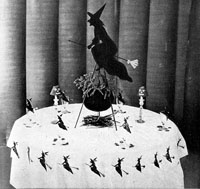 A Witch Table.
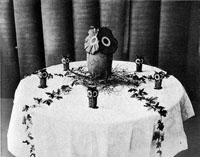 An Owl Table.
Hallowe'en Tables, I.
The kitchen is the best place for the rough
games and after-supper charms.
On the stems of the apples which are to be
dipped for may be tied names; for the boys
in one tub, for the girls in another. Each
searcher of the future must draw out with his
teeth an apple with a name which will be
like that of his future mate.
A variation of the Irish snap-apple is a
hoop hung by strings from the ceiling, round
which at intervals are placed bread, apples,
cakes, peppers, candies, and candles. The
strings are twisted, then let go, and as the
hoop revolves, each may step up and get a
bite from whatever comes to him. By the
taste he determines what the character of his
married life will be,—whether wholesome,
acid, soft, fiery, or sweet. Whoever bites the
candle is twice unfortunate, for he must pay
a forfeit too. An apple and a bag of flour are
placed on the ends of a stick, and whoever
dares to seize a mouthful of apple must risk
being blinded by flour. Apples are suspended
one to a string in a doorway. As they swing,
each guest tries to secure his apple. To blow
out a candle as it revolves on a stick requires
attention and accuracy of aim.
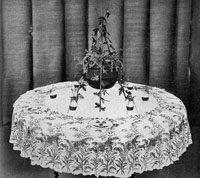 A Witches'-Caldron Table.
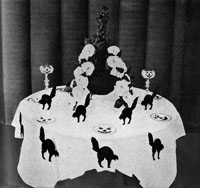 A Black-Cat Table.
Hallowe'en Tables, II.
The one who first succeeds in threading a
needle as he sits on a round bottle on the
floor, will be first married. Twelve candles
are lighted, and placed at convenient distances
on the floor in a row. As the guest leaps
over them, the first he blows out will indicate
his wedding-month. One candle only placed
on the floor and blown out in the same way
means a year of wretchedness ahead. If it
still burns, it presages a year of joy.
Among the quieter tests some of the most
common are tried with apple-seeds. As in
England a pair of seeds named for two lovers
are stuck on brow or eyelids. The one who
sticks longer is the true, the one who soon
falls, the disloyal sweetheart. Seeds are used
in this way to tell also whether one is to be
a traveler or a stay-at-home. Apple-seeds are
twice ominous, partaking of both apple and
nut nature. Even the number of seeds found
in a core has meaning. If you put them
upon the palm of your hand, and strike it
with the other, the number remaining will
tell you how many letters you will receive in
a fortnight. With twelve seeds and the
names of twelve friends, the old rhyme may
be repeated:
"One I love,
Two I love,
Three I love, I say;
Four I love with all my heart:
Five I cast away.
Six he loves,
Seven she loves,
Eight they both love;
Nine he comes,
Ten he tarries,
Eleven he courts, and
Twelve he marries."
Nuts are burned in the open fire. It is generally
agreed that the one for whom the first
that pops is named, loves.
"If he loves me, pop and fly;
If he hates me, live and die."
Often the superstition connected therewith is
forgotten in the excitement of the moment.
"When ebery one among us toe de smallest pickaninny
Would huddle in de chimbley cohnah's glow,
Toe listen toe dem chilly win's ob ole Novembah's
Go a-screechin' lack a spook around de huts,
'Twell de pickaninnies' fingahs gits to shakin' o'er de embahs,
An' dey laik ter roas' dey knuckles 'stead o' nuts."
In Werner's Readings, Number 31.
Letters of the alphabet are carved on a
pumpkin. Fate guides the hand of the blindfolded
seeker to the fateful initial which he
stabs with a pin. Letters cut out of paper
are sprinkled on water in a tub. They form
groups from which any one with imagination
may spell out names.
Girls walk down cellar backward with a
candle in one hand and a looking-glass in the
other, expecting to see a face in the glass.
"Last night 't was witching Hallowe'en,
Dearest; an apple russet-brown
I pared, and thrice above my crown
Whirled the long skin; they watched it keen;
I flung it far; they laughed and cried me shame—
Dearest, there lay the letter of your name.
"Took I the mirror then, and crept
Down, down the creaking narrow stair;
The milk-pans caught my candle's flare
And mice walked soft and spiders slept.
I spoke the spell, and stood the magic space,
Dearest—and in the glass I saw your face!
"And then I stole out in the night
Alone; the frogs piped sweet and loud,
The moon looked through a ragged cloud.
Thrice round the house I sped me light,
Dearest; and there, methought—charm of my charms!
You met me, kissed me, took me to your arms!"
Opper: The Charms.
There are many mirror-tests. A girl who
sits before a mirror at midnight on Hallowe'en
combing her hair and eating an apple will see
the face of her true love reflected in the glass.
Standing so that through a window she may
see the moon in a glass she holds, she counts
the number of reflections to find out how
many pleasant things will happen to her in
the next twelve months. Alabama has taken
over the Scotch mirror test in its entirety.
A girl with a looking-glass in her hand
steps backward from the door out into the
yard. Saying:
"Round and round, O stars so fair!
Ye travel, and search out everywhere.
I pray you, sweet stars, now show to me,
This night, who my future husband shall be!"
she goes to meet her fate.
"So Leslie backed out at the door, and we
shut it upon her. The instant after, we heard a
great laugh. Off the piazza she had stepped
backward directly against two gentlemen coming
in.
"Doctor Ingleside was one, coming to get his
supper; the other was a friend of his.... 'Doctor
John Hautayne,' he said, introducing
him by his full name."
Whitney: We Girls.
A custom that is a reminder of the lighted
boats sent down-stream in Japan to bear away
the souls of the dead, is that which makes use
of nut-shell boats. These have tiny candles
fastened in them, are lighted, and named, and
set adrift on a tub of water. If they cling to
the side, their namesakes will lead a quiet
life. Some will float together. Some will
collide and be shipwrecked. Others will bear
steadily toward a goal though the waves are
rocked in a tempest. Their behavior is
significant. The candle which burns longest
belongs to the one who will marry first.
The Midsummer wheel which was rolled
down into the Moselle River in France, and
meant, if the flames that wreathed it were not
extinguished, that the grape-harvest would be
abundant, has survived in the fortune wheel
which is rolled about from one guest to another,
and brings a gift to each.
The actions of cats on Hallowe'en betoken
good or bad luck. If a cat sits quietly beside
any one, he will enjoy a peaceful, prosperous
life; if one rubs against him, it brings good
luck, doubly good if one jumps into his
lap. If a cat yawns near you on Hallowe'en,
be alert and do not let opportunity
slip by you. If a cat runs from you, you
have a secret which will be revealed in seven
days.
Different states have put interpretations of
their own on the commonest charms. In
Massachusetts the one who first draws an
apple from the tub with his teeth will be first
married. If a girl steals a cabbage, she will
see her future husband as she pulls it up, or
meet him as she goes home. If these fail, she
must put the cabbage over the door and
watch to see whom it falls on, for him she is
to marry. A button concealed in mashed
potato brings misfortune to the finder. The
names of three men are written on slips of
paper, and enclosed in three balls of meal.
The one that rises first when they are
thrown into water will disclose the sought-for
name.
Maine has borrowed the yarn-test from
Scotland. A ball is thrown into a barn or
cellar, and wound off on the hand. The
lover will come and help to wind. Girls in
New Hampshire place in a row three dishes
with earth, water, and a ring in them, respectively.
The one who blindfolded touches
earth will soon die; water, will never marry;
the ring, will soon be wedded.
To dream of the future on Hallowe'en in
Pennsylvania, one must go out of the front
door backward, pick up dust or grass, wrap
it in paper, and put it under his pillow.
In Maryland girls see their future husbands
by a rite similar to the Scotch "wetting of the
sark-sleeve." They put an egg to roast, and
open wide all the doors and windows. The
man they seek will come in and turn the egg.
At supper girls stand behind the chairs, knowing
that the ones they are to marry will come
to sit in front of them.
The South has always been famous for its
hospitality and good times. On Hallowe'en a
miniature Druid-fire burns in a bowl on the
table. In the blazing alcohol are put fortunes
wrapped in tin-foil, figs, orange-peel, raisins,
almonds, and dates. The one who snatches
the best will meet his sweetheart inside of a
year, and all may try for a fortune from the
flames. The origin of this custom was the
taking of omens from the death-struggles of
creatures burning in the fire of sacrifice.
Another Southern custom is adapted from
one of Brittany. Needles are named and
floated in a dish of water. Those which cling
side by side are lovers.
Good fortune is in store for the one who
wins an apple from the tub, or against whose
glass a ring suspended by a hair strikes with
a sharp chime.
A very elaborate charm is tried in Newfoundland.
As the clock strikes midnight a
girl puts the twenty-six letters of the alphabet,
cut from paper, into a pure-white bowl which
has been touched by the lips of a new-born
babe only. After saying:
"Kind fortune, tell me where is he
Who my future lord shall be;
From this bowl all that I claim
Is to know my sweetheart's name."
she puts the bowl into a safe place until morning.
Then she is blindfolded and picks out
the same number of letters as there are in her
own name, and spells another from them.
In New Brunswick, instead of an apple, a
hard-boiled egg without salt is eaten before a
mirror, with the same result. In Canada a
thread is held over a lamp. The number
that can be counted slowly before the thread
parts, is the number of years before the one
who counts will marry.
In the United States a hair is thrown to the
winds with the stanza chanted:
"I pluck this lock of hair off my head
To tell whence comes the one I shall wed.
Fly, silken hair, fly all the world around,
Until you reach the spot where my true love is found."
The direction in which the hair floats is
prophetic.
The taste in Hallowe'en festivities now is to
study old traditions, and hold a Scotch party,
using Burns's poem Hallowe'en as a guide; or
to go a-souling as the English used. In short,
no custom that was once honored at Hallowe'en
is out of fashion now. "Cyniver" has
been borrowed from Wales, and the "dumb-cake"
from the Hebrides. In the Scotch
custom of cabbage-stalk pulling, if the stalk
comes up easily, the husband or wife will be
easy to win. The melted-lead test to show
the occupation of the husband-to-be has been
adopted in the United States. If the metal
cools in round drops, the tester will never
marry, or her husband will have no profession.
White of egg is used in the same way.
Like the Welsh test is that of filling the
mouth with water, and walking round the
house until one meets one's fate. An adaptation
of the Scottish "three luggies" is the
row of four dishes holding dirt, water, a ring,
and a rag. The dirt means divorce, the
water, a trip across the ocean, the ring, marriage,
the rag, no marriage at all.
After the charms have been tried, fagots are
passed about, and by the eerie light of burning
salt and alcohol, ghost stories are told,
each concluding his installment as his fagot
withers into ashes. Sometimes the cabbage
stalks used in the omens take the place of
fagots.
To induce prophetic dreams salt, in quantities
from a pinch to an egg full, is eaten before
one goes to bed.
"'Miss Jeanette, that's such a fine trick!
You must swallow a salt herring in three bites,
bones and all, and not drink a drop till the apparition
of your future spouse comes in the night
to offer you a drink of water.'"
Adams: Chrissie's Fate.
If, after taking three doses of salt two
minutes apart, a girl goes to bed backward,
lies on her right side, and does not move till
morning, she is sure to have eventful dreams.
Pills made of a hazelnut, a walnut, and nutmeg
grated together and mixed with butter
and sugar cause dreams: if of gold, the husband
will be rich; if of noise, a tradesman;
if of thunder and lightning, a traveler. As
in Ireland bay-leaves on or under a man's
pillow cause him to dream of his sweetheart.
Also
"Turn your boots toward the street,
Leave your garters on your feet,
Put your stockings on your head,
You'll dream of the one you're going to wed."
Lemon-peel carried all day and rubbed on the
bed-posts at night will cause an apparition to
bring the dreaming girl two lemons. For
quiet sleep and the fulfilment of any wish eat
before going to bed on Hallowe'en a piece of
dry bread.
A far more interesting development of the
Hallowe'en idea than these innocent but
colorless superstitions, is promised by the
pageant at Fort Worth, Texas, on October
thirty-first, 1916. In the masque and pageant
of the afternoon four thousand school children
took part. At night scenes from the pageant
were staged on floats which passed along the
streets. The subject was Preparedness for
Peace, and comprised scenes from American
history in which peace played an honorable
part. Such were: the conference of William
Penn and the Quakers with the Indians, and
the opening of the East to American trade.
This is not a subject limited to performances
at Hallowtide. May there not be written and
presented in America a truly Hallowe'en
pageant, illustrating and befitting its noble
origin, and making its place secure among
the holidays of the year?
HALLOWE'EN
Bring forth the raisins and the nuts—
To-night All-Hallows' Spectre struts
Along the moonlit way.
No time is this for tear or sob,
Or other woes our joys to rob,
But time for Pippin and for Bob,
And Jack-o'-lantern gay.
Come forth, ye lass and trousered kid,
From prisoned mischief raise the lid,
And lift it good and high.
Leave grave old Wisdom in the lurch,
Set Folly on a lofty perch,
Nor fear the awesome rod of birch
When dawn illumes the sky.
'Tis night for revel, set apart
To reillume the darkened heart,
And rout the hosts of Dole.
'Tis night when Goblin, Elf, and Fay,
Come dancing in their best array
To prank and royster on the way,
And ease the troubled soul.
The ghosts of all things, past parade,
Emerging from the mist and shade
That hid them from our gaze,
And full of song and ringing mirth,
In one glad moment of rebirth,
Again they walk the ways of earth,
As in the ancient days.
The beacon light shines on the hill,
The will-o'-wisps the forests fill
With flashes filched from noon;
And witches on their broomsticks spry
Speed here and yonder in the sky,
And lift their strident voices high
Unto the Hunter's moon.
The air resounds with tuneful notes
From myriads of straining throats,
All hailing Folly Queen;
So join the swelling choral throng,
Forget your sorrow and your wrong,
In one glad hour of joyous song
To honor Hallowe'en.
J. K. Bangs in Harper's Weekly, Nov. 5, 1910.
HALLOWE'EN FAILURE
Who's dat peekin' in de do'?
Set mah heart a-beatin'!
Thought I see' a spook for sho
On mah way to meetin'.
Heerd a rustlin' all aroun',
Trees all sort o' jiggled;
An' along de frosty groun'
Funny shadders wriggled.
Who's dat by de winder-sill?
Gittin' sort o' skeery;
Feets is feelin' kind o' chill,
Eyes is sort o' teary.
'Most as nervous as a coon
When de dawgs is barkin',
Er a widder when some spoon
Comes along a-sparkin'.
Whass dat creepin' up de road,
Quiet like a ferret,
Hoppin' sof'ly as a toad?
Maybe hit's a sperrit!
Lordy! hope dey ain't no ghos'
Come to tell me howdy.
I ain't got no use for those
Fantoms damp an' cloudy.
Whass dat standin' by de fence
Wid its eyes a-yearnin',
Drivin' out mah common-sense
Wid its glances burnin'?
Don't dass skeercely go to bed
Wid dem spookses roun' me.
Ain't no res' fo' dis yere head
When dem folks surroun' me.
Whass dat groanin' soun' I hear
Off dar by de gyardin?
Lordy! Lordy! Lordy dear,
Grant dis sinner pardon!
I won't nebber—I declar'
Ef it ain't my Sammy!
Sambo, what yo' doin' dar?
Yo' can't skeer yo' mammy!
Carlyle Smith in Harper's Weekly, Oct. 29, 1910.
HALLOWE'EN
Pixie, kobold, elf, and sprite
All are on their rounds to-night,—
In the wan moon's silver ray
Thrives their helter-skelter play.
Fond of cellar, barn, or stack
True unto the almanac,
They present to credulous eyes
Strange hobgoblin mysteries.
Cabbage-stumps—straws wet with dew—
Apple-skins, and chestnuts too,
And a mirror for some lass
Show what wonders come to pass.
Doors they move, and gates they hide
Mischiefs that on moonbeams ride
Are their deeds,—and, by their spells,
Love records its oracles.
Don't we all, of long ago
By the ruddy fireplace glow,
In the kitchen and the hall,
Those queer, coof-like pranks recall?
Eery shadows were they then—
But to-night they come again;
Were we once more but sixteen
Precious would be Hallowe'en.
Joel Benton in Harper's Weekly, Oct. 31, 1896.
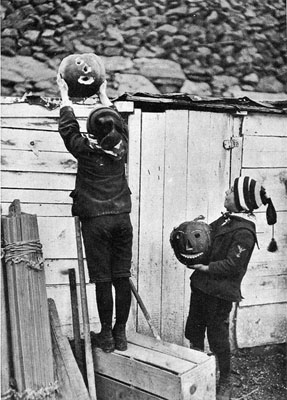 No Hallowe'en without
a Jack-o'-Lantern.
HALLOWE'EN
A gypsy flame is on the hearth,
Sign of this carnival of mirth.
Through the dun fields and from the glade
Flash merry folk in masquerade—
It is the witching Hallowe'en.
Pale tapers glimmer in the sky,
The dead and dying leaves go by;
Dimly across the faded green
Strange shadows, stranger shades, are seen—
It is the mystic Hallowe'en.
Soft gusts of love and memory
Beat at the heart reproachfully;
The lights that burn for those who die
Were flickering low, let them flare high—
It is the haunting Hallowe'en.
A. F. Murray in Harper's Weekly, Oct. 30, 1909.
 Hallowe'en Festivities.


