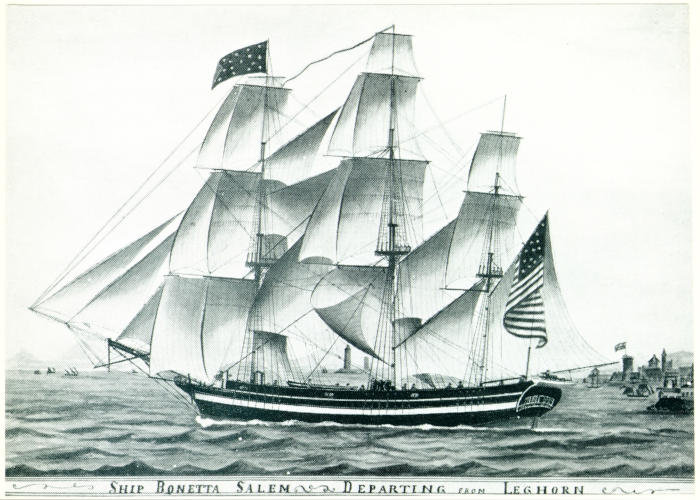
THE HARBOR OF LEGHORN IN SHELLEY’S DAY SHOWING THE AMERICAN SHIP
“BONETTA” OF SALEM LEAVING PORT.
TheBookof Gallant Vagabonds
By
HENRY BESTON
ILLUSTRATED
NEW YORK
GEORGE H. DORAN COMPANY
Copyright, 1925,
By George H. Doran Company
THE BOOK OF GALLANT VAGABONDS
—A—
PRINTED IN THE UNITED STATES OF AMERICA
To COLONEL THEODORE ROOSEVELT and MRS. THEODORE ROOSEVELT IN GRATEFUL APPRECIATION OF
MANY YEARS OF FRIENDSHIP
AND ENCOURAGEMENT
FOREWORD
“The wide seas and the mountains called to him,
And grey dawn saw his camp-fires in the rain.”
There are times when everyone wants
to be a vagabond, and go down the road to
adventure, strange peoples, the mountains,
and the sea. The bonds of convention, however,
are many and strong, and only a few ever break
them and go.
In this book I have gathered together the strange
and romantic lives of actual wanderers who did
what so many have wished to do; here are
some who gave up all to go and see the world.
The booming of temple gongs over the rice fields
sounded in their ears, they tasted strange food
cooked on charcoal fires in the twilight quiet of
midocean isles, they knew the mountain wind keen
with the smell of snow, the mystery of roads along
great rivers, and the broad path of ships on lonely
seas. Whatever was to be seen, they went to see;
they did things the world thought could not be
done.
Life is a kind of book which is put into our hands
with many pages still uncut; some are content with
the open leaves, others cut a few pages, the vagabond
reads the whole book if he can.
I have called these wanderers “Gallant Vagabonds”
to separate them from both the professional
travellers and the vagabond ne’er-do-wells. The
gallant vagabond is not the man with the sun
helmet and the file of native bearers; nor is he the
wastrel who drifts down-stream and sees the world
as he goes; the real prince of vagabonds is the wayfarer
with scarce a penny in his pocket who fights
his way upstream to see where the river rises, and
crosses the dark mountains to find the fabled town.
His curiosity is never purely geographical, it lies
in the whole fantastic mystery of life.
The true gallant vagabond is one of the heroes
of humanity, and history owes him many of her
great discoveries, many of her most spirited and
romantic episodes.
Here you will find, gathered in their own vagabond
company, John Ledyard the runaway college
sophomore who thought of walking round the
world, Belzoni the monk who became an acrobat
and then an archæologist, Edward John Trelawny,
the deserter, pirate, and country gentleman
who came so mysteriously into the life of Shelley;
Thomas Morton, the jovial Elizabethan who
scandalized the New England Puritans with a
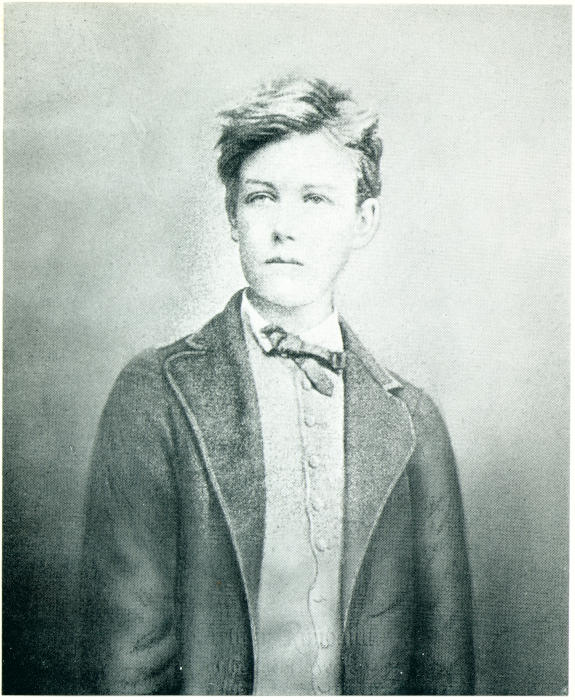
Mayday revel, Arthur Rimbaud the poet who became
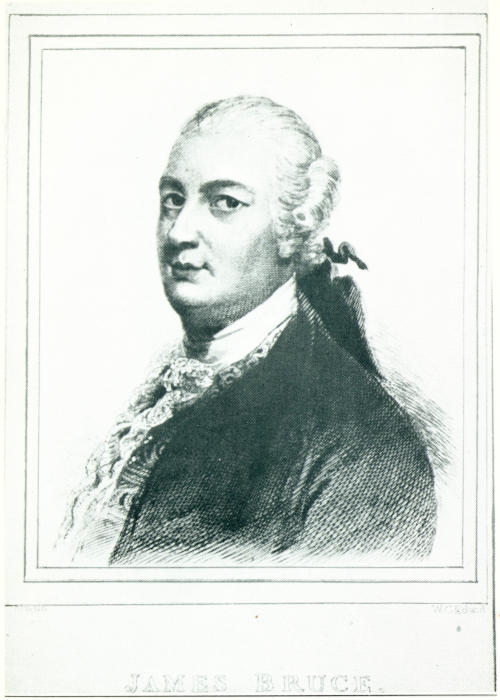
an African trader, and James Bruce the
sturdy Scot who rose to be a great lord in Abyssinia.
The accounts are authentic, and if they seem
like fiction, the reader must call to mind the old
adage about the strangeness of the truth.
I wish to thank Mr. John Farrar, Editor of The
Bookman, for the kindest of help and encouragement,
and I welcome this same opportunity to
thank Mr. Warren Butler of Salem, Massachusetts,
who found me the old print of the ship Bonetta.
Here was a man who was born with two
great gifts, one the most precious in the
world, the other the most perilous. The
first was an abounding physical vitality which made
the casual business of being alive a divine adventure,
the second, an imagination of the sort which
refuses discipline and runs away with the whole
mind.
The adventure begins in the spring of the year
1772 with the farmers of the Connecticut Valley
halting their ploughs in the furrow, and straightening
up to stare at a certain extraordinary vehicle
going north on the river road. This vehicle was
nothing less than a two-wheeled sulky, then a rig
almost unheard of outside the towns, and one never
known to be used by travellers. A sulky with
bundle baggage lashed behind, surely the driver
must be an odd kind of rogue! Stopping at nightfall
at a farm, the stranger met with close scrutiny
by rural candle light. He was a fair-haired youth
an inch or so under six feet tall, and of that “rangy”
and powerful build which is as characteristic of
American soil as Indian corn. His eyes, which
were well spaced in a wide forehead, were grey-blue
in color, he had a good chin to face the world
with, and something of a lean and eagle-ish nose.
His name, he said, was John Ledyard, and he was
on his way to become a missionary to the Indians.
This youth, John Ledyard, third of his name, had
seen the light of day in the village of Groton, Connecticut;
his father, a sea captain, had died young;
legal mischance or a descent of harpy relatives had
deprived the young mother of her property, and
John had been brought up in the house of his grandfather
at Hartford. Then had come years at grammar
school, the death of his grandfather, his virtual
adoption by an uncle and aunt, and the attempt of
these good folk to make a lawyer of him, which
experiment had not been a success.
At twenty-one years of age, John presented
something of a problem to his kinsmen. What was
to be done with this great fair-haired youth who
had neither money nor influential friends? Suddenly
Destiny came down the Connecticut Valley
with a letter.
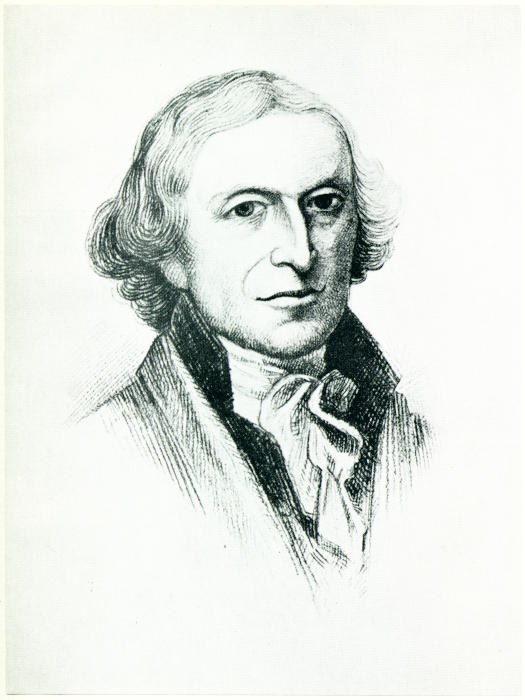
JOHN LEDYARD
Courtesy Judge John A. Aiken.
The Reverend Eleazar Wheelock, founder of
Dartmouth, wrote to John inviting him to the
college. The passion of this good man’s life was
the evangelization of the dispossessed and incorrigible
redskins; he visited them in their forlorn
and dwindling encampments; he took their young
men to be his pupils, and he had founded his
college largely for the sake of training the sons of
colonists to be Indian missionaries. Good Doctor
Wheelock had been a friend of grandfather Ledyard’s,
and something or other had recalled to his
mind the fair-haired boy who he had seen playing
about the old man’s house at Hartford. He would
make a missionary of the lad, and send him forth
to comfort the copper-skinned of the elect. A
letter arrived offering John the status of a free
pupil destined to the Indian field. Sulky and ancient
nag were presently produced from somewhere,
perhaps from John’s own pocket, for he
had just inherited a tiny legacy; the uncle and
aunt waved farewell, a whip cracked in the air,
and John and his sulky vanished over the hills and
far away.
At Dartmouth College, he liked to act in plays,
and clad in robes of Yankee calico, strutted about
as the Numidian Prince, Syphax, in Mr. Addison’s
“Tragedy of Cato.” A savour of old-fashioned
rhetoric and magniloquence made its way from
these plays into John’s mind, and coloured his
letters and his language all his life. He liked the
out-of-doors, and on one occasion induced a group
of comrades to climb with him to the top of a neighboring
height, and spend the night on evergreen
boughs strewn on the floor of deep holes dug in the
snow. Doctor Wheelock nodded an enthusiastic
consent; he saw in John’s adventure fine training in
hardship for his future missionaries! Letters of
classmates paint Ledyard as restless, impatient of
the dry bones of discipline, authoritative on occasion,
and more a man with devoted cronies than one
largely and carelessly popular. All other Dartmouth
memories have faded in the epic glow of
the adventurer’s flight from his Alma Mater.
He came to college in a sulky, he left it an even
more adventurous way. In the spring of 1773, the
sound of the axe rings in the Dartmouth woods.
Presently comes a shout, a great, crackling crash,
and the sound and tremor of a heavy blow upon
the earth. John Ledyard and his cronies have just
felled a giant pine standing close by the bank of
the Connecticut River. From this log, the homespun
undergraduates fashion a dug-out canoe, fifty
feet long and three feet wide, a veritable barge of a
canoe, and once the digging and hacking is done
with, John himself weaves at the stern of the craft
a kind of shelter-bower of willow wands. Word
passes among the lads to be at the river early in
the morning.
The spring in northern New England is no
gracious and gradual awakening, it is shy, even
timid, of approach, and there are times when the
new leaves and petals have quite the air of children
who have run out of the house on a winter’s day.
Then comes a sudden night of warmth and southwest
wind, smells of wet earth and the sound of
flooded streams fill all the dark, a rushing spirit
of fertility shakes the land, and the rising sun
reveals a world hurrying on to June. A dangerous
spring in a Puritan land, for flesh and spirit are
taken unawares, and swept off to the shrines of
gods who have never made a covenant with man.
Such a spring it was, as the forest undergraduates
gathered at the huge dug-out under the slanting
light of early day, and watched their friend
carry supplies to his canoe. John first put aboard
a provender of dried venison and cornmeal, then
a huge bearskin for a coverlet, and last of all two
strangely assorted books, a Greek New Testament
and the poems of Ovid. The truant Yankee sophomore
steps into his canoe. A long halloo, a push
all together, and the craft has slid off into the river,
which, clear of ice and swollen by a thousand mountain
streams, is rushing past their little college and
on into the world. The current seizes the canoe;
the wet paddle blade flashes in the cool sun; John
masters the swirl with his strength and woodsman
skill, and the future vagabond disappears on the
way to his fantastic destiny. Little does the truant
know that in January and February, 1787, a forlorn,
penniless but indomitable traveller will accomplish
one of the most amazing feats ever performed
by mortal man, a fifteen hundred mile
trudge through an unknown country deep in arctic
snow and cold, and that the vagabond will be John
Ledyard.
The mystery of his truancy remains to puzzle
the world. For after all, why had he run away?
In abandoning Dartmouth, he had locked behind
him the one door to an education which had opened
to him in his obscurity. John Ledyard’s contemporaries
said simply that the spring was racing in
his blood, and that the born vagabond had been
unable to control a vagabond urge. There is a
world of truth in the reply, but not quite all the
truth. The present day, with greater historical
perspective, will have it that this fair-haired lad
was not really a scion of the seaboard generations
of transplanted Englishmen, but a son of the new,
native-born, and native-minded culture which was
springing up in the hearts of Americans during the
last half of the eighteenth century. This lad is no
spiritual kinsman of harsh and merciless Endecott;
his place is with Daniel Boone and the lords of the
frontier. But at Dartmouth, the seventeenth century
sat in the seat of power, for, intellectually,
Wheelock was a contemporary of Cotton Mather;
the two dominies would have talked the same
Canaanitish jargon, and shared an identical attitude
to life. But young John was of different
stuff, and, moreover, he was in certain ways, curiously
modern. His flight from Dartmouth thus
becomes a bit of vagabondage hiding an instinctive
recoil, for had he accepted a missionary career,
the seventeenth century would have claimed him
forever for its own.
Down the Connecticut River floats the log
canoe, carrying a young New Englander from
theology under Oliver Cromwell to adventure
under George the Third.
Now came difficulties and explanations, and
John cut the knot by going to sea. Four years
later, at the end of a voyage, a young American
seaman walks the narrow streets of London’s
“Sailortown.” John Ledyard is now twenty-five
years old, life has done little with him, and he has
done little with life; his friends at home are beginning
to regard him as something of a ne’er-do-well,
and the pockets of his sailor breeches are emptier
than ever.
In “Sailortown” an April sun is shining, the
dank smell of the Thames mingles with wood smoke
from the hearths, and there is a sound of men’s
voices and a clink of glasses at the doors of mariner’s
inns. John steps into a tavern, and hears
news which fires his imagination, and sets his blood
to racing. Captain James Cook, the great navigator
and explorer, is about to make a third voyage
to the South Seas, and ships are being prepared and
loaded for the expedition. With characteristic
audacity, John hurries directly to the Captain at
his lodgings in Chelsea Hospital, and boldly requests
to be allowed to go. His colonial directness
pleases, and John Ledyard walks back to London,
no longer an obscure American seaman, but a corporal
of His Majesty’s Marines attached to Cook’s
own vessel, the Discovery.
The two ships of the expedition, the old Resolution
and the new Discovery, sailed from England
on July 12th, 1776, bound for the South Pacific
by the Cape of Good Hope.
He was a marine, now, on a British naval vessel;
a roving Yankee caught up in the old navy’s conventionalised
routine. A bugle or a drum tattoo
woke him at early dawn as he slept in the low
’tween deck caves where the timbers groaned when
the wind freshened in the night, and the lanterns
and the hammocks swung to the listing of the ship;
he escaped from the darkness below, the warm,
human smell, and the sight of sleepy men and
nakedness to the humid deck, the lilac morning, and
the vast splendour of the awakening sea; the drill
drum beat for him, he heard the shuffle and the
tramp of feet, the peremptory order, and, in the
silences, the wind in the rigging and the endless,
dissolving whisper of alongside foam.
This Discovery was the more interesting of the
ships. Captain Cook himself was aboard, a man
over six feet in height, with brown eyes, a pleasant
countenance, and brown hair tied behind. Ledyard
often saw the tall figure in great cloak and three-cornered
hat standing at the other end of the deck.
Perhaps of even greater interest to the ship’s company
was the Noah’s ark farmyard aboard of
cattle, sheep, goats, ducks, dogs, horses, cats, pigs,
and rabbits, all intended as gifts to estimable
savages who had no such allies, for the eighteenth
century was nothing if not benevolent. When in
port for any length of time, the sea-going bull and
the other grazing animals were put ashore for
pasturage; at the Cape of Good Hope, a rascally
Hottentot delayed the expedition by stealing a
salty and intrepid cow. During a stay in the east,
this animal world was strengthened by a vast contingent
of cockroaches who fell in showers to the
deck when the sails were unfurled before getting
under way; not a romantic picture, this, but one
with a genuine flavor of old sailing ship days. And
when all other things wearied, there was a battle
to watch, that battle with never a truce which is the
sailing of a sailing ship in open sea.
After a pause by the barren rocks of Kerguelen
Land in the Antarctic, and after revisiting Tasmania
and New Zealand, the expedition sounded
its way through the archipelagos of the South
Pacific, and anchored in the bay of Tongataboo in
the Friendly Islands. The ships remained there
twenty-six days gathering stores.
Tongataboo—the name has a ring of the Bab
Ballads; but it hides the memory of a Paradise.
John found himself among a people who were beautiful,
courteous, and friendly, for no whites had yet
poisoned them either with their maladies or their
civilization, and there was no tiresome angel with
a flaming sword. First of a line of roaring
Yankee whalemen and sailors, Corporal John
walks the island night under the giant moon, watching
the smooth, incoming seas burst and scatter into
a churning wash that might be a liquid and greener
moonlight; first of American adventurers in the
South Seas, John Ledyard hears the endless clatter
and dry rustling of the island palms. He lives in a
tent ashore, refers to the natives as “the Indians,”
eats fish baked in plantain leaves, and drinks water
from a coconut shell. Late in the golden night, he
hears over the faint monotone of the breaking sea,
“a number of flutes, beginning almost at the same
time, burst from every quarter of the surrounding
grove.” Not to be outdone in the matter of entertainment,
Cook delights the innocent natives with
a display of fireworks, a form of entertainment
then regarded as the height of the ingenious and
the civilized. Surely it was pleasant to be alive
when Paradise was young. From the Friendly
Islands, the Discovery carried John to Hawaii,
and thence to the coast whose memory was to shape
the greater adventures of his life.
By the last half of the eighteenth century, the
one accessible coast of North America which
lingered unvisited and unexplored, was the coast of
the Pacific North Northwest,—or to be more definite,
the shores of northern British Columbia and
the great peninsula of Alaska. The geographers
of the day were aware that Bering had sighted such
a coast, and that the Russians had crossed to it
from northeastern Siberia and claimed it for their
empire, but with these two facts their knowledge
came to an end. The character and the conformation
of the land remained unknown. Cook was to
be the first to make a scientific survey of the region,
for the Admiralty had instructed him to explore
any rivers or inlets that might lead eastward to
Hudson’s or Baffin’s bay through the “Northwest
Passage” of romance. The ships turned north in
December, 1777, and arrived off the coast of what
is now the state of Oregon on March 7th, 1778.
The weather was cold and stormy, but summer
came upon them as they worked their way to the
north, the splendid summer of the cool, northwestern
land.
John Ledyard was once more on American soil,
and what an America it was, this great unknown
land of bold, indented coasts, evergreens and alders,
snow-capped inland mountains, and great rivers
moving unsullied to the sea! The beauty and living
quality of the new country conquered the Connecticut
explorer even as it conquered those who followed
him. Carefully charting the way, Cook’s
expedition sailed along the coast to Alaska, past
the towering cliffs of vast glaciers rising pale-green
from the darker surges washing at their base; into
this great fjord and into that went the ships,
waking the deep arctic silence with the plunge of
their anchors and the hurrying rattle of chain. At
the Island of Unalaska, John offered to go with
native guides in search of some “white strangers,”
and thus had a unique opportunity to spy out the
land.
“I took with me some presents adapted to the
taste of the Indians, brandy in bottles, and bread,
but no other provisions. I went entirely unarmed
by the advice of Captain Cook.... The country
was rough and hilly; and the weather wet and cold.
At about three hours before dark we came to a
large bay, ... and saw a canoe approaching us
from the opposite side of the bay, in which were
two Indians. It was beginning to be dark when
the canoe came to us. It was a skin canoe after the
Esquimaux plan (a kayak) with two holes to accommodate
two sitters. The Indians that came in
the canoe talked a little with my two guides and
desired I would get into the canoe. This I did not
very readily agree to, however, as there was no
other place for me but to be thrust into the space
between the holes, extended at length upon my
back, and wholly excluded from seeing the way I
went, or the power of extricating myself on any
emergency. But as there was no alternative I
submitted thus to be stowed away in bulk, and went
head foremost very swift through the water about
an hour, when I felt the canoe strike a beach, and
afterwards lifted up and carried some distance, and
then sat down again, after which I was drawn up
by the shoulders by three or four men, for it was
now so dark that I could not tell who they were,
though I was conscious that I heard a language
that was new.
“I was conducted by two of these persons, who
appeared to be strangers, about forty rods, when
I saw lights and a number of huts.... As we approached
one of them, a door opened, and discovered
a lamp by which, to my joy and surprise,
I discovered that the two men who held me by
each arm were Europeans, fair and comely, and
concluded from their appearance that they were
Russians, which I soon after found to be true....
We had supper which consisted of boiled whale,
halibut fried in oil, and broiled salmon.... I had
a very comfortable bed composed of different fur
skins, both under and over me.... After I had
lain down, the Russians assembled the Indians in a
very silent manner, and said prayers after the
manner of the Greek church which is much like the
Roman.”
The meeting of the New England marine and
certain Russian fur traders visiting Alaska to buy
skins for the Chinese trade, is not without significance
to the philosophic reader of history, for it
is the first contact of a white civilisation advancing
across America from the east with another and a
belated white civilisation approaching the continent
from the west. Had Columbus failed, what strange
results might not have sprung from this Russian
enterprise! But Yankee John rises to end the
reverie. A notion of advancing his fortune by
joining in the Alaskan fur trade is getting into
his head, and he enters in his journal that skins
which were purchased in Alaska for six pence
were sold later in China for a hundred dollars.
Save for the tragic death of Captain Cook, who
was attacked by natives at Hawaii, and “fell into
the water and spoke no more,” there is little in the
further history of the ships to halt the chronicle
of Corporal John. The ships revisited the Bering
Sea and the Russian Asiatic coast, cruised to China,
and returned to England round the same Cape of
Good Hope. The expedition had been at sea
exactly four years and three months.
For two troubled years, John Ledyard walks the
flagstones of a British barrack yard, for the war
of the Revolution is being fought in America, and
he can neither escape nor bring himself to take
naval service against his countrymen. Barrack
life, however, ends by exhausting his patience, he
seeks a transfer to the American station, and the
December of 1782 finds him aboard a British man
of war lying in Huntington Bay, Long Island. As
the island was then in the hands of the British,
John obtains seven days’ leave, but patriotically
forgets to report aboard. From a stay with friends
at Huntington, he hastens to Southold, where his
mother keeps a boarding house, then frequented
chiefly by British officers.
He rode up to the door, alighted, went in, and
asked if he could be accommodated in her house as
a lodger. She replied that he could, and showed
him a room into which his baggage was conveyed.
After having adjusted his dress, he came out, and
took a seat by the fire in company with several
other officers, without making himself known to
his mother, or entering into conversation with any
person. She frequently passed and repassed
through the room, and her eye was observed to be
attracted to him with more than usual attention.
At last after looking at him steadily for some
minutes, she deliberately put on her spectacles,
approached nearer to him, begging his pardon for
her rudeness, and telling him that he so much resembled
a son of hers, who had been absent eight
years, that she could not resist her inclination to
view him more closely. “The scene that followed,”
adds the old chronicler, “may be imagined, but
not described.”
Travelling by night down the Long Island shore,
John found a way to reach Hartford, and took
refuge there at the house of his Uncle Seymour.
He remained with him four months, writing an account
of his voyage with Cook. The book was published,
and is now exceedingly rare. “I am now
at Mr. Seymour’s,” wrote John, “and as happy as
need be. I have a little cash, two coats, three waistcoats,
six pair stockings, and half a dozen ruffled
shirts.... I eat and drink when I am asked, and
visit when invited, in short, I generally do as I am
bid. All I want of my friends is friendship,
possessed of that, I am happy.”
The long and cruel struggle of the American
Revolution was drawing to an end. Peace was at
hand. John Ledyard, now thirty-two years of
age, found himself a personage in his own country.
He was John Ledyard, “the American traveller.”
And he had lost his corporal’s chevrons—popular
imagination had seen to that; John was now Captain
Ledyard; Major Ledyard, and even Colonel
Ledyard to the eloquent. The American traveller!
The great, fair-haired, “rangy” lad had grown into
a tall energetic man whose countenance told of
hardship and adventure; there were lines, such
as sailors have, about his eyes, his nose was thinner
and more than ever eagle-like, and the grey eyes
had a look in them the world but rarely sees. The
man stands at the window of the house in Hartford,
looking down the still, New England street, but the
inner eye sees only the northwest coast, the waterfalls
on the sides of the sea ravines, the dark trees,
and the crests of snow. He alone, of all the American
world, has seen the unknown land; he alone
can guide his fellow-adventurers of the young republic
to the wealth that waits the gathering of the
bold.
He went first to New York, and walked up
dusty stairs into counting houses and shipping
offices. “Send a vessel to the northwest coast,” he
said to those who would listen; “I have been to it
with Captain Cook, it is a glorious, new land, and
you may buy furs there for a song, and sell them
in China at a great profit.” Shrewd eyes watched
him as he sat talking, leaning forward on the edge
of his chair; and the papers on which he had written
his plans for an expedition crinkled between wary
and unsympathetic hands. So this rolling stone
wished to guide them to the beds of moss! One
after another, his interviews ended in a scraping of
chairs, a polite return of his papers, and the formality
of bows at an opening door.
He had a better reception at Philadelphia,
whither someone had sent him with a letter to the
great banker, Robert Morris. “I have had two
interviews with him at the Finance Office, and tomorrow
I expect a conclusive one. What a noble
hold he instantly took of the enterprise!” And
later in the same letter, “Send me some money for
Heaven’s sake, lest the laurel now suspended over
the brows of your friend, should fall irrecoverably
into the dust. Adieu.” John’s heart beats high,
the dawn of fortune seems at hand, the eastern sky
is gay. He goes to Boston, to New London, and
to New York in search of a suitable ship, but all
in vain, and as he searches, the season becomes too
far advanced to think of prosecuting the northwest
voyage; and presently the false dawn fades, Mr.
Morris withdraws from the venture, and John finds
himself in New London once again.
It was clear that he could hope for nothing from
the merchants of the United States. “The flame
of enterprise I kindled in America,” he wrote, “terminated
in a flash.... Perseverance was an effort
of understanding which twelve rich merchants
were incapable of making.” His exasperation was
natural enough, yet in justice to the American ship
owner of the time, the economic disorder and poverty
of the country should be noted, as well as the
fact the owners were being asked to send a long
and costly expedition round the Horn on the word
of a solitary enthusiast. Would European merchants
listen? The winter of 1784-85 found John
at the great French port of L’Orient, living on a
subsidy granted him by merchants interested in his
scheme, but once again hope rose and perished like
the seed upon thin ground.
From L’Orient he went to Paris, the Paris of
1785, the Paris of the Bastile, the great nobles, the
philosophers of universal benevolence, and the
usual Parisian miscellany of the world’s most artful
and distinguished knaves. Into this picturesque
world, so soon and so terribly to be rent apart,
stepped the new adventurer, Mr. Ledyard the
American traveller! He was practically penniless,
yet he managed to subsist in a modest manner.
“You wonder by what means I exist, having
brought with me to Paris, this time twelve months,
only three louis d’ors. Ask vice-consuls, consuls,
ministers, and plenipotentiaries, all of whom have
been tributary to me. You think I joke. No,
upon my honour, and however irreconcilable to my
temper, disposition and education, it is nevertheless
strictly true.” He lived in a room in the village
of St. Germain, and went to Paris afoot, a distance
of some twelve miles. Other American adventurers
were there, of the type that have long haunted
Paris. John had no illusions about them. “Such
a set of moneyless villains,” he remarked, “have
never appeared since the epoch of the happy villain
Falstaff. I have but five French crowns in the
world, Franks has not a sol, and the Fitz Hughs
cannot get their tobacco money.”
While in Paris, his dream of a trading voyage
collapsed for the last time. Captain John Paul
Jones listened to him, and fell in eagerly with his
plans, but the necessary money could not be raised,
and so ended the tale.
Poor as he is, Ledyard is still a personage, and
walks boldly with the great. Lafayette befriends
him. “If I find in my travels a mountain,” said
John, “as much elevated above other mountains as
he is above ordinary men, I will name it Lafayette.”
He goes to breakfast at the house of the first
American minister to France, and sees at the head
of the table a tall angular man neatly and soberly
dressed in black, a tall man with a bony but strong
frame, angular features, light hazel eyes and sandy-reddish
hair, Thomas Jefferson of Virginia.
What a table it is,—French abbés and philosopher
nobles, learned bigwigs of the day, visiting Americans,
diplomats, and John Ledyard with the backs
of both hands tattooed with the scrolls of Polynesia!
John finds a sympathetic hearer in his host, for the
great Virginian has a civilized man’s interest in
scientific exploration and a patriotic American’s
interest in American discovery. They stroll after
breakfast, the statesman and the vagabond, and
presently the minister suggests to his companion a
voyage that fires his guest’s imagination even as
the name of Captain Cook had kindled it just ten
years before.
“I suggested to him,” runs the Virginian’s letter,
“the enterprise of exploring the western part of our
continent, by passing through St. Petersburg to
Kamchatka, and procuring a passage thence in
some of the Russian vessels to Nootka Sound,[1]
whence he might make his way across the continent,
and I undertook to have the permission of the Empress
of Russia solicited.”
John listens, and listening, becomes once more
the vagabond who ran away to see the world; then
and there, the man flings off the disappointed
trader. “He eagerly embraced the proposition,”
wrote Jefferson. Yes, he will attempt just this
thing, cross Europe and Asia, take ship to the
northwest coast, and cross the wide American continent
to Virginia. Did ever a man make such a
resolve, and that man a penniless vagabond? Is it
not genuinely so mad as to be magnificent?
“I die with anxiety,” he now wrote to a brother,
“to be on the back of the American States, after
having either come from or penetrated to the
Pacific Ocean. There is an extensive field for the
acquirement of honest fame.... It was necessary
that a European should discover the existence of
that continent, but in the name of Amor Patriae,
let a native explore its resources and boundaries.
It is my wish to be the man!”
Now came a false start from London, his last
delay. “The great American traveller” sits writing
at a table in his humble London lodging, perhaps
again a room in Sailor Town. “I am still the
slave of fortune and the son of care,” he writes
later to his brother. “I think my last letter informed
you that I was absolutely embarked on a
ship in the Thames, bound to the northwest coast
of America. This will inform you that I have disembarked
from the said ship, on account of her
having been unfortunately seized by the custom
house ... and that I am obliged in consequence
to alter my route, and, in short, everything, all my
little baggage, shield, buckler, lance, dogs, squire,
and all gone. I only am left, left to what?”
He counts his money, a familiar trick with him,
shakes the clinking coins in his palm, arranges them
in a row on the table, and finds he still has a few
guineas left of the sum generously given him by
Sir Joseph Banks, President of the Royal Society,
and certain other English gentlemen interested in
the advance of geographic knowledge. He adds
two final phrases to his letter before he seals it, and
sends it off across the sea.
“I will only add that I am going in a few days to
make a tour of the globe from London east on foot.
Farewell. Fortitude! Adieu.”
It is the month of December, 1786, and from
London, lost in smoky winter mist, the tall Yankee
vagabond passes unperceived to dull Hamburg on
the muddy Elbe, and thence to Copenhagen, and
Stockholm of the Swedes. The fair-haired Northmen
stare at a thin stranger with outlandish marks
on his hands, who asks the way to Russian St. Petersburg.
The winter route to Russia, they tell him,
lies across the frozen gulf of Bothnia, the sledges
strike off from Stockholm, and speed east over the
ice to Abo, only fifty miles on the opposite shore;
but this year the gulf is not solidly frozen, the ice
is broken in midchannel; the horses cannot pass,
and tremble, and turn about, and overturn their
sleighs;—the traveller will have to wait till the
spring frees the gulf of ice, and allows a boat to
pass.
The words fall on the ear of a wanderer who will
not wait. John Ledyard knows that he must reach
St. Petersburg early in the spring, if he is to cross
the Siberian wastes in the summer of this same
year. A small delay means a year’s delay. Rather
than wait or return, he will walk the fifteen hundred
miles round the frozen sea. It is the very heart
of winter, and the vagabond’s path will lead him
north through Sweden into arctic Lapland, and
south and east through the vast forests of Finland,
now trackless in the depth of the snows. John
Ledyard has no maps, no money, and no knowledge
of the languages along his road.
Late in the month of January, 1787, a tall man
wrapped in an English great coat trudges north
from Stockholm into the grim wilderness of snow.
To his right lies the great snow-covered plain of
the frozen gulf, sweeping as far as eye can see to
the level rim of the world; to the left is a broken
country of hills and valleys covered with thick
forests of birch and pine and fir, and channelled
with frozen rivers running from the mountains to
the frozen gulf. The winter wind howls north along
the ice, gathering together great dunes of snow;
there are crackings and boomings of the ice in the
fitful silences. So thick lies the snow upon the
pines, that not even one green twig protrudes from
the huge, sagging pyramids. John Ledyard
trudges on under the short-lived and sullen day of
these high latitudes; the low sun casts his long
shadow behind him on his broken footprints in the
snow. In the clear green twilight, guided, perhaps,
by the distant barking of a dog, he wanders from
the way to some peasant’s snow-topped hut, and
sups on bread, milk and salt herring with kind hosts
gathered at the fire. He reaches Tornea in Lapland,
turns south and east through the lakes and
woods of Finland, and presently the giant sentries
at St. Petersburg see John Ledyard trudging into
town.
He reaches St. Petersburg before the twentieth
of March. This unparalleled journey had taken
him seven weeks, and he had managed to cover during
each week a distance of some two hundred
miles. He left no record of how he accomplished
the journey—save to write in a letter these words
“Upon the whole, mankind have used me well.”
“I had a letter from Ledyard lately dated at St.
Petersburg,” said Jefferson. “He had but two
shirts, and still more shirts than shillings. Still he
was determined to obtain the palm of being the
first circumnambulator of the earth. He says that
having no money they kick him from place to
place, and thus he expects to be kicked about the
globe.”
The rest of the story is soon told. He obtained
some kind of a passport from the Russian authorities,
and began his journey to Siberia in the train
of one Dr. William Brown, a Scotch physician in
the employment of the Empress Catharine. With
Brown he went three thousand miles to Barnaoul in
the province of Kolyvan. From this city he made
his way to Irkutsk—“going with the courier,” he
wrote, “and driving with wild Tartar horses, at a
most rapid rate, over a wild and ragged country,
breaking and upsetting kibitkas[2], beswarmed with
mosquitoes, all the way hard rains, and when I
arrived in Irkutsk I was, and had been for the last
forty-eight hours, wet through and through, and
covered with one complete mass of mud.” From
Irkutsk he joined an expedition going down the
Lena, and alighted at Yakutsk, only some six
hundred miles from the Pacific coast he sought. It
was the eighteenth of September. Imagine his dismay
when the Governor informed him that the winter
was so close at hand, that he must not expect to
gain Ohkotsk that year. “Fortune,” exclaimed
John, with his trick of play book style, “thou hast
humbled me at last, for I am at this moment the
slave of cowardly solicitude lest in the heart of this
dread winter, there lurk the seeds of disappointment
to my ardent desire of gaining the opposite
continent.” Not knowing what to do he joined a
scientific expedition in charge of one “Captain”
Billings, a fellow veteran of Cook’s third voyage,
and returned with his former shipmate to Irkutsk.
Suddenly—terrible news! He is to be arrested
on the absurd charge of being “a French spy,” and
sent back to the frontier thousands of miles behind.
The details of Ledyard’s arrest remain a mystery
to this day, but there is little doubt that the underlying
cause of it was Russian unwillingness to have
a citizen of the United States prowling about the
Russian American claims. Something had happened;
perhaps the imperial authorities had suddenly
heard of Ledyard’s attempt to begin a rival
fur-trade. Whatever the answer may be, John was
handed over to the custody of a sergeant, and
dragged back across Siberia and Russia with lunatic
speed.
“I had penetrated,” said the poor fellow,
“through Europe and Asia almost to the Pacific
Ocean, but in the midst of my career I was arrested
as a prisoner to the Empress of Russia.... I was
banished from the empire, and conveyed to the
frontiers of Poland, six thousand versts from the
place where I was arrested. I know not how I
passed through the kingdoms of Poland and
Prussia or thence to London where I arrived
in the beginning of May, disappointed, ragged,
penniless....”
He arrives in London just as the African Society
is casting about for a man to explore the interior
of Africa. John calls on good Sir Joseph
Banks who has so often been his kind and generous
friend. Will Mr. Ledyard go to Africa? Yes.
And when will he be ready to set out? “Tomorrow
morning.” He reaches Cairo in August, and joins
a caravan about to journey to Sennaar. “From
Cairo I am to travel southwest about three hundred
leagues to a black king.” Presently he is
attacked by illness, he takes some fearful medicine
of the time, shakes his head, and closes his eyes.
The fair-haired lad in the sulky, the runaway undergraduate
in the great canoe, the sailor, the corporal
of marines and “the Great American Traveller”
had gone on the longest of his travels.
Because the last years of John Ledyard’s life
found him fighting on towards a goal he almost,
yet never quite, attained, there are those who see
him as a mere picturesque vagabond whose life had
no genuine success. What a misinterpretation!
The runaway Yankee lad had set out to see the
world, and he had done so; indeed, John Ledyard
had probably seen more of the vast world than any
other being of his time. The vast loneliness of the
sea which comes when twilight fades and night
begins, blue, cloudy islands seen at dawn, the
sounds of rushing brooks in the quiet of green valleys,
strange folk making strange music under the
moon,—all this he had hungered to see, all this he
had seen. He had achieved his ambition in spite
of every barrier, he had girdled the earth on a
sixpence and a ha’penny.
Even love itself had not held him from his road.
In his letters, there is just one little phrase ...
“domestic life ... matters I have thought nothing
about since I was in love with R. E. of Stonington.”
Mysterious R. E., by her Connecticut fireside,
did she think of John trudging on, face to
the wind and snow, resolutely shaping a reality out
of his ambition and his dream?
When Mr. Jefferson became president, he often
thought of the man he had met in Paris,—the first
American to see the northwest coast, the man who
had talked to him of the pine-crowded islets, and
the inland mountains white with snow. John Ledyard
the forerunner. And Mr. Jefferson, bending
to his desk, continues to write his precise and careful
letter of guidance for Messrs. Lewis and Clark
whom he is sending to explore the west. Ledyard.
Yes, indeed! I knew him well. A valiant fellow,
gentlemen.
Two : BELZONI
Two : BELZONI — I — II — III — IV
A little over a hundred years ago the
learned world of fashionable London was
profoundly moved by the arrival of
eventful news. After having been sealed to Europeans
for some four thousand years, one of the
great pyramids of Egypt had at length been
opened, and torch in hand, a modern man had
walked the untrodden dust of the oven-hot and
silent galleries.
Now that all three pyramids stand open to the
world, and tourists with green sun-goggles and
parasols hesitate and giggle at the forbidding entrances,
it is difficult to believe that the interiors
should have been so recently a mystery. Save for
a few measurements, however, the first years of the
nineteenth century knew no more about the great
Pyramids than the Renaissance had known; all was
tradition, legend and conjecture. Of the familiar
giants at Gizeh, only one, the Great Pyramid of
Cheops, was open, and this but very partially so,
for the famous well and the lower galleries were
clogged with rubbish and débris. The second pyramid,
that of Chephren, and the third, that of Mycerinus,
were apparently solid mountains of limestone
blocks with no sign whatsoever of an opening
or a door.
It is scarce possible to exaggerate the hold which
these locked giants had maintained on the imagination
of mankind. The pilgrim of the middle ages
thought them the granaries of Joseph, and stared
at them with reverence; the conquering Arab called
them the palaces of kings, sleeping enchanted in
moated halls whose lamps were hollow emeralds.
All tales, however, agreed upon one point,—that
the pyramids concealed a treasure. The Arabic
conquerors of Egypt had already sought it,
and one of them, the tenth century caliph, Al Mamun,
baffled by the masonry of the third pyramid,
had actually made a vain and lunatic attempt to
destroy the entire edifice. So kings passed, and
emperors and sultans and great ages of historic
time, but the sunrise still rolled up the veiling mist
from the great plain of Egypt, revealing the vast,
solemn geometry of the masters of the Nile. What
treasure, what strange secret lay within these
stones? Who would be the first to enter them?
What would he find?
BELZONI
In the year 1778, Jacopo Belzoni, a worthy barber
of Padua, and Teresa his wife, were rejoicing
at the arrival of a son. They had christened him
Giovanni Battista, or “Gianbattista” for short.
Had a soothsayer of ancient Egypt appeared by
the cradle, and revealed the infant’s destiny, the
good tonsore would have surely opened his mouth
and dropped his shears. For the soothsayer would
have said something like this:
“This child will be a juggler at theatres and
village fairs, a scholar, an author, and a traveller.
For thirty-seven years, life will toss him about as
a juggler tosses a ball in the air, but then his opportunity
will come, he will win fame in a strange
land, and solve the most romantic of all mysteries.”
The adventurous tale begins, strangely enough,
in a monastery. The worthy Jacopo had fathered
a brood of fourteen,—something had to be found
for each and every one of them, and in the distribution
young Giovanni Battista was handed over
to the church. He was to find a place in the world
for himself as a monk. From the parental dwelling
on a by-street in Padua, the boy, still in his teens,
walked the ancient highways of Umbria to the
house of a monastic order in Rome. Somewhere in
the old papal city, behind an encircling wall, his
days of boyhood and youth began before the dawn
with the clangour of a monastery bell, and ended
with the echoing cave of a darkened church, the
golden, pin-point flames of altar lamps, and the
solemn chanting of the offices.
Years pass, years of quiet and withdrawal from
the world. Of a sudden comes alarming news,
the pot of the Revolution has boiled over, the
French are crossing the frontiers and invading
Italy. Presently there are disorders in Rome and
a descent of French troops upon the city; the bells
are silenced, the monasteries closed or seized for
barracks, and the monks harried out into the street.
Among the monks thus compelled to abandon
the religious life was Gianbattista Belzoni. The
Paduan novice had grown up into a giant, a colossus
even, for he now stood six feet seven inches in
height, and was broadly and solidly built in the
same proportion. And not only did Gianbattista
have a giant’s strength, he had also the pride and
the sense of decorum which accompany a giant
stature. Those who are born of average height
little know how huge is the influence of great stature
on its possessor’s conduct and character! He
who is born a Titan must act the Titan; a frolicsome
colossus is an outrage to Nature. Gianbattista,
moreover, though of Paduan birth, was
of Roman stock, and Romans have to this day an
eye for dignity. Brown eyed, and black-brown of
hair, with a giant’s mildness, a giant’s decorum, and
an Italian’s grace of address, young Gianbattista
was a figure for Michelangelo.
Walking with a giant’s disdain through the rabble
of soldiers and revolutionists jeering by the
monastery gate, the young monk passed forth
into the world.
The homeless young Titan, he was only 22, may
well have wondered what was now to become of
him. At the monastery school he had chanced to
make a special study of the science of hydraulics,
but that was hardly a knowledge to be peddled
about in those uncertain times. Having no choice,
therefore, he fell back on his physical strength, and
set about earning his living as a juggler and a
Hercules of village fairs. From Italy the showman
monk made his way through Germany, and
then through Holland to the various kingdoms of
the British Isles. Finding life pleasant in England,
he settled down there, and spent the Napoleonic
years amusing his hosts and becoming something
of an Englishman.
For the next ten years, his life is that of an Italian
mountebank in England. The English knew
the huge, serious, well-mannered foreigner as “Signor”
Belzoni; they saw him in their pantomimes
and at Bartholomew Fair. He had a booth at the
fair, and amid the smell of black puddings sizzling
on the fire, and the shouts and cries of barrow vendors
and showmen, our Signor delighted the London
rabble with feats of strength and dexterity.
His favorite show was a spectacle called “Samson,”
an edifying Biblical affair in whose course
Belzoni pulled down the pillars of a stage temple
with the most blood-curdling roars, crash, dust and
general uproar. At Sadlers Wells Theatre, to
quote an old play bill, his performance consisted
“in carrying from seven to ten men in a manner
never attempted by any but himself. He clasps
round him a belt to which are affixed ledges to support
the men who cling about him.... When thus
encumbered, he moves as easy and as graceful as
if about to walk a minuet, and displays a flag in as
flippant a manner as a dancer on the rope.” Another
visitor became poetic. “Signor Belzoni,” he
wrote, “moved about the stage under this enormous
pressure with as much steadiness and stateliness as
the elephant does when his howdah is full of Indian
warriors.”
Ellar the comedian knew him well, and saw him
perform; the giant was getting two pounds a week,
and Edmund Kean was watching delighted in the
stalls.
In England came Romance: there Gianbattista
found his Sarah. This resolute spouse was an
Englishwoman of a stature almost as magnificent
as her lord’s, and with a character and a mind as
British as the dome of St. Paul’s. Indomitable
Sarah Belzoni! Writing of the Turks, she set
down in her journal, “though I may be condemned
for my opinion, there is no religion would suit them
so well as the Protestant church of England.” She
called her husband “Mr. B.,” and accompanied
him on his expeditions, never once losing her nerve
or her practical grasp of life. The gigantic pair
now set about the serious business of earning a
living.
After exhibiting “Samson” through Portugal
and Spain, the Belzonis drifted to Malta, then a dependency
of Egypt, and there Belzoni attracted the
friendly attention of the Mohammedan governor.
The adventurer’s old interest in hydraulics was
becoming practical; he had devised certain irrigating
machines intended for agricultural use, and the
governor advised him to go to Cairo, and bring
these contrivances to the attention of Mehmet Ali,
the quasi-independent governor of Egypt.
It is the month of August in the year 1815; the
heat in Egypt is the heat of a dry oven; a little wind
blows, but merely serves to pour the heat upon the
flesh. There is no sun in the cloudless sky, only an
inundation of tremendous light whose source is no
more to be looked at than a god. Circling higher
and higher, vultures ride the furnace of the air, eyeing
the broad, low-lying plain, the winding Nile, the
shrunken marshes, the cornelian sands, and the
broken tops of the Memphian pyramids. At a
landing in Cairo, three Europeans are disembarking
from a Nile boat,—they are Gianbattista and
Sarah Belzoni and James Curtain, their little Irish
serving lad.
The monk whom Destiny had turned into a bohemian
was now thirty-seven years old, and the
many influences he had undergone had moulded an
exceptional mind and character. On the one hand,
he was a strolling mountebank; on the other, an
educated man with churchly learning and a genuine
respect for scholarship. He was an Italian with an
Italian’s suppleness, ingenuity, and Latin sense of
making the best of what life affords; he was an
Englishman as well, with the English language on
his lips, and ten years’ experience of life in the English
way. He wrote English extraordinarily well;
he could draw passably, and from his years as a
stroller he had gained a knack of getting along
with men of all conditions and kinds. A stroller,
a scholar, a Roman, an Englishman—was there
ever such another Hercules? Through the streets
of Cairo he rides, with a giant’s aloof peaceableness
and a giant’s propriety.
He was weary now, it would seem, of Samson’s
roars and tuggings. He had accepted the cards
which life had dealt him and done his best to play
them well,—what else was there to do? Here in
this new land, the game should begin again, and
the showman vanish into the vagrant engineer.
In the dark underworld of vanished deities, the
animal-headed gods of Egypt, the cow Hathor,
the cat Pasht, and the jackal Anubis stir in their
ancient dreams, for the first of the awakeners of
their civilization is setting foot beside the Nile.
Negotiations with Mehmet Ali and the building
and the test of Belzoni’s water-lifting wheel
consumed the greater part of a year; it was wasted
time, for the Pasha decided against the use of the
device.
From the uncertainty which followed, the adventurer
was rescued by his old friend, John Lewis
Burckhardt, the traveller, who now persuaded the
British Consul General, Henry Salt, to send Belzoni
on a special expedition up the Nile. A colossal
head of “Memnon” (in reality a head of Ramses
II) was lying in the sands at Thebes, and Salt
wished to have it carried down the river, and
shipped off to the British Museum. Belzoni accepted
the charge gladly, and going to Thebes, surmounted
a thousand difficulties, and carried off the
prize. It was anything but an easy task, for the
giant head, or more properly the bust, measured
some six by eight feet and weighed over seven tons.
Belzoni handled it with home-made machinery. The
engineer side of him was real; it is a quality often
found just below the surface in Italians.
Mrs. Belzoni was with him, and shared with her
“Mr. B.” a hut built of stones in the portico of the
Memnonium. All the long hot summer, the giant
lady cooked her Titan’s rice and mutton, and kept
a practical eye on everything. The British matron
was the terror of rival French explorers,—“Madame
Belzoni, Amazone formidable,” they wrote
in their accounts.
Other voyages followed which can not here be
set down in detail. The first voyage saw the removal
of the head and an exploring trip up the
river to Abu Simbel and the cataracts. At Abu
Simbel, it was “Ypsambul” to Belzoni, that greatest
of rock temples was clogged with a vast fanslope
of fallen stones and sand in which the colossi
sat up to their necks. A second journey carried
the explorer back to Thebes. The labyrinth of
mountain tombs was still full of the ancient dead,
some lying on the floors of their cave sepulchres,
some standing, some on their heads,—all surfaced
with a very fine and choking dust.
Mrs. Belzoni having lingered in Cairo, the explorer
now and then accepted the hospitality of
natives dwelling in the outer tombs. “I was sure
of a supper of milk served in a wooden bowl,” he
wrote, “but whenever they supposed I should stay
all night they killed a couple of fowls for me which
were baked in a small oven heated with pieces of
mummy cases, and sometimes with the bones and
rags of the mummies themselves.” It is a far cry
from the sun-helmeted professors, the great officials,
and the electric lights of Tutankhamen’s
tomb.
On this second journey, the explorer began the
clearing of Abu Simbel, and discovered the tomb
of Seti I in the Valley of the Kings, still the most
beautifully decorated sepulchre in Egypt. Old
usage called it Belzoni’s tomb; new days have forgotten
the explorer. Then followed expeditions
to Philæ, to the site of the Roman city of Berenike
on the Red Sea, and a journey to the oasis of Elwah
which Belzoni mistook for the historic oasis of
Jupiter Ammon. The fever of exploration now
descended on Mrs. B., and the intrepid lady, disguised
as a man, went off by herself on a pilgrimage
to Jerusalem,—a feat of extraordinary fortitude
and daring.
At the close of his second journey, Belzoni had
cleared and opened Abu Simbel, discovered the
tomb of Seti I, and explored Philæ, the Theban
necropolis and the Valley of the Kings. He had
shown himself venturesome, courageous, and resolute.
He had a way of getting things done, not by
shouts and the whip, but by a certain steadiness of
pressure, as if he were putting his giant shoulders
to a door and slowly forcing it inward from its
frame. There are passages in his account of his
work which seem to reveal a quality of suspicion
in the giant’s mind; he could see the hand of rival
gatherers of antiquities in every check and delay.
Twenty-five years ago the trait would have required
a moral explanation; the wiser and more
travelled present simply points to the thermometer.
By an ironic turn of the wheel of fate, it chanced
that the rival collector to whom Belzoni attributed
his vexations was himself an Italian. Bernardino
Drouetti, agent of France and gatherer of antiquities
for the Louvre, had been born in Leghorn.
The competition between this Frenchman from
Leghorn and this Briton from Padua had thus a
certain raciness and emotional quality. Keen as it
was, the amenities were outwardly preserved, and
Drouetti even went so far as to present Belzoni
with the “rights” to a sarcophagus it was impossible
to extricate. At Philæ, however, the duel
became a battle, for Drouetti’s henchmen rushed
Belzoni and his party as the giant was making off
with an obelisk. If Drouetti’s indignant lament
is to be believed, Belzoni snatched a shrieking, jabbering
“Arab” out of the mob swarming about him,
swung him up by the ankles, and used him à la
Samson on the heads and shoulders of his fellow
country men. The novel weapon, it is said, won a
headlong victory, and the giant carried off his
obelisk in peace.
Returning to Cairo during the inundation, Belzoni
paused by night at the pyramids. So vividly
were the stars of the Egyptian sky mirrored in the
flood, that there seemed to be two heavens, one
above and below. Awesome, even a little terrible,
the vast and ancient shapes of the pyramids rose
seemingly from the starry water to the splendour
overhead.
The Pyramids. Mystery of ancient mystery!
Belzoni resolved to match his knowledge and skill
with this riddle of the years.
He went first to Gizeh, and wandered about the
three pyramids, studying and observing.
From the sands of the Egyptian desert, which
are cornelian in hue and strewn with colored pebbles
much like fragments of ancient pottery, the
pyramids rise as masses of old ivory stone suffused
with a certain golden rust; the description is laboured,
but the effect is not to be given in a word.
Belzoni, trudging the sand, watched the late afternoon
light bring out the grey. The second great
pyramid, the pyramid of Chephren, had taken his
eye, and round it and about he went, now gazing
up to the cap of reddish surfacing still in place
about the peak, now pausing to study the huge confusion
of sand and wreckage washed up about the
base like a wave of shattered stone. Was there
an opening, and if so, where? Or was the pyramid
a solid hill of stone as the Egyptians had told
Herodotus twenty-five hundred years before? The
French scholars attached to Napoleon’s expedition
had sought an entrance in vain, and the Europeans
resident in Cairo were meditating a scheme
of collecting 20,000 pounds “at various European
courts,” and “forcing their way into the centre of
this pyramid by explosions.”
“It seems little short of madness,” wrote Belzoni,
“to renew the enterprise.” The giant had now
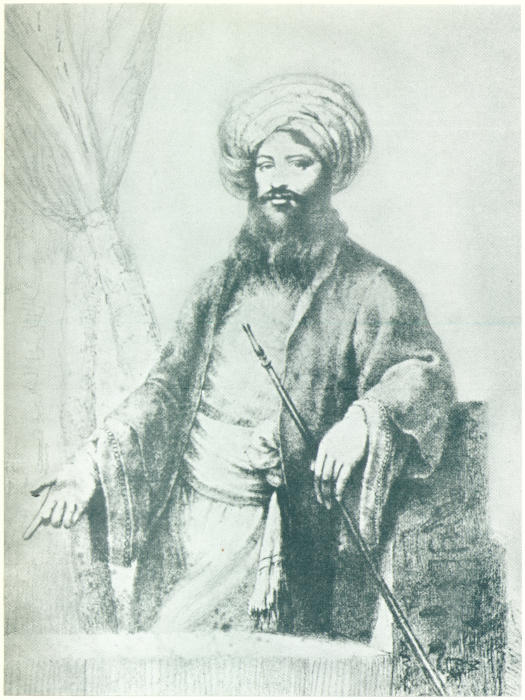
grown a fine black beard, and taken to wearing
Eastern dress, huge white turban and all. It was
the proper thing to do then when travelling in the
East.
The entrance to the Great Pyramid being on
the north, Belzoni studied with particular care the
northern face of the second pyramid, and presently
discovered there “three marks” which seemed to
offer a clue. Just under the centre of the north face
of the pyramid, the bordering wave of débris was
high, as if it might possibly lie piled atop some
entrance way; the accumulation of stone at the
mound seemed less compact than the mass to either
side, and the débris had apparently gathered since
the removal of the surfacing. There was the place,
there would he begin.
Somewhat to his surprise, he got his permission
to dig quite easily, the authorities merely insisting
that he must not disturb “ploughed ground.” The
capital on which he hoped to accomplish his undertaking
consisted of a scant two hundred pounds,
some of it a gift from Burckhardt, some of it a
profit from the sale of “antiquities.”
Early in February, 1818, the adventurer left
Cairo quietly, and took up his quarters in a tent by
the second pyramid. Alone in his tent he sits, this
huge bearded man who has lived so fantastic a
life; it is night, and he smokes his long Turkish
pipe, and watches the giant Egyptian moon cast
the pointed shadow of his pyramid upon sands
traced with the paths of naked feet. That monastery
in Rome, the bells of other convents heard
over the wall as one walked the garden in the cool
of the afternoon, the rumble and galopade of a
cardinal’s coach over the stones,—how far away
and old it all is in that still splendour of the
Egyptian night!
At the pyramid all begins well, eighty natives
have been secured, and Belzoni has put forty to
clearing the ground between the temple and the
pyramid, and forty more to clearing the débris at
the rise by the northern rim. The plates which accompany
his text show the workmen to have worn
the short, rolled white drawers and turbans of this
earlier day, a costume far more picturesque than
the long-skirted nightgown affair and red felt “fez”
of modern Egypt. A nimble folk these brown
Egyptians; they scramble about the pyramids
today with the agility of boys in an easy tree; even
so they must have scrambled and chattered for Belzoni.
He paid them sixpence English a day, and
hired boys and girls to carry away the earth.
The giant sagely explained to his corps that it
would be to their advantage to find the entrance to
the pyramid, for they would then have another marvel
to show to visitors, and thus get more bakshish[3]
than ever. The natives began with a will, but for
several days their labors promised no indication of
success. It was particularly difficult work. The
fringe of wreckage had become solidly jammed,
and the only tools to be had were spades meant
for the cutting of soft ground. There were times
when it seemed as if the workmen could scarcely
proceed. At the end of a fortnight’s digging, the
party working on the ground between the temple
and the pyramid had cut through some forty feet
of rubbish to a broad pavement which seemed to
encircle the pyramid; but the workmen at the
north side had uncovered only deeper and deeper
layers of débris.
After some sixteen days of this, the workmen
began to weary of the task. “The Arabs,” said
Belzoni, “continued, but with less zeal. Still I observed
that the stones on that spot were not so consolidated
as those on the sides of them, and I determined
to proceed till I should be persuaded that I
was wrong in my conjecture.”
On the morning of February 18th, an overseer
of the workmen came across the sand dunes with
promising news. A workman of the northern party
had perceived “a small chink” between two stones
of the newly uncovered lower side of the pyramid.
Belzoni returned with the messenger, and found
the workers gathered in a talkative group awaiting
his coming. Yes, there was a small open slit between
two of the great stones, into which the giant
was able “to thrust a palm stick to the length of two
yards.” The workmen took heart; their night of
foolish labour for this incomprehensible European
infidel was seemingly ending in a dawn.
The loose stone, torn from its place, revealed a
mystery,—a passage some three feet wide choked
with smaller stones and sand. Belzoni, in his turban
and loose white eastern dress, peered within,
while his half naked, dusky workers pushed and
peeped and whispered behind that Titan back.
Was the mystery of the ages about to be unveiled?
Would they presently behold the legendary spirit
of the pyramid—an old man with a censer? This
attendant guardian was still to be seen at sundown,
making the tour of his pyramid at about half way
up the sides,—a solemn, priestly figure who swung
his censer as he walked. Trickles of sand fell
noiselessly from the roof of the opening; they heard
the drop of little stones; about them the quiet of
the desert seemed to have become intensified.
On being excavated, this passage proved to be
wider within, and after five days of clearing, the
excavators arrived at an open tunnel leading inward.
“Having made it wide enough,” said Belzoni, “I
took a candle in my hand, and looking in, perceived
a spacious cavity ... bending its course to the
centre. It is evidently a forced passage executed
by a powerful hand, and appears intended to find
a way to the centre of the pyramid.”
It was less a passage he had discovered than a
wound. In ancient times some ruler of the land
had attempted to force the pyramid, but the deed
and the man had perished from the memory of the
world, and the pyramid itself had hidden the deep
wound within its side. To make the entrance, huge
stones of the outer casing had been cut and sawed;
then a ragged tunnel had been pierced directly into
the heart of the masonry. The task had certainly
taken toll of many lives. It was an awesome place,
and exceedingly dangerous. Huge stones, which
the piercing of the tunnel had left hanging by a
thread, fell down, and every time that Belzoni
crawled down its length of a hundred feet, he never
knew but what a cry and a muffled crash might announce
his living entombment in the dark of the
edifice.
Europeans from Cairo now got wind of the
giant’s enterprise, and came riding over the sands
to see Belzoni at his task. The discovery of the
forced passage seems to have impressed them as
an interesting failure, an attitude which struck at
the giant’s dignity and pride. He paused to mull
things over in his mind, and gave the workmen a
special holiday.
The false passage ended in a pocket of fallen
stone. He would abandon his exploration of it,
and continue his search for the real entrance.
Staff in hand, the huge figure, now resumes its
trudge about the pyramid. The workmen have
gone, the wind over the desert lifts the dust out of
the hollows of the dunes, and brings no human
sound; sand and ruin prevail. The adventurer
wanders over the waste to the great pyramid.
It was then open, and somewhere in the hot, repellent
heart of it, rank with the sour-foul odour of
multitudes upon multitudes of bats, a typical European
adventurer was working simply because the
pyramids were his hobby. The name of this enthusiast
was Caviglia, and he was the Italian master
of a Mediterranean trading vessel flying the
British flag. The good sailor had little education,
and needed little, for his work was primarily a matter
of removing rubbish, and discovering what lay
beneath. In later years Colonel Howard Vyse had
dealings with him, and found him temperamental.
Captain Caviglia, dear excitable Latin, rushed out
of his pyramid one morning and hurled on the
Colonel’s breakfast table a subsidy of forty pounds
done up in an old sock. It appears that he considered
the sum quite unworthy of his efforts. The
Colonel, however, was equal to the occasion, and
after taking out the money, returned the sock with
his “best compliments.” Such was the dawn of
archæology!
Belzoni returned from his visit to his neighbour
and countryman with a new notion in his head.
Prompted by certain indications, he had been digging
away the rubbish gathered before the centre
of the northern face of the second pyramid, whilst
the entrance into the Great Pyramid was not in
line with the centre of that edifice, but some thirty
feet to the east of centre, for the tomb chamber
lay in the centre, and the passage entered at the
chamber’s eastern end. He would abandon his excavation
at the forced passage, and begin again
thirty feet to the east.
He went to the spot, and saw, or thought he
saw, that the coating of rubbish was there not so
thickly piled. Moreover, it appeared sunken as
if an entrance below it might have fallen in. “This
gave me no little delight,” wrote the giant later,
“and hope returned to cherish my pyramidical
brains.”
Again work began merrily, for the natives had
grown to appreciate the giant’s sixpence a day.
But they thought their employer quite mad, and
Belzoni heard them whispering it to each other.
“Magnoon,” they said as he passed, and again
“magnoon,”—the madman! More days of sunlight
and scurrying and digging of a tribe of black-brown
fellahin. On February 28th, a world of
excitement and heart-quickening anticipation;
something which looks like an entrance has been
reached, for now appears a large granite stone set
into the pyramid at the same angle as the passage
into the Great Pyramid. The shovels flew that
day. On the day following, they have uncovered
three great blocks of granite, one on each side and
one on top, all “lying in an inclined direction towards
the centre.”
It was the entrance at last. By the second of
March, the débris in front of the three stones having
been cleared away, the long-sought opening
was seen. It proved to be a passage, four feet
high and three feet six inches wide, which descended
at a steep incline into the pyramid. Its
granite walls were undisturbed, but the passage
itself was full of wreckage which had slid down
the incline and piled up to form a barrier.
Provided with torches and candles, Belzoni and a
few workmen now followed the passage for a hundred
and four feet down into the dark. Whither
was it leading them? The giant bulk of Belzoni
nearly filled up the passage, as he came crouching
almost double and holding a dripping candle light.
Suddenly, to their great dismay, the passage came
to a blind end at three solid granite walls.
Discouragement fell upon them as heavy as a
pyramid. “At first sight,” said Belzoni, “it seemed
a fixed block of stone which stared me in the face
and said ne plus ultra, putting an end to all my
projects as I thought.” Suddenly, a discovery, a
catch of the breath; the stone at the end of the
passage is not fixed solidly in place; it is a portcullis
which can be raised; the barrier stone is already
eight inches above the true floor, and rests on surface
rubbish. There followed a hurrying back and
forth through the passage, a coming of workmen
with levers, and a time of hard work in the tiny cubicle
of the passageway. The portcullis stone
was one foot three inches thick, and rose slowly because
the low ceiling permitted only a little play
of the levers. At the outer entrance, the workmen
had gathered in a chattering and excited crowd;
they questioned those who came and went—what
of wonders within, and how vast was the treasure?
When the aperture had grown wide enough for
a man to pass through, a native squirmed under
carrying a candle, and “returned saying that the
place within was very fine.” Belzoni, poor Titan,
had to wait.
It had chanced that on the day before a fellow
countryman of Belzoni’s, the Chevalier Frediani,
had come to visit Gizeh; he had proved a pleasant
guest, and the giant had invited him to remain for
the opening of the pyramid. This second Italian
now joined the little group lifting the portcullis. It
was now high enough for Belzoni to crawl under,
and he did so, followed by the Chevalier.
Over a thousand years, perhaps more, had
passed since the tunnels into which they crawled had
echoed to the sound of human voices. Belzoni led
the way, carrying a light; Frediani, too, had a
torch. The huge shadow of Belzoni followed
along the walls; the granite twinkled in the first
light of ten long centuries. At the end of the passage
was an open pit which they descended along
a rope, and at the depth of the pit were passages
thick with dark and silence. Ghostlike arborisations
of nitre hung on these lower walls, some projecting
in fantastic ropes. Belzoni went off on
one trail, Frediani on another. Presently the giant
arrived at the door of the chamber of the tomb.
“I walked slowly two or three paces, and then
stood still to contemplate the place where I was.
Whatever it might be, I certainly considered myself
in the centre of that pyramid which from
time immemorial had been the subject of the obscure
conjecture of many hundred travellers,
ancient and modern. My Torch, formed of a few
wax candles, gave but a faint light.”
He heard a sound of footsteps, and Frediani entered
with his candles.
But the treasure of the pyramid? The sarcophagus
of Khaf-ra, King of Egypt, was cut in the
floor, the lid was awry, and the stone coffin “full
of a great quantity of earth and stones.” Who had
violated it in the long course of history’s four thousand
years? No one knows. There is evidence that
the Caliph Al Mamun had forced the pyramid, but
there is no evidence that he found the mummy in
its place. There are old Arabic tales of kings encased
in figures of gold, with magical golden snakes
on their crowns which spread their hoods in anger,
hissed, and struck at the intruders. All is legend
and myth. The forced tunnel, however, had certainly
once entered the original passages, but later
on the violated masonry had fallen in, and barred
the way.
Europe of the Dark Ages had never known of
the attempt; the East had forgotten. The musing
mind sees Al Mamun at the pyramid, mounted
on a nervous Arab horse which paws the ancient
sand; his mounted attendants and bodyguard
have reined up behind him—Arabs with thin dark
faces fierce as desert hawks. Captives, Christians
for the most part, are digging away at the side of
the great mass,—men of Byzantium, fair-haired
Norman sailors blown on the African coast by a
storm, little Spaniards from the mountain kingdoms
which are so valiantly battling the Moors.
And King Khaf-ra, whom the Greeks called Chephren,
sleeps he within in “the dark house of the
counting of the years?”
There were Arabic inscriptions on the walls,
written with charcoal, but the characters were
nearly imperceptible, and rubbed off into dust at
the slightest touch. Belzoni thought he discerned
an inscription which may be thus translated, “The
Master Mohamed Ahmed has opened them, and
the Master Othman attended this, and the King Ali
Mohamed at first ... to the closing up.” Sir
Richard Burton, however, perhaps the greatest of
all Arabic scholars, will have it that the Arabic
characters as Belzoni transcribed them are for
the most part unintelligible. And there the matter
rests.
The Belzonis spent two more years in Egypt,
and returned to London in September, 1819.
Oh, the Bight of Benin, the Bight of Benin
One comes out where three goes in.
—Old British Navy Song.
Green pleasant England again, the white cliffs
of Dover, and the autumn fog drifting down on
London and the ships. Belzoni’s fame had gone
before him to the capital. His popular title of
“Signor,” which both Italianised him and linked
him with his mountebank past, now fell into disuse,
and it was as “Mr.” Belzoni that he faced a new
life of dignity and prestige. Winter found the
traveller and his Sarah living happily in London
lodgings, visited and consulted by the learned and
the great. Belzoni kept his head. With his usual
commonsense he was busily at work arranging an
exhibition.
“Belzoni’s Exhibition,”—the words were magical
a hundred years ago. All London came to the
hall on Piccadilly when the doors opened in the
spring of 1821. The old red-faced generals who
had fought Napoleon came to stare at Pasht and
Osiris, egad, the port-sipping gentlemen of substance,
the fine ladies, and the sober citizens linking
arms with their bonneted wives. To please them,
Belzoni had reproduced two of the principal chambers
in the tomb of Seti I, painting, sculptures and
all, and displayed “idols, coins, mummies, scarabœi,
articles of dress and adornment, lachrymatories,
and a splendid mass of papyrus.” The tomb of
Seti was “lit within by lamps,” and made a tremendous
impression. And there was a poem by
Horace Smith, “Address to a Mummy in Belzoni’s
Exhibition” which all the world was reading. Now
and then the giant moved towering through the
throng, and mothers would bid their little flaxen-haired
boys and girls to look at the man who had
opened the pyramid.
A season in Paris followed the year in London,
and then came the last great adventure.
The fever of exploring woke again within his
veins, and he determined to cross the great African
desert, and make his way to the almost fabulous
city of Timbuctoo. He would land in Morocco, go
south through the Moroccan possessions, and then
join a caravan bound for the fateful city. The
plan seemed practical enough, and on an autumn
morning in 1822, the roving Titan bade farewell
to his faithful amazon, and followed his boxes and
baggages aboard a vessel for Gibraltar.
In Fez, the Moroccan capital, they seem to have
played with him for a while, for the Emperor first
gave him a permission to go through the country,
and then withdrew consent. The failure may have
been due to intrigue, as Belzoni imagined, or to the
deep-rooted native distrust of Europeans; it was
probably a combination of the two. Much chagrined,
the explorer now returned to Gibraltar, and
there determined on a course which did honor to his
courage and perseverance. The way south to
Timbuctoo being barred, he would make his way
along the African coast to the city of Great Benin,
and then struggle northward to his goal. It was a
route to daunt any explorer, for it led into one of
the darkest and most dangerous areas of unknown
Africa.
Sailing in trading ships and little vessels of one
sort or another, the adventurer slowly made his way
south along the west African shore to the English
station of Cape Castle on the Guinea Coast. There
Sir R. Mends, commanding the British naval squadron
on the African west coast, befriended him and
sent him to Benin in His Majesty’s Gunbrig
Swinger. On the 20th of October, 1823, the brig
arrived off the bar of Benin River.
The brig Providence was lying off Obobi, and
Belzoni boarded her at the invitation of her master,
Captain John Hodgson. A month later, a “Fantee
canoe” belonging to the ship is lowered overside;
it contains Hodgson and Belzoni. The poor
giant seemed “a little agitated,” particularly when
the crew, to each of whom he had made a present,
gave him three loud cheers on his stepping out of his
vessel. “God bless you, my fine fellows,” cried the
explorer, “and send you a happy sight of your
country and friends.” He was clad in his eastern
dress and turban, and still wore his great, black
beard.
A few days later word comes to the sailors that
the guest whom they had so cherished, loved, even,
as a shipmate, is lying ill at Benin. Good Hodgson
hurried inland, and found the giant dying of African
dysentery in Benin city. In a palanquin, they
hurry him down the river to Gwato, hoping to get
him to the coast and the sea air. But the end is
at hand, an end calmly envisaged; the last of his
strength he spends trying to write a letter to his
wife; he entrusts Hodgson with a ring for her and
a message full of the most touching affection, then
yields the ghost. They buried him at Gwato under
a great tree, and there he lies in the dark of Africa.
So ends the tale of the monk who passed from
the peace of a monastery to an acrobat’s stage in
a village square. The young Italian had accepted
his destiny calmly, and made the best of it, yet never
bowed his head. Thrust violently from the most
retired of lives into the most bohemian, he had
remained,—Belzoni. There is something amusing,
something rather fine as well, in the way that he
sailed through life like a fine ship sent by the fates
of the sea on dubious voyages. And what a sense
of achievement and honest adventure he had won
from it all; it had all been so well worth while.
History will remember him as the first of modern
explorer-archæologists. “One of the most remarkable
men in the whole history of Egyptology,”
says Mr. Howard Carter, who found the Tutankhamen
tomb.
Belzoni the giant! What sounds run through
his life—the sniping of a barber’s shears, the ringing
of convent bells, the talk and endless brook-like
chatter of crowds at a fair, the songs of laborers
along the Nile, the shuffle of camels in the
sand, and the squeak and grind of levers raising the
portcullis of Chephren’s pyramid!
Three : EDWARD JOHN TRELAWNY
Three : EDWARD JOHN TRELAWNY — I — II — III — IV — V
About a hundred years ago, on a pleasant
summer morning, two young Englishmen
came down to the water front of the Italian
port of Leghorn, got into a boat, and rowed off to
look at the shipping in the bay. The two venturers
made an odd pair, for the oarsman was a tall,
powerfully built fellow with piercing blue eyes,
thick black hair, and the features of an Arab, whilst
the other was slender, boyish and yellow-haired,
and had innocent blue eyes, and a schoolboy’s
innocence of beard.
The first vessel round which they rowed, a
Greek trader, displeased them, for she was dirty of
deck and sail, but beyond her lay a graceful full-rigged
ship flying the Stars and Stripes. At the
sight of this fine vessel, the following conversation
took place. It has been set down word by word, for
one does not take liberties with the phrases of the
great.
“It is but a step,” said the oarsman, “from these
ruins of worn-out Greece to the New World; let’s
board the American clipper.”
“I had rather not have any more of my hopes
and illusions mocked by sad realities,” protested his
companion with a smile.
“You must allow,” returned the other, “that that
graceful craft was designed by a man who had a
poet’s feeling for things beautiful. Come, let us
go aboard; the Americans are a free and easy people,
and will not consider our visit an intrusion.”
A turn, a few strokes, and the boat approached
the American ship. By the gangway, an American
salt with a quid of tobacco squirrelled in his
cheek, was busy at something or other, and every
now and then this honest fellow walked to the rail
to spit calmly overside into the historic Mediterranean.
While thus pleasantly engaged, he caught
sight of the small boat coming alongside, and
shouted, “Boat ahoy!” A mate came to the rail.
“May we go aboard?” said the dark, Arab-looking
man.
TRELAWNY AS THE OLD SEAMAN IN SIR JOHN E.
MILLAIS’S PAINTING “THE NORTHWEST PASSAGE.”
“Wal, I don’t see why not,” answered the American
mate, cheerfully and without ceremony.
“You have a beautiful vessel,” said the first
speaker, once he had gained the deck. “We have
been rowing about looking at the ships, and admiring
yours.”
“I do expect now we have our new copper on, she
has a look of the brass sarpent,” agreed the American.
“She seems so beautiful,” said the first speaker,
“that we have been wishing we might have a vessel
like her.”
“Then I calculate you must go to Boston or Baltimore
to git one,” replied the ship’s officer. “There’s
no one this side the water can do the job. We
have our freight all ready and are homeward bound;
we have elegant accommodation, and you will be
across before your young friend’s beard is ripe for
a razor. Come down and take an observation of
the state cabin.”
The hospitable seaman now led his guests to the
state cabin, and would not let them go till they had
drunk a toast under the Star-Spangled Banner to
the memory of Washington and the prosperity of
the American commonwealth. Peach brandy was
the drink. The toast concluded, the mate rummaged
for a moment in a locker, and then offered
his visitors a gift right from an old time sailor’s
heart.
“There, gentlemen,” said the sailor. “Guess you
don’t see nuthin’ like this in these parts!”
“Plug tobacco,” said the dark man.
“Yes sirree, Mister,” replied the mate. “And real
old Virginia cake. Jest you set your teeth in that,
Mister,” he continued offering the plug to the fair-haired
guest, “and tell me if you’ve tasted anything
so good since the big wind.”
The fair-haired visitor, however, refused both the
brandy and “the chaw,” but managed to quaff a
glass of weak grog to the memory of the first of
presidents. The blue eyes gathered a strange fire.
“Washington,” said this other visitor, “as a warrior
and a statesman he was righteous in all he did,
and unlike all who have lived before or since, he
never used his power but for the benefit of his fellow
creatures.
He fought
For truth and freedom, foremost of the brave,
Him glory’s idle glances dazzled not;
’Twas his ambition generous and great.
A life to life’s great end to consecrate.”
“Stranger,” said the American, studying the
speaker, his shrewd eye bright with honest pleasure,
“truer words were never spoken. There is dry rot
in all the timbers of the old world, and none of you
will do any good till you are docked, refitted and
annexed to the new. You must log that song you
sang; there ain’t many Britishers will say as much
of the man that whipped them, so just set down
those lines in the log or it won’t go for nothing.”
A little shy, perhaps, yet glad that his words had
given pleasure, the youth with the yellow hair sat
down to write. The quill pen made almost no
sound; and the faint noises of the harbor,—the
voices of sailors heard across the water from other
ships, the chuckling of little waves alongside, and
the passing of bare feet on the deck overhead,—filled
the polite quiet. Yielding to some fancy
or inspiration, the visitor did not enter the lines
he had quoted, but some others which pleased
him even more. This done, the Englishmen parted
from their Yankee host, and regained the dust, the
street cries, the uniforms, and the hot yellow sun of
the old Italian town.
A musing mind pauses to wonder as to what
might have been the name of this Yankee ship anchored
in Leghorn bay sometime in 1822. The
hospitable mate, “a smart specimen of a Yankee,”
who was he? And above all, what became of the
ship’s log? Did it vanish from earthly eyes in
the stormy tumult and breaking timbers of a wreck,
was it tossed away as old rubbish, or does it still
lie at the bottom of a sea chest in the piney dark
of some attic in New England, an attic whose roof
is brushed by elm boughs on windy summer days?
Will the little mystery ever be solved? What a
log book it would be to possess! For the young
man with the crown of mutinous fair hair who
wrote the lines and refused the plug tobacco was
Shelley, and the Arab-looking oarsman his friend
and companion, Edward John Trelawny.
A mysterious fellow, this “good friend Tre” of
the piercing eyes. A word from Shelley’s comrade
and admirer, Edward Elliker Williams, had
served him as an introduction to the Shelley group,
and his first visit to them had taken place late one
evening while the family was at Pisa. One sees
the Italian room in lamplight, a room to which
sensible Mary Shelley must have given something
of an English air; one hears the English voices
through the quiet of provincial Italy. Trelawny
enters, and the surprised Shelleys see a personage
who is not at all English-looking; their visitor is
a character out of Byronic romance, blazing eyes,
pirate brows, bronzed skin and all. He looked like
“a young Othello.” The newcomer, for his part,
saw a rather bookish family gathered about a bookish
young man “habited like a boy in a black jacket
and trousers which he seemed to have outgrown”;
it is Shelley he sees, reading as always,
slender, bent a little, and “extraordinarily juvenile.”
“Is it possible that this mild, beardless boy can
be the monster at war with all the world?” thought
the young Othello.
While Shelley, as was his custom, went in and
out of the room, as silently and strangely as a spirit,
Mrs. Shelley asked Trelawny of news from London
and Paris,—the new books and the operas, the
new bonnets and the new styles, the marriages and
the murders. A domestic scene. When Trelawny
had gone, they spoke of him. Where had Mr.
Williams encountered this remarkable person? In
Switzerland. And was he not a sailor? Yes, he
had been a sailor, and some said a pirate. A pirate,
indeed! He could tell the most wonderful stories
of gory battles on the Java seas, and expeditions
to native strongholds in the jungles of Malaysia.
Quite a remarkable person, “our friend Tre.”
“Trelawny,” says a distinguished biographer of
Byron, “was a liar and a cad.” The judgment is
prejudiced and severe. Whatever his faults, the
man acted a leading rôle in one of the most romantic
episodes in English literary history, and was
well liked and respected by the great figures of the
play. The world recalls his association with Shelley
and Byron, his recovery of Shelley’s body after
the storm, and the cremation in classical style he
arranged on the sands of Villareggio; it remembers
his flight with Byron to the aid of rebellious
Greece. A marvellous chapter, but only one of a
life romance which is still something of an enigma.
Sailor? Pirate? Byronic stage-player? Let us
see.
The known, the traceable, history of Edward
John Trelawny begins with his birth in London in
1792, and comes to an abrupt end some seventeen
years afterward. His father, Lt. Colonel Charles
Trelawny, was a middle aged army officer who had
retired to economise his wife’s fortune, the relics of
his own, and play the rôle of stern, Roman father
on the stage of family life. Both family and family
name were Cornish, and the boy began life with
the heritage of those of Cornish blood, the heritage
of an ancient and separate race whose antiquity
runs past the pillars of Stonehenge into the dawn
of time. There was a Celtic streak in Trelawny;
the joy of battle was his, the quickening fire, the
strange madness, and even the Celt’s power over
the souls of words.
Something darker and far more ancient, however,
had fought its way back to life in Trelawny’s
veins. The boy was born a warrior, but
not a warrior of Celtic Arthur’s kind. The true
comrades of his spirit were the heroes of the primitive
Gaels, the mighty men whose blood seemed
to “run up into their fiery hair,” during the exultation
of killing and war.
Fanny Kemble saw Trelawny in his later years
during his visit to the United States, and divined
the dark side of his inheritance. “Mr. Trelawny’s
countenance,” she wrote, “was habitually serene,
occasionally sweet in its expression, but sometimes
savage with the fierceness of a wild beast.”
When a young savage comes into the world,
the problem of how to civilize him usually commands
attention, but no one bothered his head
about Edward John Trelawny. The savagery of
neglected boyhood was allowed to grow wild in the
congenial soil of the boy’s obscure and primitive
inheritance. It was not a pretty childhood, and
the following anecdote preserves its quality.
The Trelawny urchins had an enemy, a tame
raven “with ragged wings and a grave antique
aspect,” who used to drive them away from some
fruits they coveted. This old demon had a trick
of rushing at the children with outstretched wings,
and though they threw stones, he carried the day.
Little Edward John, however, having courage and
the warrior instinct, kept up the fight, and presently
managed to wound the enemy. Shouting and
yelling, the children raced to the gruesome execution,
and a final curtain descended on Edward John
hanging the horrible blood-stained old mass of
feathers in a noose made of a sash borrowed from
his little sister!
Spelling lessons were battles. “Spell your name,
you young savage,” shouts the Roman father.
“Spell, sir?” The boy, becoming confused, misplaces
the vowels. At this, the Roman father
“arose in wrath, overturned the table, and bruised
his shins in an attempt to kick me as I dodged him,
and rushed out of the room.”
From the bosom of this peppery homelife, the
great, bony, awkward boy was kicked into a school.
There he encountered floggings, canings, and hideous
practical jokes. The young Cornish Celt with
the black hair and the wild blue eyes fought the
savagery with savagery. His Roman father countered
by handing him over to the Royal Navy. The
new life was the school all over again, save that the
sea-hazing was more brutal and the practical jokes
even more atrocious. A strange trait, that English
liking for practical jokes! Then followed a
season at Dr. Burney’s Naval Academy at Greenwich,
a voyage on a frigate during whose course
“Tre” revenged himself on a persecutor by jabbing
him with a pen knife, and then a long world cruise
on a sloop of war.
Brutalised at home, brutalised at school, brutalised
in the Navy, it is a wonder that the young savage
remained reasonably human. With the arrival
of adolescence a sense of injustice and an urge to
rebellion struck root in his mind. Rebellion was
his only outlet, and in rebelling, he was most his
primitive self. For the boy was only primitive, not
vicious. Presently he decided that he had had
enough, and made up his mind to desert.
The neglected sailor whelp, whom no one had
received with affection or troubled to civilise, was
now seventeen years old, he stood six feet tall, and
was strongly built, though of a certain adolescent
gauntness. “My face was bronzed, my hair black,
my features perfectly Arab.” The loneliness of
adolescence troubled him, his parents’ “hard usage
and abandonment” gnawed at his heart; he felt
“alienated” from his “family and kindred.” He
would follow a new trail, and “seek the love of
strangers in the wide world.”
The phrases are almost sentimental, and doubtless
reflect genuine feeling, but the young savage
was still the young savage in his way of life. Having
determined to jump ship, the demon midshipman
prepared to pay off an old score. A lieutenant
of his ship, a Scotchman, had been nagging him,
and “Tre” fell upon the man with the supreme
strength which is born of anger. The ship being at
Bombay, the encounter took place in a billiard room
ashore frequented by naval officers. It was a ferocious
business of blows, kicks, bruises, blood, cries
and broken teeth. The lieutenant attempted to
beg off. Tre’s narrative then continues,—
“‘What,—you white-livered scoundrel? Can no
words move you? Then blows shall!’ And I
struck him with the hilt of my sword in the mouth,
and kicked him, and trampled on him. I tore his
coat off and rent it to fragments...” Thus the
young savage spoke and fought.
So ends that chapter of Trelawny’s early life
which is traceable. A certain use, to be sure, has
here been made of his thinly disguised autobiography,
but the use has been scrupulous, and the borrowings
confined to an incident or two which are
accepted as historic. Now comes mystery. After
his desertion in Bombay, all trace of him disappears
for some seven or eight years. What was he doing
all this while, and what regions of the earth and
sea were filled with his adventures?
The bronzed young man in his middle twenties,
who drifted back to England either in 1815 or ’16,
had little to say to his questioners, though there
were hints of a lurid career. As always, the mystery
fed on mystery. The man’s fine presence, his
Oriental features, and his piercing eyes were enough
in themselves to inspire interest; little by little the
moonlight of romantic imagination gathered him
into its beam. His intimate friends, it was whispered,
heard blood-curdling tales of piracies as they
sat in the chimney corner. Ah,—if “Tre” would
only tell the whole story! They waited for it fifteen
years.
The account must now anticipate a little, and
leap the years to 1830. The summer months are
at hand, and Mary Shelley, the poet’s widow, is
arranging and correcting an extraordinary manuscript
from “our friend Tre.” Sensible Mary Shelley,
with fair complexion, her light hair and calm
grey eyes,—what did she make of the wild tale in
those numberless pages? One sees her at a desk,
remedying Trelawny’s frequent deficiencies of
spelling, writing “postponed” for “posponed,” and
inserting “gs” in all words such as “strength” and
“length.” Trelawny treated the letter with a Cornish
disdain. The manuscript in the widow’s hands
was a novel of adventure which Trelawny insisted
was really an account of his own career. First
purposing to call the book “A Man’s Life,” he later
changed it to “The Adventures of a Younger Son.”
The scene now returns to the billiard room in
Bombay, with the Scotch lieutenant lying on the
floor, barely alive. The young savage brandishes
the heavy end of a billiard cue he has just broken
over his enemy and in true Berseker fashion is
about to finish his man, when a voice calms him, and
forbids the murder. The speaker who has thus
intervened is one De Ruyter, a mysterious adventurer
who has made friends with the young savage.
In spite of his Dutch name, he is an American,
and even claims Boston as his beloved birthplace.
The young deserter and this incredible
Bostonian now escape to De Ruyter’s ship, an
Arab craft almost openly engaged in piracy.
The years that follow find the savage in his element;
the tale is one of piracies, pursuits, boardings,
battles, pistol shots, stab-wounds and slicings,
and blood running bright and stickily through scuppers
into waters alive with gathering sharks. There
are tiger hunts, fevers, corpses, despairing yells,
and sudden deaths numberless as sands of the sea.
Having no definite base of operations, the precious
pair indulge in grand and petty larceny all
through the eastern seas; the scene is now the
Indian ocean, now the coast of Celebes, now the
inlets of the Philippines. What there is of “love
interest” is very slight, and centres about the corsair’s
Arabian child-wife, Zela, a Byronic heroine
who perishes opportunely, and is then cremated on
a funeral pyre.
There are three volumes of this fee-fi-fo-fum and
manslaughter, the last ending with the return of
De Ruyter and his acolyte to Europe, their separation,
De Ruyter’s death at sea while in the service
of Napoleon, and the resolve of the hero to struggle
on for the liberty of “the pallid slaves of Europe.”
Cutting a throat, it appeared, was but a whimsey
when compared to the guilt of those who continued
to consort with the “sycophantic wretches who
crouch and crawl and fawn on kings and
priests.”...
“Romance can go no farther,” said a contemporary
critic in the Military Review, “than the actual
adventures of the homicidal renegade and corsair,
the ‘Younger Son.’”
Time has confirmed this sensible opinion. A
more brutal, a more ruthless, a more utterly unfeeling
book does not exist in English literature. Save
for the rhetoric about the “pallid slaves,” and some
Byronic transports over the body of Zela, the story
knows less of sympathy than a crocodile. Moreover,
it is nowhere amusing. What carries it along,
what made it a success in its own time, and has won
it a reprint in our own, is its superlative vividness.
The picture may be that of a man, shot in the heart,
spinning about; it may be the impression of thick
resistance which human flesh offers to the hand that
stabs;—whatever it may be, image or sensation, it
is real, it is true, and it is the unconscious artist who
affects us and no mere business of superlative photography.
Overlong, chaotic, and ruffianly as it is,
the book is no lifeless curiosity of literature.
Such was the existence from which the deserter
and adventurer returned to Europe. Were one to
swallow the book whole, it might well be imagined
that the Trelawny who arrived in London was a
proper subject for a gallows. Yet the adventurer
who in England took the place that was his by
birth as a gentleman’s son was no skull and bones
ruffian. There are no stories, no rumours that tell
of ruffianism or ruffianly qualities; when this young
Arab-featured man called on his neighbours, there
were no blanched faces at the windows, or wild
whispers to send the ladies upstairs and hide the
spoons. Sometimes a good family will unaccountably
produce a ruffianly type; the incident is rare,
but it is encountered,—but Trelawny was not of
these.
The Younger Son who had been born with something
dark and ancient in his blood, who had
endured a savage and neglected boyhood and adolescence,
had returned to England reasonably civilised
at least. Such was not the customary result
of seven years of piracy!
The explanation is probably a very simple one;
the boy savage, the demon midshipman, had grown
up. With the arrival of manhood, the fundamental
qualities of the man’s character and original
mind had broken through the barbarism of his early
life.
The streak of Celtic battle savagery he had inherited
was still in his veins; he never lost it. Seven
years later, while accompanying Byron to the revolt
in Greece, he spoke of “the best of all excitement.”
The poet showed curiosity. “Fighting,”
added Trelawny, and was not guilty of a pose.
There were times when he showed a certain cold-blooded
streak; the pirate was not touchily fastidious.
He had a mind, he was a born observer, and
he was nobody’s fool. There is no evidence that he
had much imaginative quality. The ideas he had,
he clung to emotionally, for they were really emotions
in borrowed clothes. His enthusiasm for
“Europe’s pallid slaves,” for instance;—what is it
but his own transmuted resentment for his own
loveless and cruel boyhood,—what was his hatred
of “sycophants, priests and kings” but his own
hatred of those in authority who had oppressed his
youth? He does not appear ever to have arrived at
any intellectual understanding of his attitude.
The young man of mystery returned to England
with a little money, and presently carried out an
anchor to windward. He married, and in a sentence
of matchless pathos, lamented his rose-decked
chain. He had become “a shackled, care-worn and
spirit-broken married man of the civilised west.”
There are those who say that the lady was frivolous
and wasteful. It probably mattered little, for the
adventurer’s relations with his various wives were
astoundingly casual; they have something of the
kiss and good-bye of the legendary sailor.
The roses of matrimony beginning to lose their
petals, the younger son took to escaping on vagabond
adventures. The incredible snobbery of contemporary
British life, “its mystic castes, coteries,
sets and sects, its ... purseproud tuft-hunting
and toadying” got on the nerves of this man who
had seen life in the raw. Fleeing to Switzerland,
he made friends with another wandering Briton, one
Mr. Edward Elliker Williams, a half-pay lieutenant
of the Eighth Dragoons. Mr. Williams
chattered for hours of his marvellous friend, Mr.
Percy Shelley, the poet, who had so splendidly
defied the ideas and conventions of contemporary
Britain. There was a man and a rebel! Expelled
from Oxford for atheism, the hero of a romantic
elopement at eighteen, the hero of a defiant free
union at twenty-one, the contemner and accuser of
every dastardly sycophant, king and priest in the
solar system. And a poet, sir!
Mr. Shelley the exile,—here was a man for Trelawny
of his own unconventional mould. Shelley
the rebel. Shelley the Lucifer! He would go to
him; the sycophants, kings and so forths had better
take care. “I swore to dedicate myself,” said the
pirate later, “hand and heart to war, even to the
knife, against the triple alliance of hoary headed
impostors, their ministers and priests!” How the
rhetoric brings before one’s eyes the liberal anger
at the Tory reaction following the wild revolutionary
years!
Mr. Williams arranged the meeting, and took
“our friend Tre” to Pisa. Was “Tre” a little disappointed
at the appearance of the exiled Lucifer
and poetic arch-scandaliser; had he prepared himself
for something robust, defiant and rhetorical,
someone quite in his own style? There are times
when this emotion seems visible between the lines
of Trelawny’s account of the meeting. Whatever
the expectation may have been, Shelley won his
piratic visitor heart and soul. A young man with
an Arab’s thin nose and bronzed cheeks and a
young man with great open eyes, a boy’s fresh face
and a crown of yellow hair,—the pirate and the
scholar rebel—a fantastic alliance!
No wild outcries from British throats, however,
disturbed the stout and comfortable Italian padres
who stopped in the streets of Pisa to take snuff,
and wandered off brushing the specklets of brown
dust from their soutanes. Incomprehensible
Ingleses! The exiles were all under thirty, they
had all made their lives something of an adventure,
they were all glad to be alive.
Destiny was preparing strange things.
The younger son, having decided to throw in his
lot with the poet’s, remained in Pisa. He liked the
group and the environment, though the bookish
intellectualism of the Shelleys swept him often
enough beyond his depth. Byron, also living in
exile, was a familiar figure, and there were rides
together out into the country and pauses by the
roadside to indulge in the noisy sport of pistol
practice.
Shelley read, and hidden away in a little pine
wood, wrote poetry; Byron lurked in his huge
palace guarded by a growling English bulldog and
a squad of chattering retainers captained by a
giant Venetian gondolier.
The poets liked the younger son. He was a rebel
too, in his way, his piratic career made him interesting,
he had good stories to tell, and above all,
he was a man of action who could be trusted to do
practical things for the impractical. A boat is to
be built, Tre will attend to it; a boat is to be sailed,
Tre will do that; household goods are to be moved,
we must talk with Tre. Affection forms quickly
in such an isolated group, and there seems to have
been a certain affection for piratic Tre, perhaps the
first the man had ever known.
As the weather grew hot, Tre advised the
Shelleys to go north, and found them a house at
Lerici on the Gulf of Shezzia. The place was but
a shabby barrack, but it was on the sea, and Shelley
rejoiced. In the evenings, the whole population
of men, women and children took to the water like
ducks, and their shouts of joy filled the house.
Shelley and Tre joined in the frolic, but Mary
Shelley looked grave, and said it was “improper.”
“Hush, Mary,” said the poet, “that insidious word
has never been echoed by these woods and rocks;
don’t teach it to them.”
The late spring ripened into summer, and with
July came the historic tragedy.
Early in the spring a kind of yachtsman’s fever
had descended upon the little group. Byron had
arranged for the building of a yacht, and Williams
had designed a boat for Shelley and the friends at
Lerici. In designing the hull, Williams had probably
attempted an imitation of the fast American
vessels he had seen along the coast; it was a model
he did not understand. One Captain Roberts, a
sometime British naval officer then living in Italy,
had the boat built under his eye at Genoa; she was
twenty-four feet long and eight in the beam; she
drew four feet of water and was schooner rigged
with gaff topsails. Not a boat, this, to fire a sailor’s
heart, for the rig needs a crew to run it, and is
difficult to handle quickly, especially in a small
space. Two English sailors and a ship’s boy had
sailed the vessel from Genoa to Lerici. When
asked how she sailed, the tars had replied that she
was a “ticklish boat to manage,” and that they had
“cautioned the gents accordingly.”
Originally christened the “Don Juan,” the fateful
vessel was now re-christened the “Ariel.” To
give her more stability, Williams filled her with
ballast,—a dangerous business, for the vessel was
undecked. The designer would hear no criticism
of his craft.
“Williams is as touchy about the reputation of
his boat as if she were his wife,” grumbled Tre.
Such was the yacht in which Shelley, Williams
and the English sailor lad, Charles Vivian, sailed
from the port of Leghorn on July the eighth, 1822.
The poet had sailed down from Lerici to welcome
Leigh Hunt and his family to Italy, and this
friendly office done, was returning home again by
sea.
Two o’clock in the afternoon, haze, July dulness,
and almost no wind in the Gulf of Spezzia. Trelawny,
busy doing something aboard Byron’s
yacht, the Bolivar, watched his friends sail away.
He had hoped to escort them to sea in Byron’s
vessel, but at a last moment difficulty over sailing
papers had arisen with the port authorities. The
haze was thickening and growing dark, a menacing
thunder was rolling nearer; presently the Ariel
vanished from Trelawny’s sight into the leaden
gloom.
A squall, needless to say, is a swift business anywhere,
but the Mediterranean variety has a certain
thunderbolt burst and a drenching vengefulness
all its own. On the ships anchored about the Bolivar,
barefooted seamen were running along the
decks preparing their vessels for the squall which
moment by moment assumed a more threatening
look. Suddenly came rain, and in the rain the
wind; the storm blustered through the night.
Trelawny went ashore, and listened all night
long to the wind and the beat of the rain. He was
restless with anxiety. Everything that there was
of sailor in the man distrusted the Ariel, and
he knew only too well that Shelley would be of
little use in an emergency. The poet would be
dreaming or reading a book at the very moment
the wind leaped at the sails. The dawn revealed
the shipping in the harbour rolling and pitching
about under pouring rain; the anxious day ended
without news. The following days found Tre
searching among the vessels which had been at sea
during the storm, questioning sailors, patrolling
the coast with the coast guards, and offering rewards.
Presently comes a messenger in some shabby-showy
uniform, and an official letter written in
Italian. The bodies have been found on the sands,
poor, broken bodies of men lost at sea.
“Oh, bitter, bitter gifts of the lord Poseidon,”
said the Greeks, remembering the bruised flesh
turning in the waves. What was to be done? Tre
says that it was decided by “all concerned,” that
Shelley should be buried in Rome beside his little
son. Before this might be done, however, there
were laws and a thousand regulations to be fought
through, for Italy was then divided in separate
jurisdictions, and, moreover, bodies washed ashore
were regarded by the law as possible victims of
the plague. This, of course, was not Shelley’s
case, but the law was the law.
It was Tre who found a way out of the difficulty.
Was his notion possibly a memory of something he
had witnessed in the East? He would cremate the
bodies, and send Shelley’s ashes to Rome. It is no
injustice to Tre to say that he made his preparations
and gathered the funerary material with the
business-like directness of an undertaker. He was
the man of action as ever, the practical friend who
could be trusted to get things done.
He attended to Williams first, and then gathered
the forlorn little world of the exiles to see the last
of Shelley.
It was a hot August day, and the whitish sands
of Villareggio were tremulous with heat. A dead
calm lay upon the sea, and save for Byron’s
schooner anchored close off shore, the vast gulf
revealed no sign of human life. Behind the beach
lay a wood of tall, branchless pines, “their dark blue
tops packed so close together that no sun could
penetrate,” and far away, over the wood rose the
marble-crested Apennines. The pyre stood in the
open between the wood and the sea. Byron was
there and Leigh Hunt, a detail of soldiers, a few
coast guards, and some Italian great folk who had
ridden out in their carriages to watch so unaccountable
a proceeding. Following ancient ritual, the
exiles poured salt, oil and wine upon the pyre; the
little first flames rose yellow towards their hands.
A lonely sea bird came circling near, the pyre
burnt with little smoke, and thus the body of
Shelley dissolved into the air.
Only the heart refused to burn, though in the
hottest of the flame. Tre snatched it forth, and
burnt his hand so doing. When all was done, and
the pyre burnt out, he gathered the ashes together,
put them in an oaken box, paid his soldiers, and
went off to Rome with his parcel.
A chapter of his life had come to an end. The
little group dispersed, Byron remained to quarrel
on with the Hunts, the widows went to England.
Tre had been a staunch and helpful friend, and
Mary Shelley never forgot the debt. She could
write later that Trelawny’s conduct “impressed us
all with an affectionate regard and a perfect faith
in the unalterable goodness of his heart.” She
knew that it was good to have a friend. The
Gentleman’s Magazine, on hearing of the drowning,
had remarked, “Mr. Percy Shelley is a fitter
subject for the penitentiary dying speech than a
lauding elegy, for a muse of the rope rather than
that of the cypress.”
Italy in the autumn, and an empty world. Tre
lingered on a year, and found diversion in riding
about the countryside. An American-born negro
followed him as a groom; the peasants stared at
the strange pair galloping by.
Then came a letter from Byron, and life began
again with adventure and war.
The Greeks had risen against their Turkish
masters, a committee of enthusiastic lovers of
liberty had been formed in London to advance the
cause, and this committee had persuaded Byron
to act as their agent in Greece. From the point of
view of what the cant of the day calls publicity,
the choice was an excellent one; considered with a
harsh and practical eye, it was absurd. This nervous,
temperamental artist with the habits and posing
mannerisms of a regency beau, this traveller
who scarce could walk a hundred yards on his
shrunken and deformed feet, yet hid his pain and
weakness in a cloak of attitudes,—surely here was
no man to manage a horde of wily Levantines all
trying to advance their own fortunes, and snatch
what they could for themselves of the English
subsidy.
Having accepted the task, Byron turned at once
to the practical friend. “My dear T,” he wrote,
“you must have heard that I am going to Greece.
Why do you not come to me? I want your aid,
and am exceedingly anxious to see you.”
War and adventure! Trelawny wasted no time
in exchanging the vineyards of Italy for Grecian
mountain slopes and olive trees. Then came a mistake.
He abandoned Byron, and went off to adventure
by himself.
Tre had never really liked the noble lord, perhaps
because Byron, being a man of the world,
had a clearer understanding than Shelley of Trelawny
the man and his place in life. A stray letter
of Claire Clairmont’s, Byron’s sometime mistress,
suggests that Tre secretly cherished resentment for
some sharp remark. Whatever the explanation
may be of Tre’s hidden attitude, the practical man
had no intention of wasting his time with the poet,
but left him to his fate. He seems to have forgotten
that he had come to Greece with Byron and
at Byron’s invitation and suggestion.
“I well knew that once on shore, Byron would
fall back on his old routine of dawdling habits,
plotting, planning, shilly-shallying and doing nothing,”
he complained. And again, “Could I then
longer waste my life in union with such imbecility,
amid such scenes as there are here, when there is
excitement enough to move the dead?”
The angry phrases make the adventurer’s motives
clear and perfectly comprehensible, yet leave
the abandonment of the poet a matter for controversy.
Byron had called Tre to his side, Tre had
accepted with alacrity; there was no solemn engagement,
no cant about duties and so on; Trelawny
was free to do as he pleased. A meticulous sense
of honor might have detained him, but then the
finer shades of honor never plagued Trelawny.
Crossing from the island of Cephalonia to the
mainland, the free-lance now made his way through
the grey mountains and the ravaged country side
to the camp of Odysseus, chieftain of Eastern
Greece. Tre thought him a man after his own
heart, and wrote enthusiastically of his new friend.
Of all the feudal leaders of rebellious Greece, this
was the man! The adventurer’s life began to be
worth living, there were ambuscades, descents on
villages, attacks on Turkish cavalry, and looting
expeditions. He was fighting for liberty, as
Shelley would have wished him, but he had no
illusions about those “pallid slaves,” the newly
liberated Greeks. He quite agreed with Colonel
Napier’s famous remark, “My dear Mr. Trelawny,
no one should assume any direction in Greek affairs
... without the help of a portable gallows.”
Meanwhile in the mud and malaria of Missolonghi,
lived the man whom every feudal chieftain
hoped to coax into his hands, the noble Lord Byron,
agent in chief of the Greek committee. At
Odysseus’ suggestion, Trelawny set out for Missolonghi
to plead the chieftain’s cause. He arrived
there in the rain, and met dejected stragglers riding
away,—the English milord was dead. The fretful,
bewildered satirist had perished like a bird caught
in a net of dirty twine.
On receipt of this news, Tre gathered together
the wreckage of Byron’s entourage of adventurers
who had drifted in to fight for the Greeks, and led
those who were worth leading to Odysseus. He
had now married Tarsitza Kamenou, the chieftain’s
sister, and had thus become a member of the family.
Presently Odysseus made a kind of truce with the
Turks, and Trelawny retired to hold the chieftain’s
stronghold, a romantic cave high in the crags of
Mount Parnassus. It was while he was in this cave
that an English adventurer whom he had befriended
tried to assassinate him. Trelawny was
dangerously wounded. “Two musket balls,” he
wrote, “fired at the distance of two paces, struck
me and passed through my frame work and damn
near finished me.” With truest chivalry, Tre
spared his cowardly assailant, and rescued him
from his Greek associates, who wished to do unpleasant
things.
Events moved fast. Odysseus, falling into the
hands of the Greek loyalists, was adjudged a
traitor, and thrown from the Acropolis. Tarsitza
bore a daughter, and, this accomplished, disappeared
from the scene; some say into a convent.
With the help of friends in the British Navy, Tre
then escaped from Parnassus to a refuge in the
Ionian Isles, and lingered there two or three years
watching events. “I do not wish to visit England
in my present state of poverty,” he wrote.
Then came the destruction of the Turkish fleet
at Navarino in ’27, and a breathing spell of success
for the Greeks. In the July of the following year,
the adventurer reached Southampton with his little
half-Greek daughter in his arms.
With the return from Greece, the great days of
adventure are at an end, the rest of Trelawny’s
long life is the story of the kind of man the world
calls a “character.”
The pause in England was brief, and in 1829 he
returned to Italy, took a house in Florence, and
busied himself bringing up his little daughter Zela,
born to him of his Greek wife, and writing his
autobiographical romance. It seems reasonably
sure that sometime during these Italian years he
proposed to Mary Shelley, but without success;
the lady was not exactly a person to be an incident
in anybody’s life. The pirate, now a man of forty,
then translated his affections to Claire (Jane)
Clairmont whom he had met at Lerici in the romantic
days. This love affair by letter lasted for
long years. Tre was still Tre the corsair and
Byronic lover. “Yes, Jane,” he wrote, in a letter
full of rhetoric and misspelling,—“much as endurance
has hardened me, I must give you the consolation
of knowing that you have inflicted on me
indiscribable tortures.”...
This friendship had one unfortunate result; the
lady hated Byron and his memory with an all consuming
hate, and this poison spread to Trelawny’s
mind, making him cruelly hostile to a man he had
never understood.
England again, and then a voyage to the United
States, the purchase of the freedom of a slave, and
a swim in the Niagara River. At Niagara a ferryman
muttered that he was all “tuckered out.”
“How old are you?” cried Tre as he scrambled up
the bank after his wild swim. “Thirty-eight,” replied
the ferryman. “Then you are not worth a
damn,” shouted the adventurer rudely. “You had
better look out for the alms house!”
English society welcomed him back; Shelley was
coming into his own, the Byron legend had taken
root, the “Adventures of a Younger Son” had been
a striking success, and all the English world was
anxious to see the last of the great company.
Picturesque, dark and Arabic as ever, and possessed
of great physical strength, Tre moved among
the mirrors, the teacups and the talk, spinning his
wild yarns and blazing out in fine rhetorical damnations
of all poppycock and snobbery. After
1846, he retired to Usk in Monmouthshire, married,
and busied himself planting, building and teaching
scientific husbandry.
The seventies found him the last survivor of the
past though Byron’s giant gondolier, the romantic
“Tita,” had grown old along with him. The
Hercules had come to England, found a place with
the Disraelis, and married Mrs. Disraeli’s maid.
Trelawny had now become venerable, grown a
white beard, and brought up two sons and a daughter.
The little Greek girl had married very
happily. “Our friend Tre” was now a fierce, venerable,
wild-eyed, magnificent old man full of opinionated
notions on many subjects. He had taken
to preaching natural living, the virtues of abstemiousness,
and the folly of wearing heavy underwear.
To the generation of Rossetti and Burne
Jones, he was “Captain” Trelawny, the fiery ancient
who had been a comrade and friend of the
gods.
Joaquin Miller saw him at the Savage Club in
London. “On one occasion,” wrote the Californian,
“he came in while a winter storm was raging,
and he must have been wet all through. But he
would not drink with us. His collar was open
after the fashion of Walt Whitman, and he had
neither overcoat nor umbrella. He stood with his
back to the fire, straight and strong as a mast,
looked about over us in quiet disdain for a while,
then took off his coat, hung it over the back of a
chair by the fire, and sat by and watched it drying
till the storm abated.” When Miller went to visit
him, old Tre “insisted in a most mysterious tone of
voice that he had blood from some extinct race of
kings in his veins, and that he had in early days
been a famous pirate.” At eighty-one, he met undaunted
the unconquerable enemy. He rests beside
Shelley in Rome.
What a life the great, bony, awkward boy had
made for himself, what a quality of courage and
defiance it has! The man would have fought the
stars in the courses. Being what he was, he had to
see life as a struggle, and the best of him lies in the
way that he accepted every challenge with a singing
joy. The fighting type of human being very
often finds a certain robust satisfaction in life, and
so it was with Trelawny. Whatever he had done,
whatever he had been, life had been gloriously
worth living under the sun. And is it not strange
that the great adventure of this life of struggle
and strange lands should have centred about a
lamp-lit room in a villa in Italy, and a friendship
with the most fragile and the unworldly being of his
time?
Four : THOMAS MORTON OF MERRY-MOUNT
Four : THOMAS MORTON OF MERRY-MOUNT — I — II — III — IV — V
In a little room built of brown logs, and with
casement windows open to the sun and the
sounds of early summer, the pilgrim elders of
Plymouth sat at table discussing a scandal on the
coast. The abomination was amongst them, the
sighing after strange flesh, yea, the very Calf of
Horeb! At a plantation on the sylvan shores of
the Great Bay of the Massachusees (for so was
Boston Harbor anciently known) there had been
held a scandalous carousal, much “quaffing and
drinking of wine and strong liquors” and “friskings”
worthy of the “madd Bacchinalians.”
So Morton of Merry-Mount, the Lord of Misrule,
was still at his tricks! This vagabond lawyer
from London, this poet whose verses “tended to
lasciviousness,” this scholar who hurled Latin puns
at the saints of the elect, had gone far enough. “A
feast of the Romans goddess Flora” in their unprofaned
and sanctified wilderness! Captain Standish
shall bring this scoffer to the rod, and his immoral
merriment shall be stamped upon and quenched as
men quench the embers of a fire. Presently a drum
sounds its note of authority in the Plymouth street,
and Standish marches away on an expedition which
is still echoing down New England history.
It is not difficult to imagine the scene in the log-built
room, the sombre elders with their lips drawn
thin and judgment in their eyes, the old, angry
phrases of punishment and vengeance coined thousands
of years before under the desert’s pitiless
sky, the narrator of the events leaning forward to
tell his unseemly news of the impious merriment,
and in the lulls of quiet and shocked meditation,
the trills of a New England cricket and the neighbourly
talk of birds.
Morton of Merry-Mount, first of American defenders
of cakes and ale, song, music and the dance!
The tale of how this man from Shakespeare’s London
scandalised the righteous of Massachusetts
Bay, fought their tyrannous abuse of power, and set
them by the ears with a defiant jollification is the
first of American comedies. It begins with a prologue
in old England, a manor house in a wooded
English park, and the lamentations of a lady in
distress.
Dame Alice Miller, widow of a well-to-do gentleman
of Swallowfield in Berkshire, was in trouble
and distress of mind,—she was at odds with her
own son. This son, co-executor with his mother of
his father’s will, was cruel, violent, and ungovernable;
he had been summoned to court for throwing
a neighbour’s wife out of her pew during a church
service; he was now attempting to brutalise his
mother into giving him full control of all inherited
property. As the poor woman had the interest of
five little daughters and a posthumous son to protect
from this ruffian, her days were anything but
happy ones. Driven to the very last wall, she engaged
an attorney to protect her and her minor
children. His name was Thomas Morton, and he
had been bred to the law in London at Cliffords
Inn.
In the year 1617, James I being on the British
throne, this advocate, Thomas Morton, was a man
a little over forty, of robust body, and of fair height
and agreeable presence. He was a man to know
something of the properties in the case, for he was
himself of the landed gentry; his father had been a
soldier of the old queen, and he had been brought
up in the country in the style befitting the son of an
English country gentleman. With his great boots
rising to flaring tops, his Stuart dress, long hair,
and hat with a plume, this advocate from London
must have had somewhat the air of a Cavalier.
Actually, however, the Stuart dress misdated
him, for Master Thomas Morton of Cliffords Inn
was like his client, Dame Alice, an Elizabethan
born and bred.
An Elizabethan, the fact explains both the man
and his adventures. The boyhood of this advocate
with the plumed hat had been spent in an England
which was still the Merry England of Shakespeare’s
artisans and Oberon and Titania. Brought
up as the son of an English country gentleman,
he had known and spoken to Bottom and Peter
Quince at the doors of their thatched cottages; he
had shared in the field sports, the hunting and the
falconry which were the pleasures of rural gentlefolk.
From this Shakesperian countryside, the
youth had passed to the little, glorious London of
Elizabeth.
Outwardly, the London of the old Queen was
still largely mediæval. The libraries were ancient
and churchly, the taverns vast as the Tabard Inn
of Chaucer’s pilgrimage, and the streets through
which the bedizened old Queen moved in the
pageantry she loved were narrow and puddly.
The story of Raleigh’s cloak preserves no empty
courtesy. Dwelling as a student of law in this city
of the poets and the theatres, the spirit of the great
yet vanishing age had possessed the young man
from the country; he had its zest of life, its eagerness
to find and make use of beauty, its adventurousness
of the spirit and the flesh, its honest,
earthly good humour, its literary conventions, and
even its delightful pedantry. He read Don
Quixote, the plays of Ben Jonson, and a quaint
world of Latin writers whose names only scholars
nowadays remember, and he may well have seen the
Man from Stratford in the street.
One imagines the picture, the ancient, oaken
room in the red brick manor, the quiet of England,
and the drowsy murmur of the trees, the brocaded
chairs, the distressed lady, and the lawyer from
London gathering the case together with shrewdness
and intelligence.
Now follow other conferences, time ripens, the
courts are slow and the years are long. The case
of Dame Alice Miller and her little children against
their ruffianly kinsman becomes a thing of writs
and counter writs, processes, summons, visitations
and suits and counter suits.
Presently George Miller, the ruffian, hears news
which causes him to burst into a rage of foul-mouthed
oaths,—his mother has married the London
advocate!
As the case had now been dragging on for some
five years, the advocate can hardly be accused of
artfully hurrying a distressed lady into marriage.
Morton and his wife now moved to the manor-house,
the case became a matter of “Thomas Morton et
Ux” against George Miller, and the hatred which
the ruffian had borne to his mother’s protector
blazed up into fresh malignity. The point is important,
for in this blackguard Morton’s relentless
and cruel foes of the Puritan bay were to find an
unexpected and valuable ally.
Matters now become more complicated than
ever; there is talk of riots and assaults, the year
1623 arrives, and then, ... silence.
What had happened? No certain answer can
be made, but everything seems to point to the death
of Dame Alice Morton as having occurred in either
1623 or ’24. There were other complications as
well. Certain decisions in the case had gone against
Morton, and he had been slow to follow their decrees.
The attitude is a not unnatural one for a
man who has fought a long battle with a scoundrel,
and loathes giving the smallest advantage to a
vindictive and unchivalrous foe. Morton cannot
be held guilty of having committed any serious
breach of the law. Indeed in all this rather ugly
and unnatural business, Thomas Morton’s conduct
as an attorney and as a man of honour appears
above reproach. His management of the case had
been alert and aggressive, and he had shown a
sound knowledge of seventeenth century law.
Now comes a second mystery,—Morton himself
disappears. George Miller, succeeding to his
mother’s inheritance, takes over the manor house
in the ancient wood by Swallowfield, and finds his
stepfather gone no one knows where. Nothing
remains to tell of the advocate of Cliffords who
stepped so strangely into this tangle of lives and
wills; even his hunting dog has disappeared.
Silence in the old house. One hears George Miller
shout some dull-tongued foulness in a tone that is
blend of anger and relief, and then away he rides,
this prince of cads, wondering how he may best defraud
the minor heirs.
Where was the man of Cliffords Inn? The
Elizabethan adventurer in him had led him travelling.
Did he seek forgetfulness? His wife dead,
the long, turbulent dispute settled in a kind of way,
had he sought to close a door on the makers of
strife and the memories of disorder? He had surely
vagabonded to the south, for he once set down this,
“I am not of opinion with Aristotle, that the landes
under Torrida Zona are altogether uninhabited, I
myself having been so neare to the equinoctiall line
that I have had the sun for my Zenith.”
Suddenly he emerges again into the light of history.
Something brings him in touch with one
Captain Wollaston, an English trader who is fitting
out a ship for a trading expedition to America.
This Wollaston has gathered thirty young and
youngish Englishmen, “his servants,” and with
their labour he will establish a trading post on the
still uninhabited coast of New England.
It is a day in the early spring of 1625, and Wollaston’s
ship is going to sea. Upon the upper deck
of the Mayflower-like vessel, stands the vagabond
advocate, muffled in the great cloak of the period.
A hunting dog stands near.
Surely Thomas Morton “of Cliffords Inn,
Gent.” thus bidding farewell to England, must
have remembered the manor at Swallowfield,—the
woodsy afternoons and the long, long twilights, the
hunts with dog and gun, the falcons leaping to the
blue, and the call of the hunter’s horn far away in
the forest,—the most beautiful, the most melancholy-golden
music in the world. And because it
was the early spring, perhaps he recalled to mind
the May day revels of the village, the dance about
the garlanded pole, the merry, rustic clowneries, and
the shouts and laughter. Alas! something was happening
to his Merry England. Bottom and Peter
Quince had taken to reading the theology of St.
Paul, and cracking each other’s pates over its precise
interpretation. Whither might it not lead?
Perhaps even to civil war.
Thomas Morton was accompanying Wollaston
as an investor in the trading enterprise. He was
now a man of robust middle age, nearer fifty than
forty, and mellowed by years, books, and a genial
philosophy of life.
Unless all signs fail, there was a copy of Don
Quixote in his baggage. Little did he know that
he was soon to have his own battle with the windmills!
“The Great Bay of the Massachusees,” for so
was Boston Harbor anciently known, is a pleasant
place with its long, whaleback islands, its countrified,
hillocky shores, drumlin mounds, and inland
glimpse of the little mountains known as the Blue
Hills; it still retains something of a sylvan air; in
1625 it was a sylvan wilderness. Until very recent
years, the most conspicuous feature of the bay was
a vast field, almost a domain, sloping from a thicket
of inland trees to the curving beach of the pleasant
Quincy shore. In July, when the grass of the field
had ripened to yellow hay, this pleasant open land
poured down to the sea like a river mouth of gold.
Cleared and cultivated, by the Indians long before
the arrival of the whites, the old domain had that
mellow quality which Nature sometimes assumes
when long allied with man.
A pleasant field, for the presence of the sea dwelt
there and was not terrible and alien,—a field in
which the hot, earthy odours distilled by an August
sun mingled pleasantly with the fragrance of salt
meadows. The sea birds of the North knew it, and
ran along the edge of the ebbing tide, shadows of
gulls passed swiftly over its bending grass, the
plover rose piping from the reeds, and there were
pondlets in it, in tiny round hollows, by whose
shores yellow-speckled turtles sunned their backs.
The Indians called the field Passonagessit.
Such was the domain of open land which Wollaston,
the English trader, saw upon the greenwood
shore of the “Bay of Massachusees” on a morning
in early summer in the year 1625. The wilderness
was his alone. Save for a small and declining trading
station established at Wessagusset on what is
now the Weymouth shore, the sylvan bay was an
uninhabited land. The great Puritan migration
of 1630-31, which was to found the town of Boston,
was still six years away, and only at Plymouth,
some forty miles south along the coast, did the New
England forest echo to the day-long sermon soon
to thunder through the land.
The imagination rebuilds the scene of the landing,
Wollaston’s vessel anchored off the field, the
shallop and her little boats plying between her
and the shore, the ferrying over of the indentured
bondmen, all well sunburnt from their long
voyage and longing for a smell of fresh victuals
on their wooden plates, the unloading of the stores,
“the implaments,” the ancient muzzle loading
muskets and fowling pieces, and the bags of powder
and ball. One sees Thomas Morton, in great-boots,
cape and plume, coax his hunting dog into the boat,
one hears the scrape of the keel upon the gravelly
beach, and an excited barking—the advocate of
Cliffords Inn and his cherished “dogge” have
arrived in the new world.
Presently a brave ring of the axe,—a sound that
echoes through American history,—floats down the
field to the bay; houses and chimneys rise, and the
little plantation takes shape in the Massachusetts
wilderness.
The vagabond advocate, beholding the vast, unsullied
greenwood, loved it with a devotion few
have equalled. He wandered everywhere north
and south, he visited Cape Cod, Martha’s Vineyard
and Nantucket, he went north beyond the beaches
of New Hampshire to the surf and the ledges of
Maine. It was in truth a noble wilderness, and to
Thomas Morton it became a veritable promised
land, a “New English Canaan.” His own “Bay of
Massachusees” he thought “the paradise of those
parts,” and meditating on its virtues, his mellow
spirit broke into a fine, old-fashioned Elizabethan
panegyric.
“The more I looked, the more I liked it. And
when I had more seriously considered of the bewty
of the place, with all her faire indowments, I did
not thinke that in all the knowne world it could be
paralel’d, for so many goodly groves of trees,
dainty, fine, round, rising hillucks, delicate, faire,
large plaines, sweet cristall fountaines, and cleare
running streams that twine in fine meanders
through the meads, making so sweete a murmuring
noise to hear as lull the senses with delight asleepe,
so pleasantly do they glide upon the pebble
stones....”
The very words, “the bewty of the place,” reveal
the man; the style of the passage his Elizabethan
attitudes. In later years, he was to celebrate his
love of the American landscape in the rich, full-flowered
English of an Elizabethan marriage song.
“If Art and Industry should doe as much
As Nature hath for Canaan not such,
Another place, for benefit and rest,
In all the universe can be possest.
The more we proove it by discovery,
The more delight each object to the eye
Procures as if the elements had here,
Bin reconciled, and pleased it should appeare
Like a faire virgin longing to be sped
And meete her lover....”
There were others at the plantation, however,
who did not share these poetic raptures. As the
summer wore away, furs proved scarce, and the
severe New England winter enclosed the silent
land, Wollaston began to lose faith in his venture.
At the return of spring, he had made his decision;
he would hold on to the trading post, leave a few
men there to care for it, and sell to planters in
Virginia the time still due him from his bondsmen.
A spring morning sees the two groups of “servants”
bid each other farewell, and Wollaston’s
ship pass from view of the trading post behind the
wooded isles. And with his ship, Wollaston himself
disappears, for there is no evidence that he
ever returned to the shores of Boston Bay.
Thomas Morton, left behind in his beloved
Canaan with five or six young English exiles, now
assumed command of the trading post by the old
Indian field; there was joy in Olympus, and the
golden reign began.
“There is a time for reaping and a time for
sowing,” and for Thomas Morton a time for drinking
the wine of life’s good pleasure. It is clear
that the poet vagabond decided to enjoy life and,
like Ecclesiastes, “prove his heart with mirth.” He
had come to his years of philosophy, his path of
life had led him to a glorious land, and a world of
new adventures and impressions had cleansed from
memory a past of tumult and bitterness. Master
Shakespeare’s Forest of Arden was now his very
own, and there was no enemy to be seen but winter
and rough weather. This ripened desire to have
joy of the good green earth took a characteristic
and pleasant form,—the London advocate began
to imagine himself as a genial host bidding his
guests be merry, and sip their ale under the greenwood
tree. This idea of himself presently took
such a hold of the poet that he began to refer to
himself as “Mine Host of Merry-Mount.”
For “Merry-Mount” it was; the name “Mount
Wollaston” had gone by the board. Morton had
christened the knoll at the head of the field “Ma-re
Mount,” from the Latin noun meaning the sea, and
he took an enormous pleasure in this ridiculous pun.
The golden reign on the Great Bay of the Massachusees!
There was never a scarcity of food at
the great log house on the knoll, for Morton was a
keen sportsman, and soon taught his companions
how to follow game. The country abounded in
“turkies, which at divers times came in great flocks,”
in venison and wild pigeons; the swift shadows of
trout moved in every pool. “It was a noted custom
at my House,” wrote my host, “to have every
man’s duck upon a trencher.” There was wine to
be had, probably purchased from trading vessels
or distilled from the pagan New England wild
grape, “good Rosa Solis,” the Rose of the Sun, a
blessed name for an old wine with the day’s glory
in the grape. “Mine Host” even began the old
sport of falconry. “At my first arrival in these
parts,” said he, “I practiced to take a lanneret,
which I reclaimed, trained, and made flying in a
fortnight, the same being a passenger at Michaelmas.”
An odd fragment of history, this young
New England hawk sent over seas to fly some
English field!
Rarest touch of all, none need remain sad at
the Merry-Mount. At the field “there was a water,
by mee discovered, most excellent for the cure of
melancholly.”
Trade flourished. The Elizabethan spirit, for
all its poetic quality, was practical enough, and
Morton was no middle-aged carousing ass, or befuddled
idler. He found the furs he wanted because
he sought them out, and because he had a
country-born instinct for the ways of the natural
world, an English sportsman’s training, and a
genial humanity wide enough to include the Indians
as members of the human race.
Unhappy Indians of the Great Bay of the Massachusees!
Some terrible and unknown plague had
descended upon them in the winter of 1616-17, and
almost destroyed them from off the earth. They
were a broken people, wandering about the lands
of the ancestors like the ghosts of their race. In
April, 1623, on very slight provocation, Standish
had “massacred” seven of their men in cold blood;
the word is that used by Charles Francis Adams.
As Cotton Mather observed with charity eighty
years later, “the woods were almost cleared of these
pernicious creatures to make room for a better
growth.”
Such were the forlorn, quiet, and broken people
who found an understanding friend in the poet host
of Merry-Mount. Like any good scholar of his
day, he thought them possibly the relics of the
scattered Trojans! “I am bold to conclude,” begins
Mine Host, “that the original of the natives
of New England may well be conjectured to be
from the scattered Trojans after such time as
Brutus departed from Latium.” He would not
sell them drink, for he pitied them, and, moreover,
he was no man to want a drunken savage shattering
the pleasant notes of an old English pipe with
a primitive strain. He told them that wine was
among the English “a sachem’s drink.” He could
not discern the religious-mindedness others had
noted in the redskins. “For my part,” declared
Mine Host, “I am more willing to beleeve that the
Elephants (which are reported to be the most intelligible
of all beasts) doe worship the moon.”
“Poor, silly lambes,” he called the dispossessed and
unfortunate creatures when they came to lament
over their old benefactor sitting ignominiously in
the Puritan stocks.
Presently rumours arrive from Plymouth; the
brethren look with anger at the Mount. Morton’s
five young exiled Englishmen are in their eyes,
“a drunken and deboste crew”; Morton himself is
the “lord of Misrule” maintaining a “school of
atheism.” This last is patently a gibe at Morton’s
religious affiliations. A stout churchman by temperament
and conviction, Morton still held to the
typical Elizabethan attitude that matters of religion
were best decided by the great and the
learned of the realm. In the good old Merry England
days, for instance, Parliament had on several
occasions re-defined the Deity and nobody had been
a penny the worse.
Anger at Plymouth, where men are forbidden
to rejoice at the ancient and beloved festival of
Christmas, anger at Plymouth because there is
merriment in the land as well as fear and stern
repression, anger at Plymouth because the diligence
and business shrewdness of the lawyer from
Merry England has cut into their trade in furs.
The shoe pinches, the shoe spiritual and the shoe
worldly. Clouds begins to gather on the bright
waters of the woodland bay.
The intense New England autumn comes with
the first swift frost, the long winter follows, snow
lies deep on the great field, and beyond the field,
ice flats cover the bay to open water of the bitterest,
coldest green. “The aire doth begett good
stomacks,” said Mine Host of Merry-Mount. In
the log house on the knoll, so many worlds apart
in spirit from the log house by shallow Plymouth
Bay, fires leap merrily, ducks turn on the spits,
pannikins of wine grow warm on the embers’ edge;
Morton sits with his hand over the arm of his chair,
and strokes the head of his “dogge.” The Forest
of Arden it is, and winter no such dread enemy
after all.
Then, with its strange passion and violence,
arrives the New England spring. The country
gentleman from England will show the “precise
separatists” how in Merry England of Church and
King, is freely kept an honest holiday. The first
of May is approaching; he will go to the wood
and find a tree worthy to be the first Maypole in
New England! Such a one shall brew a barrel of
ale, and such one shall roll out the latest barrel of
“good Rosa Solis” to the new born splendour of
the sun!
The first of May in the year 1627, a fresh New
England morning with the sky still cool and silvery
blue, and the trees thrusting out little, cautious
leaf tips “the size of a mouse’s ear.” Music in the
greenwood, merry music with an honest tune, the
old, sweet, human music one might hear in Master
William Shakespeare’s comedies in London over
the sea. As the light ripens over the tawny eastern
marsh now interwoven with the faint emerald green
of the new growth, and his good majesty the sun
climbs into the bright New England air, “Mine
Host” steps from his house of logs to proclaim an
English holiday! Heigho, be jolly, under the
greenwood tree, for icicles shall no more hang by
the wall; it is the first of May!
The New England robins pipe, and cock their
heads to one side as Mine Host reads his proclamation,
and their piping dies in a great shout as the
merry advocate completes the mock solemnity.
Guests have already arrived, more are coming
across the bay in their little boats, some are hastening
to the Merry-Mount along the brambly woodland
trails. The ever hungry crew from Wessagusset
is at hand, stray planters arrived within the
year, and perhaps the captain of a trading ship
and his chorusing, sunburnt tars. One hears the
music, the wholesome, natural gaiety, the knock
of pewter mugs on wooden table tops, and men
singing. To these exiles, the festival meant the
first touch of home they had in the wilderness.
That tall, soldier-like lad of Morton’s company,
Tom Gibbons, will “get religion,” and end his days
as a pillar of the Puritan state; little does he foresee
such a change as he waves his pewter mug
about! A health to Master Thomas Morton of
the Merry-Mount, and a fig for all who doubt that
laughter is the truest distinguishing mark twixt
man and beast! “Mine Host” was well prepared,
he had brewed a huge barrel of “excellent beare and
provided a case of bottles, to be spent, with other
good cheare for all comers of the day.”
Higher climbs the spring tide sun, lower sinks
the good liquor in “barrell and botel”; it is time to
sweep together up the knoll to the Maypole of
New England!
The pole lay upon the ground, on the height of
a knoll commanding the field and the sea. It was
a noble pine mast, some eighty feet high, wreathed
about with flowers and garlands of the New England
spring, and somewhere near the top of it, a
fine pair of garlanded antlers served as a rustic
crown. Amid a thousand, noisy, contradictory
counsels the pole is raised, the gods alone know
how, and now comes a young lad of Morton’s company
to sing the song the merry advocate has composed
in honor of the day.
“Drinke and be merry, merry, merry boyes!
Let all your delight be in the Hymen’s ioyes;
Io to Hymen, now the day is come
About the merry Maypole take a Roome.
Make greene garlons; bring bottles out
And fill sweet nectar freely about.
Uncover thy head and feare no harme,
For hers good liquor to keepe it warme.
Chorus: Then drinke and be merry!
Nectar is a thing assign’d
By the Deities owne minde
To cure the hart opprest with greif,
And of good liquors is the chiefe.
Chorus: Then drinke and be merry!
Give to the mellancolly man
A cup or two of’t now and than;
This physic soone revive his bloud
And make him be of a merrier moode.
Chorus: Then drinke and be merry!
Give to the Nymphe thats free from scorne,
No Irish stuff nor Scotch o’er worne,
Lasses in beaver coats come away
Ye shall be welcome to us night and day.”
There is a stir in the greenwood at the close of
the song, and through the bushes come trooping
the last of the Massachusees. Morton had not forgotten
his Indian neighbors. Tall, naked, coppery
warriors, and Indian lasses in beaverskin coats
have arrived to share in the merriment of Merry-Mount.
English planter and Indian brave join
hands, Morton seizes the brown fingers of two
tawny princesses; all join hands, and round and
about the pole dance the fantastic company mid
the wild uproar of a drunkenly beaten drum, shouts,
the thunderous roar of old-fashioned muskets, and
the faint silvery piping of an English melody. Is
there a stranger picture in all American history
than this revel at the Merry-Mount, this glimpse
of tawny bodies, beaver coats, English sailors in
great Dutch breeches, and Morton, in his London
best?
Nailed to the Maypole itself was a festival poem
which “being Enigmattically composed pusselled
the Separatists most pittifully to expound it.”
At nightfall there must have been many a befuddled
head, and on the following morn, a sizeable
crew at the spring so efficacious against the
“melancholly.” But serious business was in the
air, for the scandalised brethren of Plymouth
had resolved on action, and Miles Standish was
soon to descend on the disturber of Israel. The
merry advocate knew where the wind lay. “The
setting up of this Maypole,” he wrote in later
years, “was a lamentable spectacle to the precise
separatists who lived at New Plimmouth. They
termed it an Idoll, yea, the Calfe of Horeb, and
stood at defiance with the place naming it Mount
Dagon, threatning to make it a woeful mount and
not a merry-mount.”
It was Morton’s custom to go to Wessagusset
once in a while, as he says, “to have the benefit of
company,” and there Standish found and secured
him. That he did not secure the poet well enough
is apparent from the fact that Thomas Morton
of Cliffords Inn escaped that night from his captors,
and made his way through a wild thunderstorm
to his beloved Merry-Mount.
There was a tremendous to-do on finding that
the “Lord of Misrule” had “flowne.” In “Mine
Host’s” own words....
“The word which was given with an alarme, was,—o
he’s gon!—he’s gon!—What shell wee doe, he’s
gon!—the rest (halfe asleepe) start up in a maze,
and, like rames, ran their heads one at another at
full butt in the darke. Theire grand leader, Captaine
Shrimpe, took on most furiosly to see the
empty nest and the bird gon. The rest were eager
to have torne theire haire from theire heads; but it
was so short that it would give them no hold.”
Standish, however, returned to the Merry-Mount
for his prisoner. Some kind of judicial
legerdemain took place at Plymouth, and Morton
was sent to England as prisoner. The specific
charge against him was the sale of firearms to the
Indians. The arrest was illegal, the whole process
and the imprisonment an outrageous injustice,
and there is not a scrap of real evidence to show
that there was a word of truth in the specific charge.
On Morton’s arrival in England, the English authorities
recognised the true state of affairs, and
instantly released the prisoner.
It had been wisely observed that Puritanism is
not so much a form of religion as an attitude to
life, and that there are Puritan sects in Islam as
well as in eastern and western Christianity. A
meeting of the mind which comes into the world
already “Puritan,” and the mind which is liberal by
temperament has always meant a struggle, and the
first named has never troubled to make a declaration
of war, but has offered instant battle to his
soul’s antagonist. Once victorious, the repressive
type has shown no mercy to victims of its aggression.
The story of the merry man of the Merry-Mount
is the tale of such a challenge and such a
defeat. His May day revel was no orgy of “beastlie
practices” worthy of the “madd Bacchinalians,”
nor did his verses “tend to lasciviousness”; it was
simply an English country revel such as he must
have often witnessed in his youth. And in historic
justice to Morton, it ought to be remembered that
the good fathers of Plymouth, ministering angels
as they were beside the repressers at Boston, exemplified
the “Puritan” attitude in every moment
of their lives, that they had been difficult to deal
with in England, and that they had on several
occasions severely tried the tempers of their exceedingly
tolerant hosts at Leyden. Theirs is a
large documentation, and the facts are clear. Morton,
moreover, suffered because he was a stray communicant
of the Church of England. In his case
Puritan antagonism for such as held a contrary
attitude to life mingled with the odium theologicum
to beget what began as injustice and ended as cruel
persecution.
So ends the Maypole scene of the comedy. There
was a sequel, for Morton returned. The beauty of
the New England wilderness had stirred the heart
of this vagabond country gentleman, and moreover,
he had property and an investment to protect.
During his stay in England, the Puritans
under Endecott and Winthrop began the settlement
of “the Great Bay of the Massachusees.”
What happened to the merry-maker when he fell
into such hands is a tale for philosophers.
The Puritan settlement at Boston having been
accomplished, the domain of Merry-Mount became
part of the Puritan jurisdiction, and one of Endecott’s
first acts was to go to the Mount, cut down
the Maypole, and admonish the forlorn little band
“to look ther should be better walking.” The surviving
members of Morton’s company had not been
attracting attention in any way, and Endecott’s
visit was simply an outlet to the man’s hunger to
punish. He was presently, for a very minor offence,
to cut off the ears of an unfortunate home-sick
Englishman, a member of the Church of England,
who had been so browbeaten by “the saints”
that he was half a madman. One of the saints in
England ventured to send a warning to the New
England brethren that there were already “diverse
complaintes against the severity of your government,
especially Mr. Indicutts, and that he shall
be sent for over, about cutting off the Lunatick
man’s ears.”
This thin-lipped man, with the icy and merciless
eyes,—his portrait may be seen on the walls of the
Massachusetts Historical Society,—was presently
to judge the “Lord of Misrule.” For Thomas
Morton was once more in his “Canaan.” While in
London, he had been of service to Isaac Allerton,
an agent of Plymouth Colony, and Allerton had
outraged Plymouth by bringing back the disturber.
There is still something mysterious about this return
with Allerton; it may be that Morton arranged
it for the sake of its irony.
From Plymouth, Morton went boldly to his
property at the Merry-Mount, and with great
courage ventured to brave the Puritan tyranny.
At a general court in Salem, he very rightly refused
to sign some hodgepodge of the Mosaic law and
English custom which the saints intended as a
kind of constitution, making his assent conditional
on the addition of the words,—“So as nothing be
done contrary or repugnant to the laws of the
Kingdom of England.”
The refusal marked him for destruction. Now
comes his arrest and trial on the most trivial of
charges; he had, so the saints protested, “taken
away a canoe from some Indians.” A delightful
touch of Puritan love for the redskin. “Charges,”
wrote Mr. Charles Francis Adams, who was no
partisan of Morton’s, “which amount to absolutely
nothing.” What chance had this English gentleman,
who knew himself to be a subject of King
Charles and whose soul was still a subject of Elizabeth,
in this court composed of seventeenth century
Englishmen labouring under the extraordinary delusion
that they were primitive Jews of the Arabian
desert? Once more the man of Cliffords was condemned,
set in the stocks, his property confiscated,
and he was sent to England penniless and half-starved
for lack of money to buy food.
Nothing can excuse this brutal, inhuman, and
lawless condemnation. Now comes a typical Puritan
touch of vindictiveness. His persecutors waited
till the vessel carrying Morton to England came
in sight of Merry-Mount, and then set the house at
the Mount afire, so that their victim might see the
destruction of his property. “That the habitation
of the wicked appear no more in Israel” wrote
Winthrop sententiously. Was there ever anything
more heartless?
Poor “Mine Host” of the festal Maypole! “The
smoake that did ascend,” said he, “appeared to be
the very sacrifice of Kain. Mine Host (that a
farre of abourd a ship did there behold this woeful
spectacle) knew not what he should doe in this
extremity but beare and forbeare as Epectetus
says: it was bootless to exclaime.... The stumpes
and postes in their black livery will mourne.” And
he cried, “Cruell Schismaticks!”
A campaign of slander now followed the violence,
and it was whispered about that the Lord of Misrule
had been sent for on “a foule suspition of
murther.” There is no trace of any warrant, there
is no trace of crime committed by Morton; the one
actual fact is that the English authorities again delivered
the prisoner. The source of the libel has
recently been uncovered; it was the pretty thought
of Morton’s delightful stepson! As Morton continued
to live in England quite unmolested, though
with a vindictive enemy at his heels, it may be safely
said that the whole slanderous attack was a pure
fabrication. Tested in England, the scene of the
supposed high crimes and misdemeanours, the
slanderous charges evaporate into unlovely wisps
of Puritan malice and the imagination of a blackguard
being sued by his sister for withholding her
marriage portion.
Years pass, the last of Elizabeth’s Merry England
melts away, Oberon and Titania forsake the
moonlit glade, and a sullen and apprehensive England
rises against its Stuart king. An old man in
his seventies watches the tumult, his eyes full of
memories. Far away from the storm, over the
wide Atlantic, lies new Canaan where the sun itself
is like Rosa Solis, where the tawny braves walk the
trails of the greenwood, the sea birds feed by the
marsh, and the plover rises piping from the grass.
His Forest of Arden! And Merry-Mount is there
where he played Mine Host, raised the antlered
Maypole, and proclaimed an English holiday. He
will return there again with his “dogge” and fowling
piece; he is old now, and even the Puritan
magistrate will be content to let him spend his old
age roaming the fields. Little he knew the Puritan
mind!
In the summer of 1643, he lands at Plymouth;
one party is in favor of handing him over at once
to the Boston magistrates; Governor Bradford,
however, himself along in years, will suffer him to
spend the winter in the Plymouth jurisdiction. The
next spring, in compliance with this condition, the
old man leaves Plymouth, and travels about; he
goes to Rhode Island and to Maine. As he goes,
Endecott watches him like a hawk. There comes
some unlucky slip, a moment’s entrance, perhaps,
into the Massachusetts jurisdiction; the warrant is
already at hand, and the old Lord of Misrule is
once more in the hands of his old persecutor. Again
he was brought to trial before Winthrop and Endecott.
On trial for what? For having, in England,
“made a complaint against us at the council board.”
How a criminal offence could be manufactured out
of an English subject’s proper appeal to the head
of the state did not worry Winthrop or his fellow
casuists. They were both the law and the judges
of the law. Some of the “evidence” had been collected
by Winthrop’s pretty trick of opening his
opponents’ letters.
Owing to Morton’s being “old and crazy,” wrote
Winthrop, “we thought not fit to inflict corporal
punishment on him but thought better to fine him.”
What a smug air of self-approval there is in this
phrase! It has not been hidden from impartial
history, however, the other side of the story. Winthrop
and Endecott actually kept the broken old
man in prison a year, and caused him to pass
through the bitterness of a New England winter
without a fire, without bedding, and with fetters
on his limbs.
Regaining his liberty only after a piteous plea,
he made his way to the little royalist colony at
Agamenticus in Maine. Let us hope there were
some good souls about to welcome and understand
the poet of Merry-Mount.
Two years at Agamenticus, the hill seen afar
over the sea as a high blue dome; two years among
friendly folk, and then Morton of Merry-Mount
wanders from earth to the Elysian fields where
Good Queen Bess still reigns, and Shakespeare
and Ben Jonson dwell, and no man strives to shape
into some petty human scheme the mighty purposes
of the Lords of Life.
In Cyrano de Bergerac, De Guiche and Cyrano
discuss Don Quixote’s famous battle with the wind
mills. “Beware of such a battle,” says De Guiche;
“you will be hurled into the mire.” And Cyrano
replies—“Or upwards to the stars.”
Five : JAMES BRUCE
Five : JAMES BRUCE — I — II — III — IV
A tall, broad-shouldered, powerful man,
a man six feet four inches in height, sitting
on “the largest horse ever seen in Scotland.”
“Mr. Bruce ... is the tallest man you
ever saw gratis,” said laughing Fanny Burney.
Not a colossus or a Hercules like Belzoni, but a
kind of eighteenth-century adult Olympian quite
aware of the prestige of height and fine carriage,
with the tolerant and humorous eye of an observer
of life, and something of the pride and composure
of a well-born Scottish gentleman.
The children of the folk who lived upon his estate
used to stare at the huge man on the giant
black horse. Their fathers had told them that the
laird had visited the strangest kingdom in all the
world, and that he had loved a great queen who was
fair as the lady of Sheba in the Bible, and wore a
golden crown. Sometimes at the “great house,”
he would sit for hours in a chair, clad in magnificent
robes, and the serving folk would whisper among
themselves that the master was thinking of the old
days and the great queen.
Sometime in the middle years of the eighteenth
century, an extraordinary letter arrived at the
house of His Majesty’s Prime Minister. It was
addressed to “Mr. Pitt, Vizir of England”; its
sender was the Dey of Algiers, and its message was
terse and to the point. “Your consul in Algiers,”
said the missive, “is an obstinate person and like an
animal.” “Dear me,” said Mr. Pitt, “who is His
Majesty’s consul at Algiers?”
A look at some great ledger, full of the brim of
clerkly penmanship, and a question or two among
the staff, soon elicited an answer. The consul at
Algiers was Mr. James Bruce, a young Scot of
excellent family, who had been recommended to
the post by the honourable Lord Halifax. This
young man was the son of David Bruce of Kinnaird
in Stirlingshire, he had had an English education
from tutors in London and at Harrow
school, and he was interested in travel and archæological
research. “Humph,” says Mr. Pitt, “anything
else.” Yes, there was more to the story; he
had married the daughter of a prosperous London
wine merchant, taken over the business and then
resigned it to his brother on the death of his wife
scarce a year after the marriage. He had travelled
in Spain, studied Arabic at the Escorial, was said
to be “extremely good tempered and a good
scholar.” And here was the Dey of Algiers saying
that he was “like an animal.”
JAMES BRUCE
The angry phrase of the Dey, however, was quite
natural. As master of a piratic kingdom cravenly
humoured by the European powers, he had grown
accustomed to obedience of the most servile kind
from all Christians resident in his territories. If
there is one supremely discreditable episode in the
history of what is ironically called Western Christendom,
it is surely this matter of the relations of
the European powers and the Barbary pirates.
Great European nations faint-heartedly directed
their consuls to submit to incredible degradations,—the
French consul in Bruce’s time had been
loaded with fetters and harnessed to a cart for venturing
to protest at some exaction, and another
consul with gouty feet threatened with the bastinado—many
thousands of unhappy European
sailors were allowed to pass into the living death of
Moorish slavery, and the cut-throat authors of these
outrages timidly flattered and paid. The bare historical
account does not tell the story; the reality of
it is a ship’s crew of weary, thirsty and cruelly-beaten
men standing fettered in the white glare of
the Algerian sun, hearing “Christian dog” hurled at
them like a stone meant to wound.
With the arrival of his British Majesty’s new
consul, Mr. James Bruce of Stirlingshire, a brave
spirit had appeared in this world of fatuous pusillanimity.
The tall, composed Scot was decidedly
not the man who would submit to degradation or
any filthy foolery. When he had to fight, he
fought, whether the case in hand was the rescue
of some poor tar from his Moorish chains, or the
protection of some minor official of the consulate.
His composure and good humour,—there is a kind
of good humour secretly rooted in the quality of
courage—discomfited his pirate neighbours, for
they knew that he knew that his life was in danger.
The ferocious old shark of a Dey, being thus put
out, had then addressed his complaint to the
“Vizir” of England.
History does not record what Mr. Pitt did or
said on this occasion, but it does mention that the
tall consul who annoyed the Dey of Algiers by
looking him squarely in the eye decided to waste
no more time among these uninteresting sea jackals
and slavers. He had taken the post of Algiers,
not because he sought the haven of political office,
but because he hoped to make his position a passport
to North Africa. There were Roman ruins
about, in Bruce’s own words “the large and magnificent
remains of ruined architecture ... of exquisite
elegance and perfection” and Bruce was a
true son of a century that went in for ruins and
elegance.
Now comes his resignation from the post at Algiers
and his appearance in a new rôle. He will
roam the coast in the character of an itinerant
Christian physician, a dervish of the art of healing.
At Algiers he had prevailed upon the naval surgeon
attached to the Consulate to teach him a little
eighteenth century medicine, and had been quite
successful with his “purgings, vomitings and bleedings.”
This quasi-knowledge was to be of the
greatest use to him in after life. “I flatter myself,”
said he, “no offence, I hope, I did not occasion a
greater mortality among the Mohametans and Pagans
abroad than may be attributed to some of
my brother physicians among their fellow Christians.”
When the parson of the Consulate left, he
took on the marrying and baptising.
In 1765, the year of his resignation from his
post at Algiers, this paragon of consuls was thirty-five
years old. He had some resources of his own,
he was alone in life, and he had seen just enough
of the world to make him wish to see more. A
thirst for travel, like appetite, grows with indulgence.
The mental fire driving him to his future
of extraordinary adventure was an intellectual curiosity,
and as one reads his own account of his vagabondage,
one feels that he was far more interested
in the human world than in the natural. He
wanted to see people and events, and he went to
strange countries because events and people there
would be supremely worth while. This point of
view again is decidedly of the eighteenth century.
Just now, however, Roman ruins are on his mind,
and he is gathering together an expedition.
A notion suddenly checks him. The Dey has
resented his demeanour, and may possibly take revenge
by refusing him an authorisation to go about
in his dominions. And now a great surprise, for
presently an obsequious official comes from the Dey
bringing passes and an authorisation whose like
had never before been issued to a foreigner, and
a pair of “presents.” The presents are two grinning,
good-natured young Irishmen, who stand in
the courtyard clad in the scanty rags tossed to
Christian slaves, and with the usual chains upon
their legs. These young Celts, deserters from the
Royal Navy to the Spanish service, had been captured
and enslaved by the Algerians.
What can such an excess of benevolence mean?
Little by little the story comes to Bruce’s ears; the
old Dey has secretly admired his courage all the
while.
The autumn of the year finds the antiquarian
“dervish,” sketch-book in “hand, wandering off into
the interior of the Barbary States”; he explores
the dry, treeless mountain land of North Africa
searching for temples and ruins, he ventures to the
edge of the desert and sketches the Roman columns
of some dead city overwhelmed by time, silence and
sand. One pictures the antiquarian expedition led
by this composed Olympian Scot, with a rich sense
of humour lying half hid in a keenly intelligent eye,
the cavalcade consisting of the Irish sailors, a young
Italian architectural draughtsman, one Luigi Balugani,
and Moorish attendants.
A classical column or a Roman shrine, suddenly
seen through village palms, brings all to a halt,
quiet descends, pencils flourish busily, measurements
are taken; then follows the papery snap of
a closing sketch-book, a stir of hoofs, a variety of
equine snorts, and off goes the sometime consul of
the eighteenth century in search of more antique
“magnificence.”
At El Djem, the huge amphitheatre which is
larger than the colosseum at Rome, had just had
“two sections” blown to pieces to prevent its being
used as a fortress by marauding tribes. A rumour
stirred the camp, a rumour of a petrified Roman
city with “petrified men and horses, women at the
churn, the little children, the cats, the dogs, and
the mice.” A romantic tale; indeed, it was all romance!
At Tunis the expedition gathered in one Osman,
a “French renegade,” “very brave,” says Bruce,
“but he needed a sharp lookout that he did not
often embroil us where there was access to women
or to wine.”
“I believe I may confidently say,” wrote Bruce,
“that there is not either in the territories of Algiers
or Tunis a fragment of good taste of which I have
not brought a drawing to Britain.”
Adventure by sea now awaited this cultural cavalcade.
Arriving at Ptolemais, a small port of
Tripolitania, the whole muster of Moors, sailors,
and attendants took passage on a small Greek junk
bound for Crete. The African littoral being in
the grip of a famine, the ship had arrived from
Crete with a cargo of corn. Returning to Crete,
a storm presently gathered up the vessel, and
wrecked her on the Libyan shoals. Bruce swam
ashore, and falling into the hands of Arabs who
had come to plunder the wreck, was stripped naked,
and beaten. Painfully hurt, and ignorant of the
fate of his goods and his company, he took refuge
from the continuing storm in the lee of bush.
In the morning an old man and a number of young
men came up to where he was sitting. Then Bruce:
“I gave them the salute Salam alicum! which
was only returned by one young man in a tone as if
he wondered at my impudence. The old man then
asked me Whether I was a Turk, and what I had
to do there? I replied I was no Turk, but a poor
Christian physician, a dervish that went about the
world seeking to do good for God’s sake, and was
then flying from famine and going to Greece to
get bread. He then asked me if I was a Cretan?
I said I had never been in Crete, but came from
Tunis, and was returning to that town, having lost
everything I had in the shipwreck of that vessel.
I said this in so despairing a tone that there was
no doubt left with the Arabs that the fact was true.
A ragged, dirty barracan was immediately thrown
over me and I was ordered up to a tent in the
end of which stood a long spear thrust through it,
a mark of sovereignty.”
Little by little the company and even the baggage
come to light. The wanderings begin again;
they become confused and difficult to follow; the tall
Scot is acquiring a touch of the true vagabond
mind; one now finds him roaming everywhere, ruin
or no ruin. The sailors are sent home; the company
drops away; his young Italian architectural
draughtsman, Luigi Balugani, is now with Bruce,
now waiting in some end-of-the-world town for
his return.
Somewhere in Northern Africa he encounters a
tribe who eat lions, and shares their repast. “The
first was a he-lion, smelling violently of musk....
I then had a lion’s whelp six or seven months old;
it tasted on the whole the worst of the three.”
In Egypt he ascended the Nile, fought off bandits
in the Valley of the Kings, made friends with
Ali Bey, governor of Egypt, and his Vizir, a Copt
given to astrology. His fame as wandering Christian
physician had opened the door, for Moslem
rulers in the eighteenth century were as eager
to have Christian physicians as Christian rulers
were to have Moslem physicians in the twelfth. A
case of telescopes, to which he clung with a true
Scot’s persistence, won for him the special standing
of an astrologer. As a reward for treating Ali
Bey, the governor obtained from Constantinople a
kind of supreme laissez passer, “a firman of the
Grand Signor wrapped up in green taffeta, magnificently
written and titled and the inscription powdered
with gold dust.” Ali Bey also gave him a
letter to Ras Michael, lord of Abyssinia.
The western coast of the Red Sea is a thing of
lifeless burning rock and glaring beaches of blazing
white sand; in the eighteenth century the region
was still nominally a part of the Turkish Empire,
and Turkish officials dwelt in the coral houses, and
waddled to the beach to plunder travellers standing
bewildered in the apocalyptic sun. In 1769, a tall
man arrived who looked his would-be plunderers
in the face, and even managed to awe them with
his letter from the “Grand Signor” with its powder
of gold. This gentleman was the Laird of
Kinnaird, for His Majesty’s late consul at Algiers
had succeeded to the paternal estate. The Laird of
Kinnaird seeing the world as a Frankish dervish!
Balugani, the draughtsman, was still with him;
the young artist must have beep something of a
man.
“The noblest of all occupations,” wrote Bruce
in later times, “is that of exploring the distant parts
of the Globe.” The Laird of Kinnaird was on his
way to perhaps the most inaccessible country of his
world, a land forgotten for five hundred years in
the forests of Africa. Mr. Bruce had determined
to reach the Kingdom of Abyssinia.
The forest kingdom of Abyssinia lies on a high
and isolated plateau lifted above the tropical greenery
of equatorial Africa; its slopes are steep, and
its approaches mountainous and difficult. Once arrived
on the heights, the traveller finds himself on
a kind of land island with its own temperature,
mountain-top climate, its own forest bred of the
strange union of the fierce equatorial sun and the
cool heights, and its own island people dwelling
aloof in space and time. Though dark skinned,
these folk are not negroes, but some Hamitic folk
with a strong infusion of Jewish blood.
Their kingdom is one of the oldest in the world;
their rulers claim descent from a son of Solomon
and the queen of Sheba. Converted centuries ago
from primitive Judaism to the Christianity of the
African mind, this singular mingling of the testaments
under the sun of Africa produced a kind
of Jewish Christianity unique in the Christian
world.
A forest land spread over mountains, a land
thronged with black folk carrying burdens through
mountain jungles, a land of lions roaring in the
night, a land of spring rains and flooded water
courses, a land of great feudal nobles clad in bright
robes and riding with bare feet in the stirrup, a
land of Biblical blood justice, Christian wonder-workings,
wars and rumours of wars, a land whose
sun beat through trees like a vast and terrible white
sword, a land where almost the first thing seen by
Bruce was the stuffed skin of a malefactor swinging
from a tree.
The Laird of Kinnaird had arrived at the court
of Saul, King of Israel. It was all there, the battles,
the adventure, the death, the colour, and the
cruelty. The head of the state was Ras Michael,
governor of Tigre, the seventy-year-old soldier
and intriguer who had assassinated one king,
poisoned another and was now ruling in the name
of a third. Like men coming one after the other to
try a feat of strength, great feudal nobles and confederacies
gathered together to thrust him from
power; there were constant battles and new confederacies,
and then the slinking hyenas carrying
off human carrion in the night of forest shadows,
brilliant stars and the odour of the battlefield. And
in the morning priests, who wore the robes of the
priests of Solomon, marching in company to sacrifice
to the Sun.
The journey from the coast to Gondar, the capital
of Abyssinia, took Bruce and his young Italian
companion ninety-five days. Both made the journey
wearing white Moorish robes.
Save for three Franciscan friars, of whose fate
nothing is known, and of a certain French surgeon,
no European had been seen in Abyssinia for close
upon two hundred years. Bruce’s arrival had a decidedly
dramatic quality. An epidemic of the
smallpox had fallen upon the land; the nobles lay
dying; the great houses trembled for their sons.
Suddenly at the end of the caravan road had appeared
the tall Laird of Kinnaird in his character
of an observer and wandering physician.
A European and a wise man in their midst! It
is the finger of Heaven! An attendant comes
begging him to visit Ras Michael’s son, the young
warrior Ayto Consu, who is dying of the plague.
Into the great dark den of the African palace
walks the tall man who looked the Dey of Algiers
squarely in the eye; he hears uneasy breathing in
the half-darkness, and sees a magnificent youth
tossing about on a bed of animal skins. A woman
of extraordinary beauty and stateliness approaches;
it is the Ozoro Esther, old Ras Michael’s young
wife, and young mother of the warrior lad. This
Biblical queen, this great lady of the ancient court
of Israel, was to be Bruce’s unfailing friend and
kind protectress.
Bruce opens the doors and windows, fumigates
the rooms with incense and myrrh, and washes
them with vinegar and warm water. The young
prince passes the crisis of the plague, and lives.
The incident gives Bruce a name and a place.
He is no longer the unknown European, but Yagoube,
which is James,—Yagoube the physician,
counsellor, and spring of secret wisdom. Slaves
bring him new and clean clothes in the fashion of
Gondar the capital. “My hair was cut round,
curled and perfumed in the Amharic fashion, and
I was thenceforward in all outward appearance a
perfect Abyssinian.” From this day on, he will
be a noble of the Abyssinians, he will ride with
them, surprise them with his marksmanship, and
follow them to battle with the wild, half-negro
tribes.
He found the rôle of physician counsellor a congenial
one, and carried it through with the best of
humour. He thus described his visit to a young
Abyssinian princess; the account and the humour
of it are very characteristic of the man.
“The young patient being brought forward, soon
after, one of the slaves, her attendant as in a play,
pulled off the remaining part of the veil that covered
her. I was astonished at the sight of so much
beauty ... the rest of her dress was a blue shift
which hung loosely about her and covered her
down to her feet, though it was not very rigorously
nor very closely disposed all below her neck. She
was the tallest of the middle size, and not yet fifteen
years of age, her whole features faultless....
Such was the beautiful Aiscach, daughter of the
eldest of the ladies I was then attending.
“If Aiscach was ill,” said her mother, “you would
take better care of her than of either of us.” “Pardon
me,” said I, “Madam, if the beautiful Aiscach
was ill, I feel I should myself be so much affected as
not to be able to attend her at all!”
A scuffle with a kinsman of Ras Michael’s led to
a feat which became the talk of Abyssinia.
In the king’s house, Bruce sat discussing the
merits of gunnery with Guebra Mascal, a kinsman
of the royal house. The Abyssinian, somewhat
the worse for drink, took exception to something
Bruce had said.
“He said I was a Frank and a liar,” Bruce recounted,
“and on my immediately rising up, he
gave me a kick with his foot. I was quite blind
with passion, seized him by the throat, and threw
him on the ground, stout as he was.” Guebra Mascal
then wounded Yagoube slightly with his
knife, but the giant Scot wrested the knife from
his antagonist and beat him with the handle.
Any disorder in the king’s house being punishable
by death, all present felt uneasy. Steps were
taken to hush up the incident, but in some manner
the story reached the ears of the king. The Abyssinian,
as the aggressor, was summoned to the
throne.
“What sort of behaviour is this my men have
adopted with strangers?” cried the king. “And
with my stranger, too, and in the king’s palace....
What! am I dead? or become incapable of governing
longer?”
Matters seemed about to take an ill turn. At
this Bruce became alarmed, for he was as generous
spirited as he was courageous. Hastening to
the palace, he pleaded with the offended king for
the life of Guebra Mascal, and managed to save
his life; yet the man long remained his bitter
enemy.
The king, however, apparently continued to
ponder on the affair, for presently he sent for the
tall physician.
“Yagoube,” said the king, “did you soberly say
to Guebra Mascal that an end of a tallow candle,
in a gun in your hand, would do more execution
than an iron bullet in his?”
Said Bruce—“Will piercing the table on which
your dinner is served (it was of sycamore, about
three-quarters of an inch thick) at the length of
this room be deemed a sufficient proof of what I
advanced?”
“Ah, Yagoube,” said the king, “take care what
you say.”
Now follows an odd scene. Yagoube the
stranger calls for a gun, and under the eagerly
curious eye of the king and some attendants loads
it with half of “a farthing candle.” Slaves then
bring forth three stout battle shields of toughest
and thickest bull hide, and set them one behind the
other. One feels the incredulity, the sense of something
miraculous about to happen, even the little
touch of awe.
Now comes quiet, the aiming of the gun, a crash,
and a palace room full of pungent powder smoke.
Yagoube’s half of a farthing candle has pierced
all three shields. Then comes the turning on its
side of the royal table, and another roar; the candle
has passed through the table top!
The principle involved is a simple matter of physics,
but such learning of the devil had not yet arrived
in Abyssinia. The prestige which Yagoube’s
height, composed manner, and well-born air had already
won for him was enormously increased. The
old Ras presently heard of it, and begged the tall
physician to repeat his miracle. “Magic!” said the
Abyssinian priests, yet bore their guest no ill will;
the exploit was visible proof of the world by which
they lived.
Bruce now brought to light the mission which
had really led him to Abyssinia. He was in search
of the source of the Blue Nile, the true Nile of the
ancients. The other half of the mystery, the source
of the White Nile, the Nile of the inundations, apparently
did not stir the eighteenth century mind,
and it was not till 1856, when Burton and Speke
arrived at the great Nyanza lakes, that the true
source of the floods became known to modern Europeans.
There is interesting evidence that the Romans
possessed the secret, for Nero sent “two centurions”
up the river, who returned with the report
that it arose amid “great lakes.”
Yagoube’s notion of “going to see a river and
a bog, no part of which he could take away” seemed
incomprehensible to his hosts, and they were very
loath to let him go into the wild, half-hostile hinterland.
Coming to some realisation that his friend’s
wish to reach the ancient river was the ambition
of his life, the king solemnly invested Yagoube
Bruce, the Laird of Kinnaird, with the feudal overlordship
of the district of Geesh in which the springs
of the Nile arose.
The road between the capital and his fief was a
dangerous one, for it wound through the territories
of a quasi-independent native prince named Fasil,
and this prince was hostile to the then rulers of
Abyssinia. Would not Yagoube, their friend, remain
with them in the safety of the capital? Bruce,
however, rose to the challenge to his courage and
resolution.
Now comes an encounter with Fasil, and the refusal
of the chieftain to let the laird pass. But
Yagoube wins in the end, by captivating the savage
with feats of gunnery and horsemanship. Presently
Fasil, completely won, brings Bruce a present
of a fine, loose, muslin garment fit for an African
lord, and a handsome grey horse.
“Take this horse,” said the chieftain; “do not
mount it, but drive it before you, saddled and
bridled as it is.”
On into the forest goes the tall laird; the savages
flee before the chief’s horse, and fall down before
it. On the second of November, 1770, James
Bruce arrives at the Blue Nile.
He stood on the brink of a steep hill, and saw
the springs of the river below, and the river flowing
away as a brook that had “scarcely water to
turn a mill.” Hurrying pell-mell down the steep
hillside, and falling twice as he ran, Bruce “the
Abyssinian” reached the welling flood. In his hand
he carried a large coconut shell which he had carried
with him from Arabia, and this he filled with
Nile water, and tossed off to the health of King
George.
“I was arrived at the source of the Nile,” he
wrote, “through numberless dangers and sufferings
the least of which would have overwhelmed me but
for the continual goodness and protection of Providence.
I was, however, but then half through my
journey, and all those dangers which I had already
passed awaited me again on my return. I found
a despondency gaining ground fast upon me, and
blasting the crown of laurels I had too rashly woven
for myself.”
While in Abyssinia, Bruce observed a certain
extraordinary custom. Had he forgotten to mention
this custom in the volumes of travel he later
published, he would have done well, for his description
of the custom did more to brand him as
a marvel monger than all the rest of the fantastic
realities set down in his careful and accurate history
of his Abyssinian years.
This custom was eating of raw flesh from the
living animal.
Bruce had attended the great banquets of raw
bullock meat,—exactly such banquets are served
today in the halls of Abyssinia’s present ruler, Ras
Tafari—but he was unfamiliar with the eating of
living flesh. Chancing one day to be riding down
a forest road, he encountered two peasants driving
a cow ahead of them. Presently, they became hungry,
and Bruce saw a strange thing. Throwing
the cow down, and trussing her securely, Bruce saw
the natives feel the flesh along the backbone with
their fingers, select a place, cut a square flap with
a sharp knife, lift up this flap of hide, and cut themselves
a square of living steak. This done, they
put back the flap of hide in place, and tied it down
with vegetable fibres. After their meal they drove
the animal on ahead of them down the road.
Bruce questioned the men, and asked questions
about the matter at the capital, but was told that
he had seen nothing unusual.
On his return to Gondar from his expedition to
the Nile, he found the kingdom once more in feudal
disorder; enemies of Ras Michael were gathering
their retainers, and the wild Galla tribes had
been enlisted in the fray. The roar of battle and
the thunder of charging horsemen shake the forest
land, corpses of traitors and suspected folk hang
on all the trees, the Abyssinian city reeks of death,
and at night Bruce is troubled by hyenas dragging
human carrion into the courtyard of his house.
The court goes to battle, and Bruce goes with it to
the great African plain by Gondar. Horsemen
gathering by thousands and ten thousands stir the
dust of the field to a tawny cloud, and in the haze
their breastplates and lances catch the sun.
How completely Biblical is this fragment from
Bruce’s account of the battle! “The first person
that appeared was Kesla Yasous, and the horse
with him, stretching out his hand (his face being
all besmeared with blood for he was wounded in his
forehead) he cried as loud as he could, ‘Stand firm,
the king is safe in the valley!’”
The struggle ends in the crushing defeat of Ras
Michael, the wild Galla tribes pour into Gondar,
and the old Ruler goes to his palace to await the
end. Alone in the turmoil, but master of himself
and unconfused, Yagoube, the tall Scot, makes his
way to the deserted palace of the once all powerful
lord of Abyssinia.
The lives of vagabonds are full of romantic
scenes, but there are few which so stir the imagination
as the last meeting of the Laird of Kinnaird
and the able, despotic old man who held kings in
the hollow of his hand. The forest city was still;
the great warriors with the mystical names,—Heart
of Christ, Servant of the Holy Ghost, Shield of
Jesus, were dead; the people waited to hear the
war cries of the victorious factions in the streets.
Bruce entered the palace unchallenged by a sentry.
The throne room was “hung with mirrors brought
at great expense from Venice by way of Arabia
and the Red Sea; they were mostly broken; their
copper gilt frames had been made by some Greek
filigrane workers from Cairo.” And in this empty
room of the broken mirrors, magnificently clad in
his robes of scarlet and heavy golden thread, and
throned in the seat of power, sat old Ras Michael
silently waiting the arrival of his murderers.
The next morning, Galla savages occupied the
palace, and Bruce saw them grimacing into the
mirrors, breaking them, and grinding them to
powder. Ras Michael had been led away. None
could tell Bruce of the fate of Ozoro Esther.
One feels the approaching close of a drama. His
old friends dead or in exile, the court dispersed, and
himself heavily in debt, Bruce presently sought
permission to leave Abyssinia. The new rulers
were well disposed to him, and he might have stayed
on, and retained his honours, but his world had
been too violently re-made, and the European in
him had awakened. Poor young Balugani had
died of dysentery; the long and perilous journey
home would have to be made alone.
The permission to depart was given unwillingly,
and only after repeated entreaty. Once more the
Abyssinian forest gathers the laird and his native
escort into its greenery.
Suddenly Bruce sees another cavalcade approaching
through the leafy quiet, and from the
dress of the riders knows them to be nobles of the
land. Are they partisans of the victors riding
forth to visit the new lands they have been given,
or friends of the old kingdom riding to silence and
exile? The tall laird suddenly reins in his horse
with a start,—the cavalcade is the train of Ozoro
Esther. This meeting in the forest was the last
sight tall Yagoube had of his Biblical queen.
Ozoro Esther! Bruce remembered the day
when she rose from beside Ayto Consu’s bed of
sickness, and turned to him, superb in her dark and
stately beauty. “But now,” she had said, “if I am
not as good a friend to Yagoube who saved my children
as I am a steady enemy to the Galla,—then
say Esther is not a Christian, and I forgive you.”
The great lady of the palace of the broken mirrors
was on her way to Jerusalem to pray for Ras
Michael.
“The troops of Begemder have taken away my
husband, Ras Michael, God knows where,” said
she.
A romantic episode enough, this meeting in the
wood, yet it ends in a lighter key. Tecla Miriam,
a young noblewoman who had chosen to follow the
beautiful Ozoro, turned to Yagoube with a jest.
The tall Scot seems to have been a favourite with
the ladies.
“But tell me truly, Yagoube,” said Tecla Miriam,
“you that know everything while peering and
poring through those long glasses, did you not
learn by the stars that we were to meet you here?”
“Madam,” answered the laird, “if there was
one star in the firmament that had announced to
me such agreeable news, I should have relapsed into
the old idolatry of this country, and worshipped
that star for the rest of my life.”
Instead of returning to Europe by the caravan
route to the ports of the Red Sea, Bruce was on
his way down the west slope of the Abyssinian
plateau. At the foot of the wooded mountain slope
lay the desert country of Senaar, and at the edge
of the desert lay the Nile. The way proved long
and dangerous. A simoon half smothered Bruce
and his faithful Abyssinian followers, a scoundrelly
Arab sheikh abused them and would have cut their
throats and robbed them, and finally the camels
began to die.
In order to save his notes, his observations and
his scientific instruments, Bruce dismounted, and
trudged the sand. “In this whole desert,” he wrote,
“there is neither worm, fly, nor anything that has
the breath of life.... My face was so swelled as
scarcely to permit me to see, my neck covered with
blisters, my feet swelled and inflamed and bleeding
with many wounds.”
Now came a water shortage, and Bruce and his
followers killed two camels to drink the camel
water stored in their bodies. “We drew four gallons
of camel water,” runs the account; “it was
indeed vapid and of a bluish cast, but had neither
taste nor smell.” Their strength still continuing to
fail (Bruce had “three large wounds on the right
foot, and two large wounds on the left which continued
open”) they determined to save their lives
by throwing away the quadrant, telescopes, and
time-keeper and ride the camels alternately.
On the 28th of November they consumed the
last of their black bread and dirty water, and at
seven o’clock in the morning they saw the distant
roofs of Egyptian Assouan. At a quarter to ten,
on the 29th of November, 1772, James Bruce,
Laird of Kinnaird, and late Lord of Geesh in
Abyssinia, “arrived in a grove of palm trees” by
the Nile. Here friendly souls helped him, and he
even regained his abandoned goods.
The strange things that befall vagabonds on
their return! The Laird of Kinnaird found himself
a rich man on his arrival in Stirlingshire. Coal
had been discovered on his properties.
A Scots laird and a travelled gentleman riding
about his property on that largest horse ever seen
in Scotland, marrying again and happily, and
bringing up a family. He must have often wondered
what became of all the great folk to whom
he had once been Yagoube the counsellor. Ras
Michael,—what of him? Did he ever know that
the old man fought his way back to power, and died
still holding the kingdom in his hand? And Ayto
Consu, the young prince with whom he had sworn
eternal friendship in the Abyssinian phrase—“by
the heart of an elephant”? And Ozoro Esther
whom he had last seen in the forest going to Jerusalem
to pray for Ras Michael, taken from her by
the troops of Begemder?
His story, when he came to tell it, was but half
believed. The fierce, magnificent, passionate revelation
offended the eighteenth century mind. What
had a century of laces, gallantry and candles, a century
trying to live by something known as “reason,”
to do with this kingdom of the old, dark deities?
The offence to the spirit of the age presently bred
a spirit of denial. “Pshaw,” said the bewigged
gentleman, “but does the dog think to fool us all
with his Abyssinian folderol?” Even wise old
Johnson took sides against “the Abyssinian.” It
was “Rasselas, Prince of Abyssinia” against the
reality.
The episode of the repast of living flesh became
a thing of derision. Lord This refused to believe
it; Lady That shuddered prettily, the coffee house
wits wrote mocking poetry.
“Nor have I been where men, (what loss, alas!)
Kill half a cow, and turn the rest to grass.”
sang that dull rhymester Peter Pindar, in a tedious
epistle to Bruce full of a stay-at-home’s easy
jocosity. Bruce’s one official honour was a presentation
to the king; all other possible glories sank
from view in a rising tide of offended disbelief.
A lesser man, a man less able to see life as a
whole, would have borne the world a sour grudge.
Not so the Laird of Kinnaird. He lived out his
years in good temper and unshaken composure.
But in his later portraits there is a look which tells
the whole story of his attitude to the polite world
of disbelievers; the words can almost be heard—words
not said angrily or sneeringly, but with well-founded
and humorous conviction—“what incredible
fools!”
Six : ARTHUR RIMBAUD
Six : ARTHUR RIMBAUD — I — II
In the Paris of the late eighties, when men of
letters met for a p’tit verre or a glass of coffee
at a boulevard café, a question was often asked
that had no answer but a shrug—what in heaven’s
name had become of Arthur Rimbaud, the poet?
The older men remembered him well, this overgrown,
unmannerly whelp of eighteen who had
suddenly appeared among them from some dull
town in the Ardennes, and had made his way into
the literary heart of things; they remembered the
sensation which had followed Verlaine’s publication
of his poetry.
What liberties the boy had taken with the spirit
and the forms of verse; the young wipe-nose-on-his-sleeve
had disordered the whole world of poetry
with his free rhymes, his poems in prose, his prose
in poems, and his raving sonnets on the colours of
vowels. “I accustomed myself,” he had said, “to
direct hallucination, and managed quite easily to
see a mosque where stood a factory, a school of
drums kept by angels, wagons on the roads of
heaven, a drawing room at the bottom of a lake;
monsters and mysteries, a whole vaudeville, in fact,
lifted heads of terror before me.” He had written
of a day in spring, “Lying sprawled in the valley
one feels that the earth is nuptial and overbrims
with blood.” A strange eighteen-year-old! Some
remembered the boy in his square-cut, double-breasted
jacket of the seventies, his little, flat, pancake
hat, pipe, and long, womanish hair hiding the
back of his collar and touching his shoulders.
And now the younger generation were reading
him with enthusiasm, copying his mood and manner,
and annoying their elders with questions about
him. Tell us of Arthur Rimbaud. Is he still alive?
Did he ever actually exist? Is he simply a ghost
whose name Verlaine has chosen as a pseudonym?
“Dead crazy, or king of a desert island,” said
the bookish Vanier to a young student stirred by the
reading of Rimbaud’s Illuminations. “On several
occasions there have been rumors of his death,”
said Paul Verlaine. “We can not confirm the news,
and would be saddened by finding it the truth.”
ARTHUR RIMBAUD
What had become of the runaway boy from the
Ardennes, the boy with the sulky mouth and hostile,
insolent, and splendid eyes, the boy who ran
away from home to live like a strolling ragamuffin,
cheeked his elders, wrote astounding verses, and
first made use of the new and alarming freedoms
of modern poetry?
Had an angel suddenly descended to the boulevards
of Paris, grasped a meditating literary nabob
by the hair, and whisked him from his marble table
and his café au lait to the burning beach of French
Somaliland, the man of letters would have found
a trader adding up the wriggling figures of a
French account. There would not have been a
book about to suggest literature; the trader was not
interested in literature,—a silly business; he was interested
in figures and trade like any sensible
Frenchman with his life to gain. Figures, snaky
French fives and sevens written down in purple ink
under the Somali sun, notes about coffee and hides
and firearms. The trader was M. Arthur Rimbaud.
Had the nabob rushed to tell him that all
young Paris was buzzing with his name, he probably
would have been greeted with a rather unpleasant
laugh.
No account exists in English of the mysterious
last years of Rimbaud turned vagabond and African
trader, for the material is difficult to assemble,
and the tale has to be pieced out from notes in
stray letters, reports of the Colonial office, and
even the proceedings of British learned societies.
Moreover, there exists no study of the purely vagabond
side of his unique career.
Arthur Rimbaud was born in Charleville in
French Flanders on October 20th, 1854. It is a
dull industrial town in a dull region given over to a
Victorian industrialism of weeds, rust, broken windows,
and little brick workshops, an industrialism
without any dignity of power.
His father, an army officer, having a roving disposition,
and his mother “an authoritative air,”
they agreed to separate, and the boy was brought
up by the mother. The family was not rich
exactly, yet was comfortably off in the careful
French way; there were brothers and sisters for
Arthur to grow up with, and things went well
enough till Arthur’s fifteenth year. Then came
to pass in that plain bourgeois house a situation
quite without a parallel. Arthur, having grown
into a lank, gawky, sulky boy with large hands and
a provincial twang to his speech, began to develop
into a genius with the ripened intellect of an adult,
and this sulky child with the amazing grown-up
mind remained subject to the purse strings and
parental direction of a common-place, ill-educated,
middle-aged woman who lacked acuteness of mind
to see the change.
Much has been written of Mme. Rimbaud’s
“domination” of the prodigy, and its effect on the
boy’s mind. Yet the mother does not appear to
have been unduly harsh or unfeeling; she simply
was incapable of understanding the mind of her
son. Moreover, she was not without that sense of
terror and exasperation which consumes parents
who find the children of their flesh developing alien
minds and alien ways.
From so grotesque and abnormal a situation, the
boy on whom genius had descended, escaped by
running away. He accompanied his mother and
sisters for a walk, pretended to wish to go home to
get a book, and disappeared.
This first vagabondage, undertaken in the disordered
war-year of 1870, landed him in the jail
for strays and political suspects at Mazas. His
one understanding friend, the young schoolmaster
Izambard, then rescued him, and sent him back
to his mother. Mme. Rimbaud was naturally quite
upset. “I fear the little fool will get himself arrested
a second time,” she wrote to Izambard; “he
need never then return, for I swear that never in
my life should I ever receive him again. How
is it possible to understand the foolishness of the
child, he who is so good and quiet ordinarily?”
She did not want her Arthur to be a vagabond.
The word has a far different connotation in French
than it has in English. In English, it has acquired
something of a poetic flavour; in French it is still
decidedly a term of reproach. The French, who
plan their lives and their children’s lives with a minuteness
Englishmen and Americans can never understand,
see nothing romantic in a high road
wanderer without a definite place in life or a definite
goal. The sense of the definite goal is keen in
France.
Imagine, then, the anger and despair of Mme.
Rimbaud, good Frenchwoman that she was, when
her sixteen-year-old genius took to sleeping in
barns and following the road. She felt the same
way about it an English mother might feel about
a son’s inclination to take spoons. There is still
another element in the relation of Arthur and his
mother which escapes the English or American student
of Rimbaud’s life, and that is the supreme
place of the parent in the hierarchy of the French
family. Arthur’s escapades were a blow to Mme.
Rimbaud’s authority and prestige; in the eyes of
the French neighbourhood Arthur’s vagabondage
shamed the mother as well as the son.
After his first return, the boy endured the old,
impossible situation for a week, and then fled once
more from Charleville. Brussels sees him, and
Paris, a boy with worn, dusty clothes staring into
the windows of bookshops. At Paris he joined
the Communist army for a while. Having been
given no uniform, he escaped the general massacre
of the insurrectionary troops, and went eastward
over the road to Rheims and Château-Thierry. He
had no money, but he had youth, his dreams, and
a colossal impudence. On occasion he would invade
houses while the owners were away in the fields,
and go to bed in the best bed. The manœuvre was
not always as successful as the boy might have
hoped.
There rises before the mind’s eye a picture of
the gawky, impudent, runaway stripling with the
insolent eyes trudging the white roads of France
with their fine, sharp surface dust and underbody
hard and relentless as a ribbon of solid stone; one
sees him pass the haycocks in the fields, the yellow-green
of river meadows, the opaque, greenish
streams, the poplars, and village chimneys curling
up wood smoke into the rosy, humid dawn.
The boy enjoyed the bohemian adventure, and
found a place in his mind for its sordid side.
Through 1870 and most of 1871 he comes and
goes; he writes, he sulks, he listens to impressive
lectures about the heavy necessity of beginning to
think of a profession or a career. Arthur, sulkily
imprisoned in his abominated Charleville,—“my native
town leads in imbecility among small provincial
towns”—had a horror of dull labour. He saw
too much of it about him. “Masters and workmen,
yokels all of them, all ignoble. The hand with
the pen is worth the hand with the plough. What
a century of hands!” Said Verlaine, “He had a
high disdain for whatever he did not wish to do or
be.”
Presently comes the great change and the first
real opportunity. He sends a sheaf of poems to
Paul Verlaine, and Verlaine replies inviting him to
be his guest in Paris.
From an abnormal situation the boy thus advanced
to an absurd one. The Verlaines were poor,
and the poet and his seventeen-year-old wife were
living with the wife’s parents in order to save
money. They may have been prepared for the
coming of a young man, even a very young man,
but this gawky, queer, unmanageable seventeen-year-old
boy...! It is clear that he soon came
to be regarded as an inconvenient intruder by the
practical ladies of the poet’s family.
In spite of his difficulties, many of his own making,
the year 1871-’72 was Rimbaud’s great year.
He perfected his theory that the maker of poetry
should be a seer, and practise “the long, immense,
and reasoned disordering of the senses,” and give
to the world “the supreme exaltation arrived at
through things unheard of and unnameable.” The
Parisian literary world, not knowing what to make
of art so disorderly and personal, Rimbaud took
his familiar refuge in rudeness. A consciousness
of his genius strengthened the wings of his pride.
In odds and ends of time, in order to gain a little
money, he hawked key rings under the arcades of
the Rue de Rivoli. Paris beginning to bore him, he
actually returned for a little time to Charleville.
While Rimbaud was at Charleville, Verlaine,
beset by family troubles, wrote to him begging
him to join him in a vagabond tour. Rimbaud,
whose consciousness was melting in the flame of
hallucinations and poetic ecstasies, accepted at
once, and in July, 1872, the two poets set off together.
“I sought the sea, as if it were to cleanse
me from a stain,” wrote Rimbaud. A curious pair
and a curious pilgrimage. One has a glimpse of
mean lodgings, gutters, roadsides, empty pockets,
visions, exaltations, absinthe, dirt and debt.
From Belgium, they went to England, where each
gathered a few pence teaching French. Returning
to Brussels in July, 1873, Verlaine, while in some
kind of mental state best studied by psychopathologists,
shot his fellow poet in the wrist with a pistol,
and was promptly imprisoned by the Belgian
authorities. The wound was not serious.
Mme. Rimbaud owned a kind of farm and country
house at Roche, and later in the same month of
July she suddenly saw Arthur coming towards the
gate with his arm in a sling. Now comes a problem
to be answered by those who study genius;
Rimbaud ceased writing poetry forever. The verse
which was to stir France and mould a world style
was thus the work of a boy in his eighteenth year.
What had taken place? Had his capricious genius
flown away to another bough? Had his poetry
of visions and hallucinations begun to uncover mysteries
beyond the power of the human spirit to endure?
Had some intense satisfaction he had known
in the composition of poetry begun to fade?
Such is the tale of Arthur Rimbaud’s bizarre career
as a poet. Is it a wonder that the younger
generation wished to know what had become of
the man?
The poet having ceased to write poetry, a vast
part of the house of the brain now lay dark and
tenantless, its emptiness accentuated by a memory
of the lost spirit whose poetic vitality had once
filled the mansion. A wildness of wandering now
seized the boy; he was trying to fill the haunted,
echoing rooms as best he could, and like the king
in the parable, he sought his guests on the roads.
He goes to Stuttgart to study German; he crosses
the St. Gothard pass on foot and visits Italy; he
pays his lodging with casual labor as he goes. And
always searching, searching, searching with growing
exasperation in his tone.
Then Charleville, and a winter picking up Arabian
and Russian,—he is trying to house the intellect
in a room once inhabited by something of the
very essence of the spirit,—then a journey through
Belgium and Holland, and a meeting with a Dutch
recruiting sergeant who persuaded him to join the
Dutch colonial army. On May 19th, 1876, he
signs an engagement for six years, receives 600
francs as a gratuity, sails for Java, disembarks at
Batavia, serves for three weeks, deserts, and returns
to Europe on an English ship.
Returning to Charleville, he remained there but
a short time, and then hurried to Cologne. A
strange new guest had arrived unsought in his
mind’s house, the money-saving instinct, for it is
deeper than reason, of the provident French mind.
Its first manifestation was not exactly a sympathetic
one; in fact, the poet’s part in it has a sniff
of the bounder, Latin style. Envying the easy
commissions of the sergeant who had enlisted him,
this deserter so loudly sang the praises of the Dutch
Colonial army that he induced a dozen young Germans
to accompany him to Holland and enlist.
Rimbaud then pocketed the enlistment commission,
and escaped to Hamburg.
At Hamburg a circus is in need of an interpreter,
and the sometime poet of hallucinations is given
the post. With the circus he goes to Copenhagen,
and then flies from it to Stockholm.
The winter of ’78 and ’79 found him in the isle
of Cyprus as foreman of a quarry. The work
proved unhealthy, Rimbaud caught typhoid, and
in the summer of 1879 he wandered home to recover.
His friend Delahaye, finding him at the
farm of Roche, ventured to ask him if he still had
an interest in literature. Rimbaud shook his head
with a smile, as if his thoughts had suddenly turned
to something childish, and answered quietly, “I
no longer concern myself with it.”
In the spring of 1880, the poet being then twenty-six
years old, he returned to Africa and the
East, there to spend his last eleven years.
In August, 1880, he was at Aden on the Red
Sea, as an employee of the French trading house
of Mazaran, Viannay and Bardey. The town is
one of the most singular and utterly terrible places
of the earth.
“You could never come to imagine the place,”
wrote Rimbaud. “There is not a single tree, not
even a shrivelled one, not a single blade of grass,
not a rod of earth, not a drop of fresh water. Aden
lies in the crater of an extinct volcano which the
sea has filled with sand. One sees and touches
only lava and sand incapable of sustaining the tiniest
spear of vegetation. The surrounding country
is an arid desolation of sand. The sides of the
crater prevent the entry of any wind, and we bake
at the bottom of the hole as if in a lime kiln. One
must be indeed a victim of circumstance to seek
employment in such hells!”
The house by which Rimbaud was employed
traded in Abyssinian ivory, musk, coffee, and gold,
and their Abyssinian station was at Harrar. Rimbaud
having developed a marvellous facility for
native languages, he was presently put in charge
of the Abyssinian branch. Harrar stood on an
elevation, and the climate was fair enough, though
in the spring rains it was often damp and cold.
The poet wandered about fearlessly, buying gums
and ostrich plumes. It was a busy, confused, uncertain
career, and Rimbaud wrote of it with a
snarl. Here he was, buried in a world of natives,
and “obliged to talk their gibberish languages, to
eat their filthy dishes, and undergo a thousand
worries rising from their laziness, their treachery,
and their stupidity. And this is not the worst of
it; there is the fear of becoming animalized oneself,
isolated as remote as one is from all intellectual
companionship.”
The month of July, 1884, saw the house of Mazaran,
Viannay and Bardey vanish from the scene,
and emerge as the property of Bardey. In October,
1885, the poet’s contract with this new Maison
Bardey expired, and he refused to renew it after
a “violent scene.” He had spent five years as a
trading agent in Arabia and Abyssinia; he knew
the country and its languages as did no other European,
and he thought it time to go into business
for himself. At Aden dwelt another French agent,
one Pierre Labutut, and with this man Rimbaud
presently founded a new company.
Old Menelik of Abyssinia wanted guns; he paid
fancy prices for rifles, and Rimbaud and Labutut
determined to run in rifles on a grand scale. They
would secure rifles of a disused model in Europe,
ship them to Aden, transfer them to a caravan
gathered at Tadjourah on the Somali coast, and
then take them to Choa, and sell them to Menelik.
At Liége in Belgium or at French military depots,
old rifles might be had at seven or eight francs
apiece; they would sell them to Menelik for forty
francs and the freight.
It was a difficult and complicated task. There
were a thousand things to be thought of—provisions,
salaries, camel hire, extortions, tips, taxes,
impositions, buying and maintenance. The caravan
would have to spend fifty days in a “desert
country” among unfriendly tribes.
“The natives along the caravan route are Dankalis,”
said Rimbaud; “they are Bedouin shepherds
and Moslem fanatics and they are to be feared. It
is true that we are armed with rifles while the
Bedouins have only lances. Nevertheless, all caravans
are attacked.”
A difficulty with the French foreign office over
the matter of gun running now intervened, and
then came a serious blow. Labutut died, deeply in
debt, and leaving the weight of the whole complicated
enterprise on Rimbaud’s shoulders. In
spite of these checks, however, the poet went ahead
with his scheme and led his caravan to Choa.
The caravan arrived, but the scheme was a failure.
“My venture has taken the wrong turn,”
wrote Arthur to Bardey. The huge expenses had
not only eaten up all the expected profits, but had
even consumed the little sum Arthur had managed
to amass in the previous years. Yet he paid
all Labutut’s debts and gave a sum to his partner’s
young son. “His very generous and discreet charity,”
said Bardey, “was probably one of the very
few things he did without snarling or shrill complaints.”
Then to Cairo with what money he has in a
money belt about him. He “cannot” return to
Europe because he would certainly die in the cold
winter, he is too accustomed to a “wandering, free
and open life” and because he has “no position.”
That French touch at the end! Presently he re-establishes
himself at Harrar, and manages to gain
a modest living. One sees him at his little trading
station cautiously receiving small shipments of
rifles, weighing coffee in scales, and estimating the
worth of his ivory,—a lean, sun-browned French
trader in his early thirties. In 1889 he received
a letter which must have put a strange look on his
face. It was from a Parisian journalist.
“Sir,” it ran, “living so far away from us, you
are doubtless unaware that in a very small group
at Paris, you have become a legendary personage.
Literary reviews of the Latin quarter have published
you, and your first efforts have even been
gathered into a book.”
In 1891 an infection of the knee obliged him to
return to Europe, an operation failed to check the
malady, and in November he found that timelessness
which he once pictured as “the sea fled with
the sun.”
As a personage, Rimbaud remains the most mysterious
of all vagabonds. The ceaseless, embittered,
eager search for something that was his
life,—what shall be its last interpretation? Did
he seek something which had fled him, or something
to replace the thing which had fled? From the
Latin quarter of the 80’s, with its book shops, its
old dank houses, and drizzling rain of the cloudy
Parisian spring to the lifeless oven of Aden, his
mind had known but one aim, and that an aim unlike
any other sought by the great vagabonds. No
answer may be found by scanning the poetry, for
Rimbaud the poet and Rimbaud the Somali trader
were two men. Active, nervous, intellectual, difficult
and often utterly unpleasant and unsympathetic,
he wanders about his bales of goods in
the warehouse shadows, a mysterious and intriguing
figure. After all, though he did not find the
answer he sought—who does?—he found activity,
and for him activity was the soul’s rest.
Transcriber's Note: click here
to see the book’s illustrated endpaper.