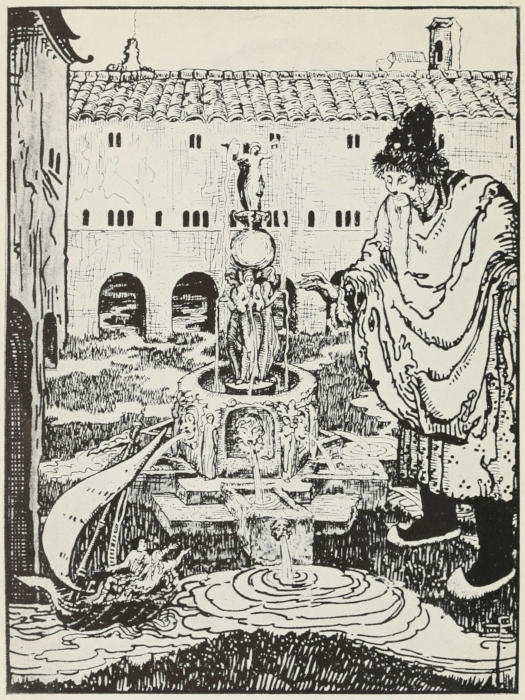
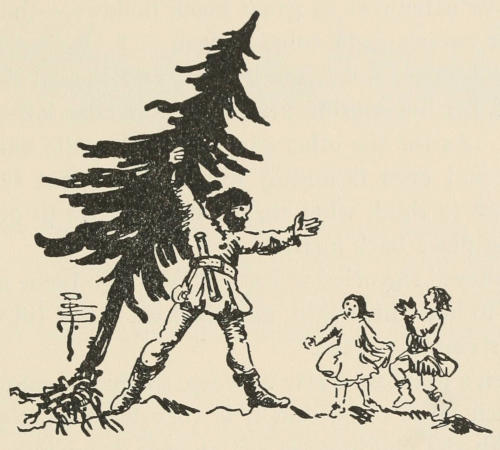
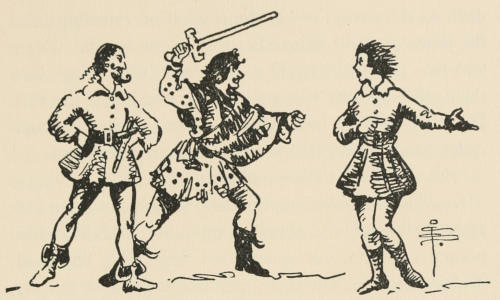
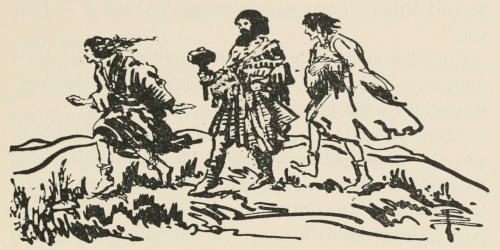
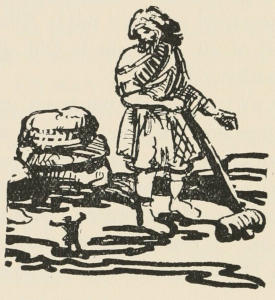
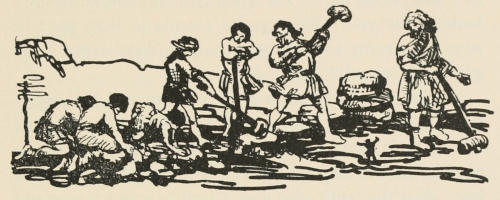
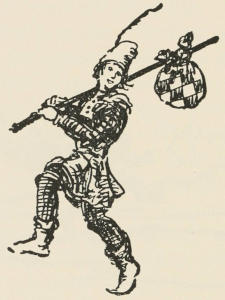
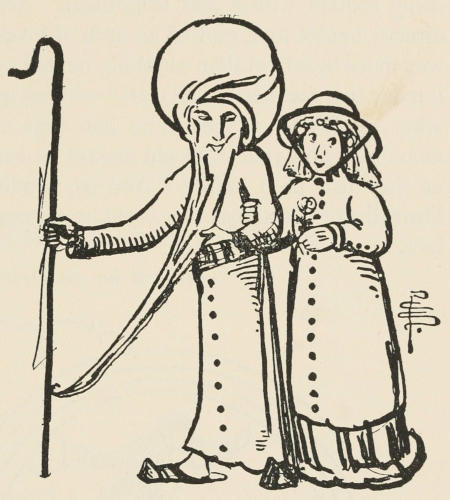
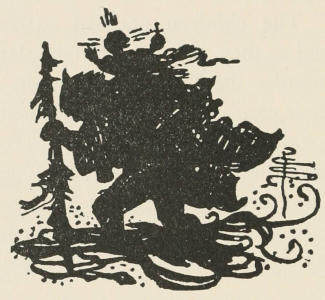
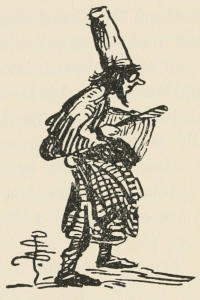
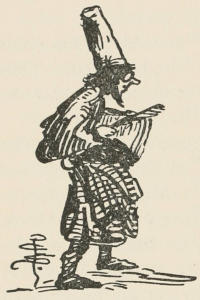
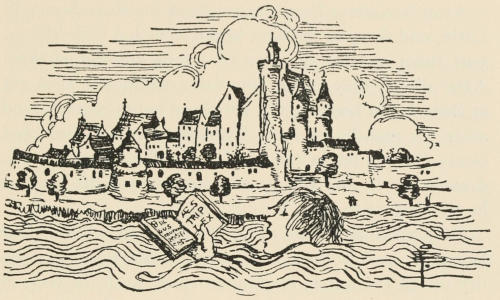
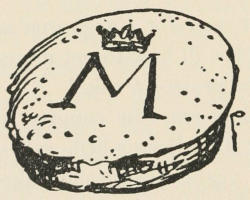
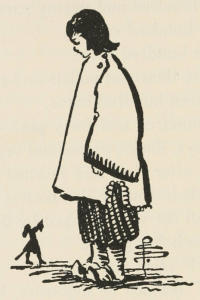
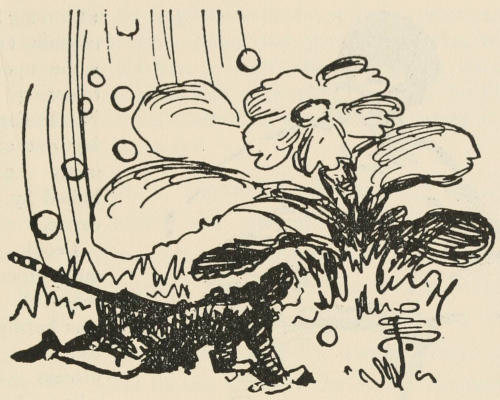
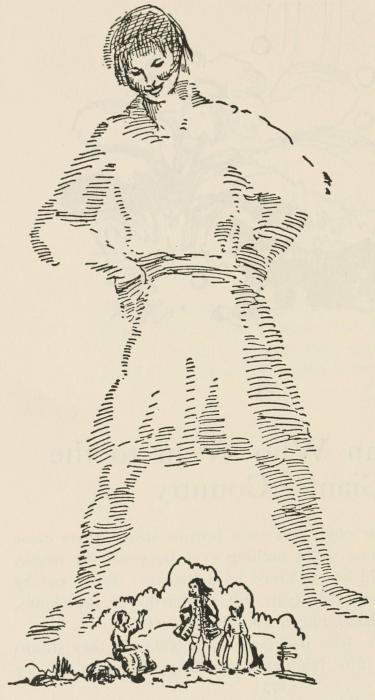
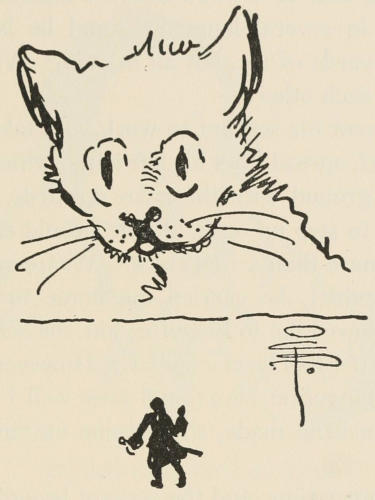
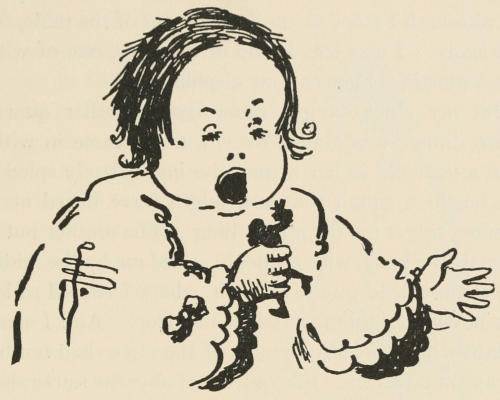
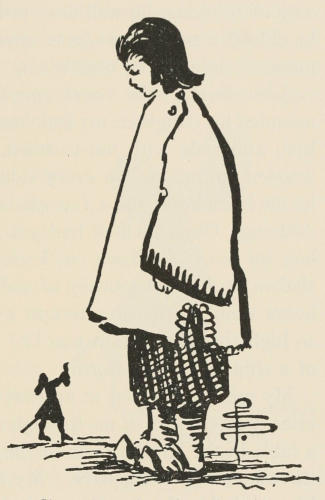
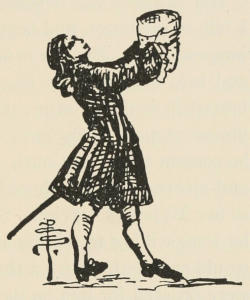
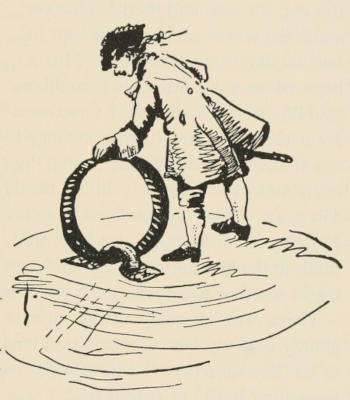
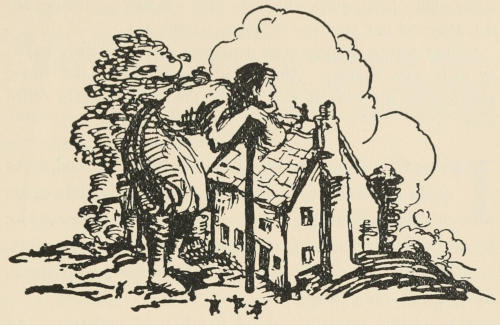
“Good-by,” he roared. “And don’t forget the giant Riverrath”
THE BOOK OF
FRIENDLY GIANTS
BY EUNICE FULLER
WITH INTRODUCTORY VERSES
BY SEYMOUR BARNARD
AND DRAWINGS BY
PAMELA COLMAN SMITH
“Giants should always be
brotherly with giants, but only
with good giants.”
Maxim of Pantagruel.
NEW YORK
THE CENTURY COMPANY
Copyright, 1914, by The Century Co.
Published, October, 1914
PRINTED IN U. S. A.
In Defense of Giants
Somehow or other, the giants seem to have got a bad
name. No sooner is the word “giant” mentioned than
some one is sure to shrug his shoulders and speak in a
meaning tone of “Jack and the Beanstalk.” Now, this
is not only unkind, but, on the giants’ part, quite undeserved.
For, as everybody who is intimate with them
knows, there are very few of the Beanstalk variety.
No self-respecting giant would any more think of
threatening a little boy, or of grinding up people’s
bones to make flour, than would a good fairy godmother.
Giants’ dispositions are in proportion to the size of their
bodies, and so when they are good, as most of them are,
they are the kindest-hearted folk in the world, and like
nothing better than helping human beings out of scrapes.
The trouble is that many of the stories were written by
people who do not really know the giants at all, but are
so afraid of them as to suppose that giants must be cruel
just because they are big. Every one else has taken it
for granted that the giants were big enough to take care
of themselves, and so nobody has bothered to look into
the facts of the case. Mr. Andrew Lang has given us
a whole rainbow of books about the fairies, but no one
seems ever to have written down the whole history of
the giants.
This is a pity, particularly since a great many people
have had a chance to know the giants intimately. For
in the old days the giants used to live all over the world—in
Germany, and Ireland, and Norway, and even here
in our own country. And since they have moved back
into a land of their own, they have sometimes come into
other countries on a visit and a brave Englishman, as
you will see, once went to visit them.
The history of the giants is as simple as their good-natured
lives. All the giants came originally from one
big giant family. And wherever they went, they kept
the same giant ways, and enjoyed playing the same big,
clumsy jokes on each other.
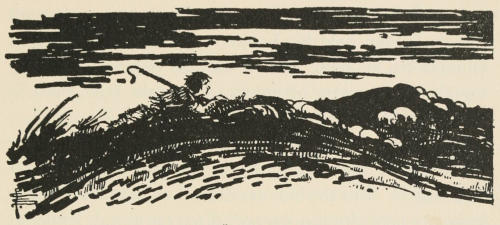
Ivan, the herdboy, lay on the hillside watching the
King’s sheep. It was growing dark, but he did
not start for home. For in all the world he had
no home to go to. There was no one who belonged to
him,—neither father nor mother, nor brother nor sister,
nor grandfather nor grandmother, nor so much as a
stepmother. Even his best friends, the sheep, belonged
to the King.
Ivan took good care of them nevertheless; and got his
black bread and white cheese to eat in return. Day
and night he stayed with his flock out in the open field;
and only when the storm beat down very wet did he
crawl into the little hut he had built at the edge of the
forest.
It was not so very lonely after all. For there were
ninety-nine sheep to keep out of bogs and briers. And
besides, there were ever so many good games he could
play by himself, vaulting over the bushes with his crook
and playing little tunes on a reed.
It was only at the dead of night when he woke up to
hear the wolves howling, howling in the dark, and the
icy shivers began to chase each other along his back,
that he couldn’t help wishing for a warm bed at home,
with a stout father sleeping nearby.
But the queer part was that whenever he thought
what kind of father he should like to have, he could
think of nobody but the King himself mounted on his
charger. And as for a mother, who could be better
than the Queen with her nice, motherly arms that
hugged the little Princess Anastasia? When it came
to a sister, Ivan could imagine no one more satisfactory
than the Princess herself with her whisking curls and
her blue eyes that were roguish and friendly both at the
same time. But that, of course, was out of the question.
So he contented himself with naming the softest,
whitest, curliest lamb Anastasia, and let it go at that.
But to-night as he lay on the hillside he couldn’t help
thinking what fun it would be if the lamb Anastasia
were really the Princess, and all the other sheep were
boys and girls so that they could play hide-and-seek together
among the rocks and bushes in the moonlight.
But the sheep had long since nestled down on the hill,
and there was nothing for Ivan but to watch the moon
as it came up and up behind the black mountain across
the valley. His eyes began to blink, and he felt himself
slipping, slipping off to sleep.
Ivan listened
A cry broke through the quiet pasture. Ivan started
up. “Wolves!” said his heart. “Wolves! Wolves
again!” But it was not a fierce sound after all. Again
it came, loud like a roar of temper wailing off into a
moan.
Ivan listened. “No sheep could bleat like that,”
thought he. Nevertheless he looked. There in the
moonlight the nine-and-ninety woolly shapes shone
dimly, huddled safely against the hill.
Once more the sound came, fairly bursting through
the air. Ivan held his breath. It was not the cry of
animals but of men, of several men perhaps, shouting
together. “A party of hunters,” thought Ivan, “lost in
the forest!” And he breathed again.
Picking up his crook, he dashed off up the hill, along
the edge of the wood. “I’m coming!” he shouted.
“Coming!” But the hunters did not seem to hear. The
same cry kept ringing through the trees ahead, louder at
every step he ran. It seemed directly opposite him now,
somewhere in the forest. He turned in, feeling his way
with his crook among the black shadows of the branches.
There was a crashing and stirring. The trees before
him trembled. Ivan stopped and looked up. Full in
the moonlight, half way to the treetops, gleamed the
gigantic shoulder of a man. His head was bent, and
he seemed to be sitting down, gazing intently at something
near the ground. As he moved his arm, the trees
swayed and creaked.
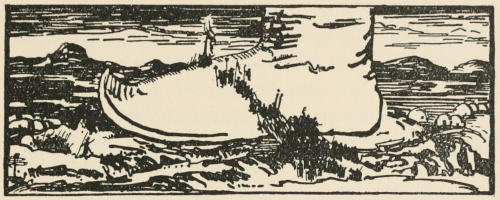
Ivan crept nearer. Through an opening between the
trees he could see the giant’s great hands fumbling over
his foot. With a piece of fur he was trying to stop
a small cataract of blood that was bursting out from
it. Every now and then, in his clumsy efforts, he
seemed to hurt himself more, for he would throw back
his head and give the same deafening howl Ivan had
heard before.
Ivan shivered. In all his life he had never seen
a giant; and terrified as he was, he must have a good
look at this one. Crouching, he stole through the
shadow to a little thicket at the giant’s side, and parting
the twigs, leaned eagerly forward. But he had reckoned
too much on the bushes. Under his weight they
cracked and bent, and snapped altogether. His foot
slipped, and losing his balance, he crashed through the
brush at the giant’s very elbow.
With a swoop the giant grasped at him. But Ivan
was too quick. He dodged just out of reach, and ran
as he had never run before.
“Little creature! Little creature!” called the giant,
“don’t run away. I won’t hurt you. Come back, do
come back and help me. If you will bind up my foot
for me, I will give you a reward.”
Ivan’s heart thumped. The giant could crush him
in one of his great hands. But he was in pain, and he
had a kindly face. It would be mean to leave him there
alone.
“Oh, little creature,” moaned the giant again, “don’t
leave me. I promise I won’t hurt you. Do come, do
come.”
Ivan turned. Stanchly he walked over to the giant’s
foot, and running his hand gently along the sole, picked
the rocks and pebbles out of the great gash.
The giant sighed with relief. “Thank you!” he said.
“I hurt it rooting up an oak-tree, and then I walked on
it.”
Ivan pulled off his blouse, and tore it into long pieces.
Knotting them together, he made a strip five or six yards
long. He laid it against the wound, and the giant drew
it over the top of the foot where it was hard for him
to reach. Between them they made a neat, firm bandage
of it, with all the knots on top.
The giant beamed. “That feels better,” he said.
“And now, little herdboy, I will show you how a giant
keeps his word. If you are not afraid to sit upon my
shoulder, I will take you where no little creature has
ever been: to see a giants’ merrymaking. We are holding
a wedding-feast now, and there will be plenty of fun,
you may be sure. Come, I will take good care of you.”
Ivan picked up his crook. This would be more fun
than hide-and-seek on the hill. He was not in the least
afraid, and he felt on good terms with the giant already.
“I’d like to go,” he said.
“Good! Good!” cried the giant, chuckling with the
noise of a happy waterfall. “Up with you, then. Lean
against my neck, and take tight hold of
my long hair.” And with that, he
picked Ivan gently up and tucked him
snugly just below his right ear.
The giants danced
“Why, you’re too light! I can’t feel
you at all!” he gurgled, as if it were the
best joke in the world. “And I must
fix it so that my brothers can’t see you.
Here is a belt for you. Put it on, and
you will be quite invisible.”
So he handed Ivan a long piece of
gray gauze, so fine that in the moonlight
he could hardly see it at all. Ivan
tied it about his waist. And then although
he pinched himself and knew
quite well that he was all there, he
couldn’t so much as see his own toes.
As for the giant, now that he could
neither see Ivan nor feel his weight, he
began to be a little nervous. “Once in
a while,” he said, “I wish you’d stand
up and shout my name ‘Costan’ into my
ear, so that I’ll know you haven’t
tumbled off. And now, are you ready?
Hold tight, and we’ll go on.”
Costan raised himself, and strode off with a long,
limping step through the forest. To Ivan it was like
being on a great ship at sea, going up a long wave, and
down. He felt that he might fall asleep if it were not
such fun sitting there on Costan’s shoulder and watching
the treetops glide past the moon.
The trees grew fewer and fewer. Ivan swung
around, and peered ahead, clinging to Costan’s hair.
They were coming to a great open space in the midst
of the forest, a meadow thronged with giants and
giantesses. There seemed to be hundreds of them,
dressed not like Costan in skins but in wonderful shimmering
garments that blew about their shoulders like
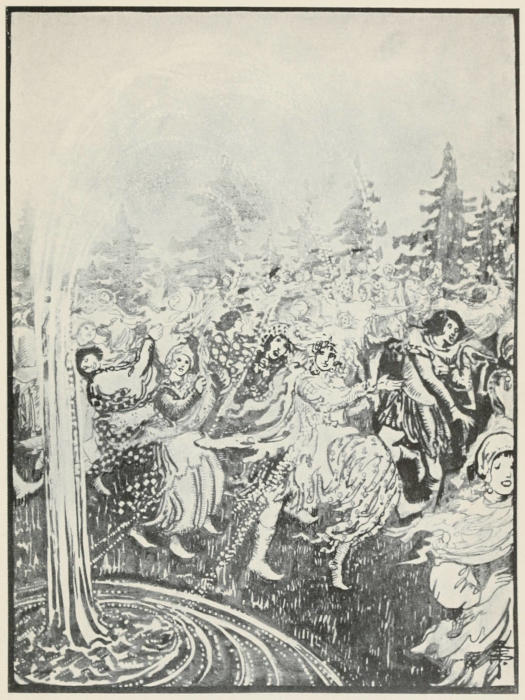
clouds of mist in the moonlight. In the center of them
all was a huge fountain that shot up in a silver torrent
far above their heads.
One of the giants came running to meet Costan.
“Oh, here you are!” he cried. “We were afraid you
weren’t coming.” And with that, he gave him a
friendly pat on the shoulder that nearly sent Ivan spinning
off a hundred feet or more to the ground.
Costan explained about his hurt foot. “I’ll just sit
and look on for to-night,” he said, and chuckled to himself,
thinking of Ivan.
A fountain that shot up in a silver torrent
And so Ivan, safely nestled on Costan’s shoulder,
watched till his eyes stood out, as the giants danced and
played giant games, chasing each other through the
fountain, with a shower of spray like a whirling rainstorm.
They wrestled, they leaped, they sang till all
the trees trembled.
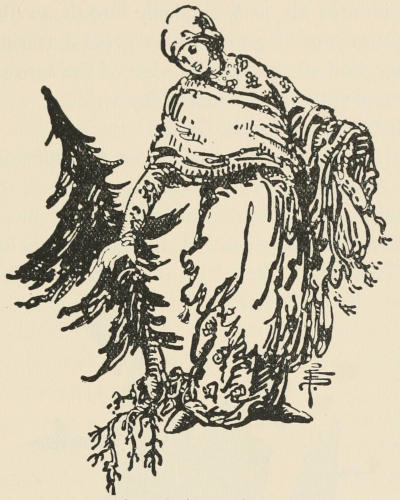
She pulled up a fir-tree
Just as the fun was at its liveliest, there was a mighty
gurgle, and the fountain, which had been casting itself
so high into the air, sank suddenly into the earth. The
oldest giantess of all gathered her great fluttering robes
about her, and striding to the edge of the forest, pulled
up a fir-tree with one wrench of her wrist.
“Midnight!” whispered Costan.
Silently the giants crowded about the uprooted tree.
“Este tennes!” cried the giantess.
They cut into the ground like huge knives
Instantly the giants seemed to flatten out. Their
backs seemed to come forward, and their fronts to shrink
back. Their arms, their legs, their heads, their bodies,
grew thin as cardboard. They stood there like great
paper-dolls, taller than the trees. One by one, they
stepped into the hole where the tree had been, and cut
their way down into the ground like huge knives.
Costan bent his ear. “Are you there, little herdboy?”
he whispered.
“Yes, Costan,” cried Ivan.
“Keep tight hold, then,” cautioned Costan, “and don’t
be afraid. I’m going to take you with me underground.”
As the last giant vanished, Costan got up slowly and
walked toward the hole. With every step, Ivan could
feel him shrinking, until his shoulder was nothing but
a long, thin edge.
There was a quick moment of darkness, and suddenly
they were in a hall shining from floor to ceiling with
gold, and so vast that Ivan could not see to the end of it.
Down the center, around a long table sat the giants, all
in their natural shapes again.
Costan slipped into the huge seat that was left for
him, and the banquet went merrily on. To Ivan, who
never in all his life had had anything but bread and
cheese, with a little fruit sometimes and a sugar cake at
Christmas, it seemed an impossible dream. There were
grapes as big as the oranges above ground, pheasants
the size of eagles, and cakes and tarts and puddings as
big around as the towers of the King’s palace.
But Costan sat silent and uneasy. Then Ivan realized
what was the matter: Costan was not sure that Ivan was
there. Steadying himself with his crook, Ivan scrambled
up. Standing on tiptoe, he could almost reach the
giant’s ear.
“Costan!” he whispered, as loud as he dared, “I’m
here,—all safe.”
Costan beamed with relief, and fell to joking and eating
with the rest. But every now and then he would
poise a tiny piece of cake or meat carelessly above his
right shoulder, where Ivan would make it disappear as
completely as he had himself.
At last the oldest giantess rose in her place, to show
that the banquet had come to an end. Amid all the
jollity and confusion Costan leaned over and took from
the table a giant roll, as big to Ivan as a whole loaf of
bread.
“Here!” he whispered, below the scraping of the giant
chairs. “Tuck this in your bag, little herdboy, as a reminder
of a giant’s promise. And don’t forget Costan
in the world up above.”
As he spoke, everything was suddenly lost in a whirl
of darkness,—the giants, the hall and the feast, even
Costan himself. The shouts and laughter of the huge
banqueters grew fainter and fainter till they faded away
into silence.
A sudden bleat made Ivan open his eyes. He was
lying on the hillside near his sheep, and the mountain
across the valley glowed red in the sunrise.
“And so,” thought Ivan sadly, “it was a dream after
all,—the giants, the fountain, the banquet, and dear Costan
as well.”
He reached for his crook, and started back in amazement.
For though he could feel the handle tightly
grasped in his fingers, it seemed to his startled eyes that
the crook suddenly rose up of itself and stood clearly
outlined against the morning sky. As he stepped back,
the crook sprang after him. When he walked forward,
the crook bobbed along by his side. He could feel his
hand upon it, but when he looked he could see plainly
that there was no hand there.
Ivan rubbed his eyes. Was he still dreaming then?
But no, everything was just as usual,—the sheep, the
hillside and the morning sky. Was it he or the crook
that was bewitched? He looked down at himself in
alarm,—and saw nothing but the stones and grass of the
pasture. There was no Ivan to be seen: no arms nor
hands nor legs nor feet.
A sudden thought came over him. He felt of his
waist. Sure enough! It was tied about with gauze.
“The invisible belt!” he cried, and pulled it off.
In a twinkling there he was, arms, legs, hands, feet,
just the same as ever. He folded up the long, wispy
sash and stuck it into his bag. Inside, his hand hit something
hard and bulgy. It was the giant’s roll,—the
great loaf Costan had given him.
It was past Ivan’s breakfast time, and the sight of the
tempting white bread made him hungry. He tried to
break off a piece, but the great roll would not so much
as bend. He drew out his knife, but the harder he cut,
the firmer and sounder the loaf seemed to be. He could
not even dent it.
Provoked and impatient, he tried with his teeth. At
the first bite, the hard crust yielded. Something cold
and slippery struck his tongue and rolled out clinking
on the ground.
Ivan stooped and stared. There at his feet lay a great
round gold-piece as big as a peppermint-drop. In
amazement he looked at the loaf in his hand. There
was not a break anywhere. It was as smooth and whole
as before. He bit again and again. Another gold-piece,
and another, fell at his feet, as round and shining
as the first. But the loaf remained unbroken.
Ivan’s eyes almost started from his head. In all his
life he had never seen a gold-piece before; and whatever
he should do with so many he had not the least
idea. He might, of course, build a palace and live like
a lord. But that would take him away from the sheep,
and the King and Queen and Anastasia. On the whole,
he decided he was much better as he was, where he could
roll the gold-pieces down the hill and race after them to
the bottom.
Then a splendid idea struck him. To-morrow was
the Princess’ birthday. For a long time he had been
wondering what he could give her. Here was just the
thing! What could be better than a heap of the pretty
gold-pieces to play with? He sat down at once, and
bit and bit at the loaf till he had enough of them to fill
his bag to overflowing. Bag, loaf, belt, and all, he hid
in his hut at the edge of the forest. Then he ate his
black bread and cheese and went back to his sheep,
bounding over the boulders for sheer happiness.
As soon as the sheep were settled for the night, he
ran to the hut again. Tying the magic belt about his
waist, he took up the bag of gold-pieces and trudged off
with them across the fields.
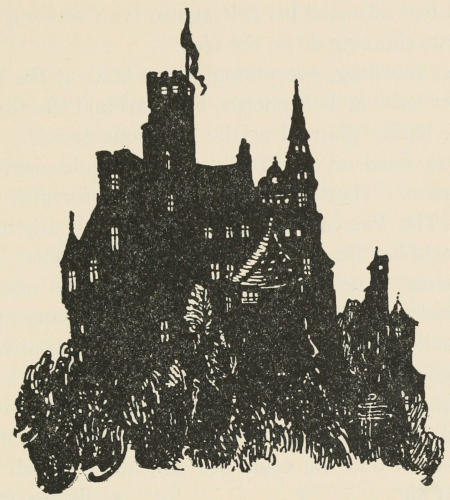
In the moonlight the palace towers rose straight and
shining. Every window gleamed, darkly outlined.
Ivan did not hesitate. He knew quite well which one
he wanted. It was the window of the Birthday Room,
where once every year all the servants and the shepherds
were allowed to come to see Anastasia’s presents.
To-morrow, he thought, with a catch of his breath,
would be the day.
The bulky form of a guard broke the bright wall of
the palace ahead. For an instant Ivan shrank back.
Then with a smothered laugh he dashed across the grass,
underneath the man’s very nose. The guard turned
sharply. But there was no one to be seen. Palace and
park lay bright and still in the moonlight.
Ivan had gained the palace wall. Just as he had remembered,
a stout vine with the trunk of a small tree
ran up the side to the very window of the Birthday
Room. He tried it with his foot. It would not have
held a man, but it could bear Ivan even with a bag of
gold. Breathless, he climbed,—so fast that the vine
had barely time to tremble before he was at the top. At
his shoulder the casement of the Birthday Room stood
ajar. With one tug he swung it open, and leaned across
the sill.
Ivan gazed. On broad chests all about the room glimmered
jewels and toys for the Princess; and in the doorway
stood a guard, erect and silent, watching over them.
Underneath the window, deep in shadow, was a low,
cushioned seat.
Every window gleamed
Something jangled on the floor; and the guard stooped
to pick up a knife fallen from his belt. Instantly, Ivan
saw his chance. Holding his bag, bottom up, on the
window seat, he loosened the strings, letting the gold
fall in a heap in the black shadow. By the time the
guard had adjusted his belt again, Ivan was out of the
window, climbing down the vine.
Next morning, everything was a-buzz at the palace.
The servants and shepherds, filing around the Birthday
Room, barely glanced at the gorgeous jewels. Every
eye was fixed on a glittering pile of gold-pieces in a
glass case. They were worth a king’s fortune, people
said. The Princess could buy with them anything in
the world her heart desired,—castles or coaches, jewels
or gowns. And the mystery of it was, no one knew
who had sent them. They had suddenly appeared in
the middle of the night. The whole court was alive with
conjectures.
Ivan, filing by with the others, said never a word; but
his heart thumped with pride and happiness. Through
a half-open door he could see Anastasia herself using
four of the great round gold-pieces as dishes for her
dolls. Ivan beamed. To-morrow, he decided, the
Princess should have a birthday as well as to-day.
As soon as it was dark, he hurried to his hut, drew out
the magic loaf from its hiding-place, and bit and bit
till he had a bagful of gold-pieces again. Then he put
on his invisible belt and ran to the palace. Everything
happened almost as before; and he got away, down the
vine, and back to his sheep before any one was the wiser.
On the window-seat next morning the Princess found
the shining heap. And if the court had been excited
before, now it was in an uproar of astonishment. Hereafter,
the King ordered, two guards should stand hidden
beside the window to discover who it was that brought
the gold.
So night after night for a week Ivan left the gold-pieces.
And morning after morning the guards reported
to the King that no one had been there. The
window, they said, had suddenly swung open; and a
bag, jumping unaided from the sill, had emptied itself
on the seat below, disappearing through the window
as magically as it had come. At last the King, tired
of the mystery, declared that he would watch himself.
The eighth night was dark and rainy, and Ivan
slipped over the soggy ground. When he got to the
entrance of the park, he realized with a dreadful sinking
of his heart that he had forgotten to put on the
magic belt. He turned to go back, but the thought of
the dismal, stormy walk made him suddenly bold. The
palace-guards, he reflected, would be keeping close to
shelter, a night like this. He could easily escape them,
and crawl up the vine unsuspected. Once at the window,
he had only to watch his chance, pop in the gold,
and fly back in the darkness to his sheep.
So Ivan kept on. He stole softly by the guard-house
where the lazy soldier lounged half asleep, and crept
stealthily up the dripping vine. The window swung
open with a creak, and Ivan, frightened, crouched
breathless beneath the sill. Minutes passed. There
was a stir behind one of the great curtains. The guard
was moving. Now perhaps would be the best time.
Ivan reached over and began emptying his bag. A
heavy hand seized his collar and dragged him bodily into
the room. By the light of a flickering lantern Ivan
found himself face to face with—the King!
“Ivan!” exclaimed the King.
There was a pause, Ivan blushing like a culprit, with
the empty bag trembling in his hands.
The King frowned. “To think that you,” he cried,
“my best herdboy, whom I have trusted, should come to
steal the gold which a good fairy brings the Princess!
Well, you have given me good service before this, and
I will not treat you harshly now. But go, go at once,
and never let me see your face again.”
And with that, he led him down a staircase and thrust
him out into the dark.
Choking and wretched, Ivan ran back to his hut.
Gathering up his loaf and belt, he crammed them into
his bag, and started off into the world.
“Good-by, my sheep!” he cried; and stooped to fondle
the little lamb Anastasia.
“I suppose now,” he reflected miserably, “I shall have
to be a great lord after all.”
By the time he got to the town, day was breaking.
The rain had stopped, and rosy clouds floated across the
eastern sky. A sunbeam slanted over the roof tops,
and shone into Ivan’s face. He felt happier all of a
sudden; and taking his loaf, he bit a dozen great gold-pieces
out of it. Then wrapping it up in the magic belt
so that no one could see it, he knocked at a cottage door.
Inside, he found a warm breakfast, and dried himself off
by the fire.
A dazzling scheme slowly unfolded in his mind. As
soon as breakfast was done, he went to the coachmaker
and ordered a great gold coach; to the tailor and ordered
a golden suit; to the hatter for a hat with golden plumes.
And when the tradespeople heard the clink of his gold-pieces,
they were very glad to serve him, you may be
sure.
Only the coachmaker demurred. “A gold coach is
nothing,” said he, “without a coat-of-arms on the door.”
“But I haven’t any,” said Ivan.
“Never mind!” replied the coachmaker, “I will make
you one. How did your good-luck begin?”
“From a loaf of bread,” said
Ivan, “and a giant.”
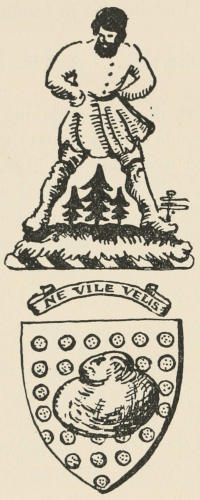
So, the coachmaker painted
and painted on the coach-door.
When he had finished, there
was as fine a coat-of-arms as
you would wish to see,—a loaf
of bread against a background
of gold-pieces, and a giant
standing up above.
Ivan’s coat-of-arms
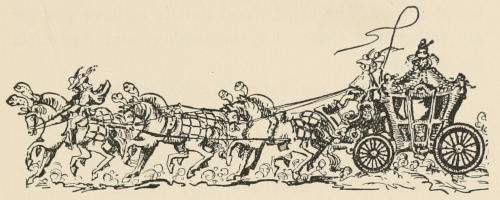
Then six white horses with
gold trappings were harnessed
to the coach; and six servants
in golden livery took their
places,—two riding ahead, two
riding behind, and two sitting
up very straight on the box.
Ivan stepped inside, all dressed
in his golden suit and the hat
with the golden plumes. Underneath
his arm he carried the
giant’s loaf wrapped up in the magic belt. (But of
course nobody could see that.)
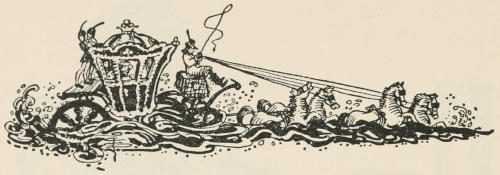
“Drive to the King’s palace!” cried Ivan.
So they drove; and all the people along the way were
so amazed at the magnificence of the coach that they ran
and told the King that some great prince was coming to
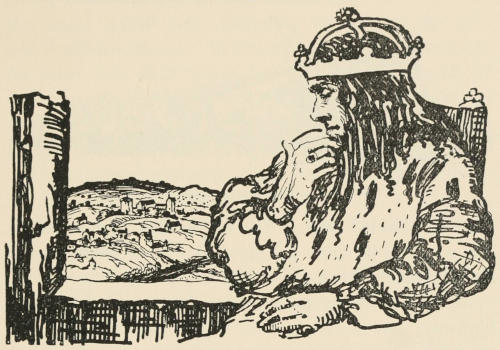
visit him. The King dashed to put on his crown; and
just as the coach drew up at the palace gate, he got
seated on his throne with all his court about him.
So they drove
Ivan walked up the great hall and bowed low. And
all the courtiers bowed in return to the splendid young
prince. Before the King could say a word, Ivan threw
back his head and told the story of the gold-pieces from
beginning to end.
For a moment the King was dumb with astonishment
and remorse. Then he spoke. “Ivan,” said he, “I have
done you a wrong. If there is anything I can do to
make it right, you have only to tell me.”
Ivan beamed. “There is only one thing in all the
world I want,” he cried, “and that is to have you for
my father, the Queen for my mother, and Anastasia
for my sister!”
“Where is your real father?” asked the King.
“And where is your real mother?” asked the Queen.
“Where is your real sister?” cried Anastasia.
But to all these questions the herdboy gave a satisfactory
answer. “I never had any,” he said.
“Very well then,” cried the King. “You are adopted!
I will be your father; the Queen shall be your mother;
Anastasia shall be your sister. What is more, in five
years and a day, when you are quite grown-up, you shall
marry the Princess!”
But by the time he got to that part Ivan and Anastasia
were too much excited to hear. The minute he finished
they bowed and curtsied as well-mannered children
should, and ran into the courtyard to play tiddledywinks
with the gold-pieces, over the bread.
Nevertheless, it turned out as the King had said, and
in five years and a day, when they were quite grown-up,
Ivan and the Princess were married. And ever after
in the palace-treasury instead of heaps of gold-pieces
for robbers to steal, there was nothing but a single loaf
of bread.
—Based on a Hungarian Folk-tale.
II The Giants’ Ship — To The Giant Children
Giant children of the Norseland,
In a glad, tumultuous rally,
Skimming ice-peaked mountain-course land,
Crushing forests in the valley,—
We who play in farm and town land,
Crowded streets and city spaces,
Envy you the Up-and-Down Land,
While you seek the level places.
Seymour Barnard.
II The Giants’ Ship — Part One: How the Giants Went Exploring — Part Two: How the Giants’ Ship Was Stolen
After the earth was newly washed by the Flood,
nearly all the land of Europe lay flat and green
under the sun. Except in one far corner there
was not a mountain nor a valley nor a hill nor a hollow,
nor so much as a little stream. The soft young grass
stretched away and away, in a wide meadow, as far as
one could see.
But there was nobody there to look. For all the people
there were, lived in the Up-and-Down Country,
on a great forked point in the Far North. And that
was a very different kind of place, with mountains that
went up and valleys that went down, cliffs that rose and
cascades that fell, and not so much flat land as a giant
could cover with his pocket-handkerchief.
But the giant Wind-and-Weather, who lived there,
did not mind that in the least. He sat quite placidly on
a mountain-top and looked through a kind of glass that
he had, out over the sea. As for his wife, the giantess
Sun-and-Sea, nothing bothered her. She sat on a cliff
and wove on a kind of loom that she had, back and
forth, back and forth, with a noise like the long ocean
rollers on a fair day.
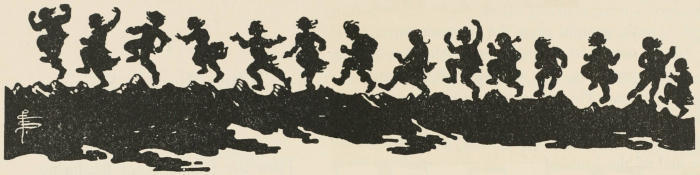
Playing Follow-the-Leader down the long row of peaks
When it came to the children, they never sat at all.
Like the country, they were always going up or down,—sliding
down the mountains, scrambling up the waterfalls,
or playing Follow-the-Leader, hoppety-skip, skippety-hop,
straight down the long row of peaks that
made their home.
And when they all played together, it made rather a
good game. For there were fourteen of them, sturdy
youngsters, each over a mile high, and growing fifty
feet or so every day. Then too, they happened in the
jolliest way, for they came in pairs so that every one
had his twin. There were Handsig and Grandsig, Kildarg
and Hildarg, Besseld and Hesseld, Holdwig and
Voldwig, Grünweg and Brünweg, Bratzen and Gratzen,
Mutzen and Putzen,—a boy and a girl, a boy and a girl,
a boy and a girl, straight down through.
Now, one morning, with Handsig ahead and Putzen
straggling somewhere behind, they were all playing
Follow-the-Leader, rather harder than usual. Handsig
had rolled down peaks, and wriggled up, hopped on one
foot and jumped on two, turned somersaults and
splashed through waterfalls. And the whole line of
them had come rolling, wriggling, hopping, jumping,
tumbling, splashing after. Being put to it for something
to do next, Handsig started on the dead run from
peak to peak, straight along the mountain-tops.
All of a sudden he stopped short. Ahead of him were
no more mountains, only a straight drop thousands of
feet to the sea. He had come, before he knew it, to the
end of the Up-and-Down Country. But that was not
what made Handsig stop so quickly. He had been to
the end of the land before. It was something beyond
the water that attracted him,—another country so different
from his that at first it did not seem to be land
at all. There was no up or down in it. It stretched
flat and green as far as he could see.
Handsig waved his arms and shouted, “Oh, Kildarg,
Hildarg, Besseld, Hesseld, see the nice, green running-place!”
And all the other children, thinking it was still part
of the game, waved their arms and shouted, “Oh, Kildarg,
Hildarg, Besseld, Hesseld, see the nice, green
running-place.”
By that time Handsig had no doubt any longer.
Without another word he plunged headforemost into
the sea, and swam with all his might straight for the
wide meadow that was the rest of Europe.
Splash! Splash! Splash! The other children dived
after, and puffing, blowing, kicking, raced across the
channel. Then hand in hand, fourteen in a row, they
scampered pell-mell down across the plain where Germany
is to-day.
But with swimming so hard and running so fast,
poor Putzen was quite out of breath. It was so strange,
too, to be going along on a level. It did not pitch one
forward; it did not hold one back. It was just the same—just
the same, step after step after step. The twenty-six
legs beside Putzen did not stop for a minute; they
beat along faster and faster. Putzen hung on to Mutzen
as best she could, but her legs would not go and
her breath would not come. And so, gasping and
plunging, she sprawled headlong, pulling Mutzen after
her.
Mutzen dragged down Gratzen, and Gratzen dragged
down Bratzen; and so they all tumbled till the land for
miles around was a mass of upturned turf and sprawling
giant children. Then Bratzen wailed, and Gratzen
wailed; and Mutzen and Putzen who were at the bottom
of the whole pile, wailed loudest of all; and the air was
so full of large sounds that it seemed likely to burst.
Now, Grandsig, who felt responsible as the oldest
girl of the family, started to scramble up to quiet Mutzen
and Putzen. As she did so, her hands dug into the
soft, moist earth, and scratched up two good-sized hills.
A happy idea struck her. “Kildarg! Hildarg!” she
cried. “Look!” And she burrowed into the earth
again, scooping up handful after handful.
Kildarg sat up and wiped his eyes. Hildarg sat up
and wiped her eyes. Then they both began to dig as if
their lives depended on it. In a twinkling, there were
no more giant children piled on top of Mutzen and Putzen;
and twenty-eight giant hands were scooping out
valleys and piling up mountains of earth.
Handsig and Grandsig made big mountains; Mutzen
and Putzen made little ones. Every single giant child
piled up a whole range higher than he was himself.
Then, when all of them were done, there was such a patting
and a pounding as never was heard before, as the
valleys were smoothed, and the mountains molded into
shape. There were sharp peaks and blunt peaks, smooth
peaks and rough peaks, single peaks, double peaks, triple
peaks. As for the valleys, they were of all sorts,—straight
and crooked, wide and narrow, long and short.
Grandsig looked at it all, quite satisfied. “Oh, children,”
she cried, “we have made an Up-and-Down
Country!”
The other children looked. Sure enough! It was
nothing but hills and hollows, hills and hollows, just as
it was at home. And they all danced about and cried,
“Hooray! We have made an Up-and-Down Country.”
“There is your mast,” said Wind-and-Weather
“And now,” said Handsig, “let’s run!”
So all the children stepped out from between the
mountains they had made, to run back again to the sea.
“But oh!” cried Kildarg, “where is our nice green
running-place?”
The children gasped. Instead of their flat grass plot
were miles and miles of mudholes, hardening in the sun.
As far as they could see, their green meadow was scarred
with row after row of great black hollows,—the marks
of their twenty-eight running feet.
That was too much for Putzen, and she sat down on
one of her mountains and wept a whole lake into a
valley. As for the other giantesses, they did very little
better, and even Grandsig wept a few giant tears, as
she tried to think what they could ever do to get their
running-place back again.
“I know!” she cried at last. “We’ll go home and ask
father to build us a ship; and then we’ll sail till we find
another running-place.”
When a giantess starts to weep, she has so many tears
and such large ones, that it is very hard to stop. So,
although the children set off at once for home, it was
some time before Putzen, Gratzen, and Brünweg, Hesseld,
Hildarg and Voldwig were smiling again. And
their tears, in a great torrent, flowed after them, over
the hubbles, around among the hollows, and out toward
the sea.
They cried, in fact, so hard and so much that even
to-day their tears are still flowing,—for they gathered
and gathered until they became the river Rhine. As for
the mountains the giant children built, they too are still
there. They hardened until they became quite firm and
rocky, so that nowadays in Switzerland people are continually
climbing up and over them. And the place
where the giant children made, so to speak, the first mud-pies,
has been called the Playground of Europe ever
since.
With as many trees as they could drag
When the children got home, there was old Wind-and-Weather
sitting as usual on a mountain-top and
looking through a kind of glass that he had, out to sea.
“Oh, father,” they cried, “we want a ship to sail the
sea to find a running-place again.”
Old Wind-and-Weather was not disturbed in the least.
He got up, put his glass into his pocket, and walked
along the mountain-ridge. With one slow wrench, he
pulled up by the roots a tree taller than he was himself.
“There is your mast,” said Wind-and-Weather.
Then, Handsig and Grandsig pulled up big trees for
beams to make the sides and keel; Mutzen and Putzen
pulled up little trees for oars. And with as many trees
as they could drag, they all trooped after their father
down to the seashore.
Half-way down there was the giantess Sun-and-Sea,
sitting as usual on a cliff and weaving on a kind of loom
that she had.
“Oh, mother,” cried the children, “help us. We are
building a ship to sail the sea to find a running-place
again.”
Sun-and-Sea was not disturbed in the least. She got
up and took out of her loom a sheet longer than she was
herself.
“There is your sail,” said Sun-and-Sea.
Wind-and-Weather took the sail down to the shore,
and the children began such a hacking and planing and
pounding as no shipyard has ever heard. In just a few
hours of giant time, there was the great ship with the
mast set and the sail rigged, ready to be launched.
Mutzen and Putzen climbed in and took their oars;
and the others pushed and pulled until the boat, slipping
and grating, shot out into the water. Mutzen and Putzen,
having nothing to christen it with, beat on the sides
with their oars and cried, “We name you Mannigfual!”
“Mannigfual!” echoed the other children. “The
giants’ good ship Mannigfual!”
The children climbed in and took the oars. Wind-and-Weather
took the tiller. And there they were,
skipping along over the sea. When the wind blew
against them, the children rowed and sang. When the
wind blew with them, they set the sail and strained their
eyes to find a running-place ahead across the water. As
for Wind-and-Weather, no matter which way the wind
blew, he sat and steered.
Now, it must never be forgotten that giants’ time is
as big as they are; and half a year to them was scarcely
more than a day. Our night and day they did not
bother about in the least, for their big eyes looked
through the dark as well as the light. Sunrise and sunset
were no more to them than the revolving of a lighthouse
lamp to us. But the minute a half-year was up,
the giants’ night began, and giant children felt then very
much as ordinary children feel in the evening after eight
o’clock has struck.
Mannigfual had not sailed many hundred miles when
the giants’ night came on. Mutzen and Putzen knew
that it was coming, because their heads and their arms
and their legs began to feel so very much in the way.
Soon they lost track of their oars altogether, their heads
bumped, their mouths dropped open, and there they
were,—fast asleep. Then Gratzen yawned, and Bratzen
yawned,—all the rest even up to Handsig and
Grandsig. But somehow or other they managed to keep
on rowing.
Wind-and-Weather took out his glass and scanned the
sea ahead. In a little while they all saw what he was
steering for. It was land. A few minutes more, and
they had dropped overboard the great cliff they had
brought for an anchor.
Wind-and-Weather picked up Mutzen and Putzen.
With one against each shoulder, he stepped leisurely out
and waded ashore. The children jumped after, splashing
and rubbing their eyes. Straight ahead was a wide
valley. Wind-and-Weather laid Mutzen and Putzen in
that; and picking out a convenient hill for a pillow,
stretched himself across the landscape.
“Well,” said Handsig, looking around, “I don’t think
much of this as a running-place!”
And quite right he was. For there was nothing flat
or broad about it. The whole country was broken up
into little hills, little valleys, little fields, little forests.
But Handsig might have spared his words, for there was
nobody to listen. So he fitted himself neatly between
two hills, and snored as loudly as the others.
Now, it happened that the giants had landed in the
North of England, which even in that early time was inhabited
by the race of men. And although there was
only wilderness in the part where the giants had
stretched themselves, a few miles down the shore was
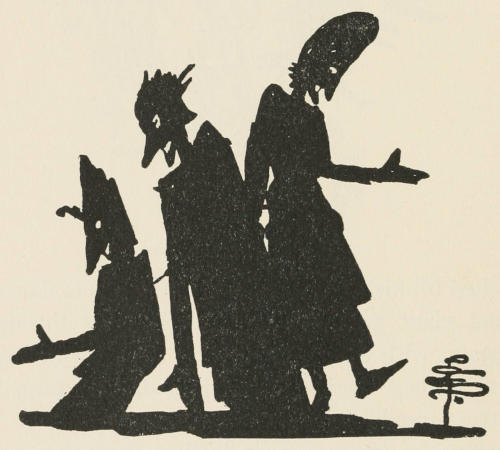
the cave of the pirates, Dare-and-Do, Catch-and-Kill,
Fear-and-Fly.
Dare-and-Do, Catch-and-Kill, Fear-and-Fly
The morning after the giants landed, Dare-and-Do
was awakened unusually early. Somewhere outside the
dark of the cave, the air seemed full of rumblings and
the noise of great waves beating on the beach. Dare-and-Do
yawned irritably. He was wondering how
their old long-boat was standing it, tied under the cliff.
Drawing his dirk, he reached over and pricked his comrades
awake, after the pleasant custom of the cave.
“Storm!” hissed Dare-and-Do.
Groping and growling, the three pirates got up to look
after their boat, and stumbled out—into as fair and innocent
a day as ever dawned off England. The thunderings
kept on, but there was not a cloud in the sky.
The waves still pounded, but they burst white and glittering
into the sunlight.
Catch-and-Kill turned crossly. “The storm’s over,”
he said.
But Fear-and-Fly stood where he was, pointing out to
sea, and shaking from head to foot. “Sea-serpent!” he
gasped.
The others looked. There, a mile or so out at sea,
stretched a great monster, motionless and stiff. Was
it after all a monster,—the long, high, level wall, hiding
the horizon, the great column in the center, towering
and towering until it was lost in the sky?
“Sea-serpent!” snorted Catch-and-Kill. “It’s an
island, a magic island.”
Dare-and-Do peered, shading his eyes. Across that
high column went a bar. “You’re both wrong!” he
shouted. “It’s all a ship,—a great ship.”
Now, there was this to be said for Dare-and-Do.
There was never a ship made that he was afraid of.
No matter what the size, his one idea was always to
capture it; and the bigger the better, for him. So, instead
of cowering at the sight of the giants’ ship, he
rushed back to the cave for his oars and a whole set of
dirks and pikes.
“It will make our fortune,” he cried, “—our everlasting
fortune!”
Catch-and-Kill headed off Fear-and-Fly, who was already
making for the bushes, and dragged him down to
untie the boat. Dare-and-Do took one oar, Catch-and-Kill
the other; and, with Fear-and-Fly huddling astern,
they set off at top speed. With every stroke of the oars
the ship grew nearer and bigger. To Fear-and-Fly it
seemed an unending stretch of wooden cliff ahead. As
they drew toward it, he saw that the side was nothing
less than a mountain, towering a thousand feet into the
air. The sight made him dizzy. He threw himself
down on the bottom and shut his eyes.
The others were rowing silently now. The boat
slipped stealthily, stealthily, alongside the steep ship.
Dare-and-Do crept to the prow and thrust his pike into
one of the ship’s enormous beams. It held. He passed
a rope over, and the boat was tied.
Without a moment’s pause, he drew his knife, and
began carving out footholds in the massive wood,—up,
up, up the ship’s side. As he carved, he climbed, hand
over hand, foot over foot, clinging like a fly to the precipice.
Catch-and-Kill did not hesitate. He fastened the
boat’s stern, as Dare-and-Do had the prow. Stooping,
he seized Fear-and-Fly by the collar, and dragged him
forward along the bottom. With his free hand he
pulled out his dirk and pointed with it, first at Dare-and-Do’s
steps, then at the water. “Up?” he growled
through his teeth. “Or down?”
Shaking and shrinking, Fear-and-Fly made the best
of his way up the ship’s side. Catch-and-Kill followed
at his heels, ready with a dirk to encourage him at the
slightest hesitation.
Finally Dare-and-Do reached the top. Leaning
against the side, he could look over into the great ship.
Before him stretched, seemingly, a long, wide deck. He
scanned it closely. As far as he could see there was not
a single soul. He listened. Not a sound but Fear-and-Fly’s
startled breathing below.
“Crew’s asleep,” muttered Dare-and-Do.
He turned to the others. “Quiet now,” he warned,
“and follow me.”
With dirks drawn the pirates clambered over the side
and tiptoed stealthily
across the deck.
Dare-and-Do
headed for the
stern. His idea
was to make way
with the crew before
taking possession
of the ship.
“Up? Or down?”
“Dirks and daggers!”
he exclaimed.
Before
him opened a
yawning abyss.
The deck had come
abruptly to an end.
Beyond the wide chasm began another deck, made,
seemingly, of a single, tremendous board.
Dare-and-Do turned and ran toward the prow.
Again the deck stopped before an abyss, beyond which
another deck began. He understood now. There was
no true deck at all,—simply a succession of immense
planks laid at intervals from side to side.
Fear-and-Fly groaned. “Oh! Oh! Oh!” he
screamed hoarsely. “It’s a giants’ ship, a giants’ ship,
and the decks are their rowing-seats.”
Catch-and-Kill scratched his dirk remindingly across
Fear-and-Fly’s throat. “Silence!” he hissed.
But Dare-and-Do caught his hand. “Dirks and daggers!”
he cried. “But the coward’s right. It’s a
giants’ ship. Look at the mast; look at the sail; look at
the tiller there, far above our heads! A giants’ ship,
and not one of the crew aboard! They won’t be back
either, if I know giants. They’ve landed somewhere
for their six months’ sleep. Here’s luck, luck, luck at
last. We don’t have to capture the ship. We’ve got
her!”
Catch-and-Kill looked up at the mammoth rigging.
“Great luck!” he sneered. “Great luck! A ship you
can’t move! A ship you can’t steer! I suppose you’ll
set the sail; I suppose you’ll turn the tiller; I suppose
you’ll sail her to the Gold Lands!”
Dare-and-Do came a step nearer. “Who wants the
Gold Lands most?” he asked meaningly.
Catch-and-Kill started. “You don’t mean the King?”
he cried.
“Three hundred builders, three hundred sailors, two
hundred days,” said Dare-and-Do calmly, “and there’ll
be enough gold for us all and a little to spare; eh?”
“Daggers and dirks!” cried Catch-and-Kill, making
for the ship’s side. “Let’s be off to ask him!”
Dare-and-Do
dashed after, but
Fear-and-Fly
(who was as anxious
to be off the
ship as he was loth
to climb on) was
the first over the
ship’s rail and
down into their
boat.
Waste-and-Want
Stroke! Stroke!
Stroke! Their oars
flew through the
water. In just half the time it had taken them to come,
the pirates went back to their beach. Without stopping
for food they ran over hill and dale, field and fen, brook
and bog, till they reached the King’s castle.
Now the king of the country at that time was a spendthrift
named Waste-and-Want. Half his time he spent
in running into debt, the other half in imploring his
councillors to get him out.
At last one day his councillors came to him. “Your
Majesty,” said they politely, “we have the honor to report
that the hundred and one means of escaping from
debt which are recorded in history, have, in your case,
been exhausted.”
“What!” roared the King. “You mean to say that
you can’t get me out this time!”
“All methods,” replied the councillors delicately, “have
been employed.”
Then the King was angry indeed. He vowed that the
common people of his kingdom could help him better
than that, and he issued a proclamation promising half
his ships and half his kingdom to the person who should
find a new way to free him from debt. All who wished
to try had but to come to the castle and give the password,
“Fortune favors Kings.” But any one who spoke
the password and failed of his errand, was doomed to
exile on the sea.
Now, exile of that kind did not frighten Dare-and-Do
in the least. He shouted the password at the top of his
lungs, and strode by the guard right into the King’s
castle.
In the great hall the King sat on his throne, doing
problems in arithmetic. But the trouble with the examples
was that they were all in subtraction.
Dare-and-Do bowed low. The King looked up and
hastily put on his crown.
“Your Majesty,” said Dare-and-Do, “may I make
bold to ask you one question: Why is it that no ship
yet has reached the Gold Lands?”
Now, it happened that the King had been thinking of
that very matter himself. So he answered right off,
“Why, we’ve never had one long enough, we’ve never
had one strong enough, to stand the storms.”
Dare-and-Do’s eyes gleamed. “Just so, Your Majesty,”
he said.
Then he drew a step nearer the throne. “But what
would you say,” he asked, “if I could give you a ship
long enough and strong enough to stand any storm that
ever blew?”
“What!” cried the King; and then: “Where?”
Dare-and-Do told him about the giants’ ship. Before
he was half through, Waste-and-Want rushed down his
throne-steps, bawling, “Guards! Guards! Guards!
Call together all the builders. Call together all the sailors.
Get all the beams and boards in the kingdom!”
And when the King spoke in that voice, the guards were
not slow in obeying.
By the next morning every
sailor and every builder in
the kingdom was in line on
the sea-beach. As for the
piles of beams and boards,
they stretched for miles and
miles. All day long every
sailboat and rowboat on the
coast plied back and forth,
loaded down with beams and
boards, sailors and builders.
Then began a hammering and
pounding, a planing and joining,
that kept up five months
and a day.
In the pulley-blocks were little
rooms
When it was over, even
Dare-and-Do opened his eyes
wide. From one end of the
ship to the other ran a smooth
deck, bridging the great gaps
between the rowing-seats. At
the stern was a high platform
on which a hundred men could
stand abreast to turn the tiller. Up the mast ran a
ladder; and in the pulley-blocks were carved out little
rooms where the sailors could rest from climbing, over
night. To Dare-and-Do as captain, the King gave his
fastest horse, which could do the distance down the deck
from stern to prow in a few hours.
Finally everything was ready. The builders went
ashore. The sailors ranged themselves on board. A
hundred hacked in turn at the anchor-rope. A hundred
began to set the sail. A hundred began to turn the tiller.
Dare-and-Do galloped up and down the deck, shouting
orders.
At last the anchor rope was cut. The sail flapped
slowly out. The tiller creaked. The wind blew and
the ship started forward. All the people shouted, and
as for King Waste-and-Want, he made a bonfire of all
his bills on the beach.
The ship moved along at a terrible rate. But had it
not been for losing sight of the shore, not a sailor on
board would have known that it was stirring at all.
Dare-and-Do walked his horse. The crew, in three
shifts, took turns eating dinner and holding the tiller.
Catch-and-Kill and Fear-and-Fly began to plan how the
gold should be divided. An open sea, and the wind behind,—what
better luck could be desired?
“Land ahoy!” the lookout’s voice came down. And
again, “Land ahoy!”
Dare-and-Do galloped forward. On both sides cliffs
began to appear. Every minute they seemed to grow
closer and closer together. Dare-and-Do measured with
his eye the width of the passage ahead. Then he
thought of his ship. A ghastly fright seized him. Suppose
the ship should not get through! It was too late
to turn around. The channel was already too narrow
for that. But they must not go dashing on like this.
“Take in sail!” screamed Dare-and-Do. “Take in
sail!”
Now, it had taken the crew a day and a night to set
the sail; and although they raced to their posts when
Dare-and-Do shouted his order, it was no easy task to
pull the sail in. A hundred of them all together tugged
and hauled with all their strength. Dare-and-Do drew
a long breath. The ship’s prow was safely through the
channel—
Smash! Shock! Shiver! Shake! The great ship
stopped;—stuck fast between the cliffs that line the
straits of Dover!
It happened that at the very moment when the ship
was stopped so suddenly, the giant Wind-and-Weather
awoke, a little early, from his six months’ sleep. He
stretched his big arms and his big legs, and looked about
him. Seeing his children still asleep, he got up softly;
and sitting down on a nearby hill, looked through a
kind of glass that he had, down across England.
Looked through a kind of glass that he had, down across England
Just then there was a great stirring among the giant
children. They began to wake up and stretch the sleep
out of their cramped bodies.
“Oh, father,” wailed Mutzen and Putzen.
“Oh, father,” wailed all the others. “Oh, father, our
ship is gone!”
Old Wind-and-Weather was not disturbed in the least.
“Indeed?” he said.—“I see it.”
“Oh, where?” cried all the children.
“Over the little hills, over the little valleys, over the
little fields, over the little forests,” said Wind-and-Weather,
“I see the mast against the sky.”
“Oh, there!” cried Handsig, and “There!” cried
Grandsig, and “There!” they all cried together.
With one leap they started, plunging down across
England. From hill to hill, from valley to valley, over
field, farm, and forest they raced, stubbing their toes
against towns and jumping over villages when they happened
to see them. Wind-and-Weather strode along
after them, a mile at a step; and was at the seashore as
soon as they.
Now, the three hundred sailors aboard the giants’
ship were hardly over their fright at having their big
craft stuck between the cliffs when they were thrown
into a much greater panic at hearing the giants’ footsteps
beating down across England. They huddled in
the stern; they hid behind the
mast; they scuttled this way
and that. They tussled and
scrambled and scrimmaged and
scratched, each one trying to
get behind his neighbor. Finally,
as they saw Wind-and-Weather’s
huge form bearing down
upon them, every mother’s son
of them took a wild leap and
plunged recklessly into the sea.
Dare-and-Do and Catch-and-Kill
did not jump. They had
been in plenty of panics before,
and it was always their policy to
stay by the ship. So, they sat,
one on Fear-and-Fly’s head, the
other on his feet, and waited the
coming of the giants.
They plunged into the sea
Wind-and-Weather’s great
eyes made them out at once. He
picked them all up with one scoop
of his big hand and stuffed them
into his pocket. Then he stepped
into the ship. With a single
kick he sent the platform under the tiller flying a hundred
miles across Europe. With a stamp of his foot he
smashed the decks between the rowing seats, one after
the other.
“But oh!” cried Mutzen; and “Oh!” cried Putzen;
“our ship is stuck between the rocks! How shall we
ever get it out again?”
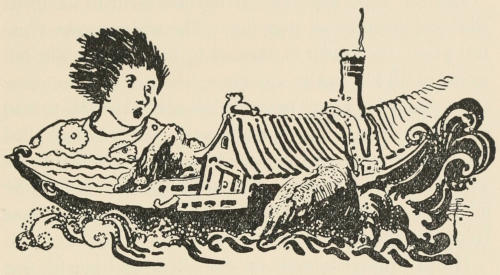
“I know!” cried Grandsig. And putting her hands
into her apron-pockets, she drew out two immense cakes
of soap, which she had brought to wash the children’s
faces.
She took one. Handsig took the other. And they
went to work with a will, soaping Mannigfual’s sides.
Then Wind-and-Weather pulled and all the children
pushed. The ship creaked and scratched; then slipped
and slid straight out into the English Channel. But the
soap, which they put on rather thick, came off on the
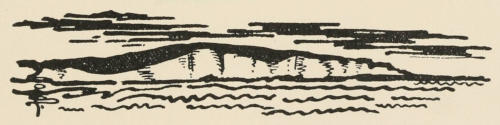
rocks, and that is why the cliffs of Dover have ever since
been white.
With a good wind it did not take long, I can tell you,
for the giant children to sail up around the British Isles,
back to the Up-and-Down Country. There sat Sun-and-Sea
just as usual, weaving on a kind of loom that
she had.
“Oh, mother, mother!” cried the children. “See what
father has brought you.”
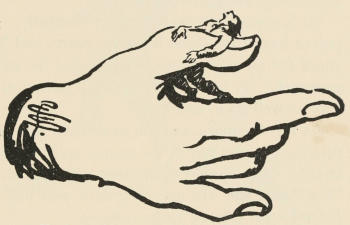
Wind-and-Weather held out the little men on the palm
of his hand.
“They are just what I need,” said Sun-and-Sea, “to
keep my threads straight.” So she took the bold pirates
Dare-and-Do and Catch-and-Kill, and set them on her
loom.
Wind-and-Weather put Fear-and-Fly back into his
pocket. “For,” he said, “he can polish my glass for me
and keep it bright.”
Whether the giant children ever found another running-place
I cannot say. But I fear not. For, years
afterward, the great-limbed men who followed the giants
in the Up-and-Down Country, were still sailing the seas
in search of new lands.
—Based on Norse legends.
The cliffs of Dover have ever since been white
III How the Giants Got the Best of Thor
Swift as the tempest comes terrible Thor,
Heaving his hammer behind and before;
Roaming folk, homing folk, careful be ye!
Only the giants are stronger than he.
Seymour Barnard.
III How the Giants Got the Best of Thor
In the misty time when the gods walked about the
earth, Thor, the strongest of them all, set out one
day for Giantland. In his hand he carried his
hammer which could batter down mountains; and
around his waist he wore his magic belt which made him
twice as strong as before. For he was going to humble
the giants.
In spite of his wonderful strength, Thor was but little
larger than a man; and the giants, by their very
size, annoyed him. When he hurled his hammer
through the clouds, the sky rocked, the sea shook, but
the giants did not tremble. And when his chariot-wheels
struck out swift streaks of fire across the sky,
they only smiled in their big way as if it were some
game of fireflies. Now he was bound to show them that
however big the giants might be, Thor was stronger,
and that a little trembling now and then might not be
out of place.
With Thor went the hungry god Loki, and the swift
runner Thialfi. All day long they walked together
through sunny mists across the bare, green uplands, and
just at nightfall they came to a wide moor. As far as
they could see, there was not a house, nor a shed, nor
any kind of shelter. Not even a tree broke the soft
horizon. Thialfi ran ahead; and Loki, who was ravenous,
walked furiously. Only Thor did not notice. He
was planning how he would put the giants in their
place.
It grew darker and darker. The mist which had
played about them all day in gentle clouds, rose in a
damp, gray fog. It filled their throats and their eyes.
They lost sight of Thialfi altogether. Loki stepped
back, groping to make sure that Thor was there behind
him; and plunged on again, sullen and dripping.
Somewhere through the fog there came a shout. It
was Thialfi far ahead. “Halloo!” he cried. “Halloo-oo-oo!
Shelter!”
Thor and Loki answered, walking faster. Thialfi’s
voice was louder now, and plainer. “Here!” he cried.
“Here! Here!”
It seemed as if they must be close upon him. But the
fog ahead grew no brighter. “Where is the house?”
shouted Loki. “Hasn’t it a light?”
With Thor went hungry Loki and swift Thialfi
But even as he spoke, they stumbled across a wide
threshold. Above them through the thick grayness they
could make out a low ceiling. They put out their hands,
groping for the door-arch, and met only empty air.
There seemed to be no doorway at all; or rather, there
was nothing but doorway,—a great entrance, like the
mouth of a cave, as wide as the building itself.
Thor struck his hammer on the floor. “Who’s here?”
he thundered. But there was no reply,—only soft
echoes, “Here—here—here!”
Thialfi found them. “There is no one here,” he said.
“I’ve shouted before. It’s a ruined palace, I think,
with all one side gone. This part is a great hall; and
beyond, there are five narrow wings. Come, I’ll show
you.”
But Thor and Loki yawned, tired out with their day’s
journey. And throwing themselves down on the floor,
they all three fell fast asleep.
About midnight Thor started up. The floor trembled,
and the whole palace quaked. The wide roof above
them shook till it seemed ready to fall. Thor roused
the others. “Run into one of the wings,” he cried.
And picking up his hammer, he himself went to sit in
the great doorway to guard the house.
All night long the strange rumblings continued.
There would be a great heaving sound, a silence, and
then another sound louder than before. Thor clutched
his hammer and waited.
At dawn the noises suddenly ceased. The fog
thinned, and Thor looked out across the country. In
the distance he could make out a bright hill, and amid
the shrubbery on the side, two lakes gleaming through
the morning mists. He started to walk toward them
when all at once the whole hill stirred.
Thor stopped, motionless with surprise. For a moment
he could hardly realize that what he had taken for
a hill was a giant’s head, and that the lakes fringed with
shrubbery were his eyes gleaming beneath his bushy
brows. Even the rumblings were explained, for they
were the giant’s snores.
When the giant spied Thor, he laughed. “Well, well,
my little fellow, you’re an early riser!” he cried. “And
perhaps you’ve seen something of my glove. I had it
yesterday, and I must have dropped it about here last
night. Oho! There it is now!” And with that, he
stooped and picked up the palace.
“Take care!” cried Thor, gasping. “Take care!
People inside!”
He was just in time. Very gently, the giant took the
glove by the fingers and shook Loki and Thialfi out into
his tremendous hand.
When the giant heard how they had mistaken his glove
for a ruined palace, and the finger places for wings, he
roared till the ground rocked, and Thor had to skip about
to keep his balance.
“Ho! Ho! Ho!” gasped the giant, wiping his eyes.
“This is a rare meeting indeed. And now what do you
say to some breakfast with the giant Skrymir?”
Setting Loki and Thialfi carefully on the ground, he
untied a huge wallet which he had slung over his shoulder,
and laid out small hills of bread and cheese in a
wide semi-circle about him. The gods sat down opposite
and opened their lunch-bag. A very merry breakfast
they had of it. For between his tremendous mouthfuls,
Skrymir told the biggest jokes in the world.
Finally he got up, and shaking out of his lap three or
four crumbs, the size of an ordinary loaf, said that he
was ready to start along. “And where are you bound?”
he asked.
Thor told him a little sheepishly.
“That’s my direction too,” said Skrymir good-naturedly.
“Come along with me; I’ll show you the road
and carry your bag.”
And picking up their wallet with his thumb and forefinger
he tucked it into a corner of his big one, which he
tied up securely and slung again over his shoulder.
So they set off, Skrymir walking as slowly as he could,
and the gods running like terriers at his great heels in
a desperate effort to keep up with him.
At nightfall they stopped under a towering oak-tree,
and Skrymir seeming suddenly tired out, stretched himself
full length upon the ground. But Loki, who since
breakfast had thought of nothing but supper, cried out
to him that he had their bag.
Sleepily, he took his big wallet from his back and
laid it on the ground beside them. “Take anything from
it you wish,” said he; and, with that, fell fast asleep.
In a minute Loki had climbed to the top of the sack
and begun to tug at the huge ropes that bound it. Thialfi
sprang after him. But the harder they pulled, and
the redder and hotter they grew, the more firmly the
knots seemed to stay in place. Then Thor, tightening
his magic belt, leaped up and pulled too. But the knots
remained as securely tied as before.
“Skrymir! Skrymir!” shouted Loki.
A huge snore that nearly shook them off the sack was
the only answer. By that time the gods were desperate
with hunger, and Thor, who had never before failed
in a trial of strength, was bursting with rage. Dashing
down off the wallet, he took up his hammer and
hurled it with terrific force at the giant’s forehead.
Skrymir turned a little in his sleep. “Did a leaf fall?”
he murmured drowsily. “I thought I felt something on
my head.” In another minute he was snoring again
more loudly than ever.
Thor shrank back, astounded. Never before had his
hammer failed to kill. Trembling and exhausted, he lay
down beside Loki and Thialfi on the ground. But it was
no more possible to sleep than it had been to get something
to eat. The oak-tree rocked as in a wild hurricane;
the leaves dashed together, and the ground quaked
with the giant’s snores. It sounded as if a hundred vast
trumpets were blaring at once.
By midnight Thor could stand it no longer. He
sprang up, determined to put an end to Skrymir once and
for all. Tightening his magic belt three times, he swung
his hammer about his head and dashed it straight and
sure into the giant’s temple.
Skrymir’s eyelashes flickered. “How troublesome!”
he grumbled, raising his head. “These acorns dropping
on my face!”
Thor held his breath. Minute after minute passed,
and Skrymir did not begin again to snore. Would he
never go to sleep? Thor clenched his fist till his fingernails
bit deep into his hand. Somehow he must get one
more chance with his hammer. It was maddening, unbelievable,
that there was a giant who could withstand it.
Finally, just at dawn, Skrymir’s wide bosom began to
move up and down, up and down, like the high waves at
sea. At the first snore Thor was ready. He gripped
his hammer with both his mighty hands, and hurled it
with a force to kill a hundred men. With a thundering
crash it sank deep into the giant’s forehead.
Thor ran exultingly to drag it out. But Skrymir,
brushing his hand drowsily across his brow, swept it
gently to the ground.
A tremendous palace, all of ice
“Just as I got to sleep!” he growled. “To have a
twig drop on me! There must be birds building a nest
in the branches above here. Are you awake, my little
gods? Well, Thor, you are up early! What do you say
to starting on?”
And with that, Skrymir stretched his great arms and
sprang up as if nothing had happened. As for his forehead,
it was as sound and firm as ever.
Thor leaned back weakly against the oak. “Yes,” he
gasped, “let us be going.”
So Skrymir shouldered his great wallet again, and set
off whistling across the field, with the gods following
limply after. At the meadow’s edge Skrymir stopped
and waited. Beyond a line of trees stretched a hard,
bright road, gleaming like a sea of white marble in the
sun.
Skrymir pointed along it. “This road,” said he
kindly, “takes you to the palace of the giant king. My
way lies over the hills so I must be saying good-by.
Many thanks for your pleasant company, my little
friends. You will be well received in Giantland. Only
remember your size, and don’t get to boasting, my tiny
gods. Here’s your wallet now; and good luck go with
you.”
As he spoke, Skrymir took his great sack from his
back and plucked it open with one pull at the huge knot.
Picking out the wallet of the gods, he laid it on the
ground; and flourishing his enormous cap about his
head, by way of good-by, he went leaping off toward
the hills. The gods watched him, speechless, till he was
out of sight. One moment his huge form rose clear
against the blue sky as he jumped over a mountain
range; the next, it was lost to view on the other side.
Loki turned trembling to the other gods. “Let us
turn back,” he cried. “I am not going on to be laughed
at in Giantland.” Then his eye caught the wallet. Diving
for it, he tore it open, and the starving gods fell to.
There was only a mouthful apiece, but it gave them new
courage.
Thor brandished his hammer. “Go back? Never!”
he cried. “On we travel to Giantland. They shall yet
learn to know the great god Thor!”
Thialfi sprinted ahead along the marvelous white
road, and Loki, more ravenous than ever, pelted after.
Suddenly, the road turned sharply upward. The gods
climbed, panting. There in the distance, beyond the hill-top,
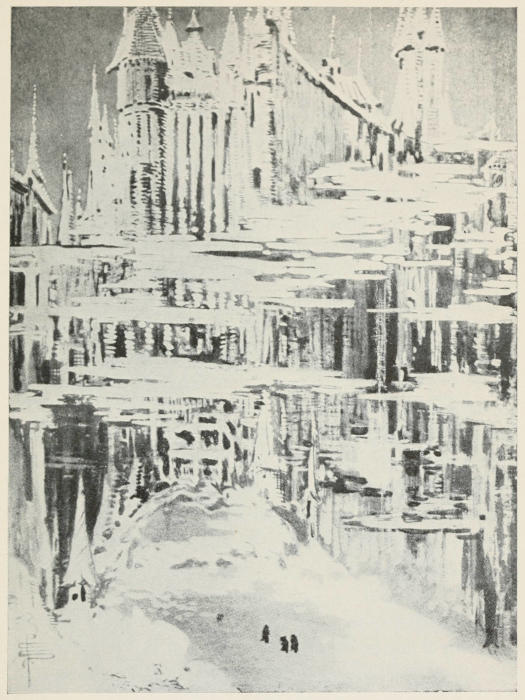
gleamed a tremendous palace, all of ice. Immense
icicles made its pillars, and its frosty pinnacles glittered
above the clouds. In the sunlight it shone with a thousand
rainbows.
Thialfi stopped. Straight before him flashed the palace
gate, each great icicle-bar blazing back the sun. For
a moment he paused, dazzled. Then he saw that wide
as the huge bars were, wider still were the spaces between
them. He walked through, arms outstretched,
without touching on either side. Thor and Loki followed
along the glittering ice-roadway to the palace.
Up and down in front paced two giant sentinels, their
heads erect and their great eyes peering out through
the upper air. The tiny gods slipped unnoticed by their
very feet, and into the great hall of the giant king.
Around the sides sat giant nobles on benches as high
as hills, and at the end the king himself on his towering
throne. Blinding light flashed from the floor, the ceiling,
the walls. But the gods did not quail. Proud and
straight, they passed unremarked down the center of
the hall.
Before the throne Thor stopped, and dashed his hammer
on the floor. The vast hall resounded and the
giants rose to look.
Thor drew himself up. “I am the great god Thor,”
he cried, “whose hammer cleaves the clouds and shakes
the sky. I come to demand the homage of the giants.”
Like a burst from a hundred volcanoes at once, the
giants’ laughter came booming down the hall.
The giant king smiled. “The giants welcome the
gods,” he said kindly, “but we can bow only before
proofs of greater power than our own.”
At that, Loki who was nearly starving, could stand
it no longer. “Greater power!” he shouted. “Greater
power! Let any one here eat food faster than I!”
The giants clapped their hands with a noise like waves
smiting the beach. “Hear! Hear!” they roared.
“Have my cook Logi bring a trough of meat,” called
the giant king.
Setting the trough before the throne, Logi sat down
at one end, and Loki at the other.
“Ready!—Start!” cried the king.
Click-clack! Loki’s little jaws were at it before Logi
got his great mouth open. Click-clack, click-clack, they
kept on while Logi’s great tongue swept down the
trough. Squarely in the middle, their heads bumped,
Loki’s little head against Logi’s big one.
“A tie!” cried Thor. And so it seemed. But while
Loki had eaten every morsel of meat from the bones,
Logi had devoured meat, bones, trough and all.
Thialfi stepped forward, flushing at Loki’s defeat.
“Who will race with me?” he cried.
“Hugi! Hugi!” shouted a dozen giant voices.
Hugi walked out, a slender young giant, and led
Thialfi to a race-course covered with marble-dust, just
behind the palace.
The giant king gave the signal, and off they dashed.
Thialfi smaller and quicker, was off first; but Hugi, with
his long legs, covered an immense distance at a single
bound. Before the course was half finished, Thialfi
was running like a tiny hound at the heels of a deer.
As they drew nearer the goal, Hugi with a sudden urge,
sped forward and crossed the line before Thialfi was
three-quarters of the way around.
The contest between Loki and Logi
“Bravo, Hugi! Well run, Thialfi!” cried the giants
kindly.
But Thor blazed with wrath from head to foot. His
muscles quivered and his throat was dry. “Bring out
your largest drinking-horn,” he thundered, “and see how
Thor will empty it.”
The giants trooped back into the hall, and Logi
brought a horn as deep as a well, filled with mead.
“With us, Thor,” said the king, “a giant is thought
a good drinker if he can empty the horn at a single
draught; a moderate drinker does it in two, and any
giant can do it in three.”
Thor gave his magic belt a quick twist. Instantly his
little form began to expand; and he stood before them,
a god of majestic size, half as big as the giants themselves,
and with muscles greater than their own. Taking
the horn in one of his mighty hands, he breathed
with all his force and drank till it seemed as if the vessel
must have been emptied twice over. Triumphantly he
raised his head and looked within. But the mead still
brimmed to the horn’s edge.
Astonished and angry, he bent his lips again and
drank till he thought he should burst. But again the
horn seemed as full as when he had begun. With a
last desperate straining, he lifted it a third time and
buried his face in its vast depth. He stopped, breathless
and choking. The mead had sunk below the rim,
but the horn was still more than half full.
A great silence came over the hall. Loki and Thialfi
cast down their eyes. But Thor threw back his head,
unbaffled. “Give me any weight,” he cried, “and I will
lift it. You shall yet see the matchless strength of
Thor.”
A gray cat larger than an elephant rubbed itself
against the steps of the throne. “Perhaps then, Thor,”
said the giant king, “you will lift my cat for me.”
Snorting with scorn, Thor took a swift step forward,
and put one immense arm around it. But the cat
seemed bound to the floor with iron chains. Thor
tugged again. But the harder he pulled, the higher the
cat arched its back; and the best he could do was to
make it lift one paw from the floor.
Thor roared with rage. “Let me wrestle,” he cried.
“I defy any giant of you all to match his strength against
mine. Let any one try to bring Thor low, in fair and
single combat!”
“Ask my old nurse Elli to come in,” ordered the giant
king.
Thor’s eyes flashed. “Do not mock me,” he thundered.
“At your risk you taunt the great god Thor.”
“No offense is offered you,” said the giant king kindly.
“Elli is no mean opponent. Many a bold champion before
now she has brought to his knees.”
As he spoke, there hobbled into the room a hag so
bent, so wrinkled, so infirm, that Thor drew back in
anger and dismay.
“Elli,” said the giant king, “will you wrestle with the
god Thor?”
The old dame nodded her head, and tottering up to
the god, cackled tauntingly in his face. “Throw me!”
she quavered. “Throw me!”
Enraged beyond endurance, Thor seized her about the
waist, meaning to lay her gently upon the floor. But
the harder he gripped her, the steadier she stood.
Bracing all his muscles Thor took a new hold, but the
hag had grasped him in her turn. Something in her
slow embrace seemed to sink into his very limbs. His
arms loosened. His legs weakened. Before he knew
it, he dropped kneeling before her.
“Enough, Elli!” cried the giant king. “Let Thor go.
We must give him better entertainment. Come, minstrels.
Come, cooks; deck out our board and feast our
guests like gods.”
In a twinkling a magnificent repast was spread, and
giant jokes sped about the hall. The minstrels played
great, sounding tunes upon their mammoth harps, and
the giants did their best to make their guests forget the
outcome of all their boasting. But the gods, humbled
and downcast, took little part in the merrymaking.
Even Thor, who had resumed his natural size, had no
more pride left in him. They sat silent and dejected,
and went off early to bed.
The cat was none other than the terrible serpent
Next morning they rose before daybreak, hoping to
escape from the palace without seeing the giants again.
But the giant king was up before them, and in the great
hall a breakfast stood ready. After they had finished,
the king himself led them down the gleaming roadway,
and out through the great ice gate, rosy with the light
of dawn.
The giant king paused. “Before I leave you, my
small friends,” he said, “I must in honesty tell you that
the giants admire while they do not yield to the power
of the gods. For had it not been for the magic we
used, we, and not you, would have been humbled.
“I myself was that giant Skrymir in whose glove you
slept. I tied up the wallet with the enchanted rope.
It was I whom Thor struck with his unconquerable
hammer. Any one of the blows would have killed me
had I not each time brought a mountain in between.
There in the distance you can see in the peak the three
great clefts his hammer made.
“Yesterday Loki could not win his eating wager.
But it was because he was matched against Logi who
is none other than Fire itself, which could devour meat,
bones, trough and all. Thialfi lost his race. But we
giants marveled at his speed, for he ran against Hugi
who is Thought, the swiftest thing in the world.
“When Thor drank, then indeed we wondered; for
his drinking-horn was connected with the ocean, and his
great draughts made the waters ebb from shore to
shore. My cat which he tried to lift was none other
than the terrible serpent which lies around the world
with its tail in its mouth. When Thor tugged, he lifted
it up till its back arched against the sky, and it seemed
likely to slip altogether out of the sea.
“When he wrestled with my nurse Elli, we saw the
greatest marvel of all. For she is Old Age, whom no
one has ever withstood.
“But strong as you are, do not boast again, my tiny
gods. For remember, the giants’ magic is as great as
the giants themselves, and can never be conquered.”
Overcome with rage, Thor raised his hammer to shatter
the giant and his palace forever. But a sudden mist
blinded his eyes. When it cleared, he found himself,
with Loki and Thialfi, alone on a wide moor glowing in
the sunrise.
—From a Norse myth.
IV The Cunning of Fin’s Wife
From the stories we have told,
One may learn what giants’ lives are;
Here’s a tale of giants bold
Which will show what giants’ wives are:
How the doughty Fin M’Coul
Fled Cucullin, who was stouter;
Sought his faithful wife; and who’ll
Say he could have done without her?
How she put her spouse to bed,
Planning that Cucullin, maybe,
Would her husband learn to dread
If he took Fin for their baby:
If the babe be strong as this,
Thought Cucullin, I would rather
Hesitate to meet with his
Proud, perhaps pugnacious father.
So from out the house of Fin
See the hulking fellow hustle:
Thus a woman’s wit may win
Over bulk and brawn and muscle.
Seymour Barnard.
IV The Cunning of Fin’s Wife
The giants were building a causeway
The giants were building a causeway from Ireland
over to Scotland. A great bridge it was
to be: thousands of piles sunk in the sea, and
over them such a road as would take ten giants abreast.
All the giants in Ulster were working to make it, and
Fin M’Coul was the head of them all. Whack, whack,
whack! went their sledges pounding the piles; and roar,
roar, roar! came Fin’s big voice telling how to place
them.
Up came a little lad running. “Fin M’Coul! Fin
M’Coul!” cried he. “The great Scotch giant Cucullin’s
looking for you. He says he’s come to beat you; he
says he’s come to treat you as he’s done every other
giant in Ireland!”
At that there was not a giant but dropped his sledge.
Some felt of their heads, some felt of their jaws, some
felt of their backs, and some, of their ribs. Every one
put his hand to the spot where Cucullin had touched him
last. For the truth of it was, Cucullin was a terror and
there was not a giant could stand before him. When he
stamped his foot, he shook the whole county. In his
pocket he carried a thunderbolt which he had flattened
to a pancake with one blow of his fist. Many were the
times he had come before, looking for Fin; but always
it had happened that Fin was away, seeing after his
affairs in some distant part of the country.
But Fin was the best fighter in Ireland and not the
man to be frightened before his friends. So, though
his knees set up a kind of swaying beneath him, he called
out to the little lad in a voice to shake the whole township.
“And what is the Scotchman waiting for?” roared
he. “Tell him here is Fin, ready this long time to
thrash him,—although,” he added easily, “if it’s not
hurrying he is, he may not find me here. For the truth
of it is, I was just about to be starting to see my wife
Oonagh on the top of Knockmany Hill. And fight or no
fight, it’s there I must be going, for she’ll be ailing, poor
woman, and low in her spirits, all for the want of her
Fin.”
Now, Fin was not one to be slow in anything he had
made up his mind to. So hardly were the words from
his mouth when it was down with his sledge, up with
his heels and off with him over the hills to Knockmany.
At first it was a long, swinging step he took, with a stout
fir-tree as a walking-stick. But the farther and farther
from the Causeway he went, the faster and faster his
legs began to move, until after all he was going not so
much at a walk as a run.
Of all the hills in Ireland, the chilliest and windiest
was Knockmany where Fin lived. Day or night, winter
or summer, it was never without a breeze; and besides
that, from top to bottom was never a drop of water.
But little did that trouble Fin. “Why,” he would say,
“ever since I was the height of a round tower, I was
fond of a good prospect of my own. And where should
I find a better than the top of Knockmany Hill?”
There were some who said though, that it was not so
much the view itself that Fin liked as it was to be able
to see when Cucullin was coming to visit him. For then
he could be off in time on his distant travels across the
country.
Be that as it may have been, there was no doubt now
but Fin was glad to be at home again. There was his
darling Oonagh waiting for him at the tiptop of the
hill; and the smack they gave each other made the waters
of the lake below curl with kindness and sympathy.
“But what brought you home so soon?” said Oonagh.
“And what should it have been,” cried Fin, “but affection
for yourself?”
But Oonagh, who always had her wits about her, soon
saw that something was troubling her good man. For
it was nothing but into the house and out again, across
the hill and back, looking and peering, looking and peering
for something he didn’t seem altogether wishful
to see.
Oonagh watched him for a while. Then, “Is there
some one you’re expecting, Fin?” said she.
Now, Fin knew very well that Oonagh would have it
out of him sooner or later. So he lost no time. “It’s
that Cucullin,” roared he, “that earthquaker, that thunderbolt-flattener!
He’ll be coming here to beat me;
he’ll be coming here to treat me as—”
A pause came on Fin. Not a word more did he say;
but into his mouth went his great thumb. It was a rare
quality Fin’s thumb had that when he stuck it between
his teeth it could tell him of the future.
“Thundering pancakes!” howled Fin. “He’s coming
now! He’s down below Dungannon. My thumb tells
me.”
“Well,” said Oonagh, keeping on with some knitting
she had, “what if he is?”
“What if he is!” echoed Fin. “What if he is! So
you’d sit there, would you, and never raise your eyes
to see your good man made pulp before you! Cucullin’s
coming, I tell you, that can knock a thunderbolt flat as a
pancake; and I can’t be running away.”
“Well, well,” said Oonagh, “we might be stopping him
a bit.” So she got up and turned toward Cullamore.
Now, Cullamore was where her sister Granua lived,—a
hill, four miles across the valley, the twin of Knockmany.
Many a pleasant chat Oonagh and Granua had
together of summer evenings, one sitting outside her
door on Knockmany, the other on Cullamore. For
Granua was as ready-witted as Oonagh herself, and
something of a fairy as well.
“Granua,” called Oonagh, “are you at home?”
“No,” answered Granua, “I’m down in the valley
picking bilberries.”
“Well, go up on top of Cullamore,” said Oonagh, “and
tell me what you see.”
“Now I’m up,” said Granua; “and down below Dungannon
I see a giant, the biggest I ever saw.”
“That’s what I was expecting,” said Oonagh.
“That’s Cucullin on his way to Knockmany, coming up
to beat Fin.”
“Would you want me to be keeping him a while?”
asked Granua. “I’ll be having a party of giants and
giantesses this evening, and we could give him some entertainment
maybe that would keep him over night, and
quite away from your house till the morning.”
“If you would,” said Oonagh, “I’d thank you kindly.”
So Granua made a high smoke on her hill and whistled
three times to show Cucullin that he was invited to Cullamore.
For it was in that way the giants of old times
told a traveler that he was welcome to come in and eat
with them.
As for Oonagh, when she turned around, there was
Fin shivering and shaking behind her.
“Thundering pancakes, Oonagh!” said he. “And
what have you done but made everything ten times
worse than it was before? If Cucullin is coming, I’d
wish it would be now while I have some heart left to
fight him. What with thinking it over all day and
dreaming it over all night, I’ll have no more courage by
morning than a boiled rabbit.”
“No,” said Granua, “I’m down in the valley, picking bilberries”
“If I were you, Fin,” said Oonagh, “I’d not be saying
much about courage. The best thing for you is to
do as I tell you, and trust me to get you out of this scrape
as I’ve pulled you through many before.”
So Fin said no word more, but sat down on the hill
and pitched cliffs into the valley to steady his quaking
limbs.
Oonagh went about her plans. First she worked a
charm by drawing nine threads of nine different colors.
For this she always did when she wanted to know how
to succeed in anything important. Next she braided
them in three braids of three colors each. One she put
around her right arm; one around her right ankle; and
one around her heart, for then she knew that she could
not fail in anything she tried to do.
“Now, Fin,” said she, “will you kindly go to the
neighbors’ for me and borrow one-and-twenty iron griddles,
the largest and strongest you can get?”
Fin was glad enough of something to do, and hardly
were the words from her mouth when off he was, down
the hill and over the valley.
Oonagh went into the house and began kneading a
great mountain of dough. Into two-and-twenty parts
she divided it, each a great round cake the size of a mill-wheel.
Scarcely was she done when back came Fin
again, clattering and clanking loud enough to be heard
ten miles beyond Cullamore. Seven griddles he had in
one hand, seven in the other, and seven strung about him
in a noisy necklace.
Oonagh took them all, and each she kneaded into the
heart of one of her great dough-cakes. Over the fire
she baked them and set them all upon the shelf,—two-and-twenty
fine loaves of bread, one-and-twenty with
griddles inside and one with no griddle at all.
Next morning she was up before daylight; and so for
that matter was Fin, fidgeting and fuming, and keeping
a sharp lookout down the valley. As for Oonagh,
she went about smiling and humming to herself as if it
were a May morning.
First she took a great pot of milk and made it into
curds and whey. “Fin,” said she, “when Cucullin comes—.”
And she told him what he must do with
the curds.
“And now,” she said, “help me while I pull out the
old cradle.”
With that she put her hand to a cradle the size of an
ark, and taking two quilts an acre square began spreading
them out and tucking them up inside.
“Don’t be standing about, Fin,” said she, “but go and
dress yourself up like a bit of a boy.”
By that time Fin decided that she was daft entirely.
But he did as she bid nevertheless, for the fact was he
was at his wits’ end, and thought that since Cucullin was
to make pulp of him at any rate, it did not much matter
how he was dressed.
Up the valley came a roar like thunder. Fin’s house
on the top of Knockmany trembled and the cradle inside
rocked to and fro.
“That’ll be Cucullin singing to himself on his way up
from Granua’s to beat Fin,” said Oonagh.
As for Fin, he turned as white as the childish clothes
he was wearing, and trembled from top to toe.
“Not a minute to waste quaking and shaking!” cried
Oonagh. “Into the cradle with you, Fin, and a stout
heart inside you! Lie quiet now; never forget you’re
but a child; and not a word out of you till you see it’s
the time.”
Into the cradle clambered Fin, stumbling and grumbling
and barking his shins. Oonagh tucked him in.
“Fold up your knees under your chin,” cautioned she.
“Not a move now, or you’ll burst the cradle! Close up
your eyes; put your thumb in your mouth like an innocent
babe fast asleep. Quiet now, and leave Cucullin to
me.”
Oonagh smoothed out her apron and patted her hair.
Down on the doorstep she sat and began to knit, as cool
and airy as the dawn on Knockmany.
Up the hill in three leaps came Cucullin. Such a giant
Oonagh had never seen. Half again as tall as Fin he
was, with muscles that stood out like small hills. But
Oonagh was not one to let herself be surprised. So,
while she saw all this beneath her eyelashes, she kept on
with her knitting and pretended not to have noticed
Cucullin at all.
“A fine morning!” roared Cucullin. “And might this
be where Fin M’Coul lives?”
Oonagh looked up. “Indeed it is, my good man,”
said she. “Won’t you be sitting?”
“Thank you kindly,” said Cucullin. “Is Fin at
home?”
“The pity of it is, he’s not,” said Oonagh. “The
fact is, he heard there was a big Scotch giant named
Cucullin down at the Causeway looking for him; and
nothing would do but off he must be over the hills to
meet him. Indeed, for the poor giant’s sake, I hope Fin
won’t find him. For with the temper Fin’s in, he’d
make paste of him in no time.”
At that Cucullin threw back his great head as if it
were some joke Oonagh had made. “Ho, ho, ho!”
roared he. “Ho, ho, ho! Make paste of Cucullin,
would he? Make paste of Cucullin! Why, why, why,
my good woman, I’m Cucullin!”
Oonagh put down her knitting. “Can it be?” cried
she. “You, Cucullin!” And with that she gave a clear
laugh, as if he were but a wee bit of a man, hardly worth
considering.
“Have you ever seen Fin?” asked she, all at once
sobering down.
“Why, no,” said Cucullin, “thanks to all the trouble
he’s taken to keep himself out of my way.”
Oonagh shook her head. “I thought as much,” said
she. “I judged you could never have seen him, to speak
as you did. And if you’re fond of your own skin, you’ll
pray you may never. Not but what you’re a sturdy
fellow of your size, but Fin—”
“Well, well,” cried Cucullin good-naturedly enough,
“there’s been never a giant in Ireland could beat me
yet. So, now I’ll be off to the Causeway to give Fin his
chance.” And with that, up he got, laughing, and took
one of his great strides down the hill.
Oonagh rose up too. “Begging your pardon, sir,”
she said, “might I ask one favor before you go? The
wind’s blowing in at the door, you see, and would you
mind turning the house around for me?”
Cucullin stopped where he stood. “Turn the house!”
cried he.
“Why, yes,” said Oonagh. “Turn it about, you know,
so the wind won’t be blowing in at the door. It’s always
what Fin does when he’s at home.”
“Indeed!” thought Cucullin to himself. “This Fin
must be more of a lad than they’ve been telling me.”
But never a word more did he say. Instead he pulled
the middle finger of his right hand till it cracked three
times. For it was from that finger all his strength
came.
Up the hill he stepped, and putting his great arms
around the house, gave a tug and a twist,—and there it
was, faced about completely. Fin’s cradle, inside,
banged back and forth; Oonagh’s great bread loaves
bounced about; the dishes clattered. As for Fin himself,
his breath left him entirely, and there he lay, tight
squeezed in the cradle, gasping and spluttering, and
quite blue with terror.
Cucullin turned to go down the hill again as if he had
done nothing unusual at all. But Oonagh curtsied before
him.
“Thank you kindly, sir,” said she. “And since you’re
so obliging, maybe you’d do another civil turn for me.
You see it’s a dry stretch of weather we’ve been having,
and there’s scarcely a drop of water from here to Cullamore.
But under the rocks hereabout, Fin says there’s
a good spring-well; and he was just about to pull them
apart to find it when along came the news that you were
at the Causeway, and off he dashed. So here we are,
still without water; and indeed if you’d take a minute
to pull the rocks open for me, truly, I’d feel it a kindness.”
So, she led him to a place, all solid rock for a mile or
so. “Now, here’s the spot,” said she.
Cucullin looked at it for a while without speaking.
Then he cracked his middle finger nine times, and bending
down, tore a cleft a quarter-mile long and four hundred
feet deep.
When Oonagh saw that, her courage oozed down to
the soles of her shoes. But she was never one to give
up anything she had once decided. So, after a moment
she said, “I’m much obliged to you, sir. And now,
you’ll be coming back to the house with me to take a
bite of such humble fare as I can give you.”
“Indeed,” replied Cucullin, mopping his large red
brow, “that’s an invitation I’ll not be refusing. It’s
warm work tearing up landscapes and moving houses,
and I can’t say that I’m not hungry either.”
So into the house they went; and down before him
Oonagh set a side or two of bacon, a mountain of cabbage,
and ten or twelve loaves of the bread she had baked
the day before.
Cucullin fell to with a will. He finished the bacon and
cabbage, picked up a loaf of the bread, and took a huge
bite of it. Down came his teeth on the griddle inside.
“Thundering pancakes!” roared he. “What’s this?
Here are two of my best teeth out! You call that bread,
do you? You call that bread!” And he stamped about
the room, howling with fury.
“Indeed, I’m sorry, sir,” said Oonagh. “I should
have told you. That’s Fin’s bread that nobody else can
manage but himself and the child in the cradle there.
I’d not have given it to you, but you seemed a stout little
fellow; and indeed since you’re bound to fight Fin, I
thought you’d be scorning anything but his own food,
too. Here, try this loaf. Perhaps it’ll be softer.”
Cucullin was still hungry, and besides, he was a little
touched in his pride by Oonagh’s remarks about Fin’s
bread. So he took the new loaf she handed him, and
jammed it into his mouth, meaning this time at any rate
to get a good bite out of it. Down crashed his jaw on
the iron again, and up he jumped roaring.
“Take it away! Take it away!” he bellowed, twice
as loud as before. “I’ll not be losing my teeth for Fin’s
bread or any other. What kind of jaw has Fin got to
crack—”
“Hush! Hush!” cried Oonagh. “Whatever you do,
don’t be waking the child in the cradle there.... Oh,
indeed, it’s too bad! There he is awake now.”
All this time Fin had been lying cramped up in the
cradle. Never a move did he make, except now and
then a flicker of his eyelashes just to be peering out at
Cucullin sitting and eating up his bacon at the table.
A terrible sight it was too: Cucullin’s great fingers as
big as trees, reaching, reaching; Cucullin’s great jaws
as big as millstones, crushing, crushing. Fin shut his
eyes in a hurry, and his heart froze up inside him to
think of fighting a giant like that. But when he heard
Cucullin howling over Oonagh’s griddle-bread, he
couldn’t, even for the terror in him, help a kind of smile
creeping across his face. And so, when Oonagh spoke
of the baby’s waking, he let out a yell almost as loud as
Cucullin’s own.
Cucullin himself stopped his dancing, and turned to
see what kind of child it might be that could make a
noise like that.
“Boohoo! Boohoo!” howled Fin. “I’m hungry.”
“There, there!” said Oonagh. “Quiet now, my little
man. Here’s some bread for you.”
And with that she handed him the one loaf that had
no griddle in it. And Fin, grasping it in both hands,
ate it down greedily.
Cucullin stared and stared. He forgot his lost teeth
entirely, for wonder that such a youngster could devour
bread he himself could not even bite. “If the son that’s
yet in the cradle can eat bread like that,” thought he,
“what must the father be? It’s perhaps as well for me
after all that Fin’s at the Causeway.”
“I’d like,” said he to Oonagh, “to have a glimpse of
that lad in the cradle. A boy that can manage that
bread must be something to look at, too.”
“Indeed you may see him,” said Oonagh. “Get up,
darling, and show this good man something that’ll be
worthy of your father, Fin M’Coul.”
At that Fin, who was cramped and aching from lying
so long bent double, gave a leap, and bounced out, nearly
bursting his cradle. Up to Cucullin he went, and seizing
him by the hand, started out the door.
“Are you strong?” bellowed he. “Are you as strong
as my daddy?”
“Thundering pancakes!” exclaimed Cucullin. “What
a voice for a little chap!”
Fin picked up a big white stone. “Are you strong
enough,” said he, “to squeeze water out of this?”
Cucullin clenched his hand over it. He squeezed and
pressed, and pressed and squeezed till his face grew
black and his eyes stood out. But never a drop of water
fell from the great white stone. He might rip up rocks
and turn houses but to squeeze water from a stone was
quite beyond him.
“Would you let me try?” asked Fin.
Cucullin handed it to him. Turning a little, Fin exchanged
it for the curds Oonagh had made for him.
Then holding them up, he squeezed till the whey, as clear
as water, showered down upon the ground.
Cucullin’s face turned white. His knees were knocking;
his hands were shaking. “If the son’s like this,
what must the father be! And suppose Fin should be
coming home!” thought he.
Over to Oonagh he went. “Indeed, indeed, ma’am,”
said he, “I thank you kindly for your welcome. It’s a
fine, strong son you have. And it’s sorry I am I can’t
be waiting to see Fin. But I’ve out-stayed my time
already, and it’s back to Scotland I must be going before
the tide rises in the Channel.”
And with never a good-by more, the terrible giant
Cucullin turned and ran over hill, over dale, through
wood, through wave. And never again did he show his
face in Ireland.
As for Fin and Oonagh, they never got over laughing
in their little house turned wrongside foremost on the
top of Knockmany Hill.
—From a Celtic Folk-tale.
Based on Wm. Carleton’s “Traits and Stories of the Irish Peasantry.”
The terrible giant Cucullin turned and ran over hill, over dale
V How Jack Found the Giant Riverrath
Here’s a tale of Genius Jack,
Light of foot and quick as whack!—
Jack o’ mountains, Jack o’ plains,
Jack o’ cuteness, Jack o’ brains.
Seymour Barnard.
V How Jack Found the Giant Riverrath
The king of Ireland was troubled in his mind
The king of Ireland was troubled in his mind.
And that was something unusual. For he had
as handsome a palace as you would wish to see,
a queen as good as she was beautiful, and a fine, strapping
son named Jack. The only thing that bothered
him was that he could not drive to town without getting
his gilt coach wheels spattered.
The horses would plunge spluttering in
Down below the palace, straight across the king’s
highway, ran a little river. In the fall when it was
almost dry, splashing through it was a nice adventure.
The royal coach would roll down the hill with a splendid
thud, and dash gurgling through the water. But
in the spring it was quite another matter. Going down
the hill the coachman would pull on his gilt reins, the
coachboys would tuck up their gilt boots, the king would
slam down the coach window, and the queen would be
ready to faint with excitement. (Only the footmen did
not care, for they sat up so high behind, that the water
could not reach them no matter how much it splashed.)
Then the horses would plunge spluttering in up to
their gilt harnesses, the coach would slip and reel, and
the water would come pounding up against the gilt-edged
window-panes. Worst of all, when they reached
the other side, there would be little black mud spots all
over the gilt wheels, all over the gilt sides, all over the
shiny door. And that was a sorry way for the king of
Ireland to drive down among his subjects.
The king was sitting on his throne, turning it over in
his mind when in came his son Jack.
“Good morning, father,” said Jack, bowing with all
his might.
But the king was so melancholy and disturbed that
he never said a word, but just nodded his head to show
that he knew Jack was there.
“Is something troubling you, father?” asked Jack respectfully.
“It’s that river again!” cried the king, puckering his
brow till his crown slipped down over his left eye.
“What’s the use of having the finest coach in three kingdoms
if every time you drive abroad it’s bespotted and
bespattered like a common gipsy wagon?”
“Can nothing be done?” asked Jack.
“That’s what I’ve been trying to think,” said the king.
So Jack sat down quietly on the steps of the throne
and thought with his father. Just as the clock struck
ten, the king had an idea.
“We might put something over the coach,” he said.
“We might put something over the river!” cried Jack.
“Why couldn’t we build a bridge?”
“Gilded Shamrocks!” cried the king. “That’s the very
idea. We could ride across as dry and fine as you
please.”
So he called the master mason. And that very hour
all the masons from far and near began stirring about
in great troughs of mortar and lugging building-stones
as big as the coach wheels. By sunset there was as
neat and stout a little bridge as you would wish to see.
And the king and the queen and Jack walked up and
down before it, beaming to think how spick and span
and shiny they’d be next day, rumbling across it down
to the town.
Lugging building stones
In the morning before he got his crown on, the king
called for his coach; and the minute breakfast was done,
around it drove to the palace door, glittering like a million
gold-pieces. Then the queen stepped in, dressed in
her shiniest gown, and the king in his best crown, and
last of all, Jack, with a fine green feather in his hat.
The footmen clambered carefully up on top so as not to
rub their bright gilt boots, the coachman touched up the
horses, and off they all whirled, as splendid a sight as
the sun ever shone on.
Down the hill they rolled with a fine dash, when the
horses reared and stopped.
“Dear me! Dear me!” fluttered the queen. “I hope
the harness hasn’t broken.”
As big as the coach wheels
The king put his head out the window. “What’s the
matter?” he roared.
The two footmen climbed cautiously down, and stood
at attention beside the door.
“Begging your Majesty’s pardon,” said the first, “the
bridge is down.”
“Thundering waterfalls!” shouted the king. “It can’t
be.” And he burst out of the coach, with Jack at his
heels.
Sure enough, there was no bridge at all,—just a line
of gray stones heaped higgeldy-piggeldy from bank to
bank, with the stream running saucily over them as much
as to say, “You can’t bridge me! You can’t bridge me!”
“Well,” cried the king, “I’ll be splashed!” And he
sent the two footmen off for the master mason as fast as
their gilt legs could carry them.
The master mason scratched his head.
“You see your work,” said the king with a great
sneer, “—a bridge so strong it has taken the stream a
whole night to wash it away!”
The master mason flushed. “Asking your Majesty’s
pardon,” he said stolidly, “it couldn’t have been the
river. The bridge I built should have stood a hundred
years, barring earthquakes.”
“Nonsense! Nonsense!” cried the king irritably.
“Build me a bridge that will stand earthquakes, then,
and be quick about it too.” And he climbed back into
the coach, and drove off home in a very bad humor indeed.
The master mason and his men worked till long past
sunset. When they had finished, there was a bridge
twice as high, twice as wide, and twice as solid as before.
The next morning the king was up at daybreak calling
for his coach and his crown; and before the dewdrops
were off the grass, he was driving off with the
queen and Jack down the hill toward town. But just
as they got to the river, back lunged the horses again,
down clambered the gilt footmen, and out burst the king
all a-tremble.
Sure enough, the bridge the master mason had built
so solid and so strong was nothing but a jagged pile of
stones, with the stream gushing impudently between
them as if it were the best joke in the world.
The king called for the master mason in a tone that
made the gilt footmen scamper; and back they came with
him as red and flustered as the king himself.
“Just one more chance for you,” raged the king, shaking
his scepter, “to build me a bridge that will last over
night. If by to-morrow morning I don’t find as good
a bridge here as ever was built in Ireland, I’ll—I’ll
have you buried beneath your own stones and mortar.”
“Your Majesty,” cried the master mason tensely, “it
can’t be done. There is some enchantment. The
bridges I built here were the best in Ireland. The river
could never have washed them away. It can’t be done,
I say. It can’t—”
But the king had already slammed the coach door and
driven violently away. So there was nothing for the
master mason to do but to call his men and get to work
harder than ever. All day long they drilled great holes
in the bed of the stream and set huge rocks in them, one
on top of the other. And over those piers from bank
to bank they laid a bridge so bulky and so solid that the
like of it was never seen before or since.
The master mason and his men worked harder than ever
It was full moonlight by the time the last stone was
heaved into place, and the great bridge loomed like an
elephant wading in a brook. The workmen picked up
their trowels and troughs, and plunged wearily along the
road toward home. The master mason stopped for a
last look. “Let any magic throw that down!” he cried
defiantly, and shook his fist. Then he trudged after the
workmen down the road.
There was a creaking of branches beside the river,
and a figure, dirk in hand, crawled to the bridge,
paused, looked about, then settled itself, leaning back
against the bulky stonework. The figure was lost in
the shadow of the bank, but every now and again it
raised its head into the clear moonlight. It was Jack!
All the time the bridges had been breaking and the
king had been fuming and the master mason had been
protesting, Jack had been thinking. For Jack had a
couple of eyes in his head, and he saw how small and
weak the river was, compared to the bridges. So he
thought to himself that it would be no wonder after all
if the master mason were right, and it was not the river
that kicked the bridges down, but some magic or other.
Anyway it would do no harm to watch for a night and
see what might happen.
So Jack sat there with the moon shining into his eyes,
and not a sound anywhere to keep him company but the
palace clock now and then counting off the hours into
the quiet. But Jack did not mind, for the moonlight had
a kind of friendly feeling in it; and in spite of being
alone it was more drowsy he felt than frightened.
He might in fact have gone to sleep entirely if all of a
sudden there hadn’t come a strange, low gurgle, as if
beyond the hills all the rivers were brimming, brimming,
brimming. Then it rose with a rush as if they had burst
over the hills and were racing, dashing, flooding down
to Jack.
The moon went out as if a great black blot had fallen
across the sky, and Jack sprang up, all a-tremble, to see
if he could make out what was going on. Something
swept by him in the dark, showering him with drops like
a moist whirlwind. There was a shaking and a shock,
and the bridge which had stood so solid and so firm,
crumbled with a crash, stone after stone, into the water.
The moon flashed out again into Jack’s eyes, and black
beside it against the sky towered a tremendous giant
figure. For a moment Jack caught his breath; then suddenly
he understood: It was the giant who had made
the darkness by stepping in front of the moon; it was
the giant who had rushed splashing by him up the river;
it was without a doubt the giant who had pulled his
father’s bridges down! And there Jack stood in the
moonlight at the foot of the giant, gazing up at the
top of him, never daring to say a word.
The giant kicked the building stones with his toe, like
so many pebbles. Jack got up his courage.
“Oh, giant,” he shouted, “giant!” But not a syllable
more could he get out.
The giant stopped his kicking and scanned the ground
with his great eyes. Finally he spied Jack.
“Bursting bridges!” he gurgled. “Who are you?”
Jack stood up as tall as he could. “I’m Jack, the king
of Ireland’s son,” he cried; “and it’s my father owns
this bridge you’ve broken and this river you’ve splashed
up.”
“Rippledy-row!” cried the giant, stepping a-straddle
of the stream. “So he owned this bridge, did he? But
he never owned this river. No, indeed. That’s mine,
you know. Always has been, always will be, and I won’t
have it bridged. Do you hear?”
“But you can’t say that,” shouted Jack, “for my father
rules the whole of Ireland.”
“He may rule Ireland,” granted the giant pleasantly
enough, “but he doesn’t rule the rivers. They belong
to me, and I won’t have them crossed. All day long I
sit in my castle at the ends of the earth, watching the
rivers come and go; and every bridge or dam I see, I go
at night to tear it down, so that all my rivers can be free,
free,—free as I am!”
“But who are you?” cried Jack.
“Oho!” bellowed the giant, “if that’s what you want
to know, come here where I can tell you.” And with
that he scooped Jack up in one of his mighty fists and
held him there just opposite his eyes.
“Now!” he cried. “Listen:
He who frees the streams I am,
Bursting bridge and splint’ring dam;
For the floods I plow the path,—
Raging, roaring, Riverrath!”
And as he said that, the giant’s voice grew deeper and
fuller till it seemed to flood out and fill the air. Jack
braced himself against it, but it swept and swirled around
him till he drooped limp over Riverrath’s great thumb.
But he didn’t lose his wits for all that, and every other
minute he kept saying to himself, “I mustn’t let him
down me, I mustn’t let him drown me.” Only “down”
and “drown” were somehow mixed up in his mind, and
which it was he meant he couldn’t himself be quite sure.
“But, but, but,” he gasped as soon as he was able to
straighten up again, “you’ve only said your name.
You haven’t told me where you come from, where you
live, or anything.”
The giant threw back his head with a roar. “That’s
just it!” he gurgled. “You’re to come and find out.
Anybody else whose father had tried to bridge my river
I’d have felt it my duty to drown. But I like you, Jack.
You have a steady head on your shoulders. You’re not
afraid even of me. And I’ll give you a year and a day
to find my castle. It’s a weary walk, but if you get
there you’ll never want any good thing more,—that I’ll
promise you. But if you don’t,”—and here the giant’s
voice grew deep and troubled,—“if you don’t, why then
Your father’s castle, coach, and crown,
Queen and country I will drown!”
There was a sudden brightening in the sky, and Jack
felt himself set down with a bump upon the grassy bank.
The next moment a chilly spray beat in his face and
trickled down his neck. He looked up to see the giant
Riverrath with his garments dripping and fluttering,
dashing up the river and off toward the pale moon.
“Which way is your castle?” shouted Jack.
“At the
ends of
the earth,”
called the
giant. And
Jack could
hear his
mighty
laughter
gurgling
up among
the hills.
He drooped limp over Riverrath’s great thumb
For some minutes Jack sat gazing at the sunrise, thinking
it all over. Then he picked himself up, and ran pell-mell
to the palace. There was the king already up, standing
before the mirror putting on his crown. And there
was the queen ready to go out with him in the coach.
“Father! Mother!” cried Jack. “I must go upon a
journey.”
“Of course, of course,” said the king. “You’re going
to drive with us to town.”
“Oh, not that!” cried Jack. “I have to go to the ends
of the earth to find the giant Riverrath.”
“And who is he?” asked the king.
“The giant who pulls your bridges down,” said Jack;
and he told them all about it.
“It’s nonsense,” said the king decidedly. “Here the
palace has stood three hundred years, and here it will
stand for all your giants. However,” he added a little
nervously, “if you’re determined, Jack, I suppose you
may as well go to find him.”
As for the queen, as soon as she saw how things were
turning out, she ran to the pantry and set the four-and-twenty
dairy maids to putting up a lunch for Jack.
“For,” said she, “he may be gone a year and a day, and
I don’t want my son to go hungry.”
So Jack chose a good stout staff for a walking stick,
slung his lunch across his back, and set off for the ends
of the earth. His father and mother watched from the
palace tower till his green feather was lost to sight behind
the hills.
All day long Jack walked up hill and down, in and out,
by field and farm, through market and town, past castle
and cottage. And everywhere he stopped to ask his way.
But the queer part was that though every one had heard
of the ends of the earth, no one could tell him just where
they lay. There was no scholar who had ever seen them
on a map and no traveler who had been so far.
Jack set off for the ends of the earth
“Oh, yes,” people would say wisely and nod their
heads, “the ends of the earth! Every one has heard of
them, of course, but just where they are or how you
would go to get there, that I can’t say.”
So Jack kept on for a week and a month, knocking and
knocking at all the house doors, without finding any one
to tell him the way. And every day his lunch grew
smaller, his shoes grew thinner, and his feather which
had stood up so fine and straight, drooped more and
more. But his heart inside him beat as happy and as
high as on the morning he said good-by to his father and
his mother. And he whistled so cheerily that the housewives
would smile as he passed, and say, “There’s a
brave lad coming home from a journey.”
Everywhere he stopped to ask his way
Late one afternoon Jack found himself on a wide,
sandy plain that stretched as far as he could see. There
were no house doors at which to knock and no travelers
of whom to inquire the way. It was quite lonely and
still. Ahead on the far horizon inky turrets appeared
against the setting sun. They belonged to a castle
standing alone upon a high rock. Beyond it was only
sky. The sand seemed to reach the cliff, and stop in a
sudden firm line. The hope and joy in Jack almost
choked him. What could this be but the ends of the
earth and the castle of the giant Riverrath?
“Oh, yes,” they said, “the ends of the earth!”
The dark began to come, and it was the last edge of
twilight when Jack reached the great black cliff where the
castle stood. He felt about, but the rock was steep and
jagged whichever way he turned. So he scrambled up
on his hands and knees. At the end of an hour or so he
found himself, scratched and breathless, under the huge
wall of the castle. In the dim starlight a few feet away
he could make out an iron grating with bars as thick as
tree trunks.
Inky turrets
“That is the castle gate,” thought Jack. So he beat
upon it with his staff. The massive iron resounded
through the dark. But when the noise died down, the
castle loomed as silent as before. Jack whacked at the
bars again, blow after blow, till he could hear the echoes
go booming down the hall inside. There was the loud,
slow grating of a lock, the opening of a great door, and
a light as big and bright as the moon came swinging
down the corridor, far above Jack’s head.
As soon as his eyes got through blinking, Jack looked
up. The other side of the tall grating towered a man
as high and wide as the palace at home; but it was not
the giant Riverrath. This giant had black hair and
black mustaches, and he looked down at Jack by the light
of his huge lantern without saying a word.
“Good evening,” said Jack politely, doffing his hat.
“Could you tell me the way to the ends of the earth and
the castle of giant Riverrath?”
At that the giant’s face broke into dimples as deep as
teacups. He rattled the gate open with a noise like
thunder, and cried out:
“Flip-flap, flip-flap,
Here’s a cheery, chary chap!
By the map I’ll point the path
To the home of Riverrath.”
“Oh, thank you, thank you,” gasped Jack. But he
didn’t have breath left to say more, for the giant bent
down and carried him off through the tall corridor to a
vast room all of iron. The ceiling and the walls were
iron, and so were the chairs, the table, and the great
spits over the fire. The giant set Jack and his lantern
both on the table.
“Well, Jack,” he said, “I’m glad to see you, for I
haven’t seen a man before for three hundred years.
“As for the ends of the earth,” went on the giant,
“wherever they are, I’m sure to find them for you. For
I have a map of the whole world hanging on the wall.
Only if I get that out, you’ll have to stay all night, for it
will take me that long to look it over.”
Jack said that he would like to. So the giant took four
or five fine roast pigs from a spit and piled them up on a
platter. He and Jack had a very merry supper. After
it was done, the giant put on his great iron-bowed spectacles,
and spread the map out on the table. Jack walked
around on it, all over the pink countries and the yellow,
across the blue seas, to the green spot that was Ireland.
There he stopped, and showed the giant where his
father’s palace was, and the stream where Riverrath had
pulled down the bridges. Then he went and lay down
in the inglenook while the giant traced out all the names
with his great finger.
In the morning when Jack woke up, the giant was just
hanging the map up again on the wall.
“Oh, Jack,” said he, “to think that I should have to
disappoint you after all! But I’ve been over every word
and every letter, and there’s no mention of the ends of
the earth on the map at all.”
Jack walked to the green spot that was Ireland
“Never mind,” said Jack, “and thank you kindly.”
But he couldn’t help looking a bit downhearted for all
he spoke so bravely.
“I’ll tell you what,” cried the giant, “there’s still a
chance some one might know how to get there. And if
any one does, it will be my brother, who lives nine hundred
miles from here. For he has a book with the
history of the whole world written down in it.”
So the giant took Jack down the steep precipice the
other side of the castle, that had seemed to him like the
ends of the earth the night before. “Now, Jack,” said
the giant, “when I whistle, you start forward, and then
you’ll get there all the quicker.”
The giant whistled loud enough to be heard nine hundred
miles, and then at every step Jack took, he went the
length of ten. And so in scarcely a week’s time, Jack
found himself before a great bronze castle shining red
in the sunset. He beat with his staff on the tall bronze
gate; and a giant, big and ruddy, with glowing hair, came
to see who was there.
“Good afternoon,” said Jack. “Could you tell me the
way to the ends of the earth and the castle of giant
Riverrath?”
The giant beamed all over his great red face, and his
eyes shone like coals of fire. He swung open the gate
with a glorious clang, and cried:
“Flip-flap, flip-flap,
Here’s a cheery, chary chap;
By the book I’ll point the path
To the home of Riverrath!”
And with that the giant picked Jack up and carried
him down a corridor echoing like deep chimes, into a
vast room all of bronze. The ceiling, the walls, the
table, the chairs, flashed back the firelight like a hundred
sunsets. The giant set Jack on the bronze table.
“I’m glad to see you, Jack,” he said, “for I haven’t
seen a man before for three hundred years.”
“Why,” cried Jack, “that’s just what your brother
said.” And he told the giant all about his visit to the
great iron castle.
When he had finished, the giant’s good-natured face
grew sober. “Strange,” he said, “that the ends of the
earth weren’t down on my brother’s map, when you hear
of them every day or so. But I’ll tell you what, Jack:
if any one has ever been there, my book will say so, for
that has the whole history of the world written down in
it. Only if I get that out, you’ll have to stay all night,
for it will take me that long to read it through.”
Jack thanked him, and the giant took four or five fine
brown pigs from a spit and piled them up on a platter.
He and Jack had a merry supper. When the giant
talked, his voice echoed about the bronze room as if a
hundred great bells were ringing; and when Jack answered,
it was like a hundred little bells tinkling back
again.
After supper, the giant put on his big bronze-bowed
spectacles, and opened his tremendous book at page one.
For a while Jack stood on the table beside him and tried
to read too. But the lines were so long and so big that
before he had finished the first one he had fallen fast
asleep.
In the morning when Jack woke up, the giant was just
putting the book away again on its shelf. “Jack,” said
he, “I’m afraid I’m no more help to you than my
brother. For I’ve read through every line and every
word of the whole book, and I can’t find that anybody
has ever been to the ends of the earth. There is plenty
of talk about going, but no one seems ever to get there
at all.”
“Never mind,” said Jack, “and thank you kindly.”
But he couldn’t help looking a bit downhearted for all
he spoke so bravely.
“I’ll tell you what,” cried the giant; “there’s still a
chance some one might know how to get there. And if
any one does, it will be my brother who lives nine hundred
miles from here. For he is master of all the birds
of the air.”
So the giant took Jack outside, and whistled loud
enough to be heard nine hundred miles. And then at
every step Jack took he went the length of ten. So in
scarcely a week’s time Jack found himself at noonday
before a great golden castle glittering in the sunshine.
He knocked with his staff on the high gate; and a giant
with golden hair and eyes as blue and gleaming as the
noonday sky, came to see who was there.
“Good day,” said Jack politely. “Could you tell me
the way to the ends of the earth and the castle of giant
Riverrath?”
The giant beamed all over his great happy face, till
his eyes and his cheeks and his wide mouth were full of
sunny smiles. He swung open the gate, and cried:
“Flip-flap, flip-flap,
Here’s a cheery, chary chap;
From the birds I’ll ask the path
To the home of Riverrath!”
And with that he picked Jack up and carried him
through a shining corridor, up hundreds and hundreds of
high golden stairs till they came out on a dazzling turret
far up against the sky. The giant set Jack down on the
wide parapet. “I’m glad to see you, Jack,” he said,
“for I haven’t seen a man before for three hundred
years.”
“Why,” cried Jack, “that’s just what your brothers
said.” And he told the giant all about his visits to the
iron castle and the bronze.
“Never mind,” cried the giant cheerily, when Jack had
finished. “Birds fly farther than men ever go; and perhaps
some of them will have been to the ends of the
earth. Anyway we shall soon find out, for I am master
of all the birds of the air.”
Jack thanked him, and the giant took from his pocket
a great golden whistle and blew it with the sweetest
sound, that seemed to pierce the air in all directions. In
just a minute the sky was full of flying birds. The
eagles and the hawks came first, the gulls and all the
birds with long, strong wings; then the swallows, the
robins, the blue jays and the doves, and last the parrots
and macaws and all the gay birds of the jungle. They
lit on the giant’s shoulders, and Jack’s, all over the
turret and the castle towers, chattering and cheeping till
Jack had to put his fingers in his ears.
When the giant thought they were all there, he blew
his whistle for silence.
“Which of you has been to the ends of the earth?”
he cried.
But all the birds kept still, for none of them had ever
been so far.
And if Jack had been downhearted before, now he was
ten times more so, for where to turn next he didn’t
know.
As for the giant, he said never a word, but began
counting the birds, one by one. “There’s one missing!”
he cried at last.
As he spoke there was a loud beating of wings, and
Jack looked up to see an eagle ten times larger than any
of the others, flying toward them.
“You’re late,” called the giant sternly.
“And a good reason why,” screamed the eagle. “I’ve
had twenty times as far to come as any other bird here.”
“Where have you been then?” asked the giant.
“At the ends of the earth,” screeched the eagle, “visiting
the giant Riverrath.”
When Jack heard that, he was ready to jump up and
hug the eagle; but the giant seemed to have forgotten
about Jack’s errand entirely.
“Well, eagle,” he said, “if you have come so far, you
must be hungry. Come in and have some lunch.”
So the giant and the eagle went into the castle, and
left Jack with all the other birds outside. One by one,
they flew away, and Jack was there alone. After a while
he heard the giant’s steps again coming up the stairs.
“Now, Jack,” said the giant, “I’ve found out from the
eagle about the ends of the earth, and they’re farther
than I thought. You never could get there by walking.
The only way will be for the eagle to take you. But if
he knows it’s you he’s carrying, I’m afraid he might
get hungry and eat you. So here’s a bag to put you in,
so that he won’t see you at all.”
The giant took out of his pocket a great golden bag,
big enough to hold Jack twice over. Jack stepped in and
sat down, and the giant drew up the string. “Quiet
now,” he said; “don’t let the eagle hear you stirring.”
When the eagle had finished his lunch, he came up on
the turret to say good-by. “Oh, eagle,” said the giant,
“I wonder if you’d do me a bit of a favor. There’s a
bag over there I’m anxious to get to the giant Riverrath;
and since you know the way, I thought you’d be good
enough to take it for me.”
The eagle grumbled a little about its being so far. But
he didn’t dare refuse the giant. So he took the bag in
his beak, and flew with it up into the sky.
Jack cut a little hole in the side to look out of. But
the eagle flew so fast and so high he could hardly see the
earth at all. So they flew for a week or more before
Jack felt the eagle going slower. He looked out of the
hole again; and sure enough, straight ahead was a great
crystal castle with waterfalls tumbling over the walls.
Wherever he looked he could see rainbows gleaming
through it in the morning sunshine. Beyond it there
was nothing at all. So Jack knew he was at the ends of
the earth at the castle of the giant Riverrath.
The eagle gave a hoarse scream, and Riverrath himself
came out of the castle door. “Here’s a bag for you,”
said the eagle shortly, setting it down; and flew away
again.
So they flew for a week or more
Jack ripped the bag open with his sword, and stepped
out at Riverrath’s feet. “Good morning,” he said, and
couldn’t help smiling just to think that he had gotten
there at last.
“Bursting bridges!” roared Riverrath, “if it isn’t
Jack!” And he couldn’t help smiling too, just to think
that Jack had found the way. So he gave a kind of
yawn behind his hand that ended in a great gurgling
laugh. “I knew I liked you, Jack,” said he, “and you’ll
find that I’ll keep my word with you too. Now come
and see the castle.”
So he took Jack up into the highest tower where he
could see the rivers coming and going, and then down
to the great middle court where was a fountain fed by
all the rivers of the earth. And by that time Jack and
the giant were joking together like the best friends in
the world.
But the thing Jack liked best in all the castle was not
the high fountain nor the wide view but the little slip
of a girl who was Riverrath’s daughter. For she was
as small as Riverrath was big, and as calm as he was
boisterous. When Riverrath walked abroad, the rivers
always rose up and roared to greet him; but before the
girl, even the wildest and angriest of them would lie
down quietly to let her pass over. And because she was
so placid and at the same time so joyous, they called her
the Daughter of the Fountain.
She had pale pink cheeks and flying hair, and a silver
gown with rainbow lights in the folds. And when it
came to a race she could usually beat Jack. For he
would be so taken up with looking at her that he never
could bear to get ahead. So all day long they played
together, and at the end they would climb up on Riverrath’s
high shoulders and make him take them for a
walk. And Jack thought he never in all his life had had
so good a time.
But one morning Riverrath came to him. “Jack,”
said he, quite soberly, “do you know what to-day is?”
“Why, no,” answered Jack, not much caring.
“Well,” said Riverrath, “to-day your time is up. It’s
a year and a day since you started out to find me, and
now you must be going back to your father and your
mother.”
Then Jack looked sober too, for though he knew quite
well that the giant was right, he couldn’t bear to think
of going.
“Come, come, Jack,” cried Riverrath kindly. “Don’t
be downhearted. If you must go, you must, and that’s
the end of it. Come down to the court in just an hour’s
time, and you’ll find a boat waiting to take you home.
And because I like you, Jack, I’ll give you a guide besides.”
So Jack went and said good-by to the Daughter of the
Fountain, got his hat and his staff, and came down to
the court just as the giant had told him. Sure enough,
there in the pool at the edge of the fountain, was a boat
made of a great scallop shell, with a gossamer sail shining
silver in the morning sunshine. But there was something
silvery in the boat too. Jack looked, but he
couldn’t believe his eyes, for there sat the Daughter of
the Fountain, looking as roguish and contented as if
she were there to stay.
Riverrath beamed all over his great joyous face.
“There is your guide in the boat,” said he. And he
gathered Jack up with a hug of his big fingers, and put
him down in the shell
right beside the Daughter
of the Fountain.
“And now,” said
Riverrath, feeling
around in his huge pockets,
“here are three
presents I want you to
leave for me with the
three giants who helped
you to find me.” So he
handed Jack three neat
white parcels tied with
water-lilies.
“Good-by,”
he roared,
“good-by. And don’t
forget the giant Riverrath. Sometimes I’ll come to
visit you, and sometimes you’ll come to visit me.”
Inside was a tiny fountain.
And with that he blew against the sail, and the shell
moved quietly out of the pool, through the green grottoes
underneath the castle, and out down the rivers of
the earth. When the rivers saw that it was the Daughter
of the Fountain coming, they lay down and let the
shell skim over them faster than any bird could fly.
In a little while Jack saw the great gold castle of the
bird giant. He beat with his staff on the gate, and the
giant came out to meet them. “Here is a present from
the giant Riverrath,” cried Jack.
So the giant untied the water-lilies, and there inside
was a tiny fountain which grew and grew until it was a
mile wide,—big enough for all the birds of the air to
bathe in.
“Thank you, thank you,” called the bird giant. “And
good luck to you, Jack!”
In just a few minutes more the shell floated up to the
bronze castle. And there was the history giant outside,
waiting for them. Jack gave him his present from the
giant Riverrath. As he untied it, a nice, wet spring
bubbled out, and beside it was a card which read:
“A spring—to make history less dry reading.”
The history giant beamed. “Thank you,” he cried
gratefully. “And good luck to you, Jack!”
In scarcely half an hour they came to the map giant
sitting on one of the towers of his iron castle. Jack
handed Riverrath’s present up to him. Hardly had he
begun to open it when the clearest stream Jack had ever
seen trickled down over the castle wall. With it was a
card which read:
“A crystal brook,—to make geography clearer.”
“Thank you, thank you!” cried the map giant. “And
all the school children will thank you too.”
After that Jack and the Daughter of the Fountain
skimmed down the rivers for an hour or more before
they saw the King of Ireland’s palace. On the bank
stood Jack’s father and mother waiting to welcome them.
Jack got out and kissed them both; then he gave his hand
to the Daughter of the Fountain.
When the king and queen saw what a fine lady Jack’s
guide was, they thought they would like to have her for a
daughter. “How would you like to marry Jack?” asked
the king.
The Daughter of the Fountain said she would not
mind in the least. So the king called for his gilt coach,
and they all got in and drove toward town. And when
the river saw that the Daughter of the Fountain was in
the coach, it lay right down, and let them drive over as
dry and fine as you please.
Jack and the Daughter of the Fountain went into the
church and were married. And all the people cried,
“What a fine bride Jack has!”
But the king was so taken up with looking at his coach
that he forgot the bride entirely. For on all the gilt
wheels, on all the gilt sides, on both the shiny doors was
not a single spot of mud! And ever after when the
king of Ireland drove down among his subjects, his
coach was just as bright and fine as the day it first was
gilded.
—Based on Celtic folk-lore.
VI The Giants’ Pot
Giants, just as oft as not,
Eat their porridge from a pot;
Which is proper and polite,
If the pot is clean and bright:
But the giants we shall mention
Failed to give their pot attention:—
Oh, a daily little rub’ll
Often save a sight of trouble.
Seymour Barnard.
VI The Giants’ Pot
In the days when the world was jollier than it is now,
there were three giants in Germany. Their names
were Grosskopf, Grossmund, and Grosshand, and
they lived on the top of a mountain.
No more contented family could be imagined. Their
home was airy; yet only one giant-step below, there
flowed the good water of the river Rhine. When it
came to food, their wants were simple, for from one
year’s end to the other they ate nothing but oatmeal
porridge. As for the work, they had it so well arranged
that each one did for the others what he best
could. Grosshand did the cooking; Grossmund did the
talking; and Grosskopf did the thinking. What more
could be desired? When they were hungry, there was
Grosshand to stir up the porridge; when they were dull
there was Grossmund to tell stories and make them
merry; when they were in a scrape, there was Grosskopf
to find a way out.
Pots with handles, pots with covers, pots with legs
Even the mountain did its share. For besides giving
the giants a home, it kept up a fire that never went out
over which they cooked their porridge. It was at any
rate a rather unusual mountain. Instead of being
rough and craggy and rising to a sharp, uncomfortable
point, it was smooth and green, and the top was hollowed
out in a wide, deep bowl. Right in the middle
of the bowl was the spot, some forty feet across, that
served as the giants’ stove. No matter how it snowed,
no matter how it rained, no matter how the wind blew,
that spot was always red hot, glowing with the great
fire shut up inside the mountain.
Pots for boiling, pots for stewing
Many a cook might have envied Grosshand. All he
had to do was to set the porridge on the stove and turn
peacefully over to snore the night out. In the morning,
the minute the giants blinked their eyes open, there
would be their porridge steaming up into the sunlight
ready to be eaten. After breakfast his task was no
harder. He had but to put on more porridge, and be
off with his brothers for the fun of the day. At night
when they came wading wearily back, down the river
Rhine, they would see, miles off, the gust of smoke
against the sunset that meant a hot supper at home.
And so they were soon fed when they were hungry, and
no one could ever complain that the meals were late.
Pots for frying
In fact there would have been nothing at all to grumble
about had it not been for the pots. Now, any one
who had looked into the giants’ cupboard would have
thought it well equipped indeed. There were big pots
and little pots, deep pots and shallow pots, wide pots and
narrow pots, iron pots and brass pots, pots with handles,
pots with covers, pots with legs, pots for boiling, pots
for frying, pots for stewing, and just plain pots.
The trouble was that all the pots,
big and little, wide and narrow, deep
and shallow, spread out on the stove
together, held scarcely enough porridge
for the giants’ breakfast. Then
too, the pots were getting old. They
had been handed down for generations
in the giants’ family, and as every one
of them had been used every day for
more years than you could count, they
began gradually from sheer old age to
wear out.
Grosshand puttered and patched.
He mended a hole here and added a
handle there. He stopped up cracks
and soldered edges. But finally, in
spite of all his care, two or three of
the weaker ones dropped completely to pieces. Then
matters were desperate indeed. Grosshand filled the
remaining pots to overflowing; and the giants stuck
in their spoons with great deliberation so that it
should seem as if there were quite as much porridge
as usual. Nevertheless, they were worried. It
began to look as if they would soon be unable to cook all
their porridge at once.
Every evening after supper they sat on their mountain
top, around the rim of the wide bowl above their
stove, and talked things over. That is, Grossmund
talked; as for the others, they sat gravely by and listened.
For, since Grossmund was sure to say everything
they could possibly have said themselves, there
seemed no need of wearying their tongues. But, no
matter how long or how late the talk went on, it seemed
that they never came to any conclusion. The pots were
going, that was clear; and something must be done, that
was still clearer. But what that something was, no
one of the giants, and least of all Grossmund, could say.
Just plain pots
The day the fourth pot gave out, the giants’ faces
were longer than ever. To-morrow one of them would
have to do without part of his porridge. Grossmund’s
words came slowly after supper. Grosskopf bent his
head on his hands, trying to think. Grosshand sprawled
his long body down the mountain-side and absently
snapped off the smaller trees with his thumb and forefinger.
“If only we had something else to cook in!” cried
Grossmund for the twentieth time.
“If only we had something else to cook in!” echoed
Grosshand sleepily.
Grosskopf said nothing whatever. He was enveloped
in that remote and august air he always assumed
when using his mind. Finally he held up his hand for
silence.
“Let me think,” he said.
Grossmund scrambled up and stretched his arms and
his legs and his great mouth in one tremendous yawn.
Grosshand clattered among his pots getting ready the
morning’s porridge. But Grosskopf towered motionless
into the twilight.
Grossmund and Grosshand settled themselves for the
night. They sprawled flat on their backs down the
mountain side, and began promptly and lustily to snore.
The moon came up from the valley and glistened in the
dewdrops that covered Grosskopf’s hair. The stars
blinked faintly. There was not a sound but the slow
rumbling of his brothers’ snores. But Grosskopf did
not move. He sat, cheek on hand, still thinking.
The moon went high and bright, and slowly pale and
paler. The whole sky became light and the stars went
out. Down in the farmyards the cocks began to stir.
Then the sun looked up and shone red on the great tufts
of Grosskopf’s hair till it glowed like a forest-fire. But
Grosskopf did not raise his eyes.
It was morning in good earnest. The porridge
steamed up in a savory, white cloud straight to Grosskopf’s
nose. But he did not turn his head. He gazed
steadily through it down into the wide abyss that held
the stove. It was still dark in there, and for steam and
shadow not even Grosskopf’s big eyes could make out the
hundreds of pots marshaled at the bottom. It seemed as if
the great bowl itself were one steaming pot of porridge.
Suddenly, Grosskopf sprang up. With one leap he
cleared the abyss, steam and all, and came down on the
other side. He capered, he shouted, he shook his snoring
brothers. He had an idea at last.
“Grosshand! Grossmund!” he cried. “I have it.
We must have a big pot. No more little pots. A big
pot that will cover our stove!”
Grosshand rubbed his eyes and stared. But Grossmund
was never at a loss, and could talk even in his
sleep.
“Why, yes,” he said. “A big pot. A pot to fit our
stove. A pot to hold all our porridge.”
“Yes, yes,” cried Grosskopf. “We must plan. We
must measure. We must get some one to make it.”
“But first,” said Grossmund, “we must eat.”
Grosshand scrambled over to the stove and began to
hand up the porridge. And as they ate, they talked so
fast of the new pot that no one had time to notice that
there was less porridge than usual.
“It must be as wide as the stove,” said Grosshand.
“It must be as deep as the bowl,” said Grosskopf.
“It must be as big as our appetites,” said Grossmund.
And then after some consideration they came to the
satisfactory conclusion that a pot as wide as the stove
and as deep as the bowl would be just the right size to a
spoonful to satisfy their hunger.
The minute breakfast was over, the measuring began.
Grosshand did the reaching around. Grossmund did
the calling off. Grosskopf did the writing down.
There was not a tape-measure on the whole mountain,
and so Grosshand used his belt instead. He clambered
down into the bowl and laid his belt once, twice, nearly
three times along the edge of the stove.
“Two and a half,” called Grossmund, peering down.
And Grosskopf, sitting crosslegged near by, scratched
“two and a half” with a sharpened tree trunk on his
spoon.
Measuring as he came, Grosshand climbed the bowl.
Grossmund counted, Grosskopf wrote, and the measuring
was done.
“But who will make the pot?” asked Grossmund.
“A blacksmith,” said Grosshand.
“Herr Klinkerklanker,” said Grosskopf.
Grosshand put on his belt; Grosskopf took his spoon;
Grossmund cut a walking-stick. And they stepped off
gaily, arm in arm, across the river Rhine.
Eisenburg, where Herr Klinkerklanker lived, was but
a step from the river, and when the giants got there,
they walked carefully, single file. They were kindly
fellows at heart and went out of their way, through
roads and over gardens, to avoid crushing the houses.
Nevertheless when the townsfolk saw the huge shapes
making for their very dooryards, they scurried in alarm.
Horses shied, drivers ran, dogs dodged, geese flapped,
mothers called, doors slammed. Every chick and child
scampered indoors as fast as its legs could run.
It was not that they had never seen the giants before.
Every day the great figures went splashing by up the
Rhine, and they hardly turned to look. And many an
evening when more smoke than usual came from the
mountain, the housewives would glance up from their
knitting to remark that the giants’ porridge was burning.
They were used to the giants and had a kind of
distant affection for them, as they had for the hills and
the river. But it is one thing to love a river when it is
still, and quite another when it comes sweeping down
over your house. And so when the giants, colossal-limbed
and thunder-voiced, came tramping through the
town, it was an entirely different matter. For years
such a thing had not occurred. The oldest grandfather
of all could not remember when they had come before.
As for the giants themselves, they had not the least
idea of the commotion they were causing. They plodded
along, talking and singing in their big bass voices, and
took not the slightest notice of all the screaming and
scrambling going on about their feet. Grosskopf was
ahead, and when he came to the market-place, he stepped
in and stopped. Grosshand stepped in too; but when it
came Grossmund’s turn, there was not room enough
left for him; so he had to stand a-straddle, one foot in
and one foot out in the field behind the guild-hall.
“And now,” said Grossmund, “which is Herr Klinkerklanker’s
house?”
The giants in the market-place
The giants looked around. There were hundreds of
roofs, but they were all just alike,—some larger, to be
sure, and some smaller, but all steep, red-tiled, and
peaked, with a great chimney-pot above. Herr Klinkerklanker’s
might be one, and it might be another.
There was not the least way of telling.
“We must ask some one,” said Grossmund.
But there was no one to ask. Every soul was safely
locked indoors.
So the giants considered. They thought and thought,
and looked and looked here and there among the silent
streets of the town. Suddenly Grosshand pointed. Not
a step away, a small bright flame shot up between two
houses. It seemed to come from an iron table. Grossmund
was nearest. He bent down, picked up the iron
with his thumb and forefinger and blew out the fire.
Then Grosskopf had a thought. “Herr Klinkerklanker’s
forge!” he said.
Grossmund put the thing down. Then he bent over
the red-roofed house beside it. He put his lips to the
chimney and whistled.
“Herr Klinkerklanker! Herr Klinkerklanker!” he
called as softly as he knew how.
The windows rattled and the door quivered; but there
was no answer.
“Herr Klinkerklanker! Herr Klinkerklanker!” he
called again.
That time the door opened, and a little figure in a
leather apron came slowly down the steps.
“At your service, gentlemen,” he said, and doffed his
cap. But he trembled very hard indeed.
Now the giants had been brought up to be polite; and
at that they bowed, all together, so low that their heads
bumped.
“We want you to make us a pot,” said Grossmund, “a
pot to hold all our porridge.”
Herr Klinkerklanker stopped trembling. But he
spoke not a word though he opened his mouth wide and
wider.
Grosshand held up his belt. “The pot must be as big
around as this,” he said, “twice and a half over.”
Herr Klinkerklanker considered. Then he turned
toward the house and clapped his hands smartly together.
Out of the door and down the steps, three at once,
four at once, five at once, dashed his apprentices, helter-skelter,—some
with hammers, some with horseshoes,
some with hoes, some with shovels, some with pots,—with
everything in all Eisenburg to be made or mended
with iron. And so, clattering and stumbling, they
came and stood, five-and-twenty
strong, before Herr Klinkerklanker.
“Measuring rods, quills, inkhorns,”
said he. “And all to the
market-place.”
Three at once
Hoes, hammers, horseshoes,
shovels, pots, rattled down in one clanging pile. And
the apprentices, two by two, fell in behind Herr Klinkerklanker.
And so the giants, all in a hurry, stepped out
of the market-place to let them in.
Then there was a bustling indeed. Those who were
good at measuring started in on Grosshand’s belt.
Those who were good at writing copied the numbers on
Grosskopf’s spoon. Those who were good at figuring
scribbled and scratched With all their might to find out
how much two and a half
times Grosshand’s belt
might be. As for the rest,
Herr Klinkerklanker sent
them to knock at all the
house doors until they got
every bit of iron in town
and a hundred lusty men to hammer it.
Four at once
Not even the giants remained idle. Grosskopf and
Grossmund tore wide, flat boulders out of the mountain
and set them up for a forge and an anvil in the market-place.
Grosshand came rattling back with all his pots
swinging in his hands and strung clattering about his
neck.
And then giants, hammerers, apprentices, set up such
a clinking and a clanking and a puffing and a blowing
as never was heard in all Germany before. All day
long the great forge flame swept skywards. All day
long the five-and-twenty apprentices swung their sledges
while Herr Klinkerklanker shouted orders. All day
long the hundred hammerers beat and pounded at the
glowing iron that was to be the giants’ pot.
All day long Grossmund
puffed out his great
cheeks and blew to keep up
the forge flame. All day
long Grosshand lifted the
pot from forge to anvil,
and back again from anvil
to forge. All day long Grosskopf stood quietly by
ready to think in case of emergency.
Five at once
As for the housewives of Eisenburg, they were busy
too, with every kettle in all the town a-steam and a-stew
with porridge to feed the giants until their own pot
should be done. But the children had the most fun,
for they had nothing whatever to do but dance about
the market-place and watch the hammers swinging and
the sparks skyrocketing and the big, slow giants lifting
and blowing and thinking.
What with heating and beating, and hammering inside
and out, the great iron mass grew gradually taller
and taller and bulgier and bulgier, until one day in the
middle of the square there stood a black, shiny mountain
of a pot. Then there was a holiday, you may be
sure. The hundred hammerers, the five-and-twenty apprentices,
and even Herr Klinkerklanker himself went
dancing about the pot in a jubilant circle. And every
man and woman and child in all Eisenburg climbed the
high scaffolding and walked round and round the top of
the pot, peering down into the black, slippery abyss inside.
Now, the giants were as generous as they were big;
and standing in the streets and gardens behind the
square, they looked down benevolently at the merrymaking.
Then Grossmund called to Herr Klinkerklanker
to hold out his apron, and Grosshand who was
a good shot, poured into it a continuous stream of gold-pieces,—for
the apprentices and the hammerers and all
the good housewives who had kept them in porridge.
Then when the women had curtsied and the men had
bowed and the bells had clanged, and all the people together
had shouted, “Huzza for the giants!” Grosshand
and Grosskopf picked up the big pot and went swinging
off with it across the Rhine, while Grossmund followed,
calling good-bys to Eisenburg.
The very first thing the giants did when they got
back to their mountain-top was to fill their new pot full
of porridge and put it on the stove. Sure enough, it was
just a fit! So, they sat around and watched the porridge
bubble and steam; and the minute it was done,
they dipped their spoons in all at once, shut their eyes,
opened their mouths, and swallowed very hard, all together.
They ate and ate until they had to let out their
belts; and then when there was no more porridge left,
they licked their spoons and lay back and looked at the
new pot.
“It is as wide as the stove,” cried Grosshand.
“It is as deep as the bowl,” said Grosskopf.
“It is as big as our appetites!” cried Grossmund,
smacking his lips.
So, meal after meal went joyously by. The giants
would put in their spoons, shut their eyes, open their
mouths, and swallow all together till the porridge was
gone. Then they would lick their spoons, smack their
lips, and remark for the hundredth time on the satisfactory
size of the pot.
The apprentices scampered to the market-place.
But one day, long before it came time to let out belts,
the giants’ spoons brought up no more porridge. They
felt here, and they felt there; but the porridge was all
gone.
“But I’m still hungry,” cried Grosshand angrily.
“And I’m still hungry,” cried Grosskopf, still angrier.
“And I’m still hungry,” cried Grossmund, angriest of
all.
The giants looked at one another. When they began,
the pot had been full to overflowing, and now before
they were half through, there was no more porridge.
Then Grosskopf had an idea. “Look for a hole,” he
said.
Grosshand seized the pot and turned it over. He felt
here and he felt there. He twisted it this way and that.
But the more he examined, the better he saw that the
pot was as firm and sound as the day it was made.
Grosskopf thought again. “The pot has shrunk,” he
said.
The giants looked.
“It is as wide as the stove,” said Grosshand.
“It is as deep as the bowl,” said Grosskopf.
“But it’s not as big as our appetites,” wailed Grossmund.
The next day it was just the same. The pot looked
as big as ever, and the giants were no hungrier than
usual, and yet there was not half enough porridge to go
around.
On the third day Grosskopf came to a conclusion.
“The thing is bewitched,” he said.
“Herr Klinkerklanker! Herr Klinkerklanker!”
roared Grossmund. “Our pot is bewitched.”
And with that Grosshand and Grosskopf seized it and
went tearing down the mountain, through the Rhine,
and straight to Eisenburg. And all the housewives, all
the children, the hundred hammerers, the five-and-twenty
apprentices, and Herr Klinkerklanker himself
heard Grossmund’s roars, dropped their work and
their playthings, and scampered to the market-place as
fast as their legs could carry them.
Grosshand laid the pot on its side in the very center
of the square. “Herr Klinkerklanker,” he said, “the
pot is still as wide as the stove—”
“And as deep as the bowl,” put in Grosskopf.
“And yet we go hungry to bed,” finished Grossmund.
The hundred hammerers shook, the five-and-twenty
apprentices trembled; and all the people stood breathless
while Herr Klinkerklanker walked slowly all the way
around the pot, and then stepped inside. The giants
wrinkled their great brows and waited.
Suddenly something echoed and reëchoed inside the
pot. The people listened. It was a sound that chuckled
and stopped and went on again, and somehow reminded
one for all the world—of a laugh.
Then Herr Klinkerklanker stepped to the mouth of
the pot and clapped his hands. The apprentices ran to
him.
“Hoes!” cried Herr Klinkerklanker.
In a twinkling the five-and-twenty apprentices with
their five-and-twenty hoes were in the pot. Then there
arose such a scratching and scraping, and a scraping and
scratching as never was heard before; and suddenly out
of the pot, into the square burst a whole snowstorm of
dried porridge.
Herr Klinkerklanker stepped out and bowed to the
giants. “Friends,” he said, “if you will wash your pot
clean, it will always be the same size.”
And with that hammerers and housewives, apprentices
and children broke into a peal of laughter. As
for the giants, they were so much relieved, and so good-natured
at any rate, that they liked nothing better than
a joke on themselves. Grosskopf capered, Grossmund
shouted, and Grosshand let fall such a shower of gold-pieces
that the Eisenburgers were still scrambling for
them a week later.
Every day after that, as soon as a meal was over, the
giants gave their pot such a swishing and a swashing
in the river Rhine as made the boats take good care to
keep out of their way. And so the pot stayed the same
satisfactory size, inside as well as out. And the giants,
having nothing to trouble them and plenty to eat, grew
very fat and contented indeed.
What finally became of Grosshand, Grossmund, and
Grosskopf, I cannot tell. For a number of years the
Eisenburgers have not seen them. Their pot too seems
to have vanished completely. Only the water of the
Rhine has never been quite so clear since the giants took
to washing out their pot there. And sometimes on a
clear evening when the Eisenburgers look up at the
mountain and see a trail of smoke against the sunset,
they nod wisely, for they know that the faithful fire is
still burning, waiting for the giants to come back and
cook their porridge.
—Adapted from a Rhine legend.
VII The Giant Who Rode on the Ark
The wiry wasp, the bumble bee,
The loon, the linnet and the lark,
The kangaroo and chimpanzee
Were shown a place within the Ark:
The gnawing gnu, the restive roe,
The armadillo none denied;
No one asked the giants, though,
And poor Hurtali rode outside.
Seymour Barnard.
VII The Giant Who Rode on the Ark
Ever since the beginning of things there have
been giants. But the first ones of all we know
little about. For, oddly enough, they were so
big that no one ever really saw them.
Back in Adam and Eve’s time, and even for many
years after, there were very few people; and instead of
being all over the earth as people are now, they lived
quite close together in a very small country. Among
them lived the giants, tremendous fellows, bigger than
the highest mountains, and so tall that if you leaned
back until your neck ached you could not see to the top
of one of them. Half the time, at any rate, their heads
were hidden above the clouds, so it would have done you
but little good to look. It was almost never that you
could see the whole of a giant at once.
But even if one of Adam’s grandchildren had seen
all of a giant, it would have caused him little surprise.
For everything was new in those days, and one thing
seemed no stranger than another. As it was, people
scrambled about over the giants’ feet every day and
thought only that they were climbing some new kind of
hill. As for the giants themselves, going about with
their heads above the clouds, and their eyes fixed on the
stars and sun, they had not the slightest idea of the
little people crawling about at their feet. Even when
unknowingly they stepped on a whole house, they were
none the wiser.
And so it might have gone on, the people knowing
nothing of the giants, and the giants knowing nothing
of the people until this day, had it not been for the
Flood.
The first giant, and the biggest of all, was called Chalbroth.
Mountains were but hummocks to him. When
he was thirsty he stooped and drank from the clouds.
When he was hungry he caught a whale and held it
up before the sun to toast. And he strode about the
world three thousand years without so much as dreaming
of the tiny race of men. No more did his son or
grandson. That was left for his great-grandson, Hurtali.
People thought they were climbing some new kind of hill
Hurtali was not so tall as his great-grandfather, but
he was a fairly good-sized giant, a mile or so high, and
quite big enough to take care of himself. And that was
fortunate, for Hurtali was an orphan, without brothers
or sisters. However, he did not mind that much, for
there were plenty of good games he could play alone.
In the morning, when he got up, he would take a little
run across country, playing leapfrog with the smaller
mountains on the way. Then he would wade out into
the middle of the ocean till he found a place deep enough
for him, and swim a few thousand miles before breakfast.
When he wanted a quicker bath, all he had to do
was to step into a thick cloud, and out into the dry sunlight
on the other side. There was endless fun to be
had with the clouds, anyhow: blowing the little ones
about, and cutting up the thin ones with his fingers into
all kinds of shapes,—whales and mountains and trees
and giants. Then when he got tired of them, he would
run and wave his arms and blow, and scatter the whole
lot of them helter-skelter.
The nice part was, that no matter how thick the
clouds got, Hurtali was always able to climb a mountain
and stick his head through into the pleasant weather
above. But every position has its disadvantages, and it
must be confessed that when a sizeable thunderstorm
came snapping about his ears, he was quite as glad
to lie down in a valley and go to sleep. As for the rain,
he seldom felt it at all, although sometimes when it came
down in sheets it would seem to him that there was a
heavy mist.
And that was why, when the Flood came, it lasted
for a week or so before Hurtali took the slightest notice
of it. It had rained for days and days. The rivers
rose and rose until finally in one great torrent they went
sweeping over all the land, and drowned every man and
woman and child and bird and beast in the whole world,
except those that were lucky enough to be with Noah in
his Ark. Even the eagles came dropping through the
air last of all, beaten down by the rain, and fell like
sparrows about Hurtali’s feet. But Hurtali regarded
it not at all. He sat on a high mountain, head and
shoulders in the bright sunlight above the clouds, and
whistled serenely.
Going across country, to be sure, it was a little sloppy.
But Hurtali liked that, and ran splashing along with
the greatest glee in the world. One day, when he got
to the place where the ocean used to begin, all the water
suddenly rolled up before him in a wave as high as he
was, and cast itself back again with a roar and a rush
that swept the land clear of trees for miles and miles.
Hurtali laughed aloud, and plunged into the foam. He
shouted, he dived, he turned somersaults. He swam
and swam, and then, quite tired out, turned to start for
home.
Then he looked about puzzled. There was no land
in sight. Not an island, not a hill,—nothing but water
as far as he could see. He swam harder. Finally a
sharp point appeared on the horizon. He made for it,
and as he drew nearer he saw it clearly. It was a
single, jagged mountain-peak. He put one foot down
and touched bottom. He could walk now, although the
water was above his waist. Uprooted forests tripped
his toes, and he slipped desperately over slimy hills onto
scratchy cliffs.
All in all, it was not a pleasant walk, and when Hurtali
finally settled himself on his rather uncomfortable
mountain and began to pick the crags out of his feet,
he was in anything but a happy frame of mind. He was
tired and hungry and he had not seen a whale all day.
Worse still, how was he going to sleep at night? There
was not a plain in the whole world where he could lie
down without drowning; and as for the mountain-top,
it was much too small.
Hurtali bent down, picked a handful of trees and ate
them moodily. Then an ingenious idea struck him.
If he could not lie flat why not go to sleep reclining?
He could stretch himself along the mountain, with his
head at the top and his feet in the water below. He
scrambled half way down to try it, and leaned carelessly
back. In an instant he was up again, howling with
pain. Hundreds of precipices had stuck into his back,
and he had laid his head squarely on an ice-field.
Hurtali was infuriated. He was not so easily to be
foiled. He plucked out cliff after cliff in his rage and
hurled them splashing into the water. With one of
them he pounded madly on the glacier, sending ice-splinters
in a bright fountain skywards. By nightfall he
had cleared the mountain. He lay back, propping himself
with a cliff or two on either side to keep from rolling
over into the water. Then wearily he opened his
mouth and snored to high heaven.
There, stuck on the rocks, was a tremendous wooden box
All of a sudden, Hurtali awoke. Somewhere there
was a noise that disturbed him. It was the queerest
noise anyway. It seemed to be made up of a hundred
small sounds. It was a twittering, a rustling, a chirping,
and a tiny screaming all at once.
“Just my luck!” thought Hurtali sleepily. “I’ve gone
and laid my head in a whole colony of eagles’ nests.”
Then he rubbed his eyes open. It was morning, and
what felt so cold around his neck was water. It had
risen until it had covered him up in the night.
But the noise kept on. It did not seem to have the
slightest intention of stopping. The wider awake Hurtali
grew, the louder it seemed to become. It did not
sound at all like eagles any more, and it seemed to come
from somewhere very near his left ear. Hurtali turned
over on his side. There, stuck on the rocks he had piled
up, was a tremendous wooden box, almost as long as he
was himself. The ends floated in the water, but the
middle was wedged firmly on the rocky shelf. It was
from that the noises came.
Hurtali raised himself on one elbow and put his ear
against the box. Inside, hundreds of little creatures
seemed to be moving about. There were steps and
stampings, small roars and tiny shrieks, flutterings and
callings, barkings and bleatings innumerable. It was
Noah’s Ark waking up for the day, but of course Hurtali
did not know that. He listened, fascinated.
Just then a window in the side shot open, and four
men with four poles, leaning out, began to push against
the rock with all their strength. Hurtali gasped.
Never in all his life had he seen such tiny creatures.
He watched breathlessly as they braced themselves and
struggled. But the harder they pushed, the firmer the
Ark seemed to stick.
Now, Hurtali was a kind-hearted giant, and while he
could not but chuckle to see the little people struggling
at a task so much too big for them, his first thought was
to help them out. So he put out both his great hands
and pushed against the side of the Ark. But the Ark
was stuck too fast even for that, and instead of sliding
off into the water with Hurtali’s shoves, it tossed first
on one side and then on the other, and so rocked violently
back and forth. And with that there arose such
a scrambling and scratching as never was heard before,
as the animals rolled about inside. Elephants trumpeted,
cows mooed, donkeys brayed, eagles screamed,
dogs barked, lions roared, pigs squealed, wolves howled,
orangoutangs chattered.
As for Noah, Shem, Ham, and Japheth, who had
been pushing, their eyes had been so fast fixed on their
poles that they did not see the giant’s arms at all, and
thought the whole commotion due to their own efforts.
But when Hurtali saw that he could not budge the
Ark that way, he scrambled up out of the water with
splashes that set the craft seesawing. Then, throwing
one leg across, he jumped on top, as a man mounts a
horse. And sitting there a-straddle, he pushed with his
foot against the cliff,—once, twice, three times. And
with the third push the Ark sailed off suddenly, with
Hurtali sitting atop.
It was a new experience for Hurtali, and he laughed
with his whole voice. In all his life he had never been
on any kind of boat before, and this one was so jolly.
It went wabbling about over the waves with queer
splashes and gurgles. Hurtali swung his legs and
roared out a giant-song. Once in a while his toes would
strike against a half drowned mountain, and then he
would push with all his might to keep his big craft off
the rocks.
All at once, Hurtali was conscious of a change. Inside
the Ark everything was strangely quiet. Not a
roar, not a bark, not even a squeal disturbed the stillness.
Just in front of him on the roof was a chimney.
He put his ear down. There was a sound, but it was
faint and different. It rose and fell with contented
regularity. It was a low, munching, crunching sound,
as if the hundreds of little creatures were moving their
jaws up and down all at once.
A sympathetic twinge shot through Hurtali. He remembered
suddenly and definitely that he had had no
breakfast. He sat up and scanned the water for whales.
Just then a noise came up the chimney as if some of the
little beings were gathered there shouting and stamping.
Hurtali looked. At the bottom stood the men he
had seen before at the window. With them was a
curious four-legged beast with a long neck that stretched
up the chimney to the very top. The men spoke to the
creature. Slowly it bent its head, and one of the men
clambered up on it. Then with infinite deliberation it
stretched its neck out again, carrying the man to the very
top of the chimney.
The little man stood on the edge of the chimney.
Hurtali straightened up in surprise. But the little
man did not seem in the least alarmed or afraid. He
grasped the edge of the chimney and cautiously climbed
out on it. Then he turned toward Hurtali and bowed
low. He was an old man with a thin white beard that
reached nearly to his feet, and he wore a tremendous
turban wound and re-wound about his head.
Noah sharply clapped his hands. The giraffe’s nose
appeared again in the chimney, stacked up with bowls
of food. One by one, Noah removed them and set them
down, with a bow, on the roof before Hurtali. Then,
with the same slow gravity, he mounted himself again on
the giraffe’s head and started to descend as he had come.
Hurtali was dumb with surprise. But he had been
brought up to be polite. So, just as Noah disappeared
through the chimney, he gasped out a “Thank you,”
which was pretty weak for a giant, but which boomed
through the Ark, and set all the animals to squealing,
nevertheless.
Then he turned to the food. There were two sheep
and a cow, with a bowl of pottage and a dish of honey
for dessert. Hurtali disposed of them all in just three
mouthfuls, and looked about for more.
Then it occurred to him that the little people were
not used to a giant’s appetite; and, being a polite giant
as we have said, he determined to get along without
telling them. He turned his eyes to the water again,
and before dinner he caught twenty-five good-sized
whales which he fastened up behind him on the roof
where Noah could not see them.
Days went by, and still the waters rose. There was
not a dry mountain-peak on the whole earth. Hurtali
could not even feel one with his toes. Sometimes,
when the water was clear, he could dimly see one, hundreds
of feet below. Usually, however, the water was
ruffled. The wind blew, and the waves dashed up over
the Ark, often to Hurtali’s waist. Streams of mist
seemed to be trickling through his hair and down his
cheeks, and for the first time in his life he got the idea
that it was raining. His legs were cold and numb, and
he felt uncommonly stiff in every joint.
By day things were not so bad. For Hurtali could
hear the little creatures racing about inside the ark,
screaming and scolding, jumping and playing, lowing
and howling and squeaking. But at night when they
were all asleep, it was more than lonesome. It was
black with a blackness Hurtali had never known before;
and the wind whistled through his hair and chilled
his arms, and sometimes beat against him till he nearly
fell over into the water. Somehow he managed to keep
his seat, and the gray morning comforted him. Three
times every day the giraffe reached up food to him, and
three times Hurtali would send back by it the dishes of
the meal before, and then reach cautiously behind him
for a whale.
Bears bounded
So, time went on, until one day Hurtali noticed a
brightness in the sky. The mist no longer streamed
over his face. The waters were still. Up in the
brightest cloud, he could make out a round, shining
disk. Then Hurtali knew that it was clearing off, and
he shouted down the chimney with almost all his voice,
“The sun! The sun!”
Mice scampered
A few days later he felt something hard and jagged
with his foot. It was a mountain, and he knew that the
waters were going down. Soon peaks began to appear
like sharp teeth all about them on the horizon; and one
day, far off, Hurtali saw one that was soft and green.
Then he put forth all his strength. He paddled with
his feet like a duck and sent the Ark straight and sure
for that mountain. Hurtali put out his foot and
touched the land. Then, very gently, he set the Ark
safe and dry upon the top of Mount Ararat.
Hurtali stood up and stretched his tired, cramped
limbs. He capered stiffly. He flung his arms about.
He shouted with all his lungs.
And still the waters fell. By night the whole mountain
was dry, and Hurtali lay back and slept as he had
not since the Flood. The next day, Noah himself came
out on the Ark roof to ask Hurtali if the Flood
was over and if he might safely let his creatures free.
Shem, Ham, and Japheth with their wives
Hurtali stood upon the mountain-peak and overlooked
the whole world. As far as he could see were dry hills
and green meadows, and the seas and rivers were back
again in their beds.
So, Noah went back into the Ark; and Hurtali with
one sweep of his mighty hand ripped off the whole roof
from end to end. And from the Ark, in a bright flutter,
went up all the birds of the air into the sunlight. Red,
green, blue, white, and gold they glittered,—parrots and
eagles, robins and doves, hawks and geese, blue-jays and
tanagers, crows and flamingoes, all together in one
feathery swarm, out into the blue sky.
Then Hurtali went to the end of the Ark, where all
the animals were gathered about the door, bleating
aloud to heaven. With one tug he snatched away the
door; and, scurrying, scuffling, scratching, burrowing
under, scrambling over, the beasts burst out. Bears
bounded, squirrels frisked, pigs bolted, hyenas leaped,
horses galloped,
mice
scampered,
camels
loped, cats
whisked, all
in one wild
stampede
out of the
Ark into
the free air.
After them
rushed
Shem and
Ham and
Japheth
with their
wives; and,
last of all, Mr. and Mrs. Noah, who being quite old and
grown-up, tried to go as sedately as if they had been
walking on dry land every day.
Last of all, Mr. and Mrs. Noah
Flinging up his arms to the high clouds, Hurtali went
leaping across the fair earth, taking the valleys at a
bound, and racing over the mountains as if they had not
been.—All at once, he paused! The sky seemed suddenly
radiant with a soft brightness. Across a cloud,
directly before him, glowed an arch of lovely colors. It
was more beautiful than anything he had ever seen, and
it made him feel happy and elated without quite knowing
why. Somehow it seemed to him that now his dear
mountains and valleys would always be safe and green
as they had been before. And so, bending his head,
Hurtali ran out across the world, underneath the Rainbow.
—Based on an Oriental myth.
VIII The Wigwam Giants
Children, by this story we
Learn how kind the red men be;
Though the things related of them
Made it difficult to love them,
Here we see that, as with white men,
Some are amiable, polite men;
No one wicked and defiant
Could have been a wigwam giant.
Seymour Barnard.
VIII The Wigwam Giants
He had a wife and ten children
Once upon a time, in the not-so-very-long-ago,
an Indian had his wigwam on the shore of a
cold north sea. The Indian’s name was Pulowech,
and he had a wife and ten children. But for all
his big family, Pulowech might have lived there as
snugly and happily as you please, had it not been for the
unkind fact that, in that north country, it is very hard
to get enough to eat. Pulowech found it hard indeed,
for no sooner was the tenth child fed, than the first one
was hungry again; and the bigger and hungrier the children
got, the less food there seemed to be.
This spring it was worse than ever. Not even a
bear had shown its furry nose within sight of the wigwam.
As for the crops, there was hardly a green shoot
in all the field Pulowech’s wife had planted. There was
nothing left to do but to fish. And fish Pulowech did.
Every morning long before sunrise, his canoe was a far
gray spot on the horizon. But alas for all his
hard work! the more he set his nets, the fewer fish he
seemed to catch; and he might trail his line in the water
all day without so much as a nibble.
Finally, in despair one day, Pulowech and his wife got
into their canoe, and set out for the far fishing-grounds,
beyond any part of the sea where they had been before.
They paddled and paddled until they could no longer see
their wigwam or any land at all. Time after time they
stopped and let down their lines, but that day again
there seemed to be no fish in the sea. The squaw’s arm
grew tired, but still they kept on, hoping to find some
magic spot where the fish would come crowding about
the canoe, eager to be caught.
Suddenly, up from the sea and down from the sky and
around them from every side, swept clouds of fog. In
long, quick puffs it came, as if the whole world had
begun very quietly to steam. The air was full of it,
and as for the sea, it seemed to have vanished in an instant.
Pulowech could see the shine of the little waves
as he dipped his paddle, but beyond was only grayness.
He began to paddle faster, first in one direction, then in
another; but no matter which way he turned, the fog
seemed to pursue them. There was no end to it at all.
By this time, Pulowech was quite lost. He could not
make the smallest guess where his wigwam lay or how
to go to get back there. There was nothing to do but to
paddle fiercely on, deeper and deeper into the fog. As
for Pulowech’s poor, tired wife, she began to cry, which
made things very little better.
All at once she stopped paddling. “Listen!” she
cried. “Thunder!”
Pulowech stopped too. Over the sea came long, continuous
roars. There was no pause in them, and they
grew louder and louder, as if the thunder were coming
straight—straight—straight at them through the fog.
There was something very strange about it too. The
nearer, the more deafening it became, the more alive it
seemed, the more it sounded as if it were thundering
in words. There was another noise too, regular, but
not so loud, as if a thousand paddles at once were
cutting steadily through the water.
The fog grew dark ahead. Right upon them
loomed the thundering monster. Pulowech and his
wife shouted with all their voices. The great shape
stopped. There above them in the fog towered a tremendous
canoe as high as a cliff, and filled with men
who seemed to touch the sky.
The giants looked at Pulowech and laughed,—a roar
that shook the waves and made the little canoe bob up
and down as on a stormy sea. “Ho! Ho!” cried one at
last. “And where are you going, my little brother?”
Pulowech took his hands from his ears. “I wish I
knew,” he answered bravely. “We are lost in the fog.”
At that the giants laughed ten times harder than ever.
“Lost in the fog!” they cried, and wiped their eyes,
as if it were the best joke in the world.
“Well, well, well!” said the leader at last, “if that is
the case, why don’t you come home with us? You will
be well treated. That I can promise you, for my father
is the chief. And in spite of your great size, my friends,
I warrant there will be plenty of room.”
A tremendous canoe as high as a cliff, and filled with men who seemed
to touch the sky
With that, two of the giants put the ends of their
paddles under the Indians’ canoe and lifted it into their
own, as easily as if it had been a chip. Then very carefully
they handed it around from giant to giant, as
pleased over the little folk as boys would be who had
found a flying-squirrel. As for Pulowech and his wife,
if they shook with fear before, now they sat still and
speechless at such gentleness from beings so immense.
The giants again took up their paddles as big as trees.
With a single stroke, they sent the canoe a clean hundred
yards through the water. As for the fog, their
eyes seemed to bore straight through it, as though it had
been so much air.
Then swiftly, with a tremendous grating, the canoe
stopped. They had beached it upon a wide sandy shore.
One of the giants jumped out, and, taking Pulowech’s
canoe in his hand, ran shouting up the bank. There
ahead rose three wigwams as high as mountains. And
from the largest came the chief to meet them, a giant
taller than all the rest.
“Well, well, my son!” he cried, “what have you
there?”
“Oh, Father, only see,” called the young giant, in
gasps that shook the trees. “See—a little brother!—We
found him—on the water—lost in the fog!”
And at this shouting came giants running from all
sides, to see what the noise might be about. They
crowded about the chief’s son and peered into the small
canoe until the poor Indians, finding themselves surrounded
by great eyes like so many suns, sank down in
terror.
“Noo, then,” cried the chief in anger, “you have
scared the little people!” And taking the Indians, canoe
and all, he gently carried them to his own wigwam.
Inside sat a pleasant-faced woman, no bigger than a
good-sized hill. “Look, wife,” said the chief. “See
what I have brought you!”
The giantess was delighted. Very deftly she picked
the Indians up with her thumb and forefinger without
crushing out their breath. She laid them in the hollow
of her hand as in a cradle, and rocked them to and fro,
softly thundering a lullaby, while with the end of her little
finger she tenderly stroked their hair.
As for the chief, he hung up the Indians’ canoe where
it could not be stepped on. Then he bent down to the
Indians and told them in a confidential whisper that
could hardly have been heard a hundred miles away,
that he was their friend, and that his name was Oscoon.
“And now, wife,” he cried, “our little people must be
hungry! Is there enough in the house for them to
eat?”
The good woman gave a housewifely chuckle, like the
dry roar of a forest fire, and looked into a great steaming
pot. In the bottom were a dozen or more whales.
But remembering the small size of her guests, she picked
out a little one about forty feet long, and put it before
them in a wooden bowl. The poor Indians did
their best, but by the time they had made a little hole in
the whale’s side, they were fast asleep from so much
food.
Then it was that the giants were troubled, for they
had no place to put the little people for the night. For
there was no part of the wigwam where a giant might
not step on them or roll over them in the dark. Finally
the giantess had a happy idea. She took down the Indians’
own canoe and put some little skins in the bottom.
Then very gently she laid Pulowech in one end and his
wife in the other, tucked them snugly in, and swung the
canoe up again at the top of the wigwam.
Days went by, and the giants delighted in nothing so
much as in their little people. For hours at a time Oscoon
would sit quite still while his small guests ran about
his hand or explored the long gullies between his fingers.
As for the giantess, she never left the wigwam without
bringing them great handfuls of apples, which were to
her, to be sure, no bigger than so many currants. But
when the giants went hunting, then it was that Pulowech
and his wife feasted. For always they brought back
two or three moose swinging in their hands like rabbits,
and two or three dozen caribou hanging in their belts,
as an Indian would carry a string of squirrels.
So it happened that Pulowech and his wife lived
among the giants as happy and as care-free as two children.
From the first morning when they awoke, high in
their canoe-cradle, they seemed to have forgotten everything;
not only the fog and terror of the day before, but
all their past life as well. They had no memory of their
home nor even of their hungry children waiting for them
in the wigwam beside the sea. It seemed to them that
they had always lived in this warm, happy Giantland
where deer swarmed in the forests, and fish in the
sea.
Every day they ate a little out of their whale, and
every night they went peacefully to sleep in their high
canoe. When they were neither eating nor sleeping,
they romped about like children. They slid down the
back of Oscoon’s hand as down a hillock; they played
hide-and-seek in one of his moccasins; and they ran
about in the wigwam till the good giantess would have to
put them in one of her big baskets for fear they might
be stepped on.
But good times do not last forever, even in Giantland.
One day, Oscoon picked up his Indians with a grave
face. “My little
people,” said he,
“to-day the great
Chenoo, the
dreadful ice-giant
of the North, is
coming to fight
us. It will be a
hard battle, but,
most of all, I fear
for you. For no
one less than a
giant could hear
the Chenoo’s
war-scream and
live. We will
wrap you up the best we can, and no matter what happens,
you must not uncover your ears until I come for
you.”
Oscoon picked up his Indians with a grave face
The Indians promised that they would do as he said,
and entered into all the plans for the battle as gleefully
as though it had been a new game. They tore little
pieces of fur from a rabbit-skin and stuffed them so
tightly into their ears that they could scarcely hear
Oscoon when he whispered to them. Then the giantess
bound up their heads with many strips of deerskin, and,
laying them in their canoe, fairly smothered them with
fold after fold of wrappings.
When she had finished, Oscoon took them, canoe and
all, and put them in the bottom of a great stone pot.
Beside them he laid a ton or so of deer meat and nine
or ten bushels of apples, so that they should have enough
to eat in case the battle lasted over night. Then, over
the pot he spread a robe made of thousands of bearskins,
which covered all the top.
After that, though Oscoon shouted with all his voice,
the Indians could not hear a sound. It was dark in the
pot, and, under all their coverings, rather warm. And
so, since they could neither move nor hear each other
if they spoke, they sensibly fell asleep.
After a very long time, Pulowech opened his eyes.
Everywhere was blackness. For a moment, he thought
that he must have gone blind. Then faintly, far above
somewhere, he made out a tiny crack of light, and he
remembered: they were in the stone pot, and the light
was creeping in at the edge of the bearskin. He touched
his wife. She stirred and rubbed her eyes. And there
in the dark they shouted at each other,—and the stillness
was unbroken. Pulowech started up, and sank suddenly
back again, pulled down by the weight of his
coverings. Then angrily he tried to pull them off, and
could not so much as lift one of them. For they were
made of hundreds of skins. There was nothing for it
but to lie still.
A slow, familiar pain seized Pulowech’s insides.
Greedily he remembered the apples and the deer meat,
and put out his hand. There they were, close beside
him. He clutched great handfuls of them, and ate
eagerly. He touched his wife and made her understand
too. For some time, they forgot the dark and even the
silence. But gradually, as Pulowech began to care less
and less about eating, his head seemed to feel extraordinarily
hot and uncomfortable. His hands fumbled the
wrappings and twitched at the knots. If only he could
get one of them off, it might be more bearable.
Then he remembered his promise to Oscoon. But
surely, he thought, the battle must be over by now. And
even if it were not, what difference would one deerskin,
more or less, make to hearing the ice-giant’s scream?
Oscoon was too careful.
Nevertheless the promise held him. He took down
his hands and lay for some time quite still. A dreadful
terror came over him: suppose the battle was over, and
Oscoon had forgotten them. Worse still, suppose Oscoon
should never come at all; suppose he had been
killed! Then they might die there, for even if they
could get free of their coverings, they could never climb
up the steep walls of the stone pot.
Pulowech’s wife moved. She began to pull fiercely at
the bandages about her ears. It was too much for Pulowech.
He put up his hands again and tore wildly at the
deerskin strips. If Oscoon was dead, he decided, then
they must talk together; they must plan some way of escape.
They must not be found there helpless by the
dreadful Chenoo.
Suddenly, something swifter, keener, shriller than the
sharpest spear seemed to pierce through Pulowech. His
hands dropped limp. His breath went. His whole
body seemed divided, and his ears shattered by the wild,
high, cruel sound of it. It was the Chenoo’s war-scream.
Again it came, lower and less intense, shooting through
Pulowech’s numb body like pain let loose; and then a
third time, faint and far away, no longer cutting, but
chill as the wind from icebergs.
When Pulowech came to himself, he was startled by
the light all about him. Then dimly he made out the
great face of the giantess bending over him. He was
no longer in the pot. He was lying beside his wife in
the hollow of the giantess’s hand, and she was rubbing
them vigorously with her little finger.
“There, there, my little people,” she said. “You’re
all safe, so you are. And the wicked Chenoo shall never
scream again to hurt you. For he is dead, so he is.
Killed, by my Oscoon and our sons. There, there, my
little people, open your eyes.”
Pulowech blinked, and looked around the wigwam.
All about sat the giants, binding up their cuts, and picking
out the pine-trees that were stuck in their legs like
splinters. For the fight had been in a forest, and the
poor giants were bothered with the trees, as men would
be with thistles.
All at once the door-flap moved, and Oscoon’s
youngest son fell down in the doorway, quite dead.
Now, in some families this would have caused a commotion.
But the giants went on talking of the battle as if
nothing unusual had happened. Finally Oscoon, who
was smoking his pipe in a corner, looked over at his boy
upon the ground.
“Well, my son,” he said, “why are you lying there?”
“It is because I am dead, Father,” answered the young
giant. “The Chenoo has killed me.”
“If that is all,” said Oscoon, quietly, “get up at once.
It is supper-time.”
The young giant opened his eyes and sat up. He did
not seem to be any the worse for having been dead.
And at supper, certainly, he ate none the less for it.
So the days passed as before. The giants never tired
of petting their small guests. Every day the young
giants would bring them new treasures, and every day
Oscoon would contrive some new game for them. The
youngest giant, who was quick with his hands, caught
some small live deer, which the giantess kept for them
in a basket, as a boy might keep pet mice.
But in spite of these new playthings, Pulowech’s wife
became less and less lively. She did not play as she
used to, and she would sit quietly for hours at a time as
if she were trying to think out something that troubled
her. Finally a thoughtfulness settled over Pulowech as
well. They gave up hide-and-seek entirely. Instead,
they talked and talked together, sometimes far into the
night. Little by little they seemed to be remembering
something, and the more they remembered, the more
worried they grew.
The giantess became anxious. The little people got
on more and more slowly with their whale, and as for the
deer meat, they no longer seemed to care for it at all.
The giantess racked her brains for some way to tempt
them. So, with long patience she made for Oscoon a
tiny net which would catch the sharks that wriggled
through his whale-net like minnows. And when he
caught some, she broiled three fine ones for dinner. But
the Indians, who had been so pleased with new dishes
before, seemed hardly to notice the change.
At last, one day when Oscoon had taken them to the
beach, he spoke to them. “My little people,” he said,
“it worries me to see you so quiet and sad. Tell me
what troubles you. For we will cheerfully do anything
that will make you happy again.”
“Oh, dear Oscoon!” cried Pulowech, “we could not
be happier than in your wigwam. It is something we
partly remember that makes us sad. Ever since we
heard the ice-giant’s scream, it has seemed to us that we
have not always been in this Giantland. Once we seem
to have lived in a different country, where we were cold,
and often hungry. But there our wigwam was, and our
children. It is they that worry us. For we do not
know what they can do without us. They must be hungry—”
Pulowech caught his breath, and his poor wife
began to sob.
Now, Oscoon was a good giant if there ever was one,
and it grieved his big heart through and through to see
his small friends so unhappy.
“Oh, my little people!” he cried, heaving a little himself,
“I would rather give you anything than to have you
leave us. But you must go back to your children—right
away.”
And with that he sneezed so violently that the rocks
were jounced around in their places, and the Indians
had to cling tight to his thumb for fear of falling off.
Then they all laughed,—which made them feel so much
better that everybody’s sobs got swallowed.
And so, grasping his little people, Oscoon ran leaping
back to the wigwam, calling the giantess at the top of
his big lungs. “Oh, wife! wife!” he bellowed, “our little
people have a voyage to take. We must give them
the little dog, and some food to take along with them.”
When the giantess heard about the children at home,
she kissed her little Indians very hard indeed, and then
she set all the young giants at work piling up furs and
dried meat for them to take home to their wigwam.
And so, as they all worked with a will, in about two minutes
and a half there were enough furs and meat stacked
up to sink three or four hundred canoes the size of
Pulowech’s.
When Oscoon saw that, he took the Indians’ canoe
down from the top of the wigwam, and filled it as
full as it could hold. Then he set Pulowech in the
stern, and his wife in the bow, and holding the canoe
high over his head, roared out to the whole camp that
they were ready to start.
So they set out, Oscoon ahead, carrying his little people
in their canoe in one hand, and in the other a tiny,
sharp-nosed gray dog. All the giants followed in a
great procession, leaping up and down and singing, as
though it were a very gala occasion indeed. When
they came to the shore, Oscoon gently slipped the canoe
into the water, and gave Pulowech the little gray dog.
“Paddle,” he said, “just as the little dog points. He
will take you home.”
The little dog ran to the middle of the canoe, and
stood with his paws resting on the edge. He barked,
and pointed with his nose straight out to sea. Pulowech
dipped his paddle, but he could scarcely see to steer for
the tears in his eyes.
“Good-by!” shouted the giants.
“Good-by!” called the Indians.
And Oscoon cried out, last of all: “Do not forget
us, little people! Come back to visit us, and send your
children. Sometime we will send the little dog for you.”
The Indians paddled, and the little dog pointed. They
seemed to glide over the smooth sea at a wonderful rate.
In a few minutes, they were out of sight of the giants,
who stood on the beach, still waving and shouting good-by.
In no time at all, it seemed, they came straight to
their own home. There stood their wigwam just as it
was the day they left it; and as the canoe grazed the
shore, their own children came running to meet them,
rosy and well.
The little dog jumped out of the canoe, barking and
wagging his tail. He ran about on the sand, and licked
the children’s hands. Then he turned and trotted home
again over the top of the sea, as if it had been made
of hard ice. Pulowech caught up his two youngest children,
and set them on his shoulders. And so, carrying
the giants’ gifts, they came into their own wigwam.
After that, whenever Pulowech set his nets, they
came up bursting with fish. When he went hunting,
his arrows brought down all the deer he could possibly
need. As for the children, they grew so tall and hearty
that the old wigwam would not begin to hold them, and
they had to build a new one—the biggest in all the country.
So Pulowech knew that the giants had not forgotten
him. And his heart was glad when, a year and a day
after they had come home, the little dog came again
trotting over the water. The children ran to meet him,
and he bounded up to them and licked their hands, just
as he had done before.
Pulowech smiled to himself, for he knew quite well
why the little dog was there. Then he launched one of
his canoes (for now he had many), and calling his two
oldest children, told them to get in. The little dog
jumped in too, and pointed with his nose the way they
were to go. The children paddled safely over the
smooth sea, and so they, too, went to Giantland.
In three months the little dog brought them back
again, with their canoe full of furs and meat enough to
keep them all warm and happy for years to come.
So every year the little dog came, barking and wagging
his tail, and every year two of Pulowech’s family
went to visit the giants. And none of them were ever
cold or hungry again,—of that you may be sure.
—From a Micmac legend.
Based on C. G. Leland’s Algonquin Legends of New England.
IX The Giant Who Became a Saint — Offero
We have laughed at giants quaint,
Roaring rascals, bound to please us;
Hush! For now we have a saint,
One who served the infant Jesus.
Seymour Barnard.
IX The Giant Who Became a Saint
Sometimes he would hold them at arm’s length
Among the smooth, blue hills of an eastern
country lived a simple-hearted giant lad named
Offero. And though he was four times as high
and four times as wide as the other boys, that did not
make him proud in the least. He played with them
as good-naturedly as if he had been no bigger than
they. Sometimes he would hold them at arm’s length,
one in each great hand. Sometimes he would toss them
gently into the air. And when he was particularly
good-humored he would stand still for hours at a time
while they clambered up on his high shoulders.
One evening, tired from these boisterous games, they
all lay sprawled along the hillside, watching the stars
come out and talking about the great men they were
going to be.
“I shall be a shepherd,” cried one, “and roam the hills
all day.”
“And I shall be a barber, like my father,” shouted
another.
“As for me,” cried a third, “I shall be a wine merchant,
and sit at my ease.”
But Offero said never a word.
“Offero! Offero!” cried the boys, scrambling up and
swarming over him. “What are you going to be?”
And they tweaked his long hair.
But Offero held his peace. Then suddenly he sprang
up, shaking them off like so many puppies.
“I shall serve,” he thundered. “I shall serve the
greatest king in the world.”
The boys stared. “But how will you find him?” they
cried.
“I shall walk till I find him,” said Offero, “and I shall
know him because he will be afraid of no one.”
Next morning at daybreak, Offero set out across the
hills to seek his king. For months he walked, from one
proud palace to another, and past the miles of poor
men’s houses in between. Many a fine, glittering court
he saw, and many a king. But none of them was the
one for whom he searched. For no matter how broad
their kingdoms might be, they were all afraid of some
king beyond, who had more men or more ships than
they.
But Offero kept on, undismayed. And after a year
and a day he came to the king whom the others feared.
When Offero saw the mighty look of this king, his
great heart thumped with joy. “At last,” thought he,
“I have found the greatest king of all!” For when the
courtiers spoke of war, the king did not cringe as the
others had, but raised his head more majestically than
before.
So Offero went towering down the hall, and bent his
huge height before the throne.
“Oh, king,” he cried, “behold your servant, Offero!”
The king’s eyes gleamed. For proud and powerful
as he was, with a giant like this his name would be more
terrible still.
“Rise, Offero,” he said. “The king accepts your
service. In battle you shall march at our army’s head;
and in peace you shall stand behind our throne.”
But when Offero marched before the king’s army,
wars ceased. For at sight of him the enemy turned and
ran away as fast and far as their legs would go. So
there was little for him to do but stand behind the king’s
throne in the palace hall. And that was rather dull
sometimes for a great, strapping giant like Offero.
When Offero marched, wars ceased
“But,” he would remind himself, “I am serving the
greatest king of all,—the only one who is unafraid.”
And then he would straighten his big, stiff shoulders,
and look as proud and fierce as should the servant of
such a king.
One stormy night as Offero stood behind the throne,
a minstrel came to play his harp before the king. He
sang of war, of dangers and temptations; and Offero
stood drinking in with all his heart the music and the
story. But the king fidgeted in his great chair, and
Offero could see his gold crown tremble. One hand
would grip the carved, gilt lion by his side, while the
other made a nervous sign upon his forehead.
Offero watched, troubled. It was when the minstrel
sang of Satan that the king shuddered. It was at that
name he made the sign upon his forehead.
When the minstrel had done, and the courtiers had
taken their leave, Offero knelt before the throne. “Oh,
king,” he cried, “why did you shake at Satan’s name?—you
who are afraid of no one!”
The king smiled sadly. “Ah, Offero,” he said, “the
mightiest monarch of the earth must fear Satan. For
he is more powerful than any king of us all; and only
that sign of the cross can save us from him.”
Offero sprang up, his huge shadow darkening the
throne.
“Then you are not the greatest king!” he thundered.
“Farewell. I go to serve him whom you fear,—King
Satan!”
And like a cyclone Offero was gone through the palace
gate.
All night he strode through the storm; and when day
cleared, he found himself on a wide, pleasant road
thronged with people all going down a hill.
“Ho, there!” shouted Offero from his height. “Can
any of you tell me the way to King Satan?”
“Follow us,” cried the foremost; “we are bound that
way.”
Now, the leaders, who went so fast ahead, looked
mean and crafty; and those who shuffled along behind
were pale and wild, with restless eyes. But Offero,
towering so far above, could not see their faces. He
was only glad in his great, honest heart to be with such
a large, gay company.
“For,” he said to himself, “does it not show that
Satan is the greatest king of all when so many people
willingly leave other kings, to serve him?”
The road went down steeper and steeper. And the
faster it fell, the gayer and more reckless the travelers
became. They shouted and danced along so riotously
that even Offero’s huge strides hardly kept up with
them.
Suddenly there was a shriek. In an instant all the
gay cries were changed to rasping screams. Offero
stopped in bewilderment. Directly before him the road
was swallowed up in a vast, smoking cavern. It was
into that his companions had gone.
The shrieks grew fainter, and above them came a
hoarse, sneering laugh.
“A cruel king, this Satan!” thought Offero. “But I
have vowed to serve the greatest, and I must go on.”
He stepped to the cavern’s mouth. A blast of black
smoke choked him; and as it cleared, he saw coming
toward him, a haughty figure with a crown of flames.
Offero bowed low.
“A handsome recruit!” snarled Satan. “Well,
friends, a fellow like this will be useful on our errand
in the world up there.” And without a word to the
giant, Satan beckoned him to fall behind.
Offero followed sadly while Satan and his train swept
jeering up the hill. All along the way people cringed
and shook at Satan’s coming. Dukes and princes,
ladies and laborers, all scurried at his glance. A whole
army marching to battle turned in terror at sight of
him. Satan went on, haughty and regardless.
Little by little, Offero began to forget his cruelty in
admiration for his boldness. “At last,” thought the
honest giant, “I have found the greatest king, who is
afraid of no one.” And he stepped along proudly to
think that his search was done.
The road gave a sudden turn. Over the heads of
Satan and his train Offero could see a rough cross of
wood against the sky, and at its foot a child placing a
handful of wild flowers.
The giant’s kind heart was troubled. “Such a baby!”
he muttered. “If only Satan would not frighten her!”
As he spoke there was a snort of fear. But it was
not the child who gave it. Satan, cowering, burst
through his followers, and back along the road. Offero’s
great form barred the way.
“Let me by!” shrieked Satan. “Let me by, I say!”
Offero’s mighty hand tightened on his shoulder.
“Tell me first,” said the giant calmly, “of what you are
afraid.”
“The cross!” screamed Satan. “The cross! The
cross of Christ, my enemy!”
“This Christ,” said Offero, “is a greater king than
you, then, or you would not fear his cross.”
“Let me go!” cried Satan, beating with his fists on
Offero’s massive arm. “Save me!”
Offero loosened his grip. “Go,” he said scornfully,
and stood aside while Satan and his train rushed by
him down the hill.
The little girl stood wondering beneath the cross.
“Good day,” said Offero. “Can you tell me the way
to the king called Christ?”
“You must ask the hermit,” answered the child.
“He knows the way. But the path to his hut is steep
and jagged, up a high hill.”
“Thank you,” said Offero. “The path does not matter,
if he can tell me how to find the greatest king.”
“Good day,” said Offero. “Can you tell me the way
to the king called Christ?”
So the child pointed the way. All day long Offero
climbed. The stones were so big and sharp that they
cut even his huge, hardy feet; and it was sunset before
he came to the hut on the mountain top.
The hermit was beginning his evening meal. “Welcome,
friend,” he cried. “Come in and sup with me.”
As they ate, Offero told the hermit of his errand.
“I would find this king called Christ,” he said. “For
I have vowed to serve the greatest king, who is afraid
of no one. My arms are strong. I can fight for him
and make him more powerful than before.”
The hermit smiled. “To find Christ,” he said, “you
must first serve him. And to serve him you must not
kill your fellowmen, but help them.”
“What can I do then?” asked Offero ruefully. “I
am strong to fight. How can I help?”
The hermit looked at him. “Good giant,” he said,
“your shoulders are broad and sturdy. They should
be able to carry great weights.”
“They can indeed,” cried Offero happily. “It is
from them I have my name,—Offero,—the carrier.”
“Then, Offero,” said the hermit quietly, “why not
use your shoulders to serve King Christ? There is a
river not far from here, which runs deep and wild; and
there are many people who come night and day to cross
it over. The strongest and hardiest pass through
safely, but the old and weak are often swept away by
the flood.”
Offero’s eyes flamed with sudden pride. “I can carry
them all safely across!” he cried. Then his face darkened.
“But how shall I find King Christ?” he asked.
The hermit’s eyes looked far away. “You will not
have to search,” he said gently. “If you serve him
well, he will come to you.”
Next morning Offero and the hermit set out for the
river. But hardly were they down the mountain when
every traveler called out to them to turn back. “The
river is in a fury,” they cried. “No man could reach
the other side alive.”
The hermit shook his head. “Come and see,” he
said. “For I have a trusty ferryman here who can
weather any flood.” So Offero and the hermit kept on;
and the travelers followed, wondering.
The river beat against its banks, and the waves rushed
white with foam. Offero pulled up a stout green tree
to steady himself, and waded in till he could feel the
cruel whirlpools sweeping around his ankles. Then
lifting the hermit to his broad, firm shoulder, he plunged
fearlessly into the raging stream. The water swirled
and hissed about him. It rose to his great chest, and
wet the edge of the hermit’s robe. But it was of no
avail against the giant. He towered through it as solid
as a cliff, and set the hermit safely on the other side.
A great “bravo” went up from the watching people;
and when Offero came back, they gathered about him,
clamoring to be carried. So Offero began his service of
the king whom he had never seen.
Day and night he kept at it,—in the spring when the
river was high and surly, in the winter when it was
chilling and swift. To be within call always, he built
himself a hut on the bank; and there was no one who
knocked, however haughty or humble, that Offero did
not take upon his shoulder and carry safely through the
river.
So every day Offero’s great face grew more kindly
and his shoulders more patient. But always in his heart
there was a kind of longing wonder whether the King
would really seek him out, as the hermit had said; and
whether Christ was indeed the greatest king, afraid of
no one. “If Christ would only come!” he thought; and
sometimes in the depths of night he would start up and
unbar the door, thinking that he heard the knock of the
King. But it was only the wind, or now and again
some belated pilgrim begging to be carried across the
river.
One black night when the rain lashed the hut, and the
river ran high and wild, Offero awoke to a sound that
was not the storm. “A knock!” said his listening heart.
“A knock!” Or
was it after all a
dream? No pilgrim,
not even the
fearless King
would travel a
night like this.
Nevertheless
Offero sprang up,
lit his great, rude
lantern, and threw
open the door. A
drenching blast
blew away his
breath, but there
on the threshold,
in the gusty light
was a pilgrim indeed,—a little child with his cloak running
with rain.
A little child, with his cloak running with rain
Offero caught him up with one grasp of his great arm.
“Poor little one!” he cried. “Come in from the storm.”
“No, no, kind giant,” pleaded the child. “I cannot
stay. I must cross the river to-night. It runs deep
and wild for my small strength, and I come to ask if
you will carry me through.”
So Offero took his staff, and settling the child gently
on his shoulder, plunged out into the pelting storm.
Above the wind they could hear the river roaring
through the dark. Offero strode to the edge and stepped
in. At the very bank the water was knee-deep, and the
waves washed high on his great body. The child clung
closer to his neck, and Offero stopped and steadied himself.
The bottom was slippery at best; and to-night,
with the waves rushing against him, it was harder than
ever to stand upright.
At every step the river grew deeper and more savage.
The rapids snarled about his neck, and his eyes were
blinded with foam. The child, who had been but a
featherweight, seemed suddenly to become heavier than
a man. Offero’s mighty shoulder bent under the load.
The waves plunged into his face, choking him. And
still the child pressed him down. The water was
smothering him, and he felt the current sweeping him
off his feet. Firmly as he held to his staff, he could not
go on. The child was like a mountain, bearing him
down. His limbs were numb and cramped, and all his
strength seemed gone. A daze came over him, and the
water surged in above his head.
With one last struggle, he straightened himself, raising
the child above the foam. Offero gasped, staggered
forward, and stopped, trembling and weak. But
he had passed the channel and stepped into the shallower
water on the other side. No matter how heavily
the child bore upon him now, he could keep his head
above the waves. So he stood, bowed and panting,
beaten by the river and the rain.
Then slowly he felt his way through the blackness out
of the torrent and up the solid bank. Gently he set the
child down and stooped beside it. “Are you quite safe
and well, little one?” asked he.
“Quite safe, good Offero,” said the child, “thanks to
your kind care. For you have served me bravely, carrying
me and my great burden through the raging
river.”
“I saw no burden,” said Offero, wondering; “I only
felt it.”
And as he spoke, the sky brightened, the storming of
the wind and river ceased, and the rain fell in gentle,
shining drops.
“My burden,” said the child gravely, “is the greatest
any man has ever borne. For I have taken on my shoulders
all the sins and sorrows of the world.”
Offero fell back, dumb with wonder. For before him
stood no longer the child, but a stately figure, serene,
triumphant, with a crowning light about his head.
“For I,” said the kind, deep voice, “am Christ, the
king whom you have served. And because you have
borne me faithfully, you shall be called not Offero, the
carrier, but Christoffero, the Christ-carrier. So all men
shall know that you are my brave and loyal servant.”
The giant dropped on his knees, but for wonder and
joy he could not find his voice. He could only gaze with
grateful eyes. And as he looked, the King turned, and
walked majestically over the hills toward the sunrise.
But Christoffero knelt on, lost in ecstasy. For he
knew that he had found the greatest king, who was
afraid of nothing, not even the sins and sorrows of the
whole world.
So Offero, by serving, became the giant saint,—Christopher.
X Gargantua
The giant Grangousier, of feasters the first,
Hated that any should hunger or thirst;
To all at his table, the low or the high,
“Eat, eat,” said Grangousier, “and drink ere you’re dry!”
When the babe of this generous giant was yet
But a lusty young guzzler of all he could get,
He made his convivial father rejoice
By shouting “Drink, drink!” at the top of his voice.
Now, one would have thought that for eating, indeed,
The babe and his father had perished of greed;
But kindness as keen as his hunger was then
Made baby Gargantua greatest of men.
Seymour Barnard.
X Gargantua — Part One: How Gargantua Learned His Latin — Part Two: How The Bakers Wished They Hadn’t
Of all the giants that ever
lived, the fattest and the
jolliest was good old King
Grangousier. From morning till
night, and around again from
night till morning, there was nothing
but one continual banquet at
his palace. Whenever you might
happen in, there were always pigs roasting, puddings
steaming, spits turning, pies baking, chickens broiling,
jellies hardening, cakes frying, cooks stirring, butlers
pouring, and pages running to and fro with platters.
There was always, in fact, such a cloud of savory odors
streaming out of the palace that the people for miles
around did nothing but eat the air.
In the midst of all the bustle sat King Grangousier
at the head of his table, singing and laughing, and letting
out his belt at the end of each course. And the
best of it was that there was no one so rich and no one
so poor that he was not invited to sit down too and eat
and drink and laugh and sing as much as he was able.
Prince and pauper, beggar and baron, all flocked together
about Grangousier’s board.
“Eat, eat, my good people,” Grangousier would cry,
beaming down at his small guests. “Here, boy, bring
puddings, pheasants, capons,—and chitterlings for the
lady. Fill up the glasses. Fall to, comrades! Eat before
you’re hungry; drink before you’re thirsty,—that’s
the palace rule.”
And it must be said for Grangousier that he followed
his own rule very well. Every day he grew broader
and rounder and bulgier; and as for his chins, some said
there were nine, and some that there were ten, but anyway
there was a cascade of them that fell down over
the royal shirt frills.
And so, when one day the hearty old king was blessed
with a son, no one was in the least surprised that the
youngster was the biggest, lustiest, thirstiest baby that
ever was born. His baby carriage was a great wooden
cart as big as a house, drawn by a hundred oxen. And
it took seven thousand, nine hundred and thirteen cows
to supply him with milk.
The very moment he was born, in fact, instead of crying,
“Mie, mie, mie!” like other babies, he shouted out
at the top of his lungs, “Drink, drink, drink!”
When father Grangousier heard that, his joy nearly
choked him so that he could just gasp out in his queer
old French, “Que grand tu as!”—by which he meant,
“What a big throat you have!”
And all the lords and neighbors who were feasting
with him, clapped their flagons on the table and vowed
that the baby could not have a better name.
“Here’s to Prince Que-grand-tu-as!” they cried.
Now, the very oldest of the king’s old neighbors, who
I am afraid was a little tipsy, shouted the toast out after
the others, and in his haste, slurred the four words together.
So it happened that the young giant was named
for all time: GARGANTUA.
Up to the time he was five years old, Gargantua was
educated much like the other children of the kingdom,
in
Drinking, eating, and sleeping;
Eating, sleeping, and drinking;
Sleeping, drinking, and eating.
From dawn till dark he was continually full of frolic.
He would roll about in the mud; slide down the palace
towers; run after hawks and eagles with a net, as other
children chase butterflies. When his playmates ran
about with their paper whirligigs, he would pick up a
convenient windmill and go charging down with it across
the kingdom.
Best of all he liked his horses. To make a good rider
of him, his father had built a great horse of wood as
high as a church. Across its back Gargantua would
throw himself, and make it trot, jump, amble, gallop, or
pace just as he liked. Of a huge post he made himself
a hunting-nag; and of a beam, a work-horse. Besides
these he had ten or twelve poles that did for race-horses,
and seven great boards that were horses for his coach.
All of them he kept in his own room, tied securely to
his bed.
He would make it trot or gallop
One day Lord Breadinbag, the Duke of Free-meal,
and the Earl of Dry-throat, with all their followers,
came to visit King Grangousier. With so many guests
all at once, the palace was crowded, and in the stables
for the visitors’ horses there was not a stall to be
had.
Lord Breadinbag’s steward and his first gentleman-of-horse
came on Gargantua just as he was sliding down off
the palace roof. “Aha!” thought they, “we can find out
from him where the king’s own stables are.”
“Good prince,” said the steward, “can you show us
where the giant horses are kept?”
“Oh, yes,” cried Gargantua, “come with me.”
And taking them both by the hand, he dragged them
after him up the great staircase of the palace. Through
a long hall he led them up into a tower.
“This is some trick!” gasped the gentleman-of-horse.
“The stables are never at the top of the house.”
As for the poor steward, he was too breathless to
reply. “You—never—can—tell,” he panted. “Things—so—odd—in—these—giants’—countries.”
But Gargantua kept on dodging around corners and
dashing up staircases, and there was nothing for it but
to stumble after. Finally he flung open his bedroom
door.
“Here are my great horses!” he cried. “Here is my
roan, here is my bay, here is my race horse!” And with
that he gave a lash at the beams and poles.
As soon as the steward and the gentleman-of-horse
got their breath, they laughed indeed, and fairly tripped
over each other in rushing downstairs to tell the joke
in the banquet hall.
When Grangousier heard it, he roared till his chins
shook again. “The young rogue!” he bellowed. “The
rascal! If he is old enough to be up to mischief, he
is old enough to go to SCHOOL!”
From that moment Gargantua’s fate was sealed. The
next day an old schoolmaster named Tubal Holofernes
came to teach him his letters. Now, Master Holofernes
was a little, wizened man whom Gargantua could have
lifted up in one of his big hands. Standing on the
ground he had to shout through a trumpet to reach
Gargantua’s ears. So, in order to get on faster with
the teaching, Grangousier had him lifted up on one
of the wooden horses, and ordered Gargantua to stand
quietly alongside.
“A, B, C,” Holofernes would shout into his pupil’s
tremendous ear. And Gargantua, who thought the
whole thing a fine new game, would roar the letters out
gaily after him.
So well did he learn them, in fact, that by the time
he was ten years old, he could say the whole alphabet
by heart backwards, to the immense delight of his father
and all the banqueters.
Master Holofernes
“And now,” cried Grangousier, fairly bursting with
pride and pudding, “he must be
at his Latin.” For the truth of
it was Grangousier did not know
a word of Latin himself, and so
he was determined that his son
should be a great scholar.
Gargantua did not mind in the
least. It meant new playthings
for him. For, since there were
no printed books in those days,
Gargantua had first of all to
learn to write books of his own.
So Grangousier had made for
him a great blank book about an
acre square, a pen-holder as long as the pillar of Enay,
and a horn that would hold a whole black lake of ink.
Master Holofernes would stand on the writing-desk
and make his little, correct letters down in one corner
of the book. Then Gargantua would take his pen and
splash and scrawl and scratch in great lines and arcs
all over the huge pages. Each letter Gargantua made,
in fact, was so big that poor Holofernes had to look at
it through a reducing glass to see the whole of it at once.
All this took some time of course, but Grangousier was
hugely pleased when, in thirteen years, six months and
two weeks after he began, Gargantua could make any
letter in the alphabet.
Then began the Latin. For thirty-four years Master
Holofernes read to him out of the most learned books,
and Gargantua was supposed to write down, in his own,
every word that he heard. But by this time, I am sorry
to say, Gargantua was a little tired of study, and though
he scribbled busily enough, instead of writing Latin
words, he drew pictures of elephants and camels and
lions and tigers. And old Master Holofernes, who did
not look over the work with the glass till long after,
was none the wiser. As for King Grangousier and his
friends, Gargantua had one Latin piece that he could
recite either backwards or forwards for them, and they
all vowed that his learning was wonderful.
Everything was going happily enough when one day
there came a guest to Grangousier’s table who knew
something about Latin. When he saw how much Gargantua
had learned in all his years of study, his eyes
twinkled.
“How would it be,” said he to Grangousier, “if to-night
I should bring Eudemon, a young neighbor of
mine, to talk Latin with Gargantua?”
Grangousier laid down his fork and vowed that it
was the very best plan he ever had heard.
So, that evening Eudemon came,—an ordinary-sized
boy about twelve years old. Pulling off his cap and
bowing politely to all the company, he began immediately
in the best Latin to thank Grangousier for allowing him
to come to the palace, and then to tell Gargantua how
glad he was to have the chance of talking with him.
When Gargantua heard that torrent of Latin of
which he could not understand a single word, he grew
so red that he had to hide his face in his cap, and stood
there as dumb as a cow. As for Master Holofernes, he
sneaked quietly out of the back door of the palace, and
ran away as fast and as far as his legs would carry him.
For the first time in his life Grangousier was angry.
“What!” he bellowed, glaring at Gargantua and trembling
in all his chins. “Not a word to say for yourself!
Well then, well then, well then, not a minute
longer do you stay here! Off to Paris with you, and
get some sense put into your great, stupid head!”
The very next day Gargantua, with Eudemon and
several other boys of the neighborhood, set out for Paris
in charge of a new tutor named Ponocrates. Now,
Ponocrates was not so very big, but somehow or other
Gargantua knew by looking at him that it would not be
wise to be drawing lions and tigers while he was reading
Latin.
And partly because Ponocrates was that kind of man,
and partly because Gargantua was thoroughly ashamed
of himself, he went to his new master as soon as they
got to Paris. “How do you wish me to begin?” he
asked quite humbly.
Wise old Ponocrates looked at him kindly. “Suppose,
at first,” he said, “you do just as you used to at home.”
Nothing could have pleased Gargantua better. The
next morning he began as usual, by getting up about
nine o’clock. He never bothered much about dressing,
for his one idea was to get to breakfast as soon as possible.
So, he scrambled into a shabby old suit lined
with fox skins which was easy to put on, and smoothed
his hair with a “German comb,”—which meant, that he
ran his fingers through his great, tousled locks. Then
yawning and stretching his arms, he jumped down over
a whole staircase in his eagerness to get to breakfast.
Once there, he made short work of seven or eight
hams, a dozen rashers of bacon, a huge bowl of chopped
meat, and an acre of bread and gravy. After that he
was ready for a walk through Paris to get up an appetite
for dinner. Coming home a little early, he sat
down for half an hour to study, to satisfy his conscience.
But, while his eyes were on his book, his mind was down
in the kitchen, peeping into the great steaming pots.
Even at that, he was at the table playing tunes on the
glasses with his knife and fork long before dinner was
served. When it did begin, four of his servants took
their places on the table in front of him. And while
Gargantua ate his usual number of steaks, hams, roasts,
tongues, and sausages, they shoveled mustard down his
great throat.
When every platter was clean, Gargantua leaned back
in his chair and cried, “Spread the carpet!”
Down climbed the four servants from the table.
Three of them unrolled a huge rug, while the other
brought in trays piled high with checkers, chessmen,
cards, and dice. Then the fun began. Gargantua and
his friends started in on the two hundred and fifteen
games they liked best. That afternoon they played:
Flaying the Fox,
Charming the Hare,
Trudge, Pig,
Pinch without Laughing,
Riding the Wild Mare,
The Whirligig,
Rogue and Ruffian,
I Take you Napping,
The Hobgoblin,
Climb the Ladder, Billy,
and
Gunshot Crack.
By that time Gargantua’s great head was nodding,
and before the cards were shuffled again, he was
stretched out on the floor fast asleep. About five o’clock
he rubbed his great eyes open, and calling his friends,
dashed out, mounted his horse and rode away to see a
rabbit-catching just outside of Paris.
By supper-time, Gargantua had forgotten entirely
about his Latin, his new tutor, and the reason why he
had been sent to Paris. His mind was on the good
supper and all the games they could play before midnight.
His great fork flew from plate to mouth, and
back again from mouth to plate. And between gulps
he roared out his favorite song, while all his friends
beat time on the table with their knives:
“One, two, three, four!
Much to eat and maybe more:
Five, six, seven, eight!
Polish platter, polish plate:—”
Just an instant Gargantua paused for breath, when
suddenly a new voice, brisk and decisive, took up the
refrain:
“Nine, ten!—Finish then!
Now for knowledge, gentlemen.”
Gargantua stopped, mouth agape, with a whole pudding
poised on his fork. That was a new ending to
the song, and there just inside the opened door, stood
the singer,—Master Ponocrates!
But Ponocrates did not hesitate. He poured out a
black liquid from a bottle into a great spoon, and striding
up the table to Gargantua, dashed it into his open
mouth.
For all the time Gargantua had been eating and playing,
Ponocrates had been looking on. And when he
saw what Gargantua’s habits were, he knew that it
would take more than a new course of study to change
them. So he had gone to Doctor Theodore, a famous
physician of Paris, and got from him a medicine which
should make Gargantua forget his old ways entirely.
So well did it work, that hardly had Gargantua swallowed
it when he laid down his fork and looked wonderingly
at the table as if he were trying to make out
what all the puddings and pastries were there for.
“And now,” said Ponocrates, “you will oblige me,
young gentlemen, by starting off to bed. I want clear
heads for to-morrow’s study.”
Gargantua was the first one up from the table; and
before eight o’clock had struck, he was asleep for the
first time in his life without dreaming of banquets.
Early next morning a new kind of life began for him.
For Ponocrates had laid out such a course of study that
he should not lose a single hour of the day. At four
o’clock he was called; and while he was being rubbed
down after his bath, a page read the Latin lesson aloud
to him. As he dressed, Ponocrates would come in to
explain the hard points; and after a day or two Gargantua
himself could repeat the lessons off by heart. And
all the time he would be carefully parting his hair with
a real comb instead of a German one, and never thinking
of breakfast at all. Indeed after a few more doses
of the black medicine, Ponocrates had to remind him
that it was time to be eating or he would rush off to the
schoolroom as soon as he was dressed.
Even when he swam down the river Seine
After breakfast Ponocrates talked for three hours in
Latin, and then, as the boys began to look a trifle sleepy,
sent them out for a game of tennis till dinner-time.
After dinner they would sing for a while, and then get
at their Latin books again for three hours more. And
after six months of that, Eudemon himself could not
outdo Gargantua in talking Latin. He thought in it,
dreamed in it, and was as anxious to be at his book as
he was before to be at his dinner.
Even when he swam, of an afternoon, down the river
Seine, he took a book in one hand, and holding it up
dry out of the water, read aloud from it, all the way, in
a voice to split your ear-drums. Coming out of the water,
he laid the book on the bank and dried himself off
by leaping over trees and houses, and vaulting over
churches, pricking his hand on the steeples.
But that was not the end of his day. For then came
his lessons with Squire Gymnast, who taught him to
leap nimbly from one great galloping horse to another;
to shatter a thick stone tower with one thrust of his
huge lance; and to hold two lead weights each weighing
eight hundred and seventy thousand pounds above his
head for three-quarters of an hour. Last of all he
would stand with his arms folded, in an open field, and
dare the whole French army to move him with crowbars.
But one day as the soldiers ranged themselves, ten
to a bar, ready to pry at Gargantua’s great boots, there
came a pelting of hoofs across the turf. Another moment,
and a rider, shouting and spurring, burst in
among them to Gargantua’s very feet.
“Your Royal Highness,” he cried, “your father, King
Grangousier, sends for you!”
That was enough for Gargantua. The French crowbars
rattled to the ground like toothpicks, as he sprang
leaping over the army to saddle his great mare.
Now, the reason Grangousier sent for Gargantua so
hastily was because he had had the ill luck to get mixed
up in a war. And all because he praised a cake!
Next to Grangousier’s kingdom was the country of
Lerné, famous far and near for its delicious little cakes.
Twice a week, for years and years, the proud cake-bakers
of Lerné had driven in along the king’s highway
with ten cartloads of cakes,—five for the palace, and five
to sell in town. From the hilltops beside the road
Grangousier’s shepherds watched for them to come, and
rushed down to buy a few cakes to go with their midday
meal.
Now, it happened one day that King Grangousier in
his usual kindly mood praised especially one of the little
cakes from Lerné, which was made by a man named
Marquet. At that, Marquet, who was already the
proudest of the proud cake-bakers, marked all his cakes
with a huge “M” and a little crown above, to show that
he was baker to the King. And the next time he drove
into Grangousier’s kingdom he
held his nose higher than ever.
Down the hill as usual came
the shepherds for their cakes,
but Marquet drove straight
along.
“Hey, hey, hey,” cried the
shepherds good-naturedly, “where are our cakes to-day?”
Marquet gave them one scornful glance. “I’m not
selling to country folk,” said he. “My cakes are for the
King.”
“Come, come, Marquet,” said one of the shepherds
named Forgier, taking the horse’s bridle. “We’ve
bought your cakes too many years to be treated this
way. Here’s your money; now give us our cakes.”
Marquet rose up insolently. “Take your cakes!” he
cried. “Take your cakes!” And with that he gave
Forgier two great lashes across the face.
Out came Forgier’s stout oak cudgel. One blow, and
Marquet reeled back senseless.
By that time the other bakers had driven up, and
seeing Marquet fall, they set on the shepherds with their
whips.
“Bumpkins! Boobies!” they shouted. “We’ll teach
you to strike a cake-baker!”
But the shepherds replied so sturdily with their
crooks and cudgels that it was not long before the
bakers were glad to jump into their carts again, and
drive as fast as they could back toward Lerné.
“Stop, stop, stop,” cried the hungry shepherds, “we
want our cakes.” And giving chase, they seized four
or five dozen of the cakes, throwing their money into
the carts, in payment.
Then they bound up Forgier’s bleeding face; and
made merry over their meal, laughing at the proud cake-bakers
who had lost a day’s trade by their insolence.
As for the bakers, they drove furiously, straight to
the palace of their king, Picrochole, and dashed, disheveled
and breathless, into the throne room.
“Your Majesty,” they cried, “we have been set upon
by the shepherds of old King Grangousier,—our heads
broken, our coats torn, our cakes stolen, our trade
ruined, and Marquet nearly killed.” And with that,
two of them brought in Marquet himself, groaning horribly.
Now, Picrochole was as proud and passionate as any
cake-baker of them all.
“What!” he roared, turning purple in the face.
“Killing our subjects! Spoiling our trade! Well,
we’ll teach them to eat our cakes indeed! Marshals,
sound the call to arms. Get out the cannon, double
cannon, serpentines. Every vassal, rich and poor, noble
and peasant, to arms! And all in the square by the
hour of noon. For to-day we teach Grangousier’s
scoundrels to eat our cakes!”
Then there was a bustle indeed. By noon the great
square was swarming with soldiers,—glittering officers,
solid infantry, dashing cavalry, bold cannoneers, all
gathered under the royal standard. Around the edges
were the common people, without uniforms, but armed
with pikes and broadswords and eager to be at the
fighting. In the center of things was Marquet, fully
recovered, and the cake-bakers around him, all very important-looking
and armed up to their eyes. The cannon
shone in the sun; the royal standard waved; the
officers dashed to and fro; and all the people cheered.
Finally King Picrochole called his captains about him.
“The army is to march in two divisions,” he said.
“Half go east with me to Rock Clermond; half go west
under Earl Swashbuckler to the Ford of Vede.”
Then detailing the captains, he commanded the army
to advance immediately. So, all in disorder, the soldiers
poured out of the square in two great streams,
half by the east gate under Picrochole, half by the west
gate under Earl Swashbuckler.
But no matter which way they went, as soon as they
got to Grangousier’s country, they took to the fields,
trampling crops, tearing hedges, shaking fruit trees,
picking grapes, beating down nuts. Before them, in an
uproar of fright, they drove cows, oxen, sheep, lambs,
goats, pigs, hens, chickens and geese. Grangousier’s
poor shepherds and farmers, hearing the bleats and the
bellowings mingled with the songs and shouts of the soldiers,
took to the woods; but many were captured nevertheless.
“Alas!” they cried, “we have always been good neighbors
to you. We are unarmed and at peace, and you
come on us like this! Spare us! Spare us!”
“Humph!” said Picrochole’s men grimly. “You are
learning to eat our cakes.”
So that night, just as he had planned, Picrochole surprised
and took the town of Rock Clermond, and Earl
Swashbuckler quartered his army in the castle at the
Ford of Vede.
Meanwhile the shepherd Forgier was posting with all
speed to tell Grangousier. He arrived at a pause in the
banquet, when the chestnuts were roasting over the fire.
And Grangousier, with his chair turned about, was
drawing pictures with a burnt stick in the ashes of the
hearth and telling stories of the old times.
“Bravo! Bravo!” cried all the guests, smacking
their lips over the hot chestnuts.
As for Queen Gargamelle on the other side of the
fireplace, she smiled across at Grangousier, and thought
that however good the old times might have been, they
did not compare with the cozy present, with a warm
blaze and the chestnuts roasting on the hearth.
Just then Forgier came, breathless, pulling off his
cap. “Your Majesty,” he cried, “King Picrochole’s
men swarm through the country. They trample the
crops. They take our cattle and our sheep. Earl
Swashbuckler plunders the Ford of Vede, and King
Picrochole himself holds Rock Clermond.”
“What! What!” gasped Grangousier, turning from
his story, all a-tremble. “Picrochole, you say!—Our
old neighbor, with whom we have lived so many years
in kindness and peace! What is it starts him against
us? Is he mad, to turn so on his old friend, Grangousier?”
Forgier told the story of the cakes; and as he spoke,
the good giant’s face which had been so troubled, became
as bland and beaming as before.
“If it is only a matter of a few cakes,” he cried joyously,
“we shall soon satisfy them. For Grangousier’s
cooks can make cakes too. And this week the bakers of
Lerné need not send cakes to the King; but the King
himself will send cakes to the bakers of Lerné. And
Marquet shall have a special cartload, all marked with
my crown and scepter, to make up for those he lost.
Hey, hey, hey, cooks and bakers! Grangousier calls.”
So all the cooks and bakers of the palace scurried up
from the kitchen, spoons in hand and caps askew, and
stood bowing before Grangousier’s chair.
“Good cooks,” said Grangousier kindly, “can we make
here in our kitchen as fine cakes as those of Lerné?”
“Yes! Yes! Yes!” roared the cooks, bowing as low
as they could.
“Well, then,” cried Grangousier, “take all the butter,
all the sugar, all the spice in the palace. Spare nothing;
but bake me cakes hot and fresh and fragrant enough
to make friends again of the proud cake-bakers of
Lerné. Five cartloads I would send them by dawn to-morrow,
to comfort them for the five dozen the shepherds
took.”
The cooks and bakers scuttled out again to be at their
mixing and their stirring. And Grangousier rubbed
his great hands in glee.
“Nothing like good cakes to end a war!” he chuckled.
But Forgier stood there, waiting and unhappy.
“Your Majesty,” he burst out, “you do not know this
Picrochole and his bakers. Once get them aroused, and
there will have to be fighting before it is done. Picrochole
will not give up Rock Clermond for all the cakes
in the kingdom.”
Grangousier’s great face, which had been as jolly and
round as a dinner plate, grew as solemn and long as a
platter. “Can it be?” he asked sadly. “Can it be?”
and sank into patient gloom.
Queen Gargamelle rustled anxiously in her chair.
“Why not send for Gargantua?” she suggested timidly.
Grangousier beamed again. “The very thing!” he
cried. “With all the reading and the fighting he’s been
taught in Paris he’ll know in a minute what’s best
to be done. Forgier, mount the fastest little horse in
our stables. Post to Paris, and say to Gargantua that
his old father needs him.”
Forgier dashed out of the banquet hall; and Grangousier,
turning his chair again, sat all night, marking
with his stick among the ashes and quite forgetting
about his chestnuts.
At the very first gleam of dawn he raised his head,
and his great nostrils puffed out like balloons. Up from
the kitchen came wave on wave of warm, delicious baking.
“The clever rascals!” muttered Grangousier.
“The cakes are done!”
The oldest and trustiest cook of all rushed respectfully
in. “Your Majesty,” he said, “the cakes are being
piled on the carts. Who shall go with them to Rock
Clermond?”
“You, Ulrich Gallet!” cried Grangousier happily.
“Drive, yourself, the cart of cakes for Marquet; and
say to him that he shall have not only the cakes, but
these seven hundred thousand gold crowns besides, and
one of our best apple orchards for him and his family
forever.
“Say to Picrochole that we are full of grief at this
trouble between his subjects and ours; give him the
cakes, and tell him that we will make any other return
he wishes. Only ask him to leave our town in peace.
And to show him that you come as a friend, deck your
carts with willow boughs.”
Trusty Ulrich bowed, and after he had gone, Grangousier
himself lumbered out to the terrace to watch
the carts with their nodding branches creep slowly over
the hill.
The captain of Picrochole’s guard on the ramparts
of Rock Clermond snuffed the morning air. “A good
breakfast somewhere!” he muttered, and paced greedily
around the wall, sniffing down the chimneys. But the
savory odor did not come from any house of them all.
The captain turned, and gazed about the desolate
country beyond the town. Suddenly his astonished eye
caught four or five carts waving with willows, drawing
up to the great gate.
“Ho, there!” he cried sharply. “Who comes to Rock
Clermond?”
Honest Ulrich started. “It is I,—Ulrich Gallet,—”
he shouted, “on an errand of peace from King Grangousier
to King Picrochole and to Marquet.”
Just then the captain spied the cakes. It was those,
then, that made the air so appetizing. He gave a long,
loud whistle, and sprang down the embankment into the
town. In another instant he burst out the gate, with
the soldiers of the guard at his heels. Without a word
they clambered over the carts and began seizing the
cakes.
“Hold! Hold!” cried Ulrich stoutly, raising his
whip. “The cakes are meant for you at any rate.
Only let me give them with my message to King Picrochole
and Marquet. Wait! Wait!”
The captain laughed insolently. “We will give your
message,—never fear,” he shouted; and with a sudden
grasp pulled the bag of gold-pieces for Marquet from
Ulrich’s clenched hand.
“We ourselves,” he taunted, “will drive the carts to
King Picrochole.” And with that two of the soldiers,
climbing up treacherously from behind, threw Ulrich
down into the dust. The next moment the poor cook
heard the carts rumbling off through the gate. He
scrambled up and shouted as loud as he could, but for
reply there were only the sneering jibes of the captain
and his men, as they closed the gates behind them.
So Ulrich turned sadly, and limped back down the
road to the palace. It was twilight when he got there,
but Grangousier was still watching from the terrace.
Ulrich snatched off his cap with its dusty willow twig,
and told his story. As he went on, all the jolly curves
and dimples in the good giant’s face changed to stern,
straight lines.
“The curs!” he cried. “Perhaps they will understand
our cannon better than our cakes.” And he peered
anxiously down the road toward Paris. “If only Gargantua
would come!” he sighed.
Meanwhile Gargantua had left Paris, listening to
Forgier’s story on the road. “My good old father!”
he cried hotly. “To think that they should dare abuse
his peaceful country! Well, Forgier, we pass the Ford
of Vede, and we may as well look in on Earl Swashbuckler
on our way.”
The young giant spurred ahead
And with that the young giant spurred ahead so furiously
that the ground for miles around rocked with the
hoof beats of his great mare. Straight ahead over hill
and dale lay the castle at the Ford of Vede. Gargantua
cleared the distance like a cyclone till he could see the
castle towers. Then reining in his steed, he measured
their height and breadth with his practised eye. Turning
to the roadside, he pulled up a pine tree as sturdy
and as straight as a bar of iron, and held it upright like
a lance.
“Hail, cake-bakers of Lerné!” he cried grimly, and
rode on to the castle.
But there was not a man to be seen. For at the jar
of Gargantua’s coming, every plunderer of them all had
hidden himself safely inside.
“Ho, there, bakers!” called Gargantua. “Come out,
as you value your miserable lives.”
There was no reply, only a furious burst of cannon
balls from the towers. Up into Gargantua’s eyes they
flew,—over his head and shoulders in a vicious shower.
But they struck the giant as harmlessly as so many
grape seeds.
“Stop your pesky shot-guns!” cried Gargantua, annoyed.
“Listen to me.”
But the cannon balls came faster and thicker than
ever. Gargantua brushed them from his eyes, raised
his great tree in a fury, and rode full tilt against the
castle.
There was a shock and a crash. The towers shuddered
and splashed, stone after stone, into the water
beyond. As for Earl Swashbuckler and his bakers,
there was not one of them left for Gargantua’s great
eyes to spy out.
The young giant turned with a sorry shrug of his
shoulders, and rode toward his father’s palace. It was
nearly midnight when he got there, but Grangousier
was still on the terrace, watching through the shadows
for his big son to come looming up against the moon.
“My boy!” cried Grangousier gladly, and went lumbering
down to meet him.
“Father!” shouted Gargantua. But when he heard
how Ulrich Gallet had fared, his big eyes blazed.
“They shall soon learn,” he cried, “how to treat your
servants, sire. Call out the army. Send them post
haste along the road to Rock Clermond, and leave the
rest to me!” And Gargantua sprang again to his
horse’s back.
“Not so fast! Not so fast, my son!” said Grangousier.
“Get your sword. Get your lance. Refresh
yourself with supper. Even then you will soon overtake
the army.”
Gargantua yielded. He himself sounded the war
alarm, and watched the soldiers scramble, musket in
hand, to their ranks.
“March on to Rock Clermond,” he said to the general.
“Fight fearlessly, for I shall come behind to help you.”
So the army set out along the dark road, and Gargantua
sped to his room. He took out his great sword
and lance shining like flashes of lightning. Then with
his huge comb, each tooth of which was an elephant’s
tusk, he began smoothing his tousled hair. As he did
so, there was a bump on the floor,—another, another and
another.
A servant knocked upon the door. “Prince Gargantua,”
he cried, “sounds like thunder come from your
room. The ceiling below trembles. Is something
amiss?”
“Why, no,” laughed Gargantua, “I am but combing
some small shot out of my hair.”
The servant gaped, with round eyes. “They are cannon
balls, your Highness!” he cried in alarm.
“So they fired their cannon at me at the Ford of
Vede,” muttered Gargantua in surprise.
Then taking up his arms, he went down for a bite
of supper with his father; and just at dawn galloped
off down the road.
Meanwhile the army drew near Rock Clermond.
Picrochole’s captain of the guard saw them coming, and
dashed to tell his king.
Picrochole roused up angrily. “Is Grangousier with
them?” he snapped.
“No, sire, I saw no giants,” said the captain of the
guard.
Picrochole reflected. “Of course not, of course not,”
he cried testily. “Grangousier is too old after all; and
that son of his is off at school in Paris. A mere handful
of shepherds coming to surprise us, no doubt! Well,
then, sound the charge; and follow me, every mother’s
son. We shall teach these blockheads once again to
eat the cakes of Lerné.”
So, in a vain fury of boldness, Picrochole led his men
helter-skelter through the gate and down the hill upon
Grangousier’s army. He drew his sword to charge,
when suddenly against the morning sky, he saw Gargantua’s
great figure looking down.
Picrochole staggered; then turned and scurried like
a rabbit across the dewy grass. “The giant!” he
shrieked. “The giant!” And his men scampered
breathlessly after.
Gargantua stooped, and scooped up four or five of
them in each of his great hands. As for the rest, his
army chased them so hard that every baker of them
was caught. Only Picrochole got away; but perhaps
it was just as well, for the kingdom was rid of him, as
he was never seen or heard of afterward.
When every captive was brought back, Gargantua
called them all about him. “Cake-bakers of Lerné,” he
boomed, “my father, Grangousier, is the mildest king
in all the world, and the first friend of cooks.”
“Aye, aye,” cried all the bakers, waving their caps.
“And because you have served him with good cakes
these many years,” went on Gargantua, “he will not
throw you into prison as you deserve, but he will let
you all go free and forgiven to your homes on one condition,”—and
here the giant’s voice grew stern,—“that
you and your families forever give his shepherds as
many good cakes as they wish to buy. As for Marquet
and the captain of the guard, Grangousier orders them
to his palace kitchen. There they shall bake every day
six cakes for every one he sent by Ulrich Gallet.”
“Long live good King Grangousier, and his son Gargantua!”
cried the cake-bakers.
Gargantua turned his horse, and pranced joyously
toward home, with his army streaming after. Last of
all came Marquet and the captain of Picrochole’s guard,
very humble and crestfallen, marched between four
strong soldiers.
Grangousier saw them coming. “Cooks, cooks,
cooks!” he cried. “Fire up your ovens, and spread the
finest banquet since the days of King Ahasuerus!”
And the cooks did. That day Gargantua feasted
with his father, and Ponocrates, Gymnast, and Eudemon
(who arrived just in time), and all the victorious
army. And this is what they ate, according to Ulrich
Gallet’s list:
Sixteen roasted beeves,
Thirty-two calves,
Sixty-three kids,
Ninety-five sheep,
Two hundred and twenty partridges,
Four hundred capons,
Seven hundred snipe,
Twelve thousand pullets and pigeons,
Fourteen hundred hares,
One hundred and forty pheasants;
and deer, turkeys, ducks, geese, and vegetables without
number. And after they had finished that, there was
served up a whole ton of the hottest, most fragrant
little cakes in all the world, baked by Marquet and the
captain of Picrochole’s guard.
“A fine feast!” cried Gargantua.
“A fine son!” beamed Grangousier, happy as only a
giant can be.
“A fine father!” called Gargantua.
“And fine cakes!” said Queen Gargamelle.
—Adapted from Rabelais’ “Gargantua.”
XI The Man Who Went to the Giants’ Country
You who scoff at tales of giants,
Only sure of what you’ve seen,
Listen to this man of science
Who had long with giants been:
Then when doubting folk confront you,
Flout your faith or mock your fear,
Tell them of this wise man, won’t you?
Read them what’s recorded here.
Seymour Barnard.
XI The Man Who Went to the Giants’ Country
As the world grew older and ways became stiffer, there came
a dreadfully dull time when nothing ever happened by magic,
and everything could be explained by a Reason. Worn out by
this heavy atmosphere, the gods left the earth for the clouds,
and the fairies vanished into moonlight and mist.
As for the giants, who had been so neighborly, they disappeared
altogether. No frightened herdboy following a cry
through the
moonlit forest,
came upon their
towering figures.
No Indian pushing
out over the
misty sea was
hailed by a giant
canoe.
People became
quite superior and
scornful. There
was hardly a person
who would
discuss giants seriously.
The
grown-ups would
only sniff; and
even the children,
who were young
enough to know
better, would cry,
“Pooh! There
never were any
giants.”
Oddly enough,
it happened, as
those things
sometimes do,
that one of the
most matter-of-fact
persons of all, an Englishman and a scientist, came suddenly
upon the giants’ country. After that, you may be sure, the people
who had been the first to scoff whenever giants were mentioned,
became quite silent and respectful. Here is the Englishman’s
own story of the adventure, almost as he wrote it in his
stiff, honest, grown-up way:
In June, 1702, I, Lemuel Gulliver, ship’s surgeon,
went on board the merchant-vessel Adventure
bound for Surat. Rounding the Cape of Good
Hope, we had a good voyage through the Straits of
Madagascar. But just south of the equator a violent
gale sprang up, and continuing for twenty days, drove
us before it a little to the east of the Spice Islands.
Suddenly, the wind dropped and there was a perfect
calm. I was delighted, but the captain, who knew those
seas, bade us all prepare for a storm. The next day,
just as he had said, a wind called the Southern monsoon
set in. We reefed the best we could, but it was a very
fierce storm, and the waves broke strange and dangerous.
We let our topmast stand, and the ship scudded
before the sea.
Thus we were carried about five hundred leagues to
the east, so that the oldest sailor aboard could not tell
in what part of the world we were. Our provisions held
out well, our ship was stanch, and our crew all in good
health, but we were in great distress for lack of water.
The wind moderated, and the next day a boy on the
topmast discovered land. Soon, we were in full view of
an island or continent, on the south side of which was
a neck of land jutting out into the sea, and a creek too
shallow to hold our ship. We cast anchor about a
league away, and our captain sent a dozen of his men
well armed, in the long-boat, with buckets for water. I
asked his leave to go with them, to see the country and
make what discoveries I could.
When we came to land, we saw no river or spring,
nor any sign of inhabitants. Our men wandered on
the shore, hoping to find some fresh water near the sea,
and I walked alone on the other side where the country
was all barren and rocky. Beginning to be tired, I
started back toward the shore, only to see our men already
in the boat rowing for dear life to the ship.
I was going to holloa to them when I saw a huge
creature walking after them in the sea. The water was
hardly to his knees, and he took prodigious strides. But
our men had the start of him by half a league, and as
the sea thereabout is full of sharp-pointed rocks, the
monster was not able to overtake the boat. This I was
told afterward, for I dared not stay to see, but ran as
fast as I could the way I first went, and climbed up a
steep hill which gave me a view of the country. I found
it fully cultivated; but what first surprised me was the
length of the grass, which in the hay-fields was about
twenty feet high.
I came upon a high road, for so I took it to be, though
it served the inhabitants only as a footpath through a
field of barley. Here I walked for an hour but could
see little, for the grain rose forty feet into the air on
either side. Coming at last to the end of the field, I
found it fenced in with a hedge over one hundred feet
high, and a stile impossible for me to climb.
I was trying to find a gap in the hedge when I saw a
man as tall as a church-steeple approaching the stile.
Hiding myself in the grain, I heard him call, but the
noise was so high in the air that at first I thought it was
thunder. Immediately seven monsters, each with a
reaping-hook as big as six scythes, came to reap the
grain in the field where I was.
I kept as far from them as I could, but I could move
only with great difficulty, for the barley-stalks were
sometimes less than a foot apart so that I could hardly
squeeze between them. However, I struggled on till I
came to a part of the field where the grain had been
beaten down by the rain and wind. Here it was impossible
to advance a step, for the stalks were so interwoven
that I could not creep between, and the beards
of the barley were so strong and pointed that they
pierced through my clothes. At the same time, hearing
the reapers close behind me, I threw myself down between
two ridges, overcome with despair.
The next moment I saw an immense foot not ten yards
away and the blinding gleam of a great reaping-hook
above my head. I screamed as loud as fear could make
me. The huge reaper stopped short, and looking about
on the ground for some time, finally spied me. He considered
a while as if he were planning how he could pick
up a small, dangerous animal so that it could neither
bite nor scratch him. At last he ventured to take me
up by the middle, between his forefinger and thumb, and
held me within three yards of his eyes.
Good fortune gave me so much presence of mind that
I resolved not to struggle as he held me in the air, about
sixty feet from the ground, although he grievously
pinched my sides. Instead, I raised my eyes and clasped
my hands, speaking some words in a humble tone and
groaning to let him know how cruelly I was hurt by the
pressure of his thumb and finger. He seemed to understand,
for putting me gently into his pocket, he ran along
with me to his master, the farmer I had first seen.
The farmer blew my hair aside to get a better view of
my face, and then placed me softly on the ground on all-fours.
But I got immediately up, and walked slowly
backward and forward. Pulling off my hat, I made a
low bow to the farmer. I fell on my knees, and spoke
several words as loud as I could. I took a purse of gold
out of my pocket and humbly presented it to him. He
received it on the palm of his hand, and turned it with
the point of a pin, but could make nothing of it.
A cat three times as big as an ox
He spoke to me, but the sound of his voice pierced
my ears like that of a water-mill. I answered as loud
as I could in several languages, and he laid his ear
within two yards of me, but all in vain. We could not
understand each other.
He then sent his servant to work, and taking out his
handkerchief, spread it on his left hand, which he placed
flat on the ground with the palm upwards. He beckoned
to me to step up on it, which I could easily do, as
it was not more than a foot thick. Wrapping me up in
the handkerchief, he carried me home to his house.
There he showed me to his wife; but she screamed and
ran back as if I had been a spider. However, when she
had seen how gentle I was, and how well I obeyed the
signs her husband made, she became extremely tender
to me.
It was dinner-time, and the servant brought in a dish
of meat about twenty-four feet across. At the table
were the farmer, his wife, and three children. The
farmer placed me at some distance from him on the
table, which was thirty feet high from the floor. I was
in a terrible fright, and kept as far as I could from the
edge, for fear of falling. The wife minced a bit of
meat and crumbled some bread, placing it before me on
a plate. I made her a low bow, took out my knife and
fork, and began to eat, which gave them much delight.
The baby seized me by the middle
Then the master beckoned me to come to his plate; but
as I walked on the table, I stumbled against a crust and
fell flat on my face. I got up immediately, and finding
the good people greatly concerned, I waved my hat over
my head, giving three huzzas to show that I had received
no hurt. Just then I heard a noise like that of a
dozen stocking-weavers at work, and turning my head,
found it to be the purring of a cat three times as big as
an ox. The fierce look of this creature, which had
jumped into the mistress’s lap, altogether discomposed
me, although I stood at the further end of the table, fifty
feet away. I was less afraid of the dogs, one of which
was a mastiff as big as four elephants.
But my chief danger came from another quarter.
When dinner was almost over, a nurse came in with a
child a year old in her arms, who immediately spied me
and began a squall that you might have heard across
London, to get me for a plaything. The mother put me
towards the baby, who suddenly seized me by the middle,
and put my head into his mouth, where I roared so loud
that he was frightened and let me drop. And I should
certainly have broken my neck if the nurse had not held
her apron under me. To quiet the baby, the nurse shook
a rattle filled with rocks as big as cobblestones, which
was fastened by a cable to the child’s waist.
But the one of all the family whom I liked the best
was a little girl nine years old, who became from the
first my chief protector. It was she who fixed up a bed
for me in her doll’s cradle, and it was she who taught
me the language. When I pointed out anything, she
told me the name of it in the giants’ tongue, so that in
a few days I was able to call for whatever I wished.
She was very good-natured, and not above forty feet
high, being small for her age. She gave me the name
of Grildrig, meaning mannikin. I called her my Glumdalclitch,
or little nurse.
She was not above forty feet high
It soon began to be
known in the neighborhood
that my
master had found in
the field a tiny animal
shaped exactly
like a human creature,
which seemed to
speak in a little language
of its own,
had already learned
several words of
theirs, walked erect
on two legs, was
tame and gentle, and
would come when it
was called. Another
farmer, who
lived near by, came
on a visit on purpose
to find out the truth of this story. Being old and dim-sighted,
he put on his spectacles to see me better, at
which I could not help laughing, for his eyes looked
like the full moon shining into a room at two windows.
This man was thought to be a great miser, and to my
way of thinking, he well deserved it, for the first thing
he did after seeing me was to advise my master to show
me as a sight in the next town.
Accordingly, the next market-day, my master
mounted his daughter, my little nurse, on a pillion behind
him, and rode with me to town. I was carried in a
wooden box, closed on every side, with a little door to
let me in and out, and a few gimlet holes to give me air.
Although Glumdalclitch had put her doll’s quilt in the
box for me to lie down on, I was nevertheless terribly
shaken up by this journey of only half an hour. The
horse went about forty feet at every step, and trotted
so high that the motion was like the rising and falling
of a ship in a great storm.
My master alighted at an inn; and having hired the
crier to give notice of me through the town, placed me on
a table in the largest room of the inn, which was about
three hundred feet square. My little nurse stood on a
low stool close by, to take care of me and direct what I
should do. To prevent danger, my master would allow
but thirty people at a time to see me, and set benches
round the table so as to put me out of everybody’s reach.
I walked about on the table as Glumdalclitch commanded;
she asked me questions, and I answered them
as loud as I could. I paid my humble respects to the
audience, and said they were welcome. I took up a
thimble filled with wine, and drank their health. I
flourished my sword, and exercised with part of a straw
as a pike. That day I was shown to twelve sets of people,
and as often forced to
go through the same antics
till I was half-dead with
weariness and vexation.
For those who had seen me
made such wonderful reports
that the people were
ready to break down the
doors to come in.
I took up a thimble
Finding how profitable I
was, my master decided to
take me to the metropolis.
And so, having made my
box more comfortable for a longer journey, he and
Glumdalclitch set out with me for Lorbrulgrud, or the
Pride of the Universe, three thousand miles away. Arriving
there, my master hired a large room on the principal
street of the city, not far from the royal palace,
and showed me ten times a day. The fame of me spread
far and wide, for during the journey I had learned to
speak the language fairly well, and understood every
word I heard. Indeed, we had not been long in the city
when a gentleman usher came from the palace, commanding
my master to take me there immediately for
the diversion of the Queen and her Ladies.
Her Majesty was beyond measure delighted with me.
I fell on my knees, and begged the honor of kissing her
imperial foot. But she ordered me to be set on a table,
and held out her little finger toward me, which I embraced
in both my arms, putting the tip of it with the
utmost respect to my lips. She asked whether I would
be content to live at Court. I bowed down to the table,
and answered that I should be proud to devote my life
to her Majesty’s service. She then asked the farmer if
he were willing to sell me at a good price. He said he
would part with me for a thousand pieces of gold, which
were ordered for him on the spot.
One request only I made of the Queen: that Glumdalclitch,
who had always tended me with so much kindness,
might continue to be my nurse and instructor. Her
Majesty agreed, and easily got the farmer’s consent,
who was glad enough to have his daughter preferred
at Court. As for the poor girl herself, she was not able
to hide her joy.
The Queen commanded her own cabinet-maker to
make a box that might serve me as a bedroom, after the
model that Glumdalclitch and I should agree upon.
This man, who was most ingenious, in three weeks finished
for me a wooden room, sixteen feet square and
twelve high, with windows, a door, and two closets.
The board that made the ceiling lifted up on hinges so
that Glumdalclitch could take out my bed every day to
air, and let it down at night, locking up the roof over
me. A skilful workman, who was famous for little
curiosities, made me two tables and two chairs of a substance
not unlike ivory. The room was quilted on all
sides, as well as the floor and the ceiling, so that no harm
might come to me if my box were carelessly carried, or
jolted about in a coach.
The Queen likewise ordered the thinnest silks that
could be gotten to make me new clothes. But even these
were thicker than blankets, and very much in my way
till I was used to them.
So fond of my company did the Queen become that
she could not dine without me. I had a table placed on
that at which she ate, just at her left elbow. Glumdalclitch
stood on a stool nearby, to assist and take care
of me. I had an entire set of silver dishes, which in proportion
to the Queen’s were not much bigger than those
of a doll’s house. For her Majesty’s knives were twice
as long as a scythe, set straight upon the handle, and her
spoons, forks, and plates were all on the same scale. I
remember the first time I ever saw a dinner-party at
Court, when a dozen of these enormous knives and forks
were being plied at once, I thought I had never seen so
terrible a sight.
But after living among the giants several months, my
first horror at their huge size so far wore off that I
could not help smiling at myself when the Queen used
to place me on her hand before a mirror in which both
our figures were reflected together. The contrast was
so ridiculous that I really began to think I must have
dwindled far below my usual size.
But nothing mortified me so much as the Queen’s
dwarf, who was the smallest ever known in the country,
being hardly thirty feet high. Seeing at last a creature
so far beneath him, he became insolent, and never failed
to make some smart remark about my littleness. My
only revenge was to call him brother and challenge him
to wrestle, which made him not a little angry. One
day, at dinner, he became so nettled that raising himself
up on the frame of the Queen’s chair, he picked me up
by the middle and let me drop into a large silver bowl
of cream, and then ran away as fast as he could. I fell
in over my head, and if I had not been a good swimmer,
I believe I should have been drowned. For Glumdalclitch
was at the other end of the room, and the Queen
was too frightened to help me. However, my little
nurse ran to my relief, and took me out, after I had
swallowed more than a quart of cream. I was put to
bed, but I was not hurt, except for my clothes, which
were ruined.
She could not dine without me
Indeed, I should have lived happily enough in Brobdingnag
(for that is the name of the giants’ country),
if my littleness had not made me continually the victim
of the most absurd accidents. I remember one morning
Glumdalclitch set me in my box on a window-sill to give
me the air. I opened my windows and sat down at my
table to eat a piece of sweet-cake for breakfast, when
twenty wasps as big as partridges came flying into the
room, droning louder than so many bag-pipes. Some
of them seized my cake and carried it piecemeal away.
Others flew about my head, deafening me with their
noise, until I was afraid I should be stung to death.
However, I had the courage to draw my sword, and
attack them in the air. Four of them I killed, but the
rest got away, and I shut my windows in a hurry.
Another day Glumdalclitch let me walk about by myself
on a smooth grass-plot in the garden, when there
suddenly fell such a violent shower of hail that I was
struck to the ground. And when I was down, the hail-stones,
which were as big as tennis-balls, gave me such
cruel bangs that I could scarcely creep to the shelter of
a primrose. As it was, I was so bruised from head to
foot that I could not go out for ten days.
But a more dangerous accident happened to me in
the same garden when my little nurse had left me for a
few minutes alone. While she was away, a small white
spaniel belonging to one of the gardeners, ranged by the
place where I lay. The dog, following the scent, came
directly up, and took me in his mouth. Wagging his
tail, he ran straight to his master, and set me gently on
the ground. Luckily, he had been so well taught, that
I was carried between his teeth without the least hurt.
But the poor gardener, who knew me well, was in a terrible
fright. He took me up tenderly in both his hands,
and asked me how I did; but I was so amazed and out
of breath that I could not speak a word. In a few minutes,
however, I came to myself, and he carried me safely
to my little nurse.
The longer I stayed in Brobdingnag the fewer accidents
I had, as I gradually adapted myself to the huge
size of everything about me. After a while, in fact, I
even contrived a way so that I could read the giants’
books, although they were several times as big as I was.
The book I wished to read was opened and put leaning
against the wall, and in front of it, a kind of step-ladder,
which the Queen’s carpenter had made for me, twenty-five
feet high, and fifty wide. Mounting to the upper
step of the ladder, I began reading at the top of the
page, walking along to the right till I got to the end of
the line. So I went, back and forth, till I had got a
little below the level of my eyes. Then I descended
gradually, going on in the same way to the bottom;
after which I mounted again, and began the other page
in the same manner. As for turning the leaf, that I
could easily do with both hands, for it was as thick and
stiff as pasteboard, and even in the largest books not
more than twenty feet long.
But the Queen, who was always thinking up ways to
amuse me, gave me the best pastime of all. She asked
me one day whether I knew how to sail or row. I told
her that I understood both very well, but I did not see
how I could do either in her country, where the smallest
rowboat is as big as a man-of-war among us. For even
if I had a boat small enough for me to manage, it could
never live in any of the giants’ rivers. But the Queen
only smiled and said that if her carpenter could make me
a boat, she would provide a place for me to sail in. So,
in ten days I had a pleasure boat, complete with all its
tackling, big enough to hold eight Englishmen. And in
an outer room of the palace the Queen had ordered built
along the wall a wooden trough, three hundred feet long,
and eight deep, which two servants could fill with water
in half-an-hour.
Here I often used to row for my own pleasure, as well
as that of the Queen and her ladies. Sometimes I
would put up my sail, and then I had only to steer while
the ladies gave me a breeze with their fans. And when
they were tired, some of the pages would blow my sail
forward, while I showed my skill by steering starboard
or larboard as I pleased. When I was through, Glumdalclitch
always carried my boat back into her closet and
hung it on a nail to dry.
One day a servant who was filling my trough, let a
huge frog slip out of his pail. The beast lay concealed
till I was put into my boat, when, seeing a resting-place,
he climbed up and made it lean so much on one side,
that I was forced to balance it with all my weight on the
other to keep it from overturning. When the frog had
got in, he hopped at once half the length of the boat, and
then over my head, rubbing against me with his slimy
body. The hugeness of his features made him seem the
most deformed animal imaginable. However, I asked
Glumdalclitch to let me deal with him alone. I banged
him awhile with one of my oars, and finally forced him
to leap out of the boat.
But even though I was the favorite of a great Queen
and the delight of a whole Court, I could not help sometimes
wishing to be in a country where I need not live
in fear of being stepped on like a toad or a young puppy.
But my escape came sooner than I expected, and in a
most curious way.
Besides the large box in which I was usually carried,
the Queen had a smaller one made for me, about
twelve feet square, for convenience in traveling. On
top was a great ring, by which one of the giants could
carry the box in his hand. And on one side were two
iron loops, through which a person carrying me on
horseback could run a leather belt and buckle it around
his waist. The other sides had windows, latticed with
iron wire to prevent accidents. Inside, I had a hammock
swung from the ceiling, and a small hole cut in
the roof just above it to give me air in hot weather.
There were, besides, two chairs screwed to the floor so
that they could not be tossed about by the motion of the
horse or coach.
It was in this traveling-box that I made my last trip
in the giants’ country. One spring I was carried in it
to spend a few days at the seashore along with the Queen
and Glumdalclitch. My poor little nurse and I were
tired by the journey. I had only a little cold, but Glumdalclitch
was sick in bed. I longed to see the ocean, and
asked leave to have one of the pages carry me along
beside the sea. I shall never forget how unwillingly
Glumdalclitch consented, bursting into a flood of tears,
as if she had a foreboding of what was to happen.
The page took me out in my box, and walked with me
on the rocks along the shore. Feeling slightly ill, I
ordered him to set me down so that I could take a nap
in my hammock. I got in, and the boy shut the window
to keep out the cold. For some time I lay and watched
him out the window, as he searched about among the
rocks for birds’ eggs. But after a while he went out of
my sight altogether, and feeling more and more drowsy,
I fell asleep.
There was a sudden, violent pull on the ring of my
box, and I awoke with a start. I felt my room raised
high in the air, and then carried forward at a terrific
speed. The first jolt almost shook me out of my hammock,
but afterward the motion was easy enough. I
called out several times as loud as I could, but all in
vain. I looked out my windows, but could see nothing
but clouds and sky. I listened, and made out a noise
over my head like the flapping of wings. Then for the
first time I realized what had happened. Some eagle
had got the ring of my box in his beak. Soon, no doubt,
he meant to let it fall on a rock like a turtle in a shell,
and pick out my body to devour it.
Suddenly, the great wings above me began to beat
faster, and my box was tossed up and down like a swinging
sign on a windy day. I heard several bangs, as I
thought, given to the eagle, and then felt myself falling
straight down for more than a minute, but so swiftly
that I almost lost my breath. My fall was stopped by a
terrible squash that sounded louder to my ears than
Niagara Falls; after which, I was in the dark for another
minute. Then my box began to rise so high that
I could see light from the tops of the windows. I now
saw that my box had fallen into the sea, and with the
weight of my body, the furniture, and the broad plates
of iron on the bottom, floated about five feet deep in
water.
I did then, and do still, suppose that the eagle which
flew away with my box, was chased by two or three
others who wanted a share in the prey. In defending
himself he was forced to let me drop, but the iron plates
on the bottom kept the box from breaking when it struck
the water. Every joint was snugly fitted, and the door
shut down, like a window, which kept my room so tight
that very little water came in. Nevertheless, I expected
every minute to see my box dashed to pieces, or at least
overturned by a wave. A break in a single pane of
glass would
mean immediate
death, and indeed
nothing
could have saved
the windows but
the iron lattices
the giants had
put on the outside.
I could
not lift up my
roof, or I should
certainly have
climbed out and
sat on top, where
I would at least
have had a
chance of living a few hours longer than by being shut
up inside. But even if I escaped drowning for a day or
two, what could I expect but a miserable death from cold
and hunger?
A voice calling in English
After four hours of these wretched imaginings, I
thought I heard a kind of grating noise on the side of my
box where the iron loops were fixed. And soon after,
I began to fancy that the box was being towed along in
the sea, for now and then I felt a sort of tugging, which
made the waves rise near the tops of my windows, leaving
me almost in the dark. This somehow gave me a
hope of escape, although I could not imagine how it
could be brought about. I unscrewed one of my chairs
from the floor, and having managed to screw it down
again directly under the air hole in the ceiling, I mounted
on it and called for help in all the languages I knew.
Then, fastening my handkerchief to my walking stick,
I thrust it up through the hole, and waved it several
times in the air, so that if any ship were near, the sailors
might see that there was some one shut up in the box.
There was no reply to my signals, although I saw
plainly that my box was moving along; and in an hour
or so the side where the iron loops were, struck against
something hard. I feared that it was a rock, for I was
being tossed about more than ever. Suddenly, I heard
a noise on the roof, like the grating of a cable passing
through the ring, and I felt myself being hoisted up at
least three feet higher than I was before. At that, I
waved my stick and handkerchief again, and called for
help till I was hoarse. In return I heard a great shout
repeated three times. There was a trampling over my
head, and a voice calling in English to ask if there was
anybody below. I answered that I was an Englishman,
and begged to be rescued from the prison I was in. The
voice replied that I was safe, for my box was fastened
to their ship, and the carpenter would come immediately
to saw a hole in the roof large enough to pull me out.
I said that was needless, for one of the crew had only to
put his finger in the ring and take the box out of the
sea into the ship. On hearing me talk so wildly some
of the crew thought I was crazy, and others laughed,
for indeed it never occurred to me that now I was among
people of my own height and strength. The carpenter
came, and in a few minutes sawed an opening about four
feet square, then let down a small ladder, which I
mounted, and from there took me to the ship.
The sailors crowded about me, asking me a thousand
questions, but I was all in a daze at the sight of so many
pigmies. For my eyes had been so long accustomed to
the giants that I could not believe these were ordinary-sized
Englishmen. However, the captain, seeing that
I was about to faint from weariness and amazement,
took me into his own cabin, and put me upon his own
bed, advising me to take a little rest.
I slept some hours, and when I woke up, felt much
better. It was then about eight o’clock at night, and
the captain entertained me most kindly at dinner. He
said, that about twelve o’clock at noon, as he was looking
through his glass, he spied my chest at a distance,
and thought it was a sail. As his ship’s biscuit had begun
to run short, he made for it, hoping to buy some.
On coming nearer and finding a huge chest instead of
a ship, he sent out his long-boat to find out what it was.
His men came back in a terrible fright, swearing that
they had seen a swimming house.
Laughing at their folly, he went himself in the boat,
ordering his men to take a strong cable along with them.
He rowed around me several times, saw my windows,
and the great iron loops upon the other side. To one
of these loops he ordered his men to fasten a cable and
tow the chest along toward the ship. When it was
there he told them to fasten another cable to the ring
in the cover, and raise the chest up with pulleys. But
all the sailors tugging together were able to lift it only
three feet. It was then that they saw my stick and
handkerchief waving through the hole, and decided that
some unlucky man was shut up inside.
He asked me, how it was that I had come there, and
I told him my story from beginning to end. And as
truth always forces its way into reasonable minds, so
this honest gentleman was not slow in believing me. He
said he wondered at one thing very much, which was to
hear me speak so loudly, and he asked whether either
the King or Queen of the giants was deaf. But I explained
to him, how for the two years I had lived among
the giants I had been like a man on the street talking
to people in a steeple far above. I told him, too, how the
sailors on the ship had seemed to me the tiniest little
creatures I had ever seen, and how I almost laughed
when I saw his table set for dinner, with plates the size
of a penny, a leg of pork hardly a mouthful, and cups
not so big as nutshells.
The captain laughed heartily, and during the whole
voyage we were the best of friends. With a favorable
breeze all the way, we rounded the Cape of Good Hope,
and so sailed safely home to the tiny shores of England.
Adapted from Jonathan Swift’s “A Voyage to Brobdingnag.”
XII The Giant Who Came Back
Stepping so carefully, up foot and down,
Big Benevaldo is walking the town,
Now to the left of him, now to the right;
Some one will ride with a giant to-night:
Tall as the houses and wide as the ways,
Big Benevaldo is stopping to gaze;
See, through the window he’s looking at you;—
Little Luigi, your dream has come true!
Seymour Barnard.
XII The Giant who Came Back
An hour’s chat
For several years after the giants moved into a country of
their own, they came back sometimes to walk among the tiny
towns of men. For they still had a few old acquaintances
there to take up in their big hands for an hour’s chat. But as
time went on, the old friends, one by one, went away, until there
was nobody to give the giants a genial hail, or so much as notice
them when they passed. For every man and woman and child
was so busy looking after his own little affairs near the ground
that they did not even see the giants at all.
So the giants, feeling quite lonesome and neglected, stayed
in their own country. And so it happened that the young
giants grew up without ever seeing the tiny creatures called
men.
It was a warm spring for frosty Giantland. As
early as May crocuses as big as lilac bushes came
pushing up at the edge of the snow. Benevaldo,
coming down to breakfast, leaped three stairs at a time.
“Father! Mother!” he called, bursting in on them,
“I’m going on a journey.”
His mother took a second helping of walruses. “I
was just saying to your father,” she remarked in her
big, placid way, “that it was time we were starting
north for the summer.”
“But,” said Benevaldo, beaming all over his wide,
eager face, “I’m going south!”
“South!” cried his mother. “At this time of year!”
“Go if you like,” said his father, “but I warn you,
you won’t enjoy it. The first thing you know, you’ll
be stumbling into the men’s country. And then you’ll
be glad enough to come back again. Why, the last time
I was there, you could hardly step in some places without
stubbing your toe against one of their houses.”
“And I’ve heard,” put in his mother, “that it’s getting
more crowded all the time.”
“There’s nothing so annoying,” went on his father,
“as to be there with all those little creatures scampering
about at your feet, and not one of them speaking to you
or so much as seeing you.”
“But why can’t they see us?” cried Benevaldo.
“We’re big enough, I hope.”
His father did not answer. A hurt look came into
his great eyes, and he bent soberly over his walruses.
“Hush, Benny!” chided his mother. “Don’t you
know they can’t see us because they don’t believe in us
any more?”
“Never mind!” cried Benevaldo cheerfully. “I think
I’d like to see them!”
“Why, Benny,” said his mother in despair, “whatever
put that into your head?”
“I don’t know,” smiled Benevaldo. “The spring, I
guess.”
“Well, there!” said his mother, complacent again.
“Go if you want to, and see what there is to see.” And
she began slicing up muffins the size of small haystacks
to make sandwiches for his journey.
So Benevaldo started south to see the men’s country.
At every step the ground grew greener, the sun grew
warmer, the sky grew bluer. And it was all fun for
Benevaldo. He swung along over mountains and
plains, whistling like the wind; and sprang over rivers
as carelessly as if they were brooks.
Little by little, the look of the land changed. There
were no more long forests to kick his way through.
There were no more wide, bare plains. The whole
country was marked off into small green and brown
squares like a plaid; and across it went tiny paths, this
way and that.
Ahead on one of the paths something moved. It was
a little creature coming toward him, stepping along on
its two tiny legs as he did on his big ones. Benevaldo
gasped with the surprise of it. “A man!” he said to
himself. “A man!” And he stood motionless, astride
the path, to let the pigmy pass. “If I move, I shall
frighten him,” thought he.
But the man walked under him without a quiver or
so much as a glance. It was quite plain that he had
not seen Benevaldo at all.
The young giant went on, whistling a little ruefully.
Another man passed him, and another,—two or three
driving in a tiny cart behind a little animal. Presently
they came so thick and fast that Benevaldo had to keep
skipping aside to avoid stepping on them. The whole
country was dotted with their absurd houses; and he
saw now that the green and brown squares must be their
fields, and the tiny paths their highways.
There was a quick snort down near his feet. A hot,
hissing monster like a black, jointed snake swept by his
toes. As he started back, dazed with the rush of it,
another came whizzing after. Something gleamed in
their wake. Benevaldo knelt down and felt of it. The
creatures’ shining path was a cold, two-ridged track.
He walked more carefully than before, stepping over
the roads and looking out for the slippery tracks. The
houses came in clusters now. The small clusters he
could jump over, but the big ones he had to go around,
or risk wedging his feet in the narrow streets. There
was no longer any fun in walking. No sooner had he
taken half a dozen good free steps than he came tripping
against one of these towns. Even in the bare spots
the roads were buzzing with tiny wagons, darting about
by themselves like overgrown beetles.
Benevaldo, looking down from his height on all the
confusion, grew quite giddy. It was sunset time, and
he had been walking all day without stopping. He
pulled out a sandwich from his lunch bag, but he had
to eat it standing up. For he could not sit down without
crushing a house or blocking a road.
“Heigh-ho!” yawned Benevaldo, stretching his long
arms. “Here I’ve been dodging and dancing about all
the afternoon in a country much too small for me, with
nobody to speak to, or to look at me, for that matter.
It’s time I went home where there is room to walk and
some one to talk to.”
But when he came to start on again, he did not turn
around after all. He kept on walking south, south,
south, as fast as he could for the roads and the towns.
A feeling he could not explain drew him on. In spite
of the cramps in his legs and the scratches on his feet,
he could not give up his uncomfortable adventure.
It grew dark; and the houses seemed to become closer
and closer. He could not put his foot down without
feeling them pressing against it on all sides. He hardly
dared to step at any rate, for every open space seemed
swarming with people and the little buzzing, beetle-like
wagons. A thousand small lights seemed to burst out
in that world around his ankles. They dazzled him
until he could see less than ever where he was going.
His leg came against something cold and hard. He
drew back cautiously, stepped over and stopped. His
eyes got over their blinking, and he stood still, looking
about. He was knee-deep in brick walls. As far as
he could see were rows on rows of other brick walls,
some higher, some lower, all honeycombed with lights.
He bent down over those in front of him, listening.
They seemed full of bustle and tiny voices.
Benevaldo had almost reached the shining towers
Benevaldo straightened up in surprise. Were there
people, then, inside? These walls were like no houses
he ever had seen in his life. Were they prisons perhaps,
or traps?
He looked ahead for a new foothold. But there was
nowhere for him to step. Between the rows of walls
were nothing but streets lined with lights, seething with
small vehicles and people. The whole vast extent of
twinkling walls seemed shaken with the rumble, rumble,
rumble of moving.
Benevaldo sighed, and peered about for some way to
go on. He could not turn back now. An idea struck
him. Over at his right, the lights suddenly stopped.
He edged cautiously that way, and then he saw. The
walls stopped as well as the lights, before a wide, dark
river.
With one mighty spring, Benevaldo cleared the distance
in between and landed splashing in midstream.
The water soothed his aching feet, and he felt as fresh
and adventurous as in the early morning. The lines of
glittering walls on the shore challenged him. Far ahead
he could make out lighted towers, as tall perhaps as he
was. Leaping and eager, he ran toward them down the
river.
The bright ferry boats crawling across the stream
rocked in his wake. Even the dark ocean liners, tied
up at their docks, trembled. “It must be blowing up a
cyclone,” said the pilot on a tug, beating up and down
on the waves. But when he looked out, the stars were
shining clearer than ever, and there was not a cloud in
the sky.
Benevaldo had almost reached the shining towers.
Beyond them he could see the dark stretches of the ocean
broken only by a few twinkling islands. Out there he
could have a cool swim and land perhaps on another,
less crowded shore to race back again, through new,
wide countries to Giantland.
But instead he turned and waded deliberately to the
walls on the river bank. Cautiously he settled his foot
in one of the narrow, bright streets. They were less
crowded now. There should be more chance to step.
But the walls on each side pinched his toes and barked
his shins.
“I don’t know what’s the matter with me,” thought
Benevaldo, with a giant laugh at his own folly. “But
I’ve just got to see this queer place. It must be the
springtime that is leading me on.”
But it was not the spring. It was only the wish in a
little boy’s heart.
The little boy lived high up in one of those lines of
tenement houses Benevaldo had taken for walls. His
name was Luigi, and he had an ache in his back but a
smile on his face. All day and all night for months he
had lain beside a window, trying to get well. And besides
that, he had made cloth flowers for ladies’ hats to
help his mother and Rosa.
Sometimes when Rosa was not too tired, she would
tell him stories as they worked. And once in a very
long while, when they could get no work to do, she
would bring home a library book and read him about
fairies and giants.
One night when the reading was done, Rosa looked
over at him wistfully. “Oh, Luigi,” she said, “I wish
there were giants now, so that one could come and carry
you in his great hands right out into the country!”
Luigi smiled more happily than ever. “What a fine
idea!” he cried. “Perhaps one will come, Rosa.”
But Rosa shook her head. “Oh, no, Luigi,” she said
sadly. “Don’t be a baby. There aren’t any giants
any more, you know.”
Luigi was not convinced. “Why, Rosa,” he argued,
“there must still be giants somewhere.” And that night
he went to sleep and dreamed about giants so plainly
that the next morning he was surer of them than ever.
But usually at night Luigi lay awake and thought.
“Suppose a giant should come,” he would say to himself
breathlessly; and he would listen through the hot
darkness for giant footsteps in the streets.
Somehow it did not seem as if the giant could come
to-night. It was so still that the rattle of the few carts,
the rumble of the elevated trains,—all the sounds Luigi
knew so well,—were plainer than ever. It was hard to
imagine any he did not really hear. Luigi’s ears grew
tired of listening, and his eyes half closed.
There was another sound though. Luigi’s ears woke
up to it all of a sudden. It was a kind of clambering
and crashing,—for all the world as if a giant were
stumbling around among the houses. “But of course it
can’t be that,” said Luigi firmly, downing his hope.
A pair of giant eyes peered in
Luigi’s own house trembled; and he opened his eyes
with a start. There was something—somebody outside
his window. He raised himself up and strained to see.
Through the twilight of the city night, a great pair of
giant eyes peered in upon him.
“Is there some one in there who can see me?” boomed
a kindly giant voice.
“Why, yes,” gasped Luigi, “I can see you.”
“Hooray!” shouted the giant, capering up and down
till the whole block shook again. “Hooray! A boy
who can see me! A boy who can see me! What will
father say now?”
Rosa sighed in her sleep.
“Hush! Hush, good giant!” cried Luigi anxiously.
“You will wake the others.”
Benevaldo stood still again. “Do they believe in
giants too?” he asked eagerly.
“Well,—Rosa almost does,” said Luigi loyally.
“But if she doesn’t quite believe,” explained the
giant, “she can’t see me or hear me any more than the
rest of them.”
Luigi was puzzled. “But can’t everybody see you?”
he asked.
The giant shook his great head solemnly. “People
don’t seem to believe in us any more,” he said. “I’ve
walked all the way from Giantland to-day, and passed
thousands and thousands of them on the way, and
you’re the first one who has seen me at all. And I’ll
tell you what, little boy,” he went on, “I’m so happy,—so
grateful to you, that I’ll give you anything you wish
for, if I have to squeeze through all these walls to do it.”
Luigi’s eyes shone. He sat up in bed. “Oh, giant,”
he cried, “giant, would you take me for a little walk out
in the world?”
Benevaldo beamed. “Will I?” he boomed. Then he
twisted his limp lunch bag around in front of him.
“Would you mind riding in this?” he asked.
“Oh, no!” cried Luigi.
The giant considered. “I am afraid I can’t squeeze
my hand through your window,” he said.
Luigi leaned over the sill, and the giant managed it
with three fingers. He tucked Luigi safely into the
bag, buttoned the bottom firmly inside his blouse, and
drew up the strings close around Luigi’s neck.
“Now you’re quite safe and steady, little boy,” he
said. “Don’t be afraid, but lean back against me, and
look about.” And with that he took a high step over a
whole block of houses into an open square beyond.
For a moment Luigi was dizzy, looking from his
height on the jumbled roofs so far below. But as the
giant stopped in the little park he got his balance again.
He looked down without fear on the house-tops and the
lighted streets that wound between.
“Where shall we go?” asked the giant good-naturedly.
Luigi hesitated. “Could we,” he asked, “could we go
up the Avenue,—the wide, bare one over there, with
the bright lights?”
So Benevaldo pranced over the long blocks in between
and set his foot in the smooth street. From sidewalk to
sidewalk it just fitted; and he walked, one foot ahead
of the other, up by the little silent houses to a tiny
park.
“Look here!” cried Benevaldo excitedly. “See the
clock!” And he pointed to a great lighted face in the
top of a tower as high as he was.
“Oh, yes,” said Luigi, “that is the biggest clock in all
the city. It takes up story after story of that office
building.”
“It’s a little fast,” said the giant, holding his watch
up beside it. And with a gentle shove of his forefinger
he set the hands back.
Luigi gasped. But the giant turned calmly, and
started, foot after foot, up the Avenue again. “Did
you say,” he asked thoughtfully, “that that tower was
an office building?”
“Why, yes,” said Luigi, “what should it be?”
“And what was it I took you out of?” asked the
giant.
“Why, a house,” said Luigi, wondering,—“a regular
house.”
The giant chuckled. “You know,” he said, “I had
an idea that all these walls full of little lighted holes,
were sort of prisons, or traps. I thought you had all
got caught inside and couldn’t get out!”
Luigi laughed. “Oh, no,” he said, “they’re the
houses we live in. But look,” he cried, “we’re coming
to the Park!”
Benevaldo looked. Sure enough, down beside them
was a whole patch of trees. He drew a long breath.
“If you’re going to live in these traps,” he said, “why
don’t you come up here in some of these white ones
near the trees?”
“Oh, these are quite different,” cried Luigi, proud
that he could explain. “These up here are rich people’s
houses, and down where I live, we’re all quite poor.”
The giant shook his head. He could not see what
difference that made.
Luigi saw that it was no use to argue. “Aren’t the
trees nice?” he ventured.
Benevaldo snorted. “Nice enough, what there are
of them!” he said. “But now I am going to take you
where there are thousands and thousands of them,—all
you can see.”
With that he gave three great springs right over the
houses till he landed, splash again, in the deep river.
Then he let himself go, leaping and running till Luigi
laughed aloud with the dazzle and rush of it.
In a few minutes they had left the twinkling city far
behind and were racing over the dusky hills. The trees
brushed them as they passed; and above them millions
of big, bright stars that Luigi had never seen in the
city, seemed to swirl and dance. Luigi drew deep
breaths, and nestled happily on the giant’s breast.
Benevaldo stopped and put his great watch up close
to his eyes. “It’s getting late, or rather, early,” he
said. “I’ll have to take you back again before the
people get to swarming in the streets so that I can’t
step.”
So he turned and dashed back through the cool night.
There was the city again, glimmering beneath the pale
sky. Beside it was a river, too, but not the one they
had rushed through before. For this one was crossed
by shining bridges from shore to shore. Luigi had once
seen those bridges from below, and they had seemed to
him to tower through the clouds. But now they came
hardly to the giant’s waist.
Benevaldo paused. “Do you mind if I jump?” he
asked. “You see,” he added apologetically, “it’s rather
awkward, crawling under.”
“Oh, no,” cried Luigi joyously. “Let’s jump them!”
So Benevaldo went hurdling down the river, taking
the bridges one by one, and dashing the city with
spray.
The trees brushed them
Luigi laughed with delight. “I’m sorry to get back,”
he said, as he pointed the way among the city houses.
Benevaldo took him gently out of the bag, and slipped
him through the window safely upon his own bed.
“Good-by,” boomed the giant, giving the house an
affectionate pat. “Good-by, little boy. Don’t forget
Benevaldo, for I shall come again to see you. Watch
for me from your window; and if it is too crowded for
me to come among the houses, I will run along the river
so that you can see my shadow sweeping over the roof
tops.”
“Thank you, thank you,” cried Luigi. “But can’t I
ever see you yourself again, good giant?”
Benevaldo thought. “If you ever go to the country,”
he said, “look for me there. For I shall come to meet
you.”
The early wagons began to jangle through the streets,
and Benevaldo sprang hastily over the house-tops to
his free river. Luigi listened until his great splashing
steps were gone.
Rosa yawned and bounced sleepily out of bed. It
was to be a great day for her. For a rich lady was to
take her with all the neighborhood children on a picnic
up the river. She sang as she got ready, but her face
fell when she called Luigi to breakfast.
“Oh, brother,” she said, “I wish you were going on
the picnic too!”
Luigi smiled bravely. “I wish I could go,” he said.
Rosa gazed at him. “Why, Luigi,” she cried, “how
well you look, and how fast you walk!”
Luigi beamed. “The ache is all out of my back,” he
explained happily.
“Mother! Mother!” cried Rosa. “Just look at
Luigi. The ache is out of his back; and see how well
he walks! Can’t he go on the picnic too? I will take
good care of him.”
So Luigi went with the other children up the river,
where Benevaldo had waded with him the night before.
All day long he sat quietly on the steamer, gazing
eagerly over the green hills.
All at once he jumped up and waved his cap. For
there against the sun was the great figure of his faithful
giant, flourishing his friendly arms.
“Rosa! Rosa!” called Luigi. “There he is. See
him,—my giant!”
The other children crowded around. “Where?
Where?” they cried. But at that moment Benevaldo
was lost to view, and there was only his long shadow,
scudding across the hills.
But the shadow Luigi and Rosa saw often and often
all their lives. And you can see it sometimes too if you
will look.