MISCELLANEOUS CURIOSITIES.—(Concluded.)
Lama—Nun—Mahometan Paradise—Opinions respecting
Hell—London—Coins of the Kings of England—Singular Calculations
respecting the National Debt—Moral and Physical Thermometer.—Conclusion.
Lama.—This is the sovereign pontiff, or rather god, of the Asiatic
Tartars, inhabiting the country of Barantola. The lama is not only adored
by the inhabitants of the country, but also by the kings of Tartary, who
send him rich presents, and go in pilgrimage to pay him adoration, calling
him lama congiu, i. e. “god, the everlasting father of heaven.” He is
never to be seen but in a secret place of his palace, amidst a great
number of lamps, sitting crosslegged upon a cushion, and adorned all over
with gold and precious stones; where at a distance they prostrate
themselves before him, it not being lawful for any to kiss his feet. He is
called the great lama, or lama of lamas; that is, “priest of priests.” The
orthodox opinion is, that when the grand lama seems to die either of old
age or infirmity, his soul in fact only quits a crazy habitation to look
for another younger or better; and it is discovered again in the body of
some child, by certain tokens known only to the lamas, or priests, in
which order he always appears. A particular account of the pompous
ceremonies attending the inauguration of the infant lama in Thibet, is
given in the first volume of the Asiatic Researches. The emperor of China
appears, on such occasions, to act a very conspicuous part, in giving
testimony of his respect and zeal for the great religious father of his
faith.
The twenty-eighth day of the seventh moon, corresponding nearly (as their
year commences with the vernal equinox) with the middle of October, is
reckoned the most auspicious for the ceremony of inauguration. The
procession, on these occasions, from Terpaling to the Teeshoo Loombo, is
conducted with such slow and majestic solemnity, that though the distance
is only twenty miles, it takes up three days. The crowd of spectators is
immense. The three next days are spent in the inauguration, in delivering
the presents sent by the emperor to the lama, and in the public festivals
on the occasion; during which, all who are at the capital are entertained
at the public expense, and alms are distributed liberally to the poor.
Universal rejoicings prevail throughout Thibet; banners are unfurled on
all their fortresses, the peasantry fill up the day with music and
festivity, and the night is cheered by general illuminations. A long
period is afterwards employed in making presents and public entertainments
to the newly-inducted lama, who, at the time of his accession to the
musnud, or pontificate of Teeshoo Loombo, is often not three years of
age. The whole ceremony, from its commencement to its consummation, lasts
forty days.
Some particulars respecting Nuns.—A nun is a woman dedicated to the
severer duties of religion, secluded in a cloister from the world, and
debarred by a vow from the converse of men. When a woman is to be made a
nun, the habit, veil, and ring of the candidate, are carried to the altar;
and she herself, accompanied by her nearest relations, is conducted to the
bishop, who, after mass and an anthem (the subject of which is, “that she
ought to have her lamp lighted, because the bridegroom is coming to meet
her,”) pronounces the benediction: then she rises up, and the bishop
consecrates the new habit, sprinkling it with holy water. When the
candidate has put on her religious habit, she presents herself before the
bishop, and sings on her knees, Ancilla Christi sum, &c.; then she
receives the veil, and afterwards the ring, by which she is married to
Christ; and lastly, the crown of virginity. When she is crowned, an
anathema is denounced against all who shall attempt to make her break her
vows. In some few instances, perhaps, nunneries and monasteries may have
been useful to morality and religion, as well as to literature, but, in
the gross, they have been highly prejudicial; and however pious they may
appear in theory, in fact they are unnatural and impious.
Mahometan Paradise.—The paradise of the Mahometans is said by them to be
situated above the seven heavens, or in the seventh, and next under the
throne of God; and, to express the amenity of the place, they tell us that
the earth of it is of the finest wheat flour, or of the purest musk, or of
saffron; and that its stones are pearls and jacinths, the walls of its
buildings enriched with gold and silver, and the trunks of all its trees
of gold, amongst which the most remarkable is the tree luba, or tree of
happiness. They pretend that this tree stands in the palace of Mahomet,
though a branch of it will reach to the house of every true believer,
loaded with pomegranates, grapes, dates, and other fruits, of surprising
size, and delicious tastes, unknown to mortals.
If a man desires to eat of any particular kind of fruit, it will
immediately be presented to him; or if he chooses flesh, birds ready
dressed will be set before him, and such as he may wish for. They add that
this tree will supply the blessed, not only with fruit, but with silk
garments also, and beasts to ride on, adorned with rich trappings, all
which will burst forth from the fruit; and that the tree is so large, that
a person mounted on the fleetest horse would not be able to gallop from
one end of its shade to the other in one hundred years. Plenty of water
being one of the greatest additions to the pleasantness of any place, the
Koran often speaks of the rivers of paradise as the principal ornament.
Some of these rivers are said to flow with water, some with milk, some
with wine, and others with honey: all of them have their sources in the
root of this tree of happiness; and, as if these rivers were not
sufficient, we are told that the garden of this paradise is also watered
by a great number of lesser springs and fountains, whose pebbles are
rubies and emeralds, their earth of camphor, their beds of musk, and their
sides of saffron.
But all these glories will be eclipsed by the resplendent and exquisite
beauty of the girls of paradise, the enjoyment of whose company will
constitute the principal felicity of the faithful. These (they say) are
not formed of clay, as mortal women, but of pure musk, and are, as their
prophet often affirms in his Koran, free from all the natural defects and
inconveniences incident to the sex. Being also of the strictest modesty,
they keep themselves secluded from public view, in pavilions of hollow
pearls, so large, that, as some traditions have it, one of them will be no
less than sixteen, or, as others say, sixty miles long, and as many broad.
With these the inhabitants of paradise may taste pleasures in their
height; and for this purpose will be endowed with extraordinary abilities,
and enjoy a perpetual youth.
Opinions respecting Hell.—The hell of the ancient heathens was divided
into two mansions: the one called Elysium, on the right hand, pleasant and
delightful, appointed for the souls of good men; the other called
Tartarus, on the left, a region of misery and torment, appointed for the
wicked. The latter only was hell, in the present restrained sense of the
word. The philosophers were of opinion, that the infernal regions were at
an equal distance from all the parts of the earth; nevertheless, it was
the opinion of some, that there were certain passages which led thither,
as the river Lethe near the Syrtes, and the Acherusian cave in Epirus. At
Hermione, it was thought, that there was a very short way to hell; for
which reason the people of that country never put the fare into the mouths
of the dead to pay their passage. The Jews placed hell in the centre of
the earth, and believed it to be situated under waters and mountains.
According to them, there are three passages leading to it: the first is in
the wilderness, and by that Korah, Dathan, and Abiram descended into
hell; the second is in the sea, because Jonah, who was thrown into the
sea, cried to God out of the belly of hell; the third is in Jerusalem,
because it is said “the fire of the Lord is in Zion, and his furnace is in
Jerusalem.” They likewise acknowledged seven degrees of pain in hell,
because they find this place called by seven different names in Scripture.
In the Koran of Mahomet, it is said that hell has seven gates; the first
for the Mussulmans, the second for the Christians, the third for the Jews,
the fourth for the Sabeans, the fifth for the Magians, the sixth for the
Pagans, and the seventh for hypocrites of all religions.
Among Christians, there are two controverted questions in regard to hell;
the one concerning the locality, the other the duration of its
torments:—The locality of hell, and the reality of its fire, began first
to be controverted by Origen. That father, interpreting the scripture
account metaphorically, makes hell to consist, not in external
punishments, but in a consciousness or sense of guilt, and a remembrance
of past pleasures. Among the moderns, Mr. Whiston advanced a new
hypothesis. The comets, he thinks, are so many hells, appointed in their
orbits alternately to carry the damned into the confines of the sun, there
to be scorched by its violent heat, and then to return with them beyond
the orb of Saturn, there to starve them in those cold and dismal regions.
Another modern author, Mr. Swinden, supposes the sun to be the local hell.
However difficult it may be to ascertain the local place of hell, we may
rest assured God will find both place and means to punish the obstinately
wicked.
London.—This metropolis is unparalleled, in extent and opulence, in the
whole habitable globe, except, perhaps, Pekin in China, Jeddo in Japan,
and Houssa in Africa; which are all said to be larger.
It comprehends, besides London, Westminster, and Southwark, no less than
forty-five villages, of considerable extent, independent of a vast
accession of buildings upon the open fields in the vicinity. Its length is
nearly eight miles, its breadth three, and its circumference twenty-six.
It contains above 8000 streets, lanes, alleys, and courts, and more than
65 different squares. Its houses, warehouses, and other buildings, make
162,000, besides 246 churches and chapels, 207 meeting houses for
dissenters, 43 chapels for foreigners, and 6 synagogues for the Jews,
which in all make 504 places of public worship. The number of inhabitants,
during the sitting of parliament, is estimated at 1,250,000. Among these
are found about 50,000 common prostitutes, and no less than 60,000
thieves, coiners, and other bad persons of all descriptions. The annual
depredations on the public, by this numerous body of pilferers, are
estimated at the sum of £2,100,000 sterling. In this vast city, there are,
moreover, upwards of 4000 seminaries for education, 8 institutions for
promoting morality, 10 institutions for promoting the arts, 122 asylums
for the indigent, 17 for the sick and lame, 13 dispensaries, 704
charitable institutions, 58 courts of justice, and 7040 professional men
connected with the various departments of the law.—There are 13,500
vessels trading in the river Thames in the course of a year; and 40,000
waggons going and returning to the metropolis in the same period,
including their repeated voyages and journeys.—The amount of exports and
imports to and from the Thames is estimated at £66,811,932 sterling
annually, and the property floating in this vast city every year, is
£170,000,000. These circumstances may be sufficient to convince us of the
amazing extent and importance of the capital of the British empire.
The numbers of bullocks, sheep, lambs, calves, hogs, and sucking pigs,
purchased at the Smithfield markets, and annually consumed in the
metropolis, are in the following proportion: bullocks 110,000; sheep and
lambs 776,000; calves 210,000; hogs 210,000; sucking pigs 60,000. Markets
for hay, Tuesday, Thursday, and Saturday. The markets for the sale of
provisions are numerous, and amply supplied with every sort, generally of
the most excellent kind: the bread generally fine and sound. Besides
animal food and bread, there are no less than 6,980,000 gallons of milk
[and water] annually consumed here: of vegetables and fruit, there are
10,000 acres of ground near the metropolis, cultivated wholly for
vegetables; and about 4000 acres of fruit. Of wheat, coals, ale, and
porter, &c. the annual consumption is as follows: of wheat, 700,000
quarters; of coals 600,000 chaldrons; of ale and porter 1,113,500 barrels;
of spirits and compounds 11,146,782 gallons; of wine 32,500 tons; of
butter 16,600,000 pounds; and of cheese 21,100,000 pounds. Fish and
poultry are sometimes excessively dear, and the quantities consumed are
comparatively small.
Coins of the Kings of England.—The silver Penny, which was first
circulated during the Heptarchy, continued to be the general coin after
the kingdom had been united under one head, and extends, in a continued
series, from Egbert almost to the present reign. The only kings wanting
are Edmund Ironside, Richard I., and John. At first the penny weighed
twenty-two and a half grains, but towards the close of the reign of Edward
III. it fell to eighteen grains; in that of Edward IV. to twelve. In the
time of Edward VI. it was reduced to eight grains; and in queen
Elizabeth’s reign to 723⁄31
grains, at which it still continues.
Halfpence and farthings were first struck in silver by Edward I. in 1280:
the former continued to the time of the Commonwealth, but the latter
ceased with Edward VI. The groat and half groat were introduced in the
reign of Edward III., in 1354, and continue to this day, though not in
common circulation.
Shillings were first coined by Henry VII. in 1503; at first they were
called testoon, from the teste, tête, or head of the king, upon them; the
name shilling being derived from the German schelling, under which name
coins had been struck at Hamburgh in 1407. The crown was first coined in
its present form by Henry VIII. The half-crown, six-pence, and
three-pence, were coined by Edward VI. In 1558, queen Elizabeth coined
three-halfpenny, and in 1561, three-farthing pieces; but they were
discontinued in 1582. Gold was coined in England by Henry III. in 1257;
the piece was called a gold penny, and was larger than the silver one, and
the execution by no means bad for the time. The series of gold coinage,
however, commences properly from Edward III. In 1344, this monarch first
struck florins, in imitation of those in Italy; and it is remarkable, that
though these coins, at the time they were first issued, bore only six
shillings value, they were (even before the late increased value of gold)
intrinsically worth nineteen shillings; so much has the value of gold
increased since that time. The half and quarter florin were struck at the
same time, but only the last has been found. The florin being found
inconvenient, gave place to the noble, of six shillings and eight-pence
value, and exactly half a mark. The latter had its name from being a
limited sum in accounts; and was eight ounces in weight, two-thirds of the
money pound. The noble had its name from the nobility of the metal; the
gold of which it is coined being of the finest sort. Sometimes it was
called rose-noble, from both sides being impaled in an undulating
circle. It continued, with the half and quarter noble, to be the only gold
coin till the angels of Edward IV. appeared in 1465. These had their name
from the image of Michael and the Dragon which they bore. The angelites,
of three shillings and four-pence value, were substituted in their place.
In 1527, Henry VIII. added to the gold coins the crown and half-crown at
their present value; the same year he gave sovereigns of twenty-two
shillings, and six-pence, and ryals of eleven shillings and three-pence,
angels at seven shillings and six-pence, and nobles at their old value of
six shillings and eight-pence. In 1546 he caused sovereigns to be coined
of the value of twenty shillings, and half sovereigns in proportion.
On the union of the two crowns, James gave the sovereign the name of
unite; the value continuing twenty shillings, as before. He coined also
rose ryals of thirty shillings, spur ryals of fifteen shillings, angels of
ten shillings, and angelites of five shillings value. Under the
Commonwealth, the sovereign received the name of the twenty shilling
piece, and continued current till the coinage of guineas. These were so
called, from their being coined of gold brought from the coast of Guinea,
and were at first to pass but for twenty shillings, though by a universal
but tacit consent, they always passed for twenty-one shillings.
Half-guineas, double-guineas, and five guinea pieces, were also coined
during the same reign; which still continue, though the two latter are not
in common circulation. Quarter-guineas were coined by George I. and
likewise by his late Majesty; but they were found so troublesome on
account of their small size, that they were stopped at the Bank of
England; and therefore are not to be met with in circulation at present. A
few pieces of seven shillings value were likewise coined, and are known by
the lion above the helmet; but none were issued. In 1668, the guinea rose
to twenty-one shillings and sixpence, and continued to increase in value
till 1696, when it was as high as thirty shillings; but after the
recoinage in 1697 and 1698, it fell by degrees, and in 1717 was at its old
standard of twenty-one shillings. During the reign of George III. vast
numbers of seven shilling pieces were issued, which continued some years
in general circulation. Sovereigns have also been coined since his present
Majesty’s accession, and they constitute at present the prevailing gold
currency of the realm.
Singular Calculation respecting the National Debt.—The national debt,
funded and unfunded, on the 5th of January, 1811, was £811,898,811, which
are equal to 773,236,267 guineas, which, at 5 dwts. 8 grains each guinea,
weigh 6312 tons, 11 cwt. 3 qrs. 5 lbs. 1 oz. 6 drs. nearly, avoirdupois.
Now supposing a waggon and five horses to extend in length twenty yards,
and to carry two and a half tons of the said guineas, the number of teams
necessary to carry the whole would extend in length twenty-eight miles
twenty-three yards. To count the debt in shillings, at the rate of thirty
shillings in a minute, for ten hours a day, and six days in a week, would
take 2,469 years, 306 days, 17 hours, and 30 minutes, nearly. Its height
in guineas, supposing twenty guineas in thickness to be an inch, would be
610 miles, 339 yards, 9 inches; and supposing each guinea an inch in
diameter, they would extend in a right line, 12,203 miles, 150 yards, 7
inches. Moreover, the said guineas would cover, in space, 348 acres, 2
roods, 202 yards, nearly. And, lastly, in shillings, each being an inch in
diameter, would cover 7319 acres, 1 rood, and 349 yards!
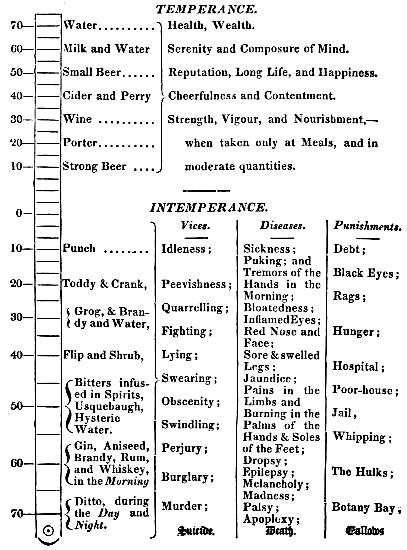
A
MORAL AND PHYSICAL
THERMOMETER;
OR, A
SCALE OF THE PROGRESS
OF
TEMPERANCE AND INTEMPERANCE.
———
Liquors, with their Effects in their usual Order.
Conclusion.
Thus we have conducted our reader through some of the principal
curiosities of Nature and Art, Science and Literature. We trust he has
found both amusement and instruction. Our object has been, throughout the
work, to assist the reader in looking through Nature up to Nature’s God.
All second causes derive their origin, permanency, and efficacy from Him
alone.
Since, then, the Lord God is himself the source and perfection of all
beauty and excellency, the author of our existence, and the bountiful
giver of all good gifts; we undoubtedly ought to love him with our whole
hearts, and to serve him with all our powers; we ought to reverence his
majesty and authority, and endeavour above all things to obtain his
favour; we ought to devote ourselves entirely to his service, and make all
our actions tend to the advancement of his glory. And as his mercy and
goodness are unbounded, so should be our gratitude and praise.
Jehovah reigns: let ev’ry nation hear,
And at his footstool bow with holy fear;
Let heav’n’s high arches echo with his name.
And the wide-peopled earth his praise proclaim;
Then send it down to hell’s deep gloom resounding,
Thro’ all her caves in dreadful murmurs sounding.
He rules with wide and absolute command
O’er the broad ocean and the stedfast land:
Jehovah reigns, unbounded and alone,
And all creation hangs beneath his throne:
He reigns alone; let no inferior nature
Usurp or share the throne of the Creator.
He saw the struggling beams of infant light
Shoot thro’ the massy gloom of ancient night;
His spirit hush’d the elemental strife,
And brooded o’er the kindling seeds of life:
Seasons and months began the long procession,
And measur’d o’er the year in bright succession.
The joyful sun sprung up th’ ethereal way,
Strong as a giant, as a bridegroom gay;
And the pale moon diffus’d her shadowy light,
Superior o’er the dusky brow of night;
Ten thousand glittering lamps the skies adorning,
Num’rous as dew-drops from the womb of morning.
Earth’s blooming face with rising flow’rs he dress’d,
And spread a verdant mantle o’er her breast;
Then from the hollow of his hand he pours
The circling waters round her winding shores,
The new-born world in their cool arms embracing,
And with soft murmurs still her banks caressing.
At length she rose complete in finish’d pride,
All fair and spotless like a virgin bride:
Fresh with untarnish’d lustre as she stood,
Her Maker bless’d his work, and call’d it good;
The morning stars with joyful acclamation,
Exulting sung, and hail’d the new creation.
Yet this fair world, the creature of a day,
Tho’ built by God’s right hand, must pass away;
And long oblivion creep o’er mortal things,
The fate of empires, and the pride of kings:
Eternal night shall veil their proudest story,
And drop the curtain o’er all human glory.
The sun himself, with weary clouds opprest,
Shall in his silent dark pavilion rest;
His golden urn shall broke and useless lie,
Amidst the common ruins of the sky!
The stars rush headlong in the wild commotion,
And bathe their glittering foreheads in the ocean.
But fix’d, O God! for ever stands thy throne,
Jehovah reigns, a universe alone;
Th’ eternal fire that feeds each vital flame,
Collected or diffus’d, is still the same.
He dwells within his own unfathom’d essence,
And fills all space with his unbounded presence.
But oh! our highest notes the theme debase,
And silence is our least injurious praise:
Cease, cease your songs, the daring flight control,
Revere him in the stillness of the soul;
With silent duty meekly bend before him,
And deep within your inmost hearts—adore him.
Mrs. Barbauld.
APPENDIX
TO THE
BOOK OF CURIOSITIES;
CONTAINING
CURIOUS EXPERIMENTS,
AND
AMUSING RECREATIONS,
WHICH MAY BE PERFORMED WITH EASE,
AND AT A SMALL EXPENSE.
A Person having an even Number of Counters in one Hand, and an odd Number
in the other, to tell in which Hand each of them is.
Desire the person to multiply the number in his right hand by three, and
the number in his left by two.
Bid him add the two products together, and tell you whether the sum be odd
or even.
If it be even, the even number is in the right hand; but if it be odd, the
even number is in the left hand.
| |
Example I. |
| No. in right hand. |
|
No. in left hand. |
| 18 |
|
7 |
| 3 |
|
2 |
| — |
|
— |
| 54 |
54 |
14 |
| |
14 |
| |
— |
| |
68 sum of the products. |
| |
Example II. |
| No. in right hand. |
|
No. in left hand. |
| 7 |
|
18 |
| 3 |
|
2 |
| — |
|
— |
| 21 |
36 |
36 |
| |
21 |
| |
— |
| |
57 sum of the products. |
A Person having fixed on a Number in his Mind, to tell him what Number it is.
Bid him quadruple the number thought on, or multiply it by 4; and having
done this, desire him to add 6, 8, 10, or any even number you please, to
the product; then let him take the half of this sum, and tell you how much
it is; from which, if you take away half the number you desired him at
first to add to it, there will remain the double of the number thought on.
Example.
| Suppose the number thought on is |
|
5 |
| The quadruple of it is |
|
20 |
| 8 added to the product is |
|
28 |
| And the half of this sum |
|
14 |
| 4 taken from this leaves |
|
10. | — |
Therefore 5 was the number thought on.
Another Method of discovering a Number thought on.
After the person has fixed on a number, bid him double it, and add 4 to
that sum; then let him multiply the whole by 5, and to that product add
12; desire him also to multiply this sum by 10, and after having deducted
302 from the product, to tell you the remainder, from which, if you cut
off the last two figures, the number that remains will be the one thought
on.
Example.
| Let the number thought on be |
|
7 |
| Then the double of this is |
|
14 |
| And 4 added to it makes |
|
18 |
| This multiplied by 5 is |
|
90 |
| And 12 added to it is |
|
102 |
| And this multiplied by 10 is |
|
1020 |
| From which deducting |
|
302 |
| There remains |
|
718, | — |
which, by striking off the last two figures, gives 7,—the number thought
on.
To tell the Number a Person has fixed upon, without asking him any
Questions.
The person having chosen any number in his mind, from 1 to 15, bid him add
one to it, and triple the amount. Then,
If it be an even number, let him take the half of it, and triple that
half; but if it be an odd number, he must add 1 to it, and then halve it,
and triple that half.
In like manner let him take the half of this number, if it be even, or the
half of the next greater, if it be odd; and triple that half.
Again, bid him take the half of this last number, if even, or of the next
greater, if odd; and the half of that half in the same way; and by
observing at what steps he is obliged to add 1 in the halving, the
following table will shew the number thought on:
| 1—0—0 |
|
— 4— 8 |
| 2—0—0 |
|
—13— 5 |
| 3—0—0 |
|
— 3—11 |
| 1—2—0 |
|
— 2—10 |
| 1—3—0 |
|
— 8— 0 |
| 1—2—3 |
|
— 6—14 |
| 2—3—0 |
|
— 1— 9 |
| 0—0—0 |
|
—15— 7 |
Thus, if he be obliged to add 1 only at the first step, or halving, either
4 or 8 was the number thought on; if there were a necessity to add 1 both
at the first and second steps, either 2 or 10 was the number thought on,
&c.
And which of the two numbers is the true one may always be known from the
last step of the operation; for if 1 must be added before the last half
can be taken, the number is in the second column, or otherwise in the
first, as will appear from the following examples:
| Suppose the number chosen to be |
|
9 |
| To which, if we add |
|
1 |
| The sum is |
|
10 |
| Then the triple of that number is |
|
30 |
| 1. The half of which is |
|
15 |
| The triple of 15 is |
|
45 |
| 2. And the half of that is |
|
23 |
| The triple of 23 is |
|
69 |
| 3. The half of that is |
|
35 |
| And the half of that is |
|
18 |
From which it appears, that it was necessary to add 1 both at the second
and third steps, or halvings; and therefore, by the table, the number
thought on is either 1 or 9. And as the last number was obliged to be
augmented by 1 before the half could be taken, it follows also, by the
above rule, that the number must be in the second column; and consequently
it is 9.
| Again, suppose the number thought on to be |
|
6 |
| To which, if we add |
|
1 |
| The sum is |
|
7 |
| Then the triple of that number is |
|
21 |
| 1. The half of which is |
|
11 |
| The triple of 11 is |
|
33 |
| 2. And the half of that is |
|
17 |
| The triple of 17 is |
|
51 |
| 3. The half of that is |
|
26 |
| And the half of that half is |
|
13 |
From which it appears, that it was necessary to add 1 at all the steps, or
halvings, 1, 2, 3, therefore, by the table, the number thought on is
either 6 or 14.
And as the last number required no augmentation before its half could be
taken, it follows also, by the above rule, that the number must be in the
first column; and consequently it is 6.
A curious Recreation, usually called—The Blind Abbess and her Nuns.
A blind abbess visiting her nuns, who were twenty-four in number, and
equally distributed in eight cells, built at the four corners of a square,
and in the middle of each side, finds an equal number in every row,
containing three cells. At a second visit, she finds the same number of
persons in each row as before, though the company was increased by the
accession of four men. And coming a third time, she still finds the same
number of persons in each row, though the four men were then gone, and had
each of them carried away a nun.
| Fig. 1. |
|
Fig. 2. |
|
Fig. 3. |
| 3 |
3 |
3 |
|
2 |
5 |
2 |
|
4 |
1 |
4 |
| 3 |
|
3 |
|
5 |
|
5 |
|
1 |
|
1 |
| 3 |
3 |
3 |
|
2 |
5 |
2 |
|
4 |
1 |
4 |
Let the nuns be first placed as in fig. 1, three in each cell; then when
the four men have got into the cells, there must be a man placed in each
corner, and two nuns removed thence to each of the middle cells, as in
fig. 2, in which case there will evidently be still nine in each row; and
when the four men are gone, with the four nuns with them, each corner cell
must contain four nuns, and every other cell one, as in fig. 3; it being
evident, that in this case also, there will still be nine in a row, as
before.
Any Number being named, to add a Figure to it, which shall make it
divisible by 9.
Add the figures together in your mind which compose the number named; and
the figure which must be added to this sum, in order to make it divisible
by 9, is the one required.
Suppose, for example, the number named was 8654; you find that the sum of
its figures is 23; and that 4 being added to this sum will make it 27;
which is a number exactly divisible by 9.
You therefore desire the person who named the number 8654, to add 4 to it;
and the result, which is 8658, will be divisible by 9, as was required.
This recreation may be diversified, by your specifying, before the sum is
named, the particular place where the figure shall be inserted, to make
the number divisible by 9; for it is exactly the same thing, whether the
figure be put at the end of the number, or between any two of its digits.
A Person having made choice of several Numbers, to tell him what Number
will exactly divide the Sum of those which he has chosen.
Provide a small bag, divided into two parts; into one of which put several
tickets, numbered 6, 9, 15, 36, 63, 120, 213, 309, or any others you
please, that are divisible by 3, and in the other part put as many
different tickets marked with the number 3 only.
Draw a handful of tickets from the first part, and, after shewing them to
the company, put them into the bag again; and having opened it a second
time, desire any one to take out as many tickets as he thinks proper.
When he has done this, open privately the other part of the bag, and tell
him to take out of it one ticket only.
You may then pronounce, that this ticket shall contain the number by which
the amount of the other numbers is divisible; for, as each of these
numbers is some multiple of 3, their sum must evidently be divisible by
that number.
This recreation may also be diversified, by marking the tickets in one
part of the bag with any numbers which are divisible by 9, and those in
the other part of the bag with the number 9 only; the properties of both 9
and 3 being the same; or if the numbers in one part of the bag be
divisible by 9, the other part of the bag may contain tickets marked both
with 9 and 3, as every number divisible by 9 is also divisible by 3.
To find the Difference between any two Numbers, the greater of which is
unknown.
Take as many 9’s as there are figures in the less number, and subtract the
one from the other.
Let another person add that difference to the larger number; and then, if
he take away the first figure of the amount, and add it to the remaining
figures, the sum will be the difference of the two numbers, as was
required.
Suppose, for example, that Matthew, who is 22 years of age, tells Henry,
who is older, that he can discover the difference of their ages.
He privately deducts 22, his own age, from 99, and the difference, which
is 77, he tells Henry to add to his age, and to take away the first figure
from the amount.
Then if this figure, so taken away, be added to the remaining ones, the
sum will be the difference of their ages; as, for instance:
| The difference between Matthew’s age and 99, is |
|
77 |
| To which Henry adding his age |
|
35 |
| The sum will be |
|
112 |
| And 1, taken from 112, gives |
|
12 |
| Which being increased by |
|
1 |
| Gives the difference of the two ages |
|
13 |
| And, this added to Matthew’s age |
|
22 |
| Gives the age of Henry, which is |
|
35 |
A Person striking a Figure out of the Sum of two given Numbers, to tell
him what that Figure was.
Such numbers must be offered as are divisible by 9; such, for instance, as
36, 63, 81, 117, 126, 162, 207, 216, 252, 261, 306, 315, 360, and 432.
Then let a person choose any two of these numbers, and after adding them
together in his mind, strike out any one of the figures he pleases, from
the sum.
After he has done this, desire him to tell you the sum of the remaining
figures; and that number which you are obliged to add to this amount, in
order to make it 9, or 18, is the one he struck out.
For example, suppose he chose the numbers 126 and 252, the sum of which is
378.
Then, if he strike out 7 from this amount, the remaining figures, 3 and 8,
will make 11; to which 7 must be added to make 18.
If he strike out the 3, the sum of the remaining figures, 7 and 8, will be
15; to which 3 must be added, to make 18; and so in like manner, for the
8.
By knowing the last Figure of the Product of two Numbers, to tell the
other Figures.
If the number 73 be multiplied by each of the numbers in the following
arithmetical progression, 3, 6, 9, 12, 15, 18, 21. 24, 27, the products
will terminate with the nine digits, in this order, 9, 8, 7, 6, 5, 4, 3,
2, 1; the numbers themselves being as follows, 219, 438, 657, 876, 1095,
1314, 1533, 1752, and 1971.
Let therefore a little bag be provided, consisting of two partitions, into
one of which put several tickets, marked with the number 73; and into the
other part, as many tickets numbered 3, 6, 9, 12, 15, 18, 21, 24, and 27.
Then open that part of the bag which contains the number 73, and desire a
person to take out one ticket only; after which, dexterously change the
opening, and desire another person to take a ticket from the other part.
Let them now multiply their two numbers together, and tell you the last
figure of the product, and you will readily determine, from the foregoing
series, what the remaining figures must be.
Suppose, for example, the numbers taken out of the bag were 73, and 12;
then, as the product of these two numbers, which is 876, has 6 for its
last figure, you will readily know that it is the fourth in the series,
and that the remaining figures are 87.
A curious Recreation with a Hundred Numbers, usually called the Magical
Century.
If the number 11 be multiplied by any one of the nine digits, the two
figures of the product will always be alike, as appears from the following
example:—
| 11 |
|
11 |
|
11 |
|
11 |
|
11 |
|
11 |
|
11 |
|
11 |
|
11 |
| 1 |
|
2 |
|
3 |
|
4 |
|
5 |
|
6 |
|
7 |
|
8 |
|
9 |
| 11 |
|
22 |
|
33 |
|
44 |
|
55 |
|
66 |
|
77 |
|
88 |
|
99 |
Now, if another person and yourself have fifty counters apiece, and agree
never to stake more than ten at a time, you may tell him, that if he will
permit you to stake first, you will always undertake to make the even
century before him.
In order to this you must first stake one, and remembering the order of
the above series, constantly add to what he stakes as many as will make
one more than the numbers 11, 22, 33, &c. of which it is composed, till
you come to 89; after which, the other party cannot possibly make the even
century himself, or prevent you from making it.
If the person who is your opponent have no knowledge of numbers, you may
stake any other number first, under 10, provided you afterwards take care
to secure one of the last terms, 56, 67, 78, &c.: or you may even let him
stake first, provided you take care afterwards to secure one of these
numbers.
This recreation may be performed with other numbers; but, in order to
succeed, you must divide the number to be attained, by a number which is
an unit greater than what you can stake each time; and the remainder will
then be the number you first stake. Suppose, for example, the number to be
attained is 52, and that you are never to add more than six; then dividing
52 by 7, the remainder, which is 3, will be the number you must stake
first; and whatever the other stakes, you must add as much to it as will
make it equal to 7, the number by which you divided; and so on.
A Person in Company having privately put a Ring on one of his fingers, to
Name the Person, the Hand, the Finger, and even the Joint on which it is
placed.
Desire a third person to double the number of the order in which the
wearer of the ring stands, and add 5 to that number, then multiply that
sum by 5, and to the product add 10. Let him then add 1 to the last
number, if the ring be on the right hand, and 2 if on the left, and
multiply the whole by 10: to this product he must add the number of the
finger, beginning with the thumb, and multiply the whole again by 10.
Desire him then to add the number of the joint; and lastly, to increase
the whole by 35.
This being done, he is to declare the amount of the whole, from which you
are to subtract 3535; and the remainder will consist of four figures, the
first of which will give the place in which the person stands, the second
the hand, 1 denoting the right, and 2 the left hand, the third number the
finger, and the fourth the joint.
Example.
Suppose the person stands the second in order, and has put the ring on the
second joint of the little finger of the left hand:
| Double the order is |
|
4 |
| Add |
|
5 |
| |
9 |
| Multiply by |
|
5 |
| |
45 |
| Add |
|
10 |
| |
55 |
| Number for left hand |
|
2 |
| |
57 |
| Multiply by |
|
10 |
| |
570 |
| Number of finger |
|
5 |
| |
575 |
| Multiply by |
|
10 |
| |
5750 |
| Number of joint |
|
2 |
| |
5752 |
| Add |
|
35 |
| |
5787 |
| Subtract |
|
3535 |
| |
2252 |
Hence it will appear that the first 2 denotes the second person in order,
the second 2 the left hand, 5 the little finger, and 2 the second joint.
To make a Deaf Man hear the Sound of a Musical Instrument.
It must be a stringed instrument, with a neck of some length, as a lute, a
guitar, or the like; and before you begin to play, you must by signs
direct the deaf man to take hold with his teeth of the end of the neck of
the instrument; for then, if one strikes the strings with the bow one
after another, the sound will enter the deaf man’s mouth, and be conveyed
to the organ of hearing through a hole in the palate, and thus the deaf
man will hear with a great deal of pleasure the sound of the instrument,
as has been several times experienced; nay, those who are not deaf may
make the experiment upon themselves, by stopping their ears so as not to
hear the instrument, and then holding the end of the instrument in their
teeth, while another touches the strings.
When two Vessels or Chests are like one another, and of equal Weight,
being filled with different Metals, to distinguish the one from the
other.
This is easily resolved, if we consider that two pieces of different
metals, of equal weight in air, do not weigh equally in water, because
that of the greatest specific gravity takes up a lesser space in water; it
being a certain truth, that any metal weighs less in water than in air, by
reason of the water, the room of which it fills; for example, if the water
weighs a pound, the metal will weigh in that water a pound less than in
the air: this gravitation diminishes more or less, according as the
specific gravity of the metal is greater than that of the water.
We will suppose, then, two chests perfectly like one another, of equal
weight in the air, one of which is full of gold, and the other of silver;
we weigh them in water, and that which then weighs down the other must
needs be the gold chest, the specific gravity of gold being greater than
that of silver, which makes the gold lose less of its gravitation in water
than silver. We know by experience, that gold loses in water about an
eighteenth part only, whereas silver loses near a tenth part; so that if
each of the two chests weighs in the air, for example, 180 pounds, the
chest that is full of gold will lose in the water ten pounds of its
weight; and the chest that is full of silver will lose eighteen: that is,
the chest full of gold will weigh 170 pounds, and that of silver only 162.
Or, if you will, considering that gold is of a greater specific gravity
than silver, the chest full of gold, though similar and of equal weight
with the other, must needs contain a less bulk, and consequently it
contains the gold.
To find the Burden of a Ship at Sea, or in a River.
It is a certain truth, that a ship will carry a weight equal to that of a
quantity of water of the same bulk with itself; subtracting from it the
weight of the iron about the ship, for the wood is of much the same weight
with water; and so, if it were not for the iron, a ship might sail full of
water.
The consequence of this is, that, however a ship be loaded, it will not
totally sink, as long as the weight of its cargo is less than that of an
equal bulk of water: now, to know this bulk or extent, you must measure
the capacity or solidity of the ship, which we here suppose to be 1000
cubical feet, and multiply that by 73 pounds, the weight of a cubical foot
of sea-water; then you have in the product 73,000 pounds for the weight of
a bulk of water equal to that of the ship; so that in this example, we may
call the burden of the ship 73,000 pounds, or 36½ tons, reckoning a ton
2,000 pounds, that being the weight of a ton of sea-water; if the cargo of
this ship exceeds 36½ tons, she will sink; and if her loading is just
73,000 pounds, she will swim very deep in the water upon the very point of
sinking; so that she cannot sail safe and easy, unless her loading be
considerably short of 73,000 pounds weight; if the loading come near to
73,000 pounds, as being, for example, just 36 tons, she will swim at sea,
but will sink when she comes into the mouth of a fresh water river; for
this water being lighter than sea-water will be surmounted by the weight
of the vessel, especially if that weight is greater than the weight of an
equal bulk of the same water.
To Measure the Depth of the Sea.
Tie a great weight to a very long cord, or rope, and let it fall into the
sea till you find it can descend no further, which will happen when the
weight touches the bottom of the sea: if the quantity or bulk of water,
the room of which is taken up by the weight, and the rope, weighs less
than the weight and rope themselves; for if they weigh more, the weight
would cease to descend, though it did not touch the bottom of the sea.
Thus one may be deceived in measuring the length of a rope let down into
the water, in order to determine the depth of the sea; and therefore, to
prevent mistakes, you had best tie to the end of the same rope another
weight heavier than the former, and if this weight does not sink the rope
deeper than the other did, you may rest assured that the length of the
rope is the true depth of the sea; if it does sink the rope deeper, you
must tie a third weight, yet heavier, and so on, till you find two weights
of unequal gravitation, that run just the same length of the rope, upon
which you may conclude, that the length of the wet rope is certainly the
same with the depth of the sea.
Method of Melting Steel, and causing it to Liquefy.
Heat a piece of steel in the fire, almost to a state of fusion, then
holding it with a pair of pincers or tongs, take in the other hand a stick
of brimstone, and touch the piece of steel with it: immediately after the
contact, you will see the steel melt and drop like a liquid.
How to dispose two little Figures, so that one shall light a Candle, and
the other put it out.
Take two little figures of wood or clay, or any other materials you
please, only taking care that there is a little hole at the mouth of each:
put in the mouth of one a few grains of bruised gunpowder, and a little
bit of phosphorus in the mouth of the other, taking care that these
preparations are made beforehand.
Then take a lighted wax candle, and present it to the mouth of the figure
with the gunpowder, which, taking fire, will put the candle out; then
present your candle, having the snuff still hot, to the other figure; it
will immediately light again by means of the phosphorus.
You may propose the same effects to be produced by two figures drawn on a
wall with a pencil or coal, by applying with a little starch, or water, a
few grains of bruised gunpowder to the mouth of one, and a bit of
phosphorus to the mouth of the other.
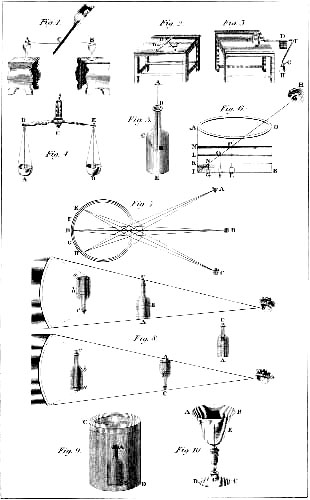
The Camera Obscura, or Dark Chamber.
We shall here give a short description of this optical invention; for
though it is very common, it is also very pleasing: but every one knows
not how to construct it.
Make a circular hole in the shutter of a window, from whence there is a
prospect of the fields, or any other object not too near: and in this hole
place a convex glass, either double or single, whose focus is at the
distance of five or six feet: the distance should not be less than three
feet; if it be, the images will be too small, and there will not be
sufficient room for the spectators to stand conveniently; on the other
hand, the focus should never be more than fifteen or twenty feet, for
then the images would be obscure, and the colouring faint; the best
distance is from six to twelve feet:—take care that no light enters the
room but by this glass: at a distance from it, equal to that of its focus,
place a pasteboard, covered with the whitest paper; this paper should have
a black border, to prevent any of the side rays from disturbing the
picture; let it be two feet and a half long, and eighteen or twenty inches
high; bend the length of it inwards to the form of part of a circle, whose
diameter is equal to double the focal distance of the glass: then fix it
on a frame of the same figure, and put it on a moveable foot, that it may
be easily fixed at that exact distance from the glass where the objects
paint themselves to the greatest perfection: when it is thus placed, all
the objects that are in the front of the window will be painted on the
paper in an inverted position; this inverted position of the images may be
deemed an imperfection, but it is easily remedied; for if you stand above
the board on which they are received, and look down on it, they will
appear in their natural position; or if you stand before it, and, placing
a common mirror against your breast in an oblique direction, look down in
it, you will there see the images erect, and they will receive an
additional lustre from the reflection of the glass: or place two lenses in
a tube that draws out: or, lastly, if you place a large concave mirror at
a proper distance before the picture, it will appear before the mirror in
the air, and in an erect position, with the greatest regularity, and in
the most natural colours.
If you place a moveable mirror without the window, by turning it more or
less, you will have on the paper all the objects that are on each side of
the window.
There is another method of making the dark chamber, which is by a
scioptric ball, that is, a ball of wood, through which a hole is made, in
which hole a lens is fixed; this ball is placed in a wooden frame, in
which it turns freely round: the frame is fixed to the hole in the
shutter, and the ball by turning about answers, in great part, the use of
the mirror on the outside of the window: if the hole in the window be no
bigger than a pea, the objects will be represented without any lens.
If instead of placing the mirror without the window, you place it in the
room, and above the hole, (which must then be made near the top of the
shutter,) you may receive the representation on a paper placed
horizontally on a table; and draw at your leisure all the objects that are
there painted.
Nothing can be more pleasing than this recreation, especially when the
objects are strongly enlightened by the sun; and not only land prospects,
but a sea-port, when the water is somewhat agitated, or at the setting of
the sun, presents a very delightful appearance.
This representation affords the most perfect model for painters, as well
for the tone of colours, as that gradation of shades occasioned by the
interposition of the air, which has been so justly expressed by some
modern painters.
It is necessary that the paper have a circular form, for otherwise, when
the centre of it was in the focus of the glass, the two sides would be
beyond it, and consequently the images would be confused: if the frame
were contrived of a spherical figure, and the glass were in its centre,
the representation would be still more accurate. If the object without be
at the distance of twice the focal length of the glass, the image in the
room will be of the same magnitude with the object.
The lights, shades, and colours in the camera obscura, appear not only
just, but, by the images being reduced to a smaller compass, much stronger
than in nature; add to this, that these pictures exceed all others, by
representing the motion of the several objects: thus we see the animals
walk, run, or fly, the clouds float in the air, the leaves quiver, the
waves roll, &c. and all in strict conformity to the laws of nature. The
best situation for a dark chamber is directly north, and the best time of
the day is noon.
To shew the Spots in the Sun’s Disk, by its image in the Camera Obscura.
Put the object-glass of a ten or twelve feet telescope into the scioptric
ball, and turn it about till it be directly opposite the sun: when the sun
is directly opposite the hole, the lens will itself be sufficient; or by
means of the mirror on the outside of the window, as in the last
recreation, in the focus of the lens, and you will see a clear bright
image of the sun, of about an inch diameter, in which the spots on the
sun’s surface will be exactly described.
As this image is too bright to be seen with pleasure by the naked eye, you
may view it through a lens, whose focus is six or eight inches diameter,
which, at the same time that it prevents the light from being offensive,
will, by magnifying both the image and the spots, make them appear to
greater advantage.
To magnify small Objects by means of the Sun’s Rays let into a dark
Chamber.
Let the rays of light that pass through the lens in the shutter be thrown
on a large concave mirror, properly fixed in a frame; then take a slip,
or thin plate of glass, and sticking any small object on it, hold it in
the incident rays, at a little more than the focal distance from the
mirror, and you will see, on the opposite wall, amidst the reflected rays,
the image of that object, very large, and extremely clear and bright. This
experiment never fails to give the spectator the highest satisfaction.
To cut a Looking-glass, or piece of Crystal, let it be ever so thick,
without the help of a Diamond, in the same shape as the Mark of the
Drawing made on it with Ink.
This remarkable operation unites utility with amusement; for being in the
country, or in a place where there is no glazier to be had, the following
means will answer the purpose without their help.
Take a bit of walnut-tree, about the thickness of a candle, and cut one of
its ends to a point; put that end in the fire, and let it burn till it is
quite red: while the stick is burning, draw on the glass or crystal, with
ink, the design or outline of the form in which you mean to cut it out:
then take a file, or bit of glass, and scratch a little the place where
you mean to begin your section; then take the wood red-hot from the fire,
and lay the point of it about the twentieth part of an inch, or thickness
of a guinea, from the marked place, taking care to blow always on that
point, in order to keep it red; following the drawing traced on the glass,
leaving, as before, about the twentieth part of an inch interval every
time that you present your piece of wood, which you must take care to blow
often.
After having followed exactly the outlines of your drawing, to separate
the two pieces thus cut, you need only pull them up and down, and they
will divide.
By the means of two plain Looking-glasses, to make a Face appear under
different forms.
Having placed one of the two glasses horizontally, raise the other to
about right angles over the first; and while the two glasses continue in
this posture, if you come up to the perpendicular glass, you will set your
face quite deformed and imperfect; for it will appear without forehead,
eyes, nose, or ears, and nothing will be seen but a mouth and a chin
boldly raised: do but incline the glass ever so little from the
perpendicular, and your face will appear with all its parts, excepting the
eyes and the forehead; stoop a little more, and you will see two noses and
four eyes; and then a little further, and you will see three noses and six
eyes;—continue to incline it still a little more, and you will see
nothing but two noses, two mouths, and two chins; and then a little
further again, and you will see one nose and one mouth; at last incline a
little further, that is, till the angle of inclination comes to be 44
degrees, and your face will quite disappear.
If you incline the two glasses, the one towards the other, you will see
your face perfect and entire; and by the different inclinations, you will
see the representation of your face, upright and inverted, alternately.
To know which of two different Waters is the lightest, without any
Scales.
Take a solid body, the specific gravity of which is less than that of
water, deal, or fir-wood, for instance, and put it into each of the two
waters, and rest assured that it will sink deeper in the lighter than in
the heavier water; and so, by observing the difference of the sinking, you
will know which is the lightest water, and consequently the wholesomest
for drinking.
To know if a suspicious Piece of Money is good or bad.
If it be a piece of silver that is not very thick, as a crown, or half a
crown, the goodness of which you want to try; take another piece of good
silver, of equal balance with it, and tie both pieces with thread or horse
hair to the scales of an exact balance, (to avoid the wetting of the
scales themselves,) and dip the two pieces thus tied, in water; for then,
if they are of equal goodness, that is, of equal purity, they will hang in
equilibrio in the water as well as in the air: but if the piece in
question is lighter in the water than the other, it is certainly false,
that is, there is some other metal mixed with it, that has less specific
gravity than silver, such as copper; if it is heavier than the other, it
is likewise bad, as being mixed with a metal of greater specific gravity
than silver, such as lead.
If the piece proposed is very thick, such as that crown of gold which
Hiero, king of Syracuse, sent to Archimedes, to know if the goldsmith had
put into it all the eighteen pounds of gold that he had given him for that
end; take a piece of pure gold of equal weight with the crown proposed,
viz. eighteen pounds; and without taking the trouble of weighing them in
water, put them into a vessel full of water, one after another, and that
which drives out most water, must necessarily be mixed with another metal
of less specific gravity than gold, as taking up more space, though of
equal weight.
To hold a Glass full of Water with the Mouth downwards, so that the Water
shall not run out.
Take a glass full of water, cover it with a cup that is a little hollow,
inverting the cup upon the glass; hold the cup firm in this position with
one hand, and the glass with the other; then with a jerk turn the glass
and the cup upside down, and so the cup will stand upright, and the glass
will be inverted, resting its mouth upon the interior bottom of the cup:
this done, you will find that part of the water contained in the glass
will run out by the void space between the bottom of the cup, and the brim
of the glass; and when that space is filled, so that the water in it
reaches the brim of the glass, all passage being then denied to the air,
so that it cannot enter the glass, nor succeed in the room of the water,
the water remaining in the glass will not fall lower, but continue
suspended in the glass.
If you would have a little more water descend into the cup, you must, with
a pipe or otherwise, draw the water out of the cup, to give passage to the
air in the glass; upon which, part of the water will fall into the glass
till it has stopped up the passage of the air afresh, in which case no
more will come down; or, without sucking out the water in the cup, you may
incline the cup and glass so that the water in the cup shall quit one side
of the brim of the glass, and so give passage to the air, which will then
suffer the water in the glass to descend till the passage is stopped
again.
This may likewise be resolved by covering the brim of the glass that is
full of water, with a leaf of strong paper, and then turn the glass as
above; and without holding your hand any longer upon the paper, you will
find it as it were glued for some time to the brim of the glass, and
during that time the water will be kept in the glass.
The Mysterious Watch.
Desire any person to lend you his watch, and ask if he thinks it will or
will not go when it is laid on the table: if he says it will, place it
over the end of a magnet, and it will presently stop; then mark with
chalk, or a pencil, the precise point where you placed the watch, and,
moving the position of the magnet, give the watch to another person, and
desire him to make the experiment; in which he not succeeding, give it to
a third person, at the same time replacing the magnet, and he will
immediately perform the experiment.
To make a Glass of Water appear to boil and sparkle.
Take a glass nearly full of water, or other liquor, and setting one hand
upon the foot of it to hold it fast, turn slightly one of the fingers of
your other hand upon the brim or edge of the glass, (having before
privately wet your finger,) and so passing softly on, with your finger
pressing a little, then the glass will begin to make a noise, the parts of
the glass will sensibly appear to tremble with notable rarefaction and
condensation, the water will shake, seem to boil, cast itself out of the
glass, and leap out by small drops, to the great astonishment of the
observers, if they are ignorant of the cause, which is only the
rarefaction of the parts of the glass, occasioned by the motion and
pressure of the finger.
How to make a Cork fly out of a Bottle.
Put a little chalk or pounded marble into a phial, and pour on some water,
with about a third part of sulphuric acid, and put in a cork: in a few
seconds, the cork will be sent off with great violence.
To produce Gas Light, on a small Scale.
Take an ordinary tobacco pipe, and nearly fill the bowl with small coals,
and stop the mouth of the bowl with any suitable luting, as pipe-clay, or
the mixture of sand and common clay, or, as clay is apt to shrink, of sand
and beer, and place the bowl in a fire between the bars of a grate, so
that the pipe may stand nearly perpendicular. In a few minutes, if the
luting be good, the gas will begin to escape from the stem of the pipe,
when, if a piece of lighted paper or candle be applied, it will take fire
and burn for several minutes with an intense light. When the light goes
out, a residuum of useful products will be found in the bowl.
Thunder Powder.
Take separately, three parts of good dry saltpetre, two parts of dry salt
of tartar, and pound them well together in a mortar; then add thereto one
part, or rather more, of flour of brimstone, and take care to pound and
mix the whole perfectly together: put this composition into a bottle with
a glass stopper, for use.
Put about two drams of this mixture in an iron spoon, over a moderate
fire, but not in the flame; in a short time it will melt, and go off with
an explosion like thunder or a loaded cannon.
To tell, by the Dial of a Watch, at what hour any Person intends to
rise.
Let the person set the hand of the dial to any hour he pleases, and tell
you what hour that is, and to the number of that hour you add, in your
mind, 12. After this, tell him to call the hour the index stands at that
which he has fixed upon; and by reckoning backwards from this number to
the former, it will bring him to the hour required.
Example.
Suppose the hour at which he intends to rise be 8, and that he has placed
the hand at 5.
Then, adding 12 to 5, you bid him call the hour at which the index stands,
the number on which he thought; and by reckoning back from this number to
17, it will bring him to 8, the hour required.
The following Experiment shews the Power of Attraction.
If we take two pieces of lead, as two musket or pistol balls, and with a
knife smooth two plane surfaces, and press them together, they will firmly
adhere.
Two plates of metal made very smooth, when rubbed with oil and put
together, will so firmly adhere, that it will require a great force to
separate them.
If two pieces of wood, or of glass, be wetted with water, and placed
together, the one may be lifted up by means of the other. Boys often have
a piece of leather on the end of a string, which they wet and put on a
stone, and thereby lift it up.
If we take a small tube of glass with a narrow bore, and put it in water,
the fluid will rise higher within the tube than in the vessel. The
narrower the tube is, the higher the water rises. This is called Capillary
Attraction. If we put two pieces of glass together, and place the lower
edge in water, it will rise between them, as it does in the capillary
tubes. This experiment may be made more pleasing, by putting a shilling or
a piece of paper between the two pieces of glass at one end. The water
will then rise in a curve line, called an hyperbola, higher and higher as
it recedes from the shilling or piece of paper, and the pieces of glass
get nearer to each other.
Place a balance equally poised, so that one scale may be made to touch
water in a vessel; considerable weight must be put in the other scale, to
make it rise up. Put three or four bits of cork to float in a basin of
water; they will gradually draw nearer to each other, and the more rapidly
as the distance diminishes.
Experiments to shew the Power of Repulsion.
Dip a ball in oil and put it in water; a ditch will be formed all round
it. Pour water on oiled paper, and it will run off.
Sprinkle water on a dusty floor, it rolls over it in globules. Sprinkle it
upon a floor that has been swept, and this will not be the case, as it
then comes in contact with the wood, and is diffused over it.
We may observe that rain water stands in globules on the leaves of
cabbages. If we blow up soap-bubbles, and let them fall on the carpet,
they will not for some time burst. Let them fall on the table, or any
smooth surface, and they will burst instantly.
If we pour as much water into a cup as it will possibly hold, we shall see
the water above the level of the sides, if the edge be dry, but otherwise
we shall not.
Lay a very fine needle, or a piece of tinfoil, on the surface of water,
and it will float, until it become wet, when it sinks.
Lay a piece of gold on mercury, and it will float on the surface; but if
depressed below the surface, it will sink to the bottom, like the needle
on water.
Experiments respecting the Centre of Gravity.
The centre of gravity is that part of a body, round which all its parts
are so equally balanced, that, if it be supported, the whole body will be
so too.
Take a book, and find, by trial, under what part the finger must be placed
to keep the book from falling; that point is the centre of gravity.
Take a rod, or stick, and find that place about the middle of it, under
which the finger being placed, it will be balanced; that is the centre of
gravity. The moment the centre of gravity ceases to be supported, the
whole body falls.
Move a piece of board to the edge of a table, and gradually farther and
farther off it; the instant the centre of gravity gets beyond the edge of
the table, the board falls.
Run the point of a knife much slanting into the same board, it may then be
brought much farther over the edge of the table than it could before, as
the knife, leaning the way of the table, brings the centre of gravity that
way.
Take a bottle, with a cork in it; stick in the middle of the cork a
needle, with the point, upwards; then take another cork, and with a knife
make a slit in one of its ends, in which place a shilling so far as to
make it fast; then take two forks, or penknives, and stick one on each
side the cork, slanting a little downwards; then place the edge of the
shilling on the point of the needle, and it will rest secure. It may be
made to revolve, with great rapidity, on the point of the needle, without
falling off.
The following Experiment shews the Power of Steam.
Put a little water in a bottle, and cork it securely, covering it with
sealing wax; then put the bottle into a kettle of water, and let it boil a
short time, and the steam will force out the cork.
Diminution of Heat by Evaporation.
Pour water on a piece of writing-paper, and hold it over a candle; it will
boil without burning the paper.
Water may be boiled in an egg-shell on the fire.
Experiment to ascertain the Strength of Spirits of Wine.
It is a common practice for apothecaries, in order to ascertain if spirit
of wine be sufficiently strong, to pour some into a cup upon some
gunpowder, and then to set fire to it. If the spirit be sufficiently
strong, after burning down to the gunpowder, it will make it go off; but
if too much water has been poured in, that will not take place, as, after
the spirit is consumed, there will still be water enough to keep the
powder wet.
To ascertain the Strength of Brine.
To ascertain the strength of brine for salting meat, it is usual to put an
egg in the boiling water, and gradually put in salt until the egg be made
to swim.
The following Experiments shew the Pressure and Elasticity of Air.
Put an empty bottle with a cork in it near the fire; the cork will be
driven out.
Get a vessel of hot water, and put a phial into it, with the mouth
downwards; the expanded air will bubble out. Let the water cool, or pour
cold water on the phial, of which the mouth has not been drawn above the
surface of the water, and as the air is now cooled, and occupies less
space, a considerable part of the bottle will be filled with water.
Boil a little water in a glass phial over a candle for a few minutes; then
invert the mouth of the phial in water, and, as it cools, the air will
contract, and water will be forced up the bottle, by the external air, to
occupy the vacant space.
Lay a weighty book on a bladder, and blow into it with a pipe, and the
book will be raised. Increase the weight on the bladder very much indeed,
and you may still raise it as before.
A bladder filled with air may be compressed, and the moment the force is
removed, it will recover its size. If thrown on the ground it will rise
like a ball.
Take a cup, and burn a few pieces of paper in it, the heat will expand the
air in it. Invert the cup now in a saucer of water, and, as the enclosed
air cools, it will return to its former density, and leave a vacuum, and
the pressure of the external air will force a great deal of water up into
the cup. If this experiment be performed with a large drinking-glass, the
water may be seen to rise in the glass.
The pressure of the air may be very sensibly felt, by putting the hole of
a common bellows over the knee, and then attempting to raise the upper
part of it.
Boil water in a glass phial over a candle for a few minutes, then suddenly
removing it, tie a piece of wetted bladder over the mouth, making it fast
with a string; the pressure of the air will stretch the bladder, if it do
not burst it.
Get a glass vessel, as a common tumbler, if no better be at hand, and put
a piece of wetted bladder over the mouth, pressing it down in the middle,
and then tie it firm with a string; then lay hold of the bladder in the
middle, and try to pull it straight, or level with the rest, and the
pressure of the external air will not permit it.
Do exactly the same as before, except that the vessel must be nearly full
of water. Turn the vessel upside-down, and the bladder will still continue
as it was placed, the pressure of the air overcoming the weight of the
water.
Though air be capable of compression, it makes a resistance, and that very
considerable. The ball of an air-gun has been burst asunder by
overcharging it. If bottles are filled too much, they may be burst in
attempting to cork them, from the air between the cork and the liquor
being too much condensed.
Put a common wine-glass, with the mouth downwards, into water; and to
whatever depth it may be plunged, the air will not allow much water to
rise into it, as may be seen by the inside of the glass not being wet. If
a bit of cork float inside of the glass, it will point out to the eye
still more clearly how high the water rises. This experiment, though so
very simple will illustrate the nature of the diving-bell.
Experiments respecting Sound.
Hold a tumbler sideways, and sprinkle a little dust, or powder of any
sort, on it; then strike the glass, and make it sound:—the dust keeps
dancing about whilst the sound continues; stop the sound, and the dust is
at rest.
The sound of a watch laid upon a long table, or upon a plank of wood,
will be heard much farther than it otherwise would.
When a vessel on the fire begins to boil, let a communication be made
between it and the ear, by means of the poker, and the sound is more
distinctly heard.
Tie a string round the end of a poker, and then, winding one end of the
string round the fore-finger of the one hand, and the other end of the
string round the fore-finger of the other; put the fingers into the ears,
and make the poker strike against a table, or any other object, and it
will sound like the bell of a church.
Tie a string round the end of a poker, as before, and hold the string with
your teeth; when the poker is made to strike against any object, as in the
last experiment, the same kind of sound will be transmitted through the
teeth.
Make a watch touch your teeth, and you will hear its beating more
distinctly.
When a pitchfork is struck, in order to pitch a tune, its end is put on
the table, and a greater sound is produced. If the pitchfork, after being
struck, be held to the teeth, its sound is still more distinct.
Having shut up both ears with cotton very closely, put your fingers on the
teeth of a person who speaks to you, and you will hear his voice.
Electrical Experiments.
If a piece of sealing-wax be rubbed briskly against the sleeve of your
coat, or any other woollen substance, for some time, and then held within
an inch or less of hair, feathers, bits of paper, or other light bodies;
they will be attracted, that is, they will jump up, and adhere to the wax.
If a tube of glass, or small phial, be rubbed in a similar manner, it will
answer much better. The bottle thus rubbed becomes electric; and when the
operation is performed in a dark room, small flashes of divergent flame,
ramified somewhat like trees bare of leaves, will dart into the air, from
many parts of the surface of the tube, to the distance of six or eight
inches, attended with a crackling noise; and sometimes sparks will fly
along the tube to the rubber at more than a foot distant.
Cut two bits of cork into the shape and size of a common pea. With a
needle, draw a thread through each of the corks, so that they may be made
to hang at the ends of the threads with a knot below them. Let the other
ends of the threads be inserted in the notch of a small piece of wood,
about a foot long, and an inch broad, and the thickness of a common match.
Lay the piece of wood over two wine-glasses, a few inches asunder, so that
the end of it, in which the threads are, may project over the edge of the
glass nearest it, and the corks may be in contact one with another. Take
another wine-glass, and, having rubbed it briskly with a piece of flannel,
or upon the skirt or sleeve of a woollen coat, hold its mouth to within
about an inch of the corks, and they will suddenly start asunder, and
continue so for some time.
Lay a pocket-watch upon a table, and take a common tobacco-pipe, and place
it on the face of the watch so that it may balance thereon; then, after
rubbing a wine-glass, as described in the former experiment, bring it to
within an inch of the smaller end of the tobacco-pipe, and by moving the
glass gently round in an horizontal circular track, you will cause the
pipe to turn round on the watch-glass, as the needle turns on its centre
in a mariner’s compass.
A curious Experiment made by Mr. Symmer, on the Electricity of Silk
Stockings.
This gentleman having frequently observed, that on putting off his
stockings in the evening, they made a crackling or snapping noise, and
that in the dark they emitted sparks of fire, was induced to examine on
what circumstances these electrical appearances depended. After a
considerable number of observations, directed to this point, he found that
it was the combination of white and black which produced the electricity,
and that the appearances were the strongest when he wore a white and a
black stocking upon the same leg. These, however, discovered no signs of
electricity while they were upon the leg, though they were drawn backwards
and forwards upon it several times; but the moment they were separated,
they were both of them found to be highly electrified, the white
positively, and the black negatively; and when they were held at a
distance from each other, they appeared inflated to such a degree, that
they exhibited the entire shape of the leg.
When two black or two white stockings were held together, they would repel
one another to a considerable distance; and when a white and black
stocking were presented to each other, they would be mutually attracted,
and rush together with great violence, joining as close as if they had
been so many folds of silk; and in this case their electricity did not
seem to have been in the least impaired by the shock of meeting, for they
would be again inflated, attract, repel, and rush together, as before.
When this experiment was performed with two black stockings in one hand,
and two white ones in the other, it exhibited a still more curious
spectacle. The repulsion of those of the same colour, and the attraction
of those of different colours, threw them into an agitation, and made
each of them catch at the opposite colour in a way that was very amusing.
What was also very remarkable in these experiments with a white and black
stocking, was, the power of electrical cohesion which they exhibited; Mr.
Symmer having found, that when they were electrified, and allowed to come
together, they frequently stuck so close to each other, that it required a
weight of sixteen or seventeen ounces to separate them, and this in a
direction parallel to their surfaces.
When one of the stockings was turned inside-out, it required twenty ounces
to separate them; and by having the black stockings new dyed, and the
white ones washed, and whitened in the fumes of sulphur, and then putting
them one within the other, it required three pounds three ounces to
separate them.
Trying this experiment with stockings of a more substantial make, he found
that, when the white stocking was put within the black one, so that its
outside was contiguous to the inside of the other, they raised near nine
pounds; and when the white stocking was turned inside-out, and put within
the black one, so that their rough surfaces were contiguous, they raised
fifteen pounds, which was ninety-two times the weight of the stockings.
And, in all these cases, he found that pressing them together with his
hands contributed much to strengthen the cohesion.
When the white and black stockings were in cohesion, and another pair,
more highly electrified, were separated from each other, and presented to
the former, their cohesion would be dissolved, and each stocking of the
second pair would catch hold of, and carry away with it, that of its
opposite co-lour; but if the degree of electricity of both pairs were
equal, the cohesion of the former would be weakened, but not dissolved,
and all the four would cohere together in one mass.
Mr. Symmer also observed, that white and black silk, when electrified, not
only cohered with each other, but they would also adhere to bodies with
broad, and even polished, surfaces, though those bodies were not
electrified. This he discovered, by throwing accidentally a stocking out
of his hand, which stuck to the paper-hangings of the room, and which, in
another experiment of this kind, continued hanging there nearly an hour.
Having stuck up the black and white stockings in this manner, he came with
another pair of stockings, highly electrified, and applying the white to
the black, and the black to the white, he carried them off from the wall,
each of them hanging to that which had been brought to it. The same
experiment also held with the painted boards of the room, and likewise
with the looking-glass, to the smooth surface of which, the white and
black stockings appeared to adhere more tenaciously than to either of the
former.
To suspend a Ring by a Thread that has been burnt.
The thread having been previously soaked in chamber lye, or common salt
and water, tie it to a ring, not larger than wedding-ring. When you apply
the flame of a candle to it, though the thread burn to ashes, it will yet
sustain the ring.
Chemical Illuminations.
Put into a middling-sized bottle, with a short wide neck, three ounces of
oil or spirit of vitriol, with twelve ounces of common water, and throw
into it, at different times, an ounce or two of iron filings. A violent
commotion will then take place, and white vapours will arise from the
mixture. If a taper be held to the mouth of the bottle, these vapours will
inflame, and produce a violent explosion; which may be repeated as long as
the vapours continue.
To make the Appearance of a Flash of Lightning when any one enters a Room
with a lighted Candle.
Dissolve camphor in spirit of wine, and deposit the vessel containing the
solution in a very close room, where the spirit of wine must be made to
evaporate by strong and speedy boiling. If any one then enters the room
with a lighted candle, the air will inflame; but the combustion will be so
sudden, and of so short duration, as to occasion no danger.
The Fiery Fountain.
If twenty grains of phosphorus, cut very small, and mixed with forty
grains of powdered zinc, be put into four drachms of water, and two
drachms of concentrated sulphuric acid be added thereto, bubbles of
inflamed phosphuretted hydrogen gas will quickly cover the whole surface
of the fluid in succession, forming a real fountain of fire.
A Lamp that will burn Twelve Months without replenishing.
Take a stick of phosphorus, and put it into a large dry phial, not corked,
and it will afford a light sufficient to discern any object in a room,
when held near it. The phial should be kept in a cool place, where there
is no great current of air, and it will continue its luminous appearance
for more than twelve months.
The Magic Oracle.
Get six blank cards, and write on them figures, or numbers, exactly
according to the following patterns.
No. I
| |
17 |
| |
19 |
|
3 |
| |
13 |
|
1 |
|
27 |
| |
21 |
|
5 |
|
29 |
|
47 |
| |
23 |
|
7 |
|
31 |
|
45 |
|
59 |
| 15 |
|
11 |
|
33 |
|
43 |
|
0 |
|
57 |
| |
9 |
|
35 |
|
41 |
|
55 |
|
0 |
| |
25 |
|
39 |
|
53 |
|
0 |
| |
37 |
|
0 |
|
0 |
| |
49 |
|
0 |
| |
51 |
No. II.
| |
14 |
| |
18 |
|
3 |
| |
15 |
|
2 |
|
35 |
| |
22 |
|
6 |
|
34 |
|
47 |
| |
19 |
|
10 |
|
31 |
|
46 |
|
59 |
| 23 |
|
11 |
|
30 |
|
43 |
|
0 |
|
58 |
| |
7 |
|
27 |
|
42 |
|
55 |
|
0 |
| |
26 |
|
39 |
|
54 |
|
0 |
| |
38 |
|
0 |
|
0 |
| |
50 |
|
0 |
| |
51 |
No. III.
| |
14 |
| |
13 |
|
7 |
| |
21 |
|
4 |
|
37 |
| |
23 |
|
5 |
|
36 |
|
47 |
| |
20 |
|
6 |
|
31 |
|
46 |
|
60 |
| 22 |
|
12 |
|
30 |
|
45 |
|
0 |
|
55 |
| |
15 |
|
29 |
|
44 |
|
0 |
|
0 |
| |
28 |
|
39 |
|
54 |
|
0 |
| |
38 |
|
0 |
|
0 |
| |
52 |
|
0 |
| |
53 |
No. IV.
| |
14 |
| |
15 |
|
10 |
| |
13 |
|
8 |
|
41 |
| |
26 |
|
9 |
|
40 |
|
47 |
| |
27 |
|
11 |
|
31 |
|
46 |
|
60 |
| 25 |
|
13 |
|
30 |
|
45 |
|
0 |
|
59 |
| |
12 |
|
29 |
|
44 |
|
0 |
|
0 |
| |
28 |
|
43 |
|
57 |
|
0 |
| |
42 |
|
0 |
|
24 |
| |
56 |
|
0 |
| |
58 |
No. V.
| |
22 |
| |
24 |
|
17 |
| |
26 |
|
16 |
|
49 |
| |
23 |
|
18 |
|
48 |
|
55 |
| |
25 |
|
20 |
|
31 |
|
54 |
|
60 |
| 27 |
|
21 |
|
30 |
|
53 |
|
0 |
|
5 |
| |
19 |
|
29 |
|
52 |
|
58 |
|
0 |
| |
28 |
|
51 |
|
57 |
|
0 |
| |
50 |
|
0 |
|
0 |
| |
0 |
|
0 |
| |
56 |
No. VI.
| |
38 |
| |
40 |
|
34 |
| |
39 |
|
32 |
|
49 |
| |
41 |
|
35 |
|
48 |
|
55 |
| |
43 |
|
37 |
|
47 |
|
54 |
|
60 |
| 42 |
|
33 |
|
46 |
|
53 |
|
0 |
|
59 |
| |
36 |
|
45 |
|
52 |
|
0 |
|
0 |
| |
44 |
|
51 |
|
57 |
|
0 |
| |
50 |
|
0 |
|
0 |
| |
56 |
|
0 |
| |
58 |
You deliver the cards to a person, and desire him to think of any number
from one to sixty; he is then to look at the cards, and say in which cards
the number he thought of is to be found; and you immediately tell him the
number thought of.
Explanation.
This surprising and ingenious recreation is done by means of a key number.
There is a key number in every card, viz. the last but one in the second
row from the top. From this explanation the reader will perceive that the
key numbers are 1, 2, 4, 8, 16, 32. Now whatever number is fixed on, from
1 to 60, will be readily found by privately adding together the key
numbers of the cards that contain the number thought on. For instance,
suppose a person thinks of number 43; he looks at the cards, and gives you
No. 1, 2, 4, 5, 6, as cards which contain the number thought on: you
expertly perceive that the key numbers are 1, 2, 8, 32; which numbers
added together make 43, the number thought on. Suppose he thinks of No.
15, he gives you No. 1, 2, 3, 4: the key numbers are 1, 2, 4, 8; which
added, make just 15; and so of all numbers from 1 to 60.
This recreation may be varied many ways; as, telling the age of a person,
&c.; but this is left to the ingenious reader’s taste and application.
Cheap and Easy Method of constructing a Voltaic Pile.
Mr. Mitchell, in his useful little work on natural philosophy, proposes
the following cheap and easy method of constructing a Voltaic Pile. Zinc
is one of the cheapest of metals, and may be easily melted, like lead. Let
the student cast twenty or thirty pieces, of the size of a penny-piece,
which may easily be done in moulds made in clay. Let him then get as many
penny-pieces, and as many pieces of paper, or cloth cut in the same shape,
and these he must dip in a solution of salt and water. In building the
pile, let him place a piece of zinc, wet paper, (the superabundant water
being squeezed out,) after which the copper; then zinc, paper, copper, &c.
until the whole be finished. The sides of the pile may be supported with
rods of glass, or varnished wood, fixed in the board on which it is built.
The following experiment may then be performed:—
Having wetted both hands, touch the lower part of the pile with one hand,
and the upper part with the other, constant, little shocks of electricity
will be felt until one hand be removed. If the hand be brought back, a
similar repetition of shocks will be felt. Put a basin of water near the
pile, and put the left hand into it, holding a wire, one end of which
touches the top of the battery or pile; then put the end of a silver spoon
between the lip and the gum, and with the other end of the spoon touch the
lower part of the pile; a strong shock is felt in the gum and in the hand.
Take the left hand from the water, but still keep hold of the wire, and
then perform the last experiment in the same manner, and a shock will be
felt in the gum only. Hold a silver spoon in one hand, and touch with it
the battery at the lower part, then touch the upper part with the tongue;
the bitter taste will be extreme.
In performing the above experiments, if, instead of the two ends of the
pile, the one end and the middle of it be touched, the sensations will not
be nearly so strong. If the student be desirous of having still more
sensible proofs of the effect of galvanism, let him hold a wire to the top
of the battery, and let him place one end of a silver spoon to the lower
part, and the other end within his mouth, so as to touch the gums; a
severe set of shocks will be felt. In performing this experiment, move the
spoon to the roof of the mouth, and a strong sensation will be felt. Let
the end of the spoon be run up the nose so as to touch the cartilaginous
bone; shocks like the stabs of a needle will be felt. Let the end of the
spoon be put under the eye-brow, close to the ball of the eye; a sensation
will be felt like the burning of red-hot iron, but which ceases the
instant the spoon is removed.
Magnetical Experiments.
The magnetic attraction will not be destroyed by interposing obstacles
between the magnet and the iron.
Lay a small needle on a piece of paper, and put a magnet under the paper;
the needle may be moved backwards and forwards.
Lay the needle on a piece of glass, and put the magnet under the glass; it
will still attract the needle. The same effects will take place if a board
be interposed between the magnet and the iron. This property of the magnet
has afforded the means of some very amusing deceptions.
A little figure of a man has been made to spell a person’s name. The hand,
in which was a piece of iron, rested on a board, under which a person,
concealed from view, with a powerful magnet, contrived to carry it from
letter to letter, until the word was made up.
The figure of a goose or swan, with a piece of iron concealed about the
head, is set to float in water. A rod, with a concealed magnet at the end,
is presented to the bird, and it swims after it. The effect is still more
amusing, when some food is put on the end of the rod.
The figure of a fish is thrown into the water, with a small magnet
concealed in its mouth. Of course, if a baited hook be suspended near it,
the magnet and iron, by mutual attraction, will bring the fish to the
bait.
Put a piece of iron in one scale of a balance, and an equal weight in the
other scale; bring a magnet under the scale which contains the iron, and
it will draw it down. Reverse this experiment, and put the magnet in the
scale, and balance it; bring the iron under it, and it will draw down the
magnet. Suspend a magnet by a string, and bring a piece of iron near it,
and it will attract.
If a magnet suspended by one string, and a piece of iron suspended by
another, be brought near one another, they will mutually attract each
other, and be drawn to a point between.
Suspend a magnet nicely poised by a thread, and it will point north and
south, the same end pointing invariably the same way.
Rub a fine needle with a magnet, and lay it gently on the surface of the
water; it will point north and south. Rub various needles with the magnet,
and run them through small pieces of cork, and put them to swim in water;
they will all point north and south, and the same end will invariably
point the same way. This mode of finding the north is sometimes of the
utmost service at sea, when the compass is destroyed.
Opposite poles attract; poles of the same name repel. Take two magnets, or
two needles rubbed with the magnet, and bring the north and south poles
together, and they attract.
Bring the north poles near each other, and they repel. Bring the south
poles near each other, and they repel. Rub a needle with a magnet, and run
it through a piece of cork, and put it to float in water. Hold a north
pole of a magnet near its north pole, and it will keep flying away to
avoid it. It may be chased from side to side of a basin. On the other
hand, an opposite pole will immediately attract.
Rub four or five needles, and you may lift them up as in a string, the
north pole of one needle adhering to the south pole of another.
Put a magnet under a piece of glass, and sprinkle iron-filings on it; they
will arrange themselves in a manner that will be very surprising. At each
pole will be a vast abundance standing erect, and there will be fewer and
fewer as they recede, until there are scarcely any in the middle. If the
iron-filings are sprinkled on the magnet itself, they will arrange
themselves in a manner very striking.
Lay a needle exactly between the north and south pole, it will move
towards neither.
Artificial Coruscations.
There is a method of producing artificial coruscations, or sparkling fiery
meteors, which will be visible not only in the dark but at noon-day, and
that from two liquors actually cold. Fifteen grains of solid phosphorus
are to be melted in about a drachm of water: when this is cold, pour upon
it about two ounces of oil of vitriol; let these be shaken together, and
they will at first heat, and afterwards they will throw up fiery balls in
great numbers, which will adhere like so many stars to the sides of the
glass, and continue burning for a considerable time; after this, if a
small quantity of oil of turpentine is poured in, without shaking the
phial, the mixture will of itself take fire, and burn very furiously. The
vessel should be large, and open at the top. Artificial coruscations may
also be produced by means of oil of vitriol and iron, in the following
manner:—Take a glass body capable of holding three quarts; put into it
three ounces of oil of vitriol and twelve ounces of water; then warming
the mixture a little, throw in, at several times, two ounces or more of
clean iron-filings; upon this, an ebullition and white vapours will arise;
then present a lighted candle to the mouth of the vessel, and the vapour
will take fire, and will afford a bright illumination, or flash like
lightning. Applying the candle in this manner several times, the effect
will always be the same; and sometimes the fire will fill the whole body
of the glass, and even circulate to the bottom of the liquor; at others,
it will only reach a little way down its neck. The great caution to be
used in this experiment is, in making the vapour of a proper heat; for, if
too cold, few vapours will arise; and, if made too hot, they will come too
fast, and only take fire in the neck of the glass, without any remarkable
coruscation.
To make an Egg enter a Phial without breaking.
Let the neck of a phial be ever so strait, an egg will go into it without
breaking, if it be first steeped in very strong vinegar, for in process of
time the vinegar does so soften it, that the shell will bend and extend
lengthways without breaking: and when it is in, cold water thrown upon it
will recover its primitive hardness, and, as Cardan says, its primitive
figure.
Light produced by Friction, even under Water.
Rub two pieces of fine lump sugar together in the dark; the effect is
produced, but in a much greater degree, by two pieces of silex, or quartz:
but that which affords the strongest light of any thing, is a white
quartz[25] from the
Land’s End, considerable quantities of which are
brought to Bristol, and enter into the composition of china ware. By means
of two pieces of such quartz, pretty forcibly rubbed together, you may
distinguish the time of the night by a watch: but, what is more
surprising, the same effect is produced equally strong by rubbing the
pieces of quartz together under water.
Rosin Bubbles.
The following account of a simple and curious experiment is extracted from
a letter written by Mr. Morey, of Oxford, New Hampshire, to Dr. Silliman,
the editor of the American Journal of Science and Arts.
“If the end of a copper tube, or of a tobacco-pipe stem, be dipped in
melted rosin, at a temperature a little above that of boiling water, taken
out and held nearly in a vertical position, and blown through, bubbles
will be formed of all possible sizes, from that of a hen’s egg down to
sizes which can hardly be discerned by the naked eye; and from their
silvery lustre, and reflection of the different rays of light, they have a
pleasing appearance. Some that have been formed these eight months, are as
perfect as when first made. They generally assume the form of a string of
beads, many of them perfectly regular, and connected by a very fine fibre;
but the production is never twice alike. If expanded by hydrogen gas, they
would probably occupy the upper part of the room.
“The formation of these bubbles is ascribed to a common cause, viz. the
distention of a viscous fluid by one that is aëriform; and their
permanency, to the sudden congelation of the rosin thus imprisoning the
air by a thin film of solid matter, and preventing its escape.”
A curious Hydraulic Experiment, called the Magical Bottle.
Take a small bottle, (see Plate) AB, Fig. 9, the neck of which must be
very narrow, and provide a glass vessel, CD, the height of which exceeds
that of the bottle about two inches; fill the bottle, by means of a small
funnel, with red wine, and place it in the vessel CD, which is to be
previously filled with water. Then, if the bottle be uncorked, the wine
will presently come out of it, and rise in form of a small column, to the
surface of the water; and at the same time the water entering the bottle,
will supply the place of wine; for water being specifically heavier than
wine, it will consequently subside to the lowest place, while the other
naturally rises to the top.
A similar effect will be produced, if the bottle be filled with water, and
the vessel with wine, for the bottle being placed in the vessel, in an
inverted position, the water will descend to the bottom of the vessel, and
the wine will rise in the bottle. The same effect may also be produced by
any other liquors, the specific gravities of which are considerably
different.
Another Hydraulic Experiment, called the Miraculous Vessel.
Take a tin vessel of about six inches in height, and three in diameter,
having a mouth of only a quarter of an inch wide, and in the bottom of the
vessel make a number of small holes, of a size sufficient to admit a
common sewing needle.
Plunge the vessel into water, with its mouth open, and when it is full,
cork it, and take it out again; then, as long as the vessel remains
corked, no water will come out of it; but as soon as it is uncorked, the
water will immediately issue from the small holes at the bottom. It must
be observed, however, that if the holes at the bottom of the vessel be
more than one-sixth of an inch in diameter, or if they be too numerous,
the experiment will not succeed; for, in this case, the pressure of the
air against the bottom of the vessel will not be sufficient to confine the
water.
A curious Hydraulic Experiment, called Tantalus’s Cup.
Take a glass, or any other vessel, (see Plate) ABCD, fig. 10. which has a
small bent pipe, EFG, open at each end, running through the middle of it;
then, if water or wine be poured into the glass, it will continue in it
till the tube is full up to the bend F, which should be a little lower
than the upper edge of the glass; but if, after this, you continue to pour
more liquor into it, it will endeavour, as usual, to rise higher in the
glass, but not finding room for a farther ascent in the tube, it will
descend through the part EG, and run out at the end G, as long as you
continue to put it in. To those who are unacquainted with the nature of
the syphon, the effect may perhaps appear something more extraordinary, if
the longest branch of the tube be concealed in the handle of the cup.
This is called the cup of Tantalus, from its resemblance to an experiment
of the same kind, by placing an upright image in the cup, and disposing
the syphon in such a manner, that, as soon as the water rises to the chin
of the image, it will begin to run out through the longest leg, in the
same manner as from the cup above-mentioned.
A curious Chemical Experiment, called the Tree of Diana.
Make an amalgam, without heat, of two drachms of leaf silver with one
drachm of quicksilver. Dissolve this amalgam two ounces, or a sufficient
quantity, of pure nitrous acid of a moderate strength: dilute the solution
in about a pound and a half of distilled water, agitate the mixture, and
preserve it for use in a glass bottle with a ground stopper. When you
would make your tree, put into a phial the quantity of an ounce of the
above preparation, and add to it about the size of a pea of amalgam of
gold or silver, as soft as butter: the vessel must then be left at rest,
and soon afterwards small filaments will appear to issue out of the ball
of amalgam, which quickly increase, and shoot out branches in the form of
shrubs.
A metallic arborisation, somewhat similar, may be produced in the
following manner:—Dissolve a little sugar of lead in water, and fill a
phial with the solution. Pass a wire through the cork, and affix to the
upper part of the wire a small bit of silver, or zinc, in such a manner
that it may be immersed in the solution not far from its surface. Set the
phial in some place where it may remain undisturbed, and in about
twenty-four hours you will perceive the lead beginning to shoot round the
wire: this process will continue going on slowly, till you have a
beautiful metallic tree. If you have a wide-mouthed phial, or glass jar,
the experiment may be pleasingly diversified, by arranging the wire in
various forms.
A remarkable Experiment, called Prince Rupert’s Drops.
Take up a small quantity of the melted matter of glass with a tube, and
let a drop of it fall into a vessel of water. This drop will have a small
tail, which, being broken, the whole substance of the drop will burst,
with great violence, into a fine powder, and give a little pain to the
hand, but do no hurt to it.
It is a remarkable circumstance in this experiment, that the bulb, or
body, will bear the stroke of a hammer, without breaking; but when the
tail is broken, the above-mentioned effect is produced. If the drop be
cooled in the air, the same effect will not take place; and if it be
ground away on a stone, nothing extraordinary appears; but if it be put
into the receiver of an air-pump, and then broken, the effect will be so
violent as to produce light.
How to make Sympathetic Inks of various Kinds.
By sympathetic inks, are meant those kinds of liquors, with which if any
characters be written, they will remain invisible, till some method is
used to give them a colour.
The first class of these inks consists of such as become visible by
passing another liquor over them, or by exposing them to the vapour of
that liquor.
The second, of those which do not appear so long as they are kept close,
but soon become visible on being exposed to the air.
The third, of such as become apparent by strewing or sifting some very
fine powder over them.
The fourth, of those which do not become visible till they are exposed to
the fire, or heated.
The fifth, like the fourth, of such as appear by heat, but disappear again
when the paper becomes cold, or has had a sufficient time to imbibe the
moisture of the air.
Sympathetic Inks of the First Class.—Put some litharge into strong
distilled vinegar, and let it stand for twenty-four hours; then strain it
off, and, after it is quite settled, put it into a bottle closely corked,
and preserve it for use. Having done this, put into a pint bottle two
ounces of quicklime, one ounce of orpiment in powder, and as much water as
will rise two or three fingers’ breadth above them; and when the solution
is made, pour the liquid gently off, and let it stand in the sun for two
or three days, observing to turn it five or six times each day.
When these liquors are ready for use, any letters written by the first,
being exposed to the vapours of the second, will quickly become visible;
and if you would have them disappear again, you must draw a sponge, or
pencil, dipt in aqua-fortis, or spirit of nitre, over them: and if, after
this, you would have them appear again, stay till the paper is quite dry,
and then pass the vivifying liquor, made of the solution of orpiment, over
them, as before.
Another Ink of this Class.—Dissolve bismuth in the nitrous acid, and
any letters written with this ink will become quite black, by being
exposed to the vapour of liver of sulphur, which is of so penetrating a
nature, that it will act upon the ink through a quire of paper, or even
the slight partition of a room.
A Sympathetic Gold Ink of the Second Class.—Put as much gold into a
small quantity of aqua-regia as will dissolve it, and then dilute it with
two or three times as much distilled water.
Also dissolve, in a separate vessel, fine pewter in aqua-regia; and when
it is well saturated, add to it an equal quantity of distilled water.
Then, if any characters be written with the solution of gold, put them in
the shade till they become quite dry, and they will not appear for the
first seven or eight hours, but if you dip a pencil, or small fine sponge,
in the solution of pewter, and draw it lightly over the invisible
characters, they will presently appear of a purple colour.
The purple colour of these letters may be effaced again, by wetting them
with aqua-regia, and may be produced a second time, by passing the
solution of pewter over them as before.
A Sympathetic Ink of the Second Class.—Dissolve fine silver in
aqua-fortis, and add some distilled water to the solution, in the same
manner as in the gold ink; then, whatever is written with this ink, will
remain invisible for three or four months, if it be kept close from the
air; but if it be exposed to the sun, it will appear in about an hour, of
a gray colour, like that of a slate.
Sympathetic Inks of the Third Class,—or such as become visible by
having any fine powder strewed over them,—may be composed of the
glutinous and colourless juice of any vegetable, the milk of animals, and
several other substances.
Sympathetic Inks of the Fourth Class,—are made by diluting acid of
vitriol with about three times its weight of common water, or as much as
will prevent it from corroding the paper. The juice of lemons, or onions,
will answer the same purpose; but either of them requires more heat than
the first, and will not keep so long.
A Green Ink of the Fifth Class.—Take zaffre in powder, and let it
remain dissolved in aqua-regia for twenty-four hours; after which pour the
liquor off clear, and, adding to it as much common water, keep it in a
bottle well corked. Then, if any characters be written with this ink, and
exposed to the fire, or strong rays of the sun, they will appear of a
lively green.
It is the peculiar property of this ink, that as soon as the paper becomes
cold again, the letters will disappear; and this alternate appearance and
disappearance may be repeated a great number of times, provided the heat
be not too great.
Other Sympathetic Inks.
A Yellow Ink of this kind may be made, by steeping the flowers of
marigolds seven or eight days in clear distilled vinegar, and then
pressing them out, and keeping the liquor well corked in a bottle for use.
For a Red invisible Ink,—take the pure spirit of vitriol, or that of
nitre, and add to it eight or ten times as much water, according as you
would have it more or less red.
For a Green Ink of this sort,—dissolve salt of tartar, the clearest and
driest you can procure, in a sufficient quantity of river water; and for
a Violet sympathetic Ink, express the juice of lemons, and keep it in a
bottle well corked.
Then, if any characters be written with one of these inks, they will
appear in their proper colours, the paper having been dipped in the
following liquor.
Take a sufficient quantity of the flowers of pansies, or common violets,
and after adding some water to them, strain the liquor through a cloth,
and keep it in a bottle for use.
A Sympathetic Ink which appears by being wetted with Water.
Mix alum with a sufficient quantity of lemon juice; then, if any letters
or characters be written with this mixture, they will be invisible till
they are wetted with water, which will make them appear of a grayish
colour, and quite transparent.
Or, you may write with a strong solution of roch-alum only, and when the
writing is dry, pour a small quantity of water over it, and it will appear
of a white colour, like that of the paper before it was wetted.
Also all saline liquors, such as vitriolic, nitrous, and marine acids,
diluted with water, the liquor of fixed vegetable alkalis, and even
vinegar, will produce the same effect.
If a little aqua-fortis be mixed with the water, the writing will dry
well, and not run out of its form when the paper is wetted.
A curious Recreation with Sympathetic Ink, called the Book of Fate.
Make a book, consisting of seventy or eighty leaves, and in the cover at
the end of it, let there be a case which opens next to the back, that it
may not be perceived. At the top of each right-hand page, write any
question you please; and at the beginning of the book, let there be a
table of those questions, with the number of the pages in which each is to
be found. Then write with common ink on separate papers, each about half
the size of the pages, the same questions that are in the book; and under
each of them, write the answer with the ink made with the litharge of
lead, or the solution of bismuth.
Soak a double paper in the vivifying ink, made of quicklime and orpiment,
or the liver of sulphur; and just before you make the experiment, place it
in the case that is in the cover of the book.
Having done this, deliver some of the papers on which the questions are
written, to the company; and after they have chosen such as they wish to
have answered, let them put them into those leaves where the same
questions are contained; then shutting the book for a few minutes, the
sulphureous spirit, with which the paper in the cover of the book is
impregnated, will penetrate the leaves, and make the answer visible, which
will be of a brown colour, and more or less deep, in proportion to the
time the book has been closed.
A curious Recreation, called the Transcolorated Writing.
Write on a paper, with a violet-coloured liquor, as many letters or words
as you please, and ask any person which he will choose to have the
writing,—yellow, green, or red. When he has made his choice, have a
sponge ready with three sides, which you can easily distinguish, and dip
each of its sides in one of the three sympathetic inks; then draw the side
of the sponge which corresponds to the colour the person has chosen, over
the writing, once only, and it will directly change to the colour
required.
An Experiment with Sympathetic Ink, called the Oracular Letters.
Write on several slips of paper different questions, and such as may be
answered by the name of some person: for example, Who is the merriest man
in company?—Answer, Mr. * * *. To whom will Miss * * * be
married?—Answer, To Mr. * * *. These questions are to be written in the
sympathetic ink of the fourth class, and exposed to the fire, and the
answers written in the same ink, and left invisible. The papers are then
to be folded in the form of letters, and in such a manner, that the part
where the name is written shall be directly under the seal; in which case,
the heat of the wax will make it visible. Then, if the letter be given to
the person who requires the answer, he will find it plainly written.
An Experiment with Sympathetic Ink, called Winter changed to Spring.
Take a print which represents winter, and trace over the trees, plants,
and ground, with the green sympathetic ink; observing to make some parts
deeper than others, according to their distance. When those parts are dry,
paint the other objects in their natural colours; then put the print into
a glazed frame, and cover the back of it with a paper, pasted over its
border only. When this print is exposed to the heat of a moderate fire, or
to the warm rays of the sun, all the grass and foliage will turn to a
pleasing green; and if a yellow tint be given to some parts of the print,
before the sympathetic ink be drawn over it, the green will be of
different shades, and the scene, that a minute before represented Winter,
will now be changed into Spring. When this print is placed in the cold,
Winter will appear again, and be again driven away by the warm rays of the
sun; and this alternate change of seasons may be repeated as often as you
please, provided the print be not made too hot.
A remarkable Experiment, called the Revivified Rose.
Take a rose that is quite faded, and throw in some common sulphur in a
chafing-dish of hot coal. Hold the rose over the fumes, and it will become
quite white; then dip it into a basin of water, and giving it to any one,
tell him to put it into his box or drawer, and after locking it, to give
you the key. About five or six hours afterwards, return him the key, and
when he unlocks his drawer, instead of the white rose he put into it, he
will find one perfectly red.
How to Write on Glass by means of the Rays of the Sun.
Dissolve chalk in aqua-fortis, to the consistence of milk, and add to it a
strong solution of silver; keep this liquor in a glass decanter, well
stopped, and cutting out from a paper the letters you wish to appear,
paste it on the decanter, and place it in the sun, in such a manner, that
its rays may pass through the spaces cut out of the paper, and fall on the
surface of the liquor; then will that part of the glass through which the
rays pass be turned black, while that under the paper will remain white;
but particular care must be taken that the bottle be not moved during the
time of the operation.
To produce different Colours, by pouring a colourless Liquor into a clean
Glass.
Take a strong solution of quicksilver, made with spirit of nitre; dilute
it with water, and pour it into a hot glass, rinsed in strong spirit of
sea-salt, and it will instantly become coloured. Or, if a solution of
silver, made with spirit of nitre, considerably diluted, be poured into a
glass, prepared in the manner above-mentioned, it will produce the same
effect. And if you pour hot water upon new-made crocus metallorum, and
put it into a clean glass, rinsed with any acid, it will produce an orange
colour.
To produce a Colour which appears and disappears by the Influence of the
Air.
Put into a decanter some volatile spirit, in which you have dissolved
copper filings, and you will have a fine blue tincture; and if the bottle
be stopped, the colour will soon return again; and this experiment may be
repeated a considerable number of times.
To turn a colourless Liquor Black, by adding a White Powder to it.
Put a hot weak pellucid infusion of galls into a glass, and throw into it
a grain of the vitriol of iron, calcined to whiteness, and considerably
heated; then, as it falls to the bottom, it will make a black cloud, which
will uniformly diffuse itself through the transparent liquor, and
gradually turn it black.
The same effect may also be produced by the addition of a little vitriol
of iron calcined to a yellow colour, or by the colcothar of vitriol
calcined to redness.
The black liquor, produced as above, may be rendered pellucid again, by
pouring the liquor hot into a glass rinsed with the pure acid of vitriol.
And to make this transparent liquor black again, pour to it as much hot
oil of tartar per deliquium as will saturate the acid, which has
attracted the metallic matter.
Freezing Mixture.
In the time of snow, a freezing mixture may easily be made, by mixing a
little snow and common salt in a basin near the fire. If water in an iron
cup or phial be put into this mixture, it will immediately be frozen; and
if pounded ice and common salt be added, it will have a still more
powerful effect.
Experiments with the Microscope.
They who possess this amusing instrument, may easily perform with it a
variety of pleasing experiments; among others, the following:—Leave some
vinegar exposed in a saucer, for a few days, to the open air; then place a
drop of it, by means of a clean pen, or a camel’s hair brush, on the
transparent object-plate of the microscope; and if the object-plate be
properly illuminated from below, you will observe in this drop of liquor
animals resembling some small eels, which are in continual motion.
If you slightly bruise some pepper-corns, and infuse them in water for a
few days, and then expose a drop of it to the microscope, a number of
animals of a different kind will be visible. These are of an oblong shape,
and, like the others, in continual motion, going backwards and forwards in
all directions, turning aside when they meet each other, or when their
passage is stopped by some obstacle.
In other infusions, as in that of new hay, differently shaped animalcules
will be found. When the drop in which they swim, and which to them is like
a pond, becomes diminished by evaporation, they gradually retire towards
the middle, where they accumulate, and at length perish when entirely
deprived of moisture. Previously to this, they appear in great distress,
writhe their bodies, and endeavour to escape from that state of uneasiness
which they evidently feel.
It the smallest quantity or drop of sulphuric acid be put into a drop of
the infusion which swarms with these insects, they immediately throw
themselves on their backs, and expire; sometimes losing their skin, which
bursts, and suffers small particles of air to escape.
Those who wish to be furnished with microscopic eels, at all seasons, may
have them in common paste, such as the bookbinders commonly use. It should
neither be too stiff, nor too watery. Expose it to the air, and prevent
its hardening or becoming mouldy on the surface, by beating it well
together, when it has that tendency. After some days it will become sour;
and then, if examined attentively by a microscope, multitudes of
exceedingly small, long, and slender animalcules will be visible; these
will grow larger, till they are of sufficient size to be seen by the naked
eye. A drop or two of vinegar should now and then be poured on the paste;
and sometimes, to prevent its being dry, a little vinegar and water. By
this means microscopic eels may be had all the year. They must be applied
to the microscope upon any flat surface, after having first put on it a
very small drop of water for them to swim in. These are very entertaining
objects when examined by any kind of microscope, but particularly the
solar one, by which the motions of their intestines may very plainly be
distinguished; and when the water is nearly dried away, and they are on
the point of expiring, their mouths may be seen opening to a considerable
width.
If some of the dust of the puff-ball be examined with the microscope, it
appears to consist of perfectly round globules, of an orange colour, the
diameter of which is only about the one-fiftieth part of the thickness of
a hair, so that each of this grain is but the 1⁄125000th part of a
globule, equal in diameter to the breadth of a hair.
The farina of flowers is found to be regularly or uniformly organized in
each kind of plant. In the mallow, for example, each grain is an opaque
ball, covered over with small points. The farina of the tulip, and of most
of the liliaceous kind of flowers, bears a striking resemblance to the
seeds of the cucumber: that of the poppy is like grains of barley.
There are certain plants, the leaves of which seem to be pierced with a
multitude of small holes. Of this kind is the St. John’s Wort. If a
fragment of this be viewed with a good microscope, the supposed holes are
found to be vesicles, contained in the thickness of the leaf, and covered
with an exceedingly thin membrane; and these are thought to be the
receptacles which contain the essential and aromatic oil peculiar to the
plant. The view exhibited by those plants which have down, such as borage,
nettles, &c. is exceedingly curious. When examined by a microscope, they
appear to be covered with spikes. Those of borage are, for the most part,
bent so as to form an elbow; and though really so close, they appear, by
the microscope, to be at a considerable distance from each other. The
entire appearance is very similar to that of the skin of a porcupine.
There are two kinds of sand, viz. the calcareous and the vitreous: the
former, examined with a microscope, resembles large irregular fragments of
rock; but the latter appears like so many rough diamonds. In some
instances, the particles of sand seem to be highly polished and brilliant,
like an assemblage of diamonds, rubies, and emeralds.
Charcoal is a fine object for the microscope: it is found to be full of
pores, regularly arranged, and passing through its whole length.
Those who wish to observe the circulation of the blood, by means of the
microscope, may readily obtain the desired satisfaction. An object
employed chiefly for this purpose is the delicate transparent membrane
which unites the toes of the frog; another object is the tail of the
tadpole. If this membrane be extended, and fixed on a piece of glass
illuminated below, the motion of the blood in the vessels will be
distinctly visible; the appearance resembles a number of small islands,
with a rapid current flowing between them.
Take a small tadpole, and, having wrapped its body in a piece of moist
cloth, place its tail on the object-plate of the microscope, and enlighten
it below, and you will see very distinctly the circulation of the blood;
which in some of the vessels proceeds by a kind of undulation, and in
others with a uniform motion. The former are thought to be the arteries in
which the blood moves, in consequence of the alternate pulsation of the
heart; the latter are said to be the veins. The circulation of the blood
may be seen also in the legs and tails of shrimps. The transparent legs of
small spiders, and those of bugs, will also afford the means of observing
the circulation of the blood to very great advantage. The latter are said,
by Mr. Baker, to exhibit an extraordinary vibration of the vessels, which
he never saw any where else. Very small fish are good objects for this
purpose; but the most curious of all spectacles of this kind, is that
exhibited by the mosentery of a living frog, applied in particular to the
solar microscope.
If you take off a small piece of the epidermis, or scarf skin, of the
hand, by means of a sharp razor, and place it on the object-plate of the
microscope, you will see it covered with a multitude of small scales, so
exceedingly minute, that, according to Leuwenhoek, a grain of sand would
cover two hundred of them. These scales are arranged like those on the
back of fishes, like the tiles of a house, each in part covering the
other. To ascertain the form of these little scales, scrape the skin with
a penknife, and put this dust into a drop of water, and it will be seen
that these scales, small as they are, have, in general, five planes, and
that each consists of several strata. Underneath these scales are the
pores of the epidermis, which, when the former are removed, may be
distinctly seen, apparently like small holes, pierced with an exceedingly
fine needle. In the length of an inch, twelve hundred have been counted,
so that, in a surface equal to a square inch, there are fourteen thousand;
and as there are one hundred and forty-four inches in a square foot, the
number of pores in a square foot of surface would be more than two
millions; and as the surface of the human body is reckoned at fourteen
feet, the number of pores in its surface, through which there is a
perpetual perspiration going on, must be more than twenty-eight millions.
The hairs of animals, seen through a microscope, appear to be organized
bodies: they are composed of long, slender, hollow tubes; some seem to be
composed of several small hairs, covered with a common bark; others are
hollow throughout. The bristles of a cat’s whisker, when cut transversely,
exhibit the appearance of a medullary part, which occupies the middle,
like the pith in the twig of the elder-tree. A human hair, cut in the same
manner, shews a variety of vessels in very regular figures. Hair taken
from the head, the eyebrows, the nostrils, the beard, the hand, &c. appear
unlike, as well in the roots as in the hairs themselves, and vary as
plants do of the same genus, but of different species. Those of the
hedgehog contain a kind of real marrow, which is whitish, and formed of
radii meeting in a centre. A split hair appears like a stick shivered with
beating.
Nothing can be more curious than the appearance exhibited by mouldiness,
when viewed through a microscope. If looked at by the naked eye, it seems
nothing but an irregular tissue of filaments; but the magnifying-glass
shews it to be a forest of small plants, which derive their nourishment
from the moist substance which serves them as a base. The stems of these
plants may be plainly distinguished, and sometimes their buds, some shut,
and some open. They have much similarity to mushrooms, the tops of which,
when they come to maturity, emit an exceedingly fine dust, which is their
seed.
Upon examining the edge of a very keen razor with a microscope, it will
appear as broad as the back of a thick knife, rough, uneven, full of
notches and furrows. An exceedingly small needle resembles a rough iron
bar. But the sting of a bee, seen through the same instrument, exhibits
every where a polish exceedingly beautiful, without the least flaw,
blemish, or inequality, and ends in a point too fine to be discerned.
A small piece of exceedingly fine lawn, appears, through a microscope,
like a hurdle or lattice, and the threads themselves seem coarser than the
yarn with which ropes are made for anchors. But a silkworm’s web appears
perfectly smooth and shining, and every where equal.
The smallest dot that can be made with a pen, appears, when viewed by the
microscope, an irregular spot, rough, jagged, and uneven. But the little
specks on the wings or bodies of insects, are found to be most accurately
circular.
A microscope will prove the most boasted performances of art to be
ill-shaped, rugged, and uneven. The finest miniature paintings appear
before this instrument as mere daubings, plastered on with a trowel,
entirely void of beauty, either in the drawing or the colouring. The most
even and beautiful varnishes and polishings will be found to be mere
roughness, full of gaps and flaws. Thus sink the works of art, before the
microscopic eye. But the nearer we examine the works of God, even in the
least of his productions, the more sensible shall we be of his wisdom and
power. Apply the microscope to any, the most minute of his works, nothing
is to be found but beauty and perfection. If we examine the numberless
species of insects that swim, creep, or fly around us, what proportion,
exactness, uniformity, and symmetry, shall we perceive in all their
organs! what a profusion of colouring! azure, green, and vermilion, gold,
silver, pearls, rubies, and diamonds; fringe and embroidery on their
bodies, wings, heads, and every other part! how high the finishing, how
inimitable the polish, we every where behold!
Their wings, all glorious to behold!
Bedeck’d with azure, jet, and gold,
Wide they display: the spangled dew
Reflects their eyes and various hue.
Gay.
The most perfect works of art betray a meanness, a poverty, an inability
in the workman; but the works of nature plainly prove, that “the hand
which formed them was divine.”
Amusing Experiments with the Thermometer.
A thermometer is amusing in a room, to enable us to know with accuracy the
real degree of heat, as our own feelings are so very deceptive. According
to their state of health at the time, different persons will give a
different judgment on the subject. After hot weather, a day which is not
very cold, will yet feel so to us, and after cold weather we shall be
ready to think a day warm, which is not so severe as the preceding. In
winter, a thermometer in a sitting-room enables us to regulate its heat.
Too great warmth produced by a fire is injurious to health, as it relaxes
the strength, and consumes the pure oxygenous air, so necessary for
respiration.
Experiments will shew how differently the feelings of different
individuals may be affected by the same degree of heat.
Let one person go out into the cold air in winter for a few minutes, and
let another sit by a warm fire; then introduce both into a room without a
fire: the person from the cold will feel it warm, and the other will feel
it cold.
A much more entertaining experiment will shew, that what will be cold to
the one hand, will be warm to the other. Pour warm water into one basin,
cold water into a second, and a mixture of hot and cold water into a
third; then put the one hand into the cold water, and the other into the
warm, for two minutes, and after that put both hands into the lukewarm
water, and to the one hand it will feel cold, and to the other hot.
The Barometer.
Rules for judging of and predicting the State of the Weather by the
Barometer.
The rising of the mercury presages, in general, fair weather, and its
falling, foul weather, as rain, snow, high winds, and storms.
When the surface of the mercury is convex, or stands higher in the middle
than at the sides, it is a sign the mercury is then in a rising state; but
if the surface be concave, or hollow in the middle, it is then sinking.
In very hot weather, the falling of the mercury indicates thunder.
In winter, the rising presages frost; and in frosty weather, if the
mercury falls three or four divisions, there will be a thaw. But in a
continued frost, if the mercury rises, it will certainly snow.
When wet weather happens soon after the depression of the mercury, expect
but little of it; on the contrary, expect but little fair weather, when it
proves fair shortly after the mercury has risen.
In wet weather, when the mercury rises much and high, and so continues for
two or three days before the bad weather is entirely over, then a
continuance of fair weather may be expected.
In fair weather, when the mercury falls much and low, and thus continues
for two or three days before the rain comes, then a deal of wet may be
expected, and probably high winds.
The unsettled motion of the mercury denotes unsettled weather.
The words engraved on the scale are not so much to be attended to, as the
rising and falling of the mercury; for if it stands at much rain, and then
rises to changeable, it denotes fair weather, though not to continue so
long as if the mercury had risen higher.
If the mercury stands at fair, and falls to changeable, bad weather may be
expected.
In winter, spring, and autumn, the sudden falling of the mercury, and that
for a large space, denotes high winds and storms; but in summer it
presages heavy showers, and often thunder. It always sinks very low for
great winds, though not accompanied with rain; but it falls more for wind
and rain together, than for either of them alone.
If, after rain, the wind change into any part of the north, with a clear
and dry sky, and the mercury rise, it is a certain sign of fair weather.
After very great storms of wind, when the mercury has been low, it
commonly rises again very fast.
In settled fair weather, except the mercury sink much, expect but little
rain.
In a wet season, the smallest depression must be attended to; for when the
air is much inclined to showers, a little sinking in the barometer denotes
more rain. And in such a season, if it rise suddenly fast and high, fair
weather cannot be expected to last more than a day or two.
The greatest heights of the mercury are found upon easterly and
north-easterly winds; and it may often rain or snow, the wind being in
these points, while the barometer is in a rising state, the effects of the
wind counteracting its influence. But the mercury sinks for wind as well
as rain in all other points of the compass.
New Method of Preserving Birds.—(From the Annual Register.)
When I receive a bird fresh taken, (says the author,) I open the venter,
from the lower part of the breast-bone down to the anus, with a pair of
scissars, and extract all the contents. This cavity I immediately fill up
with the following mixture, and then bring the wound together by a suture,
so as to prevent the stuffing from coming out. The gullet or passage I
fill, from the beak down to where the stomach lies, with the mixture finer
ground, which must be forced down a little at a time, by the help of a
quill or wire: the head I open near the root of the tongue, with the
scissars, and, after having turned out the brains, I fill the cavity with
the same mixture.
The bird being thus filled, must now be hung up by the legs to dry for two
days, to let the spice settle; after which it may be placed in a frame to
dry, in the same attitude as we usually see it when alive. In this frame
it must be held up by two threads, the one passing from the anus to the
lower part of the back, and the other through the eyes: the ends of these
threads are to brace the bird up to its proper attitude, fasten them to
the side of the frame, and place it on a chip pill-box. It will now
require no other support than a pin through each foot, fastened into the
box: it must remain a month or two to dry. The eyes must be supplied by
proportional glass beads, fixed in with strong gum-water.
The mixture is: common salt, one pound; alum, powdered, four ounces;
ground pepper, two ounces; all blended together.
To take the Impression of the Wings of a Butterfly in all their Colours.
Kill it without spoiling; cut off the body close to the wings, which
contrive to spread in a flying position; then take a piece of white paper,
wash part of it with thick gum-water; when dry, lay it on a smooth board,
with the wings on the gum-water; lay another paper over this, press both
very hard, let them remain under pressure for an hour; afterwards take off
the wings of the butterfly, and you will find a perfect impression of
them, with all their various colours, remaining on the paper. Draw,
between the wings of the impression, the body of the butterfly, and colour
it after life.
To take the Impression of a Leaf of any Tree, Plant, or Shrub, with all
its Veins.
Having put the intended leaf into a book for a few minutes, which will
cause it to lie very flat, you must have a pair of balls, somewhat of the
shape of those used by printers; have them covered with kid-skin, that
being the best leather for the purpose. These balls may be made to any
size. You must then procure some lamp-black, ground or mixed with drying
oil, and having put a small quantity on one of the balls, spread it all
over with the other till they are both black; then laying the leaf on one
of them, place the other over it, and press both very hard together. When
the leaf is sufficiently black, take it off the ball, and place it between
a sheet of white paper. Press it gently with your hand, the heat and
pressure of which will cause it to receive an accurate delineation of all
its veins.
Instead of black, any other colour may be used. Verdigris makes a pleasant
green; and by adding yellow ochre, or Prussian blue, you may approach the
original tint of the leaf, and your impression will almost equal that of
nature.
Curious Experiments respecting Colours.
The following curious and useful remarks on the different degrees of heat
imbibed from the sun’s rays, &c. by cloths of different colours, were
extracted from “Experiments and Observations,” by that famous American
philosopher and politician, Dr. B. Franklin.
“First, let me mention an experiment you may easily make yourself. Walk
but a quarter of an hour in your garden when the sun shines, with a part
of your dress white, and a part black; then apply your hand to them
alternately, and you will find a very great difference in their warmth.
The black will be quite hot to the touch, the white still cool.
“Another. Try to fire paper with a burning-glass. If it be white, you will
not easily burn it; but if you bring the focus to a black spot, or upon
letters written or printed, the paper will immediately be on fire under
the letters.
“Thus fullers and dyers find that black cloths, of equal thickness with
white ones, and hung out equally wet, dry in the sun much sooner than the
white, being more readily heated by the sun’s rays. It is the same before
a fire; the heat of which sooner penetrates black stockings than white
ones, and is apt sooner to burn a man’s shins. Also beer much sooner warms
in a black mug set before the fire, than in a white one, or in a bright
silver tankard.
“My experiment was this: I took a number of little square pieces of broad
cloth from a tailor’s pattern-card, of various colours. There were black,
deep blue, lighter blue, green, purple, red, yellow, white, and other
colours, or shades of colours. I laid them all out upon the snow in a
bright sunshiny morning. In a few hours, (I cannot now be exact as to the
time,) the black being warmed most by the sun, was sunk so low as to be
below the stroke of the sun’s rays; the dark blue almost as low, the
lighter blue not quite so low as the dark, the other colours less as they
were lighter; and the quite white remained on the surface of the snow, not
having entered it at all.
“What signifies philosophy that does not apply to some use? May we not
learn from hence, that black cloths are not so fit to wear in a hot sunny
climate, or season, as white ones; because, in such clothes the body is
more heated by the sun when we walk abroad, and are at the same time
heated by the exercise, which double heat is apt to bring on putrid
dangerous fevers?—that soldiers and seamen, who must march and labour in
the sun, should, in the East or West Indies, have a uniform of
white?—that summer hats for men or women, should be white, as repelling
that heat which gives head-achs to many, and to some the fatal stroke that
the French call the coup de soliel?—that the ladies’ summer hats,
however, should be lined with black, as not reverberating on their faces
those rays which are reflected upwards from the earth or water?—that the
putting a white cap of paper or linen, within the crown of a black hat, as
some do, will not keep out the heat, though it would if placed
without?—that fruit-walls being blackened, may receive so much heat from
the sun in the day-time, as to continue warm, in some degree, through the
night, and thereby preserve the fruit from frosts, or forward its
growth?—with sundry other particulars, of less or greater importance,
that will occur from time to time to attentive minds?”
Thirty Soldiers having deserted, so to place them in a Ring, that you may
save any Fifteen you please, and it shall seem the Effect of Chance.
This recreation is usually proposed thus: Fifteen Christians and fifteen
Turks being in a ship at sea, in a violent tempest, it was deemed
necessary to throw half the number of persons overboard, in order to
disburden the ship, and save the rest; to effect this, it was agreed to be
done by lot, in such a manner, that the persons being placed in a ring,
every ninth man should be cast into the sea, till one half of them were
thrown overboard. Now, the pilot, being a Christian, was desirous of
saving those of his own persuasion: how ought he therefore to dispose the
crew, so that the lot might always fall upon the Turks?
This question may be resolved by placing the men according to the numbers
annexed to the vowels in the words of the following verse:—
| Po- |
pu- |
le- |
am |
|
Jir- |
gam |
|
Ma- |
ter |
|
Re- |
gi- |
na |
|
fe- |
re- |
bat. |
| 4 |
5 |
2 |
1 |
|
3 |
1 |
|
1 |
2 |
|
2 |
3 |
1 |
|
2 |
2 |
1 |
from which it appears, that you must place four of those you would save
first; then five of those you would punish. After this, two of those to be
saved, and one to be punished; and so on. When this is done, you must
enter the ring, and beginning with the first of the four men you intend to
save, count on to nine; and turn this man out to be punished; then count
on, in like manner, to the next ninth man, and turn him out to be
punished; and so on for the rest.
It is reported that Josephus, the author of the Jewish History, escaped
the danger of death by means of this problem; for being governor of
Joppa, at the time that it was taken by Vespasian, he was obliged to
secrete himself with thirty or forty of his soldiers in a cave, where they
made a firm resolution to perish by famine rather than fall into the hands
of the conqueror; but being at length driven to great distress, they would
have destroyed each other for sustenance, had not Josephus persuaded them
to die by lot, which he so ordered, that all of them were killed except
himself and another, whom he might easily destroy, or persuade to yield to
the Romans.
Three Persons having each chosen, privately, one out of three Things,—to
tell them which they have chosen.
Let the three things, for instance, be a ring, a guinea, and a shilling,
and let them be known privately to yourself by the vowels a, e, i,
of which the first, a, signifies one, the second, e, two, and the
third, i, three.
Then take 24 counters, and give the first person 1, which signifies a,
the second 2, which represents e, and the third 3, which stands for i;
then, leaving the other counters upon the table, retire into another room,
and bid him who has the ring take as many counters from the table as you
gave him; he that has the guinea, twice as many, and he that has the
shilling four times as many.
This being done, consider to whom you gave one counter, to whom two, and
to whom three; and as there were only twenty-four counters at first, there
must necessarily remain either 1, 2, 3, 5, 6, or 7, on the table, or
otherwise they must have failed in observing the directions you gave them.
But if either of these numbers remain, as they ought, the question may be
resolved by retaining in your memory the six following words:—
| Salve |
|
certa |
|
anima |
|
semita |
|
vita |
|
quies. |
| 1 |
|
2 |
|
3 |
|
5 |
|
6 |
|
7 |
As, for instance, suppose the number that remained was 5; then the word
belonging to it is semita; and as the vowels in the first two syllables of
this word are e and i, it shews, according to the former directions,
that he to whom you gave two counters has the ring; he to whom you gave
three counters, the gold; and the other person, of course, the silver, it
being the second vowel which represents 2, and the third which represents 3.
How to part an Eight Gallon Bottle of Wine equally between two Persons,
using only two other Bottles, one of Five Gallons, and the other of Three.
This question is usually proposed in the following manner: A certain
person having an eight-gallon bottle filled with excellent wine, is
desirous of making a present of half of it to one of his friends; but as
he has nothing to measure it out with, but two other bottles, one of which
contains five gallons, and the other three, it is required to find how
this may be accomplished?
In order to answer the question, let the eight-gallon bottle be called A,
the five-gallon bottle B, and the three-gallon bottle C; then, if the
liquor be poured out of one bottle into another, according to the manner
denoted in either of the two following examples, the proposed conditions
will be answered.
| 8 |
|
5 |
|
3 |
|
8 |
|
5 |
|
3 |
| A |
|
B |
|
C |
|
A |
|
B |
|
C |
| 8 |
|
0 |
|
0 |
|
8 |
|
0 |
|
0 |
| 3 |
|
5 |
|
0 |
|
5 |
|
0 |
|
3 |
| 3 |
|
2 |
|
3 |
|
5 |
|
3 |
|
0 |
| 6 |
|
2 |
|
0 |
|
2 |
|
3 |
|
3 |
| 6 |
|
0 |
|
2 |
|
2 |
|
5 |
|
1 |
| 1 |
|
5 |
|
2 |
|
7 |
|
0 |
|
1 |
| 1 |
|
4 |
|
3 |
|
7 |
|
1 |
|
0 |
| 4 |
|
4 |
|
0 |
|
4 |
|
1 |
|
3 |
A Quantity of Eggs being broken, to find how many there were without
remembering the Number.
An old woman, carrying eggs to market in a basket, met an unruly fellow,
who broke them. Being taken before a magistrate, he was ordered to pay for
them, provided the woman could tell how many she had; but she could only
remember, that in counting them into the basket by twos, by threes, by
fours, by fives, and by sixes, there always remained one; but in counting
them in by sevens, there were none remaining. Now, in this case, how was
the number to be ascertained?
This is the same thing as to find a number, which being divided by 2, 3,
4, 5, and 6, there shall remain 1, but being divided by 7, there shall
remain nothing; and the least number, which will answer the conditions of
the question, is found to be 301, which was therefore the number of eggs
the old woman had in her basket.
To find the least Number of Weights, that will weigh, from One Pound to
Forty.
This problem may be resolved by the means of the geometrical progression,
1, 3, 9, 27, 81, &c. the property of which is such, that the last sum is
twice the number of all the rest, and one more; so that the number of
pounds being forty, which is also the sum of 1, 3, 9, 27, these four
weights will answer the purpose required. Suppose it was required, for
example, to weigh eleven pounds by them: you must put into one scale the
one-pound weight, and into the other the three and nine-pound weights,
which, in this case, will weigh only eleven pounds, in consequence of the
one-pound weight being in the other scale; and therefore, if you put any
substance into the first scale, along with the one-pound weight, and it
stands in equilibrio with the three and nine in the other scale, you may
conclude it weighs eleven pounds.
In like manner, to find a fourteen-pound weight, put into one of the
scales the one, three, and nine-pound weights, and into the other that of
twenty-seven pounds, and it will evidently outweigh the other three by
fourteen pounds; and so on for any other weight.
To break a Stick which rests upon two Wine Glasses, without injuring the
Glasses.
Take a stick, (see Plate,) AB. fig. 1, of about the size of a common
broomstick, and lay its two ends, AB, which ought to be pointed, upon the
edges of two glasses placed upon two tables of equal height, so that it
may rest lightly on the edge of each glass. Then take a kitchen poker, or
a large stick, and give the other a smart blow, near the middle point c,
and the stick AB will be broken, without in the least injuring the
glasses: and even if the glasses be filled with wine, not a drop of it
will be spilt, if the operation be properly performed. But on the
contrary, if the stick were struck on the underside, so as to drive it up
into the air, the glasses would be infallibly broken.
A Number of Metals being mixed together in one Mass, to find the Quantity
of each of them.
Vitruvius, in his Architecture, reports, that Hiero, king of Sicily,
having employed an artist to make a crown of pure gold, which was designed
to be dedicated to the gods, suspected that the goldsmith had stolen part
of the gold, and substituted silver in its place: being desirous of
discovering the cheat, he proposed the question to Archimedes, desiring to
know if he could, by his art, discover whether any other metal were mixed
with the gold. This celebrated mathematician being soon afterwards bathing
himself, observed, that as he entered the bath, the water ascended, and
flowed out of it; and as he came out of it, the water descended in like
manner: from which he inferred, that if a mass of pure gold, silver, or
any other metal, were thrown into a vessel of water, the water would
ascend in proportion to the bulk of the metal. Being intensely occupied
with the invention, he leaped out of the bath, and ran naked through the
streets, crying, “I have found it, I have found it!”
The way in which he applied this circumstance to the solution of the
question proposed was this: he procured two masses, the one of pure gold,
and the other of pure silver, each equal in weight to the crown, and
consequently of unequal magnitudes; then immersing the three bodies
separately in a vessel of water, and collecting the quantity of water
expelled by each, he was presently enabled to detect the fraud, it being
obvious, that if the crown expelled more water than the mass of gold, it
must be mixed with silver or some baser metal. Suppose, for instance, in
order to apply it to the question, that each of the three masses weighed
eighteen pounds; and that the mass of gold displaced one pound of water,
that of silver a pound and a half, and the crown one pound and a quarter
only: then, since the mass of silver displaced half a pound of water more
than the same weight of gold, and the crown a quarter of a pound more than
the gold, it appears, from the rule of proportion, that half a pound is to
eighteen pounds, as a quarter is to nine pounds; which was, therefore, the
quantity of silver mixed in the crown.
Since the time of Archimedes, several other methods have been devised for
solving this problem; but the most natural and easy is, that of weighing
the crown both in air and water, and observing the difference.
To make a mutual Exchange of the Liquor in two Bottles, without using any
other Vessel.
Take two bottles, which are as nearly equal as possible, both in neck and
belly, and let one be filled with oil, and the other with water; then clap
the one that is full of water dexterously upon the other, so that the two
necks shall exactly fit each other; and as the water is heavier than the
oil, it will naturally descend into the lower bottle, and make the oil
ascend into its place. In order to invert the bottle of water without
spilling the contents, place a bit of thin writing paper over the mouth of
the bottle; and when you have placed the bottle in the proper position,
draw out the paper quickly and steadily.
How to make a Peg that will exactly fit Three different Holes.
Let one of the holes be circular, the other square, and the third an oval;
then it is evident, that any cylindrical body, of a proper size, may be
made to pass through the first hole perpendicularly; and if its length be
just equal to its diameter, it may be passed horizontally through the
second, or square hole; also, if the breadth of the oval be made equal to
the diameter of the base of the cylinder, and its longest diameter equal
to the diagonal of it, the cylinder, being put in obliquely, will fill it
as exactly as any of the former.
To place Three Sticks, or Tobacco Pipes, upon a Table, in such a manner
that they may appear to be unsupported by any thing but themselves.
Take one of the sticks, or pipes, (see Plate,) AB, fig. 2, and place it in
an oblique position, with one of its ends, B, resting on the table; then
put one of the other sticks, as CD, across this in such a manner that one
end of it, D, may be raised, and the other touch the table at C. Having
done this, take the third stick E, and complete the triangle with it,
making one of its ends E rest on the table, and running it under the
second, CD, in such a manner that it may rest upon the first, AB; then
will the three sticks, thus placed, mutually support each other; and even
if a small weight be laid upon them, it will not make them fall, but
strengthen, and keep them firmer in their position.
How to prevent a heavy Body from falling, by adding another heavier Body
to it on that side towards which it inclines.
On the edge of a shelf, or table, or any other horizontal surface, lay a
key, (see Plate,) CD, fig. 3, in such a manner, that, being left to
itself, it would fall to the ground; then, in order to prevent this, take
a crooked stick DFG, with a weight, H, at the end of it; and having
inserted one end of the stick in the open part of the key, at D, let it be
so placed, that the weight H may fall perpendicularly under the edge of
the table, and the body by these means will be effectually prevented from
falling.
The same thing may be done by hanging a weight at the end of a
tobacco-pipe, a stick, or any other body; the best means of accomplishing
which will be easily known by a few trials.
To make a false Balance, that shall appear perfectly just when empty, or
when loaded with unequal Weights.
Take a balance, (see Plate,) DCE, fig. 4, the scales and arms of which are
of such unequal weights and lengths, that the scale A may be in proportion
to the scale B, as the length of the arm CE is to the length of the arm
CD; then will the two scales be exactly in equilibrio about the point C;
and the same will be the case, if the two arms CD, CE, are of equal
length, but of unequal thickness, provided the thickness of CD is to that
of CE, as the weight of the scale B is to that of A.
For example; suppose the arm CD is equal to three ounces, and the arm CE
to two, and that the scale B weighs three ounces, and the scale A two;
then the balance, in this case, will be exactly true when empty; and if a
weight of two pounds be put into the scale A, and one of three pounds into
B, they will still continue in equilibrio. But the fallacy in this, and
all other cases of the same kind, may be easily detected, in shifting the
weights from one scale to the other.
How to lift up a Bottle with a Straw, or any other slight Substance.
Take a straw, (see Plate,) AB, fig. 5, which is not broken or bruised, and
bend one end of it into a sharp angle ABC; then if this end of the straw
be put into the bottle, so that the bent part of it may rest against
either of its sides, you may take the other end in your hand, and lift up
the bottle by it without breaking the straw; and this will be the more
easily done, according as the angular part of the straw approaches nearer
to that which comes out of the bottle.
How to make a Cone, or Pyramid, move upon a Table without Springs, or any
other artificial Means.
Take a cone, or pyramid, of paper, or any other light substance, and put a
beetle, or some such small insect, privately under it; then, as the animal
will naturally endeavour to free itself from its captivity, it will move
the cone towards the edge of the table, and as soon as it comes there,
will immediately return for fear of falling; and by moving backwards and
forwards in this manner, will occasion much diversion to those who are
ignorant of the cause.
To make a Pen, which holds One Hundred Sheep, hold double the Number, by
only adding two Hurdles more.
In the first pen, or that which holds one hundred sheep, the hurdles must
be so disposed, that there shall be only one at the top and bottom, and
the rest in equal numbers on each side; then it is obvious, that if one
hurdle more be placed at each end, the space enclosed must necessarily be
double the former, and consequently will hold twice the number of sheep.
An ingenious Recreation, called the Two Communicative Busts.
Take two heads of plaster of Paris, and place them on pedestals on the
opposite sides of a room. Then take a tin tube, of an inch in diameter,
and let it pass from the ear of one head through the pedestal, and under
the floor, to the mouth of the other, observing, that the end of the tube
which is next the ear of one head, should be considerably larger than that
which comes to the mouth of the other.
The whole being so disposed that there may be no suspicion of a
communication, let any person speak with a low voice into the ear of one
bust, and the sound will be distinctly heard by anyone who shall place his
ear to the mouth of the other; and if there be two tubes, one going to the
ear, and the other to the mouth of each head, two persons may converse
together, by applying their mouth and ear reciprocally to the mouth and
ear of the busts, without being heard by any other persons in the room.
Another Recreation of the same kind, called the Oracular Head.
Place a bust on a pedestal in the corner of a room, and let there be two
tubes, one of which goes from the mouth, and the other from the ear of the
bust, through the pedestal and floor, to an under apartment.
Then if a person be placed in the under room, by applying his ear to one
of the tubes as soon as a proper signal is given, he will hear any
question that is asked, and can immediately return an answer; and if wires
be contrived to go from the under jaw and eyes of the bust, they may be
made to move at the same time, and by these means appear to deliver the
answer.
It was by a contrivance of this kind, that Don Antonio de Moreno so much
astonished the celebrated Knight of the Woeful Countenance, and his
facetious squire Sancho Panza, by resolving certain doubts proposed by the
former concerning his adventures in the cave of Montesinos, and the
disenchantment of my lady Dulcinea.
How to make a Piece of Metal, or any other heavy Body, swim upon the
Surface of Water, like a Cork.
The specific gravity of water is inferior to that of metals, and
consequently water, absolutely speaking, cannot support a ball of iron or
lead; but if this ball be flattened, and beat out to a very thin plate, it
will, if put softly upon still water, be prevented from sinking, and will
swim upon its surface like any light substance. In like manner, if a fine
steel needle, which is perfectly dry, be placed gently upon some still
water in a vessel, it will float upon the surface without sinking.
But if you would have a metallic body of large dimensions to swim upon
water, you must reduce it into a thin concave plate, like a kettle; in
which case, as the air it contains, together with the body itself, weighs
less than the same bulk of water, it cannot possibly sink; as is evident
from large copper boats, or pontoons, by which whole armies have
frequently passed over rivers without danger.
If this concave metallic vessel be placed upon the water with its mouth
downwards, it will swim as before, and the contained air will keep the
bottom of it from being wet; for that the water will not rise into any
hollow vessel which is immersed into it, may be made evident thus:—Take a
glass tumbler, and plunge it into water with its mouth downwards, and you
will find, when you take it out, that the inside of the vessel is
perfectly dry, so that if a live coal were put there, it would not be
extinguished.
A curious Experiment, to prove that Two and Two do not make Four.
Take a glass vessel with a long narrow neck, which, being filled with
water, will hold exactly a quart; then put into this vessel a pint of
water, and a pint of acid of vitriol, and you will presently perceive,
that the mixture will not fill the vessel, as it did when a quart of water
only was put into it. The acid of vitriol must be put in gradually, by
little and little at a time, mixing each portion with the water before you
add more, by shaking the bottle, and leaving its mouth open, otherwise the
bottle will burst. The mixture in this case also possesses a considerable
degree of heat, though the two ingredients of themselves are perfectly
cold; and this phenomenon is not to be accounted for, by supposing that
the acid of vitriol is received into the pores of the water, for then a
small portion of it might be absorbed by the water, without augmenting its
bulk, which is known not to be the case; but the very form of the bodies
in this experiment is changed, there being, as Dr. Hooke, who first
noticed the fact, observes, an actual penetration of dimensions. Chemistry
also furnishes a number of other instances, which shew that two bodies,
when mixed together, possess less space than when they are separate.
An ingenious Method of Secret Writing, by means of corresponding Spaces.
Take two pieces of pasteboard, or stiff paper, out of which cut a number
of oblong figures, at different distances from each other, as in the
following example. Keep one of these pieces for yourself, and give one to
your correspondent; and when you are desirous of sending him any secret
intelligence, lay the pasteboard upon a sheet of paper of the same size,
and in the spaces which are cut out, write what you would have him only to
understand, and fill up the intermediate parts of the paper with something
which makes with these words a different sense. Then, when your
correspondent receives this letter, by applying it to his pasteboard, he
will be able to comprehend your meaning.
Example.
| I shall be |
much obliged to you, as reading |
alone |
| engages my attention |
at |
present, if you will send me any |
| of the |
eight |
volumes of the Spectator; I hope you will |
| excuse |
this |
freedom, but for a winter’s |
evening |
I |
| don’t |
know a better entertainment. If I |
fail |
to return |
| it soon, never trust me for the time |
to come. |
A curious Experiment, which depends on an Optical Illusion.
On the bottom of the vessel, (see Plate,) AIBD, fig. 6, place three pieces
of money, as a half-crown, a shilling, and a sixpence; the first at E, the
second at F, and the third at G. Then let a person be placed with his eye
at H, so that he can see no farther into the vessel than I; and tell him,
that by pouring water into the vessel, you will make him see three
different pieces of money, which he may observe are not poured in with the
water.
For this purpose, desire him to keep himself steady in the same position,
and, pouring the water in gently, that the pieces of money may not be
moved out of their places, when it comes up to K, the piece G will become
visible to him; when it comes up to L, he will see the two pieces G and F;
and when it rises to M, all the three pieces will become visible: the
cause of which is owing to the refraction of the rays of light, in their
passage through the water; for while the vessel is empty, the ray HI will
proceed in a straight line; but in proportion as it is filled with water,
the ray will be bent into the several directions NG, OF, PE, and by these
means the pieces are rendered visible.
A curious Experiment, of nearly the same kind as the last, called Optical
Augmentation.
Take a large drinking-glass, of a conical figure, and having put a
shilling into it, fill the glass about half full with water; then place a
plate on the top of it, and turn it quickly over, so that the water may
not get out. This being done, look through the glass, and you will now
perceive a piece of money of the size of half-a-crown; and somewhat higher
up, another piece of the size of a shilling. But if the glass be entirely
filled with water, the large piece at the bottom only will be visible.
This phenomenon is occasioned by your seeing the piece through the conical
surface of the water, at the side of the glass, and through the flat
surface at the top of the water, at the same time; for the conical surface
dilates the rays, and makes the piece appear larger, while the flat
surface only refracts them, and occasions the piece to be seen higher up
in the glass, but still of its natural size.
Another curious Experiment, called Optical Subtraction.
Against the wainscot of a room fix three small pieces of paper, as A, B,
C, fig. 7, (see Plate,) about a foot and a half or two feet asunder, at
the height of your eye; and placing yourself directly before them, about
five times the distance from them that the papers are from each other,
shut one of your eyes and look at them with the other, and you will then
see only two of those papers, suppose A and B; but altering the position
of your eye, you will now see the third, and one of the first, suppose A;
and by altering its position a second time, you will see B and C, but in
neither case all three of them together.
The cause of this phenomenon is, that one of the three pencils of rays,
which come from these objects, falls on the optic nerve at D, whereas, to
produce distinct vision, it is necessary that the rays of light fall on
some part of the retina E, F, G, H.
From this experiment, the use of having two eyes may be easily perceived;
for he that has only one can never see three objects placed in this
position; or all the parts of one object, of the same extent, without
altering the situation of his eye.
An Optical Experiment, shewing how to produce an Artificial Rainbow.
In any room which has a window facing the sun, suspend a glass globe,
filled with water, by a string which runs over a pulley, so that the sun’s
rays may fall directly upon it; then drawing the globe gradually up, when
it comes to the height of about forty degrees above the horizon, you will
see, by placing yourself in a proper situation, the glass tinged with a
purple colour; and by drawing it gradually higher up, the other prismatic
colours, blue, green, yellow, and red, will successively appear; but after
this they will all vanish, till the globe is raised to about fifty
degrees, when they will again be seen, but in an inverted order, the red
appearing first, and the blue, or violet, last; and when the globe comes
up to little more than fifty-four degrees, they will entirely vanish.
These appearances serve to illustrate the phenomena of natural rainbows,
of which there are generally two, the one being about eight degrees above
the other, and the order of their colours inverted, as in this experiment;
the red being the uppermost colour in the lower bow, and the violet in the
other.
An artificial Rainbow may also be produced as follows.
Take some water in your mouth, and turn your back to the sun; then if it
be blown forcibly out against some dark or shady place, you will see the
drops formed by the beams of the sun into an apparent rainbow, which,
however, soon vanishes.
A curious Optical Illusion, produced by means of a Concave Mirror.
Take a glass bottle, (see Plate,) ABC, fig. 8, and fill it with water to
the point B; leave the upper part, BC, empty, and cork it in the common
manner; place this bottle opposite a concave mirror, and beyond its focus,
so that it may appear reversed; then if you place yourself still farther
from the mirror, the bottle will appear to you in the situation a b c.
And in this apparent bottle it is remarkable, that the water, which,
according to the laws of catoptrics, and all other experiments of this
kind, should appear at a b, appears, on the contrary, at b c, the part
a b seeming to be entirely empty.
And if the bottle be inverted, and placed before the mirror, as in the
under part of the figure, its image will appear in its natural erect
position, but the water, which is in reality at b c, will appear at a
b.
And if, while the bottle is inverted, it be uncorked, and the water
suffered to run gently out, it will appear, that while the part BC is
emptying, the part a b in the image is filling; and if, when the bottle
is partly empty, some drops of water fall from the bottom A, towards BC,
it seems in the image as if there were formed at the bottom of the part a
b bubbles of air arising from a to b, which is the part that seems
full.
The circumstances most remarkable in this experiment, are, first, not only
to see an object where it is not, but also where its image is not; and,
secondly, that of two objects, which are really in the same place, as the
surface of the bottle and the water it contains, the one should be seen at
one place, and the other at another; and also that the bottle should be
seen in the place of its image, and the water where neither it nor its
images are.
It is, however, to be noted, that if any coloured liquor be put into the
bottle instead of water, no such illusion will take place.
There is one phenomenon more of this kind, which ought not to be omitted;
for though it be common enough, it is also extremely pleasing, and easy to
be performed.
If you place yourself before a concave mirror, at a proper distance, your
figure will appear inverted; and if you stretch out your hand towards the
mirror, you will perceive another hand, which seems to meet and join it,
though imperceptible to the touch.
And if, instead of your hand, you make use of a drawn sword, and present
it in such a manner that its point may be directed towards the focus of
the rays reflected by the mirror, another sword will appear, and seem to
encounter that in your hand. But it is to be observed, that to make this
experiment succeed well, you must have a mirror of at least a foot in
diameter, that you may see yourself in part; and if you have a mirror
large enough to see your whole person, the illusion will be still more
striking.
How to make a violent Tempest, by means of artificial Rain and Hail.
Make a hollow cylinder of wood, very thin at the sides, about eight or ten
inches long, and two or three feet in diameter. Divide its inside into
five equal partitions, by means of boards of about six inches wide; and
let there be a space between them and the wooden circle, of about
one-sixth of an inch; observing, that the boards are to be placed
obliquely to each other.
This being done, put into the cylinder four or five pounds of leaden shot,
of a size that will easily pass through the opening left for this purpose;
then turn the cylinder on its axis, and the sound of the machine, when in
motion, will represent that of rain, which will increase with the velocity
of the motion; and if a larger sort of shot be used, it will produce the
sound of hail.
Magic Square.
This, in arithmetic, is a square figure made up of numbers in arithmetical
proportion, so disposed in parallel and equal ranks, that the sums of
each row, taken either perpendicularly, horizontally, or diagonally, are
equal: thus—
| Natural Square. |
|
Magic Square. |
| 1 |
2 |
3 |
|
2 |
7 |
6 |
| 4 |
5 |
6 |
|
9 |
5 |
1 |
| 7 |
8 |
9 |
|
4 |
3 |
8 |
Magic squares seem to have been so called, from their being used in the
construction of talismans.
Take another instance:—
| Natural Square. |
|
Magic Square. |
| 1 |
2 |
3 |
4 |
5 |
|
16 |
14 |
8 |
2 |
25 |
| 6 |
7 |
8 |
9 |
10 |
|
3 |
22 |
20 |
11 |
9 |
| 11 |
12 |
13 |
14 |
15 |
|
15 |
6 |
4 |
23 |
17 |
| 16 |
17 |
18 |
19 |
20 |
|
24 |
18 |
12 |
10 |
1 |
| 21 |
22 |
23 |
24 |
25 |
|
7 |
5 |
21 |
19 |
13 |
where every row and diagonal in the magic square, makes just the sum 65,
being the same as the two diagonals of the natural square.
It is probable that these magic squares were so called, both because of
this property in them, viz. that the ranks in every direction make the
same sum, which appeared extremely surprising, especially in the more
ignorant ages, when mathematics passed for magic; and because also of the
superstitious operations they were employed in, as, the construction of
talismans, &c.; for, according to the childish philosophy of those days,
which ascribed virtues to numbers, what might not be expected from numbers
so seemingly wonderful? The magic square was held in great veneration
among the Egyptians, and the Pythagoreans their disciples, who, to add
more efficacy and virtue to this square, dedicated it to the then known
seven planets, divers ways, and engraved it upon a plate of the metal that
was esteemed in sympathy with the planet. The square, thus dedicated, was
enclosed by a regular polygon, inscribed into a circle, which was divided
into as many equal parts as there were units in the side of the square;
with the names of the angels of the planet, and the signs of the zodiac
written upon the void spaces between the polygon and the circumference of
the circumscribed circle. Such a talisman, or metal, they vainly imagined
would, upon occasion, befriend the person who carried it about him. To
Saturn, they attributed the square of 9 places, or cells, the side being
3, and the sum of the number in every row 15: to Jupiter, the square of 16
places, the side being 4, and the amount of each row 34: to Mars, the
square of 25 places, the side being 5, and the amount of each row 65: to
the Sun, the square with 36 places, the side being 6, and the sum of each
row 111: to Venus, the square of 49 places, the side being 7, and the
amount of each row 175: to Mercury, the square with 64 places, the side
being 8, and the sum of each row 260: and to the Moon, the square of 81
places, the side being 9, and the amount of each row 369. Finally, they
attributed to imperfect matter, the square with 4 divisions, having 2 for
its side: and to God, the square of only one cell, the side of which is
also an unit, which, multiplied by itself, undergoes no change.