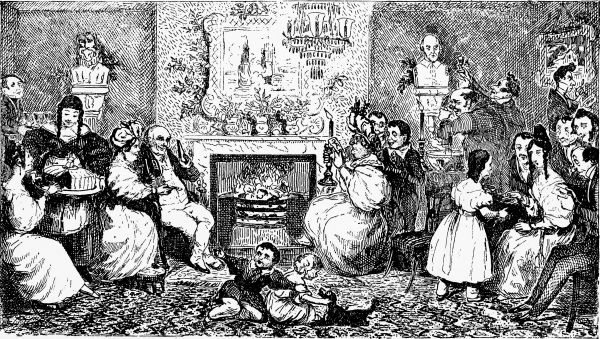
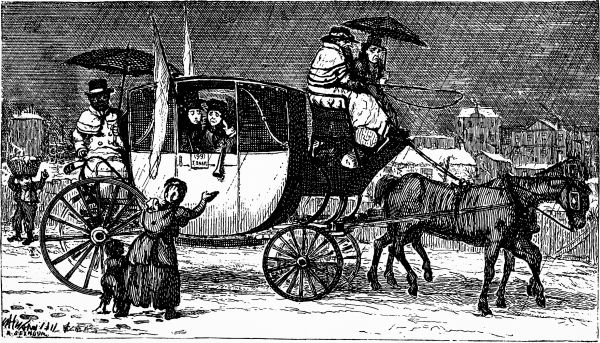
This Book of Christmas is a sound and good persuasion
for gentlemen, and all wealthy men, to keep a good
Christmas.
A ha! Christmas! By T. H. London, 1647.
Any man or woman . . . that can give any knowledge,
or tell any tidings, of an old, old, very old gray-bearded
gentleman, called Christmas, who was wont to
be a verie familiar ghest, and visite all sorts of people
both pore and rich, and used to appeare in glittering gold,
silk, and silver, in the Court, and in all shapes in the Theater
in Whitehall, and had ringing, feasts, and jollitie in all
places, both in the citie and countrie, for his comming: . . . whosoever
can tel what is become of him, or where
he may be found, let them bring him back againe into
England.
An Hue and Cry after Christmas.
In Ben Jonson's "Mask of Christmas," presented
before the court in 1616,—wherein the ancient gentleman
so earnestly inquired after in one of the
quotations which heads this chapter, and a number
of his children, compose the dramatis personæ,—that
venerable personage (who describes himself as
"Christmas, Old Christmas, Christmas of London,
and Captain Christmas") is made to give a very
significant hint to some parties who fail to receive
him with due ceremony, which hint we will, in all
courtesy, bestow upon our readers. "I have
seen the time you have wished for me," says he; . . . "and
now you have me, they would not let
me in. I must come another time!—a good jest!
As if I could come more than once a year!" Over
and over again, too, has this same very pregnant
argument been enforced in the words of the old
ballad, quoted in the "Vindication of Christmas,"—
"Let's dance and sing, and make good cheer,
For Christmas comes but once a year!"
Now if this suggestion was full of grave meaning
in the days of Jonson,—when the respectable
old man was for the most part well received
and liberally feasted, when he fed with his laughing
children at the tables of princes, and took
tribute at the hands of kings, when he showed
beneath the snows of his reverend head a portly
countenance (the result of much revelling), an eye
in which the fire was unquenched, and a frame from
which little of the lustihood had yet departed,—we
confess that we feel its import to be greatly heightened
in these our days, when the patriarch himself
exhibits undeniable signs of a failing nature, and
many of his once rosy sons are evidently in the
different stages of a common decline. A fine and
a cheerful family the old man had; and never came
they within any man's door without well repaying
the outlay incurred on their account. To us, at all
times, their "coming was a gladness;" and we
feel that we could not, without a pang, see their
honest and familiar faces rejected from our threshold,
with the knowledge that the course of their
wanderings could not return them to us under
a period so protracted as that of twelve whole
months.
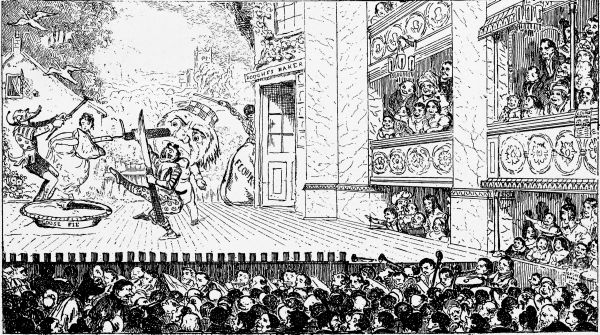
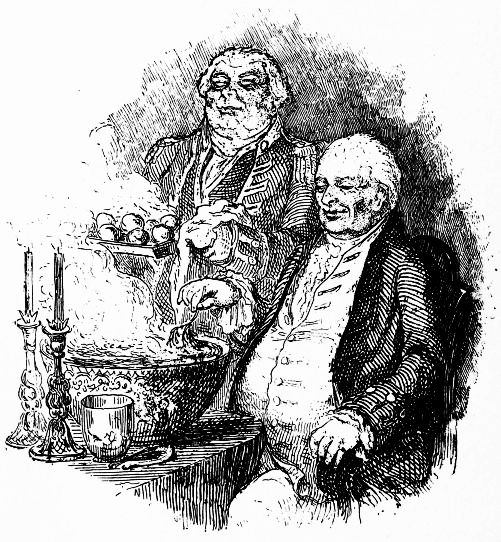
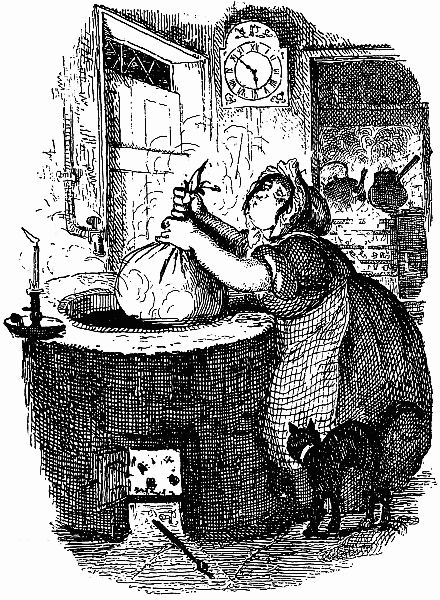
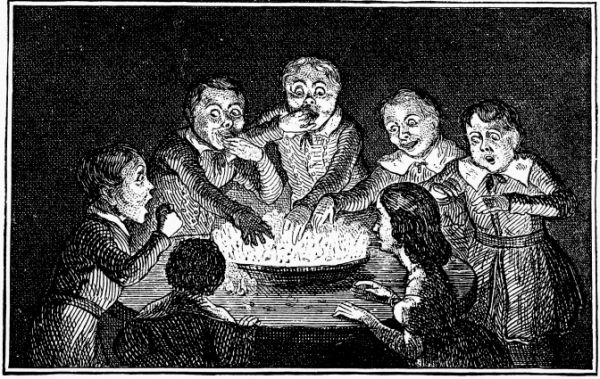 Snap-dragon.—Page 31.
In that long space of time, besides the uncertainty
of what may happen to ourselves, there is
but too much reason to fear that, unless a change
for the better should take place, some one or more
of the neglected children may be dead. We could
not but have apprehensions that the group might
never return to us entire. Death has already made
much havoc amongst them, since the days of Ben
Jonson. Alas for Baby-cocke! and woe is me for
Post-and-paire! And although Carol, and Minced-pie,
and New-year's Gift, and Wassail, and Twelfth-cake,
and some others of the children, appear still
to be in the enjoyment of a tolerably vigorous health,
yet we are not a little anxious about Snap-dragon,
and our mind is far from being easy on the subject
of Hot-cockles. It is but too obvious that, one by
one, this once numerous and pleasant family are
falling away; and as the old man will assuredly not
survive his children, we may yet, in our day, have
to join in the heavy lamentation of the lady at the
sad result of the above "Hue and Cry." "But is
old, old, good old Christmas gone?—nothing but
the hair of his good, grave old head and beard left!"
For these reasons, he and his train shall be welcome
to us as often as they come. It shall be a heavy
dispensation under which we will suffer them to
pass by our door unhailed; and if we can prevail
upon our neighbors to adopt our example, the
veteran and his offspring may yet be restored.
They are dying for lack of nourishment. They
have been used to live on most bountiful fare,—to
feed on chines and turkeys and drink of the
wassail-bowl. The rich juices of their constitution
are not to be maintained, far less re-established,
at a less generous rate; and though we will, for our
parts, do what lies in our power, yet it is not within
the reach of any private gentleman's exertions or
finances to set them on their legs again. It should
be made a national matter of; and as the old gentleman,
with his family, will be coming our way
soon after the publication of the present volume,
we trust we may be the means of inducing some
to receive them with the ancient welcome and feast
them after the ancient fashion.
To enable our readers to do this with due effect,
we will endeavor to furnish them with a programme
of some of the more important ceremonies observed
by our hearty ancestors on the occasion, and to
give them some explanation of those observances
which linger still, although the causes in which
their institution originated are becoming gradually
obliterated, and although they themselves are falling
into a neglect which augurs too plainly of their
final and speedy extinction.
It is, alas! but too true that the spirit of hearty
festivity in which our ancestors met this season has
been long on the decline; and much of the joyous
pomp with which it was once received has long
since passed away. Those "divers plente of plesaunces,"
in which the genius of mirth exhibited
himself,—
"About yule, when the wind blew cule,
And the round tables began,"—
have sent forward to these dull times of ours but
few, and those sadly degenerated, representatives.
The wild, barbaric splendor; the unbridled "mirth
and princely cheare" with which, upon the faith
of ancient ballads, we learn that "ages long ago"
King Arthur kept Christmas "in merry Carleile"
with Queen Guenever, "that bride soe bright of
blee;" the wholesale hospitality; the royal stores of
"pigs' heads and gammons of bacon" for a Christmas
largesse to the poor, at which we get glimpses
in the existing records of the not over-hospitable
reign of King John; the profuse expenditure and
stately ceremonial by which the season was illustrated
in the reign of the vain and selfish Elizabeth;
and the lordly wassailings and antic mummings,
whose universal prevalence, at this period of the
year, furnished subjects of such holy horror to the
Puritans in the time of the first Charles,—have
gradually disappeared before the philosophic pretensions
and chilling pedantry of these sage and
self-seeking days. The picturesque effects of society—its
strong lights and deep shadows—are
rapidly passing away; as the inequalities of surface
from which they were projected are smoothed
and polished down. From a period of high ceremonial
and public celebration, which it long continued
to be in England, the Christmas-tide has
tamed away into a period of domestic union and
social festivity; and the ancient observances
which covered it all over with sparkling points are
now rather perceived—faintly and distantly and
imperfectly—by the light of the still surviving
spirit of the season than contribute anything to
that spirit, or throw as of old any light over that
season from themselves.
Of the various causes which contribute to the
mingled festival of the Christmas-tide, there are
some which have their origin in feelings, and are
the remains of observances that existed previously
to that event from which the season now derives
its name. After the establishment of Christianity,
its earliest teachers, feeling the impossibility of replacing
at once those pagan commemorations which
had taken long and deep root in the constitution of
society and become identified with the feelings of
nations, endeavored rather to purify them from
their uncleanness, and adapt them to the uses of
the new religion. By this arrangement, many an
object of pagan veneration became an object of
veneration to the early Christians; and the polytheism
of papal Rome (promoted, in part, by this
very compromise, working in the stronghold of the
ancient superstition) became engrafted upon the
polytheism of the heathen. At a later period, too,
the Protestant reformers of that corrupted worship
found themselves, from a similar impossibility, under
a similar necessity of retaining a variety of
Catholic observances; and thus it is that festival
customs still exist amongst us which are the direct
descendants of customs connected with the classic
or druidical superstitions, and sports which may be
traced to the celebrations observed of old in honor
of Saturn or of Bacchus.
Amongst those celebrations which have thus survived
the decay of the religions with which they
were connected, by being made subservient to the
new faith (or purified forms) which replaced them,
that which takes place at the period of the new
year—placed as that epoch is in the neighborhood
of the winter solstice—stands conspicuous. Bequeathed
as this ancient commemoration has been,
with many of its forms of rejoicing, by the pagan
to the Christian world, it has been by the latter
thrown into close association with their own festival
observances in honor of the first great event in the
history of their revelation; and while the old observances
and the feelings in which they originated
have thus been preserved to swell the tide of
Christian triumph, their pedigree has been overlooked
amid the far higher interest of the observances
by whose side they stand, and their
ancient titles merged in that of the high family into
which they have been adopted.
In most nations of ancient or modern times, the
period of what is popularly called the winter solstice
appears to have been recognized as a season of
rejoicing. The deepening gloom and increasing
sterility which have followed the downward progress
of the sun's place in heaven would generally dispose
the minds of men to congratulation at the
arrival of that period when, as experience had
taught them, he had reached his lowest point of
influence with reference to them; and the prospects
of renewed light, and warmth, and vegetation offered
by what was considered as his returning march,
would naturally be hailed by the signs of thanksgiving
and the voice of mirth. The Roman
Saturnalia, which fell at this period, were accordingly
a season of high festivity, honored by many
privileges and many exemptions from ill. The
spirit of universal mirth and unbounded license
was abroad, and had a free charter. Friends feasted
together, and the quarrels of foes were suspended.
No war was declared and no capital executions
were permitted to take place during this season of
general good-will; and the very slave, beneath
its genial influence, regained for a moment the
moral attitude of a man, and had a right to use
the tongue which God had given him, for its
original purpose of expressing his thoughts. Not
only in the spirit of the time but in many of the forms
which it took, may a resemblance be traced to the
Christmas rejoicings of later days. The hymns in
honor of Saturn were the Roman representatives
of the modern carol; and presents passed from
friend to friend, as Christmas gifts do in our day.
(It may be observed here that the interchange of
gifts and the offering of donations to the poor
appear to have been, at all periods of rejoicing or
delivery, from the earliest times, one of the modes
by which the heart manifested its thankfulness;
and our readers may be referred for a single
example, where examples abound, to the directions
recorded in the Book of Esther, as given by Mordecai
to the Jews in Shushan, for celebrating their
escape from the conspiracy of Haman: that on
the anniversaries of "the days wherein the Jews
rested from their enemies, and the month which
was turned unto them from sorrow to joy and from
mourning into a good day, they should make them
days of feasting and joy, and of sending portions
one to another and gifts to the poor.") But a
more striking resemblance still between the forms
observed during the days of the Saturnalia and
those by which the Christmas festival was long
illustrated may be noticed in the ruler, or king,
who was appointed, with considerable prerogatives,
to preside over the sports of the former. He is the
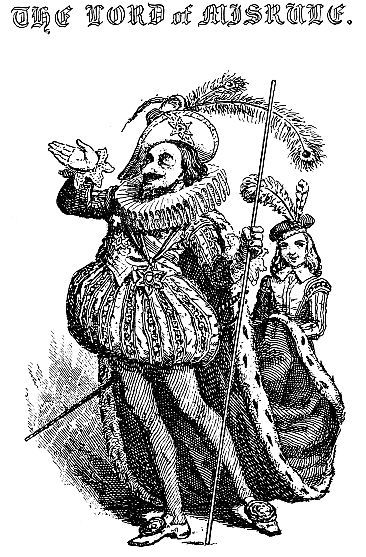
probable ancestor of that high potentate who, under
the title of Christmas Prince, Lord of Misrule, or
Abbot of Unreason, exercised a similar sway over
the Christmas games of more recent times, and
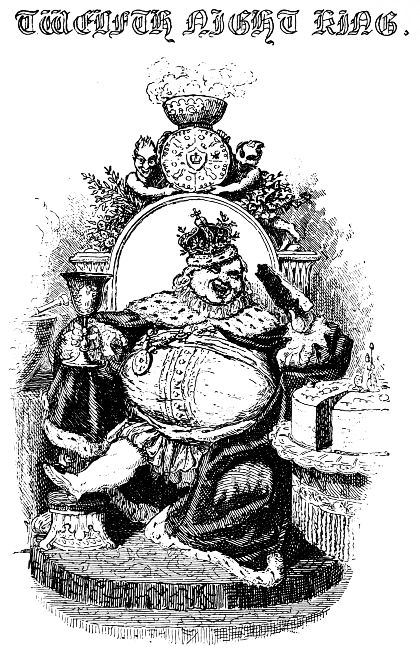
whose last descendant—the Twelfth-night King—still
rules with a diminished glory over the lingering
revelries of a single night.
In the Northern nations of ancient Europe the
same period of the year was celebrated by a festival
in honor of the God Thor, which, like the
Roman Saturnalia and the festival of our own
times, was illustrated by the song, the dance, and
the feast, executed after their barbarous fashion,
and mingled with the savage rites of their own religion.
The name of this celebration—Yule, Jule,
Iul, or Iol—has given rise to many disputes amongst
antiquaries as to its derivation, whose arguments,
however, we need not report for the benefit of
our readers till judgment shall have been finally
pronounced. When that time shall arrive, we undertake
to publish a new edition of the present work,
for the purpose of giving our readers an abstract of
the pleadings and acquainting them with the ultimate
decision. In the mean time, we will let Sir
Walter Scott inform them how—
"The savage Dane,
At Iol, more deep the mead did drain;
High on the beach his galleys drew,
And feasted all his pirate-crew;
Then, in his low and pine-built hall,
Where shields and axes decked the wall,
They gorged upon the half-dressed steer,
Caroused in sea of sable beer,—
While round, in brutal jest, were thrown
The half-gnawed rib and marrow-bone;
Or listened all, in grim delight,
While Scalds yelled out the joys of fight.
Then forth in frenzy would they hie,
While wildly loose their red locks fly,
And, dancing round the blazing pile,
They made such barbarous mirth the while,
As best might to the mind recall
The boisterous joys of Odin's hall."
Amongst other traces of the northern observances
which have descended to our times, and of which
we shall have occasion hereafter to speak, the name
of the festival itself has come down, and is still retained
by our Scottish brethren, as well as in some
parts of England.
The Christian festival of the Nativity, with which
these ancient celebrations have been incorporated,
appears to have been appointed at a very early period
after the establishment of the new religion.
Its first positive footsteps are met with in the second
century, during the reign of the Emperor
Concordius; but the decretal epistles furnish us
with traces of it more remote. At whatever period,
however, its formal institution is to be placed, there
can be no doubt that an event so striking in its
manner and so important in itself would be annually
commemorated amongst Christians from the days
of the first apostles, who survived our Lord's resurrection.
As to the actual year of the birth of
Christ, as well as the period of the year at which
it took place, great uncertainty seems to exist, and
many controversies have been maintained. One of
the theories on the subject, held to be amongst the
most probable, places that event upwards of five
years earlier than the vulgar era, which latter, however,
both as regards the year and season of the
year, was a tradition of the primitive Church. In
the first ages of that Church, and up till the Council
of Nice, the celebration of the Nativity and that
of the Epiphany were united on the 25th of December,
from a belief that the birth of Christ was
simultaneous with the appearance of the star in the
East which revealed it to the Gentiles. The time
of the year at which the Nativity fell has been
placed, by contending opinions, at the period of
the Jewish Feast of Tabernacles, at that of the Passover,
and again at that of the Feast of the Expiation,
whose date corresponds with the close of our
September. Clemens Alexandrinus informs us that
it was kept by many Christians in April, and by
others in the Egyptian month Pachon, which answers
to our May. Amongst the arguments which
have been produced against the theory that places
its occurrence in the depth of winter, one has
been gathered from that passage in the sacred
history of the event which states that "there were
shepherds abiding in the field, keeping watch over
their flocks by night." It is an argument, however,
which does not seem very conclusive in a pastoral
country and Eastern climate. Besides the employment
which this question has afforded to the learned,
it has, in times of religious excitement, been debated
with much Puritanical virulence and sectarian
rancor. For the purposes of commemoration,
however, it is unimportant whether the celebration
shall fall or not at the precise anniversary period
of the event commemorated; and the arrangement
which assigns to it its place in our calendar fixes it
at a season when men have leisure for a lengthened
festivity, and when their minds are otherwise wholesomely
acted upon by many touching thoughts and
solemn considerations.
From the first introduction of Christianity into
these islands, the period of the Nativity seems to
have been kept as a season of festival, and its
observance recognized as a matter of state. The
Wittenagemots of our Saxon ancestors were held
under the solemn sanctions and beneficent influences
of the time; and the series of high festivities established
by the Anglo-Saxon kings appear to have
been continued, with yearly increasing splendor
and multiplied ceremonies, under the monarchs of
the Norman race. From the court the spirit of revelry
descended by all its thousand arteries throughout
the universal frame of society, visiting its furthest
extremities and most obscure recesses, and
everywhere exhibiting its action, as by so many
pulses, upon the traditions and superstitions and
customs which were common to all or peculiar to
each. The pomp and ceremonial of the royal observance
were imitated in the splendid establishments
of the more wealthy nobles, and more faintly
reflected from the diminished state of the petty
baron. The revelries of the baronial castle found
echoes in the hall of the old manor-house; and
these were, again, repeated in the tapestried chamber
of the country magistrate or from the sanded
parlor of the village inn. Merriment was everywhere
a matter of public concernment; and the
spirit which assembles men in families now congregated
them by districts then.
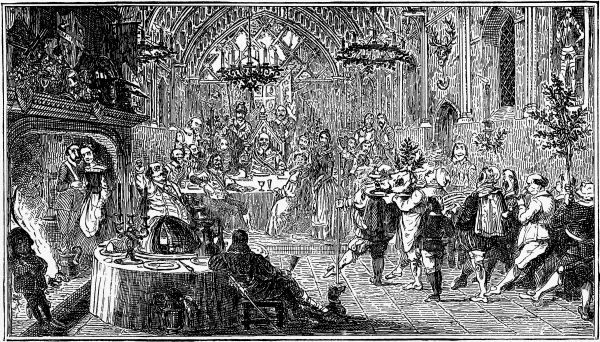
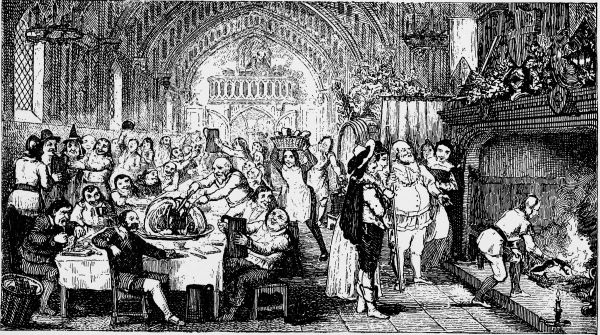 Baronial Hall.—Page 42.
Neither, however, were the feelings wanting
which connected the superstitions of the season
with the tutelage of the roof-tree, and mingled its
ceremonies with the sanctities of home. Men might
meet in crowds to feast beneath the banner of the
baron, but the mistletoe hung over each man's
own door. The black-jacks might go round in the
hall of the lord of the manor; but they who could
had a wassail-bowl of their own. The pageantries
and high observances of the time might draw men
to common centres or be performed on a common
account, but the flame of the Yule-log roared up
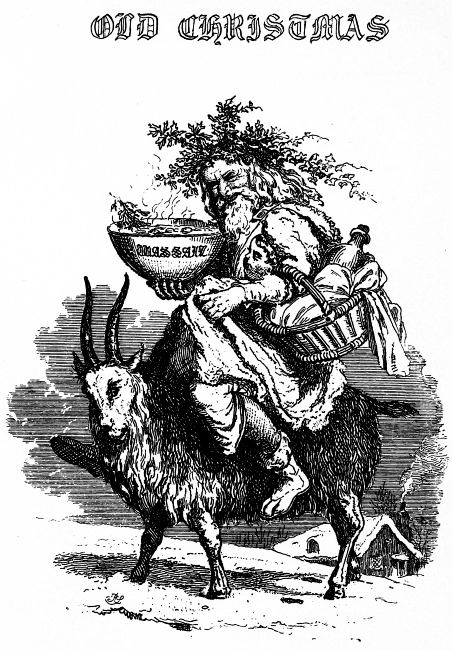
all the individual chimneys of the land. Old Father
Christmas, at the head of his numerous and uproarious
family, might ride his goat through the
streets of the city and the lanes of the village,
but he dismounted to sit for some few moments by
each man's hearth; while some one or another of
his merry sons would break away, to visit the remote
farm-houses or show their laughing faces at many
a poor man's door. For be it observed, this
worthy old gentleman and his kind-hearted children
were no respecters of persons. Though trained
to courts, they had ever a taste for a country life.
Though accustomed in those days to the tables of
princes, they sat freely down at the poor man's
board. Though welcomed by the peer, they showed
no signs of superciliousness when they found themselves
cheek-by-jowl with the pauper. Nay, they
appear even to have preferred the less exalted society,
and to have felt themselves more at ease in
the country mansion of the private gentleman than
in the halls of kings. Their reception in those high
places was accompanied, as royal receptions are apt
to be, by a degree of state repugnant to their frank
natures; and they seem never to have been so
happy as when they found themselves amongst a
set of free and easy spirits,—whether in town or
country,—unrestrained by the punctilios of etiquette,
who had the privilege of laughing just
when it struck them to do so, without inquiring
wherefore, or caring how loud.
Then, what a festival they created! The land
rang with their joyous voices, and the frosty air
steamed with the incense of the good things provided
for their entertainment. Everybody kept holiday
but the cooks; and all sounds known to the
human ear seemed mingled in the merry pæan, save
the gobble of the turkeys. There were no turkeys,—at
least they had lost their "most sweet voices."
The turnspits had a hard time of it, too. That
quaint little book which bears the warm and promising
title of "Round about our Coal Fire" tells us
that "by the time dinner was over they would look
as black and as greasy as a Welsh porridge-pot."
Indeed, the accounts of that time dwell with great
and savory emphasis upon the prominent share
which eating and drinking had in the festivities of
the season. There must have been sad havoc made
amongst the live-stock. That there are turkeys at
all in our days is only to be accounted for upon
the supposition of England having been occasionally
replenished with that article from the East; and
our present possession of geese must be explained
by the well-known impossibility of extinguishing the
race of the goose. It is difficult to imagine a consumption
equal to the recorded provision. Men's
gastronomic capacities appear to have been enlarged
for the occasion, as the energies expand to meet
great emergencies. "The tables," says the same
racy authority above quoted, "were all spread from
the first to the last; the sirloyns of beef, the minc'd-pies,
the plumb-porridge, the capons, turkeys, geese,
and plumb-puddings were all brought upon the
board; and all those who had sharp stomachs and
sharp knives eat heartily and were welcome, which
gave rise to the proverb,—
"'Merry in the hall, when beards wag all!'"
Now, all men in those days appear to have had
good stomachs, and, we presume, took care to provide
themselves with sharp knives. The only recorded
instance in which we find a failure of the
latter is that portentous one which occurred, many
a long day since, in the court of King Arthur, when
the Christmas mirth was so strangely disturbed by
the mischievous interference of the Boy with the
Mantle. Under the test introduced by that imp of
discord and which appears to have "taken the
shine out of" the monarch's own good sword Excalibur
itself, there was found but one knight, of all
the hungry knights who sat at that Round Table,
whose weapon was sharp enough to carve the boar's
head or hand steady enough to carry the cup to
his lip without spilling the lamb's wool; and even
he had a very narrow escape from the same incapacities.
But then, as we have said, this was at court,
and under the influence of a spell (with whose nature
we take it for granted that our readers are acquainted,—and,
if not, we refer them to the Percy
Ballads); and it is probable that, in those early as
in later days, tests of such extreme delicacy were
of far more dangerous introduction in the courts of
kings than amongst assemblies of more mirth and
less pretension. We could by no means feel sure
that the intrusion, in our own times, of a similar
test into a similar scene might not spoil the
revels.
But to return. The old ballads which relate to
this period of the year are redolent of good things,
and not to be read by a hungry man with any degree
of equanimity. Of course they are ex post
facto ballads, and could only have been written
under the inspiration of memory, at a time when
men were at leisure to devote their hands to some
other occupation than that of cooking or carving.
But it is very difficult to understand how they ever
found—as it appears they did—their mouths in a
condition to sing them at the season itself. There
is one amongst those ballads, of a comparatively
modern date, printed in Evans's collection, which we
advise no man to read fasting. It is directed to be
sung to the tune of "The Delights of the Bottle,"
and contains in every verse a vision of good things,
summed up by the perpetually recurring burthen of
"Plum-pudding, goose, capon, minc'd-pies, and roast beef."
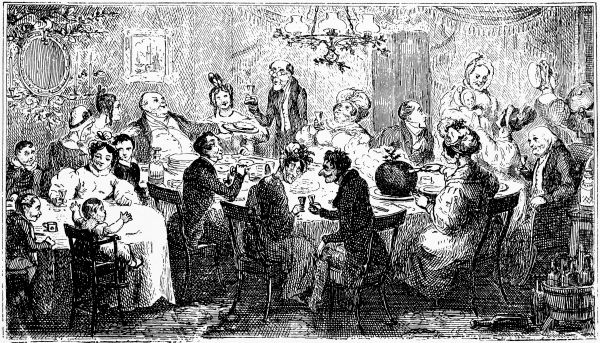
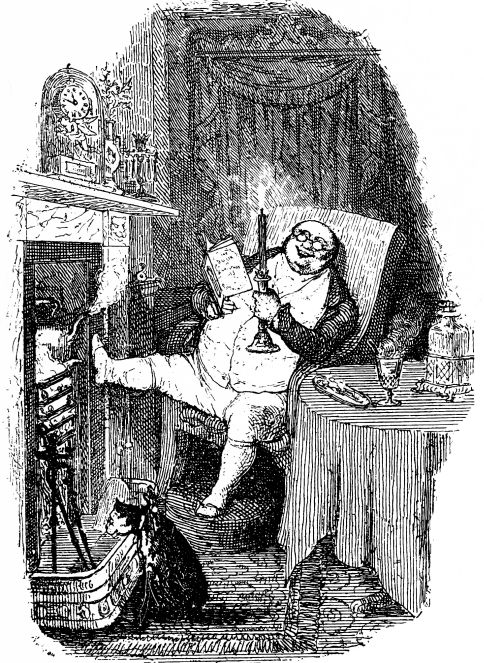 Enjoying Christmas.—Page 46.
Our readers had better take a biscuit and a glass of
sherry before they venture upon the glimpses into
those regions of banqueting which we are tempted
to lay before them. The ballad opens like the ringing
of a dinner-bell, and, we conceive, should be
sung to some such accompaniment:—
"All you that to feasting and mirth are inclin'd,
Come here is good news for to pleasure your mind,—
Old Christmas is come for to keep open house,
He scorns to be guilty of starving a mouse:
Then come, boys, and welcome for diet the chief,
Plum-pudding, goose, capon, minc'd-pies, and roast beef."
"Diet the chief!"—by which we are to understand
that this promising muster-roll merely includes
the names of some of the principal viands,—the
high-commissioned dishes of the feast,—leaving the
subalterns, and the entire rank and file which complete
the goodly array, unmentioned. It must have
been a very ingenious or a very strong-minded
mouse which could contrive to be starved under
such circumstances. The ballad is long, and we
can only afford to give our readers "tastings" of
its good things. It is everywhere full of most
gracious promise:—
"The cooks shall be busied, by day and by night,
In roasting and boiling, for taste and delight,
Their senses in liquor that's nappy they'll steep,
Though they be afforded to have little sleep;
They still are employed for to dress us, in brief,
Plum-pudding, goose, capon, minc'd-pies, and roast beef.
"Although the cold weather doth hunger provoke,
'T is a comfort to see how the chimneys do smoke;
Provision is making for beer, ale, and wine,
For all that are willing or ready to dine:
Then haste to the kitchen for diet the chief,
Plum-pudding, goose, capon, minc'd-pies, and roast beef.
"All travellers, as they do pass on their way,
At gentlemen's halls are invited to stay,
Themselves to refresh and their horses to rest,
Since that he must be old Christmas's guest;
Nay, the poor shall not want, but have for relief
Plum-pudding, goose, capon, minc'd-pies, and roast beef."
And so on, through a variety of joyous and substantial
anticipations, from which the writer draws
an inference, which we think is most satisfactorily
made out:—
"Then well may we welcome old Christmas to town,
Who brings us good cheer, and good liquor so brown;
To pass the cold winter away with delight,
We feast it all day, and we frolick all night."
In Ellis's edition of Brand's "Popular Antiquities"
an old Christmas song is quoted from "Poor
Robin's Almanack" for 1695, which gives a similar
enumeration of Christmas dainties, but throws them
into a form calculated for more rapid enunciation, as
if with a due regard to the value of those moments
at which it was probably usual to sing it. The
measure is not such a mouthful as that of the former
one which we have quoted. It comes trippingly
off the tongue; and it is not impossible that, in
those days of skilful gastronomy, it might have been
sung eating. We will quote a couple of the verses,
though they include the same commissariat truths
as that from which we have already extracted; and
our readers will observe, from the ill-omened wish
which concludes the second of these stanzas, in what
horror the mere idea of fasting had come to be held,
since it is the heaviest curse which suggested itself
to be launched against those who refused to do
homage to the spirit of the times:—
"Now thrice welcome Christmas,
Which brings us good cheer,
Minc'd pies and plumb-porridge,
Good ale and strong beer;
With pig, goose, and capon,
The best that may be,
So well doth the weather
And our stomachs agree.
"Observe how the chimneys
Do smoak all about,
The cooks are providing
For dinner no doubt;
But those on whose tables
No victuals appear,
O may they keep Lent
All the rest of the year!"
The same author quotes, from a manuscript in
the British Museum, an Anglo-Norman carol of the
early date of the thirteenth century, and appends
to it a translation by the late Mr. Douce, the following
verse of which translation informs us (what,
at any rate, might well be supposed, namely) that so
much good eating on the part of the ancient gentleman,
Christmas, would naturally suggest the propriety
of good drinking, too:—
"Lordings, Christmas loves good drinking,
Wines of Gascoigne, France, Anjou,
English ale, that drives out thinking,
Prince of liquors old or new.
Every neighbor shares the bowl,
Drinks of the spicy liquor deep,
Drinks his fill without controul,
Till he drowns his care in sleep."
In a "Christmas Carroll," printed at the end of
Wither's "Juvenilia," a graphic account is given of
some of the humors of Christmas, among which the
labors of the kitchen are introduced in the first verse,
with a due regard to their right of precedency, and
in words which, if few, are full of suggestion:—
"Lo, now is come our joyful'st feast!
Let every man be jolly.
Each roome with yvie leaves is drest,
And every post with holly.
Now, all our neighbour's chimneys smoke,
And Christmas Blocks are burning;
Their ovens they with bak't-meats choke,
And all their spits are turning."
We must present our readers with another quotation
from an old ballad, entitled "Time's Alteration;
or, The Old Man's Rehearsal, what brave dayes he
knew a great while agone, when his old cap was
new," which appears to have been written after
the times of the Commonwealth. And this extract
we are induced to add to those which have
gone before, because, though it deals with precisely
the same subjects, it speaks of them as of things
gone by, and is written in a tone of lamentation, in
which it is one of the purposes of this chapter to
call upon our readers to join. We are sorry we
cannot give them directions as to the tune to which
it should be sung,—further than that it is obviously
unsuited to that of the "Delights of the Bottle,"
prescribed for the joyous ballad from which we
first quoted on this subject; and that, whatever may
be the tune, we are clear that the direction as to
time should be the same as that which Mr. Hood
prefixes to his song of the Guildhall Giants; namely,
"Dinner-time and mournful":—
"A man might then behold,
At Christmas in each hall,
Good fires to curb the cold,
And meat for great and small;
The neighbours were friendly bidden,
And all had welcome true,
The poor from the gates were not chidden,
When this old cap was new.
"Black-jacks to every man
Were fill'd with wine and beer;
No pewter pot nor can
In those days did appear;
Good cheer in a nobleman's house
Was counted a seemly shew;
We wanted no brawn nor souse,
When this old cap was new."
Can our readers bear, after this sad ditty, to listen
to the enumeration of good things described by
Whistlecraft to have been served up at King
Arthur's table on Christmas day? If the list be
authentic, there is the less reason to wonder at
the feats of courage and strength performed by
the Knights of the Round Table.
"They served up salmon, venison, and wild boars,
By hundreds, and by dozens, and by scores.
"Hogsheads of honey, kilderkins of mustard,
Muttons, and fatted beeves, and bacon swine;
Herons and bitterns, peacocks, swan, and bustard,
Teal, mallard, pigeons, widgeons, and, in fine,
Plum-puddings, pancakes, apple-pies, and custard.
And therewithal they drank good Gascon wine,
With mead, and ale, and cider of our own;
For porter, punch, and negus were not known."
But we cannot pursue this matter further. It is
not to be treated with any degree of calmness before
dinner, and we have not dined. We must
proceed to less trying parts of our subject.
Of the earnest manner in which our ancestors
set about the celebration of this festival, the mock
ceremonial with which they illustrated it, the quaint
humors which they let loose under its inspiration,
and the spirit of fellowship which brought all classes
of men within the range of its beneficent provisions,
we have a large body of scattered evidence, to be
gleaned out of almost every species of existing
record, from the early days of the Norman dynasty
down to the times of the Commonwealth. The tales
of chroniclers, the olden ballads, the rolls of courts,
and the statute-book of the land, all contribute to
furnish the materials from which a revival of the old
pageantry must be derived, if men should ever again
find time to be as merry as their fathers were.
The numberless local customs of which the still
remaining tradition is almost the sole record, and
which added each its small contingent to the
aggregate of commemoration, would certainly render
it a somewhat difficult matter to restore the
festival in its integrity; and, to be very candid
with our readers, we believe we may as well confess,
at the onset, what will be very apparent to them
before we have done, that many of the Christmas
observances (whether general or local) are to be
recommended to their notice rather as curious pictures
of ancient manners than as being at all worthy
of imitation by us who "are wiser in our generation."
Sooth to say, we dare not let our zeal for
our subject lead us into an unqualified approbation
of all the doings which it will be our business to
record in these pages, though they seem to have
made all ranks of people very happy in other days;—and
that is no mean test of the value of any
institution. Really earnest as we are in the wish
that the sentiment of the season could be restored
in its amplitude, we fear that many of the fooleries
by which it exhibited itself could not be gravely
proposed as worthy amusements for a nation of
philosophers.
Still these very absurdities furnish the strongest
evidences of the right good-will with which men—ay,
grave and learned men—surrendered themselves
to the merry spirit of the time, of that entire
abandonment which forgot to make a reservation
of their outward dignities and gave them courage
to "play the fool." Our readers need scarcely be
told that it must be a man of a very strong mind,
or a man who could not help it, who should dare
to make a jack-pudding of himself in these days,
when all his fellows are walking about the world
with telescopes in their hands and quadrants in
their pockets. No doubt it would have a somewhat
ridiculous effect to-day to see the members
of the bar dancing a galliard or a coranto, in
full costume, before the Benchers, notwithstanding
that certain ancient forms are still retained in their
halls which have all the absurdity of the exploded
ones without any of their fun; and unquestionably
we should think it rather strange to see a respectable
gentleman capering through the streets on a
pasteboard hobby-horse,—in lieu of the figurative
hobby-horses on which most men still exhibit,—although
even that, we think, would offer an object
less ungracious than a child with an anxious brow
and "spectacles on nose." The great wisdom of
the world is, we presume, one of the natural consequences
of its advancing age; and though we are
quite conscious that some of its former pranks
would be very unbecoming, now that it is getting
into years, and "knows so much as it does," yet we
are by no means sure that we should not have been
well content to have our lot cast in the days when
it was somewhat younger. They must have been
very pleasant times! Certain it is that the laugh of
the humbler classes, and of the younger classes,
would be all the heartier, that it was echoed by the
powerful and the aged; the mirth of the ignorant
more free and genial, that the learned thought no
scorn of it. For all that appears, too, the dignities
of those days suffered no detriment by their surrender
to the spirit of the times, but seem to have
resumed all their functions and privileges, when it
had exhausted itself, with unimpaired effect. Philosophers
had due reverence, without erecting themselves
always on stilts for the purpose of attracting
it; and names have come down to us which are
esteemed the names of grave and learned and wise
men,—even in this grave and learned and wise
age,—who, nevertheless, appear in their own to
have conducted themselves at times very like
children.
From the royal Household-Books which exist, and
from the Household-Books of noble families (some
of which have been printed for better preservation),
as also from the other sources to which we have
alluded, Mr. Sandys, in the very valuable introduction
to his collection of Christmas carols, already
mentioned, has brought together a body of valuable
information,—both as to the stately ceremonies and
popular observances by which the season continued
to be illustrated, from an early period up to the
time of its decline, amid the austerities of the civil
war. To this careful compilation we shall be occasionally
indebted for some curious particulars
which had escaped ourselves, amid the multiplied
and unconnected sources from which our notes for
this volume had to be made. To those who would
go deeper into the antiquarian part of the subject
than suits the purpose of a popular volume, we can
recommend that work, as containing the most
copious and elaborate synopsis of the existing information
connected therewith which we have found
in the course of our own researches. It would be
impossible, however, in a paper of that length—or,
indeed, in a volume of any moderate size—to give
an account of all the numerous superstitions and observances
of which traces are found, in an extended
inquiry, to exist,—throwing light upon each other
and contributing to the complete history of the festival.
We have therefore gleaned from all quarters
those which appear to be the most picturesque and
whose relation is the most obvious, with a view, as
much as possible, of generalizing the subject and presenting
its parts in relation to an intelligible whole.
As we shall have occasion, in our second part, to
speak of those peculiar feelings and customs by
which each of the several days of the Christmas
festival is specially illustrated, we shall not at present
pause to go into any of the details of the subject,
although continually tempted to do so by
their connection with the observations which we are
called upon to make. The purpose of the present
chapter is rather to insist generally, and by some of
its more striking features, upon the high and lengthened
festivity with which this portion of the year
was so long and so universally welcomed, and to
seek some explanation of the causes to which the
diminution of that spirit, and the almost total neglect
of its ancient forms, are to be ascribed.
As early as the twelfth century we have accounts
of the spectacles and pageants by which Christmas
was welcomed at the court of the then monarch
Henry II.; and from this period the wardrobe
rolls and other Household-Books of the English
kings furnish continual evidences of the costly preparations
made for the festival. Many extracts from
these books have been made by Mr. Sandys and
others, from which it appears that the mirth of the
celebration, and the lavish profusion expended upon
it, were on the increase from year to year, excepting
during that distracted period of England's history
when these, like all other gracious arrangements
and social relations, were disturbed by the unholy
contests between the houses of the rival roses.
There is, however, a beautiful example of the sacred
influence of this high festival mentioned by Turner
in his History of England, showing that its hallowed
presence had power, even in those warlike
days, to silence even the voice of war,—of all war
save that most impious of (what are almost always
impious) wars, civil war. During the siege of Orleans,
in 1428, he says: "The solemnities and festivities
of Christmas gave a short interval of repose.
The English lords requested of the French commanders
that they might have a night of minstrelsy,
with trumpets and clarions. This was granted; and
the horrors of war were suspended by melodies,
that were felt to be delightful."
In the peaceful reign of Henry VII., the nation,
on emerging from that long and unnatural struggle,
appears to have occupied itself, as did the wise
monarch, in restoring as far as was possible, and
by all means, its disrupted ties, and rebaptizing its
apostate feelings; and during this period the festival
of Christmas was restored with revived
splendor and observed with renewed zeal. The
Household-Book of that sovereign, preserved in
the chapter-house at Westminster, contains numerous
items for disbursements connected with the
Christmas diversions, in proof of this fact.
The reign of Henry VIII. was a reign of jousts
and pageants till it became a reign of blood; and
accordingly the Christmas pageantries prepared for
the entertainment of that execrable monarch were
distinguished by increased pomp and furnished at
a more profuse expenditure. The festivities of
Eltham and Greenwich figure in the pages of the
old chroniclers; and the account books at the
chapter-house abound in payments made in this
reign, for purposes connected with the revels of
the season.
We shall by and by have occasion to present
our readers with some curious particulars, illustrative
of the cost and pains bestowed upon this court
celebration during the short reign of the young
monarch Edward VI.
Not all the gloom and terror of the sanguinary
Mary's reign were able entirely to extinguish the
spirit of Christmas rejoicing throughout the land,
though the court itself was too much occupied with
its auto-da-fé spectacles to have much time for
pageants of less interest.
Our readers, we think, need scarcely be told that
the successor of this stern and miserable queen
(and, thank God! the last of that bad family)
was sure to seize upon the old pageantries, as she
did upon every other vehicle which could in any
way be made to minister to her intolerable vanity,
or by which a public exhibition might be made,
before the slaves whom she governed, of her own
vulgar and brutal mind. Under all the forms of
ancient festival observance, some offering was presented
to this insatiable and disgusting appetite,—and
that, too, by men entitled to stand erect, by
their genius or their virtues, yet whose knees were
rough with kneeling before as worthless an idol as
any wooden god that the most senseless superstition
ever set up for worship. From all the altars which
the court had reared to old Father Christmas of
yore, a cloud of incense was poured into the royal
closet, enough to choke anything but a woman,—that
woman a queen, and that queen a Tudor.
The festival was preserved, and even embellished;
but the saint, as far as the court was concerned, was
changed. However, the example of the festivity to
the people was the same; and the land was a
merry land, and the Christmas time a merry time,
throughout its length and breadth, in the days of
Queen Elizabeth.
Nay, out of this very anxiety to minister to the
craving vanity of a weak and worthless woman—the
devices to which it gave rise and the laborers
whom it called into action—have arisen results
which are not amongst the least happy or important
of those by its connection with which the Christmas
festival stands recommended. Under these
impulses, the old dramatic entertainments—of
which we shall have occasion to speak more at
large hereafter—took a higher character and assumed
a more consistent form. The first regular
English tragedy, called "Ferrex and Porrex," and
the entertainment of "Gammer Gurton's Needle,"
were both productions of the early period of this
queen's reign; and amid the crowd of her worshippers
(alas that it is so!) rose up—with the
star upon his forehead which is to burn for all
time—the very first of all created beings, William
Shakespeare. These are amongst the strange
anomalies which the world, as it is constituted, so
often presents, and must present at times, constitute
it how we will. Shakespeare doing homage to
Queen Elizabeth! The loftiest genius and the
noblest heart that have yet walked this earth, in a
character merely human, bowing down before this
woman with the soul of a milliner and no heart at
all! The "bright particular star" humbling itself
before the temporal crown! The swayer
of hearts, the ruler of all men's minds, in virtue
of his own transcendent nature, recognizing the
supremacy of this overgrown child, because she
presided over the temporalities of a half emancipated
nation, by rights derived to her from others
and sanctioned by no qualities of her own!
And yet if to the low passions of this vulgar
queen, and the patronage which they led her to extend
to all who could best minister to their gratification,
we owe any part of that development by
which this consummate genius expanded itself,
then do we stand in some degree indebted to her
for one of the greatest boons which has been bestowed
upon the human race; and as between
her and mankind in general (for the accounts between
her and individuals, and still more that
between her and God, stand uninfluenced by
this item) there is a large amount of good to be
placed to her credit. Against her follies of a day
there would have to be set her promotion of a wisdom
whose lessons are for all time; against the
tears which she caused to flow, the human anguish
which she inflicted, and the weary, pining hours of
the captives whom she made, would stand the tears
of thousands dried away, many and many an aching
heart beguiled of its sorrow, and many a captive
taught to feel that
"Stone walls do not a prison make,
Nor iron bars a cage;"
all the chords of human feeling touched with a
hand that soothes as did the harp of David, all
the pages of human suffering stored with consolations!
To any one who will amuse himself by looking
over the Miracle Plays and Masques, which were
replaced by the more regular forms of dramatic
entertainment, and will then regale himself by the
perusal of "Gammer Gurton's Needle" or "Ferrex
and Porrex," which came forward with higher
pretensions in the beginning of this reign, there
will appear reason to be sufficiently astonished at
the rapid strides by which dramatic excellence was
attained before its close and during the next, even
without taking Shakespeare into the account at
all. Put when we turn to the marvels of this great
magician, and find that in his hands not only were
the forms of the drama perfected, but that, without
impeding the action or impairing the interest
invested in those forms, and besides his excursions
into the regions of imagination and his creations
out of the natural world he has touched every
branch of human knowledge and struck into every
train of human thought; that without learning, in
the popular sense, he has arrived at all the results
and embodied all the wisdom which learning is
only useful if it teaches; that we can be placed
in no imaginable circumstances and under the influence
of no possible feelings of which we do
not find exponents,—and such exponents!—"in
sweetest music," on his page; and above all,
when we find that all the final morals to be drawn
from all his writings are hopeful ones, that all the
lessons which all his agents—joy or sorrow, pain
or pleasure—are made alike to teach are lessons
of goodness—it is impossible to attribute all this
to aught but a revelation, or ascribe to him any
character but that of a prophet. Shakespeare knew
more than any other mere man ever knew; and
none can tell how that knowledge came to him.
"All men's business and bosoms" lay open to him.
We should not like to have him quoted against
us on any subject. Nothing escaped him, and he
never made a mistake (we are not speaking of
technical ones). He was the universal interpreter
into language of the human mind, and he knew
all the myriad voices by which nature speaks. He
reminds us of the vizier in the Eastern story, who is
said to have understood the languages of all animals.
The utterings of the elements, the voices of beasts
and of birds, Shakespeare could translate into the
language of men; and the thoughts and sentiments
of men he rendered into words as sweet as the singing
of birds. If the reign of Elizabeth had been
illustrated only by the advent of this great spirit, it
might itself have accounted for some portion of that
prejudice which (illustrated, as in fact it was, by
much that was great and noble) blinds men still—or
induces them to shut their eyes—to the true
personal claims and character of that queen.
But we are digressing, again, as who does not
when the image of Shakespeare comes across him?
To return:—
The court celebrations of Christmas were observed
throughout the reign of the first James; and
the Prince Charles himself was an occasional performer
in the pageantries prepared for the occasion,
at great cost. But at no period do they appear to
have been more zealously sought after, or performed
with more splendor, than during that which immediately
preceded the persecution, from whose effects
they have never since recovered into anything like
their former lustihood. In the early years of Charles
the First's reign, the court pageants of this season
were got up with extraordinary brilliancy,—the king
with the lords of his court, and the queen with her
ladies, frequently taking parts therein. This was the
case in 1630-31; and at the Christmas of 1632-33
the queen, says Sandys, "got up a pastoral in
Somerset House, in which it would seem she herself
took a part. There were masques at the same time,
independently of this performance, the cost of which
considerably exceeded £2,000, besides that portion
of the charge which was borne by the office of the
revels and charged to the accounts of that department."
In the same year, we learn that a grant of
£450 was made to George Kirke, Esq., gentleman
of the robes, for the masking attire of the king and
his party. In 1637 there is a warrant, under the
privy seal, to the same George Kirke for £150, to
provide the masking dress of the king; and, in the
same year, another to Edmund Taverner for £1,400
towards the expenses of a masque to be presented at
Whitehall on the ensuing Twelfth Night. We have
selected these from similar examples furnished by
Sandys, in order to give our readers some idea of
the sums expended in these entertainments,
which sums will appear very considerable when
estimated by the difference between the value of
money in our days and that of two hundred years
ago. Several of the masques presented at court during
this reign, and the preceding ones, were written
by Ben Jonson.
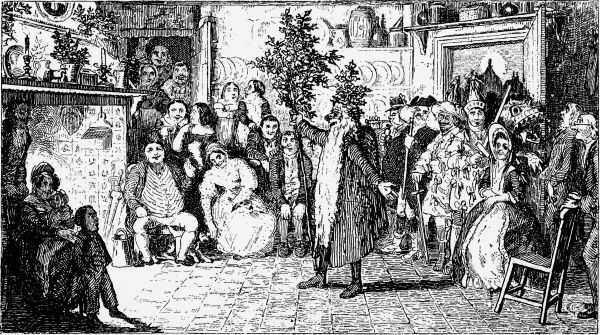 Mummers.—Page 65.
During the whole of this time, the forms of
court ceremonial appear to have been aped, and the
royal establishments imitated as far as possible, by
the more powerful nobles; and the masques and
pageantries exhibited for the royal amusement were
accordingly reproduced or rivalled by them at their
princely mansions in the country. Corporate and
other public bodies caught the infection all over
the land; and each landed proprietor and country
squire endeavored to enact such state in the eyes
of his own retainers, as his means would allow.
The sports and festivities of the season were everywhere
taken under the protection of the lord of the
soil; and all classes of his dependants had a customary
claim upon the hospitalities which he prepared
for the occasion. The masques of the court
and of the nobles were imitated in the mummings
of the people,—of which we give a representation
here, and which we shall have occasion particularly
to describe hereafter,—they having survived the
costly pageants of which they were the humble representatives.
The festival was thus rendered a
universal one, and its amusements brought within
the reach of the indigent and the remote. The
peasant, and even the pauper, were made, as it were,
once a year sharers in the mirth of their immediate
lord, and even of the monarch himself. The laboring
classes had enlarged privileges during this season,
not only by custom, but by positive enactment;
and restrictive acts of Parliament, by which they
were prohibited from certain games at other periods,
contained exceptions in favor of the Christmas-tide.
Nay, folly was, as it were, crowned, and disorder
had a license! Sandys quotes from Leland
the form of a proclamation given in his "Itinerary"
as having been made by the sheriff of York,
wherein it is declared that all "thieves, dice-players,
carders" (with some other characters by name that
are usually repudiated by the guardians of order)
"and all other unthrifty folke, be welcome to the
towne, whether they come late or early, att the reverence
of the high feast of Youle, till the twelve
dayes be passed." The terms of this proclamation
were, no doubt, not intended to be construed in a
grave and literal sense, but were probably meant to
convey something like a satire upon the unbounded
license of the season which they thus announce.
There are very pleasant evidences of the care
which was formerly taken, in high quarters, that the
poor should not be robbed of their share in this festival.
The yearly increasing splendor of the royal
celebrations appears at one time to have threatened
that result, by attracting the country gentlemen
from their own seats, and thereby withdrawing them
from the presidency of those sports which were
likely to languish in their absence. Accordingly, we
find an order, in 1589, issued to the gentlemen of
Norfolk and Suffolk, commanding them "to depart
from London before Christmas, and to repair to
their countries, there to keep hospitality amongst
their neighbors." And similar orders appear to
have been from time to time necessary, and from
time to time repeated.
Amongst those bodies who were distinguished for
the zeal of their Christmas observances, honorable
mention may be made of the two English universities;
and we shall have occasion hereafter to show
that traces of the old ceremonials linger still in
those their ancient haunts. But the reader who is
unacquainted with this subject would scarcely be
prepared to look for the most conspicuous celebration
of these revels, with all their antics and mummeries,
in the grave and dusty retreats of the law.
Such, however, was the case. The lawyers beat
the doctors hollow. Their ancient halls have rung
with the sounds of a somewhat barbarous revelry;
and the walls thereof, had they voices, could tell
many an old tale, which the present occupants might
not consider as throwing any desirable light upon
the historical dignities of the body to which they
belong. Our readers, no doubt, remember a certain
scene in "Guy Mannering," wherein the farmer
Dinmont and Colonel Mannering are somewhat inconsiderately
intruded upon the carousals of Mr.
Counsellor Pleydell at his tavern in the city of
Edinburgh and find that worthy lawyer in what
are called his "altitudes," being deeply engaged
in the ancient and not very solemn pastime of
"High Jinks." Their memory may probably present
the counsellor "enthroned as a monarch in
an elbow-chair placed on the dining-table, his
scratch-wig on one side, his head crowned with a
bottle-slider, his eye leering with an expression betwixt
fun and the effects of wine," and recall, assisted
by the jingle, some of the high discourse of
his surrounding court:—
"Where is Gerunto now? and what's become of him?"
"Gerunto's drowned, because he could not swim," etc.
Now, if our readers shall be of opinion—as
Colonel Mannering and the farmer were—that
the attitude and the occupation were scarcely consistent
with the dignity of a gentleman whom they
had come to consult on very grave matters, we may
be as much to blame as was the tavern-waiter on
that occasion, in introducing them to the revels of
the Inns of Court. We will do what we can to
soften such censure by stating that there certainly
appears at times to have arisen a suspicion, in the
minds of a portion of the profession, that the wig
and gown were not figuring to the best possible
advantage on these occasions. For, in the reign
of the first James, we find an order issued by the
benchers of Lincoln's Inn, whereby the "under
barristers were, by decimation, put out of commons
because the whole bar offended by not dancing on
Candlemas Day preceding, according to the ancient
order of the society, when the judges were present;"
and this order is accompanied by a threat
"that, if the fault were repeated, they should be
fined or disbarred."
There seems to have been a contest between the
four Inns of Court as to which should get up these
pageantries with the greatest splendor, and occasionally
a struggle between the desire of victory
and the disinclination, or perhaps inability, to furnish
the heavy cost at which that victory was to be
secured. Most curious particulars on these subjects
are furnished by the accompt-books of the houses:
by the "Gesta Grayorum" (which was published
for the purpose of describing a celebrated Christmas
kept at Gray's Inn in 1594, and had its title imitated
from the then popular work called the "Gesta
Romanorum"); by Dugdale, in his "Origines
Juridiciales,"; and by Nichols, in his "Progresses
of Queen Elizabeth." For some time Lincoln's
Inn appears to have carried it all its own way,
having been first on the ground. The Christmas
celebrations seem to have been kept by this society
from as early a period as the reign of Henry VI.;
although it was not until the reign of Henry VIII.
that they began to grow into celebrity, or at least
that we have any account of their arrangements.
When, however, the societies of the two Temples,
and that of Gray's Inn, began, with a laudable
jealousy, to contest the palm of splendor, the necessary
expenditure appears occasionally to have
"given them pause." Accordingly, they held anxious
meetings, at the approach of the season, to
decide the important question whether Christmas
should be kept that year or not; and one of the
registers of the society of Lincoln's Inn, bearing
date the 27th of November, in the twenty-second
year of the reign of Henry VIII. contains the following
order: "Yt is agreed that if the two Temples do
kepe Chrystemas, then Chrystemas to be kept here;
and to know this, the Steward of the House ys
commanded to get knowledge, and to advertise my
master by the next day at night."
There is a curious story told in Baker's Chronicle
of an awkward predicament into which the
society of Gray's Inn brought themselves by a play
which they enacted amongst their Christmas revels
of 1527. The subject of this play was to the effect
that "Lord Governance was ruled by Dissipation
and Negligence; by whose evil order Lady Public-Weal
was put from Governance." Now, if these
gentlemen did not intend, by this somewhat delicate
moral, any insinuation against the existing
state of things (which, being lawyers, and therefore
courtiers, there is good motive to believe they
did not), it is, at all events, certain that, as lawyers,
they ought to have known better how to steer clear
of all offence to weak consciences. That respectable
minister, Cardinal Wolsey, felt himself (as we think
he had good right to do) greatly scandalized at
what, if not designed, was, by accident, a palpable
hit; and, in order to teach the gentlemen of
Gray's Inn that they were responsible for wounds
given, if they happened to shoot arrows in the dark,
he divested the ingenious author, Sergeant Roe,
of his coif, and committed him to the Fleet, together
with one of the actors, of the name of Moyle,—in
order to afford them leisure for furnishing him
with a satisfactory explanation of the matter.
In Dugdale's "Origines Juridiciales," we have an
account of a magnificent Christmas which was kept
at the Inner Temple, in the fourth year of Queen
Elizabeth's reign; at which the Lord Robert
Dudley, afterwards Earl of Leicester, presided,
under the mock-title of Palaphilos, Prince of Sophie,
High Constable Marshal of the Knights Templars,
and Patron of the honorable order of Pegasus.
A potentate with such a title would have looked
very foolish without a "tail;" and accordingly he
had for his master of the game no less a lawyer
than Christopher Hatton, afterwards Lord Chancellor
of England, with four masters of the revels,
a variety of other officers, and fourscore persons
forming a guard. Gerard Leigh, who was so fortunate
as to obtain the dignity of a knight of Pegasus,
describes, as an eye-witness, in his "Accidence of
Armorie," the solemn fooleries which were enacted
on the occasion by these worthies of the sword and
of the gown.
Of course, it was not to be expected that such
shrewd courtiers as lawyers commonly are, if they
had ever kept Christmas at all, should fail to do
so during the reign of this virgin queen, when its
celebration offered them such admirable opportunities
for the administration of that flattery which
was so agreeable to her Majesty, and might possibly
be so profitable to themselves. We have great
pleasure in recording a speech made by her Majesty
on one of these occasions, nearly so much as
two centuries and a half ago, but which for its great
excellence has come down to our days. The gentlemen
of Gray's Inn (their wits, probably, a little
sharpened by the mistake which they had made in
her father's time) had ventured upon a dramatic
performance again; and, in the course of a masque
which they represented before the queen's Majesty,
had administered to her copious draughts of that
nectar on which her Majesty's vanity was known to
thrive so marvellously. They appear, however, with
a very nice tact, to have given her no more of it on
this occasion than was sufficient to put her Majesty
into spirits, without intoxicating her, for by this
period of her life it took a great deal of that sort of
thing to intoxicate the queen's Majesty; and the
effect was of the pleasantest kind, and could not
fail to be most satisfactory to the gentlemen of
Gray's Inn. For after the masque was finished (in
which we presume there had been a little dancing
by the lawyers who, would, as in duty bound, have
stood on their wigs to please her Majesty), and on
the courtiers attempting, in their turn, to execute a
dance, her Majesty was most graciously pleased to
exclaim, "What! shall we have bread and cheese
after a banquet?"—meaning thereby, we presume,
to imply that the courtiers could not hope to leap
as high or, in any respect, to cut such capers as the
lawyers had done. Now, this speech of the virgin
queen we have reported here less for the sake of any
intrinsic greatness in the thought or elegance in
the form than because, out of a variety of speeches
by her Majesty, which have been carefully preserved,
we think this is about as good as any other,
and has the additional recommendation (which so
few of the others have) of exhibiting the virgin
queen in a good humor. And, further, because
having recorded the disgrace into which the gentlemen
of Gray's Inn danced themselves, in the
lifetime of her illustrious father, it is but right that
we should likewise record the ample indemnification
which they must have considered themselves to have
received, at the lips of his virgin daughter.
The celebrations at the Inns of Court were from
time to time continued, down to the period of the
civil troubles which darkened the reign of Charles I.;
and so lately as the year 1641, when they had already
commenced, we find it recorded by Evelyn,
in his Memoirs, that he was elected one of the
comptrollers of the Middle Temple revellers, "as the
fashion of the young students and gentlemen was,
the Christmas being kept this yeare with greate
solemnity." During this reign, we discover the
several societies lessening their expenses by a very
wise compromise of their disputes for supremacy;
for in the eighth year thereof the four Inns of Court
provided a Christmas masque in conjunction, for the
entertainment of the court, which cost the startling
sum of £24,000 of the money of that day, and
in return King Charles invited one hundred and
twenty gentlemen of the four Inns to a masque at
Whitehall on the Shrove-Tuesday following.
That our readers may form some idea of the
kind of sports which furnished entertainment to
men of no less pretension than Hatton and Coke
and Crewe, we will extract for them a few more
particulars of the ceremonies usually observed at
the grand Christmases of the Inner Temple,
before quitting this part of the subject.
In the first place, it appears that on Christmas
Eve there was a banquet in the hall, at which three
masters of the revels were present, the oldest of
whom, after dinner and supper, was to sing a carol,
and to command other gentlemen to sing with him;
and in all this we see nothing which is not perfectly
worthy of all imitation now. Then, on each of the
twelve nights, before and after supper were revels
and dancing; and if any of these revels and dancing
were performed in company with the fair sex
(which, on the face of the evidence, doth not appear),
then we have none of the objections to urge
against them which we have ventured to insinuate
against the solemn buffooneries, to which the bar
was fined for refusing to surrender itself, in the
time of James I. Neither do we find anything repugnant
to our modern tastes in the announcement
that the breakfasts of the following mornings were
very substantial ones, consisting of brawn, mustard,
and malmsey, which the exhaustion of the previous
night's dancing might render necessary; nor that
all the courses were served with music, which we
intend that some of our own shall be this coming
Christmas. But against most of that which follows
we enter our decided protest, as not only very
absurd in itself, but eminently calculated to spoil a
good dinner.
On St. Stephen's Day, we learn that, after the
first course was served in, the constable marshal
was wont to enter the hall (and we think he had
much better have come in, and said all he had to
say beforehand) bravely arrayed with "a fair rich
compleat harneys, white and bright and gilt, with a
nest of fethers, of all colours, upon his crest or
helm, and a gilt pole ax in his hand," and, no doubt,
thinking himself a prodigiously fine fellow. He
was accompanied by the lieutenant of the Tower,
"armed with a fair white armour," also wearing
"fethers," and "with a like pole ax in his hand,"
and of course also thinking himself a very fine fellow.
With them came sixteen trumpeters, preceded by
four drums and fifes, and attended by four men
clad in white "harneys," from the middle upwards,
having halberds in their hands, and bearing on their
shoulders a model of the Tower, and each and
every one of these latter personages, in his degree,
having a consciousness that he, too, was a fine
fellow. Then all these fine fellows, with the drums
and music, and with all their "fethers" and finery,
went three times round the fire, whereas, considering
that the boar's head was cooling all the time,
we think once might have sufficed. Then the constable
marshal, after three courtesies, knelt down before
the Lord Chancellor, with the lieutenant doing
the same behind him, and then and there deliberately
proceeded to deliver himself of an "oration of
a quarter of an hour's length," the purport of which
was to tender his services to the Lord Chancellor,
which, we think, at such a time he might have
contrived to do in fewer words. To this the Chancellor
was unwise enough to reply that he would
"take farther advice therein," when it would have
been much better for him to settle the matter at
once, and proceed to eat his dinner. However,
this part of the ceremony ended at last by the constable
marshal and the lieutenant obtaining seats at
the Chancellor's table, upon the former giving up
his sword: and then enter, for a similar purpose,
the master of the game, apparelled in green velvet,
and the ranger of the forest, in a green suit of
"satten," bearing in his hand a green bow, and
"divers" arrows, "with either of them a hunting-horn
about their necks, blowing together three blasts
of venery." These worthies, also, thought it necessary
to parade their finery three times around the
fire; and having then made similar obeisances, and
offered up a similar petition in a similar posture,
they were finally inducted into a similar privilege.
But though seated at the Chancellor's table, and
no doubt sufficiently roused by the steam of its
good things, they were far enough as yet from getting
anything to eat, as a consequence; and the
next ceremony is one which strikingly marks the
rudeness of the times. "A huntsman cometh into
the hall, with a fox, and a purse-net with a cat, both
bound at the end of a staff, and with them nine or
ten couple of hounds, with the blowing of hunting-horns.
And the fox and the cat are set upon by
the hounds, and killed beneath the fire." "What
this 'merry disport' signified (if practised) before
the Reformation," says a writer in Mr. Hone's Year
Book, "I know not. In 'Ane compendious boke
of godly and spiritual songs, Edinburgh, 1621,
printed from an old copy,' are the following lines,
seemingly referring to some such pageant:—
'The hunter is Christ that hunts in haist,
The hunds are Peter and Pawle,
The paip is the fox, Rome is the Rox
That rubbis us on the gall.'"
After these ceremonies, the welcome permission
to betake themselves to the far more interesting
one of an attack upon the good things of the feast
appears to have been at length given; but at the
close of the second course the subject of receiving
the officers who had tendered their Christmas service
was renewed. Whether the gentlemen of the
law were burlesquing their own profession intentionally
or whether it was only an awkward hit,
like that which befell their brethren of Gray's Inn,
does not appear. However, the common serjeant
made what is called "a plausible speech," insisting
on the necessity of these officers "for the better
reputation of the Commonwealth;" and he was
followed, to the same effect, by the king's serjeant-at-law
till the Lord Chancellor silenced them by
desiring a respite of further advice, which it is
greatly to be marvelled he had not done sooner.
And thereupon he called upon the "ancientest of
the masters of the revels" for a song,—a proceeding
to which we give our unqualified approbation.
So much for the dinner. After supper, the constable
marshal again presented himself, if possible
finer than before, preceded by drums,—as so fine
a man ought to be,—and mounted on a scaffold
borne by four men. After again going thrice round
the hearth, he dismounted from his elevation, and
having set a good example by first playing the figurant
himself for the edification of the court, called
upon the nobles, by their respective Christmas names,
to do the same. Of the styles and titles which it
was considered humorous to assume on such occasions,
and by which he called up his courtiers to
dance, our readers may take the following for specimens:—
"Sir Francis Flatterer, of Fowlehurst, in the
county of Buckingham."
"Sir Randle Rackabite, of Rascall Hall, in the
county of Rabchell."
"Sir Morgan Mumchance, of Much Monkery, in
the county of Mad Popery."
And so on, with much more of the same kind,
which we are sure our readers will spare us, or
rather thank us for sparing them. The ceremonies
of St. John's Day were, if possible, more absurd than
those by which St. Stephen was honored; but, that
we may take leave of the lawyers on good terms,
and with a word of commendation, we will simply
add that the concluding one is stated to be that
on the Thursday following "the Chancellor and
company partook of dinner of roast beef and venison
pasties, and at supper of mutton and hens
roasted," which we take to have been not only the
most sensible proceeding of the whole series, but
about as sensible a thing as they or anybody else
could well do.
So important were these Christmas celebrations
deemed by our ancestors, and such was the earnestness
bestowed upon their preparation, that a special
officer was appointed for that purpose, and to preside
over the festival with large privileges, very
considerable appointments, and a retinue which in
course of time came to be no insignificant imitation
of a prince's. We are of course speaking at present
of the officer who was appointed to the superintendence
of the Christmas ceremonials at court.
The title by which this potentate was usually distinguished
in England was that of "Lord of Misrule,"
"Abbot of Misrule," or "Master of Merry Disports;"
and his office was, in fact, that of a temporary "Master
of the Revels" (which latter title was formerly
that of a permanent and distinguished officer attached
to the household of our kings). Accordingly
we find that amongst those of the more powerful
nobles who affected an imitation of the royal arrangements
in their Christmas establishments, this
Christmas officer (when they appointed one to preside
over their private Christmas celebrations) was
occasionally nominated as their "Master of the
Revels." In the Household-Book of the Northumberland
family, amongst the directions given for the
order of the establishment, it is stated that "My
lorde useth and accustomyth yerly to gyf hym which
is ordynede to be the Master of the Revells yerly
in my lordis hous in cristmas for the overseyinge
and orderinge of his lordschips Playes, Interludes,
and Dresinge that is plaid befor his lordship in his
hous in the xijth dayes of Cristenmas, and they to
have in rewarde for that caus yerly, xxs." In the
Inns of Court, where this officer formed no part of
a household, but was a member elected out of their
own body for his ingenuity, he was commonly dignified
by a title more appropriate to the extensive
authority with which he was invested, and the state
with which he was furnished for its due maintenance;
namely, that of "Christmas Prince," or sometimes
"King of Christmas." He is the same officer who
was known in Scotland as the "Abbot of Unreason,"
and bears a close resemblance to the "Abbas Stultorum,"
who presided over the Feast of Fools in
France, and the "Abbé de la Malgourverné," who
ruled the sports in certain provinces of that kingdom.
In a note to Ellis's edition of Brand's
"Popular Antiquities," we find a quotation from Mr.
Warton (whose "History of English Poetry" we
have not at hand) in which mention is made of an
"Abbé de Liesse," and a reference given to Carpentier's
Supplement to Du Cange, for the title
"Abbas Lætitiæ." We mention these, to enable
the antiquarian portion of our readers to make the
reference for themselves. Writing in the country,
we have not access to the works in question, and
could not, in these pages, go farther into the matter
if we had.
We have already stated that the "Lord of Misrule"
appears to bear a considerable resemblance
to that ruler or king who was anciently appointed to
preside over the sports of the Roman Saturnalia;
and we find on looking farther into the subject,
that we are corroborated in this view by one who,
of course, asserts the resemblance for the purpose
of making it a matter of reproach. The notorious
Prynne, in his "Histrio-Mastix," affirms (and quotes
Polydore Virgil to the same effect) that "our
Christmas lords of Misrule, together with dancing,
masques, mummeries, stage-players, and such other
Christmas disorders, now in use with Christians,
were derived from these Roman Saturnalia and
Bacchanalian festivals; which," adds he, "should
cause all pious Christians eternally to abominate
them." We should not, however, omit to mention
that by some this officer has been derived from the
ancient ceremony of the Boy-Bishop. Faber speaks
of him as originating in an old Persico-Gothic
festival in honor of Buddha: and Purchas, in his
"Pilgrimage," as quoted in the Aubrey manuscripts,
says, that the custom is deduced from the
"Feast in Babylon, kept in honour of the goddess
Dorcetha, for five dayes together; during which
time the masters were under the dominion of their
servants, one of which is usually sett over the rest,
and royally cloathed, and was called Sogan, that is,
Great Prince."
The title, however, by which this officer is most
generally known is that of Lord of Misrule. "There
was," says Stow, "in the feast of Christmas, in the
king's house, wheresoever he was lodged, a Lord
of Misrule, or Master of merry Disports; and the
like had ye for the house of every nobleman of
honour or good worship, were he spiritual or temporal.
Among the which the Mayor of London
and either of the Sheriffs had their several Lords of
Misrule ever contending, without quarrel or offence,
which should make the rarest pastimes to delight
the beholders."
Of the antiquity of this officer in England, we
have not been able to find any satisfactory account;
but we discover traces of him almost as early as we
have any positive records of the various sports by
which the festival of this season was supported.
Polydore Virgil speaks of the splendid spectacles,
the masques, dancings, etc., by which it was illustrated
as far back as the close of the twelfth century;
and it is reasonable to suppose that something
in the shape of a master of these public ceremonies
must have existed then, to preserve order as well as
furnish devices, particularly as the hints for the one
and the other seem to have been taken from the
celebrations of the heathens. As early as the year
1489 Leland speaks of an Abbot of Misrule "that
made much sport, and did right well his office."
Henry the Seventh's "boke of paymentis," preserved
in the Chapter House, is stated by Sandys to
contain several items of disbursement to the Lord
of Misrule (or Abbot, as he is therein sometimes
called) for different years "in rewarde for his besynes
in Christenmes holydays," none of which exceeded
the sum of £6. 13s. 4d. This sum—multiplied as
we imagine it ought to be by something like fifteen,
to give the value thereof in our days—certainly affords
no very liberal remuneration to an officer
whose duties were of any extent; and we mention
it that our readers may contrast it with the lavish
appointments of the same functionary in after
times. Henry, however, was a frugal monarch,
though it was a part of his policy to promote the
amusements of the people; and from the treasures
which that frugality created, his immediate successors
felt themselves at liberty to assume a greater
show. In the subsequent reign, the yearly payments
to the Lord of Misrule had already been
raised as high as £15 6s. 8d.; and the entertainments
over which he presided were furnished at a
proportionably increased cost.
It is not, however, until the reign of the young
monarch, Edward the Sixth, that this officer appears
to have attained his highest dignities; and during the
subsequent reign we find him playing just such a
part as might be expected from one whose business
it was to take the lead in revels such as we have had
occasion to describe; namely, that of arch-buffoon.
In Hollinshed's Chronicle, honorable mention is
made of a certain George Ferrers, therein described
as a "lawyer, a poet, and an historian," who supplied
the office well in the fifth year of Edward the
Sixth, and who was rewarded by the young king
with princely liberality. This George Ferrers was
the principal author of that well-known work, the
"Mirrour for Magistrates;" and Mr. Kempe, the
editor of the recently published "Loseley Manuscripts,"
mentions his having been likewise distinguished
by military services, in the reign of Henry
the Eighth. It appears that the young king having
fallen into a state of melancholy after the condemnation
of his uncle, the Protector, it was determined
to celebrate the approaching Christmas festival with
more than usual splendor, for the purpose of diverting
his mind; and this distinguished individual was
selected to preside over the arrangements.
The publication of the "Loseley Manuscripts"
enables us to present our readers with some very
curious particulars, illustrative at once of the nature
of those arrangements, and of the heavy cost at
which they were furnished. By an order in council,—dated
the 31st of September, 1552, and addressed
to Sir Thomas Cawarden, at that time Master of the
King's Revels,—after reciting the appointment of
the said George Ferrers, the said Sir Thomas is informed
that it is his Majesty's pleasure "that you se
hym furneshed for hym and his bande, as well in
apparell as all other necessaries, of such stuff as
remayneth in your office. And whatsoever wanteth
in the same, to take order that it be provided accordinglie
by yor discretion."
For the manner in which the Lord of Misrule
availed himself of this unlimited order, we recommend
to such of our readers as the subject may
interest a perusal of the various estimates and accounts
published by Mr. Kempe from the manuscripts
in question. Were it not that they would
occupy too much of our space, we should have been
glad to introduce some of them here, for the purpose
of conveying to the reader a lively notion of
the gorgeousness of apparel and appointment exhibited
on this occasion. We must, however, present
them with some idea of the train for whom
these costly preparations were made, and of the
kind of mock court with which the Lord of Misrule
surrounded himself.
Amongst these we find mention made of a chancellor,
treasurer, comptroller, vice-chamberlain, lords-councillors,
divine, philosopher, astronomer, poet,
physician, apothecary, master of requests, civilian,
disard (an old word for clown), gentleman-ushers,
pages of honor, sergeants-at-arms, provost-marshal,
under-marshal, footmen, messengers, trumpeter,
herald, orator; besides hunters, jugglers, tumblers,
band, fools, friars (a curious juxtaposition, which
Mr. Kempe thinks might intend a satire), and a
variety of others. None seem in fact to have been
omitted who were usually included in the retinue
of a prince; and over this mock court the mock
monarch appears to have presided with a sway as
absolute, as far as regarded the purposes of his
appointment, as the actual monarch himself over
the weightier matters of the state. But the most
curious part of these arrangements is that by which
(as appears from one of the lists printed from these
manuscripts) he seems to have been accompanied
in his processions by an heir-at-law, and three other
children, besides two base sons. These two base
sons, we presume, are bastards; and that the establishment
of a potentate could not be considered
complete without them. The editor also mentions
that he was attended by an almoner, who scattered
amongst the crowd during his progresses, certain
coins made by the wire-drawers; and remarks that
if these bore the portrait and superscription of the
Lord of Misrule, they would be rare pieces in the
eye of a numismatist.
The following very curious letter, which we will
give entire, will furnish our readers with a lively
picture of the pageantries of that time, and of the
zeal with which full-grown men set about amusements
of a kind which are now usually left to children
of a smaller growth. Playing at kings is in
our day one of the sports of more juvenile actors.
The letter is addressed by Master George Ferrers
to Sir Thomas Cawarden; and gives some account
of his intended entry at the court at Christmas, and
of his devices for furnishing entertainment during
the festival.
Sir,—Whereas you required me to write, for that
yr busynes is great, I have in as few wordes as I
maie signefied to you such things as I thinke moste
necessarie for my purpose.
ffirst, as towching my Introduction. Whereas the
laste yeare my devise was to cum of oute of the mone
(moon) this yeare I imagine to cum oute of a place
called vastum vacuum, the great waste, as moche to
saie as a place voide or emptie wthout the worlde,
where is neither fier, ayre, nor earth; and that I have
bene remayning there sins the last yeare. And, because
of certaine devises which I have towching this
matter, I wold, yf it were possyble, have all myne
apparell blewe, the first daie that I p'sent my self to
the King's Matie; and even as I shewe my self that
daie, so my mynd is in like order and in like suets
(suits) to shew myself at my comyng into London after
the halowed daies.
Againe, how I shall cum into the Courte, whether
under a canopie, as the last yeare, or in a chare
triumphall, or uppon some straunge beaste,—that I
reserve to you; but the serpente with sevin heddes,
cauled hidra, is the chief beast of myne armes, and
wholme[2] (holm) bushe is the devise of my crest, my
worde[3] is semper ferians, I alwaies feasting or keping
holie daies. Uppon Christmas daie I send a
solempne ambassade to the King's Maie by an herrald,
a trumpet, an orator speaking in a straunge language,
an interpreter or a truchman with hym, to which
p'sons ther were requiset to have convenient farnyture,
which I referre to you.
I have provided one to plaie uppon a kettell drom
with his boye, and a nother drome wth a fyffe, whiche
must be apparelled like turkes garments, according to
the paternes I send you herewith. On St. Stephen's
daie, I wold, if it were possyble, be with the King's
Matie before dynner. Mr. Windham, being my Admyrall,
is appointed to receive me beneth the bridge
with the King's Brigandyne, and other vessells
apointed for the same purpose; his desire is to have
the poope of his vessell covered wth white and blew,
like as I signefie to you by a nother lre.
Sir George Howard, being my Mr. of the Horsis,
receiveth me at my landing at Grenwiche with a spare
horse and my pages of honor, one carieng my hed
pece, a nother my shelde, the thirde my sword, the
fourth my axe. As for their furniture I know nothing
as yet provided, either for my pages or otherwise,
save a hed peece that I caused to be made. My
counsailors, with suche other necessarie psons yt attend
uppon me that daie, also must be consydered.
There maie be no fewer than sixe counsailors at the
least; I must also have a divine, a philosopher, an
astronomer, a poet, a phisician, a potecarie, a mr of
requests, a sivilian, a disard, John Smyth, two gentlemen
ushers, besides juglers, tomblers, fooles, friers,
and suche other.
The residue of the wholie daies I will spend in
other devises: as one daie in feats of armes, and then
wolde I have a challeng pformed with hobbie horsis,
where I purpose to be in pson. Another daie in hunting
and hawking, the residue of the tyme shalbe spent
in other devisis, which I will declare to you by mouth
to have yor ayde and advice therin.
Sr, I know not howe ye be provided to furnish me,
but suer methinks I shold have no lesse than five suets
of apparell, the first for the daie I come in, which shall
also serve me in London, and two other suets for the
two halowed daies folowing, the fourth for newe yeares
daie, and the fifte for XIIth daie.
Touching my suet of blew, I have sent you a
pece of velvet which hath a kinde of powdered ermaines
in it, vearie fytt for my wering, yf you so
thynke good. All other matters I referre tyll I shall
speake with you.
George Ferrers.
In other letters from this Lord of Misrule to the
Master of the Revels he applies for eight visors
for a drunken masque, and eight swords and daggers
for the same purpose; twelve hobby-horses, two
Dryads, and Irish dresses for a man and woman;
and seventy jerkins of buckram, or canvas painted
like mail, for seventy "hakbuturs," or musketeers of
his guard.
Such are some of the testimonies borne by the
parties themselves to their own right pleasant follies,
and the expense at which they maintained them;
and to these we will add another, coming from an
adverse quarter, and showing the light in which
these costly levities had already come to be regarded
by men of sterner minds so early as the
reign of Elizabeth. The following very curious
passage is part of an extract made by Brand, from a
most rare book entitled "The Anatomie of Abuses,"—the
work of one Phillip Stubs, published in London
in 1585,—and gives a quaint picture of the
Lord of Misrule and his retainers, as viewed through
Puritan optics.
"Firste," says Master Stubs, "all the wilde heades
of the parishe conventynge together, chuse them a
grand Capitaine (of mischeef) whom they innoble
with the title of my Lorde of Misserule, and hym
they crown with great solemnitie, and adopt for
their kyng. This kyng anoynted, chuseth for the
twentie, fourtie, three score, or a hundred lustie
guttes like to hymself, to waite uppon his lordely
majestie, and to guarde his noble persone. Then
every one of these his menne he investeth with his
liveries of greene, yellowe or some other light wanton
colour. And as though that were not (baudie)
gaudy enough I should saie, they bedecke themselves
with scarffes, ribons, and laces, hanged all
over with golde rynges, precious stones, and other
jewelles: this doen, they tye about either legge
twentie or fourtie belles with rich handkercheefes
in their handes, and sometymes laied acrosse over
their shoulders and neckes, borrowed for the moste
parte of their pretie Mopsies and loovyng Bessies,
for bussyng them in the darcke. Thus thinges
sette in order, they have their hobbie horses, dragons,
and other antiques, together with their baudie
pipers, and thunderyng drommers, to strike up
the Deville's Daunce withall" (meaning the Morris
Dance), "then marche these heathen companie
towardes the church and churche yarde, their
pipers pipyng, drommers thonderyng, their stumppes
dauncyng, their belles iynglyng, their handkerchefes
swyngyng about their heades like madmen, their
hobbie horses and other monsters skyrmishyng
amongst the throng: and in this sorte they goe to
the churche (though the minister bee at praier or
preaçhyng) dauncyng and swingyng their handkercheefes
over their heades, in the churche, like
devilles incarnate, with suche a confused noise that
no man can heare his owne voice. Then the
foolishe people, they looke, they stare, they laugh,
they fleere, and mount upon formes and pewes, to
see these goodly pageauntes, solemnized in this
sort."
At the Christmas celebration held at Gray's Inn
in 1594, to which we have already alluded, the
person selected to fill the office of Christmas Prince
was a Norfolk gentleman of the name of Helmes,
whose leg, like that of Sir Andrew Aguecheek,
appears "to have been formed under the star of
a galliard." He is described as being "accomplished
with all good parts, fit for so great a dignity,
and also a very proper man in personage, and very
active in dancing and revelling." The revels over
which this mock monarch presided were, as our
readers will remember, exhibited before Queen
Elizabeth; and it was the exquisite performance of
this gentleman and his court which her Majesty
described as bearing the same relation for excellence
to those of her own courtiers which a banquet does
to bread and cheese. We must refer such of our
readers as are desirous of informing themselves
as to the nature and taste of the devices which could
make her Majesty so eloquent, to the "Gesta Grayorum;"
contenting ourselves with giving them such
notion thereof, as well as of the high dignities which
appertained to a Lord of Misrule, as may be conveyed
by a perusal of the magnificent style and
titles assumed by Mr. Henry Helmes on his accession.
They were enough to have made her
Majesty jealous, if she had not been so good-natured
a queen; for looking at the philosophy of the thing,
she was about as much a mock monarch as himself,
and could not dance so well. To be sure, she
was acknowledged by this potentate as Lady Paramount;
and to a woman like Elizabeth, it was
something to receive personal homage from—
"The High and Mighty Prince Henry, Prince of
Purpoole, Archduke of Stapulia and Bernardia;
Duke of High and Nether Holborn; Marquis of
St. Giles and Tottenham; Count Palatine of
Bloomsbury and Clerkenwell; Great Lord of the
Cantons of Islington, Kentish Town, Paddington,
and Knightsbridge; Knight of the most Heroical
Order of the Helmet, and Sovereign of the
same"!
It is admitted that no man can be a great actor
who has not the faculty of divesting himself of his
personal identity, and persuading himself that he
really is, for the time, that which he represents himself
to be; his doing which will go far to persuade
others into the same belief. Now as her
Majesty has pronounced upon the excellence of Mr.
Henry Helmes's acting, and if we are therefore
to suppose that that gentleman had contrived to
mystify both himself and her, she would naturally
be not a little vain of so splendid a vassal. But
seriously, it is not a little amusing to notice the
good faith with which these gentlemen appear to
have put on and worn their burlesque dignities, and
the real homage which they not only expected, but
actually received. If the tricks which they played
during their "brief authority," were not of that
mischievous kind which "make the angels weep,"
they were certainly fantastic enough to make those
who are "a little lower than the angels" smile. A
Lord Mayor in his gilt coach seems to be a trifle
compared with a Lord of Misrule entering the city
of London in former days; and the following passage
from Warton's "History of English Poetry,"
exhibits amusingly enough the sovereign functions
seriously exercised by this important personage,
and the homage, both ludicrous and substantial,
which he sometimes received:—
"At a Christmas celebrated in the hall of the
Middle Temple, in the year 1635, the jurisdiction
privileges and parade of this mock monarch are
thus circumstantially described. He was attended
by his Lord Keeper, Lord Treasurer with eight
white staves, a Captain of his Band of Pensioners
and of his guard, and with two Chaplains who
were so seriously impressed with an idea of his regal
dignity that, when they preached before him on the
preceding Sunday in the Temple Church, on ascending
the pulpit they saluted him with three low bows.
He dined both in the Hall and in his Privy Chamber
under a cloth of Estate. The pole-axes for his
Gentlemen Pensioners were borrowed of Lord Salisbury.
Lord Holland, his temporary justice in Eyre,
supplies him with venison on demand; and the
Lord Mayor and Sheriffs of London with wine.
On Twelfth-day, at going to Church, he received
many petitions which he gave to his Master of Requests;
and like other kings he had a favourite,
whom—with others, gentlemen of high quality—he
knighted at returning from Church."
The Christmas Prince on this occasion was Mr.
Francis Vivian, who expended from his own private
purse the large sum of £2,000 in support of
his dignities. Really, it must have tried the philosophy
of these gentlemen to descend from their temporary
elevation, into the ranks of ordinary life. A
deposed prince like that high and mighty prince,
Henry, Prince of Purpoole, must have felt, on getting
up on the morrow of Candlemas-day, some
portion of the sensations of Abou Hassan on the
morning which succeeded his Caliphate of a day,
when the disagreeable conviction was forced upon
him that he was no longer Commander of the
Faithful, and had no further claim to the services
of Cluster-of-Pearls, Morning-Star, Coral-Lips or
Fair-Face. In the case, however, of Mr. Francis
Vivian, it is stated that after his deposition he was
knighted by the king,—by way, we suppose, of
breaking his fall.
In Wood's "Athenæ Oxonienses," mention is
made of a very splendid Christmas ceremonial observed
at St. John's College, Oxford, in the reign of
our first James, which was presided over by a Mr.
Thomas Tooker, whom we elsewhere find called
"Tucker." From a manuscript account of this
exhibition, Wood quotes the titles assumed by this
gentleman in his character of Christmas Prince;
and we will repeat them here, for the purpose of
showing that the legal cloisters were not the only
ones in which mirth was considered as no impeachment
of professional gravity, and that humor
(such as it is) was an occasional guest of the
wisdom which is proverbially said to reside in
wigs—of all denominations. From a comparison
of these titles with those by which Mr. Henry
Helmes illustrated his own magnificence at Gray's
Inn, our readers may decide for themselves upon
the relative degrees of the wit which flourished beneath
the shelter of the respective gowns. Though
ourselves a Cantab, we have no skill in the measurement
of the relations of small quantities. Of the
hearty mirth in each case there is little doubt; and
humor of the finest quality could have done no
more than produce that effect, and might probably
have failed to do so much. The appetite is the
main point. "The heart's all," as Davy says. A
small matter made our ancestors laugh, because
they brought stomachs to the feast of Momus.
And, Heaven save the mark! through how many
national troubles has that same joyous temperament
(which is the farthest thing possible from
levity,—one of the phases of deep feeling,—)
helped to bring the national mind! The "merry
days" of England were succeeded by what may
be called her "age of tears,"—the era of the sentimentalists,
when young gentlemen ceased to wear
cravats, and leaned against pillars in drawing-rooms
in fits of moody abstraction or under the influence
of evident inspiration, and young ladies made
lachrymatories of their boudoirs, and met together
to weep, and in fact went through the world weeping.
Amid all its absurdity, there was some real
feeling at the bottom of this too; and therefore
it, too, had its pleasure. But there is to be an
end of this also. Truly are we falling upon the
"evil days" of which we may say we "have no
pleasure in them." Men are neither to laugh nor
smile, now, without distinctly knowing why. We
are in the age of the philosophers.—All this time,
however, Mr. Thomas Tucker is waiting to have
his style and titles proclaimed; and thus do we find
them duly set forth:—
"The most magnificent and renowned Thomas,
by the favor of Fortune, Prince of Alba Fortunata,
Lord of St. John's, High Regent of the Hall, Duke
of St. Giles's, Marquis of Magdalen's, Landgrave of
the Grove, Count Palatine of the Cloysters, Chief
Bailiff of Beaumont, High Ruler of Rome, Master
of the Manor of Walton, Governor of Gloucester
Green, sole Commander of all Titles, Tournaments,
and Triumphs, Superintendent in all Solemnities
whatever."
From these titles,—as well as from those which
we have already mentioned as being assumed by
the courtiers of the illustrious Prince of Sophie, our
readers will perceive that alliteration was an esteemed
figure in the rhetoric of the revels.
In order to give our readers a more lively idea of
this potentate, we have, as the frontispiece to our
second part, introduced a Lord of Misrule to preside
over the Christmas sports therein described.
Although the titles with which we have there invested
him are taken from the "Gesta Grayorum,"
the dress in which the artist has bestowed him is
not copied from any one of the particular descriptions
furnished by the different records. He is intended
to represent the ideal of a Christmas prince,
and not the portrait of any particular one of whom
we have accounts. The artist's instructions were
therefore confined to investing him with a due
magnificence (referring to the records only so far
as to keep the costume appropriate) and with a
complacent sense of his own finery and state, and
we think that Mr. Seymour has succeeded very
happily in catching and embodying the mock heroic
of the character. The Prince of Purpoole, or
His Highness of Sophie, must have looked just
such a personage as he has represented.
We must not omit to observe that a corresponding
officer appears to have formerly exercised his
functions at some of the colleges at Cambridge,
under the more classical title of Imperator. And
we must further state that at Lincoln's-Inn, in the
early times of their Christmas celebrations, there
appear to have been elected (besides the Lord of
Misrule, and, we presume, in subordination to him)
certain dignitaries exercising a royal sway over the
revelries of particular days of the festival. In the account
given by Dugdale of the Christmas held by this
society in the ninth year of the reign of Henry VIII.,
mention is made—besides the Marshal and (as he
is there called) the Master of the Revels—of a King
chosen for Christmas day, and an officer for Childermas
day having the title of King of the Cockneys.
A relic of this ancient custom exists in the
Twelfth Night King, whom it is still usual to elect
on the festival of the Epiphany, and of whom we
shall have occasion to speak at length in his proper
place.
The length of the period over which the sway of
this potentate extended does not seem to be very
accurately defined, or rather it is probable that
it varied with circumstances. Strictly speaking, the
Christmas season is in our day considered to terminate
with Twelfth Night, and the festival itself to
extend over that space of time of which this night
on one side and Christmas eve on the other are
the limits. In ancient times, too, we find frequent
mention of the twelve days of Christmas. Thus
the George Ferrers of whom we have spoken, is
appointed "to be in his hyness household for the
twelve days;" and he dates one of his communications
to Sir Thomas Cawarden, "From Greenwich
ye second of January and ye ixth day of or rule."
In the extract from the Household-Book of the
Northumberland family which we have already
quoted, mention is also made of the "Playes, Interludes
and Dresinge that is plaid befor his lordship
in his hous in the xijth dayes of Christenmas."
Stow, however, says that "these Lords beginning
their rule at Allhallond Eve, continued the same till
the morrow after the Feast of the Purification, commonly
called Candlemas day;" and that during all
that time there were under their direction "fine and
subtle disguisings, masks and mummeries, with playing
at cards for counters, nayles and points in every
house, more for pastimes than for gaine." This
would give a reign of upwards of three months to
these gentlemen. Dugdale, in describing the revels
of the Inner Temple speaks of the three principal
days being All-hallows, Candlemas, and Ascension
days,—which would extend the period to seven
months; and the masque of which we have spoken
as forming the final performance of the celebrated
Christmas of 1594, described in the "Gesta Grayorum,"
is stated to have been represented before
the queen at Shrovetide. At the Christmas exhibition
of St. John's college, Oxford, held in 1607,
Mr. Thomas Tucker did not resign his office till
Shrove-Tuesday; and the costly masque of which we
have spoken as being presented by the four Inns of
Court to Charles I., and whose title was "The
Triumph of Peace," was exhibited in February of
1633. In Scotland, the rule of the Abbot of Unreason
appears to have been still less limited in
point of time; and he seems to have held his court
and made his processions at any period of the year
which pleased him. These processions, it appears,
were very usual in the month of May (and here
we will take occasion to observe parenthetically, but
in connection with our present subject, that the practice
at all festival celebrations of selecting some
individual to enact a principal and presiding character
in the ceremonial is further illustrated by the
ancient May King, and by the practice, not yet
wholly forgotten, of crowning on the first of that
month a Queen of the May. This subject we shall
have occasion to treat more fully when we come to
speak in some future volume of the beautiful customs
of that out-of-doors season).
From what we have stated, it appears probable
that the officer who was appointed to preside over
the revels so universally observed at Christmas time,
extended, as a matter of course, his presidency over
all those which—either arising out of them or unconnected
therewith—were performed at more
advanced periods of the succeeding year; that in
fact, the Christmas prince was, without new election,
considered as special master of the revels till the
recurrence of the season. It is not necessary for
us to suppose that the whole of the intervals lying
between such stated and remote days of celebration
were filled up with festival observances; or
that our ancestors, under any calenture of the spirits,
could aim at extending Christmas over the larger
portion of the year. It is, however, apparent that
although the common observances of the season
were supposed to fall within the period bounded
by the days of the Nativity and the Epiphany, the
special pageantries with a view to which the Lords of
Misrule were appointed in the more exalted quarters
were in years of high festival spread over a much
more extended time, and that their potential dignities
were in full force, if not in full display, from
the eve of All-hallows to the close of Candlemas
day. It is stated in Drake's "Shakspeare and his
Times," that the festivities of the season, which
were appointed for at least twelve days, were frequently
extended over a space of six weeks; and
our readers know from their own experience that,
even in these our days of less prominent and ceremonial
rejoicing, the holiday-spirit of the season is
by no means to be restrained within the narrower
of those limits. The Christmas feeling waits not
for Christmas day. The important preparations for
so great a festival render this impossible. By the
avenues of most of the senses, the heralds of old
Father Christmas have long before approached to
awake it from its slumber. Signal notes which there
is no mistaking, have been played on the visual and
olfactory organs for some time past, and the palate
itself has had foretastes of that which is about to
be. From the day on which his sign has been seen
in the heavens, the joyous influences of the star
have been felt and the moment the school-boy arrives
at his home he is in the midst of Christmas.
And if the "coming events" of the season "cast
their shadows before," so, amid all its cross-lights it
would be strange if there were no reflections flung
behind. The merry spirit which has been awakened
and suffered to play his antics so long is not
to be laid by the exorcism of a word. After so
very absolute and unquestioned a sway, it is not to
be expected that Momus should abdicate at a moment's
notice. Accordingly, we find that, any thing
enacted to the contrary notwithstanding, the genial
feelings of the time and the festivities springing out
of them contrive to maintain their footing throughout
the month of January; and Christmas keeps
lingering about our homes till he is no longer answered
by the young glad voices to whom he has
not as yet begun to utter his solemn warnings and
expound his sterner morals, and for whom his
coming is hitherto connected with few memories of
pain. Till the merry urchins have gone back to
school there will continue to be willing subjects to
the Lord of Misrule.
In Scotland, the Abbot of Unreason was frequently
enacted by persons of the highest rank;
and James V. is himself said to have concealed his
crown beneath the mitre of the merry abbot. As
in England, his revels were shared by the mightiest
of the land; but they appear to have been of a less
inoffensive kind and to have imitated more unrestrainedly
the license of the Roman Saturnalia
than did the merry-makings of the South. The
mummeries of these personages (a faint reflection of
which still exists in the Guisars whom we shall have
to mention hereafter), if less costly than those of
their brethren in England, were not less showy;
and though much less quaint, were a great deal
more free. "The body-guards of the Abbot of
Unreason were all arrayed in gaudy colors bedecked
with gold or silver lace, with embroidery and silken
scarfs, the fringed ends of which floated in the
wind. They wore chains of gold or baser metal
gilt and glittering with mock jewels. Their legs
were adorned and rendered voluble by links of
shining metal hung with many bells of the same
material twining from the ankle of their buskins to
their silken garters, and each flourished in his hand
a rich silk handkerchief brocaded over with flowers.
This was the garb of fifty or more youths, who encircled
the person of the leader. They were surrounded
by ranks, six or more in depth, consisting of
tall, brawny, fierce-visaged men covered with crimson
or purple velvet bonnets, and nodding plumes
of the eagle and the hawk, or branches of pine,
yew, oak, fern, boxwood, or flowering heath. Their
jerkins were always of a hue that might attract the
eye of ladies in the bower or serving-damsels at the
washing-green. They had breeches of immense
capacity so padded or stuffed as to make each man
occupy the space of five in their natural proportions;
and in this seeming soft raiment they concealed
weapons of defence or offence, with which
to arm themselves and the body-guard if occasion
called for resistance. To appearance, they had no
object but careless sport and glee,—some playing
on the Scottish harp, others blowing the bagpipes or
beating targets for drums, or jingling bells. Whenever
the procession halted they danced, flourishing
about the banners of their leader. The exterior
bands perhaps represented in dumb show or pantomime
the actions of warriors or the wildest buffoonery;
and these were followed by crowds who,
with all the grimaces and phrases of waggery,
solicited money or garniture from the nobles and
gentry that came to gaze upon them. Wherever
they appeared, multitudes joined them, some for
the sake of jollity, and not a few to have their fate
predicted by spae-wives, warlocks, and interpreters
of dreams, who invariably were found in the train
of the Abbot of Unreason."
In England, not only was this merry monarch
appointed over the revelries of the great and the
opulent, but—as of most of the forms of amusement
over which he presided, so of the president
himself—we find a rude imitation in the Christmas
celebrations of the commonalty. Nor was
the practice confined to towns or left exclusively
in the hands of corporate or public bodies. The
quotation which we have already made from
Stubs's "Anatomie of Abuses," refers to a rustic
Lord of Misrule; and while the antics which took
place under his governance do not seem to have
risen much above the performances of the morris-dancers,
the gaudiness of the tinsel attire paraded by
him and his band forms an excellent burlesque of
the more costly finery of their superiors. Nay, the
amusements themselves exhibit nearly as much wisdom
as those of the court (with less of pretension),
and we dare say created a great deal more fun at
a far less cost. As to the Scottish practices, our
readers will not fail to observe from our last quotation
that the lordly Abbot and his train were little
better than a set of morris-dancers themselves, and
that so much of their practices as was innocent
differed nothing from those which Stubs and his
brother Puritans deemed so ridiculous in a set of
parish revellers. In fact, the Lord of Misrule seems
to have set himself up all over the land; and many
a village had its master Simon who took care that
the sports should not languish for want of that
unity of purpose and concentration of mirth to
which some directing authority is so essential.
We have already stated, and have made it quite
apparent in our descriptions, that the Christmas
celebrations of the more exalted classes are not
put forward for the consideration of our readers
on the ground of any great wisdom in the matter
or humor in the manner of those celebrations
themselves. But we claim for them serious veneration,
in right of the excellence of the spirit in
which they originated, and the excellence of the
result which they produced. The very extravagance
of the court pageantries—their profuse expenditure
and grotesque displays—were so many
evidences of the hearty reception which was given
to the season in the highest places, and so many
conspicuous sanctions under which the spirit of
unrestrained rejoicing made its appeals in the lowest.
This ancient festival of all ranks, consecrated by
all religious feelings and all moral influences; this
privileged season of the lowly; this Sabbath of
the poor man's year,—was recognized by his superiors
with high observance and honored by his
governors with ceremonious state. The mirth of
the humble and uneducated man received no check
from the assumption of an unseasonable gravity or
ungenerous reserve on the part of those with whom
fortune had dealt more kindly, and to whom knowledge
had opened her stores. The moral effect of
all this was of the most valuable kind. Nothing
so much promotes a reciprocal kindliness of feeling
as a community of enjoyment; and the bond of
good will was thus drawn tighter between those
remote classes, whose differences of privilege, of
education, and of pursuit, are perpetually operating
to loosen it, and threatening to dissolve it altogether.
There was a great deal of wisdom in all
this; and the result was well worth producing
even at the cost of much more folly than our
ancestors expended on it. We deny that spectacles
and a wig are the inseparable symbols of
sapience; and we hold that portion of the world
to be greatly mistaken which supposes that wisdom
may not occasionally put on the cap and bells, and
under that disguise be wisdom still! The ancient
custom which made what was called a fool a part
of the establishment of princes, and gave him a
right in virtue of his bauble to teach many a wise
lesson and utter many a wholesome truth—besides
its practical utility, contained as excellent a moral
and was conceived in as deep a spirit as the still
more ancient one of the skeleton at a feast. "Cucullus
non facit monachum," says one of those privileged
gentry, in the pages of one who, we are
sure, could have enacted a Christmas foolery with
the most foolish, and yet had "sounded all the
depths and shallows" of the human mind, and was
himself the wisest of modern men. "Better a
witty fool than a foolish wit." There is a long
stride from the wisdom of that sneering philosopher
who laughed at his fellows to his who on
proper occasions can laugh with them; and in
spite of all that modern philosophy may say to
the contrary, there was in the very extravagances
of Coke and Hatton, and other lawyers and statesmen
of past times—if they aimed at such a result
as that which we have mentioned, and in so far as
they contributed thereto—more real wisdom than
all which they enunciated in their more solemn
moods, or have put upon record in their books of
the law.
In the same excellent spirit, too, everything was
done that could assist in promoting the same valuable
effect; and while the pageantries which were
prepared by the court and by other governing
bodies furnished a portion of the entertainments by
which the populace tasted the season in towns, and
sanctioned the rest, care was taken in many ways
(of which we have given an example) that the festival
should be spread over the country, and provision
made for its maintenance in places more
secluded and remote. A set of arrangements sprang
up which left no man without their influence; and
figuratively and literally, the crumbs from the table
of the rich man's festival were abundantly enjoyed
by the veriest beggar at his gate. The kindly
spirit of Boaz was abroad in all the land, and every
Ruth had leave to "eat of the bread and dip her
morsel in the vinegar." At that great harvest of
rejoicing, all men were suffered to glean; and they
with whom at most other seasons the world had
"dealt very bitterly"—whose names were Mara,
and who ate sparingly of the bread of toil—gleaned
"even among its sheaves," and no man reproached
them. The old English gentleman, like the generous
Bethlehemite in the beautiful story, even
scattered that the poor might gather, and "commanded
his young men saying, . . . 'Let fall also
some of the handfuls of purpose for them and leave
them, that they may glean them, and rebuke them
not.'" And the prayer of many a Naomi went up in
answer, "Blessed be he that did take knowledge of
thee;" "blessed be he of the Lord!"
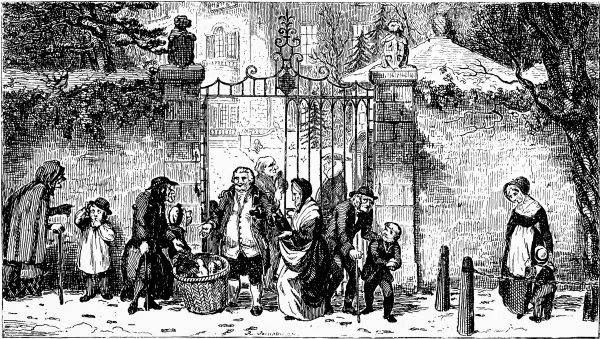 Gate of the "Old English Gentleman."—Page 109.
In a word, the blaze of royal and noble celebration
was as a great beacon to the land, seen afar
off by those who could not share in its warmth
or sit under the influence of its immediate inspirations.
But it was answered from every hill-top
and repeated in every valley of England; and each
man flung the Yule log on his own fire at the cheering
signal. The hearth, according to Aubrey, at
the first introduction of coals, was usually in the
middle of the room; and he derives from thence
the origin of the saying, "round about our coal
fire." But whether the huge fagot crackled and
flustered within those merry circles or flared and
roared up the ample chimneys,—all social feelings,
and all beautiful superstitions and old traditions
and local observances awoke at the blaze; and from
their thousand hiding-places crept out the customs
and ceremonials which crowd this festal period of
the year, and of which it is high time that we should
proceed to give an account in these pages. The
charmed log that (duly lighted with the last year's
brand, which, as we learn from Herrick, was essential
to its virtue) scared away all evil spirits, attracted
all beneficent ones. The 'squire sat in the
midst of his tenants as a patriarch might amid his
family, and appears to have had no less reverence,
though he compounded the wassail-bowl with his
own hands and shared it with the meanest of his
dependants. The little book from which we have
more than once quoted by the title of "Round
about our Coal-fire," furnishes us with an example
of this reverence too ludicrous to be omitted. Its
writer tells us that if the 'squire had occasion to ask
one of his neighbors what o'clock it was, he received
for answer a profound bow and an assurance
that it was what o'clock his worship pleased,—an
answer, no doubt, indicative of profound respect,
but not calculated to convey much useful information
to the inquirer. In fine, however, while the
glad spirit of the season covered the land, hospitality
and harmony were everywhere a portion of
that spirit. The light of a common festival shone
for once upon the palace and the cottage, and the
chain of a universal sympathy descended unbroken
through all ranks, from the prince to the peasant
and the beggar.
"The damsel donned her kirtle sheen;
The hall was dress'd with holly green;
Forth to the wood did merry men go,
To gather in the misletoe.
Then opened wide the baron's hall,
To vassall, tenant, serf and all;
Power laid his rod of rule aside,
And ceremony doffed his pride.
The heir, with roses in his shoes,
Those nights might village partner chuse;
The lord, underogating, share
The vulgar game of 'post-and-pair.'
. . . .
The fire with well-dried logs supplied,
Went roaring up the chimney wide;
The huge hall-table's oaken face,
Scrubbed till it shone, the time to grace,
Bore then upon its massive board
No mark to part the 'squire and lord.
Then was brought in the lusty brawn,
By old blue-coated serving-man;
Then the grim boar's head frowned on high,
Crested with bays and rosemary.
Well can the green-garbed ranger tell,
How, when, and where, the monster fell;
What dogs, before his death, he tore,
And all the batings of the boar.
The wassail round, in good brown bowls,
Garnished with ribbons, blithely trowls.
There the huge sirloin reeked; hard by
Plumb-porridge stood, and Christmas pye;
Nor failed old Scotland to produce,
At such high-tide, her savoury goose.
Then came the merry masquers in,
And carols roared with blithesome din;
If unmelodious was the song,
It was a hearty note, and strong.
Who lists may, in their mumming, see
Traces of ancient mystery;
White shirts supplied the masquerade,
And smutted cheeks the visors made:
But, Oh! what masquers, richly dight,
Can boast of bosoms half so light?
England was merry England, when
Old Christmas brought his sports again.
'Twas Christmas broached the mightiest ale,
'Twas Christmas told the merriest tale,
A Christmas gambol oft would cheer
The poor man's heart through half the year."
The ceremonies and superstitions and sports of
the Christmas season are not only various in various
places, but have varied from time to time in the
same. Those of them which have their root in the
festival itself are for the most part common to all,
and have dragged out a lingering existence even to
our times. But there are many which, springing
from other sources, have placed themselves under
its protection or, naturally enough, sought to associate
themselves with merry spirits like their own.
Old Father Christmas has had a great many children
in his time, some of whom he has survived; and
not only so, but in addition to his own lawful offspring
the generous old man has taken under his
patronage and adopted into his family many who
have no legitimate claim to that distinction by any
of the wives to whom he has been united,—neither
by the Roman lady, his lady of the Celtic family,
nor her whom he took to his bosom and converted
from the idolatry of Thor. His family
appears to have been generally far too numerous
to be entertained at one time in the same establishment,
or indeed by the same community, and to
have rarely travelled therefore in a body.
In Ben Jonson's Masque of Christmas, to which
we have already alluded, the old gentleman is
introduced "attired in round hose, long stockings,
a close doublet, a high-crowned hat with a broach,
a long thin beard, a truncheon, little ruffs, white
shoes, his scarfs and garters tied cross, and his
drum beaten before him," and is accompanied by
the following members of his fine family: Miss-rule,
Caroll, Minced-pie, Gamboll, Post-and-Pair
(since dead), New Year's Gift, Mumming,
Wassail, Offering, and Baby-Cake,—or Baby-Cocke,
as we find him elsewhere called, but who
we fear is dead too, unless he may have changed
his name, for we still find one of the family bearing
some resemblance to the description of him given
by Ben Jonson.
In the frontispiece to this volume the artist has
represented the old man like another magician,
summoning his spirits from the four winds for a
general muster; and we hope that the greater part
of them will obey his conjuration. The purpose,
we believe, is to take a review of their condition
and see if something cannot be done to amend their
prospects,—in which it is our purpose to assist him.
Already some of the children have appeared on the
stage; and the rest, we have no doubt, are advancing
in all directions. We are glad to see amongst
the foremost, as he ought to be, Roast Beef,—that
English "champion bold" who has driven the
invader hunger from the land in many a well-fought
fray, and for his doughty deeds was created
a knight banneret on one of his own gallant fields
so long ago as King Charles's time. We suppose
he is the same worthy who, in the Romish
calendar, appears canonized by the title of Saint
George, where his great adversary Famine is
represented under the figure of a dragon. Still
following Roast Beef, as he has done for many a
long year, we perceive his faithful 'squire (bottle-holder
if you will) Plum Pudding, with his rich
round face and rosemary cockade. He is a blackamoor,
and derives his extraction from the spice
lands. His Oriental properties have however received
an English education and taken an English
form, and he has long ago been adopted into the
family of Father Christmas. In his younger days
his name was "Plumb-Porridge": but since he
grew up to be the substantial man he is, it has been
changed into the one he now bears, as indicative
of greater consistency and strength. His master
treats him like a brother; and he has, in return,
done good service against the enemy in many a
hard-fought field, cutting off all straggling detachments
or flying parties from the main body, which
the great champion had previously routed. Both
these individuals, we think, are looking as vigorous
as they can ever have done in their lives, and offer
in their well-maintained and portly personages a
strong presumption that they at least have at no
time ceased to be favorite guests at the festivals of
the land.
Near them stands, we rejoice to see, their favorite
sister Wassail. She was of a slender figure in Ben
Jonson's day, and is so still. If the garb in which
she appears has a somewhat antiquated appearance,
there is a play of the lip and a twinkle of the eye
which prove that the glowing and joyous spirit
which made our ancestors so merry "ages long
ago," and helped them out with so many a pleasant
fancy and quaint device, is not a day older than it
was in the time of King Arthur. How should she
grow old who bathes in such a bowl? It is her
fount of perpetual youth! Why, even mortal hearts
grow younger, and mortal spirits lighter, as they
taste of its charmed waters. There it is, with its
floating apples and hovering inspirations! We see
too, that the "tricksy spirit," whose head bears it
(and that is more than every head could do) has
lost none of his gambols, and that he is still on the
best of terms with the Turkey who has been his
playfellow at these holiday-times for so many years.
The latter, we suppose, has just come up from Norfolk,
where Father Christmas puts him to school;
and the meeting on both sides seems to be of the
most satisfactory kind.
Mumming also, we see, has obeyed the summons,
although he looks as if he had come from a long
distance and did not go about much now. We
fancy he has become something of a student. Misrule
too, we believe, has lost a good deal of his
mercurial spirit, and finds his principal resource in
old books. He has come to the muster, however,
with a very long "feather in his cap," as if he considered
the present summons portentous of good
fortune. He looks as if he were not altogether
without hopes of taking office again. We observe
with great satisfaction, that the Lord of Twelfth
Night has survived the revolutions which have been
fatal to the King of the Cockneys and so many of
his royal brethren; and that he is still "every inch
a king." Yonder he comes under a state-canopy of
cake, and wearing yet his ancient crown. The lady
whom we see advancing in the distance we take
to be Saint Distaff. She used to be a sad romp;
but her merriest days we fear are over, for she is
looking very like an old maid. Not far behind her
we fancy we can hear the clear voice of Caroll singing
as he comes along; and if our ears do not
deceive us, the Waits are coming up in another
direction. The children are dropping in on all
sides.
But what is he that looks down from yonder
pedestal in the back-ground upon the merry muster,
with a double face? And why, while the holly
and the mistletoe mingle with the white tresses that
hang over the brow of the one, is the other hidden
by a veil? The face on which we gaze is the face
of an old man, and a not uncheerful old man,—a
face marked by many a scar, by the channels of
tears that have been dried up and the deep traces
of sorrows past away. Yet does it look placidly
down from beneath its crown of evergreens on the
joyous crew who are assembled at the voice of
Christmas. But what aspect hath that other face
which no man can see? Why doth our flesh creep
and the blood curdle in our veins as we gaze?
What awful mystery doth that dark curtain hide?
What may be written on that covered brow, that
the old man dare not lift the veil and show it to
those laughing children? Much, much, much that
might spoil the revels. Much that man might not
know and yet bear to abide. That twin face is Janus,
he who shuts the gates upon the old year and opens
those of the new, he who looks into the past and
into the future, and catches the reflections of both,
and has the tales of each written on his respective
brows. For the past, it is known and has been
suffered; and even at a season like this we can
pause to retrace the story of its joys and of its sorrows
as they are graven on that open forehead,—and
from that retrospect, glancing to the future for hope,
can still turn to the present for enjoyment. But
oh, that veil and its solemn enigmas! On that other
brow may be written some secret which, putting out
the light of hope, should add the darkness of the
future to the darkness of the past, until, amid the
gloom before and the gloom behind, the festal
lamps of the season, looked on by eyes dim with
our own tears, should show as sad as tapers lighted
up in the chamber of the dead. God in mercy
keep down that veil!
"Such foresight who on earth would crave,
Where knowledge is not power to save?"
It will be our business to introduce to our readers
each of the children of old Christmas as they come
up in obedience to the summons of their father,
reserving to ourselves the right of settling the order
of their precedence; and we will endeavor to give
some account of the part which each played of old
in the revelries of the season peculiarly their own,
and of the sad changes which time has made in the
natural constitutions, or animal spirits, of some of
them. Preparatory, however, to this we must endeavor
to give a rapid glance at the causes which
contributed to the decay of a festival so ancient and
universal and uproarious as that which we have described,
and brought into the old man's family that
disease to which some of them have already fallen
victims, and which threatens others with an untimely
extinction.
We have already shown that so early as the reign
of Elizabeth the Puritans had begun to lift up their
testimony against the pageantries of the Christmas-tide;
and the Lord of Misrule, even in that day of
his potential ascendancy, was described as little
better than the great Enemy of Souls himself. Our
friend Stubs (whose denunciations were directed
against all amusements which from long usage and
established repetition had assumed anything like a
form of ceremonial, and who is quite as angry with
those who "goe some to the woodes and groves
and some to the hilles and mountaines . . . where
they spende all the night in pastymes, and in the
mornyng they return bringing with them birch
bowes and braunches of trees to deck their assemblies
withall," in the sweet month of May, as he
could possibly be with the Christmas revellers, although
the very language in which he is obliged to
state the charge against the former was enough to
tempt people out "a Maying," and might almost
have converted himself) assures the reader of his
"Anatomie" that all who contribute "to the maintenaunce
of these execrable pastymes" do neither
more nor less than "offer sacrifice to the devill and
Sathanas." It is probable, however, that the people
of those days, who were a right loyal people and
freely acknowledged the claim of their sovereigns to
an absolute disposition of all their temporalities
(any of the common or statute laws of the land
notwithstanding), considered it a part of their loyalty
to be damned in company with their sovereigns,
too, and resolved that so long as these iniquities
obtained the royal patronage it was of their
allegiance to place themselves in the same category
of responsibility. Or perhaps their notion of regal
prerogative, which extended so far as to admit its
right to mould the national law at its good pleasure,
might go the further length of ascribing to it a controlling
power over the moral statutes of right and
wrong, and of pleading its sanction against the menaces
of Master Stubs. Or it may be that Master
Stubs had failed to convince them that they were
wrong, even without an appeal to the royal dispensation.
Certain it is that, in spite of all that Master
Stubs and his brethren could say, the sway of the
Lord of Misrule, and the revels of his court continued
to flourish with increasing splendor during this reign,
and, as we have seen, lost no portion of their magnificence
during the two next, although in that time
had arisen the great champion of the Puritans,
Prynne, and against them and their practices had
been directed whole volumes of vituperation, and
denounced large vials of wrath.
In Scotland, however, where the reformation took
a sterner tone than in the southern kingdom, and
where, as we have said, the irregularities committed
under cover of the Christmas and other ceremonials
laid them more justly open to its censure, the
effect of this outcry was earlier and far more sensibly
felt; and even so early as the reign of Queen
Mary an act passed the Scottish Parliament whereby
the Abbot of Unreason and all his "merrie disports"
were suppressed.
In England, it is true that, according to Sandys,
an order of the common council had issued as
early as the beginning of our Mary's reign prohibiting
the Lord Mayor or Sheriffs from entertaining a
Lord of Misrule in any of their houses; but this
appears to have been merely on financial grounds,
with a view of reducing the corporation expenditure,
and to have extended no further.
It was not, however, until after the breaking out
of the Civil War that the persecution of the Puritans
(who had long and zealously labored not only to
resolve the various ceremonials of the season into
their pagan elements, but even to prove that the celebration
of the Nativity at all was in itself idolatrous)
succeeded to any extent in producing that
result which the war itself and the consequent disorganization
of society must in a great measure
have effected even without the aid of a fanatical
outcry. In the very first year of that armed struggle
the earliest successful blow was struck against
the festivities with which it had been usual to celebrate
this period of the year, in certain ordinances
which were issued for suppressing the performance
of plays and other diversions; and in the following
year some of the shops in London were for the
first time opened on Christmas day, in obedience to
the feelings which connected any observance of it
with the spirit of popery. By the year 1647 the
Puritans had so far prevailed that in various places
the parish officers were subjected to penalties for
encouraging the decking of churches and permitting
divine service to be performed therein on Christmas
morning; and in the same year the observance
of the festival itself, with that of other holidays,
was formally abolished by the two branches of the
legislature.
It was found impossible, however, by all these
united means, to eradicate the Christmas spirit from
the land; and many of its customs and festivities
continued to be observed, not only in obscure
places, but even in towns, in spite of prohibition
and in spite of the disarrangement of social ties.
The contest between the Puritan spirit and the
ancient spirit of celebration led to many contests;
and we have an account—in a little book of which
we have seen a copy in the British Museum, entitled
"Canterbury Christmas, or a True Relation
of the Insurrection in Canterbury"—of the disturbances
which ensued in that city upon the Mayor's
proclamation, issued in consequence of that Parliamentary
prohibition at the Christmas which followed.
This said proclamation, it appears, which
was made by the city crier, was to the effect "that
Christmas day and all other superstitious festivals
should be put downe and that a market should be
kept upon Christmas day." This order, it goes on
to state, was "very ill taken by the country," the
people of which neglected to bring their provisions
into the town, and gave other tokens of their displeasure
of a less negative kind. For, a few of the
shopkeepers in the city, "to the number of twelve
at the most," having ventured to open their shops
in defiance of the general feeling, "they were commanded
by the multitude to shut up again; but refusing
to obey, their ware was thrown up and down
and they at last forced to shut in."
Nor were the revilings of the Puritans against the
lovers of Christmas observances suffered to remain
unanswered. Many a squib was directed against
the Roundheads; and the popular regret for the
suppression of their high festival was skilfully appealed
to by Royalist politicians and favorers of the
ancient religion. The connection between the new
condition of things in Church and State and the extinction
of all the merriment of the land was carefully
suggested in publications that stole out in spite of
penalties and were read in defiance of prohibitions.
As an example, that curious little tract from which
we have more than once quoted under the title of
"An Hue and Cry after Christmas," bears the date
of 1645; and we shall best give our readers an idea
of its character by setting out that title at length,
as the same exhibits a tolerable abstract of its contents.
It runs thus: "The arraignment, conviction,
and imprisoning of Christmas on St. Thomas
day last, and how he broke out of prison in the
holidayes and got away, onely left his hoary hair
and gray beard sticking between two iron bars of a
window. With an Hue and Cry after Christmas, and
a letter from Mr. Woodcock, a fellow in Oxford,
to a malignant lady in London. And divers passages
between the lady and the cryer about Old
Christmas; and what shift he was fain to make to
save his life, and great stir to fetch him back again.
Printed by Simon Minc'd Pye for Cissely Plum-Porridge,
and are to be sold by Ralph Fidler
Chandler at the signe of the Pack of Cards in Mustard
Alley in Brawn Street." Besides the allusions
contained in the latter part of this title to some of
the good things that follow in the old man's train,
great pains are taken by the "cryer" in describing
him, and by the lady in mourning for him, to allude
to many of the cheerful attributes that made him
dear to the people. His great antiquity and portly
appearance are likewise insisted upon. "For age
this hoarie-headed man was of great yeares, and as
white as snow. He entered the Romish Kallendar,
time out of mind, as old or very neer as Father
Mathusalem was,—one that looked fresh in the
Bishops' time, though their fall made him pine away
ever since. He was full and fat as any divine doctor
on them all; he looked under the consecrated lawne
sleeves as big as Bul-beefe,—just like Bacchus upon
a tunne of wine, when the grapes hang shaking
about his eares; but since the Catholike liquor is
taken from him he is much wasted, so that he hath
looked very thin and ill of late." "The poor,"
says the "cryer" to the lady, "are sory for" his
departure; "for they go to every door a-begging,
as they were wont to do (good Mrs., Somewhat
against this good time); but Time was transformed,
Away, be gone; here is not for you." The lady,
however, declares that she for one will not be deterred
from welcoming old Christmas. "No, no!"
says she; "bid him come by night over the Thames,
and we will have a back-door open to let him in;"
and ends by anticipating better prospects for him
another year.
And by many a back-door was the old man let in
to many a fireside during the heaviest times of all
that persecution and disgrace. On the establishment
of the Commonwealth, when the more settled
state of things removed some of the causes which
had opposed themselves to his due reception, the
contests of opposition between the revived spirit of
festival and the increased sectarian austerity became
more conspicuous. There is an order of the Parliament
in 1652 again prohibiting the observance of
Christmas day, which proves that the practice had
revived; and there are examples of the military
having been employed to disperse congregations
assembled for that purpose. In the "Vindication
of Christmas," published about this time, the old
gentleman, after complaining bitterly of the manner
in which he was "used in the city, and wandering
into the country up and down from house to house,
found small comfort in any," asserts his determination
not to be so repulsed: "Welcome or not
welcome," says he, "I am come." In a periodical
publication of that day entitled "Mercurius Democritus,
or a True and Perfect Nocturnall, communicating
many strange wonders out of the World in
the Moon, etc.," the public are encouraged to keep
Christmas, and promised better days. No. 37 contains
some verses to that effect, of which the following
are the first two:—
"Old Christmass now is come to town,
Though few do him regard;
He laughs to see them going down,
That have put down his Lord.
"Cheer up, sad heart, crown Christmass bowls,
Banish dull grief and sorrow;
Though you want cloaths, you have rich souls,
The sun may shine to-morrow."
And again in No. 38:—
"A gallant crew, stir up the fire,
The other winter tale,
Welcome, Christmass, 'tis our desire
To give thee more spic'd ale."
On the return of the royal family to England, the
court celebrations of Christmas were revived both
there and at the Inns of Court; and the Lord of
Misrule came again into office. We have allusions
to the one and the other in the writings of Pepys
and of Evelyn. The nobles and wealthy gentry,
too, once more at their country-seats, took under
their protection such of the ancient observances as
had survived the persecution, and from time to time
stole out of their hiding-places under the encouragement
of the new order of things. But in none
of its ancient haunts did the festival ever again
recover its splendor of old. The condition of
Charles's exchequer, and the many charges upon it,—arising
as well out of the services of his adherents
as from his own dissolute life,—left him little
chance of imitating the lavish appointments of the
court pageantries in the days of Elizabeth and
James; and the troubles out of which the nation
had emerged had made changes as well in the face
of the country as in the condition and character of
society, alike opposed to anything like a general
and complete revival of the merry doings of yore.
In the country, estates had passed into new hands,
and the immemorial ties between the ancient
families and the tenants of the soil had been rudely
severed. Many of the old establishments in which
these celebrations had been most zealously observed,
were finally broken up; and friends who
had met together from childhood around the
Christmas fire, and pledged each other year by year
in the wassail-bowl, were scattered by the chances
of war. But out of this disturbance of the old
localities and disruption of the ancient ties of the
land, a result still more fatal to these old observances
had arisen, promoted besides by the dissipation
of manners which the restored monarch had
introduced into the country. Men rooted out
from their ancestral possessions and looking to a
licentious king for compensation, became hangers-on
about the court; and others who had no such
excuse, seduced by their example and enamoured of
the gayeties of the metropolis and the profligacies
of Whitehall, abandoned the shelter of the old trees
beneath whose shade their fathers had fostered the
sanctities of life, and from "country gentlemen"
became "men about town." The evils of this
practice, at which we have before hinted as one of
those to which the decay of rural customs is mainly
owing, began to be early felt, and form the topic of
frequent complaint and the subject of many of the
popular ballads of that day. The song of the "Old
and Young Courtier" was written for the purpose
of contrasting the good old manners with those of
Charles's time; and the effects of the change upon
the Christmas hospitalities has due and particular
notice therein. We extract it from the Percy collection
for our readers, as appropriate to our subject
and a sample of the ballads of the time:—
THE OLD AND YOUNG COURTIER.
An old song made by an aged old pate,
Of an old worshipful gentleman who had a greate estate,
That kept a brave old house at a bountifull rate,
And an old porter to relieve the poor at his gate;
Like an old courtier of the Queen's,
And the Queen's old courtier.
With an old lady, whose anger one word assuages;
They every quarter paid their old servants their wages,
And never knew what belong'd to coachmen, footmen, nor pages,
But kept twenty old fellows with blue coats and badges;
Like an old courtier, etc.
With an old study fill'd full of learned old books,
With an old reverend chaplain,—you might know him by his looks,—
With an old buttery hatch worn quite off the hooks,
And an old kitchen, that maintained half-a-dozen old cooks;
Like an old courtier, etc.
With an old hall, hung about with pikes, guns, and bows,
With old swords, and bucklers that had borne many shrewde blows,
And an old frize coat, to cover his worship's trunk hose,
And a cup of old sherry to comfort his copper nose;
Like an old courtier, etc.
With a good old fashion, when Christmasse was come,
To call in all his old neighbours with bagpipe and drum,
With good chear enough to furnish every old room,
And old liquor able to make a cat speak, and man dumb;
Like an old courtier, etc.
With an old falconer, huntsman, and a kennel of hounds,
That never hawked, nor hunted, but in his own grounds,
Who, like a wise man, kept himself within his own bounds,
And when he dyed gave every child a thousand good pounds;
Like an old courtier, etc.
But to his eldest son his house and land he assign'd,
Charging him in his will to keep the old bountifull mind,
To be good to his old tenants, and to his neighbours be kind;
But in the ensuing ditty you shall hear how he was inclined;
Like a young courtier, etc.
Like a flourishing young gallant, newly come to his land,
Who keeps a brace of painted madams at his command,
And takes up a thousand pound upon his father's land,
And gets drunk in a tavern, till he can neither go nor stand;
Like a young courtier, etc.
With a new-fangled lady, that is dandy, nice, and spare,
Who never knew what belong'd to good housekeeping or care,
Who buys gaudy-color'd fans to play with wanton air,
And seven or eight different dressings of other women's hair;
Like a young courtier, etc.
With a new-fashion'd hall, built where the old one stood,
Hung round with new pictures, that do the poor no good,
With a fine marble chimney, wherein burns neither coal nor wood,
And a new smooth shovelboard, whereon no victuals ne'er stood;
Like a young courtier, etc.
With a new study, stuff'd full of pamphlets and plays,
And a new chaplain, that swears faster than he prays,
With a new buttery-hatch that opens once in four or five days,
And a new French cook, to devise fine kickshaws and toys;
Like a young courtier, etc.
With a new fashion, when Christmasse is drawing on,
On a new journey to London straight we all must begone,
And leave none to keep house, but our new porter John,
Who relieves the poor with a thump on the back with a stone;
Like a young courtier, etc.
With a new gentleman usher, whose carriage is compleat,
With a new coachman, footmen, and pages to carry up the meat,
With a waiting-gentlewoman, whose dressing is very neat,
Who when her lady has din'd, lets the servants not eat;
Like a young courtier, etc.
With new titles of honour bought with his father's old gold,
For which sundry of his ancestors' old manors are sold;
And this is the course most of our new gallants hold,
Which makes that good housekeeping is now grown so cold,
Among the young courtiers of the King,
Or the King's young courtiers.
In a word, the old English feeling seemed nearly
extinct for a time; and the ancient customs which
had connected themselves therewith, one by one
fell more or less into disuse. The chain of universal
sympathy and general observance, which had long
kept the festival together in all its parts, was broken;
and the parts fell asunder, and were by degrees
lost or overlooked. Let no man say that this is
scarcely worth lamenting! Let none imagine that,
in the decay of customs useless or insignificant in
themselves, there is little to regret! "The affections,"
says Sterne, "when they are busy that way,
will build their structures, were it but on the paring
of a nail;" and there is no practice of long observance
and ancient veneration—whether among
nations or individuals—round which the affections
have not in some degree twined themselves, and
which are not therefore useful as supports and remembrancers
to those affections. There are few of
the consequences springing from civil war more
lamentable than the disturbance which it gives to
the social arrangements, were it but to the meanest
of them. It is impossible that customs long identified
with the feelings should perish without those
feelings (though from their own eternal principle
they will ultimately revive and find new modes of
action) suffering some temporary injury. It was a
beautiful assertion of Dr. Johnson that his feelings
would be outraged by seeing an old post rooted up
from before his door which he had been used to
look at all his life,—even though it might be an
incumbrance there. How much more would he
have grieved over the removal of a village Maypole,
with all its merry memories and all its ancient
reverence!
The Christmas festival has languished from those
days to this, but never has been, and never will be
extinct. The stately forms of its celebration in
high places have long since (and, in all probability,
forever) passed away. The sole and homely representative
of the gorgeous Christmas prince is the
mock-monarch of the Epiphany,—the laureate of
our times, with his nominal duties, in the last faint
shadow of the court bards and masque-makers of
yore; and the few lingering remains of the important
duties once confided to the master of the royal
revels are silently and unostentatiously performed
in the office of the Lord Chamberlain of to-day.
But the spirit of the season yet survives, and, for
reasons which we shall proceed to point out, must
survive. True, the uproarious merriment, the
loud voice which it sent of old throughout the
land, have ceased; and while the ancient sports
and ceremonies are widely scattered, many of them
have retreated into obscure places, and some perhaps
are lost. Still, however, this period of commemoration
is everywhere a merry time; and we
believe, as we have already said, that most of the
children of Father Christmas are yet wandering up
and down in one place or another of the land. We
call upon all those of our readers who know anything
of the "old, old, very old, gray-bearded gentleman"
or his family to aid us in our search after
them; and with their good help we will endeavor
to restore them to some portion of their ancient
honors in England.
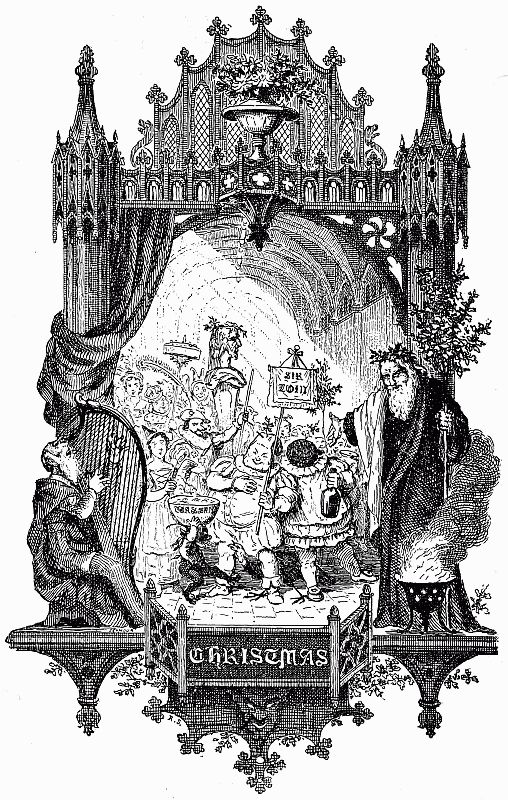

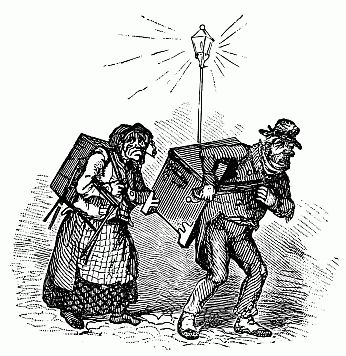 Galantee Show.