Cheddar is the best known cheese throughout the
United States and the one most commonly made in
factories. The Cheddar process was brought to America
by English immigrants. Similar to Cheddar cheese are
Pineapple, English Dairy, Sage cheese, skimmed-milk
and California Jack cheese made in this country, and
Derbyshire, Leicestershire, Wensleydale and Cheshire made
in England. The Cheddar cheese process as employed
in the factories to-day has been modified and improved
since it was first introduced into this country by the
early immigrants. The following description87 includes
only the practices as found in the factories to-day if
whole milk is used. Skimmed-milk Cheddar cheese
is discussed later.
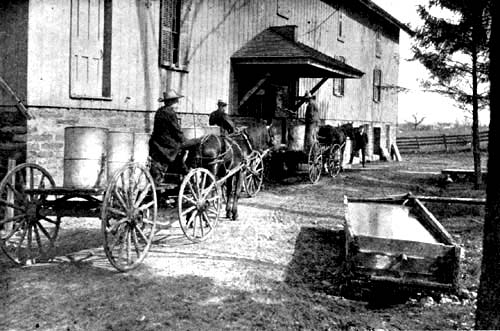
Fig. 29.—Delivering milk to the cheese factory.
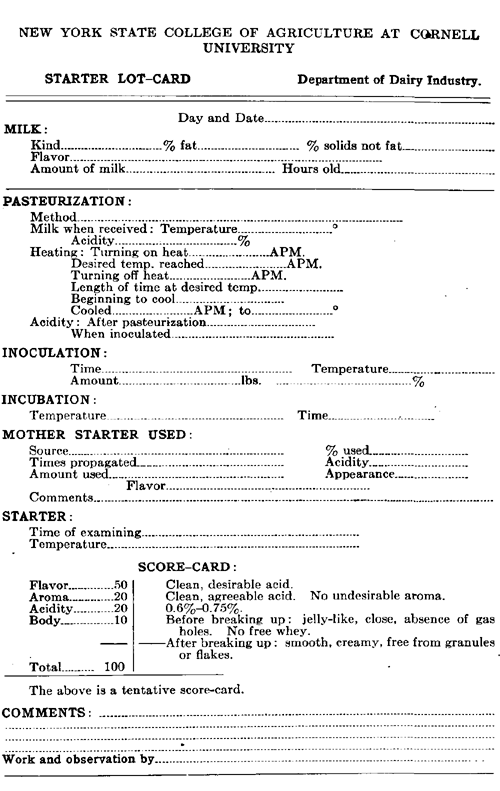
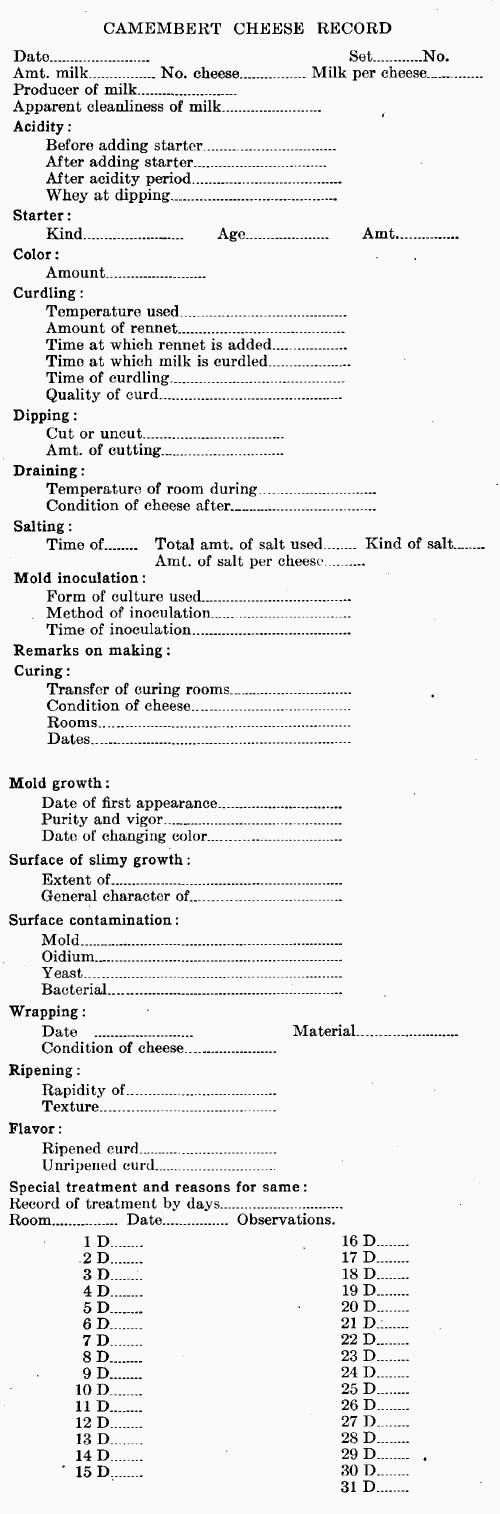
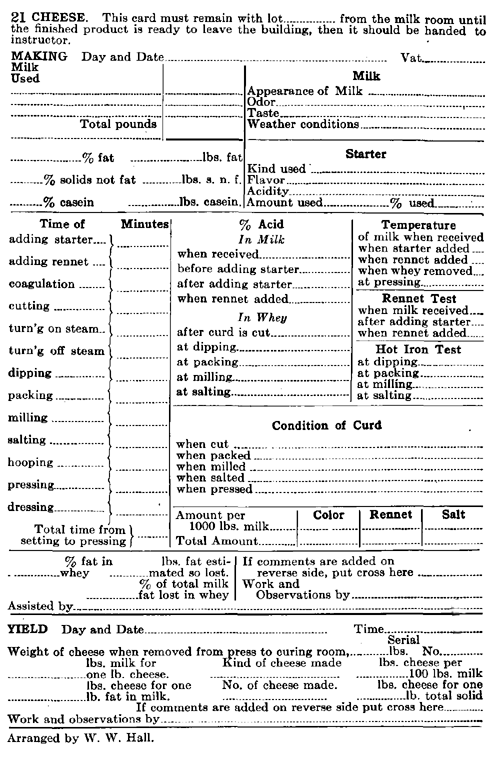
192. The lot-card.—The Cheddar process involves
several hours of manipulation and includes many details
which should be closely and accurately observed and
recorded. The necessity of carrying observations of
several different factors at the same time makes a scheme
of recording data essential to convenient work. For
this purpose, a lot-card for Cheddar cheese is introduced
here and the pages given to particular factors are indicated
in the space intended for the recording of observations.
The manufacture of Cheddar cheese is a complicated
process, because several factors must be given
attention at the same time. A careful record of the
observations of each step in the successive handling of
each lot of milk puts the operator in possession of a permanent
record of his experience. This record has several
uses. It may help to convince patrons of the importance
of eliminating faults in the milk; it furnishes the cheese-maker
a cumulative record of his experiences in handling
milk with special qualities, such as high or low fat-content,
over-acidity or taints. Since Cheddar ripening covers a
period of weeks and months, no operator can remember
particular lots of milk sufficiently well to be able to
use his experience on the interpretation of the qualities
found in the ripened product.
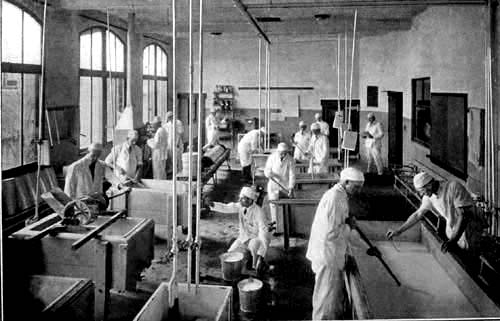
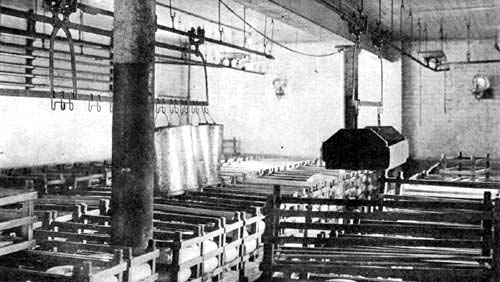
193. The milk.—It is the usual practice to deliver the
milk to the cheese factory each morning (Fig. 29). The
night's milk is cooled and kept clean and cold until delivered
at the factory. It is advisable not to mix the cold
night's milk and the warm morning's milk, but to deliver
them in separate cans to the cheese factory at the same time.
The milk is weighed, sample for fat test taken and then
run into the vat (Fig. 30). The receiving or taking in
of the milk is one of the most important parts of the
cheese factory work. It is practically as important as
the actual manufacturing of the cheese.
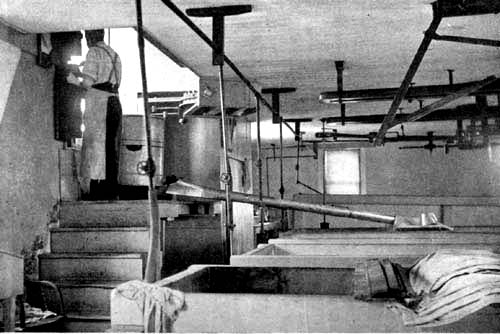
Fig. 30.—Receiving, sampling, weighing and running the milk into the cheese vat.
Any milk high in acid or with a bad flavor should be
avoided. It is often bad policy to reject the milk, for
a neighboring factory will accept it and the factory not
only loses the milk but also the patron. Factories should
have an agreement to prevent this. The acidity can be
determined by the acid test, but the detection of flavors
must be made by the cheese-maker himself with the aid
of smell and taste. Many of the bad flavors in the cheese
can be traced to the poor quality of the milk. One of
the worst qualities in milk and cheese is the presence of
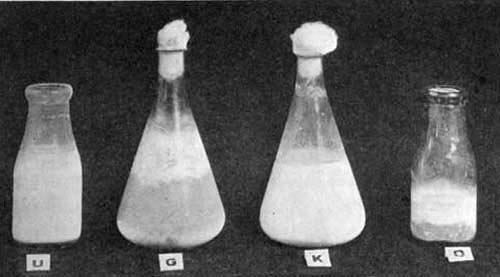
gas-producing organisms.88 Any milk which shows gassy
fermentation should be rejected, for it is difficult to make
cheese from this and at best there will be a large loss
during the manufacturing process. The cheese may have
a bad flavor and develop "pin-holes" and in extreme
cases may puff up like a ball. The person receiving the
milk should talk to the farmers or dairy-men about the
proper care of the utensils and milk. He must see that
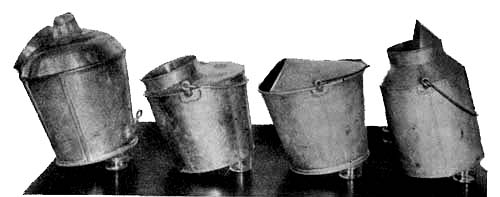
the cans are kept clean. One very bad practice is to
deliver milk and take home whey in the same cans. The
cans, as they are brought back from the cheese factory
full of whey, are often left in the barn or near a hog-pen
until the whey is fed. Unless such cans are emptied
immediately on returning to the farm and then rinsed
out with cold water, thoroughly washed and scalded, bad
flavors may develop in the cheese. It is thought that
this causes "fruity" or sweet flavor, which resembles that
of fruits such as raspberries, strawberries or pineapples.
194. Ripening the milk.—A slight development of
acidity is required: (a) to obtain the formation of a firm
curd; and (b) to establish immediate dominance of a
desirable type of lactic organism which will produce the
large amount of acid required later in the cheddaring
process. The development of this acidification before
the addition of rennet is known as the ripening of the
milk. The extent of ripening advised by different
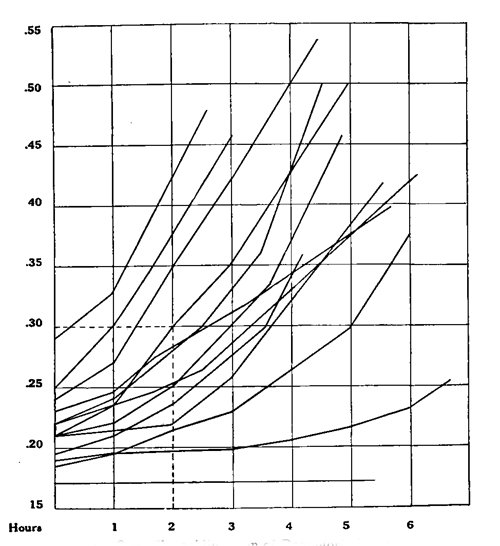
schools of makers has varied from an acidity of 0.20 of
1 per cent or even slightly higher percentage titrated
as lactic acid, to about 0.17 of 1 per cent as now preferred
by some of the most successful groups of workers. The
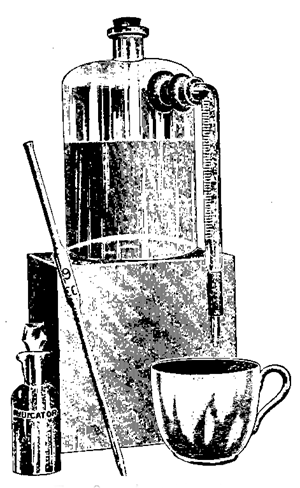
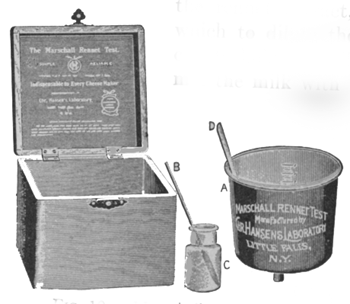
ripeness of the milk can also be determined by the use of
the rennet test.
The milk may be ripened by allowing the lactic organisms
already present in the milk to develop naturally. This
requires considerable time and while the lactic acid-forming
bacteria are developing, other and undesirable fermentations
may be taking place, so that the good results which
should follow the uninterrupted development of the lactic
acid-forming organisms are lost. Starter is commonly used
to produce the desired ripening of the milk. (For the
preparation of starter see Chapter IV.)
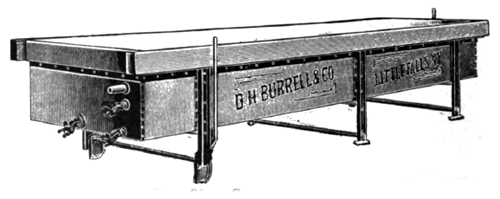
Fig. 31.—Steel cheese vat.
Some makers put the starter into the empty vat (Fig.
31) and add the milk as it is received; others add it to
the total volume of cold milk and then begin to heat it.
Whenever the starter is used, it should be strained to
remove lumps. These lumps might cause a mottled
color in the cheese. The best practice calls for an acidity
or a rennet test of the mixed milk after it has been
brought to the setting temperature in the vat. With
milk tested at this stage and the volume of milk in the
vat known, the cheese-maker is able to calculate
closely the amount of starter needed. When the
quantity of starter to use is in doubt, the amount added
should be under rather than over the estimate, since the
need of more can be determined by making frequent rennet
and acid tests in a very few minutes without damage
to the cheese. If too much starter has been used, acid
or sour cheese is usually obtained, with loss in market
quality.
An over-development of acidity at any stage of the manufacturing
process affects the flavor, body and texture,
color and finish of the cheese. The product is known as
a sour cheese, and can usually be identified by its sour
taste and smell. A sour cheese while curing will seldom
develop a normal Cheddar flavor and the texture will
be hard and harsh and very brittle. The body will not
be smooth but harsh and grainy. The over-development
of acid will show by fading or bleaching the color. A
sour cheese usually leaks whey for a few days after being
placed on the curing-room shelves.
Ripening the milk is one of the most important parts
of cheese-making. Proper ripening places the acid fermentations
under the control of the cheese-maker so
that he may know what results will follow his labors.
The operator can control the acidity while ripening the
milk, but after the rennet is added all control of the acidity
is lost. From that time, the moisture must be regulated
in proportion to the acidity.
Before setting, the milk should be ripened to such a
point as to leave at least two and one-half hours from the
time that the rennet extract is added until the acid development
has reached the stage at which it is necessary
to remove the whey. By the acid test the milk may vary
from 0.16 to 0.18 of 1 per cent, but no definite statement
can be given for the rennet test. This can be determined
only by comparison from day to day. For operation
of rennet test see Chapter V. During this period
of two and one-half hours, the curd is formed, then cut,
and the temperature is raised from 84° or 86° F. (the
temperature at which the rennet extract is added) to about
98° to 100° F. The curd must be kept agitated so that
the particles will not mat together; this is necessary to
obtain sufficient contraction of the particles of curd with
the proper reduction of water-content. If the milk
becomes too ripe (too sour) before the rennet is added,
there will not be sufficient time for these steps to take
place naturally. In such cases special means are required
to firm the curd. These result in a loss of both
quality and quantity of cheese. On the other hand, if
the milk is not ripened, but the rennet extract added,
regardless of the acid development, one of the important
natural forces for expelling the moisture is lost. The
time required for the particles of curd to contract is much
prolonged, the expulsion of whey is usually inadequate and
the curd remains in a soft or wet condition. Using too
much starter is almost equally bad, for although it hastens
the making process, it produces a sour or acid cheese.
195. Setting or coagulating.—The milk for Cheddar
cheese-making is heated to 86° to 88° F. or occasionally
a slightly lower temperature. This temperature is found
by experiment to give the texture of curd most favorable
for the desired results. Although some cheese-makers
work as low as 84° F., the texture of such curd is too soft
and coagulates too slowly. The very slight change of
2° F. produces curd which coagulates more quickly and
is tougher and firmer.
If the cheeses are to be colored, the color should be
added after all the starter. It should be thoroughly
and evenly mixed with the milk to insure an even color
in the cheese. If the color is added before the starter,
there are likely to be white specks in the cheese, on account
of the coagulated casein in the starter. The amount of
color to use depends on the tint desired in the cheese.
It varies from ⅓ to ½ ounce to 1000 pounds of milk for a
light straw color to 1½ to 2 ounces for 1000 pounds of
milk for a deep red color.
Enough rennet should be used to produce a curd firm
enough to cut in twenty-five to thirty-five minutes.
The necessary amount will vary with the strength of the
rennet extract itself, with the acidity, the temperature,
the nature of the lot of milk, and with the individual
aims of the maker in which he adjusts the other factors
to his preferences as to rapidity of rennet action. With
the usual commercial extract, the needed amount ranges
from 2.5 to 4 ounces for 1000 pounds of milk. As for all
varieties of cheese, the rennet extract should be diluted
in cold water at about one part rennet to forty parts
water and thoroughly stirred into the milk. (See
Chapter V.)
196. Cutting.—The object of cutting is to obtain
an even expulsion of the moisture from the curd. The
curd is cut as soon as it becomes firm enough. To
determine this, various tests may be used. Some operators
test it by pressing it away from the side of the vat,
considering it ready to cut when it separates cleanly from
the metal. The test most commonly used is to insert
the index finger obliquely into the curd, then to start
to split the curd with the thumb and finally to raise the
finger gently; if ready to cut, the curd will split cleanly
over the finger and clear whey will separate to fill the
opened crack. Another arbitrary but more or less satisfactory
rule is that the time from adding the rennet until
cutting should be two and one-half times that from the
addition of rennet until the first sign of coagulation is
observed.
The condition of the curd itself is the best guide
to show when it is ready to cut. The condition of
the curd is constantly changing, so that in a large vat,
if the cutting is not begun until the curd is in the best
condition, by the time the last of the curd is cut it will be
too hard or firm. It is better to begin while the curd
is a trifle too soft so that the cutting will be taking place
while the curd is at the proper stage. At best the last
of the curd may become too hard. If too hard, it will
break ahead of the knife instead of cut. Breaking
causes more fat loss than cutting because there is more
surface exposed and hence more fat globules. The
softer the curd when cut, the quicker and easier the
moisture can be expelled.
If the curd is cut when soft, care must be exercised not
to stir it too hard immediately after cutting. Soft curd
breaks very easily. When the curd is cut soft and then
stirred vigorously, there is a larger loss of fat than
when the curd becomes hard before it is cut.
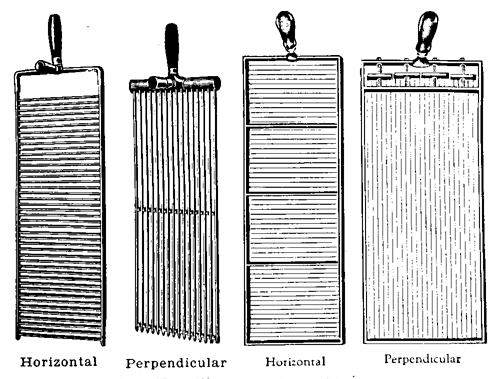
Two knives are used to cut the curd. (See Fig. 11.)
These knives may have either wire or blades for cutting.
The space between the wires or blades varies from 5/16 to ½
inch. Knives used should have blades or wires close
enough together to cut the pieces as small as desired,
without a second cutting. When the curd has to be cut a
second time it usually results in pieces of uneven sizes, because
the pieces already cut cannot be evenly split in two.
One set of knives has horizontal and the other perpendicular
blades or wires. The curd is cut the long way
of the vat with the horizontal knife and lengthwise and
crosswise with the perpendicular knife so that the result
is small cubes or oblongs of curd. Some cheese-makers
prefer to use one knife first and some the other, but the
result should be a curd cut into pieces of uniform size.
The smaller the particles of curd or cubes are cut, the
quicker the curd will firm up or cook. If not cut uniformly,
the changes taking place later in the curd particles will
not be uniform,—the small pieces will be hard and dry
while the large ones will be soft and mushy.
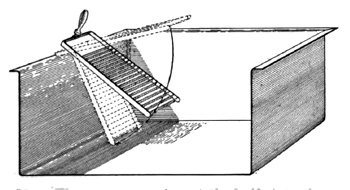
Fig. 32.—The proper way to put the knife into the curd.
Care should be taken to let the knife cut its way into
the curd (Fig. 32). If the knife is pushed into the curd,
it will break it and cause a large loss of fat. The same
is true when taking the knives out of the curd. The loss
of fat due to cutting is very similar to the loss of sawdust
when sawing a board. It may be considered a necessary
evil. The loss due to cutting is about 0.3 of 1 per cent
of fat in the whey and the loss of casein about 0.1 of 1
per cent in the whey.
197. Heating or "cooking" the curd.—After the
curd is cut, the pieces (cubes) rapidly settle to the bottom
of the vat and tend to mat together. To prevent this,
the curd must be kept stirred. When stirring first begins,
the curd is soft and very readily broken. Some cheese-makers
prefer to stir by hand for the first few minutes
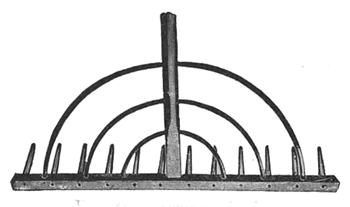 Fig. 33.—Acme curd rake.
after cutting, while
the curd is soft.
The importance of
careful handling
can hardly be over-emphasized.
No
matter how well
the curd has been
cut, if the stirring
is performed in a
careless manner in the early stages, it will be broken into
uneven sized pieces and a considerable loss of fat will
result. A wooden hay rake or a McPherson curd agitator
(Figs. 33, 34) may be used to stir the curd. Mechanical
curd agitators are used in some cheese factories.
Fig. 33.—Acme curd rake.
after cutting, while
the curd is soft.
The importance of
careful handling
can hardly be over-emphasized.
No
matter how well
the curd has been
cut, if the stirring
is performed in a
careless manner in the early stages, it will be broken into
uneven sized pieces and a considerable loss of fat will
result. A wooden hay rake or a McPherson curd agitator
(Figs. 33, 34) may be used to stir the curd. Mechanical
curd agitators are used in some cheese factories.
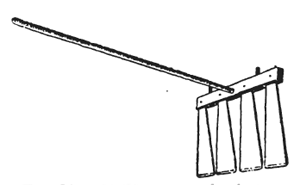 Fig. 34.—McPherson curd agitator.
There are several makes.
(See Fig. 35.) These
agitators save much
hand labor, although
some stirring by hand
must be done in connection
with them. The
mechanical agitators do
not stir the curd in the
corners of the vat; this must be done with the hand rake.
It is the usual practice to stir the curd immediately after
cutting for five to ten minutes before the mechanical
agitators are used. This is necessary to give the curd a
slight chance to firm as the mechanical agitators tend to
break it up. After cutting, a thin film forms on each
piece of curd. This film holds the curd particles, especially
the fat. Breaking the films on the cubes causes loss of
fat. If lumps form at the early stage, by matting of the
curd particles, violent stirring is required to separate
them. When such lumps are broken up, new cleavage
lines are formed with loss of fat, because the original
films surrounding the soft curd fuse so firmly that the
curd cubes do not separate but actually break. New
surfaces are thus formed with consequent fat loss. Rapid
shrinkage with expulsion of whey takes place during the
first few minutes of gentle agitation. Before any heat is
applied to the vat, sufficient whey should have separated
or formed to float each piece of curd separately. This
will require ten to fifteen minutes from the time of cutting.
Fig. 34.—McPherson curd agitator.
There are several makes.
(See Fig. 35.) These
agitators save much
hand labor, although
some stirring by hand
must be done in connection
with them. The
mechanical agitators do
not stir the curd in the
corners of the vat; this must be done with the hand rake.
It is the usual practice to stir the curd immediately after
cutting for five to ten minutes before the mechanical
agitators are used. This is necessary to give the curd a
slight chance to firm as the mechanical agitators tend to
break it up. After cutting, a thin film forms on each
piece of curd. This film holds the curd particles, especially
the fat. Breaking the films on the cubes causes loss of
fat. If lumps form at the early stage, by matting of the
curd particles, violent stirring is required to separate
them. When such lumps are broken up, new cleavage
lines are formed with loss of fat, because the original
films surrounding the soft curd fuse so firmly that the
curd cubes do not separate but actually break. New
surfaces are thus formed with consequent fat loss. Rapid
shrinkage with expulsion of whey takes place during the
first few minutes of gentle agitation. Before any heat is
applied to the vat, sufficient whey should have separated
or formed to float each piece of curd separately. This
will require ten to fifteen minutes from the time of cutting.
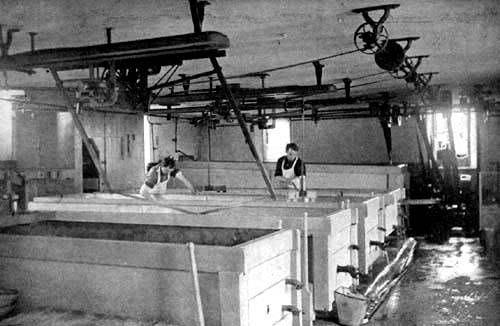
Fig. 35.—Two types of mechanical curd agitators.
Thus far the first of three distinct factors which expel
the moisture from the curd has been considered: (1) the
action of the rennet; (2) the development of the lactic
acid; and (3) the application of heat. These forces
must have time to act naturally. If heat is applied too
soon after the curd is cut or if the temperature is raised
too rapidly, it causes a thick film to form on the pieces
of curd which interferes with the escape of the whey.
The outside of the curd becomes firm but the inside remains
very soft. A curd which is cooked on the outside
only feels firm when stirred by hand in the whey, but
when a handful is squeezed the soft centers are noticed.
To firm such curd masses requires violent stirring, which
will break the thick tough film. This allows the moisture
to escape and also increases the fat loss. The
rapidity of heating should depend on the condition of
the curd and the amount of acid developed. The heat
should keep pace with these. When ready to raise the
temperature, the least amount of steam possible should
be allowed to pass through the valve. This should
raise the temperature very gradually. If heat is applied
too quickly at first, it will cause the curd to lump. A
safe rule is to raise the temperature one degree in the
first five minutes after the steam has been turned on.
The heating should progress slowly until the whole mass of
curd in the vat has reached a temperature of 90° to 92° F.
The usual temperature to which the curd is heated or
cooked is 98° F. to 100° F. The lower the temperature
that can be used and properly firm the curd, the better
will be the body of the cheese. If the curd is heated too
high, it will become hard, which causes a dry hard
"corky" cheese. After this temperature has been reached,
there is not such a tendency for the curd particles to
stick together nor are they so easily broken in stirring.
It should require, under normal conditions, not less than
thirty to forty-five minutes, from the time the steam is
turned on, to raise temperature of the curd from the
setting temperature to that necessary to "firm" the
curd. If a shorter time is allowed to raise the temperature,
the curd will not have opportunity to contract naturally.
The temperature required to expel the moisture properly
varies with the percentage of fat in the milk. If rich
in fat (4.5 to 5.5 per cent) milk requires a temperature of
98° to 104° F. to firm the curd, while the same result can
be accomplished with milk testing 3.0 to 3.5 per cent fat
at a temperature of 94° to 96° F. A higher temperature
is needed in winter than in summer because the milk is
usually richer in fat. In a water-jacketed vat, allowance
must always be made for the rise in temperature due
to the water surrounding it. The water may be removed
if there is danger of the temperature going too high.
However, it is better to gauge the heat so that the water
may be left, as this helps to hold the curd at an even
temperature, especially in cold weather. In a steam-heated
vat there is not so much danger of the temperature
running up.
The stirring must be kept up after the steam has been
turned off until the curd has reached such a stage of
contraction that it will not readily pack or mat in the
bottom of the vat. After the curd reaches this stage it
may be allowed to settle to the bottom and stirred only
occasionally until it is time to remove the whey. If the
cheese room is not warm and there is danger of the curd
cooling, a cover should be placed on the vat. The curd
should not be allowed to settle for more than fifteen
minutes without stirring to keep each piece separate.
This is necessary to obtain uniform contraction of all
curd masses.
198. Removing the whey.—To permit the normal
changes in the curd to take place naturally, two and one-half
hours from the time the rennet extract is added is
ordinarily required before the whey is drawn. The time
of removing the whey is determined by two factors: one,
the acid development, and the other, the firmness of the
curd. For the best results, it is better to have the firmness
of the curd a trifle ahead of the acid development. When
the proper acid development has been reached, the whey
must be removed, regardless of the firmness of the curd.
If the curd has not become firm enough by natural forces,
when the acid development has reached the proper stage
to remove the whey, it must be firmed by other means.
If it is not firm enough, either by natural or artificial
means, when the whey is removed, a sour cheese is
the result. The acid development should not be allowed
to go beyond 0.16 to 0.19 of 1 per cent acidity in
the whey by the acid test or ⅟16 to ⅟8 of an inch of acid
on the hot-iron test, before the whey is removed.
199. Hot-iron test.89—This test is employed to determine
the amount of acid in the curd. A piece of iron, such as
an iron pipe two feet long, is heated in the fire to proper
temperature. If the iron is too hot it will burn the
curd, and if not hot enough the curd will not stick to
the iron. When hot, it is taken from the fire and wiped
clean with a cloth. A handful of curd is taken from the
vat and squeezed dry, either in the hand or in a cloth.
This curd is carefully pressed against the hot iron and
drawn away. If the iron is at the right temperature and
the curd has sufficient acid development, the curd will stick
to the iron and when pulled away will form fine threads.
The length of these threads determines the amount of
acid in the curd. The acid is usually spoken of in
terms of the length of threads, as ⅟8 inch of acid, ½
inch of acid and the like. The curd must have a
slight development of acid before it will stick to the
iron. This test takes advantage of the peculiar
properties90 of curd which are produced by the action
of the acid on the casein.
200. Firmness of the curd.—The cheese-maker must
be able to judge the firmness of the curd by physical
examination. The particles of curd should have shrunken
to about one-half their original size and should be of
uniform consistency throughout; they should not have
any soft centers. The curd should be firm and springy.
When a double handful is pressed and suddenly released,
the curd particles should spring apart. The curd should
have a "shotty" feeling when in the whey. If the curd
has attained the proper firmness, and the acid has not
reached the correct stage to remove the whey, it may
be left in the whey until sufficient acid development
has been attained. This is liable to cause the curd to
become too firm and to result in a hard dry cheese. If
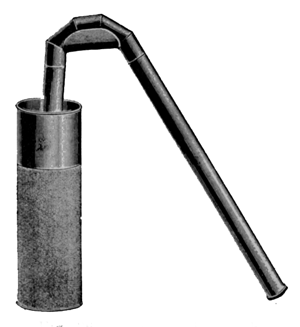 Fig. 36.—Whey siphon with strainer.
there is no evidence of
the presence of undesirable
organisms, such as
bad odors, or gas holes
in the curd, it is better
to remove the whey and
develop the acid when
the curd is in the "pack."
The pack refers to the
first piling of the curd.
Fig. 36.—Whey siphon with strainer.
there is no evidence of
the presence of undesirable
organisms, such as
bad odors, or gas holes
in the curd, it is better
to remove the whey and
develop the acid when
the curd is in the "pack."
The pack refers to the
first piling of the curd.
The whey may be removed
either by means
of a faucet or gate in the
vat or by a siphon (Fig.
36). With either form
of removal a whey-strainer (Fig. 37) should be used to
prevent loss of curd particles. It requires considerable
time for the whey to escape from a large vat. After the
curd has been heated to the proper temperature, it is
well to remove a portion of the whey. In doing this the
surface of the whey should not be drawn down quite to
the top of the curd. When ready, the remaining whey
can be quickly removed.
If it is decided that the curd is not firm enough, when
the whey is drawn down to the surface of the curd and
the acid has developed sufficiently, the curd should be
firmed up in the whey by stirring it vigorously by hand
before the remainder of the whey is removed. This is
commonly called "hand stirring." This difficulty results
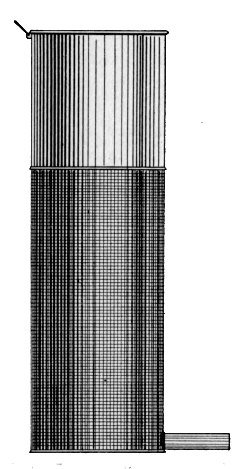 Fig. 37.—Whey strainer with spout to fit into the gate in the vat.
either from the use of too much
starter or from holding the milk
until too much acid development
has taken place before
adding the rennet. Hand stirring
accomplishes what natural
forces would accomplish if
given sufficient time. If the
curd does not firm naturally
in the whey, there is a large
loss of fat and other solids, because
the pieces of curd will
have to be broken up to allow
the water to escape from the
soft centers of these masses.
This loss can usually be reduced
by firming the curd in
the whey or adding water
rather than by stirring without
either water or whey. If the
curd is not properly firmed, it
carries extra whey into the
cheese. With the increase in whey, the amount of milk-sugar
carried into the cheese increases. This extra milk-sugar
attacked by bacteria produces an excess of lactic acid,
which results in "sour" cheeses. This explains why the
curd is placed beyond the danger of over-development
of acid by removing so large a portion of the whey.
If the curd is properly firmed in the whey and the whey
is removed before too much acid has developed, it is impossible
to make a sour cheese.
Fig. 37.—Whey strainer with spout to fit into the gate in the vat.
either from the use of too much
starter or from holding the milk
until too much acid development
has taken place before
adding the rennet. Hand stirring
accomplishes what natural
forces would accomplish if
given sufficient time. If the
curd does not firm naturally
in the whey, there is a large
loss of fat and other solids, because
the pieces of curd will
have to be broken up to allow
the water to escape from the
soft centers of these masses.
This loss can usually be reduced
by firming the curd in
the whey or adding water
rather than by stirring without
either water or whey. If the
curd is not properly firmed, it
carries extra whey into the
cheese. With the increase in whey, the amount of milk-sugar
carried into the cheese increases. This extra milk-sugar
attacked by bacteria produces an excess of lactic acid,
which results in "sour" cheeses. This explains why the
curd is placed beyond the danger of over-development
of acid by removing so large a portion of the whey.
If the curd is properly firmed in the whey and the whey
is removed before too much acid has developed, it is impossible
to make a sour cheese.
201. Gathering the curd together.—Before the last
of the whey has been removed, the curd should be pushed
back from the faucet into the upper two-thirds of the
vat and spread in an even layer. This layer should be
six to eight inches thick. The curd can be pushed back
with the rake or a board which will fit crosswise in the
vat, in which are many holes. As soon as the whey has
been removed so that there is not enough to wash the
curd into the lower part of the vat, the vat should be
tilted and a ditch eight to ten inches wide cut in the curd
through the center. The curd from the ditch should
be removed to either side and spread evenly. As soon
as all the whey has been removed, the pieces of curd scattered
about in the vat should be gathered up and placed
with the remainder.
In some factories, instead of matting the curd in the
vat, a curd sink is used. This is a wooden receptacle
about the size of the vat but not so deep, with a slatted
false bottom. It is fitted with castors so that it can be
easily moved about. A cloth is placed in the sink
and the curd and whey are dipped upon the cloth. The
whey escapes very rapidly through the cloth. The curd
sink is an advantage in those cases in which it is desirable
to remove the whey from the curd quickly, such
as high acid curds which have to be hand stirred to firm
the curd. The disadvantage lies in the work required
to keep the sink and the large cloth clean.
202. Matting or cheddaring is the distinctive feature
of the Cheddar process. It is the piling and matting
of the curd. Whether the curd is matted in the vat
or in the curd sink, the process is practically the same.
The object of cheddaring is three-fold: (1) to control the
incorporation of moisture; (2) to control undesirable
ferments, if present in the curd; (3) to develop the
texture desired in the cheeses.
After the curd in the vat has become matted so that
the particles stick together, the masses on either side of
the central channel are cut crosswise into strips with a
cheese knife (Fig. 38). The width of the strip depends
on the water-content of the curd at this stage. The
more water, the smaller should be the pieces of curd.
This allows the whey to drain away much more rapidly.
As soon as the strips of curd are cut, they should be turned
over or stood on edge. A drain should be left along the
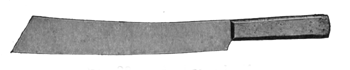 Fig. 38.—A cheese knife.
middle line of the
vat and on each
side. This permits
the whey to run
away freely. If, on the other hand, the outlet is dammed
up, the curd may become "whey-soaked." This produces
a soft mushy cheese which sometimes is "acidy"
or sour. After the curd is turned each time, all crumbs
of curd broken off should be brushed underneath the
masses of curd so that they will mat with it. They
should never be placed on top of the curd because
they will not unite but will become dry and hard. If
the crumbs are not kept brushed up, they become dry
and will cause an open textured granular cheese and
possibly lumps in the cheese. After the pieces of curd
have been turned several times, and the whey has fairly
completely drained away, they may be piled first two
deep, then three deep and so on, the depth of the piling
being gauged by the softness or amount of water in the
curd and the temperature. The higher the curd is piled,
the more water it will retain (assimilate), so that the
amount of moisture in the curd is regulated by the size
of the pieces into which it is cut and the rapidity and
depth to which it is piled.
Fig. 38.—A cheese knife.
middle line of the
vat and on each
side. This permits
the whey to run
away freely. If, on the other hand, the outlet is dammed
up, the curd may become "whey-soaked." This produces
a soft mushy cheese which sometimes is "acidy"
or sour. After the curd is turned each time, all crumbs
of curd broken off should be brushed underneath the
masses of curd so that they will mat with it. They
should never be placed on top of the curd because
they will not unite but will become dry and hard. If
the crumbs are not kept brushed up, they become dry
and will cause an open textured granular cheese and
possibly lumps in the cheese. After the pieces of curd
have been turned several times, and the whey has fairly
completely drained away, they may be piled first two
deep, then three deep and so on, the depth of the piling
being gauged by the softness or amount of water in the
curd and the temperature. The higher the curd is piled,
the more water it will retain (assimilate), so that the
amount of moisture in the curd is regulated by the size
of the pieces into which it is cut and the rapidity and
depth to which it is piled.
The curd should not be left too long from the time it
is turned until it is turned again. This period is usually
about ten to fifteen minutes. The moister the curd, the
more often it should be turned. In turning, care should
be taken to keep the ends at the same temperature as
the remainder. This can be done by piling them inside,
thereby keeping them warm. There is a tendency for
the ends of the pieces of curd to remain granular and so
cause an open-textured cheese.
During the cheddaring process, the temperature should
be reduced uniformly and gradually. If there is danger
of the curd becoming too cold, the vat should be covered
and a pail of hot water may be placed inside, if it is deemed
necessary. The temperature of the curd should not be
allowed to go below 85° to 90° F. If kept too warm, the
curd will become soft and plastic, and if too cold, it will
not mat together.
While the curd is being turned and piled, its physical
properties are changing. The acid develops. When
the cheddaring process is completed, the curd should be
elastic, smooth and fibrous. The curd should have the
close meaty texture desired in the cheese. If this step
in the process is neglected, defects may appear later in
the body, texture and flavor of the cheese. Attempts
to pile the curd too fast result in a soft, mushy, open-textured
product. Such cheese has mechanical holes, in
which moisture collects, and so is likely to cause rot
while curing.
If gas is detected either before or during the cheddaring
process, the curd should be piled until the gas holes are
no longer round but flat. If the gas holes are not flattened
or obliterated during this process, the cheeses will be
very liable to puff on the shelves in the curing-room.
The curd should be handled until the gas holes flatten
out evenly, although this may require considerable time.
At best, gassy curd will never produce the highest grade of
cheese.
Cheddaring or piling the curd is not thoroughly understood
by most cheese-makers. Because the moisture
contains the milk-sugar, there is danger of having so much
moisture present in the cheese that it will become sour
from the action of the lactic acid-forming bacteria on the
milk-sugar. A cheese may be sweet when made and later
become sour because it contains too much moisture or
milk-sugar. This is known as "shelf souring." For the
proper cheddaring of a curd, it is necessary that it be
properly firmed in the whey. If the moisture is not evenly
incorporated, the cheese will have a mottled color. The
pieces that have the more moisture will be lighter
colored. If the proper amount of moisture is not incorporated,
the cheese will be dry and hard, and if too much,
soft and pasty.
203. Milling the curd.—The large pieces formed by
the cheddaring process must be cut into small ones before
the curd can be easily put into the hoop. This is called
"milling." Properly milled curd can be salted evenly,
cools more quickly and uniformly and can be distributed
evenly in the hoops.
The proper time to "mill" the curd is determined by
its physical condition. Some curds will cheddar much
more rapidly than others, hence no definite length of time
can be given. Curd, when ready to mill, should have a
fibrous texture somewhat like the white meat of a chicken
breast. The pieces of curd should split very easily.
When cut, the curd should show a close, solid, smooth
interior. The amount of lactic acid developed may vary
within rather wide limits. The hot iron may show
strings ½ to 1 inch long. The acidity (by titration of the
freshly separating whey) may be 0.45 to 0.65 of 1 per cent.
If the curd has been properly made, that is, firmed up in
the whey with the proper acidity so far, acid development
during the cheddaring process will take care of itself.
The physical condition remains the principal means of
determining the time when the curd should be milled.
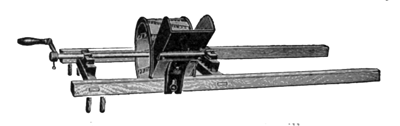
Fig. 39.—Gosselin curd-mill.
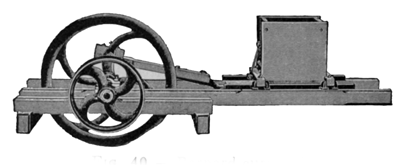
Fig. 40.—Barnard curd-mill..
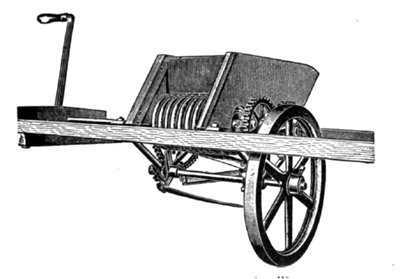
Fig. 41.—Junker curd-mill...
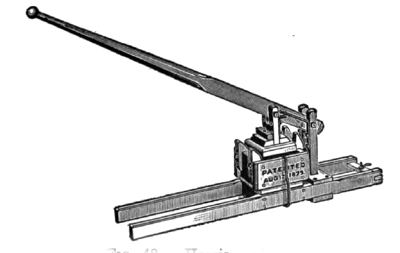
Fig. 42.—Harris curd-mill...
There are many kinds and styles of curd-mills on the
market. Gosselin, Barnard, Pohl, Junker, Victor,
Harris are well-known kinds (Figs. 39-42). Some are
hand, others power mills. Some of these tear the curd
into pieces of unequal size, others cut it into uniform
pieces. A mill that will do the work with the least
possible pressure on the curd and which will cut it
into small uniform-sized pieces is most desirable.
The ideal mill should release the least fat and leave
the curd in the best condition to receive the salt. It
is impossible to run curd through any mill without
exposing some fat on the freshly cut surfaces, and if the
curd is put under pressure, more fat will be pressed out
and lost. Cutting in the mill, like cutting the curd after
coagulation by rennet, may be called a necessary evil.
There is an unavoidable mechanical loss which may be
greater or less according to the mill used. If the curd
has been properly handled so that the water in it has
become thoroughly assimilated (properly incorporated),
this loss will be reduced to the minimum. If the curd
contains free moisture and many of the particles have
soft interiors, a stream of white whey will run down the
vat as the curd masses are cut. Some samples of such
white whey will test as high as 15 per cent fat. This
not only causes a loss in yield but in quality of cheese,
according to the amount of fat lost. White whey is an
indication of loss of fat. If the proper amount of
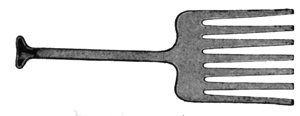 Fig. 43.—A curd fork.
moisture is present
and is so thoroughly
incorporated in the
curd that it can be
separated only by
evaporation, the ideal
condition has been
reached. While milling, the cut curd should be stirred
as fast as milled to prevent matting again and to allow
odors to escape. This stirring is usually performed with
a curd fork (Fig. 43). At the same time the temperature
will be lowered. The milled curd should be spread evenly
over the upper three-quarters of the bottom of the vat.
The flavor of the curd that has been made from tainted
milk can be very much improved by stirring at this time
so that air can enter.
Fig. 43.—A curd fork.
moisture is present
and is so thoroughly
incorporated in the
curd that it can be
separated only by
evaporation, the ideal
condition has been
reached. While milling, the cut curd should be stirred
as fast as milled to prevent matting again and to allow
odors to escape. This stirring is usually performed with
a curd fork (Fig. 43). At the same time the temperature
will be lowered. The milled curd should be spread evenly
over the upper three-quarters of the bottom of the vat.
The flavor of the curd that has been made from tainted
milk can be very much improved by stirring at this time
so that air can enter.
A gassy curd, which has been held until the holes have
become flattened, should be stirred very frequently during
this stage to allow the gas to escape, thereby improving
the flavor.
204. Salting.—Salt is added to Cheddar curd for
several purposes: (1) for its taste; (2) to aid in the
removal of the whey and to harden and shrink the curd;
(3) to influence the fermentation by slowing down acidification,
checking the growth of unfavorable organisms
and delaying ripening. The salt should be pure.
It should be coarse-grained, because the large grains
dissolve more slowly and permit its absorption to a much
larger extent than the fine-grained salt. Salt that
dissolves slowly is, therefore, to be sought for this purpose.
The following factors must be considered in determining
the amount of salt to be used: (1) the amount of curd
from the milk; (2) the percentage of water in the curd;
(3) the acidity of the curd; (4) the particular market
form of cheese desired. The custom of determining the
quantity of salt by the weight of milk is an inaccurate
practice. The amount of salt should be based on the
amount of curd. If the amount of fat in the milk is
known, a fairly accurate estimate of the amount of curd
can be made. It would be more accurate to weigh the
curd before salting, but this is not practicable or necessary
to insure a good quality of cheese. The amount of salt
varies from 1½ to 2½ pounds of salt to the curd from each
1000 pounds of milk.
The salt should not be added directly after milling
because, at that time, it would cause a large loss of fat.
After milling there should be time before salting for the
freshly cut surfaces to dry or "heal over." When first
milled the curd has a dry harsh feeling; when ready to
salt it will feel soft and mellow and some moisture can
usually be squeezed out easily. Fifteen to twenty minutes
from the time of milling are required before the curd is
ready for the salt. When ready, the curd should be
spread evenly over the bottom of the vat. The salt
should be carefully weighed, and then applied, evenly, over
the surface of the curd, in two or three applications. The
curd should be thoroughly stirred after each application
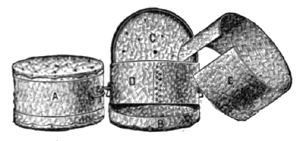 Fig. 44.—Wilson press hoop. A, complete
hoop; B, bottom cover with
wide flange; C, top cover with narrow
flange; D, closed body; E, bandager.
of salt. While the salt
is being dissolved and
absorbed, the curd
should be stirred occasionally
to prevent
lumps from forming.
Fig. 44.—Wilson press hoop. A, complete
hoop; B, bottom cover with
wide flange; C, top cover with narrow
flange; D, closed body; E, bandager.
of salt. While the salt
is being dissolved and
absorbed, the curd
should be stirred occasionally
to prevent
lumps from forming.
205. Hooping the
curd.—When the salt
has become dissolved
and the curd as soft
and mellow as before the salt was added, it is ready to be
put into the hoop. Various sized hoops may be used,
depending on the desired size of the cheese. Two types
are the Wilson and the Fraser (Figs. 44, 45). With
either type, a dampened press cloth should be cut just
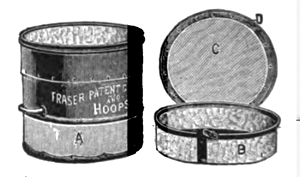 Fig. 45.—Fraser press hoop.
A, complete hoop; B, bandager;
C, follower; D, fibrous
press ring.
to fit the bottom of the hoop.
A starched circle may or may
not be used; if used, it should
be placed on top of the press
cloth. The bandage now commonly
employed is the seamless
one which comes in the form
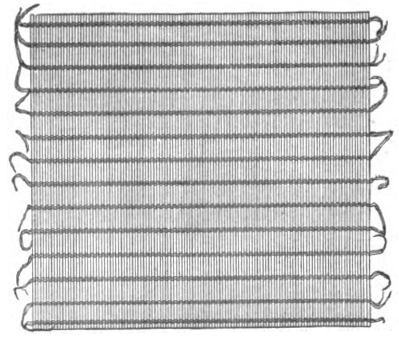
of a tube of various sizes for
different sized hoops. The
lengths of bandage cut for each
hoop or cheese depend on the height of the cheese plus
about one and one-half inches' lap on each end. The
bandage, after being cut the desired length, is placed
on the part of the hoop made to hold it, so that it is
suspended about the side of the hoop and laps about
one and one-half inches on the bottom. The bandage
should be free from ravelings and placed squarely in
the hoop.
Fig. 45.—Fraser press hoop.
A, complete hoop; B, bandager;
C, follower; D, fibrous
press ring.
to fit the bottom of the hoop.
A starched circle may or may
not be used; if used, it should
be placed on top of the press
cloth. The bandage now commonly
employed is the seamless
one which comes in the form
of a tube of various sizes for
different sized hoops. The
lengths of bandage cut for each
hoop or cheese depend on the height of the cheese plus
about one and one-half inches' lap on each end. The
bandage, after being cut the desired length, is placed
on the part of the hoop made to hold it, so that it is
suspended about the side of the hoop and laps about
one and one-half inches on the bottom. The bandage
should be free from ravelings and placed squarely in
the hoop.
The hoop is now ready to fill with curd. Enough hoops
should be prepared to hold all the day's curd as fast as
it is ready. In order to have all the cheeses as nearly
as possible of the same size, it is advisable to weigh the
curd into the hoops. The curd may be measured into the
hoops, but this is not so accurate. The curd may be
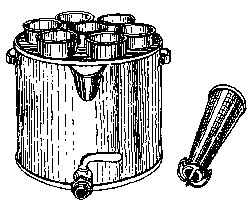
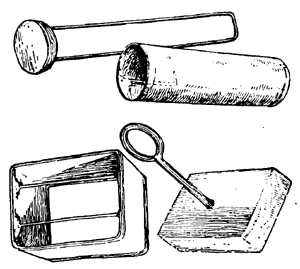
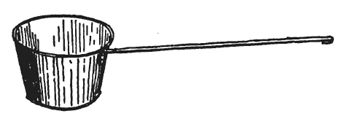
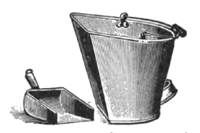 Fig. 46.—Curd scoop and pail.
dipped with a flat-sided curd pail
or a curd scoop into the hoops
(Fig. 46).
Fig. 46.—Curd scoop and pail.
dipped with a flat-sided curd pail
or a curd scoop into the hoops
(Fig. 46).
206. Pressing the curd.—The
natural changes sought in the
curd require a period of at least
five hours between the time of
setting (addition of the rennet)
and the pressing of the curd. Less time than this involves
loss in yield and quality of the cheese. In other words,
the time requirement for these changes cannot be ignored.
The object of pressing is not primarily to remove whey
but to produce the physical conditions essential to ripening
the cheese in a mass and put it in convenient form
for handling. The whey should have been removed
during the cooking and cheddaring. When ready for
the press, the temperature of the curd should be about
80° to 85° F.; it should be brought down to this point
during the milling, salting and hooping processes. If the
curd is put to press too warm or too cold, the following
results may be expected:
Too high temperature during pressing produces several
faults, as:
(1) Favors the development of undesirable ferments.
(2) Causes excessive loss of fat.
(3) Gives the curd pieces a greasy surface so that they
will not readily pass into a compact cheese. If a cheese
is greasy, the bandages will not stick.
(4) Favors the formation of mechanical holes in the
cheese.
(5) Causes "seamy" color in the cheese by the collection
of fat between pieces of curd.
Too low temperature has its difficulties, such as:
(1) The pieces of curd will not fuse together.
(2) The rind does not form properly.
(3) It appears to cause mottled cheese.
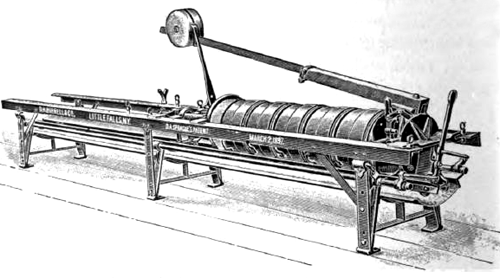
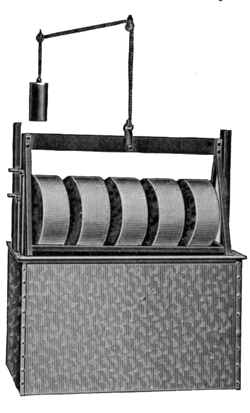
Fig. 47.—Continuous pressure gang cheese-press.
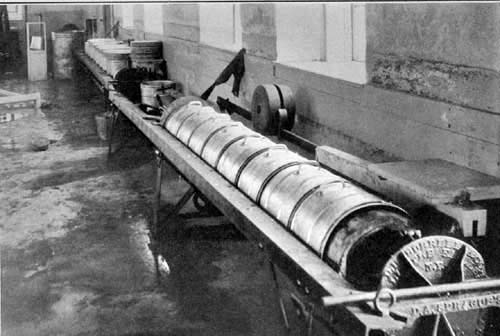
Fig. 48.—Filling the hoops and pressing the curd.
The commonly used gang press may or may not
have an arrangement to cause continuous pressure to be
applied to the cheese (Figs. 47, 48). When fresh cheeses
are first placed in the press, the pressure should be
applied very gradually. The curd, after being cut through
the mill, will have many exposed fat globules. A heavy
pressure at first will force out the whey set free by the
extracting power of the salt. The whey will carry away
the exposed fat globules, and therefore reduce the yield.
As soon as white whey starts from the hoops, the
increased application of the pressure should be stopped
until the whey regains the appearance of clear brine.
More pressure can then be gradually applied until full
pressure is reached. The cheeses should remain under
heavy pressure for one-half to one hour, when they should
be removed from the press and dressed.
207. Dressing the cheese.—When ready to dress
the cheese, the press is opened and the hoops turned down.
The hoops are opened so that the bandages can be lapped
over the top of the cheeses about 1½ inches. Before
turning a bandage down, it should be carefully pulled up
to remove any wrinkles from the sides of the cheese,
but not hard enough to pull it free from the bottom.
After it is pulled up, the bandage should be lapped over
the top about 1½ inches, and if not even should be trimmed
with a sharp knife. It should then be sopped down with
warm water. Plenty of warm water to wet the bandage
and cloths helps to form a good rind. If starched circles
are used, one should be placed on the top of the cheese
and sopped down with warm water. If not, the press cloth
should be wrung out of warm water and put on smoothly,
so there will be no wrinkles. The hoop is then put together
and placed back in the press under heavy pressure
for twelve to eighteen hours. The pressure should be
sufficient to cause the curd particles to unite so that the
surface of the cheese will be smooth. The next day the
cheeses are taken from the hoops and placed in the curing-room.
If they do not come out of the hoop easily, they
may be loosened by cutting between the sides of the cheese
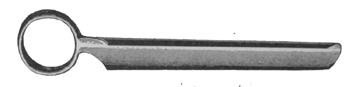
and the hoop with a knife. A special thin-bladed knife
for this purpose is called a speed knife (Fig. 49). Care
should be taken not to cut the bandage when trying to
loosen the cheese. If starched circles are used, the press
cloths are removed from the cheese, when they are put
in the curing-room. If neither starched circles nor press
cloth are left on the cheese in the curing-room, the rind
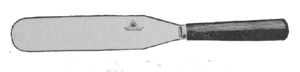 Fig. 49.—Speed knife.
will crack on account
of drying out on the
exposed surface. This
allows mold and insects
to enter the cheese. The flavor, body and texture
and color of the cheese are all dependent on the skill of
the cheese-maker and the quality of the milk from which it
is made. The finish is dependent entirely on the skill and
carefulness of the maker. An operator should see that
the cheese press is straight so that there will be no
crocked cheese and that the bandage and press cloths are
properly put on, because the finish or appearance of the
cheese is an index of his ability.
Fig. 49.—Speed knife.
will crack on account
of drying out on the
exposed surface. This
allows mold and insects
to enter the cheese. The flavor, body and texture
and color of the cheese are all dependent on the skill of
the cheese-maker and the quality of the milk from which it
is made. The finish is dependent entirely on the skill and
carefulness of the maker. An operator should see that
the cheese press is straight so that there will be no
crocked cheese and that the bandage and press cloths are
properly put on, because the finish or appearance of the
cheese is an index of his ability.
208. Handling over-ripe and gassy milk.—Because
it is sometimes necessary to make over-ripe91 or gassy
milk92 into cheese, special directions or precautions are
necessary. The best way is to reject this milk. When
it is necessary to make it into cheese, the losses are much
more than with normal milk. It is a question of making
as good a cheese as possible, and the subject of losses
is ignored.
(1) Over-ripe milk.—The fact that the milk is over-ripe
shows that there is already too much acid present.
Every effort must be made to get the curd as firm as possible
in the whey with the acid development as low as
possible or before the acid has had time to develop any
more than can be helped. Although the milk is over-ripe,
it is a good plan to add about ¼ of 1 per cent of starter just
before the rennet. This starter will not begin to work until
the curd is being cheddared and it will help the flavor,
especially if any bad fermentation should be present.
The rennet is added at 80° F., as this lower temperature
tends to check the acid development. More rennet is used,
commonly from 4 to 4½ ounces to 1000 pounds of milk.
This gives a quicker coagulation. The curd is cut soft,
as this tends to expel the moisture more quickly. The
heat is turned on sooner after cutting. The time to turn
it on and the length of time to heat are determined by
the amount of acid. A curd should not be heated in less
than fifteen minutes. If the curd has enough acid and
has not begun to firm up much, the whey should be drawn
down to the surface of the curd, water the temperature
of the whey and curd put into the vat, and the curd firmed
up in this water. The water washes the acid out of the
curd and because of the lack of milk-sugar checks the
acid development.
If the milk is not so ripe and the curd nearly firm
enough, the whey may be drawn off and the curd firmed
up by hard stirring in the vat or sink. The curd should
not be pushed back enough to be very deep or thick
when ready to cheddar.
The curd should be cut into very small pieces to cheddar.
The smaller the pieces, the faster the whey drains away.
Sometimes it is necessary to cut the curd into pieces six
inches square. The pieces should not be piled but should be
turned often and stood on edge to let the whey drain away
and sometimes pressed with the hands to force the whey out.
It is often all one man can do to keep the curd turned.
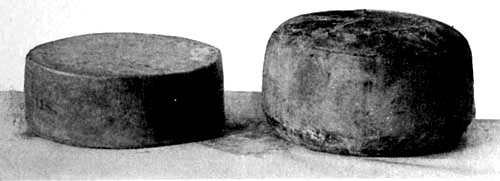
Fig. 50.—At the left is a regular shaped, close, solid textured cheese;
at the right one puffed up with gas.
The curd is not cheddared very long but is milled early
so that the whey can escape. If it is thought that the
cheese will be sour, the curd should be washed in cold
water to remove the acid and milk-sugar. A little more
salt is sometimes used. A product made from over-ripe
milk, no matter how skillful the cheese-maker, will show
traces of a sour cheese.
(2) Gassy milk.—If a cheese-maker knows that there
is "gassy" fermentation, he should add more starter
and develop more acid when ripening the milk to try to
overcome this. There are different kinds of gassy fermentation.
Some produce acid and some do not. Some
will not show until the cheeses have been on the curing-room
shelves several days. Others will cause the curd
to float in the whey. Usually the gas shows as pin-holes
while the curd is being cheddared.
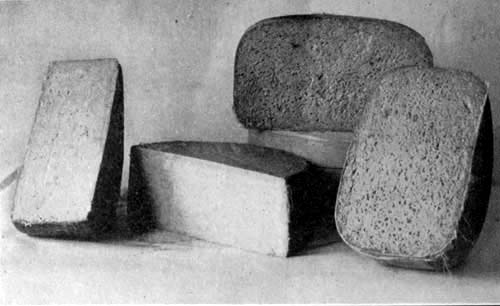
Fig. 51.—This shows the same cheeses as in Fig. 50, cut open to show
the solid and gassy texture.
The gas causes tiny round holes in the cheese, resulting
in the cheese swelling or puffing out of shape and sometimes
breaking open (Figs. 50, 51). The only time to
overcome the gas is during the cheddaring process. The
curd is piled and repiled until the holes flatten out. This
shows that the gas-producing organisms have weakened
and will not cause any more holes. Because the curd has
to be piled so many times and so long, the pieces become
very thin. The curd is ready to mill when most of the
holes have flattened. After milling, the curd should be
stirred and aired for some time before salting to allow the
bad odor to escape.
Because of the high acid development, it often happens
that the cheese will not be gassy but will be sour. At
best a cheese made from milk having gassy fermentation
will have a bad flavor. The quality of the cheese can be
no better than that of the milk from which it is made,
plus the skill of the cheese-maker.
209. Qualities of Cheddar cheese.—The cheese should
be neat, clean and attractive. If unclean, and the bandage
not put on the cheese properly, it shows that the manufacturer
is not particular to keep the curing-room shelves
tidy nor careful and painstaking in dressing. The
cheese should not be lopsided or bulged. When cut,
it should have a uniformly colored interior. The principal
color defects are too high, or too light color,
mottled or seamy. The texture should be solid and close.
A common defect is mechanical holes or openings and
another is gas pockets. The body can be tested by rubbing
the cheese between the thumb and fingers. It should
be smooth and waxy and free from lumps. It should rub
down like cold butter. The common defects are graininess
and lumpiness. Graininess may be caused by too
much acid or too much moisture in the cheese. Lumpiness
is due to uneven curing. If too much moisture is
present, the body will be soft and mushy; if not enough
moisture, the body will be hard and dry.
The cheese should have a pleasant, clean, mild aroma
and the characteristic flavor which is usually somewhat
similar to that of nuts and so is spoken of as a nutty
flavor.