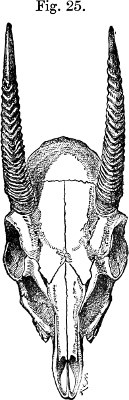
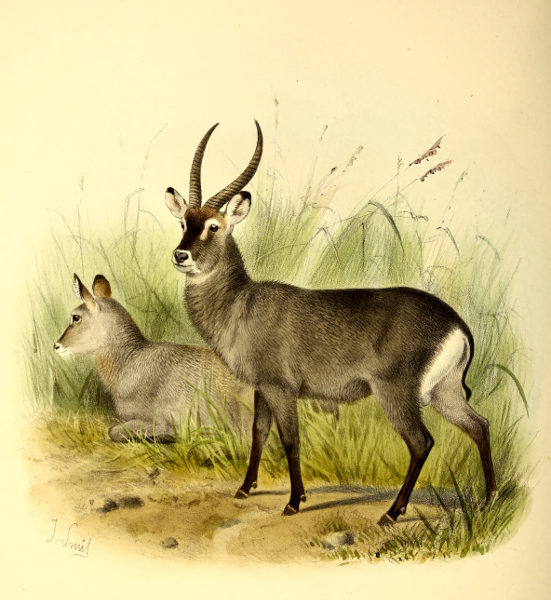
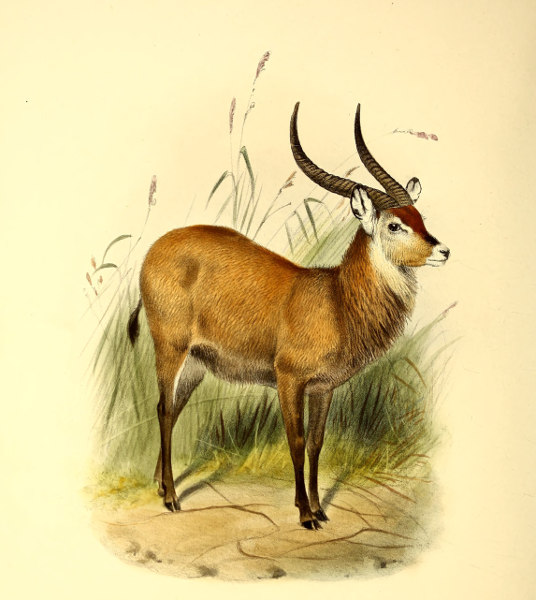
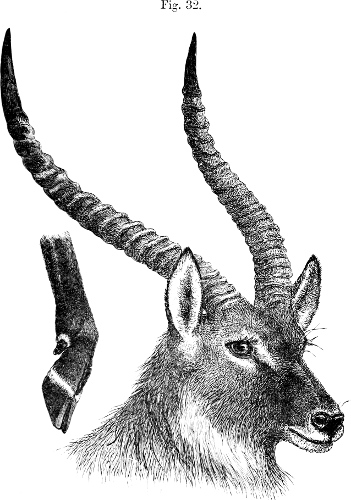
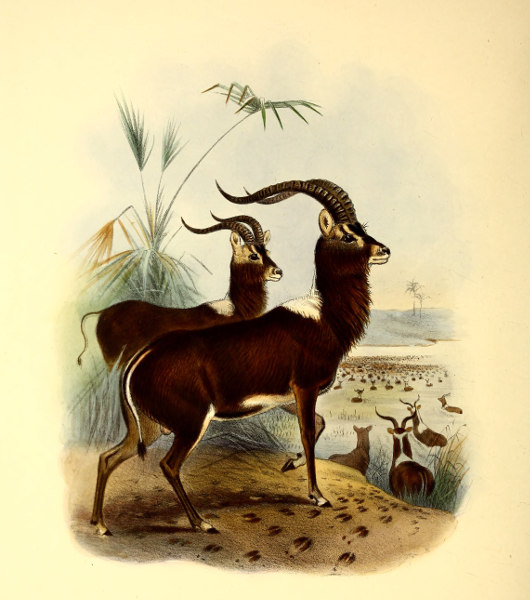
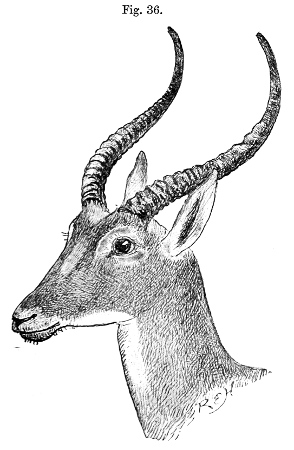
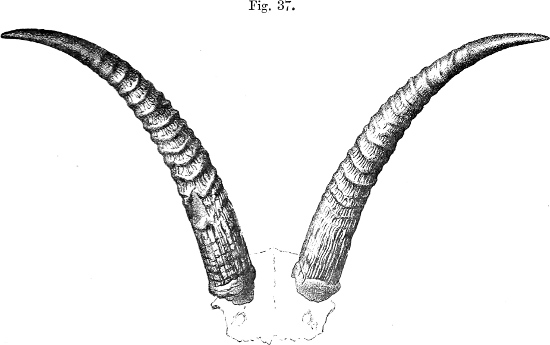
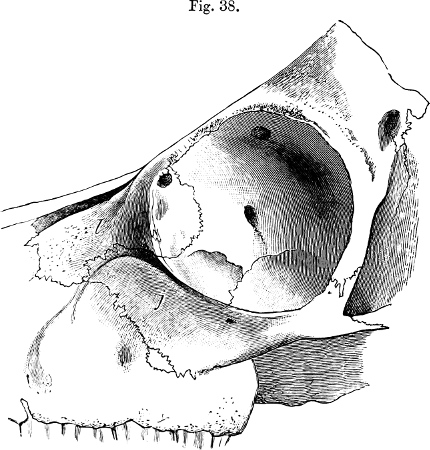
General Characters.—Size small. Muzzle either naked or
elongated and hairy. Large anteorbital glands present, opening on
the face by a small circular hole. Tail medium or short. False hoofs
present or absent.
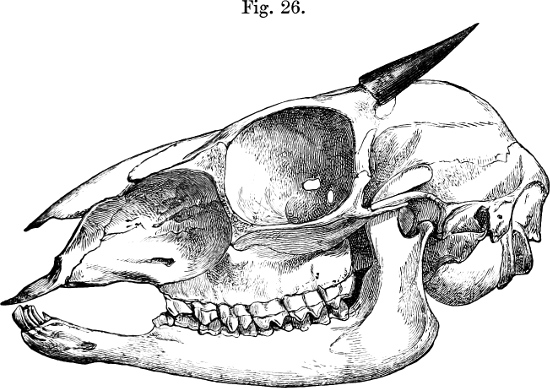
Skull with large anteorbital fossæ and, except in Neotragus,
anteorbital vacuities. Frontal bones not projected backwards between
the parietals, the horns placed above the hinder part of the orbits.
Horns present only in the male; short, nearly or quite straight,
vertical or reclining backwards; ridged basally, smooth terminally.
Range of Subfamily. Africa.
The numerous small Antelopes belonging to this subfamily were all
included by Sir Victor Brooke in two genera, one consisting of the
Dik-diks (Madoqua) and the other of all the rest (called by him
“Nanotragus”). Bearing in mind, however, the naturalness of the
smaller groups into which “Nanotragus” may be divided, and the
readiness with which these groups may be recognized and defined, we
think it better to allow six genera in all, the distinguishing points
of which are shown in the following synopsis:—
A. Nose not specially elongated, its tip with a distinct naked muffle. Crown
not tufted.
a. Hoofs cylindrical, not pointed, the animal standing more or less on their
tips. Hairs thick and pithy like those of a Musk-Deer. Horns
vertical 1. Oreotragus.
b. Hoofs triangular, pointed, as in other Antelopes. Hairs normal.
a1. A naked glandular spot below ear. Accessory hoofs present. Anteorbital
fossa of skull very large 2. Ourebia.
b1. No glandular spot below ear. Accessory hoofs absent (except in
Raphicerus melanotis).
b2. Horns lying back nearly or quite to profile-line of face. Anteorbital
fossa large.
a3. Horns reaching to or past back of head. Anteorbital and nasal
vacuities present 4. Nesotragus.
b3. Horns not nearly reaching back of head. No anteorbital or
nasal vacuities 5. Neotragus.
B. Nose elongated, its tip hairy round the nostrils. Crown tufted. 6. Madoqua.
The recently discovered Beira Antelope of Somaliland (Dorcotragus
megalotis) might also be supposed to be a member of this subfamily;
but, after a careful consideration of its characters, we think it may
best be regarded as an aberrant Gazelle, and as such we therefore
propose to treat it. The undeniable resemblance that the nasal region
of its skull shows to the same part in Madoqua appears, on the
whole, more likely to be due to purely adaptive modification than are
the various characters which it possesses in common with the members of
the Gazelline group.
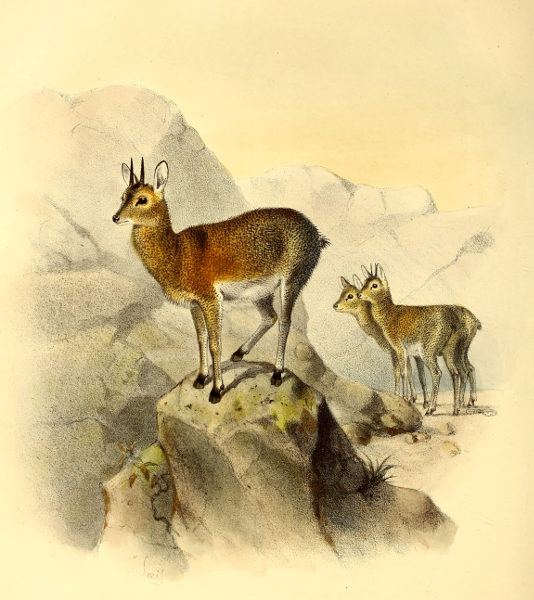
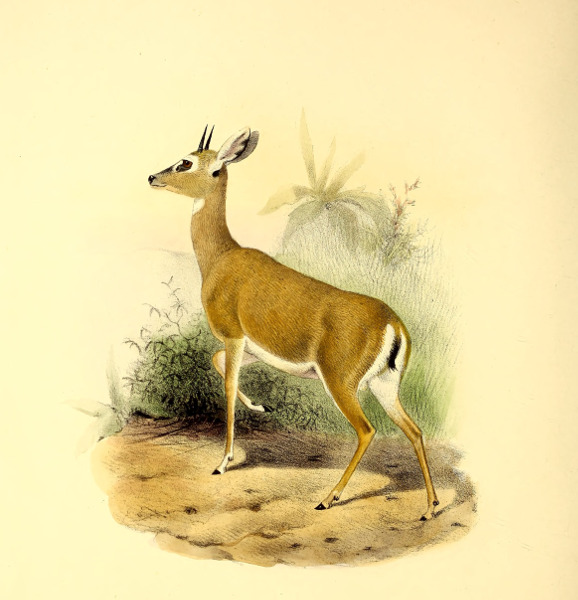
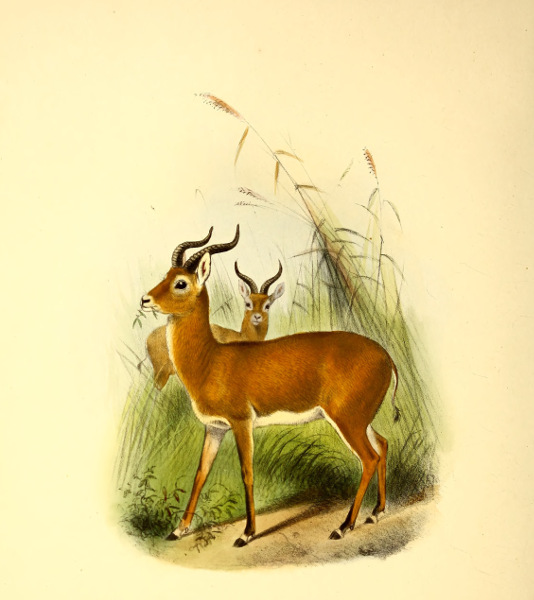
Genus I. OREOTRAGUS. — 40. THE KLIPSPRINGER. OREOTRAGUS SALTATOR ( Bodd. ). [PLATE XXV.]
Type.
Oreotragus, A. Sm. S. Afr. Quart. Journ. ii. p. 212 (1834)
O. saltator.
Oritragus, Glog. Naturg. i. p. 154 (1841)
O. saltator.
Hoofs large, cylindrical, blunt, in shape and position quite different
to those of other Antelopes. The animal in life walks upon what is
normally the pointed tip of the hoofs, so that the hoof stands up
vertically, only its blunted end resting on the ground. Accessory hoofs
present. Hairs of coat thick, pithy, somewhat similar in texture to
those of the Musk-Deer. Tail a mere stump, scarcely projecting beyond
the fur.
Skull peculiarly short and broad, stoutly built. Anteorbital fossæ
large.
Horns directed nearly vertically; slightly curved forwards; their basal
third ringed.
Distribution. Eastern and Southern Africa, from Abyssinia
to the Cape.
Only one species is known.
THE BOOK OF ANTELOPES, PL. XXV.
Smit del & lith.
Hanhart imp.
The Klipspringer.
OREOTRAGUS SALTATOR.
Published by R·H·Porter.
Antilope oreotragus, Zimm. Geogr. Gesch. iii. p.
269 (1783); Schreb. Säug. pl. cclix. (1785); Gmel.
Linn. S. N. i. p. 189 (1788); Kerr, Linn. An. K. p.
316 (1792); Donnd. Zool. Beitr. i. p. 637 (1792);
Link, Beytr. Nat. ii. p. 99 (1795); Bechst.
Allgem. Uebers. vierf. Thiere, i. p. 74 (1799), ii. p. 642
(1800); Shaw, Gen. Zool. ii. pt. 2, p. 321 (1801);
Turt. Linn. Syst. Nat. i. p. 114 (1802); Desm. N.
Dict. d’H. N. (1) xvi. p. 328 (1803); G. Cuv. Dict. Sci.
Nat. ii. p. 233 (1804); Tiedem. Zool. i. p. 408 (1808);
Thunb. Mém. Ac. Pétersb. iii. p. 311 (1811) (Table Mt.);
Afzel. N. Act. Ups. vii. p. 219 (1815); Desm. N.
Dict. d’H. N. (2) ii. p. 191 (1816); Goldf. Schr. Säug.
v. p. 1228 (1818); Schinz, Cuv. Thierr. i. p. 392 (1821);
Desm. Mamm. ii. p. 460 (1822); id. Dict. Class,
i. p. 445 (1822); Burch. List Mamm. pres. to B. M. p. 6
(1825) (Orange Free State); Licht. Darst. Säug. pl. xv.
(♂ ♀) (1828); J. B. Fisch. Syn. Mamm. p. 466 (1829);
Rüpp. N. Wirb. Abyss., Mamm. p. 25 (1835); Less.
Compl. Buff. x. p. 291 (1836); Waterh. Cat. Mamm. Mus.
Z. S. (2) p. 42 (1838); Oken, Allg. Nat. vii. p. 1363
(1838); Gerv. Dict. Sci. Nat. Suppl. i. p. 262 (1840);
Forst. Descr. Anim. p. 382 (1844); Wagn. Schr.
Säug. Suppl. iv. p. 436 (1844), v. p. 412 (1855); Schinz,
Syn. Mamm. ii. p. 410 (1845); Gieb. Säug. p. 318 (1854).
Antilope (Gazella) oreotragus,
Licht. Mag. nat. Freund. vi. p. 175 (1814).
Cemas oreotragus, Oken, Lehrb. Nat. iii. part 2,
p. 743 (1816).
Cerophorus (Cervicapra) oreotragus, Blainv.
Bull. Soc. Philom. 1816, p. 75.
Antilope (Tragulus) oreotragus,
H. Sm. Griff. An. K. iv. p. 245, v. p. 340 (1827);
Smuts, Enum. Mamm. Cap. p. 79 (1832).
Antilope (Ourebia) oreotragus,
Laurill. Dict. Univ. d’H. N. i. p. 622 (1839).
Tragelaphus oreotragus, Rüpp. Verz. Senck. Mus. p.
37 (1842).
Calotragus oreotragus, Rüpp. in Wagn. Schr. Säug.
Suppl. v. p. 414 (1855).
Nanotragus oreotragus, Brooke, P. Z. S. 1872,
p. 642; Buckley, P. Z. S. 1876, p. 283 (distribution);
Selous, P. Z. S. 1881, p. 762; id. Hunter’s
Wanderings S. Afr. p. 222 (1881); W. Scl. Cat. Mamm.
Calc. Mus. ii. p. 167 (1891); Flow. & Lyd. Mamm. p. 329
(1891); Lyd. Horns and Hoofs, p. 219 (1893).
Antilope saltatrix, Bodd. Elench. p. 141 (1785);
Link, Beytr. Nat. ii. p. 99 (1795); Less. Man.
Mamm. p. 377 (1827); id. N. Tabl. R. A., Mamm. p. 177
(1842); Des Murs & Prévost, Lefebvre’s Voy. Abyss, vi.,
Zool. p. 32, pl. iv. (animal); Huet, Bull. Soc. Acclim.
1887, p. 33.
Oreotragus saltatrix, Jard. Nat. Libr. (1) Mamm.
vii. p. 221, pl. xxx. (1842); Gray, Ann. Mag. N. H. (1)
xviii. p. 232 (1846); id. Knowsl. Men. p. 8 (1850);
id. P. Z. S. 1850, p. 119; id. Ann. Mag. N. H.
(2) viii. p. 137 (1851); id. Cat. Ung. B. M. p. 74
(1852); Gerr. Cat. Bones Mamm. B. M. p. 235 (1862);
Blyth, Cat. Mamm. As. Soc. p. 167 (1863); Heugl.
Ant. u. Büff. N.O.-Afr. (N. Act. Leop. xxx. pt. 2) p. 9 (1863);
Fitz. SB. Wien, lix. pt. 1, p. 170 (1869); Blanf.
Zool. Abyss, p. 265 (1870) (Senafé); Gray, Cat. Rum. B.
M. p. 20 (1872); id. Hand-l. Rum. B. M. p. 90 (1873);
Drumm. Large Game S. Afr. pp. 396, 425 (1875) (Drakenberg
Range); Heugl. Reise N.O.-Afr. ii. p. 104 (1877);
Brehm, Thierl. iii. p. 262 (1880); Gigl. Ann.
Mus. Genov. (2) vi. p. 18 (1888) (Shoa); Bryden, Kloof
and Karroo, p. 300 (1889); Hoyos, Zu den Aulihan, p. 186
(1895).
Oreotragus saltator, Kirk, P. Z. S. 1864, p. 657
(Shiré R.); Crawshay, P. Z. S. 1890, p. 653 (Nyasa);
Thos. P. Z. S. 1891, p. 211 (Somali), 1892, p. 553
(Nyasa); Nicolls & Egl. Sportsm. S. Afr. p. 26, pl. v.
fig. 18 (head) (1892); Swayne, P. Z. S. 1892, p. 308
(Somaliland); Thos. P. Z. S. 1894, p. 145 (Mt. Milanji);
Jackson, Badm. Big Game Shooting, i. pp. 285, 309 (1894);
Rendall, P. Z. S. 1895, p. 361.
Calotragus saltatrix, Temm. Esq. Zool. Guin. p.
191 (1853).
Antilope klippspringer, Desm. N. Dict. d’H. N. (1)
xii. p. 390 (1804), xxiv. Tabl. p. 32 (1804).
Oreotragus typicus, A. Sm. S. Afr. Quart. J. ii.
p. 212 (1834).
Calotragus saltatrixoides, Temm. Esq. Zool. Guin.
p. 191 (1853) (no description); Rüpp. in Wagn. Schr.
Säug. Suppl. v. p. 414 (1855) (Abyssinia).
Antilope saltatrixoides, Wagn. Schr. Säug. Suppl.
v. p. 412 (1855).
Oreotragus saltatrixoides, Fitz. SB. Wien, lix.
pt. 1, p. 170 (1869).
Vernacular Names:—Klipspringer or
Klipbok of Dutch and English Colonists; Ee-go-go
of Matabili; Mgululu of Makalakas; Gereree
of Batongas; Kululu of Masaras (Selous);
Ikoko of Kaffirs (Drummond) and of Swazis
(Rendall); Kainsi of Hottentots (Thunberg);
Chinkoma in Nyasa (Crawshay); Sasa in
Amharic; Embiraqua in Tigré; Quobtu at Massowa
(Heuglin); Alikut of Somalia (Hoyos).
Height about 20–22 inches. Fur long and of very peculiar texture, each
hair being thick, flattened, wavy, and, in fact, quite unlike the hair
of any other Antelope, but more similar to that of the Musk-Deer. The
general colour is a curious mixture of brown and greenish yellow, each
hair being whitish for three-quarters of its length, then brown, and
tipped with greenish yellow. Specimens vary very much in the vividness
and tone of the yellow, which, especially in old males, is often
exceedingly bright, and even verging on orange, particularly along the
flanks. Of geographical variation we have as yet failed to find any
evidence. Chin white; throat grizzled brownish yellow; belly whitish.
Back of ears grey, their edges black. Front and outer sides of limbs
like back, inner sides white. Toes just above hoofs black. False hoofs
large. Tail short and stumpy, coloured like the body.
Skull short and broad; basal length in an adult male 4.4 inches,
greatest breadth 3.15, muzzle to orbit 2.4.
Horns attaining a length of 3½ or 4 inches.
Hab. South and East Africa, north to Abyssinia, in
mountainous and rocky districts.
The Klipspringer, as this little Antelope is universally called,
although first made known to us by the Dutch settlers at the Cape, is
also found in suitable localities throughout Eastern Africa as far
north as Abyssinia. It derives its appropriate name of “Cliff-springer”
or “Rock-jumper” from its habits of jumping about amongst the rocky
eminences of the hills in which it is usually met with. Amongst the
early authorities on natural history usually quoted Buffon appears to
be the first to have given a description and figure of this Antelope.
In the Supplement to his ‘Histoire Naturelle des Animaux Quadrupèdes,’
published in 1782, he calls it the “Klipspringer ou Sauteur des
Rochers,” and figures it from a drawing communicated to him by the
Forsters, in whose days (1772–74) the Klipspringer was to be met with
on the rocks of Vals Bay in the immediate vicinity of Cape Town. On
Buffon’s Klipspringer Zimmermann founded his Antilope oreotragus
in 1783, and Boddaert his Antilope saltatrix in 1785. As we use
Oreotragus for the generic name we will adopt saltator,
the masculine form of saltatrix, as the specific appellation of
this Antelope.
Harris, in his well-known ‘Portraits of the Game Animals of South
Africa,’ gives us a picture of the Klipspringer on the same plate as
that of the Mountain Zebra (Equus zebra), which in his time was
still found in the high mountains of the Cape Colony, and supplies the
following particulars:—
“During the pursuit of the Zebra, which was confined to the most steep
and elevated parts of this rugged range, I repeatedly fell in with and
killed the Klipspringer. Once extremely abundant in the Cape Colony, it
is now daily becoming more rare—the venison being deservedly reputed
among the first that the country affords, whilst the elastic hair is
sought above all other materials for the stuffing of saddles. Long,
padded, and standing out vertically from the side, it resembles moss
in texture, and constitutes, as in the chamois of the Alps, a natural
cushion to protect the animal from the contusions to which its habits
must render it constantly liable. No antelope possesses more completely
the lively gambolling manners of the young kid—none bound with greater
force or precision from rock to rock, or clear the yawning abyss
with more fearless activity. Found usually in pairs among the most
precipitous rocks, and inaccessible summits, the Klipspringer would
appear in Southern Africa to supply the place of the ibex and chamois;
and such is the rigidity of its stiff pasterns, and the singular
formation of the high cylindrical hoof, that even when at speed there
is no track left but by the tips of the toes, whereas every other class
of ruminant would leave, under similar circumstances, some traces also
of the spurious hoofs. The most trifling obliquity or ruggedness of
surface thus affording a secure foothold, the little animal, ‘whose
house is on the hill-top,’ entertains a sense of self-security which
oftentimes proves its ruin. Looking down from some craggy pinnacle, as
if in derision of the vain efforts of its pursuer, it presents to the
rifle the fairest of targets; and tumbled headlong from its elevated
perch, pays the penalty of its rashness. Missed, it bounds from ledge
to ledge, on which the human eye can mark no footing—balancing at
one moment upon the giddy verge of a precipice where barely sufficient
space exists for the hoof to rest—at the next casting itself
recklessly into the bottomless chasm, and pitching, as if by miracle,
upon some projecting peak, where all four feet appear to be gathered
into the space of one. Another spring, and, clear of the intervening
gulf, it is nimbly scaling yon perpendicular barrier, that resembles
the wall of a lofty citadel—and now it is sweeping securely away over
the naked and polished tablets of granite which pave the summits of
those elevated regions.”
Modern authorities on the Mammals of South Africa inform us that the
Klipspringer, although not met with in the immediate vicinity of
Cape Town, is still fairly common in certain districts of the broken
and mountainous interior. In the hills about Kanya and Molopolole
and in Bechuanaland, Messrs. Nicolls and Eglington tell us it is
plentiful. The same is the case in the Zoutspansberg, Waterberg, and
Murchison Ranges, in the Transvaal, and throughout the broken portions
of Matabeleland. Mr. Selous speaks of it as being “particularly
plentiful in the curious detached stony hills of Matabeleland and
Mashonaland.” In Natal Mr. W. H. Drummond tells us that he only found
the Klipspringer on the Drachensberg Range, and, beyond the limits of
the colony, on the precipitous faces of the Bombo Mountains.
Mr. Selous did not meet with this Antelope north of the Zambesi, but
we have excellent authorities for its existence far beyond that limit.
Peters, in his ‘Reise nach Mossambique,’ has recorded its occurrence on
the Caruera Mountains near Tette. Sir John Kirk found it “singly or in
pairs near the Kebrabassa Rapids of the Zambesi and on the Murchison
Rapids of the Shiré;” and Mr. Whyte has sent us specimens from Mount
Milanji, in Nyasaland, where it is found in pairs among rocks and on
the higher ridges. It is also met with on Mount Zomba.
On Lake Nyasa Mr. Crawshay tells us that the Klipspringer is known as
the “Chinkoma,” and is common in rough mountainous country. He praises
its venison as “excellent,” and says that the skins are much prized by
the hill-tribes of Nyasaland, who convert them into bags for carrying
bread. Passing further northwards into German East Africa, we find this
Antelope recorded as found in various mountainous localities. Böhm
met with it on the Venusberg in Ugunda and Böhmer near Mpapwe, while
Stühlmann and Emin Pasha obtained specimens at Bussissi on the Victoria
Nyanza. Herr Oscar Neumann found the Klipspringer near the top of Mount
Gurui in Irangi (see ‘Geographical Journal,’ vi. p. 275). Even the
extreme summit of this extinct volcano is clothed with a vegetation of
alpine flowers and short grass which supplies it with subsistence. In
British East Africa, Mr. Jackson informs us, the Klipspringer is met
with only in the rocky broken ground on the slopes of the hills and
large “earth-boils” between Teita and Turkqueh, where there is no other
game to be found.
In Somaliland, Captain Swayne tells us, the Klipspringer is known
to the natives as the “Alakud.” Here they live in the most rugged
mountains, “poising themselves on the large boulders, and leaping from
rock to rock.” Finally, in Abyssinia we come to the most northern
limit of this Antelope. The great explorer Rüppell was the first to
meet with it in the rocky mountains of this country, and states that
his specimens were undoubtedly identical with the Cape form, although
attempts were subsequently made to separate the Abyssinian form under
the barbarous name Antilope saltatrixoides. Heuglin also records
the existence of the Klipspringer in the mountains of Abyssinia at
elevations above 3000 feet. Mr. W. T. Blanford, F.R.S., who accompanied
the Abyssinian Expedition of 1867–68, gives us the following
particulars of this species:—“The Klipspringer is common on the more
rocky of the Abyssinian hills, from a height of about 3000 feet above
the sea, or rather less, to 8000 or 9000. In the pass below Senafé, and
in that leading from Ain to the Anseba, by the valley of the Lebka,
these little Antelopes were frequently seen, and they were common on
some of the rocky precipices on the flanks of the great valleys around
Senafé, Guna-Guna, Fokada, &c., usually solitary or in pairs. When
alarmed they frequently perch on the very highest rocks, their agility
in leaping from crag to crag being remarkable.”
In the Cape Colony it is said that the Klipspringer, when taken young,
is easily tamed and makes a most sagacious pet; but it does not appear
to live long in captivity, and Mr. Bryden tells us that they are most
difficult and troublesome to rear. We are not aware that specimens of
this Antelope have ever been brought alive to Europe.
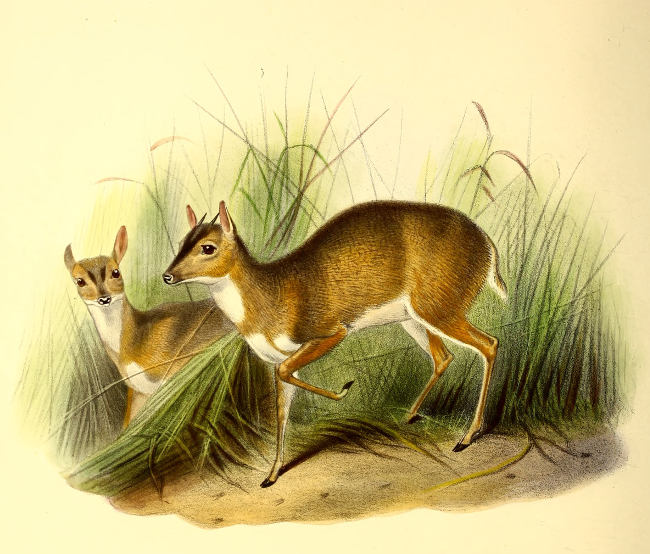
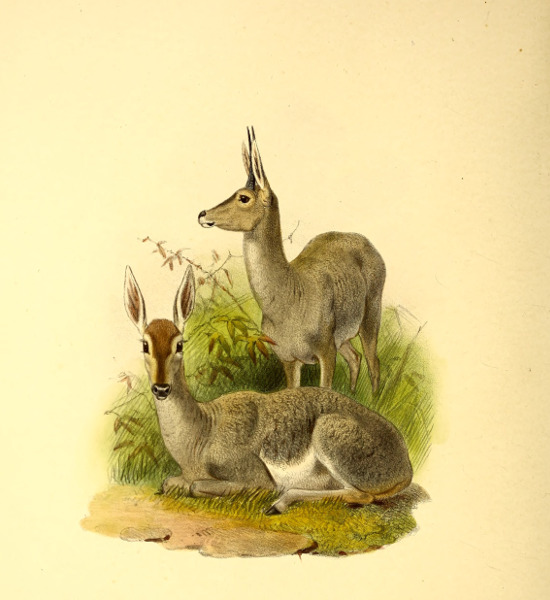
Our illustration of this species (Plate XXV.) has been taken by Mr.
Smit from specimens in the British Museum. It represents an adult male
in the foreground and a male and female together in the distance.
Besides two mounted specimens from the Cape, the British Museum
contains three skins and skulls of this Antelope from Mounts Milanji
and Zomba in Nyasaland (Whyte), an immature skull from
Somaliland (Swayne), and some skins and skulls from Abyssinia.
Ourebia, Laurill. Dict. Univ. d’H. N. i. p. 622 (1839)
O. scoparia.
Scopophorus, Gray, Ann. Mag. N. H. (1) xviii. p. 232 (1846)
O. scoparia.
Size largest of the subfamily. Hoofs normal, triangular, pointed, the
animal standing, as is usual, on the flattened lower side of the hoof,
with the point directed forwards. Accessory hoofs present. A naked
glandular patch below each ear, and tufts on the knees, present in all
the species. Tail short, generally tufted with black.
Anteorbital fossæ of skull very large, their edges sharply ridged above
and below. Anteorbital vacuities small. Nasal bones long.
Horns about three-quarters the length of the skull, slanting backwards,
slightly or heavily ridged basally, smooth at the tip, but the
different species vary considerably in the amount of ridging on the
horns.
Distribution. Africa south of the Atlas.
The members of this genus are remarkably uniform in character, and
there are scarcely any characters of importance to distinguish from
each other species so widely distant geographically as the Oribis of
the Gambia, Abyssinia, Zambesia, and the Cape.
The following are the groups into which they seem best to fall:—
A. Horns comparatively slender and smooth, their basal
two inches only slightly ridged.
a. Tail markedly black, tufted.
a1. S. African
41. O. scoparia.
b1. Zambesian
42. O. hastata.
c1. Gambian
43. O. nigricaudata.
b. Tail scarcely black-tipped.—Abyssinian.
44. O. montana.
B. Horns thicker, heavily ridged for more than half their length.
45. O. haggardi.
Antilope ourebi, Zimm. Geogr. Gesch. iii. p.
268 (1783); Shaw, Gen. Zool. ii. pt. 2, p. 320 (1801);
Huet, Bull. Soc. Acclim. 1887, p. 89.
Scopophorus ourebi, Gray, Ann. Mag. N. H. (1)
xviii. p. 232 (1846); id. Knowsl. Men. p. 7 (1850);
id. P. Z. S. 1850, p. 118; id. Ann. Mag. N. H. (2)
viii. p. 136 (1851); id. Cat. Ung. B. M. p. 73 (1852);
Gm. Cat. Bones Mamm. B. M. p. 235 (1862); Fitz.
SB. Wien, lix. pt. 1, p. 165 (1869); Gray, Cat. Rum. B.
M. p. 19 (1872); id. Hand-l. Rum. B. M. p. 90 (1873).
Calotragus oureby, Temm. Esq. Zool. Guin. p. 191
(1853).
Antilope scoparia, Schreb. Säug. pl. cclxi.
(animal) (1785); Afz. N. Act. Ups. vii. p. 220 (1815);
Desm. N. Dict. d’H. N. (2) ii. p. 194 (1816); id.
Mamm. ii. p. 464 (1822); Desmoul. Dict. Class, i. p.
446 (1822); Goldf. Schr. Säug. v. p. 1244 (1824);
Burch. List Quadr. pres. to B. M. p. 7 (1825); H.
Sm. Griff. An. K. iv. p. 244, v. p. 339 (1827); Less.
Man. Mamm. p. 379 (1827); Licht. Darst. Säug. pl. xiii.
(♂ & ♀) (1828); J. B. Fisch. Syn. Mamm. p. 469 (1829);
Smuts, En. Mamm. Cap. p. 78 (1832); Less. Compl.
Buff. x. p. 290 (1836); Oken, Allg. Nat. vii. p. 1362
(1838); Gerv. Dict. Sci. Nat. Suppl. i. p. 262 (1840);
Less. N. Tabl. R. A., Mamm. p. 177 (1842); Wagn.
Schr. Säug. Suppl. iv. p. 429 (1844), v. p. 411 (1855);
Schinz, Syn. Mamm. ii. p. 414 (1845); Gieb. Säug.
p. 316 (1854).
Antilope (Ourebia) scoparia,
Laurill. Dict. Univ. d’H. N. i. p. 623 (1839).
Redunca scoparia, A. Sm. S. Afr. Quart. Journ. ii.
p. 211 (1834).
Oreotragus scoparius, Gray, List Mamm. B. M.
p. 164 (1843); id. List Ost. B. M. p. 146 (1847);
Drumm. Large Game S. Afr. p. 426 (1875).
Calotragus scoparius, Sund. Pecora, K. Vet.-Ak.
Handl. 1844, p. 192 (1846); id. Hornschuch’s Transl.,
Arch. Skand. Beitr. ii. p. 144, Reprint, p. 68 (1848);
Brehm, Thierl. iii. p. 260 (1880).
Nanotragus scoparius, Brooke, P. Z. S. 1872, p.
642; Selous, P. Z. S. 1881, p. 761; id. Hunt.
Wand. S. Afr. p. 221 (1881); Bryden, Kloof and Karroo, p.
301 (1889); Flow. & Lyd. Mamm. p. 339 (1891); Nicolls
& Egl. Sportsm. S. Afr. p. 25, pl. v. fig. 15 (head) (1892);
Ward, Horn Meas. p. 81 (1892); Lyd. Horns and
Hoofs, p. 218 (1893).
Neotragus scoparius, Rendall, P. Z. S. 1895, p.
361.
Antilope melanura, Bechst. Allgem. Uebers. vierf.
Thiere, i. p. 73 (1799), ii. p. 642 (1800).
Cemas melanura, Oken, Lehrb. Nat. iii. pt. 2, p.
743 (1816).
Scopophorus ourebi grayi, Fitz. SB. Wien, lix. pt.
1, p. 165 (1869).
Vernacular Names:—Oribi of Dutch and English Cape
Colonists; Iula of Kaffirs (Drummond) and Zulus
(Rendall).
Size comparatively large. General colour bright sandy rufous, of
underside pure sharply-defined white. Chin white. Throat and outer
side of limbs like back. Above the anterior corner of each eye a white
stripe, ending over the middle of the eye. Crown with or without a
brown patch or horseshoe-shaped mark, which is very variable in its
development. Auricular gland small, indistinct, scarcely more than half
an inch in diameter. Knees with well-marked tufts of longer hairs.
Small but distinct false hoofs present both on fore and hind feet. Tail
with its tuft about four or five inches in length, its basal third
sandy rufous like the back, the remainder thickly tufted, black.
Skull with a long slender muzzle. Supraorbital vacuities present.
Premaxillæ not reaching the nasals. Anteorbital fossæ very large and
open, filling up all the space in front of the orbits, their edges
sharply ridged above and below.
Horns about four inches in length, slender, evenly tapering, slanting
back at an angle of about 45° to the general line of the skull; very
slightly curved upwards and forwards; their rings close together, low,
rounded, and indistinct, present on the basal halves of the horns only.
Dimensions:—♂. Height at withers 24 inches, hind foot 11, ear 3·7.
As in the case of the Klipspringer, this little Antelope first became
known to naturalists in Europe through the Dutch settlers at the
Cape. They called it Ourebi, under which name it appears to have
been first described and figured in Holland by Allamand in 1776. In
1783 Zimmermann based his Antilope ourebi upon Allamand’s
description, and two years later Schreber’s plate of Antilope
scoparia was copied from Allamand’s figure. As it is necessary
to use Ourebia as the generic designation of this Antelope we
propose to adopt “scoparia,” taken from the peculiar brushes
(scopæ) that defend its knees, as its specific name.
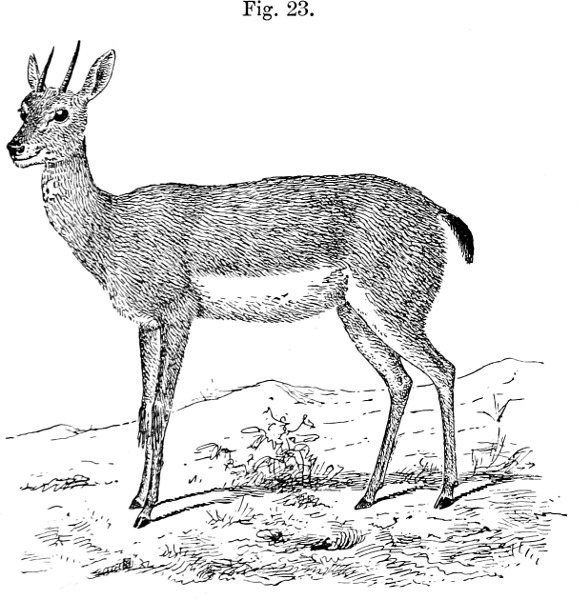
Fig. 23.
Ourebia scoparia, ♂.
A better figure of this Antelope than that of Allamand was published by
Lichtenstein about the year 1828 in the third part of his ‘Darstellung
neuer oder wenig bekannter Säugethiere,’ a work which was devoted
to the representation of new and little-known mammals of the Berlin
Museum. Lichtenstein, who had himself travelled in South Africa, states
that he had met with this species in Cafferland, and that it was known
to the colonists as the “Bleekbok” or “Pale-buck,” from its light
colour, and was much valued as a game animal.
In 1861, when Mr. E. L. Layard prepared his Catalogue of the specimens
in the collection of the South African Museum at Capetown, the Oribi
was already nearly exterminated in the colony. But it still existed, he
tells us, near Alexandria and Bedford in Somerset, and in some of the
eastern divisions where large grassy plains are found. An “intelligent
Kaffir,” attached to the Museum, informed Mr. Layard that “the Oribi
when slain by the natives belongs to the chief, who presents the
fortunate hunter with a young cow in return. The skins of the Oribi are
considered in the light of regal ermine and very highly valued.”
When, however, we come to the open plains of Natal and Zululand we are
assured by Messrs. Nicolls and Eglington, in the ‘Sportsman in South
Africa,’ that the Oribi is even now very common. It also frequents
the Transvaal in fair numbers, the Orange Free State, and parts of
Matabeleland and Mashonaland. A few specimens are said to have been
obtained in Bechuanaland, but it is unknown in the Kalahari Desert, and
thence towards the west. The same observers tell us that “in speed the
Oribi is very fast, and that it dodges from side to side when it runs
in a peculiar manner with a series of leaps and rushes. It frequents
the open flats, singly or in pairs, but keeps within reasonable
distance of water.”
As regards the exact range of the Oribi in Mashonaland, Mr. F.
C. Selous, in his ‘Hunter’s Wanderings,’ gives us the following
particulars:—“North of the Limpopo, this Antelope is only to be met
with in the following districts, viz. in north-eastern Mashunaland from
the river Umzweswe to beyond the river Hanyana, in the open valleys
which occur between the forest belts near the watershed, but to the
north of the Machabe hills; on the exposed open downs nearer the
watershed, and lying between the Machabe hills and Intaba Insimbi, I
never saw any. On a large flat about fifty miles to the south of the
junction of the Umfule and Umniati rivers, I saw a good many Oribi in
1880. Except in this district of the Mashuna country, the only other
place south of the Zambesi where this Antelope exists is in the valley
of Gazuma, an open boggy flat of only a few hundred acres in extent,
which is situated at about thirty miles to the south-west of the
Victoria Falls. Then again a few are to be seen on the northern bank of
the Chobe, on the open ground bordering the marsh, in the neighbourhood
of Linyanti. One never sees more than two or three of these Antelopes
together. The horns of the male attain to a length of about 5 inches,
and are ringed at the base.”
There is a mounted pair of this species in the gallery of the British
Museum which formerly belonged to the old “South-African Museum” of
Sir Andrew Smith, besides some skins and skulls from the Cape without
exact particulars. There is also the skull of an adult male from the
Umfili River, Mashonaland, obtained by Mr. F. C. Selous, in the same
Collection.
We are not aware that the Oribi has been kept in captivity in the Cape
Colony, or ever brought alive to Europe.
December, 1895.
Antilope hastata, Peters, Reise Mossamb., Säug. p.
188, pl. xl. (animal), pl. xli. fig. 2, pl. xlii. fig. 2 (skull)
(1852) (Senna); Gieb. Säug. p. 317 (1854); Wagn.
Schr. Säug. Supp. v. p. 411 (1855); Huet, Bull. Soc.
Acclim. 1887, p. 46.
Calotragus hastata, Temm. Esq. Zool. Guin. p. 191
(1853).
Scopophorus hastatus, Fitz. SB. Wien, lix. pt. 1,
p. 165 (1869); Matschie, Thierw. Ost-Afr. Säugeth. p. 121
(1895).
Nanotragus hastatus, Brooke, P. Z. S. 1872, p.
642; Flow. & Lyd. Mamm. p. 339 (1891); Lyd. Horns
and Hoofs, p. 219 (1893).
Nanotragus scoparius, Thos. P. Z. S. 1893, p. 504,
1894, p. 146 (Nyasa).
Scopophorus montanus, Matschie, Thierw. Ost-Afr.
Säugeth. p. 121.
Vernacular Name:—Dutsa at Senna (Peters).
Similar in all respects to O. scoparia, except that the
auricular gland is considerably larger and more conspicuous, and the
tail is slenderer, less tufted, and is more or less white along its
edges below.
Skull and horns apparently quite as in O. scoparia.
Hab. Mozambique and Nyasaland.
When the late Dr. William Peters made his great expedition to the
Portuguese colony of Mozambique from 1842 to 1848 the Zoology of the
Eastern Coast of Africa was almost unknown to us. Many, therefore, were
the discoveries made by that distinguished traveller and naturalist,
and subsequently described in his ‘Naturwissenschaftliche Reise nach
Mossambique.’ Amongst them, in the volume devoted to the Mammals of the
Expedition, we find a figure and description of the present Antelope,
which was met with by Peters on the bush-clad plains of Sena and
Shupanga, situated about 17° S. lat., and from 30 to 60 miles from the
coast. Peters allows that the present form comes very near the typical
O. scoparia, but considers that it differs in its longer ears,
the smaller size of the naked spot beneath the ear, the white underside
of the tail, and the less compressed form of the hoofs. Peters’s
specimens are in the Berlin Museum.
More recently the British Museum has acquired several skins of an
Antelope, which should be the same, to judge from its locality, as
Peters’s O. hastata, among the splendid collections amassed
by Sir H. H. Johnston in Nyasaland with the aid of his naturalist
Mr. Alexander Whyte, F.Z.S. These were obtained on the grassy plains
between Zomba, where Mr. Whyte is resident, and Lake Shirwa. These
materials, however, are not yet sufficient to enable us to pronounce
a decided opinion as to whether this Oribi should be really treated
of as a species distinct from its brother of the Cape Colony. The two
forms certainly come very near one another, and we are rather doubtful
whether they can be properly distinguished.
December, 1895.
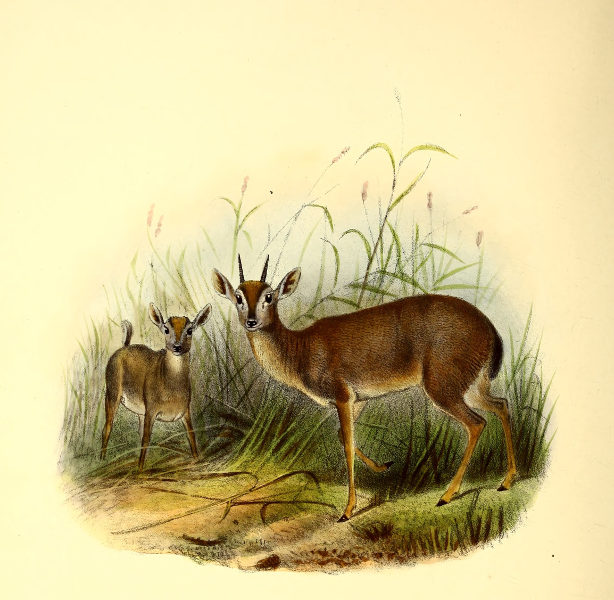
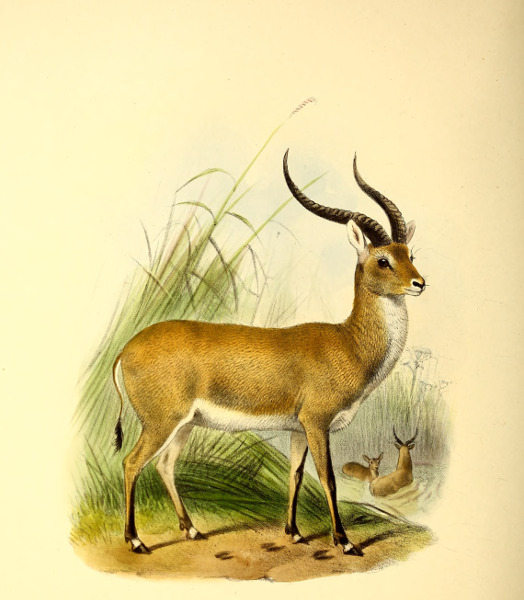
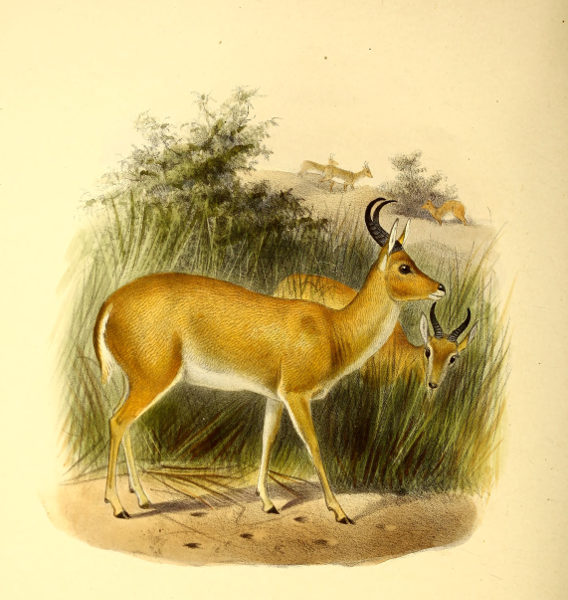
THE BOOK OF ANTELOPES. PL. XXVI.
Wolf del. Smit lith.
Hanhart imp.
The Gambian Oribi
OUREBIA NIGRICAUDATA
Published by R. H. Porter.
Ourebi du Sénégal, F. Cuv. H. N. Mamm. (fol.) iii.
livr. lx. (♀) (1829).
Scopophorus montanus, Gray, Knowsl. Men. p. 7, pl.
v. (animal) (1850) (Gambia) (nec Cretzschm.).
Nanotragus nigricaudatus, Brooke, P. Z. S. 1872,
p. 874, pl. lxxv. (animal) (Gambia); Ward, Horn Meas. p.
81 (1892); Lyd. Horns and Hoofs, p. 219 (1893).
Oreotragus scoparius, Scl. P. Z. S. 1867, p. 1039.
Neotragus nigricaudatus, Scl. List An. Z. S. (8)
p. 145 (1883).
Vernacular Name:—Gebari or Mahomet’s
Antelope on the Gambia (Whitfield fide Gray).
Closely allied to O. montana, but still smaller, and the general
colour greyer; the auricular gland as large as in O. hastata,
and the tail with a blackish tuft, as in O. scoparia. Top of
muzzle brown.
Dimensions of the typical specimen, ♂:—Height at withers 21 inches;
length of hind foot 10, of ear 3·4.
Hab. Open districts of the Gambia and Senegal.
It was not to be expected that any representative of the Oribi would be
found in Congoland or within the great forest-clad region of Western
Africa. But when we come to the more open country of Senegal and the
Gambia, an allied and nearly similar species appears upon the scene.
The first evidence of its existence was given by F. Cuvier in 1829 by
the publication of a figure and description of a female specimen under
the name of the “Ourebi du Sénégal,” which was brought home alive by M.
Perrotet, but died shortly after its arrival at Paris.
Again, some years later, Whitfield, one of the collectors employed
by Lord Derby, brought home from the Gambia a living example of an
Antelope, which was subsequently figured in 1845 for the ‘Knowsley
Menagerie’ by Waterhouse Hawkins. This figure was referred by Gray, who
drew up the letterpress of that splendid work, to the Abyssinian Oribi
next described, but there can be little doubt that it really belonged
to the Gambian form. Whitfield gave the native name of this Antelope on
the Gambia as “Gebari.”
In May 1867 the Zoological Society received as a present from Mr.
Charles B. Mosse a fine young male of this Oribi, which was eventually
the means of making the species better known. It was at first referred
by Sclater to the Cape Oribi, but afterwards considered to be more
probably attributable to the Abyssinian O. montana. In 1872,
however, when the animal was still living and quite adult, Sir Victor
Brooke, at Sclater’s invitation, took up the question, and in a
paper read before the Zoological Society, and subsequently published
in their ‘Proceedings’ for that year, showed that neither of these
determinations was correct, and that the Gambian animal belonged,
in his opinion, to an unnamed species, which he proposed to call
Nanotragus nigricaudatus. Although, like the two preceding
species, the Gambian Oribi has a black tail, its smaller size seems
to be sufficient to distinguish it from its congeners. Sir Victor had
a water-colour drawing made of this animal by Wolf, from which both
the figure published in the Zoological Society’s ‘Proceedings’ and the
Plate now given (Plate XXVI.) have been prepared. This typical specimen
is now in the British Museum, which has likewise two other young
specimens from West Africa, without further details.
Mr. Mosse, who brought the type specimen home himself, supplied Sir
Victor with the information that he had procured it in March 1867, when
it was only two or three months old, and that it had been caught on the
banks of the Gambia about 70 or 80 miles from Bathurst, midway between
that town and Macarthey’s Island. Mr. Mosse had never met with a second
individual.
In 1873 and 1876 the Zoological Society received female specimens of
what were believed to be the same Antelope, but they did not live long
in the Gardens.
December, 1895.
Antilope brevicaudata, Rüpp. MS. (N. Wirb. p. 25,
1835).
Antilope montana, Cretzschm. Atl. Rüpp. Reise,
Säug. p. 11, pl. iii. (Fazogloa Mts., Blue Nile) (1826);
J. B. Fisch. Syn. Mamm. p. 469 (1829); Rüpp.
N. Wirb. Abyss., Mamm. p. 25 (1835); id. P. Z. S.
1836, p. 3 (occurrence of canines); Less. Compl.
Buff. x. p. 290 (1836); Oken, Allg. Nat. vii. p. 1362
(1838); Laurill. Dict. Univ. d’H. N. i. p. 623 (1839);
Less. N. Tabl. R. A., Mamm. p. 177 (1842); Wagn.
Schr. Säug., Suppl. iv. p. 431 (1844), v. p. 412 (1855);
Schinz, Syn. Mamm. ii. p. 421 (1845); Gieb. Säug.
p. 316 (1854); Huet, Bull. Soc. Acclim. 1887, p. 34.
Redunca montana, A. Sm. S. Afr. Quart. Journ. ii.
p. 211 (1834).
Tragelaphus montanus, Rüpp. Verz. Senck. Mus. p.
37 (1842).
Calotragus montanus, Sund. Pecora, K. Vet.-Ak.
Handl. 1844, p. 193 (1846); id. Hornschuch’s Transl.,
Arch. Skand. Beitr. ii. p. 144; Reprint, p. 68 (1848);
Temm. Esq. Zool. Guin. p. 191 (1853); Heugl. Ant.
u. Büff. N.O.-Afr. (N. Act. Leop. xxx. pt. 2) p. 8 (1863);
id. Reise N.O.-Afr. ii. p. 104 (1877).
Scopophorus montanus, Gray, Ann. Mag. N. H. (1)
xviii. p. 232 (1846); id. op. cit. (2) viii. p. 137
(1851); id. Cat. Ung. B. M. p. 74 (1852); Scl. P.
Z. S. 1864, p. 101 (Karagweh); Fitz. SB. Ak. Wien, lix.
pt. 1, p. 165 (1869); Blanf. Zool. Abyss. p. 266 (1870)
(Dolo, Abyssinia); Gray, Cat. Rum. B. M. p. 19 (1872);
Gigl. Ann. Mus. Genov. (2) vi. p. 18 (1888) (Shoa);
Jent. Cat. Mamm. Leyd. Mus. (Mus. Pays-Bas, xi.) p. 160
(1892).
Nanotragus montanus, Brooke, P. Z. S. 1872, pp.
642 & 875; W. Scl. Cat. Mamm. Calc. Mus. ii. p. 166
(1891); Flow. & Lyd. Mamm. p. 339 (1891); Ward,
Horn Meas. p. 82 (1892); Lyd. Horns and Hoofs, p. 218
(1893); Jackson, Badm. Big Game Shooting, pp. 285 & 299
(1894).
Antilope madoqua, Schweinfurth, Herz. von Afrika,
i. p. 266, fig. head, ii. p. 535 (1874) (nec H. Sm.,
nec Rüpp.).
Vernacular Names:—H’Amra, Atrob, or
Odrob in Arabic; Fiego in Amharic; Waital
in Geez (Heuglin); Lohdj in Dinka; Nettjäde
in Djur; Heggoleh in Bongo; Kullah in Mittu;
Bongbaljah in Niam-niam; Laffa in Golo;
Kehdo in Kredj; Ngogoh in Ssehre; Akonj in
Shilluk (Schweinfurth).
Similar to O. scoparia in most respects, but the tail shorter,
less bushy, and almost wholly of the colour of the back, the terminal
black tuft being reduced to a few darker hairs at the extreme tip;
there are also a considerable number of white hairs along each side of
it below. Auricular gland large, quite naked.
As already pointed out, the Abyssinian representative of this group
differs slightly in structure from the forms of the Oribi of which we
have previously spoken. Its specific name would also indicate that
it is an inhabitant of a higher district, although Rüppell tells us
that when he sent the original specimen from Senaar in 1823 he had
given it in his Manuscript “a far more appropriate” one. Be that as
it may, Cretzschmar, who undertook the description of the vertebrates
transmitted by Rüppell to the Museum Senckenbergianum before the return
home of the latter, chose to call it “montana” and this term
cannot now, of course, be altered.
The original specimen of Ourebia montana was obtained by
Rüppell’s collector Hey (after whom Hey’s Partridge, Ammoperdix
heyi, was subsequently named by Temminck) on the hills of Fazogloa
on the Blue Nile in 1823. Rüppell afterwards found many individuals of
it on the high plains of Woggera in the neighbourhood of Gondar and
in the valleys of the Kulla, where they resort to the grassy ravines
and thorny jungles. He remarks that only the male carries horns, but
that both sexes have a pair of inguinal glands, the openings of which
are concealed by long tufts of white hair. The female has four teats.
He also remarks that (as he communicated to the Zoological Society of
London, of which Rüppell was a Foreign Member, in 1836) the young males
of this Antelope occasionally possess the germs of a pair of canine
teeth, which are lost in the adult stage. This anomaly, however, has
also been noticed in other Ruminants.
Theodor von Heuglin met with this Antelope in several districts of
Central and West Abyssinia at elevations of from 6000 to 8000 feet
above the sea-level. He remarks that it prefers the rocky and bushy
parts of the steppes, and often cries out like a Roebuck when struck
by a shot. Dr. W. T. Blanford, F.R.S., found this Antelope rare in the
country traversed by the Abyssinian Expedition of 1867–68. He saw it
only two or three times, near Dolo and Harkhallet, north of Antalo, at
an elevation of about 7000 feet above the sea-level, where it inhabits
bushy ground or high grass. A buck shot by Mr. Blanford was 22½ inches
high at the shoulder, the mammæ were four in number, and the suborbital
and inguinal glands were well developed. We learn from Mr. W. L.
Sclater’s ‘Catalogue,’ that one of Mr. Blanford’s skins is now in the
Indian Museum, Calcutta.
Finally Dr. Giglioli includes the Abyssinian Oribi amongst the mammals
of which specimens have been transmitted to Italy from Shoa by the
Italian naturalists Boutourline and Traversi. Dr. Giglioli observes
that the sexes were alike in colour in these specimens, but that the
male was rather larger in size than the hornless female.
The head of the “Madoqua” figured by Schweinfurth in ’Im Herzen von
Afrika’ (vol. i. p. 266) was probably taken from an example of this
Antelope. It was met with along with a species of Duiker in Bongo on
the upper waters of the Bahr-el-Ghazal, and observed in pairs among the
bushes. Its native name there is “Heggolah.”
In the British Museum there are the skull of an adult male of this
species and three skins of females from Dembelas, Abyssinia.
December, 1895.
Nanotragus hastatus, Jackson, Badm. Big Game
Shooting, i. p. 285 (1894) (Tana R. & Lamu) (nec Peters).
Neotragus haggardi, Thos. Ann. Mag. N. H. (6) xv.
p. 187 (1895) (Lamu).
Vernacular Name:—Taya of Swahilis (Haggard
and Jackson).
Size as in O. scoparia and O. hastata. Auricular gland
well developed.
Other external characters not yet positively known.
Skull with a rather shorter muzzle than in the common species. Horns
very much thicker and heavier than in any of the previous species; the
ridges strongly developed and sharply angular. Owing partly to the
development of the ridges the front edge of their lower half is convex
forwards, while the upper half is as usual concave forwards; viewed
from the side the horns therefore appear to have a slight tendency
towards the serpentine double curvature characteristic of the Gazelles,
although far less developed.
A fifth species of Oribi, with which as yet we are only imperfectly
acquainted, seems to be found in British East Africa and the adjoining
districts of Southern Somaliland. Its size is that of the Cape and
Zambesian species, and its auricular gland is well developed. But it
is readily distinguishable from all the other members of the group by
its thick and strongly ridged horns, which contrast markedly with the
slender and comparatively smooth horns of all the preceding species.
Thomas was originally inclined to refer the three skulls of this
Oribi which were received in 1887 from Mr. J. G. Haggard, then H.B.M.
Vice-Consul at Lamu, to Peters’s Ourebia hastata. When, however,
he had afterwards obtained specimens of the Oribi of Nyasaland, which
were doubtless to be referred to the form described by Peters, he
perceived his error, and proceeded to base a new species upon the
specimens in question, assigning to it the name of their collector and
donor, according to whom this Antelope is known to the Swahilis at Lamu
as “Taya.”
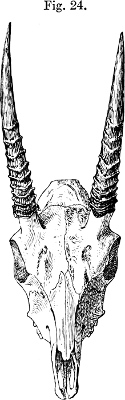
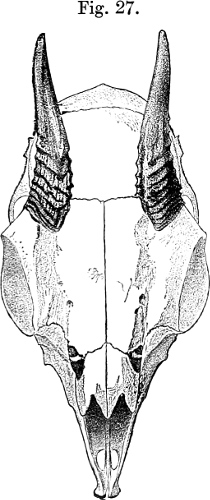
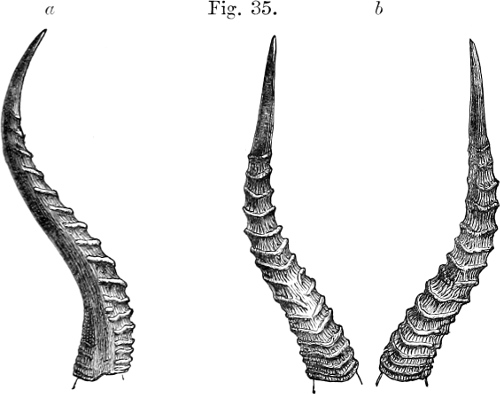
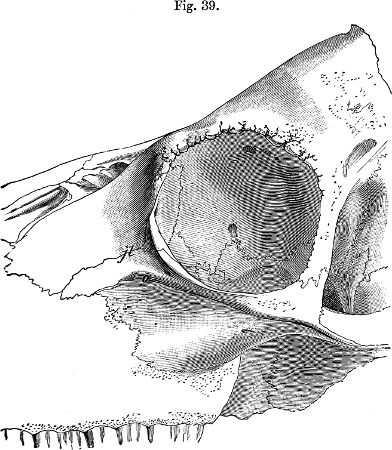
Fig. 24.
Skull of Ourebia haggardi, ♂.
Mr. F. J. Jackson, in his ‘Big Game Shooting,’ gives us the following
account of the “Taya”:—
“The East-African Oribi (also known to the Swahilis as ‘Taya’) I have
found more plentiful on the mainland near Lamu than anywhere else. Sir
Robert Harvey and Mr. Hunter, in October and November 1888, also found
it in fair numbers up the Tana river. I have never seen it myself
south of the Sabaki, though doubtless it is to be met with there also
in suitable places. At Merereni, where the country seems admirably
suited to its habits, although I was shooting there for some time in
1885 and 1886, I never saw one, though fifteen miles further south,
near Mambrui, I observed its spoor. This confirmed me in my theory that
the Oribi is very partial to the vicinity of cultivated tracts, and I
do not remember having seen one in an uninhabited district. At Taka,
a small village on the mainland opposite Patta Island, I saw great
numbers in 1885.
“In the vicinity of this village there was a great deal of land which
at one time had been under cultivation, but was then lying fallow and
covered with coarse dry grass, about two feet high. This afforded
excellent covert, and, as the colour of these little Antelopes closely
resembles that of dry grass, it was very difficult to see them. Except
in one way, stalking them was quite hopeless. I found that the only
plan to get them was to walk them up with one or two beaters on each
side of me, and shoot them with a gun loaded with S. S. G. shot. They
lie so close that they will let the sportsman get within ten or fifteen
yards of them before they will move, but they rarely give him a chance
of a shot under from forty to fifty yards. When they first get up it
is only possible to follow their movements by the waving of the grass.
It is necessary, however, always to be prepared for a snap-shot, as
after going some twenty to thirty yards they will bound up into the
air, offering a capital chance, which may be the only one, as they will
be out of range before they again appear in like manner. This bounding
into the air is, I believe, to enable them to see where they are going
to, and it is a curious fact that when they alight they invariably do
so on their hind legs, not unlike a Kangaroo.
“An Oribi, even when only slightly wounded, will, as a rule, go a very
short distance before lying down, and the sportsman should, therefore,
be careful to follow up all those that he thinks he may have touched.”
Besides Mr. Haggard’s skulls from Lamu, on which Thomas founded this
species, and a head from the same place in Mr. Jackson’s private
collection, there is in the National Museum the perfect skin and
skull of a fine Oribi recently obtained in East Africa and presented
by Mr. A. H. Neumann. No information as to its exact locality has as
yet reached us, and as its skull differs somewhat from that of the
Lamu O. haggardi, we are at present unable to form a definite
opinion as to its specific identity. If, as seems probable, this
interesting specimen is really referable to the present form, we may
say that O. haggardi is in general colour rather greyer than the
other species, and that its tail has a decided black tuft at the end,
the proximal part of this organ being white-edged below. To identify
this specimen with the present species, however, will involve the
recognition of a considerable degree of variation in the skull and
horns, and without further material we are unable to do so definitely.
December, 1895.
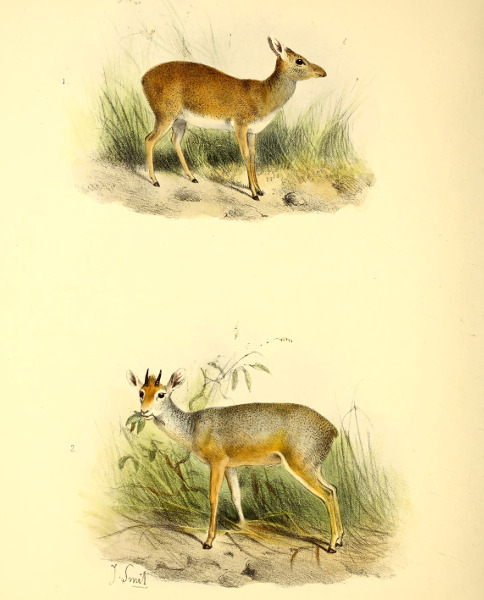
Genus III. RAPHICERUS. — 46. THE GRYSBOK. RAPHICERUS MELANOTIS ( Thunb. ). [PLATE XXVII. Fig. 2.] — 47. THE STEINBOK. RAPHICERUS CAMPESTRIS ( Thunb. ). [PLATE XXVII. Fig. 1. ] — 48. NEUMANN’S STEINBOK. RAPHICERUS NEUMANNI ( Matsch. ).
Type.
Raphicerus, H. Sm. Griff. An. K. v. p. 342 (1827)
R. campestris.
Calotragus, Sund. Pecora, K. Vet.-Ak. Handl. 1844, p. 192 (1846)
R. campestris.
Pediotragus, Fitz. SB. Ak. Wien, lix. pt. 1, p. 163 (1869)
R. campestris.
Accessory hoofs present or absent. No naked glandular spots below ears
or tufts on knees. Tail short.
Skull stout and strongly built, with a short broad muzzle. Anteorbital
fossæ small but deep, their edges rounded and unridged above and below.
Horns nearly vertical, slender, scarcely ridged.
Distribution. South and East Africa.
The species we refer to this genus may be divided as follows:—
A. Accessory hoofs present. Fur profusely mixed with white.
46. R. melanotis
B. Accessory hoofs absent. Fur uniform in colour.
a. S. Africa
47. R. campestris.
b. Ugogo
48. R. neumanni
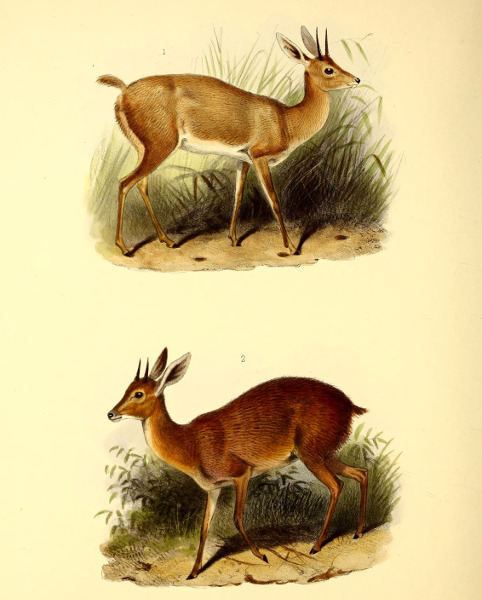
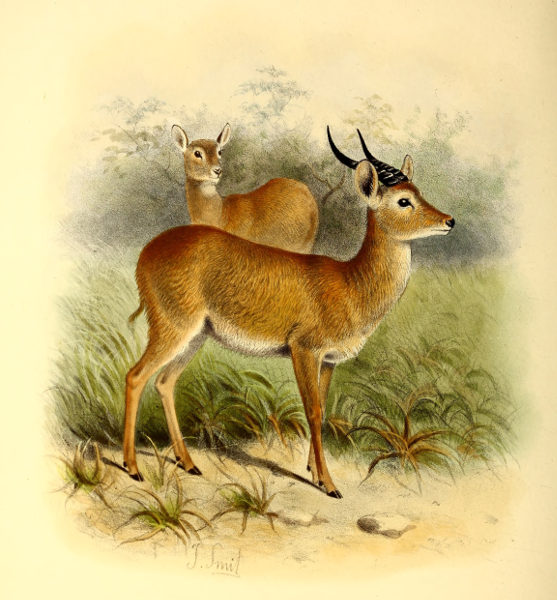
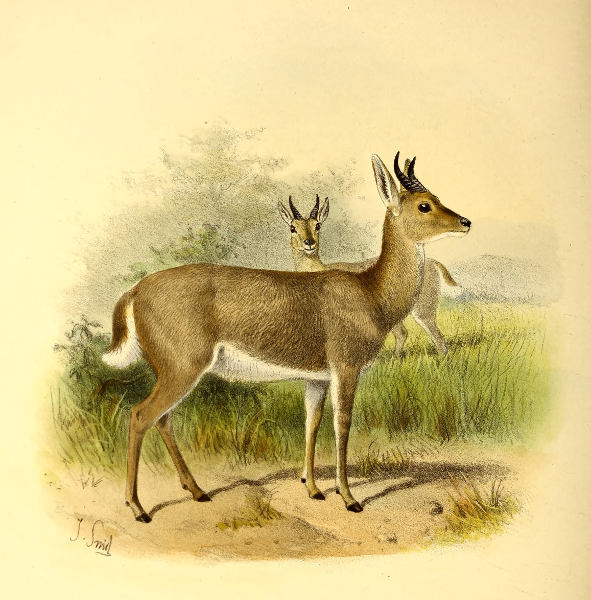
THE BOOK OF ANTELOPES, PL. XXVII.
Wolf del. Smit lith.
Hanhart imp.
Fig. 1. The Steinbok.
RAPHICEROS CAMPESTRIS.
Fig. 2. The Grysbok.
RAPHICEROS MELANOTIS.
Published by R·H·Porter.
Greisbock, Thunb. Resa, ii. p. 12 (1789); English
Transl. ii. p. 11 (1793).
Antilope melanotis, Thunb. Mém. Ac. Pétersb.
iii. p. 312 (1811); Afzel. N. Act. Ups. vii. pp. 257
& 262 (1815); Goldf. Schr. Säug. v. p. 1235 (1818);
Desm. Mamm. ii. p. 459 (1822); Less. Man. Mamm. p.
376 (1827); Licht. Darst. Säug. pl. xii. (♂ & ♀) (1828);
J. B. Fisch. Syn. Mamm. p. 465 (1829); Smuts,
En. Mamm. Cap. p. 82 (1832); Waterh. Cat. Mamm. Mus.
Z. S. (2) p. 42 (1838); Oken, Allg. Nat. vii. p. 1363
(1838); Laurill. Dict. Univ. d’H. N. i. p. 623 (1838);
Wagn. Schr. Säug. Suppl. iv. p. 438 (1844), v. p. 411
(1855); Schinz, Syn. Mamm. ii. p. 413 (1845); Pet.
Reise Mossamb., Säug. p. 187 (1852) (Zambesi); Gieb.
Säug. p. 318 (1854); Huet, Bull. Soc. Acclim. 1887, p.
488.
Antilope tragulus melanotis, Licht. Mag. nat.
Freund. vi. p. 176 (1814); Forst. Descr. Anim. p. 375
(1844).
Tragulus melanotis, A. Sm. S. Afr. Quart. Journ.
ii. p. 213 (1834); Harris, Wild Anim. S. Afr. (fol.) pl.
xxvi. fig. 2 (1840).
Tragelaphus melanotis, Rüpp. Verz. Senck. Mus. p.
37 (1842).
Calotragus melanotis, Sund. Pecora, K. Vet.-Ak.
Handl. 1844, p. 192 (1846); id. Hornschuch’s Transl.,
Arch. Skand. Beitr. ii. p. 144; Reprint, p. 68 (1848);
Gray, Ann. Mag. N. H. (1) xviii. p. 232 (1846);
id. Knowsl. Men. p. 7 (1850); id. P. Z. S. 1850,
p. 118; id. Ann. Mag. N. H. (2) viii. p. 136 (1851);
id. Cat. Ung. B. M. p. 72 (1852); Temm. Esq. Zool.
Guin. p. 192 (1855); Gerr. Cat. Bones Mamm. B. M. p. 235
(1862); Blyth, Cat. Mamm. Mus. As. Soc. p. 166 (1863);
Layard, Cat. S. Afr. Mus. p. 70 (1861); Fitz. SB.
Ak. Wien, lix. pt. 1, p. 165 (1869); Gray, Cat. Rum. B.
M. p. 19 (1872); id. Hand-l. Rum. B. M. p. 90 (1873);
Jent. Cat. Ost. Leyd. Mus. (Mus. Pays-Bas, ix.) p. 131
(1887); id. Cat. Mamm. Leyd. Mus. (op. cit. xi.) p.
159 (1892); Matschie, Thierw. Ost-Afr. Säugeth. p. 120
(1895).
Nanotragus melanotis, Brooke, P. Z. S. 1872,
p. 642; Selous, P. Z. S. 1881, p. 762 (distribution);
id. Hunt. Wanderings S. Afr. p. 222 (1881);
Bryden, Kloof and Karroo, p. 300 (1889); W. Scl.
Cat. Mamm. Calc. Mus. ii. p. 167 (1891); Flow. & Lyd.
Mamm. p. 339 (1891); Nicolls & Egl. Sportsm. S. Afr.
p. 26, pl. viii. fig. 29 (head) (1892); Lyd. Horns and
Hoofs, p. 219 (1893); Lorenz, Ann. Mus. Wien, ix. p. 60
(1895).
Neotragus melanotis, Scl. List Anim. Z. S. (8) p.
145 (1883); id. P. Z. S. 1895, p. 590; Rendall, P.
Z. S. 1895, p. 361.
Antilope grisea, G. Cuv. Dict. Sci. Nat. ii. p.
244 (1816); Burch. List Mamm. pres. to B. M. p. 6 (1825)
(Plettenberg’s Bay); H. Sm. Griff. An. K. iv. p. 250, v.
p. 341 (1827); Less. N. Tabl. R. A., Mamm. p. 177 (1842)
(nec Boddaert).
Cerophorus (Cervicapra) grisea,
Blainv. Bull. Soc. Philom. 1816, p. 75.
Oreotragus griseus, Gray, List Mamm. B. M. p. 164
(1843).
Antilope rubro-albescens, Desmoul. Dict. Class.
d’H. N. i. p. 446 (1822).
Vernacular Names:—Grysbok of Dutch and English
Cape Colonists; Sash-lungwan of Matabilis; Teemba
of Makalakas (Selous); Cassenja at Senna and Tette
(Peters).
Height about 22–23 inches. Fur long and coarse, of a deep rich red
colour profusely mixed with pure white hairs, whence the name “Grys” or
Grey-buck. Under surface paler, but not white. Crown frequently with
a black crescentic mark running round it, as in the Steinbok[1]. Ears
very large, their backs grey. Limbs red. Accessory hoofs present,
but very small, far smaller than in the Oribis. Tail very short, not
blackened at its tip.
Skull and horns very like those of a Steinbok, but the nasal bones seem
to be shorter, and the premaxillæ do not reach so far backwards. A good
adult male skull of this species is, however, a desideratum: we have
only been able to examine immature specimens or those deteriorated by
confinement.
Hab. South Africa north to the Zambesi and Mozambique.
The Forsters, who visited the Cape in 1775 during their voyage round
the world along with the great circumnavigator Cook, furnished Buffon
with notices respecting many of the Antelopes which at that time were
met with even in the immediate vicinity of Cape Town. Amongst these
was the present species, which was accordingly described by Buffon, in
the Supplement to his ‘Histoire Naturelle des Animaux Quadrupèdes,’ as
the Grysbok or “Chèvre-gris.” About the same period as the Forsters
the learned Swedish naturalist Thunberg visited the Cape, and made
himself acquainted with this and the other Antelopes of that district.
In an article subsequently published by the Academy of St. Petersburg
on the Mammals met with during his stay in South Africa, Thunberg
named the Grysbok Antilope melanotis, and his specific name has
usually been adopted for this species, though a subsequently given term
grisea of G. Cuvier has also been applied to it.
In his ‘Darstellung neuer oder wenig bekannter Säugethiere,’
Lichtenstein has given coloured figures of both sexes of this Antelope
from specimens in the Berlin Museum, probably procured by himself. In
the days of Lichtenstein (1803–06) the Grysbok was to be found in all
the middle and western districts of the Cape Colony amongst the hills,
and, according to him, was particularly esteemed as game on account of
its tender and delicate flesh.
Harris, in his great work on the ‘Game Animals of South Africa,’ has
figured the Grysbok on his 26th plate, along with the Bushbok and the
Blaauwbok; he mentions it as, in his time (1836–37), common in the
Colony “among the wooded tracts which skirt the coasts.” Describing
his hunt with a party of Boers, residing not far from the banks
of the Knysna, who had given him a day’s shooting over their best
preserves, he speaks of “proteas and large plots of scarlet geraniums,
interspersed with patches of purple heath,” as being the “favourite
harbour of the roan Grysbok,” and gives an account of its pursuit as
follows:—“Squatted like a hare upon its snug form, this beautiful
little animal is rarely to be dislodged until well nigh trodden upon;
but the dogs have pushed one out of that bed of fern, and are hunting
it directly towards us. Returning again and again upon its old track,
it bounds now over the head of the clustering heather, now doubles
round the corner of a bush, and now, darting aside into the narrow
footpath by which we are advancing, stands a moment with averted head
to listen for its pursuers. Finding them close upon its heels, away it
flies again, and making a desperate plunge into the heart of a thick
shrub, vainly hopes that it may have found an asylum. But thine enemies
have again ferreted thee out, cunning one! and disabled by a stray
buckshot from the roer of that ruthless Hollander, thou art
circling round with dizzy brain and drooping head in quest of a corner
wherein thou mayst lie down to die. Alas! Mynheer’s rude hand has
seized thee, innocent! and whilst he is fumbling for a knife wherewith
to terminate thy helpless struggles, who that hears thy plaintive
cries, like those of a new-born babe, or witnesses the infantine
simplicity expressed in thy large melting black eye, brimful of dewy
tears, can fail inwardly to curse his barbarity?”
In 1861 Mr. E. L. Layard describes the Grysbok as still found in some
abundance at the foot of Table Mountain and on the Lion’s Hill in
the immediate vicinity of Cape Town, though we are somewhat doubtful
whether that is the case at the present time.
Messrs. Nicolls and Eglington speak of the Grysbok as being mostly
found in the eastern districts of the Colony and on the borders of
Natal. Its habits, they state, are solitary and almost identical with
those of the Steinbok (R. campestris), except that it invariably
frequents hilly, broken, and stony country in preference to open flats.
Its flesh, they add, is not particularly good. As regards its range
farther north, Mr. Selous tells us that beyond the Limpopo the Grysbok
is only met with in certain hilly districts of the more easterly
portions of the interior. In Matabeleland it is very scarce, but in
all the hilly country of the Victoria Falls and throughout Mashonaland
down to the Zambesi it is fairly numerous. Mr. Selous also speaks of it
as being met with in the South African territory north of the Zambesi
as far as he penetrated; and Peters has recorded its presence, not
uncommonly, in the plains of Sena, Tette, and Macanga in Mozambique up
to 16° N. latitude.
The Grysbok is included by Matschie in his recently published work on
the Mammals of German East Africa, but only upon the ground that it
will probably be found to occur there. We are not able to confirm this
statement, having never seen specimens of the Grysbok from any locality
so far north.
The Grysbok has been occasionally brought alive to Europe, but does
not appear to do well in captivity. The first example recorded in the
Zoological Society’s register is a female presented by Sir George
Grey in 1861. A second specimen was obtained by purchase in 1864, and
a third in 1869. In May of the present year a female specimen was
presented to the Society by Mr. J. E. Matcham, of Port Elizabeth,
but did not live long in the Gardens. From this animal the figure of
the Grysbok now given (Plate XXVII. fig. 2) has been coloured by Mr.
Smit, though the plate was originally taken by the same artist from a
water-colour drawing prepared by Wolf, under the direction of the late
Sir Victor Brooke, from some other specimen. This drawing, along with
many other original sketches of Wolf’s, is now in the possession of Sir
Douglas Brooke.
The National Collection is not well provided with examples of this
Antelope. Besides a pair collected by Burchell in 1814 there are in the
series only some skulls and skeletons of somewhat doubtful authority.
Good fresh specimens of both sexes of the Grysbok, accompanied by their
skulls, would therefore form a valuable acquisition to the British
Museum.
December, 1895.
Capra grimmia, Thunb. Resa, ii. p. 8 (1789);
id. Engl. Transl. ii. p. 7 (1793) (nec Linn.)
(Cape Town).
Antilope campestris, Thunb. Mém. Ac. Pétersb. iii. p. 313
(1811).
Calotragus campestris, Gray, Cat. Ung. B. M. p.
71 (1852); Layard, Cat. S. Afr. Mus. p. 68 (1861); Gerr.
Cat. Bones Mamm. B. M. p. 235 (1862).
Pediotragus campestris, Gray, Cat. Rum. B. M. p.
31 (1872); id. Hand-l. Rum. B. M. p. 100 (1873).
Nanotragus campestris, Nicolls & Egl. Sportsm. S.
Afr. p. 24, pl. ii. fig. 6 (head) (1892); Lyd. Horns and
Hoofs, p. 217 (1893); Jackson, Badm. Big Game Shooting,
i. pp. 285 & 301 (1894) (E. Africa); Lorenz, Ann. Mus.
Wien, ix. p. 60 (1895).
Neotragus campestris, Rendall, P. Z. S. 1895, p.
361.
Antilope tragulus, Licht. Mag. nat. Freund. vi.
p. 176 (1814); Goldf. Schr. Säug. v. p. 1234 (1818);
Schinz, Cuv. Thierr. i. p. 392 (1821); Desm.
Mamm. ii. p. 458 (1822); Licht. Darst. Säug. pl. xiv.
(♂ ♀) (1828); J. B. Fisch. Syn. Mamm. p. 464 (1829);
Smuts, Enum. Mamm. Cap. p. 81 (1832); Less.
Compl. Buff. x. p. 291 (1836); Oken, Allg. Naturg. vii.
p. 1362 (1838); Laurill. Dict. Univ. d’H. N. i. p. 622
(1839); Gerv. Dict. Sci. Nat. Suppl. i. p. 262 (1840);
Less. N. Tabl. R. A., Mamm. p. 177 (1842); Forst.
Descr. Anim. pp. 36 & 374 (1844); Wagn. Schr. Säug.
Suppl. iv. p. 436 (1844), v. p. 410 (1855); Schinz, Syn.
Mamm. ii. p. 411 (1845); Peters, Reise Mossamb., Säug.
p. 187 (1852) (Inhambane); Gieb. Säug. p. 318 (1854);
Huet, Bull. Soc. Acclim. 1887, p. 88.
Tragelaphus tragulus, Rüpp. Verz. Senck. Mus. p.
37 (1842).
Oreotragus tragulus, Gray, List Mamm. B. M. p. 164
(1843); id. List Ost. B. M. p. 146 (1847).
Calotragus tragulus, Sund. Pecora, K. Vet.-Ak.
Handl. 1844, p. 192 (1846); id. Hornschuch’s Transl.,
Arch. Skand. Beitr. ii. p. 144; Reprint, p. 68 (1848);
Gray, Ann. Mag. N. H. (1) xviii. p. 232 (1846);
id. Knowsl. Men. p. 7 (1850); id. P. Z. S. 1850,
p. 48; id. Ann. Mag. N. H. (2) viii. p. 136 (1851);
Temm. Esq. Zool. Guin. p. 192 (1853); Blyth, Cat.
Mamm. As. Soc. p. 166 (1863); Drumm. Large Game S. Afr.
pp. 395 & 426 (1875) (Zululand).
Pediotragus tragulus, Fitz. SB. Ak. Wien, lix.
pt. 1, p. 163 (1869); Jent. N. L. M. ix. p. 173 (1887)
(Mossamedes); id. Cat. Ost. Leyd. Mus. (Mus. Pays-Bas,
ix.) p. 134 (1887); id. Cat. Mamm. Leyd. Mus. (op. cit.
xi.) p. 165 (1892); id. N. L. M. xv. p. 265 (1893)
(Cunene R.).
Nanotragus tragulus, Brooke, P. Z. S. 1872, pp.
642 & 874; Buckley, P. Z. S. 1876, p. 283 (distribution);
Bocage, P. Z. S. 1878, p. 742; Selous, P. Z. S.
1881, p. 762; id. Hunt. Wand. S. Afr. p. 222 (1881);
Bryden, Kloof and Karroo, p. 300 (1889); Hunter,
in Willoughby’s E. Africa, p. 290 (1889); Crawshay, P. Z.
S. 1890, p. 654 (Nyasa); W. Scl. Cat. Mamm. Calc. Mus.
ii. p. 166 (1891); Flow. & Lyd. Mamm. p. 339 (1891);
Lugard, E. Africa, i. p. 540 (1893).
Neotragus tragulus, Scl. List Anim. Zool. Soc. (8)
p. 145 (1883); id. P. Z. S. 1861, p. 209.
Antilope tragulus rupestris, Licht. Mag. nat.
Freund. vi. p. 177 (1814); Forst. Descr. Anim. p. 376
(1844).
Antilope rupestris, Burch. Travels, i. pp. 202,
281 (1822), ii. p. 15 (1824); H. Sm. Griff. An. K. iv.
p. 248, v. p. 340 (1827); Schinz, Syn. Mamm. ii. p. 412
(1845).
Tragulus rupestris, A. Sm. S. Afr. Quart. J. ii.
p. 212 (1834); Harris, Wild An. S. Afr. pl. xxv. fig. 2
(♂) (1840).
Antilope capensis (misprint for campestris),
Afzel. N. Act. Ups. vii. p. 254 (1815).
Antilope ibex, Afzel. N. Act. Ups. vii. p. 263
(1815); Less. Man. Mamm. p. 376 (1827).
Cerophorus (Cervicapra) stenbock,
Blainv. Bull. Soc. Philom. 1816, p. 75.
Cerophorus (Cervicapra) acuticornis,
Blainv. Bull. Soc. Philom. 1816, pp. 75 & 79; id.
Journ. Phys., Aug. 1818, pl. fig. 8 (skull); id. Oken’s
Isis, 1819, ii. p. 1095, pl. xii. fig. 8 (skull).
Antilope acuticornis, Desm. N. Dict. d’H. N. (2)
ii. p. 193 (1816); Schinz, Cuv. Thierr. i. p. 395 (1821);
Desm. Mamm. ii. p. 460 (1822); Less. Man. Mamm. p.
377 (1827); Flow. & Gars. Cat. Ost. Coll. Surg. ii. p.
275 (1884).
Antilope (Raphicerus) acuticornis, H.
Sm. Griff. An. K. iv. p. 252, v. p. 342 (1827); Less.
H. N. Mamm. (Compl. Buff.) x. p. 292 (1836); Gerv. Dict.
Sci. Nat. Suppl. i. p. 262 (1840); Less. N. Tabl. R. A.,
Mamm. p. 177 (1842).
Antilope fulvo-rubescens, Desmoul. Dict. Class.
d’H. N. i. p. 446 (1822).
Antilope (Raphicerus) subulata, H.
Sm. Griff. An. K. iv. p. 253 (fig. horns), v. p. 342
(1827); Less. Compl. Buff. x. p. 292 (1836); Gerv.
Dict. Sci. Nat. Suppl. i. p. 262 (1840); Less. N. Tabl.
R. A., Mamm. p. 177 (1842).
Pediotragus tragulus grayi, Fitz. SB. Ak. Wien,
lix. pt. 1, p. 163 (1869).
Vernacular Names:—Steinbok of Dutch and
English Colonists; Iquia of Kaffirs (Drummond);
Ingnweena or Umgwena of Matabilis; Puruhuru
of Bechuanas; Ee-peu-nee of Makalakas; Kahu of
Masubias; Kimba of Batongas; Gai-ee of Masaras
(Selous); Shipeni of Transvaal Shangeans;
Njena of Swazis (Rendall); Ishah of E.
African Swahilis (Hunter).
Size small. General colour bright sandy rufous, richer on the head. Top
of muzzle and a horseshoe-shaped marking on the crown generally brown,
but these marks are by no means constant. A white supraorbital stripe,
much as in the Oribi. No auricular gland. No knee-tufts nor false hoofs
present. Tail short, coloured above like the back, below whitish, no
black tip.
Skull stoutly built, its upper surface peculiarly roughened and ridged.
Premaxillæ reaching to, and articulating with, the nasals.
Horns, in proportion to the size of the animal, longer than in the
Oribis, very slender, smooth, and practically unridged throughout.
Their direction is nearly vertical, and they are slightly curved
forwards.
Dimensions, ♂:—Height at withers 19·5 inches, length of hind foot 9·7,
ear 4·2.
Hab. South Africa, from the Cape to the Zambesi and on
the west to the Cunene.
The Steinbok became known to the Forsters and Thunberg through the
Dutch settlers at the Cape at about the same date as the Grysbok, and
in 1811 received the scientific name Antilope campestris from
the latter author in his memoir, published by the Academy of Sciences
of St. Petersburg, to which we have already alluded. Three years later
Lichtenstein in his article upon the species of Antilope published
in the Magazine of the “Gesellschaft naturforschender Freunde” of
Berlin, proposed the name Antilope tragulus, but under this
designation united both the Steinbok and the Grysbok, as well as the
pale variety of the latter species which the Dutch settlers called
the “Bleekbok.” In uniting the Steinbok and Grysbok under one head
Lichtenstein was clearly in error, the structural difference presented
by the absence of accessory hoofs, as well as the divergence in the
colour of the fur, sufficiently distinguishing the present species from
the Grysbok. Lichtenstein no doubt derived his ideas upon this subject
from Forster’s manuscripts, as the same view is taken in Forster’s
posthumous work ‘Descriptiones Animalium,’ when it was tardily
published in 1844. Under these circumstances there can be no doubt,
we think, that “campestris” is the proper specific term to be
employed for the present species.
In an article upon the Ruminants published by Blainville in the
‘Bulletin of the Société Philomathique’ for 1816 and subsequently
enlarged in the ‘Journal de Physique,’ that author described and
figured the skull of a specimen which he had observed in the Museum
of the Royal College of Surgeons in London and called it Antilope
acuticornis. On Blainville’s description and figure of this skull
Hamilton Smith, in the fifth volume of Griffith’s Cuvier, subsequently
established a new genus of Antelopes, “Raphicerus.” Whoever
consults this figure and compares it with a skull of the Steinbok will
inevitably come to the conclusion that the figure represents the skull
of that animal. We have accordingly added Antilope acuticornis
of Blainville, and the further references to it subsequently published,
to the synonyms of the Steinbok, and under these circumstances have
thought it necessary to give the generic term Raphicerus
precedence as the generic name of the present group over the better
known names Calotragus of Sundevall and Pediotragus of
Fitzinger.
It would seem also that Antilope subulata of Hamilton Smith,
given in the same work as a second species of Raphicerus, and
taken from another pair of horns, also then in the Museum of the Royal
College of Surgeons, may be safely referred to the present species.
Captain Harris, in his ‘Portraits of the Game and Wild Animals of South
Africa,’ published in 1840, figures the Steen-bok, as he calls it,
along with the Rhebok in his 25th plate, and speaks of it as “common in
the Colony.”
In 1861, when Mr. Layard prepared his ‘Catalogue of the Mammals in the
Collection of the South African Museum,’ the Steinbok was spoken of
as then common throughout the Colony. It is partial, Mr. Layard tells
us, “to flat plains covered with bushes” and “selects a spot, in the
immediate neighbourhood of which it may constantly be found. When a
Steinbok is killed off, a few days suffice to reproduce a new occupant
for the favoured spot.”
Messrs. Nicolls and Eglington, in their ‘Sportsman in South Africa’
(one of our most recent authorities on the subject), speak of the
Steinbuck as the “most common and widely distributed Antelope of
South Africa from Cape Town to the Zambesi, frequenting the open
flats either singly or in pairs.” As the hares of the Cape afford
little or no sport for coursing, the Steinbok has been employed as
their substitute. These authors give us the following notes upon this
subject:—“At Kimberley, in Griqualand West, a regular coursing club
was organized shortly after the discovery of the diamond fields, and
it has been carried on ever since with the greatest success, the
colonists being just as much interested in the result of the annual
Club Cup as sportsmen are in England over the Waterloo Cup, large
sums of money changing hands at the meetings. It requires, however,
a really fast powerful greyhound with a lot of bottom to run up on a
Steinbuck. As nearly all proprietors strictly preserve the species in
Griqualand West, they are there very numerous, perhaps even more so
than in the native territories further north. This Antelope commences
feeding about sundown, and continues its wanderings during the night,
at sunrise retiring under cover of some low thick clump of bush or
patch of long grass, where, unless disturbed, it passes the entire
day in concealment. As it usually lies asleep during the great heat
of the sun, it can then be easily walked up to and readily disposed
of with a charge of buckshot. When severely wounded or hard pressed
by dogs, it will often take refuge in the burrow of the Aard-vark
(Oryctoropus). At all times the Steinbuck is rather a difficult
shot with the rifle; but if the half-hour before dusk or sunrise be
chosen, some pretty rifle-shooting may be obtained, and a quiet stalk
at such times through a veldt which they frequent will often
well repay the sportsman when larger antelopes are not at hand. The
wind has no influence with regard to the direction in which it goes, as
it will run either up or down wind. It does not frequent very hilly or
thick bush country, and is capable of existing for long periods without
water. The Steinbuck is very easily tamed, but invariably becomes blind
when kept in captivity for any length of time. The flesh is excellent.”
Mr. Selous, in his valuable notes on South Central African Antelopes
read before the Zoological Society of London in June 1881, gives us a
list of the various native names of this little Antelope, and says that
it is spread all over South Africa from the Cape to the Zambesi, except
in the mountainous districts and in tracts of very thick bush. North
of the Zambesi Mr. Selous did not meet with any Steinboks. But it is
certain from the researches of Mr. Crawshay in Nyasaland, of Herr Oscar
Neumann in German East Africa, and Mr. Jackson and other authorities
in British East Africa, that the Steinbok, or a very closely allied
representative, is found, in suitable localities, nearly up to the Tana
River. For the present, however, we shall follow Herr Matschie’s views
in considering the East-African form Raphicerus neumanni as
possibly belonging to a distinct species.
From the western frontiers of the Cape Colony the Steinbok, or a very
nearly allied form, appears to extend up to the Cunene River in the
interior of Angola, whence specimens, referred by M. Du Bocage, with
some hesitation, to the Steinbok, were forwarded in 1874 to the Lisbon
Museum by M. d’Anchieta.
The only example of the Steinbok registered in the Zoological Society’s
Catalogues is a female specimen presented by Sir George Grey, K.C.B.,
then Governor of the Cape Colony, in 1861. We are not aware of any
other examples of this Antelope having been brought to Europe.
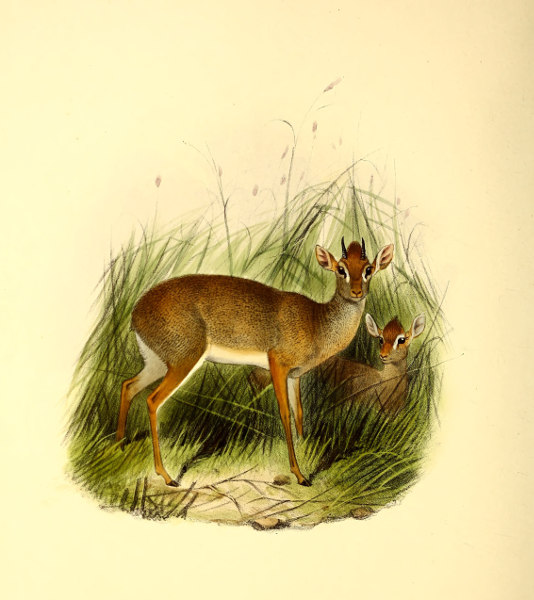
Our figure of this species (Plate XXVII. fig. 1) was put on the stone
by Mr. Smit from a drawing by Wolf prepared under the directions of
the late Sir Victor Brooke. The drawing is now in Sir Douglas Brooke’s
possession. We regret to be unable to state from what specimen it was
taken.
The National Collection contains a pair of mounted specimens of this
Antelope obtained by Wahlberg in Cafferland, and several skins without
exact localities. A skull from Port Elizabeth was obtained by Mr. F. C.
Selous. Further specimens of both sexes with exact dates and localities
would be highly appreciated.
December, 1895.
Nanotragus tragulus, Hunter, in Willoughby’s E.
Afr. p. 290 (1889) (?).
Nanotragus campestris, Jackson, Big Game Shooting,
p. 285 (1894) (?).
Pediotragus neumanni, Matsch. SB. nat. Freund.
1894, p. 122 (N. Ugogo); id. Thierw. Ost-Afr. Säugeth. p.
120.
Vernacular Name:—Dondoro in Ugogo
(Neumann).
Similar to R. campestris, but without any black colour on the
head.
Hab. East Africa, from the Tana to Nyasaland.
As already stated in our remarks on the preceding species, we are by no
means satisfied as to the specific difference of the Steinbok of East
Africa from the corresponding form met with south of the Zambesi. But
until further evidence on this point is available we will not dissent
from the views of Herr Matschie, who has decided that the East-African
form is distinct, and has proposed to call it after Herr Oscar Neumann,
to whom the Berlin Museum is indebted for its specimens.
Herr Neumann, who has recently returned from a most successful
expedition, in which he traversed unexplored portions of German East
Africa up to Lake Victoria and returned through British territory, met
with this Antelope, as he kindly informs us, in Northern Ugogo, Iranga,
Usandawe, and near Mount Gurui. He describes its habits as almost like
those of Madoqua kirki and Cephalophus harveyi, with
which it is often found in company in the thinly-bushed districts. But
it also occasionally goes out into the open prairies, and then lies
concealed in the tall grasses like the Reedbucks. Its Swahili name is
given as ‘Dondoro.’
In his appendix to Sir John Willoughby’s ‘East Africa and its Big
Game,’ Mr. Hunter includes the “Steinbok” amongst the Antelopes met
with in the plains round Kilimanjaro, where, he says, it is very
often seen in the long grass. Mr. F. J. Jackson also speaks of the
“Steinbok” in his account of the Antelopes of the same district. He
says that its Swahili name is “Ishah,” but that it is better known to
some sportsmen as the Grass-Antelope, and continues as follows:—“It is
more plentiful at Kilimanjaro than elsewhere, though I have seen a good
many all along the caravan-route, wherever it passes through open grass
country, between Mombasa and Nzoi in Ukambani. This little Antelope is
the smallest of those found in the open plains. It is a stupid little
beast, and requires very little stalking to outwit it. It will often
stand gazing at anyone who approaches, and allow him to walk up to
within 100 yards of it.”
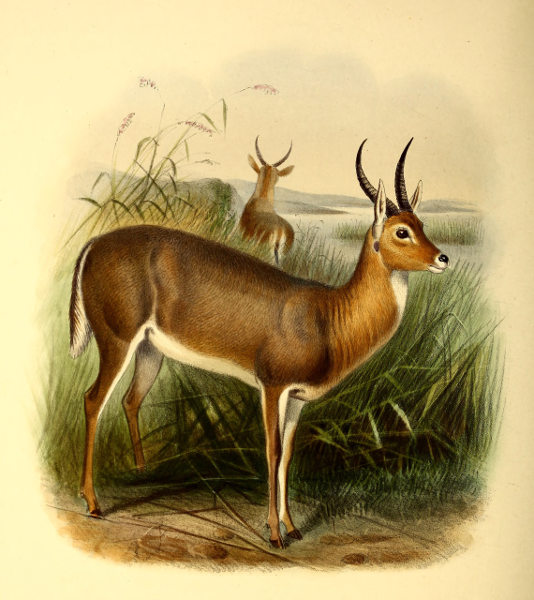
If it should turn out that R. neumanni is a good species, it is
probable that that Steinbok or Ishah of British East Africa, referred
to by these two distinguished sportsmen, will be found to belong to it.
In his ‘Field-notes on the Antelopes of Nyasaland,’ published in 1890,
Mr. R. Crawshay includes the Steinbuck. But he had only procured one
specimen, and admits that he was uncertain as to its identification.
As will be seen by this and by previous remarks that we have made, our
knowledge of the Antelopes of East Africa is still far from complete,
and there is a large opportunity for further discoveries on this
subject by those who will kindly assist us with notes and specimens.
The British Museum contains two skulls, probably of this species,
obtained between Mombasa and Kilimanjaro by Mr. H. C. V. Hunter.
December, 1895.
Genus IV. NESOTRAGUS. — 49. THE ZANZIBAR ANTELOPE. NESOTRAGUS MOSCHATUS, von Düb. [PLATE XXVIII.] — 50. LIVINGSTONE’S ANTELOPE. NESOTRAGUS LIVINGSTONIANUS, Kirk .
Type.
Nesotragus, Von Düb. Öfv. K. Vet.-Ak. Förh. iii. 1846, p. 221 (1847).
N. moschatus.
No auricular glands or accessory hoofs.
Skull with very large anteorbital fossæ, sharply defined above and
below, almost as in Ourebia; anteorbital vacuity present on each
side of the hinder end of the nasal bones; on the sides of the muzzle
a long oval vacuity present on the suture between the premaxillary and
maxillary bones; nasal opening oval, its sides bowed outwards as usual.
Horns half or more the basal length of the skull, strongly slanted back
almost to the continuation line of the facial profile; strongly, but
finely, closely ridged for their basal half or three-fourths.
Distribution. East Africa.
To this genus there belong two closely allied species, which may be
distinguished as follows:—
a. Horns small and slender.
Colour fawn-grey.
Tip of tail like back.
49. N. moschatus.
b. Horns longer and thicker.
Colour more rufous.
Tail blackish above.
50. N. livingstonianus.
THE BOOK OF ANTELOPES, PL. XXVIII.
Wolf del. Smit lith.
Hanhart imp.
The Zanzibar Antelope.
NESOTRAGUS MOSCHATUS.
Published by R. H. Porter]
Nesotragus moschatus, Von Düben, Öfv. K. Vet.-Ak.
Förh. iii. 1846, p. 221 (1847) (French Is., off Zanzibar);
Sund. Pecora, K. Vet.-Ak. Handl. 1845, p. 322 (1847);
id. Hornschuch’s Transl., Arch. Skand. Beitr. ii. p. 314;
Reprint, p. 134 (1848); Gray, Knowsl. Men. p. 8 (1850);
id. P. Z. S. 1850, p. 119; id. Ann. Mag. N. H. (2)
viii. p. 137 (1851); id. Cat. Ung. B. M. p. 75 (1852);
Temm. Esq. Zool. Guin. pp. 192, 209 (1853); Scl.
P. Z. S. 1864, p. 101; Fitz. SB. Ak. Wien, lix. pt.
1, p. 164 (1869); Gray, Cat. Rum. B. M. p. 30 (1872);
id. Hand-l. Rum. B. M. p. 99 (1873); Huet, Bull.
Soc. Acclim. 1887, p. 49; Ward, Horn Meas. p. 80 (1892);
Matsch. Thierw. Ost-Afr. Saügeth. p. 119.
Antilope moschata, Wagn. Schr. Säug., Suppl. v. p.
415 (1855).
Nanotragus moschatus, Brooke, P. Z. S. 1872, p.
642; Flow. & Lyd. Mamm. p. 339 (1891); Lyd. Horns
and Hoofs, p. 217 (1893); True, P. U. S. Nat. Mus. xv.
p. 478 (1892) (Kilimanjaro); Jackson, Badm. Big Game
Shooting, i. pp. 285, 310 (1894).
Cephalophorus zanzibaricus, Layard, Cat. Mamm. S.
Afr. Mus. p. 72 (1861).
Nesotragus kirchenpaueri, Pagenst. JB. Mus. Hamb.
ii. p. 36 (1885) (Kilimanjaro).
Vernacular Names:—“Grave-Island Gazelle”
of E.-African Sportsmen (Jackson); Suni of
Kichagas of Kilimanjaro (Abbott); Paa of Swahilis
(Fischer, teste Matschie).
Size small; height about 13 inches at withers. General colour dull,
finely grizzled fawn-grey, with a tinge of rufous, which is especially
strong on the face and sides of the neck. Top of nose with a brown
patch. Throat pale rufous. Chin, belly, and inner sides of limbs white.
Upper part of outer sides of limbs like flanks, lower part, from elbows
and hocks downwards, pale rufous; pasterns brown. Tail grizzled
greyish above like the back, whitish below.
Skull with the bony palate ending, in the middle line, just in front of
the level of the back of the last molar.
Dimensions of a good male example:—Basal length 4 inches, greatest
breadth 2·3, muzzle to orbit 2·15.
Horns from 2½ to 3 inches long, very slender, their circumference at
their thickest part only about 1·4 inch.
Hab. Islets in Zanzibar Harbour and the coast-districts
of the mainland from Kilimanjaro southwards to Mozambique.
The discovery of this little Antelope is due to the researches of the
Swedish naturalist Baron von Düben, who described it in 1846 from
specimens procured by himself at Zanzibar, and named it Nesotragus
moschatus—“Nesotragus” from its supposed insular habitat,
and “moschatus” from the musky smell of its facial glands.
Little more was known of this species until 1861, when Mr. Layard
described it as new under the name Cephalophorus zanzibaricus
from specimens in the South-African Museum which he had himself
obtained during the voyage of H.M.S. ‘Cantor’ on the island off
Zanzibar used as a European burial-ground. According to what Mr. Layard
was told the species had been introduced here by Col. Hamilton, and
had multiplied so largely that sixteen were shot in an hour by a party
of the ship’s officers. “The island was covered with low bush, out
of which the men beat the Antelopes, which ran along the beach like
rabbits. Their runs could be traced in all directions through the
bushes.”
In 1864 Sclater recorded this Antelope among the mammals obtained by
Capt. Speke during his celebrated expedition into East Africa. Speke’s
specimen, an adult male, obtained at Zanzibar, is now in the gallery
of the British Museum, and is, we believe, the original of Wolf’s
water-colour drawing (now in the possession of Sir Douglas Brooke),
whence Mr. Smit’s figure (Plate XXVIII.) was engraved under Sir Victor
Brooke’s superintendence.
Sir John Kirk, so long known as H.B.M. Consul-General at Zanzibar, who
furnished a set of skins and skulls of this Antelope to the National
Collection, has most kindly supplied us with the following notes on
it:—
“The small Antelope (Nesotragus moschatus) which you ask about
was common on two small coral islands that guard the entrances to the
harbour of Zanzibar (which is situated on the land or western side of
the island of that name) about 1866, when I first took up residence
there. I never knew of it having been seen anywhere else, not even
on the main island of Zanzibar. I have heard it said, however, on
reliable authority that it has been met with on the continent; this,
however, I cannot confirm from personal experience. To me, therefore,
the little Antelope is known only on these two small islands that I
have indicated. Both of them are made of coral-rock raised about 15
feet above sea-level. They are much eroded on the exposed sea face
and on the surface, where the sharp angles of rock make progress
most difficult and even dangerous. There is no fresh water on these
islands, unless it be the little that gathers in the pot-holes, but
these are generally deep with sharp edges, and out of reach of the
Nesotragus, which for many months cannot get fresh water other
than rain or dew on the leaves.
“These islands are covered with dense bush and tangled creepers, and
the Ipomœa pescapræ and Canavalia bean form a green mat
down to the water-edge. Elsewhere all is evergreen bush and trees;
the only grass there has a wiry texture, and is never eaten. The
Nesotragus, like so many other Antelopes, lives on leaves and
twigs of trees and scrub, and this is probably why it is so difficult
to keep in captivity. I made many attempts to rear young ones and send
them to the Zoological Gardens, but failed. Only once was I able to
keep one alive for any time by gradually accustoming it to eat native
millet or sorghum.
“When first I went to Zanzibar there was no cultivation on either of
these islands, but in time Bawe, the larger of the two, was planted
with cocoanuts where there was sand. Two thirds of the island, however,
were nothing but bare coral-rock, covered with tangled jungle, and
useless for any purpose, and there the Antelope held its own, or rather
just managed to resist extermination.
“On the other island, which was only used as a burial-place for
Europeans, the Antelope was much more numerous. This island was
nearly all bare rock, cut up with pot-holes, and covered with tangled
vegetation; only at one point was there sand, and this was the spot
converted into a cemetery.
“As Europeans began to arrive in Zanzibar it became a favourite
afternoon’s amusement to go to this island to shoot pigeons; and then
the Antelopes got reduced in numbers, and became very rare.
“For some years before I left it was seldom that a good head with
horns, such as were common in former times, was ever secured, so that
unless the Nesotragus has been preserved by the authorities I
should think by this time it must be nearly extinct.
“The Antelope lives in the thick bush, it is seldom met with in the
open spaces between the clumps of vegetation, and has to be shot as it
darts from one bush to another.
“So far as I know, it has only one natural enemy on these little
islands, namely, a python, which is often of a great size, and which
can find little to live on here except these Antelopes and mice.”
In his volume on the Mammals of German East Africa, Herr Matschie
records the occurrence of the Zanzibar Antelope in several localities
on the continent. Stuhlmann met with it in Ukama and Usaramo, Fischer
at Gross-Aruscha, and Böhmer near Mpapwa.
The German explorers say that this Antelope feeds ordinarily on fresh
leaves, but accustoms itself to grass and bananas in captivity. Gravid
females were found in August and October, so that it seems to breed
twice a year. Fischer found it common everywhere during his journeys in
German East Africa. It is easily to be observed, early in the morning
and in the evening, if the sportsman hides away among the bushes, as at
these times it is on the feed. On being alarmed it utters a peculiar
cry.
In British East Africa Mr. Jackson, in his volume of the Badminton
Library Series on “Big Game Shooting,” tells us that the “Grave-Island
Gazelle,” as the British sportsmen call this species, is found in the
thick bush behind Frere-town, near Mombasa, and also in the Duruma
country. Like the “Paa” (Madoqua kirki) it is a bush-feeder, and
requires little or no water.
Dr. W. L. Abbott, as recorded by Mr. True, obtained a young male of
this species at a height of about 6000 feet on Kilimanjaro, where it
was brought to him alive by the natives.
There are no examples of this species from the mainland in the British
Museum.
December, 1895.
Antilope moschata, Peters, Reise Mossamb., Säug.
p. 189 (1852) (nec v. Düben) (Tette).
Nesotragus livingstonianus, Kirk, P. Z. S. 1864,
p. 657 (Shupanga); Gray, Cat. Rum. B. M. p. 31 (1872);
id. Hand-l. Rum. B. M. p. 100 (1873).
Nanotragus livingstonianus, Thos. P. Z. S. 1893,
p. 237 (fig. skull) (Umkozi R., Zululand).
Vernacular Names:—Rumpsa at Tette;
Injasorro in Mozambique (Peters);
Inhlengana of Zulus (A. H. Neumann).
Size larger than N. moschatus, and in other respects a finer
and more richly coloured animal. General colour deep rufous, verging
on chestnut; flanks and limbs more fawn-coloured than in N.
moschatus. Top of tail darker than back, approaching black; its
underside white.
Skull with the posterior palate produced backwards about a quarter of
an inch behind the level of the back of the last molar.
Dimensions of a fine male example:—Basal length 4·4 inches, greatest
breadth 2·45, muzzle to orbit 2·35.
Horns thick and heavy, especially in southern specimens, strongly but
closely ridged to within an inch of their tips. In Mr. Neumann’s fine
Zululand specimen there are no less than 25 rings to a horn-length of
3·3 in., and in the same example the circumference of the horns is
about 1·7 in.
Hab. South-east Africa from Mozambique to Zululand.
In the Portuguese territory of Mozambique, and so on to Zululand, we
find the place of the Zanzibar Antelope occupied by a nearly allied
but larger species, with much thicker and more strongly ridged horns.
This is Livingstone’s Antelope, discovered by Sir John Kirk during his
companionship with the celebrated traveller after whom he named it. Sir
John Kirk obtained his specimens at Shupanga and Lupata on the Zambesi,
where, he says, it is called “Ramsa” or “Lumdsa,” and described them
in an article on the Mammals of Zambesia, published in the Zoological
Society’s ‘Proceedings’ for 1864. In habits, he tells us, Livingstone’s
Antelope much resembles its ally of Zanzibar; it frequents dense
underwood, and lives in pairs. On being started it runs off quickly,
not unlike a hare, and conceals itself in some tuft of grass or small
bush.
It is probable, as suggested by Sir John Kirk, that the Antilope
moschata of Peters, met with by that distinguished naturalist at
Tette on the Zambesi, should be referred to the present species.
Little more was known of this Antelope until 1893, when the British
Museum received from the well-known African sportsman Mr. A. H. Neumann
specimens of a small Antelope obtained in Northern Zululand in April of
the previous year. On comparing these with the scalp and skull on which
Nesotragus livingstonianus had been based by Sir John Kirk,
Thomas came to the conclusion that they belonged to the same species.
Although the horns of Mr. Neumann’s specimen were stouter and heavier,
the differences appeared to be such as might be attributable to age.
In a letter published in the ‘Field’ newspaper (of September 3rd,
1892) Mr. Neumann has given the following particulars respecting this
Antelope:—
“I have known of the existence of this Antelope in South-eastern Africa
for many years, but have only lately had an opportunity of obtaining a
specimen. The native name for it is ‘Inhlengana.’ It is barely larger
than the tiny Blue-buck of S. Africa, but carries very much larger
horns in proportion to its size. The specimen sent is an old male. The
white hairs on the head are said to be from age, and not general to the
species. This one was killed in North-eastern Zululand, which district
seems to be the southerly limit of its range. It frequents the densely
bushed parts of the low flats between the coast and the Bombo range.
How far north it ranges I cannot say, but I first heard of it in the
neighbourhood of the Lower Limpopo and Komati rivers.
“It has a very strong musky scent, the source of which appears to
be the large glands (the hollows for which are conspicuous in the
skull) below the eyes, and of which the openings appear in the skin.
So powerful is this odour that it may often be perceived pervading the
bushes that the bucks frequent. Even the flesh (of the male, at all
events) is so highly flavoured by this peculiar essence as to be barely
eatable.
Fig. 25.
Skull of Nesotragus livingstonianus, ♂.
(P. Z. S. 1893, p. 238.)
“The animal from which this skull and skin were taken was killed by a
native, and spoilt as a specimen for mounting before I got it; hence
the skin is sent merely for purposes of identification. It would not be
difficult, however, to procure others, as they seem fairly plentiful in
parts.”
Mr. H. M. Barber, F.R.G.S., a well-known authority on the game-animals
of South-east Africa, has lately forwarded to Sclater a description of
an Antelope and a photograph of its head, which are, no doubt, also
referable to the present species. Mr. Barber states that the Antelope
in question is found in the neighbourhood of Delagoa Bay, between
the Tembe and Maputa Rivers, and is of a mouse-colour with a reddish
head, standing about a foot in height. He describes its habits as
follows:—“It frequents reeds and low-lying scrub along the river
banks, and is also found amongst the bracken which constitutes the
undergrowth of the forests in those parts. The annulations of the horns
of the living bucks are often completely filled up by bark of the trees
which the buck is in the habit of rubbing up against. This gives the
horns a peculiar yellowish-brown appearance.”
Our illustration of the skull of this Antelope (fig. 25) has been
kindly lent to us by the Council of the Zoological Society of London.
It may be remarked that the most southern (Zululand) examples of this
Antelope seem to exceed those of the Zambesi in size and richness
of colour. It is therefore possible that intermediate specimens,
connecting the Zambesi form with the N. moschatus of the north,
may hereafter be found in the intervening districts, but until this
occurs it is better to recognize the two species as distinct.
December, 1895.
Genus V. NEOTRAGUS. — 51. THE ROYAL ANTELOPE. NEOTRAGUS PYGMÆUS ( Linn. ). [PLATE XXIX.]
Type.
Neotragus, H. Sm. Griff. An. K. v. p. 349 (1827)
N. pygmæus.
Tragulus, Ogilb. P. Z. S. 1836, p. 138 (nec Pall.)
N. pygmæus.
Minytragus, Glog. Naturg. p. 154 (1841)
N. pygmæus.
Spinigera, Less. N. Tabl. R. A., Mamm. p. 178 (1842)
N. pygmæus.
Nanotragus, Sund. Pecora, K. Vet.-Ak. Handl. 1844, p. 191 (1846)
N. pygmæus.
Size very small. No auricular glands nor accessory hoofs. Tail of
median length.
Skull with its muzzle unusually well ossified, so that there are no
anteorbital vacuities, nor extra vacuities in the maxillo-premaxillary
suture. Anteorbital fossæ very large. Nasal opening a vertical oblong,
its sides not bowed outwards.
Horns excessively small, their length less than the diameter of the
orbit; laid right back on the sides of the crown in the direction of
the facial profile.
Distribution. West Africa.
Only one species of this genus is known.
THE BOOK OF ANTELOPES, PL. XXIX.
Wolf del. Smit lith.
Hanhart imp.
The Royal Antelope.
NEOTRAGUS PYGMÆUS.
Published by R·H·Porter.
Cervus pusillus guineensis, Seba, Thesaurus, i. p.
10, pl. xliii. fig. 3 (1734).
Capra pygmæa, Linn. Syst. Nat. (10) i. p. 69
(1758).
Moschus pygmæus, Linn. Syst. Nat. (12) i. p. 92
(1766).
Antilope pygmæa, Pall. Spic. Zool. xii. p.
18 (1777); Zimm. Spec. Zool. geogr. p. 540 (1777);
id. Geogr. Gesch. ii. p. 112 (1780); Herm. Tabl.
Affin. Anim. p. 107 (1783); Gmel. Linn. S. N. i. p. 191
(1788); Kerr, Linn. An. K. p. 318 (1792); Donnd.
Zool. Beytr. i. p. 642 (1792); Link, Beytr. Nat. ii. p.
99 (1795); Bechst. Allgem. Uebers. vierf. Thiere, ii. p.
642 (1800); Shaw, Gen. Zool. ii. pt. 2, p. 326 (1801);
Desm. N. Dict. d’H. N. (1) x. p. 251 (1803), xxiv. Tabl.
p. 32 (1804); G. Cuv. Dict. Sci. Nat. ii. p. 241 (1804);
G. Fisch. Zoogn. iii. p. 414 (1814); Afzel. N.
Act. Ups. vii. p. 220 (1815); Desm. N. Dict. d’H. N. (2)
ii. p. 192 (1816); Goldf. Schr. Säug. v. p. 1237 (1818);
Desm. Mamm. ii. p. 465 (1822); Desmoul. Dict.
Class. i. p. 445 (1822); Less. Man. Mamm. p. 379 (1827);
J. B. Fisch. Syn. Mamm. p. 469 (1829); Oken, Allg.
Naturg. vii. p. 1360 (1838).
Tragulus pygmæus, Bodd. Elench. Anim. p. 131
(1785); Ogilb. P. Z. S. 1836, p. 138.
Antilope (Gazella) pygmæa, Licht.
Mag. nat. Freund. vi. p. 178 (1814).
Cerophorus (Cervicapra) pygmæa,
Blainv. Bull. Soc. Philom. 1816, p. 75.
Cemas pygmæa, Oken, Lehrb. Naturg. iii. Zool. ii.
p. 744 (1816).
Antilope (Neotragus) pygmæa, H. Sm.
Griff. An. K. iv. p. 270, v. p. 349 (1827).
Neotragus pygmæa, A. Sm. S. Afr. Quart. J. ii. p.
218 (1834).
Cephalophorus (?) pygmæus, Gray, List Mamm.
B. M. p. 163 (1843).
Nanotragus pygmæus, Gray, Ann. Mag. N. H. (1)
xviii. p. 231 (1846); Brooke, P. Z. S. 1872, p. 640, pl.
liii. (animal), fig. skull; Flow. & Lyd. Mamm. p. 339
(1891); Lyd. Horns and Hoofs, p. 216 (1893).
Cephalophus (Nanotragus) pygmæus, Gerv. H. N.
Mamm. ii. p. 209 (1855).
Antilope regia, Erxl. Syst. R. A. p. 278 (1777);
Gatt. Brev. Zool. i. p. 80 (1780); Bodd. Elench.
An. p. 140 (1785).
Nanotragus regius, Gray, Knowsl. Men. p. 12 (1850).
Antilope spinigera, Temm. Mon. Mamm. i. p. xxx
(1827) (descr. nulla); Less. Man. Mamm. p. 379 (1827);
J. B. Fisch. Syn. Mamm. p. 469 (1829); Gerv. Dict.
Sci. Nat. Suppl. i. p. 263 (1840); Wagn. Schr. Säug.
Suppl. iv. p. 457 (1844), v. p. 416 (1855); Schinz, Syn.
Mamm. ii. p. 421 (1845); Gieb. Säug. p. 320 (1854).
Antilope (Spinigera) spiniger, Less.
N. Tabl. R. A., Mamm. p. 178 (1842).
Nanotragus spiniger, Sund. Pecora, K. Vet.-Ak.
Handl. 1844, p. 191 (1846); id. Öfv. K. Vet.-Ak.
Förh. 1846, p. 83 (1847); id. Pecora, Hornschuch’s
Transl., Arch. Skand. Beitr. ii. p. 143; Reprint, p. 67
(1848); Fitz. SB. Ak. Wien, lix. pt. 1, p. 164 (1869);
Jent. Cat. Ost. Leyd. Mus. (Mus. Pays-Bas, ix.) p. 134
(1887); id. Cat. Mamm. Leyd. Mus. (Mus. Pays-Bas, xi.) p.
164 (1892).
Cephalophus spiniger, Büttikofer, Reisebild.
Liberia, ii. p. 379 (1890).
Nanotragus perpusillus, Gray, P. Z. S. 1850, p.
126; id. Ann. Mag. N. H. (2) viii. p. 143 (1851); id.
Cat. Rum. B. M. p. 30 (1872); id. Hand-l. Rum. B. M. p.
98 (1873).
Antilope perpusilla, Huet, Bull. Soc. Acclim.
1887, p. 67.
Vernacular Name:—Sang of the Veys in Liberia
(Büttikofer).
Height about 10 inches at withers. General colour bright rufous fawn,
browner on head and fore back, richer posteriorly and on sides of neck
and flanks. Chin and under surface pure sharply defined white. Limbs
rufous, except a narrow line down the posterior side of the fore and
the anterior side of the hind ones, which is white. Tail about 2½
inches long, without its tuft, bright rufous above, except at its tip,
where it is pure white, as it is also below.
Skull as described above. Dimensions of an old male example:—Basal
length (c.) 3·5 inches, greatest breadth 1·9, muzzle to orbit 1·84.
Horns less than an inch long, sharply pointed, perfectly smooth and
without ridges.
Hab. Forests of West Africa from Liberia to Ashantee.
The literary history and complicated synonymy of the Royal Antelope
occupied the attention of the late Sir Victor Brooke, when he was
engaged in the study of the Ruminants, for a considerable period, and
the result was a valuable communication to the Zoological Society
of London on the 21st May, 1872, which was subsequently published
in the Society’s ‘Proceedings.’ Being engaged on a work originally
planned by our lamented friend, and having the use of the illustrations
which he has so carefully prepared, we cannot do better than commence
our account of this species with a résumé of his excellent
elucidation of this difficult subject, which is nearly as follows:—
Bosman, in his Description of the Gold Coast, published at Utrecht in
1704[2], seems to have been the first author who mentions the Royal
Antelope. After describing the colour and very small size of the
animal, and the custom of making the feet into pipe-stoppers (one of
which he states he had sent home set in gold), Bosman writes:—“the
negroes call it the ‘King of the Harts.’ This expression, no doubt,
originated the English name of ‘Royal Antelope,’ by which this species
has always been known.”
The celebrated ‘Thesaurus’ of Seba, published in 1734, gives us the
first record of specimens of this animal having found their way into
European museums, figure 3 of the 43rd plate of that work, illustrating
his Cervus juvencus perpusillus guineensis, being, as Sir
Victor Brooke has shown, undoubtedly referable to the Royal Antelope.
In 1754 the Museum of King Adolphus Frederick seems to have contained
a specimen of this animal, and it was in the folio catalogue of this
collection that Linnæus appears to have first given a definite name
(Capra perpusilla) to the present species. It seems, therefore,
that the two sources from which Linnæus derived his knowledge of
it were Seba’s ‘Thesaurus,’ with possibly an examination of Seba’s
specimens, and, secondly, the Museum of King Adolphus Frederick. As
regards the ‘Systema Naturæ,’ Linnæus first mentioned this species
in his second edition (1740), and gave as its diagnosis “Capra
pedibus digito humane augustioribus” with a reference to figure 3
of plate 43 of Seba’s ‘Thesaurus.’ In the 6th edition of the ‘Systema’
(1748) both diagnosis and reference are repeated word for word. But
in 1754, when Linnæus prepared his catalogue of the Museum of King
Adolphus Frederick just alluded to, besides describing a specimen
of the Royal Antelope in that collection, to which he applies the
diagnosis of the ‘Systema Naturæ’ given above, he mentions on the
same page a second specimen under the name Cervus guineensis.
This, as Sir Victor Brooke has shown, was evidently quite a different
animal—probably a young of some small species of Cephalophus.
Nevertheless, in the 10th edition of the ‘Systema Naturæ,’ published
in 1758, Linnæus, regardless of the name Capra perpusilla given
in former publications, now attributes to the same species the new
name Capra pygmæa, and also founds another species, “Cervus
guineensis,” on the Cervus griseus subtus nigricans of the
“Museum Adolphi Frederici.” In the 12th edition of the ‘Systema’ (1766)
these two species are united under the title Moschus pygmæus.
It is, however, manifest from the diagnosis, and from his reference
to Seba’s plate, that the “Royal Antelope” was the principal object
in Linnæus’s mind when he founded his Capra pygmæa. There is
also little doubt, as Sir Victor Brooke has shown, that the young
specimen of the Royal Antelope which ultimately passed from Seba’s
Museum to Leyden was the original of Seba’s figure, plate 43. fig. 3,
and that the specimen of the same species that went to the Stockholm
Museum was the original of Seba’s figure 1 of plate 43. Under these
circumstances we can have no hesitation in following Sir Victor Brooke,
and adopting the term pygmæus of Linnæus as being the correct
specific name of this Antelope. For its generic name we must use the
term Neotragus, proposed by Hamilton Smith in 1827, as being
unquestionably first in date, and the Royal Antelope thus becomes
Neotragus pygmæus in the scientific terminology of modern
Natural History.
Fig. 26.
Skull of Neotragus pygmæus, ♂.
(P. Z. S. 1872, p. 642.)
Pennant, in his ‘Synopsis of Quadrupeds,’ published in 1771, is perhaps
the first author who called the present species the “Royal Antelope,”
quoting first of all Bosman’s term “King of the Harts,” though he added
to its synonyms references to other species which probably do not
belong to it. Erxleben in 1777 based the name Antilope regia
upon nearly the same authorities, but this term, as we have already
shown, was antedated by Linnæus’s Capra pygmæa. In 1827 Temminck
applied the name Antilope spinigera to the same animal, without,
however, giving any description of it. Temminck’s name was employed
by Sundevall in his excellent essay upon the Pecora, first
published in 1846, when, however, he very unnecessarily created the
new generic term Nanotragus for this species, which, as already
stated, had previously been called Neotragus by Hamilton Smith.
Sundevall took his description from an adult male specimen in the
Leyden Museum, stating that he had also seen a female at Paris, but had
mislaid his notes upon it.
The earliest specimens of Neotragus pygmæus in the Leyden
Museum, which consisted of two adult males and the skeleton of a
female, were received in 1824 from the Dutch Factory on the Gold Coast.
The first collector of modern date who met with examples of this little
Antelope appears to have been the Dutch naturalist Pel, who, when he
left Leyden on his travels, was specially recommended by Temminck to
search for it. After ten years’ residence upon the Gold Coast Pel
succeeded in procuring three individuals only, which were found by
him on the borders of Ashantee, and when sent home to Leyden served
for Temminck’s excellent description of this animal, published in his
‘Esquisses Zoologiques sur la Côte du Guinée’ in 1853. Pel’s notes
state that this Antelope is found “solitary or in pairs in the thickest
forests of the Guinea coast. Their activity is remarkable, and they are
disturbed at the least noise, starting off with leaps and bounds to a
considerable distance.” Pel’s exact localities for these specimens, as
given in the ‘Catalogue of the Mammals of the Leyden Museum’ (1892),
are Dabocrom, St. George d’Elmina, and Ashantee.
Herr Büttikofer, though he speaks of this Antelope in his ‘Reisebilder
aus Liberia,’ does not appear to have obtained examples of it in that
country. He says, however, that it is called “Sang” by the native Veys,
and that when he showed them a coloured picture of the animal they
recognized it immediately, and said that it lived in the forest and was
extraordinarily shy, moving away when discovered in a series of long
jumps, which often extended to nine feet in length.
Sir Victor Brooke’s specimens of the Royal Antelope, consisting of
three adult and very perfect individuals, were received by him from Mr.
Ussher, who, when Governor of the Gold Coast, supplied our Museums with
many interesting objects of Natural History.
Our Plate XXIX., which was prepared under Sir Victor Brooke’s direction
by Mr. Wolf and engraved by Mr. Smit, no doubt from Sir Victor’s own
specimens, represents both sexes of this interesting species. The same
drawing also served for the plate which illustrates Sir Victor’s paper
in the Zoological Society’s ‘Proceedings,’ already referred to.
The National Collection contains a mounted specimen of an adult male
of this Antelope from Fantee, and a young one in spirits from the
same locality, the latter presented by Mr. H. F. Blissett. In the
same collection is a young specimen from Lagos, presented by our much
lamented friend the late Dr. E. Dobson, and a second young one from the
Guinea coast, obtained by Pel and received in exchange from the Leyden
Museum. Further adult examples of this little Antelope would, however,
be much valued, and it is to be hoped that among the many officers
engaged in the new Ashantee Expedition to Kumasi some may be found with
time and opportunity to get fresh specimens of this “smallest of all
the Ruminants.”
Neotragus, Sund. Pecora, K. Vet.-Ak. Handl. 1844, p. 191 (1846)
(et auctorum plurimorum, nec H. Sm.)
M. saltiana.
Size small; nose elongated, proboscis-like; its tip nearly entirely
hairy, except just on the lower part of the nasal septum; crown of head
tufted; tail very short, almost rudimentary; accessory hoofs present,
but quite minute.
Skull with the premaxillæ long and the nasals short, in correlation
with the lengthening of the snout into a proboscis; anteorbital
vacuities large; anteorbital fossæ large but shallow; last lower molar
in some species without the posterior lobe which is present in all
other ruminants.
Horns from half to three-quarters the length of the skull, straight or
slightly sinuate, strongly ribbed basally.
Distribution. Extending diagonally across Africa from
Abyssinia to Damaraland. No species found either in N.W., South,
or S.E. Africa.
Of this genus we are prepared to recognize six species, which fall
naturally into two groups—(A) those in which the proboscis is
comparatively slightly, developed and the last lower molar is without a
posterior lobe, and (B) those in which the proboscis is very long and
the last lower molar, as in other Ruminants, has a third lobe. Within
the groups the species differ comparatively little from each other,
but may be distinguished without difficulty by the characters of size,
colour, and form, used in the following synopsis:—
A. Last lower molar without a third lobe; upper line of premaxillæ slanting,
scarcely curved. Proboscis less developed.
a. Back yellowish or fulvous grey, sides scarcely more rufous.
a1. Size larger, basal length of skull 3·75 in. 52. M. saltiana.
b1. Size smaller, basal length of skull about 3·1 in. 53. M. swaynei.
b. Back grey, sides and shoulders rich rufous or cinnamon: size intermediate
between last two (skull 3·25 in.) 54. M. phillipsi.
B. Last lower molar with a third lobe; upper line of premaxillæ S-shaped.
Proboscis more developed.
c. Tips of nasals about level with the front edge of the anterior premolar,
about 1·3 in. from the end of the premaxillæ (gnathion).
c1. Back of orbit to gnathion about 3·4 in. 55. M. damarensis.
d1. Back of orbit to gnathion about 3 in. 56. M. kirki.
d. Tips of nasals about level with the back of the middle premolar and
about 1·65 in. from the gnathion 57. M. guentheri.
THE BOOK OF ANTELOPES, PL. XXX.
Wolf del. Smit lith.
Hanhart imp.
Salt’s Dik-dik.
MADOQUA SALTIANA.
Published by R.H.Porter.
“Madoqua,” Salt, Travels in Abyssinia, App. iv. p.
xi.
Cerophorus (Cervicapra) saltiana,
Blainv. Bull. Soc. Philom. 1816, pp. 75 & 79; id.
Oken’s Isis, 1819, p. 1096.
Antilope saltiana, Desm. N. Dict. d’H. N. (2) ii.
p. 192 (1816); Schinz, Cuv. Thierr. i. p. 395 (1821);
Desmoul. Dict. Class, i. p. 446 (1822); Desm.
Mamm. ii. p. 465 (1822); Goldf. Schr. Säug. v. p. 1244
(1824); Cretzschm. Atl. Rüpp. Reise, p. 55, pl. xxi.
(♂ ♀, young) (1826); Less. Man. Mamm. p. 380 (1827);
Licht. Darst. Säug. pl. xvi. (♂ ♀) (1828);
Hempr. & Ehr. Symb. Phys. pl. vii. (1828); J. B.
Fisch. Syn. Mamm. p. 470 (1829); Oken, Allg.
Naturg. vii. p. 1361 (1838); Laurill. Dict. Univ. d’H.
N. i. p. 622 (1839); Gerv. Dict. Sci. Nat. Suppl. i.
p. 263 (1840); Schinz, Syn. Mamm. ii. p. 418 (1845);
Huet, Bull. Soc. Acclim. 1887, p. 68.
Antilope (Neotragus) saltiana, Less.
Compl. Buff. x. p. 295 (1836); id. N. Tabl. R. A., Mamm.
p. 178 (1842).
Madoqua saltiana, Ogilb. P. Z. S. 1836, p. 137;
Gray, List Mamm. B. M. p. 164 (1843); Thos. P. Z.
S. 1894, p. 328.
Neotragus saltianus, Jard. Nat. Libr., Mamm. iii.
pt. 1, p. 229, pl. xxxiii. (1835); Gray, Ann. Mag. N.
H. (1) xviii. p. 231 (1846); id. Cat. Ost. B. M. p. 56
(1847); id. Knowsl. Men. p. 8 (1850); id. P. Z.
S. 1850, p. 120; id. Ann. & Mag. N. H. (2) viii. p. 138
(1851); id. Cat. Ung. B. M. p. 76 (1852); Gerr.
Cat. Bones Mamm. B. M. p. 236 (1862); Blanf. Zool. Abyss,
p. 268 (1870); Flow. & Gars. Cat. Coll. Surg. ii. p. 268
(1884); Giglioli, Ann. Mus. Genov. (2) vi. p. 19 (1888)
(Assab); Flow. & Lyd. Mamm. p. 238 (1891); Lyd.
Horns and Hoofs, p. 214 (1893).
Calotragus saltianus, Temm. Esq. Zool. Guin. p.
192 (1853).
Cephalophus (Ourebia) saltiana,
Gerv. H. N. Mamm. ii. p. 209 (1855).
Antilope (Neotragus) madoka, H. Sm.
Griff. An. K. iv. p. 271, v. p. 350 (1827); A. Sm. S.
Afr. Quart. J. ii. p. 218 (1834); Less. Compl. Buff. x.
p. 295 (1836).
Antilope madoqua, Waterh. Cat. Maram. Mus. Z. S.
(2) p. 40 (1838).
Antilope hemprichiana, Ehr. in Hempr. & Ehr.
Symb. Phys. text to pl. vii. (1833); Oken, Allg. Naturg.
vii. p. 1362 (1838); Wagn. Schr. Säug. Suppl. iv. p. 455
(1844), v. p. 415 (1855); Gieb. Säug. p. 319 (1854).
Neotragus hemprichianus, Sund. Pecora, K.
Vet.-Ak. Handl. 1844, p. 191 (1846); id. Hornschuch’s
Transl., Arch. Skand. Beitr. ii. p. 143; Reprint, p. 67 (1848);
Heugl. Ant. u. Büff. N.O.-Afr. (N. Act. Leop. xxx. pt.
2) p. 9 (1863); Fitz. SB. Ak. Wien, lix. pt. 1, p. 168
(1869); Heugl. Reise N.O.-Afr. ii. p. 107 (1877).
Antilope hemprichii, Rüpp. N. Wirb. Abyss., Mamm.
p. 25 (1835).
Tragelaphus hemprichii, Rüpp. Verz. Senck. Mus. p.
37 (1842).
Madoqua hemprichii, Ogilb. P. Z. S. 1836, p. 137.
Neotragus hemprichii, Brehm, Thierl. iii. p. 255
(1880).
Vernacular Names:—Beni Israel at Massowa;
Atro in Tigré; Endju in Tigrenya; Dik-dik
at Kassala; Sequéré in Danak; Kéo in Djeng
(Heuglin).
Size large, height at withers 14–15 inches. Face rich rufous, crest of
much the same colour. Neck coarsely lined cinereous grey. Back fulvous
or rufous fawn, becoming scarcely more rufous on the sides. Chin and
belly whitish, more or less tinged with fawn. Limbs pale rufous. Tail,
as usual, like the back.
Skull with the nasals less shortened than in group B. Anteorbital
vacuities large. Premaxillæ, although rather more lengthened, yet not
strikingly more so than in other Antilopes, and their upper profile
but little curved. Basal length in a good male 3·75 inches, greatest
breadth 2·27, muzzle to orbit 2·1, tip of nasals to tip of premaxillæ
1·3.
Our countryman Henry Salt, F.R.S., who travelled into the interior
of Abyssinia at the beginning of the present century, and obtained
many objects of Natural History, was the original discoverer of this
species, which appropriately bears his name. It will be found mentioned
in the fourth Appendix to his ‘Voyage in Abyssinia’ under the name
“Madoqua” by which he says it is called in Tigré. Salt’s
specimen in the Museum of the Royal College of Surgeons attracted the
notice of M. de Blainville when he came to London in 1815 to collect
materials for his articles on Mammals, and upon them was based the name
Antilope saltiana, by which de Blainville afterwards described
them before the Société Philomatique of Paris.
The next observer that seems to have met with this Antelope was the
German naturalist Rüppell, who transmitted many specimens to the
Senckenbergian Museum at Frankfort-on-the-Main. These were correctly
described and figured by Cretzschmar in his Atlas to Rüppell’s
‘Travels,’ published in 1826. Rüppell met with this species in great
numbers on the eastern flanks of the Abyssinian coast-range, where, he
says, it is known by the natives as the “Atro.” “It is found amongst
the low brush-wood, and is fleet and wary in escaping from its numerous
enemies.”
About the same time Salt’s Dik-dik was figured by Lichtenstein from
specimens in the Berlin Museum obtained by Hemprich and Ehrenberg
near Massowah, under the name Antilope saltiana. But these
celebrated travellers, when they came to treat of it again in their
‘Symbolæ Physicæ,’ although they used the name Antilope saltiana
on their plate, proposed in their letterpress to change it to that of
Antilope hemprichiana (of Ehrenberg’s MS.), alleging that the
original Antilope saltiana of Blainville must have referred to
some different species. These authors tell us that Hemprich obtained
his first specimens of this species in the month of May, in the
woods of the Gedam Mountains, and others in the month of July, near
Ilet. They describe it as very common in these localities, but not
gregarious. A gravid female was obtained at the beginning of May.
Mr. W. T. Blanford, when accompanying the Abyssinian Expedition of
1867–68, met with numerous examples of this Antelope, of which he gives
us the following account:—
“The ‘Beni Israel’ or ‘Om-dig-dig,’ one of the smallest
Antelopes known, abounds on the shores of the Red Sea and throughout
the tropical and sub-tropical regions of Abyssinia. It is occasionally,
but rarely, found at higher elevations; I heard of instances of its
being shot both at Senafé and Dildi; but it is not often seen above
about 6000 feet. It inhabits bushes, keeping much to heavy jungle on
the banks of watercourses, and is usually single, or in pairs, either a
male and female or a female and young being found together; less often
the female is accompanied by two younger ones, which remain with her
until full-grown.
“Like Gazella dorcas and many larger Antelopes, the Beni Israel
has the habit of depositing its dung frequently on the same spot, so
that its usual haunts may be known by little piles of its droppings.
It rarely leaves the shelter of the bushes during the day, and is, I
suspect, somewhat nocturnal in its habits, as I have seen it feeding on
leaves at the edges of the jungle in the dusk of evening.
“All the specimens of Salt’s Antelope seen in the Anseba valley
differed from those of the coast and of the pass between Komayli and
Senafé in their much more rufous colour. There is no distinction, so
far as I can see, in size or shape. I am inclined to look upon this as
an unimportant variation, the more so that, as previously noticed when
speaking of the Hyraces, many animals, and especially mammals,
have a tendency at times or in particular localities to assume a rufous
phase; so that the difference between rufous and grey, or rufous and
brown, is one of the least characteristic and certain of specific
distinctions.”
Another good authority on Abyssinian Mammals, Theodor von Heuglin, has
also told us that this little Antelope is very common in the Abyssinian
coast-district, ranging north to the mountains of the Beni Amer, and
westwards as far as Takeh. He says that it is more plentiful in the
bushes on the borders of the hill-district than on the plateau of
the sea-coast, and that it ascends the mountains to a height of 6000
feet. Finally, as is recorded by Dr. Giglioli, the Italian naturalists
Boutourline and Traversi, who went to Shoa in 1884, obtained specimens
of this Antelope much further south, at Assab. It is, however, quite
possible that these last-named examples may have belonged to one of the
allied species which next follow.
Salt’s Dik-dik is represented in the British Museum by a mounted
pair in the Gallery, of which the male was obtained by Rüppell and
the female by Sir William Cornwallis Harris. There are also in that
Collection skins of both sexes procured by Mr. Blanford during the
Abyssinian Expedition, and a skeleton and skull collected by Mr. Jesse
on the same occasion.
Our figure of this Antelope (Plate XXX.) was put on the stone by Mr.
Smit from a water-colour drawing by Wolf. This drawing, which was
prepared under Sir Victor Brooke’s direction, is now in Sir Douglas
Brooke’s possession.
December, 1895.
Neotragus saltianus (in part), Swayne, P. Z. S.
1892, p. 307.
Madoqua swaynei, Thos. P. Z. S. 1894, p. 328
(Berbera); Hoyos, Zu den Aulihan, p. 185 (1895);
Swayne, Somaliland, p. 318 (1895).
Vernacular Names:—Guyu of Somalia
(Swayne), and, with the other Somali Dik-diks,
Sakáro as a generic name (Swayne).
Similar in almost all respects to M. saltiana, but considerably
smaller. Back grizzled grey, with a fulvous suffusion. Sides not, or
scarcely, more rufous than back. Limbs pale rufous.
Skull like that of M. saltiana, but much smaller. Basal length
(male) 3·06 inches, greatest breadth 1·9, muzzle to orbit 1·6, tip of
nasals to tip of premaxillæ 1·03.
Hab. Northern half of Somaliland.
In Northern Somaliland the place of Salt’s Dik-dik appears to be taken
by two other forms, which were first discriminated by Thomas in an
article upon these dwarf Antelopes read before the Zoological Society
in April 1864. The present species Thomas named after the enthusiastic
naturalist and sportsman Capt. H. G. C. Swayne, R.E., who called
Thomas’s attention to its distinctness, and who first furnished the
National Collection with specimens.
Swayne’s Dik-dik is, perhaps, of somewhat doubtful position in the
genus. In colour it nearly resembles the larger Abyssinian species
Madoqua saltiana, but is at once distinguishable by its
smaller size. In stature it agrees more nearly with the next species,
Phillips’s Dik-dik, of which it may hereafter possibly be shown to be
a feebly coloured variety. Capt. Swayne, however, is very strongly of
opinion that, though found in the same localities, these two Antelopes
are, as is asserted by the natives, quite distinct.
The “Sakára Guyu,” as the Somalis call the present species, is
found, according to Capt. Swayne, in pairs in suitable localities all
over Northern Somaliland. It lives in broken ground, where there is
good cover of low mimosa-scrub, and is never seen in open grass plains,
but is specially partial to aloe undergrowth. The female exposes
herself most to view, and is consequently more often shot.
“They lie very close, and when disturbed they dart off at speed with
two or three sharp whistling alarm-notes uttered in quick succession.
This often gives the alarm to larger game.
“Three or four Sakáro may be seen together, seldom or never more.
“Young Sakáro are soon able to take care of themselves, and only when
very young can they be run down on foot by the Somalis, who often catch
them to eat. The Somalis, who are sensible in most ways, are peculiar
in that they do not eat birds, and know little about them, calling them
contemptuously ‘Shimbir,’ the Arabic for bird, but generally having
no names for the different kinds. They say birds are ‘Harain,’ or
forbidden food.
“I have seen probably eighty Sakáro in the course of a day. Their
habits are those of the hare, and they live in similar ground.
“They nibble the young shoots of the mimosa. They like to be near
water, and go to drink at midday and just after nightfall. They are
especially lively in the afternoon and evening.”
Besides Capt. Swayne’s skins there are specimens in the British Museum
obtained by Herr Menges at Gerbatir, in Northern Somaliland, which are
provisionally referred to this species, and also two examples presented
(in April 1894) by Dr. Donaldson Smith from Milmil in the interior of
that country.
We have received no further material towards elucidating this difficult
point since Thomas wrote his monograph of the genus, and must therefore
leave it for future workers to settle. In collecting skins and skulls,
sportsmen are particularly requested to mark very carefully on them
which skin belongs to each skull, as it is to the habitual neglect of
such labelling that the present impossibility of clearing the matter up
is mainly due.
December, 1895.
THE BOOK OF ANTELOPES, PL. XXXI.
Smit del. & lith.
Hanhart imp.
Fig. 1. Günther’s Dik-dik.
MADOQUA GUENTHERI.
Fig. 2. Phillips’ Dik-dik.
MADOQUA PHILLIPSI.
Published by R. H. Porter.
Neotragus saltianus, Blyth, J. A. S. B. xxiv.
p. 297 (Berbera); id. Cat. Mamm. Mus. As. Soc. p. 168
(1863); Thos. P. Z. S. 1891, p. 211; Ward, Horn
Meas. p. 80 (1892); Swayne, P. Z. S. 1892, p. 307 (in
part).
Madoqua phillipsi, Thos. P. Z. S. 1894, p. 327
(fig. skull) (Dobwain, Somaliland); Hoyos, Zu den Auliban, p.
185 (1895); Swayne, Somaliland, p. 318 (1895).
Vernacular Name:—Gol-Ass of Somalis
(Swayne).
Size rather larger than in typical examples of M. swaynei. Head,
neck, and back coloured as in M. saltiana, except that the
rufous of the crown and back of ears is deeper and richer. Shoulders
and flanks rich bright rufous, very different from the faint rufous of
M. saltiana. The rufous encroaches a good deal on the chest, but
the chin and belly are as usual whitish. Limbs rich rufous.
Skull and horns as in M. saltiana, but smaller. Basal length
3·25 inches, greatest breadth 2·05, muzzle to orbit 1·76, tip of nasals
to tip of pre-maxillaries 1·1.
Hab. Northern Somaliland.
This Dik-dik was discriminated by Thomas in 1894 in the same
communication to the Zoological Society of London as that in which he
described Swayne’s Dik-dik, and was named after Mr. E. Lort Phillips,
another well-known explorer of Somaliland, who has specially devoted
himself to the study of the birds of that country[3]. Phillips’s
Dik-dik is by far the most beautiful and brightly coloured member of
the genus, as will be seen by reference to our figure (Plate XXXI. fig.
2), which has been prepared by Mr. Smit from a specimen in the British
Museum. The brilliant rufous of its sides make a fine contrast to the
grey of the neck and back.
The “Gol-Ass” or “Red-belly” of the Somalis, Capt. Swayne tells us,
is shot all over Gastan and Ogo and in parts of the Hand and Ogaden.
In the maritime plain of Berbera they appear to be very abundant,
and Capt. P. Z. Cox has lately sent to the British Museum three good
skeletons and face-skins obtained in that district in July last. Mr.
Melliss, in his recently published ‘Lion-hunting in Somali-land,’
speaks of his rencontre with the Dik-diks as follows:—
“How pleasant it was, walking through the jungle ahead of the string of
camels, gun in hand, in the delicious cool of the dawn, for the animal
world was up too. Constantly the dainty little Sand-antelopes would
spring away through the bushes at my approach. These charming little
creatures, called in Somali-land ‘Dĭk-dĭks,’ in size scarcely as big as
an English hare, are the most dainty miniatures of the Antelope race.
They are ever in pairs of male and female, are much alike, except that
the male has two tiny horns about an inch or two long, with a brown
tuft of hair between them. Their skins vary in colour from a silvery
grey to a russet-brown.”
Mr. E. Lort Phillips, after whom this Antelope is named, has kindly
supplied us with the following notes on it and its fellows of the same
genus:—“Captain Swayne, in his volume ‘Somali-land,’ has so ably
described these tiny Antelopes that little remains for me to say.
With regard, however, to the name ‘Dik-dik,’ by which they are now so
generally known, I would point out that this is not a Somali term, but
hails from the country near Suakim, where it is the native name for the
Madoqua saltiana. When suddenly startled, these little creatures
bound off uttering shrill whistling notes of alarm. These notes are
exactly represented by the words ‘zick-zick, zick-zick’: hence the
Arab name. I have shot specimens of four species of Madoqua,
namely M. saltiana, M. swaynei, M. guentheri, and
M. phillipsi, and it is interesting to note that the habits and
alarm-notes of each are identical. One curious habit which I have not
seen recorded is that they seem to like to return to the same spot for
their evacuations, their droppings forming little mounds mingled with
the sand that they scrape up all round.”
Fig. 27.
Skull of Madoqua phillipsi (reduced).
(P. Z. S. 1894, p. 327.)
Our figure of the skull of this species is taken from that given in
the Zoological Society’s ‘Proceedings,’ by the kind permission of the
Society.
Besides the two specimens in spirits from Berbera obtained by Mr. E.
Lort Phillips (one of which is the type) the British Museum contains
several skins and skulls from Capt. Swayne’s collection, two skins from
Milmil collected by Dr. Donaldson Smith, and those of Capt. Cox already
referred to.
Our figure of this species (Plate XXXI. fig. 2) has been prepared from
these specimens by Mr. Smit.
December, 1895.
? Neotragus saltianus, Bocage, P. Z. S. 1878, p.
743 (Angola).
Neotragus damarensis, Günth. P. Z. S. 1880, p.
20 (fig. skull) (Damaraland); Flow. & Lyd. Mamm. p. 338
(1891); Lyd. Horns and Hoofs, p. 215 (1893).
Nanotragus damarensis, Nicolls & Egl. Sportsm. in
S. Afr. p. 56 (1892).
Madoqua damarensis, Thos. P. Z. S. 1894, p. 329.
Cephalophus hemprichianus, Jent. N. L. M. ix. p.
172 (1887) (Mossamedes).
Size largest of the genus. General colour greyish on the crown and
along the centre of the back, pale rufous on the backs of the ears,
sides, and limbs. Tuft on crown mixed with black.
Skull apparently similar to that of the next species, except for its
greater size, but as we have only seen a single imperfect example, it
is possible that other differences will be found when more material is
examined. Greatest breadth of skull (c.) 2·2 inches, muzzle to front of
orbit 2·23, to back of orbit 3·4.
Hab. Damaraland, and probably Southern Angola.
In South-western Africa the Dik-diks are represented by a somewhat
similar species of rather larger size, of which, however, we as yet
know very little. In fact the typical specimen in the British Museum
and two others in the South-African Museum, Capetown, are the only
authentic examples of this species yet received, though it is probable
that specimens in the Lisbon and Leyden Museums may be likewise
referable to it.
Fig. 28.
Fore part of skull of Madoqua damarensis; side view (reduced).
(P. Z. S. 1880, p. 21.)
Fig. 28 a. Upper view of snout of M. damarensis.
Fig. 28 b. Lower view of snout of M. damarensis.
Fig. 28 c. Lower view of snout of M. saltiana.
(P. Z. S. 1880, p. 21.)
Fig. 28 d. Posterior mandibulary molar of M. saltiana.
Fig. 28 e. Posterior mandibulary molar of M. damarensis.
(P. Z. S. 1880, p. 22.)
In 1879 Sclater received from Mr. Roland Trimen, F.R.S., then
Curator of the South-African Museum, Capetown, a female specimen of
a Dik-dik which had been obtained by Mr. Eriksson in Damaraland,
and handed it over to Dr. Günther for determination. Dr. Günther
described it, at a meeting of the Zoological Society of London in
January 1880, as belonging to a new species, which he proposed to
call “damarensis” after its locality. Dr. Günther pointed
out that externally the new species resembled the Abyssinian M.
saltiana very nearly, but was unmistakably different in cranial
characters, which he described as follows:—“As in M. saltiana,
the intermaxillary and lacrymal bones form a suture together. But the
lateral branches of the intermaxillary are much narrower than in that
species, and altogether of the same shape as in M. kirki; and
the entire prelacrymal part of the snout is narrower than in M.
saltiana, which is especially striking in the lower view of the
snout (figs. 28 b and 28 c). Also with regard to the
form and size of the nasal bones the new species is in some measure
intermediate between the two other species. The suture, by which the
nasals are united with the frontals, forms a much more obtuse angle
than in M. saltiana, but is not a straight transverse line as
in M. kirki. The size of these bones is the same as in the
Abyssinian species. The hindermost molar of the lower jaw has a third
lobe developed behind with a single enamel fold as in M. kirki.
The nasal cavity seems to be as distensible as in the Abyssinian
species.”
Mr. Trimen furnished Sclater with the following information respecting
this specimen:—
“It was sent to me in March last from Damaraland by Mr. Eriksson, who
has lately presented to us a male specimen. The Museum previously
possessed a young male, also a Damaraland specimen, presented by the
late Mr. James Chapman.... The colouring of the male and female is
the same; but the adult male has straight horns 2¾ inches long, with
prominent irregular ridges (seven in one example) circling their basal
half. In the young male that we have the horns are 1 inch shorter, and
there are only three undeveloped ridges.
“Mr. Eriksson informs me that this Antelope frequents rocky hills in
the vicinity of Omaruru (about a degree north of Walvisch Bay), but is
not easily procured, owing to its great agility among its stony haunts.”
Judging from the localities it would appear highly probable that the
Dik-diks obtained on the River Cunene by the well-known Portugese
collector d’Anchieta, and referred by M. Barboza du Bocage to M.
saltiana, as also the skull in the Leyden Museum procured in
Mossamedes by Mr. P. J. Van der Kellen, and assigned by Dr. Jentink
in 1887 to “Cephalophus hemprichianus” will be found to belong
to Madoqua damarensis, and that this species extends into
the southern provinces of Angola, where the country is of the same
character as in Damaraland.
December, 1895.
Neotragus kirkii, Günth. P. Z. S. 1880, p. 17
(fig. head & skull) (Brava, S. Somaliland); Thos. P. Z.
S. 1885, p. 222 (Kilima-njaro); Johnston, Kilima-njaro,
p. 355 (1886); Hunter, in Willoughby’s E. Africa, p. 290
(1889); W. Scl. Cat. Mamm. Calc. Mus. ii. p. 166 (1891);
Flow. & Lyd. Mamm. p. 338 (1891); Ward, Horn
Meas. p. 79 (1892); Lyd. Horns and Hoofs, p. 215 (1893);
Jackson, Badm. Big Game Shooting, i. pp. 285, 310 (1894);
Matschie, Ost-Afr. Säugeth. p. 118 (1895).
Neotragus damarensis, True, P. U. S. Nat. Mus. xv.
p. 477, pl. lxxx. (skull) (1892).
Madoqua kirkii, Thos. P. Z. S. 1894, p. 328.
Vernacular Name:—Paa of Swahilis (Jackson
and others).—In common with Raphicerus campestris
and Neotragus moschatus.
Size medium. Proboscis more developed than in group A. General colour
coarsely grizzled greyish fawn, more or less suffused with fulvous on
the back, and with rufous on the sides and neck. Limbs rufous, but of
very variable intensity.
Skull with the modification due to the development of a proboscis
much more striking than in the first section of the genus, although
not carried to such an extreme as in M. guentheri. Premaxillæ
slender, their upper edge forming an S-shaped curve; their
ascending process sometimes ending just above the anterior tooth,
and sometimes rising nearly or quite to meet the nasals. Nasals very
short. Last lower molar with the usual third lobe characteristic of
all other ruminants but those of the M. saltiana group. Even
here, however, the lobe is very small. Dimensions of a good male
example:—Basal length 3·7 inches, greatest breadth 1·95, muzzle to
orbit 2·03, muzzle to tip of nasals 1·25.
Horns thick, strongly ridged below, seldom exceeding 2½ or 2¾ inches in
length.
Hab. E. Africa from Southern Somaliland to Ugogo.
This Dik-dik was likewise first described by Dr. Günther in 1880
from specimens transmitted to the British Museum by Sir John Kirk,
who procured them near Brava, on the coast of Southern Somaliland.
Dr. Günther drew special attention to the peculiar form of the
elongated muzzle in this species. This feature, as will be seen by the
illustration (fig. 29), which we are able to reproduce by his leave and
that of the Zoological Society, is a prominent character in Madoqua
kirki, as in the preceding and following species.
Fig. 29.
Head of Madoqua kirki
(P. Z. S. 1880, p. 17.)
The conformation of the skull of this species, as has been pointed out
by us above, and previously much commented upon by Dr. Günther, is
another noteworthy peculiarity. It is shown in the two illustrations
(figs. 29 a and 29 b), for the use of which we are
likewise indebted to the Zoological Society and Dr. Günther.
Fig. 29 a.
Skull of Madoqua kirki (side view).
(P.Z.S. 1880, p. 19.)
Fig. 29 b.
Skull of Madoqua kirki (upper view).
(P.Z.S. 1880, p. 20.)
Further south on the east coast of Africa this Dik-dik has been
obtained near Lamu by Consul Haggard and on the island of Manda, in
the same district, by Sir John Kirk, both of whom have contributed
specimens of it from this quarter to the National Collection. But south
of the Sabaki River M. kirki appears to desert the coast, and
to extend into the interior to the Kilimanjaro district. Sir H. H.
Johnston, the first scientific explorer of Kilimanjaro, met with this
Dik-dik at a high altitude on that mountain, and in his ‘Kilimanjaro
Expedition’ (p. 355) has given us a characteristic drawing of its head.
A subsequent explorer of Kilimanjaro, Dr. W. L. Abbott, obtained four
specimens of this Antelope near Taveta; these were referred by Mr.
True, in his article on Dr. Abbott’s Mammals, to M. damarensis,
from which he did not distinguish the present species. Mr. H. C. V.
Hunter also obtained this Dik-dik “near the foot of Kilimanjaro,” and
has furnished the British Museum with a skin and skull from that
locality. He says it is “common there, in bush interspersed with aloes
on dry soil,” and “appears to subsist without water.”
Finally, Mr. F. J. Jackson, in his interesting volume on ‘Big Game
Shooting,’ gives us the following information on this Antelope:—“The
Paa is found throughout East Africa in thick and open bush on dry sandy
soil. It is exceedingly plentiful on Manda Island, opposite Lamu,
Merereni, the thick bush east of Taveta, and again in Ngaboto in the
Suk country. It is the smallest of the East-African Antelopes, and
is usually bagged with a shot-gun and No. 5 shot, as it darts about
among the bush and scrub like a rabbit. The flesh of this little beast
has a strong flavour of musk and is very disagreeable to eat at all
times, but in the rutting season is altogether uneatable; the natives,
however, revel in it. Its note of alarm is between a shrill whistle
and a scream. It feeds on the leaves of various shrubs, and doubtless
its curious little prehensile nose is admirably adapted to securing
its food. The Paa is found throughout the year in the driest and most
arid wildernesses, where for several months there is neither rain nor
even a drop of standing water for many miles round. It is therefore
quite evident that the juices of the vegetation on which it feeds and
the dews at night are sufficient for its requirements. The best way
to obtain this little beast is to take three or four men to act as
beaters, and they must thoroughly beat every bush at all likely to hold
a buck, as it is in the habit of lying very close, and it takes a good
deal to move it, but when once started it affords capital snap-shots.”
South of Kilimanjaro this Dik-dik has been obtained by Herr Neumann at
several localities in the interior of German East Africa, in Irangi and
Northern Ugogo, and on Mount Gurui, and by Böhmer near Mpapwa. But Sir
John Kirk assures us that in his extensive experience he has never met
with it on the coast south of the Sabaki River.
The variations in colour of this species have caused us some
difficulty, as while some specimens are strongly black-lined,
without any, or with little, rufous on the sides, neck, and throat,
others are clear rufous, almost without lining, on these parts. The
strongest-lined specimen we have seen comes from Kilimanjaro[4], while
the most rufous is from Lamu. Curiously enough, however, the types,
from Brava, South Somaliland, are fairly intermediate in their colour
between the two, although, if anything, rather more like the one
geographically most distant, that from Kilimanjaro.
In the skulls again, while, as is usual in these Antelopes,
considerable differences are to be observed between any two skulls
compared together, these differences do not appear to be correlated
either with locality or colour-characters. In fact, with regard to the
extension backwards of the premaxillæ towards the nasals, one specimen
in the British Museum Collection has the two extremes on the two sides
of its skull, showing conclusively that this character cannot be relied
upon.
We have therefore come to the conclusion that, so far as the colour
and skull-characters here mentioned are concerned, the Kilimanjaro,
Lamu, and Brava Dik-diks cannot be separated from one another, even as
subspecies or local races.
December, 1895.
Neotragus, sp., Lort Phillips, P. Z. S. 1885, p.
932 (Somali plateau).
Neotragus kirkii, Scl. P. Z. S. 1886, p. 504; id.
in James, Unknown Horn of Africa, p. 269 (1888).
Madoqua guentheri, Thos. P. Z. S. 1894, p. 324
(figs. of skull) (Ogaden); Hoyos, Zu den Aulihan, p. 185
(1895); Swayne, Somaliland, p. 318 (1895).
Vernacular Name:—Gussuli of Somalis
(Swayne).
Size of M. kirki. Proboscis much more elongated. General colour
coarsely grizzled greyish fawn, very much as in Kilimanjaro examples
of M. kirki. No rufous on the sides, and that on the limbs very
dull. Crest much mixed with black. Backs of ears greyish fawn.
Skull with the nasals even more shortened than in M. kirki, and
the muzzle even longer and slenderer. In fact the whole appearance of
the skull shows that the proboscis is much more developed than in any
other member of the group. Front of the nasals only about level with
the back of the middle premolar. Premaxillæ short, not nearly reaching
the nasals. Basal length (male) 3·6 inches, greatest breadth 2·08,
muzzle to orbit 2·04, tip of nasals to tip of premaxillae 1·56.
Horns slender, those of the only adult Somali male we have seen—that
presented to the British Museum by Mr. Bonham Christie—longer than
usual, just over 3½ inches.
Hab. Plateau of Central Somaliland.
Günther’s Dik-dik, as Thomas has named this species, after the
distinguished naturalist who has lately vacated the post of Keeper
of Zoology in the British Museum, is the third member of the genus
found in Somaliland, but, as a rule, it inhabits a different district
from M. swaynei and M. phillipsi, though Capt. Swayne
thinks that in some cases their ranges may overlap. It belongs to the
long-snouted section of the genus, like the two preceding species, but
has its nose still more lengthened and proboscis-like.
Fig. 30. Skull of Madoqua guentheri (side view, reduced).
(P. Z. S. 1894, p. 324.)
Fig. 30 a. Skull of Madoqua guentheri (from above, reduced).
(P. Z. S. 1894, p. 325.)
Mr. Lort Phillips, so far as we know, was the first of the explorers
of Somaliland to bring home an example of this Dik-dik. But when that
sportsman read his notes on the Somali Antelopes, obtained during his
journey of 1884, before the Zoological Society, Sclater did not venture
to determine the single immature skull that was obtained, and in his
subsequent notes on the same specimen, read in 1885, he referred it
with some doubt to M. kirki.
It was not until 1894 that the additional examples of this Dik-dik
received by the British Museum from Capt. Swayne enabled Thomas to
vindicate its claim to stand as a distinct species.
Capt. Swayne, in his lately published ‘Seventeen Trips to
Somaliland,’ gives us the following notes on his experiences with
the Gussuli, as the Somalis call this Antelope:—“I came on
Gussuli for the first time about a day’s journey south of
Seyyid Mahomed’s village in the Malingúr tribe, and found it to exist
all over the Rer Amáden country. Its range coincides nearly with
that of the rhinoceros, and it is found, like the latter animal, in
parts of the Haud, where its ground overlaps with the range of the
Gol-Ass. The Gussuli is if anything slightly larger than
the Gol-Ass, and of a dead grey colour, with a white belly. The
female appears to be much larger than the male; and it is a pretty safe
rule, when trying to shoot the buck of a pair, to aim at the smaller
one.
“The Gol-Ass and Guyu have short muzzles, while that
of the Gussuli is very long, resembling the snout of a tapir.
The two former Antelopes are found in pairs, seldom more than three
being seen together. They give a shrill alarm whistle, uttered two
or three times in quick succession, and are often a nuisance, being
apt to disturb more valuable game. The Gussuli start up three
or four at a time, and sometimes the undergrowth seems to be alive
with them. These small Antelopes are very easily knocked over with a
shot-gun and No. 4 shot. They give good sport in the evening, when
they are liveliest, especially if followed silently and fired at with
a rook-rifle, for they give plenty of chances when they stand to look
back. The female exposes herself most, and is consequently most often
shot.”
Mr. Robert B. B. Christie, of Birling House, Maidstone, who has quite
recently sent a skin of this Dik-dik to the British Museum from the
interior of Somaliland, writes of it:—“The locality I obtained this
specimen from was, as nearly as possible, lat. 7° 30’ N., long. 43°
20’ E. The country was a high broken rocky table-land, thickly covered
with thorn forest with large areas of low thorn scrub-bush; in the
latter the ‘Long-nosed Dik-dik’ is principally found; where there are
patches of the spear-shaped aloe is also a favourite spot for this
small Antelope on the banks of the nullahs and the lower parts of the
low rocky hills. South of lat. 7° 30’ and west of long. 43° 20’ I found
them numerous, becoming still more so the further I went west up to
the Galla country. In August and September I noticed that they were
generally in pairs, male and female, in company with others, from six
to twelve being the average number to find close together. I saw no
very young ones at this time. When alarmed they dart away among the
bushes and then turn round and stand motionless with head erect, and
make a curious whistling hiss when startled. My servants told me that
north of the Tug Jerad I should not find them; and this proved to be
the case, as I did not myself see them north of the Tug Fafau. This
would make their northern limit about lat. 7° 30’. Although so small,
they reminded me, by their quick darts among the thorn-scrub, of the
South-African Duiker. I cannot tell the altitude of the district, as
we had no instruments for the purpose, but I should say that it was
about 3000 feet above the sea. The ordinary Dik-dik (probably M.
phillipsi) was found in this district and was very numerous; often
you would see some of both kinds close together.”
Graf Hoyos, in his recently published volume of travel and sport, ‘Zu
den Aulihan,’ likewise mentions this species as occurring on the Somali
plateau.
It is probable also that Günther’s Dik-dik may extend into the interior
of British East Africa, as two skulls lately examined by Thomas which
were in Mr. F. J. Jackson’s collection apparently belong to this
species.
Our coloured figure of this Dik-dik (Plate XXXI. fig. 1) has been
prepared by Mr. Smit from the typical specimens in the British Museum.
December, 1895.
Subfamily IV. CERVICAPRINÆ.
General Characters.—Size large or moderate. Muzzle naked.
Anteorbital glands entirely absent. Tail moderate. False hoofs well
developed.
Skull smooth in front of the orbits and without any traces of
anteorbital fossæ; auditory bulla large and swollen; median incisors
expanded at their summits; a well-developed supplemental lobe in the
first true molar of each jaw.
Horns present only in the male, medium-sized or long, not twisted,
generally directed backwards at the base, and curving upwards and
forwards towards the tips, occasionally with a serpentine curvature or
quite straight, strongly ridged except at the tips.
Range of Subfamily. Africa south of Sahara.
The Waterbucks and Reedbucks, as these Antelopes are usually called,
from the nature of the places to which they mostly resort, may be
arranged together with the Rehbok, which clearly belongs to the same
group, in three genera, as follows:—
A. Size large or moderate. Horns large, elongate, curved. Fur straight, often coarse.
a. Size larger. No naked auricular patch. Tail long, slightly tufted.
Premaxillæ reaching the nasals. Spurious hoofs well developed. 1. Cobus.
b. Size smaller. A naked auricular patch. Tail short and bushy. Premaxillæ
not reaching the nasals. Spurious hoofs smaller. 2. Cervicapra.
B. Size small. Horns small, upright, straight. Fur woolly. Tail short and
bushy. Premaxillæ not reaching the nasals 3. Pelea.
Kobus, A. Smith, Ill. Zool. S. Afr. pt. xii. pl. xxviii. (1840)
C. ellipsiprymnus.
Kolus, Gray, List Mamm. B. M. p. 159 (1843)
C. defassa.
Adenota, Gray, P. Z. S. 1850, p. 129
C. kob.
Hydrotragus, Fitz. Sitz. Ak. Wien, lix. pt. 1, p. 175 (1869).
“Adenota kul, Heuglin.”
Onotragus, Gray, Cat. Rum. B. M. p. 17 (1872)
C. lechee.
Size large. Horns (in male only) long, sublyrate, and ringed for the
greater part of their length. Suborbital gland rudimentary. Skull with
a deep hollow in the middle of the forehead; no lachrymal depression;
a large lachrymal fissure; and the premaxillæ reaching the very long
nasals. Tail long, reaching to the hocks, with a ridge of hair on the
upper surface, and tufted at the end.
Distribution. Africa south of the Atlas.
Under Cobus, the proper Latin form of Sir Andrew Smith’s term
Kobus (taken, no doubt, from the so-called “Kob” Antelope),
we follow Flower and Lydekker in uniting the genera Cobus,
Adenota, and Hydrotragus of some authors.
The group thus formed contains 11 species which may be arranged in two
sections as follows:—
Section I. (Cobus).
Larger in size; fur grizzled; neck maned.
A. Nape uniform with back; horns lunate, inclined forwards.
a. With a white rump-band 58. C. ellipsiprymnus.
b. Without a white rump-band.
a1. Ears shorter, rounded; eye-region not white.
a2. General colour rufous 59. C. unctuosus.
b2. General colour fuliginous.
Back lighter 60. C. crawshayi.
Back darker 61. C. penricei.
b1. Ears longer, pointed; eye-region white 62. C. defassa.
B. Nape conspicuously white; horns serpentine, inclined backwards. 63. C. maria.
Section II. (Adenota).
Size smaller; fur above uniform rufous; neck not maned.
A. Back of ears white 64. C. leucotis.
B. Back of ears rufous.
a. Horns shorter, not twice the length of the skull.
a1. Fore legs black in front; hair short.
Larger; white all round the eye 65. C. thomasi.
Smaller; white line above the eye 66. C. kob.
b1. Fore legs uniform rufous; hair long 67. C. vardoni.
b. Horns longer, more than twice the length of the skull; legs in front black 68. C. lechee.
THE BOOK OF ANTELOPES, PL. XXXII.
J. Smit del & lith.
Hanhart imp.
The Common Waterbuck.
COBUS ELLIPSIPRYMNUS.
Published by R. H. Porter.
Antilope ellipsiprymnus, Ogilby, P. Z. S. 1833,
p. 47; id. Penny Enc. ii. p. 88 (1834); Wagn.
Schr. Säug. iv. p. 432 (1843); id. op. cit. v. p. 434;
Peters, Säug. Mossamb. p. 189 (1852) (Zambesia).
Aigocerus ellipsiprymnus, Harr. Wild Anim. S. Afr.
p. 71, pl. xiv. (1840); id. Wild Sport S. Afr. p. 387
(1838), ed. 5, p. 351 (1852).
Kobus ellipsiprymnus, Smith, Ill. Zool. S. Afr.,
Mamm. pls. xxviii. & xxix. (1840); Gray, Ann. Mag. N.
H. (1) xviii. p. 232 (1846); id. P. Z. S. 1850, p. 130;
id. Knowsl. Men. p. 15 (1850); id. Cat. Ung.
B. M. p. 99 (1852); id. Cat. Rum. B. M. p. 15 (1872);
id. Hand-l. Rum. p. 86 (1873); id. Ann. Mag.
N. H. (3) iv. p. 296 (1859) (White Nile, Petherick);
Gerrard, Cat. Bones Mamm. B. M. p. 239 (1862);
Scl. P. Z. S. 1864, p. 101 (Uzaramo, Speke);
Fitz. SB. Ak. Wien, lix. pt. 1, p. 176 (1869);
Drummond, Large Game S. Afr. p. 426 (1875); Brehm,
Thierl. iii. p. 224, fig. (animal) (1880); Flow. & Gars.
Cat. Ost. Coll. Surg. p. 268 (1884); Jent. Cat. Ost.
Leyd. Mus. (Mus. Pays-Bas, ix.) p. 131 (1887); id. Cat.
Mamm. Leyd. Mus. (op. cit. xi.) p. 159 (1892); id. N. L.
M. ix. p. 172 (1887); Nicolls & Egl. Sportsm. S. Afr. p.
44 (1892); True, Pr. U. S. N. M. xv. p. 471 (Taveta, B.
E. A.) (1892).
Antilope (Aigoceros) ellipsiprymna,
Less. N. Tabl. R. A., Mamm. p. 180 (1842).
Kobus ellipsiprymnus, Gray, List Mamm. B. M. p.
159 (1843).
Aigoceros ellipsiprymnus, A. Smith, S. Afr. Q. J.
ii. p. 186 (1835).
Cervicapra ellipsiprymnus, Sund. Pecora, K.
Vet.-Ak. Handl. 1844, p. 195 (1846); id. Hornschuch’s
Transl., Arch. Skand. Beitr. ii. p. 147 (1848).
Heleotragus ellipsiprymnus, Kirk, P. Z. S. 1864,
p. 658 (Zambesia).
Cobus ellipsiprymnus, Buckley, P. Z. S. 1876, p.
284; Selous, P. Z. S. 1881, p. 758; id. Hunter’s
Wanderings, p. 218 (1881); Crawshay, P. Z. S. 1890, p.
651 (Nyasaland); Hunter, in Willoughby’s E. Afr. p. 288
(1889); Scl. P. Z. S. 1891, p. 326, 1892, p. 471, 1893,
p. 505, pl. xxxix. (female from life and young), et p. 727;
Flow. & Lyd. Mamm. p. 340 (1891); Lyd. Field,
lxxvii. p. 980 (1891); id. Horns and Hoofs, p. 223
(1893); Ward, Horn Meas. p. 86 (1892); Thomas,
P. Z. S. 1893, p. 504; Bryden, Gun and Camera, p. 504
(1893); Barkley, P. Z. S. 1894, p. 131; Swayne, P.
Z. S. 1894, p. 316 (Somaliland); id. Somaliland, p. 307;
Matschie, Thierw. Ost-Afr. Säugeth. p. 123, fig. (animal)
(1895).
Cobus, sp. inc., Scl. P. Z. S. 1892, p. 118
(Somaliland).
Vernacular Names:—Waterbuck of the English
at the Cape and elsewhere; Kringgat or Waterbok
of the Dutch; Tumoga of the Bechuanas; Sidumuga
of the Amandebele; Ee-tumaha of the Makalakas;
Ee-kulo of the Masubias; Umkulamdumbo of the
Makubas; Mukulo of the Batongas; Gwelung-gwelee
of the Masaras (according to Selous); Nakodzwi or
Nyakodzwi of the Ajawa and of the Anyanja; Ipiva
of the Angoni; Chuzu of the Achewa, Atonga, Atembuka,
Ahenga, and Anyika; and Lipuwa of the Ankonde in
Nyasaland (Crawshay); Kulu, Kuru, or
Kuro of the Swahilis (Neumann); Balanka of
the Adone Negroes; Balango of the Somalis (Swayne).
Height about 39 inches; length of body 43 inches. Fur long and coarse,
on back blackish, hairs whitish at the base; paler on the flanks, and
passing into white on the middle line of the belly and on the inner
sides of the hind limbs. A conspicuous white line across the rump
reaches down to the inside of the flanks on both sides. Feet dark
brown, with a white line round the hoofs and across the upper edge of
the false hoofs, which are distinct. Sides of face and forehead dark
brown, nose black; muffle moist, naked, black; line round the nose,
lips, and chin, and line over the eye extending in front of eye, white.
Irregular line round the neck greyish white. Ears hairy, inside white,
outside black, brownish at the base, about 7½ inches long. Tail dark
brown, beneath white, about 11 inches long, hair beyond 4 inches.
Horns large and strong, lengthened, sublyrate, inclined backwards and
then forwards at the tips; strongly ringed in front for three-fourths
from their bases.
Female similar, but hornless; teats 4.
Hab. South Africa, from the Limpopo northwards, and along
the coast through Nyasaland to German and British East Africa
and to the Shebeyli River in Somaliland.
The Waterbuck, which is readily known from all the allied Antelopes by
the white ribbon which passes over the rump and is carried down to the
thighs on both sides, has, as we shall presently show, an extensive
distribution in Africa, but was first described from a specimen
obtained in the interior of South Africa. One of the early African
travellers—Steedman—met with it in 1832 “about 25 days’ journey
north of the Orange River between Latakoo and the western coast.” This
somewhat vague locality, which was given by Ogilby when he described
Steedman’s specimen before the Zoological Society in March 1833,
probably indicates some part of Damaraland.
In 1840 Sir Cornwallis Harris figured this species—not, we must
allow, very accurately—in his great work on the ‘Game and Wild
Animals of South Africa.’ Although not found within the limits of
Cape-land proper, the Waterbuck, Harris tells us, abounded in his days
on the margins of the willow-grown Limpopo and its tributaries, in
the “rippling waters of which it delights to lave its grizzled sides,
immersing itself up to the chin during the heat of the day and rolling
in its favourite soiling-pool for hours together.”
Sir Andrew Smith, who visited South Africa about the same period,
likewise figures both sexes of this Antelope in his ‘Illustrations of
the Zoology of South Africa,’ and not perhaps in a more satisfactory
manner. He gives, however, a good description of both sexes of the
Waterbuck and of its internal anatomy, together with an account of its
habits, from which we extract the following particulars:—“This animal,
which has, from the time it first became known to the Cape colonists,
been designated by them under the name of ‘The Water Bok,’ was not seen
by our party till after we had passed to the northward of Kurrichane;
and, if we are to trust the evidence of the natives, it is never met
with to the southward of the high lands which extend to the eastward
of the locality mentioned. To the northward, however, it is a common
animal, and is generally found associated in small herds of from eight
to ten individuals, near the margins of streams. We were struck from
the first with the small proportion of males in these herds, and on
remarking upon the circumstance to the aborigines, they gave their
testimony in support of the accuracy of our observations. Rarely, in a
herd of twelve, were there more than two or three males, and of these
seldom more than one which might be regarded as mature. The natives
were of opinion that the sexes were produced in about that proportion,
and even made use of the assumed fact in support of the propriety of
polygamy as it exists among uncivilized men, asserting that a like
disproportion occurred in the human species.
“When Cobus ellipsiprymnus is feeding it has the appearance of
being a clumsy and unprepossessing animal; but, on the contrary, when
excited, it is elegant and stately. At such times it holds its head
high, and assumes a lively and spirited position. Its pace is a gallop,
and generally all the individuals of the herd rush off at the same
time, each making the best of its way without endeavouring, as some
other of the Antelopes do, to follow in the train of a leader. When
disturbed they generally fly from the places where they are discovered
towards the higher grounds of the neighbourhood, and if unable to reach
them, without passing through water, they manifest neither fear nor
disinclination to plunge into the stream—hence the origin of the name
by which they are designated by the colonist. Their flesh is in little
repute, even with the aborigines, though it is not quite rejected; the
dislike to it arises from its being of a hard and stringy texture, and
from exhaling a strong urinous odour.”
As regards the present distribution of the Waterbuck in South Africa,
we learn from Messrs. Nicolls and Eglington that this stately Antelope
is now only rarely met with in some of the unfrequented districts
on the northern confines of the Transvaal in the neighbourhood of
the Crocodile River and in the low country towards Delagoa Bay. On
the coast-lands between the Crocodile River and the Zambesi, as also
along the Zambesi itself, and in most of the streams of northern
Matabeleland, these authors tell us it is still plentiful. In the low
country to the north of Delagoa Bay traversed by Mr. F. V. Kirby,
F.Z.S., the Waterbuck, as he informs us in his ‘Haunts of Wild Game,’
is perhaps the commonest Antelope. “It is there everywhere met with
along the banks of rivers and streams, and in and about rough stony
kopjes near to water, in considerable troops, sometimes as many
as forty running together.” Mr. Selous, in his “Notes on African
Antelopes,” published in the Zoological Society’s ‘Proceedings’ for
1881, tells us that at that date the Waterbuck was still found on
the Upper Limpopo and its tributaries, and on the Zambesi and on all
its affluents eastwards of the Victoria Falls was very plentiful.
Mr. Selous states that it is most partial to steep stony hills, and
is often found at a distance of more than a mile from the nearest
river, to which, however, it always makes when pursued. “Though a
heavy-looking beast it can clamber with wonderful speed and sureness of
foot up and down the steepest hillsides.”
In some notes on the Antelopes of the Transvaal, kindly furnished to
us by Mr. H. M. Barber, the Waterbuck is spoken of as follows:—“This
Antelope is perhaps the most common of all, being widely dispersed over
the whole of Eastern Africa. At Beira and up the Pungwe River they are
indeed plentiful, and are to be seen in large droves, often sixty and
a hundred together. From the month of March till August the old bulls
are usually separated from the cows, and I have seen as many as fifteen
in a troop, yet single bulls are also very frequently found. These
creatures all resort to the reeds and rushes and marshes at night to
feed, and are very easily shot at daylight when thus occupied. Shortly
after sunrise they usually stray away from the river to higher ground,
where a clear view can be got all round so as to see any approaching
enemy.
“It is not uncommon to find single bulls hidden in thickets either on
the river banks or some distance away. When thus hidden they will often
allow one to approach to within a few yards before breaking cover. If
not much frightened they mostly trot away, and as a rule do not go very
far before stopping, thus giving the hunter a chance of approaching
them again. The Beira Waterbuck has by no means such large horns as
those further down the coast on the Olifants River, near Delagoa Bay,
and their horns have the peculiarity of being more upright and closer
together.
“From the habits of these creatures they fall an easy prey to lions and
leopards, who seem to live principally upon them. Their flesh is very
coarse and stringy, and is only eaten by the hunter when nothing better
can be got.”
Passing to the north of the Zambesi we find Mr. Crawshay recording the
Waterbuck as by far the commonest of the Antelopes which go in herds
in Nyasaland; all over the Protectorate, he says, this Antelope is
plentiful both on the east and west coast of the Lake and on the plains
of the Shiré River. Mr. Crawshay adds the following particulars as
to its habits in Nyasaland:—“Waterbuck are always found in greatest
numbers on large swampy plains overgrown with coarse grass, tall reeds,
and papyrus, where in the wet season it is almost impossible to get at
them. Unlike other Antelopes, except the Reedbuck, they do not appear
to leave the lowlands in the rains, but keep to the plains all the
year round; apparently they revel in almost impassable swamps, where
only Elephants, Buffaloes, and Reedbucks care to stay, and I have
occasionally followed them in mud and water almost waist-deep. In such
places one has to undergo cruel torture from reed-cuts and mosquitoes,
the latter of the fiercest type and even in broad noonday most vicious.
Nature has provided the Waterbuck with a tougher hide and coarser hair
than any other of its kind; but even these are not proof against the
rank tall ‘mabandi’ grass and spear-like ‘matele’ reeds, and I have
noticed that the legs of some of those that I have killed have suffered
considerably, the skin on the fetlocks and pasterns being cut clean
through.”
Proceeding northwards to German East Africa we find Cobus
ellipsiprymnus included in Matschie’s volume on the Mammals of that
colony. Herr Neumann has transmitted specimens to Berlin from Tanga,
and Herr von Höhnel is given as an authority for its occurrence on
the Pangani. Speke also met with it in Uzaramo, where it was numerous
in the jungles along the Kingani River. In British East Africa, as
we are told by Mr. Jackson, the Waterbuck is common everywhere south
of Lake Baringo near fresh water, and is also found on many of the
saltwater creeks on the coast. It is particularly plentiful on the
banks of the Tana River, and in the Kilimanjaro district, where Sir
John Willoughby and his party (see ‘East Africa and its Big Game’) and
Dr. Abbott also met with it. “Like most bush-loving Antelopes,” Mr.
Jackson says, “it is fairly easy to stalk, but is a very tough beast,
and takes a good deal of killing, if not hit in the right place. Its
flesh, though much relished by the natives, is coarse and rank—indeed
that of an old bull is almost uneatable.” Mr. Gedge, who was at one
time Mr. Jackson’s companion in East Africa, writes to us that on one
occasion in Buddu, a province of Uganda, he fell in with, and shot, a
solitary buck of this species, of a light, almost fawn-colour, and adds
that their colour varies from a light brown to an almost dark slate in
different localities. He considers it one of the commonest Antelopes in
British East Africa. In Somaliland the Waterbuck was found on the Webbe
Shabeleh by Capt. Swayne and Col. Arthur Paget in the spring of 1894.
In his excellent volume on his Somali journeys Captain Swayne tells us
that he found it very plentiful all along the banks of the river as
far as he followed the stream. “They lie up in the dense forest which
clothes both banks along the water’s edge, and go out to feed in herds
on the open grass-flats outside the belts of forest.”
Whether the Waterbuck of the White Nile, referred by Gray and Heuglin
to Cobus ellipsiprymnus, is of this species or belongs to C.
defassa, is perhaps a little doubtful. We should be inclined to
think that the latter reference is more likely to be correct.
In European menageries the Waterbuck is not usually to be met with,
though there have been occasional specimens in some of the gardens in
Holland and Germany. Sclater saw a pair at Amsterdam in June last. The
Zoological Society of London received their first specimen of this
Antelope (a male) in June 1890, and a female in May 1891. Both of these
animals were obtained in British East Africa, and were presented to
the Society by Mr. G. S. Mackenzie, F.Z.S. In 1893 the pair bred and a
young female was born in the Menagerie on the 4th May, furnishing, so
far as is known, the first instance of this animal having reproduced in
captivity. The mother and young were figured by Smit in the Society’s
‘Proceedings’ for 1893, and the figures are repeated in our Plate
XXXII., where a head of the male of the same pair is also introduced in
the background.
In the British Museum will be found a fine mounted pair of this
Antelope from Mashonaland (Selous), and a good series of skulls
from various localities, amongst which are examples from Nyasaland
(Sir H. H. Johnston) and from the banks of the Webbe in
Somaliland (Swayne).
August, 1896.
THE BOOK OF ANTELOPES, PL. XXXIII.
J. Smit del. & lith.
Hanhart imp.
The Sing-sing.
COBUS UNCTUOSUS.
Published by R. H. Porter.
Cervus sing-sing, Bennett, Rep. Counc. Z. S. L.
1832, p. 5 (nom. nud.).
Antilope sing-sing, Waterh. Cat. Mamm. Z. S. L. p.
41 (1838).
Antilope koba, Ogilby, Penny Cycl. i. p. 79
(1834); id. P. Z. S. 1836, p. 103 (nec Erxl.).
Antilope unctuosa, Laurillard, Diet. Un. d’H. N.
i. p. 622 (1847); Wagn. Schreb. Säug. iv. p. 434 (1843).
Antilope defassa, var. senegalensis, Wagn.
Säug. v. p. 435 (1855).
Kolus sing-sing, Gray, List Mamm. B. M. p. 159
(1843).
Kobus sing-sing, Gray, Ann. Mag. N. H. (1) xviii.
p. 232 (1846); id. Knowsl. Men. p. 15 (1850); id.
P. Z. S. 1850, p. 131; id. Cat. Ung. B. M. p. 99 (1852);
id. Cat. Rum. B. M. p. 15 (1872); id. Hand-l. Rum.
B. M. p. 87 (1873); Gerrard, Cat. Bones, p. 239.
Cobus sing-sing, Scl. Cat. Vert. p. 144 (1883).
Adenota sing-sing, Fitz. SB. Ak. Wien, lix. pt. 1,
p. 174 (1869).
Cobus defassus, Lyd. Horns and Hoofs, p. 224
(1893).
Cobus defassa, Scl. P. Z. S. 1892, p. 471.
Cobus unctuosus, Scl. P. Z. S. 1893, p. 727.
Vernacular Name:—Sing-sing of the natives on
the Gambia (Whitfield).
Height at shoulder from 39 to 45 inches. Body above sandy brown, hairs
beneath whitish; flanks rather browner, in contrast to the conspicuous
white rump. Upper part of the ears outside and their rims blackish,
inside filled with long white hairs. Hairs of neck long and thin,
rather paler in colour than the back. Front of face brown like the
back, but rather darker; eye-stripe, line round the naked black muzzle,
and chin white. Inner sides of limbs white. Feet below the knees
blackish, with slight white lines round the hoofs. Tail thin, above
brown like the back, beneath white, tip black; length about 14 inches.
Horns rising backwards nearly in a line with the forehead, then turning
upwards, strongly ringed; length along the curve about 26 inches.
Female. Similar to male but hornless, and slightly smaller in
size.
Hab. Senegal and Gambia.
The Sing-sing of Western Africa appears to have first come to the
notice of European naturalists in the year 1831, when a living pair
of this Antelope were brought to England, of which one, we are told,
went to the Surrey Zoological Gardens, and the other to the Zoological
Society’s collection in Regent’s Park. In the ‘Report of the Council of
the Zoological Society,’ read at the Anniversary Meeting in 1832, this
animal is entered in the list of mammals exhibited in the Society’s
Gardens (drawn up, we believe, by Mr. Bennett) as the “Sing-sing Deer
(Cervus sing-sing)” In Waterhouse’s Catalogue of the Mammals in
the Society’s Museum published in 1838, the same animal (then in the
Museum) is entered more correctly as “Antilope sing-sing” but
the specific term is attributed to “Ogilby.” In neither case, however,
was any description added to the specific name. It is curious also that
Ogilby, to whom the specific term “sing-sing” is attributed by
Waterhouse, in his article upon Antelopes published in 1834 in the
first volume of the ‘Penny Cyclopædia,’ did not use this name, but
referred the animal in question, of which a very fair figure was given,
to the “Koba” of Buffon, and called it “Antilope koba.” Ogilby
appears to have taken the same view in his remarks on certain Antelopes
published in the Zoological Society’s ‘Proceedings’ for 1836; but the
“Koba” of Buffon, as we have already shown (Vol. I. p. 60), is a name
of very uncertain application, and certainly not to be attributed to
this species.
Gray, who likewise adopted the specific name “sing-sing” for
this Antelope, appears first to have published a description of it
under that name in the letterpress of the ‘Knowsley Menagerie’ in
1850, and in the ‘Proceedings’ of the Zoological Society for the same
year. In the meanwhile, however, the name Antilope unctuosa
had been bestowed upon it by Laurillard, in the first volume of the
‘Dictionnaire Universelle d’Histoire Naturelle,’ published in 1847,
from a specimen living in the Menagerie of the Jardin des Plantes.
There seems no doubt, therefore, that we ought to adopt Laurillard’s
name for this Antelope, bestowed upon it because of its somewhat greasy
fur.
Further confusion in its synonymy was caused from its being supposed by
Gray and by many subsequent authors, nearly up to the present time, to
be identical with the Defassa Antelope of Eastern Africa.
Gray, who probably derived his information from Whitfield, Lord Derby’s
collector, tells us that this animal is called “Sing-sing” by the
negroes of the Gambia, who do not think their flocks of cattle will be
healthy or fruitful unless they have a tame Sing-sing in their company.
The English on the Gambia are said to call it the “Jackass Deer,”
and its flesh, we are told, is very strong, unpleasant, and scarcely
palatable. Little, we regret to say, if anything, has been added to
our knowledge of the habits of the Sing-sing in a state of nature and
its range since the publication of Gray’s notes. None of the recent
explorers of the western districts of Africa appear to have met with
it, so that we may presume that its proper home is Senegal and the
Gambia.
In captivity, however, singularly enough, the Sing-sing, as it is
habitually called, is by no means scarce, and specimens of it may
usually be found in the larger Zoological Gardens of the Continent. In
several of these, for example at Antwerp and Berlin, and we believe in
the Jardin des Plantes at Paris, the Sing-sing has bred and produced
young. In our own Zoological Gardens, as has been already stated, the
first specimen of the Sing-sing was received in 1831 or 1832, but, so
far as we can ascertain from reference to the Society’s books, no other
examples were obtained until 1867 and 1868, in which years two females
of this species were added to the collection. In December 1885 an adult
male was obtained, and in November 1886 an adult pair was received in
exchange from the Jardin des Plantes, Paris.
Our illustration of the Sing-sing (Plate XXXIII.) has been prepared by
Mr. Smit from the last-named pair, the female of which is still living
in the Menagerie.
August, 1896.
THE BOOK OF ANTELOPES, PL. XXXIV.
J. Smith del & lith.
Hanhart imp.
Crawshay’s Waterbuck
COBUS CRAWSHAYI
Published by R. H. Porter.
Cobus crawshayi, Sclater, P. Z. S. 1893, p. 723.
Vernacular Name:—Chuzwi of the Awembas and the
people of Itawa and Kabwiri (Crawshay).
Rather smaller in size than C. ellipsiprymnus, but generally
resembling it, the animal being covered with the same harsh,
lengthened, thinly spread hairs. But the colour is considerably
darker, being of a dark iron-grey on the dorsal surface, which passes
into blackish on the back of the neck, upper portion of the limbs,
and tail. This colour gets gradually lighter and more greyish on the
flanks, and passes on each side into whitish on the belly. There is
no sign of the distinct rump-band which is so clearly marked on C.
ellipsiprymnus, where it is bordered on each side by dark grey; but
in the present species the whole anal disk is white, separated on the
dorsal line by the dark medial streak which passes into the short black
bushy tail. The whole length of the flat skin in the present example is
about 56 inches, the length of the tail about 15 inches.
Horns hardly distinguishable from those of C. ellipsiprymnus.
Those of type 24 inches in length along the curve, and strongly ringed
to near their extremities, which are about 11·5 inches apart.
Hab. District of Lake Mweru in British Central Africa.
Mr. Alfred Sharpe, F.R.G.S., H.B.M. Vice-Consul in Southern Nyasaland,
has twice made expeditions into the little-known district of Lake
Mweru, which lies about 100 miles west of the south end of Lake
Tanganyika. On his second journey in 1892, of which he has given
an excellent account in the ‘Geographical Journal’ for 1893[5], Mr.
Sharpe first encountered specimens of this Waterbuck, of which he sent
to Sclater the following particulars:—“The first time I saw this
Waterbuck I was close to Lake Mweru on my second journey there
(Sept. 1892). I was only one day’s march from Crawshay’s Station[6]
on the Lake, in a piece of rather dense bush, when my boys pointed
out some beasts to me. From their bluish colour I thought at first
they were buffaloes, but, on approaching nearer, I saw that they
had the horns and general appearance of the Waterbuck (Cobus
ellipsiprymnus) so common in Nyasaland. They were, however, not the
Common Waterbuck, as, besides being much darker, they had no white ring
on their buttocks. Before I could get a shot, however, they were away.
Fig. 31.
Skull and horns of Cobus crawshayi.
(P. Z. S. 1893, p. 727.)
“On reaching Crawshay’s house at Rhodesia on the following day, one of
the first things he said to me was, ‘Now I am going to tell you about a
new beast that I have found here.’ I replied at once, ‘I know what it
is—a new Waterbuck.’ And so it was! Subsequently I obtained and sent
you home an imperfect skin of this animal.”
Mr. Sharpe’s skin of this Antelope reached Sclater along with others
forwarded by Mr. Crawshay, and furnished the materials for the
description of the new species which was read by Sclater before the
Zoological Society in November 1893. Sclater proposed to call the new
Waterbuck after Mr. Crawshay, who was its first discoverer, and who,
besides this, has written a series of excellent field-notes on the
Antelopes of Nyasaland[7].
A letter subsequently received by Sclater from Mr. Crawshay contained
the following remarks on his new discovery:—“Amongst the specimens
sent to you the Waterbuck perhaps most interests me, as I fancy it must
be of a new species. It most resembles Cobus ellipsiprymnus—the
Common Waterbuck of Nyasa and Southern Africa—and may be termed the
Waterbuck proper of Mweru. It is the ‘Chuzwi’ of the Awemba and
the people of Itawa and Kabwiri, as opposed to the much more common and
numerous red Vardon’s Waterbuck (Cobus vardoni), which is known
by the same people as ‘Sayula.’
“In make and shape the Mweru buck is quite similar to C.
ellipsiprymnus, and has the same shaggy coat and powerful ovine
scent, but in size it is a trifle smaller, and in habits apparently it
is rather different.
“In colouring and marking there exists a very appreciable difference,
especially in the marking. The back and flanks of the Mweru species
are of dark steel-blue, verging almost on black. The face, knees,
hocks, fetlocks, and coronets of the feet are quite black—a glossy
coal-black. Over the rump the broad crescent-shaped band of white
found in C. ellipsiprymnus is absent, the bluish black on the
rump gradually toning down into dirty grey at the root of the tail and
between the haunches.
“Thus ‘Kringgat,’ the name by which the Dutch of Southern Africa know
the Waterbuck, would not be characteristic of the Mweru animal.
“In the case of C. ellipsiprymnus running from one, the white
band over the rump is so conspicuous a feature as to catch the eye
in itself, and draw attention to the form of the animal disappearing
between the trunks of trees, where otherwise in many instances it
would escape notice. But with the Mweru Waterbuck running from one, the
absence of the white band is at once apparent. I noticed the deficiency
before even examining a specimen at close quarters.
“The ‘Chuzwi’ of Mweru is not very plentiful in either Itawa or
Kabwiri; all told, during the year I was at Mweru, I doubt if I saw
fifty, though of Vardon’s Waterbuck I saw many thousands. It is
generally met with in hilly forest country—sometimes on steep rough
ground—where Vardon’s Waterbuck does not go, and where one would
scarcely expect to see C. ellipsiprymnus.
“I once came upon a troop of five females on the very topmost ridge of
the mountains overlooking the Lualaba River—at the most northern point
of Mweru Lake—where there were ‘Klipspringers,’ and where climbing
with a rifle was anything but easy.
“In all I shot four specimens, two males and two females, all
full-grown. Of these I preserved the complete skulls and hides of the
males and the hide of one female.
“The larger of the two males was a solitary animal, shot in the forest,
near Mputa’s, Kabwiri, east coast of Lake Mweru, September 10th, 1892.
The horns measured on the straight 22¼ inches, on the curve 24⅝ inches.
“The other male, which was a smaller animal but had as good horns, and
one of the females (the one preserved) were shot on the cliffs north of
Karembwi’s, Kabwiri, east coast of Lake Mweru, July 27th, 1892.
“The horns of this male measured on the straight also 22¼ inches, on
the curve 24½ inches.
“The second female I shot for meat on the left bank of the Choma
River, about due north of Lake ‘Mweru ya Matipa’—the ‘Mweru of Mud,’
as the natives know the smaller Lake Mweru to the east of Lake Mweru
proper—October 27th, 1892. The skins of these animals subsequently
lost much of their dark colouring, a considerable quantity of the hair
coming out (as it will do with the very movable coats of Waterbuck) and
the remainder becoming lighter in drying.”
Our figure of this Waterbuck (Plate XXXIV.) has been taken by Mr. Smit
from the typical male specimen now in the British Museum.
August, 1896.
THE BOOK OF ANTELOPES, PL. XXXV.
J. Smit del. & lith.
Hanhart imp.
Penrice’s Waterbuck.
COBUS PENRICEI.
Published by R. H. Porter.
Cobus penricei, Rothsch. Nov. Zool. ii. p. 32, pl.
iv. fig. 1 (1895); Bryden, Field, vol. lxxxvii. p. 653
(April 25, 1896).
Vernacular Name:—Kring-hart of the Trek-Boers
of Benguela.
Of about the size of C. ellipsiprymnus and its allies (height
at shoulders 45 inches), but at once distinguishable by its intensely
blackish colour. Muzzle whitish; face black, with rufous hairs between
the horns. Stripe over eye white. Ears outside rufous brown, with
blackish tips and edges, inside white. Sides of face, neck, and body
deep brownish black, plentifully interspersed with reddish-brown hairs,
which are white at the base and give the effect of a “blue-roan.” This
colour is more conspicuous on the belly, where the hairs are longer,
but much less so on the legs and hind half of the back, which parts are
almost uniform brownish black. A slight white ring round the hoofs.
Tail above black, beneath white. A large patch of white on the upper
throat.
Horns shorter and stouter than in the allied species; length
along the curve in three specimens 19, 24½, and 28 inches.
Female similar, but without horns, and ears less rufous and more
brown.
Hab. Interior of Benguela, Angola.
This Waterbuck is certainly very closely allied to Crawshay’s
Waterbuck, and it is not easy to point out any material points of
difference. The only specimens yet obtained being at Tring and those of
C. crawshayi in the British Museum, we have not been able to
make a direct comparison. But it would appear that the present animal
is generally more blackish in colour and has shorter and stouter horns.
Besides this, the respective localities of the two forms are so remote
that it would not be safe to unite them without evidence that the same
animal occurs in intermediate localities.
Mr. G. W. Penrice, the discoverer of this Antelope, and after whom it
has been named by Mr. Rothschild, is resident, we are informed, at
Cabo Submarino, near Benguela, the port and capital of the Province of
the same name in the Portuguese Colony of Angola. During his hunting
excursions in the interior Mr. Penrice came across specimens of it
“near Bongo, on the banks of the Kuvali River, about one hundred miles
south-east of Benguela and fifty miles from Caconda.” In a letter to
Mr. Rowland Ward, Mr. Penrice says that it is “pretty numerous” in
this locality, but “is not found nearer the coast.” He adds that these
Antelopes “have a strong smell, and that he has often smelt them before
sighting them. As a rule the bulls and cows are found in separate
troops.”
An account of Penrice’s Waterbuck has been given by Mr. H. A. Bryden,
in an article published in ‘The Field’ of April 25th last; but few
additional particulars are furnished concerning it, although a list of
other hunting-trophies obtained by Mr. Penrice in the same district
is added. As regards Benguela, Mr. Bryden tells us that it is a most
difficult country to hunt in, it being almost impossible to keep horses
alive there, and the bush being very thick and nearly impenetrable,
while the climate, especially near the coast, is not healthy.
Nevertheless, we hope it may not be long before we get from some of our
energetic sportsmen further information respecting this little-known
species of Waterbuck.
Our Plate, which represents both sexes of it, has been prepared by
Mr. Smit, by the kind permission of Mr. Rothschild, from the typical
specimens in the Tring Museum.
August, 1896.
THE BOOK OF ANTELOPES, PL. XXXVI.
Wolf del. J. Smit lith.
Hanhart imp.
The Defassa Waterbuck.
COBUS DEFASSA
Published by R. H. Porter.
Antilope defassa, Rüpp. Neue Wirbelth. p. 9, pl.
iii. (1835–40); Reichenb. Säugeth. iii. p. 133 (part.);
Wagn. Schreb. Säugeth. iv. p. 423 (1844).
Redunca defassa, Rüpp. Verz. Senck. Mus., Säugeth.
p. 182 (1842).
Cervicapra defassa, Sund. Pecora, K. Vet.-Ak.
Handl. 1844, p. 195 (1846); id. Hornschuch’s Transl.,
Arch. Skand. Beitr. ii. p. 147 (1848).
Kobus defassa, Gray, Ann. Mag. N. H. (1) xviii. p.
232 (1846); Hengl. Ant. u. Büff. p. 15 (1863); id.
Reise, ii. p. 109 (1877); Fitz. SB. Ak. Wien, lix. pt. 1,
p. 176 (1869); Matschie, Sitz. Ges. nat. Fr. 1892, p. 134.
Kobus defassus, Jackson, in Badm. Libr., Big Game
Shooting, pp. 285, 304; Jent. Cat. Ost. Leyd. Mus. (Mus.
de P.-B. ix.) p. 130.
Cobus defassus, Flow. & Lyd. Mamm. p. 140;
Lyd. Horns and Hoofs, p. 224 (1893) (partim).
Cobus defassa, Matschie, Säugeth. Ost-Afr. p. 124
(1895); Scl. P. Z. S. 1893, p. 727; id. P. Z. S.
1895, p. 868 (Lake Stephanie).
Kolus sing-sing, Gray, List Mamm. B. H. p. 159
(1843) (partim).
Kobus sing-sing, Gray, Cat. Ung. B. M. p. 99
(1852); id. Cat. Rum. B. M. p. 15 (1872); id.
Hand-l. Rum. B. M. p. 87 (1873); id. Knowsl. Men. p. 15
(1850) (partim).
Kobus sing-sing (?), Scl. P. Z. S. 1864, p. 101
(Uganda, Speke).
Ant. defassa, var. abyssinica, Wagn.
Schreb. Säug. v. p. 435 (1855).
Vernacular Names:—Defassa (Amharic) of the
Abyssinians; Om hetehet (Arabic), converted by Baker
into Mehedéhet; Bura or Chora in Kordofan;
Kuru and Nsumma in Uganda.
Size large, about 46 to 50 inches in height at the withers. Above
rufous brown, hairs at base greyish white; belly and inner side of
limbs white; rump white. Face above chestnut-red, sides of face and
eye-stripe white. Ears long (about 8 inches), pointed, rufous at back,
white inside; line round nose and chin white. Hairs on neck long and
harsh. Feet below knees blackish brown, passing into black towards the
hoofs; tail above like the back, otherwise whitish, about 12 inches
long, tuft of hairs beyond 4 inches.
Female similar but without horns; teats four (Rüppell).
Hab. Western Abyssinia, Sennaar, Kordofan, and the Nile
valley, south to Uganda and British and German East Africa.
Amongst the many zoological discoveries made by the great naturalist
and traveller Dr. Edward Rüppell in Abyssinia and the surrounding
lands about sixty years ago was the present species of Antelope,
which he proposed to call “defassa” from its Amharic name.
Rüppell published a figure and description of it in a work which
he called ‘Neue Wirbelthiere zu der Fauna von Abyssinien gehörig,’
and dedicated to the Senate of his native State, the Free City of
Frankfort-on-the-Main. After an excellent description of both sexes of
Antilope defassa, Rüppell tells us that it lives in the grassy
valleys of Western Abyssinia, round the Lake of Dembea, where it is
generally met with in small families of from four to six individuals.
Amongst these there is never more than one wholly adult male. What
it prefers for food are the leaves and seed-stalks of Holcus
sorghum besides grasses of every sort. Its gait is rather unwieldy,
but it is not very timid. This Antelope, Dr. Rüppell continues, is also
met with in Sennaar and Kordofan, where its common name is “Bura”;
skins from these districts examined by him in Cairo were recognized
as being similar to the Abyssinian “Defassa.” The Abyssinians
do not often hunt this species, because so few of them care to eat
meat, and its hide is of little value. It is, however, said to be the
habitual food of the lions of the district that it inhabits. Rüppell’s
specimens of both sexes are now in the Senckenbergian Museum at
Frankfort, where Sclater has examined them.
Another great explorer of Eastern Africa, Th. v. Heuglin, met with this
Antelope in the bushy and woody valleys of the Qualabat and Mareb,
and thence eastwards to where the mountain-range falls off into the
lowlands. He found it generally less difficult to approach than other
Antelopes, and had many opportunities of shooting it at morning and
evening amongst the high grasses that border the woods.
Fig. 32.
Head and foot of “Nsumma Antelope” (Speke).
(P. Z. S. 1864, p. 102.)
Sir Samuel Baker, in his ‘Albert Nyanza,’ alludes to this species as
the “Mehedéhet” and gives a figure of the head in the second volume of
his work. On arriving at the banks of the River Asua, which flows into
the Nile north of the Victoria Nyanza, Baker tells us (op. cit.
vol. ii. p. 15) that he “observed a herd of these beautiful Antelopes
feeding upon the rich but low grass of a sand-bank in the very middle
of the river.” He managed to secure one of them, which was found to
weigh about 500 lbs., and was sufficient to supply a good dinner to the
whole party.
To Cobus defassa, we now believe, must be referred the “Nsumma”
of Uganda and Madi, a head of which was brought home from his
celebrated journey by Speke, and was doubtfully referred by Sclater, in
his account of Speke’s Mammals, to the Sing-sing. This head is still in
the British Museum, and on comparison of it with a stuffed specimen of
the present species shows few points of difference.
Speke notes that the “Nsumma” lies concealed “in the high grasses in
the daytime, and only comes out to feed in the evening. The males are
often found singly, but the females live in herds. It does not stand so
high as the Waterbuck, but is rather more stoutly built.”
We believe that the “Sing-sing” of Jackson, in the volumes of the
Badminton Library on Big Game Shooting, is also referable to the
present species. Mr. Jackson speaks of it as follows:—“The Sing-sing
(also known to the natives as ‘Kuru’) resembles the Waterbuck in
habits, but is easily distinguished from it by its darker colour, and
by a considerable amount of rufous hair on the top of the head, as well
as by an entirely white rump in place of the elliptical white band of
the other. The horns are also, as a rule, longer and more massive than
those of the Waterbuck, the horns of the latter never growing to the
size that they do in South Africa. It is not met with until near Lake
Baringo, and extends west to Uganda where it was obtained by Captains
Speke and Grant. It is fairly plentiful in the open bush-country of
Turkevel; but it does not appear to go about in such large herds as the
Waterbuck. I have never seen more than five or six together, and more
often a bull and two or three cows.”
On the river running from the north into Lake Stephanie, Dr. Donaldson
Smith met with a Waterbuck during his recent journey. Sclater has
examined one of the heads that he brought home (see P. Z. S. 1895, p.
868) and has referred it without doubt to the present species.
In German East Africa, Herr Matschie recognizes Cobus defassa as
well as C. ellipsiprymnus and gives several localities for it on
the authority of Neumann and Böhm. The former met with it on the west
shores of the Lake Victoria, and the latter near Lake Tanganyika and
in Ugalla and Uganda. Böhm in his manuscript says that this Waterbuck
reminds one much of a Stag in its appearance and mode of life. It
is generally met with in largish herds in which there is only one
old male and several younger ones. Sometimes these herds are without
females in their company, and occasionally old males are seen alone.
They are very fond of water and are often seen standing deep in the mud
of the rivers. At the same time they are frequently met with in dry
forest and in open savannahs far from rivers. Like our Red Deer, they
generally retire into the wood early in the day, even before sunrise,
but on the other hand come out again into the open much earlier in the
evening. When disturbed in the open country they retire straight into
the wood.
Herr Matschie points out that the present species differs from C.
unctuosus in having the face of a bright rufous colour, and is of
opinion that Dr. Noack and Dr. Pagenstecher have wrongly referred the
specimens of this species obtained by several German explorers to C.
unctuosus and C. ellipsiprymnus.
Our figure of this species (Plate XXXVI.) was put upon the stone by
Smit from an original sketch by Wolf which is now in the possession of
Sir Douglas Brooke. Unfortunately we have been unable to make out from
what specimen it was originally prepared.
August, 1896.
THE BOOK OF ANTELOPES, PL. XXXVII.
Wolf del. J. Smit lith.
Hanhart imp.
Mrs. Gray’s Waterbuck.
COBUS MARIA
Published by R. H. Porter.
Kobus maria, Gray, Ann. Mag. N. H. (3) iv. p.
296 (1859) (Bahr-el-Gazal, Petherick); id. Cat.
Rum. B. M. p. 16 (1872); id. Hand-1. Rum. B. M. p. 87
(1873); Gerrard, Cat. Bones Mamm. B. M. p. 239 (1862);
Petherick, Travels in Centr. Afr. i. p. 159 (1869).
Cobus mariæ, Ward, Horn Meas. p. 91 (1892);
Lyd. Horns and Hoofs, p. 224 (1893).
“Adenota megaceros, Heuglin,” Fitz. Sitz. Ak.
Wien, xvii. p. 247 (1855), nomen nudum; Heuglin, Ant. u.
Büff. N.O.-Afr. (N. Act. Leopold.-Carol.) xxx. pt. ii. p. 14,
t. ii. figs. 7, 8 (1863) (descript. satis acc.); Marno,
Reise in der Aegypt. Aequat.-Prov. p. 40 (1878).
Kobus megaceros, Marno, Reise im Geb. d. blauen u.
weissen Nil, p. 387 (1874).
Vernacular Names:—“Abohk” of the Dinkas;
“Til” of the Nuehrs.
Height at shoulders about 35–40 inches. General colour dark reddish
brown. Forehead and nose dark brown, as are also the inner sides of
the fore limbs and breast. Chin and a narrow band along the upper lip
white, the latter continuing upwards behind the nostrils and there
passing into brown. A spot in front of the eyes and the space between
the eyes and ears whitish. This spot is separated from the superciliary
stripe by a dark band descending from the base of the horn to the eye.
Inside of ears whitish. A white band of hair on the hinder part of the
head extends on both sides to the ears and forms a crescent-shaped
mark; it then descends the back of the neck and widens into a large
white patch above the shoulders. Middle of belly and inner sides of
the hind limbs white. Tail long, above like the back, beneath white,
tufted end black. A white line round the hoofs. Toes rather longer and
stronger than in C. leucotis. Hairs of the cheeks and fore
neck elongated and mane-like as in C. ellipsiprymnus, and
muffle broad and naked as in that species. Size between that of C.
leucotis and C. lechee.
Horns strongly ringed, long and strong, projecting backwards, diverging
in the middle, and approximating again towards the tips. Length along
the curve (type specimen) about 27 inches, in a straight line from back
to point 19¼ inches, distance between tips 13¾ inches.
Female similar, but hornless, and not so deep in coloration.
The dark, almost chestnut-red general colour and conspicuous
white patch on the upper back and nape render this Antelope quite
unmistakable.
Hab. Swamps of the White Nile and adjoining rivers.
There can be no question that the great traveller and naturalist
Theodor von Heuglin was the first discoverer of this splendid Antelope,
which is one of the most strongly marked and most brightly coloured of
the whole group. Unfortunately, however, Heuglin, though he gave it a
name in 1855, did not take the trouble to publish a description of it
until 1863, and meanwhile, as we shall presently see, it was described
and named elsewhere.
The native country of Cobus maria, as this Antelope must be
called, according to the law of priority now generally followed by
naturalists, is the swamps and morasses traversed by the White Nile and
the Sobat, Bahr-el-Gazal, and Lower Kir, which are its affluents on
the right bank. Here Heuglin tells us it lives in large troops. After
describing it he adds that, as in its allies, the hairs on the coat of
the male are rather long and on the neck form a kind of mane. The white
marking on the sides of the head varies much in form and extent, and is
often tinged with reddish or yellowish. The same is the case with the
ears. The long horns are twisted in a remarkable manner, so that from
the side and below they look rather cork-screw like in shape. The tail,
especially at the end, is more tufted and more strongly haired than in
other Antelopes of this genus, and reaches down nearly to the heels.
On his return to Vienna about the year 1854, besides a series of skins
and skulls, Heuglin brought with him an adult living female of this
Antelope, which was placed in the Imperial Menagerie at Schönbrunn, but
did not long survive. Its arrival was chronicled by Fitzinger in his
Report to the Academy of Sciences of Vienna upon the living animals
brought home for the Imperial Menagerie at Schönbrunn by Heuglin, and
its proposed name was given as “Adenota megaceros, Heuglin,”
but unfortunately no sort of description was added. Nor, so far as we
can make out, did Heuglin publish any characters of his Adenota
megaceros until the appearance of his article on the Antelopes
and Buffaloes of North-east Africa, which was issued by the Imperial
Leopoldino-Carolinian Academy in 1863.
Fig. 33.
Head of Cobus maria, ♂.
(Copied from Ann. Mag. N. H. (3) iv. p. 297.)
In the meanwhile, however, another explorer of the Nile region had
found his way home and brought with him heads of both sexes of the same
Antelope. This was Consul Petherick, who after fifteen years passed in
these districts[8] returned in 1859, and brought with him a collection
of heads and horns of animals, which were acquired by the British
Museum through Mr. Samuel Stevens, a well-known dealer in objects of
Natural History at that period. Amongst these were good heads of both
sexes of the present Antelope. The late Dr. Gray lost but little
time in preparing descriptions of these striking objects, which were
published in the ‘Annals of Natural History’ for October of that year.
We are indebted to the proprietors of that excellent journal for
allowing us to copy the wood-block (fig. 33), which represents the head
of the male brought home by Petherick. It thus came to pass that Dr.
Gray’s name “maria” given in honour of his wife, “who assisted
him in his studies,” takes precedence over Heuglin’s more appropriate
designation “megaceros.”
Consul Petherick returned to the White Nile in 1861, on a mission to
meet Speke and Grant on their journey northwards. In the first volume
of his narrative of this second expedition[9] (p. 159) he records
having killed a female of this same Antelope on June 15th, 1862, in the
country of the Kitch negroes on the White Nile, and adds a figure of
the head of the male, which was doubtless taken from the specimen sent
home on the former expedition.
Several of the more recent travellers in the Nile districts appear to
have also met with this Antelope. Marno (‘Reise im Gebiete des blauen
und weissen Nil,’ 1874, p. 387) tells us that he saw a herd near Dabbed
Hanakhi on the Bahr Seraf, in 1872, and that it is not uncommon there,
and is called “Til” by the natives. In the course of his second
journey (see ‘Reise in der Aegyptischen Aequatorial-Provinz’) Marno met
with it again in the country of the Kitch negroes on the Bahr-el-Gebel,
amongst the beds of papyrus and ambatch, and gives us a figure of
its head, which, although not very well drawn, is unmistakable.
Schweinfurth in his ’Im Herzen von Afrika,’ p. 68, also claims to have
seen large herds of this Antelope on his voyage up the White Nile in
about 12° 30´ N. lat., but did not bring home any specimens. Hartmann
and von Barnem, as we are kindly informed by Herr Matschie, likewise
met with this species on the White Nile and secured a pair of horns
which are now in the Berlin Museum.
But the only perfect examples of this scarce Antelope yet obtained are
those of Heuglin, of which two (an adult male and young one) are in the
Vienna Museum, and a third (an adult male) at Berlin. Herr Matschie has
most kindly supplied us with full notes on the last-named specimen,
which has also been examined by Sclater.
In his ‘Horns and Hoofs,’ Mr. Lydekker casts some doubt as to the real
distinctness of C. maria from C. leucotis, but on this
point we can assure him there is no room for hesitation. No one who
examines our beautiful picture of this species (Plate XXXVII.), drawn
by Smit from Mr. Wolf’s original sketch, will for a moment deny its
perfect distinctness from Cobus leucotis and from every other
known species of the group.
August, 1896.
THE BOOK OF ANTELOPES, PL. XXXVIII.
Wolf del., J. Smit lith.
Hanhart imp.
The White-eared Kob.
COBUS LEUCOTIS.
Published by R. H. Porter.
Antilope leucotis, Licht. et Pet. MB. Ak. Berl.
1853, p. 164; iid. Abh. Ak. Berl. 1854, p. 96, pl. iii.
(Sobat, Senuaar); Schweinf. Im Herzen v. Afr. i. pp. 213,
214, ii. p. 533 (1874) (Bahr-el-Djur); Huet, Bull. Soc.
Acclim. 1887, p. 38; Emin, Reise-brief., pp. 99, 226
(1888); id. Transl. pp. 101, 130, 228; Junker,
Travels in Afr. p. 441 (1891).
Kobus leucotis, Gerrard, Cat. Bones Mamm. B.
M. p. 239 (1862); Gray, Cat. Rum. B. M. p. 16 (1872);
id. Hand-l. Rum. B. M. p. 87 (1873).
Hydrotragus leucotis, Fitz. SB. Ak. Wien, lix. 1,
p. 175 (1869).
Cervicapra leucotis, Baker, Ismailia, ii. p. 531
(1874) (Shooli country).
Cobus leucotis, Ward, Horn Meas. (1) p. 91 (1892),
(2) p. 124 (1896); Lyd. Horns and Hoofs, p. 224 (1893).
Adenota lechee, Gray, Ann. Mag. N. H. (3) iv. p.
296 (1859) (Bahr-el-Gazal, Petherick) (nec ejusd. Knowsl.
Men. 1850).
Adenota leucotis, Heugl. Ant. u. Büff. N.O.-Afr.
(N. Act. Leop. xxx. pt. ii.) pp. 12, 13, pl. i. fig. 4 (head),
1863 (Sobat R.).
Adenota kul et A. wuil, Heuglin, op. cit.
pp. 12, 13(?).
Vernacular Names:—Adjel of the Denkos;
Kul and Wuil of the Djengs (Heuglin);
Teel of the Shoolis (Baker); Kala of the
Niam-Niams (Junker).
Size smaller and form slenderer than in any of the species hitherto
described (height at withers about 34–35 inches). General colour dark
brownish fawn; a large patch surrounding the eyes and ears, including
the whole of the backs of the latter, another on the muzzle, chin, and
upper throat, and the whole of the chest and belly pure white, strongly
contrasting with the dark colour of the back. Front of legs blackish; a
white ring round the pasterns, just above the hoofs.
Horns slender and graceful, attaining a length of 19 or 20 inches,
though but little more than 6 inches in circumference.
Hab. Upper Nile, region of the Sobat, Bahr-el-Gazal, and
their affluents, extending into the Niam-Niam country.
The first example of this Antelope to reach Europe was transmitted
to the Royal Zoological Museum of Berlin by Werne, a well-known
German artist and traveller, from the River Sobat in Sennaar. It was
characterized as belonging to a new species by Lichtenstein and Peters
in a communication made to the Royal Academy of Sciences of Berlin in
1853, and in the following year was carefully described and figured
by the same authors in the ‘Denkschriften’ of the Academy. The type
specimen, an adult male, remains mounted in the gallery of the Berlin
Museum (where Sclater has examined it), and is, we believe, that from
which the original water-colour drawing of Wolf for the accompanying
Plate was prepared.
The next traveller who appears to have met with the White-eared Kob
was Consul Petherick, who brought home a skin, two heads, and several
skulls of this species on his return from the Bahr-el-Ghazal in 1859.
These specimens, which are in the British Museum, were at first
incorrectly referred by Gray, in his article upon Petherick’s Mammals,
to Cobus lechee, which, however, is quite a distinct species and
never ranges nearly so far north.
Besides the Berlin and British Museums the only other collection that,
so far as we know, contains a perfect example of this rare Antelope is
the Royal Museum of Turin. Here, as Count Salvadori kindly informs us,
there is a fully adult male example of Cobus leucotis mounted
in the gallery, and standing about 35 inches high at the withers. This
specimen was originally received alive from the Sudan, along with other
animals, by King Victor Emmanuel, and on its death was presented to the
Turin Museum.
Heuglin, in 1861, included this species in his list of the Antelopes
and Buffaloes of North-east Africa, and gave a figure of its head,
designating the Rivers Sobat and Bahr-el-Ghazal as its localities. It
is probable that Heuglin’s “Adenota kul” and “A. wuil,”
described as new in the same memoir, should also be referred to the
present species; but as the descriptions are very meagre and, so far
as we know, no specimens of these problematical species are extant,
this must remain a matter of some uncertainty.
Since Heuglin’s time several other African explorers have met with this
Antelope, but we are not aware that, with the exception of Sir Samuel
Baker, they have brought home specimens. In the Appendix to ‘Ismailia,’
Sir Samuel placed the name of the present species in the list of
animals met with in the Shooli country on the Upper Nile, and Sclater
(who examined the specimens brought home by Baker) believes that there
were some heads of this Antelope amongst them. Harnier’s description of
an Antelope obtained in March 1861, during his voyage up the White Nile
(Reise, p. 52, 1866), is apparently referable to Cobus leucotis.
Dr. Schweinfurth, in ’Im Herzen von Afrika,’ mentions Antilope
leucotis in several places, and in his first volume gives fairly
accurate woodcuts of the heads of both sexes. On the lower flats of the
rivers of the Niam-Niam country, Dr. Schweinfurth found this Antelope
by far the commonest species in the dry season, being met with in large
herds of from 100 to 300 individuals. During the rainy season, he tells
us, it resorts to the higher forest-bushes and separates into small
troops for pairing. He also mentions as a peculiarity of this elegant
animal that when running away it springs up into the air after the
manner of the South-African Spring-buck, and shows its white rump. The
flesh of Antilope leucotis, he tells us, is one of the best for
culinary purposes. The female he describes as being very like that of
Cervicapra arundinacea, but recognizable at once by the black on
the front limbs.
Emin, in his ‘Reise-briefen,’ refers in several passages to Antilope
leucotis as met with on the Upper Nile. Dr. W. Junker, in his
‘Travels in Africa,’ records the capture of a “Kala Antelope,
Antilope leucotis,” as far south as the Upper Welle (about 3°
30’ N. lat.), near Mount Madyanu, and gives a figure of it in his text.
Looking to this and to what Dr. Schweinfurth has told us, we must
assume that the present Antelope extends beyond the water-parting of
the Nile and Congo down to the banks of the Welle.
December, 1896.
THE BOOK OF ANTELOPES, PL. XXXIX.
J. Smit del. & lith.
Hanhart imp.
Thomas’ Kob.
COBUS THOMASI
Published by R. H. Porter.
Kobus leucotis, Scl. P. Z. S. 1864, p. 103 (nec
auctt.) (Uganda, Speke).
Kobus kob, Ward, Horn Meas. p. 91 (1892);
Lugard, E. Africa, i. p. 538 (1893) (Buddu and
Kavirondo); Jackson, Big Game Shooting, i. p. 296 (1894);
Scott Elliot, P. Z. S. 1895, p. 341 (Albert-Edward Lake).
Adenota kob, Matschie, Säug. Deutsch Ost-Afr. p.
126 (1895).
Adenota koba, Matschie, op. cit. p. 147 (1895).
“Cobus thomasi, Neumann,” Sclater, P. Z. S. 1895,
p. 868 (Kavirondo); Ward, Horn Meas. (2) p. 128 (1896).
Adenota thomasi, Neumann, P. Z. S. 1896, p. 192.
Cobus kob, Scott Elliot, P. Z. S. 1895, p. 341
(Lake Albert-Edward).
Vernacular Name:—Nsunnu or Nsunu of the
Waganda (Speke, Lugard, &c.).
Size about as in C. leucotis, but form thicker and heavier
(height at withers of an adult male 35½ inches). General colour rich
fulvous. Area round eyes and another round bases of ears whitish; back
of ears fulvous, with an indistinct tipping of black; hairs of inner
surface of ears white. Muzzle, lips, chin, chest, belly, and inner
sides of forearms and thighs white. Front of fore legs from middle of
forearms downwards with a strongly defined black line, which broadens
at the knees and pasterns; hind legs with a similar black mark, but
only reaching up from the hoofs halfway towards the hocks. Remainder of
limbs fulvous, an indistinct whitish ring just above the hoof; back of
pasterns thickly hairy.
Horns thick and strongly curved, attaining a length of about 17 or 18
inches.
Thomas’s Kob, as it has been lately proposed to call the representative
of this group of Antelopes in Kavirondo, Uganda, and the adjoining
districts of Africa, after one of the authors of the present work, has
been known for many years; but it has been unfortunately confounded
with Cobus leucotis, C. vardoni, and C. kob, and
has only been recently recognized as a distinct species. Although not
unlike the White-eared Antelope, it is really much more nearly allied
to the Kob of West Africa, of which it is in fact a larger form. From
the Poku (Cobus vardoni) it is at once distinguishable by its
black legs.
The first specimens of Thomas’s Kob that reached England were two heads
brought home by Speke on his return from his celebrated East-African
expedition in 1863. These were examined by Sclater, and in his
report on the Mammals of the expedition (P. Z. S. 1864, p. 103) were
erroneously referred to C. leucotis. But a re-examination of one
of the specimens, which is now in the British Museum, has convinced us
that it is undoubtedly referable to the present species. Speke remarks
that this Antelope, of which the native name is “Nsunnu,” is “found in
Uganda, Unyoro, and Madi, but never south of those countries. They roam
about in large herds in the thick bush and grassy plains, but never go
far from water.”
So far as we know, the next example that reached Europe of the present
species was that of an adult male received by the British Museum from
Mr. F. J. Jackson in 1891, from which our figure (Plate XXXIX.) has
been taken. This specimen was mounted and placed in the Mammal gallery,
and named at first C. vardoni, and afterwards C. kob.
Other examples of the same Antelope were subsequently received at South
Kensington from Mr. Gedge, Capt. Lugard, and Mr. Scott Elliot, and
referred to the Kob. Mr. Gedge’s specimens were obtained in Uganda,
Capt. Lugard’s on the south-west coast of the Albert Nyanza, and Mr.
Scott Elliot’s near the Albert-Edward Lake.
In the autumn of 1895, Herr Oscar Neumann, the distinguished German
traveller and naturalist, came to the British Museum for the purpose
of examining the Mammals in the collection, and of comparing them with
the specimens he had himself obtained during his journeys through
German and British East Africa in 1892–5. Herr Neumann, who visited
the Musée d’Histoire Naturelle at Paris for the same purpose, found
during his researches at these places that the so-called “Kob” of
East Africa was essentially different from the true Kob of Western
Africa. Thomas in this country, and M. Poussarges in France, had also
come to the same conclusion: Thomas from an examination of specimens
of the true Cobus kob recently obtained by Capt. Lugard on
the Niger, and M. Poussarges from a comparison of a specimen of the
present Antelope procured by M. Decle in Uganda with the original types
of Buffon’s “Kob.” Herr Neumann therefore proposed to call the new
Eastern species after Mr. Thomas, and designated as its type Mr. Scott
Elliot’s specimen from Uganda, to which he affixed the specific name
thomasi in MS. But the preparation of Herr Neumann’s description
was unfortunately delayed, and was not transmitted to the Zoological
Society of London for publication until January 1896. In the meanwhile,
Sclater, supposing from the delay that the description in question
might have been sent to some periodical in Germany, had exhibited a
mounted head of the same Antelope (obtained by Mr. E. Gedge on the
eastern shores of Lake Victoria, as hereafter mentioned) and had given
its name as “Cobus thomasi, Neumann, MS.” This, therefore,
was actually the first publication of the species under its present
name, and it may possibly be a moot point for experts in questions of
priority whether Mr. Gedge’s specimen ought not really to be considered
the “type.” It is satisfactory, however, that both the possible “types”
are in the British Museum, so that no international complications can
arise from such a controversy.
The “Kob” of Uganda, as Mr. F. J. Jackson in his excellent chapter on
Antelopes in “Big Game Shooting” calls this species, following the then
prevalent opinion as to its identity, “is first met with in British
East Africa near Mumia’s, in Upper Kavirondo. Here I saw a small herd
on three consecutive days on the banks of the Nzoia, quite near to the
same place. As I was after Hippos at the time, and never got near the
Antelopes, I mistook them for Impalas, and paid no further attention to
them, until one day Mr. Gedge brought in the head of one he had shot,
and I at once recognized my mistake. On going out specially to get one
or two I found them plentiful. This beast is rarely seen more than 300
or 400 yards from water. It is very shy, and unless found in long grass
(about the only covert there is, excepting ant-heaps, in the places it
haunts) is very difficult to stalk. It is extraordinarily tough, and
requires a great deal of killing. When wounded it takes to the reeds
along the river-banks and in the swampy hollows, but when only alarmed
prefers to keep to the open for safety. This Antelope is evidently
plentiful near the shores of Victoria Nyanza, as nearly all the
Waganda canoes are ornamented on their high projecting prow with its
frontlet and its horns. These beasts are usually found in small herds,
consisting of a buck and three or four does. I have also seen one herd
of some twenty-five, consisting entirely of bucks.”
Mr. Ernest Gedge has kindly favoured us with the following notes on
this Antelope:—“My experience of these animals has been but small,
owing to their extremely local distribution. I first encountered them
in Upper Kavirondo, to the west of Mumia’s, in the vicinity of the
Nzoia River, in the month of November. On another occasion I saw them
near the Nile, when on an elephant-hunting expedition in Uganda, and
again in the province of Buddu to the N.W. of the Victoria Nyanza.
“As far as my experience goes it would seem that these are water-loving
animals, and not to be found except in the vicinity of swamps and
rivers.
“The times at which specimens may best be secured are the early morning
and towards sundown, when the animals leave the shelter of the high
reeds and thickets (in which they appear to lie up during the heat
of the day) and come to their feeding-grounds. Four or five is the
greatest number I have ever seen at one time, more generally they are
met with singly or in pairs.
“They are not very difficult to stalk, as they are generally near
covert, or on broken ground of some kind, favourable to the hunter,
and, moreover, they have not the shy, suspicious nature of the
Hartebeest, unless some of the latter happen to be in their vicinity,
in which case they become more difficult to approach.
“Their tenacity of life is very great, and unless disabled at once the
chances are against the hunter, the impenetrable nature of the swamps
and jungles to which they fly when wounded precluding all hope of
pursuit.
“Their colour is a rich rufous, turning to white on the belly and
inside the thighs, the females being somewhat lighter in colour than
the males. Their whole appearance is handsome and well proportioned,
whilst the head makes an exceptionally graceful trophy. I would mention
that the last specimen I procured was a single buck, which I shot in
the vicinity of Berkeley Bay on my return from Uganda in 1893. It
was lying at the edge of a papyrus-swamp, and as it sprang off at my
approach a lucky snap-shot secured for me the finest head I possess of
this Antelope.”
Fig. 34.
Head of Cobus thomasi, [♂].
(P. Z. S. 1895, p. 869.)
This specimen, of which, by the kindness of the Zoological Society, we
are enabled to reproduce the original figure from the ‘Proceedings,’
has recently been presented by Mr. Gedge to the British Museum.
Herr Neumann gives the localities of this Antelope as “Kavirondo,
Ussoga, Uganda, Unyoro, Albert Lake, and, finally, Simiu River, at the
south-east corner of Lake Victoria,” where it was obtained by Herr
Langheld.
December, 1896.
THE BOOK OF ANTELOPES, PL. XL.
Wolf del. J. Smit lith.
Hanhart imp.
Buffon’s Kob.
COBUS KOB.
Published by R.H.Porter.
Le Kob, Buff. Hist. Nat. xii. pp. 210 & 267, pl.
xxxii. fig. 1 (1764) (Senegal); Ogilby, P. Z. S. 1836, p.
102.
Antilope kob, Erxl. Syst. R. A. p. 293 (1777);
Zimm. Geogr. Gesch. ii. p. 124 (1780); Gatt. Brev.
Zool. i. p. 84 (1780); G. Cuv. Dict. Sci. Nat. ii. p. 234
(1804); Desm. N. Dict. d’H. N. (2) ii. p. 187 (1816);
Goldf. Schr. Säug. v. p. 1240 (1818); Desm. Mamm.
ii. p. 457 (1822); Less. Man. Mamm. p. 375 (1827); J.
B. Fisch. Syn. Mamm. p. 463 (1829); Laurill. Dict.
Univ. d’H. N. i. p. 617 (1839); Wagn. Schr. Säug. Suppl.
iv. p. 435 (1844), v. p. 432 (1855); Fraser, Zool. Typ.
pl. xx. (1849); Temm. Esq. Zool. Guin. pp. 190 & 199
(1853).
Cerophorus (Gazella) kob, Blainv.
Bull. Soc. Philom. 1816, p. 75.
Adenota kob, Gray, Knowsl. Men. p. 14, pls. xiv.
& xv. (1850); id. P. Z. S. 1850, p. 129; id. Ann.
& Mag. N. H. (2) viii. p. 211 (1851); id. Cat. Ung. B.
M. p. 96 (1852); Gerrard, Cat. Bones Mamm. B. M. p.
238 (1862); Fitz. SB. Ak. Wien, lix. 1, p. 174 (1869);
Gray, Cat. Rum. B. M. p. 17 (1872); id. Hand-l.
Rum. B. M. p. 87 (1873); Jent. Cat. Ost. Leyd. Mus. (Mus.
Pays-Bas, ix.) p. 130 (1887); id. Cat. Mamm. Leyd. Mus.
(op. cit. xi.) p. 159 (1892); Matschie, MT. deutsch.
Schutz-geb. vi. p 17 (1893) (Togoland).
Cobus kob, Lyd. Field, lxxvii. p. 980 (1891);
id. Horns and Hoofs, p. 224 (1893); Scl. P. Z. S.
1895, p. 688; Ward, Horn Meas. (2) p. 127 (1896).
Antilope forfex, H. Sm. Griff. An. K. iv. p.
221, v. p. 334 (1827) (from Pennant’s “Gambian Antelope”);
Less. Compl. Buff. x. p. 289 (1836); Reichenb.
Säug. iii. p. 110 (1845).
Antilope adenota, H. Sm. Griff. An. K. iv. p. 223,
v. p. 335 (1827); A. Sm. S. Afr. Quart. J. ii. p. 209
(1834); Reichenb. Säug. iii. p. 110 (1845).
Kobus adansoni, A. Sm. Ill. Zool. S. Afr. text to
pl. xxix. (1840).
Antilope annulipes, Gray, Ann. & Mag. N. H. x. p.
267 (1842).
Adenota buffoni, Fitz. SB. Ak. Wien, lix. 1, p.
174 (1869)[10].
Vernacular Names:—Æquitoon of the Joliffs, and
Kob of the Mandingos, at the Gambia (Whitfield,
fide Gray).
Similar in general character and markings to C. thomasi, but
size much smaller, form slenderer, and markings less strongly defined.
The black leg-markings are present, though not so deeply black as in
the last species, and are succeeded below by a white ring round the
pasterns, separating them from the hoofs. Back of pasterns hairy.
Horns much smaller than in any of the allied forms, only attaining a
length of about 14–15 inches.
In the twelfth volume of his celebrated ‘Histoire Naturelle,’ the great
French naturalist Buffon distinguished two Antelopes from Senegal as
the “Koba” and the “Kob.” Of the difficulties experienced by subsequent
authors in deciding what Buffon’s “Koba” really was, we have already
spoken in our article on Damaliscus korrigum (Vol. I. p. 60).
But as regards the “Kob” there can, we think, be no question that
Buffon’s “Kob, ou petit vache brune de Sénégal” is clearly
the same as that which we now call Cobus kob, and propose to
designate in English “Buffon’s Kob,” to distinguish it from its fellows
of the same group.
Erxleben, in 1777, seems to have been the first writer to Latinize
Buffon’s vernacular name as “Antilope kob.” In this he was
followed by most of the early systematists, who, however, added nothing
to our knowledge of the animal. Little more, in fact, was known of this
Antelope until about 1827, when a fresh description of it was published
by Hamilton Smith in Griffith’s edition of Cuvier’s ‘Animal Kingdom,’
taken from a pair of animals then living in the Menagerie at Exeter
Change. Colonel Hamilton Smith, being uncertain whether this was the
true “Kob” of Buffon, gave it a new name, adenota, derived from
the small gland situated on its back ἀδἡν, glandula, and νῶτος,
dorsum). There can be no doubt, however, that Hamilton Smith’s
description of his Antilope adenota, which is accompanied by
a very fair figure of the male, refers to Buffon’s Kob. Another name
bestowed upon this Antelope by Hamilton Smith, in the same work, was
Antilope forfex, based on Pennant’s “Gambian Antelope.”
The first specimen of the Kob Antelope that reached Europe alive, so
far as we know, was that presented to the Zoological Society of London
by Mr. John Foster in 1836, which was subsequently figured in Fraser’s
‘Zoologia Typica’ (plate xx.). Fraser tells us that it lived about
three years in the Society’s Gardens. This is no doubt the specimen
that is referred to by Ogilby as the “Kob of Buffon” in his remarks
printed in the ‘Proceedings of the Zoological Society’ for 1836 (page
102). Although Ogilby’s references to it are not very comprehensible,
this fact is clearly established by what Fraser says in his ‘Zoologia
Typica.’
Shortly after this period living specimens of this Antelope were
obtained at the Gambia and brought home for the Knowsley Menagerie by
Whitfield, Lord Derby’s collector. Upon these animals Gray established
his Antilope annulipes in 1842, but in the letterpress to the
‘Gleanings’ Gray admitted that they were really referable to the
present species. Gray states that a fine pair “had been at Knowsley for
some years,” and adds that they are called on the Gambia “Æquitoon”
by the Joliffs and “Kob” by the Mandingos. On plates xiv. and xv. of
the ‘Gleanings’ good coloured figures of the male, female, and young
of this species will be found, taken from drawings made from life by
Waterhouse Hawkins. From this it would appear that the Kob, like many
other Antelopes, bred in those days at Knowsley.
We cannot ascertain that any living examples of the Kob have been
received by the Zoological Society subsequently to that obtained in
1836 as already mentioned; but a female, which was formerly living in
the Zoological Garden of Amsterdam, is now in the gallery of the Leyden
Museum, and in August 1895 Sclater saw a fine male of this species in
the Jardin des Plantes at Paris (see P. Z. S. 1895, p. 688) and another
male in the private collection of the late Mr. Sharland at Tours.
These two animals, we have been informed, were imported together from
West Africa.
From Senegal and the Gambia the Kob extends through the interior of
West Africa to Togoland, where it has been obtained by the German
collectors inland from Bismarckburg and far into the Niger territory.
As regards the latter locality, Sclater has examined a pair of horns
of the Kob obtained by Capt. A. F. Mockler-Ferryman at Ibi, on the
Benué, in the autumn of 1889, when he was travelling with Major Claude
Macdonald’s expedition up that river; and Capt. Mockler-Ferryman has
kindly supplied us with the following note on them:—“The Antelopes,
from a male of which this pair of horns were taken, were fairly
plentiful everywhere in the open park-like country of the Benué, and,
so far as I can remember, were exactly similar in habits to Vardon’s
Antelope, as described by Selous. These horns measure 17½ inches in
length along the curve. The females of this Antelope had no horns.”
In 1895 Capt. Lugard during his expedition to Bornu obtained a skin
and two skulls of this Antelope at Lukoja on the Niger, and presented
them to the British Museum. It was the examination of Capt. Lugard’s
specimens that first convinced Thomas that the Uganda Kob (subsequently
named Cobus thomasi) belongs to a different species. The
specimens previously in the National Collection (a male and female
from the Gambia, collected by Whitfield) were both immature, and
consequently of little use for accurate comparison.
Our figure of Buffon’s Kob (Plate XL.) was lithographed for Sir Victor
Brooke by Smit from a coloured drawing by Wolf, but we have not been
able to ascertain from what specimen the drawing was originally taken.
December, 1896.
THE BOOK OF ANTELOPES, PL. XLI.
J. Smit del. & lith.
Hanhart imp.
The Poku.
COBUS VARDONI.
Published by R. H. Porter.
Antilope vardoni, Livingstone, Miss. Trav. p. 256
(Barotse valley), and pl. p. 71 (1857).
Heleotragus vardonii, Kirk, P. Z. S. 1864, p. 657
(Zambesia).
Cobus vardoni, Selous, P. Z. S. 1881, p. 759, pl.
lxv.; id. Hunter’s Wand. pp. 111, 147, 219, pl. v. (1881)
(Chobe); Ward, Horn Meas. (1) p. 92 (1892), (2) p. 129
(1896); Sclater, P. Z. S. 1892, p. 98; id. P. Z.
S. 1893, p. 728 (Lake Mweru).
Eleotragus vardoni, Huet, Bull. Soc. Acclim. 1887,
p. 48; Matschie, SB. Ges. nat. Fr. Berl. 1891, p. 138.
Kobus vardoni, Nicolls & Egl. Sportsm. S. Afr. p.
43, pl. viii. fig. 30 (1892).
Adenota vardoni, Matschie, Säug. Deutsch. Ost-Afr.
p. 126 (1895).
Vernacular Names:—Pookoo, Poku,
or Puku throughout its range; Impookoo of
the Masubias (Selous); Sawwula of Kinyamwesi
(Böhm, fide Matschie).
Size and general characters almost exactly as in C. thomasi,
but the legs entirely without any trace of the black markings so
conspicuous in C. kob and C. lechee. Height at withers of
an adult male 35½ inches, female the same. Back of ears fulvous, their
extreme tips edged with black. Pasterns hairy, scarcely any trace of a
white ring above hoofs.
Horns thick and strongly curved, having a length of about 17 or 18
inches.
Hab. Valleys of Chobe and Zambesi, and northwards through
the Barotse country to Lake Mweru.
Our first knowledge of this species is due to the great explorer
Livingstone. When in the Barotse country beyond Libonta, in November
1853, he found “the wild animals in enormous herds, and fared
sumptuously. It was grievous, however,” he adds, “to shoot the lovely
creatures, they were so tame.” While waiting for an answer to a message
sent to a native chief he “lay looking at the graceful forms of the
beautiful pokus, lechès, and other antelopes.” In a footnote to this
passage in his ‘Missionary Travels’ he informs us that the Poku “is
a new species which he proposes to name after the African traveller
Major Vardon.” We do not believe that Livingstone ever published a
description of his species, but in the same work (p. 71) will be
found a full-page plate, from the inimitable pencil of Joseph Wolf,
illustrating the “New African Antelopes (Poku and Lechè) discovered by
Oswell, Murray, and Livingstone.”
In 1864 we have a further contribution to our knowledge of this
animal from the pen of Sir John Kirk. In his article on the Mammals
of Zambesia read before the Zoological Society of London on December
13th of that year, he tells us that the Poku “is one of the three
water-antelopes common to the marshes of the Chobi and Zambesi. With
the Lechè it often mixes, the habits of the two being very similar, the
Poku being less aquatic and being found more often on dry ground. It
is known by its smaller size, its more erect carriage, and its plumper
neck. The horns are less turned backwards, and partake more of the
aspect of the Reit-bock.”
Mr. Selous’s excellent field-notes on the Poku, contained in the
‘Proceedings’ of the same Society for 1881, and subsequently reprinted
in his ‘Hunter’s Wanderings,’ deserve to be quoted at full length:—
“The only place where I ever met with this species was in a small
tract of country extending along the southern bank of the Chobe for
about seventy miles westward from its junction with the Zambesi. They
are never found at more than 200 or 300 yards from the river, and are
usually to be seen cropping the short grass along the water’s edge, or
lying in the shade of the trees and bushes scattered over the alluvial
flats which have been formed here and there by the shifting of the
river’s bed. That they exist, however, eastwards along the southern
bank of the Zambesi as far as the Victoria Falls (about sixty miles
from the mouth of the Chobe) I think probable, as I saw one shot on
the very brink; but though I followed the river’s bank all the way, I
never met with another till I reached the Chobe. The natives report
them common on the eastern bank of the Zambesi, north of Lesheke.
From a plate in Dr. Livingstone’s first book I always imagined that
the Pookoo was found at the Lake Ngami; but, as he makes no mention
of it in the letterpress before reaching the Zambesi, and as neither
Andersson nor Baldwin, who both visited the lake, seem to have known
of its existence at all, this is perhaps erroneous. In size they stand
about the same height at the shoulder as the Impala, but, being much
thicker-set and stouter built, must weigh considerably more. The colour
is a uniform foxy red, the hair along the back about the loins being
often long and curly; the tips of the ears are black. The males alone
bear horns, which are ringed to within three inches of the point, and
curve forwards like those of the Lechwe, to which animal they are very
closely allied. The longest pair I have in my possession measures
sixteen inches, which is about the extreme length they ever attain.
These Antelopes are usually met with in herds of from three or four to
a dozen in number; but on one of the alluvial flats to which I have
before referred I have seen as many as fifty in one herd. Sometimes ten
or a dozen rams may be seen together, or a solitary old fellow quite
alone. I have often seen these Antelopes feeding in company with a herd
of Impalas, and then their heavy thick-set forms contrasted strongly
with the slim and graceful proportions of the latter animals. The meat
of the Waterbuck is usually considered to be more unpalatable than
that of any other South-African Antelope; but, if it will give anyone
satisfaction to know it, I can conscientiously say that that of the
Pookoo is several shades worse. In conclusion, I have found that they
and their congener the Lechwe are wonderfully tenacious of life, and
will run long distances after receiving wounds that one would think
ought to be immediately fatal.”
Fig. 35.
Horns of Cobus vardoni.—a. Side view; b. Front view.
(P. Z. S. 1881, p. 760.)
Mr. Selous’s field-notes on this Antelope are accompanied by an
excellent coloured figure of the whole animal, and by some drawings of
the horns, which, by the kind permission of the Zoological Society, we
are enabled to reproduce here (see fig. 35, p. 143).
It was until recently supposed that the Poku did not extend its range
far north of the Zambesi; but in 1890 Mr. Alfred Sharpe met with it
on the Luapula north of Lake Mweru, and says (Pr. R. G. S. n. s. xiv.
p. 39) that it is common there, although unknown in the countries
bordering on Lake Nyasa. Mr. Sharpe sent home three flat skins and
several pairs of horns of this species, which were examined by Sclater
(P. Z. S. 1892, p. 98; 1893, p. 728), and says, in his accompanying
notes, “I doubt if game can be anywhere more plentiful in Central
Africa than in the Mweru and Luapula countries. Cobus vardoni
and C. lechee run in enormous herds. These two Antelopes are
frequently found together, are much alike in appearance, and are
both known by the natives as ‘Nswala.’ (The Impala is also
called ‘Nswala’ by them.) The horns of the Letchwé have a much
larger spread than those of Vardon’s Antelope, but at a distance it
is difficult to distinguish between the two. The Letchwé has a little
black stripe on the fore legs which is not found in Vardon’s Antelope.
A noticeable feature about the male Letchwé is that when he runs he
puts his head down, laying back the horns. Vardon’s Antelope does not
do this.” Mr. Sharpe also met with C. vardoni occasionally
near the south end of Lake Tanganyika. In the narrative of his second
journey to Lake Mweru in 1892 (Geogr. Journ. i. p. 526) Mr. Sharpe has
again noticed the abundance of the Poku in the Mweru swamp along with
the Lechee.
Our figures of Cobus vardoni (Plate XLI.) were drawn by Mr. Smit
from the mounted specimens of both sexes in the British Museum procured
by Mr. F. C. Selous at Umparira, on the River Chobe, in 1881. There are
skins and skulls in the same collection obtained by Mr. Sharpe and Mr.
Crawshay in the district of Lake Mweru.
December, 1896.
Similar to C. vardoni in most respects, but very much smaller
(height at withers in a female, measured in the flesh, 30½ inches).
General colour rather darker than in C. vardoni, especially on
the head. Ears black, tipped behind for fully one-third of the length,
instead of merely at their extreme tip. No white ring above the hoofs.
Horns unknown.
Skull measurements of the type (♀), not fully adult, although enceinte
when killed:—Basal length 8·9 inches, greatest breadth 3·75, orbit to
muzzle 5·85.
Hab. Senga, Upper Loangwa River, W. of the N. end of Lake
Nyasa: altitude 2500 feet.
This Antelope, the second member of the genus lately discovered and
recognized by Mr. Richard Crawshay, seems to be a small highland form
of the Poku, and it is possible that intermediate specimens between
the two may be hereafter found. In this case C. senganus will
have to be reduced to a subspecies of C. vardoni. But until such
intermediate forms are obtained we do not feel justified in presuming
their existence, and therefore class C. senganus as a different
species.
The only specimen of C. senganus as yet procured is
unfortunately a female, young enough still to retain its
milk-dentition. The general development of the skull, however, and
the fact that, as we are informed by Mr. Crawshay, there was a nearly
mature fœtus within the womb, show that the animal had practically
attained its full growth, and therefore that its small size may be
justifiably used as a distinguishing character.
We subjoin the notes with which Mr. Crawshay has favoured us on this
species:—
“The form of Cobus represented by the present specimen from
Senga, to the west of Lake Nyasa, is only met with, I believe, in the
neighbourhood of the Upper Zambesi River, in the water-basins of Lakes
Mweru and Tanganyika, and perhaps also in those of one or two more of
the Central African lakes. It does not occur in the water-basin of Lake
Nyasa itself, where only the large grey C. ellipsiprymnus is
found; nor until now has it ever been recorded nearer Lake Nyasa than
the valley of the Sayisi River, 30 miles or so east of the southern end
of Lake Tanganyika, where C. vardoni is met with. It remains
to be seen what naturalists make of it: whether it is to be regarded
as only a diminutive race of C. vardoni or as a new species
altogether.
“In general shape and colouring, seen by itself, it appears to be C.
vardoni; in size, however, it is considerably smaller; and when
specimens of the two come to be laid side by side there may be other
points of difference. But I wish to lay stress on the fact that, apart
from the distance separating the districts where the two are
found, the physical aspects of their several haunts differ very
materially.
“Cobus vardoni is always found in or on the outskirts of swamps,
usually on open, marshy plains, where the grass is rich and green;
moreover, as a rule, it is met with in large scattered herds, feeding
in the open all over the place—such at any rate has been my experience
in the countries bordering on Lakes Tanganyika and Mweru. On the other
hand, C. senganus is a native of dry, hilly country, often rough
and stony, and far from any swampy land, though near a river. Again, it
is not at all plentiful in Senga; I saw only two during my travels in
the neighbourhood, both females, of which the present specimen is one.
“Regarding the habits of this animal I know very little—no more, in
fact, than when, where, and how I became possessed of the specimen,
which was as follows:—
“During the latter part of the dry season of 1895 I had occasion to
undertake a journey from Deep Bay on Lake Nyasa into the Senga country,
which is in the valley of the Loangwa River—a very considerable
stream even at this point. The Loangwa drains a large area of country
between Lakes Nyasa and Bangweolo, and after a course of some 400
miles or more, about south by west, joins the Zambesi as one of its
chief tributaries. From Konde to where I struck the Loangwa—which
flows through Senga—is a tortuous journey of about 8 days for loaded
porters; much of the intervening country is hilly and broken; during
part of the distance water is a difficulty in the dry season.
“Senga is intensely African: in point of interest for the traveller
and sportsman naturalist it impressed me more than any other part of
Africa I have seen. It is of vast extent, yet thinly populated; it is
hilly and rugged and cut up with innumerable perpendicular ravines.
Its soil, except in the neighbourhood of the river, is mostly hard,
yellowish-white sand; it is intensely hot, and but for the Loangwa
River would be a desert for want of water; the whole country, then, is
buried in never-ending forest or scrubby bush—hence its local name
‘Masenga.’
“It was on September 12th, in about latitude 10° 15´ south, that I
secured the Cobus; the altitude of the Loangwa River at this
point is 2410 feet, according to my aneroid. I was on the march between
Kampumbu’s town and another town, Myereka’s, about 18 miles higher
up the Loangwa: my caravan had preceded me by an hour or two; I had
remained behind with a couple of gun-bearers and three Wasenga guides,
and was making a detour in search of game.
“The day previous I had shot a Roan Antelope, but on this particular
day I had not shot anything, and indeed had only seen a few Impala,
which did not give one a chance.
“It was a terrifically hot day; the Loangwa valley is like a furnace at
this time of year, just before the rains. Every bit of cover had been
burned off and there was not a leaf or a blade of grass anywhere. The
ground was baked as hard as a brick and had cracked into deep fissures;
the heat and glare almost sickened me, old traveller as I am and inured
to heat. Nevertheless, in spite of all this, we came upon the two
Antelopes of the genus Cobus standing in the open, close to the
foot of a very rough conical hill, about 1 o’clock in the afternoon.
I shot one without remarking anything unusual about them, viewed at
about 120 yards; had I wished it, I could have shot the other, but I
refrained as both were females. The Wasenga who were with me could not
at once identify the animal; an hour or two later, however, the older
men of Myereka’s town pronounced it to be ‘Sewula’ and ‘Seyula.’
“The latter name is that by which the Wawemba call C.
vardoni—not ‘Inswala’ as Mr. Sharpe has stated in the
account he wrote of his journey to Mweru; he was no doubt misled by his
Watonga porters from Lake Nyasa, who gave him what is the Manganga name
for the ‘Impala,’ which they confused with C. vardoni, never
having seen that animal before.
“It is curious how very accurate Livingstone’s information proves to
be, even on such small points as these; he, though not a sportsman or
one who cared much for natural history, records in his last journals
the Wawemba name for C. vardoni as ‘Sebula’—which of course
might be a mistake in the printing for ‘Seyula,’ the name by which the
Wawemba call this animal to the present day.
“It will bear me out in my statement that this Cobus is
considerably smaller than C. vardoni, when I say that two of the
Wasenga carried the animal, turn and turn about, for some three miles,
when they were relieved by other men sent out from camp.
“I should estimate its weight at, roughly, 90 lbs., possibly more. It
is an adult specimen; for we found in her a fœtus (♂), to which she
would have given birth in another week or 10 days.
“Her height at the withers, as she lay dead, measured 30½ inches.”
Mr. Crawshay’s typical specimen (now by his kindness deposited in the
British Museum) being the only example yet obtained of this species, we
have nothing more to say about it, except to express our regret that it
arrived too late to be figured, or to be included in the synopsis of
the species of Cobus given above (p. 95).
December, 1896.
THE BOOK OF ANTELOPES, PL. XLII.
Wolf del., J. Smit lith.
Hanhart imp.
The Lechee.
COBUS LECHEE.
Published by R. H. Porter.
Leechee, Oswell, J. R. G. S. xx. p. 150 (1851);
Livingstone, J. R. G. S. xxi. p. 23 (1851); id.
Miss. Trav. p. 71 & plate (1857); Andersson, Lake Ngami,
p. 448, pl. xiii. (1856).
Kobus leché, Gray, Knowsl. Men. p. 23 (1850);
Turner, P. Z. S. 1850, p. 174.
Adenota leché, Gray, P. Z. S. 1850, p. 130, Mamm.
pl. xx.; id. Ann. Mag. N. H. (2) viii. p. 212 (1851);
Huet, Bull. Soc. Acclim. 1887, p. 77.
Adenota lechee, Gray, Cat. Ung. B. M. p. 97
(1852); Gerrard, Cat. Bones B. M. p. 239 (1862).
Heleotragus leché, Kirk, P. Z. S. 1864, p. 658
(Upper Zambesi).
Onotragus lechee, Gray, Cat. Rum. B. M. p. 17
(1872); id. Hand-l. Rum. B. M. p. 88 (1873).
Cobus leechi, Buckley, P. Z. S. 1876, p. 291.
Cobus lechee, Selous, P. Z. S. 1881, p. 760;
id. Hunter’s Wand. S. Afr. p. 220 (1881); Ward,
Horn Meas. (1) p. 90 (1892), (2) p. 125 (1896); Sclater,
P. Z. S. 1893, p. 728 (L. Mweru, Sharpe).
Kobus lechee, Nicolls et Egl. Sportsm. in S. Afr.
p. 42, pl. vii. fig. 22 (1892).
Vernacular Names:—Leche or Leegwee of
the Makalolos. Inya of the Masubias; Oonya of the
Makubias (Selous).
Size nearly equal to that of the large Waterbucks of the first section
of the genus (height at withers 40–41 inches), although the general
form is more graceful. Colour fulvous, slightly paler than in C.
thomasi, which this species resembles in having well-defined black
markings running down the legs, but which are succeeded below by white
rings above the hoofs. Backs of both fore and hind pasterns quite
naked, a character which distinguishes this species from all its
allies. Pale areas round eyes and ears not sharply defined; back of
ears not black-tipped. Muzzle, lips, chin, and belly white as usual.
Tail slender, with a black tuft, just reaching to the level of the
hocks.
Horns long, slender, and gracefully curved, attaining a length of 26 or
27 inches.
Female similar to the male, but without horns.
Hab. Zambesia, extending northwards to Lake Mweru, and
south-westwards to Lake Ngami.
Like the Poku the Lechee was first discovered by Livingstone and
his companions Oswell and Murray, who travelled with him in 1849
on his first journey to Lake Ngami. After leaving the lake, on
descending the valley of the River Zouga, he tells us (‘Missionary
Travels,’ p. 71):—“We discovered an entirely new species of Antelope,
called ‘lechè’ or ‘lechwi.’ It is a beautiful water-antelope of a
light brownish-yellow colour. Its horns—exactly like those of the
Aigoceros ellipsiprymnus, the water-buck, or ‘tumōga’ of
the Bechuanas—rise from the head with a slight bend backwards, then
curve forwards at the points. The chest, belly, and orbits are nearly
white, the front of the legs and ankles deep brown. From the horns,
along the nape to the withers, the male has a small mane of the same
yellowish colour with the rest of the skin, and the tail has a tuft
of black hair. It is never found a mile from water; islets in marshes
and rivers are its favourite haunts, and it is quite unknown except in
the central humid basin of Africa. Having a good deal of curiosity, it
presents a noble appearance as it stands gazing with head erect at the
approaching stranger. When it resolves to decamp, it lowers its head,
and lays its horns down to the level with the withers; it then begins
with a waddling trot, which ends in its galloping and springing over
bushes like the pallahs. It invariably runs to the water and crosses it
by a succession of bounds, each of which appears to be from the bottom.
We thought the flesh good at first, but soon got tired of it.”
To accompany this description a steel plate, drawn by Wolf and engraved
by Whymper (already alluded to in our account of the Poku), was given
at the same page of the work. It represents a scene on the Zouga with
males of the Lechee and Poku occupying a conspicuous position in the
foreground, and a mixed herd of these two Antelopes, which are said to
be frequently found together, on the reedy banks.
Fig. 36.
Head of Cobus lechee.
(From Mr. Selous’s mounted specimen in Brit. Mus.)
Oswell sent home to his friend Capt. Vardon a specimen of the new-found
Antelope, and Capt. Vardon, as we find on reference to the minute-books
of the meetings of the Zoological Society of London, exhibited it
at the scientific meeting of that Society on June 11th, 1850. The
species thus became included in Gray’s “Synopsis of Antelopes and
Strepsiceres,” which was read on the same evening. A coloured plate by
Joseph Wolf, attached to the Synopsis, was taken from Capt. Vardon’s
specimen, which was subsequently presented to the British Museum.
The Lechee is also well figured by Wolf in a plate in Andersson’s
‘Lake Ngami,’ which contains an account of that traveller’s expedition
to the Lake from the west coast in 1854. After a description of the
animal Andersson says:—“The Leché is a Waterbuck, for though not
actually living in the water, it is never found any distance from it.
Great numbers are annually destroyed by the Bayeye, who convert their
hides into a kind of rug for sleeping on, carosses, and other wearing
apparel.”
The National Collection likewise contains a good mounted specimen of
the male of this Antelope obtained by Mr. F. C. Selous at Umparira,
on the Chobe, in 1881. In his paper on the Antelopes of Central South
Africa, published in the Zoological Society’s ‘Proceedings’ for 1881,
Mr. Selous gives us the following account of his experiences with
the Lechee:—“This Antelope is first met with in the marshes of the
Botletlie River, and is very numerous in the open grassy plains which
are always more or less inundated by the Tamalakan, Mababe, Machabe,
Sunta, and Chobe rivers. It is also common along the Upper Zambesi. In
the swamps of the Lukanga River, about 150 miles to the south-west of
Lake Bengweolo, which I visited in 1878, I found the Leegwee Antelope
in large herds.
“After Speke’s Antelope, the Lechee is the most water-loving Antelope
with which I am acquainted, and is usually to be seen standing
knee-deep, or even up to its belly, in water, cropping the tops of the
grass that appear above the surface, or else lying just at the water’s
edge. As is the case with Tragelaphus spekii, the backs of the
feet are devoid of hair between the hoof and the dew-claws, whilst in
the Pookoo, as with all other Antelopes, this part is covered with
hair. In some parts of the country Leegwee Antelopes are very tame;
in others, where they are much persecuted by the natives, excessively
wild. When they first make up their minds to run they stretch out
their noses, the males laying their horns flat along their sides, and
trot; but on being pressed they break into a springing gallop, now
and then bounding high into the air. Even when in water up to their
necks, they do not swim, but get along by a succession of bounds,
making a tremendous splashing. Of course, when the water becomes too
deep for them to bottom, they are forced to swim, which they do well
and strongly, though not as fast as the natives can paddle; and when
the country is flooded, great numbers are driven into deep water and
speared. In the adult Leegwee the ears are of a uniform fawn-colour;
but in the young animal they are tipped with black as in the adult
Pookoo. In the flooded grassy plains in the neighbourhood of Linyanti
on the Chobe, this beautiful Antelope may be seen in almost countless
numbers, and I have counted as many as fifty-two rams consorting
together. Some of these were quite young, with horns only a few inches
in length; but there was not a single ewe amongst them. The longest
pair of Leegwee horns that I have ever seen measured 2 feet 3 inches
in length; but it is rare to get them over 2 feet long measured along
the curve. In common with the Pookoo, they appear to me to be more
tenacious of life than other Antelopes.”
As will be observed by what is said above, Mr. Selous has traced the
Lechee beyond the Zambesi nearly as far north as Lake Bangweolo. Hence
it extends into the basin of Lake Mweru, where Consul Sharpe met with
it in “enormous herds” in company with Cobus vardoni. Specimens
obtained by Mr. Sharpe in this district were forwarded by Sir Harry
Johnston to Sclater, and are now in the British Museum.
We have, however, no evidence at present of the occurrence of the
Lechee anywhere further north than the Mweru district. The specimens
obtained by Petherick on the White Nile and assigned to Cobus
lechee by Gray are, as already mentioned, properly referable to
C. leucotis.
Our figure of this Antelope has been drawn by Smit from a sketch made
by Wolf, and taken, we believe, from the original typical specimen now
in the British Museum.
December, 1896.
Genus II. CERVICAPRA. — 70. THE REEDBUCK. CERVICAPRA ARUNDINUM ( Bodd. ). [PLATE XLIII.] — 71. THE BOHOR. CERVICAPRA BOHOR ( Rüpp. ). — 72. THE NAGOR. CERVICAPRA REDUNCA ( Pall. ). [PLATE XLIV.] — 73. THE ROI RHÉBOK. CERVICAPRA FULVORUFULA ( Afzel. ). [PLATE XLV.] — 74. CHANLER’S REEDBUCK. CERVICAPRA CHANLERI, Rothsch.
(See page 93.)
Type.
Cervicapra, Blainv. Bull. Soc. Philom. 1816, p. 75
C. redunca.
Redunca, H. Sm. in Griff. An. K. v. p. 337 (1827)
C. redunca.
Nagor, Laurill. Dict. Univ. d’H. N. i. p. 621 (1839)
C. redunca.
Eleotragus, Gray, List Mamm. B. M. p. 165 (1843)
C. arundinum.
Similar in essential characters to Cobus, but size smaller,
build lighter, tail more bushy, and a glandular spot, naked or
short-haired, present on the side of the head beneath the ears.
Skull light, with large anteorbital vacuities; no anteorbital fossæ;
premaxillæ not reaching the nasals. Horns of median length, evenly
curved upwards and, in some species, forwards; not present in the
females.
Distribution. Africa, south of the Sahara (not found in
the forest-districts of Western Africa).
The species of Cervicapra are remarkably closely allied, and
differ in fact by scarcely any striking characters but size. The strong
curvature of the horns in some of the species would seem to be an
important character, were it not that in C. bohor there is much
variation, even in specimens from the same locality. Darker markings
on the face and crown seem also to be too variable to afford good
distinctive features. We are therefore reduced to dividing the species
mainly according to size, as follows:—
A. Height about 36 inches. Basal length of skull about 10 inches. 70. C. arundinum.
B. Height about 31 inches. Basal length of skull about 9 inches. 71. C. bohor.
C. Height about 28 inches. Basal length of skull about 8 inches.
a. Horns strongly hooked at the tips 72. C. redunca.
b. Horns not hooked terminally.
a´.. S. Africa 73. C. fulvorufula.
b´.. E. Africa 74. C. chanleri.
THE BOOK OF ANTELOPES, PL. XLIII.
Wolf del. J. Smit lith.
Hanhart imp.
The Reed Buck.
CERVICAPRA ARUNDINUM.
Published by R. H. Porter.
Ritbok, Allamand, in Buff. Suppl. vi. p. 187, pls.
xxiii. & xxiv. (1782).
Antilope arundinum, Bodd. Elench. Anim. p. 141
(1785).
Cervicapra arundinum, Flow. & Lyd. Mamm. p. 340
(1891); Ward, Horn Meas. (1) p. 93 (1892), (2) p. 134
(1896); Nicolls & Egl. Sportsm. S. Afr. p. 36, pl. vii.
fig. 23 (1892); Lyd. Horns & Hoofs, p. 227 (1893);
Lugard, E. Afr. i. p. 538 (1893) (in part.) (Nyasa);
Sclater, P. Z. S. 1893, p. 278 (L. Mweru); Thos.
P. Z. S. 1894, p. 146 (Nyasa); Rendall, P. Z. S. 1895, p.
358 (Transvaal); Matschie, Thierwelt Ost-Afr., Säug. p.
127 (1895).
Antilope eleotragus, Schreb. Säug. pl. cclxvi.
(1787); Shaw, Gen. Zool. ii. pt. 2, p. 349 (1801); G.
Cuv. Dict. Sci. Nat. ii. p. 244 (1804); Thunb.
Mém. Ac. Pétersb. iii. p. 314 (1811); Licht. Mag. nat.
Fr. vi. p. 173 (1814); Afz. N. Act. Ups. vii. p. 220
(1815); Desm. N. Dict. d’H. N. (2) ii. p. 190 (1816);
Goldf. Schr. Säug. v. p. 1225 (1818); Schinz,
Cuv. Thierr. i. p. 395 (1821); Desm. Mamm. ii. p. 459
(1822); Burch. List Quadr. pres. to B. M. p. 6 (1825)
(Rietfontein); H. Sm. Griff. An. K. iv. p. 237, v.
p. 337 (1827); Less. Man. Mamm. p. 376 (1827); J.
B. Fisch. Syn. Mamm. p. 465 (1829); Less. Compl.
Buff. x. p. 290 (1836); Oken, Allg. Naturg. vii. p.
1364 (1838); Laurill. Dict. Univ. d’H. N. i. p. 621
(1839); Wagn. Schr. Säug. Suppl. iv. p. 426 (1844), v.
p. 431 (1855); Schinz, Syn. Mamm. ii. p. 410 (1845);
Gieb. Säug. p. 315 (1853–5).
Cerophorus (Cervicapra) eleotragus,
Blainv. Bull. Soc. Philom. 1816, p. 75.
Redunca eleotragus, A. Sm. S. Afr. Quart. Journ.
ii. p. 210 (1834); Rüpp. Verz. Senck. Mus. p. 38, Osteol.
p. 51 (1842).
Eleotragus eleotragus, Jent. Notes Leyd. Mus. ix.
p. 172 (1887) (Mossamedes).
Antilope cærulescens, Link, Beytr. Nat. ii. p. 99
(1795).
Antilope oreotragus, Bechst. Syst. Uebers. vierf.
Th. i. p. 80 (1799) (nec Schreb.).
Antilope arundinaceus, Bechst. op. cit. i. p. 81
(1799), ii. p. 644 (1800); Shaw, Gen. Zool. ii. p. 347
(1801); Huet, Bull. Soc. Acclim. 1887, p. 485.
Cemas arundinacea, Oken, Lehrb. Nat. iii. pt. 2,
p. 740 (1816).
Eleotragus arundinaceus, Gray, Ann. Mag. N. H. (1)
xviii. p. 232 (1846); id. List Ost. B. M. p. 57 (1847);
id. Knowsl. Men. p. 12 (1850); id. P. Z. S. 1850,
p. 126; id. Ann. & Mag. N. H. (2) viii. p. 144 (1851);
id. Cat. Ung. B. M p. 91 (1852); Gerr. Cat. Bones
Mamm. B. M. p. 138 (1862); Kirk, P. Z. S. 1864, p. 657
(Zambesia); Drumm. Large Game S. Afr. p. 397 (1875);
Gray, Cat. Rum. B. M. p. 18 (1872); id. Hand-l.
Rum. B. M. p. 88 (1873); Bryden, Kloof and Karroo, p.
297 (1889); Bocage, J. Sci. Lisb. (2) v. p. 28 (1890)
(Angola).
Cervicapra arundinacea, Selous, P. Z. S. 1881,
p. 758 (distribution); id. Hunter’s Wanderings S. Afr.
p. 216 (1881); Crawshay, P. Z. S. 1890, p. 653 (Nyasa);
W. Scl. Cat. Mamm. Calc. Mus. ii. p. 164 (1891);
Lorenz, Ann. Mus. Wien, ix. Notizen, p. 61 (1894).
Antilope cinerea, Bechst. Syst. Uebers. vierf. Th.
ii. p. 643 (1800); Afzel. N. Act. Ups. vii. p. 250 (1815).
Antilope isabellina, Afzel. N. Act. Ups. vii.
p. 250 (1815); Goldf. Schr. Säug. v. p. 1226 (1818);
Desm. Mamm. ii. p. 460 (1822); H. Sm. Griff. An.
K. iv. p. 240, v. p. 338 (1827); Licht. Darst. Säug.
pl. x. (♂) (1827); Smuts, En. Mamm. Cap. p. 76 (1832);
Schinz, Syn. Mamm. i. p. 411 (1845); id. Mon.
Antil. p. 15, pl. xv. (1848); Peters, Säug. Mossamb. p.
189 (1852).
Redunca isabellina, A. Sm. S. Afr. Quart. J. ii.
p. 210 (1834).
Redunca isabellina, varr. multiannulata,
caffra, and algoensis, Fitz. SB. Wien, lix.
1, p. 169 (1869).
Eleotragus isabellinus, Gray, List Mamm. B. M.
p. 165 (1843); Temm. Esq. Zool. Guin. p. 191 (1853);
Jent. Cat. Mamm. Leyd. Mus. (Mus. P.-B. ix.) p. 159
(1892).
Cervicapra isabellina, Sund. Pecora, K. Vet.-Ak.
Handb. 1844, p. 194 (1846); id. Hornschuch’s Transl.,
Arch. Skand. Beitr. ii. p. 146; Reprint, p. 70 (1848);
Scl. List An. Zool. Soc. (8) p. 144 (1883).
Eleotragus reduncus, Gray, List of Mamm. p. 165
(1843) (nec Pall.).
Antilope oleotragus, Desmoul. Dict. Class. d’H. N.
i. p. 446 (1822); Gerv. Dict. Sci. Nat. i. p. 261 (1840);
Less. N. Tabl. R. A., Mamm. p. 177 (1842).
Vernacular Names:—Reedbuck of English and
Reitbok of Dutch Cape Colonists. Inhlango of
Kaffirs (Drummond); Cipohata of Bechuanas
(Nicolls & Eglington); Imsigi or Umsagoka
of Zulus; Ihlangu of Swazis (Rendall);
Imzeegee of Matabili; Ee-bee-pa of Makalakas;
Imvwee of Masubias; Umvwee of Makubas;
Bemba of Masaras (Selous); Nsengo at
Sena and Tette (Kirk); also Poyo at Tette
(Peters). In Nyasaland, Mpoyo of Anyanja;
Ndopi of Ajawa; Mzigi of Angoni; Swye of
Ahenga and Amyika; Iswera of Ankonde (Crawshay).
Nuxe in Angola (Bocage).
Size comparatively large; height at withers about 36 inches. General
colour greyish fawn, very finely grizzled with brown. Head and neck
clearer fawn. Face-markings generally absent, but a brown patch on the
muzzle in some specimens, and on the crown between the ears in others;
chin white. Backs of ears pale fawn, not black-tipped; a whitish patch
at the base of the ears surrounding the auricular gland, which in
young specimens is covered with short velvety-white hairs, and in old
animals is entirely naked. Belly white. Fore legs generally black in
front, from the knee downwards, fawn externally and white internally;
hind legs also commonly marked with black on the lower part of the
cannon-bone, otherwise fawn, but on both fore and hind limbs the dark
markings are sometimes absent. Tail thick, bushy, reaching halfway to
the hocks; fawn above and all round the base, white below and at the
tip.
Horns evenly divergent, curved backwards and upwards; never strongly
hooked at their tips. At their bases the growing pad, which in other
species is absorbed at maturity, remains persistent throughout life as
a soft rounded swelling. In length the horns of the adults attain from
14 to 16 inches.
Skull-measurements of an adult male:—basal length 10·3 inches,
greatest breadth 4·7, muzzle to orbit 6·3.
Female like the male, but without horns.
Hab. South Africa, as far north as Angola on the west,
and Mozambique on the east. (Whether C. bohor is only
a smaller northern form of C. arundinum is as yet
uncertain.)
The Reedbucks, although closely allied to the Waterbucks and hardly
to be distinguished from them in osteological characters, as has been
shown by Turner[11], are easily recognized externally by the forward
turn of their horns and by the naked glandular spot which is always
present to a greater or less extent on the sides of the head beneath
the ears. Of the five species of Reedbuck which we treat of in the
present work, three were known to the writers of the last century; but
they have been much confused together, even by some of the more recent
authorities, and it is a difficult task to unravel their complicated
synonymy.
We will begin with the finest and largest species of this group,
the well-known Reedbuck of the English colonists of the Cape, large
specimens of which attain a height at the shoulders of thirty-six
inches or more. Like the White-tailed Gnu, the Reedbuck was first
described at Amsterdam by Allamand, whose account of it is quoted
by Buffon in the sixth volume of his supplement to the ‘Histoire
Naturelle,’ published in 1782. Buffon gives rough uncoloured figures
of both sexes of this animal, under the name of “Le Ritbok,” which
he adopts from Allamand. Upon Buffon’s “Ritbok” Boddaert, in his
‘Elenchus Animalium’ three years later, established his “Antilope
arundinum” and thus furnished the first specific name of the
present species. In 1787 Schreber issued a copy of Buffon’s figure
of the male “Ritbok” with the name Antilope eleotragus upon
it—a term which has been frequently adopted by the older authors,
but which, as will be seen, is clearly subsequent in date to that of
Boddaert. Bechstein, Shaw, and other authors following them have used
arundinaceus, the adjectival form, as the specific term of the
Reedbuck; but we see no reason for departing from Boddaert’s term of
arundinum, which is perfectly good grammar.
In 1815 Afzelius, in the course of his learned commentary ‘De Antilopis
speciatim Guineensibus,’ published at Upsala, introduced further
complications into the subject by dividing the Reedbuck into two
species. One of these he called “Antilope cinerea” based upon
the “Ritbok” of Allamand; and the second Antilope isabellina,
founded upon a South-African specimen in Thunberg’s collection. So
far as we can make out, however, Afzelius shows no valid reason for
distinguishing the latter species from the former, and we believe that
both these names may be safely referred to Cervicapra arundinum.
It should be noted also that in his ‘List of Mammals in the British
Museum,’ published in 1843, Gray called the Reedbuck of the Cape
Eleotragus reduncus, whereas the specific term reduncus
properly appertains to the “Nagor”—the West-African species, of which
we shall treat further on. In his subsequent writings, Gray usually
reverted to the more correct specific term “arundinaceus” for
the present species, but sometimes called it “isabellinus.”
Harris, in his great work on the ‘Game and Wild Animals of Southern
Africa,’ published in 1840, figures the “Reitbok,” as he calls it,
in his twenty-seventh portrait, along with the Wart-hog, and with an
appropriate landscape of reeds and water. In those days the Reedbuck
appears to have been common throughout the Colony, and is described by
Harris as follows:—“This species resides either in pairs or in very
small families along the margins of springs and swampy ground abounding
in flags and rushes, or among the sedges that choke the channel
of desiccated torrents, which flow only during the winter season.
Specimens occurred throughout our route, chiefly to the eastward of the
Colony, and in the tropical streams ‘’mongst reeds and willows that
o’erhang the flood’; but owing to the shy and secluded habits of the
animal, it was not often seen, nor is it in fact anywhere so common as
on the western coast, where the attraction of water—a rare element in
those barren regions—sometimes causes it to congregate in the open
plain.”
Twenty years later, in 1861, Mr. Layard states that the Reedbuck was
hardly then to be met with within the Colony! It is, however, as we
are informed by Mr. W. L. Sclater, still to be found even up to the
present day, though rarely, on some places on the east coast (Bathurst
and Komgha), and in considerable numbers in the adjoining countries.
Writing in 1881, Mr. Selous tells us that a few were then still to be
found in the Transvaal, and that in Matabeleland and Mashonaland, on
both slopes of the watershed, it was very common along the banks of the
rivers. On the Manica plateau north of the Zambesi, Mr. Selous found
Reedbucks particularly abundant, and had seen as many as eight at one
time feeding in close proximity one to another. He remarks, however,
that they are animals that go in pairs, and in this particular differ
altogether from the various Waterbucks, which consort together in herds
of not more than one male to ten females.
Messrs. Nicolls and Eglington, in their ‘Sportsman in South Africa,’
the most recent authority on this subject, give us the following
account of the present distribution of the Reedbuck and of its
habits:—“It is now extremely rare to meet with this species in the
Transvaal, except along some of the rivers in the north-eastern
districts, and in Bechuanaland it is virtually extinct, although five
years ago it was fairly common in the reeds of the Molopo, close to
the site of the present town of Mafeking. In portions of the British
Protectorate bordering the Crocodile River, and along its north-western
tributaries, the Reedbuck may still occasionally be met with, but
nowhere there in plenty. In the low country on the east coast about
the Pungwe and Sabi Rivers it is extremely numerous. On those rivers
of Mashonaland and Matabeleland which are margined with reeds, and
where it has not been driven out by the natives and the prospectors,
it may be in places plentifully found. But along the Chobe, Mababe,
Tamulakani, and Botletle Rivers (where the banks are not precipitous)
it is still quite common. In the dry reed-patches bordering Lake Ngami,
the Taouhe, and Okavango, as far up as Indalis, from which the water
recedes during several months of the year, the Reedbuck is particularly
numerous; so much so as to lead to the erroneous impression that this
antelope is gregarious, so many often being observed together at one
time. It is usual to find the rams and ewes consorting in pairs,
accompanied by a couple of their immature progeny, usually frequenting
dry patches of reeds; but when these become flooded they often resort
to the bush in the immediate vicinity of water. Although always found
in proximity to the latter element, the Reedbuck when pursued will
never take refuge in it; but in endeavouring to escape will direct its
course right away from the river-beds towards the shelter of the thick
bush, and, where such is not at hand, even into the open country. When
suddenly alarmed, the males sometimes give vent to a whistle resembling
that of the Red Rhébok (Cervicapra fulvorufula). This species
is rather easily approached, and the gallop being slow and regular,
it is perhaps the easiest of the South-African antelopes to shoot;
but, at the same time, it must be remarked that this, like all the
other water-resorting varieties, possesses an extraordinary amount of
vitality. The flesh is scarcely palatable, but the liver is considered
a tit-bit.”
There is still much left to be ascertained about the range of the
Reedbuck towards the north. On the west coast it certainly extends into
Angola, where specimens have been recorded by Prof. Bocage, while Dr.
Jentink includes it amongst the Mammals of Mossamedes, and registers
examples in the Leyden Museum from Damaraland and Benguela. Far up the
east coast it seems to be abundant in Nyasaland. Mr. Crawshay, in his
“Field-Notes” on the Antelopes of this Protectorate (P. Z. S. 1890),
considers it quite as widely distributed there as the Waterbuck, though
in fewer numbers. He found it, perhaps, in greatest abundance on the
vast swampy plains at the foot of the Wa-Kinga mountains, north-west
of the lake. In their habits, he says, they are decidedly local, and
day after day the same animals can be found in the same spot: they are
specially partial to bare sandy patches and open plains, well away from
cover:—“When alarmed they give vent to shrill screams, and bound off,
kicking up their hind legs and tossing up their tails like rabbits.
Their tails are thick and bushy, and, being white on the underside,
present a striking appearance when their owners are making off.”
Although they have a strong scent, Mr. Crawshay considers their flesh
“better than that of any other antelope except that of the Impala and
Eland.”
Fig. 37.
Horns of Cervicapra arundinum from Nyasaland (Major Trollope).
Amongst other hunters’ trophies from Nyasaland which Major F. C.
Trollope has kindly allowed us to examine is a fine pair of horns of
this Antelope, of which we give a figure. They measure 17 inches from
the base to the tip along the curve and the distance between the points
is 19½ inches.
In German East Africa, Dr. Matschie records the Reedbuck as having
been obtained by Böhm, and observed by Neumann in several localities,
although the latter traveller did not bring home specimens. Dr.
Matschie seems a little doubtful as to its exact identity with the
Reedbuck of the Cape, and it is probably somewhere here that C.
bohor from the north inosculates with C. arundinum.
Reedbucks, even in the same district, appear to vary much in size,
in colour, and in other external characters, and some authorities
have attempted to divide them into several species. Sundevall, in
his ‘Expositio Pecorum,’ has described four varieties of the present
animal, remarking that all the specimens he has examined varied a
little amongst themselves. Besides the differences in the direction of
the hairs on the head, to which he alludes, there is much variation in
the amount and in the depth of the dark markings on the feet, which are
quite black in some examples and brown in others. Our figure (Plate
XLIII.), which has been put upon the stone by Mr. Smit from an original
drawing by Wolf (kindly lent to us by Sir Douglas Brooke), shows this
particular feature in its less decided form. It was probably taken from
a mounted specimen in the British Museum, but we regret to say there is
no absolute certainty upon this point.
Living specimens of the Reedbuck are occasionally brought to Europe,
but are rarely seen in our menageries, and do not bear captivity
easily. The Zoological Society of London received examples of this
species in 1864, 1865, and 1879, but none of them lived long in the
Gardens.
February, 1897.
Antilope redunca, Rüpp. N. Wirb. Abyss, p. 20, pl.
vii. fig. 1 (1835) (Woggers, Abyssinia) (nec Pall.).
Eleotragus reduncus, Heugl. Ant. u. Büff.
N.O.-Afr. (N. Act. Leop. xxx. pt. 2), p. 11 (1863);
Sclat. P. Z. S. 1864, p. 101 (Usagara, Speke);
Jent. Cat. Mamm. Leyd. Mus. (Mus. P.-B. xi.) p. 150
(1892).
Redunca bohor, Rüpp. Verz. Senck. Mus. p. 38,
Osteol. p. 50 (1842); Fitz. SB. Wien, lix. pt. 1, p. 169 (1869).
Antilope (Redunca) bohor, Wagn.
Schr. Säug. Suppl. iv. p. 425 (1844), v. p. 432 (1855).
Cervicapra bohor, Sund. Pecora, K. Vet.-Ak. Handl.
1844, p. 195 (1846); id. Hornschuch’s Transl., Arch.
Skand. Beitr. ii. p. 146; Reprint, p. 70 (1848); Scl.
List An. Zool. Soc. (8) p. 144 (1883), (9) p. 153 (1896);
Günth. P. Z. S. 1890, p. 604; Flow. & Lyd. Mamm.
p. 340 (1891); Ward, Horn Meas. (1) p. 93 (1892), (2)
p. 136 (1896); Lyd. Horns and Hoofs, p. 229 (1893);
Jackson, Badm. Big Game Shooting, i. pp. 285 & 297
(1894); Matschie, Thierw. Ost-Afr., Säug. p. 128 (1895).
Eleotragus bohor, Temm. Esq. Zool. Guin. p. 191
(1853).
Eleotragus arundinaceus, Heugl. Ant. u. Büff.
N.O.-Afr. (N. Act. Leop. xxx. pt. ii. p. 11 (1863) (Sobat);
Pagenst. JB. Hamb. ii. p. 36 (1884) (Maurui, Masailand);
True, Pr. U. S. Nat. Mus. xv. p. 472 (1892) (Kilimanjaro).
Antilope arundinacea, Schweinf. Herz von Afrika,
ii. pp. 465 & 534 (1874).
Cervicapra arundineum, Lugard, E. Afr. i. p. 538
(1893) (Ruwenzori).
Kobus, sp. inc., Scl. P. Z. S. 1864, p. 103
(Uganda).
Reedbuck, Hunter, in Willoughby’s E. Africa, p.
289 (1889).
Vernacular Names:—Xondieh in Arabic;
Behor or Bohor in Amharic (Rüppell &
Heuglin); Oboor of the Madi (Baku, fide
Günther); Käo in Dinka; Pohr in Djur;
Jalo in Bongo; Joro in Niam-Niam; Ngallah
in Golo; Djiang in Ssebre (Schweinfurth);
Njasa in Uganda (Lugard); Porhi in Swahili
(Hunter), also Toi or Tohi (Jackson).
Nearly similar to C. arundinum, but decidedly smaller, and
with the horn more hooked at their tip. As the hooked tip, however,
gradually wears off, and the horns grow up straight from their bases,
even this difference tends to disappear in quite adult specimens. The
horns attain a length of from 10 to 13 inches. The tail is rather
shorter and less bushy than in C. arundinum, and the black
markings of the limbs are less defined than in well-marked examples
of that species. In the general colour there is also less difference
between the head and the body than in C. arundinum, both being
fawn-coloured.
Skull dimensions of an old male:—Basal length 9 inches, greatest
breadth 4·3, muzzle to orbit 5·35.
Female. Like the male, but hornless.
Hab. Abyssinia and East Africa, southward to Kilimanjaro.
The great explorer of Abyssinia, Rüppell, was the first to obtain
specimens of the Reedbuck in that country, although its existence
there had, perhaps, been vaguely alluded to by Bruce in his ‘Travels.’
Rüppell was at first inclined to refer the Abyssinian animal, which
he met with in the plains of Woggara, to C. redunca, but at a
later period, when he had had an opportunity of comparing its skull
with that of the West-African species, came to the conclusion that
it was distinct, and changed its specific name to “bohor.”
“Cervicapra bohor” has therefore been generally adopted as the
appellation of the East-African Reedbuck, although, as yet, we are
far from being well acquainted with this animal and the points of its
distinctions from its congeners.
Heuglin, in his memoir on the Antelopes of North-east Africa,
enumerates this species still under the name redunca of Pallas,
but quotes the plate of Antilope bohor in Rüppell’s ‘Atlas,’
and gives its native Amharic name as “Behor.” Heuglin met with it in
small troops in the bushy plains and hills of the provinces of Woggara,
Dembea, Begemeger, and Foggara in Abyssinia, at a height of from six to
eight hundred feet above the sea-level. Heuglin was not certain as to
having encountered this Antelope in the districts west of the Nile, but
believed that a female specimen which he obtained in November 1853, in
Southern Kordofan, must have belonged to it. According to Dr. Günther
(P. Z. S. 1890, p. 607), Sir Samuel Baker met with the Bohor among
the Madi tribes on the White Nile between 4° and 2° 30´ N. lat., and
supplied him with a sketch of the skull which enabled him to identify
the species.
We have as yet no records of any Reedbuck having been obtained in
Somaliland, but when we go further south to British East Africa we have
good evidence from several trustworthy observers of its existence in
that country. It is a difficult question, however, and one which is by
no means yet decided, whether the East-African Reedbuck is the same as
the Abyssinian “Bohor.”
Dr. Günther was the first to interest himself in this subject, and
contributed a paper on it to the Zoological Society’s ‘Proceedings’ in
1890. Taking the skull of an adult male Reedbuck, obtained by Mr. H.
C. V. Hunter in British East Africa, he pointed out the differences
between it and the South-African Reedbuck called C. redunca by
Gray, which is in fact C. fulvorufula of the present work. By
the kind permission of the Zoological Society of London we are enabled
to reproduce the woodcuts of the portions of the skull of these two
Antelopes upon which Dr. Günther based his conclusions, and we add
thereto Dr. Günther’s descriptions of these differences.
“Cervicapra fulvorufula[12] (fig. 38, p. 168) is distinguished
by its very large orbit; in a skull 230 millim. long the vertical
dimension of the orbit is 45 millim.; the eyeball is supported below
by a largely expanded concavity of the jugal bone, the lower edge of
the orbit being particularly sharp and thin, merging into the suture
between the jugal and lacrymal bones. The cheek part of the skull is
flat, rather concave, so that the facial portion of the cranium between
the orbit and the antorbital foramen appears rather compressed when
viewed from above. The ascending ramus of the intermaxillary reaches
to, or nearly to, the nasal bone. The horns are but slightly divergent
and very little bent forwards.
“In Cervicapra bohor (fig. 39, p. 169) the orbit is
comparatively smaller; in a skull 245 millim. long the vertical
diameter of the orbit is only 40 millim.; the jugal bone is much less
expanded to form the bottom of the orbital cavity; the lower rim of
the orbit has two edges, the lower of which does not merge into the
jugo-lacrymal suture, but runs parallel to it at a distance of about
8 millim. The cheek part of the skull is swollen and convex, so that
the facial portion of the cranium above the molar teeth cannot be
termed compressed. The ascending ramus of the intermaxillary is short,
terminating at a considerable distance from the nasal bone.”
Fig. 38.
Skull of Cervicapra fulvorufula.—j, jugal; l, lacrymal.
(P. Z. S. 1890, p. 604.)
Dr. Günther adds that the horns of C. bohor are much stronger
and larger than in Cervicapra fulvorufula; their basal portion
is somewhat flattened from the front backwards, but similarly
corrugated; they diverge very slightly and have their points strongly
curved forwards. He also says that the skull of a female Antelope
brought home by Capt. Speke and given to the Museum in 1863 evidently
belongs to C. bohor[13]; it has the basal portion of the nasal
bones raised into a slight convexity, whilst this part is flat in the
male. A similar sexual difference exists in the skulls of Cervicapra
arundinum.
Fig. 39.
Skull of Cervicapra bohor.—jl, jugo-lacrymal suture;
o, lower edge of infra-orbital rim.
(P. Z. S. 1890, p. 605.)
Assuming Dr. Günther’s view to be correct, and that the Reedbuck of
British East Africa is truly referable to Cervicapra bohor, we
will proceed to recount what has been said about it by the leading
authorities on the antelopes of this country. Mr. Hunter, from whom,
it will be recollected, Dr. Günther obtained the specimen upon which
he made his observations, tells us that the Reedbuck met with in the
district of Kilimanjaro is usually found in the early morning and
evening feeding near the edges of the reedy swamps, and when disturbed
immediately runs into the rushes. Mr. Hunter and his companions found
it very common in a large swamp near Mikundune, to the south-west of
the mountain. Mr. Jackson, who calls the same antelope the “Lesser
Reedbuck,” and gives its Swahili name as “Toi” or “Tohi,” tells us that
this species is very local in British East Africa, and, as a rule,
frequents only the vicinity of rivers and swamps that are never dry.
He found it on the shores of Lake Jipi, and on the river Ziwa, to the
east of Kilimanjaro, and in a few other places. He also saw on the
hills to the north-west of Machako’s several small herds of it, which
had evidently been driven up there by the grass-fires in the plains.
Mr. Jackson remarks that these Reedbucks give a shrill whistle when
disturbed, and are very shy and difficult to stalk, but that in long
grass they lie close and sometimes allow the sportsman to approach to
within twenty or thirty yards of them.
In the large series of mammals obtained by Dr. Abbott in the district
of Kilimanjaro, which has been described by Mr. True, there were two
young male specimens of a Reedbuck which were referred by Mr. True to
C. arundinum, but which belonged no doubt to the present species
(if distinct).
This species is so like C. arundinum in its general external
characters that we have not thought it worth while to give a special
figure of it. Besides the skull in the National Collection presented
by Mr. H. C. V. Hunter, and used for description by Dr. Günther, as
mentioned above, and the female head from Uganda obtained by Speke,
also already spoken of, there are in the British Museum two good
specimens, adult and young, presented by Major Kenrick. The more adult
of these, as Major Kenrick kindly informs us, was shot in July 1892,
about six miles east of Kiumengelia, at the north-east corner of the
Kilimanjaro range, and the younger one in August of the same year on
the banks of the Pangani River, both these places being now within the
limits of German East Africa.
Reedbucks, as we have already stated, do not, as a rule, do well in
captivity. The Zoological Society of London have on two occasions
(in 1877 and 1883) received female Reedbucks from East Africa which
have been referred with some doubt to the present species. In neither
instance, however, did they live long in the Society’s Gardens.
February, 1897.
THE BOOK OF ANTELOPES, PL. XLIV.
Wolf del., J. Smit lith.
Hanhart imp.
The Nagor.
CERVICAPRA REDUNCA.
Published by R. H. Porter.
Le Nagor, Buff. Hist. Nat. xii. p. 326, pl. xlvi.
(1764) (Goree Isl., Senegambia).
Antilope redunca, Pall. Spic. Zool. i. p. 8
(1767), xii. p. 13 (1777); Müll. Natursyst. Suppl. p. 53
(1776); Erxl. Syst. R. A. p. 281 (1777); Zimm.
Spec. Zool. Geog. p. 541 (1777); id. Geogr. Gesch. ii.
p. 114 (1780); iii. expl. to chart, p. 9 (1783); Gatt.
Brev. Zool. i. p. 81 (1780); Herm. Tab. Affin. Anim. p.
108 (1783); Schreb. Säug. pl. cclxv. (1785); Bodd.
Elench. Anim. p. 141 (1785); Gmel. Linn. S. N. i. p. 184
(1788); Kerr, Linn. An. K. p. 308 (1792); Donnd.
Zool. Beytr. i. p. 624 (1792); Link, Beytr. Nat. ii.
p. 98 (1795); Bechst. Syst. Uebers. vierf. Th. ii. p.
643 (1800); Shaw, Gen. Zool. ii. pt. 2, p. 360 (1801);
Turt. Linn. S. N. i. p. 112 (1802); Desm. N. Dict.
d’H. N. (1) xv. p. 330 (1803), xxiv. Tabl. p. 32 (1804); G.
Cuv. Dict. Sci. Nat. ii. p. 243 (1804); Tiedem. Zool.
i. p. 409 (1808); Licht. Mag. nat. Fr. vi. p. 170 (1814);
G. Fisch. Zoogn. iii. p. 410 (1814); Afzel. N.
Act. Ups. vii. p. 220 (1815); Desm. N. Dict. d’H. N. (2)
ii. p. 188 (1816); Goldf. Schr. Säug. v. p. 1200 (1818);
Schinz, Cuv. Thierr. i. p. 395 (1821); Desm. Mamm.
ii. p. 458 (1822); H. Sm. Griff. An. K. iv. p. 238, v.
p. 338 (1827); Less. Man. Mamm. p. 375 (1827); J.
B. Fisch. Syn. Mamm. p. 464 (1829); Less. Compl.
Buff. x. p. 290 (1836); Oken, Allg. Nat. vii. p. 1385
(1838); Laurill. Dict. Univ. d’H. N. i. p. 621 (1839);
Gerv. Dict. Sci. Nat. i. p. 261 (1840); Less.
N. Tabl. R. A., Mamm. p. 177 (1842); Wagn. Schr. Säug.
Suppl. iv. p. 426 (1844), v. p. 431 (1855); Schinz, Syn.
Mamm. ii. p. 425 (1845); Rüpp. Mus. Senckenb. iii. p. 182
(1845); Gieb. Säug. p. 314 (1853–5); Huet, Bull.
Soc. Acclim. 1887, p. 267.
Cerophorus (Cervicapra) redunca,
Blainv. Bull. Soc. Philom. 1816, p. 75.
Eleotragus reduncus, Gray, Ann. Mag. N. H. (1)
xviii. p. 232 (1846); id. Knowsl. Men. p. 13, pl. xiii.
(1850); id. P. Z. S. 1850, p. 127; id. Ann. &
Mag. N. H. (2) viii. p. 145 (1851); id. Cat. Ung. B.
M. p. 94 (1852); Temm. Esq. Zool. Guin. p. 191 (1853);
Gray, Cat. Rum. B. M. p. 18 (1872); id. Hand-l.
Rum. B. M. p. 88 (1873); Jent. Cat. Ost. Leyd. Mus. (Mus.
Pays-Bas, ix.), p. 130 (1887); Huet, Bull. Soc. Acclim.
1887, p. 84.
Cervicapra redunca, Sund. Pecora, K. Vet.-Ak.
Handl. 1844, p. 195 (1846); id. Hornschuch’s Transl.,
Arch. Skand. Beitr. ii. p. 146; Reprint, p. 70 (1848); Flow.
& Lyd. Mamm. p. 340 (1891); Lyd. Horns and Hoofs, p.
228 (1893); Scl. P. Z. S. 1890, p. 698; id. List
of An. Zool. Soc. (9) p. 153 (1896).
Redunca redunca, Fitz. SB. Wien, lix. 1, p. 169
(1869).
Antilope rufa, Afzel. N. Act. Ups. vii. p. 250
(1815).
Ourebi du Sénégal[14], F. Cuv. Hist. Nat. (fol.)
iii. livr. lx., imm. ♀ (1829), whence
Antilope fulva, Schinz, Mon. Antil. p. 17 (1848).
Redunca nagor, Rüpp. Verz. Senck. Mus. p. 38, Ost.
p. 51 (1842).
Vernacular Name:—Wonto of natives on the Gambia
(Gray, fide Whitfield).
Size decidedly smaller than in the previous species, the height at
the withers only about 27 or 28 inches. Colour uniform bright fawn
generally, without darker markings on the limbs; head and body quite
alike. Tail comparatively short and little bushy, fawn above, white
below.
Horns very thick in proportion to the size of the animal, 5 inches in
circumference at the base but only about 8 to 10 inches long. Their
terminal portion is strongly turned forwards, a character most marked
in rather young specimens before the long straight basal part has grown.
Dimensions of a male skull:—Basal length 8·1 inches, greatest breadth
3·8, muzzle to orbit 5.
Female similar, but hornless.
Hab. West Africa north of the forest region (Senegal and
Gambia).
The Reedbuck of West Africa was somewhat vaguely described by Buffon,
in his ‘Histoire Naturelle,’ from a stuffed specimen in the cabinet
of Adanson, which had been obtained from the island of Goree on the
coast of Senegal. Fortunately Buffon added a tolerably recognizable
figure of the “Nagor,” as he proposed to call it (from its fancied
resemblance to the “Nanguer,” i. e. Gazella dama!), and taking
this figure into consideration along with the locality, we can have
little doubt as to its identity. In the first essay on the Antelopes,
published in his ‘Miscellanea Zoologica,’ in 1766, Pallas suggested
the name “Antilope reversa” for Buffon’s “Nagor”; but in his
second essay on the same subject, issued in the ‘Spicilegia Zoologica’
in 1767, Pallas changed this name, which had been already used by
Linnæus for another animal, to Antilope redunca. There can be no
doubt, therefore, that redunca is the proper specific name of
the present species of Cervicapra, although this term has been
applied by various authors, as will be seen by reference to our lists
of synonyms, to three other species of the genus.
Beyond quoting Buffon’s account of the “Nagor” and references to the
authors who had adopted his description, little, if anything more,
appears to have been added by subsequent writers to our knowledge
of Cervicapra redunca until 1850, when the ‘Gleanings’ from
the Knowsley Menagerie were published. In the letterpress to this
work Gray appears to have confounded the present animal with C.
bohor, and perhaps with C. fulvorufula, but the plate of
Eleotragus reduncus (tab. xiii.) seems to represent a male
and young one of the present species. In the letterpress we are told
that a “young male” was then living at Knowsley, and, so far as we
can understand the remarks, had been obtained from the Gambia, where
Whitfield had given its native name as “Wonto.” Again, from 1850 to the
present period there has been an almost complete blank in the history
of the West-African Reedbuck. No examples of it appear to have been
received either by the British Museum or at Leyden, and the species
seems to have remained (even up to the present time) unrepresented
in most of the great National Collections, except in Paris, where
there are two mounted males from Senegal, besides other specimens
formerly living in the Menagerie, and in the Senckenbergian Museum at
Frankfort-on-the-Main, where, according to Rüppell’s list (Mus. Senck.
iii. p. 182), there is also a specimen of it, which enabled him to
realize the differences between this species and C. bohor.
It was not until 1890 that the Zoological Society of London received
their first living specimen of this scarce Antelope. This was a young
male brought home from the Gambia and presented to the Society, along
with a young male Harnessed Antelope, by Dr. Percy Rendall, F.Z.S., on
the 23rd of June of that year. A photograph presented by Dr. Rendall
to Sclater, which was taken at Bathurst in August 1889, represents the
Harnessed Antelope, at that time one year old, and the little Nagor,
then only four months old, being fed together by Dr. Rendall himself.
The Nagor, we need hardly say, has long ago attained its full stature,
and at the time we write (January 1897) is, we are glad to say, still
living and thriving in the Zoological Society’s Antelope-House.
It stands about 28 inches high at the shoulders, and is above of a
nearly uniform reddish brown in colour, rather darker on the central
line; the insides of the ears and the ocular region are white, the
face being rather more rufous. The belly and inner sides of the limbs
are whitish. The large naked space beneath the ear is white and very
noticeable. The tail is short, broad, and bushy, like the back above,
and white beneath. The horns are black; the distance from their base to
their tips is about 5½ inches in a straight line; the muzzle is moist,
naked, and black; and the hoofs are black.
Fig. 40.
Head of Cervicapra redunca. (In viv. Soc. Zool. Lond.)
So far as we know this is the only example of the Nagor that has
reached Europe alive, except the specimens formerly in the Knowsley
Menagerie and in the Jardin des Plantes of which we have already spoken.
Our figure of the present species has been put on the stone by Smit
from a coloured sketch prepared for the late Sir Victor Brooke by Wolf.
Through the kindness of Sir Douglas Brooke we have been able to examine
the original drawing, which is marked on the back “C. redunca”
in Sir Victor Brooke’s handwriting, but we have no clue as to the
original specimen from which it was taken.
February, 1897.
THE BOOK OF ANTELOPES, PL. XLV.
J. Smit lith.
Hanhart imp.
The Roi Rhebok.
CERVICAPRA FULVORUFULA.
Published by R. H. Porter.
Antilope fulvorufula, Afzel. N. Act. Ups. vii.
p. 250 (1815) (ex Allamand, in Buff. Suppl. vi. p. 188
(1782); Goldf. Schr. Säug. v. p. 1226 (1818); H.
Sm. Griff. An. K. iv. p. 239 (1827).
Antilope lalandia, Desmoul. Dict. Class. d’H. N.
i. p. 445 (1822); Less. Man. Mamm. p. 378 (1827).
Antilope landiana, Desm. Mamm. ii. p. 462 (1822).
Antilope lalandii, J. B. Fisch. Syn. Mamm. p. 467
(1829); Laurill. Dict. Univ. d’H. N. i. p. 621 (1839);
Schinz, Syn. Mamm. ii. p. 415 (1845).
Redunca lalandii, A. Sm. S. Afr. Quart. J. ii. p.
210 (1834).
Cervicapra lalandii, Nicolls & Egl. Sportsm. S.
Afr. p. 34, pl. i. fig. 4 (1892); Lyd. Horns and Hoofs,
p. 228 (1893); Ward, Horn Meas. (2) p. 132 (1896);
Rendall, P. Z. S. 1895, p. 359 (Transvaal).
Antilope eleotragus, Licht. Darst. Säug. pl. ix.
(♂ ♀) (1827) (nec Schreb.); Smuts, En. Mamm. Cap.
p. 75 (1832); Schinz, Mon. Antil. p. 15, pl. xiv. (1848).
Cervicapra eleotragus, Sund. Pecora, K. Vet.-Ak.
Handl. 1844, p. 194 (1846); id. Hornschuch’s Transl.,
Arch. Skand. Beitr. ii. p. 145; Reprint, p. 69 (1848).
Redunca eleotragus, Fitz. SB. Wien, lix. 1, p. 169
(1869); Brehm, Thierl. iii. p. 222 (1880).
Vernacular Names:—Roi Rhébok of Dutch
and English Cape Colonists; Njala or Ihlangu
matse (i. e., Reedbuck of the Rocks) of the Swazi
(Rendall).
Size about that of C. redunca; height at withers 28 inches.
General colour greyish fawn, brighter, sometimes almost rufous, on
the head and neck, greyer on the body. Chin, upper part of throat,
belly, and inner sides of limbs white. Darker leg-markings absent or
inconspicuous. Tail only reaching about to the level of the groin, very
bushy, fawn above, white below.
Horns slender, not exceeding 4 inches in circumference, evenly curved
upwards and forwards, but showing in a very marked degree the change of
general form with age already referred to in the other species.
Skull measurements of an adult male:—Basal length 8·1 inches, greatest
breadth 4·1, muzzle to orbit 5·1.
Female similar to the male, but hornless.
Hab. Eastern portion of South Africa south of the
Zambesi, especially Natal, Zululand, and Bechuanaland.
Besides the ordinary Reedbuck of the Cape (which is that called in
this work Cervicapra arundinum) the Dutch settlers have from an
early date recognized the existence of a second species of the same
group in eastern parts of the Colony, which, instead of frequenting
banks of rivers, resorts to the terraces of the mountains, and is
commonly called the “Roi Rhébok,” or “Red Roebuck.” Great confusion
has prevailed for many years as to the proper scientific name of
this species. By Lichtenstein and Sundevall it has been called
“eleotragus,” and by Gray “reduncus”; but, according to
our views, both these names are properly applicable to other species.
Until lately we have used for it the specific term “lalandii” it
being in all probability the “Antilope lalandia” of Desmoulins,
founded by that author in 1822 upon a specimen of a female Antelope in
the Musée d’Histoire Naturelle obtained at the Cape by the well-known
French collector Delalande. But we have lately found another older
name for it, which, under the circumstances, we think we shall be
justified in employing, although we must confess that in all these old
names there is a considerable element of uncertainty. After describing
the Reedbuck (C. arundinum) Allamand, in his edition of Buffon
(as quoted by Afzelius), speaks of another similar animal of a darker
colour, which is found in the mountains of the Cape Colony. Upon this
variety of Allamand, Afzelius, in his memoir on Antelopes, published
at Upsala in 1815, proceeds to establish a species Antilope
fulvorufula. Between two uncertain names, therefore, in order to
avoid the necessity of proposing a new one, we will select the oldest
and call the Roi Rhébok Cervicapra fulvorufula.
The earliest good description and figure of this species were
published by Lichtenstein in the second Heft of his ‘Darstellung der
Säugethiere,’ issued at Berlin about the year 1829. Here Antilope
eleotragus, as he unfortunately calls it, is well distinguished by
many characters from the larger Reedbuck (which Lichtenstein termed
A. isabellina), and figures are given of it of both sexes.
Harris, during his extensive travels in South Africa in 1836 and
1837, curiously enough does not seem to have recognized this Antelope
as a distinct species, but alludes to it in the letterpress to his
‘Portraits’ as a variety of the Reedbuck, “usually met with on high
rocky mountains along the dry channels of upland streams.” Of this
supposed variety he had killed a single specimen in the Cashan
range, but doubted whether it was more than a young individual of
the well-known Reedbuck. But we have good accounts of the habits and
distribution of this Antelope from more recent authorities, who take a
very different view of its position.
The “Roi-raebuck,” Mr. W. H. Drummond tells us, in his volume on the
‘Large Game of South Africa,’ published in 1875, though inhabiting
thorny districts, prefers such as are on stony or broken ground. It is
a fine large Antelope, but a little smaller than the Reedbuck, though
its colour, he says, as its name implies, is of a reddish tinge.
Messrs. Nicolls and Eglington, writing in 1892 in their ‘Sportsman in
South Africa,’ give a small but very recognizable representation of
the head of the Red Rhébuck (see figure 4 of their first plate), and,
after speaking of what has been called the “Lesser Reedbuck” (which is
probably nothing more than this species under another English name),
point out that the Red Rhébuck is quite a different animal from the
true Reedbuck, and has totally different habits. The Red Rhébuck “runs
in herds, often exceeding twenty in number, and invariably frequents
the summits of hilly and mountainous districts, where there are no
reeds and where water may be miles and miles distant”; whereas the
Reedbuck is found “either in pairs or in parties, never exceeding four
in number,” only in low lying country along rivers which have reeds on
their banks. “The one peculiarity common to both species is the fact
that the males, when alarmed, give vent to a shrill whistle.”
As regards the distribution of this species, the same writers inform
us:—“The Red Rhébuck is generally found in favourable localities
all over that part of Africa south of the Zambesi, but more plentiful
in the mountainous ranges of the Transvaal and the broken country in
the Bechuanaland Protectorate, especially the vicinity of Sichele’s
stronghold. Resorting to inaccessible places, it is nowhere by any
means abundant, and consequently specimens are but seldom obtained.
Like the Vaal Rhébuck (Pelea capreolus) one old ram of a herd
constantly acts as sentinel while the remainder feed, and on the least
approach of danger at once gives the alarm by shrilly whistling. The
flesh is somewhat poor.”
In his recently published ‘Haunts of Wild Game,’ Mr. F. V. Kirby,
F.Z.S., has given us an excellent account of his sporting wanderings in
the north-eastern provinces of the Transvaal. Here this Reedbuck, as he
tells us, is now only found on the mountain-range of the Drakensberg.
In former days, however, he had seen them amongst the foot-hills and
well down in the flats in the district lying between the Sabi and
Crocodile Rivers, where they run in small troops of from six to eight.
A letter received by Sclater from Mr. Kirby in the summer of 1896 gives
the following further particulars of this Antelope:—
“The so-called Rooi Rhébuck are usually found in pairs, or in small
‘clumpies’ (excuse the Dutch) of four or five. Never on the
bleak open mountain-summits like Pelea capreolus, but always
on the ‘hang’ of the mountains—the narrow terraces thickly covered
with sugar-bush. They lie close like Reedbuck, and when alarmed move
off with a shrill whistle, like that of their confrères. Their
action when in motion is also similar to that of C. arundinum—a
sort of easy, free, rocking-horse motion, like a horse in a hand canter.
“The tail is always fan-spread, as in C. arundinum. The fur of
the young animal is very woolly in texture, as in that of the young
Reedbuck. The flesh I consider decidedly coarse, quite as much as that
of Pelea capreolus.
“When running off on being alarmed, a sharp whistle will usually bring
them to a stand, under 200 yards. Amongst the rocks they are quite as
active as Vaal Rhébuck, but unlike them, when alarmed, they never run
up hill towards the summits, but invariably make down for the deep
wooded kloofs. The young are born in October to December. I have seen
Rooi Rhébuck running with Vaal Rhébuck (Pelea capreolus) in a
troop, but only when all have been alarmed on the edge of the kloof
together.”
Mr. F. C. Selous, who did not include the Roi Rhébok amongst the
species met with in his ‘Hunter’s Wanderings,’ published in 1881,
subsequently obtained full particulars concerning this species, and has
kindly favoured us with the following valuable notes:—
“The ‘Rooi Rhébok’ of the Boers is an inhabitant of arid stony hills,
and wherever such hills are met with one may expect to find this
handsome little Antelope throughout the Cape Colony, Natal, Zululand,
the Orange Free State, the Transvaal, Bechuanaland, and the southern
portion of the Bechuanaland Protectorate. In the west it does not
range further north than Sichele’s country, and though plentiful in
the parched-up stony hills scattered over the territory of that chief,
it is unknown in very similar ground in Khama’s country, only a short
distance further north; nor have I ever heard of its existence in any
country to the north of the Limpopo River, and it is certainly unknown
in Makalakaland, Matabeleland, and Mashunaland. In appearance the Red
Rhébuck looks very much like a miniature Reedbuck, but on a close
inspection, although the resemblance between the two species is very
close, certain points of difference will be noted. Both species have a
large fluffy tail, which they throw up when alarmed, exposing the white
under surface; the shape of the ears is the same in both, and both have
bare spots about the size of a sixpence an inch below the base of the
ears. There is not much difference in the colour of the two species,
and the distribution of white on the underparts of each is the same.
The character of the horns in the two species is, however, different,
for although the male Red Rhébuck has horns crooking forwards like
those of a Reedbuck, a pair of Red Rhébuck horns do not look like a
pair of Reedbuck horns in miniature. The minor points of divergence
would be difficult to explain, though apparent enough on comparison
of actual specimens; but the most important difference is the absence
in the Red Rhébuck of the soft cushion at the base of the horn, which
is always present in the Reedbuck. This soft gristly cushion covered
with black skin, at the base of the horn above the eye, is found in no
other Antelope but the Reedbuck, and is never absent in this species,
nor does it ever disappear or turn into horn with age, being invariably
found at the base of the horns of the oldest males. In the Red Rhébuck
the hair grows close up round the base of the horn, as in all other
Antelopes, with the exception of the Reedbuck. In both species the
females are hornless, and in both the alarm-call is a shrill whistle.
Although the Red Rhébuck is so similar in shape, coloration, and
general appearance that it looks like a miniature Reedbuck, in its
habits and mode of life it differs entirely from that species. The
Reedbuck, as its name implies, loves the neighbourhood of rivers and
lakes and swamps, and is never found far away from water. It does
not occur in herds, but in small families, a male and female usually
living together, the latter often accompanied by its last year’s kid.
It is worthy of remark, however, that the Reedbuck though, as a rule,
it is a dweller on level ground on the borders of rivers and lakes,
in some parts of the country may often be found on stony ridges where
these latter are in the immediate vicinity of rivers, as is often
the case in Mashunaland. As the Red Rhébuck is not found in any of
the countries between the Limpopo and the Zambesi, through which my
various hunting expeditions have led me, my knowledge of these little
Antelopes is not very extensive. However, whilst journeying slowly from
Port Elizabeth to the Diamond Fields by bullock-waggon first in 1871,
and for the second time in 1876, I saw a considerable number of them
both in the hills of the Cape Colony and in those of the Orange Free
State, and shot in all about a dozen specimens. More recently, in the
early part of 1888, I searched for and found a good many Red Rhébuck
in the arid hills near Sechele’s town[15], and secured the heads of
three fine males for my collection. According to my experience the
Red Rhébuck is usually to be met with in small herds of from three or
four to fifteen animals, only one full-grown buck being with the herd,
though a young male or two with horns not fully developed may also be
present. Old males at certain seasons leave the herds and live alone,
as is the case with all other gregarious Antelopes. The hills on which
I found Red Rhébuck were of no great altitude, rising as a rule from
500 to 1000 feet above the surrounding country. Often they were flat
or table-topped, with a precipitous cliff of 50 or 60 feet in height
just below the table-like summit. In such cases I often found the Red
Rhébuck lying in the bushes just at the base of these cliffs. Where
arid stony hills, which they are known to frequent, are intersected by
ravines, in which grow a certain amount of scrubby bush, Red Rhébuck
will most likely be found in the neighbourhood of such ravines. In my
experience these Antelopes are usually to be met with well up the sides
and near the tops of the hills which they frequent, and are best hunted
from the summit of the hill, as they always run upwards when alarmed.
In the hills where I last hunted Red Rhébuck in Sechele’s country,
there was absolutely no water whatever, and in the Cape Colony and the
Free State the hills are also for the most part arid and waterless;
so that these little Antelopes seem to be able to do without drinking
water for several months in the year, as is the case with many other
Antelopes in South-western Africa. I now forget the general colour
of the Red Rhébucks I shot many years ago in the Cape Colony and the
Orange Free State; but the three males I last shot in the Bechuanaland
Protectorate were fawn-coloured on the head and neck, and dark grey on
the upper parts of the body.”
Fig. 41.—Horns of Cervicapra fulvorufula, not adult.
Fig. 42.—Horns of Cervicapra fulvorufula, aged.
The corresponding rings in the two pairs of horns are placed opposite each other.
The change of shape of the horns in the Antelopes as the animals
grow older, so frequently referred to in this work, is well marked
in the present species, and we have therefore thought it worth while
to illustrate these differences by figures (figs. 41 and 42). Figure
41 represents the horns of a young, or rather just adult, male, in
which they have attained a length of about 6¼ inches, and are evenly
curved upwards to their slender points. Figure 42 shows those of an
aged specimen, in which it will be seen that the sharp slender point
has got more worn down, while at the same time a long straight basal
portion has been added below. This change causes such a difference in
the general appearance of the horns that authors have in many cases
been led to suppose that the extremes represent different species.
We therefore take the opportunity of pointing out how deceptive such
appearances are, and how careful writers should be when they found
species mainly on the characters presented by the horns. At the
same time, the perfect identity of the curves in the part that is
common to both specimens is very noteworthy, and shows how valuable
horn-characters may be when skill and care are exercised in using them.
Our figure of this Antelope (Plate XLV.) has been taken by the kind
permission of Mr. W. L. Sclater from a specimen of this species
belonging to the South-African Museum at Cape Town, which had been
sent home to Mr. Edward Gerrard of Camden Town to be mounted. It is an
adult male and was obtained by Dr. D. R. Kannemeyer near Burghersdorp
in the Cape Colony on the 28th May, 1894. The specimen stands about 27½
inches high at the shoulders, and the body from the nape to the rump
measures about 29 inches. The tail is very bushy, and measures at least
9 inches to the end of the hairs. The bare spot beneath the ear is very
observable. The general colour of the specimen is well shown in Mr.
Smit’s figure.
February, 1897.
Cervicapra chanleri, Rothschild, Nov. Zool. ii.
p. 53 (1895); Chanler, Through Jungle and Desert, p. 431
(cum tab.) (1896); Ward, Horn Meas. (2) p. 137 (1896).
Apparently similar to C. fulvorufula in all important respects.
A dark stripe present on the top of the nose, similar to that often
found in C. arundinum and C. fulvorufula.
Skull and horns exactly like those of C. fulvorufula. Dimensions
of the typical skull, taken from a cast:—Basal length 7·65 inches,
greatest breadth 3·9, orbit to tip of muzzle 4·8.
Hab. British East Africa, mountains east of Mount Kenia.
This recently described species has been founded upon a single specimen
obtained by Mr. Astor Chanler, during his recent expedition into
the interior of British East Africa, on the slopes of the Jambene
mountains, about 45 miles N.N.E. of Mount Kenia. In his volume entitled
‘Through Jungle and Desert,’ in which an account of his expedition is
given, Mr. Chanler speaks of this animal as follows:—“During the rains
(of 1893) three small Antelopes visited the hill just above my camp (at
Daicho[16]) and I was able to secure one of them. I felt convinced that
it was a new species, so I carefully preserved its skeleton and skin.
It proved to be a species of Reedbuck heretofore unknown, and has since
been designated ‘Cervicapra chanleri.’”
Fig. 43.
Head of Cervicapra chanleri.
(From the typical specimen.)
Mr. Chanler’s specimen of this Reedbuck was placed in the hands of
Messrs. Rowland Ward & Co., of Piccadilly, for the purpose of being
mounted, and there attracted Mr. Ward’s special attention, as he
had previously seen a flat skin somewhat similar, and had called Mr.
Chanler’s attention to it before his departure on his expedition.
Before sending the specimen to its destination in the United States
National Museum at Washington, Mr. Ward showed it to Mr. Walter
Rothschild as probably belonging to an undescribed species, and
shortly afterwards Mr. Rothschild dedicated it to its discoverer in
a paper published in the second volume of ‘Novitates Zoologicæ,’
with the following characters:—“This new species belongs to the
group of the smaller species of Cervicapra, and is nearest
to C. bohor, but much the smallest of the genus. Perhaps the
most striking difference to the ordinary observer is the central
black stripe running from the nose to between the eyes. Head and neck
generally orange-buff, as in C. bohor; back, sides of body,
upperside of tail, and outer sides of limbs warm buffy grey, instead of
being of the same colour as the neck, as in C. bohor and C.
redunca. Belly, underside of tail, and inside of limbs down to the
knees white. Just below the knee in front is a dark brown patch. The
ears seem to be longer and narrower in proportion than those of C.
bohor; they are sparingly covered on the outside with short hair of
the colour of the neck, and inside thickly lined with long white hair.
The horns are much smaller and thinner than those of C. bohor,
and much more so, of course, than those of C. redunca, both of
which are much more curved forward. The rings on the horns project much
more and are much sharper than in my specimens of C. bohor and
C. redunca, and are also much more regular. They are five in
number, besides the basal ring.”
“The skull is in all its proportions much smaller than that of C.
bohor, but the palatine is, if anything, longer than in C.
bohor.
“Height about 30 inches, hoofs on the bottom line 1½, fore legs 20,
tail about 6, ear 6¼, horns along the curve nearly 6.”
After the description was made the specimen was unfortunately sent off
to America before we had time to make a special examination of it. In
reply to our enquiries, however, Mr. F. W. True, of the U.S. National
Museum at Washington, has most kindly forwarded to us a large-sized
black-and-white drawing of the head of this species, from which the
accompanying reduction (fig. 43, p. 184) has been made by photography.
In the absence of a coloured figure, this we trust will serve to make
Chanler’s Reedbuck, if rediscovered, more easily recognizable by future
travellers.
This is, we fear, nearly all that we can say respecting the present
Antelope, of the claims of which to specific separation we are by no
means certain. In fact, it appears to be doubtfully separable from
C. fulvorufula, with which Mr. Rothschild did not compare it,
and we should not have given it a separate heading had it not been for
its very wide difference in locality. Up to the present time C.
fulvorufula has not been found north of the Zambesi, while the
district of British East Africa in which Mr. Chanler shot the type of
this species lies nearly under the Equator.
Our knowledge of the proper position of this Antelope is mainly due to
an accurate cast of the typical skull prepared by Messrs. Rowland Ward
& Co., and generously presented by them to the National Museum.
P.S.—Since this was written Thomas has examined some examples of
Chanler’s Reedbuck obtained by Mr. F. J. Jackson in British East
Africa, probably near the Ravine Station, where he is now resident.
So far as can be made out in their present condition, these specimens
are very similar to the South-African C. fulvorufula, without
special face-markings, and therefore confirm our view that C.
chanleri cannot be well distinguished from its South-African
relative.
February, 1897.
Genus III. PELEA. — 75. THE VAAL RHÉBOK. PELEA CAPREOLUS ( Bechst. ). [PLATE XLVI.] — FOOTNOTES:
(See p. 93.)
Type.
Pelea, Gray, P. Z. S. 1850, p. 126
P. capreolus.
Size small. Fur rather woolly. Naked muzzle large. No subauricular
glandular patch. Skull much as in Cervicapra. No anteorbital
fossa. Lacrymal fissure long and narrow. Premaxillæ not reaching the
nasals. Bullæ small. Horns medium in length, slender, ringed, nearly
vertical, straight or slightly curved forwards; absent in the female.
Distribution. South Africa. (One species only.)
THE BOOK OF ANTELOPES, PL XLVI.
Wolf del. J. Smit lith.
Hanhart imp.
The Vaal Rhebok.
PELEA CAPREOLUS.
Published by R. H. Porter.
Antilope capreolus, Bechst. Syst. Uebers. vierf.
Thiere, i. p. 98 (1799), ii. p. 646 (1800); Thunb. Mém.
Ac. Pétersb. iii. p. 312 (1811) (Cape Flats); Afzel. N.
Act. Ups. vii. pp. 251 & 262 (1815); Goldf. Schr. Säug.
v. p. 1232 (1818); Schinz, Cuv. Thierr. i. p. 393 (1821);
Desm. Mamm. ii. p. 461 (1822); Licht. Darst. Säug.
pl. viii. (♂ ♀) (1827); Less. Man. Mamm. p. 377 (1827);
J. B. Fisch. Syn. Mamm. p. 467 (1829); Smuts,
En. Mamm. Cap. p. 77 (1832); Less. Compl. Buff. x. p.
291 (1836); Oken, Allg. Naturg. vii. p. 1364 (1838);
Forst. Descr. Anim. p. 392 (1844); Wagn. Schr.
Säug. Suppl. iv. p. 428 (1844), v. p. 430 (1855); Schinz,
Syn. Mamm. ii. p. 410 (1845); id. Mon. Antil. p. 14, pl.
xiii. (1848); Gieb. Säug. p. 315 (1853).
Antilope (Gazella) capreolus, Licht.
Mag. nat. Fr. vi. p. 174 (1814).
Cemas capreolus, Oken, Lehrb. Nat. iii. pt. 2, p.
740 (1816).
Redunca capreolus, A. Sm. S. Afr. Quart. J. ii. p.
107 (1834); Harris, Wild Anim. S. Afr. p. 138, pl. xxv.
fig. 1 (1840); Fitz. SB. Wien, lix. pt. 1, p. 169 (1869).
Cervicapra capreolus, Sund. Pecora, K. Vet.-Ak.
Handl. 1844, p. 193 (1846); id. Hornschuch’s Transl.,
Arch. Skand. Beitr. ii. p. 145; Reprint, p. 69 (1848).
Eleotragus capreolus, Gray, Ann. Mag. N. H. (1)
xviii. p. 232 (1846); id. List Ost. B. M. p. 57 (1847);
id. Knowsl. Men. p. 12 (1850); Blyth, Cat. Mamm.
Mus. As. Soc. p. 168 (1863).
Eleotragus (Pelea) capreolus, Gray,
P. Z. S. 1850, p. 126; id. Ann. Mag. N. H. (1) viii. p.
144 (1851).
Pelea capreolus, Gray, Cat. Ung. B. M. p. 90,
pl. xxxvi. fig. 2 (skull) (1852); Gerrard, Cat. Bones
Mamm. B. M. p. 238 (1862); Gray, Cat. Rum. B. M. p.
29, pl. iii. fig. 5 (1872); id. Hand-1. Rum. B. M. p.
99 (1873); Bryden, Kloof and Karroo, pp. 125 & 297
(1889); Ward, Horn Meas. (1) p. 85 (1892), (2) p. 130
(1896); Nicolls & Egl. Sportsm. S. Afr. p. 33, pl. vii.
fig. 24 (1892); Lyd. Horns and Hoofs, p. 220 (1893);
Lorenz, Ann. Mus. Wien, ix., Notizen, p. 60 (1894);
Rendall, P. Z. S. 1895, p. 360 (Transvaal).
Calotragus capreolus, Temm. Esq. Zool. Guin. p.
191 (1853).
Antilope lanata, Desmoul. Dict. Class. d’H. N. i.
p. 445 (1822); Laurill. Dict. Univ. d’H. N. i. p. 623
(1839).
Antilope villosa, Burch. Trav. ii. p. 302 (1824);
id. List of Mamm. pres. to B. M. p. 5 (1825) (Swellendam,
Nov. 19, 1814); H. Sm. Griff. An. K. iv. p. 241, v.
p. 339 (1827); Less. Compl. Buff. x. p. 290 (1836);
Gerv. Dict. Sci. Nat. i. p. 262 (1840); Less. N.
Tabl. R. A., Mamm. p. 177 (1842).
Eleotragus villosus, Gray, List Mamm. B. M. p. 165
(1843).
Vernacular Names:—Rhébok or Vaal
Rhébok of Dutch and English Colonists; Peeli of
Bechuanas (Burchell and others); Iza of Zulus
(Rendall).
Height at withers about 29 or 30 inches. General form comparatively
slender and delicate. Fur soft and woolly, though not very thick.
Colour dull pale grey all over, the head and limbs tending rather
towards fawn-colour. Ears very long and narrow, their backs grey.
Throat and belly similar to and scarcely paler than the back; chin,
however, with a distinct blackish patch. Lower part of limbs slightly
and inconspicuously darker in front. Tail reaching to about the level
of the groin, rather bushy; fawn-grey above near the body, white below
and at the end.
Horns slender, barely 2½ inches in circumference at the base, strongly
ringed on their lower half, smooth at the tips; rising nearly
vertically, and slightly curving forwards. In length they ordinarily
attain to about 8 or 9 inches, though some of 11½ inches have been
recorded.
Dimensions of an old male skull:—Basal length 7·35 inches, greatest
breadth 3·95, muzzle to orbit 5.
Female. Like the male, but hornless.
Hab. S. Africa, south of the Zambesi.
Closely allied to the Reedbucks, and, in fact, hardly differing from
them in general structure, except in its nearly straight horns and
the want of the naked patch beneath the ears, is the Vaal Rhébok of
the South-African colonists, so named by the Dutch settlers from its
fancied resemblance to the Roebuck of Europe (Capreolus caprea),
and so called by Le Vaillant, Sparrman, and the older authors.
Bechstein in 1799 appears to be the first author who gave it a
scientific name, and he wisely chose for it that of “capreolus”
following the precedent of the vernacular. In this he was followed by
Thunberg, Afzelius, and other subsequent writers on the Antelopes, and
the name has been mostly accepted and appended to the generic term
Pelea bestowed upon it by Gray in 1850, taken from “Peeli,” the
Bechuana name of this Antelope.
In 1822, however, Desmoulins, in his article on Antelopes in the
‘Dictionnaire Classique d’Histoire Naturelle,’ redescribed the species
as Antilope lanata, from specimens transmitted to Paris from the
Cape by Delalande; and two years subsequently Burchell, who had met
with this Antelope during his travels in Bechuanaland, gave it the new
name Antilope villosa; but neither of these appellations has
attained much circulation.
The earliest recognizable figures of the Vaal Rhébok were published
about 1829, when Lichtenstein gave representations of both sexes in his
‘Darstellung der Thiere’ from specimens in the Berlin Museum.
This species appears to have qualities that enable it to resist the
advancing tide of civilization better than some of its kindred, and is
consequently still found scattered over wide districts of the Cape.
Mr. W. L. Sclater, who has kindly sent us an account of the present
distribution of the Antelopes still existing within the limits of the
Colony, gives us the following list of actual localities of the present
species:—In the west, Namaqualand, Clanwilliam, Malmesbury, Caledon,
Bredarsdorp, Zwellendam, Riversdale, Ceres, Sutherland, Prince Albert,
Beaufort West, Carnarvon, Kenhardt, and Pruska (scarce); in the middle
districts, Mossel Bay, Middelburg, Colesburg, and Albert; in the east
of the Colony, Bathurst, Albany, Tembuland, Barkly East, Griqualand
East, and Queenstown; and in the north, Great Namaqualand, Kimberley,
Barkly West, and Herbert.
Besides these districts of the Cape Colony we shall presently see that
the Vaal Rhébok is also found in the Orange Free State, the Transvaal,
Natal, Mashonaland, and Matabeleland, and in the adjoining districts up
to the Zambesi.
In the days of Harris (1836–37) we learn from his ‘Portraits’ that the
“Rhébok,” as he calls it, was extremely common throughout the Cape
Colony, even in the more thickly inhabited cantons. “Never entering
the forest,” he tells us, “but residing chiefly among rocky glens and
mountain-passes, the Rhébok inhabits the vicinage of little stagnant
pools that have been left by the winter torrents, where small
families, comprising one old male and five or six females with their
fawns, may frequently be seen grazing quietly on the bare hillsides
or gambolling amongst the dwarf trees and underwood. To guard against
surprise a vidette is invariably on the alert; and should a human
figure or other suspicious object be descried nearer than is judged
to be safe, the wary sentinel forthwith extends her slender neck, and
gives warning to her companions by a sharp sneeze. Away they all bound,
lightly as the wind, tossing their graceful heads, whilst their dainty
feet scarcely seem to touch the earth; and never slackening their pace
until they have gained the summit of some distant eminence, they halt
as if by word of command, and suddenly facing half round, reconnoitre
the enemy. Exceedingly shy and possessed of a keen scent and a
hawk-vision, it is difficult enough to approach within rifle-range; but
the little herd, when thus in motion, usually winding round the base
of a hill instead of taking directly up the acclivity, an opportunity
is often presented to the pursuer to gallop across the path they have
selected, and thus obtain an easy snap-shot.”
Mr. H. A. Bryden, in his ‘Kloof and Karroo,’ devotes a whole chapter
to the pleasures of “Vaal Rhébok-shooting,” which, for some reason
or other, he says, has been unaccountably neglected by hunters and
naturalists, in “their rush to follow the larger and nobler game
of this game-abounding country.” The most peculiar feature of this
Antelope, he tells us, “lies in its coat, which differs essentially
from that of every other South-African species, consisting of a thick
woolly fur, approaching very closely to the texture of that of the
rabbit, but softer, finer, and longer.” The venison, he adds, “although
inferior to that of the Spring-bok and some of the larger Antelopes,
is by no means inestimable, but has the fault, common to much
South-African game, of being somewhat dry.”
Our most recent authorities on the game-animals of South Africa,
Messrs. Nicolls and Eglington, speak of this species as fairly well
distributed, even in these days, throughout the Cape Colony, the Orange
Free State, the Transvaal, the Bechuanaland Protectorate, and portions
of Natal, Zululand, and Matabeleland, but nowhere, at the present time,
to be met with in large numbers.
“Like the Red Rhébuck and the Klipspringer, it is only met with in
very broken country, frequenting the highest points on the mountains
and kopjies, never descending to the valleys or plains except at night
when in search of water. It is generally found in flocks of six or
seven up to a dozen, and is most wary and difficult of approach, one
old ram usually standing on guard while the remainder feed. On the
least sign of danger, the sentry immediately decamps among the rocky
boulders, being instantly followed by the whole herd, springing from
rock to rock with great activity. Driving is the best plan to adopt
when hunting this species, the guns taking up a position in some narrow
valley through which the Rhébuck are bound to pass on being driven by
natives and dogs from one range of hills to another. It is worthy of
remark that at certain portions of the year the entire body of this
animal is often found to be burrowed with a large sort of warble, and
consequently the flesh, at such times, is unfit for food, in addition
to which it decomposes with great rapidity.”
Fig. 44.
Head of Vaal Rhébok, ♂.
In the Transvaal it appears, from what Dr. Percy Rendall tells us
(see P. Z. S. 1895, p. 360), under present circumstances, to be
growing rather scarce in the mining districts that he visited. It
is still found, however, on the highest ridges of the Makongwe Range
near Barberton. In the less frequented north-eastern portion of the
Transvaal, north of the Crocodile River, Mr. Kirby found the Vaal
Rhébok “throughout the mountain-ranges and near the stony krantzes
bordering the terrace-lands.” They were also occasionally seen amongst
the lower hills, and were observed to run in small troops of from ten
to twelve in number.
The Rhébok seems to be impatient of captivity and is very seldom
brought to Europe alive. The register of the Zoological Society of
London contains the record of only four examples as received, two of
which were transmitted by Sir George Grey from the Cape in 1861. These
were both females; but a male was presented by Mr. E. R. Wodehouse in
1863, and a female was obtained by purchase in 1864. During his many
visits to the continental menageries, Sclater does not recollect to
have observed a single individual of this Antelope. Besides a stuffed
pair of adults of this species in the Gallery of the British Museum,
from the male of which our drawing of the head (fig. 44, p. 193) has
been taken, there are a skin and several skulls from the Burchell
and other collections. But fresh specimens of this Antelope would be
desirable acquisitions.
Our coloured Plate (no. XLVI.) represents both sexes of this beautiful
Antelope, giving special prominence to the long ears, one of its most
remarkable features. It has been put upon the stone by Mr. Smit from
an original sketch by Mr. Wolf, which Sir Douglas Brooke has kindly
allowed us to examine. But we regret to say that we have no information
as to the exact individuals from which these figures were taken.
February, 1897.
[1] Besides the normally coloured specimens of Steinbok and
Grysbok found so commonly in various parts of the Cape Colony, there
occasionally occur pale-coloured, more or less albino, examples to
which the names “Bleekbok” and “Vlackte-Steenbok” have been applied by
the Dutch.
On such albinistic individuals the following synonymy rests, but
whether the names really belong to the Steinbok or to the Grysbok, or
some to one and some to the other, it is quite impossible and of little
importance now to determine:—
Antilope tragulus pallida, Licht. Mag. nat.
Freund. vi. p. 177 (1814); Forst. Descr. Anim. p. 376
(1844).
Antilope pallida, H. Sm. Griff. An. K. iv. p. 251,
v. p. 342 (1827).
Antilope pediotragus, Afzel. N. Act. Ups. vii. pp.
260 & 264 (1815); Goldf. Schr. Säug. v. p. 1236 (1818);
Smuts, En. Mamm. Cap. p. 84 (1832); Gerv. Dict.
Sci. Nat. Supp. i. p. 262 (1840); Less. N. Tabl. R. A.,
Mamm. p. 177 (1842).
Tragulus pediotragus, A. Sm. S. Afr. Quart. J. ii.
p. 213 (1834).
Antilope rufescens, H. Sm. Griff. An. K. iv. p.
249, v. p. 341 (1827); Less. N. TabL R. A., Mamm. p. 177
(1842); Schinz, Syn. Mamm. ii. p. 412 (1845).
Calotragus melanotis pallida, Gray, Knowsl. Men.
p. 7 (1850); id. Cat. Ung. B. M. p. 72 (1852).
Calotragus rufescens, Temm. Esq. Zool. Guin. p.
192 (1853).
[2] Nauwkeurige Beschryving van de Guinese Goud-Tand en
Slave-Kust. Door Willem Bosman. Utrecht, 1704.
[3] See “On Mr. E. Lort Phillips’s Collection of Birds from
Somali-land,” by Captain G. E. Shelley, F.Z.S., Ibis, 1885, p. 389,
plates x.-xii., and another article which will appear in ‘The Ibis’ for
January 1896.
[4] We are indebted to the authorities of the Smithsonian
Institution for a series of measurements of the hoofs of the
Kilimanjaro Dik-diks collected by Dr. Abbott. These measurements have
helped materially to bring us to the conclusion we have come to above,
as their wide range of variation shows that certain differences in the
hoof-lengths that we had previously noted in the different forms cannot
be regarded as of any value for distinguishing the species, and must
merely be due to individual variation.
[5] “A Journey from the Shiré River to Lake Mweru and the
Upper Luapula,” Geogr. Journ. i. p. 524.
[6] At Rhodesia, at the extreme N.E. corner of Lake Mweru, 8°
39’ 28’’ S. lat. See Geogr. Journ. i. p. 527.
[7] “On the Antelopes of Nyasaland,” by Richard Crawshay, P.
Z. S. 1890, p. 648.
[8] See his work ‘Egypt, Sudan, and the White Nile,’ London,
Blackwood & Co., 1861.
[9] ‘Travels in Central Africa and Explorations of the Western
Nile Tributaries,’ by Mr. and Mrs. Petherick. 2 vols. London: Tinsley
Bros., 1869.
[10] The Antilope lervia, of Pallas (Spic. Zool. xii.
p. 12) has been referred to this species by some authors; but that
name is clearly based on Shaw’s Lerwea (‘Travels in Barbary,’ p. 243),
which, as Gray has rightly pointed out, is referable to the Barbary
Sheep (Ovis tragelaphus).
[11] In his paper on the generic subdivision of the Bovidæ, P.
Z. S. 1851, p. 170.
[12] Dr. Günther, using the name given by Gray, speaks of this
skull as that of C. redunca, but it certainly belongs to C.
fulvorufula.
[13] In Sclater’s List of Speke’s Mammals (P. Z. S. 1864, p.
103) this skull was referred to “Kobus, sp. inc.”
[14] This reference was put down on a previous occasion (Vol.
II. p. 23) to Ourebia nigricaudata, but on finding that Schinz’s
name depended on it, a more careful study of the figure and description
has been made, and we now consider that Sundevall’s reference of it to
the Nagor was probably correct.
[15] In the southern part of the Bechuanaland Protectorate.