CHAPTER I. History, Description, Varieties and Habits — HAS ALWAYS BEEN KNOWN — AMERICA INDEBTED TO SPAIN — THE NAME AND ITS ORIGIN — ITS WONDERFUL ROOT SYSTEM — VARIETIES AND PECULIARITIES — AN OPINION FROM HEADQUARTERS
ALFALFA
(Medicago sativa, Linn.)
There appears no record of a time when alfalfa was
not in some portions of the world esteemed one of Nature’s
most generous benefactions to husbandry and an
important feature of a profitable agriculture. Its beginning
seems to have been contemporary with that of man,
and, as with man, its first habitat was central Asia, where
the progenitors of our race knew its capabilities in sustaining
all herbivorous animal life, and where, possibly,
it too afforded the herbage which sustained Nebuchadnezzar
in his humiliating exile, and eventually restored
him to sanity and manhood.
It was carried by the Persians into Greece with the
invasion by Xerxes in 490 B. C., utilized by the Romans
in their conquest of Greece, and carried to Rome in 146
B. C. Pliny and other writers praise it as a forage plant
and it has been in cultivation in parts of Italy continuously
from its introduction. Some writers are disposed
to aver that it was brought to Spain and France by the
Roman soldiery under Cæsar and early thereafter, but
more probably it was not introduced into those countries
until several centuries later. It is known to have been
cultivated in Northern Africa about the time it was first
brought to Italy; and the name “alfalfa” being Arabic
the inference might be reasonable that it was introduced
into Spain by the Moors from Northern Africa at the
time of their conquest of Spain about 711 A. D., but this
is of small consequence to the twentieth century. From
Spain it crossed to France, and later to Belgium and
England. It was highly spoken of by an English writer
of the fifteenth century.
But in those ages Europe was not so much interested
in agriculture as in war. Land tenures were not well
fixed and ownerships were uncertain. Spain, however,
was to perform at least two important services for half
the world, if none for herself. She was to reveal to
civilization a new continent, and give to it the most
valuable forage plant ever known. And so, in 1519,
Cortes, the Spaniard, and his remorseless brigands carried
murder, rapine and havoc to Mexico, but gave
alfalfa. Less than a score years later Spain also wrote
in Peru and Chili some of the bloodiest pages of human
history, but left alfalfa there, where it has since luxuriantly
flourished. If it was brought to the Atlantic
coast of the United States in that century, it was not
adopted by the Indian inhabitants, who were not an agricultural
people, nor by the early European settlers.
It was not until about 1853 or 1854 that it was introduced
into northern California, the legends say from
Chili, but it had been grown by the Spaniards and
Indians in southern California for probably a hundred
years, having had a gradual migration from Mexico.
Strange to relate, while it is even now on the Atlantic
coast discussed as a new plant, there is good evidence
that it has been in cultivation on a small scale in the
Carolinas, New York and Pennsylvania for probably
one hundred and fifty years. Certainly there are small
fields in those states that have been producing for over
sixty years, and there are to be found articles and letters
written far earlier showing that it was then known and
had been proven. One Spurrier, in a book dedicated to
Thomas Jefferson, and written in 1793, spoke highly
of alfalfa, called “lucerne;” told how it should be
cultivated, and that three crops of valuable hay could
be cut annually. In the “Transactions of the Society
for the Promotion of Agriculture,” published at
Albany in 1801, it was favorably mentioned, and in the
“Farmers’ Assistant,” printed in Albany in 1815,
alfalfa was praised and the statement made of its
yielding 6 to 9 tons of hay per acre “under the best
cultivation and plentiful manuring.” Yet its cultivation
did not spread. The inertia of farmers, or perhaps their
indifference to new ideas, in the early days must have
been marvelous. According to Spurrier the difficulties
were not considered greater than now; he said one planting
would survive many years and the yield was three
times as great as that of any other forage plant. The
seed was no doubt introduced there from England or
France; it was probably scarce, and difficult to secure
from growings in this country.
The name “Alfalfa” is from an Arabic word meaning
“the best fodder,” which honor it can certainly still
claim. Many writers have assumed that the name
“Lucerne” which it bears in France and England, was
from the name of the Swiss canton, Lucerne. This is
a mistake as it was not known there until long after it
was cultivated in France and England. The name is
probably from the Spanish word “Userdas” which the
French changed to “La-cuzerdo” and later to “Luzerne,”
still later to “Lizerne” and then to “Lucerne.”
Among other names by which alfalfa is known are
the following: Lucerne; French Lucerne; French
Clover, in part; Mexican Clover, in part; Lucerne
Clover; Lucerne Medicago; Alfalfa Clover; Chilian
Clover; Brazilian Clover; Syrian Clover; Sainfoin,
erroneously; Spanish Trefoil; Purple Medick; Manured
Medick; Cultivated Medicago; Medick. Persian, Isfist;
Greek, Medicai; Latin, Medica, Herba Medica; Italian,
Herba Spagna; Spanish, Melga or Meilga, also
(from the Arabic), Alfalfa, Alfasafat; French, La
Lucerne; German, Lucerne, Common Fodder, Snail
Clover, Blue Snail Clover, Branching Clover, Stem
Clover, Monthly Clover, Horned Clover, in part, Perennial
Clover, Blue Perennial Clover, Burgundy Clover,
Welsh Clover, Sicilian Clover.
Alfalfa belongs to the botanical family Leguminosae,
or the legumes, of which there are thousands of species,
and is thus related to all clovers, peas, vetches and beans.
Its botanical name is Medicago sativa. There are some
fifty species of the genus Medicago that are known, but
alfalfa and one or two others are all that are of practical
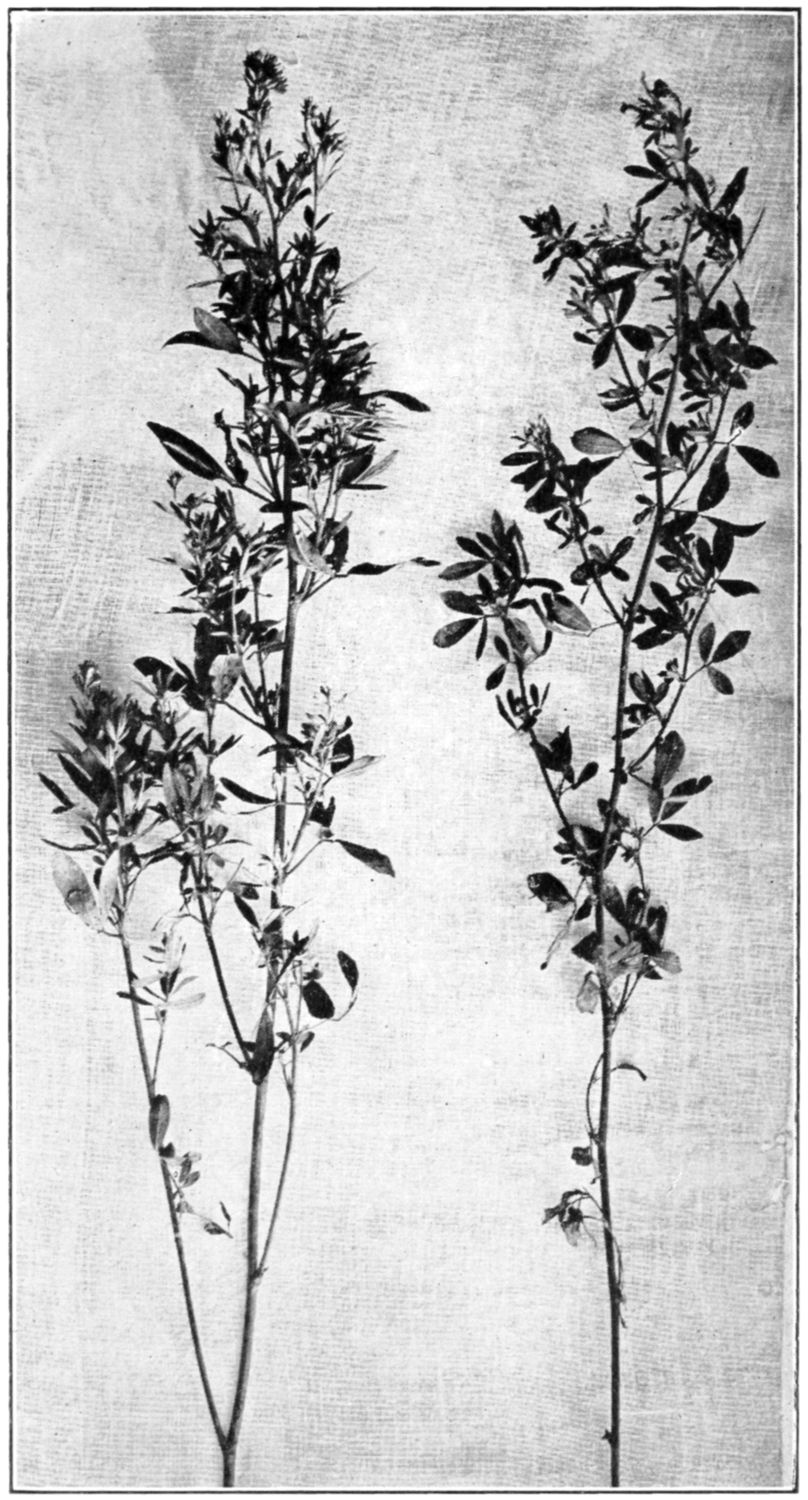
value as fodders. It is a true perennial plant, smooth,
upright, branching, ordinarily growing from one to four
feet high, yet in some instances much higher, owing to
conditions of soil, climate and cultivation. Its leaves
are three parted, each leaflet being broadest about the
middle, rounded in outline and slightly toothed toward
the apex. The purple pea-like flowers instead of being
in a head, as in red clover, are in long, loose clusters or
racemes. These are scattered along the plant’s stems
and branches, instead of being especially borne, as in red
clover, on the extremities of the branches. The matured
seed-pods are spirally twisted through two or three complete
curves, and each pod contains several seeds. The
seeds are kidney-shaped, and average about one-twelfth
of an inch long by half as thick. They are about one-half
larger than seeds of red clover, and in color are at
their best an olive green or a bright egg-yellow, instead
of a reddish or mustard yellow, or faded brown. The
ends of the seeds are slightly compressed where they are
crowded together in the pod.
Alfalfa is very long-lived; fields in Mexico, it is
claimed, have been continuously productive without replanting
for over two hundred years, and others in France
are known to have flourished for more than a century.
Its usual life in the United States is probably from ten
to twenty-five years, although there is a field in New
York that has been mown successively for over sixty
years. It is not unlikely that under its normal conditions
and with normal care it would well-nigh be, as it is
called, everlasting.
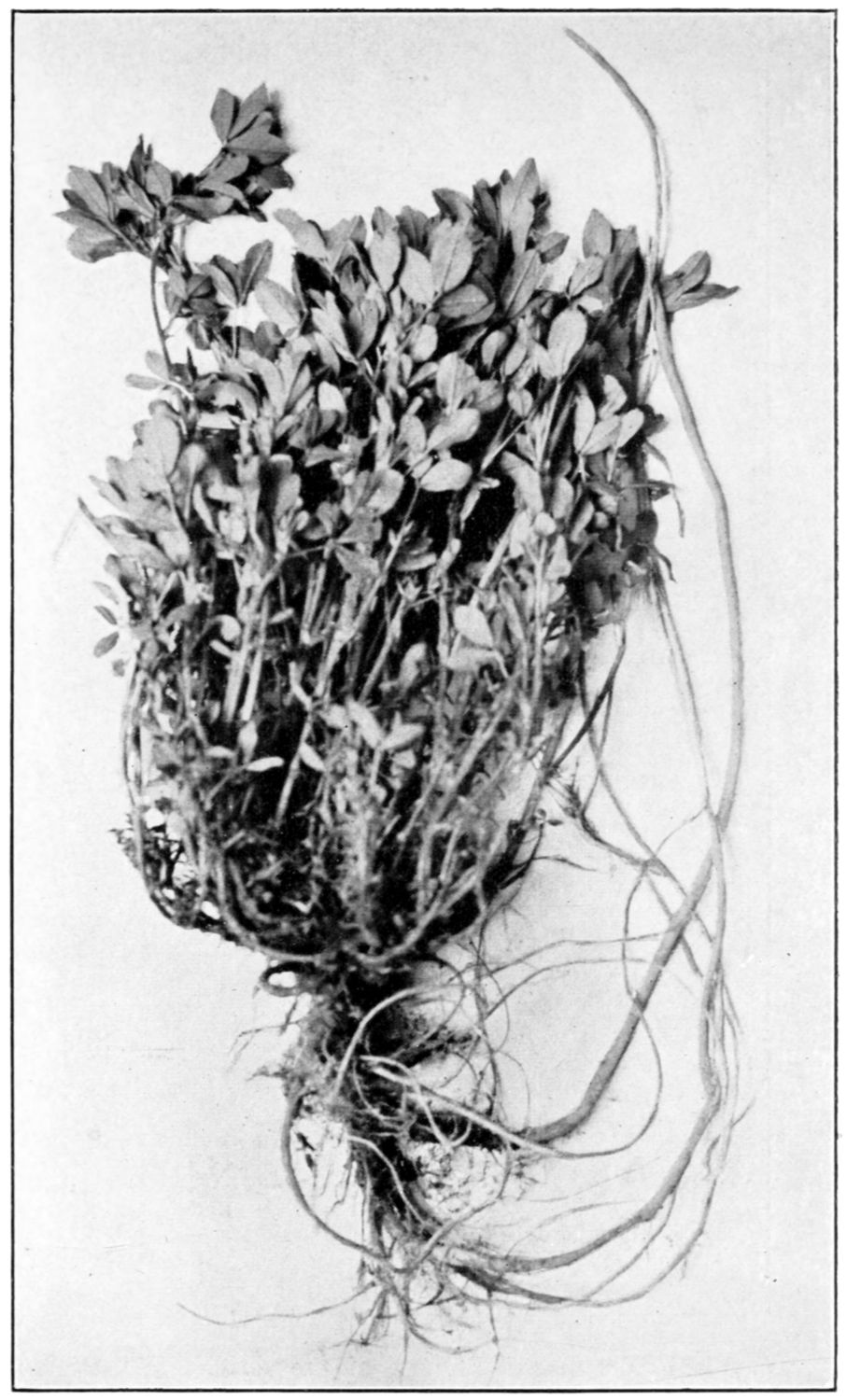
In its root growth it is probably the greatest wonder
among plants. While it usually grows no higher than
four or five feet (although it has been known to reach
more than ten feet; an unirrigated stalk is on exhibition
at the office of the Kansas Board of Agriculture, measuring
nearly seven feet) and its normal height is about
three feet, its roots go down ten, twenty, or more feet,
and one case in Nevada is reported by Charles W. Irish,
chief of Irrigation Inquiry United States Department of
Agriculture, where the roots were found penetrating
through crevices in the roof of a tunnel one hundred
and twenty-nine feet below the surface of an alfalfa field.
Prof. W. P. Headden of Colorado found roots nine feet
long from alfalfa only nine months old, and another
reports roots seventeen inches long of but four weeks’
growth, the plants being but six inches high. It usually
has a slender taproot, with many branches tending
downward, yet with considerable lateral growth. As the
taproot is piercing the earth it is also sending out new
fibrous roots, while the upper ones, decaying, are leaving
humus and providing innumerable openings for air,
the rains, and fertilizing elements from the surface soil.
The mechanical effect of this root-growth and decay in
the soil constitutes one of the greatest virtues of the
plant, and by its roots alfalfa becomes, self-acting, by far
the most efficient, deep reaching subsoiler and renovator
known to agriculture.
There are several other varieties of alfalfa besides
Medicago sativa, the most common being the Intermediate
Lucerne or Medicago media, the Yellow Lucerne
or Medicago foliata and Turkestan alfalfa or Medicago
sativa Turkestanica. None of these have such unqualified
value as the ordinary alfalfa; in fact the first two
are properly regarded as weeds when found with Medicago
sativa. In 1898 when there had been reported
many failures in the alfalfa districts of the extreme
North and the extreme Southwest, the United States
Department of Agriculture sent Prof. N. E. Hansen of
South Dakota to Russia, especially the cold, arid and
semi-arid portions of northern Turkestan, to discover if
possible a more hardy strain of alfalfa than that grown
in America. He brought back from there several hundred
bushels of seed which was distributed to government
stations and individual experimenters in forty-seven
states and territories. The reports of its behavior
varied greatly, some growers being enthusiastically
in its favor, while most reported results below or not
above the average from other sorts, and some practically
a failure. It would appear from the consensus of opinion
at this time that the Turkestan alfalfa has not demonstrated
in America any such superiority as to justify
its general adoption, even in the dry and warm regions
of the Southwest, in our colder states, or in Canada.
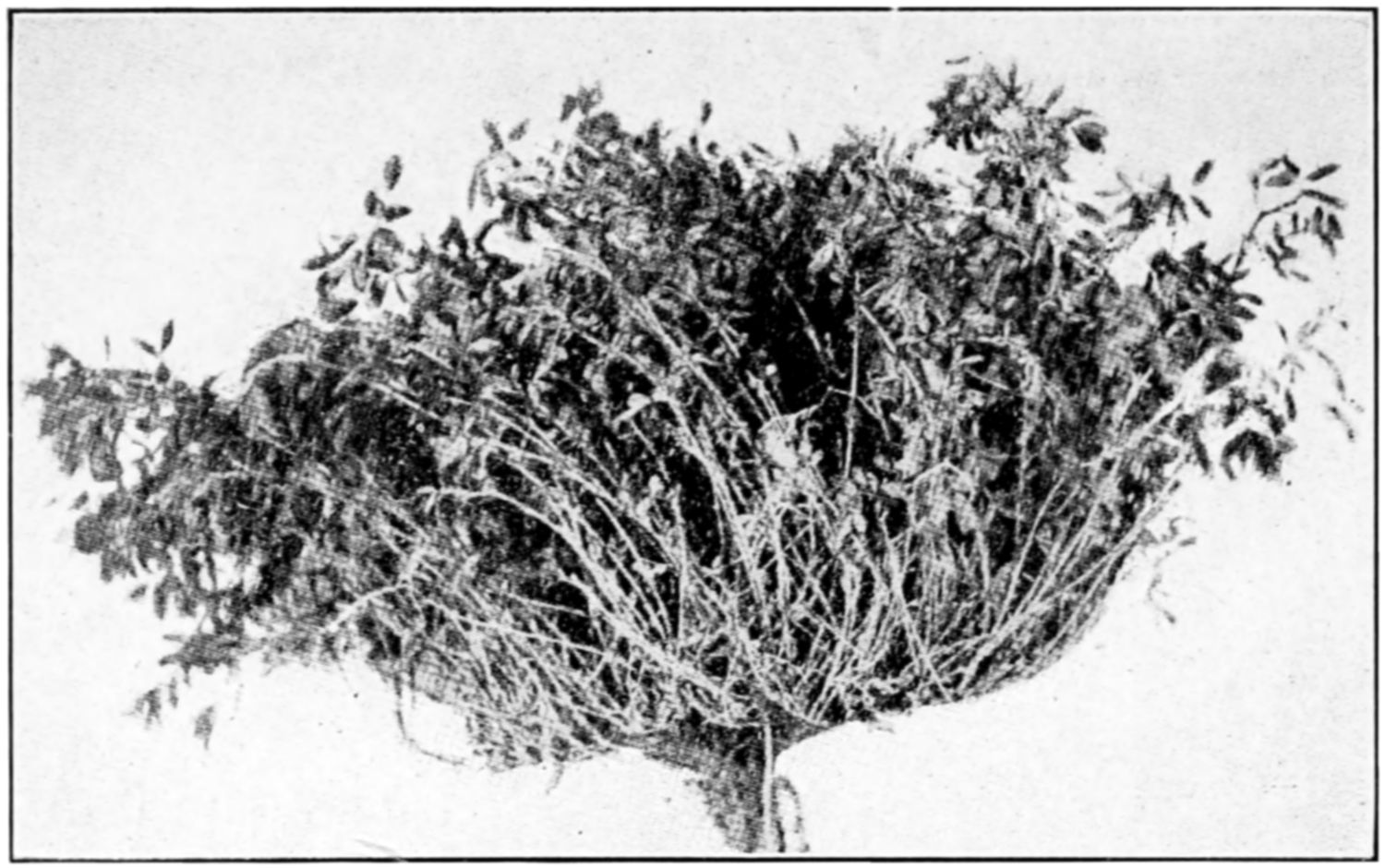
An Eight-year-old Alfalfa Plant
with 312 stems growing from one root. Grown at Manhattan, Kan., on high
upland prairie having a stiff, hardpan subsoil. Depth to water 180 feet
Height of growth May 6, ten inches
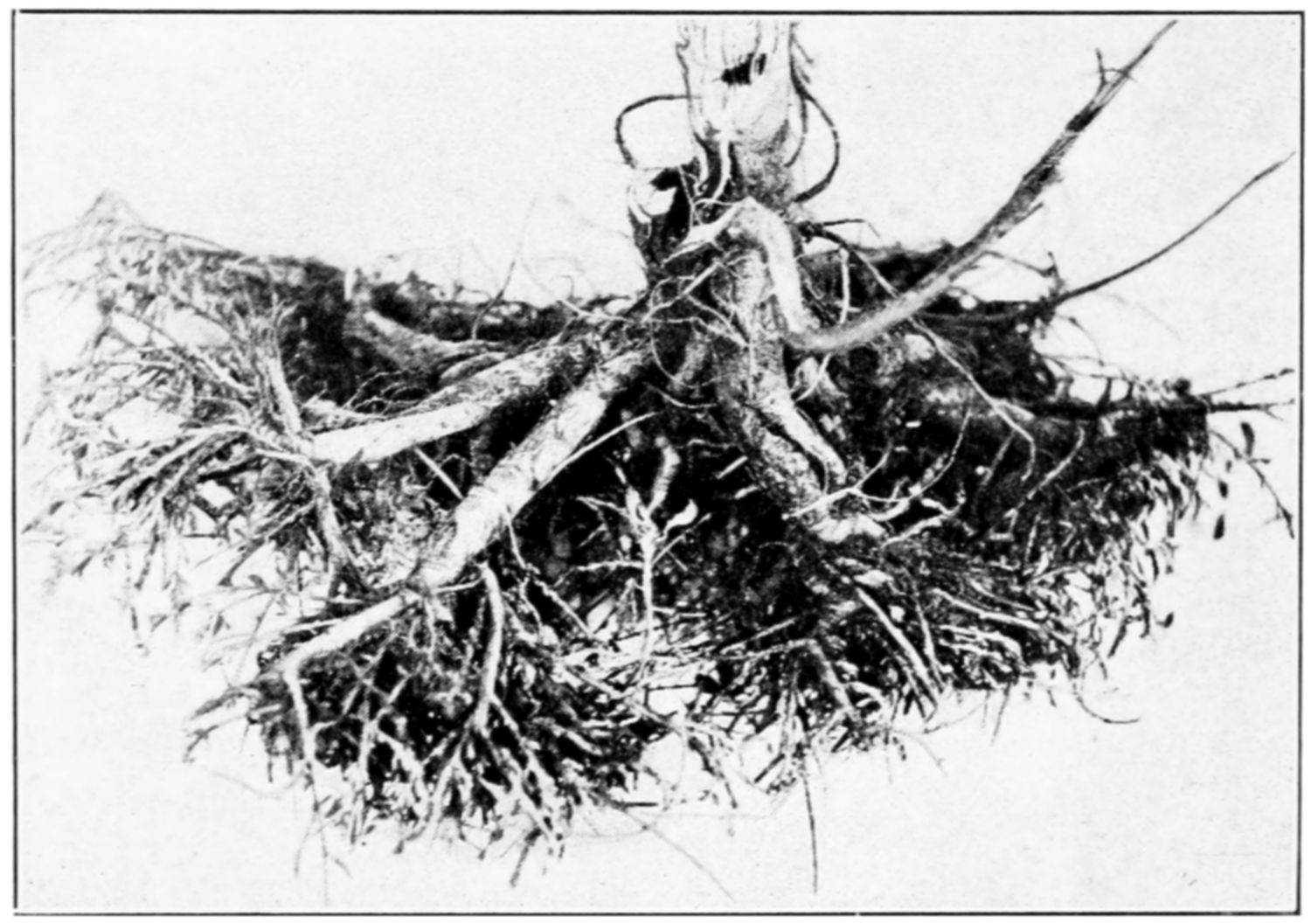
Crown of Plant Shown in the Preceding Illustration
Stalks removed to show branching crown
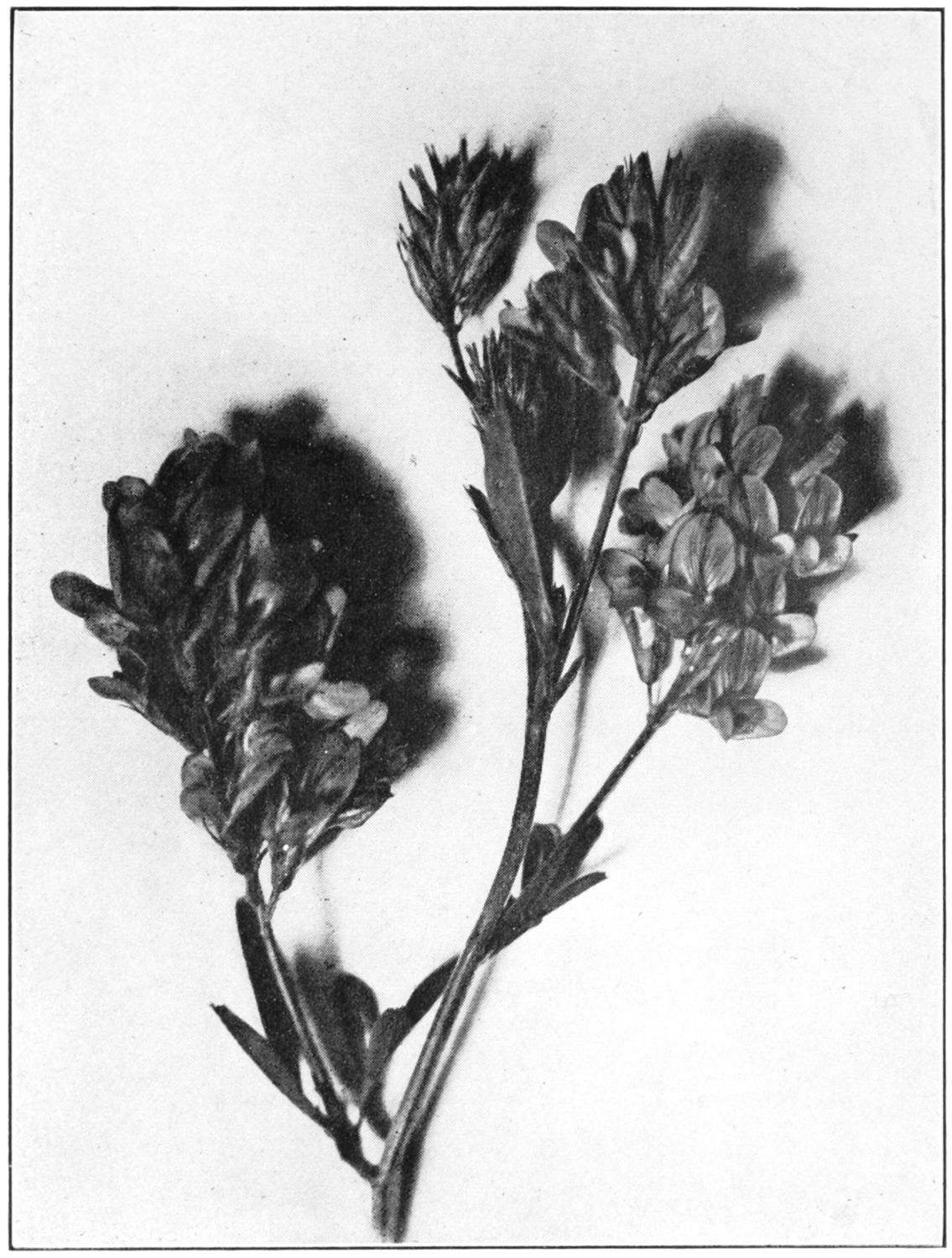
Alfalfa Blossoms Enlarged
Among other claims for Turkestan alfalfa by the government
officials in charge of its introduction and
exploitation have been that “its seed will germinate
much quicker and the plants start into growth earlier
under the same conditions than common alfalfa. The
plants are more leafy, grow more rapidly, and have a
stronger, more vigorous root system. Another advantage
which the Turkestan variety has is that the stems
are more slender and less woody, the plants making a
more nutritious hay of finer quality. That it will withstand
drought under the same conditions better than
ordinary alfalfa seems certain from the reports of the
experimenters. In the West and Northwest, at least, it
seems to be more productive, both with and without
irrigation.”
At the North Dakota station Turkestan alfalfa sown
in 1901 yielded in the three years following (1902-3-4)
at the average rate of slightly more than two tons per
acre annually.
Acclimation of alfalfa is a slow process, and numerous
close observers think there are too many radical differences
in climate and possibly of soil between Turkestan
and New Mexico, or North Dakota, to admit of this
variety’s becoming a preeminently valuable acquisition
to America. It is thought more reasonable to let the
American-grown alfalfa gradually accustom itself, as it
will, to any particular region, sowing seed from nearly
the same latitude and grown under as nearly as possible
the conditions it will encounter in its new environment.
In 1903 the Department of Agriculture began experimenting
on a small scale at stations in Arizona, California
and the warm regions with alfalfa seed procured by
Mr. D. G. Fairchild, from Arabia. The officials in
charge observe that the plants from this seed appear to
make a much quicker growth after cutting, and as a
result of this one more crop in a season than is obtained
from other alfalfa may be possible. It differs from
other strains in having larger leaflets and in being much
more hairy. “It is thought very probable that by careful
selection hardiness can be bred into Arabian alfalfa so
that it will grow much farther north than it does at
present.”
As a latter day opinion or estimate of alfalfa from an
official who is presumed to speak as an authority, without
bias and knowing his subject, the words of W. J.
Spillman, agrostologist of the United States Department
of Agriculture, should carry weight. In an address
before the eleventh annual convention of the National
Hay Association, at St. Louis, in 1904, Professor Spillman
said:
“Alfalfa is the oldest plant known to man; it is the
most valuable forage plant ever discovered. It has not
been appreciated in the eastern part of the United States
until the last five years. We are now growing it successfully
in every state in the Union, and I believe it is safe
to say in every agricultural county in the United States
it is being grown with success. Two weeks ago I
secured a picture of a field of alfalfa in South Carolina
that was sowed over sixty-nine years ago. It was still
in pretty good condition. I know of another field in
New York State sowed forty-five years ago, and one in
Minnesota that was sowed thirty-three years ago. All
over the West there are thousands of fields of alfalfa
that were sowed twenty-five years ago that are still yielding
large crops. In Wisconsin alfalfa yields three crops
of hay a year, and in Texas, four and five large crops.
In southern California, below sea-level, where they
never have any frost, they cut alfalfa eleven times a year,
and in Texas, south of the Rio Grande, they cut it nine
times a year.
“Alfalfa does not exhaust the soil. Nitrogen is the
soil’s most important element, and the one most liable to
give out; the one the farmer is called upon to supply
first. Alfalfa does not ask the farmer for nitrogen at
all, because it can get its nitrogen out of the atmosphere.
Four-fifths of the atmosphere consists of nitrogen.
Ordinarily, plants cannot make use of that nitrogen at
all; the roots of the alfalfa will leave in the soil eight
or ten times as much nitrogen as was there before. The
farmer who plants alfalfa, clover or peas does not have
to get nitrogen from the fertilizer factories. I know one
farmer who for the past eight years has made an average
of eight and one-half tons per acre of alfalfa on irrigated
land in the state of Washington. I have heard
of other men that produced twelve tons an acre in southern
Texas on irrigated land. It would hardly be possible
to produce that much on land that is not irrigated,
because rain does not come to order.
“I have lived ten years in a country where the horses,
cattle, sheep, hogs and chickens eat alfalfa hay, or green
alfalfa, the year round. It is the richest hay food
known. Eleven pounds of it is worth as much for feeding
purposes as ten pounds of bran.”
A most pleasing word-picture of alfalfa is that by
Geo. L. Clothier, M. S., who has studied his subject
closely in the field, the feed lot and the laboratory, and
he paints it thus:
“The cultivation and feeding of alfalfa mark the highest
development of our modern agriculture. Alfalfa is
one of nature’s choicest gifts to man. It is the preserver
and the conserver of the homestead. It is peculiarly
adapted to a country with a republican government, for
it smiles alike on the rich and the poor. It does not fail
from old age. It loves the sunshine, converting the
sunbeams into gold coin in the pockets of the thrifty
husbandman. It is the greatest mortgage lifter yet
discovered.
“The alfalfa plant furnishes the protein to construct
and repair the brains of statesmen. It builds up the
muscles and bones of the war-horse, and gives his rider
sinews of iron. Alfalfa makes the hens cackle and the
turkeys gobble. It induces the pigs to squeal and grunt
with satisfaction. It causes the contented cow to give
pailsful of creamy milk, and the Shorthorn and white-faced
steers to bawl for the feed rack. Alfalfa softens
the disposition of the colt and hardens his bones and
muscles. It fattens lambs as no other feed, and promotes
a wool clip that is a veritable golden fleece. It compels
skim-milk calves to make gains of two pounds per day.
It helps the farmer to produce pork at a cent and a half
a pound and beef at two cents.
“Alfalfa transforms the upland farm from a sometime
waste of gullied clay banks into an undulating
meadow fecund with plant-food. It drills for water,
working 365 days in the year without any recompense
from man. The labor it performs in penetrating the
subsoil is enormous. No other agricultural plant leaves
the soil in such good physical condition as alfalfa. It
prospects beneath the surface of the earth and brings
her hidden treasures to the light of day. It takes the
earth, air, moisture and sunshine, and transmutes them
into nourishing feed stuffs and into tints of green and
purple, and into nectar and sweet perfumes, alluring the
busy bees to visits of reciprocity, whereon they caress
the alfalfa blossoms, which, in their turn, pour out secretions
of nectar fit for Jupiter to sip. It forms a partnership
with the micro-organisms of the earth by which it
is enabled to enrich the soil upon which it feeds. It
brings gold into the farmer’s purse by processes more
mysterious than the alchemy of old. The farmer with a
fifty-acre meadow of alfalfa will have steady, enjoyable
employment from June to October; for as soon as he has
finished gathering the hay at one end of the field it will
be again ready for the mower at the other. The homes
surrounded by fields of alfalfa have an esthetic advantage
unknown to those where the plant is not grown.
The alfalfa meadow is clothed with purple and green
and exhales fragrant, balmy odors throughout the growing
season to be wafted by the breezes into the adjacent
farmhouses.”
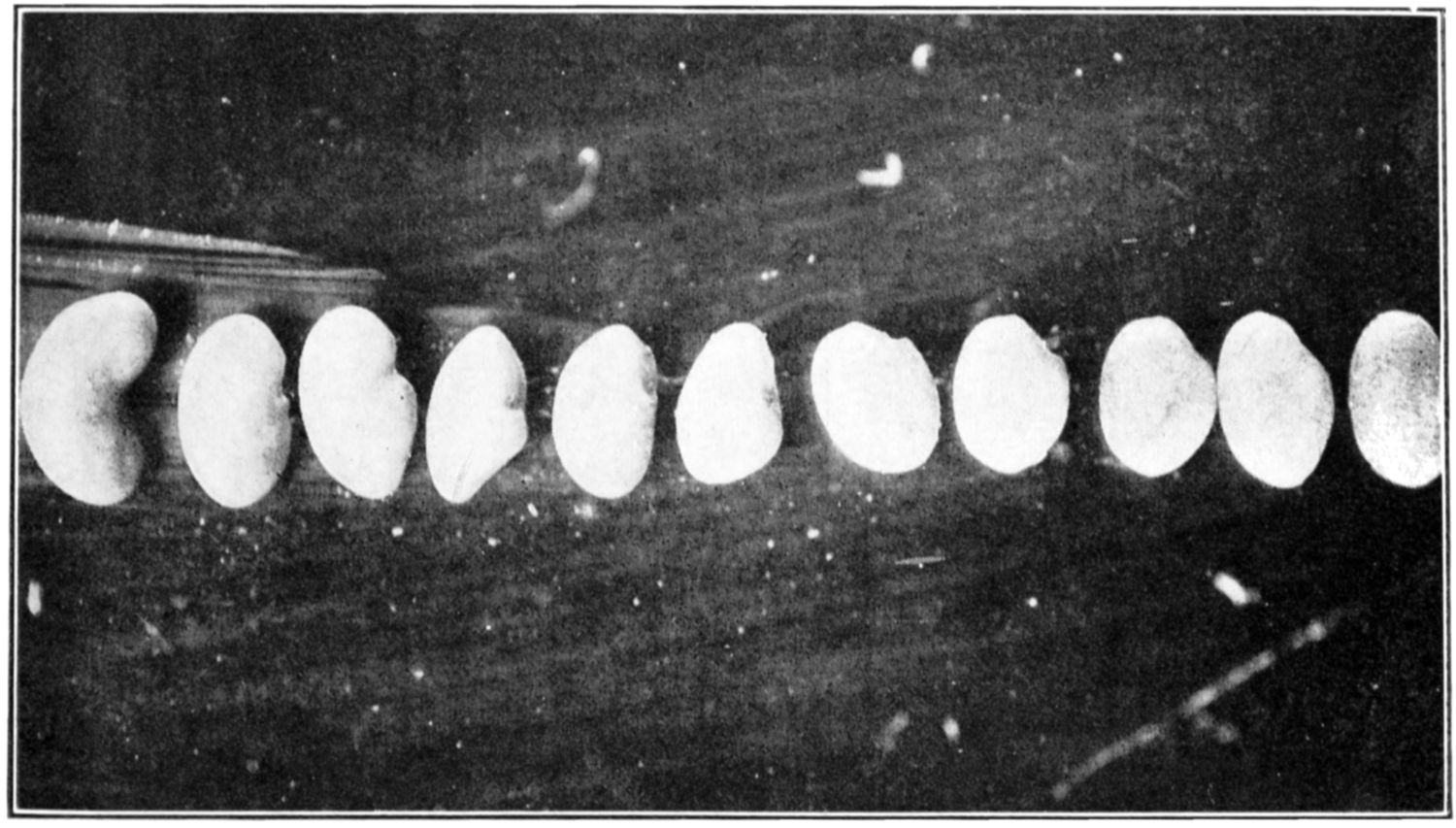
Intergrading Types of Seed Between Alfalfa and Sweet Clover
The six seeds to the left being alfalfa, the five to the right Sweet clover. Magnified eight
diameters
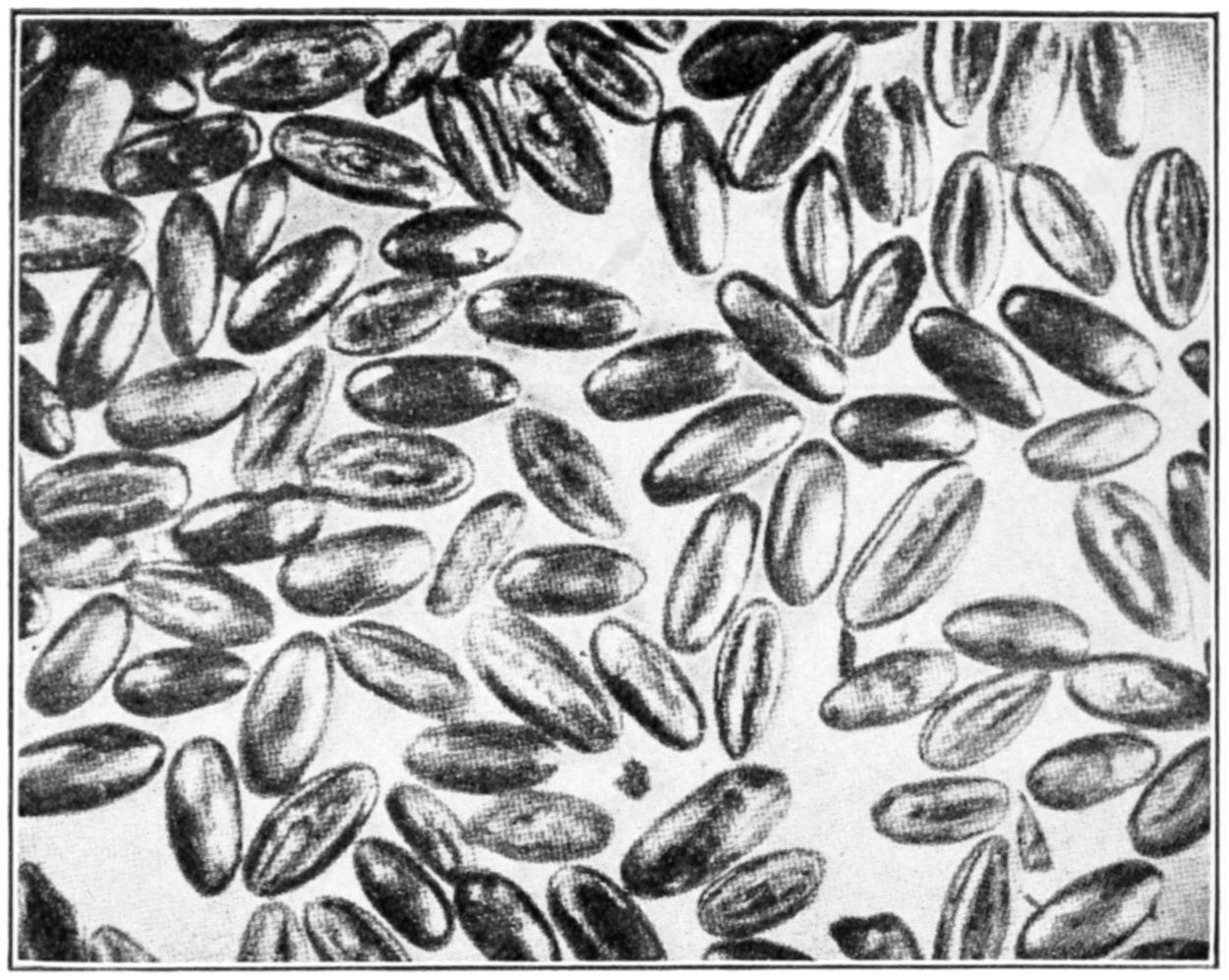
Seeds of the Weed Known as Buck-horn
Ribbed plantain, English plantain, or Rib-grass, (Plantago lanceolata). Very
commonly present in alfalfa seed, especially that of European origin
A bad weed. Magnification five diameters
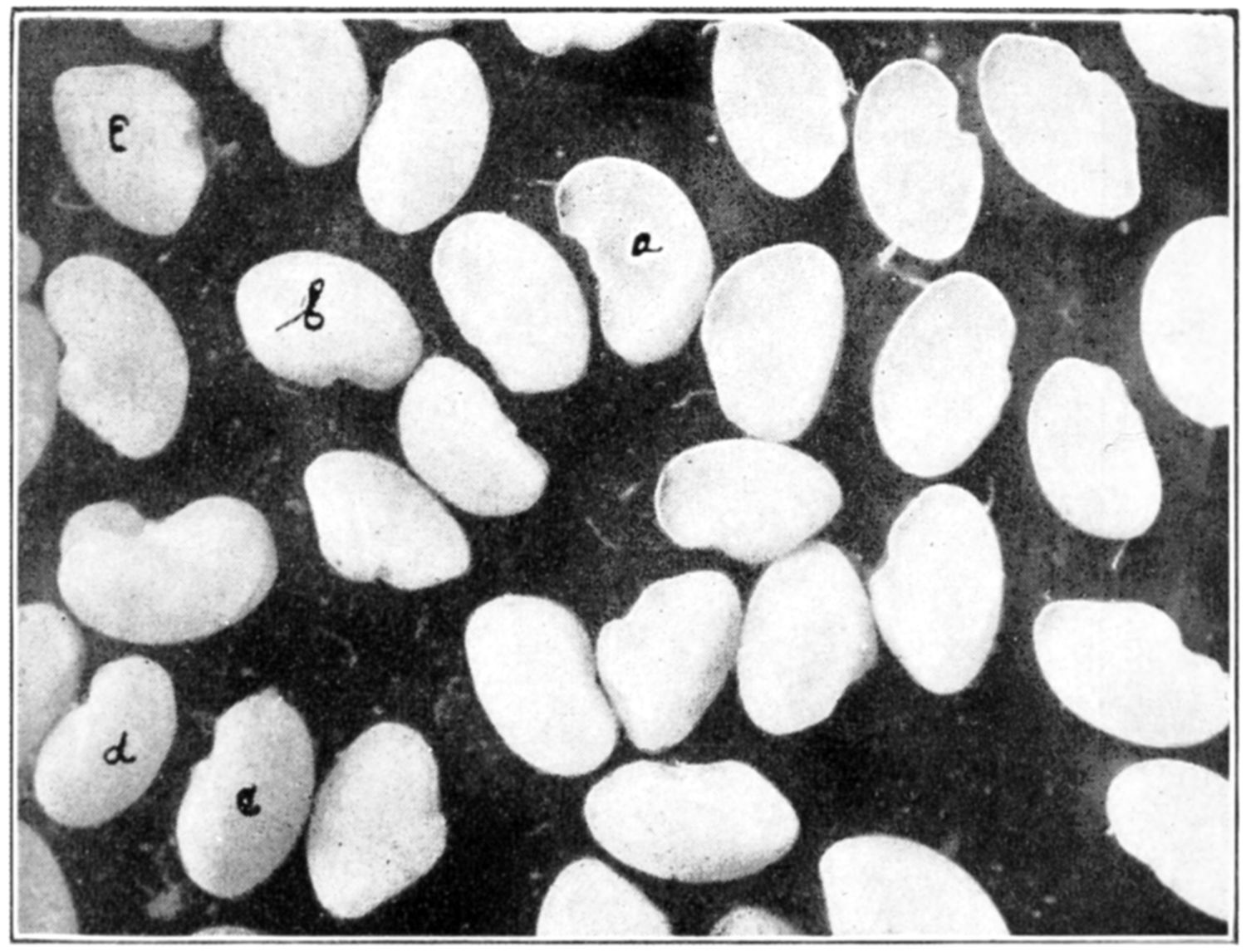
Alfalfa Seeds Magnified Five Diameters
Note the characteristic angular point at one end, typical of alfalfa. The kidney-shaped
type, as in “a” is also characteristic. The rounded type “b”
is rare, and resembles Sweet clover. Seeds marked “c” and
“d” resemble Yellow trefoil in the projecting “beak”
CHAPTER II. Universality of Alfalfa — ITS WIDE DISTRIBUTION — NOT PARTICULAR AS TO SOIL — THE ORACLES REFUTED — A NEW YORK EXAMPLE
As the history of alfalfa is traced in the preceding
chapter the conclusion is reached that its distribution is
not to be circumscribed by any hard and fast lines of
climate and soil. It is grown profitably in every country
of Europe, in central Asia, its original home, in Australia,
the islands of the sea, and in almost every state and
territory of the United States, and in Canada. Only two
states, Maine and New Hampshire, and only one territory,
Alaska, are left wholly in the experimental column.
Everywhere else there have been such results as
to prove that it ought to become, in greater or less degree,
a staple crop on practically every farm, dependent only
upon more energy, faith and skill on the part of the
farmer, and a natural acclimation. There are several
other states such as Vermont, Massachusetts, Connecticut,
Rhode Island, Michigan, Kentucky, Tennessee, Arkansas
and North Dakota where the experiment station
experts are not fully ready to recommend it as a regular
crop for every farm, yet, in each of these there are enterprising
farmers who have for years found profit in
its raising. The station authorities in Vermont say that
success with alfalfa there “depends first on the man, and
second on the soil.”
W. R. Dodson, botanist of the Louisiana station, says
it is his firm conviction that nothing will contribute so
much as alfalfa toward making the southern farm self-supplied
with feed for work animals, for the production
of dairy products, and home raised meat. “I doubt,” he
also says, “if alfalfa does better anywhere outside the
irrigated regions of the West than it does in the alluvial
lands of Louisiana. We have had as high as eight cuttings
in one year, with a total tonnage larger than is had
in Kansas or Nebraska, and our annual rainfall is sixty-five
inches, or more.”
From Ontario, Canada, comes a report of a yield of
four tons to the acre in three cuttings, on a clay hillside;
at far-off Medicine Hat, Northwest Territory, it makes
a growth pronounced “phenomenal,” and at the experimental
farm at Brandon, Manitoba, three cuttings per
year are harvested. On a gravelly hill in the District of
Columbia, a field was sown in April, 1900. Two crops
were cut from it that summer, three in 1901, and the
first cutting in 1902 yielded three tons per acre. In
southern Minnesota, some thrifty Germans, not knowing
that “alfalfa will not grow in Minnesota,” have been
raising it since 1872, while others were declaring it impossible.
A half-score of men in the sagebrush wilds
of Nevada decided to try it, and in 1872 they had 625
prosperous acres, without plowing and without irrigation.
J. H. Grisdale, agriculturist of the Central experimental
farm at Ottawa, (Bul. No. 46) says, “it is grown
in Canada more or less extensively from the Atlantic to
the Pacific. It is the staple forage plant for winter in the
dryer part of British Columbia, and it has been grown in
Southern Alberta for many years. It is not much known
in Manitoba, but is possible of easy propagation in almost
all parts of Ontario. It is, and has been grown long and
successfully in Quebec, and is not unknown in Nova
Scotia and New Brunswick.” In Cape Colony, South
Africa, “lucerne can be cut from four to six times in
summer and from once to twice in winter, and is the
greatest forage plant in the world.” In 1901 the British
consul at Buenos Ayres reported alfalfa as covering
“an enormous area in Argentina, and every year becoming
more important.”
While experts have been declaring that alfalfa would
only grow in certain soils and in certain climates it has
proven adaptability to nearly all climates and almost all
soils. It produces with a rainfall as scant as 14 inches,
and in the Gulf states flourishes with 65 inches. It gives
crops at an elevation of 8000 feet above sea level,
and in southern California it grows below sea level to a
height of six feet or over, with nine cuttings a year, aggregating
ten to twelve tons. An authenticated photograph
in possession of the writer, reproduced opposite
page 231, shows a wonderful alfalfa plant raised in the
(irrigated) desert of southern California, sixty feet
below sea level, that measured considerably more than
ten feet in height. Satisfactory crops are raised, but on
limited areas as yet, in Vermont and Florida. New York
has grown it for over one hundred years in her clay and
gravel; Nebraska grows it in her western sand hills
without plowing, as does Nevada on her sagebrush
desert. The depleted cotton soils of Alabama and rich
corn lands of Illinois and Missouri each respond generously
with profitable yields to the enterprising farmer,
while its accumulated nitrogen and the sub-soiling it effects
are making the rich land more valuable and giving
back to the crop-worn the priceless elements of which it
has been in successive generations despoiled by a conscienceless
husbandry.
Its introduction into Maryland was largely through
the perseverance of Prof. W. T. L. Taliaferro of the
agricultural college, who says: “The future for alfalfa
for southern Maryland is bright, indeed, and with its
general introduction will come a new era of prosperity
for the ‘lower counties.’ Live stock farming will take the
place of tobacco farming. The fertilizing elements of
the soil will be concentrated at home instead of being
shipped abroad. Larger crops will be raised. Soil improvement
will take the place of soil exhaustion; worn-out
farms will be restored to their original fertility.”
One by one the oracular statements of so-called experts
have been shown at fault. One said, “it will grow
wherever corn will grow;” and as promptly men from
New York and Louisiana rise and say that they are
growing it where corn will not grow. Another declares,
“it will not grow over a hardpan or gumbo subsoil;”
at once a New York man reports a good field of alfalfa
with roots fifteen feet long that pass through six inches
of hardpan which was so hard that it had to be broken
with a pick axe in following the root. A Kansas man
writes that he has eighty acres that has stood five years
and promises to continue indefinitely, yielding 41⁄2
tons from three cuttings a year, and the whole of it
on gumbo soil where corn raising was a failure. Another
declares, “it must have a rich, sandy loam,” and
forthwith from the deserts of Nevada, the sand hills of
Nebraska and the thin, worn, clay soils of the South
come reports of satisfactory yields. Such results are
significant, indicating better returns than any other crop
brings from these varied soils, and that few farmers
are justified in postponing the addition of alfalfa to
their agriculture because of supposed hindrance of soil
and climate.
As citing an example, and suggestive of the fact that
alfalfa not only grows but flourishes in the eastern states
where the claim has been made that it would not grow,
the following by the editor of the Rural New-Yorker, in
his journal of September 3, 1904, is forcibly to the point:
“A farmer visiting the New York state fair this year
will do well to take time to look at some of the alfalfa
fields near Syracuse. Whether it means that the soil in
this locality is well suited to alfalfa, or that farmers have
learned how to grow it, it is a fact that the crop makes a
wonderful showing there. You find it everywhere—in
great billowy fields of green, along the roadsides—even
in vacant city lots. The crop crowds in whether the
seed is sown by hand, dropped from a passing load or
scattered by the wind. The majority of the farms show
great fields of it, and the character of farming is slowly
changing as more and more alfalfa is cut. On fruit
farms or small private places the crop is changing methods
and habits. A few acres in alfalfa provides all the
roughness needed for stock on these small places, and
gives extra room for fruit or similar crops. In fact, the
most interesting thing about these alfalfa fields is the
way they are changing the entire conditions of the country.
It is similar to what happens when a new industry
is established in a town or city.
“The Grange meeting at a Mr. Worker’s farm, was
held in a great barn. He had delayed the alfalfa cutting
so that the barn might be empty. Some other farmers
nearby had already cut. I had a chance to see alfalfa
growing under what seemed to me about the toughest
chance you can give a plant. The city of Syracuse is
buying gravel from his field, to use on the street. The
workmen are digging right into the hill, and it requires
hard labor to pick up this tough, hard soil. As they dig
they follow the roots of the alfalfa down. Some of the
roots are quite as large as my thumb, and I am sure that
many of them had gone down twenty feet at least into
this tough soil. These big roots make plowing an alfalfa
sod anything but fun. This is one of the few objections
to the crop. I had supposed that the plant does
its best where it can work down into an open or gravel
subsoil. I have been told by one who is called an ‘expert’
that alfalfa cannot thrive on a hardpan subsoil,
yet here it was going down into the toughest soil I ever
saw, and covering the surface with a perfect mat of
green stalks. Mr. Worker goes so far as to say that the
tougher the subsoil the better the alfalfa goes through it,
provided water does not stand about the roots. That is
one point upon which all agree—the alfalfa cannot stand
wet feet. It must have water enough; that is why its
roots go down so far, but it will not thrive in wet fields
where water does not run easily away.
“On other farms I saw the alfalfa growing at the top
of steep clay hills, which were formerly almost useless
for farm purposes unless stuffed with stable manure.
Now that alfalfa has been started these hill-tops have
become about the most profitable fields on the farm. At
another place I saw a fair crop of alfalfa growing in a
thin streak of soil over a rocky ledge. There were not
eighteen inches of soil covering the solid rock, yet the
alfalfa was thriving. I have been told that this is the
condition under which alfalfa will not grow, yet here it
was giving more forage than any red clover we can
grow. I have said that the spreading of these alfalfa
fields is changing the character of farming in central
New York. It is not easy to realize just what this means
without visiting this favored section. This new forage
plant brings fertility and feed to the farm. It is just
like having a fertilizer factory and a feed store drop out
of the skies upon the farm, to get this alfalfa well
started. Of course as the farmer learns what the crop
will do he uses it more and more to feed both stock and
the farm. It would not be a very bright farmer who
would continue to grow wheat or some other annual
crop which brings him $25 per acre when a permanent
crop like alfalfa will guarantee $60. Some farmers are
quicker to see this than others, but in the end the majority
of them see it and then we see a change. These alfalfa
farmers are giving a great object lesson, and their farms
are more interesting than any exhibit at the state fair.”
CHAPTER III. Yields, and Comparisons With Other Crops — COMPARED WITH CLOVER — COMPARISONS WITH SEVERAL GRASSES — COMPARED WITH CORN — INDIVIDUAL INSTANCES OF CASH RETURNS — SOME REPORTS OF YIELDS — SOME MONEY COMPARISONS
Many things are understood best through contrasts
with others better known. In every part of the country
certain crops are considered standard, and all others are
judged by comparison with these. For example, red
clover in most parts of the United States is ranked as
the richest and best yielding forage, and the fertilizer
and renovator par excellence.
The Massachusetts experiment station after a series
of tests reports that 100 pounds of clover contain 47.49
pounds of digestible food and 6.95 pounds of proteids,
while 100 pounds of alfalfa contain 54.43 pounds of
digestible food and 11.22 pounds of proteids.
The New Jersey station reports that the average yield
per annum of green clover to the acre is 14,000 pounds,
and of green alfalfa 36,500 pounds; the protein in the
clover is 616 pounds and in the alfalfa, 2214 pounds; one
ton of alfalfa has 265 pounds of protein, and clover only
246 pounds. But alfalfa will produce three, four, or
more cuttings each year, while clover will produce but
one or at most two. Further, clover will ordinarily survive
but two years, while alfalfa will last from ten to one
hundred, thus saving many plowings and seedings. It
is also estimated that the stubble and root-growth of
alfalfa are worth at least four times as much for humus
as are those of clover, while the mechanical and other
beneficent effects of the long alfalfa roots far excel those
of clover. The alfalfa field is green for pasturage a
month earlier in the spring than clover and may be
mowed a month earlier. It starts a vigorous growth at
once after cutting, covering the ground with its luxuriant
foliage before the second growth of clover has
made any substantial progress.
The Wisconsin experiment station says that “one acre
of alfalfa yields as much protein as three acres of clover,
as much as nine acres of timothy and twelve times as
much as an acre of brome grass.”
Plat
No. |
Variety Grown |
Hay,
lbs. |
Yield
per
acre,
lbs. |
| 1 |
|
June Clover |
473 |
2,365 |
| 2 |
Mammoth Clover |
475 |
2,375 |
| 3 |
Alsike Clover |
413 |
2,065 |
| 4 |
[1] |
Alfalfa (first cutting) 26 inches high, June 29th |
816 |
4,080 |
| 5 |
|
Blue-grass |
575 |
2,875 |
| 6 |
Orchard grass |
478 |
2,390 |
| 7 |
Timothy |
560 |
2,800 |
| 8 |
Red-top |
470 |
2,350 |
| 9 |
Meadow fescue |
375 |
1,875 |
| 10 |
Tall meadow oat grass |
600 |
3,000 |
| 11 |
Italian rye grass |
.... |
.... |
| 12 |
[2] |
Timothy, blue-grass and orchard grass mixed |
203 |
1,015 |
The Nebraska experiment station has made very careful
tests of the comparative yields of various grasses,
clovers and mixtures. These were on plats of one-fifth
of an acre. The foregoing table shows the yields the
second year from planting, which owing to the very dry
spring was a quite unfavorable season.
The Colorado station reports a comparison with corn
as follows:
| Yield per acre of Corn and Alfalfa |
| |
Corn, lbs. |
Alfalfa, lbs. |
| Dry Matter |
3,605 |
5,611 |
| Albuminoids |
296 |
1,198 |
| Starch, Sugar, etc. |
2,186 |
3,114 |
| Fiber |
1,060 |
1,198 |
| Fat |
63 |
101 |
A Lincoln county, Kansas, farmer writes that from
five acres of alfalfa he received in one season $100 for
hay, $150 for seed and $20 for straw.
A farmer near Atwood, Rawlins county, Kansas, cut
two crops for hay and threshed the third crop for seed,
realizing 13 bushels per acre, which sold at $5 per bushel.
A Harlan county, Nebraska, farmer reports an income
of $774 in one year from seed and hay from six acres.
Scott Bros., of Pottawatomie county, Kansas, report
to the author as follows concerning their returns from a
twelve-acre field in one year:
| 2 hay crops, 30 tons at $12 |
$360 |
| 105 bushels of seed at $6 |
630 |
| Straw |
50 |
| Fourth cutting, 12 tons at $12 |
144 |
| Total, one year’s return |
$1,184 |
A Buffalo county, Nebraska, farmer sold from a year’s
growth on 22 acres, hay worth $328.12, seed $1000, and
straw $150.
A Montgomery county, Kansas, farmer reports to the
author a return of $106 per acre in one year from hay,
seed and straw.
Another report was sent in 1904 from southern Kansas,
of five cuttings, making 81⁄2 tons per acre, which
sold at $5 per ton in the field.
A farmer of Harvey county, Kansas, reported in 1903
two hay crops and one seed crop, the hay, seed and straw
returning more than $50 per acre from a field that two
years before had failed to yield enough corn to justify
its gathering.
Sixteen acres in Reno county, Kansas, are reported to
have pastured in 1904 four hundred pigs and yielded one
cutting of hay of over 16 tons.
An alfalfa field of eleven acres in Washington, on the
bank of the Columbia river, under irrigation, produced
in 1901 over 100 tons of hay.
Former Governor W. D. Hoard, of Wisconsin, reports
from three-fifths of an acre on his farm in the southern
part of the state, four cuttings in one season, yielding
5.7 tons of hay.
Alva Langston, of Henry county, Indiana, sowed five
acres of alfalfa May 20th, and harvested nearly 11⁄2 tons
of hay per acre August 25th following, and about the
same quantity September 20th to 25th. This was on
upland, thirty or more years in cultivation. The alfalfa
was clipped twice before the cutting for hay.
In 1902 F. S. Kirk of Garfield county, Oklahoma,
sowed a field near a creek, but about 25 feet above water,
with thirty to thirty-five pounds of alfalfa seed per acre,
broadcast. The soil, which he calls “high bottom,” was
a dark brown and contained considerable sand. For two
years no attention was given the alfalfa except harvesting
from it three crops the second year and four the
third year. In 1905 he harvested from ten acres nine
cuttings, estimated to weigh fully one and one-half tons
each, per acre. The longest time between any two cuttings
was twenty-two days, and the shortest fourteen
days. During the season of 1904 seven cuttings were
made and the field was gone over with a disk harrow
early each time after removing the hay from the field.
It was possible to cut another growth of 8 to 12 inches,
had he not preferred to use it as pasturage for stock.
Mr. Kirk does not irrigate and maintains that in his
part of the country “the best irrigation for alfalfa is with
a disk harrow.” He also insists that “alfalfa can be entirely
killed by disking in the dark of the moon,” especially
if the weather that follows is hot and dry. He pastures
his alfalfa with cattle and horses in fall and spring,
and disks in the spring as soon as the stock is removed.
A good acre corn crop in Ohio is forty bushels, worth
not to exceed $20, after all the labor of cultivating and
husking; the stover, if properly cared for, ought to be
worth $5, making a total of $25. An Ohio farmer reports
a yield of 41⁄2 tons of alfalfa hay per acre, worth for feed
as compared with the price of bran about $12 per ton,
or a total value of $54, from only one plowing in six
years (as long as he let it stand) and with less labor in
harvesting than for husking corn and caring for the
stover.
A good Kansas or Nebraska corn yield (far above the
state average) is 50 bushels per acre, worth ordinarily
about $17, with stover worth $3. The farmer should
obtain from his alfalfa at least four to five tons, worth
to him for feed for cattle, hogs or sheep from $10 to $12
per ton—practically two or three times his income from
an acre of corn, while the cost of production is much less.
The average year’s corn or wheat crop is worth only
about $10 per acre, while the average alfalfa crop is
worth on the market from $15 to $35, or more, per acre,
owing to the market appreciation of the crop, and from
$35 to $60 as feed for stock.
Many thousands of acres in western Kansas and
Nebraska are now returning from their alfalfa fields an
income of from $15 to $25 per acre where but a few
years earlier the land was deemed worthless for agriculture.
Hundreds of acres in western New York that
were returning only a small income above cost of labor
and fertilization are now supporting great money making
dairies from alfalfa. Cotton land in the South rents
for $5 per acre, while alfalfa fields bring a yearly rental
of three times that amount.
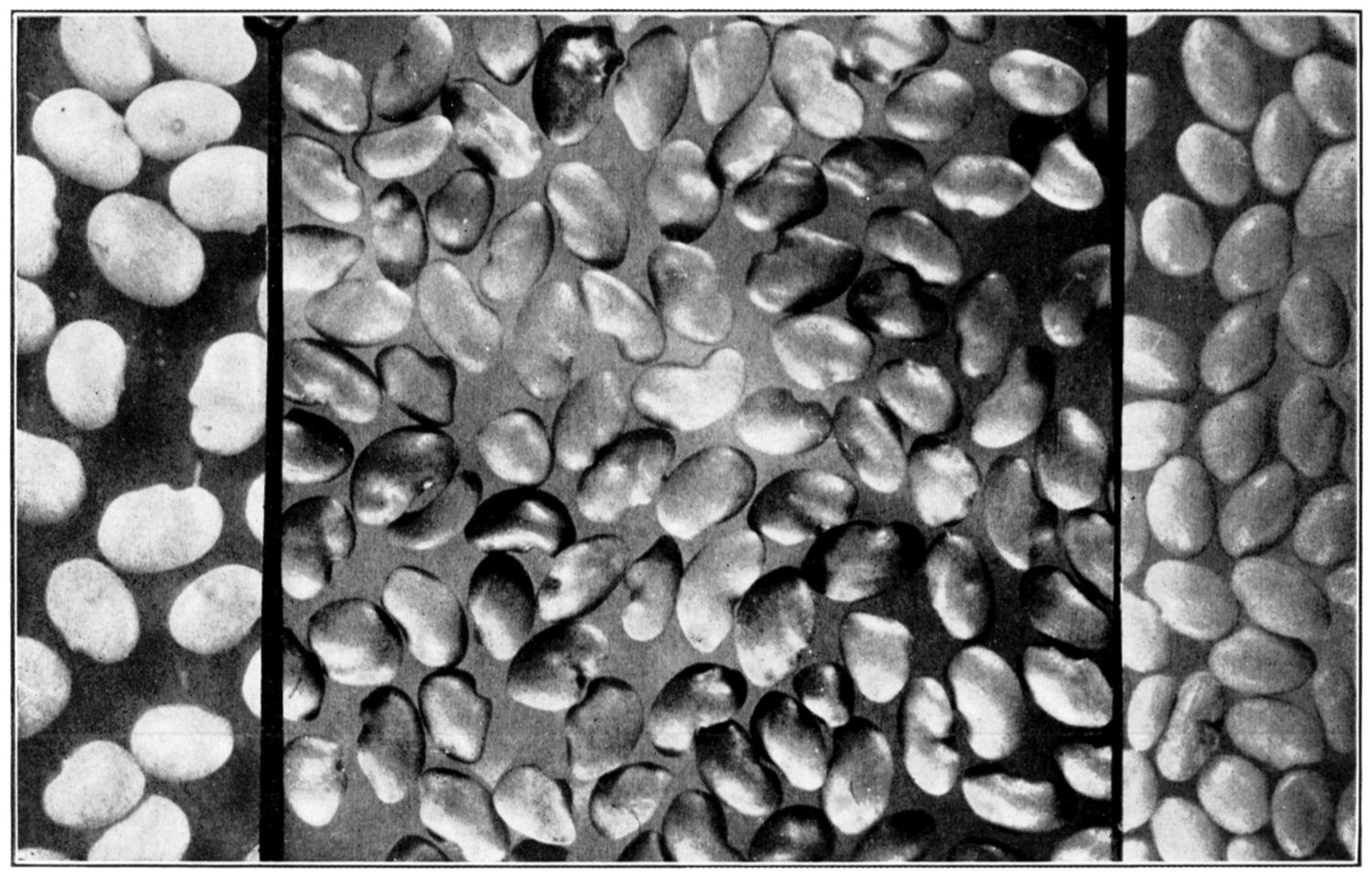
The Sweet clover and alfalfa are magnified five diameters and the trefoil seven diameters
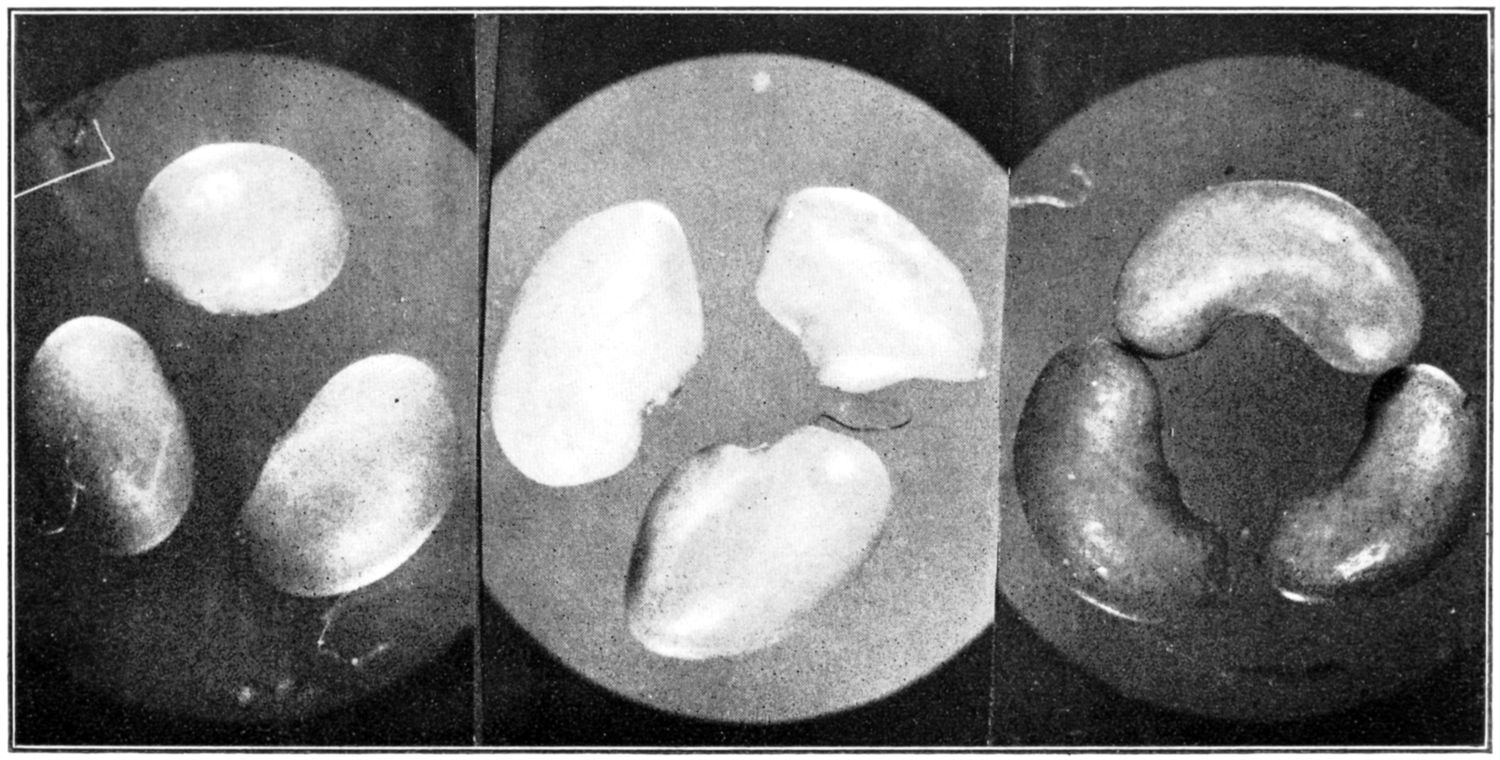
Three Distinctive Types of Alfalfa Seed Magnified Twelve Times
The one at the left rounded; the one at the right kidney-shaped;
and the one in the middle angular pointed. The latter is the
most characteristic form seen in alfalfa seed
CHAPTER IV. Seed and Seed Selection — NO SUCCESS WITHOUT GOOD SEED — IMPORTANCE OF SIMILAR CONDITIONS — IMPORTS AND EXPORTS OF SEED — IMPURITIES AND ADULTERATIONS — ADULTERANTS DESCRIBED AND ILLUSTRATED — THE CHIEF ADULTERANT — A COMMON WEED IN IMPORTED ALFALFA SEED — DODDER SEED
It is a time-worn but no less true saying that good
seed is essential to good agriculture. No matter how
well the farmer prepares his land, no matter how much
time, labor and money he spends on it, if much or all of
his seed fails to grow, he will either have a poor crop or
be obliged to reseed, thus losing time and labor. Many
causes may contribute to prevent a good stand, but if
he can eliminate any one of these, he is by so much the
gainer. Poor seed is a primary and great cause of a poor
stand.
The farmer obtains his seed from one of two sources;
he raises it or buys it. If the former, there should be
less danger, as the chief source of poor seed is careless
handling in harvesting and storing. If the seed becomes
damp, mold will damage much of it, or it will sprout,
then dry out, and the germ be killed. If seed is bought
of strangers or from a distance, the chances of poor quality
increase many fold. If all seed were bought of
reliable dealers, there would be less cause for complaint,
but farmers too often buy where they can buy cheapest.
They pay for trash that is either full of harmful weed
seeds or has a liberal admixture of old and dead seeds
left over from previous seasons.
Before seed is purchased it should be tested for purity
and germination. The adage that a dollar saved is a
dollar earned well applies here; it is an easy matter to
waste a dollar on seed, and when profit depends on avoidance
of useless expenditure the use of inferior seed
points its own moral.
The farmer who has brought himself to the point of
introducing alfalfa upon his farm should be extremely
careful in the selection of seed. In the first place it is
important that he should sow such as is produced in
about the same latitude as his farm and from a region of
about the same rainfall, thus keeping in a line of acclimation,
and with the habits and habitat, as it were, of
what he is seeking to raise. Next, he should not sow
seed raised under irrigation if he is in a non-irrigation
region. A Michigan farmer, for example, should sow
seed grown as near to his latitude as possible, say, from
Wisconsin, Minnesota or the Dakotas, or not south of
Nebraska or Kansas. It is questionable, at present,
whether it is wise or profitable to attempt raising alfalfa
seed in the more humid districts of the eastern and southern
parts of the United States. It may be economy to
leave the raising of seed to those regions with the least
summer rainfall, keeping always in mind the securing of
seed grown under conditions nearly like those to which
the seed is to be introduced.
Speaking of the alleged different varieties of alfalfa,
the seed of which is urged upon buyers by seedsmen, the
editor of the Oklahoma Farm Journal pertinently says:
“We see occasional references to ‘dry land’ alfalfa
and statements that it’s a kind that just longs for the
hilltops so that it may turn off big crops of rich hay from
land too dry and hard to yield good sorghum. Don’t forget
that the one thing to look for when purchasing alfalfa
seed is good seed, that will grow. It’s hard to find and
the price is usually high. When you buy it, buy subject
to test and send a fair sample of about an ounce to your
experiment station, where it will be tested without charge.
At the present time there is but one variety of alfalfa that
Oklahoma farmers should buy, and that is good alfalfa
seed. There is no ‘dry land’ variety of alfalfa, and the
much boomed Turkestan variety isn’t as good for sowing
in Oklahoma as Oklahoma or Kansas grown seed. Rich
soil, thorough preparation, good seed well sowed, cutting
at the right time, harrowing when weeds and grass
bother, all these are requisite to success with this most
valuable crop, and it pays for all the bother.”
Seed from Nebraska and northwestern Kansas has
been generally successful through Iowa and Illinois, and
is probably adapted to Ohio and southern Pennsylvania.
Utah seed produces good crops in Minnesota, the extremes
of cold and heat in Utah having developed a strain
that does well in cold climates. The writer would use
Utah grown seed for New York, northern New Jersey
and northern Pennsylvania, and seed from Wyoming or
Montana for New England. On the sandy land of southern
New Jersey, in Delaware and Maryland, the seed
grown in southern Colorado and southern Kansas ought
to do well.
Prof. H. M. Cottrell, formerly agriculturist of the
Kansas experiment station, says: “One year I sowed
20 acres to alfalfa—19 acres with Utah grown seed and
one acre with imported seed; both showed a germination
of over 98 per cent, and the growth was good from both
lots all through the season, with no difference that could
be detected. The next spring there was a good stand all
over the 19 acres seeded with Utah seed, and not a single
live plant on the acre seeded with the imported seed. I
have seen several trials with imported seed, and never
yet saw a good crop harvested from it. Usually after
passing through the first winter there is from one-fourth
to one-half a stand from such seed; the plants make a
weak growth and, if allowed to remain, most of them die
out in two or three years. Descriptions of the puny
growth in reports of failures of this crop, given by eastern
growers, make one think that probably imported seed
had been sown. No intelligent farmer would take corn
grown in the warm soil and climate and long season of
southern Kansas and expect to grow a good crop in New
York on heavy soil with short seasons. It is even more
difficult to succeed with so great a change in growing
alfalfa, as it would have to withstand the long severe
winter, as well as the change in summer conditions. No
one should sow alfalfa seed without knowing where and
under what conditions it was grown.”
New seed, other conditions being right, is always preferable,
although that kept for several years, properly
cared for, may have retained most of its germinability.
Such tests as have been made appeared to show a loss
in well stored seed of only about one and one-half per
cent of germinability in five years. W. P. Headden
(Colorado Bul. No. 35) after various experiments
declares, “the results are positive in showing that the age
of seed up to six years does not affect its germinating
power.” It is usually handled and stored by seedsmen
in the ordinary seamless cotton sacks holding from 150
to 160 pounds, and quoted and sold by the pound or
hundred-pounds instead of by the bushel. The legal
weight of a bushel of recleaned alfalfa seed is sixty
pounds.
Although the seed is handled in sacks for convenience,
seedsmen say there is no good reason why it might not
be safely stored in bulk in bins without any deterioration
from heating, or otherwise. There might, however, be
some degree of danger from weevils or other insect
pests in warm weather. Exposed to too much light, seed
will lose its bright yellow color and change to a brownish
cast. When stored, dealers say, it does not go through a
“sweating” process as do the seeds of some other forage
plants and grasses.
In years of large production in America and a shortage
in other countries, considerable American seed goes
abroad to Italy, France, Germany and Australia. The
largest portion is consigned to Germany because extensive
seed houses at Hamburg act as distributers to all
portions of the world, from which they receive demands.
In recent years the United States has been a buyer
rather than a seller, and imports have been as follows:
| Year |
Lbs. |
| 1902-3 |
1,018,559 |
| 1903-4 |
2,200,267 |
| 1904-5 |
2,865,324 |
According to the government authorities the bulk of
the imported seed comes from Germany and France.
That having the best reputation in Europe comes from
Provence, (southeastern) France. A small quantity
comes from Italy, but it is not generally considered to be
of as good quality as that grown farther north. Seedsmen
complain that many consignments of the foreign
seed contain large quantities of Yellow trefoil and Bur
clover.
It is a fallacy popular among farmers and country
seed dealers that great quantities of alfalfa seed are
exported to be used for dyeing purposes. There is no
foundation in fact for such a belief, and the exportations
made, like the importations, are for seeding purposes
exclusively.
A foremost source of danger and loss, aside from
infertile seed, is impurities and adulterants in the alfalfa
seed planted. Growers often are careless and do not
examine their alfalfa before or at the time of harvesting,
and do not reclean their seed after threshing, thus sending
out among innocent purchasers seed mixed with
those of weeds, inferior grasses and forage plants, and
with various trash which adds bulk and weight but has
no value. The commonest seed adulterants or impurities
are those of Sweet clover (Melilotus alba) (Illus.
opp. p. 26), Bur clover (Medicago denticulata), Spotted
clover (Medicago Arabica) (p. 67), Yellow trefoil or
Hop clover (Medicago lupulina) (p. 26), and the Dodders
(Cuscuta epithymum and Cuscuta arvensis), (pp.
45 and 47).
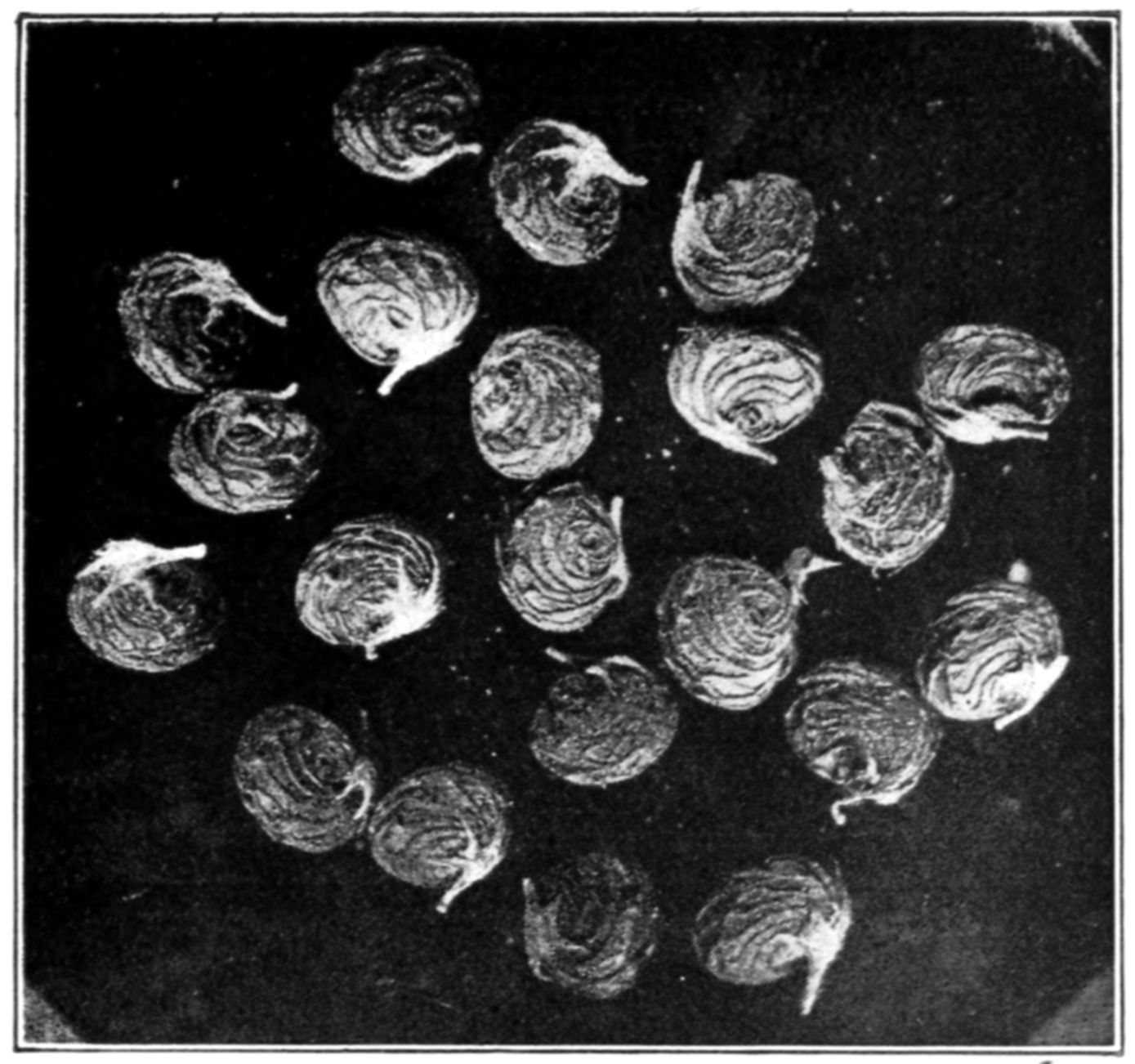
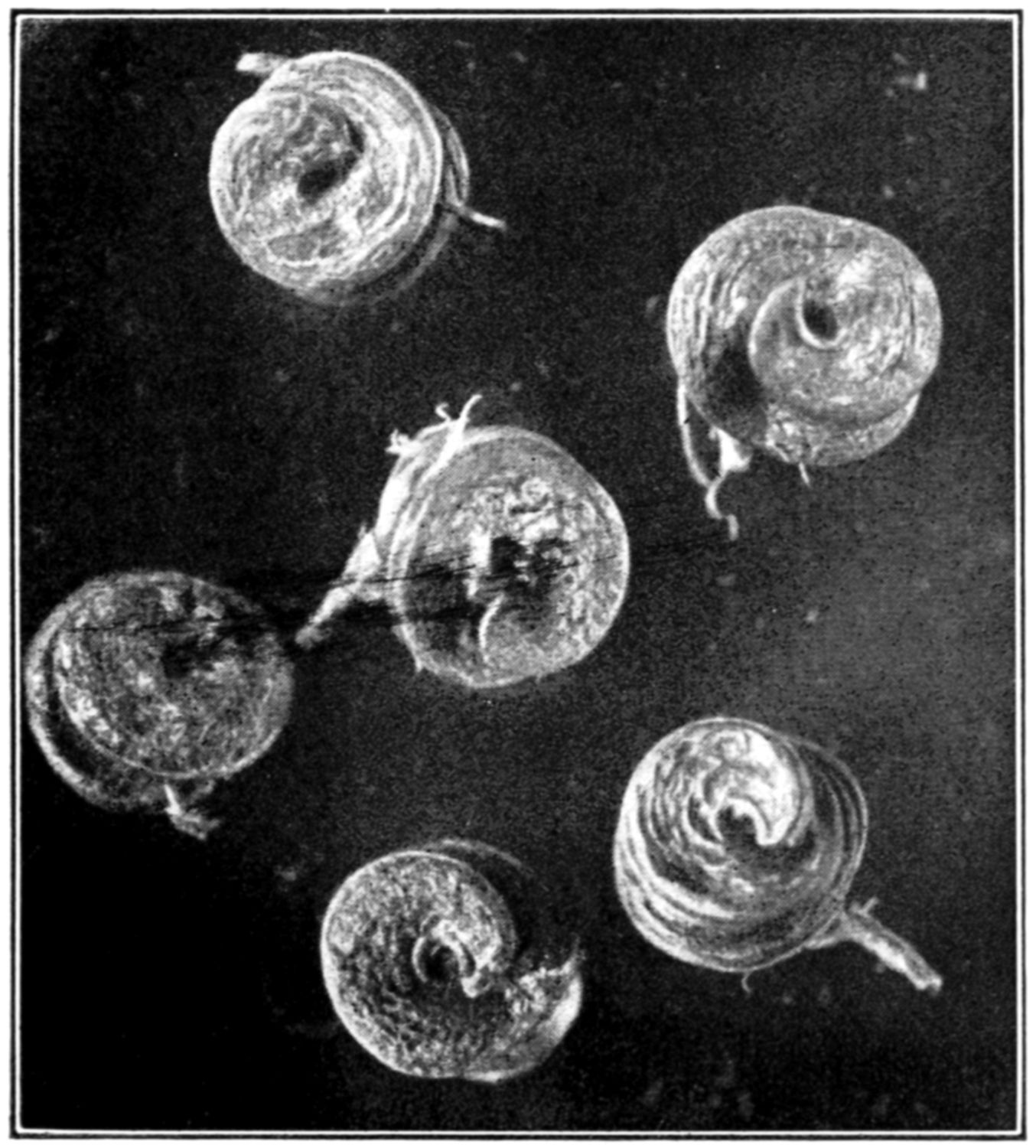
Yellow Trefoil Pods
The pods of Yellow trefoil are shaped as here shown and contain but a single
seed. Magnified four diameters
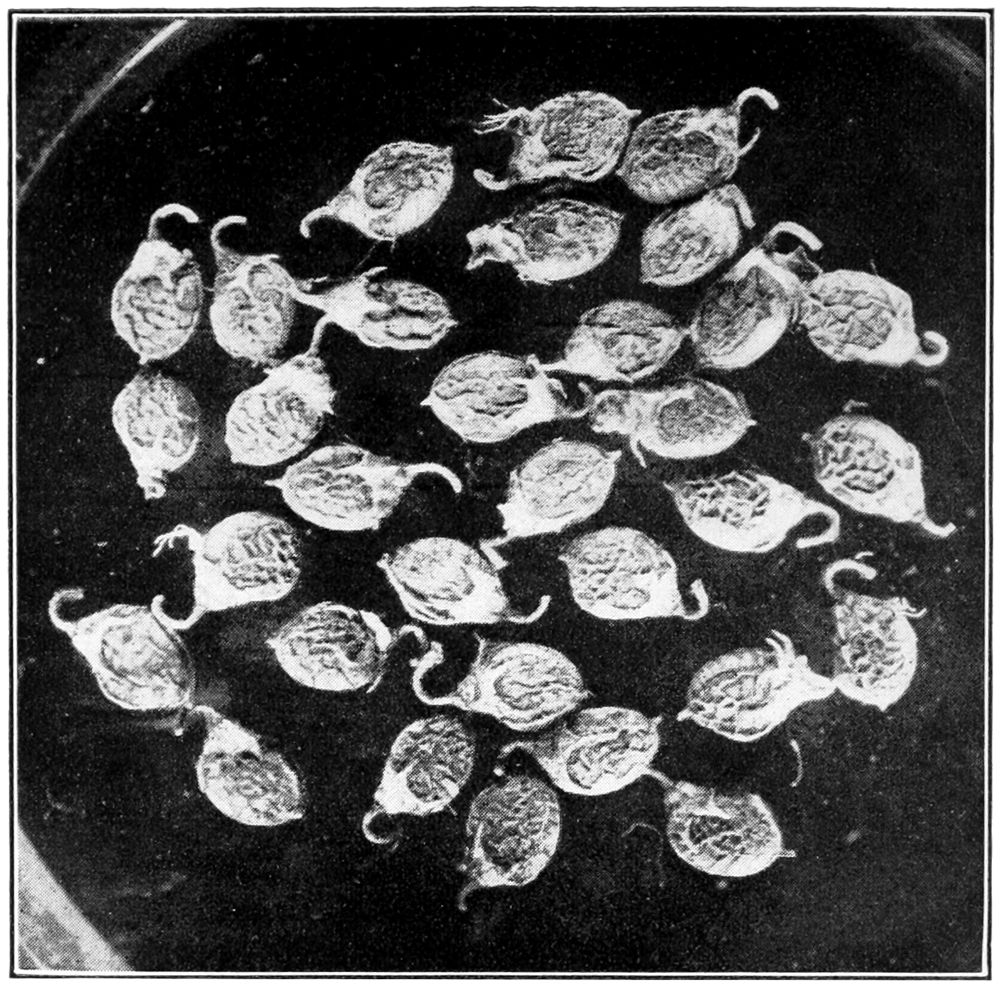
Alfalfa Seed Pods
Alfalfa has a spiral pod of two or three turns, often containing five or six seeds.
Magnified four diameters
Sweet Clover Pods
Magnified four diameters
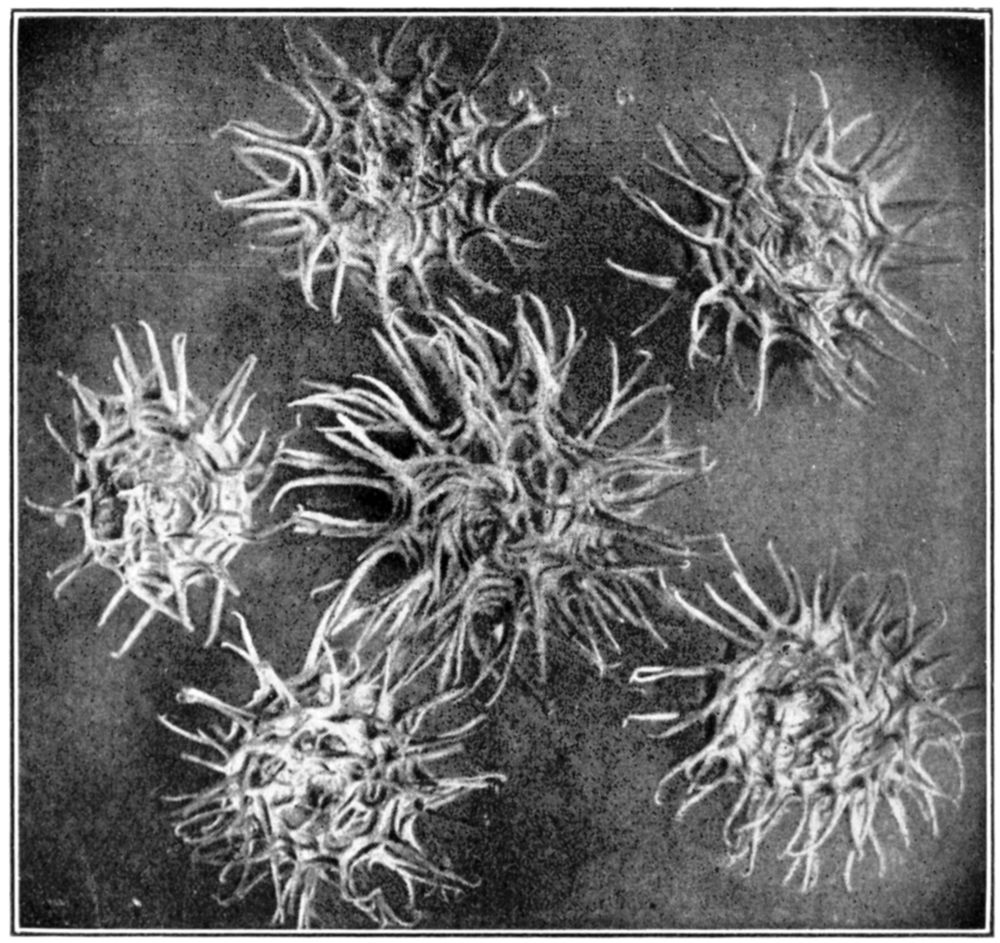
Bur Clover Seed Pods
The seeds are enclosed in a coiled pod which is covered with bristly projections
as shown above. Magnified four diameters
That an extraordinary proportion of the alfalfa seed
in the markets, wheresoever from, is adulterated to an
amazing extent with seeds of undesirable plants or
loaded with worthless, if not actually harmful impurities,
is being demonstrated by the United States Department
of Agriculture. In a circular pertaining to this work
is given the following, showing the adulterants found in
samples bought in the open markets of the cities named:
| |
Seeds used as adulterants. |
| City where bought |
Sweet
clover |
Bur
clover |
Yellow
trefoil |
Total
adul-
terants |
| |
Per Cent |
Per Cent |
Per Cent |
Per Cent |
| Providence, R. I. |
.... |
3 |
.47 |
32 |
.86 |
36 |
.33 |
| Denver, Colo. |
.... |
16 |
.86 |
.... |
16 |
.86 |
| Rochester, N. Y. |
.... |
5 |
.02 |
39 |
.48 |
44 |
.50 |
| Milwaukee, Wis. |
.... |
5 |
.74 |
.... |
5 |
.74 |
| Indianapolis, Ind. |
.... |
4 |
.27 |
38 |
.43 |
42 |
.70 |
| Indianapolis, Ind. |
.... |
3 |
.90 |
39 |
.53 |
43 |
.43 |
| Marblehead, Mass. |
.... |
3 |
.00 |
.... |
3 |
.00 |
| Petersburg, Va. |
.... |
.... |
1 |
.25 |
1 |
.25 |
| Cedar Rapids, Iowa |
.... |
5 |
.49 |
.... |
5 |
.49 |
| Indianapolis, Ind. |
.... |
3 |
.37 |
38 |
.54 |
41 |
.91 |
| Pittsfield, Mass. |
9 |
.52 |
.... |
.... |
9 |
.52 |
| Atlanta, Ga. |
.... |
10 |
.04 |
.... |
10 |
.04 |
| Salem, Ill. |
.... |
.... |
6 |
.98 |
6 |
.98 |
| St. Paul, Minn. |
.... |
.... |
31 |
.77 |
31 |
.77 |
| Louisville, Ky. |
.... |
16 |
.53 |
.... |
16 |
.53 |
| New Haven, Conn. |
.... |
5 |
.88 |
39 |
.85 |
45 |
.73 |
| Independence, Iowa |
.... |
12 |
.69 |
.... |
12 |
.69 |
| New Orleans, La. |
.... |
2 |
.57 |
|
.63 |
3 |
.20 |
| Troy, N. Y. |
.... |
6 |
.23 |
31 |
.26 |
37 |
.49 |
In Farmers’ Bulletin No. 194 of the United States
Department of Agriculture is given the table on page 34
to show the result of analyses of alfalfa seed imported
within a period of six months.
Laboratory
test No. |
Alfalfa
seed |
Broken
seed
and dirt |
Weed
seeds |
Number
of weed
seeds in
1 pound |
Number
of
dodder
seeds
in 1
pound |
Alfalfa
seed
that’ll
grow |
Amount
imported |
| |
Per Ct. |
Per Ct. |
Per Ct. |
|
|
Per Ct. |
Pounds |
| 21000 |
93 |
.38 |
5 |
.8 |
0 |
.82 |
2,160 |
.... |
63 |
.73 |
4,000 |
| 21001 |
92 |
.1 |
7 |
.34 |
|
.56 |
900 |
.... |
59 |
.17 |
30,800 |
| 21002 |
82 |
.28 |
15 |
.92 |
1 |
.8 |
3,060 |
.... |
66 |
.64 |
5,500 |
| 21003 |
84 |
.72 |
11 |
.58 |
3 |
.7 |
3,420 |
.... |
57 |
.39 |
32,877 |
| 21004 |
89 |
.16 |
8 |
.78 |
2 |
.06 |
2,700 |
90 |
62 |
.18 |
14,700 |
| 21005 |
74 |
.06 |
21 |
.38 |
4 |
.56 |
15,928 |
2,520 |
53 |
.87 |
7,613 |
| 21006 |
58 |
.74 |
34 |
.46 |
6 |
.8 |
32,420 |
5,490 |
28 |
.78 |
33,075 |
| 21007 |
86 |
.12 |
11 |
.34 |
2 |
.54 |
8,964 |
270 |
61 |
.36 |
8,779 |
| 21008 |
73 |
.02 |
22 |
.32 |
4 |
.66 |
12,829 |
90 |
49 |
.65 |
32,963 |
| 21009 |
96 |
.82 |
2 |
.72 |
|
.46 |
990 |
.... |
85 |
.2 |
33,000 |
| 21010 |
86 |
.2 |
12 |
.1 |
1 |
.7 |
3,060 |
.... |
55 |
.59 |
30,800 |
| 21011 |
96 |
.96 |
2 |
.16 |
|
.88 |
1,710 |
.... |
87 |
.26 |
5,500 |
| 21012 |
88 |
.84 |
3 |
.98 |
7 |
.18 |
17,299 |
.... |
43 |
.2 |
33,000 |
| 21013 |
96 |
.24 |
2 |
.66 |
1 |
.1 |
3,510 |
.... |
77 |
.47 |
21,340 |
| 21014 |
91 |
.06 |
5 |
.44 |
3 |
.5 |
7,650 |
.... |
62 |
.14 |
8,778 |
| 21015 |
93 |
.44 |
2 |
.7 |
3 |
.86 |
8,526 |
.... |
77 |
.08 |
33,000 |
| 21016 |
77 |
.78 |
16 |
.04 |
6 |
.18 |
16,435 |
360 |
47 |
.83 |
33,000 |
| 21017 |
81 |
.52 |
12 |
.18 |
6 |
.3 |
21,848 |
720 |
7 |
.13 |
16,280 |
| 21018 |
69 |
.48 |
23 |
.78 |
6 |
.74 |
23,082 |
810 |
5 |
.21 |
38,172 |
| 21019 |
96 |
.5 |
3 |
.04 |
|
.46 |
1,080 |
.... |
88 |
.53 |
44,000 |
| 21020 |
96 |
.4 |
2 |
.82 |
|
.78 |
1,260 |
.... |
91 |
.82 |
44,000 |
| 21021 |
94 |
.4 |
5 |
.04 |
|
.56 |
1,620 |
.... |
90 |
.15 |
72,600 |
| 21022 |
24 |
.5 |
70 |
.96 |
4 |
.54 |
21,070 |
4,950 |
6 |
.34 |
12,540 |
| 21023 |
94 |
.14 |
1 |
.8 |
4 |
.06 |
3,780 |
.... |
73 |
.43 |
234 |
| 21024 |
94 |
.58 |
3 |
.44 |
1 |
.98 |
3,060 |
.... |
51 |
.78 |
5,500 |
| 21031 |
87 |
.72 |
11 |
.02 |
1 |
.26 |
4,140 |
90 |
81 |
.14 |
143,000 |
| 21032 |
90 |
.56 |
8 |
.08 |
1 |
.36 |
3,420 |
.... |
76 |
.29 |
33,000 |
| 21033 |
89 |
.04 |
10 |
.5 |
|
.46 |
1,260 |
90 |
84 |
.7 |
6,673 |
| 21035 |
72 |
.36 |
27 |
.1 |
|
.54 |
270 |
.... |
64 |
.58 |
13,516 |
Bearing also upon the adulterations, impurities and
defectives found in alfalfa seed sold in the markets,
extracts from reports of tests made at the Wooster, Ohio
station (Bul. No. 142) are exceedingly interesting. In
fifteen samples bought, each of one dollar’s worth, the
quantity of pure germinable seed was found to range
from 5.1 to 9.3 pounds; the number of noxious seeds
found in a dollar’s worth of that bought as alfalfa seed
ranged from 360 to 185,940. Seven of the fifteen one-dollar
samples each carried more than 23,000 noxious seeds.
Seed bought at $7.80 per bushel showed as low as 61.2
per cent that was germinable, of which the actual cost
was $12.74 per bushel. None of the fifteen samples had
less than 77 per cent of germinable seed. One pound
sample contained 21,728 noxious seeds, of which 18,144
were lamb’s-quarter or pigweeds; the same pound also
had 3126 seeds of dodder. Another pound carried 6420
seeds of crab grass, and one had 3325 seeds of foxtail.
The station authorities recommend that no alfalfa seed
be sown until carefully screened through a screen fine
enough to remove dodder seeds. Wire sieves or screens
with twenty meshes to the inch are found to serve the
purpose.
As a further and more thorough discussion of the frequent
adulterants, Prof. H. F. Roberts, botanist of the
Kansas experiment station, has kindly prepared, with
illustrations, for this volume the quoted statements which
follow here:
“The immense and steadily increasing value of alfalfa
as a forage crop in the United States, and the high price
of the seed, make the securing of sound, pure seed a
matter of supreme importance to farmers, and render it
equally important for them to be able to recognize, by
sight, the presence in alfalfa seed of the adulterants
and seeds of certain weeds most commonly known to
occur. There is conclusive evidence that an amount of
adulteration and substitution is actually practiced with
alfalfa seed. It is usually charged that this is done
abroad, especially, as is alleged, in Germany.
“The writer has been informed that, to a limited
extent, the practice exists in America. The chief adulterant
used is the seed of the Yellow trefoil, or, as it is
sometimes called, Hop clover or Black medick. (See
illustrations opposite pages 26 and 32.) About fifty
species of plants are known as ‘medicks’ or, scientifically,
Medicago; but it so happens that the only
perennial species among them is alfalfa, which goes under
the botanical name of Medicago sativa, (p. 1). Other
species such as Yellow trefoil (Medicago lupulina) (p.
38) and Bur clover (Medicago denticulata,) while they
possess some forage value and are useful to a limited
extent, lack, for the most part, the lush, abundant
growth of alfalfa itself, and are notably inferior
through the fact of their annual habit. It is because
of its perennial nature, therefore, as well as on
account of its rank, succulent growth, that no species of
annual leguminous plant can hope to compete with alfalfa
for a moment in importance. This means, then, that
any substitute for alfalfa seed, or adulteration of it with
the seed of another related species, such as Yellow trefoil
or Bur clover, is distinctly a fraud of serious character,
despite the fact that the adulterants are plants that
make fair pasturage and have some forage value. They
are merely annuals, ending their life with the season,
whereas a field of alfalfa should live twenty years or
more, under right conditions.
“At present, as stated, Yellow trefoil is the chief adulterant
used in American alfalfa seed. A number of cases,
indeed, of complete or almost complete substitution of
Yellow trefoil for alfalfa seed have come to the writer’s
attention within the past year. It is important, therefore,
for farmers to know the characteristic marks of
distinction between the seed of alfalfa and of its chief
adulterants. What are the chief characteristics of alfalfa
seed? Facing page 13 are samples of pure alfalfa
seed, photographed under a magnification of five diameters.
It will be noted that seeds of three general types
exist: (1) A kidney-shaped type, marked ‘a’ in the illustration;
(2) a type in which one end terminates in an
acute wedge, marked ‘e’; and (3) a type that is round
or nearly so, marked ‘b’. These types clearly illustrated,
arranged for comparison in parallel rows are
shown opposite page 44. See also page 27. It should be
noticed that type 2 is the most characteristic and frequent,
and that the perfectly round type is extremely rare. This
angular slant toward one tip of the seed is found nowhere
among any of the adulterants. Neither does the kidney
shape of seed occur, except in Bur clover; and, in that
case, the difference in the size of the seeds of the two
species is sufficient to distinguish them, in most instances.
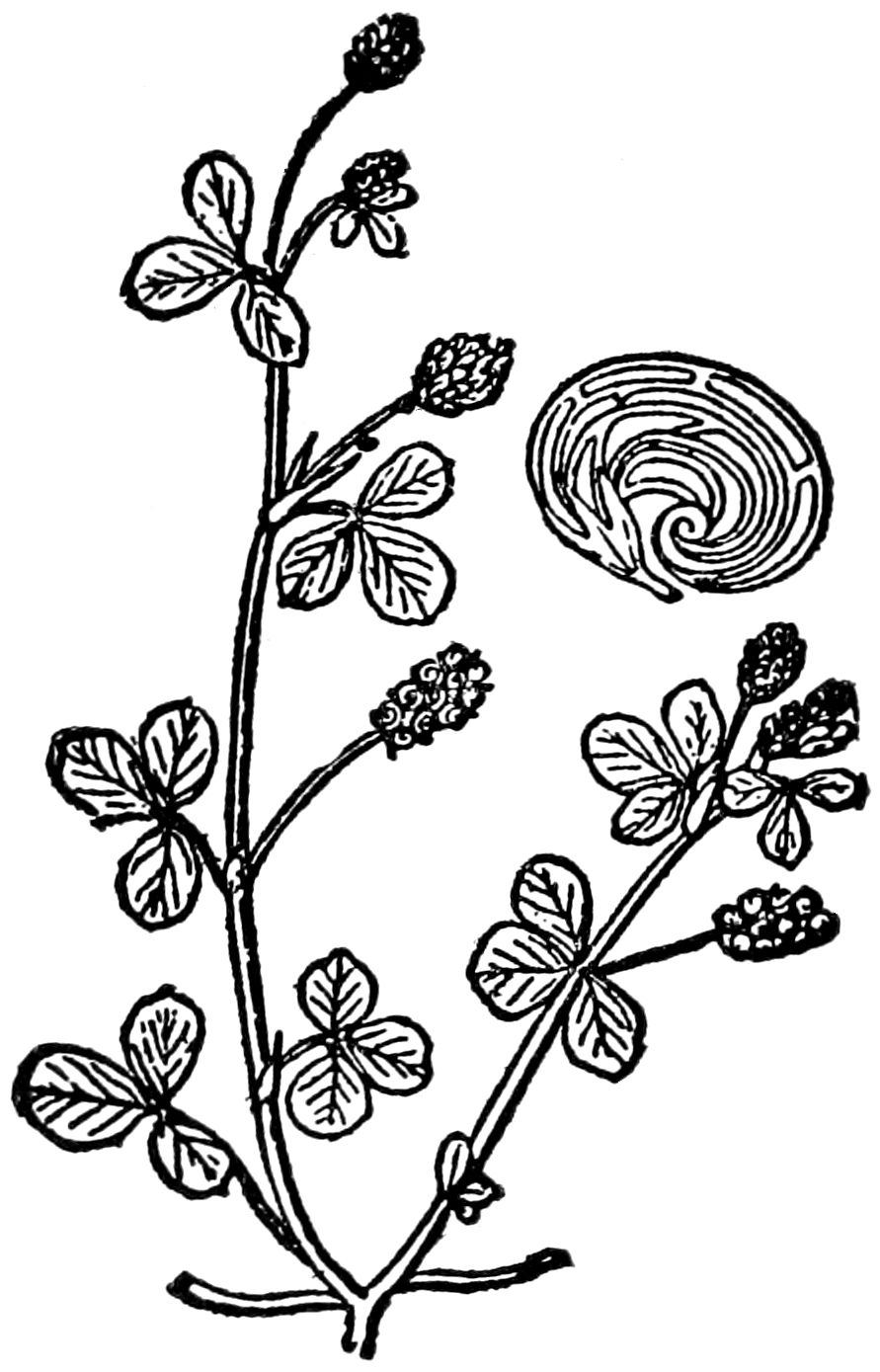
Yellow Trefoil: Black Medic: Hop Clover (Medicago lupulina)
“It is when we consider the round or roundish type
of alfalfa seed that there is difficulty in distinguishing
from alfalfa the seeds of Yellow trefoil and of Sweet
clover (illus. opp. p. 26), which latter frequently occurs
as a weed seed, and possibly in some cases in sufficient
quantity to be suspected as an adulterant. By comparison
of the seeds of alfalfa with the two adulterants just mentioned,
(p. 26) the resemblances and differences of
the three species will become evident. In general the
seeds of Yellow trefoil are shorter and rounder than
those of alfalfa, the largest seeds of trefoil measuring
0.0629 inch wide by 0.0897 inch long; whereas the largest
alfalfa seeds measure 0.0653 inch wide by 0.1153 inch
long; so that the largest alfalfa seeds are a trifle wider
and more than a third again as long as the largest trefoil
seeds. The smallest seeds of Yellow trefoil are usually
plumper and shorter than those of alfalfa (0.0511 inch
wide by 0.0291 inch long, as compared with 0.0496 inch
wide by 0.0751 inch long in alfalfa); nevertheless, among
both the small and the large seeds, so far as the criterion
of size goes, individuals occur that equally well belong to
either species, and the average differences in size are
not so great as the differences found on comparing the
largest and the smallest seeds of the two species, the
average for the trefoil being 0.0574 inch by 0.0799 inch,
and for alfalfa 0.0582 inch by 0.0944 inch. So it will be
seen at once that while trefoil seeds as a rule are smaller,
shorter and rounder than those of alfalfa, the rule is
transgressed by many individuals. We must, therefore,
turn to the form and general outline of the seed. A
farmer can detect at once an attempt to substitute wholly
Yellow trefoil for alfalfa seed by the fact that in no case
will the kidney-shaped or the regular-pointed types of
seed be found in trefoil, whereas these always occur in
alfalfa. (Illustrated opp p. 26.)
“In the more common cases, where adulteration rather
than complete substitution is practiced, detection is more
difficult—is practically impossible, in fact, without the
aid of a lens or magnifying glass having a power of
about fifteen diameters. There are many seeds of trefoil
which can scarcely be distinguished from certain
rounded seeds of alfalfa. Generally, however, the trefoil
seed has a little projection or “beak” on the middle line of
the seed, just back of the scar marking where the seed
was attached to the pod. This is rarely found in alfalfa.
“Bur clover as an adulterant is probably not so frequently
used as Yellow trefoil, since the larger size of
its seed renders detection easy. Were it not for this fact,
Bur clover would be a most effective adulterant, because
its seeds resemble those of alfalfa more closely than do
those of Yellow trefoil. There are, of course, smaller
seeds of Bur clover and larger seeds of alfalfa that approximate
each other in size, but the average Bur clover
seeds measure 0.0604 inch by 0.1188 inch, as compared
with an average for alfalfa of only 0.0582 inch by 0.0944
inch.
“So far as the plants of Yellow trefoil and Bur clover
are concerned, they are easily distinguishable from
alfalfa. Both are of lower growth, as a rule, than alfalfa.
Both have wider leaflets, which, in Bur clover, are like
broad, inverted wedges. The flowers of these plants are
yellow, and are borne in scanty clusters. The pods are
wholly unlike those of alfalfa. Alfalfa has a spiral pod
of two or three turns (p. 32), containing as many as
five or six seeds. Yellow trefoil has a straight pod (p.
32), containing but one seed. Bur clover has a coiled pod
(p. 33), but covered with bristly projections that give the
plant its name. Where adulteration or substitution is
practiced, some of the pods are very apt to occur in the
bulk seed, and they can then easily be identified and distinguished
from those of alfalfa.
“Seed of Sweet clover seems to occur frequently in
western-grown alfalfa seed (p. 26). Sweet clover (illustrated
in this book) grows to a height frequently
of from four to six feet, bearing small, white flowers on
slender spikes three or four inches long. Unfortunately,
and unlike Yellow trefoil and Bur clover, Sweet clover is
generally rejected by stock. On this account, it is a plant
of no generally established value for hay or as pasture,
although, in some instances, it is successfully used. The
seeds of Sweet clover are of a golden yellow when ripe;
those of alfalfa, trefoil and Bur clover being greenish yellow.
The seed coat of Sweet clover seed is covered with
minute elevations, while alfalfa seed is smooth. The seeds
of Sweet clover (p. 26) are rounder and plumper than
those of alfalfa, and have a very pronounced groove between
the main body of the seed and the ridge which
marks the location of the rootlet of the young plant within.
It is this ridge that in alfalfa seeds runs off, as a rule,
in a marked slant, but which in both trefoil and Sweet
clover, especially in the latter, forms a well-rounded curve
to the tip of the seed. No pointed or kidney-shaped seeds
are ever seen in Sweet clover. (See illus. opp. p. 26.)
“It remains to mention the most common weed found
in imported alfalfa seed—the English or Ribbed plantain,
or, as it is more generally called in the West, Buck-horn
or Rib grass. It is a difficult weed to eradicate,
lots of seed containing any noticeable percentage of it
should be rejected. (See illus. opp. p. 13.)
“The farmer is often to blame for the poor seed of
which he makes complaint. Prime alfalfa seed is expensive,
and a cheap grade will inevitably be poor in quality,
containing much dead seed, rubbish, and the seeds of
many kinds of weeds. Where ‘cheap’ alfalfa seed is
demanded it will always be sold, and buyers need not be
surprised by its quality. On the other hand, there is no
excuse or palliation for the offense of selling, under the
name and at the price of standard alfalfa seed, seed of
substituted species. It is the duty of seed dealers to ascertain
beforehand the character and genuineness of seed
that they sell under any given name, and this applies to
the retailers as well as to the wholesale dealers. On the
other hand, farmers cannot expect to obtain the best seed
unless they are willing to pay the price it brings.”
Dodder seeds are somewhat smaller than alfalfa seeds
(pp. 45 and 47), but are not separated from them except
by careful recleaning; consequently, they are often sown
along with the alfalfa seed, especially in that which has
been imported. If a field is badly infested, it should be
plowed up and devoted to some other crop for a few
years. Prof. F. H. Hillman of Nevada (Bul. No. 47)
says there are several kinds that infest alfalfa, but two
kinds are especially common and destructive in this country.
Cuscuta epithymum is the commoner. “The seeds
of this (p. 47) are very small, and are almost sure to escape
detection on casual examination of the samples; yet,
once recognized under the lens, their presence may be
easily discovered. They are so much smaller than alfalfa
seeds that the use of a sieve of twenty meshes per inch
separates them from the latter when only free dodder
seeds are present. Not only are various other small weed
seeds disposed of in the process, but little if any alfalfa
seed worth buying is lost. The few ripened flowers of
dodder retaining matured seeds, which sometimes pass
the thresher uninjured, may be removed by proper fanning.
It is safe to say that no purchaser of alfalfa seed
can afford to neglect sifting his seed carefully with a
twenty-mesh sieve, which is the mesh the writer recommends
for the separation of this kind of dodder from alfalfa
seed.
“Cuscuta arvensis is another dodder as destructive
when once established. Its seeds (p. 47) seem to be less
common, however. They are larger than the preceding,
many of them being practically the same size as the
smaller, more rounded alfalfa seeds, which they often
strikingly resemble. Thus they are hard to detect, and
cannot be removed without the loss of much small alfalfa
seed. This should be the more dreaded of the two dodders,
because alfalfa seed infested with seeds of Cuscuta
epithymum can be made practically free from them
with comparatively little loss and expense. Not so, however,
with seed containing Cuscuta arvensis, which should
not be purchased at any price. Dodder seeds can scarcely
be regarded as an adulterant, yet as an impurity they are
very common and most objectionable.” (See illustrations
opp. pp. 45, 46 and 47.)
CHAPTER V. Soil and Seeding — VARIATE, YET UNIFORM — SOIL PREPARATION — KEEP DOWN THE WEEDS — FALL SOWING — RECENT PLOWING NOT DESIRABLE — INTRODUCE BACTERIA BY PREPARATORY SOWING — ALL CROPS DEMAND CONDITIONS — SPRING OR FALL SOWING—WHICH? — DISADVANTAGES OF SPRING SOWING — SEEDING BY DRILL OR BROADCAST? — HOW MUCH SEED TO THE ACRE? — WITH OR WITHOUT A NURSE CROP? — INOCULATING THE SOIL — BUYING INFECTED SOIL — DANGERS OF INOCULATION BY SOIL TRANSFER — OTHER METHODS OF INOCULATION — KEEP ON TRYING
In this double title we have a case of the widest variations
and the most positive and rigid uniformity. Alfalfa
may be grown in almost every possible kind of soil
and under almost all soil conditions (save two), but
omitting these the seeding, including the tilth of the
ground, is based, so far as any future success is concerned,
on perfect cultivation. The dictum, “Alfalfa
must have a dry, warm, sandy loam, very rich” has
become obsolete, as already pointed out.
There are just two soil conditions that seem absolutely
against the growth of alfalfa. The first is a soil constantly
wet. The common remark, “Alfalfa will not
stand ‘wet feet’,” seems to be the expression of a law.
It does not do well where the water is nearer to the surface
than six feet, or where in winter water will stand
on the ground for over forty-eight hours. This invariably
smothers the plants; in fact it usually kills any crop.
If water flows over the field for some such time, due to
a freshet, the alfalfa is often found uninjured if too
much soil has not been deposited on and around the
plants. Even in such instances fields have been saved by
a disking once or twice, but it is wholly unwise to sow on
a field subject to overflow, or one where water rises to
the surface in winter or spring; likewise on a field so flat
that water will not run off in time of a heavy rain or
promptly drain out through the sub-surface. The time
is rapidly coming everywhere when the intelligent farmer
will not try to raise any crop on such a field, undrained.
The alfalfa roots will find their way to moisture if given
the right surface conditions. There are profitable alfalfa
meadows in parts of Kansas where it is eighty feet to
water, but there has not yet been found one that is prosperous
where water comes close to the surface, or where
it stands on the ground in winter.
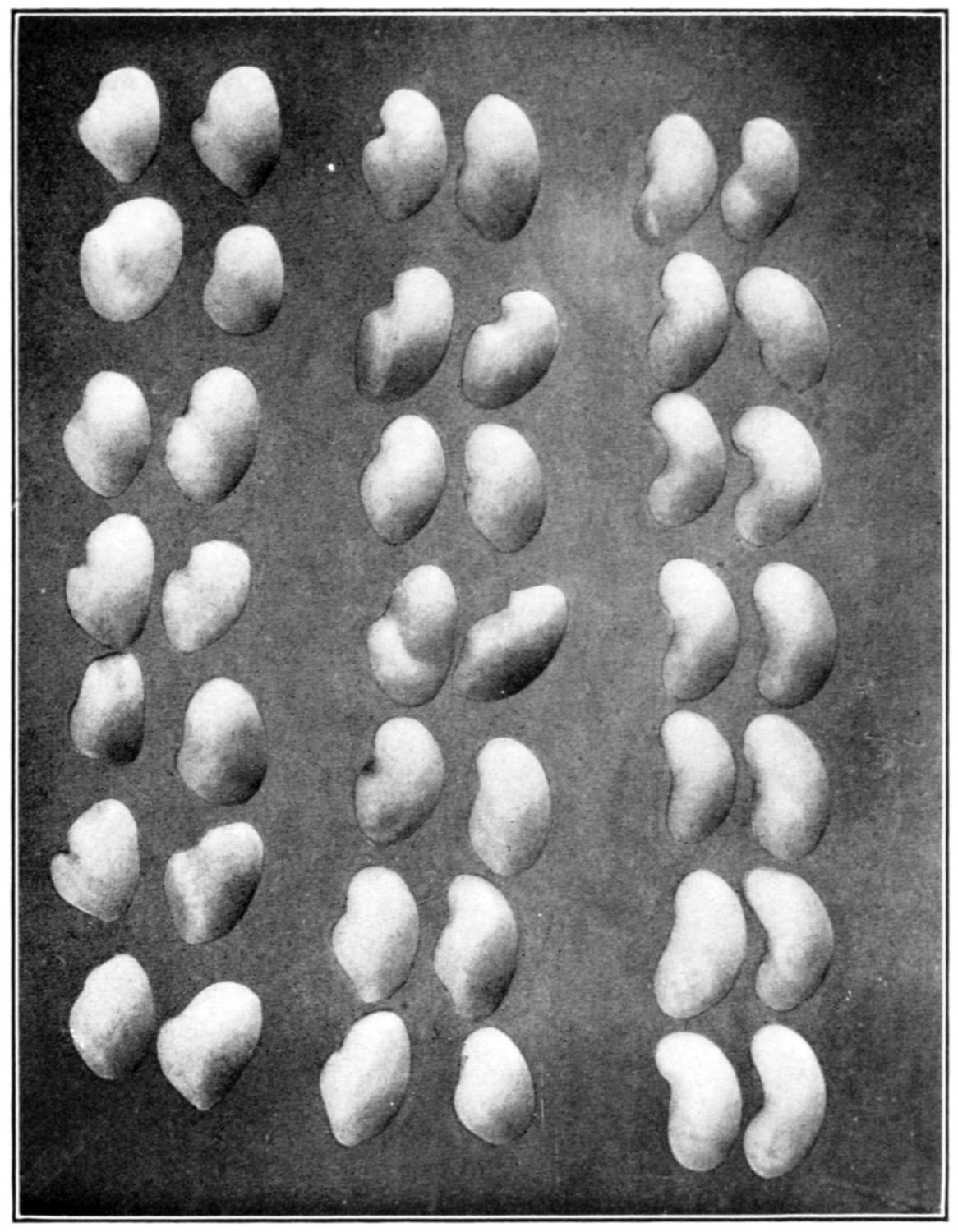
Three General Types of Alfalfa Seed
The right-hand column, kidney-shaped, a characteristic form, but not so common
as the type in the central column. The left-hand column approaches more
nearly the rounded type of Sweet clover. Magnification five diameters
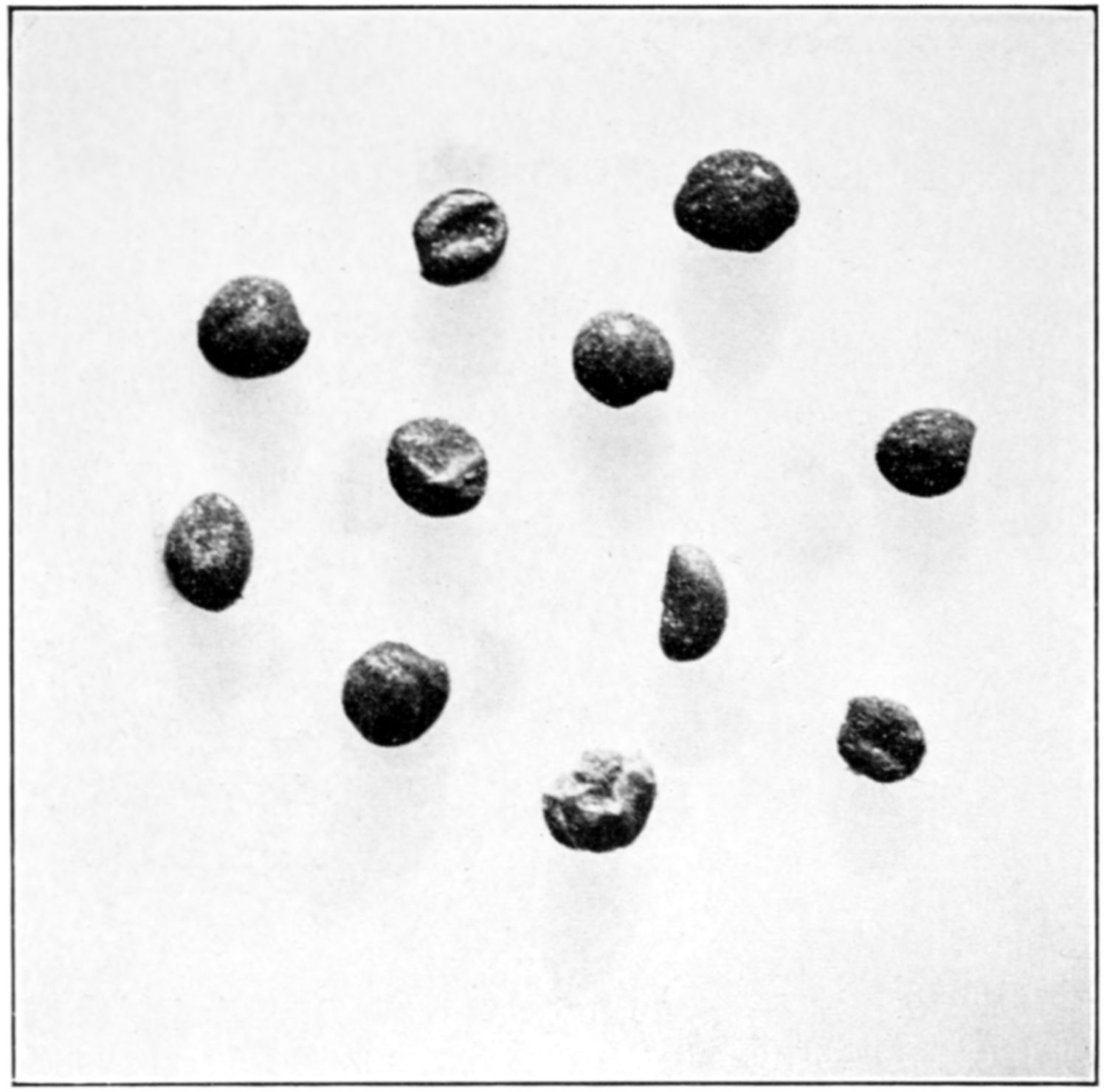
Dodder Seed Magnified
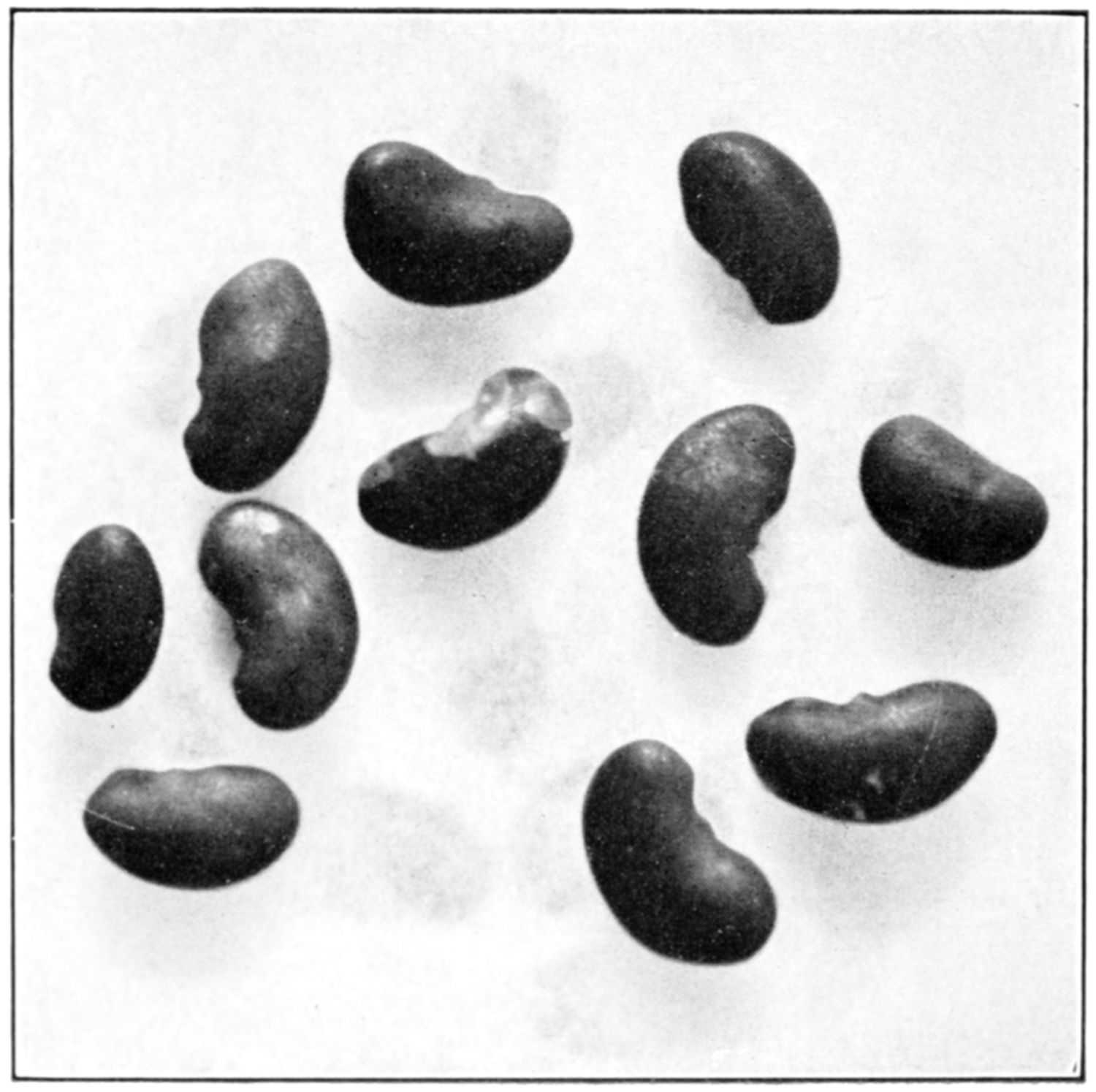
Alfalfa Seed Magnified
The other kind of soil where alfalfa refuses to grow
is that in which there is too much acidity. This is often
the case where corn and wheat have been raised for many
years, thus robbing the soil of much lime; a condition
that may be remedied by an application of lime to the
land just before sowing the alfalfa, harrowing it in
beforehand or, if the seed is to be broadcasted, the lime
may be applied just before sowing, when once harrowing
will suffice for both, or it may be sown with a drill—500
to 1000 pounds per acre.
A simple test for acidity is to make a deep cut in the
ground with a knife, pressing the earth slightly apart;
then push a piece of litmus paper into the opening and
press the earth together. Leave the paper there for a
few hours. If upon examination the litmus paper has a
pink appearance it is proof of acidity, and this, as already
said, may best be remedied with lime.
With the only two negative points considered, the
more important conditions upon which success will
depend may be discussed. One chief essential is the
advance preparation. Many of the most successful
growers begin their preparations two or three years
before they sow the seed. There must be, by rights, the
most perfect physical condition of the soil. It should
have been plowed deep for at least two years, and in most
fields in the central and northern states a two- or three-inch
subsoiling along with a seven- or eight-inch plowing
will be very helpful.
If corn is to precede a spring sowing, the ground
should have a liberal dressing of stable manure plowed
under for humus, to encourage earthworms and to introduce
the particular bacteria so essential to alfalfa’s welfare
or at least furnish favorable conditions for bacteria,
and the harrow should follow the plow each day. The
soil’s condition should be like that for a garden. Care
should be taken never to work with the ground when
too wet, as such working almost inevitably results in
clods and baked soil. The corn should be cultivated
often, and a liberal sowing of cowpeas just before the
last cultivation, which should be shallow, has been found
quite helpful. This crop will repress and take the place
of weeds, furnish a rich food for fattening pigs or lambs
after the corn is cut, add fertility to the soil, and also
introduce bacteria similar to the bacteria for the alfalfa.
The cowpea, being a legume, prepares the way for
alfalfa, its near relative.
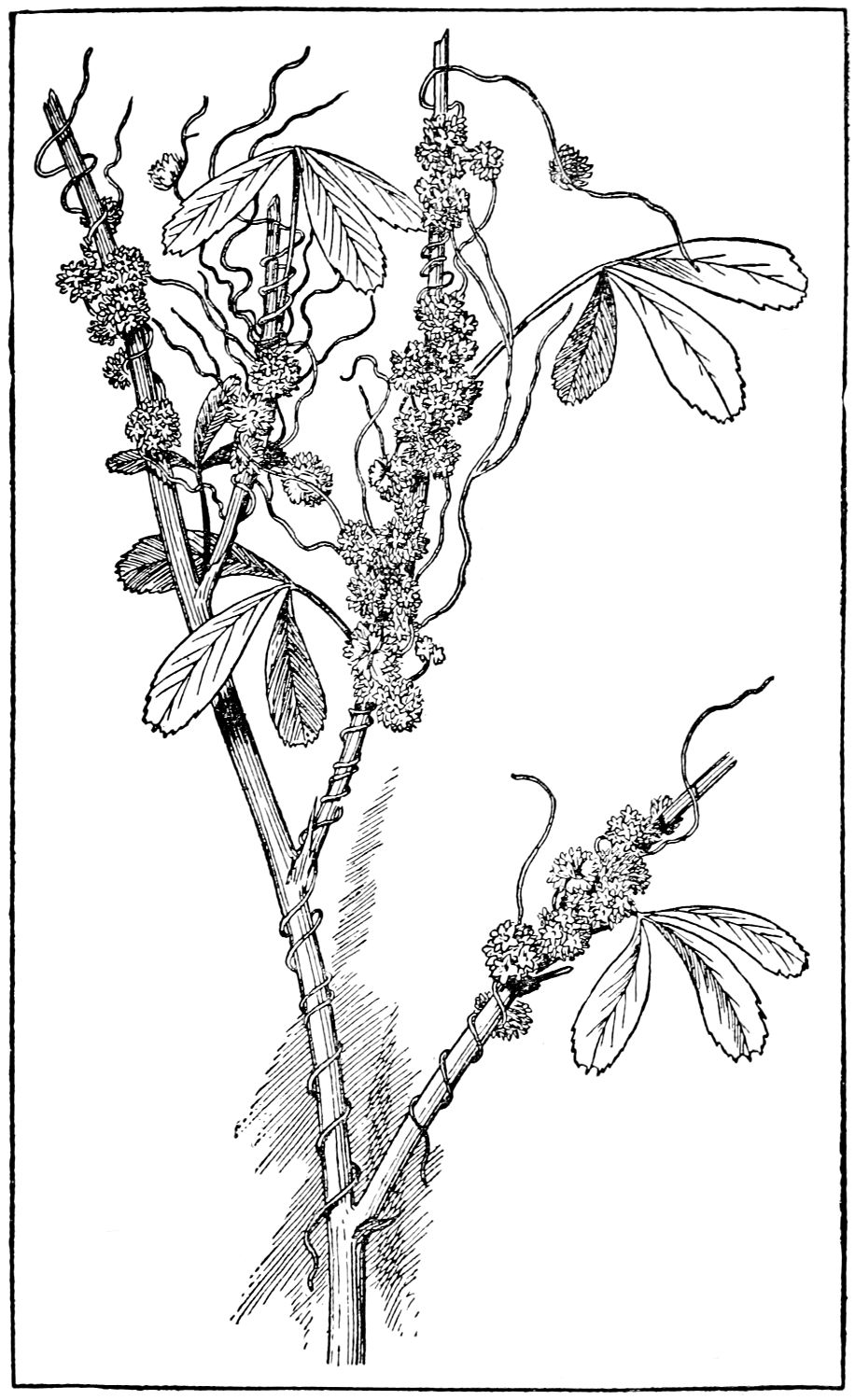
Dodder Plant on an Alfalfa Stem

Dodder, (Cuscuta arvensis)
(a) A group of seeds (enlarged), showing the prevailing forms; (a, b, and c)
individual seeds having somewhat the form of clover seeds; (d) a group
showing the natural size
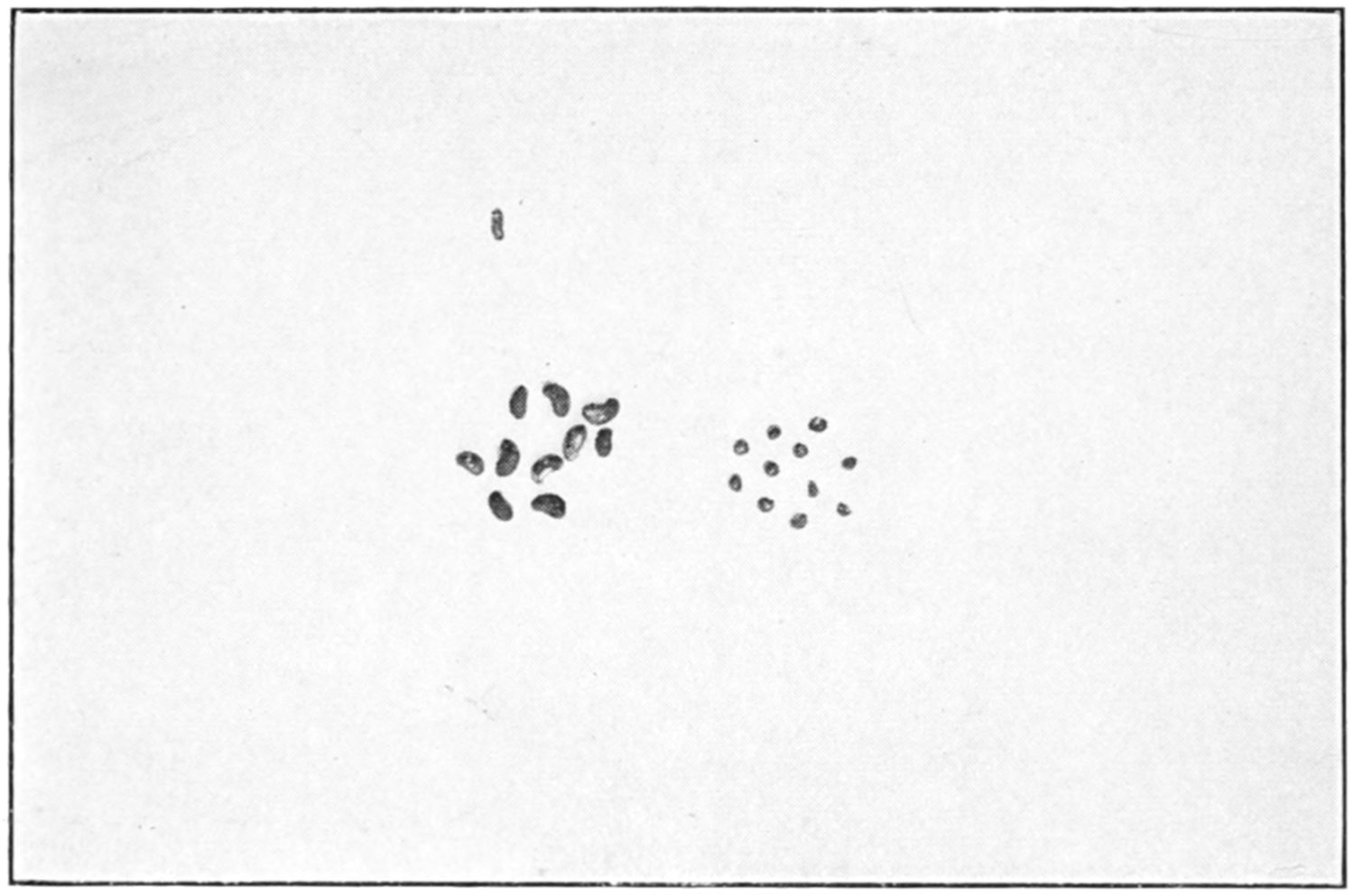
Alfalfa and Dodder Seed. Actual Size
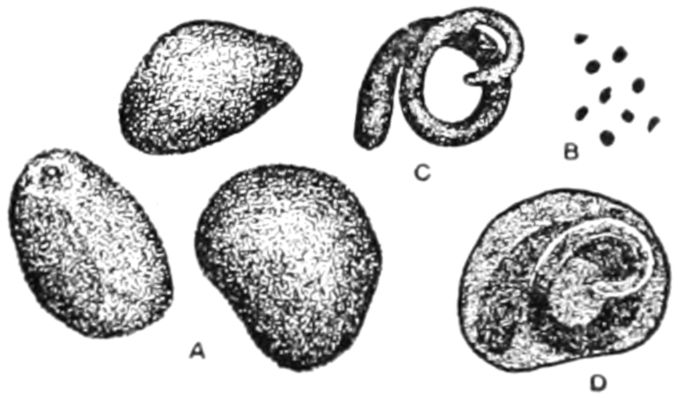
Dodder, (Cuscuta epithymum)
(a) A group of seeds showing comparative forms and relative size (enlarged);
(b) a group showing the natural size; (c) the embryo removed from the seed,
showing the form it usually assumes; (d) a section of a seed, showing the
manner in which the embryo lies imbedded in the endosperm
It is always timely to emphasize the very great importance
of keeping down weeds in the cornfield where
alfalfa is to be sowed the next spring. If corn is husked
from the fields, the stalks should not be pastured except
when the ground is fully frozen. Later they should be
thoroughly broken, raked and burned, to leave the land
in the best condition for spring work. If the corn is cut
and fodder hauled off, the stubs should be broken in cold
weather by a pole or other drag, and raked and burned
as recommended for the stalks. This adapts the ground
for disking and harrowing early in March. Then every
ten days the field should be disked or harrowed to conserve
moisture, to start weeds and then kill them, and to
bring the ground into the desirable tilth. Ordinarily, in
the central states, sowing may be done early in April,
while in the South this may be done by the middle of
March, and in Wisconsin and Canada by the last of April
or early May, although the dates are variable. Many
report seeding in Kansas the middle of May, obtaining a
clipping in July and a hay crop in September. Others
report sowing in March and cutting a hay crop in June.
Some Wisconsin reports say that the first of June is early
enough, while others in that state and in Minnesota prefer
to sow two or three weeks earlier, and still others in
Wisconsin sow in April. The important things to keep
in mind are to have the soil right and the weeds disposed
of, and to sow when the weather and moisture and conditions
are right. Alfalfa is a child of the sun; permanent
shade from any source is its enemy, and when young it is
not a good fighter against adversaries of any sort. More
failures are due to weeds than to any other one cause,
and unfortunately all the weeds do not grow on the land
of the farmer who is shiftless or neglectful. The latter
is so benevolent as to permit his weeds to scatter their
seeds to the fields of his neighbors.
If a spring sowing is to be made on wheat ground, the
land will be helped by a liberal dressing of manure immediately
after the harvest, and by plowing and harrowing
at once; then sowing about the last of August to rye or
wheat for fall and winter pasturage, and to prevent the
soil from leaching or washing. In the spring the land
should be disked and harrowed for alfalfa, keeping in
mind the point emphasized in the preceding paragraph.
Instead of the rye or wheat, cowpeas may be sowed after
the wheat harvest; thus both fertility and bacteria will
be added to the soil, and the farmer have a valuable pasture
crop for pigs or lambs. If the season is extremely
favorable, a hay crop may be cut in early October.
If potatoes are to precede a spring sowing of alfalfa,
more than usual care should be taken to keep the field
clean of weeds. Some farmers do well by sowing millet
with the last cultivation of potatoes, leaving the potatoes
in the ground until after the millet is harvested, and when
the crop is dug the land is free from weeds. Then it
may be harrowed or disked and seeded to rye for winter
pasture. Some plow the potato ground in the fall and
sow to wheat or rye. Certainly if weeds are present the
ground should be plowed as soon as the potatoes are
dug. The idea is to secure a fine seed bed and have
the ground free from weeds, the great curse of the
American farm. All things considered there is probably
no crop which leaves the soil in finer physical condition
for alfalfa-sowing than millet, and none that is more
unsatisfactory for a like purpose than sorghum or Kafir
corn that was planted in hills or rows.
A clover sod for a spring sowing should be plowed in
September or October, disked or harrowed, and not infrequently
a light sowing of rye for winter pasture is
feasible. In early spring use disk and tooth harrows on
the land. It is excellent if a liberal application of rotted
stable manure is plowed under with the clover sod. Usually
it is better to follow clover with a corn or potato
crop before seeding to alfalfa.
Fall sowing presents fewer difficulties than spring sowing.
Corn is not the preceding crop and hence the weed
problem is not so formidable. Usually a fall sowing follows
millet or oats, cowpeas or potatoes. Almost any
crop except the sorghums may be grown to precede
alfalfa for a fall sowing; these should not be as they consume
too much moisture. If possible, put on a dressing
of stable manure the preceding winter; plow deep in the
spring and work to a fine tilth for the summer crop.
South of the latitude of 40 degrees cowpeas is one of the
best preparatory crops. They are legumes, and the
bacteria that live on their roots are similar to those
upon the alfalfa roots; they are also nitrogen-gatherers,
taking nitrogen from the air as does the alfalfa,
and thus they prepare the soil for alfalfa. Besides,
cowpeas are a valuable forage, the hay being
worth almost as much, pound for pound, as that of
alfalfa. When cut off they leave the ground ready for
disking and other preparation. Millet is also excellent
for this purpose, leaving the soil unusually friable.
Potatoes make a satisfactory preparatory crop, but the
danger from them too often is neglect to keep the weeds
down. As soon as the land is free, it should be disked
and harrowed, and this repeated about every ten days
until the time for sowing.
It is seen that plowing for alfalfa just preceding the
seeding is not recommended. Plowing leaves the sub-surface
too loose, thus depriving the roots of a sufficiently
firm footing and making a full sowing more liable to
harm from freezing and thawing, and the spring sowing
to harm from a dry summer. The necessity of the most
perfect surface conditions cannot be to often emphasized,
and this too includes considerable compactness
rather than a too light or ashy condition. There must
be no clods, no stiff and stubborn humps.
If alfalfa is to follow clover, and to be seeded in the
fall, the sod should be broken early after the clover is
harvested and each day’s plowing harrowed that day;
then the field disked and cross-disked and harrowed
again. After that it should be disked, lapping half, every
ten or fifteen days until time for seeding. Alfalfa may
follow timothy if the sod is not too old and stubborn,
and it may be treated the same as clover sod.
Another form of preparation followed by many successful
growers, men who do not complain about alfalfa
not doing well “here,” is the sowing of a few pounds of
alfalfa seed on the field two or three years before it is
intended to sow for a permanent crop. Mr. Joseph E.
Wing, of central western Ohio, a widely known farmer,
stockman, and writer on matters agricultural, uses alfalfa
in a regular rotation, and two years before he is ready
to sow it on a given field as a main crop, sows clover and
timothy along with two or three pounds of alfalfa seed,
for a pasture crop. Thus the bacteria are introduced,
and when the pasture is plowed for the full sowing of
alfalfa, the disking and harrowing that follow distribute
the bacteria throughout the soil, and the probabilities of
a good stand are greatly enhanced. He sometimes sows
two or three pounds of alfalfa seed to the acre with a
wheat crop two years before he is to sow the field entirely
to alfalfa. Another, in a state where the experiment
station director still declares alfalfa-raising to be doubtful,
writes that he has not had a failure in a decade, and
his plan is to precede alfalfa with winter wheat, sowing
a little alfalfa seed with the wheat, probably three pounds
to the acre, and the next fall after giving the land a thorough
preparation he sows fifteen pounds of alfalfa seed
to the acre. Another reports pleasing results in two different
fields by sowing in the spring five pounds of alfalfa
seed with clover; in two years the alfalfa stood thick on
the ground, having crowded out the clover. If these
plans introduce the bacteria into the soil, it may be wondered
why it would not be equally helpful to sow two or
three pounds of alfalfa seed per acre with the oats or
millet in the spring, preparatory to the thorough seeding
to alfalfa in the fall.
Another man, whose profit in raising alfalfa has been
marked, reports that his soil is very waxy and hard to
deal with. He has met this trouble by listing his ground
in the fall and leaving it thus open for hard freezing
throughout the winter. He then disks and cross-disks
in the spring, putting the soil in fine tilth, and sowing
millet as a preparatory crop. He has occasionally sowed
alfalfa in the spring, following the fall listing and later
freezing of his ground.
Alfalfa, like corn and cotton, demands certain conditions
of the soil and certain constituents in that soil.
Every crop demands its certain foods. All crops except
alfalfa and the other legumes obtain practically all their
food, including nitrogen, from the soil. The latter crops
use nitrogen but get it from the air. Alfalfa takes nitrogen
from the soil only during the first few months of its
growth, and thereafter not only takes its own necessary
supply from the air, but a large surplus which it stores in
the soil, available for whatever crop may follow. Other
crops take much nitrogen from the soil, but contribute
nothing to its enrichment.
This has been a much argued question with experimenters.
Possibly it will be found to be of minor importance
in itself, depending more upon other conditions
than the season. From the northern tier of states many
reports favor spring sowing, yet from each come letters
in favor of fall sowing. Several experiment stations in
the South are in favor of spring sowing, yet report satisfactory
results from fall seeding. It seems pretty well
established, however, that fall sowing is safer in the
central latitude states, say including Ohio, Nebraska,
Missouri, Kansas, Colorado and Utah, and states within
the same parallels.
In other states prevailing opinions favor spring sowing.
Nevertheless, when all conditions are understood,
fall sowing seems likely to become the established practice
throughout the United States. This is in line with
the system for the more staple crops and common rotation;
it gives opportunity to bring the ground into better
condition; the preparation and sowing come at the most
convenient season, and one of relatively greater leisure;
there is less interruption by unfavorable weather; the soil,
responding more readily to surface cultivation, permits
the work to be done with less danger of surface water
retarding normal root development, and the annual
weeds being dead they cannot interfere with the first
growth of the alfalfa. Sown in the fall, with time to
secure some growth for winter protection, alfalfa will
be ready to respond to the first call of spring, and for
the mower early in June. Moreover, if it fails from
freezing or other cause, little crop-time is lost. The
farmer has but to disk and harrow in April or early May,
and sow half as much seed as he sowed in the fall, and
he will have prospect of a cutting in eighty or ninety
days, at an expenditure of but few pounds of seed and
a little labor.
Ordinarily, if a farmer sows in the spring, he has his
old enemy, the weeds, to contend with. If the season be
damp and cloudy, the alfalfa may not grow fast, but
weeds will. Therefore, June may see him mowing to
retard a rampant growth of weeds instead of gathering
a profitable cutting of prime hay. It is not improbable
that he may be doing the same in July or in September,
thus losing a whole season. Again, the spring preparation
comes when the farmer needs to be working his
corn and potato land; hence he is likely to slight or neglect
the careful preparation of the alfalfa ground and so
do a poor job, with, in such cases, the usual result of a
“poor stand.” Then too, the frequent rains interfere
with regular disking and harrowing and the weeds may
obtain a start the farmer cannot check. In most cases
fall sowing means three cuttings the following year. In
many instances spring sowing means no crop the first
season, although better farming will gain a September
crop, while the best farming, with no weeds, may give
two if not three crops; not heavy ones, perhaps, but of
no inconsiderable value.
Commenting on spring sowing in the more northern
states, Henry Wallace, editor of Wallaces’ Farmer, says:
“Our own experience in growing alfalfa both in Nebraska
and Iowa has taught us that it is a waste of time
and labor to sow in the spring. If sown in the spring
without a nurse crop, it will have to be mowed twice,
probably three times, to keep down the weeds, and even
then it will not be in as good condition as if a crop of
early corn or even oats was taken off, and the ground put
in fine condition and seeded in August.
“In 1904 we sowed in the spring 250 acres of alfalfa
on our Nebraska farm, and some twenty or thirty acres
of it was washed in ridges by a very heavy rain immediately
after. We reseeded the vacant spaces in the
fall and later could see no difference between the fall
sowing and the spring sowing. We did the same thing
on one of our Iowa farms, sowing in the spring and
mowing three times. Another piece was sowed in
August. The August sowing was much better than the
spring sowing. It should be said, however, that the land
was richer and the difference was therefore not all due
to the time of sowing. So long as Kansas farmers continued
to sow their alfalfa in the spring they had but partial
success, owing to the fact that Crab grass and other
grasses will come up in the early fall and smother out
the spring sowing. By using some other crop the first
part of the season, then putting the land in fine condition
in the month of August or even by September 1st, an
alfalfa crop can be started which will have a strong
enough growth to smother out the weeds the next spring.
“We don’t know that we would insist on this so
strongly for northern Iowa and Minnesota, but certainly
from the latitude of the Northwestern railroad in Iowa,
south, and corresponding latitude in other states, we
would abandon spring sowing and sow alfalfa on well
prepared ground in August. We would not, however,
plow the ground for this fall sowing, but put the soil in
first-class condition for a spring crop, then use a disk
and harrow for the fall preparation.”
Here too, there is a variety of opinions, all based on
experience. Those who object most to drills may have
used poor implements, with feeding gears not well regulated,
or possibly they have not known how to use the
drills. Many who object to the broadcast method have
had little training or skill in it. It is reasonable to suppose,
however, that given soil in fine tilth, and a good
drill rightly adjusted, there will be a more even, and
hence a more economical distribution and a better and
more uniform covering of the seed. It is also claimed that
drilling secures a more uniform distribution of soil moisture.
The general opinion is that by sowing with a drill,
properly regulated, one can safely use five pounds less of
seed per acre. Some alfalfa raisers use a wheelbarrow
seeder; others use a kind of swing seeder strapped to the
sower’s body; still others, who have had training in the
old-fashioned method of broadcasting, declare it the best,
but the experiment stations of practically all the states,
and most up-to-date farmers, favor the use of the press
drill. There are now on the market different types of alfalfa
seeders which can be attached or are already attached to the
ordinary grain drill, and that will distribute the seed in any
desired quantities per acre with broadcast effect or leave it
in drill rows as may be preferred. At the Kansas Experiment
Station success has followed broadcasting, and cross-drilling
gave no particular advantage.
Reports of seed sown, varying from six to sixty
pounds to the acre, indicate much ignorance of the nature
of the alfalfa plant; or a great recklessness and extravagance.
Twenty pounds to the acre, if all seeds
germinated, would mean 2,500,000 to 3,000,000 plants,
whereas a stand of 500,000 is ample. Most of the experiment
stations favor twenty to thirty pounds to the acre,
although several experts at these stations insist that
fifteen pounds of clean, germinable seed to the acre is as
much as should be sowed. Even if these all grew it
would give nearly 44 plants to the foot square of land, or
four to five times as many as would thrive after two years
old. Of course the quantity may depend upon a variety
of circumstances, such as the vitality of the seed, condition
of the surface soil, condition of the subsoil as to
moisture, the method of sowing, weather conditions at
the time of sowing or immediately after, also the natural
fertility of the soil and the bacterial life present, or
at least the conditions for propagating or sustaining
bacterial life. With land prepared by sowing a few
pounds of seed six months or a year preceding, with a
heavy application of stable manure plowed under six
months before, perfect soil preparation, normal moisture,
and clean seed, testing ninety per cent germinable,
there should be no need for more than ten pounds to the
acre. Disking that the field should have later will split
the crowns and many new stalks will be sent up; so that
in a few years a square foot of surface will not accommodate
more than six to ten robust, vigorous plants, and
having these the ideal stand has pretty nearly been
attained. One plant has been known to send out as
many as 360 branches from its single main root, resembling
in form a spreading bush. A successful
farmer in Geary county, Kansas, who has been raising
alfalfa for twenty years, seldom sows more than six
pounds of seed to the acre and never more than ten. A
prominent Ohio farmer usually sows but ten, and never
over twelve or fifteen pounds to the acre, although he
has always introduced alfalfa bacteria into the soil one
or two years before ready to give it a full seeding. Of
strictly good seed, well cleaned, twelve pounds would
likely be too much rather than too little, other conditions
being right.
The practice of sowing a nurse crop with alfalfa was
inaugurated when the nature of the plant was not as
well understood as now. It was also somewhat on the
theory too that “a half-loaf is better than no bread.” It
began when there was a good deal of doubt about
“getting a stand,” and the farmer thought no doubt that
a crop of oats or barley would pay for the plowing even
if the alfalfa failed. While the practice is continued by
many, the prevalent later method is to provide no nurse
crop. Few who have abandoned the nurse crop have
returned to it. The alfalfa plant does not need protection
from the sun, nor is it bettered by dividing any of
the soil moisture or fertility with those of another crop.
On the other hand, if alfalfa is sowed in the spring, it is
important that it obtain an early start in order that its
roots can quickly work their way down into the moisture
of the subsoil, against the dry days of July and August.
When a nurse crop of any vigor is removed the alfalfa
plants are likely to be found weak, spindling and with
little root growth; the nurse crop also has taken up some
of the soil nitrogen needed by the young alfalfa; or if
the nurse crop is heavy and has lodged, there will be left
bare spots, where the alfalfa has been smothered out.
Cutting the nurse crop is likely to be attended with
no little damage to the tender alfalfa plants by trampling
their crowns into the ground, or by breaking them off.
Practically all the experiment stations favor sowing
alone. With few exceptions the second and third years
have brought heavier yields where no nurse crop was
used. The theory that the nurse crop will prevent the
weeds choking the alfalfa is apparently, as a rule, not
well founded. In the first place alfalfa should not be
sown on foul land, and in the second place proper disking
and harrowing, at near intervals for four or six weeks
before sowing, will disturb or kill far more weeds than
can any nurse crop. Besides, the oats or barley sown as
a nurse will when cut leave weeds in good growth, or
dormant and ready to spring up as fast or faster than
the alfalfa. No nurse crop is ever used with fall sowing.
When ground has been thoroughly prepared for the
preceding crop, and then properly cared for, and made
ready for the alfalfa by the preliminary weed destruction,
it will be found advisable to sow alfalfa alone, even
in the spring.
It has been found where alfalfa shows thrifty vigor,
is making a good stand, and is at least two years
old, that on the roots are little nodules or wart-like protuberances.
On fields where the alfalfa is unthrifty or
failing to make a good stand, examination will probably
fail to discover any of these nodules. Scientists tell us
that these nodules are the homes of bacteria, microscopic
vegetable organisms obtaining their sustenance from
the nitrogen of the air and the starch of the plant; that
they collect much more nitrogen than they need, the
over-supply being taken up by the alfalfa, which, after
these nodules are formed and occupied, takes no more
nitrogen from the soil, but annually stores about its roots
more from the air, thus adding to the nitrogen supply
in the soil instead of taking from it as do all other farm
crops except the legumes. Each legume—clover, alfalfa,
cowpeas, etc.—has a distinct species of bacteria, or at
least bacteria with a distinct development, excepting,
as has been found, that Sweet clover (Melilotus alba)
and Bur clover (Medicago denticulata) develop the same
species as does alfalfa.
Several methods of preparing land for alfalfa by
introducing its peculiar bacteria have been suggested,
and practiced to some extent. Many farmers and experimenters
have used with success infected soil upon their
lands; soil from established alfalfa fields, or that from
along the roads or creeks where the Sweet clover or Bur
clover has been growing. This soil is spread upon the
field or sown with alfalfa just before the seeding. If
the drill is to be used the inoculated soil is spread on and
harrowed in. If the seed is to be broadcasted, the
infected soil may be harrowed in with the seed. It is
better, however, to harrow this infected soil in thoroughly
before seeding. Experiment stations recommend
an application of two hundred pounds of such soil to
every acre, but good results have been secured from
half that quantity. This will depend very much upon
the nature of the soil, and the subsoil especially. Many
fields seem to have these bacteria waiting for the coming
of alfalfa. Land that has been well manured and contains
abundant humus, and land that is light and friable
will usually respond to the bacterial life attached to the
alfalfa seed. Most farmers who have established fields
will sell soil to their neighbors, which should be from
the top six or eight inches, and include roots, stubble and
earth. Both Sweet clover and Bur clover are found in
almost every neighborhood in the northern states, while
the latter is very general in the South.
Some alfalfa raisers make a business of selling and
shipping inoculated soil. Probably any experiment station
will ship small quantities to farmers within its state,
at about the cost of digging, sacking and delivering at
the railroad station. Therefore, if a farmer desires to
use it, little labor or expense is attached to doing so.
There is reason, however, to doubt the need of this
method in any of the western or central western states
where the suggestions mentioned in the first part of the
chapter are closely followed. No doubt there are advantages
in using it in most states east of the Mississippi
river, in order to hasten the development of the bacteria
and to make a good stand more certain. Preparation
one or two years in advance as already described, by a
light sowing of alfalfa seed for introducing its peculiar
bacteria, is less expensive, and requires less labor and carries
no risk of introducing the seeds of other clovers or
weeds. Most farms have enough weed seeds already.
Touching upon the dangers possibly resulting from
inoculation by soil transfer a bulletin from the United
States Department of Agriculture has this to suggest:
“Satisfactory inoculations have been obtained by transferring
soil from old fields on which the legume has
been grown, but experience has shown that there are
dangers incident to such methods of soil transfer which
it is wise to avoid.
“The source of supply of such soil should be definitely
known, and in no case should soil be used from fields
which have previously borne any crop affected with a
fungous disease, a bacterial disease, or with nematodes.
Where a rotation of crops is practiced, it is often difficult
to make sure of this factor, so that the method of soil
transfer is, under average circumstances, open to suspicion,
if not to positive objection. Numerous animal
and plant parasites live in the soil for years, and are
already established in so many localities that it is manifestly
unwise to ship soil indiscriminately from one portion
of the country to another.
“The bacterial diseases of the tomato, potato, and egg
plant, and the club-root, brown rot, and wilt disease of
the cabbage, all more or less widely distributed, are readily
transmitted in the soil; while in the South and West
there are the wilt diseases of cotton, melons, sweet potatoes,
cowpeas, and flax, and various nematoid and root-rot
diseases which might easily become a serious menace
over areas much larger than they now occupy if deliberately
spread by the careless use of soil for inoculation
purposes. There are several insects and fungous
diseases of clover to be avoided, and various diseases of
beans and peas. There is also a disease of alfalfa, the
‘leaf spot,’ which is causing damage in some regions.
These are only a few of many diseases liable to be transmitted
in soils. The farmer should therefore be on his
guard. The danger from such sources is by no means
imaginary. The Department of Agriculture has had
specific cases of such accidental distribution reported,
and if the business of selling soil for inoculation is made
to flourish by farmers purchasing without question
‘alfalfa soil,’ ‘cowpea soil,’ etc., there is every reason to
believe that experience will demonstrate the folly of
such haphazard methods.
“Of scarcely less importance is the danger of disseminating
noxious weeds and insect pests through this plan
of inoculation by means of soils. Even though weeds
may not have been serious in the field, the great number
of dormant seeds, requiring but a slight change in surroundings
to produce germination, is always a menace.
The enormous damage to crops caused by introduced
insects and weeds should convey a warning and lead to
caution. It is not the part of good judgment to view
the risk as a slight one.”
There are two or three better ways of inoculating land
than by using a neighbor’s soil. Some alfalfa raisers
recommend the sowing of alfalfa meal with the seed.
Another plan which appears reasonable and practicable
is for the farmer who wishes to introduce alfalfa to buy
alfalfa hay the year before and feed it to his live stock;
then haul the manure to the fields and plow it under for
the crop to precede alfalfa. It is claimed by those who
have done this that a satisfactory stand is well-nigh
certain, other conditions being met. It can be said, however,
that some high authorities on this crop, men who
have experimented on many different kinds of soil and
who have succeeded under varying conditions, declare
that neither soil nor seed inoculation is necessary. It is
altogether probable that if a field has been well farmed
for a few years previous to the alfalfa-sowing, with
unusually good cultivation the preceding year, a heavy
application of stable manure plowed under at least five
months before, then given the proper preparation and
seeding, using seed raised in about the same latitude and
under similar conditions in which the new crop must
grow, and with seed testing ninety per cent germinable,
there should be little anxiety about the need of inoculation.
Of course old, worn-out land may require more
fertilizers, restoring to the soil not only necessary nitrogen
that has been exhausted by other crops, but also the
potash and phosphorus. In eastern states it has been
found advantageous also to apply a very light top-dressing
of stable manure just before sowing the seed. If
lime is deficient, that must be applied. An examination
of any particular soil will usually be made without charge
by the state chemists, and the farmer may thus approximately
ascertain just what the soil will need for alfalfa,
corn, or any other crop he may desire to raise.
It is important to say to the eastern farmers, especially,
that there is little difference between successful
alfalfa-growing and the successful growing of other
crops. Poor farming never brings big crops, nor will
poor land produce as big yields as the more fertile.
Failure to restore to the soil the necessary elements of
which it has been robbed means the same in New York,
Kansas, Virginia, or anywhere else. Every farm plant,
to prosper, must find in the soil, readily available, the
elements needed for its development. If a farmer finds
the soil lacking in elements needed for certain crops, he
should either apply the deficiency or not attempt
their raising. This is true of corn or wheat, cotton, or
tobacco, no less than alfalfa.
Alfalfa needs especially nitrogen, potash and phosphorus.
The average virgin soil in the United States
contains enough of these to last several hundred years.
If there had been at all times an intelligent rotation of
crops, these chemical elements would be found in just as
large proportions in the soil that has been farmed a hundred
years as in the soil never cultivated. Hence, if
after trying alfalfa a man meets with failure, he should
not stop, and say, “Alfalfa won’t grow ‘here’,” but try it
again immediately. If he discovers a seeming failure in
March or April, he should disk and harrow and as early
as possible sow about ten pounds of seed to the acre; in
many instances he will have to clip his alfalfa in about
six or eight weeks and can mow a crop of hay in September,
or possibly two hay crops in the season. There
have been various cases reported where three hay crops
were secured the first season after such cultivation, when
the fields had been pronounced a failure in March.
Alfalfa may be sown on such ground as late as the first
of June if the weeds have been thoroughly subdued.
Or, if it has been sown in the spring and the weeds seem
to be overtopping it in July, mow close to the ground,
rake into windrows and burn. Then disk and harrow
thoroughly and sow again. In all probability there will
be something of a crop to mow early in September, with
a considerable autumn growth to follow. If it is not
desired to sow alfalfa in midsummer, disk this ground
and sow to rye or oats for pasture; then late in August
disk and put in readiness for September sowing. The
failure may have been because the soil had not enough
bacteria, or favorable environment for the bacteria.
Some of the seed sowed at first undoubtedly germinated
and some bacteria were developed; enough
certainly to prepare the soil for the second sowing. It
is unwise after such a failure to go to another field or to
wait for another year. It is wiser to meet the conditions
at once, and vigorously persevere.
In reference to the application of lime, mentioned on a
preceding page, it should be noted that the later experiments
seem to indicate that it is better to apply smaller
quantities at shorter intervals than larger quantities at
longer intervals; also that air-slacked lime is less caustic
than the quicklime, and not so liable, when recently
applied, to harm the young plants which may come in
contact with it, hence more of the former may be used
and with greater safety. Ordinarily quicklime is considered
the most beneficial.
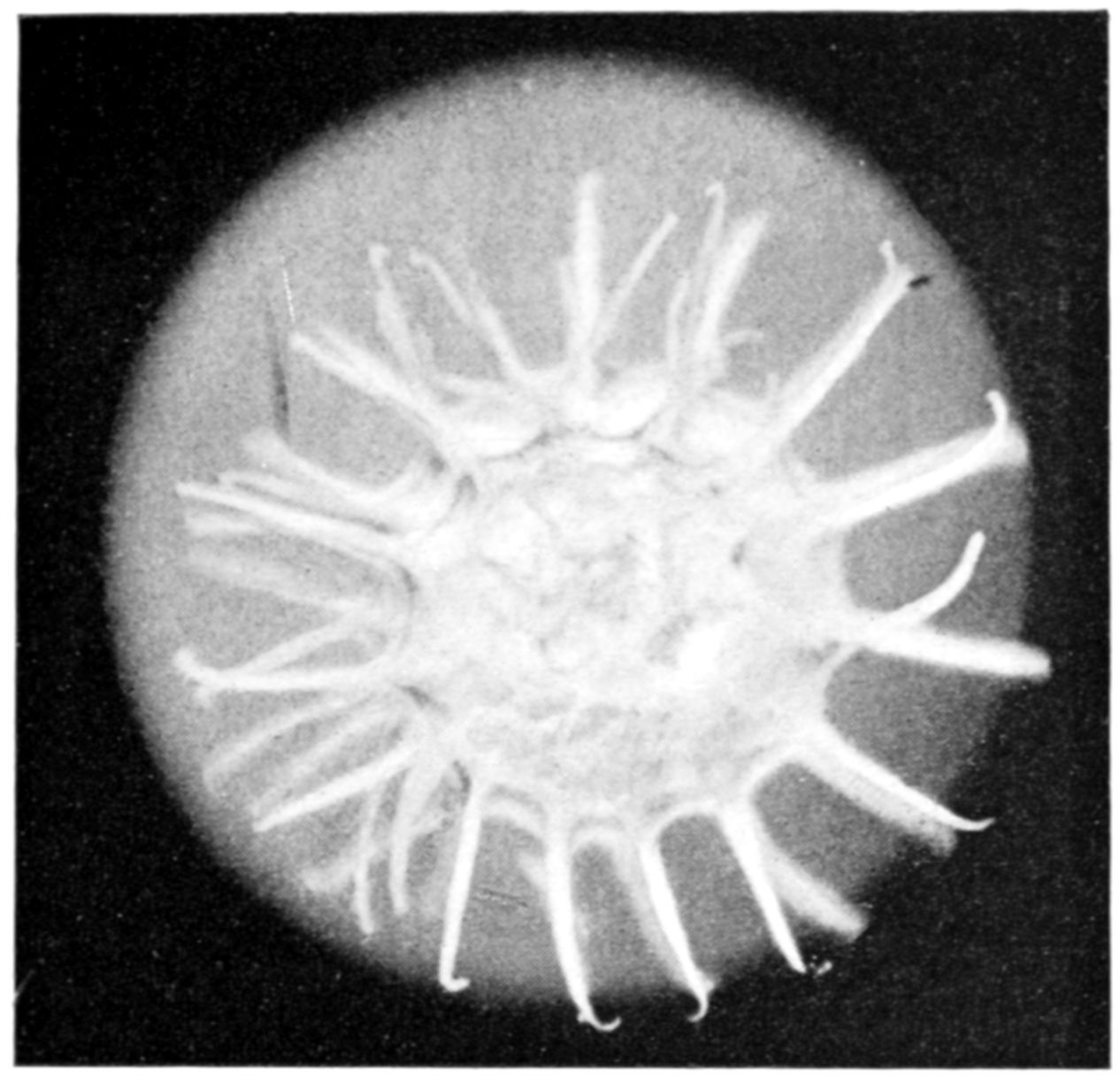
Bur Clover Pod
Magnified six diameters
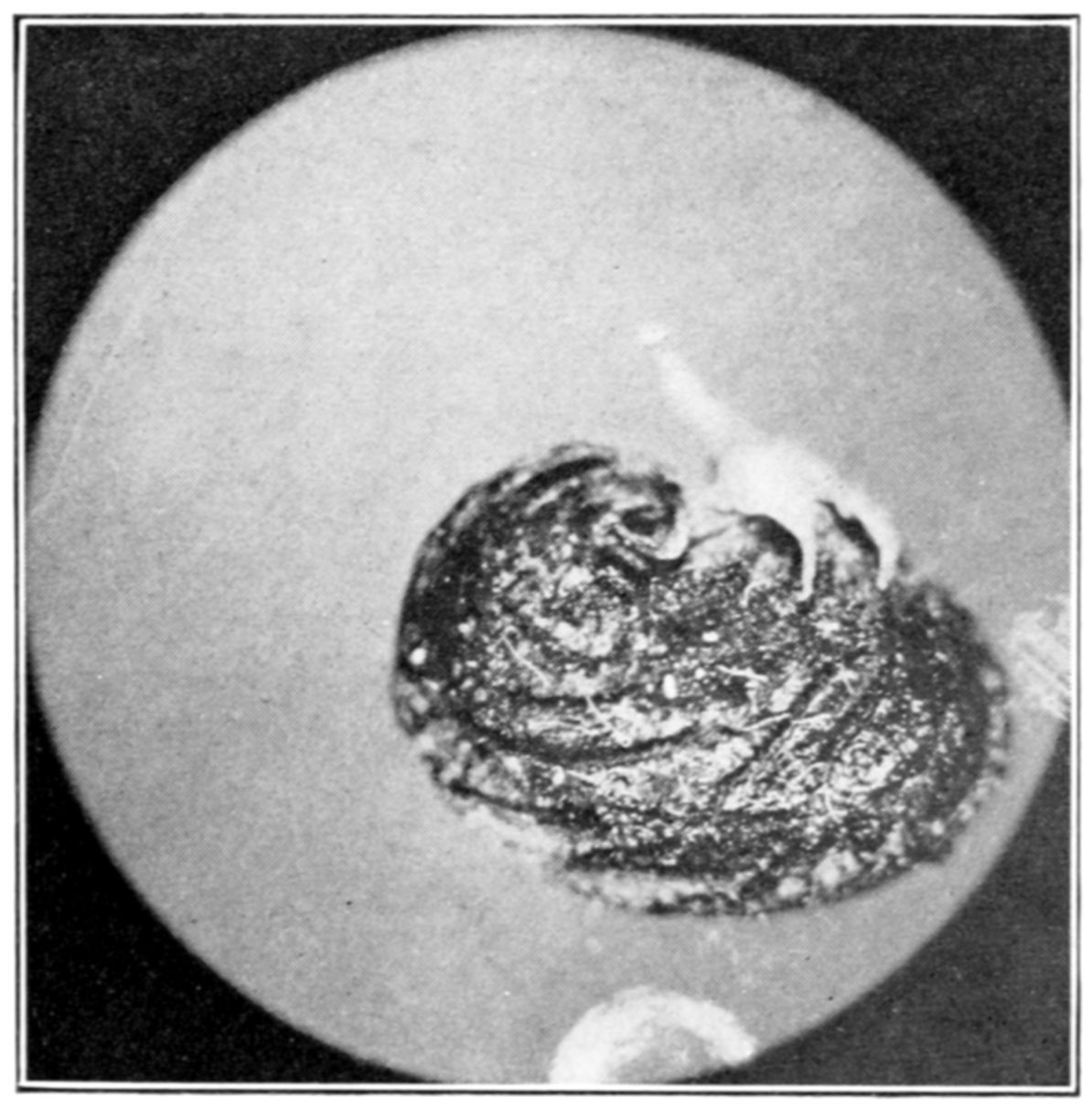
Yellow Trefoil Seed Pod
Magnified twelve diameters
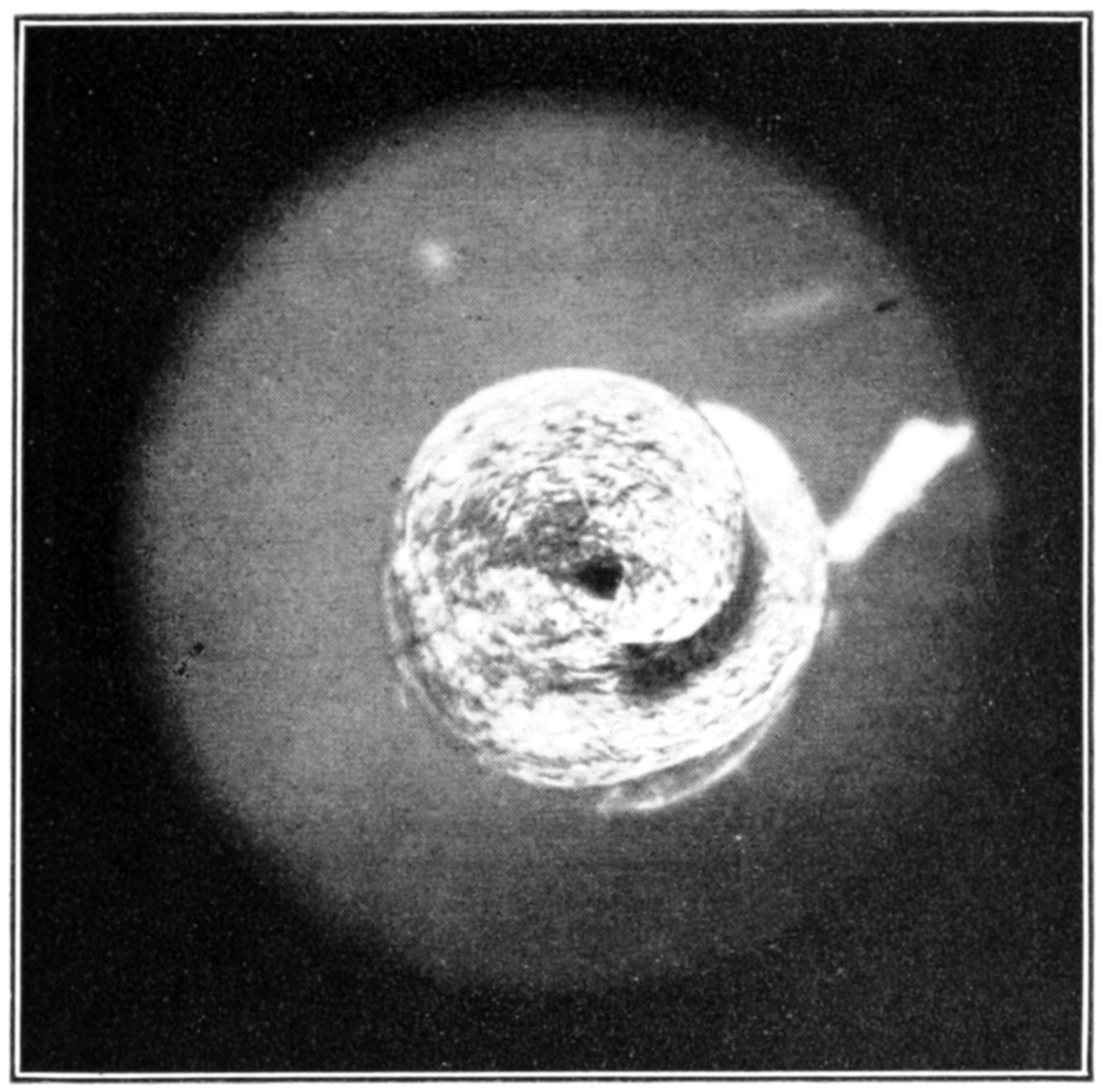
Alfalfa Seed Pod
Magnified six diameters
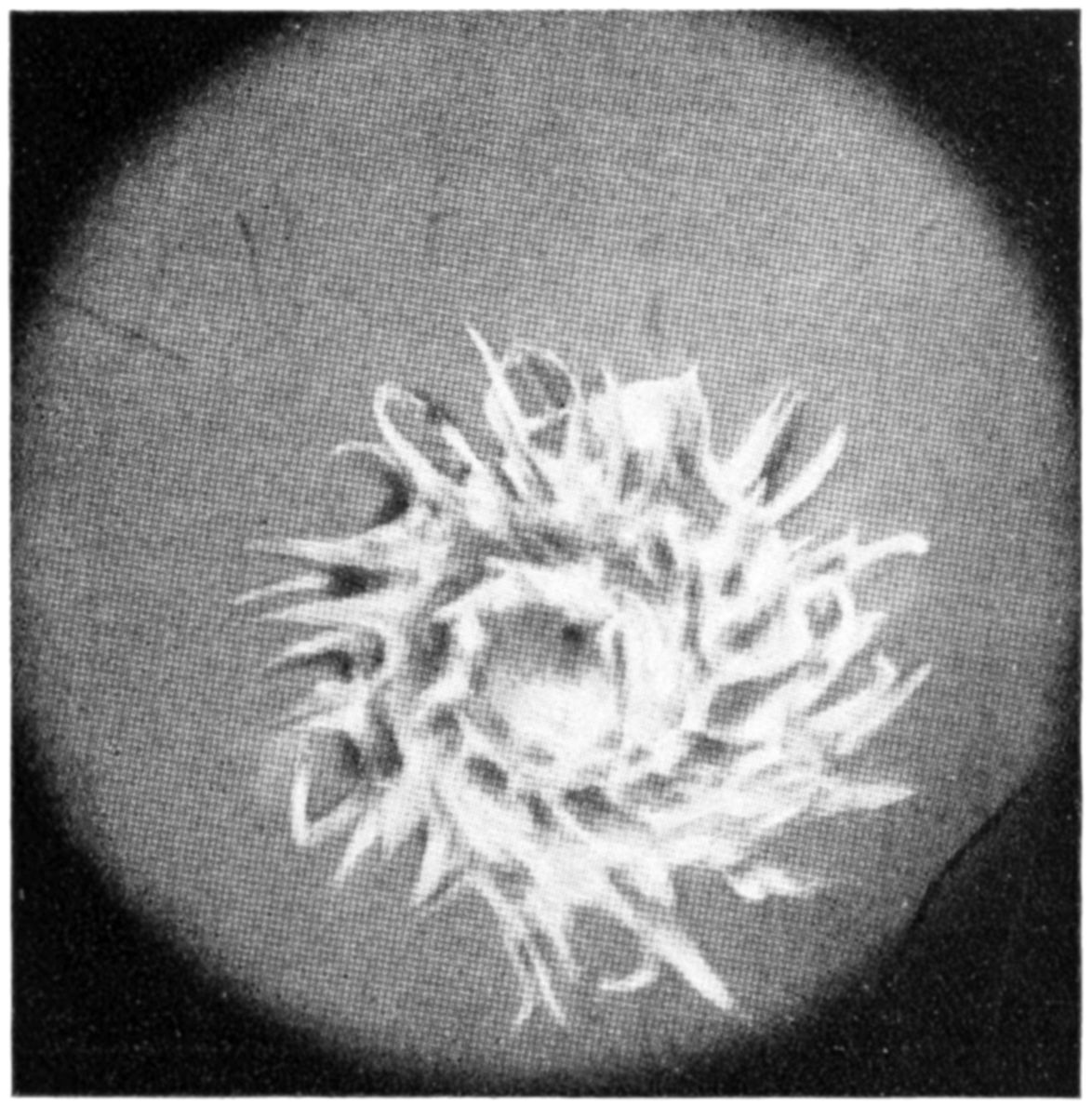
Spotted Clover Pod
Magnified six diameters
CHAPTER VI. Cultivation — CLIPPING IS AN INVIGORANT — MANURING — DISKING — RESEEDING — ALFALFA UNDER IRRIGATION — INFLUENCE OF IRRIGATION UPON COMPOSITION — WIDE VARIATIONS IN CONTENT — WATER REQUIRED BY ALFALFA; QUANTITY AND DATE OF APPLICATION — DATE OF HARVEST AND YIELD OF HAY
Strange as this title may seem it suggests a very
important means of securing a satisfactory stand. In fact
in some parts of the South, where the land has become
very foul, it is occasionally recommended to sow the
alfalfa in rows, eighteen inches apart, for regular cultivation
the first season. After the second year the crowns
will have sent up so many stems that the surface of the
ground will be well occupied. Spurrier, in his work
referred to in Chapter I, recommended drilling in rows
and cultivating the first year. But it is better to get rid
of the weeds before trying alfalfa. The cultivation here
recommended is clipping, manuring, disking and harrowing.
Frequently when alfalfa is sowed in the spring
it comes up weak and spindling. In such case clip it
just before ready to bloom, having the mower sickle set
rather high. If the growth is not very heavy, leave this
cutting on the ground; if quite heavy, remove it. The
field may need to be clipped again during the summer,
but the farmer can feel reasonably assured that he will
have a good stand the following spring. If the leaves
turn yellow, mowing is the remedy. If there is any sign
of the “spotted leaf” disease, the mower should be used
forthwith. Of course if alfalfa comes up strong, vigorous,
and free from weeds, it should stand until blossoming
is well begun and then be mown for hay.
It should not be supposed that the purpose in clipping
and allowing the clippings to remain on the ground is
primarily to make a mulch. It is to retard the weeds,
and as no other way equally convenient and economical
has presented itself, the young growths are mown and
left on the ground.
In many parts of the country Crab grass (Panicum
sanguinale) is the plant or weed that most persistently
interferes with the prosperity of alfalfa during its first
year, and frequent mowing is the remedy most recommended
and resorted to, but there are growers who maintain
that such treatment is not best. An extensive and very
successful grower in southern Kansas tells the author
repeated experience has demonstrated to his satisfaction
that the advice to mow alfalfa frequently during the first
summer may under some circumstances be quite wrong.
If the season happens to be wet, and there is a rank
growth of Crab grass, frequent mowing causes the Crab
grass to set in a close sod and smother out the alfalfa.
He says: “My practice has been, under these conditions,
to let the Crab grass grow with the alfalfa until matured,
before mowing. The young alfalfa will usually keep its
head out sufficiently to breathe, and will survive until the
Crab grass is matured and all is cut. If allowed to
mature, the Crab grass will not start a second time, and
the alfalfa immediately springs up and occupies the
ground. Where the Crab grass is very rank it may sometimes
be blown down in spots and smother out some
alfalfa, but even under these conditions one will have a
much better stand than is possible by repeated mowings.
This is not mere theory, but has been proven correct by
frequent experience and close observation of the other
method during the same seasons.” Something similar
may be said of Witch-grass (Panicum capillare), which,
however, is less obnoxious than the Crab grass, because
of not having the habit of rooting at the joints.
In many parts of the country Crab grass (Panicum
sanguinale) is the plant or weed that most persistently
as to make burning in the spring seem the most feasible
means of getting rid of them, and fire is resorted to. Prof.
A. M. Ten Eyck says he has seen this done a number of
times without injury to the alfalfa crowns. He, however,
recommends disking after burning, to loosen the exposed
soil and leave the surface generally in a better condition.
Sowing additional seed on the ground before such disking
may do much to improve and thicken the stand.
The editor of the Nebraska Farmer has been collecting
information on alfalfa culture from every section of the
United States for the past ten years, and as a result of
this work unhesitatingly advances the opinion that “nine-tenths
of the failures with alfalfa have been due to failure
or neglect to cut it as should have been done when
young. This is the law of alfalfa culture; it must be cut
down. And the man who has not the courage, morally
and physically, to use a mowing machine persistently had
best pass by alfalfa culture. It takes moral courage to
cut baby alfalfa; but it must be cut down to save it.”
A light top-dressing of manure after sowing, or, in
case of fall sowing, any time during the winter, helps to
conserve moisture as well as to give the growing plants
some nitrogenous food. Applying a top-dressing of
stable manure at least every second or third winter is
certain to prove profitable. If it contains coarse straw or
other litter, this should be raked and hauled off later, but
before the alfalfa grows too high, especially if the hay is
intended for the city market. Many successful growers
in Kansas, who claim to cut from five to seven tons of
alfalfa hay per acre in a season apply a top-dressing of
manure every winter. The highest yields reported from
eastern states are where this practice is followed. Some
experiment station men believe that where this is not done
the crop will after eight or ten years tend to impoverish
the land instead of further improving it.
The foremost method of cultivation is with the disk
harrow, one of the most excellent farm implements ever
invented. Alfalfa sown in the fall is almost invariably
helped by disking the following spring, with the disks set
quite straight, so as not to cut the crowns but to split
them. It is usually well to follow this disking with a
tooth harrow, with its teeth set straight. Occasionally
in a dry summer the disk may be used to great advantage
after the second, and possibly the third, cutting also.
Many disk their alfalfa field every spring, and some
after each cutting, others do so only once in every two
or three years, owing to weather conditions and the conditions
of the alfalfa. In some instances the common
harrow is used instead of a disk.
The disking has several beneficial effects. It splits
and spreads the crowns, causing more and consequently
finer stems to spring up, affording hay of the most
delightful quality, easily cured; it loosens the soil about
the crowns, conserves moisture and destroys the weeds.
There need be no fear of killing the plants if the disks
and the harrow-teeth are set straight and weighted or
otherwise adjusted to give direct and steady forward
movement. As an implement for the cultivation and invigoration
of an alfalfa field the disk harrow has no
equal, and its frequent use is by those who know it best
deemed quite indispensable.
If it is a question of reseeding the whole field, the
problem is simple. In that case disk and harrow the
ground and sow half as much seed as was sowed at first.
But to restore bare spots is more difficult; the young
plants from the reseeding in these spots will be shaded
by the larger growth about them, and such reseeding
seldom gives the desired results. There is no doubt that
very many fields are given up as failures and inferior
crops planted in them, when a thorough disking would
have renewed the growth, saved a crop, and, what is more
important, a stand of alfalfa. Many reports have come
to the writer of fields that had little sign of life the first
of March, yet when thoroughly disked, cross-disked and
harrowed, surprised the neighborhood by showing in
two weeks a strong growth.
Some wishing to be on the safe side, have sown a
little seed after this heavy disking and harrowing, but
many of them have reported an entire loss of the seed,
as the plants from the previous sowing came up so thick
as to choke out those from the later seeding. In some
states a common plan of thickening a stand is to let the
third crop ripen seed, and then about the last of September
disk and harrow the seed into the ground where it
grew. This frequently saves the stand and adds many
years to its life. But where a field begins to fail after a
third year it is usually better to plow it up and raise one
or two crops of corn, a crop of oats or of millet, and
then reseed.
The greatest yields of alfalfa are produced by irrigation.
Reported yields of six or more cuttings, aggregating
eight to twelve tons per acre each year, are almost
invariably, yet not always, from districts where irrigation
is practiced. It is claimed by experiment station experts
from the irrigation states that the tendency is to use too
much water; too much at a time and too often. The
general recommendation is to irrigate thoroughly before
the ground is plowed or disked, and not again till
the alfalfa is about four inches high. Then again a week
before each cutting. It has been found that old alfalfa
fields do not need as much water as new fields, the alfalfa
roots seeming to find moisture and bring it to the surface.
It is insisted that the surface must be perfectly
smooth to keep water from settling into low places and
smothering the plants. Some farmers do not irrigate for
the second crop if as much as two inches of rain falls
after the first mowing. Others claim that old fields do
not need flooding for the second crop even if there has
been no rainfall after the first cutting.
Wilcox in his “Irrigation Farming”[3] says: “The
critical time with alfalfa is the first six weeks of its
growth. Flooding during this period is quite certain to
give the plants a backset from which they seldom fully
recover before the second, and sometimes not before the
third year, and it is not often in the arid states that rain
falls with sufficient frequency to dispense with the necessity
for irrigating the plants while small. By soaking
the earth from thirty-six to forty-eight hours before
seeding, however, the plants will make vigorous growth
until they are ten to twelve inches high, after which they
may be irrigated with safety.
“When alfalfa has become established, a single copious
irrigation after each cutting will ordinarily be found sufficient.
Irrigation before cutting is undesirable, because
it leaves the earth so soft as to interfere with the movement
of machinery and loads. It also makes the stalks
more sappy, and, while they will retain the leaves better,
there is more difficulty to be experienced in the curing
at harvest time; and taken all in all, we much prefer to
irrigate after each cutting. In Colorado we cut alfalfa
three times and often four times in a season, hence the
stand gets as many irrigations. Some people irrigate
very early in springtime, before the crowns have awakened
from their hibernal rest, but this practice is not
right. The chill of the water in very early spring is not
conducive to quick growth and may often retard the
plants in getting an early start. We do not irrigate
prior to the first cutting unless the season is particularly
dry and the plants seem to actually demand water. We
irrigate late in the fall and apply a top-dressing of light
barnyard manure, which is found to be of great service
in several ways.”
I find no report of experiments published by any station
in which the influence of irrigation upon alfalfa hay
is made a special study, but Bulletin No. 80 of the Utah
station contains a great deal of information along this
line relative to grain crops, potatoes, and mixed grasses.
In summing up the results of the experiments, the following
conclusions are
“Heavy irrigations increase the percentage of weight
of the heads of plants; light irrigations increase the relative
weight of leaves.
“Irrigation modifies definitely the composition of
plants and plant parts; the seeds are affected more than
any other plant part.
“The percentage of protein in corn kernels was increased
from 12.05 to 15.08, as the amount of irrigation
decreased; in oat kernels from 14.07 to 20.79; in
wheat kernels from 15.26 to 26.72. In all these seeds
the fat and nitrogen-free extracts were increased by liberal
waterings.
“Increased irrigations increased the starch content
and decreased the protein content of potatoes.
“The water in plants is somewhat dependent on the
water in the soil.
“The proportion of ear corn to stover increased regularly
with the increased application of water.
“The percentage of grain in the wheat crop increased
with increased irrigations.
“The yield of wheat increased up to thirty inches of
water.
“Crops in an arid district require a greater number of
pounds of water for one pound of dry matter than in
humid climates.”
The experiments cited do not include alfalfa, yet the
results with other crops would indicate that the percentage
of protein in alfalfa hay may be less where the crop
is grown by irrigation than where it is grown by dry-land
farming. The composition of the hay, however,
will depend upon the quantity of water supplied to the
crop and not upon the method; that is, alfalfa which
receives as much natural rainfall as other alfalfa would
receive by irrigation, would be similarly affected in composition,
and from the experiments with grains reported
in the bulletin noted, it would appear that with the application
of large quantities of water the percentage of
protein is decreased; yet, the yield is increased, and
although the feeding value of the crop may be a little
less, the quantity may be greater, due to large applications
of water.
Professor Ten Eyck compiled from their station
bulletins the following figures on the composition of
alfalfa hay in four different states:
| |
Bulletin
Number |
Protein |
Carbo-
hydrates |
Fat |
Number
of
Analyses |
| |
|
Per Cent |
Per Cent |
Per Cent |
|
| New Jersey |
148 |
15.84 |
38.97 |
3.82 |
2 |
| Colorado |
39 |
17.36 |
36.71 |
1.65 |
9 |
| Utah |
61 |
9.22 |
43.25 |
.97 |
29 |
| Kansas |
114 |
11.89 |
41.03 |
.66 |
3 |
On this showing he remarks:
“Although it was not definitely stated, I take it that the
Colorado and Utah hay were grown by irrigation, while
the New Jersey and Kansas hay received no irrigation.
It will be observed that while the percentages of protein
and fat in the Utah samples are low, the percentage of
carbohydrates is high; yet the Colorado samples grown
under irrigation show a larger percentage of protein
and fat than the Kansas samples grown without irrigation.
The crude protein often varies in quantity according
to the stage of maturity of the alfalfa when it is cut
for hay, as shown by experiments at the Kansas station,
and described in Bulletin No. 114.
“The general conclusion may be that the protein content
of alfalfa hay will decrease to some extent, according
as the supply of water furnished the crop is increased;
that is, by supplying the right quantity of water, a
better quality of hay may be grown by irrigation than is
often grown in humid climates in soil which receives only
the natural rainfall. From what I know of the Colorado
and Utah stations, I would judge that the quantity of
water supplied at the Utah station was much larger than
that supplied at the Colorado station. At the Colorado
station the supply of irrigation water is often limited,
and hence, the larger percentage of protein and fat which
appears in the samples of hay grown and analyzed at
that station.”
The annual report of the secretary of agriculture
(1904) says that at the Utah station a series of co-operative
experiments is in progress to determine the water
necessary, and the most favorable method of application,
to insure a maximum yield of alfalfa, and also experiments
to determine the minimum application of water
required to secure a crop. “It has been found that abundant
irrigation throughout the season, 61 inches of water
being applied, gave a yield of 6.2 tons per acre, while
four irrigations in the early part of the season with only
25 inches gave five tons per acre, showing that beyond a
certain supply the excess is wasted.”
A. S. Hitchcock, in United States Farmers’ Bulletin
No. 215, speaking of the Utah experiment just mentioned,
says that where the supply of water is limited a much
less quantity than is ordinarily used will produce paying
crops. The minimum quantity to produce a crop of
alfalfa, and the time at which the water should be applied,
depends upon the soil and climatic conditions. Below are
results of experiments in 1903, by the Utah station:
| Date of each irrigation and quantity of water applied |
Total
Water
applied |
| First |
Second |
Third |
Fourth |
| |
Acre in. |
|
Acre in. |
|
Acre in. |
|
Acre in. |
Acre in. |
| June 16 |
3.360 |
July 29 |
3.359 |
.... |
.... |
.... |
.... |
6.719 |
| June 29 |
5.970 |
July 29 |
3.359 |
Aug. 19 |
3.359 |
.... |
.... |
12.688 |
| June 16 |
5.070 |
July 8 |
5.036 |
Aug. 6 |
5.003 |
.... |
.... |
15.109 |
| June 29 |
7.020 |
July 8 |
5.036 |
Aug. 19 |
5.002 |
.... |
.... |
17.058 |
| June 15 |
5.030 |
July 3 |
5.100 |
Aug. 1 |
5.036 |
Aug. 24 |
5.002 |
20.168 |
| June 20 |
6.774 |
July 8 |
6.694 |
Aug. 19 |
6.682 |
.... |
.... |
20.150 |
| July 8 |
12.490 |
Aug. 9 |
12.506 |
.... |
.... |
.... |
.... |
25.002 |
| June 20 |
8.303 |
July 6 |
8.352 |
Aug. 19 |
8.362 |
.... |
.... |
25.017 |
| June 15 |
6.320 |
July 6 |
6.248 |
Aug. 1 |
6.248 |
Aug. 29 |
6.250 |
25.066 |
| June 16 |
6.250 |
June 23 |
4.280 |
June 30 |
5.705 |
July 7 |
[4]5.230 |
61.465 |
| June 23 |
6.250 |
July 7 |
6.220 |
Aug. 15 |
6.250 |
Aug. 31 |
6.250 |
24.970 |
| June 16 |
6.250 |
July 7 |
6.220 |
Aug. 6 |
6.750 |
Aug. 31 |
6.250 |
25.470 |
| June 23 |
6.610 |
July 7 |
3.720 |
Aug. 15 |
3.250 |
Aug. 31 |
3.750 |
17.330 |
| June 16 |
3.980 |
July 7 |
3.720 |
Aug. 6 |
3.750 |
Aug. 31 |
3.750 |
15.200 |
| Date of harvest and yield of hay at each cutting |
Total
yield
of plat |
Calculated
yield
per acre |
| First |
Second |
Third |
| |
Pounds |
|
Pounds |
|
Pounds |
Pounds |
Tons |
| June 26 |
264 |
|
Aug. 12 |
50 |
1⁄2 |
.... |
.... |
314 |
1⁄2 |
3.145 |
| June 26 |
177 |
|
Aug. 12 |
101 |
|
.... |
.... |
278 |
|
2.780 |
| June 26 |
261 |
|
Aug. 12 |
68 |
1⁄2 |
.... |
.... |
329 |
1⁄2 |
3.205 |
| June 26 |
204 |
|
Aug. 12 |
108 |
1⁄2 |
.... |
.... |
312 |
1⁄2 |
3.125 |
| June 26 |
191 |
|
Aug. 12 |
85 |
1⁄2 |
.... |
.... |
276 |
1⁄2 |
2.765 |
| June 26 |
175 |
|
Aug. 12 |
74 |
|
.... |
.... |
249 |
|
2.490 |
| June 26 |
93 |
|
Aug. 12 |
62 |
|
.... |
.... |
155 |
|
1.550 |
| June 26 |
99 |
|
Aug. 12 |
44 |
|
.... |
.... |
143 |
|
1.430 |
| June 26 |
224 |
|
Aug. 12 |
140 |
|
.... |
.... |
364 |
|
3.640 |
| June 18 |
176 |
1⁄2 |
Aug. 10 |
177 |
1⁄4 |
Oct. 16 |
120 |
1⁄2 |
474 |
1⁄4 |
6.243 |
| June 18 |
170 |
1⁄2 |
Aug. 10 |
136 |
1⁄2 |
Oct. 16 |
73 |
3⁄4 |
380 |
3⁄4 |
5.017 |
| June 18 |
147 |
|
Aug. 10 |
141 |
|
Oct. 16 |
61 |
|
349 |
|
4.598 |
| June 18 |
105 |
|
Aug. 10 |
112 |
1⁄4 |
Oct. 16 |
46 |
|
263 |
1⁄4 |
3.468 |
| June 18 |
112 |
1⁄2 |
Aug. 10 |
106 |
|
Oct. 16 |
35 |
|
253 |
1⁄2 |
3.340 |
“It will be observed that the maximum crop was produced
by applying plenty of water throughout the growing
season. However, it is also to be noted that a much
less quantity of water, when applied at intervals of three
or four weeks, produced a fair crop. Fifteen and 17
inches of water applied in this way produced more than
half as much as 61 inches applied at frequent intervals.
Furthermore, three irrigations of 15 to 17 inches produced
about the same results as the same amount applied
at four irrigations. In applying irrigation water to
fields it is necessary to saturate the soil to a reasonable
depth. All the water that drains off beyond the amount
required for use is lost to the crop. It is not necessary
to apply water again until the crop has removed a large
part of the available supply.”
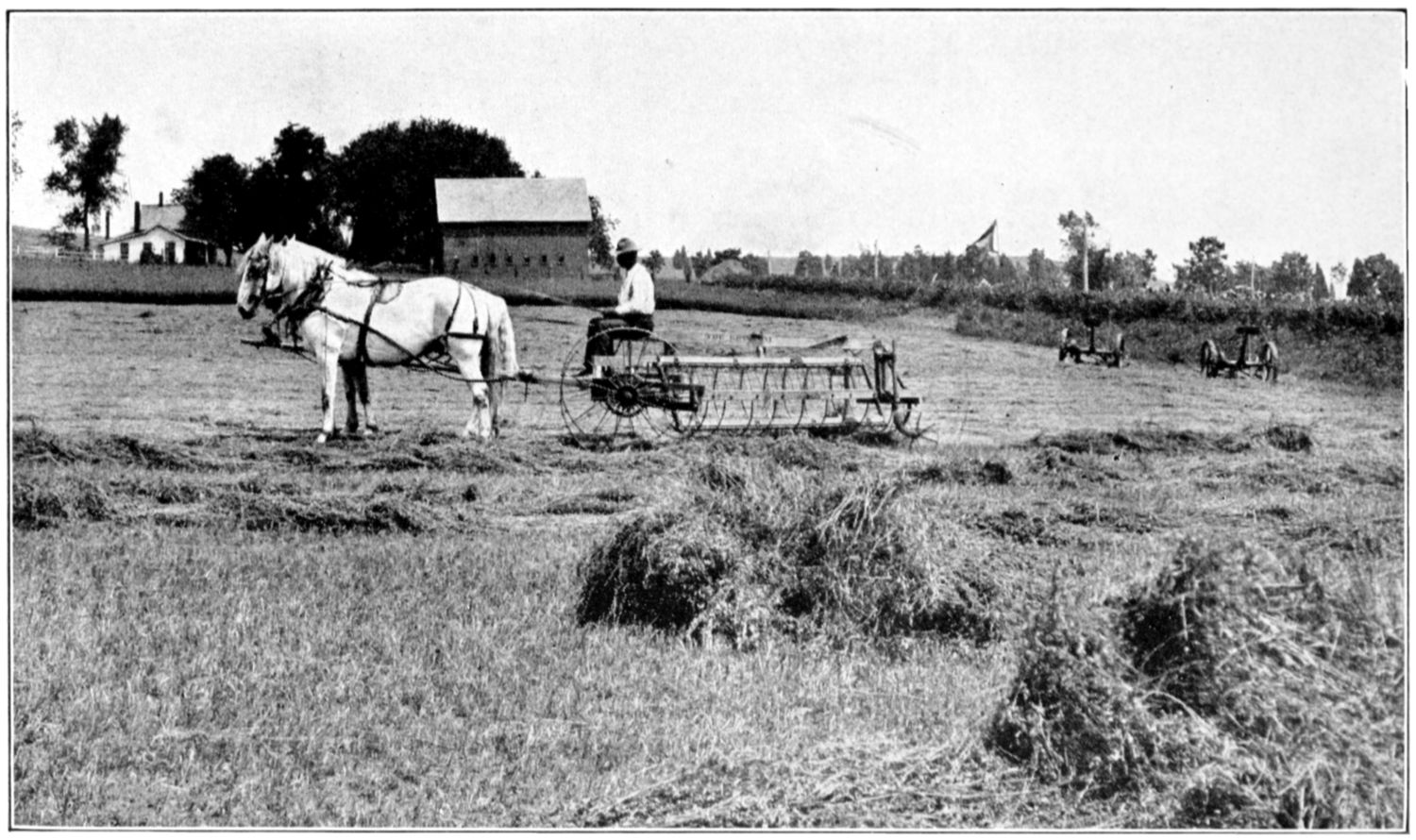
Gathering Alfalfa Hay in Windrows with a Side-delivery Horserake
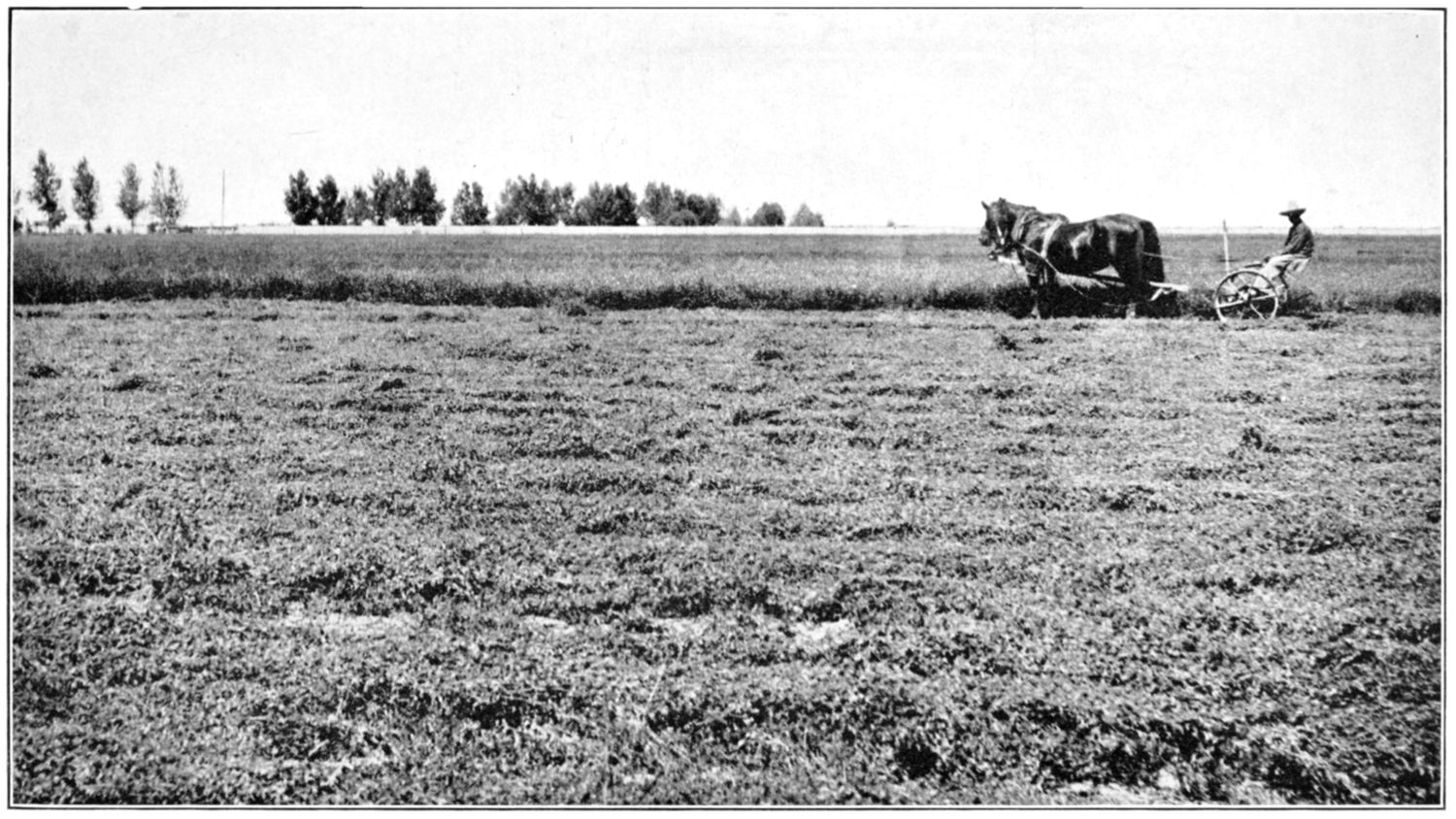
Cutting a Fine Field of Alfalfa
CHAPTER VII. Harvesting — CALLS FOR INTELLIGENCE AND PAINSTAKING — GREAT VALUE OF LEAVES — WHEN TO CUT — MOST PROTEIN IN EARLY CUTTINGS — CONSTANT WATCHFULNESS DEMANDED — LOSSES IN CURING — HARVESTING IN HUMID REGIONS — THE USE OF HAY-CAPS — HARVESTING FOR SEED — YIELDS OF SEED — THE THIRD CUTTING FOR SEED
Considerable space in this volume is devoted to the
discussion of soil and seeding, but their importance cannot
well be over-estimated. Really the whole subject of
alfalfa might well be treated under the two heads,
“Seeding” and “Harvesting,” so very inclusive are these
two phases of the subject. Without careful seeding one
cannot have a crop to harvest, and without careful harvesting
he might almost as well not have a crop. Both
call for intelligence and painstaking farming, and much
patience and hard work. But the rewards of these virtues
and labors are heavy yields from the most valuable
forage plant. If it is worth nine times as much as timothy,
it can well demand a little more time and labor than
the average crop.
The first point to accentuate as we approach the subject
of harvesting is the preeminent value of the leaves.
These contain from seventy-five to eighty per cent of the
protein of the whole plant, that valuable compound that
goes to produce milk and meat. It has been estimated
that a ton of properly cured alfalfa leaves is equal in protein
to 2800 pounds of wheat bran; and when it is also
estimated by careful observers that the loss of leaves in
harvesting, even under favoring circumstances, ranges
from fifteen to thirty or more per cent it is readily seen
that the harvesting is an important part in alfalfa haymaking.
For the best hay the cutting should begin when the
alfalfa is about one-tenth in bloom. Of course, if the
acreage is small, calling for but one or two days’ cutting,
it might stand without particular harm until a fifth or
fourth was in bloom. Cutting should be completed, if
possible, by the time one-half is in bloom, as after that
it is cut at a loss of leaves. As they have more experience
the tendency among farmers is to cut alfalfa earlier than
had before been believed at all desirable, and some
experienced growers and feeders now insist upon cutting
just before the blossoming stage is reached.
Experiments seem to show that horses like the hay that
has been cut when at least half in bloom, or later, better
than do other stock. For sake of the after effects on the
plant, it is highly important that the first cutting be made
in the early bloom, as, if it is delayed, the second crop
starts more slowly and gives a lighter yield. Frequently
a short delay in cutting the first crop means that the field
will produce but two crops instead of three or four. So
important is this that Prof. H. M. Cottrell declares that
he has found it profitable to cut the first crop of a season
in earliest bloom even if it were to be injured by being
rained upon, or in fact entirely lost.
The Utah experiment station found by a feeding test
that the early cut alfalfa was worth far more than any
later cutting. It reported:
| Stage of Growth |
Hay worth,
per ton |
Beef, lbs.
produced |
| When 1⁄10 in bloom |
$5.35 |
706 |
| When in full bloom |
4.90 |
562 |
| When 1⁄2 of blooms have fallen |
4.35 |
490 |
The Kansas station found the protein content to be:
| Stage of Growth |
Protein
content |
| When 1⁄10 in bloom |
18.5 |
per |
cent. |
| When 1⁄2 in bloom |
17.2 |
„ |
„ |
| When in full bloom |
14.4 |
„ |
„ |
In humid regions, the alfalfa farmer at the time of
the first cutting often finds himself in a trying position.
The value of the leaves demands early cutting, and
this may be just when it is likely to rain with great
frequency. He knows that a wetting will injure his
hay, and that this results in more or less loss of some of
its most valuable parts from the hour of cutting until it
is thoroughly cured. The Colorado station reports that
alfalfa hay left out for fifteen days after cutting and
rained on twice, lost 26.1 per cent of its feeding value.
Hay left out for seven days and having only one light
rain, lost 10 per cent. Another lot left out three days,
without rain, lost 5 per cent. Wetting delays the curing,
and by the washing the hay loses much sugar, dextrin
and other soluble matters, and also develops fungi.
However, the only thing to do is to cut, exercising good
judgment of course as to the amount each day.
Headden found, at the Colorado station, that in an
average alfalfa plant the stems amounted to forty to
fifty per cent of the weight, while with very leafy, small-stemmed
plants the leaves sometimes form more than
sixty per cent of the entire weight. The leaves were readily
lost if the hay was not handled carefully. He concluded
that the minimum loss from the falling off of the
leaves and stems in careful haymaking amounts to from
fifteen to twenty per cent; and in cases where conditions
have been unfavorable, as much as sixty or even sixty-six
per cent of the entire dry crop is lost. Stated in another
way, with the best of conditions, and with great
care, for every 1,700 pounds of hay taken off the field,
at least 300 pounds of leaves and stems are left scattered
on the ground, “and, in very bad cases, as much as 1,200
pounds may be left for each 800 pounds taken.” A
study of these facts should induce the careful haymaker
to use all possible skill in curing alfalfa, and they show
that it will be profitable to expend more than the usual
amount of labor in saving the leaves, considering that
they are worth, pound for pound, nearly four times as
much as the stems.
Ordinarily, it is not well to cut alfalfa immediately
after a heavy rain, because the wet ground will operate
against proper curing. Begin cutting in the morning,
when the dew is well off. If the weather is fair, the tedder
ought to follow about two hours behind the mower.
It is a mistake to think that the sun is the great curing
agent. Too long exposure to the sun makes the curing
all the more unsatisfactory, besides drying the leaves in
such a way that they crumble and drop off.
As long as alfalfa remains “alive” water will be exhaled
from the surface of the leaves and be pumped constantly
from the stalks in a natural way much as though they
were still standing. On the other hand, if newly cut
alfalfa is spread too long in hot sunshine, the leaves are
scorched to such an extent that transpiration of moisture
from pores becomes impossible. Hence, that in the stalks
can only escape by simple evaporation, which is very
slow. By this means much undesirable, in fact harmful,
moisture in the hay is brought to the barn or stack,
although the leaves of the hay are dry and crisp.
As J. E. Wing has well said in his bulletin (Bul. No.
129 prepared for the Pennsylvania department of agriculture),
“there is a principle to be observed in making
alfalfa hay that applies to making hay from all clovers.
If it can be so managed that the leaves are not at once
burned and dried to powder, the moisture from the stems
is the more easily removed. Leaves are natural evaporators
of sap; stems are not. Therefore, while the leaf
has yet pliancy and some semblance of its natural condition,
it is most efficiently carrying away the sap of the
stem, but when it is dried up it no longer aids in drying
the plant at all. Therefore, the best hay in all respects
is made partly in the shade, in loosely turned windrows,
or in narrow cocks.”
Two or three hours behind the tedder start the rake
and keep it going regardless of the noon hour, and unless
the hay is very heavy it may be put into small cocks, this
to be completed before the dew forms. In humid regions,
hay is cured best and with greatest safety by the use of
hay-caps, and these should be put on the cocks also
before the dew forms, and removed each morning. The
hay may be left in these cocks for four or five days, as
found necessary, and then stacked or stored in the barn.
This may not follow, however, unless the weather is
favorable. Many prefer to leave the hay in the windrows
until the second morning, turning them by hand or
otherwise before noon and putting into cocks in the
afternoon, letting these stand for two or three days. If
it is left in the cocks over three days, they should be
moved or the plants under them will be smothered. All
agree that alfalfa should not lie in the swath over two or
three hours. Most who have ever used a tedder like it
if the alfalfa is less than half in bloom. If half or more
in bloom, the tedder may cause the breaking off and loss
of many leaves. Most experiment stations recommend
that the hay be put into small cocks on the day of the
cutting, if the weather is at all fair, not risking it in the
windrows over night. It is a fact that cocked green
alfalfa, even without caps, will shed much rain, while
when fairly well-cured it will not do so.
A Colorado farmer reported that he started the mower
one morning as soon as the dew was off, followed it with
the tedder one hour later, and with the rake one hour
behind the tedder; he kept a force of men only two hours
behind the rake putting the alfalfa, yet quite green, into
small cocks. These stood through two days of heavy
rain. Later the cocks were opened and found to be
unharmed, and after one day the hay was put into stacks
in excellent condition. This was a somewhat unusual
circumstance, surely, and might not often occur in a
climate less dry than that in some parts of Colorado.
A grower in southern Kansas, however, who harvests
about one thousand tons of alfalfa per year, and is working
with it nearly every day from the second week in
May until November 10, insists that alfalfa, under the
same conditions of rainfall, is much easier to save in fair
feeding condition than red clover. He finds the side-delivery
rake especially excellent for turning over the
green or wet windrows to the sun and air with the least
loss of leaves, and cured thus, after being wet, the natural
color is better preserved. “That alfalfa hay has a
higher feeding value than almost any other, even when
saved under the most unfavorable circumstances, should
be impressed upon the inexperienced.”
Any man who goes into the business of raising alfalfa
anywhere in the rain belt cannot well afford to ignore
hay-caps as a part of his equipment. Comparatively the
cost is slight and the trouble of using them small considered
in the light of their great utility, although the
expense, and the use and care of them may at first blush
appear to be quite formidable. American haymakers
do not seem to appreciate the bad effect of dew upon the
color and aroma of all kinds of hay. Prof. F. H. Storer
in his “Agriculture” (Vol. III, p. 559) says: “One
advantage gained by the use of hay-caps to protect the
cocks during the night, is that they hold in the raked-up
warmth, and keep the hay from cooling off. Thus it
happens that the hay not only improves a little as to dryness
during the night, but is all ready to dry rapidly
when the cocks are again exposed to the air and sunshine,
on being uncovered in the morning. All this as
a normal and constant benefit, to say nothing of the
advantages derived from the caps in case light rains, or
even heavy rains, should fall before the cocks are again
opened. The caps keep dew from settling upon the hay,
moreover, and thus prevent the loss of aromatic matters
that would result if the dew were to dry off from the
hay.”
“With regard to the exclusion of dew, it is not alone its
power to carry off aroma that should be considered.
When dew ‘falls’ it must tend to carry with it any particles
of solid matter that may happen to be in the air from
which it is deposited, and, in this way the spores of fungi,
such as would cause the hay to mold, are put upon it. It
can scarcely be questioned that many of the organisms
deposited with the dew are likely to promote hurtful
decomposition, especially in case the hay should remain
or become damp, and the less of these organisms that
infest the hay the better it will be.”
When the farmer considers that a ton of well-cured
alfalfa hay is worth about as much as a ton of wheat
bran, he ought to see that it is profitable to protect it
from the rain and the dew. He would scarcely hesitate
to provide suitable covering if he had several tons of
bran in the field exposed to the elements. Hay-caps will
soon pay for themselves by the finer quality of the hay
they assure, aside from the larger quantity of the best
grade that their protection guarantees.
Storer further says, “there can be no question as to
the very great merit of hay-caps when properly used.
They are simply pieces of stout, cotton cloth of suitable
size, say 40 to 45 inches square as a minimum, (60 inches
square would be far better—Author) which are thrown
over the cocks when rain is imminent, or at nightfall.
These cloths may have wooden pegs or some sort of
weight attached to each corner to hold them in place; the
pegs can be driven into the ground or pushed under the
hay, as seems most suitable to the size of the cock or conditions
of the weather. The porosity of the cotton cloth
hinders dampness from collecting beneath it at the top
of the cock which it covers.”
Curing alfalfa in dry regions where the problems and
dangers of rainfall do not need any large consideration,
is attended with few of the difficulties which confront
the grower in a region of much humidity. In western
Kansas and Nebraska, and in Texas and other states
where summer rains are somewhat infrequent, the
mowers start at the beginning and do not stop until the
field or fields of alfalfa are all in the swath. The rakes
follow close behind, frequently the side-delivery rake,
and then the gathering implement, usually designated as
a “go-devil,” keep only about a half-day behind, dragging
the cured hay to the stack or rick where the horse-fork
lifts and carries it to the center of the stack, to be
distributed and placed by men with pitchforks. The
market and feeding value of hay so cured and gathered,
is deemed by some authorities as not the highest. Curing
in the windrow alone is likely to be a mere drying (perhaps
too rapid drying) of one side of the exposed
portions. Alfalfa should cure successively in the swath,
windrow, cock and stack or mow, to develop its greatest
value. The man who has so many acres that he cannot
cure it in this way might do better with fewer acres for
hay, and pasture hogs on the remainder, or use the land
for other crops. Still it is true that alfalfa even poorly
cured has no inconsiderable feeding value. Many farmers
in the West and Middle West claim to secure very good
hay by early following the mower with the tedder, this
with the rake, and then the “buncher,” letting the hay
remain in bunches over night and dragging it to the
stack the next day. Others take from the windrow to
wagons by a hay-loader, preferably one operated by a
belt.
After all is said and done, and regardless of thrift and
yield, it is unquestionable that the grower of alfalfa in
humid regions meets with difficulties in the matter of
satisfactory curing that in some years are almost or
quite disheartening, and of a character to which his
brother in arid territory is virtually a total stranger.
Curing in the two regions presents different problems,
with advantage all the time favoring the man in the
country of little rainfall.
Second and later cuttings are not so much endangered
by rains as is the first, and, hence, these are usually cured
in better condition. Notwithstanding this, virtually all
tests point out that the first cutting has more feeding value
and is better relished by all kinds of stock. Most farmers
are agreed that it pays to cut every time the alfalfa
blooms, up to the last of September in the North, and
possibly a month later in the more southern latitudes.
A few have reported that they prefer to make but two
cuttings a year, claiming to realize a greater feeding
value by so doing; but it seems that the loss in leaves
and protein, together with the fact that live stock has less
relish for the more mature cuttings, makes frequent cutting
by far the most profitable.
To sum up, the points to be emphasized in cutting
alfalfa for hay, and its treatment immediately after, are:
Cut in early bloom.
Handle as little as possible.
Prevent its being wet after cutting.
Cure if possible partly in the swath, in the windrow, in
the cock and in the stack or mow.
Cut as often as it blooms, which will range from twice
in New England to nine times a year in southern Oklahoma,
southern California, Texas and Louisiana.
In a region of frequent rains protect with hay-caps.
The first cutting should not be used for seed for three
reasons: First, if that cutting is delayed until the seed
has ripened, the second and third cuttings will be very
light, and in the extreme northern alfalfa territory there
may not be even a second. A stronger reason is that
at the time of the first cutting, favorable weather is
likely to be much less certain and rains will interfere with
the stacking of the seed crop, which, to insure its best
value, must be put in the stack or mow without wetting.
Another is that the seed pods at that season are not
usually so well filled and the proportion of fertile seeds
is less because the bees and other insects have not so
early in the season had time and opportunity to aid in
the pollenation.
Cutting should be done when the greater proportion
of the seeds are hard, but not sufficiently ripe to shell.
At this stage a majority of the pods are turned a dark-brown
color and the seeds are fully developed. Frequently
the cutting can be raked into windrows after two
hours if the weather is drying, and in two or three hours
more put into cocks and let stand for twenty-four to
forty-eight hours, as the weather may justify. It should,
however, be well cured and thoroughly dry when put in
the stack, or there is danger of heating, and stack-heating
seriously injures the vitality of the seed. It is
not uncommon, if extremely ripe, to leave the cutting in
the swath only an hour or a half-hour, then stack, and let
stand for autumn or later threshing. If allowed to
stand in the stack for about thirty days, the entire mass
goes through a sweating and curing process which makes
the threshing easier, while less of the seed is left in the
straw than would be if it had not stack-cured. In western
Kansas many seed raisers cut their seed crop with a self-binder,
put the sheaves in shocks the same day and thresh
in about ten days, or put it into a stack to await a convenient
threshing time. They claim to secure 20 per
cent more of the seed in this way than if they cut with
the ordinary mower. Others cut with a mower having
a dropper attachment which leaves the alfalfa in small
bunches at the will of the driver, in the center of the
swath, and these are “straddled” by the team and the
wheels of the mower in the subsequent rounds. These
bunches are left for two or three days and then stacked.
There is little, if any, danger from mold or spontaneous
combustion in stacks of alfalfa cut for seed, but there is
danger of the seed heating in the stack if stacked when
damp. If bright, clean seed is expected, the stacks must
be well topped with slough grass, or covered with tarpaulins
or boards, or given other protection. It is better
still to put the alfalfa intended for seed into a barn.
One Kansas farmer in the western part of the state
reports that he used a self-binding harvester, shocked
the sheaves like those of grain, let them stand ten days
and then put in a mow, with no bad results.
The yield of seed ranges all the way from two to thirteen
bushels per acre, the normal yield in the seed regions
being four to eight bushels. It is threshed with ordinary
grain separators with seed attachments, although the
clover-huller is usually preferred. No threshing machine
cleans the seed satisfactorily or sufficiently, and a careful
recleaning is necessary. Fanning mills or seed-cleaners
are now made that will remove most weed seeds, seeds
of dodder, and all light-weight and probably infertile
alfalfa seeds. However, no raiser should by rights
thresh, to say nothing of marketing, the seeds of the
dodder or any other weed with his alfalfa; these should
be cut out of the field with scythe, sickle or knife a
month before the alfalfa is cut.
The threshed alfalfa straw is worth only about half as
much as the hay, yet it makes excellent feed for horses,
colts and calves. Or, if put into stacks of alfalfa of the
third cutting, in alternate layers, it may be fed to any
stock to good advantage, as it is relished quite as well
as ordinary third cuttings, notwithstanding its lower
feeding value.
Seed raisers in some instances, especially in Kansas,
use the third cutting for seed, claiming that the pods are
more uniformly filled and the seeds more generally fertile,
due to the assistance of the bees in pollenation. They
claim, too, that this cutting has fewer weeds and weed
seeds than its predecessors; also that they are thus sure
of two good hay crops, while often if they use the second
crop for seed, the third crop is hardly worth more than
the cutting. The only point left in favor of using the
second cutting for seed, where the farmer is confident of
a third, is that the protein value of the second is the
lowest, and hence its hay can better be spared than that
from any other cutting.
The raising of seed in the more humid eastern states
should not, generally, be attempted, as it will not only
interfere with obtaining full value in the hay crop, but the
less fertile soil will not produce as vigorous seed as will
the newer and richer lands west of the Missouri river.
At present the best seed for general use is produced
between that river and the Rocky mountains. Utah produces
a hardy seed, but much if not most of it is raised
under irrigation, and, hence, at least theoretically, not
deemed best adapted for regions dependent entirely upon
soil moisture from rains.
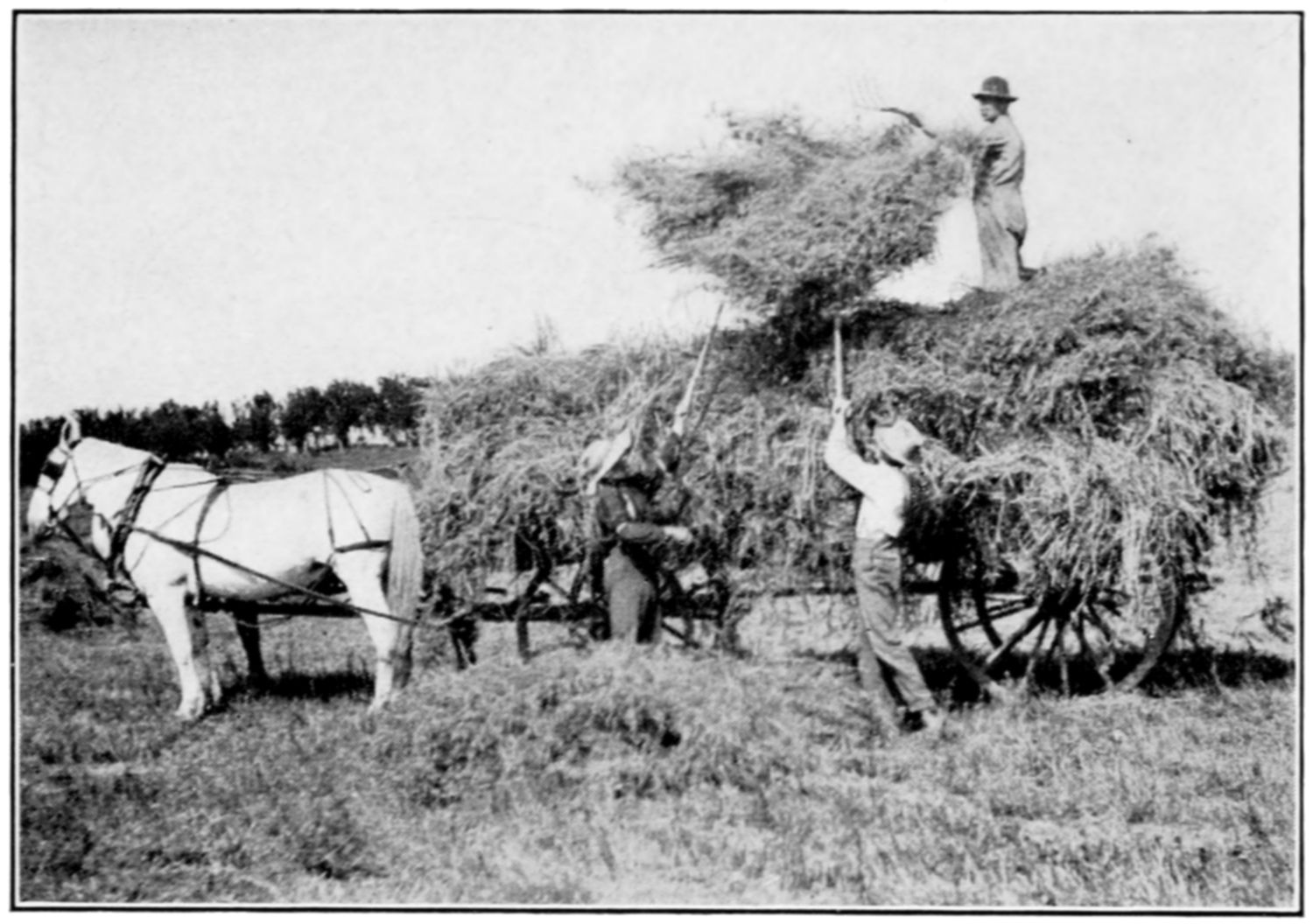
Gathering an Alfalfa Crop in Page County, Iowa
Photograph by courtesy of Henry Field
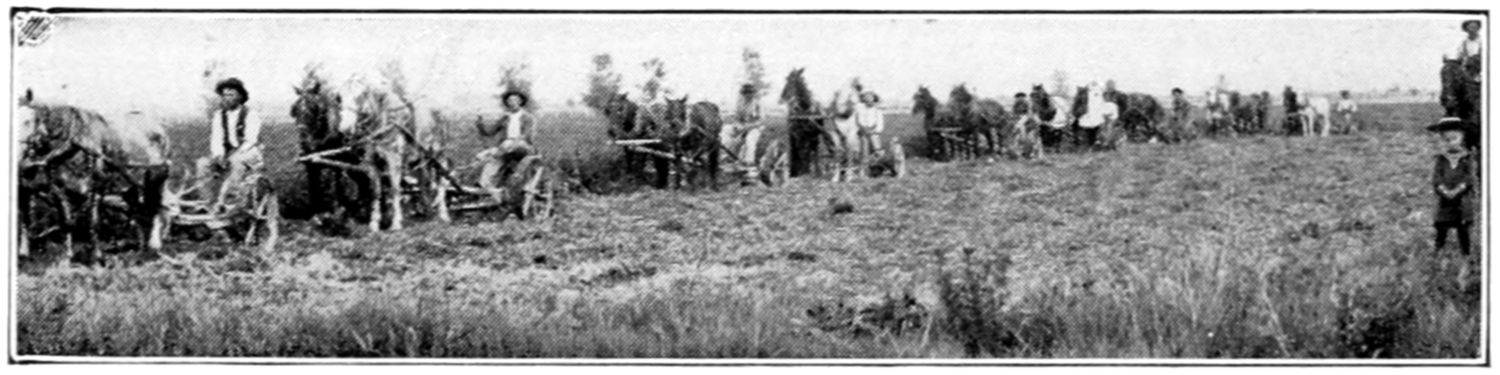
Alfalfa Harvesting Scene in Yellowstone County, Montana
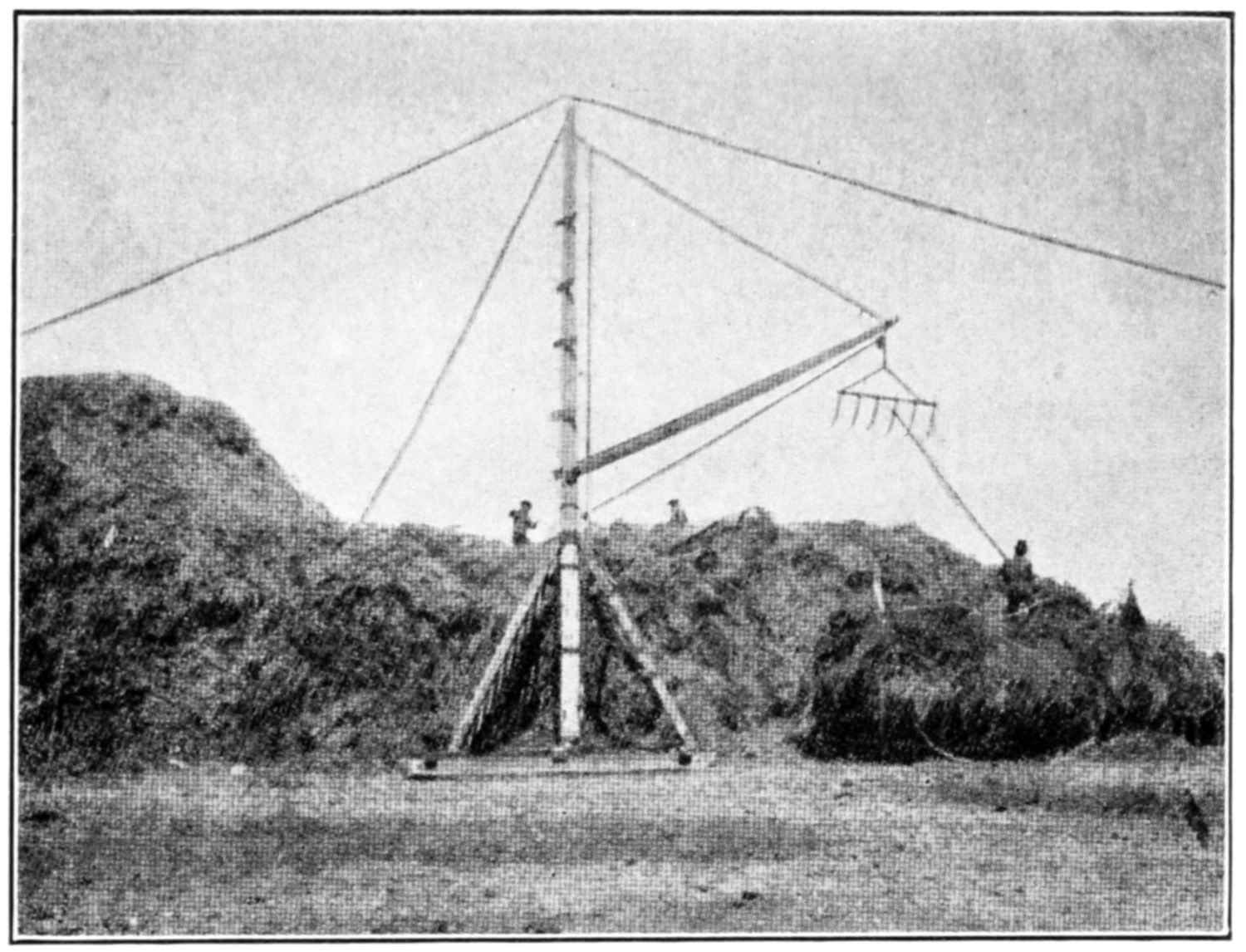
Mast and Boom Stacker, with Six-Tined Jackson Fork
The mast is held in place by guy ropes from the top. Leading to the right
may be seen the rope to which is attached a team of horses. The base
of the derrick is in the form of sled runners, so that the whole
may be drawn along the stack by attaching a team
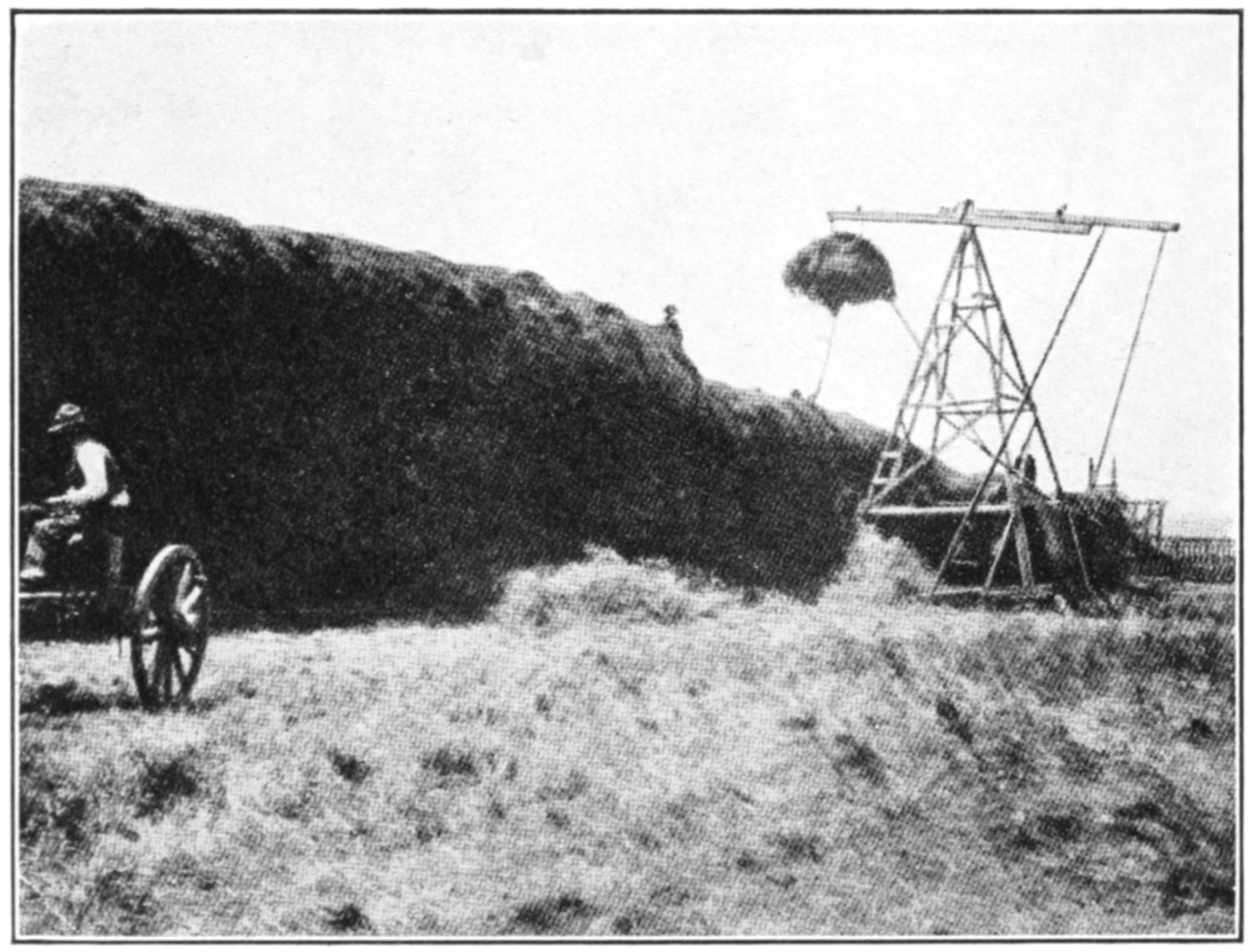
A Derrick Stacker
with six-tined Jackson or California fork. The derrick is substantial, and guy
ropes are not necessary. Stakes driven into the ground around
the base hold the derrick in place
CHAPTER VIII. Storing — CARE IN CURING — PUTTING INTO WINTER QUARTERS — STORING IN THE BARN — LOSSES FROM STACKING — THE HAY SHED — CONDITIONS FOR STACKING — STORING AS SILAGE — OFTEN PROFITABLE TO ENSILE THE FIRST CUTTING — SUGGESTIONS FOR SILOING — BALING — POOR STUFF — GRADING AND GRADES OF ALFALFA HAY
After all possible care has been taken in seeding, cultivating
and harvesting alfalfa, its feeding value may be
greatly impaired or quite lost by ignorance or carelessness
in storing; that is, by stacking or putting it into
sheds or barns, or by baling it for market when in an
unsuitable condition.
The only path to safety in stacking or storing in shed
or mow is having the hay in proper condition for completing
its own curing. The true medium for its curing
is air, not sun; the sun has done possibly more than its
share already. But good hay is not completely and
properly cured in swath, windrow and cock. If cured in
the windrow, the exposed parts are liable to be much
injured by the sun. Therefore the principle stands,
“Handle alfalfa green.” It must be cut green, teddered,
raked and cocked or bunched while comparatively green,
and must not then be allowed to dry and parch to brittleness.
True, it must not be put into a stack so long as it is
possible to wring water out of the stalks. A constant
study should be to find the best method of getting the hay
into storage without loss of its natural color. The method
that will safely store it greenest will be the best to follow.
Handled green the leaves are saved, and these constitute
from 50 to 75 per cent of the whole value.
When (in regions of much humidity) the hay is
safely in cock, covered with hay-caps, and has had a few
days of curing, it is ready for permanent quarters.
Remembering that the hay after its drying has begun
should be handled as little as possible, the cocks have
been made small enough so that two men may lift them
bodily onto a wagon, if a wagon is used in the stacking.
From the wagon, the hay is lifted by a hayfork to the
stack. Or, more careful still, the farmer will use three
slings to each wagon, which are lifted by a hook to the
stack or mow. A sling is a heavy sheet the size of the
wagon hayrack. One is spread on the bottom of the
rack, another on top of the first one-third of the load,
and the other on top of the second third. These slings
are banded at the ends; the ends are drawn together and
a third of the load lifted to the stack or mow, thus saving
in some instances a third more leaves than any other
method.
In arid and semi-arid territory, cocking and loading
on or off wagons are dispensed with by dragging the
rapidly dried hay directly to stacks built in the fields,
where the lifting into place is done with great expedition
by horse implements. A wheel-rake or “go-devil” is used
to take at once several cocks, bunches or a part of a
windrow to a nearby stack. Others use a rope to drag
one or more large cocks to the stack; or, if the hay is to
be taken from windrows, it may be put upon wagons with
a loader. The loader is an excellent implement for handling
timothy and clover, but is apt to shake off a good
many leaves of alfalfa if the hay is very dry. The more
common sling now on the market is made of ropes, four
ropes the length of the hayrack and with ropes across
like a rope ladder, and used to handle one-third or one-fourth
of a load. Others are made like the carriers of a
threshing machine with slats and ropes.
The barn is the best place for alfalfa if all conditions
are right. Cases of spontaneous combustion in stack
and mow make farmers fearful of using the barn, especially
for the first cutting, which is always most difficult
to cure. There are certain conditions that must be
observed if this hay is to complete its curing properly
and safely in the mow. The bottom of the mow should
be elevated at least a foot from the ground, floored with
poles or joists, and they should be about two-thirds covered
with boards or other material in such a way as to
provide numerous openings or air spaces of considerable
size. If the mow already has a tight floor, a part of the
flooring should be removed before the hay is put in.
Then a box or barrel should be placed in the center of
the space and lifted up as the filling proceeds. If the
mow is over thirty feet long, a second barrel should be
used; that is, an air shaft should be left in about each
fifteen to twenty feet. A layer of dry hay or straw sandwiched
in about every four of five feet, as the mow fills,
can be used to much advantage. If the mow is large
enough in length and width, an excellent, safe plan is to
spread the first cutting over the entire bottom, filling up
to a height of four or five feet. The second cutting
may be placed over this, on top of a layer of straw, and
the third cutting over this. There is virtually no danger
from spontaneous combustion or from mold if this is
done, and the hay will be as bright and green and almost
as rich in protein in January as when harvested.
J. W. Berry of Jewell county, Kansas, member of the
board of regents of the state agricultural college, uses
this method and bales his hay in October for the city
markets, finding it in perfect condition. He puts his
hay into the mow green but not wet, direct from
the cocks, or windrows the day it is cut, in layers
about four feet deep, with the slightest possible loss
of leaves, no bleaching and no injury by dew. In 1905
he cut his alfalfa four times and stored the fourth
cutting on top of the three preceding. He says that
having an open floor and plenty of air from the outside,
the hay can be put in the barn as described; that
it should not be tramped, and it will settle and cure perfectly.
The bottom layer or first cutting may show some
dust when taken out if handled loose, but the color will
be good and it will bale in with the other cuttings and all
grade well. Hay cured in this way in 1904 graded
“choice” in the St. Louis market.
Spontaneous combustion does not occur very often,
but it is a possibility, and it is well to bear in mind that
hay may be put in the barn too green. Observation
teaches that it never takes place unless the hay has been
put in the barn while containing a large amount of moisture,
and piled too deep. Alfalfa and other clover hays
may safely be put in the barn when they contain not to
exceed 30 per cent of water. If, however, they contain
much more than this there is considerable danger, especially
where large quantities are put together, as is the
case in large, deep mows and sometimes in large stacks.
A practical test which may be safely followed is to take a
handful of hay, twist it as hard as possible, and if no juice
can be wrung out of its stems, it is dry enough to be put
in the mow. Bunches of wet hay mixed with dry hay
have often caused combustion. Such should always be
discarded. It is poor policy to haul clover hays into a
barn after sundown, as at that time it absorbs moisture
from the atmosphere very rapidly.
It is a good plan for the haymaker to go into his mow
every morning while the hay is curing and observe the
conditions, but he should not, however, become alarmed
if he finds that the top of his hay is very damp. This
will always be the case, even if it was comparatively dry
when put in; considerable heat develops during the night,
which in turn evaporates moisture. The following morning,
when the air is cool, a large percentage of this,
especially if the mow is not well ventilated, is condensed
and settles back on the hay. If the moisture, however,
is excessive, it is a good plan to scatter a load of dry
straw over the top. This will absorb the moisture in
part, after which filling may be continued. In case a
load has been put in the barn too wet, it should be spread
to the outer edges, as there is much less danger of combustion
at these places than in the center. In fact, the
greatest heat is always developed in the center, where the
so-called craters form, and from which moisture and
gases are given off as a result of heating and oxidation
below.
From the fact that spontaneous combustion cannot
take place until the water has all been evaporated, there
is no danger until three to four weeks after the hay has
been stored. During the first week or so, if the hay
heats to such an extent that there is danger of combustion,
it is well to open up the center as much as possible
and allow some of the heat to escape. If, however,
the heating has continued much longer, it is dangerous
practice to open the hay at all, because all that is needed,
after the water has been evaporated, is air, or oxygen to
support combustion, and the mass will at once burst into
flames. Sometimes combustion takes place without
flames, in which case the center of the mow gradually
chars, leaving the hay there as black as charcoal, and
without value.
Professor Cottrell, discussing spontaneous combustion
(Kansas Bul. No. 114), says that all cases observed by
him have occurred in hay of the season’s first cutting—cut
at a time when the growth was rank and the curing
most difficult. A period of wet, muggy weather in July
or August increases the danger, which in dry weather
seems much less. On account of previous trouble from
heating in the barn, he had four years prior to writing
stacked the first cutting out of doors and put only the
later cuttings in the barn.
The Colorado station found that the loss in feeding
value from the hour of cocking to the hour of taking from
the stack was 12.4 per cent, while the loss in hay stored in
the barn was about 2.5 per cent. If we add to this the
stacked hay lost by exposure, it will easily reach more than
20 per cent under average conditions while in many cases
it would reach 40 per cent. This certainly represents an
enormous waste, and by preventing it a man with any
considerable area of alfalfa could soon save enough to
pay for a barn.
After a barn the next best place for storing hay is a
shed with an adjustable or lifting roof. The ground
dimensions should be ample to allow the first cutting to
cover its floor and not be over five or possibly six feet
deep when first put in. The bottom of the mow should be
raised at least one foot from the ground, and the floor
should have at least a twelve-inch air space about every
three feet. Poles or joists covered with dry straw or old
hay make a good floor. Spread the hay over the entire
floor surface, on a layer of straw or other dry material.
Use barrels or boxes as recommended for ventilation in
the barn, and lower the roof until the second cutting. For
such a roof the covering should be of some such material
as ruberoid, and the rafters need not be heavy, except
about every sixteen feet. Strong iron clamps can be
easily adjusted to the supports. When the second cutting
is ready, raise the roof, which should be in sections,
and put the second crop on top of the first. Follow this
plan for all other cuttings. If a shed with a stationary
roof is used, dry straw, or hay, or corn stover should be
put on top of each cutting to protect the alfalfa from
rain. Almost any kind of a shed or covered structure
is preferable to a stack.
If the hay is to be stacked, there are also special conditions
that the experienced insist should be observed. This
is not to say that alfalfa hay stacked under conditions
quite different may not give fair results, and much
depends on the locality and the climate. However, the
result desired is palatable and nutritious hay and not such
as is moldy, stack-burned or dusty. Stacking the hay
directly on the ground is sure to mean a loss of some portion
of it. Elevate the bottom of the stack with poles,
timbers or other like material; put straw at the bottom
and, preferably, build a rick rather than a round stack.
Start the bottom sixteen or eighteen feet wide and build
straight up instead of tapering or slanting the sides, as
alfalfa hay will not shed rain or snow water. If there is
much moisture and it is convenient to do so, use a layer of
straw or dry hay of some kind every five or six feet. Keep
the stack full in the middle, or a little higher than the
sides, and well tramped all the time. When the stack has
reached the desired height, top it out with slough grass,
or dry timothy or prairie hay, or very green alfalfa, or
protect with tarpaulins or boards; the boards may be
nailed and chained together, lapped and weighted at
the corners, making a very satisfactory roof. If these
directions are followed, the losses will be kept at a minimum.
The Kansas experiment station authorities say
that in an experiment made there an application of
salt to the hay when being stored seemed to decrease, if
anything, rather than increase its feeding value. Lime
applied in stacking is claimed to have a beneficial effect in
preventing mold.
The raised bottom and layers of straw are useful accessories
for the stack, shed or mow, while the barrel or
other ventilating contrivances should not be overlooked
in either sheds or mows.
As land values increase and farmers and dairymen
come to more fully appreciate the worth of green feed in
winter, the silo grows in estimation. Eastern farmers
who keep cows or young stock of any kind use the silo
more or less, to conserve for winter the value of both
green grass and corn. Alfalfa makes an excellent silage,
but its peculiar quality of retaining its green food value,
as hay, when properly cured, makes its ensiling much less
a necessity. Alfalfa hay taken from the mow in February,
green, appetizing and nutritious, falls little, if any,
short of serving the purposes of silage.
However, it is not infrequently found that the first
cutting of alfalfa may be ensiled directly from the field
at a season when rains would prevent its proper curing
for hay. If this is done, it is important that the rakes and
wagons follow very closely after the mower, as even two
hours of sun exposure in the swath lessens its value for
silage. Men who have cut alfalfa during a light rain and
raked and hauled it directly to the silo have reported satisfactory
results. Others report having cut it in the
late afternoon and, the next morning, after a heavy rain,
raked and hauled it to the silo while dripping wet.
Therefore the farmer in the eastern and southern states,
in the Pacific Northwest, or even in the central states
may, on occasion, plan for the ensiling of his first cutting,
in the faith that it will come out in fine condition if his
silo is properly constructed.
The Kansas and Colorado experiment stations recommend
that alfalfa for silage should be cut into lengths
of, say, two inches. Long alfalfa does not pack sufficiently
close in the silo, and when so stored the loss is
much more than if in short lengths. It should always be
heavily weighted and great care taken to pack it well at
the outer edges. Round silos are most approved because
their contents are more readily compacted. The points
urged by Professor Ten Eyck, of the Kansas experiment
station, are, (a) getting the alfalfa to the silo
quickly after mowing, allowing little, if any, curing; (b)
cutting the alfalfa into short lengths rather than storing
it whole; (c) packing it tightly, and weighting heavily
when all in. He says, however, that if the weather will
permit proper curing of the alfalfa, it will make more
valuable winter feed as hay than as silage.
The increasing general demand for alfalfa hay in the
city markets of the United States, away from the distinct
alfalfa regions, has made finding a method of preparing
it for economic shipment of much importance.
The compressing of timothy and prairie hay has become
so general that alfalfa raisers and shippers are also following
this method. The problem of saving the leaves,
and, at the same time, being able to market alfalfa green,
has been hard to solve. Baling it uncured meant mold,
and baling it when very dry meant loss of leaves and,
hence, loss in feeding and selling value. The Kansas
station a few years ago carried on a series of experiments
extending over several years from which the conclusion
was that the only safe procedure is to cure carefully in
the field, put in the stack or mow, and bale after the final
sweating—say thirty days. Most of the hay cured and
baled in the field was moldy or brown. It is possible,
however, that a more careful curing, the use of hay-caps,
letting it stand for several days in cock, baling, and then
storing in an open shed, the bales stacked on edge and
separated about every third layer by poles, rails or rafters,
might result in securing high-grade hay direct from
the field without stacking. Seemingly it will never be safe,
away from the semi-arid regions, to bale the first cutting
from the field; but the secret may yet be found of so
baling the second and third cuttings and obtaining prime
hay. Its doing is not likely to prove satisfactory, however,
except in the drier portions of the alfalfa district
where large cocks of, say, 500 pounds may be made and
left standing for several days before baling. But baling
is not likely to be largely followed except in territory
where extensive areas are devoted to alfalfa. When
practically every farmer in the United States has his field
of alfalfa as he now has of corn, cotton or clover, the
greater part of the product will be fed on the farm and
the surplus hauled direct to the local markets. Western
Kansas and Nebraska alfalfa raisers are having this
problem solved for them by the growing practice of
stockmen shipping cattle and sheep from the mountain
ranges to be fed or fattened where the hay is raised, and
hauled directly from the stack to the feed lots.
Hay dealers report that much of the baled alfalfa
shipped is poor stuff. They advise small bales, weighing
about sixty to eighty pounds; about 27 to 36 inches long,
14 or 15 inches thick and 18 inches high when laid on
edge. They also recommend that in loading a car
the bales be placed on their edges instead of on the sides,
as they are less liable to heat. The problem of the city
hay dealer is to sell what he has received, with satisfaction
to the purchaser and profit to himself and to his
client. If he receives moldy, dead hay, with little protein
value, he is not able to please his customer, not able to
secure a good price, and hence, not able to please either
shipper or buyer. The farmer who raises and ships hay
and receives two dollars less per ton for it than his neighbor,
should learn by such money losses the necessity of
harvesting and storing his product properly.
A. S. Hitchcock says in Farmers’ Bulletin No. 215, of
the United States Department of Agriculture, that the
baled hay for export to Alaska, Hawaii, and other trans-oceanic
points is compressed by the process known as
double compression, done with baling machines operated
by electricity or hydraulic power. The hay obtained
by loosening the ordinary bale is compressed into square
or cylindrical packages of smaller and more compact
form than the ordinary bale. The hydraulic presses used
for making the round bales are similar to those used
for the cylindrical bales of cotton. The measurements of
the different types of double-compressed bales are about
as follows: Square, 15 by 18 by 38 inches, weight 160
pounds; square bale for Alaskan trade, 14 by 18 by 26
inches, weight 100 pounds; round bale, 2 feet in diameter,
24 inches long, weight 145 pounds, or 36 inches
long, weight 260 pounds. The saving of space in transit
may best be understood by comparing the weight and
cubic contents of baled and compressed hay. The ordinary
bale occupies 140 to 160 cubic feet per ton, and
round bales 55 feet per ton. The most essential point in
loading new hay into a car is to see that it is not loaded
flat, that is, with the flat sides of the bale up. When
loaded in this way, with the smooth sides of the bales
together, no space is left for air and as a consequence the
hay not infrequently heats. A properly loaded car has the
edges or rough sides of the bales together. This allows
air space between the bales and always prevents danger
of heating.
A new machine is being introduced which makes (from
the windrow if desired) a cylindrical bale, with a hollow
space lengthwise through its middle. This open space
must undoubtedly facilitate the curing of hay baled before
sufficiently dry. The machine has a capacity of four to
six tons per hour, makes a bale thirty-six inches long and
twenty inches or less in diameter, as desired, bound with
twine, and the hay can be eaten from the bale, with a
minimum of waste, without unfastening. This baler, if
it justifies the claims of its inventors, should be very useful
to those who grow alfalfa for marketing away from
the farm.
On account of the increasing demands for alfalfa hay,
and growth in the business of selling it in cities, dealers
have found that the establishment of some uniform and
generally accepted method of grading the different qualities
was a business necessity. As a result of this its consideration
was taken up by the National Hay Association’s
committee on grades and upon the committee’s recommendation
the association in 1905 adopted the following
classification:
Choice Alfalfa—Shall be reasonably fine, leafy alfalfa,
of bright green color, properly cured, sound, sweet and
well baled.
No. 1 Alfalfa—Shall be coarse alfalfa of bright, green
color, or reasonably fine, leafy, of good color, and may
contain five per cent of foreign grasses; must be well
baled, sound and sweet.
No. 2 Alfalfa—Shall include alfalfa somewhat
bleached, but of fair color, reasonably leafy, not more
than one-eighth foreign grasses, sound and well baled.
No. 3 Alfalfa—Shall include bleached alfalfa, or alfalfa
mixed with not to exceed one-fourth foreign
grasses, but when mixed must be of fair color, sound
and well baled.
No Grade Alfalfa—Shall include all alfalfa not good
enough for other grades, caked, musty, grassy, or
threshed.
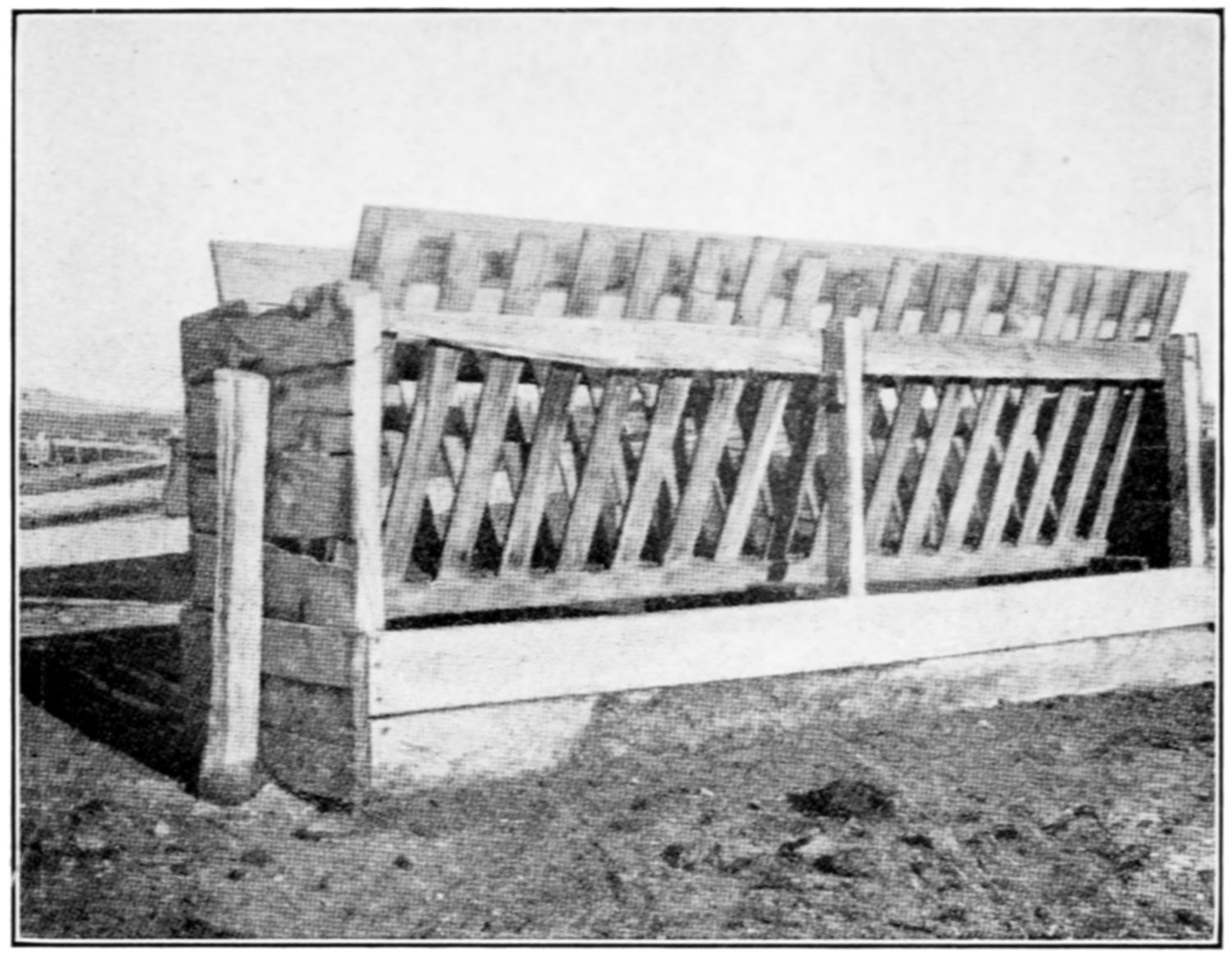
Lattice Rack for Feeding Alfalfa to Cattle
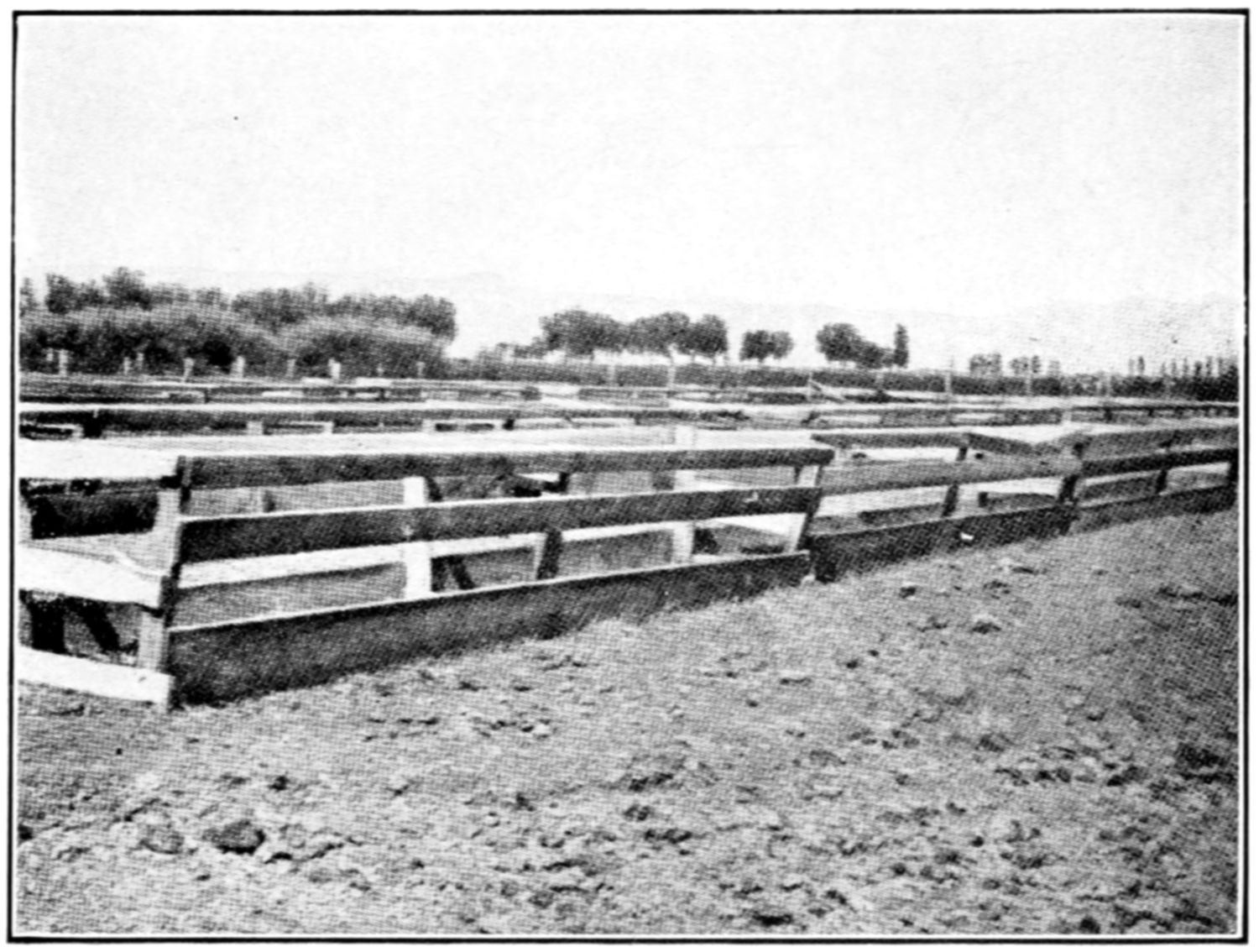
Box Rack for Feeding Alfalfa to Sheep
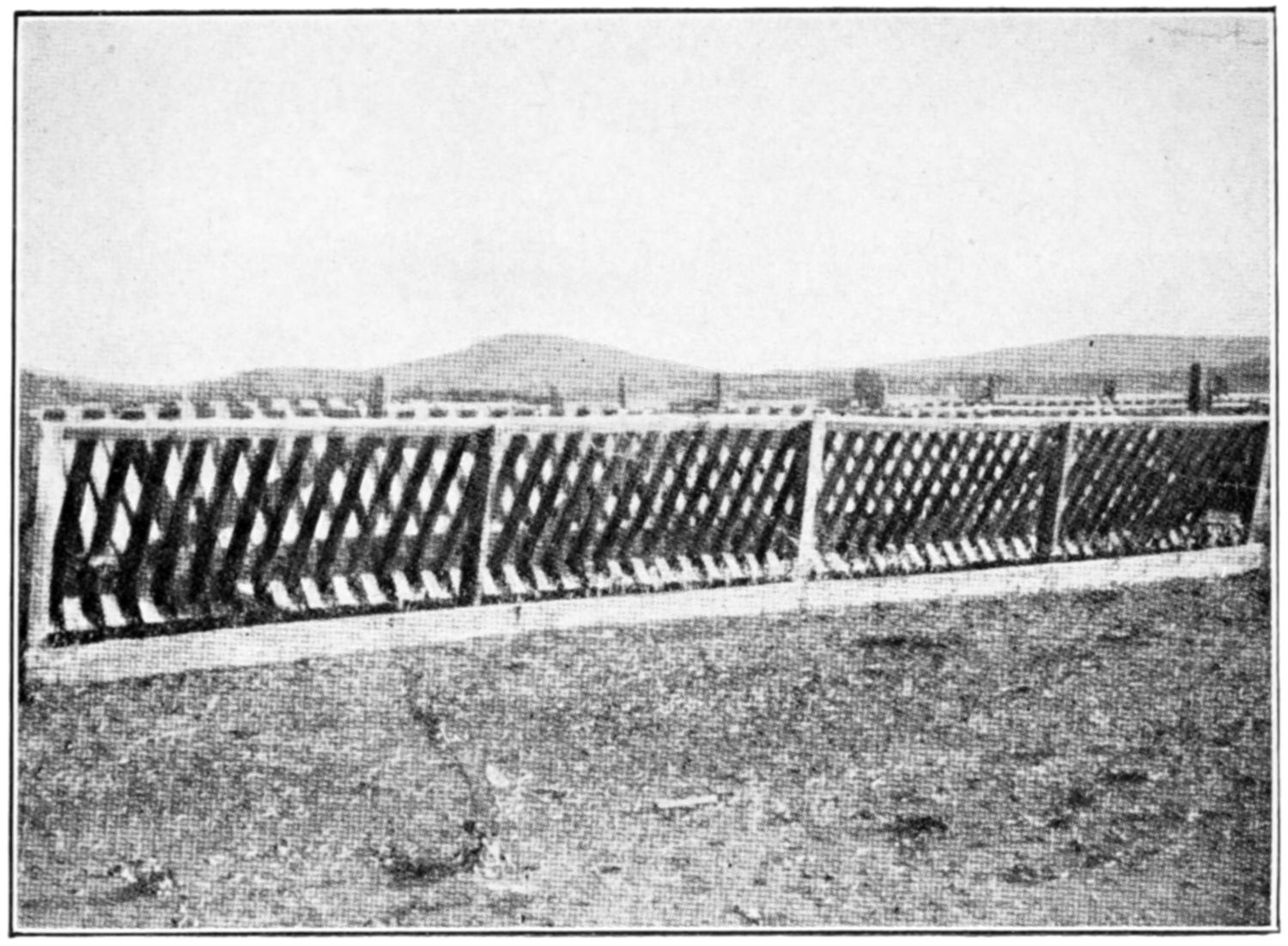
Lattice Rack for Feeding Alfalfa to Sheep
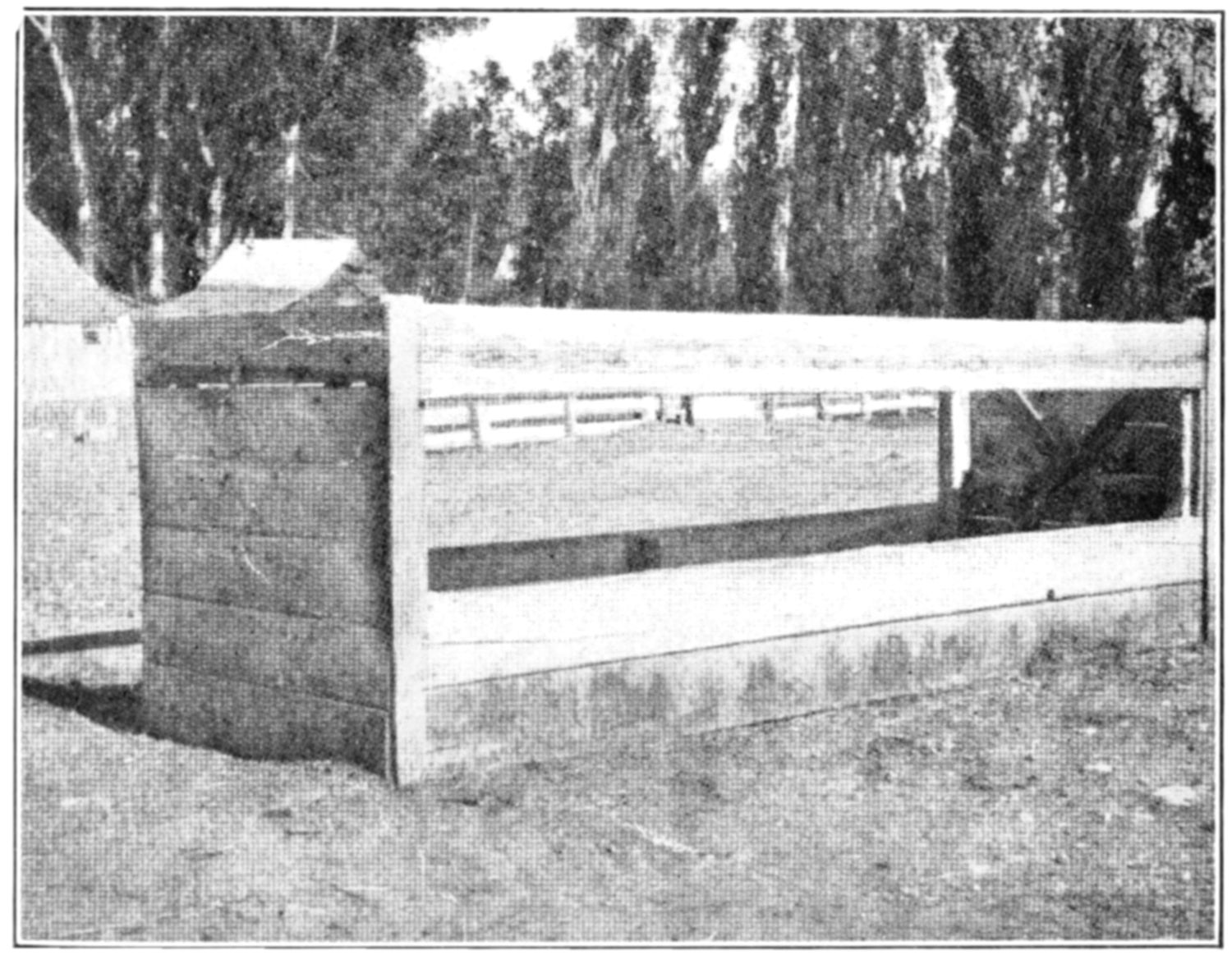
Box Rack for Feeding Alfalfa to Cattle
CHAPTER IX. Pasturing and Soiling — PASTURING NOT ALWAYS ECONOMY — ALFALFA A TENDER PLANT — A GOOD SWINE PASTURE — DANGERS TO CATTLE AND SHEEP — EXPERIENCES WITH CATTLE — GENERALLY DANGEROUS TO SHEEP — A POSSIBLE EXPLANATION — RULES FOR PASTURING — TROCAR AND CANNULA — ALFALFA AS A SOILING CROP — SOME COMPARISONS — A METHOD FOR THE SMALL FARMER
Its perennial nature and the reports of its wonderfully
productive and nutritive qualities might naturally lead
the farmer, without better acquaintance, to suppose that
with alfalfa he has perpetual pasture; that he will open
the gate to his live stock in the spring, send for the butcher
or buyer in October, and then winter in luxurious leisure.
But he finds that the easiest is not always the most
profitable way. Pasturing with any stock is an expensive
and extravagant method of gathering a valuable crop
from high-priced land. Where land is cheap and pasture
is wild, stock are not expensive help in gathering a cheap
crop; but it is easily demonstrated that when land values
are high and a crop value is in a like altitude, man with
machinery can do the harvesting more economically than
can a cow, a steer or even a sheep.
In some respects alfalfa does not seem to be a natural
pasture plant. The stems are delicate, it will not thrive in
a hard, trampled soil, and the crowns when broken off
will not revive; if some of the plants bloom and drop
their flowers early in the season, they lose vigor and many
of them die. These peculiarities would at least indicate
that it should not be pastured at all until it has become established,
has its crowns well spread, has abundant stems
and its roots have a strong start on their underground career.
Not an animal should be turned on an alfalfa field
until the second or third year if it is desired that the stand
endure for several years, nor should it be pastured too
early in the spring or too late in the fall. There should
be something of a growth left for winter protection.
Careful alfalfa raisers are known who pasture their older
fields, but never put on a full quota of stock until they
have cut over the field when the plants are first coming
into bloom. They insist that this cutting invigorates
and gives the plants new life. They then pasture quite
closely until some time in September, after which there is
time for some final growth for winter protection.
A chief exception that most farmers insist on is that it
is an excellent pasture for pigs and, if it is not stocked
too heavily, its use for grazing young swine will not
largely decrease the yield of hay. Its marked protein
property seems to give to the pigs a superior growth of
frame and flesh. Farmers claim that pigs a few weeks
old turned into an alfalfa field derive almost their entire
living from it and leave the sows two weeks earlier than
other pigs, coming in September with a gain of from
100 to 125 pounds, while the field has yielded its three
cuttings of hay. Of course, if too many pigs are grazed,
the hay yield will be less. But even here the question of
labor versus hay must be considered.
The greatest objection to pasturing alfalfa is its bloating
cattle and sheep. Hogs and horses do not suffer,
although a Texas farmer writes that he lost some pigs
from something similar to bloat that he attributed to the
alfalfa. But this may be considered questionable, as thousands
have regularly pastured hogs and horses on alfalfa
with no symptoms of bloat. From hundreds of inquiries
sent out by the experiment stations, it is determined that
over ninety per cent of those who have pastured cattle or
sheep on alfalfa have lost one or more animals by doing
so, yet many report having pastured the same kind of
stock on alfalfa for years, regularly every season, without
loss. Careful investigations have been made with
the purpose of finding out why some have been immune
while others suffered. Since, in the cases of loss, only a
small proportion of the animals pastured are affected, it
may be inferred that much depends upon the nature and
condition of the individual animal. Practically every
western station has carefully experimented, following
the directions of men who have been free from loss, yet
it has cost each station valuable animals.
Horse stock of all ages find alfalfa pasturage conducive
to growth, fattening, and their general health.
If the foliage is short and scant, horses are severe on the
fields used in winter because they are able to crop
close, and not infrequently paw loose dirt away from
the plants, biting off the crowns a fourth or even half
inch below the surface of the ground. It is easy to understand
the loss of the bud or growing point may be
detrimental to the growth and usefulness of the plants,
causing many to die, resulting in bare spots later to be
overgrown by noxious weeds and grasses. After the
damage is done there remains no remedy but to plow up
the field and reseed, or to disk thoroughly and then reseed
the bare spots. If the field has not deteriorated too much,
the latter is much to be preferred. By diligence and
careful treatment, or prompt action closely following any
encroachments upon the life of the plants, the quality and
yield may be maintained and the profits relatively
enhanced. Alfalfa has wonderful recuperative powers,
but continuous nipping of the crowns will do most
serious harm and eventually decrease the yield not a little.
One man reports turning eighty steers into one alfalfa
field where there was running water, and a second herd
into another field without running water, but water ran
through a wild grass meadow adjoining, into which this
herd was driven every afternoon and turned back into
the alfalfa the next morning. The first herd suffered no
loss, while five valuable animals died in the second field
on the second day, before they could be removed. When
all were put into the first field there was no more bloat.
Another reported turning cows into a small field where
there was a trough full of water all the time. Here, as
in the case of the steers, a full feed was given before the
cows were turned on the alfalfa. Before noon one cow
had to be relieved by a trocar, and another by being driven
rapidly about the field. The wherefores of such occurrences
present a problem yet to be solved. Certainly there
is more danger in pasturing cows and sheep on alfalfa
than most people care to risk. Aside from the financial
loss, there is, also, the humane side of the question.
A very fair statement, representative of those made by
parties who pasture cattle on alfalfa without losses from
bloat, is the following, given to the author by Mr. S. C.
Hanna, an extensive and reputable breeder of Shorthorns,
in Elk county, (southern) Kansas, who says:
“I have been pasturing alfalfa successfully without
bloating my cattle for a number of years; in fact, I have
never lost an animal from alfalfa bloat. As I am raising
high priced, pure bred Shorthorns and graze them on
my meadows more or less at all times of year, I always
sow a good mixture of English blue-grass (Festuca
elatior) and orchard grass (Dactylis glomerata) with it,
making alfalfa the base and principal seeding. I am very
partial to orchard grass in this mixture because it makes
considerable hay, and springs up so quickly after each
mowing. In this section orchard grass is a stayer, and
will hold its own against all comers.
“I always am cautious when we first turn the cattle on
alfalfa, seeing to it that they have a good fill on something
else beforehand, and hold them at first on some
part of the field where the mixed grasses are the thickest,
so they can graze there first. In twenty minutes they will
be safe to go where they wish, and may be allowed to
run at will thereafter. I find, however, that on the clear
alfalfa meadows there is almost no danger from bloat
after the plants have begun to bloom. I usually have
some hay stacked in the pastures, that the cattle may run
to. I have, however, pastured alfalfa in all stages where
there would be perhaps twenty acres of alfalfa in one
place, and some prairie grass and also tame grasses in
the same enclosure, and had no bloat. This has been,
too, sometimes in May and June, when showers were
frequent and the alfalfa most succulent. It would seem
that the cattle will take care of themselves if they have a
good chance. I usually superintend these changes personally,
and see that all conditions are right.
“I find we get almost as much hay from the mixed
fields as from the exclusively alfalfa meadows, and the
fall aftermath is much better. The theory that alfalfa
will not flourish with the other grasses is wrong. My
favorite meadows contain a mixture of this kind, including
some red clover, and I have cut four good crops of
hay from them this season, after pasturing moderately
from March 15 to May 1. I always get the stock horses
and mules on pasture by March 15, and the cattle about
April 1, and move them to wild grass prairie pasture
about May 1, except a few that we will keep on the
meadows all season. These we change from one field to
another when the alfalfa becomes tall enough to be
trampled down or damaged.
“If my object was only to raise hay for market, I would
sow the alfalfa alone and keep the stock off altogether,
but for my purpose I prefer a mixture. By doing my way
I never miss a good stand, and the mixture keeps down
the foxtail and crab grass. I have been sowing this mixture
for about fifteen years, and have over 300 acres.”
Mr. J. F. Stodder of Cowley county, Kansas, a prominent
breeder of pure bred cattle, makes this statement to
the author, which is simply further testimony that a mixture
of other grasses with alfalfa intended for grazing
greatly diminishes, if it does not entirely eliminate, the
risk and dangers of bloat:
“I have several fields of mixed grasses. These contain
enough alfalfa so that we cut them for hay at regular
times, and the proportion of grasses and alfalfa is largely
in favor of the latter. In such fields as these I pasture
cattle at will, and have never seen any evidence of bloat
therefrom. But my experience with the straight alfalfa
fields leads me to be very cautious. I find that I can pasture
them at times without danger, and at other times a
large proportion of the cattle will bloat. It is possible that
I have made the statement that I never lost cattle by pasturing
alfalfa, which is true, because we have always
been lucky enough to discover the ailing animals in time
to give them relief.”
Mr. F. S. Kirk of Oklahoma, mentioned in Chapter
III, pastures his cattle on alfalfa in fall and spring,
but does not give them access to his meadows in the
morning until the dew has dried off, and for only twenty
or thirty minutes the first day or two; then for an hour
or two for a few days, and after that they are left in the
pastures until sundown.
Experiments with sheep seem to be even more disastrous
than with cattle. In an investigation conducted by
the Colorado station, losses were reported by nearly every
man who had pastured sheep on alfalfa. Some lost but
one or two, while others lost forty or fifty. A few reported
that each spring they lost a few sheep the first
day they were on the pasture, and then no more, and
that the losses of old sheep were of less importance than
the growth of the lambs, these being seldom affected by
bloat. Most, however, advised that the old should not be
turned on alfalfa under any circumstances, but that
lambs, if well fed in the morning, let on the alfalfa after
the dew was off and then kept there night and day
would do well, and the loss be smaller than that in a normal
season from other causes. J. E. Wing states that his
loss from pasturing lambs on alfalfa in Ohio is less than
it formerly was from one or two parasitic diseases that
never trouble alfalfa-pastured lambs. He gives his lambs
a full feed in the morning, turns them on the alfalfa field
about ten o’clock, and leaves them there continuously
until September. He begins the pasturing just before
the seasons first growth of the alfalfa blooms.
While by no means without risk, pasturing sheep on
alfalfa is not always necessarily fatal and the following,
related in the Breeder’s Gazette by Mr. C. H. Williams
of Powell county, Montana, is interesting:
“We have been pasturing sheep in large numbers on
alfalfa for the past eight years. We have lost from bloat
as many as 26 in one day from a flock of 1600, but we
seldom lose one now. We find they are much more apt to
bloat on windy days; more especially if the wind blows
from the south and is soft and balmy. This may seem
strange, but we believe it a fact. We have in our employ
a shepherd who has during the greater part of his life
herded sheep on alfalfa in the vicinity of Pau and
d’Oloron, France. The day we lost 26 ewes from bloat
this man was several miles from the home ranch. When
visited by the camptender he remarked: ‘This will be a
bad day for the old ewes on the alfalfa.’ Why so?
‘Because the wind is soft and warm,’ said he. That
afternoon we found 26 dead.
“Our French shepherd has a simple and never failing
remedy for bloat from alfalfa or clover. It is simply a
half-pint of sweet milk administered to the animal when
found bloated. I saved a fine ram lamb the other day. He
was fearfully bloated, unable to walk and scarcely able to
breathe. I found an old can in the road, hastened to the
pasture, milked a half pint of milk from a cow, set the
lamb on his rump and poured the milk down his throat.
In a half hour he was all right and following the flock.
Milk from a ewe will answer just as well. We have
adopted the following rules: Never allow the sheep to
go on alfalfa pasture when very hungry; if possible get a
little dry feed in their stomachs in the morning before
going to the alfalfa; watch them closely on windy days,
and have the herders carry a bottle of sweet milk.”
The most of the losses reported were of animals which
had been taken off the pasture at night and turned back
the second morning when hungry and eager to graze.
Yet there are reports of severe losses the first day, even
after a full feed. Possibly it will be found that the animals
that suffer from bloat are not in good physical condition,
and are more nervous and greedy in their habit of
eating than those not affected. It may be that an intelligent
sorting of the animals to be turned on the pasture
might save loss. It is also quite generally believed that
alfalfa growing on uplands is less liable to cause bloat
than that raised on bottom lands.
The most generally approved rules in regard to pasturing
are:
At the beginning of the pasturing season give animals
a heavy feeding in the morning before turning upon the
alfalfa.
Have water in the pasture all the time.
Keep the animals in the pasture night and day, after
they have become accustomed to it, until removed permanently.
Use upland in preference to bottom fields for pasture.
Watch the stock closely the first few days and remove
permanently animals that show symptoms of bloat.
Sow blue-grass, brome grass, or meadow fescue with
alfalfa in fields intended for permanent pasture.
The following valuable information upon bloat (tympanitis)
and its treatment was prepared by Nelson S.
Mayo, formerly professor of veterinary science at the
Kansas agricultural college:
“Bloating, in all cases, is accumulation of gas in the
stomach or intestines, or both, but more particularly in
the paunch (rumen). This gas is produced by a fermentation,
similar to that observed when cider is ‘working’
and the gas escapes in bubbles. There is usually a small
quantity of gas given off from the food during normal,
healthy digestion, but so small that it causes no trouble,
and passes off readily through the intestines, though
sometimes from the stomach, up the esophagus, and out
of the nose or mouth—‘belched up,’ as it is commonly
expressed. These gases which cause an animal to bloat
are generated in considerable quantities if a large amount
of juicy, green food is eaten. Alfalfa, clover and frozen
roots are very liable to produce bloating.
“It is well known that only part of the animals in a
herd pasturing upon clover or alfalfa bloat; so the blame
cannot be laid entirely upon the food, but is probably the
result of a slight derangement of the digestive organs,
not ordinarily noticed, but easily aggravated by certain
foods which ferment easily. Animals that are ailing are
very liable to bloat when turned on alfalfa pastures.
Alfalfa and clover are much more liable to produce bloating
if wet with rain or dew, and especially hoar frost,
and animals are more apt to bloat if turned into the pastures
when very hungry, as they gorge themselves, and
the food is not properly masticated. Hence, cattle should
not be allowed to go hungry to the pastures.
“It is generally believed by those who have had considerable
experience in pasturing clover or alfalfa, that
cattle and sheep are less liable to bloat if they have free
access to dry food, such as hay or straw. Common bloating,
or hoove, occurs in animals having a compound
stomach and that chew the cud—ruminants, as they are
called. Of our common domestic animals, cattle and
sheep belong to this order.
“One of the first symptoms noticed is that the animal
stops feeding, and remains lagging behind or stands by
itself. Rumination, or chewing of the cud, is suspended;
the animal appears dull and listless, the back slightly
arched; the whole abdomen or belly is distended with a
prominent swelling on the left side just forward of the
point of the hip. If the swelling is tapped lightly with
the fingers there is a hollow, drum-like sound; hence the
technical name, tympanitis.
“The rumen being distended with gas not only makes
the animal appear much fuller than usual, but it presses
forward on the diaphragm, or ‘midriff,’ and this presses
against the lungs, and interferes seriously with the animal’s
breathing. The breath is short and rapid. The
animal often grunts, or moans, with each breath. The
animal’s nose protrudes, and there is a driveling of saliva
from the mouth. Sometimes there are quite severe
colicky pains, shown by the animal’s kicking at its belly
and stepping about uneasily. Sometimes, also, the pressure
is so great as to cause eversion or bulging out of the
rectum. The symptoms of bloating are so prominent,
especially when the history of the case is taken into
account, as to make this disease very easy to recognize,
even by an ordinary observer.
“When animals die from bloating, death usually takes
place in the following manner: The diaphragm is
pressed against the lungs so hard that the animal cannot
breathe, and it dies of suffocation. Animals usually
remain standing until near the end, when they gradually
lose consciousness, stagger, and fall, and in falling rupture
some of the vital organs.
“Treatment must depend somewhat upon the condition
of the animal. If the animal is badly bloated, with labored
breathing and staggering gait, energetic measures
must be resorted to at once. The best and most
satisfactory treatment for bad cases is tapping. This consists
in making a hole through the skin and muscles, over
the prominent swelling on the left side, into the rumen
or ‘paunch,’ thus allowing the gas to escape at once, relieving
the animal.
“The best method of tapping is by means of an instrument
called a trocar and cannula. A trocar is a sharp-pointed
instrument, five or six inches long, and about the
size of a lead pencil, with a handle at one end. Over the
point of the trocar slips a tube, called a cannula, not quite
as long as the trocar, with a wide flange around the upper
end of the tube, as shown in the illustration herewith.
“To use a trocar and cannula, proceed as follows: Tie
the animal so it cannot get away. With a sharp knife,
make a small incision through the skin over the prominent
part of the swelling on the left side. This incision
should be made about half way between the point of the
hip and the last rib, and should be large enough to admit
the trocar and cannula readily. The incision should be
made quickly; then the animal will not notice it. After
the incision is made the trocar and cannula are pushed
quickly in and directed downward, inward, and forward;
push the trocar in until the flange of the cannula rests
against the skin. Withdraw the trocar and the gas will
rush out; that is, it usually does so; occasionally, however,
the end of the cannula is plugged up with green
food. This can usually be remedied by pulling out the
cannula part way, or pushing the trocar in again and
withdrawing it. If this doesn’t work, tap the stomach
again in another place, using the same hole through the
skin. The escape of gas is usually accompanied by a
small quantity of green food.

Trocar and Cannula
“If a trocar and cannula are not available in an urgent
case, a knife can be used very successfully—a good-sized
pocket knife blade, pushed quickly through the skin and
muscles, in the same manner as described for the trocar
and cannula. Care must be taken that the sharp edge of
the blade is not turned towards the animal’s tail, as it
sometimes jumps forward, and a much larger hole is cut
than was originally intended.
“A careful and observing stockman of Colorado, who
has had a large experience with alfalfa bloating, informs
me that he prefers a moderately small, sharp butcher
knife to either a trocar and cannula or a pocket knife. It
gives relief quicker and with no bad effects. Sometimes,
if the opening through the skin is small, made by a small
knife, a quill or small tube is fastened in to keep the incision
open, so the gas can escape. It is usually necessary
to keep the incision open for several hours. The only bad
result of tapping is that occasionally green food gets
outside of the rumen into the abdominal cavity in sufficient
quantities to cause inflammation and death; but if
the operation is intelligently performed, these bad results
are extremely rare—probably not more than one case in
100. If the weather is warm, care should be taken that
flies do not bother the wound in the skin.
“If the case is not severe enough to warrant tapping,
the following remedies will be found useful: A gag
made by winding a good-sized rope back of the horns and
through the mouth, or a bit, made of a piece of wood the
size of a fork handle, can be tied in the animal’s mouth.
The bit should be smooth, to prevent injuring the mouth.
Then a small handful of salt should be thrown well back
on the roots of the tongue. This causes the animal to
work its tongue, increases the flow of saliva, and thus
favors the regurgitation, or gulping up, of the gas. The
salt and saliva swallowed help to stop fermentation.
“Blankets wrung out of cold water and wrapped
around the abdomen or belly, or cold water dashed on
with a bucket, often give relief. Turpentine given as a
drench, in milk sufficient that it will not irritate the
animal, is good, two ounces of turpentine for adult cattle
and one-half ounce for sheep being a dose. Hyposulphite
of soda, dissolved in water and given as a drench,
is good; one ounce for cattle and two drachms for sheep.
This can be repeated every half hour for two or three
doses. Aqua ammonia, two ounces for cattle and one-half
ounce for sheep, well diluted with water; carbolic
acid, cattle 30 drops, sheep 8 to 10 drops in sufficient
water; common soda, in half-ounce doses for cattle and
one-half drachm for sheep, can be given. In giving medicine
as drenches, they should be well diluted with water
or other substances until they will not burn when touched
to the tongue. In giving drenches, be careful and not
choke the animal. If the animal coughs or struggles
violently, stop at once until it recovers somewhat. Give
drenches slowly.
“Drenches are mostly administered from a long-necked,
thick, glass bottle, or drenching horn. Take hold of the
nose with the left hand, by putting the thumb and finger
in the nostrils, while an assistant takes hold of the horns,
and tips the head back. Standing on the right side of
the animal, with the right hand put the neck of the bottle
in the right corner of the mouth, and pour the medicine
in slowly. After the bloating has been relieved, it is a
good plan to give the animal a purgative—one pound of
Epsom salts, with one-half pound common salt, for
cattle; and for a sheep, six ounces of Epsom salts and
three ounces of common salt, dissolved in plenty of warm
water, and given as a drench. The animals should also
be dieted until their digestive organs regain their normal
condition. By dieting, I do not mean starving, but
plenty of easily digested and nutritious food. An animal
that bloats once is very liable to bloat again. By judicious
handling and feeding, by watching animals closely,
and treating them in time, few will be lost by alfalfa
bloating.”
Alfalfa may be cut for soiling just when it contains
the highest per cent of protein, while if pastured some is
eaten before its best period, the most of it after that
point is reached, and probably a large portion of the
leaves is lost entirely. Cut for soiling and fed daily,
when wilted, there is less danger from bloat, as in this
way animals will eat stalks as well as leaves: the entire
product is used and there is no loss from trampling the
fields nor by plants being covered and smothered with
animal droppings.
The Nebraska station reports that in an experiment
there it required .71 of an acre to keep a cow for a given
time by soiling, while by pasturing it required 3.63 acres;
also that the cows kept on pasture during the experiment
actually consumed more grain than those that were soiled.
This report further states that while the pastured cows
gave more milk each day, the cost of production was
greater. By another experiment with cows for a single
year it was indicated (Bul. No. 69) “that about twice
as much feed was secured from the land when the alfalfa
was soiled as when it was pastured. The average daily
production of milk and of butterfat was markedly greater
when the crop was pastured than when soiled. In one
test this amounted to one-third more, but in the other
test the difference was not so great. The profits from
soiling as compared with pasturing will depend largely
on two factors—the price of labor and the value of the
land.”
A western Kansas farmer writes that one acre of
alfalfa cut daily for soiling maintained as many cows as
he was able to keep on a five-acre field used as pasture.
The Kansas station reported that in an experiment,
lasting 144 days, the cows on alfalfa pasture returned an
income, less cost of grain fed, of $4.23, while cows soiled
on alfalfa cut and fed green returned an income, less the
grain fed, of $18.08. This station also reported that a
neighboring dairyman maintained ten milch cows for a
whole summer, without any grain, on two acres of alfalfa,
cut and fed to them fresh three times a day.
In the Central West where labor is scarce and land
comparatively low in price, farmers are not likely to adopt
the soiling system while such conditions exist; but east
of the Mississippi river, and especially in New York,
Pennsylvania and New England, where land is high and
labor scarce, alfalfa offers great possibilities as a soiling
crop. The small farmer who now cannot afford to
raise many pigs, because he does not raise enough corn to
fatten them, will find that by soiling alfalfa he can maintain
from May to September from five acres as many as
ten cows and fifty pigs; and that these pigs, with some
grain from the first of August, while being fed green
alfalfa, may by the middle of November be made ready
for market. If he has another five acres of alfalfa for hay,
it will yield enough in three cuttings to go far toward
wintering his cows, a team of horses, and his sows. His
ten acres will be growing richer every year, and at the end
of five years be in prime condition to yield him big returns
in corn, wheat, or potatoes and other vegetables. Alfalfa
is distinctly a crop adapted to the small farmer,
everywhere; there is, as a rule, little question that this
method of utilizing it brings much greater returns per
acre than if it were used as pasturage or hay.
Green alfalfa when pastured, (barring bloat), or cut
and fed daily is peculiarly valuable for all such young
stock as colts, lambs, calves and pigs. It tends to develop
strength of bone and hastens the growth of muscle.
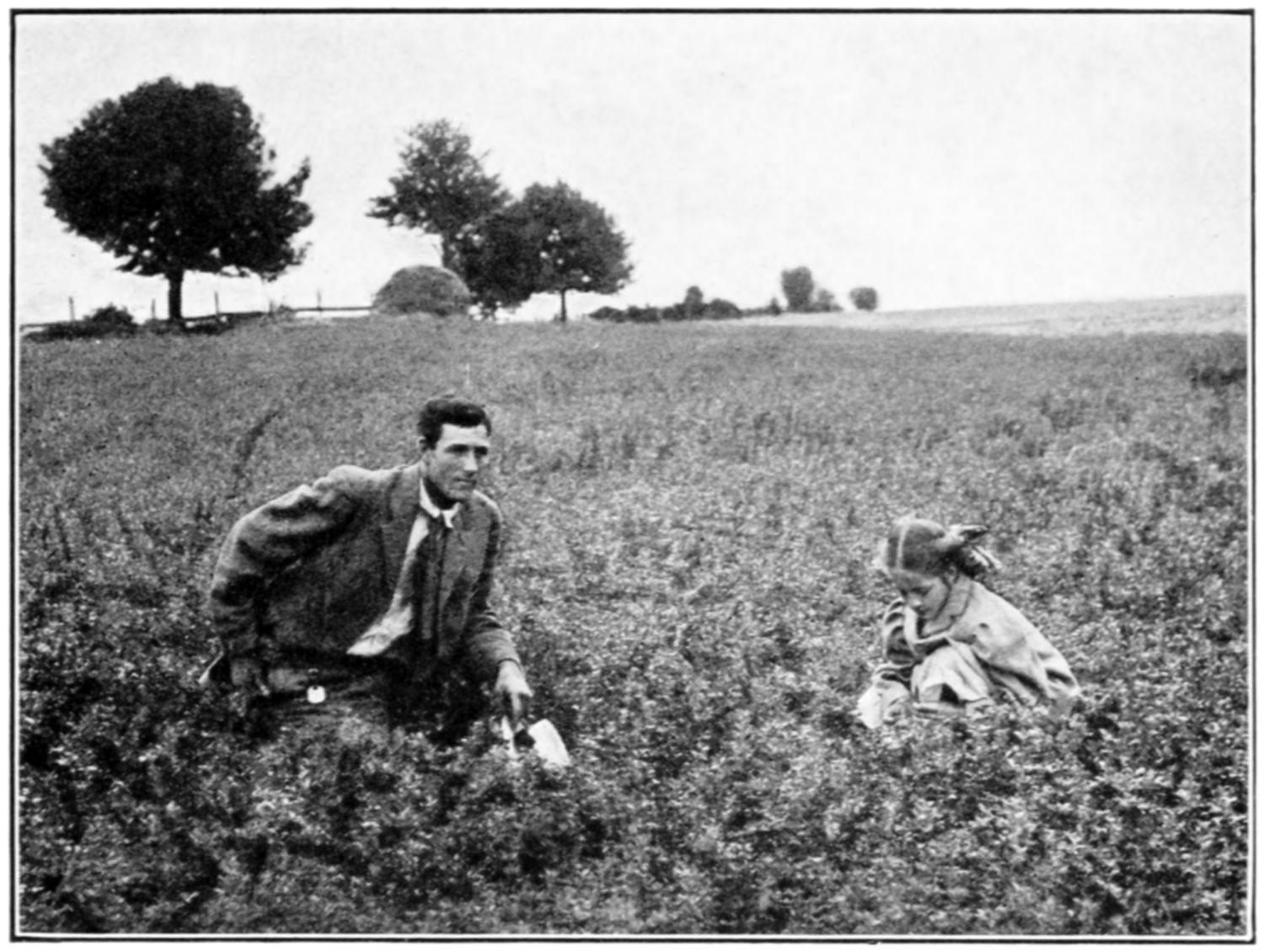
Alfalfa Field in Central New York
Showing growth August 22, 1907, seven days after third cutting
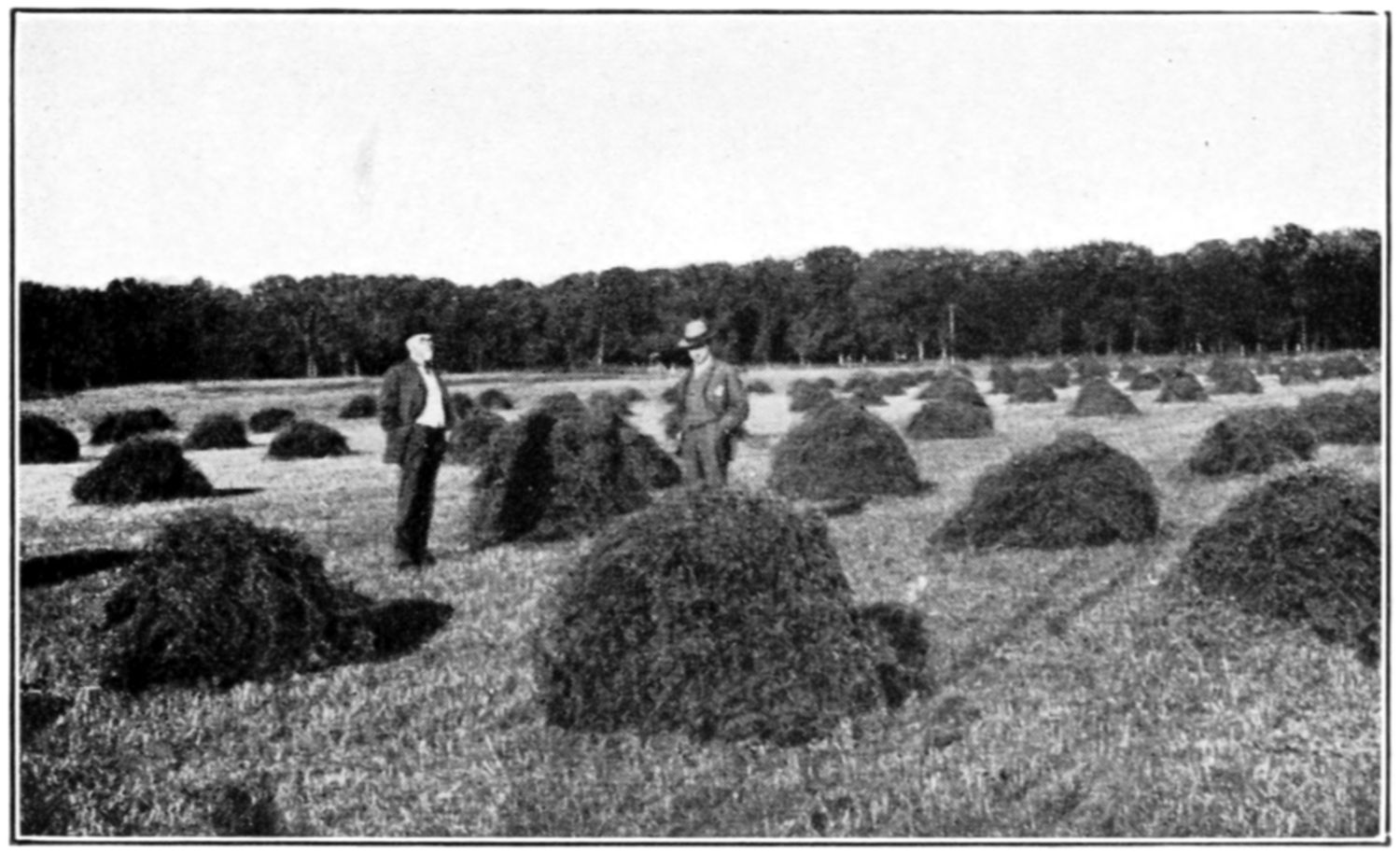
Fourth Cutting of Alfalfa in Shawnee County, Kansas
Photo taken in September
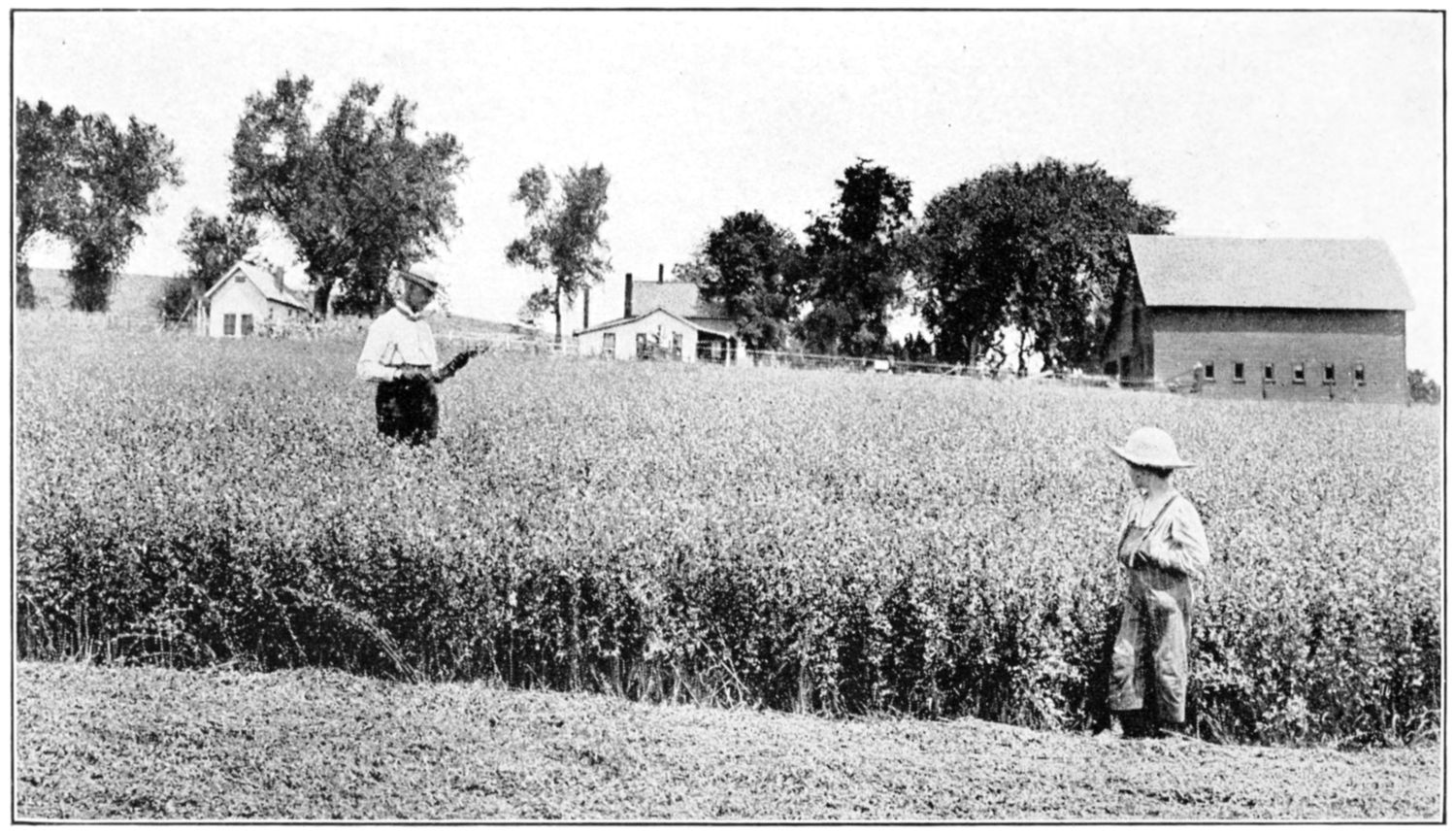
A Second Cutting of Alfalfa (July 28) in Shawnee County, Eastern Kansas
This was sown on the last half of the preceding September. Four cuttings probable with an
aggregate yield of four tons per acre
CHAPTER X. Alfalfa as a Feed Stuff — AS AN APPETIZER — FOOD VALUE OF SEVERAL FODDER CROPS — ANALYSES OF FEEDSTUFFS — RELATIVE VALUES OF DIFFERENT CUTTINGS — CROP COMPARISONS — COMPARATIVE CROP AND FEEDING VALUES — COMPARATIVE VALUES OF ALFALFA HAY AND OTHER FEED STUFFS FOR PROTEIN — THE BALANCED RATION — MAKING A BALANCED RATION — VARIATIONS IN ANALYSIS
The feeding value of alfalfa is largely in its chemical
compound known as protein; its extreme digestibility is
another desirable quality to be considered, and not least
is its appetizing character. Not only do all animals like
it, but when given in moderate quantities it seems to
increase the general appetite for more fat-making feeds.
Steers beginning to “fall off” on a heavy diet of corn will
come to their appetites after being fed only a few pounds
of alfalfa daily, and will eat and assimilate more corn
than before.
Alfalfa alone is not a fat-making feed. Animals fed
upon it grow in weight, but the weight is principally of
bone, blood and muscle. It is without a sufficiency of fat
and carbohydrates, and these should be added in such
foods as corn, corn meal, Kafir corn, or Kafir corn meal;
or to a limited degree even in corn stover, sorghum or
millet. When alfalfa is fed alone all the protein cannot
be digested, and, therefore, it is always economical to add
some carbonaceous foods, if animals are fattening for
market.
For several years feeders have been deploring the fact
that fattening mainly with corn was becoming less and
less profitable. When they began to figure the exact
cost of each pound of gain on a steer or hog, they saw
clearly that corn alone made the pound of gain cost too
much; sometimes as much as it was worth in the market,
leaving neither profit nor interest on the investment.
The problem then became how to produce the pound of
meat more economically.
Such a condition has prompted the state stations to
make tests to determine the feeding value of various
articles, and especially the value of alfalfa as a balance to
the more carbonaceous foods. The tables here appended
are worth studying:
(From New York experiment station Bul. No. 118.)
| |
Yield
per acre
of
total crop |
Dry
matter
per acre |
Total
digestible
matter
per acre |
Digestible
protein |
| |
Pounds |
Pounds |
Pounds |
Pounds |
| Alfalfa |
34,100 |
8,000 |
5,280 |
875 |
| Corn, entire plant |
28,000 |
5,800 |
3,800 |
300 |
| Red clover |
18,000 |
5,220 |
3,200 |
491 |
| Oats and peas |
13,000 |
3,120 |
2,521 |
350 |
| Timothy |
10,000 |
3,500 |
2,000 |
228 |
| Rutabagas |
31,700 |
3,400 |
3,000 |
279 |
| Mangels |
25,000 |
3,500 |
2,750 |
232 |
| Sugar beets |
17,800 |
2,500 |
1,800 |
213 |
The following table gives the analyses of a number of
feedstuffs, showing the percentage of digestible nutrients
and fertilizing constituents in each:
(From Texas experiment station Bul. No. 66)
| |
Dry
matter
in 100
pounds |
Digestible nutrients
in 100 pounds |
Fertilizer constituents
in 1000 pounds |
| Protein |
Carbo-
hydrates |
Ether
Extract |
Nitrogen |
Phos-
phoric
acid |
Potash |
| HAYS: |
|
|
|
|
|
|
|
| Alfalfa |
91 |
.6 |
11 |
.0 |
39 |
.6 |
1 |
.2 |
21 |
.9 |
5 |
.1 |
16 |
.8 |
| Cowpea |
89 |
.3 |
10 |
.8 |
38 |
.6 |
1 |
.1 |
19 |
.5 |
5 |
.2 |
14 |
.7 |
| Oat hay |
91 |
.1 |
4 |
.3 |
46 |
.4 |
1 |
.5 |
.... |
.... |
.... |
| Fodder corn |
57 |
.8 |
2 |
.5 |
34 |
.6 |
1 |
.2 |
17 |
.6 |
5 |
.4 |
8 |
.9 |
| Sorghum |
82 |
.04 |
2 |
.4 |
40 |
.6 |
1 |
.2 |
.... |
.... |
.... |
| Cottonseed hulls |
88 |
.9 |
|
.3 |
33 |
.1 |
1 |
.7 |
6 |
.9 |
2 |
.5 |
10 |
.2 |
| GREEN FEEDS: |
|
|
|
|
|
|
|
| Alfalfa |
28 |
.2 |
3 |
.9 |
12 |
.7 |
|
.5 |
7 |
.2 |
1 |
.3 |
5 |
.6 |
| Cowpea |
16 |
.4 |
1 |
.8 |
8 |
.7 |
|
.2 |
2 |
.7 |
1 |
.0 |
3 |
.1 |
| Oat fodder |
37 |
.8 |
1 |
.6 |
18 |
.9 |
1 |
.0 |
4 |
.9 |
1 |
.3 |
3 |
.8 |
| Corn silage |
20 |
.9 |
|
.9 |
11 |
.3 |
|
.7 |
2 |
.8 |
1 |
.1 |
3 |
.7 |
| Sorghum |
82 |
.4 |
2 |
.4 |
4 |
.1 |
1 |
.2 |
.... |
.... |
.... |
| Rape |
14 |
.0 |
1 |
.5 |
8 |
.1 |
|
.2 |
4 |
.5 |
1 |
.5 |
3 |
.6 |
| GRAINS: |
|
|
|
|
|
|
|
| Wheat bran |
88 |
.1 |
12 |
.2 |
39 |
.2 |
2 |
.7 |
26 |
.7 |
28 |
.9 |
16 |
.1 |
| Cottonseed meal |
91 |
.8 |
37 |
.2 |
16 |
.9 |
12 |
.2 |
67 |
.9 |
28 |
.8 |
8 |
.7 |
| Corn |
89 |
.1 |
7 |
.9 |
66 |
.7 |
4 |
.3 |
18 |
.2 |
7 |
.0 |
4 |
.0 |
| Cowpea |
85 |
.2 |
18 |
.3 |
54 |
.2 |
1 |
.1 |
33 |
.3 |
.... |
.... |
| Cotton seed |
89 |
.7 |
12 |
.5 |
30 |
.0 |
17 |
.3 |
31 |
.3 |
12 |
.7 |
11 |
.7 |
From the above table we find that five tons of alfalfa
hay contains 1,100 pounds of protein, equal to this food
element in
| Cotton seed meal |
2,956 |
pounds |
| Linseed meal |
3,754 |
pounds |
| Wheat bran |
9,016 |
pounds |
| Cowpea hay |
10,185 |
pounds |
| Red clover hay |
16,176 |
pounds |
| Timothy hay |
39,285 |
pounds |
The most interesting experiments comprehending tests
of the comparative yield, composition and digestibility
of early, medium and late cuttings of alfalfa, of the
first, second and third crops; the relative feeding value
of the various cuttings, and of the different crops,
have been made at the Utah station, details of which are
recorded in the station’s bulletins Nos. 31, 44 and 61.
These tests and investigations extended continuously
through a period of five years, and following are the
more important facts developed and the conclusions that
may be legitimately drawn from them, as summarized
(Bul. No. 61) by Profs. Luther Foster and L. A. Merrill
who supervised the work:
1. The largest annual yield of hay per acre is obtained
by the method of early cutting and the lowest by the late,
the average result standing as follows: early cutting,
100; medium, 92; and late, 85.
2. The early cut alfalfa contains the highest per cent
of protein and fat, the most valuable food constituents,
and the lowest per cent of crude fiber, the most indigestible
portion. The former decrease constantly while the
latter increases rapidly from early bloom to the full
maturity of the plant.
3. The proportionate amount of leaves to stems is
greater at early bloom that at any subsequent time, and
both leaves and stems contain a greater per cent of protein
and a less per cent of crude fiber at this time than
at any later period in the growth of the plant. The relative
proportion of leaves to stems in the different cuttings
is as follows: early, 42 to 58; medium, 40 to 60; and
late, 33 to 67.
4. Alfalfa leaves as compared with stems are very
much richer in protein, fat and nitrogen-free extract, and
they contain a much smaller proportion of crude fiber.
The per cent of the protein and fat grows constantly less,
and that of the crude fiber greater, from the time of early
bloom to maturity. The average composition of all cuttings
and crops shows the leaves to contain 150 per cent
more protein than the stems, 300 per cent more fat, 35
per cent more nitrogen-free extract, and 256 per cent less
crude fiber.
5. The more important nutrients, protein and fat,
have the highest per cent of digestibility in the early cuttings
and it grows less and less with the age of the plant.
6. In the feeding tests, the highest gains were made
from the early cuttings and the lowest from the late, the
results standing proportionately as follows: early cutting,
100; medium, 85; and late, 75.
7. The variation in the amount of the different cuttings
eaten per day was very slight, being the highest for
the early cutting and the lowest for the late, but the quantity
of dry matter and also of digestible matter required
for a pound of gain was decidedly lowest for the early
cutting and highest for the late, the relative amounts of
dry matter standing as follows: early cutting, 100;
medium, 131; and late, 166.
8. The annual beef product per acre was largest from
the early cuttings, not only in the general average but in
each separate season’s test, and that from the late cuttings
was smallest, the proportional products standing as follows:
early cutting, 100; medium, 791⁄2; and late, 691⁄2.
9. Taking all points of comparison into consideration,
both separately and collectively, including everything
that pertains to the largest yield and the highest feeding
value, the tests favor cutting alfalfa for cattle feeding
when the first blooms appear.
10. The first crop gave the largest yield in each of
the five tests and in fourteen out of the fifteen cuttings,
while the third crop gave the lowest for every test and in
every cutting but one. The average acre yields for the
five years, including all cuttings, stand in the following
relation: first crop, 100; second, 78; and third, 39; for
the early cuttings alone, first crop, 100; second, 83;
and third, 66.
11. In the average composition of all cuttings for
three years, the nutrients of the three crops vary but
little. The second has slightly the highest per cent of
protein and fiber; and the third the most fat and nitrogen-free
extract.
12. The third crop has the largest proportion of
leaves to stems; but the per cent of protein in the leaves
is highest in the second crop; and next highest in the first.
The leaves of the first crop contain the most fat and of
the second, the least.
13. The third crop produced a higher average rate
of gain in the feeding tests than the first or second and
also higher than any of the separate cuttings. The
amount eaten daily was also highest of all, but the dry
matter and digestible matter for a pound of gain were the
lowest. In a pound per pound comparison the gains
stood as follows: first crop, 100; second, 81; and third,
126; dry matter for a pound of gain, first crop, 100; second,
115; and third, 69.
14. The beef product per acre, taking the average
result of all cuttings for the five years, was very much
the highest for the first crop and decidedly the lowest for
the third, standing as follows: first crop, 100; second, 61;
and third, 45. But taking the early cuttings alone they
stand, first crop, 100; second, 80; and third, 69.
15. Pound for pound, taken as a whole, the results
show the highest feeding value for the third crop and the
lowest for the second.
16. The average annual beef product from early cut
alfalfa was 705.61 pounds per acre; it required 9575
pounds of timothy to produce an equal weight; 11,967
pounds of red clover, and 10,083 pounds of shredded
corn fodder.
Prof. John A. Widtsoe at the Utah station (Bul. No.
48) made a study of the nutrients of the alfalfa crop, and
some of the facts gathered are given in the following
table:
| First Cutting |
| Condition of growth |
Protein |
Nitrogen-
free
extract |
Crude
fiber |
Ether
extract |
Ash |
| |
Pounds |
Pounds |
Pounds |
Pounds |
Pounds |
| May 4. Height, 61⁄2 in |
.... |
607 |
168 |
40 |
167 |
| June 1. Height, 18 in |
697 |
1,247 |
618 |
103 |
369 |
| July 7. Full flower |
745 |
2,278 |
2,108 |
118 |
431 |
| Aug. 10. Flowers fallen, leaves dry |
644 |
2,298 |
2,531 |
116 |
423 |
| Aug. 24. Still drier |
428 |
1,776 |
2,544 |
94 |
311 |
| Second Cutting |
| July 7. Budding |
334 |
657 |
357 |
50 |
197 |
| July 20. Medium bloom |
519 |
1,140 |
1,031 |
78 |
314 |
| Aug. 3. Full flower |
551 |
1,529 |
1,316 |
81 |
323 |
| Aug. 24. Leaves dry |
388 |
1,484 |
1,329 |
81 |
333 |
| Third Cutting |
| Aug. 17 |
138 |
317 |
155 |
17 |
85 |
| Aug. 31 |
322 |
757 |
634 |
33 |
211 |
| Sept. 14 |
298 |
934 |
818 |
43 |
214 |
The following is another table showing the average yield
of alfalfa as compared with some of the more common
fodder crops and hays, as found in New Jersey station
Bulletin No. 148.
| |
Total Yield
Green Forage
per acre |
Dry Matter
per acre |
Total Protein
per acre |
| |
Pounds |
Pounds |
Pounds |
| Alfalfa |
36,540 |
8,258 |
2,214 |
| Corn (entire plant) |
24,000 |
5,040 |
408 |
| Red clover |
14,000 |
4,088 |
616 |
| Barnyard millet |
16,000 |
4,000 |
384 |
| Crimson clover |
14,000 |
2,674 |
434 |
| Cowpeas |
16,000 |
2,624 |
384 |
| Oats and peas |
14,000 |
2,107 |
363 |
| |
Dry Matter |
Total Protein |
| |
Pounds |
Pounds |
| 1 ton alfalfa hay contains |
1,809 |
265 |
| 1 ton red clover hay contains |
1,694 |
246 |
| 1 ton oats and peas contains |
1,375 |
175 |
| 1 ton timothy contains |
1,736 |
118 |
| 1 ton wheat bran contains |
1,762 |
308 |
| 1 ton wheat middlings contains |
1,758 |
312 |
| 1 ton rye bran contains |
1,768 |
294 |
| 1 ton oats contains |
1,780 |
236 |
| 1 ton rice meal contains |
1,796 |
240 |
| 1 ton buckwheat bran contains |
1,790 |
248 |
At the Colorado station (Bul. No. 26) Prof. W. W.
Cooke compared an acre of dent (Golden Beauty) corn,
planted May 16 and harvested September 21, with returns
from an acre of alfalfa on an adjoining plat, three years
seeded. The corn crop was a fair one, and including
ears and stalks weighed 15,500 pounds, containing 35.62
per cent or 5539 pounds of dry matter. The alfalfa
yielded three cuttings of hay weighing respectively 4600,
3350 and 3250 pounds, or 5.6 tons, containing 10,304
pounds of dry matter. But, as Professor Cooke says, this
is not quite a fair comparison, for a pound of dry matter
from the corn crop is more digestible and has a higher
feeding value than an equal amount from the alfalfa.
The corn crop contained 3605 pounds of digestible feeding
material, while the alfalfa crop contained 5611
pounds, or a little more than half as much again. The
corn crop per acre in feeding value was equivalent to
three and a half tons of alfalfa hay.
The total digestible nutrients of the two crops are
presented in the following table:
| |
TOTAL |
DIGESTIBLE |
| Corn |
Alfalfa |
Corn |
Alfalfa |
| |
Pounds |
Pounds |
Pounds |
Pounds |
| Dry matter |
5,539 |
10,304 |
3,605 |
5,611 |
| Albuminoids |
405 |
1,602 |
296 |
1,198 |
| Starch, sugar, etc. |
3,263 |
4,782 |
2,186 |
3,114 |
| Fiber |
1,472 |
2,800 |
1,060 |
1,198 |
| Fat (ether extract) |
84 |
246 |
63 |
101 |
| Ash |
315 |
829 |
.... |
.... |
| Feedstuff |
Value per ton when prairie hay
is worth per ton— |
| $2.00 |
$3.00 |
$4.00 |
| Alfalfa hay (average) |
$6 |
.05 |
$9 |
.08 |
$12 |
.11 |
| Red clover hay |
3 |
.88 |
5 |
.82 |
7 |
.77 |
| Orchard-grass hay |
2 |
.74 |
4 |
.11 |
5 |
.48 |
| Millet hay |
2 |
.57 |
3 |
.85 |
5 |
.14 |
| Timothy hay |
1 |
.65 |
2 |
.48 |
3 |
.31 |
| Sorghum hay |
1 |
.37 |
2 |
.05 |
2 |
.74 |
| Corn-fodder (stover) |
1 |
.14 |
1 |
.71 |
2 |
.28 |
| Oat straw |
|
.91 |
1 |
.37 |
1 |
.82 |
| Wheat straw |
|
.45 |
|
.68 |
|
.91 |
| Sugar beets |
|
.62 |
|
.94 |
1 |
.25 |
| Mangel-wurzels |
|
.57 |
|
.85 |
1 |
.14 |
| Alfalfa hay containing 12.9 per cent digestible protein |
7 |
.36 |
11 |
.05 |
14 |
.73 |
| Wheat bran |
7 |
.02 |
10 |
.53 |
14 |
.04 |
It is seen that the alfalfa yielded nearly twice as many
pounds of dry matter as the corn, with the digestible
nutrients far in the lead, and the protein of the alfalfa
was three times that of the corn.
No feeder can learn to use alfalfa, or in fact any forage
or grain, in the most economical way until he understands
somewhat the compounding of a balanced ration.
All foodstuffs for either man or beast are, as already
stated, made up of three classes of substances—namely,
protein or proteids, carbohydrates and fats. The animal’s
digestive and assimilative organs are so constructed that
it cannot use these three classes of substances interchangeably;
in other words, an animal fed wholly upon any one
of these three would be in process of gradual starvation.
Given in the proportions needed to best supply the vital
organs of the body, these substances become the sustenance
for animal life and growth. The protein builds up
the brain, nerves, muscles and other tissues in which the
life force is active, and without protein there would be
no life.
To balance a ration for domestic animals is to so
adjust the quantity of digestible proteids, fats and carbohydrates
it contains that the animal economy may use
each without waste. The balanced ration means an economical
ration, allowing the digestive organs to work at
their highest efficiency; an unbalanced ration is one in
which one of the three classes of food substances is in
excess, or is deficient. Fed such a ration, the animal
retaliates upon its owner by failure to digest the excess,
which is worse than wasted; for the feeding of any class
of substances in excess adds to the labor of the digestive
organs and reduces their efficiency.
In Press Bulletin No. 12, from the Kansas station, the
following is given to illustrate somewhat how a balanced
ration would differ from others into which consideration
of a proper balance had not entered:
“There are three important groups of substances in
feeds—protein, carbohydrates, and fat. Protein includes
all materials in feeds which contain nitrogen. It enters
into the composition of milk, blood, muscle, hair and the
brain and nerves; is necessary in the formation of these,
and no other substance can take its place. Protein is
also used in the body in producing heat, energy and fat.
Carbohydrates include the fiber of feeds, the sugars,
starch, and gums, and furnish heat, energy and fat in the
body. Carbohydrates and fat can take each other’s
places, one pound of fat being worth 2.2 pounds of carbohydrates
for production of heat in the body.
“Extended investigations have shown that to obtain the
best results, feed should be given which will furnish these
materials in the following proportions:
“Dairy cow—protein, 21⁄2 pounds; carbohydrates, 121⁄2
pounds; fat, 1⁄2 pound.
“Fattening steer—protein, 21⁄2 to 3 pounds; carbohydrates,
15 pounds; fat, 1⁄2 to 3⁄4 pound.
“Growing cattle—protein, 4 pounds; carbohydrates,
131⁄2 pounds; fat, 2 pounds.
“For a young animal (cattle) gradually decrease the
proportion of protein until at the age of two years the proportions
are similar to those for the fattening steer, but
less in quantity. A pig two to three months old needs feeds
containing seven and one-half pounds of protein to each
thirty pounds of carbohydrates and fat, while a year-old
pig needs seven and one-half pounds of protein to each
forty-eight pounds of carbohydrates and fat. Feeds containing
a greater proportion of protein than called for
by these standards can be fed, because protein can take
the place of the other materials. Carbohydrates and fat
cannot take the place of protein, however, and no matter
in how large quantities they may be fed, if protein is
lacking, the growth or gain will be less.
“The weak point in feeding is that the average rations
are greatly deficient in protein, and have too much carbohydrates
and fat. Every feeder knows that good pasturage
produces rapid growth, good gains, and abundant
milk yields. It furnishes nutriment in the proportion of
three pounds of protein, twelve pounds of carbohydrates,
and one-half pound of fat. The proportions in some of
our feeds in pounds per 100 pounds of feed, are as
follows:
| |
Protein |
Carbo-
hydrates |
Fat |
| Corn |
7.8 |
66.7 |
1.6 |
| Kafir-corn |
7.8 |
57.1 |
2.7 |
| Prairie hay |
3.5 |
41.8 |
1.4 |
| Corn fodder |
2.0 |
33.2 |
0.6 |
| Sorghum hay |
2.4 |
40.6 |
1.2 |
“It will be seen that none of these contain a sufficient
proportion of protein to secure best results, and all combinations
of these feeds will have the same defect.
“Some feeds have too great a proportion of protein to
be fed alone, as shown below, the figures indicating
pounds per 100 pounds of feed:
| |
Protein |
Carbo-
hydrates |
Fat |
| Alfalfa hay |
10.6 |
37.3 |
1.4 |
| Gluten-meal |
31.1 |
43.9 |
4.8 |
| Linseed-oil meal |
28.8 |
32.8 |
7.1 |
| Cottonseed-meal |
37.0 |
16.5 |
12.6 |
| Soy-beans |
39.6 |
22.3 |
14.4 |
“Making a balanced ration is combining the feeds
deficient in protein with those having an excess of it, to
make a ration which will contain the right proportions
for the animals fed.”
Variations in the foregoing tables would indicate that
the analysis is likely to vary with the product of different
soils and different cultivations. In spite of variations
it may be readily seen that alfalfa with its high protein
value makes a very effective and economical balance for
corn for heavy feeding. When it is taken into consideration
that this forage so rich in protein can be raised at
home, and that its growing is at the same time enriching
the soil, the conclusion is easy that alfalfa hay may profitably
constitute a part of all the fattening operations; it is
also clear that the economical way to market alfalfa is
through the farm’s live stock.
CHAPTER XI. Alfalfa in Beef-Making — SOME FEEDING TESTS — FEEDING TOO MUCH ALFALFA
The cattle feeder is not much given to sentiment and
cares less for the beauty of the purple flowers of the alfalfa
than he does for the best method of converting
those purple flowers and the accompanying foliage into
marketable beef. An accepted but unwritten rule of cornfeeding
is that 1000 pounds of grain with ordinary forage
will produce 100 pounds of gain, under normal conditions.
The Kansas station in a careful feeding test of 153
days produced 100 pounds of gain with 718 pounds of
grain by using alfalfa hay for roughness. This test also
gave the following table of gain in values, from the use
of different feeds in the same given time:
| Corn and alfalfa hay |
$109.74 |
| Corn and prairie hay |
56.96 |
| Corn and sorghum hay |
27.09 |
| Corn and oat straw |
43.28 |
| Barley and alfalfa hay |
57.16 |
The Utah station after a feeding test published the
statement that to produce 705.61 pounds of beef it required:
| Of alfalfa hay |
7,182 |
pounds |
| Of timothy hay |
9,575 |
„ |
| Of red clover hay |
11,967 |
„ |
| Of shredded corn fodder |
10,083 |
„ |
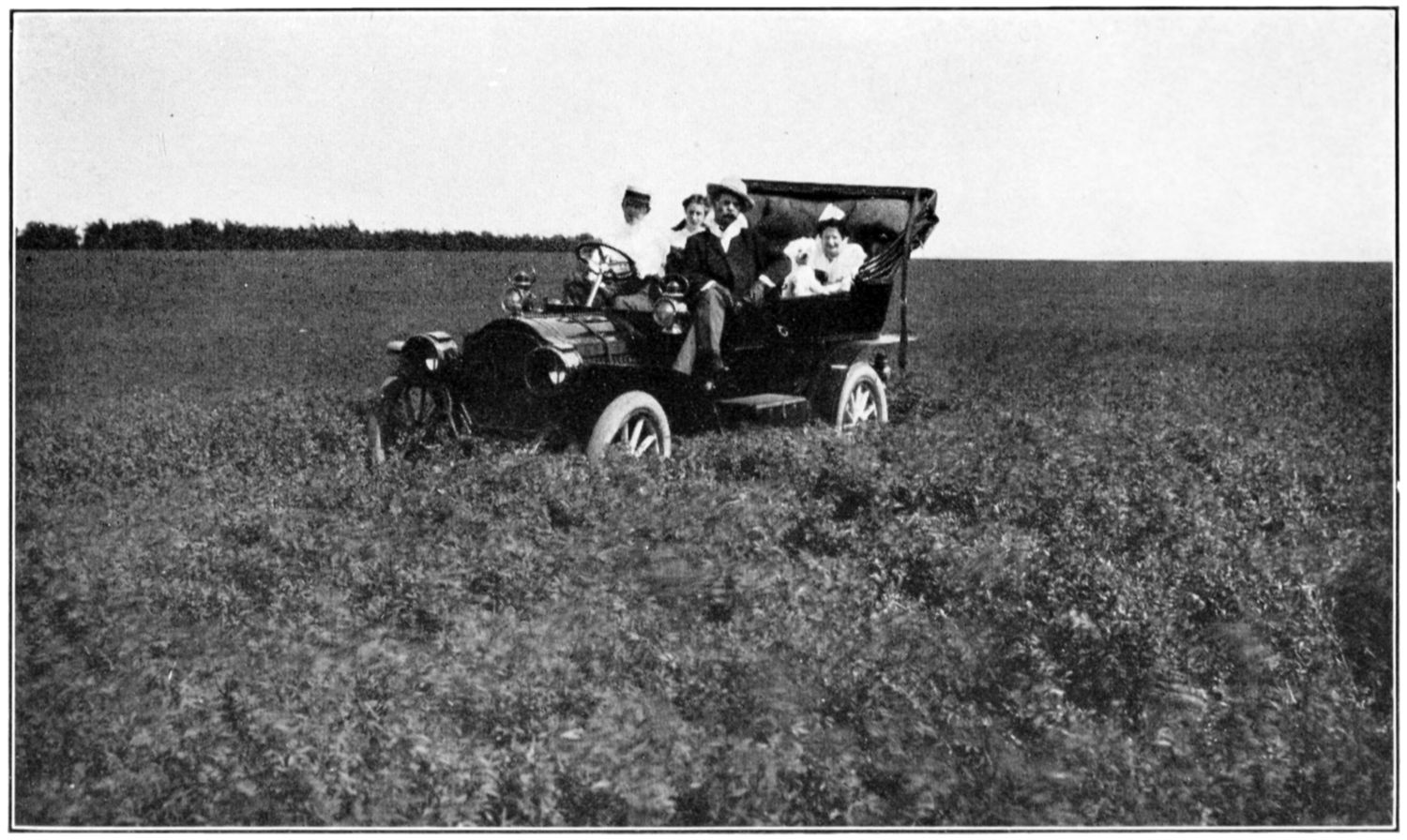
Kansas Farmer Viewing One of His Alfalfa Fields
Showing ten days’ growth after first cutting in 1907
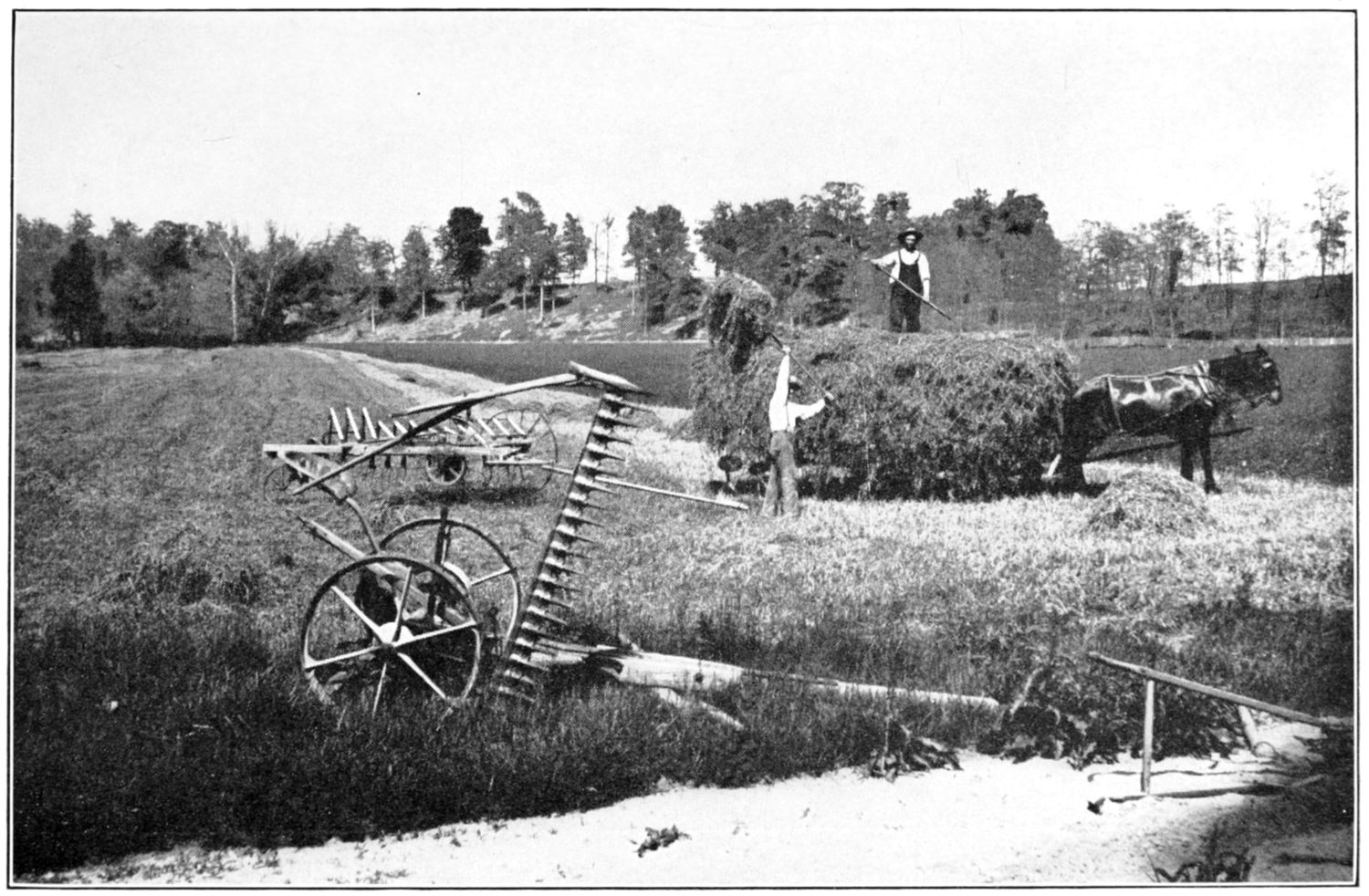
Harvesting Alfalfa in Ohio
At this station steers made a most rapid gain when fed
upon early cut alfalfa hay, either with or without an
accompanying ration of grain. “By early cut hay was
meant hay cut just before bloom. The gain upon this
early cut alfalfa hay was one-third more than that upon
hay cut when in full bloom or later.”
The Utah station also reports a cattle feeding test
(Bul. No. 61) in which 100 pounds of gain from feeding
alfalfa hay cost $3.76; from timothy, $4.71, and from
corn fodder, $6.21.
At the Nebraska station Prof. Howard R. Smith (Buls.
85 and 90) fed 50 yearling and 50 two-year-old grade
steers in lots of ten for six months, each lot of each fifty
having rations different from the others, and the table
herewith shows the average cost per pound of gain made
by each steer of each lot of yearlings:
| Lot |
fed |
corn and prairie hay |
8.27 |
cents |
| „ |
„ |
corn 90 per cent, oil meal 10 per cent, and prairie hay |
6.82 |
„ |
| „ |
„ |
corn 90 per cent, oil meal 10 per cent, and corn stover |
6.09 |
„ |
| „ |
„ |
corn 90 per cent, oil meal 10 per cent, and sorghum hay |
7.00 |
„ |
| „ |
„ |
corn and alfalfa hay |
6.04 |
„ |
Below is shown the cost under similar conditions with
the two-year-olds, (the cost of the corn and oil meal fed
them having been slightly greater than that fed the yearlings):
| Lot |
fed |
corn and prairie hay |
8.23 |
cents |
| „ |
„ |
corn 90 per cent, oil meal 10 per cent, and prairie hay |
8.27 |
„ |
| „ |
„ |
corn 90 per cent, oil meal 10 per cent, and corn stover |
6.49 |
„ |
| „ |
„ |
corn 90 per cent, oil meal 10 per cent, and sorghum hay |
7.87 |
„ |
| „ |
„ |
corn and alfalfa hay |
6.89 |
„ |
Among the deductions from these experiments, Professor
Smith records the following, bearing upon the use of
alfalfa:
“Alfalfa is much superior to prairie hay when the grain
consists of corn alone. It also proved to be a cheaper
source of protein than oil meal. The returns on the cattle
fed alfalfa hay, were the alfalfa figured at $11.14 per
ton, would have been as great as the returns on prairie
hay at $6 per ton, with corn as the grain ration at 39
cents per bushel. In comparison with prairie hay at $6
when oil meal worth $28 per ton was a part of the grain
ration, the alfalfa returned a value of $8.28 per ton.
(In these experiments the cost of all alfalfa hay and all
prairie hay was figured at the one price of $6 per ton.—Author.)
“Bright, well-cured corn stover fed with an equal
weight of alfalfa, the grain consisting of corn alone, gave
slightly larger gains than corn and alfalfa, and proved
the most economical ration in the experiment. The addition
of corn stover may have improved, to some extent,
the corn and alfalfa ration by furnishing greater variety,
and by its tendency to check scours sometimes caused by
alfalfa. The stover fed with alfalfa returned a value of
$4.57 per ton in comparison with alfalfa at $6 per ton
as the sole roughness.
“By feeding alfalfa hay, which is a protein-rich roughness,
extremely palatable and readily masticated, in place
of prairie hay with corn alone, 14 per cent less grain was
required for each pound of gain on two-year-olds and 27
per cent less on yearlings.
“Alfalfa hay, fed once per day in connection with corn
and well-cured cornstalks, furnished sufficient protein for
two-year-olds to make the three foods a combination
producing heavy and very economical gains—more economical
than any other ration in the experiment.
“Alfalfa is pronouncedly superior to prairie hay for
beef production, and the more rapid the extension of the
area of land devoted to the production of alfalfa, supplanting
the less valuable and lower yielding native hay,
the more rapid will be the production of wealth from our
soil.”
One authority who has made a study of such problems
says, “steers can be fattened on one-third less corn with
alfalfa for roughness than without.”
W. H. Jordan, director of the New York (Geneva)
experiment station says: “Probably no species of forage
are known that are more economical sources of high-class
cattle food than alfalfa and corn, and if in the
realms of stock raising corn is king, alfalfa is queen.”
Many feeders make the mistake of feeding too much
alfalfa hay to young steers grained heavily on corn.
Careful tests seem to prove that cattle on a heavy feed of
corn, corn meal, Kafir-corn or Kafir-corn meal gain as
much with 15 or 20 pounds of alfalfa hay per day as by
having 35 pounds, the very common quantity in feeding.
It is also reported by experienced feeders that steers over
three years old may be fattened on alfalfa with a moderate
feed of corn, while for younger steers the heavy
feed should be corn with 15 to 25 pounds of alfalfa hay
per day.
A Colorado feeder put a lot of steers nearly four years
old on a daily ration of ten pounds of corn chop and
fifteen pounds of alfalfa hay for 100 days. The gain
was surprising and the steers weighed on the Denver
market about 1430 pounds per head.
A feeder in Osborne county, Kansas, reported to the
author the following: “Began feeding 22 two-year-old
steers on February 3rd, averaging 941 pounds in weight.
Gave them no feed but alfalfa hay until March 4th. From
March 4th until May 1st fed all the alfalfa they wanted
and 243 bushels of corn chop, when they weighed out
at an average gain of 259 pounds each in 86 days, or
three pounds per day on a feed of 11 bushels of corn
chop and plenty of alfalfa hay per steer.”
Western feeders generally claim to be able to put fat
cattle on the market from 20 to 30 per cent cheaper with
alfalfa as the balance than on corn alone, or with corn
and bran or any purchased protein foods. The cheapest
beef-making in the West is the raising of calves on
alfalfa, and at 20 to 24 months fattening them by a heavy
feeding of corn and alfalfa hay for 100 days. Cattle carried
to 1000 to 1200 pounds on alfalfa, and then finished
by strong feeding on corn with alfalfa hay for fifty to
sixty days, make beef of a choice quality at a low cost.
CHAPTER XII. Alfalfa and the Dairy — MAKING A MARGIN — SOME MILKING TEST VALUATIONS — SELLING FARM PRODUCTS THROUGH THE COW — AN ESSENTIAL IN MILK PRODUCTION
The most enthusiastic advocates of alfalfa are dairymen.
The market price of milk is quite well fixed and
the price of butterfat at the creameries remains, in the
different seasons, pretty much the same year by year.
Hence, the problem of increasing his financial returns
must depend upon the dairyman’s being able to increase
the volume of his product or to decrease the cost, or both.
If he is selling butterfat at a profit of five cents and he
cannot force the price any higher, it is the sensible thing
to decrease the cost per pound and thereby enlarge his
profit.
The dairyman who buys all his feed has but little margin.
To raise enough clover calls for considerable land.
Alfalfa will yield a large bulk of excellent feed from a
few acres of well treated land. For profit he must raise
more feedstuff and buy less. The Kansas station reported
that with common scrub cows fed on alfalfa hay and
Kafir corn meal it was possible to produce butterfat at a
cost of seven cents a pound.
The New Jersey station as a result of a very painstaking
milking test reported: (1) In a ration where
alfalfa hay was tested against wheat bran and dried
brewers’ grain the saving in the cost of milk was 12.7
cents per hundred, and 2.3 cents per pound of butter when
alfalfa hay was used. This saving means a great deal
when it is considered that the alfalfa is raised and not
purchased. (2) That the milk value of one acre of
alfalfa was $74.
A Kansas dairyman is reported to have kept ten cows
through one summer on the alfalfa cut daily from a patch
containing four square rods less than two acres.
Some dairymen believe that there is a great saving in
the alfalfa hay by cutting it into two-inch lengths, and
feeding it dry. It is also believed that it will always be
a matter of economy to feed with the alfalfa, green or as
hay, a small ration of carbonaceous food, even corn-stover
serving such a purpose.
Former Governor Hoard, editor of Hoard’s Dairyman,
says that with alfalfa hay at $10 and bran at $20 per ton
there is a saving, by using alfalfa, of $2.80 for every 100
pounds of butter made, and a saving of 19.8 cents for
every 100 pounds of milk.
In a section of New York where alfalfa has been quite
generally introduced, dairymen claim an increase in their
profits of 15 to 30 per cent by its use, besides the enrichment
of their farms for other crops.
Prof. D. H. Otis, telling of experiments with the dairy
herd at the Kansas agricultural college, states that, “it is
usually recommended to feed a cow all the rough feed
she will eat, and then balance up the ration with grain.
The experience at the college indicates that much rough
feed is wasted in careless feeding. The cow will eat the
best first, and, if given too much, will pick the most
desirable morsels, leaving what might be called passably
good, which too frequently is treated as waste and
thrown under foot. No more hay should be given an
animal than it will eat up clean. This refers to first-class
quality, however, as a cow could not be expected to eat
poor hay clean.
“In feeding the rough feeds, the following table has
been used by the college as a guide:
| Roughness.—Value per ton when alfalfa
is worth $1.00 per ton |
| Feed |
Total
nutrients |
Protein
nutrients |
Feed |
Total
nutrients |
Protein
nutrients |
| Dry Roughness |
|
|
Green roughness |
|
|
| Alfalfa |
$1 |
.00 |
$1 |
.00 |
Alfalfa |
$0 |
.34 |
$0 |
.37 |
| Corn-fodder |
|
.32 |
|
.19 |
Corn silage |
|
.13 |
|
.12 |
| Cowpeas |
|
.97 |
1 |
.02 |
Fodder corn |
|
.14 |
|
.09 |
| Fodder Corn |
|
.40 |
|
.24 |
Pasture grasses |
|
.03 |
|
.24 |
| Millet |
|
.64 |
|
.42 |
Sorghum fodder |
|
.12 |
|
.06 |
| Oat hay |
|
.59 |
|
.41 |
Soy-beans |
|
.28 |
|
.30 |
| Oat straw |
|
.33 |
|
.15 |
Roots and Tubers |
|
|
| Orchard-grass |
|
.60 |
|
.45 |
| Prairie hay |
|
.51 |
|
.33 |
Mangels |
|
.10 |
|
.09 |
| Red clover |
|
.70 |
|
.64 |
Sugar-beets |
|
.14 |
|
.10 |
| Sorghum |
|
.43 |
|
.23 |
Turnips |
|
.11 |
|
.08 |
| Soy-beans |
|
.98 |
1 |
.02 |
|
|
|
| Mixed hay |
|
.67 |
|
.56 |
|
|
|
| Timothy |
|
.47 |
|
.27 |
|
|
|
| Wheat straw |
|
.25 |
|
.08 |
|
|
|
“Students working with the dairy herd were anxious
to have the cows make the best possible yields, and were
tempted to give all the good alfalfa hay the cows would
eat. When we discovered the alfalfa hay going too rapidly
we looked for the cause and found that the dairy
cows had consumed an average of forty-three pounds per
head daily, besides fifteen pounds of Kafir corn fodder.
The quantity of alfalfa was reduced to thirty-three pounds
and the Kafir-corn fodder to three and one-half pounds
daily per cow, and we found that the daily yield of milk
was slightly increased. The quality of the hay was the
same in both instances. In the latter case it was eaten up
clean, while in the former considerable was hauled away
and fed to dry cows. Later records show a still greater
reduction in the allowance of alfalfa without decreasing
the flow of milk. This experience shows some of the
leaks that may take place in feeding roughness, especially
when those feeds are appetizing, like alfalfa and red
clover.
“For ease of calculation the roughness is figured on
the basis of alfalfa hay selling for one dollar per ton.
When alfalfa is worth six dollars per ton the other rough
feeds are worth six times the amount indicated in the
table; when alfalfa is worth eight dollars per ton the
other feeds are worth eight times as much, and so on.
Usually we find that we can give practically all the rough
feed that the cows can eat, although, as indicated above,
with a good quality of alfalfa or clover hay more may be
eaten than will be consumed at a profit. At this writing
alfalfa hay is selling in Manhattan at seven dollars per
ton. This would make the feeding values of the other
rough feeds worth seven times the amount indicated in
the table. Red clover, for instance, would be worth seven
times seventy cents or $4.90 per ton; prairie hay would be
worth $3.57 per ton; and millet hay would be worth
$4.48 per ton. If the problem was to select the most economical
roughness, we would select alfalfa at seven dollars
per ton, in preference to red clover at six dollars
per ton, or prairie hay at four dollars per ton, or millet
at five dollars per ton. Knowing the cost of these different
rough feeds and having this table before him, a feeder
can tell which is the most economical feed to use. It will
be noticed that the table is divided into two parts, the
first part giving the value of the total nutrients, and the
second one the value of the protein nutrients. It frequently
happens that we have plenty of carbohydrates
and fat, but that we are lacking in protein. In this case
we would consult the ‘protein nutrients’ column in order
to determine what feed to buy in order to furnish the
protein most economically. If it be carbohydrates and
fat as well as protein that is required, as was the condition
in the dry year of 1901, then we should take the
total nutrients’ column. When it is possible to get a
rough feed containing a large amount of protein, we find
that in feeding a liberal allowance of roughness the grain
can be reduced. Hence, the importance of providing
roughness rich in protein, like alfalfa.”
No other branch of agriculture presents more advantages
than dairying—disposing of the products of the
farm as milk and butterfat. When the latter may be sold
to creamery stations and the skim milk fed to calves and
pigs along with alfalfa the profits are greater than from
almost any other form of agriculture. No other business
tends so rapidly to build up the fertility of the farm, and,
when judiciously conducted, no other branch of farming
yields more satisfactory financial returns. Raising and
feeding alfalfa will add from 15 to 30 per cent to the
profits of dairying over the use of any other feedstuff
that may be raised or bought. The profit problem for
the dairyman is constantly to find the feed that will
decrease the cost of his production.
The diagram below, prepared by the editor of the
Nebraska Farmer, is to “represent the digestible protein
or milk property contained in different kinds of roughness.
Points represent the decimals of a pound, and the
bars are an exact representation of the superiority of one
kind of food over another for the production of milk.
Each bar represents 10 pounds of roughness. The approximate
yield is also given per acre:”
Approximate Yield Per Acre.
| Corn Stover |
6 to 8 Tons |
17 Points |
 |
| Drilled Corn Fodder |
10 to 14 Tons |
25 Points |
|
| Timothy Hay |
2 Tons |
28 Points |
|
| Prairie Hay |
2 Tons |
30 Points |
|
| Millet Hay |
3 Tons |
32 Points |
|
| Oat Hay |
3 to 4 Tons |
43 Points |
|
| Red Top |
2 Tons |
48 Points |
|
| Red Clover |
2 Tons |
68 Points |
|
| Alsike |
3 Tons |
84 Points |
|
| Alfalfa |
6 to 8 Tons |
110 Points |
|
A. S. Hitchcock cites as an illustration of feeding alfalfa
alone, the case of the dairy farms in the vicinity of
Moneta, Cal., where the stock are ordinarily fed no other
ration than alfalfa. As alfalfa is not a balanced ration, a
number of local dairymen tried to replace a part of the
alfalfa by sorghum, thus giving a more nearly balanced
ration. The cows, however, did not give as much milk
upon this combination as upon pure alfalfa. “This result
may be assigned to the fact that the cattle were unable to
consume a sufficient quantity of the mixture to produce
the same results as the alfalfa alone. These dairymen
find they can secure a larger yield by feeding a little
grain; but the increased yield does not pay for the grain,
which is high priced in this locality.”
Oscar Erf, professor of dairying at the Kansas experiment
station, writing for this volume, says: “Alfalfa is
quite indispensable in successful dairy operations, being
one of the cheapest sources of protein, that most essential
compound in feeds for milk production. The Kansas station
found that for milk 11⁄4 pounds of well-leaved alfalfa
hay, containing a high per cent of protein, is equal in
feeding value to a pound of bran. In case the alfalfa is
of a stemmy nature it requires 13⁄4 pounds to equal the
feeding value of a pound of bran. Alfalfa hay is worth
from $4 to $7 per ton on the farm, while bran costs from
$14 to $20 per ton, hence it is far more economical to
feed the alfalfa hay.
“Like other hays alfalfa varies in composition according
to the time of cutting, the soil on which it grows, and
its per cent of leaves. It has been found that three-fourths
of a pound of alfalfa hay is equal in feeding value to a
pound of clover hay of equal brightness and quality. A
good stand of clover yields about 21⁄2 tons per acre per
year, while a good stand of alfalfa yields about 5 tons
per acre per year. Hence, on an acre of land, 1100 pounds
of protein can be produced by raising alfalfa while only
340 pounds can be produced by growing clover, the protein
in the alfalfa and that in the clover being equally
digestible. This comparison is chosen from the fact that
clover is the next cheaper source of protein found on the
farm.
“At the Kansas station the following experiment was
conducted, and illustrates the low cost of a ration including
alfalfa hay for roughness as compared with a ration
in which prairie hay was used. The experiment was with
ten cows. The first ration consisted of 21 pounds of
alfalfa hay and 9 pounds of corn. While the cows were
on this ration each produced an average 26 pounds of
milk per day, the milk containing 3.9 per cent of butterfat.
To formulate a ration from prairie hay and bran which
had the same amount of nutrients, we were obliged
to feed 19 pounds of bran and 15 of hay. Fed on this
each cow produced only 24 pounds of milk per day, containing
4 per cent of butterfat. The 21 pounds of alfalfa
hay at $7 per ton, which is rather a high estimate, and 9
pounds of corn at 70 cents per hundred weight cost 13.6
cents per day. At this rate it cost 31⁄3 cents to produce
a gallon of milk, or approximately 13.5 cents for a pound
of butterfat. Estimating bran at $16 per ton and prairie
hay at $5 per ton, the cost of the second ration was 18.95
cents per day, and milk approximately 7 cents per gallon,
making the butterfat worth 19.7 cents per pound.
“The following two tables show the difference in cost
between a ration in which alfalfa is used for part of the
roughness and one which contains no alfalfa but has the
same amount of digestible nutrients:
| Alfalfa hay |
19 |
lbs at |
$ 7.00 |
per ton |
$.066 |
| Corn |
7 |
lbs at |
.70 |
per cwt |
.049 |
| Bran |
21⁄2 |
lbs at |
18.00 |
per ton |
.0225 |
| $.1375 |
| Sorghum hay |
10 |
lbs at |
$ 3.50 |
per ton |
$.0175 |
| Prairie hay |
12 |
lbs at |
6.00 |
per ton |
.036 |
| Ground wheat |
8 |
lbs at |
.80 |
per bu |
.1066 |
| Cottonseed meal |
3 |
lbs at |
24.00 |
per ton |
.036 |
| $.1961 |
“As shown by the table a gain of 5.86 cents is made by
feeding the alfalfa. Being a proteinaceous feed it can to
a great extent be substituted for cottonseed meal, linseed
meal or gluten meal, and will entirely substitute other
leguminous hays and forages, such as soy bean hay, cowpea
hay, clover hay and vetch hay, any one of which is
more expensive, for nutrients contained, than alfalfa hay.
“The Kansas station has found it practicable, from
results obtained in the past three years, to ensile green
alfalfa for dairy cows. This is superior to dry alfalfa,
owing to its succulent nature. In the eastern part of the
United States ensiling alfalfa has another advantage in
that all cuttings can be harvested in perfect condition. As
a rule the first cutting throughout this whole territory is
liable to be damaged more or less by rains. By putting
the green alfalfa into a well constructed silo this loss can
be obviated and the full value retained. For example: a
man has 40 acres of alfalfa, from which he harvests for
the first crop 11⁄2 tons per acre. Estimating the price of
good, clean alfalfa hay at $7 a ton, this would be worth
$420. Should the hay be damaged by rain its value would
be greatly reduced and, as has been the case for many
years, such damaged hay could be purchased for $2 or
less per ton. Accordingly this damaged hay would be
worth $120. The loss caused by rain would therefore be
$300. Put into the silo this first cutting would be equal
in value to the best bright hay.
“The cost of a 100-ton silo is $250, hence the owner
could not only save the first cutting, but money besides.
Furthermore, it is not infrequently the case that alfalfa
of the first cutting is of a stemmy nature, and it has been
estimated that fully 28 per cent of such hay is wasted
when fed to cows, as they do not eat the coarse stems.
This loss can be entirely eliminated by the siloing, for
cows will readily eat the stems as silage.
“The value of alfalfa silage in influencing the milk flow
was indicated when a ration was fed to sixteen cows, in
which 12 pounds of alfalfa hay, 20 pounds of corn silage,
5 pounds of bran and 4 pounds of corn meal were used;
this ration was afterward changed by substituting alfalfa
silage for the corn silage, and at the same time the bran
was reduced to 1 pound, and the corn increased 1 pound.
By these changes the milk was increased 10 per cent.
“With butterfat worth 23 cents a pound the value of a
ton of alfalfa silage has been estimated at approximately
$8. This silage solves the problem of feeding cows economically
in summer, as well as in winter, under a system
of intensive farming.”
W. J. Fraser, chief in dairy husbandry at the University
of Illinois, says: “Corn silage and alfalfa, two of
the best feeds for dairy cows, make practically a complete
or balanced ration in themselves. Several years’ experience
in supplying the university dairy herd with various
kinds of soiling crops in midsummer has led to this high
recommendation of corn silage and alfalfa.”
Alfalfa hay has much the same laxative effect as June
pasture. An Elgin, Ill., dairyman, with fifty cows, says:
“Every month I feed alfalfa in winter gives me a month
in which I have practically pasture conditions. The cows
show the pasture-effect in the glossy condition of their
hair and in the yield of milk, and have never before
looked quite so well.”
CHAPTER XIII. Alfalfa for Swine — HOGS WILL EAT HAY — A VALUABLE FEEDING TEST — A NEBRASKA TEST — CUT ALFALFA EARLY FOR HOGS
In the preceding chapter it was stated that alfalfa is a
valuable pasture or soiling crop for pigs. It is equally
true that they will actually eat alfalfa hay. A hog is not
usually ranked as a hay-eating animal but an exception
must be made as to his eating alfalfa hay. As a pasture
or soiling crop for sows and young pigs, alfalfa proves a
wonderfully helpful ration for milk-making in the sow
and for growth in the pigs. Experiments have shown
that pigs make better growth when the dam is fed considerable
alfalfa than those from sows fed the best of commercial
rations, but with no alfalfa. Given two sets of
pigs, one fed clover, rape and soaked corn and the other
fed only alfalfa forage, the latter seemed to grow the
more rapidly. For brood sows it is a most valuable food,
either as hay, a soiling crop, or as pasture. The litters of
such sows are generally large and vigorous and the dams
have a strong flow of nutritious milk. Alfalfa meal in
slop may be used with profit where the hay is not to be
obtained. It is also claimed that sows fed on alfalfa during
pregnancy will not devour their young, its mineral
elements seeming to satisfy the appetite of the sow, while
contributing to the fetal development of the pigs.
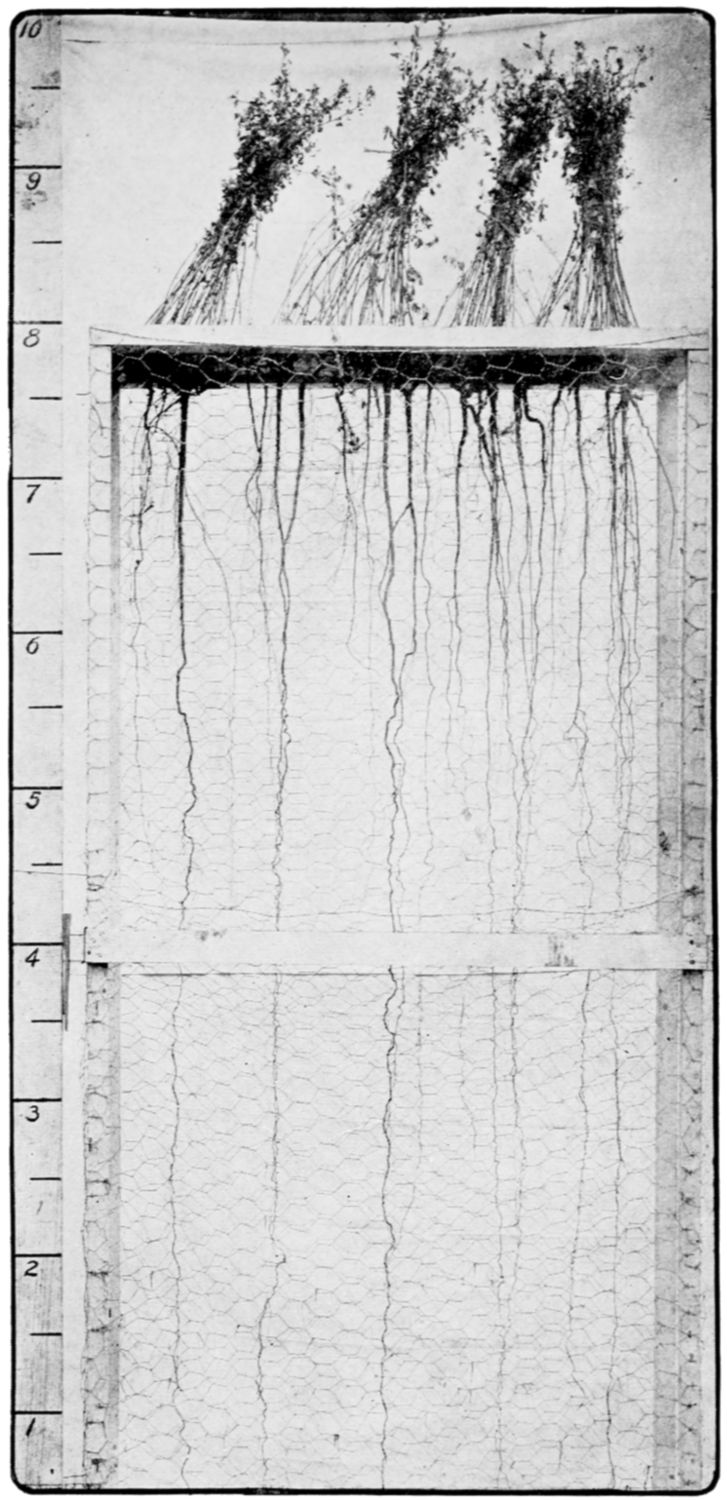
Five-year-old Alfalfa
at the time of its third cutting. September 8, and its root development. Grown
at Manhattan, Kansas, on upland prairie having a heavy clay subsoil
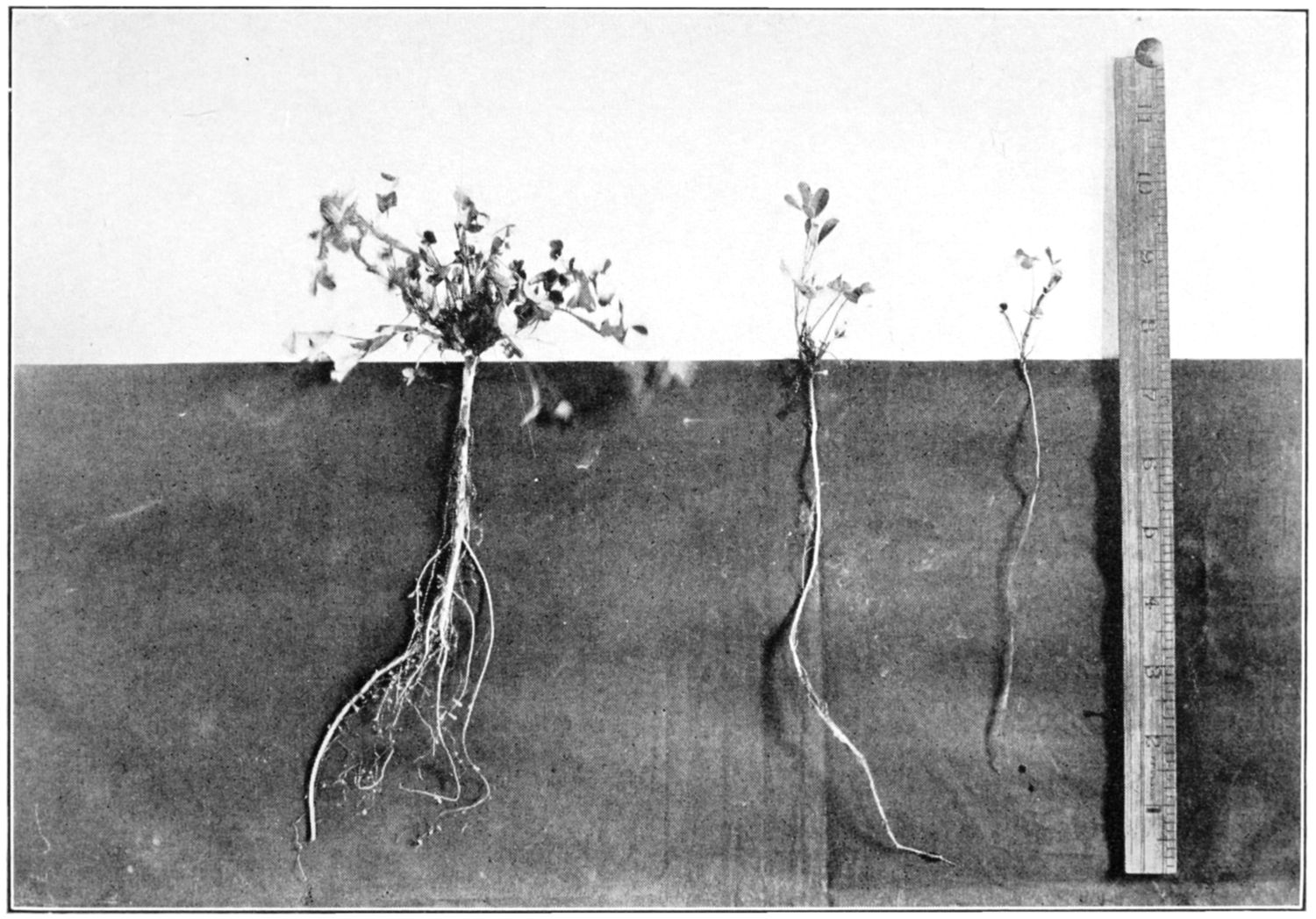
Showing Advantage of Early Fall Sowing
Beginning on the left the seed was sown August 19, September 15
and October 1 respectively. All were dug up April 13 of the
following spring. Nebraska Experiment Station Bulletin 84
On a farm of Governor Hoard, in Wisconsin, all the
brood sows have for several years been wintered on alfalfa
hay of the third cutting, and their drink, without any
grain until the last two weeks of gestation. Mr. Hoard
says the object was to give the sows a food that should
keep them in a non-feverish state and furnish protein
sufficient to build the bodies of the forthcoming pigs.
(Their “drink” was the skim milk from the dairy.)
“It was a matter of experiment at first, our only guide
being what knowledge and reason we could exercise from
what we knew, or thought we knew, of the philosophy of
gestation. The experiment proved to be a success from
the first. The sows went through their work in fine condition,
giving milk abundantly. The pigs came with splendid
vitality, thus reducing our losses from early death
fully 30 per cent over what they had previously been.
The hay is fed dry and is thrown into the pen on the feeding
floor without any cutting or chaffing whatever. We
have sometimes thought we would try the experiment of
cutting it into half-inch lengths and moistening it. Possibly
it would take less hay in this way. The sows keep
in good flesh, fully as much so as we like.”
A Finney county, Kansas, farmer reports having pastured
30 pigs on one acre of alfalfa from May 1st to
September 1st, when they weighed 100 pounds each and
were in fine condition for fattening. Another Kansas
farmer reports keeping 100 pigs from about the middle
of April to September on five acres of alfalfa pasture. A
little grain during the last two months would have gained
him many pounds of pork. Many alfalfa raising pig-growers
insist that their pigs can be maintained from
May to October on alfalfa for one-half what it would
cost for almost any other feed.
The Utah station found that young shoats gained one-third
of a pound a day on alfalfa pasture without grain.
But the station found also that the gain was not so great
in older hogs. A Wisconsin dairyman reported that he
kept nine sows all winter and spring on alfalfa hay and
skim milk, without any grain, and raised from them 75
pigs, all healthy and vigorous.
The Colorado station considers that a ration of three-fourths
corn and one-fourth alfalfa hay is the best for
fattening hogs for market, but for young hogs not ready
for fattening the proportions should be reversed. The
station does not recommend grinding alfalfa hay for
hogs, probably on the theory that the hog’s time is not
worth much at best.
The Kansas station in the fall of 1898 made a series of
experiments of interest to feeders everywhere. The test
was to determine the value of alfalfa hay fed to fattening
hogs that were receiving all the grain they would eat.
The results are related here in the language of the
bulletin:
“The hogs fed in this experiment were bought of farmers,
and averaged in weight 125 pounds each. They were
placed in lots of ten each, in large pens, having for shelter
some sheds open to the south. The alfalfa hay used was
of the best quality, carefully cured. Blackhulled White
Kafir-corn was the grain used, the hogs being fed all they
would eat without waste. The hay was fed dry in forkfuls
in a large flat trough. The pigs were given more
than they could eat, and they picked out the leaves and
finer stems, rejecting the coarser stems. One lot of hogs
was fed Kafir-corn meal dry and alfalfa hay; one lot
whole Kafir-corn dry; one lot Kafir-corn meal dry, and
one lot Kafir-corn meal wet.
“The experiment began on November 24 and lasted
nine weeks. By that time the alfalfa-fed hogs became
well fattened, and were marketed. We estimated that it
would require four to five weeks additional feeding, with
ordinary weather, to get the hogs that were fed grain
alone into good marketable condition.
“The gain in nine weeks from the different methods of
feeding were as follows:
| |
Gains
per hog
in pounds |
| Kafir-corn meal dry and alfalfa hay |
90.9 |
| Kafir-corn whole |
59.4 |
| Kafir-corn meal fed dry |
52.4 |
| Kafir-corn meal fed wet |
63.3 |
“The gain from feeding alfalfa hay with Kafir-corn
meal fed dry, over the meal alone fed dry, is more than
73 per cent.
“The gains per bushel of feed were as follows:
| |
Pounds |
| Kafir-corn meal dry and 7.83 pounds alfalfa hay |
10.88 |
| Kafir-corn whole |
8.56 |
| Kafir-corn meal fed dry |
7.48 |
| Kafir-corn meal fed wet |
8.09 |
“Ten hogs in nine weeks were fed 656 pounds of
alfalfa hay; and as shown above, for each 7.83 pounds of
alfalfa hay fed with the dry Kafir-corn meal, the hogs
gained 3.4 pounds over those having dry Kafir-corn meal
alone—a gain of 868 pounds of pork per ton of alfalfa
hay. These results are not due to the feeding value of
the alfalfa alone, but also to its influence in aiding the
hogs to better digest the Kafir-corn. The alfalfa hay also
gave a variety to the ration, making it more appetizing
and inducing the hogs to eat more grain. The ten hogs
having grain alone ate 3885 pounds of dry Kafir-corn
meal, while the ten hogs having hay and grain ate 4679
pounds of the Kafir-corn meal and 656 pounds of alfalfa
hay. The hay-fed hogs ate more grain and gained more
for each bushel eaten.
“In a former experiment pigs were pastured through
the summer on alfalfa with a light feeding of corn. After
deducting the probable gain from the corn, the gain per
acre from the alfalfa pasture was 776 pounds of pork.
“These facts indicate that to produce pork most cheaply
the Kansas farmer must have alfalfa pasture in summer
and alfalfa hay in winter.”
The Kansas station also found in another test that one
acre of alfalfa produced pork worth $20.30, while one
acre of rape produced pork worth $10.05.
The Iowa station director estimated that one acre of
alfalfa pastured was worth at least three acres of blue-grass
for pigs. It is claimed by Kansas farmers that an
average acre of alfalfa will pasture 15 pigs, while some
report having pastured 20 or more pigs per acre. Those
who have used alfalfa as a soiling crop for pigs admit,
however, that one acre so utilized is equal to two if not
three used as pasture.
It is argued by feeders that as many hogs may profitably
be allowed with cattle that are being fattened on
corn and alfalfa as when fed corn alone, as the feeders
believe in cleaning out the feed-racks every few days and
giving the left-over stems to the hogs. If necessary, a
little corn is added to the hog ration.
The Nebraska experiment station, from a hog-feeding
test made in 1903 reported the following:
“With the alfalfa hay worth $7 per ton, the leaves,
containing 40 per cent more protein, would be worth
approximately $10 per ton. The shorts cost $12.50 per
ton delivered. The dairy department charged 15 cents
per hundred for the skim milk used. Corn was delivered
to the barns at 30 cents per bushel. Adding the usual
rate of 6 cents per hundred for grinding, the corn meal
cost $12 per ton. At these prices, each hundred pounds
of gain in the several lots cost as follows:
| Lot 1, corn alone |
$4.48 |
| Lot 2, corn and skim milk |
3.97 |
| Lot 3, corn and shorts |
3.53 |
| Lot 4, corn and alfalfa |
3.40 |
“This experiment shows that at the market prices
quoted and the proportions used in the experiment, skim
milk will make corn bring four cents more per bushel,
wheat shorts eight cents more, and alfalfa leaves nine cents
more. Assuming that only five per cent of the 252,520,173
bushels of corn produced in Nebraska this year is
being fed to hogs as a single food, these figures would
go to show that $1,000,000 more wealth would be added
to the state if wheat shorts or alfalfa were substituted for
one-fifth of the corn fed.”
It is especially important that alfalfa intended to be
fed to hogs should be cut early. An experiment at the
Kansas station showed that a ton of early cut and well-cured
alfalfa, fed with grain, produced 868 pounds of
pork while a ton late cut and poorly cured, fed with grain,
produced only 333 pounds. For fattening hogs it is well
to feed about one ton of well-cured alfalfa hay with each
250 bushels of grain.
Farmer’s Bulletin No. 215 of the United States Department
of Agriculture declares that alfalfa is an ideal pasture
plant for hogs. “There is no danger from bloat and
with a limited number of hogs there is practically no
injury to the alfalfa field. Vigorous alfalfa will support
15 to 25 head of pigs per acre. It is best to limit the
number of pigs to that which will be insufficient to keep
down an alfalfa field. Cuttings of hay may then be made
at intervals and the growth thus rejuvenated. On the
average pigs weighing 30 to 60 pounds in the spring will
make a gain of about 100 pounds each during the season.
Although pigs may be grown and fattened upon alfalfa
alone, it is best to combine the alfalfa with some kind of
a grain ration. Alfalfa by itself is too rich in protein to
give a balanced ration. Where pigs are pastured upon
alfalfa alone they may be prepared for the market by
feeding for a few weeks upon corn. It is still better,
however, to feed a third to a half of a ration of corn or
other grain during the time of pasturing.”
The great mistake made by too many who attempt to
pasture swine on alfalfa is in overstocking. There is a
tendency to keep within a small pasture more stock than
it can comfortably support, with the result that the stand
is gnawed, trampled and rooted out, while the animals
fail to prosper as they would under more rational treatment.
One of the most extensive and successful swine raisers
in Kansas tells the author this: “Twenty-five years of
pasturing hogs of all ages on alfalfa has proven conclusively
to me that with a fourth to a half grain ration,
while they are on such pasture, will produce in them a
greater growth per day than when in dry lots on full
feeds of corn. Hogs will maintain a reasonable growth,
but not fatten much, on alfalfa pasture alone; I believe
it profitable to feed them some grain while running
on green alfalfa. If it is desired to full-feed hogs,
they will make a rapid fattening growth by increasing
the grain ration while on the pasture, and with the
full grain ration the meat will be nearly as firm as
those of the dry lot, where grain alone has been fed. I
find no distinction on the market between alfalfa-fed
swine and those purely grain-fed, and they sell price and
price alike. The general health of the alfalfa-fed hogs is
equal to that of those maintained on any other feed, and
they are prolific.”
The Kansas station realized $11.90 per acre from rape
pasture and $24.10 per acre from alfalfa pasture in ninety-eight
days. These results were obtained from the following
experiments, which were begun July 25 and concluded
October 31.
Thirty shoats, averaging fifty-two pounds in weight,
were divided as nearly equally as possible into three lots
of ten each. Lot I was fed on a grain mixture of shorts
one-half, corn meal one-fourth, and Kafir-corn meal one-fourth,
in a dry lot. The other two lots were fed the
same grain ration, but one received rape pasture and the
other alfalfa pasture in addition. Each lot was given
what grain the hogs would eat up clean, and each had
access to water and ashes. The weights of grain consumed
and gains made are as follows:
| Feed |
Grain
consumed
in pounds |
Total gain,
in pounds |
Grain
consumed
per 100
lbs. gain,
in pounds |
| I. |
No pasture |
3,801 |
1,023 |
371 |
| II. |
Rape pasture |
3,244 |
1,076 |
301 |
| III. |
Alfalfa pasture |
3,244 |
1,078 |
300 |
The gains of the three lots are very nearly equal. The
dry lot consumed 557 pounds (or seventy pounds for
every 100 pounds of gain) more grain than the pasture
lots. The lot on rape required one acre of pasture, while
the alfalfa lot used a trifle less than one-half acre.
The lot without pasture required 3.71 pounds of grain
to produce one pound of gain. Assigning the same value
to the grain fed the hogs on rape pasture, we have 877
pounds of pork credited to the grain and 199 pounds
credited to the rape. At six cents per pound, the
price at which hogs were selling at the close of the
experiment, this would be a credit of $11.90 per
acre for the rape. In a similar manner, the alfalfa is
credited with 201 pounds of pork, equal to $12.05, and
as there was only a half-acre of alfalfa, this makes a rate
of $24.10 per acre.
The cost of preparing the seed bed and seeding the
rape was $1.80 per acre. It was seeded in the feed lots,
on soil that would otherwise have remained idle or would
have grown up to weeds.
The shoats on pasture enjoyed their diet and seemed
satisfied. Those in dry lot seemed to be hankering after
something green, and their appetites seemed unsatisfied
without some kind of roughness. They would even nibble
at straw, in a vain attempt to satisfy their craving.
“The experiment,” says Prof. D. H. Otis, “emphasizes
the superior value of alfalfa pasture. Where alfalfa is not
available, or where variety is wanted, or it is desired to
utilize otherwise waste land, Dwarf Essex rape, seeded
at the rate of six to eight pounds per acre, any time from
early spring to late summer, will furnish an excellent diet
that is greatly relished by the hogs.”
J. E. Woodford, of Coffey county, Kansas, April 1,
1905, placed ten choice pure bred Poland-China brood
sows from twelve to eighteen months old that were due
to farrow in the latter days of June, on a five-acre field of
alfalfa. They were given no other feed than the alfalfa
pasturage until they had farrowed and their pigs were a
week old. After that the sows had in addition to the
alfalfa some bran slop until about August 20, when new
corn was fit for feeding. He says: “The sows from the
time they were turned on the alfalfa until the last week in
June made a remarkable growth, besides gaining somewhat
in flesh. They did well with their pigs, reared an
average of seven to each sow, and as sucklers they were a
sight to see. The pigs were the most attractive bunch ever
raised in Coffey county, as admitted by our breeding competitors.
We weighed a gilt from this lot when six
months and five days old, and her weight of two hundred
and twenty-five pounds was not above the average of the
whole lot. In our lifelong experience in rearing swine we
have found nothing of the grass kind for them that in
value approaches alfalfa.”
A plat of thrifty, well-established alfalfa suitably
fenced and used for pasturing swine of whatever age can
scarcely fall short of being among the most profitable
parts of any farm upon which swine husbandry is given
attention.
CHAPTER XIV. Alfalfa for Horses and Mules — GOOD FOR WORK HORSES — CRESCEUS EATS ALFALFA — TOO MUCH HAY FED — PRODUCES RAPID GROWTH
J. W. Robison, a Kansas breeder of Percherons, who
ranks among the foremost anywhere, raises his colts to
three years at an average weight of 1700 pounds and his
four-year-olds at 1900 pounds, ready for the sale yard,
on alfalfa, except such limited quantities of grain as will
make it more nearly a properly balanced food, and incidentally
expedite growth. His opinion, fortified by sixty
years of experience, is that alfalfa as pasturage and hay
constitutes by far the most excellent and economical
frame- and muscle-forming food available to the live
stock industry. His colts have alfalfa as their first green
food, and, if foaled in winter, are taught in a few days to
nibble the cut hay. He also says colts reared mainly on
alfalfa have equal spirit and vigor and better dispositions
than those given much grain. His brood mares are made
to rely on alfalfa as their main ration, and for three
months before foaling it is practically, unless in midwinter,
their only feed. As a result they are always in ideal
condition, their colts are delivered easily, the mares give
an abundance of nourishing milk, free from feverish tendencies,
and the colts are robustly rugged from their
beginning. The cost of rearing colts and horses by this
method, he says, is less, quality and rapidity of their
growth considered, than by any other of which he has
knowledge.
The well-known J. E. Wing, of Ohio, says: “There
is no one thing so good for the work horse as alfalfa. He
needs less grain, and has more life and spirit than when
fed upon any other hay, yet even working teams can, on
account of its richness, be fed too much. This puts an
undue strain upon their excretory organs to eliminate
the unnecessary food substances from the tissues. The
overfeeding of alfalfa hay to horses has in some localities
caused the use of it to become unpopular, and to raise an
outcry against it. The writer has fed no other hay to his
horses—working teams, driving horses, mares and foals—for
many years, and has yet to observe the first instance
of evil result, save that the driving horses when not used
regularly become soft and easily sweated.
Until recently it was not thought in the eastern states
that alfalfa was an especially good feed for horses. On
the somewhat noted Watson ranch at Kearney, Nebraska,
the grain supply became exhausted one summer when
the prices were high. There was an abundance of alfalfa
hay, and although it was in August and the horses were
at heavy work, such as plowing and ditching, the entire
force of eighty was kept on alfalfa hay and but little
grain, without any injurious effect. They relished the
hay, did the hard work every day and looked as sleek as
if on pasture. Since that time alfalfa hay has been the
principal ration for all of the farm’s work horses, colts
and driving stock.
In western Kansas farm horses have been wintered on
a daily feed of 10 pounds of alfalfa hay and some corn
stover, and thin horses fattened on alfalfa hay and a little
corn.
Again, the prevalent notion that it is not good for driving
horses has been contradicted by hundreds of farmers
who use it for such horses, and by hundreds in western
towns who use it for delivery horses, dray horses, and
light drivers, as well. In parts of California it is the only
hay fed to horses. “Cresceus, the great race horse, is
said to have been raised on it and it is said that he is fed
no other hay, even while on the racing circuit.” The
same was said of Sysonby, the fleetest Thoroughbred in
the races of 1905. Many of the city transfer companies in
Denver, Kansas City and Omaha use alfalfa hay, claiming
that it enables them to reduce their grain ration,
while their horses seem stronger and look better than they
did with the former feed of corn and timothy.
It is no doubt true that Americans feed their horses
too much hay. It is common among horse owners to let
horses stand to full mangers when not at work. In
London the cab horses, for example, are given hay for
but two hours a day, in the evening. At the end of two
hours the mangers are cleared. Careful testing in
decreasing the timothy hay ration one-half has not shown
that the horses required any more grain than before to
keep them in equally good condition.
Horses do not need a heavy ration of alfalfa hay. Fed
with grain, probably 10 or 15 pounds of it is equal to a
manger full of other hay. As they become accustomed
to the alfalfa it may be increased a little, and the grain
decreased. It is a rich food and should not be used as
freely as hays with less protein.
Prof. L. A. Merrill of the Utah station made six tests
of alfalfa hay in comparison with timothy for horses
under varying conditions of work, and found that it was
less difficult to maintain their weight with alfalfa. The
appearance of the horses in every comparison was in
favor of the alfalfa-fed horse, and no ill results were
noted on their health by long-continued alfalfa feeding.
Fourteen-hundred pound horses at hard work could be
maintained in condition on 32.6 pounds of alfalfa hay
per day, and at rest 20 pounds was sufficient for the
same horses.
The quantity of hay fed on most farms could be reduced
at least one-half.
With all its merits alfalfa hay is by no means a properly
balanced ration for all purposes, and those unacquainted
with this fact are liable to feed it, exclusively or
otherwise, in such quantities as are both extravagant and
harmful. D. C. Smead, a veterinarian of note, in writing
about using the hay in too great quantities, especially in
feeding horses, says this:
“There is more danger in deranging the digestion or
man or beast by an excess of protein than by overfeeding
on a carbonaceous food. The proteins in food
are more easily acted upon by the digestive fluids, and
thus more easily digested and carried into the blood,
where an excess means work for the kidneys to carry it
off. We can founder a horse more easily on wheat than
on corn for this very reason. Alfalfa has a nutritive
ratio of practically 1 to 4. An ordinary 1000-pound
horse, if given all it will eat of it, will eat from thirty to
forty pounds in twenty-four hours. As the alfalfa contains
about 11 per cent of easily digested proteins, you
will readily see that the horse would be taking into his
system nearly four and one-half pounds of protein.
“About two and one-half pounds of digestible protein
is all that an ordinary horse or cow of a thousand pounds
weight, when at work or in milk, can utilize. In the
alfalfa hay we have nearly twice as much as is needed.
If it were not for some of it being physicked off, we
would soon have an animal with overworked kidneys or
muscular stiffness of a rheumatic nature. In case of a
mare in foal, when fed on alfalfa and nothing else, the
chances are she would drop her colt prematurely, or if
it went full time, the colt would be a nice, fat, little, plump
fellow, with little vitality and with a tendency to rickets
or bowel disease, all because the alfalfa was too narrow
a ration.
“Now if we fed this mare alfalfa hay once a day or
even twice a day, in moderate quantities, say fifteen
pounds, and gave her one feed of straw or timothy hay or
corn fodder, which are carbonaceous foods, with a quart
of oats a day to impart a little nerve force, we would have
her practically on right lines. Alfalfa, good as it is, is
not an all-sufficient food for any animal. The danger lies
in sections where it is being thrown to the animals relishing
it so well and the owner having it in such abundance
that it will come to be considered all-sufficient, and then
trouble is liable to follow. But fed with judgment it is
the best of all protein foods, and will enable the farmer
to feed wisely and well many of the unmarketable rough
foods he raises, like straw and corn stover, the one balancing
the other.”
Here and there are horses with digestive apparatus not
suited for the best use of alfalfa, but they are rare exceptions
rather than the rule.
One of the foremost horse breeders in America, who
constantly maintains upwards of one hundred head of
various ages, writes the author this:
“In my experience of twenty-five years in pasturing
horses on alfalfa, results have convinced me that it produces
more bone, muscle and blood in horses in less time
than any other pasturage with which I am acquainted.
But I believe it profitable in raising the best horses to
also use a moderate grain ration, to stimulate rapid
growth and early development; my horses, however, have
shown no ill effects from pasturing on alfalfa without
grain, or other feed, and I have found such pasturing
conducive to health and prolificacy, maturing animals
equal for service to any reared otherwise. I have raised
three-year-olds grown on alfalfa and a light grain ration
to exceed a ton in weight, carrying all the good qualities
of the breed to which they belonged. Further, I find
using alfalfa as a horse pasture a much more economical
method of raising horses than any other.”
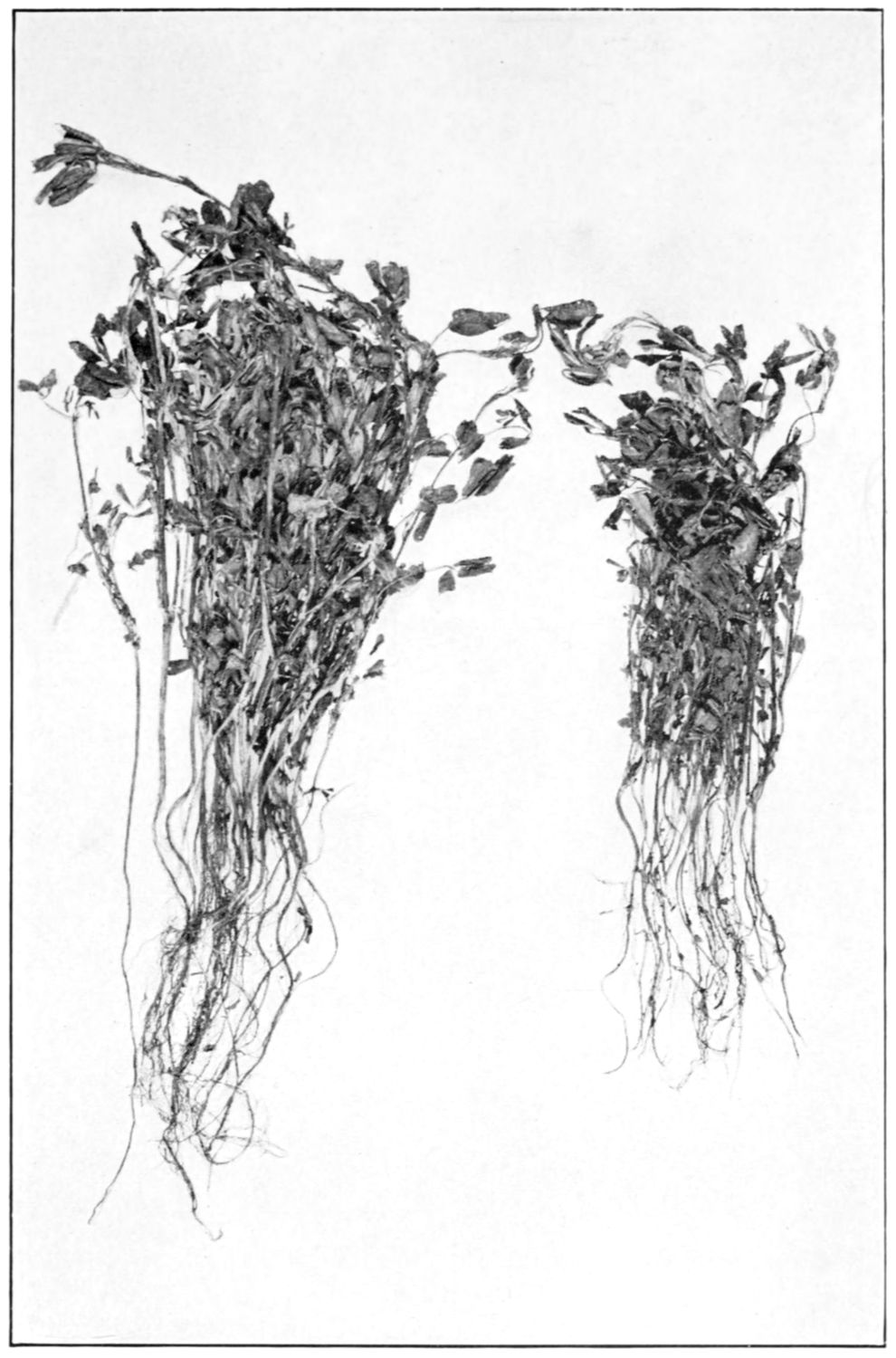
Alfalfa One Year Old Showing Effects of Inoculation
Plants on the left inoculated with “nitro-culture,” those on the right
not inoculated
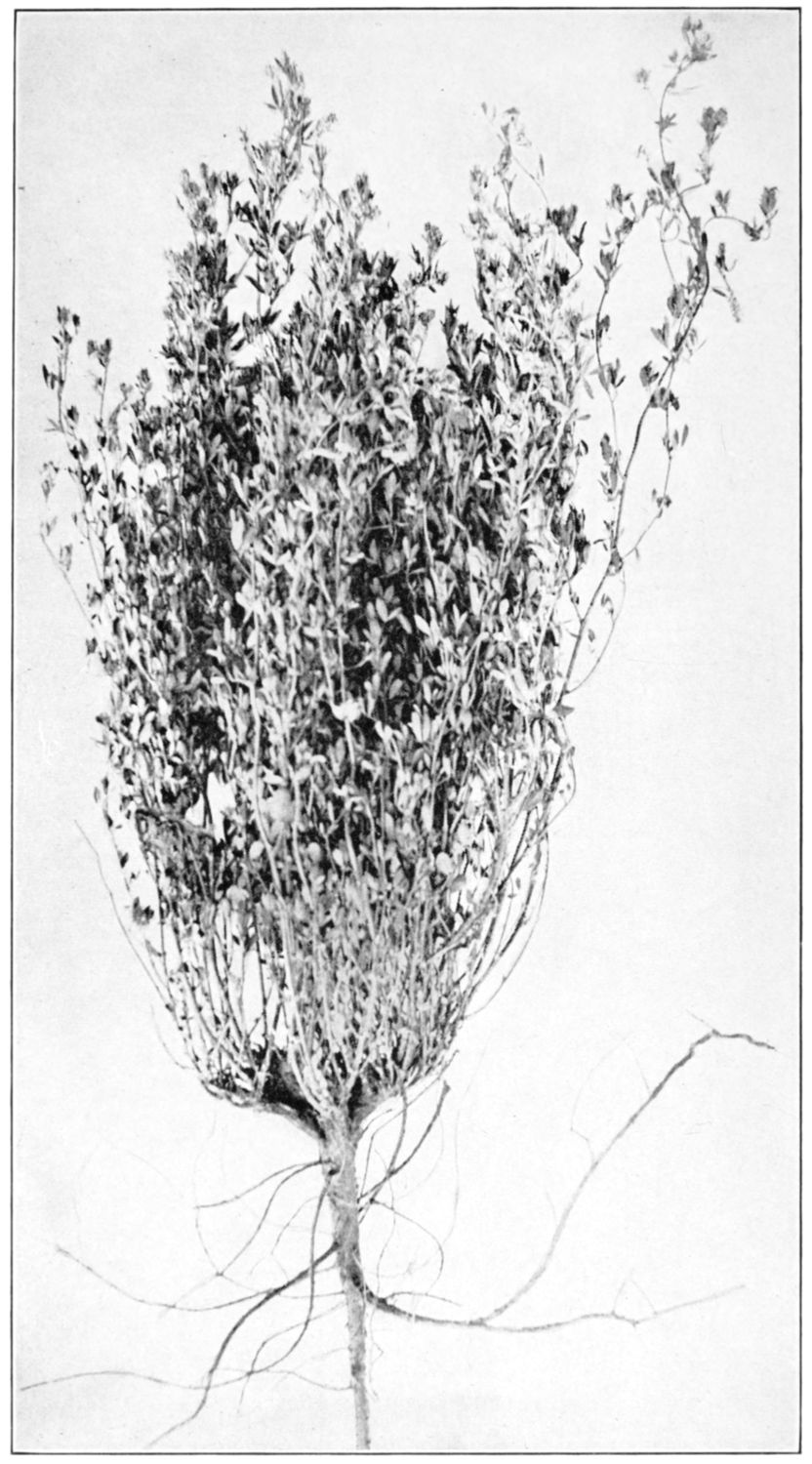
A Good Type of a Four-year-old Alfalfa Plant
grown on Kansas upland. Height, May 28, 36 inches. The crown shows the
effect of splitting with a disk harrow
CHAPTER XV. Alfalfa and Sheep-Raising — HOW TO PREVENT BLOATING
The day is not far distant when the free “range” will
be practically eliminated from the stockman’s assets. His
stock must be reared on cultivated crops instead of by
grazing on grasses that cost nothing. Pound for pound
alfalfa is more fattening for young lambs or old sheep
than clover. Lambs soiled on alfalfa cut daily make a
phenomenal growth and are as a rule free from disease.
They may be carried through the summer on a light feeding
of green alfalfa and general pasture or farm grazing,
and fattened in the fall on alfalfa hay and cowpeas or a
little grain, at a generous profit.
Thousands of sheep and lambs are every year brought
from Colorado and Montana to western Kansas and Nebraska
and fattened for market on alfalfa hay and grain,
making for these commodities a convenient market at
good prices.
Pasturing sheep or lambs on alfalfa is dangerous,
although there are sheep raisers who make it a main
reliance. One man reports absolute freedom from loss for
several years, and his method is to have his sheep pen
adjoining the alfalfa field and early in April when the
alfalfa is just beginning to put on its green, he arranges
a “creep” for the lambs to go through into the field, and
lets them stay there at pleasure. They soon wean themselves;
the “creep” is then closed and a safe pen in the
alfalfa field is used for shelter from rains and protection
from dogs. When necessary to fasten them in at night to
guard against dogs or wolves, he cuts green alfalfa each
evening to give them with a little grain in the morning
before turning them back to the field. The lambs grow
rapidly and none ever bloat. Nevertheless, most sheep
raisers will continue to reckon alfalfa pasture too expensive
when it costs so many animals for the privilege of
its use. Safety is the exception, and not the rule.
Owners of large flocks of sheep claim to be able to
market lambs from alfalfa pasture, or when soiled, at
one-half to one-third the cost of maintenance with any
other crop. Green or cured it seems to hasten development
and the lambs are in fine condition for fattening in
October, or the ewes to put into the breeding pen.
The Nebraska station in a winter experiment of 98
days with one hundred 50-pound lambs, divided into different
lots and variously fed with prairie hay, alfalfa hay,
shelled corn, wheat bran, oats and linseed meal figured at
the prices then current, reached these results:
1. The alfalfa-fed lambs consumed 1.34 pounds of
alfalfa hay and one pound of grain per day as against
.88 pound of prairie hay and .89 pound of grain consumed
by the prairie hay fed lambs.
2. The alfalfa-fed lambs made fifty-two per cent
greater gains than the lambs fed prairie hay and the same
grain ration.
3. The lambs fed prairie hay with corn and 16 per
cent of oil meal made 26 per cent larger gains than the
lots fed prairie hay with a grain ration of shelled corn,
or shelled corn with 25 per cent of bran or oats added.
In the twenty-fifth annual report of the Ontario agricultural
college are some interesting reports on feeding
lambs on various foods. The feeding periods were 74
days for the first experiment and 42 for the second.
By these tests alfalfa hay was shown to be slightly
better for the lambs in every way than clover hay under
practically equivalent conditions.
The first and second cuttings of alfalfa were equal in
value; the third cutting was slightly better than the first.
W. L. Carlyle, dean of the Colorado agricultural college
declares alfalfa hay is the basis of the feeding industry
in northern Colorado. “Without alfalfa our agriculture
would be of very little moment. Alfalfa forms
the basis of all our sugar-beet growing. It not only
enriches the soil in which it grows, but prepares it for
the growing of sugar-beets in a way that no other crop
or system or cultivation can, and while doing this preparatory
work it yields an enormous tonnage of the most
valuable feed for fattening sheep and cattle. Usually
lambs are given free access to the hay and are allowed
to eat all of it that they will.”
Lamb feeding in northern Colorado has been carried
on quite extensively for a number of years, and with such
success that “Fort Collins lambs” are recognized in the
eastern markets as superior to anything that is shipped
from any other section of the country. The name “Fort
Collins sheep” has extended to all of northern Colorado,
just as the “Greeley potato” is the term given to all
potatoes grown in the northern part of the state.
In recent years many thousands of old ewes have been
fed at the various sugar factories upon beet pulp,
alfalfa hay and corn. The old ewes thrive much better
upon the beet pulp than the lambs or younger sheep.
It produces a very desirable sappiness of flesh, and when
these sheep have been on this feed with alfalfa hay for
two or three months and are then finished with corn,
they bring the highest price on the market.
CHAPTER XVI. Alfalfa and Bees — THE BEE FERTILIZES THE ALFALFA — HOW THE FERTILIZING IS ACCOMPLISHED — THE HONEY PRODUCT
It has been discovered that the honey bee is of even
more importance to the alfalfa than the alfalfa is to the
bee. The wonderful strength and speed of the bees take
them long distances for their food and they have recourse
to a great variety of plants. But the peculiar construction
of the alfalfa blossom renders it unable to fertilize
itself and its shape makes cross fertilization very difficult.
In the marvelous “balance of good” in nature, alfalfa,
like thousands of other plants, is aided in its lease on life
by the insect world. It is not known just how many
insects or birds assist this remarkable plant, but the
honey bee is the most conspicuous, the most industrious,
the most eager, and certainly the most useful.
Careful observations have been made of seed pods
grown near colonies of bees, and also of those so far from
any bee colonies that it was safely assumed no bees had
visited the fields producing the pods. In every case it
was found that those from nearby fields had from 50 to
75 per cent more seeds than the others and that they were
larger and more perfectly developed. In Colorado and
western Kansas, where bee culture has been greatly
developed in recent years, it is found that the alfalfa seed
crop in fields nearest to bee colonies is much heavier and
of better quality than that of fields but a few miles away.
At the Kansas experiment station a small plat of vigorous
alfalfa was covered just before coming into bloom
with mosquito netting supported on sticks. It was therefore
known that no bees nor other insects could come into
contact with the blossoms. Later a careful examination
disclosed that the pods which had formed were entirely
without seeds.
As suggesting something of the relation of bees and
like insects to the cross fertilization of alfalfa blossoms
and consequent increased seed production, Prof. S. J.
Hunter, entomologist of the University of Kansas, who
has spent much time making critical observations of bees
in the alfalfa fields of the Middle West, writes the following
for this volume:
“Every farmer is familiar with the evil effects of continuous
inbreeding among live stock. In plant life this
same continuous fertilization of one plant by its own pollen
works no less injury to its race of plants. To prevent
such inbreeding among plants nature has devised several
means. One of these is illustrated in the alfalfa blossom.
If the reader will tear away the purple blossom exposing
the true organs of fertilization, it will be seen that the
central round body, the stigma, designed to receive the
pollen grains, is higher than the surrounding, elongated,
pollen-bearing anthers. It will become evident, then,
that it will be possible and most likely for the pollen to
drop to the base of the flower without coming in contact
with the stigma, and the flower will thus go unfertilized.
This is as nature intended it should be, namely, that the
plant should go unfertilized if it could be fertilized only
by the pollen of its own blossom. Provision, however, is
made for cross fertilization, that is, fertilization from the
pollen of another flower.
“The color of the flower itself, its fragrance, and
finally the sip of nectar secreted at the base of the flower,
are all intended to attract flower-frequenting insects.
Chief among these is the honey bee. The fragrance of
the flower draws the insect from afar. The color of the
flower reveals its exact location to the insect and when
the tongue of the bee is inserted into the flower, in quest
of the coveted nectar, the stamens and pistil spring up,
striking the under part of the hairy-covered head. These
hairs are barbed and readily retain the pollen, so that the
flower both discharges its own pollen and also takes from
the head and breast of the bee pollen previously collected
from other flowers. Obviously, the first flower which
the insect visits is not cross-fertilized. Practical observations
upon the relations existing between the honey
bee and the alfalfa plant are of value in illustrating the
effects of the bees upon alfalfa.
“A case in point: A hundred well matured pods were
collected upon an alfalfa field less than one-half mile
away from a large apiary. A similar number were taken
from another field. The two fields were as nearly identical
as possible in the matter of soil, culture, and conditions
governing the vegetable growth of the alfalfa plant.
The second field, however, was about twenty-five miles
away from a colony of bees. No bees were observed in
the field and since there was no timber, nor other place
of shelter where bees might possibly live, it seemed reasonably
safe to say that there were no wild bees in the vicinity.
An examination of the seed pods from each of the
two localities was made and the number of seeds counted.
In the field near the apiary the average number of seeds
in a pod was found to be 5.58. The seeds were plump and
the pods were numerous upon a cluster. The pods themselves
had several spirals. In the other field, the one
remote from a known colony of bees, the average number
of seeds in a pod was 3.35. The seeds in at least one-third
of the pods were small and shriveled. The pods
were few in the cluster, short, and with but few spirals.
The seed crop of the first field could be estimated on this
basis at two-thirds greater than that of the second field.
“It is a well-known fact that the seed yield per acre for
Red clover is comparatively small. Red clover belongs
to the same family of plants as alfalfa and it, too, is
dependent upon insects for fertilization of its flowers.
The work, however, is restricted largely to the bumble
bee, since but few other insects have tongues long enough
to reach down to the nectar of the clover blossom and
consequently do not visit the clover blossom and bring
about proper formation of seed. So in proportion as
the bumble bees thrive, the clover flourishes. Alfalfa,
however, is not so limited in its number of insect assistants,
since the flower itself is shorter and the nectar
accordingly accessible to a greater number of insects.”
Alfalfa raisers find it to their advantage to have a few
stands of bees. As the original cost is slight and the bees
provide their own food, go after the raw material for
the manufacture of honey, demand but slight attention
and make such bountiful returns, bee culture has come to
be a valuable “side line” for the farm. As blooms are to
be found in alfalfa districts every day from early May to
late October, the bees have a constant opportunity for
service.
Alfalfa honey is white and clear, in an extremely delicate
comb, has a delicious flavor, and an aroma that is
delightful. One authentic report from a western Kansas
county is of a single hive that contained nearly two hundred
pounds, and of another having ninety-six pounds.
The owner of these had twenty-five acres of alfalfa which
in one year yielded him over one hundred tons of choice
hay besides the honey. The next year he increased his
apiary to fifty stands.
While the average yield per hive elsewhere varies from
fifteen to thirty pounds, the average in the alfalfa-growing
territory is far higher. Thus the financial returns of
alfalfa may be greatly increased and in some instances
doubled by having, say, two colonies of bees for each
acre. Or if only a part of the alfalfa raisers in a neighborhood
keep bees, this ratio could be doubled or trebled
by those who do. Unlike other trespassers on neighbors’
fields the bees do the neighbors a distinct favor, by fertilizing
their alfalfa.
CHAPTER XVIII. Alfalfa Food Preparation — PROFESSOR COTTRELL ON ALFALFA MEAL — SOLVING THE TRANSPORTATION PROBLEM
The growing appreciation of alfalfa as a stock and
dairy food and the expense of baling and shipping it as
hay, the loss of leaves, and the liability to heat and mold
unless well cured, have led to the manufacture from it of
several food preparations. These in some cases are made
by simply grinding into a meal, and in others by mixing
the meal with molasses, or a variety of food products, and
assumed condiments and appetizers.
The Colorado station in a feeding test concluded that
the ground alfalfa was not an economical feed for fattening
pigs. With cut alfalfa hay costing $8 a ton and
ground alfalfa $16 a ton the cost of producing one hundred
pounds of gain with the former was $2.62 and with
the alfalfa meal $3.12. With corn and cut alfalfa hay
fed in equal parts by weight the cost of producing one
hundred pounds of gain was $2.72. With corn and
alfalfa meal fed in equal parts by weight the cost was
$3.96. It is not improbable, however, that better results
would have been obtained if a less proportion of ground
or cut alfalfa had been fed. It is also probable that the
hog’s grinding machinery is better adapted to his digestive
apparatus than is any other.
It is worth while, however, to consider the arguments
in favor of grinding alfalfa. Prof. H. M. Cottrell says:
“Grinding alfalfa increases its digestibility. How
much has not been determined. Grinding increases the
digestibility of corn and oats as much as 14 per cent, and
of wheat 10 per cent. It is probable that there is a greater
gain in digestibility from grinding alfalfa, a coarse feed,
than there is from grinding grain.
“When alfalfa is to be fed at a distance from the place
where grown it must be baled for shipping. When the
bales are opened and scattered in feeding a considerable
part of the leaves is wasted. Over 8 per cent of the
protein in alfalfa is found in the leaves, and the loss of
protein from leaves wasted in feeding baled hay is frequently
from one-fourth to one-half of the total amount
in the original hay. With ground alfalfa there is no
waste in feeding either from leaf or stem. Alfalfa
ground is in the best condition for shipping and handling
cheaply and without waste.
“Ground alfalfa is not only a good feed itself but when
mixed with grain aids in the digestion of the other feeds,
enabling the feeder to get more out of his home grown
grain.
“Experiments have not been made to determine the
exact value of this diluting effect of alfalfa meal in
increasing the feed value of heavy grains. Tests have
shown that corn-and-cob meal has the same feeding value
as an equal weight of clear corn meal. Practically worthless
ground cobs by their ‘lightening up’ the heavy corn
meal add 20 per cent to the feeding value of the meal
with which they are mixed. It is reasonable to believe
that a rich feed like ground alfalfa has even a greater influence
when mixed with corn meal. The more intimate
the mixture the greater the benefits from alfalfa, and for
this reason ground alfalfa is far superior to the whole hay.
“Grinding alfalfa hay reduces the power needed to
digest and assimilate it. It takes power for an animal
to chew the feed, digest it and bring about the chemical
changes that convert it into flesh or milk. All this energy
is taken from the actual food material in the alfalfa.
Experiments show that a much larger amount of food
value is used up in this way with coarse feeds than with
concentrated fine feeds. In corn, a concentrated feed
easily worked up in the animal’s body, three-fourths of
the protein actually in the hay is digested; and in straw,
a still coarser feed, only one-tenth. Forty-eight per cent
of all the energy in coarse hay is used up in chewing and
digesting it, while only twenty per cent of the energy in
oats is used in these processes. This shows the value of
preparing feed in such a way as to require the least effort
on the part of the animal to use it.
“In a well constructed mill it requires one horse-power
ten hours to grind alfalfa sufficient for a month’s ration
for a dairy cow in full milk. This indicates what a saving
the grinding of alfalfa makes in its effective use by
an animal.
“Experiments show that good alfalfa hay and wheat
bran have practically the same value in feeding for milk.
In a test made of bran and alfalfa meal, two lots of cows
were selected that were giving equal weights of milk.
One lot was fed bran, the other lot the same weight of
alfalfa meal. For each 100 pounds of milk given by the
cows fed bran, 141 pounds were yielded by the cows fed
alfalfa meal.”
As an example, “Alfamo” is the name of one of the
numerous new feeds on the market, having alfalfa meal
as its principal ingredient. After a year of experimenting
with grinding and mixing various feeds it was determined
by the manufacturers that a feed made of three
parts alfalfa meal and one part beet-sugar molasses
would possess a very high value. The ingredients are
mixed by a special apparatus and subjected to a process
which retains and preserves the high nutriment of the
feed.
Prof. Samuel Avery of the Nebraska station made an
analysis of “Alfamo,” which showed the following composition:
| |
Per cent |
| Moisture |
2.74 |
| Protein |
15.04 |
| Carbohydrates |
50.48 |
| Ash |
13.87 |
| Crude fiber |
17.85 |
Professor Avery also states: “This feed was made by
mixing molasses with alfalfa meal which contained
16.15 per cent protein. It will be noticed that the protein
content is not greatly reduced, while a large quantity of
nutritious matter has been added in the molasses. An
analysis of the molasses used in this product, showed
practically fifty per cent sugar, and it should be remembered
that the sugar in molasses is all digestible and
ready for the animal without extra effort on the animal’s
part, which is not so in corn or other foods, strong in
carbohydrates from which the starch must be extracted
by the digestive apparatus.”
Several mills for the manufacture of alfalfa foods have
been and are being established, and it is reasonable to
assume that the use of these foods will become quite general
in cities and districts remote from the alfalfa regions.
Whether or not the actual feeding value is appreciably
increased, or the nutritive constituents made more thoroughly
available, is as yet not determined by sufficient
tests, nor has it been determined by any station test that
any factory food preparation is more economical than
alfalfa hay, where the hay can be obtained well cured
and with a reasonable proportion of its leaves. It is
altogether probable, however, that alfalfa meal will be
more economical in distant cities than baled hay. If these
preparations of alfalfa prove to be satisfactory to consumers
in distant markets, it will lead to the multiplication
of mills in the alfalfa regions, thereby decreasing the
cost of transportation and giving the grower a wider
and probably a better market. The use of the meal or
the food preparations is likely to prove most especially
valuable for dairy cows and poultry.
CHAPTER XX. Alfalfa in Crop Rotation — MAINTAINING FERTILITY — VALUE OF STUBBLE AND ROOTS — EFFECTS ON SUCCEEDING CROPS — ROTATION A NECESSITY — SPREADS THE BACTERIA OVER THE FARM
It is a fundamental principle of the best agriculture
that every acre should be kept constantly at its highest
productive capacity. In one sense the farm is a great
machine for the production of food. All prosperity must
originate on and emanate from the farm; the farmer is
really the only original producer. The measure of the
world’s material success must be the relative amount of
the product of the farm. As lands decrease in fertility,
the cost of living increases in direct proportion. As fertility
decreases, land values decrease and rural population
decreases. Already there are districts in America
that are almost depopulated because of the barrenness of
what was, but a short while ago, fertile land.
The fundamental principle of maintaining fertility is
to restore to the land annually those chemical elements
taken from it by the crops grown. A prominent importer
of horses relates that he was once entertained on a great
horse farm in France, whose owner told him that much
of the farm had been in cultivation for over eight hundred
years and was, he believed, as productive now as
ever in its history.
Alfalfa ranks as the greatest fertilizing plant known
to scientific agriculture. All cereal crops use large quantities
of nitrogen. A field cropped for years in corn or
wheat will come to have too little nitrogen for the production
of a profitable crop. Alfalfa, as has already been
stated, after the first few months of its life obtains its
whole supply of nitrogen from the air; in fact, more than
it really needs. As a soil improver it possesses at least
five valuable properties:
1. It gathers nitrogen from the air for its own maintenance
and a surplus that is constantly being added to
the soil.
2. It is a deep feeder and its roots penetrate the earth
to extraordinary depths, drawing toward the surface and
utilizing moisture and valuable mineral elements that
other crops would never reach, leaving the desirable
elements there for future crops, of whatever kinds.
3. By capillarity, these roots and rootlets draw up
moisture from below the surface until it modifies the
very top soil, changing wonderfully the nature of the
field. The analysis of a cubic foot of earth of a flourishing
alfalfa field shows a marvelous change in moisture
content since the sowing.
4. The mere mechanical effect of the extensive root
system can scarcely be over-estimated. As soon as germination
begins the plant starts its tiny roots downward
on the search for moisture. Roots four feet long have
been found on alfalfa but four months old; roots nine
feet long have been found below alfalfa but nine months
old. After the taproot reaches a few inches below the
surface, it sends out smaller roots that have a lateral
growth of but a few inches, when they too, take a downward
course for moisture and for mineral elements needed
for the growth above. These first smaller roots decay
and others start out from the taproot lower down.
These decay and still others start. The decaying roots
add humus to the soil, and the openings left by them form
a wonderful system of channels for the penetration of
air and water into the soil. The erstwhile compact earth
is honeycombed and air and water penetrate the graves
of the dead roots until, when the alfalfa field is ready to
be used for a different crop, the soil has been wonderfully
changed not only in its chemical elements but in its physical
character.
5. The regular deposit of alfalfa leaves, from the
cuttings, under the best care, has been estimated at one-half
ton or more per acre every year. As these leaves
contain a great percentage of protein, it can readily be
seen that they make a heavy contribution to the soil’s
fertility.
When in his system of rotation the farmer is ready to
plow up his alfalfa, he has another inestimable contribution
to the land’s fertility in the stubble and roots. It is
not recommended to plow under any considerable growth
as a green manure, as the hay crop is too valuable. Its
market value would buy more fertilizers than the same
growth is worth for humus. After a field has stood for
five or six years, the roots have added largely to the
humus content. Prof. W. P. Headden of Colorado, estimated
that the fertilizing value of the stubble and 61⁄2
inches of roots plowed under is about $20 per acre, while
the value of the stubble and entire root system is not less
than $35 per acre.
The New Jersey station estimated that the amounts of
plant food gathered by an acre of alfalfa in two years
were equivalent in nitrogen to that contained in 3500
pounds of nitrate of soda; in phosphoric acid to that contained
in 600 pounds of boneblack superphosphate, and
in potash to the amount contained in 1200 pounds of
muriate of potash, or equal to what would have cost $124.
The Wyoming station, at Laramie, under direction of
Prof. B. C. Buffum (Bul. No. 44) made some tests that
proved the market fertilizing value of alfalfa. A plot of
ground that had been in alfalfa for five years adjoined a
plot of the same size that had been in varied crops, wheat,
oats, potatoes, etc. After the alfalfa sod was broken the
two plots were prepared together and planted crosswise
to wheat, oats and potatoes, with half of each on the
broken sod and half on the other plot with the following
yields and gains:
| |
After
Alfalfa |
After
Other
Crops |
Money
Gain |
| Wheat |
30 bu. |
18 bu. |
$8 to $12 |
| Oats |
78 bu. |
37 bu. |
16 |
| Potatoes |
81 bu. |
52 bu. |
16 |
Stating the results in another way, Prof. Buffum says:
“The value of alfalfa harvested from one-half acre of
land for five years was about $50 more than the cost of
producing it.
“The value of potatoes and grain from an adjoining
half-acre for five years was about $44 more than the cost
of producing, at local prices.
“When the alfalfa half-acre was plowed and planted
to wheat it produced $8 to $12 more value in wheat per
acre than the land which had grown potatoes and grain
before.
“When the alfalfa half-acre was plowed and planted to
oats it produced $16 worth of grain more than land
which had grown potatoes and grain before.
“When the alfalfa half-acre was plowed and planted
to potatoes it gave $16 worth more of potatoes per acre
than was obtained from land which had grown potatoes
and grain before.
“By growing alfalfa the increase of yields and values
were produced with absolutely no cost for fertilizing the
land.”
This gain, it will be noted, cost nothing in the way of
fertilization, as the alfalfa had every year been more
profitable than the other crops. A Marion county, Kansas,
manager of large estates reports that a field of wheat
after alfalfa averaged forty bushels per acre while an
adjoining field of equal original fertility averaged but
fifteen bushels. These results have been duplicated in
innumerable instances where alfalfa fields have been
plowed and planted to other crops. A Colorado man
who farms 1000 acres, with 200 acres of it in alfalfa, says
he cannot afford not to plow his alfalfa after he has had
from it four years’ crops; that it is necessary to maintain
the general farm fertility and obtain big crops of corn,
oats and potatoes. In the potato districts of Colorado
alfalfa is used systematically as a rotation to maintain the
yields and quality of their potatoes, both of which are so
famous.
In the corn belt, which may be said to extend from the
central meridian of Kansas to Pennsylvania, alfalfa used
in rotation will do much to prevent the disgrace of raising
an average of but twenty or twenty-five bushels of
corn to the acre. And so in what were once famous
wheat belts, alfalfa will restore the crop records, if properly
used in a rotation.
Some experiment station men insist that where alfalfa
is allowed to stand for many years it will cease to have a
fertilizing value; that alfalfa draws heavily on the potash
and phosphoric acid in the soil, and will after, say, eight
or ten years begin to deplete it of these important elements.
Therefore they insist that alfalfa should not be
allowed to stand for over six or eight years unless it is
given an annual top-dressing of manure. They favor
plowing up the alfalfa after about five years and cropping
to corn or cotton.
Former Governor Hoard in speaking of the value of
alfalfa as compared with that of clover in a crop rotation
says that, “alfalfa having a much larger root development
goes deeper down, thoroughly subsoils the ground, brings
up phosphorus and potash from the lower strata, and
leaves much more vegetable matter to decay and furnish
humus. Nothing else we have ever tried equals alfalfa
for putting the soil in good tilth.”
Men who are raising alfalfa for use in a regular rotation
never leave it over six years; many prefer five, while
others make it a rule to plow up their fields every four
years; thus the bacteria becomes fixed in the soil of the
whole farm. Such farmers use alfalfa as they formerly
used clover, to restore fertility needed for profitable crops
of grain, hay and forage.
The sod is hard to plow. It is well to do the breaking
immediately after the season’s cutting, if possible; disk
and harrow it several times and sow to rye for winter
pasture, and plant to corn or cotton or potatoes in the
spring. The winter’s freezing will help to put it in fine
tilth. If it is desired to follow with wheat (not always
advisable, however, on account of causing a too rank
growth), the sod may be plowed after the year’s second
mowing, disked and sowed to rye to prevent the soil from
leaching.
Breaking up a well set alfalfa field is no trifling matter.
It may be done with three heavy horses, but it is hard
work for them, and they will not be able to break more
than one acre a day. An authority says the best plan is to
use five heavy horses—three in the lead and two on the
end of the beam. They can go right along and plow two
acres a day. Alfalfa roots are very tough and strong when
the plants have attained full growth, and they give a jerky
motion to the plow, which is severe on horses’ shoulders.
A cast steel plow is the best to use and if it is tempered
right a file can just cut it. It can be hammered out thin
at the blacksmith’s shop when it becomes too thick to file
easily. “The reason for filing, rather than using the
hard, thin edge as in other plowing is that the edge needs
to be rough as well as thin, or the roots will slip along
the sloping edge of the share and not be cut.” It is
important that the furrow turned shall not be wider than
the plowshare will all the time cut clean, as any main
roots that are left uncut will send up a more vigorous
growth of stems than before, which, in another cultivated
crop will be the same as weeds.
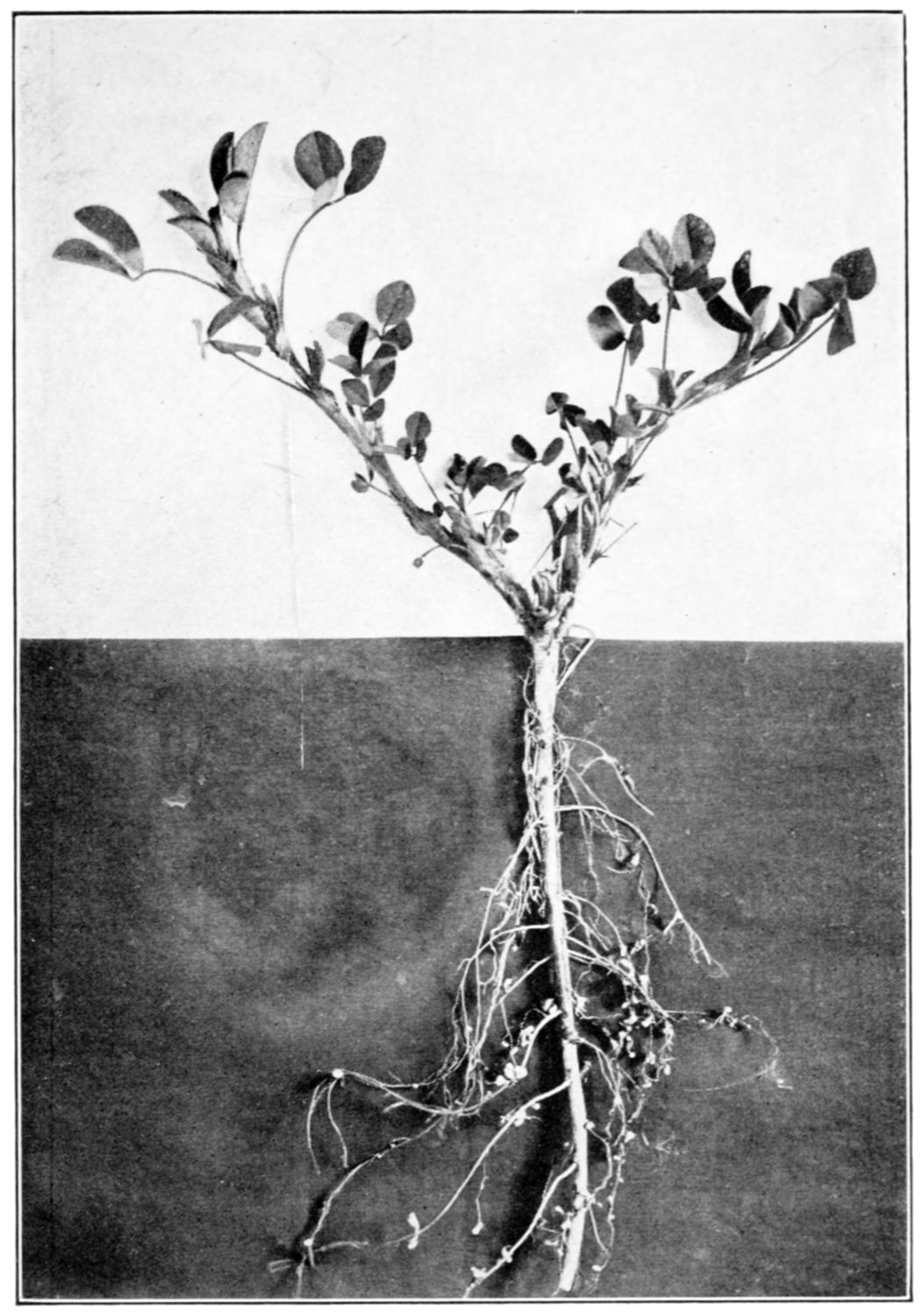
Alfalfa Plant and Roots Showing Bacteria Nodules
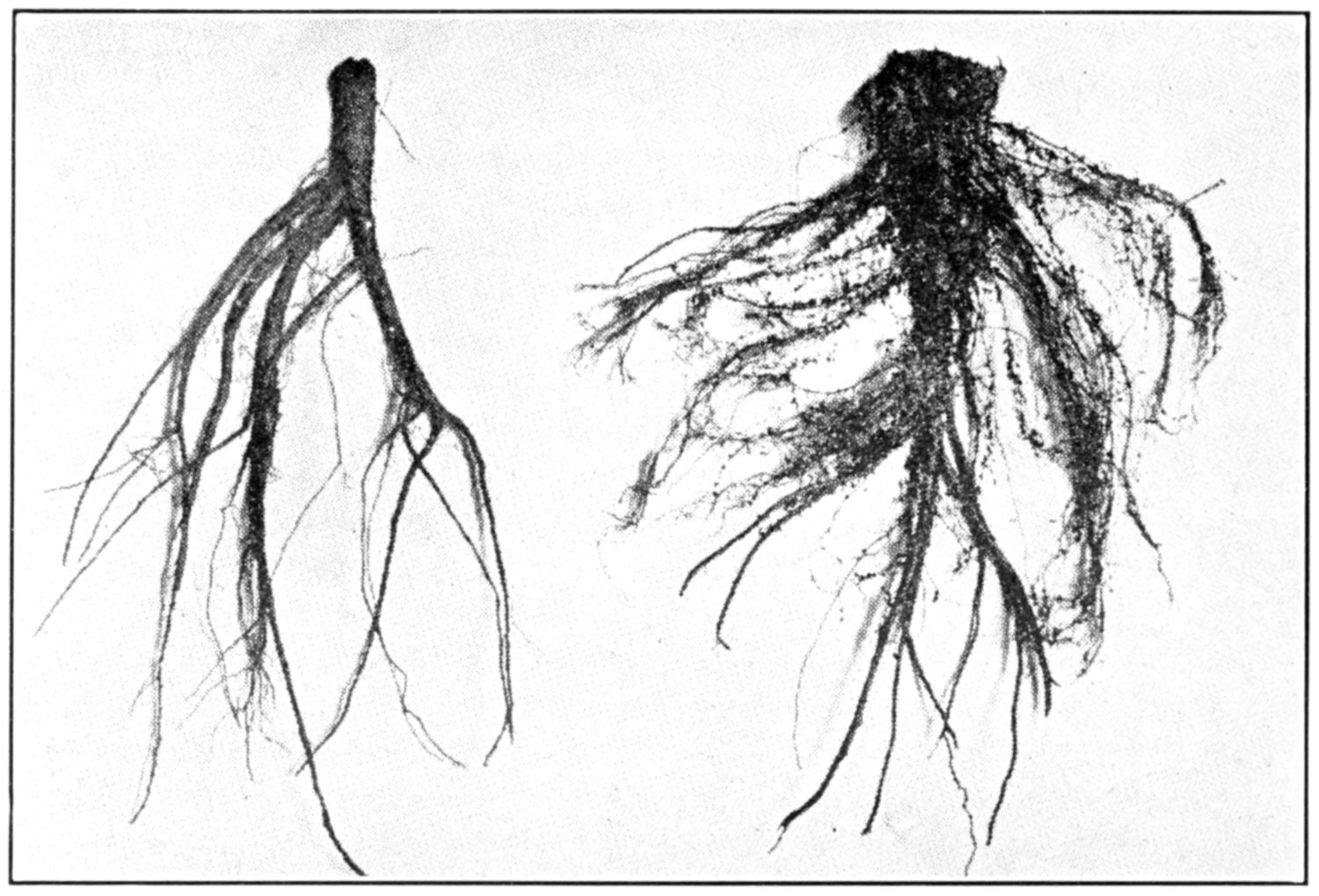
Tubercles on Clover Roots
CHAPTER XXI. Nitro-Culture — AN OLD-NEW THEORY — IMPORTANT DISCOVERIES — SUGGESTIONS FROM THE DEPARTMENT OF AGRICULTURE — SWEET CLOVER SOIL USED TO INOCULATE ALFALFA FIELDS
The inoculation of soil, like many other lately exploited
theories, has no doubt been known for hundreds of years.
There are evidences that it was practiced in England at
least a century ago, and it is thought to be an old custom
among the Chinese. Some space was given to “soil inoculation”
in a preceding chapter, attention there being
devoted to the simple methods of infecting soil with
bacteria.
Some twenty years ago a German scientist, Nobbe,
discovered that the small nodules found on the roots of
the leguminous plants contained bacteria that took nitrogen
from the air and transferred it to the plant. It had
been known that cultivated soils were rapidly losing their
original supply of nitrogen and there seemed no practicable
way of restoring it in sufficient quantity. Commercial
nitrogen costs fifteen cents per pound and the
expense of applying it to the land to equalize the loss
from an ordinary farm crop is almost equal to the value
of a crop. Hence, the discovery that the legumes were
nitrogen-gathering, by means of these bacteria, was
hailed as one of the greatest of the age. With millions
of pounds of nitrogen over his land there seemed now a
method whereby the farmer could utilize some needed
portions of it. The bacteria live in tubercles upon the
roots of various leguminous plants, such as Red clover,
Sweet clover, Bur clover, alfalfa, cowpeas, garden peas,
vetches and beans. These tubercles are the home of the
bacteria, minute forms of vegetable life, too small to be
seen with the naked eye. The legumes have no power in
themselves to draw nitrogen from the air, yet these bacteria
seem to have the power to absorb the free nitrogen
and cause it to combine with other elements, forming
nitrates or other assimilable compounds suitable for
plant food. It has also been demonstrated that, as a rule,
there are different species of these bacteria for different
species of legumes.
After German scientists had made their discoveries,
one of the existence of these bacteria on the roots of the
legumes and another that in the laboratory, these organisms
could be bred and multiplied, they seemed unable to
develop them of sufficient vigor to survive any general
distribution. At this point Dr. George T. Moore of the
United States Department of Agriculture, hit upon a plan
of cultivating them in a way by which they could be preserved
for many months, and he also gave them a much
greater power. This nitrogen-fixing power was so developed
that seeds soaked in the solution, it is claimed,
sprouted and produced plants in sand that possessed no
nitrates. He then found that these bacteria when grown
upon nitrogen-free media will retain a high activity for a
long time, if carefully dried out and then revived in a
liquid medium. He also devised a plan by which they
could be mailed to any part of the world and arrive in
perfect condition.
Most experiment station men have given to Dr. Moore
great credit for his discoveries and have tried, with rather
marked success, his method of nitro-culture; on the
other hand a few have been opposed to the method from
the beginning and are still opposed. It would seem that
the tests made prove that nitro-culture does introduce
bacteria when directions are followed.
Of course if a farmer’s soil has the alfalfa bacteria, it
is not necessary to use any system of inoculation. If
Sweet clover or Bur clover is growing in the vicinity, or
if alfalfa is thriftily growing near without the aid of
inoculation, it is hardly necessary to make there further
efforts for the introduction of bacteria.
In a preceding chapter the opinion was expressed that
in most states, and in most localities in those states, inoculation
was unnecessary because bacteria were already present;
yet it is true that these bacteria are present, if at all,
in varying quantity. If comparatively few are present, any
method of inoculation that will introduce more into the
soil, to hasten the growth of the tubercles and promote
the gathering of nitrogen, will be helpful. The fact is,
we know as yet comparatively little of all there is to be
learned about this wonderful principle. It is altogether
probable that the use of nitro-culture is as practicable and
as free from objections as the use of inoculated soil, especially
from distant and unknown fields. In one of its bulletins
the United States Department of Agriculture has
summarized its advice as to inoculation as follows:
When Inoculation is Necessary.—Inoculation is necessary—
1. On a soil low in organic matter that has not previously
borne leguminous crops.
2. If the legumes previously grown on the same land
were devoid of nodules, of “nitrogen knots,” thus showing
the need of the nodule-forming bacteria.
3. When the legume to be sown belongs to a species
not closely related to one previously grown on the same
soil. For instance, soil in which Red clover forms nodules
will often fail to produce nodules on alfalfa when
sown with the latter crop for the first time.
When Inoculation May Prove Advantageous.—Inoculation
may prove advantageous—
1. When the soil produces a sickly growth of legumes,
even though their roots show some nodules.
If the cultures introduced are of the highest virility,
their use will often result in a more vigorous growth.
2. When a leguminous crop already sown has made a
stand, but shows signs of failing, owing to the absence of
root nodules.
The use of the culture liquid as a spray or by mixture
with soil and top-dressing may save the stand if other
conditions are favorable.
When Inoculation is Unnecessary.—On the other hand,
inoculation is unnecessary and offers little prospect of
gain—
1. When the leguminous crops that are usually grown
are producing up to the average, and the roots show nodules
in normal abundance.
Cultures of nitrogen-fixing bacteria are not to be
regarded in the light of fertilizers, or as capable of
increasing the yield under average conditions. They do
not contain nitrogen itself, but bacteria, which make it
possible for the legumes to secure nitrogen from the air
(through the formation of root nodules). Where the
soil is already adequately supplied with these bacteria, it
will not usually pay to practice artificial inoculation.
2. When the soil is already rich in nitrogen.
It is neither necessary nor profitable to inoculate a soil
rich in nitrogen when sowing legumes. Not only does
the available nitrogen in the soil render the formation of
nodules less necessary, but the nitrogenous materials in
the soil largely prevent the bacteria from forming nodules.
Any increased virility in nitrogen-fixing power possessed
by any of the types of bacteria yet distributed, may
be rapidly lost in a soil containing an abundance of nitrogen,
because the bacteria are in a medium in which there
is no demand for activity in securing atmospheric
nitrogen.
When Failure is to be Expected.—Inoculation will fail
where other conditions (aside from the need of bacteria)
are not taken into account, among which are the following—
1. In soil that is acid and in need of lime.
Liming to correct acidity is as important for the proper
acidity of the bacteria as for the growth of the plants.
2. In soil that is deficient in fertilizers, such as potash,
phosphoric acid or lime.
The activity of the bacteria in securing nitrogen from
the air and rendering it available to the legumes does not
do away with the need for such fertilizing elements as
potash and phosphorus.
3. It must also be remembered that inoculation does
not “act like magic”; it will not overcome results due to
bad seed, improper preparation and cultivation of the
ground, and decidedly adverse conditions of weather and
climate.
In the use of the cultures, also, failure is almost certain
where the directions are not carefully studied and intelligently
followed.
The discovery in Illinois that inoculation of the soil for
alfalfa was necessary in certain places and not in others
suggested the theory that bacteria living on some other,
probably native, plant were identical with the alfalfa bacteria.
Investigations led to satisfactory evidence that this
was the case and that the native plant was the ordinary
Sweet clover (Melilotus alba). The illustration facing
page 230 shows the results of a series of pot culture experiments
made at the University of Illinois and reported
in Bulletin No. 94 by Prof. Cyril G. Hopkins. The four
photographs were made five, six, seven and eight weeks,
respectively, from the time of planting. Alfalfa seed
were planted in each of the five pots, in carefully prepared
soil practically free of combined nitrogen, and at the same
time four of the five pots were inoculated as follows:
Pot No. 1.—Not inoculated.
Pot No. 2.—Inoculated with bacteria obtained from
infected alfalfa soil.
Pot No. 3.—Inoculated with bacteria obtained from
alfalfa root tubercles.
Pot No. 4.—Inoculated with bacteria obtained from
infected Sweet clover soil.
Pot No. 5.—Inoculated with bacteria obtained from
Sweet clover root tubercles.
The results indicate that the same effect is produced
upon the growth of the alfalfa by the nitrogen-gathering
bacteria obtained from Sweet clover as by those from the
older alfalfa, and seem to prove that infected Sweet
clover soil can be used for the inoculation of alfalfa fields.
Investigations have shown that 100 pounds of thoroughly
infected soil to the acre is sufficient to produce a satisfactory
inoculation within one year from the time it is
applied.
CHAPTER XXIII. The Enemies of Alfalfa — DODDER — LEAF SPOT — ROOT ROT — GOPHERS AND PRAIRIE DOGS — GRASSHOPPERS — ARMY WORMS — BIND WEED
The most notable enemies of alfalfa are weeds, insects,
parasites, and animals. More failures to raise alfalfa are
caused by weeds than by all other enemies combined.
The cause of weeds in a field is usually poor farming.
Clipping alfalfa early in May will kill many weeds. If
the weeds grow up, clip again and do the same every
time they threaten to become rampant. If they are kept
from seeding, and do not in a large measure crowd out
the alfalfa, good crops may be had from it the second
season. If sowed in the fall, disking early in April may
kill most of the weeds. It is folly to sow alfalfa on a foul
field, as it is far less expensive to kill out the weeds
beforehand. Disking and clipping will do much to
destroy them, but if they secure a strong foothold the
best thing to do is to plow up the field, plant it in corn,
give it clean cultivation, and sow alfalfa again when the
weeds have been exterminated.
Dodder is an annoying enemy. It is a parasite, belonging
to the morning-glory family, growing from its own
small seed but attaching itself very soon to the alfalfa
stalk. It then separates itself from its own root and
thereafter lives on the juices of the alfalfa until it ripens
its seeds or has killed the alfalfa. The wisest and safest
thing to do is to sow only seed so thoroughly cleaned that
there will be no dodder with it. If, later, it is found that
any dodder seed escaped the cleaning operations and is
growing, the grower should go through the field with a
knife or sickle and a large basket or sack and cut out and
burn every dodder vine and every plant to which dodder
is attached. If so unfortunate as to have sown seed with
a considerable mixture of dodder, clip the alfalfa early
in May, let the clippings dry for two or three days or
longer, and then burn on the field, watching carefully to
have the fire touch every part. It will facilitate a complete
burning to sprinkle parts not burning readily, with
kerosene. If there is a poor stand of alfalfa, largely
infested with dodder, safety lies in plowing it up and cultivating
the field in corn or potatoes for two or three
years.
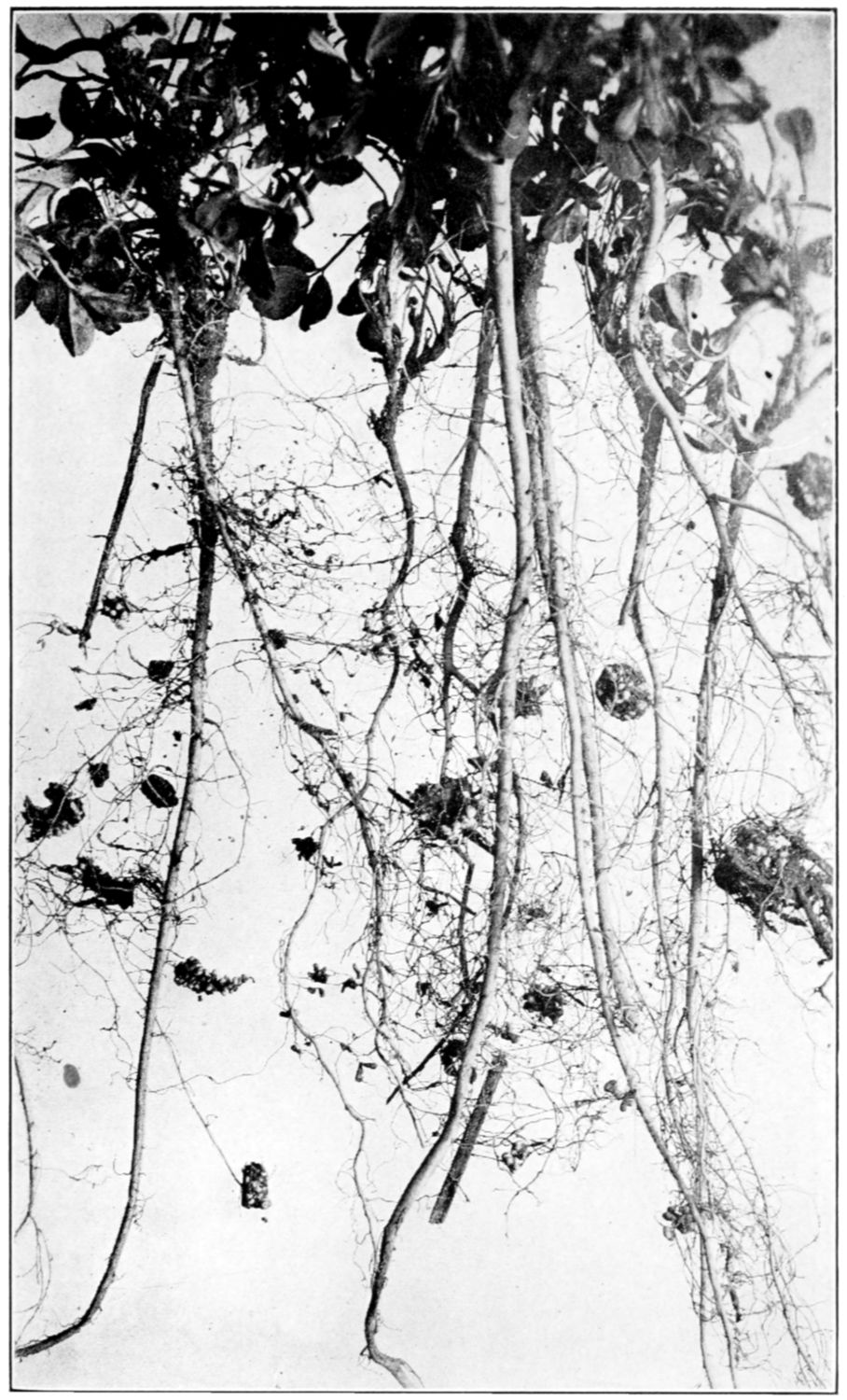
Peculiar Nodules in Groups on Small Rootlets
and distant from the large alfalfa roots. From Michigan Experiment Station
Bulletin No. 225
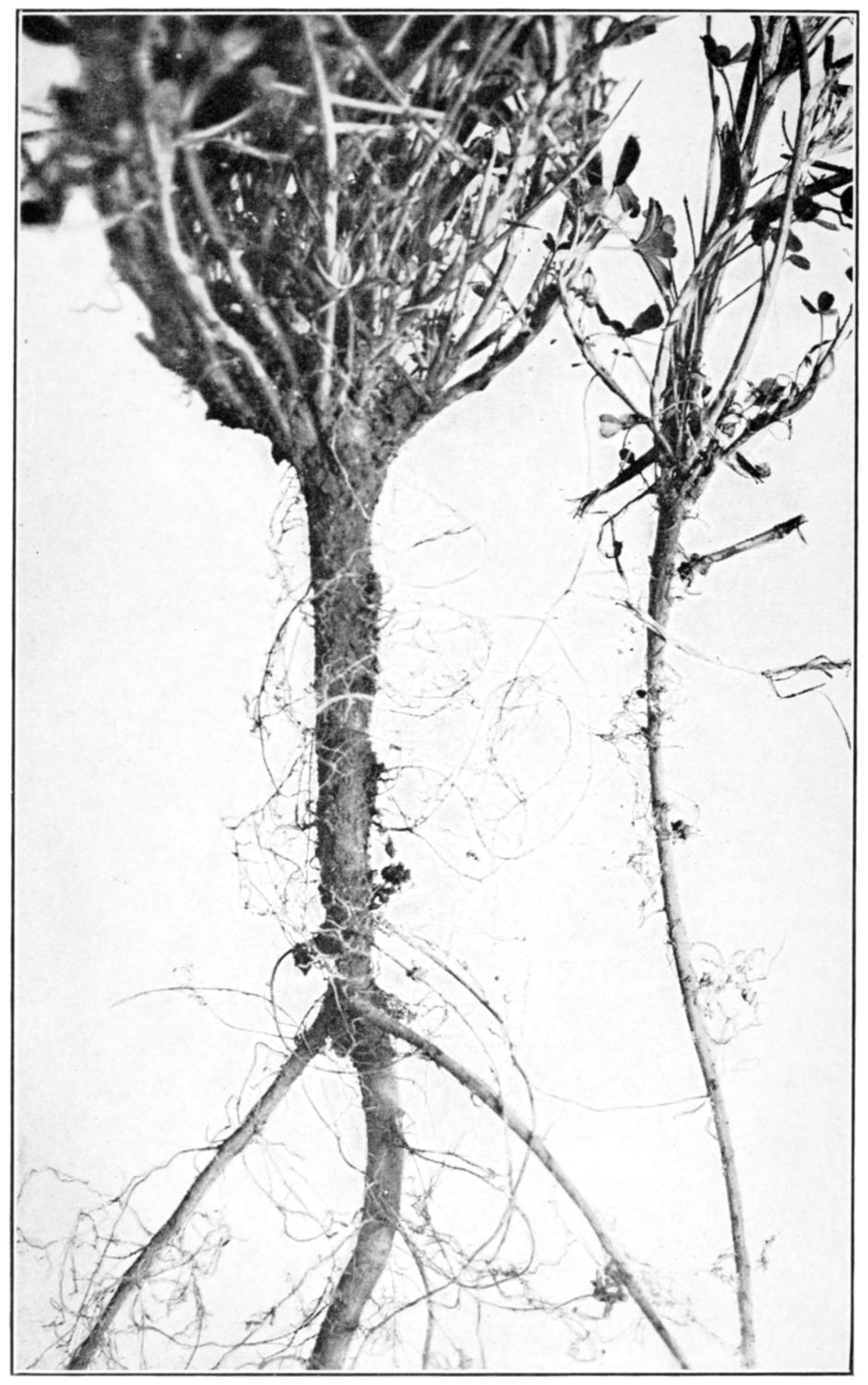
Alfalfa Roots Showing Normal Nodules
small and near the large roots. From Michigan Experiment Station
Bulletin No. 225
From an excellent article on the dodder that infests
alfalfa (Cuscuta epithymum) by Mr. F. E. Dawley, a
New York authority on alfalfa, and printed with illustrations
in the Country Gentleman, the excerpts here following
are taken:
“The only sure method of keeping alfalfa fields free
from dodder is through exercising greater caution in the
purchase of seed. There is no reason why thoroughly
recleaned alfalfa seed should have any dodder seed in it,
as reference to the illustrations will show. The relative
sizes and forms of the seeds of alfalfa and dodder are
shown herewith. It will be seen that there is a marked
difference in both the sizes and the shapes of the seeds.
The alfalfa seed is shaped like a little kidney bean, and
varies in color from light yellowish-green to a rich golden-yellow,
and in some instances, because of weathering, or
sweating in the cock, or perhaps standing too long, it
shows a reddish-brown color. The dodder seed is darker
in color than the alfalfa, all of that which I have succeeded
in gathering from the plants being a rich golden-brown.
The accompanying illustrations show the form of
the dodder and alfalfa seed respectively.
“The seeds, being sown, germinate in the soil, throwing
up a slender, thread-like stem somewhat resembling
a corn silk, which retains its connection with the ground
until it comes in contact with the stem of the alfalfa plant.
It twines around this tightly, sending its feeding suckers
through the outside bark, and as soon as it is firmly
attached to the host plant, the ground connection is severed
and it is sustained by the plant juices which are taken
in by the suckers. It continues to grow and spread, twining
around other stalks and increasing very rapidly until
a colony is established. Continuing to grow, it climbs
toward the upper portion of the plants, feeding on their
juices and sapping their vitality, but never goes to the
extreme top, seeming to prefer the dampness and darkness
of the matted alfalfa rather than sunlight. The
plants first attacked begin to die, and the dodder, spreading
out in all directions, forms a circle or ring.
“The rapidity with which the pest spreads makes it a
serious menace to the alfalfa grower. Comparatively
little work has been done by scientific men in studying
the dodders and methods of eradication, and the fact that
the little rootlets or suckers (haustoria) become so firmly
affixed to the host plant that it must be destroyed together
with the parasite, has made the work hard and the results
obtained unsatisfactory. There are a number of methods
by which dodder may be spread through a field. As soon
as it becomes thoroughly established on a host plant, the
many little branches, waving about like the shoot produced
from the seed, attach themselves to other plants,
and thus the colony is increased in size. In legumes, the
host plant first attacked soon dies, but before this occurs,
the parasite has become firmly established on adjoining
plants and is reaching out and completing the colony.
As soon as a host dies, the dodder also perishes, but before
this happens it is very likely to have blossomed and seeded.
“In the operations of mowing, tedding, raking and
drawing the alfalfa hay, these little colonies are spread
about the fields by the machines and the workmen, and
on the horses’ feet. The sale of infested hay is a prolific
means of dissemination. Hunters and pleasure seekers,
walking through the fields, notice the peculiar corn-silk-like
growths and often, by picking up particles of it which
are soon cast away, establish new colonies. The flower
is very peculiar and attracts the attention of people passing,
who are apt to pick them together with some of the
maturing seed, and scatter these over the fields. In a
pastured field, the animals spread the seed to some extent
while moving from place to place in feeding. The most
serious menace, however, is from the purchase of impure
seed; farmers should always be absolutely certain that
the alfalfa seed which they are buying is thoroughly
recleaned and that no small weed seed is to be found in it.
One should never sow clover or alfalfa from a field or
even from a locality in which dodder is known to exist.
It is probable that the seeds thoroughly ripened will
retain their germinating powers for some years. The
purchase of hay from dodder infested fields, or the purchase
of manure from barns where infested hay has been
fed, are sure sources of contamination.
“Where a newly seeded alfalfa field shows evidence of
quite general dodder infection, it is useless to attempt to
eradicate it, and the field should be plowed up and planted
with some hoed crop for a period of years. Old fields
that have been thoroughly infested will probably be more
economically treated in this manner than in any other.
In newly sown fields, one of the most effective methods
is probably hoeing over the spots where the dodder
appears, going over them once in two weeks and allowing
nothing to grow on them until the dodder seed is germinated.
A modification of this method has been used
successfully by spading in fields where the colonies of
dodder were seen, raking out all the tops, roots and
branches, adding a little straw or hay and burning the
mass, and then keeping the spot thoroughly hoed for a
season. For fields where the colonies are small and scattered,
this method of hoeing and shallow cultivation is
probably the most practicable, as it helps to secure the
early germination of any seeds that were left in the
ground, and also kills them as soon as they are germinated.
If the seed has developed, one must be careful not
to spade it in too deep, as it may retain its vitality for
some years if left covered in the moist soil.
“Burning has been recommended by some, raking the
dodder vines and what is left of the alfalfa to the center
of the colonies, putting brush or straw with it, together
with some fine, light wood or chips and sprinkling with
kerosene, so that the alfalfa plants will be burned close
to the ground. This is necessary from the fact that the
little coils of dodder close to the crown of the plants will
retain their vitality and grow after a very severe burning,
providing the alfalfa which is above the ground is
not killed also. The most difficult problem to be confronted
in killing out dodder where it has become established,
arises from the fact that if these little coils which
wind themselves closely around the plant are not killed
or removed, the dodder will spread from these and make
a new growth. Many experiments have been made with
chemicals, but none of them have proved wholly successful,
from the fact that these little rings were not
destroyed. All the rest of the plant was killed and the
production of flowers and seed prevented; but as these
little rings were not killed, the dodder began growing
again and continued to grow throughout the season.”
Leaf spot is a very peculiar disease and, fortunately,
not common in this country. It has been known in
France since 1832. In 1891 it was destructive in Iowa
alfalfa, the loss in the neighborhood of the experiment
station being estimated at 50 per cent. In reference to
this infliction the Iowa station, among other information,
printed the following:
“Any time after the plant has attained a growth of
four to six inches from the seed, but most commonly
after the first year’s growth, there appears upon the upper
side of the leaves small, irregular brownish spots, which
enlarge to about one-sixteenth of an inch in diameter and
extend through the leaf to the under side, turning all
parts brown. When many spots occur on the same
leaf the whole leaf soon turns yellow and falls off. This
falling of the leaves and the natural loss in vigor, due to
the diseased condition before the falling, constitute its
great damage. Frequent cutting of the crop materially
prevents the disease.”
In eastern states farmers report that there are frequent
patches in their fields where the leaves turn red and the
plant dies. The probable explanation of this trouble is
“wet feet,” which alfalfa will not abide. Don’t expect to
get a crop of alfalfa from a field in which water is near
the surface. Drain it or use another field.
A disease peculiar to portions of the southern states is
called “root rot,” and similar to the root rot found in
cotton fields. The alfalfa dies in spots, these spots widening
in circular form. This is a fungus that spreads only
in summer. The only means of eradicating so far
(reported by the Texas station) is the application of common
salt and kerosene. It has not proven a serious
annoyance.
Gophers and prairie dogs are great pests in some parts
of the Middle West, and about the only successful means
of combating them is poison. The state of Kansas has,
probably more than any other, made a systematic effort
to destroy its gophers and prairie dogs, by liberal appropriations
and a field agent to supervise the work to be
carried out under provisions of law by local officials.
The injury done by the gophers consists chiefly in
throwing up mounds of soil taken from the burrows and
these greatly interfere with operating the mowing
machine in harvesting. In the alfalfa fields there is also
a noticeable thinning out of the plants, by reason of the
cutting off of the roots. These root cuttings are stored
in the burrows in considerable piles, and are used in cold
weather by the gophers for food. It is claimed by some
alfalfa growers that this process of thinning out the plants
is a benefit rather than an injury to the field, but, says
Prof. D. E. Lantz, the official formerly in charge of the
Kansas work, “I have known fields where this thinning
has continued until the crop did not half cover the ground
at cutting time, and the fields were plowed up for the
planting of other crops. The loss from gopher depredations
to the alfalfa growers of Kansas during 1901 was
probably fully one-tenth of the entire product, and had a
money value of at least $500,000.”
According to Professor Lantz, carbon bisulphide and
other poisonous gases have frequently been recommended
for the destruction of the pocket-gopher, but the great
length of the burrows and their irregularities in depth prevent
the gases from flowing into every part, and the animals
often escape. Trapping, if properly done, is a sure
method of killing the gopher; but it is attended with considerable
labor and is very slow. An excellent trap for
general use is the No. O ordinary steel trap. Sink it in
loose soil to the level of the runway, nearly conceal it by
sprinkling fine earth over it, and leave the hole open.
Gophers are easily poisoned. They are fond of potatoes,
sweet potatoes, apples, raisins and prunes. The
presence of strychnine, arsenic or other poisons does not
seem to deter them from eating the food; but if the poison
is sweetened they seem to eat it more readily. In summer
it may be desirable to sweeten the poison, but in the
fall and early spring it does not seem worth while. The
poisoned food being introduced to the burrows below the
surface, there is no danger of poisoning stock. It might
be well, however, not to let swine run in the fields for a
time after the poison has been put out.
The following method of introducing poison is recommended:
Cut the potatoes or other food into pieces
not more than three-fourths of an inch in diameter. Cut
a slit in each piece and with a point of the knife blade
insert a little sulphate of strychnine; as much as half the
bulk of a grain of wheat. Having prepared the bait in
sufficient quantity, go to the field armed with a round,
sharp-pointed implement an inch or an inch and a half in
diameter and of sufficient length. The tool here illustrated
was made by a blacksmith.

It is a spade handle shod with an iron point. A bar
is attached about fifteen inches from the point to enable
the operator to use his foot in pressing it into the soil.
With this tool it is only necessary to find the runway of
the gopher. The handle is sufficiently thick to make a
hole large enough to permit one to drop the poisoned
potato directly into the burrow. The operator then passes
on to another place, leaving the hole open. No digging
with a spade or other hard labor is necessary. An
experienced person can distribute poison to many acres
of alfalfa in a day; and if proper care is taken to rightly
distribute the bait, it will not be necessary to go over the
ground a second time. Some experience is required to
find the burrows quickly. It is best to insert the food as
near as possible to the freshest mounds of earth. Two
or three pieces of potato at that place are worth many
scattered in other parts of the runway. The operator
should avoid the larger mounds and those that are not
freshly made.
For destroying prairie dogs, Professor Lantz says that
out of thousands of suggestions nothing has been found
more effective than strychnine poison and carbon bisulphide.
Following are directions for preparing and using
the strychnine:
“Dissolve one and a half ounces of strychnine sulphate
in a quart of hot water. Add a quart of syrup—molasses,
sorghum, or thick sugar and water—and a teaspoonful
of oil of anise. Thoroughly heat and mix the liquid.
While hot pour it over a bushel of clean wheat and mix
completely. Then stir in two or more pounds of fine
corn meal. The quantity of corn meal needed will
depend upon the amount of extra moisture present.
There should be enough to wet every grain of the wheat
and no more. Care should be taken that there is no
leakage from the vessel in which the wheat is mixed.
Let the poisoned grain stand over night, and distribute
it in the early morning of a bright day. Use a tablespoonful
of the wheat to each hole occupied by prairie
dogs, putting it near the mouth of the burrow in two or
three little bunches. Do not put out the poison in cold
or stormy weather. It will keep for a considerable time,
and is much more effective after a cold period, as the
animals are then hungry and eat the grain readily. A
bushel of wheat should poison 1000 to 1200 holes. An
excellent substitute for the oil of anise in this formula
can be made by soaking two ounces of green coffee berries
in the whites of three eggs. Let this stand for about
twelve hours, and use the liquid instead of anise oil.”
A tablespoonful of carbon bisulphide, upon some such
absorbent material as cotton, dry horse manure, or a piece
of corn-cob, and rolled into the burrows, is effective. It
is best immediately to cover the hole with a sod and stamp
down firmly.
Grasshoppers are a source of no little loss to alfalfa
growers in some parts of the West. They usually do
their greatest damage to the season’s second crop, the
young not being very destructive to the first. The best
remedy, or rather prevention, is deep disking in April and
then harrowing to destroy the eggs.
Where the pests attack or are about to attack a field
of alfalfa, Prof. L. Bruner, of the Nebraska station recommends
the use of a “hopper dozer,” which is “simply a
long, shallow pan of stove-pipe iron or galvanized iron
mounted on runners and backed by a light frame covered
with cloth. The pan is about four inches deep, from
eighteen inches to two feet wide, and from ten to sixteen
feet long. It is partly filled with water and a little kerosene.
A horse drags the machine across the field over
the stubble of the first crop and the half-grown hoppers
jump into the pan where the oil coats them over and
kills every one that it touches. The hopper dozer works
best on level land. On sloping ground the oil and water
run to one end and slop over. To prevent this the pan is
usually divided into sections by a number of partitions.
The runners should stick out in front of the pan about
a foot and one-half, and a piece of chain or heavy rope
should be stretched loosely between them to drag ahead
of the machine and make the hoppers jump. On level
fields there are no great difficulties in the use of the
hopper dozer. Careless driving may spill oil on some
alfalfa and kill it. If these machines are to be really
effective, they must be used before the grasshoppers get
their wings. The first crop of alfalfa should be cut as
early as possible, and the hopper dozers should follow
the rakes as closely as may be. On the whole, they should
be used only where plowing and harrowing have not been
done or have failed to keep the grasshoppers in check.”
Of the use of this implement or machine Prof. S. J.
Hunter has this to say:
“The height of the runners depends upon the height
of crop to be protected. It is important that there be no
timbers in front of the pan, so that its front line may
come in contact with the grain passed over. The insects
then fall directly into the fluid. When ready for use
place two buckets of water and one-half gallon of coal-oil
in a pan, and then drive back and forth across the
end of the field where the grasshoppers are entering until
you have filled the pans; remove the insects, replenish
with oil and water, and continue until the field is rid of
the pest.
“Many grasshoppers will be seen strike the sheet-iron
back, drop into the pans and immediately jump out
again. Those farmers who observed the experiments
were at first of the opinion that the locusts that jumped
out had jumped away ‘to live another day.’ The writer
asked those interested to watch the insects and note the
actions of grasshoppers that had jumped out. In every
case the report was that the insects became sick and
soon died. In fact, persons going over fields where
a day or so before the hopper dozer had been at work,
were impressed with the number of dead grasshoppers
on the ground. An examination showed the
presence of coal-oil upon the body. This kerosene and
water is an external irritant, and my observations have
been that the mixture is more effective than the oil alone.
“The use of the machine may be best shown by
examples. In Ford county, Kansas, a large tract of
alfalfa was cut, and the locusts at once began moving into
a large field of Kafir corn which had been sown broadcast.
The hopper dozer was drawn back and forth across
the end of the corn field nearest the alfalfa land until a
portion of the field about twenty rods deep had been gone
over. Here it was apparent that there were very few
grasshoppers; or, in other words, the advance line of
the locusts’ march only extended twenty rods into the
field. Two days later the same area of ground was covered,
but not as many insects were taken. Grasshoppers
no longer entered this corn and the hopper dozer was no
longer used at this point.
“It has been my experience with this machine that
after it has passed over vegetation it does not injure the
plants, but in some way renders the vegetation distasteful
to the grasshoppers, so that they turn their course and
seek food elsewhere. I have observed that these native
grasshoppers enter a field from one corner or side, and
that they are not as a rule scattered over the whole field,
but occur in great numbers in patches. This being the
case, it is evident that with very little labor with this
machine the products of a field can be given full opportunity
to mature.”
In Nebraska the fall army worm has caused considerable
damage. It is distinct from the true army worm, having
small hairs growing out from small black spots; it
has a whitish “Y” shaped mark upon the head. The
parent of the worms is a moth of a yellowish, ash-gray
color. The female moth deposits her eggs in clusters
upon the leaves and stems. With the approach of cold
weather the worms pass into the ground and enter the
chrysalis stage about one or two inches below the surface.
When very numerous the only effective treatment is to
disk thoroughly in the spring.
Bindweed, belonging to the morning-glory family, is
one of the meanest weeds that annoy alfalfa raisers. It
spreads from the root, and is more than liable to smother
out alfalfa or any other crop which tries to occupy its
ground. If infested fields could be grazed closely with
hogs or sheep, they might keep the bindweed down and
finally eradicate it. If this cannot be done, the only remedy
is to plow and use the land for some other crop.
CHAPTER XXIV. Difficulties and Discouragements
Notwithstanding the fact that alfalfa is now grown
successfully in all parts of the United States, in almost
all kinds of soils and under many dissimilar conditions of
climate, there are grouped here as a summary from preceding
chapters the several difficulties and discouragements
that may confront the one who would grow it.
1. Securing a Good Stand. Theoretically, the farmer
should secure a good stand every year with every crop,
but he does not. He obtains, however, poor stands of
wheat and corn and potatoes oftener than a poor stand
of alfalfa. Why does he fail with alfalfa? The following,
at least in part, suggests why:
a He neglects to prepare sufficiently in advance. He
should select his alfalfa field one or two years before he
intends sowing. If he raises wheat, he should sow a little
alfalfa seed with wheat, one or even two years before
ready for alfalfa. This will leave a few roots and the
proper bacteria will have been introduced into the soil.
For two years there should be a vigorous fight against
weeds, the fewest possible being permitted to ripen seed.
b He neglects to prepare properly for the preceding
crop, and sometimes plants the wrong crop, although
sorghum and Kafir corn are about the only very objectionable
planting to precede alfalfa. These have usually
taken too much of the land’s moisture, especially if the
season has been somewhat dry, to permit a prosperous
beginning of the plants from fall sown seed. Millet, oats
or cowpeas are the best crops to precede, i. e. for the first
trial. The plowing for this preceding crop should be
deep. In clay land a subsoil plow (the kind which loosens
but does not throw the subsoil to the surface) should
follow. It is extremely important that a dressing of
stable manure be plowed under for this preceding crop.
The seed bed should be carefully prepared, and under
favorable conditions. Working the ground when too wet
would make it impossible to secure a proper seed bed
later when preparing for alfalfa.
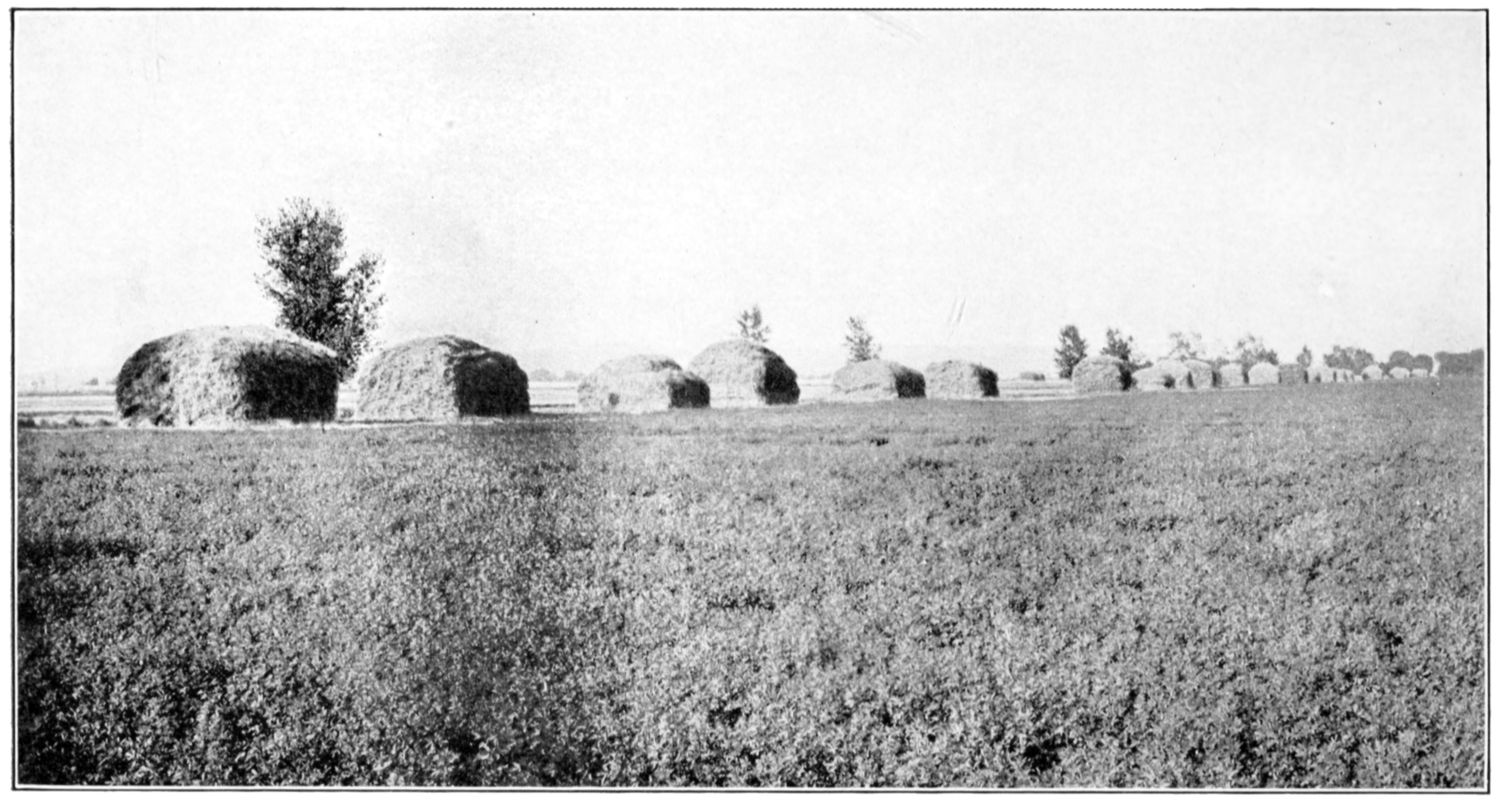
And There’s Still More to Follow
Dead Prairie Dogs
gathered up in a 20-minute walk through a “town” that had been poisoned.
Nearly all the animals die inside their burrows.
The cost of destroying them, according to Professor Lantz, is not over two cents per acre, not counting the
labor, and a man can distribute the poison over about a quarter-section in a day
c He neglects to prepare the alfalfa seed bed properly.
He should begin disking and harrowing as soon as
the preparatory crop is off the ground, and continue
this at intervals of ten or fifteen days until time for sowing,
when the soil should be as fine as for an onion bed.
d He uses poor seed; seed that is infertile, or adulterated
with weed seeds—undesirable and unreliable in
every way.
2. Dying out the second year, which in most instances
is due to one of two causes, viz.: neglect to plow under
stable manure for the preceding crop, or pasturing alfalfa
in its first year. Not an animal should be turned on an
alfalfa field for pasture until the second or, preferably,
the third year. Another cause is disturbance of the soil
and plants by severe freezing. This may often be prevented
in a degree by a light top-dressing of manure in
December.
3. Failure through harvesting and stacking.
4. Injury from insects or disease.
These are practically all the things that need occasion
serious vexation. Of course alfalfa calls for more work
in harvesting than corn, or clover, or timothy; but one
acre of prosperous alfalfa is worth two or three of corn,
or clover or timothy, even for market, while for feeding
purposes the difference is even greater. The “poor”
farmer, the lazy farmer, the “corner grocery” farmer
should not sow alfalfa.
CHAPTER XXV. Miscellaneous — ALFALFA IN THE ORCHARD — SOME ALFALFA “MUSTS” AND “DON’TS” — ALFILERILLA OR “ALFILARIA” ( Erodium citcutarium .) — MEASURING HAY IN THE STACK
Probably nine-tenths of those who have written on this
subject have condemned the practice of sowing alfalfa
in the orchard. They have said that the alfalfa demanded
so much moisture that the trees would be dwarfed if not
destroyed. In going through an immense amount of
material in the preparation of this book only two instances
have been found of men who claim that the
alfalfa is a benefit to orchards. One of these was from
Texas and the newspaper quoting him did not give his
name. He was reported to have used his orchard for
hog pasture, keeping on five acres from ten to fifteen
sows with their pigs from early April to September. He
claimed that the alfalfa instead of robbing the orchard
of moisture actually contributed to the surface moisture
and benefited the trees.
Prof. F. L. Watrous, of the Colorado station, is an
earnest advocate of the use of alfalfa in the orchard and
from an article of his this is quoted:
“Whatever may have been believed or imagined as to
the uncongeniality of trees and alfalfa the theory is destined
to an early downfall. The evidence is at hand now
to show that not only is alfalfa not a detriment when
grown among fruit trees, but in many ways it is a positive
benefit, lending itself and its properties to the advantage
of the trees.
“On land where moisture can be found at from six to
ten feet from the surface, the congeniality of the alfalfa
plant and the apple tree becomes apparent. Both need
plenty of water the first year, a little less the second,
and very little or none thereafter.
“After trees become old enough to bear and need all
the land between them, and that fertilized and renovated,
alfalfa may be used as a food gatherer and distributer.
It pushes down into the lower strata, bringing up mineral
elements, captures nitrogen from the air through its
root processes, and brings all together near the surface,
thus giving to the trees the food they need to fill up and
mature fruit. Nor is this all. The alfalfa falling on the
ground makes a soft cover upon which windfalls may
drop with little bruising; it so occupies the soil as to
allow no foul growth to creep in; it does away with the
work of weeding or cultivating, and keeps the surface
cool and porous, furnishing excellent pasture for hogs
if the trees are protected. It would be possible, of course,
in this system of co-operation between fruit trees and
alfalfa to secure a crop of hay or seed during the off
years for fruit, but whether this would prove profitable
may be questioned. Orchards growing under the conditions
described have produced magnificent crops of fruit
which, for size, quality and coloring, is seldom equaled.”
A Knox county, Ohio, man, in expressing himself as
to some of the requisites for success with alfalfa, as
observed from his viewpoint has this to say:
“I have known about alfalfa from boyhood; been
familiar with it for thirty years, and have grown it successfully
on many soils, from a stiff clay, upwards. The
failures which I have seen have been accounted for by
the non-performance of some of the essentials. There
are certain ‘musts’, not ‘shoulds,’ to be observed to secure
success. Here they are from my experience:
“First of all the seed must be pure, of high germinating
power, and of the highest possible vitality. If I
doubted my own proficiency in these determinations, I
would consult the nearest experiment station. I have
had occasion to consult experiment stations, from New
Jersey to Wisconsin, on various subjects, and in every
instance have met with prompt and valuable—and sympathetic—assistance.
“The soil must have lime; either as one of its natural
constituents, or lime must be added. If the soil is deficient,
then the lime must be incorporated with the soil
some months before seeding.
“The land must have efficient drainage, either natural,
or, as in the case of clay and heavy clay loams, artificial.
“The land must be fertile to a depth of at least nine
inches. Beyond that depth the taproot in its search for
water will take care of itself.”
Another writer, impressed by practices he regards as
reprehensible, enumerates them as follows:
“Don’t sow any nurse crop.
“Don’t sow on freshly plowed land, no matter how carefully
prepared.
“Don’t let weeds or grass grow over six inches high without
clipping.
“Don’t clip or mow when wet with rain or dew.
“Don’t let alfalfa stand; if turning yellow, cut it.
“Don’t sow old seed.
“Don’t sow less than twenty pounds per acre, one-half
each way.
“Don’t sow twenty-five acres at first; sow five.
“Don’t pasture it.
“Don’t put any of the rotten manure anywhere but on
your alfalfa plot.
“Don’t depend upon ‘culture cakes’ or soil from some
distant field.
“Don’t let any water stand on it.
“Don’t let it go if a thin stand, but disk in more seed;
don’t be afraid you will kill it.
“Don’t replow the land, disk it.
“Don’t wait for it to stool; it never does.
“Don’t try to cut for hay until the alfalfa takes the field.
“Don’t sow on any land not well underdrained.
“Don’t leave your land rough; use a roller or a plank float
to level and smooth it.
“Don’t give up.”
On account of the similarity of its name to that of
alfalfa and the possibility of the two plants being confused
in the minds of those not acquainted with them, it
is proper to make mention here of the plant referred to
in the caption above. It is not generally known nor
widely distributed, and has as yet its principal habitat in
semi-arid parts of the southwestern United States. The
Century Dictionary calls it Pin-clover or Pin-grass, and
classifies it with the Geranium family. Webster’s Dictionary
speaks of it as a weed in California. It is an
annual and seeds profusely; a few seeds scattered over
quite a large area result in a thorough seeding the second
year. A stockman in Arizona writes that it will
grow on any kind of soil except alkali; that it was introduced
from Australia by sheep carrying it in their wool.
It is a southern plant and should not be seeded largely
north of the northern line of Oklahoma until tested by
the experiment stations. It should not be confused with
alfalfa, as it is entirely dissimilar and not related.
In discussing this plant an Arizona editor writes the
following:
“It is by no means a new or experimental crop, for it
was the main reliance of Arizona stockmen during ten
years of drouth. We suppose that the experiment stations
in the West have given it little attention because
it is as well known as alfalfa here, and millions of acres
are covered with it in various portions of the Territory.
“We know from many years experience that alfilaria
will thrive and keep stock in good condition where no
grass roots would live through one of the dry seasons.
It is peculiarly adapted to the poorer soils in western
Kansas, Nebraska, the Texas Panhandle, New Mexico,
and portions of the northern section of Mexico.
“Its merits are that it will grow in seasons so dry that
other forage fails and that it will keep cattle in better
health and condition as to flesh and growth than anything
else we can grow in Arizona, not excepting alfalfa.
In the spring cattle and horses will go miles to find it and
it is better than ‘condition powders’ to put them in condition
for summer growth.
“What it will do on other classes of soil, under excess
of moisture, is a matter of experiment; but where it is
needed most—as above outlined, there is nothing that
has ever been tested under these adverse conditions which
can compare with alfilaria. This will be certified to by
every ranchman and cattleman in this section of Arizona.”
Some method of arriving at the quantity in a stack,
rick, or mow without weighing it, is, at one time and
another, found desirable by everyone who has to do with
loose hay. There can be no absolute rule laid down for
this because of the varying compactness the hay attains
under differing conditions of coarseness or fineness,
moisture, length of time stacked or stored and the weight
which has rested upon it.
For prairie hay stacked not less than thirty days a
cube seven feet square (343 cubic feet) is not uncommonly
bought or sold as a ton; yet seven-and-a-half feet
square, or 422 cubic feet, are often made the basis of
estimating. The author is advised that in the alfalfa
growing districts of the Yellowstone valley it is the
general custom to accept as a ton 422 cubic feet of alfalfa
hay if it has settled thirty days or more. Also that hay-men
find there is a noticeable variation between the different
cuttings. The first cutting will fall short of actual
weight more than the second, while the third cutting will
hold up in weight, and sometimes overrun. Prof. E.
A. Burnett, of the Nebraska experiment station, thinks
an eight-foot cube, or 512 cubic feet, a fair figure.
Professor Ten Eyck says:
“The rules for measuring hay in the stack will vary
according to the length of time the hay has been stacked
and the kind and quality of the hay, and also according
to the character of the stack. With alfalfa or prairie
hay which has been stacked for thirty days it is usual to
compute an eight-foot cube or 512 cubic feet as a ton.
When the hay has been stacked five or six months, usually
a seven-and-a-half-foot cube or 422 cubic feet is calculated
for a ton. In old stacks which have been stacked a
year or more a seven-foot cube or 343 cubic feet is allowed
for a ton.
“There are different methods of measuring a stack,
depending upon its shape and also its size. For a long
stack or rick the usual method is to throw a line over
the stack measuring the distance (in two or three places,
and use the average) from the bottom on one side to the
bottom on the other; add to this the average width of
the stack, divide this sum by four (which equals one side
of the square) and multiply the quotient by itself and
this product by the length of the stack; this will give the
number of cubic feet in the stack, which may be divided
by 512, 422, or 343 in order to find the number of tons.
For small, low ricks the rule is to subtract the width
from the ‘over,’ divide by 2, multiply by the width and
multiply the product by the length, dividing the result
by the number of cubic feet in a ton.
“There is no established rule for measuring round
stacks, but this one will approximate the contents of one
of the ordinary conical form: Find the circumference at
or above the base or ‘bulge’ at a height that will average
the base from there to the ground, find the vertical
height of the measured circumference from the ground
and the slant height from the circumference to the top
of the stack. Multiply the circumference by itself and
divide by 100 and multiply by 8, then multiply the result
by the height of the base plus one-third of the slant
height of top. The hay in a round is necessarily less
compact than in a rectangular stack, hence a greater
number of feet should be allowed for a ton; with well
settled hay, probably 512 feet.
“The rules given may also be used in measuring any
kind of hay, sorghum or Kafir-fodder in the stack. However,
for sorghum or Kafir-fodder only approximate
results can be procured by stack measurements because
the fodder is apt to vary greatly in weight, according to
the moisture it contains.”
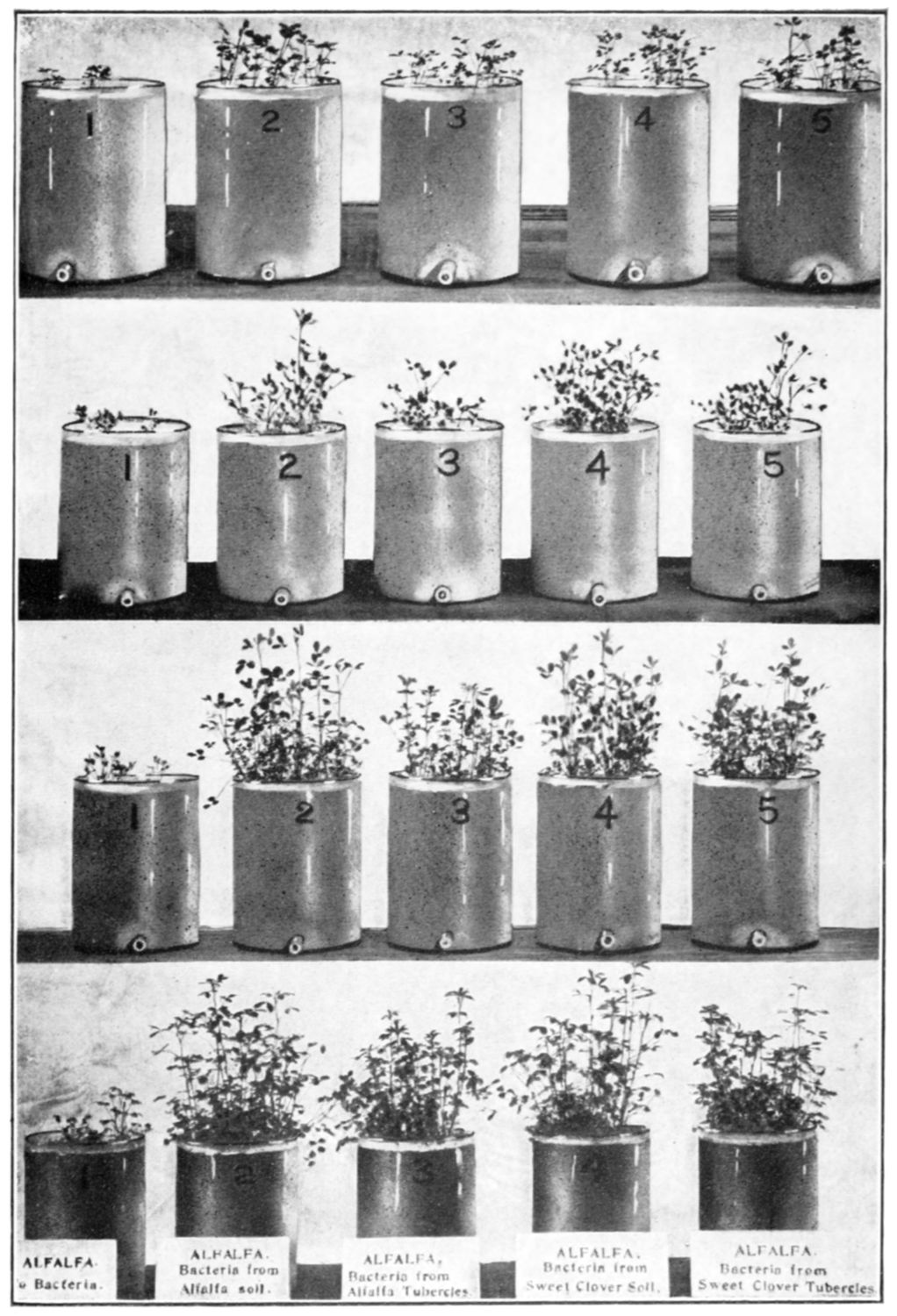
Pot Culture Experiments at University of Illinois
showing effect produced upon growth of alfalfa by nitrogen-gathering bacteria
obtained from older alfalfa and Sweet clover. Reading from top to bottom
the four photographs were made five, six, seven and eight weeks,
respectively, from time of planting
Bottom row, signs from left to right:
ALFALFA. No Bacteria.
ALFALFA. Bacteria from Alfalfa soil.
ALFALFA. Bacteria from Alfalfa Tubercles.
ALFALFA. Bacteria from Sweet Clover Soil.
ALFALFA. Bacteria from Sweet Clover Tubercles.
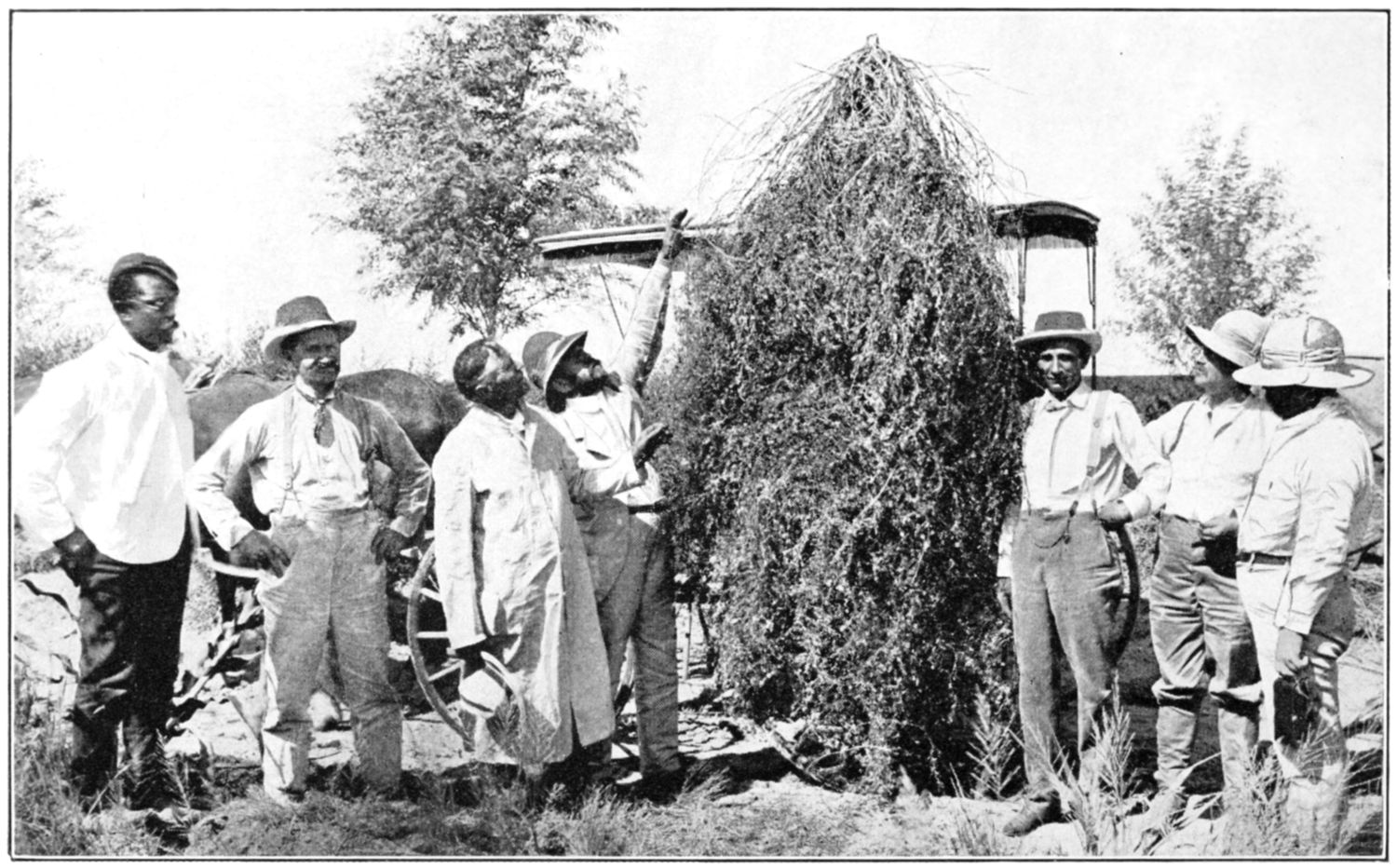
Six Months Growth of Alfalfa Foliage
grown from one crown under irrigation in southern California, sixty feet below sea level
Height slightly less than eleven feet
CHAPTER XXVI. Practical Experiences of Alfalfa Growers in the United States of America — ALABAMA — ARIZONA — CALIFORNIA — COLORADO — CONNECTICUT — DELAWARE — GEORGIA — IDAHO — ILLINOIS — INDIANA — IOWA. — KANSAS. — KENTUCKY — LOUISIANA. — MASSACHUSETTS. — MICHIGAN — MINNESOTA — MISSOURI — MONTANA — NEBRASKA — NEW HAMPSHIRE — NEW JERSEY — NEW MEXICO — NEW YORK — NORTH CAROLINA — NORTH DAKOTA — OHIO — OKLAHOMA — OREGON — PENNSYLVANIA — RHODE ISLAND — SOUTH CAROLINA — SOUTH DAKOTA — TENNESSEE — TEXAS — UTAH — VERMONT — VIRGINIA — WASHINGTON — WEST VIRGINIA — WISCONSIN — WYOMING
Prof. J. F. Duggar, Director Alabama experiment
station.—Alfalfa is grown in Alabama with entire success
on the lime soil of the central prairie region of the
state. This is a strip of land from 10 to 20 miles wide,
extending southeast and northwest almost across the
state and into Mississippi. Beginning near Union
Springs, this prairie passes near Montgomery, Selma,
Demopolis, Greensboro and northwestward towards Columbus,
Miss. On the prairie lands in this area alfalfa
affords from three to six cuttings per year, usually four,
and the yield is from three to six tons per acre. Irrigation
is not practiced. The seed is sown either in September
or in the early part of March, usually from 20 to 24
pounds per acre. Almost a full crop is secured the first
year from fall seeding, but only from one-third to two-thirds
of a full crop is secured the first year from sowing
seed in March. It is not customary on this soil to use
fertilizer on alfalfa, but an application of even a light
coat of stable manure immensely increases the yield on the
poor spots. Failure has generally attended attempts to
grow alfalfa on non-calcareous or sandy soils, though under
favorable conditions, with liberal manuring and constant
warfare against crab-grass, it occasionally succeeds.
In Bulletin No. 127 of the Alabama experiment station
the results in alfalfa growing are summarized as follows:
Usually the best crop to precede spring sown alfalfa is
cotton, especially if cotton follows melilotus (Sweet clover).
The best crop to prepare the land for fall sown alfalfa
is cowpeas, sown very thickly. Farmers have
found that alfalfa thrives when sown on Johnson grass
meadows, holding its own, at least for the first few years,
against this aggressive grass. Dodder, a yellow threadlike
growth, is a serious enemy of alfalfa. One of the
remedies consists in mowing and burning. Seed merchants
often pass alfalfa seed through a machine which
is claimed to remove the dodder seed. On sandy upland
soils at Auburn, alfalfa has not afforded very profitable
yields. On such soils it requires heavy applications of
lime or barnyard manure, and it is believed that more
profitable use can be made of manure. At Auburn neither
nitrate of soda nor cottonseed meal very greatly increased
the yield of alfalfa that was properly stocked with
root tubercles. Acid phosphate and potash fertilizers are
considered indispensable here, and generally advisable on
sandy or other soils not rich in lime. Inoculation with
soil from old fields of either alfalfa or Bur clover greatly
increases the yields of alfalfa growing on sandy land.
The germ that causes tubercles to develop on Sweet
clover also causes tubercles to develop on the roots of alfalfa.
Hence artificial inoculation of alfalfa is not necessary
when it is grown on prairie land that has recently
borne a crop of melilotus. Artificial inoculation of alfalfa
is probably advisable even for prairie soils when it
is uncertain whether either the melilotus or alfalfa germs
are present in great numbers. In regions in Alabama
where neither alfalfa, melilotus, nor Bur clover is extensively
grown, inoculation of alfalfa is advisable. For
this purpose one may use soil from old fields of either of
these plants or inoculating material prepared in the laboratory.
John Blake, Graham county.—Alfalfa is the king of
forage plants here. It will stand considerable dry weather
and live, but it will not yield profitably unless irrigated,
or on naturally damp ground. It does not do well here
on clay soil, and if clay subsoil is near the surface it is
likely to dry out, unless watered. I have grown alfalfa
for eight years on 175 acres, first and second bottom, and
upland, with sandy and loam soils, with small patches of
clay and various subsoils; the alluvial bottoms are usually
loam of different depths, underlaid with sand and gravel;
the next bottom more clayey, with quicksand about 13
feet deep and gravel about 30 feet below the surface. On
first bottoms, well water is reached at a depth of 3 to 8
feet, the soil being dry on the surface only; on the upland,
the soil is dry for 20 to 30 feet, or until water is reached.
Land intended for alfalfa had best be cultivated in other
crops for two or three years, thus insuring the killing off
of native brush and grass, and their roots; then it must
be laid off in “lands” of various widths, according to
the slope, each land being leveled uniformly and bordered
to hold water. Seed may be sown in August, September,
and October; in fact, all the year, except from the middle
of April to the first of August, when it is so hot and dry
here. The quantity of seed used varies with the preparation,
from 12 to 20 pounds per acre. Sow with a
“Cahoon” seeder, and cover with a brush or light harrow.
It is generally sown here with barley, wheat, or oats.
The grain is cut early for hay, or ripened and headed, in
which case the stubble and alfalfa are cut immediately
afterward and hauled off. The ground is then irrigated,
and if it has previously been foul, there will be plenty of
weeds. Another cutting in good time will usually eradicate
these. The plant will not winterkill here if old
enough to have four leaves before frost. We irrigate
abundantly, from the Gila river, in winter and spring,
filling up the soil and thus making less need for water
during the hot, dry period. Irrigate after each crop is
taken off, and some land is benefited by two irrigations
for each cutting. The quantity of water needed depends
on the character of the soil and subsoil; some on the bottoms
needs but little after the first year, and it is a good
plan, if the subsoil is open, to let the plant go without
artificial water after it has a good start, as it sends its
roots down to moisture or water, if at a reasonable depth
below; it will then thrive on much less water, and the crop
will be more nutritious. If one is raising hay for quantity,
of course this does not apply. The four crops per
season yield on an average: First, 11⁄2 to 2 tons; second
and third, 11⁄4 to 4; fourth, three-fourths to one ton. If
cutting for quantity, mow when fairly in bloom; if for
feeding, when the seed has formed. I have raised no
seed, but the crop used for that purpose is usually the second,
and it is not irrigated. The time required for curing
depends on the stage at which the hay is cut, the dryness
of the ground, etc.; a good rule is to rake as soon as the
rake will take it up clean, and let it cure in windrows or
cocks. I use a “Landen” single pole stacker, with slings,
which puts the hay, just as it laid on the wagon, in the
center of the stack. The seed, threshed on an ordinary
thresher, contains straw and chaff, which are easily taken
out by running through ordinary wire screen-door netting,
and then it is suitable for the “Cahoon” seeder. On
land worth $40 per acre, the hay in the stack costs $3 per
ton. Baling costs $2 per ton, the best size being 100 or
150 pounds in weight. Size does not affect the keeping
quality of the hay. The hay has sold here for $6 to $12,
averaging about $7.50, and the seed sold here last year
for 9 cents per pound. I do not think the straw is of
much value. Alfalfa will yield abundantly the second
year, and, if harrowed with a good harrow, digging up
the soil, it will yield for a very long period. Mine, which
is 10 years old, looks as well as it did when two years
old. To rid land of it, it would be well to plow when dry,
then cross plow later on. On naturally damp bottom it is
hard to kill. Cattle pastured on rank alfalfa in the spring
are liable to bloat.
Thomas C. Graham, Pinal county.—Though I have
been familiar with alfalfa growing for 10 years, my first
experience on a large scale was five years ago, when I
seeded the Kenilworth farms, containing 900 acres. I
was successful in securing a good stand on the entire
tract. Some of the land is upland, with sandy loam soil,
washed from the mountains, and various subsoils, hardpan
being, in places, only 10 inches below the surface;
the remainder of the land is low, or bottom, with adobe
soil. Well water is found at a depth of 95 feet, and the
soil is dry from the surface to within a few feet of the
water stratum. Before sowing, the surface soil is plowed
and harrowed thoroughly; 20 pounds of seed is used to
the acre, and covered not more than one-half inch deep.
In our section, the best time for seeding is in September
and October, and there is no danger from the winter frost.
During the first season we cut twice or three times, to
destroy all weeds, and obtain 21⁄2 or 3 tons of hay per
acre, but have never been able to get a paying crop of
seed from the first season’s cutting. For irrigation, we
obtain water from the Gila and Salt rivers, but in some
sections of our country water is pumped from wells by
steam pumps. It has not been found practicable to lift
the water from a greater depth than 50 feet for this purpose.
The first year, as the land is very dry, it requires
twice the quantity of water that is needed the second year
and after. We flood the alfalfa five or six times a year—once
in the fall, in the spring, and after each cutting,
using water enough to cover the land to a depth of about
one inch. We have no rain to amount to anything here,
and depend entirely on irrigation. I think the ground
should be prepared in the fall, and seeded in February or
March as, if seeded in the fall, the young plants might be
liable to injury from frost. In all cases, the soil should be
thoroughly prepared, and the seed not covered more than
one-half inch deep. It is not uncommon to harvest six
crops of alfalfa in a single season, and its feeding qualities
are unequaled for cattle, horses, or swine. It is
found, by careful tests, that alfalfa is 45 per cent better
than clover and 65 per cent better than timothy for feeding
farm animals. In my opinion, there is no other hay
that will equal properly cured alfalfa. That grown without
irrigation is much better, as it contains less sap and is
not so stalky. The threshed hay is splendid feed for
milch cows, and is sold here for the same price brought
by the hay cut earlier. Last season I pastured 65 head
of hogs on 10 acres of alfalfa, and they did well. In my
experience, it is far better than clover, from the fact that
it cannot be dislodged, the roots penetrating to a depth of
10 to 20 feet. The pasturage is profitable and satisfactory
for sheep and horses, and 45 per cent better for
cattle than clover. They will bloat sometimes, but if
properly handled there is little danger. The best preventive
is to not allow the cattle to become too hungry.
We get, on an average, three cuttings a year, averaging 1
to 11⁄2 tons per acre each, and have pasture for five or
six months. For hay, we mow when in full bloom, rake
as soon as possible, and let stand in windrows until the
stems are about half dry; then put in the cock for two
days, and stack in large ricks of about 80 to 100 tons
each. If put up damp or green, it will mold. The seed
is harvested, usually, from the second crop, when the
pods turn black and can be shelled out by rubbing in the
hand. It is cut, raked in windrows, and allowed to stand
until thoroughly dry. I used, this season, a J. I. Case
separator, and threshed and cleaned 6000 pounds of seed
in three days. An ordinary yield is 100 pounds to the
acre, and the cost of cutting and threshing is 3 cents a
pound. The total cost of the hay in the stack is about
$3 a ton on $50 land, with 15 cents an acre for irrigation.
The average selling price for hay is $4 a ton, and for
seed, 10 cents a pound. With proper care, alfalfa will
last time without end, and improve each year, and it is
difficult to kill it out, as it makes more or less seed every
crop. An open soil, free from hardpan, is best for it.
Henry Miller, San Mateo county.—Since 1871, we
have gradually increased our acreage of alfalfa, until we
now have about 20,000 acres. This is on reclaimed
swamp and upland, under a complete system of irrigation,
with the exception of a little light, loamy soil, with
water near the surface and no irrigation. On the latter
ground the plant is short-lived, on account of the gophers.
The depth at which well water is found varies from 10
to 40 feet, and, with irrigation, it is immaterial whether
the soil is naturally moist or dry. The preparation for
seeding consists of deep plowing and cross plowing, and
the depth for planting is not over two or three inches.
For light, loamy soils, 12 pounds of seed to the acre is
ample, while for hard, rough, new land, from 16 to 20
pounds is required to insure a good stand. Seeding may
be done here after the cold season, and when danger of
heavy frost is past, but in time to take advantage of the
spring rains, which are very essential. During the first
season, the weeds should be mowed as they require it,
without regard to returns of alfalfa, and after they are
subdued it is well to let the first year’s growth go to seed
and allow it to be trampled into the soil by young stock,
but if there is a full stand this is not necessary. We irrigate
from streams, applying water as soon as the spring
opens and every time a crop is cut, the quantity of water
needed depending on the quality of the soil. Drainage
is very necessary, especially when irrigation is done in
warm weather. After the first irrigation, less water is
needed at an application than at first. Winterkilling seems
to be effectually prevented by watering in the fall.
Alfalfa will attain its best state in three or four years, and
its condition after that will depend upon its treatment.
We put stock on our land generally after the first and
second growth is cut, and the only rest the land receives
is when it is being irrigated. After hay has been cut for
several years, we harrow in the spring with a heavy harrow
or disk cutter, and take the opportunity to reseed
that which shows lack of vigor. The more sun and the
less shade there is, the better the growth and the more
satisfactory the yield. We find it more difficult to get a
stand than to get rid of it; but, in some instances, where
we have wanted the land for orchard, vegetables, or root
crops, we found several plowings would destroy it. Without
irrigation, we have not found the crop very profitable,
but there are a few favored spots in the state where it
can be grown without water; but when we plant we
usually select such land as can be put under a perfect
system of irrigation before using. Longevity of the
plant depends on treatment and on the nature of the soil.
On heavy adobe soil it will not live and thrive as long
as on loamy soil, and on sandy, light soil it will be of
short duration without constant and judicious irrigation.
After the first season, we make two cuttings a year, and
consider two tons to the acre each time a good yield. For
hay, we cut when the first crop is moderately ripe—say
nearly in full bloom; the second crop and any later ones
are cut when the bloom first shows; otherwise the lower
leaves will drop off. The first crop is generally preferable
for seed, provided butterflies and other insects have
not injured the bloom, as they often do. If the second
crop is used for seed, it should ripen longer than the first.
The crop for seed is mowed, windrowed as soon as possible,
allowed to dry in that state, gathered with a hand
fork, loaded on hay wagons, and put in stack as gently
as possible. We find a good crop of seed a rare thing,
but use the ordinary threshing outfit, and turn out 800
to 1000 pounds a day, in rare instances double that quantity,
with a cost for threshing and cleaning of about 5
cents a pound. The hay we never put in barns, but stack
in small, narrow ricks, to avoid danger of heating, endeavoring
to get it in the rick as dry as possible, gathering in
the forenoons to avoid shelling. When we use our own
press and men, the cost of baling does not exceed $1 per
ton. The weight of the bale depends on the kind of press
used. An average, handy bale weighs about 150 to 175
pounds, and we never have any trouble about the hay
keeping perfectly in bales of that size. The average price
per ton for hay in our San Francisco market is about $8
to $10; of seed, by the ton, 8 to 121⁄2 cents a pound, 10
cents a pound being about the usual average price. For
feeding farm animals, good, well-cured alfalfa hay is
better than clover. For milch stock, especially, we consider
it fully as good as any other hay. We find but little
difference between the straw and the hay, and while all
stock like the straw better, there is no doubt that the hay
contains the more nutriment. Like all rank growths, alfalfa
will produce double under irrigation, and the quantity
will greatly overbalance any possible improvement in
quality without irrigation, for I have found little difference
between that grown by irrigation and under natural
moisture. For horses, there is no pasture better than the
alfalfa; for sheep and cattle, it sometimes works injury
by way of bloat, caused by too rapid grazing, especially
when there is dew, thin cattle and young stock being most
liable. Cattle in high condition and cows suckling or well
forward in calf do not bloat. As preventive of the bloat,
hay should be kept in the pasture where the stock can
run to it, and a good supply of salt in troughs to which
they have constant access. The plant will not stand
trampling by stock unless the surface of the ground be
entirely dry, and we do not allow sheep or cattle on the
fields during certain stages of growth nor during certain
states of the weather. We consider this pasture better
than clover for swine, especially when the ground has a
smooth surface, but if the soil is of a sandy nature, and
allowed to dry, it is not so good. The capacity per acre
depends on the nature of the soil, and the gain in weight
made by the hogs depends on the breed and on the comfort
they have. We can raise hogs on alfalfa, and by
feeding them two months on grain (say barley, wheat,
or Egyptian corn) they will average, when 10 months
old, 250 pounds, gross.
J. B. De Jarnette, Colusa county.—I have had 11 years’
experience with alfalfa, and have about 100 acres bordering
on the Sacramento river. The soil ranges in depth
from 10 to 20 feet, and rests on a clay subsoil, while
water is reached at a depth of from 12 to 20 feet. In
sinking two wells on my place, the soil was found as follows:
First 12 feet, decomposed vegetable matter; 4 feet
of quicksand; 4 feet of clay loam; 4 feet of hardpan; 16
feet of yellow clay; 6 feet of hardpan; 2 feet of black
sand, and at 48 feet, coarse gravel. The ground should
be thoroughly pulverized—the finer the better—after
plowing at least 12 inches deep, and then seeded with not
less than 25 pounds of seed to the acre. I have had the
best results from sowing in the early fall, immediately
after the first rains, using the “Gem” seeder, harrowing
in with very light harrow, and rolling the ground well.
The first crop is usually quite weedy, and of little value,
but the second is better, producing about 11⁄2 tons of hay
to the acre, if the stand is good. Stock of all kinds should
be kept off the first year. There is no danger here of
winterkilling, and by the second year the full yield is realized.
The length of time the plant continues vigorous
depends on the treatment. If pastured extensively, it will
require to be reseeded in from five to eight years; but
otherwise it may go considerably longer. I invariably
obtain three crops a year, averaging per acre for the first
21⁄2, and for the others 11⁄2 to 2 tons. I irrigate only in
the winter, when the river is bank full and I can turn in
water from it. Alfalfa produces the best results with
irrigation after each cutting, and in that case there are
five to seven cuttings obtainable, where with winter flooding
I can secure the three only. I mow for hay as soon as
the bloom begins to develop, raking in the afternoon following
the morning cutting, commence hauling about the
third day after, and then put in the barn with plenty of
salt. The third crop is given the preference for seed, and
is harvested when the plant is well matured. I let it cure
in the windrows and haul to the thresher, handling as
little as possible. The common yield of seed is from 100
pounds up, according to the stand. The cost of my hay,
on land worth $100 to $150 per acre, does not exceed $2
per ton, and it sells for from $5 to $8, while seed brings
from 8 to 16 cents per pound. The hay after threshing
is of but little value. The pasture is unquestionably the
most profitable I have ever had any experience with, supporting
more stock of any kind to the acre than any other
forage plant. In early spring, cattle are liable to bloat
on the rank alfalfa, but after the first of June I have had
no trouble. There is no special difficulty in ridding land
of the plant, and it is undoubtedly as good for fertilizing
as Red clover.
Jacob Downing, Arapahoe county.—I introduced alfalfa
into Colorado in 1862, and have between 500 and 700
acres. It is on upland, clay, sandy and loam soil, with
some adobe subsoil, but mostly sandy loam; it is generally
dry to sand rock, and then it is necessary to drill 50
to 100 feet to get water. The plant will not thrive where
there is hardpan, but will grow in any soil that is dry. Unlike
most other forage plants it derives considerable nourishment
from the air and water, though too much
moisture will kill it. After deep plowing and thorough
pulverizing of the soil, the land should be
scraped thoroughly smooth, as this cannot be done
after sowing, and is needed to make the mower
work smoothly. I sow about 25 pounds to the acre,
drilling in about two inches deep, 121⁄2 pounds one way,
and the other 121⁄2 pounds across it, thus making an even
stand. Prefer to sow in the spring, early. After the
plant is eight inches high, it may be cut and used for feed,
but is not very good. After this there will be no weeds.
It matures in three years, and after that is good for seed.
I have seen, near the city of Mexico, fields of alfalfa 300
years old that had been constantly cropped and never
reseeded. It will last 1000 years, and possibly forever.
Irrigate from streams, as is required; when there is a
great deal of heat and wind, probably three times. The
water must not run too long, or the plant will be killed,
and the land should be kept as dry as possible during the
winter, particularly in cold climates, as on wet soil alfalfa
winterkills. Well water is better than the stream, provided
it is pumped into a reservoir and allowed to get
warm. Water is brought from the streams by ditches.
Less water can be used the first year than after the plant
is matured. I am five miles west of Denver, and 500
feet above the city, in warm valleys. With plenty of
water, I can obtain three cuttings a year. Have raised
as much as 31⁄2 tons to the acre at one cutting, and my
highest yield of seed per acre has been nine bushels. Hay
is cut when the plant is in bloom, cured until it is dry to
the touch of the hand. Stacking by hand makes the best
hay, as machinery is likely to pack it in bunches, causing
it to heat and become dusty. Hay in the stack costs
about $1.50 per ton. Baling costs $2 per ton; 100-pound
bales are well esteemed, but it is probable that large bales
keep better than small, if properly cured. The seed pod
assumes the form of a cornucopia, and, when the seed is
ripe, it is of a rich brown or mahogany color. The first
crop is preferable for seed, and should be cut and stacked
as the hay is. It can be left and threshed when most convenient,
but the longer it remains in the stack the more
easily its threshes. The ordinary threshing machine does
for the alfalfa, but the seed must be fanned to be marketable.
Six bushels is a common yield, and the cost of
threshing and cleaning is probably 25 cents per bushel.
The price of hay has ranged from $5 to $15 per ton, and
of seed, from 8 to 20 cents per pound. The straw has
almost no value, as it is cut up very fine, and can be used
only where it is threshed; if fed there, it is very fattening.
For feeding horses for slow work, the hay is better than
clover or timothy. For fattening purposes, it is the best
in the world, for, while the animal lays on fat, it is never
feverish, but always healthy. For pasturing cattle and
swine, alfalfa is superior to anything else, and, after it
is mown, it makes very excellent feed for horses and
sheep. If the alfalfa is wet, ruminants pastured on it
bloat and die very quickly. It is not properly a pasture
plant, and such animals should be kept away from it,
but the hay, properly cured, is superior to any other food
raised for fattening purposes. There is no difficulty in
ridding land of the plant, as a good team and sharp plow
will cut it out without any trouble. I have plowed fields
of alfalfa under and put in oats, obtaining three or four
times the usual yield, and have known of 50 bushels of
wheat to the acre on broken alfalfa land.
L. W. Markham, Prowers county.—I have had four
years’ experience with alfalfa. Have under my charge
500 acres. It is on both second bottom and upland; part
has clay subsoil, other dark loam, and all has more or
less sand. Water is reached at from 10 to 40 feet, and on
land not irrigated the soil is dry all the way down to the
water veins. The preferred time for sowing is either
April 1 or August 1. Have as good success right on the
sod as on old land. If to raise seed only, 10 pounds is
sufficient to the acre; for hay, 20 pounds is not too much.
Seed not more than two inches deep. About June 15 cut
weeds and tops of young alfalfa, and then irrigate well,
and you get one-half to one ton of hay in September. It
is best to not try for seed the first year, but give all the
strength to the roots. It does not winterkill here. We
irrigate from the Arkansas river, and the number of irrigations
depends on the soil. The first year requires twice
as much water as later ones. Usually three applications
are needed: in early spring, mid-summer, and late fall.
I have 160 acres not irrigated for three years. We have
three cuttings, yielding 11⁄2 to 2 tons per acre each. Cut
for hay just when coming into full bloom, and stack in
the field—never in barn—in long ricks, 12 feet wide
by 80 to 120 feet long. It will not heat in the stack. Let
all pods become dark brown or black before cutting for
seed. The second crop is preferable, unless there is a
large acreage, when I take one-half the first crop and one-half
the second, in order to help the farmer out with
work. Have men follow the machine closely, and cock
up, to remain four or five days before stacking. Never
cut for seed with a mowing machine, as you will lose one-third
of the crop in trying to gather it. The cost of
alfalfa in the stack is not over $2 at the outside. To bale—preferably
in 80-pound bales—costs $1.50 per ton. An
ordinary yield of seed is five bushels per acre. The cost
for threshing is 60 cents per bushel. There is a special
alfalfa huller, as even the ordinary clover huller is not a
success. For a number of years the average price paid
the farmer for alfalfa seed has been $4.50 per bushel,
and hay in the stack has sold for $3.50 to $5. For feeding
farm animals, alfalfa hay is far more valuable than
timothy or clover. Horses will work and do well the
year round on the first cutting of alfalfa, and no grain
whatever. The pasturage for hogs and cattle is far better
than clover, and is profitable and satisfactory for
horses and sheep. I have 250 hogs now, and raise them
to weigh 200 pounds on green alfalfa alone; turn the
sows in the lot in early spring; they raise their young, and
I never bother them for eight months at a time, as they
have plenty of alfalfa and water. Put cattle on the pasture
in early spring and let them run, and few, if any,
will bloat; but when they are not used to it, they eat too
fast, or too much, and bloat. The hay is not so good
after it is threshed as that cut earlier for hay alone, but
the straw sells readily at $1.50 in the stack. The stand
gets better every year for hay, and I know of fields in
old Mexico 60 years old that have never been reseeded.
There is no difficulty in ridding land of the plant if it is
plowed under eight inches deep while green. It makes
far better green manure than does red clover. On the
same quarter section, wheat grown on old wheat land
produced 20 bushels per acre, and that on broken alfalfa
land 50 bushels per acre.
Dr. E. H. Jenkins, Director Connecticut experiment
station.—Alfalfa has been tried in a haphazard way in
Connecticut for many years and scattered plants and
colonies may often be seen in fence corners and headlands.
Within five years, however, some farmers under direction
of the agricultural station at New Haven, or on their own
initiative, have made more careful experiments and while
failures are numerous, there are at present a number of
small areas well established, yielding three or four cuttings
yearly and highly valued by their owners. On the
farm of C. W. Beach of West Hartford, F. H. Stadmueller
had for seven years a considerable field of alfalfa
which yielded well and was used as a soiling crop. Mr.
Barnard of North Haven, after repeated failures, has a
fine field and feeds it to both cows and poultry. The
Gaylord Farm sanatorium at Wallingford, John Matthies
of New Milford and others might be cited as successful
growers of alfalfa. It does well on a variety of soils with
us. Liming heavily, 1500 to 2000 pounds per acre, is a
necessity. Some form of inoculation of the soil is generally
required and clean, well-tilled land. Weeds are the
worst enemy of the newly seeded alfalfa and easily
smother the crop. For that reason we prefer August
seeding, using at least 30 pounds of clean, fresh seed. It
will pay to fallow the land, in order to kill the weeds before
seeding down. Thin spots cannot be successfully
patched by seeding later. Great care in preparing the
land pays with a permanent crop like alfalfa.
Dr. Arthur T. Neale, Director Delaware experiment
station.—Twenty years ago, I drilled alfalfa in rows 18
inches apart, and cultivated at intervals of ten days until
the crop occupied the ground, seeding late in March, say
the 28th. The first cutting of nearly 8 tons of green
forage per acre was made nine weeks later. Thereafter
four additional cuttings were made that season, resulting
in a total yield of 21 tons of green forage per acre. This
plot remained in good profit, all told, for five years. An
adjoining plot seeded broadcast, grew into a weed crop
the first year, but during four succeeding years was in
every respect the equal of its neighbor, the drilled plot.
Twenty similar experiments made during that year in as
many other sections of the state failed utterly. The dates
of seeding were in every instance subsequent to March 28,
but followed each other as rapidly as men could travel
from point to point, drilling the seed on well and previously
prepared soil. Two years later nine similar failures
resulted from spring seedings. Late summer is now the
time most frequently selected for alfalfa seedings, but
success is by no means invariably attained even then.
Liming has been of service in one five-acre test conducted
in Kent county, by W. H. Dickson in co-operation
with this station. The third trial within four consecutive
years appears at present to be a complete success. The
first seeding gave a satisfactory stand, but the plants died
late in the following spring. The ground was limed that
summer, after thorough preparation of the seedbed.
Nitro-cultures from federal sources were used upon portions
of the seed, and 1000 pounds of soil per acre from a
successful alfalfa plantation were applied to the other
areas. This second seeding also failed. The five-acre
plot was then plowed, wheat was drilled and a fair crop
resulted. The wheat was harvested, lime was again used
after the seedbed had been prepared, and alfalfa seed sown
as usual. The crop this year has exceeded anticipations.
The check strip, to which no lime whatever has been applied,
but upon which nitro-cultures were used, carries
no crop. It will be disked after the third cutting of alfalfa
this year, well limed and again seeded.
Prof. R. J. Redding, Director Georgia experiment
station.—This station has successfully cultivated alfalfa
for 12 years, and we have never found it necessary to
inoculate when we have sown the seed on rich, well prepared
land. The plants at once became supplied with
nitrogen tubercles and grew as luxuriantly as might be
expected from the quality of the land. Our practice is to
fertilize annually in January or February by sowing from
800 to 1000 pounds of acid phosphate and one-fourth as
much muriate of potash per acre. We run a cutaway
harrow over the alfalfa two or three times in different
directions. We then use a smoothing harrow and finally
a heavy roller. This puts the land in good shape for the
mowing machine and at the same time destroys weeds
that come up during the fall and early winter. I believe
that it is not desirable to continue land in alfalfa more
than six or eight years, because of the impossibility of
preventing infestation of weeds to such extent as to very
greatly diminish the yield of alfalfa. We have a plot
growing, that was sown about April 10, which seems to
be as favorable a time as any, provided there shall be one
or two good rains to give the young plants a start. The
main factors in success are: First, a deep, well-prepared
and well-drained soil, made very rich; and second, good
seed, carefully sown and repeated mowings at the proper
time.
H. W. Kiefer, Bingham county.—I have grown alfalfa
in Idaho, under irrigation, for 12 years. Have 40 acres
on second bottom, heavy clay soil for 12 feet. This subsoil
pulverizes by the action of the air, and will produce a
good crop of small grain. Water is reached at 100 feet.
The 12 feet of clay is dry; the gravel and sand below are
more or less moist till water is reached. Land having
produced two successive crops of small grain is preferred
for alfalfa. Sow 20 pounds, in the spring, and cover
lightly with harrow, brush, or drag, or roll. The plants
should be vigorous enough to choke out weeds. Amount
of hay obtained the first year is governed by conditions
and treatment. When sudden freezing and thawing
occur, it is liable to winterkill. The frequency of our
irrigation is governed by the rainfall, but is usually done
when the ground is dry, without regard to stage of
growth, allowing the water to run until the soil is wet the
depth of a spade; usually average two irrigations to each
cutting. Our supply of water comes from Snake river
and tributaries, which furnish sufficient for the Snake
river valley. Have noticed no difference in amount of
water required during first or later years, except as
affected by the amount of rainfall. We get three cuttings,
averaging about five tons for the season, cutting
for hay when in bloom, and for seed when seed is
matured, which generally requires the entire season to
mature in this locality. The seed crop should be handled
as little as possible, to avoid loss of seed. Alfalfa should
cure at least two days, and, if dry, will not mold in stack.
The cost of alfalfa hay, if irrigated, is about $2 per ton.
Cost of baling, $1.75 per ton, in bales weighing 75 to 100
pounds, the keeping being governed more by the solidity
than size of bale. During the past six years, hay has
averaged about $4 per ton, in the stack, and seed about 8
cents per pound. Alfalfa makes satisfactory pasturage
for sheep and horses. Cattle are liable to bloat, but, if
taken in time, may be relieved with a gag, and by exercise
which will cause the gases to escape; the knife is used
as a last resort. The straw from which seed has been
threshed has about the same value as green oat straw.
The various soils here appear equally favorable to longevity.
Usually the third year gives about the best yield.
If not damaged by freezing, it will not need reseeding
for 10 or 15 years. We have no trouble in ridding land
of alfalfa. We cut a hay crop, and plow under, for spring
wheat, with good results. Our best alfalfa land is clay,
which requires moisture, artificial or natural. Our best
yields have been six tons per acre for the season. The
feeding qualities of the hay have been well established.
James Otterson, Logan county.—Have had 12 years’
experience growing alfalfa on sagebrush land, that will
grow nothing but sagebrush without irrigation. It is
fine, sandy loam, extending down 6 to 10 feet, where
lava is encountered, which is from 1 to 100 feet deep.
The soil is dry until water is struck, which is at a depth
of from 100 to 200 feet. There is no water in the soil.
When preparing for alfalfa, we plow well, level the
ground, and sow 15 to 20 pounds of seed per acre, and
harrow lightly, or brush it in. Sow as early as the ground
can be worked—about March 1. The first crop, if properly
handled, will yield from three to five tons per acre;
it will have more or less sunflowers, which are a protection
while the plant is getting a start. It seldom winterkills.
We irrigate by flooding the ground twice each season
from a stream. After the first year, three cuttings are
had; 21⁄2 tons per acre the first; 11⁄2 to 2 the second; and
one ton per acre the third. Cut for hay as soon as well
blossomed. It grows too rank here for seed. Hay should
cure in from one to two days, and, if properly cured,
stack as other hay. Alfalfa costs, in stack, $3 per ton.
The size of bales is immaterial, except in fitting cars.
Prices for hay have ranged from $5 to $10 per ton; for
seed, from 7 to 15 cents per pound. It is the best hay in
use for farm animals. Horses will thrive on it without
grain, if properly handled. For swine pasture it is far
ahead of clover. It is satisfactory for sheep. In some
localities it will cause cattle to bloat; as a preventive, feed
well with dry hay before turning them on the pasture.
Deep soil is the best for the long life of the plant. The
second year it is at its best, and, if properly handled, and
does not winterkill, will last for all time. It is much better
than Red clover for green manure.
Prof. C. G. Hopkins, Agronomist Illinois experiment
station.—Alfalfa is being introduced into Illinois to a
considerable extent. Very careful and somewhat extensive
investigations conducted by the experiment station,
beginning in 1901, have positively established the fact that
alfalfa can be grown in this state on several of our most
abundant types of soil. As a rule, it is markedly advantageous
to thoroughly inoculate the soil with alfalfa bacteria,
preferably by taking infected soil from a well-established
alfalfa field, where root tubercles are found in
abundance or from land where Sweet clover (melilotus),
has been growing successfully for several years. Infected
Sweet clover soil serves just as well as infected alfalfa
soil for the inoculation of alfalfa fields. As a rule, the
best results are secured from summer seeding. The land
should be thoroughly prepared and made as free from
weeds and foul grass as possible and then seeded between
June 15 and August 15, if the conditions are favorable.
Under exceptional conditions good results are obtained
from earlier and later seeding. Three cuttings are usually
obtained in the northern part of the state and four in the
southern part. The average yield is five or six tons per
acre. A liberal use of farm manure in getting the alfalfa
started is advantageous and on some soils the application
of lime is necessary in order to correct the acidity of the
soil. As a rule, the yield is increased by adding to the
soil some form of phosphorous. A yield of 81⁄2 tons of
thoroughly air-dry hay has been obtained where a special
effort has been made to make the conditions favorable.
C. M. Ginther, Wayne county writes in Orange Judd
Farmer, July 8, 1905:—“Up to last year there had not
been half a dozen attempts to grow alfalfa in Wayne
county, not because there was no desire on the part of
the farmers to raise the crop, but because the farmers
knew absolutely nothing about the methods to pursue in
order to get a fair stand. Last year, however, a number
of agriculturists in the county determined to try the crop.
A mile west of Richmond lies the farm of J. H. Hollingsworth,
a well-known farmer, whose practical ideas about
farming have given him a local reputation. He is an
advocate of intensive farming and cultivates his crops in
the most thorough manner. He keeps a herd of dairy
cattle and in his search for more economical food than
mill stuffs and clover hay, he decided to try alfalfa and
feed it with a ration of corn meal. He had a tract of five
acres. This land was a clay loam with a good mixture
of sand. It was not underdrained, and Mr. Hollingsworth
believes the result would have been better had there been
a thorough system of underdrainage. The soil is what
is known here as sugar tree land. About May 1 of last
year, the tract was plowed moderately and then rolled.
During the previous winter a heavy top-dressing of barnyard
manure had been applied to two acres for the purpose
of comparison. One week later the roller was run
over it again. After this the ground was thoroughly torn
up with a two-horse cultivator. This was for the purpose
of killing the weeds, which had been given time to take
a start. After the cultivator had thoroughly torn up the
ground, the field was harrowed twice both ways. It was
then rolled, and pronounced in first-class condition. The
weeds had succumbed to these repeated attacks and but
very few appeared in the crop later. This thorough preparation
of the ground is absolutely necessary for the successful
starting of alfalfa. It is a fastidious plant, requiring
the most favorable surroundings in its early life,
but gradually grows quite robust and strong. Its early
weeks seem to be the critical time in its life, and if it can
once be started well its thrifty nature will assert itself
and it will grow with amazing rapidity. On June 11 the
seed was planted. It was sown broadcast and harrowed
in lightly. One hundred pounds pure alfalfa seed were
sown, which was 20 pounds to the acre. The experience
of many others is that 15 pounds per acre is better. The
seed was first treated with bacteria, procured from the
department of agriculture at Washington, and when the
seeds were thoroughly dry, they were planted. Exactly
five weeks after the seed was planted, the crop was 1 foot
high and covered the ground everywhere. On that day
it was clipped first and later given two more clippings
during the season. The effect of the clipping was to cause
the crop to become more stalky, and spread out more
over the ground. None of the crop was removed from
the soil last year, the three clippings being allowed to
remain about the roots as a mulch. This was regarded as
highly important and its effect was noticeable in the perfect
manner in which the crop passed through the winter.
Early this spring it started to grow and on April 18
the plants averaged 12 inches high all over the tract. Mr.
Hollingsworth is a firm believer in the efficacy of the
bacterial treatment of the seed before planting. He attributes
the wonderful growth of this crop to the effect of
the organisms produced by inoculation. It is interesting
to note the effect of the top-dressing which was applied to
two acres of the tract. The crop on that part of the
ground is larger and more luxuriant than the part that
received no dressing. The crop all over the tract appears
vigorous and healthy, but the two acres show a decided
improvement and superiority.”
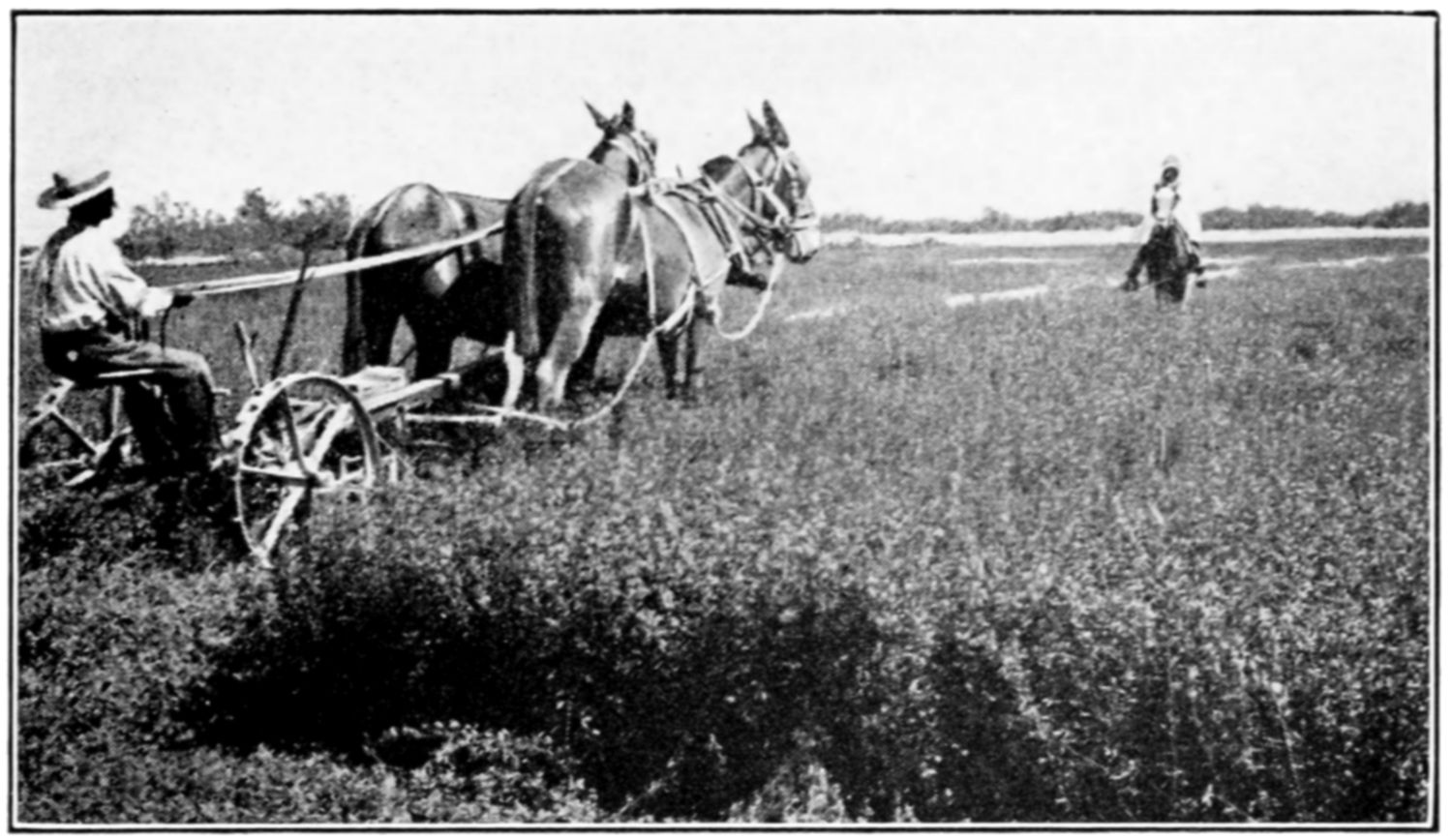
Cutting Alfalfa in Southern California
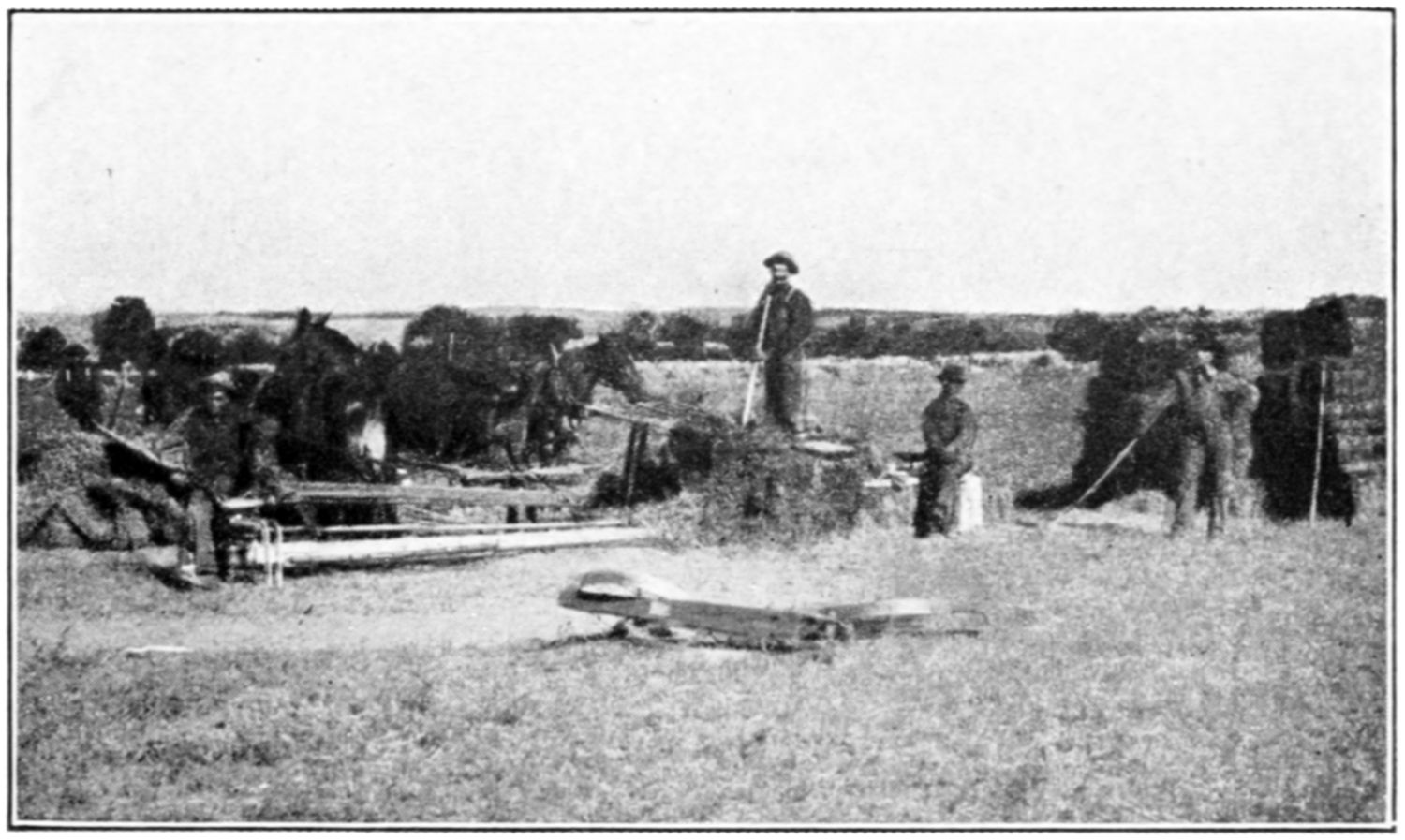
Bailing Alfalfa in Southern Oklahoma
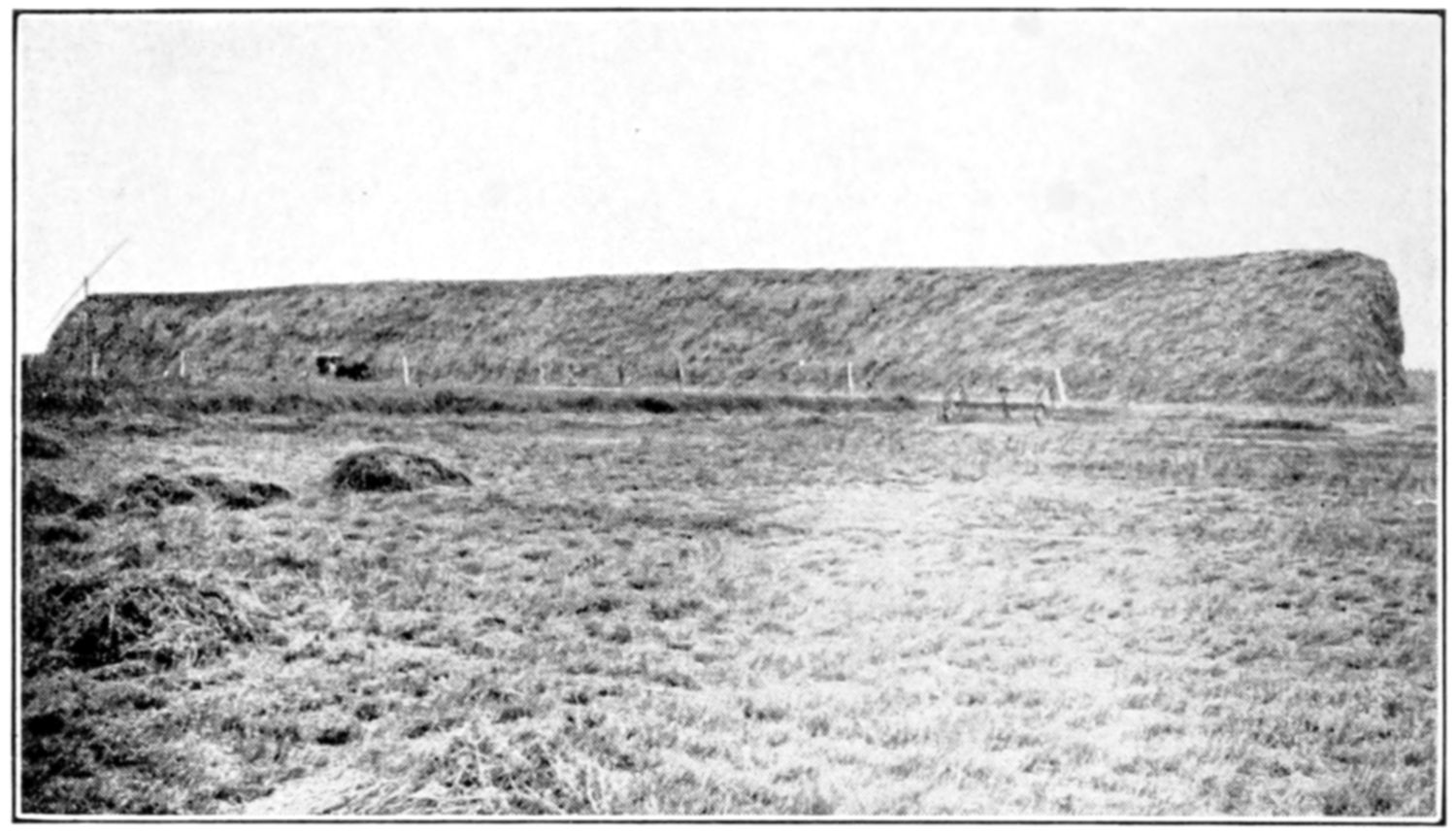
A 400-ton Rick of Alfalfa
in Malheur County, southeastern Oregon. Dimensions, 400x30x26 feet
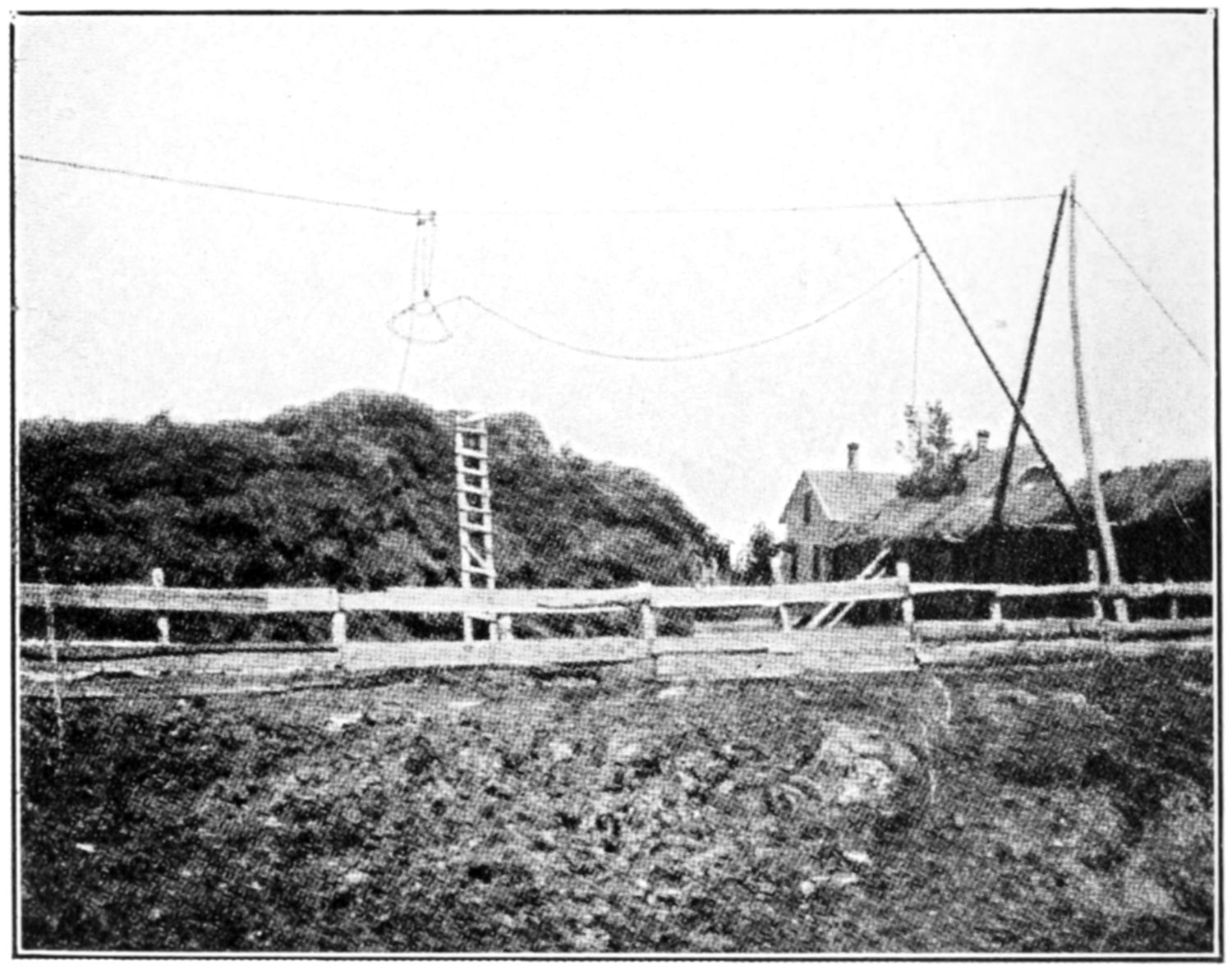
A Cable Derrick, Provided with a Grapple Fork
The cable is supported by poles at the ends, and these in turn by guy ropes
Farmers Guide says:—With alfalfa more generally
grown throughout Indiana we are hearing less complaint
regarding hay crop failures. In fact, some farmers who
have taken our advice and tried the crop are now saying
that they are having all they can do to take care of their
crops of hay. Think of cutting four or even three crops
of good hay from the same area each season. Isn’t it
worth being busy and not going fishing when a farmer
can do that? It means an enormous saving in high-priced
land when ten acres will produce as much hay as
thirty or more formerly did, and hay better in quality
also. And then, think of keeping a field in meadow
thirty, forty, or more years and having it growing better
each year. There is not much necessity for crop rotation
under those conditions, is there? especially when every
season means three or four crops of good hay. But that
is the way with alfalfa and the more farmers get of it the
more they usually want. We are glad so many Indiana
farmers are getting busy with this crop, and there is no
question of its keeping them busy if they will only give
it a trial.
Prof M. L. Bowman, Department Farm Crops, Iowa
experiment station.—We are receiving very good results
from the alfalfa which is being grown at this station, making
from three to four cuttings each season with the yield
ranging from 4 to 7 tons to the acre. From one field,
seeded in August, 1905, the first cutting was taken June
11, 1906, and yielded 2.17 tons per acre. Two other cuttings
were made. We believe alfalfa is sure to become
one of Iowa’s great crops as desirable results are being
obtained in many parts of the state where land is properly
seeded. We take great pains to see that the ground
is in good physical condition and that the seed is sown
in late summer, some time between August 5 and 15, so
that the young plants will make sufficient growth to withstand
the winter. If the seeding takes place in the fall,
the alfalfa plants will not make sufficient growth to withstand
the winter. Alfalfa should not be pastured the first
season. The growth from seeding time until winter sets
in should be 6 to 8 inches and should be left on the ground
for winter protection. A nurse crop should not be used.
Alfalfa will not do well on low, wet ground, but must
have land that is well drained. In the northern parts of
the state it may be sown in the spring, and in this case
desirable results have been secured by using a nurse crop.
If oats are used at all, they should be an early variety.
Wheat or barley is much better. They are not so likely
to lodge. If the nurse crop is heavy, a poor stand of
alfalfa is almost sure to follow. Not more than one-half
the usual amount of grain should be sown to the acre.
Better results may be expected if no nurse crop is used.
In this case, it will be necessary for the weeds to be mowed
down two or three times during the summer, so that the
alfalfa will not be choked out. It is better to sow in the
spring than late in the fall. Late summer seeding is
the best. The following year it will be freer from weeds
and have a better stand than that which was sown the
spring before. Cornstalk ground which was well manured
the year before for corn is generally used for
spring seeding. The stalks should first be removed. The
field may then be thoroughly disked and harrowed. The
seed should be sown about the middle of April.
C. D. Perry, Clark county.—In 1887, I sowed 200
acres of alfalfa, and now have 270 acres. This is nearly
all on second bottom land, with black, sandy loam, black
sand, and gumbo. The land is largely “made” land,
about 6 to 12 feet of good soil, with gumbo only on
top for 12 or 14 inches. On the heavy land the dry soil
begins at the top, and, at the breaking of the sod, extended
down eight or nine feet. Water is found at a depth of 12
to 21 feet. We irrigate most of our crop from the Cimarron
river. The first time the land is watered it takes from
two to five times as much water as is required later, and
now we find the best results are obtained by watering
about 10 days before cutting, using three or four inches
of water. There is no damage by frost, except on low,
wet land. Without irrigation, I should double plow the
ground before seeding, having one plow follow the other
in the same furrow, and going as deep as possible. Seed
by drilling one-half to one inch deep, 10 pounds to the
acre for seed, 20 pounds for hay, and 30 pounds for pasture,
usually about March 15 here. We mow the weeds
the first year before they seed, leaving them on the
ground. After this, there will be a yield of three-fourths
to two tons of hay, or one to six bushels of seed to the
acre, depending on the season. In two or three years the
plant is at its best, and does not seem to need reseeding
after that. We have from three to five crops a year
depending on promptness in watering and cutting. Any
later cutting is better than the first for seed, and,
before cutting, two-thirds of the seed pods should be
black. We mow, then rake and cock at once, stacking as
soon as well cured. Hay should be cut when it is coming
into bloom. To make good hay, let it lie for half a day
(if dry weather), then rake and cock, and let cure thoroughly.
We stack in long ricks, and it keeps well. The
alfalfa land is valued at $50 an acre, and the four irrigations
cost 25 cents each; the estimated cost of the alfalfa
in the stack is $2.15 a ton. An average yield of seed is
three bushels to the acre, and the cost of threshing and
cleaning it is 80 cents a bushel. Hay has sold for $5 a
ton, and seed for 6, 8 and 10 cents a pound. The threshed
hay is not so good as that cut earlier, but cattle eat it all
clean. The pasture is excellent for horses, hogs, and
cattle. If the alfalfa is wet, it is liable to cause bloating
with sheep; for cattle, there is not much danger, except
for the first few days they are turned on. If the animal
is seen in time, it may be relieved by driving around, but
if too bad to be helped in that way, it needs the trocar. I
have had 50 hogs on six acres of pasture this summer,
and have 50 pigs, 3 to 12 weeks old; used two bushels
of ground wheat and barley each day, and think I could
have had as many more hogs on the pasture. The sod is
very hard to plow, but it can be killed. On a piece of hog
pasture plowed under, I raised 70 bushels of barley to the
acre. My alfalfa seems to do the best on black, sandy
land and on gumbo, with sand or open subsoil below.
J. R. Blackshere, Chase county.—I began with alfalfa
in 1875, by sowing 11⁄2 bushels of seed bought in San
Francisco, at the rate of $21 per bushel. As the germination
was defective, or the seed grown so far away was
not adapted to our soil or climatic conditions, a good
stand was not at first obtained, but I now have 700 acres
on Cottonwood river bottom land, having a clay subsoil
underlaid by a layer of sand 20 feet below, and with
a good portion of gumbo, where the best alfalfa grows.
The soil is not especially moist until water, 20 to 30 feet
below, is reached. My best results have been obtained
on corn land, cutting across the rows with a disk harrow,
leveling with a plank drag, and sowing, after danger of
freezing is past, 20 pounds of seed per acre with a disk
having seeder attachment, being sure to have all the seed
covered. I cut the weeds off with a mower, and leave
them on the ground. After the first year my average
product annually for 10 or 12 years has been about five
tons per acre. That permitted to ripen seed yields three
to five bushels per acre. I do not irrigate. The plant
will thrive on upland having a clay subsoil without a
stratum of hardpan. Grazed closely late in the fall, it is
liable to die out in a dry winter.
Benj. Brown, Osborne county.—I have had four years’
experience with alfalfa growing in this country, and have
also grown it in England, without any irrigation, and
now have 45 acres. The land is bottom rising to second
bottom, with vegetable loam and some gumbo in the
upper portion, and loam subsoil, similar to surface, but
somewhat paler, for 15 feet down. Well water is found
by digging 11 to 22 feet through the soil, which is
usually moist except in dry weather, when the upper two
or three feet are not. It has been found best to plow six
inches deep, in August or September; to roll or level with
a heavy float about April 15, then harrow, and broadcast
25 pounds (or drill 20 pounds) of seed to the acre. I
broadcast all of mine, and harrow and roll or level. The
best time for sowing here is April 14 to 30, as it almost
invariably rains here about April 20, and frosts have
never hurt my crop, nor does it winterkill. Mow first
when the weeds are six to nine inches high, and, if worth
hauling, stack; if not, let lie; generally mow again about
July 4 to 20, and stack; there may be one-fourth to one-half
ton of hay per acre. The second season we cut
three times, unless we ripen seed, and obtain from one-fourth
to one ton each cutting; after this it grows about
a foot high by October. For hay, mow as soon as
about half full of flowers, rake the same morning,
and haul in one or two days, as the leaves fall if
dry. It does not heat nor mold here if the sap is half
out and the straw long; I use the “Acme” hay harvester,
making stacks with rounded ends, nine steps
long by five wide, and top out with straw or hay, taking
care to keep the middle well filled. The total cost of hay
in stack is about $1.50 per ton, the land being valued at
$15 per acre, or $60 with a good stand of alfalfa. The
hay has sold for $4 to $6 per ton during the past four
years. The best crop for seed depends on the weather;
sometimes the first flowers set best, and again the later
ones do better; on my bottom land the plant grows too
large for seed, unless in a dry time. If seed is ripe, cut
only while damp or in the early morning, rake into rows
immediately or early the next morning, haul with a
“Monarch” rake, and use a stacker. Last year and year
before I obtained four bushels of seed to the acre, and it
cost me 60 cents per bushel for cleaning. Used ordinary
threshing outfit, and set hind end of thresher 10 inches
lower than front. The seed has sold here during four
years for $5 to $8 per bushel. Horses and sheep should
not be pastured on the alfalfa, as it pays to mow and haul
it to them, either green or dry. It makes good pasturage
for cattle, but they must not be turned on when the ground
is frozen, nor when they are hungry, as it is necessary to
start them gradually to avoid bloating. Mine never
have bloated, and I feed milch cows in the early spring
and on the fourth crop in the fall. Alfalfa ripened and
threshed has little value, as it breaks up into dust and
chaff. My stand improved every year; was about at its
best the sixth year, and continues about the same for an
indefinite time. If it gets a fair start, and is cut three
times, a good stand can be kept; but if it is pastured, and
the weeds are not eaten, it is apt to thin itself. A neighbor
plowed under alfalfa for green manure, but the next
year it grew up as thick and strong as if not plowed.
We do not need manure here. I have seen several pieces
of fairly good alfalfa on high prairie, with some gumbo
in the soil, but it grows best where the subsoil is fairly
open. Upland is generally best for seed, as the plants
should grow only one to two feet high, and mine on the
bottom grows 2 to 31⁄2 after the second year. I think
there is no other crop here to compare with alfalfa. My
third year’s crop cleared me over $20 per acre. I have
known of nine bushels of seed on one acre, and have
heard of 15 in this county. My bottom lands will grow
three good crops of hay almost without rain, and kill out
all the weeds.
Prof. H. Garman, Botanist Kentucky experiment station.—We
have grown alfalfa on the experiment farm
for a good many years and have been impressed with its
many good qualities, although we have not found it as
well adapted to our soil and climate as it appears to be
in the western states. In our small experimental plots,
on good soil, it has recently done remarkably well. This
is partly the result of understanding it better than formerly,
and partly due to the care which these plots receive.
Last year we harvested, from some of them, hay
at the rate of from 6.32 to 10.03 tons per acre. The
same plots are yielding very well this season, but I think
will not produce quite as much hay as last year, though
they look very well at present. Farmers in this state are
becoming interested in alfalfa, stimulated by the reports
made to them at farmers’ institutes, and urged by failure
to grow Red clover successfully in some parts of the
state. But thus far they have not met with uniform
success. Part of this is due to a lack of acquaintance with
the plant and part may be attributed to our climate. A
few men have been growing alfalfa successfully for
eight or 10 years, and I can see no reason why many
others should not succeed with it. The chief difficulty
appears to come in getting a start. Alfalfa, thoroughly
started, holds its own better than Red clover and yields
much more forage. The value of the forage is recognized
by everybody, and I expect to see in the course of
the next quarter of a century a much larger acreage sown
in Kentucky.
Prof. W. R. Dodson, Director Louisiana experiment
station.—Alfalfa has been grown by the Louisiana stations
since 1887. At the time the stations were established
there was little or no alfalfa grown in the state.
From the very first experiments conducted by Dr. W. C.
Stubbs, it was apparent that the plant was well suited
to the alluvial lands of the Mississippi and Red rivers.
Dr. Stubbs never lost an opportunity to advocate its culture,
and the great progress made in securing its extensive
cultivation is largely due to his efforts. Alfalfa is
now extensively grown in the Red river bottoms, and a
very large percentage of the sugar planters grow it for
soiling and for hay for the plantation mules. We get
from four to seven cuttings per year. The average is
about 11⁄2 tons for the first three cuttings, but less for the
last cuttings. The station one year secured a harvest of
12 tons of cured hay per acre; six tons in a season is a
good yield. Were it not that one or more of these cuttings
will fall due during a rainy season, when it is difficult
to cure hay, we would go into the business very
extensively in this state. As to the quality of the hay or
forage, there is no question about its place at the head of
the list of desirable forage crops. The sugar planters
find it especially desirable to mix with their cheap molasses,
as the former is rich in protein and the latter rich
in carbohydrates. In the southern portion of the state
best results are secured by planting in the fall. In the
northern portion good results are secured from early
spring planting. We use from 25 to 30 pounds of seed
to the acre. Some planters use more than this. Land
that is least suited for growing corn in Louisiana, because
of its stiffness, is the very best land for alfalfa.
Where the crop has once been used and the local supply
runs short, it is shipped in from Colorado to supply the
demand. It is selling now for $15 a ton. No better
testimonial need be given of the people’s estimate of its
value.
Prof. William P. Brooks, Director Hatch experiment
station.—Our experiments with alfalfa have been continued
both upon our own grounds and those of a few
selected farms in different parts of the state. We are
bringing to bear upon these experiments information in
regard to successful methods from every possible source.
We find in all cases a distinct benefit from a heavy initial
application of lime. We have used from 2,000 to 3,000
pounds per acre. We are enriching soils already naturally
good by heavy applications both of manures and fertilizers,
using materials which experience has proved best.
We are also giving the soil a most thorough preparatory
tillage. It has usually been fall-plowed, and in addition
it is plowed in the spring, and repeatedly harrowed to
destroy weeds which start in the early part of the season.
We have tried inoculating the soil, both with earth obtained
from a field in New York, where alfalfa is successfully
grown and with the cultures sent out by the
department of agriculture and prepared by private firms.
We have not attained such degree of success as justifies
us in recommending the crop. We have occasionally got
a fair stand of alfalfa, but in all cases the winters prove
more or less injurious. In the course of a few years the
alfalfa is mostly crowded out by grasses and clovers. The
alfalfa almost every year suffers from leaf spot, which
tends to cut down the yield. We have found a very distinct
benefit from the inoculation with earth from the
New York alfalfa field. We have not found an equally
distinct benefit to follow inoculation with any of the cultures;
and, although we are not as yet ready to make a
final report, it should be here remarked that the most
careful experiments on the use of these cultures in sterilized
soils, under conditions calculated to give accurate
results, indicate that they have little, if any, value. In
our various experiments alfalfa has been tried on a wide
variety of soils. We have had a quarter of an acre field
upon a coarse-textured soil upon a farm in this neighborhood
where there is never any standing water within
50 to 60 feet of the surface. Even on this soil the alfalfa,
although it did fairly well for a year, has been injured
by successive winters, until it is at the present time
almost ruined. In this connection I call attention further
to the fact that D. S. Bliss of the department of agriculture,
who has been making special efforts to promote the
introduction of alfalfa into New England, and who has
traveled extensively for the purpose of studying the results
obtained, now speaks very discouragingly as to the
outlook in general. In conclusion, while we are not inclined
to discourage experiments with alfalfa, we do wish
most emphatically to caution against engaging in these
experiments upon an extended scale, for we feel that disappointment
is almost inevitable.
Prof. C. D. Smith, Director Michigan experiment
station.—Alfalfa has had and is having a checkered
career. Under favorable conditions it makes a good
stand. Some fields have produced crops for many years,
the ground being occasionally fertilized by manurial salts.
The difficulties that environ the crop are: (1) The severe
winters, which sometimes kill off whole fields, leaving
scarcely a root alive; this has happened to fields two,
three, or four years old. (2) The Blue grass crowds
it out badly; (3) the ignorance of the farmers in regard
to the requirements of the crop and the consequent imperfect
preparation of the soil in the matter of tillage or
fertilization, has made it difficult to introduce it in a broad
way. Notwithstanding these difficulties and the farther
consideration that alfalfa does not easily lend itself to a
short rotation, the crop is advancing in the state by
leaps and bounds. Hundreds of farmers are experimenting
with it and are learning how to prepare the
ground, sow it and care for the crop afterwards. Statistics
are not at hand to show how many acres of alfalfa
there are in the state, nor can definite figures be given as
to the growth of interest in the crop and its actual acreage.
When proper strains have been developed, it seems
fair to presume that alfalfa will be one of the staple crops
in Michigan. On the station grounds at the agricultural
college fields of alfalfa have been continuously maintained
from 1897 to 1904. There are fields here sown in 1903
bearing their three crops each year, yielding from 5 to
7 tons of dry hay annually per acre. There has been some
difficulty in getting pure and vigorous seed.
Prof. W. M. Liggett, Director Minnesota experiment
station.—Our experience with alfalfa has extended over
12 or 15 years. In the early days of this station, it was
not very successfully grown. During the past eight or
ten years, however, the changes in soil due to manures
and cultivation and the discovery of several varieties of
alfalfa which appear to be hardy, have made it possible to
grow it successfully in nearly every part of the state. For
the past five years we have cut three crops of alfalfa hay,
yielding from 4 to 51⁄2 tons per acre each year. With the
land properly prepared and some attention given to seeding
at the right time, there is no difficulty in growing it
on the state farm. Occasionally it will winterkill. We
were unfortunate enough to have a heavy, driving rain
during March of the present year which froze as it fell
and smothered the alfalfa crop. We are not discouraged,
however, as the clover crop in southeastern Minnesota
was killed at the same time and from the same cause. We
regard alfalfa just as sure as Red clover. It is sometimes
a little difficult to get a stand under careless methods of
farming. With the land nicely prepared and with a good
supply of humus in such condition that the plant
food is readily available, strong, vigorous growth and a
good stand can be secured during any normal year. We
have alfalfa growing at the northwest sub-station at
Crookston, and in several localities in the northwestern
part of the state, where even clover is not supposed to
grow. The outlook at the present time for this crop is
very bright. Dairymen, swine raisers and sheep men
unite in praising its merits as stock food.
Prof. M. F. Miller, Agronomist, Missouri experiment
station.—Alfalfa is being grown with success on various
types of soil, although many soils are not well adapted
to its growth. A knowledge of the peculiarities of the
plant will ultimately make it possible to extend Its culture
to most soil types of the state. Liberal manuring is the
key to successful culture on upland soils. The manure
may be applied before plowing and also as frequent top-dressings.
The value of the crop as a feed and its high
yield, where favorable conditions are supplied, make it a
particularly desirable one to grow, at least in small areas,
on farms where mixed fanning or dairy farming is practiced.
While alfalfa makes a most nutritious pasture
crop, it does not lend itself well to pasturing unless certain
precautions are taken. Where it is grown for hay,
difficulty is often experienced in harvesting the first, and
sometimes other cuttings, on account of wet weather. The
silo may be used in such cases. The stiff subsoils of the
state are responsible for most failures reported, because it
requires some knowledge of the methods of handling the
crop to make it succeed under such conditions. Alfalfa
is not adapted to our soils, liming, manuring or drainage
being necessary to prepare such for the crop. If sown on
upland soils that have never grown alfalfa or Sweet
clover, it is benefited by inoculation. On bottom lands or
lands that are very fertile, inoculation has little or no
effect. The surest and often the simplest means of inoculation
is by means of inoculated soil. The cultures prepared
for seed inoculation have in many cases given excellent
results, but they are still in the experimental stage
and some skill is required to handle them properly. The
best preparation of the seedbed is that which allows of an
early plowing and the use of a harrow every time a crust
forms or weeds start before time to sow the seed. The
seedbed should be much like that for wheat—loose above
but firm below. The best time to sow in this state is between
the middle of August and the middle of September,
the last week in August usually giving best results. The
amount of seed to sow is between 15 and 20 pounds, depending
upon the quality and the character of the soil.
It is best sown without a nurse crop. It must be clipped
frequently the first and sometimes the second season, especially
on soils to which it is not well adapted. It should
usually be cut when the lower leaves begin to turn yellow.
Alfred Rasicot, Deer Lodge county.—Alfalfa is the
most valuable crop that is raised in Idaho or Utah for
hay, growing on any kind of land but that which is low
and wet, yielding five to seven tons of hay to the acre,
and providing excellent feed for all kinds of farm animals.
For about 20 years I have grown from 20 to 50
acres on second bottom and upland of heavy clay soil,
with gravel below and water at a depth varying from 16
to 100 feet on different localities. We irrigate from
streams, flooding the land and turning the water off as
soon as the land has been all covered, applying once for
the first cutting and twice for each succeeding cutting,
whenever the ground is dry. The first year on new land
requires fully one-third more water than is needed afterward.
Before seeding, the ground should be mellow,
then harrowed with the back part of the harrow or
brushed, and seeded with 15 to 20 pounds to the acre,
between the first and middle of April. The plant will
usually run out the weeds, and on that account no special
treatment is needed. The first season will produce a small
crop of hay, but no good seed. Unless water is allowed
to freeze on the land, alfalfa does not winterkill here,
and at two or three years of age it is at its best, continuing
vigorous for 10, 20 or 30 years without seeding.
The first cutting of the season yields about 21⁄2 to 3 tons
to the acre, the second about 2 to 21⁄2, and the third 1 to
11⁄2 tons. The hay is cut when the plant has been in
bloom 8 or 10 days, allowed to lie for 24 to 36 hours,
and treated as Red clover is. The second crop is always
the best for seed here. The cost in the stack, on $25
land, irrigation costing 50 to 75 cents an acre, is $2 a ton.
To put this into 100-pound bales costs $2.50 a ton. On
the ground it sells for $3 to $5 a ton, while the seed
brings $3, $4 and $5 a bushel. An ordinary yield of
seed is 300 pounds to the acre, and this is threshed with
the same machine used for grain, at a cost of about one-fourth
of the seed. The straw is worth about one-fourth
as much as the hay. We consider alfalfa hay, for cattle,
sheep, and hogs, far superior to clover, but for horses
timothy is best. It will keep steers and sheep fat all winter,
providing they are under shelter, and is excellent for
milch cows. The pasture for swine and cattle is far better
than clover, and for work horses and sheep it is good,
but not the best for horses that are driven fast. Cattle
will bloat about as they do on Red clover when turned
onto it after rain, dew, or frost. To rid land of a stand
of alfalfa is very difficult, requiring four stout horses
with a very sharp plow to turn it over, but as a green
manure it has about the same effect as Red clover, producing
two or three extra crops afterwards.
Olmstead & Olmstead, Furnas county.—Alfalfa, while
excellent for all other stock, is preeminently the feed for
hogs. Its early appearance, its wonderfully rapid growth,
its nutritious properties, its perennial nature (keeping
green until about December), its resistance to drouth,
its wonderful fecundity, and, lastly, its adaptability as
a dry feed, make it, in our opinion, the most profitable
crop that can be grown. Ten acres of alfalfa will
pasture 150 head of hogs, and give them abundance.
From the 15th of March, or at most not later than the
15th of April, hogs and cattle can be turned on pasture,
and kept there until snow flies. On first bottoms, six
tons per acre can be depended upon as a fair, average
yield, while many fields this year have made as high as
eight. On divide, or high land, where it has been tested
for three years, it averages about two to four tons per
acre, but this land gives the best returns for seed, not
growing too rank. Since we have been investigating
and gathering information on this subject, we have had
reported to us a yield as high as eight bushels of seed
per acre, and quite a number as high as nine, and some
eleven. Six bushels an acre on a good stand is an average
yield, while some will fall below that. The seed has
never sold here below $4 per bushel. Last year and this,
all seed grown in this part of the country sold readily at
$5 per bushel, and for the next five years will probably
not go lower than $3. One crop of seed and two of hay
are the average on low land, and one crop less of hay
on high land. The threshed hay is nearly as good for
feed as the unthreshed. There is no waste in feeding this
hay, and horses are especially fond of the coarse stems.
It stands our winters remarkably well, so far, coming
through in excellent condition. There is no stock but eats
alfalfa hay as well or better than clover or timothy.
Young colts and calves will winter in fine condition on
this hay, with little or no grain. If the last cutting is
allowed to stand, with a growth from six to eight inches,
horses and cattle will graze on it through the winter, the
same as on Red clover, doing equally as well. Now, as
to the other side. Will this clover grow in all latitudes
and longitudes as well as Red clover? We think it
doubtful. It requires a dry, porous soil, in which there
is no hardpan nor too much clay, and it does not like too
much water. It does well where the soil is somewhat
sandy, its roots penetrating to a depth of from 15 to 25
feet, thus drawing its nutrition from various strata of
soil. What else against it? If cattle are turned on after
a rain, when it is wet, or dew is on, they often bloat and
die; but if turned on in the spring, and kept on continuously,
have little danger of gorging themselves or bloating.
No other stock is adversely affected by it. This is
all that can be honestly said against alfalfa, and this is
obviated by a little care by the farmer, while the many
good things said about it must certainly recommend it to
the intelligent husbandman. Thus we can enumerate:
First, its certainty as a crop; second, its enormous yield;
third, its excellent pasturage qualities; fourth, its nutritious
qualities, being equally good green or dry; fifth,
its yield and price of seed, which is threshed with an
ordinary grain separator; sixth, its tremendously rapid
growth during the summer season. There are many more
attributes that can be credited to alfalfa.
W. O. Thompson, Lincoln county.—I have had 20
years’ experience with alfalfa, on second bottom and
upland. The upland has a clay subsoil; the second bottom
soil is three feet deep, underlaid with a bed of
sand and gravel. Abundant water is found from 8 to
23 feet from the surface. If dry soil is found, it is the
first three feet below the surface. Land should be tilled
several years before seeding, in order to perfectly subdue
the sod. Use about 16 pounds of seed per acre, and prepare
the ground the same as for wheat, sowing in the
spring. The first crop will be nearly all weeds; cut and
haul these off the ground. The second crop will produce
about one ton of hay per acre. Alfalfa is liable to winterkill
if the winter is warm and dry. I irrigate from a
stream two or three times during the season, with sufficient
water to flood all the ground. The first year the
ground is soft and porous, and twice the water is required
as in the following years. From three to four crops are
raised during the season, yielding from 11⁄2 to 2 tons
each cutting, or from five to six tons per acre in one season.
Cut when in bloom for hay, and let the seed ripen
before cutting for seed, using either the first or second
crop for this seed. When cutting for seed, it should be
pitched out of the way of the mower after each round;
then let it dry before stacking, but not enough for the
leaves to fall off when handled. Stack in the ordinary
way, but be sure the hay is thoroughly dry in the shock
before stacking. It is more liable to get moldy in the
barn than in the stack. About $2 per ton will cover all
expenses of raising, on land worth $50 per acre. The
expense of baling is about $1.50 per ton, 100-pound bales
being preferred. It should not be baled until perfectly
dry in the stack. About six bushels per acre is the average
yield of seed, and it costs about 75 cents per bushel
to thresh and clean. A clover huller is the most satisfactory
for threshing alfalfa. The hay has sold here at
$3 to $10 per ton, averaging $6. The seed has brought
from $3 to $10 per bushel averaging $5. One acre of
alfalfa will raise 35 hogs, with the aid of a little grain.
Horses thrive on it, but it is unsafe for sheep and cattle.
Animals which chew the cud will bloat if pastured on
alfalfa. The only way to prevent it is to keep them from
the pasture. The best way to cure it is to insert a tube
into the paunch, to allow the gas to escape. As to the
longevity of the plant, I call to mind a patch sown in
1873, on upland, and it is still growing. Alfalfa attains
its best growth in about two years. I do not think it can
be profitably raised on high, arid ground, without irrigation.
Hogs can be wintered on alfalfa hay and a very
little grain, and cattle can be fattened for the home market,
but it produces softer flesh, and they could not be
shipped a great distance in the best condition.
Richard Stolley, Hall county.—In reading the farm
papers I see many articles about seeding alfalfa, but have
failed to see anything in the line of advice regarding a
sure way to kill it, if it has to be done. We have had
alfalfa on our place as long as I can remember—nearly
thirty years. At first it was a small piece, just for experiment’s
sake. Finally we sowed about nine acres on good
soil and had it well manured before sowing. The result
was immense crops, as high as four cuttings; and, really,
the worst feature was to harvest the crop so often, since
it came just as regularly as clock-work. It actually stood
in the way of alfalfa, for I asked one of our neighbors,
who had very little hay, why he did not sow alfalfa, and
all he could answer was: “Well, I have to harvest it too
often and I haven’t the time to do it.”
We did not sow more of it until we got more improved
methods of handling it, and we have had as high as fifty
to sixty acres on a 160-acre farm here at home. Some
fields run out in about ten years. Our plan is to then
plow it up. The first thing you learn is to have a very
sharp plow, and it must have a strong cutter bolted to the
share, being long enough to reach well through the sod.
Then if you have three good horses you are fixed out.
A riding plow that we tried was thrown out too easily
or pulled too hard. Others had the same experience, and
the old reliable fourteen or sixteen-inch walking plow
fills the bill best. We plowed some of it quite early in
the spring and after harvesting the oats we had a wonderful
stand on the field in the fall. All the inconvenience
the clover had was to take a little time to start work
at the crown and start sprout at the other end; that is
the root end.
I do not know of any other plant that is not a weed
that has this peculiarity. Planting corn on alfalfa sod
cannot work well, because the roots are so tough that no
cultivator will be able to cut them, and since burning does
not make any difference, it only has a tendency to start
roots and sprouts at both ends at the same time. This is,
of course, only possible in a wet year. Now, we tried
late plowing in the spring; that is, let the clover get up
to about six or eight inches. We had a chain on the plow
and disked and harrowed it well, and to kill it sure, put in
millet to smother it. We intended to raise seed from
the millet, but the crop got too heavy and we cut it for
hay. After putting it up I saw very little alfalfa signs
and went home contented that all was dead.
Some nice rains came on and soon I noticed from our
house, since I did not go to that corner of the farm
in between, that all of it was green again, and sure
enough, there was a comparatively good stand and the
sprouts showed quite a bit of vigor. This surprised me.
I had no time to plow right away and having a large
harvest of bottom hay, I did not go to the field for three
weeks, and when I saw it again it was just about ready
to cut. I actually did cut and harvest it and it was well
worth the time it took us to do the work. The next
plowing and disking, of course, thinned it out, and especially
as dry weather came just right to assist in killing it.
All this made it clear to my mind that we did not find
the right time to plow alfalfa, so the next time I tried
it still later; in fact, it was almost in bloom, and, being
a wet year, there was little difference in the result. This
year I waited the second time for the alfalfa to come up
a foot high before plowing it back and drilled in sweet
corn, and now I can hardly see any difference on parts
of the field.
Prof. Frederick W. Taylor, Agriculturist New Hampshire
experiment station.—We have tried to secure a
stand of alfalfa for four consecutive seasons, but so far
our efforts have been unsuccessful. Various types of soil,
from a heavy boulder clay to a light sandy loam, have
been tried, and, contrary to our expectations, the most
promising crop was on the heavy clay soil. Our chief
difficulty has been in having the alfalfa keep ahead of the
weeds and in getting a uniform catch that would withstand
our winters. From one-fourth to one-half of the
plants have usually wintered over in good condition and
made a vigorous growth the next season, but there has
not been enough of them to say that we have made a
success with alfalfa. We have largely eliminated the seed
question by plowing the ground early and keeping it harrowed
until about the middle of July, when it is sown.
Our experience seems to indicate that an application of
lime is beneficial, if not absolutely necessary, in this section
and we have accordingly been using it at the rate of
a ton to the acre. We have also tried inoculation with
the various cultures, but in no case have any benefits been
observed. So far as we know, there have been no successful
attempts to grow alfalfa on a medium or large
scale in this state, although several farmers in the Connecticut
river valley have reported success on some areas
of an acre or less. When we more thoroughly understand
the plant, and the conditions necessary for its
growth, we believe it can be grown upon some of our
soils.
Dr. E. B. Voorhees, Director New Jersey experiment
station.—The farmers of the state have manifested much
interest in the growing of alfalfa, and many experimental
plots have been seeded in the past two or three years.
In order to obtain accurate information as to the methods
employed, and the results obtained, a circular letter was
sent out during the past summer to 140 growers. Detailed
replies were obtained from 101 growers. Of these
there were 57 distributed over 15 counties, which showed
the successful establishment of the crop. The soils upon
which these successful crops are growing vary widely,
both in their physical and chemical character, ranging
from a light, sandy loam, with sandy subsoil, to a medium
heavy clay, with compact clay subsoil, which indicates
clearly that success does not depend so much upon the
character of the soil as upon the methods of seeding,
fertilization and after-treatment, though the most successful
stands were, as a rule, obtained upon sandy soils,
overlying a reasonably open subsoil. Twenty-seven
growers had a more or less satisfactory experience, while
17 were absolute failures. A study of the reports of
failures shows that in most instances they were due to
lack of observation of the methods recommended for the
seeding and care of the crop, which experience at the
station showed to be essential for success. In most
cases the land was imperfectly prepared; in many an
insufficient amount of fertilizer or manure was applied.
In many cases, too little seed was used; in others the date
of seeding was contrary to all recommendations, or the
crop was not clipped often, and thus choked out by weeds.
In many instances, where lime had not been used for
many years, none was applied at the time of seeding. In
the case of those having more or less success, the recommendations
were not fully observed or soil conditions
were imperfect.
D. C. Lewis of Middlesex county, in the summer of
1903 seeded about 11⁄4 acres with alfalfa, observing
closely all of the recommendations of the experiment station
in reference to seeding, but did not inoculate the soil.
The seed germinated well, and the crop grew nicely during
the fall, but entirely disappeared later. In 1904, the
same area, after an oat crop was grown, was seeded
again, on August 10. The soil is a clay loam, with a
clay subsoil, and in a good state of fertility. The land
had been previously in grass and corn. The corn was
manured and the alfalfa area well limed previous to seeding
in 1903. The seed was at the rate of about 25
pounds, and at time of seeding 800 pounds of Mapes’
fertilizer and an extra bag of high-grade sulphate of
potash were applied, and the field was inoculated with
about 300 pounds of soil, taken from the old alfalfa
patch at the experiment station. The seed germinated
well, and made a rapid and large fall growth and passed
the winter successfully. The yield per acre was about
three tons of hay for the first cutting. This experiment
is strikingly suggestive in showing the importance of soil
inoculation, for while inoculation is not apparently essential
in all cases, it would seem that where soils have
not been heavily manured that this point should be carefully
observed.
J. P. Nelson of Monmouth county has had a very successful
experience in the growth of alfalfa, since he has
observed all of the recommendations made as to methods
of seeding and after-treatment. The following is a description
of his method and the results obtained from a
seeding made August 10, 1904. The surface soil is a
medium clay loam, underlaid with a gravelly clay subsoil.
The crops preceding were grass and corn, and the manures
used were barnyard manure and 600 pounds per
acre of ground bone. The corn preceding the alfalfa
was limed at the rate of 1,000 pounds per acre, and 1,400
pounds per acre were applied just previous to the seeding
of alfalfa. Thirty pounds of seed were used per acre,
and lightly harrowed in and the land rolled. The germination
and early growth were good, and the first crop
was harvested June 1, 1905. The yield was two big,
two-horse loads of cured hay per acre.
E. T. Gill of Camden county has a sandy loam, underlaid
by a subsoil varying from sand to clay. He has an
area of 24 acres, ranging from two to six years in age.
The first seeding of about two acres is still growing
profitable crops, though not uniform in stand. The later
seedings show an excellent stand and large and profitable
crops are annually harvested. Usually four cuts are
made each year, which are used both for soiling and for
hay, with splendid results. The practice on this farm
is to top-dress with manure during the winter at the
rate of about eight tons per acre. Mr. Gill’s experience
leads him to believe that the stand is often injured, particularly
during the first year, by allowing the crop to
reach too great maturity and then cutting when the plants
are just beginning to bloom, and leaving a stubble of at
least three inches. Mr. Gill did not inoculate the seed
or soil at his first seeding, but did follow this practice
with recent seedings, and believes it to be a wise precaution,
especially on soils that have not been previously
heavily manured.
Thomas J. Clark, Grant county.—I have had 15 years’
experience with alfalfa on first and second bottom land
with gravel soil, dry to within four feet of water, which
is reached at a depth of 15 feet. I irrigate from the Gila
river, and my alfalfa, which is 14 years old, is as good
to-day as at any time since it was sown. The seed is
sown as turnip seed is. I plow the land thoroughly, harrow
it over smoothly, then sow the seed in March, and
harrow lightly once. Then the water is turned on, and
the ground will remain moist until the seeds sprout.
After the alfalfa is six inches high, I cut it to make it
spread and destroy all the large weeds; and there may be
two cuttings of hay that same season. Water will not
injure the plant unless it stands on it in low places. Stagnant
water standing on the plant, or mineral water so
near the surface that the roots reach it, will kill the
plant, but it is not liable to injury from winter frost.
After the first season there are three or four crops, the
first being usually chosen for seed and not irrigated. For
hay it is cut when in full bloom, and, if the sun is shining,
should cure 24 hours if in June, or 20 in July or August,
before raking, and then 30 hours in the cock. It must
be thoroughly cured before stacking, and then will not
mold. The most convenient bales weigh 90 to 100
pounds, and the cost of preparing them is $2 a ton. The
total cost of hay in the stack is about $3 a ton, and the
average yield about three tons to the acre each year.
When the burs turn brown the seed is harvested, and
when well cured should be stacked in a dry place. An
average yield is 500 to 600 pounds to the acre, and it
sells for $4 a bushel. The hay makes excellent feed for
farm animals, keeping them in good condition the year
around without grain. The alfalfa pasturage is better
for swine and cattle than clover, and yields more largely;
sheep may be kept on it to advantage also. A good acre
will keep five grown hogs in excellent condition, but will
not make them fat. If they are taken up in October and
fed about 40 days on grain, they will be marketable.
Cattle on the pasture sometimes bloat, but I have had
100 head of cows and calves on mine for two months,
and have had no trouble. The irrigated alfalfa is better
than that grown on land that requires no water. The
straw is about equal to oat straw, but not half so good
as the alfalfa hay. To rid land of the plant requires a
strong team and a sharp 10-inch plow. The roots rot at
once after plowing, and the land is well fertilized for
other crops. In my opinion, alfalfa is the best forage
plant known in this western country. It is most easily
raised, produces the largest yield, commands the best
price, and can be planted at any time from March to
September. Land seeded to it is the most valuable, and
the farmer who has plenty of it is the most prosperous.
Farming here cannot be a success without it, and I take
pleasure in recommending it to my brother farmers. It
will lie dormant all summer if it is dry, and with fall
rains revive and make good pasture. It is the earliest
plant up in the spring, and the last to stay green in the
fall. In other words, it is the best of all.
Hartman & Weil, San Miguel county.—We have been
dealers in alfalfa hay for eight years, and have some
small fields of our own. This is on both bottom and
upland. In the bottom, the subsoil is sand and bowlders;
on the upland, stiff bluish clay, and in some places blue
limestone. Well water is reached on the bottom land at
a depth of 8 to 10 feet, through soil moist all the way;
on the upland, it is necessary to dig 60 to 100 feet, and,
beginning two or four feet from the surface, the ground
is dry. When seed is planted in the spring, the soil
should be well pulverized, moist, and warm, that the seed
may germinate quickly. It should not be put in deeper
than 11⁄2 inches, and may be planted in May or June, or
any time in the spring after the soil becomes warm. In
our climate, it is best to sow about 30 pounds of good
seed to the acre, besides just enough oats to shade the
ground and protect the young alfalfa from the hot sun.
Once well started, it will kill out all weeds, and does not
winterkill here. We irrigate from streams. Alfalfa
should not be irrigated when quite young, for, if the
small plant is covered with soil, when watered, it will
not come up again, but, after it gets a good start, it is
not easily killed. There should be about two irrigations
to each crop harvested, or ordinarily, six in a season.
The heavier the stand the more water is needed. We
have three cuttings, yielding about 3,000 pounds of cured
hay per acre per cutting. When the plant is fairly well
in bloom, it is cut, and is best when cured under large
sheds or in the shade. If left until dry where cut, the
foliage will fall off and pulverize. It is best to stack in
narrow ricks, as it is liable to heat if put in large stacks,
and it should be salted liberally when stacked. The last
cutting is preferred for seed, which is mowed when most
of the pods are well matured; in this case only two crops
should be cut during the year. The straw makes good
feed for stock in winter, having about half the value of
the hay. Each irrigation costs about 50 cents per acre,
and the total cost of hay in the stack is about $3.50 per
ton. Baling costs $1.25 per ton, with 50 cents additional
for wire. The common yield of seed is 6 to 10 bushels
from the acre. “Reeves” clover huller will thresh about
12 bushels per hour. The price of hay, baled, in New
Mexico has averaged about $8 per ton for the past eight
years and seed for the same time about $5 per bushel.
Our experience indicates that alfalfa hay is a more nutritious
food for farm animals than either clover or timothy.
We have found nothing better to feed cattle for
market; it makes good, solid beef, and they take on fat
very fast. The pasturage is excellent for swine, horses,
and cattle. If overfed, animals will sometimes bloat on
rank alfalfa, especially if unaccustomed to it. About the
third year from seeding, the plant has acquired its best
yield. It is difficult to rid land of it, as plowing under
is sometimes beneficial, making it come up thicker than
before. Success with it on high prairies depends upon
the precipitation during the growing season. We think
four inches of rainfall during the time of its growth
would make a fair crop of hay; or 8 to 12 inches from
May to September, for two or three cuttings.
Isaac Zoller, Montgomery county, writes in a recent
article in American Agriculturist:—“In the spring of
1889, I sowed my first ten acres of alfalfa. The field was
reseeded for the second time in April, 1905. I now have
25 acres. The land was plowed in the fall after being
manured. In the spring, generally during the last two
weeks of April, the surface for five or six inches is made
extra fine and 25 to 30 pounds of the best seed are sown
with three pecks of oats as a nurse crop. By June 1 the
oats are cut three inches above ground and again every
four weeks during the first season. The following June
during the third week the first crop is cut, usually yielding
about three tons. The second cutting generally
comes during the last week in July when 11⁄2 tons is an
average. By September, the third cutting is made, but
I generally let sheep browse it, but not very close or after
it is frozen. The season of 1905 it was cut and allowed
to wilt, raked with a side delivery rake, allowed to lie a
couple of hours, then rolled over with the rake and drawn
to the barn. Formerly I used to shock it and allow it to
sweat, but this is too much work. I feed it to sheep and
find it equal, if not superior to Red clover. To be at its
best it must be cut when about one-tenth of the blossoms
are out. The soil in which my alfalfa grows is a heavy,
clay loam and rolling, but is underdrained. The soil here
is apt to heave three or four inches during winter and
injure clover. But where properly drained, this does
not occur on alfalfa fields. I am certain alfalfa can be
more extensively and economically grown here.”
H. B. Fullerton, Long Island.—As an experiment, an
acre of scrub-oak, waste land was cleared and the brush
and stumps burned in November, 1905. About 2,000
pounds of wood ashes were applied and turned under at
once. In April about ten tons of manure was applied
so that each quarter acre would have about 2,500 pounds.
Three weeks later 400 pounds of kainit were applied and
ten days later 200 pounds of Canada wood ashes. Since
the soil, when tested, still showed acidity, about 400
pounds more of ashes were spread, chiefly because of its
high percentage of vegetable lime, 40 per cent. The lime
of ashes on Long Island soils is considered superior to
that of stone or shells. Early in June the test acre,
being considered ready, was finally prepared and sown
to alfalfa in two directions crosswise over each quarter
acre. In less than a week the plants appeared evenly on
all four plots. Showery weather continued from before
seeding until well into June. One of the quarter acre
plots sown with a dressing of 150 pounds of soil from
an old alfalfa field at Fayetteville, N. Y., early took
the lead in color and vigor and about six weeks from
sowing could be readily distinguished at a distance by
the richness of its foliage. It was also in flower before
the other plots, one of which was uninoculated, the other
two sown with inoculated seed. Unfavorable weather
prevented cutting until mid-August when all four plots
were cut, the few large weeds were removed and the
alfalfa weighed. The plot inoculated with alfalfa soil
yielded 1673 green pounds which cured to 701 dry; the
uninoculated plot yielded 726 green and 313 dry, the
other two plots sown with inoculated seed 416 and 377
pounds green or 189 and 168 pounds dry respectively.
These results point favorably to inoculating the soil from
old alfalfa fields.
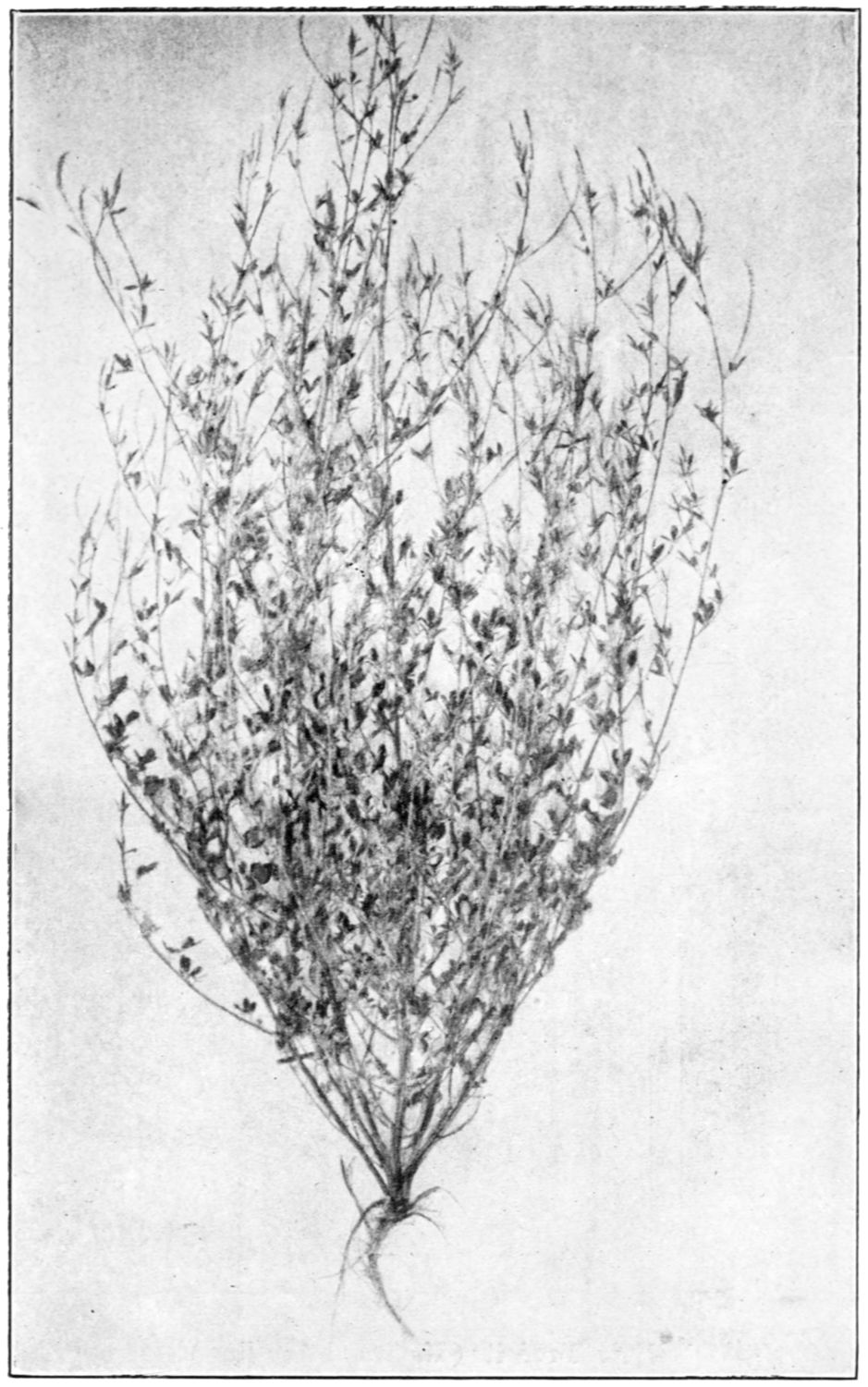
Sweet Clover (Melilotus alba.)
The seed of Sweet clover is an occasional adulterant of alfalfa. The plant is
much taller than any of the species of Medicago. The flowers are white
and borne in rows on elongated flower stems
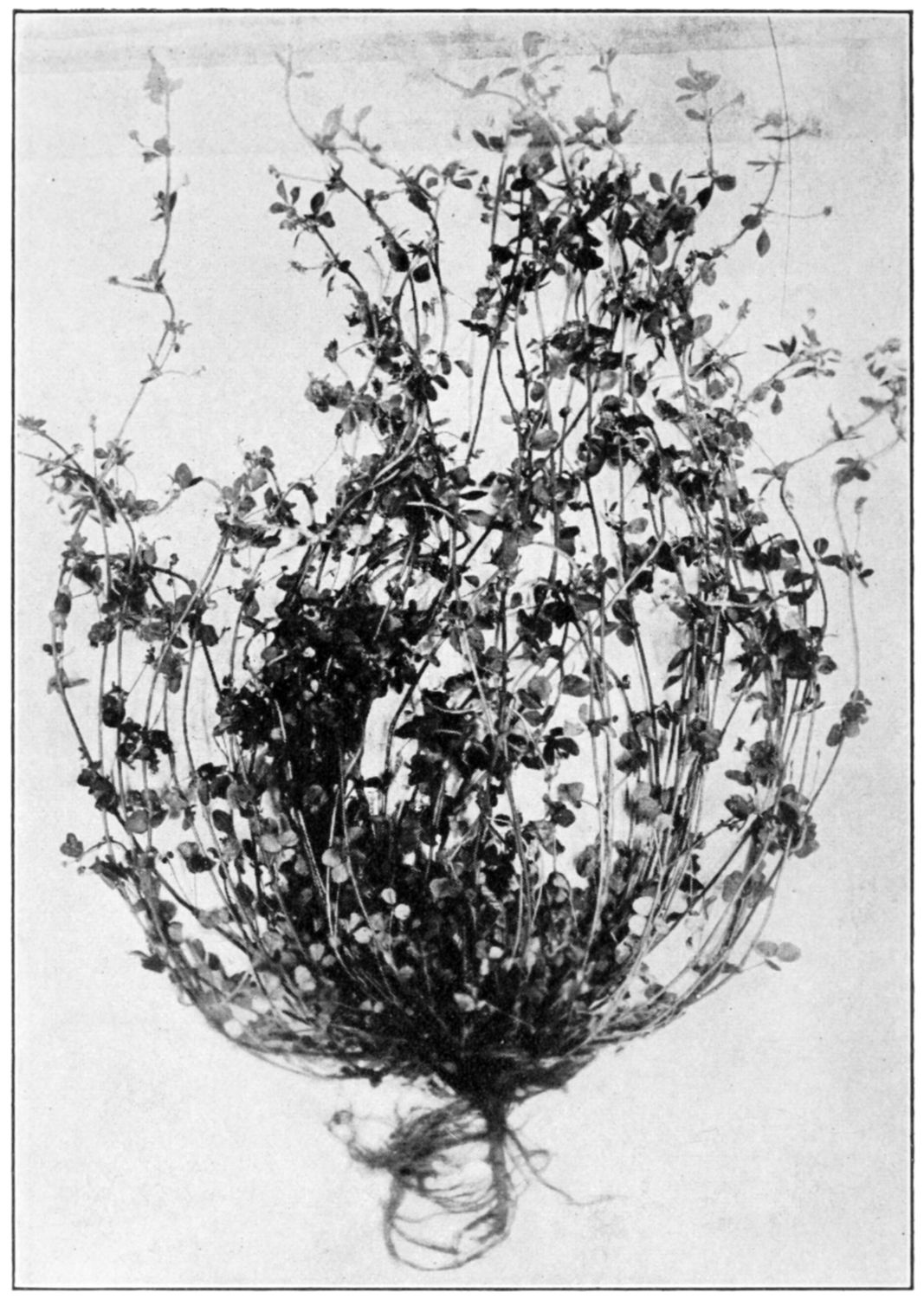
Yellow Trefoil (Medicago lupulina.)
A common adulterant of alfalfa. The leaflets are broader and more clover-like
than alfalfa. The flowers are yellow and sparsely scattered in small,
hop-like clusters at tips of long flower stems
Dr. B. W. Kilgore, Director North Carolina experiment
station.—Alfalfa has been grown in a small way in
this state, particularly in the section around Hillsboro,
for 75 to 100 years. The soil there has become well
inoculated and there are some small areas of good alfalfa
grown there. There has been for a number of years past
considerable interest in the production of this crop, but
its cultivation has not been very successful. On our experiment
farms in different sections of the state it has
done reasonably well, and there have been put out quite
a large number of small areas during the last few years,
which give hopes of success with the crop. When some
further details regarding the time and method for seeding
and treatment, especially to prevent crab grass and weeds
from getting the upper hand of the crop during the
summer have been worked out, we believe that alfalfa
will be grown to quite a large extent and be a most valuable
addition to our present forage crops.
Prof. J. H. Shepperd, Dean of the North Dakota Agricultural
college.—Alfalfa has not been given a thorough
trial by the people of North Dakota, but the results
secured by the experiment station indicate that it is
capable of producing paying crops here. It will yield two
or more tons of hay per acre annually and will, when
sown on well drained land, continue to live from year to
year as it does in old alfalfa districts. A little growth
should be allowed to stand through the winter season to
protect the roots by catching a covering of snow over
the entire field. Our people are thoroughly awakened
and encouraged by the results secured at the experiment
station, and its growth is likely to soon be a common
practice in the state.
Prof. Charles E. Thorne, Director Ohio experiment
station.—Numerous attempts were made during the latter
half of the nineteenth century to grow alfalfa in Ohio,
but so far as the knowledge of the writer goes, that of
Joseph E. Wing of Mechanicsburg was the first that
could be pronounced a decided success. Mr. Wing had
seen the plant growing in the arid region of the West,
and was fortunately able to make his initial experiments on
the soil formed from the decomposing limestone gravels
of Champaign county, a soil possessing three of the indispensable
requisites for alfalfa culture. Plenty of lime,
plenty of humus and good drainage. Other farmers
during recent years have attempted the culture of this
plant, and where experiments have been conducted upon
suitable soils and carried out with sufficient care and persistence,
they have been successful. Thus far the most
promising alfalfa fields in the state are to be found either
in such localities as those of Mr. Wing, namely upon the
soils underlaid with limestone gravel which are found
over the western half of the state, or upon such of the
river bottom lands of the state as are above overflow and
are underlaid with gravel, giving natural drainage. The
experience of Ohio growers of alfalfa has demonstrated
the following points: (1) Alfalfa must have lime. If
the soil is naturally deficient in this substance it must be
added artificially. (2) Alfalfa must have humus. It
is idle to attempt to grow it upon a soil which has been
worn so thin that it will not grow a good crop of corn.
Such soils must be manured before they will successfully
produce alfalfa. In this respect it is very different from
the plant which it so closely resembles in habit of growth,
Sweet clover. (3) Alfalfa will not grow with wet feet,
yet it is a great consumer of water, and the soil must be
of such a character as to hold large stores of water without
being water logged. Hence the value of bottom
lands naturally underdrained by strata of gravel a few
feet below the surface. (4) When lime, humus and
drainage are supplied, the bacterial organisms through
which atmospheric nitrogen is assimilated will gradually
appear upon the alfalfa roots, but their growth may be
hastened by inoculating the land with soil from a field
in which alfalfa or Sweet clover has previously grown.
The experiment station has been most successful in getting
a stand of alfalfa where the land was thoroughly
prepared in the spring and then harrowed every week or
ten days until July or August. The seed was then sown
and harrowed in. By this means the weed seeds were
germinated and destroyed before the alfalfa was sown.
Agricultural experiment station: Bul. 71, by Prof. F.
C. Burtis and L. A. Moorhouse.—This crop is being
grown in every county in Oklahoma and in some sections,
a fair acreage is present. From many fields as
large yields are obtained as are produced any place else
in the United States without irrigation. On the uplands
in Oklahoma, as elsewhere, the returns vary. Where the
subsoil is hard and impervious, the yields are quite meager
under unfavorable climatic conditions and the crop
needs considerable nursing such as disking and harrowing,
to keep the crab grass from taking the field in
a few years. On these upland soils with the hardpan
subsoils which grow cowpeas to perfection, the farmer
who is not willing to inform himself about proper
methods and to give his alfalfa fields much attention
and care, should grow cowpeas instead. But as has been
indicated before, alfalfa is being grown on such soil
successfully and profitably, but only in small areas.
The soil of the experiment station farm at Stillwater,
on which the following yields of alfalfa were obtained
is a clay loam underlaid by a very stiff, impervious subsoil
of a hardpan nature.
Yields of Field F, containing about four acres; cured
hay for the season.
1902—1.76 tons hay per acre in 5 cuttings.
1903—1.23 tons hay per acre in 5 cuttings.
1904—3.13 tons hay per acre in 4 cuttings.
1905—3.13 tons hay per acre in 5 cuttings.
Average for four years, 2.31 tons of hay per acre.
In the spring of 1904 the field received an application
of barnyard manure at the rate of 15 tons per acre.
Every season, the field was disked from three to four
times and harrowed. During 1903 and 1904, web worms
damaged the crop.
Yields of Plats 1, 2, 3, and 4, Field E. The plats are
on similar soil to that of Field F and have been handled
about the same as that field. The yield is given for all
the plats together.
1902—2.67 tons hay per acre.
1903—3.27 tons hay per acre.
1904—3.31 tons hay per acre.
Average for three years, 3.08 tons of hay per acre.
Yield of Field H, containing about five acres:
1902—4.20 tons hay per acre in 5 cuttings.
1903—2.88 tons hay per acre in 5 cuttings.
1904—2.12 tons hay per acre in 5 cuttings.
1905—2.27 tons hay per acre in 5 cuttings.
Average for four years 2.69 tons per acre.
Barnyard manure was applied to this field in 1900-’01,
and it was given the same treatment as was received by
the fields previously mentioned. Other results will be
given in a later bulletin, but those cited give a fair idea
of what may be expected on upland where the subsoil
is a hardpan. The hay from all the fields mentioned
above, obtained in the last two or three cuttings, contained
varying amounts of crab grass, so the yields given
are not all alfalfa. Since the above results were obtained,
some good bottom land has been acquired by the experiment
station and alfalfa has already been seeded on some
of it. In a few years, yields that will look better when
compared with those of our best alfalfa growers can
probably be reported. The following summary will be
helpful.
1. Alfalfa is a great and valuable crop for Oklahoma,
where there are as good alfalfa soils as are found
in the world and as good yields are produced as anywhere.
2. The acreage of alfalfa should be greatly increased
in Oklahoma. There are but few farms here that do not
contain a few acres at least that will grow the crop
profitably.
3. Select the best soil on the farm for the first trial,
and try only a few acres at first.
4. Decide a year or two in advance of seeding time
what field is to be seeded to alfalfa, and follow the best
methods of cropping and preparation known.
5. Buy only the very best seed. Get a sample and
test it before buying and purchase your seed a year
before you expect to sow it unless you are sure you can
get good seed just when you want it.
6. Twenty pounds of good seed to the acre is plenty
and as low as twelve pounds is all that is used by many.
7. Seed either with the drill or by broadcasting.
Conditions must be right for either to succeed.
8. Fall seeding and spring seeding are both followed
in Oklahoma with good success. If the conditions are
not right at seeding time, or turn out unfavorable after
seeding, or while the plants are small, either may fail.
9. As a rule fall seeding is preferable in Oklahoma,
particularly on the less adapted soils.
10. Take due care in harvesting the hay that half its
value is not lost at that time.
11. Don’t give up trying to raise the crop because you
fail in your first attempt or even if the failure continues
to the second and third attempts. Successful alfalfa raisers
have stated that in instances they have failed as many
as five times in getting certain fields started to alfalfa,
and after they did get the field seeded, the returns from
it would justify reseeding ten times if necessary.
George W. Dunn, Jackson county.—For eight years I
have grown 60 acres of alfalfa on bottom land with
granite loam soil, gravelly and sandy. The plant does
not grow well unless the soil is deep and well drained,
and will not grow where there is a clay subsoil or stagnant
water. Well water is reached at a depth of 10 to 12
feet, and the soil, unless cultivated or irrigated, becomes
dry and hard in the summer. As soon as the heavy frosts
in the spring are over, seed may be put in, after
thorough, deep plowing and pulverizing. I always sow
broadcast, 20 to 25 pounds to the acre, then harrow in
and clod-mash or roll. Water for irrigation is obtained
from streams, and it should be applied as quickly as possible,
the best way being to flood the whole field for a few
days, and then take all the water off, as standing water
will kill the plant quicker than anything else. The quantity
of water needed the first and later years does not
seem to differ materially. As soon as the young alfalfa
is high enough, it should be mowed. This kills the weeds,
and gives better chance for growth. Then I cut for hay,
but it does not pay much the first year. If land is well
drained, the plant lives through the winter easily, and by
the second or third year is at its best. In ground adapted
to its growth, it is almost everlasting, unless killed by
gophers or hogs. After the first season, there are three
or four cuttings, averaging each from one to three tons
to the acre. For hay, I cut as soon as it begins to bloom
freely, ordinarily raking the next day, and cocking the
third, in this dry atmosphere. The stack does not shed
water well, and the best plan is to put in a good barn.
The hay bales well, and the size of bale is simply a matter
of opinion or convenience, there being no difference in
the keeping quality. The second crop is the one for seed,
as the first always contains more or less foul stuff, and
the third will not mature seed. I dispose of hay at from
$4 to $10 a ton—the same price as other hay in the same
market—and it is in great demand for milch cows. The
seed costs me from 10 to 16 cents a pound. The straw
makes good feed, but of course is not so good as the
hay. For feeding farm animals, alfalfa is superior to
clover or timothy. We produce as fine beef here, by
feeding alfalfa alone, as can be done in Kansas or elsewhere
by feeding ordinary hay and corn. The pasturage
is profitable and satisfactory for horses and sheep, and
for hogs it is unsurpassed—they will grow and fatten on
it without other food. Cattle on the pasture sometimes
bloat, but not when they are used to it, or when it is dry.
I keep about 150 head, and in eight years have lost but
two. The roots will grow to, but not into, water, and
thrive in deep gravelly or sandy soil. The plant sends
down a large, straight taproot, which, as it approaches
water, branches and spreads out into numerous small
rootlets.
Prof. George C. Watson, Pennsylvania experiment
station.—The experiment station has received many letters
requesting information pertaining to the growth and
cultivation of alfalfa. From these communications it
has been learned that many farmers have attempted to
grow alfalfa on land that is not at all well suited for this
purpose, and consequently, many failures have resulted.
The first attempts to grow alfalfa were made wholly by
spring seeding, which, in most instances, has proved quite
unsatisfactory. As alfalfa starts slowly and exists as a
small plant for a considerable length of time, the weeds
have an abundant opportunity to germinate and outgrow
the more delicate alfalfa plants. Whatever conditions
favor the growth of weeds, particularly in the early part
of the growing season, materially increase the risk of
failure with alfalfa. Largely on account of the weeds and
grass, late in summer or fall seeding has been most satisfactory.
While a drouth at this time may seriously
interfere with germination, yet the injury from insufficient
moisture is not likely to be so great as that from a
rank growth of weeds earlier in the season. Land that
has been cultivated for a few weeks during the summer
may be sown to alfalfa in August or September with
comparatively little danger from annual weeds, which
are so troublesome in spring seeding. Land that is infested
with noxious perennial weeds and grass would not,
of course, be in suitable condition for seeding after a
few weeks of cultivation, no matter how thorough it
may be. The most tenacious grasses and weeds, like
Canada thistles and quack grass, should be given at least
a few months of thorough cultivation before seeding.
Experiments indicate that alfalfa will not survive continued
alternate freezing and thawing if the soil contains
very much moisture. Land that is at all inclined to
“heave” is not suited for the growth of this crop. The
soil of the station farm, upon which most of these experiments
have been made, is a porous limestone clay
underlaid with limestone rocks which afford abundant
drainage through the fissures. Notwithstanding the fact
that the soil is naturally well drained, in some places it
seems to hold too much water to afford a most congenial
home for alfalfa. This crop will endure severe freezing,
provided the soil is sufficiently dry so that it has no
tendency to “heave.” Land upon which clover will
“heave” undoubtedly contains too much moisture for
alfalfa. It seems to be able to endure the rigors of winter
better than clover, provided the moisture conditions
are favorable.
Dr. H. J. Wheeler, Director Rhode Island experiment
station.—Alfalfa culture in Rhode Island is a very uncertain
undertaking. A few persons have occasionally
met with some success, but the majority of experiments
have been failures because: (1) Most of the soil in
this state is too deficient in carbonate of lime to enable
alfalfa to succeed even if other conditions are favorable.
(2) It is occasionally almost destroyed by clover leaf
spot. (3) The general culture of alfalfa in this state
cannot be made successful even if all of the conditions
aside from the climate are made favorable. Farther
north where the snow falls before the ground freezes
and remains until the opening of spring, this plant can
be grown successfully. Farther south where the changes
are less severe, the same is true. In Colorado and other
places where irrigation is practiced, if it is desired to get
rid of a field of alfalfa, the ground is flooded after it is
frozen and the freezing of water over the surface accomplishes
what is desired. In Rhode Island it not infrequently
happens that we have in winter a considerable
fall of snow. A warm southeasterly rain may fall which
transforms it very shortly to slush. In a few hours
the temperature may drop to zero or below. Sometimes
rain which falls freezes over the surface, forming a solid
coating. These conditions in this state destroy the alfalfa
just as the flooding does it in the West, and while alfalfa
may be carried successfully through the winter, if the
season is favorable, I believe the chances are too great
to make it a promising crop. Last winter we carried
some through successfully and have done so once or twice
before, but my advice to Rhode Island farmers is to
grow the clovers, soy beans, and possibly cowpeas rather
than attempt to embark in growing alfalfa until it has
been definitely shown by experiment that the climate
and other conditions can be successfully combated.
Prof. C. L. Newman, Agriculturist South Carolina
experiment station.—We have, to some extent, had remarkable
success with alfalfa. On the old exposition
grounds at Charleston, over six tons of cured hay were
cut last year on one acre. This year one cutting afforded
4.15 pounds of cured hay. In the upper portion of the
state, alfalfa is grown with considerably greater difficulty.
At Anderson, the county seat of Anderson county,
there is an alfalfa field that was sown 65 years ago and
it still affords some return.
Prof. James W. Wilson, Director South Dakota experiment
station.—Experience shows that a good stand
of alfalfa can be secured, if ordinary care be exercised
in preparing the seedbed. It is not a plant that does well
when sowed on the native prairie sod after disking. On
the college farm during the spring of 1904 a small area
of native sod was disked five times; part was sowed to
alfalfa and part to clover. The next spring only a few
scattering plants of alfalfa could be found, while a fair
stand of clover was secured. Good results have been obtained
with both the Turkestan and the American varieties.
Neither has winterkilled during the time, and the
yield per acre in each case has been good. A field sowed
to Turkestan alfalfa in 1899 at Highmore Forage testing
station still produces good yields. The quantity of seed
to sow per acre depends largely on the way it is sowed,
requiring more if broadcast than when drilled. We suggest
20 pounds when drilled and 25 pounds when sown
broadcast. The time to sow depends upon the condition
of tilth. Contrary to what is sometimes supposed,
alfalfa does not require a wet soil, but one that is well
drained, with a loose subsoil. The plants will stand cutting
several times during the first year. This method
should be resorted to when sown on a field badly infested
with weeds, in order to secure a stand of alfalfa. In 1902
a field rented by the college farm, which had been
cropped for several years and become foul with mustard,
was sowed to alfalfa. It was cut three times during the
growing season, and the result was that in 1903 there was
practically no mustard to be seen, but a first class stand of
alfalfa was obtained.
George E. McEathron of Beadle county writes: “I
consider alfalfa and clover culture practicable in this locality.
I do not think it necessary to inoculate soil for
these crops in South Dakota. After the first year I cut
my alfalfa fields three times and secured an average yield
of five tons to the acre. I have never allowed seed to
mature, always cutting for hay. No trouble from winterkilling
has been noticed.”
O. S. Jones of Lake county writes: “I began raising
alfalfa on my place two miles west of Madison five years
ago. The soil is a dark loam with some sand in it, lays
level and has a sand and gravel subsoil. Water is obtained
at a depth of eight to ten feet. I have used both
the Turkestan and the common alfalfa, and I consider the
latter the better for my land, as it grows ranker, with
more leaf and better color than the former. I have had
the best success in sowing about the first of May, without
a nurse crop. On one four-acre piece seeded three
years ago, I pastured 150 to 175 head of hogs and spring
pigs for two months this year and also cut between 15
and 16 tons of hay in two cuttings. I sowed 12 acres this
year in two six-acre fields, that have been pastured, continually,
with 175 head of hogs and pigs and ten head of
young cattle since early in July, and a great deal of it matured
seed. I could have cut these pieces in August with
profit had I so desired, and then had plenty of growth to
have kept the stock in pasture, changing pastures each
week.”
N. O. P. Synoground of Brown county writes: “I
consider alfalfa and clover culture practicable in this locality.
I also consider the Turkestan variety superior to
the home-grown varieties. Cut the field twice the first
year and received four tons per acre. I have never cut
any for seed. These crops have not winterkilled here.”
Prof. H. A. Morgan, Director Tennessee experiment
station.—Alfalfa has been known in Tennessee for many
years, but not until the general failure of Red clover, due
to one or more species of Colletotrichum, and the search
for substitutes for Red clover, were any serious efforts
made to grow alfalfa in this state. On alluvial land
along the Mississippi river in west Tennessee, in what is
known as the Central Basin section of middle Tennessee,
and on the richer lands of east Tennessee, alfalfa has
been grown very successfully, and each year large areas
are being sown to this clover. Mr. L. Donaldson, of
Lake county, gives the following relative to the preparation
of soil, etc., for alfalfa in the alluvial area of west
Tennessee: “The land is plowed deep with large moldboard
breaking plows in September or about the first of
March. It is then harrowed until thoroughly pulverized,
and either about October 10 or April 1, two gallons of
seed are sown, by machine or by hand. The harrow is
used for covering the seed. We have no more trouble with
the crop after seeding. The plants germinate and take
root rapidly. I have known alfalfa roots to reach a
length of two feet from the last of March to June 25.
We frequently cut the crop five times per year.” George
Campbell Brown of Maury county states that he has sown
alfalfa in March using spring barley as nurse crop, and in
September with success. Land sown to alfalfa in 1901
yielded four cuttings per year in 1902, 1903, and 1904,
averaging from 16 to 18 tons per acre in the three years.
Mr. Brown uses soil for inoculating, and believes he has
gotten well-defined results from nitro-culture sent out by
United States department of agriculture. At the experiment
station at Knoxville, alfalfa has been successfully
grown for many years. Heavy applications of farmyard
manure and the use of 300 pounds of acid phosphate
and 25 bushels of lime per acre invariably insures large
yields of alfalfa. Crab grass, Panicum sanguinale, in
summer and chickweed, Stellaria media, in winter are
enemies to alfalfa in this latitude. These pests should be
gotten rid of by the use of clean culture crops preparatory
to the sowing of alfalfa. With plenty of stable
manure, lime, and phosphorous, artificial inoculation
seems unnecessary. Any soil of over a few feet deep
may be prepared so as to grow profitable crops of alfalfa.
This preparation is much more expensive on some soils
than others.
Prof. B. C. Pittuck, Agriculturist of the Texas experiment
station.—Alfalfa should receive the attention of
farmers in every section of Texas where conditions are in
any way favorable to its growth. At present prices,
after it is once established, a yield of one ton of hay per
acre will afford a good profit, while yields of four and six
tons, which are not unusual on favorable soils, make the
investment exceedingly profitable. The present demand
is much greater than the supply and bids fair to increase
in greater proportion during the coming year. Its increasing
popularity with the farmer is based upon sound
business principles, as its value does not consist solely in
its market price, but in its value as food for his stock and
food for his soil. It will furnish green pasturage and
hay of the best quality without materially impoverishing
the soil. Many farmers refrain from planting alfalfa
because some neighbor, far or near, planted on land apparently
similar to theirs, and it died of the disease commonly
known as cotton root rot. It would be far better
for each farmer to test his own land, for alfalfa may be
affected by this fungus at one place and entirely unaffected
on ground only a few rods away. The value of an alfalfa
meadow is such as to warrant a farmer in giving
considerable time, labor and study to the plant, before deciding
that natural conditions prohibit him from successfully
growing it.
Aaron F. Farr, Jr., Cache county.—Fifteen years ago,
when I began raising alfalfa, I had 40 acres, and for the
past eight years I have had about 135 acres, all on heavy
clay soil, containing considerable salt, and underlaid with
very stiff, white clay. The soil is dry on top, but below
a depth of 21⁄2 feet is damp, and salty water is found at
a depth of eight feet. Small grain was raised on the new
land for one or two years, after which the ground was
plowed in the fall, and again in the spring, harrowed,
and well pulverized. Seed was put in, 12 pounds to the
acre, two inches deep, with a press drill. The time for
sowing is about the same as for corn, in April or May.
If there is plenty of water, it is well to sow the alfalfa
with oats, and then cut for hay the first season. Some
of my land is irrigated, by flooding, three times in the
season, by means of a large canal from the river. The
more water is used, the more alfalfa there will be, but the
hay from unirrigated land is less sappy than that which
has been watered. The plant is not liable to winterkill
here, and on sandy loam and gravel soils the full yield is
attained the second year, while, on heavy soils, it requires
three or four years. I have some that is 20 years old, and
cannot say how long it will yet continue vigorous. There
is difficulty in ridding land of the plant, unless it is
flooded in the winter time. We have usually two cuttings
each season, with an average yield for each of about
two tons to the acre, although some parts of the land
yield four tons at each cutting. I have found it more
profitable to raise seed than hay, and for this purpose I
prefer the second cutting, using the self-rake, allowing
the alfalfa to lie in small piles until dry, then hauling,
stacking, and threshing, the same as wheat. The hay lies
about 22 hours in the swath, 24 hours in the windrow,
and one or two days in the cock, after which it is stacked
in large ricks with a horse fork. If properly cured, it
will not mold or heat, as it will if damp. On land valued
at $30 an acre, the cost of the alfalfa, in the stack, is
about $1.50 a ton. The cost of baling is about $2 a ton,
the popular weight for bales being about 100 pounds.
An average yield of seed is from 300 to 500 pounds to
the acre. Threshers take one-sixth toll, and can thresh
about 100 bushels in a day. The common machinery
saves only about two-thirds of the seed. A bushel of seed
weighs more than 60 pounds, and we put 175 pounds in
a two-bushel seamless sack. The average selling price of
the seed is about $3.50 a bushel. I have one piece of
land, containing 60 acres, not irrigated, valued at $30
an acre, from which, for ten years, I have cut one crop
of hay, and one of seed, and realized an annual net profit
of $1000 cash. As compared with clover and timothy
for feeding farm animals, my opinion is that alfalfa will
fatten quicker, but will not go so far. The pasturage is
profitable and satisfactory for horses and sheep; for hogs,
one acre of it is as good as 21⁄2 of Red clover, and for
cattle, one acre is as good as two of clover, provided the
land is dry. On wet land, the clover is better for cattle,
and, as to bloating, the danger is just the same from the
two plants. In my opinion, the plant will do well on side-hills,
where the drainage is good, if the land is plowed
deep, and the seed drilled in two inches deep and rolled
with a heavy roller. Once started, the plant lives almost
forever, on any soil, unless the wrong kind of a winter
strikes it. I have an alfalfa root, taken up in digging a
well, that is 21 feet long. The roots of alfalfa are sure to
find the water, if anywhere at all within reasonable reach.
John Jones, Utah county.—I have raised alfalfa 20
years, and now have 250 acres, mostly on sandy loam
upland; have some on bottom land, where it grows too
rank for seed. The subsoil is light clay, with water from
15 to 20 feet from the surface. On land with hardpan
subsoil, it declines after a few years, unless irrigated
often. In digging for water, we find the subsoil begins
to get dry at about 18 inches, and continues quite dry for
8 or 10 feet; then moisture increases until water is
reached. We prepare ground by plowing in the fall, drag
very fine in the spring, and sow as early as the season
will permit, in order to catch the spring rains, using 20
to 25 pounds of seed per acre. Our first cutting is made
about June 20, and is a little weedy, but there are fewer
weeds in later cuttings. We get about two tons the first
cutting, if the stand is good, and about the same the
other cuttings that year; have no trouble here about winterkilling;
standing water is injurious to the plant. Here
alfalfa on uplands is watered three or four times each
season; some land needs only one or two floodings, while
other lower lands have no irrigation. After getting a
good start from the seed, we begin watering about May
1, from small mountain streams. The first year requires
water about every week; after that, once a month is
sufficient. For hay, we begin cutting with the first bloom,
obtaining 2 to 21⁄2 tons from the first cutting, about 2
the second, and from 1 to 11⁄4 the third cutting; let it lie
about two days before hauling to stack, being careful not
to stack too green. For seed, begin cutting when seed is
ripe, the second crop being considered best. The grasshoppers
have been troubling the second crop to some
extent, and we have on that account been cutting the first
crop for seed, using a reaper and separating with a threshing
machine. On a basis of 7 per cent interest on $30
per acre with five tons of hay per acre each year, it has
cost about $1.55 per ton to raise alfalfa. We estimate $1
per ton for cutting and stacking, and 60 cents per acre
for water tax. It costs $2.25 per ton for baling, 100 to
125-pound bale, the size having no effect as to the keeping
of properly cured hay. From 8 to 10 bushels is a
fair average seed yield, the cost of threshing and cleaning
being about 40 cents per bushel. Baled hay is worth
(free on board) about $6.50, and loose, about $4 per ton;
seed sells for about 7 cents per pound. Alfalfa hay is
preferable to timothy or clover, ton for ton, for feeding
without grain; with grain, our liverymen prefer timothy.
We find alfalfa with grain equal to timothy for draft
horses, but for drivers, timothy is preferred. Alfalfa is
considered better than clover by our hog raisers;
it makes good pasturage for horses, and is better
than Red clover for cattle. If cattle are kept continually
on the alfalfa, they are not very likely to bloat;
the trouble arises from turning hungry animals on it.
We use a gag, made of a stick about three inches in diameter,
to force the mouth open, but sometimes have to
make an opening in the paunch with a knife. Irrigation
seems to improve the quantity without increasing the
quality. The early cut hay has at least 20 per cent more
value than the straw from the seed crop; we have had
very good results from feeding the straw, as it always
contains more or less seed. Alfalfa sown on clay soil,
with hardpan subsoil, gradually dies out after two or
three years; also when water is near the surface; when
the roots reach water too near by, the plant dies. Sown
on good sandy loam, it reaches its best yield about the
second year; on heavier soils, about the third year. We
have alfalfa 20 years old, as vigorous and good to yield
as when started. It is preferable to clover for turning
under, as the large roots make more manure, and the tops
are much heavier. We grow alfalfa on our uplands
without irrigation, but it requires two or three years
to get a start; the first year, it makes a growth of 8 or
10 inches, and wilts; second year, it grows a little taller,
thickens up somewhat, and then, apparently, dies; the
third year, it gains in height and strength, and yields
a good crop, or even two crops, according to the subsoil.
If the subsoil is hardpan, I would not predict the result
as worth the effort. I do not see how Utah would get
along without alfalfa. I have 100 acres, from which are
cut from 2 to 21⁄2 tons of hay per acre, and from 800 to
1300 bushels of seed each year, and it has not been irrigated
for 15 years. Last year the seed yield was 968
bushels, and the grasshoppers damaged it considerably;
the seed brought 10 cents per pound on the track here.
We make good beef from the hay alone, and have done
so on the threshed straw.
Prof. J. L. Hill, Director Vermont experiment station,
in Bulletin No. 114 says that popular interest in
the question of alfalfa culture was never so great in Vermont
as it is today. The result of 56 trials at as many
Vermont points are summarized: as, permanent successes,
12; temporary successes, ten; success at outset, eight;
seeming success, five; questionable, seven; failure, 14.
Thirty-six per cent of the trials may fairly be said to
have been a success, and 68 per cent of these were located
in the Champlain valley. Only 10 of the 56 alfalfa
growers appear to have sown more than an acre. It
should be noted that success with a fraction of an acre
does not of necessity imply that an equal degree of success
would be attained with plantings on larger areas.
The preeminence of the Champlain valley in alfalfa growing
seems to be due to the character of the farming in
that section and to the nature of its soil. Failures may
generally be ascribed to one or more of several unfavorable
soil or weather conditions, to weeds, to disease, or
to seed which either is inferior or from an unsuitable
source. There seems to be a sufficient proportion of
successes in the state to justify the encouragement of
further trials. It is equally clear, however, that anyone
planting alfalfa for the first time should not only give
careful heed to the needs of the plant and to the methods
of culture outlined later, but should begin by experimenting
in a small way. The most significant thing developed
by the analysis of the returns to date is that the crop seems
to succeed best in the Champlain valley. Why is this?
Probably one factor, not apparent on the surface, is that
the men who have succeeded in Addison county are
largely sheep breeders who value the crop so highly in
their special industry that they are willing to give more
attention to its culture than are the dairy farmers. It
should be recalled in this connection, however, that the
evidence reviewed indicates practical success with alfalfa
at Plattsburgh and in adjacent Canadian territory.
Without pressing the matter to a definite conclusion, we
consider two things to be at least strongly suggested and
worthy to be borne in mind in connection with further experiments
in alfalfa culture: (1) The chances of permanent
success with it are probably better in Vermont
than they are farther south and east in New England.
This may be in part attributable to soil conditions and in
part to climate, the latter being associated with greater
remoteness from the seashore. (2) In Vermont the
chance of success in its culture seem to be greater in the
Champlain valley than elsewhere. The reasons suggested
in the above may apply in explanation of this. The nature
of the geological formations is also worthy of consideration.
It seems not unlikely that the relative richness
of the soil of this region in lime and potash and its
other chemical and physical characters make it especially
favorable to alfalfa growing.
Prof. Andrew M. Soule, Director Virginia experiment
station.—In Bulletin No. 154 from this station we summarize
as follows: Alfalfa is being grown with success
in various parts of Virginia and the indications are that
it will do well in humid climates, providing the soil is
brought into suitable condition for its growth. Alfalfa
has many useful qualities. It yields from three to five
tons of cured hay in a year, and remains on the land for
a long period of time when once well established. It
grows best on deep, open, porous soils well supplied with
vegetable matter. The roots of alfalfa are from five to
15 feet in length, enabling it to draw much of its food
from the subsoil. It thus enriches the land for succeeding
crops and opens it up to the action of air and water.
Land intended for alfalfa should be made very rich by
plowing under legumes or applying farmyard manure.
In addition, from 200 to 400 pounds of acid phosphate,
Thomas slag or bone meal, with 100 pounds of muriate
of potash, should be applied per acre. If the land is acid,
which may be determined by testing with blue litmus
paper, an application of 25 bushels of lime should be
made. It is generally best to use the unslaked lime,
which may be applied with a manure spreader, a grain
drill or broadcasted over the land and covered with a
harrow. Land intended for alfalfa should be carefully
cultivated in hoed crops or summer fallowed so as to destroy
weeds, the worst enemy of alfalfa during the early
stages of its growth. Alfalfa may be seeded either fall
or spring. When fall sown it can be cut for hay the next
summer, whereas, the spring sown crop should be clipped
several times during the first season and left to mulch the
ground. Alfalfa seed is sometimes infested with dodder,
which grows as a parasite on the plant. The orange-yellow
threadlike appearance of dodder gives warning of
its presence, and it can be easily destroyed by cutting and
burning if taken at the outset. Alfalfa is frequently attacked
by leaf spot in the eastern states. The disease is
easily recognized as its name indicates, and persistent
clipping will generally eradicate it. The amount of seed
to sow varies, but 20 pounds will answer as a rule. Alfalfa
should be cut for hay when coming into bloom, as
it yields more nutrients per acre at that time, and succeeding
crops yield better. Alfalfa is not more difficult to make
into hay than is Red clover. It may also be pastured
to advantage, though there is some danger of bloat, and,
owing to the high feeding value of the hay, it is doubtful
whether it would be good practice to graze it in the East,
except with hogs. Alfalfa being a legume has the power
of assimilating atmospheric nitrogen under certain conditions.
It is thus a soil improver. Farmers cannot afford
to purchase nitrogen when they can gather it from
the air through the action of leguminous plants. Alfalfa
often fails, even though all the physical conditions seem
favorable, because the bacteria which live in the nodules
on its roots are not present in the soil. This deficiency
may be supplied by getting soil from an old alfalfa field
or from fields where Sweet clover or Bur clover previously
grew with success, or by means of artificial cultures.
The Virginia experiment station, realizing the
importance of alfalfa to Virginia farmers and the difficulty
of securing inoculated soil at a reasonable cost, has
undertaken the preparation of pure cultures which it is
distributing at a cost of 25 cents per acre. Soil inoculation
through artificial cultures is still in its experimental
stages, but it seems wise that Virginia farmers should be
given an opportunity to test these cultures at a moderate
cost and determine once for all their real value under
field conditions. The high feeding value of alfalfa has
long been recognized. It is admirably adapted to the
needs of all classes of live stock. It has been fed with
profit to horses, cattle, sheep and swine. It can be so
utilized as to largely take the place of wheat bran and
other expensive concentrates. The plats of alfalfa seeded
in the spring of 1904, both on the station farm and on
Brush mountain, show the importance of soil inoculation
and the advantages of using lime and phosphates on land
intended for this crop. From a general review of the
situation it appears that there is no reason why alfalfa,
under good management, should not succeed in many
parts of Virginia.
F. M. Lowden, Walla Walla county.—In 22 years I
have had experience with from 1 to 400 acres of alfalfa,
on bottom, second bottom, and upland, with clay, sand
and loam soils, with subsoil of hardpan and strong alkali
from 18 to 20 inches below the surface, and water at
depth of 18 to 20 feet. The soil is seldom moist all the
way down, the dry soil beginning five to eight feet below
the surface and ending within two or three feet of the
water. After plowing deep and harrowing well, I sow
in the spring, late enough to miss frost, 25 to 30 pounds
to the acre; then cover, in light soil from one to two
inches, and in clay soil less. During the first season it
should be mowed so that the weeds cannot choke it out,
and then there will be about a ton of hay to the acre to
be cut in August. I irrigate with water from streams
thoroughly in the spring and after each cutting, using
enough water to soak the ground for a few days. New
land requires more water than old, but the quantity
needed is about the same every year. At three years the
plant attains its best yields, and with proper care will not
need reseeding. There are usually three cuttings each
season, with an average of 11⁄2 tons to the acre, and I
have known five cuttings. It is mowed for hay when it
commences to bloom, and for seed any time before the
frost comes, the second crop being best for the latter use.
The seed is mowed, threshed and dried as any other clover
is. The hay should lie before raking until it is thoroughly
wilted, then cure in cock two or three days. We
stack in ricks 16 to 18 feet wide and any desired height
or length. The hay will not heat if well cured before
stacking. On land valued at $40 an acre, the cost of hay
in the stack is about $1.50, and to bale this costs $2 a ton.
The yield of seed is 5 to 10 bushels to the acre, and it sells
for $4.50 to $7.50 a bushel, while hay brings $4, formerly
$8. For threshing, a clover huller is better than the common
machine. The alfalfa straw is of double the value
of any other straw for feeding. The hay grown without
irrigation is not so rank as that which is watered, and is
consequently more valuable as a feed; any is better than
timothy, and equal to clover for cattle, but the seed must
form in it to make it valuable for working horses. After
cutting three crops in a season, I usually use the field in
the fall for pasturing cattle, and it furnishes nearly double
the feed that Red clover will, acre for acre. For hogs
the pasturage is much better than clover, and I sow with
blue grass and clover, on rich ground. For horses and
sheep the pasturage is better than clover, but causes bloat
in the same way. It is difficult to plow up alfalfa, but
continued cultivation will rid land of it when desired.
Oscar Drumheller, Walla Walla county.—Have grown
alfalfa for six years, and now have 150 acres, part on
bottom, some on clay, and a part on slightly sandy soil;
subsoil is a thin layer of hardpan; below that a sort of
gumbo, and underneath that a white clay. Abundant
water is found at 10 to 18 feet, moist soil reaching to the
water. Our land requires no special preparation for
alfalfa; manure is spread on weak spots; we sow 20
pounds of seed broadcast, about May 1st, and harrow
once to cover. Some cut it the first year; some years the
crop is not worth touching for either hay or seed; there
is no trouble here from winterkilling. We never irrigate.
The first cutting yields about three tons, the second, about
two and one-half tons, the third, about two tons, and the
fourth, one ton. For hay, cutting should begin when in
full bloom; we never cut for seed, but the first crop is
best. The season must govern the time for curing,
whether two days or 10; it will heat and mold if not dry
before stacking; no choice in size of stacks. On land
worth $40 per acre, it costs about $1.50 per ton to grow
and put alfalfa in the stack; baling costs $1.50 to $2 per
ton, the bales weighing 150 pounds. Alfalfa hay sold for
$12 per ton in 1890, and is now selling for $2.50; seed
sells for 10 to 12 cents per pound. For cattle, alfalfa
hay leads all others; for work animals, it is a little
“washy,” but we use nothing else; for pasturing hogs,
one acre of alfalfa is worth two of clover, and it is found
satisfactory for horses and sheep; alfalfa will pasture
more cattle than clover, but is more productive of bloat,
especially on windy days. The best remedy for bloat
is to get the foreparts of the animal on high ground
and splash cold water on its back; when all else fails,
apply the knife to the left side. We prefer unirrigated
hay, which seems firmer and less “washy.” Alfalfa
reaches its best yields about the third year, and will last
20 years; it is not difficult to kill; it is similar to Red
clover for turning under for green manure. All cattle
here are fed on alfalfa hay alone. I have fed cattle in
open yards in December, January, and February, and
made them gain 160 pounds per steer in three months.
If beef on the Pacific coast would bring 3 cents, there
would be no better investment than alfalfa. In 1892,
we sold hay for $60 per acre; to-day it will not sell for a
third of that.
Prof. J. H. Stewart, Director West Virginia experiment
station.—Very little alfalfa is grown in West Virginia.
Within the past four or five years some stimulus
has been given it by current publications, etc., but extensive
growth has not obtained as yet. The attempts to
grow it on our small farm at the experiment station have
in fact been failures. However, there are a few small
tracts that have done well in portions of the state. Hon.
T. B. Davis of Mineral county and E. W. McNeil of
Hardy county are persons who have been successful. I
am frank to say, however, that the experiences and practice
thus far in this state have not proven it to be a dependable
crop.
Prof. R. A. More, Agronomist Wisconsin experiment
station.—Alfalfa is receiving great attention in Wisconsin
and dairymen have been quick to perceive its value.
Through the efforts of the experiment station, alfalfa
seed has been disseminated in every county in the state
and crops have been grown which were highly satisfactory.
Experiments at the station show that as much
protein can be secured from one acre of alfalfa as from
three acres of clover, nine acres of timothy or 12 of
Brome grass. In this experiment four cuttings of alfalfa
were secured, two cuttings of clover and one cutting each
of timothy and Brome grass. Alfalfa seed should have
its viability tested before the seed is purchased. Seed
that does not give a germination test of 90 per cent or
above should be rejected. We advise selecting high, well-drained
land inclined to be rolling. A clay loam on a
gravelly subsoil is best suited for growths of alfalfa. Sow
in spring as soon as ground works well, putting on about
twice the cultivation necessary for cereal crops. Where
land is inclined to be weedy, sow three pecks of barley per
acre as a nurse crop. If ground is free from weeds, sow
alfalfa seed without nurse crop, using at least 20 pounds
of seed per acre. Several hundred members of the Wisconsin
experiment association have been carrying on tests
with alfalfa since 1903, and practically all have succeeded
in getting good fields started. Bacteria-laden soil has
been shipped to members of the experiment association,
who are making tests, with directions for scattering on
a small plot, in order to get the proper bacteria established
in the soil. The sowing of some alfalfa seed with
clover for the purpose of getting a few alfalfa plants
established as bacteria distributers has been followed with
good success. These lands when later sown to alfalfa
result in good catches. Alfalfa should be cut when one-tenth
is in blossom, and not later than the first week in
September. We look for greatly increased acreage from
year to year as our farmers learn the value of this great
forage plant.
W. D. Hoard, Editor Hoard’s Dairyman.—It is now
twelve years since the editor of the Dairyman commenced
the practical study of alfalfa. A good deal of
experience as well as observation of the practices of
others has come to him in that time. He does not feel
that he has exhausted the subject by any means, but
there are a few things which he believes to be well settled
principles. They may be enumerated as follows:
1. The richer the soil the better.
2. A carefully prepared seed bed. Too much pains
cannot be had here.
3. Good seed; every farmer should test the seed he
expects to sow. A great amount of failure has come
from weak, infertile seed.
4. Side hills where the rain or melted snow in March
will readily run off and thus prevent an ice cap from sudden
freezing is much the preferable location.
5. Cutting it each time as soon as the first blossoms
appear will always bring a stronger succeeding growth
for the next crop.
6. Never pasture it unless you wish to weaken it so it
will break up more easily the next spring.
7. Always cure it in the cock with hay caps if possible.
The quality of the hay is greatly superior to that
which is cured in the sun or windrow.
The nutritive quality and value of alfalfa as well as
clover may be greatly lessened and the owner not be
aware of it, by allowing too much sunshine on the hay.
To throw away the feeding value of any food by unwise
methods of handling or curing is very poor economy.
For this reason farmers should make a closer study
than they do as to the right time of cutting alfalfa and
clover and the right way of curing it. Too many farmers
look only at the labor involved. They want to do it
quick. Hence they wait before cutting till the stalks are
overripe so they will dry quickly and then they use hay
loaders that will take up the hay in the swath overdried
and the goodness evaporated out of it by the action of the
sun. All this time they are never giving a moment’s
thought to the great question: “What kind of food is this
going to make for my cows next winter?” The best of
study and care should be given to this matter of curing
alfalfa and clover. Nicely cured clover is worth half as
much as bran as a milk producing food, and alfalfa is
worth fully as much. We have demonstrated in our own
stables that with 35 pounds of corn ensilage and 10
pounds of nice alfalfa hay a day, we can save half of the
grain ration that would be necessary if we fed other hay.
8. As a renewer and renovator of fertility we know
of nothing that will equal alfalfa. The present year is
proving that in Wisconsin most convincingly. Nearly
all of the old alfalfa, as well as clover seeding, was killed
by an ice storm in March. That compelled the farmers
to plow up these old fields and plant them to corn, potatoes
or some sowed crop. The greater growth of crops
on these old alfalfa fields is universally noticed. The
farmers of the country have not half begun to know the
wonderful value of the alfalfa plant. For just this reason
they should not be discouraged in trying to grow it.
Dr. A. S. Alexander, Wisconsin experiment station.—After
all that has been written and said in favor of the
more general cultivation of alfalfa, it seems strange to
find much prejudice and ignorance still existing among
farmers relative to the merits of this magnificent forage
plant. When we ask a farmer why he has not seeded an
area of land to alfalfa he almost invariably answers by
another question; viz., “Do you think I can make it
catch?” And it is this doubt so generally existent that
keeps down the area of alfalfa, and hence the profits of
many a man who could make it a wonderful success.
To our mind there has been too much alleged scientific
talk relative to “nitrification,” “root nodules” and
“soil inoculation” for alfalfa; so much of it, in fact, as a
fad, that the average farmer has become possessed of the
erroneous idea that it requires a deeply scientific knowledge
of the subject and much trouble of various sorts
to secure a stand of alfalfa. For this reason many a man
has dismissed the subject from his mind and deemed it
best to think most of the simple things within his ken, but
in so doing he has missed some of the greatest boons and
blessings possible in his business. Alfalfa will grow on
most any good land that will produce clover and that is in
no way waterlogged. There is little mystery in its successful
cultivation, and the “tricks” of the business are
easily learned from the literature mentioned. We believe
it to be one of the very finest of forage plants and a
grand adjunct in the feeding of hogs; a crop in fact that
is bound to become common and that should at once be
given far more general attention than is now the case.
It is neither difficult to obtain a catch nor make the crop
a success if the farmer will but try and in starting follow
the simple instructions now published by many of the
agricultural experiment stations.
Asil T. Wilson, Fremont county.—For six years I
have been raising alfalfa on first-bench upland, a gravelly
loam, with a cement subsoil of a lime nature. Water is
found at 40 feet; moist soil is encountered at a depth of
12 feet from the surface, and continues until water is
reached. A depth of one inch for seeding is best. Sow
in early spring. If alfalfa and timothy are sown together,
sow 20 pounds of the former to 6 of the latter; if alone,
20 pounds of alfalfa. No weeds will trouble; cut either
crop for hay; the first crop for seed. Watering after the
last cutting will cause alfalfa to winterkill. Irrigate as
early as possible, if dry, and whenever getting dry, also
about five days before cutting; the soil being moist after
cutting, the next crop will start up quickly. The larger
the quantity of water used the better if it runs off quickly.
We obtain water from a stream. After the first year I cut
twice, obtaining two tons each cutting. I cut for hay
just as it comes into bloom, as it is not so woody
and more leaves are saved. The first cutting is preferable
for seed. When cutting for seed, wait until the curls
get well filled and black; put it into cocks and thresh when
dry. Alfalfa hay should be cut one day and raked the
next; then cock, and let it stand two or three days before
stacking; by so doing all the leaves are saved, and it cures
in the cock so there is no danger of molding in the stack.
My alfalfa in stack costs $1 per ton, from land valued at
$5 per acre. Irrigation costs 20 cents per acre. Baling
costs $3 per ton, 150 pounds in bale. Seed yields six
bushels per acre; threshing costs $1 per bushel. Prices
for hay have ranged from $5 to $10 per ton, and $7 per
bushel for seed. Alfalfa hay is equal to clover or timothy
for farm animals. For swine pasturage it is better than
clover; one acre will pasture 10 head of swine, gaining one
pound per head each day. For horses and sheep it is good,
and as good for cattle as clover, but dangerous, as they
bloat and die. The best yields on upland are from three to
five years after seeding; and, if watered at proper intervals,
it will last 20 years. There is no difficulty in ridding
land of alfalfa; plow it late in the fall, level it down and
mark it, then water, and let it freeze up in winter. Alfalfa
for green manure is as good or better than Red clover.
Without plenty of rain, I would not recommend growing
alfalfa in any locality. Seed raised from alfalfa thin on
the ground is best.
John H. Gordon, Laramie county.—During the past 10
years, I have had from 10 to 200 acres of alfalfa on second
bottom and upland, with sandy loam from two inches
to six feet deep, and below this soft rock, water being
found at depths of 20 to 200 feet. I plow or break the
soil the first year, and raise a crop of wheat or oats; the
second year plow deep, sow about half a crop of oats,
and when this is well harrowed, sow 20 pounds of alfalfa
seed and cover it about two inches deep. To get the best
results, this seeding is done about April 1st, and there is
no trouble here with weeds. In cutting the grain, the
alfalfa is cut off too, but it does not grow tall enough for
hay the first year. The plant does not winterkill, and
reaches its full yields by the third or fourth year; I have
found no necessity for reseeding any of my land. We
irrigate from streams, the quantity of water used depending
on the season. There are generally three applications
of water, about six inches each time. After the first two
or three years, only about half the quantity used at first
will be needed. After the first year I cut twice, and
obtain about 11⁄2 tons to the acre each time. The first
crop is best for seed, and is harvested when the top bolls
are dead ripe, raked the day after cutting, bunched for
two days and then stacked, to be threshed with the common
threshing machinery, putting through twice. Five
bushels to the acre is a common yield of seed, and the
cleaning and threshing cost 50 to 75 cents a bushel. The
hay is cut when the greater part is in bloom, allowed to
lie about a day before raking, cured about three days,
and then stacked, 14 to 16 feet wide, 60 feet long, and
20 feet high. It does not seem to heat or mold here. The
total cost in the stack is about $1.50 a ton, and baling, in
100-pound bales, costs $2 a ton. Selling price of loose
hay in this section is $5 a ton, and the seed, 10 to 12 cents
per pound in the market. The straw is worth about as
much as the hay for feed. I am well satisfied with the
general results of growing alfalfa here, and am now preparing
200 acres for seeding. Where it will grow well,
it is the best forage plant ever discovered, being good
feed for cattle, hogs, sheep, fowls, and, in fact, all animals
on the farm, while as a fertilizer it cannot be surpassed.
But one cannot do anything with it if there is
not sufficient moisture to raise wheat or oats.
INDEX. — Transcriber’s Notes
| PAGE |
| Alabama, alfalfa in |
16 |
| Alberta, alfalfa in |
15 |
| Experiments |
231 |
| Acclimation |
8, 13, 28 |
| Acid soil, test for |
45 |
| Unfavorable |
44, 201 |
| Acreage, too great |
87 |
| Address, Professor Spillman’s |
9 |
| Adulterants |
32, 35, 36, 37,
39, 40 |
| Africa, alfalfa introduced |
2 |
| South, alfalfa in |
15 |
| Agricultural Department bulletin |
33 |
| Agriculture, Stover’s; hay-caps |
85 |
| Agrostologist’s opinion |
9 |
| Air shaft in mow |
95 |
| Alaska, hay for |
104 |
| Albuminoids |
22 |
| Alfalfa fields 200 years old |
5 |
| Alfalfa, fails “here” |
51 |
| Description |
5 |
| Below sea level |
15 |
| Improves land values |
204 |
| Origin of name |
2 |
| Objection to |
18 |
| Preparations |
182 |
| Is “queen” |
141 |
| Replaces other legumes |
151 |
| Synonyms |
4 |
| Alfamo |
185 |
| Alfilaria, merits of |
227, 228 |
| Alsike and alfalfa compared |
21, 148 |
| Analyses, corn |
22 |
| Seed |
33 |
| Soil, free |
64 |
| Vary |
137 |
| Animals, keep off field |
221 |
| Annual manuring |
70 |
| Appetizer, alfalfa as an |
125 |
| Apples and alfalfa together |
224 |
| Arabian seed, imported |
8 |
| Arapahoe County, Colorado |
243 |
| Argentine Republic, alfalfa in |
15 |
| Arizona, alfilaria in |
227 |
| Experiments |
8, 233 |
| Army worm |
219 |
| Asiatic seed introduced |
7 |
| Assimilative restrictions |
134 |
| Avery, Prof. S., on alfamo |
185 |
| Bacteria, cowpeas increase |
48 |
| Humus helps |
61 |
| In some soils |
61 |
| In nodules |
60, 198 |
| Introducing |
46, 50, 51 |
| Introducing unnecessary |
199 |
| Lacking, failure result |
66 |
| Need nitrogen |
60 |
| Not fertilizers |
201 |
| On cowpeas |
49 |
| Spread on farm |
194 |
| Bale, hollow |
105 |
| Bales, heating |
104 |
| Loading |
105 |
| Poor prices for |
104 |
| Round |
104 |
| Size |
104 |
| Shipping |
104 |
| Baling |
102 |
| New Mexico |
283 |
| Machine, new |
105 |
| Space saved |
105 |
| Barley as nurse crop |
58 |
| Leaves weeds |
59 |
| Bare spots restored |
71 |
| Barn, storing |
95 |
| Beach, C. W. |
248 |
| Beadle County, South Dakota |
300 |
| Beak on trefoil seed |
39 |
| Beef, balanced ration for |
135 |
| Cheap western |
142 |
| Making |
138 |
| Yield to acre |
130, 131 |
| Bees and alfalfa |
12, 175 |
| Belgium, alfalfa introduced |
2 |
| Berry, J. W., storing |
96 |
| Bindweed |
219 |
| Blackshere, J. R., report |
260 |
| Blake, John, experiments |
233 |
| Bliss, D. S., report |
267 |
| Bloat, lambs do not |
172 |
| Preventing |
110, 113, 171 |
| Preventing, in Kansas |
111 |
| Professor Mayo on |
116 |
| Remedy |
115, 121, 316 |
| Rules to prevent |
115 |
| Tapping for |
119 |
| Not due to food |
117 |
| On alfalfa pasture |
109 |
| Bloom, cutting in |
80 |
| Cut in |
88 |
| Blossoming, cut before |
80 |
| Blue grass or alfalfa for pigs |
158 |
| Blue-grass, yields |
21 |
| With alfalfa |
111 |
| Botany of alfalfa |
4 |
| Bowman, Prof. M. L., report |
257 |
| Bran analysis |
127 |
| And alfalfa compared |
10, 79, 85, 144 |
| And alfalfa meal for cows |
184 |
| Food value |
132 |
| Sown with seed |
56 |
| Brandon, Manitoba, yield |
14 |
| Breaking sod hard work |
195 |
| Breeders’ Gazette on sheep pasture |
114 |
| Brewers’ grains and alfalfa compared |
114 |
| British Columbia, alfalfa in |
14 |
| Broadcast seeding |
55 |
| Brome grass and alfalfa compared |
21 |
| Brooks, Prof. William P., report |
266 |
| Brown, Benjamin, report |
261 |
| Brown County, South Dakota |
302 |
| Brown, George Campbell, report |
303 |
| Bruner, Prof. L., on hopper dozer |
216 |
| Buck-horn in alfalfa seed |
41 |
| Buckwheat bran, food value |
132 |
| Buffum, Prof. B. C., on fertilizing value |
192 |
| Bulletin, Alabama |
232 |
| Farmers’, baled alfalfa |
104 |
| Farmers’, irrigation |
77 |
| Farmers’, alfalfa for hogs |
160 |
| Kansas, hog raising |
156 |
| Nebraska, soiling and pasture |
123 |
| Nebraska, feed test |
139 |
| New Jersey, feed values |
132 |
| New York, fodder crops |
126 |
| Ohio, impure seed |
33 |
| Texas, feedstuffs |
127 |
| Utah, cuttings |
128 |
| Utah, irrigation |
74 |
| Vermont |
309 |
| Virginia |
311 |
| Wyoming, fertilizing value |
192 |
| Bulletins, various hay composition |
75 |
| Buncher |
87 |
| Burnett, Prof. E. A., dimensions of ton |
229 |
| Burning weeds |
69 |
| Bushel weight |
31 |
| Butter fat, cost |
150 |
| Butter, the marketable product |
147 |
| Buyer to blame |
41 |
| Buying soil, necessity of |
61 |
| Dangers of |
62 |
| Not necessary |
61 |
| Cache County, Utah |
304 |
| California, alfalfa introduced |
2 |
| Cutting in |
89 |
| Eleven cuttings |
10 |
| Experiments |
8, 238 |
| Feeding alfalfa alone |
148 |
| Sheep fattening |
205 |
| Camden County, New Jersey |
282 |
| Canada, alfalfa in |
14 |
| Time to sow |
47 |
| Canadian Northwest yield |
14 |
| Cannula for bloat |
119 |
| Cape Colony, alfalfa in |
15 |
| Capons on alfalfa |
187 |
| Carbohydrates and fats interchangeable |
135 |
| Function of |
135 |
| Not replace protein |
136 |
| In excess |
136 |
| In hay |
76 |
| Lacking |
125 |
| Carbonaceous foods needed |
125 |
| Carlyle, Prof. W. L., hay |
173 |
| Cattle, dangers in pasture |
109 |
| Experiences with |
110 |
| Growing, balanced ration |
135 |
| Young, balanced ration |
135 |
| Pasturing |
235 |
| Utah, fed |
25 |
| Chase County, Kansas |
260 |
| Champlain Valley |
310 |
| Characteristics, seed |
37 |
| Chick weed, destroying |
303 |
| City use of alfalfa |
187 |
| Clark County, Kansas |
258 |
| Clark, Thomas J., report |
283 |
| Clay, alfalfa on |
15, 19, 17 |
| Climates adapted to |
15 |
| Affects irrigation |
77 |
| Curing in dry |
87 |
| Arid, effect on hay |
76, 88, 94 |
| Arid, irrigation in |
73 |
| Humid, curing difficulties |
88 |
| Humid, difficulties |
81 |
| Humid, effect on hay |
76 |
| Humid, harvesting |
82 |
| Humid, hay-caps |
85, 89 |
| Humid, haying in |
94 |
| Humid, seed raising |
92 |
| Clipping before bloom |
67 |
| Invigorates |
67 |
| Clothier praises alfalfa |
10 |
| Clover, alfalfa following |
50 |
| And alfalfa compared |
20, 21, 127, 143,
146, 148, 149, 222 |
| Beaten on thin soil |
19 |
| Bur, adulterant |
32, 33, 40 |
| Bur, bacteria on |
199 |
| Bur, everywhere |
61 |
| Bur, seed recognized |
39 |
| Bur, seed in alfalfa |
32 |
| Feed value |
126, 132, 145 |
| Hay making |
83 |
| Hop, an adulterant |
35 |
| Huller for threshing |
91 |
| Pin |
227 |
| Plowed for alfalfa |
49 |
| Protein value |
133 |
| Sweet, adulterants |
32, 33, 40 |
| Sweet, bacteria |
60 |
| Sweet, everywhere |
61 |
| Sweet, stock reject |
40 |
| Sweet, seed described |
40 |
| With alfalfa |
51, 112 |
| Clover soil, Sweet, for inoculating |
60, 202 |
| Cocking at night |
84 |
| Colorado, alfalfa precedes sugar beet |
173 |
| Alfalfa in orchards |
223 |
| Bees in |
175 |
| Corn and alfalfa compared |
132 |
| Cutting in |
73 |
| Experiments |
243 |
| Fall sowing in |
53 |
| Feeding in |
141 |
| Ground alfalfa for pigs |
182 |
| Harvesting in |
84 |
| Hay composition |
76 |
| Hog rations |
156 |
| Lamb feeding |
173 |
| Losses from stacking |
98 |
| Losses in curing |
82 |
| Pasturing sheep |
113 |
| Plowing alfalfa for other crops |
193 |
| Seed |
29 |
| Sheep fattening |
205 |
| Siloing |
102 |
| Value of stubble |
191 |
| Wetted hay |
81 |
| Colusa County, California |
241 |
| Combustion, spontaneous, See Fire |
|
| Composition, irrigation influences |
74 |
| Prof. Ten Eyck quoted |
75 |
| Varies |
149 |
| Compression, double |
104 |
| Connecticut, experiments |
247 |
| Cooke, Prof. W. W., corn and alfalfa |
132 |
| Co-operative irrigation experiments |
76 |
| Corn analysis |
127 |
| And alfalfa compared |
22, 132, 222 |
| Before reseeding |
72 |
| Composition |
136 |
| Fails |
16, 17, 23 |
| Fed with alfalfa |
125 |
| Feed value |
132 |
| Fodder and alfalfa compared |
148 |
| Fodder, feed composition |
136 |
| Fodder, feed value |
145 |
| Fodder, analyses |
127 |
| Fodder, protein value |
133 |
| Fodder, value |
126 |
| Following alfalfa |
193 |
| Increasing yield with alfalfa |
194 |
| Lands, Illinois, alfalfa on |
16 |
| Meal sown with seed |
56 |
| Precedes alfalfa |
46 |
| Money from acre |
25 |
| Silage and alfalfa for cows commended |
152 |
| Stover and alfalfa compared |
148 |
| Unprofitable fattening food |
126 |
| Cortes brings alfalfa to America |
2 |
| Cottonseed, analysis |
127 |
| Meal replaced by alfalfa |
151 |
| Hulls, analysis |
127 |
| Analysis |
127 |
| Composition |
137 |
| Cotton soils, depleted, for alfalfa |
16 |
| Cottonwood river bottom lands |
260 |
| Cottrell, Prof. H. M., alfalfa meal |
183 |
| Early cutting |
80 |
| Sowing |
30 |
| Spontaneous combustion |
98 |
| Country Gentleman, dodder |
207 |
| Cover crop, winter before alfalfa |
48 |
| Cowpea analysis |
127 |
| Cowpeas, bacteria |
49 |
| Before fall seeding |
49 |
| Feed value |
132, 145 |
| Increase bacteria |
48 |
| Increase fertility |
48 |
| Preceding alfalfa |
46 |
| Prepare soil for alfalfa |
46 |
| Winter cover |
48 |
| Cows, number to acre |
205 |
| Scrub fed in Kansas |
143 |
| Sell farm produce |
147 |
| Crab grass, destroying |
303 |
| In seed |
35 |
| Keeping down |
112 |
| Persistent enemy |
68 |
| Craters in center, preventing |
97 |
| Creep, in pasturing lambs |
172 |
| Cresceus eats alfalfa |
167 |
| Critical time with alfalfa |
73 |
| Crops, small |
65 |
| Comparisons |
130 |
| First season |
65 |
| To introduce bacteria |
50 |
| Crop-worn land improved |
16 |
| Cultivation, perfect, essential |
44 |
| Curing, Arizona |
235 |
| Case in |
93 |
| Difficult after rain |
82 |
| Dry climates |
87 |
| Hay-caps for |
84 |
| Important agent in |
93 |
| Improper |
83 |
| Kansas |
259 |
| Losses in |
82, 93 |
| New Mexico |
283 |
| Pennsylvania bulletin |
83 |
| Poor method |
87 |
| Proper |
83 |
| Rules |
89 |
| Stack |
90 |
| Test |
97 |
| Utah |
304 |
| Washington |
314 |
| Windrow |
87 |
| Cuscuta arvensis |
42 |
| Cuscuta epithymum |
42, 207 |
| Cut for cows |
144 |
| Cutting after rain |
82 |
| Before or after irrigation |
73 |
| Colorado |
246 |
| Dates, Utah |
78 |
| Difficulties in humid climate |
81 |
| Early |
21 |
| Early, objections |
89 |
| Early, Professor Cottrell quoted |
80 |
| Ensilage first |
101 |
| First, not for seed |
89 |
| For silo |
101, 102 |
| Frequent |
88 |
| In bloom |
88 |
| Kansas |
261 |
| Montana |
271 |
| Number of times |
89 |
| Rules |
89 |
| Seed time |
89 |
| Second, for seed |
92 |
| Third, for seed |
91 |
| Time |
80, 82, 89 |
| Utah |
304 |
| Clover and alfalfa compared |
20 |
| Early, most protein in |
81 |
| Nine a year |
10 |
| Number in Alabama |
231 |
| Number in California |
242 |
| Relative values |
127 |
| Six or more under irrigation |
72 |
| Time between |
24 |
| Two preferred |
88 |
| Dactylis glomerata with alfalfa |
111 |
| Damp hay, storing |
97 |
| Dampness in mow |
97 |
| Dangers in irrigation |
73 |
| Dangers from dampness |
97 |
| Dairy cow, balanced ration |
135 |
| Interests enhanced |
205 |
| Products in South |
14 |
| Dairies, alfalfa |
26 |
| Dairying, alfalfa in |
143 |
| Davis, Hon. T. B., alfalfa in West Virginia |
317 |
| Dawley, F. E., dodder |
207 |
| De Jarnette, J. B. experiments |
241 |
| Deer Lodge County, Montana |
271 |
| Defective alfalfa seed |
33 |
| Delaware, experiments |
248 |
| Seed for |
29 |
| Department of Agriculture experiments |
8 |
| Buying soil |
62 |
| Imports Asiatic seed |
7 |
| Hog raising |
160 |
| Depths roots go |
6 |
| Description of alfalfa |
5 |
| Desert, alfalfa in Nevada |
16, 17 |
| Dew on hay, effects |
85 |
| Dextrin losses in hay |
81 |
| Dickson, W. H., experiments |
249 |
| Difficulties in growing in 1793 |
3 |
| Reduced by fall sowing |
49 |
| Digestible matter to acre |
126 |
| Digestive restrictions |
134 |
| Dimensions to ton |
229 |
| Diseased soil for inoculation |
62 |
| Disking |
70 |
| After freshets |
44 |
| After turning |
69 |
| Benefits of |
71 |
| Each spring |
70 |
| Fields after cutting |
24 |
| Overcomes failure |
71 |
| Splits crowns |
57 |
| To kill weeds |
59 |
| District of Columbia, yield in |
14 |
| Distribution of alfalfa |
13, 14 |
| Dodder, annoying enemy |
206 |
| Cut with scythe |
91 |
| Destroying, Alabama |
232 |
| Eradicating |
210 |
| Fighting |
207 |
| In alfalfa seed |
32, 35 |
| Virginia |
311 |
| Most dreaded |
42 |
| Objectionable impurity |
42 |
| Seed described |
41 |
| Seed not adulterant |
42 |
| Seed removing |
42, 91 |
| Spreading |
209 |
| To get rid of |
42 |
| Dodson, Prof. W. R., alfalfa for Louisiana |
14 |
| Report |
264 |
| Donaldson, L., report |
302 |
| “Don’ts” |
225 |
| Double compression |
104 |
| Downing, Jacob, experiments |
243 |
| Drainage necessary |
18 |
| Drenching animals |
122 |
| Drill seeding |
55 |
| Favored by Spurrier |
67 |
| Drumheller, Oscar, report |
315 |
| “Dry land” alfalfa |
29 |
| Dry matter in corn |
22 |
| Drying out, danger of soil |
50 |
| Duggar, Prof. J. F., Alabama |
231 |
| Dunn, George W., report |
295 |
| Dyeing with alfalfa seed |
32 |
| Dying out |
221 |
| Earthworms, encouraging |
46 |
| Economy of alfalfa |
151 |
| Of alfalfa in dairying |
149 |
| Of balanced ration |
134 |
| Of labor |
21, 25 |
| Of root growth |
6 |
| Eight cuttings in Louisiana |
14 |
| Eighty feet to water |
44 |
| Elements specially needed |
65 |
| Eleven cuttings a year |
10 |
| Elgin dairyman praises alfalfa |
153 |
| Enemies |
200 |
| Ensiling |
270 |
| Kansas |
151 |
| England, growing in |
261 |
| Alfalfa introduced |
2 |
| Examination of soil |
64 |
| Example of success |
17 |
| Exhibition stalk, large |
6 |
| Experiment stations disfavor nurse |
59 |
| Favor inoculation |
60 |
| Export alfalfa hay |
104 |
| Exports, seeds |
31 |
| Erf, Prof. Oscar, alfalfa for cows |
140 |
| Erodium citcutarium |
227 |
| Essentials of growing |
44 |
| Of preparing soil |
46 |
| Evaporation in curing |
83 |
| In mow |
97 |
| Failures, because not cut |
69 |
| Causes of |
220 |
| Due to weeds |
48 |
| Of seed |
30 |
| Overcome by disking |
71 |
| Redeeming |
65 |
| To be expected |
201 |
| Fairchild, D. G., Arabian seed |
8 |
| Fall sowing |
49, 52, 53 |
| Fanning mill |
91 |
| Fanning removes dodder |
42 |
| Farr, Aaron F. Jr., report |
304 |
| Fat and carbohydrates interchangeable |
135 |
| In corn |
21 |
| In hay |
76 |
| Not replaceable by protein |
136 |
| Fats in excess |
136 |
| Lacking in alfalfa |
125 |
| Fattening with corn unprofitable |
126 |
| Farming, character altered |
17 |
| Farmers’ Assistant mentions alfalfa |
3 |
| Farms, fruit, alfalfa on |
17 |
| Feed, quality |
145 |
| Value, fodder crops |
126 |
| Values, various |
145 |
| Feeding alfalfa alone |
148 |
| Before pasturing |
110 |
| Colorado |
141 |
| Cows economically |
152 |
| Economical western |
142 |
| Experiments for milk |
184 |
| Hogs, Nebraska |
159 |
| Tests |
138 |
| Tests, hog |
156 |
| Tests, Kansas |
138, 142 |
| Tests, Nebraska |
139 |
| Tests, various cuttings |
81 |
| Tests, Utah |
138 |
| Waste in |
144 |
| Value, Arizona |
236 |
| Value, California |
241 |
| Value, Colorado |
247 |
| Value, Idaho |
253 |
| Value, Kansas |
259 |
| Value, Utah |
305, 306 |
| Value, various cuttings |
88 |
| Value, various crops |
132 |
| Feedstuffs, analysis |
126 |
| Fertility, best means of improving |
147 |
| Increased by cowpeas |
48 |
| Robbed by nurse crops |
58 |
| Fertilization by bees |
177 |
| Fertilizers, Alabama |
231, 232 |
| Specially needed |
65 |
| Fertilizing, Georgia |
250 |
| Virginia |
312 |
| Long Island |
288 |
| Fescue, meadow yields |
21 |
| Festuca elatior with alfalfa |
111 |
| Fiber in corn |
22 |
| Fields disked after cutting |
24 |
| Of alfalfa 200 years old |
5 |
| Old, in South Carolina |
9 |
| Old in West |
9 |
| Fire for weeds |
69 |
| Preventing |
96 |
| Fires caused by wet hay |
97 |
| Occur, when |
98 |
| Professor Cottrell discusses |
98 |
| Rare |
96 |
| Flesh forming |
11 |
| Flooding at critical time |
73 |
| Effects |
44 |
| For second crop |
72 |
| Floor, loose preferred for storing |
95 |
| Florida, alfalfa in |
15 |
| Fodder corn, feed value |
145 |
| Crops, feed value of |
126 |
| Fodders, values of various |
145 |
| Fort Collins lambs |
173 |
| Foster, Prof. L., cuttings |
128 |
| Foxtail, keeping down |
112 |
| France, alfalfa introduced |
1, 2 |
| Oldest fields in |
5 |
| Seed from |
32 |
| Fraser, W. J., feed for cows |
152 |
| Fraud in alfalfa seed |
36 |
| Freshet, disking after |
44 |
| Freshets, effect |
44 |
| Freezing effect on soil |
195 |
| Harm from |
50 |
| Soil for seeding |
52 |
| Fruit farms, alfalfa on |
17 |
| Raising, alfalfa in |
223 |
| Fullerton, H. B., report |
288 |
| Furnas County, Nebraska |
273 |
| Garman, Prof. H., report |
264 |
| Gaylord Farm Sanatorium |
248 |
| Georgia, experiments |
250 |
| Germ killed |
27 |
| Germany, seed from |
32 |
| Germinability, storing impairs |
30 |
| Germination, conditions influencing |
57 |
| Test seed for |
28 |
| Gila River irrigation |
234, 283 |
| Ginther, C. M., report |
254 |
| Gill, E. T., report |
282 |
| Gluten meal, feed composition |
137 |
| Replaced |
151 |
| Go-devil |
87, 95 |
| Gophers injure alfalfa |
212 |
| Grades and grading hay |
105 |
| Graham, Thomas C., experiments |
235 |
| Grain and alfalfa compared |
161 |
| Encourages weeds |
59 |
| Grange meeting at Mr. Worker’s |
18 |
| Grant County, New Mexico |
283 |
| Grasses and alfalfa compared |
21 |
| Grass, destroying by fire |
69 |
| Pin |
227 |
| Preceding alfalfa |
50 |
| Protein value |
133 |
| Grasses in pastures |
116 |
| With alfalfa |
111, 113 |
| Grasshoppers |
216 |
| Gravel, alfalfa on |
15, 18 |
| Greece, alfalfa taken to |
1 |
| Grinding, time and power required |
184 |
| Growth after cutting |
21 |
| Delayed by cold water |
73 |
| From imported seed |
30 |
| Gumbo, soil, alfalfa succeeds |
17 |
| Habitat of alfalfa |
1 |
| Influence |
28 |
| Habits altered by locality |
28 |
| Farm, changed by alfalfa |
181 |
| Handling hay |
89 |
| Little advisable |
94 |
| Hanna, S. C., bloat |
111 |
| Hansen, Prof. N. E. in Asia |
7 |
| Harrow, common not disk |
70 |
| Harrowing after cutting |
24 |
| To kill weeds |
59 |
| Harrows |
70 |
| Hartman and Weil, report |
285 |
| Harvest, dates Utah |
78 |
| Early for hogs |
160 |
| Harvester, Acme |
262 |
| Harvesting |
79 |
| By stock |
107 |
| Few and many |
88 |
| Humid climates |
82 |
| Like grain |
88 |
| Loss of leaves |
80 |
| Operations, time between |
87 |
| Seed |
89 |
| Time |
80 |
| Time to begin |
82 |
| Hawaii, hay for |
104 |
| Hay and silage compared |
102 |
| Association, National, grades |
106 |
| Association, Spillman’s address |
9 |
| Baling, California |
240 |
| Composition depends on water |
75 |
| Feed value |
145 |
| First season |
65 |
| Grades |
105 |
| In mow, watch |
97 |
| In windrows |
84 |
| Lying in swath |
84 |
| Making, Arizona |
237 |
| Making, losses in |
82 |
| Meal cheaper than baled |
186 |
| Measuring in stack |
228 |
| Money in |
22, 23 |
| Poorly cured, value |
87 |
| Preserved, color |
94 |
| Prairie and alfalfa compared |
140, 141, 148, 150 |
| Prairie, composition |
136 |
| Prairie, dimensions of ton |
229 |
| Prairie, feed value |
145 |
| Value of |
91 |
| Values, Arizona |
235 |
| Various, and alfalfa compared |
148 |
| Yield to acre, Utah |
78 |
| Hay-caps advantages |
85 |
| Described |
86 |
| Favor baling |
103 |
| Humid regions |
84 |
| Size of |
86 |
| Use of |
85, 86, 89 |
| Haying, time between operations |
84 |
| Hay-loader, belt |
88 |
| Headden, Prof. W. P., stubble value |
191 |
| Long roots |
6 |
| Curing |
82 |
| Seed storing |
31 |
| Heating, prevent in transit |
105 |
| Seed |
31 |
| Seed stack |
90 |
| Stack |
90 |
| Heaving, danger of |
50 |
| Height, normal |
6 |
| Highmore forage testing station |
300 |
| Hill, Prof. J. L., report |
309 |
| Hillman, Prof. F. H., dodder |
42 |
| Hitchcock, A. S., baled alfalfa |
104 |
| Feeding alfalfa alone |
148 |
| Quoted on irrigation |
77 |
| Hoard, Gov., brood sows |
155 |
| Yield |
23 |
| Rotation |
194 |
| Hoard’s Dairyman, economical butter |
144 |
| Hogs, alfalfa or blue grass for |
158 |
| Balanced ration for |
136 |
| Cut early for |
160 |
| Food for fattening |
46 |
| Kansas |
155 |
| Like alfalfa |
23, 154, 237 |
| Over stocking with |
161 |
| Pastured on surplus acres |
87 |
| Pasture for |
48, 108 |
| Hollingsworth, J. H. |
255 |
| Honey from alfalfa |
12, 178 |
| Hoove, See Bloat. |
|
| Hopper dozer |
216 |
| Kansas |
218 |
| Prof. S. J. Hunter |
217 |
| Hopkins, Prof. C. G., pot cultures |
202 |
| Report |
253 |
| Hog raising, Kansas |
161 |
| Horse raising, Ohio |
166 |
| Raising |
165, 166 |
| Horses, alfalfa for work |
166 |
| Alfalfa for driving |
167 |
| Cheap feed for |
188 |
| Injure pasture |
109 |
| On pasture |
170 |
| Overfed |
166 |
| Thrive on pasture |
109 |
| Humus favors bacteria |
61 |
| Hunter, Prof. S. J., hopper dozer |
217 |
| Bees |
176 |
| Idaho, experiments |
251 |
| Italy, alfalfa introduced |
1 |
| Illinois, alfalfa in |
16 |
| Experiments |
253 |
| Feeding cows in |
152 |
| Pot culture experiments |
202 |
| Seed for |
29 |
| Imported seed |
30, 31 |
| Impurities in seed |
32, 33 |
| Income, alfalfa |
22, 23, 25, 26 |
| Indiana, experiments |
254 |
| Yield in |
23 |
| Infected soil |
60 |
| Injuries from lime |
66 |
| Inoculation, Alabama |
232 |
| Any method helpful |
199 |
| Dangers of |
62 |
| Seed not needed |
64 |
| Failures expected |
201 |
| Illinois |
254 |
| Long Island |
288 |
| Massachusetts |
266 |
| Methods various |
63 |
| Necessary |
200 |
| Not like magic |
202 |
| Old theory |
197 |
| Soil, not needed |
64 |
| Soil, Sweet clover |
202 |
| Unnecessary |
200 |
| Virginia |
311 |
| With diseased soil |
62 |
| Insects carried by soil |
63 |
| In seeds |
31 |
| Introducing on farm |
28 |
| Iowa, experiments |
257 |
| Leaf spot in |
211 |
| Pig raising |
158 |
| Seed for |
29 |
| Spring sowing |
54, 55 |
| Irish, C. W., depth of root growth |
6 |
| Irrigation after cutting |
73 |
| Alfalfa under |
72 |
| Before cutting |
73 |
| California |
238 |
| Colorado |
244 |
| Co-operative experiments |
76 |
| Effect on hay |
76 |
| Excessive |
72 |
| Gila River |
234 |
| Harrow |
24 |
| Idaho |
253 |
| Influence on composition |
74 |
| Influence on seed |
28 |
| Increases protein |
75 |
| Necessary to saturate soil |
78 |
| New Mexico |
283 |
| Oregon |
295 |
| Salt River |
236 |
| Spring |
73 |
| Utah bulletin |
74 |
| Water to acre, Utah |
77 |
| Irrigation Farming quoted |
73 |
| Irrigated land, yield |
10, 23 |
| Irrigations, number of |
77 |
| Italy, seed from |
32 |
| Jefferson, book dedicated to |
3 |
| Jenkins, Dr. E. H., report |
247 |
| Jones, John, report |
306 |
| Jones, O. S., report |
301 |
| Jordan, Dr. W. H., opinion of feed |
141 |
| Kafir corn preceding alfalfa |
49 |
| Fed with alfalfa |
125 |
| Feed composition |
136 |
| Kansas, alfalfa flowers |
176 |
| Alfalfa for dairyman |
149 |
| Alfilaria for |
228 |
| Annual top dressing |
70 |
| Bees |
175, 176 |
| Bulletin, balanced ration |
135 |
| Broadcasting at experiment station |
56 |
| Cows on small area |
144 |
| Curing in |
87 |
| Early cut hay for hogs |
160 |
| Ensiling |
151 |
| Crab grass |
68 |
| Eighty feet to water |
45 |
| Experiments |
259 |
| Fall sowing |
53 |
| Feeding cows |
144 |
| Feeding tests |
138, 142 |
| Grass in alfalfa fields |
112 |
| Gopher injuries |
213 |
| Hay, composition of |
76 |
| Hog raising |
155, 161, 163 |
| Hopper dozer |
218 |
| Horses raised |
165 |
| Lands, values increased |
204 |
| Low cost ration |
150 |
| Prairie dogs |
212 |
| Profit from hogs |
162 |
| Profit in |
22, 23, 25 |
| Preventing bloat |
111 |
| Protein in cuttings |
81 |
| Seed |
29 |
| Seed raising |
90 |
| Self-binder for harvesting |
88 |
| Sheep fattened |
171, 287 |
| Siloing |
102 |
| Soiling and pasturing |
123 |
| Sowing |
57 |
| Spring sowing |
55 |
| Station disfavors salt |
100 |
| Station on baling |
103 |
| Stock feeding |
103 |
| Storing in |
96 |
| Time to sow |
47 |
| Third cutting for seed |
91 |
| Wheat after alfalfa |
193 |
| Wintering horses |
167 |
| Work with scrub cows |
143 |
| Kenilworth Farms, Arizona |
235 |
| Kent County, Delaware |
249 |
| Kentucky experiments |
264 |
| Kiefer, H. W., report |
251 |
| Kilgore, Dr. B. W., report |
289 |
| Kirk, F. S., pasturing |
113 |
| Yield |
24 |
| Labor prices |
204 |
| Saved |
25 |
| Lake County, South Dakota |
301 |
| Lamb-feeding, Nebraska |
172 |
| Lambs, fattening |
46 |
| Fort Collins |
173 |
| On pasture |
114 |
| Never bloat |
172 |
| Pasturage for |
48 |
| Quarter in seed |
35 |
| Land, alfalfa on bottom |
24 |
| Foul, unfit for alfalfa |
59 |
| Values improved |
204 |
| Worthless made valuable |
25 |
| Langston, Alva, yield |
24 |
| Lantz, Prof. D. E., gopher injuries |
213 |
| Large alfalfa roots |
18 |
| Latitude influence on seed |
28 |
| Leaching, winter prevented |
48 |
| Leaf spot |
63, 211 |
| Legumes, bacteria on |
60 |
| Prepare soil |
49 |
| Leaves and stems, feed value compared |
82 |
| Broken by tedder |
84 |
| Lost in curing |
80, 82, 183 |
| Help in curing |
83 |
| Proportion to stems |
128 |
| Saved by slings |
94 |
| Pay for floor |
99 |
| Value |
79 |
| Lewis, D. C., report |
281 |
| Light discolors seed |
31 |
| Liggett, Prof. W. M., report |
269 |
| Lime, air slaked |
66 |
| Injuries |
66 |
| Must be applied |
64 |
| Needed |
45, 201 |
| Prevents mold |
100 |
| Small dressings advisable |
66 |
| Soil for |
231 |
| Liming |
249 |
| Connecticut |
248 |
| Massachusetts |
266 |
| Ohio |
290 |
| Lincoln County, Nebraska |
275 |
| Linseed meal and alfalfa compared |
127 |
| Feed composition |
137 |
| Replaced by alfalfa |
151 |
| Listing waxy ground |
52 |
| Litmus for testing soil |
45 |
| Loader, disadvantages |
95 |
| Loading, slings |
94 |
| Localities influence seed |
28 |
| Logan County, Idaho |
252 |
| Long Island, experiments |
288 |
| Loss from impure seed |
32 |
| Losses due to wetting |
81 |
| In curing |
82 |
| Louisiana, alfalfa in |
14 |
| Cutting in |
89 |
| Experiments |
265 |
| Lowden, F. M., report |
314 |
| Lucerne, book dedicated to Jefferson |
3 |
| Intermediate |
76 |
| Origin of name |
4 |
| Yellow |
7 |
| Lumps, soil, bad |
50 |
| Mangels, feed value |
126, 145 |
| Protein value |
133 |
| Manitoba, alfalfa in |
14, 15 |
| Mammoth clover yields |
21 |
| Manure before seeding |
64 |
| Manuring |
46, 70 |
| Wheat land for alfalfa |
48 |
| Mare, ration for brood |
165, 169 |
| Marketing |
137 |
| Markham, L. W., experiments |
245 |
| Maryland, alfalfa in |
16 |
| Seed for |
29 |
| Massachusetts, analyses, clover |
20 |
| Experiments |
266 |
| Matthies, John |
248 |
| Maximum yield, irrigation |
77 |
| Maury County, Tennessee |
303 |
| Mayo, Prof. N. S., bloat |
116 |
| McEathron, George E., report |
301 |
| McNeil, E. W., succeeds in West Virginia |
317 |
| Meadow fescue and alfalfa compared |
21 |
| Fescue and alfalfa yields |
21 |
| Meal, Prof. Cottrell’s opinion |
183 |
| Superior to hay |
184 |
| Sown with seed |
56 |
| Meat production in South |
14 |
| Medicago denticulata, bacteria |
60 |
| Medicago foliata |
7 |
| Medicago media |
76 |
| Medicago sativa |
4 |
| Medicine Hat, yield |
14 |
| Medick, black, an adulterant |
35 |
| Medicks, fifty species |
36 |
| Meeting at Mr. Worker’s |
18 |
| Melilotus, bacteria on |
60 |
| Merrill, Prof. L. A., fed horses |
168 |
| On cuttings |
128 |
| Mexican fields, old |
5 |
| Mexico, alfalfa introduced in |
2 |
| Alfilaria for |
228 |
| Growing |
244 |
| Michigan, experiments |
268 |
| Middlesex County, New Jersey |
281 |
| Middlings, food value |
132 |
| Milk, alfalfa in making |
143 |
| Balanced ration |
135 |
| Cost of gallon |
150 |
| Flow increased |
152 |
| Tests |
143 |
| The marketable product |
147 |
| Value an acre |
144 |
| Yield increased |
146 |
| Yield, pasture and soiling |
123 |
| Miller, Henry, experiments |
238 |
| Miller, Prof. M. F., report |
270 |
| Millet, alfalfa sown with |
51 |
| And alfalfa compared |
146, 148 |
| As preparatory crop |
52 |
| Before reseeding |
72 |
| Best to precede alfalfa |
49 |
| Between potatoes and alfalfa |
48 |
| Fed with alfalfa |
125 |
| Feed value |
132, 145 |
| Good to precede |
50 |
| Protein value |
133 |
| Minimum water to apply |
77 |
| Minnesota, experiments |
260 |
| Field, old |
9 |
| Seed for |
29 |
| Spring sowing |
55 |
| Time to sow |
47 |
| Yield in |
14 |
| Missouri, alfalfa in |
16 |
| Experiments |
270 |
| Fall sowing |
53 |
| Moisture absorbed by straw |
97 |
| Conserve before seeding |
47 |
| Robbed by nurse crop |
58 |
| Molasses, adulterated with |
265 |
| With alfalfa |
185 |
| Mold, prevent in stacks |
90 |
| Moldy seed |
27 |
| Monmouth County, New Jersey |
282 |
| Montana, experiments |
271 |
| Pasturing sheep |
114 |
| Seed |
29 |
| Sheep fattening |
205 |
| Moore, Dr. G. T., breeds bacteria |
108 |
| Moore, Prof. R. A., report |
311 |
| Morgan, Prof. H. A., report |
302 |
| Mortgage lifter |
11 |
| Mow, fires |
95 |
| Storing |
95 |
| Mower not favored for seed harvest |
90 |
| Mowing, early |
21 |
| For yellow leaf |
67 |
| Improves stand |
67 |
| In wet season |
68 |
| May be wrong |
68 |
| Mulch not needed |
68 |
| “Musts” |
225 |
| National Hay Association grades |
106 |
| Neale, Dr. Arthur F., report |
248 |
| Nebraska, alfamo |
185 |
| Alfilaria for |
228 |
| Comparative yields |
21 |
| Curing |
87 |
| Experiments |
273 |
| Fall sowing |
53 |
| Feed tests |
139 |
| Hog feeding test |
159 |
| Hopper dozer |
216 |
| Lamb feeding |
172 |
| Lands, values increased |
204 |
| Profit |
22, 23, 25 |
| Sand hills |
15, 17 |
| Seed |
29 |
| Sheep fattened |
171, 205 |
| Soiling |
123 |
| Spring sowing |
54 |
| Stock feeding |
103 |
| Work horses fed |
166 |
| Nebraska Farmer, on cutting |
69 |
| Nebraska Farmer, various fields |
148 |
| Nelson, J. P., report |
282 |
| Nematodes in soil |
62 |
| Nevada, alfalfa in |
14 |
| Alfalfa, on sagebrush land |
15 |
| Deserts, alfalfa succeeds in |
17 |
| New Brunswick, alfalfa unknown in |
15 |
| New England, cutting |
89 |
| Seed for |
29 |
| Soiling |
124 |
| Success |
311 |
| New Hampshire, experiments |
279 |
| New Jersey, experiments |
280 |
| Hay composition |
76 |
| Milk test |
143 |
| Feed values |
132 |
| Plant food to acre |
192 |
| Seed for |
29 |
| Yields of clover |
20 |
| New Mexico, alfilaria for |
228 |
| Experiments |
283 |
| New Milford, Connecticut |
248 |
| Seed, new preferred |
30 |
| New York, alfalfa introduced |
3 |
| Alfalfa success |
17 |
| Dairymen claim profits |
144 |
| Experiments |
287 |
| Lands improved |
26 |
| Old field |
9 |
| Seed for |
29 |
| Soiling advisable |
124 |
| New York Station fodder crops |
126 |
| Newman, Prof. C. L., report |
299 |
| Nitro-cultures |
249 |
| Nitrogen from roots |
10 |
| From soil |
52 |
| Gathered |
190, 192 |
| Gathered by cowpeas |
49 |
| Not needed |
10 |
| Old plants need none |
60 |
| Robbed by nurse crop |
58 |
| Specially needed |
65 |
| Sustains bacteria |
60 |
| Nobbe, discovery of bacteria |
197 |
| Nodules formed |
59 |
| North Carolina, experiments |
289 |
| North Dakota, experiments |
286 |
| Turkestan alfalfa |
8 |
| Nova Scotia, alfalfa unknown |
15 |
| Nurse crop, effects of cutting alfalfa |
59 |
| Iowa |
257 |
| Or not? |
58 |
| Nutrient values, various |
145 |
| Oat grass yields |
21 |
| Oat hay, analysis |
127 |
| And alfalfa compared |
148 |
| Feed value |
145 |
| Oat straw feed value |
145 |
| Protein value |
133 |
| Oats, sown with alfalfa |
51 |
| And peas, feed value |
126, 132 |
| As nurse crop |
58 |
| Before reseeding |
72 |
| Following alfalfa |
193 |
| Feed value |
132 |
| Foster weeds |
59 |
| Ohio bulletin, seed |
33, 34 |
| Experiments |
290 |
| Fall sowing |
53 |
| Farmer sows thickly |
58 |
| Horse raising |
166 |
| Pasturing lambs |
114 |
| Preliminary seeding |
51 |
| Requisites in growing |
225 |
| Seed for |
29 |
| Oil meal and alfalfa compared |
140 |
| Oklahoma, cutting |
89 |
| Experiments |
292 |
| Pasturing |
113 |
| Seed |
29 |
| Yield |
24 |
| Olmstead and Olmstead, report |
273 |
| Ontario, lamb feeding |
173 |
| Yield |
14 |
| Orchard, alfalfa in |
223 |
| Orchard-grass, yields |
21 |
| Feed value |
145 |
| Protein value |
133 |
| With alfalfa |
111 |
| Oregon, experiments |
295 |
| Osborne County, Kansas |
260 |
| Otterson, James, report |
252 |
| Otis, Prof. D. H., feeding cows |
144 |
| Pasture for hogs |
163 |
| Overfeeding horses |
166 |
| Over stocking with hogs |
161 |
| Panicum capillare, a weed |
69 |
| Panicum sanguinale, a weed |
68 |
| Destroying |
303 |
| Parasites in purchased soil |
62 |
| Pasture, alfalfa in grass |
51 |
| And soiling compared |
123 |
| Cattle |
263 |
| Grasses, feed value |
145 |
| Horses |
263 |
| Lamb |
48 |
| Only when established |
108 |
| Pig |
48 |
| Poultry |
180 |
| Sheep |
263 |
| Stock |
24 |
| Uplands |
116 |
| Pasturing |
107 |
| Cattle |
113 |
| Horses |
170 |
| Previous to seeding |
47 |
| Rules for |
116 |
| When to stop |
108 |
| Pennsylvania, alfalfa introduced |
3 |
| Bulletin, curing |
83 |
| Experiments |
297 |
| Seed for |
29 |
| Soiling advisable |
124 |
| Perry, C. D., report |
259 |
| Physical effects, root growth |
6 |
| Effects on soil |
21 |
| Phosphoric acid needed |
65 |
| Pig, See Hog. |
|
| Pigs, death rate reduced |
155 |
| Pigweed in seed |
35 |
| Pinal County, Arizona |
235 |
| Pin-clover |
227 |
| Pittuck, Prof. B. C., report |
297 |
| Plantain in seed |
41 |
| Plants smother in wet land |
44 |
| Smothered under windrows |
84 |
| Weak with nurse crops |
58 |
| Pliny praised alfalfa |
1 |
| Plow, character of tool |
195 |
| Plowing, deep, necessary |
46 |
| Difficult |
195 |
| For other crops |
193 |
| Importance of careful |
195 |
| Proper |
221 |
| Recent not good |
50 |
| Sod, rate of |
195 |
| Stand renewed by |
72 |
| Plowings saved |
21 |
| Pods poorly filled |
89 |
| Pork, producing cheap |
158 |
| Potash specially needed |
65 |
| Potatoes following alfalfa |
193 |
| Precede alfalfa |
48, 50 |
| Poultry thrive on |
180 |
| Prairie dogs, destroying |
215 |
| Injure alfalfa |
212 |
| Preparation, proper |
220 |
| Soil |
46 |
| Preparatory crops |
49, 50 |
| Presses for baling |
104 |
| Press drills favored |
56 |
| Prices received |
22, 23 |
| Profit reduced in feeding cows |
146 |
| Profits |
22, 23, 25, 144,
147 |
| Protection, winter |
108 |
| From sun not needed |
58 |
| Protein, abundance in alfalfa |
125 |
| And carbohydrates not interchangeable |
136 |
| Digestible |
126 |
| Excess in ration |
137 |
| Function of |
134 |
| Highest in first cutting |
129 |
| In clover |
20, 21 |
| Increased by irrigation |
75 |
| In early cuttings |
81 |
| In hay |
76 |
| Percentage in leaves |
79 |
| Values, various feeds |
145 |
| Provence, seed from |
32 |
| Prowers County, Colorado |
245 |
| Purgatives for bloat |
122 |
| Quebec, alfalfa in |
15 |
| Quicklime very caustic |
66 |
| Rain, cutting after |
82 |
| Hay-caps |
89 |
| Rain-fall effect on hay |
75 |
| Influence on seed |
28 |
| Raiscot, Alfred, report |
271 |
| Rake, Monarch |
262 |
| Side delivery |
87 |
| Time to start |
84 |
| Range of soils |
16, 17 |
| Rape, analysis |
127 |
| And alfalfa for hogs compared |
162 |
| Ration, balanced |
134 |
| Balanced, explained |
135 |
| Cost of |
150, 151 |
| Money value |
138 |
| Unbalanced |
134 |
| Receipts |
22, 23, 25 |
| Recleaning seed, importance |
32 |
| Recleaning to remove dodder |
42 |
| Redding, Prof. R. J., report |
250 |
| Red-top and alfalfa compared |
148 |
| Yields |
21 |
| Renewing growth |
71 |
| Rentals of land |
26 |
| Reseeding |
65, 66, 71, 72 |
| Rhode Island, experiments |
298 |
| Rib grass in alfalfa seed |
41 |
| Rice meal, food value |
132 |
| Richmond, Indiana |
255 |
| Rick, measuring for tonnage |
229 |
| Preferred |
100 |
| Roberts, Prof. H. F., adulterants |
35 |
| Robinson, J. W., raises horses |
165 |
| Rome, alfalfa taken to |
1 |
| Roofing for hay sheds |
99 |
| Root growth |
190 |
| Growth, physical effect |
6 |
| System |
6 |
| Roots, deep |
6 |
| Nitrogen in soil from |
10 |
| Spindling, with nurse crop |
58 |
| Thumb-sized |
18 |
| Value of |
21, 191 |
| Rot, root |
212 |
| Rotation necessary |
194 |
| Roughness supplied by alfalfa |
18 |
| Various kinds to feed |
145 |
| Rural New-Yorker, article quoted |
17 |
| Rutabagas, fodder value |
126 |
| Rye bran, food value |
132 |
| Grass yields |
21 |
| Winter cover |
48, 49 |
| Sacramento River, growth |
241 |
| Sagebrush land for |
252 |
| Land, new alfalfa on |
15 |
| Sales |
22, 23 |
| Salt River, irrigation |
236 |
| Salt in storing hay |
100 |
| San Mateo County, California |
238 |
| San Miguel County, New Mexico |
285 |
| Sand hills, Nebraska, alfalfa succeeds |
15, 17 |
| Scott Bros., yield |
22, 23 |
| Screened alfalfa seed recommended |
36 |
| Scrub-oak land for |
288 |
| Seed, adulterated |
33 |
| Analysis |
33 |
| Bed, securing a fine |
48 |
| Bees insure fertile |
175 |
| Best costly |
41 |
| Best from Provence |
32 |
| Buck-horn in |
41 |
| Bur clover in |
39 |
| Bushel weight |
31 |
| Characteristics |
37 |
| Cheap |
27, 41 |
| Conditions influencing germination |
57 |
| Cutting time |
89 |
| Damp |
27 |
| Dodder described |
41 |
| Dodder in |
32 |
| Exports and imports |
31 |
| Failures, imported |
30 |
| Farmer to blame for poor bought |
41 |
| First cutting not for |
89 |
| For Illinois |
29 |
| For Iowa |
29 |
| For Ohio |
29 |
| For Pennsylvania |
29 |
| Formation, bees help in |
176 |
| Good costly |
29 |
| Good, essential |
27 |
| Harvesting |
89 |
| Importance of pure |
35 |
| Impurities |
32 |
| Imported, Department of Agriculture |
7 |
| Increased by bees |
175 |
| Influences affecting |
28 |
| Injuries by storing |
30 |
| Inoculation not needed |
64 |
| Insects in |
31 |
| Introduced from Europe |
3 |
| Kansas |
29 |
| Kept several years |
30 |
| Kind to buy |
29 |
| Large and small |
38 |
| Losses in stored |
30 |
| Moldy |
27 |
| Nebraska |
29 |
| Necessity of drying |
90 |
| New preferred |
30 |
| Northern grown |
28 |
| Noxious |
34 |
| Oklahoma |
29 |
| Old |
27 |
| Plantain in |
41 |
| Pods, poorly filled |
89 |
| Poor, cause failures |
221 |
| Precautions in buying |
29 |
| Pure |
28 |
| Purest in third cutting |
91 |
| Quality of |
27 |
| Quantity sowed |
24, 56 |
| Raising, dry climate |
28 |
| Raising, humid climates |
28, 92 |
| Raising, Kansas |
90 |
| Removing infertile |
91 |
| Removing weed |
91 |
| Returns |
22, 23 |
| Rib grass in |
41 |
| Roberts on pure |
35 |
| Selection |
27, 28 |
| Sifting to remove dodder |
42 |
| Size of Bur clover |
39 |
| Size of |
38 |
| Storing |
31 |
| Substitution of trefoil |
39 |
| Test before buying |
29 |
| Third crop self sown |
72 |
| Third cutting for |
91 |
| Types of |
37 |
| Utah vs. imported |
30 |
| Value in Arizona |
235 |
| Vitality injured in stack |
90 |
| Weed in alfalfa |
34 |
| Yield |
91 |
| Yield, Arizona |
237 |
| Seeding |
44 |
| After disking unnecessary |
71 |
| Alabama |
231 |
| Arizona |
233 |
| California |
238 |
| Colorado |
244 |
| Drill or broadcast |
55 |
| Fall |
49 |
| Importance of |
79 |
| July |
66 |
| Kansas |
258 |
| Manure before |
64 |
| Pennsylvania |
297 |
| Preliminary |
51 |
| Soaking soil before |
73 |
| Seeder, Cahoon |
234 |
| Gem |
242 |
| Seeders, various |
56 |
| Seeds dead |
27 |
| Fertile few |
89 |
| Seedsmen to blame for bad seed |
41 |
| Selection of seed |
27, 28 |
| Self sowing third crop |
72 |
| Self-binder, harvesting with |
88 |
| In seed harvest |
90 |
| Selling inoculated soil |
61 |
| Separator, J. I. Case |
237 |
| Separators in threshing seed |
91 |
| Shed, hay |
99 |
| Sheep, dangers to, from pasturing |
109, 113 |
| Eat bindweed |
219 |
| Fort Collins |
174 |
| Losses from bloat |
113 |
| Old, kept off pasture |
114 |
| Shepperd, Prof. J. H., report |
289 |
| Sifting out dodder |
42 |
| Silage for cows |
152 |
| Storing as |
101 |
| Superior to hay |
151 |
| Silo, advantages of using |
151 |
| Cost of |
152 |
| For alfalfa |
101 |
| Siloing suggestions |
102 |
| Slings in stacking |
94 |
| Smead, Dr. D. C., horse feeding |
168 |
| Smith, Prof. C. D., report |
268 |
| Smith, Prof. H. R., feed test |
139 |
| Smothering under windrows |
84 |
| In wet land |
44 |
| Snake River irrigation |
251 |
| Soaking soil before seeding |
73 |
| Sod, breaking, for alfalfa |
50 |
| Hard to plow |
195 |
| Soil acid, unfavorable |
44 |
| Acidity determined |
45 |
| Adobe |
239 |
| And seeding |
44 |
| Baked, avoid |
46 |
| Bur clover for inoculating |
60 |
| Buying inoculated |
60, 61 |
| Buying not necessary |
61 |
| Buying infected |
60 |
| Buying, objections to |
61 |
| Character affects irrigation |
77 |
| Conditions demanded |
52 |
| Conditions essential |
46 |
| Depleted, improved |
16 |
| Diseased, for inoculation |
62 |
| For alfalfa |
15 |
| Gumbo |
261 |
| Hardpan |
16, 18 |
| Improved by alfalfa |
16, 190 |
| Improvement due to alfalfa |
16 |
| Inoculated for sale |
61 |
| Inoculated, quantity to acre |
61 |
| Inoculation |
59, 197 |
| Inoculation, dangers of |
62 |
| Inoculation, meal or hay for |
63 |
| Inoculation, not necessary |
63, 64 |
| Listed |
52 |
| Never work wet |
46 |
| Not exhausted by alfalfa |
10 |
| Preparation |
46, 297 |
| Preparing, Arizona |
233, 236 |
| Preparing, Colorado |
243 |
| Preparation, Washington |
314 |
| Restrictions, obsolete |
44 |
| Robbed of lime |
44 |
| Rocky |
19 |
| Sugar tree land |
255 |
| Waxy |
52 |
| Wet makes failures |
44 |
| Soiling |
107, 122 |
| Advised in East |
124 |
| And pasturing compared |
123 |
| Nebraska |
123 |
| Pigs |
124 |
| Sorghum analysis |
127 |
| Bad to precede alfalfa |
49 |
| Consumes moisture |
49 |
| Fails to increase milk flow |
148 |
| Fed with alfalfa |
125 |
| Feed value |
145 |
| Hay, feed composition |
136 |
| Protein value |
133 |
| Soule, Prof. Andrew M., report |
311 |
| South Africa, alfalfa in |
15 |
| South Carolina, experiments in |
299 |
| Old field |
9 |
| South Dakota, experiments |
300 |
| South favors spring sowing |
52 |
| Land values increased |
205 |
| Sowing time |
47 |
| Southern farms, self supplied |
14 |
| Southern seed |
28 |
| Sowing dates |
47 |
| Fall |
49, 53 |
| Foul land |
59 |
| Spring disadvantages |
53 |
| Spring or fall? |
52 |
| Spring, on wheat ground |
48 |
| Points to remember |
47 |
| Time, South |
47 |
| Time, Central States |
47 |
| Sows, brood, Mississippi |
155 |
| Like alfalfa |
154 |
| Soy beans, feed value |
145 |
| Feed composition |
137 |
| Spain, alfalfa introduced |
1, 2 |
| Takes alfalfa to America |
2 |
| Spillman, Prof. W. J., opinion |
9 |
| Spontaneous combustion, See Fire. |
|
| Spot, leaf |
211 |
| Spots, bare, in lodged nurse crop |
59 |
| Restoring bare |
71 |
| Spotted leaf, mowing for |
67 |
| Spring or fall sowing? |
52 |
| Spring sowing, disadvantages |
53 |
| Sowing favored |
53 |
| Sowing, importance of early |
58 |
| Spurrier on alfalfa |
3 |
| Favors drills |
67 |
| Stack, curing in |
90 |
| Elevate bottom of |
100 |
| Fires in |
95 |
| Protect top |
100 |
| Sweating in |
90 |
| Stacks, condemned |
99 |
| Covering seed |
90 |
| Preventing mold in |
90 |
| Stacker, Landen |
235 |
| Stacking, conditions |
100 |
| Dry |
93 |
| In ricks |
259 |
| Losses from |
98 |
| Operations in |
87 |
| Precautions |
90 |
| Seed crop |
89 |
| Slings recommended |
94 |
| Stadmueller, F. H. |
248 |
| Stand, ideal |
57 |
| Improving |
67 |
| Increasing |
51 |
| Plowing to renew |
72 |
| Poor |
27, 30, 54 |
| Securing good |
220 |
| Thickening |
72 |
| With nurse crop |
58 |
| Starch in corn |
22 |
| Needed by bacteria |
60 |
| Steers pick up on alfalfa |
125 |
| Stellaria media, destroying |
297 |
| Stems and leaves, food value compared |
82 |
| Stewart, Prof. J. H., report |
310 |
| Stock, best way to market alfalfa |
137 |
| Fed, Utah |
25 |
| Injure alfalfa |
107 |
| Keep off field |
221 |
| Stodder, J. F., bloat |
112 |
| Storer, Prof. F. H., hay-caps |
85, 86 |
| Storing |
93 |
| As silage |
101 |
| In barn |
95 |
| In evening |
97 |
| Seed |
31 |
| Stover and alfalfa compared |
140, 148 |
| Fed with alfalfa |
125, 144 |
| Protein value |
133 |
| Straw, feed value |
145 |
| Feeding value, Colorado |
245 |
| For stack feed |
91 |
| Money in |
22, 23 |
| On damp hay |
97 |
| Protein value |
133 |
| Value of |
91, 240 |
| Stubble, value of |
21, 191 |
| Stubbs, Dr. W. C., experiments |
265 |
| Subsoil, tough, roots in |
18 |
| Subsoiling effects of alfalfa |
16, 194 |
| Substitute for alfalfa |
36 |
| Substitutes, recognising |
40 |
| Substitution of trefoil for alfalfa |
39 |
| Success depends on cultivation |
44 |
| Typical in New York |
17 |
| Sugar and alfalfa |
185 |
| Sugar beet dependent on alfalfa |
173 |
| Sugar beets, feed value |
126, 145 |
| Protein value |
133 |
| Sugar, losses in hay |
81 |
| Sun not greatest curing agent |
83 |
| Swath, alfalfa lying in |
84 |
| Sweating before baling |
103 |
| In stack |
90 |
| Sweet clover in alfalfa seed |
32 |
| Clover soil for inoculation |
60, 202 |
| Swine, See Hogs. |
|
| Swing seeder |
56 |
| Synoground, N. O. P., report |
302 |
| Syracuse, alfalfa near |
17 |
| Sysonby eats alfalfa |
167 |
| Taliaferro, Prof. W. T. L., opinion |
16 |
| Tapping for bloat |
119 |
| Taproot |
6 |
| Taylor, Prof. Frederick W., report |
279 |
| Tedder, loss from using |
84 |
| Starting |
84 |
| Ten Eyck, Prof. A. M., burning weeds |
69 |
| Dimensions of ton |
229 |
| Hay |
76 |
| Hay composition |
75 |
| Silo |
102 |
| Tennessee, experiments |
302 |
| Testing soil for acidity |
45 |
| Texas, alfalfa cut nine times |
10 |
| Alfilaria for |
228 |
| Bulletin, feed stuffs |
127 |
| Curing |
87 |
| Cutting |
89 |
| Experiments |
303 |
| Yields |
9 |
| Thawing, harm from |
50 |
| Thickening stand |
72 |
| Thompson, W. O., report |
275 |
| Thorne, Prof. Charles E., report |
290 |
| Threshing made easy |
90 |
| Time between cuttings |
24 |
| To cut |
89 |
| To sow |
47 |
| Timothy and alfalfa compared |
21, 79, 127, 148,
222 |
| Alfalfa sown with |
51 |
| Before alfalfa |
50 |
| Fodder value |
126, 132, 145 |
| Protein value |
133 |
| Ton, cubic feet in |
229 |
| Top-dressing annual |
70 |
| Benefit of |
74 |
| Trampling, effects of |
59 |
| Transportation, solving problems |
186 |
| Trefoil seed in alfalfa |
32 |
| Yellow, adulterant |
33 |
| Yellow, in alfalfa |
36 |
| Yellow, beak on seed |
39 |
| Yellow, chief adulterant |
35 |
| Yellow, distinguished |
39 |
| Yellow, size of seed |
33 |
| Yellow, to distinguish seed |
37 |
| Yellow, recognizing seed |
39 |
| Trocar for bloat |
119 |
| Tubercles formed |
59 |
| Office of |
197 |
| Turkestan, alfalfa |
7, 29 |
| Alfalfa, North Dakota |
8 |
| Alfalfa, South Dakota |
300 |
| Turnips, feed value |
145 |
| Utah bulletin, nutrients |
131 |
| Bulletin, various cuttings |
128 |
| Bulletin, irrigation |
74 |
| Bulletin, Utah county, Utah |
306 |
| Co-operative work |
76 |
| Dates of cutting |
78 |
| Experiments |
304 |
| Experiments, early cutting |
81 |
| Fall sowing |
53 |
| Feeding test |
138 |
| Hardy seed |
92 |
| Hay, composition |
76 |
| Horsefeeding |
168 |
| Reports profits |
25 |
| Seed |
29 |
| Seed not favored |
92 |
| Seed sown by Cottrell |
30 |
| Shoat raising |
156 |
| Water applied in |
77 |
| Value, leaves |
79 |
| Straw |
91 |
| Poorly cured hay |
87 |
| Values received |
25 |
| Feed, various |
145 |
| Varieties |
6 |
| Alleged |
28 |
| Ventilation in hay shed |
99 |
| Vermont, experiments |
15, 309 |
| Virginia, experiment |
311 |
| Vitality, injured in stack |
90 |
| Voorhees, Dr. E. B., report |
280 |
| Wallace, Henry, spring sowing |
54 |
| Wallaces’ Farmer, spring sowing |
54 |
| Walla Walla County, Washington |
307, 314, 315 |
| Wallingford, Connecticut |
248 |
| Washing, soil, prevented |
48 |
| Washington, yield |
10, 23 |
| Experiments |
314 |
| Waste, feeding cows |
144, 146, 152 |
| Water, effect on hay composition |
76 |
| Cold, delays growth |
73 |
| Too much irrigation |
72 |
| Effects on composition of hay |
74, 75 |
| Quantity to acre, Utah |
77 |
| Eighty feet below surface |
44 |
| Amount required, Arizona |
234 |
| Watrous, Prof. F. L., alfalfa in orchards |
223 |
| Watson, Prof. George C., report |
297 |
| Watson ranch, horses fed alfalfa |
166 |
| Wayne County, Indiana |
254 |
| Weed seeds in alfalfa |
32, 27, 34, 41 |
| Seeds, removing |
91 |
| Weeds, burning |
69 |
| Carried by soil |
63 |
| Chief enemies |
206 |
| Failures due to |
48 |
| Fewer in third cutting |
91 |
| In horse pasture |
110 |
| Keeping down |
47 |
| Kill, before seeding |
206 |
| Not prevented by nurse crop |
59 |
| Poor farming causes |
206 |
| Preventing |
47 |
| Repressed |
46 |
| Retarded by clipping |
68 |
| Subduing in July |
66 |
| Weevils in seed |
31 |
| Weight of bushel |
31 |
| West Virginia, experiments |
317 |
| Wet feet, alfalfa can’t stand |
18, 44, 212 |
| Wetting delays curing |
81 |
| Wheat and alfalfa compared |
19, 25 |
| Following alfalfa |
193 |
| Increasing yield |
194 |
| Straw, protein value |
133 |
| With alfalfa |
51 |
| Wheelbarrow seeder |
56 |
| Wheeler, Dr. H. J., report |
208 |
| Widtsoe, Prof. J. A., nutrients |
131 |
| Wilcox, Lute, quoted |
73 |
| Williams, C. H., pasturing sheep |
114 |
| Wilson, Prof. James W., report |
300 |
| Wing, Joseph E. |
290 |
| Curing |
83 |
| Horse raising |
166 |
| Pasturing lambs |
114 |
| Preliminary seeding |
51 |
| Windrows, curing in |
87 |
| Leaving hay in |
84 |
| Smothering under |
84 |
| Wisconsin, brood sows |
155 |
| Report |
317 |
| Time to sow |
47 |
| Wintering sows |
156 |
| Yield |
9, 23 |
| Witch-grass less bad than crab grass |
69 |
| Woodford, J. E., hog raising |
163 |
| Work animals, alfalfa for |
14 |
| Worker’s, grange meeting at Mr. |
18 |
| Worm, army |
219 |
| Worn-out soils restored |
16 |
| Wyoming, fertilizing value of alfalfa |
192 |
| Experiments |
322 |
| Seed |
29 |
| Xerxes carried alfalfa to Greece |
1 |
| Yield, acre |
126 |
| Affected by irrigation |
77 |
| Alfalfa and grass compared |
21 |
| Arabian alfalfa |
8 |
| Arizona |
234 |
| Below sea level |
15 |
| Best when no nurse crop |
59 |
| Butter, pasture and soiling |
123 |
| Compared with clover |
20 |
| Corn and alfalfa |
22 |
| District of Columbia |
14 |
| 1815 |
3 |
| Fodders, various |
148 |
| Increased by irrigation |
74 |
| Indiana |
24 |
| Irrigations affect |
77 |
| Irrigated land |
10, 23 |
| Largest annual |
128 |
| Louisiana |
14 |
| Manitoba |
14 |
| Maximum under irrigation |
78 |
| Medicine Hat |
14 |
| Milk increased |
146 |
| Minnesota |
14 |
| New Jersey |
20 |
| Not impaired by hogs |
108 |
| Oklahoma |
24 |
| Ontario |
14 |
| Reduced by wrong cutting |
80 |
| Seed |
91 |
| South Africa |
15 |
| Turkestan, North Dakota |
8 |
| Twelve tons under irrigation |
72 |
| Washington |
10 |
| Wisconsin |
23 |
| Yields, big, poor land |
65 |
| Irrigation, Utah |
78 |
| Profitable |
22, 23 |
| Texas |
9 |
| Wisconsin |
9, 23 |
| Zoller, Isaac, report |
287 |
The language used is that of the source document, including unusual, inconsistent and archaic spelling, hyphenation,
capitalisation, etc., unless listed under Changes below.
Depending on the hard- and software used to read this text and their settings, not all elements may display as intended.
Page ix-xi, List of Illustrations: Full-page illustrations were (usually) printed on unnumbered pages, and the page
numbers given in the list are therefore often the page numbers opposite which the illustrations were printed. Figure
numbers 44 and 45 are listed in reverse order. In the text, references to illustrations are hyperlinked to the
illustrations. Descriptions such as "Actual size" in illustration captions are not necessarily
applicable to this text.
Page 69, In many parts of the country ... that most persistently: In the source document the first two lines of this
paragraph are repeated from the previous paragraph. In the first edition (1906) of the book, this paragraph starts:
“It is sometimes the case that a field of alfalfa is left infested in the fall with such a growth of grass and weeds
as to make burning in the spring ....”
Page 77, table: not all irrigation data add up to the totals given.
Page 165 and 338, J. W. Robison/Robinson: it is not clear whether the name is Robison or Robinson.
Page 166, “There is no one thing so good ...: there is no closing quote mark.
Page 207, ... and printed with illustrations ...: the illustrations are not included explicitly in the source document,
but figures 21-23 may act as such. Therefore these figures are used as targets for the hyperlinks.
Pages 271 and 338, Alfred Rasicot and Alfred Raiscot probably refer to the same person.
Index: the (not consistently alphabetical) order of entries as printed in the source document has been retained.
Changes:
Illustrations and tables have been moved out of text paragraphs; footnotes have been moved to directly under the paragraph
or table to which they belong. Fractions (forms 1/2 and 1-2 both occur in the source document) have been standardised to
1⁄2.
Some (minor) obvious punctuation and typographical errors have been corrected silently.
Texts in a dashed box have for legibility’s sake been transcribed from the
accompanying illustration, and do not occur as texts in the source document.
Page viii: entry Index added to Table of Contents.
Page ix-xi: Illustration numbers have been added to the List of Illustrations. The smaller illustrations have been added
to the list, with a descriptive caption added where that was not present in the book.
Page 2: ... it was not introduced into those counties ... changed to ... it was not introduced into those countries ....
Page 34: ... to snow the result ... changed to ... to show the result ....
Page 62: Numerous animal and plant parasite ... changed to Numerous animal and plant parasites ....
Page 98: ... four year prior to writing ... changed to ... four years prior to writing ....
Page 132, last table row: buckweat changed to buckwheat.
Page 153: closing quote mark added after ... corn silage and alfalfa. and after ... have never before looked quite
so well.
Page 164: closing quote mark added after ... that in value approaches alfalfa.
Page 202: ... facing page 231 ... changed to ... facing page 230 ....
Page 257: Paragraph break inserted before Farmers Guide says: ....
Page 292: 1904-1.23 tons hay ... changed to 1903-1.23 tons hay ....
Page 292, 293: short dashes between year and yield changed to long dashes for clarity.
Page 300: ... at Highmore Forge testing station ... changed to ... at Highmore Forage testing station ....
Page 301: George E. McEathron of Beadle county writes: ... changed to George E. McEathron of Beadle county
writes: ....
Pages 325, 336: Alfalmo and alfalmo changed to Alfamo and alfamo.
Page 326, 339: Buckhorn changed to Buck-horn.
Page 327: Colusca County changed to Colusa County.
Page 329: Dextrine changed to Dextrin.
Page 334: Lumps, soll, bad, ... changed to Lumps, soil, bad, ....
Page 338: Redtop changed to Red-top.