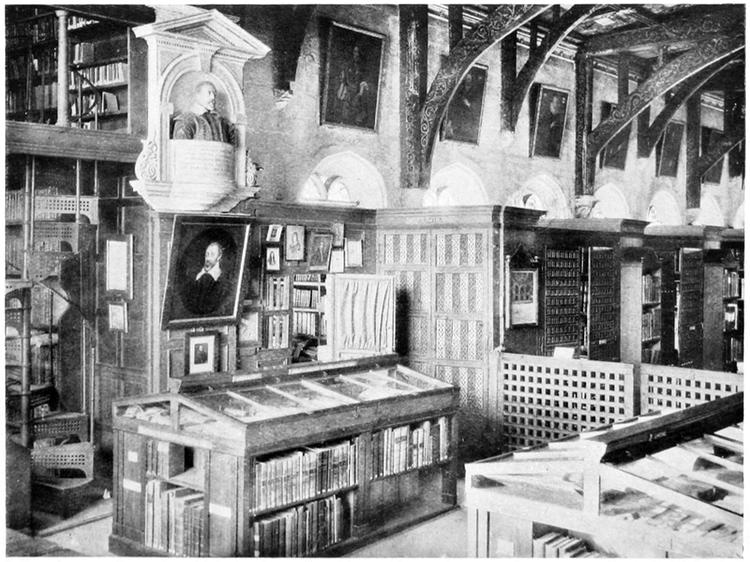
| Addison, Joseph (1672-1719). |
| The Legacies of Genius |
14 |
| The Authors' Advantage |
60 |
| The evil that Men do |
80 |
| A great Book is a great evil |
119 |
| Chance Readings |
145 |
| A Lady's Library |
209 |
| Books for a Lady's Library |
211 |
| Alcott, Amos Bronson (1799-1888). |
| The Fellowship of Books |
6 |
| Alcuin or Ealwhine (735-804). |
| An Episcopal Library |
311 |
| Arblay, Frances, Madame d' (1752-1840). |
| Royal Patronage of Books |
253 |
| Armstrong, John (1709-79). |
| Read without Prejudice |
127 |
| Arnold, Matthew (1822-88). |
| The Grand Mine of Diction |
297 |
| Ascham, Roger (1515-68). |
| Books that do Hurt |
77 |
| Epitomes |
138 |
| Athenian Mercury, The |
| Whether 'tis lawful to read Romances |
85 |
| Aungervile. See Bury. |
| Austen, Jane (1775-1817). |
| Only a Novel |
87 |
| Bacon, Francis, Lord Verulam and Viscount St. Albans (1561-1626). |
| Enduring Monuments |
46 |
| Old Authors to Read |
65 |
| Dedications |
97 |
| 'Books will speak plain' |
113 |
| Studies |
124 |
| Commonplace Books |
141 |
| Over-reading |
157 |
| A great Necromancer |
287 |
| The Shrines of the Ancient Saints |
325 |
| Bailey, Philip James (1816-1902). |
| 'Worthy Books' |
5 |
| Bale, John, Bishop of Ossory (1495-1563). |
| A most Horrible Infamy |
325 |
| Barclay, Alexander (1475?-1552). |
| Envoy to Fools |
218 |
| Barnes, William (1801-86). |
| Learning |
173 |
| Barrow, Isaac (1630-77). |
| He that loveth a Book will never want |
3 |
| Barton, Bernard (1784-1849). |
| Composed in the Rev. J. Mitford's Library |
324 |
| Baxter, Richard (1615-91). |
| Romances are Pernicious |
84 |
| Books preferred to Preachers |
108 |
| Bayly, Thomas Haynes (1797-1839). |
| A Novel of High Life |
88 |
| Beaconsfield, Earl of. See Disraeli, Benjamin. |
| Beecher, Henry Ward (1813-1887). |
| The Bodleian: a Dead Sea of Books |
364 |
| Beresford, James (1764-1840). |
| Bibliosophia |
225 |
| Eye-worship |
242 |
| Blackie, John Stuart (1809-95). |
| Overrating the Value of Books |
162 |
| Blanchard, Samuel Laman (1804-45). |
| The Double Lesson |
192 |
| The Art of Book-keeping |
280 |
| Blount, Charles (1654-93). |
| The Imprimatur |
119 |
| Boswell, James (1740-95). See also Johnson. |
| Shakespeare in Heaven |
48 |
| Reading according to Inclination |
128 |
| Johnson's Cursory Reading |
148 |
| Talking from Books |
153 |
| The Dog and the Bone |
170 |
| Books you may hold in your hand |
247 |
| Brant, Sebastian (1458-1521). |
| The Chief Fool |
216 |
| Browne, Sir Thomas (1605-82). |
| Superfluous Books |
58 |
| Browne, Sir William (1692-1774). |
| Oxford and Cambridge: an Epigram |
113 |
| Browning, Elizabeth Barrett (1806-61). |
| 'Books are men of higher stature' |
39 |
| Reading as Intellectual Indolence |
159 |
| The Poets |
205 |
| The World of Books |
206 |
| A Forced Sale |
259 |
| The Library in the Garret |
318 |
| Browning, Robert (1812-89). |
| Sibrandus Schafnaburgensis |
236 |
| The Find |
257 |
| Brydges, Grey, Lord Chandos (1579?-1621). |
| The greatest Clerks be not always the wisest Men |
149 |
| Buckingham, Duke of. See Sheffield. |
| Bulwer. See Lytton, Lord. |
| Bunyan, John (1628-88). |
| The Scriptures: what are they? |
292 |
| Burney, Fanny. See Arblay. |
| Burns, Robert (1759-96). |
| The Bookworms |
249 |
| The big Ha'-Bible |
298 |
| Burton, John Hill (1809-81). |
| A Sense of Humour |
18 |
| A Course of Reading |
134 |
| Definitions |
235 |
| Burton, Robert (1577-1640). |
| An extraordinary Delight to study |
26 |
| 'Though they write contemptu gloriae' |
51 |
| Every Man his Due |
89 |
| Read the Scriptures |
290 |
| To be chained with good Authors |
356 |
| Bury, Richard de, Bishop of Durham (1281-1345). |
| The Desirable Tabernacle |
13 |
| Books as Memorials |
43 |
| Woman and Books |
203 |
| Of Handling Books |
239 |
| Deductions from Scripture |
240 |
| Mammon and Books |
273 |
| Butler, Joseph (1692-1752). |
| The Habit of Casual Reading |
147 |
| Butler, Samuel (1612-80). |
| Superficial Readers |
151 |
| Butler, Samuel (1835-1902). |
| Books in a New Light |
330 |
| Byron, George Gordon, Lord (1788-1824). |
| A Lasting Link of Ages |
52 |
| ''Tis pleasant, sure' |
95 |
| Love and the Library |
198 |
| To Mr. Murray |
268 |
| Calverley, Charles Stuart (1831-84). |
| Of Reading |
135 |
| Campion, Thomas (1567?-1620). |
| The Writer to his Book |
261 |
| Carlyle, Thomas (1795-1881). |
| The Miraculous Art of Writing |
42 |
| The Virtue of a True Book |
52 |
| The Real Working Effective Church |
109 |
| The True University of These Days |
112 |
| A Very Priceless Thing |
295 |
| Cervantes Saavedra, Miguel de (1547-1616). |
| 'There is no Book so bad' |
117 |
| The Burning of Don Quixote's Books |
155 |
| Chandos, Lord. See Brydges. |
| Channing, William Ellery (1780-1842). |
| Books the True Levellers |
19 |
| The Diffusion of Books and its Effect upon Culture |
60 |
| Folly generated by Books |
156 |
| Chaucer, Geoffrey (1340 ?-1400). |
| To Drive the Night Away |
169 |
| Farewell to Books in Springtime |
172 |
| The Oxford Scholar and his Books |
216 |
| Chesterfield Earl of. See Stanhope. |
| Churchyard, Thomas (1520 ?-1604). |
| Books is Nurse to Truth |
33 |
| Cobbett, William (1762-1835). |
| The Danger of Poets and Romances |
86 |
| A Birth of Intellect |
184 |
| Coleridge, Hartley (1796-1849). |
| Suitable Bindings |
246 |
| Coleridge, Samuel Taylor (1772-1834). |
| Books as Fruitful Trees |
129 |
| Reading to kill Time |
153 |
| The Pilgrim's Progress |
293 |
| Collier, Jeremy (1650-1726). |
| Of the Entertainment of Books |
34 |
| Colton, Charles Caleb (1780 ?-1832). |
| 'We should choose our Books' |
6 |
| 'There are many Books written' |
120 |
| Readers and Writers |
123 |
| Title-readers |
154 |
| Books and Men |
159 |
| Cook, Eliza (1818-89). |
| Old Story Books |
177 |
| 'Cornwall, Barry.' See Procter, B. W. |
| Cowley, Abraham (1618-67). |
| 'May I a small house' |
12 |
| Material for Poesy |
295 |
| Pindaric Ode |
360 |
| Cowper, William (1731-1800). |
| Books bad and good |
81 |
| Swallowing the Husks |
158 |
| 'Twere well with most, if Books' |
208 |
| An Ode to Mr. John Rouse (translated from Milton) |
357 |
| Crabbe, George (1754-1832). |
| The Prouder Pleasures of the Mind |
26 |
| The Old Bachelor's Books |
21 |
| The Peasant's Library |
317 |
| The Library |
337 |
| Crashaw, Richard (1613 ?-49). |
| Upon the Book of St. Teresa |
106 |
| On a Prayer-Book sent to Mrs. M. R. |
200 |
| On George Herbert's The Temple, sent to a Gentlewoman |
201 |
| Cross, Mary Ann. See Eliot. |
| Daniel, Samuel (1562-1619). |
| Immortality in Books |
46 |
| O Blessed Letters |
51 |
| To the Countess of Bedford |
195 |
| Dante Alighieri (1265-1321). |
| Love's Purveyor |
192 |
| Davenant, Sir William (1606-68). |
| Hidden Treasure |
92 |
| Davies, Sir John (1569-1626). |
| What profits it |
163 |
| Davy, Sir Humphry (1778-1829). |
| Permanence for Thought |
41 |
| Dawson, George (1821-76). |
| The Consulting-room of a Wise Man |
309 |
| The Reference Library |
327 |
| Denham, Sir John (1615-69). |
| For wisdom, piety, delight, or use |
33 |
| De Quincey, Thomas (1785-1859). |
| Instruction or Amusement |
36 |
| The Distraction of Choice |
61 |
| Dibdin, Thomas Frognall (1776-1847). |
| An Unworthy Professor |
227 |
| A Bibliomaniac |
228 |
| Book Illustrations and Nightmare |
247 |
| Dickens, Charles (1812-70). |
| Early Reading |
188 |
| What a Heart-breaking Shop |
272 |
| Digby, Sir Kenelm (1603-65). |
| Reading in Bed |
169 |
| Dillon, Wentworth, Earl of Roscommon (1633 ?-85). |
| 'Choose an author as you choose a friend' |
7 |
| Disraeli, Benjamin, Earl of Beaconsfield (1804-81). |
| 'Lady Constance guanoed her mind' |
88 |
| Biography preferred to History |
99 |
| 'The author who speaks about his own Books' |
154 |
| D'Israeli, Isaac (1766-1848). |
| Golden volumes! richest treasures |
226 |
| A Malady of weak Minds |
227 |
| Accidents to Books |
275 |
| Dodd, William (1729-77). |
| In Prison |
15 |
| Donne, John (1573-1631). |
| Valediction to his Book |
190 |
| The Library and the Grave |
305 |
| Dovaston, John Freeman Milward (1782-1854). |
| The Cure for Bookworms |
253 |
| Drayton, Michael (1563-1631). |
| Immortality in Song |
56 |
| Translations from the Classics |
100 |
| Drummond, William (1585-1649). |
| The Strange Quality of Books |
47 |
| The Book of Nature |
283 |
| Of Libraries: The Bodleian |
355 |
| Dryden, John (1631-1700). |
| A Learned Plagiary |
91 |
| Under Mr. Milton's Picture |
106 |
| Dudley, Earl of. See Ward. |
| Dyer, George (1755-1841). |
| 'Libraries are the wardrobes of literature' |
306 |
| Ealwhine. See Alcuin. |
| Earle, John, Bishop of Salisbury (1601 ?-65). |
| 'His Invention is no more' |
94 |
| A Critic |
114 |
| A Pretender to Learning |
150 |
| An Antiquary |
219 |
| 'Eliot, George' (1819-80). |
| The Vocation |
260 |
| 'Wise books, For half the truths they hold' |
287 |
| Of The Imitation of Christ |
299 |
| Emerson, Ralph Waldo (1803-82). |
| A Company of the Wisest and the Wittiest |
6 |
| The Theory of Books |
21 |
| The Book the Highest Delight |
28 |
| The pleasure derived from Books |
29 |
| Our Debt to a Book |
29 |
| A Sort of Third Estate |
74 |
| On Reading Translations |
99 |
| Merit in Quotation |
103 |
| The Need of a Guide to Books |
111 |
| The Final Verdict upon Books |
116 |
| 'Talent alone cannot make a writer' |
116 |
| Reading between Lines |
122 |
| Rules for Reading |
132 |
| A Diet of Books |
133 |
| Erasmus, Desiderius (1466 ?-1536). |
| The Royal Road |
123 |
| Faber, Frederick William (1814-63). |
| The English of the Bible |
297 |
| A College Library |
365 |
| Ferriar, John (1761-1815). |
| The Bibliomania |
220 |
| Fielding, Henry (1707-54). |
| The filial piety of Books |
118 |
| Fletcher, John (1579-1625). |
| The Library a Glorious Court |
305 |
| Fletcher, Phineas (1582-1650). |
| Upon my Brother's Book |
106 |
| Foster, John (1770-1843). |
| The Influence of Books |
38 |
| Reflections in a Library |
332 |
| Fuller, Thomas (1608-61). |
| The Multiplicity of Books |
57 |
| Printers gain by bad Books |
79 |
| 'A commonplace Book contains many notions' |
142 |
| Garnett, Richard (1835-1906). |
| Our master, Meleager |
95 |
| Gaskell, Elizabeth Cleghorn (1810-65). |
| Books for the Salon |
304 |
| Gay, John (1685-1732). |
| The Elephant and the Bookseller |
264 |
| On a Miscellany of Poems |
265 |
| Gibbon, Edward (1737-94). |
| Abstracts of Books |
138 |
| Early Reading |
183 |
| Women's Want |
210 |
| Gilfillan, George (1813-78). |
| The True Poem on the Library |
335 |
| Gissing, George (1857-1903). |
| The Mood for Books |
40 |
| The Scent of Books |
310 |
| Glanvill, Joseph (1636-80). |
| 'That silly vanity of impertinent citations' |
102 |
| The Mote and the Beam |
118 |
| Godwin, William (1756-1836). |
| The Depositary of everything honourable |
15 |
| Bad Books and debauched Minds |
83 |
| Goldsmith, Oliver (1728-74). |
| Sweet Unreproaching Companions |
4 |
| The Reading of New Books |
67 |
| Literary Hypocrisy |
115 |
| 'I love everything that is old' |
269 |
| Greene, Robert (1558-92). |
| Books for Magic |
288 |
| Hale, Sir Matthew (1609-76). |
| No Book like the Bible |
293 |
| Hales, John (1584-1656). |
| The Method of reading profane History |
136 |
| Hall, John (1627-56). |
| Men in their Nightgowns |
98 |
| When to Read |
164 |
| Hall, Joseph, Bishop of Exeter and Norwich (1574-1656). |
| How to spend our Days |
125 |
| Reading and Meal Times |
170 |
| On the Sight of a Great Library |
331 |
| Hamilton, Sir William (1788-1856). |
| Underscoring |
140 |
| Hare, Augustus William (1792-1834), and Julius Charles Hare (1795-1855). |
| In the Seat of the Scorner |
115 |
| Books of One Thought |
121 |
| Purple Patches |
122 |
| Books that provoke Thought |
131 |
| Desultory Reading |
148 |
| Brains squashed by Books |
156 |
| Harington, Sir John (1561-1612). |
| Against writers that carp |
114 |
| Hazlitt, William (1778-1830). |
| The only Things that last for ever |
49 |
| On Reading Old Books |
69 |
| On Reading New Books |
71 |
| The best Books the commonest |
182 |
| The visionary Gleam |
189 |
| The enviable Bookworm |
228 |
| Ears nailed to Books |
229 |
| Helps, Sir Arthur (1813-75). |
| Biography |
99 |
| Thoughts in a Library |
334 |
| Hemans, Felicia Dorothea (1793-1835). |
| To a Family Bible |
294 |
| Herbert, George (1593-1633). |
| The Parson's Accessory Knowledge |
140 |
| Herrick, Robert (1591-1674). |
| To His Book |
45 |
| 'Thou art a plant.' |
| 'Make haste away.' |
| 'If hap it must.' |
| 'The bound, almost.' |
| 'Go thou forth.' |
| His Prayer for Absolution |
77 |
| Virginibus Puerisque |
84 |
| Lines have their linings, and Books their buckram |
242 |
| Herschel, Sir John Frederick William (1792-1871). |
| A Taste to be Prayed For |
27 |
| Novels as Engines of Civilization |
87 |
| Hobbes, Thomas (1588-1679). |
| 'If I had read as much as other men' |
158 |
| Holmes, Oliver Wendell (1809-94). |
| Old and New Books |
74 |
| Presentation Copies |
98 |
| 'The foolishest Book' |
118 |
| The Literary Harem |
233 |
| Purchasing an Act of Piety |
258 |
| The Study |
307 |
| The Library as a Key to Character |
309 |
| 'Every library should try to be complete' |
318 |
| Hood, Thomas (1799-1845). |
| Rich Fare |
29 |
| Howell, James (1594?-1666). |
| The Choice of Books |
125 |
| Marriage and Books |
198 |
| The Value of Book Borrowing |
275 |
| Hunt, James Henry Leigh (1784-1859). |
| On Parting with my Books |
9 |
| Love that is large |
16 |
| Authors as Lovers of Books |
20 |
| The Authors' Metamorphosis |
50 |
| A Library of One |
62 |
| A Literatura Hilaris |
167 |
| Early Reading |
187 |
| Kissing a Folio |
233 |
| Delight in Book-Prints |
248 |
| The Second-hand Catalogue |
256 |
| Borrowing and Lending |
278 |
| Wedded to Books |
278 |
| The Book of Books |
294 |
| Literary Geography |
300 |
| Scotland |
300 |
| England |
301 |
| Ireland |
302 |
| The Library as Study |
305 |
| Charles Lamb's Library |
323 |
| Irving, Washington (1783-1859). |
| True Friends that Cheer |
9 |
| Jago, Richard (1715-81). |
| To a Lady furnishing her Library |
212 |
| Jefferies, Richard (1848-87). |
| When Translations are to be preferred |
101 |
| In the British Museum Library |
328 |
| Jerrold, Douglas William (1803-57). |
| 'A blessed companion is a Book' |
12 |
| Johnson, Lionel (1869-1902). |
| Oxford Nights |
366 |
| Johnson, Samuel (1709-84). See also Boswell. |
| Why Books are Read |
37 |
| An ignorant Age hath many Books |
60 |
| The Moons of Literature |
67 |
| Books of Morality |
108 |
| The Secret Influence of Books |
109 |
| Dead Counsellors are safest |
109 |
| Reading According to Inclination |
128 |
| Marginal Notes and Commonplace Books |
143 |
| Getting a Boy forward |
181 |
| At Large in the Library |
181 |
| Early Reading |
183 |
| Jonson, Ben (1573 ?-1637). |
| To Sir Henry Goodyer |
10 |
| To my Book |
76 |
| Book-makers and Plagiarists |
91 |
| To George Chapman |
101 |
| What Shakespeare hath left us |
103 |
| On the Portrait of Shakespeare |
105 |
| The first Authors for Youth |
180 |
| To my Bookseller |
261 |
| Keats, John (1795-1821). |
| On First Looking into Chapman's Homer |
100 |
| King, William (1663-1712). |
| A Moth |
252 |
| A Modern Library |
311 |
| Kingsley, Charles (1819-75). |
| Useful and Mighty Things |
25 |
| Liberty and Bad Books |
83 |
| Lamb, Charles (1775-1834). |
| Grace before Books |
1 |
| A Catholic Taste in Books |
17 |
| A Whimsical Surprise |
84 |
| Books with One Idea in Them |
121 |
| When and Where to Read |
130 |
| Proof of good Matter |
170 |
| Out-of-doors Reading |
171 |
| Discrimination in Bindings |
244 |
| The Treasure |
254 |
| The Readers at the Bookstall |
255 |
| To the Editor of The Everyday Book |
269 |
| The Poor Student |
274 |
| Borrowers of Books |
276 |
| The Bodleians of Oxford |
364 |
| Landor, Walter Savage (1775-1864). |
| To Wordsworth |
21 |
| 'Well I remember how you smiled' |
57 |
| The Dead alone Canonized |
66 |
| The Classics |
67 |
| To Leigh Hunt |
95 |
| Small Authors Dangerous |
131 |
| Old-Fashioned Verse |
186 |
| Sent with Poems |
202 |
| Safe and untouched |
312 |
| Law, William (1686-1761). |
| Classicus |
66 |
| Poetry and Piety |
209 |
| Leighton, Robert (1822-69). |
| The Libraries of Heaven |
49 |
| Lewis, Matthew Gregory (1775-1818). |
| In Paternoster Row |
263 |
| Locke, John (1632-1704). |
| Chewing the Cud |
126 |
| A new Method of a Commonplace Book |
141 |
| Lockhart, John Gibson (1794-1854). |
| The Bible and Burns |
298 |
| Longfellow, Henry Wadsworth (1807-82). |
| My Books |
10 |
| 'The sweet serenity' |
20 |
| Bayard Taylor |
234 |
| The Wind over the Chimney |
286 |
| Lowe, Robert, Lord Sherbrooke (1811-92). |
| Remunerative Reading |
39 |
| Lowell, James Russell (1819-91). |
| Security in Old Books |
75 |
| Literature for Desolate Islands |
303 |
| Lyly, John (1554 ?-1606). |
| Fashion in Books |
43 |
| 'Far more seemly were it' |
304 |
| Lytton, Edward George Earle Lytton Bulwer-Lytton, Baron (1803-73). |
| The Souls of Books |
22 |
| The Classics always Modern |
68 |
| The Bee and the Butterfly |
143 |
| The Pharmacy of Books |
165 |
| The Library an Heraclea |
329 |
| M., J. (fl. 1627). |
| On the Library at Cambridge |
368 |
| Macaulay, Thomas Babington, Lord (1800-59). |
| Action and Reaction |
53 |
| The Value of Modern Books |
73 |
| Original Editions |
96 |
| The Critics' Influence on the Public |
117 |
| Classical Education for Women |
207 |
| 'I would rather be a poor man' |
232 |
| Maccreery, John (1768-1832). |
| Bookbindings |
243 |
| Maginn, William (1793-1842). |
| The Booksellers' Banquet |
271 |
| Mallet, David (1705 ?-65). |
| The Reading Coxcomb |
152 |
| Maurice, Frederick Denison (1805-72). |
| The Ultimate Test of Books |
53 |
| The Message of Books |
161 |
| Milton, John (1608-74). |
| Books are not dead things |
47 |
| 'To the pure all things are pure' |
83 |
| Plagiarie |
90 |
| Shakespeare's livelong Monument |
105 |
| 'Deep-versed in Books and shallow in himself' |
157 |
| Tetrachordon |
256 |
| An Ode to Mr. John Rouse (translated by Cowper) |
357 |
| Mitford, Mary Russell (1787-1855). |
| That invention of the enemy—an Abridgement |
96 |
| Montagu, Lady Mary Wortley (1689-1762). |
| A cheap and lasting Pleasure |
204 |
| Montaigne, Michael Eyquem de (1533-92). |
| John Florio's Translation— |
| The Commodity Reaped of Books |
32 |
| Coats for Mackerel |
44 |
| Transplantation |
90 |
| Inductive Criticism |
122 |
| 'There's more ado to interpret interpretation' |
122 |
| Bescribbling with Notes |
139 |
| Skipping Wit |
144 |
| Books an Enemy to Health |
163 |
| Early Reading |
182 |
| Letter-Ferrets |
218 |
| The Author's Library |
319 |
| Moore, Thomas (1779-1852). |
| 'My only Books' |
196 |
| A Counter Attraction |
199 |
| More, Hannah (1745-1833). |
| A Daughter's Favourite Novels |
86 |
| Literary Cookery |
92 |
| More, Sir Thomas (1478-1535). |
| Of a New-married Student |
198 |
| Norris, John (1657-1711). |
| 'Reading without thinking' |
142 |
| Norton, Caroline Elizabeth Sarah (Lady Stirling-Maxwell) (1808-77). |
| To my Books |
8 |
| Norton, John Bruce (1815-83). |
| Merton Library |
365 |
| Oldham, John (1653-83). |
| To Cosmelia |
199 |
| Orford, Earl of. See Walpole. |
| Overbury, Sir Thomas (1581-1613). |
| Man's Prerogative |
13 |
| Parnell, Thomas (1679-1718). |
| The Bookworm |
250 |
| Parrot, Henry (fl. 1600-26). |
| Ad Bibliopolam |
262 |
| Pattison, Mark (1813-84). |
| The Manufactory of Books |
92 |
| Payn, James (1830-98). |
| The Blessed Chloroform of the Mind |
168 |
| Peacham, Henry (1576 ?-1643 ?). |
| A Bookish Ambition |
149 |
| Care as to Bindings |
241 |
| Peacock, Thomas Love (1785-1866). |
| The Outside of a Book |
247 |
| Percy, Thomas, Bishop of Dromore (1729-1811). |
| Why Books were Invented |
37 |
| Petrarch (Petrarca) Francesco (1304-74). |
| The Delightful Society of Books |
1 |
| Pope, Alexander (1688-1744). |
| Style v. Sense |
114 |
| Where Fools Rush In |
115 |
| Homer and Virgil |
127 |
| Lintott's New Miscellany |
267 |
| Cibber's Library |
313 |
| Praed, Winthrop Mackworth (1802-39). |
| To Helen: written in Keble's Christian Year |
201 |
| Prideaux, Peter (1578-1650). |
| On the Death of Sir Thomas Bodley |
356 |
| Procter, Adelaide Anne (1825-64). |
| A Student |
238 |
| Procter, Bryan Waller (Barry Cornwall) (1787-1874). |
| My Books |
8 |
| Quarles, Francis (1572-1644). |
| On Buying the Bible |
291 |
| Rabelais, François (1483-1553). |
| By Divine Inspiration |
41 |
| Writing at Meal Times |
171 |
| Richardson, Samuel (1689-1761). |
| Advice to Mothers |
181 |
| Robertson, Frederick William (1816-53). |
| Books instead of Stimulants |
165 |
| Rochester, Earl of. See Wilmot. |
| Roscoe, William Caldwell (1823-59). |
| To my Books on Parting with Them |
9 |
| Roscommon, Earl of. See Dillon. |
| Ruskin, John (1819-1900). |
| Books of the Hour and of all Time |
54 |
| Taste in Literature and Art |
117 |
| Reading and Illiteracy |
159 |
| Girls' Reading |
208 |
| The Most Valuable Book |
254 |
| National Expenditure on Books |
274 |
| Libraries for Every City |
326 |
| St. Albans, Viscount. See Bacon. |
| Saxe, John Godfrey (1816-87). |
| The Library |
354 |
| Scott, Sir Walter (1771-1832). |
| Appetite and Satiety |
147 |
| The Ghost of Betty Barnes |
203 |
| The Antiquary's Treasures |
231 |
| The Bannatyne Club |
270 |
| Dominie Sampson in the Library |
315 |
| Selden, John (1584-1654). |
| 'It is good to have translations' |
100 |
| Quotation |
102 |
| Censorship |
119 |
| Shakespeare, William (1564-1616). |
| 'Who will believe my verse' |
55 |
| 'Study is like the heaven's glorious sun' |
159 |
| 'How well he's read' |
162 |
| Books and Eyesight |
164 |
| Reading for Love's Sake |
189 |
| The Book of the Brain |
191 |
| Books as Spokesmen |
194 |
| Women's eyes |
196 |
| 'Marriage! my years are young' |
198 |
| 'The state, whereon I studied' |
215 |
| Dainties that are Bred of a Book |
219 |
| 'Is not the leaf turned down' |
240 |
| Gold Clasps and a Golden Story |
242 |
| Nobler than Contents |
242 |
| 'Hark you, sir; I'll have them very fairly bound' |
243 |
| 'In Nature's infinite Book' |
283 |
| The Secret of Strength |
288 |
| Red Letters and Conjuring |
289 |
| 'Come, and take choice' |
306 |
| 'Of his gentleness, Knowing I loved my Books' |
310 |
| 'Me, poor man,—my library' |
316 |
| Sheffield, John, Duke of Buckingham (1648-1721). |
| The Sufficiency of Homer |
127 |
| Sherbrooke, Viscount. See Lowe. |
| Sheridan, Caroline Elizabeth Sarah. See Norton. |
| Sheridan, Richard Brinsley (1751-1816). |
| 'Steal! to be sure they will' |
91 |
| Lydia Languish and the Circulating Library |
213 |
| A neat Rivulet of Text |
249 |
| Sheridan, Thomas (1687-1738). |
| Our Best Acquaintance |
11 |
| Shirley, James (1596-1666). |
| Sweet and Happy Hours |
26 |
| A Book of Flesh and Blood |
196 |
| Skelton, John (1460 ?-1529). |
| An Edition de luxe |
241 |
| Smith, Alexander (1830-67). |
| The True Elysian Fields |
11 |
| Power and Gladness |
32 |
| Smith, Sydney (1771-1845). |
| A Short Cut to Fame |
154 |
| 'No furniture so charming as Books' |
264 |
| South, Robert (1634-1716). |
| 'He who has published an injurious Book' |
80 |
| A little Book the most excellent |
120 |
| 'Much reading is like much eating' |
158 |
| Southey, Robert (1774-1843). |
| My days among the Dead are passed |
4 |
| A Heavenly Delight |
5 |
| The Best of all Possible Company |
5 |
| More than Meat, Drink, and Clothing |
28 |
| A Library of Twelve |
62 |
| Reading several Books at a time |
130 |
| Homo Unius Libri |
292 |
| A Colloquy in a Library |
320 |
| Spenser, Edmund (1552 ?-99). |
| One day I wrote her name |
56 |
| To his Book: of his Lady |
195 |
| Stanhope, Philip Dormer, Earl of Chesterfield (1694-1773). |
| A Consolation for the Deaf |
4 |
| Books and the World |
180 |
| The last Editions the best |
235 |
| 'Tis folly to be wise |
246 |
| Genteel Ornaments |
273 |
| Steele, Sir Richard (1672-1729). |
| Exercise for the Mind |
37 |
| Stephen, Sir James (1789-1859). |
| Poets as Commentators |
136 |
| Sterne, Laurence (1713-1768). |
| The Company of Mutes |
3 |
| Mr. Shandy's Library |
314 |
| Stevenson, Robert Louis (1850-1894). |
| Picture-Books in Winter |
174 |
| Stirling-Maxwell, Lady. See Norton. |
| Swift, Jonathan (1667-1745). |
| The Battle of the Books |
63 |
| Recipe for an Anthology |
94 |
| Cupid and the Book of Poems |
194 |
| A Standard for Language |
296 |
| 'I have sometimes heard' |
303 |
| Sylvester, Josuah (1563-1618). |
| Surcloying the Stomach |
156 |
| Symonds, John Addington (1840-93). |
| [Greek: hupothêkê eis emauton]('Back to thy books!') |
197 |
| Taylor, John (1580-1653). |
| Books and Thieves |
77 |
| To the Good or Bad Reader |
150 |
| Fast and Loose |
289 |
| On Coryat's Crudities |
302 |
| Temple, Sir William (1628-99). |
| The Multiplication of Originals |
59 |
| Ancient and Modern Books |
63 |
| Books as Signposts |
110 |
| Tennyson, Alfred, Lord (1809-92). |
| Poets and their Bibliographies |
98 |
| Merlin's Book |
289 |
| Thackeray, William Makepeace (1811-63). |
| Novels are Sweets |
89 |
| 'There are no race of people who talk about Books' |
153 |
| A Kindly Tie |
187 |
| Thomson, James (1700-48). |
| The Mighty Dead |
161 |
| Thomson, Richard (1794-1865). |
| The Book of Life |
284 |
| Tickle, Thomas (1686-1740). |
| The Hornbook |
175 |
| Tooke, John Horne (1736-1812). |
| Read Few Books well |
129 |
| Trapp, Joseph (1679-1747). |
| Oxford and Cambridge: an Epigram |
113 |
| Trench, Richard Chevenix, Archbishop of Dublin (1807-86). |
| Books and Life |
160 |
| Tupper, Martin Farquhar (1810-89). |
| Books and Friends |
12 |
| Turner, Charles Tennyson (1808-79). |
| On Certain Books |
82 |
| Vaughan, Henry (1622-95). |
| To his Books |
13 |
| The Book |
284 |
| To the Holy Bible |
290 |
| On Sir Thomas Bodley's Library |
362 |
| Vere, Sir Aubrey de (1788-1846). |
| Sacred and Profane Writers |
296 |
| Verulam, Lord. See Bacon. |
| Voltaire, François Marie Arouet de (1694-1778). |
| Multiplication is Vexation |
59 |
| The Seat of Authority |
107 |
| Waller, Sir William (1597 ?-1668). |
| The Contentment I have in my Books |
2 |
| Riding Post |
146 |
| Full Libraries and Empty Heads |
149 |
| Walpole, Horatio, Earl of Orford (1717-97). |
| Lounging Books |
169 |
| Literary Upholsterers |
264 |
| Ward, John William, Earl of Dudley (1781-1833). |
| A Preference for Great Models |
72 |
| Watts, Isaac (1674-1748). |
| Books to be Marked |
139 |
| Wesley, John (1703-91). |
| 'I read only the Bible' |
291 |
| A Man of one Book |
292 |
| Whitelocke, Bulstrode (1605-75). |
| The Soul's Viaticum |
368 |
| Whittier, John Greenleaf (1807-92). |
| A Magnate in the Realm of Books |
7 |
| The Library |
326 |
| Wilmot, John, Earl of Rochester (1647-80). |
| 'Books bear him up awhile' |
39 |
| Wilson, John (d. 1889). |
| O for a Booke |
171 |
| Wither, George (1588-1667). |
| Mountebank Authors |
78 |
| 'Good God! how many dungboats' |
94 |
| In bondage to the Bookseller |
262 |
| Wordsworth, William (1770-1850). |
| Books a substantial World |
21 |
| The Tables Turned |
172 |
| Early Reading |
184 |
| Young, Edward (1683-1765). |
| How Volumes Swell |
93 |
| An ignorant Book-collector |
219 |
| Notes |
369 |
| Index of Authors mentioned in the Text and in the Notes |
400 |
I own that I am disposed to say grace upon twenty other
occasions in the course of the day besides my dinner. I want
a form for setting out upon a pleasant walk, for a moonlight
ramble, for a friendly meeting, or a solved problem. Why
have we none for books, those spiritual repasts—a grace
before Milton—a grace before Shakespeare—a devotional
exercise proper to be said before reading the Fairy Queen?—but,
the received ritual having prescribed these forms to
the solitary ceremony of manducation, I shall confine my
observations to the experience which I have had of the
grace, properly so called; commending my new scheme
for extension to a niche in the grand philosophical, poetical,
and perchance in part heretical liturgy, now compiling by
my friend Homo Humanus, for the use of a certain snug
congregation of Utopian Rabelaesian Christians, no matter
where assembled.—C. Lamb. Grace before Meat.
These friends of mine regard the pleasures of the world
as the supreme good; they do not comprehend that it is
possible to renounce these pleasures. They are ignorant
of my resources. I have friends whose society is delightful
to me; they are persons of all countries and of all ages;
distinguished in war, in council, and in letters; easy to
live with, always at my command. They come at my call,
and return when I desire them: they are never out of
humour, and they answer all my questions with readiness.
Some present in review before me the events of past ages;
others reveal to me the secrets of Nature: these teach me
how to live, and those how to die: these dispel my melancholy
by their mirth, and amuse me by their sallies of
wit: and some there are who prepare my soul to suffer
everything, to desire nothing, and to become thoroughly
acquainted with itself. In a word, they open a door to all
the arts and sciences. As a reward for such great services,
they require only a corner of my little house, where they
may be safely sheltered from the depredations of their
enemies. In fine, I carry them with me into the fields, the
silence of which suits them better than the business and
tumults of cities.—Petrarch. Life by S. Dodson.
Here is the best solitary company in the world: and in
this particular chiefly excelling any other, that in my study
I am sure to converse with none but wise men; but abroad
it is impossible for me to avoid the society of fools. What
an advantage have I by this good fellowship that, besides
the help which I receive from hence, in reference to my life
after this life, I can enjoy the life of so many ages before
I lived!—that I can be acquainted with the passages of
three or four thousand years ago, as if they were the weekly
occurrences! Here, without travelling so far as Endor,
I can call up the ablest spirits of those times; the learnedest
philosophers, the wisest counsellors, the greatest generals,
and make them serviceable to me. I can make bold with
the best jewels they have in their treasury, with the same
freedom that the Israelites borrowed of the Egyptians, and,
without suspicion of felony, make use of them as mine own.
I can here, without trespassing, go into their vineyards,
and not only eat my fill of their grapes for my pleasure,
but put up as much as I will in my vessel, and store it up
for my profit and advantage.
How doth this prospect at once set off the goodness of
God to me, and discover mine own weakness? His goodness
in providing these helps for the improvement of mine
understanding; and my weakness in needing them. What
a pitiful, simple creature am I, that cannot live to any
purpose, without the help of so many other men's brains!
Lord, let this be the first lesson that I learn from these
silent counsellors, to know my own ignorance: other
knowledge puffeth up, this edifieth.—Sir W. Waller.
Divine Meditations.
The calling of a scholar ... fitteth a man for all conditions
and fortunes; so that he can enjoy prosperity with moderation,
and sustain adversity with comfort: he that loveth
a book will never want a faithful friend, a wholesome
counsellor, a cheerful companion, an effectual comforter....
The reading of books, what is it but conversing with the
wisest men of all ages and all countries, who thereby communicate
to us their most deliberate thoughts, choicest
notions, and best inventions, couched in good expression,
and digested in exact method? The perusal of history,
how pleasant illumination of mind, how useful direction of
life, how spritely incentives to virtue doth it afford! How
doth it supply the room of experience, and furnish us with
prudence at the expense of others, informing us about the
ways of action, and the consequences thereof by examples,
without our own danger or trouble!—I. Barrow. Of
Industry in our Particular Calling as Scholars.
I often derive a peculiar satisfaction in conversing with
the ancient and modern dead,—who yet live and speak
excellently in their works.—My neighbours think me often
alone,—and yet at such times I am in company with more
than five hundred mutes—each of whom, at my pleasure,
communicates his ideas to me by dumb signs—quite as
intelligibly as any person living can do by uttering of
words.—They always keep the distance from me which
I direct,—and, with a motion of my hand, I can bring them
as near to me as I please.—I lay hands on fifty of them
sometimes in an evening, and handle them as I like;—they
never complain of ill-usage,—and, when dismissed from my
presence—though ever so abruptly—take no offence. Such
convenience is not to be enjoyed—nor such liberty to be
taken—with the living.—L. Sterne. Letters.
I read with more pleasure than ever; perhaps, because
it is the only pleasure I have left. For, since I am struck
out of living company by my deafness, I have recourse to
the dead, whom alone I can hear; and I have assigned them
their stated hours of audience. Solid folios are the people
of business, with whom I converse in the morning. Quartos
are the easier mixed company, with whom I sit after dinner;
and I pass my evenings in the light, and often frivolous,
chit-chat of small octavos and duodecimos.—Lord Chesterfield.
I armed her [Olivia] against the censure of the world,
showed her that books were sweet unreproaching companions
to the miserable, and that if they could not bring
us to enjoy life, they would at least teach us to endure it.—O.
Goldsmith. The Vicar of Wakefield.
My days among the Dead are passed;
Around me I behold,
Where'er these casual eyes are cast,
The mighty minds of old;
My never-failing friends are they,
With whom I converse day by day.
With them I take delight in weal,
And seek relief in woe;
And while I understand and feel
How much to them I owe,
My cheeks have often been bedewed
With tears of thoughtful gratitude.
My thoughts are with the Dead; with them
I live in long-past years,
Their virtues love, their faults condemn,
Partake their hopes and fears,
And from their lessons seek and find
Instruction with an humble mind.
My hopes are with the Dead; anon
My place with them will be.
And I with them shall travel on
Through all Futurity;
Yet leaving here a name, I trust,
That will not perish in the dust.
Talk of the happiness of getting a great prize in the
lottery! What is that to the opening a box of books!
The joy upon lifting up the cover must be something like
what we shall feel when Peter the Porter opens the door
upstairs, and says, Please to walk in, sir. That I shall never
be paid for my labour according to the current value of
time and labour, is tolerably certain; but if any one should
offer me £10,000 to forgo that labour, I should bid him
and his money go to the devil, for twice the sum could not
purchase me half the enjoyment. It will be a great delight
to me in the next world, to take a fly and visit these old
worthies, who are my only society here, and to tell them
what excellent company I found them here at the lakes of
Cumberland, two centuries after they had been dead and
turned to dust. In plain truth, I exist more among the dead
than the living, and think more about them, and, perhaps,
feel more about them.—R. Southey (Letter to S. T.
Coleridge).
Coleridge is gone to Devonshire, and I was going to
say I am alone, but that the sight of Shakespeare, and
Spenser, and Milton, and the Bible, on my table, and
Castanheda, and Barros, and Osorio at my elbow, tell me
I am in the best of all possible company.—R. Southey
(Letter to G. C. Bedford).
Worthy books
Are not companions—they are solitudes;
We lose ourselves in them and all our cares.
What were days without such fellowship? We were
alone in the world without it. Nor does our faith falter
though the secret we search for and do not find in them
will not commit itself to literature, still we take up the
new issue with the old expectation, and again and again, as
we try our friends after many failures at conversation,
believing this visit will be the favoured hour and all will be
told us....
One must be rich in thought and character to owe nothing
to books, though preparation is necessary to profitable
reading; and the less reading is better than more;—book-struck
men are of all readers least wise, however knowing
or learned.—A. B. Alcott. Tablets.
There are books which are of that importance in a man's
private experience, as to verify for him the fables of Cornelius
Agrippa, of Michael Scott, or of the old Orpheus of
Thrace,—books which take rank in our life with parents
and lovers and passionate experiences, so medicinal, so
stringent, so revolutionary, so authoritative,—books which
are the work and the proof of faculties so comprehensive,
so nearly equal to the world which they paint, that, though
one shuts them with meaner ones, he feels his exclusion
from them to accuse his way of living.
Consider what you have in the smallest chosen library.
A company of the wisest and wittiest men that could be
picked out of all civil countries, in a thousand years, have
set in best order the results of their learning and wisdom.
The men themselves were hid and inaccessible, solitary,
impatient of interruption, fenced by etiquette; but the
thought which they did not uncover to their bosom friend
is here written out in transparent words to us, the strangers
of another age.—R. W. Emerson. Books.
We should choose our books as we would our companions,
for their sterling and intrinsic merit.—C. C. Colton. Lacon.
One, with his beard scarce silvered, bore
A ready credence in his looks,
A lettered magnate, lording o'er
An ever-widening realm of books.
In him brain-currents, near and far,
Converged as in a Leyden jar;
The old, dead authors thronged him round about,
And Elzevir's grey ghosts from leathern graves looked out.
He knew each living pundit well,
Could weigh the gifts of him or her,
And well the market value tell
Of poet and philosopher.
But if he lost, the scenes behind,
Somewhat of reverence vague and blind,
Finding the actors human at the best,
No readier lips than his the good he saw confessed.
His boyhood fancies not outgrown,
He loved himself the singer's art;
Tenderly, gently, by his own
He knew and judged an author's heart.
No Rhadamanthine brow of doom
Bowed the dazed pedant from his room;
And bards, whose name is legion, if denied,
Bore off alike intact their verses and their pride.
Pleasant it was to roam about
The lettered world as he had done,
And see the lords of song without
Their singing robes and garlands on.
With Wordsworth paddle Rydal mere,
Taste rugged Elliott's home-brewed beer,
And with the ears of Rogers, at fourscore,
Hear Garrick's buskined tread and Walpole's wit once more.
J. G. WHITTIER. The Tent on the Beach.
Choose an author as you choose a friend.—W. Dillon,
Earl of Roscommon. Essay on Translated Verse.
All round the room my silent servants wait,—
My friends in every season, bright and dim;
Angels and seraphim
Come down and murmur to me, sweet and low,
And spirits of the skies all come and go
Early and late;
From the old world's divine and distant date,
From the sublimer few,
Down to the poet who but yester-eve
Sang sweet and made us grieve,
All come, assembling here in order due.
And here I dwell with Poesy, my mate,
With Erato and all her vernal sighs,
Great Clio with her victories elate,
Or pale Urania's deep and starry eyes.
Oh friends, whom chance and change can never harm,
Whom Death the tyrant cannot doom to die,
Within whose folding soft eternal charm
I love to lie,
And meditate upon your verse that flows,
And fertilizes whereso'er it goes....
B. W. Procter. An Autobiographical Fragment.
Silent companions of the lonely hour,
Friends who can never alter or forsake,
Who for inconstant roving have no power,
And all neglect, perforce, must calmly take,—
Let me return to you, this turmoil ending,
Which worldly cares have in my spirit wrought,
And, o'er your old familiar pages bending,
Refresh my mind with many a tranquil thought;
Till, haply meeting there, from time to time,
Fancies, the audible echo of my own,
'Twill be like hearing in a foreign clime
My native language spoke in friendly tone,
And with a sort of welcome I shall dwell
On these, my unripe musings, told so well.
The Hon. Caroline Norton.
Ye dear companions of my silent hours,
Whose pages oft before my eyes would strew
So many sweet and variegated flowers—
Dear Books, awhile, perhaps for ay, adieu!
The dark cloud of misfortune o'er me lours:
No more by winter's fire—in summer's bowers,
My toil-worn mind shall be refreshed by you:
We part! sad thought! and while the damp devours
Your leaves, and the worm slowly eats them through,
Dull Poverty and its attendant ills,
Wasting of health, vain toil, corroding care,
And the world's cold neglect, which surest kills,
Must be my bitter doom; yet I shall bear
Unmurmuring, for my good perchance these evils are.
J. H. Leigh Hunt.
As one who, destined from his friends to part,
Regrets his loss, yet hopes again erewhile,
To share their converse and enjoy their smile,
And tempers as he may affliction's dart,—
Thus, loved associates! chiefs of elder Art!
Teachers of wisdom! who could once beguile
My tedious hours, and lighten every toil,
I now resign you; nor with fainting heart;
For pass a few short years, or days, or hours,
And happier seasons may their dawn unfold,
And all your sacred fellowship restore;
When, freed from earth, unlimited its powers,
Mind shall with mind direct communion hold,
And kindred spirits meet to part no more.—W. Roscoe.
It is a beautiful incident in the story of Mr. Roscoe's
misfortunes, and one which cannot fail to interest the
studious mind, that the parting with his books seems to
have touched upon his tenderest feelings, and to have been
the only circumstance that could provoke the notice of his
Muse. The scholar only knows how dear these silent, yet
eloquent, companions of pure thoughts and innocent hours
become in the season of adversity. When all that is worldly
turns to dross around us, these only retain their steady
value. When friends grow cold, and the converse of
intimates languishes into vapid civility and commonplace,
these only continue the unaltered countenance of happier
days, and cheer us with that true friendship which never
deceived hope nor deserted sorrow.—W. Irving. The
Sketch Book.
Sadly as some old mediaeval knight
Gazed at the arms he could no longer wield,
The sword two-handed and the shining shield
Suspended in the hall, and full in sight,
While secret longings for the lost delight
Of tourney or adventure in the field
Came over him, and tears but half concealed
Trembled and fell upon his beard of white,
So I behold these books upon their shelf,
My ornaments and arms of other days;
Not wholly useless, though no longer used,
For they remind me of my other self,
Younger and stronger, and the pleasant ways,
In which I walked, now clouded and confused.
H. W. Longfellow.
When I would know thee, Goodyer, my thought looks
Upon thy well-made choice of friends, and books;
Then do I love thee, and behold thy ends
In making thy friends books, and thy books friends:
Now must I give thy life and deed the voice
Attending such a study, such a choice;
Where, though it be love that to thy praise doth move,
It was a knowledge that begat that love.
Ben Jonson.
While you converse with lords and dukes,
I have their betters here—my books;
Fixed in an elbow chair at ease
I choose my companions as I please.
I'd rather have one single shelf
Than all my friends, except yourself;
For after all that can be said
Our best acquaintance are the dead.
T. Sheridan.
In my garden I spend my days; in my library I spend
my nights. My interests are divided between my geraniums
and my books. With the flower I am in the present; with
the book I am in the past. I go into my library, and all
history unrolls before me. I breathe morning air of the
world while the scent of Eden's roses yet lingered in it,
while it vibrated only to the world's first brood of nightingales,
and to the laugh of Eve. I see the pyramids building;
I hear the shoutings of the armies of Alexander; I feel
the ground shake beneath the march of Cambyses. I sit
as in a theatre,—the stage is time, the play is the play of
the world. What a spectacle it is! What kingly pomp,
what processions file past, what cities burn to heaven,
what crowds of captives are dragged at the chariot-wheels
of conquerors! I hiss or cry 'Bravo' when the great
actors come on shaking the stage. I am a Roman Emperor
when I look at a Roman coin. I lift Homer, and I shout
with Achilles in the trenches. The silence of the unpeopled
Syrian plains, the out-comings and in-goings of the patriarchs,
Abraham and Ishmael, Isaac in the fields at eventide,
Rebekah at the well, Jacob's guile, Esau's face
reddened by desert sun-heat, Joseph's splendid funeral
procession—all these things I find within the boards of my
Old Testament. What a silence in those old books as of
a half-peopled world—what bleating of flocks—what green
pastoral rest—what indubitable human existence! Across
brawling centuries of blood and war, I hear the bleating
of Abraham's flocks, the tinkling of the bells of Rebekah's
camels. O men and women, so far separated, yet so near,
so strange, yet so well-known, by what miraculous power
do I know ye all! Books are the true Elysian fields where
the spirits of the dead converse, and into these fields
a mortal may venture unappalled. What king's court can
boast such company? What school of philosophy such
wisdom? The wit of the ancient world is glancing and
flashing there. There is Pan's pipe, there are the songs of
Apollo. Seated in my library at night, and looking on the
silent faces of my books, I am occasionally visited by
a strange sense of the supernatural. They are not collections
of printed pages, they are ghosts. I take one down
and it speaks with me in a tongue not now heard on earth,
and of men and things of which it alone possesses knowledge.
I call myself a solitary, but sometimes I think
I misapply the term. No man sees more company than
I do. I travel with mightier cohorts around me than ever
did Timour or Genghis Khan on their fiery marches. I am
a sovereign in my library, but it is the dead, not the living,
that attend my levees.—A. Smith. Dreamthorp.
One drachma for a good book, and a thousand talents for a true friend;—
So standeth the market, where scarce is ever costly:
Yea, were the diamonds of Golconda common as shingles on the shore,
A ripe apple would ransom kings before a shining stone:
And so, were a wholesome book as rare as an honest friend,
To choose the book be mine: the friend let another take.
M. F. Tupper. Proverbial Philosophy.
A blessed companion is a book,—a book that, fitly
chosen, is a life-long friend.—D. Jerrold. Books.
May I a small house and large garden have!
And a few friends, and many books, both true.
A. Cowley. The Wish.
O celestial gift of divine liberality, descending from the
Father of light to raise up the rational soul even to heaven!...
Undoubtedly, indeed, thou hast placed thy desirable
tabernacle in books, where the Most High, the Light of light,
the Book of Life, hath established thee. Here then all who
ask receive, all who seek find thee, to those who knock thou
openest quickly. In books cherubim expand their wings,
that the soul of the student may ascend and look around
from pole to pole, from the rising to the setting sun, from
the north and from the sea. In them the most high incomprehensible
God Himself is contained and worshipped....
Let us consider how great a commodity of doctrine exists
in books, how easily, how secretly, how safely they expose
the nakedness of human ignorance without putting it to
shame. These are the masters who instruct us without rods
and ferules, without hard words and anger, without clothes
or money. If you approach them, they are not asleep; if
investigating you interrogate them, they conceal nothing; if
you mistake them, they never grumble; if you are ignorant,
they cannot laugh at you.—R. de Bury. Philobiblon.
Books are a part of man's prerogative,
In formal ink they thoughts and voices hold,
That we to them our solitude may give,
And make time present travel that of old.
Our life fame pieceth longer at the end,
And books it farther backward do extend.
Sir T. Overbury. The Wife.
Bright books: the perspectives to our weak sights,
The clear projections of discerning lights,
Burning and shining thoughts, man's posthume day,
The track of fled souls and their Milky Way,
The dead alive and busy, the still voice
Of enlarged spirits, kind Heaven's white decoys!
Who lives with you, lives like those knowing flowers,
Which in commerce with light spend all their hours;
Which shut to clouds, and shadows nicely shun,
But with glad haste unveil to kiss the Sun.
Beneath you, all is dark, and a dead night,
Which whoso lives in, wants both health and sight.
By sucking you the wise, like bees, do grow
Healing and rich, though this they do most slow,
Because most choicely; for as great a store
Have we of books as bees of herbs, or more;
And the great task to try, then know, the good,
To discern weeds, and judge of wholesome food,
Is a rare scant performance: for man dies
Oft ere 'tis done, while the bee feeds and flies.
But you were all choice flowers; all set and dressed
By old sage florists, who well knew the best;
And I amidst you all am turned a weed!
Not wanting knowledge, but for want of heed.
Then thank thyself, wild fool, that wouldst not be
Content to know—what was too much for thee.
H. Vaughan.
Quod nec Iovis ira, nec ignis,
Nec poterit ferrum, nec edax abolere vetustas.—Ovid.
Aristotle tells us, that the world is a copy or transcript
of those ideas which are in the mind of the first Being, and
that those ideas which are in the mind of man are a transcript
of the world. To this we may add, that words are
the transcript of those ideas which are in the mind of man,
and that writing or printing is the transcript of words. As
the Supreme Being has expressed, and as it were printed,
his ideas in the creation, men express their ideas in books,
which, by this great invention of these latter ages, may last
as long as the sun and moon, and perish only in the general
wreck of nature. Thus Cowley, in his poem on the Resurrection,
mentioning the destruction of the universe, has
these admirable lines:
Now all the wide extended sky,
And all the harmonious worlds on high
And Virgil's sacred work shall die.
There is no other method of fixing those thoughts which
arise and disappear in the mind of man, and transmitting
them to the last periods of time; no other method of giving
a permanency to our ideas, and preserving the knowledge
of any particular person, when his body is mixed with the
common mass of matter, and his soul retired into the world
of spirits. Books are the legacies that a great genius
leaves to mankind, which are delivered down from generation
to generation, as presents to the posterity of those
who are yet unborn.—J. Addison. Spectator, 166.
O happy be the day which gave that mind
Learning's first tincture—blest thy fostering care,
Thou most beloved of parents, worthiest sire!
Which, taste-inspiring, made the lettered page
My favourite companion: most esteemed,
And most improving! Almost from the day
Of earliest childhood to the present hour
Of gloomy, black misfortune, books, dear books,
Have been, and are, my comforts. Morn and night,
Adversity, prosperity, at home,
Abroad, health, sickness,—good or ill report,
The same firm friends; the same refreshment rich
And source of consolation. Nay, e'en here
Their magic power they lose not; still the same,
Of matchless influence in this prison-house,
Unutterably horrid; in an hour
Of woe, beyond all fancy's fictions drear.
W. Dodd. Thoughts in Prison.
Books are the depositary of everything that is most
honourable to man. Literature, taken in all its bearings,
forms the grand line of demarcation between the human
and the animal kingdoms. He that loves reading has
everything within his reach. He has but to desire; and
he may possess himself of every species of wisdom to judge
and power to perform....
Books gratify and excite our curiosity in innumerable
ways. They force us to reflect. They hurry us from point
to point. They present direct ideas of various kinds, and
they suggest indirect ones. In a well-written book we are
presented with the maturest reflections, or the happiest
flights, of a mind of uncommon excellence. It is impossible
that we can be much accustomed to such companions,
without attaining some resemblance of them. When I read
Thomson, I become Thomson; when I read Milton, I become
Milton. I find myself a sort of intellectual chameleon,
assuming the colour of the substances on which I rest.
He that revels in a well-chosen library has innumerable
dishes, and all of admirable flavour. His taste is rendered
so acute, as easily to distinguish the nicest shades of
difference. His mind becomes ductile, susceptible to every
impression, and gaining new refinement from them all.
His varieties of thinking baffle calculation, and his powers,
whether of reason or fancy, become eminently vigorous.—W.
Godwin. The Inquirer: Of an Early Taste for Reading.
There is a period of modern times, at which the love of
books appears to have been of a more decided nature than
at either of these—I mean the age just before and after the
Reformation, or rather all that period when book-writing
was confined to the learned languages. Erasmus is the
god of it. Bacon, a mighty book-man, saw, among his
other sights, the great advantage of loosening the vernacular
tongue, and wrote both Latin and English. I allow this
is the greatest closeted age of books; of old scholars sitting
in dusty studies; of heaps of 'illustrious obscure', rendering
themselves more illustrious and more obscure by
retreating from the 'thorny queaches' of Dutch and
German names into the 'vacant interlunar caves' of
appellations latinized or translated. I think I see all their
volumes now, filling the shelves of a dozen German convents.
The authors are bearded men, sitting in old wood-cuts,
in caps and gowns, and their books are dedicated to
princes and statesmen, as illustrious as themselves. My
old friend Wierus, who wrote a thick book, De Praestigiis
Daemonum, was one of them, and had a fancy worthy of
his sedentary stomach. I will confess, once for all, that
I have a liking for them all. It is my link with the bibliomaniacs,
whom I admit into our relationship, because my
love is large and my family pride nothing. But still I take
my idea of books read with a gusto, of companions for bed
and board, from the two ages beforementioned. The other
is of too book-worm a description. There must be both
a judgement and a fervour; a discrimination and a boyish
eagerness; and (with all due humility) something of
a point of contact between authors worth reading and the
reader. How can I take Juvenal into the fields, or Valcarenghius
De Aortae Aneurismate to bed with me? How
could I expect to walk before the face of nature with the
one; to tire my elbow properly with the other, before I put
out my candle and turn round deliciously on the right side?
Or how could I stick up Coke upon Littleton against something
on the dinner-table, and be divided between a fresh
paragraph and a mouthful of salad?—J. H. Leigh Hunt.
My Books.
To mind the inside of a book is to entertain one's self with the forced
product of another man's brain. Now I think a man of quality and
breeding may be much amused with the natural sprouts of his own.
Lord Foppington in 'The Relapse'.
An ingenious acquaintance of my own was so much
struck with this bright sally of his Lordship, that he has
left off reading altogether, to the great improvement of his
originality. At the hazard of losing some credit on this
head, I must confess that I dedicate no inconsiderable
portion of my time to other people's thoughts. I dream
away my life in others' speculations. I love to lose myself
in other men's minds. When I am not walking, I am
reading; I cannot sit and think. Books think for me.
I have no repugnances. Shaftesbury is not too genteel
for me, nor Jonathan Wild too low. I can read any thing
which I call a book. There are things in that shape which
I cannot allow for such.
In this catalogue of books which are no books—biblia
a-biblia—I reckon Court Calendars, Directories, Pocket
Books, Draught Boards bound and lettered at the back,
Scientific Treatises, Almanacks, Statutes at Large; the
works of Hume, Gibbon, Robertson, Beattie, Soame
Jenyns, and, generally, all those volumes which 'no gentleman's
library should be without'; the Histories of Flavius
Josephus (that learned Jew), and Paley's Moral Philosophy.
With these exceptions, I can read almost any thing. I bless
my stars for a taste so catholic, so unexcluding.
I confess that it moves my spleen to see these things
in books' clothing perched upon shelves, like false saints,
usurpers of true shrines, intruders into the sanctuary,
thrusting out the legitimate occupants. To reach down
a well-bound semblance of a volume, and hope it is some
kind-hearted play-book, then, opening what 'seem its
leaves', to come bolt upon a withering Population Essay.
To expect a Steele, or a Farquhar, and find—Adam Smith.
To view a well-arranged assortment of blockheaded Encyclopaedias
(Anglicanas or Metropolitanas) set out in an
array of Russia, or Morocco, when a tithe of that good
leather would comfortably re-clothe my shivering folios;
would renovate Paracelsus himself, and enable old Raymund
Lully to look like himself again in the world. I never
see these impostors but I long to strip them, to warm my
ragged veterans in their spoils.—C. Lamb. Detached
Thoughts on Books and Reading.
I am not prepared to back Charles Lamb's Index Expurgatorius.
It is difficult, almost impossible, to find the book
from which something either valuable or amusing may not
be found, if the proper alembic be applied. I know books
that are curious, and really amusing, from their excessive
badness. If you want to find precisely how a thing ought
not to be said, you take one of them down and make it
perform the service of the intoxicated Spartan slave. There
are some volumes in which, at a chance opening, you are
certain to find a mere platitude delivered in the most superb
and amazing climax of big words, and others in which you
have a like happy facility in finding every proposition stated
with its stern forward, as sailors say, or in some other
grotesque mismanagement of composition. There are no
better farces on or off the stage than when two or three
congenial spirits ransack books of this kind, and compete
with each other in taking fun out of them.—J. H. Burton.
The Book-Hunter.
It is chiefly through books that we enjoy intercourse
with superior minds, and these invaluable means of communication
are in the reach of all. In the best books great
men talk to us, give us their most precious thoughts, and
pour their souls into ours. God be thanked for books!
They are the voices of the distant and the dead, and make
us heirs of the spiritual life of past ages. Books are the
true levellers. They give to all, who will faithfully use
them, the society, the spiritual presence, of the best and
greatest of our race. No matter how poor I am. No
matter though the prosperous of my own time will not
enter my obscure dwelling. If the Sacred Writers will
enter and take up their abode under my roof, if Milton
will cross my threshold to sing to me of Paradise, and
Shakespeare to open to me the worlds of imagination and
the workings of the human heart, and Franklin to enrich
me with his practical wisdom, I shall not pine for want of
intellectual companionship, and I may become a cultivated
man, though excluded from what is called the best society
in the place where I live.
To make this means of culture effectual a man must
select good books, such as have been written by right-minded
and strong-minded men, real thinkers, who instead
of diluting by repetition what others say, have something
to say for themselves, and write to give relief to full, earnest
souls; and these works must not be skimmed over for
amusement, but read with fixed attention and a reverential
love of truth. In selecting books we may be aided much by
those who have studied more than ourselves. But, after all,
it is best to be determined in this particular a good deal by
our own tastes.—W. E. Channing. Self-Culture.
I love an author the more for having been himself a lover
of books.... We conceive of Plato as a lover of books; of
Aristotle certainly; of Plutarch, Pliny, Horace, Julian,
and Marcus Aurelius. Virgil, too, must have been one; and,
after a fashion, Martial. May I confess that the passage
which I recollect with the greatest pleasure in Cicero, is
where he says that books delight us at home, and are no
impediment abroad; travel with us, ruralize with us. His
period is rounded off to some purpose: 'Delectant domi, non
impediunt foris; peregrinantur, rusticantur.' I am so much
of this opinion, that I do not care to be anywhere without
having a book or books at hand, and like Dr. Orkborne,
in the novel of Camilla, stuff the coach or post-chaise with
them whenever I travel. As books, however, become
ancient, the love of them becomes more unequivocal and
conspicuous. The ancients had little of what we call
learning. They made it. They were also no very eminent
buyers of books—they made books for posterity. It is true,
that it is not at all necessary to love many books, in order
to love them much. The scholar, in Chaucer, who would
rather have
At his beddes head
A twenty bokes, clothed, in black and red,
Of Aristotle and his philosophy,
Than robès rich, or fiddle, or psaltry—
doubtless beat all our modern collectors in his passion for
reading.... Dante puts Homer, the great ancient, in his
Elysium, upon trust; but a few years afterwards, Homer,
the book, made its appearance in Italy, and Petrarch, in
a transport, put it upon his bookshelves, where he adored
it, like 'the unknown God'. Petrarch ought to be the god
of the Bibliomaniacs, for he was a collector and a man of
genius, which is an union that does not often happen. He
copied out, with his own precious hand, the manuscripts
he rescued from time, and then produced others for time
to reverence. With his head upon a book he died.—J. H.
Leigh Hunt. My Books.
The sweet serenity of books.—H. W. Longfellow.
Books are the best type of the influence of the past....
The theory of books is noble. The scholar of the first age
received into him the world around; brooded thereon;
gave it the new arrangement of his own mind, and uttered
it again. It came into him, life; it went out from him,
truth. It came to him, short-lived actions; it went out
from him, immortal thoughts. It came to him, business;
it went from him, poetry. It was dead fact; now, it is
quick thought. It can stand, and it can go. It now
endures, it now flies, it now inspires. Precisely in proportion
to the depth of mind from which it issued, so high does it
soar, so long does it sing.—R. W. Emerson. The American
Scholar.
Dreams, books, are each a world; and books, we know,
Are a substantial world, both pure and good:
Round these, with tendrils strong as flesh and blood,
Our pastime and our happiness will grow.
There find I personal themes, a plenteous store,
Matter wherein right voluble I am,
To which I listen with a ready ear;
Two shall be named, pre-eminently dear,—
The gentle Lady married to the Moor;
And heavenly Una with her milk-white Lamb....
Blessings be with them—and eternal praise,
Who gave us nobler loves, and nobler cares—
The Poets, who on earth have made us heirs
Of truth and pure delight by heavenly lays!
Oh! might my name be numbered among theirs,
Then gladly would I end my mortal days.
W. Wordsworth. Personal Talk.
We both have run o'er half the space
Listed for mortal's earthly race;
We both have crossed life's fervid line,
And other stars before us shine:
May they be bright and prosperous
As those that have been stars for us!
Our course by Milton's light was sped,
And Shakespeare shining overhead:
Chatting on deck was Dryden too,
The Bacon of the rhyming crew;
None ever crossed our mystic sea
More richly stored with thought than he;
Though never tender nor sublime,
He wrestles with and conquers Time.
To learn my lore on Chaucer's knee,
I left much prouder company;
Thee gentle Spenser fondly led,
But me he mostly sent to bed.
W. S. Landor. Miscellaneous Poems.
I
Sit here and muse!—it is an antique room—
High-roofed, with casements, through whose purple pane
Unwilling Daylight steals amidst the gloom,
Shy as a fearful stranger.
There They reign
(In loftier pomp than waking life had known),
The Kings of Thought!—not crowned until the grave
When Agamemnon sinks into the tomb,
The beggar Homer mounts the Monarch's throne!
Ye ever-living and imperial Souls,
Who rule us from the page in which ye breathe,
All that divide us from the clod ye gave!—
Law—Order—Love—Intelligence—the Sense
Of Beauty—Music and the Minstrel's wreath!—
What were our wanderings if without your goals?
As air and light, the glory ye dispense
Becomes our being—who of us can tell
What he had been, had Cadmus never taught
The art that fixes into form the thought—
Had Plato never spoken from his cell,
Or his high harp blind Homer never strung?
Kinder all earth hath grown since genial Shakespeare sung!
Hark! while we muse, without the walls is heard
The various murmur of the labouring crowd,
How still, within those archive-cells interred,
The Calm Ones reign!—and yet they rouse the loud
Passions and tumults of the circling world!
From them, how many a youthful Tully caught
The zest and ardour of the eager Bar;
From them, how many a young Ambition sought
Gay meteors glancing o'er the sands afar—
By them each restless wing has been unfurled,
And their ghosts urge each rival's rushing car!
They made yon Preacher zealous for the truth;
They made yon Poet wistful for the star;
Gave Age its pastime—fired the cheek of Youth—
The unseen sires of all our beings are,—
And now so still! This, Cicero, is thy heart;
I hear it beating through each purple line.
This is thyself, Anacreon—yet, thou art
Wreathed, as in Athens, with the Cnidian vine.
I ope thy pages, Milton, and, behold,
Thy spirit meets me in the haunted ground!—
Sublime and eloquent, as while, of old,
'It flamed and sparkled in its crystal bound;'
These are yourselves—your life of life! The Wise
(Minstrel or Sage) out of their books are clay;
But in their books, as from their graves, they rise,
Angels—that, side by side, upon our way,
Walk with and warn us!
Hark! the World so loud,
And they, the Movers of the World, so still.
What gives this beauty to the grave? the shroud
Scarce wraps the Poet, than at once there cease
Envy and Hate! 'Nine cities claim him dead,
Through which the living Homer begged his bread!'
And what the charm that can such health distil
From withered leaves—oft poisons in their bloom?
We call some books immoral! Do they live?
If so, believe me, Time hath made them pure.
In Books, the veriest wicked rest in peace—
God wills that nothing evil shall endure;
The grosser parts fly off and leave the whole,
As the dust leaves the disembodied soul!
Come from thy niche, Lucretius! Thou didst give
Man the black creed of Nothing in the tomb!
Well, when we read thee, does the dogma taint?
No; with a listless eye we pass it o'er,
And linger only on the hues that paint
The Poet's spirit lovelier than his lore.
None learn from thee to cavil with their God;
None commune with thy genius to depart
Without a loftier instinct of the heart.
Thou mak'st no Atheist—thou but mak'st the mind
Richer in gifts which Atheists best confute—
Fancy and Thought! 'Tis these that from the sod
Lift us! The life which soars above the brute
Ever and mightiest, breathes from a great Poet's lute!
Lo! that grim Merriment of Hatred;—born
Of him,—the Master-Mocker of mankind,
Beside the grin of whose malignant spleen
Voltaire's gay sarcasm seems a smile serene,—
Do we not place it in our children's hands,
Leading young Hope through Lemuel's fabled lands?—
God's and man's libel in that foul Yahoo!—
Well, and what mischief can the libel do?
O impotence of Genius to belie
Its glorious task—its mission from the sky!
Swift wrote this book to wreak a ribald scorn
On aught the Man should love or Priest should mourn—
And lo! the book, from all its ends beguiled,
A harmless wonder to some happy child!
All books grow homilies by time; they are
Temples, at once, and Landmarks. In them, we
Who but for them, upon that inch of ground
We call 'The Present', from the cell could see.
No daylight trembling on the dungeon bar,
Turn, as we list, the globe's great axle round!
And feel the Near less household than the Far!
Traverse all space, and number every star.
There is no Past, so long as Books shall live!
A disinterred Pompeii wakes again
For him who seeks you well; lost cities give
Up their untarnished wonders, and the reign
Of Jove revives and Saturn:—at our will
Rise dome and tower on Delphi's sacred hill;
Bloom Cimon's trees in Academe;—along
Leucadia's headland, sighs the Lesbian's song;
With Egypt's Queen once more we sail the Nile,
And learn how worlds are bartered for a smile:—
Rise up, ye walls, with gardens blooming o'er,
Ope but that page—lo, Babylon once more!
Ye make the Past our heritage and home:
And is this all? No; by each prophet sage—
No; by the herald souls that Greece and Rome
Sent forth, like hymns, to greet the Morning Star
That rose on Bethlehem—by thy golden page,
Melodious Plato—by thy solemn dreams,
World-wearied Tully!—and, above ye all,
By This, the Everlasting Monument
Of God to mortals, on whose front the beams
Flash glory-breathing day—our lights ye are
To the dark Bourne beyond; in you are sent
The types of Truths whose life is The To-Come;
In you soars up the Adam from the fall;
In you the Future as the Past is given—
Even in our death ye bid us hail our birth;—
Unfold these pages, and behold the Heaven,
Without one gravestone left upon the Earth.
E. G. E. L. Bulwer-Lytton, Lord Lytton.
Except a living man, there is nothing more wonderful
than a book!—a message to us from the dead—from
human souls whom we never saw, who lived, perhaps,
thousands of miles away; and yet these, on those little
sheets of paper, speak to us, amuse us, vivify us, teach us,
comfort us, open their hearts to us as brothers.... I say we
ought to reverence books, to look at them as useful and
mighty things. If they are good and true, whether they are
about religion or politics, farming, trade, or medicine, they
are the message of Christ, the maker of all things, the
teacher of all truth, which He has put into the heart of
some man to speak, that he may tell us what is good for our
spirits, for our bodies, and for our country.—C. Kingsley.
Village Sermons: On Books.
To most kind of men it is an extraordinary delight to
study. For what a world of books offers itself, in all
subjects, arts, and sciences, to the sweet content and capacity
of the reader!... What vast tomes are extant in law,
physic, and divinity, for profit, pleasure, practice, speculation,
in verse or prose, &c.! their names alone are the
subject of whole volumes; we have thousands of authors
of all sorts, many great libraries full well furnished, like
so many dishes of meat, served out for several palates;
and he is a very block that is affected with none of them.—R.
Burton. The Anatomy of Melancholy.
Bornwell. Learning is an addition beyond
Nobility of birth; honour of blood
Without the ornament of knowledge is
A glorious ignorance.
Frederick. I never knew more sweet and happy hours
Than I employed upon my books.
J. Shirley. The Lady of Pleasure.
Books cannot always please, however good;
Minds are not ever craving for their food;
But sleep will soon the weary soul prepare
For cares to-morrow that were this day's care:
For forms, for feasts, that sundry times have past,
And formal feasts that will for ever last.
'But then from study will no comforts rise?'—
Yes! such as studious minds alone can prize;
Comforts, yea!—joys ineffable they find,
Who seek the prouder pleasures of the mind:
The soul, collected in those happy hours,
Then makes her efforts, then enjoys her powers;
And in those seasons feels herself repaid,
For labours past and honours long delay'd.
No! 'tis not worldly gain, although by chance
The sons of learning may to wealth advance;
Nor station high, though in some favouring hour
The sons of learning may arrive at power;
Nor is it glory, though the public voice
Of honest praise will make the heart rejoice:
But 'tis the mind's own feelings give the joy,
Pleasures she gathers in her own employ—
Pleasures that gain or praise cannot bestow,
Yet can dilate and raise them when they flow.
G. Crabbe. The Borough.
If I were to pray for a taste which should stand me in
stead under every variety of circumstances, and be a source
of happiness and cheerfulness to me through life, and a
shield against its ills, however things might go amiss, and
the world frown upon me, it would be a taste for reading.
I speak of it of course only as a worldly advantage, and not
in the slightest degree as superseding or derogating from
the higher office and surer and stronger panoply of religious
principles—but as a taste, an instrument and a mode of
pleasurable gratification. Give a man this taste, and the
means of gratifying it, and you can hardly fail of making
a happy man, unless, indeed, you put into his hands a most
perverse selection of books. You place him in contact with
the best society in every period of history—with the wisest,
the wittiest—with the tenderest, the bravest, and the
purest characters who have adorned humanity. You make
him a denizen of all nations—a contemporary of all ages.
The world has been created for him.—Sir J. Herschel.
Address to the Subscribers to the Windsor Public Library.
I should like you to see the additional book-room that
we have fitted up, and in which I am now writing.... It
would please you to see such a display of literary wealth,
which is at once the pride of my eye, and the joy of my
heart, and the food of my mind; indeed, more than
metaphorically, meat, drink, and clothing for me and
mine. I verily believe that no one in my station was ever
so rich before, and I am very sure that no one in any
station had ever a more thorough enjoyment of riches of
any kind, or in any way. It is more delightful for me to
live with books than with men, even with all the relish that
I have for such society as is worth having.—R. Southey
(Letter to G. C. Bedford).
In the highest civilization the book is still the highest
delight. He who has once known its satisfactions is provided
with a resource against calamity. Like Plato's
disciple who has perceived a truth, 'he is preserved from
harm until another period.' In every man's memory, with
the hours when life culminated, are usually associated certain
books which met his views. Of a large and powerful class
we might ask with confidence, What is the event they most
desire? What gift? What but the book that shall come,
which they have sought through all libraries, through all
languages, that shall be to their mature eyes what many
a tinsel-covered toy pamphlet was to their childhood, and
shall speak to the imagination? Our high respect for
a well-read man is praise enough of literature. If we
encountered a man of rare intellect, we should ask him what
books he read. We expect a great man to be a good reader;
or in proportion to the spontaneous power should be the
assimilating power. And though such are a most difficult
and exacting class, they are not less eager. 'He that
borrows the aid of an equal understanding,' said Burke,
'doubles his own; he that uses that of a superior elevates
his own to the stature of that he contemplates.'
We prize books, and they prize them most who are themselves
wise. Our debt to tradition through reading and
conversation is so massive, our protest or private addition
so rare and insignificant,—and this commonly on the ground
of other reading or hearing,—that, in a large sense, one
would say there is no pure originality. All minds quote.—R.
W. Emerson. Quotation and Originality.
It is remarkable, the character of the pleasure we derive
from the best books. They impress us with the conviction
that one nature wrote, and the same reads. We read the
verses of one of the great English poets, of Chaucer, of
Marvell, of Dryden, with the most modern joy,—with
a pleasure, I mean, which is in great part caused by the
abstraction of all time from their verses. There is some
awe mixed with the joy of our surprise, when this poet, who
lived in some past world, two or three hundred years ago,
says that which lies close to my own soul, that which I also
had wellnigh thought and said.—R. W. Emerson. The
American Scholar.
Let us not forget the genial miraculous force we have
known to proceed from a book. We go musing into the
vault of day and night; no constellation shines, no muse
descends, the stars are white points, the roses brick-coloured
dust, the frogs pipe, mice peep, and wagons creak along
the road. We return to the house and take up Plutarch or
Augustine, and read a few sentences or pages, and lo! the
air swims with life; the front of heaven is full of fiery
shapes; secrets of magnanimity and grandeur invite us on
every hand; life is made up of them. Such is our debt to
a book.—R. W. Emerson. Thoughts on Modern Literature.
A natural turn for reading and intellectual pursuits
probably preserved me from the moral shipwreck, so apt
to befall those who are deprived in early life of the paternal
pilotage. At the very least, my books kept me aloof from
the ring, the dog-pit, the tavern, and the saloon, with their
degrading orgies. For the closet associate of Pope and
Addison—the mind accustomed to the noble, though silent,
discourse of Shakespeare and Milton—will hardly seek, or
put up with, low company and slang. The reading animal
will not be content with the brutish wallowings that satisfy
the unlearned pigs of the world.
Later experience enables me to depose to the comfort
and blessing that literature can prove in seasons of sickness
and sorrow—how powerfully intellectual pursuits can help
in keeping the head from crazing, and the heart from
breaking,—nay, not to be too grave, how generous mental
food can even atone for a meagre diet—rich fare on the
paper for short commons on the cloth.
Poisoned by the malaria of the Dutch marshes, my
stomach, for many months, resolutely set itself against
fish, flesh, or fowl; my appetite had no more edge than
the German knife placed before me. But, luckily, the
mental palate and digestion were still sensible and vigorous;
and whilst I passed untasted every dish at the Rhenish
table d'hôte, I could yet enjoy my Peregrine Pickle, and the
feast after the manner of the ancients. There was no
yearning towards calf's head à la tortue, or sheep's heart;
but I could still relish Head à la Brunnen and the Heart of
Midlothian.
Still more recently, it was my misfortune, with a tolerable
appetite, to be condemned to lenten fare, like Sancho
Panza, by my physician—to a diet, in fact, lower than any
prescribed by the poor-law commissioners; all animal food,
from a bullock to a rabbit, being strictly interdicted; as
well as all fluids stronger than that which lays dust, washes
pinafores, and waters polyanthus. But 'the feast of reason
and the flow of soul' were still mine. Denied beef, I had
Bulwer and Cowper,—forbidden mutton, there was Lamb,—and
in lieu of pork, the great Bacon or Hogg.
Then, as to beverage, it was hard, doubtless, for a
Christian to set his face like a Turk against the juice of the
grape. But, eschewing wine, I had still my Butler; and in
the absence of liquor, all the choice spirits from Tom Browne
to Tom Moore.
Thus, though confined, physically, to the drink that
drowns kittens, I quaffed mentally, not merely the best of
our own home-made, but the rich, racy, sparkling growths of
France and Italy, of Germany and Spain—the champagne
of Molière, and the Monte Pulciano of Boccaccio, the hock
of Schiller, and the sherry of Cervantes. Depressed bodily
by the fluid that damps everything, I got intellectually
elevated with Milton, a little merry with Swift, or rather
jolly with Rabelais, whose Pantagruel, by the way, is quite
equal to the best gruel with rum in it.
So far can literature palliate or compensate for gastronomical
privations. But there are other evils, great and
small, in this world, which try the stomach less than the
head, the heart, and the temper—bowls that will not roll
right—well-laid schemes that will 'gang aglee'—and ill
winds that blow with the pertinacity of the monsoon. Of
these, Providence has allotted me a full share; but still,
paradoxical as it may sound, my burden has been greatly
lightened by a load of books. The manner of this will be best
understood by a feline illustration. Everybody has heard
of the two Kilkenny cats, who devoured each other; but
it is not so generally known that they left behind them an
orphan kitten, which, true to the breed, began to eat itself
up, till it was diverted from the operation by a mouse.
Now, the human mind, under vexation, is like that kitten,
for it is apt to prey upon itself, unless drawn off by a new
object; and none better for the purpose than a book; for
example, one of Defoe's; for who, in reading his thrilling
History of the Great Plague, would not be reconciled to a few
little ones?
Many, many a dreary, weary hour have I got over—many
a gloomy misgiving postponed—many a mental or
bodily annoyance forgotten, by help of the tragedies and
comedies of our dramatists and novelists! Many a trouble
has been soothed by the still small voice of the moral
philosopher—many a dragon-like care charmed to sleep by
the sweet song of the poet, for all which I cry incessantly,
not aloud, but in my heart, Thanks and honour to the
glorious masters of the pen, and the great inventors of the
press! Such has been my own experience of the blessing and
comfort of literature and intellectual pursuits; and of the
same mind, doubtless, was Sir Humphry Davy, who went
for 'consolations in Travel', not to the inn or the posting
house, but to his library and his books.—T. Hood (Letter
to the Manchester Athenaeum, 1843).
Books written when the soul is at spring-tide,
When it is laden like a groaning sky
Before a thunder-storm, are power and gladness,
And majesty and beauty. They seize the reader
As tempests seize a ship, and bear him on
With a wild joy. Some books are drenchèd sands,
On which a great soul's wealth lies all in heaps,
Like a wrecked argosy. What power in books!
They mingle gloom and splendour, as I've oft,
In thunderous sunsets, seen the thunder-piles
Seamed with dull fire and fiercest glory-rents.
They awe me to my knees, as if I stood
In presence of a king. They give me tears;
Such glorious tears as Eve's fair daughters shed,
When first they clasped a Son of God, all bright
With burning plumes and splendours of the sky,
In zoning heaven of their milky arms.
How few read books aright! Most souls are shut
By sense from grandeur, as a man who snores
Night-capped and wrapt in blankets to the nose
Is shut out from the night, which, like a sea,
Breaketh for ever on a strand of stars.
A. Smith. A Life-Drama.
The commerce of books comforts me in age and solaceth
me in solitariness. It easeth me of the burthen of a wearisome
sloth: and at all times rids me of tedious companies:
it abateth the edge of fretting sorrow, on condition it be
not extreme and over-insolent. To divert me from any
importunate imagination or insinuating conceit, there is no
better way than to have recourse unto books; with ease
they allure me to them, and with facility they remove them
all. And though they perceive I neither frequent nor seek
them, but wanting other more essential, lively, and more
natural commodities, they never mutiny or murmur at me;
but still entertain me with one and self-same visage....
The sick man is not to be moaned that hath his health in
his sleeve. In the experience and use of this sentence,
which is most true, consisteth all the commodity I reap of
books. In effect I make no other use of them than those
who know them not. I enjoy them, as a miser doth his gold;
to know that I may enjoy them when I list, my mind is
settled and satisfied with the right of possession. I never
travel without books, nor in peace nor in war: yet do
I pass many days and months without using them. It
shall be anon, say I, or to-morrow, or when I please; in
the meanwhile the time runs away, and passeth without
hurting me. For it is wonderful what repose I take, and
how I continue in this consideration, that they are at my
elbow to delight me when time shall serve; and in acknowledging
what assistance they give unto my life. This is the
best munition I have found in this human peregrination,
and I extremely bewail those men of understanding that
want the same. I accept with better will all other kinds of
amusements, how slight soever, forsomuch as this cannot
fail me.—Montaigne.
Condemn the days of elders great or small,
And then blur out the course of present time;
Cast one age down, and so do overthrow all,
And burn the books of printed prose or rhyme:
Who shall believe he rules, or she doth reign,
In time to come, if writers loose their pain?
The pen records time past and present both:
Skill brings forth books, and books is nurse to truth.
T. Churchyard. Worthiness of Wales.
In vain that husbandman his seed doth sow,
If he his crop not in due season mow.
A general sets his army in array
In vain, unless he fight, and win the day.
'Tis virtuous action that must praise bring forth,
Without which slow advice is little worth.
Yet they who give good counsel, praise deserve,
Though in the active part they cannot serve:
In action, learnéd counsellors their age,
Profession, or disease, forbids to engage.
Nor to philosophers is praise denied,
Whose wise instructions after-ages guide;
Yet vainly most their age in study spend;
No end of writing books, and to no end:
Beating their brains for strange and hidden things,
Whose knowledge nor delight nor profit brings:
Themselves with doubt both day and night perplex,
No gentle reader please, or teach, but vex.
Books should to one of these four ends conduce
For wisdom, piety, delight, or use.
What need we gaze upon the spangled sky
Or into matter's hidden causes pry?...
If we were wise these things we should not mind
But more delight in easy matters find....
Learn to live well that thou mayst die so too,
To live and die is all we have to do.
Sir J. Denham. Translation of Mancini.
The diversions of reading, though they are not always of
the strongest kind, yet they generally leave a better effect
than the grosser satisfactions of sense: for, if they are well
chosen, they neither dull the appetite nor strain the capacity.
On the contrary, they refresh the inclinations, and strengthen
the power, and improve under experiment: and, which is
best of all, they entertain and perfect at the same time; and
convey wisdom and knowledge through pleasure. By reading
a man does as it were antedate his life, and makes
himself contemporary with the ages past. And this way of
running up beyond one's nativity is much better than
Plato's pre-existence; because here a man knows something
of the state and is the wiser for it; which he is not
in the other.
In conversing with books we may choose our company,
and disengage without ceremony or exception. Here we are
free from the formalities of custom and respect: we need
not undergo the penance of a dull story from a fop of figure;
but may shake off the haughty, the impertinent, and the
vain, at pleasure. Besides, authors, like women, commonly
dress when they make a visit. Respect to themselves
makes them polish their thoughts, and exert the force of
their understanding more than they would or can do in
ordinary conversation: so that the reader has as it were
the spirit and essence in a narrow compass; which was
drawn off from a much larger proportion of time, labour,
and expense. Like an heir, he is born rather than made
rich; and comes into a stock of sense, with little or no
trouble of his own. 'Tis true, a fortune in knowledge which
descends in this manner, as well as an inherited estate, is too
often neglected and squandered away; because we do not
consider the difficulty in raising it.
Books are a guide in youth, and an entertainment for
age. They support us under solitude, and keep us from
being a burthen to ourselves. They help us to forget the
crossness of men and things; compose our cares and our
passions; and lay our disappointments asleep. When we
are weary of the living, we may repair to the dead, who
have nothing of peevishness, pride, or design in their conversation.
However, to be constantly in the wheel has
neither pleasure nor improvement in it. A man may as
well expect to grow stronger by always eating, as wiser by
always reading. Too much overcharges Nature, and turns
more into disease than nourishment. 'Tis thought and
digestion which makes books serviceable, and gives health
and vigour to the mind. Neither ought we to be too implicit
or resigning to authorities, but to examine before we assent,
and preserve our reason in its just liberties. To walk always
upon crutches is the way to lose the use of our limbs. Such
an absolute submission keeps us in a perpetual minority,
breaks the spirits of the understanding, and lays us open
to imposture.
But books well managed afford direction and discovery.
They strengthen the organ and enlarge the prospect, and
give a more universal insight into things than can be
learned from unlettered observation. He who depends
only upon his own experience has but a few materials to
work upon. He is confined to narrow limits both of place
and time: and is not fit to draw a large model and to pronounce
upon business which is complicated and unusual.
There seems to be much the same difference between a man
of mere practice and another of learning as there is between
an empiric and a physician. The first may have a good
recipe, or two; and if diseases and patients were very
scarce, and all alike, he might do tolerably well. But if you
inquire concerning the causes of distempers, the constitution
of human bodies, the danger of symptoms, and the
methods of cure, upon which the success of medicine
depends, he knows little of the matter. On the other side,
to take measures wholly from books, without looking into
men and business, is like travelling in a map, where, though
countries and cities are well enough distinguished, yet
villages and private seats are either overlooked, or too
generally marked for a stranger to find. And therefore he
that would be a master must draw by the life, as well as
copy from originals, and join theory and experience together.—J. COLLIER.
Essays upon several Moral Subjects.
Books, we are told, propose to instruct or to amuse.
Indeed! However, not to spend any words upon it, I suppose
you will admit that this wretched antithesis will be of no
service to us.... For this miserable alternative being once
admitted, observe what follows. In which class of books
does the Paradise Lost stand? Among those which instruct
or those which amuse? Now, if a man answers, among
those which instruct,—he lies: for there is no instruction in
it, nor could be in any great poem, according to the meaning
which the word must bear in this distinction, unless it is
meant that it should involve its own antithesis. But if he
says, 'No—amongst those which amuse,'—then what a beast
must he be to degrade, and in this way, what has done the
most of any human work to raise and dignify human nature.
But the truth is, you see, that the idiot does not wish to
degrade it; on the contrary, he would willingly tell a lie in
its favour, if that would be admitted; but such is the
miserable state of slavery to which he has reduced himself
by his own puny distinction; for, as soon as he hops out
of one of his little cells he is under a necessity of hopping
into the other. The true antithesis to knowledge in this case
is not pleasure, but power. All, that is literature, seeks to
communicate power; all, that is not literature, to communicate
knowledge.—T. De Quincey. Letters to a Young Man.
From my own Apartment, March 16, 1709
Reading is to the mind what exercise is to the body.
As by the one health is preserved, strengthened, and invigorated;
by the other, virtue (which is the health of the
mind) is kept alive, cherished, and confirmed. But as
exercise becomes tedious and painful when we make use
of it only as the means of health, so reading is apt to grow
uneasy and burdensome when we apply ourselves to it
only for our improvement in virtue. For this reason the
virtue which we gather from a fable or an allegory is like
health we get by hunting; as we are engaged in an agreeable
pursuit that draws us on with pleasure, and makes us
insensible of the fatigues that accompany it.—Sir R.
Steele. Tatler, 147.
Books were invented to take off the odium of immediate
superiority and soften the rigour of duties prescribed by the
teachers and censors of human kind—setting at least those
who are acknowledged wiser than ourselves at a distance.
When we recollect, however, that for this very reason they
are seldom consulted and little obeyed, how much cause
shall his contemporaries have to rejoice that their living
Johnson forced them to feel the reproofs due to vice and
folly—while Seneca and Tillotson were no longer able to
make impression except on our shelves.—T. Percy.
It is difficult to enumerate the several motives which
procure to books the honour of perusal: spite, vanity, and
curiosity, hope and fear, love and hatred, every passion
which incites to any other action, serves at one time or
another to stimulate a reader.
Some are found to take a celebrated volume into their
hands, because they hope to distinguish their penetration
by finding faults that have escaped the public; others
eagerly buy it in the first bloom of reputation, that they
may join the chorus of praise, and not lag, as Falstaff terms
it, in 'the rearward of the fashion'.
Some read for style, and some for argument: one has
little care about the sentiment, he observes only how it is
expressed; another regards not the conclusion, but is
diligent to mark how it is inferred; they read for other
purposes than the attainment of practical knowledge, and
are no more likely to grow wise by an examination of
a treatise of moral prudence than an architect to inflame
his devotion by considering attentively the proportions of
a temple.
Some read that they may embellish their conversation,
or shine in dispute; some that they may not be detected
in ignorance, or want the reputation of literary accomplishments:
but the most general and prevalent reason of study
is the impossibility of finding another amusement equally
cheap or constant, equally independent of the hour or the
weather. He that wants money to follow the chase of
pleasure through her yearly circuit, and is left at home
when the gay world rolls to Bath or Tunbridge; he whose
gout compels him to hear from his chamber the rattle of
chariots transporting happier beings to plays and assemblies,
will be forced to seek in books a refuge from himself.—S.
Johnson. Adventurer, 137.
Every person of tolerable education has been considerably
influenced by the books he has read, and remembers
with a kind of gratitude several of those that made without
injury the earliest and the strongest impression. It is
pleasing at a more advanced period to look again into the
early favourites, though the mature person may wonder
how some of them had once power to absorb his passions,
make him retire into a lonely wood in order to read unmolested,
repel the approaches of sleep, or, when it came,
infect it with visions. A capital part of the proposed task
would be to recollect the books that have been read with
the greatest interest, the periods when they were read,
the partiality which any of them inspired to a particular
mode of life, to a study, to a system of opinions, or to a class
of human characters; to note the counteraction of later
ones (where we have been sensible of it) to the effect produced
by the former; and then to endeavour to estimate
the whole and ultimate influence.
Considering the multitude of facts, sentiments, and
characters, which have been contemplated by a person
who has read much, the effect, one would think, must have
been very great. Still, however, it is probable that a very
small number of books will have the pre-eminence in our
mental history. Perhaps your memory will promptly recur
to six or ten that have contributed more to your present
habits of feeling and thought than all the rest together.—J.
Foster. On a Man's Writing Memoirs of Himself.
Cultivate above all things a taste for reading. There is
no pleasure so cheap, so innocent, and so remunerative as
the real, hearty pleasure and taste for reading. It does
not come to every one naturally. Some people take to it
naturally, and others do not; but I advise you to cultivate
it, and endeavour to promote it in your minds. In order to
do that you should read what amuses you and pleases you.
You should not begin with difficult works, because, if you
do, you will find the pursuit dry and tiresome. I would
even say to you, read novels, read frivolous books, read
anything that will amuse you and give you a taste for
reading. On this point all persons could put themselves
on an equality. Some persons would say they would rather
spend their time in society; but it must be remembered
that if they had cultivated a taste for reading beforehand
they would be in a position to choose their society, whereas,
if they had not, the probabilities were that they would have
to mix with people inferior to themselves.—R. Lowe, Lord
Sherbrooke. Speech to the Students of the Croydon Science
and Art Schools, 1869.
Books bear him up awhile, and make him try
To swim with bladders of philosophy.
J. Wilmot, Earl of Rochester.
A Satire against Mankind.
Books are men of higher stature,
And the only men that speak aloud for future times to hear.
E. B. Browning. Lady Geraldine's Courtship.
How the mood for a book sometimes rushes upon one,
either one knows not why, or in consequence, perhaps, of
some most trifling suggestion. Yesterday I was walking
at dusk. I came to an old farmhouse; at the garden gate
a vehicle stood waiting, and I saw it was our doctor's gig.
Having passed, I turned to look back. There was a faint
afterglow in the sky beyond the chimneys; a light twinkled
at one of the upper windows. I said to myself, 'Tristram
Shandy,' and hurried home to plunge into a book which
I have not opened for I dare say twenty years.
Not long ago, I awoke one morning and suddenly thought
of the Correspondence between Goethe and Schiller; and
so impatient did I become to open the book that I got up
an hour earlier than usual. A book worth rising for;
much better worth than old Burton, who pulled Johnson
out of bed. A book which helps one to forget the idle
or venomous chatter going on everywhere about us, and
bids us cherish hope for a world 'which has such people
in't'.
These volumes I had at hand; I could reach them down
from my shelves at the moment when I hungered for them.
But it often happens that the book which comes into my
mind could only be procured with trouble and delay;
I breathe regretfully and put aside the thought. Ah! the
books that one will never read again. They gave delight,
perchance something more; they left a perfume in the
memory; but life has passed them by for ever. I have
but to muse, and one after another they rise before me.
Books gentle and quieting; books noble and inspiring;
books that well merit to be pored over, not once but many
a time. Yet never again shall I hold them in my hand;
the years fly too quickly, and are too few. Perhaps when
I lie waiting for the end, some of these lost books will
come into my wandering thoughts, and I shall remember
them as friends to whom I owed a kindness—friends passed
upon the way. What regret in that last farewell!—G.
Gissing. The Private Papers of Henry Ryecroft.
Now it is, that the minds of men are qualified with all
manner of discipline, and the old sciences revived, which
for many ages were extinct. Now it is, that the learned
languages are to their pristine purity restored, viz. Greek,
without which a man may be ashamed to account himself
a scholar, Hebrew, Arabic, Chaldean, and Latin. Printing
likewise is now in use, so elegant and so correct, that better
cannot be imagined, although it was found out but in my
time by a divine inspiration, as, by a diabolical suggestion
on the other side, was the invention of ordnance. All the
world is full of knowing men, of most learned schoolmasters,
and vast libraries; and it appears to me as a truth, that
neither in Plato's time, nor Cicero's, nor Papinian's, there
was ever such conveniency for studying, as we see at this
day there is. Nor must any adventure henceforward to
come in public, or present himself in company, that hath
not been pretty well polished in the shop of Minerva. I see
robbers, hangmen, freebooters, tapsters, ostlers, and such
like, of the very rubbish of the people, more learned now
than the doctors and preachers were in my time. What
shall I say? The very women and children have aspired
to this praise and celestial manna of good learning.—Rabelais.
The Life of Gargantua and of Pantagruel.
I saw a man, who bore in his hands the same instruments
as our modern smith's, presenting a vase, which appeared
to be made of iron, amidst the acclamations of an assembled
multitude engaged in triumphal procession before the
altars dignified by the name of Apollo at Delphi; and
I saw in the same place men who carried rolls of papyrus
in their hands and wrote upon them with reeds containing
ink made from the soot of wood mixed with a solution of
glue. 'See,' the genius said, 'an immense change produced
in the condition of society by the two arts of which you
here see the origin; the one, that of rendering iron malleable,
which is owing to a single individual, an obscure Greek;
the other, that of making thought permanent in written
characters, an art which has gradually arisen from the
hieroglyphics which you may observe on yonder pyramids.'—Sir
H. Davy. Consolations in Travel.
Certainly the Art of Writing is the most miraculous
of all things man has devised. Odin's Runes were the first
form of the work of a Hero; Books, written words, are still
miraculous Runes, the latest form! In Books lies the soul
of the whole Past Time; the articulate audible voice of
the Past, when the body and material substance of it has
altogether vanished like a dream. Mighty fleets and
armies, harbours and arsenals, vast cities, high-domed,
many-engined,—they are precious, great: but what do
they become? Agamemnon, the many Agamemnons,
Pericleses, and their Greece; all is gone now to some
ruined fragments, dumb mournful wrecks and blocks: but
the Books of Greece! There Greece, to every thinker, still
very literally lives; can be called-up again into life. No
magic Rune is stranger than a Book. All that Mankind has
done, thought, gained, or been: it is lying as in magic
preservation in the pages of Books. They are the chosen
possession of men. Do not Books still accomplish miracles,
as Runes were fabled to do? They persuade men. Not the
wretchedest circulating-library novel, which foolish girls
thumb and con in remote villages, but will help to regulate
the actual practical weddings and households of those
foolish girls. So 'Celia' felt, so 'Clifford' acted: the
foolish Theorem of Life, stamped into those young brains,
comes out as a solid Practice one day. Consider whether
any Rune in the wildest imagination of mythologist ever
did such wonders as, on the actual firm Earth, some Books
have done! What built St. Paul's Cathedral? Look at
the heart of the matter, it was that divine Hebrew Book—the
word partly of the man Moses, an outlaw tending his
Midianitish herds, four thousand years ago, in the wildernesses
of Sinai! It is the strangest of things, yet nothing is truer.
With the art of Writing, of which Printing is a simple, an
inevitable, and comparatively insignificant corollary, the
true reign of miracles for mankind commenced. It related,
with a wondrous new contiguity and perpetual closeness,
the Past and Distant with the Present in time and place;
all times and all places with this our actual Here and Now.
All things were altered for men; all modes of important
work of men.—T. Carlyle. Heroes and Hero-Worship.
In books we find the dead as it were living; in books we
foresee things to come; in books warlike affairs are methodized;
the rights of peace proceed from books. All things
are corrupted and decayed with time. Saturn never ceases
to devour those whom he generates; insomuch that the
glory of the world would be lost in oblivion if God had not
provided mortals with a remedy in books. Alexander the
ruler of the world; Julius the invader of the world and of
the city, the just who in unity of person assumed the
empire in arms and arts; the faithful Fabricius, the rigid
Cato, would at this day have been without a memorial if
the aid of books had failed them. Towers are razed to the
earth, cities overthrown, triumphal arches mouldered to
dust; nor can the King or Pope be found upon whom the
privilege of a lasting name can be conferred more easily
than by books. A book made, renders succession to the
author: for as long as the book exists, the author remaining
[Greek: athanatos] immortal, cannot perish.—R. de Bury. Philobiblon.
We commonly see the book that at Christmas lieth bound
on the stationer's stall, at Easter to be broken in the
Haberdasher's shop, which sith it is the order of proceeding,
I am content this winter to have my doings read for a toy,
that in summer they may be ready for trash. It is not
strange when as the greatest wonder lasteth but nine days,
that a new work should not endure but three months.
Gentlemen use books, as gentlewomen handle their flowers,
who in the morning stick them in their heads, and at night
straw them at their heels. Cherries be fulsome when they
be through ripe, because they be plenty, and books be stale
when they be printed, in that they be common. In my
mind Printers and Tailors are bound chiefly to pray for
gentlemen, the one hath so many fantasies to print, the
other such divers fashions to make, that the pressing iron
of the one is never out of the fire, nor the printing press of
the other any time lieth still. But a fashion is but a day's
wearing, and a book but an hour's reading, which seeing it
is so, I am of a shoemaker's mind, who careth not so the
shoe hold the plucking on, nor I, so my labours last the
running over. He that cometh in print because he would
be known, is like the fool that cometh into the market
because he would be seen.—J. Lyly. Euphues.
I erect not here a statue to be set up in the market-place
of a town, or in a church, or in any other public place:
Non equidem hoc studeo, pullatis ut mihi nugis
Pagina turgescat. (Pers. Sat. v. 19.)
I study not my written leaves should grow
Big-swoln with bubbled toys, which vain breaths blow.
Secrete loquimur. (Pers. Sat. v. 21.)
We speak alone,
Or one to one.
It is for the corner of a library, or to amuse a neighbour,
a kinsman, or a friend of mine withal, who by this image
may happily take pleasure to renew acquaintance and to
reconverse with me.... Notwithstanding if my posterity be
of another mind, I shall have wherewith to be avenged, for
they cannot make so little accompt of me, as then I shall do
of them. All the commerce I have in this with the world
is that I borrow the instruments of their writing, as more
speedy and more easy; in requital whereof I may peradventure
hinder the melting of some piece of butter in the
market or a grocer from selling an ounce of pepper.
Ne toga cordylis et paenula desit olivis (Martial).
Lest fish-fry should a fit gown want,
Lest cloaks should be for Olives scant.
Et laxas scombris saepe dabo tunicas (Catullus).
To long-tailed mackerels often I
Will side-wide (paper) coats apply.
And if it happen no man read me, have I lost my time
to have entertained myself so many idle hours about so
pleasing and profitable thoughts?... I have no more made
my book than my book hath made me. A book consubstantial
to his author: of a peculiar and fit occupation.
A member of my life. Not of an occupation and end strange
and foreign, as all other books.... What if I lend mine ears
somewhat more attentively unto books, sith I but watch
if I can filch something from them wherewith to enamel
and uphold mine? I never study to make a book, yet have
I somewhat studied, because I had already made it (if to
nibble or pinch, by the head or feet, now one author and
then another, be in any sort to study), but nothing at all to
form my opinions.—Montaigne.
Thou art a plant sprung up to wither never,
But, like a laurel, to grow green for ever.
Make haste away, and let one be
A friendly patron unto thee;
Lest rapt from hence, I see thee lie
Torn for the use of pasterie;
Or see thy injured leaves serve well
To make loose gowns for mackerel;
Or see the grocers, in a trice,
Make hoods of thee to serve out spice.
If hap it must that I must see thee lie
Absyrtus-like, all torn confusedly;
With solemn tears, and with much grief of heart,
I'll recollect thee, weeping, part by part;
And having washed thee, close thee in a chest
With spice; that done, I'll leave thee to thy rest.
The bound, almost, now of my book I see;
But yet no end of those therein or me;
Here we begin new life; while thousands quite
Are lost, and theirs, in everlasting night.
Go thou forth, my book, though late
Yet be timely fortunate.
It may chance good luck may send
Thee a kinsman or a friend
That may harbour thee, when I
With my fates neglected lie.
If thou know'st not where to dwell,
See, the fire's by. Farewell.
R. Herrick. Hesperides.
Since honour from the honourer proceeds,
How well do they deserve, that memorize
And leave in books for all posterities
The names of worthies and their virtuous deeds;
When all their glory else, like water-weeds
Without their element, presèntly dies,
And all their greatness quite forgotten lies,
And when and how they flourished no man heeds!
How poor remembrances are statues, tombs,
And other monuments that men erect
To princes, which remain in closèd rooms,
Where but a few behold them, in respect
Of books, that to the universal eye
Show how they lived; the other where they lie!
S. Daniel.
We see then how far the monuments of wit and learning
are more durable than the monuments of power or of the
hands. For have not the verses of Homer continued
twenty-five hundred years, or more, without the loss of
a syllable or letter; during which time infinite palaces,
temples, castles, cities, have been decayed and demolished?
It is not possible to have the true pictures or statues of
Cyrus, Alexander, Caesar, no, nor of the kings or great
personages of much later years; for the originals cannot
last, and the copies cannot but leese of the life and truth.
But the images of men's wits and knowledges remain in
books, exempted from the wrong of time and capable of
perpetual renovation. Neither are they fitly to be called
images, because they generate still, and cast their seeds in
the minds of others, provoking and causing infinite actions
and opinions in succeeding ages. So that if the invention
of the ship was thought so noble, which carrieth riches and
commodities from place to place, and consociateth the most
remote regions in participation of their fruits, how much
more are letters to be magnified, which as ships pass
through the vast seas of time, and make ages so distant
to participate of the wisdom, illuminations, and inventions,
the one of the other?—F. Bacon, Lord Verulam. Of the
Advancement of Learning.
Books have that strange quality, that being of the
frailest and tenderest matter, they outlast brass, iron and
marble; and though their habitations and walls, by uncivil
hands, be many times overthrown; and they themselves,
by foreign force, be turned prisoners, yet do they often, as
their authors, keep their giver's names; seeming rather
to change places and masters than to suffer a full ruin and
total wreck. So, many of the books of Constantinople
changed Greece for France and Italy; and in our time,
that famous Library in the Palatinate changed Heidelberg
for the Vatican. And this I think no small duty, nor
meaner gift and retribution, which I render back again to
my benefactor's honest fame, being a greater matter than
riches; riches being momentany and evanishing, scarce
possessed by the third heir; fame immortal, and almost
everlasting; by fame riches is often acquired, seldom
fame by riches; except when it is their good hap to fall
in the possession of some generous-minded man. And
though a philosopher said of famous men, disdainfully,
that they died two deaths, one in their bodies, another, long
after, in their names, he must confess, that where other
men live but one life, famous men live two.—W. Drummond.
Bibliotheca Edinburgena Lectori.
I deny not but that it is of greatest concernment in the
Church and Commonwealth to have a vigilant eye how
books demean themselves, as well as men; and thereafter
to confine, imprison, and do sharpest justice on them as
malefactors. For books are not absolutely dead things, but
do contain a potency of life in them to be as active as that
soul was whose progeny they are; nay, they do preserve,
as in a vial, the purest efficacy and extraction of that living
intellect that bred them. I know they are as lively and as
vigorously productive as those fabulous dragon's teeth;
and, being sown up and down, may chance to spring up
armed men. And yet, on the other hand, unless wariness
be used, as good almost kill a man as kill a good book.
Who kills a man kills a reasonable creature, God's image;
but he who destroys a good book, kills reason itself; kills
the image of God, as it were, in the eye. Many a man lives
a burden to the earth; but a good book is the precious
life-blood of a master-spirit, embalmed and treasured up
on purpose to a life beyond life. 'Tis true no age can restore
a life, whereof, perhaps, there is no great loss; and revolutions
of ages do not oft recover the loss of a rejected
truth, for the want of which whole nations fare the worse.
We should be wary, therefore, what persecution we raise
against the living labours of public men, how we spill that
seasoned life of man preserved and stored up in books;
since we see a kind of homicide may be thus committed,
sometimes a martyrdom, and if it extend to the whole
impression, a kind of massacre, whereof the execution ends
not in the slaying of an elemental life, but strikes at that
ethereal and fifth essence—the breath of reason itself;
slays an immortality rather than a life.—J. Milton.
Areopagitica.
Boswell. 'There is a strange unwillingness to part
with life, independent of serious fears as to futurity.
A reverend friend of ours (naming him) tells me, that he
feels an uneasiness at the thoughts of leaving his house, his
study, his books.'
Johnson. 'This is foolish in —— [Percy?]. A man
need not be uneasy on these grounds; for, as he will retain
his consciousness, he may say with the philosopher, Omnia
mea mecum porto.'
Boswell. 'True, Sir: we may carry our books in our
heads; but still there is something painful in the thought
of leaving for ever what has given us pleasure. I remember,
many years ago, when my imagination was warm, and
I happened to be in a melancholy mood, it distressed me
to think of going into a state of being in which Shakespeare's
poetry did not exist. A lady whom I then much admired,
a very amiable woman, humoured my fancy, and relieved
me by saying, "The first thing you will meet in the other
world will be an elegant copy of Shakespeare's works presented
to you."'
Dr. Johnson smiled benignantly at this, and did not appear
to disapprove of the notion.—J. Boswell. Life of Johnson.
I cannot think the glorious world of mind,
Embalmed in books, which I can only see
In patches, though I read my moments blind,
Is to be lost to me.
I have a thought that, as we live elsewhere,
So will these dear creations of the brain;
That what I lose unread, I'll find, and there
Take up my joy again.
O then the bliss of blisses, to be freed
From all the wants by which the world is driven;
With liberty and endless time to read
The libraries of Heaven!
R. Leighton.
Actions pass away and are forgotten, or are only discernible
in their effects; conquerors, statesmen, and kings
live but by their names stamped on the page of history.
Hume says rightly that more people think about Virgil and
Homer (and that continually) than ever trouble their heads
about Caesar or Alexander. In fact, poets are a longer-lived
race than heroes: they breathe more of the air of
immortality. They survive more entire in their thoughts
and acts. We have all that Virgil or Homer did, as much as
if we had lived at the same time with them: we can hold
their works in our hands, or lay them on our pillows, or put
them to our lips. Scarcely a trace of what the others did is
left upon the earth, so as to be visible to common eyes.
The one, the dead authors, are living men, still breathing
and moving in their writings. The others, the conquerors
of the world, are but the ashes in an urn. The sympathy
(so to speak) between thought and thought is more intimate
and vital than that between thought and action. Thought
is linked to thought as flame kindles into flame: the
tribute of admiration to the manes of departed heroism is
like burning incense in a marble monument. Words, ideas,
feelings, with the progress of time harden into substances:
things, bodies, actions, moulder away, or melt into a sound,
into thin air!—Yet though the schoolmen in the Middle
Ages disputed more about the texts of Aristotle than the
battle of Arbela, perhaps Alexander's Generals in his lifetime
admired his pupil as much and liked him better. For
not only a man's actions are effaced and vanish with him;
his virtues and generous qualities die with him also: his
intellect only is immortal and bequeathed unimpaired to
posterity. Words are the only things that last for ever.—W.
Hazlitt. Table Talk.
How pleasant it is to reflect, that all these lovers of
books have themselves become books! What better
metamorphosis could Pythagoras have desired! How
Ovid and Horace exulted in anticipating theirs! And how
the world have justified their exultation! They had
a right to triumph over brass and marble. It is the only
visible change which changes no further; which generates
and yet is not destroyed. Consider: mines themselves are
exhausted; cities perish; kingdoms are swept away, and
man weeps with indignation to think that his own body is
not immortal.
Muoiono le città, muoiono i regni,
E l'uom d'esser mortal par che si sdegni.
Yet this little body of thought, that lies before me in the
shape of a book, has existed thousands of years, nor since
the invention of the press can anything short of an universal
convulsion of nature abolish it. To a shape like this, so
small yet so comprehensive, so slight yet so lasting, so
insignificant yet so venerable, turns the mighty activity of
Homer, and, so turning, is enabled to live and warm us for
ever. To a shape like this turns the placid sage of Academus:
to a shape like this the grandeur of Milton, the
exuberance of Spenser, the pungent elegance of Pope, and
the volatility of Prior. In one small room, like the compressed
spirits of Milton, can be gathered together
The assembled souls of all that men held wise.
May I hope to become the meanest of these existences?
This is a question which every author who is a lover of
books asks himself some time in his life; and which must
be pardoned, because it cannot be helped. I know not.
I cannot exclaim with the poet,
Oh that my name were numbered among theirs,
Then gladly would I end my mortal days.
For my mortal days, few and feeble as the rest of them
may be, are of consequence to others. But I should like
to remain visible in this shape. The little of myself that
pleases myself I could wish to be accounted worth pleasing
others. I should like to survive so, were it only for the
sake of those who love me in private, knowing as I do
what a treasure is the possession of a friend's mind, when
he is no more. At all events, nothing while I live and think
can deprive me of my value for such treasures. I can help
the appreciation of them while I last, and love them till
I die; and perhaps, if fortune turns her face once more in
kindness upon me before I go, I may chance, some quiet
day, to lay my overbeating temples on a book, and so have
the death I most envy.—J. H. Leigh Hunt. My Books.
O blessed letters! that combine in one
All ages past, and make one live with all,
By you we do confer with who are gone,
And the dead-living unto council call;
By you the unborn shall have communion
Of what we feel and what doth us befall.
What good is like to this,
To do worthy the writing, and to write
Worthy the reading, and the world's delight?
S. Daniel. Musophilus.
Though they [philosophers] write contemptu gloriae, yet,
as Hieron observes, they will put their names to their
books.—R. Burton.
But words are things, and a small drop of ink,
Falling, like dew, upon a thought, produces
That which makes thousands, perhaps millions, think;
'Tis strange, the shortest letter which man uses
Instead of speech, may form a lasting link
Of ages; to what straits old Time reduces
Frail man, when paper—even a rag like this,
Survives himself, his tomb, and all that's his!
And when his bones are dust, his grave a blank,
His station, generation, even his nation,
Become a thing, or nothing, save to rank
In chronological commemoration,
Some dull MS. oblivion long has sank,
Or graven stone found in a barrack's station
In digging the foundation of a closet,
May turn his name up, as a rare deposit.
And glory long has made the sages smile;
'Tis something, nothing, words, illusion, wind—
Depending more upon the historian's style
Than on the name a person leaves behind:
Troy owes to Homer what whist owes to Hoyle:
The present century was growing blind
To the great Marlborough's skill in giving knocks,
Until his late Life by Archdeacon Coxe.
G. Gordon, Lord Byron. Don Juan.
Visible and tangible products of the Past, again, I
reckon-up to the extent of three: Cities, with their Cabinets
and Arsenals; then tilled Fields, to either or to both of
which divisions Roads with their Bridges may belong; and
thirdly—Books. In which third, truly, the last invented,
lies a worth far surpassing that of the two others. Wondrous
indeed is the virtue of a true Book! Not like a dead
city of stones, yearly crumbling, yearly needing repair;
more like a tilled field, but then a spiritual field: like
a spiritual tree, let me rather say, it stands from year to
year, and from age to age (we have Books that already
number some hundred-and-fifty human ages); and yearly
comes its new produce of leaves (Commentaries, Deductions,
Philosophical, Political Systems; or were it only Sermons,
Pamphlets, Journalistic Essays), every one of which is
talismanic and thaumaturgic, for it can persuade men.
O thou who art able to write a Book, which once in the two
centuries or oftener there is a man gifted to do, envy not
him whom they name City-builder, and inexpressibly pity
him whom they name Conqueror or City-burner! Thou too
art a Conqueror and Victor; but of the true sort, namely
over the Devil: thou too hast built what will outlast all
marble and metal, and be a wonder-bringing City of the
Mind, a Temple and Seminary and Prophetic Mount,
whereto all kindreds of the Earth will pilgrim.—T. Carlyle.
Sartor Resartus.
Some of the well-puffed fashionable novels of eighteen
hundred and twenty-nine hold the pastry of eighteen
hundred and thirty; and others, which are now extolled
in language almost too high-flown for the merits of Don
Quixote, will, we have no doubt, line the trunks of eighteen
hundred and thirty-one.—Lord Macaulay. Mr. Robert
Montgomery's Poems.
Some of the Histories that our age has produced are books
in the truest sense of the word. They illustrate great periods
in our own annals, and in the annals of other countries.
They show what a divine discipline has been at work to
form men; they teach us that there is such a discipline at
work to form us into men. That is the test to which I have
urged that all books must at last be brought; if they do not
bear it, their doom is fixed. They may be light or heavy,
the penny sheet or the vast folio; they may speak of things
seen or unseen; of Science or Art; of what has been or
what is to be; they may amuse us or weary us, flatter us
or scorn us; if they do not assist to make us better and more
substantial men, they are only providing fuel for a fire larger,
and more utterly destructive, than that which consumed the
Library of the Ptolemies.—F. D. Maurice. On Books.
All books are divisible into two classes, the books of the
hour, and the books of all time. Mark this distinction—it
is not one of quality only. It is not merely the bad book
that does not last, and the good one that does. It is a distinction
of species. There are good books for the hour, and
good ones for all time; bad books for the hour, and bad
ones for all time. I must define the two kinds before I go
farther.
The good book of the hour, then,—I do not speak of the
bad ones—is simply the useful or pleasant talk of some
person whom you cannot otherwise converse with, printed
for you. Very useful often, telling you what you need to
know; very pleasant often, as a sensible friend's present
talk would be. These bright accounts of travels; good-humoured
and witty discussions of question; lively or
pathetic story-telling in the form of novel; firm fact-telling,
by the real agents concerned in the events of passing
history;—all these books of the hour, multiplying among
us as education becomes more general, are a peculiar
characteristic and possession of the present age: we ought
to be entirely thankful for them, and entirely ashamed
of ourselves if we make no good use of them. But we make
the worst possible use, if we allow them to usurp the place of
true books: for, strictly speaking, they are not books at all,
but merely letters or newspapers in good print.... A book
is written, not to multiply the voice merely, not to carry it
merely, but to preserve it. The author has something to say
which he perceives to be true and useful, or helpfully beautiful.
So far as he knows, no one has yet said it; so far as he knows,
no one else can say it. He is bound to say it, clearly and melodiously
if he may; clearly, at all events. In the sum of
his life he finds this to be the thing, or group of things,
manifest to him;—this the piece of true knowledge, or
sight, which his share of sunshine and earth has permitted
him to seize. He would fain set it down for ever; engrave
it on rock, if he could; saying, 'This is the best of me; for
the rest, I ate, and drank, and slept, loved, and hated, like
another; my life was as the vapour, and is not; but this
I saw and knew: this, if anything of mine, is worth your
memory.' That is his 'writing'; it is, in his small human
way, and with whatever degree of true inspiration is in
him, his inscription, or scripture. That is a 'Book'....
Now books of this kind have been written in all ages by
their greatest men:—by great leaders, great statesmen, and
great thinkers. These are all at your choice; and life is
short. You have heard as much before; yet have you
measured and mapped out this short life and its possibilities?
Do you know, if you read this, that you cannot read that—that
what you lose to-day you cannot gain to-morrow?
Will you go and gossip with your housemaid, or your
stable-boy, when you may talk with queens and kings;
or flatter yourselves that it is with any worthy consciousness
of your own claims to respect that you jostle with the
common crowd for entrée here, and audience there, when
all the while this eternal court is open to you, with its
society wide as the world, multitudinous as its days, the
chosen, and the mighty, of every place and time? Into
that you may enter always; in that you may take fellowship
and rank according to your wish; from that, once
entered into it, you can never be outcast but by your own
fault; by your aristocracy of companionship there, your
own inherent aristocracy will be assuredly tested, and the
motives with which you strive to take high place in the
society of the living, measured, as to all the truth and
sincerity that are in them, by the place you desire to take
in this company of the Dead.—J. Ruskin. Sesame and
Lilies.
Who will believe my verse in time to come,
If it were filled with your most high deserts?
Though yet, heaven knows, it is but as a tomb
Which hides your life and shows not half your parts.
If I could write the beauty of your eyes
And in fresh numbers number all your graces,
The age to come would say, 'This poet lies;
Such heavenly touches ne'er touched earthly faces.'
So should my papers, yellowed with their age,
Be scorned, like old men of less truth than tongue,
And your true rights be termed a poet's rage
And stretchèd metre of an antique song:
But were some child of yours alive that time,
You should live twice,—in it and in my rhyme.
W. Shakespeare.
How many paltry, foolish, painted things,
That now in coaches trouble every street,
Shall be forgotten, whom no poet sings,
Ere they be well wrapped in their winding-sheet!
Where I to thee eternity shall give,
When nothing else remaineth of these days,
And queens hereafter shall be glad to live
Upon the alms of thy superfluous praise;
Virgins and matrons reading these my rhymes,
Shall be so much delighted with thy story,
That they shall grieve they lived not in these times,
To have seen thee, their sex's only glory:
So shalt thou fly above the vulgar throng,
Still to survive in my immortal song.
M. Drayton.
One day I wrote her name upon the strand,
But came the waves and washèd it away:
Again I wrote it with a second hand,
But came the tide and made my pains his prey.
'Vain man,' said she, 'that dost in vain essay
A mortal thing so to immortalize;
For I myself shall like to this decay,
And eke my name be wipèd out likewise.'
'Not so,' quoth I; 'let baser things devise
To die in dust, but you shall live by fame;
My verse your virtues rare shall eternize,
And in the heavens write your glorious name:
Where, whenas Death shall all the world subdue,
Our love shall live, and later life renew.'
E. Spenser.
Well I remember how you smiled
To see me write your name upon
The soft sea-sand—'O! what a child!
You think you're writing upon stone!'
I have since written what no tide
Shall ever wash away, what men
Unborn shall read o'er ocean wide
And find Ianthe's name again.
W. S. Landor.
Solomon saith truly, Of making many books there is no
end, so insatiable is the thirst of men therein; as also endless
is the desire of many in buying and reading them. But
we come to our rules.
1. It is a vanity to persuade the world one hath much
learning, by getting a great library. As soon shall I believe
every one is valiant that hath a well-furnished armoury.
I guess good housekeeping by the smoking, not the number
of the tunnels, as knowing that many of them, built merely
for uniformity, are without chimneys, and more without
fires. Once a dunce void of learning but full of books flouted
a libraryless scholar with these words: Salve doctor sine
libris. But the next day the scholar coming into this
jeerer's study, crowded with books; Salvete libri, saith he,
sine doctore.
2. Few books, well selected, are best. Yet, as a certain fool
bought all the pictures that came out, because he might have
his choice, such is the vain humour of many men in gathering
of books: yet when they have done all, they miss their
end, it being in the editions of authors as in the fashions of
clothes, when a man thinks he hath gotten the latest and
newest, presently another newer comes out.
3. Some books are only cursorily to be tasted of. Namely,
first, voluminous books, the task of a man's life to read them
over; secondly, auxiliary books, only to be repaired to on
occasions; thirdly, such as are mere pieces of formality, so
that if you look on them, you look through them; and he
that peeps through the casement of the index sees as much
as if he were in the house. But the laziness of those cannot
be excused who perfunctorily pass over authors of consequence,
and only trade in their tables and contents. These,
like city-cheaters, having gotten the names of all country
gentlemen, make silly people believe they have long lived
in those places where they never were, and flourish with
skill in those authors they never seriously studied.
4. The genius of the author is commonly discovered in the
dedicatory epistle. Many place the purest grain in the mouth
of the sack for chapmen to handle or buy: and from the
dedication one may probably guess at the work, saving
some rare and peculiar exceptions. Thus, when once
a gentleman admired how so pithy, learned, and witty
a dedication was matched to a flat, dull, foolish book; In
truth, said another, they may be well matched together, for
I profess they are nothing akin.
5. Proportion an hour's meditation to an hour's reading
of a staple author. This makes a man master of his learning,
and dispirits the book into the scholar. The king of
Sweden never filed his men above six deep in one company,
because he would not have them lie in useless clusters in
his army, but so that every particular soldier might be
drawn out into service. Books that stand thin on the shelves,
yet so as the owner of them can bring forth every one of
them into use, are better than far greater libraries....
But what do I, speaking against multiplicity of books in
this age, who trespass in this nature myself? What was
a learned man's compliment, may serve for my confession
and conclusion: Multi mei similes hoc morbo laborant, ut
cum scribere nesciant tamen a scribendo temperare non possint.—T.
Fuller. The Holy State and the Profane State.
I have heard some with deep sighs lament the lost lines
of Cicero; others with as many groans deplore the combustion
of the library of Alexandria. For my own part,
I think there be too many in the world, and could with
patience behold the urn and ashes of the Vatican, could I,
with a few others, recover the perished leaves of Solomon.
I would not omit a copy of Enoch's Pillars, had they many
nearer authors than Josephus, or did not relish somewhat
of the fable. Some men have written more than others
have spoken. Pineda quotes more authors in one work
than are necessary in a whole world. Of those three great
inventions in Germany, there are two which are not without
their incommodities, and 'tis disputable whether they
exceed not their use and commodities. 'Tis not a melancholy
Utinam of mine own, but the desires of better heads
that there were a general synod; not to unite the incompatible
differences of religion, but for the benefit of learning,
to reduce it as it lay at first, in a few and solid authors;
and to condemn to the fire those swarms and millions of
rhapsodies, begotten only to distract and abuse the weaker
judgements of scholars, and to maintain the trade and
mystery of typographers.—Sir T. Browne. Religio Medici.
The reason that books are multiplied, in spite of the
general law that beings shall not be multiplied without
necessity, is, that books are made from books. A new
history of France or Spain is manufactured from several
volumes already printed, without adding anything new.
All dictionaries are made from dictionaries; almost all new
geographical books are made from other books of geography;
St. Thomas's dream has brought forth two thousand large
volumes of divinity; and the same race of little worms
that have devoured the parent are now gnawing the children.—Voltaire.
Philosophical Dictionary: Books.
The invention of printing has not, perhaps, multiplied
books, but only the copies of them; and if we believe there
were six hundred thousand in the library of Ptolemy, we
shall hardly pretend to equal it by any of ours, nor, perhaps,
by all put together; I mean so many originals that have
lived any time, and thereby given testimony to their having
been thought worth preserving. For the scribblers are
infinite, that like mushrooms or flies are born and die in
small circles of time; whereas books, like proverbs, receive
their chief value from the stamp and esteem of ages through
which they have passed.—Sir W. Temple. Ancient and
Modern Learning.
The circumstance which gives authors an advantage ...
is this, that they can multiply their originals; or rather can
make copies of their works, to what number they please,
which shall be as valuable as the originals themselves.
This gives a great author something like a prospect of
eternity, but at the same time deprives him of those other
advantages which artists meet with. The artist finds
greater returns in profit, as the author in fame. What an
inestimable price would a Virgil or a Homer, a Cicero or
an Aristotle bear, were their works like a statue, a building,
or a picture, to be confined only in one place, and made the
property of a single person!—J. Addison. Spectator, 166.
It is observed that a corrupt society has many laws;
I know not whether it is not equally true, that an ignorant
age has many books. When the treasures of ancient knowledge
lie unexamined, and original authors are neglected
and forgotten, compilers and plagiaries are encouraged
who give us again what we had before, and grow great by
setting before us what our own sloth had hidden from our
view.—S. Johnson. Idler, 85.
Nothing can supply the place of books. They are
cheering or soothing companions in solitude, illness, affliction.
The wealth of both continents would not compensate for
the good they impart. Let every man, if possible, gather
some good books under his roof, and obtain access for himself
and family to some social library. Almost any luxury
should be sacrificed to this.
One of the very interesting features of our times is the
multiplication of books, and their distribution through all
conditions of society. At a small expense a man can now
possess himself of the most precious treasures of English
literature. Books, once confined to a few by their costliness,
are now accessible to the multitude; and in this way
a change of habits is going on in society, highly favourable
to the culture of the people. Instead of depending on
casual rumour and loose conversation for most of their
knowledge and objects of thought; instead of forming
their judgements in crowds, and receiving their chief excitement
from the voice of neighbours; men are now learning
to study and reflect alone, to follow out subjects continuously,
to determine for themselves what shall engage
their minds, and to call to their aid the knowledge, original
views, and reasonings of men of all countries and ages; and
the results must be, a deliberateness and independence of
judgement, and a thoroughness and extent of information,
unknown in former times. The diffusion of these silent
teachers, books, through the whole community, is to work
greater effects than artillery, machinery, and legislation.
Its peaceful agency is to supersede stormy revolutions.
The culture, which is to spread, whilst an unspeakable
good to the individual, is also to become the stability of
nations.—W. E. Channing. Self-Culture.
Under our present enormous accumulation of books,
I do affirm, that a miserable distraction of choice (which
is the germ of such a madness) must be very generally
incident to the times; that the symptoms of it are, in fact,
very prevalent; and that one of the chief symptoms is an
enormous 'gluttonism' for books, and for adding language
to language; and in this way it is that literature becomes
much more a source of torment than of pleasure. Nay,
I will go further, and will say that of many, who escape this
disease, some owe their privilege simply to the narrowness
of their minds and the contracted range of their sympathies
with literature—which enlarged, they would soon lose it!
others, again, owe it to their situation; as, for instance, in
a country town, where, books being few, a man can use up
all his materials, his appetite is unpalled—and he is grateful
for the loan of a MS., &c.: but bring him up to London—show
him the wagon-loads of unused stores—which he is at liberty
to work up—tell him that these even are but a trifle, perhaps,
to what he may find in the libraries of Paris, Dresden,
Milan, &c.—of religious houses—of English noblemen, &c.;
and this same man, who came up to London blithe and
happy, will leave it pale and sad. You have ruined his
peace of mind: a subject which he fancied himself capable
of exhausting, he finds to be a labour for centuries: he has
no longer the healthy pleasure of feeling himself master of
his materials; he is degraded into their slave.—T. De
Quincey. Letters to a Young Man.
Were I to name, out of the times gone by,
The poets dearest to me, I should say,
Pulci for spirits, and a fine, free way;
Chaucer for manners, and close, silent eye;
Milton for classic taste, and harp strung high;
Spenser for luxury, and sweet, sylvan play;
Horace for chatting with, from day to day;
Shakespeare for all, but most, society.
But which take with me, could I take but one?
Shakespeare,—as long as I was unoppressed
With the world's weight, making sad thoughts intenser;
But did I wish, out of the common sun
To lay a wounded heart in leafy rest,
And dream of things far off and healing,—Spenser.
J. H. Leigh Hunt.
You may get the whole of Sir Thomas Browne's works
more easily than the Hydrotaphia in a single form....
If I were confined to a score of English books, this I think
would be one of them; nay, probably, it would be one
if the selection were cut down to twelve. My library, if
reduced to those bounds, would consist of Shakespeare,
Chaucer, Spenser, and Milton; Lord Clarendon; Jackson,
Jeremy Taylor, and South; Isaac Walton, Sidney's Arcadia,
Fuller's Church History, and Sir Thomas Browne; and what
a wealthy and well-stored mind would that man have,
what an inexhaustible reservoir, what a Bank of England
to draw upon for profitable thoughts and delightful associations,
who should have fed upon them.—R. Southey
(Letter to G. C. Bedford).
Whoever converses much among the old books will be
something hard to please among the new; yet these must
have their part, too, in the leisure of an idle man, and have,
many of them, their beauties as well as their defaults.
Those of story, or relations of matter of fact, have a value
from their substance as much as from their form, and the
variety of events is seldom without entertainment or
instruction, how indifferently soever the tale is told. Other
sorts of writings have little of esteem but what they receive
from the wit, learning, or genius of the authors, and are
seldom met with of any excellency, because they do but
trace over the paths that have been beaten by the ancients,
or comment, critic, and flourish upon them, and are at best
but copies after those originals, unless upon subjects never
touched by them, such as are all that relate to the different
constitutions of religions, laws, or governments in several
countries, with all matters of controversy that arise upon
them.—Sir W. Temple. Ancient and Modern Learning.
Immediately the two main bodies withdrew, under their
several ensigns, to the farther parts of the library, and there
entered into cabals and consults upon the present emergency.
The Moderns were in very warm debates upon the choice of
their leaders; and nothing less than the fear impending
from their enemies could have kept them from mutinies
upon this occasion. The difference was greatest among the
horse, where every private trooper pretended to the chief
command, from Tasso and Milton to Dryden and Wither.
The light-horse were commanded by Cowley and Despreaux.
There came the bowmen under their valiant leaders,
Descartes, Gassendi, and Hobbes; whose strength was
such that they could shoot their arrows beyond the atmosphere,
never to fall down again, but turn, like that of
Evander, into meteors; or, like the cannon-ball, into stars.
Paracelsus brought a squadron of stinkpot-flingers from the
snowy mountains of Rhaetia. There came a vast body of
dragoons, of different nations, under the leading of Harvey,
their great aga: part armed with scythes, the weapons of
death; part with lances and long knives, all steeped in
poison; part shot bullets of a most malignant nature, and
used white powder, which infallibly killed without report.
There came several bodies of heavy-armed foot, all mercenaries,
under the ensigns of Guiccardini, Davila, Polydore,
Virgil, Buchanan, Mariana, Camden, and others. The
engineers were commanded by Regiomontanus and Wilkins.
The rest was a confused multitude, led by Scotus, Aquinas,
and Bellarmine; of mighty bulk and stature, but without
either arms, courage, or discipline. In the last place
came infinite swarms of calones, a disorderly rout led by
L'Estrange; rogues and ragamuffins, that follow the camp
for nothing but the plunder, all without coats to cover them.
The Army of the Ancients was much fewer in number;
Homer led the horse, and Pindar the light-horse; Euclid
was chief engineer; Plato and Aristotle commanded the
bowmen; Herodotus and Livy the foot; Hippocrates, the
dragoons; the allies, led by Vossius and Temple, brought
up the rear.
All things violently tending to a decisive battle, Fame,
who much frequented, and had a large apartment assigned
her in the regal library, fled up straight to Jupiter, to whom
she delivered a faithful account of all that passed between
the two parties below; for among the Gods she always
tells truth. Jove, in great concern, convokes a council in the
Milky Way. The senate assembled, he declares the occasion
of convening them; a bloody battle just impendent between
two mighty armies of ancient and modern creatures, called
books, wherein the celestial interest was but too deeply
concerned. Momus, the patron of the Moderns, made an
excellent speech in their favour, which was answered by
Pallas, the protectress of the Ancients. The assembly was
divided in their affections; when Jupiter commanded the
Book of Fate to be laid before him. Immediately were
brought by Mercury three large volumes in folio, containing
memoirs of all things past, present, and to come. The
clasps were of silver double gilt, the covers of celestial
turkey leather, and the paper such as here on earth might
almost pass for vellum. Jupiter, having silently read the
decree, would communicate the import to none, but presently
shut up the book....
Meanwhile Momus, fearing the worst, and calling to mind
an ancient prophecy which bore no very good face to his
children the Moderns, bent his flight to the region of a
malignant deity called Criticism. She dwelt on the top of
a snowy mountain in Nova Zembla; there Momus found
her extended in her den, upon the spoils of numberless
volumes, half devoured. At her right hand sat Ignorance,
her father and husband, blind with age; at her left, Pride,
her mother, dressing her up in the scraps of paper herself
had torn. There was Opinion, her sister, light of foot, hoodwinked,
and headstrong, yet giddy and perpetually turning.
About her played her children, Noise and Impudence,
Dullness and Vanity, Positiveness, Pedantry, and Ill-manners....
'Goddess,' said Momus, 'can you sit idly here
while our devout worshippers, the Moderns, are this minute
entering into a cruel battle, and perhaps now lying under
the swords of their enemies? Who then hereafter will ever
sacrifice or build altars to our divinities? Haste, therefore,
to the British Isle, and, if possible, prevent their destruction;
while I make factions among the gods, and gain them over
to our party.' ...
The goddess and her train, having mounted the chariot,
which was drawn by tame geese, flew over infinite regions,
shedding her influence in due places, till at length she
arrived at her beloved island of Britain; but in hovering
over its metropolis, what blessings did she not let fall upon
her seminaries of Gresham and Covent Garden! And now
she reached the fatal plain of St. James's library, at what
time the two armies were upon the point to engage; where,
entering with all her caravan unseen, and landing upon
a case of shelves, now desert, but once inhabited by a colony
of virtuosos, she stayed awhile to observe the posture of
both armies.—J. Swift. The Battle of the Books.
Alonso of Aragon was wont to say, in commendation
of Age, that Age appeared to be best in four things; Old
wood best to burn, old wine to drink, old friends to trust,
and old authors to read.—F. Bacon, Lord Verulam.
Apophthegmes.
Classicus is a man of learning, and well versed in all the
best authors of antiquity. He has read them so much that
he has entered into their spirit, and can very ingeniously
imitate the manner of any of them. All their thoughts are
his thoughts, and he can express himself in their language.
He is so great a friend to this improvement of the mind
that if he lights on a young scholar he never fails to advise
him concerning his studies.
Classicus tells his young man he must not think that he has
done enough when he has only learnt languages; but that
he must be daily conversant with the best authors, read
them again and again, catch their spirit by living with
them, and that there is no other way of becoming like them,
or of making himself a man of taste and judgement.
How wise might Classicus have been and how much good
might he have done in the world, if he had but thought as
justly of devotion as he does of learning!... The two
testaments would not have had so much as a place amongst
his books, but that they are both to be had in Greek.
Classicus thinks that he sufficiently shows his regard for
the holy scriptures when he tells you that he has no other
book of piety besides them.—W. Law. A serious Call to
a devout and holy Life.
That critic must indeed be bold
Who pits new authors against old.
Only the ancient coin is prized,
The dead alone are canonized:
What was even Shakespeare until then?
A poet scarce compared with Ben:
And Milton in the streets no taller
Than sparkling easy-ambling Waller.
Waller now walks with rhyming crowds,
While Milton sits above the clouds,
Above the stars, his fixed abode,
And points to men their way to God.
W. S. Landor.
Will nothing but from Greece or Rome
Please me? is nothing good at home?
Yes; better; but I look in vain
For a Molière or La Fontaine.
Swift in his humour was as strong,
But there was gall upon his tongue.
Bitters and acids may excite,
Yet satisfy not appetite.
W. S. Landor.
Sir, ... we must read what the world reads at the moment.
It has been maintained that this superfoetation, this teeming
of the press in modern times, is prejudicial to good literature,
because it obliges us to read so much of what is of inferior
value, in order to be in the fashion; so that better works
are neglected for want of time, because a man will have
more gratification of his vanity in conversation, from having
read modern books than from having read the best books of
antiquity. But it must be considered, that we have now
more knowledge generally diffused; all our ladies read now,
which is a great extension. Modern writers are the moons
of literature; they shine with reflected light, with light
borrowed from the ancients. Greece appears to me to be
the fountain of knowledge; Rome of elegance.—S. Johnson.
(Boswell's Life.)
From Lien Chi Altangi to Fum Hoam, First President of the
Ceremonial Academy at Pekin, in China
There are numbers in this city who live by writing new
books; and yet there are thousands of volumes in every
large library unread and forgotten. This, upon my arrival,
was one of those contradictions which I was unable to
account for. Is it possible, said I, that there should be any
demand for new books before those already published are
read? Can there be so many employed in producing a
commodity with which the market is overstocked; and
with goods also better than any of modern manufacture!
What at first view appeared an inconsistency is a proof at
once of this people's wisdom and refinement. Even allowing
the works of their ancestors better written than theirs, yet
those of the moderns acquire a real value, by being marked
with the impression of the times. Antiquity has been in
the possession of others; the present is our own: let us first
therefore learn to know what belongs to ourselves, and
then, if we have leisure, cast our reflections back to the reign
of Shonsu, who governed twenty thousand years before the
creation of the moon.
The volumes of antiquity, like medals, may very well serve
to amuse the curious; but the works of the moderns, like
the current coin of a kingdom, are much better for immediate
use; the former are often prized above their intrinsic
value, and kept with care, the latter seldom pass for more
than they are worth, and are often subject to the merciless
hands of sweating critics and clipping compilers: the works
of antiquity were ever praised, those of the moderns read;
the treasures of our ancestors have our esteem, and we boast
the passion; those of contemporary genius engage our
heart, although we blush to own it. The visits we pay the
former resemble those we pay the great; the ceremony is
troublesome, and yet such as we would not choose to forgo;
our acquaintance with modern books is like sitting with
a friend; our pride is not flattered in the interview, but it
gives more internal satisfaction....
In England, where there are as many new books published
as in all the rest of Europe together, a spirit of
freedom and reason reigns among the people; they have
been often known to act like fools, they are generally found
to think like men.—O. Goldsmith. Letters from a Citizen
of the World.
In science read, by preference, the newest works; in literature,
the oldest. The classic literature is always modern.
New books revive and re-decorate old ideas; old books
suggest and invigorate new ideas.—E. G. E. L. Bulwer-Lytton,
Lord Lytton. Caxtoniana.
I hate to read new books. There are twenty or thirty
volumes that I have read over and over again, and these
are the only ones that I have any desire ever to read at all.
It was a long time before I could bring myself to sit down
to the Tales of My Landlord, but now that author's works
have made a considerable addition to my scanty library....
Women judge of books as they do of fashions or complexions,
which are admired only 'in their newest gloss'.
That is not my way. I am not one of those who trouble the
circulating libraries much, or pester the booksellers for
mail-coach copies of standard periodical publications. I
cannot say that I am greatly addicted to black-letter, but
I profess myself well versed in the marble bindings of
Andrew Millar, in the middle of the last century; nor does
my taste revolt at Thurloe's State Papers, in russia leather;
or an ample impression of Sir William Temple's Essays,
with a portrait after Sir Godfrey Kneller in front. I do not
think altogether the worse of a book for having survived
the author a generation or two. I have more confidence in
the dead than the living.... When I take up a work that
I have read before (the oftener the better), I know what
I have to expect. The satisfaction is not lessened by being
anticipated. When the entertainment is altogether new,
I sit down to it as I should to a strange dish—turn and pick
out a bit here and there, and am in doubt what to think of
the composition. There is a want of confidence and security
to second appetite. New-fangled books are also like made-dishes
in this respect, that they are generally little else than
hashes and rifaccimentos of what has been served up entire
and in a more natural state at other times. Besides, in
thus turning to a well-known author, there is not only an
assurance that my time will not be thrown away, or my
palate nauseated with the most insipid or vilest trash, but
I shake hands with, and look an old, tried, and valued
friend in the face, compare notes, and chat the hours away.
It is true, we form dear friendships with such ideal guests—dearer,
alas! and more lasting, than those with our most
intimate acquaintance. In reading a book which is an old
favourite with me (say the first novel I ever read) I not only
have the pleasure of imagination and of a critical relish of
the work, but the pleasures of memory added to it. It
recalls the same feelings and associations which I had in
first reading it, and which I can never have again in any
other way. Standard productions of this kind are links in
the chain of our conscious being. They bind together the
different scattered divisions of our personal identity. They
are landmarks and guides in our journey through life. They
are pegs and loops on which we can hang up, or from which
we can take down, at pleasure, the wardrobe of a moral
imagination, the relics of our best affections, the tokens and
records of our happiest hours. They are 'for thoughts and
for remembrance'! They are like Fortunatus's Wishing
Cap—they give us the best riches—those of Fancy; and
transport us, not over half the globe, but (which is better)
over half our lives, at a word's notice!
My father Shandy solaced himself with Bruscambille.
Give me for this purpose a volume of Peregrine Pickle or
Tom Jones. Open either of them anywhere—at the memoirs
of Lady Vane, or the adventures at the masquerade with
Lady Bellaston, or the disputes between Thwackum and
Square, or the escape of Molly Seagrim, or the incident of
Sophia and her muff, or the edifying prolixity of her aunt's
lecture—and there I find the same delightful, busy, bustling
scene as ever, and feel myself the same as when I was first
introduced into the midst of it. Nay, sometimes the sight
of an odd volume of these good old English authors on a
stall, or the name lettered on the back among others on the
shelves of a library, answers the purpose, revives the whole
train of ideas, and sets 'the puppets dallying'. Twenty
years are struck off the list, and I am a child again. A sage
philosopher, who was not a very wise man, said, that he
should like very well to be young again, if he could take his
experience along with him. This ingenious person did not
seem to be aware, by the gravity of his remark, that the
great advantage of being young is to be without this weight
of experience, which he would fain place upon the shoulders
of youth, and which never comes too late with years. Oh!
what a privilege to be able to let this hump, like Christian's
burthen, drop from off one's back, and transport oneself, by
the help of a little musty duodecimo, to the time when
'ignorance was bliss', and when we first got a peep at the
raree-show of the world, through the glass of fiction—gazing
at mankind, as we do at wild beasts in a menagerie,
through the bars of their cages—or at curiosities in a
museum, that we must not touch! For myself, not only
are the old ideas of the contents of the work brought back
to my mind in all their vividness, but the old associations
of the faces and persons of those I then knew, as they were
in their lifetime—the place where I sat to read the volume,
the day when I got it, the feeling of the air, the fields, the
sky—return, and all my early impressions with them. This
is better to me—those places, those times, those persons,
and those feelings that come across me as I retrace the story
and devour the page, are to me better far than the wet
sheets of the last new novel.—W. Hazlitt. The Plain
Speaker.
I cannot understand the rage manifested by the greater
part of the world for reading new books. If the public had
read all those that have gone before, I can conceive how
they should not wish to read the same work twice over;
but when I consider the countless volumes that lie unopened,
unregarded, unread, and unthought of, I cannot enter into
the pathetic complaints that I hear made that Sir Walter
writes no more—that the press is idle—that Lord Byron is
dead. If I have not read a book before, it is, to all intents
and purposes, new to me, whether it was printed yesterday
or three hundred years ago. If it be urged that it has no
modern, passing incidents, and is out of date and old-fashioned,
then it is so much the newer; it is farther
removed from other works that I have lately read, from the
familiar routine of ordinary life, and makes so much more
addition to my knowledge. But many people would as soon
think of putting on old armour as of taking up a book not
published within the last month, or year at the utmost.
There is a fashion in reading as well as in dress, which lasts
only for the season. One would imagine that books were,
like women, the worse for being old; that they have
a pleasure in being read for the first time; that they open
their leaves more cordially; that the spirit of enjoyment
wears out with the spirit of novelty; and that, after a certain
age, it is high time to put them on the shelf. This conceit
seems to be followed up in practice.... The knowledge
which so many other persons have of its contents deadens
our curiosity and interest altogether. We set aside the
subject as one on which others have made up their minds
for us (as if we really could have ideas in their heads), and
are quite on the alert for the next new work, teeming hot
from the press, which we shall be the first to read, criticize,
and pass an opinion on. Oh, delightful! To cut open the
leaves, to inhale the fragrance of the scarcely dry paper, to
examine the type to see who is the printer (which is some
clue to the value that is set upon the work), to launch out
into regions of thought and invention never trod till now,
and to explore characters that never met a human eye
before—this is a luxury worth sacrificing a dinner-party,
or a few hours of a spare morning to. Who, indeed, when
the work is critical and full of expectation, would venture
to dine out, or to face a coterie of blue-stockings in the
evening, without having gone through this ordeal, or at
least without hastily turning over a few of the first pages,
while dressing, to be able to say that the beginning does
not promise much, or to tell the name of the heroine?
A new work is something in our power: we mount the
bench, and sit in judgement on it; we can damn or recommend
it to others at pleasure, can decry or extol it to the
skies, and can give an answer to those who have not yet
read it, and expect an account of it; and thus show our
shrewdness and the independence of our taste before the
world have had time to form an opinion. If we cannot
write ourselves, we become, by busying ourselves about it,
a kind of accessories after the fact.—W. Hazlitt. Sketches
and Essays.
By the by, I observe a point in which your taste and
mine differ from each other materially. It is about new
publications. I read them unwillingly. You abstain from
them with difficulty, and as a matter of duty and self-denial.
Their novelty has very little attraction for me; and
in literature I am fond of confining myself to the best
company, which consists chiefly of my old acquaintance,
with whom I am desirous of becoming more intimate; and
I suspect that nine times out of ten it is more profitable,
if not more agreeable, to read an old book over again,
than to read a new one for the first time. If I hear of
a new poem, for instance, I ask myself first, whether it is
superior to Homer, Shakespeare, Ariosto, Virgil, or Racine;
and, in the next place, whether I already have all these
authors completely at my fingers' ends. And when both
questions have been answered in the negative, I infer that
it is better (and, to me, it is certainly pleasanter) to give
such time as I have to bestow on the reading of poetry to
Homer, Ariosto and Co., and so of other things.
Is it not better to try, at least, to elevate and adorn
one's mind, by the constant study and contemplation of
the great models, than merely to know of one's own knowledge
that such a book an't worth reading?—J. W. Ward,
Earl of Dudley (Letter to the Bishop of Llandaff).
The great productions of Athenian and Roman genius
are indeed still what they were. But though their positive
value is unchanged, their relative value, when compared
with the whole mass of mental wealth possessed by mankind,
has been constantly falling. They were the intellectual
all of our ancestors. They are but a part of our treasures.
Over what tragedy could Lady Jane Grey have wept,
over what comedy could she have smiled, if the ancient
dramatists had not been in her library? A modern reader
can make shift without Oedipus and Medea, while he
possesses Othello and Hamlet. If he knows nothing of
Pyrgopolynices and Thraso, he is familiar with Bobadil, and
Bessus, and Pistol, and Parolles. If he cannot enjoy the
delicious irony of Plato, he may find some compensation
in that of Pascal. If he is shut out from Nephelococcygia,
he may take refuge in Lilliput.... We believe that the
books which have been written in the languages of Western
Europe, during the last two hundred and fifty years—translations
from the ancient languages of course included,—are
of greater value than all the books which at the beginning
of that period were extant in the world.—Lord
Macaulay. Lord Bacon.
Each age, it is found, must write its own books; or,
rather, each generation for the next succeeding. The books
of an older period will not fit this. Yet hence arises a grave
mischief. The sacredness which attaches to the act of
creation—the act of thought—is transferred to the record.
The poet chanting, was felt to be a divine man: henceforth
the chant is divine also. The writer was a just and
wise spirit: henceforward it is settled, the book is perfect;
as love of the hero corrupts into worship of his statue.
Instantly, the book becomes noxious: the guide is a tyrant.
The sluggish and perverted mind of the multitude, slow to
open to the incursions of Reason, having once so opened,
having once received this book, stands upon it, and makes
an outcry if it is disparaged. Colleges are built on it.
Books are written on it by thinkers, not by Man Thinking;
by men of talent, that is, who start wrong, who set out
from accepted dogmas, not from their own sight of principles.
Meek young men grow up in libraries, believing it their
duty to accept the views which Cicero, which Locke, which
Bacon, have given, forgetful that Cicero, Locke, and Bacon
were only young men in libraries when they wrote these
books.
Hence, instead of Man Thinking, we have the book-worm.
Hence, the book-learned class, who value books as such;
not as related to nature and the human constitution, but
as making a sort of Third Estate with the world and the
soul. Hence, the restorers of readings, the emendators, the
bibliomaniacs of all degrees.
Books are the best of things, well used; abused, among
the worst.—R. W. Emerson. The American Scholar.
Old books, as you well know, are books of the world's
youth, and new books are fruits of its age. How many of all
these ancient folios round me are like so many old cupels?
The gold has passed out of these long ago, but their pores
are full of the dross with which it was mingled.—O. W.
Holmes. The Professor at the Breakfast-Table.
What a sense of security in an old book which Time has
criticized for us! What a precious feeling of seclusion in
having a double wall of centuries between us and the heats
and clamours of contemporary literature! How limpid
seems the thought, how pure the old wine of scholarship
that has been settling for so many generations in those
silent crypts and Falernian amphorae of the Past! No other
writers speak to us with the authority of those whose
ordinary speech was that of our translation of the Scriptures;
to no modern is that frank unconsciousness possible
which was natural to a period when reviews were not; and
no later style breathes that country charm characteristic of
days ere the metropolis drew all literary activity to itself,
and the trampling feet of the multitude had banished the
lark and the daisy from the fresh privacies of language.
Truly, as compared with the present, these old voices seem
to come from the morning fields and not the paved thoroughfares
of thought....
There are volumes which have the old age of Plato,
rich with gathering experience, meditation, and wisdom,
which seem to have sucked colour and ripeness from the
genial autumns of all the select intelligences that have
steeped them in the sunshine of their love and appreciation;—these
quaint freaks of russet tell of Montaigne;
these stripes of crimson fire, of Shakespeare; this sober
gold, of Sir Thomas Browne; this purpling bloom, of
Lamb;—in such fruits we taste the legendary gardens of
Alcinoüs and the orchards of Atlas; and there are volumes
again which can claim only the inglorious senility of Old
Parr or older Jenkins, which have outlived their half-dozen
of kings to be the prize of showmen and treasuries of the
born-to-be-forgotten trifles of a hundred years ago....
There is to us a sacredness in a volume, however dull;
we live over again the author's lonely labours and tremulous
hopes; we see him, on his first appearance after parturition,
'as well as could be expected,' a nervous sympathy yet
surviving between the late-severed umbilical cord and the
wondrous offspring, doubtfully entering the Mermaid, or
the Devil Tavern, or the Coffee-house of Will or Button,
blushing under the eye of Ben or Dryden or Addison, as if
they must needs know him for the author of the Modest
Enquiry into the Present State of Dramatique Poetry, or of
the Unities briefly considered by Philomusus, of which they
have never heard and never will so much as hear the names;
we see the country-gentlemen (sole cause of its surviving to
our day) who buy it as a book no gentleman's library can be
complete without; we see the spendthrift heir, whose
horses and hounds and Pharaonic troops of friends, drowned
in a Red Sea of claret, bring it to the hammer, the tall
octavo in tree-calf following the ancestral oaks of the park.
Such a volume is sacred to us. But it must be the original
foundling of the book-stall, the engraved blazon of some
extinct baronetcy within its cover, its leaves enshrining
memorial-flowers of some passion smothered while the
Stuarts were not yet unkinged, suggestive of the trail of laced
ruffles, burnt here and there with ashes from the pipe of
some dozing poet, its binding worn and weather-stained,
that has felt the inquisitive finger, perhaps, of Malone, or
thrilled to the touch of Lamb, doubtful between desire and
the odd sixpence. When it comes to a question of reprinting
we are more choice. The new duodecimo is bald and
bare, indeed, compared with its battered prototype that
could draw us with a single hair of association.—J. R.
Lowell. Library of Old Authors.
It will be looked for, book, when some but see
Thy title, Epigrams, and named of me,
Thou shouldst be bold, licentious, full of gall,
Wormwood and sulphur, sharp, and toothed withal,
Become a petulant thing, hurl ink and wit
As madmen stones; not caring whom they hit.
Deceive their malice, who could wish it so;
And by thy wiser temper let men know
Thou art not covetous of least self-fame,
Made from the hazard of another's shame:
Much less with lewd, profane, and beastly phrase,
To catch the world's loose laughter, or vain gaze.
He that departs with his own honesty
For vulgar praise, doth it too dearly buy.
Ben Jonson.
For those my unbaptizèd rhymes,
Writ in my wild unhallowed times;
For every sentence, clause, and word,
That's not inlaid with thee, my Lord,
Forgive me, God, and blot each line
Out of my book that is not thine.
But if, 'mongst all, thou findst here one
Worthy thy benediction;
That one of all the rest shall be
The glory of my work and me.
R. Herrick. Noble Numbers.
In our forefathers' time, when papistry, as a standing
pool, covered and overflowed all England, few books were
read in our tongue, saving certain books of chivalry, as
they said for pastime and pleasure; which, as some say,
were made in monasteries by idle monks or wanton canons.
As one for example, 'Morte Arthur', the whole pleasure of
which book standeth in two special points, in open manslaughter
and bold bawdry.... This is good stuff for wise
men to laugh at, or honest men to take pleasure at: yet
I know, when God's Bible was banished the court, and
'Morte Arthur' received into the prince's chamber.
What toys the daily reading of such a book may work
in the will of a young gentleman, or a young maid, that
liveth wealthily or idly, wise men can judge, and honest
men do pity. And yet ten 'Morte Arthurs' do not the tenth
part so much harm, as one of these books made in Italy
and translated in England.... Suffer these books to be
read, and they shall soon displace all books of godly
learning.—R. Ascham. The Schoolmaster.
A good book steals the mind from vain pretences,
From wicked cogitations and offences;
It makes us know the world's deceiving pleasures,
And set our hearts on never-ending treasures.
So when thieves steal our cattle, coin, or ware,
It makes us see how mutable they are:
Puts us in mind that we should put our trust
Where felon cannot steal or canker rust.
Bad books through eyes and ears do break and enter,
And take possession of the heart's frail centre,
Infecting all the little kingdom man
With all the poisonous mischief that they can,
Till they have robbed and ransacked him of all
Those things which men may justly goodness call;
Rob him of virtue and of heavenly grace,
And leave him beggared in a wretched state.
So of our earthly goods, thieves steal the best,
And richest jewels, and leave us the rest.
Men know not thieves from true men by their looks,
Nor by their outsides no man can know books.
Both are to be suspected, all can tell,
And wise men, ere they trust, will try them well:
Some books not worth the reading for their fruits,
Some thieves not worth the hanging, for their suits.
And as with industry, and art, and skill
One thief doth daily rob another still,
So one book from another, in this age,
Steals many a line, a sentence, or a page.
And as the veriest thief may have some friend
So the worst books some knave will still defend.
Still books and thieves in one conceit do join,
For, if you mark them, they are all for coin.
J. Taylor. An Arrant Thief.
They [the Stationers] have so pestered their printing-houses
and shops with fruitless volumes that the ancient
and renowned authors are almost buried among them as
forgotten; and that they have so much work to prefer
their termly pamphlets, which they provide to take up the
people's money and time, that there is neither of them
left to bestow on a profitable book: so they who desire
knowledge are still kept ignorant; their ignorance increaseth
their affection to vain toys; their affection makes
the stationer to increase his provision of such stuff, and at
last you shall see nothing to be sold amongst us but
Curranto's Bevis of Southampton or such trumpery. The Arts
are already almost lost among the writings of mountebank
authors. For if any one among us would study Physic,
the Mathematics, Poetry, or any of the liberal sciences,
they have in their warehouses so many volumes of quack-salving
receipts; of false propositions; and of inartificial
rhymings (of which last sort they have some of mine there,
God forgive me!) that unless we be directed by some artist,
we shall spend half our age before we can find those authors
which are worth our readings. For what need the stationer
be at the charge of printing the labours of him that is
master of his art, and will require that respect which his
pain deserveth, seeing he can hire for a matter of forty
shillings some needy ignoramus to scribble upon the same
subject, and by a large promising title, make it as vendible
for an impression or two, as though it had the quintessence
of all art?—G. Wither. The Scholler's Purgatory.
Learning hath gained most by those books by which the
printers have lost. Arius Montanus, in printing the Hebrew
Bible, commonly called the Bible of the king of Spain, much
wasted himself, and was accused in the court of Rome for
his good deed, and being cited thither, Pro tantorum laborum
praemio vix veniam impetravit. Likewise Christopher
Plantin, by printing of his curious interlineary Bible in
Antwerp, through the unseasonable exactions of the king's
officers, sunk and almost ruined his estate. And our
worthy English knight, who set forth the golden-mouthed
father in a silver print, was a loser by it.
Whereas foolish pamphlets prove most beneficial to the
printers. When a French printer complained that he was
utterly undone by printing a solid serious book of Rabelais
concerning physic, Rabelais, to make him recompense,
made that his jesting scurrilous work, which repaired the
printer's loss with advantage. Such books the world
swarms too much with. When one had set out a witless
pamphlet, writing finis at the end thereof, another wittily
wrote beneath it:
——Nay there thou liest, my friend,
In writing foolish books there is no end.
And surely such scurrilous scandalous papers do more than
conceivable mischief. First, their lusciousness puts many
palates out of taste, that they can never after relish any
solid and wholesome writers; secondly, they cast dirt on the
faces of many innocent persons, which dried on by continuance
of time can never after be washed off; thirdly, the
pamphlets of this age may pass for records with the next,
because publicly uncontrolled, and what we laugh at, our
children may believe: fourthly, grant the things true they
jeer at, yet this music is unlawful in any Christian church,
to play upon the sins and miseries of others, the fitter
object of the elegies than the satires of all truly religious.—T.
Fuller. The Holy State and the Profane State.
If writings are thus durable, and may pass from age to
age throughout the whole course of time, how careful should
an author be of committing anything to print that may
corrupt posterity, or poison the minds of men with vice
and error! Writers of great talents, who employ their
parts in propagating immorality, and seasoning vicious
sentiments with wit and humour, are to be looked upon
as the pests of society and the enemies of mankind: they
leave books behind them, as it is said of those who die
in distempers which breed an ill will towards their own
species, to scatter infection and destroy their posterity.
They act the counterparts of a Confucius or a Socrates;
and seem to have been sent into the world to deprave
human nature, and sink it into the condition of brutality.—J.
Addison. Spectator, 166.
He who has published an injurious book, sins, as it were,
in his very grave; corrupts others while he is rotting himself.—R. South.
A mind unnerved, or indisposed to bear
The weight of subjects worthiest of her care,
Whatever hopes a change of scene inspires,
Must change her nature, or in vain retires.
An idler is a watch that wants both hands,
As useless if it goes as when it stands,
Books therefore, not the scandal of the shelves,
In which lewd sensualists print out themselves;
Nor those in which the stage gives vice a blow,
With what success let modern manners show;
Nor his who, for the bane of thousands born,
Built God a church, and laughed His word to scorn,
Skilful alike to seem devout and just,
And stab religion with a sly side-thrust;
Nor those of learned philologists, who chase
A panting syllable through time and space,
Start it at home, and hunt it in the dark,
To Gaul, to Greece, and into Noah's ark;
But such as learning without false pretence,
The friend of truth, the associate of sound sense,
And such as, in the zeal of good design,
Strong judgement labouring in the scripture mine,
All such as manly and great souls produce,
Worthy to live, and of eternal use:
Behold in these what leisure hours demand,
Amusement and true knowledge hand in hand.
Luxury gives the mind a childish cast,
And while she polishes, perverts the taste;
Habits of close attention, thinking heads,
Become more rare as dissipation spreads,
Till authors hear at length, one gen'ral cry,
Tickle and entertain us, or we die.
The loud demand, from year to year the same,
Beggars invention and makes fancy lame,
Till farce itself, most mournfully jejune,
Calls for the kind assistance of a tune;
And novels (witness every month's review)
Belie their name and offer nothing new.
The mind, relaxing into needful sport,
Should turn to writers of an abler sort,
Whose wit well managed, and whose classic style,
Give truth a lustre, and make wisdom smile.
Friends (for I cannot stint, as some have done,
Too rigid in my view, that name to one;
Though one, I grant it, in the generous breast,
Will stand advanced a step above the rest:
Flowers by that name promiscuously we call,
But one, the rose, the regent of them all)—
Friends, not adopted with a school-boy's haste,
But chosen with a nice discerning taste,
Well-born, well-disciplined, who, placed apart
From vulgar minds, have honour much at heart,
And, though the world may think the ingredients odd,
The love of virtue, and the fear of God!
Such friends prevent what else would soon succeed,
A temper rustic as the life we lead,
And keep the polish of the manners clean,
As their's who bustle in the busiest scene;
For solitude, however some may rave,
Seeming a sanctuary, proves a grave,
A sepulchre in which the living lie,
Where all good qualities grow sick and die.
W. Cowper, Retirement.
Faith and fixed hope these pages may peruse,
And still be faith and hope; but, O ye winds!
Blow them far off from all unstable minds,
And foolish grasping hands of youth! Ye dews
Of heaven! be pleased to rot them where they fall,
Lest loitering boys their fancies should abuse,
And they get harm by chance, that cannot choose;
So be they stained and sodden, each and all!
And if, perforce, on dry and gusty days,
Upon the breeze some truant leaf should rise,
Brittle with many weathers, to the skies,
Or flit and dodge about the public ways—
Man's choral shout, or organ's peal of praise
Shall shake it into dust, like older lies.
C. Tennyson Turner.
'To the pure all things are pure'; not only meats and
drinks, but all kind of knowledge, whether of good or evil;
the knowledge cannot defile, nor consequently the books,
if the will and conscience be not defiled. For books are as
meats and viands are, some of good, some of evil substance;
and yet God, in that unapocryphal vision, said without
exception, 'Rise, Peter, kill and eat'; leaving the choice to
each man's discretion. Wholesome meats to a vitiated
stomach differ little or nothing from unwholesome; and
best books to a naughty mind are not unapplicable to
occasions of evil. Bad meats will scarce breed good nourishment
in the healthiest concoction; but herein the difference
is of bad books, that they to a discreet and judicious reader
serve in many respects to discover, to confute, to forewarn,
and to illustrate.... If it be true that a wise man, like
a good refiner, can gather gold out of the drossiest volume,
and that a fool will be a fool with the best book, yea, or
without book, there is no reason that we should deprive
a wise man of any advantage to his wisdom, while we seek
to restrain from a fool that which being restrained will be
no hindrance to his folly.—J. Milton. Areopagitica.
The men who died to buy us liberty knew that it was
better to let in a thousand bad books than shut out one
good one. We cannot, then, silence evil books, but we
can turn away our eyes from them; we can take care that
what we read, and what we let others read, should be good
and wholesome.—C. Kingsley. Village Sermons: On
Books.
Books will perhaps be found, in a less degree than is
commonly imagined, the corrupters of the morals of mankind.
They form an effective subsidiary to events and the
contagion of vicious society: but, taken by themselves,
they rarely produce vice and profligacy where virtue
existed before. Everything depends upon the spirit in
which they are read. He that would extract poison from
them, must for the most part come to them with a mind
already debauched. The power of books in generating
virtue is probably much greater than in generating vice.—W.
Godwin. The Inquirer: Of Choice in Reading.
To read my book, the virgin shy
May blush, while Brutus standeth by:
But when he's gone, read through what's writ,
And never stain a cheek for it.
R. Herrick. Hesperides.
I should not care to be caught in the serious avenues of
some cathedral alone, and reading Candide.
I do not remember a more whimsical surprise than having
been once detected—by a familiar damsel—reclined at my
ease upon the grass, on Primrose Hill (her Cythera), reading—Pamela.
There was nothing in the book to make a man
seriously ashamed at the exposure; but as she seated
herself down by me, and seemed determined to read in
company, I could have wished it had been—any other book.
We read on very sociably for a few pages; and, not finding
the author much to her taste, she got up, and—went away.
Gentle casuist, I leave it to thee to conjecture, whether
the blush (for there was one between us) was the property
of the nymph or the swain in this dilemma. From me you
shall never get the secret.—C. Lamb. Detached Thoughts
on Books and Reading.
Make careful choice of the books which you read. Let
the Holy Scriptures ever have the pre-eminence, and next
them, the solid, lively, heavenly treatises which best
expound and apply the Scriptures: and next those, the
credible histories, especially of the Church, and tractates
upon inferior sciences and arts: but take heed of the poison
of the writings of false teachers, which would corrupt
your understandings: and of vain romances, play-books,
and false stories, which may bewitch your fantasies and
corrupt your hearts.
To a very judicious able reader, who is fit to censure all
he reads, there is no great danger in the reading of the
Books of any seducers: it doth but show him how little
and thin a cloak is used to cover a bad cause. But alas,
young soldiers, not used to such wars, are startled at a very
sophism, or at a terrible threatening of damnation to
dissenters (which every censorious sect can use) or at every
confident triumphant boast, or at everything that hath a
fair pretence of truth or godliness.... Meddle not therefore
with poison, till you better know how to use it, and may do it
with less danger; as long as you have no need.
As for play-books, and romances, and idle tales, I have
already showed, in my Book of Self-denial, how pernicious
they are, especially to youth, and to frothy, empty, idle
wits, that know not what a man is, nor what he hath to
do in the world. They are powerful baits of the Devil,
to keep more necessary things out of their minds, and
better books out of their hands, and to poison the mind so
much the more dangerously, as they are read with more
delight and pleasure.—R. Baxter. Christian Directory.
Though we think then that the reading these Books
may be lawful, and have some Convenience too, as to
forming the Minds of Persons of Quality; yet we think
'em not all convenient for the Vulgar, because they give 'em
extravagant Ideas of Practice, and before they have Judgement
to bias their Fancies, and generally make 'em think
themselves some King or Queen or other:—One Fool must
be Mazares, t'other Artamen; and so for the Women, no
less than Queens or Empresses will serve 'em, the Inconveniences
of which are afterwards oftentimes sooner
observed than remedied. Add to this, the softening of the
Mind by Love, which are the greatest subject of these sort
of Books, and the fooling away so many Hours and Days
and Years, which might be much better employed, and
which must be repented of: And upon the whole, we think
Young People would do better, either not to read 'em at
all, or to use 'em more sparingly than they generally do,
when once they set about 'em.—From the Athenian
Mercury (1691-7).
It is impossible for me, by any words that I can use,
to express, to the extent of my thoughts, the danger of
suffering young people to form their opinions from the
writings of poets and romances. Nine times out of ten,
the morality they teach is bad, and must have a bad
tendency. Their wit is employed to ridicule virtue, as you
will almost always find, if you examine the matter to the
bottom. The world owes a very large part of its sufferings
to tyrants; but what tyrant was there amongst the ancients,
whom the poets did not place amongst the gods? Can you
open an English poet without, in some part or other of his
works, finding the grossest flatteries of royal and noble
persons? How are young people not to think that the
praises bestowed on these persons are just? Dryden,
Parnell, Gay, Thomson, in short, what poet have we had,
or have we, Pope only excepted, who was not, or is not,
a pensioner, or a sinecure placeman, or the wretched
dependant of some part of the Aristocracy? Of the extent
of the power of writers in producing mischief to a nation,
we have two most striking instances in the cases of Dr.
Johnson and Burke.... It is, therefore, the duty of every
father, when he puts a book into the hands of his son or
daughter, to give the reader a true account of who and
what the writer of the book was, or is.—W. Cobbett. Advice
to Young Men and (incidentally) to Young Women in the
Middle and Higher Ranks of Life.
I could make neither head nor tail of it; it was neither
fish, flesh, nor good red herring: it was all about my Lord,
and Sir Harry, and the Captain.... The people talk such
wild gibberish as no folks in their sober senses ever did talk;
and the things that happen to them are not like the things
that ever happen to me or any of my acquaintance. They
are at home one minute, and beyond the sea the next;
beggars to-day, and lords to-morrow; waiting-maids in
the morning, and duchesses at night.... One would think
every man in these books had the bank of England in his
escritoire.... In these books (except here and there one,
whom they make worse than Satan himself), every man
and woman's child of them, are all wise, and witty, and
generous, and rich, and handsome, and genteel, and all to
the last degree. Nobody is middling, or good in one thing
and bad in another, like my live acquaintance; but it is
all up to the skies, or down to the dirt. I had rather read
Tom Hickathrift, or Jack the Giant Killer, a thousand times.—Hannah
More. The Two Wealthy Farmers.
'What are you reading, Miss——?' 'Oh! it's only
a novel!' replies the young lady; while she lays down her
book with affected indifference, or momentary shame. 'It is
only Cecilia, or Camilla, or Belinda'; or, in short, only
some work in which the greatest powers of the mind are
displayed; in which the most thorough knowledge of human
nature, the happiest delineation of its varieties, the liveliest
effusions of wit or humour, are conveyed to the world in the
best chosen language.—Jane Austen. Northanger Abbey.
The listlessness and want of sympathy with which most
of the works written expressly for circulation among the
labouring classes are read by them, if read at all, arises
mainly from this—that the story told, or the lively or
friendly style assumed, is manifestly and palpably only
a cloak for the instruction intended to be conveyed—a sort
of gilding of what they cannot well help fancying must be
a pill, when they see so much and such obvious pains taken
to wrap it up.... You will find that in the higher and
better class of works of fiction and imagination duly circulated,
you possess all that you require to strike your
grappling-iron into their souls, and chain them, willing
followers, to the car of civilization.... The novel, in its
best form, I regard as one of the most powerful engines of
civilization ever invented.—Sir J. Herschel. Address to
the Subscribers to the Windsor Public Library.
Lord Harry has written a novel,
A story of elegant life;
No stuff about love in a hovel,
No sketch of a commoner's wife:
No trash, such as pathos and passion,
Fine feelings, expression, and wit;
But all about people of fashion,
Come look at his caps—how they fit!
O Radcliffe! thou once wert the charmer
Of girls who sat reading all night;
Thy heroes were striplings in armour,
Thy heroines damsels in white.
But past are thy terrible touches,
Our lips in derision we curl,
Unless we are told how a Duchess
Conversed with her cousin the Earl.
We now have each dialogue quite full
Of titles—'I give you my word,
My lady, you're looking delightful';
'O dear, do you think so, my lord!'
'You've heard of the marquis's marriage,
The bride with her jewels new set,
Four horses, new travelling carriage,
And déjeuner à la fourchette?'
Haut Ton finds her privacy broken,
We trace all her ins and her outs;
The very small talk that is spoken
By very great people at routs.
At Tenby Miss Jinks asks the loan of
The book from the innkeeper's wife,
And reads till she dreams she is one of
The leaders of elegant life.
T. H. Bayly.
Lady Constance ... guanoed her mind by reading French
novels.—B. Disraeli, Earl of Beaconsfield. Tancred.
Novels are sweets. All people with healthy literary
appetites love them—almost all women;—a vast number
of clever, hard-headed men. Why, one of the most learned
physicians in England said to me only yesterday, 'I have
just read So-and-So for the second time' (naming one of
Jones's exquisite fictions). Judges, bishops, chancellors,
mathematicians, are notorious novel-readers; as well as
young boys and sweet girls, and their kind, tender mothers.—W.
M. Thackeray. Roundabout Papers: On a Lazy
Idle Boy.
As a good housewife out of divers fleeces weaves one
piece of cloth, a bee gathers wax and honey out of many
flowers, and makes a new bundle of all,
Floriferis ut apes in saltibus omnia libant,
I have laboriously collected this cento out of various
authors, and that sine injuria: I have wronged no authors,
but given every man his own; which Hierom so much
commends in Nepotian; he stole not whole verses, pages,
tracts, as some do nowadays, concealing their authors'
names; but still said this was Cyprian's, that Lactantius,
that Hilarius, so said Minutius Felix, so Victorinus, thus
far Arnobius: I cite and quote mine authors (which,
howsoever some illiterate scribblers account pedantical, as
a cloak of ignorance, and opposite to their affected fine
style, I must and will use) sumpsi, non surripui; and what
Varro, lib. 6 de re rust., speaks of bees, minime maleficae,
nullius opus vellicantes faciunt deterius, I can say of myself.
Whom have I injured? The matter is theirs most part
and yet mine: apparet unde sumptum sit (which Seneca
approves); aliud tamen, quam unde sumptum sit, apparet;
which nature doth with the aliment of our bodies, incorporate,
digest, assimilate, I do concoquere quod hausi,
dispose of what I take: I make them pay tribute, to set
out this my Macaronican: the method only is mine own.
I must usurp that of Wecker e Ter. nihil dictum quod non
dictum prius: methodus sola artificem ostendit: we can say
nothing but what hath been said, the composition and
method is ours only, and shows a scholar. Oribasius,
Aëtius, Avicenna, have all out of Galen, but to their own
method, diverso stylo, non diversa fide. Our poets steal
from Homer; he spews, saith Aelian, they lick it up. Divines
use Austin's words verbatim still, and our story-dressers do
as much; he that comes last is commonly best,
—donec quid grandius aetas
Postera, sorsque ferat melior.
R. Burton. The Anatomy of Melancholy.
He [King Charles I, in his Eikon Basilike] borrows
David's Psalmes, as he charges the Assembly of Divines in
his twentieth Discourse, To have set forth old Catechisms and
confessions of faith new drest. Had he borrowed David's
heart, it had been much the holier theft. For such kind
of borrowing as this, if it be not bettered by the borrower,
among good Authors is accounted Plagiarie. However, this
was more tolerable than Pamela's prayer, stolen out of Sir
Philip.—J. Milton. Eikonoklastes.
I number not my borrowings, but I weigh them. And if
I would have made their number to prevail, I would have
had twice as many. They are all, or almost all, of so
famous and ancient names, that methinks they sufficiently
name themselves without me. If in reasons, comparisons,
and arguments, I transplant any into my soil, or confound
them with mine own, I purposely conceal the author,
thereby to bridle the rashness of these hasty censures
that are so headlong cast upon all manner of compositions,
namely, young writings of men yet living.... I will have
them to give Plutarch a bob upon mine own lips, and vex
themselves in wronging Seneca in me.—Montaigne.
Some that turn over all books, and are equally searching
in all papers; that write out of what they presently find
or meet, without choice; by which means it happens that
what they have discredited and impugned in one work,
they have before or after extolled the same in another.
Such are all the Essayists, even their master Montaigne.
These in all they write confess still what books they have
read last, and therein their own folly so much that they bring
it to the stake raw and undigested; not that the place did
need it neither, but that they thought themselves furnished
and would vent it.
Some again, who, after they have got authority, or, which
is less, opinion, by their writings, to have read much, dare
presently to feign whole books and authors, and lie safely.
For what never was will not easily be found, not by the
most curious.
And some, by a cunning protestation against all reading,
and false venditation of their own naturals, think to divert
the sagacity of their readers from themselves, and cool the
scent of their fox-like thefts, when yet they are so rank as
a man may find whole pages together usurped from one
author.—Ben Jonson. Timber.
The greatest man of the last age, Ben Jonson, was willing
to give place to the classics in all things: he was not only
a professed imitator of Horace, but a learned plagiary of all
the others; you track him everywhere in their snow. If
Horace, Lucan, Petronius Arbiter, Seneca, and Juvenal had
their own from him, there are few serious thoughts which
are new in him.... But he has done his robberies so openly,
that one may see he fears not to be taxed by any law. He
invades authors like a monarch; and what would be theft
in other poets, is only victory in him.—J. Dryden. Essay
of Dramatic Poesy.
Steal! to be sure they will, and, egad! serve your best
thoughts as gipsies do stolen children—disfigure them to
make them pass for their own.—R. B. Sheridan. The Critic.
Writers ... are apter to be beholding to books than to
men, not only as the first are more in their possession, being
more constant companions than dearest friends, but because
they commonly make such use of treasure found in books
as of other treasure belonging to the dead and hidden under
ground; for they dispose of both with great secrecy,
defacing the shape or images of the one as much as of the
other, through fear of having the original of their stealth
or abundance discovered. And the next cause why writers
are more in libraries than in company is that books are
easily opened, and learned men are usually shut up by
a froward or envious humour of retention, or else unfold
themselves so as we may read more of their weakness and
vanity than wisdom, imitating the holiday-custom in great
cities, where the shops of chandlery and slight wares are
familiarly open, but those of solid and staple merchandise
are proudly locked up.—Sir W. Davenant. Gondibert.
We have been reading a treatise on the morality of
Shakespeare; it is a happy and easy way of filling a book,
that the present race of authors have arrived at—that of
criticizing the works of some eminent poet: with monstrous
extracts and short remarks. It is a species of cookery
I begin to grow tired of; they cut up their authors into
chops, and by adding a little crumbled bread of their own,
and tossing it up a little, they present it as a fresh dish;
you are to dine upon the poet;—the critic supplies the
garnish; yet has the credit, as well as profit, of the whole
entertainment.—Hannah More. Memoirs.
To a veteran like myself, who have watched the books
of forty seasons, there is nothing so old as a new book. An
astonishing sameness and want of individuality pervades
modern books. The ideas they contain do not seem to have
passed through the mind of the writer. They have not even
that originality—the only originality which John Mill in
his modesty would claim for himself—'which every thoughtful
mind gives to its own mode of conceiving and expressing
truths which are common property'—(Autobiography).
When you are in London step into the reading-room of the
British Museum. There is the great manufactory out of
which we turn the books of the season. It was so before
there was any British Museum. It was so in Chaucer's
time—
For out of the old fields, as men saith,
Cometh all this new corn from year to year,
And out of old books in good faith
Cometh all this new science that men lere.
It continued to be so in Cervantes' day. 'There are,'
says he in Don Quixote, 'men who will make you books
and turn them loose in the world with as much dispatch
as they would do a dish of fritters.'
It is not, then, any wonder that De Quincy should account
it 'one of the misfortunes of life that one must read thousands
of books only to discover that one need not have
read them'.... And I cannot doubt that Bishop Butler
had observed the same phenomenon when he wrote, in 1729:
'The great number of books of amusement which daily
come in one's way, have in part occasioned this idle way of
considering things. By this means time, even in solitude, is
happily got rid of without the pain of attention; neither
is any part of it more put to the account of idleness, one can
scarce forbear saying is spent with less thought, than great
part of that which is spent in reading.'—Mark Pattison.
Fortnightly Review: Books and Critics.
The muse shall tell
How science dwindles, and how volumes swell;
How commentators each dark passage shun,
And hold their farthing candles to the sun;
How tortured texts to speak our sense are made,
And every vice is to the scripture laid.
E. Young. Love of Fame.
Our modern wits are not to reckon upon the infinity
of matter for a constant supply. What remains, therefore,
but that our last recourse must be had to large indexes
and little compendiums? Quotations must be plentifully
gathered, and booked in alphabet; to this end, though
authors need to be little consulted, yet critics, and commentators,
and lexicons carefully must. But, above all,
those judicious collectors of bright parts, and flowers, and
observandas, are to be nicely dwelt on; by some called the
sieves and coulters of learning, though it is left undetermined
whether they dealt in pearls or meal, and consequently,
whether we are more to value that which passed
through, or what stayed behind. By these methods, in a few
weeks, there starts up many a writer capable of managing the
profoundest and most universal subjects. For what though
his head be empty, provided his commonplace book be full?
And if you will bate him but the circumstances of method,
and style, and grammar, and invention; allow him but the
common privileges of transcribing from others, and digressing
from himself, as often as he shall see occasion; he will
desire no more ingredients towards fitting up a treatise
that shall make a very comely figure on a bookseller's
shelf; there to be preserved neat and clean for a long
eternity, adorned with the heraldry of its title fairly
inscribed on a label; never to be thumbed or greased by
students, nor bound to everlasting chains of darkness in
a library.—J. Swift. A Tale of a Tub.
His Invention is no more than the finding out of his
papers, and his few gleanings there, and his disposition of
them is just as the book-binder's, a setting or glueing of
them together.—J. Earle. Microcosmographie.
Good God! how many dungboats full of fruitless works
do they yearly foist on his Majesty's subjects; how many
hundred reams of foolish, profane, and senseless ballads do
they quarterly disperse abroad.—G. Wither (1632).
Leigh Hunt! thou stingy man, Leigh Hunt!
May Charon swamp thee in his punt,
For having, in thy list, forgotten
So many poets scarce half rotten,
Who did expect of thee at least
A few cheese-parings from thy Feast.
Hast thou no pity on the men
Who suck (as babes their tongues) the pen,
Until it leaves no traces where
It lighted, and seems dipped in air?
At last be generous, Hunt! and prithee
Refresh (and gratis too) in Lethe
Yonder sick Muse, surcharged with poppies
And heavier presentation-copies.
She must grow livelier, and the river
More potent in effect than ever.
W. S. Landor.
Our master, Meleager, he who framed
The first Anthology and daintiest,
Mated each minstrel with a flower, and named
For each the blossom that beseemed him best.
'Twas then as now; garlands were somewhat rare,
Candidates many: one in doleful strain
Lamented thus, 'This is a sad affair;
How shall I face my publisher again?
Lacking some emblem suitable for me,
My book's undone; I shall not sell a copy.'
'Take courage, son,' quoth Phoebus, 'there must be
Somewhere or other certainly a poppy.'
R. Garnett.
'Tis pleasant, sure, to see one's name in print;
A book's a book, although there's nothing in't.
Lord Byron.
All my life long I have delighted in voluminous works;
in other words, I have delighted in that sort of detail which
permits so intimate a familiarity with the subjects of which
it treats.... Even in this world of Beauties, and of Extracts,
I do not believe myself quite alone in my love of the elaborate
and the minute; and yet I doubt if many people
contemplate very long very big books with the sense of
coming enjoyment which such a prospect gives me; and
few shrink, as I do, with aversion and horror from that
invention of the enemy—an Abridgement. I never shall
forget the shock I experienced in seeing Bruce, that opprobrium
of an unbelieving age, that great and graphic
traveller, whose eight or nine goodly volumes took such
possession of me, that I named a whole colony of Bantams
after his Abyssinian princes and princesses, calling a little
golden strutter of a cock after that arch-tyrant the Ras
Michael; and a speckled hen, the beauty of the poultry-yard,
Ozoro Ester, in honour of the Ras's favourite wife—I
never felt greater disgust than at seeing this magnificent
work cut down to a thick, dumpy volume, seven inches by
five; except, perhaps, when I happened to light upon
another pet book—Drinkwater's Siege of Gibraltar, where
I had first learned to tremble at the grim realities of war,
had watched day by day the firing of the red-hot balls,
had groped my way through the galleries, and taken refuge
in the casemates,—degraded from the fair proportions of a
goodly quarto into the thin and meagre pamphlet of a lending
library, losing a portion of its lifelike truth with every
page that was cut away.—M. R. Mitford. Recollections
of a Literary Life.
We love, we own, to read the great productions of the
human mind as they were written. We have this feeling
even about scientific treatises; though we know that the
sciences are always in a state of progression, and that the
alterations made by a modern editor in an old book on
any branch of natural or political philosophy are likely to
be improvements. Some errors have been detected by
writers of this generation in the speculations of Adam
Smith. A short cut has been made to much knowledge at
which Sir Isaac Newton arrived through arduous and
circuitous paths. Yet we still look with peculiar veneration
on the Wealth of Nations and on the Principia, and should
regret to see either of those great works garbled even by
the ablest hands. But in works which owe much of their
interest to the character and situation of the writers the
case is infinitely stronger. What man of taste and feeling
can endure rifacimenti, harmonies, abridgements, expurgated
editions? Who ever reads a stage-copy of a play
when he can procure the original? Who ever cut open
Mrs. Siddons's Milton? Who ever got through ten pages
of Mr. Gilpin's translation of John Bunyan's Pilgrim into
modern English? Who would lose, in the confusion of
a Diatessaron, the peculiar charm which belongs to the
narrative of the disciple whom Jesus loved? The feeling
of a reader who has become intimate with any great original
work is that which Adam expressed towards his bride:
'Should God create another Eve, and I
Another rib afford, yet loss of thee
Would never from my heart.'
No substitute, however exquisitely formed, will fill the void
left by the original. The second beauty may be equal or
superior to the first; but still it is not she.—Lord
Macaulay. Boswell's Life of Johnson.
Above all the rest, the gross and palpable flattery
whereunto many not unlearned have abased and abused
their wits and pens, turning (as Du Bartas saith) Hecuba into
Helena, and Faustina into Lucretia, hath most diminished
the price and estimation of learning. Neither is the modern
dedication of books and writings, as to patrons, to be
commended: for that books (such as are worthy the name
of books) ought to have no patrons but truth and reason.—F.
Bacon, Lord Verulam. Of the Advancement of
Learning.
I want to read you some new passages from an interleaved
copy of my book. You haven't read the printed
part yet. I gave you a copy of it, but nobody reads a book
that is given to him. Of course not. Nobody but a fool
expects him to. He reads a little in it here and there,
perhaps, and he cuts all the leaves if he cares enough about
the writer, who will be sure to call on him some day, and
if he is left alone in his library for five minutes will have
hunted every corner of it until he has found the book he
sent,—if it is to be found at all, which doesn't always
happen, if there's a penal colony anywhere in a garret or
closet for typographical offenders and vagrants.—O. W.
Holmes. The Poet at the Breakfast-Table.
Old poets fostered under friendlier skies,
Old Virgil who would write ten lines, they say,
At dawn, and lavish all the golden day
To make them wealthier in his readers' eyes;
And you, old popular Horace, you the wise
Adviser of the nine-years-pondered lay,
And you, that wear a wreath of sweeter bay,
Catullus, whose dead songster never dies;
If glancing downward on the kindly sphere
That once had rolled you round and round the Sun,
You see your Art still shrined in human shelves,
You should be jubilant that you flourished here
Before the Love of Letters, overdone,
Had swampt the sacred poets with themselves.
Alfred, Lord Tennyson.
Writing of Lives is very profitable, both to the memory
of the party, and to posterity. They do better lance into
secret humours, and present men in their nightgowns, when
they are truly themselves. A general may be more perfectly
discovered on his pallet, than when he appears in the head
of an army.—John Hall. Horae Vacivae.
Oh, that mine enemy had written a book!—and that it
were my life; unless indeed it provoked my friend to write
another.
It has always appeared to me a strong argument for
the non-existence of spirits that these friendly microscopic
biographers are not haunted by the ghosts of the unfortunate
men whom they persist in holding up to public
contempt.—Sir A. Helps. Thoughts in the Cloister.
Read French authors. Read Rochefoucauld. The French
writers are the finest in the world, for they clear our heads of
all ridiculous ideas....
Read no history, nothing but biography, for that is life
without theory.—B. Disraeli, Earl of Beaconsfield.
Contarini Fleming.
The respectable and sometimes excellent translations of
Bohn's Library have done for literature what railroads have
done for internal intercourse. I do not hesitate to read
all the books I have named, and all good books, in translations.
What is really best in any book is translatable,—any
real insight or broad human sentiment. Nay, I
observe that, in our Bible, and other books of lofty moral
tone, it seems easy and inevitable to render the rhythm
and music of the original into phrases of equal melody.
The Italians have a fling at translators,—i traditori
traduttori; but I thank them. I rarely read any Latin,
Greek, German, Italian, sometimes not a French book in
the original, which I can procure in a good version. I like
to be beholden to the great metropolitan English speech,
the sea which receives tributaries from every region under
heaven. I should as soon think of swimming across the
Charles River when I wish to go to Boston, as of reading
all my books in originals, when I have them rendered for
me in my mother-tongue.—R. W. Emerson. Books.
Much have I travelled in the realms of gold,
And many goodly states and kingdoms seen;
Round many western islands have I been
Which bards in fealty to Apollo hold.
Oft of one wide expanse had I been told
That deep-browed Homer ruled as his demesne;
Yet did I never breathe its pure serene
Till I heard Chapman speak out loud and bold:
Then felt I like some watcher of the skies
When a new planet swims into his ken;
Or like stout Cortez when with eagle eyes
He stared at the Pacific—and all his men
Looked at each other with a wild surmise—
Silent, upon a peak in Darien.
J. Keats.
Others again here livèd in my days
That have of us deservèd no less praise
For their translations than the daintiest wit
That on Parnassus thinks he highest doth sit.
And for a chair may 'mongst the Muses call
As the most curious maker of them all:
As reverent Chapman, who hath brought to us
Musaeus, Homer, and Herodotus
Out of the Greek, and by his skill hath reared
Them to that height and to our tongue endeared
That, were those poets at this day alive
To see their books thus with us to survive,
They would think, having neglected them so long,
They had been written in the English tongue.
M. Drayton. To Henry Reynolds.
It is good to have translations, because they serve as
a comment, so far as the judgement of one man goes.—J.
Selden.
Whose work could this be, Chapman, to refine
Old Hesiod's ore, and give it thus! but thine,
Who hadst before wrought in rich Homer's mine.
What treasure hast thou brought us! and what store
Still, still, dost thou arrive with at our shore,
To make thy honour and our wealth the more!
If all the vulgar tongues that speak this day
Were asked of thy discoveries, they must say,
To the Greek coast thine only knew the way.
Such passage hast thou found, such returns made,
As now of all men, it is called thy trade,
And who make thither else, rob or invade.
Ben Jonson.
The reason the classics are not read is because there still
lingers a tradition, handed down from the eighteenth
century, that it is useless to read them unless in the original.
A tone of sarcastic contempt is maintained towards the
person who shall presume to peruse Xenophon not in the
original Greek, or Virgil not in the original Latin.
In the view of these critics it is the Greek, it is the Latin,
that is valuable, not the contents of the volume. Shakespeare,
however, the greatest genius of England, thought
otherwise. It is known that his ideas of Grecian and Roman
history were derived from somewhat rude translations, yet
it is acknowledged that the spirit of the ancient warriors
and of the ancient luxury lives in his Antony and Cleopatra,
and nowhere in all the ancient writers is there a poem
breathing the idea of Aphrodite like his Venus and Adonis.
The example of so great a genius may shield us in an effort
to free the modern mind from this eighteenth-century
incubus.
The truth is, the classics are much better understood in
a good translation than in the original. To obtain a sufficient
knowledge of Greek, for instance, to accurately translate
is almost the work of a lifetime. Concentration upon
this one pursuit gradually contracts the general perceptions,
and it has often happened that an excellent scholar has
been deficient in common knowledge, as shown by the
singular character of his own notes. But his work of translation
in itself is another matter.
It is a treasure; from it poets derive their illustrations;
dramatists their plots; painters their pictures. A young
mind full of intelligence, coming to such a translation,
enters at once into the spirit of the ancient writer. A good
translation is thus better than the original.—R. Jefferies.
The Dewy Morn.
'Twas this vain idolizing of authors which gave birth
to that silly vanity of impertinent citations, and inducing
authority in things neither requiring nor deserving it. That
saying was much more observable, That men have beards
and women none, because quoted from Beza; and that
other, Pax res bona est, because brought in with a 'said
St. Austin'. But these ridiculous fooleries, to your more
generous discerners, signify nothing but the pedantry of the
affected sciolist. 'Tis an inglorious acquist to have our
heads or volumes laden as were Cardinal Campeius his mules,
with old and useless baggage.—J. Glanvill. The Vanity
of Dogmatizing.
In quoting of books, quote such authors as are usually
read; others you may read for your own satisfaction, but
not name them.
Quoting of authors is most for matter of fact; and then
I write them as I would produce a witness; sometimes
for a free expression, and then I give the author his due,
and gain myself praise by reading him.
To quote a modern Dutchman where I may use a classic
author, is as if I were to justify my reputation, and I neglect
all persons of note and quality that know me, and bring the
testimonial of the scullion in the kitchen.—J. Selden.
Table Talk.
Next to the originator of a good sentence is the first
quoter of it.... We are as much informed of a writer's
genius by what he selects as by what he originates. We
read the quotation with his eyes, and find a new and fervent
sense; as a passage from one of the poets, well recited,
borrows new interest from the rendering. As the journals
say, 'the italics are ours.' The profit of books is according
to the sensibility of the reader. The profoundest thought
or passion sleeps as in a mine, until an equal mind and
heart finds and publishes it. The passages of Shakespeare
that we most prize were never quoted until within this
century; and Milton's prose, and Burke, even, have their
best fame within it. Every one, too, remembers his friends
by their favourite poetry or other reading.
Observe, also, that a writer appears to more advantage
in the pages of another book than in his own. In his
own, he waits as a candidate for your approbation; in
another's he is a lawgiver.—R. W. Emerson. Quotation
and Originality.
Soul of the age!
The applause, delight, the wonder of our stage,
My Shakespeare, rise! I will not lodge thee by
Chaucer, or Spenser, or bid Beaumont lie
A little further, to make thee a room:
Thou art a monument without a tomb,
And art alive still, while thy book doth live,
And we have wits to read, and praise to give.
That I not mix thee so my brain excuses;
I mean, with great but disproportioned Muses.
For, if I thought my judgement were of years,
I should commit thee, surely, with thy peers.
And tell how far thou didst our Lyly outshine
Or sporting Kyd, or Marlowe's mighty line.
And though thou hadst small Latin and less Greek,
From thence, to honour thee, I will not seek
For names; but call forth thundering Aeschylus,
Euripides, and Sophocles to us,
Paccuvius, Accius, him of Cordova dead,
To life again, to hear thy buskin tread
And shake a stage; or when thy sock was on,
Leave thee alone, for the comparison
Of all that insolent Greece or haughty Rome
Sent forth; or since did from their ashes come.
Triumph, my Britain! Thou hast one to show
To whom all scenes of Europe homage owe.
He was not of an age, but for all time!
And all the Muses still were in their prime,
When, like Apollo, he came forth to warm
Our ears, or, like a Mercury, to charm.
Nature herself was proud of his designs,
And joyed to wear the dressing of his lines,
Which were so richly spun, and woven so fit
As, since, she will vouchsafe no other wit.
The merry Greek, tart Aristophanes,
Neat Terence, witty Plautus, now not please;
But antiquated and deserted lie,
As they were not of Nature's family.
Yet must I not give Nature all! Thy art,
My gentle Shakespeare, must enjoy a part.
For though the Poet's matter Nature be
His art doth give the fashion. And that he
Who casts to write a living line, must sweat
(Such as thine are), and strike the second heat
Upon the Muses' anvil, turn the same
(And himself with it), that he thinks to frame;
Or for the laurel he may gain a scorn!
For a good Poet's made as well as born;
And such wert thou! Look how the father's face
Lives in his issue; even so, the race
Of Shakespeare's mind and manners brightly shines
In his well-turnèd and true-filèd lines;
In each of which he seems to shake a lance
As brandished at the eyes of Ignorance.
Sweet Swan of Avon! what a sight it were
To see thee in our water yet appear,
And make those flights upon the banks of Thames
That so did take Eliza, and our James!
Ben Jonson.
This figure that thou here seest put,
It was for gentle Shakespeare cut,
Wherein the graver had a strife
With Nature, to outdo the life.
Oh, could he but have drawn his wit
As well in brass, as he has hit
His face, the print would then surpass
All that was ever writ in brass.
But, since he cannot, reader, look
Not on his picture, but his book.
Ben Jonson.
What needs my Shakespeare for his honoured bones,
The labour of an age in pilèd stones,
Or that his hallowed relics should be hid
Under a star-ypointing pyramid?
Dear son of Memory, great heir of Fame,
What need'st thou such weak witness of thy name?
Thou in our wonder and astonishment
Hast built thyself a livelong monument.
For whilst to the shame of slow-endeavouring art,
Thy easy numbers flow, and that each heart
Hath from the leaves of thy unvalued book,
Those Delphic lines with deep impression took,
Then thou our fancy of itself bereaving,
Dost make us marble with too much conceiving;
And so sepulchred in such pomp dost lie,
That kings for such a tomb would wish to die.
J. Milton.
Three Poets, in three distant ages born,
Greece, Italy, and England did adorn.
The first in loftiness of thought surpassed,
The next in majesty, in both the last:
The force of Nature could no farther go;
To make a third she joined the former two.
J. Dryden.
This lamp filled up, and fired by that blest spirit,
Spent his last oil in this pure heavenly flame;
Laying the grounds, walls, roof of faith: this frame
With life he ends; and now doth there inherit
What here he built, crowned with his laurel merit:
Whose palms and triumphs once he loudly rang,
There now enjoys what here he sweetly sang.
This is his monument, on which he drew
His spirit's image, that can never die;
But breathes in these live words, and speaks to the eye;
In these his winding-sheets he dead doth shew
To buried souls the way to live anew,
And in his grave more powerfully now preacheth.
Who will not learn, when that a dead man teacheth?
P. Fletcher.
Live in these conquering leaves: live all the same;
And walk through all tongues one triumphant flame;
Live here, great heart; and love, and die, and kill;
And bleed, and wound, and yield, and conquer still.
Let this immortal life where'er it comes
Walk in a crowd of loves and martyrdoms.
Let mystic deaths wait on't; and wise souls be
The love-slain witnesses of this life of thee.
O sweet incendiary! show here thy art,
Upon this carcass of a hard cold heart;
Let all thy scatter'd shafts of light, that play
Among the leaves of thy large books of day,
Combined against this breast at once break in,
And take away from me myself and sin;
This gracious robbery shall thy bounty be
And my best fortunes such fair spoils of me.
O thou undaunted daughter of desires!
By all thy dower of lights and fires;
By all the eagle in thee, all the dove;
By all thy lives and deaths of love;
By thy large draughts of intellectual day,
And by thy thirsts of love more large than they;
By all thy brim-filled bowls of fierce desire,
By thy last morning's draught of liquid fire;
By the full kingdom of that final kiss
That seized thy parting soul, and sealed thee His;
By all the Heaven thou hast in Him
(Fair sister of the seraphim!);
By all of Him we have in thee;
Leave nothing of myself in me.
Let me so read thy life, that I
Unto all life of mine may die!
R. Crashaw.
You despise books; you, whose lives are absorbed in the
vanities of ambition, the pursuit of pleasure, or in indolence;
but remember that all the known world, excepting only
savage nations, is governed by books. All Africa, to the
limits of Ethiopia and Nigritia, obeys the book of the
Koran, after bowing to the book of the Gospel. China is
ruled by the moral book of Confucius, and a great part of
India by the Vedah. Persia was governed for ages by the
books of one of the Zoroasters.
In a law-suit or criminal process, your property, your
honour, perhaps your life, depends on the interpretation
of a book which you never read.... You are acquainted
with neither Hippocrates nor Boerhaave nor Sydenham;
but you place your body in the hands of those who can
read them.—Voltaire. Philosophical Dictionary: Books.
The writings of divines are nothing else but a preaching
the Gospel to the eye, as the voice preacheth it to the ear.
Vocal preaching hath the pre-eminence in moving the
affections, and becometh diversified according to the state
of the congregations which attend it: this way the milk
cometh warmest from the breast. But books have the
advantage in many other respects: you may read an able
preacher when you have but a mean one to hear. Every
congregation cannot hear the most judicious or powerful
preachers: but every single person may read the books of
the most powerful and judicious; preachers may be silenced
or banished, when books may be at hand: books may be
kept at a smaller charge than preachers: we may choose
books which treat of that very subject which we desire to
hear of; but we cannot choose what subject the preacher
shall treat of. Books we may have at hand every day and
hour: when we can have sermons but seldom, and at set
times. If sermons be forgotten, they are gone. But a book
we may read over and over till we remember it; and if we
forget it, may again peruse it at our pleasure, or at our
leisure. So that good books are a very great mercy to the
world.—R. Baxter. Christian Directory.
Books of morality are daily written, yet its influence is
still little in the world; so the ground is annually ploughed,
and yet multitudes are in want of bread. But, surely,
neither the labours of the moralist nor of the husbandman
are vain: let them for a while neglect their tasks and their
usefulness will be known; the wickedness that is now frequent
would become universal, the bread that is now scarce
would wholly fail.—S. Johnson. Adventurer, 137.
Books have always a secret influence on the understanding:
we cannot at pleasure obliterate ideas; he that reads
books of science, though without any fixed desire of improvement,
will grow more knowing; he that entertains himself
with moral or religious treatises will imperceptibly advance
in goodness; the ideas which are often offered to the mind
will at last find a lucky moment when it is disposed to
receive them.—S. Johnson. Adventurer, 137.
It was the maxim, I think, of Alphonsus of Aragon that
dead counsellors are safest. The grave puts an end to flattery
and artifice, and the information that we receive from
books is pure from interest, fear, or ambition. Dead
counsellors are likewise most instructive, because they are
heard with patience and with reverence. We are not
unwilling to believe that man wiser than ourselves from
whose abilities we may receive advantage without any
danger of rivalry or opposition, and who affords us the
light of his experience without hurting our eyes by flashes
of insolence.—S. Johnson. Rambler, 87.
But to the Church itself, as I hinted already, all is
changed, in its preaching, in its working, by the introduction
of Books. The Church is the working recognized Union
of our Priests or Prophets, of those who by wise teaching
guide the souls of men. While there was no Writing, even
while there was no Easy-writing, or Printing, the preaching
of the voice was the natural sole method of performing this.
But now with Books!—He that can write a true Book, to
persuade England, is not he the Bishop and Archbishop,
the Primate of England and of all England? I many a time
say, the writers of Newspapers, Pamphlets, Poems, Books,
these are the real working effective Church of a modern
country. Nay, not only our preaching, but even our worship,
is not it too accomplished by means of Printed
Books?... Fragments of a real 'Church Liturgy' and
'Body of Homilies', strangely disguised from the common
eye, are to be found weltering in that huge froth-ocean of
Printed Speech we loosely call Literature! Books are our
Church too.
On all sides, are we not driven to the conclusion that, of
the things which man can do or make here below, by far
the most momentous, wonderful and worthy are the things
we call Books! Those poor bits of rag-paper with black
ink on them;—from the Daily Newspaper to the sacred
Hebrew Book, what have they not done, what are they not
doing!—For indeed, whatever be the outward form of the
things (bits of paper, as we say, and black ink), is it not
verily, at bottom, the highest act of man's faculty that
produces a Book? It is the Thought of man; the true
thaumaturgic virtue; by which man works all things
whatsoever. All that he does, and brings to pass, is the
vesture of a Thought. This London City, with all its
houses, palaces, steam-engines, cathedrals, and huge immeasurable
traffic and tumult, what is it but a Thought, but
millions of Thoughts made into One;—a huge immeasurable
Spirit of a Thought, embodied in brick, iron, smoke, dust,
Palaces, Parliaments, Hackney Coaches, Katherine Docks,
and the rest of it! Not a brick was made but some man had
to think of the making of that brick.—The thing we called
'bits of paper with traces of black ink', is the purest
embodiment a Thought of man can have. No wonder it is,
in all ways, the activest and noblest.—T. Carlyle. Heroes
and Hero-Worship.
The modern scholars have their usual recourse to the
Universities of their countries; some few, it may be, to
those of their neighbours; and this in quest of books
rather than men for their guides, though these are living
and those in comparison but dead instructors, which, like
a hand with an inscription, can point out the straight way
upon the road, but can neither tell you the next turnings,
resolve your doubts, or answer your questions, like a guide
that has traced it over, and perhaps knows it as well as
his chamber. And who are these dead guides we seek in
our journey? They are at best but some few authors that
remain among us of a great many that wrote in Greek and
Latin from the age of Hippocrates to that of Marcus
Antoninus, which reaches not much above six hundred
years.—Sir W. Temple. Ancient and Modern Learning.
The colleges, whilst they provide us with libraries,
furnish no professor of books; and, I think, no chair is so
much wanted. In a library we are surrounded by many
hundreds of dear friends, but they are imprisoned by an
enchanter in these paper and leathern boxes; and, though
they know us, and have been waiting two, ten, or twenty
centuries for us,—some of them,—and are eager to give us
a sign, and unbosom themselves, it is the law of their
limbo that they must not speak until spoken to; and as
the enchanter has dressed them, like battalions of infantry,
in coat and jacket of one cut, by the thousand and ten
thousand, your chance of hitting on the right one is to be
computed by the arithmetical rule of Permutation and
Combination,—not a choice out of three caskets, but out
of half a million caskets all alike. But it happens in our
experience, that in this lottery there are at least fifty or
a hundred blanks to a prize. It seems, then, as if some
charitable soul, after losing a great deal of time among the
false books, and alighting upon a few true ones which made
him happy and wise, would do a right act in naming those
which have been bridges or ships to carry him safely over
dark morasses and barren oceans, into the heart of sacred
cities, into palaces and temples. This would be best done
by those great masters of books who from time to time
appear,—the Fabricii, the Seldens, Magliabecchis, Scaligers,
Mirandolas, Bayles, Johnsons, whose eyes sweep the whole
horizon of learning. But private readers, reading purely
for love of the book, would serve us by leaving each the
shortest note of what he found.—R. W. Emerson.
Books.
To look at Teaching, for instance. Universities are a
notable, respectable product of the modern ages. Their
existence too is modified, to the very basis of it, by the
existence of Books. Universities arose while there were
yet no Books procurable; while a man, for a single Book,
had to give an estate of land. That, in those circumstances,
when a man had some knowledge to communicate, he
should do it by gathering the learners round him, face to
face, was a necessity for him. If you wanted to know what
Abelard knew, you must go and listen to Abelard. Thousands,
as many as thirty thousand, went to hear Abelard
and that metaphysical theology of his. And now for any
other teacher who had also something of his own to teach,
there was a great convenience opened: so many thousands
eager to learn were already assembled yonder; of all places
the best place for him was that. For any third teacher it
was better still; and grew ever the better, the more
teachers there came. It only needed now that the King
took notice of this new phenomenon; combined or agglomerated
the various schools into one school; gave it
edifices, privileges, encouragements, and named it Universitas,
or School of all Sciences: the University of Paris,
in its essential characters, was there. The model of all
subsequent Universities; which down even to these days,
for six centuries now, have gone on to found themselves.
Such, I conceive, was the origin of Universities. It is clear,
however, that with this simple circumstance, facility of
getting Books, the whole conditions of the business from
top to bottom were changed. Once invent Printing, you
metamorphosed all Universities, or superseded them! The
Teacher needed not now to gather men personally round him,
that he might speak to them what he knew: print it in
a Book, and all learners far and wide, for a trifle, had it
each at his own fireside, much more effectually to learn it!—Doubtless
there is still peculiar virtue in Speech; even
writers of Books may still, in some circumstances, find it
convenient to speak also,—witness our present meeting
here! There is, one would say, and must ever remain
while man has a tongue, a distinct province for Speech as
well as for Writing and Printing. In regard to all things
this must remain; to Universities among others. But the
limits of the two have nowhere yet been pointed out,
ascertained; much less put in practice: the University
which would completely take-in that great new fact, of the
existence of Printed Books, and stand on a clear footing
for the Nineteenth Century as the Paris one did for the
Thirteenth, has not yet come into existence. If we think
of it, all that a University, or final highest School, can do
for us, is still but what the first School began doing—teach
us to read. We learn to read, in various languages, in
various sciences; we learn the alphabet and letters of all
manner of Books. But the place where we are to get knowledge,
even theoretic knowledge, is the Books themselves!
It depends on what we read, after all manner of Professors
have done their best for us. The true University of these
days is a Collection of Books.—T. Carlyle. Heroes and
Hero-Worship.
The King observing with judicious eyes
The state of both his Universities,
To one he sent a regiment: for why?
That learned body wanted loyalty.
To the other he sent books, as well discerning
How much that loyal body wanted learning.
J. Trapp.
The King to Oxford sent his troop of horse,
For Tories own no argument but force;
With equal care to Cambridge books he sent,
For Whigs allow no force but argument.
Sir W. Browne.
Books will speak plain, when counsellors blanch.—F.
Bacon, Lord Verulam. Of Counsell.
The readers and the hearers like my books,
And yet some writers cannot them digest;
But what care I? for when I make a feast,
I would my guests should praise it, not the cooks.
Sir J. Harington.
is one that has spelt over a great many of books, and his
observation is the orthography. He is the surgeon of old
authors, and heals the wounds of dust and ignorance. He
converses much in fragments and Desunt multa's, and if he
piece it up with two lines, he is more proud of that book
than the author. He runs over all sciences to peruse their
syntaxes, and thinks all learning comprised in writing
Latin. He tastes styles, as some discreeter palaters do
wine; and tells you which is genuine, which sophisticate
and bastard. His own phrase is a miscellany of old words,
deceased long before the Caesars, and entombed by Varro,
and the modernest man he follows is Plautus. He writes
Omneis at length, and quicquid, and his gerund is most
inconformable. He is a troublesome vexer of the dead,
which after so long sparing must rise up to the judgement
of his castigations. He is one that makes all books sell
dearer, whilst he swells them into folios with his comments.—J. Earle. Microcosmographie.
Others for language all their care express,
And value books, as women men, for dress:
Their praise is still,—the style is excellent:
The sense, they humbly take upon content.
Words are like leaves; and where they most abound,
Much fruit of sense beneath is rarely found.
A. Pope. Essay on Criticism.
The bookful blockhead, ignorantly read,
With loads of learned lumber in his head,
With his own tongue still edifies his ears,
And always listening to himself appears.
All books he reads, and all he reads assails,
From Dryden's Fables down to D'Urfey's Tales.
With him, most authors steal their works, or buy;
Garth did not write his own Dispensary.
Name a new play, and he's the poet's friend,
Nay, showed his faults—but when would poets mend?
No place so sacred from such fops is barred,
Nor is Paul's church more safe than Paul's churchyard.
Nay, fly to altars; there they'll talk you dead:
For fools rush in where angels fear to tread.
A. Pope. Essay on Criticism.
There are some subjects of which almost all the world
perceive the futility; yet all combine in imposing upon
each other as worthy of praise. But chiefly this imposition
obtains in literature, where men publicly contemn what
they relish with rapture in private, and approve abroad
what has given them disgust at home.—O. Goldsmith.
Letters from a Citizen of the World.
They who are in the habit of passing sentence upon
books,—and what ignoramus in our days does not deem
himself fully qualified for sitting in the seat of the scorner?—are
apt to think that they have condemned a work irretrievably,
when they have pronounced it to be unintelligible.
Unintelligible to whom? To themselves, the self-constituted
judges. So that their sentence presumes their
competency to pronounce it: and this, to every one save
themselves, may be exceedingly questionable.
It is true, the very purpose for which a writer publishes
his thoughts, is, that his readers should share them with
him. Hence the primary requisite of a style is its intelligibleness:
that is to say, it must be capable of being understood.
But intelligibleness is a relative quality, varying with the
capacity of the reader. The easiest book in a language is
inaccessible to those who have never set foot within the
pale of that language. The simplest elementary treatise
in any science is obscure and perplexing, until we become
familiar with the terminology of that science. Thus every
writer is entitled to demand a certain amount of knowledge
in those for whom he writes, and a certain degree of dexterity
in using the implements of thought....
When a man says he sees nothing in a book, he very often
means that he does not see himself in it: which, if it is not
a comedy or a satire, is likely enough.—A. W. and J. C.
Hare. Guesses at Truth.
They who make up the final verdict upon every book are
not the partial and noisy readers of the hour when it
appears; but a court as of angels, a public not to be bribed,
not to be entreated, and not to be overawed, decides upon
every man's title to fame. Only those books come down
which deserve to last. Gilt edges, vellum, and morocco,
and presentation copies to all the libraries, will not preserve
a book in circulation beyond its intrinsic date. It must go
with all Walpole's Noble and Royal Authors to its fate.
Blackmore, Kotzebue, or Pollock may endure for a night,
but Moses and Homer stand for ever. There are not in the
world at any one time more than a dozen persons who read
and understand Plato: never enough to pay for an edition
of his works; yet to every generation these come duly
down, for the sake of those few persons, as if God brought
them in his hand. 'No book,' said Bentley, 'was ever
written down by any but itself.' The permanence of all
books is fixed by no effort friendly or hostile, but by their
own specific gravity, or the intrinsic importance of their
contents to the constant mind of man.—R. W. Emerson.
Spiritual Laws.
Talent alone cannot make a writer. There must be
a man behind the book.—R. W. Emerson. Goethe.
The opinion of the great body of the reading public is
very materially influenced even by the unsupported assertions
of those who assume a right to criticize. Nor is the
public altogether to blame on this account. Most even of
those who have really a great enjoyment in reading are in the
same state, with respect to a book, in which a man who has
never given particular attention to the art of painting is
with respect to a picture. Every man who has the least
sensibility or imagination derives a certain pleasure from
pictures. Yet a man of the highest and finest intellect might,
unless he had formed his taste by contemplating the best
pictures, be easily persuaded by a knot of connoisseurs that
the worst daub in Somerset House was a miracle of art.
Just such is the manner in which nine readers out of ten
judge of a book. They are ashamed to dislike what men
who speak as having authority declare to be good.—Lord
Macaulay. Mr. Robert Montgomery's Poems.
I know many persons who have the purest taste in
literature, and yet false taste in art, and it is a phenomenon
which puzzles me not a little; but I have never known any
one with false taste in books, and true taste in pictures. It
is also of the greatest importance to you, not only for art's
sake, but for all kinds of sake, in these days of book deluge,
to keep out of the salt swamps of literature, and live on
a little rocky island of your own, with a spring and a lake
in it, pure and good. I cannot, of course, suggest the choice
of your library to you: every several mind needs different
books; but there are some books which we all need, and
assuredly, if you read Homer, Plato, Aeschylus, Herodotus,
Dante, Shakespeare, and Spenser, as much as you ought,
you will not require wide enlargement of shelves to right
and left of them for purposes of perpetual study.—J. Ruskin.
The Elements of Drawing.
'There is no book so bad,' said the bachelor, 'but something
good may be found in it.'—Cervantes.
Nor is there any paternal fondness which seems to savour
less of absolute instinct, and which may be so well reconciled
to worldly wisdom, as this of authors for their books.
These children may most truly be called the riches of their
father, and many of them have with true filial piety fed
their parent in his old age; so that not only the affection
but the interest of the author may be highly injured by
those slanderers whose poisonous breath brings his book to
an untimely end.
Lastly, the slanderer of a book is, in truth, the slanderer
of the author ... neither can any one give the names of
sad stuff, horrid nonsense, &c., to a book, without calling
the author a blockhead; which, though in a moral sense it
is a preferable appellation to that of villain, is, perhaps,
rather more injurious to his worldly interest.—H. Fielding.
Tom Jones.
To complain in print of the multitude of books seems to
me a self-accusing vanity, whilst the querulous reprehenders
add to the cause of complaint and transgress themselves
in that which they seem to wish amended. 'Tis true, the
births of the press are numerous, nor is there less variety
in the humours and fancies of perusers, and while the number
of the one exceeds not the diversity of the other some will
not think that too much which others judge superfluous.
The genius of one approves what another disregardeth.
And were nothing to pass the press but what were suited
to the universal gusto, farewell, typography!... I seek
no applause from the disgrace of others, nor will I, huckster-like,
discredit any man's ware to recommend mine own.
I am not angry that there are so many books already
(bating only the anomalies of impiety and irreligion), nor
will I plead the necessity of publishing mine from feigned
importunities.—J. Glanvill. The Vanity of Dogmatizing.
The foolishest book is a kind of leaky boat on the sea of
wisdom; some of the wisdom will get in, anyhow.—O. W. Holmes.
The Poet at the Breakfast-Table.
Popish books teach and inform; what we know, we know
much out of them. The fathers, church story, school-men,
all may pass for popish books; and if you take away them,
what learning will you leave? Besides, who must be judge?
The customer or the waiter? If he disallows a book it must
not be brought into the kingdom; then Lord have mercy
upon all scholars! These puritan preachers, if they have
anything good, they have it out of popish books, though
they will not acknowledge it, for fear of displeasing the
people. He is a poor divine that cannot sever the good
from the bad.—J. Selden. Table Talk.
Learning hath of late years met with an obstruction in
many places which suppresses it from flourishing or increasing,
in spite of all its other helps, and that is the inquisition
upon the press, which prohibits any book from coming
forth without an imprimatur; an old relic of popery, only
necessary for the concealing of such defects of government
which of right ought to be discovered and amended.—C.
Blount. A Just Vindication of Learning, 1693.
[Greek: Méga biblíon méga kakón]
A man who publishes his works in a volume has an infinite
advantage over one who communicates his writings to the
world in loose tracts and single pieces. We do not expect
to meet with anything in a bulky volume till after some
heavy preamble, and several words of course, to prepare
the reader for what follows: nay, authors have established
it as a kind of rule, that a man ought to be dull sometimes,
as the most severe reader makes allowances for many rests
and nodding-places in a voluminous writer. This gave
occasion to the famous Greek proverb which I have chosen
for my motto, That a great book is a great evil....
An essay writer must practise in the chemical method
and give the virtue of a full draught in a few drops. Were
all books reduced thus to their quintessence, many a bulky
author would make his appearance in a penny-paper: there
would be scarce such a thing in nature as a folio: the works
of an age would be contained on a few shelves, not to
mention millions of volumes that would be utterly annihilated....
When knowledge, instead of being bound up in books, and
kept in libraries and retirements, is thus obtruded upon the
public; when it is canvassed in every assembly, and exposed
upon every table; I cannot forbear reflecting upon that
passage in the Proverbs, 'Wisdom crieth without, she
uttereth her voice in the streets.'—J. Addison. Spectator, 124.
For books we shall generally find that the most excellent
in any art or science have been still the smallest and most
compendious; and this not without ground, for it is an
argument that the author was a master of what he wrote,
and had a clear notion and a full comprehension of the
subject before him. For the reason of things lies in a little
compass, if the mind could at any time be so happy as to
light upon it. Most of the writings and discourses in the
world are but illustration and rhetoric, which signifies as
much as nothing to a mind eager in pursuit after the causes
and philosophical truth of things.... The truth is, there
could be no such thing as art or science, could not the mind
of man gather the general natures of things out of the heap
of numberless particulars, and then bind them up into such
short aphorisms or propositions, that so they may be made
portable to the memory, and thereby become ready and at
hand for the judgement to apply and make use of as there
shall be occasion.—R. South. Sermon against long extempore
prayers.
There are many books written by many men, from which
two truths only are discoverable by the readers; namely,
that the writers thereof wanted two things,—principle and
preferment.—C. C. Colton. Lacon.
An amusing catalogue might be made of books which
contain but one good passage. They would be a sort of
single-speech Hamiltons; if Balaam's palfrey might not
be thought a more apt counterpart to them. Killigrew's
play of the Parson's Wedding, which in length of massy
dullness exceeds many books, is remarkable for one little
spark of liveliness. The languishing fine lady of the piece
exclaims most characteristically, upon coming in tired with
walking: 'I am glad I am come home, for I'm e'en as weary
with this walking. For God's sake, whereabouts does the
pleasure of walking lie? I swear I have often sought it
till I was weary, and yet I could ne'er find it.'—Charron on
Wisdom, a cumbrous piece of formality, which Pope's
eulogium lately betrayed me into the perusal of, has one
splendid passage, page 138, (I think) English translation.
It contrasts the open honours with which we invest the
sword, as the means of putting man out of the world, with
the concealing and retiring circumstances that accompany
his introduction into it. It is a piece of gorgeous and happy
eloquence.—What could Pope mean by that line,—'sage
Montaigne, or more sage Charron?' Montaigne is an
immense treasure-house of observation, anticipating all the
discoveries of succeeding essayists. You cannot dip in him
without being struck with the aphorism, that there is
nothing new under the sun. All the writers on common life
since him have done nothing but echo him. You cannot
open him without detecting a Spectator or starting a Rambler;
besides that his own character pervades the whole,
and binds it sweetly together. Charron is a mere piece of
formality, scholastic dry bones, without sinew or living
flesh.—C. Lamb. Table Talk.
Few books have more than one thought: the generality
indeed have not quite so many. The more ingenious authors
of the former seem to think that, if they once get their
candle lighted, it will burn on for ever. Yet even a candle
gives a sorry, melancholy light unless it has a brother beside
it, to shine on it and keep it cheerful. For lights and thoughts
are social and sportive: they delight in playing with and
into each other. One can hardly conceive a duller state
of existence than sitting at whist with three dummies: and
yet many of our prime philosophers have seldom done anything
else.—A. W. and J. C. Hare. Guesses at Truth.
A heedy reader shall often discover in other men's compositions
perfections far differing from the author's meaning,
and such as haply he never dreamed of, and illustrateth
them with richer senses and more excellent constructions.—Montaigne.
In hours of high mental activity we sometimes do the
book too much honour, reading out of it better things than
the author wrote,—reading, as we say, between the lines.
You have had the like experience in conversation: the wit
was in what you heard, not in what the speakers said. Our
best thought came from others. We heard in their words
a deeper sense than the speakers put into them, and could
express ourselves in other people's phrases to finer purpose
than they knew.—R. W. Emerson. Quotation and
Originality.
There are some fine passages, I am told, in that book.
Are there? Then beware of them. Fine passages are
mostly culs de sac. For in books also does one see
Rich windows that exclude the light
And passages that lead to nothing.
A. W. and J. C. Hare. Guesses at Truth.
There's more ado to interpret interpretations than to
interpret things, and more books upon books than upon
any other subject. We do but inter-glose ourselves. All
swarmeth with commentaries; of authors there is great
penury.—Montaigne.
ERASMUS. I am told there is a certain compendious art,
that will help a man to accomplish himself with all the
liberal sciences by a very little labour.
DESIDERIUS. What is that you talk of? Did you ever
see the book?
ERASMUS. I did see it, and that was all, having nobody
to instruct me in the use of it.
DESIDERIUS. What was the subject of the book?
ERASMUS. It treated of various forms of dragons, lions,
leopards; and various circles, and words written in them,
some in Greek, some in Latin, and some in Hebrew and
other barbarous languages.
DESIDERIUS. Pray, in how many days' time did the title-page
promise you the knowledge of the arts and sciences?
ERASMUS. In fourteen.
DESIDERIUS. In truth, a very noble promise. But did
you ever know anybody that has become learned by that
notable art?
ERASMUS. No.
DESIDERIUS. No, nor nobody ever did, or ever will, till
we can see an alchemist grow rich.
ERASMUS. Why, is there no such art then? I wish with
all my heart there was.
DESIDERIUS. Perhaps you do, because you would not
be at the pains which are required to become learned.
ERASMUS. You are right.
DESIDERIUS. It seemed meet to the Divine Being that
the common riches, gold, jewels, silver, palaces, and kingdoms
should be bestowed on the slothful and undeserving;
but the true riches, and such as are properly our own, must
be gotten by labour.
Erasmus. Colloquies: The Notable Art.
Many books require no thought from those who read
them, and for a very simple reason;—they made no such
demand on those who wrote them. Those works therefore
are the most valuable, that set our thinking faculties in the
fullest operation.—C. C. Colton. Lacon.
Studies serve for delight, for ornament, and for ability.
Their chief use for delight, is in privateness and retiring;
for ornament, is in discourse; and for ability, is in the
judgement and disposition of business; for expert men can
execute, and perhaps judge of particulars, one by one; but
the general counsels, and the plots and marshalling of
affairs come best from those that are learned. To spend
too much time in studies, is sloth; to use them too much
for ornament, is affectation; to make judgement wholly by
their rules, is the humour of a scholar: they perfect nature,
and are perfected by experience: for natural abilities are
like natural plants, that need pruning by study; and
studies themselves do give forth directions too much at
large, except they be bounded in by experience. Crafty
men contemn studies, simple men admire them, and wise
men use them; for they teach not their own use; but that
is a wisdom without them and above them, won by observation.
Read not to contradict and confute, nor to believe
and take for granted, nor to find talk and discourse, but
to weigh and consider. Some books are to be tasted, others
to be swallowed, and some few to be chewed and digested:
that is, some books are to be read only in parts; others to
be read, but not curiously; and some few to be read wholly,
and with diligence and attention. Some books also may be
read by deputy, and extracts made of them by others; but
that would be only in the less important arguments, and
the meaner sort of books; else distilled books are, like
common distilled waters, flashy things. Reading maketh
a full man; conference a ready man; and writing an exact
man; and, therefore, if a man write little, he had need have
a great memory; if he confer little, he had need have a
present wit; and if he read little, he had need have much
cunning, to seem to know that he doth not. Histories
make men wise; poets, witty; the mathematics, subtile;
natural philosophy, deep; moral, grave; logic and rhetoric,
able to contend: Abeunt studia in mores; nay, there is
no stand or impediment in the wit, but may be wrought out
by fit studies: like as diseases of the body may have
appropriate exercises; bowling is good for the stone and
reins, shooting for the lungs and breast, gentle walking for
the stomach, riding for the head and the like; so if a man's
wit be wandering, let him study the mathematics; for in
demonstrations, if his wit be called away never so little,
he must begin again; if his wit be not apt to distinguish or
find difference, let him study the schoolmen, for they are
Cymini sectores. If he be not apt to beat over matters,
and to call up one thing to prove and illustrate another, let
him study the lawyers' cases: so every defect of the mind
may have a special receipt.—F. Bacon, Lord Verulam.
Essays.
After some while meditation, I walk up to my masters
and companions, my books: and, sitting down amongst
them, with the best contentment, I dare not reach forth my
hand to salute any of them till I have first looked up to
heaven, and craved favour of Him to whom all my studies
are duly referred, without whom I can neither profit nor
labour. After this, out of no over-great variety, I call forth
those which may best fit my occasions; wherein I am not
too scrupulous of age: sometimes I put myself to school,
to one of those ancients, whom the Church hath honoured
with the name of Fathers, whose volumes I confess not to
open without a secret reverence of their holiness and
gravity: sometimes to those latter doctors, which want
nothing but age to make them classical: always to God's
Book. That day is lost whereof some hours are not improved
in those divine monuments: others I turn over out
of choice; these out of duty.—Joseph Hall. (Letter to
Lord Denny.)
In study there must be an expulsive virtue to shun all
that is erroneous; and there is no science but is full of
such stuff, which by direction of tutor and choice of good
books must be excerned. Do not confound yourself with
multiplicity of authors; two is enough upon any science,
provided they be plenary and orthodox; Philosophy should
be your substantial food, Poetry your banqueting stuff;
Philosophy hath more of reality in it than any Knowledge,
the Philosopher can fathom the deep, measure mountains,
reach the stars with a staff, and bless heaven with a girdle.
But among these Studies you must not forget the unicum
necessarium; on Sundays and Holidays let Divinity be the
sole object of your speculation, in comparison whereof all
other knowledge is but cobweb-learning.—J. Howell.
Familiar Letters.
Reading furnishes the mind only with materials of
knowledge; it is thinking makes what we read ours. We
are of the ruminating kind, and it is not enough to cram
ourselves with a great load of collections; unless we chew
them over again they will not give us strength and nourishment....
The memory may be stored, but the judgement
is little better, and the stock of knowledge not increased, by
being able to repeat what others have said or produce the
arguments we have found in them. Such a knowledge as
this is but knowledge by hearsay, and the ostentation of it
is at best but talking by rote, and very often upon weak
and wrong principles. For all that is to be found in books
is not built upon true foundations, nor always rightly
deduced from the principles it is pretended to be built on....
The mind is backward in itself to be at the pains to trace
every argument to its original, and to see upon what basis
it stands, and how firmly; but yet it is this that gives so
much the advantage to one man more than another in
reading. The mind should, by severe rules, be tied down
to this at first uneasy task; use and exercise will give it
facility. So that those who are accustomed to it, readily,
as it were with one cast of the eye, take a view of the
argument, and presently, in most cases, see where it
bottoms. Those who have got this faculty, one may say,
have got the true key of books, and the clue to lead them
through the mizmaze of variety of opinions and authors to
truth and certainty. This young beginners should be
entered in, and showed the use of, that they might profit
by their reading.... This way of thinking on and profiting
by what we read will be a clog and rub to any one only in
the beginning; when custom and exercise has made it
familiar, it will be dispatched in most occasions, without
resting or interruption in the course of our reading.—J.
Locke. Conduct of the Understanding.
Read Homer once, and you can read no more;
For all books else appear so mean, so poor,
Verse will seem prose, but still persist to read,
And Homer will be all the books you need.
J. Sheffield, Duke of Buckingham.
Essay on Poetry.
Be Homer's works your study and delight,
Read them by day, and meditate by night;
Thence form your judgement, thence your maxims bring,
And trace the Muses upward to their spring.
Still with itself compared, his text peruse;
And let your comment be the Mantuan Muse.
When first young Maro in his boundless mind
A work to outlast immortal Rome designed,
Perhaps he seemed above the critic's law,
And but from Nature's fountains scorned to draw:
But when to examine every part he came,
Nature and Homer were, he found, the same.
Convinced, amazed, he checks the bold design;
And rules as strict his laboured work confine,
As if the Stagirite o'erlooked each line.
Learn hence for ancient rules a just esteem:
To copy nature is to copy them.
A. Pope. Essay on Criticism.
Read boldly, and unprejudiced peruse
Each favourite modern, e'en each ancient Muse.
With all the comic salt and tragic rage,
The great stupendous genius of our stage,
Boast of our island, pride of humankind,
Had faults to which the boxes are not blind;
His frailties are to every gossip known,
Yet Milton's pedantries not shock the town.
Ne'er be the dupe of names, however high,
For some outlive good parts, some misapply.
Each elegant Spectator you admire,
But must you therefore swear by Cato's fire?
Masks for the court, and oft a clumsy jest
Disgraced the Muse that wrought the Alchemist.
'But to the ancients'—Faith! I am not clear,
For all the smooth round type of Elzevir,
That every work which lasts in prose or song
Two thousand years deserves to last so long:
For—not to mention some eternal blades
Known only now in academic shades,
(Those sacred groves where raptured spirits stray,
And in word-hunting waste the livelong day)
Ancients whom none but curious critics scan,—
Do read Messala's praises if you can.
Ah! who but feels the sweet contagious smart
While soft Tibullus pours his tender heart?
With him the Loves and Muses melt in tears,
But not a word of some hexameters!
'You grow so squeamish and so devilish dry
You'll call Lucretius vapid next.' Not I:
Some find him tedious, others think him lame,
But if he lags his subject is to blame.
Rough weary roads through barren wilds he tried,
Yet still he marches with true Roman pride;
Sometimes a meteor, gorgeous, rapid, bright,
He streams athwart the philosophic night.
Find you in Horace no insipid odes?—
He dared to tell us Homer sometimes nods;
And but for such a critic's hardy skill
Homer might slumber unsuspected still.
J. Armstrong. Taste.
He [Dr. Johnson] said, that for general improvement,
a man should read whatever his immediate inclination
prompts him to; though, to be sure, if a man has a science
to learn, he must regularly and resolutely advance. He
added, 'what we read with inclination makes a much
stronger impression. If we read without inclination, half
the mind is employed in fixing the attention; so there is
but one half to be employed on what we read.' He told us,
he read Fielding's Amelia through without stopping. He
said, 'If a man begins to read in the middle of a book,
and feels an inclination to go on, let him not quit it, to
go to the beginning. He may perhaps not feel again the
inclination.'
Dr. Johnson advised me to-day, to have as many books
about me as I could; that I might read upon any subject
upon which I had a desire for instruction at the time. 'What
you read then (said he) you will remember; but if you have
not a book immediately ready, and the subject moulds in
your mind, it is a chance if you again have a desire to study
it.' He added, 'If a man never has an eager desire for
instruction, he should prescribe a task for himself. But it
is better when a man reads from immediate inclination.'
Another admonition of his was, never to go out without
some little book or other in the pocket. 'Much time,'
added he, 'is lost by waiting, by travelling, &c., and this
may be prevented, by making use of every possible opportunity
for improvement.'—J. Boswell. Life of Johnson.
Read few books well. We forget names and dates; and
reproach our memory. They are of little consequence. We
feel our limbs enlarge and strengthen; yet cannot tell the
dinner or the dish that caused the alteration. Our minds
improve though we cannot name the author and have
forgotten the particulars.
Read all books through; and bad books most carefully,
lest you should lose one good thought, being determined
never to look into them again. A man may read a great
deal too much.—J. Horne Tooke. Recollections of
S. Rogers.
Under a strong persuasion that little of real value is
derived by persons in general from a wide and various
reading; but still more deeply convinced as to the actual
mischief of unconnected and promiscuous reading, and
that it is sure, in a greater or less degree, to enervate even
where it does not likewise inflate; I hope to satisfy many
an ingenious mind, seriously interested in its own development
and cultivation, how moderate a number of volumes,
if only they be judiciously chosen, will suffice for the
attainment of every wise and desirable purpose; that is,
in addition to those which he studies for specific and
professional purposes. It is saying less than the truth to
affirm that an excellent book (and the remark holds almost
equally good of a Raphael as of a Milton) is like a well-chosen
and well-tended fruit-tree. Its fruits are not of one
season only. With the due and natural intervals, we may
recur to it year after year, and it will supply the same
nourishment and the same gratification, if only we ourselves
return to it with the same healthful appetite.—S.
T. Coleridge. Prospectus to a Course of Lectures.
The advice I would give to any one who is disposed
really to read for the sake of knowledge is, that he should
have two or three books in course of reading at the same
time. He will read a great deal more in that time and with
much greater profit. All travels are worth reading, as
subsidiary to reading, and in fact essential parts of it: old
or new, it matters not—something is to be learnt from all.
And the custom of making brief notes of reference to everything
of interest or importance would be exceedingly
useful.—R. Southey (Letter to Henry Taylor).
Much depends upon when and where you read a book. In
the five or six impatient minutes, before the dinner is quite
ready, who would think of taking up the Fairy Queen for
a stop-gap, or a volume of Bishop Andrewes' sermons?
Milton almost requires a solemn service of music to be
played before you enter upon him. But he brings his
music, to which, who listens, had need bring docile thoughts,
and purged ears.
Winter evenings—the world shut out—with less of ceremony
the gentle Shakespeare enters. At such a season,
the Tempest, or his own Winter's Tale.—
These two poets you cannot avoid reading aloud—to
yourself, or (as it chances) to some single person listening.
More than one—and it degenerates into an audience.
Books of quick interest, that hurry on for incidents, are
for the eye to glide over only. It will not do to read them
out. I could never listen to even the better kind of modern
novels without extreme irksomeness.
A newspaper, read out, is intolerable.—C. Lamb. Detached
Thoughts on Books and Reading.
It is dangerous to have any intercourse or dealing with
small authors. They are as troublesome to handle, as easy
to discompose, as difficult to pacify, and leave as unpleasant
marks on you, as small children. Cultivate on the other
hand the society and friendship of the higher; first that
you may learn to reverence them, which of itself is both
a pleasure and a virtue, and then that on proper occasions
you may defend them against the malevolent, which is
a duty. And this duty cannot be well and satisfactorily
performed with an imperfect knowledge, or with an inadequate
esteem.—W. S. Landor. Imaginary Conversations:
Barrow and Newton.
It is wholesome and bracing for the mind, to have its
faculties kept on the stretch. It is like the effect of a walk
in Switzerland upon the body. Reading an Essay of
Bacon's, for instance, or a chapter of Aristotle or of Butler,
if it be well and thoughtfully read, is much like climbing up
a hill, and may do one the same sort of good.... For my
own part, I have ever gained the most profit and the
most pleasure also, from the books which have made me
think the most: and, when the difficulties have once been
overcome, these are the books which have struck the
deepest root, not only in my memory and understanding,
but likewise in my affections. For this point too should be
taken into account. We are wont to think slightly of that,
which it costs us a slight effort to win. When a maiden is
too forward, her admirer deems it time to draw back.
Whereas whatever has associated itself with the arousal
and activity of our better nature, with the important and
memorable epochs in our lives, whether moral or intellectual,
is,—to cull a sprig from the beautiful passage in which
Wordsworth describes the growth of Michael's love for his
native hills—
Our living being, even more
Than our own blood,—and could it less?—retains
Strong hold on our affections, is to us
A pleasurable feeling of blind love,
The pleasure which there is in life itself.
If you would fertilize the mind, the plough must be driven
over and through it. The gliding of wheels is easier and
rapider, but only makes it harder and more barren. Above
all, in the present age of light reading, that is, of reading
hastily, thoughtlessly, indiscriminately, unfruitfully, when
most books are forgotten as soon as they are finished, and
very many sooner, it is well if something heavier is cast
now and then into the midst of the literary public. This
may scare and repel the weak: it will rouse and attract
the stronger, and increase their strength by making them
exert it. In the sweat of the brow is the mind as well as
the body to eat its bread.—A. W. and J. C. Hare. Guesses
at Truth.
The best rule of reading will be a method from nature,
and not a mechanical one of hours and pages. It holds
each student to a pursuit of his native aim, instead of a
desultory miscellany. Let him read what is proper to him,
and not waste his memory on a crowd of mediocrities. As
whole nations have derived their culture from a single
book,—as the Bible has been the literature as well as the
religion of large portions of Europe,—as Hafiz was the
eminent genius of the Persians, Confucius of the Chinese,
Cervantes of the Spaniards; so, perhaps, the human mind
would be a gainer, if all the secondary writers were lost—say,
in England, all but Shakespeare, Milton, and Bacon—through
the profounder study so drawn to those wonderful
minds. With this pilot of his own genius, let the student read
one, or let him read many, he will read advantageously....
The three practical rules, then, which I have to offer, are,—1.
Never read any book that is not a year old. 2. Never
read any but famed books. 3. Never read any but what
you like; or, in Shakespeare's phrase,
No profit goes where is no pleasure ta'en:
In brief, sir, study what you most affect.
Montaigne says, 'Books are a languid pleasure;' but
I find certain books vital and spermatic, not leaving the
reader what he was: he shuts the book a richer man.
I would never willingly read any others than such.—R.
W. Emerson. Books.
I would not be hurried by any love of system, by any
exaggeration of instincts, to underrate the Book. We all
know, that, as the human body can be nourished on any
food, though it were boiled grass and the broth of shoes, so
the human mind can be fed by any knowledge. And great
and heroic men have existed, who had almost no other
information than by the printed page. I only would say,
that it needs a strong head to bear that diet. One must be
an inventor to read well. As the proverb says, 'He that
would bring home the wealth of the Indies must carry out
the wealth of the Indies.' There is, then, creative reading
as well as creative writing. When the mind is braced by
labour and invention, the page of whatever book we read
becomes luminous with manifold allusion. Every sentence
is doubly significant, and the sense of our author is as broad
as the world. We then see, what is always true, that, as
the seer's hour of vision is short and rare among heavy days
and months, so is its record, perchance, the least part of
his volume. The discerning will read, in his Plato or
Shakespeare, only that least part,—only the authentic
utterances of the oracle; all the rest he rejects, were it never
so many times Plato's and Shakespeare's.—R. W. Emerson.
The American Scholar.
Let us turn our attention to the intellectual advantages
accompanying the pursuit, since the proper function of
books is in the general case associated with intellectual
culture and occupation. It would seem that, according to
a received prejudice or opinion, there is one exception to
this general connexion, in the case of the possessors of
libraries, who are under a vehement suspicion of not reading
their books. Well, perhaps it is true in the sense in which
those who utter the taunt understand the reading of a book.
That one should possess no books beyond his power of
perusal—that he should buy no faster than as he can read
straight through what he has already bought—is a supposition
alike preposterous and unreasonable. 'Surely you
have far more books than you can read,' is sometimes the
inane remark of the barbarian who gets his books, volume
by volume, from some circulating library or reading club,
and reads them all through, one after the other, with
a dreary dutifulness, that he may be sure that he has got
the value of his money.
It is true that there are some books—as Homer, Virgil,
Horace, Milton, Shakespeare, and Scott—which every man
should read who has the opportunity—should read, mark,
learn, and inwardly digest.... But is one next to read
through the sixty and odd folio volumes of the Bollandist
Lives of the Saints, and the new edition of the Byzantine
historians, and the State Trials, and the Encyclopaedia
Britannica, and Moreri, and the Statutes at large, and the
Gentleman's Magazine from the beginning, each separately,
and in succession? Such a course of reading would certainly
do a good deal towards weakening the mind, if it did not
create absolute insanity.
But in all these just named, even in the Statutes at large,
and in thousands upon thousands of other books, there is
precious honey to be gathered by the literary busy bee, who
passes on from flower to flower. In fact, 'a course of
reading,' as it is sometimes called, is a course of regimen
for dwarfing the mind, like the drugs which dog-breeders
give to King Charles spaniels to keep them small. Within
the span of life allotted to man there is but a certain
number of books that it is practicable to read through, and
it is not possible to make a selection that will not, in a
manner, wall in the mind from a free expansion over the
republic of letters. The being chained, as it were, to one
intellect in the perusal straight on of any large book, is
a sort of mental slavery superinducing imbecility. Even
Gibbon's Decline and Fall, luminous and comprehensive as
its philosophy is, and rapid and brilliant the narrative, will
become deleterious mental food if consumed straight
through without variety. It will be well to relieve it
occasionally with a little Boston's Fourfold State, or Hervey's
Meditations, or Sturm's Reflections for Every Day in the
Year, or Don Juan, or Ward's History of Stoke-Upon-Trent.—J.
H. Burton. The Book-Hunter.
Read not Milton, for he is dry; nor Shakespeare, for he
wrote of common life:
Nor Scott, for his romances, though fascinating, are yet
intelligible:
Nor Thackeray, for he is a Hogarth, a photographer who
flattereth not:
Nor Kingsley, for he shall teach thee that thou shouldest
not dream, but do.
Read incessantly thy Burke; that Burke who, nobler than
he of old,
Treateth of the Peer and Peeress, the truly Sublime and
Beautiful:
Likewise study the 'creations' of 'the Prince of modern
Romance';
Sigh over Leonard the Martyr, and smile on Pelham the
puppy:
Learn how 'love is the dram-drinking of existence';
And how we 'invoke, in the Gadara of our still closets,
The beautiful ghost of the Ideal, with the simple wand of
the pen.'
Listen how Maltravers and the orphan 'forgot all but
love',
And how Devereux's family chaplain 'made and unmade
kings':
How Eugene Aram, though a thief, a liar, a murderer,
Yet, being intellectual, was amongst the noblest of mankind.
So shalt thou live in a world peopled with heroes and
master-spirits;
And if thou canst not realize the Ideal, thou shalt at least
idealize the Real.
C. S. Calverley. Proverbial Philosophy.
I hold that no man can have any just conception of the
history of England who has not often read, and meditated,
and learnt to love the great poets of England. The greatest
of them, such as Chaucer, Shakespeare, Massinger, George
Herbert, Milton, Cowley, Dryden, Pope, and Burns, often
throw more rich and brilliant colours, and sometimes even
more clear and steady lights, on the times and doings of our
forefathers, than are to be gathered out of all the chroniclers
together, from the Venerable Bede to the philosophical
Hume. They are at least the greatest and best commentators
on those chroniclers.—Sir James Stephen. Desultory
and Systematic Reading.
In perusal of history, first, provide you some writers in
chronology and cosmography. For if you be ignorant of
the times and places when and where the things you read
were done, it cannot choose but breed confusion in your
reading, and make you many times grossly to slip and
mistake in your discourse. When, therefore, you set to
your book, have by you Helvicus, his Chronology, and
a map of the country in which you are conversant; and
repair unto them to acquaint you with time and place, when
and where you are. If you be versing the ancient histories,
then provide you Ptolemy's maps, or Ortelius, his Conatus
Geographici: if the latter, then some of the modern cards....
Before you come to read the acts of any people, as those
that intend to go to bowls will first see and view the
ground upon which they are to play, so it shall not be
amiss for you first to take a general view of that ground,
which you mean more particularly to traverse, by reading
some short epitome.... This will give you a general taste
of your business, and add light unto particular authors....
From the order of reading and the matters in reading to
be observed, we come to the method of observation. What
order we are for our best use to keep in entering our notes
into our paper-books.
The custom which hath most prevailed hitherto was
commonplacing, a thing at the first original very plain and
simple; but by after-times much increased, some augmenting
the number of the heads, others inventing quainter
forms of disposing them: till at length commonplace books
became like unto the Roman Breviary or Missal. It was
a great part of clerkship to know how to use them. The
vastness of the volumes, the multitude of heads, the intricacy
of disposition, the pains of committing the heads to
memory, and last, of the labour of so often turning the
books to enter the observations in their due places, are
things so expensive of time and industry, that although at
length the work comes to perfection, yet it is but like the
silver mines in Wales, the profit will hardly quit the pains.
I have often doubted with myself whether or no there were
any necessity of being so exactly methodical. First,
because there hath not yet been found a method of that
latitude, but little reading would furnish you with some
things, which would fall without the compass of it.
Secondly, because men of confused, dark and cloudy
understandings, no beam or light of order and method can
ever rectify; whereas men of clear understanding, though
but in a mediocrity, if they read good books carefully, and
note diligently, it is impossible but they should find incredible
profit, though their notes lie never so confusedly.
The strength of our natural memory, especially if we help
it, by revising our own notes; the nature of things themselves,
many times ordering themselves, and tantum non,
telling us how to range them; a mediocrity of care to see
that matters lie not too chaos-like, will with very small
damage save us this great labour of being over-superstitiously
methodical. And what though peradventure
something be lost, Exilis domus est, &c. It is a sign of great
poverty of scholarship, where everything that is lost is
missed; whereas rich and well-accomplished learning is
able to lose many things with little or no inconvenience.—J.
Hales. Golden Remains.
Epitome is good privately for himself that doth work it,
but ill commonly for all other that use other men's labour
therein: a silly poor kind of study, not unlike to the doing
of those poor folk, which neither till nor sow nor reap
themselves, but glean by stealth upon other men's grounds.
Such have empty barns for dear years.... Epitome hurteth
most of all in divinity itself. Indeed books of commonplaces
be very necessary to induce a man into an orderly
general knowledge, how to refer orderly all that he readeth,
ad certa rerum capita, and not wander in study.... But to
dwell in epitomes, and books of commonplaces, and not
to bind himself daily by orderly study, to read with all
diligence, principally the holiest Scripture, and withal the
best doctors, and so to learn to make true difference betwixt
the authority of the one and the counsel of the other,
maketh so many seeming and sunburnt ministers as we
have; whose learning is gotten in a summer heat, and
washed away with a Christmas snow again.—R. Ascham.
The Schoolmaster.
My abstracts of each book were made in the French
language: my observations often branched into particular
essays; and I can still read, without contempt, a dissertation
of eight folio pages on eight lines (287-94) of the fourth
Georgic of Virgil....
This various reading, which I now conducted with discretion,
was digested, according to the precept and model
of Mr. Locke, into a large commonplace book; a practice,
however, which I do not strenuously recommend. The
action of the pen will doubtless imprint an idea on the
mind as well as on the paper: but I much question whether
the benefits of this laborious method are adequate to the
waste of time; and I must agree with Dr. Johnson (Idler,
No. 74), 'that what is twice read is commonly better remembered
than what is transcribed'....
I will embrace this occasion of recommending to the
young student a practice which about this time [1759] I
myself adopted. After glancing my eye over the design and
order of a new book, I suspended the perusal till I had
finished the task of self-examination, till I had revolved,
in a solitary walk, all that I knew, or believed, or had
thought on the subject of the whole work, or of some
particular chapter: I was then qualified to discern how
much the author added to my original stock; and if I was
sometimes satisfied by the agreement, I was sometimes
armed by the opposition of our ideas.—E. Gibbon. Autobiography.
Somewhat to aid the weakness of my memory and to
assist her great defects; for it hath often been my chance
to light upon books which I supposed to be new and never
to have read, which I had, not understanding, diligently read
and run over many years before, and all bescribbled with my
notes: I have a while since accustomed myself to note at the
end of my book (I mean such as I purpose to read but once)
the time I made an end to read it, and to set down what
censure or judgement I gave of it; that so it may at least
at another time represent unto my mind the air and general
idea I had conceived of the author in reading him.—Montaigne.
If the books which you read are your own, mark with
a pen or pencil the most considerable things in them which
you desire to remember. Then you may read that book
the second time over with half the trouble, by your eye
running over the paragraphs which your pencil has noted.
It is but a very weak objection against this practice to say,
'I shall spoil my book;' for I persuade myself that you
did not buy it as a bookseller, to sell it again for gain, but
as a scholar, to improve your mind by it; and if the mind
be improved, your advantage is abundant, though your
book yields less money to your executors.—I. Watts. Logic.
'On a subsequent evening, when I called by invitation
to consult some other volumes, the conversation turned on
the practice of underscoring books of study. Sir William
spoke highly of the practice, as attended with many advantages,
especially in the saving of time and labour. Intelligent
underlining gave a kind of abstract of an important
work, and by the use of different coloured inks to mark
a difference of contents, and discriminate the doctrinal from
the historical or illustrative elements of an argument or
exposition, the abstract became an analysis very serviceable
for ready reference. He mentioned that this principle had
been carried to a ludicrous extreme in the publication of
a coloured New Testament by an Anglicized German, Wirgmann
by name.... In this book, entitled Divarication of
the New Testament into Doctrine and History, the pages were
all coloured, most of them parti-coloured, the doctrine
being throughout visually separated from the history by
this device; the doctrine being, if I remember rightly,
blue, and the history red. The author expressed his belief
that all the sects of Christendom had arisen from a confusion
of these elements, and that his grand discovery in
the "Divarication" would annihilate sects, establish pure
Christianity as a sacred science, and become hereafter a
Euclid in Theology.'—Sir William Hamilton. Life by
J. Veitch.
The Country Parson hath read the Fathers also, and the
Schoolmen, and the later writers, or a good proportion of
all, out of all which he hath compiled a book, and Body of
Divinity, which is the storehouse of his sermons, and which
he preacheth all his life; but diversely clothed, illustrated,
and enlarged. For though the world is full of such composures,
yet every man's own is fittest, readiest, and most
savoury to him. Besides, this being to be done in his
younger and preparatory times, it is an honest joy ever after
to look upon his well-spent hours.—G. Herbert. A Priest
to the Temple.
For the disposition and collocation of that knowledge
which we preserve in writing, it consisteth in a good digest
of commonplaces, wherein I am not ignorant of the prejudice
imputed to the rise of commonplace books, as causing
a retardation of reading, and some sloth or relaxation of
memory. But because it is but a counterfeit thing in
knowledges to be forward and pregnant, except a man be
deep and full, I hold the entry of commonplaces to be
a matter of great use and essence in studying, as that which
assureth copy of invention, and contracteth judgement to
a strength. But this is true, that of the methods of commonplaces
that I have seen, there is none of any sufficient worth:
all of them carrying merely the face of a school, and not
of a world; and referring to vulgar matters and pedantical
divisions, without all life or respect to action.—F. Bacon,
Lord Verulam. Of the Advancement of Learning.
I take a paper book of what size I please. I divide the
two first pages that face one another by parallel lines into
five-and-twenty equal parts, every fifth line black, the
other red. I then cut them perpendicularly by other lines
that I draw from the top to the bottom of the page. I put
about the middle of each five spaces one of the twenty
letters I design to make use of, and, a little forward in
each space, the five vowels, one below another, in their
natural order. This is the index to the whole volume, how
big soever it may be.
The index being made after this manner, I leave a margin
in all the other pages of the book, of about the largeness
of an inch, in a volume in folio, or a little larger; and,
in a less volume, smaller in proportion.
If I would put anything in my Commonplace Book, I find
out a head to which I may refer it. Each head ought to
be some important and essential word to the matter in
hand, and in that word regard is to be had to the first
letter, and the vowel that follows it; for upon these two
letters depends all the use of the index.
I omit three letters of the alphabet as of no use to me,
viz. K, Y, W, which are supplied by C, I, U, that are
equivalent to them. I put the letter Q that is always
followed with an u in the fifth space of Z. By throwing
Q last in my index, I preserve the regularity of my index,
and diminish not in the least its extent; for it seldom
happens that there is any head begins with Zu. I have
found none in the five-and-twenty years I have used this
method.... When I meet with anything that I think fit
to put into my commonplace book, I first find a proper
head. Suppose, for example, that the head be Epistola,
I look into the index for the first letter and the following
vowel, which in this instance are E i; if in the space
marked E i there is any number that directs me to the
page designed for words that begin with an E, and whose
first vowel after the initial letter is I, I must then write
under the word Epistola, in that page, what I have to
remark. I write the head in large letters and begin a little
way out into the margin, and I continue on the line, in
writing what I have to say. I observe constantly this rule
that only the head appears in the margin, and that it be
continued on, without ever doubling the line in the margin,
by which means the heads will be obvious at first sight....
If the head is a monosyllable and begins with a vowel,
that vowel is at the same time both the first letter of the
word and the characteristic vowel. Therefore I write the
word Ars in A a and Os in O o....
As to the language in which one ought to express the
heads I esteem the Latin tongue most commodious, provided
the nominative case be always kept to.... But it
is not of much consequence what language is made use of,
provided there be no mixture in the heads of different
languages.—W. Locke (Letter to Mr. Toignard).
A commonplace book contains many notions in garrison,
whence the owner may draw out an army into the field on
competent warning.—T. Fuller. The Holy and the Profane
State.
Reading without thinking may indeed make a rich
commonplace, but 'twill never make a clear head.—J.
Norris. On the Advantages of Thinking.
It is the practice of many readers to note, in the margin
of their books, the most important passages, the strongest
arguments, or the brightest sentiments. Thus they load
their minds with superfluous attention, repress the vehemence
of curiosity by useless deliberation, and by frequent
interruption break the current of narration or the chain of
reason, and at last close the volume, and forget the passages
and marks together.
Others I have found unalterably persuaded that nothing
is certainly remembered but what is transcribed; and they
have therefore passed weeks and months in transferring
large quotations to a commonplace book. Yet, why any
part of a book, which can be consulted at pleasure, should
be copied, I was never able to discover. The hand has no
closer correspondence with the memory than the eye. The
act of writing itself distracts the thoughts, and what is
read twice is commonly better remembered than what is
transcribed. This method therefore consumes time without
assisting memory.
The true art of memory is the art of attention. No man
will read with much advantage, who is not able, at pleasure,
to evacuate his mind, or who brings not to his author an
intellect defecated and pure, neither turbid with care, nor
agitated by pleasure. If the repositories of thought are
already full, what can they receive? If the mind is employed
on the past or the future, the book will be held
before the eyes in vain. What is read with delight is commonly
retained, because pleasure always secures attention:
but the books which are consulted by occasional necessity,
and perused with impatience, seldom leave any traces on
the mind.—S. Johnson. Idler, 74.
More is got from one book on which the thought settles
for a definite end in knowledge, than from libraries skimmed
over by a wandering eye. A cottage flower gives honey to
the bee, a king's garden none to the butterfly.—E. G. E. L.
Bulwer-Lytton, Lord Lytton. Caxtoniana.
I do not search and toss over books, but for an honester
recreation to please, and pastime to delight myself: or if
I study, I only endeavour to find out the knowledge that
teacheth or handleth the knowledge of myself, and which
may instruct me how to die well and how to live well.
Has meus ad metas sudet oportet equus (Propertius).
My horse must sweating run,
That this goal may be won.
If in reading I fortune to meet with any difficult points,
I fret not myself about them, but after I have given them
a charge or two, I leave them as I found them. Should
I earnestly plod upon them, I should lose both time and
myself, for I have a skipping wit. What I see not at the
first view, I shall less see it if I opinionate myself upon it.
I do nothing without blitheness; and an over-obstinate
continuation and plodding contention doth dazzle, dull, and
weary the same: my sight is thereby confounded and
diminished.... If one book seem tedious unto me I take
another, which I follow not with any earnestness, except
it be at such hours as I am idle, or that I am weary with
doing nothing. I am not greatly affected to new books,
because ancient authors are, in my judgement, more full
and pithy: nor am I much addicted to Greek books,
forasmuch as my understanding cannot well rid his work
with a childish and apprentice intelligence. Amongst
modern books merely pleasant, I esteem Boccaccio his
Decameron, Rabelais, and the Kisses of John the Second
(if they may be placed under this title), worth the pains-taking
to read them. As for Amadis and such like trash of
writings, they had never the credit so much as to allure
my youth to delight in them. This I will say more, either
boldly or rashly, that this old and heavy-paced mind of
mine will no more be pleased with Aristotle, or tickled with
good Ovid: his facility and quaint inventions which heretofore
have so ravished me, they can nowadays scarcely
entertain me.... It is neither grammatical subtilties nor
logical quiddities, nor the witty contexture of choice words
or arguments and syllogisms that will serve my turn....
I would not have a man go about and labour by circumlocutions
to induce and win me to attention, and that (as
our heralds or criers do) they shall ring out their words:
Now hear me, now listen, or ho-yes. The Romans in their
religion were wont to say 'Hoc age'; which in ours we say
'Sursum corda'. These are so many lost words for me.
I come ready prepared from my house. I need no allurement
nor sauce, my stomach is good enough to digest raw
meat.—Montaigne.
Interdum speciosa locis morataque recte
Fabula nullius veneris, sine pondere et arte,
Valdius oblectat populum meliusque moratur
Quam versus inopes rerum nugaeque canorae.—Hor.
It is the custom of the Mahometans, if they see any
printed or written paper upon the ground, to take it up and
lay it aside carefully, as not knowing but it may contain
some piece of their Alcoran. I must confess I have so
much of the Mussulman in me, that I cannot forbear looking
into every printed paper which comes in my way, under
whatsoever despicable circumstances it may appear; for
as no mortal author, in the ordinary fate and vicissitude of
things, knows to what use his works may some time or
other be applied, a man may often meet with very celebrated
names in a paper of tobacco. I have lighted my
pipe more than once with the writings of a prelate; and
know a friend of mine, who, for these several years, has
converted the essays of a man of quality into a kind of
fringe for his candlesticks. I remember in particular, after
having read over a poem of an eminent author on a victory,
I met with several fragments of it upon the next rejoicing
day, which had been employed in squibs and crackers, and
by that means celebrated its subject in a double capacity.
I once met with a page of Mr. Baxter under a Christmas
pie. Whether or no the pastry-cook had made use of it
through chance or waggery, for the defence of that superstitious
viande, I know not; but upon the perusal of it,
I conceived so good an idea of the author's piety, that
I bought the whole book. I have often profited by these
accidental readings, and have sometimes found very curious
pieces, that are either out of print, or not to be met with in
the shops of our London booksellers. For this reason, when
my friends take a survey of my library, they are very much
surprised to find, upon the shelf of folios, two long band-boxes
standing upright among my books, till I let them see
that they are both of them lined with deep erudition and
abstruse literature.—J. Addison. Spectator, 85.
In opposition to these extremes, I meet with another sort
of people, that delight themselves in reading, but it is in
such a desultory way, running from one book to another,
as birds skip from one bough to another, without design,
that it is no marvel if they get nothing but their labour
for their pains, when they seek nothing but change and
diversion: they that ride post can observe but little.
It is in reading, as it is in making many books; there
may be a pleasing distraction in it, but little or no profit.
I would therefore do in this as merchants used to do in
their trading; who, in a coasting way, put in at several
ports and take in what commodities they afford, but settle
their factories in those places only which are of special note:
I would, by the by, allow myself a traffic with sundry authors,
as I happen to light upon them, for my recreation; and
I would make the best advantage that I could of them; but
I would fix my study upon those only that are of most
importance to fit me for action, which is the true end of all
learning, and for the service of God, which is the true end
of all action. Lord, teach me so to study other men's works
as not to neglect mine own; and so to study Thy word,
which is Thy work, that it may be 'a lamp unto my feet,
and a light unto my path'—my candle to work by. Take
me off from the curiosity of knowing only to know; from
the vanity of knowing only to be known; and from the
folly of pretending to know more than I do know; and
let it be my wisdom to study to know Thee, who art life
eternal. Write Thy law in my heart, and I shall be the best
book here.—Sir W. Waller. Divine Meditations.
The library at Waverley-Honour, a large Gothic room,
with double arches and a gallery, contained such a miscellaneous
and extensive collection of volumes as had been
assembled together, during the course of two hundred
years, by a family which had been always wealthy, and
inclined, of course, as a mark of splendour, to furnish their
shelves with the current literature of the day, without much
scrutiny, or nicety of discrimination. Throughout this
ample realm Edward was permitted to roam at large....
With a desire of amusement, therefore, which better
discipline might soon have converted into a thirst for
knowledge, young Waverley drove through the sea of
books, like a vessel without a pilot or a rudder. Nothing
perhaps increases by indulgence more than a desultory
habit of reading, especially under such opportunities of
gratifying it. I believe one reason why such numerous
instances of erudition occur among the lower ranks is, that,
with the same powers of mind, the poor student is limited
to a narrow circle for indulging his passion for books, and
must necessarily make himself master of the few he possesses
ere he can acquire more. Edward, on the contrary, like the
epicure who only deigned to take a single morsel from the
sunny side of a peach, read no volume a moment after it
ceased to excite his curiosity or interest; and it necessarily
happened, that the habit of seeking only this sort of gratification
rendered it daily more difficult of attainment, till the
passion for reading, like other strong appetites, produced
by indulgence a sort of satiety.—Sir W. Scott. Waverley.
Not to mention the multitudes who read merely for the
sake of talking, or to qualify themselves for the world, or
some such kind of reasons; there are, even of the few who
read for their own entertainment, and have a real curiosity
to see what is said, several, which is prodigious, who have
no sort of curiosity to see what is true....
For the sake of this whole class of readers, for they are
of different capacities, different kinds, and get into this
way from different occasions, I have often wished that it
had been the custom to lay before people nothing in matters
of argument but premises, and leave them to draw conclusions
themselves; which, though it could not be done in
all cases, might in many.
The great number of books and papers of amusement,
which, of one kind or another, daily come in one's way,
have in part occasioned, and most perfectly fall in with and
humour, this idle way of reading and considering things.
By this means, time even in solitude is happily got rid of,
without the pain of attention; neither is any part of it
more put to the account of idleness, one can scarce forbear
saying, is spent with less thought, than great part of that
which is spent in reading.—J. Butler. Preface to Sermons.
Mr. Elphinston talked of a new book that was much
admired, and asked Dr. Johnson if he had read it. Johnson:
'I have looked into it.' 'What (said Elphinston), have you
not read it through?' Johnson, offended at being thus
pressed, and so obliged to own his cursory mode of reading,
answered tartly, 'No, Sir, do you read books through?'—J.
Boswell. Life of Johnson.
Desultory reading is indeed very mischievous, by
fostering habits of loose, discontinuous thought, by turning
the memory into a common sewer for rubbish of all sorts to
float through, and by relaxing the power of attention,
which of all our faculties most needs care, and is most
improved by it. But a well-regulated course of study will
no more weaken the mind, than hard exercise will weaken
the body: nor will a strong understanding be weighed down
by its knowledge, any more than an oak is by its leaves,
or than Samson was by his locks. He whose sinews are
drained by his hair, must already be a weakling.—A. W. and
J. C. Hare. Guesses at Truth.
As in the choice and reading of good books principally
consists the enabling and advancement of a man's knowledge
and learning; yet if it be not mixed with the conversation
of discreet, able, and understanding men, they can
make little use of their reading, either for themselves, or the
commonwealth where they live. There is not a more
common proverb than this, That the Greatest Clerks be not
always the wisest men, and reason for it, being a very uneven
rule to square all actions, and consultations, only by book
precedents. Time hath so many changes, and alterations,
and such variety of occasions and opportunities, intervening,
and mingled, that it is impossible to go new ways in the
old paths; so that though reading do furnish and direct
a man's judgement, yet it doth not wholly govern it. Therefore
the necessity of knowing the present time, and men,
wherein we live, is so great, that it is the principal guide of
our actions, and reading but supplemental.—Grey Brydges,
Lord Chandos. Horae Subsecivae.
Affect not, as some do, that bookish ambition, to be
stored with books and have well-furnished libraries, yet
keep their heads empty of knowledge: to desire to have
many books, and never to use them, is like a child that will
have a candle burning by him, all the while he is sleeping.—H.
Peacham. The Compleat Gentleman.
We have a generation of people in the world, that are so
far from putting themselves upon the hazard of knowing
too much, that they affect a kind of Socratical knowledge
(though it be the clear contrary way), a knowledge of knowing
nothing; they hate learning, and wisdom, and understanding
with that perfect hatred, that if one could fancy
such things to be in paradise, one would think (if I may
speak it, as I mean it without profaneness) that the Devil
could not tempt them to come near the tree of knowledge;
I cannot say these are in a state of innocency, but I am sure
they are in a state of simplicity. But among those few
persons (especially those of quality) that pretend to look
after books, how many are there that affect rather to look
upon them, than in them? Some covet to have libraries
in their houses, as ladies desire to have cupboards of plate
in their chambers, only for show; as if they were only to
furnish their rooms, and not their minds; if the only having
of store of books were sufficient to improve a man, the
stationers would have the advantage of all others; but
certainly books were made for use, and not for ostentation;
in vain do they boast of full libraries that are contented
to live with empty heads.—Sir W. Waller. Divine
Meditations.
Read well, and then these following lines are mine,
But read them like a botcher, they are thine.
Such virtue from some readers doth proceed,
They make the verse the better which they read:
They know their idioms, accents, emphases,
Commas, stops, colons, and parentheses,
Full points, and periods, brief apostrophes,
Good knowing readers understand all these:
But such as dares my book to take in hand,
Who scarce can read or spell or understand;
Yet, like Sir reverence Geese, they will be gagling,
And tear my lines to tatters with their hagling;
Such I request, if bachelors they be,
To leave my book, and learn their A.B.C.:
If married men they be, let them take pain
To exercise their horn-books once again.
J. Taylor. Epigrams, Written on purpose to be read:
with a Proviso, that they may be understood by the
Reader.
... is oftener in his study than at his book.... His table
is spread wide with some classic folio, which is as constant
to it as the carpet, and hath lain open in the same page this
half year.... He walks much alone in the posture of meditation,
and has a book still before his face in the fields. His
pocket is seldom without a Greek Testament, or Hebrew
Bible, which he opens only in the church, and this when some
stander-by looks over.... He is a great nomenclator of
authors, whom he has read in general in the catalogue, and
in particular in the title, and goes seldom so far as the dedication.—J.
Earle. Microcosmographie.
Man has a natural desire to know,
But the one half is for interest, the other show:
As scriveners take more pains to learn the slight
Of making knots than all the hands they write:
So all his study is not to extend
The bounds of knowledge, but some vainer end;
To appear and pass for learnèd, though his claim
Will hardly reach beyond the empty name:
For most of those that drudge and labour hard,
Furnish their understandings by the yard,
As a French library by the whole is,
So much an ell for quartos and for folios;
To which they are the indexes themselves,
And understand no further than the shelves;
But smatter with their tables and editions,
And place them in their classical partitions;
When all a student knows of what he reads
Is not in 's own but under general heads
Of commonplaces not in his own power,
But, like a Dutchman's money, i' th' cantore;
Where all he can make of it, at the best,
Is hardly three per cent. for interest;
And whether he will ever get it out
Into his own possession is a doubt:
Affects all books of past and modern ages,
But reads no further than the title-pages,
Only to con the author's names by rote,
Or, at the best, those of the books they quote
Enough to challenge intimate acquaintance
With all the learnèd Moderns and the Ancients.
As Roman noblemen were wont to greet,
And compliment the rabble in the street,
Had nomenclators in their trains, to claim
Acquaintance with the meanest by his name,
And by so mean contemptible a bribe
Trepanned the suffrages of every tribe;
So learned men, by authors' names unknown,
Have gained no small improvement to their own,
And he's esteemed the learnedest of all others
That has the largest catalogue of authors.
S. Butler. Satire upon the imperfection
and abuse of human learning.
Among the numerous fools, by Fate designed
Oft to disturb, and oft divert, mankind,
The reading coxcomb is of special note,
By rule a poet, and a judge by rote:
Grave son of idle Industry and Pride,
Whom learning but perverts, and books misguide.
In error obstinate, in wrangling loud,
For trifles eager, positive, and proud,
Forth steps at last the self-applauding wight,
Of points and letters, chaff and straws, to write:
Sagely resolved to swell each bulky piece
With venerable toys from Rome and Greece;
How oft, in Homer, Paris curled his hair;
If Aristotle's cap were round or square;
If in the cave, where Dido first was sped,
To Tyre she turned her heels, to Troy her head.
Hence Plato quoted or the Stagyrite,
To prove that flame ascends and snow is white:
Hence much hard study, without sense or breeding,
And all the grave impertinence of reading.
If Shakespeare says, the noon-day sun is bright,
His scholiast will remark, it then was light;
Turn Caxton, Wynkyn, each old Goth and Hun,
To rectify the reading of a pun.
Thus, nicely trifling, accurately dull,
How one may toil, and toil—to be a fool!—D. Mallet.
As to the devotees of the circulating libraries, I dare not
compliment their pass-time, or rather kill-time, with the
name of reading. Call it rather a sort of beggarly daydreaming,
during which the mind of the dreamer furnishes
for itself nothing but laziness and a little mawkish sensibility;
while the whole material and imagery of the doze
is supplied ab extra by a sort of mental camera obscura
manufactured at the printing office, which pro tempore fixes,
reflects and transmits the moving phantasms of one man's
delirium, so as to people the barrenness of an hundred
other brains afflicted with the same trance or suspension of
all common sense and all definite purpose. We should
therefore transfer this species of amusement (if indeed those
can be said to retire a musis, who were never in their company,
or relaxation be attributable to those whose bows are
never bent) from the genus reading to the comprehensive
class characterized by the power of reconciling the two
contrary yet co-existing propensities of human nature,
namely, indulgence of sloth and hatred of vacancy. In
addition to novels and tales of chivalry in prose or rhyme
(by which last I mean neither rhythm nor metre) this genus
comprises as its species gaming, swinging, or swaying on
a chair or gate; spitting over a bridge; smoking; snuff-taking;
tête à tête quarrels after dinner between husband
and wife; conning word by word all the advertisements
of the daily advertizers in a public-house on a rainy day,
&c., &c., &c.—S. T. Coleridge. Biographia Literaria.
Dr. Johnson this day, when we were by ourselves [on
the journey to the Hebrides] observed, how common it was
for people to talk from books; to retail the sentiments of
others, and not their own; in short, to converse without
any originality of thinking. He was pleased to say, 'You
and I do not talk from books.'—J. Boswell. Life of
Johnson.
There are no race of people who talk about books, or
perhaps, who read books, so little as literary men.—W. M.
Thackeray.
There is a sort of vanity some men have, of talking of
and reading obscure and half-forgotten authors, because
it passes as a matter of course, that he who quotes authors
which are so little read, must be completely and thoroughly
acquainted with those authors which are in every man's
mouth. For instance, it is very common to quote Shakespeare;
but it makes a sort of stare to quote Massinger.
I have very little credit for being well acquainted with
Virgil; but if I quote Silius Italicus, I may stand some
chance of being reckoned a great scholar. In short, whoever
wishes to strike out of the great road, and to make a short
cut to fame, let him neglect Homer, and Virgil, and Horace,
and Ariosto and Milton, and, instead of these, read and talk
of Frascatorius, Sannazarius, Lorenzini, Pastorini, and the
thirty-six primary sonneteers of Bettinelli;—let him neglect
everything which the suffrage of ages has made venerable
and grand, and dig out of their graves a set of decayed
scribblers, whom the silent verdict of the public has fairly
condemned to everlasting oblivion. If he complain of the
injustice with which they have been treated, and call for
a new trial with loud and importunate clamour, though
I am afraid he will not make much progress in the estimation
of men of sense, he will be sure to make some noise
in the crowd, and to be dubbed a man of very curious and
extraordinary erudition.—S. Smith. Moral Philosophy,
Lecture IX. On the Conduct of the Understanding.
Some read to think,—these are rare; some to write,—these
are common; and some read to talk,—and these form
the great majority. The first page of an author not unfrequently
suffices for all the purposes of this latter class:
of whom it has been said, that they treat books as some do
lords; they inform themselves of their titles, and then
boast of an intimate acquaintance.—C. C. Colton. Lacon.
The author who speaks about his own books is almost
as bad as a mother who talks about her own children.—B.
Disraeli, Lord Beaconsfield.
The priest and the barber of the place, who were
Don Quixote's great friends, happened to be there [at Don
Quixote's house]; and the housekeeper was saying to them
aloud: What is your opinion, Señor Licentiate Pero Perez
(for that was the priest's name) of my master's misfortune?
for neither he, nor his horse, nor the target, nor the lance,
nor the armour have been seen these six days past. Woe
is me! I am verily persuaded, and it is as certainly true
as I was born to die, that these cursed books of knight-errantry
which he keeps, and is so often reading, have
turned his brain; and now I think of it, I have often heard
him say, talking to himself, that he would turn knight-errant,
and go about the world in quest of adventures.
The devil and Barabbas take all such books, that have thus
spoiled the finest understanding in all La Mancha. The
niece joined with her, and said moreover: Know, master
Nicholas (for that was the barber's name), that it has often
happened, that my honoured uncle has continued poring
on these confounded books of disadventures two whole days
and nights.... But I take the blame of all this to myself,
that I did not advertise you, gentlemen, of my dear uncle's
extravagances, before they were come to the height that
they now are, that you might have prevented them by
burning all those cursed books, of which he has so great
a store, and which as justly deserve to be committed to
the flames, as if they were heretical....
Whilst Don Quixote still slept on, the priest asked the
niece for the keys of the chamber where the books were,
those authors of the mischief; and she delivered them with
a very good will. They all went in, and the housekeeper
with them. They found above a hundred volumes in folio,
very well bound, besides a great many small ones. And no
sooner did the housekeeper see them, than she ran out of the
room in great haste, and immediately returned with a pot
of holy water and a bunch of hyssop, and said: Señor
Licentiate, take this and sprinkle the room, lest some
enchanter, of the many these books abound with, should
enchant us in revenge for what we intend to do, in banishing
them out of the world. The priest smiled at the housekeeper's
simplicity, and ordered the barber to reach him
the books one by one, that they might see what they
treated of; for, perhaps, they might find some that might
not deserve to be chastised by fire. No, said the niece,
there is no reason why any of them should be spared....
The housekeeper said the same; so eagerly did they both
thirst for the death of those innocents. But the priest would
not agree to that, without first reading the titles at least....
That night the housekeeper set fire to, and burnt all
the books that were in the yard [whither they had been
cast], and in the house too; and some must have perished,
that deserved to be treasured up in perpetual archives.—Cervantes.
Don Quixote.
There have indeed been minds overlaid by much reading,
men who have piled such a load of books on their heads, their
brains have seemed to be squashed by them.—A. W. and
J. C. Hare. Guesses at Truth.
Books are chiefly useful as they help us to interpret what
we see and experience. When they absorb men, as they
sometimes do, and turn them from observation of nature
and life, they generate a learned folly, for which the plain
sense of the labourer could not be exchanged but at great
loss. It deserves attention that the greatest men have been
formed without the studies which at present are thought
by many most needful to improvement. Homer, Plato,
Demosthenes, never heard the name of chemistry, and
knew less of the solar system than a boy in our common
schools. Not that these sciences are unimportant; but
the lesson is, that human improvement never wants the
means, where the purpose of it is deep and earnest in the
soul.—W. E. Channing. Self-Culture.
Who readeth much, and never meditates,
Is like a greedy eater of much food,
Who so surcloys his stomach with his cates,
That commonly they do him little good.
J. Sylvester. Tetrasticha.
As for the disgraces which learning receiveth from
politics, they be of this nature; that learning doth soften
men's minds, and makes them more unapt for the honour
and exercise of arms; that it doth mar and pervert men's
dispositions for matter of government and policy, in
making them too curious and irresolute by variety of
reading, or too peremptory or positive by strictness of rules
and axioms, or too immoderate and overweening by reason
of the greatness of examples, or too incompatible and
differing from the times by reason of the dissimilitude of
examples; or at least, that it doth divert men's travails
from action and business, and bringeth them to a love of
leisure and privateness; and that it doth bring into states
a relaxation of discipline, whilst every man is more ready
to argue than to obey and execute....
If any man be laborious in reading and study and yet idle
in business and action, it groweth from some weakness of
body or softness of spirit; such as Seneca speaketh of:
Quidam tam sunt umbratiles, ut putent in turbido esse quicquid
in luce est; and not of learning: well may it be that such
a point of a man's nature may make him give himself to
learning, but it is not learning that breedeth any such point
in his nature.—F. Bacon, Lord Verulam. Of the Advancement
of Learning.
Many books,
Wise men have said, are wearisome; who reads
Incessantly, and to his reading brings not
A spirit and judgement, equal or superior,
(And what he brings, what needs he elsewhere seek?)
Uncertain and unsettled still remains,
Deep-versed in books, and shallow in himself;
Crude or intoxicate, collecting toys
And trifles for choice matters, worth a sponge;
As children gathering pebbles on the shore.
J. Milton. Paradise Regained.
The heart
May give an useful lesson to the head,
And learning wiser grow without his books.
Knowledge and wisdom, far from being one,
Have oft-times no connexion. Knowledge dwells
In heads replete with thoughts of other men;
Wisdom in minds attentive to their own.
Knowledge, a rude unprofitable mass,
The mere materials with which Wisdom builds,
Till smoothed and squared and fitted to its place,
Does but encumber whom it seems to enrich.
Knowledge is proud that he has learned so much;
Wisdom is humble that he knows no more.
Books are not seldom talismans and spells,
By which the magic art of shrewder wits
Holds an unthinking multitude enthralled.
Some to the fascination of a name
Surrender judgement, hood-winked. Some the style
Infatuates, and through labyrinths and wilds
Of error leads them by a tune entranced.
While sloth seduces more, too weak to bear
The insupportable fatigue of thought,
And swallowing, therefore, without pause or choice,
The total grist unsifted, husks and all.
But trees, and rivulets whose rapid course
Defies the check of winter, haunts of deer,
And sheep-walks populous with bleating lambs,
And lanes in which the primrose ere her time
Peeps through the moss that clothes the hawthorn root,
Deceive no student. Wisdom there, and truth,
Not shy, as in the world, and to be won
By slow solicitation, seize at once
The roving thought, and fix it on themselves.
W. Cowper. The Winter Walk at Noon.
Much reading is like much eating, wholly useless without
digestion.—R. South.
If I had read as much as other men, I should have been
as ignorant as they.—T. Hobbes.
You might read all the books in the British Museum (if
you could live long enough) and remain an utterly 'illiterate',
uneducated person; but ... if you read ten pages of
a good book, letter by letter,—that is to say, with real
accuracy,—you are for evermore in some measure an
educated person.—J. Ruskin. Sesame and Lilies.
Do I boast of my omnivorousness of reading, even apart
from romances? Certainly no!—never, except in joke.
It's against my theories and ratiocinations, which take
upon themselves to assert that we all generally err by
reading too much, or out of proportion to what we think.
I should be wiser, I am persuaded, if I had not read half
as much—should have had stronger and better exercised
faculties. The fact is, that the ne plus ultra of intellectual
indolence is this reading of books. It comes next to what
the Americans call 'whittling'.—E. B. Browning (Letter
to R. H. Horne).
He that sets out on the journey of life, with a profound
knowledge of books, but a shallow knowledge of men, with
much sense of others, but little of his own, will find himself
as completely at a loss on occasions of common and of
constant recurrence, as a Dutchman without his pipe,
a Frenchman without his mistress, an Italian without
his fiddle, or an Englishman without his umbrella.—C. C.
Colton. Lacon.
Study is like the heaven's glorious sun,
That will not be deep-searched with saucy looks;
Small have continual plodders ever won,
Save base authority from others' books.
W. Shakespeare. Love's Labour's Lost.
Who, loving leisure and his studious ease,
And books, and what of noblest lore they bring,
Will not confess that sometimes, called aside
To humbler work and less delightful tasks,
He has been tempted to exclaim in heart—
'How pleasant were it might we only dwell,
And ever hold sweet converse undisturbed
Thus with the choicest spirits of the world
In council, and in letters, and in arms.
Easy to live with, always at command,
They come at bidding, at our word depart,
Friends whose society not ever cloys.
Glorious it were by intercourse with these
To learn whatever men have thought or done,
And travel the great orb of knowledge round.
But oh! how most unwelcome the constraint,
How harsh the summons bidding us to pause,
And for a season turn from our high toils,
From that serener atmosphere come down,
And grow perforce acquainted with the woe,
The strife, the discord of the actual world,
And all the ignoble work beneath the sun.'
But other feelings occupied my heart,
And other words found utterance from my lips,
When that day's work was finished, and my feet
Again turned homeward—alteration strange
Of feeling, with a better, humbler mind.
For I was thankful now ...
... that thus I was
Compelled, as by a gentle violence
Not in the pages of dead books alone,
Nor merely in the fair page nature shows,
But in the living page of human life
To look and learn—not merely left to spin
Fine webs and woofs around me like the worm,
Till in mine own coil I had hid myself
And quite shut out the light of common day,
And common air by which men breathe and live.
It was brought home unto my heart of hearts
There was no doom more pitiable than his,
Who at safe distance hears life's stormy waves,
Which break for ever on a rugged shore,
In which are shipwrecked mariners, for their lives
Contending some, some momently sucked up,
But as a gentle murmur afar off
To soothe his sleep, and lull him in his dreams:
Who, while he boasts he has been building up
A palace for himself, in sooth has reared
What shall be first his prison, then his tomb.
R. C. Trench. Anti-Gnosticus.
Studious let me sit,
And hold high converse with the mighty dead—
Sages of ancient time, as gods revered,
As gods beneficent, who blessed mankind
With arts and arms, and humanized a world.
Roused at the inspiring thought, I throw aside
The long-lived volume.
J. Thomson. The Seasons.
If books are only dead things, if they do not speak to
one, or answer one when one speaks to them, if they have
nothing to do with the common things that we are busy
with—with the sky over our head, and the ground under
our feet—I think that they had better stay on the shelves....
What I regret is that many of us spend much of our time
in reading books, and in talking of books—that we like
nothing worse than the reputation of being indifferent to
them, and nothing better than the reputation of knowing
a great deal about them; and yet that, after all, we do not
know them in the same way as we know our fellow-creatures,
not even in the way we know any dumb animal that we walk
with or play with. This is a great misfortune, in my opinion,
and one which I am afraid is increasing as what we call
'the taste for literature' increases. It is very pleasant to
think in what distant parts of the earth it [the English
language] is spoken, and that in all those parts these books
which are friends of ours are acknowledged as friends. And
there is a living and productive power in them. They have
produced an American literature, which is coming back to
instruct us. They will produce by and by an Australian
literature, which will be worth all the gold that is sent to
us from the diggings.—F. D. Maurice. The Friendship of
Books.
In modern times instruction is communicated chiefly by
means of Books. Books are no doubt very useful helps to
knowledge, and in some measure also, to the practice of
useful arts and accomplishments, but they are not, in any
case, the primary and natural sources of culture, and, in
my opinion, their virtue is not a little apt to be overrated,
even in those branches of acquirement where they seem
most indispensable. They are not creative powers in any
sense; they are merely helps, instruments, tools; and even
as tools they are only artificial tools, superadded to those
with which the wise prevision of Nature has equipped us,
like telescopes and microscopes, whose assistance in many
researches reveals unimagined wonders, but the use of which
should never tempt us to undervalue or to neglect the
exercise of our own eyes. The original and proper sources
of knowledge are not books, but life, experience, personal
thinking, feeling, and acting. When a man starts with
these, books can fill up many gaps, correct much that is
inaccurate, and extend much that is inadequate; but,
without living experience to work on, books are like rain
and sunshine fallen on unbroken soil.—J. S. Blackie. On
Self-culture.
How well he's read, to reason against reading!
W. Shakespeare. Love's Labour's Lost.
This plodding occupation of books is as painful as any
other, and as great an enemy unto health, which ought
principally to be considered. And a man should not suffer
himself to be inveigled by the pleasure he takes in them....
Books are delightful; but if by continual frequenting them,
we in the end lose both health and cheerfulness (our best
parts) let us leave them. I am one of those who think their
fruit can no way countervail this loss.... As for me, I love
no books but such as are pleasant and easy, and which
tickle me, or such as comfort or counsel me, to direct my
life and death....
If any say to me, It is a kind of vilifying the Muses to
use them only for sport and recreation, he wots not as I do,
what worth, pleasure, sport, and pastime is of: I had well
nigh termed all other ends ridiculous. I live from hand to
mouth, and, with reverence be it spoken, I live but to myself:
there end all my designs. Being young I studied for
ostentation; then a little to enable myself and become
wiser; now for delight and recreation, never for gain....
Books have and contain divers pleasing qualities to those
that can duly choose them. But no good without pains;
no roses without prickles. It is a pleasure not absolutely
pure and neat; no more than all others; it hath his inconveniences
attending on it, and sometimes weighty ones:
the mind is therein exercised, but the body (the care whereof
I have not yet forgotten) remaineth there—whilst without
action, and is wasted, and ensorrowed. I know no excess
more hurtful for me, nor more to be avoided by me, in this
declining age.—Montaigne.
And yet, alas! when all our lamps are burned,
Our bodies wasted, and our spirits spent,
When we have all the learnèd volumes turned,
Which yield men's wits both help and ornament,
What can we know or what can we discern?
Sir J. Davies. On the Immortality of the Soul.
Why, all delights are vain; but that most vain
Which, with pain purchased doth inherit pain:
As, painfully to pore upon a book,
To seek the light of truth; while truth the while
Doth falsely blind the eyesight of his look:
Light seeking light doth light of light beguile:
So, ere you find where light in darkness lies,
Your light grows dark by losing of your eyes.
W. Shakespeare. Love's Labour's Lost.
'Tis an honest injury to nature to steal from her some
hours of repose; unsufferable to the soul to let the golden
hours of the morning pass without advantage, seeing she
is then more capable of culture, and seems to be renewed
as well as the day. It were an excellent posture to paint
Caesar in, as he swum with a book in the one hand, and
a sword in the other; since he made his tent an academy,
and was at leisure to read the physiognomy of the heavens
in military tumults. This shows he knew how to prize
time, and hated idleness as much as a superior; and indeed,
to speak to Christians, we ought to look how we spend our
hours here, knowing they are but the preludium of that
which shall be no time but Eternity.
Judgement is long ere it be settled, experience being the
best nurse of it, and we see seldom learning and wisdom
concur, because the former is got sub umbra, but business
doth winnow observations, and the better acquaintance
with breathing volumes of men; it teacheth us both better
to read them and to apply what we have read....
Health ought to be nicely respected by a student. For
the labours of the mind are as far beyond them of the body,
as the diseases of the one are above the other; and how can
a spirit actuate when she is caged in a lump of fainting
flesh? Unseasonable times of study are very obnoxious,
as after meals, when Nature is wholly retired to concoction;
or at night times, when she begins to droop for want of
rest, hence so many rheums, defluxions, catarrhs, &c., that
I have heard it spoken of one of the greatest ambulatory
pieces of learning at this day, that he would redeem (if
possible) his health with the loss of half his learning.—John
Hall. Horae Vacivae.
I know what it is to have had to toil when the brain was
throbbing, the mind incapable of originating a thought,
and the body worn and sore with exhaustion; and I know
what it is in such an hour, instead of having recourse to
those gross stimulants to which all worn men, both of the
higher and lower classes, are tempted, to take down my
Sophocles or my Plato (for Plato was a poet), my Goethe,
or my Dante, Shakespeare, Shelley, Wordsworth, or Tennyson;
and I know what it is to feel the jar of nerve gradually
cease, and the darkness in which all life had robed itself
to the imagination become light, discord pass into harmony,
and physical exhaustion rise by degrees into a consciousness
of power.—F. W. Robertson. Lectures and Addresses.
Books, taken indiscriminately, are no cure to the diseases
and afflictions of the mind. There is a world of science
necessary in the taking them. I have known some people
in great sorrow fly to a novel or the last light book in fashion.
One might as well take a rose-draught for the plague!
Light reading does not do when the heart is really heavy.
I am told that Goethe, when he lost his son, took to study
a science that was new to him. Ah! Goethe was a physician
who knew what he was about. In a great grief like this you
cannot tickle and divert the mind; you must wrench it
away, abstract, absorb—bury it in an abyss, hurry it into
a labyrinth. Therefore, for the irremediable sorrows of
middle life and old age, I recommended a strict chronic
course of science and hard reasoning—counter-irritation.
Bring the brain to act upon the heart! If science is too
much against the grain (for we have not all got mathematical
heads), something in the reach of the humblest
understanding, but sufficiently searching to the
highest—new language—Greek, Arabic, Scandinavian, Chinese, or
Welsh! For the loss of fortune the dose should be applied
less directly to the understanding—I would administer
something elegant and cordial. For as the heart is crushed
and lacerated by a loss in the affections, so it is rather the
head that aches and suffers by the loss of money. Here we
find the higher class of poets a very valuable remedy. For
observe that poets of the grander and more comprehensive
kind of genius have in them two separate men quite distinct
from each other—the imaginative man, and the practical,
circumstantial man; and it is the happy mixture of these
that suits diseases of the mind, half imaginative and half
practical.... For hypochondria and satiety what is better
than a brisk alterative course of travels—especially early,
out-of-the-way, marvellous, legendary travels! How they
freshen up the spirits! How they take you out of the
humdrum yawning state you are in.... Then, for that vice
of the mind which I call sectarianism—not in the religious
sense of the word, but little, narrow prejudices, that make
you hate your next-door neighbour, because he has his
eggs roasted when you have yours boiled; and gossiping
and prying into people's affairs, and backbiting, and thinking
heaven and earth are coming together, if some broom
touch a cobweb that you have let grow over the window-sill
of your brains—what like a large and generous, mildly
aperient course of history! How it clears away all the
fumes of the head!—better than the hellebore with which
the old leeches of the Middle Ages purged the cerebellum.
There, amidst all that great whirl and sturmbad (storm-bath),
as the Germans say, of kingdoms and empires, and
races and ages, how your mind enlarges beyond that little
feverish animosity to John Styles: or that unfortunate
prepossession of yours, that all the world is interested in
your grievances against Tom Stokes and his wife!
I can only touch, you see, on a few ingredients in this
magnificent pharmacy—its resources are boundless, but
require the nicest discretion. I remember to have cured
a disconsolate widower, who obstinately refused every
other medicament, by a strict course of geology.... I made
no less notable a cure of a young scholar at Cambridge, who
was meant for the Church, when he suddenly caught a cold
fit of freethinking, with great shiverings, from wading out
of his depth in Spinoza.... His theological constitution,
since then, has become so robust that he has eaten up two
livings and a deanery! In fact, I have a plan for a library
that, instead of heading its compartments, 'Philology,
Natural Science, Poetry,' &c., one shall head them according
to the diseases for which they are severally good, bodily
and mental—up from a dire calamity, or the pangs of the
gout, down to a fit of the spleen or a slight catarrh; for
which last your light reading comes in with a whey-posset
and barley-water. But when some one sorrow, that is yet
reparable, gets hold of your mind like a monomania—when
you think, because heaven has denied you this or that, on
which you had set your heart, that all your life must be
a blank—oh! then diet yourself well on biography—the
biography of good and great men.... I have said nothing
of the Book of Books, for that is the lignum vitae, the
cardinal medicine for all. These are but the subsidiaries.—E.
G. E. L. Bulwer-Lytton, Lord Lytton. The Caxtons.
Cast your eyes down any list of English writers ... and
almost the only names that strike you as belonging to
personally cheerful men are Beaumont and Fletcher,
Suckling, Fielding, Farquhar, Steele, O'Keefe, Andrew
Marvell, and Sterne.... I am only speaking of the rarity
of a certain kind of sunshine in our literature, and expressing
a little rainy-day wish that we had a little more of it. It
ought to be collected. There should be a joyous set of
elegant extracts—a Literatura Hilaris or Gaudens,—in
a score of volumes, that we could have at hand, like a
cellaret of good wine, against April or November weather.
Fielding should be the port, and Farquhar the champagne,
and Sterne the malmsey; and whenever the possessor cast
an eye on his stock he should know that he had a choice
draught for himself after a disappointment, or for a friend
after dinner,—some cordial extract of Parson Adams, or
Plume, or Uncle Toby, generous as heart could desire, and
as wholesome for it as laughter for the lungs.—J. H. Leigh
Hunt. Cheerful Poets.
A congenial book can be taken up by any lover of
books, with the certainty of its transporting the reader
within a few minutes to a region immeasurably removed
from that which he desires to quit. The shape or pattern
of the magic carpet whereon he flies through space and
time, is of no consequence. The son of science is rapt by
a problem; the philosopher by an abstruse speculation;
the antiquary is carried centuries back into the chivalric
past; the lover of poetry is borne upon glittering wings
into the future. The charm works well for all. Books are
the blessed chloroform of the mind.... It is not a very
high claim that is here set forth on behalf of Literature—that
of Pass-time, and yet what a blessed boon even that
is! Conceive the hours of inertia (a thing different from
idleness) that it has mercifully consumed for us! hours
wherein nothing could be done, nothing, perhaps, be thought,
of our own selves, by reason of some impending calamity.
Wisely does the dentist furnish his hateful antechamber
with books of all sorts. Who could abide for an hour in
such an apartment with nothing to occupy his thoughts
save the expectation of that wrench to come!... Indeed,
it must be confessed that where Books fail as an anodyne,
is rather in cases of physical than of mental pain. Through
the long watches of the night, and by the bedside of some
slowly dying dear one, it is easier to obtain forgetfulness—the
only kind of rest that it may be safe or possible to take—by
means of reading, than to do so when one is troubled with
mere toothache. Nor does this arise from selfishness—since
we would endure twenty toothaches, if they might give ease
to the sufferer—but because the sharpness of the pang
prevents our applying our mind to anything else; while
the deep dull sorrow of the soul permits an intervening
thought, and over it slides another, and then another, until
a layer of such is formed, and the mind of the reader gets
wholly free, for a brief but blessed time, partitioned off,
as it were, from his real trouble.—J. Payn. Chambers's
Journal, 1864.
I sometimes wish for a catalogue of lounging books—books
that one takes up in the gout, low spirits, ennui, or
when in waiting for company. Some novels, gay poetry,
odd whimsical authors, as Rabelais, &c. A catalogue
raisonné of such might be itself a good lounging book.—H.
Walpole, Earl of Orford. Letters.
So whan I saw I might not slepe,
Til now late, this other night,
Upon my bedde I sat upright,
And bad oon reche me a book,
A romaunce, and he hit me took
To rede and dryve the night away;
For me thoghte it better play
Than playen either at chesse or tables.
G. Chaucer. The Book of the Duchesse.
Since I cannot in the way of gratefulness express unto
your lordship, as I would, those hearty sentiments I have
of your goodness to me; I will at the last endeavour, in
the way of duty and observance, to let you see how the
little needle of my soul is throughly touched at the great
loadstone of yours, and followeth suddenly and strongly,
which way soever you beckon it. In this occasion, the
magnetic motion was impatient to have the book in my
hands that your lordship gave so advantageous a character
of; whereupon I sent presently (as late as it was) to Paul's
church-yard for this favourite of yours, Religio Medici:
which after awhile found me in a condition fit to receive
a blessing by a visit from any of such masterpieces, as you
look upon with gracious eyes; for I was newly gotten into
my bed. This good-natured creature I could easily persuade
to be my bedfellow, and to wake with me as long as I had
any edge to entertain myself with the delights I sucked
from so noble a conversation. And truly, my lord, I closed
not my eyes till I had enriched myself with, or at least
exactly surveyed all the treasures that are lapped up in the
folds of those few sheets. To return only a general commendation
of this curious piece, or at large to admire the
author's spirit and smartness, were too perfunctory an
account, and too slight a one, to so discerning and steady an
eye as yours, after so particular and encharged a summons
to read heedfully this discourse. I will therefore presume
to blot a sheet or two of paper with my reflections upon
sundry passages.—Sir K. Digby (Letter to Edward, Earl of
Dorset).
Before my meals,... and after, I let myself loose from
all my thoughts; and now would forget that I ever studied.
A full mind takes away the body's appetite, no less than
a full body makes a dull and unwieldy mind.—Joseph Hall
(Letter to Lord Denny).
At Mr. Dilly's to-day [April 15, 1778] ... before dinner
Dr. Johnson seized upon Mr. Charles Sheridan's Account
of the late Revolution in Sweden, and seemed to read it
ravenously, as if he devoured it, which was to all appearance
his method of studying. 'He knows how to read
better than any one (said Mrs. Knowles); he gets at the
substance of a book directly; he tears out the heart of it.'
He kept it wrapt up in the tablecloth in his lap during the
time of dinner, from an avidity to have one entertainment
in readiness when he should have finished another; resembling
(if I may use so coarse a simile) a dog who holds a bone
in his paws in reserve, while he eats something else which
has been thrown to him.—J. Boswell. Life of Johnson.
If you find the Miltons in certain parts dirtied and
soiled with a crumb of right Gloucester, blacked in the
candle (my usual supper), or peradventure a stray ash
of tobacco wafted into the crevices, look to that passage
more especially: depend upon it, it contains good matter.—C.
Lamb (Letter to S. T. Coleridge).
... Albeit, when I did dictate [these Chronicles], I
thought thereof no more than you, who possibly were
drinking the whilst, as I was. For in the composing of this
lordly book I never lost nor bestowed any more, nor any
other time, than what was appointed to serve me for taking
of my bodily refection, that is, whilst I was eating and
drinking. And, indeed, that is the fittest and most proper
hour, wherein to write these high matters and deep sentences:
as Homer knew very well, the paragon of all
philologues, and Ennius, the father of the Latin poets, as
Horace calls him, although a certain sneaking jobbernol
alleged that his verses smelled more of the wine than oil.—F.
Rabelais. The Life of Gargantua and Pantagruel.
Author's Prologue.
I am not much a friend to out-of-doors reading. I cannot
settle my spirits to it. I knew a Unitarian minister, who
was generally to be seen upon Snow-hill (as yet Skinner's-street
was not), between the hours of ten and eleven in the
morning, studying a volume of Lardner. I own this to have
been a strain of abstraction beyond my reach. I used to
admire how he sidled along, keeping clear of secular contacts.
An illiterate encounter with a porter's knot, or
a bread basket, would have quickly put to flight all the
theology I am master of, and have left me worse than
indifferent to the five points.—C. Lamb. Detached Thoughts
on Books and Reading.
O for a Booke and a shadie nooke,
Eyther in-a-doore or out,
With the greene leaves whisp'ring overhede,
Or the Streete cryes all about,
Where I may Reade all at my ease,
Both of the Newe and Olde,
For a jollie goode Booke whereon to looke,
Is better to me than golde.
J. Wilson.
Than mote we to bokes that we finde,
Through which that olde thinges been in minde,
And to the doctrine of these olde wyse,
Yeven credence, in every skilful wyse,
And trowen on these olde aproved stories
Of holinesse, of regnes, of victories,
Of love, of hate, of other sundry thinges,
Of whiche I may not maken rehersinges.
And if that olde bokes were a-weye,
Y-loren were of remembraunce the keye.
Wel oghte us than on olde bokes leve,
Ther-as ther is non other assay by preve.
And, as for me, though that my wit be lyte,
On bokes for to rede I me delyte,
And in myn herte have hem in reverence;
And to hem yeve swich lust and swich credence,
That ther is wel unethe game noon
That from my bokes make me to goon,
But hit be other up-on the haly-day,
Or elles in the joly tyme of May;
Whan that I here the smale foules singe,
And that the floures ginne for to springe,
Farwel my studie, as lasting that sesoun!
G. Chaucer. The Legend of Good Women.
Up! up! my Friend, and quit your books;
Or surely you'll grow double:
Up! up! my Friend, and clear your looks;
Why all this toil and trouble?
The sun, above the mountain's head,
A freshening lustre mellow
Through all the long green fields has spread,
His first sweet evening yellow.
Books! 'tis a dull and endless strife:
Come, hear the woodland linnet,
How sweet his music! on my life,
There's more of wisdom in it.
And hark! how blithe the throstle sings!
He, too, is no mean preacher:
Come forth into the light of things,
Let Nature be your Teacher.
She has a world of ready wealth,
Our minds and hearts to bless—
Spontaneous wisdom breathed by health,
Truth breathed by cheerfulness.
One impulse from a vernal wood
May teach you more of man,
Of moral evil and of good,
Than all the sages can.
Sweet is the love which Nature brings;
Our meddling intellect
Mis-shapes the beauteous forms of things:—
We murder to dissect.
Enough of Science and of Art;
Close up those barren leaves;
Come forth, and bring with you a heart
That watches and receives.
W. Wordsworth.
Take me to some still abode,
Underneath some woody hill;
By some timber-skirted road,
By some willow-shaded rill;
Where along the rocky brook
Flying echoes sweetly sound,
And the hoarsely-croaking rook
Builds upon the trees around.
Take me to some lofty room
Lighted from the western sky,
Where no glare dispels the gloom
Till the golden eve is nigh,
Where the works of searching thought,
Chosen books, may still impart
What the wise of old have taught,
What has tried the meek of heart.
Books in long-dead tongues, that stirred
Living hearts in other climes;
Telling to my eyes, unheard,
Glorious deeds of olden times.
Books that purify the thought,
Spirits of the learned dead,
Teachers of the little taught,
Comforters when friends are fled.
W. Barnes.
Summer fading, winter comes—
Frosty mornings, tingling thumbs,
Window robins, winter rooks,
And the picture story-books.
Water now is turned to stone
Nurse and I can walk upon;
Still we find the flowing brooks
In the picture story-books.
All the pretty things put by,
Wait upon the children's eye,
Sheep and shepherds, trees and crooks,
In the picture story-books.
We may see how all things are,
Seas and cities, near and far,
And the flying fairies' looks
In the picture story-books.
How am I to sing your praise,
Happy chimney-corner days,
Sitting safe in nursery nooks,
Reading picture story-books?
R. L. Stevenson. A Child's Garden of Verses.
Hail! ancient Book, most venerable code!
Learning's first cradle, and its last abode!
The huge unnumbered volumes which we see,
By lazy plagiaries are stolen from thee.
Yet future times, to thy sufficient store,
Shall ne'er presume to add one letter more.
Thee will I sing, in comely wainscoat bound,
And golden verge enclosing thee around;
The faithful horn before, from age to age,
Preserving thy invaluable page;
Behind, thy patron saint in armour shines,
With sword and lance, to guard thy sacred lines:
Beneath his courser's feet the dragon lies
Transfixed; his blood thy scarlet cover dyes;
The instructive handle's at the bottom fixed,
Lest wrangling critics should pervert the text.
Or if to ginger-bread thou shalt descend,
And liquorish learning to thy babes extend;
Or sugared plane, o'erspread with beaten gold,
Does the sweet treasure of thy letters hold;
Thou still shalt be my song—Apollo's choir
I scorn to invoke; Cadmus my verse inspire:
'Twas Cadmus who the first materials brought
Of all the learning which has since been taught,
Soon made complete! for mortals ne'er shall know
More than contained of old the Christ-cross row;
What masters dictate, or what doctors preach,
Wise matrons hence e'en to our children teach:
But as the name of every plant and flower
(So common that each peasant knows its power)
Physicians in mysterious cant express,
To amuse the patient, and enhance their fees;
So from the letters of our native tongue,
Put in Greek scrawls, a mystery too is sprung,
Schools are erected, puzzling grammars made,
And artful men strike out a gainful trade;
Strange characters adorn the learned gate,
And heedless youth catch at the shining bait;
The pregnant boys the noisy charms declare,
And Tau's and Delta's, make their mothers stare;
The uncommon sounds amaze the vulgar ear,
And what's uncommon never costs too dear.
Yet in all tongues the Horn-book is the same,
Taught by the Grecian master, or the English dame.
But how shall I thy endless virtues tell,
In which thou durst all other books excel?
No greasy thumbs thy spotless leaf can soil,
Nor crooked dog-ears thy smooth corners spoil;
In idle pages no errata stand,
To tell the blunders of the printer's hand:
No fulsome dedication here is writ,
Nor flattering verse, to praise the author's wit:
The margin with no tedious notes is vexed,
Nor various readings to confound the text:
All parties in thy literal sense agree,
Thou perfect centre of concordancy!
Search we the records of an ancient date,
Or read what modern histories relate,
They all proclaim what wonders have been done
By the plain letters taken as they run:
'Too high the floods of passion used to roll,
And rend the Roman youth's impatient soul;
His hasty anger furnished scenes of blood,
And frequent deaths of worthy men ensued:
In vain were all the weaker methods tried,
None could suffice to stem the furious tide,
Thy sacred line he did but once repeat,
And laid the storm, and cooled the raging heat.'
Thy heavenly notes, like angels' music, cheer
Departing souls, and soothe the dying ear.
An aged peasant, on his latest bed,
Wished for a friend some godly book to read:
The pious grandson thy known handle takes,
And (eyes lift up) this savoury lecture makes:
'Great A,' he gravely read: the important sound
The empty walls and hollow roof rebound:
The expiring ancient reared his drooping head,
And thanked his stars that Hodge had learned to read.
'Great B,' the younker bawls; O heavenly breath!
What ghostly comforts in the hour of death!
What hopes I feel! 'Great C,' pronounced the boy;
The grandsire dies with ecstasy of joy.
Yet in some lands such ignorance abounds,
Whole parishes scarce know thy useful sounds.
Of Essex hundreds Fame gives this report,
But Fame, I ween, says many things in sport.
Scarce lives the man to whom thou'rt quite unknown,
Though few the extent of thy vast Empire own.
Whatever wonders magic spells can do
On earth, in air, in sea, in shades below;
What words profound and dark wise Mahomet spoke,
When his old cow an angel's figure took;
What strong enchantments sage Canidia knew,
Or Horace sung, fierce monsters to subdue,
O mighty Book, are all contained in you!
All human arts, and every science meet,
Within the limits of thy single sheet:
From thy vast root all learning's branches grow,
And all her streams from thy deep fountain flow.
And, lo! while thus thy wonders I indite,
Inspired I feel the power of which I write;
The gentler gout his former rage forgets,
Less frequent now, and less severe the fits:
Loose grow the chains which bound my useless feet;
Stiffness and pain from every joint retreat;
Surprising strength comes every moment on,
I stand, I step, I walk, and now I run.
Here let me cease, my hobbling numbers stop,
And at thy handle hang my crutches up.
T. Tickle.
Old Story Books! Old Story Books! we owe ye much, old friends,
Bright-coloured threads in Memory's warp, of which Death holds the ends.
Who can forget ye? who can spurn the ministers of joy
That waited on the lisping girl and petticoated boy?
I know that ye could win my heart when every bribe or threat
Failed to allay my stamping rage, or break my sullen pet:
A 'promised story' was enough, and I turned, with eager smile,
To learn about the naughty 'pig that would not mount the stile'.
There was a spot in days of yore whereon I used to stand,
With mighty question in my head and penny in my hand;
Where motley sweets and crinkled cakes made up a goodly show,
And 'story books' upon a string appeared in brilliant row.
What should I have? the peppermint was incense in my nose,
But I had heard of 'hero Jack', who slew his giant foes:
My lonely coin was balanced long, before the tempting stall,
'Twixt book and bull's eye—but, forsooth! 'Jack' got it after all.
Talk of your 'vellum, gold embossed', 'morocco', 'roan', and 'calf',
The blue and yellow wraps of old were prettier by half;
And as to pictures—well we know that never one was made
Like that where 'Bluebeard' swings aloft his wife-destroying blade.
'Hume's England'—pshaw! what history of battles, states, and men,
Can vie with Memoirs 'all about sweet little Jenny Wren'?
And what are all the wonders that e'er struck a nation dumb,
To those recorded as performed by 'Master Thomas Thumb'?
Miss 'Riding Hood', poor luckless child! my heart grew big with dread
When the grim 'wolf', in 'grandmamma's' best bonnet, showed his head;
I shuddered when, in innocence, she meekly peeped beneath,
And made remarks about 'great eyes', and wondered at 'great teeth'.
And then the 'House that Jack built', and the 'Beanstalk' Jack cut down,
And 'Jack's eleven brothers', on their travels of renown;
And 'Jack', whose cracked and plastered head ensured him lyric fame,
These, these, methinks, make 'vulgar Jack' a rather classic name.
Fair 'Valentine', I loved him well; but, better still the bear
That hugged his brother in her arms with tenderness and care.
I lingered spellbound o'er the page, though eventide wore late,
And left my supper all untouched to fathom 'Orson's' fate.
Then 'Robin with his merry men', a noble band were they,
We'll never see the like again, go hunting where we may.
In Lincoln garb, with bow and barb, rapt Fancy bore me on,
Through Sherwood's dewy forest paths, close after 'Little John'.
Miss 'Cinderella' and her 'shoe' kept long their reigning powers,
Till harder words and longer themes beguiled my flying hours;
And 'Sinbad', wondrous sailor he, allured me on his track,
And set me shouting when he flung the old man from his back.
And oh! that tale—the matchless tale that made me dream at night—
Of 'Crusoe's' shaggy robe of fur, and 'Friday's' death-spurred flight;
Nay, still I read it, and again, in sleeping visions, see
The savage dancers on the sand—the raft upon the sea.
Old Story Books! Old Story Books! I doubt if 'Reason's Feast'
Provides a dish that pleases more than 'Beauty and the Beast';
I doubt if all the ledger-leaves that bear a sterling sum,
Yield happiness like those that told of 'Master Horner's plum'.
Old Story Books! Old Story Books! I never pass ye by
Without a sort of furtive glance—right loving, though 'tis sly;
And fair suspicion may arise—that yet my spirit grieves
For dear 'Old Mother Hubbard's Dog' and 'Ali Baba's Thieves'.
Eliza Cook.
And as it is fit to read the best authors to youth first,
so let them be of the openest and clearest: as Livy before
Sallust, Sidney before Donne; and beware of letting them
taste Gower or Chaucer at first, lest falling too much in love
with antiquity, and not apprehending the weight, they
grow rough and barren in language only. When their
judgements are firm and out of danger, let them read both
the old and the new; but no less take heed that their new
flowers and sweetness do not as much corrupt as the others'
dryness and squalor, if they choose not carefully. Spenser,
in affecting the ancients, writ no language: yet I would
have him read for his matter, but as Virgil read Ennius.
The reading of Homer and Virgil is counselled by Quintilian
as the best way of informing youth and confirming man.
For, besides that the mind is raised with the height and
sublimity of such a verse, it takes spirit from the greatness
of the matter, and is tincted with the best things. Tragic
and lyric poetry is good too; and comic with the best, if
the manners of the reader be once in safety.—Ben Jonson.
Timber.
A man who, without a good fund of knowledge and parts,
adopts a Court life, makes the most ridiculous figure
imaginable. He is a machine, little superior to the Court
clock; and, as this points out the hours, he points out the
frivolous employment of them. He is, at most, a comment
upon the clock; and, according to the hours that it strikes,
tells you, now it is levee, now dinner, now supper time, &c.
The end which I propose by your education is, to unite in
you all the knowledge of a scholar, with the manners of
a courtier, and to join, what is seldom joined in any of my
countrymen, Books and the World. They are commonly
twenty years old before they have spoken to anybody above
their Schoolmaster and the Fellows of their college. If
they happen to have learning, it is only Greek and Latin;
but not one word of Modern History or Modern Languages.
Thus prepared, they go abroad, as they call it; but, in
truth, they stay at home all that while; for being very
awkward, confoundedly ashamed, and not speaking the
languages, they go into no foreign company, at least none
good; but dine and sup with one another only, at the
tavern.—Lord Chesterfield. Letters to his Son.
Mr. B—— has just put into my hands Mr. Locke's
Treatise on Education, and he commands me to give him
my thoughts upon it in writing. He has a very high
regard for this author, and tells me that my tenderness
for Billy will make me think some of the first advice given
in it a little harsh, perhaps; but, although he has not
read it through, only having dipped into it here and there,
he believes, from the name of the author, I cannot have
a better directory; and my opinion of it, after I have
well considered it, will inform him, he says, of my own
capacity and prudence, and how far he may rely upon
both in the point of a first education.—S. Richardson.
Pamela.
I am always for getting a boy forward in his learning;
for that is a sure good. I would let him at first read
any English book which happens to engage his attention;
because you have done a great deal when you have brought
him to have entertainment from a book. He'll get better
books afterwards.—S. Johnson. (Boswell's Life.)
I would put a child into a library (where no unfit books
are) and let him read at his choice. A child should not be
discouraged from reading anything that he takes a liking
to, from a notion that it is above his reach. If that be the
case, the child will soon find it out and desist; if not, he of
course gains the instruction; which is so much the more
likely to come, from the inclination with which he takes up
the study.—S. Johnson. (Boswell's Life.)
Books are but one inlet of knowledge; and the powers
of the mind, like those of the body, should be left open to
all impressions. I applied too close to my studies, soon
after I was of your age, and hurt myself irreparably by it.
Whatever may be the value of learning, health and good
spirits are of more.... By conversing with the mighty dead,
we imbibe sentiment with knowledge. We become strongly
attached to those who can no longer either hurt or serve
us, except through the influence which they exert over the
mind. We feel the presence of that power which gives
immortality to human thoughts and actions, and catch the
flame of enthusiasm from all ages and nations.... As to the
books you will have to read by choice or for amusement,
the best are the commonest. The names of many of them
are already familiar to you. Read them as you grow up
with all the satisfaction in your power, and make much
of them. It is, perhaps, the greatest pleasure you will have
in life; the one you will think of longest, and repent of
least. If my life had been more full of calamity than it has
been (much more than I hope yours will be), I would live
it over again, my poor little boy, to have read the books
I did in my youth.—W. Hazlitt. On the Conduct of Life;
or Advice to a Schoolboy.
The first taste or feeling I had of books, was of the pleasure
I took in reading the fables of Ovid's Metamorphoses; for,
being but seven or eight years old, I would steal and
sequester myself from all other delights, only to read them:
Forsomuch as the tongue wherein they were written was to
me natural; and it was the easiest book I knew, and by
reason of the matter therein contained most agreeing with
my young age. For of King Arthur, of Lancelot du Lake,
of Amadis, of Huon of Bordeaux, and such idle time-consuming
and wit-besotting trash of books wherein youth
doth commonly amuse itself, I was not so much as acquainted
with their names, and to this day know not their bodies, nor
what they contain, so exact was my discipline. Whereby
I became more careless to study my other prescript lessons.
And well did it fall out for my purpose that I had to deal
with a very discreet master, who out of his judgement could
with such dexterity wink at and second my untowardliness,
and such other faults that were in me. For by that means
I read over Virgil's Aeneas, Terence, Plautus, and other
Italian comedies, allured thereunto by the pleasantness of
their several subjects: Had he been so foolishly-severe, or
so severely froward as to cross this course of mine, I think,
verily, I had never brought anything from the college but the
hate and contempt of books, as doth the greatest part of
our nobility. Such was his discretion, and so warily did he
behave himself, that he saw and would not see: he would
foster and increase my longing: suffering me but by stealth
and by snatches to glut myself with those books, holding
ever a gentle hand over me, concerning other regular studies.—Montaigne.
Sir, in my early years I read very hard. It is a sad
reflection, but a true one, that I knew almost as much at
eighteen as I do now [then aged fifty-four]. My judgement,
to be sure, was not so good; but I had all the facts. I remember
very well, when I was at Oxford, an old gentleman
said to me, 'Young man, ply your book diligently now and
acquire a stock of knowledge; for when years come upon
you, you will find that poring upon books will be but an
irksome task.'—S. Johnson. (Boswell's Life.)
The perusal of the Roman classics was at once my exercise
and reward. Dr. Middleton's History, which I then appreciated
above its true value, naturally directed me to the
writings of Cicero. The most perfect editions, that of Olivet,
which may adorn the shelves of the rich, that of Ernesti,
which should lie on the table of the learned, were not within
my reach. For the familiar epistles I used the text and
English commentary of Bishop Ross; but my general
edition was that of Verburgius, published at Amsterdam
in two large volumes in folio, with an indifferent choice of
various notes.... Cicero in Latin, and Xenophon in Greek,
are indeed the two ancients whom I would first propose to
a liberal scholar....
In the infancy of my reason I turned over, as an idle
amusement, the most serious and important treatise: in
its maturity, the most trifling performance could exercise
my taste or judgement; and more than once I have been
led by a novel into a deep and instructive train of thinking.—E.
Gibbon. Autobiography.
When only eleven years old, with three pence in my
pocket—my whole fortune—I perceived, at Richmond, in
a bookseller's window, a little book, marked 'Price Three pence'—Swift's
Tale of a Tub. Its odd title excited my
curiosity; I bought it in place of my supper. So impatient
was I to examine it, that I got over into a field at the upper
corner of Kew Gardens, and sat down to read, on the shady
side of a haystack. The book was so different from anything
I had read before—it was something so new to my
mind, that, though I could not at all understand some parts
of it, still it delighted me beyond measure, and produced,
what I have always considered, a sort of birth of intellect.
I read on till it was dark, without any thought of supper or
bed. When I could see no longer, I put it into my pocket,
and fell asleep beside the stack, till the birds awaked me in
the morning; and then I started off, still reading my little
book. I could relish nothing beside; I carried it about
with me wherever I went, till, when about twenty years old,
I lost it in a box that fell overboard in the Bay of Fundy.—W.
Cobbett.
A precious treasure had I long possessed,
A little yellow, canvas-covered book,
A slender abstract of the Arabian Tales;
And, from companions in a new abode,
When first I learnt, that this dear prize of mine
Was but a block hewn from a mighty quarry—
That there were four large volumes, laden all
With kindred matter, 'twas to me, in truth,
A promise scarcely earthly. Instantly,
With one not richer than myself, I made
A covenant that each should lay aside
The moneys he possessed, and hoard up more,
Till our joint savings had amassed enough
To make this book our own. Through several months,
In spite of all temptations, we preserved
Religiously that vow; but firmness failed,
Nor were we ever masters of our wish.
And when thereafter to my father's house
The holidays returned me, there to find
That golden store of books which I had left,
What joy was mine! How often in the course
Of those glad respites, though a soft west wind
Ruffled the waters to the angler's wish,
For a whole day together, have I lain
Down by thy side, O Derwent! murmuring stream,
On the hot stones, and in the glaring sun,
And there have read, devouring as I read,
Defrauding the day's glory, desperate!
Till with a sudden bound of smart reproach,
Such as an idler deals with in his shame,
I to the sport betook myself again.
A gracious spirit o'er this earth presides,
And o'er the heart of man: invisibly
It comes, to works of unreproved delight,
And tendency benign, directing those
Who care not, know not, think not what they do.
The tales that charm away the wakeful night
In Araby, romances; legends penned
For solace by dim light of monkish lamps;
Fictions, for ladies of their love, devised
By youthful squires; adventures endless, spun
By the dismantled warrior in old age,
Out of the bowels of those very schemes
In which his youth did first extravagate;
These spread like day, and something in the shape
Of these will live till man shall be no more.
Dumb yearnings, hidden appetites, are ours,
And they must have their food. Our childhood sits,
Our simple childhood, sits upon a throne
That hath more power than all the elements.
I guess not what this tells of Being past,
Nor what it augurs of the life to come;
But so it is, and, in that dubious hour,
That twilight when we first begin to see
This dawning earth, to recognise, expect,
And, in the long probation that ensues,
The time of trial, ere we learn to live
In reconcilement with our stinted powers;
To endure this state of meagre vassalage,
Unwilling to forgo, confess, submit,
Uneasy and unsettled, yoke-fellows
To custom, mettlesome, and not yet tamed
And humbled down;—oh! then we feel, we feel,
We know where we have friends. Ye dreamers, then,
Forgers of daring tales! we bless you then,
Impostors, drivellers, dotards, as the ape
Philosophy will call you: then we feel
With what, and how great might ye are in league,
Who make our wish, our power, our thought a deed,
An empire, a possession,—ye whom time
And seasons serve; all Faculties to whom
Earth crouches, the elements are potter's clay,
Space like a heaven filled up with northern lights,
Here, nowhere, there, and everywhere at once.
W. Wordsworth. The Prelude.
In verse alone I ran not wild
When I was hardly more than child,
Contented with the native lay
Of Pope or Prior, Swift or Gay,
Or Goldsmith, or that graver bard
Who led me to the lone churchyard.
Then listened I to Spenser's strain,
Till Chaucer's Canterbury train
Came trooping past, and carried me
In more congenial company.
Soon my soul was hurried o'er
This bright scene: the 'solemn roar'
Of organ, under Milton's hand,
Struck me mute: he bade me stand
Where none other ambled near....
I obeyed, with love and fear.
W. S. Landor.
Cowley says that even when he was 'a very young boy
at school, instead of his running about on holidays, and
playing with his fellows, he was wont to steal from them
and walk into the fields, either alone with a book, or with
some one companion, if he could find one of the same temper'.
When I was at school, I had no fields to run into, or I should
certainly have gone there; and I must own to having
played a great deal; but then I drew my sports as much
as possible out of books, playing at Trojan wars, chivalrous
encounters with coal-staves, and even at religious mysteries.
When I was not at these games I was either reading in
a corner, or walking round the cloisters with a book under
one arm and my friend linked with the other, or with my
thoughts. It has since been my fate to realize all the
romantic notions I had of a friend at that time.—J. H.
Leigh Hunt. My Books.
Then, above all, we had Walter Scott, the kindly, the
generous, the pure—the companion of what countless
delightful hours; the purveyor of how much happiness;
the friend whom we recall as the constant benefactor of our
youth! How well I remember the type and the brownish
paper of the old duodecimo Tales of My Landlord!... Oh!
for a half-holiday, and a quiet corner, and one of those
books again! Those books, and perhaps those eyes with
which we read them; and, it may be, the brains behind
the eyes! It may be the tart was good; but how fresh the
appetite was!... The boy critic loves the story; grown up,
he loves the author who wrote the story. Hence the kindly
tie is established between writer and reader, and lasts pretty
nearly for life.—W. M. Thackeray. Roundabout Papers.
My father had left a small collection of books in a little
room upstairs, to which I had access (for it adjoined my
own), and which nobody else in our house ever troubled.
From that blessed little room, Roderick Random, Peregrine
Pickle, Humphrey Clinker, Tom Jones, the Vicar of Wakefield,
Don Quixote, Gil Blas, and Robinson Crusoe, came out,
a glorious host, to keep me company. They kept alive my
fancy, and my hope of something beyond that place and
time,—they, and the Arabian Nights, and the Tales of the
Genii—and did me no harm; for whatever harm was in
some of them was not there for me; I knew nothing of it.
It is astonishing to me now, how I found time, in the midst
of my porings and blunderings over heavier themes, to read
those books as I did. It is curious to me how I could ever
have consoled myself under my small troubles (which were
great troubles to me), by impersonating my favourite
characters in them—as I did—and by putting Mr. and
Miss Murdstone into all the bad ones—which I did too. I
have been Tom Jones (a child's Tom Jones, a harmless
creature) for a week together. I have sustained my own
idea of Roderick Random for a month at a stretch, I verily
believe. I had a greedy relish for a few volumes of Voyages
and Travels—I forget what, now—that were on those
shelves; and for days and days I can remember to have
gone about my region of our house, armed with the centrepiece
out of an old set of boot-trees—the perfect realization
of Captain Somebody, of the Royal British Navy, in danger
of being beset by savages, and resolved to sell his life at
a great price. The Captain never lost dignity, from having
his ears boxed with the Latin grammar. I did; but the
Captain was a Captain and a hero, in despite of all the
grammars of all the languages in the world, dead or alive.
This was my only and my constant comfort. When I think
of it, the picture always rises in my mind, of a summer
evening, the boys at play in the churchyard, and I sitting
on my bed, reading as if for life. Every barn in the neighbourhood,
every stone in the church, and every foot of the
churchyard, had some association of its own, in my mind,
connected with these books, and stood for some locality
made famous in them.—C. Dickens. David Copperfield.
Books have in a great measure lost their power over me;
nor can I revive the same interest in them as formerly.
I perceive when a thing is good, rather than feel it. It is
true,
'Marcian Colonna' is a dainty book;
and the reading of Mr. Keats's Eve of St. Agnes lately made
me regret that I was not young again. The beautiful and
tender images there conjured up, 'come like shadows—so
depart.' The 'tiger-moth's wings', which he has spread
over his rich poetic blazonry, just flit across my fancy;
the gorgeous twilight window which he has painted over
again in his verse, to me 'blushes' almost in vain 'with
blood of queens and kings'. I know how I should have
felt at one time in reading such passages; and that is all.
The sharp luscious flavour, the fine aroma is fled, and
nothing but the stalk, the bran, the husk of literature is
left.—W. Hazlitt. On Reading Old Books.
If thou survive my well-contented day,
When that churl Death my bones with dust shall cover,
And shalt by fortune once more re-survey
These poor rude lines of thy deceasèd lover,
Compare them with the bettering of the time,
And though they be outstripped by every pen,
Reserve them for my love, not for their rime,
Exceeded by the height of happier men.
O! then vouchsafe me but this loving thought:
'Had my friend's Muse grown with this growing age,
A dearer birth than this his love had brought,
To march in ranks of better equipage:
But since he died, and poets better prove,
Theirs for their style I'll read, his for his love.'
W. Shakespeare. Sonnet XXXII.
I'll tell thee now (dear love) what thou shalt do
To anger destiny, as she doth us;
How I shall stay, though she eloign me thus,
And how posterity shall know it too;
How thine may out-endure
Sibyl's glory, and obscure
Her who from Pindar could allure,
And her, through whose help Lucan is not lame,
And her, whose book (they say) Homer did find, and name.
Study our manuscripts, those myriads
Of letters, which have passed 'twixt thee and me;
Thence write our annals, and in them will be
To all whom love's subliming fire invades
Rule and example found;
There the faith of any ground
No schismatic will dare to wound,
That sees how Love this grace to us affords,
To make, to keep, to use, to be these his records.
This book, as long-lived as the elements,
Or as the world's form, this all-gravèd tome
In cypher writ, or new-made idiom;
We for Love's clergy only are instruments;
When this book is made thus,
Should again the ravenous
Vandals and the Goths invade us,
Learning were safe; in this our universe,
Schools might learn sciences, spheres music, angels verse.
Here Love's divines—since all divinity
Is love or wonder—may find all they seek,
Whether abstract spiritual love they like,
Their souls exhaled with what they do not see;
Or, loth so to amuse
Faith's infirmity, they choose
Something which they may see and use;
For, though mind be the heaven, where love doth sit,
Beauty a convenient type may be to figure it.
Here more than in their books may lawyers find,
Both by what titles mistresses are ours,
And how prerogative these states devours,
Transferred from Love himself to womankind;
Who, though from heart and eyes,
They exact great subsidies,
Forsake him who on them relies;
And for the cause, honour or conscience give;
Chimeras vain as they or their prerogative.
Here statesmen—or of them, they which can read—
May of their occupation find the grounds;
Love, and their art, alike it deadly wounds,
If to consider what 'tis, one proceed.
In both they do excel,
Who the present govern well,
Whose weakness none doth, or dares, tell;
In this thy book, such will there something see,
As in the Bible some can find out alchemy.
Thus vent thy thoughts; abroad I'll study thee,
As he removes far off, that great heights takes;
How great love is, presence best trial makes,
But absence tries how long this love will be;
To take a latitude
Sun, or stars, are fitliest viewed
At their brightest, but to conclude
Of longitudes, what other way have we,
But to mark when and where the dark eclipses be?
J. Donne.
... From the table of my memory
I'll wipe away all trivial fond records,
All saws of books, all forms, all pressures past,
That youth and observation copied there;
And thy commandment all alone shall live
Within the book and volume of my brain.
W. Shakespeare. Hamlet.
No greater grief than to remember days
Of joy, when misery is at hand. That kens
Thy learned instructor. Yet so eagerly
If thou art bent to know the primal root,
From whence our love gat being, I will do
As one, who weeps and tells his tale. One day,
For our delight we read of Lancelot,
How him love thralled. Alone we were, and no
Suspicion near us. Oft-times by that reading
Our eyes were drawn together, and the hue
Fled from our altered cheek. But at one point
Alone we fell. When of that smile we read,
The wishèd smile so rapturously kissed
By one so deep in love, then he, who ne'er
From me shall separate, at once my lips
All trembling kissed. The book and writer both
Were love's purveyors. In its leaves that day
We read no more.
Dante. Inferno.
Maiden of Padua, on thy lap
Thus lightly let the volume lie;
And as within some pictured map
Fair isles and waters we descry,
Trace out, with white and gliding finger,
Along the truth-illumined page,
Its golden lines and words that linger
In memory's cell, from youth to age.
The young Preceptor at thy side
Had pupil ne'er before so fair;
And though that scholar be thy guide,
He sits that fellow-learner there.
As every page unfolds its meaning,
As every rustling leaf turns o'er,
He finds, whilst o'er thy studies leaning,
Beauty where all was dull before.
Familiar is the book to him,
A record of heroic deed;
Yet deems he now his eyes were dim,
And thine have taught them first to read.
Now fades in him the scholar's glory;
For he would give the fame he sought,
With thee to read the simplest story,
And learn what sages never taught.
The precious wealth of countless books,
Lies stowed within his grasping mind;
Yet should he not peruse thy looks,
He now were more than Ignorance blind.
From many a language, old, enchanting,
Rare truths to nations he enrolls;
But one old language yet was wanting,
The one you teach him—tis the soul's.
Full long this lesson, Pupil fair!
All pupils else hath he forsook;
He draws still nearer to thy chair,
And bends yet closer o'er the book.
As time flies on, now fast, now fleeter,
More slowly is the page turned o'er;
The lesson seems to both the sweeter,
And more enchanting grows the lore.
The book now yields a tenderer theme;
The Master loses all his art,
The Pupil droops as in a dream,
And both are reading with one heart.
His eyes upraised a moment glisten
With hope, and joy, and fear profound;
While thine, oh, Maiden! do they listen?
They seem to hear his sigh's faint sound.
But hark! what sound indeed breaks through
The silence of that life-long hour!
Melodious tinklings, such as sue
For favour near a lady's bower.
Ah! Maid of Padua, music swelling
In tribute to thy radiant charms,
Now greets thee in thy father's dwelling,
To woo thee from a father's arms.
The suitor comes with song and lute,
Youth, riches, pleasures, round him wait;
Go bid him, Paduan Maid, be mute,
Thy lot is cast, he comes too late!
One lesson given, and one received,
The Book prevails, the Lute's denied;
With love thy inmost heart has heaved,
And thou shalt be a student's bride.
S. Laman Blanchard.
Cadenus many things had writ:
Vanessa much esteemed his wit,
And called for his Poetic Works:
Meantime the boy in secret lurks;
And, while the book was in her hand,
The urchin from his private stand
Took aim, and shot with all his strength
A dart of such prodigious length,
It pierced the feeble volume through,
And deep transfixed her bosom too.
Some lines, more moving than the rest,
Stuck to the point that pierced her breast,
And, borne directly to her heart,
With pains unknown increased her smart.
J. Swift. Cadenus and Vanessa.
O! LET my books be then the eloquence
And dumb presagers of my speaking breast.
W. Shakespeare. Sonnet XXIII.
Happy, ye leaves, when as those lily hands,
Which hold my life in their dead doing might,
Shall handle you, and hold in love's soft bands,
Like captives trembling at the victor's sight.
And happy lines on which, with starry light,
Those lamping eyes will deign sometimes to look,
And read the sorrows of my dying spright,
Written with tears in heart's close bleeding book.
And happy rhymes bathed in the sacred brook
Of Helicon, whence she derivèd is,
When ye behold that Angel's blessèd look,
My soul's long-lackèd food, my heaven's bliss.
Leaves, lines, and rhymes, seek her to please alone,
Whom if ye please, I care for other none.
E. Spenser. Amoretti.
And this fair course of knowledge whereunto
Your studies, learned Lady, are addressed,
Is the only certain way that you can go
Unto true glory, to true happiness:
All passages on earth besides, are so
Incumbered with such vain disturbances;
As still we lose our rest in seeking it,
Being but deluded with appearances;
And no key had you else that was so fit
To unlock that prison of your sex, as this;
To let you out of weakness, and admit
Your powers into the freedom of that bliss
That sets you there where you may oversee
This rolling world, and view it as it is;
And apprehend how the outsides do agree
With the inward being of the things we deem
And hold in our ill-cast accounts, to be
Of highest value and of best esteem;
Since all the good we have rests in the mind,
By whose proportions only we redeem
Our thoughts from out confusion, and do find
The measure of our selves, and of our powers.
And though books, madam, cannot make this mind,
Which we must bring apt to be set aright;
Yet do they rectify it in that kind,
And touch it so, as that it turns that way
Where judgement lies: and though we cannot find
The certain place of truth, yet do they stay
And entertain us near about the same;
And give the soul the best delight that may
Encheer it most, and most our spirits inflame
To thoughts of glory, and to worthy ends.
S. Daniel.
There's a lady for my humour!
A pretty book of flesh and blood, and well
Bound up, in a fair letter, too. Would I
Had her, with all the Errata.
First I would marry her, that's a verb material,
Then I would print her with an index
Expurgatorius; a table drawn
Of her court heresies; and when she's read,
Cum privilegio, who dares call her wanton?
J. Shirley. The Cardinal.
From women's eyes this doctrine I derive:
They sparkle still the right Promethean fire;
They are the books, the arts, the academes,
That show, contain, and nourish all the world.
W. Shakespeare. Love's Labour's Lost.
My only books
Were woman's looks,—
And folly's all they've taught me.
T. Moore.
Back to thy books! The swift hours spent in vain
Are flown and gone:
Thou hast no charm to lure them, or regain
What loss hath won.
Up from thy sleep! The dream of idle love,
So frail and fair,
Hath vanished, and its golden wings above
Melt in mid air.
Stand not, nor gaze astonied at the skies,
Serenely cold:
They have no answer for thine eager eyes;
Thy tale is told.
Fool, in all folly cradled, swathed from sense,
To trust a toy;
To purchase from pronounced indifference
A shallow joy;
To leave thy studious native heights untrod
For that low soil,
Where momentary blossoms deck the sod;
To pant and toil
In hungry chasings of the painted fly,
That fluttered past—
Back to thy summits, where what cannot die
Survives the blast!
There, throned in solitary calm, forget
Who wrung thy heart:
Long hours and days of silent years may yet
Restore a part
Of that large heritage and realm sublime,
Which, love-elate,
Thou fain would'st barter for the fields that time
Makes desolate.
J. A. Symonds.
A student, at his book so placed
That wealth he might have won,
From book to wife did flit in haste,
From wealth to woe to run.
Now, who hath played a feater cast,
Since juggling first begun?
In knitting of himself so fast,
Himself he hath undone.
Sir T. More (?)
I understand with a deep sense of sorrow of the indisposition
of your Son: I fear he hath too much mind for his
body, and that superabounds with fancy, which brings him
to these fits of distemper, proceeding from the black humour
of melancholy: moreover, I have observed that he is too
much given to his study and self-society, 'specially to converse
with dead men, I mean Books: you know anything
in excess is naught. Now, sir, were I worthy to give you
advice, I could wish he were well married, and it may
wean him from that bookish and thoughtful humour.—J.
Howell. Familiar Letters.
Marriage, uncle! alas! my years are young,
And fitter is my study and my books
Than wanton dalliance with a paramour.
W. Shakespeare. First Part of King Henry the Sixth.
I do not know that I am happiest when alone; but
this I am sure of, that I am never long even in the society
of her I love without a yearning for the company of my
lamp and my utterly confused and tumbled-over library.—G.
Gordon, Lord Byron.
So have I known a hopeful youth
Sit down in quest of lore and truth,
With tomes sufficient to confound him,
Like Tohu Bohu, heaped around him,—
Mamurra stuck to Theophrastus,
And Galen tumbling o'er Bombastus.
When lo! while all that's learned and wise
Absorbs the boy, he lifts his eyes,
And through the window of his study
Beholds some damsel fair and ruddy,
With eyes, as brightly turned upon him as
The angel's were on Hieronymus.
Quick fly the folios, widely scattered,
Old Homer's laurelled brow is battered,
And Sappho, headlong sent, flies just in
The reverend eye of St. Augustin.
Raptured he quits each dozing sage,
Oh woman, for thy lovelier page:
Sweet book!—unlike the books of art,—
Whose errors are thy fairest part:
In whom the dear errata column
Is the best page in all the volume!
T. Moore. The Devil among the Scholars.
Some Verses, written in September, 1676, on presenting a Book.
Go, humble gift, go to that matchless saint,
Of whom thou only wast a copy meant:
And all, that's read in thee, more richly find
Comprised in the fair volume of her mind;
That living system, where are fully writ
All those high morals, which in books we meet:
Easy, as in soft air, there writ they are,
Yet firm, as if in brass they graven were.
J. Oldham.
Lo, here a little volume, but great book!
A nest of new-born sweets,
Whose native fires disdaining
To be thus folded, and complaining
Of these ignoble sheets,
Affect more comely bands,
Fair one, from thy kind hands,
And confidently look
To find the rest
Of a rich binding in your breast!
It is in one choice handful, heaven; and all
Heaven's royal host; encamped thus small
To prove that true, schools use to tell,
A thousand angels in one point can dwell.
It is love's great artillery,
Which here contracts itself, and comes to lie
Close couched in your white bosom; and from thence,
As from a snowy fortress of defence,
Against your ghostly foes to take your part,
And fortify the hold of your chaste heart.
It is an armoury of light;
Let constant use but keep it bright,
You'll find it yields
To holy hands and humble hearts
More swords and shields
Than sin hath snares, or hell hath darts.
Only be sure
The hands be pure
That hold these weapons, and the eyes
Those of turtles, chaste and true,
Wakeful, and wise;
Here is a friend shall fight for you;
Hold but this book before your heart,
Let prayer alone to play his part.
R. Crashaw.
Know you, fair, on what you look?
Divinest love lies in this book:
Expecting fire from your fair eyes,
To kindle this his sacrifice.
When your hands untie these strings,
Think, you've an angel by the wings;
One that gladly would be nigh,
To wait upon each morning sigh;
To flutter in the balmy air
Of your well-perfumed prayer;
These white plumes of his he'll lend you,
Which every day to heaven will send you:
To take acquaintance of each sphere,
And all your smooth-faced kindred there.
And though Herbert's name do owe
These devotions, fairest, know
While I thus lay them on the shrine
Of your white hand, they are mine.
R. Crashaw.
Written in the first leaf of Keble's Christian Year, a birthday Present.
My Helen, for its golden fraught
Of prayer and praise, of dream and thought,
Where Poesy finds fitting voice
For all who hope, fear, grieve, rejoice,
Long have I loved, and studied long,
The pious minstrel's varied song.
Whence is the volume dearer now?
There gleams a smile upon your brow,
Wherein, methinks, I read how well
You guess the reason, ere I tell,
Which makes to me the single rhymes
More prized, more conned, a hundred times.
Ere vanished quite the dread and doubt
Affection ne'er was born without,
Found we not here a magic key
Opening thy secret soul to me?
Found we not here a mystic sign
Interpreting thy heart to mine?
What sympathies up-springing fast
Through all the future, all the past,
In tenderest links began to bind
Spirit to spirit, mind to mind,
As we, together wandering o'er
The little volume's precious store,
Mused, with alternate smile and tear,
On the high themes awakened here
Of fervent hope, of calm belief,
Of cheering joy, of chastening grief,
The trials borne, the sins forgiven,
The task on earth, the meed in heaven.
My Own! oh surely from above
Was shed that confidence of love,
Which in such happy moments nurst
When soul with soul had converse first,
Now through the snares and storms of life
Blesses the husband and the wife!
W. M. Praed.
Little volume, warm with wishes,
Fear not brows that never frown!
After Byron's peppery dishes
Matho's mild skim-milk goes down.
Change she wants not, self-concentered,
She whom Attic graces please,
She whose Genius never entered
Literature's gin-palaces.
W. S. Landor.
Hear them [books] speak for themselves.... 'We are
expelled with heart and hand from the domiciles of the
clergy, apportioned to us by hereditary right, in some
interior chamber of which we had our peaceful cells: but,
to their shame, in these nefarious times we are altogether
banished to suffer opprobrium out of doors; our places,
moreover, are occupied by hounds and hawks, and sometimes
by a biped beast; woman to wit,—whose cohabitation
was formerly shunned by the clergy, from whom we
have ever taught our pupils to fly, more than from the asp
and the basilisk; wherefore this beast, ever jealous of our
studies, and at all times implacable, spying us at last in
a corner, protected only by the web of some long-deceased
spider, drawing her forehead into wrinkles, laughs us to
scorn, abuses us in virulent speeches, points us out as the
only superfluous furniture lodged in the whole house;
complains that we are useless for any purpose of domestic
economy whatever, and recommends our being bartered
away forthwith for costly head-dresses, cambric, silk,
twice-dipped purple garments, woollen, linen, and furs.'—R.
de Bury. Philobiblon.
I beheld a female form, with mob-cap, bib, and apron,
sleeves tucked up to the elbow, a dredging-box in the one
hand, and in the other a sauce-ladle. I concluded, of
course, that it was my friend's cook-maid walking in her
sleep; and as I knew he had a value for Sally, who could
toss a pancake with any girl in the country, I got up to
conduct her safely to the door. But as I approached her,
she said,—'Hold, sir! I am not what you take me for;'—words
which seemed so apposite to the circumstances that
I should not have much minded them, had it not been for
the peculiarly hollow sound in which they were uttered.
'Know, then,' she said, in the same unearthly accents,
'that I am the spirit of Betty Barnes.'—'Who hanged
herself for love of the stage-coachman,' thought I; 'this
is a very proper spot of work!'—'Of that unhappy Elizabeth
or Betty Barnes, long cook-maid to Mr. Warburton, the
painful collector, but ah! the too careless custodier, of
the largest collection of ancient plays ever known—of most
of which the titles only are left to gladden the Prolegomena
of the Variorum Shakespeare. Yes, stranger, it was these
ill-fated hands that consigned to grease and conflagration
the scores of small quartos, which, did they now exist,
would drive the whole Roxburghe Club out of their senses—it
was these unhappy pickers and stealers that singed fat
fowls and wiped dirty trenchers with the lost works of Beaumont
and Fletcher, Massinger, Jonson, Webster—what
shall I say?—even of Shakespeare himself!'—Sir W. Scott.
Introductory Epistle to The Fortunes of Nigel.
I yet retain, and carefully cherish, my love of reading.
If relays of eyes were to be hired like post-horses, I would
never admit any but silent companions: they afford
a constant variety of entertainment, which is almost the
only one pleasing in the enjoyment, and inoffensive in the
consequence.... Every woman endeavours to breed her
daughter a fine lady, qualifying her for a station in which
she never will appear: and at the same time incapacitating
her for that retirement to which she is destined. Learning,
if she has a real taste for it, will not only make her contented,
but happy in it. No entertainment is so cheap as
reading, nor any pleasure so lasting. She will not want new
fashions, nor regret the loss of expensive diversions, or
variety of company, if she can be amused with an author
in her closet.... Daughter! daughter! don't call names;
you are always abusing my pleasures, which is what no
mortal will bear. Trash, lumber, sad stuff, are the titles
you give to my favourite amusement. If I called a white
staff a stick of wood, a gold key gilded brass, and the ensigns
of illustrious orders coloured strings, this may be philosophically
true, but would be very ill received. We have all
our playthings; happy are they that can be contented with
those they can obtain: those hours are spent in the wisest
manner that can easiest shade the ills of life, and are
least productive of ill consequences. I think my time
better employed in reading the adventures of imaginary
people, than the Duchess of Marlborough's, who passed the
latter years of her life in paddling with her will, and contriving
schemes of plaguing some, and extracting praise
from others to no purpose; eternally disappointed and
eternally fretting. The active scenes are over at my age.
I indulge, with all the art I can, my taste for reading.
If I would confine it to valuable books, they are almost as
rare as valuable men. I must be content with what I can
find. As I approach a second childhood, I endeavour to
enter into the pleasures of it. Your youngest son is, perhaps,
at this very moment riding on a poker with great delight,
not at all regretting that it is not a gold one, and much less
wishing it an Arabian horse, which he would not know how
to manage; I am reading an idle tale, not expecting wit
or truth in it, and am very glad it is not metaphysics to
puzzle my judgement, or history to mislead my opinion:
he fortifies his health by exercise; I calm my cares by
oblivion. The methods may appear low to busy people;
but if he improves his strength, and I forget my infirmities,
we both attain very desirable ends.—Lady Mary Wortley
Montagu. Letters.
There, obedient to her praying, did I read aloud the poems
Made to Tuscan flutes, or instruments more various of our own;
Read the pastoral parts of Spenser—or the subtle interflowings
Found in Petrarch's sonnets—here's the book—the leaf is folded down!
Or at times a modern volume,—Wordsworth's solemn-thoughted idyl,
Howitt's ballad-verse, or Tennyson's enchanted reverie,—
Or from Browning some 'Pomegranate', which, if cut deep down the middle,
Shows a heart within blood-tinctured, of a veined humanity.
E. B. Browning. Lady Geraldine's Courtship.
I sate on in my chamber green,
And lived my life, and thought my thoughts, and prayed
My prayers without the vicar; read my books,
Without considering whether they were fit
To do me good. Mark, there. We get no good
By being ungenerous, even to a book,
And calculating profits,—so much help
By so much reading. It is rather when
We gloriously forget ourselves and plunge
Soul-forward, headlong, into a book's profound,
Impassioned for its beauty and salt of truth—
'Tis then we get the right good from a book.
I read much. What my father taught before
From many a volume, Love re-emphasized
Upon the self-same pages: Theophrast
Grew tender with the memory of his eyes,
And Aelian made mine wet. The trick of Greek
And Latin, he had taught me, as he would
Have taught me wrestling or the game of fives
If such he had known,—most like a shipwrecked man
Who heaps his single platter with goats' cheese
And scarlet berries; or like any man
Who loves but one, and so gives all at once,
Because he has it, rather than because
He counts it worthy. Thus, my father gave;
And thus, as did the women formerly
By young Achilles, when they pinned the veil
Across the boy's audacious front, and swept
With tuneful laughs the silver-fretted rocks,
He wrapt his little daughter in his large
Man's doublet, careless did it fit or no....
I read books bad and good—some bad and good
At once (good aims not always make good books:
Well-tempered spades turn up ill-smelling soils
In digging vineyards even); books that prove
God's being so definitely, that man's doubt
Grows self-defined the other side the line,
Made atheist by suggestion; moral books,
Exasperating to licence; genial books,
Discounting from the human dignity;
And merry books, which set you weeping when
The sun shines,—aye, and melancholy books,
Which make you laugh that any one should weep
In this disjointed life for one wrong more.
The world of books is still the world, I write,
And both worlds have God's providence, thank God,
To keep and hearten.
E. B. Browning. Aurora Leigh.
We have often heard men who wish, as almost all men
of sense wish, that women should be highly educated,
speak with rapture of the English ladies of the sixteenth
century, and lament that they can find no modern damsel
resembling those fair pupils of Ascham and Aylmer who
compared, over their embroidery, the styles of Isocrates
and Lysias, and who, while the horns were sounding and
the dogs in full cry, sat in the lonely oriel, with eyes riveted
to that immortal page which tells how meekly and bravely
the first great martyr of intellectual liberty took the cup
from his weeping gaoler. But surely these complaints have
very little foundation. We would by no means disparage
the ladies of the sixteenth century or their pursuits. But
we conceive that those who extol them at the expense of the
women of our time forget one very obvious and very
important circumstance. In the time of Henry the Eighth
and Edward the Sixth, a person who did not read Greek and
Latin could read nothing, or next to nothing. The Italian
was the only modern language which possessed anything
that could be called a literature. All the valuable books
then extant in all the vernacular dialects of Europe would
hardly have filled a single shelf. England did not yet possess
Shakespeare's plays and the Faery Queene, nor France
Montaigne's Essays, nor Spain Don Quixote. In looking
round a well-furnished library, how many English or French
books can we find which were extant when Lady Jane Grey
and Queen Elizabeth received their education? Chaucer,
Gower, Froissart, Comines, Rabelais, nearly complete the
list. It was therefore absolutely necessary that a woman
should be uneducated or classically educated.—Lord
Macaulay. Lord Bacon.
Whether novels, or poetry, or history be read, they
should be chosen, not for what is out of them, but for what
is in them. The chance and scattered evil that may here
and there haunt, or hide itself in, a powerful book, never
does any harm to a noble girl; but the emptiness of an
author oppresses her, and his amiable folly degrades her.
And if she can have access to a good library of old and
classical books, there need be no choosing at all. Keep
the modern magazine and novel out of your girl's way:
turn her loose into the old library every wet day, and let
her alone. She will find what is good for her; you cannot:
for there is just this difference between the making of a girl's
character and a boy's—you may chisel a boy into shape, as
you would a rock, or hammer him into it, if he be of a better
kind, as you would a piece of bronze. But you cannot
hammer a girl into anything. She grows as a flower does,—she
will wither without sun; she will decay in her sheath,
as the narcissus does, if you do not give her air enough;
she may fall, and defile her head in dust, if you leave her
without help at some moments of her life; but you cannot
fetter her; she must take her own fair form and way, if she
take any, and in mind as in body, must have always
Her household motions light and free
And steps of virgin liberty.
Let her loose in the library, I say, as you do a fawn in
a field. It knows the bad weeds twenty times better than
you; and the good ones too, and will eat some bitter and
prickly ones, good for it, which you had not the slightest
thought were good.—J. Ruskin.Sesame and Lilies.
'Twere well with most, if books, that could engage
Their childhood, pleased them at a riper age.
W. Cowper. Tirocinium.
Flavia buys all books of wit and humour, and has made
an expensive collection of all our English poets. For, she
says, one cannot have a true taste of any of them without
being very conversant with them all.
She will sometimes read a book of piety, if it is a short
one, if it is much commended for style and language, and
she can tell where to borrow it.—W. Law. A serious Call
to a devout and holy Life.
Non illa colo calathisve Minervae
Foemineas assueta manus.—Virg.
Some months ago, my friend Sir Roger, being in the
country, enclosed a letter to me, directed to a certain lady
whom I shall here call by the name of Leonora, and as it
contained matters of consequence, desired me to deliver it
to her with my own hand. Accordingly I waited upon her
ladyship pretty early in the morning, and was desired by
her woman to walk into her lady's library, till such time
as she was in readiness to receive me. The very sound of
a lady's library gave me a great curiosity to see it; and,
as it was some time before the lady came to me, I had an
opportunity of turning over a great many of her books,
which were ranged together in a very beautiful order. At
the end of the folios (which were finely bound and gilt) were
great jars of china placed one above another in a very noble
piece of architecture. The quartos were separated from
the octavos by a pile of smaller vessels, which rose in
a delightful pyramid. The octavos were bounded by tea-dishes
of all shapes, colours, and sizes, which were so
disposed on a wooden frame, that they looked like one
continued pillar indented with the finest strokes of sculpture,
and stained with the greatest variety of dyes. That
part of the library which was designed for the reception
of plays and pamphlets, and other loose papers, was enclosed
in a kind of square, consisting of one of the prettiest
grotesque works that I ever saw, and made up of scaramouches,
lions, monkeys, mandarins, trees, shells, and a
thousand other odd figures in china ware. In the midst
of the room was a little japan table, with a quire of gilt
paper upon it, and upon the paper a silver snuff-box made
in the shape of a little book. I found there were several
other counterfeit books upon the upper shelves, which were
carved in wood, and served only to fill up the number, like
faggots in the muster of a regiment. I was wonderfully
pleased with such a mixed kind of furniture as seemed very
suitable both to the lady and the scholar, and did not know
at first whether I should fancy myself in a grotto or in
a library.
Upon my looking into the books I found there were some
few which the lady had bought for her own use, but that
most of them had been got together, either because she had
heard them praised, or because she had seen the authors of
them. Among several that I examined, I very well remember
these that follow:
Ogilby's Virgil. Dryden's Juvenal. Cassandra. Cleopatra. Astraea.
Sir Isaac Newton's works. The Grand Cyrus, with a pin stuck in one
of the middle leaves. Pembroke's Arcadia. Locke of Human Understanding;
with a paper of patches in it. A spelling-book. A dictionary
for the explanation of hard words. Sherlock upon Death. The Fifteen
Comforts of Matrimony. Sir William Temple's Essays. Father Malebranche's
Search after Truth, translated into English. A book of Novels.
The Academy of Compliments. Culpepper's Midwifery. The Ladies'
Calling. Tales in Verse by Dr. D'Urfey: bound in red leather, gilt on
the back, and doubled down in several places. All the Classic authors,
in wood. A set of Elzevirs by the same hand. Clelia: which opened
of itself in the place that describes two lovers in a bower. Baker's
Chronicle. Advice to a Daughter. The New Atlantis, with a key to it.
Mr. Steele's Christian Hero. A Prayer-book: with a bottle of Hungary
water by the side of it. Dr. Sacheverell's Speech. Fielding's Trial.
Seneca's Morals. Taylor's Holy Living and Dying. La Ferte's Instructions
for Country-dances.
I was taking a catalogue in my pocket-book of these and
several other authors, when Leonora entered.—J. Addison.
Spectator, 37.
Except some professed scholars, I have often observed
that women in general read much more than men; but, for
want of a plan, a method, a fixed object, their reading is of
little benefit to themselves, or others.—E. Gibbon. Autobiography.
Convivae prope dissentire videntur,
Poscentes vario multum diversa palato.
Quid dem? quid non dem?
Hor.
Since I have called out for help in my catalogue of
a lady's library, I have received many letters upon that
head, some of which I shall give an account of. In the
first class I shall take notice of those which come to me
from eminent booksellers, who every one of them mention
with respect the authors they have printed, and consequently
have an eye to their own advantage more than to that
of the ladies. One tells me, that he thinks it absolutely
necessary for women to have true notions of right and
equity, and that therefore they cannot peruse a better book
than Dalton's Country Justice: another thinks they cannot
be without The Compleat Jockey. A third, observing the
curiosity and desire of prying into secrets, which he tells
me is natural to the fair sex, is of opinion this female
inclination, if well directed, might turn very much to their
advantage, and therefore recommends to me Mr. Mede upon
the Revelations. A fourth lays it down as an unquestioned
truth, that a lady cannot be thoroughly accomplished who
has not read the Secret Treaties and Negotiations of Marshal
d'Estrades. Mr. Jacob Tonson, junior, is of opinion, that
Bayle's Dictionary might be of very great use to the ladies,
in order to make them general scholars. Another, whose
name I have forgotten, thinks it highly proper that every
woman with child should read Mr. Wall's History of Infant
Baptism: as another is very importunate with me to
recommend to all my female readers The Finishing Stroke:
Being a Vindication of the Patriarchal Scheme, &c.
In the second class I shall mention books which are
recommended by husbands, if I may believe the writers of
them. Whether or no they are real husbands or personated
ones I cannot tell, but the books they recommend are as
follow. A Paraphrase on the History of Susanna. Rules
to keep Lent. The Christian's Overthrow prevented. A Dissuasive
from the Playhouse. The Virtues of Camphire, with
Directions to make Camphire Tea. The pleasures of a Country
Life. The Government of the Tongue. A letter dated from
Cheapside desires me that I would advise all young wives
to make themselves mistresses of Wingate's Arithmetic,
and concludes with a postscript, that he hopes I will not
forget The Countess of Kent's Receipts.
I may reckon the ladies themselves as a third class
among these my correspondents and privy-councillors. In
a letter from one of them, I am advised to place Pharamond
at the head of my catalogue, and, if I think proper, to
give the second place to Cassandra. Coquetilla begs me not
to think of nailing women upon their knees with manuals
of devotion, nor of scorching their faces with books of
housewifery. Florella desires to know if there are any books
written against prudes, and entreats me, if there are, to
give them a place in my library. Plays of all sorts have
their several advocates: All for Love is mentioned in above
fifteen letters; Sophonisba, or Hannibal's Overthrow, in
a dozen; The Innocent Adultery is likewise highly approved
of; Mithridates, King of Pontus has many friends; Alexander
the Great and Aurengzebe have the same number of
voices; but Theodosius, or The Force of Love, carries it
from all the rest.—J. Addison. Spectator, 92.
When just proportion in each part,
And colours mixed with nicest art,
Conspire to show the grace and mien
Of Chloe or the Cyprian queen:
With elegance throughout refined,
That speaks the passions of the mind,
The glowing canvas will proclaim
A Raphael's or a Titian's name.
So when through every learnèd page
Each distant clime, each distant age
Display a rich variety
Of wisdom in epitome;
Such elegance and taste will tell
The hand that could select so well.
But when we all their beauties view,
United and improved by you,
We needs must own an emblem faint
To express those charms no art can paint.
Books must, with such correctness writ,
Refine another's taste and wit;
'Tis to your merit only due
That theirs can be refined by you.
R. Jago.
LUCY. Indeed, ma'am, I traversed half the town in
search of it: I don't believe there's a circulating library in
Bath I ha'n't been at.
LYDIA LANGUISH. And could not you get The Reward
of Constancy?
LUCY. No, indeed, ma'am.
LYDIA. Nor The Fatal Connexion?
LUCY. No, indeed, ma'am.
LYDIA. Nor The Mistakes of the Heart?
LUCY. Ma'am, as ill luck would have it, Mr. Bull said
Miss Sukey Saunter had just fetched it away.
LYDIA. Heigh-ho!—Did you inquire for The Delicate
Distress?
LUCY.——Or, The Memoirs of Lady Woodford? Yes,
indeed, ma'am. I asked everywhere for it; and I might have
brought it from Mr. Frederick's, but Lady Slattern Lounger,
who had just sent it home, had so soiled and dog's-eared it,
it wa'n't fit for a Christian to read.
LYDIA. Heigh-ho!—Yes, I always know when Lady
Slattern has been before me. She has a most observing
thumb; and I believe cherishes her nails for the convenience
of making marginal notes.—Well, child, what have you
brought me?
LUCY. Oh! here, ma'am.
[Taking books from under her cloak, and from her pockets.]
This is The Gordian Knot, and this Peregrine Pickle.
Here are The Tears of Sensibility, and Humphrey Clinker.
This is The Memoirs of a Lady of Quality, written by
herself, and here the second volume of The Sentimental
Journey.
LYDIA. Heigh-ho!—What are those books by the glass?
LUCY. The great one is only The Whole Duty of Man,
where I press a few blonds, ma'am.
... O Lud! ma'am, they are both coming upstairs....
LYDIA. Here, my dear Lucy, hide these books. Quick,
quick. Fling Peregrine Pickle under the toilet—throw
Roderick Random into the closet—put The Innocent
Adultery into The Whole Duty of Man—thrust Lord Aimworth
under the sofa—cram Ovid behind the bolster—there—put
The Man of Feeling into your pocket—so, so, now
lay Mrs. Chapone in sight, and leave Fordyce's Sermons
open on the table.
LUCY. Oh, burn it, ma'am, the hairdresser has torn
away as far as Proper Pride.
LYDIA. Never mind—open at Sobriety. Fling me Lord
Chesterfield's Letters.—Now for 'em.
[Mrs. Malaprop and Sir Anthony Absolute enter and after Lydia has
been ordered to her room—]
MRS. MALAPROP. There's a little intricate hussy for you!
SIR ANTHONY. It is not to be wondered at, ma'am—all
this is the natural consequence of teaching girls to read.
Had I a thousand daughters, by Heaven! I'd as soon have
them taught the black art as their alphabet!
MRS. MALAPROP. Nay, nay, Sir Anthony, you are an
absolute misanthropy.
SIR ANTHONY. In my way hither, Mrs. Malaprop, I
observed your niece's maid coming forth from a circulating
library! She had a book in each hand—they were half-bound
volumes, with marble covers! From that moment
I guessed how full of duty I should see her mistress!
MRS. MALAPROP. Those are vile places, indeed!
SIR ANTHONY. Madam, a circulating library in a town
is as an evergreen tree of diabolical knowledge! It blossoms
through the year! And depend on it, Mrs. Malaprop, that
they who are so fond of handling the leaves, will long for the
fruit at last.—R. B. Sheridan. The Rivals.
My books were changed; I now preferred the truth
To the light reading of unsettled youth;
Novels grew tedious, but by choice or chance,
I still had interest in the wild romance:
There is an age, we know, when tales of love
Form the sweet pabulum our hearts approve;
Then as we read we feel, and are indeed,
We judge, the heroic men of whom we read;
But in our after life these fancies fail,
We cannot be the heroes of the tale;
The parts that Cliffords, Mordaunts, Bevilles play
We cannot,—cannot be so smart and gay.
But all the mighty deeds and matchless powers
Of errant knights we never fancied ours,
And thus the prowess of each gifted knight
Must at all times create the same delight;
Lovelace a forward youth might hope to seem,
But Lancelot never,—that he could not dream;
Nothing reminds us in the magic page
Of old romance, of our declining age:
If once our fancy mighty dragons slew,
This is no more than fancy now can do;
But when the heroes of a novel come,
Conquered and conquering, to a drawing-room,
We no more feel the vanity that sees
Within ourselves what we admire in these,
And so we leave the modern tale, to fly
From realm to realm with Tristram or Sir Guy.
Not quite a Quixote, I could not suppose
That queens would call me to subdue their foes;
But, by a voluntary weakness swayed,
When fancy called, I willingly obeyed.
G. Crabbe. Tales of the Hall.
The state, whereon I studied,
Is like a good thing, being often read,
Grown feared and tedious.
W. Shakespeare. Measure for Measure.
A clerk ther was of Oxenford also
That un-to logik hadde long y-go.
As lene was his hors as is a rake,
And he was nat right fat, I undertake;
But loked holwe, and ther-to soberly.
Ful thredbar was his overest courtepy;
For he had geten him yet no benefyce,
Ne was so worldly for to have offyce.
For him was lever have at his beddes heed
Twenty bokes, clad in blak or reed,
Of Aristotle and his philosophye,
Than robes riche, or fithele, or gay sautrye.
But al be that he was a philosophre,
Yet hadde he but litel gold in cofre;
But al that he mighte of his freendes hente,
On bokes and on lerninge he it spente,
And bisily gan for the soules preye
Of hem that yaf him wher-with to scoleye.
Of studie took he most cure and most hede.
Noght o word spak he more than was nede,
And that was seyd in forme and reverence,
And short and quik, and ful of hy sentence.
Souninge in moral vertu was his speche,
And gladly wolde he lerne, and gladly teche.
G. Chaucer. The Canterbury Tales.
I am the first fool of all the whole navy,
To keep the poop, the helm and eke the sail.
For this is my mind, this one pleasure have I:
Of books to have great plenty and aparayle.
I take no wisdom by them, nor yet avail
Nor them preceive not: and then I them despise.
Thus am I a fool and all that sew that guise.
That in this ship the chief place I govern,
By this wide sea with fools wandering,
The cause is plain and easy to discern;
Still am I busy books assembling,
For to have plenty it is a pleasant thing,
In my conceit, and to have them ay in hand,
But what they mean do I not understand.
But yet I have them in great reverence
And honour, saving them from filth and ordure,
By often brushing and much diligence,
Full goodly bound in pleasant coverture
Of damask, satin, or else of velvet pure:
I keep them sure, fearing lest they should be lost,
For in them is the cunning wherein I me boast.
But if it fortune that any learned men
Within my house fall to disputation,
I draw the curtain to show my books then,
That they of my cunning should make probation
I care not to fall in altercation:
And while they commune, my books I turn and wind
For all is in them, and nothing in my mind.
Tholomeus the rich caused, long agone,
Over all the world good books to be sought;
Done was his commandment anon.
These books he had and in his study brought
Which passed all earthly treasure as he thought,
But nevertheless he did him not apply
Unto their doctrine, but lived unhappily.
Lo in likewise of books I have store,
But few I read, and fewer understand;
I follow not their doctrine, nor their lore,
It is enough to bear a book in hand;
It were too much to be in such a band,
For to be bound to look within the book;
I am content on the fair covering to look.
Why should I study to hurt my wit thereby,
Or trouble my mind with study excessive?
Sith many are which study right busily
And yet thereby shall they never thrive:
The fruit of wisdom can they not contrive.
And many to study so much are inclined
That utterly they fall out of their mind.
Each is not lettered that now is made a lord,
Nor each a clerk that hath a benefice;
They are not all lawyers that pleas do record,
All that are promoted are not fully wise;
On such chance now fortune throws her dice,
That though one know but the Irish game
Yet would he have a gentleman's name.
So in likewise, I am in such case,
Though I naught can, I would be called wise;
Also I may set another in my place
Which may for me my books exercise;
Or else I shall ensue the common guise,
And say concedo to every argument,
Lest by much speech my Latin should be spent.
S. Brant. Shyp of Folys of the Worlde, 1509.
Say worthy doctors and clerks curious:
What moveth you of books to have such number,
Since divers doctrines through ways contrarious
Doth man's mind dsitract and sore encumber;
Alas, blind men awake, out of your slumber,
And if ye will needs your books mutliply
With diligence endeavour you some to occupy.
A. Barclay.
Dionysius scoffeth at those grammarians who ploddingly
labour to know the miseries of Ulysses, and are ignorant of
their own.... Except our mind be the better, unless our
judgement be the sounder, I had rather my scholar had
employed his time in playing at tennis; I am sure his
body would be the nimbler. See but one of these our
university men or bookish scholars return from school, after
he hath there spent ten or twelve years under a pedant's
charge: who is so inapt for any matter? who so unfit for
any company? who so to seek if he come into the world?
all the advantage you discover in him is that his Latin and
Greek have made him more sottish, more stupid, and more
presumptuous, than before he went from home.... My
vulgar Perigordian speech doth very pleasantly term such
self-conceited wizards, letter-ferrets, as if they would say
letter-stricken men, to whom (as the common saying is)
letters have given a blow with a mallet.—Montaigne.
Sir, he hath not fed of the dainties that are bred of a
book; he hath not eat paper, as it were; he hath not
drunk ink: his intellect is not replenished; he is only an
animal, only sensible in the duller parts.—W. Shakespeare.
Love's Labour's Lost.
He loves no library, but where there are more spiders'
volumes than authors', and looks with great admiration on
the antique work of cobwebs. Printed books he contemns,
as a novelty of this latter age; but a manuscript he pores
on everlastingly, especially if the cover be all moth-eaten,
and the dust make a parenthesis between every syllable.
He would give all the books in his study (which are rarities
all) for one of the old Roman binding, or six lines of Tully
in his own hand.—J. Earle. Microcosmographie.
With what, O Codrus! is thy fancy smit?
The flower of learning, and the bloom of wit.
Thy gaudy shelves with crimson bindings glow,
And Epictetus is a perfect beau.
How fit for thee bound up in crimson too,
Gilt, and, like them, devoted to the view!
Thy books are furniture. Methinks 'tis hard
That Science should be purchased by the yard,
And T——n, turned upholsterer, send home
The gilded leather to fit up thy room.
If not to some peculiar end assigned,
Study's the specious trifling of the mind;
Or is at best a secondary aim,
A chase for sport alone, not game:
If so, sure they who the mere volume prize,
But love the thicket where the quarry lies.
On buying books Lorenzo long was bent;
But found at length that it reduced his rent.
His farms were flown; when lo! a sale comes on,
A choice collection! What is to be done?
He sells his last; for he the whole will buy;
Sells even his house, nay wants whereon to lie:
So high the generous ardour of the man
For Romans, Greeks, and Orientals ran.
When terms were drawn, and brought him by the clerk,
Lorenzo signed the bargain—with his mark.
Unlearned men of books assume the care,
As eunuchs are the guardians of the fair.
Not in his authors' liveries alone
Is Codrus' erudite ambition shown.
Editions various, at high prices bought,
Inform the world what Codrus would be thought;
And, to his cost, another must succeed,
To pay a sage, who says that he can read,
Who titles knows, and Indexes has seen;
But leaves to —— what lies between,
Of pompous books who shuns the proud expense,
And humbly is contented with the sense.
E. Young. The Love of Fame.
What wild desires, what restless torments seize
The hapless man, who feels the book-disease,
If niggard Fortune cramp his generous mind,
And Prudence quench the spark by heaven assigned!
With wistful glance his aching eyes behold
The Princeps-copy, clad in blue and gold,
Where the tall Book-case, with partition thin,
Displays, yet guards, the tempting charms within:
So great Facardin viewed, as sages tell,
Fair Crystalline immured in lucid cell.
Not thus the few, by happier fortune graced,
And blessed, like you, with talents, wealth, and taste,
Who gather nobly, with judicious hand,
The Muse's treasures from each lettered strand.
For you the Monk illumed his pictured page,
For you the press defies the spoils of age;
Faustus for you infernal tortures bore,
For you Erasmus starved on Adria's shore.
The Folio-Aldus loads your happy shelves,
And dapper Elzevirs, like fairy elves,
Show their light forms amidst the well-gilt Twelves,
In slender type the Giolitos shine,
And bold Bodoni stamps his Roman line.
For you the Louvre opes its regal doors,
And either Didot lends his brilliant stores:
With faultless types, and costly sculptures bright,
Ibarra's Quixote charms your ravished sight:
Laborde in splendid tablets shall explain
Thy beauties, glorious though unhappy Spain!
O hallowed name, the theme of future years,
Embalmed in Patriot-blood, and England's tears,
Be thine fresh honours from the tuneful tongue,
By Isis' stream which mourning Zion sung!
But devious oft from every classic Muse,
The keen Collector meaner paths will choose:
And first the margin's breadth his soul employs,
Pure, snowy, broad, the type of nobler joys.
In vain might Homer roll the tide of song,
Or Horace smile, or Tully charm the throng;
If crossed by Pallas' ire, the trenchant blade
Or too oblique, or near, the edge invade,
The Bibliomane exclaims, with haggard eye,
'No margin!' turns in haste, and scorns to buy.
He turns where Pybus rears his Atlas-head,
Or Madoc's mass conceals its veins of lead.
The glossy lines in polished order stand,
While the vast margin spreads on either hand,
Like Russian wastes, that edge the frozen deep,
Chill with pale glare, and lull to mortal sleep.
Or English books, neglected and forgot,
Excite his wish in many a dusty lot:
Whatever trash Midwinter gave to-day,
Or Harper's rhyming sons, in paper gray,
At every auction, bent on fresh supplies,
He cons his Catalogue with anxious eyes:
Where'er the slim italics mark the page,
Curious and rare his ardent mind engage.
Unlike the swans, in Tuscan song displayed,
He hovers eager o'er oblivion's shade.
To snatch obscurest names from endless night,
And give Cokain or Fletcher back to light.
In red morocco dressed he loves to boast
The bloody murder, or the yelling ghost;
Or dismal ballads, sung to crowds of old,
Now cheaply bought for thrice their weight in gold.
Yet to the unhonoured dead be Satire just;
Some flowers 'smell sweet and blossom in their dust'.
'Tis thus even Shirley boasts a golden line,
And Lovelace strikes, by fits, a note divine.
The unequal gleams like midnight-lightnings play,
And deepened gloom succeeds, in place of day.
But human bliss still meets some envious storm;
He droops to view his Paynter's mangled form:
Presumptuous grief, while pensive Taste repines
O'er the frail relics of her Attic shrines!
O for that power, for which magicians vie,
To look through earth, and secret hoards descry!
I'd spurn such gems as Marinel beheld,
And all the wealth Aladdin's cavern held,
Might I divine in what mysterious gloom
The rolls of sacred bards have found their tomb:
Beneath what mouldering tower, or waste champaign,
Is hid Menander, sweetest of the train:
Where rests Antimachus' forgotten lyre,
Where gentle Sappho's still seductive fire;
Or he, whom chief the laughing Muses own,
Yet skilled with softest accents to bemoan
Sweet Philomel in strains so like her own.
The menial train has proved the scourge of wit,
Even Omar burnt less Science than the spit.
Earthquakes and wars remit their deadly rage,
But every feast demands some fated page.
Ye Towers of Julius, ye alone remain
Of all the piles that saw our nation's stain,
When Harry's sway oppressed the groaning realm,
And Lust and Rapine seized the wavering helm.
Then ruffian-hands defaced the sacred fanes,
Their saintly statues and their storied panes;
Then from the chest, with ancient art embossed,
The penman's pious scrolls were rudely tossed;
Then richest manuscripts, profusely spread,
The brawny churls' devouring oven fed:
And thence collectors date the heavenly ire
That wrapt Augusta's domes in sheets of fire.
Taste, though misled, may yet some purpose gain,
But Fashion guides a book-compelling train.
Once, far apart from Learning's moping crew,
The travelled beau displayed his red-heeled shoe,
Till Orford rose, and told of rhyming peers,
Repeating noble words to polished ears;
Taught the gay crowd to prize a fluttering name,
In trifling toiled, nor 'blushed to find it fame'.
The lettered fop now takes a larger scope,
With classic furniture, designed by Hope,
(Hope whom upholsterers eye with mute despair,
The doughty pedant of an elbow-chair;)
Now warmed by Orford, and by Granger schooled
In Paper-books, superbly gilt and tooled,
He pastes, from injured volumes snipped away,
His English Heads, in chronicled array.
Torn from their destined page (unworthy meed
Of knightly counsel, and heroic deed)
Not Faithorne's stroke, nor Field's own types can save
The gallant Veres, and one-eyed Ogle brave.
Indignant readers seek the image fled,
And curse the busy fool, who wants a head.
Proudly he shows, with many a smile elate
The scrambling subjects of the private plate;
While Time their actions and their names bereaves,
They grin for ever in the guarded leaves.
Like poets, born, in vain collectors strive
To cross their Fate, and learn the art to thrive.
Like Cacus, bent to tame their struggling will,
The Tyrant-passion drags them backward still:
Even I, debarred of ease, and studious hours,
Confess, 'mid anxious toil, its lurking powers.
How pure the joy, when first my hands unfold
The small, rare volume, black with tarnished gold!
The eye skims restless, like the roving bee,
O'er flowers of wit, or song, or repartee,
While sweet as springs, new-bubbling from the stone,
Glides through the breast some pleasing theme unknown.
Now dipped in Rossi's terse and classic style,
His harmless tales awake a transient smile.
Now Bouchet's motley stores my thoughts arrest,
With wondrous reading, and with learnèd jest.
Bouchet whose tomes a grateful line demand,
The valued gift of Stanley's liberal hand.
Now sadly pleased, through faded Rome I stray,
And mix regrets with gentle Du Bellay;
Or turn, with keen delight, the curious page,
Where hardly Pasquin braves the Pontiff's rage.
But D——n's strains should tell the sad reverse,
When Business calls, inveterate foe to verse!
Tell how 'the Demon claps his iron hands',
'Waves his lank locks, and scours along the lands.'
Through wintry blasts, or summer's fire I go,
To scenes of danger, and to sights of woe.
Even when to Margate every Cockney roves,
And brainsick-poets long for sheltering groves,
Whose lofty shades exclude the noontide glow,
While Zephyrs breathe, and waters trill below,
The rigid Fate averts, by tasks like these,
From heavenly musings, and from lettered ease.
Such wholesome checks the better genius sends,
From dire rehearsals to protect our friends:
Else when the social rites our joys renew,
The stuffed portfolio would alarm your view,
Whence volleying rhymes your patience would o'ercome,
And, spite of kindness, drive you early home.
So when the traveller's hasty footsteps glide
Near smoking lava on Vesuvio's side,
Hoarse-muttering thunders from the depths proceed,
And spouting fires incite his eager speed.
Appalled he flies, while rattling showers invade,
Invoking every saint for instant aid:
Breathless, amazed, he seeks the distant shore,
And vows to tempt the dangerous gulf no more.
J. Ferriar. The Bibliomania.
I will begin, by designating the high and dignified
passion in question by its true name—BIBLIOSOPHIA,—which
I would define—an appetite for COLLECTING Books—carefully
distinguished from, wholly unconnected with, nay,
absolutely repugnant to, all idea of READING them.
Observe, then, with merited admiration, the several points
of superiority, which distinguish the Collector, when brought
into fair and close comparison with the Student. As
First; the said Collector proceeds straight forward to his
object, and (with one only exception which will hereafter
be shown) under the most rational hopes of accomplishing
it. There is but a certain, and limited, number of books
to which he and his inquisitive fraternity have agreed to
consecrate the epithet 'curious'; and all of these—with
the requisite allowance of cash, cunning, luck, patience,
and time—he is within the 'potentiality' of drawing,
sooner or later, within his clutches:—whereas the Student,
granting him the wealth of a brewer, the cunning of a horse-dealer,
the luck of a fool, the patience of Jerry Sneak, and
the longevity of the Wandering Jew, can never hope even
to taste an hundredth part of the volumes which he meditates
to devour.
In the next place, the treasures of the Collector, when once
he has submitted to the pleasing toil of procuring them,
are his own;—his own, I mean, in the single sense in which
he is desirous so to call them; for he leaves them in the safe
custody of his shelves, until the arrival of that proud
moment, when he shall be dared by an envious rival, to
prove that the title-page of some forgotten (and thence
remembered) volume, is perfect—or properly imperfect; or
that it enjoys the reputation of having been printed, long
before the Art had approached towards any tolerable degree
of improvement; or, that it possesses some one, or more, of
those curious advantages, upon which a fitter occasion for
expatiating will present itself by and by:—and now, how
stands the point of possession, with the Student?—unprosperously
indeed!—for besides that, as already observed,
he can never possibly possess, in his sense of that expression,
more than a wretched modicum of his coveted treasures, he
is doomed to a very precarious property even in those
which he may have actually hoarded; inasmuch as they
are entrusted to the care of that most treacherous of all
librarians, Memory,—which, at all times, and of necessity,
treats the Student's collections, as the professed Collector,
occasionally, and by choice only, is tempted to treat his,—by
casting out a great part of them for want of room....
'Let us now be told no more,' of the superiority of the
Student over the Collector.—J. Beresford. Bibliosophia.
Golden volumes! richest treasures!
Objects of delicious pleasures!
You my eyes rejoicing please,
You my hands in rapture seize!
Brilliant wits and moving sages,
Lights who beamed through many ages,
Left to your conscious leaves their story,
And dared to trust you with their glory;
And now their hope of fame achieved,
Dear volumes!—you have not deceived!
This passion for the acquisition and enjoyment of books
has been the occasion of their lovers embellishing their
outsides with costly ornaments: a rage which ostentation
may have abused; but when these volumes belong to the
real man of letters, the most fanciful bindings are often the
emblems of his taste and feelings. The great Thuanus was
eager to procure the finest copies for his library, and his
volumes are still eagerly purchased, bearing his autograph
on the last page. A celebrated amateur was Grollier, whose
library was opulent in these luxuries; the Muses themselves
could not more ingeniously have ornamented their favourite
works. I have seen several in the libraries of our own
curious collectors. He embellished their outside with taste
and ingenuity. They are gilded and stamped with peculiar
neatness, the compartments on the binding are drawn, and
painted, with different inventions of subjects, analogous to
the works themselves; and they are further adorned by
that amiable inscription, Jo. Grollierii et amicorum!—purporting
that these literary treasures were collected for
himself and for his friends.—I. d'Israeli. Curiosities of
Literature: Libraries.
The Bibliomania, or the collecting an enormous heap of
books without intelligent curiosity, has, since libraries have
existed, infected weak minds, who imagine that they themselves
acquire knowledge when they keep it on their shelves.
Their motley libraries have been called the madhouses of
the human mind; and again, the tomb of books, when the
possessor will not communicate them, and coffins them
up in the cases of his library—and as it was facetiously
observed, these collections are not without a Lock on
the Human Understanding.—I. d'Israeli. Curiosities of
Literature: The Bibliomania.
'I will frankly confess,' rejoined Lysander, 'that I am
an arrant bibliomaniac—that I love books dearly—that the
very sight, touch, and mere perusal——'
'Hold, my friend,' again exclaimed Philemon; 'you have
renounced your profession—you talk of reading books—do
bibliomaniacs ever read books?'—T. F. Dibdin. Bibliomania.
You observe, my friends, said I, softly, yonder active
and keen-visaged gentleman? 'Tis Lepidus. Like Magliabechi,
content with frugal fare and frugal clothing and preferring
the riches of a library to those of house-furniture,
he is insatiable in his bibliomaniacal appetites. 'Long
experience has made him sage:' and it is not therefore
without just reason that his opinions are courted and
considered as almost oracular. You will find that he will
take his old station, commanding the right or left wing of
the auctioneer; and that he will enliven, by the gaiety and
shrewdness of his remarks, the circle that more immediately
surrounds him. Some there are who will not bid till Lepidus
bids; and who surrender all discretion and opinion of their
own to his universal book-knowledge. The consequence is
that Lepidus can, with difficulty, make purchases for his
own library, and a thousand dexterous and happy manoeuvres
are of necessity obliged to be practised by him, whenever
a rare or curious book turns up.... Justly respectable as are
his scholarship and good sense, he is not what you may call
a fashionable collector; for old chronicles and romances are
most rigidly discarded from his library. Talk to him of
Hoffman, Schoettgenius, Rosenmuller, and Michaelis, and
he will listen courteously to your conversation; but when
you expatiate, however learnedly and rapturously, upon
Froissart and Prince Arthur, he will tell you that he has
a heart of stone upon the subject; and that even a clean
uncut copy of an original impression of each, by Verard or
by Caxton, would not bring a single tear of sympathetic
transport to his eyes.—T. F. Dibdin. Bibliomania.
The character of a scholar not unfrequently dwindles
down into the shadow of a shade, till nothing is left of it
but the mere bookworm. There is often something amiable
as well as enviable in this last character. I know one such
instance, at least. The person I mean has an admiration
for learning, if he is only dazzled by its light. He lives
among old authors, if he does not enter much into their
spirit. He handles the covers, and turns over the page,
and is familiar with the names and dates. He is busy and
self-involved. He hangs like a film and cobweb upon
letters, or is like the dust upon the outside of knowledge,
which should not be rudely brushed aside. He follows
learning as its shadow; but as such, he is respectable. He
browses on the husk and leaves of books, as the young fawn
browses on the bark and leaves of trees. Such a one lives
all his life in a dream of learning, and has never once had
his sleep broken by a real sense of things. He believes implicitly
in genius, truth, virtue, liberty, because he finds
the names of these things in books. He thinks that love
and friendship are the finest things imaginable, both in
practice and theory. The legend of good women is to him
no fiction. When he steals from the twilight of his cell,
the scene breaks upon him like an illuminated missal, and
all the people he sees are but so many figures in a camera
obscura. He reads the world, like a favourite volume, only
to find beauties in it, or like an edition of some old work
which he is preparing for the press, only to make emendations
in it, and correct the errors that have inadvertently
slipt in. He and his dog Tray are much the same honest,
simple-hearted, faithful, affectionate creatures—if Tray
could but read! His mind cannot take the impression of
vice: but the gentleness of his nature turns gall to milk.
He would not hurt a fly. He draws the picture of mankind
from the guileless simplicity of his own heart: and
when he dies, his spirit will take its smiling leave, without
having ever had an ill thought of others, or the consciousness
of one in itself.—W. Hazlitt. On the Conversation
of Authors.
A mere scholar, who knows nothing but books, must be
ignorant even of them. 'Books do not teach the use of
books.' How should he know anything of a work who
knows nothing of the subject of it? The learned pedant
is conversant with books only as they are made of other
books, and those again of others, without end. He parrots
those who have parroted others. He can translate the same
word into ten different languages, but he knows nothing
of the thing which it means in any one of them. He stuffs
his head with authorities built on authorities, with quotations
quoted from quotations, while he locks up his senses,
his understanding, and his heart. He is unacquainted with
the maxims and manners of the world; he is to seek in
the characters of individuals. He sees no beauty in the
face of nature or of art. To him 'the mighty world of
eye and ear' is hid; and 'knowledge', except at one
entrance, 'quite shut out.' His pride takes part with his
ignorance; and his self-importance rises with the number
of things of which he does not know the value, and which
he therefore despises as unworthy of his notice. He knows
nothing of pictures,—'of the colouring of Titian, the grace
of Raphael, the purity of Domenichino, the corregioscity of
Correggio, the learning of Poussin, the airs of Guido, the
taste of the Caracci, or the grand contour of Michael
Angelo',—of all those glories of the Italian and miracles
of the Flemish school, which have filled the eyes of mankind
with delight, and to the study and imitation of which
thousands have in vain devoted their lives. These are to
him as if they had never been, a mere dead letter, a byword;
and no wonder, for he neither sees nor understands
their prototypes in nature. A print of Rubens' Watering-place,
or Claude's Enchanted Castle may be hanging on
the walls of his room for months without his once perceiving
them; and if you point them out to him he will
turn away from them. The language of nature, or of art
(which is another nature), is one that he does not understand.
He repeats indeed the names of Apelles and Phidias, because
they are to be found in classic authors, and boasts of their
works as prodigies, because they no longer exist; or when
he sees the finest remains of Grecian art actually before him
in the Elgin Marbles, takes no other interest in them than
as they lead to a learned dispute, and (which is the same
thing) a quarrel about the meaning of a Greek particle.
He is equally ignorant of music; he 'knows no touch of
it,' from the strains of the all-accomplished Mozart to the
shepherd's pipe upon the mountain. His ears are nailed
to his books; and deadened with the sound of the Greek
and Latin tongues, and the din and smithery of school-learning.—W.
Hazlitt. On the Ignorance of the Learned.
The collection was indeed a curious one, and might well
be envied by an amateur. Yet it was not collected at the
enormous prices of modern times, which are sufficient to
have appalled the most determined as well as earliest
bibliomaniac upon record, whom we take to have been none
else than the renowned Don Quixote de la Mancha, as,
among other slight indications of an infirm understanding,
he is stated, by his veracious historian, Cid Hamet Benengeli,
to have exchanged fields and farms for folios and
quartos of chivalry.... Mr. Oldbuck did not follow these
collectors in such excess of expenditure; but, taking
a pleasure in the personal labour of forming his library,
saved his purse at the expense of his time and toil.... 'Davy
Wilson,' he said, 'commonly called Snuffy Davy, from his
inveterate addiction to black rappee, was the very prince of
scouts for searching blind alleys, cellars, and stalls, for rare
volumes. He had the scent of a slow-hound, sir, and the
snap of a bull-dog. He would detect you an old black-letter
ballad among the leaves of a law-paper, and find an editio
princeps under the mask of a school Corderius.' ... 'Even I,
sir,' he went on, 'though far inferior in industry and discernment
and presence of mind to that great man, can
show you a few—a very few things, which I have collected,
not by force of money, as any wealthy man might,—although,
as my friend Lucian says, he might chance to throw away
his coin only to illustrate his ignorance,—but gained in
a manner that shows I know something of the matter. See
this bundle of ballads, not one of them later than 1700, and
some of them a hundred years older. I wheedled an old
woman out of these, who loved them better than her psalm-book.
Tobacco, sir, snuff, and the Complete Syren, were
the equivalent! For that mutilated copy of the Complaynt
of Scotland, I sat out the drinking of two dozen bottles of
strong ale with the late learned proprietor, who, in gratitude,
bequeathed it to me by his last will. These little Elzevirs
are the memoranda and trophies of many a walk by night
and morning through the Cowgate, the Canongate, the Bow,
Saint Mary's Wynd,—wherever, in fine, there were to be
found brokers and traders, those miscellaneous dealers in
things rare and curious. How often have I stood haggling
on a halfpenny, lest, by a too ready acquiescence in the
dealer's first price, he should be led to suspect, the value
I set upon the article!—how have I trembled, lest some
passing stranger should chop in between me and the prize,
and regarded each poor student of divinity that stopped to
turn over the books at the stall, as a rival amateur, or
prowling bookseller in disguise!—And then, Mr. Lovel, the
sly satisfaction with which one pays the consideration, and
pockets the article, affecting a cold indifference, while the
hand is trembling with pleasure!—Then to dazzle the eyes
of our wealthier and emulous rivals by showing them such
a treasure as this' (displaying a little black smoked book
about the size of a primer); 'to enjoy their surprise and
envy, shrouding meanwhile, under a veil of mysterious consciousness,
our own superior knowledge and dexterity;—these,
my young friend, these are the white moments of
life, that repay the toil, and pains, and sedulous attention,
which our profession, above all others, so peculiarly
demands!' ...
Here were editions esteemed as being the first, and there
stood those scarcely less regarded as being the last and best;
here was a book valued because it had the author's final
improvements, and there another which (strange to tell!)
was in request because it had them not. One was precious
because it was a folio, another because it was a duodecimo;
some because they were tall, some because they were short;
the merit of this lay in the title-page—of that in the arrangement
of the letters in the word Finis. There was, it seemed,
no peculiar distinction, however trifling or minute, which
might not give value to a volume, providing the indispensable
quality of scarcity, or rare occurrence, was attached
to it.—Sir W. Scott. The Antiquary.
I would rather be a poor man in a garret with plenty
of books than a king who did not love reading.—Lord
Macaulay.
Sitting, last winter, among my books, and walled round
with all the comfort and protection which they and my
fireside could afford me; to wit, a table of high-piled books
at my back, my writing-desk on one side of me, some shelves
on the other, and the feeling of the warm fire at my feet;
I began to consider how I loved the authors of those books:
how I loved them, too, not only for the imaginative pleasures
they afforded me, but for their making me love the very
books themselves, and delight to be in contact with them.
I looked sideways at my Spenser, my Theocritus, and my
Arabian Nights; then above them at my Italian poets;
then behind me at my Dryden and Pope, my romances, and
my Boccaccio; then on my left side at my Chaucer, who
lay on a writing-desk; and thought how natural it was in
C[harles] L[amb] to give a kiss to an old folio, as I once
saw him do to Chapman's Homer.... I entrench myself
in my books equally against sorrow and the weather. If
the wind comes through a passage I look about to see how
I can fence it off by a better disposition of my movables;
if a melancholy thought is importunate, I give another
glance at my Spenser. When I speak of being in contact
with my books, I mean it literally. I like to lean my head
against them.—J. H. Leigh Hunt. My Books.
I must have my literary harem, my parc aux cerfs, where
my favourites await my moments of leisure and pleasure,—my
scarce and precious editions, my luxurious typographical
masterpieces; my Delilahs, that take my head in their lap;
the pleasant story-tellers and the like; the books I love
because they are fair to look upon, prized by collectors,
endeared by old associations, secret treasures that nobody
else knows anything about; books, in short, that I like for
insufficient reasons it may be, but peremptorily, and mean
to like and to love and to cherish till death us do part....
The bookcase of Delilahs, that you have paid wicked prices
for, that you love without pretending to be reasonable about
it, and would bag in case of fire before all the rest.—O.
W. Holmes. The Poet at the Breakfast-Table.
Dead he lay among his books!
The peace of God was in his looks.
As the statues in the gloom
Watch o'er Maximilian's tomb;
So those volumes from their shelves
Watched him, silent as themselves.
Ah! his hand will never more
Turn their storied pages o'er:
Never more his lips repeat
Songs of theirs, however sweet.
Let the lifeless body rest!
He is gone, who was its guest;
Gone, as travellers haste to leave
An inn, nor tarry until eve.
Traveller! in what realms afar,
In what planet, in what star,
In what vast, aerial space,
Shines the light upon thy face?
In what gardens of delight
Rest thy weary feet to-night?
Poet! thou, whose latest verse
Was a garland on thy hearse;
Thou hast sung, with organ tone,
In Deukalion's life, thine own;
On the ruins of the Past
Blooms the perfect flower at last.
Friend! but yesterday the bells
Rang for thee their loud farewells;
And to-day they toll for thee,
Lying dead beyond the sea;
Lying dead among thy books,
The peace of God in all thy looks!
H. W. Longfellow.
To afford the reader an opportunity of noting at a glance
the appropriate learned terms applicable to the different
sets of persons who meddle with books, I subjoin the following
definitions, as rendered in d'Israeli's Curiosities from the
Chasse aux Bibliographes et Antiquaires mal advisés of Jean-Joseph
Rive:
'A bibliognoste, from the Greek, is one knowing in title-pages
and colophons, and in editions; the place and year
when printed; the presses whence issued; and all the
minutiae of a book.'
'A bibliographe is a describer of books and other literary
arrangements.'
'A bibliomane is an indiscriminate accumulator, who
blunders faster than he buys, cock-brained and purse-heavy.'
'A bibliophile, the lover of books, is the only one in the
class who appears to read them for his own pleasure.'
'A bibliotaphe buries his books, by keeping them under
lock, or framing them in glass cases.'
The accurate Peignot, after accepting of this classification
with high admiration of its simplicity and exhaustiveness,
is seized in his supplementary volume with a misgiving in
the matter of the bibliotaphe, explaining that it ought to
be translated as a grave of books, and that the proper
technical expression for the performer referred to by Rive
is bibliotapht. He adds to the nomenclature bibliolyte, as
a destroyer of books; bibliologue, one who discourses about
books; bibliotacte, a classifier of books; and bibliopée
'l'art d'écrire ou de composer des livres', or, as the unlearned
would say, the function of an author.—J. H. Burton.
The Book Hunter.
Buy good books, and read them; the best books are the
commonest, and the last editions are always the best, if
the editors are not blockheads; for they may profit of the
former. But take care not to understand editions and
title-pages too well. It always smells of pedantry, and not
always of learning.—Lord Chesterfield. Letters to his
Son.
Plague take all your pedants, say I!
He who wrote what I hold in my hand,
Centuries back was so good as to die,
Leaving this rubbish to cumber the land;
This, that was a book in its time,
Printed on paper and bound in leather,
Last month in the white of a matin-prime
Just when the birds sang all together.
Into the garden I brought it to read,
And under the arbute and laurustine
Read it, so help me grace in my need,
From title-page to closing line.
Chapter on chapter did I count,
As a curious traveller counts Stonehenge;
Added up the mortal amount;
And then proceeded to my revenge.
Yonder's a plum-tree with a crevice
An owl would build in, were he but sage;
For a lap of moss, like a fine pont-levis
In a castle of the middle age,
Joins to a lip of gum, pure amber;
When he'd be private, there might he spend
Hours alone in his lady's chamber:
Into this crevice I dropped our friend.
Splash, went he, as under he ducked,
—I knew at the bottom rain-drippings stagnate;
Next a handful of blossoms I plucked
To bury him with, my bookshelf's magnate;
Then I went indoors, brought out a loaf,
Half a cheese, and a bottle of Chablis;
Lay on the grass and forgot the oaf
Over a jolly chapter of Rabelais.
Now, this morning, betwixt the moss
And gum that locked our friend in limbo,
A spider had spun his web across,
And sat in the midst with arms akimbo:
So, I took pity, for learning's sake,
And, de profundis, accentibus laetis,
Cantate! quoth I, as I got a rake,
And up I fished his delectable treatise.
Here you have it, dry in the sun,
With all the binding all of a blister,
And great blue spots where the ink has run,
And reddish streaks that wink and glister
O'er the page so beautifully yellow:
Oh, well have the droppings played their tricks!
Did he guess how toadstools grow, this fellow?
Here's one stuck in his chapter six!
How did he like it when the live creatures
Tickled and toused and browsed him all over,
And worm, slug, eft, with serious features,
Came in, each one, for his right of trover?
—When the water-beetle with great blind deaf face
Made of her eggs the stately deposit,
And the newt borrowed just so much of the preface
As tiled in the top of his black wife's closet?
All that life and fun and romping,
All that frisking and twisting and coupling,
While slowly our poor friend's leaves were swamping
And clasps were cracking and covers suppling!
As if you had carried sour John Knox
To the play-house at Paris, Vienna or Munich,
Fastened him into a front-row box,
And danced off the ballet with trousers and tunic.
Come, old martyr! What, torment enough is it?
Back to my room shall you take your sweet self!
Good-bye, mother-beetle; husband-eft, sufficit!
See the snug niche I have made on my shelf.
A.'s book shall prop you up, B.'s shall cover you,
Here's C. to be grave with, or D. to be gay,
And with E. on each side, and F. right over you,
Dry-rot at ease till the Judgement-day!
R. Browning. Garden Fancies.
Over an ancient scroll I bent,
Steeping my soul in wise content,
Nor paused a moment, save to chide
A low voice whispering at my side.
I wove beneath the stars' pale shine
A dream, half human, half divine;
And shook off (not to break the charm)
A little hand laid on my arm.
I read until my heart would glow,
With the great deeds of long ago;
Nor heard, while with those mighty dead,
Pass to and fro a faltering tread.
On the old theme I pondered long—
The struggle between right and wrong;
I could not check such visions high,
To soothe a little quivering sigh.
I tried to solve the problem—Life;
Dreaming of that mysterious strife,
How could I leave such reasonings wise,
To answer two blue pleading eyes?
I strove how best to give, and when,
My blood to save my fellow-men—
How could I turn aside, to look
At snowdrops laid upon my book?
Now Time has fled—the world is strange,
Something there is of pain and change;
My books lie closed upon the shelf;
I miss the old heart in myself.
I miss the sunbeams in my room—
It was not always wrapped in gloom:
I miss my dreams—they fade so fast,
Or flit unto some trivial past.
The great stream of the world goes by;
None care, or heed, or question, why
I, the lone student, cannot raise
My voice or hand as in old days.
No echo seems to wake again
My heart to anything but pain,
Save when a dream of twilight brings
The fluttering of an angel's wings!
Adelaide Anne Procter.
We not only set before ourselves a service to God in
preparing volumes of new books, but we exercise the duties
of a holy piety if we just handle so as not to injure them,
then return them to their proper places, and commend them
to undefiling custody that they may rejoice in their purity
while held in the hand, and repose in security when laid
up in their repositories....
In the first place, then, let there be a mature decorum
in opening and closing of volumes, that they may neither
be unclasped with precipitous haste, nor thrown aside
after inspection without being duly closed; for it is
necessary that a book should be much more carefully
preserved than a shoe....
A stiff-necked youth, lounging sluggishly in his study ...
distributes innumerable straws in various places, with the
ends in sight, that he may recall by the mark what his
memory cannot retain.... He is not ashamed to eat fruit
and cheese over an open book, and to transfer his empty
cup from side to side upon it: and because he has not his
alms-bag at hand, he leaves the rest of the fragments in his
books.... He next reclines with his elbows on the book,
and by a short study invites a long nap; and by way of
repairing the wrinkles, he twists back the margins of the
leaves, to the no small detriment of the volume....
But impudent boys are to be specially restrained from
meddling with books, who, when they are learning to
draw the forms of letters, if copies of the most beautiful
books are allowed them, begin to become incongruous
annotators, and wherever they perceive the broadest
margin about the text, they furnish it with a monstrous
alphabet, or their unchastened pen immediately presumes
to draw any other frivolous thing whatever, that occurs
to their imagination.... There are also certain thieves who
enormously dismember books by cutting off the side
margins for letter paper, leaving only the letters or text,
or the fly-leaves put in for the preservation of the book,
which they take away for various uses and abuses, which
sort of sacrilege ought to be prohibited under a threat of
anathema.
But it is altogether befitting the decency of a scholar
that washing should without fail precede reading, as often
as he returns from his meals to study, before his fingers,
besmeared with grease, loosen a clasp or turn over the leaf
of a book.—R. de Bury. Philobiblon.
The most meek Moses instructs us about making cases
for books in the neatest manner, wherein they may be
safely preserved from all damage. 'Take this book,'
says he, 'and put it in the side of the ark of the covenant
of the Lord your God' (Deut. xxxi). O, befitting place,
appropriate library, which was made of imperishable Shittim
wood, and covered all over inside and out with gold! But
our Saviour also, by his own example, precludes all unseemly
negligence in the treatment of books, as may be
read in Luke iv. For when he had read over the scriptural
prophecy written about himself in a book debarred to him,
he did not return it to the minister till he had first closed
it with his most holy hands; by which act students are
most clearly taught that they ought not in the smallest
degree whatever to be negligent about the custody of books.—R.
de Bury. Philobiblon.
Is not the leaf turned down
Where I left reading?
W. Shakespeare. Julius Caesar.
With that of the book loosened were the clasps—
The margin was illumined all with golden rails
And bees, enpictured with grasshops and wasps,
With butterflies and fresh peacock tails,
Engloried with flowers and slimy snails;
Ennyield pictures well touched and quickly;
It would have made a man whole that had be right sickly
To behold how it was garnished and bound,
Encovered over with gold of tissue fine;
The clasps and bullions were worth a thousand pound;
With belassis and carbuncles the borders did shine;
With aurum mosaicum every other line
Was written.
John Skelton. A Replycacion agaynst
certayne yong Scolers, &c.
Have a care of keeping your books handsome, and well
bound, not casting away overmuch in their gilding or
stringing for ostentation sake, like the prayer-books of
girls and gallants, which are carried to church but for
their outsides. Yet for your own use spare them not for
noting or interlining (if they be printed), for it is not
likely you mean to be a gainer by them, when you have
done with them: neither suffer them through negligence
to mould and be moth-eaten or want their strings and
covers. King Alphonsus, about to lay the foundation of
a castle at Naples, called for Vitruvius his book of architecture;
the book was brought in very bad case, all dusty
and without covers; which the king observing said, 'He
that must cover us all, must not go uncovered himself';
then commanded the book to be fairly bound and brought
unto him. So say I, suffer them not to lie neglected, who
must make you regarded; and go in torn coats, who must
apparel your mind with the ornaments of knowledge,
above the robes and riches of the most magnificent princes.—H.
Peacham. The Compleat Gentleman.
This precious book of love, this unbound lover,
To beautify him, only lacks a cover:
The fish lives in the sea, and 'tis much pride
For fair without the fair within to hide:
That book in many eyes doth share the glory,
That in gold clasps locks in the golden story.
W. Shakespeare. Romeo and Juliet.
A book? O rare one!
Be not, as is our fangled world, a garment
Nobler than that it covers: let thy effects
So follow, to be most unlike our courtiers,
As good as promise.
W. Shakespeare. Cymbeline.
As in our clothes, so likewise he who looks
Shall find much forcing buckram in our books.
R. Herrick.
While the plodding votary of meaning is anxiously inquiring
out the sense of the oracle, his fellow-worshipper,
remembering that our eyes were not given us for nothing,
is entranced in admiration of the stately form or gorgeous
vestment of the priest that utters it:—in plainer terms,
he stands exploring, without end, the type, of jetty black
and dazzling cut, that seems to float amidst a satin sea
of cream—(it is impossible to be watching after one's
metaphors on such inspiring occasions)—roves, in gazing
ecstasy, from page to page, till here and there arrested
by the choice vignette or richly tinctured plate: at length,
'lassatus, necdum satiatus' with the beauties of the
interior, he reverently closes the superbly-plated leaves;
and, turning to the sumptuous, silk-lined cover, marvels
as he views the verdant, red, or purple pride of Russia,
Turkey, or Morocco, glittering, in every part, with the mazy
flourishes of golden decoration!—'Miror, immo etiam
stupeo!' is the language of his heart—if it cannot be of his
tongue.—J. Beresford. Bibliosophia.
Embodied thought enjoys a splendid rest
On guardian shelves, in emblem costume dressed;
Like gems that sparkle in the parent mine,
Through crystal mediums the rich coverings shine;
Morocco flames in scarlet, blue and green,
Impressed with burnished gold, of dazzling sheen;
Arms deep embossed the owner's state declare,
Test of their worth—their age—and his kind care.
Embalmed in russia stands a valued pile,
That time impairs not, nor vile worms defile;
Russia, exhaling from its scented pores
Its saving power to these thrice-valued stores,
In order fair arranged in volumes stand,
Gay with the skill of many a modern hand;
At the expense of sinew and of bone,
The fine papyrian leaves are firm as stone:
Here all is square as by masonic rule,
And bright the impression of the burnished tool.
On some the tawny calf a coat bestows,
Where flowers and fillets beauteous forms compose:
Others in pride the virgin vellum wear,
Beaded with gold—as breast of Venus fair;
On either end the silken head-bands twine,
Wrought by some maid with skilful fingers fine—
The yielding back falls loose, the hinges play,
And the rich page lies open to the day.
Where science traces the unerring line,
In brilliant tints the forms of beauty shine;
These, in our works, as in a casket laid,
Increase the splendour by their powerful aid.
J. Maccreery.
Hark you, sir; I'll have them very fairly bound:
All books of love, see that at any hand.
W. Shakespeare. The Taming of the Shrew.
To be strong-backed and neat-bound is the desideratum
of a volume. Magnificence comes after. This, when it can
be afforded, is not to be lavished upon all kinds of books
indiscriminately. I would not dress a set of Magazines,
for instance, in full suit. The dishabille, or half-binding
(with Russia backs ever) is our costume. A Shakespeare,
or a Milton (unless the first editions), it were mere foppery
to trick out in gay apparel. The possession of them confers
no distinction. The exterior of them (the things themselves
being so common), strange to say, raises no sweet emotions,
no tickling sense of property in the owner. Thomson's
Seasons, again, looks best (I maintain it) a little torn,
and dog's-eared. How beautiful to a genuine lover of
reading are the sullied leaves, and worn out appearance,
nay, the very odour (beyond Russia), if we would not
forget kind feelings in fastidiousness, of an old 'Circulating
Library' Tom Jones, or Vicar of Wakefield! How they
speak of the thousand thumbs, that have turned over their
pages with delight!—of the lone sempstress, whom they
may have cheered (milliner, or harder-working mantua-maker)
after her long day's needle-toil, running far into
midnight, when she has snatched an hour, ill spared from
sleep, to steep her cares, as in some Lethean cup, in spelling
out their enchanting contents! Who would have them a
whit less soiled? What better condition could we desire
to see them in?
In some respects the better a book is, the less it demands
from binding. Fielding, Smollett, Sterne, and all that
class of perpetually self-reproductive volumes—Great
Nature's Stereotypes—we see them individually perish with
less regret, because we know the copies of them to be
'eterne'. But where a book is at once both good and
rare—where the individual is almost the species, and when
that perishes,
We know not where is that Promethean torch
That can its light relumine—
such a book, for instance, as the Life of the Duke of Newcastle,
by his Duchess—no casket is rich enough, no casing
sufficiently durable, to honour and keep safe such a jewel.
Not only rare volumes of this description, which seem
hopeless ever to be reprinted; but old editions of writers,
such as Sir Philip Sidney, Bishop Taylor, Milton in his
prose works, Fuller—of whom we have reprints, yet the
books themselves, though they go about, and are talked
of here and there, we know, have not endenizened themselves
(nor possibly ever will) in the national heart, so as
to become stock books—it is good to possess these in
durable and costly covers. I do not care for a First Folio
of Shakespeare. I rather prefer the common editions of
Rowe and Tonson, without notes, and with plates, which,
being so execrably bad, serve as maps, or modest remembrancers
to the text; and without pretending to any
supposable emulation with it, are so much better than the
Shakespeare gallery engravings, which did. I have a community
of feeling with my countrymen about his Plays,
and I like those editions of him best, which have been
oftenest tumbled about and handled.—On the contrary,
I cannot read Beaumont and Fletcher but in Folio. The
Octavo editions are painful to look at. I have no sympathy
with them. If they were as much read as the current
editions of the other poet, I should prefer them in that
shape to the older one. I do not know a more heartless
sight than the reprint of the Anatomy of Melancholy.
What need was there of unearthing the bones of that
fantastic old great man, to expose them in a winding-sheet
of the newest fashion to modern censure? what hapless
stationer could dream of Burton ever becoming popular?—The
wretched Malone could not do worse, when he bribed
the sexton of Stratford Church to let him white-wash the
painted effigy of old Shakespeare, which stood there, in
rude but lively fashion depicted, to the very colour of the
cheek, the eye, the eyebrow, hair, the very dress he used
to wear—the only authentic testimony we had, however
imperfect, of these curious parts and parcels of him. They
covered him over with a coat of white paint. By——, if
I had been a justice of peace for Warwickshire, I would
have clapt both commentator and sexton fast in the stocks,
for a pair of meddling sacrilegious varlets.
I think I see them at their work—these sapient trouble-tombs.—C.
Lamb. Detached Thoughts on Books and
Reading.
Books, no less than their authors, are liable to get
ragged, and to experience that neglect and contempt which
generally follows the outward and visible signs of poverty.
We do therefore most heartily commend the man, who
bestows on a tattered and shivering volume such decent
and comely apparel as may protect it from the insults of
the vulgar, and the more cutting slights of the fair. But
if it be a rare book, 'the lone survivor of a numerous race,'
the one of its family that has escaped the trunk-makers
and pastry-cooks, we would counsel a little extravagance
in arranging it. Let no book perish, unless it be such an
one as it is your duty to throw into the fire. There is no such
thing as a worthless book, though there are some far worse
than worthless; no book which is not worth preserving, if
its existence may be tolerated; as there are some men
whom it may be proper to hang, but none who should be
suffered to starve.
The binding of a book should always suit its complexion.
Pages, venerably yellow, should not be cased in military
morocco, but in sober brown russia. Glossy hot-pressed
paper looks best in vellum. We have sometimes seen
a collection of old whitey-brown black-letter ballads, &c.,
so gorgeously tricked out, that they remind us of the
pious liberality of the Catholics, who dress in silk and gold
the images of saints, part of whose saintship consisted in
wearing rags and hair-cloth. The costume of a volume
should also be in keeping with its subject, and with the
character of its author. How absurd to see the works of
William Penn in flaming scarlet, and George Fox's Journal
in Bishop's purple! Theology should be solemnly gorgeous.
History should be ornamented after the antique or Gothic
fashion. Works of science, as plain as is consistent with
dignity. Poetry, simplex munditiis.—Hartley Coleridge.
Biographia Borealis: William Roscoe.
Due attention to the inside of books, and due contempt
for the outside, is the proper relation between a man of
sense and his books.—Lord Chesterfield. Letters to his
Son.
As great philosophers hold that the esse of things is
percipi, so a gentleman's furniture exists to be looked at.
Nevertheless, sir, there are some things more fit to be
looked at than others; for instance, there is nothing more
fit to be looked at than the outside of a book. It is, as
I may say, from repeated experience, a pure and unmixed
pleasure to have a goodly volume lying before you, and to
know that you may open it if you please, and need not open
it unless you please. It is a resource against ennui, if
ennui should come upon you. To have the resource and
not to feel the ennui, to enjoy your bottle in the present,
and your book in the indefinite future, is a delightful
condition of human existence. There is no place, in which
a man can move or sit, in which the outside of a book can
be otherwise than an innocent and becoming spectacle.—T.
L. Peacock. Crotchet Castle.
Johnson used to say that no man read long together
with a folio on his table. 'Books,' said he, 'that you may
carry to the fire, and hold readily in your hand, are the
most useful after all.'—J. Boswell. Life of Johnson.
Of the great passion of Henry the Seventh for fine books,
even before he ascended the throne of England, there can
be no doubt. I will not, however, take upon me to say that
the slumbers of this monarch were disturbed in consequence
of the extraordinary and frightful passages, which, accompanied
with bizarre cuts, were now introduced into almost
every work, both of ascetic divinity, and also of plain
practical morality. His predecessor, Richard, had in all
probability been alarmed by the images which the reading
of these books had created; and I guess that it was from
such frightful objects, rather than from the ghosts of his
murdered brethren, that he was compelled to pass a sleepless
night before the memorable battle of Bosworth Field. If
one of those artists who used to design the horrible pictures
which are engraved in many old didactic volumes of the
period, had ventured to take a peep into Richard's tent,
I question whether he would not have seen, lying upon
an oaken table, an early edition of some of those fearful
works of which he had himself aided in the embellishment,
and of which Heinecken has given us such curious facsimiles:
and this, in my humble apprehension, is quite sufficient to
account for all the terrible workings in Richard which
Shakespeare has so vividly described.—T. F. Dibdin.
Bibliomania.
I yield to none in my love of bookstall urbanity. I have
spent as happy moments over the stalls (until the woman
looked out) as any literary apprentice boy who ought to
be moving onwards. But I confess my weakness in liking
to see some of my favourite purchases neatly bound. The
books I like to have about me most are Spenser, Chaucer,
the minor poems of Milton, the Arabian Nights, Theocritus,
Ariosto, and such old good-natured speculations as Plutarch's
Morals. For most of these I like a plain good
old binding, never mind how old, provided it wears well;
but my Arabian Nights may be bound in as fine and
flowery a style as possible, and I should love an engraving
to every dozen pages. Book-prints of all sorts, bad and
good, take with me as much as when I was a child: and
I think some books, such as Prior's Poems, ought always
to have portraits of the authors. Prior's airy face with
his cap on, is like having his company. From early association,
no edition of Milton pleases me so much, as that in
which there are pictures of the Devil with brute ears,
dressed like a Roman General: nor of Bunyan, as the one
containing the print of the Valley of the Shadow of Death,
with the Devil whispering in Christian's ear, or old Pope
by the wayside, and
Vanity Fair,
With the Pilgrims suffering there.
I delight in the recollection of the puzzle I used to have
with the frontispiece of the Tale of a Tub, of my real horror
at the sight of that crawling old man representing Avarice,
at the beginning of Enfield's Speaker, the Looking Glass,
or some such book; and even of the careless schoolboy
hats, and the prim stomachers and cottage bonnets, of
such golden-age antiquities as the Village School. The
oldest and most worn-out woodcut, representing King
Pippin, Goody Two Shoes, or the grim Soldan, sitting with
three staring blots for his eyes and mouth, his sceptre in
one hand, and his other five fingers raised and spread in
admiration at the feats of the Gallant London Prentice,
cannot excite in me a feeling of ingratitude.—J. H. Leigh
Hunt. My Books.
Lady Sneerwell. I wonder, Sir Benjamin, you never
publish anything.
Sir Benjamin Backbite. To say truth, ma'am, 'tis
very vulgar to print; and as my little productions are
mostly satires and lampoons on particular people, I find they
circulate more by giving copies in confidence to the friends
of the parties. However, I have some love elegies, which,
when favoured with this lady's smiles, I mean to give to
the public.
Crabtree. 'Fore Heaven, ma'am, they'll immortalize
you!—you will be handed down to posterity, like Petrarch's
Laura, or Waller's Sacharissa.
Sir Benjamin. Yes, madam, I think you will like them,
when you shall see them on a beautiful quarto page, where
a neat rivulet of text shall meander through a meadow of
margin.—R. B. Sheridan. The School for Scandal.
Through and through the inspired leaves,
Ye maggots, make your windings;
But, oh! respect his lordship's taste,
And spare his golden bindings.
R. Burns.
Come hither, boy, we'll hunt to-day
The bookworm, ravening beast of prey,
Produced by parent Earth, at odds,
As fame reports it, with the Gods.
Him frantic hunger wildly drives
Against a thousand authors' lives:
Through all the fields of wit he flies;
Dreadful his head with clustering eyes,
With horns without, and tusks within,
And scales to serve him for a skin.
Observe him nearly, lest he climb
To wound the bards of ancient time,
Or down the vale of fancy go
To tear some modern wretch below.
On every corner fix thine eye,
Or ten to one he slips thee by.
See where his teeth a passage eat:
We'll rouse him from his deep retreat.
But who the shelter's forced to give?
'Tis sacred Virgil, as I live!
From leaf to leaf, from song to song,
He draws the tadpole form along,
He mounts the gilded edge before,
He's up, he scuds the cover o'er,
He turns, he doubles, there he passed,
And here we have him, caught at last.
Insatiate brute, whose teeth abuse
The sweetest servants of the Muse—
Nay, never offer to deny,
I took thee in the act to fly.
His roses nipped in every page,
My poor Anacreon mourns thy rage;
By thee my Ovid wounded lies;
By thee my Lesbia's Sparrow dies;
Thy rabid teeth have half destroyed
The work of love in Biddy Floyd;
They rent Belinda's locks away,
And spoiled the Blouzelind of Gay.
For all, for every single deed,
Relentless justice bids thee bleed:
Then fall a victim to the Nine,
Myself the priest, my desk the shrine.
Bring Homer, Virgil, Tasso near,
To pile a sacred altar here:
Hold, boy, thy hand outruns thy wit,
You reached the plays that Dennis writ;
You reached me Philips' rustic strain;
Pray take your mortal bards again.
Come, bind the victim,—there he lies,
And here between his numerous eyes
This venerable dust I lay
From manuscripts just swept away.
The goblet in my hand I take,
For the libation's yet to make:
A health to poets! all their days
May they have bread, as well as praise;
Sense may they seek, and less engage
In papers filled with party rage.
But if their riches spoil their vein,
Ye Muses, make them poor again.
Now bring the weapon, yonder blade
With which my tuneful pens are made.
I strike the scales that arm thee round,
And twice and thrice I print the wound;
The sacred altar floats with red,
And now he dies, and now he's dead.
How like the son of Jove I stand,
This Hydra stretched beneath the hand!
Lay bare the monster's entrails here,
And see what dangers threat the year:
Ye gods! what sonnets on a wench!
What lean translations out of French!
'Tis plain, this lobe is so unsound,
S— prints, before the months go round.
But hold, before I close the scene
The sacred altar should be clean.
O had I Shadwell's second bays,
Or, Tate, thy pert and humble lays!
(Ye pair, forgive me, when I vow
I never missed your works till now,)
I'd tear the leaves to wipe the shrine,
That only way you please the Nine:
But since I chance to want these two,
I'll make the songs of D'Urfey do.
Rent from the corpse, on yonder pin,
I hang the scales that braced it in;
I hang my studious morning gown,
And write my own inscription down.
'This trophy from the Python won,
This robe, in which the deed was done,
These, Parnell, glorying in the feat,
Hung on these shelves, the Muses' seat.
Here Ignorance and Hunger found
Large realms of wit to ravage round;
Here Ignorance and Hunger fell,
Two foes in one I sent to hell.
Ye poets who my labours see
Come share the triumph all with me!
Ye critics, born to vex the Muse,
Go mourn the grand ally you lose!'
T. Parnell.
Here he beholds in triumph sit
The bane of beauty, sense, and wit;
Demolished distichs round his head,
Half lines and shattered stanzas spread,
While the insulting conqueror climbs
O'er mighty heaps of ruined rhymes,
And, proudly mounted, views from high,
Beneath, the harmonious fragments lie;
Boasting himself from foes secured,
In stanzas lodged, in verse immured.
W. King (?) Bibliotheca.
There is a sort of busy worm
That will the fairest books deform,
By gnawing holes throughout them;
Alike through every leaf they go,
Yet of its merits naught they know,
Nor care they aught about them.
Their tasteless tooth will tear and taint
The poet, patriot, sage, or saint,
Nor sparing wit nor learning:
Now, if you'd know the reason why,
The best of reasons I'll supply—
'Tis bread to the poor vermin.
Of pepper, snuff, or 'bacca smoke,
And russia-calf they make a joke.
Yet why should sons of science
These puny, rankling reptiles dread?
'Tis but to let their books be read,
And bid the worms defiance.
J. F. M. Dovaston.
Queen Charlotte, when discussing books with Fanny
Burney and Mrs. Delany, during the former's residence at
Court at Windsor, praised the work of a writer who had
translated a German book into English, saying 'I wish
I knew the translator,' to which Miss Burney replied, 'I
wish the translator knew that!'
'Oh,' said the Queen,—'it is not—I should not like to
give my name, for fear I have judged ill: I picked it up on
a stall. Oh, it is amazing what good books there are on
stalls.'
'It is amazing to me,' said Mrs. Delany, 'to hear that.'
'Why, I don't pick them up myself; but I have a
servant very clever; and if they are not to be had at the
bookseller's, they are not for me any more than for another.'—From
Madame d'Arblay. Diary.
Do you remember the brown suit, which you made to
hang upon you, till all your friends cried shame upon
you, it grew so thread-bare—and all because of that folio
Beaumont and Fletcher, which you dragged home late at
night from Barker's in Covent-garden? Do you remember
how we eyed it for weeks before we could make up our
minds to the purchase, and had not come to a determination
till it was near ten o'clock of the Saturday night, when you
set off from Islington, fearing you should be too late—and
when the old bookseller with some grumbling opened his
shop, and by the twinkling taper (for he was setting bed-wards)
lighted out the relic from his dusty treasures—and
when you lugged it home, wishing it were twice as cumbersome—and
when you presented it to me—and when we
were exploring the perfectness of it (collating you called it)—and
while I was repairing some of the loose leaves with paste,
which your impatience would not suffer to be left till daybreak—was
there no pleasure in being a poor man? or can
those neat black clothes, which you wear now, and are so
careful to keep brushed, since we have become rich and
finical, give you half the honest vanity, with which you
flaunted it about in that over-worn suit—your old corbeau—for
four or five weeks longer than you should have done,
to pacify your conscience for the mighty sum of fifteen—or
sixteen shillings was it?—a great affair we thought it then—which
you had lavished on the old folio. Now you can afford
to buy any book that pleases you, but I do not see that you
ever bring me home any nice old purchases now.—C. Lamb.
Old China.
We ought not to get books too cheaply. No book,
I believe, is ever worth half so much to its reader as one
that has been coveted for a year at a bookstall, and bought
out of saved halfpence; and perhaps a day or two's fasting.
That's the way to get at the cream of a book.—J. Ruskin.
Political Economy of Art (A Joy for Ever).
There is a class of street-readers, whom I can never contemplate
without affection—the poor gentry, who, not
having wherewithal to buy or hire a book, filch a little
learning at the open stalls—the owner, with his hard eye,
casting envious looks at them all the while, and thinking
when they will have done. Venturing tenderly, page after
page, expecting every moment when he shall interpose his
interdict, and yet unable to deny themselves the gratification,
they 'snatch a fearful joy'. Martin B——, in this
way, by daily fragments, got through two volumes of
Clarissa, when the stall-keeper damped his laudable ambition,
by asking him (it was in his younger days) whether he
meant to purchase the work. M. declares that under no circumstances
of his life did he ever peruse a book with half
the satisfaction which he took in those uneasy snatches.
A quaint poetess of our day has moralized upon this subject
in two very touching but homely stanzas:
I saw a boy with eager eye
Open a book upon a stall,
And read, as he'd devour it all;
Which when the stall-man did espy,
Soon to the boy I heard him call,
'You, Sir, you never buy a book,
Therefore in one you shall not look.'
The boy passed slowly on and with a sigh
He wished he never had been taught to read,
Then of the old churl's books he should have had no need.
Of sufferings the poor have many,
Which never can the rich annoy:
I soon perceived another boy,
Who looked as if he'd not had any
Food, for that day at least—enjoy
The sight of cold meat in a tavern larder.
This boy's case, then thought I, is surely harder,
Thus hungry, longing, thus without a penny,
Beholding choice of dainty-dressèd meat:
No wonder if he wish he ne'er had learned to eat.
C. Lamb. Detached Thoughts on Books and Reading.
A book was writ of late called Tetrachordon;
And woven close, both matter, form and style;
The subject new: it walked the town awhile,
Numbering good intellects; now seldom pored on.
Cries the stall-reader, bless us! what a word on
A title-page is this! and some in file
Stand spelling false, while one might walk to Mile-
End Green. Why is it harder, Sirs, than Gordon,
Colkitto, or Macdonnel, or Galasp?
Those rugged names to our like mouths grow sleek
That would have made Quintilian stare and gasp.
Thy age, like ours, O soul of Sir John Cheek,
Hated not learning worse than toad or asp;
When thou taught'st Cambridge, and King Edward Greek.
J. Milton.
A Second-hand Bookseller's Catalogue is not a mere
catalogue or list of saleables, as the uninitiated may fancy.
Even a common auctioneer's catalogue of goods and
chattels suggests a thousand reflections to a peruser of any
knowledge; judge then what the case must be with a catalogue
of Books; the very titles of which run the rounds of
the whole world, visible and invisible; geographies—biographies—
histories—loves—hates—joys—sorrows—cookeries—sciences—fashion—and
eternity! We speak on this subject from the most literal experience;
for often and often have we cut open a new catalogue of old books, with all
the fervour and ivory folder of a first love; often read one
at tea; nay, at dinner; and have put crosses against
dozens of volumes in the list, out of the pure imagination
of buying them, the possibility being out of the question!—
Nothing delights us more than to overhaul some dingy
tome, and read a chapter gratuitously. Occasionally when
we have opened some very attractive old book, we have
stood reading for hours at the stall, lost in a brown study
and worldly forgetfulness, and should probably have read
on to the end of the last chapter, had not the vendor of
published wisdom offered, in a satirically polite way, to
bring us out a chair—'Take a chair, sir; you must be
tired.'—J. H. Leigh Hunt. Retrospective Review.
Do you see this square old yellow Book, I toss
I' the air, and catch again, and twirl about
By the crumpled vellum covers,—pure crude fact
Secreted from man's life when hearts beat hard,
And brains, high-blooded, ticked two centuries since?
Examine it yourselves! I found this book,
Gave a lira for it, eightpence English just,
(Mark the predestination!) when a Hand,
Always above my shoulder, pushed me once,
One day still fierce 'mid many a day struck calm,
Across a Square in Florence, crammed with booths,
Buzzing and blaze, noontide and market-time;
Toward Baccio's marble,—ay, the basement-ledge
O' the pedestal where sits and menaces
John of the Black Bands with the upright spear,
'Twixt palace and church,—Riccardi where they lived,
His race, and San Lorenzo where they lie.
This book,—precisely on that palace-step
Which, meant for lounging knaves o' the Medici,
Now serves re-venders to display their ware,—
'Mongst odds and ends of ravage, picture-frames
White through the worn gilt, mirror-sconces chipped,
Bronze angel-heads once knobs attached to chests,
(Handled when ancient dames chose forth brocade)
Modern chalk drawings, studies from the nude,
Samples of stone, jet, breccia, porphyry
Polished and rough, sundry amazing busts
In baked earth, (broken, Providence be praised!)
A wreck of tapestry, proudly-purposed web
When reds and blues were indeed red and blue,
Now offered as a mat to save bare feet
(Since carpets constitute a cruel cost)
Treading the chill scagliola bedward: then
A pile of brown-etched prints, two crazie each,
Stopped by a conch a-top from fluttering forth
—Sowing the Square with works of one and the same
Master, the imaginative Sienese
Great in the scenic backgrounds—(name and fame
None of you know, nor does he fare the worse:)
From these.... Oh, with a Lionard going cheap
If it should prove, as promised, that Joconde
Whereof a copy contents the Louvre!—these
I picked this book from. Five compeers in flank
Stood left and right of it as tempting more—
A dogseared Spicilegium, the fond tale
O' the Frail One of the Flower, by young Dumas,
Vulgarized Horace for the use of schools,
The Life, Death, Miracles of Saint Somebody,
Saint Somebody Else, his Miracles, Death, and Life,—
With this, one glance at the lettered back of which,
And 'Stall!' cried I: a lira made it mine.
Here it is, this I toss and take again;
Small-quarto size, part print part manuscript:
A book in shape but, really, pure crude fact
Secreted from man's life when hearts beat hard,
And brains, high-blooded, ticked two centuries since.
Give it me back! The thing's restorative
I' the touch and sight.
R. Browning. The Ring and the Book.
When Providence throws a good book in my way, I bow
to its decree and purchase it as an act of piety, if it is reasonably
or unreasonably cheap. I adopt a certain number of
books every year, out of a love for the foundlings and stray
children of other people's brains that nobody seems to care
for. Look here.
He took down a Greek Lexicon finely bound in calf, and
spread it open.
Do you see that Hedericus? I had Greek dictionaries
enough and to spare, but I saw that noble quarto lying in
the midst of an ignoble crowd of cheap books, and marked
with a price which I felt to be an insult to scholarship, to
the memory of Homer, sir, and the awful shade of Aeschylus,
I paid the mean price asked for it, and I wanted to double it,
but I suppose it would have been a foolish sacrifice of coin
to sentiment. I love that book for its looks and behaviour.
None of your 'half-calf' economies in that volume, sir!
And see how it lies open anywhere! There isn't a book in
my library that has such a generous way of laying its
treasures before you. From Alpha to Omega, calm, assured
rest at any page that your choice or accident may light on.
No lifting of a rebellious leaf like an upstart servant that
does not know his place and can never be taught manners,
but tranquil, well-bred repose. A book may be a perfect
gentleman in its aspect and demeanour, and this book
would be good company for personages like Roger Ascham
and his pupils the Lady Elizabeth and the Lady Jane Grey.—O. W.
Holmes. The Poet at the Breakfast-Table.
I fear that I must sell this residue
Of my father's books; although the Elzevirs
Have fly-leaves over-written by his hand,
In faded notes as thick and fine and brown
As cobwebs on a tawny monument
Of the old Greeks—conferenda haec cum his—
Corruptè citat—lege potiùs,
And so on, in the scholar's regal way
Of giving judgement on the parts of speech,
As if he sate on all twelve thrones up-piled,
Arraigning Israel. Ay, but books and notes
Must go together. And this Proclus too,
In quaintly dear contracted Grecian types,
Fantastically crumpled, like his thoughts
Which would not seem too plain; you go round twice
For one step forward, then you take it back,
Because you're somewhat giddy! there's the rule
For Proclus. Ah, I stained this middle leaf
With pressing in't my Florence iris-bell,
Long stalk and all: my father chided me
For that stain of blue blood,—I recollect
The peevish turn his voice took,—'Silly girls,
Who plant their flowers in our philosophy
To make it fine, and only spoil the book!
No more of it, Aurora.' Yes—no more!
Ah, blame of love, that's sweeter than all praise
Of those who love not! 'tis so lost to me,
I cannot, in such beggared life, afford
To lose my Proclus....
The kissing Judas, Wolff, shall go instead,
Who builds us such a royal book as this
To honour a chief-poet, folio-built,
And writes above, 'The house of Nobody':
Who floats in cream, as rich as any sucked
From Juno's breasts, the broad Homeric lines,
And, while with their spondaic prodigious mouths
They lap the lucent margins as babe-gods,
Proclaims them bastards. Wolff's an atheist;
And if the Iliad fell out, as he says,
By mere fortuitous concourse of old songs,
We'll guess as much, too, for the universe.
E. B. Browning. Aurora Leigh.
One of the shop-windows he paused before was that of
a second-hand book-shop, where, on a narrow table outside,
the literature of the ages was represented in judicious
mixture, from the immortal verse of Homer to the mortal
prose of the railway novel. That the mixture was judicious
was apparent from Deronda's finding in it something that
he wanted—namely, that wonderful bit of autobiography,
the life of the Polish Jew, Salomon Maimon; which, as he
could easily slip it into his pocket, he took from its place,
and entered the shop to pay for, expecting to see behind
the counter a grimy personage showing that nonchalance
about sales which seems to belong universally to the second-hand
book-business. In most other trades you find generous
men who are anxious to sell you their wares for your own
welfare; but even a Jew will not urge Simson's Euclid on
you with an affectionate assurance that you will have
pleasure in reading it, and that he wishes he had twenty
more of the article, so much is it in request. One is led to
fear that a second-hand bookseller may belong to that
unhappy class of men who have no belief in the good of
what they get their living by, yet keep conscience enough
to be morose rather than unctuous in their vocation.—G.
Eliot. Daniel Deronda.
Thou that makst gain thy end, and, wisely well,
Callst a book good, or bad, as it doth sell,
Use mine so too: I give thee leave; but crave
For the luck's sake it thus much favour have
To lie upon thy stall, till it be sought;
Not offered, as it made suit to be bought;
Nor have my title-leaf on posts or walls,
Or in cleft sticks, advanced to make calls
For termers, or some clerk-like servingman,
Who scarce can spell the hard names: whose knight less can.
If without these vile arts it will not sell,
Send it to Bucklersbury, there 'twill well.
Ben Jonson.
Whither thus hastes my little book so fast?
To Paul's Churchyard. What? in those cells to stand,
With one leaf like a rider's cloak put up
To catch a termer? or lie musty there
With rhymes a term set out, or two, before?
Some will redeem me. Few. Yes, read me too.
Fewer. Nay, love me. Now thou dot'st, I see.
Will not our English Athens art defend?
Perhaps. Will lofty courtly wits not aim
Still at perfection? If I grant? I fly.
Whither? To Paul's. Alas, poor book, I rue
Thy rash self-love; go, spread thy papery wings:
Thy lightness cannot help or hurt my fame.
T. Campion.
Printer or stationer or whate'er thou prove
Shalt me record to Time's posterity:
I'll not enjoin thee, but request in love,
Thou so much deign my Book to dignify,
As, first, it be not with your ballads mixed
Next, not at play-houses 'mongst pippins sold:
Then that on posts by the ears it stand not fixt,
For every dull mechanic to behold.
Last, that it come not brought in pedler's packs,
To common fairs, of country, town, or city:
Sold at a booth 'mongst pins and almanacks;
Yet on thy hands to lie, thou'lt say 'twere pity;
Let it be rather for tobacco rent,
Or butchers-wives, next Cleansing-week in Lent.
H. Parrot. The Mastive, or Young-Whelpe
of the Olde-Dogge.
Nevertheless conceive me not, I pray you, that I go
about to lay a general imputation upon all stationers. For
to disparage the whole profession were an act neither
becoming an honest man to do, nor a prudent auditory to
suffer. Their mystery, as they not untruly term it, consists
of divers trades incorporated together: as printers, book-binders,
clasp-makers, booksellers, &c. And of all these be
some honest men, who to my knowledge are so grieved,
being overborne by the notorious oppressions and proceedings
of the rest, that they have wished themselves of some
other calling. The printers' mystery is ingenious, painful,
and profitable: the book-binders' necessary; the clasp-makers'
useful. And indeed, the retailer of books, commonly
called a bookseller, is a trade, which, being well
governed and limited within certain bounds, might become
somewhat serviceable to the rest. But as it is now, for the
most part abused, the bookseller hath not only made the
printer, the binder, and the clasp-maker a slave to him:
but hath brought authors, yea, the whole Commonwealth,
and all the liberal sciences into bondage. For he makes all
professors of Art labour for his profit, at his own price, and
utters it to the Commonwealth in such fashion, and at
those rates, which please himself. Insomuch, that I wonder
so insupportable and so impertinent a thing as a mere
bookseller, considering what the profession is become now,
was ever permitted to grow up in the Commonwealth.—G.
Wither. The Schollers Purgatory.
Methinks, oh vain, ill-judging book!
I see thee cast a wistful look,
Where reputations won and lost are
In famous row called Paternoster.
Incensed to find your precious olio
Buried in unexplored port-folio,
You scorn the prudent lock and key;
And pant, well-bound and gilt, to see
Your volume in the window set
Of Stockdale, Hookham, and Debrett.
Go then, and pass that dangerous bourne
Whence never book can back return;
And when you find—condemned, despised,
Neglected, blamed, and criticized—
Abuse from all who read you fall
(If haply you be read at all),
Sorely will you for folly sigh at,
And wish for me, and home, and quiet.
Assuming now a conjurer's office, I
Thus on your future fortune prophesy:—
Soon as your novelty is o'er,
And you are young and new no more,
In some dark dirty corner thrown,
Mouldy with damps, with cobwebs strown,
Your leaves shall be the bookworm's prey;
Or sent to chandler's shop away,
And doomed to suffer public scandal,
Shall line the trunk, or wrap the candle.
M. G. Lewis. The Monk.
The Bookseller, who heard him speak,
And saw him turn a page of Greek,
Thought, what a genius have I found!
Then thus addressed with bow profound:
'Learned Sir, if you'd employ your pen
Against the senseless sons of men,
Or write the history of Siam,
No man is better pay than I am.
Or, since you're learned in Greek, let's see
Something against the Trinity.'
When, wrinkling with a sneer his trunk,
'Friend', quoth the Elephant, 'you're drunk:
E'en keep your money, and be wise;
Leave man on man to criticize:
For that you ne'er can want a pen
Among the senseless sons of men.
They unprovoked will court the fray;
Envy's a sharper spur than pay.
No author ever spared a brother;
Wits are gamecocks to one another.'
J. Gay. Fables.
Our booksellers here at London disgrace literature by
the trash they bespeak to be written, and at the same time
prevent everything else from being sold. They are little
more or less than upholsterers, who sell sets or bodies of arts
and sciences for furniture; and the purchasers, for I am
very sure they are not readers, buy only in that view. I
never thought there was much merit in reading: but yet it
is too good a thing to be put upon no better footing than
damask and mahogany.—H. Walpole. Earl of Orford
(Letter to Sir David Dalrymple)
.
No furniture so charming as books, even if you never
open them or read a single word.—S. Smith. Memoirs.
To Bernard Lintott
'Ipsa varietate tentamus efficere ut alia aliis, quaedam fortasse omnibus
placeant.' Plin. Epist.
As when some skilful cook, to please each guest,
Would in one mixture comprehend a feast,
With due proportion and judicious care
He fills his dish with different sorts of fare,
Fishes and fowls deliciously unite,
To feast at once the taste, the smell, and sight.
So, Bernard, must a Miscellany be
Compounded of all kinds of poetry;
The Muses' olio, which all tastes may fit,
And treat each reader with his darling wit.
Wouldst thou for Miscellanies raise thy fame,
And bravely rival Jacob's mighty name,
Let all the Muses in the piece conspire;
The lyric bard must strike the harmonious lyre;
Heroic strains must here and there be found;
And nervous sense be sung in lofty sound;
Let elegy in moving numbers flow,
And fill some pages with melodious woe;
Let not your amorous songs too numerous prove,
Nor glut thy reader with abundant love;
Satire must interfere, whose pointed rage
May lash the madness of a vicious age;
Satire! the Muse that never fails to hit,
For if there's scandal, to be sure there's wit.
Tire not our patience with Pindaric lays,
Those swell the piece, but very rarely please;
Let short-breathed epigram its force confine,
And strike at follies in a single line.
Translations should throughout the work be sown,
And Homer's godlike Muse be made our own;
Horace in useful numbers should be sung,
And Virgil's thoughts adorn the British tongue.
Let Ovid tell Corinna's hard disdain,
And at her door in melting notes complain;
His tender accents pitying virgins move,
And charm the listening ear with tales of love
Let every classic in the volume shine,
And each contribute to thy great design;
Through various subjects let the reader range,
And raise his fancy with a grateful change.
Variety's the source of joy below,
From whence still fresh revolving pleasures flow.
In books and love, the mind one end pursues,
And only change the expiring flame renews.
Where Buckingham will condescend to give,
That honoured piece to distant times must live;
When noble Sheffield strikes the trembling strings,
The little Loves rejoice, and clap their wings;
Anacreon lives, they cry, the harmonious swain
Retunes the lyre, and tries his wonted strain,
'Tis he—our lost Anacreon lives again.
But, when the illustrious poet soars above
The sportive revels of the God of Love,
Like Mars's Muse, he takes a loftier flight,
And towers beyond the wondering Cupid's sight.
If thou wouldst have thy volume stand the test,
And of all others be reputed best,
Let Congreve teach the listening groves to mourn,
As when he wept o'er fair Pastora's urn.
Let Prior's Muse with softening accents move,
Soft as the strains of constant Emma's love:
Or let his fancy choose some jovial theme,
As when he told Hans Carvel's jealous dream;
Prior the admiring reader entertains
With Chaucer's humour, and with Spenser's strains.
Waller in Granville lives; when Mira sings,
With Waller's hand he strikes the sounding strings,
With sprightly turns his noble genius shines,
And manly sense adorns his easy lines.
On Addison's sweet lays attention waits,
And silence guards the place while he repeats;
His Muse alike on every subject charms,
Whether she paints the god of love, or arms:
In him pathetic Ovid sings again,
And Homer's Iliad shines in his Campaign.
Whenever Garth shall raise his sprightly song,
Sense flows in easy numbers from his tongue;
Great Phoebus in his learned son we see,
Alike in physic, as in poetry.
When Pope's harmonious Muse with pleasure roves
Amidst the plains, the murmuring streams, and groves,
Attentive Echo, pleased to hear his songs,
Through the glad shade each warbling note prolongs;
His various numbers charm our ravished ears,
His steady judgement far out-shoots his years,
And early in the youth the god appears.
From these successful bards collect thy strains;
And praise with profit shall reward thy pains:
Then, while calf's-leather-binding bears the sway,
And sheepskin to its sleeker gloss gives way;
While neat old Elzevir is reckoned better
Than Pirate Hill's brown sheets and scurvy letter;
While print-admirers careful Aldous choose,
Before John Morphew, or the Weekly News;
So long shall live thy praise in books of fame,
And Tonson yield to Lintott's lofty name.
J. Gay.
Some Colinaeus praise, some Bleau,
Others account them but so so;
Some Plantin to the rest prefer,
And some esteem old Elzevir;
Others with Aldous would besot us;
I, for my part, admire Lintotus.—
His character's beyond compare,
Like his own person, large and fair.
They print their names in letters small,
But Lintott stands in capital:
Author and he with equal grace
Appear, and stare you in the face.
Stephens prints Heathen Greek, 'tis said,
Which some can't construe, some can't read;
But all that comes from Lintott's hand,
Even Rawlinson might understand.
Oft in an Aldous, or a Plantin,
A page is blotted, or leaf wanting:
Of Lintott's books this can't be said,
All fair, and not so much as read.
Their copy cost 'em not a penny
To Homer, Virgil, or to any;
They ne'er gave sixpence for two lines
To them, their heirs, or their assigns:
But Lintott is at vast expense,
And pays prodigious dear for—sense.
Their books are useful but to few,
A scholar or a wit or two;
Lintott's for general use are fit.
A. Pope.
Strahan, Tonson, Lintott of the times,
Patron and publisher of rhymes,
For thee the bard up Pindus climbs,
My Murray.
To thee, with hope and terror dumb,
The unpledged MS. authors come;
Thou printest all—and sellest some—
My Murray.
Upon thy table's baize so green
The last new Quarterly is seen,—
But where is thy new Magazine,
My Murray?
Along thy sprucest bookshelves shine
The works thou deemest most divine—
The 'Art of Cookery', and mine,
My Murray.
Tours, Travels, Essays, too, I wist,
And Sermons, to thy mill bring grist;
And then thou hast the 'Navy List',
My Murray.
And heaven forbid I should conclude
Without 'the Board of Longitude',
Although this narrow paper would,
My Murray.
G. Gordon, Lord Byron.
I like you, and your book, ingenuous Hone!
In whose capacious all-embracing leaves
The very marrow of tradition's shown;
And all that history—much that fiction—weaves.
By every sort of taste your work is graced.
Vast stores of modern anecdote we find,
With good old story quaintly interlaced—
The theme as various as the reader's mind.
Rome's life-fraught legends you so truly paint—
Yet kindly,—that the half-turned Catholic
Scarcely forbears to smile at his own Saint,
And cannot curse the candid heretic.
Rags, relics, witches, ghosts, fiends, crowd your page;
Our father's mummeries we well-pleased behold,
And, proudly conscious of a purer age,
Forgive some fopperies in the times of old.
Verse-honouring Phoebus, Father of bright Days,
Must needs bestow on you both good and many,
Who, building trophies of his Children's praise,
Run their rich Zodiac through, not missing any.
Dan Phoebus loves your book—trust me, friend Hone—
The title only errs, he bids me say:
For while such art, wit, reading, there are shown,
He swears, 'tis not a work of every day.
C. Lamb.
I love everything that is old: old friends, old times,
old manners, old books, old wines.—O. Goldsmith.
Assist me, ye friends of Old Books and Old Wine,
To sing in the praises of sage Bannatyne,
Who left such a treasure of old Scottish lore
As enables each age to print one volume more.
One volume more, my friends, one volume more,
We'll ransack old Banny for one volume more.
And first, Allan Ramsay was eager to glean
From Bannatyne's Hortus his bright Evergreen;
Two light little volumes (intended for four)
Still leave us the task to print one volume more.
One volume more, &c.
His ways were not ours, for he cared not a pin
How much he left out, or how much he put in;
The truth of the reading he thought was a bore,
So this accurate age calls for one volume more.
One volume more, &c.
Correct and sagacious, then came my Lord Hailes,
And weighed every letter in critical scales,
And left out some brief words, which the prudish abhor,
And castrated Banny in one volume more.
One volume more, my friends, one volume more;
We'll restore Banny's manhood in one volume more.
John Pinkerton next, and I'm truly concerned
I can't call that worthy so candid as learned;
He railed at the plaid and blasphemed the claymore,
And set Scots by the ears in his one volume more.
One volume more, my friends, one volume more,
Celt and Goth shall be pleased with one volume more.
As bitter as gall, and as sharp as a razor,
And feeding on herbs as a Nebuchadnezzar,
His diet too acid, his temper too sour,
Little Ritson came out with his two volumes more.
But one volume, my friends, one volume more,
We'll dine on roast-beef and print one volume more.
The stout Gothic yeditur, next on the roll,
With his beard like a brush, and as black as a coal;
And honest Greysteel that was true to the core,
Lent their hearts and their hands each to one volume more.
One volume more, &c.
Since by these single champions what wonders were done,
What may not be achieved by our Thirty and One?
Law, Gospel, and Commerce we count in our corps,
And the Trade and the Press join for one volume more.
One volume more, &c.
Ancient libels and contraband books, I assure ye,
We'll print as secure from Exchequer or Jury;
Then hear your Committee and let them count o'er
The Chiels they intend in their three volumes more.
Three volumes more, &c.
They'll produce your King Jamie, the Sapient and Sext,
And the Bob of Dumblane and her Bishops come next;
One tome miscellaneous they'll add to your store,
Resolving next year to print four volumes more.
Four volumes more, my friends, four volumes more;
Pay down your subscriptions for four volumes more.
Sir W. Scott.
Grave vendors of volumes, best friends of the Nine,
Give ear to my song as to charm you I try;
Other bards may in vain look for audience like mine,
For the muses they chant, for the booksellers I.
Their notes I have drawn, so 'tis nothing but fair
That my notes should be drawn, if they please, at a beck;
Undaunted I warble—I truly declare
My song is most valued when met by a cheque.
The work we've just finished went off very well;
It was set out with plates, such as Finden, or Heath,
If even their professional feelings rebel,
Must praise on account (not in spite) of their teeth.
Though by Fraser cut up, and by Murray reviewed,
Lovegrove's articles all fit insertion have found.
We have cleared off our boards, but as business is good,
We keep wetted for use, and for pleasure unbound.
But here not for pleasure alone are we stored
Like holiday tomes in our gilding so bright;
Some care 'tis our duty and wish to afford
In the moment of need to a less lucky wight,
Whose title is lost, and whose covers are torn,
When the moth has gnawed through, dust or cobwebs surround,
And to lift on the shelf our poor brother forlorn,
As a much damaged old folio treasured by Lowndes.
Though his back stock of life may perchance weigh him down,
By our aid may the old heavy pressure be moved,
And new-titled we start him again on the town,
As a second edition revised and improved.
And for dealings like this a commission will find,
And that of a date that the primest is given,
The commission is—Strive to do good to mankind,
And the place of its dates is no other than Heaven.
I won't keep the press waiting—my copy is gone,
Having finished a lay which Bob Fisher, perhaps,
May out of the head of old Caxton call one,
If not of his Drawing, yet Dining-room Scraps;
But as we all still think of Tom Talfourd's bill,
After sixty years' date, I respectfully beg,
As a knight of the quill, here to offer for nil,
My right in this song as a present to Tegg.
W. Maginn.
But what were even gold and silver, precious stones and
clockwork, to the bookshops, whence a pleasant smell of
paper freshly pressed came issuing forth, awakening instant
recollections of some new grammar had at school, long time
ago, with 'Master Pinch, Grove House Academy', inscribed
in faultless writing on the fly-leaf! That whiff of russia
leather, too, and all those rows on rows of volumes, neatly
ranged within: what happiness did they suggest! And
in the window were the spick-and-span new works from
London, with the title-pages, and sometimes even the first
page of the first chapter, laid wide open: tempting unwary
men to begin to read the book, and then, in the impossibility
of turning over, to rush blindly in, and buy it! Here too
were the dainty frontispiece and trim vignette, pointing
like handposts on the outskirts of great cities, to the rich
stock of incident beyond; and store of books, with many
a grave portrait and time-honoured name, whose matter
he knew well, and would have given mines to have, in any
form, upon the narrow shelf beside his bed at Mr. Pecksniff's.
What a heart-breaking shop it was!—C. Dickens.
Martin Chuzzlewit.
If people bought no more books than they intended to
read, and no more swords than they intended to use, the
two worst trades in Europe would be a bookseller's and
a sword-cutler's; but luckily for both they are reckoned
genteel ornaments.—Lord Chesterfield.
All who are affected by the love of books hold worldly
affairs and money very cheap, as Jerome writes to Vigilantius
(Epist. 54): 'It is not for the same man to ascertain
the value of gold coins and of writings;' which somebody
thus repeated in verse:
No tinker's hand shall dare a book to stain;
No miser's heart can wish a book to gain;
The gold assayer cannot value books;
On them the epicure disdainful looks.
One house at once, believe me, cannot hold
Lovers of books and hoarders up of gold.
No man, therefore, can serve mammon and books.—R. de
Bury. Philobiblon.
In the depth of college shades, or in his lonely chamber,
the poor student shrunk from observation. He found
shelter among books, which insult not; and studies, that
ask no questions of a youth's finances. He was lord of
his library, and seldom cared for looking out beyond his
domains.—C. Lamb. Poor Relations.
I say first we have despised literature. What do we,
as a nation, care about books? How much do you think
we spend altogether on our libraries, public or private, as
compared with what we spend on our horses? If a man
spends lavishly on his library, you call him mad—a bibliomaniac.
But you never call any one a horse-maniac,
though men ruin themselves every day by their horses,
and you do not hear of people ruining themselves by their
books. Or, to go lower still, how much do you think the
contents of the book-shelves of the United Kingdom, public
and private, would fetch, as compared with the contents
of its wine-cellars? What position would its expenditure
on literature take, as compared with its expenditure on
luxurious eating? We talk of food for the mind, as of
food for the body: now a good book contains such food
inexhaustibly; it is a provision for life, and for the best
part of us; yet how long most people would look at the
best book before they would give the price of a large turbot
for it! Though there have been men who have pinched
their stomachs and bared their backs to buy a book, whose
libraries were cheaper to them, I think, in the end, than
most men's dinners are. We are few of us put to such
trial, and more the pity; for, indeed, a precious thing is
all the more precious to us if it has been won by work
or economy; and if public libraries were half as costly as
public dinners, or books cost the tenth part of what bracelets
do, even foolish men and women might sometimes
suspect there was good in reading, as well as in munching
and sparkling; whereas the very cheapness of literature
is making even wise people forget that if a book is worth
reading, it is worth buying. No book is worth anything
which is not worth much; nor is it serviceable until it
has been read, and re-read, and loved, and loved again;
and marked, so that you can refer to the passages you
want in it, as a soldier can seize the weapon he needs in
an armoury, or a housewife bring the spice she needs from
her store. Bread of flour is good; but there is bread,
sweet as honey, if we would eat it, in a good book; and
the family must be poor indeed which, once in their lives,
cannot, for such multipliable barley-loaves, pay their
baker's bill. We call ourselves a rich nation, and we are
filthy and foolish enough to thumb each other's books out
of circulating libraries!—J. Ruskin. Sesame and Lilies.
I have sent you the Philosophy—books you writ to me
for; anything that you want of this kind for the advancement
of your studies, do but write, and I shall furnish you.
When I was a student as you are, my practice was to borrow
rather than buy, some sort of books, and to be always
punctual in restoring them upon the day assigned, and in
the interim to swallow of them as much as made for my
turn. This obliged me to read them through with more
haste to keep my word, whereas I had not been so careful
to peruse them had they been my own books, which I knew
were always ready at my dispose.—J. Howell. Familiar
Letters.
Fortunate are those who only consider a book for the
utility and pleasure they may derive from its possession.
Those students who, though they know much, still thirst
to know more, may require this vast sea of books; yet in
that sea they may suffer many shipwrecks.
Great collections of books are subject to certain accidents
besides the damp, the worms, and the rats; one not less
common is that of the borrowers, not to say a word of the
purloiners!—I. d'Israeli. Curiosities of Literature.
To one like Elia, whose treasures are rather cased in
leather covers than closed in iron coffers, there is a class
of alienators more formidable than that which I have
touched upon; I mean your borrowers of books—those
mutilators of collections, spoilers of the symmetry of shelves,
and creators of odd volumes. There is Comberbatch [Coleridge],
matchless in his depredations!
That foul gap in the bottom shelf facing you, like a great
eye-tooth knocked out—(you are now with me in my little
back study in Bloomsbury, reader!)—with the huge Switzer-like
tomes on each side (like the Guildhall giants, in their
reformed posture, guardant of nothing), once held the tallest
of my folios, Opera Bonaventurae, choice and massy divinity,
to which its two supporters (school divinity also, but of
a lesser calibre,—Bellarmine, and Holy Thomas), showed
but as dwarfs,—itself an Ascapart!—that Comberbatch
abstracted upon the faith of a theory he holds, which is
more easy, I confess, for me to suffer by than to refute,
namely, that 'the title to property in a book (my Bonaventure,
for instance), is in exact ratio to the claimant's
powers of understanding and appreciating the same'.
Should he go on acting upon this theory, which of our
shelves is safe?
The slight vacuum in the left-hand case—two shelves
from the ceiling—scarcely distinguishable but by the quick
eye of a loser—was whilom the commodious resting-place
of Browne on Urn Burial. C. will hardly allege that he
knows more about that treatise than I do, who introduced
it to him, and was indeed the first (of the moderns) to
discover its beauties—but so have I known a foolish lover
to praise his mistress in the presence of a rival more qualified
to carry her off than himself.—Just below, Dodsley's dramas
want their fourth volume, where Vittoria Corombona is!
The remainder nine are as distasteful as Priam's refuse
sons, when the Fates borrowed Hector. Here stood the
Anatomy of Melancholy, in sober state.—There loitered the
Complete Angler; quiet as in life, by some stream side.—In
yonder nook, John Buncle, a widower-volume, with
'eyes closed', mourns his ravished mate.
One justice I must do my friend, that if he sometimes,
like the sea, sweeps away a treasure, at another time, sea-like,
he throws up as rich an equivalent to match it. I have
a small under-collection of this nature (my friend's gatherings
in his various calls), picked up, he has forgotten at
what odd places, and deposited with as little memory as
mine. I take in these orphans, the twice-deserted. These
proselytes of the gate are welcome as the true Hebrews.
There they stand in conjunction; natives, and naturalised.
The latter seem as little disposed to inquire out their true
lineage as I am.—I charge no warehouse-room for these
deodands, nor shall ever put myself to the ungentlemanly
trouble of advertising a sale of them to pay expenses.
To lose a volume to C. carries some sense and meaning
in it. You are sure that he will make one hearty meal
on your viands, if he can give no account of the platter
after it. But what moved thee, wayward, spiteful K., to
be so importunate to carry off with thee, in spite of tears
and adjurations to thee to forbear, the Letters of that
princely woman, the thrice noble Margaret Newcastle?—knowing
at the time, and knowing that I knew also, thou
most assuredly wouldst never turn over one leaf of the
illustrious folio:—what but the mere spirit of contradiction,
and childish love of getting the better of thy friend?—Then,
worst cut of all! to transport it with thee to the Gallican
land—
Unworthy land to harbour such a sweetness,
A virtue in which all ennobling thoughts dwelt,
Pure thoughts, kind thoughts, high thoughts, her sex's wonder!
—hadst thou not thy play-books, and books of jests and
fancies, about thee, to keep thee merry, even as thou
keepest all companies with thy quips and mirthful tales?—Child
of the Green-room, it was unkindly done of thee.
Thy wife, too, that part-French, better-part Englishwoman!—that
she could fix upon no other treatise to bear away
in kindly token of remembering us, than the works of
Fulke Greville, Lord Brooke—of which no Frenchman, nor
woman of France, Italy, or England, was ever by nature
constituted to comprehend a tittle! Was there not Zimmerman
on Solitude?
Reader, if haply thou art blessed with a moderate collection,
be shy of showing it; or if thy heart overfloweth to
lend them, lend thy books; but let it be to such a one as
S. T. C.—he will return them (generally anticipating the
time appointed) with usury; enriched with annotations,
tripling their value. I have had experience. Many are
these precious MSS. of his—(in matter oftentimes, and
almost in quantity not unfrequently, vying with the originals)—in
no very clerky hand—legible in my Daniel; in
old Burton; in Sir Thomas Browne; and those abstruser
cogitations of the Greville, now, alas! wandering in Pagan
lands.—I counsel thee, shut not thy heart, nor thy library,
against S. T. C.—C. Lamb. The Two Races of Men.
I own I borrow books with as much facility as I lend.
I cannot see a work that interests me on another person's
shelf, without a wish to carry it off: but, I repeat, that
I have been much more sinned against than sinning in the
article of non-return; and am scrupulous in the article of
intention.—J. H. Leigh Hunt. My Books.
If people are to be wedded to their books, it is hard that,
under our present moral dispensations, they are not to be
allowed the usual exclusive privileges of marriage. A friend
thinks no more of borrowing a book nowadays, than a
Roman did of borrowing a man's wife; and what is worse,
we are so far gone in our immoral notions on this subject,
that we even lend it as easily as Cato did his spouse. Now
what a happy thing ought it not to be to have exclusive
possession of a book,—one's Shakespeare for instance; for
the finer the wedded work, the more anxious of course we
should be, that it should give nobody happiness but ourselves.
Think of the pleasure of not only being with it in
general, of having by far the greater part of its company,
but of having it entirely to oneself; of always saying
internally, 'It is my property'; of seeing it well-dressed
in 'black or red', purely to please one's own eyes; of
wondering how any fellow could be so impudent as to
propose borrowing it for an evening; of being at once
proud of his admiration, and pretty certain that it was in
vain; of the excitement nevertheless of being a little uneasy
whenever we saw him approach it too nearly; of wishing
that it could give him a cuff of the cheek with one of its
beautiful boards, for presuming to like its beauties as well
as ourselves; of liking other people's books, but not at
all thinking it proper that they should like ours; of getting
perhaps indifferent to it, and then comforting ourselves
with the reflection that others are not so, though to no
purpose; in short, of all the mixed transport and anxiety
to which the exclusiveness of the book-wedded state would
be liable; not to mention the impossibility of other people's
having any literary offspring from our fair unique, and
consequently of the danger of loving any compilations but
our own. Really, if we could burn all other copies of our
originals, as the Roman Emperor once thought of destroying
Homer, this system would be worth thinking of. If we
had a good library, we should be in the situation of the
Turks with their seraglios, which are a great improvement
upon our petty exclusivenesses. Nobody could then touch
our Shakespeare, our Spenser, our Chaucer, our Greek and
Italian writers. People might say, 'Those are the walls
of the library!' and 'sigh, and look, and sigh again'; but
they should never get in. No Retrospective rake should
anticipate our privileges of quotation. Our Mary Wollstonecrafts
and our Madame de Staëls—no one should
know how finely they were lettered,—what soul there was
in their disquisitions. We once had a glimpse of the feelings
which people would have on these occasions. It was in
the library of Trinity College, Cambridge. The keeper of
it was from home; and not being able to get a sight of
the manuscript of Milton's Comus, we were obliged to content
ourselves with looking through a wire-work, a kind
of safe, towards the shelf on which it reposed. How we
winked, and yearned, and imagined we saw a corner of the
all-precious sheets, to no purpose! The feelings were not
very pleasant, it is true; but then as long as they were
confined to others, they would of course only add to our
satisfaction.—J. H. Leigh Hunt. Wedded to Books.
How hard, when those who do not wish
To lend, that's lose, their books,
Are snared by anglers—folks that fish
With literary hooks;
Who call and take some favourite tome,
But never read it through;—
They thus complete their set at home,
By making one at you.
Behold the bookshelf of a dunce
Who borrows—never lends:
Yon work, in twenty volumes, once
Belonged to twenty friends.
New tales and novels you may shut
From view—'tis all in vain;
They're gone—and though the leaves are 'cut'
They never 'come again'.
For pamphlets lent I look around,
For tracts my tears are spilt;
But when they take a book that's bound,
'Tis surely extra-guilt.
A circulating library
Is mine—my birds are flown;
There's one odd volume left to be
Like all the rest, a-lone.
I, of my Spenser quite bereft,
Last winter sore was shaken;
Of Lamb I've but a quarter left,
Nor could I save my Bacon.
My Hall and Hill were levelled flat,
But Moore was still the cry;
And then, although I threw them Sprat,
They swallowed up my Pye.
O'er everything, however slight,
They seized some airy trammel;
They snatched my Hogg and Fox one night,
And pocketed my Campbell.
And then I saw my Crabbe at last,
Like Hamlet's, backward go;
And as my tide was ebbing fast,
Of course I lost my Rowe.
I wondered into what balloon
My books their course had bent;
And yet, with all my marvelling, soon
I found my Marvell went.
My Mallet served to knock me down,
Which makes me thus a talker;
And once, while I was out of town,
My Johnson proved a Walker.
While studying o'er the fire one day
My Hobbes amidst the smoke,
They bore my Colman clean away,
And carried off my Coke.
They picked my Locke, to me far more
Than Bramah's patent's worth;
And now my losses I deplore
Without a Home on earth.
If once a book you let them lift,
Another they conceal;
For though I caught them stealing Swift,
As swiftly went my Steele.
Hope is not now upon my shelf,
Where late he stood elated;
But, what is strange, my Pope himself
Is excommunicated.
My little Suckling in the grave
Is sunk, to swell the ravage;
And what 'twas Crusoe's fate to save
'Twas mine to lose—a Savage.
Even Glover's works I cannot put
My frozen hands upon;
Though ever since I lost my Foote
My Bunyan has been gone.
My Hoyle with Cotton went; oppressed,
My Taylor too must sail;
To save my Goldsmith from arrest,
In vain I offered Bayle.
I Prior sought, but could not see
The Hood so late in front;
And when I turned to hunt for Lee,
Oh! where was my Leigh Hunt?
I tried to laugh, old care to tickle,
Yet could not Tickell touch,
And then, alas! I missed my Mickle,
And surely mickle's much.
'Tis quite enough my griefs to feed,
My sorrows to excuse,
To think I cannot read my Reid,
Nor even use my Hughes.
To West, to South, I turn my head,
Exposed alike to odd jeers;
For since my Roger Ascham's fled,
I ask 'em for my Rogers.
They took my Horne—and Horne Tooke, too,
And thus my treasures flit;
I feel when I would Hazlitt view,
The flames that it has lit.
My word's worth little, Wordsworth gone,
If I survive its doom;
How many a bard I doated on
Was swept off—with my Broome.
My classics would not quiet lie,
A thing so fondly hoped;
Like Dr. Primrose, I may cry,
'My Livy has eloped!'
My life is wasting fast away—
I suffer from these shocks;
And though I've fixed a lock on Gray,
There's grey upon my locks.
I'm far from young—am growing pale—
I see my Butter fly;
And when they ask about my ail,
'Tis Burton! I reply.
They still, have made me slight returns,
And thus my griefs divide;
For oh! they've cured me of my Burns,
And eased my Akenside.
But all I think I shall not say,
Nor let my anger burn;
For as they never found me Gay,
They have not left me Sterne.
S. Laman Blanchard.
Of this fair volume which we World do name,
If we the sheets and leaves could turn with care,
Of Him who it corrects, and did it frame,
We clear might read the art and wisdom rare:
Find out His power which wildest powers doth tame,
His providence extending everywhere,
His justice which proud rebels doth not spare,
In every page, no, period of the same.
But silly we, like foolish children, rest
Well pleased with coloured vellum, leaves of gold,
Fair dangling ribands, leaving what is best,
On the great Writer's sense ne'er taking hold;
Or if by chance our minds do muse on aught,
It is some picture on the margin wrought.
W. Drummond.
In Nature's infinite book of secrecy
A little I can read.
W. Shakespeare. Antony and Cleopatra.
Eternal God! Maker of all
That have lived here since the Man's fall!
The Rock of Ages! in whose shade
They live unseen when here they fade!
Thou knew'st this paper when it was
Mere seed, and after that but grass;
Before 'twas dressed or spun, and when
Made linen, who did wear it then,
What were their lives, their thoughts and deeds,
Whether good corn, or fruitless weeds.
Thou knew'st this tree, when a green shade
Covered it, since a cover made,
And where it flourished, grew, and spread,
As if it never should be dead.
Thou knew'st this harmless beast, when he
Did live and feed by thy decree
On each green thing; then slept, well fed,
Clothed with this skin, which now lies spread
A covering o'er this aged book,
Which makes me wisely weep, and look
On my own dust; mere dust it is,
But not so dry and clean as this.
Thou knew'st and saw'st them all, and though
Now scattered thus, dost know them so.
O knowing, glorious Spirit! when
Thou shalt restore trees, beasts and men,
When thou shalt make all new again,
Destroying only death and pain,
Give him amongst thy works a place
Who in them loved and sought thy face!
H. Vaughan.
That Life is a Comedy oft hath been shown,
By all who Mortality's changes have known;
But more like a Volume its actions appear,
Where each Day is a Page and each Chapter a year.
'Tis a Manuscript Time shall full surely unfold,
Though with Black-Letter shaded, or shining with gold;
The Initial, like youth, glitters bright on its Page,
But its text is as dark—as the gloom of old Age.
Then Life's Counsels of Wisdom engrave on thy breast,
And deep on thine Heart be her lessons impressed.
Though the Title stands first it can little declare
The Contents which the Pages ensuing shall bear;
As little the first day of Life can explain
The succeeding events which shall glide in its train.
The Book follows next, and, delighted, we trace
An Elzevir's beauty, a Gutenberg's grace;
Thus on pleasure we gaze with as raptured an eye,
Till, cut off like a Volume imperfect, we die!
Then Life's Counsels of Wisdom engrave on thy breast,
And deep on thine Heart be her lessons impressed.
Yet e'en thus imperfect, complete, or defaced,
The skill of the Printer is still to be traced;
And though death bend us early in life to his will,
The wise hand of our Author is visible still.
Like the Colophon lines is the Epitaph's lay,
Which tells of what age and what nation our day,
And, like the Device of the Printer, we bear
The form of the Founder, whose Image we wear.
Then Life's Counsels of Wisdom engrave on thy breast,
And deep on thine Heart be her lessons impressed.
The work thus completed its Boards shall enclose,
Till a Binding more bright and more beauteous it shows;
And who can deny, when Life's Vision hath passed,
That the dark Boards of Death shall surround us at last.
Yet our Volume illumed with fresh splendours shall rise,
To be gazed at by Angels, and read to the skies,
Reviewed by its Author, revised by his Pen,
In a fair new Edition to flourish again.
Then Life's Counsels of Wisdom engrave on thy breast,
And deep on thine Heart be her lessons impressed.
R. Thomson.
See, the fire is sinking low,
Dusky red the embers glow,
While above them still I cower,
While a moment more I linger,
Though the clock, with lifted finger,
Points beyond the midnight hour.
Sings the blackened log a tune
Learned in some forgotten June
From a school-boy at his play,
When they both were young together,
Heart of youth and summer weather
Making all their holiday.
And the night-wind rising, hark!
How above there in the dark,
In the midnight and the snow,
Ever wilder, fiercer, grander.
Like the trumpets of Iskander,
All the noisy chimneys blow!
Every quivering tongue of flame
Seems to murmur some great name,
Seems to say to me, 'Aspire!'
But the night-wind answers, 'Hollow
Are the visions that you follow,
Into darkness sinks your fire!'
Then the flicker of the blaze
Gleams on volumes of old days,
Written by masters of the art,
Loud through whose majestic pages
Rolls the melody of ages,
Throb the harp-strings of the heart.
And again the tongues of flame
Start exulting and exclaim:
'These are prophets, bards, and seers;
In the horoscope of nations,
Like ascendant constellations,
They control the coming years.'
But the night-wind cries: 'Despair!
Those who walk with feet of air
Leave no long-enduring marks;
At God's forges incandescent
Mighty hammers beat incessant,
These are but the flying sparks.
'Dust are all the hands that wrought;
Books are sepulchres of thought;
The dead laurels of the dead
Rustle for a moment only,
Like the withered leaves in lonely
Churchyards at some passing tread.'
Suddenly the flame sinks down;
Sink the rumours of renown;
And alone the night-wind drear
Clamours louder, wilder, vaguer,—
''Tis the brand of Meleager
Dying on the hearth-stone here!'
And I answer,—'Though it be,
Why should that discomfort me?
No endeavour is in vain;
Its reward is in the doing,
And the rapture of pursuing
Is the prize the vanquished gain.'
H. W. Longfellow. Wise Books.
For half the truths they hold are honoured tombs.—G.
Eliot. The Spanish Gipsy.
Alonso of Aragon was wont to say of himself that he
was a great Necromancer, for that he used to ask counsel
of the dead: meaning Books.—F. Bacon, Lord Verulam.
Apophthegmes.
Resolve you, doctors, Bacon can by books
Make storming Boreas thunder from his cave,
And dim fair Luna to a dark Eclipse.
The great arch-ruler, potentate of hell,
Trembles, when Bacon bids him, or his fiends,
Bow to the force of his Pentageron.
What art can work, the frolic friar knows,
And therefore will I turn my Magic books,
And strain out Necromancy to the deep.
I have contrived and framed a head of brass
(I made Belcephon hammer out the stuff),
And that by art shall read Philosophy:
And I will strengthen England by my skill,
That if ten Caesars lived and reigned in Rome,
With all the legions Europe doth contain,
They should not touch a grasse of English ground:
The work that Ninus reared at Babylon,
The brazen walls framed by Semiramis,
Carved out like to the portal of the sun,
Shall not be such as rings the English strand
From Dover to the market place of Rye.
R. Greene. The Honourable History of
Friar Bacon and Friar Bungay.
'Tis a custom with him
I' the afternoon to sleep: there thou may'st brain him,
Having first seized his books; or with a log
Batter his skull, or paunch him with a stake,
Or cut his wezand with thy knife. Remember
First to possess his books; for without them
He's but a sot, as I am, nor hath not
One spirit to command: they all do hate him
As rootedly as I. Burn but his books.
W. Shakespeare. The Tempest.
Smith. The clerk of Chatham: he can write and read
and cast accompt.
Cade. O monstrous!
Smith. We took him setting of boys' copies.
Cade. Here's a villain!
Smith. Has a book in his pocket with red letters in't.
Cade. Nay, then, he is a conjurer.
W. Shakespeare. Second Part of King Henry the Sixth.
You read the book, my pretty Vivien!
O aye, it is but twenty pages long,
But every page having an ample marge,
And every marge enclosing in the midst
A square of text that looks a little blot,
The text no larger than the limbs of fleas;
And every square of text an awful charm,
Writ in a language that has long gone by.
So long, that mountains have arisen since
With cities on their flanks—you read the book!
And every margin scribbled, crost, and crammed
With comment, densest condensation, hard
To mind and eye; but the long sleepless nights
Of my long life have made it easy to me.
And none can read the text, not even I;
And none can read the comment but myself;
And in the comment did I find the charm.
Lord Tennyson. Idylls of the King: Vivien.
Fast bind, fast find: my Bible was well bound;
A Thief came fast, and loose my Bible found:
Was't bound and loose at once? how can that be?
'Twas loose for him, although 'twas bound for me.
J. Taylor.
Read the Scriptures, which Hyperius holds available
of itself; 'the mind is erected thereby from all worldly
cares, and hath much quiet and tranquillity.' For, as Austin
well hath it, 'tis scientia scientiarum, omni melle dulcior,
omni pane suavior, omni vino hilarior: 'tis the best nepenthe,
surest cordial, sweetest alterative, presentest diverter: for
neither as Chrysostom well adds, 'those boughs and leaves
of trees which are plashed for cattle to stand under, in the
heat of the day, in summer, so much refresh them with
their acceptable shade, as the reading of the Scripture
doth recreate and comfort a distressed soul, in sorrow and
affliction.' Paul bids us 'pray continually'; quod cibus
corpori, lectio animae facit, saith Seneca, 'as meat is to the
body, such is reading to the soul.' 'To be at leisure without
books is another hell, and to be buried alive.' Cardan calls
a library the physic of the soul; 'Divine authors fortify the
mind, make men bold and constant'; and (as Hyperius adds)
'godly conference will not permit the mind to be tortured
with absurd cogitations.'—R. Burton. The Anatomy of
Melancholy.
O Book! Life's guide! how shall we part,
And thou so long seized of my heart?
Take this last kiss; and let me weep
True thanks to thee before I sleep.
Thou wert the first put in my hand
When yet I could not understand,
And daily didst my young eyes lead
To letters, till I learnt to read.
But as rash youths, when once grown strong,
Fly from their nurses to the throng,
Where they new consorts choose, and stick
To those till either hurt or sick;
So with the first light gained from thee
Ran I in chase of vanity,
Cried dross for gold, and never thought
My first cheap book had all I sought.
Long reigned this vogue; and thou cast by,
With meek, dumb looks didst woo mine eye,
And oft left open would'st convey
A sudden and most searching ray
Into my soul, with whose quick touch
Refining still, I struggled much.
By this mild art of love at length
Thou overcam'st my sinful strength,
And having brought me home, didst there
Show me that pearl I sought elsewhere,—
Gladness, and peace, and hope, and love,
The secret favours of the Dove;
Her quickening kindness, smiles, and kisses,
Exalted pleasures, crowning blisses,
Fruition, union, glory, life,
Thou didst lead to, and still all strife.
Living, thou wert my soul's sure ease,
And dying mak'st me go in peace:—
Thy next effects no tongue can tell;
Farewell, O Book of God! farewell!
H. Vaughan.
'Tis but a folly to rejoice or boast
How small a price thy well-bought Pen'worth cost:
Until thy death thou shalt not fully know
Whether thy purchase be good cheap, or no;
And at that day, believe 't, it will appear
If not extremely cheap, extremely dear.
F. Quarles. Divine Fancies.
Read the most useful books, and that regularly, and
constantly. Steadily spend all the morning in this employ,
or, at least, five hours in four-and-twenty.
'But I read only the Bible.' Then you ought to teach
others to read only the Bible, and, by parity of reason, to
hear only the Bible. But if so, you need preach no more.
'Just so,' said George Bell. 'And what is the fruit? Why,
now he neither reads the Bible, nor anything else. This
is rank enthusiasm.' If you need no book but the Bible,
you are got above St. Paul. He wanted others too. 'Bring
the books,' says he, 'but especially the parchments,' those
wrote on parchment. 'But I have no taste for reading.'
Contract a taste for it by use, or return to your trade.—J.
Wesley. Minutes of Some Late Conversations.
I want to know one thing,—the way to heaven; how
to land safe on the happy shore. God himself has condescended
to teach me the way. For this very end He
came from heaven. He hath written it down in a book.
O give me the book! At any price, give me the book of
God. I have it: here is knowledge enough for me. Let
me be homo unius libri. Here then I am, far from the busy
ways of men. I sit down alone; only God is here. In His
presence I open, I read His book.... And what I thus
learn, that I teach.—J. Wesley. Preface to Sermons.
When St. Thomas Aquinas was asked in what manner
a man might best become learned, he answered, 'By reading
one book.' The homo unius libri is indeed proverbially
formidable to all conversational figurantes.—R. Southey.
The Doctor.
I remember he alleged many a scripture, but those
I valued not; the scriptures, thought I, what are they?
A dead letter, a little ink and paper, of three or four shillings
price. Alas! What is the scripture? Give me a ballad,
a news-book, George on horseback, or Bevis of Southampton;
give me some book that teaches curious arts, that
tells of old fables; but for the holy scriptures I cared not.—J.
Bunyan. Sighs from Hell.
I know of no book, the Bible excepted, as above all
comparison, which I, according to my judgement and
experience, could so safely recommend as teaching and
enforcing the whole saving truth according to the mind
that was in Christ Jesus, as the Pilgrim's Progress. It is,
in my conviction, incomparably the best summa theologiae
evangelicae ever produced by a writer not miraculously
inspired.
This wonderful work is one of the few books which may
be read repeatedly at different times, and each time with
a new and different pleasure. I read it once as a theologian—and
let me assure you that there is great theological
acumen in the work—once with devotional feelings—and
once as a poet. I could not have believed beforehand that
Calvinism could be painted in such exquisitely delightful
colours....
The Pilgrim's Progress is composed in the lowest style of
English, without slang or false grammar. If you were to
polish it, you would at once destroy the reality of the
vision. For works of imagination should be written in
very plain language; the more imaginative they are the
more necessary it is to be plain.—S. T. Coleridge. Table
Talk.
I would have you every morning read a portion of
the Holy Scriptures, till you have read the Bible from the
beginning to the end: observe it well, read it reverently
and attentively, set your heart upon it, and lay it up in
your memory and make it the direction of your life: it
will make you a wise and a good man. I have been acquainted
somewhat with men and books, and have had
long experience in learning, and in the world: there is no
book like the Bible for excellent learning, wisdom, and use;
and it is want of understanding in them that think or speak
otherwise.—Sir M. Hale. A Letter to one of his Sons, after
his recovery from the Smallpox.
What household thoughts around thee, as their shrine,
Cling reverently!—of anxious looks beguiled,
My mother's eyes, upon thy page divine,
Each day were bent—her accents gravely mild,
Breathed out thy love: whilst I, a dreamy child,
Wandered on breeze-like fancies oft away,
To some lone tuft of gleaming spring-flowers wild,
Some fresh-discovered nook for woodland play,
Some secret nest: yet would the solemn Word
At times, with kindlings of young wonder heard,
Fall on my wakened spirit, there to be
A seed not lost:—for which, in darker years,
O Book of Heaven! I pour, with grateful tears,
Heart blessings on the holy dead and thee!
Felicia D. Hemans.
No man was a greater lover of books than he [Shelley].
He was rarely to be seen, unless attending to other people's
affairs, without a volume of some sort, generally of Plato
or one of the Greek tragedians. Nor will those who understand
the real spirit of his scepticism, be surprised to hear
that one of his companions was the Bible. He valued it
for the beauty of some of its contents, for the dignity of
others, and the curiosity of all; though the philosophy
of Solomon he thought too Epicurean, and the inconsistencies
of other parts afflicted him. His favourite part was
the book of Job, which he thought the grandest of tragedies.
He projected founding one of his own upon it; and I will
undertake to say, that Job would have sat in that tragedy
with a patience and profundity of thought worthy of the
original. Being asked on one occasion, what book he
would save for himself if he could save no other? he
answered, 'The oldest book, the Bible.'—J. H. Leigh Hunt.
My Books.
Precious temporal things are growing [in these years of
peace]; priceless spiritual things. We know the Shakespeare
Dramaturgy; the Rare-Ben and Elder-Dramatist
affair; which has now reached its culmination. Yes; and
precisely when the Wit-combats at the Mermaid are waning
somewhat, and our Shakespeare is about packing up for
Stratford,—there comes out another very priceless thing;
a correct Translation of the Bible; that which we still use.
Priceless enough this latter; of importance unspeakable!
Reynolds and Chadderton petitioned for it, at the Hampton-Court
Conference, long since; and now, in 1611, by labour
of Reynolds, Chadderton, Dr. Abbot, and other prodigiously
learned and earnest persons, 'forty-seven in number,' it
comes out beautifully printed; dedicated to the Dread
Sovereign; really in part a benefit of his to us. And so
we have it here to read, that Book of Books: 'barbarous
enough to rouse, tender enough to assuage, and possessing
how many other properties,' says Goethe;—possessing this
property, inclusive of all, add we, That it is written under
the eye of the Eternal; that it is of a Sincerity like very
Death; the truest Utterance that ever came by Alphabetic
Letters from the Soul of Man. Through which, as through
a window divinely opened, all men could look, and can
still look, beyond the visual Air-firmaments and mysterious
Time-oceans, into the Light-sea of Infinitude, into the
stillness of Eternity; and discern in glimpses, with such
emotions and practical suggestions as there may be, their
far-distant, longforgotten Home.—T. Carlyle. Historical
Sketches.
What can we imagine more proper for the ornaments of
wit and learning in the story of Deucalion than in that
of Noah? Why will not the actions of Samson afford as
plentiful matter as the labours of Hercules? Why is not
Jephthah's daughter as good a woman as Iphigenia? and
the friendship of David and Jonathan more worthy celebration
than that of Theseus and Pirithous? Does not the
passage of Moses and the Israelites into the Holy Land
yield incomparably more poetic variety than the voyages
of Ulysses or Aeneas? Are the obsolete, threadbare tales
of Thebes and Troy half so stored with great, heroical, and
supernatural actions (since verse will needs find or make
such) as the wars of Joshua, of the Judges, of David, and
divers others?... All the books of the Bible are either
already most admirable and exalted pieces of poesy, or are
the best material in the world for it.—A. Cowley. Preface
to Davideis.
Let those who will, hang rapturously o'er
The flowing eloquence of Plato's page,
Repeat, with flashing eye, the sounds that pour
From Homer's verse as with a torrent's rage;
Let those who list, ask Tully to assuage
Wild hearts with high-wrought periods, and restore
The reign of rhetoric; or maxims sage
Winnow from Seneca's sententious lore.
Not these, but Judah's hallowed bards, to me
Are dear: Isaiah's noble energy;
The temperate grief of Job; the artless strain
Of Ruth and pastoral Amos; the high songs
Of David; and the tale of Joseph's wrongs,
Simply pathetic, eloquently plain.
Sir Aubrey de Vere.
It is your lordship's observation, that if it were not for
the Bible and Common Prayer Book in the vulgar tongue,
we should hardly be able to understand anything that
was written among us a hundred years ago; which is
certainly true: for those books, being perpetually read in
churches, have proved a kind of standard for language,
especially to the common people.... As to the greatest
parts of our liturgy, compiled long before the translation of
the Bible now in use, and little altered since, these seem to
be in as great strains of true sublime eloquence as are anywhere
to be found in our language.—J. Swift. A proposal
for correcting, improving and ascertaining the English Tongue
(Letter to the Earl of Oxford).
... He [the translator of Homer] will find one English
book and one only, where, as in the Iliad itself, perfect
plainness of speech is allied with perfect nobleness; and
that book is the Bible. No one could see this more clearly
than Pope saw it: 'This pure and noble simplicity,' he
says, 'is nowhere in such perfection as in the Scripture and
Homer': yet even with Pope a woman is a 'fair', a father
is a 'sire', and an old man a 'reverend sage', and so on
through all the phrases of that pseudo-Augustan, and most
unbiblical, vocabulary. The Bible, however, is undoubtedly
the grand mine of diction for the translator of Homer;
and, if he knows how to discriminate truly between what
will suit him and what will not, the Bible may afford him
also invaluable lessons of style.—M. Arnold. On Translating
Homer.
Who will say that the uncommon beauty and marvellous
English of the Protestant Bible is not one of the great
strongholds of heresy in this country? It lives on in the
ear, like a music that never can be forgotten, like the
sound of church bells which the convert hardly knows how
he can forgo. Its felicities seem often to be almost things
rather than mere words. It is part of the national mind,
and the anchor of the national seriousness.... Nay, it is
worshipped with a positive idolatry, in extenuation of
whose grotesque fanaticism its intrinsic beauty pleads
availingly with the man of letters and the scholar. The
memory of the dead passes into it. The potent traditions
of childhood are stereotyped in its verses. The power of
all the griefs and trials of a man is hidden beneath its words.
It is the representative of his best moments, and all that
there has been about him of soft, and gentle, and pure,
and penitent, and good, speaks to him for ever out of his
English Bible. It is his sacred thing which doubt never
dimmed and controversy never soiled. In the length and
breadth of the land there is not a Protestant, with one
spark of religiousness about him, whose spiritual biography
is not his Saxon Bible.—F. W. Faber. The Interest and
Characteristics of the Lives of the Saints.
Search Scotland over, from the Pentland to the Solway,
and there is not a cottage-hut so poor and wretched as to
be without its Bible; and hardly one that, on the same
shelf, and next to it, does not treasure a Burns. Have the
people degenerated since their adoption of this new manual?
Has their attachment to the Book of Books declined? Are
their hearts less firmly bound, than were their fathers', to
the old faith and the old virtues? I believe he that knows
the most of the country will be the readiest to answer all
these questions, as every lover of genius and virtue would
desire to hear them answered.... Extraordinary ... has been
the unanimity of his critics. While differing widely in their
estimates of his character and morale, they have, without
a single exception, expressed a lofty idea of his powers of
mind and of the excellence of his poetry. Here, as on the
subject of Shakespeare, and on scarcely any other, have
Whigs and Tories, Infidels and Christians, bigoted Scotchmen
and bigoted sons of John Bull, the high and the low,
the rich and the poor, the prosaic and the enthusiastic
lovers of poetry, the strait-laced and the morally lax, met
and embraced each other.—J. G. Lockhart. Life of
Burns.
The cheerfu' supper done, wi' serious face,
They round the ingle form a circle wide;
The sire turns o'er, wi' patriarchal grace,
The big ha'-bible, ance his father's pride:
The priest-like father reads the sacred page,
How Abram was the friend of God on high;
Or Moses bade eternal warfare wage
With Amalek's ungracious progeny;
Or how the royal Bard did groaning lie
Beneath the stroke of Heaven's avenging ire;
Or Job's pathetic plaint, and wailing cry;
Or rapt Isaiah's wild, seraphic fire;
Or other holy seers that tune the sacred lyre.
R. Burns. The Cotter's Saturday Night.
She read on and on in the old book, devouring eagerly
the dialogues with the invisible Teacher, the pattern of
sorrow, the source of all strength; returning to it after she
had been called away, and reading till the sun went down
behind the willows. With all the hurry of an imagination
that could never rest in the present, she sat in the deepening
twilight forming plans of self-humiliation and entire
devotedness; and, in the ardour of first discovery, renunciation
seemed to her the entrance into that satisfaction which
she had so long been craving in vain. She had not perceived—how
could she until she had lived longer?—the
inmost truth of the old monk's outpourings, that renunciation
remains sorrow, though a sorrow borne willingly.
Maggie was still panting for happiness, and was in ecstasy
because she had found the key to it. She knew nothing
of doctrines and systems—of mysticism or quietism; but
this voice out of the far-off middle ages was the direct
communication of a human soul's belief and experience,
and came to Maggie as an unquestioned message.
I suppose that is the reason why the small old-fashioned
book, for which you need only pay sixpence at a bookstall,
works miracles to this day, turning bitter waters into
sweetness; while expensive sermons and treatises, newly
issued, leave all things as they were before. It was written
down by a hand that waited for the heart's prompting;
it is the chronicle of a solitary, hidden anguish, struggle,
trust and triumph—not written on velvet cushions to teach
endurance to those who are treading with bleeding feet on
the stones. And so it remains to all time a lasting record
of human needs and human consolations: the voice of
a brother who, ages ago, felt and suffered and renounced—in
the cloister, perhaps, with serge gown and tonsured head,
with much chanting and long fasts, and with a fashion of
speech different from ours—but under the same silent
far-off heavens, and with the same passionate desires, the
same strivings, the same failures, the same weariness.—G.
Eliot. The Mill on the Floss.
Scotland.
The globe we inhabit is divisible into two worlds; one
hardly less tangible, and far more known than the other,—the
common geographical world, and the world of books;
and the latter may be as geographically set forth. A man
of letters, conversant with poetry and romance, might draw
out a very curious map, in which this world of books should
be delineated and filled up, to the delight of all genuine
readers, as truly as that in Guthrie or Pinkerton. To give
a specimen, and begin with Scotland,—Scotland would not
be the mere territory it is, with a scale of so many miles
to a degree, and such and such a population. Who (except
a patriot or cosmopolite) cares for the miles or the men,
or knows that they exist, in any degree of consciousness
with which he cares for the never-dying population of
books? How many generations of men have passed away,
and will pass, in Ayrshire or Dumfries, and not all the
myriads be as interesting to us as a single Burns? What
have we known of them, or shall ever know, whether lairds,
lords, or ladies, in comparison with the inspired ploughman?
But we know of the bards and the lasses, and
the places which he has recorded in song; we know
the scene of 'Tam o' Shanter's' exploit; we know the
pastoral landscapes ... and the scenes immortalized in
Walter Scott and the old ballads; and, therefore, the
book-map of Scotland would present us with the most
prominent of these. We should have the Border, with its
banditti, towns, and woods; Tweedside, Melrose, and
Roslin, 'Edina,' otherwise called Edinburgh and Auld
Reekie, or the town of Hume, Robertson, and others;
Woodhouselee, and other classical and haunted places; the
bower built by the fair hands of 'Bessie Bell' and 'Mary
Gray'; the farm-houses of Burns's friends; the scenes of
his loves and sorrows; the land of 'Old Mortality', of
the 'Gentle Shepherd', and of 'Ossian'. The Highlands,
and the great blue billowy domains of heather, would be
distinctly marked out, in their most poetical regions; and
we should have the tracks of Ben Jonson to Hawthornden,
of 'Rob Roy' to his hiding-places, and of 'Jeanie Deans'
towards England. Abbotsford, be sure, would not be left
out; nor the house of the 'Antiquary'—almost as real
a man as his author. Nor is this all: for we should have
older Scotland, the Scotland of James the First, and of
'Peeblis at the Play', and Gawin Douglas, and Bruce, and
Wallace; we should have older Scotland still, the Scotland
of Ariosto, with his tale of 'Ginevra', and the new 'Andromeda',
delivered from the sea-monster at the Isle of
Ebuda (the Hebrides); and there would be the residence
of the famous 'Launcelot of the Lake', at Berwick, called
the Joyeuse Garde, and other ancient sites of chivalry
and romance; nor should the nightingale be left out in
'Ginevra's' bower, for Ariosto has put it there, and there,
accordingly, it is and has been heard, let ornithology say
what it will; for what ornithologist knows so much of the
nightingale as a poet? We would have an inscription put
on the spot—'Here the nightingale sings, contrary to what
has been affirmed by White and others.' This is the Scotland
of books, and a beautiful place it is. I will venture
to affirm, Sir, even to yourself, that it is a more beautiful
place than the other Scotland, always excepting to an exile
or a lover.
England.
Book-England, on the map, would shine as the Albion
of the old Giants; as the 'Logres' of the Knights of the
Round Table; as the scene of Amadis of Gaul, with its
island of Windsor; as the abode of fairies, of the Druids,
of the divine Countess of Coventry, of Guy, Earl of Warwick,
of 'Alfred' (whose reality was a romance), of the Fair
Rosamond, of the Arcades and Comus, of Chaucer and
Spenser, of the poets of the Globe and the Mermaid, the
wits of Twickenham and Hampton Court. Fleet Street
would be Johnson's Fleet Street; the Tower would belong
to Julius Caesar; and Blackfriars to Suckling, Vandyke,
and the Dunciad. Chronology and the mixture of truth
and fiction, that is to say, of one sort of truth and another,
would come to nothing in a work of this kind; for, as it
has been before observed, things are real in proportion as
they are impressive. And who has not as 'gross, open,
and palpable' an idea of 'Falstaff' in Eastcheap, as of
'Captain Grose' himself, beating up his quarters? A map
of fictitious, literary, and historical London, would, of itself,
constitute a great curiosity.
Ireland.
Swift speaks of maps, in which they
Place elephants for want of towns.
Here would be towns and elephants too, the popular and
the prodigious. How much would not Swift do for Ireland,
in this geography of wit and talent! What a figure would
not St. Patrick's Cathedral make! The other day, mention
was made of a 'Dean of St. Patrick's' now living; as if
there was, or ever could be, more than one Dean of
St. Patrick's! In the Irish maps we should have the Saint
himself driving out all venomous creatures (what a pity
that the most venomous retain a property as absentees!);
and there would be the old Irish kings, and O'Donoghue
with his White Horse, and the lady of the 'gold wand'
who made the miraculous virgin pilgrimage, and all the
other marvels of lakes and ladies, and the Round Towers
still remaining to perplex the antiquary, and Goldsmith's
'Deserted Village', and Goldsmith himself, and the birthplaces
of Steele and Sterne, and the brief hour of poor
Lord Edward Fitzgerald, and Carolan with his harp, and
the schools of the poor Latin boys under the hedges, and
Castle Rackrent, and Edgeworth's-town, and the Giant's
Causeway, and Ginleas and other classical poverties, and
Spenser's castle on the river Mulla, with the wood-gods
whom his pipe drew round him.—J. H. Leigh Hunt. The
World of Books.
Tom Coryat, I have seen thy Crudities,
And, methinks, very strangely brewed—it is
With piece and patch together glued—it is
And how, like thee, ill-favoured hued—it is
In many lines I see that lewd—it is
And therefore fit to be subdued—it is
Within thy broiling brain-pan stewed—it is
And 'twixt thy grinding jaws well chewed—it is
Within thy stomach closely mewed—it is
And last, in Court and Country spewed—it is
But now by wisdom's eye that viewed—it is
They all agree that very rude—it is
With foolery so full endued—it is
That wondrously by fools pursued—it is
As sweet as gall's amaritude—it is
And seeming full of pulchritude—it is
But more to write, but to intrude—it is
And therefore wisdom to conclude—it is.
J. Taylor. The World's Eighth Wonder.
I've thought very often 'twould be a good thing
In all public collections of books, if a wing
Were set off by itself, like the seas from the dry lands,
Marked Literature suited to desolate islands,
And filled with such books as could never be read
Save by readers of proofs, forced to do it for bread,—
Such books as one's wrecked on in small country taverns,
Such as hermits might mortify over in caverns,
Such as Satan, if printing had then been invented,
As a climax of woe, would to Job have presented,
Such as Crusoe might dip in, although there are few so
Outrageously cornered by fate as poor Crusoe;
I propose to shut up every doer of wrong
With these desperate books, for such term, short or long,
As by statute in such cases made and provided,
Shall be by you wise legislators decided.
J. R. Lowell. A Fable for Critics.
I have sometimes heard of an Iliad in a nutshell; but
it has been my fortune to have much oftener seen a nutshell
in an Iliad.—J. Swift. A Tale of a Tub.
I am sure that if Madame de Sablé lived now, books
would be seen in her salon as part of its natural indispensable
furniture; not brought out, and strewed here and
there when 'company was coming', but as habitual presences
in her room, wanting which, she would want a sense
of warmth and comfort and companionship. Putting out
books as a sort of preparation for an evening, as a means
for making it pass agreeably, is running a great risk. In
the first place, books are by such people, and on such
occasions, chosen more for their outside than their inside.
And in the next, they are the 'mere material with which
wisdom (or wit) builds'; and if persons don't know how
to use the material, they will suggest nothing. I imagine
Madame de Sablé would have the volumes she herself was
reading, or those which, being new, contained any matter
of present interest, left about, as they would naturally be.
I could also fancy that her guests would not feel bound
to talk continually, whether they had anything to say or
not, but that there might be pauses of not unpleasant
silence—a quiet darkness out of which they might be certain
that the little stars would glimmer soon. I can believe
that in such pauses of repose, some one might open a book,
and catch on a suggestive sentence, might dash off again
into a full flow of conversation. But I cannot fancy any
grand preparations for what was to be said among people,
each of whom brought the best dish in bringing himself;
and whose own store of living, individual thought and
feeling, and mother-wit, would be infinitely better than any
cut-and-dry determination to devote the evening to mutual
improvement. If people are really good and wise, their
goodness and their wisdom flow out unconsciously, and
benefit like sunlight. So, books for reference, books for
impromptu suggestion, but never books to serve for texts
to a lecture.—Elizabeth C. Gaskell. Company Manners.
Far more seemly were it for thee to have thy study
full of books, than thy purse full of money.—J. Lyly.
Euphues.
To Sir H. G.
Sir,—This letter hath more merits than one of more
diligence, for I wrote it in bed, and with much pain. I have
occasion to sit late some nights in my study (which your
books make a pretty library) and now I find that that room
hath a wholesome emblematic use: for having under it
a vault, I make that promise me that I shall die reading;
since my book and a grave are so near.—John Donne.
Letters to Several Persons of Honour.
That place, that does contain
My books, the best companions, is to me
A glorious court, where hourly I converse
With the old sages and philosophers.
And sometimes, for variety, I confer
With kings and emperors, and weigh their counsels;
Calling their victories, if unjustly got,
Unto a strict account: and in my fancy,
Deface their ill-planned statues. Can I then
Part with such constant pleasures, to embrace
Uncertain vanities? No: be it your care
To augment your heap of wealth; it shall be mine
To increase in knowledge. Lights there for my study!
J. Fletcher. The Elder Brother.
I like a great library next my study; but for the study
itself, give me a small snug place, almost entirely walled
with books. There should be only one window in it, looking
upon trees. Some prefer a place with few, or no books at
all—nothing but a chair or a table, like Epictetus; but
I should say that these were philosophers, not lovers of
books, if I did not recollect that Montaigne was both. He
had a study in a round tower, walled as aforesaid. It is
true, one forgets one's books while writing—at least they
say so. For my part, I think I have them in a sort of sidelong
mind's eye; like a second thought, which is none—like
a waterfall, or a whispering wind.
I dislike a grand library to study in. I mean an immense
apartment, with books all in Museum order, especially
wire-safed. I say nothing against the Museum itself, or
public libraries. They are capital places to go to, but not
to sit in; and talking of this, I hate to read in public, and
in strange company. The jealous silence; the dissatisfied
looks of the messengers; the inability to help yourself;
the not knowing whether you really ought to trouble the
messengers, much less the Gentleman in black, or brown,
who is, perhaps, half a trustee; with a variety of other
jarrings between privacy and publicity, prevent one's
settling heartily to work.... A grand private library, which
the master of the house also makes his study, never looks
to me like a real place of books, much less of authorship.
I cannot take kindly to it. It is certainly not out of envy;
for three parts of the books are generally trash, and I can
seldom think of the rest and the proprietor together. It
reminds me of a fine gentleman, of a collector, of a patron,
of Gil Blas and the Marquis of Marialva; of anything but
genius and comfort. I have a particular hatred of a round
table (not the Round Table, for that was a dining one)
covered and irradiated with books, and never met with one
in the house of a clever man but once. It is the reverse of
Montaigne's Round Tower. Instead of bringing the books
around you, they all seem turning another way, and eluding
your hands.
Conscious of my propriety and comfort in these matters,
I take an interest in the bookcases as well as the books of
my friends. I long to meddle and dispose them after my
own notions.—J. H. Leigh Hunt. My Books.
Come, and take choice of all my library.
W. Shakespeare. Titus Andronicus.
Libraries are the wardrobes of literature, whence men,
properly informed, might bring forth something for ornament,
much for curiosity, and more for use.—G. Dyer.
Here, while the night-wind wreaked its frantic will
On the loose ocean and the rock-bound hill,
Rent the cracked topsail from its quivering yard,
And rived the oak a thousand storms had scarred,
Fenced by these walls the peaceful taper shone,
Nor felt a breath to slant its trembling cone.
Not all unblessed the mild interior scene
Where the red curtain spread its falling screen;
O'er some light task the lonely hours were passed,
And the long evening only flew too fast;
Or the wide chair its leathern arms would lend
In genial welcome to some easy friend,
Stretched on its bosom with relaxing nerves,
Slow moulding, plastic, to its hollow curves;
Perchance indulging, if of generous creed,
In brave Sir Walter's dream-compelling weed.
Or, happier still, the evening hour would bring
To the round table its expected ring,
And while the punch-bowl's sounding depths were stirred,—
Its silver cherubs, smiling as they heard,—
Our hearts would open, as at evening's hour
The close-sealed primrose frees its hidden flower.
Such the warm life this dim retreat has known,
Not quite deserted when its guests were flown;
Nay, filled with friends, an unobtrusive set,
Guiltless of calls and cards and etiquette,
Ready to answer, never known to ask,
Claiming no service, prompt for every task.
On those dark shelves no housewife hand profanes,
O'er his mute files the monarch folio reigns;
A mingled race, the wreck of chance and time,
That talk all tongues and breathe of every clime,
Each knows his place, and each may claim his part
In some quaint corner of his master's heart.
This old Decretal, won from Kloss's hoards,
Thick-leaved, brass-cornered, ribbed with oaken boards,
Stands the grey patriarch of the graver rows,
Its fourth ripe century narrowing to its close;
Not daily conned, but glorious still to view,
With glistening letters wrought in red and blue.
There towers Stagira's all-embracing sage,
The Aldine anchor on his opening page;
There sleep the births of Plato's heavenly mind,
In yon dark tomb by jealous clasps confined.
Olim e libris (dare I call it mine?)
Of Yale's grave Head and Killingworth's divine!
In those square sheets the songs of Maro fill
The silvery types of smooth-leaved Baskerville;
High over all, in close, compact array,
Their classic wealth the Elzevirs display.
In lower regions of the sacred space
Range the dense volumes of a humbler race;
There grim chirurgeons all their mysteries teach,
In spectral pictures, or in crabbèd speech;
Harvey and Haller, fresh from Nature's page,
Shoulder the dreamers of an earlier age,
Lully and Geber, and the learnèd crew
That loved to talk of all they could not do.
Why count the rest,—those names of later days
That many love, and all agree to praise,—
Or point the titles, where a glance may read
The dangerous lines of party or of creed?
Too well, perchance, the chosen list would show
What few may care and none can claim to know.
Each has his features, whose exterior seal
A brush may copy, or a sunbeam steal;
Go to his study,—on the nearest shelf
Stands the mosaic portrait of himself.
What though for months the tranquil dust descends,
Whitening the heads of these mine ancient friends,
While the damp offspring of the modern press
Flaunts on my table with its pictured dress;
Not less I love each dull familiar face,
Nor less should miss it from the appointed place;
I snatch the book, along whose burning leaves
His scarlet web our wild romancer weaves,
Yet, while proud Hester's fiery pangs I share,
My old Magnalia must be standing there!
O. W. Holmes.
The great consulting room of a wise man is a library.
When I am in perplexity about life, I have but to come
here, and, without fee or reward, I commune with the
wisest souls that God has blessed the world with. If I want
a discourse on immortality Plato comes to my help. If
I want to know the human heart Shakespeare opens all
its chambers. Whatever be my perplexity or doubt, I know
exactly the great man to call to me, and he comes in the
kindest way, he listens to my doubts and tells me his convictions.
So that a library may be regarded as the solemn
chamber in which a man can take counsel with all that
have been wise and great and good and glorious amongst
the men that have gone before him. If we come down for
a moment and look at the bare and immediate utilities of
a library we find that here a man gets himself ready for
his calling, arms himself for his profession, finds out the
facts that are to determine his trade, prepares himself for
his examination. The utilities of it are endless and priceless.
It is too a place of pastime; for man has no amusement
more innocent, more sweet, more gracious, more
elevating, and more fortifying than he can find in a library.—George
Dawson. Address at the opening of the Birmingham
Free Reference Library, 1866.
The first thing, naturally, when one enters a scholar's
study or library, is to look at his books. One gets a notion
very speedily of his tastes and the range of his pursuits
by a glance round his bookshelves.
Of course, you know there are many fine houses where
a library is a part of the upholstery, so to speak. Books
in handsome binding kept locked under plate-glass in
showy dwarf bookcases are as important to stylish establishments
as servants in livery, who sit with folded arms,
are to stylish equipages. I suppose those wonderful statues
with the folded arms do sometimes change their attitude,
and I suppose those books with the gilded backs do sometimes
get opened, but it is nobody's business whether they
do or not, and it is best not to ask too many questions.
This sort of thing is common enough, but there is another
case that may prove deceptive if you undertake to judge
from appearances. Once in a while you will come on a house
where you will find a family of readers and almost no
library. Some of the most indefatigable devourers of
literature have very few books. They belong to book
clubs, they haunt the public libraries, they borrow of
friends, and somehow or other get hold of everything they
want, scoop out all it holds for them, and have done with it.—O.
W. Holmes. The Poet at the Breakfast-Table.
I know men who say they had as lief read any book in
a library copy as in one from their own shelf. To me that
is unintelligible. For one thing, I know every book of mine
by its scent, and I have but to put my nose between the
pages to be reminded of all sorts of things. My Gibbon,
for example, my well-bound eight-volume Milman edition,
which I have read and read and read again for more than
thirty years—never do I open it but the scent of the noble
pages restores to me all the exultant happiness of that
moment when I received it as a prize. Or my Shakespeare,
the great Cambridge Shakespeare—it has an odour which
carries me yet further back in life; for these volumes
belonged to my father, and before I was old enough to
read them with understanding, it was often permitted me,
as a treat, to take down one of them from the bookcase,
and reverently to turn the leaves. The volumes smell
exactly as they did in that old time, and what a strange
tenderness comes upon me when I hold one of them in hand.
For that reason I do not often read Shakespeare in
this edition.—G. Gissing. The Private Papers of Henry
Ryecroft.
Of his gentleness,
Knowing I loved my books, he furnished me,
From mine own library with volumes that
I prize above my dukedom.
W. Shakespeare. The Tempest.
Here, duly placed on consecrated ground,
The studied works of many an age are found,
The ancient Fathers' reverend remains;
The Roman Laws, which freed a world from chains;
Whate'er of law passed from immortal Greece
To Latin lands, and gained a rich increase;
All that blessed Israel drank in showers from heaven,
Or Afric sheds, soft as the dew of even.
Alcuin.
The Doctor with himself decreed
To nod—or, much the same, to read.
He always seemed a wondrous lover
Of painted leaf and Turkey cover,
While no regard at all was had
To sots in homely russet clad,
Concluding he must be within
A calf, that wore without his skin.
But, though his thoughts were fixed to read,
The treatise was not yet decreed:
Uncertain to devote the day
To politics or else to play;
What theme would best his genius suit,
Grave morals or a dull dispute,
Where both contending champions boast
The victory which neither lost;
As chiefs are oft in story read
Each to pursue, when neither fled.
He enters now the shining dome
Where crowded authors sweat for room;
So close a man could hardly say
Which were more fixed, the shelves or they.
To please the eye, the highest space
A set of wooden volumes grace;
Pure timber authors that contain
As much as some that boast a brain;
That Alma Mater never viewed,
Without degrees to writers hewed:
Yet solid thus just emblems show
Of the dull brotherhood below,
Smiling their rivals to survey,
As great and real blocks as they.
Distinguished then in even rows,
Here shines the Verse and there the Prose;
(For, though Britannia fairer looks
United, 'tis not so with books):
The champions of each different art
Had stations all assigned apart,
Fearing the rival chiefs might be
For quarrels still, nor dead agree.
The schoolmen first in long array
Their bulky lumber round display;
Seemed to lament their wretched doom,
And heave for more convenient room;
While doctrine each of weight contains
To crack his shelves as well as brains;
Since all with him were thought to dream,
That flagged before they filled a ream:
His authors wisely taught to prize,
Not for their merit, but their size;
No surer method ever found
Than buying writers by the pound;
For heaven must needs his breast inspire,
That scribbling filled each month a quire,
And claimed a station on his shelves,
Who scorned each sot who fooled in twelves.
W. King. (?) Bibliotheca.
'In another century it may be impossible to find a
collection of the whole [Greek tragedies] unless some
learned and rich man, like Pericles, or some protecting
King, like Hiero, should preserve them in his library.'
'Prudently have you considered how to preserve all
valuable authors. The cedar doors of a royal library fly
open to receive them: aye, there they will be safe ... and
untouched.'—W. S. Landor. Pericles and Aspasia.
Next o'er his books his eyes began to roll,
In pleasing memory of all he stole,
How here he sipped, how there he plundered snug,
And sucked all o'er, like an industrious bug.
Here lay poor Fletcher's half-eat scenes, and here
The frippery of crucified Moliere;
There hapless Shakespeare, yet of Tibbald sore,
Wished he had blotted for himself before.
The rest on outside merit but presume,
Or serve (like other fools) to fill a room;
Such with their shelves as due proportion hold,
Or their fond parents dressed in red and gold;
Or where the pictures for the page atone
And Quarles is saved by beauties not his own.
Here swells the shelf with Ogilby the great;
There, stamped with arms, Newcastle shines complete:
Here all his suffering brotherhood retire,
And 'scape the martyrdom of jakes and fire:
A Gothic Library! of Greece and Rome
Well purged, and worthy Settle, Banks, and Broome.
But, high above, more solid learning shone,
The classics of an age that heard of none;
There Caxton slept, with Wynkyn at his side,
One clasped in wood, and one in strong cow-hide;
There saved by spice, like mummies, many a year,
Dry Bodies of Divinity appear;
De Lyra there a dreadful front extends,
And here the groaning shelves Philemon bends.
Of these twelve volumes, twelve of amplest size,
Redeemed from tapers and defrauded pies,
Inspired he seizes; these an altar raise;
An hecatomb of pure unsullied lays
That altar crowns; a folio Commonplace
Founds the whole pile, of all his works the base;
Quartos, octavos, shape the lessening pyre;
A twisted birthday ode completes the spire.
A. Pope. The Dunciad.
Few men of great genius had exercised their parts in
writing books upon the subject of great noses: by the
trotting of my lean horse, the thing is incredible! and I am
quite lost in my understanding, when I am considering
what a treasure of precious time and talents together has
been wasted upon worse subjects—and how many millions
of books in all languages, and in all possible types and
bindings, have been fabricated upon points not half so
much tending to the unity and peace-making of the world.
What was to be had, however, he set the greater store by;
and though my father would ofttimes sport with my uncle
Toby's library—which, by the by, was ridiculous enough—yet
at the very same time he did it, he collected every book
and treatise which had been systematically wrote upon
noses, with as much care as my honest uncle Toby had
done those upon military architecture.... My father's collection
was not great, but, to make amends, it was curious;
and consequently he was some time in making it ... he got
hold of Prignitz—purchased Scroderus, Andrea Paraeus,
Bouchet's Evening Conferences, and above all, the great and
learned Hafen Slawkenbergius.... To do justice to Slawkenbergius,
he has entered the list with a stronger lance, and
taken a much larger career in it than any one man who
had ever entered it before him—and indeed, in many
respects, deserves to be en-niched as a prototype for all
writers, of voluminous works at least, to model their books
by—for he has taken in, Sir, the whole subject—examined
every part of it dialectically——then brought it into full day;
dilucidating it with all the light which either the collision
of his own natural parts could strike—or the profoundest
knowledge of the sciences had empowered him to cast upon
it—collating, collecting, and compiling—begging, borrowing,
and stealing, as he went along, all that had been wrote
or wrangled thereupon in the schools and porticoes of the
learned: so that Slawkenbergius his book may properly
be considered, not only as a model—but as a thorough-stitched
digest and regular institute of noses, comprehending
in it all that is or can be needful to be known about
them.
For this cause it is that I forbear to speak of so many
(otherwise) valuable books and treatises of my father's
collecting, wrote either, plump upon noses—or collaterally
touching them;——such for instance as Prignitz, now lying
upon the table before me, who with infinite learning, and
from the most candid and scholar-like examination of above
four thousand different skulls, in upwards of twenty charnel-houses
in Silesia, which he had rummaged——has informed
us, that the mensuration and configuration of the osseous or
bony parts of human noses, in any given tract of country,
except Crim Tartary, where they are all crushed down by
the thumb, so that no judgement can be formed upon
them—are much nearer alike, than the world imagines.—L.
Sterne. Tristram Shandy.
Dominie Sampson was occupied, body and soul, in the
arrangement of the late bishop's library, which had been
sent from Liverpool by sea, and conveyed by thirty or
forty carts from the seaport at which it was landed. Sampson's
joy at beholding the ponderous contents of these
chests arranged upon the floor of the large apartment,
from whence he was to transfer them to the shelves, baffles
all description. He grinned like an ogre, swung his arms
like the sails of a windmill, shouted 'Prodigious' till the
roof rung to his raptures. 'He had never,' he said, 'seen
so many books together, except in the College Library;'
and now his dignity and delight in being superintendent
of the collection, raised him, in his own opinion, almost
to the rank of the academical librarian, whom he had always
regarded as the greatest and happiest man on earth. Neither
were his transports diminished upon a hasty examination
of the contents of these volumes. Some, indeed, of belles
lettres, poems, plays, or memoirs, he tossed indignantly
aside, with the implied censure of 'psha', or 'frivolous';
but the greater and bulkier part of the collection bore
a very different character. The deceased prelate, a
divine of the old and deeply-learned cast, had loaded
his shelves with volumes which displayed the antique
and venerable attributes so happily described by a
modern poet:
That weight of wood, with leathern coat o'erlaid;
Those ample clasps, of solid metal made;
The close-pressed leaves unoped for many an age;
The dull red edging of the well-filled page;
On the broad back the stubborn ridges rolled,
Where yet the title stands in tarnished gold.
Books of theology and controversial divinity, commentaries,
and polyglots, sets of the Fathers, and sermons,
which might each furnish forth ten brief discourses of
modern date, books of science, ancient and modern, classical
authors in their best and rarest forms; such formed the
late bishop's venerable library, and over such the eye of
Dominie Sampson gloated with rapture. He entered them
in the catalogue in his best running hand, forming each
letter with the accuracy of a lover writing a valentine, and
placed each individually on the destined shelf with all the
reverence which I have seen a lady pay to a jar of old china.
With all this zeal his labours advanced slowly. He often
opened a volume when half-way up the library-steps, fell
upon some interesting passage, and, without shifting his
inconvenient posture, continued immersed in the fascinating
perusal until the servant pulled him by the skirts to assure
him that dinner waited. He then repaired to the parlour,
bolted his food down his capacious throat in squares of three
inches, answered aye or no at random to whatever question
was asked at him, and again hurried back to the library as
soon as his napkin was removed, and sometimes with it
hanging round his neck like a pinafore—
How happily the days
Of Thalaba went by!
Sir W. Scott. Guy Mannering.
Me, poor man,—my library
Was dukedom large enough.
W. Shakespeare. The Tempest.
On shelf of deal beside the cuckoo-clock,
Of cottage-reading rests the chosen stock;
Learning we lack, not books, but have a kind
For all our wants, a meat for every mind:
The tale for wonder and the joke for whim,
The half-sung sermon and the half-groaned hymn.
No need of classing; each within its place,
The feeling finger in the dark can trace;
'First from the corner, farthest from the wall,'
Such all the rules, and they suffice for all.
There pious works for Sunday's use are found;
Companions for the Bible newly bound;
That Bible, bought by sixpence weekly saved,
Has choicest prints by famous hands engraved;
Has choicest notes by many a famous head,
Such as to doubt have rustic readers led;
Have made them stop to reason why? and how?
And, where they once agreed, to cavil now.
Oh! rather give me commentators plain,
Who with no deep researches vex the brain;
Who from the dark and doubtful love to run,
And hold their glimmering tapers to the sun;
Who simple truth with nine-fold reason back,
And guard the point no enemies attack.
Bunyan's famed Pilgrim rests the shelf upon;
A genius rare but rude was honest John:
Not one who, early by the Muse beguiled,
Drank from her well the waters undefiled;
Not one who slowly gained the hill sublime,
Then often sipped and little at a time;
But one who dabbled in the sacred springs,
And drank them muddy, mixed with baser things.
Here to interpret dreams we read the rules,
Science our own! and never taught in schools;
In moles and specks we Fortune's gifts discern,
And Fate's fixed will from Nature's wanderings learn.
Of Hermit Quarle we read, in island rare,
Far from mankind and seeming far from care;
Safe from all want, and sound in every limb;
Yes! there was he, and there was care with him.
Unbound and heaped, these valued works beside,
Lay humbler works, the pedlar's pack supplied;
Yet these, long since, have all acquired a name;
The Wandering Jew has found his way to fame;
And fame, denied to many a laboured song,
Crowns Thumb the great and Hickerthrift the strong.
There too is he, by wizard-power upheld,
Jack, by whose arm the giant-brood were quelled:
His shoes of swiftness on his feet he placed;
His coat of darkness on his loins he braced;
His sword of sharpness in his hand he took,
And off the heads of doughty giants stroke:
Their glaring eyes beheld no mortal near;
No sound of feet alarmed the drowsy ear;
No English blood their pagan sense could smell,
But heads dropped headlong, wondering why they fell.
These are the peasant's joy, when, placed at ease,
Half his delighted offspring mount his knees.
G. Crabbe. The Parish Register.
Books, books, books!
I had found the secret of a garret-room
Piled high with cases in my father's name;
Piled high, packed large,—where, creeping in and out
Among the giant fossils of my past,
Like some small nimble mouse between the ribs
Of a mastodon, I nibbled here and there
At this or that box, pulling through the gap,
In heats of terror, haste, victorious joy,
The first book first. And how I felt it beat
Under my pillow, in the morning's dark,
An hour before the sun would let me read!
My books!
E. B. Browning. Aurora Leigh.
Every library should try to be complete on something,
if it were only on the history of pin-heads.—O. W. Holmes.
The Poet at the Breakfast-Table.
At home I betake me somewhat the oftener to my library,
whence all at once I command and survey all my household.
It is seated in the chief entry of my house, thence I behold
under me my garden, my base court, my yard, and look
even into most rooms of my house. There without order,
without method, and by piece-meals I turn over and ransack,
now one book and now another. Sometimes I muse
and rave; and walking up and down I indite and enregister
these my humours, these my conceits. It is placed
on the third story of a tower. The lowermost is my
chapel; the second a chamber with other lodgings, where
I often lie, because I would be alone. Above it is a great
wardrobe. It was in times past the most unprofitable place
of all my house. There I pass the greatest part of my
life's days, and wear out most hours of the day. I am never
there a nights. Next unto it is a handsome neat cabinet,
able and large enough to receive fire in winter, and very
pleasantly windowen. And if I feared not care more than
cost (care which drives and diverts me from all business),
I might easily join a convenient gallery of a hundred paces
long and twelve broad on each side of it, and upon one
floor; having already, for some other purpose, found all
the walls raised unto a convenient height. Each retired
place requireth a walk. My thoughts are prone to sleep
if I sit long. My mind goes not alone, as if ledges did move
it. Those that study without books are all in the same case.
The form of it is round, and hath no flat side, but what
serveth for my table and chair: in which bending or
circling manner, at one look it offereth me the full sight of
all my books, set round about upon shelves or desks, five
ranks one upon another. It hath three bay-windows, of
a far-extending, rich and unresisted prospect, and is in
diameter sixteen paces void. In winter I am less continually
there: for my house (as the name of it importeth) is
perched upon an over-peering hillock; and hath no part
more subject to all weathers than this: which pleaseth me
the more, both because the access unto it is somewhat
troublesome and remote, and for the benefit of the exercise
which is to be respected; and that I may the better seclude
myself from company, and keep encroachers from me:
There is my seat, that is my throne. I endeavour to make
my rule therein absolute, and to sequester that only corner
from the community of wife, of children, and of acquaintance.
Elsewhere I have but a verbal authority, of confused
essence. Miserable in my mind is he who in his own
home hath nowhere to be to himself; where he may particularly
court, and at his pleasure hide or withdraw self.—Montaigne.
I was in my library, making room upon the shelves for
some books which had just arrived from New England,
removing to a less conspicuous station others which were
of less value and in worse dress, when Sir Thomas entered.
You are employed, said he, to your heart's content. Why,
Montesinos, with these books, and the delight you take in
their constant society, what have you to covet or desire?
Montesinos
Nothing, ... except more books.
Sir Thomas More
Crescit, indulgens sibi, dirus hydrops.
Montesinos
Nay, nay, my ghostly monitor, this at least is no diseased
desire! If I covet more, it is for the want I feel and the
use which I should make of them.
'Libraries,' says my good old friend George Dyer,
a man as learned as he is benevolent, ... 'libraries are the
wardrobes of literature, whence men, properly informed,
might bring forth something for ornament, much for
curiosity, and more for use.' These books of mine, as you
well know, are not drawn up here for display, however
much the pride of the eye may be gratified in beholding
them; they are on actual service. Whenever they may be
dispersed, there is not one among them that will ever
be more comfortably lodged, or more highly prized by its
possessor; and generations may pass away before some
of them will again find a reader.... It is well that we do
not moralize too much upon such subjects, ...
For foresight is a melancholy gift,
Which bares the bald, and speeds the all-too-swift.
But the dispersion of a library, whether in retrospect or
in anticipation, is always to me a melancholy thing.
Sir Thomas More
How many such dispersions must have taken place to have
made it possible that these books should thus be brought
together here among the Cumberland mountains!
Montesinos
Many, indeed; and in many instances most disastrous
ones. Not a few of these volumes have been cast up from
the wreck of the family or convent libraries during the late
Revolution. Yonder Acta Sanctorum belonged to the Capuchines,
at Ghent. This book of St. Bridget's Revelations,
in which not only all the initial letters are illuminated,
but every capital throughout the volume was coloured,
came from the Carmelite Nunnery at Bruges. That copy
of Alain Chartier, from the Jesuits' College at Louvain;
that Imago Primi Saeculi Societatis, from their college at
Ruremond. Here are books from Colbert's library; here
others from the Lamoignon one.... A book is the more
valuable to me when I know to whom it has belonged,
and through what 'scenes and changes' it has past.
Sir Thomas More
You would have its history recorded in the fly-leaf, as
carefully as the pedigree of a race-horse is preserved.
Montesinos
I confess that I have much of that feeling in which the
superstition concerning relics has originated; and I am
sorry when I see the name of a former owner obliterated in
a book, or the plate of his arms defaced. Poor memorials
though they be, yet they are something saved for awhile
from oblivion; and I should be almost as unwilling to destroy
them, as to efface the Hic jacet of a tombstone. There may
be sometimes a pleasure in recognizing them, sometimes
a salutary sadness....
Sir Thomas More
How peaceably they stand together,—Papists and Protestants
side by side!
Montesinos
Their very dust reposes not more quietly in the cemetery.
Ancient and Modern, Jew and Gentile, Mahommedan and
Crusader, French and English, Spaniards and Portuguese,
Dutch and Brazilians, fighting their old battles, silently
now, upon the same shelf: Fernand Lopez and Pedro de
Ayala; John de Laet and Barlaeus, with the historians of
Joam Fernandes Vieira; Foxe's Martyrs and the Three
Conversions of Father Parsons; Cranmer and Stephen
Gardiner; Dominican and Franciscan; Jesuit and Philosophe
(equally misnamed); Churchmen and Sectarians;
Roundheads and Cavaliers!
Here are God's conduits, grave divines; and here
Is nature's secretary, the philosopher:
And wily statesman, which teach how to tie
The sinews of a city's mystic body;
Here gathering chroniclers: and by them stand
Giddy fantastic poets of each land.
Here I possess these gathered treasures of time, the harvest
of so many generations, laid up in my garners: and when
I go to the window, there is the lake, and the circle of the
mountains, and the illimitable sky.... Never can any man's
life have been passed more in accord with his own inclinations,
nor more answerably to his own desires. Excepting
that peace which, through God's infinite mercy, is derived
from a higher source, it is to literature, humanly speaking,
that I am beholden, not only for the means of subsistence,
but for every blessing which I enjoy; ... health of mind
and activity of mind, contentment, cheerfulness, continual
employments, and therewith continual pleasure. Suavissima
vita indies sentire se fieri meliorem; and this, as Bacon
has said, and Clarendon repeated, is the benefit that a
studious man enjoys in retirement. To the studies which
I have faithfully pursued, I am indebted for friends with
whom, hereafter, it will be deemed an honour to have lived
in friendship; and as for the enemies which they have
procured to me in sufficient numbers, ... happily I am not
of the thin-skinned race, ... they might as well fire small
shot at a rhinoceros, as direct their attacks upon me.
In omnibus requiem quaesivi, said Thomas à Kempis, sed
non inveni nisi in angulis et libellis. I too have found repose
where he did, in books and retirement, but it was there
alone I sought it: to these my nature, under the direction
of a merciful Providence, led me betimes, and the world
can offer nothing which should tempt me from them.—R.
Southey. Sir Thomas More: or, Colloquies on the
Progress and Prospects of Society. Colloquy xiv: 'The
Library.'
His library, though not abounding in Greek or Latin
(which are the only things to help some persons to an
idea of literature), is anything but superficial. The depths
of philosophy and poetry are there, the innermost passages
of the human heart. It has some Latin too. It has also
a handsome contempt for appearance. It looks like what
it is, a selection made at precious intervals from the book-stalls;
now a Chaucer at nine and twopence; now a Montaigne
or a Sir Thomas Browne at two shillings; now
a Jeremy Taylor; a Spinoza; an old English Dramatist,
Prior, and Sir Philip Sidney; and the books are 'neat as
imported'. The very perusal of the backs is a 'discipline
of humanity'. There Mr. Southey takes his place again
with an old Radical friend: there Jeremy Collier is at
peace with Dryden: there the lion, Martin Luther, lies
down with the Quaker lamb, Sewell: there Guzman
d'Alfarache thinks himself fit company for Sir Charles
Grandison, and has his claims admitted. Even the 'high
fantastical' Duchess of Newcastle, with her laurel on her
head, is received with grave honours, and not the less for
declining to trouble herself with the constitutions of her
maids.—J. H. Leigh Hunt. My Books.
O! I methinks could dwell content
A spell-bound captive here;
And find, in such imprisonment,
Each fleeting moment dear;—
Dear, not to outward sense alone,
But thought's most elevated tone.
The song of birds, the hum of bees,
Their sweetest music make;
The March winds, through the lofty trees,
Their wilder strains awake;
Or from the broad magnolia leaves
A gentler gale its spirit heaves.
Nor less the eye enraptured roves
O'er turf of freshest green,
O'er bursting flowers, and budding groves,
And sky of changeful mien,
Where sunny glimpses, bright and blue,
The fleecy clouds are peeping through.
Thus soothed, in every passing mood,
How sweet each gifted page,
Rich with the mind's ambrosial food,
The Muse's brighter age!
How sweet, communion here to hold
With them, the mighty bards of old.
With them—whose master spirits yet
In deathless numbers dwell,
Whose works defy us to forget
Their still-surviving spell;—
That spell, which lingers in a name,
Whose every echo whispers Fame!
Could aught enhance such hours of bliss,
It were in converse known
With him who boasts a scene like this,
An Eden of his own;
Whose taste and talent gave it birth,
And well can estimate its worth.
B. Barton.
The works or acts of merit towards learning are conversant
about three objects; the places of learning, the
books of learning, and the persons of the learned.... The
works touching books are two: first, libraries which are
as the shrines where all the relics of the ancient saints,
full of true virtue, and that without delusion or imposture,
are preserved and reposed; secondly, new editions of
authors, with more correct impressions, more faithful translations,
more profitable glosses, more diligent annotations,
and the like.—F. Bacon, Lord Verulam. Of the Advancement
of Learning.
Never had we been offended for the loss of our libraries,
being so many in number, and in so desolate places for
the most part, if the chief monuments and most notable
works of our excellent writers had been reserved. If there
had been in every shire of England but one Solempne
Library, to the preservation of those noble works, and
preferment of good learning in our posterity, it had been
yet somewhat. But to destroy all without consideration
is, and will be, unto England for ever, a most horrible
infamy among the grave seniors of other nations. A great
number of them which purchased those superstitious mansions,
reserved of those library-books, some to serve the
jakes, some to scour their candlesticks, and some to rub
their boots. Some they sold to the grocers and soap-sellers;
some they sent over sea to the bookbinders, not in small
number, but at times whole ships full, to the wondering
of the foreign nations. Yea, the universities of this realm
are not all clear of this detestable fact. But, cursed is
that belly which seeketh to be fed with such ungodly gains,
and shameth his natural country. I know a merchant-man,
which shall at this time be nameless, that bought
the contents of two noble libraries for forty shillings price;
a shame it is to be spoken! This stuff hath he occupied
in the stead of gray paper, by the space of more than ten
years, and yet he hath store enough for as many years to
come!—J. Bale. Preface to the Laboryouse Journey of
Leland.
I hope it will not be long before royal or national libraries
will be founded in every considerable city, with a royal
series of books in them; the same series in every one of
them, chosen books, the best in every kind, prepared for
that national series in the most perfect way possible;
their text printed all on leaves of equal size, broad of
margin, and divided into pleasant volumes, light in the
hand, beautiful, and strong, and thorough as examples of
binders' work; and that these great libraries will be
accessible to all clean and orderly persons at all times of
the day and evening; strict law being enforced for this
cleanliness and quietness.—J. Ruskin. Sesame and Lilies.
'Let there be light!' God spake of old,
And over chaos dark and cold,
And through the dead and formless frame
Of nature, life and order came.
Faint was the light at first that shone
On giant fern and mastodon,
On half-formed plant and beast of prey,
And man as rude and wild as they.
Age after age, like waves, o'erran
The earth, uplifting brute and man;
And mind, at length, in symbols dark
Its meanings traced on stone and bark.
On leaf of palm, on sedge-wrought roll,
On plastic clay and leathern scroll,
Man wrote his thoughts; the ages passed,
And lo! the Press was found at last!
Then dead souls woke; the thoughts of men
Whose bones were dust revived again;
The cloister's silence found a tongue,
Old prophets spake, old poets sung.
And here, to-day, the dead look down,
The kings of mind again we crown;
We hear the voices lost so long,
The sage's word, the sibyl's song.
Here Greek and Roman find themselves
Alive along these crowded shelves;
And Shakespeare treads again his stage,
And Chaucer paints anew his age.
As if some Pantheon's marbles broke
Their stony trance, and lived and spoke,
Life thrills along the alcoved hall,
The lords of thought await our call!
J. G. Whittier.
One of the great offices of a Reference Library is to keep
at the service of everybody what everybody cannot keep
at home for his own service. It is not convenient to every
man to have a very large telescope; I may wish to study
the skeleton of a whale but my house is not large enough
to hold one; I may be curious in microscopes but I may
have no money to buy one of my own. But provide an
institution like this and here is the telescope, here is the
microscope, and here the skeleton of the whale. Here are
the great picture, the mighty book, the ponderous atlas,
the great histories of the world. They are here always
ready for the use of every man without his being put to
the cost of purchase or the discomfort of giving them house-room.
Here are books that we only want to consult occasionally
and which are very costly. These are the books
proper for a Library like this—mighty cyclopaedias, prodigious
charts, books that only Governments can publish.
It is almost the only place where I would avoid cheapness
as a plague and run away from mean printing and petty
pages with disgust.—George Dawson. Address at the
opening of the Birmingham Free Reference Library, 1866.
The shade deepens as I turn from the portico to the hall
and vast domed house of books. The half-hearted light
under the dome is stagnant and dead. For it is the nature
of light to beat and throb; it has a pulse and undulation
like the swing of the sea. Under the trees in the woodlands
it vibrates and lives; on the hills there is a resonance of
light.... It is renewed and fresh every moment, and never
twice do you see the same ray. Stayed and checked by the
dome and book-built walls, the beams lose their elasticity,
and the ripple ceases in the motionless pool. The eyes,
responding, forget to turn quickly, and only partially see.
Deeper thought and inspiration quit the heart, for they can
only exist where the light vibrates and communicates its
tone to the soul. If any imagine they shall find thought in
many books, certainly they will be disappointed. Thought
dwells by the stream and sea, by the hill and in the woodland,
in the sunlight and free wind, where the wild dove
haunts. Walls and roof shut it off as they shut off the
undulation of light. The very lightning cannot penetrate
here. A murkiness marks the coming of the cloud, and
the dome becomes vague, but the fierce flash is shorn to
a pale reflection, and the thunder is no more than the rolling
of a heavier truck loaded with tomes. But in closing out
the sky, with it is cut off all that the sky can tell you with
its light, or in its passion of storm.
Sitting at these long desks and trying to read, I soon find
that I have made a mistake; it is not here I shall find that
which I seek. Yet the magic of books draws me here time
after time, to be as often disappointed. Something in
a book tempts the mind as pictures tempt the eye; the eye
grows weary of pictures, but looks again. The mind wearies
of books, yet cannot forget that once when they were first
opened in youth they gave it hope of knowledge. Those
first books exhausted, there is nothing left but words and
covers. It seems as if all the books in the world—really
books—can be bought for £10. Man's whole thought is
purchaseable at that small price, for the value of a watch,
of a good dog. For the rest it is repetition and paraphrase.—R.
Jefferies. The Life of the Fields: The Pigeons at the
British Museum.
Now behold us, ... settled in all the state and grandeur
of our own house in Russell Street, Bloomsbury: the
library of the Museum close at hand. My father spends
his mornings in those lata silentia, as Virgil calls the world
beyond the grave. And a world beyond the grave we may
well call that land of the ghosts, a book collection.
'Pisistratus,' said my father, one evening as he arranged
his notes before him, and rubbed his spectacles. 'Pisistratus,
a great library is an awful place! There, are interred
all the remains of men since the Flood.'
'It is a burial-place!' quoth my Uncle Roland, who had
that day found us out.
'It is an Heraclea!' said my father.
'Please, not such hard words,' said the Captain, shaking
his head.
'Heraclea was the city of necromancers, in which they
raised the dead. Do I want to speak to Cicero?—I invoke
him. Do I want to chat in the Athenian market-place, and
hear news two thousand years old?—I write down my
charm on a slip of paper, and a grave magician calls me
up Aristophanes.... But it is not that which is awful. It is
the presuming to vie with these "spirits elect": to say
to them, "Make way—I too claim place with the chosen.
I too would confer with the living, centuries after the death
that consumes my dust."'—E. G. E. L. Bulwer-Lytton,
Lord Lytton. The Caxtons.
I should explain that I cannot write unless I have
a sloping desk, and the reading-room of the British Museum,
where alone I can compose freely, is unprovided with sloping
desks. Like every other organism, if I cannot get exactly
what I want, I make shift with the next thing to it; true,
there are no desks in the reading-room, but, as I once heard
a visitor from the country say, 'it contains a large number
of very interesting works.' I know it was not right, and
hope the Museum authorities will not be severe upon me
if any one of them reads this confession; but I wanted
a desk, and set myself to consider which of the many very
interesting works which a grateful nation places at the
disposal of its would-be authors was best suited for my
purpose.
For mere reading I suppose one book is pretty much as
good as another: but the choice of a desk-book is a more
serious matter. It must be neither too thick nor too thin;
it must be large enough to make a substantial support; it
must be strongly bound so as not to yield or give; it must
not be too troublesome to carry backwards and forwards;
and it must live on shelf C, D, or E, so that there need be
no stooping or reaching too high.... For weeks I made
experiments upon sundry poetical and philosophical works,
whose names I have forgotten, but could not succeed in
finding my ideal desk, until at length, more by luck than
cunning, I happened to light upon Frost's 'Lives of Eminent
Christians', which I had no sooner tried than I discovered
it to be the very perfection and ne plus ultra of everything
that a book should be.... On finding myself asked for
a contribution to the Universal Review, I went, as I have
explained, to the Museum, and presently repaired to bookcase
No. 2008 to get my favourite volume. Alas! it was
in the room no longer. It was not in use, for its place was
filled up already; besides, no one ever used it but myself....
Till I have found a substitute I can write no more, and I do
not know how to find even a tolerable one. I should try
a volume of Migne's Complete Course of Patrology, but I do
not like books in more than one volume, for the volumes
vary in thickness, and one never can remember which one
took; the four volumes, however, of Bede in Giles's Anglican
Fathers are not open to this objection, and I have reserved
them for favourable consideration. Mather's Magnalia
might do, but the binding does not please me; Cureton's
Corpus Ignatianum might also do if it were not too thin.
I do not like taking Norton's Genuineness of the Gospels,
as it is just possible some one may be wanting to know
whether the Gospels are genuine or not, and be unable to
find out because I have got Mr. Norton's book. Baxter's
Church History of England, Lingard's Anglo-Saxon Church,
and Cardwell's Documentary Annals, though none of them
as good as Frost, are works of considerable merit; but
on the whole I think Arvine's Cyclopaedia of Moral and
Religious Anecdote is perhaps the one book in the room
which comes within measurable distance of Frost.... Some
successor I must find, or I must give up writing altogether,
and this I should be sorry to do.—S. Butler. Essays on
Life, Art, and Science.
What a world of wit is here packed up together! I know
not, whether this sight doth more dismay, or comfort me:
it dismays me, to think that here is so much that I cannot
know; it comforts me, to think that this variety yields so
good helps, to know what I should. There is no truer
word than that of Solomon: 'There is no end of making
many books.' This sight verifies it. There is no end: it
were pity there should. God hath given to man a busy
soul; the agitation whereof cannot but, through time and
experience, work out many hidden truths: to suppress
these, would be no other than injurious to mankind, whose
minds like unto so many candles should be kindled by
each other. The thoughts of our deliberation are most
accurate: these we vent into our papers. What a happiness
is it, that, without all offence of necromancy, I may
here call up any of the ancient worthies of learning, whether
human or divine, and confer with them of all my doubts!
that I can, at pleasure, summon whole synods of reverend
fathers and acute doctors from all the coasts of the earth,
to give their well-studied judgements, in all points of
question, which I propose! Neither can I cast my eye
casually upon any of these silent masters, but I must learn
somewhat. It is a wantonness, to complain of choice. No
law binds us to read all: but the more we can take in
and digest, the better-liking must the mind needs be.
Blessed be God, that set up so many clear lamps in his
Church: now, none, but the wilfully blind, can plead
darkness. And blessed be the memory of those his faithful
servants, that have left their blood, their spirits, their lives,
in these precious papers; and have willingly wasted themselves
into these during monuments, to give light unto
others.—Joseph Hall. Occasional Meditations.
There are more ways to derive instruction from books
than the direct and chief one of applying the attention
to what they contain. Things connected with them, by
natural or casual association, will sometimes suggest themselves
to a reflective and imaginative reader, and divert him
into secondary trains of ideas. In these, the mind may,
indeed, float along in perfect indolence and acquire no good;
but a serious disposition might regulate them to a profitable
result....
Even in the most cursory notice of them, when the attention
is engaged by no one in particular, ideas may be started
of a tendency not wholly foreign to instruction. A reflective
person, in his library, in some hour of intermittent application,
when the mind is surrendered to vagrant musing, may
glance along the ranges of volumes with a slight recognition
of the authors, in long miscellaneous array of ancients and
moderns. And that musing may become shaped into ideas
like these:—What a number of our busy race have deemed
themselves capable of informing and directing the rest of
mankind! What a vast amount is collected here of the
results of the most strenuous and protracted exertions
of so many minds! What were in each of these claimants
that the world should think as they did, the most prevailing
motives? How many of them sincerely loved truth,
honestly sought it, and faithfully, to the best of their knowledge,
declared it? What might be the circumstances and
influences which determined in the case of that one author,
and the next, and the next again, their own modes of
opinion?
And how much have they actually done for truth and
righteousness in the world? Do not the contents of these
accumulated volumes constitute a chaos of all discordant
and contradictory principles, theories, representations of
facts, and figurings of imaginations? Could I not instantly
place beside each other the works of two noted authors, who
maintain for truth directly opposite doctrines, or systems
of doctrine; and then add a third book which explodes them
both? I can take some one book in which the prime spirits
of the world, through all time, are brought together, announcing
the speculations which they, respectively, proclaimed
to be the essence of all wisdom, protesting, with solemn
censure or sneering contempt, against the dogmas and
theories of one another, and conflicting in a huge Babel of
all imaginable opinions and vagaries....
Thus far the instructive reflections which even the mere
exterior of an accumulation of books may suggest are supposed
to occur in the way of thinking of the authors. But
the same books may also excite some interesting ideas
through their less obvious but not altogether fanciful association
with the persons who may have been their readers or
possessors. The mind of a thoughtful looker over a range
of volumes of many dates, and a considerable portion of
them old, will sometimes be led into a train of conjectural
questions:—Who were they that, in various times and
places, have had these in their possession? Perhaps many
hands have turned over the leaves, many eyes have passed
along the lines. With what measure of intelligence, and of
approval or dissent, did those persons respectively follow
the train of thoughts? How many of them were honestly
intent on becoming wise by what they read? How many
sincere prayers were addressed by them to the Eternal
Wisdom during the perusal? How many have been determined,
in their judgement or their actions, by these books?
What emotions, temptations, or painful occurrences, may
have interrupted the reading of this book, or of that?—J.
Foster. Introductory Essay to Doddridge's Rise and
Progress of Religion in the Soul.
A great library! What a mass of human misery is here
commemorated!—how many buried hopes surround us!
The author of that work was the greatest natural philosopher
that ever enlightened mankind. His biographers
are now disputing whether at one period of his life he was
not of unsound mind—but all agree that he was afterwards
able to understand his own writings.
The author of those numerous volumes was logician,
metaphysician, natural historian, philosopher; his sanity
was never doubted, and with his last breath he regretted his
birth, mourned over his life, expressed his fear of death, and
called upon the Cause of causes to pity him. His slightest
thoughts continued to domineer over the world for ages,
until they were in some measure silenced by those works
which contain the unfettered meditations of a very great
man, who, being more careless than corrupt in the administration
of his high office, has gone down to posterity, as
'The wisest, brightest, meanest, of mankind.'
For his wisdom has embalmed his meanness.
Those volumes contain the weighty, if not wise opinions
of one who, amidst penury and wretchedness, first learnt to
moralize with companions as poor and wretched as himself.
Even in his latter years, when sought by a monarch, and
listened to with submission by all who approached him, his
life can scarcely be called a happy one; yet he must have
enjoyed some moments of triumph, if not of happiness, in
contemplating the severe but well-merited rebuke which he
inflicted upon that courtier, who could behold his difficulties
with all the indifference that belongs to good breeding, and
then thought fit, in the hour of his success, to encumber him
with paltry praises.
Those poems were the burning words of one
'... Cradled into poetry by wrong,
Who learnt in suffering what he taught in song.'
The slightest foibles of this unhappy man have been brought
into odious prominence, for he was the favourite author of
his age, and therefore the property of the public.
That boyish book absolved its author from a father's
cares; and he was one to whom those cares would have been
dearest joys, who loved to look upon a poor man's child.
Listen to the music of his sadness—
'I see the deep's untrampled floor
With green and purple seaweeds strown;
I see the waves upon the shore,
Like light dissolv'd in star-showers, thrown:
I sit upon the sands alone,
The lightning of the noon-tide ocean
Is flashing round me, and a tone
Arises from its measured motion,
How sweet! did any heart now share in my emotion!'
The sharp arrows of criticism were successfully directed
against that next volume, and are said to have been the
means of hurrying its author to that world of dreams and
shadows, for which, in the critic's opinion, he was so pre-eminently
fitted.
'Where is the youth, for deeds immortal born,
Who loved to whisper to the embattled corn,
And clustered woodbines, breathing o'er the stream
Endymion's beauteous passion for a dream?'
You already smile, my friend; but to know the heights
and the depths, you must turn your attention to those
numberless, unread, unheard-of volumes. Their authors
did not suffer from the severity of the critic or the judge,
but were only neglected. If Mephistopheles ever requires
rest and seclusion—But, hark! is there not a laugh? and
that grotesque face in the carved woodwork, how scoffingly
it is looking down upon us!—Sir A. Helps. Thoughts in
a Cloister.
Let us compare the different ways in which Crabbe and
Foster (certainly a prose poet) deal with a library. Crabbe
describes minutely and successfully the outer features of the
volumes, their colours, clasps, the stubborn ridges of their
bindings, the illustrations which adorn them, so well that
you feel yourself among them, and they become sensible
to touch almost as to sight. But there he stops, and
sadly fails, we think, in bringing out the living and moral
interest which gathers around a multitude of books, or
even around a single volume. This Foster has amply
done. The speaking silence of a number of books, where,
though it were the wide Bodleian or Vatican, not one
whisper could be heard, and yet where, as in an antechamber,
so many great spirits are waiting to deliver
their messages—their churchyard stillness continuing even
when their readers are moving to their pages, in joy or
agony, as to the sound of martial instruments—their
awaking, as from deep slumber, to speak with miraculous
organ, like the shell which has only to be lifted, and 'pleased
it remembers its august abodes, and murmurs as the ocean
murmurs there'—their power of drawing tears, kindling
blushes, awakening laughter, calming or quickening the
motions of the life's-blood, lulling to repose, or rousing to
restlessness—the meaning which radiates from their quiet
countenances—the tale of shame or glory which their title-pages
tell—the memories suggested by the character of
their authors, and of the readers who have throughout
successive centuries perused them—the thrilling thoughts
excited by the sight of names and notes inscribed on their
margins or blank pages by hands long since mouldered in
the dust, or by those dear to us as our life's-blood, who
have been snatched from our sides—the aspects of gaiety
or of gloom connected with the bindings and the age of
volumes—the effects of sunshine playing as if on a congregation
of happy faces, making the duskiest shine and
the gloomiest be glad—or of shadow suffusing a sombre
air over all—the joy of the proprietor of a large library,
who feels that Nebuchadnezzar watching great Babylon,
or Napoleon reviewing his legions, will not stand comparison
with himself seated amid the broad maps, and rich prints,
and numerous volumes which his wealth has enabled him
to enjoy—all such hieroglyphics of interest and meaning
has Foster included and interpreted in one gloomy but
noble meditation, and his introduction to Doddridge is the
true 'Poem on the Library'.—G. Gilfillan. Gallery of
Literary Portraits: George Crabbe.
When the sad soul, by care and grief oppressed,
Looks round the world, but looks in vain for rest;
When every object that appears in view,
Partakes her gloom and seems dejected too;
Where shall affliction from itself retire?
Where fade away and placidly expire?
Alas! we fly to silent scenes in vain;
Care blasts the honours of the flowery plain:
Care veils in clouds the sun's meridian beam,
Sighs through the grove and murmurs in the stream;
For when the soul is labouring in despair,
In vain the body breathes a purer air:
No storm-tossed sailor sighs for slumbering seas,—
He dreads the tempest, but invokes the breeze;
On the smooth mirror of the deep resides
Reflected woe, and o'er unruffled tides
The ghost of every former danger glides.
Thus, in the calms of life, we only see
A steadier image of our misery;
But lively gales and gently-clouded skies
Disperse the sad reflections as they rise;
And busy thoughts and little cares avail
To ease the mind, when rest and reason fail.
When the dull thought, by no designs employed,
Dwells on the past, or suffered or enjoyed,
We bleed anew in every former grief,
And joys departed furnish no relief.
Not Hope herself, with all her flattering art,
Can cure this stubborn sickness of the heart:
The soul disdains each comfort she prepares,
And anxious searches for congenial cares;
Those lenient cares, which, with our own combined,
By mixed sensations ease the afflicted mind,
And steal our grief away and leave their own behind;
A lighter grief! which feeling hearts endure
Without regret, nor e'en demand a cure.
But what strange art, what magic can dispose
The troubled mind to change its native woes?
Or lead us willing from ourselves, to see
Others more wretched, more undone than we?
This, books can do;—nor this alone; they give
New views to life, and teach us how to live;
They soothe the grieved, the stubborn they chastise,
Fools they admonish, and confirm the wise:
Their aid they yield to all: they never shun
The man of sorrow, nor the wretch undone:
Unlike the hard, the selfish, and the proud,
They fly not sullen from the suppliant crowd;
Nor tell to various people various things,
But show to subjects, what they show to kings.
Come, Child of Care! to make thy soul serene,
Approach the treasures of this tranquil scene;
Survey the dome, and, as the doors unfold,
The soul's best cure, in all her cares, behold!
Where mental wealth the poor in thought may find,
And mental physic the diseased in mind;
See here the balms that passion's wounds assuage;
See coolers here, that damp the fire of rage;
Here alteratives, by slow degrees control
The chronic habits of the sickly soul;
And round the heart and o'er the aching head,
Mild opiates here their sober influence shed.
Now bid thy soul man's busy scenes exclude,
And view composed this silent multitude:—
Silent they are, but, though deprived of sound,
Here all the living languages abound;
Here all that live no more; preserved they lie,
In tombs that open to the curious eye.
Blessed be the gracious Power, who taught mankind
To stamp a lasting image of the mind!—
Beasts may convey, and tuneful birds may sing,
Their mutual feelings, in the opening spring;
But man alone has skill and power to send
The heart's warm dictates to the distant friend:
'Tis his alone to please, instruct, advise
Ages remote, and nations yet to rise.
In sweet repose, when labour's children sleep,
When joy forgets to smile and care to weep,
When passion slumbers in the lover's breast,
And fear and guilt partake the balm of rest,
Why then denies the studious man to share
Man's common good, who feels his common care?
Because the hope is his, that bids him fly
Night's soft repose, and sleep's mild power defy;
That after-ages may repeat his praise,
And fame's fair meed be his, for length of days.
Delightful prospect! when we leave behind
A worthy offspring of the fruitful mind!
Which, born and nursed through many an anxious day,
Shall all our labour, all our care repay.
Yet all are not these births of noble kind,
Not all the children of a vigorous mind;
But where the wisest should alone preside,
The weak would rule us, and the blind would guide;
Nay, man's best efforts taste of man, and show
The poor and troubled source from which they flow:
Where most he triumphs, we his wants perceive,
And for his weakness in his wisdom grieve.
But though imperfect all; yet wisdom loves
This seat serene, and virtue's self approves:—
Here come the grieved, a change of thought to find;
The curious here, to feed a craving mind;
Here the devout their peaceful temple choose;
And here the poet meets his favouring muse.
With awe, around these silent walks I tread;
These are the lasting mansions of the dead:—
'The dead,' methinks a thousand tongues reply;
'These are the tombs of such as cannot die!
Crowned with eternal fame, they sit sublime,
And laugh at all the little strife of time.'
Hail, then, immortals! ye who shine above,
Each, in his sphere, the literary Jove;
And ye the common people of these skies,
A humbler crowd of nameless deities;
Whether 'tis yours to lead the willing mind
Through history's mazes, and the turnings find;
Or whether, led by science, ye retire,
Lost and bewildered in the vast desire;
Whether the Muse invites you to her bowers,
And crowns your placid brows with living flowers;
Or godlike wisdom teaches you to show
The noblest road to happiness below;
Or men and manners prompt the easy page
To mark the flying follies of the age:
Whatever good ye boast, that good impart;
Inform the head and rectify the heart.
Lo! all in silence, all in order stand
And mighty folios first, a lordly band;
Then quartos their well-ordered ranks maintain.
And light octavos fill a spacious plain:
See yonder, ranged in more frequented rows,
A humbler band of duodecimos;
While undistinguished trifles swell the scene,
The last new play and frittered magazine.
Thus 'tis in life, where first the proud, the great,
In leagued assembly keep their cumbrous state;
Heavy and huge, they fill the world with dread,
Are much admired, and are but little read:
The commons next, a middle rank, are found;
Professions fruitful pour their offspring round:
Reasoners and wits are next their place allowed,
And last, of vulgar tribes a countless crowd.
First, let us view the form, the size, the dress;
For these the manners, nay the mind express;
That weight of wood, with leathern coat o'erlaid;
Those ample clasps, of solid metal made;
The close-pressed leaves, unclosed for many an age;
The dull red edging of the well-filled page;
On the broad back the stubborn ridges rolled,
Where yet the title stands in tarnished gold;
These all a sage and laboured work proclaim,
A painful candidate for lasting fame:
No idle wit, no trifling verse can lurk
In the deep bosom of that weighty work;
No playful thoughts degrade the solemn style,
Nor one light sentence claims a transient smile.
Hence, in these times, untouched the pages lie,
And slumber out their immortality:
They had their day, when, after all his toil,
His morning study, and his midnight oil,
At length an author's ONE great work appeared,
By patient hope, and length of days, endeared:
Expecting nations hailed it from the press;
Poetic friends prefixed each kind address;
Princes and kings received the ponderous gift,
And ladies read the work they could not lift.
Fashion, though Folly's child, and guide of fools,
Rules e'en the wisest, and in learning rules;
From crowds and courts to Wisdom's seat she goes,
And reigns triumphant o'er her mother's foes.
For lo! these favourites of the ancient mode
Lie all neglected like the Birth-day Ode;
Ah! needless now this weight of massy chain;
Safe in themselves, the once-loved works remain;
No readers now invade their still retreat,
None try to steal them from their parent-seat;
Like ancient beauties, they may now discard
Chains, bolts, and locks, and lie without a guard.
Our patient fathers trifling themes laid by,
And rolled o'er laboured works the attentive eye;
Page after page, the much-enduring men
Explored, the deeps and shallows of the pen;
Till, every former note and comment known,
They marked the spacious margin with their own:
Minute corrections proved their studious care,
The little index, pointing, told us where;
And many an emendation showed the age
Looked far beyond the rubric title-page.
Our nicer palates lighter labours seek,
Cloyed with a folio-Number once a week;
Bibles, with cuts and comments, thus go down:
E'en light Voltaire is numbered through the town:
Thus physic flies abroad, and thus the law,
From men of study, and from men of straw;
Abstracts, abridgements, please the fickle times,
Pamphlets and plays, and politics and rhymes:
But though to write be now a task of ease,
The task is hard by manly arts to please,
When all our weakness is exposed to view,
And half our judges are our rivals too.
Amid these works, on which the eager eye
Delights to fix, or glides reluctant by,
When all combined, their decent pomp display,
Where shall we first our early offering pay?——
To thee, Divinity! to thee, the light
And guide of mortals, through their mental night;
By whom we learn our hopes and fears to guide;
To bear with pain, and to contend with pride;
When grieved, to pray; when injured, to forgive;
And with the world in charity to live.
Not truths like these inspired that numerous race,
Whose pious labours fill this ample space;
But questions nice, where doubt on doubt arose,
Awaked to war the long-contending foes.
For dubious meanings, learned polemics strove,
And wars on faith prevented works of love;
The brands of discord far around were hurled,
And holy wrath inflamed a sinful world:—
Dull though impatient, peevish though devout,
With wit disgusting and despised without;
Saints in design, in execution men,
Peace in their looks, and vengeance in their pen.
Methinks I see, and sicken at the sight,
Spirits of spleen from yonder pile alight;
Spirits who prompted every damning page,
With pontiff pride and still-increasing rage:
Lo! how they stretch their gloomy wings around,
And lash with furious strokes the trembling ground!
They pray, they fight, they murder, and they weep,—
Wolves in their vengeance, in their manners sheep;
Too well they act the prophet's fatal part,
Denouncing evil with a zealous heart;
And each, like Jonas, is displeased if God
Repent his anger, or withhold his rod.
But here the dormant fury rests unsought,
And Zeal sleeps soundly by the foes she fought;
Here all the rage of controversy ends,
And rival zealots rest like bosom-friends:
An Athanasian here, in deep repose,
Sleeps with the fiercest of his Arian foes;
Socinians here with Calvinists abide,
And thin partitions angry chiefs divide;
Here wily Jesuits simple Quakers meet,
And Bellarmine has rest at Luther's feet.
Great authors, for the church's glory fired,
Are, for the church's peace, to rest retired;
And close beside, a mystic, maudlin race,
Lie, 'Crums of Comfort for the Babes of Grace.'
Against her foes Religion well defends
Her sacred truths, but often fears her friends;
If learned, their pride, if weak, their zeal she dreads,
And their hearts' weakness, who have soundest heads:
But most she fears the controversial pen,
The holy strife of disputatious men;
Who the blessed Gospel's peaceful page explore,
Only to fight against its precepts more.
Near to these seats, behold yon slender frames,
All closely filled and marked with modern names;
Where no fair science ever shows her face,
Few sparks of genius, and no spark of grace;
There sceptics rest, a still-increasing throng,
And stretch their widening wings ten thousand strong:
Some in close fight their dubious claims maintain;
Some skirmish lightly, fly and fight again;
Coldly profane, and impiously gay,
Their end the same, though various in their way.
When first Religion came to bless the land,
Her friends were then a firm believing band;
To doubt was, then, to plunge in guilt extreme,
And all was gospel that a monk could dream;
Insulted Reason fled the grovelling soul,
For fear to guide, and visions to control:
But now, when Reason has assumed her throne,
She, in her turn, demands to reign alone;
Rejecting all that lies beyond her view,
And, being judge, will be a witness too:
Insulted Faith then leaves the doubtful mind,
To seek for truth, without a power to find:
Ah! when will both in friendly beams unite,
And pour on erring man resistless light?
Next to the seats, well stored with works divine,
An ample space, Philosophy! is thine;
Our reason's guide, by whose assisting light
We trace the moral bounds of wrong and right;
Our guide through nature, from the sterile clay,
To the bright orbs of yon celestial way!
'Tis thine, the great, the golden chain to trace,
Which runs through all, connecting race with race;
Save where those puzzling, stubborn links remain,
Which thy inferior light pursues in vain:—
How vice and virtue in the soul contend;
How widely differ, yet how nearly blend!
What various passions war on either part,
And now confirm, now melt the yielding heart:
How Fancy loves around the world to stray,
While Judgement slowly picks his sober way;
The stores of memory, and the flights sublime
Of genius, bound by neither space nor time;—
All these divine Philosophy explores,
Till, lost in awe, she wonders and adores.
From these, descending to the earth, she turns,
And matter, in its various form, discerns;
She parts the beamy light with skill profound,
Metes the thin air, and weighs the flying sound;
'Tis hers, the lightning from the clouds to call,
And teach the fiery mischief where to fall.
Yet more her volumes teach,—on these we look
As abstracts drawn from Nature's larger book:
Here, first described, the torpid earth appears,
And next, the vegetable robe it wears;
Where flowery tribes, in valleys, fields and groves,
Nurse the still flame, and feed the silent loves;
Loves, where no grief, nor joy, nor bliss, nor pain,
Warm the glad heart or vex the labouring brain;
But as the green blood moves along the blade,
The bed of Flora on the branch is made;
Where, without passion, love instinctive lives,
And gives new life, unconscious that it gives.
Advancing still in Nature's maze, we trace,
In dens and burning plains, her savage race;
With those tame tribes who on their lord attend,
And find, in man, a master and a friend:
Man crowns the scene, a world of wonders new,
A moral world, that well demands our view.
This world is here; for, of more lofty kind,
These neighbouring volumes reason on the mind;
They paint the state of man ere yet endued
With knowledge;—man, poor, ignorant, and rude;
Then, as his state improves, their pages swell,
And all its cares, and all its comforts, tell:
Here we behold how inexperience buys,
At little price, the wisdom of the wise;
Without the troubles of an active state,
Without the cares and dangers of the great,
Without the miseries of the poor, we know
What wisdom, wealth, and poverty bestow;
We see how reason calms the raging mind,
And how contending passions urge mankind:
Some, won by virtue, glow with sacred fire;
Some, lured by vice, indulge the low desire;
Whilst others, won by either, now pursue
The guilty chase, now keep the good in view;
For ever wretched, with themselves at strife,
They lead a puzzled, vexed, uncertain life;
For transient vice bequeaths a lingering pain
Which transient virtue seeks to cure in vain.
Whilst thus engaged, high views enlarge the soul,
New interests draw, new principles control:
Nor thus the soul alone resigns her grief,
But here the tortured body finds relief;
For see where yonder sage Arachnè shapes
Her subtile gin, that not a fly escapes!
There Physic fills the space, and far around,
Pile above pile, her learned works abound:
Glorious their aim—to ease the labouring heart;
To war with death, and stop his flying dart;
To trace the source whence the fierce contest grew,
And life's short lease on easier terms renew;
To calm the frenzy of the burning brain;
To heal the tortures of imploring pain;
Or, when more powerful ills all efforts brave,
To ease the victim no device can save,
And smooth the stormy passage to the grave.
But man, who knows no good unmixed and pure,
Oft finds a poison where he sought a cure;
For grave deceivers lodge their labours here,
And cloud the science they pretend to clear:
Scourges for sin, the solemn tribe are sent;
Like fire and storms, they call us to repent;
But storms subside, and fires forget to rage,
These are eternal scourges of the age:
'Tis not enough that each terrific hand
Spreads desolation round a guilty land;
But, trained to ill, and hardened by its crimes,
Their pen relentless kills through future times.
Say ye, who search these records of the dead,
Who read huge works, to boast what ye have read;
Can all the real knowledge ye possess,
Or those (if such there are) who more than guess,
Atone for each impostor's wild mistakes,
And mend the blunders pride or folly makes?
What thought so wild, what airy dream so light,
That will not prompt a theorist to write?
What art so prevalent, what proof so strong,
That will convince him his attempt is wrong?
One in the solids finds each lurking ill,
Nor grants the passive fluids power to kill;
A learned friend some subtler reason brings,
Absolves the channels, but condemns their springs;
The subtile nerves, that shun the doctor's eye,
Escape no more his subtler theory;
The vital heat, that warms the labouring heart,
Lends a fair system to these sons of art;
The vital air, a pure and subtile stream,
Serves a foundation for an airy scheme,
Assists the doctor, and supports his dream.
Some have their favourite ills, and each disease
Is but a younger branch that kills from these:
One to the gout contracts all human pain,
He views it raging in the frantic brain;
Finds it in fevers all his efforts mar,
And sees it lurking in the cold catarrh:
Bilious by some, by others nervous seen,
Rage the fantastic demons of the spleen;
And every symptom of the strange disease
With every system of the sage agrees.
Ye frigid tribe, on whom I wasted long
The tedious hours, and ne'er indulged in song;
Ye first seducers of my easy heart,
Who promised knowledge ye could not impart;
Ye dull deluders, truth's destructive foes;
Ye sons of fiction, clad in stupid prose;
Ye treacherous leaders, who, yourselves in doubt,
Light up false fires, and send us far about;—
Still may yon spider round your pages spin,
Subtile and slow, her emblematic gin!
Buried in dust and lost in silence, dwell,
Most potent, grave, and reverend friends—farewell!
Near these, and where the setting sun displays,
Through the dim window, his departing rays,
And gilds yon columns, there, on either side,
The huge abridgements of the Law abide;
Fruitful as vice the dread correctors stand,
And spread their guardian terrors round the land;
Yet, as the best that human care can do,
Is mixed with error, oft with evil too,
Skilled in deceit, and practised to evade,
Knaves stand secure, for whom these laws were made;
And justice vainly each expedient tries,
While art eludes it, or while power defies.
'Ah! happy age,' the youthful poet sings,
'When the free nations knew not laws nor kings;
When all were blessed to share a common store,
And none were proud of wealth, for none were poor;
No wars nor tumults vexed each still domain,
No thirst for empire, no desire of gain;
No proud great man, nor one who would be great,
Drove modest merit from its proper state;
Nor into distant climes would avarice roam,
To fetch delights for luxury at home:
Bound by no ties which kept the soul in awe,
They dwelt at liberty, and love was law!'
'Mistaken youth! each nation first was rude,
Each man a cheerless son of solitude,
To whom no joys of social life were known,
None felt a care that was not all his own;
Or in some languid clime his abject soul
Bowed to a little tyrant's stern control;
A slave, with slaves his monarch's throne he raised,
And in rude song his ruder idol praised;
The meaner cares of life were all he knew;
Bounded his pleasures, and his wishes few:
But when by slow degrees the Arts arose,
And Science wakened from her long repose;
When Commerce, rising from the bed of ease,
Ran round the land, and pointed to the seas;
When Emulation, born with jealous eye,
And Avarice, lent their spurs to industry;
Then one by one the numerous laws were made
Those to control, and these to succour trade;
To curb the insolence of rude command,
To snatch the victim from the usurer's hand;
To awe the bold, to yield the wronged redress,
And feed the poor with Luxury's excess.'
Like some vast flood, unbounded, fierce, and strong,
His nature leads ungoverned man along;
Like mighty bulwarks made to stem that tide,
The laws are formed and placed on every side:
Whene'er it breaks the bounds by these decreed,
New statutes rise, and stronger laws succeed;
More and more gentle grows the dying stream,
More and more strong the rising bulwarks seem;
Till, like a miner working sure and slow,
Luxury creeps on, and ruins all below;
The basis sinks, the ample piles decay;
The stately fabric shakes and falls away;
Primeval want and ignorance come on,
But freedom, that exalts the savage state, is gone.
Next, History ranks;—there full in front she lies,
And every nation her dread tale supplies;
Yet History has her doubts, and every age
With sceptic queries marks the passing page;
Records of old nor later date are clear,
Too distant those, and these are placed too near;
There time conceals the objects from our view,
Here our own passions and a writer's too:
Yet, in these volumes, see how states arose!
Guarded by virtue from surrounding foes;
Their virtue lost, and of their triumphs vain,
Lo! how they sunk to slavery again!
Satiate with power, of fame and wealth possessed,
A nation grows too glorious to be blessed;
Conspicuous made, she stands the mark of all,
And foes join foes to triumph in her fall.
Thus speaks the page that paints ambition's race,
The monarch's pride, his glory, his disgrace;
The headlong course, that maddening heroes run,
How soon triumphant, and how soon undone;
How slaves, turned tyrants, offer crowns to sale,
And each fallen nation's melancholy tale.
Lo! where of late the Book of Martyrs stood,
Old pious tracts, and Bibles bound in wood;
There, such the taste of our degenerate age,
Stand the profane delusions of the Stage:
Yet virtue owns the Tragic Muse a friend,
Fable her means, morality her end;
For this she rules all passions in their turns;
And now the bosom bleeds, and now it burns,
Pity with weeping eye surveys her bowl,
Her anger swells, her terror chills the soul;
She makes the vile to virtue yield applause,
And own her sceptre while they break her laws;
For vice in others is abhorred of all,
And villains triumph when the worthless fall.
Not thus her sister Comedy prevails,
Who shoots at folly, for her arrow fails;
Folly, by dulness armed, eludes the wound,
And harmless sees the feathered shafts rebound;
Unhurt she stands, applauds the archer's skill,
Laughs at her malice, and is folly still.
Yet well the Muse portrays in fancied scenes,
What pride will stoop to, what profession means;
How formal fools the farce of state applaud,
How caution watches at the lips of fraud;
The wordy variance of domestic life;
The tyrant husband, the retorting wife;
The snares for innocence, the lie of trade,
And the smooth tongue's habitual masquerade.
With her the virtues too obtain a place,
Each gentle passion, each becoming grace;
The social joy in life's securer road,
Its easy pleasure, its substantial good;
The happy thought that conscious virtue gives,
And all that ought to live, and all that lives.
But who are these? Methinks a noble mien
And awful grandeur in their form are seen,
Now in disgrace: what though by time is spread
Polluting dust o'er every reverend head;
What though beneath yon gilded tribe they lie,
And dull observers pass insulting by:
Forbid it shame, forbid it decent awe,
What seems so grave, should no attention draw!
Come, let us then with reverend step advance,
And greet—the ancient worthies of Romance.
Hence, ye profane! I feel a former dread,
A thousand visions float around my head:
Hark! hollow blasts through empty courts resound,
And shadowy forms with staring eyes stalk round;
See! moats and bridges, walls and castles rise,
Ghosts, fairies, demons, dance before our eyes;
Lo! magic verse inscribed on golden gate,
And bloody hand that beckons on to fate:—
'And who art thou, thou little page, unfold?
Say, doth thy lord my Claribel withhold?
Go tell him straight, Sir Knight, thou must resign
The captive queen;—for Claribel is mine.'
Away he flies; and now for bloody deeds,
Black suits of armour, masks, and foaming steeds;
The giant falls; his recreant throat I seize,
And from his corslet take the massy keys:—
Dukes, lords, and knights in long procession move,
Released from bondage with my virgin love:—
She comes! she comes! in all the charms of youth,
Unequalled love and unsuspected truth!
Ah! happy he who thus, in magic themes,
O'er worlds bewitched, in early rapture dreams,
Where wild Enchantment waves her potent wand,
And Fancy's beauties fill her fairy land;
Where doubtful objects strange desires excite,
And Fear and Ignorance afford delight.
But lost, for ever lost, to me these joys,
Which Reason scatters, and which Time destroys;
Too dearly bought: maturer judgement calls
My busied mind from tales and madrigals;
My doughty giants all are slain or fled,
And all my knights, blue, green, and yellow, dead!
No more the midnight fairy tribe I view,
All in the merry moonshine tippling dew;
E'en the last lingering fiction of the brain,
The church-yard ghost, is now at rest again;
And all these wayward wanderings of my youth
Fly Reason's power and shun the light of truth.
With fiction then does real joy reside,
And is our reason the delusive guide?
Is it then right to dream the syrens sing?
Or mount enraptured on the dragon's wing?
No, 'tis the infant mind, to care unknown,
That makes the imagined paradise its own;
Soon as reflections in the bosom rise,
Light slumbers vanish from the clouded eyes:
The tear and smile, that once together rose,
Are then divorced; the head and heart are foes.
Enchantment bows to Wisdom's serious plan,
And Pain and Prudence make and mar the man.
While thus, of power and fancied empire vain,
With various thoughts my mind I entertain;
While books my slaves, with tyrant hand I seize,
Pleased with the pride that will not let them please;
Sudden I find terrific thoughts arise,
And sympathetic sorrow fills my eyes;
For, lo! while yet my heart admits the wound,
I see the Critic army ranged around.
Foes to our race! if ever ye have known
A father's fears for offspring of your own;—
If ever, smiling o'er a lucky line,
Ye thought the sudden sentiment divine,
Then paused and doubted, and then, tired of doubt,
With rage as sudden dashed the stanza out;—
If, after fearing much and pausing long,
Ye ventured on the world your laboured song,
And from the crusty critics of those days
Implored the feeble tribute of their praise;
Remember now the fears that moved you then,
And, spite of truth, let mercy guide your pen.
What venturous race are ours! what mighty foes
Lie waiting all around them to oppose!
What treacherous friends betray them to the fight!
What dangers threaten them!—yet still they write:
A hapless tribe! to every evil born,
Whom villains hate, and fools affect to scorn:
Strangers they come, amid a world of woe,
And taste the largest portion ere they go.
Pensive I spoke, and cast mine eyes around;
The roof, methought, returned a solemn sound;
Each column seemed to shake, and clouds like smoke,
From dusty piles and ancient volumes broke;
Gathering above, like mists condensed they seem,
Exhaled in summer from the rushy stream;
Like flowing robes they now appear, and twine
Round the large members of a form divine;
His silver beard, that swept his aged breast,
His piercing eye, that inward light expressed,
Were seen,—but clouds and darkness veiled the rest.
Fear chilled my heart: to one of mortal race,
How awful seemed the Genius of the place!
So in Cimmerian shores, Ulysses saw
His parent-shade, and shrunk in pious awe;
Like him I stood, and wrapt in thought profound,
When from the pitying power broke forth a solemn sound:—
'Care lives with all; no rules, no precepts save
The wise from woe, no fortitude the brave;
Grief is to man as certain as the grave:
Tempests and storms in life's whole progress rise,
And hope shines dimly through o'erclouded skies;
Some drops of comfort on the favoured fall,
But showers of sorrow are the lot of all:
Partial to talents, then, shall Heaven withdraw
The afflicting rod, or break the general law?
Shall he who soars, inspired by loftier views,
Life's little cares and little pains refuse?
Shall he not rather feel a double share
Of mortal woe, when doubly armed to bear?
'Hard is his fate who builds his peace of mind
On the precarious mercy of mankind;
Who hopes for wild and visionary things,
And mounts o'er unknown seas with venturous wings:
But as, of various evils that befall
The human race, some portion goes to all;
To him perhaps the milder lot's assigned,
Who feels his consolation in his mind;
And, locked within his bosom, bears about
A mental charm for every care without.
E'en in the pangs of each domestic grief,
Or health or vigorous hope affords relief;
And every wound the tortured bosom feels,
Or virtue bears, or some preserver heals;
Some generous friend, of ample power possessed;
Some feeling heart, that bleeds for the distressed;
Some breast that glows with virtues all divine;
Some noble RUTLAND, Misery's friend and thine.
'Nor say, the Muse's song, the Poet's pen,
Merit the scorn they meet from little men.
With cautious freedom if the numbers flow,
Not wildly high, nor pitifully low;
If vice alone their honest aims oppose,
Why so ashamed their friends, so loud their foes?
Happy for men in every age and clime,
If all the sons of vision dealt in rhyme.
Go on then, Son of Vision! still pursue
Thy airy dreams; the world is dreaming too.
Ambition's lofty views, the pomp of state,
The pride of wealth, the splendour of the great,
Stripped of their mask, their cares and troubles known,
Are visions far less happy than thy own:
Go on! and, while the sons of care complain,
Be wisely gay and innocently vain;
While serious souls are by their fears undone,
Blow sportive bladders in the beamy sun,
And call them worlds! and bid the greatest show
More radiant colours in their worlds below:
Then, as they break, the slaves of care reprove,
And tell them, Such are all the toys they love.'
G. Crabbe.
Here, e'en the sturdy democrat may find,
Nor scorn their rank, the nobles of the mind;
While kings may learn, nor blush at being shown
How Learning's patents abrogate their own.
A goodly company and fair to see;
Royal plebeians; earls of low degree;
Beggars whose wealth enriches every clime;
Princes who scarce can boast a mental dime;
Crowd here together like the quaint array
Of jostling neighbours on a market day.
Homer and Milton,—can we call them blind?—
Of godlike sight, the vision of the mind;
Shakespeare, who calmly looked creation through,
'Exhausted worlds, and then imagined new';
Plato the sage, so thoughtful and serene,
He seems a prophet by his heavenly mien;
Shrewd Socrates, whose philosophic power
Xantippe proved in many a trying hour;
And Aristophanes, whose humour run
In vain endeavour to be-'cloud' the sun;
Majestic Aeschylus, whose glowing page
Holds half the grandeur of the Athenian stage;
Pindar, whose odes, replete with heavenly fire,
Proclaim the master of the Grecian lyre;
Anacreon, famed for many a luscious line,
Devote to Venus and the god of wine.
I love vast libraries; yet there is a doubt
If one be better with them or without—
Unless he use them wisely, and, indeed,
Knows the high art of what and how to read.
At Learning's fountain it is sweet to drink,
But 'tis a nobler privilege to think;
And oft, from books apart, the thirsting mind
May make the nectar which it cannot find.
'Tis well to borrow from the good and great;
'Tis wise to learn; 'tis godlike to create!
J. G. Saxe.
What oweth Oxford, nay this Isle, to the most worthy
Bodley, whose Library, perhaps, containeth more excellent
books than the ancients by all their curious search could
find?... To such a worthy work all the lovers of learning
should conspire and contribute; and of small beginnings
who is ignorant what great effects may follow? If, perhaps,
we will consider the beginnings of the greatest libraries of
Europe (as Democritus said of the world, that it was made
up of atoms), we shall find them but small; for how
great soever in their present perfection they are now, these
Carthages were once Magalia. Libraries are as forests, in
which not only tall cedars and oaks are to be found, but
bushes too and dwarfish shrubs; and as in apothecaries'
shops all sorts of drugs are permitted to be, so may all
sorts of books be in a library. And as they out of vipers
and scorpions, and poisoning vegetables, extract often
wholesome medicaments, for the life of mankind; so out
of whatsoever book, good instructions and examples may
be acquired.—William Drummond. Of Libraries.
One Homer was enough to blazon forth
In a full lofty style Ulysses' praise,
Caesar had Lucan to enrol his worth
Unto the memory of endless days.
Of thy deeds, Bodley, from thine own pure spring
A thousand Homers and sweet Lucans sing.
One volume was a monument to bound
The large extent of their deserving pains,
In learning's commonwealth was never found
So large a decade to express thy strains,
Which who desires to character aright,
Must read more books than they had lines to write.
Yet give this little river leave to run,
Into the boundless ocean of thy fame;
Had they first ended I had not begun,
Sith each is a Protogenes to frame
So curiously the picture of thy worth
That when all's done, art wants to set it forth.
Peter Prideaux (Exeter College, 1613).
King James, 1605, when he came to see our University
of Oxford, and amongst other edifices now went to view
that famous library, renewed by Sir Thomas Bodley in
imitation of Alexander at his departure, brake out into
that noble speech, 'If I were not a king, I would be a
University man: and if it were so that I must be a prisoner,
if I might have my wish, I would desire to have no other
prison than that library, and to be chained together with
so many good authors, et mortuis magistris.' So sweet is
the delight of study, the more learning they have (as he
that hath a dropsy, the more he drinks the thirstier he is)
the more they covet to learn, and the last day is prioris
discipulus; harsh at first learning is, radices amarae, but
fructus dulces, according to that of Isocrates, pleasant at
last; the longer they live, the more they are enamoured
with the Muses. Heinsius, the keeper of the library at
Leyden, in Holland, was mewed up in it all the year long;
and that which to thy thinking should have bred a loathing,
caused in him a greater liking. 'I no sooner (saith he)
come into the library, but I bolt the door to me, excluding
lust, ambition, avarice, and all such vices, whose nurse is Idleness,
the mother of Ignorance, and Melancholy herself, and
in the very lap of eternity, amongst so many divine souls,
I take my seat with so lofty a spirit and sweet content,
that I pity all our great ones, and rich men that know not
this happiness.'
I am not ignorant in the meantime (notwithstanding this
which I have said) how barbarously and basely, for the
most part, our ruder gentry esteem of libraries and books,
how they neglect and contemn so great a treasure, so
inestimable a benefit, as Aesop's cock did the jewel he
found in the dunghill; and all through error, ignorance,
and want of education.—R. Burton. The Anatomy of
Melancholy.
On a lost volume of my poems, which he desired me to replace, that
he might add them to my other works deposited in the library.
Strophe.
My two-fold book! single in show,
But double in contents,
Neat, but not curiously adorned,
Which, in his early youth,
A poet gave, no lofty one in truth,
Although an earnest wooer of the Muse—
Say while in cool Ausonian shades
Or British wilds he roamed,
Striking by turns his native lyre,
By turns the Daunian lute,
And stepped almost in air,—
Antistrophe.
Say, little book, what furtive hand
Thee from thy fellow-books conveyed,
What time, at the repeated suit
Of my most learnèd friend,
I sent thee forth, an honoured traveller,
From our great city to the source of Thames,
Caerulian sire!
Where rise the fountains, and the raptures ring,
Of the Aonian choir,
Durable as yonder spheres,
And through the endless lapse of years
Secure to be admired?
Strophe II.
Now what God, or Demigod
For Britain's ancient Genius moved,
(If our afflicted land
Have expiated at length the guilty sloth
Of her degenerate sons)
Shall terminate our impious feuds,
And discipline, with hallowed voice, recall?
Recall the Muses too,
Driven from their ancient seats
In Albion, and well nigh from Albion's shore,
And with keen Phoebean shafts,
Piercing the unseemly birds,
Whose talons menace us,
Shall drive the Harpy race from Helicon afar?
Antistrophe.
But thou, my book, though thou hast strayed,
Whether by treachery lost
Or indolent neglect, thy bearer's fault,
From all thy kindred books,
To some dark cell or cave forlorn,
Where thou endurest, perhaps
The chafing of some hard untutored hand,
Be comforted—
For lo! again the splendid hope appears
That thou mayest yet escape,
The gulfs of Lethe, and on oary wings
Mount to the everlasting courts of Jove!
Strophe III.
Since Rouse desires thee, and complains
That, though by promise his,
Thou yet appear'st not in thy place
Among the literary noble stores,
Given to his care,
But, absent, leavest his numbers incomplete:
He, therefore, guardian vigilant
Of that unperishing wealth,
Calls thee to the interior shrine, his charge,
Where he intends a richer treasure far
Than Iön kept (Iön, Erectheus' son
Illustrious, of the fair Creüsa born)
In the resplendent temple of his God,
Tripods of gold, and Delphic gifts divine.
Antistrophe.
Haste, then, to the pleasant groves,
The Muses' favourite haunt;
Resume thy station in Apollo's dome,
Dearer to him
Than Delos, or the forked Parnassian hill!
Exulting go,
Since now a splendid lot is also thine,
And thou art sought by my propitious friend;
For there thou shalt be read
With authors of exalted note,
The ancient glorious lights of Greece and Rome.
Epode.
Ye, then, my works, no longer vain,
And worthless deemed by me!
Whate'er this sterile genius has produced
Expect, at last, the rage of envy spent,
An unmolested happy home,
Gift of kind Hermes, and my watchful friend,
Where never flippant tongue profane
Shall entrance find,
And whence the coarse unlettered multitude
Shall babble far remote.
Perhaps some future distant age,
Less tinged with prejudice, and better taught,
Shall furnish minds of power
To judge more equally.
Then, malice silenced in the tomb,
Cooler heads and sounder hearts,
Thanks to Rouse, if aught of praise
I merit, shall with candour weigh the claim.
W. Cowper. Translated from Milton.
Hail! Learning's Pantheon! Hail, the sacred Ark,
Where all the world of science does embark!
Which ever shall withstand, and hast so long withstood,
Insatiate time's devouring flood!
Hail, Tree of Knowledge! thy leaves fruit! which well
Dost in the midst of Paradise arise,
Oxford, the Muses' Paradise!
From which may never Sword the blest expel.
Hail, Bank of all past ages, where they lie
To enrich with interest posterity!
Hail, Wit's illustrious Galaxy,
Where thousand lights into one brightness spread,
Hail, living University of the Dead!
Unconfused Babel of all Tongues, which e'er
The mighty linguist, Fame, or Time, the mighty traveller,
That could speak or this could hear!
Majestic Monument and Pyramid,
Where still the shapes of parted souls abide
Embalmed in verse! exalted souls, which now,
Enjoy those Arts they wooed so well below!
Which now all wonders printed plainly see
That have been, are, or are to be,
In the mysterious Library,
The Beatific Bodley of the Dead!
Will ye into your sacred throng admit
The meanest British wit?
Ye General Council of the Priests of Fame,
Will ye not murmur and disdain
That I a place amongst ye claim
The humblest Deacon of her train?
Will ye allow me the honourable chain?
The chain of ornament, which here
Your noble prisoners proudly wear?
A chain which will more pleasant seem to me
Than all my own Pindaric liberty.
Will ye to bind me with these mighty names submit
Like an Apocrypha with Holy Writ?
Whatever happy Book is chainèd here,
No other place or people needs to fear;
His chain's a passport to go everywhere.
As when a seat in Heaven
Is to an unmalicious sinner given,
Who casting round his wondering Eye
Does none but Patriarchs and Apostles there espy,
Martyrs who did their lives bestow
And Saints who Martyrs lived below,
With trembling and amazement he begins
To recollect his frailties past and sins,
He doubts almost his station there,
His soul says to itself, 'How came I here?'
It fares no otherwise with me
When I myself with conscious wonder see
Amidst this purified elected company;
With hardship they and pain
Did to their happiness attain.
No labours I or merits can pretend;
I think, Predestination only was my friend.
Ah! if my author had been tied like me,
To such a place and such a company,
Instead of several countries, several men,
And business, which the Muses hate!
He might have then improved that small estate
Which Nature sparingly did to him give,
He might perhaps have thriven then,
And settled upon me, his child, somewhat to live;
It had happier been for him, as well as me.
For when all, alas, is done,
We Books, I mean you Books, will prove to be
The best and noblest conversation.
For though some errors will get in,
Like tinctures of original sin,
Yet sure we from our Father's wit
Draw all the strength and spirits of it,
Leaving the grosser parts for conversation,
As the best blood of man's employed on generation.
A. Cowley.
Boast not, proud Golgotha, that thou canst show
The ruins of mankind and let us know
How frail a thing is flesh! though we see there
But empty skulls, the Rabbins still live here.
They are not dead, but full of blood again,
I mean the sense, and every line a vein.
Triumph not o'er their dust; whoever looks
In here, shall find their brains all in their books.
Nor is't old Palestine alone survives,
Athens lives here, more than in Plutarch's Lives.
The stones which sometimes danced unto the strain
Of Orpheus, here do lodge his muse again.
And you the Roman spirits, Learning has
Made your lives longer than your empire was.
Caesar had perished from the world of men,
Had not his sword been rescued by his pen.
Rare Seneca! how lasting is thy breath!
Though Nero did, thou could'st not bleed to death.
How dull the expert tyrant was, to look
For that in thee, which livèd in thy book!
Afflictions turn our blood to ink, and we
Commence, when writing, our eternity.
Lucilius here I can behold, and see
His counsels and his life proceed from thee.
But what care I to whom thy Letters be?
I change the name, and thou dost write to me;
And in this age, as sad almost as thine,
Thy stately Consolations are mine.
Poor earth! what though thy viler dust enrolls
The frail enclosures of these mighty souls?
Their graves are all upon record; not one
But is as bright and open as the sun,
And though some part of them obscurely fell
And perished in an unknown, private cell,
Yet in their books they found a glorious way
To live unto the Resurrection-day!
Most noble Bodley! we are bound to thee
For no small part of our eternity.
Thy treasure was not spent on horse and hound,
Nor that new mode, which doth old States confound.
Thy legacies another way did go,
Nor were they left to those would spend them so.
Thy safe, discreet expense on us did flow;
Walsam is in the midst of Oxford now.
Thou hast made us all thine heirs; whatever we
Hereafter write, 'tis thy posterity.
This is thy monument! here thou shalt stand
Till the times fail in their last grain of sand.
And wheresoe'er thy silent relics keep,
This tomb will never let thine honour sleep.
Still we shall think upon thee; all our fame
Meets here to speak one letter of thy name.
Thou canst not die! Here thou art more than safe,
Where every book is thy large epitaph.
H. Vaughan.
Above all thy rarities, old Oxenford, what do most arride
and solace me, are thy repositories of mouldering learning,
thy shelves—
What a place to be in is an old library! It seems as
though all the souls of all the writers, that have bequeathed
their labours to these Bodleians, were reposing here, as in
some dormitory, or middle state. I do not want to handle,
to profane the leaves, their winding-sheets. I could as soon
dislodge a shade. I seem to inhale learning, walking amid
their foliage; and the odour of their old moth-scented
coverings is fragrant as the first bloom of those sciential
apples which grew amid the happy orchard.—C. Lamb.
Oxford in the Vacation.
Few places affected me more than the Libraries, and
especially the Bodleian Library, reputed to have half
a million printed books and manuscripts. I walked solemnly
and reverently among the alcoves and through the halls, as
if in the pyramid of embalmed souls. It was their life, their
heart, their mind, that they treasured in these book-urns.
Silent as they are, should all the emotions that went to
their creation have utterance, could the world itself contain
the various sound? They longed for fame? Here it is—to
stand silently for ages, moved only to be dusted and
catalogued, valued only as units in the ambitious total, and
gazed at, occasionally, by men as ignorant as I am, of their
name, their place, their language, and their worth. Indeed,
unless a man can link his written thoughts with the everlasting
wants of men, so that they shall draw from them
as from wells, there is no more immortality to the thoughts
and feelings of the soul than to the muscles and the bones.
A library is but the soul's burial-ground. It is the land of
shadows.
Yet one is impressed with the thought, the labour, and
the struggle, represented in this vast catacomb of books.
Who could dream, by the placid waters that issue from the
level mouths of brooks into the lake, all the plunges, the
whirls, the divisions, and foaming rushes that had brought
them down to the tranquil exit? And who can guess through
what channels of disturbance, and experiences of sorrow,
the heart passed that has emptied into this Dead Sea of
books?—Henry Ward Beecher. Star Papers.
A churchyard with a cloister running round
And quaint old effigies in act of prayer,
And painted banners mouldering strangely there
Where mitred prelates and grave doctors sleep,
Memorials of a consecrated ground!
Such is this antique room, a haunted place
Where dead men's spirits come, and angels keep
Long hours of watch with wings in silence furled.
Early and late have I kept vigil here;
And I have seen the moonlight shadows trace
Dim glories on the missal's blue and gold,
The work of my scholastic sires, that told
Of quiet ages men call dark and drear,
For Faith's soft light is darkness to the world.
F. W. Faber.
Quaint gloomy chamber, oldest relic left
Of monkish quiet, like a ship thy form,
Stranded keel upward by some sudden storm;
Now that a safe and polished age hath cleft
Locks, bars and chains, that saved thy tomes from theft,
May Time, a surer robber, spare thine age,
And reverence each huge black-lettered page,
Of real boards and gilt-stamped leather reft.
Long may ambitious students here unseal
The secret mysteries of classic lore;
Though urged not by that blind and aimless zeal
With which the Scot within these walls of yore
Transcribed the Bible without breaking fast,
Toiled through each word and perished at the last.
J. B. Norton.
About the august and ancient Square,
Cries the wild wind; and through the air,
The blue night air, blows keen and chill:
Else, all the night sleeps, all is still.
Now, the lone Square is blind with gloom:
Now, on that clustering chestnut bloom,
A cloudy moonlight plays, and falls
In glory upon Bodley's walls:
Now, wildlier yet, while moonlight pales,
Storm the tumultuary gales.
O rare divinity of Night!
Season of undisturbed delight:
Glad interspace of day and day!
Without, a world of winds at play:
Within, I hear what dead friends say.
Blow, winds! and round that perfect Dome,
Wail as you will, and sweep, and roam:
Above Saint Mary's carven home,
Struggle, and smite to your desire
The sainted watchers on her spire:
Or in the distance vex your power
Upon mine own New College tower:
You hurt not these! On me and mine,
Clear candlelights in quiet shine:
My fire lives yet! nor have I done
With Smollett, nor with Richardson:
With, gentlest of the martyrs! Lamb,
Whose lover I, long lover, am:
With Gray, whose gracious spirit knew
The sorrows of art's lonely few:
With Fielding, great, and strong, and tall;
Sterne, exquisite, equivocal;
Goldsmith, the dearest of them all:
While Addison's demure delights
Turn Oxford, into Attic, nights.
Still Trim and Parson Adams keep
Me better company, than sleep:
Dark sleep, who loves not me; nor I
Love well her nightly death to die,
And in her haunted chapels lie.
Sleep wins me not: but from his shelf
Brings me each wit his very self:
Beside my chair the great ghosts throng,
Each tells his story, sings his song:
And in the ruddy fire I trace
The curves of each Augustan face.
I sit at Doctor Primrose' board:
I hear Beau Tibbs discuss a lord.
Mine, Matthew Bramble's pleasant wrath;
Mine, all the humours of the Bath.
Sir Roger and the Man in Black
Bring me the Golden Ages back.
Now white Clarissa meets her fate,
With virgin will inviolate:
Now Lovelace wins me with a smile,
Lovelace, adorable and vile.
I taste, in slow alternate way,
Letters of Lamb, letters of Gray:
Nor lives there, beneath Oxford towers,
More joy, than in my silent hours.
Dream, who love dreams! forget all grief:
Find, in sleep's nothingness, relief:
Better my dreams! Dear, human books,
With kindly voices, winning looks!
Enchaunt me with your spells of art,
And draw me homeward to your heart:
Till weariness and things unkind
Seem but a vain and passing wind:
Till the grey morning slowly creep
Upward, and rouse the birds from sleep:
Till Oxford bells the silence break,
And find me happier, for your sake.
Then, with the dawn of common day,
Rest you! But I, upon my way,
What the fates bring, will cheerlier do,
In days not yours, through thoughts of you!
L. Johnson.
In that great maze of books I sighed, and said,—
'It is a grave-yard, and each tome a tomb;
Shrouded in hempen rags, behold the dead,
Coffined and ranged in crypts of dismal gloom,—
Food for the worm and redolent of mould,
Traced with brief epitaph in tarnished gold.'—
Ah, golden-lettered hope!—Ah, dolorous doom!
Yet, mid the common death, when all is cold,
And mildewed pride in desolation dwells,
A few great Immortalities of old
Stand brightly forth;—not tombs but living shrines,
Where from high saint or martyr virtue wells,
Which on the living yet works miracles,
Spreading a relic wealth, richer than golden mines.
J. M.
Books looked on as to their readers or authors do at the
very first mention challenge pre-eminence above the world's
admired fine things. Books are the glass of council to dress
ourselves by. They are life's best business: vocation to
these hath more emolument coming in than all the other
busy terms of life. They are fee-less councillors, no delaying
patrons, of easy access, and kind expedition, never sending
away empty any client or petitioner. They are for company
the best friends; in doubts, counsellors; in damp, comforters;
Time's perspective; the home traveller's ship, or
horse, the busy man's best recreation; the opiate of idle
weariness; the mind's best ordinary; Nature's garden and
seed-plot of Immortality. Time spent, needlessly, from
them is consumed, but with them twice gained. Time
captivated and snatched from thee by incursions of business,
thefts of visitants, or by thy own carelessness lost, is by
these redeemed in life; they are the soul's viaticum; and
against death its cordial. In a true verdict, no such treasure
as a library.—B. Whitelocke.