BY
S. M. EDWARDES, C.S.I., C.V.O., formerly of the Indian Civil Service and sometime
Commissioner of Police, Bombay
HUMPHREY MILFORD
OXFORD UNIVERSITY PRESS
LONDON BOMBAY CALCUTTA MADRAS
1923
PREFACE
I have been prompted to prepare this brief record
of the past history and growth of the Bombay Police
Force by the knowledge that, except for a few paragraphs
in Volume II of the Gazetteer of Bombay City and Island,
no connected account exists of the police administration
of the City. Considering how closely interwoven with
the daily life of the mass of the population the work of
the Force has always been, and how large a contribution
to the welfare and progress of the City has been made
by successive Commissioners of Police, it seems well
to place permanently on record in an accessible form
the more important facts connected with the early
arrangements for watch and ward and crime-prevention,
and to describe the manner in which the Heads of the
Force carried out the heavy responsibilities assigned
to them.
The year 1916 is a convenient date for the conclusion
of this historical sketch; for in September of that year
commenced the violent agitation for Home Rule which
under varying names and varying leadership, and
despite concessions and political reforms, kept India in
a state of unrest during the following five or six years.
Other considerations also suggest that the narrative
may close most fitly in the year preceding the memorable
pronouncement in Parliament, which ushered in the
recent constitutional reforms. No one can foretell what
changes may hereafter take place in the character and
constitution of the City Police Force; but it is
improbable that the Force can remain unaffected by the
altered character of the general administration. Ere old
conditions and old landmarks disappear, it seems to me
worth while to compile a succinct history of the Force,
as it existed before the era of “democratic” reform.
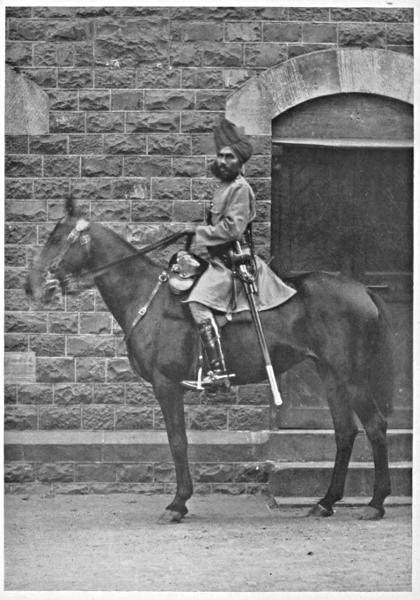
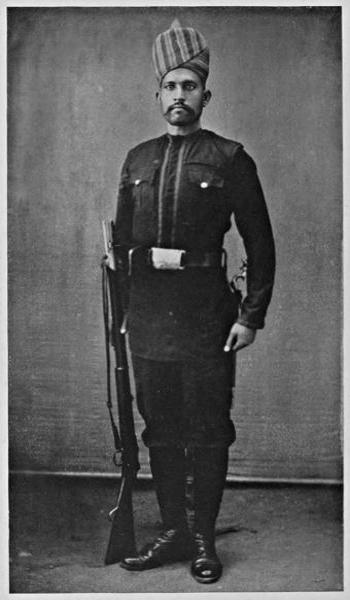
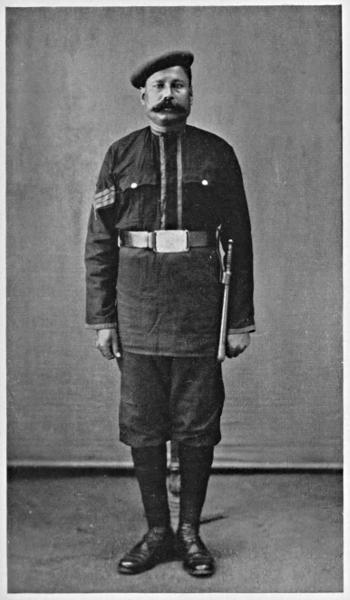
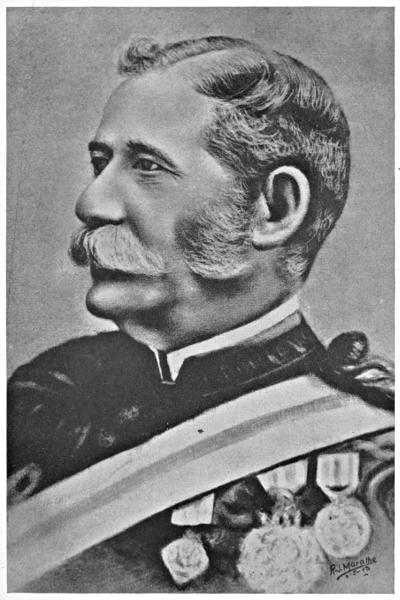
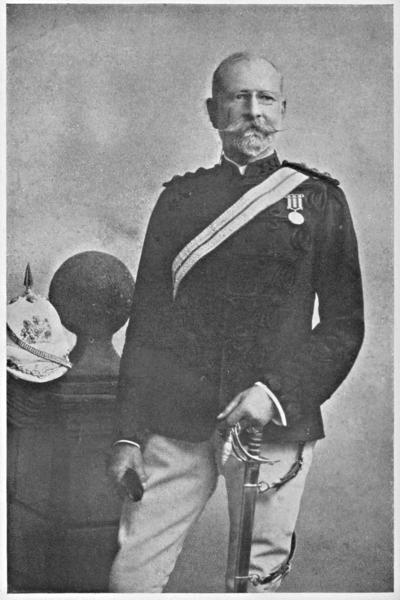
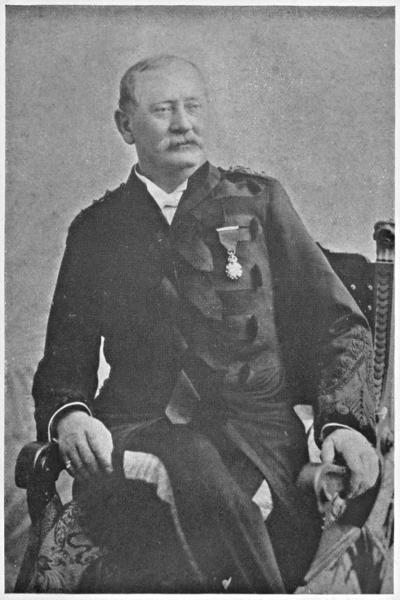
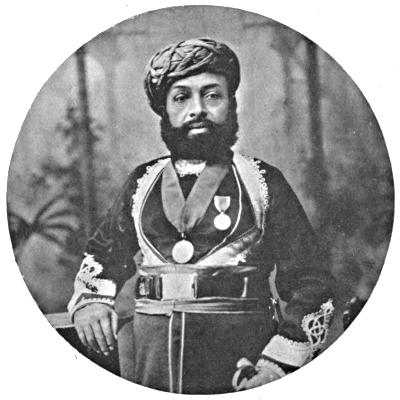
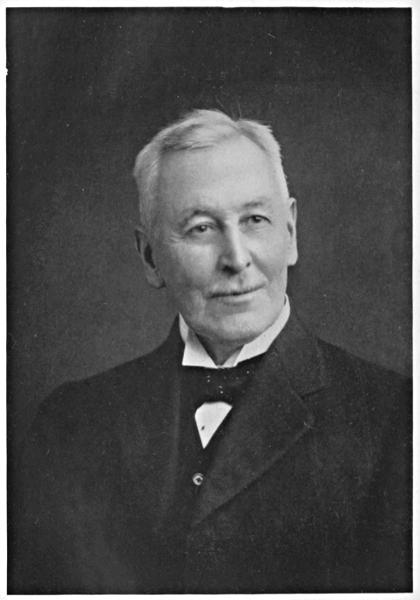
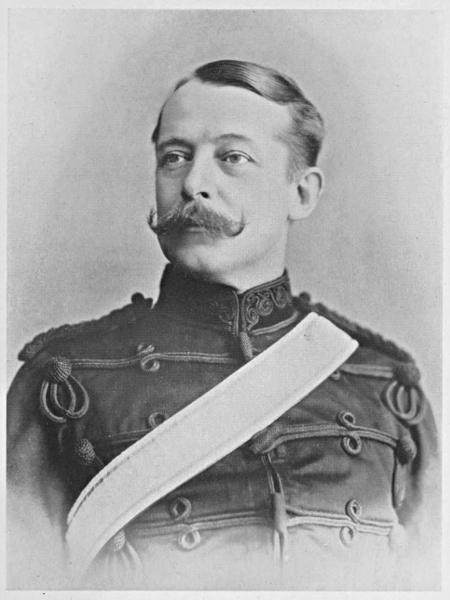
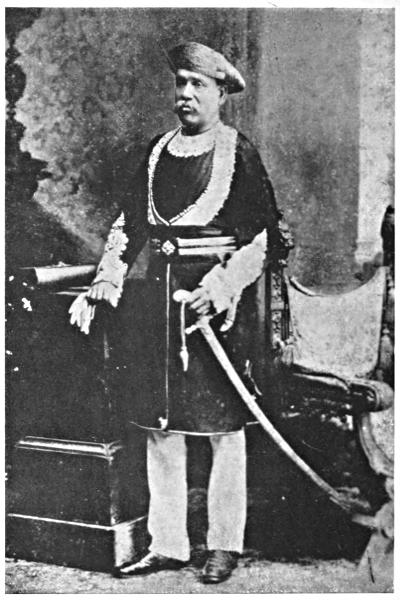
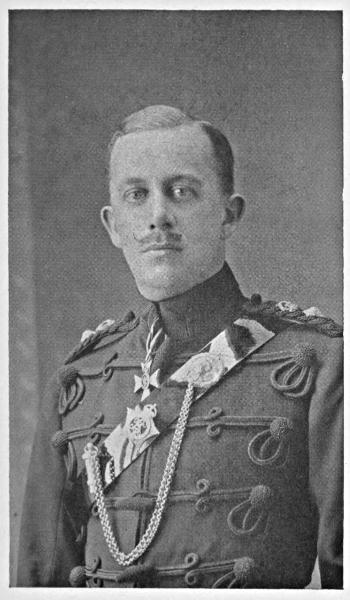
I am indebted to the present Acting Commissioner
of Police for the photographs of the portraits hanging
in the Head Police Office and of the types of
constabulary; to the Record-Keeper at the India Office
for giving me access to various police reports and
official papers dating from 1859 to 1916; and to Mr.
Sivaram K. Joshi, 1st clerk in the Commissioner’s office,
who spent much of his leisure time in making inquiries
and framing answers to various queries which the
Bombay Government kindly forwarded at my request to
the Head Police Office.
THE BOMBAY CITY POLICE A HISTORICAL SKETCH 1672-1916
CHAPTER I The Bhandari Militia 1672-1800
A perusal of the official records of the early period
of British rule in Bombay indicates that the credit of first
establishing a force for the prevention of crime and the
protection of the inhabitants belongs to Gerald Aungier,
who was appointed Governor of the Island in 1669 and
filled that office with conspicuous ability until his death
at Surat in 1677. Amidst the heavy duties which devolved
upon him as President of Surat and Governor of the
Company’s recently acquired Island,[1] and at a time when
the Dutch, the Portuguese, the Mogul, the Sidi and the
Marathas offered jointly and severally a serious menace
to the Company’s trade and possessions, Aungier found
leisure to organize a rude militia under the command
of Subehdars, who were posted at Mahim, Sewri, Sion
and other chief points of the Island.[2] This force was
intended primarily for military protection, as a supplement
to the regular garrison. That it was also employed
on duties which would now be performed by the civil
police, is clear from a letter of December 15, 1673, from
Aungier and his council to the Court of Directors, in
which the chief features of the Island and its administrative
arrangements are described in considerable
detail.[3] After mentioning the strength of the forces at
Bombay and their distribution afloat and ashore, the
letter proceeds:—
“There are also three companies of militia, one at
Bombay, one at Mahim, and one at Mazagon,
consisting of Portuguese black Christians. More
confidence can be placed in the Moors, Bandareens
and Gentus than in them, because the latter are
more courageous and show affection and good-will
to the English Government. These companies are
exercised once a month at least, and serve as
night-watches against surprise and robbery.”
A little while prior to Aungier’s death, when John
Petit was serving under him as Deputy Governor of
Bombay, this militia numbered from 500 to 600, all of
whom were landholders of Bombay. Service in the
militia was in fact compulsory on all owners of land,
except “the Braminys (Brahmans) and Bannians (Banias),”
who were allowed exemption on a money payment.[4]
The majority of the rank and file were Portuguese
Eurasians (“black Christians”), the remainder including
Muhammadans (“Moors”), who probably belonged
chiefly to Mahim, and Hindus of various castes, such
as “Sinays” (Shenvis), “Corumbeens” (Kunbis) and
“Coolys” (Kolis).[5] The most important section of the
Hindu element in this force of military night-watchmen
was that of the Bhandaris (“Bandareens”), whose
ancestors formed a settlement in Bombay in early ages,
and whose modern descendants still cherish traditions
of the former military and political power of their caste
in the north Konkan.
The militia appears to have been maintained more
or less at full strength during the troubled period of Sir
John Child’s governorship (1681-90). It narrowly escaped
disbandment in 1679, in pursuance of Sir Josia Child’s
ill-conceived policy of retrenchment: but as the orders
for its abolition arrived at the very moment when Sivaji
was threatening a descent on Bombay and the Sidi was
flouting the Company’s authority and seizing their
territory, even the subservient John Child could not face
the risk involved in carrying out the instructions from
home; and in the following year the orders were
rescinded.[6] The force, however, did not wholly escape
the consequences of Child’s cheese-paring policy. By
the end of 1682 there was only one ensign for the whole
force of 500, and of non-commissioned officers there were
only three sergeants and two corporals. Nevertheless
the times were so troubled that they had to remain continuously
under arms.[7] It is therefore not surprising
that when Keigwin raised the standard of revolt against
the Company in December 1683, the militia sided in a
body with him and his fellow-mutineers, and played an
active part in the bloodless revolution which they
achieved. Two years after the restoration of Bombay
to Sir Thomas Grantham, who had been commissioned
by the Company to secure the surrender of Keigwin and
his associates, a further reference to the militia appears
in an order of November 15th, 1686, by Sir John Wyborne,
Deputy Governor, to John Wyat.[8] The latter was instructed
to repair to Sewri with two topasses and take
charge of a new guard-house, to allow no runaway
soldiers or others to leave the island, to prevent cattle,
corn or provisions being taken out of Bombay, and to
arrest and search any person carrying letters and send
him to the Deputy Governor. The order concluded
with the following words:—
“Suffer poor people to come and inhabit on the
island; and call the militia to watch with you every
night, sparing the Padre of Parel’s servants.”
The terms of the order indicate to some extent the
dangers and difficulties which confronted Bombay at
this epoch; and it is a reasonable inference that the
duties of the militia were dictated mainly by the military
and political exigencies of a period in which the hostility
of the neighbouring powers in Western India and serious
internal troubles produced a constant series of “alarums
and excursions”.
The close of the seventeenth and the earlier years of
the eighteenth century were marked by much lawlessness;
and in the outlying parts of Bombay the militia appears
to have formed the only safeguard of the residents against
robbery and violence. This is clear from an order of
September 13, 1694, addressed by Sir John Gayer, the
Governor, to Jansanay (Janu Shenvi) Subehdar of Worli,
Ramaji Avdat, Subehdar of Mahim, Raji Karga, Subehdar
of Sion, and Bodji Patan, Subehdar of Sewri. “Being
informed,” he wrote, “that certain ill people on this
island go about in the night to the number of ten or
twelve or more, designing some mischief or disturbance
to the inhabitants, these are to enorder you to go the
rounds every night with twenty men at all places which
you think most suitable to intercept such persons.”[9]
The strengthening of the force at this period[10] and the
increased activity of the night-patrols had very little
effect in reducing the volume of crime, which was a
natural consequence of the general weakness of the
administration. The appalling mortality among Europeans,
the lack of discipline among the soldiers of the
garrison, the general immorality to which Ovington, the
chaplain, bore witness,[11] the prevalence of piracy and the
lack of proper laws and legal machinery, all contributed
to render Bombay “very unhealthful” and to offer
unlimited scope to the lawless section of the population.
As regards the law, judicial functions were exercised
at the beginning of the eighteenth century by a civil
officer of the Company, styled Chief Justice, and in
important cases by the President in Council. Neither of
these officials had any real knowledge of law; no codes
existed, except two rough compilations made during
Aungier’s governorship: and justice was consequently
very arbitrary. In 1726 this Court was exercising civil,
criminal, military, admiralty and probate jurisdiction; it
also framed rules for the price of bread and the wages
of “black tailors”.[12] Connected with the Court from
1720 to 1727 were the Vereadores,[13] a body of native
functionaries who looked after orphans and the estates
of persons dying intestate, and audited accounts. After
1726 they also exercised minor judicial powers and seem
to have partly taken the place of the native tribunals,
which up to 1696 administered justice to the Indian
inhabitants of the Island.[14] So matters remained until
1726, when under the Charter creating Mayors’ Courts at
Calcutta, Bombay and Madras the Governor and Council
were empowered to hold quarter sessions for the trial of
all offences except high treason, the President and the
five senior members of Council being created Justices of
the Peace and constituting a Court of Oyer and Terminer
and Gaol Delivery.
For purposes of criminal justice Bombay was considered
a county. The curious state of the law at this
date is apparent from the trial of a woman, named Gangi,
who was indicted in 1744 for petty treason in aiding and
abetting one Vitha Bhandari in the murder of her
husband.[15] She was found guilty and was sentenced to
be burnt. Apparently the penalty for compassing a
husband’s death was the same as for high treason: and
the sentence of burning for petty treason was the only
sentence the Court could legally have passed. Twenty
years earlier (1724) an ignorant woman, by name Bastok,
was accused of witchcraft and other “diabolical
practices.” The Court found her guilty, not from evil
intent, but on account of ignorance, and sentenced her
to receive eleven lashes at the church door and afterwards
to do penance in the building.[16]
The system, whereby criminal jurisdiction was
vested in the Governor and Council, lasted practically
till the close of the eighteenth century. In 1753, for
example, the Bombay Government was composed of the
Governor and thirteen councillors, all of whom were
Justices of the Peace and Commissioners of Oyer and
Terminer and Gaol Delivery. They were authorised to
hold quarter sessions and make bye-laws for the good
government etc. of Bombay: and to aid them in the
exercise of their magisterial powers as Justices, they had
an executive officer, the Sheriff, with a very limited
establishment.[17] In 1757 and 1759 they issued proclamations
embodying various “rules for the maintenance of
the peace and comfort of Bombay’s inhabitants”; but
with the possible exception of the Sheriff, they had no
executive agency to enforce the observance of these
rules and bye-laws, and no body of men, except the
militia, for the prevention and detection of offences.
When, therefore, in 1769 the state of the public security
called loudly for reform, the Bombay Government were
forced to content themselves and their critics with republishing
these various proclamations and regulations—a
course which, as may be supposed, effected very little
real good. In a letter to the Court of Directors, dated
December 20th, 1769, they reported that in consequence
of a letter from a bench of H. M.’s Justices they had
issued on August 26, 1769, “sundry regulations for the
better conducting the police of the place in general,
particularly in respect to the markets for provisions of
every kind”; and these regulations were in due course
approved by the Court in a dispatch of April 25, 1771.[18]
Police arrangements, however, were still very
unsatisfactory, and crimes of violence, murder and robbery
were so frequent outside the town walls that in August,
1771, Brigadier-General David Wedderburn[19] submitted
proposals to the Bombay Government for rendering the
Bhandari militia[20], as it was then styled, more efficient.
His plan may be said to mark the definite employment
of the old militia on regular police duties. Accordingly
the Bombay Bhandaris were formed into a battalion
composed of 48 officers and 400 men, which furnished
nightly a guard of 12 officers and 100 men “for the
protection of the woods.” This guard was distributed
as follows:—
4
officers
and
33
men
at Washerman’s Tank (Dhobi Talao).
4
”
”
33
”
near Major Mace’s house.
4
”
”
34
”
at Mamba Davy (Mumbadevi) tank.
From these posts constant patrols, which were in
communication with one another, were sent out from
dark until gunfire in the morning, the whole area between
Dongri and Back Bay being thus covered during the night.
The Vereadores were instructed to appoint not less than
20 trusty and respectable Portuguese fazendars to attend
singly or in pairs every night at the various police posts.
All Europeans living in Sonapur or Dongri had to obtain
passes according to their class, i.e. those in the marine
forces from the Superintendent, those in the military
forces from their commanding officer, all other Europeans,
not in the Company’s service, but living in
Bombay by permission of the Government, from the
Secretary to Government, and all artificers employed in
any of the offices from the head of their office.
The duties of the patrols were to keep the peace,
to seize all persons found rioting, pending examination,
to arrest all robbers and house-breakers, to seize all Europeans
without passes, and all coffrees (African slaves)
found in greater numbers than two together, or armed
with swords, sticks, knives or bludgeons. All coffrees
or other runaway slaves were to be apprehended, and were
punished by being put to work on the fortifications for
a year at a wage of Rs. 3 per month, or by being placed
aboard cruisers for the same term, a notice being published
of their age, size, country of origin and description,
so that their masters might have a chance of claiming
them. If unclaimed by the end of twelve months, they
were shipped to Bencoolen in Sumatra.
The standing order to all persons to register their
slaves was to be renewed and enforced under a penalty.
The Company agreed to pay the Bhandari police Rs. 10
for every coffree or runaway slave arrested and placed
on the works or on a cruiser; Re. 1 for every slave
absent from his work for three days; and Rs. 2 for every
slave absent from duty for one month; Re. 1 for every
soldier or sailor absent from duty for forty-eight hours,
whom they might arrest; and 8 annas for every soldier
or sailor found drunk in the woods after 8 p.m.
The money earned in the latter cases was to be paid at
once by the Marine Superintendent or the Commanding
Officer, as the case might be, and deducted from the pay
of the defaulter; and the total sum thus collected was to
be divided once a month or oftener among the Bhandaris
on duty.
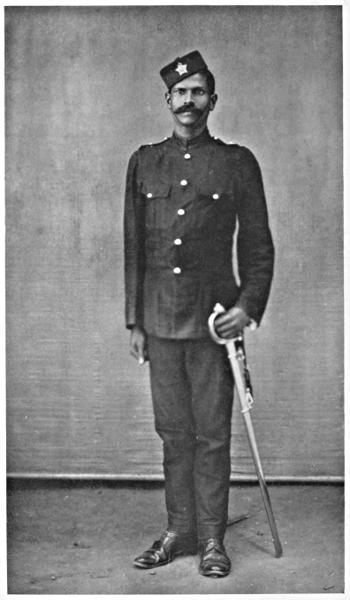
Armed Police Constable
Bombay City
The officers in charge of the police posts and the
Portuguese fazendars, attached thereto, were to make a
daily report of all that had happened during the night
and place all persons arrested by the patrols before a
magistrate for examination. The Bhandari patrols were
to assemble daily at 5 p.m. opposite to the Church Gate
(of the Fort) and, weather permitting, they were to be
taught “firing motions and the platoon exercise, and to
fire balls at a mark, for which purpose some good
havaldars should attend to instruct them, and the adjutant
of the day or some other European officer should
constantly attend.”
These Bhandari night-patrols, as organized by General
Wedderburn, were the germ from which sprang the
later police administration of the Island. We see the
beginnings of police sections and divisions in the three
main night-posts with their complement of officers and
men; the forerunner of the modern divisional morning
report in the daily report of the patrol officer and the
fazendar; and the establishment of an armed branch in
the fire-training given to the patrols in the evening. The
presence of the fazendars was probably based on the
occasional need of an interpreter and of having some
advisory check upon the exercise of their powers by the
patrols. In those early days the fazendar may have
supplied the place of public opinion, which now plays
no unimportant part in the police administration of the
modern city.
Notwithstanding these arrangements, the volume of
crime showed no diminution. Murder, robbery and
theft were still of frequent occurrence outside the Fort
walls: and in the vain hope of imposing some check
upon the lawless element, the Bombay Government in
August, 1776, ordered parties of regular sepoys to be
added to the Bhandari patrols. Three years later, in
February, 1779, they decided, apparently as an experiment,
to supplant the Bhandari militia entirely by patrols
of sepoys, which were to be furnished by “the battalion
of sepoy marines”. These patrols were to scour the
woods nightly, accompanied by “a peace officer”, who
was to report every morning to the acting magistrate.[21]
Still there was no improvement, and the dissatisfaction
of the general public was forcibly expressed at the close
of 1778 or early in the following year by the grand Jury,
which demanded a thorough reform of the police.[22] In
the course of their presentment they stated that “the
frequent robberies and the difficulties attending the detection
of aggressors, called loudly for some establishment
clothed with such authority as should effectually protect
the innocent and bring the guilty to trial”, and they proposed
that His Majesty’s Justices should apply to
Government for the appointment of an officer with ample
authority to effect the end in view.[23]
This pronouncement of the Grand Jury was the
precursor of the first appointment of an executive Chief
of Police in Bombay. On February 17, 1779, Mr. James
Tod (or Todd) was appointed “Lieutenant of Police”,
on probation, with an allowance of Rs. 4 per diem, and
on March 3rd of that year he was sworn into office; a
formal commission signed by Mr. William Hornby, the
Governor, was granted to him, and a public notification
of the creation of the office and of the powers vested in it
was issued. He was also furnished with copies of the
regulations in force, and was required by the terms of his
commission to follow all orders given to him by the
Government or by the Justices of the Peace.[24]
Tod had a chequered career as head of the Bombay
police. The first attack upon him was delivered by the
very body which had urged the creation of his appointment.
The Grand Jury, like the frogs of Æsop who demanded
a King, found the appointment little to their liking, and
were moved in the following July (1779) to present “the
said James Todd as a public nuisance, and his office of
Police as of a most dangerous tendency”; and they
earnestly recommended “that it be immediately abolished,
as fit only for a despotic government, where a Bastille
is at hand to enforce its authority”.
The Government very properly paid no heed to this
curious volteface of the Grand Jury, and Tod was left free
to draft a new set of police regulations, which were badly
needed, and to do what he could to bring his force of
militia into shape. His regulations were submitted on
December 31, 1779, and were approved by the Bombay
Council and ordered to be published on January 26th,
1780. They were based upon notifications and orders
previously issued from time to time at the Presidency
and approved by the Justices, and were eventually registered
in the Court of Oyer and Terminer and Gaol
Delivery on April 17, 1780. Between the date of their
approval by the Council and their registration by the
Court, Tod revised them on the lines of the Police regulations
adopted in Calcutta in 1778.[25] It was further
provided at the time of their registration that “a Bench
of Justices during the recess of the Sessions should be
authorized from time to time to make any necessary
alterations and amendments in the code, subject to their
being affirmed or reversed at the General Quarter Sessions
of the Peace next ensuing”. Tod’s regulations, which
numbered forty-one, were the only rules for the management
of the police which had been passed up to that
date in a formal manner. They were first approved in
Council, as mentioned above, by the authority of the
Royal Charter of 1753, granted to the East India Company,
and were then published and registered at the Sessions
under the authority conveyed by the subsequent Act
(13 Geo. III) of 1773. They thus constituted the earliest
Bombay Police Code.
Meanwhile Tod found his new post by no means a
bed of roses. On November 30th, 1779, he wrote to the
Council stating that his work as Lieutenant of Police
had created for him many enemies and difficulties.
He had twice been indicted for felony and had been
honourably acquitted on both occasions: but he still
lived in continual dread of blame. “By unremitting and
persevering attention to duty I have made many and
bitter enemies”, he wrote, “in consequence of which I
have been obliged in great measure to give up my bread.”
He added that his military title of Lieutenant of Police
had proved obnoxious to many, and he offered to resign
it, suggesting at the same time that, following the
precedent set by Calcutta, he should be styled
Superintendent of Police. Lastly he asked the Council
to fix his emoluments. The censure of the Grand Jury,
quoted in a previous paragraph, indicates clearly the
opposition with which Tod was faced; and one cannot
but sympathize with an officer whose endeavours
to perform his duty efficiently resulted in his
arraignment before a criminal court. That he was
honourably acquitted on both occasions shows that at
this date at any rate he was the victim of malicious
persecution.
As regards the style and title of his appointment, the
Bombay Council endorsed his views, and on March 29th,
1780, they declared the office of Lieutenant of Police
annulled, and created in its place the office of Deputy of
Police on a fixed salary of Rs. 3,000 a year. Accordingly
on April 5th, 1780, Tod formally relinquished his former
office and was appointed Deputy of Police, being
permitted to draw his salary of Rs. 3,000 a year with
retrospective effect from the date of his first appointment
as “Lieutenant”. On the same day he submitted the
revised code of police regulations, which was formally
registered in the Court of Oyer and Terminer on April
17th. In abolishing the post of Lieutenant the Bombay
Government anticipated by a few months the order of
the Court of Directors, who wrote as follows on July 5th,
1780:—
“Determined as we are to resist every attempt that
may be made to create new offices at the expense
of the Company, we cannot but be highly displeased
with your having appointed an officer in quality of
Lieutenant of Police with a salary of Rs. 4 a day.
Whatever sum may have been paid in consequence
must be refunded. If such an officer be of that
utility to the public as you have represented, the
public by some tax or otherwise should defray the
charges thereof.”
Before leaving the subject of the actual appointment,
it is to be noted that at some date previous to 1780 the
office of High Constable was annexed to that of Deputy
of Police; for, in his letter to the Court of Sessions asking
for the confirmation and publication of his police regulations,
Tod describes himself as “Deputy of Police and
High Constable”. No information, however, is forthcoming
as to when this office was created, nor when it
was amalgamated with the appointment of Deputy of
Police.[26]
The actual details of Tod’s police administration
are obscure. At the outset he was apparently hampered
by lack of funds, for which the Bombay Government had
made no provision. On January 17th, 1780, he submitted
to them an account of sums which he had advanced
and expended in pursuance of his duties as executive
head of the police, and also informed the Council that
twenty-four constables, “who had been sworn in for the
villages without the gates”, had received no pay and
consequently had, in concert with the Bhandaris, been
exacting heavy fees from the inhabitants. Tod requested
the Government to pay the wages due to these men, or,
failing that, to authorize payment by a general assessment
on all heads of families residing outside the gates
of the town. The Council reimbursed Tod’s expenses
and issued orders for an assessment to meet the cost of
the constabulary.
While allowing for the many difficulties confronting
him, Tod cannot be held to have achieved much success
as head of the police. His old critics, the Grand Jury,
returned to the charge at the Sessions which opened on
April 30th, 1787, and protested in strong terms against
“the yet inefficient state of every branch of the Police,
which required immediate and effectual amendment”.
“That part of it” they said, “which had for its object
the personal security of the inhabitants and their property
was not sufficiently vigorous to prevent the frequent
repetition of murder, felony, and every other species of
atrociousness—defects that had often been the subject of
complaint from the Grand Jury of Bombay, but never
with more reason than at that Sessions, as the number
of prisoners for various offences bore ample testimony.”
They animadverted on the want of proper regulations,
on the great difficulty of obtaining menial servants and
the still greater difficulty of retaining them in their
service, on the enormous wages which they demanded
and their generally dubious characters. So far as concerned
the domestic servant problem, the Bombay public
at the close of the eighteenth century seems to have been
in a position closely resembling that of the middle-classes
in England at the close of the Great War (1914-18).
The Grand Jury complained also of the defective state
of the high roads, of the uncleanliness of many streets
in the Town, and of “the filthiness of some of the
inhabitants, being uncommonly offensive and a real
nuisance to society”. They objected to the obstruction
caused by the piling of cotton on the Green and in the
streets, to the enormous price of the necessaries of life,
the bad state of the markets, and the high rates of labour.
They urged the Justices to press the Bombay Government
for reform and suggested “the appointment of a Committee
of Police with full powers to frame regulations and
armed with sufficient authority to carry them into
execution, as had already been done with happy effect
on the representation of the Grand Juries at the other
Presidencies.”
The serious increase of robbery and “nightly
depredations” was ascribed chiefly to the fact that all
persons were allowed to enter Bombay freely, without
examination, and that the streets were infested with
beggars “calling themselves Faquiers and Jogees
(Fakirs and Jogis)”, who exacted contributions from
the public. The beggar-nuisance is one of the chief
problems requiring solution in the modern City of
Bombay: and it may be some consolation to a harassed
Commissioner of Police to know that his predecessor of
the eighteenth century was faced with similar difficulties.
The Grand Jury were not over-squeamish in their recommendations
on the subject. They advocated the
immediate deportation of all persons having no visible
means of subsistence, and as a result the police,
presumably under Tod’s orders, sent thirteen suspicious
persons out of the Island.[27]
Three years later, in 1790, Tod’s administration came
to a disastrous close. He was tried for corruption. “The
principal witness against him (as must always happen)”,
wrote Sir James Mackintosh, “was his native receiver
of bribes. He expatiated on the danger to all Englishmen
of convicting them on such testimony; but in spite of
a topic which, by declaring all black agents incredible,
would render all white villains secure, he was convicted;
though—too lenient a judgment—he was only reprimanded
and suffered to resign his station”.[28] Sir James
Mackintosh, as is clear from his report of October, 1811,
to the Bombay Government, was stoutly opposed to the
system of granting the chief executive police officer wide
judicial powers, such as those exercised by Tod and his
immediate successors: and his hostility to the system may
have led to his overlooking the exceptional difficulties
and temptations to which Tod was exposed. The
Governor and his three Councillors, in whom by Act
XXIV, Geo. III, of 1785 (“for the better regulation
and management of the affairs of the East India
Company and for establishing a Court of Judicature”),
the supreme judicial and executive administration of
Bombay were at this date vested, realized perhaps that
Tod’s emoluments of Rs. 250 a month were scarcely
large enough to secure the integrity of an official vested
with such wide powers over a community, whose moral
standards were admittedly low, that Tod had done a
certain amount of good work under difficult conditions,
and that the very nature of his office was bound to
create him many enemies. On these considerations they
may have deemed it right to temper justice with mercy
and to permit the delinquent to resign his appointment in
lieu of being dismissed.
The identity of Tod’s immediate successor is unknown.
Whoever he was, he seems to have effected no
amelioration of existing conditions. In 1793 the Grand
Jury again drew pointed attention to “the total inadequacy
of the police arrangements for the preservation of
the peace and the prevention of crimes, and for bringing
criminals to justice.” Bombay was the scene of constant
robberies by armed gangs, none of whom were apprehended.
The close of the eighteenth century was a period
of chaos and internecine warfare throughout a large part
of India, and it is only natural that Bombay should have
suffered to some extent from the inroads of marauders,
tempted by the prospect of loot. A system of night-patrols,
weak in numbers and poorly paid, could not
grapple effectively with organized gangs of free-booters,
nurtured on dangerous enterprises and accustomed to great
rapidity of movement. The complaints of the Grand Jury,
however, could not be overlooked, and led directly to the
appointment of a committee to consider the whole
subject of the police administration and suggest reform.
This committee was in the midst of its enquiry when
Act XXXIII, Geo. III. of 1793 was promulgated and
rendered further investigation unnecessary. Under that
Act a Commission of the Peace, based upon the form
adopted in England, was issued for each Presidency by
the Supreme Court of Judicature in Bengal. The
Governor and his Councillors remained ex officiis Justices
of the Peace for the Island, and five additional Justices
were appointed by the Governor-General-in-Council
on the recommendation of the Bombay Government.
The Commission of the Peace further provided for the
abolition of the office of Deputy of Police and High
Constable, and created in its place the office of
Superintendent of Police.
The first Superintendent of Police was Mr. Simon
Halliday, who just prior to the promulgation of the Act
above-mentioned had been nominated by the Justices to
the office of High Constable. So much appears from
the records of the Court of Sessions; and one may
presume that after the Act came into operation in 1793
Mr. Halliday’s title was altered to that of Superintendent.
His powers were somewhat curtailed to accord
with the powers vested in the Superintendent of Police
at Calcutta, and he was bound to keep the Governor-in-Council
regularly informed of all action taken by him
in his official capacity.
Mr. Halliday was in charge of the office of Superintendent
of Police until 1808. His assumption of office
synchronized with a thorough revision of the arrangements
for policing the area outside the Fort, which up
to that date had proved wholly ineffective. Under the
new system, which is stated in Warden’s Report to have
been introduced in 1793 and was approved by the
Justices a little later, the troublesome area known as
“Dungree and the Woods” was split up into 14 police
divisions, each division being staffed by 2 Constables
(European) and a varying number of Peons (not exceeding
130 for the whole area), who were to be stationary in
their respective charges and responsible for dealing with
all illegal acts committed within their limits.
The disposition of this force of 158 men was as
follows:—
The names of the police-stations or chaukis (chokeys)
show that the area thus policed included roughly the
modern Dhobi Talao section and the southern part of
Girgaum, most of the present Market and Bhuleshwar
sections and the western parts of the modern Dongri and
Mandvi sections. In fact, the expression “Dongri and
the Woods” represented the area which formed the
nucleus of what were known in the middle of the nineteenth
century as the “Old Town” and “New Town”.
At the date of Mr. Halliday’s appointment, this part
of the Island was almost entirely covered with oarts
(hortas) and plantations, intersected by a few narrow
roads; and if one may judge by the illustration “A Night
in Dongri” in The Adventures of Qui-hi (1816),[30] a portion of
this area was inhabited largely by disreputable persons.
Simultaneously with the introduction of the
arrangements described above, an establishment of
“rounds” hitherto maintained by the arrack-farmer,
consisting of one clerk of militia, 4 havaldars and 86
sepoys, and costing Rs. 318 per month, was abolished.
Mahim, which was still regarded as a suburb, had its own
“Chief,” who performed general, magisterial and police
duties in that area; while other outlying places like Sion
and Sewri were furnished with a small body of native police
under a native officer, subject to the general supervision
and control of the Superintendent. In 1797 the condition
of the public thoroughfares and roads was so bad that,
on the death in that year of Mr. Lankhut, the Surveyor
of Roads, his department was placed in charge of the
Superintendent of Police; while in 1800 the office of
Clerk of the Market was also annexed to that of the chief
police officer, in pursuance of the recommendations of a
special committee. In the following year, 1801, the old
office of Chief of Mahim was finally abolished, and his
magisterial and police duties were thereupon vested in the
Superintendent of Police. To enable him to cope with
this additional duty, an appointment of Deputy Superintendent,
officiating in the Mahim district, was created,
the holder of which was directly subordinate in all
matters to the Superintendent of Police. The first Deputy
Superintendent was Mr. James Fisher, who continued in
office until the date (1808) of Mr. Halliday’s retirement
when he was succeeded by Mr. James Morley.
CHAPTER II The Rise of the Magistracy 1800-1855
As has been shown in the preceding chapter, the
importance of the office of Superintendent of Police had
been considerably enhanced by the year 1809. Excluding
the control of markets and roads, which was taken from
him in that year, the Superintendent had executive
control of all police arrangements in the Island, exercised
all the duties of a High Constable, an Alderman and a
Justice of the Peace, was Secretary of the Committee of
Buildings, a member of the Town Committee, and
a member of the Buildings Committee of H.M.’s
Naval Offices in Bombay. He had been appointed a
Justice of the Peace at his own request, on the grounds
that he would thereby be enabled to carry out his police
work more effectively. His deputy at Mahim was also
appointed a Justice of the Peace on the publication
of Act XLVIII, Geo. III. of 1808.
The year 1809 marks another crisis in the history
of Bombay’s police administration, to which several
factors may be held to have contributed. In the first
place crime was still rampant and defied all attempts to
reduce it. Bodies of armed men continued to enter the
Island, as for example in 1806 and 1807, and to terrify,
molest and loot the residents; and though these gangs
remained for some little time within the Superintendent’s
jurisdiction, they were never apprehended by the police.[31]
In his report of November 15, 1810, Warden refers also
to an attack by “Cossids”, i.e.Kasids or letter-carriers,
who must have been induced to leave for the moment
their ordinary duties as postal-runners and messengers
by the apparent immunity from arrest and punishment
enjoyed by the bands of regular thieves and free-booters.
In consequence of the general lawlessness traffic in stolen
goods was at this date a most lucrative profession, and
obliged the Justices in 1797 to nominate individual
goldsmiths and shroffs as public pawnbrokers for a term
of five years, on condition that they gave security for
good conduct and furnished the police regularly with
returns of valuable goods sold or purchased by them.[32]
Another source of annoyance to the authorities was the
constant desertion of sailors from the vessels of the
Royal Navy and of the East India Company. These men
were rarely arrested and the police appeared unable to
discover their haunts. The peons, i.e. native constables
were declared to be seldom on duty, except when
they expected the Superintendent to pass, and to spend
their time generally in gambling and other vices. In
brief, the police force was so inefficient and crime was
so widespread and uncontrolled that public opinion
demanded urgent reform.
In the second place, the old system whereby the
Governor and his Council constituted the Court of Oyer
and Terminer and Gaol Delivery disappeared on the
establishment in 1798 of a Recorder’s Court. The
powers of the Justices, who were authorized to hold
Sessions of the Peace, remained unimpaired, and nine of
them, exclusive of the Members of Government, were
nominated for the Town and Island. It was inevitable
that the constitution of a competent judicial tribunal,
presided over by a trained lawyer, should, apart from
other causes, lead to a general stock-taking of the
judicial administration of Bombay, and incidentally
should direct increased attention to the subject of the
powers vested in the Police and the source whence they
drew their authority.
The powers of the Superintendent of Police at this
epoch were very wide. First, he had power to convict
offenders summarily and punish them at the police office.
This procedure, in the opinion of the Recorder, Sir James
Mackintosh (1803-11), was quite illegal, inasmuch as
the punishments were inflicted under rules, which from
1753 to 1807 were not confirmed by the Court of Directors
and had therefore no validity. The rules made between
1807 and 1811 were likewise declared by the same
authority to be invalid, as they had not been registered
in the court of judicature. On other grounds also the
police rules authorizing this procedure were ultra vires.
Secondly, the Superintendent inflicted the punishment of
banishment and condemned offenders to hard labour in
chains on public works. Between February 28, 1808,
and January 31, 1809, he (i.e. Mr. Halliday) banished
217 persons from Bombay, and condemned 64 persons
to hard labour in the docks. During the three years,
1807-1809, about 200 offenders were thus condemned to
work in chains. On the other hand, the Superintendent
frequently liberated prisoners before the expiry of their
sentence, and in this way released 26 persons on December
20, 1809, without assigning any reason. He condemned
persons also to flogging. He kept no record of his cases.
“He may arrest 40 men in the morning”, wrote Sir
James Mackintosh, “he may try, convict and condemn
them in the forenoon; and he may close the day by
exercising the Royal prerogative of pardon towards them
all.” It is hardly surprising that the mind of the lawyer
revolted against the system, and that in his indignation
he characterized the powers of the Superintendent as “a
precipitate, clandestine and arbitrary jurisdiction.”[33]
In the third place, the powers of the Governor-in-Council
to enact police regulations for Bombay were
defined anew and enlarged by Act XLVII, Geo. III. of
1808, under the provisions of which the Government was
empowered to nominate 16 persons, exclusive of the
members of the Governor’s Council, to act as Justices of
the Peace. The promulgation of this Act, which was
received in Bombay in 1808, rendered necessary a
thorough revision of the conditions and circumstances of
police control.
In consequence, therefore, of the prevalence of crime
and the notorious inefficiency and corruption of the
Police, the hostility of the new Recorder’s Court to the
existing system of administration, and the need of
a new enactment under Act XLVII, the Bombay
Government appointed a committee in 1809 to
review the whole position and make suggestions for
further reform. The President of the committee
was Mr. F. Warden, Chief Secretary to Government, who
eventually submitted proposals in a letter dated
November 15, 1810. The urgent need of reform was
emphasized by the fact that the Superintendent of Police,
Mr. Charles Briscoe, who had succeeded Mr. Halliday in
1809, was tried at the Sessions of November, 1810, for
corruption, as Tod had been in 1790, and that complaints
against the tyranny and inefficiency of the force were
being daily received by the authorities. Sir James
Mackintosh was only expressing public opinion when
in 1811 he recommended Government “in their wisdom
and justice to abolish even the name of Superintendent
of Police, and to efface every vestige of an office of which
no enlightened friend to the honour of the British name
can recollect the existence without pain.”
Warden’s proposals were briefly the following.
He advocated the adaptation to Bombay of Colquhoun’s
system for improving the police of London, and suggested
the appointment on fixed salaries of two executive
magistrates for the criminal branch of the Police, to be
selected from among the Company’s servants or British
subjects—“one for the Town of Bombay, whose jurisdiction
shall extend to the Engineer’s limits and to Colaba,
and to offences committed in the harbour of Bombay,
with a suitable establishment; and a second for the
division without the garrison, including the district of
Mahim, with a suitable establishment.” Both these
magistrates were to have executive and judicial functions,
and were also to perform “municipal duties”.[34] The
active functions of the police were to be performed by a
Deputy, while “the control, influence, and policy” were
to be centred in a Superintendent-General of Police,
aided by the two magistrates. The latter officer was to
be responsible for the recruitment of the Deputy’s
subordinates, and the Mukadams (headmen) of each caste
were to form part of the police establishment.
Warden dealt at some length with the qualifications
and powers which the chief police officer should possess.
He proposed that the Superintendent’s power of inflicting
corporal punishment should be abolished, and that his
duties should extend only to the apprehension, not to
the punishment, of offenders; to the enforcement of
regulations for law and order; to the superintendence of
the scavenger’s and road-repairing departments; to
watching “the motley group of characters that infest
this populous island;” and to the vigilant supervision of
houses maintained for improper and illegal purposes.
“He should be the arbitrator of disputes between the
natives, arising out of their religious prejudices. He
should have authority over the Harbour, and should be
in charge of convicts subjected to hard labour in the
Docks, and those sent down to Bombay under sentence
of transportation. He should not be the whole day
closeted in his chamber, but abroad and active in the
discharge of his duty; he should now and then appear
where least expected. The power and vital influence of
the office, and not its name only, should be known and
felt. He ought to number among his acquaintances
every rogue in the place and know all their haunts and
movements. A character of this description is not
imaginary, nor difficult of formation. We have heard
of a Sartine and a Fouché; a Colquhoun exists; and I am
informed that the character of Mr. Blaqueire at Calcutta,
as a Magistrate, is equally efficient.” Warden, indeed,
demanded a kind of “admirable Crichton,”—strictly
honest, yet the boon-companion of every rascal in
Bombay, keeping abreast of his office-work by day and
perambulating the more dangerous haunts of the local
criminals by night. It is only on rare occasions that a
man of such varied abilities and energy is forthcoming:
and nearly half a century was destined to elapse before
Bombay found a Police Superintendent who more than
fulfilled the high standard recommended by the Chief
Secretary in 1810.
The upshot of the Police Committee’s enquiry and
of the report of its President was the publication of Rule,
Ordinance and Regulation I of 1812, which was drafted
by Sir James Mackintosh in 1811, and formed the basis
of the police administration of Bombay until 1856.
Under this Regulation, three Justices of the Peace were
appointed Magistrates of Police with the following
respective areas of jurisdiction:—
(a) The Senior Magistrate, for the Fort and Harbour.
(b) The Second Magistrate, for the area between
the Fort Walls and a line drawn from the
northern boundary of Mazagon to Breach Candy.
(c) The Third Magistrate, with his office at Mahim,
for all the rest of the Island.[35]
Included in the official staff of these three magistrates
were:—
a Purvoe (i.e. Prabhu clerk)
on
Rs.
50
per
month
a Cauzee (Kazi)
”
”
8
”
”
a Bhut (Bhat, Brahman)
”
”
8
”
”
a Jew Cauzee (Rabbi)
”
”
12
”
”
an Andaroo (Parsi Mobed)
”
”
6
”
”
Two Constables
each
”
”
9
”
”
One Havildar
”
”
8
”
”
Four Peons
each
”
”
6
”
”
The executive head of the Police force was a Deputy
of Police and High Constable on a salary of Rs. 500 a
month, while the general control and deliberative powers
were vested in a Superintendent-General of Police. All
appointments of individuals to the subordinate ranks of
the force were made by the Magistrates of Police, who
with the Superintendent-General met regularly as a Bench
to consider all matters appertaining to the police
administration of Bombay. European constables were
appointed by the Justices at Quarter Sessions, and the
Mukadams or headmen of each caste formed an integral
feature of the police establishment.
The strength and cost of the force in 1812 were as
follows:—
1
Deputy of Police and Head Constable
Rs.
500
per
month
2
European Assistants (at Rs.100 each)
Rs.
200
”
”
3
Purvoes (Prabhus, clerks)
Rs.
110
”
”
1
Inspector of Markets
Rs.
80
”
”
2
Overseers of Roads (respectable natives at 50 each)
Rs.
100
”
”
12
Havaldars (at Rs. 8 each)
Rs.
96
”
”
8
Naiks (at Rs. 7 each)
Rs.
56
”
”
6
European Constables
Rs.
365
”
”
50
Peons (at Rs. 6 each)
Rs.
300
”
”
1
Battaki man
Rs.
6
”
”
1
Havaldar and 12 Peons for the Mahim patrol
Rs.
80
”
”
Harbour Police.
7
Boats i.e. 49 men
Rs.
300
”
”
1
Purvoe
Rs.
50
”
”
4
Peons (at Rs. 6 each)
Rs.
24
”
”
Contingencies
Rs.
74
”
”
Thus, including the Deputy of Police, the land force
comprised 10 Europeans, one of whom was in charge of
the markets, and 86 Indians, of whom two were inspectors
of roads. The clerical staff consisted of three Prabhus.
The water-police consisted of 53 Indians and one clerk.
The cost of the force, including the water-police,
amounted to Rs. 27,204 a year, to which had to be added
Rs. 888 for contingencies, Rs. 1425 for the clothing of
havaldars and peons, and Rs. 2000 for stationery.[36]
The inclusion in the magisterial establishment of
“a Cauzee” etc. requires brief comment. Down to 1790
the administration of criminal justice in India was largely
in the hands of Indian judges and officials of various
denominations, though under European supervision in
various forms; and even after that date, when the native
judiciary had ceased to exist except in quite subordinate
positions, the law that was administered in criminal cases
was in substance Muhammadan law, and a Kazi and a
Mufti were retained in the provincial courts of appeal
and circuit as the exponents of Muhammadan law and
the deliverers of a formal fatwa. The term Kazi on this
account remained in formal existence till the abolition
of the Sadr Courts in 1862.[37] The object of associating
Kazis with the Bombay magistrates of police at the
opening of the nineteenth century was doubtless to ensure
that in all cases brought before them, involving
questions of the law, customs and traditions of the chief
communities and sects inhabiting the Island, the magistrates
should have the advantage of consulting those
who were able to interpret and give a ruling on such
matters. The Kazi proper was the authority on all
matters relating to the Muhammadan community; the
“Jew Cauzee” on matters relating to the Bene-Israel, who
from 1760 to the middle of the nineteenth century
contributed an important element to the Company’s
military forces;[38] the Bhat presumably gave advice on
subjects affecting Hindus of the lower classes; while the
“Andaroo” (i.e. Andhiyaru, a Parsi priest) was required
in disputes and cases involving Parsis, whose customs in
respect of marriage, divorce and inheritance had not at
this date been codified and given the force of law.
The Regulation of 1812 effected little or no improvement
in the state of the public security. Gangs of criminals
burned ships in Bombay waters to defraud the insurance-companies;
robberies by armed gangs occurred frequently
in all parts of the Island;[39] and every householder of
consequence was compelled to employ private watchmen,
the fore-runners of the modern Ramosi and Bhaya, who
were often in collusion with the bad characters of the
more disreputable quarters of the Town.[40] Even Colaba,
which contained few dwellings, was described in 1827
as the resort of thieves.[41] The executive head of the
force at this date was Mr. Richard Goodwin, who succeeded
the unfortunate Briscoe in 1811 and served until 1816,
when apparently he was appointed Senior Magistrate of
Police, with Mr. W. Erskine as his Junior.
The proceedings of both the magistrates and the
police were regarded with a jaundiced eye by the
Recorder’s Court, and Sir Edward West, who filled the
appointment, first of Recorder and then of Chief Justice,
from 1822 to 1828, animadverted severely in 1825 upon
the illegalities perpetrated by the magisterial courts,
presided over at that date by Messrs. J. Snow and
W. Erskine[42]. His successor in the Supreme Court,[43] Sir
J. P. Grant, passed equally severe strictures upon the
police administration at the opening of the Quarter
Sessions in 1828.
“The calendar is a heavy one. Several of the crimes
betoken a contempt of public justice almost incredible
and a state of morals inconsistent with any
degree of public prosperity. Criminals have not
only escaped, but seem never to have been placed
in jeopardy. The result is a general alarm among
native inhabitants. We are told that you are
living under the laws of England. The only
answer is that it is impossible. What has been
administered till within a few years back has not
been the law of England, nor has it been administered
in the spirit of the law of England; else it
would have been felt in the ready and active
support the people would have given to the law
and its officers, and in the confidence people would
have reposed in its efficacy for their protection.”[44]
The punishments inflicted at this date were on the
whole almost as barbarous as those in vogue in earlier
days. In 1799, for example, we read of a Borah, Ismail
Sheikh, being hanged for theft: in 1804 a woman was
sentenced to five years’ imprisonment for perjury, during
which period she was to stand once a year, on the
first day of the October Sessions, in the pillory in front
of the Court House (afterwards the Great Western
Hotel), with labels on her breast and back describing
her crime: and in the same year one Harjivan was
sentenced to be executed and hung in chains, presumably
on Cross Island (Chinal Tekri), where the bodies of malefactors
were usually exposed at this epoch. One James
Pennico, who was convicted of theft in 1804, escaped
lightly with three months’ imprisonment and a public
whipping at the cart’s tail from Apollo Gate to Bazaar
Gate; in 1806 a man who stole a watch was
sentenced to two years’ labour in the Bombay Docks.[45] The
public pillory and flogging were punishments constantly
inflicted during the early years of the nineteenth century.
The pillory, which was in charge of the Deputy of Police,
was located on the Esplanade in the neighbourhood of
the site now occupied by the Municipal Offices. The last
instance of its use occurred in 1834, when two Hindus
were fastened in it by sentence of the Supreme Court and
were pelted by boys for about an hour with a mixture
composed of red earth, cowdung, decayed fruits and bad
eggs. At intervals their faces were washed by two low-caste
Hindus, and the pelting of filth was then resumed to the
sound of a fanfaronade of horns blown by the Bhandaris
attached to the Court.[46] Meanwhile the English doctrine
of the equality of all men before the law was gradually
being established, though the earliest instance of a
Brahman being executed for a crime of violence did not
occur until 1846. The case caused considerable excitement
among orthodox Hindus, whose views were based
wholly upon the laws of Manu.[47]
The early “thirties” were remarkable for much crime
and for a serious public disturbance, the Parsi-Hindu
riots, which broke out in July, 1832, in consequence of
a Government order for the destruction of pariah-dogs,
which at this date infested every part of the
Island. Two European constables, stimulated by the
reward of eight annas for every dog destroyed, were
killing one in the proximity of a house, when they were
attacked and severely handled by a mob composed of
Parsis and Hindus of several sects. On the following
day all the shops in the Town were closed, and a mob of
about 300 roughs commenced to intimidate all persons
who attempted to carry out their daily business. The
bazar was deserted; and the mob forcibly destroyed the
provisions intended for the Queen’s Royals, who were
on duty in the Castle, and stopped all supplies of food
and water for the residents of Colaba and the shipping
in the harbour. As the mob continued to gather strength,
Mr. de Vitré, the Senior Magistrate of Police, called for
assistance from the garrison, which quickly quelled the
disturbance.[48]
The Press of this date recorded constant cases of
burglary and dacoity. “The utmost anxiety and alarm
prevail amongst the inhabitants of this Island, especially
those residing in Girgaum, Mazagon, Byculla and the
neighbourhood, in consequence of the depredations and
daring outrages committed by gangs of robbers armed
with swords, pistols and even musquets, who, from the
open and fearless manner in which they proceed along
the streets, sometimes carrying torches with them, seem
to dread neither opposition nor detection, and to defy
the police.” It was even said that sepoys of the 4th
Regiment of Native Infantry, then stationed in the
Island, joined these gangs of marauders, and when two
men of the 11th Regiment were arrested on suspicion by
a magistrate, their comrades stoned the magistrate’s
party. “It would be far better that the Island should be
vacated altogether by the sepoy regiments,” said the
Courier, “than that it should be exposed repeatedly to
these excesses.” Fifty men of the Poona Auxiliary
Force had to be brought down to aid the police and to
patrol the roads at night.[49]
According to Mrs. Postans, the police administration
had improved and robberies had become less frequent
at the date of her visit, 1838. “The establishment of
an efficient police force,” she writes, “is one of the great
modern improvements of the Presidency. Puggees
(Pagisi.e. professional trackers) are still retained for
the protection of property: but the highways and bazaars
are now orderly and quiet, and robberies much less
frequent.”[50] The authoress admitted, however, that the
Esplanade—particularly the portion of it occupied by the
tents of military cadets—was the resort of “a clique of
dexterous plunderers,” who during the night used to cast
long hooks into the tents and so withdraw all the loose
articles and personal effects within reach.[51] The prevalence
of more serious crime is indicated by her remarks
about the Bhandari toddy-drawers:—
“It appears that in many cases of crime brought to
the notice of the Bombay magistracy, evidence
which has condemned the accused has been elicited
from a Bundarrie, often sole witness of the culprit’s
guilt. Murderers, availing themselves of the last
twilight ray to decoy their victims to the closest
depths of the palmy woods and there robbing
them of the few gold or silver ornaments they
might possess, have little thought of the watchful
toddy-drawer, in his lofty and shaded eyry.”[52]
That the improvement was not very marked is also
proved by the fact that in 1839, the year after Mrs. Postans’
visit, the Bench of Justices increased their contribution to
Government for police charges to Rs. 10,000, the
additional cost being declared necessary owing to the
rapid expansion of the occupied urban area, and to the
grave inadequacy of the force for coping with crime. So
far as watch and ward duties were concerned, the police
must have welcomed the first lighting of the streets
with oil-lamps in 1843. Ten years later there were said
to be 50 lamps in existence, which were lighted from
dusk to midnight, and the number continued to increase
until October, 1865, when the first gas-lamps were lighted
in the Esplanade and Bhendy Bazar. On the other hand
drunkenness was a fruitful source of crime, and the
number of country liquor-shops was practically unlimited.
“On a moderate computation” wrote Mrs. Postans
“every sixth shop advertises the sale of toddy.” With
such facilities for intoxication, crime was scarcely likely
to decrease.
But other and deeper reasons existed for the unsatisfactory
state of the public peace and security. Throughout
the whole of the period from 1800 to 1850, and in a
milder form till the establishment of the High Court in
1861, there was constant friction, occasionally of an acute
character, between the Supreme Court and the Company’s
government and officials. Moreover, the original intention
of the Crown that the Supreme Court should act as
a salutary check upon the Company’s administration
was frustrated by several periods of interregnum
between 1828 and 1855, the Court being represented
frequently by only one Judge and on one occasion being
entirely closed owing to the absence of judges. This
antagonism between the highest judicial tribunal and the
executive authority could not fail to react unfavourably
on the subordinate machinery of the administration, and
coupled with inadequacy of numbers, insufficiency of
pay, and a general lack of integrity in the Police force
itself, may be held to have been largely responsible for
the comparative freedom enjoyed by wrong-doers and
their manifest contempt for authority.
Contemporary records indicate that the Police Office
at this period (1800-1850) was located in the Fort; the
court of the Senior Magistrate of Police was housed in a
building in Forbes Street, and the court of the Second
Magistrate in a house in Mazagon. The powers of both
Magistrates were limited, and all cases involving
sentences of more than six months’ imprisonment, or
affecting property valued at more than Rs. 50, had to be
sent to the Court of Petty Sessions or committed to
the Recorder’s, subsequently the Supreme Court.
The Court of Petty Sessions was composed of the two
Magistrates of Police and a Justice of the Peace (the
Superintendent-General of Sir J. Mackintosh’s draft Regulation),
and sat every Monday morning at 10 a.m. at the
Police Office in the Fort. The constitution of this Court
was afterwards amended by Rule, Ordinance and Regulation
1 of 1834, which, though not registered in the
Supreme Court as required by Act XLVII, Geo. III, was
subsequently legalized by India Act VII of 1836. By
that Ordinance the Court was composed of not less than
three Justices of the Peace, one of whom was a Magistrate
of Police, the second was a European, and the
third was a Native of India, not born of European parents.
It remained in existence, with extended powers, until the
year 1877, when, together with three Magistrates of
Police, it was superseded by the Presidency Magistrates
Act.
A word may here be said on the subject of the well-known
uniform of the Bombay constabulary, the bright
yellow cap and the dark blue tunic and knickers, which
once caused a wag to style the Bombay police-sepoy
“the empty black bottle with the yellow seal.”
The origin of the uniform is obscure; but it was certainly
in use in 1838, for Mrs. Postans describes the dress of
the men as “a dark blue coat, black belt, and yellow
turban.”[53] An illustration in The Adventures of Qui-Hi,
entitled “A Night in Dongri,” shows that the uniform
was worn at a still earlier date. In the background of
the picture two persons are obviously having an
altercation with a police-constable, and the latter is
depicted wearing the flat yellow cap and blue uniform
familiar to every modern resident of Bombay. The
dress of the constabulary must therefore have been
adopted at some date prior to 1816, and it is probably a
legitimate inference that it dates back to the reorganization
of 1812, and was possibly adapted from an
older dress worn at the end of the eighteenth century.
In any case the distinctive features of the dress of the
Bombay police-constable of to-day are well over one
hundred years old.
Police Constable
Bombay City
When Thomas Holloway relinquished the office of
High Constable in 1829, his place was taken by one
José Antonio, presumably a Portuguese Eurasian, who
had been serving as Constable to the Court of Petty
Sessions. José Antonio seems to have performed the
duties of executive police officer until 1835, when Captain
Shortt was appointed “Superintendent of Police and
Surveyor etc. etc.” Between 1829 and 1855 the following
officials were responsible for the police administration
of Bombay:—
Period of Office
Senior Magistrate
Junior Magistrate
Constable or Supdt. of Police
1829-33
J. D. de Vitré
H. Gray
José Antonio.
1834
J. Warden
Do.
Do.
Supdt. of Police
1835-39
J. Warden
H. Willis
Capt. Shortt
1840
J. Warden
E. F. Danvers
Capt. Burrows
1841-45
P. W. Le Geyt
Do.
Do.
1846
G. L. Farrant
Do.
Capt. W. Curtis
1847-48
G. Grant
Do.
Do.
1849
Do.
Do.
Capt. E. Baynes
1850-51
A. Spens
Do.
Do.
1852-53
Do.
L. C. C. Rivett
Do.
1854-55
A. K. Corfield
T. Thornton
Do.
It will be apparent from this list that from 1835 to
1855 the executive control of the Police force was
entrusted to a series of junior officers belonging to the
Company’s military forces, who probably possessed little
or no aptitude for police work, were poorly paid for their
services, and had no real encouragement to make their
mark in civil employ. Consequently, despite increased
expenditure on the force, these military Superintendents
of Police secured very little control over the criminal
classes, and effected no real improvement in the morale
of their subordinates. In 1844, for example, a succession
of daring robberies was carried out in the Harbour by
gangs of criminals, who sailed round in boats from
Back Bay. The most notorious of them was known as
the Bandar Gang[54]; and their unchecked excesses led to
the formation of a separate floating police-force under the
control of a Deputy Superintendent on Rs. 500 a month.
House-breaking was of daily occurrence in Colaba,
Sonapur, Kalbadevi and Girgaum,[55] and constant
complaints of dishonesty among the European constables
and of the gross inefficiency of the native rank and file
were made to the authorities by both public bodies and
private residents.[56] Corruption was prevalent in all ranks
of the force, and most of the subordinate officers, both
European and Indian, were in secret collusion with agents
and go-betweens, some of them members of the higher
Hindu castes, who assisted their acts of extortion and
blackmail and shared with them the proceeds of their
venality. Bands of ruffians infested the thoroughfares
and lanes of the native city, and no respectable resident
dared venture unprotected into the streets after nightfall.
The period immediately preceding the year of the
Mutiny was also remarkable for two serious breaches of
the public peace. The earlier occurred at Mahim in 1850,
on the last day of the Muharram festival, in consequence
of a dispute between two factions of the Khoja
community, and resulted in the murder of three men and
the wounding of several others.[57] The later riots broke out
in October, 1851, between the Parsis and Muhammadans,
in consequence of a very indiscreet article on the
Muhammadan religion which was published in the
Gujarati, a Parsi newspaper. The Muhammadans,
incensed at the statements made about the Prophet,
gathered at the Jama Masjid on October 17th in very
large numbers, and after disabling a small police patrol,
stationed there to keep the peace, commenced attacking
the Parsis and destroying their property. The public-conveyance
stables at Paidhoni, which at that date
belonged to Parsis, were wrecked, liquor-shops were
broken open and rifled, shops and private houses were
pillaged. Captain Baynes, the Superintendent of Police,
and Mr. Spens, the Senior Magistrate, managed with a
strong force to disperse the main body of rioters, capturing
eighty-five of them: but towards evening, as there were
signs of a fresh outbreak and the neighbourhood of
Bhendy Bazaar was practically in a state of siege, the
garrison-troops were marched down to Mumbadevi and
thence distributed in pickets throughout the area of
disturbance. This action finally quelled the rioting, and
the annual Muharram festival, which commenced ten
days later, passed off without any untoward incident.[58]
In the year 1855 the post of Senior Magistrate was
held by Mr. Corfield, Messrs. T. Thornton and N. W.
Oliver being respectively Junior and Third Magistrates.
In that year the public outcry against the police had
become so great, and the general insecurity had been
reflected in so constant a series of crimes against person
and property, that Lord Elphinstone’s government
determined to institute a searching enquiry into the
whole subject. With this object they appointed to the
immediate command of the force in 1856 Mr. Charles
Forjett, who was serving at the moment as Deputy Superintendent.
Through his energy and activity, they were
able to satisfy themselves fully of the prevalence of
wholesale corruption in the force. Drastic executive
action was at once taken; and this was followed by the
drafting and promulgation of Act XIII of 1856 for the
future constitution and regulation of the Police Force.
At the same time Mr. Corfield was succeeded as Senior
Magistrate by Mr. W. Crawford. The credit for the
introduction of the reforms and for the restoration of
public confidence belongs wholly to Charles Forjett,
whose successful administration during a period fraught
with grave political dangers deserves to be recorded
in a separate chapter. His appointment in 1855 may be
said to inaugurate the régime of the professional police
official as distinguished from the purely military officer,
and to mark the final disappearance of an antiquated
system, under which inefficiency and crime flourished
exceedingly. Henceforth a new standard of administration
was imposed, whereby the Bombay Police Force
was enabled to maintain the public peace effectively and
also to acquire by degrees a larger share of the confidence
and co-operation of the general body of citizens.[59]
CHAPTER III Mr. Charles Forjett 1855-1863
Charles Forjett[60], who was appointed Superintendent
of Police in 1855, was of Eurasian (now styled Anglo-Indian)
parentage and was brought up in India. His
father was an officer of the old Madras Fort Artillery and
had been wounded at the capture of Seringapatam in
1799. In Our Real Danger in India, which he published in
1877, some few years after his retirement, Forjett states
that he served the Bombay Government for forty years,
first as a topographical surveyor and then successively as
official translator in Marathi and Hindustani, Sheriff, head
of the Poona police, subordinate and chief uncovenanted
assistant judge, superintendent of police in the Southern
Maratha Country, and finally as Commissioner of Police,
Bombay. He first earned the favourable notice of the
Bombay Government by his reform and reorganization
of the police in the Belgaum division of the Southern
Maratha Country; and there is probably considerable
justification for his own statement that the peace and
security of the southern districts of the Presidency during
the period of the Mutiny were chiefly due to his
constructive work in this direction.
He owed his later success as a police-officer to three
main factors, namely his great linguistic faculty, his wide
knowledge of Indian caste-customs and habits, and his
masterly capacity for assuming native disguises. Born
and bred in India, he had learnt the vernaculars of the
Bombay Presidency in his youth, and had been
familiar from his earliest years with those subtle
differences of belief and custom which the average
home-bred Englishman knows nothing about and can
never master. His black hair and sallow complexion—in
brief, the strong “strain of the country” in his blood—enabled
him, when disguised, to pass among natives of
India as one of themselves. A story is told to illustrate
his powers of disguise. He once told the Governor,
Lord Elphinstone, that in spite of special orders prohibiting
the entrance of any one and in defiance of the strongest
military cordon that His Excellency could muster, he
would effect his entrance to Government House, Parel,
and appear at the Governor’s bedside at 6 a.m. Lord
Elphinstone challenged him to fulfil his boast and took
every precaution to prevent his ingress. Nevertheless
Forjett duly appeared the following morning in the
Governor’s bedroom—in the disguise of a mehtar
(sweeper). With these special qualifications for police
work were combined a strong will and great personal
courage.
Forjett’s fame rests mainly upon his action during
the Mutiny, and one is apt to overlook the great but less
sensational services which he rendered to Government
and the public in subduing lawlessness and crime in
Bombay. As mentioned in the previous chapter, he was
serving as Assistant or Deputy Superintendent of Police
for some few months before Lord Elphinstone placed him
in control of the force, and during that period he set
himself to test the extent of the corruption which was
believed to prevail widely among all ranks. By means
of his disguises he managed to get into close touch with
the men who were acting as go-betweens and receivers
of bribes, and even dined with one of them, a high-caste
Hindu, without betraying his identity. Through these
men he also contrived on various occasions to test the
integrity of individual members of the force. In consequence
he was able in a very short time to expose the
whole system of corruption and to furnish Government
with the evidence they required for a drastic purging of
the upper and lower grades.
That duty accomplished, he turned his attention to
the criminal classes.[61] “At a time” wrote the late Mr.
K. N. Kabraji in his Reminiscences of Fifty Years Ago,
“when the public safety was quite insecure, when the
city was infested by desperate gangs of thieves and
other malefactors, Forjett had to use all his wonderful
energy and acumen to break their power and rid the city of
their presence. He strengthened and reformed the Police,
which had been powerless to cope with them. There
was a notorious band of athletic ruffians in Bazar Gate
Street, consisting chiefly of Parsis. They used to
occupy some rising ground, from which they swooped
down on their prey. Their daily acts of crime and
violence were committed with impunity, and their names
were whispered by mothers to hush their children to
silence.
“I may here give a personal instance of the insecurity
of the times. As I was returning one night with my
father from the Grant Road theatre in a carriage, a ruffian
prowling about in the dark at Falkland road snatched my
gold-embroidered cap and ran away with it. The road had
been newly built and ran through fields and waste land.
Khetwadi, as its name implies, was also an agricultural
district. Grant road, Falkland road and Khetwadi were
then lonely places on the outskirts of the City, and it is
no wonder that wayfarers in these localities could never
be secure of purse or person. But on the Esplanade,
under the very walls of the Fort, occurred instances of
violence and highway robbery, which went practically
unchecked. Not a few of the offenders were soldiers.
They used to lie in wait for a likely carriage with a rope
thrown across the road, so that the horse stumbled and
fell, and then they rifled the occupants of the carriage at
their leisure. It was Mr. Forjett, whose vigilance and
activity brought all this crying scandal to an end.”[62]
The rapid change for the better which followed
Forjett’s appointment to the office of Superintendent is
illustrated by the fact that whereas in 1855 only 23 per
cent of property stolen was recovered, in 1856 the
percentage had risen to 59. Mr. W. Crawford, “Senior
Magistrate of Police and Commissioner of Police”,
in his annual return of crime for the year 1859
remarked that “the total continued absence of gang
and highway robbery is most satisfactory”, and drew
pointed attention to the efficiency of the “executive
branch of the police” under Mr. Forjett.[63] In the
following year, 1860, there were only three cases of
burglary, and although the value of property
stolen amounted to Rs. 187,000, the police managed to
recover property worth Rs. 73,000. Serious offences against
the person also seem to have decreased in number during
Forjett’s régime. The Senior Magistrate observed with
satisfaction that “the debasing spectacle of a public
execution was not called for” during the year 1859; and
such records as still exist of the later years of Forjett’s
administration point to the same conclusion.[64]
It must not be assumed, however, that this period
lacked causes célèbres. A brief reference to a few of
the more important cases will serve to show the varied
character of the enquiries carried out by the Police. In
1860 a European seaman, the chief mate of the Lady
Canning, was arraigned before the Supreme Court for an
attempt to administer poison to the Master and three
others belonging to the vessel. The chief witness for
the prosecution, however, though bound by recognizances
to appear at the trial, sailed from Bombay before the
proceedings commenced and could not be brought back.
The prisoner was therefore acquitted. In the same year
a Bene-Israel and two Hindus were convicted of piracy
at the Sessions and sentenced to seven years’ transportation,
for having plundered a vessel at anchor off
Alibag of ten thousand rupees in silver. In 1861 a Parsi
contractor was committed for trial on a charge of
manslaughter. He was in charge of the work of digging
foundations for a new cotton-spinning mill in Tardeo
(probably one of Sir Dinshaw Petit’s mills), when an
accident occurred in which five men lost their lives.
The contractor was held to have shown a culpable
lack of caution; but the Grand Jury threw out the bill
against him, and further action was abandoned. A more
famous case in the same year was the Bhattia Conspiracy
Trial, connected with the famous Maharaja Libel
Case of 1862, in which Gokuldas Liladhar and eight
other Bhattias were accused of conspiracy to obstruct
and defeat the course of justice, by intimidating
witnesses and preventing them from giving evidence in
the libel-suit brought by Jadunathji Brijratanji Maharaj
against Karsondas Mulji and Nanabhai Ranina, editor
and printer respectively of the Satya Prakash.[65] Forjett
and one of his European constables, George Gahagan,
gave evidence before the Supreme Court of the meeting
of the conspirators. The accused were found guilty,
and Sir Joseph Arnould sentenced the two leading
members of the conspiracy to a fine of Rs. 1000 apiece,
and the rest to a fine of Rs. 500 each. There was considerable
disturbance in Court when these sentences
were pronounced.
Forjett served as Superintendent of Police until the
end of 1863 or the early part of 1864, with a period of
leave to Europe in 1860, during which his work was
carried on by Mr. Dunlop, Deputy Superintendent in
charge of the Harbour or Water Police.[66] In addition to
his duties as head of “the executive police,” he was a
member of the old Board of Conservancy (1845-1858),
and later one of the triumvirate of Municipal Commissioners,
established by Act XXV of 1858, which was
responsible for the entire conservancy and improvement
of the town of Bombay until its supersession in 1865 by
a full-time Municipal Commissioner and the body
corporate of the Justices. It was in this capacity that
Forjett in 1863 conceived and inaugurated the project of
converting the old dirty and dusty Cotton Green into
what later generations know as the Elphinstone Circle.
The scheme was warmly supported in turn by Lord
Elphinstone and Sir Bartle Frere. The Municipal
Commissioners bought up the whole site and resold
it at a considerable profit in building-lots to English
business firms; and by the end of 1865, two years after
Forjett had proposed the scheme, the Elphinstone
Circle was practically completed and ready for
occupation.[67]
In addition to regular police duties, the Superintendent
of Police at this date was also in charge of the Fire
Brigade—an arrangement which lasted until 1888, and
which accounts for the fact that an annual return of fires
signed by Forjett and his successor formed a regular
feature of the annual crime return submitted to Government
by the Senior Magistrate of Police. The officers
and men of the brigade were members of the regular
police force, the European officers performing both
police and fire-brigade duties and the Indian ranks being
restricted to fire-duty only.[68]
During Mr. Forjett’s tenure of office, the post of
Senior Magistrate was held by Mr. W. Crawford, between
whom and the Superintendent of Police the most
amicable relations existed. The position of both officials
was considerably strengthened by the passing of Act
XLVIII of 1860, amending Act XIII of 1856, which gave
the police wider powers for the regulation and prevention
of nuisances, and enabled the magistracy to deal promptly
and effectively with offences to which the old Act of
1856 did not extend.[69]
The period of the Mutiny (1857) was fraught with
anxiety for the English residents of Bombay. Between
May and September rumours and hints of the probability
of a rising of the native population were constantly
disseminated, and more than one Indian of standing
narrowly escaped arrest for treason as the result of false
complaints laid before the authorities by interested
parties. Among those thus secretly impeached was the
famous millionaire, Mr. Jagannath Shankarshet (1804-65),
who might well have succumbed to the attacks of his
accusers, had the Governor, Lord Elphinstone, been less
calm, circumspect and resolute. Jagannath’s guilt was
firmly believed in by several influential Englishmen, who
brought their views to the notice of the Governor. He
instructed Forjett to investigate the matter; and the
latter was able to prove that the charges were wholly without
foundation.[70] The belief in Jagannath’s treasonable
dealings with the mutineers in Bengal may perhaps have
resulted from action taken by Forjett immediately after
the outbreak of the Mutiny. In the garden of Jagannath
Shankarshet’s mansion was a large rest-house or
dharamshala intended for the accommodation of
wandering Brahman mendicants, who during the day
begged food and alms in the town. Sanyasis and Bhikshuks
from all parts of India visited this rest-house, bringing
all kinds of information of events in Bengal and the
upper Provinces: and Forjett lost no time in placing an
intelligent up-country Brahman, disguised as a mendicant,
on detective duty in the dharamshala. It is quite
possible that this plan may have been partly responsible
for the rumour that Jagannath was in collusion with
the infamous Nana Saheb. On the other hand the
detective must have supplied Forjett with much of the
evidence which enabled him to disprove the Hindu
millionaire’s complicity in the Sepoy rebellion.[71]
At this date the military forces in Bombay
comprised three native regiments and one British force
of 400 men under the command of Brigadier Shortt. The
native troops were implicitly trusted by their officers,
and the chief danger apprehended by the Bombay
Government was from the Muhammadan population of
the city, which numbered about 150,000. Forjett from
the first combated this view and wrote a special letter to
the Governor’s Private Secretary, warning him that the
main danger was from the troops. His own inquiries
had convinced him that the townspeople would not rise
unless the native regiments gave them the lead, and that
the latter were planning mutiny. Much to the disgust of
General Shortt, he made no secret of his views, declaring
that the sepoys were the real potential source of
disturbance and danger. Forjett’s own force consisted
of 60 European police and a number of Indian constables;
but on the fidelity of the latter he could not implicitly
rely. Consequently, after news reached Bombay of the
disasters at Cawnpore and other centres, he obtained
Lord Elphinstone’s special permission to enrol a body of
50 European mounted police.[72]
Meanwhile the Muharram, which was always an
occasion of anxiety and frequently of disturbance, was
drawing near. The plans made by the Government for
maintaining order involved the division of the European
troops and police into small parties, which were posted
in various parts of the town.[73] Forjett disapproved
wholly of this arrangement, as no considerable body of
European troops or police would be at hand to quell a
mutiny of the sepoys, which was certain to break out
in the neighbourhood of their barracks. He was
naturally not empowered to revise the arrangement of the
military forces; but he definitely informed Lord
Elphinstone that he felt bound to disobey the orders for
the distribution of the police. “It is a very risky thing”,
said the Governor, “to disobey orders; but I am sure
you will do nothing rash.”[74]
Despite the risk, Forjett disobeyed the orders and
concentrated all his efforts on outwitting the plotters.
He summoned a meeting of the leading Muhammadans
and addressed them in very strong terms on the subject
of fomenting disorder—a step which earned Lord
Elphinstone’s personal commendation. Then, night
after night, both before and during the celebration of the
festival, he wandered about the city in disguise, and
whenever he heard anyone speaking of the mutineers’
successes in other parts of India in anything like a
tone of exultation, he arrested him on the spot. A
whistle brought up three or more of his detective
police, who took charge of the culprit and marched
him off to the lock-up. The bad characters of the
town were so much alarmed by these mysterious arrests,
which seemed to indicate that the authorities knew all
that was afoot, that they relinquished their plans for
an outbreak. In his dealings with the badmash element,
Forjett received valuable assistance from the Kazi of
Bombay, from a Muhammadan Subehdar of police, and
from an Arab with whom he used, when disguised, to visit
mosques, coffee-shops, and other places of popular resort.[75]
The Muharram would have ended peacefully but for
the stupidity of a drunken Christian drummer, belonging
to one of the native regiments, who towards the end of
the festival insulted a religious procession of Hindus by
knocking down the idol which they were escorting. He
was at once arrested and locked up. The men of his
regiment, incensed at the action of the police, whom they
detested on account of Forjett’s known distrust of
themselves, hurried to the lock-up, released the drummer
and carried him off, together with two police-guards, to
their lines. An English constable and four Indian police-sepoys,
who went to demand the surrender of the
drummer and the release of their two comrades, were
resisted by force. A struggle ensued, and the police had
to fight their way out, leaving two of their number
seriously wounded. The excitement was intense, and the
sepoys of the native regiments were bent upon breaking
out of their lines. On receiving news of the disturbance,
Forjett galloped to the scene, leaving orders for his
assistant, Mr. Edginton, and the European police to follow
him. He found the native troops trying to force their
way out of the lines, and their officers with drawn swords
endeavouring to hold them back. At the sight of Forjett
the anger of the men rose to white heat. “For God’s
sake Mr. Forjett,” cried the officers, “go away”. “If
your men are bent on mischief” was the reply, “the
sooner it is over the better.” The sepoys hesitated,
while Forjett sat on his horse confronting them. A
minute or two later Mr. Edginton and fifty-four European
police rode up; and Forjett cried, “Throw open the
gates. I am ready for them.” The native troops were
unprepared for this prompt action, and judging
discretion to be the better part of valour, remained in
their lines and gradually recovered their senses.[76]
But the trouble, though scotched, was not killed.
A few days later Forjett erected a gibbet in the
compound of the Police Office, summoned the chief
citizens whom he knew to be disaffected, and, pointing
to the gibbet, warned them that on the slightest sign that
they meditated an outbreak, they would be seized and
hanged. This forcible demonstration had the desired
effect. Forjett had quashed all chance of a rising in the
bazar. But the danger from the native troops remained.
Forjett redoubled his detective activities and soon
discovered that a number of them were regularly holding
secret meetings in the house of one Ganga Prasad, who
had gained the confidence of the sepoys in the triple
rôle of priest, devotee and physician.[77] Forjett had this
man arrested and induced him to confess all he knew.
The next night he went in disguise to the house in
Sonapur (Dhobi Talao) and listened to the sepoys’
conversation. He learnt that they intended to mutiny
during the Hindu festival of Divali in October, pillage
the city, and then escape from the Island. He reported
the facts at once to the military officers, who received
them with incredulity. But Forjett eventually persuaded
Major Barrow, the commandant of one of the regiments,
to accompany him in disguise to the house and hear the
details of the plot from a convenient hiding-place.
Major Barrow was convinced and reported the facts to
General Shortt, who exclaimed:—“Mr. Forjett has caught
us at last!” Court-martials were promptly held: the two
ringleaders—a native officer of the Marine Battalion
and a private of the 10th N. I.—were blown from guns on
the Esplanade, and six of their accomplices were transported
for life. According to James Douglas, thirty men
deserved the same fate as the ringleaders, but owed
their reprieve to the clemency of Lord Elphinstone.[78]
Thus by his energy, courage and detective ability
did Forjett save Bombay from a mutiny of the garrison.
His services had more than local effect, for in Lord
Elphinstone’s opinion, if the Mutiny in Bombay had been
successful, nothing could have saved Hyderabad, Poona
and the rest of the Presidency, and after that “Madras
was sure to go too.”[79] The formal thanks of the Bombay
Government were conveyed to Forjett in a letter from
the Secretary, Judicial Department, No. 1681 of May
23rd, 1859, nearly six months after the Queen’s Proclamation
announcing the end of the East India Company’s
rule. The words of the letter were as follows:—
“The Right Honourable the Governor in Council
avails himself of this opportunity of expressing his sense
of the very valuable services rendered by the Deputy
Commissioner of Police,[80] Mr. Forjett, in the detection
of the plot in Bombay in the autumn of 1857. His duties
demanded great courage, great acuteness, and great
judgment, all of which qualities were conspicuously
displayed by Mr. Forjett at that trying period.”
The scars left by the Mutiny in India were barely
healed, when Bombay entered upon that extraordinary
era of prosperity, engendered by the outbreak of the
American Civil war and the consequent stoppage of the
American cotton-supply, which gave her in five years 81
millions sterling more than she had regarded in previous
years as a fair price for her cotton, and which eventually
led, after a period of great inflation, to the financial
disasters of 1865. An enormous influx of population took
place; the occupied area rapidly expanded; and the
burden thrown upon the police force, which was numerically
inadequate, must have been excessive. It redounds
to Forjett’s credit that in spite of all difficulties, and in
conjunction with his duties as a Municipal Commissioner
in a time of feverish urban progress, he contrived to keep
crime within reasonable bounds, and put an end finally
to the hordes of ruffians who infested the skirts of the
town and nightly lay in wait for passers-by.[81]
The Indian merchants of Bombay were not slow to
recognise his services to the city, and showed their
gratitude for the security which he had afforded
to them by presenting him in 1859 with an
address, and subscribing at the same time “a sum of
upwards of £1300 sterling for the purpose of offering
to him a more enduring token of their esteem.”[82] That
was not all. After his retirement to England early in
1864, the Indian cotton-merchants sent him a purse of
£1500, “in token of their strong gratitude for one whose
almost despotic powers and zealous energy had so
quelled the explosive forces of native society that they
seem to have become permanently subdued:” while the
Back Bay Reclamation Company, which was formed
at the height of the share mania, allotted him five
shares in his absence, and when the price reached a
high point, sold them and sent him the proceeds in the
form of a draft for £13,580.[83] These large sums,
presented to Forjett after his final departure from India,
form a striking testimony to the value of his work as a
police-officer and to the great impression left by his
personality upon Indians of all classes in Bombay.
Forjett’s services at the time of the Mutiny were
separately acknowledged. From the public he received
various addresses and a purse of £3,850, subscribed by
both English and Indian residents. The Government,
whose eulogy of his action has already been quoted,
granted him an extra pension and also bestowed a
commission in the Army upon his son, F. H. Forjett, who
was in command of one of the native regiments in
Bombay at the time of the great Hindu-Muhammadan
riots of 1893.[84] Yet Forjett is said to have regarded
himself as slighted by Government in not having received
from them any decoration.[85] It certainly seems curious
that so admirable a public servant should not have been
rewarded with a Knighthood or admitted to one of the
Orders of Chivalry. But in Forjett’s day the Government
bestowed decorations very sparingly, and it may
have been thought that this faithful servant of the
vanished East India Company was sufficiently recompensed
by the grant of a commission to his son and
by permission to accept the handsome pecuniary rewards
offered to him by a grateful urban population.
After his retirement, Forjett purchased a property
near Hughenden, which he called “Cowasjee Jehangir
Hall” after the well-known Parsi philanthropist, who
gave so largely to educational and charitable institutions
in Western India.[86] In 1877 he published Our Real
Danger in India, in which he sought to explain the
lesson of his own experience during the Mutiny and
gave an account of the events of that period in Bombay.
He died in London on January 27th 1890, but at what
age is unknown, as the date of his birth has never been
satisfactorily determined. He can hardly have been less
than thirty-five years of age when he was appointed
Superintendent of the Bombay Police in 1855, and was
possibly older. Sir Lees Knowles of Westwood, Pendlebury,
met him in 1886, and describes him at that date as
“a man of middle height, with a very pale olive
complexion, and highly nervous: he could not without
shaking raise a glass of water to his lips.”[87] Forjett’s
pension was paid in rupees, and after the more or less
permanent decline in the exchange-value of the rupee,
he requested the British Government on more than one
occasion to permit him to draw his pension in sterling,
but failed to obtain sanction to his request.
Here it is well to take leave of Charles Forjett, the
first efficient chief that the Bombay Police ever had.
One hesitates to imagine what might have happened in
Bombay, if a man of less courage and ability had been
in charge of the force in 1857: and looking back upon
all that he achieved during his nine years of office, one
realizes why Lord Elphinstone trusted him so implicitly,
and why the Indian and European public regarded him
with so much respect and admiration. His name still
lives in Forjett Street, a thoroughfare of minor importance
leading from Cumballa hill into the mill-area of Tardeo.
He himself will live for ever in the history of the “First
City in India” as the man who raised the whole tone of
police administration, brought the criminal classes of
Bombay for the first time under stern control, and saved
the city from the horrors and excesses which must
inevitably have attended a rebellion of the native
garrison.
CHAPTER IV Sir Frank Souter Kt., C.S.I. 1864-1888
Forjett was succeeded in 1864 by Mr. Frank H.
Souter, son of Captain Souter of the 44th Regiment who
was a prisoner in Afghanistan in 1842. Mr. Souter
had served as a volunteer against the rebels in the
Nizam’s dominions in 1850, and was appointed Superintendent
of Police, Dharwar, in 1854. During the Mutiny
he captured the rebel chief of Nargund, for which he
received a sword of honour, and two years later (1859)
was engaged in suppressing the Bhil brigands of the
northern Deccan. This task he successfully completed
by killing Bhagoji Naik, the notorious Bhil outlaw, and
capturing his chief followers, showing on several
occasions so much courage and resource that he was
recommended for the Victoria Cross. He thus had
several years of distinguished service to his credit before
he assumed charge of the Bombay Police Force in 1864.
SIR FRANK SOUTER
The appointment of Mr. Souter, who was awarded
the C.S.I. in 1868 and was knighted by H. R. H. the
Prince of Wales in 1875, synchronized with a thorough
revision of the strength of the force. As already stated,
the period 1860-65 witnessed a phenomenal expansion
of the town, in consequence of the great profits derived
from the sale of cotton during the American Civil War.
Much reclamation of land from the sea was carried out,
the mill-industry throve apace, the town spread northward
with amazing rapidity, and shoals of immigrants
of all classes poured into Bombay in the hope of making
a fortune or securing a livelihood from the many
economic and industrial projects then floated. In the
large army of workers that invaded the Island there
were naturally many persons of bad character and
shady antecedents, who soon found their level among
the criminal classes and helped to swell the crime-returns.
It was obvious at the date of Mr. Forjett’s
retirement that the police-force had not been augmented
pari passu with the growth of the population and the
expansion of the residential area, and the Census of
1864, carried out by the Health Officer under the instruction
of Sir Bartle Frere’s government, proved
beyond cavil that the force was quite inadequate to deal
with the population of 816,562 then recorded.
Accordingly in 1864 Colonel Bruce, Inspector-General
of Police with the Government of India, was
despatched to Bombay to investigate local conditions and
make recommendations for the future constitution of the
force. His proposals, which were approved and adopted
in 1865, were briefly the following. The total force was
to number 1456, as he was “unable to perceive that the
work could be done with fewer hands”, divided under
the following main heads:—
Land Police
1239
Police Guards for Government buildings
116
Harbour Police
101
Total
1456
Besides these, there were 84 police for the Government
Dockyard, who had existed for several years and were
paid for by the Marine Department, and a few miscellaneous
police, who guarded municipal graveyards and
burning-grounds and were paid for by the Municipal
Commissioners. Neither these nor the Dock police were
available for ordinary police work. Excluding the
Harbour police, who numbered 101, the police force
proper in 1865 was composed as follows:—
These numbers were appreciably in excess of the
total strength of the force in Mr. Forjett’s time and
placed the Bombay police on a level with the forces
maintained in the sister-towns of Calcutta and Madras.
The office of Commissioner of Police dates also from
Colonel Bruce’s reorganization of 1865. He proposed
that the appointments of Police Commissioner and Municipal
Commissioner should be amalgamated: but this
suggestion was very wisely negatived by Government.
The senior officer of the police force was thenceforth
made responsible solely for the police administration
of the city, with the title of Police Commissioner, while
under the new Municipal Act of 1865 the executive
power and responsibility in municipal matters were
vested in a Municipal Commissioner appointed for a
term of three years. From this date, therefore, the Commissioner
of Police, though he still controlled the fire-brigade
and sat on the Municipal Corporation as an
elected or nominated member, ceased to exercise any
official powers in regard to conservancy, rating, lighting
and the water-supply.
For the first thirteen years of Sir Frank Souter’s
tenure of office, the old system of Magistrates of Police
and the Court of Petty Sessions continued unaltered.[89] In
1866, for example, when Sir F. Souter took furlough and
Major Henderson was acting for him, the Senior Magistrate
was Mr. J. P. Bickersteth, with Messrs. F. L. Brown
and Dosabhai Framji Karaka as his colleagues. He was
succeeded in turn by Mr. Barton, Mr. John Connon, in
whose memory the John Connon High School was
founded, and Mr. C. P. Cooper, who was in substantive
charge of the office at the time of the passing of the
Presidency Magistrates Act IV of 1877. This Act
abolished the Magistrates of Police and the Court of Petty
Sessions, and invested the Presidency Magistrates, who
succeeded them, with powers to deal with all cases
formerly committed to the Petty Sessions, and with a
large number of cases formerly triable only by the High
Court. Nevertheless the Chief Presidency Magistrate
continued for a few years longer to submit an annual
report to Government on the state of crime in Bombay,
which contained inter alia a few returns, and occasionally
a few remarks on undetected murder cases, by the
Commissioner of Police.
These annual reports of the Senior Magistrate, and
later the Chief Presidency Magistrate, were doleful
documents, consisting of a mass of figures relative to
various classes of crime, and unrelieved, except on very
rare occasions, by illuminating comment or interesting
fact. The reviews by Government of these returns were
little better. Occasionally an Under-Secretary would
try to infuse life into the dry bones of the crime-tables,
and suggest new avenues of inquiry: but in the end the
figures, like the thorns of Holy Writ, sprang up and
choked him, and he had to content himself with echoing
the uninspired deductions of the magisterial bench. In
1883 the Bombay Government decreed the abolition of
these magisterial reports on the state of crime, and in
the following year Sir Frank Souter, as Commissioner of
Police, submitted the first annual report on the working
of the Police in the Town and Island of Bombay.[90] The
change, though overdue, was none the less welcome, for
the Commissioner, with his fingers on the pulse of the city,
was in a position to supply more valuable information
and lend a more human touch to the report than was
possible so long as his annual review of police activity
was confined to a list of fires and a table showing
dismissals and resignations from the force. The Chief
Presidency Magistrate, with a tenacity worthy of a better
cause, continued to submit a return of crime until 1886,
when Government ordered its discontinuance. Since that
date the only annual report on police and crime has been
furnished by the Commissioner, who is accustomed to
forward it for remarks to the Chief Presidency Magistrate
before submitting it to Government.
During the later years of Sir Frank Souter’s régime
the police force was seriously undermanned. Colonel
Bruce’s proposals had brought it to approximately the
right strength in 1865, but the city continued to expand
so rapidly that the numbers then deemed adequate no
longer sufficed for the purposes of watch and ward. In
1871 the force numbered 1473, of whom 285 were paid by
Government and 1188 by the Municipality, exclusive of
396 men who did duty on the railways. In the following
year the Senior Magistrate of Police, John Connon,
remarked that “the European Police Force, though now
too much reduced, is upon the whole a most respectable
body of men, always ready for duty and capable of it.
I can conscientiously say as much of numbers of natives
of different ranks in the force.”[91] The reduction in
numbers, to which he referred, apparently lasted for
several years, the total strength of the force varying from
1402 in 1873 to 1408 in 1877. In 1879 it had decreased still
further to 1392 men, of whom 262 were classed as Government
and 1130 as municipal police (i.e. paid by the
Municipal Corporation). In 1881 the number paid for by
Government had risen to 324, but the number of “municipal
police” was less by 58 than in 1871. The subject
was alluded to by the Commissioner in his annual report
of June 6th, 1885, and he emphasized the fact that,
despite minor increases during the previous twenty years
and in spite of a definite expansion of the scope and
character of police-work, he was actually in command
of 101 men less than in 1865.
Armed Police Jamadar
Bombay City
In 1885 the Bombay Police Force was composed as
follows:—
(a)
Land Police
1
Commissioner of Police
1
Deputy Commissioner of Police
6
Superintendents
36
Officers on Rs. 100 per month and over
92
Officers on less than Rs. 100 per month
1020
Constables
(b)
98
Police guards for Government buildings
(c)
Harbour Police
1
Superintendent
13
Subordinate Officers
87
Constables
(d)
Dockyard Police
7
Subordinate Officers
77
Constables
(e)
5
Police-guards for distilleries
(f)
C. D. Act Police
2
Subordinate Officers
10
Constables
(g)
Prince’s Dock Police
6
Subordinate Officers
44
Constables
(h)
20
Constables at burning and burial grounds.
The total cost of this force, including rent, contingencies,
allowances and hospital expenses, was Rs. 475,297.
The cost of the Land Police was borne by Government,
the Municipal Corporation giving a fixed contribution
towards it. The Corporation paid also for the
constables posted at the burning and burial grounds.
Government bore the whole cost of the Harbour Police,
while the charges of the Prince’s Dock Police were
debited to the Port Trustees.
While the force numbered 101 less than in 1865, the
population of Bombay had increased from 645,000 in 1872
to 773,000 in 1881; while between 1872 and 1883 nearly
4000 new dwelling-houses had been erected and 6½ miles
of new streets and roads had been thrown open to traffic.
Again, whereas in Calcutta the percentage of police to
population was 1 to 227, in Bombay the percentage was
1 to 506. In consequence the strain upon the men was
excessive. Most of them worked both by day and night
and obtained no proper rest: and this fact, coupled with
the exiguous pay of Rs. 10 per month allotted to the
lowest grade constable, injured recruitment and obliged
the Commissioner to accept candidates of less than the
standard height (5′ 6″) and chest-measurement. Sir Frank
Souter also remarked that only 110 officers and 297 men,
out of the whole force, were able to read and write, that
no provision for their education existed, and that even
if it were provided, the men were so overworked that
they would be unable to take advantage of it. He urged
the Government to sanction an immediate increase of
200 men in the lower ranks and to abolish the lowest
grade of constable on Rs. 10 per month, on the ground
that this was not a living wage and compared unfavourably
with the salaries obtainable in private employ.
The Bombay Government, while admitting the force
of the Commissioner’s arguments, declared that financial
stringency prevented their granting the whole increase
required and therefore sanctioned the cost of an additional
101 men, thus merely bringing the force up to the
number declared to be necessary twenty years before.
The total strength and cost of the force during the
last four years of Sir Frank Souter’s régime were as
follows:—
Year
Number of all grades
Annual Cost
1885
1521
Rs.
475,297
1886
1580
”
493,116
1887
1612
”
510,690
1888
1621
”
505,135
The small increase of 100 men between 1885 and
1888 was absurdly disproportionate to the extra burden
of work entailed by the growth of the mill-industry, by
the growing demands of the public, and by the activity
of the legislature. Among the additional duties devolving
on the Bombay police, which came prominently
to notice after 1865, were the supervision of the weights
and measures used by retail merchants and the prosecution
of those whose weights did not conform to the
official standard. In 1873, 112 shopkeepers were
prosecuted for this offence and all except six were
convicted. A year later Government commented
unfavourably on the small number of prosecutions under
the Arms Act and instructed the Commissioner to
exercise a much stricter supervision over the importation
and unlicensed sale of arms and ammunition. The
Contagious Diseases Act, which no longer exists, was
also the source of much extra work and fruitless
trouble. In 1884 the Commissioner reported that there
were 1435 women on the register, and ten years later
1500. “I regret to say,” he wrote in the course of a
report submitted in the former year, “that in the
existing state of the law the efforts of the Police to
control contagious diseases are almost futile. Hundreds
of women, who are well known to be carrying on
prostitution in the most open manner, cannot be
registered because Magistrates require evidence which it is
next to impossible to obtain.” He added that the working
of the Act involved a great deal of unnecessary
expense, that the police were unable to discharge
their duties satisfactorily, and that unless the hands of
both the magistrates and the police were strengthened,
it would be wiser to abolish the Act altogether. This
view eventually found favour and, combined with strong
pressure from other quarters, led to the abolition of the
Act in July, 1888. A special staff of two officers and
ten constables were released from an unpleasant task
and were absorbed into the regular police force.
In 1884 occurs the earliest reference by the Commissioner
to a matter which was destined to give him
and his successors much additional work, namely the
Haj or annual Muhammadan pilgrimage to Mecca. The
number of pilgrims passing through Bombay had
reached nearly 8,000, and had necessitated the appointment
in 1882 of a Protector of Pilgrims and a regular
system of passports. A Pilgrims Brokers’ Act was also
under consideration by the Indian legislature. Three
years later, 1887, the task of issuing passports for
Jeddah and selling steamer-tickets was entrusted to
Messrs. Thomas Cook and Sons; but the success of this
arrangement was discounted by the ignorance and
helplessness of the pilgrims themselves, who failed to
make full use of the facilities offered by the firm.
The number of pilgrims passing annually through
Bombay was far less than during the early years of
the twentieth century: but their presence was nevertheless
responsible for the building of one musafirkhana
in Pakmodia street in 1871 and of another in Frere road
in 1884. The growth of the Haj traffic before the
outbreak of the Great War in 1914 added immensely
to the volume of work annually devolving upon the
Police Commissioner, and acquired additional importance
from the political significance given to it by Indian
Moslem agitators.
From time to time public interest was aroused
during these years by sensational crimes. The earliest
occurred in 1866, when four Europeans (3 Italians and
an Austrian) murdered four Marwadis as they lay asleep
in a house in Khoja Street. The motive of the crime
was robbery; and the culprits were fortunately caught
by the Deputy Commissioner, Mr. Edginton, and some
European and Indian police, who pursued them from
the scene of the crime. At the end of 1872 the Senior
Magistrate of Police received information that a Parsi
solicitor of the High Court and a Hindu accomplice had
instigated a Fakir named Khaki Sha to kill one Nicholas
de Ga and his wife by secret means for a reward of
Rs. 5000. Similar information was also conveyed to Khan
Bahadur Mir Akbar Ali, head of the detective police.
Mr. R. H. Vincent, who was then acting Deputy Commissioner,
Mir Akbar Ali, Mir Abdul Ali, Superintendent
Mills and an European inspector concealed themselves
behind a bamboo partition-wall in the Fakir’s
house in Kamathipura and thus overheard details of
the plot against the de Gas. It transpired that Mrs.
de Ga was entitled to certain property, of which the
Parsi solicitor and a Mrs. Pennell were executors; and
having mismanaged the property, the latter were anxious
to obviate all chance of inquiry by the interested
parties into their misconduct. The solicitor and his
Hindu accomplice were both convicted. A curious case
occurred in 1874, when Mr. James Hall of the Survey
Department was accused of causing the death in Balasinor
of three Indian troopers, attached to that department,
and was adjudged at his trial to be of unsound
mind. The murder of a European broker named Roonan
by a European Portuguese, de Britto, in 1877 caused some
temporary excitement, as also did a murder in the compound
of H. H. the Aga Khan’s house in Mazagon,
perpetrated at a moment when most of the Khoja
residents had gone to Byculla railway station to receive
the corpse of the late Aga Ali Shah.
The last, and in some ways most interesting, case
happened in November, 1888, when a Pathan strangled
his wife, with the help of a friend, in a room in Pakmodia
street. The two men placed the corpse of the woman
in a box, tied up in sacking, and took it with a mattress
on a cart to the neighbourhood of the Elphinstone Road
railway station. There they left the box and mattress
in charge of a cooly, telling him to watch them until they
came back. They then walked into the city, where they
sold the woman’s jewellery and purchased tickets for
Jeddah out of the proceeds. A day or two later they
sailed together for the Hedjaz. The cooly, after waiting
some time, took the box and mattress to his house, where
they lay until November 23rd, three weeks after the
murder. By that date the stench from the box was so
overpowering that the cooly in alarm removed them to
a dry ditch in the vicinity, where they were discovered
by the police on November 24th. The woman’s body
was naturally so decomposed that identification was
impossible. But by means of the box and the clothes of
the deceased, Mir Abdul Ali and his men managed
to trace the offenders, who were eventually arrested
at Aden and brought back on December 10th to stand
their trial.
Among other causes célèbres was the destruction of
the Aurora in 1870, the morning after she had left Bombay,
in pursuance of a conspiracy on the part of the master of
the vessel and three other Europeans to defraud the underwriters
by means of false bills-of-lading. The vessel was
supposed to be laden with a heavy cargo of cotton which
actually was never shipped. All the culprits, of whom
two were ship and freight brokers in Bombay, were
sentenced to long terms of penal servitude. Two
interesting examples of the manufacture of false evidence
occurred in 1872. In one case seven persons were
charged with causing one Kuvarji Jetha to be stabbed
by two men at Ahmedabad, in order that the fact of the
stabbing might be adduced in evidence against a third
party, against whom they bore a grudge; while in the
second case three persons were convicted of robbery at
Surat on evidence which the Bombay Police proved
conclusively to have been manufactured by seven
conspirators in Bombay. Two remarkable cases
of cheque-forgeries by Parsis on the National and the
Hong-Kong and Shanghai banks were committed to
the Sessions in 1875.
The growth of intemperance was a noticeable
feature of the period. In 1866-67, the Senior Magistrate,
Mr. Barton, advocated more drastic restrictions on the
sale of liquor, and in 1871 the Bombay Government
commented upon the excessive prevalence of drinking,
which was the immediate cause of twenty-one deaths
in that year. In 1876 drunkenness was reported to have
increased greatly among Indian women of the lower
classes;[92] a further increase was reported in 1884,
when 4,800 persons, including 224 Europeans, were
charged with this offence; and in 1886 the total number of
cases had risen to nearly 7,000. While the growth of a
floating European population, connected with the harbour
and shipping, certainly contributed to swell the returns of
intemperance, the main causes underlying the increase
were the rapid expansion of the textile industry and the
growth of the industrial population, which, in the absence
of facilities for decent recreation and in consequence
of scandalous housing-conditions, was prone to drown its
discomforts by resort to the nearest liquor-shop. Not a
few of the problems, which still confront the Bombay
executive authorities, can be traced back to this period
when a large and important industry was suddenly
developed by the genius and capacity of a number of
Indian merchants, and a huge lower-class population,
almost wholly illiterate and lacking moral and physical
stamina, was introduced into the restricted area of the
Island at a rate which defied all efforts to provide for
its proper accommodation.
The growth of routine police-work during these
years is apparent from the number of persons placed
before the magisterial bench. Between 1874 and 1880
it increased from 21,500 to nearly 28,000, the exceptional
number of 33,000, recorded in 1879, being due to the
presence of a large body of immigrants, who had fled
from the famine of the previous year in the Deccan
and remained in Bombay in the hope of improving their
condition by stealing. The volume of offences against
property likewise expanded and would probably have
been greater, but for the chances of steady employment
afforded by the opening of new mills and the construction
of dock works. Among the most unsatisfactory
features of crime recorded during these years were the
steady increase in the number of juvenile offenders and
the comparatively large number of cases in which children
were murdered for the sake of the gold and silver
ornaments they were wearing. As Sir Frank Souter
remarked, it is practically impossible for the State to
provide an effective remedy for this evil, so long as
Indian parents persist in a practice which offers overwhelming
temptation to the criminal classes. The
prosecution of persons for adultery, which is an offence
under the Indian Penal Code, was another noteworthy
feature of the crime records of the ’seventies. In 1872
nineteen, and in 1873 twenty-three offenders were
prosecuted by the police for this offence, and all of
them were acquitted. The extreme difficulty in a
country like India of proving a criminal charge of this
character led doubtless to the abandonment of such
prosecutions in all but the rarest cases. A remarkable
case of criminal breach of trust, in which no less
than 51 separate charges were brought against a Parsi
woman, who was convicted on three counts, and a clever
theft of silver bars and coin from the Mint by some
sepoys of the 10th Regiment N. I., owed their discovery
to the detective abilities of the police.
The criminality of Europeans was due to specific
causes connected with the growth of the port. As
early as 1867 the prevalence of low freights and the
difficulty of obtaining employment afloat or ashore led
to much distress and crime among European seamen,
and the Police were forced to undertake the task of
finding work for some of this floating population and
of shipping others to Europe. On the opening of the
Suez Canal at the end of 1869, the old sailing vessels, in
which the trade of the port had up to that date been
carried on, yielded place to steamers, which remained
only a short time in harbour and discharged and took
in cargoes by steam-power. To this change in the
shipping-arrangements was ascribed the prosecution in
1871 in the magisterial courts of 812 refractory sailors.
A gradual improvement, however, took place in consequence
of “the facilities of communication afforded
by the telegraph”, whereby “the amount of tonnage
required for merchandize to be exported from Bombay
to Europe can be regulated to a nicety. There are
far fewer ships in the harbour seeking freight, while
the crews of the Canal steamers being engaged for short
periods and subject to only a brief detention in the
port, the causes which produced discontent are not
so prevalent as formerly.”[93] Most of the European
offenders, as is still the case, belonged to the sea-faring
or military classes or to the fluctuating population of
vagrants, and it was their conduct, not that of the regular
European residents, which caused the proportion of
offenders to the whole European population to compare
very unfavourably with the proportion in other sects or
communities. Much improvement of a permanent
character resulted from the opening of the Sailors’ Home
by the Duke of Edinburgh in 1876, while from 1888 the
police were relieved of the duty of prosecution in many
cases by a decision of the magistracy that under the
Mercantile Marine Act the police should no longer arrest
European seamen summarily, but should leave the
commanders of vessels to obtain process from the courts
against defaulting members of their crews.
Only on three occasions was the public peace
seriously broken during Sir Frank Souter’s tenure of
office. The first disturbance occurred in 1872 during the
Muharram festival—the annual Muhammadan celebration
of the deaths of Hasan and Husein, which up to the year
1912 offered an annual menace to law and order. Writing
of this festival in 1885, Sir Frank Souter stated that it was
always “a laborious and anxious time for the police, as
until recent years it was almost certain to be ushered in
by serious disturbances and often bloodshed, arising from
the longstanding and at one time bitter feud existing
between the Sunni and Shia sects. For many years it
was found necessary to place a strong detachment of
troops in the City, where they remained during the
last two or three days of the Muharram, and it is only
within the last few years that the usual requisition at
the commencement of the Muharram to hold a party of
military in readiness has been discontinued.” By the
middle of the ’eighties a better feeling existed between
the two sects; but the excitement during the festival was
still intense and the congregation in Bombay of Moslems
from all parts of Asia rendered the work of the police
extremely arduous. Apparently in 1872 the sectarian
antagonism developed into open rioting, resulting in
serious injury to about sixty people, before Sir Frank
Souter gained control of the situation.[94] This outbreak
was followed about a month later by a serious affray
between two factions of the Parsi community outside
the entrance to the Towers of Silence on Gibbs road.
The police speedily put an end to the disturbance and
arrested fifty persons for rioting, all of whom were
subsequently acquitted by the High Court.[95]
These disturbances were trivial by comparison
with the Parsi-Muhammadan riots of February, 1874,
which ensued upon an ill-timed and improper attack
upon the Prophet Muhammad, written and published
by a Parsi in a daily newspaper. Shortly after
10 a.m. on the morning of February 13th, a mob of rough
Muhammadans gathered outside the Jama Masjid, and
after an exhortation by the Mulla began attacking
the houses of Parsi residents. Two agiaris (fire-temples)
were broken open and desecrated by a band of
Sidis, Arabs and Pathans, who then commenced looting
Parsi residences and attacking any Parsi whom they
met on the road. One of the worst affrays occurred in
Dhobi Talao. The Musalman burial-ground lies between
the Queen’s road and the Parsi quarter of that section,
and an important Parsi fire-temple stands on the Girgaum
road, which cuts the section from south to north.
Alarmed at the approach of a large Muhammadan funeral
procession from the eastern side of the city, the Parsis
threw stones at the Muhammadans, who retaliated, and
a free fight with bludgeons and staves, in which many
persons were injured, was carried on until the police
arrived in force. Much damage to person and property
was also done in Bhendy Bazar and the Khetwadi section.[96]
On the following day the attitude of the Muhammadans
was so threatening that the leading Parsis waited in a
deputation on the Governor, Sir Philip Wodehouse, and
begged him to send military aid to the Police, who
appeared unable to cope with the situation. Sir Philip
Wodehouse refused the request; and when, in revenge for
their losses some Parsis attacked a gang of Afghans near
the Dadysett Agiari in Hornby road, the Governor
summoned the leading Parsis and urged them to keep
their co-religionists under better control. The hostility
of the two communities, however, defied all efforts at
conciliation, and in the end the troops of the garrison
had to be called in to assist in the restoration of order.[97]
The police eventually charged 106 persons with rioting,
of whom 74 were convicted and sentenced to varying
periods of imprisonment. During the progress of the
riot, while the police were fully occupied in trying
to restore order, the criminal classes took advantage of
the situation and disposed of a large quantity of stolen
property, which was never recovered.[98]
The Parsis were greatly dissatisfied with the attitude
of the authorities and subsequently submitted a memorial
to the Secretary of State, begging that an enquiry might
be held into the rioting and blaming the police for apathy
and the Government for not at once sending military
assistance. The Governor’s refusal to call out the
troops, until the police were on the point of breaking
down, was apparently due to his belief that his powers
in this direction were restricted. He was subsequently
informed by Lord Salisbury that extreme constitutional
theories could not safely be imported into India, and
that therefore troops might legitimately be used to
render a riot impossible.[99] The Secretary of State to
this extent endorsed the views of the Parsi community,
which felt that it had not been adequately protected.
Both before and after the passing of the Presidency
Magistrates Act IV of 1877 the relations between the
magistracy and the police were usually harmonious, and
the court-work of the latter was much facilitated by the
publication in February, 1881, of rules under that Act,
designed to secure uniformity of practice in the four
magistrates’ courts and the better distribution and
conduct of business. The question of delay caused by
frequent adjournments to suit the convenience of
barristers and pleaders, was also under consideration:
and although no rules, however carefully framed, would
suffice to prevent entirely the evil of procrastination,
some amelioration was effected under the instructions
and at the instance of the Bombay Government. The
matter acquired added importance from the application
to the Bombay courts on January 1st, 1883, of the
provisions of the Criminal Procedure Code (Act X of
1882), which increased considerably the work of the
Presidency Magistrates.
In 1887, the year preceding Sir Frank Souter’s
retirement and death, the Acting Chief Presidency
Magistrate, Mr. Crawley Boevey, displayed a rather more
critical attitude than had previously been customary
towards the work of the police. He commented unfavourably
upon the number of minor offences dealt with under
the Police Act, and suggested that the Police sought to
raise their percentages by charging large numbers of
persons, some of whom were respectable residents, with
trivial misdemeanours under local Acts, and that they
might devote greater attention to the more serious forms
of crime. At the same time Mr. Crawley Boevey evinced
the strongest objection to the practice, hitherto followed
as a precautionary measure by the constabulary, of
searching suspicious characters at night; and he actually
convicted and sentenced to a term of imprisonment an
Indian constable who had arrested and searched a
townsman in this way, under the authority given by
section 35 of the old Police Act XIII of 1856. His
decision was reversed on appeal by the High Court: but
the practice, which had on several occasions led to the
discovery of thefts and furnished clues to current
investigations, was nevertheless temporarily abandoned,
until Mr. Crawley Boevey had left the magisterial bench.
It was resumed under Sir F. Souter’s successor with the
full concurrence of the Bombay Government, who
recognized that the searching between midnight and
4-30 a.m. of wanderers who were unable to give a good
account of themselves, was a valuable measure of
precaution in both the prevention and detection of crime.
The Commissioner of Police remained responsible
for the working of the Fire-Brigade practically up to the
date of Sir Frank Souter’s retirement. By 1887, however,
the marked expansion of the city and the increase
of police-work proper obliged Government to relieve the
European police of all fire-brigade duty. The engineers
of the Brigade were transferred in that year to the
Municipality, and in the following year the whole
organization, composed of engineers, firemen, tindals,
lascars, coachmen and grooms, became an integral part
of the municipal staff under the provisions of the new
Municipal Act III of 1888. One of the largest fires dealt
with by the Police, prior to the transfer, occurred in 1882,
when the Oriental Spinning and Weaving Company’s
mill at Colaba, which dated from 1858, was completely
destroyed.
The detective branch of the police-force, which was
the nucleus of the modern C. I. D., was a creation of this
period. Forjett, as has already been mentioned in
connection with the events of 1857, had founded this
department; but his own powers and activities as a
detective resulted in little attention being paid to the
plain-clothes men who served under his immediate orders.
When Sir Frank Souter succeeded him, the progress of
the city in every direction demanded administrative
capacity rather than detective ability in the Commissioner;
and apart from the fact that no Englishman at the head
of the force could hope to emulate Forjett’s personal
success as a detective, the increasing volume of routine
work would in any case have obliged the holder of the
office to delegate the special detection of crime to a
picked body of his subordinates. The detective branch
first came prominently to notice in 1872, in connexion
with the de Ga and False Evidence cases mentioned in
an earlier paragraph. At that date the head of the branch
was Khan Bahadur Mir Akbar Ali. He was assisted by
a more remarkable man, Khan Bahadur Mir Abdul Ali,
who eventually succeeded him. Under their auspices the
branch attained remarkable efficiency and was instrumental
in unravelling many complicated cases of serious
crime, such as the murder of the Pathan woman in 1887,
and in breaking-up many gangs of thieves and house-breakers.
Not the least important of their duties was the
constant supply of information to the Commissioner of
the state of public feeling in the City, and the exercise
of a vigilant and tactful control over the inflammable
elements among the masses at such seasons of excitement
as the Muharram.
If it is true that a really successful detective is born
and not made, Sir Frank Souter must be accounted
fortunate in securing the services of two such men as
Mir Akbar Ali and Mir Abdul Ali, of whom the latter
wielded a degree of control over the badmashes of the City
wholly disproportionate to his position as the superintendent
of the safed kapadawale or plain-clothes police.
Among his ablest assistants at the date of Sir Frank
Souter’s retirement were Superintendent Harry Brewin,
who was likewise destined to leave his mark upon the
criminal administration, Inspector Framji Bhikaji, and
Inspector Khan Saheb Roshan Ali Asad Ali. None of
these men could be described as highly educated, and
the majority of the native officers and constables under
their orders were wholly illiterate: but they possessed
great natural intelligence and acumen, an extraordinary
flair for clues, and indefatigable energy. These qualities
enabled them to solve problems, to which at first there
seemed to be no clue whatever, and to keep closely in
touch by methods of their own with the more disreputable
and dangerous section of the urban population. It
was for his services as Superintendent of the Detective
Branch that Khan Bahadur Mir Abdul Ali was rewarded
by Government in 1891 with the title of Sirdar.
From time to time the arrival of distinguished visitors
threw an additional strain upon the police; and much
of the success of the arrangements on these occasions
must be attributed to the energy of the Deputy Commissioners
of Police and the European Superintendents of
the force. At the commencement of this period the
Deputy Commissioner was Mr. Edginton, who had served
under Mr. Forjett and shared with him the burdens of
1857. In 1865 he was deputed to England to qualify
himself for the office of chief of a steam fire-brigade,
then about to be introduced into Bombay, and he is
mentioned as acting Commissioner of Police in 1874.
During a further period of furlough in 1872, his place
was taken by Mr. R. H. Vincent, and in 1884 permanently
by Mr. Gell, both of whom were destined subsequently
to succeed to the command of the force. Among the
occasions demanding special police arrangements were
the visit of the Viceroy, Lord Northbrook, in 1872, of
the Duke of Edinburgh in 1870, of the Prince of Wales
in 1875, of the Duke and Duchess of Connaught in 1883,
the departure of Lord Ripon in 1884 and the Jubilee
celebrations of 1887. The general character of the police
administration is well illustrated by the statement of Sir
Richard Temple (Governor of Bombay, 1877-80) that
“the police, under the able management of Sir Frank
Souter, was a really efficient body and popular withal,”[100]
and by the words of Mr. C. P. Cooper, Senior
Magistrate of Police, in 1875 that “during the time H.
R. H. the Prince of Wales was in Bombay (November,
1875), when the City was much crowded with Native
Chiefs and their followers, and by people from many
parts of India, and when all the officers of the Department
were on duty nearly the whole of the day and
night, the Magistrates had, if any thing, less work than
on ordinary occasions. This result was due to excellent
police arrangements.”[101] These eulogies were rendered
possible by the hard work of successive Deputy Commissioners
and of the non-gazetted officers of the police
force.
Apart from the numerical inadequacy of the force, to
which reference has already been made, the most vital
needs during the later years of Sir Frank Souter’s
administration were the provision of police-buildings
and the proper housing of the rank and file. In his
reports for 1885 and 1886 the Commissioner explained
that all except a fractional proportion of the constabulary
were living in crowded and insanitary chals, the
rent of the rooms which they occupied being much in
excess of the monthly house allowance of one rupee,
granted at that date to the lower ranks. The absence
of sanitary barracks or lines was one of the chief reasons
for the high percentage of men in hospital, and, coupled
with the arduous duty demanded of a greatly undermanned
force, had led directly to a decline in recruitment.
The European police were in no better plight.
In default of suitable official quarters they were forced
to reside in cramped and inconvenient rooms, the owners
of which were constantly raising the rents to a figure
much higher than the monthly house allowance which
the officers drew from the Government treasury. In
some cases it was quite impossible for an officer to find
accommodation in the area or section to which he was
posted, and the discomfort was aggravated by his being
obliged, in the absence of a proper police-station, to
register complaints and interview parties in a portion of
the verandah of his hired quarters. Some relief was
afforded by the construction between 1871 and 1881 of
the police-stations at Bazar Gate, facing the Victoria
Terminus, and at Paidhoni, which commands the
entrance to Parel road (Bhendy Bazar): while from
1868 the police were allowed the partial use of the old
Maharbaudi building in Girgaum, which served for
twenty-five years as the Court of the Second Magistrate.
In 1885 the Bombay Government sanctioned the
building of a new Head Police Office opposite the
Arthur Crawford market. This work, however, was not
commenced till the end of 1894, and the building was
not occupied till 1899; and meantime the Commissioner
annually urged upon Government the need of adding
barracks for the constabulary to the proposed headquarters,
on the grounds that the chosen site was far
more convenient than that of the old police office (built
in 1882) and lines at Byculla, both for keeping in touch
with the pulse of the City and for concentrating reinforcements
during seasons of popular excitement and
disturbance. Further relief for the European police was
also secured in 1888 by the completion of the Esplanade
Police Court, which superseded an old and unsuitable
building in Hornby road, occupied for many years by
the courts of the Senior and Third Magistrates. Quarters
for a limited number of European police officers were
provided on the third floor of the new building, which
was opened in May, 1889.
Thus, apart from the task of perfecting arrangements
for the prevention and detection of crime on the
foundations laid by Sir Frank Souter, the chief problem
which his successors inherited was the proper housing
of the police force, in a city where overcrowding and
insanitation had become a public scandal. The inconvenient
and unpleasant conditions in which the police
were obliged to perform their daily duties resulted
directly from the phenomenal growth of Bombay since
the year 1860, and from the inability of the Government
to allot sufficient funds for keeping the police administration
abreast of the social and commercial development
of the city. During his long régime of twenty-four
years Sir Frank Souter saw the extension of the
B. B. and C. I. Railway to Bombay, the opening of
regular communication by rail with the Deccan and
Southern Maratha Country, the construction of the Suez
Canal and the appearance in Bombay of six or seven
European steamship-companies, the feverish prosecution
of reclamation of land from the sea, which increased the
area of the Island from 18 to 22 square miles, the construction
of many new roads and overbridges, the
building of great water-works, the projection of drainage
schemes, and the lighting of the streets with gas. He
witnessed the old divisions of the Island develop into
municipal wards and sections; saw the opening of the
Prince’s, Victoria and Merewether docks; saw the first
tramway lines laid in 1872, and watched the once rural
area to the north of the Old Town develop into the busy
industrial sections of Tardeo, Nagpada, Byculla, Chinchpugli
and Parel. The number of cotton-spinning and
weaving mills increased from 10 in 1870 to 70 at the date
of his retirement, and the urban population increased
pari passu with this expansion of trade and industrial
enterprise. Between 1872 and 1881 the population increased
from 644,405 to 773,196, and by 1888 it cannot
have been much less than 800,000.
Sir Frank Souter relinquished his office on April
30th, 1888, and retired to the Nilgiris in the Madras
Presidency, where he died in the following July. Thus
ended a remarkable epoch in the annals of the Bombay
Police. It says much for the administrative capacity of
the Commissioner that, in spite of an inadequate police-force
and the difficulties alluded to in a previous paragraph,
he was able to cope successfully with crime and
maintain the peace of the City unbroken for fourteen
years. Frequent references in their reviews of his
annual reports show that the Bombay Government fully
realized the valuable character of his services, while
the confidence which he inspired in the public is proved
by the testimony of trained observers like Sir Richard
Temple, by the great memorial meeting held in Bombay
after his death, at which Sir Dinshaw Petit moved a
resolution of condolence with his family, and by the
erection of the marble bust which still adorns the
council-hall of the Municipal Corporation. His own
subordinates, both European and Indian, regretted his
departure perhaps more keenly than others, for he
occupied towards them an almost patriarchal position.
All ranks had learnt by long experience to appreciate
his vigour and determination and his even-handed
justice, which, while based upon a high standard of
efficiency and integrity, was not blind to the many
temptations, difficulties and discouragements that beset
the daily life of an Indian constable. Realizing how
much he had done to advance their interests and secure
their welfare during nearly a quarter of a century, the
Police Force paid its last tribute of respect to the
Commissioner by subscribing the cost of the marble bust
by Roscoe Mullins, which stands in front of the main
entrance of the present Head Police Office.
The memory of Sir Frank Souter is likely to endure
long after the last of the men who served under him has
earned his final discharge, for he was gifted with a personality
which impressed itself upon the imagination
of all those who came in contact with him. More than
twenty years after his death, the writer of this book
watched an old and grizzled Jemadar turn aside as he
left the entrance of the Head Police Office and halt in
front of the bust. There he drew himself smartly to
attention and gravely saluted the marble simulacrum of
the dead Commissioner—an act of respect which illustrated
more vividly than any written record the
personal qualities which distinguished Sir Frank Souter
during his long and successful career in India.
LIEUT.-COLONEL W. H. WILSON
CHAPTER V Lieut.-Colonel W. H. Wilson 1888-1893
Lieut-Colonel W. H. Wilson, who belonged to the
Bombay District Police, succeeded Sir Frank Souter
on July 4th, 1888. He had already acted once as
Commissioner from October 1885 to May 1886, during
his predecessor’s absence on furlough. During the
period which intervened between Sir F. Souter’s departure
on April 30th and Colonel Wilson’s appointment
in July, the duties of the Commissioner devolved upon
Mr. H. G. Gell, the Deputy Commissioner. Colonel
Wilson held the appointment for five years, during
which he was twice absent on leave, once from May to
December, 1889, when Colonel Wise was appointed
locum tenens, and again for three months in 1890, when
his place was filled by Major Humfrey.
Throughout his term of office Colonel Wilson, like
his predecessor, was hampered by lack of men. The
force at the date of his assumption of control numbered
1621 and cost annually Rs. 505,135. By 1892 there
had been a trivial increase to 1634, while the annual
cost had risen to Rs. 513,896. This lack of men was
undoubtedly responsible for a decline in the prevention
and detection of crime, as for example in 1888, when
many cases of house-breaking were undetected, and in
1891, when a serious increase of crime against property
was recorded in Mahim and other outlying areas. It
also resulted in the force being so seriously overworked
that the percentage of men admitted to hospital showed
a constant tendency to increase. In his report of 1892
Colonel Wilson informed Government that the burden
of duty sustained by the rank and file had become
almost intolerable, that the men frequently became
prematurely aged from overwork, and that many of the
superior officers were ill from exposure and lack of rest.
The Bombay Government endorsed the Commissioner’s
complaints and admitted the urgent need of increasing
the Force.[102] A reorganization of the Force, involving
a considerable addition to its numbers, had in fact been
under consideration for several years; but owing
partly to financial stringency and partly to the delay
inseparable from all official transactions, the much-needed
relief was not granted until August, 1893,[103] by
which date Colonel Wilson had left India and Mr. Vincent
had taken his place. The former thus had little or no
chance of securing any improvement in the criminal
work of the divisional police, and on more than one
occasion he found his force singularly inadequate to
cope with special and emergent duties.
Like Sir Frank Souter, he also found the lack of
police-stations and buildings a serious obstacle to efficient
administration. Within a few months of assuming office
he reported that the building at Byculla, in which he
worked, was very inconvenient and too far distant from
the business quarters of the City, and he urged the
early construction of the proposed Head Police Office
on Hornby road. He reiterated his demands in 1890,
1891, and 1892, stating that no real improvement could be
effected until that office and additional quarters for the
men were constructed. As mentioned in the preceding
chapter, accommodation was provided for two European
police officers in the Esplanade Police Court, which
was occupied for the first time in 1889; while in the
last year of his tenure of office, the divisional police
secured some extra accommodation by the full use
of the old Maharbaudi building, which had proved
inconvenient to the public and was therefore vacated
in 1893 by the Second Presidency Magistrate in favour
of a Government building in Nesbit Lane, Mazagon.[104]
In the latter building also accommodation was provided
for two European police officers.
The capabilities of the detective police were tested
by several serious crimes. The first, known as the
Dadar Triple Murder, occurred in 1888 and aroused considerable
public interest. Two Parsi women and a little
boy, residing in Lady Jamshedji road, were brutally
murdered by a Hindu servant, who was in due course
traced, tried and executed. In 1890 the murder of a
Hindu youth at Clerk Road was successfully detected,
and this was followed in 1891 by the Khambekar Street
poisoning case, in which a respectable and wealthy
family of Memons were killed by a dissolute son of the
house. The police investigation, which ended in the
trial and conviction of the murderer, was greatly obstructed
by the collateral relatives of the family, who
made every effort to render the enquiry abortive and
were actively assisted by the whole Memon community.
These crimes, however, were cast into the shade by
the famous Rajabai Tower case, which caused great
public agitation. On April 25th, 1891, two Parsi girls,
Pherozebai and Bacchubai, aged respectively 16 and 20
years, were found lying at the foot of the Rajabai Clock
Tower, in circumstances and under conditions which
indicated that they had been thrown from above. When
discovered, one of the girls was dead, and the other so
seriously injured that she expired within a few minutes.
Suspicion fell upon a Parsi named Manekji and certain
other persons: but the latter were released shortly after
arrest, as there was no evidence that they were in
any way concerned in the death of the two girls. The
Coroner’s jury, after nineteen sittings, gave a verdict that
Bacchubai had thrown herself from the tower in consequence
of an attempted outrage upon her by some
person or persons unknown, and that Manekji was privy
to the attempted outrage; and further that Pherozebai
had been thrown from the tower by Manekji, in order to
prevent her giving information of the attempt to outrage
herself and her friend. Manekji was tried by the High
Court on a charge of murder and was acquitted. Various
rumours were afloat as to the identity of the chief actors
in the crime, among those suspected being a young
Muhammadan belonging to a leading Bombay family.
No further clue was ever obtained, and to this day the
true facts are shrouded in mystery.
The police dealt successfully with an important
case of forgery, in which counterfeit stamps of the value
of one rupee were very cleverly forged by a man who
had previously served in the Trigonometrical Survey
Department of the Government of India and was afterwards
proved to have belonged to a gang of expert
forgers in Poona. The collapse of a newly-built house
prompted Superintendent Brewin to make a lengthy and
careful inquiry into all the details of construction, which
ended successfully in the prosecution and punishment
of the two jerry-builders who erected it. House-collapses
are not unknown in Bombay, particularly during the
monsoon, when the weight of the wet tiles causes the
posts of wooden-frame dwellings to give way; but so
far as is known, the case quoted is the only instance
on record of a builder being prosecuted and punished
under the criminal law for causing loss of life by
careless or defective construction. The Sirdar Abdul
Ali was equally successful in unravelling an important
case of illicit traffic in arms and ammunition carried
on by a gang of Pathans with certain transfrontier
outlaws—a matter in which the Government of India
at that date (1888) took considerable interest.
The offence of gambling in various forms occupied
the attention of the police to a greater degree than
before, and the prevalence of rain-gambling led to a
test prosecution in the magisterial courts. This form
of wagering used to take place during the monsoon
at Paidhoni, where a house would be rented at a high
price for the four months of the rains by a group of
Indian capitalists. There were two forms of Barsat ka
satta or rain-gambling, known familiarly as Calcutta
mori and Lakdi satta. In the former case wagers were
laid as to whether the rain would percolate in a fixed
time through a specially prepared box filled with sand,
the bankers settling the rates or odds by the appearance
and direction of the clouds. In the latter case, winnings
or losses depended on whether the rainfall during a
fixed period of time was sufficient to fill the gutter
of a roof and overflow. The gambling took place usually
between 6 a.m. and 12 noon, and again between
6 p.m. and midnight, the rates varying according to the
appearance of the sky and the time left before the
period open for the booking of bets expired. The
practice, which was very popular, was responsible
for so much loss that in 1888 two of the principal
promoters of rain-gambling were prosecuted by the
order of Government. The Chief Presidency Magistrate,
Mr. Cooper, who tried the case, decided that rain-gambling
was not an offence under the Gambling Act, as then
existing, and his decision was upheld on appeal by
the High Court. Consequently Colonel Wilson applied
for the necessary amendment of the Bombay Gambling
Act, and this was in due course effected by the
Legislature. Since that date rain-gambling has been
unknown in Bombay.
In 1890 and 1891 the police made continual raids on
gambling-houses, and in 1893 were obliged to adopt
special measures against a form of bagatelle, known
as Eki beki, which had a wide vogue in the City. The
Public Prosecutor himself visited one of the more
notorious resorts in order to acquaint himself thoroughly
with the system, which in consequence of continuous
action by the police was for the time being practically
stamped out of existence. Bombay, however, has always
been addicted to gambling, whether it be in the form of
the well-known teji-mundi contracts, the ank satta or
opium-gambling, or the ordinary gambling with dice and
cards: and notwithstanding that the police at intervals
pay special attention to the vice and secure some improvement,
the evil reappears and rapidly increases,
directly vigilance is relaxed. The promoters of gambling
are adepts in the art of misleading the authorities:
they rarely use the same room on two successive
occasions; they have elaborated a vocabulary of warning-calls;
and they employ spies and watchmen to keep
them posted in all the movements of the police. Some
of the latter have probably at times accepted hush-money
and presents to turn a blind eye on the gamblers’
movements: for otherwise it is difficult to understand why
men, who are widely known to have been organizing
gambling reunions for years, should have successfully
evaded the law and in some cases have accumulated a
considerable fortune in the process.
Two matters of a novel character engaged the attention
of the divisional police during Colonel Wilson’s
régime. The first was a series of balloon ascents, which
drew immense crowds of spectators. The earliest
ascents were performed in the opening months of 1889
from the grounds of old Government House, Parel,
by a Mr. Spencer, who successfully descended with a
parachute. He was followed in 1891 by Mr. and Mrs.
Van Tassell, who, except on one occasion when the
lady’s parachute did not open immediately, carried out
their performances without a hitch. This form of public
amusement, however, came to a sudden and unhappy
conclusion on December 10th, 1891, when Lieutenant
Mansfield, R. N., essayed an ascent. When he had
reached a height of about 1000 feet, the balloon
suddenly burst, and he fell headlong to earth and
was killed in full view of a large crowd of spectators.
Since that date and up to the outbreak of the War
in 1914, the only aerial spectacle offered to the Bombay
public was a much-advertised aeroplane flight from
the Oval. This venture was a fiasco. The aeroplane
would only rise a few feet from the ground, and at
that elevation collided violently with the iron railing
of the B. B. and C. I. railway and was wrecked.
The second event, which evoked much comment,
was a strike by the employés of eleven cotton-spinning
mills as a protest against a reduction in wages. So far
as can be gathered from official records, this was the
first strike of any magnitude that occurred in the
industrial area, and seems to have been the earliest
effort of the labour-population to test their powers of
combination. The police had to be concentrated in
the affected area, in order to guard mill-property and
quell possible disorder: but the mill-workers at this
date were quite unorganized and no disturbance occurred.
The action of these mill-hands, however, carried the
germ of the disorders which have since caused periodical
damage to the industry and have interfered frequently
with the normal duties of the police force.
It is convenient at this point to refer to the problem
of European prostitution, which has repeatedly formed
the subject of comment in more recent years. Before
the opening of the Suez Canal in 1869, the foreign
prostitute from eastern Europe was practically unknown
in Bombay, and such immorality as existed was confined
to women of Eurasian or Indian parentage. Once, however,
the large European shipping-companies had
established regular steamer-communication with India,
and Port Said had become a port of call and an asylum
for the riff-raff of Europe, the Jew procurer and “white-slave”
trafficker gradually included India within the
orbit of a trade, which was characterized by a fairly
regular demand and by large and easily earned profits.
The Foreigners Act III of 1864, under the provisions of
which the Bombay Police arrange for the deportation
of foreign pimps, as well as of prostitutes whose conduct
demands their expulsion, was apparently not used
frequently before the last decade of the nineteenth
century, except against troublesome Pathans and Arabs,
belonging respectively to the transfrontier region or to
the territory of Indian Princes. But the immigration of
foreign women must have begun tentatively during the
régime of Sir Frank Souter and continued to expand
under the auspices of the international procurer, until
by the last years of the nineteenth century these unfortunates
had secured a strong foothold in certain houses
situated in Tardeo, Grant road and other streets of the
Byculla ward.
The growth of the European population, resulting
from the expansion of the trade of the port, and an
increasing disinclination on the part of Government and
society to countenance the old system of liaisons with
Indian women, may have induced the authorities to
regard the establishment of the European brothel and
the presence of the European prostitute as deplorable
but necessary evils. Provided that the women were kept
under reasonable control and the police were sufficiently
vigilant to ensure the non-occurrence of open scandals,
no direct steps were taken to abolish a feature of urban
life which struck occasional travellers and others as
inexpressibly shocking. To the peripatetic procurer,
who visited Bombay at frequent intervals in order to
relieve the women of their savings and ascertain the
demand for fresh arrivals, the Police showed no mercy;
and the regular use which they made of the Foreigners
Act towards the close of the last century indicates that
by that date Bombay (like Calcutta and Madras) had
become a regular halting-point in the procurer’s disgraceful
itinerary from Europe to the Far East.
It must be remembered that the number of European
professional prostitutes in India has never been large,
and the worst features of the traffic, as understood in
Europe, are fortunately absent. That is to say, the
women of this class who find their way to the brothels
of the Grant Road neighbourhood and to the less
secluded rooms in and around the notorious Cursetji
Suklaji street, which used to be known on this account
as safed gali or “white lane”, are not decoyed thither
by force or fraud. The women usually arrive unaccompanied
and of their own choice, and they are well
over the age of majority before they first set foot on the
Bombay bandar. Their treatment in the brothel is not
bad and they are not subjected to cruelty. The
“mistress” of the brothel, who is herself a time-expired
prostitute and has sometimes paid a heavy sum to her
predecessor for the good-will of the house, feeds and
houses the women in return for 50 per cent of their daily
earnings; and as her own livelihood and capital are at
stake, she is usually careful to see that nothing occurs
to give the house a bad name among her clientèle or to
warrant punitive action on the part of the police. The
“mistress” acts in fact as a buffer between the women
of her house and the male visitor, protecting the general
interests and health of the former and safeguarding the
latter from theft and robbery by the women, who are
usually drawn from the lower strata of the population
of eastern Europe and who would, in the absence of such
control, be liable to thieve and quarrel, and would also
commence visiting places of public resort, such as the
race-course, restaurants etc., and walking the streets of
the European quarter.
European women of this class are found only in the
chief maritime cities of India—Calcutta, Bombay, Madras,
Karachi and Rangoon, the only places in India which
contain a considerable miscellaneous European population.
Their total number is not large. Some of them
doubtless were originally victims of the “white-slave”
trafficker; but their first initiation to the life happened
several years before they found their way to India, with
funds advanced to them by the pimp or, as they style
him in their jargon, “the fancy-man” who first led
them astray. There have been instances in Bombay of
these women contriving to accumulate sufficient savings
in the course of ten or twelve years’ continuous prostitution
to enable them either to purchase the good-will of
a recognized brothel or to return to their own country
and settle down there in comparative respectability.
One or two, with their savings behind them, have been
able to find a husband who was prepared to turn a blind
eye to their past. Thus has lower middle-class respectability
been secured at the price of years of flaming
immorality. But such cases are rare. These women as
a class are wasteful and improvident, and are prone to
spend all their earnings on their personal tastes and
adornment. Most of them also, as remarked above, have
become acquainted early in their career with a procurer,
usually a Jew of low type, who swoops down at intervals
from Europe upon the brothel in which they
happen to be serving and there relieves them of such
money as they may have saved after paying the recognized
50 per cent to the “mistress” of the house.
During Colonel Wilson’s Commissionership little
mention is made of action by the police against the foreign
procurer. The latter was probably not so much in
evidence as he was at a later date. The opening years of
the twentieth century witnessed a change, however, in
this respect, and a short time before the outbreak of the
Great War, the Government of India made a special
enquiry into the scope and character of European prostitution
in India, in consequence of the submission to
the Imperial Legislature of a private Bill designed
to suppress the evil. The report on the subject
submitted at that date (1913) by the Commissioner
of Police, Bombay, was directly responsible for a
decision to give the police wider powers of control
over the casual visits of European procurers—a
decision which was carried into effect after the close
of the War by strengthening the provisions of the
local Police Act and the Foreigners Act. In 1921 the
Government of India was represented at an International
Conference on the Traffic in Women and Children,
held at Geneva under the auspices of the League of
Nations; and shortly afterwards India became a signatory
of the International Convention of 1910, by which all the
States concerned bind themselves to carry out certain
measures designed to check and ultimately to abolish the
traffic.
There is little else to chronicle concerning the work
of the police under Colonel Wilson. The arrangements
for the visits of the late Prince Albert Victor and
the Cesarewitch in 1890 were carried through without a
hitch, despite the acknowledged inadequacy of the force.
The annual Moslem pilgrimage to Mecca brought to
Bombay yearly about 8000 pilgrims, whose passports
and steamer-tickets were supplied by Messrs. Thomas
Cook and Sons, the general supervision of the pilgrims
and their embarkation at the docks being performed by
the Protector of Pilgrims and a small staff, in collaboration
with the Port Health officer. The period was
remarkable for the establishment of several temperance
movements in various parts of the City, which were
declared in 1891 to have imposed a check upon wholesale
drunkenness. No diminution, however, of the volume of
crime against property was recorded, despite the activities
of the Detective Branch and the action taken by the
divisional police against receivers of stolen property, of
whom 80 were convicted in 1889 and 64 in the following
year. The property annually recovered by the police in
cases of theft and house-breaking amounted to about 50 per
cent of the value stolen, the paucity of the constabulary
being the chief reason for the non-detection of constant
thefts and burglaries which occurred in Mahim and other
outlying areas. Considering how greatly he was handicapped
by lack of numbers, ill-health among the rank and
file, and the absence of proper accommodation for both
officers and men, Colonel Wilson’s administration may
be said to have been fairly successful. Fortunately he
was spared the task of dealing with any serious outbreak
of disorder, such as occurred during the early days of
his successor’s term of office.
CHAPTER VI Mr. R. H. Vincent, C.I.E. 1893-1898
When Colonel Wilson left Bombay for England in
April, 1893, his place was taken by Mr. R. H. Vincent,
who had previously acted as Deputy Commissioner for a
few months in 1872. A foreigner by birth, Mr. Vincent
had served in his youth in the Foreign Legion of
Garibaldi’s army. He came subsequently to India and
obtained an appointment in the Bombay District Police,
in which his linguistic faculties and general capacity
soon marked him out for promotion. He was appointed
Acting Commissioner in April and was confirmed in
the appointment shortly afterwards, when Colonel
Wilson sent in his papers. His five years of office
were remarkable for two grave outbreaks of disorder,
one of them being the most serious riot that ever occurred
in Bombay, for the outbreak of plague, which threw
an enormous extra strain upon the police-force, and
thirdly for the initiation by political agitators of the
public Ganpati festivals, which supplied a direct
incitement to sedition and disorder.
Mr. R. H. VINCENT
A reorganization of the police-force was finally
sanctioned by Government in an order of August 28th,
1893, in consequence whereof the strength of the force
at the close of that year was reported to be 1831,
exclusive of 99 harbour police paid for by the Port
Trustees. The extra number of men, coupled with
revised rates of pay and allowances, brought the
annual cost of the force to Rs. 518,078. A further
addition to the force was sanctioned at the beginning
of 1894, the net increase of men enlisted during that
year being 287, of whom five were Europeans, fourteen
were native officers, and fifty-three were mounted police.
The armed police were augmented by 66 men and
the unarmed by 140, including 15 European and 11
Indian officers. The mounted police were placed under
the command of an Inspector named Sheehy, specially
recruited from a British cavalry regiment. In consequence
of these additions, the Commissioner at the close of
1894 was in command of a total force (exclusive of
the harbour police) of 2111, costing annually
Rs. 710,528. The harbour police were also increased to
114 in 1895.
Excluding a small body of seven constables recruited
in 1896 for special duty under the Glanders and Farcy
Act, the sanctioned strength and cost of the force
remained unaltered during the last three years of
Mr. Vincent’s term of office. The number, though more
adequate than in Colonel Wilson’s time, was yet barely
sufficient to cope with all the duties imposed upon the
force, while the advent of the plague and other events
aggravated the strain. During the decade following
upon Mr. Vincent’s retirement appeals for more men were
followed by spasmodic additions to the force until the
publication in 1905 of the report of the Police Commission
appointed by Lord Curzon. This resulted in a
thorough scrutiny of the various police administrations
and led in the case of Bombay to the preparation of a
new and radical scheme of reform.
In the matter of crime, the period of Mr. Vincent’s
Commissionership was remarkable for several murders,
fifteen of which occurred in the year 1893. One of the
most sensational crimes was the “double murder” at
Walkeshwar in April 1897, when a Bhattia merchant and
his sister were killed in a house near the temple by a
gang of six men, all of whom were traced and arrested
by the police after a protracted and difficult investigation.
Five of the culprits were eventually hanged.
The police were also successful in 1893 in breaking up
two gangs of dhatura-poisoners, who had robbed a large
number of people. In 1895 Superintendent Brewin, with
the help of the Sirdar Abdul Ali and his detectives,
successfully unravelled a case of poisoning, perpetrated
with the object of defrauding the Sun Life Assurance
Company. A Goanese named Fonseca insured the life
of a friend, Duarte, with the company and shortly afterwards
administered to him a dose of arsenic, which he
had obtained from a European employed in Stephens’
stables, who used the poison for killing rats. Prior to
insuring Duarte’s life, Fonseca had him medically
examined by two Indian Christian doctors of Portuguese
descent, well-known in Bombay, who made a very perfunctory
examination. Subsequently, when Fonseca
asked them to certify the cause of Duarte’s death, they
acted even more negligently and gave a certificate of
death from natural causes without any inquiry. Certain
facts, however, aroused the suspicions of the manager
of the Assurance Company; the police were called in;
and in due course Fonseca was tried and convicted of
murder.
The records of 1893 mention the arrest and conviction
of a leading member of the famous Sonari Toli or
Golden Gang of swindlers, which for some time made a
lucrative livelihood by fleecing the more credulous
section of the public. But in the case of ordinary theft
and robbery the police were less successful in recovering
stolen property than in previous years, the percentage of
recovery for the five years ending in 1894 being only 48
and declining to 35 in 1898. Much of this crime was
committed by professional bad characters and members
of criminal tribes belonging to the Deccan and other
parts of the Bombay Presidency. The prevalence of
robbery and theft was viewed with such dissatisfaction
by the Bombay Government that in 1894 they urged the
Commissioner to make use of the provisions of chapter
VIII of the Criminal Procedure Code, which had been
applied with much success in up-country districts. Unfortunately
the Bombay magistracy required as a rule
far more direct evidence of bad livelihood than was
procurable by the urban police, and any regular use of
that chapter of the Code was therefore declared by the
Commissioner to be impracticable.
The court-work of the police under the local Act
was indirectly affected by the closing of the opium-dens
of the City in 1893. This was one result of the appointment
in that year of a Parliamentary Commission to
inquire into the extent of opium consumption in India,
its effects on the physique of the people, and the suggestion
that the sale of the drug should be prohibited
except for medicinal purposes. In consequence of the
anti-opium agitation in England, the consumption of
opium was from that date permitted only on a small
scale in one or two “clubs” in the City, frequented by
the lower classes. The opponents of the practice did
not foresee that opium-smoking cannot be entirely
abolished by laws and regulations, and that the stoppage
of supplies of the drug merely results in the public
seeking other more disastrous forms of self-indulgence.
In Bombay the closing of the opium-shops led directly
to a great increase of drunkenness,[105] and a few years
later to the far more pernicious and degrading habit of
cocaine-eating. The experience of most Bombay police-officers
is that the smoking of opium does not per se
incite men to commit crime, and when practised in
moderation it does not prevent a man from performing
his daily work. Cocaine on the other hand destroys
its victims body and soul, and the confirmed cocaine-eater
usually develops into a criminal, even if he was
not one previously.
The practice of affixing bars to the ground-floor
rooms in Duncan road, Falkland road and
neighbouring lanes, occupied by the lowest class
of Indian prostitutes, is usually supposed to have
been introduced during the period of Mr. Vincent’s
Commissionership. Strangers who visit Bombay,
as well as respectable European and Indian residents,
are apt to be shocked by the sight of these Mhar,
Dhed and other low-caste women sitting behind bars,
like caged animals, in rooms opening directly on the
street. It is not, however, generally known that the
bars were put up, not for the purpose of what has
been styled “exhibitionism”, but in order to save the
woman from being overwhelmed by a low-class male
rabble, ready for violence on the smallest provocation.
Before the women barred the front of their squalid rooms,
there were constant scenes of disorder, resulting
occasionally in injuries to the occupants; and it was
on the advice of the police that about this date the
women had the bars affixed, which oblige their low-class
clientèle to form a queue outside and enable the
women to admit one customer at a time. Considering
that a prostitute of this class charges only 4 annas for
her favours and lives in great squalor, it is not surprising
that venereal disease is extremely common, and that
the offering of four annas to Venus ends generally in a
further expenditure of one or two rupees on quack
remedies.
As regards regular police-work, Mr. Vincent made
an attempt in 1894 to improve the regulation of traffic
on public thoroughfares. This was necessitated by
the steady increase of the number of public and
private conveyances, the former having risen from
5392 in 1884 to 8301 in 1894, and the latter at the same
dates from 2674 to 5416. On the other hand the width
of the roads had, with here and there occasional
setbacks, remained constant for twenty years, and the
majority of the streets were totally inadequate for the
increased volume of daily traffic. The Commissioner’s
efforts to control traffic more effectively did result in
a decrease of street-accidents, but they failed at the
same time to meet with “the approval of the entire
native community”. Therein lies one of the chief
obstacles to efficient traffic-regulation in Bombay. The
ordinary Indian constable, though more able and alert
than he used to be, is still a poor performer as a regulator
of traffic. He is not likely to improve, so long as Indians
persist in using the roads in the manner of their
forefathers in rural towns and villages, and so long as
he is doubtful of the support of the magistracy in
cases where he prosecutes foot-passengers and cab-drivers
for neglect of his orders and of the rule of the
road. Apart also from the possibility of the constable
not being supported by the bench, as he usually is in
England, the great delays which are liable to occur
in the hearing of these trivial cases, through the
procrastination of pleaders for the defence, act as a
direct discouragement to prosecutions. A real and
permanent improvement in traffic conditions cannot be
secured, until the Indian public develops “a traffic
conscience” and insists upon the relinquishment of
ancient and haphazard methods of progression inherited
from past centuries.
In the same year (1894) the Commissioner reported
that, in accordance with the orders of Government, he
had introduced the Bertillon system of anthropometry
at the Head Police Office, but he expressed a doubt
whether results commensurate with the cost of working
would be obtained. The following year he stated
definitely that the system was a failure, but was
urged by Government to persevere with it. The system,
nevertheless, was doomed, and in 1896 was superseded
by the far more accurate and successful finger-print
system which was introduced into India by Mr. (afterwards
Sir Edward) Henry, the Inspector-General of
Police in Bengal. Although the Bertillon system was
not finally abolished till the end of 1899, Mr. Vincent
was able to report in 1898 that a finger-print bureau had
been established, that two police officers had been
deputed to Poona to learn from Mr. Henry himself the
details of the system of criminal identification, and
that by the end of the year 300 finger-impressions had
been recorded. This was the origin of the Bombay City
Finger-Print bureau, which by steadily augmenting its
own record of criminals and by interchange of slips
with the larger Presidency bureau at Poona, has compiled
a very useful reference-work for investigating officers.
The rapid extension of the scope of police work and
the need of dealing more quickly and effectively with
various classes of offences had for some time impressed
upon the local authorities the need for a new police
law. The old Act XLVIII of 1860, under which the police
worked in the days of Mr. Forjett, had been followed by
three successive Town Police Acts, Nos. I of 1872, II of
1879 and IV of 1882. But the provisions of these Acts
needed amendment and consolidation to meet the altered
conditions of later years; and the Commissioner was
justified in saying, as he did in 1898, that the police were
“working at a disadvantage and were hampered in many
ways” by the want of a comprehensive and intelligible
City Police Act, which would enable them to deal
effectively with the investigation of crime and the arrest
and detention of offenders and with the special offences
peculiar to a large city. He expressed a hope that the
new City Police Bill, which had been under the consideration
of Government for several years, would be enacted
without further delay. Four years were still to elapse
before this hope was fulfilled by the passing of Bombay
Act IV of 1902. In the meanwhile the police, as well
as the magistrates,[106] had to perform their respective
duties as best they could under the old law. Such
success as the police achieved in dealing with crime
and other evils was due largely to the energy and
experience of the older Divisional Superintendents, such
as Messrs. Crummy,[107] Ingram, Grennan, McDermott,
Sweeney, Nolan and Brewin, of the Sirdar Mir Abdul Ali,
and of tried Indian inspectors like Rao Saheb Tatya
Lakshman, Khan Saheb Roshan Ali and Khan Saheb
(afterwards Khan Bahadur) Sheikh Ibrahim Sheikh Imam.
KHAN BAHADUR SHEIKH IBRAHIM SHEIKH IMAM
Joined the Force, 1864—Retired, 1911.
Mr. Vincent’s term of office was marked by the first
outbreak of plague in the later months of 1896. When
the disease first assumed epidemic form, there was a wild
panic among all classes, and people fled in crowds from
the city, leaving their homes unoccupied and unprotected.
This led for the time being to a large increase of offences
against property, committed by professional bad
characters who took immediate advantage of the general
exodus. The decrease of police cases in 1897 was due
solely to the fact that the constant demands upon the
force for duties connected with plague-inspection and
segregation etc., left them no leisure to deal with the
criminal classes, who throughout the early days of the
epidemic indulged in an orgy of theft and house-breaking.
It was estimated in February, 1897, that 400,000
inhabitants had fled from the city, most of whom left their
houses entirely unprotected. The Bombay Government
was faced with “a difficult and delicate problem—the
extent to which it was possible in view of Indian prejudices
and convictions to put into force the scientific counsels
of perfection pressed upon them by their medical
advisers. The doctors drew up plans for house-to-house
visitation, disinfection, isolation hospitals, segregation-camps,
and inoculation, all of which were intensely
distasteful to the Indian population with their caste
regulations and their jealousy of any infringement of
privacy in their home life.”[108]
The police were constantly requisitioned to assist in
one way or another the official attempts to stamp out the
epidemic, and considering the extra strain thrown upon
them by the various plague-preventive measures, it is
surprising that they managed to cope as effectively as
they did with their regular duties. In 1897 Mr. Rand of
the Indian Civil Service and Lieutenant Ayerst, who had
been engaged on plague-work, were assassinated at
Poona. In connexion with the inquiry which followed
Superintendent Brewin was summoned from Bombay and
placed on special duty in Poona. In the following year
occurred the plague-riots, to which reference will be
made in a later paragraph. The difficulties which confronted
the police during the first two or three years of
the plague epidemic were aggravated by the unscrupulous
campaign against the Government’s precautionary
measures conducted by the native Press, and the
expedient then adopted of strengthening the law against
seditious publications merely served to intensify popular
feeling. It was not till after 1898 that the Indian Government,
recognizing the genuineness and sincerity of the
public opposition to plague-restrictions, abandoned their
more stringent rules in favour of milder methods.
In one direction only—the annual pilgrimage to
the Hedjaz—may the plague be said to have brought
any relief to the overworked police-force. The arrangements
made by Messrs. Thomas Cook and Sons for
shipping the pilgrims were discontinued about 1892, and
in 1893 the Police Commissioner, acting through his
pilgrim department and with the aid of the divisional
and harbour police, shepherded the large number of
13,500 pilgrims to the embarkation sheds. Approximately
the same number sailed in 1895. Directly the plague,
however, had firmly established its hold upon Bombay,
the annual exodus of pilgrims was prohibited, in response
partly to international requirements, and during the
remainder of Mr. Vincent’s term of office the Haj traffic
practically ceased. A few pilgrims from Central Asia
(1300 in 1898) and other distant regions found their way
yearly to Bombay, in the hope of proceeding to Mecca: but
they were sent back every year to their homes, until the
restrictions were removed and the traffic was re-opened.
Upon the health of the police force the plague
naturally exercised a disastrous effect. A fairly high
percentage of sickness was recorded in 1895 and was
ascribed chiefly to overcrowding in squalid tenements.
The appearance of plague in the last quarter of 1896
raised the death-roll of that year to 50 and increased the
number of admissions to hospital by nearly 300. The
experience of 1897 was worse. Eighty-two men died, of
whom fifty-two were plague-victims: recruiting for the
force entirely ceased. More than 3,000 admissions to
hospital were recorded, some of the constables being
obliged to undergo treatment there three or four times
during the year. To make up in some degree for the
deficit, the Commissioner was obliged to take men from
the Ramoshi force, which supplies night-guards to
shops and offices and is paid by the employers. Many
of these semi-official watchmen also succumbed. Several
years elapsed before the police-force recovered from the
effects of the early years of the plague, when the loss of
physical power of resistance to the disease, engendered
by continuous overwork, was aggravated by the lack of
commodious and sanitary lines and barracks. Those
who, like the author, can recall the panic which prevailed
in those years, and who day by day and night
after night saw the sky above the Queen’s road crimson
with the glow of the funeral-pyres in the Hindu burning-ground,
will not grudge a tribute of praise to the Indian
constables who went about their work unflinchingly,
while men were dying around them in hundreds and
their own caste-fellows in the factories and the docks
were flying from the scourge to their homes in the
Deccan and the Konkan.
In 1893 occurred numerous strikes of mill-hands,
which interfered to some extent with the ordinary work
of the police and caused loss to the textile industry.
But these outbreaks were trivial by comparison with the
grave Hindu-Muhammadan riots, which broke out on
August 11th in that year and afforded startling evidence
of the deep sectarian antagonism which underlies the
apparently calm surface of Indian social life and may at
any moment burst forth in fury. The predisposing
cause of the disturbance must be sought in the rioting
which had occurred earlier in the year at Prabhas Patan
in Kathiawar during the celebration of the Muharram,
when a Muhammadan mob had destroyed temples and
murdered several Hindus. For a fortnight or more before
the outbreak of violence in Bombay, agitators had been at
work among the more fanatical elements of the population
and were assisted by leading Hindus, who convened
large mass-meetings to denounce the authors of the
outrages at Prabhas Patan. This agitation aroused
intense irritation, which was aggravated by the persistent
demand of the Hindus that the killing of cows, and even
of sheep and goats, should be prohibited by Government.
The Moslem population became fairly persuaded that the
Hindus had the sympathy of the authorities and that
their religion was in danger. They determined to rise
en masse in its defence.
Shortly after midday on Friday, August 11th, a large
Muhammadan congregation emerged from the Jama
Masjid and amid cries of Din, Din (“the Faith”) commenced
to attack an important Hindu temple in Hanuman
Lane. The more respectable Moslem worshippers
took no part in this attempt to desecrate the temple and
held aloof from all violence. But the low-class mob,
which was constantly reinforced, took control of the
neighbourhood for the time being. Mr. Vincent had
foreseen the possibility of an attack upon the Hanuman
Lane temple and had kept a large proportion of his force
on duty up to 3 a.m. on Friday morning—a precaution
which resulted in postponing the rising of the mob for a
few hours. When the disturbance began, all but a small
body of European and Indian police had been withdrawn
for a much-needed rest, and it fell to the lot of these few
men to hold the rioters in check, until the arrival of reinforcements
drove the mob from the temple. Meanwhile
the spirit of revenge spread rapidly, and within a short
time the whole of Parel, Kamathipura, Grant road,
Mazagon and Tank Bandar were given over to mob-law.
The tumult was enormous. The Muhammadans
attacked every Hindu they met; the Hindus retaliated;
and then both sides rounded on the police. Stones and
lathis (iron-shod bamboo cudgels) were the rioters’ chief
weapons, and they were used with murderous effect.
Little care was taken by the Muhammadans to confine
their attacks to the enemies of the Faith. Peaceful wayfarers
were brutally assaulted; tram-cars and carriages
were murderously stoned; post-office vans were attacked;
messengers carrying money were savagely beaten and
openly robbed. The crowds, raging from street to street,
demolished Hindu temples, and dragged out and
desecrated the idols in the most obscene and shameful
manner. The Chilli-chors or Musalman drivers of public
conveyances, most of whom hail from the Palanpur State
in Kathiawar, stormed the Hindu quarter of Kumbharwada,
while the Julhais or Muhammadan weavers from upper
India attacked the Pardeshi Hindu milk-merchants and
set fire to the milch-cattle stables in Agripada. All
business was perforce suspended and the whole city was
thrown into the greatest consternation.
Noting the rapid spread of the disorder, Mr. Vincent
applied early for military assistance with a view to
restricting the area of rioting. At 4 p.m. two companies
of the Marine Battalion under Colonel Shortland marched
into the City and were followed in quick succession by
the 10th Regiment N. I. under Colonel Forjett, son of
Mr. Charles Forjett, by the Royal Lancashires under
Colonel Ryley, and by a battery of Artillery. The
Bombay Volunteer Artillery under Major Roughton and
the Bombay Light Horse under Lieutenant Cuffe were
also called out. The Government sent reinforcements of
British and Indian troops from Poona, and detachments
of armed police were also drafted into Bombay from
Thana and other districts. The troops, which numbered
three thousand with two guns, were under the orders of
General Budgen. Eighteen European citizens were
appointed Special Magistrates to assist the Presidency
Magistrates, Mr. Cooper and Mr. Webb, who were on
duty in the streets night and day. The Municipal
Commissioner, Mr. H. A. Acworth, and the Health
Officer, Dr. Weir, made strenuous efforts to prevent the
interruption of the sanitary service of the city, which in
some wards temporarily broke down, and of the daily
supply of food to the markets. One serious feature of
the early part of the disturbance was the refusal of the
butchers at Bandora to slaughter any cattle, and it
needed prompt and tactful action on the part of
Mr. Douglas Bennett, superintendent of municipal
markets, to overcome their contumacy.
The troops were posted in various parts of the city and
were forced to open fire on several occasions owing to
the defiant attitude of the mob, which was being constantly
reinforced. A notable instance occurred at the
well-known Sulliman Chauki in Grant road, where a
detachment of native infantry was so furiously attacked
that it had to fire several times to avoid being overwhelmed
by the rioters. Despite these measures, the
rioting and looting continued on August 12th in all parts
of the city, and many murders and assaults occurred also
on the 13th. From the evening of the latter date, however,
tranquillity gradually supervened, and eventually
the efforts of the authorities, aided by the prominent
men of both communities, effected a reconciliation
between the excited belligerents.
The effects of the outbreak were for the time being
serious. All business in the City was suspended for
nearly ten days, and fifty thousand people, chiefly
women and children, fled from Bombay to their homes
up-country. About one hundred persons were killed,
and nearly 800 were wounded, during the progress of the
rioting, while the loss of property was enormous. The
damage done to Hindu temples and Moslem mosques
amounted respectively to Rs. 51,300 and Rs. 23,200,
exclusive of the property stolen from them, which was
estimated to be worth nearly 2 lakhs of rupees. During
and for a few days after the disturbances, when the
police were fully occupied in efforts to restore order and
in prosecuting fifteen hundred persons arrested during
the rioting, a great many cases of robbery, house-trespass
and theft occurred, which, though registered by
the police, could not be investigated and were never
brought to court.
The second serious outbreak occurred in the last
year of Mr. Vincent’s term of office, and was due directly
to the hostility of the public to the measures adopted by
Government for combating the plague. The Julhais,
or Jolahas, professional hand-weavers from the United
Provinces, who have for many years formed a colony in
the streets and lanes adjoining Ripon road, compose one
of the most ignorant and fanatical sections of Muhammadans.
The trouble commenced on March 9, 1898,
with an attempt by a party of plague-searchers to remove
a sufferer from a Julhai house in Ripon cross road. The
Julhais in a body took alarm, seized their lathis and any
weapon that came to hand, and attacked a body of police
who had been sent to keep order and protect the plague-authorities.
The position rapidly became serious; and
as the mob refused to disperse and showed signs of
increasing violence, the third Presidency Magistrate,
Mr. P. H. Dastur, who had been summoned to the spot
and had himself been slightly wounded by a stone,
ordered the police to fire. This served for the moment
to disperse the Julhai mob. But in a very short time the
disorder spread to Bellasis, Duncan, Babula Tank, Grant,
Parel, Falkland and Foras roads, where many Hindus
were celebrating the last day of the annual Holi festival
by idling and drinking. The rioters tried to set fire to
the plague hospitals; murdered two English soldiers of
the Shropshire Regiment in Grant road; burned down
the gallows-screen near the jail; and tried to destroy
the fire-brigade station in Babula Tank road. On this
occasion also the Muhammadan butchers at the Bandora
slaughter-house refused to do their work, but were
eventually forced to remain on duty by Mr. Douglas
Bennett, who hurried to Bandora with a small body of
native infantry and taught the refractory a sound lesson.
An unpleasant feature of the rioting was the attacks by
the mob on isolated Europeans, several of whom were
protected in the pluckiest manner by Indians of the lower
classes. The outbreak was quickly quelled by military,
naval and volunteer forces, who were wisely called out
on the first sign of trouble. By the following day peace
was restored. The casualties were officially stated to be
19 killed and 42 wounded, and the police arrested 247
persons for rioting, of whom 205 were convicted and
sentenced to varying terms of imprisonment.
The Hindu-Muhammadan riots of 1893 were directly
responsible for the establishment in Western India of
the annual public celebrations in honour of the Hindu god
Ganpati, which subsequently developed into one of the
chief features of the anti-British revolutionary movement
in India.[109] The riots left behind them a bitter legacy of
sectarian rancour, which Bal Gangadhar Tilak utilized
for broadening his new anti-British movement, by enlisting
in its support the ancient Hindu antagonism to Islam.
“He not only convoked popular meetings in which his
fiery eloquence denounced the Muhammadans as the
sworn foes of Hinduism, but he started an organization
known as the “Anti-Cow-Killing Society,” which was
intended and regarded as a direct provocation to the
Muhammadans, who, like ourselves, think it no sacrilege
to eat beef.” As his propaganda grew, assuming steadily
a more anti-British character, Tilak decided to invest it
with a definitely religious sanction, by placing it under
the special patronage of the elephant-headed god Ganesh
or Ganpati. In order to widen the breach between
Hindus and Muhammadans, he and his co-agitators
determined to organize annual festivals in honour of the
god on the lines which had become familiar in the
annual Muhammadan celebration of the Muharram.
Their object was to make the procession, in which the
god is borne to his final resting-place in the water, as
offensive as possible to Moslem feelings by imitating
closely the Muharram procession, when the tazias and
tabuts, representing the tombs of the martyrs at Kerbela,
are immersed in the river or sea.
Accordingly, on the approach of the Ganpati
festival in September, 1894, Tilak and his party inaugurated
a Sarvajanik Ganpati or public Ganpati
celebration, providing for the worship of the god in
places accessible to the public (it had till then been a
domestic ceremony), and arranging that the images
of Ganpati should have their melas or groups of
attendants, like the Musalman tolis attending upon the
tabuts. The members of these melas were trained in the
art of fencing with sticks and other physical exercises.
During the ten days of the festival, bands of young
Hindus gave theatrical performances and sang religious
songs, in which the legends of Hindu mythology were
skilfully exploited to arouse hatred of the “foreigner,”
the word mlenccha or “foreigner” being applied equally
to Europeans and Muhammadans. As the movement
grew, leaflets were circulated, urging the Marathas to
rebel as Shivaji did, and declaring that a religious
outbreak should be the first step towards the overthrow
of an alien power. As may be imagined, these
Ganpati processions, which took place on the tenth day
of the festival, were productive of much tumult and were
well calculated to promote affrays with the Muhammadans
and the police. A striking instance occurred in
Poona, where a mela of 70 Hindus deliberately outraged
Moslem sentiment by playing music and brawling outside
a mosque during the hour of prayer.
These celebrations helped to intensify Tilak’s
seditious propaganda; and although they are barely
mentioned in the annual reports of the Police Commissioner,
they had become firmly established in Bombay
and other places by the date of Mr. Vincent’s retirement,
and were destined to impose a heavy burden of extra
work on the police-force for several years to come. At
the present date the public celebration of the Ganesh
Chaturthi still takes place and necessitates special traffic
arrangements, when the crowds pour out of the city to
immerse the clay-images of the god in Back Bay. But
the more disturbing political features of the festival have
gradually disappeared. This change may be held to
date roughly from Tilak’s second trial for sedition and
conviction in 1908, which dealt a severe blow to the
seditious side of the movement. A few melas appeared
in the following years; but the strength of the movement
was broken by the incarceration of the leader of the
Extremists and by judicious action on the part of the
divisional and detective police.
This brief record of the period 1893 to 1898 will
suffice to show that any improvement in the prevention
and detection of crime, which might have been expected
to follow on the increase in the numbers of the police
force, was largely discounted by outbreaks of disorder
and by the prevalence of a disastrous epidemic. With
his police constantly being summoned to assist in plague-operations
of a difficult character, and being forced in
consequence of overwork and illness to seek constant
treatment in hospital, the Commissioner was scarcely
able to insist upon a standard of police-work suitable to
normal times. In spite, however, of these difficulties and
of additional work of a novel character arising out of
the gradual spread of the anti-British revolutionary
movement, the Bombay police under Mr. Vincent’s
control contrived to achieve reasonable success in their
dealings with the criminal elements of the population,
and set an example of adherence to duty under very
trying conditions which earned more than once the
express approbation of the Bombay Government.
Mr. HARTLEY KENNEDY
[Photograph taken 20 years after retirement]
CHAPTER VII Mr. Hartley Kennedy, C.S.I. 1899-1901
When Mr. Vincent left India at the end of 1898,
to spend the remainder of his days in Switzerland, he
was succeeded by Mr. Hartley Kennedy of the Bombay
District Police. Mr. Kennedy took charge of the
Commissioner’s office on January 9th, 1899. Like his
predecessor, he had to reckon with the continued
presence of plague, and also with the effect upon the urban
police administration of severe famine in various districts
of the Presidency. These natural disasters synchronized
with a severe slump in the Bombay textile industry, due
chiefly to over-production and the consequent glutting of
the China market, which at that date absorbed the bulk
of the Bombay mill-products. According to a leading
mill-owner, the industry in 1899 was in a most critical
position; nearly all the mills were closed on three days
in the week, and some had altogether ceased working.
A strike of mill-hands was threatened, which the
Police were called upon, and managed, to settle before
it came to a head. The position of affairs in 1901 was
very little better.
The police were thus faced with an abnormal
volume of crime resulting from disease, starvation and
unemployment. In 1899 two real dacoities of the type
common in up-country districts, perpetrated probably
by Pardesis from Northern India, occurred in the suburbs
and obliged the Commissioner to establish night-patrols
of mounted and foot police in the north of the Island.
The following year witnessed a marked increase of
crime against property, resulting from high prices and
unemployment. Famine-conditions were responsible for
an abnormal number of cases of exposure of infants in
1899 and for many instances of robbery by means of dhatura
poisoning in 1900. But, apart from these temporary
symptoms of economic disorder, the last decade of the
nineteenth century witnessed a steady increase of cases
of all kinds under the Indian Penal Code and miscellaneous
laws. Cases under the Police Act would
probably have shown a similar upward tendency, but
for the fact that prosecutions were purposely avoided, in
deference to the reluctance of the Presidency Magistrates
to convict offenders on the sole evidence of police
witnesses. It has always been difficult to find private
persons willing to appear in court and give evidence
in such matters.
As in most parts of India, the number of false
complaints brought to the police was considerable, many
of these cases falling within the category of “maliciously
false”. The Commissioner estimated the proportion of
false to true cases in 1900 at one in 375. The false complaint,
supported by false evidence, has been a feature
of the criminal administration of India from early days
and adequately explains the reason why Europeans
have always clung so strenuously to the right,
secured to them by the criminal law, of being tried
by a jury containing a majority of their own countrymen.
It is the only safeguard they possess against
false prosecution and illegal conviction. Some such
protection for the European minority is essential in a
country, where the administration of justice by Indian
courts has not reached so high and detached a level
as it has in England.
The year 1901 was prolific of murders, twenty-one
cases being investigated by the police. Among the
chief causes célèbres was the murder in the streets by
followers of H. H. the Aga Khan of certain Khojas belonging
to the Asna Ashariya section, which had announced
its determination to secede from the main body of Khojas.
The precise reason for the murders is unknown. They
may have been decided upon by one of the factions as a
protest against the constant absences of H. H. the
Aga Khan, or on the other hand may have been
intended by the party which supported His Highness
as a celebration of his safe return from abroad.
Faction feeling in the community was at the time running
high, and the more fanatical of the Aga Khan’s followers
were incensed with those Khojas who were disinclined
to subscribe blindly to the opinions on communal
matters held by the more conservative section. His
Highness himself, who happened to be in Europe on
one of his periodical visits, had no knowledge whatever
of the murder-plot; otherwise his influence would
certainly have been directed towards restraining the
fury of his Ismailia followers. He himself was much
perturbed by the tragedy and gave Mr. Kennedy every
assistance in the enquiry which followed. The three
victims were stabbed to death in the streets, almost
at the moment of his arrival, and the police found
their time fully occupied in trying to calm the passions
thus aroused. The murders produced such rancour
between the Ismailia and the Asna Ashariya Khojas that,
for many years afterwards, the police were obliged to
prohibit the funerals of the latter passing through the
recognized Khoja quarters to their separate grave-yard
in Mazagon. It was not until 1913 that the Commissioner
found himself justified in relaxing the more stringent
precautions, owing to the passage of time and the
prevalence of a better feeling between the two sections
of Khojas. The knives, with which the murders were
committed, were preserved for many years in one of the
lockers in the inner room of the Commissioner’s office,
and were handed over to the Criminal Investigation
Department as an exhibit for the museum, when that
branch was reorganized in 1910.
Most of the crime in respect of property was, as usual,
committed by Mhar and Mang robbers from the Deccan,
by the Wagris or gipsy tribes, by professional thieves
and beggars from Kathiawar, and by north-country
Hindus and Pathans. Bombay has a large floating population
of these wanderers, who visit the city for criminal
purposes, and, having attained their object, travel to
other parts of India, where all trace of them is frequently
lost. Among cases of special importance were the prosecutions
of two licensed dealers in arms and ammunition
in 1899, a “golden gang” or swindling case in which
a respectable Indian firm was cheated of Rs. 63,000, and
which was successfully investigated by Inspector (afterwards
Superintendent) Sloane, and the conviction for
sedition of the editor of a vernacular newspaper, the
Gurakhi, which, as an organ of the revolutionary party
in Western India, had indulged in violent anti-British
propaganda. The effect of plague and famine conditions
upon the activities of the police was apparent
in the returns of recovery of stolen property; and
their normal duty of watch and ward suffered also to
some extent from the imposition of such emergent tasks
as the registration, accommodation, feeding and repatriation
of a large number of war-refugees who arrived
from the Transvaal in 1899. The restrictions upon the
Haj traffic continued; but this did not absolve the
police from the task of “shepherding” large numbers of
returning pilgrims—the backwash of former pilgrimages—or
of repatriating hundreds of poor and illiterate
Moslems, who, knowing nothing of the stoppage of the
traffic, arrived every year in Bombay in the hope of
being allowed to embark for Jeddah.
The total strength of the police-force remained
unaltered during Mr. Kennedy’s term of office. Including
the constables attached to the Veterinary Department,
the force numbered 2118. The annual cost,
however, had increased in 1900 to Rs. 792,959, in
consequence of extra allowances and contingencies.
These charges were met partly from imperial, partly
from provincial, and partly from municipal and other
revenues. The municipal contribution was recovered
under section 62 of Bombay Act III of 1888, and continued
to be so till 1907, when under the provisions of Bombay
Act III of that year the Government became responsible
for the whole cost of the force. Besides the police-force
proper, the Commissioner recruited and controlled a
force of 1048 Ramoshis or night-watchmen, whose wages,
as previously mentioned, were recovered from the
individuals and firms employing their services. The
Ramoshis as a class were not very satisfactory; and
though nominally under the supervision of the police-officers
of the division or section in which their post
lay, there was really no one to see whether they kept
awake at night and really did their duty. Had there
been any proper and comprehensive beat-system for
the divisional constabulary, such as there is in London,
the existence of a Ramoshi force would have been quite
unnecessary: but the total number of police-constables
was never sufficient to admit of the introduction of
such a system.
For administrative purposes, Bombay was composed
in 1899 of the eleven police divisions mentioned below,
which were sub-divided into sections or areas controlled
by a “police-station”. The staff of a station comprised
usually an European inspector and sub-inspector and a
number of subordinate native officers (jemadar, havildar,
naik) and constables.
Division
Sections
A
Fort
B
Umarkhadi, Market, Mandvi
C
Bhuleshwar, Nal Bazar, Dhobi Talao
D
Girgaum, Khetwadi, Mahalakshmi and Walkeshwar
E
Byculla, Mazagon, Kamathipura
F
Dadar, Sewri, Matunga, Parel
G
Worli, Mahim
H and I
Harbour and Docks
K
Detective Branch
L
Reserve (Armed and unarmed)
Housing-accommodation was provided for only about
one-tenth of the force. The Head Police Office at
Crawford Market, which Colonel Wilson had so often
asked for, was completed and occupied in 1899, and lines
for 120 men had been built on the western boundary of
the parade-ground adjacent to the Gokuldas Tejpal
hospital. Stabling for twenty horses of the mounted
police was also built, the main body of the mounted
police being accommodated in the old Government
House Bodyguard lines at Byculla. With the exception
of the 200 men or so, who occupied the old police-lines
in Byculla and the newly-erected quarters in the compound
of the Head Police Office, the whole force was living in
hired rooms of an undesirable and insanitary type in
various parts of the city. The monthly house-allowance
paid to constables barely sufficed to pay the rents of
their squalid rooms, while in the case of the European
officers it was quite insufficient to secure proper
accommodation. The difficulty was acute in the A.
division (Fort and Colaba), where suitable residential
accommodation was extremely limited and fetched a
high rent. To anyone, like the author of this book,
who has seen the very unsuitable quarters in which most
of the European and Indian police were obliged to reside
at the beginning of the present century, it will always be
a matter of surprise that the force accomplished as much
as it did and that the death-roll among both Europeans
and Indians was not far heavier. Even the comparatively
modern buildings at Bazar Gate and Paidhoni left much
to be desired in the way of reasonable space and ordinary
comfort. The occupants of the Paidhoni station, which
mounts guard over a crowded lower-class neighbourhood,
possessed the additional disadvantage of an atmosphere
heavy with the smells and miasmata of an Eastern city.
It says much for the dura ilia of the British soldiers
recruited for the Bombay police force that so many of
them were able to live and carry on their work in these
conditions without a permanent loss of health.
The reiterated complaints of successive Commissioners
had impressed upon the Bombay Government the
need for the proper housing of the force. But their
wishes were dependent upon the state of the provincial
exchequer, which after several years of plague and
a series of disastrous famines was quite unable to
provide money for police-accommodation schemes. A
solution of the difficulty was, however, secured by the
passing of Act IV of 1898 (City Improvement Trust
Act), under the provisions of which the newly-constituted
Trust could be called upon by the Government
to build quarters and barracks for the police in various
parts of the Island. By 1901 the Government had
already formulated their first demands, and the engineers
of the Trust were preparing plans and schemes for
police stations, quarters and lines, in Colaba, Princess
Street (a new street-scheme of the Trust), Nagpada and
Agripada and in other crowded localities. These
buildings took many years to complete, and some of them
in the northern suburbs had not been commenced in
1916. But the first step towards a comprehensive solution
of the grave problem of police-accommodation was
taken during Mr. Kennedy’s régime, when the City Improvement
Trust assumed the task which the Government
with the best will in the world, found themselves quite
unable to fulfil.
Though his period of office was not long, Mr.
Kennedy left his mark upon the police administration,
and there are persons still alive who remember the
energy and activity with which he tackled some of the
evils of urban life. He was a sworn foe of gambling in
any form, and had barely gripped the reins of office ere
he commenced an offensive against the bagatelle-players,
the cardsharpers and the dice-gamblers of the lower
quarters. The divisional police learned to their cost
that it did not pay to wink at gaming, and that the
Commissioner, working through private agents of his
own, possessed an uncomfortably accurate knowledge
of what was going on in various quarters of the city.
The performances of one of his chief informers are still
within the recollection of the oldest members of the
force and of some of the superannuated gamblers of the
old B. and C. divisions. The immediate result of Mr.
Kennedy’s action was a large increase of cases under
the Gambling Act, sixty prosecutions being launched in
the year 1900 alone. The effect of these prosecutions,
however, was minimised by the Magistrates’ practice of
imposing merely a fine on conviction. Such fines acted
as very little deterrent to men who dealt week by week
with comparatively large sums of money. In the case
of the most inveterate gamblers a short term of
imprisonment would probably have had a more salutary
effect.
Another problem, which occupied Mr. Kennedy’s
attention, was that of the beggars who infest Bombay.
They comprised not only the thousands of able-bodied
religious mendicants, who form an integral feature of
Hinduism and are largely protected from official action
by the religious atmosphere surrounding them, but also
the still larger class of professional beggars of every
sect, who descend on the city like locusts from the rural
districts and do not hesitate, as opportunity occurs, to
commit crime. In 1899 Mr. Kennedy raised the question
of the best method of dealing with the latter class, and
pointed out that daily prosecution, followed by the
imposition of a small fine, failed entirely to effect any
amelioration of the evil. He therefore decided on more
drastic measures. In 1900 he deported 9,000 beggars to
the territories of Indian Princes and 10,000 to various
districts in British India. This wholesale expulsion
caused a temporary improvement in the condition of the
streets. But such deportations, to be really effective,
must be carried on ruthlessly year by year; and methods
would have to be adopted to penalise beggars of
an undesirable type, who dared to return after deportation.
Mr. Kennedy’s action was not pursued by his successors,
and the beggar-nuisance consequently continued
unabated. In 1920 it had become so intolerable that a
special committee of Government and Municipal
representatives was appointed to study the problem in
all its bearings and devise measures for its solution.
In the matter of the immoral traffic in women Mr.
Kennedy displayed equal activity and achieved more
success. The foreign pimp and procurer, who swooped
down at intervals upon Bombay to acquaint himself
with the demand for fresh women and to relieve the
European prostitutes of their earnings, met with no
mercy at his hands. He used the provisions of the
Aliens Act freely against them, deporting 30 of them
in 1900 and 37 in 1901. Officers of the detective branch
were entrusted specially with the duty of watching
the European brothels, meeting the steamers of foreign
shipping-companies, and marking down every Jewish
trafficker who showed his nose in Bombay. It is only
quite recently that the Indian Government, in response
to domestic and international opinion, have strengthened
the provisions of the Foreigners Act, in order to give the
police in Bombay and other large maritime cities more
effective control over these disreputable and degraded
persons: and as a result of the pressure of public
opinion, endorsed by the League of Nations, the activities
of the international trafficker are more restricted and
more easily controlled than they were at the close of the
nineteenth century. It is much to Mr. Kennedy’s credit
that, working with the unamended Act, he was able in
two years to secure a definite reduction in the number
of professional traffickers visiting Bombay.
He paid constant attention also to the offence of
kidnapping or procuring minor Indian girls for immoral
purposes. It is well known that both Hindu and Muhammadan
recruits for the prostitutes’ profession are obtained
from among the illegitimate children of courtesans,
or from among female children adopted by prostitutes,
or thirdly, by purchase from agents who travel throughout
Gujarat, Central India, Rajputana and other districts,
picking up superfluous and unwanted girls of tender age
for a small sum, sometimes as little as Rs. 5 or Rs. 6,
and then selling them at a profit to brothel-keepers in
the large cities and towns. Leaving out of consideration
the custom, prevalent among Maratha Kunbis and Mhars,
of dedicating their female children to the god Khandoba,
which in practice condemns the girls to a life of prostitution,
and the customs of degraded nomadic tribes like
the Kolhatis, Dombars, Harnis, Berads and Mang Garudas,
who habitually prostitute their girls, it may be said that
among the lower social strata in India female life is held
very cheap. A daughter is apt to be regarded rather as
a domestic calamity, owing largely to the heavy expense
usually involved in getting her married. Cases therefore
often occur of young girls being abandoned by their
relatives, who are unable to provide the funds required
for their regular betrothal; and these little derelicts
sometimes drift into brothels, where they are fed, clothed
and taught singing and dancing until they reach puberty,
when the brothel-keeper arranges to sell their first favours
for a round sum to some well-to-do libertine. Muhammadan
prostitutes, who are numerous throughout India and range
from the inmate of the low-class brothel to the wealthy
courtesan, who earns a high fee for her singing, occupies
well-furnished quarters, and drives in her own motor-car
or carriage, are recruited in the same way. In one case,
which occurred a few years ago, a lower class Moplah of
the Malabar coast, having borrowed money at a high rate
of interest to provide dowries for his two elder daughters
and being unable to raise any further sum for his third
daughter’s betrothal, sold her outright to a Bombay
brothel-keeper for Rs. 40. The girl was about eight years
of age when she entered the brothel, and by the age of
thirteen she was helping to support her worthless father
and two young brothers out of her earnings as a prostitute.
Mr. Kennedy also pointed out to Government that
year by year “scores of young girls,” belonging chiefly to
Gujarat and Kathiawar, were either picked off the streets
by native pimps of both sexes or were, as mentioned
above, brought down from rural areas by regular
traffickers and sold to the local brothel-keepers for sums
ranging from Rs. 10 to Rs. 50. In many cases the police
rescued these waifs and restored them to their homes:
but they could not make much headway against a
system which had attained such large proportions.
Moreover, in addition to the difficulty of tracing the
girls’ relatives in a country like India, their task was
not rendered easier by the absence of any strong public
opinion against such practices, and by the non-existence
of properly organized orphanages and homes. In several
instances girls were discovered prostituting themselves
under compulsion from a male “bully” or female
brothel-keeper; and in such cases, as well as in cases
of kidnapping, every effort was made by the police,
under Mr. Kennedy’s orders, to arrest the offenders and
bring them to trial. Wherever it was impossible to
secure the conviction of an offender under the Indian
Penal Code, Mr. Kennedy had resort to the provisions of
Chapter VIII of the Criminal Procedure Code. Here he
met with more success than his predecessor, who, as
already mentioned, complained that the Magistrates
required evidence under that chapter which it was
extremely difficult to procure. Mr. Kennedy found in
Chapter VIII, C. P. C. an invaluable weapon against
“bullies” and other bad characters of the same type,
whom it was inexpedient or impossible to charge with
an offence under the Penal Code; and the Magistrates
showed no objection whatever to supporting the action
of the police in such cases. Thus for three years a very
wholesome check was placed upon this deplorable traffic,
at a time when there was little articulate Indian
opinion to support the activity of the Commissioner.
It was not till twelve or thirteen years later that the
Indian Government was invited to consider Bills introduced
by non-official Indian members of the Legislature,
designed to check or suppress both the immigration
of European unfortunates and the swadeshi traffic in
minor Indian girls.
Mr. Kennedy’s personal activities during the earlier
months of his Commissionership were to some extent
reminiscent of the methods of Mr. Forjett. He is said
to have sometimes assumed a disguise—the full-dress
of an Arab or the burka or covering of a Musalman
pardah-nashin,—and thus attired to have wandered about
the city after nightfall in company with one of his agents.
He would pay surprise visits in this way to various
police-stations and chaukis, in order to discover at first
hand what sort of work his European and native officers
were doing; and all ranks learned to fear the consequences
of their negligence or other shortcomings being
discovered by the Commissioner and performed their
duties with greater caution and zeal. He made himself
feared by the evil-doer and the lazy, who tried
occasionally to forestall him by obtaining previous
information of his nocturnal visitations. They met, however,
with little success; the Commissioner was more than
a match for them. These constant surprise visits during
1899 and 1900 enabled him to keep his finger on the
pulse of the city and to checkmate the criminal on
several occasions. During the greater part of his term
of office, however, an injury to one of his ankles, which
produced a limp, practically deprived him of the power
to pass unnoticed in disguise. The lower classes thenceforth
knew him as Langada Kandi Saheb, i.e. ‘the lame
Mr. Kennedy’, and he is thus spoken of to this day by
the old law-breakers and disreputables who recollect his
efforts to bring them to book.
Short as was his tenure of the Commissioner’s appointment,
Mr. Kennedy managed to inspire the unworthy,
whether belonging to the police-force or to the lower-class
urban population, with a wholesome fear of
retribution; and he spared no effort to tighten up the
divisional police administration to discover by personal
inquiry the character of his subordinates, and to place a
check upon immorality. The discipline which he
inculcated in the police force was evident at the census
of 1901, when, in response to the request of the census
authorities for assistance in enumerating the large
cosmopolitan population of the city, he placed his
European police officers in charge of the census-sections,
directed the Sirdar Mir Abdul Ali to secure the co-operation
of the leaders of the various sections and castes
among the lower classes, and made the divisional police
responsible on the actual night of the census for counting
the large army of homeless and wandering people,
who are a permanent feature of the capital of Western
India. Mr. Lovat Fraser, then editor of the Times of
India, wrote a graphic account in his paper of this
“Counting by Candle-light”, and paid a tribute to the
thoroughness of the census organization. The author
of this book, who happened to be in charge of the urban
census, under the orders of the Provincial Superintendent,
Mr. R. E. Enthoven, can testify truly that his plans for
the enumeration could not have been successful without
the active assistance of a police-force inspired by its
chief with a high standard of efficiency.
CHAPTER VIII Mr. H. G. Gell, M.V.O. 1902-1909
When Mr. Kennedy left Bombay on furlough preparatory
to retirement, his place was taken by Mr.
Herbert G. Gell, who had held the substantive appointment
of Deputy Commissioner since 1884, and on three
occasions had acted for short periods as Commissioner.
“Jel Saheb,” as the Indian constables called him, was
thus no stranger to the police-force or to Bombay, when
he took charge of the Commissioner’s office. So far as
personal popularity with all classes was concerned,
the Government could not have made a happier selection.
In his younger days Mr. Gell had been a good cricketer
and the best racket-player in Bombay; and while this
counted in his favour chiefly with his own countrymen,
his genial address and straight-forwardness commended
themselves equally to Europeans and Indians. During
his term of office, which lasted a little more than seven
years, he was granted furlough twice—in 1904 when Mr.
Michael Kennedy, afterwards Inspector-General of Police,
Bombay Presidency, carried on his duties, and again in
1906 when Mr. W. L. B. Souter, a son of Sir Frank Souter,
acted as locum tenens. During Mr. Gell’s first year of
office, the Deputy Commissioner’s post was filled by
Superintendent J. Crummy, a good police officer of the
old type, who joined the force as a constable in 1866 and
finally retired from the service in 1903. He was succeeded
by Mr. R. P. Lambert (1903-1905), Mr. Reinold, who died
prematurely, and Mr. R. M. Phillips (1905-09), all of
whom belonged to the Imperial Indian Police service.
Mr. H. G. GELL
The years of Mr. Gell’s administration were fraught
with anxiety and difficulties of various kinds. Social and
semi-political events like the festivities in connexion with
the Coronation of King Edward VII and the visit of the
Duke and Duchess of Connaught in 1903, the arrival of
the Prince and Princess of Wales in 1905, and the visit
of the Amir Habibullah of Afghanistan in 1907, imposed
much extra work upon the force. On the whole, however,
they probably caused the Commissioner less real anxiety
than the Muharram riots of 1904, the Bombay Postal
strike of 1906, the mill-hand strikes of 1907 and 1908, the
serious Tilak riots of 1908, and last but not least the
strike of the Bombay Indian constabulary in 1907. Besides
these symptoms of local discontent, the Commissioner
and his somewhat old-fashioned detective agency had to
grapple with a constantly growing stream of enquiries,
reports and references, arising out of the spread of the
dangerous Indian revolutionary movement, which was
partly fostered and directed by men of extreme views
living in France and America.
The baneful activities of Krishnavarma and the India
House in London, of the brothers Savarkar, of Bal
Gangadhar Tilak in the Deccan, and of the anarchists
of Bengal, had many ramifications in India, and, coupled
with the malignant incitements to sedition disseminated
by certain vernacular newspapers, imposed a large burden
of confidential and secret work upon the various provincial
and urban police-forces. Some of these were but
poorly equipped to cope with this secret menace to the
State. Bombay from its proximity to the Deccan, which
was the focus of intrigue in western India, and from its
position as the chief port of arrival from Europe, had an
important part to play in the official struggle against the
revolutionary movement. The difficulties which beset
Mr. Gell’s administration resulted largely from the fact
that he was working with a machine designed for dealing
mainly with ordinary urban crime against person and
property, and numerically inadequate even for that
purpose. A thorough reorganization in respect of
personnel, numbers and pay was required to render the
Bombay police force capable of dealing effectively with
the problems of the early years of the twentieth century.
The total numbers of the force in 1902 were 2,126 and
the annual cost Rs. 773,580. The numbers remained
practically stationary during Mr. Gell’s régime, despite a
great expansion of the residential area and a steady
increase of population during the first decade of the
present century. The prolonged visitation of the plague
led many of the richer Indian merchants to forsake their
old family-houses in the crowded and low-lying parts of
the city and to seek a new domicile on Malabar and
Cumballa hills, which had previously been occupied
almost wholly by European residents. Many of the less
well-to-do citizens sought new quarters in the empty areas
(the F and G divisions) in the north of the Island. The
Commissioner drew the attention of Government in 1903
to the alterations which were taking place in Mahim,
Sion, Matunga, Naigaon and adjacent parts, and
emphasized the consequent need of more police for watch
and ward. His view was corroborated by the census taken
by the Municipal Health authorities in 1906, which showed
that the total population of Bombay had increased by
more than 200,000 since 1901, the increase being general
over all sections of the City and Island. In the light of
these facts a revision of the police establishment was
obviously necessary, and but for two events of primary
importance it would probably have taken the form of
spasmodic increments to the existing strength and small
enhancements in the salaries and allowances of the
constabulary.
The first important event was the publication in 1905
of the report of the Police Commission appointed by Lord
Curzon and presided over by Sir Andrew Frazer. Of the
Indian police service generally the report was highly
condemnatory, declaring it to be ‘far from efficient ... defective
in training and organization ... inadequately
supervised ... and generally regarded as corrupt and
oppressive.’ Though these strictures referred chiefly to
the district police forces of the various provinces, it was
admitted that the police organization of the large cities
required considerable overhauling. The Commissioners
of Police in Calcutta, Bombay and Madras were therefore
instructed to submit proposals for a thorough reorganization,
based mutatis mutandis upon the broad lines laid
down by the Police Commission. Owing to pressure of
work and other reasons Mr. Gell did not submit his
proposals for reform for more than two years after the
publication of the report of Sir A. Frazer’s Commission,
and when they eventually reached the Bombay Government,
the latter found it impossible to accept them.
Moreover, circumstances connected with the outbreak
and handling of the Tilak riots of July, 1908, led
Government to believe that the police force needed a
far more comprehensive reorganization than was contemplated
by the Commissioner.
In September, 1908, therefore, the Governor, Sir
George Clarke, (afterwards Lord Sydenham) appointed
a special committee of three officials—Mr. (afterwards
Sir William) Morison of the Indian Civil Service,
Mr. S. M. Edwardes, also a member of the I. C. S., and
Mr. Pheroze H. Dastur, 2nd Presidency Magistrate—to
scrutinize Mr. Gell’s proposals, to take any evidence
that might seem necessary, and finally to submit detailed
proposals for the numerical strength, pay and duties of
the various branches of the Police force. This committee
held several meetings in September and October, examined
the Commissioner, Deputy Commissioner and other
members of the force, as well as certain leading citizens,
and submitted its report at the end of October, 1908. The
policy and proposals therein advocated met with the
approval of the Bombay Government; but the further step
of introducing the changes in the constitution of the force
thereby involved, was not undertaken until after Mr. Gell’s
departure on leave in 1909. The broad details of the
scheme eventually sanctioned in September, 1910, can be
explained more suitably in the next chapter, which deals
with the administration of Mr. Gell’s successor. The
facts mentioned above show the reason why the actual
numbers of the force at the date of Mr. Gell’s departure
were practically the same as they had been in 1902.
The second event of importance was the police
strike, which obliged the Bombay Government to introduce
revised rates of pay for the constabulary in advance
of the general reorganization of the force. Rents in the
city and the cost of living had been steadily rising since
1900, and the Indian police-constables, in common with
other low-paid servants of Government, found the burden
of supporting themselves and their families almost
intolerable. The majority of them were Konkani
Marathas—the large class which supplies the bulk of the
mill-labour and the menial staff in public and private
offices, and they could not remain unaffected by the
general demand for higher wages which was being
made at this time to all employers of labour. Their
superior officers had assured them more than once that
their appeals were being favourably considered and that
some concessions would be granted, while the open
sympathy with their circumstances and their difficulties
shown by Mr. Souter, when acting as Commissioner in
1906, inspired them with the idea that their claim to
increased pay was absolutely unquestioned and deserved
instant confirmation by Government. They were also
affected to some extent by the constant and often bitter
criticism of the authorities, which appeared in the native
Press, and by the incitements of professional agitators
who urged them to follow the lead of the postmen, who
went on strike in 1906, and adopt more overt measures to
secure their demands. The unrest thus created culminated
in a strike of a large proportion of the constabulary
in 1907. Refusing to don their uniforms and report
themselves for duty until Government assented to their
request for higher pay, the men assembled in a body on
the Esplanade maidan, where they were addressed by the
chief agitators in their own ranks. The Commissioner
was left to carry out the routine-work of the force with
the help of the European police, a certain number of
constables who remained loyal, and the comparatively
useless body of Ramoshis. In brief, the police administration
was practically at a standstill.
By resorting to a strike, the men had rendered themselves
individually liable to prosecution; and when the
strike was declared, Mr. Gell, with the approval of
Government, caused some of the ringleaders to be arrested.
But the Bombay Government was aware that their
resort to illegitimate action was the outcome of a real
grievance, which could only be redressed by enhancing
the pay of the various grades. Consequently, of the men
arrested, only two were subsequently placed before the
Courts and sentenced to pay a nominal fine; and they
and others were afterwards reinstated in the force.
Simultaneously the Government sanctioned the long-delayed
increase in the pay of the constables and native
officers. The old fourth-grade constable on Rs. 10 per
mensem disappeared for ever, the monthly pay of the
lowest rank being fixed at Rs. 12 and of the three upper
ranks at Rs. 13, Rs. 14, and Rs. 15. The pay of the
havildars was also augmented. The announcement of the
new rates put an end to the impasse caused by the men’s
defection, and within a few days the force was again
working with full vigour.
It was unfortunate that the concessions in respect of
pay and allowances should have had the appearance of
being extorted from the authorities by methods which,
often objectionable in the case of private employees, are
deplorable in the case of men appointed to be guardians
of the public peace. The Bombay Government was not
so much to blame for procrastination as might at first
appear. They were perfectly prepared to grant the
required increments of salary to the lower ranks of the
force: but they wished to treat the revision of salaries
as part and parcel of the general reorganization, rendered
necessary by the Report of the Police Commission and
by the increase of work resulting from the growth of the
City. They had instructed the Commissioner to formulate
proposals for reorganization, which had not been
submitted at the date of the strike, and which, when they
eventually received them in 1908, they found themselves
unable to approve without further enquiry by an independent
committee. The responsibility for the delay in
granting relief to the constabulary cannot therefore
be assigned wholly to the Bombay Government. A more
rapid effort to prepare without delay a comprehensive
scheme of reform might have helped to prevent the
occurrence of an episode, which did not redound to the
credit of the force.
The result of the revision of the pay of native officers
and constables, secured in the manner described above,
was an increase of the annual cost of the force from
Rs. 773,000 odd in 1902 to Rs. 975,000 in 1908. These
charges fell wholly upon the Provincial Government, in
accordance with the provisions of the Bombay Police
Charges Act of 1907. Since 1872 the cost of the force
had been borne partly by Government and partly by the
Bombay Municipality under Act III of 1872 and the subsequent
Act III of 1888. The arrangement did not prove
wholly satisfactory, and the Municipal Corporation
evinced a tendency to deprecate increased expenditure on
a department over which it had no direct control. After
much discussion, therefore, between the Bombay Government
and the Corporation’s representatives, Bombay
Act III of 1907 was passed by the legislature. Under
this enactment the Government was pledged to pay the
whole charges of the police-force, and the Municipal
Corporation was bound in return to shoulder the cost
of primary education and, within certain limits, the cost
of medical relief in the City. This arrangement in no
wise absolved the Bombay Port Trust from its liability
to pay a moiety of the charges of the harbour police
and the entire cost of the police employed in the docks.
On the other hand it enabled the Government to sanction,
without the intervention or concurrence of the Corporation,
such additional expenditure as might be involved
in a thorough scheme of reorganization. When the
latter scheme had been introduced by Mr. Gell’s
successor, the improvement and standardization of the
uniform of the European officers of the force and the
abolition of the old municipal helmet-badges followed
naturally upon the settlement of the changes embodied
in the Act.
Another important matter in the legislative sphere
was the passing of the Bombay City Police Act IV of
1902, which consolidated the provisions of the preceding
enactments and vested the whole control of the police
force in the Commissioner. The Act removed the
difficulties of which Mr. Kennedy had complained in
1898, and furnished the police with all the legal authority
required for the performance of watch and ward duties,
the investigation of offences, and the arrest and detention
of wrong-doers.
During the first decade of the twentieth century the
volume of crime steadily increased. The annual average
number of cases for the quinquennial periods ending in
1900 and 1905 was respectively 32,411 and 30,814: in 1908
the police dealt with nearly 41,000 cases. The number of
persons arrested likewise increased from 37,000 in 1900 to
44,000 in 1908, while the number of convictions secured in
1908 was 41,500, as compared with 19,900 in 1880 and
34,450 in 1900. The value of property stolen in 1880 was
estimated at Rs. 146,000; in 1900 at Rs. 333,000; and in
1908 at Rs. 353,000; while the percentage of recoveries
during Mr. Gell’s régime decreased from 59 in 1902 to 37
in 1905 and rose again to 56 in 1908. The annual migration
of the people to plague-camps during the hot
months still offered special facilities to the professional
house-breaker, and was occasionally responsible, as
in 1903, for an abnormal number of thefts. A
somewhat similar epidemic of robberies resulted
from the immigration of famine-stricken refugees in
1906. Many of these cases defied investigation, as
they were not immediately reported; and in the
case of thefts from houses temporarily vacated
during the season of heavy plague-mortality, the losses
were often not reported to the police until the owners
returned two or three months afterwards to their homes.
These failures, which may be ascribed in some
measure to the absence of a proper beat-system, were
counter-balanced by the capture of two notorious
professional house-breakers, one of whom was a Parsi,
Nanabhai Dinshaw Daruwala, and the other a Borah
named Tyebali Alibhai. Nanabhai was a criminal of
more than ordinary courage and address, who had
gathered around him a gang of clever assistants and
had contrived to defy justice for more than twenty
years. He had amassed considerable wealth by his
house-breaking exploits, and as he spent his ill-gotten
gains freely and was ready to pay ample hush-money,
he secured immunity from arrest for many years. His
capture was long sought without success. But at last,
in 1907, the detective police managed to run him to
ground, and, despite the offer of heavy bribes for his
release, secured his conviction and imprisonment for
a long term of years. The Borah, Tyebali, was a man
of much less ability, and confined his attention almost
entirely to the houses of respectable residents on
Malabar Hill. In this area he carried out a series of
daring robberies both by day and night, and had disposed
of much valuable plate and jewellery before he was
finally arrested and convicted in 1908.
Hardly a year passed without one or more murders,
the number which occurred in 1902 and 1904 being
respectively 18 and 20. Most of them were of the usual
type—murder for the purpose of robbery or as the punishment
of a wife or mistress for infidelity. With a few
exceptions, all these cases were successfully investigated
by the detective branch of the force. A prolonged and
complicated series of forgeries, devised and carried out
by eighteen men possessed of education and private
means, was cleverly brought home to the culprits by
Superintendent Sloane, who was appointed head of the
detective branch on the retirement of the Sirdar Mir
Abdul Ali in 1903.[110]
Neither the divisional nor the detective police, however,
succeeded in discovering the origin of the disastrous
cotton-fires which took place at Colaba in 1906. The
value of the cotton destroyed or rendered unsaleable
was estimated at 40 lakhs of rupees. Since that date
similar conflagrations have occurred at intervals, in
circumstances which seem to justify more than a
suspicion of deliberate incendiarism. But in spite of
special precautions and special police arrangements
no practical proof of complicity has ever been obtained.
In 1913 these fires at the Colaba cotton-green were so
frequent and so disastrous that the Bombay Government
appointed a special committee under the chairmanship
of Mr. S. M. Edwardes, the Commissioner of Police at
that date, to investigate the circumstances and origin of
the conflagrations and make proposals for minimising
the risk of them in future. The result of that committee’s
enquiry will be mentioned on a later page; but it may
be here stated that on each occasion of these wholesale
conflagrations at the old Colaba cotton-green the police
found it very difficult to initiate and prosecute inquiries
about firms or individuals, suspected of aiding and
abetting incendiarism, owing to the disinclination of the
insurance companies, with whom the cotton was insured,
to assist the inquiries or register a formal complaint in
respect of their losses. The system of underwriting
adopted by all the fire insurance companies in Bombay
resulted in the net loss incurred in any fire being divided
among so many parties that the actual sum paid out by
the company concerned was comparatively trivial, and
did not, in their view, justify the adoption of proceedings,
which might have frightened the cotton-merchants into
refusing to insure their goods with them in future. Consequently,
the only chance the police had of discovering
an offence was to arrest an incendiary in flagrante delicto,
and this was rendered practically impossible by the
character of the cotton, which will smoulder unseen for
some time before it bursts into flame, by the enormous
width and height of the stacks of cotton-bales, crowded
on far too small an area on the edge of a main
thoroughfare, and by the ease with which any person
could escape detection in the labyrinth formed by the
various jethas or collections of bales.
The question of traffic regulation in the streets
demanded attention during this period. By 1903 the
number of public and private conveyances in Bombay
had risen to nearly 16,000, and although the style and
condition of the victorias plying for hire showed considerable
improvement,[111] rash driving was exceedingly
common and street accidents had largely increased. The
position was aggravated by a steady rise in the number
of motor-vehicles, necessitating the creation of a special
branch of the police-force for the registration of motor-cars
and the issue of driving-licenses. One of the first
owners of a car in Bombay during the closing years of the
nineteenth century was the late Mr. B. H. Hewitt, one of
the Municipal Engineers; and after 1900 his example
was followed by a constantly increasing number of
residents, some of whom showed a tendency to drive at
excessive speed and to pay little attention to the orders
of the police on traffic-duty. Thus, between 1905 and
1907 more than 900 new motor-cars appeared on the streets,
and in the latter year the traffic-problem was further
complicated by the abolition of the old horse-tramcars
and the opening on May 7th of the electric tramways.
In these circumstances the incapacity of the average
Indian constable to regulate traffic in the European
manner became more marked, and some of the Divisional
Superintendents had to spend more time than they could
really spare in trying to inculcate an aptitude for
directing and controlling pedestrian and wheeled traffic.
Their efforts were not very successful, and it was
generally felt that, although a few Indian officers and
constables had profited by tuition and showed improvement
in this branch of their duties, the presence of
European police was absolutely essential at crowded
points during the busy hours of the day. As previously
remarked, the difficulties of the Indian constable were
much aggravated by the studied disregard of his
orders and warnings, frequently shown by his own
compatriots.
As regards the beggar nuisance, Mr. Gell was disposed
to continue the policy of his predecessor; and
accordingly in 1902 he deported no less than 10,000
mendicants, mostly belonging to the territories of Indian
Princes. But this procedure was peremptorily forbidden
by Government in the following year, on the grounds
that deportees of this class were prolific disseminators of
plague infection. After 1903, therefore, the expulsion
of beggars ceased, with the result that Bombay became
once again a popular resort for penurious and homeless
vagrants from all parts of India.
Efforts to rid Bombay of the foreign procurers, who
subsisted on the traffic in European women, continued
unabated. In 1902 the Commissioner deported 29 of
these rascals; in 1903, 30; in 1904, 20; and in 1905, 2.
No action was recorded in 1906 and 1907, but ten men
were deported in 1908. These figures indicate in some
measure the dimensions of the traffic and the lucrative
nature of the business. The prospect of trivial profits
would scarcely have persuaded 81 aliens within a
period of four years to risk the chances of arrest and
deportation. The history and description of these
foreigners were recorded in the files of the detective
branch, and in most cases their finger-print impressions
were taken by the Criminal Identification Bureau, which
under the auspices of Mr. Kirtikar and his assistant
was rapidly acquiring a reputation for useful work.
The daily work of the police in the courts was
directly affected by the establishment in 1904 of three
benches of honorary magistrates in Girgaum, Mazagon
and Dadar, which were intended to afford relief to the
Chief Presidency Magistrate, Mr. J. Sanders Slater, and
his three colleagues in the disposal of unimportant
police cases. A fourth bench was established at the
Esplanade Police Court in 1908, to deal with petty cases
from the Harbour and Docks. These benches were
empowered to deal with cases arising under certain
sections of the Bombay City Police Act, the Prevention
of Cruelty to Animals Act, the Public Conveyance Act,
the Gambling Act, the Railways Act, and under section
352 of the Indian Penal Code. They proved very convenient
to the police of the outlying F and G divisions,
who were formerly obliged to bring offenders and
witnesses all the way to the stipendiary court in Mazagon,
but they involved much extra work for the European
police officers of the various sections, who had frequently
to attend both the stipendiary and honorary magistrates’
courts. The latter commenced their work daily
at 8-45 a.m., and the stipendiary courts at 11 a.m., so
that European officers of busy sections had often to
spend most of the working day in the courts. During
their absence the registration and investigation of complaints
at the police-station had perforce to remain in
abeyance. One of the most urgent requirements during
Mr. Gell’s Commissionership was the creation of properly
equipped and staffed police-stations, at which, no matter
what the volume of work in the courts, at least one
superior police officer would be found on duty at any
hour of the day or night, ready to record complaints
and initiate inquiries. The establishment of the benches
of honorary magistrates served to accentuate the inadequacy
of the old police system and the inability of
the force to cope with a greatly increased volume of
case-work.
RAO SAHEB DAJI GANGAJI RANE
A serious obstacle to any re-arrangement of duties
was the illiteracy of the great majority of the Indian
subordinate officers and constabulary. As early as
1868 the Bombay Government asked the Commissioner
to mention in his annual reports the progress made by the
police in simple reading and writing; to which the
Commissioner replied that as each member of the force
was on actual duty for twelve hours out of the twenty-four,
any form of education was impracticable. In 1885,
when the total strength of the force was 1,721, there
were only 113 officers and 362 men able to read and
write, and of these only the European officers were
literate in English. These numbers had slightly increased
by the end of the following decade, in consequence
presumably of the gradual spread of primary education.
The numbers of officers and men able to read and write
in 1896 were respectively 194 and 570. Occasionally
an Indian with practically no education would rise to
a high grade in the force by sheer natural ability
and devotion to duty. Such men were the Subehdars
Ramchandra and Daji and Inspector Khan Bahadur
Sheik Ibrahim Imam, of whom the latter served for 47
years and on his retirement in 1911 was granted by the
Bombay Government a special jagir (landed estate)
in the Poona District, in recognition of his long and
meritorious service.[112] The value of these men lay in
their extraordinary knowledge of the urban population,
their flair for criminal investigation, and their power
of mediation between conflicting sects. Their lack
of education and their ignorance of English debarred
them from affording any relief to the European police
in the registration of complaints and the prosecution
of offenders in the courts.
No effort had been made to open a career in the
force for literate Indians of the upper-classes, and it
became obvious during Mr. Gell’s régime that in this
respect the composition of the force had not kept abreast
of the spirit of the age. While the general standard of
literacy in Bombay had widened appreciably, and the
growth of population had resulted in an increased
number of cases of all kinds, the bulk of the Indian
element in the force remained ignorant of English and
was also often uneducated in its own vernaculars. Consequently
the whole responsibility for the routine duties
of the force fell upon a limited number of European
officers, many of whom could claim no higher standard
of education than that provided for the rank and file of
the British Army. Among the latter, however, there
were men of natural ability who by dint of application
and study at odd moments had acquired a fair standard
of general knowledge and could frame a good report of
facts. To this category belonged men like Superintendents
McDermott, Grennan, Nolan, Sloane, Williamson
and others; and on their reports and administrative
capacity the Commissioner and his Deputy necessarily
placed much reliance. There were others, however, who
acquired no literary polish throughout their career and
whose educational attainments were no higher than
when they first joined the force as supernumerary sub-inspectors.
On the other hand, these men were always
a solid asset in times of popular disturbance or at seasons
of public festivity requiring the preservation of order
among large crowds. From the Superintendent down
to the latest joined Sub-Inspector, the European police
contributed the leaven, which stiffened the force at the
periodical Muharram outbreaks and ensured the orderly
progress of events on the occasions of Royal and Viceregal
visits.
The annual pilgrimage to Mecca again assumed
large proportions during these years. In 1902 the
restrictions, imposed originally as a precautionary plague-measure,
were abolished, and the period opened with
the arrival in Bombay of about 1,000 pilgrims and with
the return of 3,376 Hajis, who had to be repatriated to
various districts of British India. In the following year
the number of outgoing pilgrims was 8,700, and in 1904,
16,593, the large increase in the latter year being
ascribable to the occurrence of the Akbari Haj, which
falls once in ten years. But the traffic continued to
expand. In 1905, 19,000 pilgrims embarked at Bombay
for Jeddah and nearly 14,000 returned; in 1906, 24,300
embarked and 16,000 returned; and in 1907 more than
20,000 from all parts of India, from Bokhara, Turkestan
and other parts of Central Asia, from Ceylon and Java,
had to be shepherded on board by the Pilgrim Department
of the Commissioner’s office. The majority of these
people were wholly uneducated; the existing musafirkhanas
(rest-houses) provided for them in the City were quite
inadequate for their proper accommodation; while the
vessels provided for the passage to Jeddah by two or
three merchants or companies were ill-found and equipped,
and were becoming unseaworthy by reason of age.
At the same time the treatment of the pilgrims
at various stages of their self-imposed journey, the
behaviour of the pilgrim-brokers, who arranged for the
purchase of tickets and were responsible generally for
assisting pilgrims under the supervision of the Pilgrim
Department, the arrangements for their embarkation and
the disinfection of their clothing and effects, carried out
by the Port Health authorities, and various other matters
connected with the annual exodus, occupied the increasing
attention of the Muhammadan community and
occasionally formed the subject of rather acid criticism.
It was asserted that the whole subject of the pilgrimage
required more attention than an overworked Police Commissioner
could give it, and that more facilities should
be accorded to respectable Moslem residents for expressing
their views on the details of the traffic and for
keeping in touch with the local arrangements for
booking and embarkation. Accordingly, the Bombay
Government, with a view to disarming criticism and in
the hope of giving some relief to the Commissioner,
appointed in 1908 a Haj Committee, composed of leading
Muhammadan residents of Bombay, with the Commissioner
of Police as ex-officio President. During the
first year of its existence, this Committee did not do very
much; but later it developed into a useful consultative
body, and gave much assistance to Mr. Gell’s successor
in matters connected with the comfort of the pilgrims and
the local arrangements for housing and disembarkation.
On several occasions the members of the Committee
subscribed money from their own pockets to relieve
cases of distress and secure the repatriation of penniless
Moslems stranded in Jeddah.
This period witnessed the preparation of schemes
for the housing of the police and the construction of
police-stations. In 1902 the City Improvement Trust
forwarded to Government for approval plans for stations
and residential quarters at Wodehouse road in the
Fort and at 1st. Nagpada: and these buildings, together
with quarters for the Risaldar of the Mounted
Police and stables for the sowars, were completed and
occupied in 1906. Meanwhile the Commissioner was
pressing for the provision of more accommodation for
the constabulary, and he found a powerful ally in the
Police Surgeon, Dr. Arthur Powell, who reported in
1905 that the prevalence of pneumonia and consumption
in the force was primarily due to the residence of the
men in dark, crowded and insanitary chals. A little relief
was afforded in 1908 by the completion of a block of
lines for constables and quarters for native officers in
Duncan road, and a set of quarters for European officers,
with lines for the men, was also completed at Sussex
road in the same year. Much expenditure, however,
had still to be incurred before the force could be said
to be suitably housed.
Two other important buildings of a different character
were provided during Mr. Gell’s régime—the Northcote
Police Hospital and the office of the Protector of
Pilgrims. Up to 1866 constables requiring medical
treatment were admitted to the Sir J. J. Hospital on
Parel road. In that year the stable of the old Hamilton
Hotel was assigned as a separate hospital for the police,
and was so used till 1870, when the Municipality placed
an old workshop in Mazagon at the disposal of the
Police Commissioner. This ramshackle building, which
accommodated only 35 indoor patients, was totally
unsuited for a hospital and was a source of constant
and justifiable complaint. Nevertheless the police were
forced to put up with it, until Lord Northcote, the Governor,
(1900-03) sanctioned the construction of a proper building,
accommodating 94 patients, on one of the new roads
at Nagpada constructed by the City Improvement Trust.
The building was formally opened by Lord Lamington
in August, 1904.
The growth of the annual Haj traffic, mentioned in
a previous paragraph, rendered accommodation for the
office of the Protector of Pilgrims an urgent necessity.
A ground-floor building, consisting of a large covered
porch and two or three rooms, was therefore built in 1907
in the compound of the Head Police Office and served
as the headquarters of the Pilgrim department, until
the reorganization of the Criminal Investigation Department
by Mr. Edwardes and his Deputy, Mr. F. A.
M. H. Vincent, rendered necessary a re-arrangement
of the accommodation at headquarters.
Before we describe the disturbances which occurred
during Mr. Gell’s tenure of office, a word may be said
of the courage and resource occasionally shown by Indian
constables in the course of their daily duty. In 1903
a havildar was awarded the medal of the Royal
Humane Society for rescuing two boys from drowning;
a constable received the medal for similar action in
the following year; while in 1906 the Society rewarded
three constables for saving life in difficult and dangerous
circumstances. On several occasions also the Commissioner
rewarded constables for actions marked by
conspicuous courage or intelligence. These instances
serve to support the opinion that under proper leadership
the Maratha of the Konkan and the Muhammadan of
the Deccan will show plenty of sang-froid in emergencies.
Considering that the men received little or no training
before being placed on duty in the streets, that they
had little or no education, and that they served year
after year in a climate which is notoriously enervating
and under conditions productive of ill-health, it is greatly
to the credit of the police constable that he performed
his duty with so few serious mistakes and that he
frequently gave proof of personal courage and tenacity.
If at times he appeared to cling too closely to the
pan-supari shops in the vicinity of his post or beat,
or to lack alertness in directing traffic, it must be
remembered that he was rarely off duty for any length
of time, that he had singularly little opportunity for
recreation and amusement, and that long hours of point-duty
under the Bombay sun would try the strongest
constitution.
Twice during Mr. Gell’s term of office the peace of
the City was broken by rioting at the annual celebration
of the Muharram. The first occasion was March 23rd,
1904, the fifth day of the festival, when the ancient
antagonism between the Sunni and Shia sects developed
into open hostility. The ostensible cause of the disturbance
was the determination of the Sunni processionists
to play music and beat their tom-toms in front of the
Bohra mosque in the notorious Doctor Street. Casual
street-fighting between the Bohras and their antagonists
occurred daily up to March 27th (the Katal-Ki-Rat or
night of slaughter), and the aspect of affairs was so
ominous that Mr. Gell decided to cancel the license for
the tabut procession from Rangari moholla (i.e. Abdul
Rehman street and adjoining lanes), the inhabitants of
which had been directly responsible for several assaults
upon the Bohras. This order was strongly resented by
the general Sunni population, which resolved not to
carry out the tabuts for immersion on the final day of
the festival. As usual, the abandonment of the tabut
procession released large bodies of hooligans and bad
characters, who testified to their annoyance by attacking
the police and the general public. At the same time the
Bohras were seized by a general panic, the results of
which might have been disastrous, and this fact, combined
with the open disorder in the streets, led Mr. Gell
to summon the military forces to his assistance. The
Cheshire Regiment, a Battery of the R. A., the Railway
Volunteers, the Bombay Light Horse and H. E. the
Governor’s Bodyguard were despatched to various
points of the disturbed area and picketed the streets
until April 1st, when peace was finally restored. The
casualties were fortunately few, and serious loss of life
was prevented by the speedy arrival of the troops.
Another serious disturbance marred this festival
during the last year of Mr. Gell’s Commissionership.
On the morning of February 13th, 1908, a fracas occurred
between a Shia tabut-procession, composed of Julhais,
Mughals, Khojas and a few Bohras, and a body of Sunni
Muhammadans congregated at a mosque in Falkland
road. The police arrested some of the Sunnis who
appeared to be the ringleaders in the affray. The news
of the encounter spread rapidly to other quarters; and
the arrest of their co-sectaries so annoyed the Sunni
Muhammadans that they declined to take out their
tabuts in procession. This resulted, as usual, in letting
loose on the streets hundreds of low-class and combative
Muhammadans, who usually accompanied the processions,
and they straightway proceeded to sow the seeds
of disorder in various parts of the bazar. In the hope
of averting a catastrophe Mr. Gell gave orders early
in the afternoon for the release of the men arrested
after the fracas in the morning. But the temper of
the mob had by that time been aroused, the cry of
Huriya, Huriya, was raised, and the ominous stampedes
and rushes which usually preceded an outbreak of
disorder occurred in the streets and lanes bordering on
the Grant and Parel roads. The mob confined itself
to these tactics and to spasmodic attacks on the Bohras
and other Shias until the late hours of the afternoon,
when serious rioting broke out on Parel road. Here
the Pathan element joined forces with the mob; shops
were looted and set on fire; all traffic was stopped and
the tram-cars were stoned. General panic supervened.
As the mob was truculent and refused to disperse,
Mr. Gell ordered the European police, who were facing
the mob in Parel road (Bhendy Bazar), to use their
revolvers. The firing put a stop to the actual rioting,
but in view of the general demeanour of the crowds,
troops were called out in the evening in aid of the
civil power and remained on duty in the disturbed
quarter until the next day.
These Muharram disturbances, though imposing a
severe strain upon the Commissioner and the police force,
caused less concern to the general public than the prolonged
rioting in the industrial quarter in July, 1908, when
more than 400,000 mill-hands broke into open disorder
after the conviction of the late Bal Gangadhar Tilak
for sedition by the High Court. Tilak had been arrested
in Bombay on June 24th on charges arising out of the
publication in his paper, the Kesari, of articles containing
inflammatory comments on the Muzaffarpur outrage, in
which Mrs. and Miss Kennedy had been killed by a
bomb—the first of a long list of similar outrages in
Bengal. The bomb was extolled in these articles as
‘a kind of witchcraft, a charm, an amulet’, and the
Kesari delighted in showing that neither ‘the supervision
of the police’ nor ‘swarms of detectives’ could stop
‘these simple playful sports of science.’ Whilst
professing to deprecate such methods, it threw the
responsibility upon Government, which allowed ‘keen
disappointment to overtake thousands of intelligent
persons who have been awakened to the necessity of
securing the rights of Swaraj’. “Tilak spoke for four
whole days in his own defence—21½ hours altogether—but
the jury returned a verdict of “Guilty”, and he was
sentenced to six years’ transportation, afterwards
commuted on account of his age and health to simple
imprisonment at Mandalay.”[113]
From the moment of his arrest, Tilak’s agents and
followers descended upon the mill-area of Bombay and
sedulously spread the story that Tilak had been arrested
because he was the friend of the industrial workers and
had tried to obtain better wages for them. Some of
them were reported to have declared during the trial
that there would be a day’s bloodshed for every year to
which he might be sentenced by the Court. Most of the
‘jobbers’ who control the supply of labour were easily
won over, and Tilak’s Brahman emissaries from Poona
found many co-adjutors among their own caste-men in
Bombay, and among the Bhandaris and Konkani Marathas
living in Parel, Tardeo, Chinchpugli and Dadar sections.
Curiously enough the Ghatis, or Marathas from the
Deccan, showed far less interest in the trial of Tilak and
far less disposition to violence than their caste-fellows
from Ratnagiri and other districts of the western seaboard.
The Deccan mill-hands at Sewri, for example,
at the very height of the rioting, informed an Englishman
with whom they were familiar that he need fear no harm
from them, and they confirmed their words by taking no
share in the disturbance which lasted for six days. The
hostile attitude of the Konkani Marathas was due to the
continuous efforts of agitators, and this was particularly
the case in the neighbourhood of Currey and De Lisle
roads, where special agents from their own districts had
been introduced by Tilak’s revolutionaries.
The probability of a disturbance was foreseen by
the authorities, and Mr. Gell took various precautions to
circumscribe the area of the outbreak. British regiments,
Indian infantry and cavalry were held in readiness; a
barricade was erected on Mayo road leading to the High
Court; several officials and non-officials were appointed
Special Magistrates and were posted at important points
to watch the progress of events, assist the police, and
take all feasible measures for securing the peace of the
City. The Special Magistrates were a curiously mixed
body. Among them were Mr. James Macdonald, a
sexagenarian Scotsman, who had served the City for
years as a member of the Municipal Corporation;
Colonel Cordue, R. E., the Master of the Mint; Mr. Philip
Messent, Engineer of the Port Trust; Mr. Arthur Leslie
of Messrs. Greaves, Cotton and Co., who filled his pockets
with lemon-grass oil for the benefit of the men of the
Royal Scots, who were posted at the old police chauki in
Jacob’s Circle and had their bare knees badly bitten by
the mosquitoes and other forms of low life which shared
the chauki with the police-constables; the author of this
work, who was at the time enjoying a spell of comparative
ease in the literary backwaters of the Bombay
City Gazetteer; and last but not least, the Hon. Arthur
Hill-Trevor, a commercial free-lance and honorary
magistrate, who regarded himself as a sort of Honorary
and Supernumerary Deputy Commissioner of Police, and
in that capacity executed various blood-curdling manœuvres
which caused no little apprehension to his more
pacific colleagues.
It so happened that some of the precautions proved
superfluous. There was no attempt on the part of the
rioters to rush the High Court or even to attend the
trial of Tilak: there was no organized attempt to march
on the European residential quarter or to attack the
European population en masse. Although the rioting
assumed at times a very threatening character, it was
confined wholly to the mill-area, except on one afternoon,
when the Bania merchants, employed in the cloth-market
of the C division, turned out in force and had to be
dispersed by firing. A consideration of all the
circumstances of the Tilak riots leads one to infer
that the Commissioner was not as well served by his
detective agency as he might have been, and that the
disturbances might have been more disastrous and have
lasted longer, if Tilak’s emissaries and agents had had
more time at their disposal in which to foster the spirit
of violence. By the end of the first day’s rioting it was
clear that outlying areas like the Fort and Malabar
Hill were exposed to no danger, and consequently most
of the Special Magistrates gravitated from their original
posts to Jacob’s Circle, which divided the industrial
quarters from the central portion of the City and served
as a gathering-ground for the forces of law and order.
Within the mill-district the rioting was fairly
continuous and occasionally serious, and isolated
Europeans whose duties obliged them to reside in the
area north of Jacob’s Circle found it wise to vacate
their houses for the time being and seek shelter in
Mazagon, the Fort and other parts. Much damage was
done to mill-property, and in several encounters with
the mob the European police were forced to use their
revolvers and the troops had to fire in self-defence. The
Indian cavalry were stoned from the chals on more
than one occasion, and small parties of unarmed police
fared badly at the hands of the rioters, who had
accumulated considerable stores of brick-bats and road-metal
at convenient vantage-points.
The Bombay Government, realizing that the trouble
was not a sudden and spontaneous outburst of popular
feeling and that the rebellious mill-hands were the
victims of an unscrupulous agitation, based on malevolent
falsehood, had issued strict orders for the avoidance of
bloodshed as far as possible: and both the military
forces and the police exercised such steady self-restraint
that the casualties were relatively few. Nevertheless
the continuance of rioting and the dislocation of business
in the City set many people wondering whether other
methods of restoring peace might not be tried. About the
fifth day of the disturbance the Chamber of Commerce
sent a deputation to the Governor, to point out the loss
sustained by the commercial and trade-interests of the
City and to urge upon Government a stronger effort to
dissuade the mill-population from violence. The author
of this history, who had witnessed the whole sequence
of events at Jacob’s Circle and had on one occasion
accompanied a detachment of the Northampton Regiment
to Dadar to protect certain isolated Europeans, had
already asked permission of Mr. (afterwards Sir John)
Jenkins, Member of Council, to visit the heart of the
disturbed area in company with certain Indian gentlemen
who had offered their assistance, and endeavour to
produce a milder feeling among the mill-hands. The
permission was granted. Accordingly the writer, accompanied
by the late Rao Bahadur Narayan T. Vaidya,
Dr. Dinanath Naik Dandekar and four or five others,
visited a large number of mill-hands’ chals and dwellings
in Parel and Dadar, spoke to several groups of mill-hands,
and urged them to resume their regular duties.
In places the party was met with sullen hostility and with
shouts of Tilak Maharaj ki Jai, but the eloquence of the
Indian members of the party was not without effect, and
when Rao Bahadur N. T. Vaidya urged them to substitute
Satya Narayan ki Jai for their Tilakite war-cry, some of
them seemed disposed to accept the suggestion.
Though some were inclined to look askance at
their intervention, the efforts of this little peace-party
did engender a better feeling, and this, coupled with a
natural weariness of prolonged hostilities and the loss of
their wages, resulted in the gradual return of tranquillity
after the sixth day. By the end of the first week of
August, affairs had resumed their normal course, the
mill-hands were again at work, and the Bombay Government
were at liberty to consider the salient features and
lessons of the outbreak. Sir George Clarke, the Governor,
was blamed in some quarters for having paid a sympathetic
visit, after the close of the riots, to wounded
mill-hands in the Sir J.J. Hospital. But his policy in
this matter was dictated by an earnest desire to smooth
away the bitterness which measures of repression are
calculated to provoke, and by a conviction that there had
been an absence of contact between the local authorities
and the industrial population, which had been permitted
to fall completely under the lawless influence of
Tilak and his immediate followers. The fact that the
disturbances lasted for a whole week invited a doubt
whether the police arrangements were as effective as
they might have been, and whether indeed a more
efficient intelligence organization might not have facilitated
a speedier conclusion of the unsatisfactory duties
which the military were called upon to perform. An
impression prevailed that, although the mill-hands who
defied the police and troops had been severely punished,
the real authors and fomenters of the disturbances had
managed to escape scot-free, and that they could not
have enjoyed such immunity, if the police had had their
fingers more closely upon the pulse of the City.
So far as concerns the prosecution and conviction
of Tilak, Sir George Clarke won “the respect of the vast
majority of the community, and although he failed to
secure the active support which he might have expected
from the ‘moderates’, there were few of them who did
not secretly approve and even welcome his action.
Its effects were great and enduring, for Tilak’s conviction
was a heavy blow to the forces of unrest, at least in
the Deccan; and some months later, one of the organs
of his party, the Rashtramat, reviewing the occurrences
of the year, was fain to admit that ‘the sudden removal
of Mr. Tilak’s towering personality threw the whole
province into dismay and unnerved the other leaders’”.[114]
Having thus secured the discomfiture of the revolutionary
party in Western India, the Governor applied
himself to the problem of the Bombay City Police
administration, which appeared to him to need revision,
not only in response to the general findings of the
Police Commission, but also by reason of its apparent
failure to keep closely in touch with political intrigue,
such as that which precipitated the riots of July 1908.
Apart from the mere question of numbers and pay, the
force appeared to the Governor to be working on somewhat
obsolete lines and to need keying up to the pitch
at which it might cope more successfully both with
its regular duties of watch and ward and with the
large amount of confidential investigation necessitated
by the rapid and alarming growth of political unrest
and sedition. These were the main reasons underlying
the appointment of the Morison Committee, which has
been described in an earlier paragraph. One of the most
important sections of that committee’s report was concerned
with the reorganization of the old detective branch
of the police-force, hereafter to be called the Criminal
Investigation Department (C. I. D.), upon which devolved
the task of watching the trend of political movements
and of accumulating knowledge of the antecedents and
actions of the chief fomenters of unrest.
The work of a police-officer in an Indian city has
always been extremely arduous, and few men in these
days are able to bear the strain for many years without
some loss of vitality and health. There is little doubt
that the extra work and anxiety entailed by the Royal
Visit of 1905, which was followed a few days later by
the arrival of Lord Minto and the departure of Lord
Curzon, had much to do with the temporary breakdown
of health which obliged Mr. Gell to take furlough in 1906;
while the strain inevitably imposed upon him by the
Muharram and Tilak riots of 1908 was partly the cause
of his again taking leave to England in the early part of
1909. In doing so, his long service in the City came to
an end: for by the time his leave had expired, his successor
was in the midst of a comprehensive reorganization
scheme, which would have suffered in the event of his
reversion to his own grade in the Indian Civil Service.
In order, therefore, to enable him to complete his full
period of pensionable service, Mr. Gell, on his return
from England, was appointed Deputy Inspector-General
of Police for the Presidency and a little later for Sind.
It was in Sind that he completed his official career, and
from Karachi that he sailed finally for England. His
long connexion with the City of Bombay is commemorated,
though not perhaps adequately, in the name of
one of the newer streets opened by the City Improvement
Trust in the neighbourhood of Ripon road. Memories
of his equability of temper and his impartiality are still
cherished by the older officers and men of the police-force,
who pay a willing tribute to his character as an
officer and a gentleman.
CHAPTER IX Mr. S. M. Edwardes, C.S.I., C.V.O. 1909-1916
Mr. S. M. Edwardes, who succeeded Mr. Gell as
head of the Bombay City Police Force, was the first
member of the Indian Civil Service to hold that appointment.
He had previously held various appointments
in Bombay ranging from Assistant to the Collector
and Chief Inspector of Factories to acting Municipal
Commissioner, and had acquired considerable knowledge
of the population and past history of Bombay by his
work as Census Officer in 1901 and later as Compiler
of the Gazetteer. Shortly after the Tilak riots in 1908,
he was nominated a member of the Morison Committee
which, as previously stated, was appointed by the Bombay
Government to consider the working of the urban police
administration and make proposals for its future
organization.
Mr. S. M. EDWARDES
This Committee, which met in the Secretariat,
directed particular attention to the provision of properly
equipped police stations, to the reconstitution and
enlargement of the detective branch, hereafter to be
known as the C. I. D., to the creation of a trained
Indian staff for the investigation of crime in the Divisions,
and to the numbers and personnel of the European
and Indian branches of the force. The Committee
came to the conclusion from the facts and evidence
before them that in dealing with political crime and
seditious movements, planned, promoted and carried
out by an Indian intelligentsia, the police were handicapped
by the absence of educated Indians in the
subordinate ranks of the force, and that the investigation
of ordinary crime by the divisional police suffered from
being in the hands of an old-fashioned agency, which
conducted its inquiries in a multiplicity of small and
sometimes obscure chaukis and kept no proper record
of its cases. Concentration of the staff in a definite
number of properly-equipped stations in each division,
and the inclusion in the force of a new cadre of Indian
officers for the divisional investigation of crime were
two obvious desiderata, upon which the Committee
laid particular stress. They decided also that the time
had arrived to place the C. I. D. under the immediate
control of a gazetted officer of the Imperial Police, who
would occupy the position of a Deputy Commissioner,
leaving the existing Deputy Commissioner to deal with
the divisional police and with the large amount of
miscellaneous work requiring the attention of the headquarters
staff. Proposals, of a more or less tentative
character, were also made regarding the numbers, grading
and duties of the European police, the recruitment of
Indian constables, and the numbers and work of the
Harbour, Docks and Mounted Police.
After drafting the report of the Committee and
arranging for its submission to Government in October,
1908, Mr. Edwardes took leave to England. While there,
he received an intimation from the Bombay Government
of their intention to appoint him Commissioner of Police
vice Mr. Gell, who proposed to take leave in 1909. He
was at the same time instructed to visit Scotland Yard
and study at first hand the organization of the Metropolitan
Police. Armed with a letter from the Home Office
to the Chief Commissioner, Sir Edward Henry, Mr.
Edwardes accordingly spent some time in the early part
of 1909 in acquainting himself with the distribution of
work and the machinery for the prevention and detection
of crime in a typical London police division, with
the details of the Metropolitan beat-system, with the
work of the constables’ training-school in Westminster,
with the organization of the Finger Print Bureau, and
with the staffing, equipment, structural features and
general management of one of the latest and most up-to-date
London police-stations. The knowledge thus
acquired was of the greatest value, when his own proposals
for the reorganization of the Bombay City Police were
under preparation.
Mr. Edwardes assumed charge of the Commissioner’s
office on May 7th, 1909, with Mr. R. M. Phillips as his
Deputy Commissioner and Superintendent Sloane as head
of the Criminal Investigation Department. The former
was succeeded in July by Mr. Hayter, who made way in
September for Mr. Gadney. The latter served as Deputy
Commissioner until November, 1913, when his place was
taken by Mr. O. Allen Harker, who held the appointment
until after the expiry of Mr. Edwardes’ term of office.
In pursuance of the recommendations of the Morison
Committee, an additional appointment of Deputy Commissioner
in charge of the C. I. D. was sanctioned by
G. R. J. D. 3253 of June 8th, 1909; and, Superintendent
Sloane having been promoted to the cadre of the Imperial
Police and transferred to a district, the new post was
given to Mr. F. A. M. H. Vincent, son of the former
Commissioner of Police, who held it until the beginning
of 1913, when he was appointed Deputy Director of
Criminal Intelligence at Simla. He was succeeded in
Bombay by Mr. F. C. Griffith, who remained in charge
of the C. I. D. during the remainder of Mr. Edwardes’
term of office. Both Mr. Vincent and Mr. Griffith subsequently
succeeded in turn to the Commissioner’s appointment.
In 1914 a third appointment of Deputy Commissioner
was sanctioned by G. R. J. D. 9249 of December
19th, 1914, under the style and title of Deputy Commissioner
of Police for the Port of Bombay. Mr. G. S.
Wilson was chosen for this post and became responsible,
under the general authority of the Commissioner, for all
work connected with the Harbour and Dock Police and
the Pilgrim Traffic. This period thus witnessed the
permanent appointment of three Deputy Commissioners in
place of a single officer of that rank, and the consequent
delegation to them by the Commissioner of much of the
work which he had hitherto been expected to perform
without adequate assistance.
Mr. Edwardes’ appointment was not received
favourably at first by the members of the Imperial
Police Service, who naturally felt some resentment
at such a post being given to one who was not a
professional police-officer. This feeling led to the
submission of memorials on the subject to the Bombay
Government, who were able without difficulty to justify
their departure from the usual practice. The discontent
also communicated itself to the rank and file of the City
police, who during the first few months of Mr. Edwardes’
régime displayed a spirit of captious criticism, which
was fanned at last by a few malcontents into overt disobedience.
The movement culminated on January 7th,
1910, in the refusal of a certain number of Indian constables
to receive their pay. The Commissioner, who had
kept himself informed of the course of the movement,
had arranged with the European officers of the Divisions
what action should be taken in the event of open insubordination.
The men who declined to accept their pay
were therefore marched immediately to the Head Police
Office and, after inquiry into their conduct, were
dismissed from the force. This action completely
quashed the movement, which was based upon no real
grievance and was designed merely to cause trouble to
a Commissioner, whose policy and plans they had been
taught to regard with suspicion.
The strength and cost of the City Police Force underwent
much alteration during this period of seven years,
in consequence of the reorganization scheme prepared
by the Commissioner. His proposals for the future constitution
and character of the force, which were submitted
in July, 1910, were sanctioned by the Government of
India in September, 1911; but owing to very heavy work
connected with the visit of Their Majesties the King
and Queen in November of that year, the scheme was
not actually introduced until the beginning of 1912.
As early as 1909, however, certain changes were made
in consonance with the proposals of the Morison
Committee, and to meet emergent requirements,
which resulted in an increase of the total number to
2,408. This total included additions to the Dockyard
police, temporary sanitary police for service under the
Port Health Officer, temporary constables for traffic-duty
at various railway level crossings, and finally the revised
strength of the C. I. D., which was fixed by G. R. J. D.
2708 of May 10th, 1909, at 1 Superintendent, 6 Inspectors,
7 Sub-Inspectors, 23 Head Constables and 41 Constables.
In 1910 an additional Inspector was sanctioned for the
Motor Vehicles department; and 9 Indian sub-inspectors,
3 head constables and 9 constables were added to the force,
to enable the Commissioner to introduce tentatively in
three areas the new divisional organization which formed
the salient feature of his administrative proposals.
Thus by 1911 the force numbered 2,505, which was equivalent
to a proportion of one policeman to every 394 of
population, and cost annually, inclusive of temporary
police and contingent charges, Rs. 10,93,351. In 1913, when
the reorganization was well in hand, the total strength
of the force stood at 2,844 and cost Rs. 12,73,834; while
at the end of 1915, a few months before Mr. Edwardes
relinquished office, the total number, inclusive of a
small temporary staff for watching transfrontier Pathans
in the City, was 3,011, and the annual cost amounted
to Rs. 13,37,208. The proportion of police to population
at this date was 1 to 327, which compared unfavourably
with the proportions in Calcutta and London. Had
the Commissioner’s first proposals been sanctioned without
alteration, the proportion of police to population
in Bombay would have been far more favourable; for
he had worked out a complete beat-system on the
London model for the whole of the City. The number
of men, however, required for this purpose was naturally
large, and as the Bombay Government were compelled
by the Government of India to restrict the additional
annual cost of the force to 2½ lakhs of rupees, the Commissioner
was obliged to jettison the beat-system and
utilize the available funds in other directions, such as
perfecting the divisional machinery for the investigation
of crime, increasing the number of fixed traffic posts,
and augmenting the inadequate pay of the European
police.
This force of just over 3,000 men was distributed
among the following divisions at the close of 1916:—
Division
Sub-divisions or Sections
A
Colaba, Fort South, Fort North, Esplanade
B
Mandvi, Chakla, Umarkhadi, Dongri
C
Market and Dhobi Talao, Bhuleshwar and Khara Talao
D
Khetwadi, Girgaum, Chaupati, Walkeshwar
E
Mazagon, Tarwadi, Kamathipura, New Nagpada, Mahalakshmi, Jacob’s Circle
F
Parel, Dadar, Matunga, Sion
G
Mahim, Worli
H and I
Harbour and Docks
L
Head Quarters Armed and Unarmed Police
M
Mounted Police
N
The Government Dockyard
and The Criminal Investigation Department (formerly the K division).
With the appointment of Mr. F. A. M. H. Vincent
as Deputy Commissioner, C. I. D., and the increase in its
personnel, the Criminal Investigation Department entered
upon a period of remarkable activity. The staff was
divided into four branches—Political, Foreign, Crime, and
Miscellaneous—each in control of one or more Inspectors;
work-books were introduced, which fixed responsibility
upon individual officers for cases entrusted to them for
inquiry and served as a check upon delay in the submission
of final reports of investigations; a confidential
strong-room was provided, and the card index system and
upright filing of records were substituted for the old
methods in vogue at this date in most official departments.
In addition to the investigation of cases, some
of the more remarkable of which will be mentioned hereafter,
the department made confidential inquiries, often
of a delicate character, into political, religious and
social movements; it scrutinized plays for performance
licenses, amending or rejecting those that were objectionable;
it took vigorous action under the Press Act, confiscating
on occasions as many as twenty-one thousand
copies of proscribed books; it maintained a constant
watch upon the arrivals and departures of steamers,
assisted the Excise authorities, collaborated with the
police of other districts and provinces, supervised and,
if necessary, prohibited the songs sung by the melas at
the annual Ganpati celebration, and performed an
immense amount of confidential work in connexion with
the Muharram. It also assisted or secured the repatriation
of all manner of destitute persons stranded in
Bombay, including English theatrical artistes, Arabs
belonging to French territories, ladies from Mauritius,
Bengali seamen, Pathan labourers expelled from Ceylon,
and deportees from the Transvaal.
The establishment at the beginning of 1911 of a
“Police Gazette”, appearing thrice in the twenty-four
hours and containing full details of all reported crimes,
persons wanted, property stolen or lost, etc., was a
further step in the direction of increased efficiency.
Prior to this date, when a case of theft occurred, the
first duty of the Inspector, in whose jurisdiction it
took place, was to prepare with his own hand thirty
or forty notices for dispatch to other police-stations
in the City. Much valuable time was thus wasted;
and when the notices were ready, several constables
had to be released from their proper duties to act as
messengers. Under the system introduced in 1911 the
duty of the sectional officer consisted simply in
telephoning full details to the Deputy Commissioner
C. I. D., who arranged for their insertion in the next
issue of the “Gazette”, copies of which were delivered
at every police station within a few hours of the
occurrence. The arrangements were adapted from the
system followed in London and effected a great saving
of time and trouble in the divisions. In 1915 the Police
Notice Office, composed of a European Inspector and an
Indian head constable, circulated in this way nearly
10,000 paragraphs and 67 supplements dealing with
murders, thefts, deserters and persons wanted, and also
published and circulated to the divisions forty pages
of special orders concerned with daily routine.
Another salient feature of the reorganization, as
mentioned above, was the creation of a special agency
for the divisional investigation of crime. This was
dependent upon the provision of properly-equipped
police stations of a definite type, recommended by Mr.
Edwardes, comprising the necessary offices, charge-room,
cells, quarters for the European and Indian staff,
and barracks for the constabulary. The scheme, as
sanctioned, contemplated the provision of 17 stations of this
character. At the date when Mr. Edwardes was appointed
Commissioner, none of the existing police-stations fulfilled
these requirements, and in some divisions paucity of
accommodation directly hampered the daily work of the
police. In 1911, for example, the station of the Khetwadi
section of the D division was described as practically non-existent.
The lease of a building having expired, and no
alternative accommodation being available, the Inspector
was holding his office in the dressing-room of an Indian
theatre in Grant road, the station-stores and constables’
kit-boxes were temporarily placed in a tea-shop in
Falkland road, and the two European officers of the
section were forced to reside in very poor quarters in an
adjoining section. Most of the older stations were very
inconvenient and insanitary. The only office consisted
of one of the sectional Inspector’s dwelling-rooms or of
a portion of a verandah screened off; prisoners and
witnesses were herded together on the stairs or in the
street; the residence was surrounded by old-fashioned
and odoriferous latrines; and every odd corner was
choked with kit-boxes and with the recumbent forms of
constables taking a rest before going on duty.
By the end of 1910, however, a complete programme
for new stations had been prepared, and sanctioned by
Government, and a commencement had been made in
Colaba, Nagpada and Agripada, where the newer police-stations
erected by the Improvement Trust were subjected
to structural alterations and additions, in order to make
them conform with the plan adapted from the London
model. Each of these stations was equipped with a staff
composed of one Inspector, one Deputy Inspector, three
Indian Sub-Inspectors for criminal investigation, plain-clothes
constables and a clerical staff; the first information
sheet, case-diary and other records used by
the District Police were so adapted to urban requirements
as to secure a complete record of every case taken up by
the police; and the time-table of duties was arranged so
that at any moment during the twenty-four hours an
English-knowing officer, with power to record complaints
and commence inquiries, would be found in the general
charge-room of the station. At the outset most of the
Indian Sub-Inspectors were chosen from among the
few English-knowing Jemadars and Havildars, already
in the force; but from 1910 onwards a regular supply of
such officers was secured by choosing young Indians
of good middle-class standing and deputing them to
the Provincial Police Training School at Nasik for an
eighteen months’ course of tuition in law and police-work.
At the beginning of 1913 the Commissioner opened
two more stations on the new model at Princess Street—a
building erected by the Improvement Trust in 1910, and
at Maharbaudi: and two more in 1914 in the new buildings
of the Harbour and Dock police at Mody Bay and
Frere road respectively, which were completed and
occupied in January. At the beginning of January,
1916, three more stations were established under the
reorganization scheme at Khetwadi, Hughes road, and
the Esplanade, while at the close of the same year
similar stations were organized in the new buildings
erected at Gamdevi, Lamington road and Palton road.
Thus, by the end of 1916 thirteen out of the seventeen
model police-stations, originally proposed by the Commissioner,
had been opened with a full complement of
officers and men, while plans had been approved for
similar accommodation in Mahim, Parel and other places
in the northern portion of the Island of Bombay. Where
it was found impossible to build full residential
accommodation for both officers and men on the site
allotted for these new stations, ancillary accommodation
schemes were prepared, which, when completed, would
ensure the proper housing of the majority of the force as
it existed at the date of Mr. Edwardes’ departure.
A sustained effort was made during these years to
teach English to the Indian constabulary, with the
object of giving the men themselves a better chance of
promotion and enabling them to hold their own more
confidently with the large English-speaking population.
In 1910 the number of officers, exclusive of Europeans,
able to read and write was 127, of whom only 36 were
literate in English, while literate constables, of whom
only one or two knew English, numbered 584. In July
1911 the Commissioner commenced sending a chosen
number of Muhammadan and Hindu constables to two free
night-schools for instruction in English and one vernacular
language. The success attending this experiment
led the Bombay Government to sanction a proposal to
open an English school for constables at the Head Police
Office, under a qualified teacher from one of the official
training-schools maintained by the Educational Department.
This school was attended by 150 constables from
the various branches of the force, who were given a three
years’ course of tuition in English, and on Saturdays
attended lectures on their duty to the public, their powers
under the Police Act, and matters of simple hygiene.
In 1913 the number of men attending the school had
risen to 200, and the master had been forced to obtain
gratuitous assistance in teaching the various classes.
The question of accommodation also became urgent,
and during 1915 and 1916 the classes had to be assembled
in the Elphinstone Middle School, which the educational
authorities allowed the police to use during the early
morning and evening hours. The men, who were
encouraged to study by the grant of small rewards and
occasionally of promotion, if they were successful in
the periodical examinations, derived distinct advantage
from the school-course, and the number of constables
literate in the English language showed a steady increase
between 1911 and 1916. In the latter year 846 constables
were reported to be able to read and write, and 72 of
them were literate in English. Connected with the subject
of education was the foundation of a fund in the name of
the Commissioner—the S. M. E. Memorial Fund—subscribed
by Hindu and Muhammadan residents, with the
object of assisting Indian constables of the force to educate
their sons. The proposal was made in the first instance
by Mr. Kazi Kabiruddin, a barrister and Justice of the
Peace, and at his instance sufficient funds were subsequently
provided to admit of the grant of monthly
scholarships and stipends to the sons of constables
attending primary schools maintained by the Municipal
Corporation.
A large amount of routine work devolved upon the
police under the Arms, Explosives, Petroleum and
Poisons Acts. Under the Arms Act licenses of various
kinds were granted or cancelled, the shops and store-rooms
of licensed dealers were regularly inspected and
their stocks checked, and constant inquiries, numbering
several thousand annually, were made to verify
purchases from local dealers and trace the whereabouts
of fire-arms. In 1911, just before the arrival of Their
Majesties the King and Queen, five revolvers were stolen
from a licensed dealer’s shop. The C. I. D. were successful
in recovering the arms and in obtaining the conviction
of the thieves: but in consideration of the
approach of the Royal Visit, the Commissioner decided
to take charge of the entire stock of arms and ammunition
held by five Indian dealers, and kept it in deposit
in the Head Police Office until after the departure of
Their Majesties. Under the Explosives Act licenses
were issued for manufacture, possession and sale; and
magazines for the storage of explosives were regularly
inspected by the special branch maintained for this
purpose at headquarters. Similar duties were carried
out under the Petroleum Act; while from April 1st, 1909,
the Police became responsible for licensing the sale
of poisons and checking stocks,—duties which up to
that date had been performed by the Municipality. The
task of licensing theatres and granting performance
licenses, which was transferred to the Arms department
at the close of 1909, imposed a heavy additional burden
on the special staff. Most of the theatres at this date
were devoid of proper exits and of means of protection
against fire, and these seven years witnessed a continuous
struggle to secure the erection of fire-proof staircases
etc. and the provision of fire-proof drop-curtains.
Fortunately the Police were able to obtain the help
of the Chief of the Fire-brigade and of the Government
engineering and electrical experts, in deciding what
improvements were essential in each case, and it was
chiefly due to this collaboration that a better fire-service
had been installed by 1913 in each of the thirteen
theatres of the City, and that many important structural
alterations in both theatres and cinematographs had
been introduced by the close of 1916. Perhaps the most
notable achievement of the headquarters staff under
Chief Inspector M. J. Giles was the preparation of a set of
theatre rules, applicable to all structures used
for public performances, which were brought into force
in August 1914, and gave the police power to insist
upon the provision of fire-appliances, water supply,
exits, and fire-proof materials. As mentioned in a
previous paragraph, the C. I. D. was made responsible
for the scrutiny of plays, for which a performance license
was required, and licenses were granted only to such
plays as were declared by that department to be
unobjectionable on political, moral or general grounds.
The growth in the number of motor-vehicles
continued unchecked and ultimately necessitated the
promulgation of new rules under the Motor Vehicles Act
in 1915. In 1909, the total number of motor-vehicles
registered since 1905 was 1,295, while in 1915 this figure
had increased to 4,947. But a good many of these
gradually disappeared in the course of ten years, and
the actual number estimated to be on the roads in 1915
was 2,482 as compared with only 814 in 1909. Heavy
motor-vehicles of the lorry type also appeared during
this period and numbered 70 in 1915. This increase
of motor-traffic synchronized with, and was partly
responsible for, a steady increase in the number of street
accidents. While reckless driving was unquestionably
the cause of many accidents, despite energetic action
in several directions to prevent it, the large majority
of the casualties reported from year to year were the
outcome of that carelessness and lack of alertness on
the part of the average Indian pedestrian, with which
all who have driven cars or carriages in Bombay are only
too well acquainted. Accustomed as they are to the peace
of a sequestered country life, many of the foot-passengers
in the streets of the city seem totally unable to exercise
any caution or to acquire the habit of keeping to the
side of the road, while in the case of the mill-workers,
whom one meets in Parel and elsewhere, the sense of
hearing seems to have been permanently dulled by the
constant rattle and clatter of the machinery at which they
labour during the greater part of the day.
The Haj traffic continued to expand between 1909
and 1911, the total number of pilgrims who left Bombay
for Jeddah in those years being 19,748 and 21,965
respectively. From 1912 the numbers commenced to
decline until the year after the outbreak of the War,
when the traffic virtually ceased altogether. The period
witnessed a struggle on the part of a British shipping-firm
to secure the monopoly of the Red Sea trade, including
the pilgrim traffic, by ousting the few Muhammadan-owned
vessels which had hitherto catered for the
pilgrims. The firm in question was unquestionably in a
position to offer better vessels and a better organization
for the return journey than the Indian ship-owners: but
one or two of the latter resented the effort to drive them
out of the traffic, with the result that the Commissioner
of Police and the Pilgrim department, who endeavoured
to act in a strictly neutral manner, ran the risk of blame
from both parties for showing undue preference to their
rivals. At the moment of the Declaration of War all the
vessels engaged in the traffic were owned by the British
firm, except one or at most two which belonged to a
well-known Muhammadan resident. It might have been
supposed that, considering the wholly Islamic character
of the pilgrimage, a British firm would have acquiesced
in the continued presence of a Muhammadan-owned
vessel, and have trusted to time and the ordinary
economic law for its ultimate disappearance from the
Jeddah route. Such, however, was not the case; and at
the instance of the local manager of the firm, a pushing
Scot from Aberdeen, the Bombay Government was asked
practically to insist upon the Commissioner and the
Pilgrim department refusing all facilities to the Muhammadan
ship-owner to sell his tickets and dispatch his
vessel. The outbreak of War in 1914, and the consequent
cessation of the traffic to and from Jeddah, solved a
dispute which for some time imposed additional work
upon the Police and Pilgrim authorities.
The Finger Print Bureau steadily maintained its
efficiency and had compiled a record of more than 45,000
slips by the end of 1915. At the request of the municipal
authorities, it commenced about 1912 to take the finger-impressions
of hundreds of candidates for employment
as sweepers in the Health department, and was able to
prove annually from its records that a certain proportion
of these people had previous convictions under the Penal
Code. In another direction—revolver-practice by the
European police—a considerable improvement was
effected. Up to 1914 it was customary to arrange for the
practice in a field at the back of the China Mill at Sewri,
which was sufficiently remote and secluded to obviate
danger to the public. But the distance of the site from
the centre of the City rendered the regular attendance of
all officers practically impossible, and in consequence,
on the rare occasions when the European police were
called upon to use their revolvers at disturbances, their
shooting was inclined to be a trifle erratic. In the
Muharram riots of 1908, for example, when Mr. Gell
ordered the European officers to fire on the mob in
Bhendy Bazar, a Parsi who was watching the
rioting from the window of a third upper-storey was
unfortunately killed by a revolver-shot, directed at the
crowd in the street. To ensure more regular practice by
all officers, therefore, the Commissioner obtained the
approval of Government to the erection of a safety
revolver range in the compound of the Head Police
Office, which was opened in September, 1914.
Before dealing with the record of crime, a brief
reference is desirable to the extraordinary volume of
miscellaneous work performed under the orders of the
Commissioner. Derelict children were constantly being
picked up in the streets by the divisional police and
forwarded to the Head Office, when the Commissioner
had to make the best arrangements he could for their
maintenance and welfare; penniless women and children
were repatriated to various parts of India, to Persia,
Mauritius, Egypt, South Africa and Singapore, with
funds collected by the Police Office for each individual
case from charitable townspeople; penurious women
were assisted to get their daughters married, and on one
occasion a Muhammadan and his wife, who desired a
divorce and applied for police assistance, were granted
facilities for the ceremony at police headquarters. On
another occasion the Commissioner was asked to assist
in the rebuilding of a mosque belonging to the Sidis or
African Musalmans of Tandel Street, and was able to
obtain the necessary funds from several well-to-do
Muhammadans in the city. The Police dealt also with a
large number of lunatics; they traced deserters from the
Army and Navy; they made inquiries into the condition
of second-class hotels and drinking bars in the European
quarter and took action, when necessary, in consultation
with the Excise authorities; they dealt with a very large
number of prostitutes under the Police Act. The number
of summonses which they were called upon to serve
annually on behalf of magisterial courts in Bombay and
other Provinces was enormous, and their work in
connexion with the grant of certificates of identity to
persons proceeding to Europe, with the grant of passes
for processions and for playing music in the streets, and
of permits to enter the Ballard Pier on the arrival and
departure of the English mail-steamer, was heavy and
continuous. Appeals for unofficial assistance from
private individuals and from societies like the League of
Mercy, engaged in rescue-work among women, were also
never refused. Miscellaneous activities of this varied
type formed no small portion of the annual task of the
force and were rendered effective by the close
collaboration of the staff at headquarters, the C. I. D.,
and the divisional police.
The difficulty of providing suitable shelter and
guardianship for the many derelict girls of tender age
found wandering in the streets by the police led directly
to the foundation by the Commissioner of the Abdulla
Haji Daud Bavla Muhammadan Girls’ Orphanage. With
the possible exception of one or two Christian missionary
institutions, to which it would have been impolitic on
political and religious grounds to send children, no
organization or society existed in 1909, which was
prepared to take charge of homeless girls. Consequently,
many little waifs gravitated into the brothels of the city
or were gradually absorbed in the floating criminal
population. Moreover, when a child was found in the
streets, homeless and friendless, the police had no shelter
to offer her except the cells at the sectional police-station;
and these, being regularly filled with the dregs
of the criminal population, were a most undesirable
environment for girls of tender years. As caste-prejudices
offered peculiar obstacles to any scheme for the
benefit of Hindu girls belonging to the Shudra class, the
Commissioner determined to concentrate his attention
upon a home for Muhammadan girls, and accordingly
drew up a scheme and issued an appeal, which was
widely circulated among the Muhammadan community.
The appeal was favourably received, and about 2 lakhs
of rupees were collected within a few weeks. To this
sum were added more than 3 lakhs from the estate of the
late Abdulla Haji Daud Bavla, whose executors offered
the amount on condition that the orphanage should bear
his name, that his trustees should be represented on the
managing committee of the orphanage, and that the
objects, constitution and maintenance etc. of the
orphanage should be embodied in a legal deed of trust.
At the request of the Commissioner, the Bombay
Government agreed to become a party to the deed and
bound themselves to appoint the Commissioner of Police,
or any other of their officers resident for the time being
in Bombay, as chairman of the board of trustees of the
orphanage. The legal preliminaries having been
completed and the funds duly invested in gilt-edged
securities, a suitable building was taken on a lease, and
furnished at the expense of a philanthropic Muhammadan
merchant, and in December, 1910, the orphanage
was formally opened by Sir George Clarke (now Lord
Sydenham) and Lady Clarke. The institution soon
justified its existence; the number of girl-inmates steadily
increased, their physical health and welfare being under
the general supervision of a trustworthy Englishwoman,
and their religious exercises and elementary lessons
being given by a Mullani and her assistants. The
problem of the girls’ future was solved in the only
feasible way by arranging for their marriage with
Muhammadans of their own class, as soon as they reached
the age of maturity. These hymeneal arrangements
were made by a chosen officer of the C. I. D., Khan Saheb
M. F. Taki, in consultation with the jamats and leaders of
the various Musalman sections. Experience has proved
that the establishment of institutions like this Muhammadan
Girls’ Orphanage is an essential preliminary to
any serious effort to combat the deplorable traffic in
children, which still flourishes in India and constitutes
the chief means of recruitment for the brothels of the
larger towns and cities.
This period witnessed a steady increase in crime
up to 1915, when the stringent measures taken during the
pendency of the War to clear the City of undesirables
imposed a notable check upon the normal increase in
reported crime. Previous to that date the rapid increase
in recorded crime was the natural result of the
changes which took place in the force after 1909, and
particularly of the improvement in registration which
followed the introduction of the new divisional police-stations.
Not only did these stations offer increased
facilities for the reporting and detection of crime,
but it was also impossible under the new system for
cases to escape registration and final inclusion in the
returns. The improvement in the registration of cases
was manifested also in a marked diminution of the number
of complaints classed as made under a misapprehension
of law or fact. By 1916 the sanctioned strength
of the police force had been augmented by one-third
since 1906, and this fact by itself would have sufficed to
account for a large increase in the amount of crime brought
to light. When coupled with the reorganization of the
various police-stations, each of which was furnished with
a strong registering and investigating staff, the increase
in recorded crime became inevitable. It was likewise
due to more accurate estimates of the value of property
stolen that the percentage of recovery declined from 56
in 1908 to about 40 in succeeding years.
Murder and attempts at murder were still deplorably
frequent, including cases of infanticide which are
extremely difficult to detect in an Oriental city. The
number of murder cases varied from 16 in 1909 to 31 in
1910, 25 in 1911, 31 in 1912, and 24 in both 1913 and 1915.
The largest number, 35, occurred in 1914. The most
notable murder was that of a young and wealthy Bhattia
widow, residing in her own house on Malabar Hill. Her
husband, Lakhmidas Khimji, who had died some time
previously in circumstances which gave rise to ill-founded
rumour, had been a well-known figure in Indian
commercial circles. His widow Jamnabai, was brutally
strangled by a gang of six men from northern India, two
of whom belonged to well-known criminal tribes in the
United Provinces and a third was a night-watchman in
the employ of a Jain resident on Malabar Hill. At first
there appeared to be no clue whatever to the crime; but
a few days after its occurrence the commissioner received
an anonymous letter in Hindi, which was translated for
him by the Subehdar of the Armed Police, who happened
to be a north-Indian Brahman conversant with that
language. The letter, which was written by one of the
criminals in revenge for not receiving what he regarded
as a fair share of the ornaments stolen from the widow’s
house, gave sufficient details to enable the Police to
arrest five of the gang the same evening. The sixth
accused was subsequently arrested at Bassein. All of
them were placed on trial for murder and convicted.
By the year 1909, the vice of cocaine-eating had
attained an extraordinary hold upon the lower classes of
the population. Women and even children had fallen
victims to a habit which plainly exercised a deplorable
effect upon their health and morals. The supplies of
the drug came in the first instance from Germany in
packets bearing the name of Merk, and were frequently
smuggled into India in ways that defied detection.
Moreover the traffic in the drug, which was international
in character, was so cleverly organized that it was
practically impossible to trace and prosecute the
importers and distributors. Action was therefore confined
to prosecuting the smaller fry for the offences of
illicit sale and possession, and the majority of such cases
occurred in the notorious Nal Bazar area of the C
division, which for the last thirty or forty years has
sheltered a large population of disreputables. The
Police were not held primarily responsible for the
control of the cocaine-traffic. This duty devolved upon
the Collector of Bombay, who maintained a large and
well-paid excise staff for the purpose.[115] But the obligation
which rested on the police to assist the excise
authorities as far as possible, and the direct stimulus to
crime provided by the cocaine-habit, rendered the
question of combating the traffic of more than ordinary
importance. With this in view, the Commissioner in
1909 put a special police-cordon on the area devoted to
the traffic for about six weeks. This produced satisfactory
results for the time being, but had to be
abandoned, to allow of the men reverting to their
regular duties which suffered by their absence. In
1911 a second attempt was made to restrict the evil
by placing a European Inspector and a staff of
constables on special duty in the C division for a period
of about two months, during which nearly 600 individuals
were caught and convicted by the courts. These incursions
into the area of the retail-traffic were not the
only successes achieved by the police. In 1911 the Dock
Police arrested an Austrian steward of the S. S. Africa
with 300 grains of cocaine concealed in the soles of his
boots; in 1912 the Superintendent of the Harbour Police
secured the arrest of a fireman from a German merchant-ship
with 40 lbs. of the drug, valued at Rs. 45,500, in his
possession; another large consignment, valued at Rs.
17,000 was traced by Khan Saheb M. H. Taki and Khan
Saheb F. M. Taki of the C. I. D. to a house in Doctor
Street in 1913; and on two occasions Indian constables on
duty in the Docks arrested on suspicion persons belonging
to vessels in the harbour, with large quantities of the drug
concealed on their person. It cannot be asserted, however,
that these arrests and prosecutions secured any real
diminution of the traffic from abroad. They did upset the
local market for the drug, and interfered temporarily with
the supply of the tiny paper packets sold in the darker
corners of the C division. The traffickers were not thereby
daunted, for when the real article was difficult to procure,
they palmed off powdered magnesia and Epsom salts
on their unfortunate victims, who were naturally unable to
complain of the deception. The first real check to the
traffic was provided by the drastic restrictions on imports
and exports imposed after the declaration of War in
1914, and by the sudden cessation of the continental
steamship companies’ traffic between Europe and the
East. At a comparatively recent date the question of
the traffic in cocaine has been discussed at Geneva under
the auspices of the League of Nations, and the view
seems to be generally accepted that the evil can only be
adequately countered by stringent supervision of the
primary sources of supply and joint action on the part of
all the States concerned.
Of the many important criminal cases successfully
investigated by the Police during these seven years, a
few deserve special mention. In 1910 and 1911 some
very seditious books were brought to the notice of the
Bombay Government by certain persons to whom they
had been sent anonymously. In the course of their
inquiries the Police discovered a large store of these
books at Navsari in the Baroda State, and also secured
proof that the books were printed at Mehsana in the same
territory. A prominent Indian pleader of Kaira, who was
concerned in their distribution, was prosecuted and
duly convicted. H. H. the Gaekwar of Baroda was in
England at the time of the inquiry; but on his
return he deported the author of the books, who was one
of his own subjects, for a period of five years. In 1912
the police successfully dealt with a swindler named
Amratlal, who had victimised a firm of jewellers in
Germany to the extent of nearly 2 lakhs of rupees, and
they also detected the perpetrator of a series of thefts on
board the P. and O. Company’s ships, including a case
of tampering with the mails. In the following year the
premises of the well-known firm of Messrs Ewart, Latham
and Company were destroyed by fire. Immediately after
the fire, a stolen cheque filled in for Rs. 10,826 and
bearing a forged signature, was presented at a bank
for payment and cashed. One of the firm’s employés
was eventually arrested and charged with the offences of
theft, cheating and forgery, the police investigation
establishing also the moral certainty that the accused
had set fire to the office in the hope of obliterating
all trace of his crime. The accused was committed
to the Sessions, where a peculiarly stupid jury, failing
to appreciate the evidence, brought in a verdict of “not
guilty.” The presiding Judge discharged the accused
and passed severe comments on the perversity displayed
by the jury. A case, which contained elements of both
tragedy and comedy, concerned the marriage of a Koli
girl, about 9 years old, to a sexagenarian Bania. Three
Hindus, acting on the principle that love is blind, falsely
represented that the girl was a Bania, and thereby
induced the elderly Lothario to pay Rs. 1,500 for the
privilege of wedding the girl. After the marriage the
old gentleman discovered the deception practised upon
him, and made a formal complaint to the police, who
traced the three culprits and secured the conviction of
two of them.
In 1914 the embezzlement of Rs. 1,000, representing
the fees paid by students at the Government Law School,
led to the arrest and conviction of a clerk on the school
staff, who was proved in the course of the police-inquiry
to have embezzled no less than Rs. 12,000 between the
years 1902 and 1912. At the request of the police of the
United Provinces, two charges of filing false civil suits,
with the object of avoiding payment of sums due by
them, were successfully proved against natives of upper
India; and these were followed by an equally long and
intricate inquiry into a case of cheating, in which three
Hindus, one of whom had a local reputation as a palmist
and astrologer, persuaded two Bhandaris of Bombay to
pay them Rs. 4,000, on condition that they would use
their supposed influence with the excise authorities to
obtain two liquor-licenses for their dupes. In 1915 the
Bohra thief and house-breaker, Tyebali, whose conviction
during Mr. Gell’s régime has already been mentioned,
completed his term of imprisonment and recommenced
his thieving exploits. After committing several thefts
from houses in Nepean Sea road he was caught, convicted
and sentenced to a fresh term of six years’
imprisonment. All the stolen property was recovered
from a Bohra receiver, who worked with Tyebali. In
September of the same year information was received
from the Director of Criminal Intelligence, Delhi, that
three valuable Persian manuscripts had been stolen from
the library of Nawab Sir Salar Jung Bahadur at
Hyderabad. After a lengthy inquiry the Bombay police
traced one of the manuscripts, a Shahnama, with illuminated
headings and illustrations in colours and gold,
which was declared by experts to be an artistic treasure
of immense value. A chance remark furnished a clue to
the whereabouts of the manuscript, which was in due
course returned to its owner in Hyderabad.
Anonymous communications are exceedingly common
in India, and as a rule it is practically impossible
to trace their authorship. A case of this type, which
presented unusual features, was successfully investigated
by the police in 1915. For more than two years a series
of objectionable and defamatory postcards and letters
had been received by high officials, prominent Indians,
and clubs. Any event of public interest during that
period resulted in a shower of these typed communications,
which were always very scurrilous and occasionally
flagrantly indecent. They were addressed not only to
residents of Bombay, but to officials in other parts of
India also, to the Governor, the Viceroy and even to
members of the Royal Family in England. The C.I.D.
had been able to establish the fact that all the cards and
letters were typed on a single machine of a particular
and well-known make; and having done that, they
proceeded, with the approval of the postal authorities,
to subject all the postcards received in the General Post
Office to close scrutiny throughout a period of several
weeks. At length their patience was rewarded. A card
was found, which on careful scrutiny was seen to have
been typed on the missing machine, and as it was an
ordinary and bona fide business communication it was not
difficult to locate the machine. It proved to be the
property of a well-known Indian merchant, and further
inquiry rendered it certain that he was the author of the
anonymous cards. He was therefore arrested and
released on bail. While the Police were collecting
further evidence to support the charge against him, the
accused, who had many influential friends, confessed his
guilt to one of them and asked his advice. The friend
advised him to make a clean breast of the whole matter
to the Commissioner of Police and throw himself on his
mercy. This he agreed at the moment, but in the end
failed, to do and a few days later, while ostensibly
endeavouring to light a gas-stove with a bottle of
methylated spirit, he was so severely burned about
the body that he died in a few hours. The case
caused some commotion in the community, to which
the accused belonged, and the Commissioner was
urged to refrain at the inquest on the deceased
from any allusion to the criminal inquiry into the
authorship of the postcards. But this the Commissioner
refused to do, in view of the wild rumours about the case
which were being spread about the City, some of which
placed the police in a false and undesirable position. It
was doubtless satisfactory to the friends of the deceased
that the Coroner’s jury found themselves able to pronounce
a verdict of accidental death. It only remains to
add that after the arrest of the accused the plague of
anonymous postcards entirely ceased.
The criminal record of these years would be
incomplete without a reference to the collapse in
1913 of a number of Indian banks. The most notable
of all, the Indian Specie Bank, was never made the
subject of a criminal investigation, though the apathy
of its Directors was unquestionable, and its manager,
who had set out to “corner” silver against the
Indian Government with the monies of the bank’s
depositors, found it desirable, when the crash came, to
die suddenly at Bandora. Orders were issued by the
Bombay Government to the Police to investigate the
transactions of several lesser banks and bring the guilty
to trial; and accordingly a protracted and intricate
inquiry was commenced by Inspector Morris of the C. I. D.
into the accounts and balance-sheets of the Credit Bank,
the Bombay Banking Company and the Cosmopolitan
Bank. In the case of the first-named bank, charges of
criminal breach of trust and falsification of accounts
were proved against the manager, who was sentenced
in 1914 to ten years’ rigorous imprisonment, while
the manager of the Bombay Banking Company and
his nephew were likewise convicted of criminal breach
of trust and cheating and sentenced to varying terms of
imprisonment with hard labour. In the third case the
police proved clearly that the bank was not a bank at
all, and had neither funds, business nor influence; but
the manager and the “bank’s” broker, who were charged
by the police with cheating, were eventually discharged
by the trying magistrate. These bank-failures were not
confined to Bombay, but took place in other Provinces
also, notably in the Punjab. When the collapse commenced,
an attempt was made to draw some of
the European-managed banks into the vortex, with the
object of showing that the failures were due rather to
general economic conditions than to bad management.
The attempt failed; for the Scotchmen, who form ninety
per cent of the European banking community in India,
were too cautious and too solidly entrenched to succumb
to any artificial panic, and despite the assertion of some
Indian politicians that the European-managed banks, by
withholding assistance from these mushroom Indian
concerns, had deliberately precipitated the crisis, the
general conclusion was that the failures were primarily
due to careless or fraudulent management. This view
found confirmation in the verdicts delivered in the
Courts.
The collapse of at least one bank was due to the
uncontrolled habit of speculation which has always
distinguished the City of Bombay. Few persons now
remain who can remember the famous Share Mania of
the early ’sixties: but the spirit of gambling which
underlay that colossal financial fiasco is still alive and
manifests itself from time to time in wild speculation
in the cotton and share markets. The abnormal readiness
of the average Indian to follow the lead of any man of
outstanding personality, and the ease with which credit
is obtained and renewed in Indian circles only serve to
aggravate the evil. The suicide of Mr. Dwarkadas
Dharamsey, a leading Bhattia mill-agent and merchant,
in September, 1909, provided an example of the latitude
allowed to one whose financial position had for several
years been very unsound. Dwarkadas Dharamsey
was a man of great mental capacity, but devoid of
scruple. He occupied a leading position in the
mercantile and social world, was well-known on the
race-course as an owner of horses, was a member of the
Municipal Corporation and of the Board of the
Improvement Trust, and had been appointed Sheriff of
Bombay two or three years before his death. Yet in the
very heyday of his prosperity he was spending
more than he possessed, staving off importunate
demands by all manner of temporary expedients, and
juggling with the funds of the mills of which he was
director and agent. Faced at last with almost complete
insolvency and unable to raise further funds, he shot
himself with a revolver at his house in the Fort. He left
a kind of confession behind him in which he explained
the reason for his action and referred in ambiguous
language to some greater crime that he had committed.
Though various conjectures were made as to the nature
of this act, no definite solution was ever forthcoming.
His secret died with him. Immediately after his death,
the police discovered that the operatives of his four
mills had not been paid their wages for two months,
and owing to the closing of the mills they were left
stranded and unemployed. With the assistance of Mr.
R. D. Sethna, the Official Receiver, the Commissioner
was able to get the mill-hands’ wages treated as a first
charge on the estate of the deceased, and within a short
time the wages due to the men were liquidated under
Mr. Sethna’s orders.
On several occasions Indian constables distinguished
themselves by acts of bravery and examples of professional
acumen. The detection of a burglary in the
showroom of an English firm was due entirely to the
action of a Hindu constable, who noticed on a piece of
furniture the mark of a foot possessing certain
peculiarities, which he remembered having seen before in
the foot of an ex-convict. Another Hindu constable
grappled with a European who had stabbed a townsman,
and though severely wounded in the stomach and bleeding
profusely, managed to pursue the offender and hold him
down till help came. On three other occasions Indian
constables sustained severe wounds, when grappling
single-handed with armed Pathans and others, and on
each occasion they clung to the prisoner until his arrest
was secured. Several instances occurred of women and
children being saved from drowning, and in two cases
the men were rewarded with the bronze medal of the
Royal Humane Society. The action of a young Hindu
constable, who had been only three months in the force,
deserves more detailed description. About 3 a.m. one
morning in August, 1912, a Punjab Muhammadan
murdered his comrade in a room in Bapty road. The
murder was not discovered till some time afterwards. At 4
a.m. the constable on duty at the junction of Falkland
and Foras roads saw a man hurrying in a suspicious
manner through the shadows towards Gilder street. He
stopped and questioned him; and, his suspicions being
aroused, decided to search the man. The fugitive offered
the constable a bribe of Rs. 5, Rs. 10 and finally Rs. 30 to
let him go; but the constable arrested him and marched
him to the Nagpada police station, where a report of
the murder had by that time been received. It was then
found that the arrested fugitive was the murderer, and
that the money with which he had tried to bribe the
constable was stained with blood and formed part of the
sum which he had stolen from his victim. Further
investigation proved beyond doubt that the murdered
man had himself stolen the money from an Englishman
in Mussoorie. A unique case, in which an accused asked
permission of the Magistrate to pay a reward to the
constable who arrested him, occurred in 1914. The
prisoner, on being questioned, explained that, owing to
his timely arrest, he had managed to retain possession
of a sum of money, of which he would certainly have
been robbed by the disorderly persons with whom he
was consorting at the time the constable locked him up.
Among the special events of these years which
imposed extra work for the time being on the Police
were the Nasik murder and conspiracy trials in the
High Court in 1910, the visit of Lord Minto in 1909, the
arrival of Lord Hardinge and the visit of the ex-German
Crown Prince in 1910, and the arrival of Lord Chelmsford
in 1916. For the first time on record, the Mounted Police
under their European officers were permitted to form
part of the escort both of Lord Minto and the German
Crown Prince, and, riding grey Arabs in their handsome
full-dress uniform, they provided not the least showy
part of the spectacle. These Viceregal progresses from
the railway terminus or the Apollo Bandar to Malabar
Hill had changed in character since the beginning of
the twentieth century. Formerly the route chosen for
the arrival of a new Viceroy or the departure of his
predecessor lay as a matter of course through Kalbadevi
road and Bhendy Bazaar, and thence by way of
Grant road, or later Sandhurst road, to Chaupati
and Walkeshwar. No particular precautions were
taken, for none were deemed necessary; the people
were well-disposed and always ready to welcome the
King’s representative as he was driven through the heart
of the Indian quarters. But as the anarchical and revolutionary
movement spread and attempts were made upon
the lives even of Viceroys, the old route through the city
was, except for very special reasons, gradually abandoned,
and the incoming and departing potentates were escorted
along the safer route of Queen’s road. The distance of
this thoroughfare from the heart of the City, and the
growing nonchalance of the majority of the inhabitants
in regard to Viceregal appearances in public, were
naturally responsible for an absence of sight-seers on the
processional route, and at times there were few persons
to be seen except the foot-police lining the sides of the
road. On the occasion of Lord Chelmsford’s arrival in
April, 1916, one of the Superintendents, through whose
division a portion of the route passed, determined to
keep up appearances of loyal welcome, by collecting the
necessary crowd at Sandhurst Bridge and instructing
them beforehand in the art of hand-clapping and other
manifestations of popular satisfaction. As it was
obviously impossible to impress respectable householders
and others for this duty, the sectional officers were
instructed to shepherd their bad characters of both sexes
to the fixed point, after arranging that they all donned
clean clothes and were paid 2 annas apiece for their
trouble. The plan worked well. As the new Viceroy’s
carriage swept out of Queen’s road on to the bridge, the
signal was given and a hearty burst of hand-clapping,
punctured with cries of shabash, rose from the little crowd
of disreputables at the corner. No one knew who they
were, except the police who had hunted them out of their
haunts a few hours previously: and the Viceroy was
doubtless gratified at this signal expression of welcome.
When the last of the escort had passed, the unfortunates
were taken back to their quarter and there set free to
resume their ordinary and less harmless avocations.
There was no need of artificial welcomes of this
character when Their Majesties visited Bombay in 1911,
or at their final departure in 1912. They drove through
the heart of the City; and both in the wide thoroughfares
of the European business-quarter and in the narrower
streets of the Indian city they were affectionately greeted
and welcomed by thousands of their subjects of all castes
and creeds. Their progress was, indeed, a triumph. The
choice of the route had not been settled without some
doubt and misgiving. The authorities in England
declared that the royal procession must not pass along
any road of less than a certain width: the Commissioner
of Police pointed out that this restriction would entirely
debar Their Majesties from entering the City north of
Carnac road. The restriction was therefore waived, on
condition that the Police adopted all possible measures
to render the route completely secure. This by no means
easy task was achieved by the C. I. D. and the divisional
police, of whom the former spent the three months
preceding the Royal Visit in mapping out the houses
on the route, making themselves acquainted with all the
inmates, posting plain-clothes men and agents in the
upper-storeys, and keeping a daily register of arrivals
and departures. In one or two cases the divisional
police, whose duties lay in holding the route and directing
traffic, imposed even stricter conditions than the C. I. D.,
as the following incident proves. Three or four days
before Their Majesties’ arrival, an elderly Muhammadan
woman of the lower class visited the Head Police Office
and asked for an interview with the Commissioner. Her
request was granted; and on being shown in, she informed
the Commissioner that she occupied a room in the upper-storey
of a house near the junction of Sandhurst and
Parel roads, and that she desired permission to look out
of her window at the royal procession. “But,” said the
Commissioner, “you need no permission for that.” “Yes,
Huzur, I do”, she answered; “the section-wala (i.e. the
officer in charge of a police-station) says that unless I
obtain a permit I must keep my window shut on the day”.
It was clearly useless to argue with the old lady, who
was honestly bent upon obtaining darshan of the Padshah.
The Commissioner, therefore, wrote out the following
pass in his own hand, signed it, and sent her away
satisfied:—
“To all Police Officers and those whom it may
concern.
This is to certify that Aminabai, living in House
No. —— ———— street, second
floor, is hereby granted permission to look out
of her own window at His Majesty the King-Emperor,
on the occasion of the Royal Progress
through Bombay on December 2nd. 1911.
S. M. Edwardes, Commissioner of Police.”
As an additional precaution the Commissioner of
Police asked the Bombay Government to invest him with
special magisterial powers, which would enable him to
deal summarily with persons of bad character, whose
liberty it might be necessary to curtail during the period
of the Royal Visit. The request having been granted,
the Commissioner proceeded to remand to jail the
majority of the well-known hooligans and bad characters,
to the number of 400. Fully another three hundred
persons with guilty consciences decided to leave
Bombay for a holiday up-country, in the belief that
they would be sent to jail if they stayed in the City. In
this way the City was cleared of seven or eight hundred
of its worst characters, and the daily crime returns
subsequently proved that the action thus taken produced
a very marked diminution of crime during the period of
the Royal Visit. Moreover, respectable townspeople,
learning of the incarceration of the criminal classes, were
able to leave their houses freely at night to visit the
illuminations, without fear of burglaries occurring in
their absence or of having their pockets picked in the
crowd. Political offenders, who usually belonged to a
higher stratum of society, were treated differently. In
one or two cases they were remanded to jail for treatment
as first-class misdemeanants: but the majority
were given the option of spending a fortnight in some
place chosen by themselves, the police of that place being
warned of their arrival and of the need of keeping them
under surveillance. In one instance a détenu asked
to be allowed to visit Ceylon, which he had never seen,
and he was accordingly sent there in company with a
plain-clothes officer of the C. I. D., who duly escorted
him back again at the end of fifteen days. The entire
absence of any protest on the part of the public or the
Indian press against the Commissioner’s action shows
that the powers were wielded cautiously and that special
measures of this kind were generally accepted as
appropriate to the occasion. The wholesale disappearance
for the time being of the criminal and hooligan
element certainly contributed to the peaceful and orderly
progress of the Visit, and produced an immediate and
marked decline of crime, which enabled the police to
concentrate all their attention on the special arrangements
for the functions held during Their Majesties’ stay.
Both before and during the Royal Visit, the Police
received much help from the public. There was scarcely
a householder who did not willingly undertake to carry
out the suggestions of the police, and a large number of
people, drawn from various classes and communities,
volunteered to serve as special constables during the
Visit. As to the manner in which the police force itself
performed its heavy work, it will suffice to quote the
words of the Governor-in-Council, who was “commanded
to express to the Police of the City of Bombay His
Imperial Majesty’s ‘entire satisfaction with the admirable
police arrangements made during His Imperial Majesty’s
recent visit to Bombay and with the manner in which
they were carried out’”. In recognition of the
exemplary performance of heavy additional duties, all
ranks of the force, from inspectors downwards, received
a special bonus, equivalent to ten days’ pay. Four
Superintendents and three Inspectors received the medal
of the Royal Victorian Order from the King-Emperor
himself.
The subject of cotton-fires at the Colaba Green was
revived by the disastrous epidemic of fires in the cold
weather of 1913-14. As previously mentioned, a special
committee was appointed by Government, with the Commissioner
of Police as chairman, to enquire into the
origin of the fires and suggest precautions for the future.
The report of this committee, which found that the
weight of evidence pointed to wholesale incendiarism,
was submitted only a few weeks before the outbreak of
War in 1914, and consequently received early burial in
the records of the Secretariat. The deductions of the
Committee were strengthened to some extent by the
inquiries carried out by the C. I. D. during 1914. A
thorough examination of the books of various companies
established beyond a shadow of doubt that large fortunes
had been made over the fires by persons in the cotton
trade, as a result of fraudulent dealing, mixing and
classification of cotton. This system of dishonesty had
been facilitated by slack methods of insurance, which in
turn were rendered profitable by clever underwriting.
It is doubtful whether these little ‘idiosyncrasies’ of the
Bombay cotton market will ever be wholly eradicated.
It is possible that long after the details of the
reorganization of the police force have passed into
oblivion, Mr. Edwardes’ tenure of office will be
remembered for the abolition of the dangerous and
rowdy side of the annual Muharram celebration. At the
time he was appointed Commissioner, the Muharram,
which had been a cause of excitement and anxiety from the
days of Forjett, had degenerated into an annual scandal
and become a menace to the peace of the city. No respectable
Musalman took part in the annual procession of
tabuts, nor would permit his family to visit the tazias and
tabuts during the ten days of the festival, for fear of
insult and annoyance from the badmashes and hooligans,
who chose the sites of the tabuts in the various mohollas
as their gathering-ground. The cost of building and
decorating each tazia and tabut was defrayed by a public
subscription, which had degenerated into pure and simple
blackmail, levied by the less respectable denizens
of each moholla upon the general public. The Marwadi
and other Hindu merchants suffered particularly from
this practice; at times they were threatened with physical
injury if they did not subscribe; on other occasions the
collecting-party, composed of four or five Muhammadan
roughs, would visit the shops of the Jain merchants,
carrying a dead rat, and threaten to drop it into the heaps
of grain and sugar if the shop-owner did not forthwith
hand out a fair sum. By the exercise of pressure and
threats, some mohollas contrived to raise comparatively
large sums, aggregating several hundred rupees, and as
only a fractional portion of this money was required to
defray the cost of the tabut and the paraphernalia of the
final procession, the balance was devoted to the support
of the hooligans of the mohollas during the following few
months. Attached to each tabut, and accompanying it
whenever it was carried out in procession, was a toli
or band of attendants, usually varying in numbers from
50 to 200 and composed of the riff-raff of the lower
quarters. In some cases these tolis had been gradually
allowed to assume a gigantic size, as for example that of
the Julhai weavers of Ripon road (Madanpura), which
comprised from two to three thousand men, all armed
with lathis tipped with brass or lead. Similarly the
notorious Rangari moholla (Abdul Rehman street), Halai
Memon moholla, Kolsa moholla and Chuna Batti moholla,
could count upon turning out several thousand followers,
armed with sticks and staves, who could be trusted to
render a good account of themselves if there was a
breach of the public peace.
The time-honoured sectarian enmity between Sunni
and Shia usually showed itself by the second day of
the festival, in the form of insults hurled at the Bohras
(Shias) by the Sunni rag-tag and bobtail in the various
streets occupied by the former. The most notorious of
these centres of disturbance was Doctor Street, which
debouched into Grant road opposite Sulliman chauki;
but none of the Bohra quarters were safe from
disturbance; and year after year Bohra merchants had to
leave Bombay during the festival, or had to secure
special protection, and even had to disguise their women
in male attire, in the hope of thereby minimising the
chance of insult by the lower-class Sunnis. Muharram
rioting, which had become much too frequent during the
first decade of this century, usually commenced with a
fracas of some sort between Sunnis and Bohras, in which
the former were generally the aggressors; and when the
Police intervened to restore order, the mob on one pretext
or another declared war against them with the inevitable
result. The Sunni hooligans would never have reached
the pitch of insolence which marked their behaviour in
1910, had they not felt assured that they had the support
of the leading Sunnis residing in the mohollas, many of
whom, though comparatively wealthy, were almost
illiterate and totally uncultured; and the latter in turn
were prompted to foster the more rowdy and disreputable
aspects of the festival by the belief that the Moslem
community thereby acquired more importance, even
though of a sinister character, in the eyes of Government,
and that the possibility of disturbance could be
occasionally used as a lever to secure consideration or
concessions in other directions.
This belief was partly confirmed by the attitude
of the authorities, who persisted in attaching undue
weight to the religious character of the festival,—a
character which had practically ceased to have any
influence on the celebrants, and in accordance with the
time-honoured principle of strict religious neutrality
showed great reluctance to impose any restrictions upon
the celebration. The Police, who in times of disturbance
often reaped a fair harvest of tips and presents
from timorous townspeople who desired protection
from mob-violence, and who also discovered in the
aftermath of rioting an easy means of paying off
old scores, had never troubled to explain to
Government the precise character and danger of the
annual Muharram. The old doctrine of “the safety-valve”
was still in favour, with the result that during the
concluding days of the festival Bombay used to witness
the spectacle of police officers of the upper ranks
urging the most uncompromising rascals to lift the
tabuts and form the processions, regardless of the
fact that at any other season of the year they
would not have hesitated to lock up most of these
disreputables at sight. In short, under the cloak of
religion, the worst elements in the bazaar were permitted
to burst their bounds for ten days and flow over the
central portion of the City in a current of excessive
turbulence, to terrorize the peaceful householder and to
play intolerable mischief in the streets. If the leaders
and wire-pullers decided that there should be a disturbance,
culminating in a conflict with the police, all they
had to do was to pass the order to the various mohollas
not to “lift” their tabuts on the tenth day and to the Bara
Imam shrine in Khoja street not to send out the sandal-procession
on the ninth night. This latter procession
was, so to speak, the barometer of the Muharram, and its
non-appearance in the streets invariably indicated storm.
Once it had been decided not to “lift” the tabuts, the
huge tolis, which should have accompanied them to their
final immersion in the sea, were let loose in the streets
with nothing to do, and a breach of the peace was
rendered practically inevitable. When this point was
reached on the last day, it was customary for the Afghans
and Pathans, residing in the B division, to collect in
groups in the lanes behind Parel road (Bhendy Bazar),
and at the right moment to commence looting and setting
fire to shops. In the Muharram riots of 1908 it was these
people who set fire to a shop on Parel road and threw a
Hindu constable into the middle of the flames. The
only unobjectionable feature of the old Muharram was
the Waaz or religious discourse, which was delivered
nightly in each of the leading mohollas by a chosen
Maulvi or Mulla. Unfortunately these were very little
patronized by the hooligans and damaged characters, who
composed the tolis and monopolized the celebration of
the festival in the streets.
Mr. Edwardes’ first Muharram in 1910 ended without
an actual breach of the peace: but the behaviour of the
mohollas was so insolent, and the license and obscenity
displayed by the mob were so intolerable, particularly
in the Bohra quarter of the C division, that he
determined to impose restrictions at the Muharram of
January, 1911. Accordingly in December, 1910, he issued
a notification closing Doctor Street and the neighbouring
lanes running parallel with it to all processionists
throughout the period of the festival, and from the first
night he placed a strong cordon of police round the
prohibited area, to prevent any attempt by the mob to
break the order. Practically the whole police force was
on continuous duty for ten days and nights in the streets,
and commissariat arrangements for both European and
Indian police had to be made on the spot. Though no
serious trouble occurred during the first few days
of the festival, there were several indications
of trouble brewing, and the Commissioner therefore
arranged with Brigadier-General John Swann
to hold garrison troops in readiness. On the tenth night
or Katal-ki-rat a serious disturbance broke out in Bhendy
Bazar about 3 a.m., in connexion with the procession
of the Rangari moholla tabut. Free fighting between
the processionists and the mob from other mohollas took
place all the way from Grant road to Pydhoni, and
it was due solely to the efforts of Mr. Vincent, the
Deputy Commissioner, and a handful of police who were
escorting the procession, that the tabut was eventually
brought back to its resting-place. The mob by this
time had tasted blood and displayed so truculent an
attitude that the Commissioner decided to telephone
for the troops and picket them throughout the danger
zone. By 4 a.m. on January 12th the troops had taken
their places, and the mob, for the moment deeming
discretion the better part of valour, melted away in the
darkness. About 5 p.m., however, in the afternoon
of the same day, the mob, which declined to carry out
the tabuts in procession, collected on Parel road and
Memonwada road and commenced stoning the troops
and police. They also stopped all traffic, stoned tram-cars
and private carriages, and roughly handled several
harmless pedestrians. The police made several charges
upon them from Pydhoni, but were unable permanently
to disperse the rioters. At length the Commissioner,
seeing that the two mobs refused to disperse and were
practically out of hand, and that the Pathans were on
the point of breaking loose, called Rao Bahadur Chunilal
H. Setalwad, one of the Presidency Magistrates, who
was on duty at Sulliman Chauki, and asked him to give
the order to the troops (the Warwickshire Regiment)
picketed at Pydhoni to fire on the mob. The order was
given at once and the rioting ceased.[116]
Like Napoleon’s famous “whiff of grapeshot”, the
firing of the Warwicks may be said to have blown the
old Muharram into the limbo of oblivion. From that
date, January 1911, the processional part of the
Muharram, with its tolis, its blackmail, its terrorism and its
obscenities, ceased to exist and has not up to the present
1922 been revived. Before the succeeding Muharram
drew near, the Commissioner had framed new rules for the
celebration, of which the deposit by tabut-license holders
of ample security for good behaviour and a complete
revision of the processional route for each tabut were
two of the main features. He had also contrived to
persuade the leaders of the various Muhammadan
sections and mohollas that the orgiastic method of
celebrating the festival was an anachronism, not
countenanced by Islamic teaching and gravely injurious
to the City. In thus securing the obliteration of the
customs and practices, which for more than fifty years
had been responsible for periodical outbreaks of
disorder, the Commissioner was greatly assisted by some
of the leading men of the Sunni jamats, of whom the
most conspicuous and most helpful was Sirdar Saheb
Sulliman Cassum Haji Mitha, C. I. E., of Kolsa Moholla.
He led the way at succeeding Muharrams in popularizing
the waaz or nightly religious discourses and in spending
upon them, and upon illuminations and charitable
distribution of food to the poorer classes, the money
which was formerly wasted on irreverent and turbulent
processions. For this fundamental change in the character
of the festival none perhaps were more grateful
than the Maulvis and Mullas who presided over the waaz;
for with the disappearance of the tolis and their paraphernalia
their audiences were enormously increased.
But respectable Moslems and the general public also
breathed a sigh of relief, on realizing that the longstanding
annual menace to law and order had been
exorcised. In December, 1914, on the conclusion of the
fourth Muharram celebrated in the new manner, the
Bombay Government wrote to Mr. Edwardes, expressing
their thanks for his unremitting efforts and skilful
management of the festival. “The result”, they
remarked, “is in large measure due to the excellent
relations which you established between the Muhammadan
leaders and yourself, thus rendering it possible to
relegate to the past the disreputable ceremonies which
used to disfigure the Muharram. It is now possible to
regard the new regulations as having become permanently
established”.
Such, very briefly, is the history of the purification
of the Bombay Muharram. The old days, when the
police were on continuous duty for ten days and nights,
when the Bohras were subjected to volleys of the vilest
and most obscene abuse and to open assault, when the
lowest and most turbulent portion of the population was
permitted to take charge of the central portion of the
city, and when rioting with its complement of drastic
repression was liable to recur in any year—those days
have passed, and one hopes that a weak administration
will never permit them to recur. The present puritanical
and more reverent method of celebration was firmly
established during Mr. Edwardes’ Commissionership
with the help and approval of leading Muhammadans,
who realized at length that the annual orgy in the streets
was a disgrace to Islam.
It remains only to notice the effect upon the police
of the outbreak of the Great War in August, 1914. The
day after War was declared, local shopkeepers, particularly
the dealers in foodstuffs, commenced to raise
their prices to famine level, and large numbers of the
poorer classes appealed to the police for assistance.
Government having decided to appoint a food-price
committee, the Commissioner ordered a battaki to be
beaten throughout the City for three days; several
shopkeepers who were disposed to be recalcitrant were
called up to the Head Police Office and warned; and
in several cases constables were posted at shops to see
that prices were not unduly raised. Excess amounts
received by shopkeepers from mill-hands and others
were in many cases recovered and paid back to the
purchasers, and a series of judiciously-fabricated reports
were spread by chosen agents, describing the imaginary
fate which had overtaken certain shopkeepers, who had
extorted fancy prices from the public. Somewhat
similar action was taken with excellent effect in the
case of retail-dealers, who refused to accept currency-notes
of small denominations from the poorer classes.
Within a few days these measures produced the
required effect, and trade again became normal. The
police were on constant duty day and night at the
Government Dockyard, at the various military camps
erected for the Indian Expeditionary Force, and during
the economic disturbance in the early days of the War at
the banks and Currency Office. They assisted the
military authorities to find Dhobis, Bhistis and other
camp-followers for enrolment, they traced absentee
followers and native seamen, and during the heavy rain-storms
of October, 1914, they found accommodation in
permanent buildings for the troops under canvas. They
took charge of coal-stacks for the Director, R. I. M., and
did much extra duty at the Wadi Bandar railway goods-sheds.
They displayed great tact in their management
of the crowds which used to collect in the streets to hear
the special editions of the vernacular newspapers read
out during the early months of the War; and during the
aeroplane scare, they were equally successful in dealing
with the mobs which used to scan the skies for airships.
While the Emden was seizing vessels in the Bay of
Bengal and bombarding Madras, there was again a scare
in the City and some of the more timorous merchants,
taking their cash and jewellery with them, fled to their
homes in Native States, where in several cases the local
police kindly relieved them of most of their valuables.
Others, equally timorous but more reasonable, applied to
the Police Commissioner for advice, and were satisfied
with his assurance that if it should become necessary to
vacate Bombay, he would give them ample warning
beforehand. Trusting to this promise, many Hindu
merchants remained in the City, who would otherwise
have fled.
During the movement of the Expeditionary Forces,
the scenes in certain quarters of the bazar, which were
heavily patronized by soldiers and sailors, both European
and Indian, beggared description. The Japanese quarter
appeared to offer special attractions to fighting-men of
Mongolian type, and the divisional police had a hard
task to settle disputes and maintain order in these areas.
In the mill-district there was unrest for some little time;
but this was at length discounted by the labours of three
Hindu gentlemen, Messrs. H. A. Talcherkar, S. K. Bole,
and K. R. Koregaonkar, who volunteered their services
as intermediaries between the Police Commissioner and
the industrial population, and by means of lectures on
the war, social gatherings and so forth, helped to keep
the police in touch with popular feeling and to minimise
panic. Very arduous work fell upon the Harbour police
in connexion with the patrol of the various bandars and
wharves, the boarding of all vessels entering the harbour,
and the many miscellaneous and emergent requisitions
entailed by war conditions. The old police launch which
at its best was never very seaworthy, broke down under
the strain and had to be docked for repairs to her
machinery; but the Harbour police continued to carry
on their duties by borrowing launches from other departments.
The desertion of lascar crews at the beginning
of the submarine scare caused much trouble to the
Shipping Master and to the steamship-companies, and on
several occasions serangs and other Indian seamen were
brought to the Head Police Office to have their apprehensions
allayed. When Turkey entered the war, the
Divisional police took a census and compiled a register
of all Turkish subjects in the City, excluding certain
wealthy Arabs of the upper class, who were visited by
Muhammadan police officers specially deputed for this
duty by the Commissioner.
The bulk of the confidential war work fell naturally
upon the Criminal Investigation Department. Before the
organization of the Postal Censor’s office, and in some
cases also afterwards, the department scrutinized letters
addressed to enemy subjects; it studied closely the
daily and weekly newspapers in all languages, and
prepared a daily report for the military authorities on
the publication of war-news; it carried out requests for
information and assistance from the Brigade Office, the
Customs Department, and the Controller of Hostile
Trading Concerns. It prepared lists for Government of
hostile, allied and neutral foreigners resident in Bombay;
it mustered all German and Austrian males, numbering
respectively 189 and 37, at the Head Police Office,
confiscated their fire-arms, and eventually dispatched
them under arrest to the Ahmadnagar Detention Camp,
whither were also sent many enemy foreigners subsequently
removed from enemy ships in the harbour. It
also kept under surveillance a certain number of persons
who were permitted to remain on parole in Bombay; it
kept under observation and deported a large number of
transfrontier Pathans and tribesmen, under special powers
granted for this purpose to the Commissioner; it arrested
the officers and crew of a captured Turkish vessel and
placed them in detention, and deported many Turkish
subjects to Jeddah. The department also housed and
fed for two months two hundred and sixty Chinese, who
were removed from German prize vessels. One of the
more amusing features of their arrival was the disgust
shown by the Muhammadan police-officer, told off to
arrange for their supply of food, when they begged him
in a body to buy up all the pork he could find in the
bazaar. Military prisoners from Mesopotamia were
taken over and placed in charge of the proper authorities;
constant inquiries were made about firms suspected of
trading with the enemy; and from the end of 1915 the
department had to organize a system of passes for all
persons desiring to land at Basra or Mohammerah.
The process of clearing Bombay of hostile aliens of
both sexes was finally completed in 1915. Among them
were six ladies, a few children, one or two Jesuit priests,
and eighteen prostitutes, who were sent to Calcutta for
repatriation to Holland by the S. S. Golconda. This party
left Bombay by special train, the respectable women and
children being placed in the front carriages, the priests
and the police-escort in the centre, and the unfortunate
denizens of the brothels in the rear-compartments. The
moment of departure was enlivened by a gentleman,
belonging to the priestly class of a well-known
community, who had been keeping one of the Austrian
harlots. He came to see the lady off and burst into
floods of tears and loud groans, as the train steamed out
of the station. One of the most ticklish duties entrusted
to the police occurred during the Muharram of 1915.
A regiment composed of north-country Muhammadans
was on the point of embarking for
Mesopotamia, when one of the men murdered their
English major. He was court-martialled without delay
and sentenced to be hanged; and the military authorities,
who handed him over to the police pending his execution,
were very anxious that his punishment should be
witnessed by the rest of the regiment. There was a
general undercurrent of unrest at the time in the
Muhammadan quarter, owing to sympathy with Turkey,
and the Muharram festival was in progress. Any undue
publicity given to the execution, and the overt movement
of troops through the City, might have brought about an
outbreak. Arrangements were therefore made by the
Police to hang the culprit at the Byculla jail before
daybreak and to march the regiment to the spot by a
circuitous route, with a British regiment in attendance to
prevent any attempt at mutiny. The execution was
carried out without a hitch, and the regiment was back
at its temporary quarters in the docks before the City
was properly awake.
In conclusion it may be added that the whole police
force, and the clerical staff of the Commissioner,
subscribed one day’s pay apiece to the Bombay
Presidency Branch of the Imperial War Relief Fund.
This sum was augmented to a total of Rs. 15,000 by
subscriptions received by the Commissioner from a
motley assortment of local characters, among whom may
be mentioned the leading Hindu dancing-girls, the
Sadhus and Bairagis in Bai Jankibai’s dharamshala, the
local Pathans working in the Docks, the Sidis or African
Muhammadans, the Persian Zoroastrians or Iranis, who
are mostly tea-shop keepers, and a Parsi amateur
theatrical company. It says something for the good
relations subsisting between the police and the general
public that classes such as these voluntarily offered their
contributions as soon as the general appeal for funds
was issued under the auspices of Lord Willingdon, the
Governor.
In two respects the Commissioner’s régime was
fortunate. He had an excellent and very hardworking
clerical staff; and the relations between the Magistracy
and the Police were uniformly cordial. Shortly after
Mr. Edwardes joined the appointment in 1909, the old
head-clerk, Mr. Ramchandra Dharadhar, retired, and his
place was taken by Mr. Vinayakrao Dinanath, whose
early service dated back to the days of Sir Frank Souter.
Under him and the second clerk, Mr. Chhaganlal M.
Tijoriwala, I.S.O., who has since succeeded to the
head-clerk’s post with the title of “Superintendent of the
Commissioner’s office,” an immense volume of
correspondence was dealt with, which was often of so
urgent a character that the staff was obliged to work on
Sundays and to give up the public and sectional holidays
allowed to all departments of Government.
Throughout this period the appointment of Chief
Presidency Magistrate was held by Mr. A.H.S. Aston,
whose transparent honesty of thought and purpose
would have been an asset to any Bench; and he was ably
seconded by Rao Bahadur Chunilal H. Setalwad, C.I.E.,
Mr. Oliveira, and Mr. Gulamhussein R. Khairaz. Mr.
Setalwad combined with wide legal experience a
valuable knowledge of the customs and idiosyncrasies
of the many classes resident in Bombay, and in seasons
of unrest and disturbance he was among the first to offer
his services to the Police Commissioner towards the
restoration of order. While he and his colleagues gave
the police every support from the Bench, they never
hesitated to inform the Commissioner personally of cases
in which, in their opinion, the subordinate police had
acted in error or exceeded their powers—a course of
action which was most helpful to the head of the police
force.
By the end of 1915 the strain of nearly seven years’
work and the additional burden imposed by war
conditions had told so heavily upon Mr. Edwardes’
health that he asked the Bombay Government to transfer
him to another appointment. He was offered and
accepted the post of Municipal Commissioner, and bade
a final adieu to the Police force on April 15th, 1916. But
he was not destined to serve long in the Municipality.
An old pulmonary complaint, which was seriously
aggravated by the constant strain of police duty,
developed so rapidly that he was obliged to take
furlough to England in the following October and
eventually to retire from the service on medical certificate
in April, 1918. A few months after his final retirement,
the Governor of Bombay, Lord Willingdon, unveiled at
the Head Police Office a marble bust of the ex-Commissioner,
which, in the words engraved on the
pedestal, was “erected by subscriptions from all ranks
of the Bombay City Police in appreciation of many and
valued services rendered to the Force”.
APPENDIX Mr. Edwardes’ Report on the final Moharram Riot of 1911 and the Bombay Government’s order thereon
No. 1431
Bombay Castle, 8th March, 1911
Disturbances in Bombay during the Moharram of 1911
No. 545—C, dated 20th January, 1911
From—S.M. Edwardes, Esquire, I.C.S.,
Commissioner of Police, Bombay;
To—The Secretary to Government,
Judicial Department, Bombay.
I have the honour to state with regret that a serious
outbreak took place in the City on the early morning of
the 12th January in connection with the Moharram Tabut
procession and that it was followed on the afternoon of
the same day by a violent disturbance of such a character
that I was forced to send for a magistrate to give an
order to the troops on duty at the scene of disturbance,
to fire on the mob. I submit hereunder a full account of
the circumstances which rendered this order necessary.
2. The Moharram of 1911 commenced on the 2nd
January. As Government are aware, I had with their
approval issued a notification, dated 8th December 1910,
closing Pakmodia Street, Dhabu Street, Doctor Street,
Chimna Butcher Street and Mutton Street to all
processionists throughout the Moharram. This order was
rendered necessary by the behaviour of the Mahommedan
Mohollas at the Moharram of 1910 and by the intolerable
rowdiness and obscene license which for the last 6 or 7
years have characterized the progress of the procession
through the Shia Borah locality of Doctor Street and
neighbouring lanes.
3. The notification was not favourably received by
the lower classes who take part in the Bombay Moharram,
but was welcomed both by the Shias and respectable
Sunnis as a step in the right direction. Till about a
week before the first night of the festival it was generally
understood that the various Mohollas would not apply
for licenses and that they would sulk as they did last
year. This in itself constitutes a serious menace to
public peace and order, as the non-appearance of the
tabuts and tazias in the streets lets loose the gangs or
tolis (numbering several thousands and composed of the
riff-raff of the Musalman quarter) which usually accompany
the mimic tombs to the water-side. However, after
considerable vacillation, the leading Mohollas, Rangari,
Kolsa, Chuna Batti and others, held a meeting at which
it was decided openly to apply for licenses to me and to
celebrate the festival in the usual manner. Shortly after
this meeting it transpired that one of those who advocated
most strongly the application for licenses and the
observance of the police orders regarding Doctor Street
was one Badlu, who lives in Madanpura and controls a
tabut supported by the Julhai weavers of that locality.
It appears that his action was part of a settled policy
between himself and the notorious Rangari Moholla, the
nature of which will be disclosed a little further on. It
also transpired that the Konkani Mahomedan Mohollas
were up in arms both against my order and against
Rangari Moholla and its leader, Latiff, the tea shop-keeper,
and that they found strong sympathisers among
the Mohollas of the E division, and Bengalpura, Teli
Gali, Bapu Hajam and Kasai Mohollas in the B division.
The bone of contention was the closing of Doctor Street.
The Konkani Mahomedans declared that the behaviour
of the Mohollas at the Moharram of 1910 had obliged the
Police Commissioner to take action in regard to Doctor
Street, which was perfectly true, and secondly that that
behaviour had been dictated and forced upon all the
Mohollas in 1910 by Latiff and the Memons of Rangari
Moholla, which was equally undeniable. They were
incensed to find Latiff now advocating the observance of
the festival and obedience to the Police Order, and
declared that they would not lift their tabuts and would
not have anything further to do with Rangari Moholla.
Nevertheless, while thus secretly determined not to go
out in procession and nursing violent hostility to Rangari
Moholla, they declared openly that there was nothing
amiss and applied for tabut licenses as soon as
Rangari, Kolsa and Chuna Batti Mohollas applied for
theirs.
4. The policy of Badlu and Latiff of Rangari
Moholla became apparent as soon as Latiff applied for
his tabut-license. He asked me personally to grant the
Julhais a pass for the procession. For, finding that there
was considerable feeling against him among the Konkanis
and the Mohollas who sympathised with them, he foresaw
that, unless he commanded a strong following from some
other quarter, the Rangari Moholla procession would be
rather a poor one. He therefore without doubt arranged
with Badlu that if he (Latiff) could squeeze a pass out
of the Police, the Julhais were to amalgamate with his
Moholla and make a brave display in front of the
recalcitrant Mohollas.
I refused absolutely to give a pass, after consulting
all persons who were in a position to give an opinion on
the point. Government are aware that the Julhais
are an extremely illiterate and fanatical population.
When once an individual gets influence over them, they
will do anything that he asks; and it has always been
the policy of the police to forbid their bringing their
tabut out in the ordinary procession and to prevent them
coming anywhere south of the Parsi Statue on the
Katal-ki-rat and the last day. The Julhais can, if they
obtain a pass, bring out a toli of about 3,000 men, all
armed with lathis, many of which are knobbed and tipped
with brass or iron. I have had something to do with
them, in the matter of getting them re-employed after
a strike and obtaining their back wages from their
employers: and in view of the gratitude which they
professed for this help, I decided to send for Badlu
myself and explain to him that it was impossible for me
to grant them a pass, much as I regretted my inability
to do so. Badlu after 20 minutes’ talk with me was quite
reasonable and undertook not to worry any more about
a pass and to keep his following cool. Apparently Latiff
and Rangari Moholla were not very pleased at my
having checkmated them, and from that moment Latiff
began to talk somewhat ambiguously about the possible
failure of the procession. Badlu, however, stuck to his
promise to me, and the Julhais in a body took their tabut
out and immersed it in the usual way in the area north
of the Parsi Statue.
5. The next symptom of possible trouble concerned
the ugaráni or collection of funds for the tabut and
procession, which each Moholla levies on the general
public. Government are possibly not aware that it costs
a Moholla anything from Rs. 100 to 400 to erect a Tabut
and carry it out, and there are 105 Mohollas in the
city which usually do so. The bulk of this money is
extorted—there is no other word for it—from Marwadi and
Bania merchants, who are threatened with physical injury
unless they subscribe liberally. Just prior to the commencement
of the Moharram, certain Marwadi merchants
came and made a complaint at the Paidhuni Police
Station that they were being harassed and assaulted by
Bengalpura Moholla. The Divisional Police very
properly made an enquiry into the complaint and finding
it to be true, sent for the leaders of that Moholla and
gave them a strict warning not to extort any more
money from Hindu merchants. This was treated as a
grievance, and Latiff himself had the impertinence to
come to the Head Police Office and complain that “the
police were not assisting the collection of funds”.
Added to these alleged grievances, rumour was also
rife that the Bohras had been openly boasting that they had
got Doctor Street closed and that they had won a victory
over the Sunnis. I believe there is some foundation for
this report, and that some of the lower-class Bohras, who
number amongst them several very bad characters, did
inflame the minds of individual Sunnis by talking and
acting in a very indiscreet manner.
6. Such was the position at the opening of the
Moharram on the 2nd January. In view of the notification
alluded to above and in order to prevent any attempt
to rush Doctor Street, I had to place a permanent cordon
round the prohibited area from the first night, consisting
of 324 native police and 30 European officers. In
addition to this I had strong guards at Paidhuni, Sulliman
Chowkey, the J.J. Hospital corner and Nall Bazaar, which
were strengthened from the 6th night of the Moharram
with pickets of armed police and mounted police. The
men on the cordon and at the places mentioned were on
practically continuous duty for ten nights and days, a
few only being allowed off duty as opportunity offered
to get their meals. I bring to the notice of Government
that the strain on these men was very great, and that in
consequence of the disturbance on the last day I had to
retain them for three days and nights after their duty
should in ordinary circumstances have ceased.
7. Nothing of any importance happened on the first
night, except a little scuffle at the Shia Imambara on Jail
Road, when a Sunni toli was passing with music. The
care-taker dashed out and abused the toli, which retorted
by flinging a few stones at the Imambara and playing
more loudly than before. This trouble was however
allayed and no serious consequences ensued. On the
2nd night (following the first day) nothing of importance
occurred, and the same was the case up to the 5th
January. On that day I personally interviewed the
leaders of the Pathans, Sidis and Panjabis and asked
them to warn their respective class-fellows against going
out and joining any toli. This they promised to do. No
Sidis or Panjabis came out: but on the last day when
the trouble commenced, the Pathans and Peshawaris
were out in considerable force, throwing stones at the
tram-cars and the Police, in spite of the fact that Samad
Khan, one of the Pathan headmen, tried his best to hold
his branch in check.
On the same day (5th January) I received a report
from the D division that, according to rumour, the only
Mohollas that intended to go out with their tabuts were
Rangari, Kolsa and Chuna Batti Mohollas, and that if
they actually did go out there would be trouble in
Nagpada. Other rumours of an equally disquieting
nature were abroad, which obliged the C.I.D. and
Inspector Khan Bahadur Shaikh Ibrahim to redouble
their efforts to smooth away spurious grievances and
bring about a feeling of tranquillity. Nevertheless we
hoped for the best and watched the panjas and the pethis
come out on the 5th night (6th January) and pass down
Grant Road, without making any serious attempt to break
away down Doctor Street.
8. On the 7th night of Moharram (Sunday the 8th
January) the Rangari Moholla toli and the Halai Memon
Moholla toli turned out in force at a very late hour. In
spite of the Police order that they should be back in their
Mohollas by 2 a.m., it was 4 a.m. before they reached
home and it was 4-30 a.m. before the Deputy Commissioners
and I were able to leave the City. Before they
started a reminder was sent to them about the carrying
of “lathis” and bludgeons, and, so far as I can gather,
out of the two to three thousand persons composing each
toli, a considerable number were unarmed when they left
their Mohollas. They wandered out of the B division into
the C division, and thence gradually up Khoja Street to
Grant Road. When they arrived at Sulliman Chowkey,
Superintendent Priestley, who had been with them on
their peregrinations for 2 hours and 20 minutes, reported
that they had collected sticks on the route and had even
torn down and armed themselves with the poles which
support the awnings over the shops. As they passed me
they appeared to be in a condition of considerable exaltation,
and I was able to note the scum of which the tolis
were composed. There is no question of religion or
religious fervour here. The tolis are irreligious rascality,
let loose for five days and nights to play intolerable
mischief in the streets and terrorize the peaceful householder.
On their way out from their Moholla the Rangari
toli took a new route. Instead of coming direct up Abdul
Rehman Street, as it always has done, it turned off into
the Koka Bazaar, where many Bohras live and where
there is a Bohra mosque, and there it drummed and played
and hurled obscene abuse at the Bohras in the same way
as it has done in Doctor Street. In fact, it passed the word
round that though Doctor Street had been closed by the
Police, it had found a new Doctor Street and had
checkmated the Commissioner.
9. The action of these two tolis produced the inevitable
result. Some of the others, who were hesitating
about coming out, got their blood up and turned out in
great force on the following night (Monday the 9th).
They were Kolsa Moholla, Kasai Moholla (the beef-butchers),
the Bapty Road Chilli-chors or hack victoria
drivers, and Teli Gali. These tolis also were fully armed.
We held a consultation as to whether it was advisable to
rush in and disarm the crowds; but in view of the
enormous size of the tolis, and the fact that most of our
police were locked up in the cordoned area, and further
that any show of force would have inevitably led to a
disturbance of a serious character, I let the question of
sticks slide and confined the police to urging the tolis
home as quickly as possible. From the 6th night we
had to exercise the greatest caution in order not to
precipitate a conflict, and in doing so we were obliged
to wink at certain things which with a stronger
police force we might have forcibly put down. We
kept Doctor Street and the other streets hermetically
closed from the beginning to the end, but this was only
achieved by denuding our main posts and a considerable
portion of the city of both European and Native police.
Two points deserve notice in connection with the
toli procession of the 9th January. First, Kasai Moholla
on its way home turned into Koka Bazaar, assaulted one
or two Bohras, and looted a few shops. On hearing this I
drew off my armed police guard at Paidhuni and placed
it in Koka Bazaar, and also placed 5 armed native police
at each end. Secondly, Teli Moholla took the ominous
step of coming out a short distance and then going back
to its quarters. This is invariably a dangerous sign; and
there is little doubt that Teli Moholla did this as a signal
to the Konkani Mohollas, Bengalpura, and the Mohollas
of the E division that the Moharram was to be wrecked,
partly as a protest against the closing of Doctor Street
and partly out of enmity to Rangari Moholla. Once more
the C. I. D. and Khan Bahadur Shaikh Ibrahim did their
best to smooth away difficulties, and once more we looked
forward with slightly diminished hopes to the next day
(10th January). When one left for home at 5 a.m. on the
10th January, one could not help feeling that the odds
were slightly against our getting through the festival
without trouble, but I still hoped that if Rangari, Kolsa
and Chuna Batti Mohollas came out properly on the 10th
night or Katal-ki-rat, the others would lift their tabuts on
the last day, and all would be well.
10. On the 9th night (10th January) we exerted all
our influence to keep the various Mohollas in a good
temper. Mr. Vincent went with his most trusted C. I. D.
officers to the E division Mohollas, spoke with the crowd,
listened to their Waaz or nightly discourse, subscribed
to their funds and finally left them apparently happy and
determined to carry out their tabuts properly. Meanwhile
Mr. Gadney and I visited the B division tabuts, talked
with the tabut wallas, and endeavoured to allay the tension,
which was obviously spreading through the Musalman
quarter. At the four chief Mohollas we visited we were
received in friendly style; but I was made to understand
secretly that none of them would lift their tabuts unless
Rangari Moholla gave the lead, and that the Konkani
Mohollas were absolutely obdurate and hostile.
The latter fact was sufficiently proved by the non-appearance
of the Bara Imam Sandal procession, which
usually starts from Khoja Street on the 9th night. It serves
as the barometer of the Moharram and its non-appearance
in the streets usually indicates storm. Every form of
persuasion was used to make the licensee start out, as soon
as the news of his recalcitrance reached me. But to no avail.
Whether the licensee was a member of the cabal bent
upon creating disturbance or whether he was, as he stated,
afraid to move out, I cannot exactly say. But it is tolerably
certain that the recalcitrant faction, including Bengalpura
and Teli Gali, sent him a secret message that if he dared
to leave Khoja Street, he and his processionists would
be mobbed and hurt.
In spite of this we persuaded Chuna Batti Moholla
to issue, and they were followed by old and new
Bengalpura who were playing a double game, and by
Kasar Gali and Wadi Bandar, whom Mr. Vincent had
screwed up to the starting-point by his diplomatic visit.
Nothing of note occurred during this procession of
several thousand persons, except that they started late
and kept us in the streets till 4-45 a.m.
11. Thus we reached the 10th night or Katal-ki-rat,
which precedes the last or Immersion Day (January 12th).
On the night of the 11th January I reached Paidhuni at
10 p.m. and there met Rao Bahadur Chunilal Setalvad,
who had heard conflicting rumours and had offered his
services to me in case I required them. We determined
to wait there until the processions of the B division
began to move out round the City, which should have
happened about 11-45 p.m. By midnight the streets were
crowded, but there was no sign of a procession. At 12-30
a.m. I received information that Latiff and Rangari
Moholla had started out. In order to make quite certain
I went down Abdul Rehman Street to find out where they
were and give them a lead forward. I could not find them
for some time, but finally caught sight of their torches
moving down the south end of Koka Bazaar towards
Carnac Road, in other words in the opposite direction to
which they ought to have been moving. The next thing
I heard was that they had turned back, placed their tabut
down in its mándwa and declined to go any further.
Knowing that this in itself spelt trouble, and having been
told that unless Rangari Moholla lifted its tabut none
of the others would, I sent the divisional police to fetch
Latiff, and told him that if he did not take out his tabut
in procession along the proper route I would leave no
stone unturned to punish him. Latiff was genuinely afraid
and promised to start out again. So at length, about 1-45
a.m., the Rangari Moholla tabut moved up Abdul Rehman
Street towards Paidhuni, with drums, band, torches, and
a bullock cart containing oil and wood to replenish the
torches. On arrival at Paidhuni, Latiff implored police
protection for his procession, in view of the anger of Teli
Gali, Bengalpura and the Konkani Mohollas. I therefore
sent 4 sowars, several foot police and 4 European officers
with the procession, while Mr. Vincent and some C. I. D.
men undertook to walk ahead and see them safely into
the C division limits.
Having thus started Rangari Moholla, I went down
to Kolsa Moholla, Chuna Batti and Halai Moholla to get
them to start out. Kolsa Moholla had already set forth
once, but had retreated on hearing that Rangari Moholla
had also done so. After immense delay, caused by these
Mohollas making excuses that they had no coolies to
carry the tabuts and that their bandsmen had run away,
we managed to get all three into one long line containing
several thousand persons and brought them out to the
junction of Memonwada Road and Bhendy Bazaar. It was
now about 3-30 a.m. At the moment that the front ranks
turned the corner I looked up Bhendy Bazaar and saw
in the far distance the lights and flares of Rangari
Moholla returning. Knowing the hereditary animosity
between Kolsa and Rangari Mohollas, and believing
that if they met face to face in Bhendy Bazaar
there would be a free fight, I managed with the help of
Khan Bahadur Shaikh Ibrahim and the B division police
to push the whole procession into Goghari Moholla, on
its way up to the Nall Bazaar and Khoja Street, before
Rangari Moholla had had time to get as far south. I
sent two European police officers and some native police
with the procession to see it safely through the C and
E divisions.
Meanwhile I had received information from Mr.
Gadney, who was at Sulliman Chowkey, that a very
ugly-looking crowd was following behind the Rangari
Moholla toli; and having got rid of the three other
Mohollas, I determined to await the arrival of Rangari
Moholla at Paidhuni and see what happened. About
3-45 a.m. it reached me in very sorry plight. It appears
that having seen the tabut and toli safely into the C
division, Mr. Vincent walked by a side street to Nall
Bazaar and escorted it thence to Sulliman Chowkey. By
that time the toli was being followed by an obviously
hostile crowd, whistling and shouting “Huriya, Huriya”,
the usual signal for disorder. Four more European
officers from Sulliman Chowkey and the Doctor Street
guard were therefore sent with the procession, while
Mr. Vincent and a few C. I. D. officers walked behind
the procession and between it and the crowd. Thus
they left Sulliman Chowkey. After rounding the J.J.
Hospital corner into Bhendy Bazaar the trouble began.
The crowd, which was strengthened every minute by
swarms of malcontents from the side galis, practically
mobbed the police and the tabut procession all the way
down Bhendy Bazaar. They shouted, whistled and used
the filthiest language: they stoned the police and
Rangari Moholla unceasingly; they beat the sowars and
their horses with lathis, bringing one down; they carried
on a hand-to-hand conflict as far as Paidhuni. The
torch-bearers of Rangari Moholla put down their lights
and fled, and the mob threw the lighted wood at the police.
The tabut was within an ace of being abandoned when
the Police seized the bearers and forced them to carry it
on. Latiff was quivering with fear. Several times the
European police begged Mr. Vincent to give orders to
fire on the mob, which it was increasingly difficult to
ward off, and each time Mr. Vincent refused, telling
them to use their batons only and force the tabut and
procession into the safer lanes of the B division. So
they gradually arrived, fighting with the mob the whole
way and being continuously stoned. A European officer
and 2 native constables had to be sent to hospital to
get their wounds dressed. At one point of the route a
Pathan ranged himself on the side of the police and did
remarkable execution on the mob with a lathi.
12. On hearing from Mr. Vincent at Paidhuni what
had happened, and seeing that the crowd was increasing
round the police station, I decided (a) to call for
military assistance in picketing the streets and (b) to
have a baton-charge on the mob. By this time it was
quite obvious that the mob was composed of the worst
elements in the recalcitrant Konkani Mohollas, Bengalpura
and Teli Gali, aided, I believe, by the Kasai Moholla
and Babu Hajam Moholla badmashes, who had definitely
declined to lift their tabut. Since the 6th night I had,
with the approval and assistance of General Swann,
quartered 2 companies of the Warwickshire Regiment
in the Head Police office as a precautionary measure.
For eighty of these I at once telephoned and they arrived
within 7 minutes. I ordered them to be stationed at
Paidhuni, Koka Bazaar, Nawab’s Masjid, the junction of
Erskine and Sandhurst roads, the J. J. Hospital corner,
the Nall Bazaar and Doctor Street.
Having telephoned for the troops, I ordered the
police to charge and disperse the mob. This they did
with very good will and considerable success, though it
was very difficult in the darkness to see what damage
was done. Anyhow the mob dashed up the darker lanes
and streets leading off Bhendy Bazaar and Paidhuni, and
before they could collect again in force the troops had
arrived. The sight of these put a check upon the mob’s
intentions and they gradually melted away for the time
being.
Meanwhile, fearing that Kolsa Moholla, Chuna Batti
and Halai Moholla would be subjected to a similar
attack, I sent police to call them back at once to their
Mohollas from the C division. The police discovered
Kolsa Moholla and Halai Moholla and turned them back,
but Chuna Batti had gone far ahead and was lost for the
time being in the north of the C division. By the time,
however, that it reached the Bhendy Bazaar I had posted
the troops and the procession had therefore a comparatively
quiet passage back to its Moholla.
I append a copy of Mr. Vincent’s report to me on
the disturbance in the early hours of Thursday morning.
13. In view of the rather serious situation created
by the above circumstances I decided to leave the city
for rest for 3 hours only. Mr. Vincent and I left at 6 a.m.
and returned at 9 a.m., while Mr. Gadney stayed on till
9 a.m. and then went off on relief till 12 noon (on
Thursday the 12th January). I also warned Rangari
Moholla, Kolsa Moholla, Chuna Batti and Halai Moholla
that if they wished to immerse their tabuts in the afternoon
at Carnac Bandar, they must go straight down from
their Mohollas to Carnac Road and not attempt to move
up to and north of Paidhuni, They, however, refused to
lift their tabuts or go out at all.
14. By 1 p.m. on Thursday it was fairly obvious
that we were in for trouble. Huge crowds paraded the
streets, and about 2 p.m. I received news that there was
a certain amount of spasmodic stone-throwing at
Paidhuni. I had definite information that not a single
Moholla would lift its tabut. Believing that there was
likely to be trouble in the neighbourhood of Doctor
Street, I remained on duty at Sulliman Chowkey, where
I was joined by General Swann and Major Capper.
About 4-40 p.m., as no further news had come from
Paidhuni, I decided to go and lie down for a short time,
as I had had only 4 hours’ sleep on the morning of the 11th
and none since. I went down Doctor Street to see that
all was well and inspected the position there, and was
making my way outside the Musalman quarter, when I
was overtaken by the Commandant, Mounted Police,
who told me that a message had just been received at
Sulliman Chowkey to the effect that the situation at
Paidhuni was very serious. I therefore rode straight
back to Paidhuni.
On arrival there I found the road littered with new
road-metal which was being flung at the police and the
tram-cars and the military pickets by two large mobs
situated, the one in Bhendy Bazaar and the other
in Memonwada which debouches on Paidhuni. It was
reported to me that about 4 p.m. the mob began to be
very troublesome and the Paidhuni police went out with
some mounted police to move them, but were forced to
retire. At 4-15 the police again made a sally on the
mob, but were stoned back again to Paidhuni. At about
4-30 p.m. the tram-traffic between the J. J. Hospital
and Paidhuni came to a standstill. A European in a
motor-car was stoned. The police then rushed out again
and the mob retreated a little distance up Banian Row
and Paidhuni Road and stoned them from there. Meanwhile
a gang of Mahomedans at the junction of Chuna
Batti was stoning carriages and trams. A tram-car in
which a lady was seated was stopped by another gang
and stones were thrown at the lady, who was hit on the
left cheek. Then a number of Musalman youths got
hold of the lady’s skirts, and as far as Sub-Inspector
Butterfield (who was coming up to her rescue) could
see, tried to pull the lady out of the car. Sub-Inspector
Butterfield and 3 privates of the Warwicks with 6
constables then appeared on the spot. They were met
by a shower of road-metal, but forced the mob some 20
or 25 paces up Chuna Batti, whence they were continuously
stoned. Each time that they retired the crowd
pressed forward again. At about 5 p.m. their retreat
was cut off by another mob, which commenced throwing
stones from the opposite side in Banian Cross Road and
Pinjrapur Road. At 5-10 Sub-Inspector Butterfield saw
the military officer at Paidhuni signal to him and the
soldiers to get away from the danger zone, and as their
retreat was cut off and they were unable to fight their
way through, they ensconced themselves behind a
municipal urinal at the junction of Chuna Batti and held
the crowd off until firing commenced. While in this
position they were continuously stoned both from the
street and from the houses. Among those injured by
the stoning of the trams was a Hindu solicitor, whose
companion reports that there was a group of Pathans
with stones at Nawab’s Masjid, and that the car in which
he and his friend were sitting was stoned by bodies of
rioters on both sides of Bhendy Bazaar from Nawab’s
Masjid to Paidhuni. Mr. Paton of Messrs. W. and A.
Graham and Company, who had come down with his wife
to see the tabut procession and occupied an upper room
in a house at the corner of Memonwada and Bhendy
Bazaar, reports that he had to close the windows of the
room in the side and rear against stones that were flung
from the street. In referring to a group of Pathans who
halted under the verandah of the house he writes:—
“In my twenty years’ experience of this country
I never before witnessed behaviour which so
impressed me with a sense of sinister intentions.”
Such was the position when I arrived about 5 p.m.
The first thing I did was to ride forward a little way
and have a look at both crowds. This produced a volley
of road-metal. In the Memonwada crowd I observed
3 Pathans throwing stones and urging on the rest, and
that established my conviction that the Pathans were on
the war-path. My experience of previous disturbances
shows that the Pathans at the very first sign of trouble
begin to collect in small gangs at various points, and if
the crowd once gets out of hand, they turn out in force
and begin setting fire to shops and looting. This is
unquestionably what they were preparing to do when I
saw them.
I then looked at the Bhendy Bazaar mob, which
completely covered the street as far as the eye could
reach. In the front of it I noticed several boys throwing
stones. I had already made up my mind that firing
would have to be resorted to, as we had exhausted all
attempts at pacific methods by Thursday morning at 3
a.m., and as also there was every possibility of the mob
rising at Nall Bazaar, Two Tanks and Sulliman Chowkey,
if the Bhendy Bazaar mob was not given a proper lesson.
But I wanted to get rid of the boys first. Therefore
about 5-10 p.m. I called the officer (Lieutenant Davies)
in charge of the military picket and asked him to line
up his men across both roads and place them in position
to fire, but not to fire until they received the order to do
so. I hoped that the appearance of the soldiers would
(a) frighten the boys in the Bhendy Bazaar mob away
and (b) induce the mob to cease throwing stones and
disperse. As regards (a) the movement had the desired
effect and the small boys bolted; as regards (b) the mob
retreated for a minute and then came forward again
within 30 or 40 yards’ distance of the soldiers and
recommenced stoning them. I was standing immediately
behind the soldiers and saw them dodging the metal,
while a stone hit Lieutenant Davies, near whom I was
standing. At about 5-17 p.m. Rao Bahadur Setalvad,
4th Presidency Magistrate, for whom I had telephoned
at 5-10 p.m., arrived on the scene and I pointed out
the general position to him and told him that I thought
we should have to fire. He saw both mobs, he saw the
troops being stoned, and he saw the condition of the road.
At roughly 5-20 p.m. he gave the order to fire.
The troops fired 72 rounds and put an end to the
disturbance. As a result of the firing, 14 persons were
killed, 6 persons were injured and subsequently died in
the hospital, and 27 were injured, of whom 6 were treated
and discharged immediately. Of the dead, 7 were Hindus
who were mixed up in the mob and the rest were
Mahomedans; and of the 27 injured, 19 were Mahomedans,
7 were Hindus and one was a Christian.
15. I greatly regret that we had to resort to extreme
measures: but considering that the mob had been out at
3 a.m. and had had to be repulsed by the police, that the
temper of the badmash element had been getting steadily
worse, and that the mob collected again in the afternoon
in spite of the presence of the troops; considering also
that stone-throwing had been going on for fully an hour
before I arrived at Paidhuni, that all traffic was stopped,
that the police at Paidhuni had three times tried to clear
the mob, that the Pathans were bent on mischief, and that
I was very apprehensive of trouble in other parts of the
city if the disorder at Bhendy Bazaar was not put down
very sharply, I am of opinion that by resorting to firing
on the two mobs at Paidhuni we probably saved firing
in other parts of the Musalman quarter and therefore
greater loss of life. Government are aware how rapidly
the spirit of tumult spreads, particularly among a
populace like that of the Moharram celebrants, who
belong to the lowest classes and actually regard the
Mohorram, not as an opportunity for religious emotion
but as the one chance vouchsafed them during the year
of letting loose the forces of rascality and disorder and
attacking the police and the public in more or less
organised gangs. The information which I received
from the Katal-ki-rat onwards showed that there was a
definite intention to create disorder, and the fact that
new road-metal had been collected in the lanes leading
off Bhendy Bazaar clearly shows that an outbreak was
contemplated. I believe firmly that, had we not taken
extreme measures at Paidhuni, we should have had to
face rioting throughout the whole area bounded by Two
Tanks, Falkland Road and Bhendy Bazaar.
16. I also regret greatly the presence of Hindus
amongst the killed and wounded. It is impossible on
such occasions to protect the innocent; but considering
that the crowd had collected and been throwing stones
for fully an hour before firing took place and that the
divisional police had warned them to disperse, it is a
matter of great regret that the Hindus, if they were
innocent, did not disappear. I do not think the firing
of the troops was in any way haphazard or open to
censure, for had it been so, they must have killed an old
beggar woman who was sitting on the pavement of
Bhendy Bazaar with rioters on both sides of her. On
either side of her a man was shot, but she was left
untouched, and was subsequently led into Paidhuni by
the police.
On the other hand it is an undeniable fact that
Hindus, and particularly the sectional bad characters
amongst them, take a prominent part in the Moharram
tolis and mob. Mr. Paton, who was an eye-witness of
the whole outbreak, writes:—
“Under our eyes, and we were between the mob and
troops all the while, the troops and police were
murderously stoned, happily without any serious mishap,
for close upon three-quarters of an hour. No law-abiding
citizen had therefore any right to have been in either of
the mobs and most certainly not at the late moment when
the firing took place. If any were there at the outset of
the stone-throwing he had most ample time and warning
in which to get away, and if any stayed out of curiosity
he had only himself to blame if he suffered along with
the badmashes with whom he chose to herd.”
17. Just after the firing ceased and both mobs had
disappeared, General Swann arrived at Paidhuni; and at
his suggestion I called up from the Head Police Office
the balance of the Warwickshire Regiment, and from
Marine Lines 4 companies of the 96th Berár Infantry.
These were posted at once throughout the disturbed area.
The measures taken at Paidhuni, however, had such an
effect that by 10 p.m. I was able to draw off some of
the military from each picket. By 12 midnight on
Thursday I was able to send all British troops back to
barracks, and by 12 midnight on Sunday the 15th
January I was able to send back all the native infantry
and reduce the police guard. This was partly due to
the action of the police on Friday and Saturday in
arresting a large number of persons who were identified as
having played a prominent part in the disturbances of
Thursday morning and Thursday afternoon. All those
persons against whom definite evidence is forthcoming
are being placed before the magistracy. By Friday
morning all was outwardly quiet and the City had
resumed its normal aspect. Since then there has been
nothing to record beyond the fact that the bad characters
of a particular type, who signalize their mode of life by
wearing their hair long in front and curled, have had their
locks cropped by the barber for fear of being arrested
by the police as participants in the toli disturbances.
18. There are certain points in this sorry business
of the Moharram of 1911, which give some cause for
satisfaction:—
First.—The police carried out their orders regarding
Doctor Street to the very letter and kept it hermetically
closed from the first to the last day.
Secondly.—The self-restraint shewn by Mr. Vincent,
the European officers, the 4 sowars and the native foot
police, who accompanied the Rangari Moholla tabut from
the J. J. Hospital to Paidhuni in the early hours of the
12th under a continuous attack with stones, lighted wood
and làthis, is worthy of commendation.
Thirdly.—The material support which was received
from General Swann and his staff went far towards
recompensing the Police Commissioner for the anxiety
of a ten days’ struggle to checkmate the forces of
disorder. General Swann himself spent the 6th night
with me at Sulliman Chowkey up to 4 a.m., with the sole
object of shewing the public that he and I were working
together. And many must have recognized him and
drawn their own conclusions. General Swann was also
present at Sulliman Chowkey on the last day and also at
Paidhuni. I cannot sufficiently express my thanks for
his help, and for the ready assistance afforded by Lieut-Colonel
H. R. Vaughan and his regiment, and subsequently
by Colonel Powys Lane and the 96th Berár
Infantry.
Fourthly.—I must express my thanks to Inspector
Khan Bahadur Shaikh Ibrahim and the Mahomedan
officers of the Criminal Investigation Department for their
continuous efforts throughout a period of nearly three
weeks to smooth away all difficulties and keep the
Mohollas in a good temper. That their efforts ultimately
proved fruitless was no fault of theirs, but was due to circumstances
beyond their control. I have a lively sense of
their unremitting efforts to ensure a peaceful Moharram.
Fifthly.—Mr. Ardeshir Umrigar deserves special
mention in that for a period of a week he supplied free
of all cost at Paidhuni, Sulliman Chowkey and Nall
Bazaar mineral waters, tea, coffee, sandwiches and light
refreshments for the use of the European police officers
who were on continuous duty at and near those points
both by day and night. For the native constables who
were in the streets for ten days and nights and who had
no time to go to their homes, I provided 2 annas per diem
apiece to enable them to buy a meal and tea. A portion,
if not the whole of the sum thus involved, has been
offered to me by Rao Bahadur Keshavji N. Sailor, so
that possibly I may not have to ask Government to
sanction this extra but necessary expenditure.
Sixthly.—Credit is due to Badlu and the Madanpura
Julhais for accepting the position, keeping their promise
to me, and performing their Moharram and tabut
immersion in the regular way without giving the smallest
trouble to the police.
Seventhly.—Great credit is due to the divisional
police of all ranks for the manner in which they performed
a vigil of ten days and nights and for the self-restraint
which they shewed in dealing with the mob.
19. In conclusion, I must raise the question as to
what should be our policy for the future in regard to the
Moharram. As matters are at present, there is no vestige
of religion or religious fervour in the toli-processions and
the tabut-processions. On the contrary the Moharram
has become, and is utilized as merely an excuse for
rascality to burst its usual barriers and flow over the
city in a current of excessive turbulence. For ten days
every year the Hindu merchants are blackmailed and
harassed until they pay a contribution to the cost of the
processions; the police, who are not half numerous enough
to guard the whole area involved, are kept in the streets
for ten days and nights and ordinary police work simply
disappears, as there is no officer at the police-stations
to record complaints and no native police to take up an
enquiry; a large portion of the Shia population has to
evacuate its houses and take refuge in Sálsette for fear
of insult and assault; and in the end, if the police hold
fast and insist upon rascality keeping within certain
limits, the city has to face the distressing spectacle of
open disorder and its complement of drastic repression.
The only unobjectionable features of the ten days’
celebration are the nightly Waaz or religious discourses
by chosen preachers. But, unfortunately, these are little
patronized by those to whom they would do most good,
namely, the bad characters in the tolis.
Statement made by Mr. N. J. Paton, J. P., partner in the
firm of Messrs. W. & A. Graham & Co.
On Thursday, 12th January, at 2 p.m., at the
invitation of a Mahomedan friend I went with Mrs. Paton
to the house at the junction of Parel Road and Kolsa
Moholla (otherwise Memonwada) with a view to
witnessing the Moharram procession.
The house, on the first floor where we were, has
windows at the back and on the Kolsa Moholla side and
a verandah on the Parel Road side, the latter affording
a clear view down the Parel Road and of the open space
in front of the Paidhuni Police Station.
The crowd came and went without much incident
until about 3, when two Mahomedans were brought up
under arrest amid a good deal of apparently sympathetic
shouting on the part of the on-lookers.
After that the temper of the crowd seemed to
change; but, although several carriages with European
ladies drove past, they were suffered to do so without
molestation.
I was not myself then anxious, but my Mahomedan
friend at about 4 o’clock warned me that the crowd was
now anything but peaceably disposed. Shortly thereafter
I became apprehensive of coming trouble on noting
the overt truculent bearing of the Pathans, of whom
there were many, and notably of a group which halted
for some time under our verandah. In my twenty years’
experience of the country I never before witnessed
behaviour which so impressed me with a sense of sinister
intentions.
At about 4-30 the police made a systematic attempt
to clear the pavements and street in front of the Police
Station down to opposite our verandah.
This the crowd resented and there was considerable
hooting.
A few minutes later one stone was thrown from the
crowd in Kolsa Moholla, and almost immediately stone-throwing
of a very serious and dangerous kind
commenced on both sides of us.
We were obliged to close our windows at the back
and Kolsa Moholla side; but, although numerous stones
fell on our house, none entered and no one was injured.
From the verandah it was possible to see not only
what was going on in Parel Road but also to note the
fusillade of stones that came from Kolsa Moholla.
The trams were still running in Parel Road; and,
as each passed the end of Goghari Moholla, it was met
by murderous volleys of stones, which by pure luck
alone failed to result in most serious consequences to
the passengers.
Occasionally the police endeavoured to keep the
crowd at a distance by themselves throwing stones.
In this way half an hour passed, when about 5 o’clock
or thereabouts Mr. Edwardes arrived and took charge.
Under his direction the detachment of the Warwicks,
which had been standing under arms in the neighbourhood
all the afternoon, was drawn in line across Parel Road
and Kolsa Moholla and knelt down in readiness to fire.
The officer in charge waved his handkerchief in
the hope that any law-abiding persons who might still
be in the crowd would clear away.
About 5-15 Mr. Setalwad and Mr. Vincent arrived;
and, as the stone-throwing was then proceeding as
vigorously as ever, Mr. Setalwad gave the order to fire,
an order that was immediately carried out. After two
or three volleys, occupying about a minute, “cease
firing” was ordered.
The mob had by this time cleared off, leaving
between thirty and forty dead and wounded.
It is said some innocent Hindus have suffered. I
hardly think this is possible.
If the troops had fired hurriedly it might have been
so, but they did not fire without the most ample
warning.
Under our eyes, and we were between the mob and
the troops all the while, the troops and Police were
murderously stoned, happily without any serious mishap,
for close upon three-quarters of an hour.
No law-abiding citizen had, therefore, any right to
have been in either of the mobs and most certainly not
at the late moment when the firing took place. If any
were there at the outset of the stone-throwing he had
most ample time and warning in which to get away,
and if any stayed out of curiosity he had only himself
to blame if he suffered along with the badmashes with
whom he chose to herd.
It is impossible to under-estimate the seriousness
of what might have occurred if the drastic lesson that
was administered had been longer delayed, and it is
puerile for those who were not present to presume to
criticise it.
The two mobs numbered many thousands of the
most lawless and fanatical men in the city, and the
manner in which the fusillade of stones was started and
kept up indicates clearly that stones must have been
purposely brought to the ground in readiness for the
fight and in very considerable quantity.
Viewing the situation as a whole, I consider
that the mob without doubt was given more
leniency than it had any right to expect, and that
to have postponed the firing any longer, or to have
restricted the firing to a single volley, must
inevitably have seriously imperilled the safety of a large
section of the city and would have involved much greater
bloodshed than unhappily occurred, before order could
have been restored.
Those who were eye-witnesses like myself can hold
but one opinion as to the judgment, restraint and patience
with which, in circumstances of intolerable and protracted
provocation, Mr. Edwardes dealt with a situation of
extreme gravity and difficulty.
Resolution.—The Governor-in-Council has given
careful consideration to the reports of the disturbance
which took place in the city of Bombay on 12th January,
1911 on the occasion of the Moharram festival. He is of
opinion that the police acted throughout with great
discretion and restraint and that the final appeal to
military force was necessary for the public security. The
loss of life which occurred is much to be regretted, but
the military do not appear to have done more than was
consistent with dispersing the mob. The Governor-in-Council
desires to express his thanks to the military
authorities for the prompt assistance rendered by them
and to Mr. Edwardes, Commissioner of Police, and the
force under his charge, for their great exertions
throughout the whole period of the Moharram.
2. It now remains to consider the measures to be
taken for the future. Government have done all that lay
within their power to enable the Moharram processions
to be held with due regard to the safety of the law-abiding
mass of the community, but without success. In
1909 and 1910 there were no processions; but this year,
as in 1908, in spite of every precaution there were scenes
of disorder and violence which had ultimately to be
quelled by military force with considerable loss of life.
Government cannot allow the recurrence of such
disturbances, and it has become necessary to consider
whether the procession of tabuts, with their attendant
tolis, should not be prohibited next year. Before arriving
at any final decision, however, Government trust that the
Mahomedan community will, through their leaders or
otherwise, endeavour to concert effective measures to
secure that, while the religious character of the
observance of the Moharram is retained, there may be a
reasonable guarantee that it shall not again degenerate
into lawlessness, discreditable to all concerned and
gravely injurious to the interests of Bombay. The
Governor-in-Council will be ready to give the most
careful consideration to any such proposals, but it will
be possible to adopt them only if they seem to provide a
reasonable guarantee against any future disturbance of
the peace.
3. In this connection the leaders of the Mahomedan
community could do much to assist the cause of law and
order by explaining to the people that the tabut
processions and tolis are in no way necessary to the
religious celebration of the Moharram. Government
have received information that for many years Kâzis in
Sind have been issuing fatwâs inveighing against the
degradation of the mourning ceremony into processions
of jesters and mountebanks, and that in the town of
Sujāwal the people have themselves put a stop to all
tabut processions.
By order of His Excellency the Honourable the Governor-in-Council,
C. A. KINCAID,
Secretary to Government.
FOOTNOTES
[1] Charles II transferred Bombay to the E.I. Company in 1668.
[2] Gazetteer of Bombay City and Island, Vol. II. 238.
[3] Gazetteer of Bombay City and Island, Vol. II, pp. 65 ff.
[4] R. and O. Strachey, Keigwin’s Rebellion, p. 19 and App. E.
[5] The letter of December 15, 1673, from Aungier and Council
mentions these as some of the chief classes of Hindus in
Bombay.
[6] R. and O. Strachey, Keigwin’s Rebellion, p. 41.
[10] Gazetteer of Bombay City and Island, Vol. II, p. 238.
[11] Rev. F. Ovington, Voyage to Suratt in 1689. London, 1696.
[12] P. B. Malabari, Bombay in the Making, p. 437.
[13] Ibid. p. 465. Vereador means procurator or attorney. The
Vereador wore a gown as Vereador da Camera or member of
a town council (Da Cunha).
[14] Gazetteer of Bombay City and Island, Vol. II, p. 212.
[15] Bombay Gazetteer, Vol. XXVI, Part iii, pp. 8 ff.
[16] P. B. Malabari, Bombay in the Making, p. 287.
[17] Warden’s Report in W. H. Morley, Analytical Digest of Cases
decided in the Supreme Court of Judicature (London, 1849), Vol. II,
p. 458.
[18] W. H. Morley, Digest etc., Vol. II (Warden’s Report); Bombay
Gazetteer, Vol. XXVI, iii.
[19] General Wedderburn was killed at the storming of Broach in
November, 1772.
[20] The fact that it was called the Bhandari militia implies that
the Native Christian element had largely disappeared, and that
Bhandaris and other Hindus of the lower classes formed the
bulk of the force.
[21] Bombay Gazetteer, Vol. XXVI (Materials), Part iii.
[25] At that date the office of Superintendent of Police existed at
Calcutta.
[26] Gazetteer of Bombay City and Island, Vol. II, p. 241 (note)
Morley, Digest etc.
[27] Morley, Digest etc. (Warden’s Report) Vol. II; Bombay Gazetteer,
Vol. XXVI, Part III, 67.
[28] Sir J. Mackintosh’s letter in Morley, Digest etc., Vol. II, p. 513.
[29] It is not clear whether this post is identical with “Pilaji
Ramji’s Naka” of the twentieth century, which is the name
familiarly applied to the junction of Grant Road and Duncan
Road near the Northbrook Gardens. Here some years ago one
Pilaji Ramji occupied a corner house, in which he used to
place an enormous figure of the god Ganesh during the annual
Ganpati festival. Large crowds of Hindus used to visit the
house to see the idol, and hence gave the name “Pilaji’s post”
to the locality. It is quite possible that the name first came
into use in the eighteenth century.
[30] Published in 1816, with illustrations by Rowlandson.
[31] Morley, Digest etc. (Warden’s Report), Vol. II, p. 492.
[33] Sir J. Mackintosh’s letter of October, 1811, in Morley, Digest etc.
Vol. II.
[34] Warden’s Report in Morley, Digest etc. Vol. II, pp. 482 ff.
[35] The Third Magistrate was not appointed until 1830. The
other two were appointed in 1812, and the Second exercised
jurisdiction over the whole Island, excluding the Fort and
Harbour.
[36] Morley, Digest etc. (Warden’s Report), Vol. II.
[38] The Kazis of the Bene-Israel officiated at all festivals of the
community until the latter half of the nineteenth century, when,
as education advanced, the office gradually became extinct.
One Samuel Nissim was Kazi in 1800 (Gazetteer of Bombay
City & Island, Vol I, pp. 250 ff.)
[39] One of the most notorious gangs was that of a certain Ali
Paru, described in the Times of India of July 27, 1872.
[59]Report on the Administration of Public Affairs in the Bombay
Presidency for 1855-56. “During the year 1855 great reforms
have been effected in the Police within the jurisdiction of His
Majesty’s Supreme Court. Complaints were made by the
Chamber of Commerce of the venality of the European
constables and of the inefficiency of the general force. These
complaints, and other circumstances which induced suspicion,
determined Government to place in immediate command of
the Police, Mr. Forjett, the most active and efficient of the
Mofussil Superintendents, a gentleman who had once been a
Foujdar, and who had risen to high and responsible appointments,
solely through his own remarkable energy, acuteness
and ability. An enquiry by this gentleman soon showed the
existence of corruption among the European Constables, a
corruption which impaired the efficiency of the whole force.
A considerable number were summarily dismissed, and a
thorough reform in Police arrangements throughout the Island
was commenced by the new Superintendent. These are still
in progress: but the Government has been assured that a
feeling of entire security as to life and property is now entertained
by all classes of the community.”
[60] Mr. B. Aitken in Old and New Bombay states that Forjett was
partly of French descent, and that the family name was
originally Forget. Owing to constant mispronunciation, Forjett
eventually anglicised the name in the form now familiar to
students of Bombay history.
[61] See General Adm. Report, Bombay, 1855-56 and 1858-59.
[62] Gazetteer of Bombay City and Island, Vol. II, p. 244.
[63] The Annual Adm. Rep. Bombay Pres. for 1858-59 mentions that
only one case of burglary had occurred in that year and that
“robberies with violence have entirely disappeared”.
[64] Annual Police Returns, showing state of crime, for 1859-61.
(India Office Records).
[65] Report of the Maharaja Libel Case, Bombay Gazette Press, 1862.
[66] Dunlop had been 3rd Assistant to the Master Attendant of the
Government Dockyard, and was appointed head of the Water
Police in 1844. Prior to that year no proper water police force
was in existence.
[67] Gazetteer of Bombay City and Island, Vol. III, 252; Times of
India, January 2nd, 1865; Annual Adm. Rep. Bombay Presidency,
1862-63.
[68] Gazetteer of Bombay City and Island, Vol. III, 49.
[69] Annual Crime Return, 1860; Gazetteer of Bombay City and
Island, Vol. II, 244.
[70] Gazetteer of Bombay City and Island, Vol. II, p. 157.
[71] C. Forjett, Our Real Danger in India, 1877; Bombay Gazette,
December 25th, 1907.
[72] C. Forjett, Our Real Danger in India, 1877; Holmes, History of
the Indian Mutiny.
[73] Apparently it was customary during the Muharram festival in the
’fifties of last century to post a body of 200 Europeans in “the
Bhendy Bazar stables”. Presumably additional European police
were brought in from Poona and other districts. The Muharram
danger was finally eradicated in 1912.
[74] The Gazetteer of Bombay City and Island, Vol. II, 158.
[80] The use of the phrase “Deputy Commissioner of Police” is
explained by the fact that, strictly speaking, the Senior Magistrate
was at this date Commissioner of Police, and Forjett as head of the
“executive police” was his Deputy. Forjett in his book speaks of
himself as Commissioner of Police: but this title was not given to
the head of the force till 1865. In the Senior Magistrate’s
Annual Crime Return for 1860 Forjett is styled Superintendent
of Police: but in his evidence before the Supreme Court in the
Bhattia Conspiracy Case, Forjett stated, “In my official capacity
as Deputy Commissioner of Police, I received a letter.”
[81] In earlier days one of the chief haunts of these gangs was a deep
hollow near the site of the present Arthur Crawford Market
(J. M. Maclean, Guide to Bombay, 1902, p. 206.)
[82] Gazetteer of Bombay City and Island, II, 244; Ann. Adm. Rep.
Bombay Presidency, 1858-59.
[84] F. H. Forjett joined the 59th Foot in 1865 and in 1870 was transferred
to the Bombay Staff Corps. He served mostly in the 26th
Bombay N. I., which in the “seventies” and “eighties” was
known familiarly as the “Black Watch”, owing to its having
no less than three Eurasian British officers, namely John Miles,
the Commandant, a half-caste of dominating personality, John M.
Heath and F. H. Forjett.
[85] C. E. Buckland, Dictionary of Indian Biography.
[86] J. Douglas, Bombay and Western India, I, 211.
[104] Gazetteer of Bombay City and Island, II, 237. A Fourth Presidency
Magistrate was appointed in 1892 and was accommodated
in the Esplanade Police Court. After the occupation of the
Nesbit Lane building by the Second Presidency Magistrate, the
Court of the Fourth Magistrate was also located there.
[106] Mr. Cooper, the Chief Presidency Magistrate, retired in 1893
and was succeeded by Mr. J. Sanders-Slater.
[107] Mr. Crummy acted more than once as Deputy Commissioner of
Police.
[108] P. E. Roberts, Hist. Geography of British Dependencies, Vol. VII,
p. 508.
[109] The account which follows is taken, in some passages verbatim,
from Sir V. Chirol’s Indian Unrest, 1910.
[110] The Sirdar served for 38 years, having joined the force as a
second-class Jemadar in 1865. Apart from his work as a detective,
he is remembered as the founder of the Maratha Plague
Hospital, which he organised and opened in 1898.
[115] Prior to 1913 the Excise authorities were not empowered to
prosecute offenders in the Courts. The Police had to conduct
all prosecutions. From the year mentioned the Excise department
was given the necessary powers.
[116] A full and detailed report of the disturbance is given in Mr.
Edwardes’ letter to Government, No. 545 C. of January 20th,
1911, printed below as an Appendix.
Printed by V. P. Pendherkar, at the Tutorial Press,
211a, Girgaum Back Road, Bombay
and
Published by Humphrey Milford, at the Oxford University Press,
17-19, Elphinstone Circle, Fort, Bombay