The bombardment of Reims, and the attendant destruction of its
cathedral, is an event that has particularly excited the indignation of
the civilized world. The sacrifice has seemed so wanton and so
unnecessary that the souls of those who have not known the great church
by personal observation have cried out in indignation against the
outrage, while to those who have known it, its long continued passion
has aroused the feeling of an intense personal loss. No other episode of
the Great War has accomplished such complete destruction of so great a
work of art. Its blackened walls and broken statues are the most
formidable indictment the Germans have yet raised against themselves. As
an event in the War it stands unique among countless other inexcusable
horrors, and it has, therefore seemed worth while to summarize briefly
the dreadful doings at Reims, that the real nature of the hideous
tragedy may be made apparent.
For an American, remote from the seat of war, to attempt a survey of the
bombardment of Reims is a hazardous task. Yet I have ventured to do so
because the continued dreadfulness of this great siege, which has lasted
more than three years, is quite unknown in this country, and, even in
the meagre details here set forth, not fully known in France. The
bombardment of Reims has continued from September 3, 1914, without
interruption, save for the few days of the German occupation in that
month, and some days designated as "calm" in the daily reports. But
these "calm" days form part of the history of the siege, since no one
could tell at what hour the bombardment might be renewed.
Little as to the bombardment of Reims has appeared in the American
papers, and not much more in the Paris papers. The official bulletins
give so small space to it that they have been entirely neglected in the
preparation of this chronology. More than once the papers published in
Reims have complained of the silence of the Paris papers on the attacks
on their beloved city, and have frequently referred to the importance
attached to minor details elsewhere, while nothing at all has been said
as to more important events at Reims.
The hand of the censor has at all times rested heavily on Reims, the
local censor sometimes not permitting the publication of details that
have appeared in the few references in Paris newspapers. At the
beginning of the bombardment the papers of Reims published quite full
details, giving the names and addresses of persons killed or wounded,
and the location of buildings burned or otherwise injured in the
bombardment. These items were speedily suppressed, and the greater part
of the record in available publications is not much more detailed than
is given in these pages.
But if details are wanting it is not impossible to draw an outline
picture of the whole bombardment. This I have undertaken to do; and
while I cannot hope, from an accurate point of view, that this work can
have any value, I am not without hope that as a general review of the
bombardment from the beginning, this little book may find a place in the
vast literature of the war. Certainly the facts here gathered are quite
unknown in America, and, in their entirety, are almost as little known
in France, since no one in that besieged land as yet attempted a similar
undertaking.
The present record covers the three years of the bombardment from
September 3, 1914 to September 3, 1917. A siege extending over so
considerable a period of time, attended as it has been, with months of
ferocious assaults, with great loss of life, and the useless destruction
of great works of art, may well be chronicled for that period. And this
is the more the case since the details here gathered have not before
been grouped together in their entirety.
It is much too soon to attempt a full history of the bombardment of
Reims, but the outlines of the dreadful story may now be brought
together. It should be sufficiently obvious that the bombardment of
Reims is not a small episode in the war, but an event continuous from
the very beginning.
The chronology here published has been compiled from the local
newspapers published at Reims and at Paris. I have made use of "Le
Courrier de la Champagne", published in Reims, "Le Petit Rémois",
published in Paris from December 15, 1915, and the journal "Reims à
Paris", also published in Paris from December, 1914. The editor of the
latter paper having been called to the colours, it was merged with "La
Marne" and has appeared as "Reims à Paris et la Marne" since October 4,
1916. The daily records of the bombardment, printed in "Le Courrier de
la Champagne", are those compiled by its own staff. The records printed
in the other papers are compiled from "Le Courrier de la Champagne" and
"L'Éclaireur de l'Est", also printed in Reims. "Le Petit Rémois" has
made free use of both these papers, and in addition has published the
reports of its editor, M. Pierre Bienvenue, residing in Reims. Owing to
the fury of the bombardment in April "Le Courrier" was forced to suspend
publication for the time being, but "L'Éclaireur" was able to continue
in a much reduced form.
The French Republic paid a fine tribute to this journalistic heroism
when President Poincaré pinned the Cross of the Legion of Honour on the
breast of M. Paul Dramas, the managing editor of "L'Éclaireur de l'Est"
on June 18, 1917, when the same distinction was given to Cardinal Luçon,
Archbishop of Reims, and Deputy Mayors J. de Bruignac and E.
Charbonneaux, and some other heroic citizens. It is impossible to turn
over the pages of these little Reims papers without a heartening sense
of the courage that permitted their publication daily throughout a
harrowing siege. Heroic journalism in a very true sense.
Among other sources of information special mention should be made of "Le
Martyre de Reims", published anonymously in parts. It began with the
admirable purpose of presenting a detailed summary of life and events in
Reims during the bombardment, giving the names of persons killed or
wounded, and the locality of buildings injured. The censor speedily fell
afoul of this useful summary: names of persons and buildings were
stricken out, as well as other details, and finally the diary came to a
temporary end with Part 41.
I must mention also the "Journal d'un Rémois" by M. Henri Jadart, which
appeared in "Les Champs de Bataille, Collection du Tour de France, Les
Cités Meurtries", edited by M. Octave Beauchamp. M. Jadart is librarian
and curator of the Museum of the City of Reims, and has kept in close
touch with everything relating to his city. His "Bibliographie Rémoise",
read before the Academy of Reims, of which he is the Secretary-General,
at a meeting in Paris in June, 1916, is a useful record of the extensive
literature produced by the bombardment. The series "Les Cités Meurtries"
also includes "Reims sous les obus en 1915" by Mlle. Alice Martin,
carrying the story into that year. Mention should also be made of the
publication "Reims et la Marne. Almanach de la Guerre, 1914-1915",
published in Paris by M. Jules Matot. This book contains no calendar of
the bombardment, but a daily summary of general events at Reims, and
therefore it is more particularly of local interest. The article "Trois
Semaines à Reims" by General Dubois, published in "La Revue" for
Oct.-Nov., 1914, contains some useful notes on the first weeks of the
bombardment. Just as my chronology had been completed I obtained the new
book by M. Jules Poirier "Reims (1 Août—31 Décembre, 1914)", giving a
survey of the early events of the war as they related to Reims, and
summarizing the daily events in diary form. It has given me some
additional facts on the first five months of the bombardment. "Sous les
Bombes" by Mlle. Clotilde Jehanne Remy, of which two parts have
appeared, is a personal diary of life in Reims during the bombardment.
Although I have been obliged to place complete dependence on printed
records, it should be pointed out that there is often a wide divergence
between them. The statements printed in the two Reims newspapers do not
always agree for the same day, and "Le Petit Rémois", in endeavouring to
present a fair and just account, has more than once printed the
divergent reports, and clarified the matter by adding its own summary,
which often differed from the other two! I fancy, however, that many of
these differences are apparent only, and are perhaps not so striking as
they first appear.
It has seemed desirable to give the details of the bombardment as far as
the local reports permit. That is to say, the hours of the bombardment,
the number of shells, the number of persons killed or wounded. The hours
of the bombardment are an interesting index to the agitated daily life
at Reims. The number of shells is also of interest as indicating the
possible intensity of the attack. But as ammunition of all kinds and
sizes, huge and small shells, shrapnel, incendiary and asphyxiating
bombs and many other kinds of projectiles have been used in the siege, a
mere statement of number of shells hardly gives a proper index to the
horror of any one bombardment. But the shell records as to kind are
highly incomplete in the published reports, and it has not seemed worth
while to make an effort to indicate them. In the dreadful days of March,
April, May and June, 1917, when the fall of shells was colossal, even
the newspapers gave up attempts at numbering them, and it is probable
the actual totals will never be known. The number of persons killed and
wounded help also to show the severity of the bombardments, and have no
other purpose in this survey. I can scarcely hope that my records of
these items approach completeness, and they have been omitted from
April, May and June, 1917. The number of persons killed or wounded are,
for the most part, those of the civilian population of Reims.
In addition to bombardment from guns Reims has suffered from the German
aviators. I have designated these birds of prey as "Taube", as an
economical form of expression. Every considerable bombardment was
preceded by these visitors. Nearly every day one or more of them
appeared above Reims, and they seem to have been looked upon as so much
matter of course that I suspect their presence was often unnoted in the
reports. Whenever possible they were eagerly welcomed by the guns of
Reims, and hence it followed that, not only was the city subject to the
bombardment of the enemy, but on several occasions injury was done in it
by antiaerial shells falling back.
A mere glance at the daily records shows that, until March, 1917, no
definite purpose was behind this bombardment. It was continued for two
years and a half for no other purpose than to annoy the French. Else why
these daily bombardments of a few shells only, these days of calm or of
little doing, these spurts of agony, bringing sudden death or useless
destruction, only to be followed by lapses into silence? Had the
destruction of Reims been seriously undertaken it might, I suppose, have
been accomplished long since. But it pleased the enemy to irritate
rather than to destroy; a little harm day by day, a little annoyance,
more or less, spread over a considerable period of time, with occasional
outbursts of great violence, this was the programme. Or, more dreadful
still, when the German forces met with defeat, the guns were opened
afresh on the helpless cathedral, that it might be wounded again for
disasters it had in no sense been party to. While doubtless all this has
been thoroughly understood by the French military authorities, little
was known of it to the outside world, for little that went on at Reims
was known anywhere. There were many other and more important things in
the Great War that affected the future of France and of the world.
Humanity held its breath while the heroic battle of Verdun was in
progress, because it was a military event of the first magnitude. But so
little has been heard of Reims that a revelation of its daily martyrdom
must come as a shock to those who have closely followed the war.
The story presented from the month of March, 1917, is quite different
from anything that preceded. Very obviously the foolish game of play-war
was abandoned, and a real effort made to accomplish the destruction of
the city. The mind pales before the needless horrors of these months, so
inefficiently indicated by a record of continuous and continued
bombardment. So full of horror has been this time that the local papers
speak of a daily fall of 600 shells, or even 1000 shells, as a welcome
relief from days just passed!
And the cathedral. That, of course, is the one central overpowering
thing that excites the interest of the world in the bombardment of
Reims. This is not so with the unfortunate people of Reims, who have
seen their loved ones killed, their houses ruined, their occupations
gone, and who have suffered daily privation and martyrdom. Reims is not
alone among the cities and districts of France in such horrors, but its
cathedral is one of the treasures of the world, and in this war of great
crimes no greater crime has been attempted than the destruction of this
splendid church.
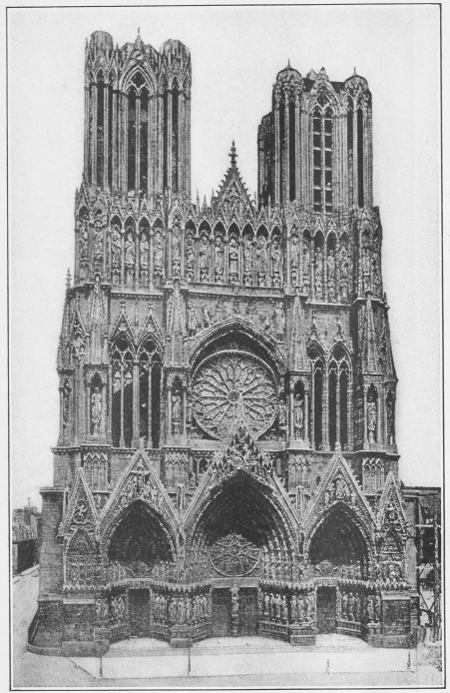
Three years ago its vast bulk and massive towers rose grandly above its
surrounding buildings in all the pride of lasting permanency. For seven
hundred years these stones had cried aloud to the glory of God and the
supreme genius of its French builders and decorators. France—that
treasure-house of architectural masterpieces—had no more noble building
than this, so dear to the French people by reason of the supremacy of
its art and as the coronation church of their kings, and once the emblem
and the expression of their nationality.
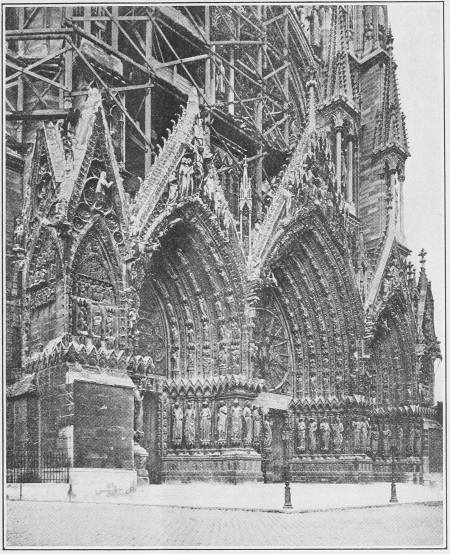
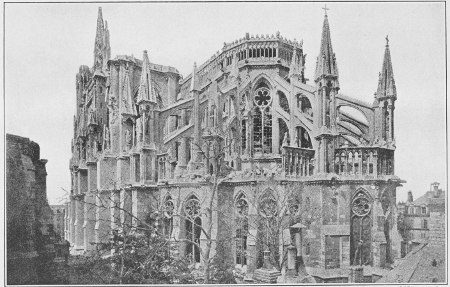
In its present dismantled, battered, more than half-ruined state, the
cathedral of Reims is of all the unnecessary sacrifices in the War the
most unnecessary. It has been too great and too good a thing to
disappear from the world without leaving an empty place that cannot be
filled. Once, in far back September, 1914, the merciless barbarian
encamped before its holy portals. There he stayed for nine days, and,
leaving in haste, presently bombarded it, so that his own wounded,
temporarily placed within it for safety, were burned alive under the
protecting flag of the Red Cross. A pitiable comment on his regard for
great churches and the well-being of the wounded.
Since then—September 12, 1914, to be exact—no good news has come out
of Reims. Yet of this we may be certain: devoted as the French are to
their great national church, they will gladly sacrifice it utterly if
that sacrifice be required to thrust out the barbaric invading hordes
that know only hate of the good, the true, the beautiful.
The catastrophe of Reims supplies a very sure index as to what passes as
the quality of the German mind. Although of all churches the most
French, the cathedral of Reims belongs to the whole world, a rare,
beautiful and precious structure, hallowed with great memories and
endowed with exquisite art. The question is thus very simple: is the
world better with the cathedral of Reims or without it? The Germans
seem unquestionably to have decreed its destruction. Of this the record
of the bombardment offers ample proof. But as yet the
cathedral-destroyers have offered no word, no hint, no suggestion, as to
how or why the world will be bettered by the wilful destruction of this
matchless church.
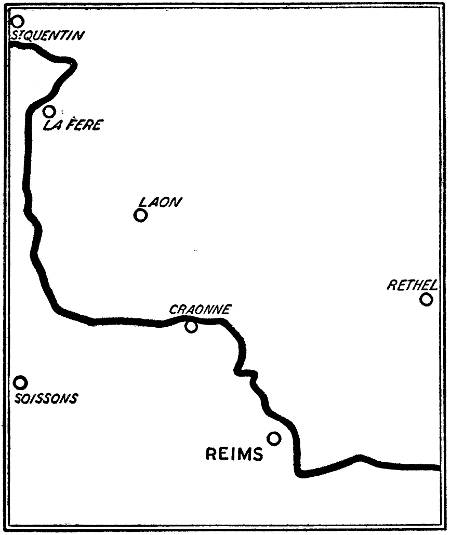
THE FRONT AT REIMS IN MAY, 1917