A
MMUNITION—For
small arms, in the British service, is generally packed in half
barrels, each containing 1000 musquet, or 1500 carbine cartridges. An
ammunition waggon will carry 20 of these barrels, and an ammunition
cart 12 of them: their weight nearly 1 cwt. each.
The cartouch boxes of the infantry are made of so many different
shapes and sizes, that it is impossible to say exactly what ammunition
they will contain; but most of them can carry 60 rounds. See the word
Cartridges; and for Artillery
Ammunition, see the word Artillery,
for the field, for the siege, and the defence of a fortified place.
The French pack all their ammunition in wagons without either boxes or
barrels, by means of partitions of wood. Their 12 Pr. and 8 Pr. waggons
will contain each 14,000 musquet cartridges, but their 4 Pr. waggons
will contain only 12,000 each.
AMMUZETTE—See
the word Guns.
APRONS—of lead for guns—
| |
lbs. |
oz. |
|
| Large—1 foot long— |
10 inches wide |
8 |
4 |
weight. |
| Small—6 inches ” — |
4½ ” ” |
1 |
12 |
” |
ARMS—Small
| Nature. |
Length of
Barrel. |
Diam. of
Bore. |
Balls weight for |
| Proof. |
Service. |
| |
Ft. |
In. |
Inches. |
oz. |
dr. |
gr. |
oz. |
dr. |
gr. |
| Wall pieces |
4 | 6 |
.98 | 2 |
8 | 8 |
2 | 5 |
7 |
| Musquet |
3 | 6 |
.76 | 1 |
6 | 11½ |
1 | 1 |
12 |
| Carbine |
3 | 0 |
.61 | 0 |
14 | 13 |
0 | 12 |
11 |
| Pistol, common |
1 | 2 |
.58 | 0 |
8 | 15 |
0 | 7 |
4½ |
| ” carbine |
1 | 0 |
.66 | 0 |
14 | 13 |
0 | 12 |
11 |
ARTILLERY.—The
proportion of artillery and ammunition necessary to accompany an army
in the field, to lay siege to a fortified place, or to defend one, must
depend upon so many circumstances, that it is almost impossible, in a
small work of this kind, to lay down any satisfactory rules as guides
on the subject: the following principles are, however, drawn from the
best authorities:
1st. Artillery for the Field.
Field Artillery is divided into Battalion Guns, Artillery
of the Park, and Horse Artillery.
The Battalion Guns include all the light
pieces attached to regiments of the line, which they accompany in all
manœuvres, to cover and support them.
The following natures of field ordnance are attached to battalions of
infantry, by different powers in Europe:
| French |
two |
4 |
Prs. |
per |
battalion. |
| English |
two |
6 |
” |
” |
” |
| Danes |
two |
3 |
” |
” |
” |
| Austrians |
three |
6 |
” |
” |
” |
| Prussians |
two |
6 |
Prs. to a battalion in the first line. |
| ” |
two |
3 |
Prs. to a battalion in the second line. |
| Hanoverians |
two |
3 |
Prs. per battalion. |
The Artillery of the Park is composed of all natures of field
ordnance. It is destined to form batteries of position; that is to say,
to occupy advantageous situations, from which the greatest effect may
be produced, in supporting the general movements of an army, without
following it, like the battalion guns, through all the detail of its
manœuvres. The park of artillery attached to an army in the field
generally consists of twice as many pieces of different natures, varied
according to the country in which it is to act, as there are battalions
in the army. Gribauvale proposes the following proportion between the
different natures of artillery for the park or reserve, viz. ⅖ of 12
Prs. ⅖ of 8 Prs. and ⅗ of 4 Prs. or reserve for battalion guns. In a
difficult country he says, it may be ¼ of 12 Prs. ½ of 8 Prs. and ¼ of
4 Prs. and for every 100 pieces of cannon he allots 4 Howitzers; but
this proportion of Howitzers is much smaller than what is generally given.
Horse Artillery.—The French horse artillery consists
of 8 Prs. and 6 inch Howitzers.
The English of light 12 Prs. light 6 Prs. and light 5½ inch Howitzers.
The Austrian and Prussian horse artillery have 6 Prs. and 5½ inch Howitzers.
Ammunition for Field Artillery.
A proportion of Ammunition and Stores for each Nature of Field Ordnance,
viz. 1 Med. 12 Pr.[1]—1
heavy 6 Pr.—2 light 6 Prs. as they are always attached to Battalions
of Infantry—and one 5½inch Howitzer; according to the British Service.
A = 12 Pounders, Medium.
B = 6 Pounders, Heavy.
C = 2 Light 6 Pounders,
D = 5½ Inch Howitzers.
Proportion of Ammunition
and Stores. |
A |
B |
C |
D |
| Shot fixed to wood bottoms— |
case |
24 |
30 |
68 |
24 |
| ””
” ”” |
round |
120 |
120 |
188 |
— |
| Shells |
fixed |
— |
— |
— |
24 |
| ” |
empty |
— |
— |
— |
120 |
| Carcasses |
fixed |
— |
— |
— |
4 |
Cartridges of
flannel filled
with powder. |
 |
4 lb. |
120 |
— |
— |
— |
| 3½ ” |
24 |
— |
— |
— |
| 2¼ ” |
— |
120 |
— |
— |
| 2 ” |
— |
30 |
— |
— |
| 1½ ” |
— |
— |
188 |
— |
| 1¼ ” |
— |
— |
68 |
— |
| 10 oz. |
— |
— |
125 |
— |
| 1 lb. |
— |
— |
— |
144 |
| 12 oz. |
— |
— |
— |
28 |
| Cartridges, flannel, empty |
12 |
12 |
100 |
12 |
| Do. of paper for burst’g 10 oz |
— |
— |
— |
120 |
| Tubes of tin—N. P. |
172 |
178 |
560 |
190 |
| Portfires—long small |
18 |
18 |
62 |
18 |
| Fuzes—drove |
— |
— |
— |
132 |
| Powder, mealed lbs. |
— |
— |
—
|
½ |
| Travelling carriages & limbers |
1 |
1 |
2 |
1 |
| Aprons of lead |
1 |
1 |
2 |
1 |
| Spunges, with staves and heads |
2 |
2 |
4 |
2 |
| Wad hooks, with staves |
1 |
1 |
2 |
— |
| Handspikes—traversing |
2 |
2 |
4 |
2 |
| Tampions, with collars |
1 |
1 |
2 |
1 |
| Trucks—Hanoverian |
— |
1 |
2 |
1 |
| Straps for lashing side arms |
— |
3 |
8 |
— |
| Tarpaulins—gun |
1 |
1 |
2 |
1 |
| ”limber |
— |
1 |
2 |
1 |
| Linstocks, with cocks |
1 |
1 |
2 |
1 |
| Drag ropes, with pins—Prs. |
2 |
2 |
4 |
2 |
| Padlocks, with keys |
2 |
3 |
5 |
4 |
| Match—slow—lbs. |
28 |
28 |
56 |
28 |
| Spikes |
 |
Spring |
1 |
1 |
2 |
1 |
| Common |
2 |
2 |
4 |
2 |
| Punches for vents |
2 |
2 |
4 |
2 |
| Barrels budge |
1 |
1 |
1 |
1 |
| Couples for chain traces |
— |
6 |
12 |
6 |
| Spare heads—spunge |
1 |
1 |
2 |
1 |
| ”” —rammer |
1 |
1 |
2 |
1 |
| Hammers, claw |
1 |
1 |
2 |
1 |
| Priming irons—sets |
1 |
1 |
2 |
1 |
| Draught chains—pairs |
2 |
1 |
3 |
2 |
| Powder horns—N. P. |
— |
1 |
— |
— |
| Water buckets—French |
1 |
1 |
2 |
1 |
| Entrench’g tools—axes, felling |
1 |
1 |
2 |
1 |
| ”
”” pick |
1 |
1 |
2 |
1 |
| ”
” handbills |
1 |
1 |
2 |
1 |
| ”
” spades |
2 |
2 |
4 |
2 |
| Marline, tarred—skeins |
1 |
1 |
1 |
1 |
| Twine,” —do. |
— |
1 |
— |
— |
| Hambro’ line —do. |
1 |
1 |
1 |
1
|
| Packthread —lbs. |
— |
1 |
— |
— |
| Grease |
firkins |
1 |
1 |
1 |
1 |
| ” |
boxes |
3 |
2 |
3 |
3 |
| Tallow |
lbs. |
1 |
1 |
2 |
1 |
| Lanthorns, dark |
1 |
1 |
1 |
1 |
| Jacks, lifting |
1 |
1 |
1 |
1 |
| ”handscrew |
1 |
— |
— |
— |
Waggons with hoops and painted covers,
Flanders pattern |
2 |
1 |
1 |
2 |
| Wad miltilts |
2 |
1 |
1 |
2 |
| Tanned hides |
2 |
1 |
1 |
2 |
| Men’s harness 12 to a set sets |
1 |
1 |
— |
— |
Horse
Harness |
|
|
|
|
|
|
New
pattern |
Rope (6 do.) sets |
1 |
— |
— |
— |
| Chain (6 do.) sets |
— |
1 |
— |
— |
| Trace (4 do.) sets |
2 |
1 |
1 |
1 |
Common
pattern |
Thill |
— |
— |
2 |
— |
| Trace |
— |
— |
4 |
— |
| Bit halters |
— |
— |
6 |
— |
| Wanties |
2 |
1 |
3 |
2 |
| Hemp halters |
14 |
10 |
10 |
12 |
| Whips, long |
— |
— |
2 |
— |
| ” , short |
7 |
5 |
2 |
6 |
| Nose bags |
14 |
10 |
10 |
12 |
| Corn sacks |
3 |
2 |
3 |
3 |
| Forage cords, sets |
3 |
2 |
3 |
3 |
| Rope, tarred—2 inch, fathoms |
— |
— |
10 |
— |
| For waggons |
 |
Linch pins |
2 |
1 |
1 |
2 |
| Clouts—body |
4 |
2 |
2 |
4 |
| ” —linch |
4 |
2 |
2 |
4 |
| Clout nails, 6d. |
64 |
32 |
32 |
64 |
| Spare ladle staves |
1 |
1 |
1 |
1 |
| Horses, for guns |
6 |
6 |
6 |
4
|
| ” , for waggons |
8 |
4 |
4 |
8 |
| Drivers, for guns |
3 |
3 |
2 |
2 |
| ” , for waggons |
4 |
2 |
1 |
4 |
| Tube boxes, with straps |
2 |
2 |
4 |
2 |
| Portfire sticks |
2 |
2 |
4 |
2 |
| Cutting knives |
1 |
1 |
2 |
1 |
| Drawing do. |
— |
— |
— |
1 |
| Scissars, pairs |
1 |
1 |
2 |
1 |
| Worsted, ounces |
½ |
½ |
1 |
½ |
| Needles, large |
2 |
2 |
4 |
2 |
| Cartouches of leather |
2 |
2 |
4 |
2 |
Copper measures
for powder. |
|
4 oz. |
1 |
1 |
2 |
— |
| 2 ” |
— |
1 |
— |
— |
| 1 ” |
1 |
1 |
2 |
— |
| 4 lbs. to ¼ oz. sets |
— |
— |
— |
1 |
| Thumb stalls |
2 |
2 |
4 |
2 |
| Perpendicular |
— |
— |
— |
1 |
| Quadrant of brass |
— |
— |
— |
1 |
| Diagonal scale |
— |
— |
— |
1 |
| Copper salting box |
— |
— |
— |
1 |
| Pincers for draw’g fuzes, pairs |
— |
— |
— |
1 |
| Sheepskins |
— |
— |
— |
2 |
| Funnels of copper |
— |
— |
— |
1 |
| Compasses of steel, pairs |
— |
— |
— |
1 |
| Saw, tenant |
— |
— |
— |
1 |
| Files, square |
— |
— |
— |
3 |
| Rasps, half round |
— |
— |
— |
2 |
| Flax, oz. |
— |
— |
— |
8 |
| Tow, oz. |
— |
— |
— |
4 |
| Saw set |
— |
— |
— |
1 |
| Mallets of wood |
— |
— |
— |
1 |
| Setters do. |
— |
— |
— |
2
|
This proportion of ammunition and stores is carried
in the following manner:
12 Pr.
Medium, |
 |
Has no limber boxes,[2]
but has two waggons attached to it, |
| and the ammunition and stores divided between them. |
| |
6 Pr.
Heavy, |
|
Carries 36 round, and 14 case shot in limber boxes, with a proportion |
| of the small stores; and the remainder is carried in one waggon. |
| |
6 Pr.
Light, |
|
Carries 34 round, and 16 case shot on the limber, with a proportion |
| of the small stores for immediate service; and, if acting separately, |
| of the small stores for immediate service; and, if acting separately, |
| must have a waggon attached to it, to carry the remainder. But two 6 |
| pounders, attached to a battalion, have only one waggon between them. |
| |
5½ How’r
Light, |
|
Has 22 shells, 4 case shot, and two carcasses in the limber boxes, with |
| such of the small stores as are required for immediate service; and has |
| two waggons attached to carry the rest. |
One common pattern ammunition waggon carries the following
numbers of rounds of ammunition of each nature:
| Nature. |
No. of
Rounds |
| 12 Prs. Medium. |
72 |
| 6 Prs. Heavy. |
120 |
| 6 Prs. Light. |
156 |
| 3 Prs. |
288 |
| 5½ How’r. |
72 |
| 8 How’r. |
24 |
| Musquet. |
20000[3] |
The waggons, however, attached to the different
parks of artillery in England, which have not been altered from the old
establishment, are loaded with only the following number, and drawn by
three horses:
| Nature. |
No. of
Rounds |
| 12 Prs. Medium. |
66 |
| 6 Prs. Heavy. |
120 |
| 6 Prs. Light. |
138 |
| 5½ How’r. |
60 |
The horse artillery having waggons of a particular description, carry
their ammunition as follows:
| |
Shot. |
Shells. |
Carcasses. |
Total No. with
each Piece. |
| Round. |
Case. |
| 12 Prs. light, on the limber |
12 |
4 |
4 |
— |
92 |
| Do. ” ” in one waggon |
52 |
10 |
10 |
— |
| 6 Prs. light, on the limber |
32 |
8 |
— |
— |
150 |
| Do. in one waggon |
97 |
13 |
— |
— |
| 5½ In. How’r on the limber |
— |
5 |
13 |
— |
73 |
| Do. in one waggon |
— |
10 |
41 |
4 |
| 3 Prs. heavy, curricle |
6 |
6 |
— |
— |
136 |
| Do.ammunition cart |
100 |
24 |
— |
— |
The following Proportion of Artillery, Ammunition, and Carriages,
necessary for four French Armies of different Degrees of Strength,
and acting in very different Countries, is attributed to
Gribauvale, and is extracted from
Durtubie, on Artillery.
| ARMIES. |
Flanders. |
Moselle. |
Rhine. |
Italy. |
| Number of battalions |
80 |
28 |
32 |
48 |
| Battalion guns |
160 |
56 |
64 |
94 |
Park or
Reserve |
|
12 Prs. |
32 |
12 |
12 |
16 |
| 8 Prs. |
72 |
24 |
32 |
48 |
| 4 Prs. |
40 |
16 |
16 |
24 |
| 6 Inch Howitzers |
8 |
4 |
4 |
8 |
| Total pieces of ordnance |
312 |
112 |
128 |
192 |
Carriage for
the ordnance
including
spare ones |
|
12 Prs. |
36 |
14 |
14 |
18 |
| 8 Prs. |
81 |
27 |
36 |
54 |
| 4 Prs. |
215 |
78 |
90 |
129 |
| 6 Inch Howitzers |
9 |
5 |
5 |
9 |
| Total ordnance carriages |
341 |
124 |
145 |
210 |
Ammunition
waggons |
|
12 Prs. |
96 |
36 |
36 |
48 |
| 8 Prs. |
144 |
48 |
64 |
96 |
| 4 Prs. |
200 |
72 |
80 |
120 |
| 6 Inch Howitzers |
24 |
12 |
8 |
24 |
| Waggons for musq. cartridges |
120 |
42 |
48 |
72 |
| Large Waggons for the park |
10 |
6 |
5 |
8 |
| Total ammunition waggons |
594 |
216 |
241 |
368
|
| Smiths forges |
Large |
14 |
3 |
3 |
8 |
| Small |
— |
3 |
3 |
4 |
| Total forges |
14 |
6 |
6 |
12 |
Waggons
for |
Intrenching
tools for |
Artillery |
27 |
10 |
12 |
16 |
| The army |
20 |
10 |
12 |
16 |
Carriages
for |
New Iron |
6 |
3 |
3 |
6 |
| Wood for spr. carri’gs |
9 |
3 |
3 |
7 |
Anchors, &c.
for pontoons |
4 |
2 |
2 |
4 |
| Total store carriages |
66 |
28 |
32 |
49 |
| Pontoons upon their carriages |
36 |
18 |
18 |
36 |
| Spare pontoon carriages |
4 |
2 |
2 |
4 |
| Total pontoon carriages |
40 |
20 |
20 |
40 |
RECAPITULATION.
|
|
|
|
|
| Ordnance——pieces |
312 |
112 |
128 |
192 |
| Carriages |
 |
Ammunition |
594 |
216 |
241 |
368 |
| Ordnance carriages |
141 |
124 |
145 |
210 |
| Store |
66 |
28 |
32 |
49 |
| Pontoon |
40 |
20 |
20 |
40 |
| Forges |
14 |
6 |
6 |
12 |
| General total of carriages |
1055 |
394 |
144 |
679 |
This table contains, beside the proportion of ordnance with each army,
also the quantity of ammunition with each piece of ordnance, and the
number of rounds of musquet ammunition carried for the infantry; for
each waggon in the French Service, having its particular allotment of
ammunition and stores, it needs but to know the number of waggons of
each description, to ascertain the quantity of ammunition and stores
with an army. The following is the number of waggons usually attached
to each piece of field ordnance in the French Service, and the quantity
of ammunition carried with each.
Nature of Ordnance and
Number of waggons
attached to each. |
Shot. |
Total with
each piece. |
| Round. |
Case. |
| 12 Pr. on the carriage |
9 |
— |
213 |
| 3 Waggons—each containing |
48 |
20 |
| 8 Pr. on the carriage |
9 |
— |
193 |
| 2 Waggons—each containing |
62 |
30 |
| 4 Pr. on the carriage |
18 |
— |
168 |
| One waggon—containing |
100 |
50 |
| 6 Inch howitzer—on the carriage |
— |
4 |
160 |
| 3 Waggons—each containing |
shell |
3 |
| 49 |
The French horse artillery waggon, called the wurst, carries 57
rounds for 8 pounders; or 30 for 6 inch howitzers.
The following is a proportion of ammunition for one piece of field
artillery of each nature, by different powers in Europe.
| Nature. |
Austrians |
Prussians |
Danes. |
Hanoverians. |
| Case. |
Round. |
Case. |
Round. |
Case. |
Round. |
Case. |
Round. |
| 3 Pr. |
40 |
184 |
20 |
90 |
58 |
177 |
50 |
150 |
| 6 ” |
36 |
176 |
30 |
150 |
53 |
166 |
48 |
144 |
| 12 ” |
44 |
94 |
20 |
130 |
44 |
128 |
50 |
150 |
| Howitzer |
16 |
90 |
20 |
60 |
25 |
76 |
30 |
120 |
Of the Movements and
Positions of Field Artillery.
Battalion Guns.—The following are the usual
positions taken by battalion guns, in the most essential manœuvres of the
battalion to which they are attached; but the established regulations
for the movements of the infantry in the British Service, take so
little notice of the relative situations for the artillery attached
to it, that there is no authority for a guide on the subject. In
review, both guns are to be placed, when, in line, on the right of
the regiment; unlimbered and prepared for action. The guns 10 yards
apart, and the left gun 10 yards from the right of the grenadiers. Nos.
7 and 8 dress in line with the front rank of the regiment. The officer,
at open order, will be in front of the interval between his guns, and
in line with the officers of the regiment. When the regiment breaks
into column, the guns will be limbered up and wheel by pairs to the
left: the men form the line of march, and the officer marches round in
front of the guns. In the review of a single battalion, it is usual
after marching round the second time, for one of the guns to go to the
rear, and fall in at the rear of the column. Upon the regiment wheeling
on the left into line, the guns, if separated, will be unlimbered to
the right, but if they are both upon the right, they must be wheeled
to the right, and then unlimbered; and afterwards run up by hand, as
thereby they do not interfere with the just formation of the line, by
obstructing the view of the pivots.
The usual method by which the guns take part in the firings while in
line, is by two discharges from each piece, previous to the firing of
the regiment; but this is usually regulated by the commanding officer,
before the review. Though the guns when in line with a regiment in
review, always remain in the intervals; in other situations of more
consequence, every favorable spot which presents itself, from which the
enemy can be more effectually annoyed, should be taken advantage of. In
column, if advancing, the guns must be in front; if retreating, in the
rear of the column. If in open column of more than one battalion, the
guns in the center must be between the divisions, and when the column
is closed, these guns must move to the outward flank of that division
of the column, which leads the regiment to which they are attached. In
changing front, or in forming the line from column, should the guns be
on that flank of the battalion on which the new line is to be formed,
they will commence firing to cover the formation.
In retiring by alternate wings or divisions, the guns must be always
with that body nearest the enemy. That is, they will not retire with
the first half, but will remain in their position till the second half
retires; and will then only retire to the flanks of the first half; and
when it retires again, the guns will retire likewise, but only as far
as the second half, and so on.
When in hollow square, the guns will be placed at the weakest angles,
and the limbers in the center of the square. In passing a bridge or
defile in front, the guns will be the first to pass; unless from any
particular position they can more effectually enfilade the
defilé; and thereby better open the passage for the infantry.
But in retiring through a defilé, the guns will remain to the
last, to cover the retreat.
General Rule.—With very few variations, the guns
should attend in all the movements of the battalion, that division of
it, to which they are particularly attached; and every attention should
be paid in thus adapting the movements of the guns to those of the
regiment, that they be not entangled with the divisions of the line,
and never so placed as to obstruct the view of the pivots, and thereby
the just formation of the line; but should always seek those positions,
from which the enemy can be most annoyed, and the troops to which they
are attached, protected.
If at any time the battalion guns of several regiments should be united
and formed into brigades, their movements will then be the same as
those for the artillery of the park.
Artillery of the Park.
The artillery of the park is generally divided into brigades of 4 or 6
pieces, and a reserve, according to the force and extent of the front
of an army. The reserve must be composed of about ⅙ of the park, and
must be placed behind the first line. If the front of the army be
extensive, the reserve must be divided.
The following are the principal rules for the movements and positions
of the brigades of artillery: they are mostly translated from the
Aide Memoire, a new military work.
In a defensive position, the guns of the largest caliber must be
posted in those points, from whence the enemy can be discovered at the
greatest distance, and from which may be seen the whole extent of his
front.
In an offensive position, the weakest points of the line must
be strengthened by the largest calibers; and the most distant from
the enemy: those heights on which the army in advancing may rest its
flanks, must be secured by them, and from which the enemy may be fired
upon obliquely.
The guns should be placed as much as possible under cover; this is
easily done upon heights, by keeping them so far back that the muzzles
are only to be seen over them: by proper attention many situations may
be found of which advantage may be taken for this purpose, such as
banks, ditches, &c. every where to be met with.
A BATTERY in the field should never be discovered by the enemy till the
very moment it is to open. The guns may be masked by being a little
retired; or by being covered by troops, particularly cavalry.
To enable the commanding officer of artillery to choose the proper
positions for his field batteries, he should of course be made
acquainted, with the effect intended to be produced; with the troops
that are to be supported; and with the points that are to be attacked;
that he may place his
artillery so as to support, but not incommode the infantry; nor take up
such situations with his guns, as would be more advantageously occupied
by the line. That he may not place his batteries too soon, nor too
much exposed; that he may cover his front and his flanks, by taking
advantage of the ground; and that he may not venture too far out of
the protection of the troops, unless some very decided effect is to be
obtained thereby.
The guns must be so placed as to produce a cross fire upon the position
of the enemy, and upon all the ground which he must pass over in an attack.
They must be separated into many small batteries, to divide the fire of
the enemy; while the fire from all these batteries, may at any time be
united to produce a decided effect against any particular points.
These points are the débouchés of the enemy, the heads of their
columns, and the weakest points in the front. In an attack of the
enemy’s position, the cross fire of the guns must become direct,
before it can impede the advance of the troops; and must annoy the
enemy’s positions nearest to the point attacked, when it is no longer
safe to continue the fire upon that point itself.
The shot from artillery should always take an enemy in the direction of
its greatest dimension; it should therefore take a line obliquely or in
flank, but a column in front.
The artillery should never be placed in such a situation, that it can
be taken by an enemy’s battery obliquely, or in flank, or in the rear;
unless a position under these circumstances, offers every prospect of
producing a most decided effect, before the guns can be destroyed or
placed hors de combat.
The most elevated positions are not the best for artillery, the
greatest effects may be produced from a height of 30 or 40 yards at the
distance of about 600 and about 16 yards of height to 200 of distance.
Positions in the rear of the line are bad for artillery, because they
alarm the troops, and offer a double object to the fire of the enemy.
Positions which are not likely to be shifted; but from whence an effect
may be produced during the whole of an action, are to be preferred; and
in such positions a low breast work of 2 or 3 feet high may be thrown
up, to cover the carriages.
Artillery should never fire against artillery, unless the enemy’s
troops are covered, and his artillery exposed; or unless your troops
suffer more from the fire of his guns, than his troops do from yours.
Never abandon your guns till the last extremity. The last discharges
are the most destructive; they may perhaps be your salvation, and crown
you with glory.
The parks of artillery in Great Britain are composed of the following
ordnance; 4 medium 12 pounders; 4 desaguliers 6 pounders; and 4 light
5½ inch howitzers.
The following is the proposed line
of march for the three Brigades when acting with different Columns of
Troops, as settled, in 1798.
| 12 Pounders. |
6 Pounders. |
Howitzers. |
| 4 Guns. |
4 Guns. |
4 Howitzers. |
| 8 Ammunition Waggons. |
4 Ammunition Waggons. |
8 Ammunition Waggons. |
| 1 Forge Cart. |
1 Forge Cart. |
1 Forge Cart. |
| 1 Store Waggon, |
1 Store Waggon. |
1 Store Waggon. |
| with a small proportion of |
|
|
| stores and spare articles. |
|
|
| 1 Spare Waggon. |
1 Spare Waggon. |
1 Spare Waggon. |
| 1 Waggon to carry bread |
1 Waggon for bread |
1 Waggon with bread |
| and oats. |
and oats. |
and oats. |
| 2 Waggons with musquet |
2 Waggons with musquet |
2 Waggons with musquet |
| ball cartridges. |
ball cartridges. |
ball cartridges. |
| 18 Total |
14 Total |
18 Total |
2d. Artillery and Ammunition for a Siege.
Necessary considerations in forming an estimate for this service.
The force, situation, and condition of the place to be besieged;
whether it be susceptible of more than one attack; whether lines of
circumvallation or countervallation will be necessary; whether it
be situated upon a height, upon a rocky soil, upon good ground, or
in a marsh; whether divided by a river, or in the neighborhood of
one; whether the river will admit of forming inundations; its size
and depth; whether the place be near a wood, and whether that wood
can supply stuff for fascines, gabions, &c.; whether it be situated
near any other place where a depot can be formed to supply stores for
the siege. Each of these circumstances will make a very considerable
difference in proportioning the stores, &c. for a siege. More artillery
will be required for a place susceptible of two attacks, than for the
place which only admits of one. For this last there must be fewer
pieces of ordnance, but more ammunition for each piece. In case of
lines being necessary, a great quantity of intrenching tools will be
required, and a numerous field train of artillery. In case of being
master of any garrison in the neighborhood of the besieged town, from
whence supplies can readily be drawn, this must be regarded as a second
park: and too great a quantity of stores need not be brought at once
before the besieged place. The number of batteries to be opened before
the place must determine the number of pieces of ordnance; and on the
quantity of ordnance must depend the proportion of every species of
stores for the service of the artillery.
There must be a battery to enfilade every face of the work
to be besieged, that can in any way annoy the besiegers in their
approaches. These batteries, at least that part of them to be allotted
for guns, need not be much longer than the breadth of the rampart to
be enfiladed, and will not therefore hold more than 5 or 6 heavy guns;
which, with two more to enfilade the opposite branch of the covert
way, will give the number of guns for each ricochet battery. As the
breaching batteries, from their situation, effectually mask the fire of
the first or ricochet batteries, the same artillery generally serves
for both. Having thus ascertained the number of heavy guns, the rest of
the ordnance will bear the following proportion to them:
- Mortars.—From 8 inch to 13 inch, about ⅓.
- Small Mortars.—About ¼.
- Heavy Howitzers.—About ⅛.
The fewer natures of ordnance which compose the demand the better, as a
great deal of the confusion may be prevented, which arises from various
natures of ammunition and stores being brought together.
The Carriages for the Ordnance are generally as follows:
- For 24 Prs. ⅚ the number of guns.
- For Mortars, ⁸/₉ the number of mortars.
- For Howitzers, ¾ the number of howitzers.
- For Stone Mortars, ⁶/₇ the number of mortars.
Ammunition for the Ordnance.
- 24 Prs.——At 1000 rounds per gun.
- Mortars, howitzers, and stone mortars,
- at 800 rounds per piece of ordnance.
- Durtubie.
The following proportion of artillery and
ammunition was demanded by a very able officer, for the intended
siege of Lisle, in 1794, which place was thought susceptible of two
attacks.
- 64—24 Prs. with carriages complete, at 50 round shot per gun,
- per day, for the whole siege; half of them en ricochet,
- with 2lbs. of powder; the other half with the full charge
- of 8lbs.
- Case and Grape shot, at one round per gun, per day,
- of each: 6lbs. per charge.
- Shells for guns, two rounds do.
- Flannel cartridges, for the case, grape, and shells.
- Tin tubes for the case and grape.
- Quill tubes for the round shot.
- Spare, ⅒.
- 28—10 Inch mortars, on iron beds, at 50 shells each per day,
- for the whole siege. 3lbs. of powder charge—2lbs. 10 oz.
- for bursting.
- Pound shot—100 to a charge; 50 rounds per mortar each
- day for 10 mortars 7 days; 2 lbs. of powder each.
- Hand grenades—25 to a charge; the same as the pound shot.
- Carcasses, round—1 per mortar, per day.
- 8— 8 Inch howitzers, on travelling carriages
- 30 Shells for each per day, during the siege.
- Case shot—5 rounds per day each.
- Carcasses—1 per day each.
- Powder—1 lb. per charge; 1 lb. 14 oz. for bursting.
- 20—5½ Inch mortars, on wooden beds.
- 50 Shells for each, per day, for the whole siege;
- charge 8 oz.—12 oz. for bursting.
- Flannel cartridges, for ⅓ the number of rounds.
- Tin tubes in the same proportion.
- Portfires, ½ the number of rounds with tubes.
- Fuzes, ⅒ to spare.
- Match, 50 cwt.
- Spare carriages for 24 Prs. seven.
- 2 Devil carriages.
- 6 Sling carts.
- 6 Block carriages.
- 3 Forge carts.
- 3 Store waggons, with iron and coals.
- 3 Triangle gins, complete.
- 6 Laboratory tents.
- 2 Small petards.
- 4 Grates for heating shot.
Of the Arrangement of Artillery at a Siege.
The first arrangement of the artillery at a siege is to the different
batteries raised near the first parallel, to enfilade the faces of the
work on the front attacked, which fire on the approaches. If these
first batteries be favorably situated, the artillery may be continued
in them nearly the whole of the siege; and will save the erection of
any other gun batteries, till the besiegers arrive on the crest of
the glacis. It however frequently happens, from local circumstances,
that the besiegers cannot avail themselves of the most advantageous
situations for the first batteries. There are four situations from
which the defences of any face may be destroyed; but not from all
with equal facility. The best position for the first batteries, is
perpendicular to the prolongation of the face of the work to be
enfiladed. If this position cannot be attained, the next that presents
itself is, on that side of the prolongation which takes the face in
reverse; and under as small an angle as possible. From both these
positions the guns must fire en ricochet. But if the ground, or
other circumstance, will not admit of either of these being occupied
by ricochet batteries, the battery to destroy the fire of a face must
be without the prolongation, so as to fire obliquely upon the outside
of the face. The last position, in point of advantage, is directly
parallel to the face. From these two last positions the guns must fire
with the full charges.
The second, or breaching batteries at a siege, are generally placed
on the crest of the glacis, within 15 or 18 feet of the covert way;
which space serves as the epaulment: but if the foot of the revetment
cannot be seen from this situation, they must be placed in the covert
way, within 15 feet of the counterscarpe of the ditch. These batteries
must be sunk as low as the soles of the embrazures, and are in fact but
an enlargement of the sap, run for the lodgement on the glacis or in
the covert way. In constructing a battery on the crest of the glacis,
attention must be paid that none of the embrazures open upon the
traverses of the covert way. These batteries should consist of at least
four guns; and if the breadth between the traverses will not admit of
this number, at the usual distances, the guns must be closed to 15 or
12 feet from each other.
The mortars are generally at first arranged in battery, adjoining
the first gun batteries, or upon the prolongation of the capitals of
the works; in which place they are certainly least exposed. Upon the
establishment of the half parallels, batteries of howitzers may be
formed in their extremities, to enfilade the branches of the covert
way; and upon the formation of the third parallel, batteries of
howitzers and stone mortars may be formed to enfilade the flanks of the
bastions, and annoy the besieged in the covert way. In the lodgement on
the glacis, stone and other mortars may also be placed, to drive the
besieged from their defences. A great object in the establishment of
all these batteries, is to make such an arrangement of them, that they
mask the fire of each other as little as possible; and particularly
of the first, or ricochet batteries. This may very well be prevented
till the establishment on the crest of the glacis, when it becomes in
some degree unavoidable: however, even the operations on the glacis
may be so arranged, that the ricochet batteries be not masked till the
breaching batteries be in a great state of forwardness: a very secure
method, and which prevents the soldiers in trenches being alarmed by
the shot passing over their heads, is to raise a Parados, or
parapet, in the rear of the trenches, at such parts where the fire
from the besieger’s batteries crosses them. For further details on
this subject, and for the manner of constructing batteries, see the
word Battery; also the words
Ricochet, Breach,
Magazine, Platform, &c.
3d. Artillery and Ammunition
for the
Defence of Fortified Place.
It is usual in an Estimate of Artillery and Ammunition for the
Defence of Fortified Places, to divide them into Eight Classes, as
follows:
| CLASSES. |
1 | 2 |
3 | 4 |
5 | 6 |
7 | 8 |
| Garrisons |
12000 | 10000 |
8000 | 5000 |
3500 | 2500 |
1600 | 400 |
| Cannon |
100 | 90 |
80 | 70 |
60 | 50 |
40 | 30 |
| Triangle Gins |
4 | 3 |
2 | 2 |
2 | 1 |
1 | 1 |
| Sling Carts |
4 | 3 |
2 | 2 |
2 | 1 |
1 | 1 |
| Jacks of Sizes |
4 | 3 |
2 | 2 |
2 | 1 |
1 | 1 |
| Truck Carriages |
6 | 6 |
4 | 4 |
2 | 2 |
2 | 2 |
| Ammunition Carts, &c. |
12 | 12 |
12 | 6 |
6 | 6 |
2 | 2 |
| Tools for Pioneers |
9000 | 6000 |
5000 | 4000 |
3500 | 3000 |
1000 | 1000 |
| ” ” Miners |
300 | 200 |
100 | 100 |
100 | 100 |
50 | 5 |
| Tools for ⅓ Axes |
1200 |
900 |
600 |
500 |
450 |
300 |
150 |
150 |
| Cutting ⅔ Billhooks |
| Forges, complete |
6 |
4 |
2 |
2 |
2 |
2 |
1 |
1 |
The guns will be of the following calibers: ⅓ of 18 Prs.—⅓ of 12
Prs.—and ⅓ of 24, 9, and 4 Pounders in equal proportions. If the place
does not possess any very extraordinary means of defence, it will be
very respectably supplied with 800 rounds of ammunition per gun for the
two larger calibers, and 900 for each of the others.
Gun Carriages—⅓ more than the number of guns.
Mortars—About ¼ the number of guns in the three first classes;
and ⅕ or ⅙ in the other classes. Of these ⅖ will be 13 or 10 inch
mortars, and the rest of a smaller nature.
Howitzers—¼ the number of mortars.
Stone Mortars—⅒ the number of guns.
Shells—400 for each of the 10 and 13 inch mortars, and 600 for
each of the smaller ones.
Beds for mortars—⅓ to spare.
Carriages for howitzers—⅓ to spare.
Hand Grenades—4 or 5000 for the two first classes; 2000 in the
three following classes; and from 1500 to 600 in the three last classes.
Rampart Grenades—2000 for the first class; 1000 for the four
following classes; and 500 for the sixth class; none for the two last.
Fuzes—¼ more than the number of shells.
Bottoms of wood for stone mortars—400 per mortar.
Sand Bags—500 for every piece of ordnance in the large places,
and ¼ less in the small ones.
Handspikes—10 per piece.
Tackle Falls for gins—1 for every 10 pieces to spare.
Musquets—1 per soldier, and the same number to spare.
Pistols, pairs—½ the number of musquets.
Flints—50 per musquet, and 10 per pistol.
Lead or Balls for small arms—30 pounds per musquet.
Powder for Small Arms—5 pounds for every musquet in the
garrison, including the spare ones.
The above proportions are taken from Durtubie’s Manuel De l’Artilleur.
The following method of regulating the management
of the artillery, and estimating the probable expenditure of ammunition
in the defence of a fortified place, is extracted from a valuable
work on fortification lately published at Berlin. It is particularly
applied to a regular hexagon; the siege is divided into three periods,
viz.
1st. From the first investiture to the first opening of the trenches,
about 5 days.
2d. From the opening of the trenches to the effecting a lodgement on
the glacis, about 18 days.
3d. From this time to the capitulation, about 5 days.
First Period. Three guns on the barbette of each bastion and on
the barbettes of the ravelins in front of the gateways, half 24 Prs.
and half 18 Prs.[4]
three 9 Prs. on the barbette of each of the other ravelins.
Twelve 12 Prs. and twelve 4 Prs. in reserve.
One 13 inch mortar in each bastion.
Six of 8 inch in the salient angles of the covert way.
Do. in reserve.
Ten stone mortars.
The 12 Prs. in reserve, are to be ranged behind the curtain, on
whichever side they may be required, and the 4 Prs. in the outworks;
all to fire en ricochet over the parapet. By this arrangement,
the whole of the barbette guns are ready to act in any direction, till
the side of attack is determined on; and with the addition of the
reserve, 49 pieces may be opened upon the enemy the very first night
they begin to work upon the trenches.
The day succeeding the night on which the trenches are opened, and the
side to be attacked determined, a new arrangement of the artillery
must take place. All the 24 and 18 Prs. must be removed to the front
attacked, and the other bastions, if required, supplied with 12 Prs.
The barbettes of the bastions on this front may have each 5 guns, and
the 12 18 prs. may be ranged behind the curtain. The six mortars in
reserve must be placed, two in each of the salient angles of the
covert way of this front, and with those already there, mounted as
howitzers,[5]
to fire down the prolongations of the capitals. Three
4 pounders in each of the salient places of arms of the ravelins on
the attacked fronts, to fire over the palisading, and five 9 Prs.
in the ravelin of this front. This arrangement will bring 47 guns,
and 18 mortars to fire on the approaches after the first night; and
with a few variations will be the disposition of the artillery for
the second period of the siege. As soon as the enemy’s batteries are
fairly established, it will be no longer safe to continue the guns
en barbette, but embrazures[6]
must be opened for them; which, embrazures must be occasionally
masked, and the guns assume new directions, as the enemy’s fire grows
destructive; but may again be taken advantage of, as circumstances
offer. As the enemy gets near the third parallel, the artillery must be
withdrawn from the covert way to the ravelins, or to the ditch, if dry,
or other favorable situations; and, by degrees, as the enemy advances,
to the body of the place. During this period of the siege, the
embrazures must be prepared in the flanks, in the curtain which joins
them, and in the faces of the bastions which flank the ditch of the
front ravelins. These embrazures must be all ready to open, and the
heavy artillery mounted in them, the moment the enemy attempts a
lodgement on the glacis.
Every effort should be made to take advantage of this favorable moment,
when the enemy, by their own works, must mask their former batteries,
and before they are able to open their new ones.
The expenditure of ammunition
will be nearly as follows:
First period of the siege—5 rounds per
gun, per day, with only half the full charge, or ⅙ the weight of the
shot, and for only such guns as can act.
Second period—20 rounds per gun, per day,
with ⅙ the weight of the shot.
Third period—60 rounds per gun, per day,
with the full charge, or ⅓ the weight of the shot.
Mortars—At 20 shells per day, from the
first opening of the trenches to the capitulation.
Stone Mortars—80 rounds per mortar, for
every 24 hours, from the establishment of the demi parallels to the
capitulation; about 13 days.
Light, and Fire balls—Five every
night, for each mortar, from the opening of the trenches to the eighth
day, and three from that time to the end
These amount to about
700 for guns.
400 for mortars.
1000 for stone do.
This proportion and arrangement is however made upon a supposition,
that the place has no countermines to retard the progress of the
besiegers, to a period beyond what is abovementioned; but the same
author estimates, that a similar place, with the covert way properly
countermined beforehand, and those countermines properly disputed,
may retard a siege at least 2 months; and that if the other works be
likewise effectually countermined and defended, the siege may be still
prolonged another month.
The above proportion is therefore to be further regulated, as the
strength of the place is increased by these or any other means. These
considerations should likewise be attended to, in the formation of an
estimate of ammunition and stores for the siege of a fortified place.
See Carriage, Platform,
Park, and the different natures of
artillery, as Gun, Mortar,
Howitzer, &c.
The small arms ammunition is estimated by this author as follows:
¼ of a pound of gunpowder, or 10 rounds per day,
per man, for all the ordinary guards.
1¼ lbs. or 50 rounds per man, per 12 hours, for
all extraordinary guards.
⅝ of a pound, or 25 rounds for every man on
picket, during the period of his duty.
AXLETREES—See
the word Carriages.
B
alls—of
lead, of different natures.
| Nature. |
Number to
one pound. |
Diameter
in inches. |
Number made from
one ton of Lead. |
| Wall pieces |
6¾ |
.89 |
14,760 |
| Musquets |
14½ |
.68 |
32,480 |
| Carbine |
20 |
.60 |
44,800 |
| Pistol |
34 |
.51 |
78,048 |
| 7 Barrel guns |
46½ |
.46 |
104,160 |
Lead balls are packed in boxes containing each 1 cwt. About 4 pounds of
lead in the cwt. are generally lost in casting. See Shot.
BARRELS for
powder—Their dimensions.
| |
Whole
Barrels. |
Half
Barrels. |
Quarter
Barrels. |
| Ft. |
In. |
Ft. |
In. |
Ft. |
In. |
| Depth |
1 |
9.61 |
1 |
5.13 |
1 |
2.25 |
| Diameter at top |
1 |
3.61 |
1 |
0.37 |
|
9.35 |
| ” at bulge |
1 |
5.36 |
1 |
2. |
|
10.71 |
| ” at bottom |
1 |
3.51 |
1 |
0.31 |
|
9.41 |
The whole barrels are made to contain 100 pounds, and the half barrels
50 pounds of powder; but of late only 90 pounds have been put into the
barrels, and 45 into the half barrels; which, by leaving the powder
room to be shifted, preserves it the better.
Budge Barrels contain 38 lbs.
| Weight of barrel— |
copper hooped— |
10 lbs. |
| ”” |
hazle hooped— |
6 |
| Length of barrel |
|
10½ inches. |
| Diameter |
|
1 foot 1 inch. |
BASKETS.—Ballast,
½ bushel—weight, 5 lbs. Diameter, 1 foot 6 inches—length, 1 foot.
BATTERY.—Dimensions
of Batteries.
1. Gun Batteries.—Gun Batteries are usually 18 feet per gun.
Their principal dimensions are as follow:
- Ditch.—Breadth 12 feet.
- Depth 8
Note. These dimensions give for a battery
of two guns 3456 cubic feet of earth; and must be varied according to
the quantity required for the epaulment.
| Epaulment.— |
Breadth |
at bottom |
23 |
feet. |
| ” |
at top |
18 |
|
| Height |
within |
7 |
|
| ” |
without |
6 |
ft. 4 in. |
| Slope, |
interior |
²/₇ |
of height. |
| ” |
exterior |
½ |
of height.
|
Note. The above breadths at top and bottom
are for the worst soil; good earth will not require a base of more
than 20 feet wide, which will reduce the breadth at top to 15 feet;
an epaulment of these dimensions for two guns will require about 4200
cubic feet of earth, and deducting 300 cubic feet for each embrazure,
leaves 3600 required for the epaulment. In confined situations the
breadth of the epaulment may be only 12 feet.
| Embrazures.— |
Distance |
between their centers |
18 |
feet. |
| Openings, |
interior |
20 |
inches. |
| ” |
exterior |
9 |
feet. |
| Height of the sole above the platform |
32 |
inches. |
Note. Where the epaulment is made of a reduced breadth,
the openings of the embrazures are made with the usual breadth within,
but the exterior openings proportionally less. The embrazures are
sometimes only 12 feet asunder, or even less when the ground is very
confined. The superior slope of the epaulment need be very little,
where it is not to be defended by small arms. The slope of the sole of
the embrazures must depend upon the height of the object to be fired
at. The Berm is usually made 3 feet wide, and where the soil is
loose, this breadth is increased to 4 feet.
2. Howitzer Batteries.—The dimensions of howitzer batteries are
the same as those for guns, except that the interior openings of the
embrazures are 2 feet 6 inches, and the soles of the embrazures have a
slope inwards of about 10 degrees.
3. Mortar Batteries—Are also made of the same dimensions as
gun batteries, but an exact adherence to those dimensions is not so
necessary. They have no embrazures. The mortars are commonly placed 15
feet from each other, and about 12 feet from the epaulment.
Note. Though it has been generally customary to fix
mortars at 45°, and to place them at the distance of 12 feet from the epaulment,
yet many advantages would often arise from firing them at lower angles;
and which may be done by removing them to a greater distance from the
epaulment, but where they would be in equal security. If the mortars
were placed at the undermentioned distances from the epaulment, they
might be fired at the angles corresponding:
| At |
13 |
feet distance |
for firing at |
30 |
degrees. |
| 21 |
” |
” |
20 |
|
| 30 |
” |
” |
15 |
| 40 |
” |
” |
10 |
| over an epaulment of 8 feet high. |
A French author asserts, that all ricochet batteries, whether for
howitzers or guns, might be made after this principle, without the
inconvenience of embrazures; and the superior slope of the epaulment
being inwards instead of outwards, would greatly facilitate this mode
of firing.
If the situation will admit of the battery being sunk, even as low as
the soles of the embrazures, a great deal of labour may be saved. In
batteries without embrazures, this method may almost always be adopted;
and it becomes in some situations absolutely necessary in order to
obtain earth for the epaulment; for when a battery is to be formed on
the crest of the glacis, or on the edge of the counterscarpe of the
ditch, there can be no excavation but in the rear of the battery.
4. Batteries on a Coast—generally consist of only an
epaulment, without much attention being paid to the ditch: they are, however,
sometimes made with embrazures, like a common gun battery; but the guns
are more generally mounted on traversing platforms, and fire over the
epaulment. When this is the case, the guns can seldom be placed nearer
than 3½ fathoms from each other. The generality of military writers
prefer low situations for coast batteries; but M. Gribauvale lays down
some rules for the heights of coast batteries, which place them in such
security, as to enable them to produce their greatest effect. He says
the height of a battery of this kind, above the level of the sea, must
depend upon the distance of the principal objects it has to protect or
annoy. The shot from a battery to ricochet with effect, should strike
the water at an angle of about 4 or 5 degrees at the distance of 200
yards. Therefore the distance of the object must be the radius, and the
height of the battery the tangent to this angle of 4 or 5°; which will
be, at the above distance of 200 yards, about 14 yards. At this height,
he says, a battery may ricochet vessels in perfect security; for their
ricochet being only from a height of 4 or 5 yards, can have no effect
against the battery. The ground in front of a battery should be cut
in steps, the more effectually to destroy the ricochet of the enemy.
In case a ship can approach the battery so as to fire musquetry from
her tops, a few light pieces placed higher up on the bank, will soon
dislodge the men from that position, by a few discharges of case shot.
It is also easy to keep vessels at a distance by carcasses, or other
fire balls, which they are always in dread of.
Durtubie estimates, that a battery of 4 or 5 guns, well
posted, will be a match for a first rate man of war.
To estimate the Materials for a Battery.
Fascines of 9 feet long are the most convenient for forming a battery,
because they are easily carried, and they answer to most parts of the
battery without cutting. The embrazures are however better lined with
fascines of 18 feet. The following will be nearly the number required
for a fascine battery of two guns or howitzers:
90 fascines of 9 feet long.
20 fascines of 18 feet—for the embrazures.
This number will face the outside as well as the inside of the
epaulment, which if the earth be stiff, will not always be necessary;
at least not higher than the soles of the embrazures on the outside.
This will require five of 9 feet for each merlon less than the above.
A mortar battery will not require any long fascines for the lining
of the embrazures. The simplest method of ascertaining the number of
fascines for a mortar battery, or for any other plain breast work, is
to divide the length of work to be fascined in feet, by the length of
each fascine in feet, for the number required for one layer, which
being multiplied by the number of layers required, will of course give
the number of fascines for facing the whole surface. If a battery be
so exposed as to require a shoulder to cover it in flank, about 50
fascines of 9 feet each will be required for each shoulder.
| Each | fascine |
of | 18 |
feet | will |
require | 7 |
pickets. |
| ” | ” |
” | 9 |
feet | ” |
” | 4 |
” |
12 workmen of the line, and 8 of the artillery, are generally allotted
to each gun.
If to the above proportion of materials, &c. for a battery of two guns,
there be added for each additional gun, 30 fascines of 9 feet, and 10
of 18 feet, with 12 workmen, the quantity may easily be found for a
battery of any number of pieces.
The workmen are generally thus disposed; one half the men of the line
in the ditch at 3 feet asunder, who throw the earth upon the berm;
one fourth upon the berm at 6 feet asunder, to throw the earth upon
the epaulment, and the other quarter on the epaulment, to level the
earth, and beat it down. The artillery men carry on the fascine work,
and level the interior for the platforms. This number of workmen may
complete a battery in 36 hours, allowing 216 cubic feet tn be dug and
thrown up, by each man in the ditch in 24 hours.
Tools for the Construction
of a Battery.
Intrenching—1½ times the number of workmen
required; half to be pick axes, and half shovels or spades, according
to the soil.
Mallets—3 per gun.
Earth Rammers—3 per gun.
Crosscut Saws—1 to every two guns.
Handbills or Hatchets—2 per gun.
This estimate of tools and workmen, does not include what may be
required for making up the fascines, or preparing the other materials,
but supposes them ready prepared. For these articles,
see the words Fascine,
Gabion, Platform,
&c. and for the construction of field magazines for batteries,
see the word Magazine.
Note. The following estimate
of the quantity of earth which may be removed by a certain number
of workmen in a given time, may serve to give some idea of the time
required to raise any kind of works. 500 common wheel barrows will
contain 2 cubic toises of earth, and may be wheeled by one man, in
summer, to the distance of 20 yards up a ramp, and 30 on a horizontal
plain, in one day. In doing which he will pass over, going and
returning, about 4 leagues in the first case, and 6 in the last. Most
men, however, will not wheel more than 1¾ toise per day. Four men will
remove the same quantity to four times the distance.
In a soil easy to be dug, one man can fill the 500 barrows in a day;
but if the ground be hard, the number of fillers must be augmented, so
as to keep pace with the wheel barrow man.
BEDS for Mortars.
| Nature. |
Weight. |
Tonnage. |
Len. |
Bre. |
Ht. |
| |
cᵂᵗ. | qʳˢ. | lb. |
tⁿˢ. | cᵂᵗ. | qʳ |
ft. | in. |
ft. | in. |
ft. | in. |
| | Sea |
38 | 3 | 13 |
3 | 3 | 2 |
| |
| |
| |
| 13 | Land Wood |
21 | 2 | 7 |
1 | 6 | 0 |
7 | 0 |
2 | 6 |
2 | 3 |
| ” Iron |
50 | 0 | 0 |
2 | 10 | 0 |
6 | 3 |
3 | 1 |
1 | 6 |
| | Sea |
32 | 2 | 14 |
2 | 2 | 2 |
| |
| |
| |
| 10 | Land Wood |
10 | 0 | 20 |
0 | 4 | 2 |
6 | 6 |
1 | 8 |
1 | 10 |
| ” Iron |
23 | 0 | 0 |
1 | 3 | 0 |
4 | 8 |
2 | 4 |
1 | 1½ |
| | 5½ Wood |
1 | 0 | 22 |
0 | 2 | 0 |
2 | 9 |
1 | 4 |
0 | 10 |
| | 4⅖ Wood |
0 | 3 | 11 |
0 | 1 | 2 |
2 | 4½ |
1 | 2 |
0 | 9 |
Stool Beds for Guns. |
| | |
| | |
| | |
| |
Inch. |
In. |
| 42 | Pounders |
0 | 1 | 20 |
0 | 1 | 0 |
2 | 10 |
11 to 8¾ |
3¾ |
| 32 | ” |
0 | 1 | 14 |
0 | 1 | 0 |
2 | 10 |
10 | 5½ |
3¼ |
| 24 | ” |
0 | 1 | 14 |
0 | 1 | 0 |
2 | 9 |
10¼ | 6½ |
4 |
| 18 | ” |
0 | 1 | 12 |
0 | 1 | 0 |
2 | 8 |
9½ | 6½ |
3¾ |
| 12 | ” |
0 | 1 | 10 |
0 | 0 | 2⅔ |
2 | 8 |
10 | 6½ |
4 |
| 9 | ” |
0 | 1 | 4 |
0 | 0 | 2 |
2 | 7 |
9½ | 5½ |
3½ |
| 6 | ” |
0 | 1 | 0 |
0 | 0 | 1¾ |
2 | 6 |
9 | 4¾ |
3½ |
| 4 | ” |
0 | 1 | 0 |
0 | 0 | 1 |
2 | 6 |
8¼ | 5¼ |
3 |
BOXES
for Ammunition.—The dimensions of the common ammunition boxes vary
according to the ammunition they are made to contain, in order that it
may pack tight: this variation, however, is confined to a few inches,
and does not exceed the following numbers.
Table of general Dimensions of Ammunition Boxes.
| |
Exterior. |
Weight when
empty. |
| Length. |
Breadth. |
Depth. |
| |
feet |
inch. |
feet |
inch. |
feet |
inch. |
lbs. |
| From |
2 |
2 |
0 |
10 |
0 |
8½ |
20 |
| To |
2 |
9 |
1 |
6 |
1 |
6 |
30 |
Weight when filled, and Number contained in each.
| Nature of Ammunition. |
Weight of
Boxes when
filled with
Ammunition. |
No. of Rounds
contained in
each Box. |
| |
cᵂᵗ. |
qʳˢ. |
lb. |
No. |
| |
Shot fixed
with
powder |
12 Prs. |
Round |
1 |
1 |
10 |
8 |
| Case. |
0 |
3 |
15 |
6 |
| 6 Prs. |
Round |
1 |
2 |
7 |
12 |
| Case. |
1 |
0 |
15 |
12 |
| 3 Prs. |
Round |
0 |
2 |
25 |
16 |
| Case. |
0 |
2 |
23 |
14 |
| B |
Shot fixed
to wood
bottoms
without
powder. |
24 Prs. |
Round |
1 |
1 |
26 |
6 |
| o |
Case. |
2 |
0 |
0 |
6 |
| x |
12 Prs. |
Round |
1 |
2 |
20 |
12 |
| e |
Case. |
1 |
2 |
22 |
8 |
| s |
6 Prs. |
Round |
1 |
2 |
20 |
24 |
| |
Case. |
1 |
1 |
12 |
18 |
| f |
3 Prs. |
Round |
1 |
1 |
0 |
30 |
| o |
Case. |
1 |
1 |
0 |
30 |
| r |
How’r.
Case. |
8 |
1 |
1 |
2 |
3 |
| |
5½ |
1 |
2 |
12 |
10 |
| |
4⅖ |
1 |
2 |
22 |
20 |
| |
Shells. |
How’r.
Shells. |
8 f |
1 |
2 |
26 |
3 |
| 5½ i |
1 |
2 |
12 |
10 |
| 4⅖ x |
1 |
2 |
22 |
20 |
| |
|
e |
|
|
|
|
| d |
|
|
|
|
The common ammunition waggon will hold from 9 to 13 of these boxes in
one tier.
The tonnage of ammunition in boxes is equal to its weight: about 12
boxes make one ton.
BOMB Ketch.
The bomb ketches upon the old establishment carry one 13 inch and one
10 inch mortar; with eight 6 pounders, beside swivels, for their own
immediate defence. The modern bomb vessels carry two 10 inch mortars,
four 68 pounders, and six 18 pounders carronades; and the mortars may
be fired at as low an angle as 20 degrees; though these mortars are not
intended to be used at sea, but on very particular occasions; their
principal intention, at these low angles, being to cover the landing of
troops, and protect our coast and harbours. A bomb ketch is generally
from sixty to seventy feet long from stem to stern, and draws eight or
nine feet water. The tender is generally a brig, on board of which the
party of artillery remain, till their services are required on board
the bomb vessel.
Instructions for their Management and Security in Action.
1. A Dutch pump, filled with water, must be placed in each round top,
one upon the forecastle, one on the main deck, and one on the quarter
deck; and furnished with leather buckets, for a fresh supply of water.
2. The booms must be wetted by the pumps before the tarpaulins and
mortar hatches are taken off; and a wooden skreen, 5 feet square, is to
be hung under the booms, over each mortar, to receive the fire from the vents.
3. The embrazures being fixed and properly secured, the port must
be let down low enough to be covered by the sole of the embrazure.
Previous to its being let down, a spar must be lashed across it, to
which the tackles for raising it again must be fixed: this spar serves
to project the tackles clear of the explosion.
4. The mortars must not be fired through the embrazures at a lower
angle than 20 degrees, nor with a greater charge than 5 lbs. of powder.
5. Previous to firing, the doors of the bulkhead, under the quarter
deck, must be shut, to prevent the cabin being injured by the explosion.
6. The bed must be wedged in the circular curb, as soon as the mortar
is pointed, to prevent reaction; the first wedge being driven tight
before the rear ones are fixed, in order to give the full bearing on
the table, as well as the rear of the bed. The holes for dog bolts must
be corked up, to prevent the sparks falling into them.
7. When any shells are to be used on board the bomb, they must be fixed
on board the tender, and brought from thence, in boxes in her long boat;
and kept along side the bomb ship till wanted, carefully covered up.
8. In the old constructed bomb vessels it is necessary to hoist out the
booms; and raft them along side previous to firing; but in these new
ones, with embrazures, only the boats need be hoisted out; after which
the mortars may be prepared for action in 10 minutes.
Proportion of Ordnance
and Ammunition for a Bomb Ship, carrying two 10 Inch Mortars, to fire
at low Angles, and at 45 Degrees, Four 68 Prs. and Six 8 Prs. Carronades.
| NATURE. |
In the
Bomb
Ship. |
Tender. |
Total. |
| Mortars, sea service with Beds, &c. 10 inch |
2 |
— |
2 |
| Quoins for do.—2 for 45°—2 for 20° elevation, |
4 |
— |
4 |
| Capsquares, with keys, &c. spare |
2 |
— |
2 |
| Handspikes, large |
4 |
— |
4 |
| Spunges, with rammer heads |
4 |
— |
4 |
| Handscrews, small |
2 |
— |
2 |
| Handcrow levers—6 feet |
4 |
— |
4 |
| Handspikes, common |
6 |
— |
6 |
| Linstocks, with cocks |
4 |
— |
4 |
| Powder horns, new pattern |
4 |
— |
4 |
| Match |
cwts. |
1 |
— |
1 |
| Marline |
skeins |
— |
12 |
12 |
| Budge barrels, copper hooped |
1 |
1 |
2 |
| Lanthorns, Muscovy |
2 |
2 |
4 |
| ”dark |
2 |
2 |
4 |
| Carronades, 68 Prs. |
4 |
— |
4 |
| ” 18 Prs. |
6 |
— |
6 |
having sliding carriages, elevating screws,
spunges, rammers &c. complete. |
|
|
|
| Gun tackles, complete for |
4 |
— |
4 |
| traversing mortars, 12 Prs. |
| Wads, 68 Prs. |
270 |
270 |
540 |
| ” , 18 Prs. |
480 |
180 |
660 |
| Musquets |
Bright |
32 |
— |
32 |
| Black |
8 |
— |
8 |
| Pistols, pairs |
15 |
— |
15 |
| Swords |
40 |
— |
40 |
| Pole axes |
6 |
— |
6 |
| Pikes |
40 |
— |
40 |
| Musquetoons |
2 |
— |
2 |
| Flints, musquet |
900 |
— |
900 |
| ” pistol |
150 |
— |
150 |
| Ball Cartridges, musquet |
2000 |
— |
2000 |
| ”” pistol |
2000 |
— |
2000 |
| Shot, musquet, |
cwts. qrs. lbs. |
1.0.0 |
— |
1.0.0 |
| ”pistol, |
” ” ” |
0.1.1 |
— |
0.1.1 |
| Round Carcasses, fixed, |
10 inch |
48 |
152 |
200 |
| Empty Shells, |
10 inch |
48 |
352 |
400 |
| Iron Shot, |
1 lb. |
1000 |
4000 |
5000 |
| Fixed Shells, |
10 inch |
48 |
— |
48 |
| Case Shot, 68 Prs. |
Carronades |
20 |
20 |
40 |
| Empty Shells, 8 in. |
for Carronades |
52 |
100 |
152 |
| Shot, round, 68 Prs. |
50 |
50 |
100 |
| Carcasses, do. 68 Prs. |
96 |
104 |
200 |
| Shot, round, 18 Prs. |
300 |
— |
300
|
| Case Shot, 18 Prs. |
30 |
30 |
60 |
| Carcasses, do. fixed, 18 Prs. |
150 |
150 |
300 |
| Hand Shells, fixed, |
sea service |
— |
150 |
150 |
| Fuzes for do. spare |
— |
15 |
15 |
| Paper Covers for cart’ges, |
10 in. |
106 |
609 |
715 |
| ” ” ” ” , |
68 Pr. |
293 |
301 |
594 |
| ” ” ” ” , |
18 Pr |
258 |
198 |
726 |
| Flannel Cartridges, empty |
to hold 5lbs. |
106 |
— |
106 |
| for 10 in. mortars |
do. 10lbs |
— |
609 |
609 |
| Flannel Cartridges, empty |
to hold 5lbs. |
293 |
151 |
594 |
| for 68 Prs. carronades |
do. 4lbs |
— |
150 |
| Flannel Cartridges, empty |
528 |
148 |
726 |
| for 18 Prs. to hold 1½ lbs. |
| Paper Cartridges, for bursting, |
— |
352 |
352 |
| 10 inches, empty |
| Paper Cartridges, for bursting, 8 inches, empty |
— |
100 |
100 |
| Do. filled with 2lb. 10 oz. for 10 in. |
48 |
— |
48 |
| Do. filled with 1 ” 14 ” for 8 in. |
52 |
— |
52 |
| Fuzes, drove, |
10 inch |
57 |
388 |
445 |
| ” ” |
8 ” |
57 |
110 |
167 |
| Valencience composition |
|
|
|
| 200 for 10 in. shells, at 14 oz. each,
lbs. |
— |
175 |
175 |
| 768 for 10 in. shells, at 9 oz. each,
lbs. |
— |
42 |
42 |
| Tube Boxes, tin |
12 |
— |
12 |
| Fuze composition, for priming carcasses, lbs. |
— |
10 |
10 |
| Powder bags |
— |
6 |
6 |
| Portfires |
— |
200 |
200 |
| Quick Match, cotton,. |
lbs. |
— |
20 |
20 |
| Spirits of Wine, |
gals. |
— |
4 |
4 |
| Kitt |
lbs. |
— |
80 |
80 |
| Bottoms of wood, |
10 inch. |
10 |
40 |
50 |
| Signal Rockets, 1 lb. |
doz. |
— |
2 |
2 |
| Blue Lights, |
” |
— |
3 |
3 |
| Gunpowder for the mortars and |
72 |
150 |
222 |
| carronades, half barrels |
| Powder for priming, do. |
— |
1 |
1 |
| Powder for bursting, do. |
— |
28 |
28 |
| with all the small articles which usually |
|
|
|
| attend mortars on every service, and the |
| articles necessary for the service of |
| carronades at sea. |
| Laboratory Chests, |
4 feet |
— |
2 |
2 |
| ”” |
3 feet |
— |
2 |
2 |
| Handpumps for wetting the rigging, &c. |
6 |
— |
6 |
| Leather Buckets |
24 |
— |
24
|
BREACH.—The
batteries to make a breach, should commence by marking out as near
as possible, the extent of the breach intended to be made; first, by
a horizontal line within a fathom of the bottom of the revetement in
a dry ditch, and close to the water’s edge in a wet one; and then by
lines perpendicular to this line, at short distances from each other,
as high as the cordon; then, by continuing to deepen all these cuts,
the wall will give way in a body. The guns to produce the greatest
effect should be fired as near as possible in salvos or vollies.
The breach should be ⅓ the length of the face, from the center towards
the flanked angle. When the wall has given way, the firing must be
continued to make the slope of the breach practicable.
Four 24 Pounders from the lodgement in the covert way will effect a
breach in 4 or 5 days, which may be made practicable in 3 days more.
Another way of making a breach is by piercing the wall sufficiently to
admit two or three miners, who cross the ditch, and make their entry
during the night into the wall, where they establish two or three small
mines, sufficient to make a breach.—See Artillery
at a Siege; see also Battery.
BRIDGES.—Manner
of laying a Pontoon Bridge across a River.
The bank on each side, where the ends of the bridge are to be, must be
made solid and firm, by means of fascines, or otherwise. One end of the
cable must be carried across the river; and being fixed to a picket, or
any thing firm, must be drawn tight by means of a capstan, across where
the heads of the boats are to be ranged. The boats are then launched,
having on board each two men, and the necessary ropes, &c. and are
floated down the stream, under the cable, to which they are
lashed endwise, by the rings and small ropes, at equal distances, and
about their own breadth asunder; more or less, according to the
strength required. If the river be very rapid, a second cable must be
stretched across it, parallel to the first, and at the distance of the
length of the boats; and to which the other ends of the boats must be
lashed. The spring lines are then lashed diagonally from one boat to
the other, to brace them tight; and the anchors, if necessary, carried
out, up the stream, and fixed to the cable or sheer-line across the
river. One of the chesses is then laid on the edge of the bank, at each
end of the bridge, bottom up; these serve to lay the ends of the baulks
upon, and as a direction for placing them at the proper distances, to
fit the chesses that cover the bridge. The baulks should then be laid
across the boats, and keyed together: their numbers proportioned to
the strength required in the bridge. If the gangboards are laid across
the heads and sterns of the boats from one side of the river to the
other, they will give the men a footing for doing the rest of the work.
Across the baulks are laid the chesses, one after another, the edges to
meet; and the baulks running between the cross pieces on the under side
of the chesses. The gangboards are then laid across the ends of the
chesses on each edge of the bridge.
Precautions for passing a Bridge of Boats.
Whatever size the bridge may be, infantry should never be allowed to
pass at the same time with carriages or cavalry. The carriages should
always move at a certain distance behind each other, that the bridge
may not be shook, by being overloaded. The horses should not be allowed
to trot over the bridge; and the cavalry should dismount and lead their
horses over. Large flocks of cattle must not be allowed to cross at once.
For the dimensions, weight, and equipage of a pontoon, see the word
Pontoon.
When bridges are made to facilitate the communication between different
parts of the approaches at a siege, they should, if possible, be placed
above the town; or the besieged will take advantage of the current
to float down large trees, or other bodies, in order to destroy the
bridge. Two of such bridges should always be placed close to each
other, in order to prevent the confusion of crossing and recrossing on
the same bridge; the one being intended to pass over one way, and the
other to return. Pontoon bridges will generally not support a greater
weight than 4 or 5,000 pounds. Pontoons, when united as a bridge, will
no doubt bear more in proportion, than when acted upon separately: but
the weight which a pontoon will bear may be easily ascertained, by
loading it with water till it sinks to any required depth, and then by
calculating the number of cubic feet of water it contains, ascertain
the number of pounds required to sink it to that particular depth.
C
amp—With
some trifling variations, camps are formed after the same manner in all
countries. This principle seems general, that there should not be more
ground occupied by the camp of a body of men, in front, than the extent
of their line when drawn out in order of battle. Intervals are however
generally left between battalions of infantry of about one eighth their
front, and between squadrons of cavalry of thirty or forty paces. An
army is sometimes encamped in two lines, and sometimes in three; the
distance between the lines varies according to the face of the country,
from 200 to 600 yards, or more.
In the distribution of the front of a camp, two feet are generally
allowed for every file of infantry, and three feet for each file of
cavalry. When the ground will admit of it, the infantry are usually
arranged in rows perpendicular to the front; each row containing the
tents of one company; and the cavalry in the same position, each
perpendicular row containing the horses of a troop.
The grenadiers and light infantry are usually placed in single rows on
the flanks, and the battalion companies in double rows.
A single row, or one company, occupies in front, nine feet; and a
double row, or two companies, twenty one feet, if formed of the old
pattern rectangular tents, which hold only five men each. But if the
new bell tents are used, 15 feet must be allowed for a single row, and
30 feet for a double row in front.
In the cavalry, a row or troop occupies in front as follow:
| |
Old Tents. |
New Tents. |
| Tent |
3 |
yards. |
5 |
yards, |
| From the front pole of the |
3 |
|
3 |
|
| tent to picket rope |
| For the horse |
6 |
|
6 |
|
| For the dung |
2 |
|
2 |
|
| |
14 |
yards. |
16 |
yards. |
The breadth of a row in front, whether of infantry or cavalry, being
multiplied by the number of rows, and the product subtracted from the
whole extent of front for a battalion of infantry, or a squadron of
cavalry, will leave the space for the streets, which are generally
divided as follows:
| For the infantry, |
59½ |
feet each. |
| For the cavalry, |
30 |
feet each between the tents. |
| ” ” ” |
46 |
feet ” ”horses. |
The following is the Distribution of the Depth of a Camp of Infantry
or Cavalry, when the Ground permits.
| Distribution of the Depth of a Camp. |
Infantry. |
Cavalry. |
| |
Yards |
Yards |
| From the quarter-guard parade to the |
|
line of parade of battalion |
| line of parade of battalion |
62 |
|
| From this first line of parade to the |
|
|
| front of the - |
Serjeant’s tents |
16 |
|
| quarter master’s |
— |
24 |
| N. B. These tents open to the front. |
|
|
| To the first picket of horses |
— |
5 |
| Infantry: for every tent in depth |
|
|
| ” old pattern, 9 feet |
|
|
| ” new pattern, 15 feet |
|
|
| Cavalry: for every horse, 3 feet |
|
|
| The soldiers tents for the infantry open |
|
|
| to the streets. The cavalry tents front |
|
|
| to the horses heads. |
|
|
| Suppose infantry 12 tents deep |
o. pat. |
36 |
60 |
| ” cavalry, 60 horses |
| From the last tent of infantry, or the |
|
|
| last horse of the cavalry, to the front |
|
|
| of the subalterns’ tents |
15 |
12 |
| These tents open to the rear. |
|
|
| To the front of the line of captains |
15 |
15 |
| These open to the front. The captains, and |
|
|
| subalterns in the rear of their troops |
|
|
| or companies. |
|
|
| To the front of the field officers |
10 |
15 |
| Open to the front, opposite the outside |
|
|
| street of the battalion. |
|
|
| To the colonel’s |
10 |
10 |
| Opens to the front, opposite the main |
|
|
| street of the battalion. |
|
|
| To the staff officers |
|
14 |
| Open up the streets next the main street |
10 |
|
| To the first row of batmen’s tents |
10 |
|
| The batmen’s tents front their horses. |
|
|
| To the first row of pickets for bat horses |
2 |
15 |
| To the second row of ditto |
10 |
| To the second row of batmen |
2 |
| To the front of the grand sutler’s tent |
10 |
| The grand sutler is in the rear of the colonel. |
|
|
| To the center of the kitchens |
15 |
20 |
| The kitchens are 16 feet in diameter. |
|
|
| To the front of the petty sutlers |
15 |
15 |
| Directly in the rear of the kitchens: there are |
|
|
| allowed 6 yards in front by 8 deep. |
|
|
| To the rear guard |
15 |
15 |
| Opens to the rear. |
|
|
| Total depth required Yards |
253 |
220 |
If the ground on which the camp is to be formed will not, from a swamp
in the rear, or any other circumstance, admit of each troop or company
being formed in one row perpendicular to the front; the distribution of
the front of a battalion or squadron must be more contracted than the
above, and laid out as follows: Find how many perpendicular rows will
be required, by dividing the number of men in the battalion or squadron
by the number the ground will admit of in one row; then the number
of rows being multiplied by the breadth of one in front, will give
that part of the front to be occupied by the rows; and the difference
between it and the whole front allowed for the battalion or squadron,
will be left for the streets; which, if the streets are to be equal,
must be divided by their number, to find the breadth of each; or is
otherwise easily divided into streets of unequal breadths. When two
guns are attached to a battalion, they are posted on the right in the
following order: from the right of battalion to the center of the first
gun, four yards—from this to the second gun, 6 yards.—The muzzles of
the guns in a line with the serjeants’ tents.
The subaltern of artillery, if any, in a line with the subalterns of
infantry.—The rear of the gunner’s tents in a line with the rear of
the battalion tents.
For the proper positions for camps, see the word Reconnoitering;
and for the encampment of a park of artillery, see the word Park.
CARCASSES.—Composition.
| Saltpetre |
50 |
parts. |
| Sulphur |
25 |
| Antimony |
5 |
| Rosin |
8 |
| Pitch |
5 |
Valencienne’s composition, so called, from its having been used by the
Austrians at the siege of that place, has the effect of making shells
answer the purpose of carcasses after they burst:
| Saltpetre |
50 |
parts. |
| Sulphur |
28 |
| Antimony |
18 |
| Rosin, or Swedish pitch |
6 |
This composition is cast in copper cylindric moulds of 6 inches long,
and of different diameters according to the shell in which it is to be
used. It must be put in along with the bursting powder in pieces as large
as the shell will admit, without preventing the fuze being driven down.
CARCASSES.—Their
Dimensions and Weight, 1796.
| Nature. |
Weight. |
Time
each
will
burn. |
| Empty. |
Of
Composition. |
Complete. |
| Round, for |
lbs. | oz. | dr. |
lbs. | oz. | dr. |
lbs. | oz. | dr. |
Min. |
Mortars
and
How’rs. | 13 |
194 | 10 | 11 |
18 | 14 | — |
213 | 8 | 16 |
11 |
| 10 |
89 | 13 | 11 |
7 | 8 | 11 |
97 | 6 | 11 |
8½ |
| 8 |
44 | 9 | 5 |
4 | 4 | 11 |
48 | 14 | — |
5½ |
| For Guns | 42 |
27 | 3 | — |
2 | 7 | 11 |
29 | 10 | 11 |
5 |
| 32 |
20 | 13 | 5 |
1 | 14 | 5 |
22 | 11 | 11 |
4½ |
| 24 |
14 | 12 | — |
1 | 9 | 11 |
16 | 5 | 11 |
4 |
| 18 |
11 | 13 | 11 |
1 | 1 | 5 |
12 | 15 | — |
4 |
For
Carronades | 68 |
— | — | — |
— | — | — |
| | |
|
| 42 |
26 | — | — |
2 | 7 | — |
28 | 7 | — |
4½ |
| 32 |
21 | 10 | — |
1 | 13 | — |
23 | 7 | — |
4 |
| 24 |
14 | 5 | — |
2 | 5 | — |
16 | 10 | — |
3½ |
| 18 |
10 | 4 | — |
1 | 2 | — |
11 | 6 | — |
3 |
| Oblong, for |
| | |
| | |
| | |
|
Mortars
and
How’rs. | 10 |
36 | 7 | 5 |
35 | 10 | — |
72 | 1 | 5 |
12 |
| 8 |
16 | 5 | 5 |
18 | 2 | — |
34 | 7 | 5 |
10 |
| 5½ |
1 | 12 | 2 |
6 | 15 | — |
8 | 11 | 3 |
6 |
| 4⅖ |
1 | 0 | 6 |
3 | 11 | 7 |
4 | 11 | 13 |
4 |
Note. It being found at the siege of
Quebec, that the quantity of powder requisite for throwing the
carcasses into the town, always destroyed them, the method of filling
the interval between the powder and carcass with turf was adopted; and
found to preserve the carcass, and to produce every desired effect.
CARRONADES.—Their
Weight and Dimensions.
| Nature. |
Diameter
of Bores. |
Length in |
Weight. |
Proportion
betw’n the Shot
and Carronade. |
| Ft. |
In. |
Calib. |
cwt. |
qr. |
lb. |
| 68 |
Prs. |
8.05 |
5 |
2 |
7.702 |
36 |
— |
— |
59 to 1 |
| ” |
|
4 |
0 |
5.962 |
29 |
— |
— |
|
| 42 |
” |
6.84 |
4 |
3½ |
7.518 |
22 |
1 |
— |
58 to 1 |
| 32 |
” |
6.35 |
4 |
0½ |
7.679 |
17 |
— |
14 |
62 to 1 |
| 24 |
” |
5.68 |
3 |
7½ |
7.656 |
13 |
— |
— |
56 to 1 |
| 3 |
0 |
6.336 |
11 |
2 |
25 |
|
| 18 |
” |
5.16 |
3 |
3 |
7.587 |
9 |
— |
— |
56 to 1 |
| 2 |
4 |
5.447 |
8 |
1 |
25 |
|
| 12 |
” |
4.52 |
2 |
2 |
5.778 |
5 |
3 |
10 |
56 to 1 |
N. B. Carronades have not so much windage as guns.
See Windage.
Ranges with Carronades, 1798. The charge is ¹/₁₂
the weight of the shot and with one shot and one wad. The line of fire
from 6 to 9 feet above the level of the water.
| Nature. |
68 |
42 |
32 |
24 |
18 |
12 |
| Charge. |
5lb 8oz |
3lb 8oz |
2lb 10oz |
2lb |
1lb 8oz |
1lb 10oz |
| |
Yards |
|
|
|
|
|
| P. Blank |
450 |
400 |
330 |
300 |
270 |
230 |
| 1 Degree |
650 |
600 |
560 |
500 |
470 |
400 |
| 2 ” |
890 |
860 |
830 |
780 |
730 |
690 |
| 3 ” |
1000 |
980 |
900 |
870 |
800 |
740 |
| 4 ” |
1100 |
1020 |
970 |
920 |
870 |
810 |
| 5 ” |
1180 |
1170 |
1087 |
1050 |
1000 |
870 |
Note.—The highest charge for carronades is ⅛ the weight of
the shot; the lowest ¹/₁₆.
Ranges with 8 inch shells, from 68 Pr. carronades.
Shells
Weight |
Charge. |
Flight. |
Elevation. |
First
graze. |
Extreme
range. |
lbs. oz.
43 11 |
3 lbs |
1½ |
P. B. |
302 |
1365 |
| 3 ” |
— |
5 Deg. |
1140 |
|
| 4 ” |
1½ |
1 ” |
358 |
1843 |
| ” ” |
5 |
5 ” |
1137 |
1250 |
| ” ” |
” |
11½ ” |
1767 |
|
CARRIAGE.—Weight
of Field Carriages at present in use.
| Horse Artillery Carriages. |
cwts. |
qrs. |
lbs. |
cwts. |
qrs. |
lbs. |
| 12 Prs. gun and carriage complete for |
— |
— |
— |
45 |
0 |
14 |
| service, with two men, and their |
| their appointments on the limber, |
| and 16 rounds of ammunition. |
| Ammunition waggon for do.complete, |
— |
— |
— |
33 |
3 |
0 |
| with two men on the limber and |
| 1 spare wheel, 2 spare shafts, |
| 78 rounds of ammunition |
| 6 Prs. equipped as above, with 42 rounds |
— |
— |
— |
34 |
1 |
21 |
| Ammunition waggon as above, 108 rounds |
— |
— |
— |
39 |
0 |
21 |
| 5½ Inch howitzer, equipped as above, |
— |
— |
— |
35 |
3 |
0 |
| with 20 rounds |
| Ammunition waggon for do. as above, |
— |
— |
— |
39 |
2 |
0 |
| with 52 rounds |
| Forge waggon, complete for travelling |
— |
— |
— |
19 |
2 |
14 |
| Large tilted baggage waggon, empty |
— |
— |
— |
18 |
3 |
0
|
| Equipage to be carried |
— |
— |
— |
12 |
0 |
0 |
| 12 Prs. Med. gun, carriage, without boxes |
16 |
1 |
21 |
42 |
— |
7 |
| Limber to do. |
7 |
2 |
14 |
| Gun |
18 |
— |
— |
| 12 Pr. light gun |
12 |
— |
— |
36 |
2 |
21 |
| Carriage complete |
12 |
3 |
7 |
| Limber, with empty boxes |
12 |
3 |
14 |
| 6 Prs. Desaguliers |
12 |
— |
— |
34 |
1 |
13 |
| Carriage complete |
11 |
— |
14 |
| Limber, to do. empty boxes |
11 |
— |
27 |
| 6 Prs. light battalion gun |
6 |
— |
— |
24 |
1 |
21 |
| Carriage without boxes, iron axletrees |
9 |
2 |
— |
| Limber, with empty boxes |
8 |
3 |
21 |
| 5½ Inch howitzer, light |
4 |
3 |
7 |
24 |
— |
14 |
| Carriage, without boxes |
10 |
— |
7 |
| Limber, with empty boxes |
9 |
1 |
— |
| 24 Prs. platform travelling carriage |
22 |
3 |
— |
84 |
2 |
16 |
Standing carriage for do. iron trucks,
and tackles of the carriage |
13 |
3 |
16 |
| Iron gun |
48 |
— |
— |
Ball cartridge waggon, Duke of Richmond’s
pattern, with spare pole and swingle trees |
16 |
1 |
17 |
36 |
1 |
17 |
| Charge of musquet ammunition |
20 |
— |
— |
| Common pattern ammunition waggon, altered |
16 |
2 |
— |
36 |
2 |
— |
| Charge of ammunition |
20 |
— |
— |
| New infantry ammunition cart |
9 |
1 |
14 |
21 |
1 |
14 |
| Charge of ammunition |
12 |
— |
— |
| Common sling cart, complete |
— |
— |
— |
17 |
1 |
14 |
| Common truck carriage |
— |
— |
— |
12 |
2 |
21 |
| Common hand cart |
— |
— |
— |
4 |
1 |
— |
| Forge waggon, complete |
— |
— |
— |
13 |
2 |
14
|
Dimensions of certain parts of carriages, the knowledge of which
may prevent many mistakes in arranging the different pieces for
disembarkation, or in other similar situations.
Axletrees.—Most of the field carriages are now made with
iron axletrees; the dimensions of which are as follows:
Iron
Axletrees. |
Diameter of
the arm. |
Length of arm. |
At the
Shoulder. |
At the
Point. |
Box, or
Nave part. |
Washer
part. |
Total length
to linchpin. |
| |
Inch. |
Inch. |
Inch. |
Inch. |
Inch. |
| 6 Pr. Light |
|
|
|
|
|
| 3 Pr. Heavy |
| 5½ Inch Howitzer |
| Ammuni. Waggon |
| Ball cartridge do. |
2¾ |
1¾ |
13 |
⅝ |
13⅝ |
| whether horse |
|
|
|
|
|
| artillery or the |
| park, whether |
| limber or carriage |
| Light 12 Pounder |
3¼ |
2¼ |
16 |
¾ |
16¾ |
| and limber |
| Medium 12 Pr. |
3½ |
2½ |
16 |
¾ |
16¾ |
| Limber to do. |
2¾ |
2 |
13 |
⅝ |
13⅝ |
Wood
Axletrees. |
Carriage. |
Limber. |
| Di. of arm. |
Length
of
Nave. |
Di. of arm. |
Length
of
Nave. |
At
Shoulder. |
At
Point. |
At
Shoulder. |
At
Point. |
| |
Inch. |
Inch. |
Inch. |
Inch. |
Inch. |
Inch. |
| 24 Prs. Heavy |
7 |
4.9 |
18 |
6 |
3.3 |
16 |
| 12 Prs. Med. |
6 |
4 |
16 |
6 |
4 |
12 |
| 6 Prs. Des’rs. |
5½ |
3½ |
13½ |
5½ |
3½ |
13½ |
| 6 Prs. Light |
5 |
3 |
13 |
5 |
3 |
13 |
| 3 Prs. Des’rs. |
2½ |
1¼ |
|
2½ |
1¼ |
|
| 3 Prs. Light |
|
|
|
|
|
|
| Howitzer, 8 In. |
6½ |
|
17 |
5½ |
|
15 |
| ” , 5½ In. |
5½ |
|
13 |
4¼ |
|
11½ |
| ” , 4⅖ In. |
4½ |
|
12 |
4 |
|
10 |
| |
|
|
| |
Fore |
Hind |
| Ammunition |
5 |
2.9 |
14 |
5 |
2.9 |
13 |
| waggon, with |
| folding sides |
| Close bodied |
5 |
3.3 |
14 |
5 |
2.9 |
14 |
| ammunition waggon |
Diameter of the Wheels of the Field Carriages
at present in Use:
| |
|
Diameter. |
| All the horse artillery carriages, limbers, |
5 |
feet. |
| and waggons; the heavy 6 Prs. and long |
| 3 Prs. and their limbers; the carriage |
| of a 6 Pr. battalion gun, and a light |
| 5½ inch howitzer; the hind wheels of |
| a common ammunition waggon |
| Limber to light 6 Pr. and 5½ howitzer, |
4 ft. |
8 in.
|
| Med. 12 Pr.—limber, 4 ft. 6 in.—carriage, |
4 ft. |
8 in. |
| Sling cart |
5 ft. |
8 in. |
| Fore wheels of an ammunition waggon, |
4 |
feet. |
| Pontoon carriage |
Fore |
3 |
feet. |
| Hind |
5 ft. |
6 in. |
| 8 Inch Howitzer |
Limber |
4 |
feet. |
| Carriage |
5 |
feet. |
| Ball Ammunition Cart |
5 |
feet. |
| 24 Prs. Platform Carriage |
Fore |
4 |
feet. |
| Hind |
4 ft. |
2 in. |
Dimensions and Weight of Standing Gun Carriages.
| Nature. |
32 |
24 |
18 |
12 |
9 |
6 |
| |
Ft. | in. |
Ft. | in. |
Ft. | in. |
Ft. | in. |
Ft. | in. |
Ft. | in. |
| Axletrees, length |
4 | 9 |
4 | 7 |
4 | 3 |
3 | 9 |
3 | 6½ |
3 | 4 |
| Side pieces, length |
6 | 4 |
6 | 0 |
5 | 9 |
5 | 6 |
5 | 3 |
5 | 0 |
Whole heighth to
trunnion beds |
2 | 9 |
2 | 7 |
2 | 6 |
2 | 3 |
2 | 1 |
2 | 0 |
| Weight of carriage, |
ct. | qr. |
ct. | qr. |
ct. | qr. |
ct. | qr. |
ct. | qr. |
ct. | qr. |
| bed & coins |
9 | 0 |
8 | 0 |
7 | 0 |
6 | 0 |
3 | 3 |
2 | 3 |
Carriages on a march. See Marching.
For wood of which carriages are made, see the word Wood.
CARTRIDGES for guns.
| Of Paper. |
Weight
of one
Dozen. |
Length. |
Tonnage.
Nᵒ. packed in
¾ Ton Vat. |
| |
Pounders. |
lbs. |
oz. |
dr. |
Ft. |
In. |
Number. |
| 42 |
” |
3 |
0 |
0 |
2 |
4 |
1000 |
| 32 |
” |
3 |
0 |
0 |
2 |
4 |
1100 |
| 24 |
” |
3 |
0 |
0 |
2 |
4 |
1400 |
| 18 |
” |
2 |
14 |
0 |
2 |
4 |
1500 |
| 12 |
” |
2 |
4 |
0 |
2 |
4 |
1600 |
| 9 |
” |
2 |
4 |
0 |
2 |
4 |
1800 |
| 6 |
” |
1 |
5 |
0 |
2 |
0 |
2000 |
| 4 |
” |
1 |
1 |
0 |
1 |
7 |
2200 |
| 3 |
” |
1 |
1 |
0 |
1 |
7 |
2200 |
| |
Of Flannel. |
|
|
|
|
|
|
| 42 and 32 |
2 |
2 |
0 |
2 |
3 |
The tonnage |
| 24 |
Heavy |
1 |
12 |
0 |
1 |
10 |
of flannel |
| Medium |
1 |
6 |
0 |
1 |
5 |
cartridges is |
| Light |
1 |
1 |
8 |
1 |
0 |
⅕ more than |
| 18 |
—— |
1 |
6 |
0 |
2 |
3 |
that of paper. |
| 12 |
Heavy |
1 |
3 |
0 |
1 |
6 |
|
| Medium |
0 |
11 |
0 |
1 |
2 |
| Light |
0 |
8 |
0 |
0 |
10 |
| 9 |
—— |
0 |
10 |
0 |
1 |
4 |
| 6 |
Heavy |
0 |
14 |
0 |
1 |
1 |
| Medium |
—— |
—— |
| Light |
0 |
5 |
0 |
0 |
9½ |
| 3 |
—— |
0 |
6 |
0 |
0 |
8 |
| 13 |
Inch Mortar |
1 |
2 |
8 |
1 |
6 |
| 10 |
”” |
0 |
10 |
8 |
1 |
1½ |
| 8 |
”” |
0 |
7 |
0 |
1 |
0 |
| 5½ |
”” |
0 |
4 |
0 |
0 |
9 |
| 4⅖ |
”” |
0 |
3 |
0 |
0 |
7 |
| 8 |
In. Howitzer |
0 |
10 |
8 |
1 |
1½ |
| 5½ |
”” |
0 |
4 |
8 |
0 |
9½ |
| 4⅖ |
”” |
0 |
4 |
0 |
0 |
9½
|
Cartridges for small arms.
- (A) = Powder contained in each Cartridge.
- (B) = Nᵒ. of each tied in one Bundle.
| Nature. |
(A) |
(B) |
Nᵒ. contained
in one Barrel. |
Weight of one
Barrel filled |
1 Sheet
of Paper
makes |
| Whole. |
Half. |
Whole. |
Half. |
| |
drms |
Nᵒ. |
Nᵒ. |
Nᵒ. |
Ct. |
qr. |
lb. |
qr. |
lb. |
Nᵒ. |
| Wall pieces |
10 |
6 |
1400 |
500 |
2 | 2 | 19 |
3 | 24 |
6 |
| Musquet |
6 |
10 |
2100 |
1000 |
1 | 3 | 10 |
3 | 24 |
12 |
| Carbine |
4 |
10 |
2853 |
1500 |
1 | 3 | 7 |
3 | 26 |
16 |
| Do. pistol |
3 |
10 |
4400 |
1500 |
1 | 3 | 17 |
3 | 21 |
24 |
| Com. pistol |
3 |
10 |
|
2000 |
|
3 | 11 |
24 |
| 7 Bar. guns |
1½ |
14 |
|
1000 |
|
|
|
| |
|
|
|
in kegs |
|
|
|
Musquet Cartridges, by different powers in Europe.
| |
Weight of |
| Powder |
Cartridges,
complete |
| |
oz. |
dr. |
gr. |
oz. |
dr. |
gr. |
| English. |
0 |
6 |
0 |
1 |
9 |
11 |
| Hessian. |
0 |
7 |
10 |
1 |
7 |
2 |
| Austrian. |
0 |
6 |
13 |
1 |
6 |
4 |
| Dutch. |
0 |
10 |
10½ |
1 |
12 |
4 |
| French. |
0 |
7 |
4½ |
1 |
6 |
0
|
CASE SHOT.
See Shot.
CHAMBERS.—In
1787 and 1789 experiments were made at Woolwich with an 8 inch mortar, with
four shifting chambers, to ascertain which form gives the longest range.
The chambers were all of the same capacity, viz. 63.7 cubic inches, and
contained two pounds of powder. Their forms were:
1st. Common conical chamber with the circular bottom.
2d. The same reversed.
3d. The cylindric chamber with circular bottom.
4th. The spheric chamber.
The ranges were the medium of 6 rounds; from them it appears, that when
the spheric chamber is filled with powder, it has the advantage in
point of range; but when smaller charges are used, its ranges are found
to be shorter than those of other forms. The conical (No. 1.) chamber
of the present establishment gives the longest range under other circumstances.
CHARGES.
Charges for Field Guns.
| |
lbs. |
| 12 |
Prs. | Medium |
and | Heavy |
for | Round |
Shot | 4 |
| ” | ” |
” | ” |
” | ” |
Case | ” |
3½ |
| 12 |
Prs. | Light |
| |
” | Round |
” | 3 |
| ” |
” | ” |
| |
” | Case |
” | 3 |
| 6 |
Prs. |
Desaguliers |
| ” |
Round | ” |
2¼ |
| ” |
” | ” |
| ” |
Case | ” |
2 |
| 6 |
Prs. | Medium |
| |
” | Round |
” | 2 |
| ” |
” | ” |
| |
” | Case |
” | |
| 6 |
Prs. | Light |
| |
” | Round |
” | 1½ |
| ” |
” | ” |
| |
” | Case |
” | 1¼ |
| 3 |
Prs. | Heavy |
| |
” | Round |
” | 1 |
| ” |
” |
” |
|
|
” |
Case |
” |
|
| 3 |
Prs. |
Light |
|
|
” |
Round |
” |
12 oz. |
The charge for battering guns is ⅓ the weight of the round shot, for
round shot, and ¼ of it for case shot.
The charge for carronades is usually ¹/₁₂ the weight of the shot. The
highest is ⅛, and the lowest ¹/₁₆.
By the experiments made at Woolwich in March 1801,
it is recommended, that when cylinder powder is used on service, the
charges of field ordnance with round shot, shall be reduced to the
usual quantities for case shot. The same experiments recommend, that
the thickness or length of the wood bottom be varied, in order to
change the position of the shot, and thereby save the bore; and that
the paper cap which is usually thrown away on service, shall be put
over the shot before it is introduced into the piece.
For charges for small arms see the word Cartridges.
Charges of French Guns in French Weights.
| |
lbs. |
|
|
| 24 Prs. |
8 |
Siege |
|
| 16 Prs. |
5½ |
| 12 Prs. |
4 |
Field |
¼ less for
Case Shot. |
| 8 Prs. |
2½ |
| 4 Prs. |
1½ |
CHEVAUX DE FRIZE.—The
body or beam of a chevaux de frize is generally made 9
feet long, and 6 inches square, and weighs 41 lbs. The spears
are 33 in number, weighing 2 lb. each, are 5 feet long, and 1¼ inches
square. They are placed 9½ inches asunder.
COMPOSITION.—For
the composition of fuzes, portfires,
tubes, carcasses, see those words.
| Composition for Kitt. |
For Fire Balls, 1794. |
| |
lbs. |
|
lbs. |
oz. |
| Rosin |
9 |
Rosin |
5 |
8 |
| Pitch |
6 |
Sulphur |
3 |
0 |
| Beeswax |
6 |
Allum powder |
1 |
8 |
| Tallow |
1 |
Starch, ” |
0 |
8 |
| |
Saltpetre |
4 |
6 |
| |
Mealed powder |
8 |
0 |
| |
Linseed oil |
¼ pint. |
| |
Oil of spike |
1 pint. |
| Bengal Lights. |
First Composition. |
| |
lbs. |
oz. |
| Saltpetre |
7 |
0 |
| Sulphur |
1 |
12 |
| Red orpiment |
0 |
8 |
Second Composition. |
| |
lbs. |
oz. |
| Saltpetre |
2 |
4 |
| Sulphur |
0 |
8 |
| Antimony |
0 |
4 |
| Orpiment |
0 |
1½ |
Light Balls. |
| Nitre |
40 |
parts |
| Sulphur |
15 |
| Antimony |
3 |
| Pitch |
3 |
This composition to be carefully fused, and cast
into the shape of balls, which when cold will be sufficiently hard to
be fired from a small mortar.
Composition for Suffocating Pots. |
| Sulphur |
6 |
parts |
| Nitre |
5 |
|
This composition when intimately mixed, to be
rammed into wooden boxes, and primed in the usual way.
This composition will answer for fumigation.
Chinese or White Light. |
| Nitre from |
50 to 60 |
parts |
| Sulphur |
16 to 20 |
| Antimony |
5 |
| Orpiment |
8 to 10 |
For Smoke Balls. |
| |
lbs. |
| Corned powder |
10 |
| Saltpetre |
2 |
| Pitch |
4 |
| Seacoal |
3 |
| Tallow |
1 |
For Fire Hoops, Fire Arrows,
and Fire Lances.
| |
lbs. |
oz. |
| Mealed powder |
1 |
0 |
| Saltpetre |
3 |
0 |
| Flour of sulphur |
0 |
8 |
| Linseed oil |
½ pint. |
Composition to fill cases for
setting fire to Fascine Batteries.
| |
lbs. |
oz. |
| Mealed powder |
1 |
4 |
| Saltpetre |
6 |
0 |
| Sulphur |
1 |
8 |
All dry compositions must be well mixed; first by the hands, and then
passed several times through fine hair sieves, that the ingredients may
be thoroughly incorporated. In mixing compositions which require fire,
the greatest precautions are necessary; particularly in those where
gunpowder enters. The dry parts of the composition may in general be
mixed together first, and put by degrees into the cauldron, while the
other ingredients are fluid, being well stirred all the time of putting
in. When the dry ingredients are inflammable, the cauldron must not
only be taken off the fire, but the bottom must be dipt in water, to
prevent the possibility of accidents while mixing them.
R. Lab.
CONVOYS.—A
waggon with four horses occupies about sixteen paces; a mile will
therefore hold about 117 waggons: but allowing a short distance
between, each waggon in travelling, a mile may be said to contain 100
waggons. Waggons in convoy may travel from one to two miles per
hour, according to the roads and other circumstances. A great object in
convoys is to preserve the horses as much as possible from fatigue. For
this purpose, if the convoy amounts to many hundred waggons, they must
be divided into divisions of not more than 500 each. Should it consist
of thousands, it will be adviseable to divide them into grand
divisions, and then again into subdivisions of 500 each: by this means,
and the time of departure being calculated by the following rules, each
division may remain at rest, till just before its time of movement; and
which will prevent the necessity of the latter part of a large convoy
being harassed for a considerable time before its turn to move.
Rule 1. To
find the time in which any number of waggons may be driven off:
Divide the number of waggons by 100, and multiply by the time of
travelling one mile.
Rule 2. To
find the time in which any number of waggons will drive over any number
of miles: To the time they take in driving off, add the time any
one of the waggons takes to travel the distance.
The different divisions of the convoy should be numbered, and obliged
each day to change the order of their marching.
Whenever the progress of a train of waggons is arrested by the breaking
down of any one of them, or other delay, all the waggons in the rear of
the stoppage, should immediately drive up into the first open space, to
as great a number as the open space will hold; this keeps the convoy
together and better under the care of the escort.
The escort for a convoy should be divided into front, center, and rear
guards; beside the divisions for the flanks, which should never be
beyond musquet shot, or at most 400 yards from each other. The whole
escort, should never be so separated that they could not be collected
in an hour. Under proper precautions against an enemy, a convoy of any
size cannot travel more than five or seven miles per day.
Templehoft.
D
ispart.—The
dispart of a gun is the half difference between the diameter of the gun
at the base ring, and at the swell of the muzzle. The general dispart
of all guns is about the ¹/₅₆ part of their length. See the disparts of
French and English guns under the word Tangent Scale.
Fig. 1.
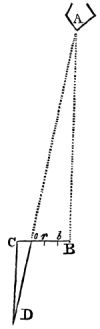
DISTANCES.—Inaccessible
distances may be found several ways; the most correct of which of
course is by means of proper mathematical instruments; which, however,
are not always to be had in the field.
The following different methods are laid down by several authors, where
instruments cannot be had.
I. Wishing to know the distance of the object A from B—(fig. 1.)
place a picket at B and another at C, at a few fathoms distance, making A
B C a right angle, and divide B C into 4, 5, or any number of equal
parts: make another similar angle at C, in a direction from the object,
and walk along the line C D till you bring yourself in a line with the
object A, and any of the divisions, (say o) of the line B C.
Then, as Co : CD :: Bo : BA.
Vauban.
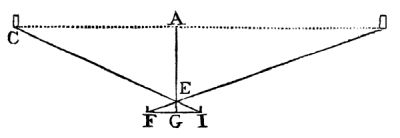
Fig. 2.
II. To gain the distance between two objects C and D (fig. 2)
from any point A, taken in the line C D, erect the perpendicular A E: on
which set off from A to E, 1 or 200 feet, more or less, according to
the distance between the points C and D; set off from E to G in the
prolongation A E, ⅛ or ⅒ of A E; at G raise the perpendicular G F, and
produce it towards I; plant pickets at E and G, then move with another
picket on G F till it becomes in a line with E and D; and on the
prolongation of the perpendicular F G place another picket at I in the
line with E and C; measure F I, and it will be as GE : AE :: FI : CD.
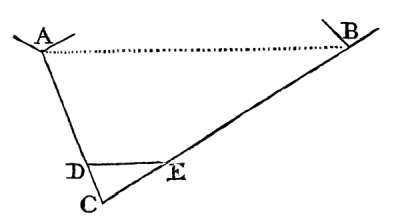
Fig. 3.
Landman’s
Practical Geometry on the Ground.
III. To gain the inaccessible length A B, (fig. 3.) of
the front of a fortification; plant a picket at C, from whence both points may
be seen: find the lengths C A and C B by the method just given (Nᵒ 1.)
make C E ¼, or any part of C B, and make C D bear the same proportion
to C A: measure D E, then it will be as CD : DE :: CA : AB.
Note. Nearly after the same manner may be ascertained
the distance from B to A when the point B is accessible; for having
measured the line C B, and made the angle C E D equal to C B A, it will
be, as CE : DE :: CB : BA.
IV. The distance of a battery, or other object, may be ascertained
by the tangent scale on the breach of a gun. It is however necessary
in this case to know the height of the object, the distance of which
is required. Lay the gun by the upper line of metal for the top of
the object, then raise the tangent scale till the top of the
scale and the notch at the muzzle are in a line with the bottom of the
object, and note what length of tangent scale is required: then say, as
the length of the scale above the base ring of the gun is to the length
from the base ring to the swell of the muzzle, so is the height of the
object to its distance from the muzzle of the gun.
Lombard’s Tables.
V. The breadth of a river, or other short distance, may be taken
thus:—take two pickets of different lengths, drive the shortest into
the ground close to the edge of the bank; measure some paces back
from it, and drive in the other till you find, by looking over the
tops of both, that your sight cuts the opposite side.—Then pull up
the first picket, measure the same distance from the second, in any
direction the most horizontal, and drive it as deep in the ground as
before.—Consequently, if you look over them again, and observe where
the line of sight falls, you will have the distance required.
Teilk.
VI. The following simple method of ascertaining the breadth of a river
may be sufficiently correct for some cases: Place yourself at the edge
of one bank, and lower one corner of your hat till you find the edge
of it cuts the other bank; then steady your head, by placing your hand
under your chin, and turn gently round to some level spot of ground,
and observe where your eyes and the edge of the hat again meet the ground;
your distance from that point will be nearly the breadth of the river.
Teilk.
VII. Distances ascertained by the difference between the true and
apparent level.
See Levelling.
VIII. Distances measured by sound.
See Sound.
IX. The following simple micrometer may be so usefully
applied to military purposes, that I shall extract it verbatim from the
Philosophical Transactions for 1791, where it is described by Cavallo.
This micrometer consists of a thin and narrow slip of mother of pearl,
finely divided, and placed in the focus of the eye glass of a
telescope, just where the image is formed.—It is immaterial whether
the telescope be a reflector, or a refractor, provided the eye glass be
a convex lens and not a concave one, as in the Galilean
construction.—The simplest way to fix it, is to stick it on the
diaphragm, which generally stands within the tube, and in the focus of
the eye glass.—When thus fixed, if you look through the eye glass, the
divisions on the scale will appear very distinct, unless the diaphragm
is not exactly in the focus; in which case the scale must be placed
exactly in the focus, by pushing the diaphragm, backwards or forwards,
when this is practicable; or else the scale may be easily removed
from one surface of the diaphragm to the other, by the interposition
of a circular bit of paper or card, or a piece of sealing wax.—This
construction is fully sufficient when the telescope is always to be
used by the same person; but when different persons are to use it, then
the diaphragm, which supports the micrometer, must be so constructed
as to be easily moved backwards or forwards, though that motion need
not be greater than about the tenth or eighth of an inch. This is
necessary, because the distance of the focus of the same lens appears
different to the eyes of different persons; and therefore whoever is
going to use the telescope for the mensuration of an angle, must first
unscrew the tube which contains the eye glass and micrometer, from the
rest of the telescope, and, looking through the eye glass, place the
micrometer where the divisions of it may appear most distinct to his
eye. The mother of pearl scale may be about the 24th part of an inch
broad; its length is determined by the aperture of the diaphragm; its
thickness that of writing paper. The divisions on it may be the 200th
of an inch, which may reach from one edge of the scale to about the
middle; and every fifth and tenth division may be a little longer, the
tenths going quite across. When the telescope does not magnify above 30
times, the divisions need not be so minute. For the sake of those
not conversant in trigonometry, the following is an easy method of
determining the value of the divisions on the scale. Mark upon a wall
or other place, the length of 6 inches; then place the telescope before
it so that the 6 inches be at right angles to it, and exactly 57 feet
3½ inches distant from the object glass of the telescope. This done,
look through the telescope, and observe how many divisions of the
micrometer are equal to it, and that same number of divisions will be
equal to half a degree, or 30´; and this is all that need be done to
ascertain the value of the scale. The reason on which it is founded is,
that an extension of six inches at the distance of 57 feet, 3½ inches,
subtends an angle of 30´, as is easily calculated by trigonometry. To
save the trouble of calculation, a scale may be made requiring only
inspection. Thus, draw a line equal to the diameter of the field of the
telescope, and divide its under side into the same number of parts as
are on your micrometric scale, and, by the above operation on the wall,
having determined the value of 30´, which we will suppose to correspond
with 16 divisions on the scale, mark 30´ on the opposite side of the
line, opposite 16 on the lower; 15 opposite 8, and so on.
By the following table the results may be ascertained by inspection
only: thus, suppose an extension of 1 foot is found by the table to
subtend an angle of 22′, the distance will be 156.2: and suppose at the
distance of 171.8 an object subtends an angle of 20′, its height will
be found to be 1 foot; or, suppose an object of 6 feet high to subtend
an angle of 20′, the distance is 1030.8, by multiplying 171.8 by 6.
Table of Angles subtended by 1 Foot,
at different Distances.
| Minutes. |
Distances
in feet. |
Minutes. |
Distances
in feet. |
| 1 |
3437.7 |
31 |
110.9 |
| 2 |
1718.9 |
32 |
107.4 |
| 3 |
1145.9 |
33 |
104.2 |
| 4 |
859.4 |
34 |
101.1 |
| 5 |
687.5 |
35 |
98.2 |
| 6 |
572.9 |
36 |
95.5 |
| 7 |
491.1 |
37 |
92.9 |
| 8 |
429.7 |
38 |
90.4 |
| 9 |
382.0 |
39 |
88.1 |
| 10 |
343.7 |
40 |
85.9 |
| 11 |
312.5 |
41 |
83.8 |
| 12 |
286.5 |
42 |
81.8 |
| 13 |
264.4 |
43 |
79.9 |
| 14 |
245.5 |
44 |
78.1 |
| 15 |
229.2 |
45 |
76.4 |
| 16 |
214.8 |
46 |
74.7 |
| 17 |
202.2 |
47 |
73.1 |
| 18 |
191.0 |
48 |
71.6 |
| 19 |
180.9 |
49 |
70.1 |
| 20 |
171.8 |
50 |
68.7 |
| 21 |
162.7 |
51 |
67.4 |
| 22 |
156.2 |
52 |
66.1 |
| 23 |
149.4 |
53 |
64.8 |
| 24 |
143.2 |
54 |
63.6 |
| 25 |
137.5 |
55 |
62.5 |
| 26 |
132.2 |
56 |
61.4 |
| 27 |
127.3 |
57 |
60.3 |
| 28 |
122.7 |
58 |
59.2 |
| 29 |
118.5 |
59 |
58.2 |
| 30 |
114.6 |
60 |
57.3 |
DRAG ROPES—
| |
weight |
|
length |
| With |
 |
5 pins |
6 lbs. |
8 oz. |
21 feet. |
| 4 ” |
5 |
6 |
13 |
| 3 ” |
5 |
0 |
12
|
E
mbarkation
1. Of Ordnance and Stores.—The first thing necessary is to
prepare a list of all the articles to be embarked, with the weight
of each. This list must have a large column for remarks. The tonnage
required for bulky articles will be generally ⅓ more than their actual
weight; but the tonnage of ordnance, shells, shot, &c. will be
equal to their weight. If vessels be paid according to the tonnage they
carry, the masters will of course stow away as much as the ships will
hold; but if, by the voyage, they will be averse to loading their ships
too much; a naval officer should therefore always attend to see that
the ships are properly stowed.
Ordnance and stores may be embarked either for the purpose of merely
transporting them to another situation, or for a military expedition.
In the first case, each ship must be stowed with as much as it will
carry, and every article that relates to one particular species of
service or ordnance, must be put on board the same ship; that in case
one ship be lost, the others may remain in themselves complete. This
principle must of course be likewise attended to in an embarkation for
an expedition; but a more particular distribution must take place of
the stores when on board. With each piece of ordnance must be placed
every thing necessary for its service; its side arms, carriage, limber,
ammunition, &c. so as to be readily come at, when required to
be disembarked. If it be an embarkation of ordnance, &c. for a
siege, not only every thing necessary for the service of the pieces of
ordnance should be arranged with them; but also every thing necessary
for the construction of the battery on which they are mounted. It will
be adviseable in this case, to put different natures of ordnance in the
same ship, in proportions according to the service required of them. In
general it will be best to put the heavy articles in first, and every
thing that is light, easy to be removed, or likely to be first wanted,
on the top. Previous to embarkation, the guns, carriages, waggons,
&c. must be dismounted, but first numbered as follows: and the
number of each article marked in the list, in the column of remarks.
Give each piece of ordnance and its carriage the same number. Give the
ammunition and other carriages, different numbers from the ordnance
carriages. Then give every limber, whether of ordnance carriage,
ammunition carriage, or waggon, the number of its respective carriage.
If for a simple transport, arrange the small stores, side arms,
&c. according to their several natures; but if for an expedition,
every thing belonging to each particular piece of ordnance must be
collected together, and the cases or chests in which they are put,
marked with the number of the piece of ordnance to which they belong,
their natures and description. If there be any doubt of the different
parts of the carriages, being made with that uniformity, so essentially
necessary, every part which is separated, must bear the number of its
carriage. This precaution at any rate may be a good one, if the same
vessel contain different natures of ordnance or carriages.
The axletrees need not be taken off the carriages, if the vessel be
of a sufficient size to admit them when fixed, as they are not easily
replaced without workmen and a tedious operation. When a carriage
is dismounted, all the small articles, such as elevating screws,
linch pins, drag washers, cap squares, &c. must be carefully
collected, and secured in a box, marked with the description of
stores, and number of the carriage to which they belong. All carriages
or waggons embarked with their axletrees fixed, must be arranged in
the ship, side by side, and alternately front and rear, that their
axletrees may not interfere with each other, and take too much room.
Every transport or other vessel employed in carrying troops or stores
for an expedition, should be numbered on the quarters and on the bows,
with figures as large as 2 or 3 feet, and on the sails, that they may
be known at a distance. The number of the ship, her name and tonnage,
and the master’s name must be entered in the list of the stores which
she carries.
In disembarking ordnance and stores, they must be landed exactly
in order, the reverse of what they were shipped. The carriages and
waggons must be mounted as soon as possible, and every nature must be
arranged as far from the shore as possible to prevent confusion. If
the disembarkation take place in the presence of an enemy, the vessels
of course must be loaded accordingly; and the field ordnance, with
their carriages, ammunition, &c. must be so arranged as to be
first landed, and with the greatest ease possible. In this case, the
entrenching tools must also be kept in the greatest readiness.—Aide Memoire.
2. Of Troops.—All transports taken into His Majesty’s
service, are under the direction of the Transport Board, and of their agents at
the different ports at home and abroad. No troops or other persons can
be put on board them, or victualled, but by an order from this Board,
or one of its agents. Troops embarked on board transports or ships of
war (except as marines) are only allowed ⅔ of a seaman’s allowance of
provisions. (See the word Ration.) It is therefore
necessary to divide the men into messes of 6 each. Six women to 100 men embarked on
foreign service, are allowed provisions; and 10 women to 100 men on
home service. The births on board transports, are usually made 6
feet square, and each admits 4 men at a time; but agreeable to the
regulations for the army for 1799, one third of the men are always to
be on deck; therefore 6 men (or one mess) are told off to each birth,
⅓ of whom are always on watch. The commanding officer of the troops
on board a transport, has a right to peruse the charter party of the
ship, which points out every different article, as firing, candles,
boats, utensils, &c. which the ship is engaged to find for the
use of the troops on board. It likewise expresses the part of the ship
allotted to the officers, to the master, the mate, and the agent,
should there be one on board.
EXERCISE
of Artillery.—With 9 men to a field gun.
When 15 men are attached for the service of a gun in the field, they
are numbered from 1 to 15; but when the gun is not to be advanced by
men, the first six numbers are left out, and the remaining nine men are
numbered from 7 to 15. The exercise of field guns of a heavy nature
varies but little from the light ones. Though different duties done by
the men attached to the one, should, as nearly as possible, be kept up
at the other; as thereby is prevented that confusion which must arise
when men removed from a light gun to a heavy one, change their numbers,
though their duties at each be the same. The following will be the
position of 9 men, for field ordnance of all natures, in the
1. Line of March.
Numbers 7, 9, 12, and 15, on the left of the gun; 8, 10, 13, 14, and
11, on the right; numbers 7 and 8 opposite the muzzle of the gun; 9 and
10 opposite the breech; 12 and 13 opposite the trail; 14 opposite the
axletree of the limber; 11 opposite the shafts; 15 leads the limber
horse; the driver leads the front.
2. Position and Duties of 9 men
when prepared for Action.
Light Guns.—7 spunges, 8 loads, 9 serves the vent, 10 fires,
11 commands, 12 carries the match and water bucket, 13 serves 8 with
ammunition from 14, who carries a cartouch and a pair of drag ropes; 15
holds the limber horse, and carries a cartouch.
Positions.—7 between the right wheel and the muzzle; 8 between
the left wheel and the muzzle; 9 clear of the rear of the right wheel;
10 clear of the left wheel, both in a line with the vent; 11 on the
left of the handspike; 12 on his right, clear of 9; 13 covers the left
wheel, 5 yards in the rear; 14 covers the right wheel, 10 yards in the
rear. The limber is 25 yards directly in the rear of the gun.
Heavy Guns.—This is the same as with the light guns, except
that 7 and 8 stand outside the wheels, and 8 assists 7 to ram home, if
necessary.
Howitzers.—Positions are the same as the heavy guns, but the
duties different. 7 spunges, uncaps the fuze, and puts in the shell; 8
takes the sheepskin out of the piece, lays it on the ground, with the
woolen side up, loads with cartridge, wipes the bottom of the shell,
(when 7 holds it up) puts in the sheep skin again, and pulls it out
with his left hand on the word Ready: He stops the muzzle with
it immediately that the piece is fired; 9 serves the vent; 10 fires; 11
commands; 12 carries the match and bucket; 13 serves 8 with cartridges
from a cartouch; 14 serves 7 with shells from the limber, which he
lays on the sheep skin; 15 attends the limber. As from unavoidable
accidents the number of men attached to a gun, may be reduced, it will
be necessary if the vacancies happen amongst those doing the most
essential duties, to immediately replace them by those doing the most
subordinate duties.
The following method of distributing the
duties amongst a smaller number of men, will be equally applicable to
all natures of field ordnance.
Nᵒ. of
men. |
Nature. |
Numbers retained. |
The vacancies,
how supplied. |
| 9 |
Gun |
7 | 8 |
9 |
10 | 11 |
12 | 13 |
14 | 15 |
complete. |
| Howr |
7 | 8 | 9 |
10 | 11 | 12 |
13 | 14 | 15 |
| 8 |
Gun |
7 | 8 | 9 |
10 | 11 | 13 |
14 | 15 |
Nᵒ. 12 being dropt,
Nᵒ. 11 does his duties. |
| Howr |
7 | 8 | 9 |
10 | 11 | 13 |
14 | 15 |
| 7 |
Gun |
7 | 8 | 9 |
10 | 11 | 13 |
15 |
Nᵒ. 14’s pouch is laid on
the ground;
13 carries it when moving. |
| Howr |
7 | 8 | 9 |
10 | 11 | 14 |
15 |
Nᵒ. 8 serves himself with
cartridges |
| 6 |
Gun |
7 | 8 | 9 |
11 | 13 | 15 |
Nᵒ. 9 serves the vent with his
left hand faces about and fires.
Tube box on left side. |
| Howr |
7 | 8 | 9 |
11 | 13 | 15 |
| 5 |
Gun |
7 | 8 | 11 |
13 | 15 |
Nᵒ. 11 does all the duties of 9, as in
the last change, his own duties, and
those of 12. |
| Howr |
7 | 8 | 11 |
14 | 15 |
| 4 |
Gun |
7 | 8 | 11 |
15 |
Nᵒ. 8 fetches his own ammunition;
7 serves his own shells. |
| Howr |
7 | 8 | 11 |
15 |
| 3 |
Gun |
7 | 11 | 15 |
Nᵒ. 7 serves and loads all the
ammunition.
—Nᵒ. 7 & 15 must change duties
occasionally. |
| Howr |
7 | 11 | 15 |
3. To Limber up.—Light Guns and Howitzers.
The whole of the men face towards the gun; 11 unships his traversing
handspike; the limber is brought up by 15, rather to the right of the
gun, and then turned to the left about; 12 and 13 raise the trail, and
place it on the limber, in which they are assisted by 7 and 8 bearing
down on the muzzle, and 9 and 10 at the wheels; 11 chains the limber.
Heavy Field Guns, or Howitzers.—The only difference from the
above is, that 9 and 10 assist 12 and 13 to raise the trail, and 14 and
15 stand to the gun wheels.
4. To unlimber.—Light Guns and Howitzers.
The whole face towards the gun; 11 unchains the limber; 12 and 13 lift
the trail off the pin tail, and set it on the ground, in which they
are assisted, as in limbering up, by 7, 8, 9, and 10; 11 ships the
traversing handspike, and the whole assume the position for action. The
limber is led by 15, and the driver, 25 yards to the rear, and there
turned to the left about. The leading horse is unhooked by the driver,
and tied to the rear of the limber.
Heavy Field Guns, and Howitzers.—The same as the light ones,
except that 9 and 10 assist 12 and 13 to raise the trail, and 14 and 15
stand to the gun wheels. The heavy guns have generally mounted riders,
in which case the leading horses are not unhooked.
It must be understood, that simply to limber up, or to
unlimber, means that the gun is to be placed upon its limber, or
lifted off, without changing its direction; but guns may be limbered
up to the front, to the right, or to the left,
according as it is intended to advance in any one of those directions;
and unlimbered to the rear to prepare for action to the
front, to the left for action to the right, and
to the right for action to the left. To limber up, or
to unlimber, in any of these situations, is exactly the same as those
already given, except that in the first, previous to limbering up,
the trail is thrown round by No. 11, assisted by 12, if necessary,
into the direction specified by the word of command, and the limber
is brought up to that side to meet it; and in the second, the trail,
after being taken off the limber, is carried round to the rear,
right, or left, according as the word of command
expresses, before it is put to the ground, and the limber goes round to
the rear of the gun.
It must be here remarked, that the front of a gun, or line of
guns, or column of guns, is that to which the men at the gun front,
without any respect to the situation of the gun or carriage. The trail
of the carriage, when moved round to the rear or the contrary, whether
in limbering up or unlimbering, must always be carried round to the
right, and the limber, or a horse, when brought up to advance or
retire a gun, must always be brought up on the right side, and
go off on the left; and whenever the limber is turned about, it
must be to the left about. By attending to these precautions the
greatest confusion is avoided.
Other Methods of advancing Guns.
5. The gun being in the position for action, prepares to advance
slow; 7 and 8 step outwards, 3 yards; 9 and 10 place themselves in
line with the axletree, leaving room for 12 and 13, (who each bring a
drag rope from 14) to pass between them and the wheels; 12 and 15 as
they pass give the chain ends of the drag ropes to 9 and 10, who hook
them to the washers; 12 and 13 man the Front pins, 7 and 8 the center,
and 9 and 10 the rear.
This is only practised with light guns.
Prepare for Action.—7, 8, 9, and 10 quit their pins; 12 and 13
go to the rear; 9 and 10, as soon as 12 and 13 have passed them, unhook
the drag ropes; 12 and 13 carry them to 14; 13 gets his ammunition.
6. Prepare to advance with a Horse.
Light Pieces.—7 gives his spunge to 9; 7 and 8 unhook the chain
traces from the breast of the carriage, and lay them over the spokes of
the wheels; the driver brings up a horse to the front, by the right; 7
and 8 unhook the horses traces from the back band, and hook them to the
short gun traces, and then take post outside the wheels; 7 takes his spunge.
Heavy Pieces.—This is done with two horses, one before the
other; 7 and 8 hook the horse, the driver rides to the rear horse, and
9 and 10 hook the rear horse to the short gun traces.
Prepare for Action.—The different numbers exactly undo what
they have just done.
7. Prepare to advance with a Limber.
The only difference between this, and advancing with a horse, is that
the limber is brought up to the front; and 15 brings up a drag rope,
the center of which he lays over the pin tail, and 7 and 8 hook the
ends to the short drag chains of the carriage.
Methods of retreating Guns.
8. Prepare to retreat slow.—7 and 8 place themselves in a line,
with the axletree of the carriage on each side; 9 and 10 in a line with
the trail; 12 and 13 get each a drag rope from 14, and give the chain
ends to 7 and 8, who hook them to the drag washers; 7 and 8 man the
rear pins: 9 and 10 the center-pins; 12 and 13 the front; 10 carries
the linstock; 15 turns the limber. This is only done with light pieces.
Prepare for Action.—7 and 8 unhook; 9 and 10 quit their pins;
12 and 13 carry back the drag ropes to 14; 14 gets his ammunition; 15
turns the limber to the front; the whole resume their places in action.
9. Prepare to retreat with a Horse.
Light Pieces.—7, 8, 9, and 10 place themselves as in retreating
slow; 13 gets a drag rope from 14, and gives it to 9 and 10, who lay
the center of it across the top of the traversing handspike, and then
under the trail hooks; 12 and 13 hook the traces of the horse brought
up by the driver to the ends of the drag rope; 15 turns the limber.
Heavy Guns.—This is done in the same manner, but with two
horses; 9 and 10 hook on the rear horse, and 12 and 13 the leader.
Prepare for Action.—The same numbers undo what they have just
done.
10. Prepare to retreat with a Limber.
The limber is brought up to the trail of the carriage; 12 and 13 bring
up each a drag rope, and hook the chain ends to the limber; while 9 and
10 hook the other ends to the trail hooks.
11. Prepare to fire retreating with a Horse.
This is done exactly as in the article Retreating with a Horse,
except that two drag ropes are brought by 12 and 13, who hook
the chain ends to the horses traces, while 9 and 10 hook the other ends
to the trail hooks.
12. Prepare to fire retreating with a Limber.
The limber in this case is fixed exactly as in retreating with a
limber; but at the distance of two drag ropes length: this therefore
employs two pair of drag ropes. In firing and retreating, if
the gun retreat loaded, 10 is not to light his port fire, nor 11 to
point till ordered. Upon the word Halt, Nᵒ 7 must ram home the
cartridge, and the whole face about. In preparing for action from any
of these positions, the same numbers undo exactly what they have just
done, and immediately fall into their places for action; and the duties
are the same with the heavy field pieces as with the light ones.
Exercise of a Field Gun with 15 Men.
When a light gun has 6 drag rope men attached to it, the duties of the
standing numbers, that is, the numbers from 7 to 15 continue the same
in all the exercises just mentioned; but they assist also in the
movements of the gun by drag ropes.
In the line of march, 1, 2, and 3, are on the left of the gun in
the rear of 7; and 4, 5, and 6 on the right, in the rear of 8.
In the position for action, 1, 2, and 3, hold the right drag
rope, and 4, 5, and 6 the left, and dress in a line with the axletree.
On the word Load, 3 and 4 unhook the drag ropes from the drag
washers, 3 holds the hook in his left hand, and 4 in his right; and
they hook on again at the word Cease firing.
On the word Prepare to advance quick, 2, 3, 4, and 5, slip
under the drag ropes; 2 and 5 man the loop ends on the inside; 3. and
4 the first pins on the inside; 7 and 8 move to the second pins on
the inside; 1 and 6 remain at their pins: 9 and 10 move to the second
pins on the outside; and 12 and 13 to the rear pins on the outside; 14
assists 11 at the traversing handspike; 13 lifts up the trail for 11 to
put in the truck; and 12 gives his match to 10.—Then the word,
Prepare for Action.
2, 3, 4, and 5, slip back again under the drag ropes, and the whole
resume their places for action.
Word—With two pair of Drag Ropes,
prepare to retreat quick.
3 and 4 unhook from the drag washers, and march to the rear; 2 and 5
follow, and 1 and 6 hook the loop ends of the drag ropes to the trail
hooks. 12 sticks his linstock in the ground, and with 13 brings the
spare drag ropes from 14, and gives the chain ends to 7 and 8 to hook
to the drag washers; 7, 9, and 12, man the right drag rope, and 8, 10,
and 13, the left. To resume the position for action, on the
Word—Prepare for Action.
7 and 8 unhook the spare drag ropes, and 12 and 13 carry them back to
14; 1 and 6 unhook from the trail, and 3 and 4 hook the other ends to
the drag washers.
Word—Prepare for Action retreating.
The drag rope men change as in retreating. Upon the word Load,
1 and 6 unhook from the trail, and hook on again at the word Cease
firing.
It must be here remarked, that in the exercise with 15 men, only the
additional duties have been detailed; the duties of the standing
numbers in action, advancing or retreating, being still the same as
without drag rope men. In limbering and unlimbering, the drag rope men
have no duties, but are ready to assist with the drag ropes. The truck
is always put on in all movements with the drag ropes, and thrown off
at the word Load.
Exercise with Heavy Ordnance in a Battery.
| 32, or 42 Pounder. |
| 10 Men. |
9 Men. |
| 1 spunges; 2 loads. |
1 spunges, 2 loads. |
| 3 and 5 run the gun up. |
3 and 5 run up. |
| 4 and 6 run up and elevate. |
4 runs up and elevates. |
7 serves the vent, traverses,
primes and runs up. |
6 brings cartridges, runs up,
and elevates. |
8 runs up, traverses,
and fires. |
7 serves the vent, runs up, traverses,
and primes. |
| 9 brings cartridges. |
8 runs up, traverses, and fires. |
| 10 points and commands. |
9 points and commands. |
| |
|
| 8 Men. |
7 Men. |
| 1 spunges; 2 loads and runs up. |
1 spunges and runs up. |
| 3 runs up. |
2 loads and runs up. |
| 4 and 5 run up and elevate. |
3 runs up and elevates. |
6 brings cartridges, runs up,
and traverses. |
4 brings cartridges, runs up
and elevates. |
7 serves the vent, runs up,
traverses, and primes. |
5 serves the vent, runs up,
traverses, and primes. |
| 8 points, fires, and commands. |
6 runs up, traverses, and fires.
|
| |
|
| 6 Men. |
|
| 1 spunges and runs up, |
| 2 loads, runs up, and elevates. |
| 3 runs up and elevates. |
4 brings cartridges, runs up
and traverses. |
5 serves the vent, runs up,
traverses and primes. |
6 runs up, points, fires,
and commands. |
24 Pounder, &c. |
| 8 Men. |
7 Men. |
| 1 spunges, 2 loads. |
1 spunges, 2 loads. |
| 3 and 4 run up and elevate. |
3 runs up and elevates. |
5 serves the vent, runs up,
traverses, and primes. |
4 brings cartridges, runs up,
and elevates. |
| 6 runs up, traverses, and fires. |
5 serves vent, traverses, and primes. |
| 7 brings cartridges. |
6 runs up, traverses, and fires. |
| 8 points and commands. |
7 points and commands. |
| |
|
| 6 Men. |
5 Men. |
| 1 spunges, runs up, elevates. |
1 spunges, runs up, elevates. |
| 2 loads, runs up, and elevates. |
2 brings cartridges, loads,
runs up, and elevates. |
3 serves the vent, runs up,
traverses, and primes. |
3 serves vent, runs up, traverses,
and primes. |
| 4 runs up, traverses, fires. |
4 runs up, traverses, fires. |
| 5 brings cartridges. |
5 points and commands. |
| 6 points and commands. |
|
| |
|
| 4 Men. |
3 Men. |
| 1 spunges, runs up, points. |
1 spunges, runs up, points, and fires. |
2 brings cartridges, loads,
runs up and elevates. |
2 brings cartridges, loads,
runs up, elevates, traverses. |
3 serves vent, runs up, traverses,
elevates, and primes. |
3 serves vent, runs up, elevates,
traverses, and primes. |
| 4 runs up, traverses, fires. |
|
4⅖, or 5½ Inch Mortar. |
| 2 Men. |
3 Men. |
1 spunges, runs up, brings shells,
puts
them in, traverses,
and primes. |
1 spunges, runs up, traverses,
brings
shells, and puts
them in. |
2 serves the vent, runs up, brings
cartridges, puts them in, points,
and fires. |
2 brings cartridges, puts in,
serves the vent, runs up,
primes, and fires. |
| |
3 points, elevates, and commands. |
8 Inch Mortar,
or Howitzer. |
| 5 Men. |
4 Men. |
| 1 spunges, runs up, dredges. |
1 spunges, runs up, dredges. |
2 runs up, brings cartridges
and puts them in. |
2 runs up, brings cartridges,
and puts them in. |
3 runs up, brings shells, puts
them in, traverses, primes. |
3 serves the vent, brings shells,
and puts them in, runs up,
traverses, and fires. |
| 4 runs up, traverses, fires. |
4 runs up, points, commands. |
| 5 serves vent, points, and commands. |
|
10, or 13 Inch Mortar. |
| 10 Men. |
6 Men. |
1 spunges, runs up, puts in shells,
and dredges. |
1 spunges, runs up, puts in shells,
dredges, and traverses. |
2 runs up, brings cartridges, puts
them in, and puts in the shells. |
2 runs up, brings cartridges, and
puts them in, puts in shells,
and traverses. |
| 3 brings cartridges. |
3 and 4 run up, bring, shells,
and traverse. |
| 4 and 5 bring shells. |
5 runs up, serves vent, and primes. |
| 6, 7, 8, and 9, run up, and traverse. |
6 runs up, points, fires,
and commands. |
| 8 serves vent and primes. |
|
| 9 fires, 10 points, and commands. |
|
Exercise of the Gin.
The complement of men for a gin is usually 1 noncommissioned officer
and 10 men; they are numbered from 1 to 10, the noncommissioned officer
being 11.
To carry a Gin.
1 and 2 carry the prypole, 3 and 5 the right cheek, 4 and 6 the left,
7 the windlass and fids, 8 and 9 the blocks and tackles, 10 the
handspikes, &c.
To Set up a Gin.
1 and 2 put a common handspike through the ring, near the foot of the
prypole, at which they lift; 3 and 4 steady the cheeks, by placing each
a handspike against the lower cross bar; 5, 7, and 9 lift the right
cheek; 6, 8, and 10 the left cheek; 11 gives directions. The tackles
must be hooked on before the gin is raised.
To work a Gin.
1 and 3 man the right handspikes of the gin; 2 and 4 the left; 5, 6,
7, and 8 hold on the fall, and pull in the slack; 9 and 10 steady the
gun, 9 at the muzzle, 10 at the breach. The tackle hook must be fixed
directly over the dolphins, if any, or a little behind the trunnions.
In heaving, when the ends of 1 and 4 handspikes come as low as their
knees, 2 and 3 put theirs into the upper holes of the windlass, and 3
gives the word Fetch, upon which 1 and 4 clear their handspikes
from the windlass, and 1 gives the word Heave; 2 and 3 then bear
down their handspikes, and remain fast till 1 and 4 having taken their
fresh purchase, 1 gives the word Fetch, when 2 and 3 clear their
handspikes, and 3 gives the word Heave; and so on alternately,
till the gun is at its proper height, when the handspikes in the upper
holes are made to rest against the upper cross bar, and 5 makes fast
the fall to the lower cross bar; and if required to lower the gun,
eases the fall off from the windlass; 5, 6, 7, and 8 move the carriage,
as required, under the gun.
Exercise of the Sling Cart.
The men for the service of the sling cart are numbered from 1 to 7;
the noncommissioned officer being No. 7; No. 1 and 2 sling the gun.
The gun must be laid with 1 trunnion touching the ground, and the
sling passes diagonally round the gun; being before one trunnion, and
behind the other; and that end of the sling which goes round the lower
side of the gun must be the end to be acted on by the windlass; as by
that means the trunnions become horizontal when the gun is raised;
No. 1, 3, and 5 man the right lever; 2, 4, and 6 the left lever; and
upon the word from the noncommissioned officer they heave together:
the noncommissioned officer then directs left hand lever hold on,
right lever fetch; the right lever takes a fresh purchase: then,
right lever hold on, left lever fetch; the left lever takes a
fresh purchase; they then heave together again. When the gun is high
enough, 7 puts in the pall; 1 and 2 take out the levers, and put in the
prypole; 3 and 4 raise the breech of the gun with two common
handspikes, and 5 and 6 lash it to the prypole: 1 and 2 then lay their
levers along side the prypole, and 3 and 4 their handspikes on the top
of them, which 5 and 6 lash all fast together.
F
ascines—have
different names, according to their size and use.
1. Saucissons are usually made 18 feet long, and from 10 to 12
inches in diameter; and are used for the revetement of embrazures, or
for the corners of the parapet.
2. Battery Fascines—are made from 8 to 12 feet long, and from
10 to 12 inches thick; used for the revetement of the parapet, &c.
3. Trench Fascines—from 4 to 6 feet long, and from 4 to 9
inches thick; used at sieges.
4. Water Fascines—6 feet long, from 1 to 2 feet thick; used to
cover marshy and wet situations; they must be loaded with stone to make
them sink.
5. Covering Fascines—are used to form the tops of magazines or
saps. They ought therefore to be composed of the strongest branches,
with the addition of a few poles, that they may bear a considerable
weight.
6. Sap Faggots—3 feet long, 8 inches thick.
Attentions in making Fascines—The bands must be from 10 to 12
inches asunder, of birch, hazle, or other pliant wood, well twisted. The
fascines must be drawn close with a choke rope, previous to being tied.
In laying the wood to form the fascines, the shortest and smallest
pieces should be laid inside. Three men are usually employed at each
trestle, with two to collect the stuff.
In general a saucisson of 18 feet may be finished at each trestle in
half an hour.
Birch and fir are the bell woods for this work.
Fascines are sometimes bent so as to coincide with the angles of the
battery. The Prussians double some of the fascine stuff, so as to make
a loop at the end of the fascine, which being laid over one another at
the corners, and a stake driven through the loops, are very strong.
FIRE SHIP.
—Proportion of combustible Stores for a Fire Ship of 150 Tons.
| |
Nᵒ. |
| Fire barrels, filled with composition |
8 |
| Iron chambers, to blow open the ports |
12 |
| Composition for priming, |
barrels |
3½ |
| Quick, match, |
” |
1
|
| Curtains, |
dipped |
48 |
| Reeds, |
long, |
single dipped |
150 |
” |
short, |
|
double dipped |
75 |
| single dipped |
75 |
| Bavins, |
single dipped |
250 |
The fire barrels are about 2 feet 4 inches high, and 1 foot 6 inches
diameter. Each barrel must have four holes of about 6 inches square
cut in its sides; and these holes must have a square piece of canvass
nailed over them quite close. They are then filled with the same
composition as for carcasses, and 4 plugs of about 1 inch diameter and
3 inches long, and well greased, are thrust into the top, and then left
to dry. When dry, these plugs are taken out, and the holes driven with
fuze composition, and quick match at the top; which goes from one hole
to the other: after this the top is smeared over with mealed powder
mixt up with spirits of wine. When dry again, a sheet or two of brown
paper is laid over the top, and then one of the canvass covers, which
is made secure by the upper hoop of the barrel.
Composition for dipping Reeds,
Bavins, and Curtains.
| |
lbs. |
| Rosin |
120 |
| Coarse sulphur |
90 |
| Swedish pitch |
60 |
| Tallow |
6 |
| Mealed powder |
12 |
This proportion will dip about 100 reeds and 25 bavins.
Each curtain contains 1 square yard of barras.
Each cover for fire barrels 1 do. of sacking.
Immediately that the curtains, covers, &c. are dipped, they are to be
strewed over with fine brimstone, before the composition grows cold.
The iron chambers, for blowing open the ports, hold from 9 to 11 ounces
of powder. They are fixed in such a manner as to prevent their recoil,
and to ensure the ports being blown open. The vents are generally
corked up, and covered with a piece of barras, till required to be primed.
To fit out a Fire Ship.—The whole breadth of the fire
room is to be divided into 9 parts, and troughs laid the whole length of the
room. Cross troughs, of communication are laid between them, about
20 in each row, perpendicular to the long troughs. These troughs are
usually 4 inches wide, and 4 deep. There are two fire trunks and two
fire scuttles on each side, under which the eight fire barrels are to
be placed.
The reeds and bavins are to be tied down in the troughs. The curtains
are to be nailed up to the beams, equally through the fire room. The ship
is not to be primed when fitted out, but only when intended to be fired.
To Prime.
Composition for Priming.
| Saltpetre pulverized |
22 lbs. |
8 oz. |
| Rosin |
2 |
11 |
| Sulphur |
18 |
— |
| Mealed powder |
45 |
— |
| Linseed oil |
1 pint. |
All the reeds and bavins are to be taken up, and a little of the above
composition sprinkled in the bottom of the troughs; the reeds, &c. to
be then gently tied down again. Quick match of 6 or 8 threads doubled
must be laid along on the tops of all the reeds &c. and the priming
composition strewed over it, and over all the fire room. The covers of
all the fire barrels must be cut open, and made to hang down on the
sides of the barrels. Leaders of strong quick match must be laid from
the reeds to the barrels and to the chambers; and must be tied down to
the vents to insure its not falling off. Strong leaders of quick match;
4 or 5 times doubled, must be laid from the reeds to the sally ports;
and the sally ports must be connected by quick match, that the whole
may take fire at once.
The following method is now adopted of producing an external fire, in
addition to the internal fire, before gained by the fire room.
Fire boxes filled with the carcass composition, are distributed in the
following manner, in a ship of three masts:
| 1 |
Suspended from each of the catheads and davits, |
4 |
| |
on each side the bow |
| 8 |
Slung across the bowsprit |
8 |
| 4 |
Across each of the outriggers abaft |
8 |
| 2 |
From the graplins of each of the |
12 |
| |
lower yardarms |
| 1 |
From the deadeyes on each side of the |
6 |
| |
three round tops |
| 1 |
From the middle of the inside of the main, fore, |
6 |
| |
and mizen shrouds |
| |
|
44 |
The boxes are suspended by chains and hooks, and those slung across the
bowsprit and outriggers, are fixed by staples. The two inner ones are
laid with leaders of quick match, which fire instantly, or with
portfires, which burn a given time; they communicate with the outer
ones by reeds, which are tied down on the bowsprit and outriggers. The
boxes hanging from the deadeyes and shrouds, are fired by curtains
suspended from the shrouds, the lower one of which hangs immediately
over one of the large fire barrels. The two boxes on each yardarm are
hung one over the other; the upper one having a leader of quick match
carried along the yard from the shrouds; and in burning will no doubt
fire the lower one. Besides the boxes, there are fire barrels arranged
as follows; 2 half barrels on the forecastle; 2 abaft the main deck,
and 4 on the main deck; 2 in each roundtop, placed against the masts;
and 4 large fire barrels under fire trunks, to convey fire to the
curtains on the shrouds. All these fire barrels and boxes are to be
fired by separate leaders of quick match or portfire, in order that
any part of the ship may be fired to cover its approach by the smoke;
and the remaining part instantaneously upon quitting the ship. It has
been found by experiment, that two men with lighted portfires can set
fire to the whole of the leaders on the deck, bowsprit, catheads,
outriggers, &c. in less than a minute; therefore the risk of trusting
to one main leader to the whole, may be avoided.
The leaders are laid in painted canvass hose made for the purpose.
FLINTS—are
usually packed in half barrels.
| |
Weight. |
| |
Qrs. |
lbs. |
| One half barrel contains |
|
Musquet, |
2000 |
2 |
14 |
| Carbine, |
3000 |
2 |
10 |
| Pistol, |
4000 |
2 |
15 |
The most transparent and free from veins are esteemed the best flints.
| |
cwts. |
qrs. |
|
| 28 kegs of |
musquet |
flints |
take |
18 |
0 |
in tonnage |
| 10 kegs of |
pistol |
” |
” |
3 |
2 |
” |
FORTIFICATION.—Practical
Maxims in building Field Works.
1st. The spot on which works are to be constructed should determine
their figure; nor should any attention be paid to preserve a regular
form which does not occupy the ground to advantage.
2d. Every line must be so disposed, that the slope of hills all around
even to the very bottom, be open to the small arms of the garrison; and
every part should be discoverable to the distance of at least 500 paces.
3d. Works thrown up for the defence of a defile, should always be
within musquet shot of it, which must not be more than 200 yards.
4th. The best defence in works that are flanked, or where one side is
defended by the fire of another, is that formed by right angles.
5th. A salient angle should never be less than 60, and a re-entering
angle than 90 degrees; nor greater than 120 degrees.
6th. The entrance to the work should always be made in the part least
exposed to attack, and if possible in a re-entering angle.
7th Endeavor to present, if possible, a larger front to the enemy than
he can occupy in making the attack.
8th. Avoid all ground commanded by an eminence, either in front, flank,
or rear.
9th. Never leave the rear of a work so exposed that the enemy may turn
it.
10th. Always make the angles of a work in the directions least exposed
to attacks, and consequently always present a front to the most exposed.
11th. The garrison should never be drawn up more than two deep; and an
ordinary pace of two feet is usually allowed for each file, and from 6
to 8 paces from each piece of ordnance.
12th. If a work is so large as to be defended by a battalion or two, a
reserve should be allowed of about one sixth of the number.
13th. The space within a work should always be sufficient for the men
to move and lie down. Every soldier will require at least 18 square
feet, and every field gun at least 216 square feet.
14th. Provided the line is not made too extensive, the more inward
space there is the better.
15th. A parapet to resist cannon shot should never be less than 12 feet
thick; and for musquet shot not less than 6 feet.
16th. The height of the parapet must be regulated by the situation of
the work, and of the adjoining ground; with this consideration, that
its height above the banquette does not exceed 4½ feet.
17th. The depth and breadth of the ditch must be regulated by the
quantity of earth required, for the parapet and banquette.
18th. A tete de pont, or work to cover the embarkation of troops, or
the passage of a river, should, if possible, be made where the line of
the river or coast forms a kind of re-entering angle; that the flanks
of the corps, as well as those of the works, may be covered.
To carry on the Work.—The number of workmen must be
proportioned to the time allotted for carrying on the work, the
quantity of labour, and the number of hands capable of being employed
at the same time. When the ditches are broad, the workmen may be posted
in two rows; but if narrow, only in one. In the first case, the earth
will be thrown by those who are on the outward edge of the ditch to the
second row, and by them upon the parapet; for which reason the second
row, to keep pace with the first, ought to be twice as numerous. The
workmen should never be placed nearer than 2 paces, or 4 feet, from
each other; and two men with shovels should be preceded by one with
a pickaxe. If more than usual expedition be required, one man with a
wheel barrow, or basket, may be added to six or eight with shovels.
Another row of workmen should also be placed upon the parapet, to
spread the earth and beat it down, as it is thrown up.
In fixing the fascines, three men will be sufficient for every 24 feet
of the work, who should be provided with two mallets, a saw, and a
handbill, or hatchet.
In order to form some idea of the time in which a field work may be
completed, compute the number of cubic feet of earth to be excavated,
thus; multiply half the sum of the breadth of the ditch at top and at
bottom, by the depth, for the number of square feet in the profile; and
this multiplied by the distance between the workmen in feet, will give
the number of cubic feet each man has to dig: or being multiplied by
the length of the ditch, gives the cubic contents of the ditch. Now,
one man is supposed to be able to move 216 cubic feet of earth in a
day, during the summer; but this is not always the case. If a field
work be completed in 24 hours, it will be as much as the most diligent
workmen are capable of. This time is generally allowed for the
formation of a weak profile; 48 hours for that of a stronger, with a
revetement of fascines; and 72 for the strongest.
The different slopes for the works must depend upon the nature of the
soil, and the materials of which the work is composed. The interior
slope of the parapet, though it be fascined, should be ⅙ of its height;
exterior about ⅔ its height. The slope of the banquette equal to its
height. The slope of the scarpe or counterscarpe of the ditch, should
be from half its height to its full height, according to the soil. The
superior slope of the parapet must entirely depend upon the situation
of the work, and that of the surrounding country. The interior slope of
the parapet is generally lined with fascines, to keep up the earth; but
it is not absolutely necessary to fascine the exterior slope, if the
soil be pretty stiff. The embrazures are generally made 20 inches wide
on the inside, and 9 feet on the outside; they must always be lined
with something to retain the earth; turf is generally preferred, as
fascines are so apt to take fire.
The manner of making the materials for field works, may be seen under
the heads Fascines, Gabions, Hurdles, &c. and the
manner of estimating the quantity of materials for works of this kind,
may be seen under the word Battery.
Fortification—Permanent.
A parapet, to resist cannon, should never be less than 18 feet
thick in earth, and 8 or 9 in masonry. A wall need only be two feet
thick in masonry, to resist musquetry. The parapet should always be 4½
feet above the banquette, and 7½ or 8 feet above the rampart, or terre plein.
The Rampart should always be sufficiently wide to allow for the
platform, and for two carriages passing each other; about 9 fathoms
at top. A parapet of earth, though it takes more room, is always
preferable to one of masonry, when it can be raised; though the only
objection to the masonry is the number of splinters it produces.
Entire Revetements of masonry are not advantageous for the same
reason. The masonry of revetements should not be so high as to be seen
or battered from a distance: earth parapets are battered in vain, as
the earth forms a natural slope.
The best Escarpe is made of masonry, either in wet or dry
ditches, be the earthen one ever so well fraized or palissaded. The
earthen one may be stormed without making a breach. The escarpe should
be 30 or 35 feet high.
The Counterscarpe should also be of masonry, and not less than
12 feet high. The inconveniences of an earth or low counterscarpe, are
the impossibility of defending to the last the covert way; as the
enemy may descend into the ditch, and again mount the covert way, and
so get in the rear of the traverses. The enemy may find his way along
the natural slope of an earth counterscarpe, and is not delayed by a
tedious operation of getting into the ditch. Besides, the natural slope
of the end of an earth traverse prevents its effectually covering the
covert way.
Ditches are generally 15 or 18 toises wide. Dry ditches are
always preferable to wet ones, on account of the shelter they afford
the troops, and the ready communication with the outworks, without the
constant trouble and danger of bridges.
The Covert way should be 5 toises wide; less would crowd the
troops, and more would allow room for the enemy to erect batteries in
it.
The whole of the glacis should be seen, not only from the crest of the
parapet, but from the embrazures in the parapet.
The Tenaile, must not be so high as to prevent the flank guns in
one bastion seeing the breach that may be made in the collateral one.
Ravelins are best without flanks; their faces directed to 10
toises from the shoulders of the bastions.
The crest of the parapet of the body of the place should be 8 feet above
the crest of the glacis, to command it across a ditch of 15 or 20 toises.
The crest of the parapet of the ravelin is 3 feet lower than that
of the body of the place, in order that it may be more effectually
commanded from the place; and therefore to enable the parapet of the
ravelin to command its own glacis, the ditch is only made 10 toises,
and this glacis is a foot lower than that of the body of the place.
There must be an equilibrium of defence established through every
front of a fortified place; for it will be needless to strengthen any
particular front, if the others from their weakness be left exposed.
The following remarks may enable an observer to appreciate the value of
particular works, in the proper application and arrangement of which
that equilibrium consists.
Intrenchments within the works add much to their defence.
In large bastions with obtuse flanked angles, the best intrenchment is
formed of the front of a fortification, or of two demi bastions and
a curtain, connecting the angles formed by the flank and curtain. If
this intrenchment be advanced to the shoulders of the bastion, so as
to include its flanks, as is often the case, it will be subject to be
taken in the rear, by the fire from the counter batteries opposed to
the flanks. But in bastions with acute flanked angles, which do not
afford sufficient space for this kind of intrenchment, Cormontaigne
proposes one in the form of a cavalier, whose faces and flanks are
parallel to those of the bastion. The first kind of intrenchment does
not operate in the defence of the place, till after the passage of the
ditch; till which time it remains entire, and then capable of a very
great defence. The second kind becomes a support to the bastion from
the first commencement of the siege; but it is therefore subject to
have its defences destroyed at a distance. Nor is its defence equal to
that of the other form.
Counterguards should possess the three following properties:
1st. They must cover effectually the principal work before which
they are placed; at least that part of it, which can be battered in
breach. 2d. They must be lower than the work which they cover; but not
so low as to permit its revetement to be seen. 3d. They must be so
narrow as not to afford room for the besiegers to erect batteries in
them, against the work which they cover, and therefore not leave the
besiegers a choice of positions. The counterguards in Coehorn’s system
are only of earth, through which it is necessary to make an opening,
before the capital work can be battered.
Horn or Crown Works, unless to occupy some important
point, to strengthen some weak side, or to afford more room for a
confined garrison, are rather a weak than a strong arm to a place. This
is particularly the case when they are constructed with smaller, and
consequently weaker fronts, than that part of the body of the place
which they cover; as they facilitate, when taken, the approaches to
the body of the place. This is remedied by constructing their fronts
of the same strength as the front or fronts which they cover. They
also facilitate the taking of the place, by exposing the revetement
of the work on which their branches are directed, to be battered in
breach, along the ditches of those branches. This is a great evil,
even to an outwork, but is of serious consequence if they rest upon
the body of the place. This defect has been remedied by placing these
works altogether outside of the covert way, and allowing their ditch no
communication with those in the rear. In this case their gorge must be
made very secure to prevent its being turned.
An Advanced Covert way, is esteemed amongst the best means
of adding to the defence of places. Besides the advantages common
to the usual covert way, it has many peculiar to itself. It however
seems necessary to ensure to it the many advantages of which it is
susceptible, (beside being properly palissaded,) that it should be
secured in the rear by a wet ditch, as the only means of giving it an
inaccessible counterscarpe, and at the same time keeping it under
the fire of the musquetry of the place. This kind of covert way is
generally supported by redoubts upon the capitals of the bastions
and ravelins; which from their position cannot mask the fire of the
place; and being mounted with artillery, oblige the besiegers to
commence their attack at a great distance, and very much to extend
their operations; and as their establishment upon this covert way must
effectually mask the fire of their first batteries, it must greatly
increase their labour. The retreat from these redoubts must be secured
by an underground passage.
Countermines are undoubtedly one of the first means of
strengthening places. For this article we refer to the word Mines.
Detached Redoubts, when circumstances of situation favour them,
are employed with great success. They are usually detached and totally
unconnected with any of the works of the place, by any covert way or
other aboveground work; and have for objects, either the opposing an
additional obstacle to the besiegers at the point they occupy, or the
rendering the adjoining fronts inaccessible, by an enfilade or reverse
fire upon the approaches. They also afford at their gorge, a most
excellent rendezvous and retreat for sorties; upon the level of the
country, and without the difficulty of filing troops through the
barrier of a covert way.
But in order to insure to the detached work or works, all these
advantages, it is necessary that they should be either totally
inaccessible to the besiegers, by reason of the natural difficulties
of their situation, as in an inundation, morass, &c. or be made secure
by art, from being taken by storm, and only attackable by regular
approaches. They should be under cover of the fire of the place; but
if their distance be too great for that, an intermediate work must be
established to give them support. Their best form is that of a bastion
with retired flanks; and a strong system of countermines the most
effectual way of prolonging their resistance.
General Remarks.—The larger the flanked angles of works, the
more direct will be their fire, and that of their covert way, upon the
approaches; the greater extent will they oblige the besiegers to occupy
in their parallels and batteries; and the more will they oblige the
besiegers to expose themselves to the fire of the fronts collateral to
the one attacked. Faces of works directed to inaccessible situations,
such as rivers, lakes, &c. from whence they cannot be enfiladed by
ricochet batteries, add greatly to the strength of a front.
If the flanked angle of a ravelin be so advanced as to see in reverse
any battery erected upon the crest of the glacis, or in the covert
way of the bastions, it will increase the strength of that front;
because it will oblige the besiegers to gain possession of the ravelin,
before they can make any lodgement, from which they can batter the
bastions. This is the case in Cormontaigne’s system: and a place thus
fortified, obliges the besiegers to attack and gain two ravelins, to
get at the bastion between them. Beside, if this system be applied to
a right line, or to a polygon of many sides, the prolongations of the
faces of the bastions, will be intercepted by the flanked angle of
the ravelins, and consequently make the establishment of enfilading
batteries against them very difficult. A work which admits of a breach
being made in it (particularly the body of the place) at a distance,
very much facilitates its being taken. The ditch of the ravelin affords
an opening through which the besiegers may make a breach in the face
of the bastion, from the glacis, opposite the flanked angle of the
ravelin, and is therefore subject to this defect. A counterguard before
the bastion, lessens this evil, by transferring the breach from the
body of the place to the ravelin; but it requires a counterguard also
before the ravelin, effectually to cure it. A crown or horn work also
produces this evil; its remedy was given, in speaking of those works.
The direction of the flanks or faces of a work is not so material
as relating to the fire of artillery, as to that of musquetry; for
artillery is never fired without being pointed, but musquetry is fired
mechanically, and perpendicular to the parapet, without much attention
to the object to be struck.
A work in the neighbourhood of a height must be defiladed[7]
from that height, that is, instead of being built upon a horizontal plane,
it must be erected upon an imaginary inclined plane, passing from
somewhere in the interior of that work, over the most commanding points
of the height: and every part of the works must bear the same relation
to this inclined plane, that they would do, to a horizontal plane in a
level country.
A work is not therefore always to be condemned, because it is in the
neighbourhood of a height; for if it be properly defiladed from that
height, it will receive a great advantage over the approaches of the
besiegers, carried on down an inclined plane towards it. But a work to
be properly constructed in the neighbourhood of heights, must not
uniformly preserve the same distance from those heights, unless
their summits be all upon the same level; but must approach them at
their lowest parts, and recede from them as they rise; thus will the
necessary plane of defilement preserve nearly the same degree of
obliquity throughout.
The Dimensions in the following Table of Vauban,
are thus applied:
The Fort is mostly for squares.
The Little for citadels, commonly pentagons.
The Mean for all fortifications from the hexagon and upwards.
The Great is seldom used but in irregular fortifications, and
particularly on rivers.
Principal Dimensions of Fortifications,
according to Vauban.
| |
Side of
Polygon |
Length of
Perpendicular |
Faces of
Bastions |
Capital of
Ravelins |
| Forts. |
80 |
10 |
22 |
25 |
| 90 |
12 |
25 |
28 |
| 100 |
12½ |
28 |
30 |
| 110 |
14 |
30 |
35 |
| 120 |
15 |
33 |
38 |
| 130 |
16 |
35 |
40 |
Little
Fortification. |
140 |
20 |
40 |
45 |
| 150 |
21 |
42 |
50 |
| 160 |
23 |
45 |
50 |
| 170 |
25 |
47 |
52 |
| Mean |
180 |
30 |
50 |
55 |
| 190 |
31 |
53 |
55 |
| Great. |
200 |
25 |
55 |
60 |
| 260 |
22 |
60 |
50
|
Dimensions of Walls and their Counterforts, from
10 to 50 Feet high, having a Slope of ⅕ their Height.
| Wall. |
Counterforts. |
| Height. |
Thickness
at Top. |
Thickness
at Bottom. |
Distance
between
them. |
Breadth. |
Length. |
| Feet. |
Feet. | Inch. |
Feet. | Inch. |
Feet. |
Feet. | Inch. |
Feet. | Inch. |
| 10 |
4 | 0 |
6 | 0 |
8 |
2 | 8 |
4 | — |
| 15 |
4 | 3 |
7 | 3 |
10 |
3 | 4 |
5 | — |
| 20 |
4 | 6 |
8 | 6 |
12 |
4 | 0 |
6 | — |
| 25 |
4 | 9 |
9 | 9 |
14 |
4 | 8 |
7 | — |
| 30 |
5 | 0 |
11 | 0 |
16 |
5 | 4 |
8 | — |
| 35 |
5 | 3 |
12 | 3 |
18 |
6 | 0 |
9 | — |
| 40 |
5 | 6 |
13 | 6 |
20 |
6 | 8 |
10 | — |
| 45 |
5 | 9 |
14 | 9 |
22 |
7 | 14 |
11 | — |
| 50 |
6 | 0 |
16 | 0 |
24 |
8 | 0 |
12 | — |
The heights in the above table are taken only from the bottom of the
ditch, and do not include the foundations.
When the rampart is partly walled and partly turfed; then ⅕ of the
height of the turfed part must be added to the breadth of the wall at
the top given in the table.
The bases of all inward slopes of earth should be equal to their
height, if not more.
The bases of all outward slopes of earth ⅔ of their height.
The superior slopes of all parapets ⅙ of their breadth.
The slope of all walls, or revetement ⅕ of their height.
Though the above principles given for the erection of field works may
assist an officer’s recollection who may be employed on that duty, the
memorandums given respecting permanent fortification pretend
to no such object: but may serve to remind an officer, if he should
visit a fortification, of its essential requisites; and may assist his
observations in passing round the works.
FUZES.—Composition.
| Saltpetre |
3 lbs. |
4 oz. |
| Sulphur |
1 |
— |
| Mealed powder |
2 |
12 |
| Nature. |
Fuze Diameter. |
Composition. |
Drove by one
man in 1 day. |
below
the cup. |
at the
bottom. |
at the
cup. |
Diameter. |
Length. |
Time it
burns. |
| Inches. |
Inch |
Inches. |
Inches. |
Inch. |
Inches. |
″ |
Nᵒ. |
| 13 |
2.1 |
1.575 |
2.49 |
.5 |
8.4 |
35 |
25 |
| 10 |
1.8 |
1.35 |
2.13 |
.438 |
7.2 |
33 |
25 |
| 8 |
1.3 |
1.25 |
1.78 |
.375 |
6.37 |
29 |
30 |
| 5½ |
1.1 |
.825 |
1.3 |
.275 |
4.4 |
18 |
50 |
| 4⅖ |
1.0 |
.75 |
1.18 |
.25 |
3.5 |
15 |
700 |
| Grenades |
0.8 |
.6 |
.9 |
.2 |
2.25 |
|
1000 |
Diameter inside the cup is 3 diameters of the bore.
Depth of the cup 1½ do.
Thickness of wood at bottom of the bore, 2 diameters.
To find the Length of Fuzes for any Range.
The 13 and 10 inch fuzes of the same length burn so nearly equal, that
one common length answers both, as do the 8 inch, 5½ and 4⅖. Therefore,
to find the length of fuze for any range, multiply the time of flight
by .22 for the 13 and 10 inch, and by .24 for the 8, 5½, and 4⅖; which
is the decimal part of an inch a fuze burns in a second. Fuzes are
thought to keep better by being painted; and for field service, are
often marked off by black lines into seconds and ½ seconds.
G
abions—Small
gabions of 3 feet high, and 2 feet diameter, are made with least
trouble, and are easiest carried. The pickets for them must be 1½ or
2 inches thick, and 4 feet long. Large gabions are 6 feet high, and
3 feet in diameter; and require two men to carry them. The smallest
gabions or baskets are formed of pickets, 1 inch in thickness, and 1
foot long: they are 12 inches in diameter at top, and 10 at bottom. The
small gabions have 7 or 8 pickets, the large ones 9 or 10.
To make them.—The pickets are first to be fixed in the ground
in a circle, the size of the bottom of the intended gabion; then a few
twigs are to be wove through the upper ends, to keep them from flying
out; afterwards the work must be begun at the bottom and continued
upwards; and the whole being well driven down with a mallet, the edges
must be secured by twigs, wattled up and down. The twigs of willow,
birch, hazle, alder, poplar, and beech are proper for this purpose.
The top of the gabion must be made very even, because that becomes the
bottom when finished. Four men are usually employed on each gabion,
with a billhook, a mallet, a spade, and two axes. Two collect the wood,
while the other two form the gabion. A 3 foot gabion ought to be made
in half an hour.
GIN Triangle.—Length
of arms of the gin 16 feet 4½ inches. Roller, 6 feet long. Tackle fall,
78 feet of 3 inch white rope. Sling, 6 inch white rope.
For the different exercises of the gin, see the word Exercise.
GRAVITY.—Table
of the Specific Gravity of several Solid and Fluid Bodies.
| Platina |
23400 |
Nitre |
1900 |
| Fine gold |
19640 |
Ivory |
1825 |
| Standard gold |
18888 |
Brimstone |
1810 |
| Quicksilver |
11325 |
Solid gunpowder |
1745 |
| Fine silver |
11091 |
Sand |
1520 |
| Standard silver |
10535 |
Coal |
1250 |
| Copper |
9000 |
Boxwood |
1030 |
| Copper halfpence |
8915 |
Sea water |
1030 |
| Gun metal |
8784 |
Common water |
1000 |
| Cast brass |
8000 |
Oak |
925 |
| Steel |
7850 |
Gunpowder, close stacken |
937 |
| Iron |
7645 |
”in loose heap |
836 |
| Cast iron |
7425 |
Ash |
800 |
| Tin |
7320 |
Maple |
755 |
| Crystal glass |
3150 |
Elm |
600 |
| Marble |
2700 |
Fir |
550 |
| Common green glass |
2600 |
Charcoal |
|
| Flint |
2570 |
Cork |
240 |
| Common stone |
2520 |
Air |
1.232 |
| Clay |
2160 |
Brick |
2000 |
| Common earth |
1984 |
|
|
|
|
|
|
The several sorts of wood are supposed dry.
This table also contains the weight of a cubic
foot of each body in avoirdupois ounces; from
whence results the following rules:
1. To find the Magnitude of any Body
from its Weight.
As the tabular specific gravity of the body Is to
its weight in avoirdupois ounces, So is one cubic foot, or 1728 cubic
inches, To its content in feet or inches respectively.
2. To find the Weight of a Body from its
Magnitude.
As one cubic foot, or 1728 cubic inches, Is to the
content of the body, So is the tabular specific gravity To the weight
of the body.
GRAPE SHOT.—See
the word Shot.
GRANADES.—Hand
granades may be thrown to the distance of 13 fathoms. For their
dimensions, see the word Shell.
GUNNERY.—By
the assistance of good tables of practice, and the tables of
amplitudes, sines, tangents, and secants, all the cases in
gunnery in a nonresisting medium may be easily solved; and perhaps
the solution may be sufficiently correct for practice, if the initial
velocity of the projectile be not so great as to make the air’s
resistance considerable.
For the tables of ranges with ordnance, see the different natures, as
Gun, Mortar, &c. and for the tables of amplitudes, sines,
tangents, and secants, see pages 151 and
152.
Upon Horizontal Planes.
1. The greatest range is at 45° nearly.
2. The ranges with different elevations with the same charge, are as
the double sines of the angles of elevation.
3. Any angle and its complement give the same range nearly.
4. The times of flight, are as the sines of the angles of elevation.
5. The altitude of the curve, at any elevation, is found by this
proportion: as
| Radius :
tangent of angle of elevation :: |
range |
: altitude. |
| 4 |
6. The time of flight at 45° is equal the square root of the range in
feet, divided by 4, or more nearly
of the range in feet, divided by 16.1, or the
space passed through in the first second by gravity.
Having the first graze with a given elevation and charge, to determine
the charge for any other first graze and elevation, multiply the known
charge and elevation into the proposed first graze; also the proposed
elevation into the known first graze, and divide the first product by
the last, for the charge required.
Upon inclined Planes, at 45° Elevation.
Case 1st.
Given the charge and inclination of the plane,
to find the range.
Multiply the horizontal range with this given charge, (found in the
tables of ranges) by the number found opposite the angle of inclination
of the plane, in the first column of multipliers, in the table of
amplitudes, under the head Ascents, if it be inclined above the
horizon; and Descents, if below the horizon, for the range required.
Case 2d.
Given the range and inclination of the plane,
to find the charge.
Multiply the number found in the abovementioned table opposite the
angle of inclination of the plane, in the second column of multipliers,
under the head Ascents, or Descents, according as it is
above or below the horizon, by the given range; for the range on a
horizontal plane at 45°, the charge for which may be found from the
tables of ranges.
Upon Inclined Planes,
at any Elevation.
There are always two elevations with which any range, (less than the
greatest) may be made; and these elevations are always the complements
of each other. The greatest range upon a horizontal plane is at 45°;
or when the direction bisects the angle formed by the horizontal and
vertical plane; also the greatest range upon any plane is made with
that direction which bisects the angle between the plane and the
zenith; and all other directions which make equal angles with this
direction, (on each side of it) will also make equal ranges on the said
plane; for the direction that bisects the angle between any plane and
the zenith is the same with respect to that plane as the direction at
45° is with respect to the plane of the horizon.
Rules.—1st. The elevation which gives the greatest range on a
given ascent, is equal to half the sum of 90° added to the ascent.
2d. The elevation which give equal ranges on a given ascent, are the
complements of each other added to the ascent.
3d. The elevation which gives the greatest range on a descent, is equal
to half the complement of the descent.
If the range and inclination be given, the least charge that will reach
the object, may be found as follows: multiply the tangent of the proper
elevation into the proposed range, for the horizontal range whose
charge is required.
Williams’s Gunnery.
Table of Amplitudes.
| Degrees. |
Ascents. |
Descents. |
| Multipliers. |
Multipliers. |
| |
1st. cl. |
2d. cl. |
1st. cl. |
2d. cl. |
| 1 |
.983 |
1.02 |
1.02 |
.983 |
| 2 |
.966 |
1.03 |
1.04 |
.966 |
| 3 |
.949 |
1.06 |
1.05 |
.950 |
| 4 |
.932 |
1.07 |
1.07 |
.932 |
| 5 |
.916 |
1.09 |
1.09 |
.916 |
| 6 |
.900 |
1.11 |
1.11 |
.900 |
| 7 |
.884 |
1.13 |
1.13 |
.884 |
| 8 |
.868 |
1.15 |
1.15 |
.868 |
| 9 |
.852 |
1.18 |
1.17 |
.853 |
| 10 |
.836 |
1.20 |
1.19 |
.836 |
| 11 |
.821 |
1.22 |
1.22 |
.821 |
| 12 |
.805 |
1.24 |
1.24 |
.805 |
| 13 |
.789 |
1.27 |
1.27 |
.789 |
| 14 |
.774 |
1.29 |
1.29 |
.774 |
| 15 |
.758 |
1.32 |
1.31 |
.763 |
| 16 |
.742 |
1.35 |
1.34 |
.745 |
| 17 |
.726 |
1.38 |
1.37 |
.730 |
| 18 |
.711 |
1.40 |
1.39 |
.720 |
| 19 |
.693 |
1.45 |
1.42 |
.704 |
| 20 |
.677 |
1.48 |
1.45 |
.690 |
| 21 |
.660 |
1.52 |
1.46 |
.675 |
| 22 |
.643 |
1.56 |
1.52 |
.662 |
| 23 |
.625 |
1.60 |
1.55 |
.645 |
| 24 |
.607 |
1.64 |
1.58 |
.633 |
| 25 |
.589 |
1.70 |
1.62 |
.617 |
| 26 |
.570 |
1.76 |
1.66 |
.603 |
| 27 |
.550 |
1.82 |
1.69 |
.592 |
| 28 |
.530 |
1.86 |
1.73 |
.578 |
| 29 |
.510 |
1.96 |
1.78 |
.562 |
| 30 |
.488 |
2.05 |
1.82 |
.549 |
| 31 |
.466 |
2.14 |
1.87 |
.534 |
| 32 |
.442 |
2.26 |
1.92 |
.526 |
| 33 |
.418 |
2.41 |
1.97 |
.508 |
| 34 |
.393 |
2.55 |
2.02 |
.495 |
| 35 |
.366 |
2.73 |
2.08 |
.488 |
| 36 |
.338 |
2.96 |
2.13 |
.470 |
| 37 |
.309 |
3.24 |
2.20 |
.455 |
| 38 |
.278 |
3.60 |
2.26 |
.443 |
| 39 |
.245 |
4.09 |
2.33 |
.430 |
| 40 |
.210 |
4.80 |
2.40 |
.417 |
| 41 |
.173 |
5.78 |
2.48 |
.404 |
| 42 |
.134 |
7.46 |
2.56 |
.390 |
| 43 |
.092 |
10.90 |
2.64 |
.380 |
| 44 |
.045 |
22.22 |
2.73 |
.370 |
| 45 |
.000 |
infinite |
2.83 |
.360
|
Table of Natural Sines,
Tangents, and Secants.
| Degrees. |
Sines. |
Tangents. |
Secants. |
| 1 |
.018 |
.018 |
1.000 |
| 2 |
.035 |
.035 |
1.000 |
| 3 |
.052 |
.052 |
1.001 |
| 4 |
.070 |
.070 |
1.002 |
| 5 |
.087 |
.087 |
1.004 |
| 6 |
.105 |
.105 |
1.006 |
| 7 |
.122 |
.123 |
1.008 |
| 8 |
.139 |
.141 |
1.010 |
| 9 |
.156 |
.158 |
1.012 |
| 10 |
.174 |
.176 |
1.015 |
| 11 |
.191 |
.194 |
1.019 |
| 12 |
.208 |
.213 |
1.022 |
| 13 |
.225 |
.231 |
1.026 |
| 14 |
.242 |
.249 |
1.031 |
| 15 |
.259 |
.268 |
1.035 |
| 16 |
.276 |
.287 |
1.040 |
| 17 |
.292 |
.306 |
1.046 |
| 18 |
.309 |
.325 |
1.051 |
| 19 |
.326 |
.344 |
1.058 |
| 20 |
.342 |
.364 |
1.064 |
| 21 |
.358 |
.384 |
1.071 |
| 22 |
.375 |
.404 |
1.079 |
| 23 |
.391 |
.424 |
1.086 |
| 24 |
.407 |
.445 |
1.095 |
| 25 |
.423 |
.466 |
1.103 |
| 26 |
.438 |
.488 |
1.112 |
| 27 |
.454 |
.510 |
1.122 |
| 28 |
.469 |
.532 |
1.133 |
| 29 |
.485 |
.554 |
1.143 |
| 30 |
.500 |
.577 |
1.155 |
| 31 |
.515 |
.601 |
1.167 |
| 32 |
.530 |
.625 |
1.179 |
| 33 |
.545 |
.649 |
1.192 |
| 34 |
.559 |
.675 |
1.206 |
| 35 |
.574 |
.700 |
1.221 |
| 36 |
.588 |
.727 |
1.236 |
| 37 |
.602 |
.754 |
1.252 |
| 38 |
.616 |
.781 |
1.269 |
| 39 |
.629 |
.810 |
1.287 |
| 40 |
.643 |
.839 |
1.305 |
| 41 |
.656 |
.869 |
1.325 |
| 42 |
.669 |
.900 |
1.346 |
| 43 |
.682 |
.933 |
1.367 |
| 44 |
.695 |
.966 |
1.390 |
| 45 |
.707 |
1.000 |
1.414 |
| 46 |
.719 |
1.036 |
1.440 |
| 47 |
.731 |
1.072 |
1.466 |
| 48 |
.743 |
1.111 |
1.494 |
| 49 |
.755 |
1.150 |
1.524 |
| 50 |
.766 |
1.192 |
1.556 |
| 51 |
.777 |
1.235 |
1.589 |
| 52 |
.788 |
1.280 |
1.624 |
| 53 |
.799 |
1.327 |
1.662 |
| 54 |
.809 |
1.376 |
1.701 |
| 55 |
.819 |
1.428 |
1.743 |
| 56 |
.829 |
1.483 |
1.788 |
| 57 |
.839 |
1.540 |
1.836 |
| 58 |
.848 |
1.600 |
1.887 |
| 59 |
.857 |
1.664 |
1.942 |
| 60 |
.866 |
1.732 |
2.000 |
| 61 |
.875 |
1.804 |
2.063 |
| 62 |
.883 |
1.881 |
2.130 |
| 63 |
.891 |
1.963 |
2.203 |
| 64 |
.899 |
2.050 |
2.281 |
| 65 |
.906 |
2.145 |
2.366
|
| 66 |
.914 |
2.246 |
2.459 |
| 67 |
.921 |
2.356 |
2.559 |
| 68 |
.927 |
2.475 |
2.669 |
| 69 |
.934 |
2.605 |
2.790 |
| 70 |
.940 |
2.747 |
2.924 |
| 71 |
.946 |
2.904 |
3.072 |
| 72 |
.951 |
3.078 |
3.236 |
| 73 |
.956 |
3.271 |
3.420 |
| 74 |
.961 |
3.487 |
3.628 |
| 75 |
.966 |
3.732 |
3.864 |
| 76 |
.970 |
4.011 |
4.134 |
| 77 |
.974 |
4.331 |
4.445 |
| 78 |
.978 |
4.705 |
4.810 |
| 79 |
.982 |
5.145 |
5.241 |
| 80 |
.985 |
5.671 |
5.759 |
| 81 |
.988 |
6.314 |
6.392 |
| 82 |
.990 |
7.115 |
7.185 |
| 83 |
.993 |
8.144 |
8.206 |
| 84 |
.995 |
9.514 |
9.567 |
| 85 |
.996 |
11.430 |
11.474 |
| 86 |
.998 |
14.301 |
14.336 |
| 87 |
.999 |
19.081 |
19.107 |
| 88 |
.999 |
28.636 |
28.654 |
| 89 |
.999 |
57.290 |
57.299 |
| 90 |
1.000 |
infinite |
—— |
GUNS.—Calibers
of English and Foreign Guns, expressed in English Inches.
| English. |
French. |
Spanish |
Dutch. |
Russian. |
Portug. |
| Pr. | Inch. |
Pr. | Inch. |
Pr. | Inch. |
Pr. | Inch. |
Pr. | Inch. |
Pr. | Inch. |
| 42 | 7.018 |
— | — |
— | — |
— | — |
36 | 6.86 |
48 | 7.49 |
| 32 | 6.41 |
36 | 6.9 |
36 | 6.84 |
32 | 6.4 |
30 | 6.47 |
36 | 6.8 |
| 24 | 5.823 |
24 | 6.03 |
24 | 6.03 |
24 | 5.92 |
24 | 6. |
24 | 5.93 |
| 18 | 5.292 |
16 | 5.26 |
18 | 5.52 |
18 | 5.45 |
18 | 5.45 |
18 | 5.4 |
| 12 | 4.623 |
12 | 4.78 |
12 | 4.8 |
12 | 4.76 |
12 | 4.76 |
12 | 4.7 |
| 9 | 4.200 |
8 | 4.18 |
9 | 4.2 |
8 | 4.13 |
8 | 4.17 |
9 | 4.3 |
| 6 | 3.668 |
— | — |
— | — |
6 | 3.78 |
6 | 3.78 |
6 | 3.75 |
| 4 | 3.204 |
4 | 3.315 |
— | — |
— | — |
— | — |
— | — |
| 3 | 3.913 |
— | — |
— | — |
— | — |
— | — |
— | — |
| 1 | 2.019 |
— | — |
— | — |
— | — |
— | — |
— | — |
Length and Width of English Brass Guns.
| Nature. |
Length in |
Weight. |
| |
Calib’rs. |
Ft. |
In. |
Ct. |
qrs. |
lbs. |
| 42 |
Pounders |
16.244 |
9 | 6 |
66 | — | — |
| 32 |
” |
18.721 |
10 | 0 |
55 | 2 | — |
| 24 |
Heavy |
19.574 |
9 | 6 |
53 | 0 | 9 |
| Medium |
16.483 |
8 | 0 |
41 | 3 | 2 |
| Light |
10.302 |
5 | 0 |
16 | 3 | 13 |
| ” new |
13.000 |
6 | 3 |
16 | 3 | 13 |
| 18 |
Light ” |
13.000 |
5 | 9 |
18 | 0 | — |
| 12 |
Heavy |
24.659 |
9 | 0 |
31 | 2 | 8 |
| Gen. Desagulier’s |
19.468 |
7 | 6 |
22 | 1 | 21 |
| Medium, old |
16.872 |
6 | 6 |
21 | 3 | — |
| Medium, new‡ |
16.872 |
6 | 6 |
18 | — | — |
| Light |
12.978 |
5 | 0 |
8 | 3 | 4 |
| ” new‡ |
13.000 |
5 | 0 |
12 | — | — |
| 6 |
Heavy |
26.112 |
8 | 0 |
19 | 1 | 6 |
| Gen. Desag. Med.‡ |
22.876 |
7 | 0 |
12 | — | 24 |
| Med. new |
18.500 |
6 | 0 |
8 | 3 | 27 |
| ” reduced |
17.000 |
5 | 6 |
8 | 0 | 22 |
| General Belford’s‡ |
16.342 |
5 | 0 |
5 | 2 | 21 |
| Light, common |
14.706 |
4 | 6 |
5 | — | 18 |
| 3 |
Heavy |
28.836 |
7 | 0 |
11 | 3 | 19 |
| Gen. Desagulier’s‡ |
24.717 |
6 | 0 |
6 | — | — |
| Light, common‡ |
14.418 |
3 | 6 |
2 | 2 | 27 |
| Light infantry |
12.358 |
3 | 0 |
1 | 3 | 16 |
| General Pattison’s |
12.358 |
3 | 0 |
1 | 2 | 19 |
| 1 |
Pr. Amuzette |
29.7 |
5 | 0 |
2 | 2 | 12 |
| Do. |
35.6 |
6 | 0 |
3 | 0 | 11 |
| Do. |
41.5 |
7 | 0 |
3 | 1 | 12 |
Note. The guns marked (‡) are
the only ones now used on general service.
Length and Weight of French Brass Guns,
in their own Weights and Measures.
| Nature. |
Length in |
Weight |
| |
Calibers. |
Ft. |
In. |
Li. |
lbs. |
| 24 |
Prs. |
Siege |
— |
9 | 11 | 5 |
5628 |
| 16 |
” |
— |
9 | 7 | — |
4111 |
| 12 |
” |
Garrison |
— |
— | — | — |
3184 |
| 8 |
” |
— |
— | — | — |
2175 |
| 12 |
” |
Field |
18.0 |
6 | 6 | — |
1808 |
| 8 |
” |
18. |
5 | 8 | — |
1196 |
| 4 |
” |
18. |
4 | 6 | — |
590 |
| 1 |
” |
|
— |
— | — | — |
266 |
Length and Weight of English Iron Guns.
| Nature. |
Length in |
Weight |
Proportion
between shot
and gun.[8] |
| |
Calibers. |
Ft. |
In. |
Ct.. |
Qr.. |
|
| 42 |
Prs. |
17.098 |
10 | — |
67 | — |
|
| 16.244 |
9 | 6 |
65 | — |
170 |
| 32 |
” |
18.721 |
10 | — |
58 | — |
|
| 17.725 |
9 | 6 |
55 | — |
193 |
| 24 |
” |
20.604 |
10 | — |
52 | — |
|
| 19.574 |
9 | 6 |
49 | 2 |
231 |
| 18.542 |
9 | — |
47 | 2 |
|
| 18 |
” |
21.542 |
9 | 6 |
42 | — |
|
| 20.408 |
9 | — |
40 | — |
249 |
| 12 |
” |
24.659 |
9 | 6 |
34 | — |
|
| 23.361 |
9 | — |
32 | — |
|
| 22.063 |
8 | 6 |
31 | 2 |
|
| 19.468 |
7 | 6 |
29 | 1 |
294 |
| 9 |
” |
21.4 |
7 | 6 |
24 | 2 |
305 |
| 19.9 |
7 | — |
23 | — |
|
| 6 |
” |
26.2 |
8 | — |
22 | — |
|
| 19.6 |
6 | — |
16 | 2 |
411 |
| 4 |
” |
22.4 |
6 | — |
22 | 1 |
343 |
| 20.6 |
5 | 6 |
11 | 1 |
|
| 3 |
” |
18.6 |
4 | 6 |
7 | 1 |
270 |
French Iron Guns, in English Weights, &c.
| Nature. |
Length in |
Weight |
| |
Calibers. |
Ft. |
In. |
Ct.. |
Qr.. |
lbs. |
| 36 |
Pounders. |
16.18 |
9 | 8 |
74 | 3 | — |
| 24 |
” |
18.18 |
9 | 1½ |
51 | — | — |
| 16 |
” |
21.01 |
9 | 7 |
42 | — | — |
| 18.45 |
8 | 4 |
43 | 2 | — |
| 16.92 |
7 | 8½ |
35 | — | — |
| 12 |
” |
21.54 |
8 | 7 |
31 | 2 | — |
| 20.5 |
8 | 2 |
20 | 3 | — |
| 17.14 |
6 | 10 |
28 | — | — |
| 8 |
” |
24.64 |
8 | 7 |
24 | 1 | — |
| 17.22 |
6 | — |
16 | — | — |
| 4 |
” |
17.19 |
4 | 9 |
— | — | — |
Ranges of Brass Guns, with one Shot. 1793.
| Nature. |
Charge |
To the first graze of the Shot |
| P. B. |
1° |
2° |
3° |
4° |
5° |
| |
lb. |
oz. |
Yds. |
Yds. |
Yds. |
Yds. |
Yds. |
Yds. |
| 24 |
Heavy |
8 | 0 |
473 | 781 |
1032 | 1405 |
1585 | 1710 |
| Medium |
8 | 0 |
488 | 757 |
1103 | 1425 |
1557 | 1745 |
| Light |
3 | 0 |
162 | 364 |
606 | 722 |
| 1390 |
| 12 |
Heavy |
| |
| |
| |
| |
| Medium |
4 | 0 |
| 705 |
973 | 1189 |
| |
| Light |
3 | 0 |
| 601 |
816 | 1063 |
| |
| 6 |
Desagulier’s |
2 | 0 |
| 646 |
966 | 1325 |
| |
| 6 Feet |
2 | 0 |
| 683 |
948 | 1327 |
| |
| 5 : 6 Medi. |
2 | 0 |
| 775 |
1003 | 1444 |
| |
| 5 : 6 Red’d. |
2 | 0 |
| 642 |
976 | 1150 |
| |
| 5 Feet |
1 | 8 |
| 587 |
825 | 950 |
| |
| 4 : 6 Feet |
1 | 8 |
| 628 |
804 | 991 |
| |
| 3 |
Desagulier’s |
1 | 0 |
| 679 |
883 | 918 |
| |
| Ammuzette of 5 feet |
0 | 8 |
| 604 |
800 | |
| |
| ” of 7 feet |
0 | 8 |
| 656 |
830 | 1000 |
| |
Ranges from Brass Guns, with Two Shot. 1793.
| Nature. |
Charge |
Elevation. |
Medium first Graze. |
| |
lbs. |
oz. |
1° 30′ |
1st Shot. |
2d Shot. |
| 12 Pounder, Medium |
4 | — |
1 30 |
607 | 706 |
| 6 : Desagulier’s |
2 | — |
1 30 |
621 | 739 |
| 6 : of 5 feet |
1 | 8 |
1 30 |
586 | 732 |
| 3 : Desagulier’s |
1 | — |
1 30 |
523 | 638 |
Ranges from Brass Field Guns,
with small Charges. 1798.
| Nature. |
Charge |
First Graze with different Elevations. |
Extreme Range. |
| |
|
1° | 2° |
3° | 4° |
5° | 6° |
7° | 8° |
|
| 12 Pr. |
10 oz. |
199 | 290 |
390 | 385 |
597 | 716 |
695 | 788 |
From 800 to 1000. |
| 1 lb. |
280 | 416 |
729 | 777 |
966 | 1090 |
1054 | 1295 |
From 1200 to 1500. |
| 6 Pr. |
5 oz. |
111 | 222 |
376 | 432 |
618 | 625 |
650 | 788 |
From 800 to 1000. |
| 8 oz. |
277 | 401 |
754 | 826 |
925 | 980 |
1103 | 1100 |
From 1000 to 1300. |
N. B. The above was a 12 Pr. Medium, and a 6 Pr. Desagulier’s.
The Distances are given in Yards.
Effects of Case Shot
from a Battalion Gun.—Light 6 Pr. Length 5 feet—Weight 5 cwt. 3 qrs. 21
lbs. against a Target 8 feet high, and 90 feet long.
Distance
of
Target. |
Nature
of
Charge. |
Elevation. |
Nᵒ. put into
the height of
6 feet, or the
height of
Infantry. |
Nᵒ. put into
the height of
8 feet, or the
height of
Cavalry. |
| Yards. |
|
Deg. |
|
|
| 500 |
12 Balls, 8 oz. each, |
1 |
3 |
3 |
| 3 in a tier, |
1½ |
3 |
4 |
| 1¼ lb.powder. |
2 |
3 |
4 |
| 400 |
Same Charge. |
1 |
6 |
6 |
| 1½ |
4 |
5 |
| 2 |
4 |
5 |
| 300 |
Same Charge. |
½ |
6 |
7 |
| 1 |
3 |
3 |
| 1½ |
4 |
6 |
| 400 |
34 Balls, 3 oz.each, |
P. B. |
10 |
12 |
| 7 in a tier, |
½ |
9 |
10 |
| 1¼ lb. powder. |
1 |
6 |
8 |
| 300 |
Same Charge. |
P. B. |
11 |
13 |
| ½ |
12 |
15 |
| 1 |
7 |
9 |
N. B. There were three rounds fired at each change,
but they were all so nearly alike that it has been thought necessary to put down
only one of them.—1802.
Ranges with Sea Service Iron Guns. 1796.
| Nature of Guns 32, 24, and 18 Pounders. |
| Elevation. |
Proportion
of powder. |
Nature of Shot. |
Range. |
| Deg. |
|
|
Yards. |
| 2 |
⅓ |
With single Shot to the first graze. |
1200 |
| 2 |
¼ |
Do.Do. |
1000 |
| 2 |
¼ |
2 Shot, ranged close together, to |
500 |
| 4 |
⅓ |
Single Shot |
1600 |
| 4 |
¼ |
Do. |
1500 |
| 7 |
⅓ |
Do. |
2150 |
| 7 |
¼ |
Do. |
2020 |
| 2 |
¼ |
One round shot, and 1 round of grape, |
600 |
| will range with effect together, to |
| 4 |
¼ |
One round of grape shot, alone, to |
1000 |
| 2 |
¼ |
One double headed, or bar shot, |
800 |
| will range to the first graze
|
Ranges with 5½ Inch Shells,
from a 24 Pounder Iron Gun, Length of Gun 9½ Feet—Weight 49 ct. 26 lbs.
| Elevation. |
2 Pounds. |
2 lbs. 8 oz. |
3 Pounds. |
| Flight. |
Range to |
Flight. |
Range to |
Flight. |
Range to |
First
Graze. |
Extreme. |
First
Graze. |
Extreme. |
First
Graze. |
Extreme. |
| Deg. |
Sec. |
Yards. |
Yards. |
Sec. |
Yards. |
Yards. |
Sec. |
Yards. |
Yards. |
| 1 |
1 |
213 | 1139 |
2¾ |
562 | 1456 |
1 |
277 | 1424 |
| 2 |
1¾ |
384 | 1267 |
1½ |
442 | 1413 |
1¾ |
526 | 1464 |
| 3 |
2¾ |
565 | 1413 |
2½ |
647 | 1553 |
2¼ |
740 | 1600 |
| 4 |
2¼ |
750 | 1479 |
3¾ |
896 | 1639 |
3½ |
880 | 1679 |
| 5 |
3¾ |
836 | 1670 |
4 |
915 | 1510 |
5 |
1182 | 1733 |
| 6 |
4 |
896 | 1495 |
5 |
1140 | 1657 |
6¼ |
1384 | 1787 |
| 7 |
6½ |
1180 | 1492 |
6 |
1205 | 1481 |
6¼ |
1410 | 1749 |
| 8 |
6¾ |
1305 | 1526 |
6½ |
1259 | 1544 |
7 |
1520 | 1744 |
| 9 |
7½ |
1329 | 1527 |
7 |
1341 | 1561 |
7¾ |
1722 | 1938 |
| 9½ |
6¾ |
1229 | 1453 |
— |
— | — |
8½ |
1748 | 1881 |
Ranges with 4⅖ Shells from
a 12 Pounder, Medium.
| Elevation. |
8 Ounces. |
12 Ounces. |
1 lb. 8 oz. |
| Flight. |
First
Graze. |
Extreme. |
Flight. |
First
Graze. |
Extreme. |
Flight. |
First
Graze. |
Extreme. |
| Deg. |
Sec. |
Yards. |
Yards. |
Sec. |
Yards. |
Yards. |
Sec. |
Yards. |
Yards. |
| 1 |
1½ |
156 | |
|
| |
|
| |
| 2 |
2 |
293 | |
2½ |
350 | |
|
707 | |
| 3 |
2½ |
363 | From |
3½ |
355 | From |
|
758 | From |
| 4 |
3½ |
462 | 800 |
4 |
679 | 1100 |
|
849 | 1400 |
| 5 |
4 |
587 | to |
3½ |
641 | to |
|
1075 | to |
| 6 |
4 |
621 | 1200 |
5 |
941 | 1300 |
|
1150 | 1600 |
| 7 |
4½ |
898 | |
6 |
1020 | |
|
1300 | |
| 8 |
5 |
781 | |
|
| |
|
| |
Ranges with French Brass Field Guns,
with Round Shot.
| Nature. |
Charge. |
Elevation. |
Range in
Toises. |
Lines of
Tangt. Scale. |
Deg. |
Min. |
| 12 Pr. |
4 lbs. |
L. M. |
— |
58 |
300 |
| 2 |
1 |
3 |
350 |
| 10 |
1 |
39 |
400 |
| 14 |
1 |
49 |
450 |
| 16 |
1 |
56 |
480 |
| 8 Pr. |
2½ lbs. |
L. M. |
— |
58 |
300 |
| 6 |
1 |
24 |
350 |
| 12 |
1 |
51 |
400 |
| 16 |
2 |
8 |
450 |
| 20 |
2 |
24 |
480 |
| 4 Pr. |
1½ lbs. |
L. M. |
— |
58 |
250 |
| 4 |
1 |
20 |
300 |
| 8 |
1 |
40 |
350 |
| 12 |
2 |
— |
400 |
| 16 |
2 |
20 |
450 |
| 18 |
2 |
40 |
480 |
The above are in French weights and measures.
GUNPOWDER.—Proportions
of the different Ingredients for making Gunpowder, by different Powers in Europe:
| |
Eng. |
France. |
Swed. |
Poland. |
Italy. |
Russia. |
| Saltpetre |
75 |
75 |
75 |
80 |
76½ |
70 |
| Sulphur |
10 |
9½ |
9 |
8 |
12½ |
11½ |
| Charcoal |
15 |
15½ |
16 |
12 |
12½ |
18½ |
| Pounds |
100 |
100 |
100 |
100 |
100 |
100 |
Proofs of Powder.—The first examination of powder in the king’s
mills, is by rubbing it in the hands to find whether it contains any
irregular hard lumps. The second is by blasting 2 drams of each sort
on a copper plate, and in this comparing it with an approved powder;
in this proof it should not emit any sparks, nor leave any beads or
foulness on the copper. It is then compared with an approved powder, in
projecting an iron ball of 64 lbs. from an 8 inch mortar, with a charge
of 2 ounces. The best cylinder powder generally gives about 180 feet
range, and pit 150; but the weakest powder, or powder that has been
redried, &c. only from 107 to 117 feet.
The merchants’ powder, before it is received into the king’s service,
is tried against powder of the same kind made at the king’s mills;
and it is received if it gives a range of ¹/₂₀ less than the king’s
powder with which it is compared. In this comparison both sorts are
tried on the same day, and at the same time, and under exactly the same
circumstances.
The proof of fine grained, or musquet powder, is with a charge of 4
drams from a musquet barrel, to perforate with a steel ball a certain
number of ½ inch wet elm boards, placed ¾ inch asunder, and the first
39 feet 10 inches from the barrel: the king’s powder generally passes
through 15 or 16, and restoved powder from 9 to 12. The last trial of
powder is by exposing about 1 pound of each sort, accurately weighed,
to the atmosphere for 17 or 18 days; during which time, if the
materials are pure, it will not increase anything material in weight,
by attracting moisture from the atmosphere.
In this exposure 100 lbs. of good gunpowder should not absorb more than
12 oz. or somewhat less than one per cent.
Powder Marks.—The different sorts of powder are distinguished
by the following marks on the heads of the barrels.
| Nᵒ. ½ |
Cylinder |
 |
Marked in Red. |
| L G |
| Nᵒ. 2 |
Cylinder |
| S G |
| Nᵒ. 3 |
Cylinder |
| F G |
| |
| S A—The
dust from Nᵒ. 3, and F G cylinder. |
| R A—For rifle arms. |
| |
| ⁴/₇ Cylinder |
|
mixed—Marked white L G. |
| ³/₇ Restoved |
| |
| L G or F G in blue, is powder made of pitcoal. |
| |
 |
Nᵒ. ½ L G |
 |
Marked in yellow,
is restoved. |
| Nᵒ. 3 F G |
The red L G, F G, or S G, denotes powder entirely made of the
cylinder charcoal, and is that which is now always used on service. The
white L G being a mixed powder, is not so uniform as the other, and is
therefore generally used in filling shells, or for such other purposes
as do not require much accuracy. All powder for service is mixed in
proportions according to its strength, so as to bring it as much as
possible to a mean and uniform force.
French Gunpower.—The French proof ball
is of brass, and weighs 60 lbs. French: the diameter of the mortar
7 inches 9 points, or ¾ of a line, and has one line of windage. The
chamber holds exactly 3 ounces; and their best powder must give a range
of 90 toises, and their restoved powder a range of 80 toises, to be
received into the service. But the powder they now make, when new,
will give a range of 100 and 120 toises; and Mr. Lombard calculates
all his tables from experiments made with powder giving 125 toises with
the eprovette.—The above dimensions and weights are all of French standard.
GUN METAL—is
composed of 8 or 10 lbs. of tin to 100 lbs of copper.—The largest
proportion of tin is used for mortars
H
aircloth—Weight
30 lbs.—length 15 feet—breadth 11 feet.
HAND BARROW.—Weight
13 lbs.—length 5 feet 4 inches.
HANDSPIKES.—Common,
weight 11 lbs. length 6 feet.
HARNESS.—For
men, one set, 26 lbs. length, 12 feet.—Wheel harness for a pair of
horses, such as is used in the service of artillery, about 1 cwt.
HORSES.—An
allowance of 3 feet is generally made for the breadth of each horse
standing at picket; and about 9 feet for the length of a horse.
A light dragoon horse, mounted and accoutered complete, carries about 2
cwt. 1 qr. and 14 lbs. without forage.
Horses in the service of artillery should not be made to draw above 3
cwt. each, besides the weight of the carriage.
Horses for this service should never be lower than 14¾ hands. The
contractor is obliged to furnish them of this height for government.—A
horse is generally supposed equal to five men.
Military horses walk about 400 yards in 4½ minutes.
Trot the same distance in 2 minutes 3 seconds, and gallop
it in about 1 minute.
With great burthens, less weight must be allowed
for each horse to draw, than with medium burthens; as it cannot be
supposed that, of a team of 8 horses, the leaders can draw so much as
the horses nearer the carriage; and this disadvantage must increase as
the team lengthens. A team of
| 4 |
horses |
may |
draw |
6 |
cwt. |
each—Total |
24 |
cwt. |
 |
including
the
carriages. |
| 6 |
” |
” |
” |
5 |
” |
” ” |
30 |
” |
| 8 |
” |
” |
” |
4½ |
” |
” ” |
36 |
” |
| 12 |
” |
” |
” |
4 |
” |
” ” |
48 |
” |
| See also the word Load. |
It is usual in heavy carriages to reckon all their weight exceeding 12
cwt. as part of the load.
Horses allowed for drawing Field Artillery Carriages.
All the horse artillery carriages are drawn by 4 horses each, except
12 prs. which have 6 each. Park Carriages—12 pr. medium, and 6
pr. heavy, 6 horses each—6 pr. light, and 5½ howitzer, upon the new
construction, are allowed each 4 horses, but upon the old only 3 each.
| Ammunition |
waggon, |
common pattern, |
3 |
horses. |
| ” |
” |
Flanders pattern, |
4 |
” |
| Forge cart, |
|
|
2 |
” |
| Ammunition |
cart, |
|
2 |
” |
HOWITZERS.—Dimensions
and Weight of Brass Howitzers.
| Nature. |
Length |
Weight. |
Length
of
Bore. |
Chamber. |
| Length |
Diameter. |
Powder
contained
in |
| at top |
bottom |
| Inch. | diam. |
Ft | Inch |
cwt | qrs | lbs |
Inches | Inches |
Inches | Inches |
lbs | oz |
| 10 | |
3 | 11½ |
25 | 3 | 14 |
29.9 | 12.6 |
5.776 | 4.12 |
7 | 0 |
| 8 | |
3 | 1 |
12 | 3 | 12 |
24.7 | 8.61 |
4.6 | 3.40 |
3 | 8 |
| 5½ | Heavy |
| |
10 | 0 | 0 |
| |
| |
3 | 0 |
| 5½ | Light |
2 | 2¾ |
4 | 0 | 2 |
18.47 | 6.02 |
3.2 | 2.45 |
1 | 0 |
| 4⅖ | |
1 | 10 |
3 | 0 | 13 |
15.21 | 4.52 |
2.73 | 2.24 |
0 | 8 |
French Howitzers, in their own Weights and Measures.
| |
Ft. |
In. |
|
lbs. |
|
lbs. |
oz. |
|
| 8 Inches |
diameter. |
|
|
|
1110 |
weight. |
1 |
12 |
charge. |
| 6 Inches |
2 |
3 |
length. |
670 |
1 |
12 |
full. |
Table containing the Natures of Howitzers
used by different Powers in Europe.
| Nations. |
Natures. |
Shells. |
| |
|
Wt.
(lbs.) |
| Prussian |
25 Pr.[9] |
62 |
| 10 — |
27 |
| 7 — |
14 |
| Danish |
18 — |
36 |
| 10 — |
20 |
| Saxon |
16 — |
32 |
| 8 — |
16 |
| Hanover |
30 — |
61 |
| 16 — |
33 |
| English |
4⅖ Inch |
8 |
| or 4 Pr. |
| 5½ Inch |
16 |
| or 8 Pr. |
| 8 Inch |
46 |
| or 23 Pr. |
| French |
6 Inch |
23 |
| or 12 Pr. |
| 8 Inch |
43 |
| or 22 Pr.
|
Ranges with a light 5½ inch Howitzer. 1798.
| Elevation. |
4 Ounces. |
8 Ounces. |
12 Ounces. |
1 Pound. |
| Flight. |
Range
to
first
graze. |
Extreme
Range. |
Flight. |
Range
to
first
graze. |
Extreme
Range. |
Flight. |
Range
to
first
graze. |
Extreme
Range. |
Flight. |
Range
to
first
graze. |
Extreme
Range. |
| Deg. |
Sec. | Yards. | |
Sec. | Yards. | |
Sec. | Yards. | |
Sec. | Yards. | |
| P. B. |
| | |
1 | 96 | |
1½ | 140 | |
1 | 159 | |
| 1 |
1 | 66 | |
1½ | 143 | |
2 | 334 | |
1½ | 325 | |
| 2 |
1 | 85 | From |
1½ | 184 | From |
2 | 351 | From |
2 | 490 | From |
| 3 |
1½ | 100 | 400 |
2 | 258 | 700 |
2½ | 506 | 1000 |
3 | 668 | 1100 |
| 4 |
1½ | 110 | to |
2½ | 307 | to |
3 | 500 | to |
4 | 728 | to |
| 5 |
2 | 115 | 600 |
2½ | 376 | 1000 |
3 | 509 | 1350 |
5½ | 918 | 1400 |
| 6 |
2 | 168 | yards. |
3 | 408 | yards. |
3½ | 581 | yards. |
5 | 823 | yards. |
| 7 |
2 | 194 | |
3½ | 529 | |
5 | 872 | |
6 | 975 | |
| 8 |
2½ | 226 | |
4½ | 630 | |
6½ | 975 | |
7 | 1044 | |
| 9 |
2½ | 282 | |
5 | 645 | |
7 | 911 | |
8 | 1049 | |
| 10 |
2½ | 279 | |
5 | 642 | |
7 | 1021 | |
8 | 1104 | |
| 11 |
2½ | 260 | |
5½ | 697 | |
7½ | 1177 | |
8 | 1173 | |
| 12 |
3 | 315 | |
5½ | 715 | |
| | |
| | |
Ranges with a heavy 5½ inch Howitzer. 1793.
| Elevation. |
2 Pounds. |
3 Pounds. |
| Flight. |
Range
to
first
graze. |
Extreme
Range. |
Flight. |
Range
to
first
graze. |
Extreme
Range. |
| Deg. |
Sec. | Yards. | Yards. |
Sec. | Yards. | Yards. |
| 1 |
2 | 453 | |
3 | 479 | |
| 2 |
4 | 595 | |
5 | 722 | |
| 3 |
4 | 666 | |
5 | 921 | |
| 4 |
5 | 847 | |
5 | 1000 | |
| 5 |
5 | 957 | From |
7 | 1325 | From |
| 6 |
7 | 1173 | 1400 |
8 | 1530 | 1400 |
| 7 |
9 | 1449 | to |
9 | 1577 | to |
| 8 |
8 | 1355 | 1900 |
9 | 1721 | 2000 |
| 9 |
8 | 1585 | |
9 | 1801 | |
| 10 |
10 | 1853 | |
9 | 1791 | |
| 11 |
9 | 1793 | |
12 | 1013 | |
| 12 |
10 | 1686 | |
| | |
L
evelling—Table
shewing the Difference between the True and Apparent Level.
| Distance. |
Difference
of level. |
Distance. |
Difference
of level. |
| Yds. |
Inches. |
Mls. |
Ft. |
In. |
| 100 |
0.026 |
¼ |
0 |
0½ |
| 200 |
0.103 |
½ |
0 |
2 |
| 300 |
0.231 |
¾ |
0 |
4½ |
| 400 |
0.411 |
1 |
0 |
8 |
| 500 |
0.643 |
2 |
2 |
8 |
| 600 |
0.925 |
3 |
6 |
0 |
| 700 |
1.260 |
4 |
10 |
7 |
| 800 |
1.645 |
5 |
16 |
7 |
| 900 |
2.081 |
6 |
23 |
11 |
| 1000 |
2.570 |
7 |
32 |
6 |
| 1100 |
3.110 |
8 |
42 |
6 |
| 1200 |
3.701 |
9 |
53 |
9 |
| 1300 |
4.344 |
10 |
66 |
4 |
| 1400 |
5.038 |
11 |
80 |
3 |
| 1500 |
5.784 |
12 |
95 |
2 |
| 1600 |
6.580 |
13 |
112 |
2 |
| 1700 |
7.425 |
14 |
130 |
1 |
| |
|
15 |
150 |
|
| |
|
16 |
175 |
|
This table will answer several useful purposes.
First.—To find the height
of the apparent level above the true, at any distance.—If the given
distance be contained in the table, the correction of level is
found in the same line with it; but if the exact distance be not
found in the table, then multiply the square of the distance in yards,
by 2.57, and divide by 1,000,000, or cut off 6 places on the right, for
decimals; the rest are inches: or multiply the square of the distance
in miles, by 66 feet 4 inches, and divide by 100.
Second.—To find the extent of the
visible horizon, or how far can be seen from any given height, on a
horizontal plane, as at sea, &c.—The height of the observer’s
eye above the horizon being known, the extent of his visible horizon is
found in the column opposite, under the word Distances.
Third.—To find the distance of any
object when it first comes in sight, its height being, known.—For
the distance of any object will be the extent of the visible horizon of
the observer, added to the visible horizon of the point he observes. It
is necessary in this case for the observer to know only the height of
that part of the object which is kept from his view, by the curvilinear
figure of the globe.—Knowing the distance of an object, its height may
be found in the same manner.
If the height or distance exceed the limits in the table; then, first,
if the distance be given, divide it by 2, 3 or 4, till the quotient
comes within the distances in the table; then take out the height
answering to the quotient, and multiply it by the square of the divisor
for the height required. But when the height is given, divide it by one
of these square numbers, 4, 9, 16, 25, &c. till the quotient come within
the limits of the table, and multiply the quotient by the square root
of the divisor.
LOAD.—Artillery
carriages, or waggons, are frequently loaded with 14 cwt. for 3 horses,
and 20 cwt. for 4 horses. This, however it may answer on an English
road, is a great deal too much for general service. No doubt a carriage
of one construction will travel easier than of another, with the same
weight; and where the mechanical advantage thus gained is greatest, the
heaviest weight may be put, with the same number of horses; but in the
carriages usually made for the service of artillery, 4 cwt. per
horse, beside the weight of the carriage, is the utmost they ought to
be allowed to draw.
The French ammunition waggons, which are drawn by 4 horses, are always
charged with 1200 pounds only.
The regulations for home service in 1798 state the load for a bread
waggon at 2400 lbs. and for a cart of entrenching tools at 400 lbs. Men
used to bear loads, such as porters, will carry from 150 to 250 pounds.
A horse will carry about 300 lbs. and a mule about 250 lbs.—See also
the word Horses.
M
agazines—The
present practice is not to make large powder magazines for batteries,
but to disperse the barrels of powder, or cartridges here and
there in small magazines, about 6 or 7 fathoms, in the rear
of the battery; as it appears better to loose a small quantity from
time to time, than to run the risk of the whole being destroyed, by
a single shell falling into the magazine. These small magazines or
entrenchments, will hold about one or two tons of powder; and are about
8 or 9 feet square. They ought to be well covered from the fire of the
place, and always in the rear of one of the merlons. When they cannot
be sunk in the ground, they should be secured by sand bags or gabions.
They should be made with attention, as should the communication from
them to the battery. Two magazines of this kind will be required for a
battery of six pieces.
Permanent Powder Magazines.—According to Vauban’s plan,
powder magazines are commonly made 10 fathoms long, and 25 feet wide, in the
clear. The foundation of the longest sides, is 9 or 10 feet thick, and
6 feet or more deep, according to the nature of the ground. The side
walls raised upon these are 8 or nine feet thick; and if there is
not to be an upper story, 8 feet will be sufficient height above the
foundation. By this means the flooring maybe raised above the ground,
free from damp, and there will remain 6 feet from the floor to the
spring of the arch. The arch is formed of layers of bricks, arched one
over the other, and ought to be 3 feet thick at the top. The exterior
surface of the arch terminates with, an angle at top, like a roof;
which angle must be of such magnitude as to make a thickness of 8 feet
over the key stone of the arch. The foundation at the gable ends is 5
feet thick, and the same depth as the sides; these ends are built up 4
feet thick, from the foundation to the top of the roof. The long sides
are supported by counterforts, 6 feet thick and 4 feet long; and placed
12 feet asunder. The ventilators are placed, one in the centre of each
space between the counterforts, and are made with a die across them of
1½ feet. These ventilators are also closed with plates of iron. The
magazine is lighted by a window in each end, high up, which are opened
and shut by means of a ladder. These windows are secured, each by two
shutters, made of plank 2 or 3 inches thick; and the outer one covered
with sheet iron, and both fastened with strong bolts. The entrance to
the is closed by two doors, one of which opens inwards, and the other
outwards; the outward one is covered with sheet iron. The entrance of
the magazine should, if possible, be placed towards the south. A wall
of 1½ feet thick, and 10 feet high, is built round the magazine, at 12
feet distance. A magazine of the above dimensions will contain about
94,800 lbs. of powder, in piles of 3 barrels each; for a greater number
piled above each other destroys the barrels, damages the powder, and
occasions accidents.
MATCH.—The
slow match used by the English is made by contract: one yard of it will
burn about 8 hours. The French slow match is usually made by soaking
light twisted white rope for three days in a strong lye. It burns about
3 feet in 6 hours.
Slow match was made at Gibraltar, during the last siege, in the
following manner: eight ounces of saltpetre were put into a gallon of
water, and just made to boil over a slow fire; strong blue paper was
then wetted with the liquor, and hung to dry. When dry, each sheet
was rolled up tight, and the outward edge pasted down, to prevent its
opening; half a sheet, thus prepared, will burn 3 hours.
Quick Match.
| Compositions. |
| Worsted Match. |
| Worsted |
10 |
oz. |
| Mealed powder |
10 |
lbs. |
| Spirits of wine |
3 |
pints. |
| Water |
3 |
” |
| Isinglass |
½ |
pint. |
| |
| Cotton Match. |
| Cotton |
1 lb 12 |
oz. |
| Saltpetre |
1 8 |
|
| Mealed powder |
10 |
— |
| Spirits of wine |
2 |
quarts. |
| Water |
3 |
pints. |
The worsted or cotton must be laid evenly in an earthen or other
pan, and the different ingredients poured over it, and about half
the powder: being left a short time to soak, it is afterwards wound
smoothly on a reel, and laid to dry, remaining half of the powder is
then sifted over it; and it is ready for use when dry.
Note. The French have lately made their slow match by soaking
the rope in a solution of sugar of lead and rain water: in the
proportion of ¾ of an ounce of sugar of lead to one pint of water; and
this, they esteem as preferable to the old sort.
MARCHING.—The
Quick step, 108 paces per minute, each of 30 inches; making 270 feet
per minute.
Wheeling Step, 120 per minute, of 30 inches each;
making 300 feet per minute.
Side Step.—12 inches—75 per minute.
Ordinary Step.—75 per minute, 30 inches each.
Dundas.
The usual rate of marching for cavalry is 17 miles in 6 hours; but this
may be extended to 21, or even 28 miles in that time.
D’Antoni.
Rates to be paid for Carriages on the March.
One shilling per mile
for every carriage |
|
with 5 horses, or |
| with 6 oxen, or |
| with 4 oxen and 2 horses; |
nine pence per mile for any cart with 4
horses, and so in proportion for less carriages; or a further sum,
not exceeding 4d per mile for every carriage with 5 horses, or
with 6 oxen, or with 4 oxen and 2 horses; or 3d per mile for
every cart with 4 horses; and so in proportion for less carriages, as
the same shall be fixed and ordered by the justices of the peace. The
waggons, &c. not to carry more than 30 cwt.
Regular ferries are only to be paid for on the march at half the
ordinary rate.
Mutiny Act.
Marching Money.—Innkeepers are obliged
to furnish troops on the march with diet and small beer, for the day of
their marching in, and two days afterwards; unless one of the two days
be a market day. For which the publican by the King’s warrant, 17th of
March, 1800, is to receive 16d, and which is paid in the following manner:
| Paid |
by Government, |
Cavalry |
9d. |
Infantry |
11d. |
| ” |
by the soldier |
” |
6d. |
” |
4d. |
| Soldiers beer money |
” |
1d. |
” |
1d. |
| Total |
16 |
|
16 |
MEASURES.
| Long Measure. |
| 12 Inches |
|
make |
1 Foot. |
| 3 Feet |
” |
1 Yard. |
| 5½ Yards |
” |
1 Pole, or perch. |
| 40 Poles |
” |
1 Furlong. |
| 8 Furlongs |
” |
1 Mile. |
| 4 Inches |
” |
1 Hand. |
| 6 Feet |
” |
1 Fathom, or toise. |
| 3 miles |
” |
1 League. |
| 60 Nautical, or |
|
” |
1 Degree. |
| geographical miles, or |
| 69½ statute miles. |
| Square Measure. |
| 144 Square inches |
make |
1 Square foot. |
| 9 Square feet |
” |
1 Square yard. |
| 30¼ Square yards |
” |
1 Square pole. |
| 40 Square poles |
” |
1 Square rood. |
| 4 Square roods |
” |
1 Square acre.
|
Solid, or Cubic Measure. |
| 1728 Cubic inches |
make |
1 Cubic foot. |
| 27 Cubic feet |
” |
1 Cubic yard. |
| 251 Cubic inches |
” |
1 Gallon, wine measure. |
| 281 ”” |
” |
1 Gallon, beer measure. |
| 168⅗ ”” |
” |
1 Gallon, dry measure. |
Dry Measure. |
| 8 Pints |
make |
1 Gallon. |
| 2 Gallons |
” |
1 Peck. |
| 4 Pecks |
” |
1 Bushel. |
| 4 Bushels |
” |
1 Coom. |
| 2 Cooms |
” |
1 Quarter. |
| 5 Quarters |
” |
1 Wey. |
| 2 Weys |
” |
1 Last. |
Avoirdupois Weight. |
| 16 Drams |
make |
1 Ounce. |
| 16 Ounces |
” |
1 Pound. |
| 25 Pounds |
” |
¼ of a hundred. |
| 4 Quarters |
” |
1 Hundred. |
| 20 Hundred |
” |
1 Ton. |
| 14 Pounds |
” |
1 Stone. |
French Weights and Measures.
The toise is commonly used in France for military purposes, and is
divided into 6 feet: each foot 12 inches; each inch 12 lines; each line
12 points. The pace is usually reckoned at 2½ feet.
| Poids de Mare, ou de Paris. |
| 24 Grains |
make |
1 Den’r. |
| 3 Den’rs |
” |
1 Gros. |
| 8 Gros |
” |
1 Ounce. |
| 8 Ounces |
” |
1 Marc. |
| 2 Marcs |
” |
1 Pound. |
The French have lately formed an entire new system
of weights and measures: the following short account of them, and their
proportion to the old weights and measures of France, and those of
English standard, is extracted from Nicholson’s Nat. Philosophy.
| Proportions of |
First part of |
| the measures of |
the name which |
| each species to |
indicates the |
| its principal |
proportion to |
| measure or unity. |
the principal |
| |
measure or unity. |
| 10,000 |
|
Myria |
| 1,000 |
|
Kilo |
| 100 |
|
Hecto |
| 10 |
|
Deca |
| 0 |
|
——— |
| 0 |
.1 |
Deci |
| 0 |
.01 |
Centi |
| 0 |
.001 |
Milli |
- (A) = Proportion of the principal measures between themselves and
- the length of the Meridian.
- (B) = Value of the principal measures in the ancient French measures.
- (C) = Value in English measures.
| |
Principal Measures,
or Unities. |
| Length. |
Capacity. |
Weight. |
Agrarian. |
For Firewood. |
| Metre. |
Litre. |
Gramme. |
Are. |
Stere. |
| (A) |
10,000,000th |
|
Weight of a |
|
|
| part of the |
A |
centimetre |
100 |
One |
| dist. from |
part of |
cube of |
square |
cubic |
| the Pole to |
the cube. |
distilled |
metres. |
metre. |
| the Equator. |
|
water. |
|
|
| (B) |
3 feet |
1 pint and |
18 grains |
2 square |
1 demi voie, |
| 11 lines |
1-20, or a |
& 841,000 |
perches |
or ¼ of a |
| and ½ |
litron and |
parts. |
des eaux |
cord des eaux |
| nearly. |
1-4 nearly. |
|
et toret. |
et fore. |
| (C) |
|
6.083 inch, |
|
|
|
| Inches |
which is |
22,966 |
11.968 |
| 39.383 |
more than |
grains. |
square |
| |
the wine |
|
yards. |
| |
& less |
|
|
| |
than the |
|
|
| |
beer quart. |
|
|
Reduction of the old French Weights and
Measures to English; and the contrary.
| 1st. |
To |
reduce |
English Avoirdupois to Paris weight: |
|
|
| |
|
The avoirdupois pound of 16 ounces, |
|
Paris grains. |
| |
|
or 7000 troy grains. = 8538 |
| The |
ounce |
= 533.6250 |
| |
| 2d. |
To |
reduce |
Paris running feet or inches into |
|
1.065977 |
| |
|
English, multiply by |
| ” |
” |
English running feet or inches into |
| |
|
Paris, divide by |
| |
| 3d. |
To |
reduce |
Paris cubic feet or inches into |
|
1.211278 |
| |
|
English, multiply by |
| ” |
” |
English cubic feet or inches into |
| |
|
Paris, divide by |
| |
| 4th. |
To |
reduce |
the Paris pint to the English, |
|
2.0171082 |
| |
|
multiply by |
| ” |
” |
the English pint to the Paris, |
| |
|
divide by |
| Lavoisier Ch. |
|
German Measures.—The Rhinland rood is
the measure commonly used in Germany and Holland, and in most of the
northern states, for all military purposes. It is divided into 12 feet.
The Rhinland rood is sometimes divided into tenths, or decimal feet,
and the pace is made equal to 2 decimal feet, or ²/₁₀ of a rood.
Proportion between the English Weights and Measures,
and those of the principal Places in Europe.
| Places. |
Foot in Parts. |
Pound in Parts. |
| London |
1000 |
100 |
| Paris |
1068 |
108 |
| Amsterdam |
942 |
93 |
| Rhinland |
1033 |
96 |
| Antwerp |
946 |
98 |
| Lovaine |
958 |
98 |
| Middleburgh |
991 |
98 |
| Strasburgh |
920 |
93 |
| Bremen |
964 |
96 |
| Cologne |
954 |
97 |
| Frankfort |
948 |
93 |
| Leipsig |
— |
117 |
| Hamburg |
— |
95 |
| Venice |
1153 |
151 |
| Prague |
1026 |
106 |
| Copenhagen |
965 |
94 |
| Nuremburgh |
1006 |
94 |
| Bavaria |
954 |
— |
| Vienna |
1053 |
83 |
| Madrid |
1001 |
99 |
| Toledo |
899 |
100 |
| Bologne |
1204 |
127 |
| Naples |
861 |
— |
| Florence |
— |
123 |
| Genoa |
— |
142 |
| Mantua |
1569 |
143 |
| Turin |
1062 |
— |
| Dantzig |
944 |
119 |
Measures—for gunpowder.
Diameters and Heights of
Cylindric Powder Measures,
holding from 1 to 15 Ounces.
| Ounces |
0 |
1 |
2 |
3 |
4 |
5 |
| 0 |
0 |
1.256 |
1.583 |
1.811 |
1.994 |
2.148 |
| 1 |
2.706 |
2.793 |
2.876 |
2.953 |
3.027 |
3.098
|
Diameters and Weights of
Cylindric Powder Measures,
holding from 1 to 15 Pounds.
| Pounds |
0 |
1 |
2 |
3 |
4 |
5 |
| 0 |
0 |
3.165 |
3.988 |
4.565 |
5.024 |
5.412 |
| 1 |
6.890 |
7.039 |
7.245 |
7.442 |
7.628 |
7.805 |
The above are in inches and decimals.
MECHANICS.—The
whole momentum or quantity of force of a moving body, is the result of the
quantity of matter, multiplied by the velocity with which it is moved;
and when the product arising from the multiplication of the particular
quantities of matter in any two bodies, by their respective velocities
are equal, their momentum will be so too. Upon this easy principle
depends the whole of mechanics; and it holds universally true, that
when two bodies are suspended on any machine, so as to act contrary
to each other; if the machine be put in motion, and the perpendicular
ascent of one body multiplied into its weight, be equal to the
perpendicular descent of the other, multiplied into its weight: those
bodies, how unequal soever in their weights, will balance each other in
all situations: for, as the whole ascent of the one is performed in
the same time as the whole descent of the other, their respective
velocities must be as the spaces they move through; and the excess of
weight in one is compensated by the excess of velocity in the other.
Upon this principle it is easy to compute the power of any engine,
either simple or compound; for it is only finding how much swifter the
power moves than the weight does, (i. e. how much further in the
same time,) and just so much is the power increased by the help of the engine.
The simple machines usually called mechanic powers, are six in
number, viz. the Lever, the Wheel and Axle, the
Pulley, the Inclined Plane, the Wedge, and the Screw.
There are four kinds of Levers: 1st, Where the prop is placed
between the weight and the power. 2d, Where the prop is at one end of
the lever, the power at the other, and the weight between them. 3d,
Where the prop is at one end, the weight at the other, and the power
applied between them. 4th, The bended lever, which differs from the
first in form, but not in property.
In the first and 2d kind, the advantage gained by the lever, is as the
distance of the power from the prop, to the distance of the weight from
the prop. In the 3d kind, that there may be a balance between the power
and the weight, the intensity of the power must exceed the intensity of
the weight, just as much as the distance of the weight from the prop
exceeds the distance of the power from the prop. As this kind of lever
is disadvantageous to the moving power, it is seldom used.
Wheel and Axle.—Here the velocity of the power is to the
velocity of the weight, as the circumference of the wheel is to the
circumference of the axle.
Pulley.—A single pulley, that only turns on its axis, and does
not move out of its place, serves only to change the direction of the
power, but gives no mechanical advantage. The advantage gained in this
machine, is always as twice the number of moveable pullies;
without taking any notice of the fixed pullies necessary to
compose the system of pullies.
Inclined Plane.—The advantage gained by the inclined plane,
is as great as its length exceeds its perpendicular height. The force
wherewith a rolling body descends upon an inclined plane, is to the
force of its absolute gravity, as the height of the plane is to its length.
Wedge.—This may be considered as two equally inclined planes,
joined together at their bases. When the wood does not cleave
at any distance before the wedge, there will be an equilibrium between
the power impelling the wedge, and the resistance of the wood acting
against its two sides; when the power is to the resistance, as half
the thickness of the wedge at the back, is to the length of either of
its sides; because the resistance then acts perpendicular to the sides
of the wedge: but when the resistance on both sides acts parallel to
the back, the power that balances the resistance on both sides will
be, as the length of the whole back of the wedge is to double its
perpendicular height. When the wood cleaves at any distance before the
wedge, (as it generally does) the power impelling the wedge will be to
the resistance of the wood, as half the length of the back is to the
length of either of the sides of the cleft, estimated from the top, or
acting part of the wedge.
Screw.—Here the advantage gained is as much as the
circumference of a circle described by the handle of the winch, exceeds
the interval or distance between the spirals of the screw.
There are few compound engines, but what, on account of the friction of
parts against one another, will require a third part more power to work
them when loaded, than what is required to constitute a balance between
the power and the weight.
Ferguson’s Nat. Philosophy
MILE.—Comparison
of the different miles, in geometric paces, each of which is equal to 5
feet French royal, 5.6719 feet Rhinland, or 6.1012 English feet.
| The mile of |
Sweden |
= |
5761 |
geometric paces. |
| ” ” ” |
Switzerland |
4512 |
| ” ” ” |
Denmark |
4071 |
| Common, of |
Germany |
4000 |
| ”” |
Holland |
3158 |
| League of |
France |
2400 |
| ” ” |
Spain |
2286 |
| ” ” |
Scotland |
1500 |
| Mile of |
Italy |
1000 |
| ” ” |
England |
868 |
| Werste of |
Russia |
575 |
MINE.—The
excavation formed by the blowing up of a mine is found by experiment to
be nearly a paraboloid. It was formerly supposed that the diameter of
the entonnoir, or excavation, was always equal to only double the line
of least resistance; but experiments have proved, that the diameter
of the excavation may be increased to six times the line of least
resistance; and that the diameter of the globe of compression may be
increased to eight times that line; this is called the maximum
of a mine, or the greatest effect that can be produced by a globe of
compression. In any mine intended to produce an effect within this
extent, the effects will be nearly as the charges.
The globes are to each other as the cubes of their radii. Their radii
are the hypothenuses of rightangled triangles, of which the line of
least resistance, and the semi-diameter of the excavation, are the
other two sides. Therefore, to find the charge to produce any required
diameter of the excavation, the following will be the rule, the radius
being found as above:
As the cube of the radius of the globe of compression
in the following table, (having the same line of least
resistance as the required globe,)
Is to the cube of the radius of the required globe;
So is the charge corresponding in the following table,
To the charge required.
Table for the Charges of Mines,
according to Valiere.
Line of
Least
Resistance. |
Charge for
the Mine. |
Line of
Least
Resistance. |
Charge for
the Mine. |
| Feet. |
lbs. |
oz. |
Feet. |
lbs. |
oz. |
| 1 |
0 | 2 |
21 |
868 | 3 |
| 2 |
0 | 12 |
22 |
998 | 4 |
| 3 |
2 | 8 |
23 |
1140 | 10 |
| 4 |
6 | — |
24 |
1296 | — |
| 5 |
11 | 11 |
25 |
1558 | 9 |
| 6 |
20 | 4 |
26 |
1647 | 12 |
| 7 |
32 | 2 |
27 |
1815 | 4 |
| 8 |
48 | — |
28 |
2058 | — |
| 9 |
68 | 5 |
29 |
2286 | 7 |
| 10 |
93 | 12 |
30 |
2530 | 4 |
| 11 |
124 | 12 |
31 |
2792 | 4 |
| 12 |
162 | — |
32 |
3072 | — |
| 13 |
205 | 15 |
33 |
3369 | 1 |
| 14 |
257 | 4 |
34 |
3680 | 22 |
| 15 |
316 | 4 |
25 |
4019 | 8 |
| 16 |
384 | — |
36 |
4374 | — |
| 17 |
460 | 9 |
37 |
4748 | 11 |
| 18 |
546 | 12 |
38 |
5144 | 4 |
| 19 |
643 | — |
39 |
5561 | 2 |
| 20 |
750 | — |
40 |
6000 | — |
|
| |
|
| |
This table is calculated upon a supposition that the excavation of
the mine is a paraboloid, having a base double the line of least
resistance; and that 10 lbs. 10 oz of powder is sufficient for raising
one cubic fathom of earth, by making the line of least resistance of
the required globe only equal to the radius of the globe of compression.
The charges thus found by means of this table, being only for one
nature of soil; viz. light earth and sand, (that for which the
table is calculated) must be augmented according to the following table of
Vauban’s, by one, four, five, seven, or nine elevenths of the charge found.
Table of the Quantity of Powder
required to raise a Cubic Fathom,
according to the Soil.
| 1 Light earth, mixed with sand |
11 pounds. |
| 2 Common earth |
12 |
| 3 Strong sand |
15 |
| 4 Clay, or fat earth |
16 |
| 5 Old and good Masonry |
18 |
| 6 Rock |
20 |
The following rule is however laid down by Belidor, and generally
adopted, if it be intended that the mine shall produce its maximum or
greatest effect: Multiply the line of least resistance, expressed in
feet, by 300, the product will be the charge in pounds.
In making mines of any kind, the following remarks
may be of service.
The best form for the chamber would be spherical; but from the
difficulty of its construction, it is always made a cube, of one inch
larger dimensions than the box to contain the powder.
The chamber must not be made in the prolongation of the branch of the
mine, but at one side, and lower than the level of the branch, if the
soil be dry; but higher if it be wet.
One cubic foot will contain 75 lbs. of powder; upon which principle the
size of the case to contain the powder must be regulated. The auget is
generally one inch square interior dimensions, and the end of it must
reach the centre of the chamber; where the saucisson must be fastened,
to prevent its being easily pulled out.
The branch of the mine to be sprung must be closed in the strongest
manner by doors well secured by props, and must be stopped with earth
or rubbish to a distance, taken in a straight line, equal to 1½ times
the line of least resistance.
In proportioning the length of saucisson, in order that any number of
mines may be fired at the same instant, a return of a right angle is
generally reckoned equal to 4 inches in a right line.
The first step in making a mine, whether for attack or defence, is to
sink a shaft to the depth of the bottom of the gallery, having two of
its sides in the direction of the sides of the gallery. These shafts
should be where the galleries are to cross each other, or in the centre
of the length of gallery to be made. These shafts should never be
further apart than 40 or 50 fathoms; for it is found, that the air is
not fit for respiration in the larger galleries at a greater distance
from the shaft than 25 fathoms; at 20 fathoms in those of medium
dimensions; and at 15 in the smallest.
The rectangular frames used in sinking a shaft are commonly placed 4
feet asunder; and in the galleries they are only 3 feet. A gallery
intended to be lined with masonry, must be 7 feet high, and 6 feet wide,
in order that it may be, when finished, 6 feet high, and 3 feet wide.
Temporary galleries are only made 4½ feet high, and 2½ or 3 feet wide.
The branches, at the ends of which the chambers are to be placed, are
only made 2½ or 3 feet high, and 2 feet, or 2 feet 3 inches wide.
The first of these is dug on the knees; the second sitting or lying.
The miners are divided into brigades of 4 each; and the rate of work
for each brigade is 3 feet of the temporary gallery in 4 hours. The
first brigade is relieved by a second, after having worked 4 hours, or
laid one frame; which second brigade is again relieved by the first, at
the expiration of the same time.
In the most easy ground to work, a miner may be heard to the distance
of 14 or 15 fathoms under ground; and the noise made by fixing the
frames of the galleries may often be heard as far as 20 or 25 fathoms.
A drum braced, standing on the ground, with a few peas or other round
substances on the head, will be very sensibly affected by an
approaching miner.
It is of the most essential consequence to place the entrances to the
countermines beyond the reach of any surprise from the enemy.
To prevent an enemy gaining possession of the galleries of the
countermines, they should be well secured by strong doors, at every 15
fathoms. These should be musquet proof.
A glacis, properly countermined, and every advantage taken of it to
retard the besiegers, may, with proper management, prolong a siege at
least 2 months; and if the rest of the works are also countermined,
and properly defended, they may add another month to the siege. Every
system of countermines must depend upon the system of fortification
to which they are to be adapted; the general principle for their
regulation is, that the galleries should occupy situations, from
which branches can be most readily run out under the most probable
points of the besieger’s batteries and approaches. The general system
of countermines commonly used in a place prepared beforehand, is as
follows:—The principal or magistral gallery runs all round the
work, under the banquette of the covert way, and across the places of
arms, having the entrances at the re-entering places of arms. Nearly
parallel to this at 20, 25, or 30 fathoms distance is another gallery,
called the envellope. These two galleries are connected by
galleries of communication, under the gutters of the re-entering
parts of the glacis, and under the ridges of the salient parts. From
the envellope are run out about 15 or 16 fathoms, galleries, in
directions parallel to the capitals of the works, and at 23 fathoms
distance from each other. These are called listeners.
Sometimes, shafts are sunk from the ends of these listeners, and by
connecting these shafts, a second envellope formed. Behind the escarps
of the different works, galleries are likewise made, about the level of
the bottom of the ditch; from whence branches may be run out into or
under the foundations of the walls; and if the ditch be dry, galleries
of communication may be made from these to the magistral gallery; and
from which communications branches may be run out for chambers to annoy
the besiegers in their passage of the ditch. The entrances to the
escarpe galleries are by means of posterns, which descend from behind
the interior slope of the rampart.
If a place be not countermined before hand, a
great deal may be done, even after the investment of the place, to
prolong the siege by countermines. In this case, the first thing to be
done immediately that the place is invested, to sink a shaft in each of
the places of arms of the covert way; one in each branch of the covert
way, opposite that part of the bastion where the breach will most
probably be made; and one in the flanked angle of each bastion. Those
on the covert way will be on the banquette, and sunk to about 18 inches
below the bottom of the ditch. Those in the bastions to about 12 feet
below the bottom of the ditch. Thus prepared, the moment the side on
which the attack is to be made can be ascertained, galleries must be
carried on from these shafts on the side attacked along the capitals,
in the form of tressles; or double T; and advanced as far into the
country as the time will admit. Communication galleries may likewise
be driven between these different works on the covert way, and from
them to the work in the bastion; which will prevent the enemy gaining
possession of their entrances. All these works may be carried on after
the investment of the place; and be in sufficient forwardness by the
time the enemy gains the third parallel.
The following rules are given by Vauban for
fougasses, or small mines, having the diameter of the excavation equal
to double the line of least resistance: The side of the chamber must be
exactly a sixth part of the depth of the shaft. The side of the box to
hold the powder exactly a ninth part of the depth of the shaft.
These remarks respecting mines are principally extracted from the
General Essay on Fortification before mentioned, written in French, and
published at Berlin, 1799.
MORTARS.—Weight
and Dimensions of English Mortars.
| Nature. |
Weight. |
Length. |
Powder
contained in
Chamber.[10] |
Range
at 45°. |
| |
ct. |
qr. |
lbs. |
Ft. |
In. |
lbs. |
oz. |
Yds. |
| 13 |
Brass | Sea S. |
82 | — | 8 |
5 | 3 |
32 | — |
4100 |
| Iron |
82 | 1 | — |
20 | — |
| Brass | Land |
25 | — | 10 |
3 | 7½ |
3 | 12 |
2100 |
| Iron |
36 | 2 | 12 |
9 | 8 |
| 10 |
Brass | Sea S. |
33 | — | — |
4 | 8 |
12 | 8 |
3800 |
| Iron |
41 | — | — |
10 | — |
| Brass | Land |
10 | 1 | 25 |
2 | 9 |
4 | 10 |
1900 |
| Iron |
16 | — | 6 |
4 | 8 |
| 8 |
Brass | Land. |
4 | 4 | 8 |
2 | 1¾ |
2 | — |
1600 |
| Iron |
8 | — | 11 |
2 | 4 |
| 5½ |
Brass | Land. |
1 | — | 20 |
1 | 4¼ |
— | 9 |
1200 |
| 4⅖ |
Brass | Land. |
— | 3 | 11 |
1 | 1½ |
— | 4½ |
1000 |
French Mortars, in their own Weights and Measures.
| |
|
lbs. |
|
|
|
|
|
|
| 12 |
Inches |
2060 |
|
3 |
7 |
2400 |
| 10 |
for long Ranges |
2000 |
|
7 |
4 |
2800 |
| 10 |
” short ” |
1560 |
|
4 |
— |
2200 |
| 8 |
” ” ” |
595 |
|
1 |
4¾ |
1160 |
| Stone Mortars.[11] |
1100 |
|
2 |
8 |
|
| 12 |
inch |
|
Gomers |
2750 |
|
12 |
— |
2700 |
| 10 |
” |
2000 |
|
6 |
8 |
2800 |
| 8 |
” |
600 |
|
2 |
— |
1400
|
Ranges with a 10 Inch Sea Mortar, at
21 Degrees, on a Horizontal Plane.
Weight of
Mortar. |
Weight of
Shell. |
Charge. |
Elevation. |
Flight. |
Range. |
| ct. |
qrs. |
lbs. |
lbs. |
oz. |
lbs. |
oz. |
Deg. |
Sec. |
Yards. |
| 34 |
2 |
14 |
86 |
— |
5 |
8 |
21 |
14¾ |
2335 |
| 87 |
— |
16 |
2510 |
Ranges with Sea Service, Iron Mortars,
at 45 Degrees,
upon a Horizontal Plane. 1798
| 13 Inch. |
10 Inch. |
| Charge. |
Flight. |
Range. |
Charge. |
Flight. |
Range. |
| lbs. |
oz. |
Sec. |
Yards. |
lbs. |
oz. |
Sec. |
Yards. |
| 2 | — |
13 |
690 |
1 | — |
13 |
680 |
| 4 | — |
18 |
1400 |
2 | — |
18 |
1340 |
| 6 | — |
21 |
1900 |
3 | — |
21 |
1900 |
| 8 | — |
24½ |
2575 |
4 | — |
24 |
2500 |
| 10 | — |
26½ |
2975 |
5 | — |
26 |
2800 |
| 12 | — |
29 |
3500 |
6 | — |
27 |
3200 |
| 14 | — |
29½ |
3860 |
7 | — |
29 |
3500 |
| 16 | — |
30 |
3900 |
8 | — |
30 |
3800 |
| 18 | — |
30½ |
4000 |
9 | — |
30¼ |
3900 |
| 20 | — |
31 |
4200 |
9 | 8 |
30½ |
4000
|
Ranges with French Mortars, at 45 Degrees,
in French Weights and Measures.
| 12 Inch. |
10 Inch.
long Ranges. |
10 Inch.
short Ranges. |
8 Inch. |
| Charge. |
Range. |
Charge. |
Range. |
Charge. |
Range. |
Charge. |
Range. |
| lbs. | oz. |
Yards. |
lbs. | oz. |
Yards. |
lbs. | oz. |
Yards. |
lbs. | oz. |
Yards. |
| 1 | — |
388 |
1 | — |
450 |
1 | — |
658 |
— | 5 |
316 |
| 1 | 8 |
632 |
2 | — |
1080 |
1 | 8 |
964 |
— | 10 |
794 |
| 2 | — |
862 |
3 | — |
1536 |
2 | — |
1280 |
— | 15 |
1112 |
| 2 | 8 |
954 |
4 | — |
2070 |
2 | 8 |
1428 |
1 | 4 |
1280 |
| 3 | — |
1292 |
5 | — |
2206 |
3 | — |
1432 |
| |
|
| 3 | 8 |
1390 |
6 | 2½ |
2304 |
3 | 10¼ |
1920 |
| |
|
Medium Ranges with Land Service Iron Mortars,
at 45 Degrees. 1798.
| 13 Inch. |
10 Inch. |
| Charge. |
Flight. |
Range. |
Charge. |
Flight. |
Range. |
| lbs. |
oz. |
Sec. |
Yards. |
lbs. |
oz. |
Sec. |
Yards. |
| — | 14 |
6½ |
245 |
— | 8 |
6½ |
235 |
| 1 | — |
7½ |
318 |
— | 10 |
8 |
358 |
| 1 | 4 |
8½ |
412 |
— | 12 |
9 |
464 |
| 1 | 8 |
9½ |
523 |
— | 14 |
10 |
534 |
| 1 | 12 |
10½ |
613 |
1 | — |
10½ |
638 |
| 2 | — |
11 |
697 |
1 | 2 |
11½ |
749 |
| 2 | 4 |
12½ |
840 |
1 | 4 |
13 |
873 |
| 2 | 8 |
13 |
906 |
1 | 6 |
13½ |
956 |
| 2 | 12 |
14 |
1054 |
1 | 8 |
14 |
1028 |
| 3 | — |
15 |
1132 |
1 | 10 |
15 |
1123 |
| 3 | 4 |
16 |
1244 |
1 | 12 |
15 |
1226 |
| 3 | 8 |
16½ |
1317 |
1 | 14 |
16 |
1325 |
| 3 | 12 |
17 |
1424 |
2 | — |
16½ |
1357 |
| 4 | — |
17 |
1490 |
2 | 2 |
17 |
1480 |
| 4 | 4 |
17½ |
1580 |
2 | 4 |
17½ |
1532 |
| 4 | 8 |
18½ |
1656 |
2 | 6 |
17½ |
1571 |
| 4 | 12 |
19 |
1744 |
2 | 8 |
18½ |
1700 |
| 5 | — |
19½ |
1824 |
2 | 10 |
19 |
1780 |
| 5 | 4 |
19½ |
1900 |
2 | 12 |
19½ |
1825 |
| 5 | 8 |
20 |
1950 |
2 | 14 |
20 |
1880 |
| 5 | 12 |
20½ |
2062 |
3 | — |
20 |
1916 |
| 6 | — |
21 |
2095 |
4 | — |
25 |
2485 |
| 7 | — |
24 |
2510 |
4 | 8 |
26 |
2536 |
| 8 | — |
25 |
2706 |
| |
|
|
| 8 Inch. |
5½ Inch, Brass. |
| Charge. |
Flight. |
Range. |
Charge. |
Flight. |
Range. |
| lbs. |
oz. |
Sec. |
Yards. |
lbs. |
oz. |
Sec. |
Yards. |
| — | 5 |
6 |
225 |
1 | 8 |
5½ |
155 |
| — | 6 |
7½ |
328 |
1 | 12 |
6 |
198 |
| — | 7 |
8½ |
428 |
2 | — |
6½ |
255 |
| — | 8 |
9½ |
474 |
2 | 4 |
7½ |
316 |
| — | 9 |
10 |
560 |
2 | 8 |
8 |
380 |
| — | 10 |
11 |
664 |
2 | 12 |
8½ |
426 |
| — | 11 |
12 |
762 |
3 | — |
9½ |
470 |
| — | 12 |
12½ |
801 |
3 | 4 |
10 |
540 |
| — | 13 |
13½ |
859 |
3 | 8 |
10½ |
590 |
| — | 14 |
14 |
960 |
3 | 12 |
11 |
630 |
| — | 15 |
14½ |
1011 |
4 | — |
11½ |
725 |
| 1 | 0 |
14½ |
1115 |
4 | 4 |
12 |
746 |
| 1 | 1 |
15 |
1156 |
4 | 8 |
12½ |
800 |
| 1 | 2 |
16 |
1262 |
4 | 12 |
13½ |
910 |
| 1 | 3 |
16½ |
1320 |
5 | — |
13½ |
935 |
| 1 | 4 |
17 |
1380 |
5 | 4 |
14 |
1016 |
| 1 | 5 |
17½ |
1446 |
5 | 8 |
— |
— |
| 1 | 6 |
18 |
1530 |
5 | 12 |
— |
— |
| 1 | 7 |
18½ |
1600 |
6 | — |
15 |
1175 |
| 1 | 8 |
19 |
1660 |
| |
|
|
| 1 | 9 |
19½ |
1720 |
| |
|
|
Medium Ranges with Brass Mortars,
at 45 Degrees. 1780.
| 13 Inch.[12] |
10 Inch. |
8 Inch. |
| Charge. |
Range. |
Charge. |
Range. |
Charge. |
Range. |
| lbs. | oz. |
Yards. |
lbs. | oz. |
Yards. |
oz. | dr. |
Yards. |
| 2 | 12 |
862 |
1 | 10 |
823 |
10 | 8 |
580 |
| 2 | 14 |
939 |
1 | 11 |
852 |
11 | — |
635 |
| 3 | — |
998 |
1 | 12 |
783 |
11 | 8 |
711 |
| 3 | 2 |
1003 |
1 | 13 |
758 |
12 | — |
708 |
| 3 | 4 |
1090 |
1 | 14 |
823 |
12 | 8 |
701 |
| 3 | 6 |
1139 |
1 | 15 |
888 |
13 | — |
777 |
| 3 | 8 |
1165 |
2 | — |
892 |
13 | 8 |
825 |
| 3 | 10 |
1209 |
2 | 1 |
940 |
14 | — |
870 |
| 3 | 12 |
1270 |
2 | 2 |
941 |
14 | 8 |
853 |
| 3 | 14 |
1322 |
2 | 3 |
1041 |
15 | — |
866 |
| 4 | — |
1309 |
2 | 4 |
1128 |
15 | 8 |
899 |
| 4 | 2 |
1331 |
2 | 5 |
1103 |
16 | — |
921 |
| 4 | 4 |
1391 |
2 | 6 |
1221 |
16 | 8 |
987 |
| 4 | 6 |
1363 |
2 | 7 |
1258 |
17 | — |
987 |
| 4 | 8 |
1324 |
2 | 8 |
1215 |
17 | 8 |
1062 |
Ranges with a 5½ inch Brass Mortar,
at 15 Degrees.
| Charge. |
Flight. |
First Graze. |
Rolled to |
| oz. |
dr. |
Sec. |
Yards. |
Yards. |
| 2 |
8 |
3 |
209 |
303 |
| 3 |
— |
3½ |
256 |
330 |
| 3 |
8 |
4 |
375 |
443 |
| 4 |
— |
4½ |
457 |
501 |
| 4 |
8 |
5 |
530 |
600 |
| 5 |
— |
5½ |
561 |
627 |
| 5 |
8 |
6½ |
667 |
715 |
| 6 |
— |
7 |
709 |
780
|
Medium Ranges with Land Service Iron Mortars,
at 10 Degrees Elevation.—Powder in Cartridges.
| 10 Inch. |
8 Inch. |
| Flight. |
Charge. |
First
graze. |
Extreme
Range. |
Flight. |
Charge. |
First
graze. |
Extreme
Range. |
| Sec. |
lbs. | oz. |
Yards. | Yards. |
Sec. |
lbs. | oz. |
Yards. | Yards. |
| 3 |
— | 12 |
198 | 415 |
3 |
— | 8 |
202 | 403 |
| 3 |
1 | — |
278 | 458 |
3 |
— | 10 |
266 | 461 |
| 4 |
1 | 4 |
366 | 564 |
3¼ |
— | 12 |
351 | 614 |
| 4½ |
1 | 8 |
451 | 685 |
4 |
— | 14 |
413 | 630 |
| 4 |
1 | 12 |
432 | 686 |
4¾ |
1 | — |
468 | 754 |
| 4¾ |
2 | — |
559 | 938 |
5 |
1 | 2 |
562 | 811 |
| 5 |
2 | 4 |
602 | 798 |
6 |
1 | 4 |
664 | 950 |
| 4¾ |
2 | 8 |
597 | 976 |
6½ |
1 | 6 |
700 | 1028 |
| 5 |
2 | 12 |
664 | 1121 |
6½ |
1 | 8 |
768 | 1064 |
| 5¼ |
3 | — |
764 | 1169 |
|
| |
| |
Medium Ranges with the above Mortars,
at 15 Degrees.
| 10 Inch. |
8 Inch. |
| Charge. |
Flight. |
Range. |
Charge. |
Flight. |
Range. |
| lbs. | oz. |
Sec. |
Yards. |
lbs. | oz. |
Sec. |
Yards. |
| 1 | 4 |
5 |
464 |
— | 11 |
4½ |
427 |
| 1 | 6 |
5½ |
543 |
— | 12 |
4½ |
485 |
| 1 | 8 |
6 |
590 |
— | 13 |
5 |
513 |
| 1 | 12 |
6¾ |
685 |
— | 14 |
5½ |
559 |
| 1 | 14 |
7 |
765 |
1 | — |
6½ |
690 |
| 2 | — |
7 |
805 |
1 | 2 |
7 |
822 |
| 2 | 4 |
7½ |
884 |
1 | 4 |
7 |
827 |
| 2 | 8 |
7¾ |
960 |
1 | 6 |
7¾ |
1004 |
| 2 | 12 |
8 |
1070 |
1 | 8 |
8½ |
1012 |
| 3 | — |
8½ |
1154 |
1 | 10 |
8½ |
1196 |
| | |
|
|
1 | 11 |
9 |
1337
|
N
avy—
Number and Nature of Ordnance for each
of the Ships in his Majesty’s Navy.
| Rates. |
No. of
Guns |
Nᵒ. of
Guns of each Nature. |
Carronades. |
| 42 |
32 |
24 |
18 |
12 |
9 |
6 |
32 |
24 |
18 |
12 |
| !st. |
100 |
28 | — |
28 | — |
30 | — |
18 | 2 |
6 | — |
— |
| 2d. |
98 |
— | 28 |
— | 30 |
40 | — |
— | 2 |
— | 6 |
— |
| 3d. |
80 |
— | 26 |
— | 26 |
— | 24 |
4 | |
| |
|
| 74 |
— | 28 |
— | 28 |
— | 18 |
— | 2 |
6 | — |
— |
| 70 |
— | 28 |
— | 28 |
— | 14 |
— | |
| |
|
| 64 |
— | — |
26 | 26 |
— | 12 |
— | — |
2 | 6 |
— |
| 4th. |
60 |
— | — |
24 | — |
26 | — |
10 | — |
— | — |
— |
| 50 |
— | — |
22 | — |
22 | — |
6 | — |
6 | — |
6 |
| 5th. |
44 |
— | — |
— | 20 |
22 | — |
6 | — |
— | 8 |
— |
| 36 |
— | — |
— | 26 |
2 | 8 |
— | 8 |
— | — |
— |
| 32 |
— | — |
— | — |
26 | — |
6 | — |
6 | — |
— |
| 6th. |
28 |
— | — |
— | — |
— | 24 |
4 | — |
6 | — |
— |
| 24 |
— | — |
— | — |
— | 22 |
2 | — |
2 | 6 |
— |
| 20 |
— | — |
— | — |
— | 20 |
| — |
— | — |
8 |
| Sloops. |
18 |
— | — |
— | — |
— | — |
18 | — |
— | — |
8
|
Dimensions of Ships, Number of Men,
and Draught of Water.
Number
of
Guns |
Length
on the
Gundeck. |
Extreme
Breadth. |
Complement of |
Depth of
water
required
for each. |
| Sailors. |
Marines. |
| |
Ft. | In. |
Ft. | In. |
Nᵒ. |
Officers. |
Feet. |
| 110 |
190 | — |
53 | — |
875 |
|
24 |
| 100 |
186 | — |
52 | — |
| 98 |
180 | — |
50 | — |
750 |
1 Captain. |
23 |
| 90 |
177 | 6 |
49 | — |
3 Subalt’s. |
| 80 |
182 | — |
49 | 6 |
650 |
|
18 |
| 74 |
182 | — |
48 | 7 |
|
| 74 |
169 | — |
46 | 11 |
|
| 64 |
160 | — |
44 | 6 |
1 Cap. 2 Sub. |
| 50 |
146 | — |
40 | 6 |
420 |
2 Lieuten’ts. |
|
| 44 |
140 | 9 |
38 | 8 |
300 |
1 Subalt. |
16 |
| 38 |
144 | — |
39 | — |
| 36 |
142 | — |
38 | — |
|
| 32 |
126 | — |
35 | 4 |
|
| 28 |
120 | — |
33 | 6 |
200 |
15 |
| 24 |
114 | 7 |
32 | 3 |
| 20 |
108 | — |
30 | — |
| 18 |
110 | — |
29 | 6 |
125 |
Serjeant. |
13 |
| 16 |
106 | — |
28 | — |
N. B. The usual Complement of Marines is one
for every Gun in the Ship.
|
O
rdnance—The
value of all brass ordnance is at £84: 17s. per ton,
for the metal; that is, the weight of the gun, and 12lbs. per
hundred weight for waste: to which is added for casting, on the total
weight of metal used, £64 per ton for light pieces; £54 for
medium; and £44 for heavy.
Iron ordnance costs £20 per ton. See also the words Guns,
Mortars, Howitzers, &c.
For the proof of all kinds of ordnance, see the word Proof.
P
ace—The
common pace is of no determined length; though made use of as a measure
by most military writers.
In Germany, and amongst most of the northern powers, the pace is
considered equal to ²/₁₀ of a Rhinland rood.
In France the pace is commonly reckoned at 2½ feet.
In England it is usually reckoned at 2½ feet.
The geometrical pace is equal to 5 French royal feet; 60,000 of which
make a degree of the equator. This makes the geometrical pace equal
6.102 English feet, and 5.6719 Rhinland feet.
For the military pace, see Marching.
PARALLELS—or
places of arms at a siege. See the words Trenches
and Sap.
PAY.—Table
of the Full Pay of the Officers, Noncommissioned Officers, and Privates in the Army.
| Rank. |
Life
Guards. |
Cavalry. |
Foot
Guards. |
Infantry of
the line. |
Artillery. |
| Horse. |
Foot. |
| |
£. | s. | d. |
£. | s. | d. |
£. | s. | d. |
£. | s. | d. |
£. | s. | d. |
£. | s. | d. |
| Colonel |
1 | 16 | — |
1 | 12 | 10 |
1 | 19 | — |
1 | 2 | 6 |
— |
2 | 3 | 6 |
| Colonel en Second |
— |
— |
— |
— |
1 | 9 | 8 |
1 | 3 | 9 |
| 1st. Lt. Colonel |
1 | 11 | — |
1 | 3 | — |
1 | 8 | 6 |
0 | 5 | 11 |
1 | 5 | 8 |
— | 19 | 9 |
| 2d. Lt. Colonel |
— |
— |
— |
0 | 15 | 11 |
— |
— | 16 | 10 |
| 1st. Major |
1 | 6 | — |
— | 19 | 3 |
1 | 4 | — |
0 | 14 | 1 |
1 | — | 9 |
— | 14 | 10 |
| 2d. Major |
— |
— |
— |
— |
— |
| Captain |
— | 16 | — |
— | 14 | 7 |
— | 16 | 6 |
0 | 9 | 5 |
— | 15 | 4 |
— | 9 | 11 |
| Captain Lieut. |
0 | 11 | — |
— | 9 | — |
— | 7 | 10 |
0 | 5 | 8 |
0 | 10 | — |
— | 7 | — |
| 1st. Lieut. |
0 | 9 | — |
— | 6 | — |
| 2d. Lieutenant |
— |
— |
— |
— |
— | 8 | — |
— | 5 | — |
| Cornets |
— | 8 | 6 |
— | 8 | — |
— |
— |
— |
— |
| Ensigns |
— |
— |
— | 5 | 10 |
— | 4 | 8 |
— |
— |
| Pay Master |
— |
— | 15 | — |
— |
— | 15 | — |
— |
— |
| Quarter Master |
— | 6 | — |
— | 5 | 6 |
— | 5 | 8 |
— | 5 | 8 |
— | 6 | — |
— | 6 | — |
| Adjutant |
— | 11 | — |
— | 5 | — |
— |
— | 5 | — |
— | 5 | — |
— | 5 | —
|
| Surgeon |
— | 12 | — |
— | 12 | — |
— | 12 | — |
— | 9 | 5 |
— | 11 | 10 |
— | 9 | 11 |
| Assistant Surgeon |
— |
— | 5 | — |
— | 7 | 6 |
— | 5 | — |
— | 6 | — |
— | 5 | — |
| Veterinary ” |
— |
— | 8 | — |
— |
— |
— |
— |
| Serjeant Major |
— |
— |
— |
— |
— | 3 | 4 |
— | 3 | 2 |
| Quarter Master ” |
— |
— |
— |
— |
— | 2 | 10 |
— |
| Serjeant |
— |
— | 2 | 2 |
— | 1 | 10¾ |
— | 1 | 6¾ |
— | 2 | 4 |
— | 2 | 2 |
| Corporal |
— | 2 | 6¼ |
— | 1 | 7¾ |
— | 1 | 4¾ |
— | 1 | 2¼ |
— | 2 | 2¼ |
— | 2 | 2¼ |
| Bombardier |
— |
— |
— |
— |
— | 2 | 2¼ |
— | 1 | 10¼ |
| 1st. Gunner |
— |
— |
— |
— |
— |
— | 1 | 7 |
| 2d. Gunner |
— |
— |
— |
— |
— | 1 | 5¼ |
— | 1 | 3¼ |
| Private |
— | 1 | 11¼ |
— | 1 | 3 |
— | 1 | 1 |
— | 1 | — |
— |
— |
| Farrier and Smith |
— |
— |
— |
— |
— | 3 | 4¾ |
— |
| Collar Maker |
— |
— |
— |
— |
— | 2 | 4¾ |
— |
| Wheeler |
| Trumpeter |
— | 2 | 6 |
— | 1 | 7 |
— | 1 | 2¼ |
— | 1 | 1¼ |
— | 2 | 1¾ |
— | 1 | 3¼ |
| Drummer
|
PARK OF ARTILLERY—should
always be placed, if possible, within a short distance of
water-carriage, and have the most ready communication with every part
of the line of the army. Its form must depend on its situation. Ten
feet are usually allowed in front for one carriage and its interval,
and near 50 feet from the hind wheels of the front row to the fore
wheels of the second; this interval should allow sufficient room for
putting the horses to the carriages, and for a free passage along the
line. In parks not on immediate service, it is customary to arrange the
guns with their muzzles to the front; but where the guns are likely to
be wanted at a short notice, appearances must not be studied, and the
gun carriages must be parked with their shafts to the front, ready to
receive horses to them. A quarter-guard is placed in front of the park,
and the noncommissioned officers and gunners’ tents on the flanks,
at about 20 paces distance and 40 paces to the rear the subaltern
officers; at 10 more to the rear the captains, and 10 more the
commanding officer. The mess tent is 15 in the rear of the officers.
At a convenient distance in the rear of the whole, are the horses,
picketed in one or more lines, with the drivers on their flanks. The
horses are sometimes picketed in lines perpendicular to the front, and
on the flanks of the carriages, between the men and the carriages. See
the word Camp, and
Artillery in the Field.
PENDULUM—Pendulums
for military purposes are best made with a musquet ball, and a piece
of silk, or other small line. Their length must be measured from
the centre of the ball to the end of the loop on which they are to
swing. In a cylinder, or other uniform prism or rod, the centre of
oscillation, (from whence they must be measured,) is at the distance of
⅓ from the bottom, or ⅔ below the centre of motion.
Pendulum’s length in latitude of London, to swing
| 2 |
Seconds |
39⅛ |
Inches. |
| ½ |
Seconds |
9.8 |
| ¼ |
Seconds |
2.45
|
Length of Pendulums to vibrate 2 Seconds
at every Fifth Degree of Latitude.
Degrees of
Latitude. |
Length of
Pendulum. |
| |
Inches. |
| 0 |
39.027 |
| 5 |
39.029 |
| 10 |
39.032 |
| 15 |
39.036 |
| 20 |
39.044 |
| 25 |
39.057 |
| 30 |
39.070 |
| 35 |
39.084 |
| 40 |
39.097 |
| 45 |
39.111 |
| 50 |
39.126 |
| 55 |
39.142 |
| 60 |
39.158 |
| 65 |
39.168 |
| 70 |
39.177 |
| 75 |
39.185 |
| 80 |
39.191 |
| 85 |
39.195 |
| 90 |
39.197 |
Rule.—To
find the Length of a Pendulum to make any Number of Vibrations,
and vice versa.
Call the pendulum, making 60 vibrations the standard length; then say,
as the square of the given number of vibrations is to the square of 60;
so is the length of the standard to the length sought. If the length
of the pendulum be given, and the number of vibrations it makes in a
minute be required; say, as the given length is to the standard length,
so is the square of 60, its vibrations in a minute, to the square of
the number required. The square root of which will be the number of
vibrations made in a minute.
PETARDS—are
of four different sizes:—First, contain 12 lbs. 13 oz.—Second, 10 lbs. 11 oz.—Third,
1 lb. 10.—Fourth, one lb.
| Blind fuze composition |
|
mealed powder |
7 lbs. |
| for Petards. |
wood ashes |
3 oz. |
| Stores for One Petard. |
| Hooks to hang the petard |
|
2 |
| Gimblets |
2 |
| Brass fuze |
1 |
| Wrench to screw the fuze |
1 |
| Blue paper portfires |
6 |
| Slow match |
yards |
4 |
| Props or forks |
|
2 |
| Copper funnels |
|
1 |
| Tallow |
ounces |
8 |
| Cartridges |
|
1 |
PLATFORMS.—The
common platforms for gun batteries require the following materials for
each:—5 sleepers or joists, 6 inches square, 14 feet long.—1 hunter, 8
or 10 inches square, 8 feet long, 14 planks, 1 foot wide, 11 feet long,
2½ inches thick.—20 pickets.
The usual slope of platforms for guns is one inch to every yard.
The platforms for mortar batteries are made with 3 sleepers 8 inches
square, and covered with about 11 timbers of the same thickness. They
are laid perfectly horizontal, about 15 feet asunder, and 12 feet from
the epaulment. This is the distance commonly practised for firing
only at 45 degrees elevation; but if the platforms be placed at the
undermentioned distances from the epaulment, the mortars may be fired
at the angles corresponding.
| At |
13 |
feet |
distance |
for |
firing |
at |
30 |
degrees. |
| 21 |
feet |
” |
” |
” |
at |
20 |
| 30 |
feet |
” |
” |
” |
at |
15 |
| 40 |
feet |
” |
” |
” |
at |
10 |
| over an epaulment of 8 feet high. |
See also the word Battery.
POINT BLANK.—For
the point blank ranges of different pieces of ordnance, see the different natures.
The French point blank or but en blanc, is what the
English artillery call the line of metal elevation; in most guns
between one and two degrees.
PONTOONS.—
| Length at |
|
top |
21 |
ft. |
6 |
in. |
| bottom, |
17 |
|
2 |
|
| Width, |
4 |
feet |
9 |
inches. |
| Depth, |
2 |
feet |
3 |
inches. |
| Equipage of One Pontoon. |
| |
Ft. |
In. |
|
Ft. |
In. |
|
In. |
|
| 4 Baulks |
22 |
8 |
long |
1 |
0 |
wide |
4 |
thick. |
| 1 Gang-board. |
22 |
0 |
” |
1 |
0 |
” |
2½ |
” |
| 6 Chesses, |
11 |
6 |
” |
2 |
4 |
” |
1½ |
” |
| 2 Oars. |
1 Cable |
| 1 Anchor. |
1 Sheer-line. |
| 1 Graplin. |
1 Boat hook. |
| 1 Setter. |
1 Maul. |
| 4 Iron bolts, with keys. |
4 Pickets. |
| 2 Mounting bars. |
1 Small pump. |
| 4 Binding sticks. |
1 Windlass. |
| 4 Spring lines. |
1 Pontoon carriage, complete. |
| 4 Faukes. |
|
Dimensions of Colonel Congreve’s Wooden Pontoons.
| |
|
feet. |
inches. |
| Length |
at top |
26 |
|
| ” |
at bottom |
23 |
|
| Depth |
|
2 |
8 |
| Width |
|
2 |
3 |
The common pontoons will support a weight of 4 or 5000 pounds. They are
generally placed, in forming a bridge, about their own width asunder.
See the word Bridge.
PORTFIRES.
Composition. Saltpetre, 60 parts; sulphur, 40 parts; mealed powder, 20
parts. Length of each, 16½ inches.
One will burn from 12 to 15 minutes.
Weight of one dozen, 3 lbs. 12 oz.
Portfires were made at Gibraltar in the following manner; two ounces of
nitre was dissolved in a gallon of water, and sheets of soft brown
paper dipped in the solution: these when dry were rolled up to about
the size of common portfires.
PROVISIONS.—See the
word Ration.
PROOF—of ordnance.
All natures of ordnance undergo several kinds of proof before they
are received into his Majesty’s service; viz. 1st, They are
guaged as to their several dimensions, internal and external, as to
the justness of the position of the bore, the chamber, the vent, the
trunnions, &c.
2d, They are fired with a regulated charge of powder and shot, and
afterwards searched to discover irregularities or holes produced by the
firing.
3d, By means, of engines an endeavour is made to force water through
them; and,
4th, They are examined internally, by means of light reflected from a
mirror.
Iron Guns.—The guns are first examined as to their proper
dimensions, in which, in no case more than ³/₁₀ of an inch variation
is allowed; and in the diameter of the bore only ¹/₃₀ from 42 to 18
pounders, and ¹/₄₀ from 12 to 4 pounders; but in the position of the
bore ½ an inch out of the axis of a piece from a 42 to an 18 Pr. and ⅓
of an inch from a 12 to a 4 Pr. is allowed. They are then fired twice
with the charge in the following table, with one shot and two high
junk wads; and examined with a searcher after each round. In this
examination they must not have any hole or cavity in the bore of ²/₁₀
of an inch in depth, behind the first reinforce ring, or ¼ of an inch
in depth before this ring.
| Nature. |
Proof Charge. |
| Prs. |
lbs. |
oz. |
| 42 |
25 |
— |
| 32 |
21 |
8 |
| 24 |
18 |
— |
| 18 |
15 |
— |
| 12 |
12 |
— |
| 9 |
9 |
— |
| 6 |
6 |
— |
| 4 |
4 |
— |
| 3 |
3 |
— |
| 2 |
2 |
— |
| 1½ |
1 |
8 |
| 1 |
1 |
— |
Iron guns are scaled with ¹/₁₂ the weight of the shot.
Brass Guns.—From
1 pounders to 12 pounders the diameter of the bore must not vary
more than ¹/₁₀ of an inch, and in no dimensions more than ²/₁₀. The
following are the established charges for their proof. The heavy and
medium guns with a charge equal to the weight of the shot, except the
medium 12 pounder, which is proved with only 9 lbs. The light guns with
half the weight of the shot. The brass ordnance have not however been
proved of late with such heavy charges, but with the following:
- 3 Prs. light, 3 times, with 1 lb. each round.
- 6 Prs. light, 3 times, with 2 lbs. each.
- 12 Prs. light, 2 times, with 4 lbs. each.
- 12 Prs. Med. 2 times, with 5 lbs. each.
Any hole .15 of an inch deep upwards or sideways in the bore, or .1 in
the bottom, between the breach and first reinforce; or .2 of an inch
upwards or side ways, or .15 in the bottom of the bore, before the
first reinforce ring, will be sufficient to condemn them.
Brass Mortars and Howitzers.—The
exterior dimensions are in no respect to deviate more than ¹/₁₀ of an
inch in an 8 inch howitzer, and ¹/₂₀ in the royals and Coehorn mortars
and howitzers. Their bores and chambers not to deviate from their true
diameters or positions more than ¹/₄₀ of an inch.
The brass mortars and howitzers are fired twice with their chambers
full of powder, and an iron shell. The mortars on their own beds, at
about 75° elevation; and the howitzers on their carriages, at about
12°. Iron mortars are proved on their iron beds; with a charge equal to
the full chamber, and an iron shot equal in diameter to the shell.
Royals, or Coehorn mortars, having a hole .1 of an inch in depth in the
chamber, or .15 in the chase, are rejected: royal howitzers the same. 8
inch howitzers having a hole .15 of an inch in depth in the chamber, or
.2 in the chase, will be rejected.
Carronades.—The diameter and position of their bore and chamber
must not deviate ¹/₂₀ of an inch. They are proved with two rounds, with
their chambers full of powder, and 1 shot and 1 wad. A hole of ²/₁₀ of an
inch in depth in the bore, or ¹/₁₀ in the chamber condemns the piece.
Proof Charges.
| 68 Prs. |
42 |
32 |
24 |
18 |
12 |
| 13 lbs. |
9 |
8 |
6 |
4 |
3 |
All ordnance, after having undergone this proof, and the
subsequent searching, are subject to the water proof: this is done by means
of a forcing pump, having a pipe or hose fixed to the mouth of the piece:
after two or three efforts to force the water through any honeycombs
or flaws which may be in the bore, they are left to dry; and generally
the next day examined by the reflected light from a mirror. If the
bore contains any small holes or flaws which have not been discovered
by the former proofs, they are very readily found by this; the water
will continue to weep, or run from the holes, when the solid parts of
the bore are perfectly dry. Ordnance suspected of being bad are often
subject to a more severe proof: that of firing 30 rounds quick, with
the service charge and 2 shot; and in doubtful cases, where the purity
of the metal is suspected, recourse has been had to chemical trials and
analysis. A quantity of clean filings taken from a part of an iron gun
free from rust, are dissolved in the dilute sulphuric acid, and the
quantity of gas disengaged during the solution accurately ascertained.
The plumbago which remains after solution is also separated by
filtration, and carefully weighed. Now it is well known that the purer
the iron, the greater the quantify of inflammable gas obtained, and
the less the proportion of plumbago which remains after the solution;
from these two parts therefore a tolerable judgment may be formed of
the quality of the metal. When the plumbago exceeds 4½ per cent.
the iron will always be found deficient in strength; and there has
been no instance of a gun bursting where the plumbago did not exceed 3
per cent; that is, where 100 grains of the metal did not leave
more than 3 grains of plumbago. The colour of the plumbago is also to
be attended to; when it is brown or reddish, it is an indication of
hard metal, and when in quantities and mixed with coals, there can be
no doubt but that the iron is too soft for cannon.
For the proof of Gunpowder, see that word.
Proof of Iron Shells.—After the shells are guaged and
examined as to their dimensions and weight, they must be well scraped out, and
the iron pin at the bottom of the inside must be driven down or broken
off. They are then to be hammered all over, to knock off the scales,
and discover flaws, and no hole, in the large shells is allowed, of
more than ¾ of an inch deep. An empty fuze is then driven into the fuze
hole, and the shell is suspended in a tub of water, in such manner that
the shell be covered by the water, but that it does not run into the
fuze: in this situation the nose of a pair of bellows is put in at the
fuze hole, and several strong puffs given with the bellows; and if no
bubbles rise in the water, the shell is concluded to be serviceable.
Ordnance condemned as unserviceable for any of the foregoing reasons,
are marked as follows:
X D, or X S, or X W.
The first signifies that they are found to be
faulty in their dimensions, by Desagulier’s instrument; the second, by
the searcher; and the third, by the water proof.
R
ation—For
an officer or soldier.
Complete Ration of the Small Species.
| Flour, or bread |
1½ lbs. |
| Beef |
1 |
| Or Pork |
½ |
| Peas |
¼ pint. |
| Butter, or cheese |
1 oz. |
| Rice |
1 oz. |
When the small species are not issued, 1½ lbs. of flour or bread, with
1½ lbs. of beef, or 10 oz. of pork, forms a complete ration: or 3 lbs. of
beef; or 2 lbs. of cheese; or half a pound of rice, forms a complete ration.
At sea the ration is different. The following table contains the
allowance for six soldiers, or four seamen on board of ship, for each
day in the week. Women are provisioned at ½, and children at ¼ of a
soldier’s allowance, but receive no rum.
- (A) = Beer, Gallons, or half Pints of Spirits,
- or Pints of Wine.
- (B) = Pint of Oatmeal.
- (C) = lbs. of Butter.
- (D) = lbs. of Butter.
Days of
the Week. |
Bread. |
(A) |
Beef,
Pieces
of 8 lbs. |
Pork,
Pieces
of 4 lbs. |
Pint of
Peas. |
(B) |
(C) |
(D) |
Vinegar. |
| |
lb. |
|
|
|
|
|
|
|
|
| Sunday, |
4 |
4 |
|
1 |
2 |
|
|
|
|
| Monday, |
4 |
4 |
|
— |
|
4 |
½ |
1 |
|
| Tuesday, |
4 |
4 |
1 or 6 lbs. of
flour, or ½ lb
of suet & 1 lb
of raisins |
— |
|
|
|
|
|
| Wednesday, |
4 |
4 |
— |
2 |
4 |
½ |
1 |
1 quart |
| Thursday, |
4 |
4 |
1 |
2 |
|
|
|
a week. |
| Friday, |
4 |
4 |
— |
2 |
4 |
½ |
1 |
|
| Saturday, |
4 |
4 |
1 |
— |
|
|
|
|
|
| or as above |
The above are served out by full weights and measures.
When flour, suet and raisins are put on board, they are to be served
out in equal proportions with beef, viz. half in beef; the other half
in flour, suet, and raisins, on each beef day.
4 lbs. of flour, or 3 lbs. of flour with ½ lb. of raisins, (or ¼ lb. of
currants) and ¼ lb. of suet, are equal to 4 lbs. of beef, or 2 lbs. of
pork with peas, but are not to be issued in lieu of the latter, except
unavoidable, and then the quantities must be certified.
½ lb. of rice is equal to a pint of oatmeal; ½ lb. of sugar is equal to
½ lb. of butter; and 1 lb. of rice is equal to 1 lb. of cheese; 1 pint
of oil is equal to 1 lb. of butter, or 2 lbs. of cheese, that is, a
pint of oil for the proportion of butter and cheese.
A pint of wine, or ½ pint of brandy, rum, or arrack, is equal to a
gallon of beer; 1 lb. of fresh beef is equal to 1 lb. of salt beef; and
1½ lbs. of fresh beef is equal to 1 lb. of pork.
No wine or spirits are to be issued to the troops while in port, nor at
sea, till after all the beer is expended.
The masters of transports are to produce a certificate from the
commanding officer of the troops on board, of the quantity expended. If
any doubt be entertained of the provisions being full weight, a cask
must be weighed in the presence of the commanding officer, the master
and the mate, and the master may upon the certificate of the commanding
officer, and the oath of the mate, issue as much beef and pork as will
make up the deficiency.
The weight of each must be as follows: 14 pieces of beef, cut for 8
pound pieces taken out of the cask as they rise, and the salt shaken
off, are to weigh 112 lbs. avoirdupois. 28 pieces of pork cut for 4 lb.
pieces, are also to weigh, under like circumstances, 112 lbs.
The deductions to betaken for provisions from
the pay of officers, noncommissioned officers, or men, are the same for
all ranks, and in all corps, under the like circumstances of service,
when serving out of Great Britain, on stations where provisions are
supplied by the public: also, when embarked in transports or other
vessels, (except when serving as marines) also when prisoners of war,
and maintained at the expense of Great Britain; also when in general
hospitals, whether at home or abroad, a deduction of Six-pence per day.
A deduction of three-pence half-penny from the pay of every
noncommissioned officer and private in Jamaica, in New South Wales, or
Gibraltar. Noncommissioned officers and soldiers serving as marines
shall not be liable to any deduction from their full pay on account of
provisions.
Ration for a horse on home service in 1796: 14 lbs. of hay, 10 lbs. of
oats, 4 lbs. of straw; for which a stoppage is made of six-pence.
Army Regulations, 1799.
RANK.—Between
Land and Sea Officers.
| |
Navy. |
Army. |
| 1. |
Admiral, or commander of |
Field Marshal. |
| |
his Majesty’s fleet |
|
| 2. |
Admirals with their flags at the |
Generals. |
| |
main-top-mast head |
|
| 3. |
Vice Admirals |
Lieutenant Generals. |
| 4. |
Rear Admirals |
Major Generals. |
| 5. |
Commodores, with broad pendants |
Brigadiers. |
| 6. |
Captains commanding post ships, |
Colonels. |
| |
after 3 years |
|
| 7. |
All Captains commanding post ships |
Lieutenant Colonels. |
| 8. |
Captains not taking post |
Majors. |
| 9. |
Lieutenants |
Captains. |
The rank and precedence of sea officers in the classes abovementioned,
are to take place according to the seniority of their respective
commissions in the sea service. Post captains commanding ships or
vessels that do not give post, rank only as majors during the time they
command those vessels.
Nothing in this shall give any pretence to land officers to command any
of his Majesty’s squadrons; nor to any sea officer to command on shore;
nor shall either have right to demand the military honours due to their
respective ranks, unless upon actual service.
RECOIL—Of
Field Guns on Travelling Carriages, upon Elm Planks.
| Nature. |
Charge |
1 Shot,
at 1° 30′
Elevation |
2 Shot,
at 1° 30′
Elevation |
Case Shot,
at 3° 45′
Elevation |
| |
lbs. | oz. |
Feet. |
Feet. |
Feet. |
| 12 Pr. Medi. |
4 | — |
12 |
25 |
8½ |
| 6 Pr. Heavy |
2 | — |
7 |
11 |
7½ |
| 6 Pr. Light |
1 | 8 |
12 |
21 |
10 |
| 3 Pr. Heavy |
1 | — |
7 |
5 |
3½ |
Recoil of Sea Service, Iron Guns, on Ship Carriages, upon a
Horizontal Platform.
Charges of Powder
and Shot. |
Elevation |
32 Pr. |
24 Pr. |
18 Pr. |
| |
Deg. |
Ft. | In. |
Ft. | In. |
Ft. | In. |
| ⅓ of Powder and 1 Shot |
2 |
11 | — |
11 | — |
10 | 6 |
| ⅓ of Powder and 2 Shot |
4 |
19 | 6 |
18 | 6 |
18 | — |
| ¼ of Powder and 2 Shot |
7 |
11 | 6 |
12 | — |
12 | — |
Recoil of Land Service, Iron Mortars, on Iron Beds.
| |
Ft. |
In. |
| 13 Inch, |
with a |
charge of |
6 lbs. |
4 |
2½ |
| 10 Inch, |
” |
” |
3 lbs. |
2 |
10 |
| 8 Inch, |
” |
” |
1lb. 9 oz. |
3 |
10 |
RECONNOITERING.—The
following necessary observations to be made in examining a country in
a military point of view, are principally translated from the Aide
Memoire, but improved by some judicious remarks from Mr. Landman’s
introduction to reconnoitering.
Before an officer sets out to reconnoiter a country, he should trace
out from the best map he can procure, its principal features, which
will serve him as a guide in his progress through the principal parts
which are to be the subject of his observations, and enable him to
connect the whole into one grand plan.
His observations should be expressed by written remarks, and by
sketches. For this purpose he must be provided with a sketch book, on
the right hand page of which, he may express the appearance of the
country by sketches, and on the left, the remarks made on particular
parts, with the names of the towns, their distances asunder, &c. with
proper references to the sketches. The scale most proper for this
purpose is two inches to a mile; if therefore, the sketch book be made
six inches wide, and the leaves divided by lines into three equal
parts, each division will be one mile, which will be a sufficient scale
for the purpose.
1st. Roads.—The principal points to be attended to in examining
roads for military purposes, are, their direction; the villages,
countries, and rivers, which they pass through; the roads which cross
them; their names and the seasons in which they are in best condition;
and if ever impassable, their breadth, whether variable or constant;
their bottoms, of what principally formed; their ascents and descents,
whether practicable for all kinds of carriages. The enclosures may be
hedges, ditches, walls, or fences. If the roads require repair for
the transport of artillery, and other heavy carriages, observe if the
necessary materials are at hand. If they pass over rivers, remark
whether by bridges or fords; if through marshes, whether by causeways
or otherwise. If two or more roads pursuing the same route, and by
which different columns may march, at any part join or cross each
other, it will be necessary to observe, whether the march of the
columns will be thereby impeded. If they only cross each other, it
will be sometimes possible in hollow ways, to throw a temporary bridge
across the deepest, by which one column may pass over and the other
under the bridge, without interrupting each others march.
2. Fords.—A ford for cavalry ought not to be deeper than 4
feet; for infantry not more than 3 feet. Observe the banks of the
ford at each side; their form, steepness, and height; their situation
as to the turnings of the river. Their bottom, whether passable for
carriages. Observe marks by which the ford may be readily found; points
from which it may be protected. Notice the rapidity of the water;
whether its height be variable; its direction, its breadth, and the
means by which the ford may be destroyed or rendered impassable.
3. Inundations.—Learn the manner of working the sluices; the
time in which the inundation may be effected; its extent and depth.
Observe how the dam may be protected; its height and solidity; whether
it can be easily raised, or easily destroyed; whether it is commanded
by distant positions, and whether the inundation can be otherways
drained. Notice the adjacent country.
4. Springs and Wells.—Attend to the quality and quantity of the
water; whether it will serve for the cavalry, as well as infantry, and
the manner of its being drawn. Observe the situation of the spring, and
of its source, whether it can be protected, and the enemy prevented
from cutting it off.
5. Lakes, Marshes, and Swamps.—Learn their cause; if arising
from a moist soil, the overflowings of rivers or from springs. Observe
their situation, and the appearance of the surrounding country; the
best means of crossing them. If they are divided by causeways, notice
their breadth and condition; if not, remark if causeways can be easily
established, and whether the swamp can be drained, and whether it is
passable at any season of the year. Observe the points from which the
causeways can be defended against the passage of an enemy’s column.
Learn whether or not the swamps are subject to fogs; and at what
seasons they are most hurtful.
6. Of Woods and Forests.—Remark their extent; their situation;
their thickness; whether the trees are lofty or low; whether there is
much underwood. Observe if the different clumps form openings or passes;
and their extent; whether their sides are formed of thick wood or
brush; whether their breadth is uniform, or widens at particular parts.
Remark whether the ground of the forest be level or hilly, swampy or
dry. Observe the nature and condition of the roads (for remarks to be
made on these, see the article Roads;) observe also the means
the forest affords of intrenching; of making fascines, abbatis, &c.
Attend to the face of the country round the forest, whether cultivated
fields or meadows: whether it affords positions; is intersected by
rivulets, swamps or ravines.
Remark the castles, villages, towns, &c. in the neighbourhood; and
their distance from the skirts of the wood.
Go round the wood and examine its principal débouchés; observe the
ravines, rivulets, roads, &c. issuing from it, and learn their
direction.
7. Heaths.—Notice for what nature of troops they are best
calculated. The nature of hedges and brush wood; some form a good
breast work. Observe the directions of the rivulets, roads, and
ravines. When the ground of a heath is of the common colour, the roads
are usually good: but when it is blackish and mixed with white sand,
the roads are generally impassable in winter seasons.
8. Canals.—For this article see also the observations on
Rivers. Observe their intention; the nature of the soil in which
they are dug, their breadth and depth; their locks; the craft found
upon them; the best means of protecting or destroying them: learn the
countries they pass through.
9. Rivers.—Learn in what country they arise, and where empty
themselves; the nature of the countries they run through, and whether
they belong to us or the enemy. Learn the extent to which they are
navigable; and if they ever freeze over, whether strong enough to bear
troops and carriages. Notice the quality of the water, its course,
currents, depths, and breadths. The banks and the beds of the rivers.
Observe the nature and number of the craft that navigate them; and the
mills upon their banks, whether of wind or water. Visit the bridges and
fords; and make the proper remarks on their nature and situation. Learn
whether the rivers ever overflow their banks, and at what season; and
whether or not this causes inundations. Observe the most favourable
points for crossing, and the roads leading to these points. The
turnings and windings of the rivers, the form of their peninsulas; and
the most favourable situations for throwing over bridges. If there are
any wharves on the banks, observe what craft can lay along side of them.
If there are islands in the rivers, note their size; their banks;
whether inhabited, cultivated, woody, or barren; and whether they
command the channel.
Observe the mountains and high grounds near the rivers; remark their
distance from the banks, and the advantages, or disadvantages which
they offer. Learn what branches or confluence of other rivers there
are either above or below, the best situations for crossing. Examine
the positions which the adjoining country affords an army to protect
the passage of the river; and whether in a perpendicular or parallel
direction; and the routes by which 3 or 4 columns may arrive at the
place.
10. Passes.—Observe their breadth, their length, their
situation; the nature of the adjacent country: the best positions to
occupy to cover a retreat; or to dispute the pass. How the troops
would be best arranged; and the number that would be required for this
purpose.
11. Ravines, Vallies.—Observe the nature of the soil; whether
rocky, or of loose flints. If the sides are rugged and steep, whether
they can be easily scarped off. The points that command them: whether
storms or floods are to be apprehended; and at what seasons most expected.
12. Cultivated Lands.—Notice their state of cultivation: their
productions; their time of harvest. Learn what quantity of wheat, rye,
barley, oats, or other grain they produce, over and above the necessary
subsistance of the inhabitants. How much hay they yield per acre.
13. Orchards.—Observe whether they are thick planted and afford
a good cover: their enclosures, whether hedge, ditches, walls, &c.
14. Bridges.—Remark their situation; their length and breadth;
the materials of which they are built; their strength, whether
sufficient to bear artillery: the roads leading to them: their
situation, as to the turnings of the river: their purpose; if to
connect towns or villages, the nature, direction, and breadth of the
streets leading to them. Observe the country around, whether flat or
commanding: study the best means of fortifying the bridge head; and
observe the best and most expeditious mode by which the bridge may be
destroyed, if necessary.
15. Mountains, Hills.—Amongst high mountains, such as the
Alps, roads are very rare; it is seldom more than the vallies that are
inhabited and accessible for troops: observe their slopes, if steep
or rugged. Examine the positions; means of gaining the summits; and
note the state of cultivation and general appearance of the vallies;
the pasturage, forage, cottages, villages, castles, roads, paths, and
passes. Distinguish the principal chains of hills and their direction.
Their relative heights; whether they are sufficiently extensive to form
a line of defence; their communications; their strong points; positions
proper for batteries, &c. Whether practicable for cavalry and artillery.
16. Coasts.—Their nature; whether bordered by downs; surrounded
by rocks, which render their approach dangerous; or by shoals, which
make their access impracticable; note the points and headlands proper
for forts and batteries to defend the anchorage, ports, harbours, or
other accessible parts. If there are any adjacent isles, perhaps they
will serve for the erection of advanced batteries, to form a barrier
to the efforts of an enemy. Observe the nature of the shores, bays,
roads for shipping, &c. with the winds required to go in and out the
harbours; and whether they are of easy access: their advantages and
disadvantages, their size and depth of water. If a river empties
itself on the coast, observe the particular channel for shipping, and
whether it can be defended by any of the batteries. If the coast is
already fortified, observe all the batteries, forts, or intrenchments,
established for its defence, and the protection of the anchorage,
&c. Examine the camps and other military posts, which cover the
principal points, and the interior of the country. Estimate all the
dangers to be run, and all the obstacles to be overcome in a descent,
and point out the means of augmenting them. Observe the time of the
tide most favourable for approaching the coast. Ascertain the number of
artillery and other troops constantly on the coast, and the force that
can be collected at a short notice; and how soon they can be drawn to
any particular point attacked. Examine the system of defence adopted,
and endeavour to improve it.
17. Forts, Redoubts.—Remark their form, whether ancient or
modern; whether they are permanent or temporary; elevated or low;
revetted or demi-revetted, with stone, brick, or turf. Whether the
ditch is wet or dry; fraized or palissaded; natural or artificial.
Observe their situation; the face of the adjacent country; whether
they effectually command the passes, or protect the country intended.
The defence they are capable of making in their present state, and the
improvements of which they are susceptible.
18. Castles, Citadels.—Their situation; their form; their
extent; their object; the protection they give the city; their
connection and communication with it. The present state of their
defence, and the improvements of which they are susceptible. Their
Souterraines.
19. Villages.—Observe their situation; ascertain the number of
families they contain; the nature of the land; the quality and quantity
of their crops; their markets; the suburbs that supply these markets;
their beasts of burthen: their flocks, herds, poultry, &c. The
number of their ovens; quality of the water; stile of houses, barns,
stables, and sheep walks. The situation of the church; the nature of
the church yard, and its enclosures. The wind and water mills. Observe
whether the village is surrounded by hedges, ditches, banks, or walls;
whether it can be easily intrenched. Its streets; roads leading to it;
and the face of the surrounding country.
20. Cities not fortified.—Their situation; population;
commerce; commodities; manufactures; the succours that may be drawn
from them, as to men, horses, &c. Their squares and principal
buildings. The defence they are susceptible of; whether they are
surrounded by walls, old towers, ditches, &c. Their gates, and
the roads leading to them. The face of the surrounding country.
21. Fortified Towns.—Their situation with respect to their
position, and with respect to other towns in the neighbourhood, whether
in the first or second line; the assistance which they can afford
each other. The succours that may be drawn from them, or that may be
thrown into them in case of a siege. The direction which such relief,
whether of men or provisions, ought to take, according to the side
attacked; whether they will serve as depots or hospitals. The state of
the fortifications (see the word Fortification
in the alphabet;) their nature; the strength of each front. The rivers in
the neighbourhood; the surrounding country within the range of the guns.
The form of investment; what lines will be required considering the
nature of the country, and the positions; and the means the country
affords of executing them. The advantages which the ground would afford
between the glacis and the lines, either to the besiegers or besieged;
the means of establishing the most certain communications between the
different quarters of the army, and the means of cutting them off.
22. Positions.—Every military position ought to possess decided
advantages of situation, and ought to be commanded in no part of its
front, flank, or rear. All commanding grounds ought to be without
the range of cannon. There are four principal objects to be attended
to in the choice of a position: 1st. The advantages of the ground;
2d. The supplies for the army; 3d. The objects to be attained; and,
4th. The communications with the rear. The front of a position should
be intersected by rivers, ravines, or broken ground, or any other
obstacles which can prevent the enemy advancing in order of battle, and
oblige him to pass through defilés; but a position becomes useless when
the front is so covered by obstacles that the army cannot advance or
move out of its camp when necessary; but no obstacles can be too great
on the flanks. All obstacles which cover a position, or passes which
lead to it, must be within the range of the artillery, or the enemy
will pass them unmolested. In a flat country, where the ground does
not afford commanding situations, a position is only more or less
eligible, as being covered or protected by obstacles; these are very
thick woods, in which there are very few roads; large rivulets which
cannot be forded or passed without bridges; narrow roads; deep and
broken ravines; ground much intersected with hedges, ditches, &c. but
it is essential that all these obstacles should be under the fire of
the artillery. It is always dangerous to occupy a position, which has
its rear so covered by swamps, crossed by rivers or ravines, &c. as
to render the retreat of the army difficult. The number of passes by
which an army can retire must be examined and secured, and should never
be less than 5 or 6. The rivers, brooks, &c. in front of a position,
should never be depended upon for a supply of water, as the enemy may
cut them off. The ground for a camp should not be too much intersected
by hedges, ditches, or ravines, which occasion great intervals in the
line, and obstruct the communications through the camp.
In an offensive position it is absolutely necessary that the army
should not be too much confined by obstacles, but be at liberty
to act in every direction; but in a defensive position, the fewer
accessible points there are the better: and if the natural difficulties
in front and flank are not sufficient to render an enemy’s attack
dangerous, they must be increased by redoubts, intrenchments, abbatis,
inundations, &c. The obstacles on the flanks, should also be of such
extent that they cannot be easily turned, without the enemy makes a
very great circuit; and consequently exposes his own flank, and weakens
his line of communication. In case the enemy detaches a body to attack
a defensive position in the rear; the front must be sufficiently strong
to enable the general to oppose the enemy’s detachment, by a strong
body from his own army. In short, the enemy must not be able by any
manœuvre to force the army to quit its position. The want of wood or
water, or other supplies absolutely necessary for an army, renders
every other advantage of a position useless; nor, can a position be
long tenable, that is far removed from its depots; and has not its
intermediate posts perfectly secure from the attacks of an enemy. For
further remarks upon positions, see the word
Artillery in the Field.
RICOCHET—Firing
is not confined to any particular charge or elevation; each must vary
according to the distance and difference of level of the object to be
fired at; and particularly of the spot on which it is intended the
shot shall make the first bound. The smaller the angle is under which
a shot is made to ricochet, the longer it will preserve its force and
have effect, as it will sink so much the less in the ground on which it
bounds and its tenacity will of course present so much less resistance
to the shot’s progress. In the ricochet of a fortification of any kind,
the angle of elevation should seldom be more than 10°, to throw the
shot over a parapet a little higher than the level of the battery.
If the works should be of an extraordinary height, the piece must be
removed to such situation, and have such charge, that it can attain
its object at this elevation, or at least under that of 13° or 14°,
otherwise the shot will not ricochet, and the carriages will suffer
very much. The first gun in a ricochet battery should be so placed as
to sweep the whole length of the rampart of the enemy’s work, at 3 or 4
feet from the parapet, and the rest should form as small an angle with
the parapet as possible. For this purpose the guns should be pointed
about 4 fathoms from the face of the work towards the interior. In the
ricochet of ordnance in the field, the objects to be fired at being
principally infantry and cavalry, the guns should seldom be elevated
above 3 degrees; as with greater angles the ball would be apt to bound
too high, and defeat the object intended. For ricochet practice see
the different pieces of ordnance, as Gun,
Mortar, and Howitzer.
Durtubie.
See also the words Platforms
and Battery.
ROCKETS.—Composition.
| Old Proportion. |
New Proportion. |
| |
lbs. |
oz. |
|
lbs. |
oz. |
| Saltpetre |
4 |
0 |
— |
4 |
4 |
| Sulphur |
1 |
0 |
— |
0 |
12 |
| Charcoal |
1 |
8 |
— |
2 |
0 |
| Composition for the Stars. |
|
| Mealed powder |
0 lb. |
8 oz. |
Composition for rains |
| Saltpetre |
8 |
0 |
to head sky rockets |
| Sulphur |
2 |
0 |
is the same as the |
| Antimony |
2 |
0 |
above for the rockets. |
| Isinglass dissolved |
0 |
3½ |
| Spirits of wine |
1 pint. |
| Vinegar |
1 quart. |
General Table of Sky Rockets.
| |
2 Pound. |
1 Pound. |
½ Pound. |
¼ Pound. |
| |
Inch. |
Inch. |
Inch. |
Inch. |
Case
|
Exterior diameter |
2.13 |
1.69 |
1.34 |
1.06 |
| Interior diameter |
1.529 |
1.214 |
0.961 |
0.761 |
| Length before driving |
15.97 |
12.67 |
10.05 |
8.25 |
| Length of guage for the choke |
1.5 |
1.25 |
1.0 |
0.75 |
Cylinders for
heading. |
Diameter |
2.84 |
2.25 |
1.79 |
1.39 |
| Length |
4.26 |
3.38 |
2.68 |
2.12 |
Cones for
heading. |
Diameter |
2.84 |
2.25 |
1.79 |
1.39 |
| Height |
4.26 |
3.38 |
2.68 |
2.18 |
| Mallet for driving.—Weight |
4 lb. |
3 8 oz. |
2 1 |
1 10 |
| Nᵒ. of strokes |
31 |
21 |
18 |
13
|
Copper Ladles for filling Sky Rockets.
- Length, 1½ the exterior diameter of the case.
- Diameter, equals the interior diameter of case.
- Circumference, ¾ the interior caliber of the case.
Sky rockets are driven with composition up to 4½ exterior diameters of
the case from the choke; and ⅕ of a diameter above the composition with
good clay. They are bored and reamed up to 3½ diameters.
Dimensions of Sticks for Rockets.—General rules.
For rockets from ½ an ounce to one pound, the stick must
be 60 diameters of the rocket in length: for rockets from one pound and
upwards fifty or fifty two diameters. Their thickness at top about ½ a
diameter, and their breadth very little more. Their square at bottom
equal to ½ the thickness at top.
Nature of
Rockets. |
6 Pr. |
4 Pr. |
2 Pr. |
1 Pr. |
½ Pr. |
¼ Pr. |
⅛ Pr. |
| |
Ft. | In. |
F. | I. |
F. | I. |
F. | I. |
F. | I. |
F. | I. |
F. | I. |
Distance of poise
from the point
of the cone |
4 | 1½ |
3 | 9 |
2 | 9 |
2 | 1 |
1 | 10½ |
1 | 8 |
1 | 3 |
Rockets of between 3 and 4 inches diameter
have been observed to ascend as high as 1000 or 1200 yards; but the
height of common rockets is between 450 and 600 yards; and their flight
usually short of 7 seconds.
Jones, Robins, Lab.
ROPE—is
always distinguished by its circumference: thus a two
inch rope means a rope of 2 inches in circumference.
Rule for finding the Weight of Ropes.
Multiply the square of the circumference in inches, by the length in
fathoms, and divide the product by 480 for the weight in cwt. See also
Drag Ropes.
S
and bags—are
made about 27 inches long, and 15 diameter; 250 of these are required
for each fathom of battery, or about 1680 for two guns or mortars.—See Tonnage.
SAP.—The
sap generally commences about the second parallel, and sometimes
sooner; and if the fire of the besieged is much slackened, may proceed
both day and night. The sappers are usually divided into brigades of
8, and subdivided into divisions of 4 each; being the greatest number
that can work at the sap at the same time. The leading sapper excavates
18 inches deep, and as much wide; the second, third, and fourth deepen
the trench, each in succession 6 inches, and widen it as much; so that
the four make a trench of 3 feet wide and 3 feet deep; after which the
common workmen follow, and increase it in breadth and depth equal to
the other trenches. The sap may proceed at the rate of 80 fathoms in
24 hours. As this work is very hard, the half brigades relieve each
other every hour, and each sapper in his turn takes the lead. The whole
brigade is relieved at the end of 6 hours. It is always customary in
this dangerous work, to give the wages of those that are killed to the
survivors. Sappers are generally armed with a helmet and breast plate.
See Trenches, Parallels.
SECANT.—See
table at the end of the word Gunnery.
SHELLS—For
Mortars and Howitzers.—Their Dimensions, Weight, &c.
| Nature. |
Weight. |
Diameter. |
Powder
contained
in Shells. |
Powder
for
Burning. |
Diameter of
Fuze Hole. |
Thickness
of Metal. |
| Outside |
Inside |
| |
Ct. | qr. | lbs. | oz. |
Inches. |
lbs. | oz. |
lbs. | oz. |
Inches. |
Inches. |
Inches. |
| 13 Inch |
1 | 3 | 2 | |
12¾ |
10 | 4 |
6 | 12 |
1.837 |
1.696 |
2.05 |
| 10 ” |
| 3 | 9 | |
9¾ |
4 | 5 |
2 | 10 |
1.57 |
1.45 |
1.575 |
| 8 ” |
| 1 | 11½ | |
7¾ |
2 | 12 |
1 | 14 |
1.219 |
1.127 |
1.2 |
| 5½ ” |
| | 15¼ | |
5¼ |
1 | |
| 12 |
0.894 |
0.826 |
0.822 |
| 4⅖ ” |
| | 8 | |
4⅕ |
| 7 |
| 5 |
0.832 |
0.769 |
0.653 |
| Hand |
| | 3 | 11 |
3.49 |
| |
| |
|
|
|
| Gren. |
| | 1 | 13 |
2.77 |
| |
| 1½ |
|
|
|
| French Shells, in French Weights and Measures. |
| Inches. |
| | lbs. | |
|
| |
| |
Lines Po. |
Lines Po. |
Lines |
| 12 Inch |
| | 150 | |
12 |
17 | |
5 | |
15 9 |
15 |
16 |
| 10 ” |
| | 100 | |
10 |
10 | |
3 | |
15 9 |
15 |
16 |
| 8 ” |
| | 43 | |
8 |
4 | 1 |
1 | |
12 |
11 |
10 |
| 6 ” |
| | 23 | |
6 |
2 | 8 |
| 12 |
11 |
10 6 |
10
|
Dimensions of Shells for Guns and Carronades
made with an equal Thickness of Metal.
| Nature. |
42 Pr. |
32 |
24 |
18 |
12 |
| |
Inches |
Inches |
Inches |
Inches |
Inches |
| Guns |
 |
Diameter of the shell — |
Exterior |
6.684 |
6.105 |
5.547 |
5.04 |
4.4 |
| Interior |
4.404 |
4.005 |
3.767 |
3.4 |
2.8 |
| Thickness of metal |
|
1.14 |
1.05 |
0.89 |
0.82 |
0.8 |
| Diameter of fuze hole — |
Exterior |
0.894 |
0.894 |
0.894 |
0.832 |
0.832 |
| Interior |
0.826 |
0.826 |
0.826 |
0.769 |
0.769 |
| Powder for bursting |
oz. |
14 |
11 |
12 |
9 |
5½ |
| Carronades |
|
Diameter of the shell — |
Exterior |
6.64 |
6.05 |
5.48 |
4.935 |
4.295 |
| Interior |
4.36 |
3.95 |
3.48 |
3.235 |
2.695 |
| Thickness of metal |
|
1.14 |
1.05 |
1. |
0.85 |
0.8 |
| Shells Weight |
lbs. |
|
22 |
|
12 |
|
| Contains powder |
oz. |
|
12½ |
|
9 |
|
| Powder for bursting |
oz. |
|
10 |
|
7 |
|
The following Shells may also be fired from Guns.
| Hand |
Grenades |
from |
6 |
Prs. |
| 4⅖ |
Shells |
” |
12 |
Prs. |
| 5½ |
Shells |
” |
24 |
Prs. |
| 8 |
Inch |
” |
68 |
Pr. Carronades. |
Shells may likewise be thrown from guns to short distances, in cases of
necessity, though the bore be not of a diameter sufficient to admit the
shell. For this purpose the gun may be elevated to any degree that will
retain the shell upon its muzzle, which may be assisted by a small line
going from the lugs of the shell round the neck of the gun. To produce
a greater effect, the space between the shell and the charge may be
filled with wads or other substance.
Lombard.
Shells are likewise sometimes quilted into grape. See the word
Shot.
For the method of proving shells. See Proof.
To find the Weight of a Shell of Iron.
Take ⁹/₆₄ of the difference of the cubes of the external and internal
diameters for the weight of the shell.
To find how much Powder will fill a Shell.
Divide the cube of the internal diameter of the shell in inches by
57.3, for the pounds of powder.
To find the size of a Shell to contain a given Weight of Powder.
Multiply the pounds of powder by 57.3, and the cube root of the product
will be the diameter in inches.
The Germans do not name their shells from the diameter of the bore
which receives them, but from the weight of a stone ball that fits
the same bore as the shell. Thus a 7 lbs. howitzer admits a stone
ball of that weight; the shell for this weighs 15 lbs. and answers to
the English 5½ inch. The 30 lbs. howitzer shell weighs 60 lbs. and is
rather more than 8 inches in diameter.
Note.—Shells were till lately made thicker
at the bottom than at the fuze hole; but are now cast of the same
thickness throughout, and are found to burst into a greater number of
pieces in consequence.
SHOT.—Rules
for finding the Number in any Pile.
Triangular Pile.
Multiply the base by the base + 1, this product by the base + 2, and
divide by 6.
Square Pile.
Multiply the bottom row by the bottom row + 1, and this product by
twice the bottom row + 2, and divide by 6.
Rectangular Piles.
Multiply the breadth of the base by itself + 1, and this product by 3
times the difference between the length and breadth of the base, added
to twice the breadth + 1 and divide by 6.
Incomplete Piles.
Incomplete piles being only frustrums, wanting a similar small pile
on the top, compute first the whole pile as if complete, and also the
small pile wanting at top; and then subtract the one number from the other.
Rules for finding the Dimensions and Weight of Shot.
The weight and dimensions of shot or shells might be found by means of
their specific gravities; (see the word Gravity;)
but they may be found still easier, by means of the experimented weight of a ball
of a given size, from the known proportion of similar figures, namely as the cubes
of their diameters.
1st. To find the Weight of an Iron Ball from its Diameter—An
iron ball of 4 inches diameter weighs 9 lbs. and the weights being as
the cubes of their diameters, it will be as 64, (the cube of 4,) is to
9, so is the cube of the diameter of any other ball to its weight.
2d, To find the Weight of a Leaden Ball.—A leaden ball of 4¼
inches diameter weighs 17 lbs. Therefore, as the cube of 4¼ is to 17,
(as 9 to 2 nearly,) so is the cube of the diameter of any leaden ball
to its weight.
3d, To find the Diameter of an Iron Ball.—Multiply the weight
by 7¹/₉ and the cube root of the product will be the diameter.
4th, To find the Diameter of a Leaden Ball.—Multiply the weight
by 9, and divide the product by 2; and take the cube root of the
quotient for the diameter.
Table of Diameters of English Iron Round Shot.
| Nature. |
68 |
42 |
32 |
24 |
18 |
12 |
9 |
6 |
3 |
1 |
| Inches. |
8. |
6.684 |
6.105 |
5.547 |
5.040 |
4.403 |
4.000 |
3.498 |
2.775 |
1.92 |
Diameters of French Iron Round Shot
in English Inches.
| Nature. |
36 |
24 |
16 |
12 |
8 |
7 |
| Inches. |
6.648 |
5.808 |
5.074 |
4.610 |
4.027 |
3.196
|
Table of English Case Shot for different Services.
| |
Sea Service. |
Carronades. |
| Nature. |
Weight
of each
Shot. |
Number
in each
Case. |
Weight
of each
Case
filled. |
Nature. |
Weight
of each
Shot. |
Number
in each
Case. |
Weight
of each
Case
filled. |
| Prs. |
oz. |
Nᵒ. |
lbs. | oz. |
Prs. |
oz. |
Nᵒ. |
lbs. | oz. |
| 32 |
8 |
70 |
33 | 8 |
68 |
8 |
90 |
46 | 2 |
| 24 |
8 |
42 |
22 | 15 |
42 |
8 |
66 |
32 | 8 |
| 18 |
6 |
42 |
16 | 8 |
32 |
8 |
40 |
21 | 4 |
| 12 |
4 |
42 |
11 | 5 |
24 |
8 |
32 |
16 | 1 |
| 9 |
3 |
44 |
8 | 9 |
18 |
6 |
31 |
12 | 2 |
| 6 |
2 |
40 |
5 | 2 |
12 |
4 |
32 |
8 | 2 |
| 4 |
2 |
28 |
4 | — |
Tier Shot for Field
Service. |
| 3 |
2 |
20 |
2 | 15 |
| 1 |
1¼ |
12 |
2 | 2¼ |
| Common Land Service. |
|
oz. |
Nᵒ. |
lbs. | oz. |
| 12 Pr. |
18 |
15 |
18 | 8 |
| Med. |
6½ |
42 |
17 | 11 |
| Prs. |
oz. |
Nᵒ. |
lbs. | oz. |
6 Pr. |
8½ |
15 |
9 | — |
| 24 |
4 |
84 |
21 | 11 |
Med. |
3½ |
42 |
8 | 14 |
| 12 |
2 |
84 |
12 | 1 |
3 Pr. |
4½ |
15 |
4 | 10 |
| 6 |
1½ |
55 |
5 |
10½ |
Med. |
1½ |
42 |
4 | 6 |
| 12 Pr. |
14 |
12 |
14 | 14 |
| Light |
6½ |
34 |
14 | 11 |
| 6 Pr. |
8½ |
12 |
7 | 3 |
| Light |
3½ |
34 |
7 | 7 |
| 3 Pr. |
4½ |
12 |
3 | 10 |
| Light |
1½ |
34 |
3 | 11
|
| For Mortars.
|
Howitzers.
|
| Nature. |
Weight
of each
Shot. |
Number
in each
Case. |
Weight
of each
Case
filled. |
Weight
of each
Shot. |
Number
in each
Case. |
Weight
of each
Case
filled. |
| Inch. |
oz. |
Nᵒ. |
lbs. | oz. |
oz. |
Nᵒ. |
lbs. | oz. |
| 10 |
8 |
170 |
91 | 8 |
— |
— |
— | — |
| 8 |
6 |
90 |
38 | 4 |
6 |
90 |
33 | 8 |
| 5½ |
3 |
55 |
12 | 6 |
3 |
55 |
12 | 8 |
| 4⅖ |
2 |
55 |
8 | 1¼ |
2 |
55 |
8 | 2 |
Table of Grape Shot, for
Sea and Land Service.
| Nature. |
Weight of
each shot. |
Total Weight of
the grape
complete. |
| |
lbs. |
oz. |
lbs. |
oz. |
| 42 |
Pounders. |
4 |
0 |
46 |
6 |
| 32 |
” |
3 |
0 |
34 |
1 |
| 24 |
” |
2 |
0 |
25 |
5 |
| 18 |
” |
1 |
8 |
19 |
15½ |
| 12 |
” |
1 |
0 |
10 |
15 |
| 9 |
” |
0 |
13 |
7 |
6 |
| 6 |
” |
0 |
8 |
5 |
8½ |
| 4 |
” |
0 |
6 |
3 |
14½ |
| 3 |
” |
0 |
4 |
2 |
10½ |
| ½ |
” |
0 |
⅗ lead |
|
8¾ |
Small shells, as 4⅖ inches, and hand grenades were
quilted into grape for 13 inch mortars at Gibraltar. The fuzes were
turned inwards next the iron tampion, and leaders of quick match for communicating
fire to the fuzes were introduced through holes made in the wood
bottom, and placed as near the fuzes as possible in the center of the
grape. These answered very well for short ranges.
Shand.
Hot Shot.—The powder for firing with hot shot must
be in strong flannel cartridges, without any holes, lest some grains
should remain in the bore, in putting the cartridge home. Over the
powder must be rammed a good dry wad, then a damp one, and then the hot
shot; and if the gun lays at a depression, there must be a wad over the
shot, which may be rammed home. If the above precautions be attended
to, the gun may be pointed after being loaded, without the smallest
danger; as it is well known that the shot will grow cold in the gun,
without burning more than a few threads of the wads next it. This is
not the mode usually taught of loading with hot shot, but is that which
was practised during the siege of Gibraltar. Mr. Durtubie proposes
putting the shot when heated, into a tin cannister, as an effectual
method of preventing accidents.
The grates usually made for heating shot will generally make them red
hot in ¾ of an hour.
SINES.—See
table of Natural Sines, at the end of
the word Gunnery.
SOUND.—The
medium velocity of sound is nearly at the rate of a mile, or 5280
feet; in 4⅔ seconds; or a league in 14 seconds; or 13 miles in one
minute.—But sea miles are to land miles nearly as 7 to 6: therefore sound
moves over a sea mile in 5¾ seconds nearly; or a sea league in 16 seconds.
Hutton.
Sound flies 1142 feet in one second.
Flamestead.
It is a common observation, that persons in good health have about 75
pulsations at the wrist in a minute, consequently in 75 pulsations
sound flies about 13 land miles, or 11¹/₇ sea miles, which is about 1
land mile in 6 pulsations, and 1 sea mile in 7 pulses; or a league in
20 pulses.
Hutton.
The velocity of sound does not very much vary, whether it goes with the
wind or against it. As sound moves vastly swifter than the wind, the
acceleration it can thereby receive can be but inconsiderable; and the
chief effect we can perceive from the wind is, that the sound will be
carried to a greater distance by it. Sound will be louder in proportion
to the condensation of the air. Water is one of the greatest conductors
of sound: it can be heard nearly twice as far as on land.
Hutton.
STOPPAGES.—There
shall be stopped out of the pay of an artillery soldier, (beer money
included,) the sum of 5 shillings and one penny per week, to
be applied towards the expense of his mess, (including vegetables,
&c.) A sum not exceeding one shilling and six-pence per
week shall be retained for necessaries to be accounted for, as usual,
monthly. The remainder amounting to 3s. 10¾d. per
week, shall be paid to the soldier, subject to the accustomed
deductions for washing, &c. or articles for cleaning his cloaths
and appointments. Stoppages for rations for man and horse. See the word
Ration.
T
angent—See
the table of natural tangents at the end of the word Gunnery.
Tangent Scale.—.21 of an inch is the tangent of 1 degree
to every foot of a gun’s length, from the base ring to the swell of the
muzzle: Therefore if the distance in feet, between these two points
be multiplied by .21, the product will be the tangent of 1 degree;
from which the dispart being subtracted, will give the length of the
tangent scale above the base ring for one degree of elevation for that
particular gun. If the scale is to be applied to the quarter sight of
the gun, of course the dispart need not be subtracted.
Tangent of 1 Degree to the following Ordnance.
| |
Length. |
Tangent, 1° |
Dispart. |
| |
Feet. |
In. |
Inches. |
Inches. |
| 12 |
Pr. |
Medium |
6 |
6 |
1.365 |
1.475 |
| 12 |
Pr. |
Light |
5 |
— |
1.05 |
1. |
| 6 |
Pr. |
Heavy |
7 |
— |
1.47 |
1.32 |
| 6 |
Pr. |
Light |
5 |
— |
1.05 |
1. |
| 3 |
Pr. |
Heavy |
6 |
— |
1.26 |
1.08 |
| 10 |
Inch |
Howitzer |
3 |
11½ |
.84 |
— |
| 8 |
” |
” |
3 |
1 |
.64 |
— |
| 5½ |
” |
Light |
2 |
2¾ |
.47 |
— |
| 4⅖ |
” |
” |
1 |
10 |
.384 |
— |
Tangent of 1 Degree to the following French Guns.
Nature of
Ordnance. |
Siege. |
Field. |
Tangent
of 1° |
Dispart. |
Tangent
of 1° |
Dispart. |
| |
In. | Li. | P. |
In. | Li. | P. |
In. | Li. | P. |
In. | Li. | P. |
| 24 | Pounder |
2 | 1 | 5 |
1 | 2 | 4 |
— |
— |
| 16 | ” |
2 | — | — |
1 | 1 | — |
— |
— |
| 12 | ” |
1 | 10 | 6 |
1 | — | — |
1 | 4 | — |
1 | 3 | 2 |
| 8 | ” |
1 | 8 | 3 |
1 | — | — |
1 | 2 | — |
1 | 2 | — |
| 4 | ” |
— |
— |
1 | — | — |
1 | — | — |
| 6 | In. How’r. |
— |
— |
0 | 5 | 6 |
— |
As the French tangent scales are marked off in inches and lines, the
above dimensions are given in the same, for the more ready turning the
French elevations into degrees, and thereby comparing their ranges with
the English.
TENT for Laboratory Works.—Weight
complete with poles, pins, &c. 3 cwt. 24 lbs. length of ridge pole,
18 feet; length of poles, 14½ feet.
Bell Tent, now used for infantry or cavalry; weight, complete
with poles, 43 lbs. length of pole, 9 feet, contain 12 men each,
require 40 pegs.
Common Infantry Tent.—Length of ridge pole 7 feet; length of
standards 6 feet. They hold only 5 men each. Weight complete 27 lbs.
Marquee.—Weight complete,1 cwt. 17 lbs. ridge pole, 7 feet;
standard, 8 feet.
TONNAGE.—The
usual method of finding the tonnage of any ship is by the following
rule: Multiply the length of the keel by the breadth of the beam, and
that product by half the breadth of the beam; and divide the last
product by 94, and the quotient will be the tonnage.
Ship’s keel 72 feet: breadth of beam 24 feet.
| (72 × 24 × 12) |
= 220.6 tonnage. |
| 94 |
The tonnage of goods and stores is taken sometimes by weight and
sometimes by measurement; and that method is allowed to the vessel,
which yields the most tonnage. In tonnage by weight, 20 cwt. make
1 ton. In tonnage by measurement 40 cubic feet equal 1 ton. All
carriages, or other stores to be; measured for tonnage, are taken to
pieces, and packed in the manner which will occupy the least room on
board ship. All ordnance, whether brass or iron, is taken in tonnage
by its actual weight. Musquet cartridges in barrels or boxes; all
ammunition in boxes; and other articles of great weight are taken
in tonnage, according to their actual weight.—See also the word
Embarkation.
The following is the tonnage required for some of the most material
ordnance stores.
Tonnage of Ordnance.
| Nature. |
Nᵒ. |
T. |
ct. |
qr. |
Axes, complete
with handles |
Pole |
264 |
— | 10 | 0 |
| Pick |
100 |
— | 9 | 0 |
| Felling |
176 |
— | 14 | 0 |
| Barrows— |
Wheel |
packed |
20 |
2 | 2 | 0 |
| ” |
unpacked |
7 |
1 | 0 | 0 |
| Hand, |
single |
20 |
0 | 18 | 0 |
| Budge barrels |
32 |
1 | 0 | 0 |
| Bricks |
1000 |
2 | 5 | 0 |
| Buckets of leather |
20 |
0 | 2 | 0 |
Pontoon and carriage complete,
with its appurtenances |
11 | 0 | 0 |
| Carbines.— |
A chest with 25 stand
is 11 feet cubic |
|
| Carriages.— |
Standing |
|
42 Prs. |
|
1 | 13 | 0 |
| |
|
|
32 Prs. |
|
1 | 10 | 0 |
| |
Howitzer |
|
10 Inch. |
|
1 | 10 | 0 |
| |
|
|
24 Prs. |
|
1 | 9 | 8 |
| |
Howitzer |
|
18 Prs. |
|
1 |
7 | 0 |
| |
|
|
8 Inch. |
|
| |
12 Prs. |
|
1 | 4 | 0 |
| |
9 Prs. |
|
1 | 3 | 0 |
| |
6 Prs. |
|
1 | 0 | 0 |
| |
4 Prs. |
|
0 | 17 | 0 |
Carriages.—Travelling,
complete with limber
boxes, ladles, sponges
and rammers |
24 Prs. |
|
5 | 10 | 0 |
| 12 Prs. |
|
4 | 10 | 2 |
| 9 Prs. |
|
4 | 7 | 2 |
| 6 Prs. |
|
3 | 7 | 2 |
| 3 Prs. |
|
2 | 19 | 0 |
| Medium |
24 Prs. |
|
2 |
9 |
2 |
| 12 Prs. |
|
| 6 Pr. light, with ammunition boxes |
2 |
3 |
0 |
| 5½ Inch howitzer,
” ” |
| 5½ Howitzer of 10 cwt. |
Carriages |
3 | 2 | 0 |
| 8 Inch Howitzer |
3 | 7 | 2
|
| Sling cart, complete |
3 | 0 | 2 |
| Forge cart, with limber |
4 | 0 | 0 |
| Ammunition waggon |
4 | 18 | 1 |
| Gravel cart |
2 | 16 | 2 |
| Duke of Richmond’s close bodied waggon |
5 | 0 | 0 |
| Road waggon, with upright sides |
7 | 10 | 0 |
| Gin; triangle |
0 | 14 | 0 |
| Grate for heating shot |
0 | 4 | 2 |
| Handspikes |
120 |
1 | 0 | 0 |
| Handcrow levers, of 5 feet |
120 |
1 | 0 | 0 |
| Handscrews, |
large |
15 |
1 | 0 | 0 |
| |
small |
17 |
1 | 0 | 6 |
| Helves, |
pick or felling |
300 |
0 | 14 | 0 |
| ” |
sledge |
300 |
1 | 0 | 0 |
| ” |
pinmaul |
360 |
1 | 0 | 0 |
| Junk |
20 cwt. |
1 | 5 | 0 |
| Linstocks, |
without cocks |
1000 |
1 | 0 | 0 |
| |
with cocks |
600 |
1 | 0 | 0 |
| Musquets.— |
A chest with 25 is 16 feet. |
|
| ” |
” with 20 is 11 feet. |
|
| Match |
6 cwt. |
1 | 14 | 0 |
| Powder |
11 whole barrels |
1 | 0 | 0 |
| 22 half” |
1 | 0 | 0 |
| Pitch or tar.—1 barrel is 7 feet. |
|
| Pistols.—A chest with 50 or 60 = 10 feet. |
|
| Park pickets |
40 |
0 | 9 | 1 |
| Pikes |
12 dozen |
1 | 1 | 0 |
| Sheep Skins |
280 |
1 | 0 | 0 |
| Shovels of iron |
100
|
1 | 0 | 0 |
| Shovels, shod with iron |
138 |
1 | 0 | 0 |
Sand bags
Bales |
Bushel |
500 |
0 | 12 | 0 |
| ½ ” |
500 |
0 | 7 | 1 |
| 2 Bushel |
250 |
0 | 8 | 1 |
The following is the tonnage allowed to the military officers of the
ordnance embarked for foreign service, for their camp equipage and baggage:
| For a field officer |
5 |
tons. |
| For a captain |
3 |
” |
| For a subaltern |
1½ |
” |
| 12th June, 1799. |
TRANSPORTS.—See
the word Embarkation.
TRENCHES.—A
general term for all the approaches at a siege of a fortified place.
The approaches at a siege are generally carried on upon the capitals
of the works attached; because the capitals produced are of all other
situations in the front of a work the lead exposed to the fire of
either the cannon or musquetry; and are the least in the line of fire
between the besieged and besieger’s batteries. But if, from particular
circumstances, these, or other advantages do not attend the approaches
upon the capitals, they are by no means to be preferred to other positions.
The trenches of communication, or zig-zags, are 3 feet deep, 10 feet
wide at bottom, and 13 feet at top, having a berm of one foot, beyond
which the earth is thrown to form a parapet.
The parallels or places of arms of the trenches are 3 feet deep, 12
feet wide at bottom, and 17 or 18 feet wide at top, having a banquette
of about 3 feet wide, with a slope of nearly as much. See the word
Sap.
The first night of opening the trenches, the greatest exertions are
made to take advantage of the enemy’s ignorance as to the side of
attack; and they are generally carried on as far in advance as the
first parallel, and even sometimes to the completion of that work. The
workmen set out on this duty, each with a fascine of 6 feet, a pick ax,
and a shovel; and the fascines being laid so as to lap one foot over
each other, leaves 5 feet of trench for each man to dig.
The usual method of directing the trenches or zig-zags, is by observing
during the day some near object in a line with the salient parts of the
work, and which may serve as a direction in the night; or if the night
be not very dark, the angles of the works maybe seen above the horizon;
but as both these methods are subject to uncertainty, the following is
proposed, to answer every case: having laid down the plan of attack,
the exact positions of the flanked angles of the works of the front
attacked, and particularly of those most extended to the right and
left, mark on the plan the point of commencement for the first portions
of zig-zag; the point where it crosses the capital; and the point to
which it extends on the other side of the capital: this last point
will be the commencement of the second branch; then mark off the point
where this branch crosses the capital and its extent on the other
side; and this will give the commencement of the third branch; and
so on for the others. Thus provided with a plan ready marked off, it
will be very easy, even in the darkest night, to lay down the points
where the zig-zags are to cross the capital, and the points to which
they are to be produced beyond them. The first parallel is generally
run about 600 yards from the place, and of such extent as to embrace
the prolongations of the faces of all the works which fire upon the
trenches; and each end has a return of about 30 or 40 yards.
The second parallel is constructed upon the same principles, and of
the same extent as the first; at the distance of about 300 yards from
the salient angles of the covert way. This parallel is usually formed
of gabions, each workman carrying a gabion, a fascine, a shovel, and a
pick ax. After this the trenches are usually carried on by sap.—See that word.
The half parallels are about 140 or 150 yards from the covert way,
and extend on each side sufficient to embrace the prolongation of the
branches of the covert way.
The third parallel must not be nearer than the foot of the glacis, or
it will mask the ricochet batteries. It is generally made rather wider
than the other parallels.
Cavaliers of the trenches must not be nearer than 28 yards from the
covert way, or they will be liable to be annoyed by hand grenades.
See likewise the words Approaches,
Sap, and Battery.
TROU DE LOUP—A
cone reversed. Diameter of the base 4 feet 6 inches; depth 6 feet;
picket 6 feet long, and from 4 to 5 inches square; contain ¾ of a cubic
fathom of earth, and are usually placed 2 in 3 fathoms.
TUBES—of
tin plates are the best for service. Tubes must pass through a gauge
of ²/₁₀ of an inch diameter. The composition is mealed powder, mixt
up stiff with spirits of wine. They are made up in bundles of 100 each.
Length of Tin Tubes.
| Length. |
Nature of Ordnance. |
| Heavy. |
Medium. |
Light. |
Howitzer. |
Land Mortars. |
Sea Mortars. |
| Inches. |
Pr. |
Pr. |
Pr. |
Inch. |
Inch. |
Inch. |
| 12.2 |
— |
— |
— |
— |
— |
13 |
| 8.8 |
24 |
24 |
— |
— |
— |
— |
| 8.2 |
18 |
18 |
— |
— |
— |
— |
| 7.75 |
12 |
12 |
— |
— |
13 |
10 |
| 6.8 |
9 |
9 |
— |
— |
— |
— |
| 6.5 |
6 |
— |
24 |
8 |
10 |
— |
| 5.9 |
3 |
6 |
12 |
5½ |
— |
— |
| 5.0 |
— |
— |
— |
— |
8 |
— |
| 4.75 |
1½ |
1½ |
6 |
— |
— |
— |
| 4.2 |
— |
— |
— |
4⅖ |
5½ |
— |
| 3.6 |
— |
— |
— |
— |
4⅖ |
— |
Note.—If tin tubes get damaged by wet, the
composition may be cleared out of them, and they may be fresh filled.
If spirits of wine cannot be had, good rum or brandy will answer the purpose.
U
niforms—
Principal Colour of the Military Uniforms of
the different Powers of Europe.
| NATIONS. |
Cavalry. |
Infantry. |
Artillery. |
Remarks. |
| Imperial |
White |
White |
Grey |
|
| Russian |
Blue |
Green |
Green |
Black cockades. |
| Danes |
— |
Red |
— |
| English |
Blue |
Red |
Blue |
|
| French |
Blue |
White |
Blue |
Nati’l. cockades. |
| Poland |
Blue |
Blue |
Blue |
|
| Prussian |
White |
Blue |
Blue |
Drag. light blue. |
| Sardinian |
Blue |
Blue |
Blue |
|
| Sweden |
— |
Blue |
— |
Yellow cockades. |
| Bavaria |
— |
White |
Grey |
|
| Hanover |
Blue |
Red |
mixt Blue |
Green cockades. |
| Mayence |
— |
White |
” |
|
| Palatine |
Crimson |
clear Blue |
— |
|
| Saxon |
White |
White |
Green |
Dragoons red;
white cock. |
| Anspach |
Blue |
Blue |
Blue |
|
| Bade |
— |
Blue |
— |
| Brunswick |
— |
Blue |
— |
| Hesse |
White |
Blue |
Blue |
| Nassau Sarlz |
— |
Blue |
— |
| Saxe Cobourg |
— |
Blue |
— |
| Saxe Gotha |
Blue |
Blue |
Blue |
| Saxe Hildburg |
— |
Blue |
— |
| Saxe Meemingen |
— |
Blue |
— |
| Saxe Weimer |
Blue |
Green |
Green |
| Wurtemburg |
— |
Blue |
Blue |
| Holland |
White |
Blue |
Blue |
| Berne |
Red |
Blue |
Blue |
Black and red
cockades. |
| Mecklenburg |
Blue |
Blue |
Blue |
|
V
elocity—Initial
velocity of military projectiles, as ascertained by the experiments
with the Ballistic pendulum at Woolwich, in 1788, 1789, and 1790. These
experiments were made with shot of equal diameters, powder of equal
strength, and under a mean height of the barometer; and shew,
1. That there is very little difference in the velocities of shot fired
from guns of the same length, but of unequal weights; the advantage
being sometimes in favour of one and sometimes of the other.
2. That velocities arising from firing with different quantities
of powder, are nearly in the proportion of the square roots of the
quantities or weights of powder.
3. That the velocities decrease as the distances increase, arising from
the resistance of the air, which opposes the progress of the shot,
in a proportion somewhat higher than the squares of the velocities
throughout; and only to a small variation.
4. That very little advantage is gained in point of range, by
increasing the charge more than is necessary to attain the object, the
velocities given by large charges being very soon reduced to those by
moderate charges: those for instance given by half the shot’s weight
are reduced to an equality with those by one third, after passing
through a space of only 200 feet.
5. That very little advantage is also gained by increasing the length
of guns; the velocity given by long guns of 22 calibers length of
bore, being reduced to an equality with those of the short guns of 15½
calibers with similar charges, after passing through the spaces as follows:
| With |
½ |
the |
shot’s |
weight |
285 feet. |
| ⅓ |
” |
” |
200 |
| ¼ |
” |
” |
150 |
| ⅙ |
” |
” |
115 |
6. That the resistance of the air against balls of different diameters
with equal velocities, is very nearly in the proportion of the squares
of their diameters; or as their surfaces.
7. That the velocity is not affected by compressing the charge more or
less; or by heating the piece in different degrees.
8. That a very great increase of velocity arises from a decrease of
windage; it appearing, that with the established windage; of ¹/₂₀
between ⅓ and ¼ of the force is lost.
9. It also appeared, that by firing the charge in different parts; by
varying the weight of the gun to lessen the recoil; or even by stopping
the recoil entirely, no sensible change is produced in the velocity of
the ball.
10. That though the velocity of the shot is increased only to a certain
point peculiar to each gun, (a further increase of powder producing a
diminished velocity,) yet the recoil of the gun is always increased by
an increase of charge.
11. Velocity of a light 6 Pr.—length, 4 feet 8 inches; charge, ⅓ the
weight of the shot; 1558 feet per second.—6 Prs. heavy; 6 feet
8 inches; charge ⅓ = 1673 feet.
Velocity of a light 3 Pr. length, 3 feet 4 inches, charge ⅓—1371 feet
per second.
Do. Heavy 3 Pr. length, 5 feet 9½ inches, charge ⅓ the shot—1584 feet.
Hutton.
Velocity of French Ordnance.
24 Pr. charge 8 lbs. the eprovette mortar giving 125 fathoms, the
initial velocity is 1425 feet per second; with the eprovette at
90 = 1209 feet; with a charge of 12 lbs. and the eprovette at 125; the
initial velocity will be 1530.
| |
|
Charge. |
Eprovette. |
|
Velocity. |
| 16 |
Pr. |
|
5 lbs |
125 |
|
1415 |
| ” |
” |
|
8 |
” |
|
1510 |
| 12 |
Pr. |
|
4 |
” |
long guns |
1520 |
| 8 |
Pr. |
|
2½ |
” |
1418 |
| ” |
” |
|
3 |
” |
1460 |
| 4 |
Pr. |
|
1 |
” |
1335 |
| ” |
” |
|
1½ |
” |
1508 |
| 12 |
Pr. |
|
4 |
” |
field guns |
1442 |
| 8 |
Pr. |
|
2½ |
” |
1422 |
| 4 |
Pr. |
|
1½ |
” |
1446 |
| 8 |
Inch |
How’r. |
1 |
” |
|
390 |
| ” |
” |
” |
1 2 oz. |
” |
516 |
| 6 |
Inch |
How’r. |
1 |
” |
532 |
| ” |
” |
” |
1 12 |
” |
704 |
Lombard’s Tables. |
VENT.—The
vents of English guns are all ²/₁₀ of an inch diameter.—See remark 9 of
the article Velocity.
W
eights—See
Measures.
WINDAGE.—The
usual windage of English guns is ¹/₂₀ of the caliber. It appears by
experiments, that ¼, or nearly ⅓ of the force of the powder is lost by
this windage.—See remark 8 of the word Velocity.
Windage of Guns and Carronades.
| Natures. |
68 |
42 |
32 |
24 |
18 |
12 |
9 |
6 |
4 |
3 |
2 |
1 |
| Guns |
— |
.33 |
.30 |
.27 |
.25 |
.22 |
.20 |
.17 |
.15 |
.14 |
.12 |
.09 |
| Carrona. |
.15 |
.15 |
.15 |
.14 |
.12 |
.12 |
|
|
|
|
|
|
Windage of Mortars and Howitzers.
From the 13 to 5½ inch the windage is .15 of an inch, and that of the
4⅖ is .2 of an inch.
Windage of French Guns.
| Field Guns.—All one line of windage; about ¹/₅₀ in an 8 pounder. |
| Siege Guns.—All 1½ line; about ¹/₄₈ in a 24 Pr. |
| Mortars.— |
12 Inch; |
4 lines |
|
of windage. |
| 10 Inch; |
1 line, |
5 points |
” |
| 8 Inch; |
1 line, |
|
” |
| Howitzers.— |
All; |
2 lines |
|
”
|
WOOD.—Artillery
carriages are generally made of elm, ash, and oak. The bed and house of
a sea mortar are made of oak, and the bolster of elm. The bottoms of
land mortar beds are of oak, and the upper parts of elm.
| Carriages— |
Ship.— |
The cheeks, transoms, and trucks of elm; |
| |
the axle trees of oak. |
| ” |
Garrison.— |
The whole of oak; trucks, iron. |
| ” |
Field.— |
Heavy 24 and 12 Pr. the cheeks and |
| |
transoms of elm; the axle trees of ash. |
| In the wheel the nave and fellies are |
| of elm; the spokes of ash; limber |
| shafts, bars, and axle trees are of |
| ash. Light guns, from 3 to 12 Prs. the |
| cheeks and transoms are of elm; the |
| ammunition boxes are of fir. In the |
| wheels, the nave is of elm, the spokes |
| of oak, and the fellies of ash. In the |
| limber the shafts and bars of ash. |
THE END.