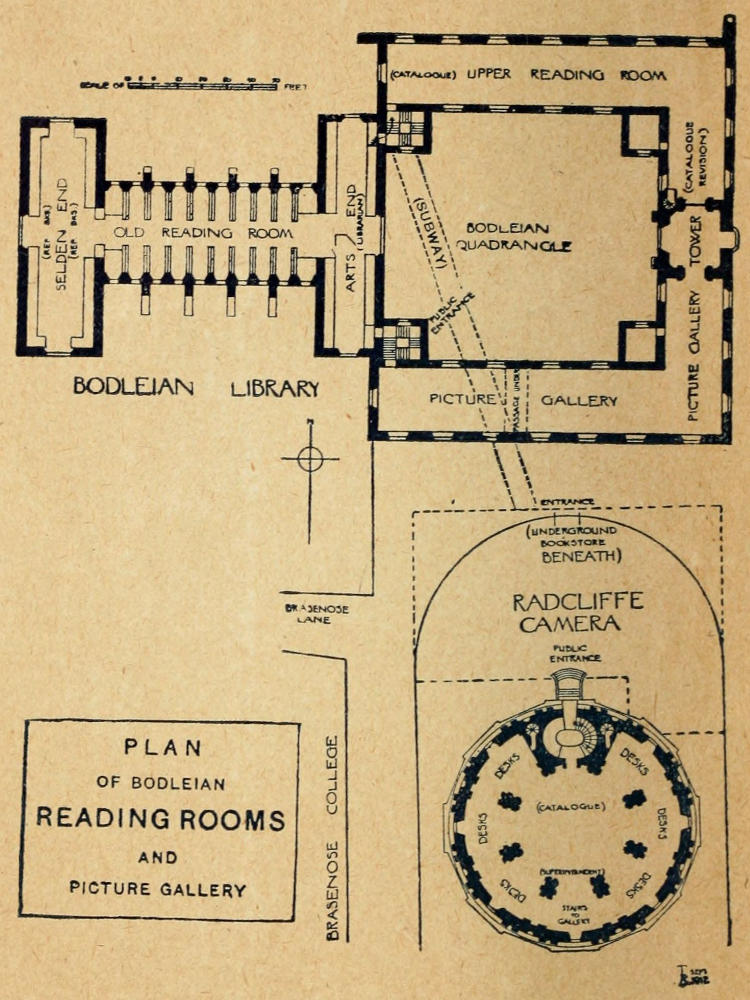
PLAN OF BODLEIAN READING ROOMS AND PICTURE GALLERY
THE
BODLEIAN LIBRARY
AT OXFORD
BRIEFLY DESCRIBED BY
FALCONER MADAN, M.A. HONORARY FELLOW OF BRASENOSE COLLEGE, OXFORD,
LATE BODLEY’S LIBRARIAN
DUCKWORTH & CO. 3 HENRIETTA STREET, COVENT GARDEN
First published 1919
PREFACE
The present volume is a short description of a great
library, and forms part of a series of treatises on educational
subjects which may, it is hoped, constitute some vindication
of a classical and liberal education. The author trusts
that this sketch of the history and contents of the Bodleian,
which ranks first among the institutions of the University,
may be of use to encourage the “studies of good
learning,” and thereby to carry forward in some measure
the ideals of Oxford. The chief difficulty has been to
compress the subject within the necessary limits of the
series, but the list of authorities on p. 64 will indicate
sources of further information.
Permission to make use of the plan which forms the
frontispiece was courteously granted by Dr. Cowley, the
present Librarian of the Bodleian.
Plan of Bodleian Reading Rooms and Picture Gallery
BODLEIAN LIBRARY (THE LIBRARY OF THE UNIVERSITY OF OXFORD) Notice to Readers
(All readers must at their first coming be entered in the Admission
Registers and make the usual declaration.)
The Bodleian Library was founded in 1602, and for size and importance
(together) ranks first among University libraries, second
among English-speaking peoples, and about eighth in the world.
Readers are therefore requested to use it, not for trivial purposes,
but for study and research.
The Old Reading Boom (O.R.R.) and Upper Reading Room
(U.R.R.) are open from 9 a.m. to 3 p.m. in Jan. Nov. Dec.; to 4 p.m.
in Feb. Mar. Aug. Sept. Oct.; to 5 p.m. in Apr. May, June, July.
The Camera Reading Room is open from 10 a.m. to 10 p.m. The
Camera contains most books printed since 1883, except Bibliography,
Law, Music, English Drama, British Topography and Antiquities,
with a few other sections. At Bodley there is a Reference library
(books marked R and Ψ), and at the Camera a large Select and
Reference library (marked S).
General Catalogue of Printed Books. There is a copy in the U.R.R.
(Bodley), and at the Camera. Catalogues of MSS. The official
copies are in the O.R.R.: working copies are also in the O.R.R. and
in the Cam. R.R. Forms for ordering Books and MSS. are in each
Reading Room.
Seats. Any unoccupied desk may be taken by a reader, except
that twelve desks at the Selden End are assigned by the Librarian.
The number of seats is, in O.R.R. 63, in U.R.R. 24, in Cam. R.R. 74
(+ 12 for Music students and 12 in the Science Room).
Reserving books. MSS. and rare books should be used in the
O.R.R. and cannot be reserved, but should be given up each time
that the reader leaves. An ordinary book or an orderly pile of books,
if reserved by a slip of paper bearing name and date, is left in
O.R.R. 3 days at seat, 7 days more in an adjacent reserve (but at
Selden End, 10 days at seat): in U.R.R. 3 days at seat, 7 in reserve:
in the Cam. R.R. books to be reserved should be brought to the
Assistant’s table (each work with the reserving slip), and will there be
reserved for 7 days. Unreserved books and all Reference and Select
books are cleared away daily. A reasonable limit for reserved books
is in general twenty volumes.
Tracing and painting need special permission. Photography is
undertaken by the Clarendon Press: order forms are supplied on
application.
For further information see a Manual for Readers, supplied gratis
on application.
THE BODLEIAN LIBRARY AT OXFORD — CHAPTER I LIBRARIES AND THEIR KINDS
Speech and Writing.
The two most important human inventions are perhaps
Speech and Writing. In no adequate way could
man fully express his mental activities except
by speech: nor could he adequately record them
except by writing. And to some extent the development
of the two ran a parallel course, for just as early Speech is
largely an imitation of natural sounds (Onomatopœia), so
early Writing is probably, in the first instance, entirely from
pictures (pictograms), which from the need of acceleration
became worn down to simpler forms, and finally to letters;
the sense similarly declining from the plain or derivative
ideas arising from pictures, to mere syllables with no intrinsic
meaning, and finally to simple sounds corresponding to letters.
But even this latest stage was reached in the Valley of the
Nile by, or not long after, 3000 B.C., as is testified by a stelè
representing the cult of Send, a king of the second Egyptian
Dynasty (now in the Ashmolean Museum at Oxford), in
which the letters S, N, D occur in a cartouche; while in
1750 the North American Indians used pictograms, and the
practice is not yet extinct, for we use the symbol ☞
Early Libraries.
As soon as Writing occurs in a portable form, whether as
cylinders of baked clay in Assyria, or as tablets
of bark, wood or wax, or as sheets of parchment
or paper, there is a volume, and there is the
possibility of a collection of books which forms a Library.
The earliest library of which a plan can be reconstructed was
discovered at Nineveh by Layard and dates from about
700 B.C. Of early Egyptian libraries no trace has been found;
but under the Macedonian dynasty of the Ptolemies the great
library at Alexandria in Egypt was founded about 285 B.C.
About libraries in Greece information is very scant until the
time of Euripides (fifth century B.C.) In Italy, the earliest
public library was founded soon after 39 B.C. by C. Asinius
Pollio, and under Augustus at least two more were instituted
at Rome; and by the fourth century at least twenty-five
or so were there erected, but all of them are stated to have
been closed down, “bybliothecis sepulcrorum ritu in perpetuum
clausis” (Ammianus Marcellinus). Of course these
public libraries had been preceded by private collections, of
which records are few and far between.
Before the second century B.C. the contents of Greek and
Roman libraries were not books in the form to which we are
accustomed, but rolls of papyrus, and the fittings of libraries
were accordingly shelves with vertical divisions forming
pigeon-holes, into which a roll or rolls were thrust. But the
advantages of parchment as a material to bear writing were
so obvious that the long rolls wrapped round a stick (rotuli)
gave way gradually to the well-known form appropriate to
parchment or paper, namely sewn and bound leaves (codices)
either quarto—which was found at first to be the most convenient
size—or folio or octavo. The receptacles in libraries
(at Rome) were no longer pigeon-holes (nidi, foruli) or long
narrow boxes (loculamenta), but undivided shelves (either
fixed to the wall, pegmata, or standing against it, plutei).
The wall space above these various forms of shelving was
usually filled with decorative portraits or busts of great
authors. Perhaps it is not accidental that in the great library
collected by Sir Robert Cotton (now in the British Museum)
the various parts were called (as they are still referred to) by
the names of the Roman Emperors whose busts surmounted
each division, and in the Bodleian, after the Civil War, the wall
divisions of the Picture Gallery were surmounted by a series of
ornamental medallions and portraits above the ordinary pictures
on the walls. The books, whether disposed in regular
book cases or in cupboards (armaria) with doors, were in Roman
times laid on their side.
Mediæval Libraries.
The classical tradition concerning the care of books was
apparently carried on with little change during
the first five centuries of the Christian era. Ecclesiastical
libraries were kept in churches, as classical
libraries were usually connected with temples. It is usual to
date the organization of mediæval collections from the Rule
of St. Benedict in the sixth century; and the Order which he
founded, with its direct offshoots, the Cluniacs, Carthusians
and Cistercians, were foremost in assigning a place to literature
in the daily duties of the monk. The gradual evolution
of the library can be traced from the time when a few volumes
could be accommodated in a press or presses in a recess or
small room, usually at the north-east corner of the cloister
near the chapter-house, to the fully developed collections of
the fifteenth century, housed in a large separate room, which
was almost always on the first floor, perhaps to avoid damp
and to secure a good light.
The following figures will illustrate the size of some considerable
mediæval libraries in various places and times.
Date.
Place.
Volumes.
A.D. 831
St. Riquier (French abbey)
250
10th cent.
Bobbio (Italian monastery)
700
12th cent.
Durham Cathedral
about 700
1300
Christ Church Cathedral, Canterbury
about 1850
1395
Durham Cathedral
921
1418
Peterhouse, Cambridge
380
1424
University Library, Cambridge
122
1472
Queens’ College, Cambridge
199
1473
University Library, Cambridge
330
Library Fittings.
The earliest fittings for the convenience of readers which
still exist suggest that at any rate in collegiate
institutions the first kind of desk was on what
Mr. J. Willis Clark termed the Lectern system.
One has to imagine a double lectern (that is, two plain lecterns
placed back to back) so prolonged as to hold say five to
fifteen volumes on each side, every volume lying on its side
and being chained to the desk. The reader stood or sat, and
the open book lay before him at a convenient angle, as in
church lecterns. The system was obviously very wasteful of
space, and was evolved from the time when one or two books
only were brought out of the cupboard (armarium) for a
reader’s use on a desk resembling a lectern, near a window.
In the fifteenth century the normal type of library was a
narrow room of considerable length, lighted by narrow
windows at short intervals. From the wall-spaces between the
windows there projected into the room at right angles to the
wall the lectern desks described above, the desks by this
time being probably fitted beneath with shelves on which the
(chained) books could stand upright, and be pulled out on to
the lectern for purposes of reading.
Next came the “Stall system.” In this, the cases projecting
from the wall are just book-cases, of three or four or even more
shelves on each side of the case, and the lectern part is superseded
by a flat desk in front of, and attached to, the shelves
at which a reader sits, and on which he places the (chained)
book he takes down from a shelf above him. The earliest
example of these is at Corpus Christi College, Oxford (1517),
and they are still in use in the Old Reading Room (“Duke
Humphrey”) of the Bodleian; and in the Chapter library at
Hereford, the very chains of the books are still preserved.
The modern practice of lining the walls of our rooms with
book-shelves, though in one sense a reversion to an ancient
type, in another is a definite change of system, of which
examples are found in the sixteenth century abroad, but the
first in England is in the Bodleian. In the Old Reading Room
Sir Thomas Bodley reproduced the stall system. But when
in his last days he erected an additional room (the Arts End)
his choice fell on the newer idea that a wide space should be
left in the middle of the room, and the books be all placed
against the walls (1613). The lower books (folios) were still
chained, and could only be used at the desks attached; such
was the case, for instance, with the First Folio of Shakespeare,
marked S. 2.17 Art. (see p. 46). The Gallery books were
quartos and octavos, not chained, and given out to readers
below by one of the officers of the Library. This arrangement
was imitated in the Selden End, which was completed in
1640.
Kinds of Libraries.
So far an attempt has been made to sketch briefly the
evolution of a library in ancient and mediæval
times. The plan of the present chapter of generalities
now requires that we should consider the
kinds of modern library, and the position which the Bodleian
holds among them.
There are libraries and libraries. There are libraries of
Reference or, as they are sometimes termed, Deposit; and
there are libraries of the second rank, adapted for local and
popular use. These two kinds are typical, and fall apart, as
will be seen, by the application of a simple test.
The first public literary need of a district is a library of the
latter type, one in which it is more important that the books
should be in general use by lending and by free access to the
shelves, than that they should be invested with a fictitious
importance and too jealously guarded. This is the way to
fan the faint sparks of literary instinct, and is still the common
condition of most villages and even towns. But wherever
literature has taken a long and firm hold there is a desire for
a public library of another kind. By this time private libraries
abound, and every serious student surrounds himself with the
ordinary books on his special subject. And the public library
shares in this general elevation of the personal standard; it
becomes a necessary complement to individual effort. It
supplies not only the ordinary works on every subject, but
also the extraordinary and special books, and owing to the
value of its contents has to restrict or abolish the custom of
lending, in order that there may be continuous accessibility
to its volumes. This division into two kinds is deep and real.
The two fall apart according to their answer to the question,
Do you in any real sense aim at being complete? All libraries
of the second order confess that, in cases where they aim at
any completeness, it is in a special subdivision or set of subdivisions
of literature—incunabula, local books, and so on, or
a working series of general reference volumes, or a departmental
library rich in books on a particular science. But
every library of the first class must have universality and
completeness (within human limitations) as its theoretical aim,
and must have made substantial progress towards its goal.
In countries like Great Britain and the United States there are
almost numberless libraries, many of them really large ones;
but above them there tower the few, the very few, Libraries
of Deposit. These are the super-Dreadnoughts of the literary
world, and the Bodleian claims to be among them. It is an
especial glory of Sir Thomas Bodley that he, a man of the
world as well as a genuine scholar, planned from the first a
library of the highest order.
Of this highest class it may be said that a really great library
should have Universal scope, Independence, Size, Permanence,
Wealth, and multiform Utility. Its Catalogue is not a mere
book-finder, but a scientific work. Open access and lending
are given up, but the Reference library is large. The aim of
the British Museum to possess the largest French library outside
France, and so with other foreign departments, and to
store all local newspapers, is beyond praise.
Within the second class of libraries the manifold and
various needs of modern students have resulted in a large
number of kinds, which have been so seldom and so incompletely
methodized that the following first attempt at their
classification may be allowed, though cross-divisions cannot
be entirely avoided.
LIBRARIES
A. Public—general:
e.g. National, Free, Lending, Circulating, Village.
B. Public—special:
e.g. Learned, Theological, Branch, Local.
C. Institutional—general:
e.g. Proprietary, Subscription, University, College, Travelling.
D. Institutional—special:
e.g. Technical, Professional, Departmental, Museum, Children’s.
E. Private—general:
e.g. Aristocratic or dilettante, Scholarly, working Reference.
F. Private—special:
Libraries of Collectors of special kinds of books.
Size of Libraries.
It remains to indicate the place among libraries which the
Bodleian Library, the Library of the University
of Oxford, appears to occupy among the libraries
of the world. In the absence of all proper standardization
of statistics, size (as estimated by the reputed
number of volumes, not works) must be first regarded, and next
importance, such as that due to manuscripts, incunabula and
the like. Mere size may not connote importance, for the
million volumes claimed by Messrs. Foyle, of 121 Charing Cross
Road, London, do not raise their twenty miles of shelving to
the rank of a really great library. So too the large collections
of printed books in the United States are as yet wanting in
the special importance derived from the ancient and cardinal
manuscripts which enrich some of the libraries of Europe.
The following libraries of the Old World contain a million
or more volumes, in the opinion of Dr. Fortescue, late Keeper
of the Printed Books in the British Museum, expressed in
1912, and compared with numbers given in the last edition
of Minerva (1913), and with other sources of information.
Library.
Printed volumes.
MS. volumes.
British Museum, London
3,750,000
Fort.
60,000.
National Library, Paris
3,500,000
Fort.
111,000
Min.
3,500,000
Min.
111,000
Min.
Petrograd
1,880,000
Fort.
2,044,000
Min.
124,000
Min.
Berlin
1,400,000
Fort.
1,450,000
Min.
30,000
Min.
Munich
1,100,000
Fort.
1,100,000
Min.
50,000
Min.
Vienna
1,000,000
Fort.
1,000,000
Min.
27,000
Min.
The value of the MSS. (45,000 Min.) in the Vatican Library
at Rome raises it to the first rank, though its printed volumes
are only reckoned to be 400,000 (Min.). The size of the great
libraries in the United States is undoubted, but, as has been
remarked, the absence of large and valuable collections of MSS.
reduces their importance. In the Library of Congress at Washington,
where the printed volumes (“books and pamphlets”)
are estimated in the Annual Report for 1915 at 2,364,000,
the mileage of occupied shelves is believed to be eighty or more,
which is not far from double that of the British Museum.
The New York Public Library is estimated to contain about
1,920,000 volumes (Fort.) or 2,090,000 (Min.). The Boston
Public Library is believed to possess 1,050,000 volumes (Min.).
A statistical survey of the Bodleian Library was made in
1915, with the following results:—
About
Printed volumes
1,050,000
Of which
folios
175,000
quartos
350,000
octavos
525,000
Separate pieces
2,060,000
Separate items (including fly-sheets etc.)
3,000,000
Manuscript volumes
40,000
(Not counting characters, rolls, etc.)
20,000
(Full details are printed in No. 9, Vol. I, of the Bodleian
Quarterly Record, April, 1916. The total number of printed
books in the world, i.e. separate works, has been estimated
at about 12,000,000.)
The Bodleian may fairly claim to rank in size about ninth,
and in size and importance (together) about eighth. It is the
largest and most important University library in the world,
and the largest (at any rate in the Old World) which is not
aided out of State funds. It claims also to be one of the
earliest public libraries of Europe, in the sense that it has
always been open to those who bring a sufficient recommendation,
practically without distinction of class or nationality.
In early days a small charge was made on first admission.
CHAPTER II SIR THOMAS BODLEY AND HIS FOUNDATION, 1598-1613
The old University Libraries.
The cradle of the University is in the vaulted chamber at the
north-east corner of St. Mary’s Church, still called
the Old Congregation House. The present building
was begun in 1320 on behalf of Thomas de Cobham,
Bishop of Worcester, and consisted of a lower
chamber for University meetings and an upper chamber for
a library. The shell was finished by his death in 1327; but
not till a dispute with Oriel College about the possession of
Cobham’s books was settled in 1410, was there a library in full
establishment. The books were taken from the two chests in
which they had lain since 1337 in the lower room, and were
chained in the upper room to desks with seats fixed beside
them. In 1412 a statute settled the regulations, and ensured
that the librarian[1] should also be a chaplain of the University.
In 1345 Richard de Bury, Bishop of Durham, author of the
first book on the love of books (the Philobiblon), bequeathed
his library to Durham College (now Trinity College), but it is
hardly doubtful that the books never reached Oxford, and
that his intended library “free to all scholars” never came
into being.
The second University library was built over the Divinity
School, chiefly because the gifts of MSS. by Humphrey, duke
of Gloucester, far exceeded the capacity of the little solar at
St. Mary’s to receive them. The School was begun about 1420,
and by 1480 both it and the book-room were complete. The
latter is now the “Old Reading Room” of Bodley’s foundation.
But between 1550 and 1556 the Commissioners appointed
by Edward VI for the reformation of the University wantonly
destroyed almost the whole of the contents of the library, so
much so that on January 25, 1556, the University gave orders
that the very fitting of the library should be sold. There
were no books left to attract a reader. Of the six hundred or
more MSS. in the old room, not more than eleven can be still
identified (at Oxford, the British Museum and Paris) and
only four are still in their old home (MSS. Hatton 36, Duke
Humphrey b. 1 and d. 1, Selden B. 50).
From 1550 till 1598 a dead silence falls on the University
library: the bare walls are there, and perhaps the roof
also, but no books and “no voice, nor any that answered.”
So too the University library at Cambridge (which is first
mentioned in 1397) was used as a Theological School from
1547 to 1586 (“quoniam ut nunc nulli est usui” bibliotheca,
as the grace says), but the books were on the shelves all the
while, to the number of about 180.
Sir Thomas Bodley.
Sir Thomas Bodley, a “worthy of Devon” and a diplomat
high in the esteem of Queen Elizabeth, came of
an old Devonshire stock which probably originated
in Budleigh. When the founder of it left
Budleigh at some unrecorded time, he would be at once known
as Thomas (or whatever the name may have been) de Budleigh
or Bodley. A family of that name was settled for many
generations at Dunscombe, a hamlet of Crediton, and John
Bodley, the father of Sir Thomas, had left Dunscombe and
settled in Exeter, when his son was born there on March 2,
1545. His wife was Joan (née Hone) of Ottery St. Mary.
The whole family was worried out of England in Queen Mary’s
reign, and the young Thomas was brought up at Geneva till
the accession of Queen Elizabeth, when the whole family
returned to England, and settled in London. In 1559 the
son was entered at Magdalen College, Oxford, his tutor,
Laurence Humphrey (who in 1561 was elected President),
having shared the exile of John Bodley. After Bodley’s
degree in 1563 he became a Fellow of Merton, and successively
Greek lecturer, Natural Philosophy lecturer, Proctor (1569-70),
and deputy Public Orator. There is evidence also that he
studied Hebrew at Oxford as well as in his younger days at
Geneva. Lastly, he travelled for nearly four years in Italy,
France and Germany.
Bodley was therefore well-equipped for a career of public
life, and worthy to ascend that admirable ladder which the
Queen set up through the Chancellors of the two Universities,
to attract the best men of the time to the service of the state.
After two years’ preliminary employment in London his
diplomatic career opened in 1585. It continued till 1598,
when his activity and statesmanship had shewn itself in
missions to Denmark, Germany, France and the Low Countries.
In 1597 he married a rich widow, Mrs. Anne Ball (née
Carey), of Totnes, but had no family by her.[2]
At last, at the age of fifty-two, being tired of statecraft and
the Court, and “for the loue” he bore to his “reuerend
Mother the Vniversitie of Oxon,” and in order to “do the
true part of a profitable member in the State” he decided to
offer to restore the old University library, or in his own
memorable words “examining exactlye for the rest of my life,
what course I might take, and haueing sowght (as I thought)
all the wayes to the wood, to select the most proper, I concluded
at the last, to set vp my Staffe at the Librarie dore in
Oxon; being throwghly perswaded, that in my solitude, and
surcease from the Commonwealth affayers, I coulde not busie
my selfe to better purpose, then by redusing that place (which
then in euery part laye ruined and wast) to the publique vse
of Studients. For the effecting whereof, I found my selfe
furnished in a competent proportion, of such fower kindes of
ayds, as vnles I had them all, there was no hope of good
successe: for without some kinde of knowledg, as well in the
learned and moderne tongues, as in sundry other sorts of
Scholasticall literature, without some purse habilitie to goe
throwgh with the charge, without very great store of honorable
friends, to further the designe, and without speciall good
leasure to follow such a worke, it could but have proued a
vayne attempt and inconsiderate.” To have knowledge what
to do, money to do it, friends to help it, and leisure to see it
done—on those four qualifications the Founder based his offer
to the University, dated February 23, 1598. The old dismantled
room with its bare fifteenth century walls was there, making
its mute appeal, and at last the Hour and the Man came. The
“spacious times of great Elizabeth” provided, not a youthful
enthusiast, but a man of world-wide experience, with all the learning
which Oxford could impart, with ample means, with friends
at Court, and with a fixed purpose for his years of retirement.
The New Library.
The offer was of course accepted with gratitude, and the
work began at once. In four and a half years,
on Monday, November 8, 1602, the new public
library of the University[3] was solemnly opened,
with about two thousand volumes. The appearance of the
room can be gathered from Bodley’s own letters and the
existing fittings. On the frontispiece of the present volume
it is marked OLD READING ROOM, an oblong chamber standing
by itself, with ten alcoves on either side, each with its own
window, and a bookcase at right angles to the wall, which
separates each study from its neighbours. The entrance was
by a staircase at the West or Selden end, in a porch of the
Divinity School below. At the farthest (or East) end of the
room the two last alcoves were the Librarian’s and Underkeeper’s
studies, and there was an East window to light the
central passage, facing which window were two closed cupboards
or “Archives” on each side of the gangway. The present
room is so little altered from its first condition that all these
features can be still recognised or understood. In 1602 the
two thousand volumes would occupy about one quarter of
the accommodation, and no doubt the folios were soon chained
in their places, while the quartos and octavos were relegated
to the cupboards and to a gallery over the door at the West
end. These latter, having no chains, were given out as
required. The windows, painted ceiling, bookcases and cupboards
remain as in 1602, but the central passage was several
inches lower than the floor of the alcoves. There is even a
register of the names of the readers and whether they came
in the morning (8-11) or afternoon (2-5, or 1-4, according to
the season), for the whole of the first year. Moreover there is
a catalogue of the entire contents of the shelves in the order in
which the books stood on the opening day.
Dr. James.
Bodley’s first “Protobibliothecarius Bodleianus” was
Thomas James,[4] who had issued an edition of
Richard de Bury’s Philobiblon in 1598, and in
1600 the Ecloga Oxonio-Cantabrigiensis (catalogues of MSS.
at Oxford and Cambridge), besides being well known as a
learned defender of Protestantism. The appointment was
probably formally made in 1602, when delegates were
appointed to superintend the Library. His sole assistant for
some years was the “Cleaner,” but some of the delegates
were able to give informal help.
But, as may be well imagined, Bodley was in these early
days a host in himself. All the details of management were
referred to him, and as the Library had as yet no endowment,
all the accessions by purchase were paid for by him. Fortunately
a long series of letters from Bodley to James between
1601 and 1612 is preserved, and displays to us every stage of
the evolution of the Bodleian, and also the humorous conflicts
between the Founder, pursuing an ideal and controlling at
every point the management of his institution, and his
Librarian, a student intent on his own literary aims, obstinate,
and not over desirous of spending the six hours a day at the
Library which Bodley considered reasonable, in addition to
the four he needed for his own work. Bodley wished his
Librarians to be “some one that is noted and knowen for a
diligent Student, and in all his conuersation to be trustie,
actiue, and discreete, a graduat also and a Linguist, not encombred
with mariage, nor with a benefice of Cure,” and
James greatly irritated him by extorting a most reluctant
leave both to marry and to hold the Rectory of St. Aldate’s.
The Founder’s style is racy and pertinent: when James
desires an increase of his stipend of £22: 13: 4 a year, Bodley
writes “I do not doubt but to give you very good satisfaction:
but till your Travels [i.e. travails] and Troubles are seen to
every Student, it will be best in my Opinion, not to charge the
Spit with too much Roast-meat.” When benefactors are
about, Bodley is specially alert in converting promise into
performance: in a case of promise they “should be called on,
with all the good speed that Conveniency, fit Time and good
Manners will afford. For many Men’s Minds do alter so soon,
as it will be requisite always to open the Poak, when the Pig
is presented.”[5] The relations of the two were on the whole
cordial, and James worked hard for the Library. The worth
of the nascent foundation was recognized in 1604 by the conferment
of knighthood on Bodley, and its permanent endowment
began in 1609 by the gift by him of lands at Cookham and in
Distaff Lane, London.[6]
King James I.
By 1605 the Library was in full working order, and two
great events distinguish the year. On August 30
King James I paid a visit to the Library, examined
various MSS., especially some Old English
versions of the Bible, praised the “garden” whence came the
“fruits” he had observed in University men, and in a burst
of benevolence promised any precious and rare volumes from
the royal libraries which Bodley might select.[7] Bodley was
greatly excited about the royal visit, and even as early as
June had warned James that his speech “must be short and
sweet, and full of Stuff” and “may not exceed the Length
of six Pater Nosters.” He ordered the Library to be well
swept, the books cleansed from dust, “the Floor to be well
washed and dried, and after rubbed with a little Rosemary:
for a stronger sent I should not like.” Finally, he adds, “I
know, as near as you can, you will frame your Meditation,
to the King’s Pronunciation of i and au.”
First Catalogue.
The second event of 1605 was the issue of the first printed
Catalogue of the printed books and MSS. The
three Catalogues issued in the seventeenth century
(1605, 1620, 1674) were all pioneers in bibliography,
and the fifth (1843-51) marks the end of the long
period during which the Bodleian was the largest library
in the British Empire. Of the first, Bodley writes that
“the general Conceit, as well of other Nations as of our
own at home, of the Library-store, is so great, that they
imagine in a manner, there is nothing wanting in it.” Yet in
the Arts section, which includes Literature and History, there
are only thirty-six books in the English language. The Library
was intended for scholars and students, and it is to be feared
that Bodley included nearly all English books among the
“Baggage Books” and “Riff Raff” which were excluded.
So keen, however, was Bodley that nothing should escape him
which was worth having, that he wrote in 1607, “You shall
never see that any good Books shall be lost for want of buying,
though I find no Contributors: albeit you need not doubt,
but I shall always find sufficient money.” The books are
arranged in the Catalogue in the order in which they stood on
the shelves, divided into the Faculties of Theology, Medicine,
Law, Arts, and further subdivided according to the first letter
of the author’s name (Th. A-Z, Med. A-Z, etc.), but there
is an alphabetical index of authors. James also planned (and
partly executed) a series of Subject Catalogues, and proposed
what would now be called an Undergraduates’ library, but
the latter received scant encouragement from the Founder.
The spirit in which he worked is well expressed by his entry
on an interesting occasion in an Album Amicorum of Frederick
Kemener, “Non quæro quod mihi vtile est sed quod multis.
Amoris ergo scripsit Tho: James primus Bibliothecarius
eodem die quo primo Bibliotheca patuit studentibus viz.
Anno 1602. Die Nouembris 8ᵒ.”
Stationers’ Company’s Agreement.
The outstanding occurrence in the later years of the
Founder’s life was undoubtedly the Agreement
with the Stationers’ Company (that is to say the
whole body of licensed printers and publishers in
Great Britain) by which one copy of every book
issued by a member of the Company was sent to the Bodleian,
gratis. The date of the Agreement is December 12, 1610 (the
Company) and February 22, 1611 (Congregation), and far-reaching
were its effects. The idea was suggested to Bodley
by his Librarian, and there were many “Rubs and Delays.”
The advantage to the publishers was that whenever an edition
ran out of print, there would always be a “perfect copy”
available for reprint or amendment, and the presentation of
a piece of plate worth £50 settled their remaining scruples.
The first book which came in under the Agreement was
Thomas Man’s Christian Religion substantially ... treatised
(London, pr. by Felix Kingston for Thomas Man, 1611) sent
by John Man, Master of the Company, and bearing a note in
Bodley’s own hand. The Library has never lost this privilege—which
is long antecedent to, and independent of, the Copyright
Acts. The grant was confirmed by an Order of Star-Chamber
on July 11, 1637. The first similar grant by Parliament
was made, no doubt on grounds of public utility, to the
Bodleian and a few other libraries in 1662, and the first Copyright
Act, recognizing the Bodleian right and granting it to
eight other libraries, was in 1709. The latest is dated
1912.
Early Constitution.
By the time of the Founder’s death (January 28, 1613)
the Library had a set of Statutes (1610) and a
settled constitution, the Librarian having an
Under-keeper and a Janitor under him, and being
himself under eight Curators, who could call him to account
for remissness or misconduct, but left him very large powers
in matters of detail. The Library was open on all weekdays
from 8 to 11 a.m., except when there was a University Sermon
or other service, and in the afternoons from 2-5 from Easter
to Michaelmas, or 1-4 from Michaelmas to Easter. All
Doctors, Masters and Bachelors could claim the right of reading,
except that Bachelors of Arts must be of two years standing.
All others had to take an oath at entry, and if not
benefactors or highborn, and especially if foreigners, had to
obtain a decree in their favour in Congregation. Lending out
books was absolutely forbidden.
First Extension.
Bodley had seen the first extension of his Library when the
“Arts End” (see frontispiece) was built in
1610-12. All the Arts books were there placed,
allowing the older part to retain the books of the
three superior Faculties of Theology, Medicine and Jurisprudence.
But shortly before his death the University had
formed a plan of building the “Schools Quadrangle,” or
rather three sides, which together with the Arts End would
form a quadrangle, and Bodley in his Will (January 2, 1613)
wrote “for as much as the perpetuall preseruation, support &
maintenance of the Publique Librarie ... dothe greatly
surpasse all my other worldly cares, and because I doe foresee
that in proces of time there must of necessitie be very great
want of ... stowage for Bookes,” he provides for a second-floor
room to over-top the two stories needed for the Lecture
Rooms or Schools of the University, and to form a reserve of
space for an overflow of books. This was completed in 1618.
The accounts for August 1613, to July 1614, the first complete
year since Bodley’s death, show an income of £137 from
property, and expenditure of £110 (stipends £51, establishment
£6, purchase of books £13, binding £14, miscellaneous
£24).
Benefactions.
We need not be surprised that with such a founder and such
a building and administration, the Bodleian
gathered treasures within its walls from its
earliest days. Of these a few may be mentioned. The great
Registrum Benefactorum instituted by Bodley begins in 1600,
two years before the opening of the Library, showing how
keen was the spirit he stirred up among his friends, but no
gifts of single volumes are recorded. Accordingly we can only
conjecture that the Founder himself gave the fine MS. French
Romance of Alexander, with the Travels of Marco Polo,
which was certainly received before 1605 (S.C. 2464). It is
notable for the illuminations, including a remarkable view of
Venice in the fourteenth century, and for the numerous
marginal pictures of customs, trades and amusements (perhaps
English). In 1601 in the Thomas Allen donation came “the
patriarch of all Welsh books known,” written in 820 (S.C. 2176).
In another part of the same volume is a contemporary portrait
of St. Dunstan (d. 988), who owned that part. In the following
year the Dean and Chapter of Exeter gave eighty-one Latin
MSS., one of which is the famous Leofric Missal (S.C. 2675),
one of the very few Missals known to have been used in a pre-Conquest
English Church, in this case Exeter Cathedral. It
is striking, and touching, that Sir Robert Cotton, who was
forming his own great collection, now represented by the
Cottonian Collection in the British Museum, was a firm friend
of his rival collector and presented to his friend’s new Library,
in 1603, eleven MSS. of value, including Latin Gospels, perhaps
of the seventh century (S.C. 2698). In 1605 the Librarian was
able to say that the Library contained books in thirty or more
languages, and that it was already frequented by foreigners
(Italian, French, German, Polish, Swedish and other), and
Bacon calls it “an ark to save learning from deluge.” The
Oriental literature may be regarded as beginning in this year
with the donation and purchase of Chinese books. The Dean
and Chapter of Windsor imitated their brethren of Exeter in
1612, by sending sixty-seven volumes of MSS., chiefly
theological.
CHAPTER III THE BODLEIAN LIBRARY, 1613-1860
The scale of the present work will not allow of more than a
sketch of the development of the Library for the long period
included in the chapter heading above. The chief treasures,
more in detail, will be mentioned in Chapter V.
Early Fears.
There was an ebb-tide in the Library affairs for some years
after Bodley’s death on January 28, 1613—a kind
of reaction. James was getting old (though he
did not resign till 1620), and a set-back was
experienced from the defalcations of Sir John Bennet, one of
Bodley’s executors, who defrauded the nascent institution of
at least £450. It must have been to some extent a doubtful
time. The good ship had been well built, launched and
equipped, but would it stand the open sea, when its designer
and builder was no longer at hand and its capacity of enduring
stress was as yet untried? Looking back on the development
of the Bodleian, we can now see that the memory of Bodley’s
personality, and the results of his practical wisdom as displayed
in the Statutes, did carry on the Library tradition
until the gathering clouds of the Civil War; that then it
secured its position by being perhaps the only safe repository
for literary collections during the Civil War and Commonwealth
troubles; that throughout the ensuing century and a
half it attracted immense donations; so that in fact until
about 1850 it remained the premier library in the kingdom,
though the British Museum had been founded in 1753. Since
1850 the great National Library has assumed clear pre-eminence,
having the support of public funds and being
acknowledged by all to be the chief library of the Empire.
The Second Catalogue.
In 1620 a new catalogue of the Library was published by
Bodley’s Librarian, Dr. Thomas James, which is
in the form to which we are all accustomed—that
is to say it is an Author-catalogue, arranged by
authors’ names in alphabetical order. English literature is
still quite a subordinate feature in it, owing to the Founder’s
principles; and under Shakespeare’s name no single entry is
to be found. Another curious feature is that no English translations
of Latin or Greek or even French or Italian books are
allowed to appear. Those who knew no Greek or Latin, and
needed “cribs” were not welcomed. James resigned his
office in this year and was succeeded by John Rouse,[8] the
friend of Milton. His puritanical tendencies undoubtedly
helped him to save the Library from damage during the
sieges of Oxford in the great war.
New Accessions.
At last, in 1629, began the flow of Collections towards the
Library, soon after Laud had become Bishop of
London. In that year arrived “that famous
library of Giacomo Barocci” (as Ussher calls it),
consisting of 242 Greek MSS. The donor was the Chancellor
of the University, the Earl of Pembroke, and twenty-four MSS.
which were omitted came in 1654 through Oliver Cromwell.
Sir Thomas Roe, the English ambassador to Turkey, also sent
twenty-eight Greek MSS. The original manuscript of Leland’s
Itinerary and Collectanea came in 1632 from William Burton,
the historian of Leicestershire. They contain topographical
and literary notes of the earliest survey of England (with the
partial exception of William of Worcester, whose journeyings
were chiefly in Somerset, including Bristol, and Norfolk), and
with some later transcripts form the whole of the sources of
the text. In 1634 came 238 MSS. forming the Digby collection,
which is of special value for the early history of science
in England, containing for instance the earliest meteorological
observations known, by William de Merle, Fellow of Merton,
taken from 1337 to 1344. Thirty-six more (Oriental) MSS.
came from Sir Kenelm Digby among the Laudian MSS. in 1639.
Laud’s Gifts.
But the great name of Archbishop Laud overshadows all
the rest of this period. By great good-fortune
the Western extension of the Old Reading Room
(now called the Selden End, which balances the
Eastern extension or Arts End, see frontispiece) was begun in
1634 and finished in 1640, and into the new room there poured
the manuscript treasures acquired by the Archbishop to the
number of 1242 volumes. It is a miscellaneous collection in
at least twenty languages, Western and Oriental, partly
acquired from Germany, especially Würzburg. The two outstanding
volumes are Codex E of the Acts, an uncial Greek-Latin
text of the seventh century, once owned by the Venerable
Bede (S.C. 1119), and the Anglo-Saxon Chronicle, written
at Peterborough and continued to 1154, three-quarters of a
century later than any other copy of the famous Chronicle
(S.C. 1003); others are mentioned in Chapter V.
The bequest of Robert Burton’s books in 1640 was especially
valuable, because the author of the Anatomy of Melancholy
read so discursively, and collected not only the graver works
which Bodley loved, but especially the lighter literature of the
day: it is satisfactory to note that all these were accepted by
Rouse, as indeed they would have been by James.
The Civil War.
The Civil War was an anxious time for the Library, from
the difficulty of safeguarding it from irruption
and violence. The care with which the Library
has always guarded its contents from the risk of
loss by lending out is well exemplified by Rouse’s action when
the King, on December 30, 1645, demanded the Histoire
Universelle of Aubignè. Rouse went to him and read out the
Statute against lending, and the King with a very good grace
gave way.[9] The original order, countersigned by the Vice-Chancellor
(“His Majestyes use is in command to us. S. Fell,
Vice Can.”) is still preserved in the Library. The second
siege of the city was followed by its capitulation on June 20,
1646, and “the first thing Generall Fairfax did was to set a
good guard of soldiers to preserve the Bodleian Library....
Had he not taken this special care, that noble library had
been utterly destroyed.” The register of books given out to
readers shows a fair number of students, but Dr. John Allibond
(Rustica Academiæ descriptio, 1648) records a different
condition:
“Conscendo orbis illud Decus
Bodleio fundatore,
Sed intus erat nullum pecus
Excepto Janitore.
Neglectos vidi libros multos,
Quod minime mirandum,
Nam Bardos inter tot et stultos,
There’s few could understand ’em.”
Rouse was tactful enough to entertain Fairfax and Cromwell
with a complimentary speech when the University gave them
a banquet in the Library on May 19, 1649, and on the whole
the Cromwellian visitation left the place alone, even when the
learned Dr. Thomas Barlow[10] succeeded to Rouse’s place in
April, 1652.
Various Gifts.
In 1659 the library of the “Learned Selden” arrived by
bequest, after five years’ delay, and comprised
about 360 MSS. with about eight thousand printed
volumes, chiefly classics, theology and history;
but among them are several unique early printed English tales
and romances, such as Dan Hew of Leicestre, the Battayle of
Egyngecourt, the Mylner of Abyngton. The Latin MSS. not
sent perished in a fire at the Temple, in London, in 1680. The
arrangement of the new acquisition in what is now called the
Selden End fell to Thomas Lockey,[11] who succeeded Barlow
in September, 1660, but resigned in 1665, when Thomas Hyde[12]
succeeded. In the next year came the first Sanskrit MS. (in
“Gentoo,” now S.C. 2862), presented by an East India merchant.
The Adversaria of Isaac Casaubon (largely the notes of that
great scholar on Greek writers) were bequeathed by his son
and arrived in 1673, together with the invaluable papers of
Roger Dodsworth, whose name deserved to be on the title-page
of “Dugdale’s” Monasticon Anglicanum. Dodsworth
copied enormous masses of Yorkshire and North of England
deeds and pedigrees just before the Civil War, in which very
many of the originals perished. Fairfax had helped Dodsworth
with an annuity, and bequeathed Dodsworth’s and some other
valuable MSS. to the Library which he had guarded from
harm in 1646.
The Third Catalogue.
The third Catalogue of the Library, which came out in 1674,
was a folio of imposing dimensions, and though
the MSS. are no longer included, was probably the
largest which had till then appeared anywhere.
It was of such general utility in the learned world that, for
instance, Convocation deemed it worthy of presentation to
Cosmo de Medici, and an interleaved copy of it was the only
one used in the Mazarine Library at Paris till as late as 1761.
It took nine years to prepare, and is attributed to Dr. Hyde,
the Librarian. The period which ended with Hyde’s resignation
in 1701 wound up with a large accession of Old and
Middle English MSS. which came partly by the purchase of
112 Hatton MSS. in 1671 (including the copy of the English
translation of Gregory’s De cura pastorali made by Alfred,
which the king presented to Worcester Cathedral, and also a
translation of the same author’s Dialogi, with a preface by
King Alfred), and partly by the extensive collections of
Franciscus Junius (François Du Jon), a pioneer of Anglo-Saxon
studies, which arrived (after purchase) in 1677. The
chief treasures (the Cædmon and Ormulum) are described in
Chapter V. The Oriental collections were also more than
doubled by the purchase of the 420 Pococke MSS. in 1692
(chiefly Hebrew and Arabic), and of the six hundred Huntington
MSS. (of the same general character) in the next year.
And probably these judicious and valuable purchases led to
the bequest by Archbishop Narcissus Marsh of about seven
hundred additional Oriental MSS. in 1713.
Dissolution of Parliament.
In 1681 a historic incident took place in what is now three
of the Oriental Rooms of the Bodleian, but was
then the Geometry School. The Parliament was
held in Oxford on March 21-28 in that year, and
King Charles II, having a secret promise of pecuniary aid
from the French King, felt strong enough to do without
consulting Parliament on a matter of the Protestant succession,
and determined to put a sudden and dramatic end to the
Session. The House of Lords was in the Geometry School,
which stretches North from the great Tower, on the first floor.
It had a broad staircase to itself. The House of Commons was
summoned to the same School on Monday, March 28, to hear
the King’s speech, about the subject of which nothing was
known. To avoid confusion, the Commons were not allowed
to use the broad staircase, but were hustled up a narrow winding
stone staircase in the Tower itself, and when at the level
of the first floor were precipitated into a room, and at last
down five steps into the House of Lords. They arrived in a
panting and dishevelled condition, only to hear a sudden and
curt Royal Message, read by the King himself, announcing
an immediate Dissolution of Parliament! The comedy then
took a new turn, in which the King was protagonist. He
bolted in great haste, scuttled across the quadrangle as fast
as dignity and robes would allow, bundled into his coach, and
was at Shotover, on the way to London, before the city in
general became aware that the Parliament, which thought it
had the King in its power from his want of supplies, was
dissolved. The scene would have been broadly humorous,
but for its sinister political significance.
The Old Catalogue of MSS.
The first century of the Library was worthily concluded
with a useful and laborious Catalogue of all the
known and accessible collections of MSS. in
Great Britain, which is known as Bernard’s or
the Old Catalogue, and is due to the labours of
Dr. Edward Bernard, Professor of Astronomy at Oxford. It
was published in 1697, and shows that Oxford (in the Bodleian
and the Colleges) possessed more than half of the whole
number. The printed books at this time may be estimated
at about twenty-five thousand and the MSS. at about
seven thousand. The century itself is cut deeply into
two parts by the Civil War. Before it the Library prospered
through its Founder and those who knew and remembered
him. After it a considerable number of small collections
found their way by donation or bequest, chiefly (as has been
noted above) from a feeling of the insecurity of private ownership;
and some large purchases were made. On the whole
the Library easily maintained its reputation as the largest
and most valuable in the kingdom.
In 1696-7 the income was £341, and the expenditure £125,
the chief items being £51 only to the three officers (Librarian,
Under-Librarian, Janitor), £19 for establishment, £17 for the
Curators’ dinner, £8 for binding and—six shillings for books!
The last detail was a consequence of the money required in
the next year for the purchase of the Bernard printed books.
The average expenditure on books was about £30 a year.
The Eighteenth Century.
The eighteenth century in the Universities, and indeed in
the country at large, is usually described as one
of general torpor, with a low standard of taste,
but brightened by many examples of conspicuous
individual merit. This may be true, and the
annals of the Oxford Press seem to bear it out. But it is true
also that literature has much to say for itself during this
period, and that one study at least was strongly developing
itself—the study of English antiquities. The Bodleian itself
may be said to have languished, in a sense, until about 1750,
and then to have waked up, under the astonishing series of large
gifts of which it was the recipient. In fact the hundred years
from 1735 to 1835 may be called the Century of Great Donations.
When Dr. John Hudson[13] succeeded Hyde, and Hearne
entered the Library as (Janitor and) Assistant, both in 1701,
a good deal of activity was exhibited. In 1704 Dr. Charlett
testified that “Our Public Library, which for some years had
stood still, is now in a thriving condition by the active
diligence and curiosity of Dr. Hudson, who spares no author,
no bookseller, but solicits all to augment that vast treasure.”
But in 1716, after bickerings on other grounds, Hearne was
turned out of his place, as a Nonjuror, and Hudson became
careless before his death, in 1719. Joseph Bowles[14], who
succeeded Hudson, and died at the age of thirty-four in 1729,
seems to have been unequal to the position he obtained,
though our chief testimony comes from Hearne who cordially
hated him. Robert Fysher,[15] the next Librarian, was not a
man of mark, and appears to have been disabled by ill-health
from fully performing his duties.
The Printed Books.
The growth of the printed books had up to this point been
much more normal than the acquisition of MSS.
The only printed collections of any notable size
since Robert Burton’s, in 1640, had been those of
Selden (see p. 000), Marshall (1685) and Barlow (1693). The
right to every published book no doubt gave an impression
that little help was needed, especially when such was the lack
of bibliographical principle that, for instance, the original
first two editions of Shakespeare’s Plays (the First and
Second Folios) were cleared out and sold as duplicates or
“doubles,” when the Third Folio came out with seven additional
plays. The First Folio thus turned out was bought
back for £3000 in 1905 (see page 46). The tide began to
turn towards the middle of the eighteenth century, partly
perhaps from the example of the munificent gift of Bishop
Moore’s books to the University Library, at Cambridge, made
by George I in 1715, whereby besides 1790 MSS. nearly
twenty-nine thousand printed books were acquired by it.
The Fourth Catalogue.
Dr. Thomas Tanner, Bishop of St. Asaph, formerly Archdeacon
of Norfolk, died in 1735 and left to the Bodleian his
collection, consisting of a large number of Civil War papers,
Norwich collections and ecclesiastical, literary, and historical
MSS., including the papers of Archbishop Sancroft. The
printed books were also of value and extent. These all arrived
in 1736, and the Library seems to have responded to this
stimulus by issuing its fourth Catalogue in 1738,
a careful edition in two folio volumes based on
actual inspection of the books and not on former catalogues.
Much of the work shows Hearne’s accurate hand.
Carte, Walker, Rawlinson, Clarendon MSS.
In 1747 Fysher died and Humphrey Owen[16] succeeded,
who in his twenty-one years of office saw the
Library doubled in size in the department of MSS.
First came, in 1753, the MSS. of Thomas Carte,
which arrived by gift (and subsequently bequest)
from the collector. The seventeenth century Irish
papers in this collection are of enormous extent (largely
Ormonde papers from Kilkenny), and many volumes are
materials for Carte’s History of England. Next came, in 1756,
the whole of the papers on which John Walker based his
Sufferings of the Clergy in 1640-60 (printed in 1714), comprising
hundreds of autograph accounts of the lives of dispossessed
ministers under the Commonwealth.
In this year arrived 5206 volumes of MSS., with a large
printed collection, by the bequest of Dr. Richard Rawlinson,
Bishop among the Nonjurors, who died in 1755. The extent
of the gift entirely overwhelmed the Library staff, and it
remained almost undescribed till 1862. Rawlinson picked up
everything from everywhere, like Sir Thomas Phillipps, but
while the ghost of the latter sees all that he lived for in process
of dispersal, the Rawlinson collection is absolutely intact
and worthily honoured. History and topography are the
chief subjects, but Classics, English poetry, Service books,
Oxford authors since Wood’s death, and the whole of Thomas
Hearne, the Oxford antiquary’s papers, are among the rest.
The Thurloe State Papers in sixty-seven volumes, Samuel
Pepys’s Admiralty and other papers in twenty-eight volumes
are here, and some most valuable ancient Irish MSS. worthy
of a place by the side of Laud’s, with numerous volumes of
literary correspondence, which in conjunction with the
Ballard collection received in the same year (1756) contain
perhaps one-half of the literary letters of 1660-1750.
In 1759 came the series of Clarendon State Papers, presented
by the grand-daughters of the author of the History of the
Rebellion, in fulfilment of their brother’s wish. They may be
described as the bulk of the original Royalist sources for the
history of the Civil War. Many additional parts of the
Clarendon collections have been gathered to the rest in later
years and from various sources. The original gift, by its
condition that the profits of any Clarendon publication should
belong to the University, has resulted, not only in the
University Press being called by Clarendon’s name, but also
in the building of the Clarendon Laboratory in 1869, and in
the creation of that rare privilege, a perpetual copyright in
the History of the Rebellion. It may be said that the history
of the period 1640-1700 in Great Britain and Ireland cannot
be written without reference to the Clarendon, Carte, Walker
and Rawlinson collections.
The minor acquisitions of the rest of the eighteenth century
(the Dawkins and Hunt Oriental MSS. in 1759 and 1774, the
Browne Willis (Buckinghamshire, and English Cathedral) MSS.
in 1760, and the Bridge’s Northamptonshire papers in 1795)
were all by gift and bequest, and of the nineteen large collections
received between 1700 and 1800 not one was purchased.
When Dr. Owen died in 1768, Dr. John Price[17] succeeded. He
had been Janitor from some time before 1757, and Sub-Librarian
from 1761. His long reign ended in 1813, and his
successor, Dr. Bulkeley Bandinel, held the office still longer,
dying in 1860 (see p. 34).
Catalogue of Oriental MSS.
A great effort was made from 1766 to 1787 to accomplish a
catalogue of the Oriental MSS. which were a
notable feature of the Library, thanks to the
Laud, Marshall, Pococke, Huntington, Marsh
and Hunt collections. The Catalogue of 1787,
containing the Hebrew, Chaldee, Syriac, Ethiopic, Arabic,
Persian, Turkish and Coptic MSS., was the work of Johann Uri,
a Hungarian, who resided at Oxford for this purpose, and died
there in 1796. The Arabic catalogue was continued by a
second part undertaken by Alexander Nicoll and E. B. Pusey,
and issued in 1835. Other parts have been continued by
volumes in the Quarto series.
Modern Expansion.
In 1789 the first, modern extension of the Library began.
How it managed to contain the accessions of the
eighteenth century within the compass of the
Old Reading Room, Arts End and Selden End,
which it possessed in 1640, it is difficult to imagine; but no
doubt much uncatalogued matter was stacked in the Picture
Gallery and adjacent rooms. At last the pressure became so
great that the books simply burst into the Anatomy School,
thenceforward known as the Auctarium, on the first floor of
the Schools Quadrangle. The gradual annexation of the
whole of the Quadrangle, 1789-1882, is too much a matter of
detail to be narrated here.[18] The whole of the first floor was
annexed by 1835, and the loan of the Radcliffe Camera, in
1860, greatly eased the situation. The first ground floor-room
acquired was the Logic School in 1845. The progress of
bibliography can be traced in the large purchases made in 1789
at the Pinelli sale and in 1780 at the Crevenna sale, in Florence
and Amsterdam respectively. The books bought were
chiefly Editiones Principes and other early printed books,
and £1550 was borrowed from the Colleges for the purpose,
all faithfully repaid by 1795. The Mazarine Bible, a copy of
which fetched £5800 in 1911, was bought for £100 in 1793.
The Nineteenth Century, and Dr. Bandinel. Gough and Douce.
The Wight Musical MSS., bequeathed in 1801, were the
foundation of the musical collection, and were
rich in English music between the Restoration
and 1800. Not till 1885 was the old University
collection, founded by Dr. William Heather in 1626, and kept
in the Music School, transferred to the Bodleian. Four considerable
classical collections of MSS. were purchased at this
period, the D’Orville (1804), E. D. Clarke (1809), Canonici
(1817) and Meerman (1824). The Canonici MSS. were amassed
by a Venetian Jesuit and abound in liturgical and Italian MSS.
as well as in classics. They number 2047, and were purchased
for £5444. These were accompanied by two very large mixed
collections of MSS. and printed books, both bequeathed—the
Gough British Topographical collection in 1809,
and the Douce collection, in 1834. About 3700
volumes came in the former, including a vast
series of topographical prints and maps. Among the latter
are some large fragments of tapestry maps of England from
the first English loom, established by Sheldon in Elizabeth’s
reign. Richard Gough (d. 1809) had been for many years
Director of the Society of Antiquaries, and possessed almost
every book on British Topography. Francis Douce’s interests
lay in illuminated and other MSS. and in English literature,
and he bequeathed about five hundred of the former class
and seventeen thousand printed books, with charters and
coins. These two great gifts greatly enhanced the value of
the Bodleian in their different kinds.
An incident on Saturday, April 19, 1806, occasioned a
singularly apt quotation, and shows that modern smartness
had not at that time penetrated the Bodleian. A would-be
reader came that morning soon after 8 a.m., the hour of opening
(8-2 and 3-5 were the hours enjoined since 1769), and
found no one there, and the door still locked. Before departing
he affixed a paper (still preserved) bearing the Greek of the
following passage (Luke xi. 52), “Woe unto you, for ye have
taken away the key of knowledge: ye entered not in yourselves
and them that were entering in ye hindered.”
Shakespeare and Malone.
The Shakespearean Folios and Quartos in the Library were
comparatively few until the year 1821. The
number of entries under the name were in the
1605 catalogue, 0; in 1620, 0; in 1635, 1; in
1674, 3; in 1738, 6. Fortunately the great and famous
dramatic collections of Edmund Malone brought in the above
year a complete set of the Folios and some fifty early Quartos
or Poems, including the only copy of the first edition of
Shakespeare’s first publication, the Venus and Adonis of 1593.
Thanks to these and other accessions the Bodleian now
possesses 70 out of the 101 Quartos issued before 1700, and
more than five thousand volumes of Shakespearean literature.
Not till about 1818 was it recognized that a temperature of
25°-30° Fahrenheit was inimical to the comfort of readers,
and not till 1821 were two pipes for introducing hot air
inserted, and it is recorded that even this was “wholly ineffectual.”
In 1845 steam warming was attempted, but that
too “did not give satisfaction.” In 1861 the hot-water system
was introduced, which with various improvements is still in use.
Oriental MSS.
In view of the trend of Oxford studies in the past, it is not
surprising that Classical MSS. and printed books, whether
texts or commentaries, are a feature of the University library,
and it probably contains in addition more academical dissertations
than are to be found elsewhere. Each dissertation, it
should be remembered, has its particular justification for the
degree gained by it, however minute the point discussed may
be.[19] The foundation of this department was laid in 1827
when about 43,400 foreign dissertations were purchased at
Altona, and large additions were made in 1828, 1836-7 and
1846, as well as by systematic exchange in more recent years.
In 1828 the Hebrew MSS., which had hitherto
been inferior in value and number to the Arabic,
received a great augmentation by the purchase
en bloc of the Oppenheimer Collection of both manuscript and
printed Hebrew literature. It is noticeable how large donations
tend to produce further accessions in the same line. The Uri
Catalogue of Oriental MSS. with its Second Part, noticed
above, and the purchase of the Oppenheimer library seem to
have called attention to this department, and from 1837 on
a stream of minor donations and purchases set in. These
were the Hodgson Sanskrit MSS. (1837), Wilson Sanskrit (1842,
bought), Bruce Arabic and Ethiopic (1843, bought), Ouseley
Persian (1844, bought), Walker (1847), Michael Hebrew (1848,
bought), Mill Sanskrit (1849, bought), Elliott Persian (1859).
The Fifth and last Catalogue.
The period closes with the last of the printed Catalogues of
the Printed Books. This was a great undertaking,
but had its reward in being the largest presentation
of printed literature which had ever been issued.
It is contained in four folio volumes, issued
between 1843 and 1851, the last recording the accessions of
1835-47. At the same time the Quarto Series of detailed
Catalogues of Manuscripts was started (in 1845), which has now
extended to some twenty volumes. The gaps left in this
monumental series are filled up by the shorter but not inadequate
descriptions of the Summary Catalogue in octavo form,
which was instituted in 1890, and fulfils a useful purpose.
CHAPTER IV THE BODLEIAN IN MODERN TIMES — The Bodleian at the Present Time — A. Buildings and Reading Rooms — B. Organization — C. Facilities for Readers — D. Finance
Bandinel and Coxe.
Dr. Bulkeley Bandinel[20] was the last of the old type of
librarian, the gentlemanly old-fashioned scholar,
to whom the Library was a pleasant preserve to
which like-minded students were moderately
welcome, if they knew what they wanted and did not give
too much trouble to the officers. He assiduously bought the
best books, used his personal influence to induce the University
to make purchases of entire libraries, and cultivated the
probable, and even the possible, benefactor with success.
But administration in the modern sense, and the organization
of a staff to provide for the wants of the general reader who
needed to be allured to literature, were secondary aims.
The Reverend Henry Octavius Coxe,[21] who became Bodley’s
Librarian in 1860, had had experience in the British Museum
and had been sent by the Government in 1857 to report on,
and if possible acquire, valuable MSS. (chiefly Greek) in the
monasteries of the Levant. He was a trained librarian, with
just the right addition, that is to say special excellence in
some one line, in this case palæography. His work was to
develop the Library in modern ways, not by a cataclysm but
with delicate appreciation of what the past had done in its
own way.
Changes in 1860.
Several events make the date 1860 a notable one, besides
Mr. Coxe’s election. In that year the Radcliffe
Trustees made the splendid offer of the loan of the
Radcliffe Camera, the great domed building in
the centre of Radcliffe Square, as a modern Reading Room
and general augmentation of the Bodleian. It solved many
difficulties in a most excellent way. It provided new storage
room, it made it possible to have a properly fitted second
Reading Room instead of inopportune alteration of “Duke
Humphrey,” and it solved the problem of lengthening the
hours during which students could use the library. Artificial
lights were then impossible in the Old Reading Room. In
1860 also came the valuable collections which formed the
literary part of the Ashmolean Museum, including the extensive
collections of Anthony Wood, the Oxford antiquary, the
historical and heraldic MSS. of Ashmole himself, with the
Lister, Dugdale and Aubrey papers, all relating to English
history and biography. And in 1860 also was definitely begun
a new general Catalogue of Printed Books on a modern
system, the Catalogue in fact which is still in use. This took
nineteen years to form, at a cost of £14,500, occupying (when
completed in 1878) about 720 large folio volumes, now expanded
to 1200. These great changes engaged the chief
attention of the staff, and the next considerable event is the
transfer of all the older records of the Archdeaconry of Oxford
in 1878. This acquisition has resulted eventually in the
Bodleian becoming the great repository of material for the
local history of the three “home counties” of Oxfordshire,
Berkshire and Buckinghamshire, which form the Oxford
diocese. In this year also was issued a Calendar of the Charters,
Deeds and Rolls in the Library, chiefly the work of a self-educated
student named William Henry Turner, formerly a
chemist in the city. On July 8, 1881, Coxe died, having had
twenty-one years to carry out his works of reform, and to
introduce new principles of librarianship. In 1878 he was
President of the first annual meeting of the new Library
Association, held at Oxford, the transactions of which were
published in the ensuing year and contain an interesting
account of the Library.
Modern Expansion.
To Mr. Coxe succeeded in 1882 a librarian of a very different
type, brought up in the newest school and one
of the founders of the Library Association. Into
every department of the Bodleian Mr. E. W. B.
Nicholson[22] threw great energy and a super-active mind. Of
the large ground-floor rooms of the Quadrangle no fewer than
four were handed over in 1882 and afforded a great opportunity
for a comprehensive scheme of rearrangement. The
staff, which in 1882 were twenty-four, were gradually raised to
more than seventy, partly by the introduction of boys (or
“junior assistants”) for the fetching, distribution and replacement
of books and for the simpler processes in dealing
with new accessions. A fresh code of Cataloguing Rules was
drawn up, and improved from time to time. A large Select
library (in addition to a Reference library) was instituted
at the Camera. The number of closed week-days—which used
to be twenty-six in the year—was much reduced. Accession
lists were introduced. The Library was divided into ten
sections, for each of which a Senior Assistant was made
responsible. Photography, for the reproduction of MSS., was
introduced in 1890. The Sheldonian Basement (1884), the
Ashmolean Basement (1897) and the New Examination Schools
Basement (1897) were obtained for the use of the Library.
The number of readers increased, in response to all these
arrangements for their convenience, and a large Upper Reading
Room was obtained by annexing, in accordance with Sir
Thomas Bodley’s original plan (see p. 21), part of the Picture
Gallery (1907). The expenses of preparing and fitting up the
room, and of shelving a large collection of periodicals in it
for reference, were borne by the present Earl Brassey, who
also provided funds for a Catalogue Revision Staff. But the
greatest work undertaken in Mr. Nicholson’s term of office was
the Underground Bookstore, a subterraneous cavern between
the Bodleian Quadrangle and the Camera, beneath the grass,
capable of holding a million books (see p. 39): the funds
(£12000) were provided by the Oxford University Endowment
Trustees. A notable feature of his time was the willingness of
some Colleges and Institutions to deposit their MSS. on
revocable loan in the Bodleian, to the great convenience of
scholars. In this way the MSS. of University College, the
Savile and Music School Libraries, the MSS. of Jesus College
and those of the Clarendon Press came in 1882-86, followed
by the Brasenose, Hertford, Lincoln and New College Collections.
Among the greater accessions were the Shelley Collection
(1893), and the 6330 Sanskrit MSS. presented by Sir
Chandra Shum Shere, of Nepal (1909).
The War.
When Mr. Nicholson died, on March 17, 1912, the present
writer[23] succeeded to his position. In 1913 a new Bodleian
Statute (in English), based on the old Latin code but putting
the Curators more clearly in their position of Governors of
the Library, and otherwise designed to meet modern requirements,
came into force. Two large and valuable donations
were received in that year and in 1914, namely, 17,000
volumes of Chinese literature from Sir Edmund Backhouse, of
Pekin, and Professor Ingram Bywater’s very choice library of
about four thousand volumes on Aristotle and his commentators,
and of Humanist scholars up to about 1650. Then the
War came, and checked many of the activities
of the Bodleian. Forty-one members of the Staff
were called away on military service of one kind or another,
including all of the Regular Staff who were of military age,[24]
for the Library made no claim for exemption. The more
valuable MSS. and printed books had to be put away in
safes protected by sand-bags, and were thereby withdrawn
from use. On three occasions an alarm of air-raids brought
many of the staff to the quadrangle between midnight and
3 a.m. The readers diminished by about one-third. On
the other hand, no department was closed down, nor any
change made in the public service, the gaps were filled
by the capable assistance of ladies of the Catalogue Revision
Staff and men in some way disabled from military work, and
in 1916 it was found possible to hold a Shakespeare Tercentenary
Exhibition with success. The British Museum was
unable to undertake this at the time, and the Bodleian with
every right stepped into the gap. A full account of this and
of the whole history of the Library during the war will be
found in the Bodleian Quarterly Record, which was started in
April, 1914.
In June, 1919, Dr. Cowley[25] succeeded to the chair of office,
and may be expected to carry on the Library through a successful
era of change and progress which the arrival of peace has
made possible.
The position of the Bodleian Library among the great
libraries of the world has been stated on p. 13. A general
description may now be given of its buildings, organization
and facilities accorded to students, at the present time.
The Buildings may be conveniently divided into three
parts: 1. The older part (“Bodley”); 2. The modern part
(the “Camera” and Underground Bookstore); 3. Certain
outlying store rooms in University buildings.
The Old Reading Room.
The older part consists, as will be clear from a glance at
the frontispiece, of an H-shaped building, and three
sides of a Quadrangle fitted on to it. Readers who
have followed the history outlined in preceding
chapters will understand that the very cradle of
the whole Library lies in the part marked on the plan “Old
Reading Room.” That is Sir Thomas Bodley’s own first
room, which had been superposed on the Divinity School in
the latter part of the fifteenth century, finished in 1480, and
taken over in a derelict condition by the Founder. No one
can enter the room without a feeling of veneration for its
antiquity and associations. The first extension (also in the
Founder’s life-time) was the Arts End on the East, matched
before the Civil War by the corresponding Selden End on
the West. Since all three rooms were on the first-floor level,
there is a space below, and a vaulted walk or ambulatory
bears up the Arts End, while the Convocation House, built by
the University, is under the Selden End. The contents of
this triple room on the first floor are chiefly the printed books
acquired before 1750, still divided according to the four
Faculties—Theology, Medicine, Law and Arts. So firmly
fixed are some of these that the present writer, having lost all
trace in the General Catalogue of a book to be found under
the word Parantinis in the 1605 Catalogue, in despair ordered
it by its shelf mark in 1605 (8ᵒ L. 20 Th.), to see what would
turn up, and it came. The fittings, ceiling and desks are
hardly altered from what Sir Thomas Bodley ordained and
saw. America as well as England may claim this heritage,
for it presents the same appearance now as it presented years
before the Pilgrim Fathers sailed in 1620.
The Bodleian Quadrangle.
The three sides of the School Quadrangle which adjoin the
Arts End now contain the most valuable part of
the Library. In the Gallery are the Upper
Reading Room (with the General Catalogue and
the selected periodicals) and the Picture Gallery (with a
quarter of a mile of bibliography). On the first-floor on the
South side are the chief manuscript collections; on the East
side the Bywater, Douce and (north of the Tower) the Oriental
MSS, and printed books; on the North side the Malone,
Tanner, and Gough books, with all the Bibles. On the ground-floor
are placed the Hope Collection of engraved portraits
(about 300,000)—which is under separate trustees and is not
really Bodleian property—the Music School (containing the
printed and manuscript music and, at present, the Backhouse
Chinese collection), the Meerman room (with a number
of smaller sets of books), the Law Room, the Foreign Periodical
Room and the Map Room.
The Camera.
The Camera Reading Room holds comparatively few books,
not being a store-room, but the volumes kept in it
are the most-used modern works to the number
of about 27,000. But the Camera Basement, and
the Underground Bookstore which adjoins it, hold the great
bulk of the books of the last forty years. These are arranged
by an elaborate system of subject division, the more important
sections being in the Basement, while the less-used
subjects (Minor Theology, Minor Prose and Verse, Scientific
handbooks now superseded for ordinary use, and the like)
are kept in the Underground Bookstore, with gigantic series
such as the earlier editions of the Ordnance Survey, the
Times from 1806, the London Gazette and some others. But
certain entire sections, though modern books, are still retained
in the older part of the Bodleian (“Bodley”) as being
specially related to the studies pursued there: such are
Bibliography, Palæography, British topography, Family
history and Numismatics.
Outlying Store Rooms.
Lastly, some outlying buildings have been lent as storerooms.
Half of the Sheldonian Theatre Basement
keeps the Parliamentary Blue Books, and such
newspapers and journals as the Bodleian takes in.
The Basement of the Old Ashmolean holds the “Year-books”
(so called from the accessions between 1824 and 1850 being
arranged, not by subject but in order of acquisition) and in
general the octavo books received between 1824 and 1883.
Finally, beneath the New Examination Schools are preserved
directories, some old magazines and all novels.
In 1915 the numbers of volumes in these three main divisions
were found to be:—
In “Bodley”
422,000
(Old Reading Room 61,000)
In the “Camera” and Underground Store
321,000
In outlying buildings
279,000
Total
1,022,000
Curators.
The whole Library is subject ultimately to the authority
of the Board of Curators, fifteen in number. Of
these, eight are official (the Vice-Chancellor and
two Proctors, and the five Regius Professors of Divinity, Civil
Law, Medicine, Hebrew and Greek); and seven are chosen
for ten years by Congregation from its resident members. The
Curators meet at least twice a term, and hold an Annual
Visitation of the Library on November 8, the anniversary of
the opening of the Bodleian in 1602. The income and expenditure
and even the regulations of the Library are under
their control.
Officers.
The three officers are the responsible officials, and any one
of them can take complete charge of the Library.
They are the Librarian and the two Sub-Librarians;
by custom one of the latter is an Oriental scholar. At the age
of sixty-five they retire, unless specially retained for a few
additional years. They may not hold a cure of souls, nor
undertake outside work incompatible with the due discharge
of their office. But the two Sub-Librarians are subordinate
to the Librarian in all matters concerning their duties and
work.
Assistants.
The Senior Assistants are at present thirteen in number.
Ten of them are in charge of the ten Sections of
the Library, and are responsible for its proper
condition. One is the Librarian’s Secretary, one the Financial
Assistant, two are Superintendents of the Upper Reading
Room, and of the Camera, and one is in charge of the Stores.
Their maximum (pre-war) salary is £250. There is also a
class of Minor Assistants, who have less responsibility and less
difficult work.
The Janitor at “Bodley” is on Sir Thomas Bodley’s original
foundation, and has charge of the Picture Gallery, and the
admission of visitors. There is now also a Janitor at the
Camera.
The Junior Assistants (aged 14 to 19) undertake the supply
and replacement of books, and such work as the preparation
of lists, and especially hand lists, showing what books are
added to the shelves, with other duties varying according to
their powers. The Curators give annual prizes at Christmas
to this class, for conduct, industry and intelligence.
Extra Staff.
The Extra Staff is apparently a class peculiar to the Bodleian,
instituted by Nicholson. They are to a large extent
former Junior Assistants, retained for a time
on the Staff under conditions which allow them to carry on
their own studies (as, for instance, for a University Degree).
It is found that their experience of the Library in the past
makes their services of special value, while on the other hand
they are allowed to choose a normal scheme of hours and take
what holidays they please, being paid by the hour (from
6d. to 2s.). They deal with arrears, or miscellaneous work,
according to their special powers or the library requirements.
Some of the Extra Staff are usually specialists temporarily
engaged, such as the members of the Catalogue Revision Staff.
The entire normal staff consists of about seventy persons.
One of the customs of the Library now associated with the
Annual Visitation is the Oratio Bodleiana, in Latin, delivered
in the Congregation House on November 8 by a Master of
Arts of Christ Church, on the set subject of Praise of Sir
Thomas Bodley and of Hebrew Studies. It was founded in
1682 under the will of Dr. John Morris, Regius Professor of
Hebrew, who died in 1648. The Orator is selected by the
Dean of Christ Church, and delivers the Oration before the
Curators of the Library. For the last fifty years the speeches
have been preserved, and are of some value as contemporary
annals.
Admission. Days and Hours, etc.
Anyone desirous of becoming a reader is required to bring
a personal recommendation signed by some one
in a responsible position. A printed form is supplied
for the purpose. On admission he signs a statutory promise
of good conduct in matters relating to the Library, and
can choose a seat in any of the three reading-rooms. Preferably
he will use the older books and manuscripts in the
Old Reading Room, and modern books in the other two.
The two parts of the Bodleian are only closed
together on six weekdays in the year (Good
Friday, Easter Eve, Christmas Eve, Christmas
Day and the two following week days), and are otherwise
open, with a few exceptions for cleaning purposes, from 9 a.m.
to 3, 4 or 5 p.m., according to the season. The Camera is
similarly open from 10 a.m. to 10 p.m. Readers who use
printed books have only to order them from the General
Catalogue, or, if reference books, take them down from the
shelves. For manuscripts there are three indexes which
cover the whole ground: that of the Old Catalogue of 1697
(soon to be superseded by the other two); that of the Quarto
Catalogues, combined; and that of the Summary Catalogue.
The Oriental MSS. have in general their own indexes. Ordinary
books can be reserved at the seat: manuscripts and valuable
printed books are given up each day, and kept for re-issue.
Free access to the shelves is not possible in so large a library,
but arrangements are made to suit reasonable requirements:
the Reference books are numerous, and the Subject Catalogue
and lists of Accessions are provided. A Manual for Readers,
giving further detail, can be obtained on application, without
payment, as well as the Rules for Cataloguing and lists
of the numerous collections, both manuscript and printed.
Catalogues.
The Catalogues of Manuscripts are numerous, but consist
chiefly (for western languages) of three parts:
1. The Old Catalogue of 1697, described on p. 27,
which has its own index; 2. The Quarto Series of detailed
Catalogues,[26] each with its index, but also indexed in one long
alphabet of combined slips available for general use; 3. The
Summary Catalogue filling up gaps in the other two classes,
with a similar slip index. The whole ground is covered in more
or less detail by these three.
All the Printed Books are in the General Catalogue of
printed books, one copy of which is in Bodley, and one at
the Camera. This is an Author Catalogue of the usual kind,
anonymous books being entered under their title, and official
books under the institution which issues them. A third copy
of the Catalogue is arranged by subjects, but is at present
kept in loose bundles of slips. The Cataloguing Rules are
separately printed, as noted above.
The normal income is about £11,000 (Dividends, rents, etc.
£2800: University allowances £5100; internal income £250;
From Colleges £2000; Oxford University Endowment Fund,
and various donors £850). The expenditure may be placed at
£10,800 (Staff £6700; Establishment £1250; Purchases
£2000; Binding £700; Miscellaneous £150). The large
expenditure on the Staff compared with the purchases is due
to the great number of books received under the Copyright
Act. In 1841 a bequest of £36,000 was received under the
Will of the Rev. Robert Mason, of Queen’s College. The
resources of the Library are however obviously inadequate,
although the University bears the cost of the upkeep of the
fabric and permanent fittings. Details for 1882-1918 will be
found summarized in the Bodleian Quarterly Record, No. 21,
or in detail in the published Annual Reports. During the
years 1908-1916, the Library has received more than £25,000
from the O. U. Endowment Fund, expended chiefly on the
New Reading Room and Underground Book-store.
Manuscripts and printed books are not lent out except
under a Special Decree of Convocation in each case, and was
finally decided on May 31, 1887, in accordance with the
principles of the Founder and the traditions both of the
Bodleian and the British Museum (see pp. 10,
11, 20, 25).
CHAPTER V THE MANUSCRIPT AND OTHER TREASURES — Examples of Association. — THE CHIEF COLLECTIONS OF THE BODLEIAN LIBRARY (In order of acquisition) WITH NOTES OF SOME OF THE MORE IMPORTANT VOLUMES IN THEM — A. Manuscripts — B. Printed Books
Attractions of the Bodleian.
The antiquity, the historical associations, and the treasures
of the Library combine to give it a peculiar
fascination. Founded in the “spacious times of
great Elizabeth,” and even then carrying on the
traditions of the University library first mentioned in 1320;
exhibiting a normal evolution in fabric and contents, without
great catastrophes or change of place; and as the receptacle
of so many and such great collections that it might be called
the National Library for the first century and a half of its
development, its very walls are vocal with multitudinous
memories, much more its shelves and volumes and accessories.
Who can walk down the Old Reading Room, with
its quiet alcoves, each with its own window looking out
on the Sheldonian Theatre or, if so be, the quiet lawn of
Exeter College Garden; or note the old-fashioned fittings,
adapted for the mediæval system of chaining books, and still
comfortable, though not too luxurious; or enjoy the spaciousness
of the Selden End, with its outlook on St. Mary’s and its
restful gloom, without feeling that he has found an earthly
paradise, a true home of study, a Temple of the Religio
Grammatici? And when the volumes are found to match
the surroundings, and to be such as rank high in the esteem
of the whole world, whether as historical monuments, or for
beauty of illustration, or as affording ample ground for study
and research, great is the content of mind which they engender.
The present chapter is designed partly to illustrate these
points, and also to be a guide to some of the most prominent
treasures of this great repository. It will, in the first place,
describe a few of the curiosities of association which cluster
round certain volumes, and then settle down to what is by
comparison a mere list of valuable books, whether written or
printed. Neither part should be taken as in any way exhaustive.
Sayings of our Lord.
The Excavations at Oxyrhynchus (120 miles south of
Cairo) produced in 1897 large quantities of Greek
papyri, but perhaps the most interesting of all
was a dirty, tattered and torn piece about 6 × 4
inches, such as one would throw into the waste paper basket.
Yet it contains the ΛΟΓΙΑ ΙΗΣΟΥ, Sayings of Our Lord, as
transmitted by oral tradition till they were written down,
possibly within the first century. The fragment is quite
independent of our Four Gospels, and here alone are found
such sayings as “Wherever there is one alone, I say, I am with
him,” “Raise the stone, and thou shalt find Me; cleave the
wood, and there am I.” Perhaps there never was a greater
contrast between external appearance and intrinsic worth,
for the genuineness of the sayings is contested by few. A
second leaf from another MS. of the same kind was subsequently
discovered and is now in the British Museum.
A Schoolboy’s Letter.
At Oxyrhynchus was found also a school-boy’s letter to
his father, an example of the immutability of
basal human nature. It is in Greek, on papyrus,
written in the second or third century of our era.
This is part of it: “Theon to his father Theon greeting.
It was a fine thing of you not to take me with you to town....
Mother said to Archelaüs ‘He upsets me: take him
away.’ So send for me, I implore you. If you won’t send, I
won’t eat, I won’t drink: there now.” The appeal to what
his mother said about him to a house-friend, was a master
stroke, the boy thought, but the effect may have been diminished
in his father’s eyes by the undoubted fact that the
grammar and spelling of the letter leave a good deal to be
desired. That completes the picture. But we may be pretty
sure that no tragedy followed the missive. Having done his
best to bring his father into the right path the youthful
Theon undoubtedly sat down to a good dinner and calmly
awaited the course of events. A chilling interval no doubt
followed, and a prosaic reply that Theon had better keep his
temper and not upset his mother. Little did Theon think
that his boyish letter would, after seventeen hundred years,
become an interesting treasure in a great library.
Cædmon.
The earliest personal name in the long range of English
Literature is Cædmon, the herdman of Whitby,
in the seventh century. The only ancient MS.
of Cædmon’s metrical paraphrase of parts of the Old Testament
is the Junius MS. in the Bodleian, written in England
about the year 1000, and illustrated by a native pre-Conquest
artist. The question of how much of the MS. is Cædmon’s
own composition cannot be here dealt with, but part corresponds
closely with a prose version written in the eighth
century and contained in a Cambridge MS. of Bede, and the
Genesis part of the present MS. is known to be of Northumbrian
origin. Much of the interest lies in the pen-and-ink
drawings which illustrate the Genesis. For instance, the ark
is represented by a set of boxes erected on the deck of the
largest vessel which the artist had ever seen, namely a
Scandinavian war-galley with its turned up fore- and sternposts
and its side steering. Out of the boxes peer the animals
and birds, while the steersman has an aspect of lofty detachment
which should do credit to an artist of the present day.
There is no pseudo-archaism in the illustrations, but an invaluable
record of buildings, costumes and life in England,
half a century before the Conquest.
Bede’s Acts of the Apostles.
The chief ancient Biblical MS. possessed by the Library is
a Græco-Latin uncial Acts, probably written in
the sixth century, given by Archbishop Laud
and known as Codex E of the Acts. The Latin
closely follows the Greek text, and is not the
Vulgate version. In the seventh century the MS. was in
Sardinia, and much interest attaches to it from the fact that
the Venerable Bede (d. 735) used it, and probably owned it;
for about seventy readings which are stated to occur in his
Retractatio in Actus are all found, and often solely, in this
codex. It also has affinities with the great Cambridge MS., the
Codex Bezæ, a manuscript which has in the last few years established
some claim to represent the oldest tradition of the text.
Saint Margaret’s Gospel-book.
A small volume in brown calf binding was sold at Sotheby’s
on July 26, 1887, described as “Evangelia iv.
... Manuscript on vellum ... illuminated in
gold and colours ... saec. xiv,” and was bought
for a very moderate sum by the Bodleian. It
turned out to be a Gospel-book (containing the portions of the
Gospels which occur in the Mass) written in England about
A.D. 1000, and bearing four full-page miniatures of the
Evangelists with other illumination. On the second leaf is a
Latin poem of the eleventh century, telling a strange tale,
that a miracle had been worked on this volume. It had been
taken to a trysting-place in order that by its sanctity it might
bind the parties to an agreement, but on its way dropped
unnoticed into a river out of the folds of the priest’s dress
who was carrying it. When its absence was noted, the party
slowly retraced its steps, and at last saw it in the river. A
soldier plunged in head first and rescued it, and it was found
to be miraculously unhurt “except two leaves which you
see at each end, in which from the water some crinkling is
apparent.” The poem specially records that the silken sheets
which protected the illuminations were washed out of the
book by the stream, and ends “May the King and noble Queen
find everlasting salvation, whose book was recently saved
from the waves.” The clue to this was found in the Life of
St. Margaret, Queen of Scotland, whose chapel is still a
venerated shrine in Edinburgh Castle. She was a sister of
Edgar Ætheling, fled to the North, and in 1070 married Malcolm
Canmore, King of Scotland. Her mild and civilizing
influence on the Scottish Court and country till her death in
1093 led to canonization in 1251. The Life of her, probably
by her confessor Turgot, contains the whole story in similar
terms in prose, and establishes beyond a doubt that this
volume was her especial treasure and constant companion.
She must often have used it both in Dunfermline Abbey, which
she founded, and in her chapel in the Castle at Edinburgh.
Even the “crinkling” mentioned is still visible, but as to
the miracle, the clear water of a Scotch stream would do little
harm even to an illuminated volume. It is, however, an
undoubted relic, valuable alike for its liturgical contents, its
romantic history and its associations.
The Turbutt Shakespeare.
A worn and tattered copy of the First Folio of Shakespeare
(1623), plainly bound in contemporary calf, was
brought up to the Library on January 23, 1905,
from a Mr. Turbutt’s library at Ogston Hall,
Derbyshire, for advice about repairs to the binding. Fortunately
Mr. Strickland Gibson, a Senior Assistant, who studies
Oxford bindings, had not neglected, as so many do, the poorer
and mediocre covers, such as the one described; and he soon
recognized on it the peculiarities of Oxford binders, and was
able after a little investigation to establish the fact that the
long-lost original First Folio, sent in sheets from the publisher
in 1623 under Sir Thomas Bodley’s Agreement (see p. 20),
had revisited its old home in the guise of a dubious stranger, but
wearing still its ancient coat, much out at elbows. The
identification is complete, and there is no doubt that the
book had been sold after the Restoration as superseded. The
special interest of the volume is two-fold—first, it is the only
copy which went straight from the publisher to a public
institution, and is therefore in some respects the only standard
copy in existence; secondly, that the wear and tear of the
book when it was chained in Bodley as S. 2.17 Art. (which can
be proved to have been occasioned in the Library, and not at
a later period) indicates, as nothing else can, which plays were
most to the taste of the Bachelors of Arts before the Civil War.
An estimate has been made from the comparative deterioration
of each leaf, and the result is the following list of preferences:
Romeo and Juliet; Julius Cæsar; The Tempest. Next:
Henry IV, part i; Macbeth and Cymbeline equal. The Tragedies
were most read, and the Histories least; the Comedies being
intermediate.
Milton and Rouse.
John Rouse, who steered the Bodleian through the stormy
waters of the Civil War, was a personal friend of
Milton, and wrote to him to complain that no
copy of his (Milton’s) Poems, London, 1645, was
to be found in the Library. Milton sent a copy, and inserted
in it a long Latin poem “ad Joannem Rousium ... de libro
poematum ... Ode Joannis Miltonij.” Milton at this time
was only Cromwell’s Latin Secretary, so the book was allowed
to go up in the ordinary course, as 8ᵒ M. 168 Art., to one of
the Galleries of the Arts End. After about a hundred and
fifty years, it was rediscovered as a valuable autograph of the
great poet, and is now exhibited in the glass cases.
The smallest MS.
The smallest MS. in the Library measures three-quarters of
an inch square and about a quarter inch in thickness,
and very appropriately contains shorthand
writing. It was so likely to be lost that Mr. Coxe
chained it to a piece of wood eighteen inches long. Knowledge
of its history and contents was completely lost until
in 1912 a visitor saw it, and made a suggestion which was
found to be true, that it was a sermon written by Jeremiah
Rich “the Semigrapher,” in his peculiar stenography, and
referred to in a broadside of about 1664 as “now shown in the
Publick Library in Oxford.” Rich claimed that he could write
so small that his pen could scarcely be seen to move.
Clarendon’s Council Notes.
Imagine the Council Chamber of King Charles II, the
King himself at one end, Lord Clarendon the
Historian of the Rebellion at the other, and the
Lords of the Council ranged along the sides:
date 1660-1665. The King often desired to obtain
the immediate opinion of Clarendon on matters which came
before the Council, whether it was a question of arrangements
for Parliament, or the dismissal of an officer of state, or the
hanging of some traitors; and his custom was to send a slip
of paper to his Chancellor with his own query at the top, and
room for the reply. These papers flew backwards and forwards
between the two, and, as filled in, they may be regarded as the
most personal and intimate State Papers which exist. They
should have been at once destroyed, but Clarendon kept them,
and they are now preserved in the Bodleian. Many are of
the highest interest, as revealing the undisguised opinions and
feelings of the King. Here is one of less intrinsic importance,
Clarendon’s contributions being in italic:—
“I would willingly make a visite to my sister at Tunbridge
for a night, or two at furthest, when do you thinke I
can best spare that time?
I know no reason why you may not for such a tyme (2 nights)
go the next weeke, about Wensday or Thursday, and
returne tyme enough for the adjournement: which yet
ought to be the weeke followinge. [Then, added as an
after thought] I suppose you will go with a light
Trayne [i.e. you will not take the whole court with
you, surely?].
I intend to take nothing but my night bag.
Yes, you will not go without 40 or 50 horse.
I counte that part of my night bag.”
It may be added that the King is greatly superior to his
Minister, both in handwriting and spelling. The date is
December, 1660.
The Sutherland Collection.
The Rev. James Granger (d. 1776) published a History of
England in 1769 on the theory that a series of
biographies best brings out the historical features
of each successive generation. The work obviously
lent itself to illustration by engraved portraits,
and now any books enriched by its owner with additional
inserted illustrations is said to be “grangerized.” The most
magnificent example of this not wholly commendable practice
is to be found in the Sutherland Collection presented to the
Bodleian in 1837. Mr. Alexander Sutherland took a folio
edition of Clarendon’s History of the Rebellion, the Life of
Clarendon, and Burnet’s History of My Own Times, inlaid each
leaf and illustrated them with not less than 20,000 portraits
and views of persons and places which are mentioned, even
incidentally, in the histories. The result is contained in sixty-one
elephant folio volumes. The quality of the engravings is
of the finest, and when an engraving was lacking, a copy in
colours of some original picture took its place. For instance,
the portraits of Charles I number 743, of Cromwell 373, of
Charles II 552; the views of London 309 and of Westminster
166. Mrs. Sutherland completed this sumptuous work after
her husband’s death, and printed a complete catalogue of the
whole. Among the topographical prints is the original drawing
by Antonio van der Wyngaerde, of London, in about
1560, which is the earliest detailed view of that city. The
Library also contains the only copies of the earliest (engraved)
views of Oxford (by Agas, 1578) and of Cambridge (by Hamond,
1592).
These are ten specimens of the associations and stories
which gather round the volumes of the Bodleian, but space
does not allow this section to be extended.
Out of the 200 collections of Manuscripts only the more
valuable are mentioned, and of their contents only the most
striking volumes. In the latter division the numeral in brackets
is the number of the volume in the Old Catalogue of 1697
(1-8716), or in the Summary Catalogue (1-8716 and 8717-36587).
The use of the Roman numerals which here follow
(i-x) will enable a reader to recognize the general character
of each collection.
The following subjects are characterized for brevity by
members as below:—
i.
Bibles and Liturgies.
ii.
Theology and Church History.
iii.
Greek Literature.
iv.
Latin Literature.
v.
English Language and Literature.
vi.
British History.
vii.
British Topography.
viii.
Colonial and Foreign Literature, History and Geography.
ix.
Sciences and Arts.
x.
Miscellaneous (used only when the miscellaneous element is large).
The following statistics of early Greek and Latin MSS. in the
Bodleian, excluding papyri, deeds and fragments, may be
interesting. Lists of the volumes, with titles, will be found in
the Bodleian Quarterly Record, Nos. 3, 7, 11, 12 (see p. 64).
Cent.
Greek
Latin
6th-7th
2
7
8th
1
8
9th
12
54
10th
21
63
11th
115
130
12th
87
552
The oldest complete MS. in the Library
is a Chinese scroll, written by Wang Hsi
Chih about A.D. 400. The oldest
printed book is also Chinese, the voluminous
Spring and Autumn Annals of Confucius,
printed about A.D. 1150. Both
were in the Backhouse donations of 1914.
Seventeenth Century
1. Exeter Cathedral (1602; 86 vols.; i, ii).
Persius, 11th cent. (2455); Prudentius, 11th cent. (2666);
Leofric Missal, 10th cent. (2675); Latin Gospels written in
Brittany, 10th cent. (2719).
2. Windsor (1612; 67 vols.; ii).
3. Twyne (1612; 20 vols.; ix).
4. Savile (1620; 61 vols.; iii, etc.).
5. Barocci (1629; 244 vols.; i, ii, iii).
Canons of the Church, 11th cent. (26); Grammarians,
11th cent. (50); Chronicon John Malalæ, 12th cent. (182);
Epistolæ Photii, 10th cent. (217); early MSS. of the Fathers;
all in Greek.
6. Roe (1629; 28 vols.; iii).
Catena in Epistolas Pauli, in Greek, 10th cent. (262).
7. Digby (1634-9; 238 vols.; v, vi, ix, x).
Chanson de Roland, 12th cent. (1624), the earliest MS. of
the first French Roman de geste; the Abingdon Missal,
15th cent., illuminated (1828).
8. Laud (1635-40; abt. 1230 vols.; i, ii, iii, iv, v, vi, x).
Canons of Councils, Greek, 11th cent. (715b); Irish poems,
13th cent. (784); Sidonius Apollinaris, 10th cent. (838);
Ælfric’s Heptateuch, 11th cent. (942); Gregory’s Cura
Pastoralis, 9th cent. (1000); the Anglo-Saxon Chronicle, to
A.D. 1154 (1003); Egbert’s Penitential, in Old English,
11th cent. (1054); Codex E of the Acts, Græco-Latin, 7th
cent. (1119), see p. 45; The “Psalter” of Cashel, in Irish,
12th cent. (1132); Lives of Saints, in English, 14th cent.
(1486); Quintus Curtius, 15th cent., with illuminations (1526);
Augustine de Trinitate, 8th cent. (1556); Martianus Capella,
11th cent. (1597).
9. Cromwell (1654; 24 vols.; iii).
10. Selden (1659; 351 vols.; ii, iii, iv, vi, x).
Mexican records, the Mendoza Codex, 16th cent. (3134);
English Carols, with music, 15th cent. (3340); The King’s
Quair, etc., 15th cent. (3354); Latin pieces in the hand
of William of Malmesbury, 12th cent. (3362); The Acts,
in Latin uncials written in England, 8th cent. (3418).
11. Casaubon (1671; 61 vols.; iii, etc.).
12. Hatton (1671; 112 vols.; v, etc.).
King Alfred’s translation of Gregory’s Pastoral Care, 9th
cent. (4113); Rule of St. Benedict, in Latin, 7th cent. (4118);
Collectis Canonum Hibernensium, 9th cent. (4119); Anglo-Saxon
homilies, 11th cent. (5210, 5134-6).
13. Fairfax and Dodsworth (1673; 114 vols.; v, vi, vii).
14. Junius (1678; 121 vols.; v).
The Ormulum, the original MS. of the first English religious
poem after the Conquest, abt. 1315 (5113); Cædmon, see p.
44 (5123).
Early Latin treatises written in Cornwall, 9th-10th cent.
(2026); Early Latin treatises written in Brittany and Wales,
9th-11th cent., owned by Dunstan (2176); Old English
Gospels, 11th cent. (2382); Romance of Alexander, and
Marco Polo’s Travels, in French, with notable illuminations,
14th-15th cent. (2464); Sir Thomas Bodley’s Letters to his
first Librarian, 17th cent. (2541); The Tropary of Ethelred,
in Latin, 10th cent. (2558); Cornish plays, 15th cent. (2639,
cf. 10714); Latin Gospels, Codex O, 7th cent., once called St.
Augustine’s (2698); Pliny’s Epistolæ, 15th cent., a relic
of Duke Humphrey’s library at Oxford (2934); Bible History
in Latin, Gen.-Job, with fine miniatures, xiii (2937); Latin
Psalter, 13th cent., with illuminations and binding (3055);
Hours of Qu. Mary, 15th cent. (3083); the original MS. of
much of Wycliffe’s English Bible, 14th cent. (3093); Latin
Acts of Councils, 7th cent. (3686-8); Edrisi’s Geography in
Arabic, with 33 maps (3837); a “vast massy” volume of
Middle English Verse, 14th cent., known as the Vernon MS.
(3938); The MacRegol Gospels, in Latin, with Old English
Version, abt. A.D. 800 (3946); the original MS. of John
Leland’s Collectanea and Itinerary (5102-5112*, after 6615);
Anglo-Saxon Canons, 10th cent. (5232); Terence, 12th cent.,
with classical drawings (27603).
Original earliest existing journal of the Irish Parliament,
1585-6 (10507); original letter-book of the confederate
Catholics at Kilkenny, 1642-5 (10510).
24. St. Amand (1755; 62 vols.; iii, iv).
25. Ballard (1756; 72 vols.; vi).
26. John Walker (1756; 25 vols.; ii, vi). See p. 29.
27. Rawlinson (1756; 5206 vols.; i., ii, iii, iv, v, vi, vii, viii,
ix, x). See p. 30.
Thurloe State Papers, 1638-60 (10884-10950); Pepys’
Papers, abt. 1650-90 (11054-11121); Parish notes for Oxfordshire,
abt. 1720 (11740-4); old Irish MSS., annals, cartularies
and poetry (between 11822 and 11861); Prudentius,
abt. A.D. 1000 (12541); perhaps “The earliest English
musical composition,” abt. 1220 (14755); Avianus, 11th
cent. (14836); Latin Gospels of St. Luke and St. John, 8th
cent. (14890); royal letters to Qu. Elizabeth (14976); Oxford
University Bedel’s book, 16th cent. (15411); Prayers for the
use of Wladislaw, King of Poland, abt. 1434 (15857); Holman’s
Essex MSS. (15988-16018).
28. Clarendon (1759, etc.; 145 vols.; vi). See p. 30.
Letters of Charles I and Henrietta Maria (16183-4, cf. 15003,
16177, 30253); Council notes of Charles I and Clarendon,
1660-2 (16186-7; see p. 47).
29. Dawkins (1759; 60 vols.?; x, Syriac).
30. Willis (1760; 110 vols.; vii).
31. Hunt (1774; abt. 200 vols.; x, Oriental).
32. Bradley (1776, etc.; 51 vols.; ix).
33. Holmes (1789, etc.; 163 vols.; i, iii).
34. Bridge (1795; 52 vols.; vii, Northants).
Miscellaneous MSS.—Eighteenth Century.
Ussher’s Collectanea (27610-7); Register of Committee
for plundered ministers, 1645-53 (27619-26); Bale’s Carmelitana
(27635); Portraits of Rajahs (27697); Furney’s Gloucestershire
Collections (27825-30); autograph poems by James I
(27843-44).
Nineteenth Century, and After
35. Wight (1801; 209 vols.; ix, Music).
36. D’Orville (1804; 618 vols.; iii, iv, etc.).
Moissac psalter, 11th cent. (16923); Horace, 11th cent.
(17036); papers on the Greek Anthology (17112-143, 17150-168),
and on Theocritus (17144-149, 17169-76); Euclid in
Greek, A.D. 888 (17179).
37. Gough (1809; 866 vols.; i, vi, vii). See p. 32.
Large Map of Great Britain, 14th cent. (17610); Dr. Charles
Mason’s Cambridge Collections (17755-88); Hutchison’s
Collections for Dorset (17867-902, cf. 25532-3); Pegge’s
Lincolnshire Collections (18003-9); Blomefield’s Norfolk
Collections (18056-69); Peter le Neve’s do. (18085-91);
Bowen’s Shropshire Collections (18189-207); Beckwith’s
Yorkshire Collections (18269-80); the Gaignières Drawings
of French Monuments, abt. A.D. 1700 (18346-61).
38. E. D. Clarke (1809; 91 vols.; iii, iv, x).
St. Gregory Nazianzen’s poems, 10th cent. (18374);
Dialogues of Plato, written A.D. 896 (18400).
39. Canonici (1817; 2047 vols.; i, ii, iii, iv, viii, x).
Greek Evangeliaria, 9th cent. (18538, 18545); Catullus, 14th
cent. (18611); Juvenal, 11th cent., with a genuine passage
found in no other MS. (18622); Virgil, 10th cent. (18631);
the Ranshoven Latin Gospels, A.D. 1178 (18953); Dalmatian
Liturgy, in Latin, 11th cent. (19379); Rabanus Maurus de
Computo, 9th cent. (19829); Notitia Dignitatum, with
illuminations in old Roman style (19854); Boccaccio’s
Philocopo, 15th cent., illuminated (20137); Pirro Ligorio’s
drawings of Rome, 16th cent. (20190); old Slavonic service
books (20639-41).
40. Saibante (1820; 52 vols.; iii).
Arrian’s Discourses of Epictetus, in Greek, 12th cent., the
archetype of all existing MSS. (20531).
41. Malone (1821; 30 vols.; v).
42. Meerman (1824; 59 vols.; iii, iv).
Physiologus, 10th cent. (20618); Donatus, 9th cent.
(20624); Livy, bks. i-x, abt. A.D. 1000 (20631); Jerome’s
Chronicle of Eusebius, in Latin, 6th cent. (20632); Macrobius,
abt. A.D. 1000 (21637).
43. Boreal (1828; 153 vols.; viii, Icelandic).
44. Oppenheimer (1829; 780 vols.; x, Hebrew).
45. Douce (1834; 497 vols.; i, v, ix, Illumination). See p. 32.
Hours, with fine miniatures (Gonzaga, 21603; Sforza,
21614; Medici, 21616; Maximilian, 21793-4); a Codex
purpureus of the Psalter, 9th cent. (21633); Primasius, on
the Apocalypse, 8th cent. (21714); Gospel lections in Latin,
10th cent., with carved ivory binding (21750); Apocalypse
in Latin, with fine illuminations, 13th cent. (21754); Latin
Gospels, 11th cent., with carved ivory binding (21866); the
Ormesby Psalter, 14th cent. (21941); Miracles de la Vierge,
15th cent. miniatures (21949); Map of the Holy Land, abt.
1400 (21964).
46. Blakeway (1840; 26 vols.; vii, Shropshire).
47. Wilson (1842; 546 vols.; x, Sanskrit).
48. Bruce (1843; 96 vols.; x, Arabic, Ethiopic).
Book of Enoch (22731); Gnostic treatise in Coptic (22753).
These collections contain more valuable material relating
to Oxford history than can be detailed. Lichfield Chapter
records (MS. Ashm. 794, etc.). Order of the Garter (MSS.
Ashm. 1097-1135, etc.); Bestiarium, 12th cent. (MS.
Ashm. 1511); Reliquiæ Lhuydianæ, 17th-18th cent.
(25184-93, 25198, 25202-3); Letters to Anthony Wood,
17th cent. (25213-9).
56. Tamil (1860; 103 vols.; x, Tamil).
57. Montagu (1864; 62 vols.; iv, v, etc.).
Autograph Letters (25426-50).
58. W. N. Clarke (1868; 18 vols., vii, Berks).
59. Oxford Diocesan Papers (1878, 1914, 1916; abt. 1000 vols.
or boxes; ii, vii, etc.) See p. 35.
60. Savile (1884; 147 vols.; ix.).
61. Music School (1885; 778 vols.; ix, Music).
62. Hultzsch (1887; 437 vols.; x, Sanskrit).
63. Shelley (1893; 12 vols.; v, Shelley).
64. Hallam (1896; 149 vols.; v, dialects).
65. Chandra (1909; 6330 pieces; x, Sanskrit).
66. Backhouse (1913; x, Chinese).
Miscellaneous MSS., from 1801 (i-x).
Watson’s Cheshire and Lancashire Collections (25562-78);
Herculanean Papyri (28047-60); Greek N.T., the Codex
Ebnerianus (28118); Sheldon papers, English history, 1585-1724
(28181-87, cf. 28473); Oxford Siege papers, 1643-6
(28189); Yriarte Spanish MSS. (28360-85); Burnet MSS.
(28386-95); Aubrey’s Monumenta Britannica (28426-27);
Gower’s Cheshire Collections (28483-87, cf. 30704); Cornish
Plays (28556-57); Greek Gospels, Codex Α, 9th cent. (28643);
Genesis in Greek, 9th cent. (28644); Greek Gospels, 10th
cent., Codex Γ (28645); Reader’s Coventry Collections
(28854-8); a supposed Shakespeare signature (28902);
Turner’s Oxfordshire Collections (29019-46); Poems by
Chatterton, xviii (29126); Welsh pedigrees (29205-7);
Jones’ Devonshire Collections (29462-69); Barret’s Sacred
Warr, 17th cent., the longest poem in the world (29573);
Ford’s Suffolk Collections (29670-79); Mark Pattison Papers;
Gospel book of St. Margaret of Scotland, 11th cent. (29744,
see p. 45); Parts of Iliad 2, 2nd cent. (29896); Oxford Barbers’
Company Records (31110-27); Ecclesiasticus in Hebrew
(32358); the Bower Sanskrit MS., 5th cent. (32602); The
Logia (32901, see p. 43); a unique York Gradual (32940);
The Bakhshale and Weber Sanskrit MSS. (33178-79); the
Brett Nonjuror papers (MSS. Eng. 00th. c. 24-43); nearly
4000 inscribed Ostraca, in 1914.
Miscellaneous MSS. (various dates of acquisition).
Knights of St. John of Jerusalem, in French, etc., 14th
cent. (30142); Goliardica, 13th cent. (30151); Ciceroniana
(30350-419); Registers of the Court of the Marches of Wales,
16th cent. (30435, cf. 33088); Warren Hastings (30463-78).
In Greek: Psalter, etc., ix (1982); Xenophon’s Cyropædia,
xii (2936); Manuel Phile, with miniatures, xvi (3078); Scholia
on the Odyssey, xi (28347); Miniatures of Saints, xiv (2919).
The separate printed works in the Library, which are contained
in about 160 collections, amount to over two million,
and cannot possibly be shortly described. They are all in
the General Catalogue of printed books, of which two copies
are available for the use of readers.
It has to be remembered that since 1610 (see p. 20) the
Library has had a right to a copy of every book published in
the United Kingdom, and receives about 300 literary items
(books, pamphlets, sheets of music, etc.) a day. But every
foreign book and periodical has to be purchased, and though
much has been done, the foreign literature is not fully adequate.
All that can be accomplished is to provide, in this department,
a large and useful working library. It is in English Literature,
in Theology and in Classics that the Bodleian can be justly
called firstrate.
The number of Incunabula is about 5600,[27] of which the
Caxtons are sixty. Space only allows in this place a mention
of such out of the collections of printed books as have a distinctive
character and are still kept together, with a few other
notes.
Malone (English dramatic literature, including a large set
of folios and quartos of Shakespeare’s works).
Nichols Newspapers (1672-1737, bound in one long chronological
order).
Pamphlets (with a long English series in chronological
order). Oxford 15th cent. press.
Parliamentary Bluebooks.
Rawlinson (miscellaneous seventeenth and eighteenth century
literature).
Selden (British history).
Tanner (English literature).
Tractatus Lutherani (the Reformation in Germany).
Among rarities other than Incunabula may be mentioned
as specimens:—
Nine blockbooks.
The only copy of the first edition of Shakespeare’s first
publication, 1593 (see p. 32).
Two collections of early sixteenth century English romances,
all rare, some unique (S. Selden, d. 45 and 4ᵒ L. 71 Art.)
The original Bodleian First Folio of Shakespeare, 1623 (see
p. 46).
The only copy of the Bay Psalm-book (1640) outside the
United States, which possess nine copies only.
Lord Kingsborough’s Antiquities of Mexico, on vellum,
1831-48, 7 atlas folio volumes.
Pictures and Coins
During the seventeenth century the Bodleian became,
very naturally, the depository of other things than books. It
was an eminently safe place for the deposit of both artistic and
numismatical collections, as well as for curiosities of every
kind. The Ashmolean Museum, opened in 1683, was the
first public museum in Great Britain, and was full of similar
objects intended to promote the study of natural history,
anthropology (as we now call it) and science; and from about
1750 it diverted to itself the streams of donation in those
kinds. But throughout the eighteenth century pictures and
coins flowed into the Bodleian, where the ample Picture
Gallery, provided by the forethought of the Founder, was able
to house them all. The coin collection began with a large
gift from Archbishop Laud in 1636, and Freke, Rawlinson,
Brown Willis, Ingram and many others augmented it, till it
has now reached about 60,000 pieces, and is ready for transference
to its proper place, the New Ashmolean. The pictures
also which were primarily of artistic value have been within
the last thirty years for the most part transferred to the New
Ashmolean, and the ceremonial ones (Chancellors in their
robes, royal personages and the like) are in the New Examination
Schools, leaving still a large number which are of historical,
literary or Bodleian interest to adorn the Picture Gallery.
All are described fully in Mrs. Poole’s Catalogue of Portraits in
Oxford, vol. i (1912).
CHAPTER VI METHODS AND MATERIALS OF MODERN STUDY — 1. Stonehenge — 2. The Loss of King John’s Treasures in the Wash , A.D. 1216 — Historical — Literary — Miscellaneous
Man lives in the present, for the future, but emphatically by
the past. He cannot possibly understand what he sees
(whether in politics, theology, literature or science), without
realizing how it came to be. If he attempts to avoid this
necessary study of the past, or affects to despise it, he is beaten
in the race of life by those who are wiser than himself. Every
characteristic of a living person or nation, the stock of ideas
and ideals by which they live, their very habits and daily
life, all have roots deep in the past. If this truth is grasped—and
it is not less true because it can be clearly and shortly
stated—libraries are seen at once to be a necessary adjunct
to all education and all civilization. Carlyle saw this when he
wrote with characteristic exaggeration that the Modern
University is a Library of Books.
But, as is pointed out at p. 10 above, there are libraries
and libraries. However valuable elementary and circulating
and private libraries may be (and they are the necessary
lower rungs of the ladder of progress), it is for the great Libraries
of Deposit that the educated student reserves his time, his
energies and his admiration. The certainty of finding all, or
nearly all, the authorities on his subject, and of finding them
at hand, is his delight. If he further discovers a large store of
manuscripts from which new information may be drawn, or
old texts improved, his pleasure amounts to enthusiasm.
The Bodleian, it is submitted, satisfies these conditions of
contentment, and is, and always will be, both for British and
foreign students of theology, history, literature or science, a
potent element in post-graduate education at Oxford. That
it is not fully used, is true; and that it needs much more help
before it can exercise its proper functions, is also true. But
it has been greatly aided and stimulated by three centuries of
goodwill, energy and benefaction; and it does what it can,
both in giving free access to all who are properly recommended
to it, and in providing catalogues and indexes for their use; it
is only the lack of adequate endowment which prevents it
from greatly increasing its utility and influence.
There are several departments of study in which the Library
is able to furnish ample manuscript materials for original
research. Among them may be mentioned especially Theology,
Classics, English history and English literature, the local
history of the British Isles (especially of Oxford and its
neighbourhood), and Oriental literature (especially Hebrew,
Sanskrit, Arabic and Chinese). To these may be added Music,
old Irish literature and Liturgies without exhausting the list
of specialities. The printed collections are rich in English
books of all dates (especially Bibles and Theology), in Classics,
Historical books of reference, and old literature of various
kinds.
Much has been written lately about the pitfalls which await
the historical researcher, whether he attempts to interpret
the documents of a past age or to enter into its ideas. This is
not the place for an enumeration of these difficulties, but
they are well summarized (with a short bibliography) in C. G.
Crump’s Logic of History (Helps for Students of History,
No. 6: 1919; price 8d.). Classical students are at no loss for
guides,[28] and it is open to all others simply to take a book
or edition of repute, and study its methods, the enumeration
of MSS., the grouping of them, and the principles of text-construction
and criticism. But at every step they need a
large library, and the Bodleian combines the advantages
usually only found in a great city with the amenity and surroundings
of a country town.
Even in this short manual it may be of practical use to
give two actual examples of historical method, applied in one
case to prehistoric remains in and the other to elucidation of
old and vague chronicles. They are given in the belief that
an ounce of practice is worth a hundred-weight of precept.
What is the date, approximately, when Stonehenge was
erected? The data are that it lies in a part of Salisbury
Plain which is dotted with a large number of barrows, early
and late in date. How can the building, the stones and the
ground be made to give up evidence as to date?
In 1889 Sir Arthur Evans investigated the question in a
paper in the Archæological Review for January in that year.
1. Many of the barrows, two of which are in obvious connection
with the great stones, are shown by their forms and
contents to be of the largest type of Bronze Age barrows,
known as Round Barrows (for instance, gold relics, glass
beads, ivory and cremated remains are signs of lateness).
This being so, it is significant that chippings of the stones
brought from a distance to Stonehenge are found even in
undisturbed barrows of this kind, where the action of earthworms
and rabbits in introducing foreign elements is hardly
possible. It is clear, therefore, that the building of Stonehenge
was at least begun late in that period. There is the
point also that with the exception of two, the circumjacent
barrows are not in any relation with the great circle, and are
therefore not later.
2. The contents of the barrows earlier than Stonehenge
have some imported articles which must have come from the
continent not before the fifth century B.C. One even is stated
to have contained a socketed celt, pointing to the late fourth
century. But late Celtic antiquities are wholly absent,
which makes it hardly possible that the barrows should be as
late as the second century B.C.
3. The skilful hewing and fitting of the huge blocks of
Wiltshire Sarsen stone are of the same stage in technical
development as the triliths of Syria and Tripoli, and the
great Doric temple of Segesta in Sicily, which latter was constructed
about 415 B.C.
From these and similar indications he concludes that the
gradual building of the great monument was probably between
300 and 150 B.C. He is now inclined to place the date earlier.
In 1901 a small committee of the Society of Antiquaries
and two other societies reported on the desirability of setting
upright a very large leaning stone at Stonehenge, which showed
signs of breaking up as well as of falling still further down.
It was successfully raised in September of that year, and it is
from the necessary excavations—which were very carefully
and scientifically conducted—that various data were collected
by Mr. William Gowland, and printed in Archæologia, vol. 58
(1902).
No object of metal was found, except one small trace of
bronze or copper. From this circumstance he concludes that
Stonehenge was constructed at the time when the Neolithic
Age was passing into the Bronze Age, and that has been
tentatively placed at about 1400 B.C., or not later. Sir Norman
Lockyer, he mentions, had recently attempted to determine
the date on the hypothesis that the monument was a solar
temple, since, as is well known, the midsummer sun rises
exactly in the line of the chief avenue from the temple, and
exactly over a large detached stone placed no doubt for this
very purpose. He deduced a date as early as 1700 B.C.
It is disappointing to observe the discrepancy between these
results. But it is particularly instructive, and a salutary
warning to all who attempt scientific enquiries into historical
problems, to note that both results are based on sound method.
Good method, in short, is not sufficient: the data must also
be adequate, and where indeterminate they must, as in this
case, be approached, tested and used with the greatest caution.
For instance, the absence of bronze tools is not conclusive
evidence that the Bronze Age had not begun, and therefore
that Stonehenge was earlier than about B.C. 1500, for the
stone implements found were sufficient for their work and
much more easily obtained than bronze tools. Moreover, the
stone implements are stated not to be of the characteristic
late Stone Age types, and may therefore have been improvised.
Everyone has read how King John in his last days lost all
his baggage train in the waves of the Wash (the great bay or
inlet which separates Lincolnshire from Norfolk), and is
supposed hardly to have saved his own life. The ordinary
histories go on to say that he died soon after of chagrin at
the disaster, and that Henry III was crowned in a gold circlet
because the Crown had been lost with the rest of John’s
treasure. The old chroniclers are vague and avoid detail,
and it is the kind of story which lends itself to exaggeration.
It seems to have struck Sir William St. John Hope that it
might be worth while to investigate closely the exact circumstances,
and to consider what was lost, and where. Such
a quest might indicate possibilities even of the recovery of the
treasure, if the spot could be ascertained, and the brilliant
results of his application of scientific method have more than
justified his attempt, and afford a really interesting example
for imitation.
1. First, the chroniclers’ accounts were noted and compared.
Roger of Wendover, Matthew Paris and the Coggeshall
chronicler state in varying terms that the King and his
army barely escaped, and that the baggage which followed
was lost in whirlpools or quicksands in the “Well stream,”
which disembogues into the sea through the Wash. These
are original authorities, and Sir William observes that the
first-named was at the time Prior of Belvoir in Leicestershire,
about forty miles only from the scene, and that the priory
was of the same (Cistercian) order as that of Swineshead,
where the King lodged on the night after the catastrophe,
and where he fell ill.
2. The route followed by the King himself can fortunately
be absolutely ascertained from the fact that every day he
made grants which are registered among the Patent and Close
Rolls, and each is marked as made at a certain place. We at
once learn, therefore, that the King, who had swept much of
Norfolk clear of its gold and silver treasures in revenge for the
revolt of the Barons, left King’s Lynn on October 11, 1216,
for Wisbeach, went thus round the head of the great indentation
of the Wash, and journeyed thence on the fateful 12th
to Swineshead, in Lincolnshire, where he ordered his baggage
to join him by a direct route northward from King’s Lynn
across the Wash at low tide. All this is ascertained fact, and
we learn already that the King himself was never in danger,
but only his baggage train, and its guard and the attendant
forces.
3. There is no question of the great changes in the coast
line during the last seven hundred years. Whereas the sea
used to cover what is now flat and fruitful meadow land,
almost as far as Wisbeach, the water is now kept out by the
silt it has deposited and by embankments. The accounts of
later writers on the disaster, Camden, Brady and local antiquaries,
mention the old lines of embankment and with this
help they can still be traced. Thus emerges the important
fact that there was a definite ford of no great width straight
across the Wash and across the Well stream, now called
the Welland; the route to the ford is marked by a road and a
line of old churches and villages.
4. Next, military historians were asked to estimate the probable
amount of baggage and the numbers and composition
of the train and its guard. It was estimated that the whole
cavalcade would be something like three miles long, not
capable of moving more than 2½ miles an hour at best, the
crossing being not less than 4½ miles, from Cross Keys northward
to Long Sutton, and the channels, where the long and narrow
ford encounters its chief difficulty, not far from Long Sutton.
5. On the great day, October 12, 1216, what were the
tides? An official of the Nautical Almanac Office specially
worked out the problem, with the result: Low water about
noon, high water about 6 p.m., the sunset being at 5.15 p.m.
It was a spring-tide, favourable for crossing, as so much of
the route would be uncovered at low water, but it is clear
that the available time for crossing the long ford and the mid-stream
of the Welland would not be more than from about
10 a.m. to 2 p.m.—barely time enough, even if all went well.
The position is now clear. Probably the whole train crossed
the Lynn stream (the Ouse) from King’s Lynn the day before,
and camped as near their supplies at Lynn as possible, in fact
just across the river. In the fogs and mists of October, the
train would hardly start on the 12th till about 8, and would
reach Cross Keys a little before noon. For so unwieldly a
cavalcade that was too late. When the Welland was reached
the tide would be in full flow, and when the long train of
baggage wagons, men, soldiers, mules and horses, excitedly
endeavoured to turn back all would be in confusion. They
were like the Egyptians in the Red Sea. As none escaped,
the whole train must have been on the sands; the ghastly
scene of turmoil and death in the quicksands and swiftly
rising waters must be left to the imagination; no circumstance
of horror was absent. The King probably watched the
scene from the northern bank, and saw the hideous tumult
and disorder, and the struggles for life.
6. But the treasure fell into soft, shifting quicksands, silt
and mud. To what depth? Sir William approached the
Great Northern Railway Company, who built in 1887 a new
swing-bridge over the river near the spot, and found that
probably at 23 feet, certainly at 32 feet, the slowly sinking gold,
silver and jewels would be stopped. The composition of every
foot of depth, whether silt, clay or sand is known.
7. The fact that the Welland stream, now 240 feet across
and 27 feet deep, had in old days no one definite channel,
but roamed divided over the wide delta, with much less
force and depth than now, completes the enquiry. No part of
the treasure would be carried out to sea, but all would sink
slowly down to its present place.
A trench cut in those meadows from East to West on the
line of the old ford would encounter mules’ bones and human
bones, which could be thence tracked with certainty both
North and South. On that line will certainly be found, uninjured
and secure, Edward the Confessor’s Crown, all the
other contents of the King’s movable Chapel and his other
portable treasures, with countless pieces of plate and relics
and jewels from the rich abbeys and churches of Norfolk.
Such is an outline of a successful application of method to
the vague accounts of a great disaster.
In conclusion, some specimens may be given of various kinds
of material which await, so far as the writer knows, investigation.
Some may turn out to be used or printed, some not
to deserve printing, but they may at least lead on intending
researchers to adopt the only satisfactory plan, which is to
read through the Catalogues of the manuscript collections,
and find what suits their tastes and capabilities. The field of
Oxford history is so plentiful and so untilled that it can be
found by any one without trouble, and it is therefore here
passed over. Any one inspired to cultivate it will find a wealth
of material, both antiquarian, topical and literary. The
following jottings are divided under a few general headings,
but are otherwise in no order and could be indefinitely extended.
The Bodleian statute requires that the leave of the
Librarian or Curators be obtained before any manuscript is
copied with a view to publication. The purpose is, not to
stifle research, but to eliminate incompetent or conflicting
editors.
Register of Lands about Agen, in Gascony, Latin, 13th
cent. (2933).
Chronicle of England to 1221, Latin, 14th cent. (2444).
Fountains Abbey records (1892, etc.).
Rich. II and London, a Latin poem, A.D. 1393 (3631).
Military expenses of Henry VIII (30300).
Pococke’s Tour in Ireland, 1758 (30722).
Letterbook of a Parliamentarian officer (Bradshaw) 1648-60
(25573).
Triple picture of the battle of Pinkie, 1547 (30492).
Civil War Scouts’ reports (33552).
Gulielmus Gemeticensis, Historia Normannorum, abt. A.D.
1100 (2580).
Latin Chronicle of the First Crusade and England, 1095-1118
(2402).
Letters to Bp. Burnet (30175).
Latin Dialogue between Magister and Discipulus on the
Latin tongue, 11th cent. (2737).
“The Chaunce of the Dyse” (dice), etc., Middle English
verse, 15th cent. (2078).
Middle English treatise of a son instructing his mother
abt. 1400 (2315).
The history of Greek Studies in Europe (Hody), late 17th
cent. (8887-90, 8901-3, etc.).
Middle English verse (3440, 29003, 30314, etc.).
Hearne’s autograph autobiography (15603).
Pointer on clog-almanacks, 18th cent. (13478).
Aubrey on English architecture, A.D. 1671 (28427).
Letters from China, A.D. 1701 (27874).
Laws, etc., of the Swanimote, A.D. 1587 (30273).
Malone correspondence, A.D. 1767-1811 (28578).
APPENDIX
The chief books on the Bodleian Library are:—
Macray, W. D., Annals of the Bodleian, 2nd edition, 1890
(the standard work on its history to 1880). 25s.
Reliquiæ Bodleianæ ... containing his Life ... and a
Collection of Letters to Dr. James, etc. (edited by Thomas
Hearne, London, 1703). Unfortunately the letters, being
not fully dated, are in almost haphazard order.
Nicholson, E. W. B., the Bodleian Library in 1882-7, a
Report, 1888, and thereafter Annual Reports issued as
parts of the Oxford University Gazette.
Pietas Oxoniensis, 1902 (chiefly written by E. W. B. Nicholson;
not sold), contains a Life of Bodley, Account of the early
Library, full list of the Catalogues, and the like.
Clark, Andrew, A Bodleian Guide for Visitors, 1906. 1s. 6d.
Gibson, S., Some Oxford Libraries, 1914. 2s. 6d.
The Bodleian Quarterly Record from 1914: issued quarterly
at 6d. This contains a statistical survey of the Library
(No. 9), Annals 1880-1919 (Nos. 15, 19, 20, 21), Lists of
Early MSS., Essays on the early Catalogues, etc., etc.
A Manual for Readers, contains information for readers on
admission, Lists of the Bodleian Catalogues, etc. the Rules
for Cataloguing and Lists of the Manuscripts and Printed
Collections, and of their Catalogues, can be obtained on
application.
FOOTNOTES
[1] The classical Latin titles for “Librarian” found in inscriptions
are:—Procurator bibliothecarum (perhaps a wider term than
Librarian), Magister a bibliotheca, Bibliothecarius (used by Marcus
Aurelius). Librarius was a minor library official: Librarius a manu,
a secretary in the library.
[2] His arms were:—Quarterly, 1st and 4th argent five martlets
in saltire, with a crescent gules for difference, on a chief azure three
ducal crowns or (for Bodley), 2nd and 3rd argent, two bars wavy
between three hone-stones sable two and one (for Hone). Motto,
Quarta perennis (a reference to the three crowns, which were taken
from the University Arms, presumably in 1604, when Bodley was
knighted).
[3]Bibliotheca Bodleiana is found in 1605: Bodleiana in 1654;
Bodley’s Library in 1666; Bodleian Library in 1695; Bodley in
1706; Bodleian in 1749. The term “Bodley” is now some
times used for the old part of the Library, as compared with the
“Camera.”
[5] The Letters are well worth republishing, with notes, for Hearne’s
edition in 1703 (Reliquiæ Bodleianæ) exhibit them in a hopelessly
haphazard order, devoid of all chronological sequence.
[6] Bodley, however, reserved a life interest in this endowment,
and the only independent income of the Librarian and Sub-Librarian
as such was 8d. payable to the former and 4d. to the latter from
every newly admitted reader—a provision made in the Statutes of
1610.
[7] This grant was hastily made, but actually passed under the
Privy Seal, though its execution was for intelligible reasons stopped.
[8] John Rouse or Russe, matr. from Balliol 1596, Fellow of Oriel,
1600-52, M.A., 1604: Librarian, 1620-52.
[9] Exactly the same incident occurred with the Protector, Cromwell,
when a MS. was ordered by him. Barlow induced him also to
forgo his wish. This was in April, 1654, the year in which Cromwell
presented twenty-four MSS.
[10] Thomas Barlow, matr. from Queen’s, 1625; Fellow, 1633-57;
Provost, 1657-75; D.D., 1660; Bp. of Lincoln, 1675-91; Librarian,
1652-60.
[11] Thomas Lockey, matr. from Ch. Ch., 1621; D.D., 1660;
d. 1679; Librarian, 1660-65.
[12] Thomas Hyde, matr. from Queen’s, 1654; D.D., 1682; Prof.
of Arabic, 1691-7; Prof. of Hebrew, 1697-1703; d. 1703; Librarian,
1665-1701.
[13] John Hudson, matr. from Queen’s, 1677; Fellow of Univ.
Coll., 1686-1711; D.D., 1701; Principal of St. Mary Hall, 1712-19;
Librarian, 1701-19.
[14] Joseph Bowles, matr. from Hart Hall, 1713; then of St. Mary
Hall; Fellow of Oriel; d. 1729; Librarian, 1719-29.
[15] Robert Fysher, matr. from Ch. Ch., 1715; M.A., 1724; Fellow
of Oriel, 1726-47; Librarian, 1729-47.
[16] Humphrey Owen, matr. from Jesus, 1718; D.D., 1763; Principal
of Jesus, 1763-68; d. 1768; Librarian, 1747-68.
[17] John Price, matr. from Jesus, 1754; M.A., 1760; d. 1813;
Librarian, 1768-1813. Jesus College men ruled the Library from
1747 to 1813.
[18] It is told in the Bodleian Quarterly Record, vol. ii, No. 15 (1917),
with plans.
[19] The writer cannot forget an occasion when Professor Henry
Nettleship was about to write a paper for the Oxford Philological
Society on the Alapa Manumissionis. When looking up some
references in the General Catalogue he suddenly lighted on a title
“De Alapa Manumissionis.” On ordering it, he found a dissertation
of a youthful German student of the eighteenth century, who provided
many references known to the Professor, and added more.
[20] Bulkeley Bandinel, matr. from New College, 1800; D.D.,
1823; d. 1861; Librarian, 1813-60.
[21] Henry Octavius Coxe, matr. from Worcester, 1829; M.A.,
1836; d. 1881. Sub-Librarian, 1838-60; Librarian, 1860-81.
[22] Edward Williams Byron Nicholson, matr. from Trinity; M.A.;
d. 1912; Librarian, 1882-1912.
[23] Falconer Madan, matr. from Brasenose, 1870; M.A., 1877;
Fellow, 1876-80 and 1889-1902; Hon. Fellow from 1912. Sub-Librarian,
1880-1912; Librarian, 1912-19.
[24] Two members fell in action, R. A. Abrams, M.A., a Senior
Assistant, and H. G. Dunn, a member of the Extra Staff, both
lieutenants.
[25] Arthur Ernest Cowley, matr. from Trinity, 1879; D.Litt.,
1908; Fellow of Magdalen from 1902. Assistant Sub-Librarian,
1896-9; Sub-Librarian, 1900-19; Librarian from 1919.
[26] Full details of all the Catalogues are in the Manual for Readers,
mentioned above.
[27] All these are enumerated in R. G. C. Proctor’s Index to the
Early Printed Books in the British Museum, 1898-1900. The
Caxtons are fully described in De Ricci’s Census of Caxtons, 19.
[28] The latest works on the subject are Professor A. C. Clark’s
Descent of MSS. (1919) and (with a wider scope) F. W. Hall’s
Companion to Classical Texts (1913).