A little patch of ground enclosed by a fence, a few adjacent trees, Nat
with his hoe in hand, his father giving directions, on one of the
brightest May mornings that was ever greeted by the carol of birds, are
the scenes that open to our view.
"There, Nat, if you plant and hoe your squashes with care, you will
raise a nice parcel of them on this piece of ground. It is good soil for
squashes."
"How many seeds shall I put into a hill?" inquired Nat.
"Seven or eight. It is well to put in enough, as some of them may not
come up, and when they get to growing well, pull up all but four in a
hill. You must not have your hills too near together,—they should be
five feet apart, and then the vines will cover the ground all over. I
should think there would be room for fifty hills on this patch of
ground."
"How many squashes do you think I shall raise, father?"
"Well," said his father, smiling, "that is hard telling. We won't count
the chickens before they are hatched. But if you are industrious, and
take very good care indeed of your vines, stir the ground often and keep
out all the weeds, and kill the bugs, I have little doubt that you will
get well paid for your labor."
"If I have fifty hills," said Nat, "and four vines in each hill, I shall
have two hundred vines in all; and if there is one squash on each vine,
there will be two hundred squashes."
"Yes; but there are so many ifs about it that you may be disappointed
after all. Perhaps the bugs will destroy half your vines."
"I can kill the bugs," said Nat.
"Perhaps dry weather will wither them all up."
"I can water them every day if they need it."
"That is certainly having good courage, Nat," added his father, "but if
you conquer the bugs, and get around the dry weather, it may be too wet
and blast your vines, or there may be such a hail storm as I have known
several times in my life, and cut them to pieces."
"I don't think there will be such a hail storm this year; there never
was one like it since I can remember."
"I hope there won't be," replied his father. "It is well to look on the
bright side, and hope for the best for it keeps the courage up. It is
also well to look out for disappointment. I know a gentleman who thought
he would raise some ducks. So he obtained a dozen eggs, and put them
under a hen, and then he hired a man, to make a small artificial pond in
his garden, which he could fill from his well, for the young ducks to
swim in. The time came for the ducks to appear, but not one of the eggs
hatched, and it caused much merriment among the neighbors, and the man
has never heard the last of counting ducks before they are hatched. I
have heard people in the streets and stores say, when some one was
undertaking a doubtful enterprise, 'he is counting ducks.' Now,
possibly, your squashes may turn out like the gentleman's ducks, though
I do not really think it will be so. I speak of it that you may think of
these things."
A sly sort of smile played over Nat's expressive countenance at this
mention of the ducks, but it did not shake his confidence in the art of
raising squashes. He had become a thorough believer in squashes,—they
were now a part of his creed. He could see them on the vines before the
seeds were planted. Some of them were very large,—as big as a
water-pail, and his glowing imagination set him to work already, rolling
them into a wheelbarrow. He cared little for the bugs, though they
should come in a great army, he could conquer them, infantry, artillery,
and all.
This scene was enacted about thirty-five years ago, not a thousand miles
from Boston, when Nat was about ten years old, a bright, active,
energetic, efficient, hopeful little fellow. His father gave him the use
of a piece of ground for raising squashes, and the boy was to have the
proceeds of the crop with which to line his new purse. Nat was wont to
look on the bright side of things, and it was generally fair weather
with him. For this reason, he expected a good crop of squashes,
notwithstanding his father's adverse hints. It was fortunate for him
that he was so hopeful, for it inspired him with zeal and earnestness,
and made him more successful than he otherwise would have been. All
hopeful persons are not successful, but nearly all the successful ones,
in the various callings of life, were hopeful from the beginning. This
was true of Nathaniel Bowditch, the great mathematician, who was a poor
boy when he commenced his studies. He said that whenever he undertook
any thing "it never occurred to him for a moment that he could fail."
This quality thus encouraged him to press on from one success to
another. Hence, in later life, his counsel to youth was, "Never
undertake any thing but with the feeling that you can and will do it.
With that feeling success is certain, and without it failure is
unavoidable." He once said that it had been an invariable rule with him,
"to do one thing at a time, and to finish whatever he began." The
same was true of Sir Humphrey Davy. His biographer says that he never
made any provision for failures, "that he undertook every experiment as
if success were certain." This put life and soul into his acts; for when
a man believes that he shall certainly succeed in a given work, his
success is half secured. Grave doubts about it diminish energy, and
relax the force of the will. Buxton, the distinguished English
philanthropist, is another example of this quality. He was just as
confident that his efforts in behalf of the oppressed would succeed, as
he was of his own existence. He knew that God and truth were on his
side, and therefore he expected to triumph,—and he did. We shall see
that Nat was often helped by his hopefulness.
It was a happy day to Nat when he saw his squashes coming forth to seek
the genial light. Frank Martin was with him when the discovery was made,
and it brightened Nat's hope considerably, if it be possible to make a
bright thing brighter.
"Here, Frank, they are coming. There is one—two—three—"
"Sure enough," answered Frank, "they will all show themselves soon. You
will raise a lot of squashes on this patch of ground. You will have to
drive a team to Boston market to carry them, likely as not."
"I hardly think father expects to see any squashes of my raising,"
said Nat.
"Why not?" inquired Frank.
"Oh, he is expecting the bugs will eat them up, or that it will be too
wet or too dry, or that a hail storm will cut them to pieces, or
something else will destroy them; I hardly know what."
"You will fare as well as other folks, I guess," added Frank. "If
anybody has squashes this year, you will have them; I am certain of
that. But it will take most of your time out of school to hoe them, and
keep the weeds out."
"I don't care for that, though I think I can take care of them mornings
by getting up early, and then I can play after school."
"Then you mean to play some yet?"
"Of course I do. I shouldn't be a boy if I didn't play, though father
says I shouldn't believe in all play and no work."
"You don't. If you work in the morning and play at night, that is
believing in both, and I think it is about fair."
"Ben Drake was along here when I was planting my squashes," said Nat,
"and he told me that I was a fool to worry myself over a lot of squash
vines, and have no time to play. He said he wouldn't do it for a
cart-load of squashes."
"And what did you tell him?" asked Frank.
"I told him that father thought it was better for boys to work some, and
form the habit of being industrious, and learn how to do things; for
then they would be more successful when they became men."
"What did Ben say to that?"
"'Just like an old man!' he said. 'It is time enough to work when we get
to be men. I should like to see myself taking care of a garden when the
other boys are playing.' By this time," continued Nat, "I thought I
would put in a word, so I told him that it would be good for him to
work part of the time, and I had heard a number of people say so. He was
quite angry at this, and said, 'it was nobody's business, he should work
when he pleased.' 'So shall I,' I replied, 'and I please to work on
these squashes part of my time, whether Ben Drake thinks well of it or
not.'"
We shall see hereafter what kind of a boy this Ben was (everybody called
him Ben instead of Benjamin), and what kind of a man he made.
Nat expressed his opinion rather bluntly, although he was not a forward,
unmannerly boy. But he usually had an opinion of his own, and was rather
distinguished for "thinking (as a person said of him since) on his own
hook." When he was only four years old, and was learning to read little
words of two letters, he came across one about which he had quite a
dispute with his teacher. It was INN.
"What is that?" asked his teacher.
"I-double n," he answered.
"What does i-double n spell?"
"Tavern," was his quick reply.
The teacher smiled, and said, "No; it spells INN. Now read it
again."
"I-double n—tavern," said he.
"I told you that it did not spell tavern, it spells INN. Now
pronounce it correctly."
"It do spell tavern," said he.
The teacher was finally obliged to give it up, and let him enjoy his own
opinion. She probably called him obstinate, although there was nothing
of the kind about him, as we shall see. His mother took up the matter at
home, but failed to convince him that i-double n did not spell tavern.
It was not until some time after, that he changed his opinion on this
important subject.
That this incident was no evidence of obstinacy in Nat, but only of a
disposition to think "on his own hook," is evident from the following
circumstances. There was a picture of a public-house in his book against
the word INN, with the old-fashioned sign-post in front, on which a sign
was swinging. Near his father's, also, stood a public-house, which
everybody called a tavern, with a tall post and sign in front of it,
exactly like that in his book; and Nat said within himself, if Mr.
Morse's house (the landlord) is a tavern, then this is a tavern in my
book. He cared little how it was spelled; if it did not spell tavern,
"it ought to," he thought. Children believe what they see, more than
what they hear. What they lack in reason and judgment, they make up in
eyes. So Nat had seen the tavern near his father's house, again and
again, and he had stopped to look at the sign in front of it a great
many times, and his eyes told him it was just like that in the book;
therefore it was his deliberate opinion that i-double n spelt tavern,
and he was not to be beaten out of an opinion that was based on such
clear evidence. It was a good sign in Nat. It is a characteristic of
nearly every person who lives to make a mark upon the world. It was true
of the three men, to whom we have just referred, Bowditch, Davy, and
Buxton. From their childhood they thought for themselves, so that when
they became men, they defended their opinions against imposing
opposition. True, a youth must not be too forward in advancing his
ideas, especially if they do not harmonize with those of older persons.
Self-esteem and self-confidence should be guarded against. Still, in
avoiding these evils, he is not obliged to believe any thing just
because he is told so. It is better for him to understand the reason of
things, and believe them on that account.
But to return to Ben Drake. To Nat's last remark he replied, endeavoring
to ridicule him for undertaking an enterprise on so small a scale,
"If I was going to work at all, I wouldn't putter over a few hills of
squashes, I can tell you. It is too small business. I'd do something or
nothing."
"What great thing would you do? asked Nat.
"I would go into a store, and sell goods to ladies and gentlemen, and
wear nice clothes."
"And be nothing but a waiter to everybody for awhile. Fred Jarvis is
only an errand-boy in Boston."
"I know that, but I wouldn't be a waiter for anybody, and do the
sweeping, making fires and carrying bundles; I don't believe in
'nigger's' work, though I think that is better than raising squashes."
"I don't think it is small business at all to do what Fred Jarvis is
doing, or to raise squashes," replied Nat. "I didn't speak of Fred
because I thought he was doing something beneath him. I think that
'niggers' work is better than laziness;" and the last sentence was
uttered in a way that seemed rather personal to Ben.
"Well," said Ben, as he cut short the conversation and hurried away, "if
you wish to be a bug-killer this summer, you may for all me, I shan't."
Ben belonged to a class of boys who think it is beneath their dignity to
do some necessary and useful work. To carry bundles, work in a factory,
be nothing but a farmer's boy, or draw a hand-cart, is a compromise of
dignity, they think. Nat belonged to another class, who despise all such
ridiculous notions. He was willing to do any thing that was necessary,
though some people might think it was degrading. He did not feel above
useful employment, on the farm, or in the workshop and factory. And this
quality was a great help to him. For it is cousin to that hopefulness
which he possessed, and brother to his self-reliance and independence.
No man ever accomplished much who was afraid of doing work beneath his
dignity. Dr. Franklin was nothing but a soap-boiler when he commenced;
Roger Sherman was only a cobbler, and kept a book by his side on the
bench; Ben Jonson was a mason and worked at his trade, with a trowel in
one hand and a book in the other; John Hunter, the celebrated
physiologist, was once a carpenter, working at day labor; John Foster
was a weaver in his early life, and so was Dr. Livingstone, the
missionary traveller; an American President was a hewer of wood in his
youth, and hence he replied to a person who asked him what was his coat
of arms, "A pair of shirt sleeves;" Washington was a farmer's boy, not
ashamed to dirty his hands in cultivating the soil; John Opie, the
renowned English portrait painter, sawed wood for a living before he
became professor of painting in the Royal Academy; and hundreds of other
distinguished men commenced their career in business no more
respectable; but not one of them felt that dignity was compromised by
their humble vocation. They believed that honor crowned all the various
branches of industry, however discreditable they might appear to some,
and that disgrace would eventually attach to any one who did not act
well his part in the most popular pursuit. Like them, Nat was never
troubled with mortification on account of his poverty, or the humble
work he was called upon to do. His sympathies were rather inclined in
the other direction, and, other things being equal, the sons of the poor
and humble were full as likely to share his attentions.
We are obliged to pass over much that belongs to the patch of
squashes—the many hours of hard toil that it cost Nat to bring the
plants to maturity,—the two-weeks' battle with the bugs when he showed
himself a thorough Napoleon to conquer the enemy,—the spicy compliments
he received for his industry and success in gardening,—the patient
waiting for the rain-drops to fall in dry weather, and for the sun to
shine forth in his glory when it was too wet,—the intimate acquaintance
he cultivated with every squash, knowing just their number and
size,—and many other things that show the boy.
The harvest day arrived,—the squashes were ripe,—and a fine parcel of
them there was. Nat was satisfied with the fruit of his labor, as he
gathered them for the market.
"What a pile of them!" exclaimed Frank, as he came over to see the
squashes after school. "You are a capital gardener, Nat; I don't believe
there is a finer lot of squashes in town."
"Father says the bugs and dry weather couldn't hold out against my
perseverance," added Nat, laughing. "But the next thing is to sell
them."
"Are you going to carry them to Boston?" asked Frank.
"No; I shall sell them in the village. Next Saturday afternoon I shall
try my luck."
"You will turn peddler then?"
"Yes; but I don't think I shall like it so well as raising the squashes.
There is real satisfaction in seeing them grow."
"If you can peddle as well as you can garden it, you will make a real
good hand at it; and such handsome squashes as those ought to go off
like hot cakes."
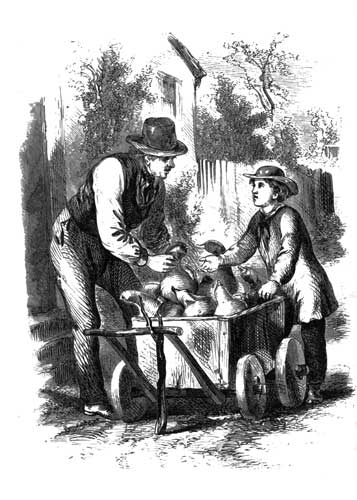
Saturday afternoon came, and Nat started with his little cart full of
squashes. He was obliged to be his own horse, driver, and salesman, in
which threefold capacity he served with considerable ability.
"Can I sell you some squashes to-day?" said Nat to the first neighbor on
whom he called.
"Squashes! where did you find such fine squashes as those?" asked the
neighbor, coming up to the cart, and viewing the contents.
"I raised them," said Nat; "and I have a good many more at home."
"What! did you plant and hoe them, and take the whole care of them?"
"Yes, sir; no one else struck a hoe into them, and I am to have all the
money they bring."
"You deserve it, Nat, every cent of it. I declare, you beat me
completely; for the bugs eat mine all up, so that I did not raise a
decent squash. How did you keep the bugs off?"
"I killed thousands of them," said Nat. "In the morning before I went to
school I looked over the vines; when I came home at noon I spent a few
moments in killing them, and again at night I did the same. They
troubled me only about two weeks."
"Well, they troubled me only two weeks," replied the neighbor, "and by
that time there was nothing left for them to trouble. But very few boys
like to work well enough to do what you have done, and very few have the
patience to do it either. With most of the boys it is all play and no
work. But what do you ask for your squashes?"
Nat proceeded to answer: "That one is worth six cents; such a one as
that eight; that is ten; and a big one like that (holding up the
largest) is fifteen."
The neighbor expressed his approval of the prices, and bought a number
of them, for which he paid him the money. Nat went on with his peddling
tour, calling at every house in his way; and he met with very good
success. Just as he turned the corner of a street on the north side of
the common, Ben Drake discovered him, and shouted, "Hurrah for the
squash-peddler! That is tall business, Nat; don't you feel grand? What
will you take for your horse?"
Nat made no reply, but hastened on to the next house where he disposed
of all the squashes that he carried but two. He soon sold them, and
returned home to tell the story of his first peddling trip. Once or
twice afterwards he went on the same errand, and succeeded very well.
But he became weary of the business, for some reason, before he sold all
the squashes, and he hit upon this expedient to finish the work.
"Sis," said he to a sister younger than himself, "I will give you one of
my pictures for every squash you will sell. You can carry three or four
at a time easy enough."
Sis accepted the proposition with a good deal of pleasure; for she was
fond of drawings, and Nat had some very pretty ones. He possessed a
natural taste for drawing, and he had quite a collection of birds,
beasts, houses, trees, and other objects, drawn and laid away carefully
in a box. For a boy of his age, he was really quite an artist. His
squashes were not better than his drawings. His patience, perseverance,
industry, and self-reliance, made him successful both as a gardener and
artist.
In a few days, "Sis" had sold the last squash, and received her pay,
according to the agreement. The sequel will show that peddling squashes
was the only enterprise which Nat undertook and failed to carry
through. His failure there is quite unaccountable, when you connect it
with every other part of his life.
We are reminded that many men of mark commenced their career by
peddling. The great English merchant, Samuel Budgett, when he was about
ten years old, went out into the streets to sell a bird, in order that
he might get some funds to aid his poor mother. The first money that Dr.
Kitto obtained was the proceeds of the sale of labels, which he made
and peddled from shop to shop. One of the wealthiest men we know, a
Christian man distinguished for his large benevolence, commenced his
mercantile career by peddling goods that he carried in a band-box from
one milliner's shop to another. "You must creep before you can walk," is
an old maxim, and the lives of all distinguished men verify the proverb.
He who creeps well, will walk so much the better by and by; but he who
is ashamed to creep, must never expect to walk. We know a successful
merchant who commenced the work of an errand-boy in a large mercantile
house, when he was about twelve years old. He was not mortified to be
caught with a bundle in hand in the street, nor to be seen sweeping the
store. Not feeling above his business, he discharged his duties as well
as he could. When he swept he swept,—every nook and corner was
thoroughly cleaned out. When he carried a bundle, he carried
it,—nimbly, manfully, promptly, and politely he went and delivered it.
He performed these little things so well that he was soon promoted to a
more important post. Here, too, he was equally faithful and thorough,
and his employers saw that he possessed just the qualities to insure
success. They promoted him again; and before he was twenty years old he
was the head clerk of the establishment. He was not much past his
majority when he was admitted as a partner to the firm; and now he
stands at the head of the well-known house, a man of affluence,
intelligence, and distinction. Had he been ashamed to carry a bundle or
sweep a store when he was a boy, by this time his friends would have had
abundant reason to be ashamed of him.
This chapter of Nat's early experience in squash culture, was quite
unimportant at the time. It is still only a memorial of boyish days;
but it was a good beginning. It shows as clearly as the most
distinguished service he afterwards rendered to his fellow men, that
hopefulness, industry, perseverance, economy of time, self-reliance, and
other valuable traits, were elements of his character.