THE TEA-PARTY.
FIVE o'clock found the whole party of school-girls assembled in Madam
Wentworth spacious, old-fashioned drawing-rooms. From the oldest to the
youngest, not one was absent. Most of the girls had been there before;
but those who had not, gazed with interest at the family-portraits, by
Copley and Stuart, the tall India-cabinets surmounted by almost equally
tall china vases of fabulous age and priceless value, the étagères
with their curious and beautiful things gathered from all parts of the
world, the portfolios of engravings, the heavy, handsome, old-fashioned
furniture, and Madam Wentworth's own particular ebony worktable, inlaid
with ivory and lined with sea-green satin.
The little girls gathered in the back parlour, where Elsie's old
baby-house displayed its attractions, together with gems, puzzles and
picture-books innumerable. The elders walked about, or chatted in
groups, or disposed of themselves in any way that pleased their fancy.
Madam Wentworth sat by the fire, knitting, as usual; only, instead
of fine thread or splendidly coloured Berlin wool, her fingers were
occupied with a blue woollen stocking. Some of the girls thought her
graver than common; but she had a smile and a kind word for every
one,—especially the strangers. Presently she arose and went into the
library, where quite a little party had gathered, including Minny,
Sarah, Elsie and Christine. Christine stood a little apart from her
companions, earnestly engaged in running over the titles of the books
on the lower shelves.
"Look at Christine!" said Minny. "One would think she never had been in
a library before in her life."
"I dare say she never was," said Sarah. "Christine, dear, did you ever
see so many books together in your life before?"
"I have seen as many," replied Christine, simply; "but there are some
books here that I never met with." And she mentioned the titles of
several. "Oh," she said, with something of a sigh, "how nice it must be
to be able to buy every thing that one wants! What a collection of rare
books!"
"Rare!" said Sarah,—sneeringly, as usual.
"Rare out West, I suppose she means," remarked Minny. "Of course, they
are not rare here."
"Rare anywhere," said Christine, with spirit. "Rare even in
London,—some of them. I believe you think that people out West don't
know how to read."
"Oh, no!" replied Minny, who was making a great effort that day to
do the amiable. "Of course we know that Western people are very
industrious and thriving, and all that; but we don't expect them to be
literary. We all know that you are a very good scholar, Christine. We
were only amused at your thinking so much of seeing these books, and
fancying them so rare."
"They 'are' rare!" persisted Christine. "My father buys a great many
books, and gets catalogues of all the great sales: so I know. He has
been trying these five years to get a copy of 'Pococke's Travels,'
without success."
"I believe Christine is right, Minny," said Elsie. "This book
belonged to grandfather; and I rather think it is one of the original
subscription copies. There are some splendid books in that next case,
Christine."
Christine passed on, and was almost struck dumb at the sight of the
magnificent folios relating to the zoological world.
"Oh, Elsie!" she said, in a tone almost of awe. "Do you think your aunt
would be willing to let me take down one of these volumes?"
"Take down any thing you please, my child," said Madam Wentworth,
answering for herself. "I am glad to find some one who is interested in
them. Elsie, my dear, draw out that table for Christine. Have you seen
those volumes on European birds? You will find them well worth looking
at."
Christine flushed up, and seemed almost too shy and too happy to speak.
Madam Wentworth well understood the precious art of setting people
at their ease, and drawing them out to talk of what they understood
best. And the other girls stood amazed to hear the shy, timid girl
chatting with their hostess about different authors on Natural History,
comparing the relative merits of drawings, and expressing her opinions
with modest frankness when they chanced to differ from those of Madam
Wentworth.
"Have you the Australian Birds?" asked Christine.
"I am sorry to say I have not," replied Madam Wentworth. "I had fully
intended to treat myself to the book this fall; but, after this unhappy
war broke out, it did not seem to me right to expend such a sum on what
was, after all, but an article of luxury, when so much is required for
necessaries. It is no time now to indulge in superfluities."
"I suppose that is right," said Christine, thoughtfully; "and yet
buying books does not seem exactly like self-indulgence."
"I do not mean to imply that it is always so," said Madam Wentworth;
"but intellectual tastes may be indulged to a selfish extent as well as
sensual appetites. A man may spend money improperly upon books as well
as upon fine furniture or rich food."
"It seems a higher kind of self-denial, to deny oneself books and such
things," remarked Elsie.
"Undoubtedly it is," said Madam Wentworth, "to those who have
intellectual tastes. But, my dear Christine, since you are so fond
of Natural History, I shall be happy to have you come here and read
whenever you are so disposed. It need make no difference whether I am
at home or not. Gertrude will find you what you want, and make you
comfortable."
Christine expressed her gratitude in few but efficient words.
Minny looked on in wonder and envy. Here was this little, ignorant
country-girl (as she had been accustomed to consider her) treated by
the great lady as an equal, and invited to come to her house whenever
she pleased. While she—the rich and beautiful Miss Granger, daughter of
a millionnaire—was honoured with no more notice than was given to the
youngest of her companions.
"So much for knowing how to get on the right side of people," thought
Minny. "I dare say she knew before she came that Madam Wentworth was
fond of such things; but hew any one can care so much for a parcel of
birds passes my comprehension."
Henrietta was rather later than her companions. She had felt a strange
unwillingness to come at all; for she had an uncomfortable presentiment
that something was going to happen. It might be the effect of her own
uneasy conscience, but she fancied that Madam Wentworth's greeting
lacked something of its accustomed cordiality. Elsie had tried to treat
her just as usual,—but that is a thing which, under such circumstances,
no one ever yet accomplished; and she felt vexed at herself for
colouring and feeling constrained and awkward.
Minny sported her injured innocence and wounded affection, and
Henrietta thought all the girls were more or less cool to her. As she
wandered about the house, and remembered how happy she had been there
with Elsie, she could hardly restrain her tears, and, but for the dread
of exciting attention and remark, she would have pleaded illness and
gone home.
The time passed on, and tea was on last announced. On these occasions,
a table was always set the whole length of the long dining-room, and
adorned with all the magnificence of the Wentworth plate and china.
Mrs. Wentworth sat at the head of the table, and, usually, one of
the elder girls at the foot; but now that place was occupied by Miss
Delancy.
Henrietta looked at Minny, and tried to catch her eye; but Minny looked
resolutely another way. The table was spread as the tea-tables of
old-fashioned ladies are wont to be when they entertain their young
friends. There was plenty of good wholesome bread and butter, a great
abundance of cakes of all sorts and sizes, and such preserved fruits
and cream—as many of the girls thought and declared—were never seen
anywhere else: cherries as clear as amber, in syrup like virgin honey;
peaches not shabbily canned, but preserved by the good old-fashioned
rule of pound for pound; pink quinces built into blooming pyramids with
a cement of their own jelly; with strawberries, pine-apple, &c., all in
rare abundance.
Gertrude took great delight in preparing all these delicacies, and
enjoyed equal pleasure in seeing them appreciated by "the young
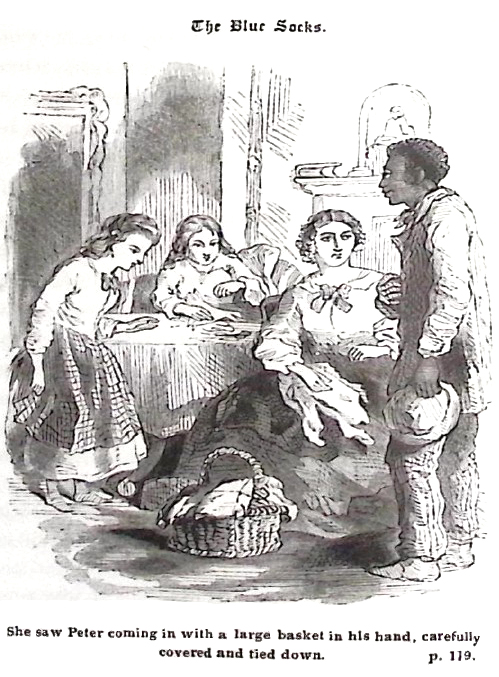
ladies." And Madam Wentworth's own man Septimius stood behind his
mistress's chair, and our old friend Peter, in gorgeous array, behind
that of Miss Delancy. The places were taken without confusion, grace
was said, and all sat down.
"What an odd ideal—saying grace at the tea-table!" whispered Minny to
Augusta, who happened to be her next neighbour. "I didn't know any one
did such things nowadays."
"Why shouldn't one say grace at tea as well as at dinner?" asked
Augusta.
"Well, I don't know. It don't seem appropriate, somehow."
"I don't see why it should be omitted at tea more than at any other
meal," answered Augusta. "It seems to me that is like saying, in
effect, that you would like a blessing on your breakfast and dinner,
but as for your tea, you don't care whether you have one or not."
"How you 'do' like to twist words round, Augusta!"
"I like to 'untwist' them," replied Augusta, laughing. "I like to put
them into plain English: and I admit that they sometimes sound very
differently when they are so translated."
The meal went on merrily and pleasantly. There was abundance of lively
conversation and laughing, and a thorough enjoyment of the good things
before them. Madam Wentworth looked on, pleased, as usual, with the
pleasure of the young folks; but several of the girls besides Hetty
thought she was graver than usual.
When every one had finished, she made a signal to Septimius, who
immediately left the room, followed by Peter, and closed the door. The
girls, a little surprised, looked at Madam Wentworth, expecting the
usual signal to rise; but she remained sitting for some minutes in
silence.
"Now that you are all together, girls," she said, at last, in a kind
but very serious tone, "I wish to speak to you in relation to a matter
which has given me a great deal of pain. I allude to the story which
has been circulating among you concerning my niece, Elsie Probert."
The girls looked at each other, and then at Minny and Hetty. Minny
coloured deeply, while Henrietta turned as pale as death.
"I understand," Madam Wentworth continued, "that it has been publicly
said in the school that Elsie has employed another person to do her
work for her, and has then attempted to pass it off as her own,—and
that the person in question was her cousin, Miss Delancy, who was
actually seen at work upon the stocking in question. Was not that the
story?" she asked, addressing herself to Rose Chesterfield.
"It was," replied Rose.
Madam Wentworth continued:—"Elsie herself told me that the girls
distrusted her and treated her coldly upon this account, and asked
my advice as to what she had better do about it, as she did not, for
reasons that you will easily understand, wish to mention the affair
to Miss Armitage. I advised her to do nothing, and let it pass over;
but, upon consideration, doubted the propriety of allowing such a gross
calumny to be unreproved, and I therefore resolved, without saying any
thing to her, to take the matter into my own hands. Miss Delancy will
now speak for herself."
"I have never taken one stitch on Elsie's work since she commenced it,"
said Miss Delancy. "I was staying at her father's house while the socks
were in progress, and we used to have some trials of speed, in which I
confess I was ignominiously beaten. But so conscientious was Elsie that
on one occasion when I had ravelled out a part of her work, mistaking
it for my own, she would not even let me knit it up to where it was
before. The work which I had on the Milton cars was my own. Elsie never
told me not to forget to finish her work, as has been reported. What
she said was, 'Do not forget!' And the words referred to a message to a
friend."
"The facts in the case are these," resumed Madam Wentworth. "Elsie was
doubtful at first whether she should have time to finish the socks
if she began them. She is, as you know, very busy in school, and she
has many home-duties besides. Moreover, she intended to begin taking
music-lessons just at that time, to which she had been looking forward
with a great deal of pleasure, and which would, of course, occupy
most of her time. Her father had already given to the cause of the
country all that he felt he could afford, and for that reason Elsie
did not like to ask him for money to purchase her materials. Upon
consideration, however, she came to the conclusion to devote to her
stocking-yarn the funds she had saved for Christmas purposes, and, that
she might have time to knit, she gave up her music-lessons, resigning
her place in the class to Isabella Chesterfield. By this means, and
by carefully husbanding all her spare moments, she was enabled to
accomplish what she did, and, having counted the cost before she began,
she was not disappointed in the result.
"You know as well as I who were the authors of these slanders," she
continued, with a shade more of severity in her voice. "To them I shall
say nothing. To those who have believed them, I shall only remark that
I am sorry to find them so ready to think evil of a school-mate in whom
they certainly have never seen any tendency to deceit. 'Charity,' says
the apostle, 'thinketh no evil,' and though we have every thing else,
but lack charity, it will profit us nothing."
There was a pause. Henrietta was stunned. She could think of nothing
except to wish that she could somehow sink out of sight and memory.
But her cup was not full! Ever since Madam Wentworth began speaking,
Minny had been considering how best to save her credit. It would be
useless to deny any thing,—that she saw at once; but could she not gain
something by a frank confession? Like many other politicians, she had
no scruple about sacrificing an ally if it became necessary. Before
Madam Wentworth concluded, her mind was made up.
"I suppose I am partly to blame," said she, speaking quite clearly
and distinctly. "I did suspect Elsie of having help about the work. I
saw her knitting on a blue sock with a red stripe round the top, and
I afterwards saw Miss Delancy have such a sock on the cars. I told
Henrietta what I thought, but begged her not to repeat it to any one,
as it was only a guess on my part. She did repeat it, and, I am sorry
to say, with very great additions; for she said she knew of her own
knowledge that Miss Delancy had knit on Elsie's sock, and a good deal
besides. I was very much vexed, and told her so; and we had quite a
quarrel about it, as Elsie knows. I never told one of the girls but
Henrietta, and no one can say that she ever heard me. I am very sorry
that I ever mentioned the matter to any one. If I had known Elsie as
well as I do now, I should never have thought of suspecting her of such
a thing, and I beg her pardon for having done so."
"There!" she thought. "I don't see how I could be expected to do more
than that!"
But Madam Wentworth's face did not relax, as she expected, and Elsie,
for the first time, looked very angry.
"Then you never, in any way, helped to give currency to the report,
except by telling your suspicions to Henrietta, under the seal of
confidence?" said Madam Wentworth.
"No, ma'am," replied Minny, boldly. "I never did. All the rest was
Henrietta's doing."
The girls looked at each other in amazement, and Rose and Augusta
exchanged intelligent glances.
To Rose's lips came the words, "Shall I speak?"
Augusta nodded.
"I should like to say something about that," Rose began. "Henrietta
was undoubtedly very wrong; but it is by no means fair that she should
bear all the blame. I do not say that Minny confirmed the story in so
many words, but she certainly did all that looks and actions and very
broad hints could do, both in the school and, as I understand, in her
own house. She never contradicted Henrietta in a single instance, and
certainly intimated very clearly that she not only believed what was
said, but could tell a great deal more if she would. I do not defend
Henrietta, but, I must say, I think Minny was equally to blame."
Minny tried to put on a look of injured innocence; but it was a signal
failure.
"Where did you see Elsie have her work?" asked Madam Wentworth, turning
to Minny.
"I saw her at her back parlour window," answered Minny. "Our windows
look directly across."
"You must have good eyes, to distinguish one sock from another at that
distance," observed Miss Delancy.
"She used an opera-glass," said Sarah Stone, loud enough to be heard by
every one.
Madam Wentworth smiled in spite of herself.
"I congratulate you upon your zeal in the pursuit of knowledge," said
she. "If you bring it to bear upon your school-books, you must be a
very good scholar. But it unluckily happens that people who bestow so
much attention upon their neighbours' affairs, often have but little
left for their own. I see, by Elsie's imploring looks, that she is
desirous I should drop the matter; and I am very ready to do so. I
hope this will be a lesson to all of you on the subject of slander.
You see how great a matter a little fire kindleth. I do not doubt that
Henrietta sees clearly the sin and folly of her conduct, and I trust
that she will never be tempted to repeat it. As to Minny, I must say, I
should think much better of her if she had not tried to clear herself
at the expense of her companion. I wish to repeat, and to have it
distinctly understood, that all this has been planned by me, without
Elsie's knowledge or consent. We will now go up-stairs."
As soon as Elsie could escape from the congratulations and apologies
of the girls, she hastened in search of Henrietta, who had disappeared
immediately after supper.
After long searching, she found her occupying a low seat behind the
curtains in her aunt's dressing-room, crying as if her heart would
break.
Minny was occupied in putting on her hat and cloak to go home, talking
angrily, though in a low tone.
And as Elsie entered, she heard her say, "I will never speak to you
again the longest day I live; and, what's more, I will be revenged on
you, if I die for it,—you mean, little, hypocritical story-teller!"
"Hush, Minny," cried Elsie. "You must not talk so. It is very wrong.
Henrietta is unhappy enough now."
"I never will speak to her again," repeated Minny, "and I wish I had
never known her."
"It would certainly have been a blessed thing for her if you never
had," Elsie could not help saying.
Minny deigned no reply, but marched down-stairs, and shut the
street-door after her with a violence that shook the house.
Elsie sat down by Henrietta in the window-seat, and tried, by caresses
and kind words, to soothe her agitation. She could not help crying
herself; and perhaps her tears did as much good as any thing.
Henrietta turned away at first, and would make no response to Elsie's
entreaties; but it was not in her nature to resist kindness, and by
degrees she was won over to lay her head on her friend's shoulder, and,
with her arms around her neck, to beg her pardon:—
"Oh, Elsie, I am so sorry! I never realized till to-night how wicked I
had been all the time. I have done nothing but go more and more wrong
ever since that first day I spoke to you so about the stockings. You
can't guess half the mean and shameful things I have done. I have felt
so wicked, I have not dared to say my prayers for ever so long."
"I know how that is," said Elsie. "When I have done any thing very
wrong, I have had the same feeling; but, Hetty, I don't think it right
to give up to it, because then one only gets worse and worse."
"That is just what I have done," said Henrietta, crying afresh. "If any
one had told me, six months ago, that I should have acted so, I never
would have believed it. I was even angry at you yesterday for telling
Minny that I would not do any thing mean. I know very well that I had
done so many mean things, besides talking about you as I did. I have
been angry with mother, and cross to poor Cecy; and oh, Elsie, worse
than that,—I was ashamed to have any one know that she was my sister,
because Minny said she was a frightful little object; and I wished
mother would not let Peter carry her out where people could see her."
"She is not frightful," said Elsie, indignantly: "she has the sweetest
face I ever saw. I really cannot see, Hetty, how you could let Minny
lead you as she did. I should think one such speech would have opened
your eyes."
"She flattered me so," replied Henrietta. "I was just such a fool
as to believe it all; and she could make me do any thing by coaxing
and praising me. And I don't believe she really cared for me, after
all. All she thinks about the girls is whether they are rich and
fashionable."
"I suppose it is a good deal in the way she was brought up," remarked
Elsie. "Frances Percival, who hardly ever speaks against anybody, says
her mother is a very silly, half-educated woman, who cares for nothing
but dress and show; and of course that makes some excuse for Minny."
"I don't blame Minny half as much as I do myself," said Henrietta.
Elsie was glad to hear this remark. She thought it showed the sincerity
of Henrietta's repentance that she did not throw any more blame on her
companion. And she could not help contrasting her disposition with
Minny's, ready to sacrifice Henrietta for the least chance of clearing
herself.
"You must try to forgive Minny, though," she said, with a little
hesitation,—for she was always somewhat shy of speaking upon religious
subjects. "You know,'If we forgive not men their trespasses—'"
"Yes, I know," said Henrietta. "But, Elsie, when I think about it, it
does seem as though—" She paused, and then added, in a much lower tone,
"as though He never could forgive me."
"You mustn't think so, Hetty. He is always ready to forgive a great
deal more ready than we are to ask it."
"If it was only once or twice," said Henrietta. "But I have done wrong
over and over so many times. Sometimes I would be really sorry, and
resolve to behave better; but I never did."
"Hetty," said Elsie, "don't you remember what Christ told Peter?—That
he should forgive his brother, 'not seven times, but seventy times
seven'? And don't you think he would be ready to do as much as he told
Peter was right?"
"Do you know, Elsie," said Hetty, after a little silence, "I used
really to think I loved him and wanted to be like him?—Last spring, you
know."
"I know," replied Elsie. "I thought so too; and that made me all the
more sorry—"
"It began with my doing little things that I knew were wrong,"
continued Henrietta, "not trying to keep my thoughts fixed in
prayer-time, and then reading story-books in school. After that, Minny
came to sit next to me, and we used to do very bad things. I used to
write down dates and numbers on a little piece of paper, and hold it
in my hand to look at in the class, and peep into the book if I got a
chance. And this week I did something worse. I don't know how to tell
you Elsie; but, indeed, I never did any thing quite so bad as this
before. I am afraid you will never want to speak to me again when you
know what it is."
"I think I know now," said Elsie, desirous to relieve her friend as far
as possible from the shame of such a confession: "you mean about your
composition."
"How did you find out?" asked Hetty, surprised. "Did Minny tell you?"
"No, indeed," exclaimed Elsie. "If Minny had told me any such thing
about you, I should have shut her mouth quickly enough, you may depend
upon that. She undertook this morning to say something about your
reading your lesson, and I just told her, plainly, that people who
lived in glass houses shouldn't throw stones."
Hetty felt a new pang of remorse, as she reflected how differently she
had behaved. "But about the composition: how did you find out about it?"
"Oh, I knew in a moment. You see, we have taken Littell's 'Living
Age' from the very beginning, and father has always had them bound.
And when I get out of any thing else to read, I take down one of the
back volumes. So I am pretty familiar with them. I thought the verses
sounded very 'natural,' and yet I could not tell where I had heard or
seen them. I repeated two or three lines to my father, and asked him if
he knew who wrote them, or where they were to be found. And he went to
the bookcase and took down the very volume!
"So I just threw the paper into the fire that no one else might see it,
and meant to speak to you about it; but all this fuss put it out of my
head. But, Hetty, you would have been in a dreadful plight if I had not
known—if they had gone into the paper. Maria Bradley read those very
verses in school one day when you were not there. Just think how you
would have felt if they had been read!"
Hetty shuddered. "It would have served me just right, though! But how
shall I manage about the piece? I never can write one now."
"Oh, never mind. You can scribble something, and make it up next time.
You are a great deal better off than usual this week, and you know Miss
Armitage never asks who is in the paper. I am only glad I saw it before
any one else did."
"Those 'Littells' were among my troubles," said Hetty. "I was cross
with Cecy one day, and mother sent me to my room and told me not to
leave it till tea-time. I had my knitting, but I would not work on
that: so I ran up to the attic and brought down a whole armful of
magazines. After that, I was always reading them when I ought to have
been doing something else,—reading the Bible, or studying, or knitting
on my socks; and I wasted a great deal of time on them. That was one
reason why I didn't get my sock done. I shall never want to see a
'Littell' again as long as I live."
"I think that is hardly fair," remarked Elsie, smiling. "The poor
papers are not in fault. They would have done you no harm if you had
read them at a proper time."
"One thing I am determined on," said Henrietta. "I mean to tell mother
every thing. I will never have a secret from her again."
Elsie applauded this resolution, and begged her not to defer putting it
into practice. "You will find it a hundred times easier to-night than
to-morrow, Hetty. The longer such a thing is put off, the harder it is."
"I will do it before I sleep," replied Henrietta. "I know she will be
very angry—"
"I don't believe she will," interrupted Elsie.
"Well, perhaps not; but she will be sorry, and that is worse. Do you
know, I am so glad it has all come out? Even with the disgrace and all,
I feel happier than I have done for weeks. I don't suppose the girls
will ever speak to me again, though."
"Oh, yes," replied Elsie. "When they see that you are sorry, they won't
remember it against you,—that is, not very long. I dare say there will
be some to twit you with it when they get vexed; but they are not those
you care the most about. Come; don't let's stay up here in the dark any
longer. I want the girls to see that we are friends again."
There was a good deal of staring and whispering, as Elsie and Hetty
entered the drawing-room arm in arm.
"Well," said Letty Stanley, emphatically, "if Elsie is not a Christian
child, I never saw one. I will never laugh at her preciseness after
this."
"She likes to make a show of magnanimity for aunt's benefit," remarked
Sarah, sneering as usual. "It is very cheap, and goes a great way."
"Sarah," asked Letty, "did you ever do one single good or true or kind
thing in your whole life?"
"Upon my word, Miss Letitia Stanley, that is a singular question! I
don't think I am so much worse than any one else. Why do you ask me?"
"Because," replied Letitia, with emphasis, "I never yet, in all the
time I have known you, heard you allow that any one acted from good
motive, or spoke the simple truth, or did a kind action, without some
expectation of advantage; and it is only fair to suppose that you judge
others in some degree by yourself."
"But, after all, Letty, don't you think it shows a want of spirit in
Elsie to be so ready to take Henrietta up again, after being so badly
treated by her?" asked Lizzy, as Sarah turned away, for once too much
abashed to answer.
"It shows a want of a certain sort of spirit, I admit," replied
Letty,—"but a great abundance of another sort which is infinitely
better. It shows a spirit of love and forgiveness—"
"In short, a Christian spirit," interrupted Rose.
"Well, yes, a Christian spirit,—which is much better than pride and
resentment."
"Elsie can afford to be magnanimous," said Rose, smiling. "She has been
in the right all the time. I think it is comparatively easy to pardon
those who have injured us. It is those we have injured that we find it
hard to forgive."