A man, stoutly built, keen of eye, showing haste
in his every movement, sprang from the machine
and ascended the veranda steps.
"Does Richard Duvall live here?" he inquired,
curtly, of the smiling old colored woman who
came to the door.
"'Deed he do, suh. Does you want to see
him?"
"Yes. At once, please. Tell him it is most
important. My name is Hodgman."
The servant eyed him with cool disfavor. "Set
down, suh," she remarked stiffly. "I'll tell him
you is here."
The caller watched her, as she disappeared
into the house, then cast himself impatiently into
a chair and lit a cigar.
He paid no attention to the attempts of two
clumsy collie puppies to attract his favorable
notice, but contented himself with making a quick
survey of the wide comfortable veranda, with its
big roomy chairs, the wicker table, bearing a
great jar of red peonies, the smooth green lawns,
swept by the late afternoon sun.
"Fine old place," he muttered to himself.
"Wonder if I can persuade him to go?"
As the car which had brought Mr. Hodgman
on his hasty trip from Washington dashed up to
the front of the house, Grace Duvall, looking
very charming in a blue linen dress, was just approaching
it from the rear.
She held a pair of shears in her hand, and her
apron was filled to overflowing with hundred-leaf
roses. "Dick—oh, Dick!" she called, as she came
down the long avenue of syringas and lilacs which
led to the house. "The sweet peas are nearly
ready to bloom."
Richard Duvall, looking as simply pastoral as
though he had never tracked an international
crook to cover, raised his head from the flower
bed, in which he had been carefully setting out
circle after circle of geranium plants.
"Are they?" he laughed. "That's good. Now
all we need is a few good hot days." He gathered
up his trowel and rake, and started toward
the barn.
Grace put her arm through her husband's and
together they strolled across the springy green
turf, their faces smiling and happy. The honeymoon
showed no signs of waning.
This lovely old country place, in southern
Maryland, had been one of Richard Duvall's
dreams for many years, and after his marriage
to Grace Ellicott, in Paris, it had become hers,
as well. It was but a short time after their return
to America that they decided to make it a reality.
Grace had encouraged her husband in the plan
of giving up, for a time at least, his warfare
against crime, his pursuit of criminals of the
higher and more dangerous type, and had persuaded
him to buy the farm which had once belonged
to his mother's people, and settle down to
the life of a country gentleman.
His office was still maintained, under the able
direction of one of his assistants, but Duvall gave
little or no attention to its affairs. He was glad
to withdraw, for the first time in over nine years,
from active work, and devote his energies to early
potatoes, prize dogs, hunters, and geranium plants—and,
above all, to the peaceful enjoyment of his
honeymoon, and the making of Grace the happiest
woman in the world.
She, on her part, found in their present situation
all the joys of existence for which she had
longed. With little or no liking for the monotonous
round of society and its duties, and a passionate
love of nature, she found in the many
and complex duties of managing her part of their
extensive estate a far greater happiness than any
which city life could have offered her.
The considerable fortune which her husband's
clever work while in Paris had restored to her,
had been safely invested in well paying securities,
and she found her greatest joy in utilizing at
least a part of her income in beautifying their new
home.
Richard had steadily refused to make any use
of the money. It was a matter of pride with him,
that his own savings had enabled him to purchase
the property; but when Grace proposed to build
an addition to the house, to provide him with a
more comfortable library and work room, or
insisted upon having the roads throughout the
place elaborately macadamized, he was obliged
to submit to her wishes. In this way, they planned
and built for the future, together.
The farm was a large one, comprising some
two hundred acres, and the old stone house surrounded
by white oaks and tulip poplars had once
been a show place, before the declining fortunes
of its former owners had caused it to fall into a
state of mellow and time-honored decay. Now
all was changed. Grace, with the able assistance
of old Uncle Abe Turner, a relic of ante bellum
times, spent hours daily in bringing order out of
the chaos of tangled myrtle and ivy, overgrown
box and hedge, thickets of syringa and lilac bushes
and weed-grown lawns.
It was a gigantic task, yet a joyous one—as it
ever is, to those who came to it with the love of
nature in their hearts. To Grace, the plants and
shrubs, the great strong oaks, the towering poplars,
each seemed to have a distinct personality.
Under her energetic hand, the place once more
took on the aspect of well kept and orderly beauty
which was such a contrast to its former down-at-the-heels
appearance. It seemed as though the
growing things realized the personal interest she
took in them, and responded as they never respond
to the ignorant or unsympathetic.
Richard was concerned with his fields of timothy
and clover, his early corn, his berries and fruit
trees, to say nothing of his collies, his prize cows
and Kentucky horses. In such a life, time never
hangs heavy—he was busy studying, planning,
working, from morning to night, and his active
mind soon convinced his capable overseer and the
farm hands as well that, although Richard Duvall
was by no means a professional farmer, he could
still show them a thing or two when it came to
the rotation of crops, the spraying of fruit trees,
or the proper treatment of worn out soils. These
were aspects of farming life which the hide-bound
conservatism of the local farmers caused them to
jeer at, as newfangled notions gotten from books.
Later when they saw the man who farmed with
his head as well as his hands gather in two bushels
where they had barely been able to secure one,
they began to sit up and take notice.
"I got the new hedges all set out today," Grace
went on, as she patted her husband's rather grimy
hand. "They will be charming, against the gray
stone of the wall. But we must have new gate
posts. The old ones are likely to tumble into the
road at any moment."
"I'll have Martin come out tomorrow and look
them over. There's plenty of stone—down in the
lower pasture. Why not carry the wall right
along the whole front of the property? It ought
not to cost a great deal."
"We will. And I'm going to have a new spring
house built, too. The old one is falling to
pieces." She looked up at her husband as he deposited
the rake in the tool room and they started
up the shaded walk toward the house. "Aren't
you glad, Dick, that we're alive?"
He pressed her arm. "Well—I should say
so, little girl! Why do you ask me that?"
"Oh—you know what your friends all said—that
a man might as well be dead, as buried out
here in the country. I think they are the ones
who are not alive—cooped up in the city. Don't
you?"
Richard nodded. He was thinking for the
moment of his former active life—when some
battle of wits with a noted crook had kept him
sleepless for nights. "It's—rather different," he
laughed. "Isn't it?"
"Yes—and much better. Don't you think so,
dear? You wouldn't want to go back to it—would
you?"
"Not for anything in the world," he assured
her, as he swept the newly seeded lawns with a
contented glance. "I liked the other life, of course—the excitement,
the danger of it; but this is
better—much better. Here, Don!" he called to
a graceful collie which was barking vociferously at
some distant vehicle in the road. "Come here
and be quiet." He turned with Grace to the great
vine-covered side porch and sank contentedly into
a rocking chair. "Well, little girl—it's been a
busy day, and I'm tired. We got the early rye
all cut on the lower field today. Guess we'll put
in late potatoes, after it's plowed. Here, Don—come
back here! What's the matter with you?"
He rose and whistled to the dog, which was bounding
across the lawn in the direction of the road.
"Come back, I say!"
"It's someone coming in," said Grace, uneasily.
"In a machine. I wonder who it can be?"
"Possibly Hudson, the veterinary. He was
coming today, to look at that heifer."
"He hasn't a machine like that. This is a big
touring car." She turned to her husband.
"Hadn't you better go in and fix up a bit, Dick?
It may be company."
Duvall laughed. "If it is, they'll have to take
me as I am," he said; then again called to the dog.
A moment later the servant, who had interviewed
the caller at the front door, came out to
the side porch. "Gentleman to see you, Mr. Duvall,"
she said. "Seems to be in a powerful
hurry, too."
"All right, Aunt Lucy," said Duvall as he made
his way to the front of the house.
"Is this Richard Duvall?" the visitor asked,
in a quick, almost peremptory tone, as the detective
joined him.
"Yes. That is my name. What can I do for
you?"
The newcomer rose nervously from his chair
and began chewing upon his half-smoked cigar.
"Had the devil of a time to find you, Mr. Duvall."
"You came out from Washington, I suppose,"
remarked the detective, wondering what his visitor
could want with him.
"Yes. Got your address from Hicks, of the
Treasury Department. He said you were about
twelve miles out. I seem to have come about
twenty."
"Perhaps you went around by way of Laurel.
It's much further, that way. What can I do
for you, Mr.——" He paused interrogatively.
The man looked up at him quickly. "My
name's Hodgman—Thomas Hodgman—of New
York. I represent John Stapleton."
"John Stapleton, the banker?" asked Duvall,
surprised.
"Yes. You know him, don't you?"
"Yes. Quite well. I handled a case for him
once—some years ago. Why?" Duvall's face
became grave. He began to realize that the interview
was likely to become suddenly important.
John Stapleton, the multi-millionaire banker, was
not in the habit of sending messengers to anyone,
without good reason.
"So he said," went on Mr. Hodgman, resuming
his chair. "That's why I'm here. He wants you
to take another—"
"Another?"
"Yes. Another case. Quick."
"It's quite out of the question."
"Nonsense! This is important. Money's no
object; name your own terms."
"It isn't a question of terms, Mr. Hodgman.
I have withdrawn, for the time being at least,
from active professional work."
"I know." The visitor flicked the ashes impatiently
from his cigar and sought nervously in
his pockets for a match. "That's what they told
me at your office, in New York. Said you were
on your honeymoon, and didn't want to be bothered."
"That's true. I don't."
"I told Mr. Stapleton that. He sent me to see
you; said you might change your mind, when you
heard about the case."
"It is quite impossible. I do not care to take
up any detective work at present."
Mr. Hodgman fidgeted nervously in his chair.
"You must listen to what I have to say, Mr.
Duvall, at any rate. Mr. Stapleton would not
hear to my returning, after seeing you, without
having explained to you the nature of the
case."
Duvall leaned back, and began to fondle the
long moist nose of the collie which sat beside his
chair. "If you insist, Mr. Hodgman, I will listen,
of course; but I assure you it will be quite useless."
"I hope not. The case is most distressing.
Mr. Stapleton's only child has been kidnapped!"
"Kidnapped!" Duvall sat up with a start,
every line of his face tense with professional interest.
"When? Where?"
"In Paris. The cablegram arrived this morning.
I don't know the details. Mrs. Stapleton
has been spending the winter abroad. Mr. Stapleton
was to join her this month. She is living at
their house in the Avenue Kleber, Paris. The
child was out walking with a nurse. It has been
stolen. That's all I know."
"When did it happen?"
"Yesterday morning. Mrs. Stapleton did not
cable at first, believing that the boy would be
found during the course of the day. Naturally
she did not wish to alarm her husband needlessly,
and the Prefect of Police, it seems, had assured
her that the child would undoubtedly be recovered
before night. It wasn't. This morning Mr.
Stapleton got a long cablegram from his wife,
telling him of the boy's disappearance. He's half
crazy over the thing."
"What is he going to do?"
"I don't know. He sent me to see you at once.
I'm his secretary, you know. When I couldn't
find you in New York, he told me to come here.
I arrived in Washington an hour ago, and came
right out. Mr. Stapleton said if any man on
earth could find his boy for him, you could."
"I suppose the thing is a matter of blackmail—ransom—"
"Very likely. They will probably demand a
huge sum. No requests have been made, as yet,
so far as I know. These fellows usually wait a
week or two, before showing their hand, to give
the unfortunate parents a chance to worry themselves
half to death. I suppose they figure that
then they'll be more likely to come across with
the money."
"Yes. That's the scheme. A rotten business,
too. Hanging is too good for such wretches!"
"That's what I say. Of course you can understand
how Mr. Stapleton feels."
"Of course. He will sail at once, I suppose."
"That's the worst of it. He can't go till Saturday.
Tomorrow's Thursday—that's three days
off. There's a deal on here involving millions—something
he's been working to put through for
months. Of course he doesn't consider anything
like that, when it comes to his child; but he's
got to think of his associates—men who have
intrusted their money to him. He can't possibly
sail before Saturday. He wants you to go ahead
of him. There's a fast boat leaving in the morning.
You could take that. We can have a conference tonight.
It will mean mighty quick work,
though." He glanced at his watch. "After six
now. There's no train till midnight—the sleeper.
But Mr. Stapleton told me to charter a special.
We can be in New York by one o'clock in the
morning, if we start right now." He looked at
Duvall in eager expectancy.
The latter frowned, his gaze wandering off to
the distant fields, where the newly plowed earth
reminded him of his plans for the morrow. Yet
here was a man, a friend, who had helped him
much, in the earlier days of his career, begging
him to come to his assistance in a matter almost
of life or death. It was a difficult decision that
he was called upon to make. The thought of
leaving Grace hurt him deeply; yet she would prefer
to stay behind, in case he should go, to look
after the affairs of the place. With the assistance
of the overseer and the hands, he knew that she
could manage everything during a brief absence
on his part—it seemed unlikely that the matter
would require more than three or four weeks, at
the outside.
Mr. Hodgman broke in upon his thoughts.
"You'll go, Mr. Duvall? Mr. Stapleton is depending
on you. He has the utmost faith in your
abilities. He knows your familiarity with Paris—the
work you have done there, in the past. He
believes that, by intrusting the matter to a fellow
countryman, he will get his boy back again. He
hasn't much faith in foreign detectives. He's set
his heart on having you start for Paris at once.
I can't go back and tell him that you have refused."
Mr. Hodgman spoke in a loud and earnest
voice, due to his very evident excitement.
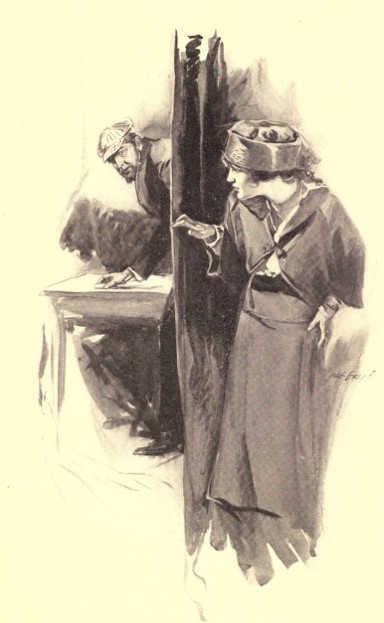
Neither he nor Duvall noticed that Grace had
approached them, and was standing in the open
doorway of the house.
Before the detective had an opportunity to
reply, Grace spoke. "What is it, Richard?" she
inquired, quietly.
Duvall rose, presented Mr. Hodgman to his
wife, and bade her sit down. Then, in a few
words, he acquainted her with the circumstances
which led to the latter's visit.
"Think of that poor mother, alone there in
Paris," Hodgman supplemented. "Think of her
suffering, her anxiety. I realize how much we
are asking, to take Mr. Duvall away from you,
especially at this time; but, it is Mr. Stapleton's
only child—a boy of six. You can understand
how he must feel."
Grace nodded. "Yes, I can understand," she
said, slowly, then turned to her husband.
"What do you think, dear?" he asked her.
"I think, Richard, that you had better go."
Mr. Hodgman sprang to his feet, and, coming
over to Grace, took her hand. He knew that his
battle was won. "I thank you, Mrs. Duvall,"
he said, "on Mr. Stapleton's account, as well as
on my own. He will appreciate deeply what you
have done, the sacrifice you are making, and he
will not forget it." He looked again at his watch
nervously, the anxiety he felt clearly evident in
his every movement. "We had best start at once,
Mr. Duvall."
Duvall rose. "I will join you in a short while,
Mr. Hodgman. I wish to say a few words to
my wife." He took Grace's arm and drew her
within the house, leaving Mr. Hodgman pacing
nervously up and down the veranda.
The conference between Grace and her husband
was short. Each realized the distress which
tore at the other's heart, as well as the dangers
he would in all probability be called upon to face;
yet they met the situation calmly. "You will not
be gone long," she told him. "I can manage very
well."
"I know you can, dear," he said, pressing her
to him. "I'm not worried about the place. You
can run that as well as I can. It's you, I'm
worried about—leaving you"—
"I'll be all right," she assured him, in spite of
her tears. "I have Aunt Lucy, and old Uncle Abe,
and Rose, and Jennie. I won't be so very lonely.
And you will be very careful—and—and come
back soon—won't you?"
"Of course, dear. Very soon. Now I'd better
get a few things together."
Fifteen minutes later Grace Duvall stood on
the steps of the veranda, watching the flying automobile
as it rapidly became a little red blur in
the distant road. It was nearly dark. The frogs
in the patch of marsh in the meadow were piping
dismally. She shivered, and a great sense of
desolation came over her. She sank into a chair
and wept, while Don, inserting his long white
muzzle between her hands, strove to lick away
her tears.
She heard Aunt Lucy, the old negro cook, singing
away at her work in the kitchen, accompanied
by Uncle Abe, who occupied a bench on the back
porch. Everything seemed strangely peaceful,
and lonely, too, now that Richard had gone. She
patted the eager head of the collie. "We'll have
to make the best of it, Don," she said, and rose
to enter the house.
Suddenly far down the road she heard the
chugging of an automobile. They were not frequent
visitors, upon this country road. Could it
be Richard, she wondered, returning for something
he had forgotten?
She stood, straining her eyes into the dusk,
waiting, while with one hand she restrained the
eager dog.
Presently she saw that the machine was not a
red one. It was not Richard. She was about to
enter the house, when she realized that the rapidly
moving car had entered the grounds. She
turned on the lights in the hallway and stood,
waiting, the dog at her side bristling with anger.
In a moment the automobile had stopped, and
almost before she realized it, a small, foreign-looking
man stood on the doorstep before her.
"Madame Duvall?" he inquired, quickly, in a
voice which showed plainly his nationality.
"Yes," she replied.
"Your husband! May I see him?"
"He is not at home."
The newcomer seemed greatly disturbed.
"Then I fear, Madame, that I shall be obliged
to wait until he returns."
"He will not return. He has gone away for
sometime."
"Ah! That is indeed a calamity!" The man's
face showed the keenest disappointment. "May I
ask where I can find him?"
"It will be quite impossible." Grace had no
intention of telling her visitor where her husband
had gone. She knew too well the intricacies of
his profession, for that. "You cannot find him."
She made as though to close the door, and thereby
terminate the interview.
The newcomer realized her intention. Slowly
he raised his hand, in the palm of which showed
the seal of a ring, turned inward. It was of
silver, with curious figures worked into it in gold.
The man glanced from the ring to Grace, eying
her steadily. "I think, Madame," he said, with
a meaning smile, "that you can trust me."
Grace recognized the ring at once. It was
similar to one she herself had worn, while engaged
in the memorable search for the ivory snuff
box for Monsieur Lefevre, Prefect of Police
of Paris. Dear old Lefevre—the friend of
Richard's, and of her own! This man who
stood before her must be a messenger from
him.
"Come in, please," she said, quietly, and led
the way to the library.
The man followed her, calling out a few words
to his chauffeur as he did so. No sooner had
they reached the great book-lined room, than he
drew from his pocket a sealed envelope.
"Madame Duvall," he said, earnestly, "Monsieur
Lefevre has cabled to his representatives in
Washington a message. That message is contained
in this envelope. I have instructions to
deliver it to your husband immediately. In case
I could not find him, I am to hand it to you.
Permit, me, Madame." With a bow, he placed
the message in her hand.
Grace took the envelope, broke the heavy seal
which it bore, and drawing out a slip of paper,
hastily read the contents. The message was from
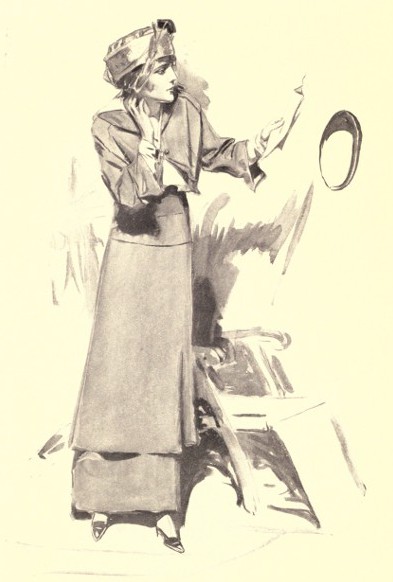
Monsieur Lefevre. It said:
Grace looked up at the man before her, the
letter crumpled in her hand. Here was a message
the urgency of which could not be denied.
She knew that, had Richard been at home, he
would have gone to Paris at once in response to
it; for it was to Monsieur Lefevre that they in
reality owed all their happiness. She recalled
vividly their wedding, with the lovable old
Frenchman, acting as her father for the occasion,
giving away the bride. She remembered the farewell
dinner at the Prefect's house, and the beautiful
gift he had given her on that occasion. Evidently
Monsieur Lefevre desired Richard's presence
very greatly, and her own as well. The
thought suddenly came to her—why not go to
him?
True, Richard had left her in charge of things
at home; but she knew that, for a reasonable
time, at least, they would go on smoothly enough
without her. Hendricks, the overseer, was a
capable and honest man, devoted to her and to
her husband.
She could safely leave matters in his charge.
Then, too, the thought of surprising Richard on
the steamer sailing the next day appealed to her
sense of mischief. How astounded he would be,
to find her strolling along the deck! And how
delighted, too! She wondered that the thought
of accompanying him had not occurred to her
more strongly before. She turned to the man,
who stood watching her narrowly.
"You know the contents of this message?"
"Yes, Madame," he bowed. "It came to us by
cable—in cipher."
"There is a train for New York at midnight,
and a steamer tomorrow morning."
"Yes, Madame."
"Can you drive me to Washington in your
car?"
"I shall be delighted, Madame." The fellow's
eyes sparkled with satisfaction.
"Very well. Mr. Duvall is in New York. I
will take the message to him. Wait here, please,
until I get some clothes together and give some
orders to my servants."
In half an hour, the thing was done. Hendricks,
the overseer, had been given full instructions
regarding taking charge of the place, with
provision for his needs in the way of money, etc.,
and by ten o'clock, at which time the New York
sleeper was open, Grace was at the station, purchasing
her ticket.
The obliging Frenchman gave her every assistance,
and bade her bon voyage smilingly as he
helped her aboard the train. She retired at once,
and lay in her berth, reading a magazine, and
picturing to herself Richard's mingled astonishment
and joy at their meeting in the morning.
This time, she was determined that their honeymoon
should not be interrupted.
After a time, she fell asleep, and dreamed that
she and Richard were sailing gaily toward Paris,
in a large red touring car.
In the morning, she ate a hasty breakfast in
the railway station, and took a taxicab for the
steamship offices. By great good fortune, she
was able to secure a cabin. Then she hastily
visited a banking house where she was well
known, provided herself with funds, and drove to
the dock.
It wanted but half an hour till sailing time.
Grace hastened to her stateroom, and busied herself
in effacing the stains of her night of travel.
She was determined to meet Richard looking her
best.
It was not until the big steamer was passing
through the Narrows that she came on deck, and
began looking about for her husband. In all that
crowd, she knew it would take time to find him.
After searching for an hour, she felt somewhat
surprised at not seeing him. After another hour
had passed, her surprise turned to alarm. A
hasty visit to the purser, and an examination of
the sailing list, showed her the astonishing truth.
Richard was not on board!