Cover created by Transcriber, using illustration from the original book, and placed in the Public Domain.
INTENDED FOR THE
AMUSEMENT AND INSTRUCTION
OF Young Ladies and Gentlemen.
BY THE EDITOR OF THE LOOKING-GLASS FOR THE MIND.
WITH FORTY-SEVEN CUTS, DESIGNED AND ENGRAVED BY
THE FOURTH EDITION.
LONDON: Printed by J. Swan, 76, Fleet Street,
FOR J. HARRIS; SCATCHERD AND LETTERMAN; B. CROSBY AND CO.
DARTON AND HARVEY; LACKINGTON, ALLEN, AND CO.
J. WALKER; AND VERNOR AND HOOD.
1806.
PREFACE.
THE very flattering encouragement the
Public have been pleased to give "The
Looking-glass for the Mind, or Intellectual
Mirror," has invited the Editor of
that work to intrude once more on their
indulgence. As a general preceptor, he
wishes to be useful to the rising generation,
and with that view recommends to their
serious perusal "The Blossoms of Morality."
The Looking-glass is a very free translation
of some of the most interesting
tales of Mons. Berquin, and other foreign
writers, whose works in the juvenile line
undoubtedly merit the highest encomiums,
and claim the most extensive patronage of
their fellow-citizens. It certainly must be
allowed, that great merit is due to those
foreign celebrated writers, who, after
studying the higher branches of literature,
instead of attempting to acquire honour
and fame by delivering lectures on the
abstruse sciences, have condescended to
humble themselves to the plain language
of youth, in order to teach them wisdom,
virtue, and morality.
With respect to the present work,
though we have not so largely borrowed
from foreign writers, yet we have endeavoured
to supply that deficiency by the
introduction of original matter. The juvenile
mind very early begins to enlarge
and expand, and is capable of reflection
much sooner than we are generally apt to
imagine.
From these considerations, we have
carried our ideas in this volume one step
higher than in the last: and, though we
have given many tales that may contribute
to amuse the youthful mind, yet
we have occasionally introduced subjects
which, we hope, will not fail to exercise
their judgment, improve their morals, and
give them some knowledge of the world.
For instance: in the History of Ernestus
and Fragilis, which is the first, and
one of the original pieces inserted in this
volume, the youthful reader is led to reflect
on the instability of all human affairs;
he is taught to be neither insolent
in prosperity nor mean in adversity; but
is shown how necessary it is to preserve
an equality of temper through all the
varying stages of fortune. He is also
shown, how dangerous are the indulgences
of parents, who suffer children to give
themselves up to indolence and luxury,
which generally, as in this history, terminate
in a manner fatal to all the parties
concerned.
May these Blossoms of Morality, in
due time, ripen to maturity, and produce
fruit that may be pleasing to the youthful
taste, tend to correct the passions, invigorate
the mental faculties, and confirm in
their hearts true and solid sentiments of
virtue, wisdom, and glory.
THE faint glimmerings of the pale-faced moon
on the troubled billows of the ocean are not so
fleeting and inconstant as the fortune and condition
of human life. We one day bask in the sunshine
of prosperity, and the next, too often, roll in
anguish on the thorny bed of adversity and affliction.
To be neither too fond of prosperity, nor
too much afraid of adversity, is one of the most
useful lessons we have to learn and practise in the
extensive commerce of this world. Happy is the
youth whose parents are guided by these principles,
who govern their children as good princes
should their subjects, neither to load them with
the chains of tyranny, nor suffer them to run into
the excesses of dissipation and licentiousness.
The following History of Ernestus and Fragilis
is founded upon these general principles.
Ernestus and Fragilis were both the children
of Fortune, but rocked in two different cradles.
Philosophy and Prudence were the nurses of the
first, and Vanity and Folly lulled the second to
his repose. Ernestus was early used to experience
the various changes of the air, and accustomed
to a regular diet; while Fragilis was treated
in a very different manner, being kept in a
room where, it was supposed, no rude wind
could intrude itself; and hurtful delicacies were
given him, under the idle notion, that strength
is to be acquired in proportion to the dainties
and excesses of our meals.
Hence it is no wonder if, after a few years had
strengthened their limbs and mental faculties,
that there appeared an indisputable difference between
the two youths.
Ernestus was all life and gaiety, and soon
showed a propensity to be at the head of all kinds
of mischief. Though this disposition often got
him into disgrace with his parents, yet he always
showed much contrition and sorrow when he
really found he had injured any one, and seldom
slept after the commission of a boyish crime till
he had made ample amends to the party injured.
Fragilis had very different passions, and very
contrary notions of things. Being accustomed to
be indulged with whatever he cried for, his ideas
soon wandered from real to imaginary wants, and
as these could not possibly be gratified, he naturally
became peevish, fretful, and ill-natured.
Whenever the mind is affected, the body must
partake of the shock it occasions. Fragilis was
weak, rickety, and feeble; and the remedies they
applied to relieve him only contributed to increase
the evil.
As the two little heroes of my history lived in
the same neighbourhood, and their parents were
nearly equal in point of fortune, they consequently
became intimate companions, and frequently
visited each other. It was easily to be discovered
which of these two children would one day figure
most on the busy stage of the world. Ernestus
and his lady with pleasure beheld in their little son
an ample share of spirit and activity, kindness and
affability, resolution and integrity. The parents
of Fragilis, however, had not the same pleasing
prospect in their favourite and darling; for he was
of a dull and gloomy turn, seldom contented with
any thing, perpetually wrangling with every one
about him, and constantly pining after those
things which he knew were not to be procured.
Ernestus made a rapid progress in his literary
pursuits, under the tuition of his masters; for his
application to his books was equal to the genius
nature had bestowed on him. On the other hand,
Fragilis advanced very slowly in the paths of science;
for his genius had been spoiled by the pernicious
indulgences of his parents in his infant
years, and he had been suffered to acquire a habit
of indolence, which made the least labour of
body or of mind tiresome and disgustful.
These circumstances, however, did not seem
to interrupt the rising friendship between these
two youths, their connections growing stronger
as they ripened in years. They were joint proprietors
in their kites, their tops, their marbles,
and their dumps; though Ernestus was generally
the manufacturer of the first and last articles.
Indeed, the kites made by Fragilis were
always too heavy, and not equally balanced on
both sides; consequently they were difficult to
be raised into the air, and when there, they
had a wavering and unsteady motion; whereas,
those made by Ernestus were light and elegant,
darted into the air like an eagle, and remained
there as steady as a hawk resting on its wings;
his dumps had the elegance of medals; and his
tops and marbles were so judiciously chosen as
to claim the admiration of all the neighbouring
youths.
The time at length arrived, when it is usual for
parents to begin to think of sending their children
from home, to engage in the busy commerce of
the world, and to learn how to provide for themselves.
The feathered inhabitants of the woods
and groves give up every pleasure to that of rearing
their little brood; but, as soon as they have
acquired a proper degree of maturity, they then
drive them from their nests, to form new connections,
and to shift for themselves. Man, more
helpless than birds, requires the assistance of the
parental hand, for some years, to rear and cherish
him; nor do their cares and anxieties for him cease
till life is no more.
Though Ernestus loved his parents with all the
affections of a dutiful child, yet he could not help
rejoicing at the idea of embarking in the bustle of
the world, and making a figure as a man. On the
other hand, Fragilis could not prevail on himself
to quit the apron-string of his mother, and engage
in the rude clamour of a commercial life, in which
so much attention, thought, and industry, are required.
Neither could his parents part with their
darling, whose constitution they had spoiled, and
rendered unfit for business. Ernestus, in a short
time after, by his own desire, was placed as a clerk
in a merchant's house in London; while Fragilis
continued with his parents, to squander away his
time in destructive scenes of indolence and luxury.
Five years had glided away as it were imperceptibly,
when Ernestus found himself disengaged
from the ties of his clerkship. His person was by
this time arrived at the state of manhood, his figure
was graceful and genteel, and his mind was improved
from the polite companies he had engaged
in at his leisure hours. As business had ever been
the first object of his attention, and as he had
thereby made himself of no small consequence to
his late master, the latter, to connect him more
closely with his interests, offered Ernestus his
daughter in marriage, and a considerable share in
the trade of the house. Such a flattering offer
could not admit of a moment's hesitation, especially
as a secret passion had long mutually glowed
in the bosom of each party. They were married,
and they were happy.
Soon after this period, a most dreadful inundation
happened on the sea-coast, on the very spot
where the houses and lands of the parents of Ernestus
and Fragilis were situated. Dreadful indeed
it was, for it not only washed down their
houses, but drowned some hundreds of cattle, and
left that as a part of the briny ocean, which, but
a few hours before, was beautiful meadows and
gardens, adorned with every thing pleasing to regale
the appetite, or please the eye.
Deplorable indeed was now the situation of
those two families: their houses washed away,
their cattle destroyed, and all their fruitful lands,
on the produce of which their fortunes depended,
were irrecoverably lost, and become of no value.
Surely, to support such a situation with any tolerable
degree of tranquility of mind, requires
more courage and philosophy than generally fall
to the lot of imperfect mortals!
After the first transports of terror and affright
were a little abated, and calm reason and reflection
succeeded the sad emotions of horror and
despair, the old Ernestus thus addressed the fair
partner of his misfortunes:—
"My dearest Emelia," for that was the name
of his amiable lady, "in the midst of this terrible
misfortune, we have the happiness to reflect, that
what has befallen us is not derived from any fault
of our own, but by the pleasure of Him who gave
us every thing, and who has a just right to take
what he pleases from us. Though he has taken
from us our house and lands, he has still graciously
left us our beloved son, who will not fail to
console us in our misery, and who will perhaps
help us in our distresses. Though we are deprived
of our fortune, we have the pleasing consolation
to reflect, that, by bringing him up in the school
of Prudence and Industry, we have secured him
from sinking under the wreck of our present calamity.
Nothing can more contribute to soften
the calamities of good parents, than to reflect
that their children are not exposed to partake of
their miseries."
The heart of this amiable spouse was, for some
time, too full of grief for the misfortune she felt, to
give any immediate reply: but, at last, recovering
her usual spirits and sensibility, she withdrew her
head from the bosom of her generous husband, on
which it had been for some time tenderly reclined.
"Ah! my beloved partner of happiness and
misery," said she, "why am I thus sorrowful and
wretched? why do I thus fly in the face of Providence,
for depriving us only of the baubles of
life? Have I not still left an amiable and tender
husband, and a dutiful and beloved son. These
are treasures which I still possess—treasures infinitely
beyond those I have lost—treasures that
will support me in the stormy hour of adversity,
and enable me to make a mockery and derision of
every thing that the cruel hand of fabled Fortune
can inflict."
She then caught her husband in her arms, and
there fainted, rather through excess of joy than
grief. Virtuous minds, however they may be
distressed for a moment, by unforeseen accidents,
soon find an inexpressible consolation in the integrity
of their hearts.
Such was the character of Ernestus and his
lady, that this dreadful calamity was no sooner
known, than all the neighbouring gentry flocked
round them, and seemed to contend with each
other for the honour of assisting such distinguished
characters. What is the empty parade
of riches acquired by fraud, rapine, and plunder,
when compared to the heartfelt satisfaction which
virtue in distress must have here felt?
It may reasonably be supposed, that it was not
long before this dreadful calamity of these amiable
parents reached the ears of young Ernestus. A
youth, brought up in the wilds of modern extravagance,
would have exclaimed, perhaps in bitter
terms, on being thus suddenly deprived of a fine
patrimonial estate; he would, probably, have
even arraigned the severe hand of Providence,
and have dared to utter impieties against his omnipotent
Maker!
Such was not the conduct of Ernestus. His
parents had taken care to give him, not a flighty
and frothy, but a rational and manly education,
the foundation of which was honour, probity,
and virtue; not folly, luxury, and vanity. It is a
just proverb, that the first seasoning sticks longest
by the vessel, and that those who have been accustomed,
in their early days, to tread the paths
of Prudence, will seldom, when they grow up,
run into those of Folly.
Ernestus received the news of this terrible calamity,
just as he and his lady returned from a
party of pleasure. It is too often found, that after
pleasure comes pain, and never was it more truly
verified than in this instance; with this exception,
that here the one was not the consequence
of the other.
He tenderly embraced his lady, took leave of
her for the present, and instantly set out for the
fatal scene of ruin, to assist, console, and comfort,
his unfortunate parents. What passed between
them in the first moments of their meeting,
afforded such a scene of tenderness and
affection, as exceeds the possibility of description
to reach: the feelings of the heart, in such a situation,
exceed every thing the most lively imagination
can fabricate.
Ernestus found his dear parents had taken
shelter in the house of an old gentleman, who
lived in the neighbourhood, who was immensely
rich, and had neither children nor relations living.
Here they enjoyed all the consolation and comfort
their generous hearts could wish for; nor
was the young Ernestus suffered to contribute
his mite to their aid. "It is enough," said the
old gentleman of the house, "that you have lost
your patrimony; but I have riches sufficient,
and have no near relation to succeed me. How
can I dispose of it better than in cherishing the
distressed, and in taking virtue by the hand to
raise it above the wrecks of fortune?"
In a little time after, this worthy old gentleman
paid the debt of nature, and left the bulk of his
fortune to the parents of Ernestus; who, by this
act of generosity, were become as opulent as ever,
and consequently resumed their former figure in
the world. The fortune of young Ernestus was
every day increasing, from his great success in
commerce, till he at length found himself master
of a sufficient independency, when he quitted
trade; and he and his lady retired to the country,
where they passed their days under the same roof
with their parents, happy in themselves, and diffusing
happiness to all who lived within the circle
of their knowledge.
We could wish here to drop the curtain, and
leave the mind filled with those pleasing ideas,
which the good fortune of the family of Ernestus
must raise in the bosoms of the generous and humane—but
we must return to the unhappy family
of Fragilis.
Young Fragilis, owing to the mistaken manner
in which he was brought up, was feeble and enervated
at that age, in which youths generally grow
strong and robust. Hence it happened, from the
sudden inundation of the waters, that it was with
great difficulty he could save his life. However,
though he escaped the fury of the unrelenting
waves, he caught such a cold, that a fever ensued,
which, heightened by the fright he had received,
proved too much for his weakly constitution to
support, and put a period to his existence in a
few days.
Trying indeed was the situation of Mr. Fragilis
and his lady: in one day, deprived of all their
wealth and possessions, and in a few days afterwards
of their only son, whom they loved to
excess, whom they ruined by false indulgences,
and by whom they were reproached for their
mistaken conduct in his dying moments. To be
reproached by the only object they loved in this
world, as being in some distant degree instrumental
to his death, was too cutting a consideration
for them to bear. They felt the wound
effectually, it festered in their hearts, and they
soon followed their son to his untimely tomb.
Reflect, ye too tender and indulgent parents,
how dangerous it is to rear your children in the
lap of Luxury and Indolence, since you thereby
make them unfit members of the community, frequently
a heavy load to themselves, and always a
source of anxiety and fear to their mistaken parents.
Without health, strength, and vigour,
life is but a burthen; why should then so many
parents take such trouble to deprive their children
of the three principal blessings of this life,
which, when once lost, are never known to
return?
Juvenile Tyranny conquered.
MR. Wilson, his lady, and little family, left
the noise and bustle of the city, to pass the more
agreeable half of the year amidst the delights of
rural scenes and prospects. Mr. Wilson, to a
refined education, had added much knowledge
and experience in the commerce of the polite
world. His lady, though an amiable and sensible
woman, had, in the education of her children,
given rather too much into the fashionable errors
of the metropolis.
As soon as they were properly settled in their
rural retirement, Mr. Wilson thus addressed his
lady: "I flatter myself, my dear, that you will
now leave me at liberty to manage our two children,
in the manner that shall appear to me most
proper; for I wish to eradicate those seeds of
pride, obstinacy, and perversity, which the little
circle of their acquaintance in London has sown
in their minds, and to which the corrupted manners
of the city have given deep root."
Mrs. Wilson seemed a little angry at this introduction,
and wished to know what were those defects
he imagined to have discovered in the minds
of her two little ones: she entreated him not to
conceal them from her, as it was equally her duty
to assist in every thing where the happiness of
their children was concerned.
"I do not wish, my dear," replied Mr. Wilson,
"to complain of your conduct as a wife;
but I think you are too fond and indulgent as a
mother, you encourage them too much in the
pride of dress, and fill their minds with the love
of those things, which, so far from being of any
use to them, may in time be productive of the
worst of evils. Children, who are taught to
value themselves only on their dress, or in proportion
as they expect a superiority of fortune to
others, will with difficulty consent to be governed
by the rigid rules of prudence, or submit with
cheerfulness to those laborious studies, from
which alone true greatness is derived."
Mrs. Wilson laughed at the oddities of her
husband, as she called them, and represented him
as one born in the beginning of the last century.
She considered it as an indispensable duty to educate
her children in conformity to the manners
of the times, and the modes of education almost
universally adopted in the fashionable world.
Mr. Wilson, however, was of a very different
opinion, and considered nothing so dangerous to
the morals of his children, as to suffer them to
be brought up in the modern school of extravagance
and pride. He owned it was a privilege
which most wives claimed, of being permitted to
spoil their daughters in their own way; and if,
out of complaisance, he gave up that point, he
hoped he should be permitted to educate his son
as he thought proper.
The first thing he should endeavour to break
him of, he said, should be his pride, which induced
him to despise every one who was not
dressed like himself, or whom he otherwise
thought beneath him. Mr. Wilson considered
it as very pernicious, to suffer children to value
themselves merely on account of their dress or
fortune.
Mrs. Wilson, however, could not be convinced
of the truth of these arguments. "I suppose,"
said she, "you would have him brought up like
a ploughman, or as if he were born to nothing
greater than little Jackson, the son of the gardener,
who lives at the bottom of your grounds."
The conversation now began to grow serious,
and the gentleman could not help saying, he most
heartily wished that his son, born as he was to an
ample fortune, possessed all the good qualities
which were conspicuous in that poor boy. He
very judiciously observed, that what the world
generally calls a polite education, often falls short
of producing those happy effects, which Nature
sometimes bestows on uncultivated minds. Children
of humble birth are often despised, merely
on account of their poverty, without considering,
whether Nature may not have done more for
them than for the children of Fortune. "Happy
should I think myself," said he, "if my son
and heir possessed half the civility and condescension
which are so much taken notice of and
admired in that little fellow you seem inconsiderately
to despise."
Mrs. Wilson, though a little disconcerted by
these observations, seemed by no means inclined
to give up the argument. "Did I not know
otherwise," said the lady, "I should suspect you
of being prejudiced against every thing the world
considers as polite, in favour of poverty and
rusticity. With all your boasted qualifications of
this little Jackson, what would you say, should I
clearly prove to you, that he possesses secret faults,
such as may be hurtful to your son; that he is
guilty of robbing yours and every orchard in the
neighbourhood? that he gluttonizes on the fruits
of his robberies in private? and that, though he
is so very complaisant with the children of Fortune
in the presence of their parents, he is a tyrant
over the little ones in private?"
Mr. Wilson observed, that if his lady could
prove little Jackson to be guilty of one half of
the crimes she had laid to his charge, he would
instantly order, that he should never more be
suffered to enter his house.
The lady then proposed to make a fair and candid
experiment of this matter. "I will," said she,
"order a little feast for our son and daughter,
and young Jackson shall be one of the party.
We will find an opportunity to conceal ourselves,
when we shall hear every thing that passes. From
thence we shall have an opportunity of judging
whether you or I be right."
The proposal was so just and reasonable, that
both parties instantly agreed to it. Some fruit
and other things were immediately ordered to be
brought into the parlour, and Miss and Master
Wilson were sent for, as well as little Jackson.
As soon as the latter entered, the little lady and
her brother complained of the strong smell of
dung he brought with him; and, though he was
very clean and decent, they were afraid of his
coming too near them, lest he should spoil their
fine clothes.
Though Mr. Wilson did not approve of this
kind of behaviour in his children, he took no
notice of it at present, but desired that they would
be all happy together, while he and his lady took
a walk into the garden. They then left the room,
but softly entered it at another door, before which
a screen was designedly placed, by which means
they plainly overheard every thing that passed
among the young folks.
The first thing they heard, was their little
daughter calling to her brother to come and sit
by her; at the same time telling young Jackson
he must stand, and think himself happy that he
was, at any rate, permitted to remain in their
company. The little fellow seemed no ways displeased
at this treatment, but told them he was
not at all tired, and was very happy to be with
them in any situation.
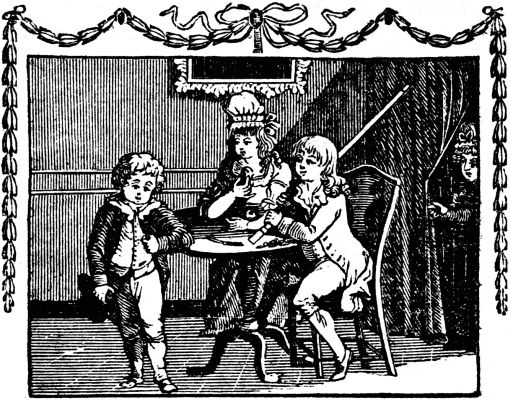
Master Wilson and his sister then divided the
fruit into three parcels, as though they intended
one of them for young Jackson; but, as soon as
they had eat up their own shares, they began
upon that intended for him, and eat it all up
without giving him a taste, and even made ridicule
of him all the time. They told him they
would give him the parings of the apples, which
were as much as such a poor creature as he could
expect, and that he ought to think himself happy
he could be indulged with them.
Young Jackson told them he was not hungry,
and he hoped they would not deny themselves any
thing on his account. They promised him they
would not, and then set up a loud laugh; all
which Jackson bore without uttering the least
word of complaint.
At last, Miss Wilson and her brother having
eaten up all the fruit, without permitting poor
Jackson to taste a bit of it, they ordered him to
go into the garden, and steal them some apples,
promising, if he behaved well, to give him one
for his obedience.
"I cannot think of doing any such thing," replied
Jackson. "You indeed forced me twice to
do so, and then went and told the gardener that
I stole them for myself, though you very well
know I did not eat a morsel of them."
"Poor thing!" said the young gentlefolks in
derision, "and did they serve you so? Well, we
insist on your going and doing the same now, or,
look you, that cane in the corner shall be laid
across your shoulders. We will teach you, that
it is the duty of you beggars to obey us gentlefolks."
Jackson still persisting in his refusal to be again
guilty of any thing of the kind, Master Wilson
took up the cane, and gave poor Jackson two or
three blows with it, as hard as he could, while
Miss Wilson stood looking on, encouraging her
brother, telling Jackson at the same time, that
if he complained of being beaten to their papa,
they would again accuse him of stealing fruit,
and that their words would be sooner believed
than his.
Poor Jackson replied, that he would rather be
beaten all day than do so dishonest a thing as
they desired him. He observed to them, that
this was not the first by many times that he had
been beaten by them unjustly and wantonly, and
he did not suppose this would be the last. However,
he said he should put up with it, without
complaining to any one.
Mr. Wilson and his lady could not patiently
hear any more, but instantly came from behind
the screen.—"Sweet children, indeed!" said
Mrs. Wilson. "We have, behind that screen,
unseen by you, heard all you have been saying,
and in what manner you have treated that poor
little fellow!" Little Jackson was all in a tremble,
and told her, that they were only at play,
and meant no harm. But this would not satisfy
the lady, who was now convinced of the bad
conduct of her son and daughter.
"You wicked children," said she to them,
with a resolute look and stern voice, "you have
accused this innocent child of gluttony and theft,
while you only are the authors of those abominable
crimes. You have not scrupled to tell
me the grossest falsehood, such as God will one
day call you to account for, and severely punish
you in the next world, where it will not be
in my power to intercede for you. This moment
ask pardon of that little boy, whom you
have so unjustly treated, and sincerely ask pardon
of God, for the wickedness you have been
guilty of!"
Her children were so overcome with shame,
confusion, and sorrow, that they both fell down at
their mother's feet, and with tears of sincerity most
humbly begged pardon of God and her, promising
never to be again guilty of such crimes. Little
Jackson ran to them, and endeavoured to lift them
up, while the tears stole down his cheeks in abundance.
"Do not be angry with them, madam,"
said he to the lady, "for we were only in play;
and I am sorry I am come here to breed so much
uneasiness. But, if you are angry with them,
let me humbly beg of you to forgive them."
Mr. Wilson also interfered, and promised, if
their mamma would forgive them this time, to be
bound for their better conduct in future. The lady
ordered them instantly to rise, to kiss little Jackson,
and beg his pardon. This they did in so affecting
a manner, as gave the most pleasing satisfaction to
both their parents, who were now fully persuaded,
that reason and tenderness will do more with children
than the iron hand of correction.
The Book of Nature.
MY dear papa, said young Theophilus to his
father, I cannot help pitying those poor little
boys, whose parents are not in a condition to
purchase them such a nice gilded library, as
that with which you have supplied me from my
good friend's at the corner of St. Paul's Church-yard.
Surely such unhappy boys must be very
ignorant all their lives; for what can they learn
without books?
I agree with you, replied his father, that you
are happy in having so large a collection of
books, and I am no less happy in seeing you
make so good a use of them.—There is, however,
my dear child, another book, called The Book of Nature,
, which is constantly open to the inspection
of every one, and intelligible even to those
of the tenderest years. To study that book, nothing
more is required, than to be attentive to
the surrounding objects which Nature presents
to our view, to contemplate them carefully, and
to explore and admire their beauties; but without
attempting to search into their hidden causes,
which youths must not think of, till age and experience
shall enable them to dive into physical
causes.
I say, my dear Theophilus, that even children
are capable of studying this science; for you have
eyes to see, and curiosity sufficient to induce you
to ask questions, and it is natural for human nature
to wish to acquire knowledge.
This study, if it may be so called, so far from
being laborious or tiresome, affords nothing but
pleasure and delight. It is a pleasing recreation,
and a delightful amusement.
It is inconceivable how many things children
would learn, were we but careful to improve all
the opportunities with which they themselves
supply us. A garden, the fields, a palace, are
each a book open to their view, in which they
must be accustomed to read, and to reflect thereon.
Nothing is more common among us than
the use of bread and linen; and yet how few
children are taught to know the preparation of
either! through how many shapes and hands
wheat and hemp must pass before they are made
into bread and linen!
A few examples will serve to show, how far
we ought to study nature in every thing that presents
itself to our view, and therein trace out the
handy-works of the great Creator.
The first preacher that proclaimed the glory
of the supreme God was the sky, where the sun,
moon, and stars shine with such amazing splendour;
and that book, written in characters of
light, is sufficient to render all inexcusable who
do not read and contemplate it. The Divine
Wisdom is not less admirable in its more humble
productions of what the earth brings forth,
and these we can survey with more ease, since
the eye is not dazzled by them.
Let us begin with plants. What appears to us
mean and despicable, often affords wherewith to
astonish the sublimest minds. Not a single leaf is
neglected by Nature; order and symmetry are obvious
in every part of it, and yet with so great a
variety of pinking ornaments and beauties, that
none of them are exactly like the others.
What is not discoverable by the help of microscopes
in the smallest seeds! and with what unaccountable
virtues and efficacies has it not pleased
God to endow them! Nothing can more demand
our admiration, than the choice which our great
Creator has made of the general colour that beautifies
all plants. Had he dyed the fields in white
or scarlet, we should not have been able to bear
either the brightness or the harshness of them.
If he had darkened them with more dusky colours,
we should have taken little delight in so
sad and melancholy a prospect.
A pleasant verdure keeps a medium between
these two extremes, and it has such an affinity
with the frame of the eye, that it is diverted, not
strained by it, and sustained and nourished, rather
than wasted. What we considered at first but as
one colour, is found to afford an astonishing diversity
of shades: it is green every where, but it
is in no two instances the same. Not one plant
is coloured like another, and that surprising variety,
which no art can imitate, is again diversified
in each plant, which is, in its origin, its progress,
and maturity, of a different sort of green.
Should my fancy waft me into some enamelled
meadow, or into some garden in high cultivation,
what an enamel, what variety of colours, what
richness, are there conspicuous! What harmony,
what sweetness in their mixture, and the shadowings
that temper them! What a picture, and by
what a master! But let us turn aside from this
general view, to the contemplation of some particular
flower, and pick up at random the first
that offers to our hand, without troubling ourselves
with the choice.
It is just blown, and has still all its freshness
and brightness. Can the art of man produce
any thing similar to this? No silk can be so soft,
so thin, and of so fine a texture. Even Solomon's
purple, when contrasted with the flowers
of the fields, is coarse beyond comparison.
From the beauties of the meadows and gardens,
which we have just been surveying, let us
take a view of the fruitful orchard, filled with
all sorts of fruits, which succeed each other, according
to the varying seasons.
View one of those trees bowing its branches
down to the ground, and bent under the weight
of its excellent fruit, whose colour and smell declare
the taste. The quantity, as well as the quality,
is astonishing. Methinks that tree says to
me, by the glory it displays to my eyes, "Learn
of me what is the goodness and magnificence of
that God, who has made me for you. It is neither
for him, nor for myself that I am so rich:
he has need of nothing, and I cannot use what
he has given me. Bless him, and unload me.
Give him thanks; and since he has made me the
instrument of your delight, be you that of my
gratitude."
The same invitations catch me on all sides, and,
as I walk on, I discover new subjects of praise and
adoration. Here the fruit is concealed within the
shell; there the fruit is without, and the kernel
within: the delicate pulp without shines in the
most brilliant colours. This fruit sprung out of
a blossom, as almost all do; but this other, so
delicious, was not preceded by the blossom, and
it shoots out of the very bark of the fig-tree. The
one begins the summer, the other finishes it. If
this be not soon gathered, it will fall down and
wither; if you do not wait for that, it will not be
properly ripened. This keeps long, that decays
swiftly; the one refreshes, the other nourishes.
Among the fruit-trees, some bear fruit in two
seasons of the year, and others unite together
spring, summer, and autumn, bearing at the
same time the blossom and green and ripe fruit;
to convince us of the sovereign liberality of the
Creator, who, in diversifying the laws of nature,
shows that he is the master of it, and can at all
times, and with all things, do equally what he
pleases.
It is observable, that weak trees, or those of an
indifferent pith, are those that bear the most exquisite
fruits; and the higher they grow, the less
rich is their productions. Other trees, which
bear nothing but leaves, or bitter and very small
fruit, are nevertheless useful for the important
purposes of building and navigation.
If we had not seen trees of the height and bigness
of those that are in forests, we could not believe
that some drops of rain falling from heaven
were capable to nourish them; for they stand in
need of moisture not only in great plenty, but also
such as is full of spirits and salts of all kinds, to
give the root, the trunk, and branches, the
strength and vigour we admire in them. It is
even remarkable, that the more neglected these
trees are, the handsomer they grow; and that if
men applied themselves to cultivate them, as
they do the small trees of their gardens, they
would do them more harm than service. You,
therefore, O Author of all things! thus establish
this indisputable proof, that it is you alone who
have made them; and you teach man to know,
that his cares and industry are useless to you. If
indeed you require his attention to some shrubs,
it is but to employ him, and warn him of his
own weakness, in trusting weak things only to
his care.
Let us now turn to the scaly inhabitants of the
water, and what a number and variety of fishes
are there formed!
At the first sight of these creatures they appear
only to have a head and tail, having neither feet
nor arms. Even their head has no free motion;
and were I to attend their figure only, I should
think them deprived of every thing necessary for
the preservation of their lives. But, few as their
exterior organs are, they are more nimble, swift,
artful, and cunning, than if they had many hands
and feet; and the use they make of their tail
and fins shoot them forward like arrows, and seem
to make them fly.
How comes it to pass, that in the midst of
waters, so much impregnated with salt that I cannot
bear a drop of them in my mouth, fishes live
and sport, and enjoy health and strength? How,
in the midst of salt do they preserve a flesh that
has not the least taste of it?
It is wonderful when we reflect, how the best
of the scaly tribe, and those most fit for the use of
man, swarm upon our shores, and offer themselves,
as it were, to our service; while many
others, of less value to him, keep at a greater distance,
and sport in the deep waters of the ocean.
Some there are that keep in their hiding places
unknown to men, whilst they are propagating and
growing to a certain size, such as salmon, mackerel,
cod, and many others. They come in
shoals, at an appointed time, to invite the fishermen,
and throw themselves, as it were, of their
own accord, into their nets and snares.
We see several sorts of these scaly animals, and
those of the best kind get into the mouths of rivers,
and come up to their fountain head, to communicate
the benefits of the sea to those who are
distant from it. The hand that directs them, with
so much care and bounty for man, is at all times,
and every where to be seen; but the ingratitude of
man, and the capricious wanderings of his heart,
often make him forgetful of the greatest bounties.
From the scaly inhabitants of the water, let us
turn our attention to the feathered animals of the
air. In several dumb creatures we see an imitation
of reason which is truly astonishing; but it no
where appears in a stronger degree, than in the industry
and sagacity of birds in making their nests.
In the first place, what master has taught them
that they had need of any? Who has taken care
to forewarn them to get them ready in time, and
not to be prevented by necessity? Who has
told them how they must be contrived? What
mathematician has given them such regular plans
for that purpose? What architect has directed
them to chuse a firm place, and to build upon a
solid foundation? What tender mother has advised
them to line the bottom of them with materials
so soft and nice as down and cotton? and
when these are wanting, who suggested to them
that ingenious charity, which urges them to pluck
from their breast with their bill, as much down
as is requisite to prepare a convenient cradle for
their young ones?
In the second place, what wisdom has traced out
to each kind a particular way of making their nest,
where the same precautions are kept, but in a
thousand different ways? Who has commanded the
swallow, the most industrious of all birds, to come
near man, and chuse his house to build her habitation,
immediately in his view, without fearing to
have him for a witness, but on the contrary, seeming
to invite him to survey her works? She does
not imitate other birds, who build their nests with
hay and small twigs: she uses cement and mortar,
and makes her whole work so solid, as not to be
destroyed without some labour. Her bill is her
only instrument; and she has no other means of
carrying her water, than by wetting her breast
while she expands her wings. It is with this dew
she sprinkles the mortar, and with this only she
dilutes and moistens her masonry, which she afterwards
arranges and sets in order with her bill.
In the third place, who has made these little feathered
animals sensible, that they are to hatch their
eggs by sitting over them? that both the father and
mother must not be absent at the same time from
the nest; and that if one went in quest of food,
the other was to wait till its partner returned?
Who has taught them that knowledge of calculating
time, so as to make them able to know precisely
the number of days of this rigorous attendance?
Who has told them how to relieve the egg
of the burthen of the young one, perfectly formed
therein, by first breaking the shell at the critical
moment, which they never fail to perform?
Lastly, what lecturer has read lessons to birds,
to teach them to take care of their young, till they
have proper strength and agility to shift for themselves?
Who has taught them that wonderful sagacity
and patience, to keep in their mouths either
food or water, without permitting them to pass
into their stomachs, and there preserve them for
their young ones, to whom it supplies the place of
milk? Who has made them capable of distinguishing
between so many things, of which some are
adapted to one kind, but are pernicious to another;
and between those which are proper for the old
ones, but would be hurtful to their young? We
have daily opportunities of seeing the anxities of
mothers for their children, and the tenderness of
nurses for the little ones committed to their
charge; but it will admit of a doubt, whether
we see any thing so perfect in the nursing of the
human race as we see among the feathered inhabitants
of the air.
It cannot be for birds alone that the Omnipotent
Creator has united in their natures so many
miracles, of which they are not sensible. It is obvious,
that his design was to direct our attention
to Him, and to make us sensible of his providence
and infinite wisdom; to fill us with confidence in
his goodness. Think of these things, my Theophilus,
and do not fail to read the Book of Nature,
from which you will learn to perceive your own
insignificancy, and the omnipotency of him who
made you.
The Unexpected Reformation.
LITTLE Marcus was the only child of a
wealthy tradesman, who had acquired an ample
fortune by the sweat of his brow, and the reputable
character he had invariably supported in the
course of his business. He had always been an
enemy to those little arts which some people put
in practice to deceive those they have dealings
with, being fully persuaded in his own mind, that
no fortune could be so pleasing and grateful as
that acquired by integrity and honour.
Being much hurried in his business, both he and
his amiable spouse agreed, that it would be more
prudent to send young Marcus into the country
for his education, where he would not be likely to
receive those pernicious examples he would every
day see before him in the metropolis.
After a very nice enquiry, they were satisfied
with the account they received of an academy at
the distance of about a hundred miles from London,
for the good management of which they were
referred to several young gentlemen, who had
there received their education, and were universally
admired for their learning and prudence.
The master of the academy considered all his
pupils as his children; he was equally attentive to
instruct them in the different branches of science,
and to admonish them against those errors which
young people are naturally prone to run into. He
endeavoured to excite their industry by proper
encouragement, and, by example, to implant in
their minds the seeds of honour and probity. He
had also taken the most prudent precautions in
the choice of those who were to assist him in so
arduous an undertaking.
From so promising a situation, every parent
would naturally expect the most happy consequences;
but their son Marcus, whether from too
tender a treatment at home, or not having been
properly attended to, had an unhappy turn of
mind, and an utter aversion to every kind of study.
His thoughts were perpetually wandering after
childish pastimes, so that his masters could make
him comprehend nothing of the rudiments of
science. The same marks of indolence appeared
in the care of his person; for every part of his
dress was generally in disorder; and though he
was well made and handsome, yet his slovenly
appearance made him disgustful to every one.
Let me advise my young readers to be particularly
attentive, next to their studies, to the
neatness of their persons; for no character is
more prejudicial to a youth than that of a sloven.
But do not let them mistake me, and suppose that
I mean, by neatness in their dress, foppish and
ridiculous apparel.
It may easily be supposed, that these defects in
his conduct rendered him contemptible in the eyes
of those children who were at first much behind
him, but soon overtook him, to his inevitable disgrace.
His master was so much ashamed of him,
as well on account of his ignorance as slovenliness,
that whenever any visitors came to the school, poor
Marcus was sent out of the way, lest such a figure
as he was might bring disgrace on the academy.
It might reasonably be expected, that so many
humiliating circumstances would have made some
impression on his mind; but he continued the
same course of inconsistence, indolence, and dissipation;
nor did there appear the least dawn of
hope, that he would ever return into the paths of
industry and prudence.
His master was very uneasy on his account, and
knew not how to act: to keep him at his school,
he considered as a robbery on his parents, and to
send him home as a dunce and a blockhead would
be a cutting consideration to his father and mother.
He would sometimes say to his unworthy
pupil, "Marcus, what will your father and mother
think of me, when I shall send you home to
them, so little improved in learning and knowledge?"
It was, however, in vain to talk to him;
for he seldom made any answer, but generally
burst into tears.
Two years had glided away in this miserable
manner, without his having made the least progress
in learning, and without showing the least
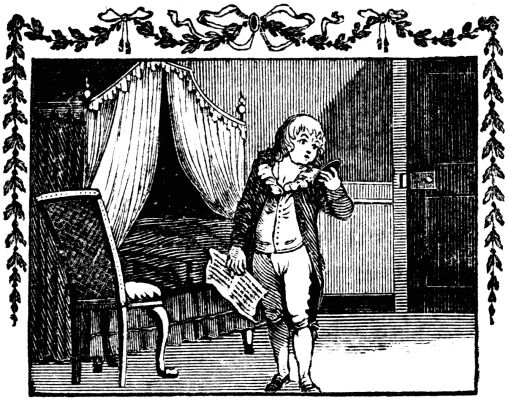
inclination for study. One evening, however, just
as he was going to bed, he received a letter sealed
with black wax, which he opened with some degree
of indifference, and then read as follows:
"MY DEAR MARCUS,
"This morning has deprived me of the most
affectionate husband, and you of the most tender
parent. Alas, he is gone, to return no more! If
there be any thing that can enable me to support
this dreadful calamity, it is only in what I receive
from the recollection, that I have left in my son
the dear image of his father. It is from you only
therefore I can look for comfort; and I am willing
to flatter myself, that I shall receive as much pleasure
from your conduct as I do from my tender
affection for you. Should I find myself disappointed
in my hopes, should you be only like
your father in person, and not resemble him in his
industry, integrity, and virtue, sorrow and despair
will put a period to my miserable life. By
the person who brings you this letter, I have sent
you a miniature picture of your father. Wear it
constantly at your bosom, and frequently look at
it, that it may bring to your remembrance, and
induce you to imitate, all the purest virtues and
uncommon endowments of the dear original. I
shall leave you in your present situation one year
longer, by which time I hope you will be complete
in your education. In the mean time, do
not let this slip from your memory, that my happiness
or misery depends on your conduct, industry,
and attention to your studies. That God
may bless you, and give you patience cheerfully
to tread the rocky paths of science, is my sincere
wish."
The errors of Marcus were the consequence of
bad habits and customs he had imbibed in his infancy,
and not from any natural depravity of the
heart. He had no sooner read this letter than he
found every sentiment of virtue awakening in his
bosom. He burst into a flood of tears, and frequently
interrupted by sighs, exclaimed, "O my
dear father! my dear father! have I then lost you
for ever?" He earnestly gazed on the miniature
picture of his parent, pressed it to his bosom,
while he, in faultering accents, uttered these
words:—"Thou dear author of my existence,
how unworthy am I to be called your son! How
shamefully have I abused your tenderness, in
idling that time away for which you have paid
so dearly! But let me hope that reformation will
not come too late."
He passed that night in sorrow and contrition,
he bedewed his pillow with tears, and sleep was a
stranger to his troubled mind. If he happened
but to slumber, he suddenly started, imagining
he saw the image of his deceased father standing
before him in the dreadful garb of death, and
thus reproaching him: "Ungenerous youth!
is this the manner in which you ought to return
my past cares and attention to your interest?—Thou
idle sloven, thou ungenerous son! awaken
from your state of indolence, and properly improve
the little time you have left for the pursuit
of science, which you have hitherto so shamefully
neglected; and do not, by an unpardonable
inattention to yourself, shorten the few remaining
days of your dear mother's life!"
I hope my youthful readers are well convinced
that there are no such things as ghosts or apparitions,
and that they are nothing more than the
effects of a troubled imagination. Such was the
ease with Marcus, who fancied he saw his father
on the one hand, reproaching him for what was
past, and his dear mother on the other, exhorting
him to better conduct in future. "What a wretch
I am," said he to himself, "to act in this manner!
When my time for leaving this academy shall arrive,
and I must appear before my mother to
give proofs of my literary knowledge, what must
be the pangs of her maternal heart, when she
shall find that the child, on whom she had placed
all the prospects of her future felicity, is an ungrateful,
ignorant, and unworthy wretch? She
will call on the friendly hand of Death to take
her from such an insupportable scene!"
Poor Marcus thus lay rolling on the thorny bed
of trouble and anxiety, till, at last, totally overcome
by grief and despair, he fell asleep. As
soon as he awoke in the morning, on his bended
knees he implored the assistance of the Almighty
in the reformation he intended to make in his
conduct. He instantly hastened to his master's
chamber, and there threw himself on his knees
before him: "Behold, sir," said he, "prostrate
before you, an ungrateful wretch, who has hitherto
treated, with the most shameful indifference,
all the wise lessons you would have bestowed on
him. Yet, unworthy as I may be of your future
instructions, let me implore you, for the sake of
my dear mother, whose life I fear I shall shorten
by my unworthy conduct, to extend your bounty
to me once more, and I will endeavour to convince
you, by my future conduct, how much
ashamed I am of what is past."
His master raised him up, took him in his
arms, and tenderly embracing him, they shed
tears together. "My dear Marcus," said his
master to him, "to be sensible of your errors is
half way to reformation. You have, it is true,
squandered away, in the pursuit of trifles, two
years that ought to have been employed in the
acquisition of useful science. You have still
one year left, and, as you appear to stand self-convicted
of the imprudence of your past conduct,
I would not wish to drive you to despair;
but to encourage you by saying, that, by proper
application, great things may be done, even in
the remaining year. Begin this moment, lose no
more time, and may God give you resolution to
proceed suitably to my wishes, and your own interest."
Marcus seized the hand of his master, tenderly
kissed it, and then retired, being totally unable to
utter a single word. He instantly ran to his chamber,
there eased his heart in a flood of tears, and
then set about the necessary business. He applied
himself so closely to his books, and made therein
so rapid a progress, as astonished his master and
teachers. His companions, who had hitherto
treated him with the utmost contempt, began to
love and revere him. Marcus, thus encouraged
by the different treatment he now received, pursued
his studies with the utmost attention and alacrity.
He was no longer despised for his wickedness
and perversity, but admired and caressed for
the affability and goodness of his temper. Formerly
no severities or entreaties could make him
attend to his studies; but they were now forced
to use some degree of violence to make him partake
of necessary recreations.
In this manner his last twelvemonth passed on,
and he viewed with regret the approach of that
time when he was to leave school, and engage in
pursuits of a different nature. He was hereafter
to study men, and endeavour to acquire a knowledge
of the latent motions of the human heart,
perhaps the most difficult study in the commerce
of this world.
The time allowed him being expired, his mother
ordered him up to London. By the end of
the year, the change he had made in his conduct
so operated in his favour, that his departure was
regretted by all his school companions; and,
when he took his leave, sorrow visibly appeared
in the countenance of every one. It was a
pleasing reflection to his master, that a youth he
had given up as lost, should on a sudden reform,
and, in the circle of one year, make as great a
progress in the sciences as the generality of youths
do in three.
The journey afforded Marcus the most pleasing
reflections; for he had now nothing to apprehend
from the interrogatories of his mother, with
respect to his education; and though he sincerely
lamented the two years he had lost, yet he could
not but feel the effects of the happy employment
of the third.
His schoolmaster had before acquainted his
mother of the happy reformation in her son, and
the great improvement he had made since the
death of his father. These considerations, added
to the natural feelings of a mother, made their
meeting a scene of the most tender delights and
heartfelt transports.
Marcus lost only a week in paying visits to his
relations and friends, and then applied himself to
his father's business with unremitted assiduity
and the most flattering success. In a few years
he took an amiable partner for life, with whom
he lived happy and contented. He was blessed
with dutiful children, to whom he would frequently
give this lesson: "My dear children, do
not forget, that time once lost is not to be recalled;
and that those hours you trifle away in
your early years, you will severely lament the loss
of when you shall have reached the age of maturity.
An old age of ignorance is despicable
indeed; for he who has neglected properly to cultivate
his mind in his youth, will embitter the
evening of his life with self-accusations and reproaches.
Happy the youth who, having toiled
hard during spring in the garden of science, sits
down in the autumn at leisure to regale on the
fruits of his labour!"
The Recompence of Virtue.
THE northern confines of France boast of a
small spot of ground, where virtue renders law
unnecessary, and procures the inhabitants a state
of peace as pure and unsullied as the air they
breathe. In process of time, this territory fell
into the hands of a widow, who merited a much
more valuable patrimony.
Madam Clarisse, for that was the lady's name,
joined benevolence of heart to a cultivated mind
and an elevated genius. The place afforded neither
physician nor apothecary; but Madam Clarisse
supplied the want of them by her own knowledge
of the medical qualities of different roots and
plants. Her conduct evidently proved how much
good a generous heart is capable of doing, even
where Fortune has not been lavish of her smiles.
This lady had a servant maid, whose name was
Maria, and who had seen twelve revolving suns
in her service. Her attachment to her mistress,
her disinterested behaviour, affability, and attention,
procured her the just esteem of all who lived
in the neighbourhood. It was a happiness for
this girl, that she had all her life been brought
up on this spot of innocence, and had not been
exposed to the corrupting and pestiferous air of
the metropolis.
Madam Clarisse had the highest opinion of the
good qualities of Maria, and had entertained a
strong affection for her. Maria, who in her turn
tenderly loved her mistress, and was a little older
than her, always wished that her good lady might
be the longer survivor; but Providence had ordered
it otherwise. Madam Clarisse was attacked
with a disorder, which, on its first appearance,
was supposed to be of no consequence; but, by
the improper treatment of her physicians, who
mistook her disorder, it at last proved fatal.
The visible approach of death did not disturb
the peace and tranquility of the mind of this virtuous
lady: her bosom was fortified with religious
consolations; her heart had never been the receptacle
of evil; and, while every one around her was
bewailing her approaching dissolution, she alone
seemed peaceful and tranquil. The salutary regimen
she exactly followed, protracted her death
for a little while, and her courage gave her
strength. She was not confined to her bed, but
walked about, and had the village girls around
her, whom she instructed in the principles of religion
and virtue.
One delightful morning, in the blooming
month of May, she rose very early, and took a
walk in the fields, accompanied by Maria, who
never forsook her. She reached the summit of a
verdant hill, from whence the eye wandered over
the most delightful prospects. She sat down on
the enamelled turf, and Maria by her side.
"What a delightful view!" said she. "See,
Maria, that verdant meadow, over which we
have so frequently walked! It is not long since,
if you remember, that we there met the good old
Genevive, who bent beneath the load on her
back, while she carried in her hand a basket full
of apples: you insisted on taking the load from
her, and, in spite of all her resistance, I seized
her basket of apples. Do you not remember
what joy and pleasure every step afforded us, how
grateful the good creature seemed, and what a
hearty breakfast we ate in her cottage?
"Look a little to the right, and there you see
the willow-walk by the lake, in which, when we
were young, we used so frequently to angle. How
often have we there made ozier baskets, and then
filled them with cowslips and violets! You recollect
that cottage in front of us, the peaceful habitation
of Myrtilla, for whom you in two days
made up the wedding clothes I gave her. To the
left, see the entrance of the wood, where I used
every holiday to keep my evening school in the
summer, for the instruction of the peasants' children.
How happily those moments glided away,
while surrounded by my youthful neighbours!
How many sweet and delightful tales has the lovely
Priscilla there told, and how many enchanting
songs did the sweet Miranda there warble forth,
while the feathered songsters seemed to stop their
own notes to listen to her divine warblings! Methinks
every thing around me brings back something
pleasing to my reflection, and gives an inexpressible
delight to my present sensations!
"You are sensible, Maria, that there is a school
in this village kept by a poor old woman. Many
who attend her school can pay for instruction
without any inconvenience, while there are
others, who, for want of money, are obliged to
keep their children at home in ignorance. Had I
any hopes of living a few years longer, I should be
much pleased with the idea, that I should by that
time have saved a hundred crowns, which would
have been sufficient to provide education for the
children of those who cannot afford to pay for it;
but, since it is the will of God that such shall not
be the case, I submit without repining."
Here Maria turned her head aside, in order to
conceal from her lady the tender tear that stole
down her cheeks. Madam Clarisse perceiving
the situation of her amiable servant, "My dear
Maria," said she, "why do you weep? We
shall again meet each other to part no more, and
for the present let my serenity console you. I
have not a doubt but you will always have a sure
asylum in my house long after I shall have left
it. Had it pleased God, I should have been happy
to have it in my power to make some provision for
you; but I cannot; and it is for me to submit."
Lifting up her hands, she exclaimed, "Accept,
O gracious God! my most grateful acknowledgments
for having placed me in a situation
far from the temptations and vanities of
this world. A stranger to headstrong passions
and delusive pleasures, I have passed my tranquil
life on this retired spot of innocence, secure
from the tumultuous pursuits of pride and vanity,
and a perfect stranger to the gnawing pangs
of jealousy or envy. Innocence and peace, and
all the tender feelings of friendship and humanity,
have been my constant companions. In
that critical and awful moment, when the remembrance
of past actions is not to be supported
by the wicked, my mind enjoys inexpressible
serenity and composure."
Madam Clarisse here stopped short, and her
head sunk on the bosom of Maria; who, looking
on the face of her amiable mistress, found it turned
pale, and her eyes closed-never more to be
opened!—Thus cracked the cordage of a virtuous
heart;—good night, thou amiable woman; may
choirs of angels sing you to your rest!
Maria was undoubtedly much afflicted at the
death of her lady, and her sorrow on that account,
added to the fatigues she had undergone,
threw her into a fever, from which her recovery
was for a long time doubtful. Nature, however,
at last conquered her disorder, when she determined
to quit that place, as soon as her strength
would permit her. When she found herself
capable of pursuing the journey, she packed up
the little matter she had, and first repaired to the
church-yard where her amiable lady lay buried.
Having there paid the tribute of a tear upon her
grave, she instantly set out for Charleville, her native
place, sincerely regretted by the minister and
people, who knew not what was become of her.
Two years had elapsed, and no news was heard
of Maria, though every possible enquiry was
made in the neighbourhood. About that time,
however, the minister of the parish received a
parcel containing some money, and the following
letter with it:
"At last, my dear reverend sir, I am enabled to
send you the hundred crowns which my worthy
lady, in her expiring moments, so ardently wished
to be possessed of, not for her own use, but for the
emolument of others. Her wishes shall now be
fulfilled, and the pious work she projected shall be
completed. Had not this been the all I am possessed
of in this world, I would have brought it
myself. I am too poor to support myself among
you; but I am happy in my poverty, and feel no
anxieties but those occasioned by the loss of my
dear lady. I beseech you to put this money out to
interest, and inform the mistress of the school that
it is for her use. This I hope will enable her to
take under her care the children of such poor
people, who cannot afford to pay for their education.
If I have any favour to ask of Heaven, it is
only this, that I may, before I am called hence,
be enabled to save a little money, in order to be
in a condition to pay you a visit. Should I live
to see this school established on the plan my deceased
lady wished for, I shall then be perfectly
happy, and shall quit this world without envying
those who roll in the gifts of fortune, but have
not a heart properly to use them.—Maria."
The curate, who was a man of generous feelings,
read this letter with admiration, and the next
day, in the church, communicated the contents of
it to his congregation, who could not refrain from
tears on the relation of so generous an action.
According to Maria's request, he placed the hundred
crowns out to interest; and thus, from the
produce of two year's incessant labour of this
amiable woman, was a foundation laid for the
education of the poor children of the parish.
The generous Maria, having thus disposed of
every thing she was possessed of, again sat down
to work; but not with so much ardour as before,
as she had now only to labour for her own maintenance.
About this time, however, a relation
died and left her ten pounds a year, which to her
was a little fortune.
It soon came to the knowledge of Maria, that
the curate had read her letter to his congregation,
which gave her no small degree of uneasiness, as
she wished it to remain unknown. However, it
soon became the conversation of every one, and
at last reached the place where she lived.
People of the first character and fortune in
Charleville, at which place she then lived, were
anxious to be acquainted with her; and some of
them even went so far as to offer her apartments
in their house. But she preferred her present
situation to a life of ease and indolence.
The curate, having occasion soon after to visit
Paris, mentioned Maria in all companies, and related
the affecting story of her charity, which soon
became the general subject of conversation in
that metropolis, was publicly related in the Paris
Gazette, and from thence copied into most of the
public papers in Europe.
A young prince, who lived with his parents, at
Paris, and who was hardly nine years of age, was
so affected, young as he was, with this generous
action of Maria, that he talked of nothing else
from morning till night. "I wish I were a
man," said the little prince one morning in his
father's hearing. "And if you were a man,"
replied the peer, "what then would you do?"
The young prince threw his arms round his father's
neck, and having obtained a promise that
he would grant him what he asked, "I would,"
said he, "give Maria a pension." His father embraced
him, applauded the generosity of his heart,
and instantly settled fifty pounds a year on Maria
for life.
We may learn from hence, that virtue often
meets with its recompence in the possession of
the good things of this life, besides that inexpressible
delight it receives from the inward feelings
of the heart. Maria received this donation with
all becoming gratitude; but she used it as though
she were only the steward of it: she fed the
hungry, she clothed the naked, and diffused
through the whole village a spirit of industry,
prudence, and benevolence.
The Pleasures of Contentment.
AMIDST all the objects of our pursuits in this
world, in order to acquire happiness, Contentment
is the first. Without this, all the parade
of grandeur, the possession of the most beautiful
villa, and all the studied delicacies of the table
are dull and tasteless. When contentment has
taken up its seat in the bosom, the straw-built
hut is a palace, and the coarsest viands are preferable
to the most sumptuous delicacies. The
following history of an eastern vizier will contribute
to support this opinion.
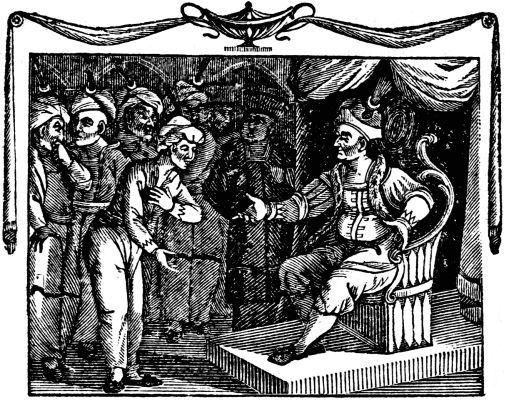
Alibeg, in his youth, had been a very great
favourite of the Sultan Mahmud: he had been
the partner of his childish sports, and, as they
grew up, the companion of his more manly
amusements. He entrusted him with all his secrets,
and generally followed his advice in most
matters of importance. Mahmud, therefore, out
of gratitude, advanced him to the first office of
state in the empire.
Alibeg was a man of a noble and generous
heart, and of a complexion of mind very different
from those who generally flock about royalty, like
drones about the hive, only to rob it of its sweets.
The inferior ministers of Mahmud were avaricious,
cruel, and oppressive, and sacrificed the ease
and happiness of the people to gratify their own
pleasure, avarice, and ambition. Alibeg was determined,
whatever might be the consequences, to
set about a reformation of many shameful abuses.
An attempt of this nature naturally brought
upon him the united opposition of the imans and
grandees. They first endeavoured to ruin Alibeg
in the opinion of the sultan, by charging him
with those very crimes, which he was in reality
endeavouring to correct; but their endeavours
were for a long time ineffectual. The sultan
loved Alibeg, and well knew that all the accusations
against him were false and groundless.
Men in power, who have no other object in
view but the gratification of their unbounded
passions, dread nothing so much as the influence
which wise and virtuous minds sometimes have
over good princes. The wicked courtiers finding
they could not prevail on the sultan, by fair
means, to give up his favourite Alibeg, called in
to their aid diabolical rebellion.
The deluded multitude rose against their best
friend, whose only wish was to make them happy,
by freeing them from the shameful tyranny in
which the ministers and great men held them.
What a pity it is, that the lower class of people,
on whom the prosperity of almost every nation
undoubtedly depends, should be so often blind
to their own interest, as to be persuaded, by artful
and designing men, to forge fetters for themselves!
The sultan, finding he must either give up his
empire or his favourite, consented to the disgrace
of Alibeg; but not till the leaders of the rebellion
had sworn, by the holy Prophet, that Alibeg
should be permitted to retire where he pleased,
without being insulted or molested.
Alibeg, thus divested of power and all his property,
without a friend who dared to give him
the least assistance, retired to spend the remainder
of his days among the rocks and deserts of
the Korasan. Here, on the borders of a limpid
and meandering stream, he erected himself a little
hut; and here, remote from the converse of
ambitious and deceitful man, he passed his time
unnoticed by any human being.
He had lived in this solitary retreat, amidst
rocks and deserts for upwards of two years, when
the virtuous Mentor discovered his gloomy abode.
This good man, who was the intimate friend of
Alibeg, and who had advised him to attempt the
reformation of the state, was thereby instrumental
in the ruin of his friend. However, as soon
as Alibeg was banished by the people, Mentor
banished himself, and retired to a little village at
a great distance from the capital.
Mentor sighed for the absence of his friend,
and, as he knew he was retired to the Korasan,
he determined to set out in search of him. As
he was walking on, and at about a furlong distant
from the abode of Alibeg, they suddenly met in
a winding path. They instantly knew each
other, embraced, and wept. When they had
wiped away their tears, and had got over the
first emotions of joy which so sudden and unexpected
a meeting had occasioned, Mentor was
astonished to see how much serenity and composure
were visible on the countenance of his
friend Alibeg, whose bosom was the repository
of peace and contentment.
"Blessed be the Eternal," said Mentor, "who
gives strength to the weak, and contentment to
the unfortunate! He, who had fertile plains at
his command in the environs of the capital, is
now contented and happy in a cottage, among
barren rocks and deserts! But Alibeg has brought
virtue with him to these rocks, and he despises
the roses that for ever bloom in the garden of
Hiera, the diamonds that harden in the rich mines
of Nishapous, and the silks that rustle in the manufactories
of Mezendran. But tell me, my
dear friend, has it taught you to live alone? Is
it possible, that any one can live without the
converse of a friend? Such a life would be the
solitude of a tomb!"
While Mentor was thus addressing his friend,
they kept walking on; when they approached the
cottage, which Alibeg left that morning before
the sun had given light to the eastern parts of
the horizon, their ears were first assailed with
the neighing of a colt that came to meet them.
When the animal approached its master, its motions
seemed to express its satisfaction on seeing
him again: it turned about either walking or
prancing before him all the way home.
Presently two beautiful heifers came running
towards them from an adjoining meadow. They
moved in a circle round them, then stopped, as
it were, to offer him their milk, and holding out
their necks to him to be yoked; for nature had
taught these animals to be grateful to the hand
that fed them.
When they had proceeded a little further, two
goats, attended by their kids, as soon as they
caught sight of Alibeg, descended from the rocks,
and expressed their joy on seeing him again by
skipping and sporting round him.
While Mentor was amusing himself with this
pleasing scene, his attention was called aside to
observe five or six sheep, which had just issued
from a neighbouring thicket, and were bleating
as they ran. They leaped with joy, and approached
to lick their master's hand, who, in
return, made much of them, and showed them,
by the manner in which he received those marks
of their gratitude, how much he was satisfied
with their affection for him.
This tender scene engaged much the attention
of Mentor, who was still more surprised when he
saw a flock of doves surround Alibeg, some of
which hovered over his head, and others perched
on his shoulders.
By this time he had entered the inclosure of
his cottage, when a cock perceiving him, instantly
began crowing; and, to complete the concert,
the hens flew from their pursuit of food, and endeavoured,
in their way, to welcome his return.
But all these marks of attachment were not
equal to those shown by two dogs who waited,
at the door of the cot, the arrival of Alibeg, their
generous master. Neither of them would stir
out to meet him, but kept to the post he seemed
to have assigned them, that of taking care of his
house. However, as soon as he and his friend
had entered the cot, they pawed and jumped
round him, played a thousand antics, crouched
before him, and expressed their joy by their agility;
they licked their master's feet, and, when
he stretched his hand to pat and stroke them, they
would hardly stay to receive the fond mark of
approbation, but, rushing through the door-way,
sprung forward, and made long circuits over the
rocks, and scoured backwards and forwards to
express their joy. When they had tired themselves,
they returned and lay down at the feet of
their beloved master.
Mentor seemed lost in astonishment, and was
convinced, in his own mind, that his friend must
be happier in this cot, amidst these irrational beings,
if they deserved to be so called, than he
could possibly be among faithless men, in the
palaces of Mahmud.
"You here see, my good friend," said Alibeg,
"that I know how to make myself happy, even
among the rocks and deserts of Korasan. I endeavoured
to teach men the love of virtue, to inspire
the subjects of Mahmud with the proper
notions of liberty, and to shake off that tyranny
they laboured under from the usurpation of the
rich and powerful; but they despised my advice,
and drove me from my native spot, to seek
shelter here, where I have found animals of the
brute creation more grateful than men. Thus,
you see, my solitude is not a tomb, and that I
here enjoy a kind of sovereignty over those animals,
which is far more grateful, and less dangerous,
than the condition of Mahmud, who
reigns over a fickle and inconstant people, who
is every hour deceived by them, and who may
perhaps one day drive him from his throne."
While they were thus conversing together,
they heard the sound of a number of horses' feet
on the solid rock. Alibeg was alarmed, and
could not conceive that any band of robbers
could inhabit those regions; nor could he suppose
that any civilized beings would come that
way in the pursuit of pleasure.
A few minutes, however, cleared up all his
doubts, when he saw about a hundred horsemen
approaching his cot. At the head of these Alibeg
perceived his old friend Sha-abba, who had been
the principal cause of changing Alibeg's sentence,
from that of losing his head to perpetual
banishment.
Sha-abba leaped from his horse, and caught
Alibeg in his arms. Mentor, who was a witness
to this scene, could not conceive what all this
could mean; but he soon learned, that the people
were so wearied out with the oppressions of
the great, which had been carried to a more
enormous height than ever since the banishment
of Alibeg, that they unanimously rose in their
defence, and destroyed all the authors of their
oppression; but remained firm in their duty and
attachment to the Sultan Mahmud.
The sultan had sent these horsemen, a hundred
in number, with Sha-abba at their head, in
quest of the virtuous Alibeg, whom he was to
bring back with him by force, if entreaty could
not prevail, to assume his former post of vizier.
When Alibeg was informed of this, he wept bitterly,
and exclaimed, "After having learned to
know in what happiness and contentment consist,
why am I thus to be snatched in a moment from
them, and again compelled to hazard my peace
of mind among men more savage than the rocks
and deserts of Korasan? How can I forsake these
faithful companions of my retirement, my dogs,
my doves, and my cattle? No, if I must go, they
shall follow me, that I may have them ready to
attend me when Fortune shall again drive me
to these deserts."
Sha-abba and Mentor endeavoured to pacify
his mind: the former assured him, that all his
enemies had been killed by the hands of the oppressed
multitude, and the general voice of both
the sultan and people was for the return of
Alibeg. By these and such like arguments they
prevailed on Alibeg to return to the capital, and
resume his former exalted employments.
Alibeg mounted his colt, and, after shedding a
flood of tears, as a tributary farewell to the rocks
and deserts of Korasan, he proceeded on his
journey; his two faithful dogs by his side, while
the doves fluttered around him, and his kids,
sheep, and heifers, followed in the rear.
When they arrived within a few miles of the
metropolis, they were met by some thousands of
the citizens, who seemed at a loss how properly
to express their happiness on the return of their
faithful Alibeg, while shame, for having treated
him so unjustly, in some measure diminished
their joy. Mahmud waited for him at the door
of his palace; he received him with open arms;
and Alibeg all his life afterwards was equally
esteemed by the sultan and his people. Happy
is he who, in every various station of life, in
prosperity or adversity, can maintain the same
equanimity, resolution, and fortitude.
The happy Effects of Sunday Schools on the Morals of the rising Generation.
WHATEVER may be said of the increasing
luxury and dissipation of Englishmen, their hearts
have not yet lost any part of their ancient reputation
for the feelings of humanity, and they are
still ever ready to provide clothing for the naked,
medical assistance for the sick and lame, and education
for the untaught children of the poor.
The great number of hospitals, infirmaries,
free-schools, and other charitable establishments,
with which almost every part of this country
abounds, afford an ample display of British benevolence.
The institution of Sunday Schools
owes its foundation to the humanity of the present
times, and will be a credit to it in future
ages. The following history of Dorcas and
Amarillis may serve as one instance of the happy
effects of Sunday Schools.
In a solitary village, far remote from the metropolis,
and not near to any capital city, lived
the parents of Dorcas and Amarillis. The husband
was a shepherd and his wife a shepherdess;
but their earnings were so little, that even with
their joint labour they could hardly procure
bread for themselves and their children, and a
morsel of meat once a week was the highest
pitch of their luxury, though even that was of
the very coarsest kind.
As soon as Dorcas and Amarillis grew up, the
former was sent into the fields to frighten birds
from the grain, and the latter was kept at home
to knit coarse yarn stockings for the use of the
family.
Their whole library consisted only of a Testament
and a Prayer-book; but these were so injured
by the depredations of time, having passed
from hand to hand for many years, that what
was not torn away, was rendered nearly illegible.
However, that was of little consequence,
since neither of them could read, and consequently
could have no idea of writing. The
church was at some distance from them, which
served as an excuse to be absent from thence.
Dorcas had neither hat, shirt, shoes, nor stockings;
and all the apparel of poor Amarillis was
only a straw hat and a coarse gown and petticoat.—These
considerations alone were sufficient
to keep them from church, admitting they
had any inclination to go there. In course, as
Sunday was the only day of rest they had from
their labour, both boys and girls passed it in
such tricks and gambols as were most suitable
to their age and taste.
Thus they lived almost in a state of nature,
without knowing any thing of the Supreme
Being, or of any of the duties we owe to him.
They had no idea of prayer, further than, "I
thank God we have had a fine season this year,
&c." and herein consisted all their devotion.
However, amidst all this ignorance and poverty,
Dorcas, his sister, and family, were all strictly
honest, and never, like others in their village,
employed their Sunday in stealing fowls, and
other things from their rich neighbours, which
they thought it no crime to do: the only dread
they had of the commission of these robberies,
was the fear of being discovered, and the punishment
that would inevitably follow it.
These two children, Dorcas and Amarillis,
lived in this state of ignorance till they were ten
or eleven years of age. It had been some time
a custom with Dorcas and his sister, with a black-lead
pencil they had found by chance, to imitate,
on the back of a clean white trencher, all the letters
they found in the remains of their Common
Prayer-book, though they knew not the sound,
nor combination of the different letters of the
alphabet, in order to form and connect words.
As they were one winter's evening hovering
over the fire, Dorcas said to his sister, "How
happy are those young people, who, having parents
that can afford to pay for their education,
are taught to read, write, and cast accounts! and
yet how many of those children prefer the most
idle pastimes to the more invaluable improvement
of their minds? There must be something
vastly pretty, in being able to read that Testament
and Prayer-book."
"I agree with you, my dear Dorcas," said the
blooming Amarillis, "that there must be something
uncommonly delightful, to be able to unriddle
the meaning of all those words we see in
that book. What a hardship it is, that we should
be born to spend our days in ignorance, and
know none of the pleasures which learning must
undoubtedly bring with it!"
The next morning, the principal person in the
village, who owned a great part of it, came to their
hovel, and acquainted the old folks that they might
the next Sunday send their children to church,
where they would be instructed in the principles
of the Christian religion, and be likewise taught
to read, without any expence to themselves.
The next Sunday morning, accompanied by
other children in the village, they accordingly
repaired to church, where they were all dressed
in new apparel, prepared for them by the voluntary
subscriptions of the humane and generous.
Though their clothes were but of coarse materials,
yet Dorcas and Amarillis had never been
so fine before; the one thought herself as elegant
as Cleopatra, and the other considered himself
as great as Cæsar.
Besides clothing, such as could read tolerably
well had a Bible, Testament, and Common
Prayer given them; while others who could not
read, had only a spelling-book. A schoolmaster
was appointed in each village to instruct the poor
children in the evening; and every Sunday they
went regularly to church, to be examined by the
parson in public.
It was a pleasing change to behold: instead of
noise, riot, and confusion, every Sunday, from
one end of the village to the other, peace, order,
and decorum were every where seen. Instead
of having recourse to mischievous inventions to
pass away the time, each was now seen quietly
seated on the enamelled turf, with a book in his
hand, and either reading to himself or to some
others.
Among all these youthful students, Dorcas and
Amarillis made the most distinguished figures,
and displayed such a genius and attention as attracted
the wonder and amazement of every one.
In a few months they learned to read with some
degree of emphasis, and could write a hand sufficient
for any of the common concerns of business.
Such an uncommon display of genius created
them many friends, and they frequently received
invitations from the younger branches of the
neighbouring gentry. From these visits they
learned a polite and graceful behaviour, and consequently
soon got rid of their awkward rusticity.
As they increased in knowledge, so their minds
opened and expanded; and, though their wishes
were at first only to learn to read, they now sighed
after the higher branches of literature.
"What a pleasing thing it must be," said
Dorcas one day to his sister, "to read of what
passed in the former ages of the world, and trace
out the tempers and dispositions of the people in
those days! What a narrow span of earth are we
confined to, in comparison of what we are told
the world is at large! I should like to read those
books which give a description of the different
parts of the earth and seas; what animals inhabit
them, and what curiosities they contain superior
to our own."
"I have the same wish," replied Amarillis;
"but let us be thankful to that good God, and
to the generosity of our opulent neighbours, by
whose bounty and goodness we were rescued
from a state of ignorance and gloomy despair,
have been enabled to read the Sacred Writings,
and imbibe the glorious doctrines of salvation."
This conversation was overheard by a gentleman,
who immediately bought them some small
books of history and geography, of which they
made so proper a use, that there were very few
young people, within several miles of them, who
were able to converse with them on geographical
and historical subjects.
Within the course of two years, Dorcas and
his sister had made great improvements in the
sciences, when it was thought necessary to send
them into the world to provide for themselves,
as their parents were now engaged in a gentleman's
family, in a much better situation than
that of a shepherd and shepherdess. Amarillis
was taken as a waiting maid, attendant and companion
of a young lady of distinction and fortune;
and Dorcas thought himself happy in being taken
as clerk in the shop of a capital tradesman.
In this situation all parties at present remain,
and afford an unanswerable proof of the utility
of Sunday Schools. Had it not been for that
noble institution, Dorcas and Amarillis must
have lived and died in the grossest ignorance,
overwhelmed with poverty and despair; their
parents must have lingered out a half-starved life
in their miserable cot, without being able to bequeath
any thing to their children but rags and
poverty. What may be the future situation of
Dorcas and Amarillis we cannot say; but we
need not search the roll of fate to know this, that
they are bound to pray, as they undoubtedly do,
for the first promoters of Sunday Schools.
Let me advise my youthful readers, whatever
their condition in life may be, to imitate the industry
of Dorcas and Amarillis. Let them remember
that, however painful a few years of
hard study may be, how pleasing will be the
consequences to them all the rest of their lives,
when they will be possessed of that which nothing
but their final dissolution can take from
them!
The Happy Villager.
MR. Jackson had been an eminent tradesman
in the city of London, where he by trade acquired
an independent fortune, and was now retired
into the country to spend the remainder of
his days amidst rural retreats, to enjoy the pleasures
of rambling through woods and groves, by
the side of purling and meandering streams,
while the harmony of the feathered songsters
would charm the ear, and lull the busy mind
into the most tranquil repose.
The retreat Mr. Jackson had chosen was situated
in the county of Worcester, and near to
the place where he drew his first breath. His
house was a well-designed mean between the vast
piles raised for magnificence and those smaller
ones in which convenience alone is considered.
The walk from the back of the house led through
a wood, by the side of a delightful stream, which
meandered over grass from out of a deep hollow.
A gush of water, which fell into it, gurgled
through a rocky cavity; and in front you looked
down on a fine lawn, terminated with a noble
bank of hanging woods.
He would frequently ramble to a great distance
from home, to survey the beauties of the
surrounding country. He had already visited
every neighbouring village, and therefore one
day strayed farther than usual in pursuit of new
objects. On a sudden he discovered a delightful
valley, the appearance of which seemed to
correspond with every thing descriptive of a rural
scene.
It was surrounded on all sides by hills, at the
feet of which were thickly scattered cottages,
groves, and gardens, which seemed to be the
abode of rural happiness. The silence of the
scene was broken only by the dashings of a torrent,
which, rushing from an eminence, precipitated,
bellowing, into a cavern beneath. Having
there vented its rage in foam, it then divided into
a multitude of little rills, and forming serpentine
sweeps, refreshed the meadows and surrounding
gardens with its friendly streams.
However pleased Mr. Jackson was with the
natural beauties of the place, he was no less
struck with the neatness and simplicity of the
many cottages that presented themselves to his
view, every house having a garden, an orchard,
and some well-cultivated ground about it. Their
only fences were hedges of holly, which afforded
a convincing proof of two things, the fertility of
the soil, and the confidence each one had in his
neighbour.
Mr. Jackson was so wholly employed in contemplating
this pleasing scene, that he paid no
attention to a storm that was gathering around
him, till the lightning flashed in his face, the
thunder rolled over his head, and the rain began
to fall in torrents. He instantly ran to the
nearest farm door, and having there knocked,
gained immediate admittance.
It was an elderly woman that came to the door,
and who, though old, was not decrepid, and appeared
to have something venerable in her countenance.
"Come in, sir," said she, "and I will
make a fire to dry you. I am glad our cottage
was so near to you; but you would have met with
a kind reception in any of these cottages. There
is hardly a house here which is not kept by some
of our children or descendants."
Mr. Jackson had sufficient leisure, while the
good woman was lighting the fire, to survey the
apartment. Every thing appeared uncommonly
neat, and it was easy to be seen, from the nature
of the furniture, that necessity had no abode under
that roof. The novelty of the whole scene,
and the particular words the good old woman
had dropped in conversation during the lighting
of the fire, gave Mr. Jackson a strong desire to
know further particulars.
While he was drying his clothes, he heard a
voice in the other room, asking if the stranger
was taken care of, to which the good woman replied
in the affirmative. "I suppose," said Mr.
Jackson, "that is your husband in the next
room, whose voice I hear. May I go in and
thank him for his hospitality and kindness!"
"With all my heart, sir," replied the woman,
"you will please to step in, and I believe you
will not be dissatisfied with your reception."
Mr. Jackson did so; and there found an old man
reclining on a bed, of which the clothes and
furniture were very neat and clean. He had on
a cap, and his snow-white locks hung over his
venerable shoulders. His countenance indicated
the goodness and serenity of his heart, and
even Time had here been more sparing of his
devastations than is generally the case.
The appearance of this happy villager had
a very great effect upon Mr. Jackson, who could
not look on him without being, in some measure,
prejudiced in his favour. "What is the matter
with you?" said he to the old cottager, "I suppose
you are ill, and obliged to keep your bed?"
"God be praised," replied the old man, "that
is not the case; though it cannot be expected,
that a person turned of fourscore years of age
should be free from all kinds of complaints. It
is not a long time since I have given up daily
labour, which my children obliged me to do;
for they said I had worked long enough for
them, and that it was now time they should work
for me in their turns."
Mr. Jackson highly applauded the conduct of
his children; and observed to the old man, that
he must have purchased his present repose at
the expence of a great deal of labour; but he
wished to know, after having passed his life in
such active scenes, how he could amuse himself
at present.
"My whole life," replied the old man, "has
been a constant succession of labour. There
are few men who have carried in more hay, or
tied more sheaves together than I have; but my
labour procured me health, contentment, and
happiness. As to time, it never sits heavy on
my hands; and, when my body is at rest, my
mind is at work. How can any person be at a
loss for thoughts who has ten children, and fifty
children's children to think for? They every
day give me an account of their affairs and labour,
and it is I who put every thing in order.
There is always one constantly upon my hands
that must be married, and matches of that kind
are not to be settled in a moment. If those I
have provided for in this way are now in a
thriving state, it is to me they owe their welfare.
I have at this time three marriages in hand, and
I hope they will soon be settled to the mutual
satisfaction of all parties."
Mr. Jackson observed, that he must be very
happy in so numerous a family, and asked him
how many he had at home with him. "I have
at present only two," replied the old man, "who
are my grand-daughters, for I cannot lodge an
army here. It is my lands, and not my house,
that I wish to enlarge. Thank God, I have been
able to give each of my children a tolerable portion;
not in gold, but acres, and that without
impoverishing myself. For a mere trifle, I
bought a large quantity of land, which none of
my neighbours thought worth meddling with:
but I set about improving it, and gave it to my
daughters as so many marriage portions, which are
now, in their improved state, of great value.
"Whenever any of my children were ill, I
had skill enough to cure them by the use of
those few plants I am acquainted with, and of
their behaviour to me I never had any reason to
complain. I always took care to set them a
good example; for though in my youth I was as
wild as any other, and there could not be a
dance in this or any neighbouring parish but I
was sure to be there, yet, as soon as I was married,
I left off those pranks. My wife was fortunately
handsome, good, and sprightly, and that
kept me in awe.
"I took my boys into the fields with me as
soon as they could walk, and I presently made
them useful in one way or other. I put my
youngest son on the plough, and was pleased to
see the others frolic round him; and, on my return
home in the evening, my little girls would
divert me with singing, while they were spinning
at their wheel.
"I used to go among my children and grandchildren,
to see if every thing went on properly;
but now, since old age has prevented me, they
come and see me. The sermon is no sooner over
on a Sunday, than my daughters and grand-daughters
bring their little ones; and it would
please you, sir, to behold me in the midst of
twenty women dressed as for a marriage, and as
pretty as angels. There is a family resemblance
in their children, and that charms me."
Mr. Jackson observed, that the other six days
of the week must be very tiresome to him, since
he could not have the company of his family to
amuse him. To this the old man replied, "If
I be denied this pleasure, yet I have others to
supply its place. I know every inch of ground
in this parish, and am as well acquainted with all
who live in it. My neighbours, therefore, frequently
come to ask my opinion on matters of
husbandry, in which they are engaged. I give
them my advice with pleasure; and if they be
poor people, I provide them with the seed they
want, and they repay it me the ensuing harvest.
Thus am I serviceable to others, without injuring
myself or my family.
"In my endeavours to do good to my neighbours,
I am assisted by our vicar, who is a very
good man, and of whom I have, in some degree,
made a bishop, by the weddings, christenings,
and tithes with which I have enriched him. I
have even given him some instructions concerning
his business in the pulpit; for the country
people, in general, like example better than precept.
The general rule I taught him to lay down
to his congregation was no more than this: No
rest, good neighbours, to your land; but peace
among yourselves."
Mr. Jackson could not help applauding such
principles, and told the good old villager, that
he apprehended he was of more service to the
vicar than he was to the lawyer, if any such professional
man lived near them.
The good old man replied, "We have indeed
one lawyer among us, but I have pretty well
spoiled his trade. Had I taken only sixpence
every time I have been consulted, in order to
settle disputes, I should at this time have been
a very rich man. In all places, there frequently
will happen disputes of one kind or other, and
principally when the ground of any deceased person
is to be parceled out among his successors.
"On these occasions, they generally come to
me for my advice; and if there be children to
be married, I soon settle the affair. If there be
any ground in dispute, and the parties cannot
agree about it, they take me in their little cart,
and, being on the spot, I have the ground surveyed;
I then weigh the good and bad qualities
of it in my mind, and endeavour, if I can, to satisfy
the different parties.
"When I find the parties are not inclined to
agree, the next day I get them all together here,
and I always keep a barrel of good ale on the
run, such as will soften the most obdurate and
flinty heart. I give them a glass or two of it,
and in the mean time I tell them, that a lawsuit
would cost ten times more than the ground is
worth; that if they proceed in it, they will lose
a great deal of time as well as money, and ever
after be enemies to each other. These arguments
and a few glasses of ale, never fail to make
up the matter, and bring about a perfect reconciliation.
It is true, I lose my ale by such a
practice; but then I am amply repaid by the reflection
of having done good."
Here the cottager called to his wife, and told
her to bring a jug of their ale. Mr. Jackson
drank some of it, and confessed that it was admirably
calculated to make peace among his
neighbours in the village, especially when administered
by so able a hand, who knew how to
extract friendship from the very means that often
produce strife and disaffection.
By this time the storm was entirely abated,
Nature had put off her gloomy aspect, and the
returning sun began to enliven every thing. Mr.
Jackson took a friendly leave, and promised to
see them again in a few days. On his return
home, "Who would not," said he to himself,
"prefer the healthful age of this good cottager,
happy in his own esteem and the love of others,
to the vanity of those great men, who make no
other use of their abundance, than to set examples
of luxury and dissipation, who make light
of public scorn and hatred, and whom the very
grave will not protect from infamy and execration!"
The Indolent Beauty.
WE too often see beauty contaminated by vanity,
and a fine genius by indolence. Bella was
the only daughter of a tender and affectionate
mother, whose virtue and discretion were a source
of happiness to her family, and a credit to her
sex. Bella, on her arrival at six years of age,
afforded every symptom of a good heart, complaisance,
affability, and a tolerable share of understanding.
This was the glaring part of the
picture; for the shade afforded a strange attachment
to indolence, and a disgust to every species
of refined education.
Though her mother possessed all the talents
necessary for an excellent instructress, yet she
had never before any opportunity of reducing
them to practice, and an only child was not perhaps
the most proper object for her experience
in the science of juvenile education. It
should ever be one important point with parents,
never to give up a command they have once
laid on their children, but punctually to insist
on its performance. The observation of this
rule would frequently save a great deal of uneasiness
to both parents and children.
Her mother could not think of applying even
the most tender correction, and the use of
threatenings only added to her own uneasiness.
She hoped, as her daughter grew older, she
would become more sensible of her indolence
and inattention to business, and, as she ripened
in years, would proportionably increase in sense
and judgment; but the older the twig grew
the less pliant it became, and what might have
been accomplished in its younger state, was by
time become almost impracticable.
Bella, however, when she arrived at eight
years of age, showed very little inclination to
make any alteration in her conduct; the little
creature's idleness rather increased than diminished,
and she began to be troublesome even
to herself. Her mother now conceived the plan
of putting down on paper, every evening, the
value of such things as she had lost or spoiled
in the course of the day, in consequence of her
carelessness and invincible indolence.
Her mother had flattered herself that Bella,
when she came to know the value of money,
would act in a more prudent manner; but she
read over the account with the utmost indifference,
and considered the sums there mentioned
as too insignificant for her notice and attention.
A pretended head-ache was almost her constant
excuse to avoid her attendance on her masters;
and thus, though naturally sincere, she began to
accustom herself to deviate from the truth.
Bella had reached her thirteenth year, without
the least appearance of alteration in her conduct,
and the lost and broken account, kept by
her mother, was increased to a large sum. One
irregularity, if not timely checked, brings on
others; and thus Bella to indolence soon added
inconsistence. She presently grew tired of
every thing; her harpsichord, which was one
week her favourite instrument, was the next
discarded with disgust, to make room for the
guitar; and this, in a short time after, for something
else. She had masters to teach her geography,
French, and Italian; writing, accounts,
dancing, drawing, and music. These added to
her mother's long catalogue of expences, contributed
but little to her improvement.
It is natural to suppose, that when the follies
of youth are not early corrected, they will, like
pernicious weeds, thrive so fast as to check the
growth of every thing that is valuable in the
same soil. Hence it happened, that after three
years more had elapsed, the lovely Bella, instead
of growing wiser by age, as her mother had
vainly expected, became more indolent, whimsical,
and capricious. All the money paid to
her masters was thrown away, she learned nothing,
and was in fact little more than an ignorant
beauty: a character I most sincerely wish
is not applicable to any of my fair readers, since
nothing can be more dangerous, pernicious, and
derogatory to female reputation.
At this period of her folly, a young gentleman
of fortune and character, whom I shall call by
the name of Honestus, among other company,
visited the parents of Bella. He was struck
with her charms, and immediately conceived
some thought of paying his addresses to that capricious
beauty; but, when he learned what
was her character, he declined all thoughts of
forming such a connection.
The tender mother did not fail to represent
this disappointment to her daughter, who was
then of an age capable to receive remonstrances
of that nature. To her natural disposition for
indolence she had now added pride, the forerunner
of all evils to a female mind. Instead
of properly feeling the reproaches of a tender
mother, she haughtily replied, "It is true, I
have lost a great deal of time, and have not improved
myself much from the lessons of my
masters; but what need have I of learning, when
my parents are so rich, and you yourself acknowledge
I am so pretty?"
As soon as Bella had attained her eighteenth
year, she began to think herself happy in being
no longer incommoded with the visits of her
teachers; so, when a young lady arrives at that
age, she is supposed to be accomplished in point
of education, and has nothing else to do but to
apply herself to the application of those rules
she learned from her masters. Alas! this was
not the case of the lovely Bella: she had learned
nothing but those principles which never fail to
be pernicious to the youthful mind.
That morning, which on its opening appeared
to her so delightful and brilliant, was soon enveloped
in dark and heavy clouds. Her mother
entered her chamber with a countenance that
convinced Bella something was amiss. After
an awful pause, she thus addressed her daughter:
"My dear child, you are this day eighteen years
of age; but I fear your education is far short of
what it now ought to be. I fear the indulgences
I have granted you have made you too
vain of yourself, and have fatally induced you
to believe, that you had less occasion for an
education than others. Will beauty make you
lovely? separated from the graces of the mind,
it will not so much as please. Are you not always
uneasy in yourself, and constantly dissatisfied
with others? Besides, rich as you imagine
your father to be, are you sure that, while we
are now speaking, he is not a ruined and undone
man?"
The last words awakened in the bosom of
Bella all the alarms which an unexpected disappointment
to ambition is capable of feeling.
Her mother got up, and left the room without
saying any thing more.
The apprehensions of Bella on this occasion
were but too well founded; for, in a few days
after this conversation, her father stopped payment.
This imprudent gentleman, not contented
with a fortune of six thousand pounds a
year, engaged in a very hazardous undertaking,
which, happening to fail, brought on a bankruptcy.
He had all his life been the child of
fortune, and therefore made but a poor pupil in
the school of adversity: he took this matter so
to heart, that in spite of all the care and attention
of his wife and daughter, he soon bid adieu
to the cares of this world, and fled for repose to
the next. He died perfectly sensible, exhorting
those around him, never to give way to the
emotions of avarice and rapacity, since these
first brought him to ruin, and then to his grave.
His wife undoubtedly felt this shock severely,
though she supported it with Christian fortitude.
She had a small jointure, which the creditors
could not, nor did they wish to touch. Having
performed the duties of the last funeral rites to
her husband, she and her daughter retired to a
private situation in the west of England, where
every necessary article of life was cheaper than
in the metropolis.
Bella, however, behaved with all the propriety
that could be expected from a repenting daughter,
and made every effort she was capable of to
console her unhappy mother. She would frequently
reproach herself with her past negligence,
and reckon up the vast sums of money that had
been squandered away upon her to so little purpose.
Bella had valued herself much on the fortune
she supposed herself born to; but it pleased
Providence to deprive her of it. She had, however,
her beauty still left to boast of; but even
of this she was soon to be deprived. Be cautious,
my youthful readers, how you place too
great a confidence in the possession of wealth
and beauty, since they are fleeting as the wind,
and as unsteady as the vessel on the troubled
billows of the ocean. Fortify your minds with
religion and virtue, and a proper knowledge of
the useful sciences; the storms and hurricanes
of Fortune may then attack you, but you will
always safely withstand their rage, and deride
their fury.
One evening, while she was bewailing her past
neglect, and vowing a reform for the future,
she was seized with a head-ache, and being
otherwise very ill, she went to bed. The next
morning a violent fever seized her, and a physician
being sent for, her disorder was declared
to be that which is frequently so fatal to female
beauty.
It was one of the most unpromising kind;
the doctors could say but little, and the mother
was driven to despair. Day after day, and night
after night, her mother never left her bed-side,
but was constantly with her, in a state of uncertainty,
worse than that of death itself. The afflicted
Bella became delirious, the disorder made
a rapid progress, and her eyes were soon excluded
from the light.
Though this circumstance is not uncommon
in this fatal disorder, and therefore did not at
first create any alarm in her mother, yet at last
it increased to such a dangerous height, that the
physicians were no longer able to dissemble
matters, and candidly confessed their apprehensions,
that her daughter would be blind all her
life. Judge, if you can, what must be the feelings
of a tender mother on so trying a calamity!
However, youth got the better of her disorder,
very contrary to the expectation of her
mother, the physicians, and every one around
her; she also recovered her sight, but there were
left terrible marks on her face of the devastation
it had there made. As soon as she was able to
walk about the room, she looked in the glass,
and then exclaimed: "Ah! what is become of
that lovely face, of which the proud Bella so
lately boasted? Has cruel fortune robbed her
of all she boasted, of all she valued herself for
but a month ago, her fortune and her beauty?
I am justly punished, and I will patiently submit."
Bella, thus instructed by misfortune, soon
conquered her indolence, and all her former
imperfections; a sudden revolution took place,
and her very nature seemed to be reformed.
Her mother's conversation now became delightful
to her, and she began to sit down to study
with unwearied attention. Reading, music, and
drawing were her daily amusements; and so
great were her improvements therein, that she
soon made up for the time she had before
thrown away in the most shameful indolence.
Her beauty was indeed vanished, but the improvements
she made in her mind procured her
more friends than she was ever before able to
acquire by the charms of her person. Her
shape was still truly elegant, and her eyes and
countenance were still expressive of the vivacity
of her heart. She was no longer expensive in
her dress, though she was always neat and
fashionable.—Though her visitors did not look
upon her with that astonishment as formerly, yet
they soon became captivated with the charms
of her mind and the politeness of her conversation.
Two years had passed away in this retired
situation, when Honestus, who had long before
ceased to think of making a partner of Bella, on
account of her capricious and indolent temper,
being on some business in that quarter, called on
the mother and daughter to see them. He was
introduced into a parlour elegantly furnished,
and adorned with pictures. "Is not this," said
the lady, "a neat apartment? Every thing you
here see, and these drawings in particular, are
the works of my daughter."
Honestus was much surprised at hearing what
he considered as a tale, and his looks expressed
his incredulity. He turned round, and stedfastly
gazing on the face of Bella, was equally
astonished at seeing her so changed. "Is this
the lovely creature," said he to himself, "with
whose beauty I was once so much enraptured,
and whom I forsook on account of her pride,
vanity, and indolence!"
Out of politeness he entered into conversation
with her, and found in her a most pleasing alteration:
before she was a beauty without sense;
now she had lost the charms of her face, but
had found those of the mind, which are infinitely
the most to be valued.
Honestus passed day after day in the company
of Bella, whose conversation was so pleasing
and attracting, that he began to feel himself
uneasy when she was out of his sight. In order,
therefore, that he might enjoy the pleasure of
her company without interruption, he offered
her his hand for life. "You certainly deserve
her," said her mother, "since you refused her
in the bloom of her beauty, when her fortune
too afforded the most splendid promises, and
now admire her when they are both for ever vanished."
Though the fortune of Honestus was not very
splendid, yet it was sufficient, with the assistance
of his trade, to keep up a genteel appearance,
and to provide decently for a family, should
such be the consequence of their marriage.
They soon quitted this rural retreat and returned
to London, where they now live in the
enjoyment of all those pleasures which conjugal
love, friendship, and virtue are capable of producing.
Let my youthful readers reflect on what they
have here read, and they will then become sensible
how vain and momentary, how fickle and
inconstant are the possession of riches and beauty.
They are like habitations built on the sands
of the ocean, which are perpetually liable to be
swept away by the violence of winds and floods.
I mean not, that fortune and beauty are to be
spised, I mean only that they should be used
properly, and that the possessor of them should
not vainly imagine, that they will supply the
place of education, industry, benevolence, charity,
and virtue.
An Oriental Tale.
TIME, the devourer of all things, has permitted
me to be the spectator of a long series of events.
The colour of my locks is now changed to that
of the swans, which sport in the gardens of the
mighty kings of the earth. Age and experience
have taught me to believe, that the sovereign
Disposer of our destinies has given to man a
heart susceptible of virtue, and a soul capable
of tasting the pleasures which arise from doing
good. A noble and disinterested action must
somewhere meet with its reward. Listen, O
sons of Adam! listen to my faithful tale.
In one of those delightful valleys which cut the
chain of the mountains in Arabia, for a long time
lived a rich pastor. He was happy because he was
contented, and his happiness consisted in doing
good. One day, as he was walking on the enamelled
borders of a purling stream, under the
shade of a grove of palm-trees, which extended
their verdant branches even to the heads of the
lofty cedars with which the mountain was
crowned, he heard a voice that frequently echoed
into the valley the most piercing cries, and sometimes
low murmuring plaints, which were lost
in the noise of the torrent.
The venerable pastor hastened to the place from
whence the voice proceeded, when he saw a young
man prostrate on the sand, at the foot of a rock.
His garment was torn, and his hair, in wild confusion,
covered his face, on which were easily to
be traced the flowers of beauty, faded by grief:
tears trickled down his cheeks, and his head was
sunk on his bosom: he appeared like the rose
which the rude blast of a storm had leveled to the
earth. The pastor was touched at the sight: he
approached the youth, and said to him, "O child
of Grief! hasten to my arms. Let me press to my
bosom the offspring of Despair!"
The youth lifted up his head in mournful
silence; in astonishment he fixed his eyes on the
pastor; for he supposed no human being was capable
of feeling for his sufferings. The sight of
so venerable a figure inspired him with confidence,
and he perceived in his eyes the tear of pity and
the fire of generosity. If to a generous soul it is
pleasure to complain, and unfold the latent secrets
of the heart, that pleasure surely must be
heightened when we complain to those who will
not shut their ears to the voice of truth, but will
weigh every thing in the scale of reason, even
though those truths may be disagreeable, and such
as they wish to have no existence.
The youth rose up, covered with dust, and, as
he flew to the arms of the pastor, uttered cries
which the neighbouring mountains trebly echoed.
"O my father!" said he: "O my father!" when
he had a little recovered himself, after the tender
embraces and the wise counsels of the old man
who asked him many questions.
"It is," continued the unfortunate youth, "behind
those lofty cedars, which you behold on those
high mountains, it is there dwells Shel-Adar, the
father of Fatima. The abode of my father is not
far distant from thence. Fatima is the most beautiful
damsel of all those in the mountains. I
offered my service to Shel-Adar, to conduct one
particular part of his flock, and he granted me
my request. The father of Fatima is rich; mine
is poor. I fell in love with Fatima, and she fell
in love with me. Her father perceived it, and I
was ordered to retire from the quarter in which
lived every thing that was dear to my heart.
"I besought Shel-Adar, in the most suppliant
terms, to permit me to attend his far-distant flocks,
where I could have no opportunity to speak to the
object of my soul. My entreaties were in vain,
and I was ordered instantly to retire. My mother
is no more; but I have an aged father, and two
brothers so young, that they can yet hardly reach
the most humble of the palm-tree branches. They
have long depended on me for support; but that
support is now at an end. Let me die, hoary-headed
sire, and put an end to my woes!"
The pastor went instantly in search of Shel-Adar,
and having found him, thus addressed him.
"A dove from Aleppo took refuge at Damos, and
lived with a dove of that country. The master
feared that the dove from Aleppo would one day
entice away his companion, and therefore caused
them to be separated. They would eat no grain
but that which they received when together; they
languished; they died. O Shel-Adar! separate not
those who cannot live unless they live together!"
Shel-Adar listened with attention to the words
of the pastor; and, when he found that the flock
and the horses he had brought with him were
now given to the bewailing youth, he took Fatima
by the hand, and led her to the arms of her
lover. They then retired to the neighbouring
grove, where the nymphs and swains from the
mountains assembled around them, crowned them
with garlands, and in circles tripped over the enamelled
grass to the sweet notes of the lute.
The day had passed too swiftly, when the
twinkling stars appearing in the heavens, gave
the signal for retiring each to their habitation.
The reverend pastor then withdrew, but not till
he had uttered these words:—
"Listen, ye tender branches, to your parent
stock; bend to the lessons of instruction, and imbibe
the maxims of age and experience. As the
pismire creeps not to its labour till fed by its elder,
as the young eagle soars not to the sun but under
the shadow of its mother's wings, so neither doth
the child of mortality spring forth to action, unless
the parent hand point out its destined labour.
Dangerous are the desires of pleasure, and mean
the pursuits of the sons of the earth. They stretch
out their sinews like the patient mule; they persevere,
with the swiftness of the camel in the desert,
in their pursuit of trifles. As the leopard
springs on his prey, so does man rejoice over his
riches, and, like the lion's cub, basks in the sunshine
of slothfulness. On the stream of life float
the bodies of the careless and intemperate, as the
carcasses of the dead on the waves of the Tigris.
Wish not to enjoy life longer than you wish to
do good."
The worthy pastor then retired, and the moon
darted forth her glimmering lights to illumine
the way to his habitation. The amiable young
shepherd and shepherdess, being now left by
themselves, "My adorable Fatima," said the
youth, "let us not retire to repose till we have
offered up our most grateful thanks to him, whose
throne is as far above that of earthly princes, as
all the waters of the mighty ocean exceed one
single drop falling from the clouds. To him we
owe all the gratification of our wishes, and to him
alone we must hereafter look up as our friend,
guardian, and protector. May it be recorded in
after times, that among these mountains once
lived the happy Fatima and Dorillis, whose affections
for each other, whose universal benevolence
to all within the narrow sphere of their knowledge,
and whose virtues and piety have left an
example worthy the imitation of all who wish
and know how to be happy."
Generosity rewarded.
OF all the graces that contribute to adorn the
human mind, there are perhaps none, more estimable
than generosity and gratitude. To define
the exact boundary between generosity and profusion,
is not perhaps easy, since every one will
explain it by the ideas they have of their own
motives for action; yet how far soever avarice
may have deprived some men of every spark of
generosity, yet those very men fail not to expect
it from others, and are sure to complain bitterly
of those who do not display it in all their actions.
Nothing can equal the pleasure arising from
the glow of a generous heart, which is prompted
to a noble action solely from the love of virtue,
and who wishes not to make of it a worldly parade.
Fame is often purchased by generous donations,
which would never have been given,
had not popular idolatry been the motive; while
others, like the generous man in the following
tale, consult only the approbation of their own
honest feelings.
One of the califs of Egypt, being in the field
of battle, was unexpectedly surrounded by a great
number of rebels, who were preparing to give that
fatal blow, which would at once have finished his
life and put an end to his mortal career. Fortunately
for him an Arab happened to be near the
spot with other soldiers of his party, who, seeing
the situation of the calif, rushed upon the rebels,
and soon put them to flight.
The name of this Arab was Nadir, who had for
some months lived a wandering life in the most
retired and unfrequented places, in order to escape
the vengeance of the calif, against whom he had
joined the people in a late insurrection.
This generous conduct of Nadir was so much
admired by all the Arabians, that the sires still
tell it their children among their evening tales.
This adventure had the happy effect of perfectly
reconciling Nadir to the calif, who, charmed with
the generosity of a man who had saved his life,
at the very instant he might have destroyed it,
promised to place in him an implicit confidence.
"But," said the calif, "let me hear how you
have passed your time, during your banishment."
"I have been a wandering fugitive," replied
Nadir, "ever since your family were elevated to
the throne of this empire; conscious that the sword
of vengeance was at all times hanging over my
head, it became natural for me to seek security in
retirement. I found refuge for some time in the
house of a friend at Basra; but fearing that my
stay in that city might be dangerous, I one night
quitted it under the favour of a disguise, and
pursued my journey towards the desert.
"I had escaped the vigilance of the guards,
and thought myself out of all danger, when a man
of a suspicious countenance seized my camel's
bridle, and expressed his suspicions that I was
the man the calif was in search of, and for the
apprehension of whom a very considerable reward
had been promised.
"I answered, that I was not the man he was
in quest of."—"Is not your name Nadir?" said
he. "This disconcerted me, and I could no
longer deny myself to be the object of his pursuit.
I put my hand into my bosom, and pulling
out a jewel of some value, 'Receive,' said I,
'this trifling token of my gratitude, for the important
service I hope you will now do me, in
keeping silence, and favouring my escape.
Should fortune again smile on me, I will share
my prosperity with you.'
"He took my diamond, and examined it very
attentively, 'Before I put this diamond into my
turban, as your gift,' said he, 'I would wish you
to answer me one question honestly. I have heard
you have been a liberal man, and always ready to
assist the poor and necessitous; but did you ever
give away one half of your wealth at one time?'
I answered in the negative; and he renewed his
questions till he came down to one-tenth; when I
replied, that I believed I had, at one time, given
away more than one-tenth of my whole fortune.
"'If that be the case,' said the man, as soon as
I had made him that reply, 'that you may know
there is at least one person in the realm more
bountiful than yourself, I, who am nothing better
than a private soldier, and receive only two dollars
per month, return you your jewel, which must
certainly be worth three thousand times that
money.' Having thus said, he threw me back
my diamond, and pursued his journey.
"Astonished at so benevolent and generous an
action, I rode after him, and begged him to return.
'Generous friend,' said I to him, 'I would rather
be discovered, and forfeit my head, than be thus
vanquished in point of generosity. Magnanimous
stranger, either I must follow you all day
or you must accept this tribute of my gratitude.'
"He then, turning about, said to me, 'Were I
to take from you your diamond, I should consider
myself as a robber on the highway, since you receive
no value from it. Let me advise you to lose
no time, but set off for your proposed retreat.'
He continued inflexible, and we parted."
The calif knew not which to admire most, the
generosity of Nadir or the soldier. A proclamation
was published, ordering the generous soldier
to appear at the calif's court, that he might receive
the reward of his virtues; but all was to no
effect, as no one came forward to claim the glorious
reward. However, about a twelvemonth afterwards,
when Nadir attended the calif at a general
review, a private soldier received a blow from
his officer, for holding down his head as the calif
passed. This drew the attention of Nadir, who,
after looking stedfastly in the face of the offending
soldier, leaped from his horse, and caught him in
his arms. To conclude, this proved to be the man
who had so generously treated Nadir, and had
endeavoured to shun the reward of his virtues.
The calif paid him singular honours; and at last
raised him to the highest rank in his army.
An Evening Vision.
ONE beautiful, serene, summer evening, after
rambling in a grove of laurels, till the lamp of
night arose to illumine the objects around me, I
seated myself on the bank of a meandering river;
a weeping willow spread over me its branches,
which bent so humbly as to sweep the stream.
An antique tower, partly in ruins, mantled in
ivy, and surrounded with yew and cypress, was
the only building to be seen.
I had been reading a melancholy tale, which in
strong colours impressed itself on my memory,
and led me to reflect on the strange pleasure we
sometimes feel in perusing the most tragical adventures.
What, said I to myself, can occasion
it? Can the human heart feel any delight in the
misfortunes of others?—Forbid it Heaven!
My eyes were fixed on the surface of the water;
the soft beams of Luna sported on the curling
waves, and all nature seemed hushed to repose;
when a gentle slumber stole upon my senses, and
methought a being of angelic form seated herself
before me.
A mantle of the palest sapphire hung over her
shoulders to the ground, her flaxen hair fell in
waving curls on her lovely neck, and a white veil,
almost transparent, shaded her face. As she lifted
it up, she sighed, and continued for some moments
silent. Never did I behold a countenance so delicate;
and, notwithstanding a smile sported on her
coral lips, her lovely blue eyes were surcharged
with tears, and resembled violets dropping with
dew. Below her veil she wore a wreath of amarinths
and jessamines. "Wonder not," said she,
in accents soft as the breath of zephyrs, "that a
state of woe can please. I am called Sensibility,
and have been from my infancy your constant
companion. My sire was Humanity, and my mother
Sympathy, the daughter of Tenderness. I was
born in a cavern, overshadowed with myrtles and
orange-trees, at the foot of Parnassus, and consigned
to the care of Melpomene, who fed me
with honey from Hybla, and lulled me to rest
with plaintive songs and melancholy music.
"Down on one side of the cavern ran a stream
from Helicon, and in the trees around it the
doves and nightingales built their nests. I make
it my sole care to augment the felicity of some
favoured mortals, who nevertheless repine at
my influence, and would gladly be under the dominion
of Apathy.
"Alas, how inconsiderate! If the rose has
thorns, has it not also a balsamic tincture and
ambrosial sweetness? If the woodbine droops,
laden with the dew drops of the morning, when
the sun has exhaled them, will it not be refreshed,
and yield richer fragrance? So, if a heart be
touched with a story of distress, it will at the
same time experience a delightful sensation;
and, if the tears sometimes flow, say, can you
call it weakness? can you wish to be divested
of this genuine test of tenderness, and desire
the departure of Sensibility? Were I totally to
forsake you, man would become a senseless being,
and presently imbibe the ferocity of the
savage inhabitants of the forest."
"Ah no, fair nymph!" said I, "still deign
to be my attendant; teach me to sigh with the
unhappy, and with the happy to rejoice. I am
now sensible, that the pleasures which arise
from legends of sorrow, owe their origin to this
certain knowledge, that our hearts are not callous
to the finer feelings, but that we have some
generous joys, and some generous cares beyond
ourselves."
Scarcely had I pronounced these words, when
the loud tolling of the village bell broke the fetters
in which Morpheus had bound me, and dispelled
the airy illusion.
The Anxieties of Royalty.
THE califs of the East having extended their
dominions as far as the boundaries of Europe,
found their iron sceptre too heavy to be supported
with any degree of pleasure or satisfaction.
They therefore appointed what are called emirs;
but each of these governors soon assumed the
power of sultans. Not contented with the appearance
of being equal to their master, they
frequently arraigned his conduct, and sometimes
dethroned him.
Mahmoud was the most celebrated of all the
califs who had kept their court at Ispahan. He
was a patron of the arts and sciences, and naturally
a friend to the blessings of peace. Some
of his predecessors, however, had been of different
sentiments, and thought their happiness
and glory consisted only in warlike exploits, in
the desolation of villages, towns, and cities,
without regarding the horrible carnage of human
beings, and the miseries to which thousands of
families were thereby reduced. His subjects
being thus accustomed to warlike achievements,
being naturally savage, and thinking nothing
but a victorious hero fit to govern them, they
rebelled against their peaceful monarch.
Though Mahmoud wisely preferred peace to
war, yet he was by no means destitute of true
courage, and he now found himself under the
disagreeable necessity of taking the field, as the
only means of quelling his rebellious subjects.
His arms were every where victorious, and he
returned in triumph to Ispahan, where he hoped
to enjoy the fruits of his victories in peace and
tranquility.
In this, however, he was much disappointed;
for his rebellious subjects attributed his successes
more to good fortune than wisdom or courage,
and they seemed only to be in want of a chief to
lead them to open rebellion. Selim put himself
at the head of these rebels; but, in the course of
two years' contest, Selim lost his head, and Mahmoud
returned in triumph to his capital.
The man, who has long been accustomed to
scenes of blood and slaughter, will naturally become
hardened and of savage feelings, totally the
reverse of those of pity, tenderness, and humanity.
Almost every day convinced Mahmoud,
that he must part with either his tender feelings
or his throne. He wished to pursue the middle
path between clemency and tyranny; but the
rebellious spirit of his subjects by degrees so
hardened his heart, that he at last became the
complete tyrant.
The people soon began to groan under the
weight of his iron hand, and offered up their
prayers to the great prophet for a peaceful king,
such as Mahmoud had been. Alas! all their
prayers were in vain, for Mahmoud was young
and vigorous, and beloved by his army. He was
once loved; he was now dreaded in every part
of the Persian empire.
The calif, after having some time exercised
his tyranny with a high hand, suddenly withdrew
from public affairs, and shut himself up in the
recesses of his palace, visible to no one but the
emir he had always trusted. In this unprecedented
solitude he passed his time during the
whole course of a moon, and then suddenly appeared
again on his throne. A visible alteration
had taken place in his countenance, and, instead
of the ferocity of a tyrant, clemency and mercy
seemed seated on his brow. He was no longer
the savage calif, but the father of his country.
Such an unexpected change undoubtedly became
the universal topic of conversation, and
various reasons were assigned for his sudden
transformation, but none of their conjectures
came near the truth. An accident, however,
brought every thing to light.
Among the wise men of Ispahan was Alicaun,
who was one day conversing with an iman, and
several dervises, concerning the change of the
calif's conduct. One of the dervises laid claim
to the honour of this change, having obtained it
of Mahomet by fasting and prayer. Another said,
that this great work had been accomplished by a
beauty in the seraglio; but an iman, or priest, was
bold enough to contradict them both, and boasted,
that it was by his remonstrances that the calif's
heart was softened. Alicaun being then
called upon to give his opinion, replied, "The
lion, weary of the chase, lies down to repose a
little: but let the traveller be upon his guard;
perhaps he is only sleeping to recover his lost
strength, that, when he wakes, he may rush forth
with additional fury."
One of the treacherous dervises reported this
conversation to the calif, and, in consequence
thereof, Alicaun was ordered to appear before him.
Alicaun accordingly made his appearance,
when the calif, having taken his seat at the tribunal,
thus addressed him: "I have been informed
of the particulars of your late conversation;
your having compared me to the noble
lion, can have nothing in it that ought reasonably
to offend me; but tell me sincerely, in which of
these lights you considered the lion; as the generous
monarch of the forest, or as the savage
tyrant?"
Alicaun bowed down his head to the earth,
and replied, "My sovereign, you have ordered
me to speak sincerely: I will obey your orders,
regardless of the consequences that may follow.
When I lately took the liberty to compare you
to the lion, I must own I had in my view the ferocity
of that animal. I am sensible I deserve
to die:—your decree will determine, whether
you are the monarch of the forest, or the savage
tyrant. Should you be graciously pleased to
spare me, it will turn to your own advantage;
because if you condemn me to die, my accusers
will think I spoke truth; but pardon me, and
they will be confounded."
"I forgive you, Alicaun," said the calif; "and
I will tell you, and all present, my motive for doing
so. You are not a stranger to the influence
my favourite emir, Abdalla, has over me. Like
many other monarchs, I became jealous of my
favourite, on the unbounded acclamations he received
on his return home from a war of no great
consequence. I therefore resolved on putting
him to death, but was at a loss in what manner
I should accomplish that purpose.
"To attempt it by open violence would endanger
my throne; I therefore resolved to do it
by stratagem. At the bottom of my palace
gardens, you all know, is a tremendous precipice,
whose base is washed by the waters of the Tigris.
Hither I resolved to take him, under the idea of
consulting him on some important matters of
state, and, when I found him off his guard, as he
could not suspect my intentions, to shove him
headlong over the precipice into the river.
"Thought I in myself, this is the last sun Abdalla
shall ever behold; for, by this time, we had
reached the fatal spot; when, on a sudden, by
chance, let me say rather, by the will of Heaven,
the ground trembled beneath my feet, and I perceived
part of the rock on which I stood was
parting from the main body. At this critical moment,
Abdalla seized me by the arm, and forcibly
pulled me to him, otherwise I should certainly
have fallen down the horrible precipice
into the foaming billows beneath, and thus have
met with that fate I designed for another.
"Shame and gratitude for some moments
struck me dumb and motionless: with shame,
that a sovereign prince should stoop to such mean
treachery; and with gratitude, that I should owe
my life to that man, who saved mine at the very
moment I was plotting his destruction!
"I instantly retired to the most secret chamber
in my palace, and opened my soul in prayer
and thanksgiving to the Eternal. In this dejected
situation, I suffered several days and nights
to pass away, bitterly reflecting on my folly, and
reproaching myself for sinking so much beneath
the real dignity of royalty. What, said I, is the
life of a sovereign more than that of his meanest
subject, since the one is no more secure from
the arrows of death than the other!
"In a little time, by reasoning in this manner,
I found all my tyranny and self-consequence
humbled, and I wished in future to be considered
only as a man. As the nights were long and tedious
to me, in order to divert my mind from
painful and disagreeable reflections, I resolved to
take my rambles in disguise through the different
parts of Ispahan.
"Among these rambles, chance carried me
one night into a house of public entertainment.
Here, while drinking the liquor I had ordered,
I listened to the conversation of several parties
round me.
"One of these parties consisted of a grave old
man, surrounded by several youths, who seemed
to pay the greatest veneration and attention to the
words of the aged sire. I drew nearer to them,
and was surprised to find them talking of the late
transaction between me and Abdallah. The substance
of their debates will never be erased from
my memory.
"'There was a time,' said the old man, 'when
all Persia would have extolled to the skies the
generous action of Abdalla; but I fear, there is
not at present a single voice that will thank him
for saving the life of the calif.'
"One of the youths, who I found was the old
man's son, said he perfectly agreed in what he
had mentioned, but advised him at the same time
to be cautious in his observations; 'for,' said he,
'what is more quick than the ears of a tyrant, or
more baneful than the tongue of a courtier!'
"'I fear not,' said the venerable old man, 'the
ears of a tyrant, nor the tongue of a courtier.
The most they can do is to shorten a life that
has already almost finished its career. A man
on the verge of fourscore has little to fear from
the terrors of this life. My father, who has been
dead half that time, left behind him in his cellar
nine bottles of wine of a most delicious flavour.
Believe me, this is the only liquor I ever dared
to drink in opposition to the laws of Mahomet;
and not even this, but on very particular occasions;
nor have I yet consumed the whole.
"I drank the first two bottles, continued the
old man, on the birth of your eldest brother:
two other bottles were dispatched, when the father
of the present calif delivered Persia from
the invasion of a tyrant: and two others when
the present tyrant mounted the throne. Believe
me, I shall be happy to live to treat you with
the other three bottles, when Mahmoud shall be
called into the next world, to give an account
of his conduct in this. Yet I would much rather
wish to drink them with you, should he reform,
cease to be a tyrant, and again become
that good prince he one day was."
"The company could not help smiling at such
a declaration; but I was far from wishing to partake
of their mirth. Had the old man, but a few
days before, uttered such words as these, his
head would undoubtedly have been the price of
his temerity; but what would then have excited
my revenge, now filled my mind with the deepest
reflections. I stole away for fear of being discovered,
and hastened home to my palace, there
to ruminate by myself on this adventure. It
is evident, said I to myself, that I must have
been the worst of tyrants, since this good old
man, who drank but two bottles at the birth of
his eldest son, wishes to drink three on the news
of my decease. He hopes for such an event
to crown all his wishes, and to complete his
victory.
"In this manner my thoughts were agitated,
and it was not till some time afterwards I recollected
he said, that he should finish his bottle
with still greater pleasure, should he hear of my
reformation. All my former notions of tyranny
and power appeared to vanish before me, and
my heart seemed to receive impressions of a different
nature. To accomplish this work was
my motive for being so long hidden from public
view, and from thence has arisen that change in
my conduct with which I see all my good subjects
so much astonished and delighted. I will
endeavour to change no more, but to live in the
affections of my people. I leave you now to
judge whether the good old man may not venture
to drink his remaining three bottles."
"Those three bottles are already drank," exclaimed
a youth, while he was endeavouring to
penetrate through the crowd of courtiers to the
throne. As soon as he got to the calif, he threw
himself at his feet, and again exclaimed, "Commander
of the faithful under Mahomet, they are
already drank!"
Mahmoud then ordered him to rise, and asked
him who he was that had thus spoken. The youth
replied, "Most gracious sovereign, I am one of
five children, of whom the old man you have just
mentioned is the father. I was one of the party
in that conversation, which has made such a noble
and generous impression on your royal heart.
As we were yesterday surrounding him, he thus
addressed us: 'I feel nature is nearly exhausted
in me; but I shall now die with pleasure, since
I have lived to see such an unexpected reformation
in Mahmoud. Let us drink the three remaining
bottles and be merry.'"
The calif then ordered him to fetch his father,
that he might have the sire and son always near
him. The youth then retired, and Mahmoud
dismissed the assembly for the present.
Thus you see, my youthful readers, how easily
you are to be led astray by your passions, when
you suffer them to prevail over reason. Learn
early to give law to your passions, or your passions
will in time give law to you, and govern
you with a tyrannical power.
The Generous Punishment.
KALAN was one of the principal favourites of
Mahmoud, of whom we have said so much in
the preceding article. He had chosen him from
among the number of his courtiers, to bestow on
him those favours of which royalty was possessed,
and which he merited. He was more beholden
to nature than to art for his education, which
would have been sufficient to make him happy,
had it been his lot to live remote from the snares
and artifices of a court.
An open and disinterested heart, instead of
procuring him love and esteem, often carried
him to the brink of ruin; for those with whom
he mingled, were artful and treacherous hypocrites,
a set of vermin that infest every court.
Though he wished to hate no man, yet he could
not love those who were every day privately
seeking his destruction.
These ungenerous attempts were so often repeated,
that Kalan, fearing he should acquire a
habit of despising human beings, resolved to retire
from the noise and bustle of a court. He
was strengthened in this resolution by a review
of his affairs, which were so much deranged by
his unbounded charity and benevolence, that he
found it impossible any longer to support such
expences.
Kalan, before he retired to enjoy a peaceful
and tranquil life, left the following lines engraven
on his door:
"The man who no ingratitude has found,
Has never trod on courtiers' slipp'ry ground."
The calif, having one day heard these lines repeated,
desired to know who was the author of
them. At this time Kalan was supposed to be
dead, and therefore the courtiers had nothing to
fear, and no reason to conceal the name of the
author. Those people who had formerly returned
all his favours with ingratitude, now launched
into high encomiums on his merit. In all this
there is nothing astonishing. With respect to
the arts and sciences, we see how different is the
treatment the professors of them receive during
their lives, and after they are no more. While
living, he could perhaps hardly support his miserable
existence; when dead, sumptuous and
costly monuments are erected to his memory.
Kalan, having accidentally heard how much
Mahmoud was pleased with the inscription on his
door, quitted his retreat, and again appeared at
Ispahan, to the astonishment of his friends, and
the invidious regret of the courtiers. The calif
received him kindly, and made him ample amends
for all the neglect of his friends. Kalan was put
into an office which enabled him to gratify all
his beneficent wishes.
As the nettle and the rose thrive together on
the same soil, so was the bosom of Kalan not
without a weed. His too strong attachment to
women sometimes led him astray, and made him
unmindful of his duty. The calif was not ignorant
of this fault in Kalan, for the courtiers that
surrounded him took care that this error should
not remain concealed. Mahmoud, though he
pitied his weakness, did not esteem him the less
on that account. "True it is," said the calif,
"that an unbounded passion for women is much
to be censured; but this folly will in time forsake
him; while ambition, cruelty, and avarice,
had any such vices got possession of him, would
grow stronger as he advanced in age."
The calif's courtiers extolled the sublimity of
this observation; but no sooner had he turned
his back on them, than they ridiculed such a
paltry idea. How much are courtiers to be pitied,
who take so much pains to render themselves
contemptible!
Some little time afterwards, the calif gave Kalan
a commission to the furthest part of Persia,
and fixed even the day and hour when he should
expect him back. Kalan immediately set out on
his journey, discharged his duty with the strictest
punctuality, and returned a day before the time
allowed. He received the applause due to his
diligence, and was told, that every hour he gained
on the stipulated time was of the utmost service
to his country.
Kalan was the more pleased with these marks
of the calif's approbation, as he received it in
the presence of many courtiers, who all showed
him the highest marks of applause, while in their
hearts they hated and detested him, and envied
the honours paid him by the calif.
The next day, however, one of these courtiers,
deputed by the rest, approached Mahmoud, and,
after bowing to the earth, thus addressed him:—"Most
noble and glorious sovereign of the
faithful, though I know not the nature of Kalan's
late commission, yet I judge it was of the highest
importance. Pardon then my zeal if, notwithstanding
the transcendent light in which I behold
him, I am under the disagreeable necessity
of informing your highness, that he presumed
to pass five days of that time so precious to
the state, in the enjoyment of the pleasures of
love."
The calif, astonished at this declaration, told
the malevolent informer, that he hoped he could
prove what he had asserted. "Dread sovereign,"
answered he, "his own slave will prove to you,
that, at Gauri, nearly a hundred miles from this
capital, he loitered in the lap of pleasure. The
daughter of a caravanserist had influence over
him sufficient to induce him to neglect, for five
days, the confidence you had reposed in him, and
the most important concerns of the state. If
time should prove that I have accused him falsely,
let me be the victim of your resentment."
Mahmoud thanked him for his vigilant information,
which he presumed could arise from
no other motive than his great attachment to his
glory; and he assured him, that he would nicely
search into the truth of what he had informed
him. "Neither will I be forgetful," said the
calif, "of the greatness of your soul, which has
induced you to sacrifice to my interest the man,
you say, you so much admire and revere."
The courtier then bowed his head to the earth,
and retired, not much pleased, however, with
the last words of the calif, who, he had from
thence reason to believe, was not greatly satisfied
with the accusation, and who might let fall
that vengeance on this head, which he was endeavouring
to prepare for another.
Mahmoud presently afterwards sent for Kalan;
which being known to the courtiers, they secretly
triumphed in the idea, that the hour was
hastily approaching, in which they hoped to find
their revenge and hatred amply gratified.
As soon as Kalan appeared before the calif,
"I will not," said the latter, "ask you any artful
questions, such as may lead you inadvertently
to criminate yourself; and, in the course of this
business I will be your judge and counsellor,
and will afford you every opportunity of clearing
yourself of the charge laid against you. You
cannot forget how precious I told you was the
time I allowed you for the completion of your
embassy; yet it has been reported to me, that
you stopped five days on the road, to enjoy
yourself in the lap of pleasure, without blushing
at the praises you received for that one day,
which I supposed your zeal and attachment to
my interest had procured me. Say, are these
things true?"
"My dread sovereign," replied Kalan, "had
I a soul mean enough of having recourse to a
falsehood to cover a crime, I should perhaps
answer in the negative; but, sorry I am to say,
that the charge is true. I really did saunter
away in idleness five whole days at Gauri. I
was intoxicated; yes, commander of the faithful,
I was intoxicated with a passion that destroyed
all my other faculties. I know I have merited
death; but it is not the fear of death that terrifies
me, but the hateful recollection of having
displeased my friend and sovereign. Having
completed the business of my embassy, and being
arrived, on my return, at Gauri, wanting
horses, and my slave too being harassed with
the journey, I resolved to stop one night, which
was the first I had indulged myself in from the
time of my leaving the palace.
"Having taken a little refreshment, and being
seated near a window, I suddenly heard a voice
in the adjoining chamber strike forth in such
melodious notes, that nothing could equal it. I
listened with eager attention, and could plainly
distinguish they were the lamentations of love.
I was in great doubt to determine which were
the more excellent, the music or the words.
As soon as she had finished, I enquired who she
was, and found it was the daughter of my host;
that her voice was not her only merit, since the
words were of her own composition, and besides,
she was said to be as lovely as Venus, and
as chaste as Diana.
"No wonder if this description excited my
desire to see her; and I begged the caravanserist
would gratify my wish. He for some time objected;
but I persisted in my request, and at
last, his great respect for the ambassador of
Mahmoud made him yield to my entreaties.
The moment she appeared I was enamoured
with her beauty; but, when I heard her play
upon her harp, O powerful love! my embassy,
my duty as a subject, and the punishment to
which my delay might expose me, every thing
of this sort was totally forgotten.
"All my thoughts were absorbed at this time
in one wish only, that of being beloved by Zada.
I offered my hand in marriage, but during two
days she made many trifling excuses. On the
third day she confessed, that if ever she could
love any man, it probably would be me. The
fourth day she received my addresses, and on the
fifth gave me every thing to hope for. On the
arrival of the evening of this day, she happened
to mention your name, when, recollecting myself,
I became fully sensible of my guilt. She
perceived my confusion, and begged to know the
cause of it. As soon as I told her, she insisted
on my setting out that night—that very night on
which I promised myself so much felicity.
"Sensible I am that I merit death, for having
thus shamefully neglected my duty; but one thing
I have to beg, that my sufferings may not be
long."
All was silent for a few moments. After which
said the calif—"Your punishment shall be the
slowest that human ingenuity can possibly invent.
Imprisonment shall be your fate as long
as life shall be able to support it. Take him
hence, soldiers, and let his treatment henceforward
be the severest man can endure."
The soldiers conducted Kalan to his place of
confinement, and the courtiers followed him with
their eyes, which seemed to be moistened with
tears, while their hearts rejoiced in his disgrace.
In about an hour or two after this event, it was
reported, that the calif had dispatched a messenger;
but no one could tell whither, or on what
account. In the course of the five following
days, the name of Kalan was forgotten; but on
the sixth, to the astonishment of every one, the
calif ordered him again to be brought before him.
As soon as Kalan appeared, the calif, after
asking him some taunting questions, "Yes,"
said he, "a song on some voluptuous subject,
and a harp in that fair damsel's hand you saw
upon your journey, made you negligent of what
you knew your duty. I am, therefore, resolved
both to punish and remind you of the fault you
have committed, by decreeing, that in future you
shall listen to such songs as are descriptive of
complaining lovers. Let the Egyptian take her
harp and play upon it."
Instantly was heard a voice so sweet, that
Mahmoud's courtiers scarce dared to breathe,
for fear of interrupting so much harmony. As
soon as it began, the prisoner gave a cry, fell
down, and beat the ground with his forehead.
"Rise, Kalan," said the calif, "and hear your
sentence. You that at present surround my
throne," speaking to his courtiers, "who so
often stand in need of indulgence, tell me, which
among you, being in Kalan's place, on the point
of having all his wishes accomplished, and after
having passed five days in the pursuit of it,
would not have presumed to hazard a sixth day?"
(Here a pause ensued.) "No answer?—Kalan,
since even envy thus keeps silence, you find favour
with your king. Take your Zada, therefore,
and be happy for the time to come; she is
now yours."
Kalan, after having thrown himself at the feet
of the calif, was no sooner risen up than he flew
into the arms of his beloved Zada. They retired
in mutual embraces; and the courtiers with hearts
full of envy and fell malignity.
Female Courage properly considered.
THE Rev. Mr. Sherlock being one day in company
with a number of young ladies, the conversation
happened to turn on the courage of their
own sex. One observed, that Miss Lovelace
had a resolution above being curbed by her
guardians, and was determined to dress as she
liked; while another gave it as her opinion, that
it would be better for her to check her temper,
and submit to the will of her guardians. "If
ever I should be married," said one of the young
ladies, "I think I shall have courage enough to
make my husband do as I please."—"You may
be right, miss," said another, "but I think,
should I ever be married, I shall always consult
my husband's opinion, and readily submit to it,
whenever reason seems to require it."
The young ladies kept up this kind of conversation
for some time; when, at last, finding their
opinions were so different, they requested the
reverend divine to give them his sentiments,
wherein true female courage consisted.
"I have," said Dr. Sherlock, "been listening
to your conversation, and, as you have been
pleased to appeal to me, I shall speak truth,
without the least reserve. I hope you will attend
to what I am going to say, and treasure it
up in your minds.
"I consider true courage as one of the noblest
ornaments of the fair sex, since it must be allowed,
that without a becoming resolution, many female
accomplishments would be lost, and sunk
in obscurity, and that even virtue itself, unassisted
by true courage, would soon dwindle to a
shadow. I doubt not but that each of you amiable
young ladies flatter yourselves with being
possessed of this noble accomplishment; but permit
me to tell you, that it is not every possessor
of a pretty face who knows what it is. It is not
Xantippe, but Lucretia, whom I call the woman
of true courage.
"Xantippe is the daughter of two noble personages,
and the wife of a sensible and prudent
man; the mother of a blooming offspring, and
the sole mistress of a plentiful fortune, the produce
of which her husband cannot receive without
her order. Elated with the thoughts of her
high birth, and sensible of the dependence her
husband has on her will, she subjects him to the
most rigorous discipline, is cruelly severe to her
children, and arbitrary and tyrannical over her
servants.—Insolent and disdainful in her behaviour
to her equals, and haughty and arrogant in
her demeanour to her superiors, her jealousy
is equalled only by her ill-nature; the most innocent
freedom of her husband to a visitor is
sufficient to give rise to the former; and the most
trifling repartee is sure to occasion the latter.
These are her qualities, which she is so far from
endeavouring to amend, that she considers them
as marks of true courage; or, to speak in a more
polite phrase, they make her pass for a woman
of spirit!
"How reverse is the conduct of Lucretia!—Possessed
of no other fortune than what good
sense and a proper education give her, she passes
through life with peace and serenity of mind.—The
will of her husband, the care of her children,
and the due preservation of order and economy
in her house, are her principal studies. Easy,
good-natured, and affable to her equals, and
humble, submissive, and obliging to her superiors;
as no height of prosperity makes her
forgetful of adversity, so no storms of angry fortune
are able to disturb the calm within her breast,
or deprive her of that hope with which true courage
will always support those who possess it.
"True courage, rightly understood, and properly
cultivated, will inspire the fair sex with
the noblest sentiments of honour and generosity.
It will elevate their minds above those mean and
paltry methods, which too many of them put in
practice, to captivate the hearts of the giddy and
unthinking. It will raise in them a noble and
emulative zeal for literary studies, which will
rescue them from the odium that is too frequently,
and too justly, cast on many of them, of being
pretty, but silly, prattling creatures. It is
true courage only that can raise in them such
sentiments as shall preserve them the esteem and
affection of all, when the bloom of youth shall
be lost in the evening of life; when the lily and
rose shall fade on their cheek, and the beautiful
form of their persons can be no longer admired.
"I have now, young ladies, given you my
opinion of what really ought to be considered as
true courage in your sex, and I hope it will have
some influence on your minds, as well as on
your conduct in the commerce of this busy world.
It is not at all surprising, that you young ladies
should differ in your opinions on so delicate a
question, since true courage is, in these times of
refinement, considered in a very different light
to what it was in the remote ages of antiquity.
In order to amuse you, and perhaps instruct you,
I shall beg your attention to a piece of ancient
history; from which you will judge what was
the barbarous ideas the ladies of antiquity had of
true courage.
"Mithridates, king of Pontus, proving unsuccessful
in the war in which he was engaged
against Lucullus, a Roman general, had shut up
two of his wives (for the custom of that country
allowed of a plurality) and two of his sisters,
whom he most loved, in that part of his kingdom
which was the most remote from danger. At
last, not being able to brook the apprehensions
of their falling into the hands of the Romans, he
sent orders to Bacchalides, a eunuch, to put
them to death. The manner in which they received
this order, strongly marks the ideas the
ladies of those times and regions had of true
courage.
"Berenice and Monimes were these unfortunate
princesses. The first was born in the
island of Chio, and the other in Miletus, a city
of Ionia, towards the borders of Cairo, on the
coast of the Ægean Sea. Monimes was celebrated
for the invincible resistance which she made to
all the offers of Mithridates, who was most violently
in love with her, and to which she never
consented, till he had declared her queen, by
calling her his wife, and sending her the royal
diadem—a ceremony indispensable in the marriage
of kings in that part of the world.
"However, even then she consented with reluctance,
and only to gratify the inclinations of
her family, who were dazzled with the lustre of
the crown and power of Mithridates, who was
at that time victorious and loaded with glory.
Monimes abandoned herself to a perpetual melancholy,
which the abject slavery in which Mithridates
kept his wives, the distance she then
was from Greece, where she had no hopes of returning,
and perhaps too, a secret passion, which
she always disguised, rendered insurmountable.
"When Bacchalides had declared to them the
fatal message, and that they were at liberty to
chuse what death appeared to them the most easy,
Monimes tore off the royal bandage which she
always wore on her head, and, fixing it round
her neck, endeavoured to strangle herself; but
the bandage broke, and left her in a condition
truly to be pitied. 'Unfortunate diadem,' said
she, trampling it under her feet, 'thou hast
brought me to all my miseries! thou hast been
witness of my slavery and wretchedness! Why
wouldst thou not at last help me to put an end
to them all?'—After having shown these marks
of her resentment, she snatched a dagger from
the hand of Bacchalides, and sheathed it in her
bosom.
"Berenice swallowed the dreadful potion with
astonishing resolution, and obeyed, without murmuring,
the frenzy of a barbarous lover.
"The king's two sisters, Statira and Roxana,
followed the example of Berenice. Roxana, after
having a long time kept a profound silence, swallowed
the fatal draught, and died without uttering
a single word. As for Statira, after having
shown her grief for the king's defeat, she highly
praised his conduct, and ordered Bacchalides to
thank him for thinking of her amidst the wreck
of his affairs, and thereby securing her, by a
timely death, from the shameful slavery of the
Romans."
Dr. Sherlock having now finished, the young
ladies all rose and thanked him for the instruction
he had been pleased to give them. They
assured him, that they should in future endeavour
to distinguish between the true courage of
these modern times, and those in which lived
the wives and sisters of Mithridates.
The beautiful Statue.
ONE of the kings of Balsora proved unfortunate
in the choice of his queen, whose temper
was as disgustful and displeasing as her person
was lovely and beautiful. Discontented with
every one around her, she made her own life
miserable, and did all she could to interrupt the
happiness of others.
They had an only son, and his father began
very early to turn his thoughts, in what manner
he should secure the young prince, when he
came of age, from forming a connection in matrimony
so disagreeable as his own. "If it
should please Heaven," said he, "to spare my
life till my son shall attain the years of discretion,
I then shall be able properly to direct him in
the search of a prudent wife; but, as there is no
certainty in human life, and as I may be taken
from him in his early days, before he can be capable
of comprehending my admonitions, I will
leave proper instructions with my executors,
who, I hope, will fulfil my requests, when I
shall be at rest in my peaceful grave."
In consequence of this resolution, the king
took every precaution he thought necessary in
so important a business; and scarcely had he
finished his regulations, when the unrelenting
decree of death summoned him from this world
to take up his eternal abode in the ever-blooming
regions of felicity.
No sooner was the king dead than his will was
examined. By this it was directed, that his son
Achmet should be instructed in all the principles
of rigid virtue, and in every scientific accomplishment
necessary to form the mind of a
wise and good prince. It was also directed,
that at the age of eighteen years he should be
put in possession of all his wealth, which was
deposited in spacious vaults under the palace.
The will, however, strongly directed that these
vaults were not to be opened, under any pretence
whatever, before the appointed time, on
pain of Achmet losing the whole contents of
them.
It may easily be supposed what were the anxieties
of a youthful mind, while he waited with
impatience for the arrival of that day, which was
to make him master of so many hidden treasures.
At length the day arrived, the vaults were
opened, and the heart of Achmet leaped within
his bosom at the sight of such unbounded riches.
Amidst all this glare of profuse wealth, in one
particular apartment of the vault, the eye of Achmet
was caught by the dazzling view of nine
pedestals of massy gold, on eight of which stood
as many beautiful adamantine statues.
Achmet could not help expressing his astonishment,
where his father could collect such
uncommon and valuable curiosities. The ninth
pedestal, however, increased his surprise, and
he could not conceive why that alone should be
without a statue on it. On going nearer to it,
he found it covered with a piece of satin, upon
which were written these words: "My dear
Achmet, the acquisition of these statues has cost
your father much; yet, beautiful as they are, you
see there is one wanting, which is far more brilliant
than either of those which now present themselves
to your view. This, however, must be
sought for in a remote quarter of the world, and,
if you wish to be possessed of it, you must depart
for Cairo, in the kingdom of Egypt. You
will there find one Alibeg, formerly one of my
slaves. Inform him who you are, and what is
your business. He will properly direct your
pursuits after this incomparable statue, the possession
of which will make you one of the happiest
and greatest monarchs of the East."
As soon as Achmet had appointed proper
persons to govern his kingdom in his absence,
he set out in quest of this grand object. He
pursued his journey without any thing particular
happening; and, on his arrival at Cairo, he
soon found out the house of Alibeg, who was
supposed to be one of the richest persons in that
city.
As Alibeg knew the time was nearly advanced,
in which he was to expect a visit from Achmet,
the arrival of the latter at Cairo did not at all
surprise him. However, he appeared ignorant
of the business; enquired of him what brought
him to that city, his name, and his profession.
To all these questions Achmet gave the most satisfactory
answers; and informed him, that it
was a statue he was engaged in the pursuit of.
This declaration of Achmet seemed at once to
convince Alibeg, that he was talking with the
son of the late king; and he blessed the great
prophet for permitting him so honourable an interview.
"My dear and honoured prince," said
Alibeg, "your father bought me as a slave, and
never made me free; consequently I am a slave
still, and all my property is yours."—"From
this moment," replied Achmet, "you are a free
man, and I for ever renounce any future claim
on your person or possessions."
Alibeg then assured the young king, that he
would do every thing in his power to procure
him the ninth statue he was so ardent in the pursuit
of; but advised him, after so fatiguing a
journey, to take a few weeks rest. The next
day, however, the king told Alibeg, that he was
sufficiently rested; that he came not there for
pleasure, and therefore wished immediately to
enter on the pursuit of his grand object.
Alibeg told him, that he should certainly obtain
his wish; but reminded him, that he must
encounter much toil and fatigue before he could
accomplish that desirable end. "I fear neither
toils nor fatigues," replied the young king, "I
am equal to the task, and by the blessing of the
great prophet I will undertake any thing, however
difficult it may appear. I entreat you only
to let me know what part I am to act."
Alibeg, after a short pause, thus addressed his
youthful sovereign: "You must swear to me by
the holy prophet, that, when you set out from
hence, you will immediately return to your own
dominions. As soon as you arrive on the borders
of it, you will immediately proceed on the
search of what I am going to direct you to.
Your search must be to find out a youthful female,
whose age must not exceed sixteen years,
nor be less than fifteen. She must be the offspring
of virtuous parents, and who has never
been the dupe to a previous passion of love.
She must be as lovely as Venus, as chaste as
Diana, and a native of your own kingdom. You
must, therefore, traverse every part of your extensive
dominions; and as soon as you shall be
so fortunate to find one who corresponds with
this description, you must bring her to me, and
I will soon after put you in possession of the
statue you sigh for. Remember, however, that
should your pursuits be attended with success,
you must have the most rigorous command over
your passions while you are conducting the fair
one hither, and not have even the least conversation
with her. If this last condition be not
punctually fulfilled, you will lose all claim to
what you are now in pursuit of. Consider within
yourself, whether the possession of the statue
has so many charms in it, as to enable you to
surmount all these obstacles, so difficult to one
of your age."
The young king, with an ardour natural to a
youth of his years, was going to reply, when
Alibeg, stopped him, by saying, that he had not
yet done, but had still something further to say
on the subject.
"You may idly imagine," continued Alibeg,
"that should you be fortunate enough to find
such a maiden as I have described to you, and
your youthful ideas should lead you astray, you
may imagine they will not be discovered; but
herein you will be mistaken, for the great prophet
will reveal your deceit, and you will thereby
infallibly lose all pretensions to the statue.
I must tell you still further, that, in order to
give a sanction to your search for so virtuous a
maiden, you must cause it to be reported, that
you mean to make her the lawful partner of your
throne."
Achmet listened with attention to every word
that dropt from the mouth of Alibeg, and in proportion
as difficulties were mentioned to him, the
more did his youthful bosom burn to show how
much he was above them. He eagerly took the
oath prescribed to him, grew more and more impatient
to become possessed of the statue, and
thought every hour an age that retarded his departure
in pursuit of his favourite object.
The next morning, Alibeg, being unwilling to
abate the ardour of the young prince, presented
him with a looking-glass. "I here give you,"
said he to Achmet, "an invaluable present. In
the course of your pursuit, you will meet with
many beautiful damsels, fair to external appearance
as Aurora herself; but outward forms may
deceive you, and what your eye may applaud,
your heart, on a more intimate acquaintance, may
despise. Believe me, royal youth, the beauties
of the person and those of the mind are very different.
A degenerate and wicked heart may be
concealed under the most lovely external appearances.
Whenever, therefore, you meet with a
beautiful female, whose charms may dazzle your
eye, tell her to breathe upon this mirror. If she
be chaste, her breath will not long remain upon
the glass; but, if her pretensions are not founded
in truth, her breath will long remain on the mirror,
as a testimony of the falsehood she has advanced."
These useful lessons, which Alibeg gave his
royal pupil, were not the result of thoughts of
his own, but were the consequence of the wise
plan the late king of Balsora had prescribed for
his son. He well knew that little artifices of
this nature seldom failed of succeeding with
youthful minds naturally fond of mystery.
The young prince took an affectionate leave
of Alibeg, promised to be punctual to all his instructions,
and then, taking up his miraculous
glass, took the direct road from Egypt to Balsora.
His intention was to commence his enquiries as
soon as he reached the borders of his dominions;
but a thought struck him, that it would be mean
in him to seek the wished-for damsel among
shepherds and peasants, when his own court furnished
such a display of beauties.
As soon as he arrived in his own dominions,
he proclaimed the resolution he had taken concerning
marriage. He invited every maiden of
fifteen years of age, who was born of virtuous
parents, and had never experienced the passion
of love, to repair to his court, out of which he
proposed to chuse the fortunate partner of his
crown and empire.
This proclamation soon surrounded his palace
with the first beauties of the kingdom; but as soon
as the king presented to them the mirror, which
was to be the touchstone of their prudence, they
all shrunk back from the trying ordeal, conscious
that they could not, with safety to their characters,
run the hazard of such a trial.
Here it seems necessary to say a few words by
way of explanation, lest the youthful part of my
readers should be led into an error. The properties
which Alibeg ascribed to this looking-glass
were merely fabulous, and calculated only to
strike a terror on the minds of youthful females,
who, from the apprehensions of being discovered
in their attempt to deceive an eastern monarch,
refused to breathe on the glass. So that the
young prince could not find, in any part of his
capital, a maiden of fifteen perfectly answerable
to the terms proposed by Alibeg.
Achmet, being thus disappointed in his capital,
traversed every part of his dominions, and
visited even the most sequestered villages; but
he every where found the morals of the people
so very corrupt, that no maiden could be found
who would venture to look on the mirror, which
they apprehended would reveal their most trifling
defects. Achmet, therefore, began to be disheartened,
and feared he should at last be disappointed
in the grand object of his pursuit, and
never be able to obtain the statue he so ardently
sighed for.
As he was one evening reposing himself in a
mean habitation, situated in a lonely and recluse
village, an iman came to pay him a visit, having
previously learned what was the cause of the
king's journey. "I must confess," said he to
the king, "that your majesty is engaged in a very
difficult pursuit; and I should be led to believe,
that all your researches would be in vain, did I
not know of a beautiful damsel, who perfectly
answers to the description of your wants. Her
father was formerly a vizier of Balsora; but he
has now left the court, and leads a private and
recluse life, solely occupied in the education of
his daughter. If it is your pleasure, royal sir, I
will to-morrow attend you to the habitation of
this lovely damsel. Her father will undoubtedly
be exceedingly happy to have the king of
Balsora for his son-in-law."
Achmet very prudently replied, "I cannot
think of promising to marry the beauty you mention
till I have seen her, and have put her to those
trials which none have yet been able to withstand.
I am satisfied with your account of her beauty,
but I must have proof of her virtue and prudence."
The king then told him of the glass he
had in his possession, and which had hitherto so
far terrified every damsel, that none had dared
to look into it.
The iman, however, still persisted in every
thing he had advanced concerning this beautiful
female; and, in consequence, they went the next
morning to see her and her father. As soon as
the old gentleman was acquainted with the real
character and business of his royal visitor, he
ordered his daughter Elvira to attend unveiled.
The king was struck with wonder and astonishment,
when he beheld in this beautiful damsel
such perfections as his court could not equal.
After gazing on her some time with inexpressible
astonishment, he pulled out his glass, and acquainted
the lovely Elvira with the severe trial
she would be put to on looking into that mirror
of truth. Her conscious innocence derided all
fear, she breathed on the glass without the least
apprehension, when the high-polished surface
rejected the breath thrown on it, and soon recovered
its usual brightness.
As Achmet was now in possession of the person
he had so long wished for, he asked her father
to give him his permission to marry her; to
which he readily consented, and the marriage
ceremony was performed with all the decency a
country village would admit of.
Achmet, however, could not help feeling the
impressions which the charms of Elvira had made
on his mind; and, though he hastened the preparations
for his departure, yet it was with evident
marks of reluctance. The vizier, who
attended him in the pursuit of this fair one, plainly
perceived it, and enquired the cause of it.
It seemed very singular to Achmet, that the
vizier should ask him such a question. "Can
there be any creature," said he, "more lovely
than the angel I have married? Can you be
any ways surprised, should I be tempted to dispute
the instructions of Alibeg, and place her as
the partner of my throne?"
"Be cautious what you do," said the vizier.
"It will not be becoming of a prince like you,
to lose the statue after you have done so much to
obtain it." This rebuke roused him, and he determined
not to lose it; but he desired the vizier
to keep her from his sight, as he feared he had
seen her too much already.
As soon as every thing was ready, Achmet set
out for Cairo, and on his arrival there was introduced
to Alibeg. The fair bride had performed
the journey in a litter, and had not seen the prince
since she was married. She enquired where she
was, and whether that was her husband's palace.
"It is time, madam," said Alibeg, "to undeceive
you. Prince Achmet only aimed at getting
you from your father as a present to our sultan,
who wishes to have in his possession such a beautiful
living picture as you are." At these words
Elvira shed a torrent of tears, which greatly affected
both Achmet and Alibeg. As soon as her
grief would permit her to speak, "How can
you," said she, "be so treacherous to a stranger!
Surely the great prophet will call you to an account
for this act of perfidy!"
However, her tears and arguments were in
vain. Achmet, indeed, seemed to feel for her
situation, which Alibeg viewed with pleasure.
"You have now performed your promise," said
he to Achmet, "by bringing hither this beautiful
virgin. The sultan will undoubtedly reward
you, by putting you in possession of the statue
you seek after. I will immediately send a person
to Balsora to fetch the pedestal; and, within
the compass of nine days, you may expect to see
it and the statue in one of the apartments of my
palace; for surely you only are worthy of such
a precious possession."
Elvira was immediately separated from Achmet;
she made the bitterest bewailings, and wished
for death to hide her sorrows and disgrace.
Notwithstanding the fond desire of Achmet to be
in possession of the statue, he could not reconcile
his mind to the hard fate of Elvira. He reproached
himself with having taken her from an
indulgent father, to throw her into the arms of
a tyrant. He would sometimes say with a sigh,
"O beautiful damsel, cruel indeed is your condition!"
At the expiration of the nine days, which had
passed between hope and sorrow, Achmet was
conducted into an apartment of the palace, in
order to be put in possession of the inestimable
statue. But it is impossible to express his astonishment
and surprise, when, instead of such a
figure as he expected, he beheld the beautiful
maiden he had seduced from her father.
"Achmet," said the lovely virgin, "I doubt
not but your expectations are sadly disappointed,
in finding me here, instead of the inestimable
statue you expected, and to obtain which you
have taken so much pains." As soon as Achmet
had recovered from his surprise, "The great
prophet can bear me witness," said he, "that I
was frequently tempted to break the oath I had
solemnly taken to Alibeg, and to sacrifice the
idea of every statue in the world to you. I love
my dear, beautiful Elvira more than all the world
besides!"
"Prince Achmet," said Alibeg, "this is the
ninth statue, which you have so long been in
pursuit of, and which was the intentions of your
father, who had contrived this method, in order
to procure you a queen with whom you might
be happy. Love her tenderly, be faithful to her,
and in proportion as you endeavour to procure
her happiness so will she yours."
Achmet, enraptured with the lovely countenance
and virtuous dispositions of his dear Elvira,
that day proclaimed her queen of Balsora, and
thereby amply made her amends for the short
disquietude he had occasioned her.
We may from hence draw this conclusion, that
merit is not every where to be found; but, like
diamonds of the first lustre, take up much toil
and time in the pursuit. What we gain too
easily, we are apt to think too little of; and we
are accustomed to estimate the value of every
thing in proportion to the care and pains it costs
us. This the wise father of Achmet well knew,
and therefore devised those means which were
most likely to enable him to discover the woman
of beauty, virtue, and prudence, without leaving
him any hopes of finding it in the lap of pride,
indolence, and luxury.
Dorcas and Amarillis.
DORCAS was born in a village far remote from
the capital, amidst rocks and precipices, in the
northern parts of the island. His parents laboured
hard for their daily bread, and with difficulty
procured a subsistence for themselves and
their little son. A fever, which they both caught,
put an untimely end to their existence, and
Dorcas was taken care of by the parish, being
then of too tender an age even to be sensible of
his loss.
His education was adapted to his humble situation,
and extended no farther than writing and
reading. As soon as he had reached the fifteenth
years, the directors of the workhouse thought it
time to ease the parish of their burden, and accordingly
placed him as a servant to a neighbouring
farmer, to watch his cattle, and attend to
the duties of husbandry.
Amarillis was of nearly the same age, the
daughter of a farmer, and employed by her father
in looking after his sheep. She would frequently
bring her flock into the meadows to feed and
wanton on the enamelled carpet of the sweetest
herbage, where she frequently met with Dorcas.
The youthful shepherd did her every little service
in his power, and Amarillis was pleased to
see him so solicitous to oblige her. Dorcas was
never so happy as when in company with his
shepherdess, and Amarillis always found pleasure
in the presence of Dorcas.
Some years glided away in this pleasing intercourse
between Dorcas and Amarillis, when what
had hitherto appeared only under the name of
friendship began gradually to assume a softer
title, which at last ripened into love. Their
hearts were formed for each other, and they began
to be uneasy when separated. Dorcas talked
of the happiness of marriage, and obtained permission
from Amarillis to ask her father's consent
to their union.
The maiden's delicacy would not suffer her to
be present when Dorcas paid his visit to her father
on that business; and, therefore, appointed
a time when she was obliged to go to a neighbouring
town, for him to take the opportunity
of opening the matter to her parent, desiring he
would meet her on her way home at night, and
acquaint her with the success of his commission.
At the appointed time the shepherd waited on
her father, and disclosed to him the secrets of
his heart, adding, how happy he should be to
have her for a wife. "I suppose so," replied
the old man. "What, you are in love with my
daughter! Do you know what you are talking
of? Have you any clothes to give her? have
you any house of your own? Learn how to get
your own living, before you think of encumbering
yourself with a wife. A poor shepherd as
you are, you cannot have a penny beforehand.
My daughter is not rich enough to keep herself,
and I am sure you cannot keep her."
"If I am not rich," replied Dorcas, "I am
vigorous and hearty, and those who are industrious
never want for work. Out of the forty
shillings I receive yearly for my wages, I have
already saved five pounds, which will buy us
goods in plenty. I will take a little farm, and I
will work harder. The richest men in the village
had no better beginning, and why may not
I do as well as they have?"
The old man, however, told him he was
young enough, and must wait for better circumstances.
"Get rich," said the old farmer, "and
Amarillis shall be yours; but speak no more to
me concerning her, till your money shall induce
me to listen to you."
It was in vain for Dorcas to argue any more;
and as Amarillis was by this time on her return
home, he went out to meet her. When they
met, Dorcas was quite thoughtful, and the pretty
shepherdess knew from thence he had not met
with success. "I can see," said Amarillis,
"that my father is averse to our marriage."—"What
a misfortune it is," replied Dorcas, "to
be born poor! Yet, I will not be cast down; for
I may, by industry, perhaps change my situation.
Had your father given his consent to our marriage,
I would have laboured to procure you
every thing comfortable. But I know we shall
still be married, if we do but wait with patience,
and trust till it shall please Providence to be
more favourable to our wishes."
As the lovers were thus talking over the disappointment
to their views, the night rapidly
increased upon them; they therefore hastened
their pace, that they might reach the cottage in
good time. As they were pursuing their way
home on the road, Dorcas stumbled over something,
and fell down. As he felt about to discover
what had occasioned his fall, he found a
bag, which, on his lifting it, proved very heavy.
Curiosity made them both anxious to know
what it could be; but, on opening it, they were
presently convinced, dark as it was, that it certainly
was money.
"This is the gift of Heaven," said Dorcas,
"who has made me rich to make you happy.
What say you, my pretty Amarillis, will you
now have me? How gracious has Heaven been
to my wishes in sending me this wealth, such as
is more than sufficient to satisfy your father, and
make me happy!"
These ideas gave birth to inexpressible joy in
their hearts; they anxiously surveyed the bag,
they looked affectionately on each other, and
then resumed the path that led to their village,
eager to acquaint the old man with their unexpected
good fortune.
They had nearly reached their habitation, when
a thought struck Dorcas, and made him suddenly
stop short. "We imagine," said he to
Amarillis, "that this money will complete our
happiness; but we should recollect that it is not
ours. Some traveller has undoubtedly lost it.
Our fair is but just over, and some dealer,
coming from thence, may probably have dropped
this bag; and while we are thus rejoicing over
our good fortune on finding it, we may be assured
that somebody is truly wretched on having
lost it."
"My dear Dorcas," answered Amarillis,
"your thoughts are very just. The poor man
is undoubtedly much distressed by his loss. We
have no right to this money, and were we to keep
it, we should act a very dishonest part."
"We are going with it to your father's,"
said Dorcas, "and he would undoubtedly be
glad to see us so rich; but what joy or happiness
can we expect in possessing the property
of another, whose family is perhaps ruined by
the loss of it? As our minister is a worthy man,
and has always been good to me, let us leave it
with him. He is the properest person to consult
on this occasion, as I am sure he will advise
me for the best."
They accordingly went to the minister's, and
found him at home. The honest Dorcas delivered
the bag into his possession, and told him
the whole tale; how happy they were at first
on finding it, and what motives, from second
thoughts, had induced them to bring it to him.
He confessed his love for Amarillis, and acquainted
him with the obstacles that poverty
threw in the way of his felicity. "Yet," added
Dorcas, "nothing shall tempt me to wander from
the paths of honesty."
The minister was much pleased with their
mutual affection for each other, and assured
them, that Heaven would not fail to bless them,
so long as they persevered in that line of conduct.
"I will endeavour," said the minister,
"to find out to whom this bag belongs, who
will, no doubt, amply reward your honesty.
Even out of the small matters I can save, I will
add something to the present he shall make you,
and I will then undertake to procure for you the
consent of the father of Amarillis. Should the
money not be claimed, it will be your property;
and I shall then think myself bound to return it
to you."
Dorcas and his lovely shepherdess returned
to their homes much better satisfied than they
would have been, had they otherwise made use
of the treasure they had found, and they were
happy in the promises the good minister had
made them. The money was cried all round the
country, and printed bills were distributed in
towns and villages even at some distance. Many
were base enough to put in their pretensions to
it; but as they could neither describe the bag,
nor what was in it, all they got by it was to
establish their names as scandalous impostors.
In the mean time, the minister was not unmindful
of the promise he had made the young
lovers. A short time afterwards he put Dorcas
into a little farm, provided him with money to
purchase stock and farming implements, and at
last procured him his beloved Amarillis.
The young couple having acquired every object
of their humble wishes, sent up to Heaven
their unfeigned thanks, and called down for blessings
on the head of their good minister. Dorcas
was industrious about the farm, and Amarillis
kept every thing right in the house; they were
punctual in the payment of their rent, and lived
within the bounds of their income.
Two years had now passed, and no one had
yet appeared to lay claim to the lost treasure.
The minister, therefore, apprehended there was
no necessity to wait any longer for a claimant,
but took it to the virtuous couple, and gave it to
them, saying, "My dear children, take what it
has pleased Providence to throw in your way.
This bag, which contains five hundred guineas,
has not yet been claimed by its right owner, and
therefore must at present be your property; but,
should you ever discover the real person who
lost it, you must then return it to him. At present,
make such use of it as may turn it to advantage,
and always be equal in value to the money,
should it be justly demanded."
Dorcas entirely agreed with the minister, in
laying out the money in such a manner that it
might be ready on the shortest notice, or at least
in something full the value in kind. As the
landlord was proposing to sell the farm which
Dorcas occupied, and as he valued it at little
more than five hundred guineas, he thought he
could not lay out the money to greater advantage
than in the purchase of this farm; for,
should a claimant ever appear, he would have
no reason to complain of the disposal of his
money, since it would be easy to find a purchaser
for it, after it had received improvements
from his labour.
The good pastor entirely agreed in opinion
with Dorcas: the purchase was made, and, as the
ground was now in his own hands, he turned it
to much greater advantage. He was happy
with his Amarillis, and two sweet children
blessed their union. As he returned from his
labour in the evening, his wife constantly welcomed
his return, and met him on the way with
her children, who fondled round him with inexpressible
cheerfulness and delight.
The worthy minister, some years after this
happy union, paid the debt of nature, and was
sincerely wept for by both Dorcas and Amarillis.—The
death of this worthy pastor brought
them to reflect on the uncertainty of human life.
"My dear partner," said Dorcas, "the time will
come when we must be separated, and when the
farm will fall to our children. You know it is
not ours, nor perhaps ever properly will be.
Should the owner appear, he will have nothing
to show for it, and we shall go to the grave without
having secured his property."
Dorcas, therefore, drew up a short history of
the whole affair in writing, got the principal inhabitants
to sign it, and then put it into the hands
of the succeeding minister. Having thus taken
all the precautions they could to secure the property
to the right owner, should he ever appear,
they were much more easy and contented than
before.
Upwards of ten years had elapsed since they
had been in possession of the farm; when Dorcas
coming home from the fields one day to dinner,
saw a phaeton in the road, which he had hardly
cast his eyes on, till he saw it overset. He
hastened to the spot to give them his assistance,
and offered them the use of his team to convey
their baggage. In the mean time, he begged
them to step to his house, and take such refreshment
as it afforded, though they had fortunately
received no hurt.
"This place," said one of the gentlemen, "is
always mischievous to me, and I suppose I must
never expect to pass it without some accident.—About
twelve years since, I somewhere hereabouts
lost my bag, as I was returning from the
fair, with five hundred guineas in it."
"Five hundred guineas, sir!" said Dorcas,
who was all attention. "Did you make no enquiry
after so great a loss?"—"I had it not in
my power," replied the stranger, "as I was then
going to the Indies, and was on my road to
Portsmouth, which place I reached before I
missed my bag. The ship was getting under
way when I arrived there, and would have gone
without me had I been an hour later. Considering
it was money I had lost, it appeared to
me a doubtful matter whether I should hear any
thing of it after making the strictest enquiry;
and had I been fortunate enough to succeed,
even in that case, by losing my passage, I should
have sustained a much greater loss than that of
my bag and its contents."
After the part Dorcas has acted, this conversation
was undoubtedly pleasing to him, and he
consequently became more earnest in wishing
the travellers to partake of the fare of his table.
As there was no house nearer, they accepted the
offer; he walked before to show them the way,
and his wife came out to meet them, to see what
accident had happened; but he desired her to
return, and prepare dinner.
While the good woman was dressing the dinner,
Dorcas presented his guests with some refreshments,
and endeavoured to turn the conversation
on the traveller's loss. Being convinced
of the truth of his assertions, he ran to the minister,
told him who he had with him, and begged
he would come and dine with him. They all
sat down to dinner, and the strangers could not
help admiring the order, decency, and neatness
that were every where conspicuous. They could
not but notice the generosity and frankness of
Dorcas, and were highly delighted with his helpmate,
and the manner in which she treated her
children.
As soon as dinner was over, Dorcas showed
them his house, his garden, sheepfold, flocks,
and granaries. "This house and premises,"
said he, addressing himself to the traveller who
had formerly lost his money, "is your property.
I was fortunate enough to find your bag
and money, with which I purchased this farm,
intending to restore it to the owner, should he
ever come forward, and show himself. For
fear I should die before an owner was found, I
left a full detail in writing with the minister,
not wishing my children to enjoy what was not
their own."
It is impossible to express the surprise and
astonishment of the stranger, who read the paper,
and then returned it. He first gazed on
Dorcas, then on Amarillis, and then on their
young ones. At last, "Where am I?" cried
he; "and what is it I have heard? Is this world
capable of producing so much probity and virtue!
and in what an humble station do I find
it! Is this the whole of your property, my
friend?"
"This house, my herd, and my cattle," replied
Dorcas, "are all I possess. Even though
you should keep the premises in your hand, still
you will want a tenant, and I shall wish to be
indulged with the preference."
The stranger replied, after a moment's pause,
"Integrity like yours merits a more ample reward.
It is upwards of twelve years since I first
lost the money, and Providence threw it in your
way. Providence has been no less kind to me,
in blessing my undertakings. I had long since
forgotten my loss, and even were I to add it to
my fortune this day, it would not increase my
happiness. Since it has pleased God that you
should be the fortunate finder of it, far be it
from me to wish to deprive you of it. Keep
then what you have so well merited, and may
heaven bless and prosper you with it."
He then tore the paper, on which Dorcas had
made his acknowledgment of finding the purse,
saying, "I will have a different writing drawn
up, which shall contain my free gift of these
premises, and shall serve to hand down to posterity
the virtue and probity of this amiable
pair." He fulfilled his word, by immediately
sending for a lawyer, when he made over the
premises to Dorcas and his heirs for ever.
Dorcas and Amarillis were then going to fall
at the feet of their generous benefactor, but he
would by no means permit it. "I am infinitely
happy," said the generous stranger, "in having
it in my power this day to confirm your felicity.
May your children long after you inherit your
farm, and imitate all your virtues!"
Remember, my youthful readers, that the
pleasures and the comforts of human life are not
in proportion to the extent of our possessions,
but to the manner in which we enjoy them.
The cottage of liberty, peace, and tranquility, is
preferable to the gilded palaces of slavery, anxiety,
and guilt.
The Conversation. — Dr. Chamberlaine. — Madam Lenox. — Sir John Chesterfield. — Lady Heathcote. — Dr. Sterne.
IT happened on one of those delightful summer
afternoons, when the heat of the day was tempered
with the gently-wafting zephyrs, that Madam
Heathcote was entertaining a large company
at tea in her arbour in the garden. No situation
could be more delightful. The arbour looked
full in front of a fine river, on which some were
busily employed in fishing, or pursuing their
different occupations, while others were skimming
on its surface for amusement. All round
the arbour the luxuriant grapes hung in clusters,
and the woodbine and jessamine stole up between
them. A situation like this will naturally
incline the mind to be thoughtful, and the whole
company, by imperceptible degrees, began to
draw moral reflections. They remarked, how
different were the objects of our pursuits, how
unsteady and fickle are all human affairs, and
what empty baubles frequently attract our most
serious attention. After some time being spent
in a kind of desultory conversation, the principal
speakers began to arrange their ideas under distinct
heads, and of this class the first who spoke
was
I am very well acquainted with two brothers,
whom I shall conceal under the borrowed names
of Mercurius and Honestus.
Mercurius was the elder son of a gentleman,
who, with a moderate fortune, and by a nice
management, so regulated his affairs, that he was
generally thought to be exceedingly rich.—He
gave a genteel education to his two sons, who
finished their studies at Cambridge.
Mercurius attached himself more to the gaiety
and politeness of the college, than to the drudgery
of books. He was a gay and lively companion,
and a perfect master of those little arts which
always recommend a young gentleman to the
acquaintance of the giddy fools of fortune, who
are sent to both our universities more out of
complaisance to fashion, than to improve their
morals, or enlarge their understandings.
Mercurius had drawn this conclusion, (and it
must be confessed, that experience tells us it is
too true a conclusion), that powerful connections
are more likely to raise a man's fortune in
life than all the natural and acquired abilities
which human nature is capable of possessing.
He, therefore, took every opportunity to ingratiate
himself with the noble young students,
whose follies he flattered, and the fire of whose
vanities he fanned.
Amidst this pursuit after fortune and grandeur,
his father died, and left but a small pittance for
the support of him and his brother Honestus.—This
was soon known in the college, where fortune
is considered as the first of all things.—Mercurius
was now forced, in order to keep up
his noble connections, to stoop to many meannesses,
such as the thirst of ambition only can
persuade the true dignity of a man to submit to;
but, when we once quit the path of virtue in
pursuit of imaginary pleasure, we must give up
every hope of a retreat.
Among the patrons of Mercurius was a young
nobleman of great fortune and connections, such
as were more than sufficient to make a coxcomb
of the happiest genius. The time arrived in
which he was to quit college, and Mercurius
accompanied him to London as his companion
and friend. He was the constant partner of his
nocturnal revels, and little more, in fact, than
his footman out of livery. He was the dupe to
his prejudices, the constant butt of his wit, and
the contempt of every independent mind. But
let us leave this mistaken man to the feelings of
his own mind, and his fears for his future existence,
that we may return to his brother.
Honestus, less ambitious than his brother, had
a mind above stooping too low in order to rise
the higher. He applied himself closely to his
studies, and employed the little his father had
left him in the most frugal manner. He turned
his whole attention to the study of the law, in
which he became a very able proficient, and at
last quitted the university with the reputation of
a profound scholar, a cheerful companion, and
a sincere friend.
These, however, are seldom characters sufficient
to raise a man in the world. He long remained
unnoticed in his profession as a counsellor;
but, however long the beams of the sun
may be obscured, they at last pierce through the
densest bodies, and shine in their native lustre.
He now reaps the fruits of his honest labours,
and often looks back with pity on the tottering
state of his brother, and the parade of empty
ambition.
When we consider the short duration of human
life, when extended even to its longest
period, and the many perplexities, cares, and
anxities, which contribute to disturb the repose
of even those whom we should be led to consider
as happy mortals, what is there in our sublunary
pursuits that ought to make any long and
lasting impression on our minds?
We have seen many of the wisest people, on
the loss of a darling child, or on a sudden and
unexpected wreck in their affairs, retire from
the world, and endeavour to seek consolation,
by indulging their melancholy in some gloomy
retreat. Surely, however, nothing can be more
inconsistent with the dignity of human nature
than such a conduct.
If to fly from the face of an enemy in the hour
of battle, and seek a retreat in some sequestered
forest, may be considered as cowardice in the
soldier, is it no less so in the moral militant,
who has not courage to face the storms of fortune,
but precipitately flies from the field of adversity,
the ground of which he ought to dispute
inch by inch?
It has been an old and long-received maxim,
that Fortune favours the daring, and shuns the
coward. Whatever may be the whims and caprice
of Dame Fortune, who sometimes makes a
peer of a beggar, and as often reduces the peer
to a state of penury, yet experience tells us, that
she is seldom able, for any considerable length
of time, to withstand resolute and unremitted
importunities; and, when she has hurled us to
the bottom of her wheel, whatever motion that
wheel afterwards makes, it must throw us upwards.
As those, who have enjoyed a good
state of health during the prime of their lives,
feel the infirmities of age, or a sudden sickness,
more keenly than those who have laboured under
a weakly and sickly constitution; so those,
who have basked in the perpetual sunshine of
fortune, are more susceptible of the horrors of
unexpected calamities, than those who have been
rocked in the cradle of misfortune.
To bear prosperity and adversity with equal
prudence and fortitude is, perhaps, one of the
greatest difficulties we have to conquer; and it is
from hence we may venture to form our opinions
of the generality of people. Those who are insolent
in prosperity will be mean in adversity; but
he who meets adversity with manly courage and
fortitude, will, in the hour of prosperity, be humane,
gentle, and generous.
To fly from misfortunes, and endeavour to
console ourselves by retiring from the world, is
undoubtedly increasing the evil we wish to
lessen. This has often been the case of disappointed
lovers, when the object of their hearts
has proved inconstant or ungrateful. They
have vainly imagined that there must be something
very soothing to the afflicted mind, in
listening to the plaintive sound of some purling
and meandering stream, or in uttering their
plaints to the gentle breezes and the nodding
groves. But, alas! these delusive consolations
only contribute to feed the disorders of the mind,
and increase the evil, till melancholy takes deep
root in their souls, and renders their complaints
incurable.
The society of the polite and refined of both
sexes is the only relief, at least the principal one,
for any uneasiness of the mind. Here a variety
of objects will insensibly draw our attention from
that one which tyrannises in our bosom, and endeavours
to exclude all others.
In the commerce of this life there is hardly
an evil which has not some good attending it;
nor a blessing which does not, in some degree
or other, carry with it some bitter ingredient.
To be, therefore, too confident in prosperity, is
a folly; and to despair in adversity, is madness.
Those who enjoy the good while they have
it in their power, and support the evil without
sinking under its weight, are surely best fitted
for this uncertain and transitory state. To have
too nice and delicate feelings is, perhaps, a misfortune;
and the wise man has very justly said,
"as we increase in knowledge, so we increase
in sorrow."
We are apt to form too great an opinion of
ourselves, and to examine so closely into the
conduct of others, that we at last begin to shun
and despise all the world, in whom we can find
no belief; but were we to examine our own conduct
as critically, we should find, that we have
as much to ask from the candour of others, as
we have cause to give. Self-love and pride are
the sources from whence flow most of our real,
as well as imaginary woes; and if we seek the
retired and sequestered hut, it is not so much
with a view to avoid misery itself, as to endeavour
to conceal it in ourselves from the eyes of
the world.
Certain philosophers tell us, that "there is no
such thing as happiness or misery in this life,
and that they are terms merely confined to the
ideas of different people, who differently define
them." It must indeed be confessed, from constant
and invariable experience, that what a man,
at one time in his life, considered as a misery,
he will at another consider as a happiness.
Cleorus was, from his childhood, bred to business,
and the pursuit of riches appeared to him
as the principal blessing he had in view, since,
from his worldly possessions, he hoped to derive
every comfort of life. He viewed, with an eye
of pity and contempt, the follies and extravagancies
of young fellows of his own age, and
considered their nocturnal revels and excursions
as so many sad scenes of misery.
He continued in this opinion till he was turned
of the age of forty; at which period, losing
his wife, and finding his circumstances easy, he
joined in the company of those we call free and
easy. New company, by degrees, made him
imbibe new sentiments, and what he had formerly
considered as miseries, began insensibly to
assume the name of pleasure, and his former
happiness was soon construed to be misery. He
began to reflect on the dull path he had trodden
all the prime of his life, and therefore determined
to atone for it in the evening of his days, by entering
on such scenes as were disgraceful even
to the youthful partners of his follies. Suffice
it to say, that after having exchanged prudence
for pleasure, he soon fell a martyr to his vices.
It is a melancholy but a just observation, that
the man who turns vicious in the evening of his
life, is generally worse than the youthful libertine,
and his conversation often more lewd and
obscene. Hence we may conclude with Ovid,
that no man can be truly said to be blessed, till
death has put a seal on his virtuous actions,
and rendered him incapable of committing bad
ones.
The destruction of happiness and misery is,
perhaps, more on a level than we are in general
apt to imagine. If the labouring man toils all
the day, and hardly earns his bread by the sweat
of his brow, yet every meal is to him a sumptuous
feast, and he sleeps as soundly between
coarse blankets as on a bed of down; nor does
any part of his life betray a sense of that state of
misery, such as it would be considered by the
courtier.
If the courtier basks in the sunshine of fortune;
if he be loaded with honours, riches, and
titles, keeps a brilliant equipage, and has numerous
dependants at his command, the world in
general will consider him as placed in a state of
happiness; but, if we contemplate him at leisure,
see the anxieties of his mind to be still more
great and powerful, which interrupt his broken
slumbers, and see how insipid to him are all the
luxuries of his table, his perpetual succession of
false pleasure, and the mean adoration he is
compelled to pay to the idol of power, we shall
hardly allow him the idea of happiness, but justly
consider him as more miserable than the labouring
peasant.
The mind is undoubtedly the seat of happiness
and misery, and it is within our power to determine
which shall hold the empire there. To
maintain a uniform conduct through all the varying
stations of life—to content ourselves with
what comes within our reach, without pining
after what we cannot obtain, or envying others
what they possess—to maintain a clear unsullied
conscience—and to allow for the infirmities of
others from a retrospect of our own, are perhaps
some of the best rules we can lay down, in order
to banish misery from this mortal frame, and to
acquire such a degree of happiness, as may enable
us to perform our terrestrial journey with
some degree of satisfaction to ourselves and
others.
Though the depravity, luxury, and corruption
of the times, form just subjects of complaint for
the grave, the thoughtful, and the aged, yet I
cannot help believing, that many of these complainants
are themselves lending a helping hand
to render the rising generation as effeminate and
corrupt as the present.
I am now appealing to parents on the education
of their children, which appears to me a
subject that ought to attract the serious attention
of those who wish longevity, peace, and happiness
to their children, and prosperity, repose,
and a reformation of manners to the rising generation.
"The first seasoning," says Plato, "sticks
longest by the vessel. Thus those, who are permitted
from their earliest periods to do wrong,
will hardly ever be persuaded, when they arrive
at maturity, to do right." It is a maxim with
some people, a maxim surely founded only on
pride, that their children shall not be checked in
their early years, but be indulged in whatever
their little hearts shall pant after; and for this
reason, because they will grow wiser as they grow
older. But, since the love of ease, finery, and
pleasure, is natural to almost every youthful
mind, how careful ought each parent to be to
check those juvenile sallies, which, if encouraged,
will in time be productive of the very evils they
complain of in the present generation.
It is not only in childhood, but also in their
progress through school, and during their apprenticeship,
that these indulgences are continued;
and an excuse is always ready, that their children
must not be more hardly treated than others.
Hence it follows, that you often meet the apprentice
of eighteen strutting through the streets
in his boots on an errand of business, or screening
himself from the dew of heaven under the
shade of a large silken umbrella!—It would be
worse than sacrilege, in their opinions, to appear
abroad with an apron before them, or in
their working dress.
Their evenings are too often spent abroad at
chair clubs, in alehouses, at the theatres, or in
some gardens. "To know the world," as they
call it, is more their study than the attainment
of their profession, by which they are hereafter
to live. But of what does this knowledge of the
world consist?—To despise virtue, to laugh at
morality, and to give way to the most shocking
scenes of folly and dissipation. Their Sundays,
part of which, at least, ought to be spent in acts
of piety, are passed in revelling and drunkenness;
and the exploits and excesses of that day
furnish plenty of boastful conversation for the
rest of the week.
What can be expected from a youth, when he
shall arrive at manhood, who has thus passed the
morning of his life? and with what reason can
either parents or masters complain of the depravity
of the times, since they themselves take so
little care of the morals of the rising generation?
The youth who has been long accustomed to
revel through the dangerous wilds of gaiety and
pleasure, and has once given a loose to the excesses
of the town, will hardly ever be prevailed
on to quit them, for what he considers as the
dull enjoyments of a calm, peaceable, and virtuous
life. Deaf to all remonstrances, he pursues
his pleasures, and perishes in the midst of
his delusive enjoyments.
To check these evils, and thereby prevent the
fatal consequences, the infant mind must be carefully
watched, and the unruly passions made to
give way to the reason and authority of the parent.
Nothing can be so pleasing and delightful,
and, at the same time, more the duty of the parent,
than to watch over the tender thought, and
teach the young ideas to flow in a proper channel.
To leave these cares to the vain hope,
that reason and maturity will gradually fix the
wandering mind, and bring it to a proper sense
of its duty, is as absurd and ridiculous as to expect
that the fiery steed, who has never felt the
spur nor the curb, the saddle nor the bridle, will
with age become the peaceful, the quiet, and the
obedient animal.
Nature seems, in some instances, to have
given to the inferior class of beings that degree
of instinct, which sometimes puts human reason
to the blush. Shall inferior beings, merely by
the power of instinct qualities, show more care
and prudence in rearing their tender offspring,
than proud man, with all his lordly and boasted
superiority of human reason?
When I was last summer on my travels
through Yorkshire, I one day met with a person
who gave me a very singular history of himself,
of the veracity of which I was assured by some
gentlemen I might rely upon. I shall repeat his
history to you, as nearly as I can recollect, in
his own words.
Though I was born of poor parents, said he,
I was fortunate enough to pick up a tolerable
education in one of those public schools in the
country, which are supported by voluntary and
charitable contributions.
Nature formed me of an active and lively disposition;
and, as I grew up, my vanity began to
flatter me, that I was not destitute of genius. I
happened one day, accidentally, to take up the
tragedy of the Orphan, when I was particularly
struck with the following lines, which I seemed
inclined never to forget:
"I would be busy in the world, and learn;
Not like a coarse and worthless dunghill weed,
Fix'd to one spot, to rot just where I grow."
As soon as I had reached the age of fourteen,
I was discharged from the school, when
my parents put me to the farming business; but
my ideas soared above that menial profession.
I had frequently heard it mentioned in our
village, that the only place for preferment was
the great and rich city of London; where a young
fellow had only to get himself hired as a porter
in some respectable shop, and he would soon
rise to be shopman, then clerk, then master, and
at last a common-councilman, or an alderman, if
not a lord mayor.
I, therefore, soon determined to leave my native
village, and hasten up to this centre of preferment
and happiness. On my arrival in London,
I was advised to apply to a register office,
from whence I was sent to a capital grocer in
the city, who was then in want of a porter, and
where I was accordingly engaged. "How happy
am I," said I to myself, "at once to jump into
so capital a place? I shall here learn a fine business,
and in time, like my master, keep a splendid
coach, horses, and livery servants."
However, I was here very sadly mistaken; for
I was constantly every day so driven about, from
one end of the town to the other, with loads,
that I had no opportunity of getting the least insight
into the business; and every Sunday morning
I almost sunk under a load of various kinds
of provisions I was forced to carry to our villa
in Kentish-town, from whence I returned in the
evening with a still more enormous burden of
the produce of the garden, consisting of cabbages,
turnips, and potatoes, or whatever happened
to be in season, for the use of the townhouse,
during the ensuing week. I, therefore,
was not much displeased at being obliged to quit
this service on my master's becoming a bankrupt.
I next engaged myself with a wholesale linen-draper,
to open and shut up shop, and go occasionally
on errands; but here again I was disappointed,
being obliged to employ all my leisure
hours in blacking shoes, cleaning knives, or whatever
the cook-maid was pleased to set me about.
My stay here consequently was but short, any
more than in my next place, where my master
starved his servants in order to feed his horses.
I shall not trouble you with an account of all
the places I was in, during the space of seven
years, without the least hopes of success, till, by
accident, I got to be a kind of shopman at a tobacconist's.
Here hope seemed to afford me some
glimmerings of success, as I was well treated in
the house, and taken particular notice of by my
master, who was very rich, and had an only
daughter, who was young and beautiful.
I soon fell in love equally with her person
and her fortune, and had great reason to believe,
from her looks, that I was not indifferent to her.
One evening, when all the family were out on a
visit, and miss had thought proper to stay at
home, being a little indisposed, I determined to
improve the favourable opportunity, and, by one
resolute action, complete the summit of my
wishes. I accordingly entered the parlour, threw
myself at her feet, and declared my passion for
her, assuring her that I could not live without
her.
She seemed at first surprised; but, recollecting
herself, with a most gracious smile, bid me
rise and hope. I instantly retired, thinking I
had done enough for the first attempt. But, alas!
I was called up the next day after dinner, and
was desired by miss, in the presence of a large
company, who all joined in the laugh against me,
not to trouble myself with paying her any further
addresses. My master then kicked me
down stairs, and out of the house. I am now
returned to my native village, having given over
all hopes of ever being either a lord mayor, an
alderman, or even a common-councilman!
*****
Here Dr. Sterne finished; and, as the sun was
sunk beneath the horizon, and night was speedily
advancing, the conversation ended for the present.
Madam Heathcote thanked the company
for the favour of their visit, and did not doubt
but that the young ladies and gentlemen who
were present, would go away pleased and edified
by the polite conversation they had heard.
Edwin and Matilda.
EDWIN and his sister were natives of a town in
Glamorganshire, whose father had but little more
to leave them at his death than the virtues he
possessed in his lifetime. His character and assiduity
procured him an employment of consequence,
which, in a few years, enabled him to save
a very decent fortune. Honour, virtue, and integrity,
however amiable in themselves, will not
always protect us against the calamities of human
life, though they may contribute to soften them.
In the midst of his career of business, he was
attacked by a long and tedious disorder, which
considerably impaired his constitution, and obliged
him to relinquish all thoughts of business at
a very early age. Not long after he had given up
all mercantile pursuits, the failure of his banker
deprived him of two-thirds of his fortune. The
remainder of his possessions, which consisted
only of the house he then lived in, and a few
cottages in the village, afforded him but a scanty
pittance for the support of his wife and two
children, Edwin, then about ten years of age,
and Matilda, about nine.
Their mother was tenderly fond of them, and
consequently was less able to endure the afflicting
prospect of seeing them reduced so low, and
her philosophy failed her in this instance. The
narrow scale of living to which she was now
forced to submit, and the parting with many little
comforts and conveniences in which she had
taken pleasure to indulge her children, and which
they were no more to expect;—the affliction of
seeing her dear Edwin and Matilda become her
servants, and that dumb sorrow she fancied she
beheld in their countenances whenever she looked
on them;—all these, and many other thoughts,
crowding on her mind, so weakened and impaired
her constitution, that she was no longer the same
woman. Every time she looked at her children,
the tears stole down her cheeks; and her husband,
who most tenderly loved her, would sometimes
mingle his tears with hers, and at other
times retire to conceal them.
As Edwin was one day gathering apples in the
orchard, he perceived his parents in close conversation
with each other. A hedge of rosebushes
only parted them, so that he heard every
thing they said. His mother gave a sigh, and
his father thus endeavoured to console her.
"I was far from blaming," said he, "the excess
of your affliction in the infancy of our misfortunes,
and I did not attempt to interrupt you;
but now you ought to be wiser from experience,
and patiently bear those evils which cannot be
removed, but may be increased by our impatience
under them. I have concealed my sorrows, fearing
they might add to yours; but you, in return,
put no restraint on yourself; and you are shortening
my days, without being sensible of what
you are doing. I love my children no less than
you, and feel for their misfortune in losing what
I hoped they would live to enjoy after we were
no more. Consider my infirmities, which will
probably carry me to my long home before you.
You must then act the part of father and mother;
but how will you be able to do this, if you give
way to such immoderate grief? You are sensible
these misfortunes are not my own seeking;
they are the works of the Almighty, and it is
impiety not to submit to them. It has pleased
him to deprive me of my property and health,
while you deprive me of the satisfaction of seeing
you submissive to his decrees. I see sorrow
must pursue me to the grave, and you will not
help to protract that awful hour of my dissolution."
Edwin treasured up in his youthful bosom
every word that dropped from the lips of his father,
but his mother answered only in sighs and
half-finished words. "Do not distress your
mind," continued her husband, "on the hapless
situation of our children, since they may still be
happy though deprived of their fortune. Edwin
has noble and generous sentiments; and Matilda
has been brought up in the strictest principles of
virtue. Let us, therefore, set our children an
example, by teaching them to submit to the will
of Providence, instead of teaching them to repine
at his decrees."
As soon as the conversation was ended, Edwin
got away as softly as he could, and, going into
the house, met his sister Matilda, who, as she
saw him look very serious, asked him what was
the matter with him. They went together into
the parlour, when Edwin thus addressed his
sister.
"Ah! my dear sister, had you, like me, heard
what has just passed between my father and mother,
on our account, I am sure you would have
been equally afflicted. I was very near the arbour
in which they were conversing; but though
I could hear every thing they said, they could
not see me. My mother talks of nothing but
about our being ruined; and my father says
every thing he can to pacify and comfort her.
You well know, that my father has never had a
good state of health, and my mother's is going
very fast; so that I fear we shall soon lose them
both. What, my dear sister, will become of us,
and what shall we do without them? I could
wish to die with them."
"Let us hope," replied Matilda, "that things
will not go so hard with us. Do not let such
melancholy thoughts enter your head, and be
particularly careful not to cry in their presence,
as that would affect them more than any thing
else. Let us endeavour to be cheerful, and
when they see us so, it will possibly lessen their
affliction. They love us tenderly, and we ought,
in return, to do every thing in our power to
make them cheerful and contented, if we cannot
make them happy."
Their father, coming to the door just as they
began their conversation, stopped short, and heard
every word that passed between the two young
folks. His heart could not fail of being tenderly
affected by their conversation, he rushed into
the room, and caught them in his arms. "My
dear children," said he, "how amiable is your
conduct, and how worthy are you of a better
fortune!"
He then took them by the hand, and led them
to their mother, who was reading in another
room. "Lay down your book," said he, "and
kiss your children; for neither of us need be
any more afflicted on their account. They stand
not in need of our pity, for they have resources
of happiness within their own youthful bosoms.
We have been deceiving each other, in thus afflicting
ourselves on their account, when nothing
has disturbed them. Nothing can be wanting to
the possessors of so much virtue."
He then related to their mother the conversation
he had just overheard, and appealed to her
tenderest feelings, whether she ought not to exert
herself to the utmost to make herself happy,
and endeavour to promote the felicity of two
such children.
Their mother again shed tears, but they were
tears of joy. "I will from henceforth," said
she, "endeavour to quiet the storm within my
breast, that I may be the better able to take care
of my dear children. It would be disgraceful in
me, to let the world see that I have children from
whom I have to learn lessons of philosophy."
Edwin and Matilda were so lost in the delightful
sensations they received from the words and
caresses of their parents, that they thought themselves
the happiest of all little mortals. From
this moment all their griefs and anxities seemed
to subside, and the six following months glided
away without even a desponding look from either
of the parties.
Edwin frequently walked abroad with his father,
who constantly taught him to draw some
moral reflection, or some useful knowledge in
the commerce of life, from every thing they saw.
It is too often the case with parents, when they
take their children abroad, to amuse themselves
with their gossiping tales, instead of teaching
them to reflect upon the different interesting
subjects that fall within their view. Children
are much sooner capable of reflecting than the
generality of parents are aware of; and they
would soon be convinced of the truth of this assertion,
would they but make the trial, wait patiently
for their answers, and endeavour to correct
their youthful ideas when wrong.
Six months had now slid away in peace and
serenity; but the apparent tranquility of their
mother was only in outward appearance. Despair
had taken deep root in her heart, and was
secretly making great havoc with her constitution.
A fever at last seized her, which soon put
a period to her life.
The death of their mother was the source of
inexpressible sorrow to her husband, who never
recovered the shock it gave him. She expired
in his arms, while poor Edwin and Matilda were
drowned in tears by her side.
The house, for some time, afforded one continued
scene of lamentation. Her character was
truly amiable; her children obeyed her through
love, for fear had no share in their duty. She
possessed the happy skill of penetrating into the
infant heart, and making it sensible, by its own
feelings, of the propriety of what she commanded
to be done. Thus she at once improved the
heart and understanding, without ruffling the infant
mind.
Edwin and Matilda severely felt the loss of
their mother; but it was a still greater shock to
their father, whose health, which was bad enough
before, evidently grew worse from this fatal
stroke. Grief brought on a complication of disorders,
which soon confined him to his bed; and
in this sad situation he lived near a twelvemonth,
when, his strength being totally exhausted, he
expired in the arms of his son.
The situation of Edwin and Matilda was much
to be pitied. They had no relation left to fly to,
and friends are rarely to be found when distress
seeks them. Edwin was almost driven to despair;
but Matilda had more fortitude, and recalled
her brother back to reason. It is certain,
that the female mind, in scenes of distress, often
shows more fortitude than we meet with in
men.
The young orphans agreed to live together,
and cultivate the little spot that was left them.
The remembrance of the virtues of their parents
animated their labour, and their moderation regulated
their wants. They enjoyed the sweets
of friendship, and lived happily, because they
had learned how to be contented with little.
Remember, my youthful readers, how fleeting
and uncertain is the possession of riches. Of
these Fortune may deprive you, but it cannot
rob you of your virtue. Virtue is an invaluable
treasure, which even the revolutions of states
and empires cannot take from you. Like Edwin
and Matilda, love and reverence your parents,
cherish them in the evening of their days, and
be a comfort to them in the time of trial, in the
hour of sickness, and in the expiring moments
of their lives. Let every wise mother imitate
the mother of Edwin and Matilda, who never
suffered passion to get the upper hand of her
reason, when she argued with her children on
those little imperfections, which young people
are apt to run into, and which are necessary to
be corrected. It is better to be beloved than
feared; but to indulge children in excesses, will
neither create fear nor esteem. Happy are those
parents who have such children as Edwin and
Matilda; and happy those children who know
how properly to love, honour, and obey their
parents.
The pious Hermit.
AT the bottom of the Cordillieres, whose towering
summits overlook Peru and Chili in the
New World, as it is called, is situated an uninhabited
spot of land, on which nature has exhausted
all her art, being decorated with innumerable
beauties. Woods of stately poplars
rear their heads to the clouds, and odoriferous
groves shed their fragrance over every part of
it; while the roaring river Oroonoko rolls its
majestic floods through an immense bed which,
at length exhausting itself, contracts into peaceful
rills and meandering streams. These beauties
are terminated by a thick, gloomy forest,
which serves as a foil to these enchanting beauties.
In this charming solitude lived Nestor, an old
and venerable hermit, who, for a long time, had
withdrawn himself from the tumultuous bustle
of the world, and had seen forty revolving suns
pass over his head in this peaceful retreat. A
stranger to the passions, without wishes or desires,
he passed his life in tranquility, without
the fear of experiencing either cares or disappointments.
He was grown old in the practice
of virtue, for this spot afforded not even the
shadow of temptations. He felt not the infirmities
which are natural to old age; nor had he
any of those complaints, to which the luxurious
inhabitants of cities and large towns are subject
before they reach the meridian of their
lives.
He had made himself a hut at the foot of a
verdant hill, that screened it from the cold blasts
of winter. Thick leaves and sod composed its
walls, which time had covered and cemented
with a mossy crust. A plantation of various
trees, peculiar to the soil, reared their lofty heads
around his mansion, and a narrow path led
through them to his rustic habitation. A clear
and transparent spring arose near his hut; which,
after forming a little bason for domestic services,
overflowed and fled away in meandering streams
through the wood.
His time was employed in cultivating a little
garden he had made contiguous to his house.
Here he studied the works of Nature, and explored
her wonderful operations in the production
of fruits and vegetables. Here Nature
furnished him with a volume that was never to
be read through, but discovered something new
every time it was opened.
The sun was one evening sinking beneath the
horizon, when Nestor was seated on the stump
of a tree, near the door of his hut, shaded with
woodbines and jessamines. His venerable front,
which was now whitened by time, was lifted up
towards heaven; calmness and serenity were
seated on his countenance, and every thing about
him accorded with wisdom and philosophy.
"How I delight," said he, "to view the
beautiful azure of that glorious firmament!
What a variety of beautiful colours show themselves
in those clouds! O rich and magnificent
dome! when shall I leave this sublunary world,
and ascend to those regions of bliss, where my
mind will be lost in raptures that will know no
end! However, let me not be impatient, since
the measure of my life is nearly exhausted. I
ought not to repine at the length of my continuance
here, since I enjoy, in this solitary retreat,
what is denied to almost every one who is
engaged in the busy pursuits of life. Every
thing I possess is my own, and I live in the
enjoyment of what is purely natural, without the
troublesome alloy of ambition and parade. In
whatever direction I turn my view, I see nothing
but smiling landscapes. The sun affords
to me the same cheering warmth, and its light
in as great a degree, as to the first monarch of
the earth! Should I not live to see his rising
beams, yet he will rise to cheer the hearts of
others, when I shall no longer want them.
"Yonder lie the ruins of that ancient habitation
in which once lived the venerable shepherd
and his daughter, who taught me how to live,
when I retired from the empty bustle of the
world, and first took up my abode in these
mansions of peace. If their hut be fallen into
ruins, it is but an emblem of what will, in a
few years, be the fate of the most stately palaces.
Both he and his daughter now lie at rest
under the shade of those neighbouring and lofty
poplars.
"The scythe of Time mows down every thing
that comes within the reach of its keen edge;
it has destroyed not only towns and cities, but
even whole empires, which were once mistresses
of the world, and reduced them to a state of
pity. The most lofty and luxuriant trees, by
Time, are reduced to dry trunks, without being
able to give nourishment to a single leaf. I
have seen huge and tremendous rocks, to all
appearance invulnerable, crumbled into powder
by the roaring thunders and the vivid lightnings.
Once the rose was blushing in my blooming
cheeks; but grey hairs have now covered my
head, and wrinkles hide my forehead. But the
time is now coming, in which my mortal race
will be finished."
A young man had, for some years, taken a
part in his solitude, and as the virtuous Nestor
found himself weak and exhausted, he exerted
himself in calling upon the youth. Misfortunes
more severe than those that generally happen to
mortal beings, first brought him into this charming
solitude. The pleasing gloom of that retreat,
which was not without its beauties to
change the scenes, soon calmed the storm within
his bosom, and made him happy in retirement;
to which the conversation of the venerable
old man contributed not a little.
"Come hither, my son," said the virtuous
Nestor in faltering accents, "and embrace
your friend for the last time in this world.
My eyes will soon be closed for ever, and I
must return to the earth from whence I came.
Complain not that I go before you to the regions
of bliss, for I have enjoyed a long succession
of happy years. My career is finished,
and I die without a murmur. It is our ignorance
only of what may be our state hereafter,
that makes men afraid of death; but everlasting
happiness is promised to us, and death puts us
in possession of it. Though you will in me
lose a mortal friend, yet I leave you One in
heaven who is eternal, and who never will forsake
you, so long as you pursue the paths of
virtue. As soon as I shall be no more, dig my
grave close by the poplar which grows on the
borders of the river, where it waters my last
plantation. That spot afforded me infinite delight
while I was living, and there I wish my
body to repose. This is the last favour I have
to ask of you. Farewell for ever, my virtuous
companion.—The earth seems to fly from me—my
time is come—once more, farewell.—Grieve
not for the loss of me, but respect my
memory.—Keep constantly in your view the
example which it has pleased heaven to permit
me to set you, and you will be happy, because
you will be virtuous."
Having finished these words, the good Nestor
closed his eyes, and expired without a struggle;
he passed away like a cloud floating in the ambient
air, which insensibly disperses and dissipates
itself in a sky of azure. How peaceful
and tranquil are the last moments of the virtuous
man! The youth looked stedfastly on that
venerable front, which appeared graceful even
in death. He embraced him, and could not
help sighing. "O my dear father," said he,
"you are no more! You leave me in this solitude,
without any one to partake of it with me.
Who will, in future, be the comfort of my existence?
and to whom am I to tell my tales of
past woe?"
His heart was sensibly affected, and the tears
flowed down his cheeks; but he recollected the
last words of his friend Nestor, and endeavoured
to moderate his grief. He took the body on
his shoulders, and carried it to the place where
Nestor had desired it might be buried. Being
come to the borders of the river, he gently laid
down the body of his deceased friend, and then
dug the grave.
While he was thus sadly employed in his last
work for Nestor, he thought all nature, and
whatever breathed throughout the region round
him, united their tears for his virtuous benefactor.
After he had deposited the body in the
grave, it was some time before he could prevail
on himself to cover it with the earth. He felt
his heart very powerfully affected; he stood almost
motionless, and the tears stole insensibly
down his cheeks.
"Happy Nestor," said he, "you can neither
see nor condemn my weakness. If you could,
you would forgive me, and pity me. You
were my father, philosopher, and friend; you
taught me to love you, and now I have lost you.
Let me indulge my tears in this melancholy
moment, as the only tribute I can pay to your
virtues."
He then proceeded to fill up the grave; but
every shovelful of earth was accompanied with
a sigh. When he had covered part of his face,
he stopped suddenly. "Farewell, my dear
friend," said the generous and pious youth, "a
little more earth, and then you will be lost from
my sight for ever! It is the decree of Heaven, it
must be so, and it is my duty to submit. But
though you will soon be for ever lost from my
sight, your memory will never be erased from
my mind, till my mortal clay, like yours, shall
be incapable of knowing what passes in this
world. May my end be like yours, peaceful,
composed, and tranquil."
After a few minutes pause, he proceeded in
his business, filled up the grave, and covered it
with the most verdant turf he could find. He
then planted round it the woodbine and jessamine,
and inclosed the whole with a fence of
blushing roses.
His business being now completed, he turned
to the transparent stream, and thus uttered
his devotions, to which no mortal could be witness,
and his plaintive accents were heard only
by the wafting gentle zephyrs.
"Thou great and omnipotent Being, who, in
your gracious bounty to me, unworthy wretch
as I am, have been pleased to take me from the
regions of Folly, and place me here in those of
Innocence and Virtue, where I have learned to
forget the former dreadful misfortunes of my
life, grant me, O gracious Heaven! thy protection,
and endow me with the same virtues that
reverend sage possessed, to whose memory I
have just paid the last duties. Left as I am without
either guide or companion, his sacred ashes
shall supply the place of them. Sooner shall
this stream cease to flow, and the sun withdraw
its benign influence from these happy regions,
than I to wander from the paths into which my
departed friend has conducted me."
Though Nestor's death left the virtuous youth
without friend or companion, yet he in some
measure consoled himself for that loss by daily
visiting his grave, and cautiously watching the
growth of that funeral plantation. He suffered
not a weed to grow near it, and kept every thing
about it in the highest state of perfection. Every
morning and evening the birds assembled in the
surrounding bushes, and warbled forth their
notes over the departed sage.
Though it is neither to be expected nor
wished, that my youthful readers should turn hermits,
yet it would be proper for them to remember,
that happiness is not always to be found
among the bustling crowd, where every thing
appears under borrowed shapes. In whatever
condition Fortune may place them, let them remember
this one certain truth, that there can be
no real happiness where virtue is wanting.
The Caprice of Fortune.
PAINTERS represent Fortune with a bandage
over her eyes, by which they mean to tell us,
that she distributes her gifts indiscriminately, and
as chance happens to throw a happy object in
her way, without paying regard to either virtue
or merit. The following short history will evince
the truth of the old adage, that there is a something
necessary, besides merit and industry, to
make a person's fortune in this capricious world.
A brave old soldier, whom I shall conceal under
the borrowed name of Ulysses, had acquired
immortal honours in the service of his country
on the field of battle. Having passed the prime
of his life in actual service, he retired to pass
the evening of his days in the circle of his family,
and the care of his children.
He tenderly loved his offspring, and he had
the inexpressible pleasure and delight to find
himself beloved by them.
As his eldest son had entered into a marriage
contract by the consent of all parties, a house
was taken for the young couple, and the necessary
repairs and embellishments were not forgotten.
One of the apartments being designed
for pictures, the generous youth, without acquainting
his father with his design, employed a
painter to describe all the heroic actions of his
sire.
This business was completed with great expedition
and secrecy, and as soon as the house was
properly ornamented and furnished, the young
gentleman invited all his relations and particular
acquaintances to partake of an elegant dinner, on
his commencing housekeeping. When the veteran
entered the room, where all his glorious
actions were represented in the most lively colours,
he could not avoid being singularly struck
with the generous piety of his son. The company
were at a loss which they should most admire,
the heroic exploits of the father, or the
exemplary conduct of the son.
The old general surveyed every picture with
an air of carelessness, at which the company
were not a little surprised, and could not help
wondering at his composed indifference. "You
acted very properly, son," said the old gentleman,
"to conceal your intentions of this matter
from me till you had completed it, as I otherwise
should most certainly have stifled it in its
birth. What you have thus done is a convincing
proof of your love and affection for me;
but, however sensible it may make me of your
attachments to me, yet it does not much flatter
my vanity.
"Few pieces of biography are correct on their
first appearance in the world, where the parties
meant to be handed down to posterity have not
been previously consulted. The most particular
event, from the want of proper information,
is frequently omitted. Such is the case, my
son, in the present instance. There is one circumstance
in my life which ought to have been
recorded, since to that action alone I owe all
my fortune, and my promotion in the army."
However, as dinner was then serving up, the
conversation was dropped, and the company very
soon began to have something else to think of.
The next day, however, being at dinner with
his children and a small party of friends, his son
requested him to inform him what was that heroic
act he had forgotten in his penciled history.
The general replied, he had no objections to do
so, but observed, that it would be necessary to
go into the room where the pictures were
hanging.
As soon as they had entered the room, the general
began his observations on the paintings.
"I suppose son," said he, "you have terminated
the first line with that in which his majesty is
supposed to have made me a lieutenant-general.
In this, indeed, you have made a very capital
error, as you have here brought together events
that happened at different periods. But I would
wish to know, whether the military honours I
have received, were in consequence of the actions
represented in this picture, or on account
of what is represented in the whole."
The young gentleman replied, without the
least hesitation, that the honours he had received
were in consequence of all his services, and not
of any single one.
"You are very much mistaken," said the general,
"for it was in consequence only of one
action in my life, that I enjoy my present honours;
and this action you have not recorded."
The young gentleman was very much surprised
to think that he should forget the principal
occurrence of his father's life, and that too
from which alone he was raised in the army.
He censured his own want of memory, and was
the more angry with himself, as he could not
even then recollect it.
"Do not make yourself uneasy," said the general
to his son, "for it is not possible that you
could paint an action you never knew any thing
of. It is a transaction which I have never yet
related to any one; but I shall now give you
the particulars.
"During the very early part of my life as a
soldier, I lost my left leg, and received so dangerous
a wound in my head, that my life was
for some time despaired of, nor did I perfectly
recover of it till after sixteen months had elapsed.
I lost my three youngest sons on the field of
battle, where they bled in the service of their
king and country.
"Notwithstanding all these services, I enjoyed
no higher rank than that of a major for nearly
thirty years, while in that battle, in which I lost
my limb, my general fled, in order to preserve
his precious life from danger, and was rewarded
with a title and a pension. But he was the
nephew of a favourite at court, who took care
to represent him to his sovereign and the nation,
as having on the day of battle exposed himself
to the most imminent dangers. It may easily
be supposed, that my affections for my family,
and my wishes to do well for them, induced me
to hope for preferment. Numbers were, like
me, seeking for promotion; but I could not,
like the generality of them, stoop to their means
to obtain it; and if they had not more merit
than myself, at least they had better fortune.
Tired out with expectations that met with nothing
but disappointments, I took the resolution
to hang about the court no longer in expectancy,
but to retire into the country, and there spend
the remainder of my days in private. However,
Fortune at length smiled on me, and, when I
least expected it, led me into the path of fame
and preferment. Of this circumstance not the
least notice is taken in your paintings!"
The young gentleman appeared very much
astonished, and could not guess what this circumstance
could be, which he had omitted in
his pictures, since he apprehended that he was
well acquainted with all the material occurrences
in the life of his father. "I know not, sir,"
said his son, "what this circumstance can be
that I have omitted. Perhaps it may be something
which the pencil of the artist cannot express.
I must confess, that I long much to
know what this occurrence can be."
"Nothing can be more easy," replied the general,
"than to represent this scene on canvass:
A beautiful river, ladies weeping on the borders
of it, and I on horseback in the liquid stream,
holding a little lap-dog in a half-drowned condition.
Surely this could not be a very difficult
scene for an able pencil to represent, and could
give but little trouble to the painter!"
The young gentleman could hardly think his
father serious, and could not comprehend how
such a scene as this could be considered as one
of the general's most glorious military exploits,
by which he had gained his promotion as a soldier.
He, therefore, begged he would be pleased
to explain himself more fully.
"Trifling as you may think this exploit," replied
the veteran, "I owe to it my present promotion,
which the loss of a limb in the field of
battle could not procure me. I will give you
the history of this strange affair in as few words
as possible.
"As I was one morning riding on horseback,
for the benefit of the air, as well as for the advantage
of exercise, on the beautiful banks of the
Thames, near Richmond, a coach passed me.—Curiosity
induced me to look into it, when I
discovered the mistress of the minister; who
appeared to me as a pretty doll, agreeable to behold,
but from whom you must expect neither
sense nor reason, and but a very small share of
modesty, that first accomplishment of the fair
sex. Though she knew me perfectly well, she
condescended only to give me a nod, and having
driven to some distance before me, she got out
of her carriage to walk with her companions on
the banks of the river.
"In order to avoid giving her the trouble of
taking notice of me again, I turned into a lane;
but hardly had I entered it, when I heard a cry
of distress from the same women. I doubted
not but some misfortune had happened to them,
and I, therefore, galloped towards them. As
soon as I got to them, the pretty doll cried out,
'Help, help, dear major! my dear sweet Chloe
has fallen into the water, and is unable to get
out!—The poor dear will be drowned, and I
shall die with grief. Save him, major, save him,
I beg of you.'
"Though I cared as little for the mistress as
for the animal, yet compassion urged me to put
spurs to my horse, and get into the river. I
happened to get hold of the ugly cur, and
brought him in safety to his mistress. I know
not whether the scene which followed excited
most pity or contempt, since the most affectionate
mother could not have shown more joy on
the recovery of her child. The idle and ridiculous
congratulations from the company, and their
eager endeavours who should be first to caress
the ugly animal, exceeds all description. Every
mouth was open, and every tongue was in motion,
each endeavouring to be most noticed by
the doll of fashion.
"As I apprehended my company was no longer
wanted, I was about taking my leave, when the
little dog's mistress pressed me so warmly to
stay, that I alighted from my horse, and she took
me by the arm. As we sauntered along, at a
little distance behind the company, and out of
their reach of hearing, she told me, she had been
informed, some time before, what rank I had been
soliciting for. 'If I forget this service,' said
she, 'and if the minister is not from this day
your warmest advocate,—then major—O my
poor dear Chloe!—you shall see—yes, that you
shall.'
"I made her a bow without saying any thing;
for I was too proud to wish to owe my preferment
to such a woman, and to such paltry services.—However,
the very next day, I was sent
for to the minister's levee, when he drew me
aside, and told me, that the king had recollected
both my name and my services, and that he himself
had represented the justice there would be
in my promotion. In short, in less than a month
from that day, I was promoted to the rank of a
lieutenant-general. Thus, by saving the life of
a little ugly animal, did I obtain more than all
my services in the field could procure me."
The melancholy Effects of Pride.
A FEW miles distant from the metropolis lived
an industrious farmer, who had a son named
Bounce. He had so strong a propensity to the
military life, that he was observed to be continually
shouldering his hoe, and treating it in other
respects as a gun. He was fond of the company
of soldiers, and took great delight in hearing
them repeat their accounts of sieges and battles.
When he had reached the eighteenth year of
his age, he enlisted in one of the marching regiments;
and as he had previously learned at school
to read, write, and cast up common accounts, he
became so useful in his present station, that he
was first made a corporal, and soon after was advanced
to the higher state of a serjeant.
Much about this time, war was declared between
England and France, and, by a succession
of the most fortunate circumstances, at the commencement
of the campaign, he had a lieutenantcy
given him. He behaved with great conduct
on all occasions, and whenever any bold and
daring enterprise was to be undertaken, he was
always appointed to command it, and constantly
came off with honour. The examples he set
others of his bravery, made every soldier under
him as brave as himself.
So strongly had his conduct recommended
him to the favour of his general, that he soon
after presented him with a company, in order
that his fortune might raise in the common soldiers
an emulation to imitate his conduct. He
had not long enjoyed this new promotion, when
a most desperate battle was fought, which proved
fatal to several superior officers. On this occasion,
Bounce, who had performed wonders during
the battle, was instantly appointed a major.
His exploits had often been recorded in the
public papers, which being read in his native
village, all the inhabitants ran to congratulate
his parents on the occasion. His parents and
brothers, undoubtedly, were not a little flattered
with the bravery and good fortune of Bounce.
The tear of joy would frequently steal down
their cheeks when these matters were mentioned.
They longed for the happy day in which he
was to return, that they might have the inexpressible
pleasure of embracing a son and brother
in their arms, whose bravery had done so
much honour to his family, and raised himself
to such an elevated situation.
We have hitherto only surveyed the brilliant
colourings of the picture; but we must now
proceed to examine its shades. All his good
qualities were tarnished by one predominant and
odious vice, which was pride. In relating the
history of his own achievements, he would consider
himself as little less than an Alexander or
a Cæsar. He paid himself all the compliments
for his heroic actions, which the most fulsome
flatterer would give a victorious prince in his
presence.—He assumed to himself all the honours
of every battle he had been engaged in,
without allowing the least merit to any other
officer.
All parties being at last tired of the war, many
thousands of their subjects having perished in
the contest, many widows left to bemoan their
husbands, and a great number of children to lament
the loss of their fathers, a general peace
put an end to this horrid carnage of human beings.
It so happened, that the regiment to which
Bounce belonged was directed to pass along the
road on which his father's house was situated, in
order to proceed to Windsor, where it was to
be disbanded.
By this time, his father and mother had paid
their last debt to nature; but his brothers, who
were still living, hearing of his approach, ran to
meet him, accompanied by many others in the
village. They soon found him at the head of his
battalion, exercising his men, in quality of captain
and major.
They ran to him with open arms, saying, "O
dear Bounce! were but our parents now living,
what joy would this give to their aged hearts!
My brother and I have been long sighing for
this moment of seeing and embracing you.
Thanks to that God who has preserved you
through so many dangers, and at last has afforded
us this inexpressible pleasure!" Having thus
said, the two brothers attempted to embrace
him.
The major, however, was very much displeased,
that men, who had no cockades in their
hats, should presume to take these freedoms with
him, and call him brother. He pushed them
from him, and treated their marks of affection
with insolence and contempt. "What do you
mean," said he, "by taking these freedoms with
me?"—"Is it possible," replied the younger
brother, "that you have forgotten us? Look at
me, I am George, whom you formerly loved,
whom you taught to dig and sow this ground,
when I was but a little one, and not higher than
the length of the sword which now dangles by
your side."
This put the major into a violent rage, and he
threatened he would have them apprehended as
impostors, if they did not immediately depart.
This scene of pride and vanity passed at the
head of his battalion, to which every soldier was
witness. They dared not to speak their minds
openly, but in their hearts execrated his conduct.
They vented their indignation in whispers to
each other. "Is it possible," said they, "that
our major can be ashamed of having once been
what we are at present? on the contrary, he
ought to think himself happy, and be thankful,
that Fortune has raised him from nothing to
what he now is. It is more to the honour and
reputation of a man, to acquire a fortune by
merit, than it is to be born to one."
These were sentiments, however, of which
Bounce had no idea; the fortune he met with
seemed to increase the depravity of his heart rather
than correct it. He even wished his fellow-soldiers
to forget that he had originally been,
like them, one of the rank and file, and consequently
treated them with the most haughty and
insolent contempt; while they, on the other
hand, viewed him in the just light in which men
ought to be considered, who, having soared
above their original obscurity, suffer themselves
to be led away by the empty parade of pride and
ambition.
As he was one day reviewing the regiment in
the presence of the colonel, the latter having
found some fault in his method of giving the
word of command, he gave him a very insolent
and haughty answer, such as the military laws will
not admit an inferior to give to a superior officer.
He had frequently before given shameful instances
of his pride and arrogance to those of
higher rank; his colonel, therefore, determined
to try him by a court-martial, and at once punish
him for all his audacious infractions of the military
law. He was accordingly tried, found
guilty, and solemnly declared incapable of serving
any longer in the army. He was disgraced
and ruined.
It can hardly be expected, that such a man as
we have here described, could have any great
share of prudence or economy in the management
of his private affairs. He was not worth
any thing at the time of his disgrace, and, therefore,
found himself obliged either to labour for
his living, or starve. What a situation for a
man to be reduced to, who, but a little while
since, ingloriously despised that condition,
which he was now forced to apply to for his
subsistence!
Necessity, at last, obliged him to pay a visit
to the place of his nativity, and beg the assistance
of those whom he had so lately despised.
The villagers, when they saw him thus reduced,
in their turn, treated him with contempt, and
made him experience how dangerous it is, whatever
may be our present fortune, to despise any
one merely because he may not be so great as
ourselves.—During the whole course of his
prosperity he had formed no friendly connections,
and therefore now, in the hour of adversity,
he had no creature to apply to, either to
advise or assist him. Thus had his pride and
folly deprived him of one of the greatest blessings
of this life. The mind receives some little
consolation in being pitied; but deplorable indeed
is his situation, who cannot command that
most trifling relief.
Finding himself neglected and despised by
every one he had hitherto applied to, he was at
last forced to seek relief from his brothers,
whom he had lately insulted so cruelly. It was
now, indeed, their turn to retaliate on him; but
they had souls far greater than his. They despised
every idea of mean revenge, and did him all the
service they could under his present difficulties.
The little matters their father had left them
had long been divided among them, and Bounce
had made away with his share, as well as with
all his pay. In this situation, the brothers gave
him a little spot of ground to cultivate, on
which he was obliged to employ all his time, in
order to procure a scanty subsistence. He had
now time enough to reflect on the elevated station
from which his pride and folly had thrown
him.
He would frequently exclaim to himself, "O
diabolical pride, to what a melancholy situation
hast thou brought me! Why, O Fortune! did
you raise me so far above my original character,
as to make me forget my former situation, and
thereby make my fall more inglorious and irreparable?
had you not raised me above the state
of a subaltern, I might have still been happy;
but, by making me great, you have ruined and
undone me!"
Ideas and reflections such as these perpetually
haunted him, and interrupted his repose; until
Death, more kind to him than Fortune, put an
end to his feelings and sufferings by an untimely
end, leaving an example of the fatal consequences
which pride brings in its train.
Be cautious, my youthful readers, how you
suffer this vice to get possession of your hearts,
since it renders deformed the most perfect beauty,
and eclipses the most brilliant accomplishments.
The Nettle and the Rose.
WE may consider human life as a garden, in
which roses and nettles are promiscuously scattered,
and in which we often feel the sting of
the wounding nettle, while we enjoy the fragrance
of the blooming rose. Those bowers of
delight, entwined with the woodbine and jessamine,
under whose friendly umbrage we seek
shelter from the noon-day sun, frequently are
the abode of snakes, adders, and venomous creatures,
which wound us in those unguarded
scenes of delight.
As the year has its seasons, and winter and
summer are constantly in pursuit of each other;
so changeable likewise is the condition of mortals;
and, as the elements are frequently disturbed
by storms, hurricanes, and tempests, so
is the human mind frequently ruffled and indisposed,
till the sun-shine of reason and philosophy
bursts forth and dispels the gloom. Murmuring
brooks, purling streams, and sequestered
groves, whatever the fictions of a poetical imagination
may have advanced, are not always the
seat of unmingled pleasure, nor the abode of uninterrupted
happiness.
The hapless Florio pined away some months
on the delightful banks of the Severn: he complained
of the cruelty of the lovely Anabella,
and told his fond tale to the waters of that impetuous
stream, which hurried along regardless
of his plaints. He gathered the lilies of the
field; but the lilies were not so fair as his Anabella,
nor the fragrance of the blushing rose so
sweet as her breath; the lambs were not so innocent,
nor the sound of the tabor on the green
half so melodious as her voice. Time, however,
has joined Florio and Anabella in the fetters
of wedlock, and the plaints of the swain are
changed. The delusion of the enchantment is
vanished, and what he but lately considered as
the only object worthy of his sublunary pursuit,
he now contemplates with coolness, indifference,
and disgust: enjoyment has metamorphosed the
rose into a nettle.
Ernestus, contrary to his inclinations, was
compelled by his parents to marry the amiable
Clara, whose sense, tenderness, and virtues, soon
fixed the heart of the roving Ernestus; and what
at first gave him pain and disgust, by degrees became
familiar, pleasing, and delightful. Here
the nettle was changed to the rose.
The wandering libertine, who pursues the rose
through the unlawful paths of love, who tramples
on every tender plant that comes within his
reach, and who roves from flower to flower, like
the bee, only to rob it of its sweets, will at last
lose his way; and, when benighted, be compelled
to repose on the restless bed of wounding
nettles.
The blooming rose is an utter stranger to the
regions of Ambition, where gloomy clouds perpetually
obscure the beams of the joyful sun;
where the gentle zephyrs never waft through
the groves, but discordant blasts are perpetually
howling, and where the climate produces only
thorns and nettles.
The rose reaches its highest perfection in the
garden of Industry, where the soil is neither too
luxuriant, nor too much impoverished. Temperance
fans it with the gentlest breezes, and
Health and Contentment sport around it. Here
the nettle no sooner makes its appearance, than
the watchful eye of Prudence espies it; and,
though it may not be possible totally to eradicate
it, it is never suffered to reach to any height of
perfection.
Since then human life is but a garden, in
which weeds and flowers promiscuously shoot
up and thrive, let us do what we can to encourage
the culture of the rose, and guard against
the spreading nettle. However barren may be
the soil that falls to our lot, a careful and assiduous
culture will contribute not a little to make
the garden, at least, pleasing and cheerful.
Printed by J. Swan, 76, Fleet Street.
Transcriber's Notes
Punctuation and spelling were made consistent when a predominant
preference was found in this book; otherwise they were not changed.
Simple typographical errors were corrected; occasional unbalanced
quotation marks retained.
Ambiguous hyphens at the ends of lines were retained.
Occasional occurrences of the archaic long "s" (printed as "f") have been
replaced with the modern "s".
Occasional missing periods and opening or closing quotation marks remedied.
Page 95: "Though her visitors did not look" was printed as "visiters", but was
changed here for consistency with other occurrences of "visitor" or "visitors" in
this text.