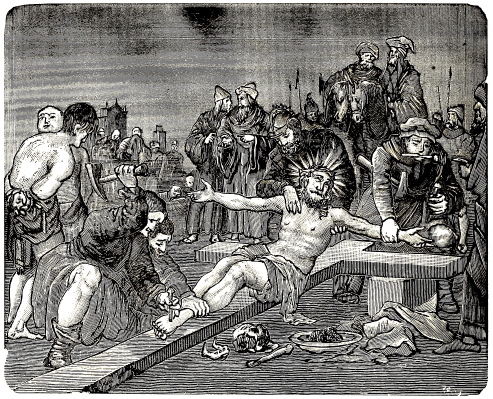
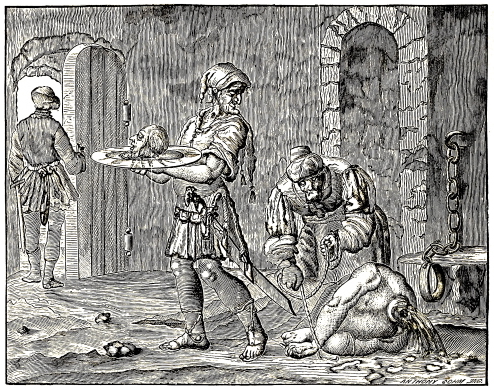
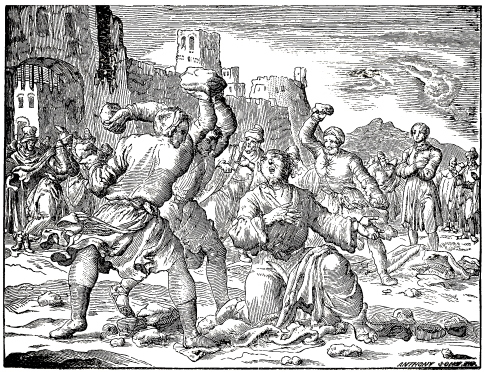
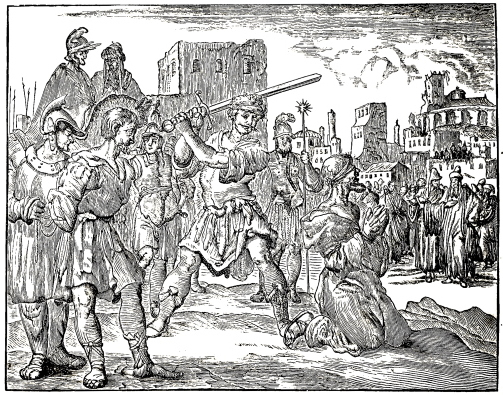
[Mention of the inquisition which from the year
1492 continued to 1660. It is noticed for the year
1501.
Persecution of the orthodox Christians in Hungary
briefly, and plainly shown, for the year 1507.
Two years after this, there is brought to remembrance
another persecution of the same people, in
the principality of Mecklenburg, near Mooren, two
years later, presented and noted for the year 1509.
Several persons who opposed popery in various
points of doctrine; as, Nicholas Rus, Bernhard
Liblinensis, John Picus, John Hilten, William Budaeus,
John Bugenhagius, etc.; some of whom also
felt the sting of the Roman scorpion, referred to
in a note for the years 1509, 1510, 1512, 1513,
1520, etc.
The decree which by the Romanists was published,
in the Netherlands, against all who believed
otherwise than the Roman church, and what misery
resulted thereupon, circumstantially noticed for the
year 1521.
In a note for the year 1522 mention is made of
Charles Stadius, and for the year 1524, of Henry
Zutphaniensis, touching their faith and death.
Beginning of the old Martyr’s Mirror of the
Defenseless Christians, together with the emendation
from various creditable chronicles, memoirs,
testimonies, etc.
The first martyrs mentioned are Hans Koch and
Leonhart Meister; both of whom lost their lives
for the truth of the holy Gospel, at Augsburg,
A. D. 1524.
Then follow so great multitude of professors of
Christ, who gave their lives for his name’s sake; as
well as so great a number of accounts of bloody
decrees, examinations, sentences, and memorable
memoirs, that it is impossible to enumerate them.
From the year 1524 until 1597, almost until the
close of the century, the pious martyrs were apprehended,
tormented, and put to death by fire, water,
sword, burying alive; with which last manner of
death this century is concluded.]
A great door is opened unto us to the arena of
the martyrs and blessed followers of Jesus. None of
the previous persecutions endured by the orthodox
martyrs are to be compared to the present one. We
have come through the time of fifteen centuries,
each consisting of one hundred consecutive years;
but we must confess that we did not meet with what
we have seen, or, at least, that which we shall see
here. The length of the time, the severity of the
persecution, and the number of the martyred persons
shall testify to this.
It is true, that fifteen hundred years extend over
a longer period of time than about a hundred and
fifty of like years; and that the persecutions which
occurred during this long time, when put in the
balance, would be heavier than this last one, as well
as the number of the persons who were persecuted;
but never in the preceding fifteen centuries did any
persecution continue for so long a time without alleviation;
never was then in so short (though actually
long) a time so much innocent blood shed; never
were there in so small a space so many dark prisons,
deadly tribunals, scaffolds, fiery stakes, and other
instruments of death erected and made use of as
were at this time in Germany and in the Netherlands.
To prove this, without unnecessary words, we will
forthwith enter upon our task, beginning with Germany,
and ending with the Netherlands.
The inquisition of which we gave an account in
the first book, for the year 1492, continued against
the orthodox believers, as is firmly believed, even
until this time; so that many who were subjected to
the same, and remained steadfast, had to suffer
themselves to be put to death; who, in the sight of
God, came to an honorable, but in the eyes of the
world, a shameful and not less miserable end, but
who shall hereafter, with Christ their Savior (who
herein preceded them), be clothed with everlasting
honor and joy, yea, be crowned as victorious kings
in the heavenly Zion, according to his promise:
“Be thou faithful unto death, and I will give thee a
crown of life.” Rev. 2:10.
Concerning the beginning of this inquisition see
the first book, for the year 1492, and how the same
continued until this time and long after, compare
Hist. Georg., lib. 6. Pieter Bor, lib. 3. Orsprong
der Nederlandtsche Beroerten, fol. 9–12. Tooneel
Nicol., fol. 87. Guil. Merulae, Tract. 9, 47. Eman.
van Met. (old edition), fol. 40. Retuald Gonsalv.,
in de H. Spanish Inquisition throughout. Hist.
Wenc., fol. 187. Chron. Phil. Mel., lib. 5. Hist.
Alons. de Vlb., lib. 2, with Chron. van Ondergang,
page 899, col. 1, 2, page 900, col. 1, 2.
That the old Waldenses, or orthodox believers,
whose sound confession we have shown elsewhere,
were now severely oppressed and persecuted in
Hungary; insomuch that they were necessitated to
deliver a defense of their faith against the unfounded
accusations on account of which they suffered persecution,
to Uladislaus, King of Bohemia, we have
partly shown in the Account of Holy Baptism, for
the year 1507, and it is confirmed by H. Boxhorn,
in his tract concerning this matter, fol. 27; compared
with P. J. Twisck, Chron., page 930, col. 2.
A. D. 1509, old writers state, that the aforementioned
old Waldenses, on account of the envy of
the Pope and papists, could no longer enjoy their
liberty in confessing and practicing their true belief,
in the principality of Mecklenburg, near Mooren.
See the last mentioned chronicle, page 937, col. 2,
ex Catal. Test., fol. 902.
Note.—A. D. 1509.—At this time, Nicholas
Rus vigorously taught and wrote against the Pope,
saying: 1. That letters of indulgence were nothing
but subtle deceptions to rob the plain and simple
people of their money. 2. That the Pope does not
have as much power as people suppose. 3. That
the Popes, cardinals, bishops, and prelates were
leading lascivious lives, etc. 4. That saints ought
not to be invoked.223 This Nicholas had many hearers
in the principality of Mecklenburg, but from
necessity, because of the papists, was soon compelled
to leave the place. He went to Wismar, but
there also he had no abiding place. See the authors
last mentioned, for the year 1509.
A. D. 1510.—Bernhard Liblinensis taught and
wrote at this time: 1. That it is impossible that the
whole world should obey a single man, as is the
Pope. 2. That the popes themselves were not of
one mind; for the one prohibits that which another
has instituted to be observed. 3. That therefore it
is sufficient to believe in Christ, and to obey him
alone. Chron. van den Ondergang, page 939, col. 2,
compared with Catal. Test., fol. 911. However,
what befell him as punishment from the Pope on
this account, is not stated.
A. D. 1512.—John Picus, John Hilton, and others,
vigorously spoke at this time against the abuses
of popery, severely reproving their (the Popes) life,
deeds, and doctrine. However, what they suffered
because of this, is not indicated. See the last mentioned
chronicle, page 946, col. 1; also, Joh. Munst.,
fol. 203, 204.
A. D. 1513.—William Budaeus, a very learned
man in France, wrote at this time in a book: 1. The
popes and bishops originate war between princes
and potentates; while they by rights ought to advise
and help to peace. 2. They fill the world with
pride, avarice, gluttony, drinking, lasciviousness,
whoredom, adultery, and other shameful things,
surpassing in these vile deeds the laity. 3. They
are Epicures, who do not care for eternal life, as
they show by their works; and they are to their
hearers the cause of eternal damnation. As to the
end or death of this man, however, we have likewise
found no account. Compare P. J. Twisck,
Chron., page 949, col. 1, with Catal. Test., fol. 908.
Joh. Munst., fol. 208.
A. D. 1520.—John Bugenhagius, surnamed Pomeranus,
a remarkably kind and moral man, was at
this time very well known through his writings.
Among other things he says, in a little book, treating
of Unborn Infants, that men erred for twelve
centuries with regard to infants, whom (by rights)
they could not, yet greatly desired to, baptize. Two
days before his death there was an eclipse of the
sun. He died at Wittenberg, aged 73 years. Compare
the last mentioned chronicle, page 985, col. 1,
with Leonh., lib. 7. Jac. Verh. Afb., fol. 28, 30, 32.
The time now draws near, when the account of
the last of those who suffered death, in our old Book
of Martyrs begins. We speak of those who gave
their lives for the truth since the great Reformation,
or, at least, since the establishment of the worship
of God in the year 1524, and from that time forward.
In the meantime it will be well for us to notice that
the martyrs of whom we shall speak were of the
profession of the Waldenses, even as were the preceding
ones, of whom we have previously spoken.
All the labor which we took upon ourselves from
the middle of the twelfth century, tended to follow
the line of these people. This has been our aim
continually up to the present time, and, in this, as
we hope, we have not been unsuccessful; yea, we
trust that we have shown this to a certainty. In the
meantime the intelligent, to whom we gladly submit
the matter, may judge with regard to it. The first
work which is now before us, is to unite the first
martyrs with the last, and to follow up what we
have written with that which was written before.
In order to give no offense to any one, we intend to
leave the old accounts unchanged, excepting a few
discrepancies and typographical errors; as well as
what we shall add of our own from the testimonies
of old writers; which shall be plainly distinguished.
By following this method, we hope to accomplish
our purpose successfully.
About A. D. 1521, at the time of Emperor
Charles V., a decree was made and issued by those
of the Roman church, on account of the Lutherans
and Zwinglians, against all those who were opposed
to the Roman profession, and hence, also against
the Anabaptists; who were all threatened with cruel
punishments of death, as appears from the following
account in the Chron. van den Ondergang, p. 975,
col. 2.
The account is as follows:224 “From it was made,
A. D. 1521,” says the writer, “the first prohibition
or decree concerning religion, and brought into the
Netherlands without the consent of the States, etc.;
so that they (this and like decrees) were rather tolerated
than confirmed by the States; the more so
since they were greatly favored by the Pope and the
clergy, as tending to promote obedience towards
the mother—the Roman—church, and generally no
complaint was heard from any of the common people
against it; that is, against the first.
By virtue of this decree all who believed otherwise
than the Roman church, or who had such
books in their possession, or harbored such heretics
or people, and all those whom the magistrates were
commanded to apprehend, were strictly sentenced
to death; and not only these, but also all who in
any wise were suspected of heresy; every Roman
Catholic being required to denounce every suspected
person, who, upon the testimony of two witnesses,
were, according to the instruction of the judges,
sentenced to death, their property confiscated, and
one third of it given to the accusers and witnesses,
though said witnesses had but little to say, only so
that they were known as good Catholics by their
pastor or priest.
If any one from fear took to flight, no one was
allowed to intercede for him, or plead his innocence,
neither the father for the child, nor brother for
brother; but he was condemned on account of his
flight, and his property confiscated.
Though one did even desist from his so-called
error, and suffered himself to be better instructed,
as it were, by the pastor, according to the Romish
manner, he had nevertheless to die. No greater
mercy was shown him than that he was not put to
death by fire, but executed with the sword.
The women were buried alive, and no judge could
mitigate these decrees, unless he was willing to be
regarded as a protector of the heretics, and be proceeded
against as such.
From this decree (the one first spoken of) made
by imperial power and authority, others were produced,
and issued, almost every year.
And by virtue of these decrees, none might have
in his possession, buy, give, carry, read, or communicate,
the doctrines, writings or books, of the
Lutherans, Zwinglians, etc. (he also makes mention
of the Mennonites), or dispute about them; neither
might they confer or dispute with any one about
the holy Scriptures, or read the same to others,
except (Romish) theologians or doctors of divinity,
or those who were properly licensed.
No one was allowed knowingly to receive suspected
persons (called heretics) into his house, to
lodge them, to give them food, clothes, or money;
but had to report them immediately, all on pain of
death and confiscation of property”.
Extracted from various Biographies of Emperor
Charles V., Chron. Mich., 4th part; Chron. Sleyd.,
lib. 1, 2, to 25; Hist. Alons, Ulloœ, lib. 1–5;
Chron. Hed., fol. 682; Chron. Saxon., fol. 649;
Chron. Franc, (old edition), fol. 62, 63; Chron.
Petr. Bor., lib. 1. Caprit., lib. 3. Pantal., lib. 3;
Hist. der Mart. Doopsges., lib. 1. Eman. van Met.,
lib. 1; Mer., fol. 960; Chron. Petr. Scriv., fol. 593;
D. Andries Hondd., lib. 1, cap. 15; D. Dirck Veli.,
lib. 2; Manl., fol. 255; W. Baud., lib. 16, an old
chronicle of the life and deeds of Charles V.,
throughout, etc.
Note.—A. D. 1522, Charles Stadius also declared
his views, at this time, among the learned;
he secretly held with the Anabaptists, says Leonhard
Krantz in his German Chronology, lib. 7.
Others, however, ascribe a different belief to him,
which is not found with the Anabaptists; namely,
that he said, that Christ, through his blood, had
also redeemed the (fallen) angels. Conrad Schless,
1st part, cap. 5, compared with P. J. Twisck,
Chron., page 994, col. 2. What happened to him,
however, on account of his belief, is not stated.
A. D. 1524.—Henry Zutphaniensis was horribly
put to death for the Gospel of Christ, by Ditmarish
peasants. See the above cited Chronicle, p. 1001,
col. 1. Also, Rab., part 3; Sleyd., lib. 4.
THE MARTYRS MIRROR
—OF THE—
DEFENSELESS CHRISTIANS,
[The following Part of the Martyrs Mirror, was not originally written by van Braght, but was the
outgrowth of a compilation from different authors, and published in different editions, which from time
to time were enlarged and improved. The original book, as appears from the writings of Samuel
W. Pennypacker, of Philadelphia, Pa., was published in Holland, in 1562, under the title, Het Offer des
Heeren. Later editions were printed in the years 1567, 1570, 1576, 1578, 1580, 1589, 1595, and 1599.
In 1617, a large quarto edition, containing 863 pages, written by Hans de Reis and Jacques Outerman,
and printed by Zacharias Cornelisz, at Hoorn, was published, bearing the title, Historie der Warachtighe
getuygen Jesu Christi. This book was succeeded by a folio volume of ten hundred and fifty-six pages,
printed at Hærlem, by Hans Passchiers, von Wesbusch, in 1631, entitled, Martelœrs Spiegel der Werelose
Christenen, that is, The Martyrs Mirror of the defenseless Christians. This book, our author,
van Braght, embodies as “Second Part,” in his own work under the title of The Bloody Theatre, or
Martyrs Mirror of the defenseless Christians, as he says, without change, except where some correction
was needed, adding, however, such matter as seemed profitable and necessary. This will explain to the
reader the above remark: “Old Book.”—Publishers.]
From A. D. 1160 until this time (A. D. 1660)
we have followed according to our ability the trail
and footsteps of the ancient Waldenses, of which
we have by no means, until this time, lost sight;
neither have we now lost sight of them, but still
keep them in view.
This appeared in the case of two pious men of
said profession (which agrees with that of the Anabaptists)
who, loving the truth of Christ, which they
maintained more than their own lives, were put to
death at Augsburg, in Germany, in accordance with
the rigor of the court, there, in the year 1524.
Concerning this, we read in Jacob Mehrning’s
History of Baptism the following words, translated
from the German: “From these Bohemian and Moravian
Old Waldensian brethren afterwards sprang
several excellent men; as, among others, Hans
Koch and Leonhard Meister, who were both put
to death at Augsburg, A. D. ——.225 Bapt. Hist.,
page 748.
Note.—The year 1160 was the time in which
Peter Waldo appeared against popery, at Lyons,
in France, and made a sound confession, of which
we gave an account in the first book. As regards
his descendants, this Hans Koch and Leonhard
Meister are counted as none of the least of them;
as also, afterwards, Michael Sattler, Leonhard Keyser,
John Hut, etc. See Jac. Mehr., Bapt. Hist.,
page 748.
The following earnest prayer to God was spoken
by Hans Koch and Leonhard Meister before their
death, and left for the consolation of all their fellow
believers:
O God! behold now from thy high throne the
misery of thy servants, how the enemy persecutes
them because it is their purpose to walk in the
narrow way, and how abominably they are scorned.
He who learns to know thee, and holds fast to thy
words, is despised and scorned by them. O God
of heaven! we have all sinned before thee; therefore
chastise us in mercy. We beseech thee, let us
enjoy thy grace, that thy honor may not be profaned
by us before this world, which now seems
determined to extinguish thy word. We might well
have peace with them, if we would not confess thy
holy name, and not believe on thy Son, that he
atoned for us on the cross, bore our sins, and paid
our debt. The enemy has no other reason for his
daily raging against us, than because we do not
fulfill his will, but love thee, O God, in our hearts,
which neither Satan nor his adherents can endure.
Therefore they compel us with great distress, and
afflict us with much tribulation. Thus, our misdeed,
on account of which the enemy fights so hard
against us, is, that we place our hope in thee alone,
and in thy dear Son Christ Jesus, and in the Holy
Ghost; therefore we must suffer reproach, because
we do not set ourselves against thee; if we would
give ourselves up to idolatry, and practice all manner
of wickedness, they would let us live unharmed,
in peace and tranquillity. Therefore, O dear Lord,
take up arms for us, and judge all those who disregard
thy power and might. If we would deny
thy word, antichrist would not hate us; yea, if we
would believe his false doctrine, follow his error,
and walk with the world on the broad road, we
would have favor with them; but because we seek
to follow thee, we are hated and forsaken by the
world. But though the enemy brings us to torment,
it does not happen to us alone, but was also done
to Christ our Redeemer; for they afflicted him first
with much reproach and suffering; and thus it was
with all that adhered to him, and believed in his
word. Hence Christ says himself: Marvel not, if
the world hate you; for it hated me first; they have
not received my words; thus shall they also not
receive your words. If they have persecuted me,
they will also persecute you; and when all these
things happen to you, rejoice and be exceeding
glad: for great is your reward in heaven. Christ
comforts us still more through the mouth of his
beloved apostles, saying: If we suffer with him, we
shall also rejoice with him, and reign in everlasting
joy. What matters it, if we are ridiculed and scorned
here for a little while? since God promises us eternal
rest and bliss. O Lord, thou seest and hearest the
derision and contumely, and the suffering with which
thy children are afflicted. Thou also knowest their
small and feeble ability; therefore we pray thee,
O God, that thou wouldst protect thine own honor,
and sanctify thy name, which is now so fearfully
profaned by all those who, here on earth, are of
high and low estate. Manifest thy power, that the
enemy may perceive and understand thy divine
strength, and may learn to be ashamed. O Lord
God, have compassion upon thy poor sheep, that
are scattered, and have no longer a true shepherd
who will henceforth teach them. Send them thy
Holy Spirit, that he may feed and satisfy them with
thy grace, and that they may not hearken to the
voice of a stranger, unto the end. O God, in thy
high majesty, graciously hear our petition, and do
not forsake us, since we are in great tribulation and
conflict. Give us steadfast patience through Christ
thy Son, our Captain, who can vanquish Satan
with all his host. To him be honor, and praise to
his holy name. Amen.
Matt. 7:14; Ps. 106:6; Dan. 9:5; 1 Pet. 2:24;
Matt. 22:37; 1 Pet. 4:3; Matt. 7:13; John 17:14;
1 Pet. 4:1; Isa. 53; Matt. 27; Luke 24:26; John
15:18; 1 John 3:13; Matt. 5:12; Rom. 8:11;
2 Tim. 2:12; John 10:5.
In this year, also Caspar Tauber, a tradesman
and citizen of Vienna, in Austria, was apprehended
for the Christian faith; and as he faithfully and
steadfastly continued to confess Christ, without
apostatizing, he was condemned and burned.
At this time not only the papists, but also the
Zwinglians or so-called Reformed in the city of
Zuerich laid their hands on the innocent and defenseless
flock of Christ; yet not, as far as we can
learn, punishing them with death, or depriving them
of life by the executioner, but confining them under
severe imprisonment, until ultimately, as may be
inferred, death followed.
However, in order to determine from this time
on, what course was to be pursued in this matter,
the magistrate of said city ordained, among other
things, the following:
“Therefore we ordain and will, that henceforth
all men, women, youths, and maidens forsake Anabaptism,
and practice it no longer from this time
on, and that they have their infants baptized; and
whosoever shall act contrary to this public edict,
shall, as often as it occurs, be fined one mark silver;
and if any should prove utterly disobedient and
obstinate, they shall be dealt with more severely;
for we shall protect the obedient, and punish the
disobedient according to his deserts, without bearing
with him any longer. Let every one act accordingly.
All this we confirm by this public document,
sealed with the seal of our city, and given on St.
Andrew’s day, A. D. 1525.”
Compare Chron. van den Ondergang, page 1010,
col. with Henr. Bull. against the Anabaptists, lib. 1,
cap. 5, 6; also the open letter of the council of Zuerich,
published A. D. 1525.
The Zwinglian church at Zuerich, where this decree
was made, was at this time only about five
years old, and was itself also subjected to the hatred
and persecution of the papists; certainly a lamentable
matter, that those who had but a short time
before purified themselves in many respects from
the leaven of popery and were opposed to the tyranny
of the Pope, should nevertheless continue, in
this respect, united with the papists; that is, in persecuting
others who did not have the same faith
with them.
Still, it would have been well if they had stopped
with this decree, since with one mark of silver one
could have atoned for the first offense in neglecting
to baptize a child. But this was not the end of it, as
a few years later, especially in A. D. 1530, when
they became a little bolder, they decreed, that the
so-called Anabaptists should be punished with death,
which we shall show in its proper place.
Felix Mantz was also an originator of the Reformation
of the faith, in Germany, and when he, with
great zeal, practiced, taught, and preached, the
recognized truth of the Gospel, he was envied, accused,
and imprisoned by his adversaries, and finally
drowned at Zuerich, for the evangelical truth, thus
becoming a witness of the sufferings of Christ. This
occurred in the year of our Lord 1526. He left the
following admonition to his fellow brethren, for their
comfort:
“My heart rejoices in God, who gives me much
knowledge and wisdom, that I may escape the eternal,
and never-ending death. Therefore I praise
thee, O Lord Christ from heaven, that thou dost
turn away my sorrow and sadness; thou whom God
has sent me as a Savior, and for an example and
a light, and who has called me into his heavenly
kingdom, already before my end has come, that I
should have eternal joy with him, and should love
him and all his righteousness, which exists here,
and which shall endure forever hereafter, and without
which nothing avails or subsists; hence so many
who do not have this in truth, are deceived by a
vain opinion. But alas! how many are found at the
present who boast of the Gospel, and speak, teach,
and preach much about it, but are full of hatred and
envy, and who have not the love of God in them,
whose deceit is known to all the world, as we have
experienced in these latter days, that those who have
come to us in sheep’s clothing are ravening wolves,
who hate the pious on the earth, and obstruct the
way to life and to the true sheepfold. Thus do the
false prophets and hypocrites of this world, who
curse and pray with the same mouth, and whose life
is disorderly. They call upon the authorities to kill
us, by which they destroy the very essence of Christianity.
But I will praise the Lord Christ, who exercises
all patience towards us; for he instructs us
with his divine graces, and shows love to all men,
according to the nature of God his heavenly Father,
which none of the false prophets are able to do.
“Here we must observe this difference, that the
sheep of Christ seek the praise of God; this is their
choice, and they do not suffer themselves to be hindered
either by possessions or temporal good, for
they are in the keeping of Christ. The Lord Christ
compels no one to come to his glory; only those
that are willing and prepared attain unto it by true
faith and baptism. Whenever a person brings forth
genuine fruits of repentance, the heaven of eternal
joys is, through grace, purchased and obtained for
him by Christ, through the shedding of his innocent
blood, which he so willingly poured out; thereby
showing us his love, and enduing us with the power
of his Spirit, and whoever receives and uses it grows
and is made perfect in God. Only love to God
through Christ shall stand and prevail; not boasting,
denouncing, or threatening. It is love alone that is
pleasing to God: he that cannot show love shall not
stand in the sight of God. The true love of Christ
shall not destroy the enemy; he that would be an
heir with Christ is taught that he must be merciful,
as the Father in heaven is merciful. Christ never
accused any one, as do the false teachers of the
present day; from which it is evident that they do
not have the love of Christ, nor understand his
word; and still they would be shepherds and teachers;
but at last they will have to despair, when they
shall find, that everlasting pain shall be their recompense,
if they do not reform. Christ also never hated
any one; neither did his true servants, but they continued
to follow Christ in the true way, as he went
before them. This Light of life they have before
them, and are glad to walk in it; but those who are
hateful and envious, and do thus wickedly betray,
accuse, smite and quarrel, cannot be Christians.
They are those who run before Christ as thieves and
murderers, and under a false pretense shed innocent
blood. By this we may know them that are not on
the side of Christ; for they, as children of Belial,
prompted by envy, destroy the ordinances of Jesus
Christ; even as Cain slew his brother Abel, when
God accepted the offerings of Abel.
With this I will finish my discourse, desiring that
all the pious be mindful of the fall of Adam, who
when he accepted the advice of the serpent, and
became disobedient to God, the punishment of death
came upon him. Thus it shall also happen to those
who do not accept Christ, but resist him, love this
world, and have not the love of God. And thus I
close with this that I will firmly adhere to Christ,
and trust in him, who is acquainted with all my
needs, and can deliver me out of it. Amen.
1 Pet. 5:1; John 16:20; Gal. 5:21; John 5:42;
Matt. 7:15; 2 Thess. 3:7; John 10:3; Acts 2:38;
Luke 6:36; John 8:12; John 10:1; Gen. 4:8; 3:6;
1 John 2:15; John 5:42.
George Wagner, of Emmerich, was apprehended
at Munich, in Bavaria, on account of four articles
of the faith. First, That the priest cannot forgive
sins. Secondly, That he does not believe that a
man can bring down God from heaven. Thirdly,
That he does not believe that God or Christ is
bodily in the bread which the priest has upon the
altar; but that it is the bread of the Lord. Fourthly,
That he did not hold to the belief that water baptism
possessed any saving power. As he would not
renounce these articles, he was most severely tormented,
so that the prince felt great compassion for
him, and personally came to him in the prison, and
earnestly admonished him thereto, promising that
he would call him his friend all his lifetime. Thus
also the tutor of the prince, earnestly admonished
him to recant, and likewise made him many promises.
Ultimately his wife and child were brought before
him in prison in order, on this wise to move
him to recant. But neither was he to be moved in
this way; for he said that though his wife and child
were so dear to him that the prince could not buy
them with all his dominion, yet he would not forsake
his God and Lord on their account. Many
priests and others also came to him, to persuade
him; but he was steadfast and immovable in that
which God had given him to know. Hence he was
finally sentenced to the fire and death.
Having been delivered into the hands of the executioner,
and led into the middle of the city, he
said: “To-day I will confess my God before all the
world.” He had such joy in Christ Jesus, that his
face did not pale, nor his eyes show fear; but he went
smilingly to the fire, where the executioner bound
him on the ladder, and tied a little bag of powder
to his neck, at which he said: “Be it done in the
name of the Father, the Son, and the Holy Ghost;”
and having smilingly bid farewell to a Christian,
who was there, he was thrust into the fire by the
executioner, and happily offered up his spirit, on
the eighth day of February, A. D. 1527. The sheriff
however, surnamed Eisenreich von Landsberg,
while returning home from the place of execution,
traveling on horseback; purposing to apprehend
others of the brethren, died suddenly in the night,
and was found dead in his bed in the morning,
having thus been removed through the wrath of
God.
Note.—It is known that Balthasar Pacimontanus
opposed infant baptism, and was therefore burned
at Vienna, A. D. 1527. See second part of Jacob
Mehrning’s History of Baptism, page 777, ex Bellarm.,
Tom. 3, lib. 1, de Bapt., cap 8.
This Melchior Vet. was a companion of George
Blaurock, who was of the same faith with him, and
also served with him in the Gospel. He was burned
in the time of Michael Sattler, at Drache, for the
testimony of the faith and of the divine truth, which
he boldly confessed.
After a long trial on the day of his departure from
this world, the articles being many, Michael Sattler226
requested that they should be read to him again and
that he should have another hearing. This the
bailiff, as the governor of his lord, opposed and
would not consent to it. Michael Sattler then requested
permission to speak. After a consultation,
the judges returned as their answer, that if his opponents
would allow it, they (the judges) would
consent. Thereupon the town clerk of Ensisheim,
as the attorney of said Governor spoke thus:
“Prudent, honorable and wise Sirs, He has boasted
of the Holy Ghost. Now, if his boast is true, it
seems to me, it is unnecessary to grant him this; for
if he has the Holy Ghost, as he boasts, the same
will tell him what has been done here.” To this
Michael Sattler replied: “Ye servants of God, I
hope my request will not be denied; for said articles
are as yet unknown to me.” The town clerk responded:
“Prudent, honorable and wise Sirs,
Though we are not bound to do this, yet in order
to give satisfaction, we will grant him his request
that it may not be thought that injustice is done him
in his heresy, or that we desire to wrong him;
hence let the articles be read to him.”
First, That he and his adherents have acted contrary
to the mandate of the Emperor.
Secondly, He has taught, held and believed that
the body and blood of Christ are not present in the
sacrament.
Thirdly, He has taught and believed that infant
baptism does not conduce to salvation.
Fourthly, They have rejected the sacrament of
extreme unction.
Fifthly, They have despised and contemned the
mother of God and the saints.
Sixthly, He has declared that men are not to
swear before the authorities.
Seventhly, He has commenced a new and unheard
of custom in regard to the Lord’s Supper,
placing the bread and wine on a plate, and eating
and drinking the same.
Eighthly, He has left the order, and married a
wife.
Ninthly, He has said that if the Turks should invade
the country, no resistance ought to be offered
them; and if it were right to wage war, he would
rather take the field against the Christians than
against the Turks; and it is certainly a great matter,
to set the greatest enemies of our holy faith against
us.
Thereupon Michael Sattler requested permission
to confer with his brethren and sisters, which was
granted him. Having conferred with them for a
little while, he began and undauntingly answered
thus: “In regard to the articles relating to me and
my brethren and sisters, hear this brief answer:
“First, That we have acted contrary to the imperial
mandate, we do not admit; for the same says
that the Lutheran doctrine and delusion is not to be
adhered to, but only the Gospel and word of God.
This we have kept; for I am not aware that we
have acted contrary to the Gospel and the word of
God; I appeal to the words of Christ.
“Secondly, That the real body of Christ the
Lord is not present in the sacrament, we admit; for
the Scripture says: Christ ascended into heaven and,
sitteth on the right hand of his heavenly Father
whence he shall come to judge the quick and the
dead; from which it follows, that if he is in heaven,
and not in the bread, he may not be eaten bodily.
Mark 16:19; Acts 1:9; Col. 3:1; Acts 10:42; 2 Timothy
4:1.
“Thirdly, As to baptism we say: Infant baptism
is of no avail to salvation; for it is written, that we
live by faith alone. Again: He that believeth and
is baptized shall be saved. Peter likewise says:
The like figure whereunto even baptism doth also
now save us (not the putting away of the filth of
the flesh, but the answer of a good conscience
toward God), by the resurrection of Jesus Christ.
Romans 1:17; Mark 16:16; 1 Pet. 3:21.
“Fourthly, We have not rejected the oil; for it
is a creature of God, and what God has made is
good and not to be refused; but that the pope, the
bishops, monks and priests can make it better, we
do not believe; for the Pope never made anything
good. That of which the epistle of James speaks is
not the Pope’s oil. Gen. 1:11; 1 Tim. 4:4; James
5:14.
“Fifthly, We have not contemned the mother
of God and the saints; for the mother of Christ is
to be blessed among all women; for to her was
accorded the favor of giving birth to the Savior of
the whole world. But that she is a mediatress and
advocatess, of this the Scriptures know nothing;
for she must with us await the judgment. Paul said
to Timothy: Christ is our Mediator and Advocate
with God. As regards the saints; we say that we
who live and believe are the saints; which I prove
by the epistles of Paul to the Romans, Corinthians,
Ephesians; and in other places where he always
writes: To the beloved saints. Hence we that believe
are the saints; but those who have died in
faith we regard as the blessed. Luke 1:28; Matthew
1:21; 1 Tim. 2:5; 1 Cor. 1:2; Eph. 1:1; Revelation
14:13.
“Sixthly, We hold, that we are not to swear before
the authorities: For the Lord says: Swear not;
but let your communication be, Yea, yea; Nay,
nay. Matt. 5:34; James 5:12.
“Seventhly, When God called me to testify of
his word, and I had read Paul, and also considered
the unchristian and perilous state in which I was; beholding
the pomp, pride, usury, and great whoredom
of the monks and priests, I went and took
unto me a wife, according to the command of God;
for Paul well prophesies concerning this to Timothy:
In the latter time it shall come to pass that
men shall forbid to marry, and command to abstain
from meats which God hath created to be received
with thanksgiving, 1 Cor. 7:2; 1 Tim. 4:3.
“Eighthly, If the Turks should come, we ought
not to resist them; for it is written: Thou shalt not
kill. We must not defend ourselves against the
Turks and others of our persecutors, but are to beseech
God with earnest prayer to repel and resist
them. But that I said, that if warring were right, I
would rather take the field against the so-called
Christians, who persecute, apprehend and kill pious
Christians, than against the Turks, was for this
reason: The Turk is a true Turk, knows nothing
of the Christian faith; and is a Turk after the flesh;
but you, who would be Christians, and who make
your boast of Christ, persecute the pious witnesses
of Christ, and are Turks after the spirit. Ex. 20:13;
Matt. 7:7; Tit. 1:16.
“In conclusion: Ye ministers of God, I admonish
you to consider the end for which God has appointed
you, to punish the evil, and to defend and
protect the pious. Whereas, then, we have not acted
contrary to God and the Gospel, you will find that
neither I nor my brethren and sisters have offended
in word or deed against any authority. Therefore,
ye ministers of God, if ye have not heard or read
the word of God, send for the most learned, and
for the sacred books of the Bible, of whatsoever
language they may be, and let them confer with us
in the word of God; and if they prove to us with
the Holy Scriptures, that we err and are in the
wrong, we will gladly desist and recant and also
willingly suffer the sentence and punishment for
that of which we have been accused, but if no error
is proven to us, I hope to God, that you will be
converted, and receive instruction.” Wis. 6:4; Acts
25:8; Rom. 13:4; Acts 25:11.
Upon this speech the judges laughed and put
their heads together, and the town clerk of Ensisheim
said:
“O you infamous, desperate villain and monk,
shall we dispute with you? The hangman shall dispute
with you, I assure you.”
Michael said: “God’s will be done.”
The town clerk said: “It were well if you had
never been born.”
Michael replied: “God knows what is good.”
Town Clerk: “You arch-heretic, you have seduced
the pious; if they would only now forsake
their error, and accept grace.”
Michael: “Grace is with God alone.”
One of the prisoners also said: “We must not
depart from the truth.”
Town Clerk: “You desperate villain and arch-heretic,
I tell you if there were no hangman here,
I would hang you myself, and think that I had
done God service.”
Michael: “God will judge aright.”
Thereupon the town clerk said a few words to
him in Latin, what we do not know.
Michael Sattler answered him: Judica.
The town clerk then admonished the judges and
said: “He will not cease from this talk to-day;
therefore my Lord Judge, proceed with the sentence;
I will commit it to the law.”
The judge asked Michael Sattler whether he also
committed it to the law.
He replied: “Ye ministers of God, I am not
sent to judge the word of God; we are sent to bear
witness of it, and, hence, cannot consent to any
law, since we have no command from God concerning
it; but if we can not be discharged from
the law, we are ready to suffer for the word of
God whatever sufferings are, or may be imposed
upon us all for the sake of the faith in Christ Jesus
our Savior, as long as we have breath within us;
unless we be dissuaded from it by the Scriptures.”
The town clerk said: “The hangman shall convince
you; he shall dispute with you, arch-heretic.”
Michael: “I appeal to the Scriptures.”
Then the judges arose, and went into another
room, where they remained for an hour and a half,
and determined on the sentence. Matt. 6:10; John
16:2; 1 Cor. 4:5; John 1:8; Job 27:3; Acts 25:11.
In the meantime, some in the room treated
Michael Sattler most unmercifully, heaping reproach
upon him. One of them said: “What have
you in expectation for yourself and the others, that
you have so seduced them?” With this, he also
drew forth a sword which lay upon the table, saying:
“See, with this shall they dispute with thee.”
But Michael did not answer upon a single word
concerning his person, but willingly endured it all.
One of the prisoners said: “We must not cast
pearls before swine.” Matt. 27:14; 7:6.
Being also asked, why he had not remained a
lord in the convent, Michael answered: “According
to the flesh I was a lord; but it is better so.”
He did not say more than what is recorded here,
and this he spoke fearlessly.
The judges having returned to the room, the
sentence was read. It was as follows: “In the case
of the Governor of his Imperial Majesty versus
Michael Sattler, judgment is passed, that Michael
Sattler shall be delivered to the executioner, who
shall lead him to the place of execution, and cut
out his tongue; then throw him upon a wagon, and
there tear his body twice with red hot tongs; and
after he has been brought without the gate, he shall
be pinched five times in the same manner.”
After this had been done in the manner prescribed,
he was burned to ashes as a heretic. His
fellow brethren were executed with the sword, and
the sisters drowned. His wife, also, after being subjected
to many entreaties, admonitions and threats,
under which she remained very steadfast, was
drowned a few days afterwards. Done the 21st day
of May, A. D. 1527.
My beloved companions in the Lord! grace and
mercy from God our heavenly Father, through
Jesus Christ our Lord, and the power of their
Spirit, be with you beloved of God, brethren and
sisters.
I can not forget you; though I am not present
with the body (Col. 2:5), yet I continually care for
and watch over you, as my fellow members, lest the
body be taken away, and the whole body [the
church], with all its members be overwhelmed with
sorrow, especially at this time, when the ferocity of
the ravening wolf has risen to such a pitch, and increases
in power, so that he has aroused also me to
fight against him; but eternal praise be to God, its
head is completely broken, and I hope that his
whole body shall soon be no more, as is written.
Dear brethren and sisters, you well know with
what ardent love I admonished you the last time I
was with you, that you should be upright and
godly in all patience and in the love of God, by
which you may be known among this adulterous
and ungodly generation, as shining lights (Matthew
5:14) whom God the heavenly Father has illuminated
with his knowledge and the light of the Spirit.
With like fervency I now beseech and admonish
you; that you walk surely and prudently towards
those that are without as unbelievers, that our
office, which God has imposed upon us, may in no
wise be profaned and justly reproached.
Remember the Lord, who has given you the
talent, for he shall require it again with usury. That
the one talent may not be taken from you, put it to
usury, according to the command of the Lord, who
has given you the talent. Matt. 15:19.
I say to you through the grace of God, that ye be
valiant, and walk as become the saints of God.
Consider what the Lord metes out to idle servants;
namely, to utterly lukewarm and slothful hearts,
unfit and cold for all love to God and the brethren.
You have experienced what I now write.
Be admonished by this, lest God let a like punishment
come upon you. Beware, beware of such as
act contrary to the command of God lest ye learn
their abominations; but reprove it with strict attention,
and excommunication, according to the command
of Christ, yet with all love and compassion
for their cold hearts. Matt. 18:17. If you do this,
you shall readily see how the flock of God dwells
among the wolves (Acts 20:29), and shall witness a
brief and speedy separation of those who will not
walk in the right paths and living ways of Christ,
namely, through crosses, misery, imprisonment,
self-denial, and ultimately through death. Then you
can present yourselves to God your heavenly Father,
a pure, godly, true church of Christ, which is
cleansed through his blood (Eph. 5:26), that it
may be holy and unblamable in the sight of God
and men, separated from all idolatry and abomination,
and redeemed, that the Lord of all dominion
may dwell in it, and that it may be a tabernacle unto
him. Beloved brethren, understand whether
what I write unto you be truth, and use diligence to
walk according to it. Let no one divert you from
your aim, as has been the case with some even until
now; but go straight on in all patience, without deviating,
that you do not take up the cross which
God has laid upon you, only to lay it down contrary
to the honor and praise of God, and to the transgression
and violation of his eternal, true, just, and
life-giving commandments.
Do not become weary, if you are chastened of the
Lord (Heb. 12:5); for whom God loves he chastens,
even as a father that is well pleased with his
son. To what will you have recourse, if you would
flee from God? What can help you if you forsake
God? Is it not God who fills heaven and earth?
Does he not know all the secrets of thy vain heart,
and the lasciviousness of thy reins? All things are
manifest to him, and there is nothing concealed
from him. Vain man, whither will you go, that
God shall not see you? Why do you flee the rod
of your Father? (Heb. 12:8). If you will not be
chastened according to the will of the Father, you
cannot inherit his riches. Why do you love a short
and transient rest more than the godly and moderate
correction and chastisement of the Lord to your
salvation? How long will you eat flesh of the fat of
Egypt? How long will you be carnally-minded?
(Rom. 8:8). The flesh perishes, and all its glory;
the word of the Lord alone abides forever.
Beloved brethren, mark what I write to you; for
it is necessary, since you see that there are but few
who will endure the chastening of the Lord; for by
far the greater number when they suffer a little in
the flesh, become faint and weary, and do no longer
look unto Jesus, the Captain and Finisher of our
faith. They also forget all his commandments, and
esteem the jewel which the calling of God every
where presents and points out to those that overcome
of small value; but they regard this temporal
rest, which is before their eyes as far better and more
profitable, than the eternal for which we must hope.
Moreover, there are some who, when this is presented
to them, accuse God, though very unjustly,
of not being willing to keep them under his protection.
You know whom I mean, take heed that you
have no fellowship with them.
Furthermore, dear fellow members in Christ, be
admonished that you forget not charity, without
which it is not possible for you to be a Christian
flock. You know what charity is, from the testimony
of Paul our fellow brother, who says: “Charity
suffereth long, and is kind; charity envieth not;
charity vaunteth not itself, is not puffed up, doth
not behave itself unseemly, seeketh not her own, is
not easily provoked, thinketh no evil; rejoiceth not
in iniquity, but rejoiceth in the truth; heareth all
things, believeth all things, hopeth all things, endureth
all things.” 1 Cor. 13:4–7. Understand
this passage, and you will find the love of God and
the love of your neighbor; and if you love God, you
will rejoice in the truth, and believe, hope and endure
all that comes from God. In this way the
aforesaid failing will be removed and avoided. But
if you love your neighbor, you will not punish or
excommunicate with fire, you will not seek your
own, think no evil, not vaunt yourselves, and, finally,
not be puffed up; but will be kind, just, liberal in all
giving, humble and compassionate with the weak
and imperfect. Rom. 13:8.
This love has been adulterated by some brethren (I
know who they are); they have not been willing to
edify one another by love, but are become puffed up
and unprofitable with the vain knowledge and understanding
of things which God would have
remain hidden to all but himself alone. 1 Cor. 8:1.
I do not censure nor reject the grace and revelation
of God, but the puffed up make use of this revelation.
What would it profit, says Paul, if I should
speak with the tongues of men and of angels, and
understand all mysteries and knowledge, and have
all faith, tell me, what profit is all this, if love be not
exercised? You have experienced what such presumptuous
speaking and ignorance has produced;
you still daily see their false fruits, though they have
given themselves to God.
And let no man remove you from the foundation
which is laid through the letter of the holy Scriptures,
and is sealed with the blood of Christ and of
many witnesses of Jesus. Hear not what they say
of their father, for he is a liar; and do not believe
their spirit, for he is entirely swallowed up in the
flesh. Judge what I write to you; take these matters
to heart, that this abomination may be separated
far from you, and that you be found humble, fruitful
and obedient children of God. Beloved brethren,
marvel not that I treat this matter with such earnestness;
for I do so not without reason. The
brethren have doubtless informed you that some of
us are in prison; and afterwards when the brethren
at Horb had also been apprehended, they brought
us to Binzdorf. At this time we met with various
designs of our adversaries. Once they threatened
us with bonds; then with fire, and afterwards with
the sword. In this peril I completely surrendered
myself into the will of the Lord, and together with
all my fellow-brethren and my wife, prepared myself
even for death for his testimony; and then I
thought of the great number of false brethren, and
of you, who are but few, namely, a little flock; and
also, that there are but few faithful laborers in the
Lord’s vineyard (Matt. 9:37); hence I deemed it
necessary to stir you up by this admonition, to follow
after us in the divine warfare, in order that you
may comfort yourselves with it, that you may not
become weary of the chastening of the Lord.
In short, beloved brethren and sisters this letter
shall be a farewell to all of you who truly love and
follow God (others I do not know); and also a
testimony of my love which God has given into my
heart towards you, for the sake of your salvation.
I did indeed desire, and it would have been profitable,
I trust, if I had labored a little while longer in
the work of the Lord; but it is better for me, to be
released, and to await with Christ the hope of the
blessed. The Lord is able to raise up another
laborer to finish this work.
Pray that reapers may be constrained into the
harvest; for the time of threshing is nigh at hand.
Luke 10:2. The abomination of desolation is manifest
among you; the chosen servants and handmaidens
of God are marked with the name of their
Father on their foreheads (Rev. 13:16); the world
rises up against those who are delivered from its
error; the Gospel is proclaimed before all the world,
as a testimony against it; therefore it will be necessary
that the day of the Lord do not tarry.
You know, my most beloved fellow members,
that it becomes us to conduct ourselves in a godly
and Christian manner. 2 Tim. 3:12. Take heed,
watch and pray, lest your wisdom bring judgment
upon you. Pray without ceasing (1 Thess. 5:17)
that you may stand worthy before the Son of man.
Remember your forerunner Jesus Christ, and follow
him through faith and obedience, with love and
patience. 1 Peter 2:20. Forget that which is carnal,
that you may in truth be called Christians, and
children of the Most High God. Endure the
chastening of your father in heaven, and turn
neither to the right nor to the left, that you may
enter by the door (John 10:1), and will not have
to walk in a strange path, in which sinners, sorcerers,
idolaters, and whosoever loves and makes a lie,
must go. Rev. 22:15. Remember our assembly,
and strictly follow that which was resolved on therein;
and if anything has been forgotton, pray the
Lord for understanding. Be liberal towards all
that are in want among you (Heb. 13:3), but especially
towards those who labor among you in the
word, and are driven about, and cannot eat their
bread in peace and quietness. Forget not to assemble
yourselves together, but give diligence that
you constantly meet together, and be united in
prayer for all men, and in breaking of bread; and
this with the more diligence, because the day of the
Lord is approaching. Heb. 10:25. In this assembling
you will make manifest the hearts of the
false brethren, and will speedily rid yourselves of
them.
Finally, beloved brethren and sisters, sanctify
yourselves for him that has made you holy, and
hear what Esdras says: “Look for your shepherd;
he shall give you everlasting rest; for he is nigh at
hand, that shall come in the end of the world. Be
ready to the reward of the kingdom. . . .
Flee the shadow of this world. . . . Arise up
and stand, behold the number of those that be
sealed in the feast of the Lord; which are departed
from the shadow of the world, and have received
glorious garments of the Lord. Take thy number,
O Sion, and shut up those of thine that are clothed
in white, which have fulfilled the law of the Lord.
The number of thy children whom thou longedst for,
is fulfilled. . . . I Esdras saw upon the mount
Sion a great people; whom I could not number, and
they all praised the Lord with songs. And in the
midst of them there was a young man of a high
stature, taller than all the rest, and upon every one
of their heads he set crowns, and was more exalted;
which I marveled at greatly. So I asked the angel,
and said, Sir, what are these? He answered and
said unto me, These be they that have put off the
mortal clothing, and put on the immortal, and have
confessed the name of God: now are they crowned,
and receive palms. Then said I unto the angel,
What young person is it that crowneth them, and
giveth them palms in their hands? So he answered
and said unto me, It is the Son of God, whom they
have confessed in the world. Then began I greatly
to commend them that stood so stiffly for the name
of the Lord.” 2 Esdras 34–36, 38–47; Rev. 19:12;
Matt. 13:43.
Bear in mind most beloved members of the body
of Christ, what I indicate by this scripture, and live
according to it, and if I be offered up to the Lord,
do for my wife what you would for me. The peace
of Jesus Christ, and the love of the heavenly Father,
and the grace of their Spirit, preserve you unspotted
from sin, and present you glad and pure for the
beholding of their glory, at the coming of our Lord
Jesus Christ, that you may be found in the number
of those called to the feast (Luke 14:15) of the one
essential, true God and Savior Jesus Christ, to
whom be eternal praise and glory, Amen.
Beware of false brethren (Acts 20:39); for the
Lord will perhaps call me to him; so take warning,
I wail for my God. Pray without ceasing for all
that are in bonds. God be with you all. Amen.
Written in the tower at Binzdorf. Brother Michael
Sattler of Staufen, together with my fellow
prisoners in the Lord.
Of this hero and witness of Jesus Christ there
are also other writings extant in print, treating of
the atonement of Christ; brotherly union; divorce;
of evil overseers, and the hearing of false prophets.
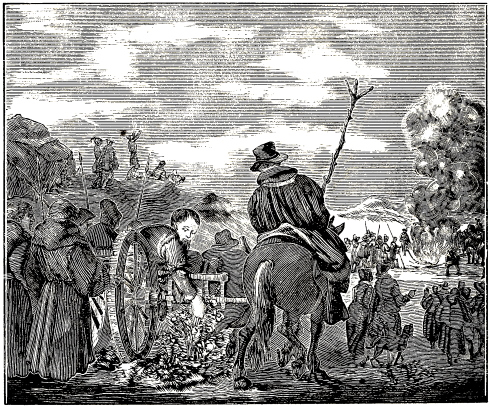
LEONHARD KEYSER ON THE WAY TO EXECUTION.
When the believers greatly increased under persecution
and the cross (Ex. 1:12), there was, in
Bavaria, a learned priest of the mass, named Leonhard
Keyser, who examined the writings of Zwingli
and Luther, and also went to Wittenberg, where he
conferred with the doctors and commemorated the
Supper with them.
Having returned to Bavaria, he examined the
fruits and doctrine of the Anabaptists, as well as
of Zwingli and Luther, and joined himself under
the cross to the separated cross-bearing church of
the Anabaptists, in the year 1525, and forthwith
continued in his ministry, with great power and
zeal, undaunted by all the tyranny which arose over
the believers, in the way of drowning, burning and
putting to death. Acts 9:20. In the second year
of his ministry, Leonard Keyser was apprehended
at Scharding, in Bavaria, and condemned by the
bishop of Passau and other priests and capitulars,
to be burned on Friday before St. Lawrence day,
in August of the same year. Having bound him
on a cart, they took him to the fire, the priests
going alongside, and speaking Latin to him, but
he, on account of the people, answered them in
German; even as they had refused to speak to him
in German before the court, which he had frequently
requested. When he came out into the field, and
was approaching the fire, he, bound, as he was,
leaned down at the side of the cart, and plucked a
flower with his hand, saying to the judge, who rode
on horseback along side of the cart: “Lord judge,
here I pluck a flower; if you can burn this flower
and me, you have justly condemned me; but, on
the other hand, if you cannot burn me and this
flower in my hand, consider what you have done
and repent.” Thereupon the judge and the three
executioners threw an extraordinary quantity of
wood into the fire, in order to burn him immediately
to ashes by the great fire. But when the wood was
entirely burned up, his body was taken from the
fire uninjured. Then the three executioners and
their assistants built another great fire of wood, which
when it was consumed, his body still remained uninjured,
only his hair and his nails were somewhat
burnt brown, and, the ashes having been removed
from his body, the latter was found smooth
and clear, and the flower in his hand, not withered,
or burnt in the least, the executioners then cut his
body into pieces, which they threw into a new fire.
When the wood was burned up, the pieces lay unconsumed
in the fire. Finally they took the pieces
and threw them into the river Inn. This judge was
so terrified by this occurrence that he resigned his
office, and moved to another place. His chief servant,
who was with the judge, and saw and heard
all this, came to us in Moravia, became our brother
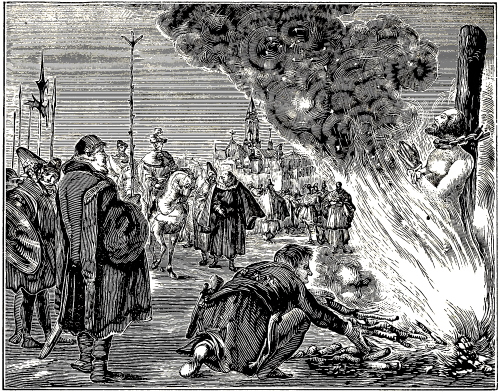
and lived and died piously. That it might not be
forgotten our teachers have recorded this as it came
from his own lips, and now cause it to be promulgated
and made known.
Seb. Frank, in his Chron. der Rom. Kett. letter
L., gives the following account of this matter:
“Having been brought a prisoner to Scharding, he
was taken to the fire by three executioners, bound
cross-wise on a ladder, and thrust into the fire.
When he called upon Christ Jesus the ropes fell
from his body and were burned; and as he was still
alive, he rolled out of the fire at one side. The executioners
instantly thrust him back into the fire,
with hop-poles, that happened to be there, so that
he rolled out on the other side. There the executioners
cut him alive into pieces, which they cast
into the fire, without being able, however, to burn
them, as I have read,” etc. Concerning this, see
also P. J. Twisck, Chron., fol. 1020, col. 2.
A. D. 1527, Thomas Hermann, a minister of the
Gospel and word of God, was executed. Some
persons had been apprehended at Kitzbuehl, and,
through the tyranny of the authorities, had been
brought to apostatize from the truth. The latter
furthermore brought them into a public place before
a great multitude of people, where the others reviled
them shamefully, and said: “Ah, how finely your
teachers and pastors now give their lives for you!”
John 10:11; 1 John 3:16. Then the beforementioned
Thomas Hermann made his way through
the people, stepped forth and boldly said: “It is
the truth which I have taught you, and I will testify
to it with my blood.” He was immediately apprehended,
tortured, sentenced to the fire, and burned.
On his way to the place of execution, he composed
and sang a hymn, which is still extant. They
could not burn his heart; hence, they threw it into
the lake which was near the place of execution.
After him sixty-seven of his fellow-believers were
executed in the same place. The judge of Kitzbuehl,
who assisted in condemning and putting to death
many of them, and who because of their faith, both
before and after, called them heretics was afterwards
suffered by God to come to such awful disgrace,
that he was himself found to be a heretic, and justly
regarded as such by all men; which nevertheless,
occurred not at all on account of the faith, but
because God permitted him to fall into such disgrace,
that he came to reproach and great infamy,
also before the world.
The vengeance of God also came upon the town-clerk
of Kitzbuehl, who had likewise been instrumental
in this shedding of innocent blood, and had
declared that he would not lay down his head in
peace until he had helped to exterminate these
people. For, as he was out riding in a sleigh in
the town, and about to make a turn, the horse threw
him against a wall, and an oak tree in the street, so
that his brains were dashed out, and thus he did not
lay down his head in peace, but came to a terrible
end, as the brethren Hans Kitzbuehl and Christian
Haring have testified concerning it.
On the 15th of November, 1527, Weynken,
daughter of Claes, was brought prisoner from the
castle of Woerden to the Hague, whither on the
17th day of the same month, came also the count
of Hooghstraten, Governor in Holland. On the
18th, the aforesaid Weynken was arraigned before
the governor and the full council of Holland.
There a woman asked her:
“Have you well considered the things which my
lords proposed to you?”
Ans. “I abide by what I have said.”
Ques. “If you do not speak differently, and
turn from your error, you will be subjected to an
intolerable death.”
Ans. “If power is given you from above I am
ready to suffer.” John 19:11.
Ques. “Do you then, not fear death, which you
have never tasted?”
Ans. “This is true; but I shall never taste death,
for Christ says: ‘If a man keep my saying, he
shall never see death.’ (John 8:51.) The rich man
tasted death, and shall taste it forever.” (Luke
16:23.)
Ques. “What do you hold concerning the sacrament?”
Ans. “I hold your sacrament to be bread and
flour, and if you hold it as God, I say that it is
your devil.”
Ques. “What do you hold concerning the
saints?”
Ans. “I know no other Mediator than Christ.”
(1 John 2:19.)
Ques. “You must die, if you abide by this.”
Ans. “I am already dead.” (Gal. 2:19.)
Ques. “If you are dead, how can you speak?”
Ans. “The spirit lives in me; the Lord is in me,
and I am in him.” (John 14:20.)
Ques. “Will you have a confessor, or not?”
Ans. “I have Christ, to him I confess; nevertheless,
if I have offended any, I would willingly ask
them to forgive me.”
Ques. “Who has taught you this opinion, and
how did you come to it?”
Ans. “The Lord, who calls all men to him; I
am also one of his sheep; therefore I hear his voice.”
(John 10:27.)
Ques. “Are you alone called?”
Ans. “No; for the Lord calls to him all that are
heavy laden.” (Matt. 28:11.)
After many like words Weynken was led back
to prison. During the two following days she was
entreated and tempted by various persons, namely,
by monks, priests, women, and her nearest friends.
Among others, a woman came to her, prompted by
sincerity, who commiserated her after this manner:
“Dear mother, can you not think what you
please, and keep it to yourself? then you will not
die.”
Weynken replied: “Dear sister, I am commanded
to speak, and am constrained to do so; hence I
cannot remain silent about it.”
Wom. “Then, I am afraid, they will put you
to death.”
Ans. “Though they burn me to-morrow, or put
me into a bag, I care not; as the Lord has ordained
it, so it must be, and not otherwise; I will
adhere to the Lord.”
Wom. “If you have done nothing else I hope
you will not die.”
Ans. “As for me, it matters not; but when I
come down from the hall, I cry bitterly, and it
grieves me to see that these good men are all so
blinded; I will pray the Lord for them.”
Two Dominican friars also came to her, the one
as a confessor, and the other as an instructor.
The latter showed her the crucifix, saying: “See,
here is your Lord and your God.” She answered:
“This is not my God; the cross by which I have
been redeemed, is a different one. This is a wooden
god; throw him into the fire, and warm yourselves
with him.” The other asked her in the morning of
the day when she was to die, whether she would
not receive the sacrament, adding that he would
willingly administer it to her. She said: “What
God would you give me? one that is perishable,
and is sold for a farthing?” And to the priest or
monk, who rejoiced that he had read mass that day,
she said that he had crucified God anew. He
said:
“It appears to me that you have fallen unto error?”
Weynken replied: “I cannot help it, my Lord
and my God, to whom be eternal honor, praise,
and thanksgiving (Rev. 4:11), has thus given it
unto me.”
Ques. “What do you hold concerning the holy
oil?”
Ans. “Oil is good for salad, or to oil your shoes
with.” 1 Tim. 4:4.
In the middle of the week she was brought before
the Court, and when she came into the hall, the
monk went up to her, and held the crucifix before
her face, saying: “Do recant before sentence is
passed.” But Weynken turned from the crucifix,
saying: “I adhere to my Lord and God; neither
death nor life shall separate me from him.” (Rom.
8:39.) As she stood before the judge, the monk
whispered into her ear: “Fall down upon your
knees, and ask the Lord for pardon.” She replied:
“Be still: did I not tell you, that you should not
draw me from my Lord.”
The Dean of Naeldwijck, sub-commissary and
inquisitor, read the sentence, in Latin, from a document,
and repeating it in Dutch, said briefly, that
she was found to be in error with regard to the sacrament,
and that she immovably adhered to it;
hence he decided that she was a heretic, and delivered
Weynken to the secular arm, with the protest
that he did not consent to her death. He then retired
from the council, together with his two associate
ecclesiastics.
The chancellor immediately read, that she, as
reported, had been found obstinate, which could not
be passed by without punishment, and that she
should be burnt to ashes, and all her property be
confiscated.
Then Weynken said: “Has all been done now?
I beg you all, that if I have harmed or offended any,
you will forgive me.”
The monk then said to her: “Now for once kiss
your Lord and God.”
She answered: “This is not my Lord.”
As they were leaving the council chamber, the
monk said to her that she should call upon our
Lady to intercede for her.
She replied: “Our Lady is well content in God.”
Monk: “Call upon her.”
Weynken: “We have Christ, who sitteth on the
right hand of his Father; he prays for us.” (Romans
8:34.)
On her way from the hall to the scaffold or place
of execution, the monk said: “Behold for once your
Lord, who died for you.”
Weynken: “This is not my Lord and my God;
my Lord God is in me, and I in him.”
Monk: “Consider! will you condemn all these
lambs, and are they all condemned?”
Weynken: “Not all; judgment belongs unto
God.” (Heb. 10:30.)
Monk: “Do you not fear the severe judgment of
God?”
Weynken: “God comes not to condemn sinners,
but to give them peace.” (Luke 9:56.)
Monk: “Do you not fear the sentence which you
must suffer in the fire?”
Weynken: “No, for I know how I stand with
my Lord.”
On the scaffold there stood one who said to
Weynken: “Mother, turn to the people, and ask
them to forgive you, if you have offended any.”
This she did. Then she assisted the executioner to
put the powder into her bosom. Here the monk
again tempted her with the cross; but she pushed
it away with her hand, turned around, and said:
“How you tempt me? My Lord and my God is
above.” She then went gladly, as though she were
going to a marriage; and her face did not once betoken
fear of the fire.
The monk said: “Will you not always and firmly
adhere to God?”
Weynken said: “Yes, indeed.”
Monk: “Now you will have to go into the fire;
do recant.”
Weynken: “I am well content; the Lord’s will
must be done.”
Monk: “This is not the will of the Lord; the will
of God is your sanctification.”
The executioner said: “Mother, cleave to God
and do not suffer yourself to be drawn away from
him.”
In the meantime this pious heroine went alone
undauntedly to the bench, and stationed herself at
the stake at which she was to be burned, saying:
“Is the bench firm; will I not fall?”
The executioner then made ready the ropes with
which he was to strangle her. The woman took off
her neckerchief or veil, and put the strap around
her neck.
Then the monk exclaimed: “Mother Weynken,
will you gladly die as a Christian?”
Ans. “Yes, I will.”
Ques. “Do you renounce all heresy?”
Ans. “I do.”
Monk: “This is well. Are you also sorry that
you have erred?”
Ans. “I formerly did err indeed, and for that I
am sorry; this however is no error, but the true
way, and I adhere to God.”
When she had said this, the executioner began to
strangle her, which when she felt it, she cast down
her eyes and closed them, as though she had fallen
into a sleep, and gave up the ghost, on the twentieth
day of November, A. D. 1527.
In the year 1527, there was also a faithful brother
(Rev. 2:10), named John Walen, residing in Waterlandt,
on Crommenies Dijck, and with him two
of his fellow brethren. These three were together
brought prisoners, for the testimony of Jesus (Revelations
2:13; 20:4), by the blood-thirsty papists,
to Haarlem, and after a little while they were sent
from there to Gravenhage, where they were examined
very severely; yet, through the power of the
Most High (Eph. 6:10; Acts 1:8), with which they
were endued, they patiently endured it; thus valiantly
overcoming by faith all their inquisitors and
tormenters, together with the world and all visible
things. 1 John 5:4. On this account the rulers of
darkness (Eph. 6:12), at said place sentenced them
to the following inhuman and tyrannous death:
They were chained to stakes, and a fire built around
them, and thus they were slowly roasted, until the
marrow was seen to trickle down from their thighbones;
thus being burned and roasted till death
came to their relief. After their death the garments
on the upper part of their bodies were taken off
piece by piece, the color of the cloth still being recognizable.
And as they suffered all this for the
name of Jesus and the word of God, and not on
account of any misdeed committed, but only in
order to testify to and confess the firm foundation
of the truth before this false and adulterous generation,
the Son of God shall hereafter, when coming
in his glory, not be ashamed of them, but confess
them before his Father and his chosen angels, and
crown them with everlasting glory in heaven. Revelations
20:4; 1 Pet. 4:14,15; Mark 12:39; Luke
9:26; 2 Tim. 4:8.
In the year 1528, Leonhard Schoener of Becklasburg
was apprehended. He was a minister of God,
and was well versed in the holy Scriptures, and also
in the Latin language. He faithfully taught the true
baptism of Christ and his apostles, the true Lord’s
Supper, and the articles of the Christian faith; yea,
the word of God. He also testified against infant
baptism, the abominable sacrament, and other abominations
of antichrist. He had originally been a
barefoot friar for about six years, but beholding
the impurity, wantonness, hypocrisy (Matt. 7:15),
and viciousness of the monks and priests, and judging
their lives by the word of God, he left the monastery
at Judenburg, in Austria, and went to Nurenberg,
learned the tailor’s trade, and then traveling
about as journeyman tailor, he came to Nulasberg,
in Austria. There he heard of Balthasar Heubmer
and his baptism, and learned that a number of the
same faith formed a little society at Veyen. He
sought them out, came to them, heard them, and,
led thither by Oswald, was baptized. After this he
went to Steyen to work at his trade; where he
taught and baptized, having been elected teacher by
them; and thus teaching and baptizing, he proceeded
through Bavaria, as far as Rothenburg, in
the valley of the Inn; where he was apprehended
for his faith, disputed much with his opposers, and
was examined. Previous to this he proposed: that,
if they regarded his faith and doctrine as wrong
and heretical, they should produce learned persons,
doctors, monks and priests, to dispute with him concerning
the matter. Should he, in disputing on true
scriptural grounds, be found to be in the wrong,
they should punish him as unrighteous; and for still
further confirmation of the truth, he offered, in order
to confirm his assertion and his writings, that, if
any of the learned could convince him with the truth
of the word of God, that his doctrine was not conformable
to the holy Scriptures, he should, as having
been vanquished be severed limb from limb by
the executioner, and, when deprived of all his limbs,
have the ribs torn out of his body, until he should
be dead. But if he should not be able to obtain a
hearing and disputation, and they should judge and
put him to death unheard, he asked all the witnesses
of his death, and all those standing by, that they
would be his witnesses before God, in His judgment
at the last day. But by virtue of the mandate of the
Emperor, and the edict of the King of Hungary
and Bohemia, he was condemned, delivered to the
executioner, beheaded, and burnt to ashes, on the
fourteenth day of January of said year, at Rothenburg,
for the testimony of Christ, from which he
would not depart. After the death of this Leonhard,
about seventy persons bore witness with their
blood in the same place. Leonhard Schoener,
among others, left the following admonition for the
consolation of all those who suffer for the name of
Christ:
“We beseech thee, O eternal God, incline thy
gracious ear to us, Lord Sabaoth, thou Prince of
hosts, hear our complaint; for great distress and
affliction prevails, and pride has entered into thy
heritage. And with it many supposed Christians
have joined, and thus set up the abomination of
desolation. Matt. 24:15. They rage, and destroy
the sanctuary of the Christians. They have trampled
it under foot, and the abomination of desolation
is worshiped as God. 2 Thess. 2:4. They have
destroyed thy holy city, overthrown thy holy altar,
and killed the servants in it, wherever they could
apprehend them. And now that we remain as a
little flock (Luke 12:32), they have driven us with
reproach and disgrace into every country. We are
scattered like sheep that have no shepherd. We
have to abandon house and home, and are as the
night ravens, which lodge in the rocks. Our chambers
are in caves and cliffs, and snares are laid for
us as for the birds of the air. We go about in forests,
and are hunted with dogs. We are led captive
and bound as dumb lambs which do not open their
mouth. Acts 8:32. We are proclaimed rebels and
heretics. We are led as sheep to the slaughter.
Many sit in distress and bonds, and their bodies
have perished. Some have been overcome by the
severe sufferings, and died without any guilt. Here
is the patience of the saints on earth; and thus must
we be proved by suffering. Rev. 13:10. The believers
have here been hanged on trees, strangled,
cut in pieces, drowned secretly and openly; not
only men, but also women and maidens have testified
here to the faith that Jesus Christ is the truth
and the only way to eternal life. John 14:6. Still
the world is not at rest, but rages like a madman,
and forges lies against us. They cease not to burn
and kill. They make the world too small for us.
O Lord how long wilt thou be silent with regard to
this? How long wilt thou not judge the blood of
thy saints? Rev. 6:10. Let it ascend before thy
throne. How precious in thy sight is the blood of
thy saints. Therefore we have in all our distresses
a comforting confidence in thee alone, and in no
other; neither have we consolation, rest or peace in
the earth. But he that hopes in thee shall never be
confounded. O Lord, there is no sorrow so great
that it can separate us from thee; hence we call
upon thee without ceasing, through Christ thy Son,
our Lord, whom thou, out of pure grace, hast given
us for our consolation, and who has prepared and
made known to us the narrow path and the way
unto eternal life. Matt. 7:14. Eternal glory, triumph,
honor and praise be unto thee now and in
all eternity, and thy righteousness abide forever.
All nations bless thy holy name, through Christ,
the coming righteous Judge of the whole world,
Amen. Acts 17:31.
In the year 1528, Brother Hans Schlæffer, formerly
a Roman priest, but afterwards a teacher of
the word and Gospel of Christ, a highly gifted man,
was apprehended at Schwartz, in the valley of the
Inn, and with him Brother Leonhard Frick. They
tried him greatly with many severe tortures, and
disputed with him, through the priests, about infant
baptism; but he, orally as well as in writing, showed
them his defense, as it is commanded, and as it will
be found, throughout the entire New Testament,
namely: That the word of God must first be taught,
and that only those who hear, understand, believe,
and receive it, are to be baptized. This is the true
Christian baptism, and no anabaptism. The Lord
has nowhere commanded to baptize infants; they
are already the Lord’s, and as long as they are in
their innocence and simplicity, they are not to be
condemned at all. They also asked him, in what
the foundation of these anabaptistic sects did properly
consist. To this he replied: “Our faith, practice,
and baptizing is founded on nothing else than
the command of Christ: ‘Go ye into all the world,
and preach the Gospel to every creature. He that
believeth and is baptized shall be saved’ (Mark
16:16; Matt. 28:19); and many other Scriptures.”
They also asked what design lay concealed under
this anabaptism, since they had thus exhorted them
to raise a new uproar and sedition. But he replied
that it had never entered his heart, to make an uproar;
neither had he ever approved of it in others;
yea, he had fled from a house in which they lived
in contention; which he could prove by all with
whom he had ever lived. And there is no other design
concealed under it, than to amend the life, and
to forsake the vicious ways of the world; so that in
the doctrine which he teaches, this is not the least
commandment, that we are in duty bound to be
subject to the authorities in all good things; how,
then, should he raise and purpose uproar and sedition?
They also desired to know of him, who were the
true authors and principals of these heretical and
chief sects, as they falsely call them. He told them
that he knew of no other principal of his faith, than
the Son of God, Jesus Christ, who is the true Captain
of the faith. Heb. 12:2. But as regards that
they are called heretics and seditious sects, he referred
them to the complaints of the Jews against
Christ before Pilate, and the complaints against the
apostle Paul, before Felix the Governor. Matthew
27:1; Acts 24:2.
He was likewise asked what had caused and induced
him to forsake his office as priest. Concerning
this he told them, that he had done it for conscience’
sake, because he knew that he was in the
place of a prophet, and believed that God had sent
him.
They would also know of him, who had told him
to go into Germany, to plant the evil seed of Anabaptism.
He told them, that no one had ordered
him thither; but that, since he had no abiding place
as yet, and had to go about in misery, he came
there to one of his friends, with whom he staid,
and thence came to Schwatz, where he was apprehended,
according to and for the will of God. As
to the evil seed of which they spake, he knew nothing
at all; he intended nothing evil, but much rather
the pure divine truth.
After this and other things, when he had been in
prison for some time, and could not be moved, he
and his fellow-prisoner and brother were condemned
to death, and executed with the sword at Schwatz,
thus testifying with their blood to the divine truth.
He left the following admonitory thanksgiving to
his brethren in Christ:
“O God, I beseech thy grace; do not impute to
me my sins, since Christ atoned for them before
I was born. Rom. 5:10. I was thine enemy, and
thou hast loved and graciously accepted me, and
given for my redemption the innocent blood of thy
beloved Son (1 Pet. 1:19), though I still experience
in me much molestation from remaining sin, which
rises in my flesh. For when I would do good, evil
is present with me. Rom. 7:21. For this cause
I am sorrowful, and may well sigh and exclaim with
the apostle Paul: O wretched man that I am! who
shall deliver me from the body of this death?
Romans 7:24. And I must reply to myself and
say: But thanks be to God, which giveth me the
victory through Christ. Thou art my comfort; for
if I thus believe with the heart, I can not be condemned.
The spirit is willing and ready, but the
flesh is weak, so that it cannot fulfill the law of God,
until Christ strengthens us with his Spirit. Where
human laws reign on earth, there the distressed
minds are seduced; yea, where Christ Jesus is not
the sole Ruler, that which he does not build, is
always torn and broken; and no building can stand,
which he does not uphold. Though the world
highly esteems other things, they are contemned
before God; and hence we all pray together, young
and old, great and small, that thou, O God, wouldst
have compassion upon us, and send us poor children
faithful shepherds and stewards of thy gifts
(Matt. 9:38), that all human doctrine may be rooted
out; for it is time to truly repent and forsake evil;
for the severe judgment of God is at hand. Mark
1:15. Hence let us take our refuge to the chastisement
of our Father, and submit ourselves in obedience,
that he may chastise us as his children. The
world is blinded, does not know the Christian
life, abominates it, flees the cross, and thinks it is
enough, if they can talk finely of the Christian life,
but do little in deed.
“But, my brethren, he that would be a true
Christian, must put on Christ (Rom. 13:14), and
resemble him in his humble form while on earth,
and be of good cheer in everything which happens
to him in this world. No external semblance of loving
Christ, and of suffering for his name, avails
here; we must not be ashamed of him, who first
loved us (1 John 4:19), and gave himself for us to
an ignominious death. It is in truth not otherwise,
than that judgment must first begin at the house
of God. 1 Pet. 4:17. Thus the Holy Scripture is
now fulfilled, so that the punishment with which
the world is to be visited, is ready and at hand;
hence no one ought to be negligent; for the sword
is drawn, the bow is bent, the arrow laid upon it,
and aim is taken.
By this I do not mean that we are to seek any
other refuge, than to accept the chastisement of the
Father, as has been said above; by which he refines
us for that whereunto he has sealed us, that we may
be assured of the eternal and imperishable kingdom
with him, and forever to possess it with him in
life everlasting; to this may God strengthen us all.
Amen.”
This Leopold Schneider was beheaded as a pious
witness of the suffering of Christ, for the truth, at
Augsburg, A. D. 1528. He left the following admonition
for the comfort and instruction of others:
“My God, I will praise thee in my last hour, thee
who art high above in heaven, I will praise thee
with heart and mouth, for thou art worthy of it;
strengthen my faith (Luke 17:5), now that I must
go on this pilgrimage of suffering; remember me in
mercy in this severe conflict. I commend my spirit
into thy hands (Luke 23:46); in thee I rejoice.
Christ, help me to stand in my sufferings. Heavenly
Father, forgive them, for they know not what they
do. Because I cannot forsake thy word, I am hated,
and they seek to separate my body from the soul.
Therefore I call upon thee, O God, for gracious
help; I trust in thee, for I have no other comforter.
That which is so clearly written, Mark 16:16: ‘He
that believeth and is baptized shall be saved,’ can
certainly not be contradicted by any one; hence
it is to be heeded. O ye blind, why are you troubled
and grieved because the command of Christ is observed?
acquaint yourselves with the holy Scriptures,
and you will find what Christ the Son of God
has commanded us to do. I beseech you all, beloved
brethren and sisters, that you would firmly
trust in God, and let not my bitter death grieve
you; for God will richly reward it; we must once
take our leave of this vale of sorrow. The Scripture
clearly declares, that he who would have laughing
and joy here, shall hereafter mourn and weep.
Luke 6:25; we must suffer here with patience; the
Lord grant that it be done innocently. He that
would here bring his gift to the altar, and remembers
that his brother has aught against him, must
leave his gift at the altar, and first go and be reconciled
to his brother, and then come and offer his
gift. Matt. 5:23,24. Therefore, I beseech thee,
O God, graciously to forgive those who put me to
death. I commend my spirit and soul into thy
hand, O God; deliver me out of all my distresses,
and never turn away from me; deprive my flesh of
all its power, that I may overcome and be victorious
in thee. Amen.” Rev. 2:11.
These eighteen persons, besides many others,
were kindled with zeal in the fear of God, and had
turned to God from the world and its idolatry, and
been baptized upon faith in Christ, entering upon
obedience towards his holy Gospel. This the adversaries
could not endure; these eighteen were
therefore apprehended, and finally, as they, under
many tortures, piously adhered to their faith, were
all sentenced to the fire, and burned, on the same
day, at Salzburg, about the year 1528. They left
the following as a memorial:
“O God of heaven, watch over thy sheep; who
are such a little flock, that they may not depart
from thee, or be led astray. Keep them under thy
protection, and deliver them from this lamentable
distress; for the beast pursues them even unto death,
which they must suffer, for they are thrown into
severe prisons, where they, in the death of the
dungeon, sing praises unto the Lord, and magnify
him with heart and mouth. Acts 16:25. O Lord,
have compassion therefore, and let this our complaint
come before thee. Come quickly, and help
us poor children, and sustain us in thy will. They
would drive us from thee, and they beset us very
hard with their great power and pomp. O God,
grant us thy divine power; we have no other Lord
in heaven and earth, than thee. 1 Cor. 8:6. Grant
us what we desire of thee. The Lord Christ sends
out his messengers, and through them offers us his
heavenly kingdom, which is derided by the world:
but we have accepted the Lord’s kingdom and his
grace with great joy and satisfaction; therefore the
priests roar and rage against us, and terribly hate
us. They have greatly hid the truth for more than
five hundred years, and seduced the multitude of
men with false doctrine: they trample the word of
God under their feet, and it is despised by them.
O Lord, grant that they may amend their steps and
do thy will.
And is that which has been witnessed at Salzburg
not a lamentable matter; namely, that eighteen
persons were burned together on the same day,
only for the doctrine of Christ, whom they confessed
to be the only Lord? They would not honor
the image, nor worship the beast. They would not
receive their words, nor the mark of antichrist into
their hand or on their forehead. Therefore they
could neither buy nor sell in the land; but they adhered
to Christ, and received his mark, and their
names are written in the book of life (Ps. 69:28);
as Christian soldiers they, through grace, obtained
the crown.” 2 Tim. 4:8.
Thus they were burned with fire, and are now
awaiting everlasting joy.
Wolfgang Ulman, a celebrated and excellent man
in matters of faith, after maintaining and practicing
the faith for some time, was burned, together with
his brother and ten other persons, all steadfastly
testifying to their faith with death, at Walzen, about
the year 1528.
Subsequently also Hans Pretle, who had been a
preacher, but had afterwards become a minister of
the church of Christ, having exercised his ministry
for a time, and pointed many to the knowledge of
the Gospel, was burned for the testimony of Jesus
Christ. Rev. 6:9.
Little Hans of Stotzingen, having been in prison
for a time, for the evangelical truth, at Zabern, Alsace,
was finally condemned to death, about the
year 1528. On his way to the place of execution,
he addressed the following admonition to the people,
and was then beheaded with the sword.
“In our extremity we now begin to cry unto our
God, to deliver us from all our distress, that our
hearts may offer up to him a pure sacrifice acceptable
in his sight. Rom. 12:1. The sacrifice which
I mean is my whole body, life, skin and bones, and
also wife and children. We are willing to offer up
all our members, love impelling and constraining
us. Pharaoh would fain prevent and alter this; but
we care not for it, and have not the least desire to
desist from it, but to bring the offering before the
Lord, and to press our way through with his assistance
(Matt. 11:12); he will aid and succor us.
Come hither, beloved brethren, let us valiantly take
hold of the matter: We are now members of Jesus
Christ (Rom. 12:4,5); he is our Captain (Ephesians
1:22); he has prepared a glorious crown,
with which he will crown those who shall persevere
unto the end. Matt. 10:12. Be of good courage
and undaunted, thou worm Jacob. Isa. 41:14. The
Red Sea shall stand open; if Pharaoh will pursue
thee, he will perish in it. Thou little flock, be not
afraid, for it is but a little while here, and our flesh
is of no consequence. But in the city which God
has prepared us in the everlasting kingdom, we
shall be as the angels of God. Heb. 11:10: Matthew
22:30. Who can estimate their value? This
God has promised us; yea, through his child Jesus
Christ he promises us much comfort and joy, and
everlasting rest, if we continue steadfast in him.
But we must also drink the cup of suffering, and
suffer with his Son Christ Jesus (Matt. 20:23), and
he will deliver and well succor us. Though the
heathen slay us, he will not forsake us, but break
their power in pieces, snatch us out of their hand,
and through grace gloriously crown us. God is the
Lord who can protect. He is also our shield (Genesis
15:1), since we have him for a Father, who is
so good and gracious; that though men drive us
away from them, yet will we always adhere to him.
His great power is over us, and he does not suffer
them to faint, who keep his covenant; therefore,
though we be defamed and accused, rejoice over it
in your hearts. Have confidence in God, and he
shall help you. Therefore fear neither pain nor
death. I give praise and thanks to my God, that
I have become a sacrifice. I have long longed for
it, for to die is gain for me. Phil. 1:21. O God,
let me partake of the sacrifice of thy Son Jesus
Christ. Amen.” Heb. 9:14.
Thus he offered his neck, and was beheaded for
the testimony of Jesus Christ. Acts 1:8.
In the same year 1528, Thomas and Balthasar,
both ministers of the Gospel, and with them one
Dominicus, were apprehended, condemned to death,
and burned, suffering it very steadfastly, for the
faith and the divine truth, in the city of Bruenn, in
Moravia. But before they were apprehended, they
advised the council, that they should take care and
not shed innocent blood, for God would not let it
go unpunished. Jer. 7:6. One of the council, named
Thomas Pelzer arose and did as though he were
washing his hands, saying: “Thus shall I wash my
hands in their blood, and think to do God service.”
John 16:2. But a few days after the judgment of
God came upon him. He was found dead in his
bed, beside his wife; and thus by his sudden death,
was not permitted, to see the death of these pious
persons, which struck terror into the hearts of
many.
Brother Bastelwart well knew this Thomas Pelzer,
who died so suddenly; and also Brother Andrew
Gauper was acquainted with the circumstance.
About this time also Hans Feierer, a minister of
the word, and five of his brethren or fellow believers
were condemned and burned for the faith and divine
truth, at Munich in Bavaria; there three sisters,
wives of three of them, were drowned, and boldly,
cheerfully, and gladly surrendered their lives, being
willing much rather to lose this temporal life, than
to desist from what God had given them to know.
They gave up a miserable life, in due time to find
another (Matt. 10:39; 24:13; Rev. 2:10), with
Christ, and with Abraham, Isaac, and Jacob, and
all the saints and pious, in the kingdom of God,
which is promised to all those who endure to the
end.
A. D. 1528, Three brethren and two sisters were
put in prison at Znaym, in Moravia. There was a
Judge at Znaym, called Sir Louis, who greatly
hated the brethren, as was manifest in the imprisonment
of these brethren and sisters. With stern
words he asked the council what they intended to
do with the Anabaptist heretics, since they had a
royal command and mandate, and yet did not have
them executed. He said he would himself go to the
king, and inform him of their disobedience; but if
they would have them executed, he would draw the
wood to burn them, with his own horses. Thereupon
the council answered and said: “Dear Sir
Louis, we will commend them to thee; do with them
as you please; it is committed to you. Then he had
the wood drawn with his own wagon, and caused
the three brethren and two sisters to be burned, who
were thus speedily executed, paying unto God, who
permitted this true burnt offering, the vow made in
baptism, and fighting unto death for the divine
truth confessed.
This Louis, actuated by the hatred and envy of
the old serpent, was not yet satisfied with the blood
of the pious and innocent sheep of the Lord, and
had to fill up the measure of his judgment. He
commanded money to be given to those who should
tell him where the brethren assembled. A house
having been pointed out to him, he took baliffs and
watchmen, and went with them to the place. There
Judge Louis stepped unawares into an opening before
the house, used for letting down wine, and
sprained his foot. He fell down and cried piteously
that they should lift him up, and let the rascals go.
The brethren heard the noise, and escaped from the
house. After this Louis took sick unto death, and
as he lay there in his agony and severe sickness, he
suddenly began to exclaim: “O the Baptists, the
Baptists!” He spoke nothing else, but repeated this
cry innumerable times. Finally he roared like an
ox, and like a wild beast and bit his own tongue,
that foam and blood ran out of his mouth, so that
his wife and children could not stay with him; only
his servant woman, who was attached to him, remained
with him until he was strangled in his own
blood. This servant woman related the circumstances
to Brother Bastelwart, who was a minister.
All his kindred do not like to have it spoken of;
and it was a common saying among the people that
he had shed innocent blood. Prov. 6:17; Jer. 7:6;
22:3. And thus God has often (more than is shown
in this book, or can be related) checked the wicked
with like examples, that thereby his work might
make the greater progress among his people, to his
praise, and to the salvation of many who seek that
which is right, and the amendment of life; for if
God had not always sustained his work, the enemy
would in the course of time, have extinguished it,
and not have left one spark or germ of truth remain;
but this God does not permit him to do.
In this year 1528, nine brethren and three sisters
were apprehended at Bruck, on the Mur, in Steyermark.
They were condemned for their faith, and
taken in bonds out of the city, to the place of execution;
but they were glad and of good cheer, and
said: “This day we will suffer in this place for the
word of God, and offer to him our sacrifice.”
Rom. 12:1; 2 Tim. 4:6. They also earnestly admonished
the lords of Bruck, that they should
know that they rendered themselves guilty of innocent
blood. A ring having been formed, they all
knelt down (Acts 7:60; 20:36), and earnestly
prayed to God; that they might now finish this
their evening sacrifice. They then arose and submitted
to the sword. The executioner was sad; for
he did not like to do it. The youngest of them all
entreated his brethren, that, since he felt of good
cheer and bold, they should let him suffer the first
pain; he then kissed them, and said: “God bless
you, my beloved brethren; to-day we shall all be
together in Paradise.” Acts 23:43. Thus these nine
brethren were beheaded in a green field; they were
so undaunted that it was astonishing to behold it.
They knelt down; and thus poured out their blood
through the smiting of the sword. The three sisters
were drowned; they would in no wise depart from
God and his truth. The youngest one laughed at
the water; which was seen by many a one there.
Some held that the devil had hardened them; but
others were moved in their hearts, so that they confessed
that God must have given this, since otherwise
it could not be possible. Thus they valiantly
testified to the holy and divine truth.
These two were beheaded for the truth, at Ries, in
the Fluchtthal, near Brixen, and thus died as faithful
witnesses of Christ, leaving the following admonition
to their brethren:
“Hearken, all of you, and take to heart, that
God will visit all sinners great and small, who now
despise him and revile his name, and do not consider
their sinful life. God shall speedily awaken,
and deliver his children. If we consider the doctrine
of the prophets, we see that this is the last time, and
in this time God calls upon all men that they should
turn unto him (Is. 45:22), live according to his
will, and keep his commandments; and that if they
do this, his wrath shall cease, and he will be their
God and Father; for God, because of his great
goodness, is longsuffering in his judgment; therefore
beware of sin, and do not follow the devil; but
free yourselves from unrighteousness, and your God
will not forsake you in this last hour; for God is
rich and gracious, and with him there is much grace;
he willingly forgives the sinner who will forsake his
sins, who believes in Christ, and calls upon his
name; to such he will not only, through grace remit
his sins, but also freely give him the eternal reward.
Heed well these things, O! all of you who
belong to the Church of Jesus Christ, and have become
children of God. Praise God with shouting,
young and old, great and small; you who have believed
his word, love God as his dear children, and
walk before him with pure hearts, and you shall
never be forsaken, but he will ever preserve you.
O God, who art rich in grace, keep us thy children,
that we may hold to thee, and that those who have
come to thee, may not be confounded; lead them
diligently with thy right hand into the promised
land, the eternal heavenly kingdom. O God, honor
be unto thee in thy high throne, who hast given us
Christ thy Son, and imparted divine grace to us,
by which we now confess thee with heart and
mouth, and are not ashamed to call them our
brethren who call upon thee in truth as their Father.
Praised be thy holy name, Amen.”
Note.—Sebastian Franck relates that the Anabaptists
in the beginning increased by many thousands,
so that the world feared that they would
cause an uproar; but of this, as I hear, he writes,
they were found innocent and, were persecuted with
great tyranny; first especially in popedom. They
were forcibly imprisoned, and tormented with the
sword, fire, water, and manifold imprisonments, so
that within a few years very many were put to death.
Some compute the number of those put to death far
more than two thousand. They were put to death
in many places; at Ensisheim alone about six hundred
were slain, all of whom patiently and steadfastly
suffered as martyrs.
Compare the account of Seb. Franck, Chron.,
fol. 55, 109, with the old Offer-boeck, lib. 1. Leonh.,
lib. 7; also Chron. van den Ondergang, p. 1025.
In the year 1529, those of Basel imprisoned nine
of those who were baptized according to the command
of Christ; six227 of whom, as they write, were
banished.
They further write, that at Bomburg, a castle in
the dominion of Basel, some of the chief Anabaptists
were imprisoned by one Bartholomew Sincken who
was castellan there. However, what they ultimately
did with them, the record does not state. Compare
this with the account in the preface to the Offer-boeck
der Doopsgesinde, of the year 1615, letter Y, p. 2.
Hans Langmantel, a wealthy citizen and of noble
descent, during the re-establishment of the churches
in Germany, received with his man-servant and
maid-servant the truth of the Gospel, and, kindled
with zeal, they believed the truth, forsook their sinful
life, and were baptized upon their faith in Christ
Jesus, for the remission and forgiveness of their
sins; on which account all three were imprisoned,
and, after enduring many assaults and torments,
they were finally put to death for their faith, which
they constantly confessed. Hans Langmantel and
his man-servant were beheaded with the sword,
while the maid-servant was drowned in the water.
When they were still in severe confinement they
sent the following, as a thank offering and prayer to
God, which they made use of in prison, to their
brethren, for consolation, admonition, and as a memorial,
about A. D. 1529.
“O God, our heavenly Father, come with the
power of thy Holy Spirit, that thou mayest rejoice
our mind, heart and soul; give all three of us a
manful heart, that in this anguish we fight and overcome.
Rev. 2:7. Hold us with thy right hand,
for thou art our strength; fight the battle for us
(Ex. 14:14), and watch over us in distress, that we
may stand in the conflict, and not go back when it is
at its height. Therefore, O Lord, keep watch over
us, and take care of us in this extremity, now that
the wicked rise up against thy word, and would
drive us from it. O God, preserve us in thy keeping,
that we may not faint and abandon thy word. Let
us enjoy the faithfulness which thou hast shown us
through thy Son Jesus Christ; and in order that we
may always earnestly contemplate this, send us thy
Holy Spirit, and kindle in us the fire of thy divine
love; lead us, thou who didst teach it in deed, that
we may also exercise ourselves therein, and observe
and practice it as thy dear children, that this gift
may come upon us, and that, even as we are called,
we may by it order our lives in this thy truth,
maintain peace and unity, and love one another in
truth with a pure heart. To this end, O God, let
the light of thy divine glory illuminate us, that we
may walk in it. O Lord, keep us in it as thy dear
children, and let us never became obscured by the
abominable darkness of this world, which has gained
the upper hand with all unfaithfulness, and which
will be followed by death. But thou, our Father,
dost love equity. In thee there is no darkness
(1 John 1:5); but the world is hardened with it.
But thou art the eternal light, which penetrates the
darkness; that we may no longer be children of the
night, but children of the day. Watch over us with
thy Holy Spirit, and teach us thus to go on in this
light with delight and joy according to thy divine
nature.
“O God, we beseech thee for one thing more:
Send us to this end thy Holy Spirit, endue us with
his power, renew our hearts, and make us strong in
thee, that we may obediently hear thee in thy obedience,
and praise thy name. When this world
rises, and opposes thy words, so that our soul sighs
to thee in all severe distresses by which they seek to
tear us away, then, O Lord, grant us to look to
thee for aid, and help us to overcome. Grant, Lord,
that we may not stain ourselves by any sin or guilt,
and take from our flesh the fear by which they
would draw us away, and stop us in this work;
that, when they shall lead us to death, we may not
waver in the conflict, but may go to meet thee with
all the pious in the true, adorned wedding garment,
at the marriage feast, prepared for thy Son, when
he shall receive his bride with everlasting joy and
delight. Lord, assist us in every anguish and distress,
and in the pain of death; give us the heavenly
bread; send us thy Comforter, for God is the Comforter
of the miserable. He makes the poor rich,
and strengthens the feeble; he can refresh the weary
and give strength to the faint, that they may come
to thee. Through thee they overcome, who have
now entered the conflict, to fight for the truth. In
Christ, thy Son, help us to win the field on this
earth, yea, in him alone. Be thou alone our Helper,
protect us with thy sword, that we may together,
as thy heroes, obtain the crown, and be forever
with thee. Amen.”
About this time, George, of the house of Jacob,
called Blaurock, having for about two or three
years, in Switzerland, but particularly in the earldom
of Tyrol, whither he had gone, spread and proclaimed
the doctrine of the truth, that he might put
his talent to use (Matt. 25:15), and by his zeal for
the house of God be a means of salvation, was apprehended
with his companions, at Gusodaum, condemned
for the faith, and burnt alive not far from
Clausen, for these articles, namely: That he had
forsaken his office as priest, which he had formerly
exercised in popery; that he disregarded infant baptism,
and taught people a new baptism; that he
rejected the mass; that he likewise rejected the confession
of the priests as founded by them, and that
the mother of Christ is not to be invoked or worshiped.
For these reasons he was executed, and laid
down his life, as behooves a soldier and hero of the
faith. On the place of execution he earnestly spoke
to the people, and pointed them to the Scriptures.
The love of the truth having begun to burn among
the nations, and the fire of God having thus started,
many were put to death for the testimony of the
truth, in the earldom of Tyrol, especially in the
following places: In the Gusodein district: at Clausen,
Brixen, Stertzing, Balzen, Neumark, Katren,
Terlen, Gundersweg; in the valley of the Inn; at
Imst, Petersberg, Stejen in the Spruckthal, Schwatz,
Rattenburg, Kufstein and Kitzbuehl. In these places
a great multitude of believers constantly testified
with their blood to the truth, through fire, water
and the sword. Thus the people of God, as well as
the great persecution increased daily. Jacob Huter
became one of the overseers and teachers in the
earldom of Tyrol, and not long after, with his people,
united with the church which was in Moravia.
After Jacob Huter removed with his people from the
earldom to Moravia, partly compelled by great persecution,
the tyranny in the earldom of Tyrol became
daily more vehement; so that the pious had but few
places where they could remain and many of them
were apprehended, and put to death in various ways,
for the faith. To this end the priests violently and
furiously proclaimed from the pulpit, that care
should be taken, to ferret them out, and to destroy
them with fire and sword. Much money was also
repeatedly offered and promised to those who should
inform against them; by means of which they were
several times betrayed. They were sought in every
way, in forests and in houses, wherever their presence
was suspected; in every place, also in closed
gardens, which had to be opened, or they would be
broken open, and searched. There was a Judas,
called Prabeiger, who made use of his subtle artifice,
thinking to obtain a large reward. He went to
the authorities, and betrayed them all, bringing
with him bailiffs and children of Pilate, with swords,
spears, and staves, and went before them, just as
Judas the traitor did, Matt. 26:47. They caught a
great number, and dispersed the rest. Not long
after, when they again assembled, another Iscariot,
called George Frueder, manifested himself. He went
to the priests, saying that if they would pay him, he
would go, and none of the brethren should be able
to conceal himself from him. Then the priests, the
generation of the scribes and Pharisees, gave him
money and good wages, and also a letter. This
rogue then went out, assumed the form and semblance
of an angel, and visited now and then such
as he suspected of having knowledge of this matter.
He inquired everywhere in the Pusterthal, where
the brethren were, and how he could find them,
desiring assistance to this end. With much weeping
the rogue made this request, pretending that he
could not rest until he were with them. Thus he
deceived them, so that he finally came to them. He
appeared before them very sad, humble and tender.
As one who seeks to repent and to amend his way.
He then very suddenly said: “My brethren, grant
me this, and wait a little while, and I will go home
and fetch my wife and child.” Many thoughts came
to the minister and he said to him: “If you are
false of heart, and your intention evil, God will certainly
find you, and you shall speedily bring down
his judgment upon you.” But he said: “O no,
God preserve me from that; come with me into my
house.” Thus he went away, and hastened to the
judge, the magistrate, and the priests, who came
with force, with swords and sticks, and apprehended
the brethren and sisters.
Several other villains of this class manifested themselves,
especially one whose name was Peter Lantz,
and one named Pranger. Some went about by night
with much craftiness, acted in the same manner,
and went to places and houses where they expected
to find of these people; but God gave them the
recompense which they deserved, so that they might
have wished that they had never been born.
Besides the abovementioned George Blaurock,
there was also one Hans van der Reve; both of whom
belonged to the number of those who sincerely
received the truth of the holy Gospel, and helped
found and build the Christian church, in the time
when the truth had long been obscured in popery
and by other errors. And when they had thus for a
time faithfully exercised their ministry, edified
and instructed many, and put their talent effectually
to usury (Matt. 25:15), they were finally apprehended
by the envious children of Cain, and burned
at Clausen, in Etzlandt, A. D. 1529.
And in order to show that in all this they rejoiced
in God, and also sought to console and strengthen
their brethren, they left them the following memorial.
“Lord God, I will praise thee now and until my
end; because thou hast given me faith, by which I
have learned to know thee. Thou sendest to me thy
divine word, which I am able to find and perceive
that it is from pure grace. From thee, O God, have
I received it as thou knowest. I firmly hope that
it will not return unto thee void. Is. 55:11. O
Lord, strengthen my heart to this. My heart rejoices
because I know thy will. When I felt the
heavy load of sin in me, which exceedingly troubled
me (Ps. 38:6), I would have had to perish and suffer
everlasting pain, hadst thou, O God, not come
to me with the word of thy divine grace. Acts
10:37. For this I will now magnify and praise thy
glorious name forever, because thou dost always
show thyself a merciful, dear Father. Cast me not
off, but receive me as thy child. Therefore I cry
unto thee, help, O Father, that I may be thy child
and heir. O Lord, strengthen my faith (Luke
17:5), else, if thy help should not succor me, my
building should soon fall. Do not forget me, O
Lord, but be with me always; thy Holy Spirit protect
and teach me, that in all my sufferings I may
ever receive thy consolation, so that, valiantly
fighting, in this conflict, I may gain the victory.
1 Cor. 9:25–27.
“The enemy fights a battle with me in the
field in which I now am; he would fain drive
me from the field. But thou, O Lord, givest
me the victory. He ran against me with sharp
weapons, so that all my limbs quaked before the
false doctrine and their constraints. But thou, O
Lord, hadst compassion upon me, and didst help
me, thy son, poor man, with thy grace, and powerful
hand, and madest me to overcome. O God,
how soon didst thou hear me; thou speedily camest
with thy help, and turnedst back mine enemies;
therefore I will sing praises unto thy name in my
heart, and forever spread abroad the grace which
has come to me.
“Now, I pray thee, Father, for all thy children;
preserve us all forever from all the enemies of our
souls. I must not trust in the flesh (1 Peter 1:24),
which perisheth and abideth not; but I will firmly
trust in thy word (Ps. 115:9), this be my consolation,
on which I rely; it shall deliver me, from all
my distresses, to everlasting rest. The hour of the
last day, to which we all must come, is at hand.
Dear Lord, help us to bear the cross to the destined
place, and turn thyself to us with all grace, that we
may commend our spirit into thy hands. I sincerely
pray thee for all our enemies, O Lord, however
many there may be; do not lay their sins to their
charge; Lord, I entreat this according to thy will.
Acts 7:60. And thus we (I George Blaurock, and
Hans von der Reve) will depart in peace. May the
good God through grace lead us into his everlasting
kingdom, as we firmly trust that he will, and finish
his holy work in us and give us strength to the
end, Amen.”
This evidently came to pass, when these two so
steadfastly and boldly died and were burned, for the
truth.
God administers a righteous judgment (Ps. 7:11;
Rom. 2:5), which no one can set aside, and him
who does not his will, he will judge. But thou, O
Lord, art good, and sufferest thyself to be found
gracious, and all those who use diligence to do thy
will, thou acceptest as thy children. We justly give
praise and thanks to thee, through Jesus Christ, for
all thy benefits and goodness, and beseech thee to
preserve and guard us from sin. The sinner in this
life brings a severe judgment upon himself, which he
shall hereafter regret; for though God faithfully
warns him, yet will he not forsake his sinful life; but
when the Lord shall come in his glory to judge, then
shall the sinner repent; for no excuse will then
avail.
He now causes his divine word to be published,
and instructs men, that they should turn from their
sinful life, believe in Christ, be baptized upon faith,
and obey the Gospel. Therefore, ye children of
men, forsake your sins, and remain no longer hardened,
sick, wicked and blind; now that you can find
the physician, who can heal all infirmities, and avail
yourselves of his help without money. Matt. 9:12.
O, how awful will it be with the sinner who now refuses
help and counsel, when he shall be sentenced
by God into everlasting pain, where he will have to
remain and suffer forever and ever. Matt. 25:46.
But thou, O Lord, art a righteous God. Thou
wilt deceive no one, but wilt preserve those that
sincerely love thee, from the second death.
Thou, O Lord, art a strong God, who will cast
into hell, which has now opened wide her mouth,
all the wicked and those who hate and afflict thy
children. But thy mercy is great over those who
repent, and thou, through Jesus Christ, forgivest
their sins. This is what God requires: that the
whole human race should fear and love him, that
they should follow his Son Jesus Christ, and observe
his divine doctrine. But when the sinner is exhorted
to the love of God, he shows by the deed that he considers
it a mockery; for this however he shall pay
dearly, for God can not be deceived by appearance.
Antichrist threatens those who fear God with
great severity and ignominy. Therefore we beseech
thee, O Lord, strengthen thy feeble vessels: but we
know, that if we patiently endure all this for thy
namesake, thou, in thy faithfulness, wilt not forsake
us; but dost renew and strengthen us daily, that
we may continue on thy narrow way. Matt. 7:14. We
cry to thee through Christ, for the sake of his bitter
suffering (Is. 53), in which we recognize thy faithfulness
and love; and this consoles us on our pilgrimage.
Do not forsake us, thy children, henceforth
unto the end; but constantly offer us thy Fatherly
hand that we may finish our course; for when we
have finished our course, the crown is prepared by
the young man (2 Esd. 2:43) who hung on the
cross for us, on which he suffered greatly for our
sakes. Grant, O Lord, that we may be thankful, so
that we may joyfully behold thee, our Father. O
Father, through grace thou didst choose us, and
didst not despise to put us into thy work; grant
that, when the evening comes, that we may receive
the hire with rejoicing. Matt. 20:1,8.
Through Christ thy Son make us ready for the
heavenly supper, and clothe us with thy Holy
Spirit. In that supper, thy Son, our Redeemer,
shall serve us at the table. Luke 12:37. O, how
blessed are they which are called to this supper
(Rev. 19:9), and who in all sorrow adhere to
Christ unto the end, even as he steadfastly suffered
for us on the cross; and thus it is with all his followers
on the earth; and all who shall keep their wedding
garment undefiled to the end. Upon their
heads the young man shall set crowns. But he who
is not clothed with this garment, when the King will
inspect his guests, shall be sternly reproved, bound
hand and foot, and cast into outer darkness. O
Lord, give us true love so to walk, that when we
come we will not find the door closed, as was the
case with the foolish virgins, who had no oil in their
lamps, and said: “Lord, open to us,” but could
not go in: but that we may happily watch with the
five wise virgins, and may also enter into the glorious
marriage feast of eternal heavenly joy, when the
King, with his trumpets, shall call and assemble his
elect. Therefore, O Zion, thou holy church of
God, see that thou hold fast unto the end that which
thou hast received, and keep thyself unspotted from
sin, and thou shalt, through grace, receive the eternal
crown. 1 Cor. 9:25: 2 Tim. 4:8.
In the year 1529, Brother Vigil Plaitner, a minister
of Jesus Christ, at Scharding, in Bavaria, was
condemned and executed, after great steadfastness
(Matt. 24:13), for the faith and the divine truth.
He would depart neither to the right hand nor to
the left, and did not love his life unto death (John
12:25), but surrendered it for Christ, in order that
in the abode of the righteous above he might receive
it again forever with all the saints and pious.
2 Peter 3:13.
In this year also a brother named Louis228, a minister
of Jesus Christ, learned and well versed in the
Hebrew, Greek, and Latin languages, and experienced
in the holy Scriptures, was executed with the
sword, at Constance, on the lake of the same name,
after being long imprisoned there. At his departure
he gave many excellent instructions, so that many
were astonished, and were moved to weep with
him.
In this year, John Hut229, a faithful minister of
Jesus Christ, was apprehended for the divine testimony,
at Augsburg, in Swabia, where he was
brought into a tower. Finally they ceased their
severe questions and tortures, and he was left lie as
one dead. Then they went away, leaving a light in
the prison, near the straw, by which the straw was
set on fire. When they returned to the tower they
found him dead. They then carried him, dead as he
was, in a chair on a wagon, before the court, where
he was condemned to be burned. His son, Philip
Hut, fell asleep in the Lord, in the church at Heim.
This John Hut composed a hymn of thanksgiving,
which we sing at the memorial or supper of the
Lord; besides this he composed one or two other
hymns.
In this year, also Brother Wolfgang Brandhuber
of Passau, and Hans Niedermair, both ministers of
the word and Gospel of Christ, were apprehended,
together with many of the pious at Lintz, in the
country above the Enns, for the divine truth; they
were condemned to fire, water and the sword, and
were immediately executed, in all over seventy persons.
Among these also Peter Niedermair of
Hirschberg, at Gminden, was apprehended, on St.
Andrew’s eve, A. D. 1529, and though, in the extreme
fear of death, he was tempted in various ways,
yet he remained faithful and constant. Rev. 2:10;
Matt. 10:22. Ultimately, through the providence
of God, he was set free, after being imprisoned
there for over three years.
Concerning said Wolfgang Brandhuber, writings
are still extant in the church, how faithfully he
taught the Christian church, and also said, that in
everything which is not contrary to God, we should
be obedient and subject to the authorities, and that
he strictly held to the true baptism of Christ, and
to the true Lord’s Supper, rejecting infant baptism,
the sacrament, and other antichristian abominations
and anathemas, as is shown by his writings, which
are still extant.
About this time also Carius Prader, a minister of
the church of God, in the country of Salzburg, and
several other persons were shut up together in a
house and burned. A hymn is still extant in the
church which this Carius composed.
These seven brethren were executed together on
the same day, with the sword, for the evangelical
truth, at Gmuend, in Swabia, and thus steadfastly
testified with their blood to the name of Christ,
A. D. 1529. The account of it is as follows:
“I could not forbear to acquaint my brethren
with what is taking place here in Germany, even
as it is known to many how the world rages and
storms against the true believers, and how she robs
the servants of God of life and property. For God,
graciously looking down upon the children of men,
gave them, in the midst of their blindness, his
brightly shining word for a light, that believing it,
we should avoid all sin and shame. Many recognized
this word as the truth, accepted it with the
mouth, and were called Christians, but continued
nevertheless in their sinful life, supposing that the
bare name was sufficient, if only the semblance existed.
Afterwards the Lord so ordered it that his
word did effectually work in some, so that, in the
language of the prophet Isaiah (Is. 55:11), it accomplished
that whereunto God sent it, and did
not return unto him void, but guided many into
the right way. And thus, those who sought to live
faithfully, were hated, and despised as anabaptists
by the rest, just as though they had apostatized from
God, and turned to Belial; while they earnestly
sought and desired nothing else, than to keep God’s
commandments with his assistance, according to all
their ability (1 Cor. 7:19); and yet they were reproachfully
stigmatized as anabaptists,—they who
sincerely forgave every one, assisted their neighbors
by lending to them without usury, and prayed for
their persecutors and enemies (Matt. 5:44), as was
seen at the hour of their death, and who thus attested
their faith with the deed, as was publicly witnessed,
A. D. 1529, in the town of Gmuend, where
the enemy employed manifold wiles with some of
them, to terrify them, without being successful however.
There they had apprehended a lad only fourteen
years old, whom they put into the tower, where
he lay very severely confined almost a year, suffering
many an assault, but always remaining immovable,
however frequently they came to him, to induce
him to forsake his faith. With him six other brethren,
pious men, were apprehended and imprisoned
in the tower for life. There they together praised
God (Act 16:25), and comforted one another; and
God assisted them with his grace, so that they faithfully
adhered to the faith, and did not allow themselves
to be moved either by threats or terrors.
When the time of their departure from this world
drew near, their death sentence was read to them,
and it was added, that if they would desist from
their faith, they need have no fear, but might return
home to their wives and children. The prisoners
turned to their enemies, and replied: “We have
committed our wives and children to God, who is
well able to preserve them; hence cease these words;
for we are willing and ready to die.” A ring was
then drawn on the spot, as is customarily done at
executions, with the sword. As this lad stood in the
ring, to be beheaded, a count rode up to him into the
ring, and thus addressed him: “My dear child, desist
from this error, and I will give you a prebend,
and always keep you with me.” The youth replied:
“Should I love my life (John 12:25), and therefore
forsake my God, and thus seek to escape the cross?
this I must certainly not do; thy wealth can be of
no help to either of us, but I expect a better in
heaven”—Thus the youth fearlessly replied, adding—“in
the kingdom of my Father, who has chosen
me, and who can order and equalize all things as is
best. Hence cease these entreaties; to him who has
always fed and sustained me, I desire to show obedience
also in this my last distress. To him we
must call from the bottom of our heart, when the
hour is at hand, that we may depart with good cheer
out of this world. If we do not depart from him, he
will give us the everlasting, glorious crown.”
At this, a great tumult arose among the people,
with spears and other weapons, and each spoke of
the matter as he understood it. And thus they died
through the sword, as pious heroes, and became a
sacrifice unto the Lord, as faithful witnesses of Jesus
Christ, A. D. 1529.
While these seven brethren were still in prison,
they together, each giving his own mind, wrote
and practiced the following, and sent it to their
brethren.
The first made the following prayer: “Out of the
depths of my soul I cry unto thee, O God; hear
my cry. Send thy Holy Spirit, even as thou, O
Christ, hast until now not withdrawn, but graciously
imparted him to me. We rely on what thou hast
commanded us; but the heathen seek to kill us.”
Ps. 130:1.
The second prayed: “The flesh is weak, O Lord;
Thou well knowest that it fears the least pain; hence,
fill us with thy Holy Spirit, which we entreat of
thee from the bottom of our hearts; so that we may
continue steadfast unto the end, and cheerfully and
valiantly enter upon the suffering which now awaits
us, and that we may fear no agony or pain.” Matthew
26:41; 10:22.
The third prayed: The spirit is willing and ready
to desire the suffering. O Lord, hear our prayers,
through Jesus Christ thy Son. We also pray for
our enemies, who, alas! are so ignorant, that they
do not know what they are doing, and are not
mindful of thy wrath.” John 15:16; Matt. 5:44;
Luke 23:34.
The fourth prayed: “We beseech thee, O Father,
and dear Lord, through Christ thy Son, increase
thy little flock. Kindle in them and also in us thy
divine life, and our hearts will rejoice; for after this
our hearts do hunger and thirst.” Matt. 6:9; Luke
12:32; 2 Cor. 3:18; Matt. 5:6.
The fifth prayed: “O God, thou hast received us
in grace, and made us thy ministers. Through thy
divine assistance we have also willingly fullfilled thy
ministry, in our weakness. Preserve us still further
firm in thy word; we desire to obey thee also henceforth;
come to our aid, and be our Comforter.”
1 Cor. 1:4.
The sixth prayed: “Thou Lord God art my
Protector; we will cleave to thee, and then pain
will not seem severe to us; though they deprive us
of our life, thou hast prepared it for us forever in
heaven, and though here we suffer reproach and
pain, it shall not be in vain.”
The seventh said: “The body, life, soul, and all
members we have received from thee, O God; these
we will now offer up to thee, to the praise of thy
holy name. It is only dust and ashes. We commend
our spirits into thy hands. Amen.” Romans
12:1; Gen. I:7; Luke 23:46.
This Anna of Freiburg was zealous in the fear of
the Lord and as she believed in Christ, and was
baptized upon faith in him, and thus sought to arise
with Christ; and walk in newness of life, the adversary
could not endure it; therefore Anna was envied,
accused, apprehended by his ministers, and
after steadfastly suffering many torments, sentenced
to death, and drowned in the water, and afterwards
burned with fire. This happened at Freiburg, in
the year 1529. When she was about to die, she
spoke the following prayer to God, and left these
admonitions to all descendants.
“Dear, Eternal, heavenly Father, I call upon
thee, from the depths of my heart; do not let me
turn from thee, but keep me in thy truth unto my
end. O God, keep my heart and mouth; guard me,
that I may never separate from thee, on account of
impending sorrow and anguish, or any manner of
distress; keep me cheerful and glad in my sufferings.
Eternal God, my dear Father instruct and teach
me, thy poor, unworthy child, that I may heed thy
ways and paths. O Father, this is my sincere desire,
that through thy power I may press even unto
death, through all sorrows, sufferings, anguish and
pain, and in this let me persevere, O God, that I
may not be separated from thy love. There are
many who now walk in this way; but the cup of
suffering is given them to drink. We are also accused
of false doctrine, in order to draw us from
Christ our Lord. But O God, I lift up my soul unto
thee and trust in thee in every adversity; do not let
me be confounded, lest my enemy exalt himself over
me in this earth. I am now imprisoned here by
him, but, O God, I sincerely wait for thee with
great desire, until thou wilt awaken, and deliver
thy prisoners. O dear heavenly Father, make us
prepared with the five wise virgins (Matt. 25:2),
that we may prudently wait for the bridegroom with
his heavenly hosts. O heavenly King, feed and refresh
us according to the spirit with thy heavenly
meats, which never perish but abide in life eternal;
for if thou shouldest withdraw thy food from us, all
that we do, would with ourselves be in vain and
perish. But, through thy grace, we trust in thee,
that we shall not fail. I do not doubt in the least,
the power of God; for his judgments are honored.
He will forsake no one who firmly holds to him in
faith, and seeks to walk in his true ways. Heb. 13:5;
Matt. 7:14. O ye Christians, rejoice (Phil. 3:1), and
always be of good cheer in the Lord Jesus Christ;
may he increase love and faith in us. God comfort
us by his holy word, in which we may firmly trust.
I commend myself to God and his church; may he
be my Protector to-day, for his holy name’s sake.
O my Father, let it be done through Jesus Christ,
Amen.”
Thereupon she voluntarily submitted to death,
and was drowned in the water, as mentioned above.
Daniel Kopf, a minister of the word, was apprehended
with six other persons, at Bairisch-Graitz,
in Steyermark; he and two brethren were sentenced
to the sword, while the four sisters were drowned.
They testified with their body and life, that this is
the true way (Matt. 7:14; John 14:6) to eternal life
in Christ Jesus, and though the executioner, fire,
water and the sword sought to turn them away,
they would nevertheless adhere to it as long as
breath remained in them. Of this Daniel, writings
are also extant in the church, concerning baptism
and other points; as well as four hymns composed
by him.
In the year 1529, four brethren, named Wolfgang
of Mos, Thomas Imwald of Aldein, George Frick
of Wirzberg, and Mankager of Fuessen; also four
sisters, Christina Tolinger of Penon, a widow, Barbara
of Thiers, Agatha Kampner of Breitenberg,
and her sister Elizabeth, were apprehended in the
Ful, in Elschland, and led up to the castle, where
they died on the sixteenth of November. Each was
separately examined concerning their faith in the
following articles:
Brother Wolfgang of Mos confessed that on the
Sunday after the feast of our Lady, it was just one
year that one Michael (who was afterwards executed
with fire for this matter, at Goffedaum, and testified
to the truth) presented and taught to me, Wolfgang,
Martin von Neck, and another, the Gospel
and the word of the Lord, and then rebaptized all
three of us according to the command of God.
Matt. 28:19. He further said that he did not believe
in infant baptism, that God the Lord had said
nothing of it, nor had Christ commanded it. Matthew
15:13; 28:20; Mark 16:19. He also confessed
that Christ is not bodily in the host, when
it is consecrated by the priest. Furthermore, he
said: That he did not believe in fast days, Sunday,
and other feast days, otherwise than in the manner
spoken of in the New Testament.
Thomas Imwald of Aldein confessed that he had
been baptized before St. Ulric’s day, at Breitenberg
by a teacher who had formerly been a priest, but
had forsaken his office as priest, and whose name
was George Blaurock, from Switzerland. Of the
mass, also, he believed that it is nothing but a human
invention and institution, and not a commandment
of God. Concerning the sacrament he did not
believe that the priests, by their consecrating or
blessing, could bring our Lord God into the host,
or change it; and he also showed them, that Christ
was to be received in the word, and that the bread
is only a sign and memorial. Neither does he believe
in the confession as it is instituted by the
priests; as it is not used according to the command
of God. Again, to our Lady he assigns the position
to which God has chosen her; he believes that she
was a virgin and the mother of our Redeemer. He
was furthermore asked whether if their number had
become great, they would not have attempted to
bring some one’s country or people over to their
faith by force. He answered: “No, that they did
not believe in compelling any one to it; since God
desired a willing and unconstrained heart, and himself
had constrained no one, but the Lord gave it
into their minds.”
George Frick of Wirzberg, a tailor, confessed
that on last St. Gallus’ fair he was rebaptized by
one Benedict, who belonged to their faith, at Philip
Kopfler’s, in the Ful. He also did not believe that
the priests could bring our Lord God into the host,
or change him into bread, since God had neither
commanded nor instituted the mass, but the sacrament
was only a bread of remembrance. In confession
he likewise did not believe; for how can one
forgive sins, who is himself a whoremonger and
idolater. 2 Pet. 2:19. Concerning our Lady he
believed that God favored her and that before and
after the birth she was a virgin; for God is able to
do more than this. Again he would adhere to his
God, and not depart from this faith, but that the
will of God should be done. Matt. 6:10.
Mankager of Fuessen, a journeyman shoemaker,
confessed that in the forepart of the summer, about
St. James’ day, he was baptized, at George Karniter’s
of Kunen, by one George of Chur, in Switzerland,
who had been a priest, but had resigned said
office, and was burned in the summer, at Clausen.
He did not believe in infant baptism, nor in the
mass; neither did he believe that our Lord God is
in the sacrament. He believed that Mary the mother
of Christ, was a pure virgin; but the idea of her
intercession, as well as that of the saints, he rejected,
since Christ is the Mediator, between God and men.
1 Tim. 2:5. In the auricular confession of the
priests he did not believe at all. Again, concerning
Sunday he said, that God Almighty, in the beginning,
in six days, created the world, and rested on
the seventh; hence the origin of Sunday; there he
would let it rest,—work was not prohibited, but
we should rest and fast from sin. He further declared
that in the forenoon the priests committed
idolatry, and in the afternoon fornication, and what
he confessed with the mouth, he would testify to
with his blood, and would not depart from the faith,
but firmly adhere to it unto his end.
Christina Tolinger, of Penon, confessed that
Brother George Blaurock baptized in her house
with the true Christian baptism. Concerning the
sacrament as used by the priests, she did not believe
at all, that they can bring our Lord God into the
host or wafer; it is only bread, and the performance
of the priests is in every respect a deception. As to
whether infants were worthy of salvation without
baptism, the Lord said: “Suffer little children, and
forbid them not to come unto me; for of such is the
kingdom of heaven.” Matt. 19:14. The priests
baptize the infants, and have much unnecessary
care while they are in their infancy; but though
they wash them from sin, they do not attempt to
draw them away from sin. Regarding our Lady
she believed that she is the mother of Christ and
a pure virgin. Matt. 1:23. In confession as used
by the priests, she did not believe; if one confesses
his sins, and forsakes and desists from them, it is
a true confession. Concerning holidays and Sundays
she said that in six days God the Lord created
the world, and rested the seventh day; and that the
other holidays had been instituted by popes, cardinals,
and archbishops, and that she did not believe
in them. Since she lived in the world, she observed
them as others did, to avoid giving offense; however,
none is condemned for working. Again, the
priests commit idolatry in the forenoon, and fornication
in the afternoon. With the help and grace
of God she intended to die in this her resolution.
Barbara of Thiers, wife of Hans Portzen confessed
that about last St. Michael’s day she was baptized
with the true Christian baptism, at Craum on the
Moss, near Eintempichel, by a teacher of the word
of God, named Benedict. Again, she did not believe
in the idolatrous sacrament of the priests, nor
in the mass; since the priests commit idolatry in the
forenoon, and fornication in the afternoon. In confession
as used by the priests, she did not believe.
Concerning our Lady, she had nothing to say.
Regarding Sundays and holidays, she said that God
the Lord had commanded to rest the seventh day,
and there she would let it rest. With the help and
grace of God she intended to adhere to this, and to
die therein, since it was the true faith and the right
way in Christ.
Agatha Kampner of Breitenberg confessed that
next Christmas it would be about a year since she
was baptized, in Switzerland, in a place called Auf
der Tiefe, near St. Gall, by one Brother Topigh, a
teacher of the word of God. She did not believe in
infant baptism, though they had all been baptized.
If children die in or before baptism, they die in innocence,
and are the Lord’s. She did not believe
in the mass, since Christ did not say to his disciples:
“Go and read mass;” but: “Go, and preach the
Gospel.” Matt. 16:15. Concerning the sacrament
she said that since in the creed it is confessed that
he (Christ) sitteth at the right hand of his heavenly
Father, whence he shall come to judge the quick and
the dead, she believed in no wise that he permitted
himself to be changed by the priests, into the host
or bread. Regarding our Lady she said that she
believed that she brought forth Christ the Lord,
who alone has redeemed us, and that the Word of
God became man in her and suffered for us on the
tree of the cross. John 1:14. As regards holidays,
she said that one day is not any holier than another,
and that Sunday was ordained for the purpose of
assembling together, preaching the Gospel, and
speaking of it; but that it was abused through
drunkenness and other forms of wickedness. With
the help and grace of God she would steadfastly
adhere to this her faith.
Elizabeth, sister of the aforementioned Agatha,
confessed that in the early part of the summer she
was baptized at Breitenberg, by Brother Blaurock,
according to the command of the Lord Christ, in
the name of the Father, the Son, and the Holy
Ghost. In the sacrament and mass of the priests
she did not believe, since it is not found that God
commanded it. Concerning our Lady she believed
that she brought forth Christ our Redeemer, and
was a virgin; and that the saints had indeed to
enter [into the kingdom] through tribulation (Acts
14:22), like we and others; but that they are intercessors,
she did not believe; since Christ has reserved
to himself all power in heaven and earth.
As to holidays, she esteems none more highly than
the rest, but that we should always wait for the
great day of the Lord, and rest from sin. To this
she would constantly adhere. Thereupon they were
executed as those who truly loved God (Luke
10:27), and as innocent sheep of the Lord; and
their names are written in heaven.
In the year 1529, two sisters, Anna Maler, and
Ursula, were condemned to death for the divine
truth, and drowned in the water, at Hall, in the
valley of the Inn, and thus, though women, they
were manful and valiant in God, so that many were
amazed at their steadfastness, that thus in life and
death they testified to the divine truth, as is declared
by those who knew them, and are still alive.
About the year 1529, the knowledge of the truth
began to shine also in the places on the river Rhine,
so that divine zeal and the fire of God arose, which
the priests, by instigating the authorities, strenuously
attempted to stop. First nine brethren and several
sisters were apprehended for the faith, in the city of
Altzey, without the order of the Elector or Palsgrave,
simply through the instigation of the priests,
and the aid of the nobility. They lay in prison for
a considerable time, and as they were waiting how
to deal with them, the Burgrave at Altzey inquired
of the Palsgrave, his prince and lord, what he
should do with them. The prince answered him
that they had a court of justice at Altzey, and that
he should let them examine and judge them. The
Burgrave did so, and brought them before the court
of justice, which, however, would not sentence
them, because they had been apprehended simply
for the sake of their faith, and no other cause of
death existed. Acts 18:15,16. In the meantime an
imperial diet was held, at which the Palsgrave stated
that he had some prisoners who had been apprehended
on account of their faith for Anabaptism;
and asked how he should deal with them. The
matter was committed to the four inquisitors, as
they are called; whom, however, they referred to
the mandate of the Emperor, where they would sufficiently
find what imperial constitutions, institutions
and ordinances were made concerning such;
according to which they should deal with them.
For the constitution clearly implies that each and
all Anabaptists and anabaptized, whether men or
women, if possessing reason, and of adult age, are
to be executed with fire, the sword, or some other
way according to the character of the persons; and
that wherever they were found, they should be
brought before the court, accused, and convicted,
and be judged or dealt with in no other way, on
pain of severe punishment.
Moreover, when they would not apostatize, the
mandate was also read to them; upon which without
further sentence, they were led out to death, by
virtue of the imperial mandate. The brethren were
executed with the sword, but the sisters drowned in
the horse pond. While they were yet imprisoned,
a sister came to them, and comforted the sisters
(Matt. 25:39); she told them valiantly and firmly
to adhere to the Lord, and not to regard these sufferings,
for the sake of the eternal joys which should
follow. 2 Cor. 1:5. When this was noticed she was
also very speedily apprehended. She was afterwards
burned, because she had thus comforted and
strengthened the others.
Thus they meant to extinguish the light of the
truth and the fire of God; but it was kindled only
the more. They then apprehended a man, a woman,
a man-servant and a maid-servant. Whoever embraced
the faith, and desired to separate from the
ways, society and idolatry of the world, was apprehended
by them. In several places they filled all
the prisons with them, intending to deter them by
fear; but they sang and rejoiced in prison, so that
their enemies who had cast them into prison were
more troubled and afraid than the prisoners. They
knew not what to do with them, especially since it
was only on account of the faith.
The Palsgrave then, in pursuance with the imperial
mandate, in a short time, caused about three
hundred and fifty persons to be executed for the
faith; especially his Burgrave at Altzey, namely
Dietrich von Schoenburg, caused many in the town
of Altzey to be beheaded, drowned and otherwise
put to death; even as the lords who came to the
church, and at that time were residents in Altzey,
saw themselves how they were taken from the
houses in which they were known to be, and led as
sheep to the place of execution. They could in no
wise be persuaded to apostatize, but went joyfully
to meet death; while the others were being drowned,
and executed, the rest who were yet alive and
waited for death sang until the executioner took
them. They were very steadfast in the truth confessed,
and, assured in the faith which they had
received from God, conducted themselves as valiant
soldiers. Matt. 10:22. All the learned and great
of this world were confounded by them. 1 Corinthians
1:25,26.
Some whom they did not wish to execute they
tortured and maimed their bodies; of some they cut
off the fingers, others they burned crosses on their
foreheads, and subjected them to much wanton injury;
so that even the aforesaid Burgrave said:
“What shall I do? the more I cause to be executed,
the more they increase.” Ex. 1:22.
This Burgrave Dietrich, who had shed much innocent
blood, died a sudden and terrible death, as
he was rising from his table. Chron. van den Ondergang,
page 1029, col. 1, from the old History of
the Baptist Martyrs, lib. 1.
One of the last brethren whom they executed in
the town of Creitze, was Philip of Langenlonsheim.
When the executioner struck off his head, something
flew into his face, so that he put up his hands
to it, which was well noticed by the people; however,
they knew not what it was, or why he did it.
Then the saying went abroad that something like a
black hen had fluttered before his face, so that he
defended himself with his hands; some said that the
blood had squirted into his face; and though he
himself knew best what it was, it was nevertheless
seen afterwards, what it must have been: for the
executioner’s nose dropped off close to his face.
Thus God punished and visited him, because of the
innocent blood, with which he had stained his
hands to so large an extent (Prov. 6:17); and God
openly and palpably made known thereby, how
greatly they oppressed the pious. The Palsgrave
also was terrified and troubled in various ways, so
that afterwards he had no longer a desire to wash
his hands in innocent blood, and would have given
much, if it had never taken place.
About this time, a brother named George Bauman
was apprehended at Banschlet, in Wurtemburg,
for the faith and the word of God. The
nobleman whose subject he was, kept him imprisoned
for a time, and also had him dreadfully racked
and tortured, and did so much to him, by imprisonment,
torture and pain, and also by various
promises, so that they persuaded him and gained
his assent to follow them. They then demanded of
him, that he should recant in church, and confess
that he desisted [from his faith], which he did
once or twice; went to church, and performed
that for which his consent had been extorted from
him. In the meantime he came to himself, and
considered the honor of God and his holy name,
and also whither he was going.
Hence, when he came to church the third time
for recantation, he said to the priest and the bystanders:
“You have condemned me and through
pain and fear prevailed upon me to follow you; but
now I renounce and revoke it all, and I am sorry
that I did it.” Thus he began, and confessed anew
that this was the divine truth and the true faith; yea,
the way to life in Christ, and that, on the other
hand, the idolatrous life and ways of the world are a
delusion and contrary to God. In this his faith and
confession he intended to continue and persevere
unto the end. For what should the priests and servants
wait any longer? hence they quickly apprehended
him again, and he was speedily sentenced
to death. When he was led out to the place of execution,
he sang joyfully on the way. It was very
muddy in the village, but he walked briskly nevertheless;
so that his shoes remained fast in the mud;
but he took no notice of it, left them there, hurried
on to the place of execution, and sang for joy that
God had again given him such courage and heart.
Thus he was beheaded with the sword. The nobleman
who caused his execution, and nearly all who
had sat in judgment, and condemned him, died
almost every one of them a miserable death, and
came to a dreadful end, so that their happy days in
this world terminated in sorrow.
There has existed, writes a certain author, in the
Zwinglian churches, from their beginning, a great
hatred and bitterness against the Anabaptists, or
more properly speaking, against those baptized according
to the ordinance of Christ as history certifies;
by which they commenced very early to tyrannize
over them; for we believe the Zwinglian church
was not yet ten years old when said abuse occurred.
Yet it did not stop at this, but they proceeded, the
longer the worse, in this tyranny; so that those of
Zurich, A. D. 1530, emitted an edict very much
like the bloody decrees of the Roman Emperor, in
which they write as follows:
“Therefore we strictly command all the inhabitants
of our country, and those who are in any wise
united with them, particularly high and low magistrates,
bailiffs, constables, judges, elders of churches,
and ecclesiastical officers, that, if they hear of any
Anabaptists, they give us information concerning
them, by virtue of the oath with which they are
bound to us; that they nowhere tolerate them, or
allow them to multiply; but that they apprehend
them, and deliver them to us; for we shall punish
with death, according to the purport of our laws,
the Anabaptists with all those who favor them or
adhere to them; and we shall also punish without
mercy, according to their deserts, as having violated
the faith and oath which they swore to their
authorities,” those who assist, and do not report,
drive away, or bring as prisoners to us, all such
persons.
This we have taken word for word from the edict,
as Bullinger (contra, etc.) has cited it. Compare
the note in the preface to the Offerboeck der Doopsgesinde,
A. D. 1615, letter Y, with P. J. Twisck’s,
Chron., p. 1031, col. 1, from different authors.
In the year 1530, Brother George Gruenwald, a
shoemaker, and minister of the word of God, and of
his flock, was apprehended for the divine truth, at
Kufstein, on the Inn, condemned to death, and
burned. Thus he valiantly testified with his blood,
that which he had confessed and taught with his
mouth, and confessed Christ, yea, his divine truth,
before men, forsaking this earthly and perishable
praise, that Christ at his day should confess him before
his heavenly Father, and, moreover, give him
immortal life in the eternal glory of heaven. Matt.
25:46.
A few days after the execution of the above
person, Brother Alda was also executed for the
faith, at Kufstein.
This George Steinmetz was apprehended and beheaded
for the testimony of Jesus Christ, at Portzen,
in Germany, A. D. 1530. He left the following
admonition for consolation in suffering, to all believers:
“We sincerely thank thee, O God, for thy
fatherly faithfulness. No one ought to mock at or
despise his grace, lest at last, when his departure
is at hand, he regret it. O Lord, help and assist
us through Jesus Christ. God has called many
to his eternal light, whom he also visits with suffering
and pain, as we see in this earth; for it
seems that here we must be refined by the fire of
affliction, since we must all enter through much tribulation
into the kingdom of God, and be purified
from all sin and vice (1 Peter 1:7; Acts 14:22); for
he that herein follows Christ, walks in the true
path. Christ says: “I am the Way and the Door,
the Truth and the Life; enter in by me; before me
there is yet a hedge; the cross, which each who
would come to the father must carry, stands in the
way. John 10:9. And according to my experience,
I must state the truth, that the cross appears much
heavier than it really is; which deters many a one,
as though he should not be able to bear it, and
hence would pass it by, and seek another way.
But we cannot come to God unless we bear the
yoke of Christ. Matt. 11:29. For he that would
enter in by any other way into the sheep fold, than
through this door, the same is a thief and a murderer
(John 10:1), and shall have to suffer the
vengeance of God—everlasting pain. Christ would
have such disciples as bear the cross after him, follow
him in all his ways, as I hope to show, and
carry his yoke unto the end. Matt. 16:24. But
he that will not bear his cross, but allows himself to
be moved and hindered by Satan, may take heed
that Christ says: “Whosoever therefore shall confess
me before men, him will I confess also before
my Father which is in heaven. But whosoever
shall deny me before men, him will I also deny before
my Father which is in heaven.” Matthew
10:32,33. O God, sustain us to thy praise and
honor, that love may not wax cold in us. Matthew
24:12. To this end give us strength, wisdom
and understanding, through thy holy spirit,
who can guide us into all truth (John 16:13),
that we may never despond, but keep good courage,
and remain steadfast and proceed straight on
in the narrow way, and at the risk of body-life, go
on through Christ to the Father. John 14:6.
Praised be the Lord our God, who has called us
to be his servants and children. Him we will
constantly praise forever and ever, because we may
wash our robes in the blood of the Lamb (Revelations
7:14), and afterwards, from this brief death
and suffering, go into everlasting joy with him.
With this mind this witness of Jesus Christ was
beheaded and died at Portzen, as stated above.
In this year, Martin the painter, a minister of the
word of God, and six others from the Swabian
church, were apprehended for the faith and the
divine truth. After long proceedings, they were
promised, that if they would renounce, they might
go home unmolested to their wives and children.
But they answered frankly: “No,” but that they
would willingly die, and not renounce. Afterwards,
having been imprisoned almost a year, all seven
were sentenced to death. They were led under the
town hall, and several articles of their doctrine were
read to them. When the first article was read
Brother Wolfgang Eslinger said: “As you judge
to-day so shall God judge you when you come before
his face; God shall well know you.” Matt. 7:23.
When the third article was read, Brother Pain
said: “You stain your hands with our blood
(Jer. 7:6); God shall certainly not remit it to you,
but require it at your hands.”
When the fourth article was read, Brother Melchior
said: “To-day we will testify with our blood,
that that wherein we stand is the truth.”
When the fifth article was read, Brother Wolfgang
Eslinger said: “Forsake your sins and unrighteousness,
and repent, and God shall never remember it
to you.” Jer. 26:13. All seven were then led under
a guard, to the place of execution. There Brother
Martin, and all the others commended themselves
unto God their Lord, praying that he would grant
them a happy end, and care for his sheep. When
they were brought to the field, the miller’s servant,
who was about sixteen years old, said to the people
present, that they should forsake their sins, and turn
to God, since there was no other way to heaven,
than through our Lord Jesus Christ, who died on
the cross, and redeemed us. Ps. 34:14; Is. 45:24;
John 14:6; Matt. 27:50. When they were brought
into the ring, a nobleman rode up to said servant,
admonished and entreated him, saying: “My son,
desist from your error, and renounce it. Why do
you allow yourself to be thus persuaded? spare your
young life. I will take you home with me, and always
keep you; you shall enjoy good things with
me all your life, if you obey me.” But the servant
said: “God forbid that this should ever come to
pass; if I should keep this temporal life (Jn. 12:25),
and lose the eternal, I would act foolishly. I will
not do it; your wealth can help neither you nor me;
I expect one that is far better, if I persevere to the
end. Matt. 10:22. I will surrender my spirit to
God, and commend it to Christ (Luke 23:46), that
his bitter suffering, which he endured on the cross,
may in my case not be in vain.” This servant was
inspired by God in his purpose; for though he was
younger in years than his brethren, they were nevertheless,
as far as the purpose is concerned, of like
age. Thus all seven valiantly and joyfully confessed
God and his truth, even unto death and the shedding
of their blood. The above mentioned Martin,
when he was led out over the bridge, said: “This
once yet the pious are led over this bridge, but no
more hereafter.” This came true; for a short time
afterwards, such a violent storm and flood came that
the bridge was demolished and carried away.
In the year 1531, Walter Mair, a cooper by trade,
and minister of the word of God, was apprehended
with two others, at Walsburg, in Kaernthen, and
executed with the sword; and thus they steadfastly
testified in death, to the truth, and gave their lives
for the covenant of God, and for his holy word;
therefore their names shall also be found in the
book of life, and the second death shall have no
power over them. Phil. 4:3; Rev. 20:6.
In the year 1531, Brother George Zaunringerad,
a minister of the word of God, who, through the
help of Jacob Huter, had been placed in the ministry
of the word of God, in the earldom of Tyrol, was
sent by Jacob, with others, hither to the church in
Moravia. Subsequently he, because of his office and
ministry, was kept in Franconia, where he was executed
with the sword, not far from Bamberg, for the
divine truth; thus testifying with his blood to his
faith and doctrine, from which he would in no wise
depart, and suffering with Christ, in order that
through his grace he might also be made an heir
of glory with him in the eternal kingdom. 1 Cor. 1:5.
There must by no means be omitted here the
manly and divinely confirmed steadfastness of Veit
Pelgrims, a German brother; who regarded nothing
so much as he did the salvation of his soul. Notwithstanding
the cruelty of those who follow the
footsteps of Cain, in shedding innocent blood, he
freely confessed the Gospel, and ordered his actions
and conversation in accordance with it, in all uprightness
and simplicity. But as the world, through
his holy life, was reproved of its wickedness it could
not endure it; hence he was apprehended in the
winter of A. D. 1532, at Glabbeck, in the Duchy
of Juelich. He was ready to testify with suffering
to his doctrine and life; however through the aid
of his friends and relatives he was released from
prison for this time. But as nevertheless undauntedly
walked, in holiness and godliness, in the same
heavenly way, he again fell into the hands of the
blood-thirsty, and had to suffer much from the
wicked; on the one hand, the priests and monks, by
much crafty examining, and through wiles and strategies,
sought, though in vain, to cause him to apostatize;
on the other hand, they endeavored to deter
him by severe tortures; but overcoming all these
vexations and tortures, he valiantly confirmed the
truth, and showed that above all temporal and visible
things, he had in view something higher, that is,
the eternal and heavenly riches; hence, regarding
not his own life, and esteeming it blessedness to
suffer for the name of Christ, he said with remarkable
frankness, he hoped that the sheep was now
ready and fat for the slaughter. The blood-thirsty,
seeing they could in no wise prevail upon this unconquerable
hero and soldier of Christ, resorted to
the most extreme means which cruelty could invent.
They brought it about that sentence of death was
passed upon him. The hour having come for him
to offer up his sacrifice, they (O inhuman tyranny!)
opened his left side, and poured in boiling oil.
Having then been contemptuously laid upon a sled,
he was brought to the place of execution, where he
commended his soul to God and was burned to
ashes.
In this year six brethren, named Lambrecht Gruber,
Hans Beck, Laurence Schumacher, Peter Plaver,
his servant Peter and Hans Taller, were apprehended
for the divine truth, at Stertzing, in Etschland, and
greatly tortured and racked, in order to compel
them to apostatize; but they valiantly and firmly
persevered in that which God had given them, and
which they had promised God in Christian baptism.
They were then sentenced to death and executed;
all six valiantly testifying with their blood to the
truth of God, and greatly rejoicing (Acts 5:41) over
the day of their departure from this world, because
of the suffering and pain in the abominable wickedness
of the world, which they had to endure for a
long time, also because of the awful blasphemy and
contempt of God (which causes pain to all lovers
of God), which they had to hear during their imprisonment.
They took leave from us, and admonished
us not to be dull or heedless in hearing and
retaining the word of God, nor in prayer and the
worship of God; for if one comes to such places, it is
necessary for him to have done so, and he regrets
it if he has spent an hour unprofitably.
In this year, also Conrad Feichter was apprehended
for the faith, at Sterzing, and much pain
was inflicted upon him. He was so racked and
stretched that the ungodly executioners and children
of Pilate themselves thought that he could
not endure it, but would be torn asunder. There
were also some imprisoned with him, who were
much tempted by a multitude of priests and others,
by perversion of the Scriptures, with knavery, craftiness,
deceit and delusion, in order to subdue them;
it was also tried to gain them by promising to leave
them in possession of home, wife, children, and life,
but as they could by no means turn them from the
truth, they sentenced and forthwith executed them;
and thus they steadfastly attested the truth with their
blood.
When the word of God, through the grace of the
Lord, came again to the light, and was accepted
with great desire by many, and attested and confirmed
by the life and death of a great number, said
word of God was also received and accepted (Acts
8:14; 17:11) by one Hugo Jacob Kræn of Assersouw,
his wife Mary, and two others, whose names
we have not learned. And as it was foretold by
Paul, that “all that will live godly in Christ Jesus
shall suffer persecution” (2 Tim. 3:12); and by
Isaiah that: “He that departeth from evil maketh
himself a prey” (Isa. 59:15); so it was also seen
in the case of these persons; for as soon as they renounced
this dark world (Eph. 6:12; 1 John 1:5),
with its carnal walk, and false, invented worship,
and sought and followed the eternal light and glory
of Christ Jesus (Matt. 19:28), they were hated, and
persecuted unto death, by the children of darkness
and Belial. John 15:18,19. Finally Mary, the wife
of Hugo Jacob, was apprehended at Haarlem, and
after suffering many trials, was drowned at said
place, in the year A. D. 1532, enduring it with
great steadfastness; thus confirming with her death
the accepted truth. Rev. 2:10. But Hugo Jacob
Kræn; with two of his fellow believers, were brought
prisoners into Gravenhage, where they had to suffer
much for the truth. But as they were founded upon
a rock (Matt. 16:18), they could, by no torments,
be brought to apostatize. Therefore the servants of
antichrist condemned them to die, and this, such
a terrible death, that all who saw it must justly have
pitied them! for, in the year 1532, at said place,
they were chained to stakes, a great fire built around
them, and in this manner they were roasted until
they expired. And as they did not love their lives
here, but obediently surrendered them for the testimony
of Jesus, and died steadfastly; they, at the
appearing of our Savior Jesus Christ, shall, for this
mortal garment of the flesh, be clothed with the
immortal, and be rewarded by God with the crown
of everlasting glory. Rev. 12:17; 2:13; 2 Timothy
1:8; Acts 22:18; 23:11; 2 Thess. 1:7; Phil. 3:21;
Wis. 5:16; 2 Esdr. 2:43; 1 Cor. 9:25; 1 Pet. 5:4;
James 1:12; Rev. 2:10.
In the year 1533, Ludwig Fest, a steadfast witness
of the divine truth, was sentenced to death, and
executed, at Schwatz, in the valley of the Inn, for
the testimony of Jesus Christ. He admonished us
not to be selfish. In the beginning of his tribulation
he besought us, by the mercies of God, that we
should not burden or grieve one another; for when
one comes to this trial, it will cause him pain; and
it is no wonder that then it should trouble him in
his heart. He also desired that we should have a
good assurance concerning him, since he hoped,
with the help and power of his heavenly Father,
to remain faithful, which he also did. Rev. 2:10.
In the year 1533, a sister, named Christina Haring,
was apprehended, taken to Kitzbuehl, and
there fastened to a chain; she, however, remained
steadfast in the faith. But as she was with child,
and was soon to be confined, they let her go home
until she should be delivered of her child; and
though she knew that she would be apprehended
again, and might have escaped ten times, or even
more, she did not flee, but boldly remained. When
she saw the officer coming, she went out to meet
him, and asked him what he desired. He said:
“I have come to take you away again;” and thus
they again took her to the town of Kitzbuehl, where
shortly afterwards she was executed with the sword
(which is not usually done with a woman), for the
faith, to which she steadfastly adhered. Her body
was afterwards burnt. Matt. 24:13. This courageous,
heroic woman or sister in Christ, who forsook
her husband, infant, house and home, and all
temporal things, strengthened her womanly heart
with such valiant manliness, and by the grace of
God so armed herself in the faith, that she paid her
vow unto the Lord, and joyfully went to meet Christ
her bridegroom, with her lamp burning, and her
light shining so that many were filled with astonishment.
Matt. 25:1.
About the year 1533 there was another pious
hero and follower of Jesus, named Sicke Snyder,
who, according to the counsel of the Holy Ghost,
separated from the Babylonian whore, and all her
false, self-invented, imaginary worship, which was
all contrary to God, and accepted Christ Jesus;
seeking to follow the unblamable footsteps of this
true Lawgiver (James 4:12), and to hear only his
voice as contained in the holy Scriptures. John
10:4. Therefore he obediently submitted to the
example and ordinance of Christ, and in accordance
with the doctrines of his word received Christian
baptism upon his faith, as the sign of a regenerated
child of God, seeking thus to live and walk in obedience
toward his Creator. For this reason he was
put into bonds and in prison at Leeuwærden, in
Friesland, and had to suffer much from the enemies
of the truth. 1 Tim. 6:20. And as he could by no
tortures be induced to apostatize, he was executed
with the sword at said place, enduring it with great
steadfastness; thus attesting and confirming the true
faith with his death and blood. Rev. 2:13; 20:4.
Hence he shall, as a good soldier of Jesus Christ,
together with all true conquerors, be clothed in
white, shining raiment, and inherit the blessing.
2 Tim. 2:3; Rev. 3:5; 1 Pet. 3:9.
Concerning this account, see, besides this, Menno
Simon contra Gellius Faber, fol. 98.230
About the year 1534, a godfearing pious brother,
named William Wiggers, residing at Barsinghorn,
a village in North-Holland, near Schagen, was
brought thence to the castle at Schagen, for the
true faith and the practice of it. In that place he
was imprisoned for about eight days, and was then
beheaded with the sword, at early dawn, in the gate
of said castle, for the testimony of Jesus Christ,
enduring it with great steadfastness. And as he was
a godfearing and an agreeable man, he was often
employed by the lord of Schagen to transact his
temporal business. Hence it came that when the
servants of Schagen came to his house, for the purpose
of apprehending him, he supposed they had
come for former friendship and acquaintance’ sake;
hence he sent his wife to get some viands with which
to treat these servants; but before she returned, the
dean with his servants, sent by the Roman antichrist,
came and took this defenseless sheep of
Christ with them to Schagen, notwithstanding the
bailiff of Barsinghorn offered himself as security for
the prisoner. Wigger Hendericks, father of the beforementioned
William Wiggers, who was also secular
magistrate, having seen, that his godfearing son
had, without right and reason, been thus secretly
murdered with the sword, instantly forsook his
office, and would no longer administer the secular
power.
By the Emperor: To our beloved and faithful
commanders-in-chief, the president and members
of our Privy-Council, the Chancellor and members
of our council in Braband, the Governor and Councilors
in Limburg, the President and Councilors in
Flanders, the Governor, President and Councilors
in Artois, the chief Bailiff in Hainault, the Councilors
of Bergen, the Lieutenant, President and Councilors
of Holland, Namur, Friesland, and Utrecht,
to the Lieutenant of Over-Yssel, the Governor of
Rijssel, Douay and Orchies, the Bailiff and Councilors
of Doornick and Tournesis, the stewards of
Bewest and Beoosterschelde, in Zealand, the Provost
of Valenciennes, the Bailiff of Mechlin, and all
other Judges and officers of our territories, cities
and seigniories, and of our subjects, or their governors,
to whom these presents shall come, happiness
and favor.
In order to guard against and remedy the errors
which many sectarians and authors of contempt,
with their adherents, have dared for some time to
sow and spread in our territories, against our holy
Christian faith, sacraments, and the commandments
of our Mother the holy church, we have at different
times ordained, and caused to be executed and proclaimed
many decrees containing statutes, edicts
and ordinances, as also penalties to be incurred by
transgressors, so that by means thereof the common,
simple people, and others, may beware of said errors
and abuses, and that the chief promulgators and
sectarians may be punished and corrected, as an
example unto others. And since it has come to our
knowledge, that notwithstanding our aforesaid decrees,
many and various sectarians, even some who
call themselves Anabaptists, have proceeded, and
still daily proceed, to spread, sow, and secretly
preach their aforesaid abuses and errors, in order
to allure a great number of men and women to their
false doctrine and reprobate sect, to seduce them,
and to rebaptize some, to the great reproach and
disregard of the sacrament of holy baptism, and of
our edicts, statutes and ordinances; therefore we,
intending to guard against and remedy this, summon
and command you, that, immediately upon
receipt of this, you cause it to be proclaimed within
every place and border of your dominions, that all
those, or such as shall be found polluted by the accursed
sect of the Anabaptist, of whatever rank or
condition they may be, their chief leaders, adherents,
and abettors, shall incur the loss of life and
property, and be brought to the most extreme punishment,
without delay; namely, those who remain
obstinate and continue in their evil belief and purpose,
or who have seduced to their sect and rebaptized
any; also those who have been called prophets,
apostles or bishops—these shall be punished with
fire. All other persons who have been rebaptized,
or who secretly and with premeditation have harbored
any of the aforesaid Anabaptists, and who
renounce their evil purpose and belief, and are truly
sorry and penitent for it, shall be executed with the
sword, and the women be buried in a pit.
And in order better to detect these Anabaptists,
their adherents and accomplices, we expressly command
all subjects, to make known and report them
to the officer of the place where they reside or shall
be found; and if any one shall know of persons of
this sect, and do not report them to the officer of
the place, he shall be punished as a favorer, adherent,
or abettor of the sect of the Anabaptists; but
he who shall report or make them known, shall
have, if the accused is convicted, one third of their
confiscated property.
Moreover, we prohibit all our subjects from asking
for mercy, forgiveness, or reconciliation for the
aforesaid Anabaptists, or from presenting any petitions
for this purpose, on pain of summary punishment;
for because of their evil doctrine, we will not
have or permit that any Anabaptists shall have any
mercy shown them, but that they shall be punished,
as an example unto others, without any dissimulation,
favor or delay. And in order to do this with
all that pertains to it, we give each and all of you
full power and special command.
Given at Brussels, under our counter-seal, stamped
here in the margin, on the tenth day of June, in the
year 1535. Subscribed by the Emperor and his
council, and signed
Pensart.
In the year 1535, there was a pious brother,
named Peter Koster, who had been sexton of the
church at Sardam, in North Holland. But having
come to the knowledge of the truth, he was ordained
a teacher of the church, and because of the
persecution, went to reside at Amsterdam, where
he was apprehended by the bailiff, having been reported
by a woman living in his neighborhood, who
through ill-directed zeal revealed the place where
he had concealed himself. And as this took place
at a time when some wicked rebellions and conspiracies
were taking place in the world, this friend
of God was suspected of this matter; but it appeared
from his own writings, as well as in his confession,
that he was innocent, and various credible witnesses
testify that he had always sincerely opposed these
things. Nevertheless, as he had been baptized upon
faith, according to the command and ordinance of
Christ, and, moreover, had been a teacher, he was
sentenced to death, and executed with the sword,
at Amsterdam, and is now awaiting, with all the
pious, the reward which Christ has promised, saying:
“Blessed are ye, when men shall revile you,
and persecute you, and say all manner of evil against
you falsely, for my sake. Rejoice, and be exceeding
glad: for great is your reward in heaven. Matthew
5:11,12.
In the year 1535, three brethren and two sisters
named Sybrant Jans, Hendrick Gijsbrechts van
Campen, Steven Benedictus, Femmetgen, daughter
of Egbert, and Welmut, daughter of Jans, were apprehended
at Hoorn, in West Friesland, because
they no longer sought to obey the Roman church,
but the commandments of God. When they were
examined, they freely confessed their faith, principally
with regard to baptism. When they were
asked whether they had been rebaptized, they answered
in the affirmative, saying that they were not
sorry for it; that they had been baptized according
to the ordinance of Christ, to the remission or burying
of their sins, and the putting on of Christ, with
the answer of a good conscience towards God.
Rom. 6:4; 1 Pet. 3:21. The rulers of darkness,
perceiving that they were not sorry for it, and intended
valiantly to adhere to their faith, sentenced
them to death, pursuant to the imperial edict, as
the following sentence, which they pronounced upon
them clearly shows.
“Whereas M. Anthony Sonck, Bailiff, has entered
legal complaint against Sybrant Jans, Hendrick
Gijsbrechts van Campen, Steven Benedictus, Femmetgen,
daughter of Egbert, and Welmut, daughter
of Jans, that, contrary to the written laws, and contrary
to our Christian faith, and the edict of his imperial
Majesty our most gracious lord, they were
rebaptized, without having repented of it, and
without having obtained remission therefor, therefore
we determine that each and all of them have
forfeited their lives and property, and that they be
executed, namely; The men with the sword, and
their bodies to be placed upon the wheel, and their
heads upon stakes, and the women drowned with a
stone tied to their necks; and desire that the judges
pass sentence accordingly.”
“My lords of the court, having heard the answer
and defense of the aforesaid defendants, by which
they openly confess that they were rebaptized, without
having obtained remission therefor, deem it just,
through their sentence, that all the aforesaid persons,
according to the edict of his imperial Majesty,
and the written laws, have forfeited their lives and
property, by virtue of the privileges of this city, and
that all are to die, namely: The men to be executed
with the sword, their bodies placed upon the wheel,
and their heads upon stakes, unless the lords are
willing to show them mercy, especially those who
renounce and are penitent; and the women to be
drowned with a stone tied to their necks or bodies.
Passed in the presence of all the judges and three
burgomasters, the seventh of June, A. D. 1535.”
This sentence having been given, they were led
forth to death; they went boldly to the place of execution,
and among other things said: “The servant
is not greater than his master; if they have done
this in the green tree, what will they do in the dry,”
and the like. Having come to the place prepared
for this purpose, they were beheaded. The two
women were led to the sea, where stones were tied
to their necks, and they were cast in, and drowned.
Their bodies were ignominiously left to float about
for a long time, until the rulers were moved to have
them taken out and buried.
Christian reader, here you can clearly see why
and for what reasons these people had to die; that
what some blind zealots of idolatrous popery say,
falsely charge and say is not true, namely: That no
one was put to death because of his religion or
faith, but on account of their rebelliousness and
crimes. But how falsely and shamelessly they act
herein may, be judged from this single fact that
the same year when these persons were put to death,
the siege of Munster took place, and that they
were not accused of, much less participated in, this
wicked crime. But herein they show the nature of
the old Pharisees, who, when they brought Christ
to death, did not say that it was on account of his
good doctrine that he had to die, but for his blasphemy.
This is the way of all tyrants, that, besides
inflicting suffering and death upon the innocent,
they also heap upon them false accusations. But
when the day cometh that shall come, they shall
see whom they have pierced, and say with astonishment:
“Behold, these are they whom we had sometimes
in derision, and a proverb of reproach: we
fools accounted their life madness, and their end to
be without honor: how are they numbered among
the children of God, and their lot is among the
saints?” Wis. 5:3–5.
(Copy of a certain old document.)
“It is a faithful saying, and worthy of all acceptation,”
which our Savior spoke and left for our instruction,
saying: “Whosoever will save his life
shall lose it: but whosoever will lose it for my sake,
or the Gospel’s, shall save it” unto life eternal.
Matt. 16:25; Luke 9:24.
This evangelical doctrine, given for admonition
and consolation, many faithful witnesses of Christ
have taken to heart, who voluntarily surrendered
their lives for his holy name’s sake, looking to the
promises, and the glorious reward which shall be
given them not in this, but in the future world; for
in the third chapter of Wisdom we read: “The
souls of the righteous are in the hand of God, and
there shall no torment touch them. In the sight of
the unwise they seem to die: and their departure is
taken for misery, and their going from us to be utter
destruction: but they are in peace. For though
they be punished in the sight of men, yet is their
hope full of immortality, and having been a little
chastised, they shall be greatly rewarded: for God
proved them, and found them worthy for himself.
As gold in the furnace hath he tried them, and
received them as a burnt offering.” Verses 1–6.
This a glorious testimony, and well accords with
the words of the holy apostle Paul, that we must
through much tribulation enter into the kingdom of
heaven (Acts 14:22); as also our Savior says that
the way is narrow, and the gate is strait, that leadeth
unto life; and that there are few who walk in it;
few, when compared to the great multitude and
majority who choose the broad way, and walk
through the wide gate, to their own destruction and
eternal perdition.
Few were found at Sardis, who had not defiled
their garments; nevertheless these few were to be
crowned as conquerors, clothed in white raiment,
and their names were not to be blotted out of the
book of life; and the Son of God shall confess their
names before his Father and his angels, which is
promised to all that overcome. Rev. 3:5. This was
taken to heart by those who did not look upon
what is visible and perishing, but upon the invisible,
as appears in the pious witnesses and martyrs of
Christ, who, for Christ’s sake, gladly forsook not
only all their property and the distinction which
they enjoyed in this world, but also their own lives;
for neither persecution, nor any creature in the
world could deter them from the love of God and
Christ. Rom. 8:39.
Among others, it was seen also in the case of a
manful hero and armed soldier of Christ, named
Andrew Claessen of Drourijp, a village in Friesland,
situated between Leeuwaerden and Franneker;
who, A. D. 1535, under the Stadtholder George
Schenck, was apprehended, brought to Leeuwaerden,
beheaded on the sixteenth of March, and placed
upon a wheel. This took place three days after his
imprisonment; however, the pious secretly took
him down and buried him; and his soul is now also
resting under the altar of God.
He had seven children, who after the death of
their father had to wander about in poverty and
misery, yet were supported by some kindly disposed
persons, though not without peril. These
things we have recorded from the testimony of their
descendants, who, to this end, have sent us their
written attestations, from the town of Franneker, in
Friesland, dated March the 13th, 1658, and subscribed,
Jouke Wybes.
In this year, also seven brethren, namely, Hans
Beck, Wolfert Schneider, Christian Alzeiter, Balthasar
Gesel, Wolfert from Getzenberg, Hans Maurer,
and Peter Kranewitter, from Gofedaum in Etschland,
were apprehended. Various things were
resorted to with them, in order to conquer them,
and to draw them away; but as they could not be
prevailed upon, but adhered to their faith and to
the truth, they were sentenced to death by the
children of Pilate, who, through the advice of the
high priests, delivered them to the executioner, who
had to bring the matter to a close. Thus they were
put to death, mightily admonishing the people to
repent, and that this was the divine truth, showing
that no impure, false, idle, or heedless hearts can
stand the test. Wolfert had once apostatized, and
consented to the will of the wicked; but afterwards
deplored and bewailed his course. When after a
few days he was again called before the judge, he
again confessed the Lord, and said that the devil
had deceived him in what he had done against God.
He was then put back into the tower to the others,
and with them steadfastly suffered death, and in this
manner they together testified with their blood to
the truth, at Gofedaum.
In the year 1536, on St. Margaret’s day, in the
morning, the Bailiff at Zierichzee apprehended
three brethren and one sister, named Peter Gerrits,
Peter Joris, Peter Leydecker, and Johanna
Mels, whom he took with him half dressed, and
put them in prison, where they were confined for
seven weeks; but no suffering or misery inflicted
upon them could induce them to apostatize. When
they were examined, and many human institutions
were presented to them, which they endeavored to
refute with the word of God, the Burgomaster
said:
“We care not for your word of God, but hold
to the mandate of the Emperor, and shall ignominiously
exterminate all those who act contrary
to it.”
They answered: “Lord Burgomaster, by this
you prove yourself to be a protector of the kingdom
of Babel and of Bel for which you will indeed
reap some reward here on earth, but hereafter,
with antichrist and the crowned beast, eternal damnation
in the lake of fire.” 1 John 2:18; Revelation
13; 19:20.
They were then placed upon the rack, though
contrary to their privileges, for they were mere
citizens; however, they would not apostatize,
though they were tortured so that the blood ran
down their feet: but they trusted in and cried to
God alone. After being tortured, they were
brought up above again, where they comforted
each other with the word of God. 1 Thessalonians
4:18.
Finally, on the 4th of September, they were sentenced
to death. They were brought bound upon
the scaffold, yet came forth boldly and humbly, as
lambs of Christ, and finally knelt down, saying with
Stephen: “Lord Jesus, receive our spirits into thy
hands.” Acts 7:59. They were all then speedily
beheaded, their bodies burned, and their heads
placed upon stakes. Thus they offered up their
sacrifice.
In the beginning of the year 1536, Jerome Kels
of Kufestein, Michael Seifensieder of Wald in Bohemia,
and Hans Oberacker from Etschland were
dispatched to go into the Earldom of Tyrol. Acts
13:2. But when they arrived at Vienna, in Austria,
they were apprehended, having been betrayed
by the host with whom they had lodged. Acts 4:3;
5:26. While they were eating supper, the people
tried to ascertain their character by drinking to their
health; but when they perceived that they would
not respond, the host had some paper brought, and
wrote a letter in Latin, which, among other things,
read as follows: “Here are three persons who
appear to me to be Anabaptists.” But he did not
know that Brother Jerome understood Latin. Then
said Jerome to the other brethren, they would watch
together, let things go as the dear Lord should
please. Two hours afterwards the constables came
and brought them bound before the judge, and
when they had been examined they were put in
prison.
Eight days afterwards the judge had them
brought before him and his assessors, where they
were told to recant. Brother Jerome said that
they themselves should forsake their unbelief, and
not so falsely bear the name of God, or of Christ.
Thereupon the judge became highly incensed at
Jerome, and when the latter said they were no
Christians, the Judge said: “You are a desperately
wicked fellow.” And though he was asked this as
much as ten times, he constantly confessed as before.
The assessors then said: “This reprobate
fellow is not worthy that your wisdom should become
enraged at him.” They were then led back
into prison, and the judges were highly offended at
Jerome and his brethren. Alter another eight days
the judge again summoned all three before him,
taking to him three of the most wicked priests.
When these would speak with Jerome, contemned
our calling, reviled our faith, and said that they
were sent to instruct them regarding their error,
Jerome boldly and fearlessly said: “We are in the
right way; our calling is from God, and Christ has
taught us that we should not hear a stranger’s
voice.” John 10:5. He also said: “We are
willing to give an answer to every man, and to
show the ground of our hope; but with monks
and priests, who are sent by the pope, who is the
antichrist, we do not desire to speak; for they are
great rogues, whoremongers, perjurers, deceivers
and seducers, even as these.”
Thereupon the Judge said: “My good Jerome,
you do not yet know these good lords.” Jerome
said: “God is my Lord, but not they.” Matthew
11:25; Luke 10:21. He then, for almost two
hours and a quarter gave answer concerning the
mass, original sin, infant baptism, calling, and their
awful, idolatrous sacrament. Then followed many
entreaties that he should regard his dear life, wife
and child, and take to heart their sincere promise;
and that he should pray to God; they would also.
But he said that they had the truth and would
adhere to it, they might do what they pleased, and
as they could also not overcome the other brethren
with their poison, the judge remanded them to
prison, in which they sang comforting hymns
together, and rejoiced in God. And as they could
hear each other, they called to one another, comforting
and strengthening one another. They also
delivered their written confession of faith, with full
proof from the holy Scriptures, to the lords at
Vienna, and to the judge.
To the aforesaid brother Hans Oberacher the day
of the Lord appeared three times, as he informed
us from prison, and he saw unutterable things with
the eyes of the spirit, as also with his bodily eyes;
he saw the condition of the children of God, and
how great grace they received from God; on the
other hand, how mighty and terrible this day is for
the wicked; so that he prayed that God would
never let him incur this wrath, which is so great
and dreadful upon wickedness. Mal. 3:17; 4:1,2.
Many attempts having been made to prevail upon
these brethren, and they remaining steadfast in the
faith, as strong soldiers, and lovers of God, they
were condemned to death by the children of Pilate,
and burned to ashes, at Vienna, on the Friday preceding
Judica, in Lent of the aforesaid year.
In this year, George Vaser, a minister of the
Lord and his church, and Brother Leonhard Sailer,
his companion, were apprehended at Neudorf, in
Austria, where they were passing through, and
were put in the stocks there. The next day, the
Judge of Metling, and the whole council, as also
other people with them, came and asked him on
what account they were imprisoned there. They
replied: “For the faith of Christ, and the divine
truth.”
They then took them, and brought them into
the market town of Metling, a distance of several
furlongs from Neudorf, and two leagues from
Vienna. On the whole way they testified with great
boldness to the truth, and with many words declared
to them the judgment of God, so that the Judge
and all the others were amazed and dared not say a
single word against it. Thereupon they put them
all into the common prison, in which they met with
all manner of ungodly and shameful impropriety on
the part of their fellow prisoners, which daily caused
them great sorrow of heart, so that they would
rather have been cast into an offensive dungeon
where they would not have been obliged to listen to
this impiety.
During their imprisonment they were much questioned
with regard to infant baptism, the sacrament,
and that we call them all ungodly and unbelieving;
but they told them, that, as regards infant baptism,
they were entirely welcome to it, and also said:
“Because they called themselves Christians, but
falsely bore the name of Christ, and did not move
with a finger the least of Christ’s commandments;
therefore they should know that they were of the
devil (John 8:44); and if they would not repent of
their sins, God would destroy their false boast, so
that they, with the whole world, and the rich man
would be cast into the abyss of hell, which would
certainly come to pass, though they now did not
believe it. Having been in prison nearly a whole
year, and being fully prepared for death; yea, of
good courage and cheer, and joyful in the Lord,
they prayed that the Lord, the gracious God, would
deliver them from this mortal tabernacle, and this
wicked, blind world; for they had a good hope and
great joy and a sincere desire to depart, and expected
every hour, to die manfully and boldly,
through the help and power of God, for the divine
truth, and for the name of our Lord Jesus Christ,
notwithstanding all the pain and suffering, which
might be inflicted upon them.
However, through a special providence of God,
they were wonderfully liberated, unharmed in their
consciences, and came in peace to the church at
Trasenhofen, and were joyfully received in the
spirit, as good, worthy and beloved brethren.
In the following year, at the request of some of
the zealous, the above-mentioned George Vaser,
was sent to Pechstall, in Austria, where he gladly
began to teach the word of the Lord, notwithstanding
he had just come out of the prison at Metling.
He gathered the believers, and established a church,
according to the command of God. But he could
not escape a certain deceiver, a genuine tool of all
treachery, who, under a false appearance, pretended
to learn the grounds of the truth of him as a minister,
but, in the meantime appointed many servants,
commanding them at a suitable time to apprehend
this George Vaser, which they faithfully did.
He was then subjected to much cruel torturing,
and while in prison was tempted in manifold ways;
but he remained very steadfast and faithfully followed
unto death him whom he had proclaimed in
the faith; thus testifying with his blood (being executed
with the sword), to the faith and the truth
of God. Matt. 24:13; John 10:4; 1 Peter 5:1.
In the year 1537, also Sebastian Glasmacher and
Hans Gruenfelder were apprehended for the faith
and divine truth, at Imst, in the upper valley of the
Inn. They were executed with the sword, and then
burned. They confessed the Lord and his holy word
and truth with great gladness. A countless multitude
were present at their execution. Hans called
and spoke with a very loud voice, admonishing and
warning the people, to the best of his ability; so also
did Sebastian, and in this they continued, until their
death. This greatly astonished the people.
Their bones however could not be wholly burned;
hence they were afterwards thrown into the water.
The heart also of the one could not be burned,
which was no doubt for a remarkable testimony.
John 15:27.
In this year 1537, also Hans Peiz, a minister of
the Gospel, and several of his fellow believers were
apprehended for the divine truth, at Passau, on the
Danube. They were imprisoned a long time, suffered
much, and, together with others, who confessed
their faith and the truth, fell asleep in prison,
after great steadfastness, and heroic piety.
In this same year 1537, brother Hans Wucherer
was apprehended in Bavaria, and with him another
brother, named Hans Bartel, a weaver. They were
taken to Mermes, where they were confined for
sixteen days, and were twice examined by Caiphas
and the priests, and twice through the torture.
They were asked what they believed concerning the
sacrament. They spoke mightily against it, that it
was an abomination, and an idol before the Lord;
and that it was not to be believed that they could give
the body of Christ, with flesh and blood, just as he
hung on the cross to eat so many hundred thousand
times; but they said that the supper was a memorial
of his suffering, death and the shedding of his
blood, by which he redeemed us, Matt. 26:25; Luke
22:19. To commemorate this, and to search their
hearts, is the purpose for which believers, who are
members of his body, or his church, are to observe
it, with sincere thanksgiving to him. They then
asked them concerning infant baptism and what
they held of their priests and churches. They
spoke against all these according to the truth.
They then questioned them about their views regarding
their matrimony, and the Ten Commandments.
To this they also gave their reply. They
were then brought bound to Bruckenhausen, where
each was separately put in chains in prison. Six
times they were brought forth and examined, in order
to induce them to recant, which if they would
do, mercy would be shown them. But they would
in no wise exchange the divine grace for the favor
of the world, since they felt assured that they were
in the true faith and in the truth of God.
The seventh time the priests came to them into
the prison; but they adhered constantly to God.
They also greatly tortured them, severely racking
Hans, and Brother Bartel twice, without, however,
prevailing upon them.
The eighth time the Judge came to them, together
with three others. After maltreating them
fearfully, he sentenced them to be burned; but they
hoped in the Lord, to remain faithful and steadfast
unto the end, in the divine truth, through the unspeakable
riches and power of God. They were
then burned for the faith valiantly testified to the
truth, and obtained the crown of the martyrs of
Christ.
In the year 1537, there was at Cassel, in Flanders,
a Godfearing pious brother, whose name was Philip
Keurs, a joiner by trade. And since he had also
separated from this present wicked world, and had
entered upon the peculiar way of the cross, which
leads to the kingdom of God, he, like his Lord and
Master, Jesus, was hated, despised and persecuted
by the servants of this world, so that he finally fell
into the hands of tyrants, who cruelly maltreated
him with severe imprisonment. But as he was not
founded upon drifting sand, but upon the immovable
Rock (Matt. 7:24,26; 16:18), he remained
steadfast in every respect, as gold which is tried in
the fire, 1 Peter 1:7. And since nothing could
move him to swerve from the truth, he was sentenced
to death at said place; in this manner confirming
the faith of the truth with his death and
blood. And as he here became a partaker of the
sufferings of his Lord and Master Christ Jesus, so
he shall also, when his glory shall be revealed, receive
and enjoy great gladness and joy, and in
eternity the crown of everlasting glory. 2 Tim. 4:8.
(Copied from certain very old testimonies.)
In the year 1538, in August, there were apprehended
in the town ten or seventeen men and
women, who were said to have been rebaptized, all
of them humble (or poor) people, etc., except a
goldsmith, who was among the number, whose
name was Paul Vandruynen, and who was said to
be their teacher.231
This Paul, together with three other men, was
strangled alive and burned, upon a scaffold at
Vucht, on the ninth of September.
The other three were named: Michael Stevens of
Oosterhont, a potter; John Block of Ghent, a tape-maker;
and Adrain of Gravenhage, also a tape-maker.
A rope was tied into the mouth of each that they
should not speak or cry aloud.
Two Minorites and two Dominicans were also
present, who wanted to say much to them, and
show them a crucifix; but they would not look at
it, saying that they had God in their hearts, and,
therefore, would worship neither wood nor stone;
they also prayed for those who put them to death,
and said that the servant was not better than his
master, and that they did willingly die in his name,
but would not listen to the monks.
The trial was conducted by a commissary from
the court, named Sir Adrian van de Grave a licentiate
in both laws. He had with him a man of the
aforesaid sect, whose misdeed had been remitted to
him (probably an apostate), who pointed out their
residences.
To said commissary seven Judges were added,
who together sentenced them; namely: Sir Goosen
van der Stege, Gisbert Heyn, and Matthew Stooters,
in the ring.
The four other Judges were: Hendrick Pelgrim,
alias Ketelaer; Sir Hendrick Luysterisan van der
Stege, Heyligengœstmeister, and Govert Symons,
jailer.
On the eleventh of September, at the aforesaid
place, three women and one man were strangled,
who were said to be rebaptized; one of whom was
the wife of Paul, the teacher, here also monks were
present, to induce them to renounce.
Paul’s wife said: “O Lord, enlighten the eyes of
those who inflict this suffering upon us, that they
may see what they are doing. I thank thee, O God,
that thou countest me worthy to suffer for thy
name’s sake.”
The Dominican said to another woman: “Will
you not adhere to the holy church?”
She said: “I adhere to God; is this not holy
church enough for me?”
The Dominican then said to the man, John van
Capelle: “Ask God to forgive you for having set a
bad example unto us.”
He answered: “I did not err, but dealt with the
word of God, and am sorry that I have been so
long in darkness. I entreat you, citizens, read the
Gospel, and live according to it; forsake your
drunkenness, knavery, cursing and crossing yourselves,”
etc.
The third woman said: “O God Almighty, do
not lay upon me more than I can bear,” etc. Thus
they gladly died.
The aforesaid Paul and his wife had an infant of
nine months, which was still unbaptized; this they
took from the mother in prison and baptized it.
Lord Philip van Doorn, dean of St. John, Postulia,
wife of Sir John van der Stegen, and Anna, wife of
Sir Goosen van der Stegen acted as sponsors to said
child.
All of them were then put to death, and on the
fourteenth of September, at six o’clock in the
morning, a young man of the above named sect
was also beheaded.
Thus far the old document sent to us from Friesland.
Compared with the account in the History
van den Opgang van’s Hertogenbosch, by Borre
van Uytrecht, concerning the persons who were
brought thither as prisoners.
Note.—It appears that the entire above account
was written by some one who had not yet come to
the faith; since he calls the true faith of said persons
who were put to death a sect; of whose death he
seems to have been an eye witness; hence we can
assume this with the greater confidence, since it is
certain that the opponent of a belief will not embellish,
but much rather speak against it.
In the year 1538, Brother Leonhard Lochmair, a
minister of the word, in the Earldom of Tyrol, was
apprehended, and taken to Brixen, where a great
number of priests practiced all manner of craftiness
with him, until they caused him to apostatize. They
then demanded of him, that he should go about the
country for a whole year, with Doctor Gallius, and
preach against and renounce the divine truth. This
he would not do; hence they confined him in
prison: for he had been a priest before he became a
brother. He came to himself and repented of his
apostasy, and great fear came upon him, for the
judgment of God pressed upon him; but since God
knew his sorrowful heart, he so ordered it that he
was restored again, as will follow in the sequel.
In the same year, 1538, Offrus Greizinger, also a
minister of the word in the Earldom of Tyrol, was
apprehended. He was sought on the mountains
and in the valley, and spied on bridges and elsewhere.
A large sum of money was also offered for
his apprehension, and spies and traitors were sent
out, who pretended to have a desire to become
pious. When they had apprehended him, he was
also brought to Brixen and put in prison there, his
apartment being so near to that of Leonard Lochmair’s,
that they could converse together. There
Leonhard greatly deplored his apostasy to Offrus,
and sorrowed greatly on account of it. Offrus then
gave him much consolation, when, after genuine
sorrow and true repentance, he proclaimed to him
the remission of his sins in the name of the Lord;
yea, through his intercession, re-established him in
his faith, and received him again as a fellow member
and brother.
Not long after, when Brother Offrus, the faithful
servant of the Lord and his church, was sorely tried
in manifold ways, and much threatened with the
torture, if he would not point out to them his
brethren who had not yet been driven away, especially
those who had harbored him, and done
good to him, he said to them: “I have resolved to
endure all pain and suffering which man can endure,
even unto death, through the power of God, before
I shall tell you this, and become a traitor. I well
knew beforehand that this would be my fate. You
have me in your power, do whatever God will permit
you to do; if you want to tyrannize over me,
you may do so; God will find you. I have nothing
to say or to show.” They then assailed him with
threats, and urged him that if he had the truth,
they would admonish him in the name of the truth,
to show and speak the truth. Then Brother Offrus
said: “I know you and your truth; you have heard
what I said.”
They also asked him whether it was not true that
if our numbers should increase, we would rise up
against and kill them, if they would not come over
to our side? He told them that if we should do
this, we would not be Christians, but only such in
name; adding: “If you were true Christians you
would not torture or kill any one.” Hence they
bound him, and drew him up, but speedily let him
down from the torture, and threatened him, asking
why he would have his members thus torn asunder.
He replied: “I am in your hands; do with me
whatever God will permit you to do; you can take
from me no more than my life.” They then despaired
of accomplishing anything with him.
Eight days after, they again drew him up, this
time twice, yet more gently: but he said: “I have
told you once what I can tell, and be it known to
you that God will find you for your tyranny.”
They again despaired, and thenceforth left him
alone, torturing him no further. He was sick in
consequence of the torture, so that he said the
less.
After another eight days, they again came to him,
called him before them twice, but did not remain
with him long, because he laid before their eyes
their rascality, roguery, and unrighteousness.
After much suffering and tribulation he was then
sentenced to death by the children of Pilate, placed
alive into the fire, and burned to ashes; thus valiantly
and steadfastly, as a Christian hero, testifying to
and sealing his life and doctrine, with his blood, on
Halloween, A. D. 1538. And though he had previously
wrestled hard with death, yet when he went
forth unto death, he was glad and joyful in his
heart.
But as Leonhard Lockmair had formerly been a
priest, the priests prevented his dying together with
Offrus; for they intended first to divest him of their
accursed ordination. In this, in order to bring to
naught their counsel, God so ordered it, that the
suffragan who was to do this, died. Thus he was
executed with the sword, a few days after Offrus,
and, as a true priest, offered up and gave himself
as an acceptable offering unto God, and testified to
his truth unto death. Rom. 12:1; 2 Tim. 4:6.
About this time also Brother Michael Wideman
or Beck was apprehended at Ricten in Allgau, together
with some other persons, which other persons,
however, were sent home, while this brother
was put in prison for the faith. Many things were
resorted to with him, and he was admonished to renounce,
but he had a good assurance of his faith in
Christ, and said: “When I was living with the
world in all unrighteousness, in sins and wickedness,
no one admonished me to renounce, but I was considered
a good Christian before the world. But
now that I have become converted, and amended
my life, I am told to renounce; but I have become
converted once, and have renounced all unrighteousness,
and in this conversion I will persevere unto
the end, and will not be turned from it, for that in
which I stand is the true foundation.” After being
imprisoned almost half a year, he was beheaded and
burned.
In the year 1538, the brethren Martin of Vilgraten,
and Caspar Schumacher, were both apprehended
for the divine truth, at Michelsberg, in
Priesterthal, and, after great steadfastness, sentenced
to death, and executed with the sword; thus
manfully persevering in the faith unto the end.
They were of good cheer in their bonds and tribulation,
and held fast to the love of God, from which
they could not be separated through tribulation,
fear, persecution, hunger, poverty, nakedness, or
danger. No sword was so keen, no fire so hot, no
devil so wicked, no man so diligent, as to turn them
from God and his truth, and from their Lord and
Savior Jesus Christ; but they, through the grace
and power of God, kept that which God had given
them to know, even unto death.
About this year, there were, in Flanders, two
cousins, one named Styaerts, the other Peter.
These two blooming and God-seeking youths resided
with their parents in a village called Mereedor,
in Flanders. And as they were very zealous for
God, and searched the holy Scriptures, they soon
perceived, that the believing and regenerated—according
to the doctrine of Christ, as a sign of having
buried the former sins, and risen with Christ, and
walking in newness of life—had to receive Christian
baptism, in the water; and since they were desirous
of this, they journeyed to Germany, to seek others
of their fellow believers. But as they could not
find such as suited their wishes, they soon returned
to their parents in Flanders, where they earnestly
sought the Lord their God, so that they had a good
report, doing much good to the poor, and saying
with Zaccheus, that if they had defrauded any one,
they would restore it fourfold. Luke 19:8. When
the blinded papists, who most bitterly hated the
light of truth, perceived this, they took these two
young lambs out of the houses of their parents, at
Mereedor, and brought them beyond Ghent, into a
village called Vinderhout, where they most severely
imprisoned them in a dungeon. Jer. 38:6. Once
when their sister came to bring them some fine
shirts, they told her that they could not keep them
from the worms, which were in their food, eating it,
and in their clothes and shirts on their bodies.
They further said: “Here is a Bible, the contents
of which, as well as the cause of our bonds, will yet
come to light after our death.” The aforesaid John
Styaerts was once released from prison, on account
of sickness, and, as is thought, could easily have
obtained his liberty; but he voluntarily returned to
prison, desiring gladly to die with his dear brother
for the name of Jesus. Thus after a certain time
they were led to the slaughter. Peter, who came
forth first to die, casting his eyes up to heaven,
boldly called out to John Styaerts: “Fight valiantly,
my dear brother; for I see the heavens open
above us. Acts. 7:56. They were together put to
death with the sword at Vinderhout. Thus these
young branches in the court of the Lord (Jer. 17:8;
Ps. 1:3), were also devoured by the awful beast
which rose up out of the sea (Rev. 13:1), but they
had no power over their immortal souls, which
escaped from them unto God, where they shall forever
live in unspeakable joy. When their parents
came from Mereedor to Vinderhout, and inquired
for their children, the villagers told them that they
had already been executed with the sword. And
thus they were deprived of their children by these
tyrants.
In the same year, 1538, on Wednesday before
Christmas, Hans Seyel of Mur, and Hans of Wels,
were apprehended for the faith and the divine truth,
at Sandweid, in Kaernthen. After valiant steadfastness
in the faith, they were condemned to death
and executed with the sword; thus, even unto death,
boldly testifying with their blood to the way of
truth, from which they would not depart as long as
their eyes were open, and breath remained in their
nostrils.
“After manifold tyranny, persecution and putting
to death,” writes P. J. Twisck, “in various countries
and kingdoms, against the Christian flock, also
in England a decree was proclaimed, in December,
A. D. 1538, against the believers baptized according
to the ordinance of Christ. By virtue of the same,
they, right in the face of cold winter, were banished
from the country, and had to flee whithersoever they
could.
Thus it came, that some of them fled for refuge
to Holland, and having come to Delft, they were
there spied out by their enemies, and fell into the
hands of the tyrants; and, after manifold trials, and
steadfastness in their faith, they were sentenced to
death for the truth, at said place, and, on the 7th
of January, A. D. 1539, put to death. Sixteen men
were beheaded with the sword, and fifteen women
drowned.
These sixteen men and fifteen women, thirty-one
persons in all, who, in the year 1539, fled from
England to Delft, and were there put to death in the
same year, for the true confession of Jesus Christ,
must plainly and positively be distinguished from
other twenty seven persons who lost their lives
there one year earlier, namely, A. D. 1538; whose
written examinations and death sentences we have
seen; but as we have not found sufficient light
therein, we pass them by, commending them to
God, and thus take our leave of them.
In the year 1539, one sister Apollonia, wife of
Leonard Seyle, having been with him in the upper
country, was apprehended in the Earldom of Tyrol,
and brought to Brixen; but, through the immutable
grace and power of God, who valiantly aided her
womanly heart, she constantly and firmly continued
in the true faith, and in what she had promised God
in Christian baptism, and would depart neither to
the right nor to the left. Hence she was then sentenced
to death, and drowned, thus receiving the
martyrs’ crown.
In said year, 1539, the church having dwelt for a
little while at Steinborn, in Austria, and having begun
to increase there, the old serpent, the envious
and arch-wicked satan, who so miserably tormented
the pious, could not endure or overlook it, but in
his wrath stirred up the children of wickedness, especially
the priests, who in all this are his agents
and executors; so that they constantly filled the
ears of King Ferdinand with their unjust accusations
of the pious, and instigated him, so that he
complied with their demand, and sent his Marshal
from Vienna, with provosts and a number of horsemen,
who unexpectedly came to Falkenstein, whence
they took with them a great mob, and fell upon the
church at Steinborn, on the 6th day of December,
in the evening or at night, in the above-mentioned
year. All the men whom they found, they put into
one room, and thus they also did with the women
and maidens. With great tumult and noise they
kept watch during the night, and brought in
all whom they could find. Their chief intention
was to apprehend the elders and ministers of the
church, hoping to obtain much money from their
people, and thus deprive the poor people of their
sustenance, notwithstanding God would severely
punish such wickedness. But God through his
providence prevented them, so that they could not
find a single minister. In every nook and corner
they rummaged for the sustenance of widows and
orphans, and persevered greatly in their ungodly
assiduity. But God brought to naught and folly
their counsel, when they thought to find wealth
among the poor. In their tyranny they apprehended
sick people, children, and pregnant women, so that
it could have moved a heart of stone to the deepest,
and enduring compassion.
The imprisoned brethren and sisters made themselves
ready to offer up their bodies and lives unto
God, whether through fire or through the sword.
On the evening when this persecution took place,
some men of Philip’s people had also come, with
the intention of making known to them the
ground of the church, and of their whole life. Thus
as many as a hundred and fifty brethren were together
apprehended, and, well guarded, were
brought up to the castle of Falkenstein. Among
their number there were some who had not yet
received the baptismal covenant of grace; as also
some who had apostatized from the truth, and were
now penitents. Having all arrived in the castle of
Falkenstein, they conferred with those who had not
yet bound themselves in the faith. These they
asked what they purposed to do in this tribulation,
and told them that, if they, for the testimony and
honor of God, would firmly adhere, in all suffering,
to the Lord Christ, whatever distress and anguish
might befall them, they would consider them fellow-companions
in the kingdom of Christ, and hope that
God would be gracious to them; however, with this
understanding, that with those who through the
providence of God should be released, and return
to the church, the latter should have authority, by
virtue of the Lord’s command, to deal according to
their confession, in the proper measure and order;
and since they had this intention and resolution,
they would write to the elders and the churches,
and afterwards give them full information.
Thereupon they all indicated their willingness,
and, with a joyful heart and great thankfulness, desired
to accept this covenant as a grace of God.
Immediately upon this, the church was informed
of it by letter. A written answer speedily came,
that all the believers were well satisfied with this
resolution; since such as had not yet been incorporated,
according to divine ordinance, into the church,
but agreed with it in all things, and desired to show
forth an honest testimony of the truth, to suffer with
it and to give their lives for it in this extremity,
might well be received as fellow believers.
When they were again informed of the decision
of the church, they willingly entrusted themselves
to the Lord, manifested patience in all tribulation, as
others of the pious, and made a good confession
before many witnesses. While they were yet at Falkenstein,
King Ferdinand sent his Marshal, several
doctors from among the priests, and the executioner,
that they should go to them. These, on
Christmas night, which is customarily celebrated in
every country, began to deal with much craftiness
with the imprisoned witnesses of the truth; they
also put subtle questions to some of them, as to
what was their ground and hope, and where their
treasure or money was. Thereupon they confessed
in truth, that Christ was their Lord and Savior, their
only comfort, their only hope, their dearest heart-treasure
and best portion, in whom they received
God’s help and grace. They also treated with them
about other articles, and wanted to instruct, teach,
and convert them, as they said, especially with
regard to their sacrament, which they highly extolled,
and would have them believe that the flesh
and blood of Christ were present in it, and that it
was our Lord God, as they said; but the brethren
answered that it was a dumb god, and that the
Lord’s Supper had quite a different signification
than they perversely represented, thus shamefully
deceiving and seducing the world. With these and
many other confessions the King’s messengers returned
to Vienna; but these imprisoned brethren
remained in custody in the castle of Falkenstein.
Thus it continued until the beginning of the year
1540, when the King’s Marshal came, together with
a Spaniard, the Provost of the Empire, and other
horsemen with their equipments. These further examined
the imprisoned brethren, and those who did
not comply with their demands, but held to the truth
confessed, they speedily laid in iron chains and
bonds, coupling them two and two together by their
hands. In the mean time many of the sisters, their
fellow believers, came into the castle of Falkenstein,
when the prisoners were to be taken to the sea;
some were waiting for the imprisoned brother Eegmachel,
and others were particularly engaged in
earnest and fervent prayer and supplication to God
Almighty, that he would keep them from all wrong
and sinful actions, on sea as well as on land, and
also give them a steadfast mind, and grant that they
might persevere in the truth unto the end. After
this prayer, a Spaniard was commanded to send
all of them away. Hence they began to take leave
from one another, with many scalding tears and
weeping eyes, affectionately admonishing each other,
that each should firmly and unfalteringly adhere to
the Lord and the truth confessed. Time and again
they commended each other to the gracious protection
of God, not knowing whether in their life time
they should ever see each other again with their
bodily eyes. Thus man and wife had to separate
from each other, and leave their little children;
which flesh and blood would not have been equal
to, had it not been done through the power of God,
and for his sake. This leave-taking was so pitiful,
that the King’s Marshal, and others like him, could
not keep back their tears. When everything was
arranged, and the escort was ready, the pious went
forth, firmly trusting in God, that he would aid and
deliver them. Thus they were brought from the
tower, two and two together, ninety in all, after
having been confined five weeks and a half in Falkenstein;
but the sisters had to remain in the castle,
and from the walls, looked after the brethren, with
much sighing and sorrow, as long as they could see
them.
After this, the sisters were all sent away from the
castle to the place where they resided; but the
brethren whom they did not want to take to the
sea, on account of infirmity or sickness, and some
because of their youth, they retained as prisoners in
the castle; now and then they gave some of the
young lads as slaves to Austrian nobles; however,
nearly all of them returned to the church; the
others remained in the castle, and for them God
also wrought a gracious deliverance.
The cause of this great distress of the pious was
solely, that in antichristendom they testified against
the idolatrous and unrighteous life and ways of the
priests, for which, as an abomination, God should
once severely punish them, and make an end with
them and their sins. Hence, King Ferdinand gave
the crew of priests, who are a band of robbers, and
delight in killing and slaying, power to do with them
as they pleased. These condemned them as worthy
of death, that they should not be tolerated on the
earth, but should be sent to sea, thus to wear out
their lives in much anguish and distress, as a warning
to other brethren; and that the other three should
be delivered into the hands of the Admiral of the
Armada on the sea, and be employed on the galleons,
in pillaging and waging war against the Turks
and other enemies; though these imprisoned brethren
previously told the messengers of the King, that
they would not go against the enemy, to pillage and
wage war, neither would they consent to do wrong
on the sea just as little as on the land, nor sin
against God in heaven; and that, since it was contrary
to their faith and conscience, God, through his
unconquerable power, and his grace, could preserve
them on the sea as well as on the land. Nevertheless,
these witnesses of the divine truth were led,
through the King’s messengers and his strict command
to the authorities, through cities, towns and
villages, to be brought from one court to another.
In this they suffered much and manifold adversity
and great sorrow; but God always granted them
gracious means, particularly in this, that every
morning and evening they could all unmolestedly
pray to God, and that one brother could without
hindrance comfort the other; which they accepted
very gratefully as a special grace and gift of God.
By this and the ordering of their whole life they
convinced the people in many places, so that many
who at their arrival regarded them as malefactors,
had great compassion on them. Moreover, the
King’s servants, their conductors, frequently bore
them testimony, and told them that they should not
pass silently through the cities and towns, but
should make their faith known by singing or otherwise.
Thus the faithful company was led, like a flock
of sheep, through countries and cities, to the sea;
journeying from the castle of Falkenstein to Vienna,
thence to Neustadt and Schottwien, over the Semmering,
to Bruck-on-the-Mur, to the borders of Bavaria,
to Luebeck and Marburg, to Tiele, to Stein, in
Carniola, over the Save to Laibach, but still no comfort
came. During their imprisonment there they
had to suffer much hunger and distress; they were
fed with the bread of anguish, and had to drink the
water of sorrow; but thus it was the will of God to
reveal his word and truth in every place and country,
and to make it known to the nations that were
ignorant of it, and to let them hear the sound
thereof; even as he always provides gracious means
to lure men away from unrighteousness, so also
here, where these witnesses of the faith and the divine
truth were led to many and various places, and
also to places where strange languages were spoken,
where the truth had not been heard, and where it
was unknown and hidden among the nations. They
caused some from Carniola to search after the truth,
and thereby some attained to a knowledge of it, who
are still at this day serving God with a sincere heart.
But how these captive brethren, while on their journey,
were treated in many places, how they were
beaten, driven, and coupled together with ropes and
chains, and what resulted to them from this, would
be too long to write; still, however great the tribulation
they suffered, God always comforted them in
their hearts.
But since God always remembers his own for the
best, even when in the greatest fear, and never entirely
forgets them, he strengthened some in their
imprisonment, so that they trusted in God with a
good assurance and hope, that he would work for
and show them a deliverance. Therefore they prayed
with the others in the fear of God, though they were
firmly resolved to suffer for the truth of God, and to
die rather than to participate in wicked piracy; yet
they had reason enough, constantly to persevere in
prayer to God, with heartfelt lamentation and sighing,
that he would promote his divine honor in
them. In this God showed them, how they should
hold proper converse with each other, the strong
care for the weak, and assist one another. And
though they had but very little sustenance, yet they
trusted in the Lord, that he would provide for them,
so that they should not have to beg for their bread.
Then, on the twelfth night, at Trieste, they were all
delivered from their chains and bonds, and went out
of prison. Through the providence of God a place
was shown them, where they all in the same hour
let themselves down by cords from the walls of the
city. Thus the very bonds in which they had been
brought thither as prisoners, had to minister to their
deliverance.
From this it can be seen, that, though the ungodly
devise many things against the pious, God
always turns it for the best to his people. Thus,
through the providence of God, they escaped from
the hands of their enemies, in spite of the watchful
guards whom they had placed in the city and upon
the walls; for God changed their prudence to folly,
so that they escaped over the walls right near the
guard-house.
When all of them, both sick and well, had escaped
over the walls a good many of them gathered together,
knelt down, and together offered praise and
thanks to God. God thus sped them on their way,
that the greater part of them returned with joy and
glad hearts to the church in Moravia. Twelve of
them, however, were recaptured by the wicked, who
pursued them, and, together with the other three,
they were delivered to the Emperor’s Admiral over
the Armada, taken to sea, and brought upon the
galleons, with the intention of employing them as
pirates, but the pious risked their lives, and would
rather be scourged. But as to the end of each one
of these nothing certain is yet known, but, it is to
be supposed that, if they constantly adhered to the
Lord, they did not have many good days while
they lived. But the above mentioned brethren whom
God had delivered, when they, about the year 1540
returned from Trieste to the church in Moravia, they
were received with great joy and gratitude, as a gift
from God.
The following is the Testament which Anna of
Rotterdam left and presented to her son, Isaiah, on
the twenty-fourth of January, A. D. 1539, at nine
o’clock in the morning, as she was preparing herself
to die for the name and the testimony of Jesus,
and took leave of her son, at Rotterdam.
Isaiah, receive your testament:
My son, hear the instruction of your mother;
open your ears to hear the words of my mouth.
Prov. 1:8. Behold, I go to-day the way of the
prophets, apostles and martyrs, and drink of the
cup of which they all have drank. Matt. 20:23.
I go, I say, the way which Christ Jesus, the eternal
word of the Father, full of grace and truth, the
Shepherd of the sheep, who is the Life, himself
went, and who went this way, and not another, and
who had to drink of this cup, even as he said: “I
have a cup to drink of, and a baptism to be baptized
with; and how am I straitened till it be accomplished!”
Having passed through, he calls his
sheep, and his sheep hear his voice, and follow him
whithersoever he goes; for this is the way to the
true fountain. John 10:27; 4:14. This way was
traveled by the royal priests who came from the
rising of the sun, as we read in revelation, and entered
into the ages of eternity, and had to drink of
this cup. 1 Peter 2:9.
This way was trodden by the dead under the altar,
who cry, saying: Lord, Almighty God, when wilt
thou avenge the blood that has been shed? White
robes were given unto them, and it was said to
them; Wait yet for a little season, until the number
of your brethren that are yet to be killed for the
testimony of Jesus, be fulfilled. Rev. 6:9–11.
These also drank of the cup, and are gone above
to keep the eternal, holy Sabbath of the Lord. This
is the way in which walked the twenty-four elders,
who stand before the throne of God, and cast their
crowns and harps before the throne of the Lamb,
falling down upon their faces, and saying: Lord,
unto thee alone be praise, glory, power, and strength,
who shalt avenge the blood of thy servants and ministers,
and shalt through thyself gain the victory.
Great be thy name, Almighty, which was, and is,
and is to come. Rev. 4:8,10.
In this way walked also those who were marked
by the Lord, and received the mark Thau upon
their foreheads (Ezek. 9:6), who were chosen from
among all nations of men, who were not defiled
with women (understand this), and who follow the
Lamb whithersoever he goeth. Rev. 14:4.
Behold, all these had to drink of the cup of bitterness,
as will also all those have to do, who are still
wanting to complete the number and fulfillment of
Zion, the bride of the Lamb, which is the new Jerusalem
coming down out of heaven (Rev. 21:2), the
city and throne of God, in which the glory of the
great King shall be seen, when the feast of tabernacles
will be kept and celebrated in the days of
eternal rest and joy. Zech. 14:16.
Behold, all these could not attain to this, without
first suffering judgment and chastisement in their
flesh; for Christ Jesus, the eternal truth, was the
first, when it is written: “The Lamb slain from the
foundation of the world.” Rev. 13:8. So Paul
says: Thus it pleased the Father, that all whom he
predestinated from eternity, he called, elected, justified,
and made to be conformed to the image of
his Son. Rom. 8:29,30. Our blessed Savior also
says: The servant is not above his Lord; but it is
sufficient for him, that he be like his Lord and
Master. Matt. 10:24. Also Peter says: “The time
has come that judgment must begin at the house of
God: and if it first begin at us, what shall the end
be of them that obey not the Gospel of God? And
if the righteous scarcely be saved, where shall the
ungodly and the sinner appear?” 1 Pet. 4:17,18.
Read also in Proverbs(11:31): “Behold, the righteous
shall be recompensed in the earth: much more
the wicked and the sinner.” See, my son, here you
can hear that no one can come unto life, except
through this way. Therefore enter in through the
strait gate, receive the chastisement and instruction
of the Lord, bow your shoulders under his yoke,
and cheerfully bear it from your youth, with thanksgiving,
rejoicing and honor; for he accepts or receives
no son, whom he does not chasten. Hebrews
12:6. Paul further says: If you forsake the chastisement,
whereof they were all partakers, ye are bastards,
and not children, and shall be cast out from
the inheritance of the children of God.
If you, therefore, desire to enter into the regions
of the holy world, and into the inheritance of the
saints, gird your loins, and follow after them; search
the Scriptures, and it shall show you their ways.
John 5:39. The angel who spake to the prophet
said: “There is also another thing: A city is builded,
and set upon a broad field, and is full of all good
things: the entrance thereof is narrow, and set in a
dangerous place to fall, like as if there were a fire
on the right hand, and on the left a deep water: and
one only path between them both, even between the
fire and the water, so small that there could but
one man go there at once. If this city now were
given unto a man for an inheritance, if he never
shall pass the danger set before it, how shall he receive
this inheritance?” 2 Esd. 7:6–9. See, my
son, this way has no retreats; there are no roundabout
or crooked little paths; whosoever departs to
the right or to the left, inherits death. Behold, this
is the way which is found by so few, and walked by
a still far smaller number; for there are some who
well perceive that this is the way to life; but it is
too severe for them; it pains their flesh.
Therefore, my child, do not regard the great
number, nor walk in their ways. Remove thy foot
far from their paths, for they go to hell, as sheep
unto death; even as Isaiah says: “Hell hath enlarged
herself, and opened her mouth without measure;
and their glory, and their multitude . . .
shall descend into it.” Is. 5:14. “It is a people of
no understanding: therefore he that made them will
not have mercy on them.” Is. 27:11. But where
you hear of a poor, simple, cast-off little flock
(Luke 12:32), which is despised and rejected by the
world, join them; for where you hear of the cross,
there is Christ; from there do not depart. Flee the
shadow of this world; become united with God; fear
him alone, keep his commandments, observe all his
words, to do them; write them upon the table of
your heart, bind them upon your forehead, speak
day and night of his law and you will be a pleasant
tree and a sprout in the courts of the Lord, a beloved
plant growing up in Zion. Ps. 92:13. Take
the fear of the Lord to be your father, and wisdom
shall be the mother of your understanding. If you
know this, my son, happy are you if you do it.
John 13:17. Observe that which the Lord commands
you, and sanctify your body to his service,
that his name may be sanctified, praised, and made
glorious and great in you. Be not ashamed to confess
him before men; do not fear men; rather give
up your life, than to depart from the truth. If you
lose your body, which is earthly, the Lord your
God has prepared you a better one in heaven.
2 Cor. 5:1.
Therefore, my child, strive for righteousness unto
death, and arm yourself with the armor of God.
Be a pious Israelite, trample under foot all unrighteousness,
the world and all that is in it, and love
only that which is above. 1 John 2:15. Remember,
that you are not of this world, even as your Lord
and Master was not. John 15:19. Be a faithful disciple
of Christ; for none is fit to pray, unless he has
become his disciple, and not before. Col. 1:7; John
9:31. Those who said: “We have left all,” also
said: “Teach us to pray.” Luke 18:28; 11:1. They
were those for whom the Lord prayed, and not the
world (John 17:9); for when the world prays, they
call upon their father, the Devil, and desire that his
will be done, as is also the case. Therefore, my
son, do not become like them, but shun and flee
them, and have neither part nor fellowship with
them. Rom. 12:2; 2 Pet. 1:4. Do not regard that
which is before your eyes, but seek only those
things which are above. Col. 3:1. O my child, be
mindful of my admonition, and forsake it not. May
the Lord cause you to grow up in his fear, and fill
your understanding with his Spirit. 2 Peter 3:18.
Sanctify yourself to the Lord, my son; sanctify your
whole conduct in the fear of your God. Lev. 20:7.
Whatever you do, do it all to the praise of his
name. Honor the Lord in the works of your hands,
and let the light of the Gospel shine through you.
Love your neighbor. Deal with an open, warm
heart thy bread to the hungry, clothe the naked,
and suffer not to have anything twofold; for there
are always some who lack. Matt. 26:11. Whatever
the Lord grants you from the sweat of your face,
above what you need, communicate to those of
whom you know that they love the Lord (Genesis
3:19; Ps. 112:9); and suffer nothing to remain
in your possession until the morrow, and the Lord
shall bless the work of your hands, and give you
his blessing for an inheritance. Deut. 28:12. O my
son, let your life be conformed to the Gospel, and
the God of peace, sanctify your soul and body, to
his praise. Amen. Phil. 1:27; 1 Thess. 5:23.
O holy Father, sanctify the son of thy handmaiden
in thy truth, and keep him from the evil,
for thy name’s sake, O Lord.
Thereupon she sealed this with her blood, and
thus, as a pious heroine and follower of Jesus Christ,
she was received among the number of the witnesses
of God who were offered up.
About the year 1539, there was also a godfearing
peasant, named Tjaert Reynerts, who lived near
Harlingen, in Friesland. He was brought a prisoner
to Leeuwærden, where he had to suffer much for
the truth, from the blood-thirsty papists. Proverbs
29:10. The cause of his imprisonment was, that,
out of compassion and brotherly love, he had secretly
harbored Menno Simon in his great misery,
in his house. This having been brought to the
notice of the enemies, he was apprehended and
very cruelly examined; but he, as a valiant hero
and witness of Jesus (Rev. 2:13; 20:4), would not
forsake his Creator in this extremity, but freely and
undauntedly confessed the faith of the everlasting
truth against these tyrants and blood-thirsty men;
on which account he, at said place, as a chief of
murderers (according to the example of his Lord
Jesus), was placed upon the wheel, though even his
greatest enemies bore witness that he was an upright
and pious man. 1 Tim. 3:7.
At this time the tyranny and persecution against
the godfearing Christians was very dreadful, so that
the envious papists, who hated the truth, caused
likenesses of many of the principal teachers and
overseers of the church of Jesus Christ to be made,
and posted up on doors, gates, and other public
places, promising a large sum of money, to such as
should deliver them into the hands of the officers
and executioners. And since the godfearing Menno
Simon, who was zealous for God, was one of the
principal teachers and elders in this bloody and
perilous time, who, by his glorious admonitions,
and writings from the word of God, so flourished,
that none of his adversaries dared come before him
in an open and free scriptural disputation, though
he at various times and very earnestly requested it;
through which sound doctrine and Christian admonition,
and the power of the Most High, said Menno
Simon drew, turned, and won to God, a great number
of men, from dark and erring popery; yea, from
the dumb idols, to the living God. Therefore the
servants of antichrist were embittered the more
against him, and, in order to quench and hinder
this, caused, A. D. 1543, a dreadful decree to be
proclaimed against him throughout all West Friesland;
in which all malefactors and murderers were
offered remission of their crimes, the pardon of the
Emperor, the freedom of the country, and one
hundred Carl Guilders, if they could deliver Menno
Simon into the hands of the torturers and executioners.
But though these envious men thirsted
with such exceeding tyranny and great bitterness
for his blood, and sought and persecuted him unto
death, yet the Almighty God preserved him, and
most miraculously protected him from the designs
of all his enemies, so that they could not execute
their tyrannical desires on him; for he died a natural
death, as God had appointed it to him, at Wuestefeld,
near Luebeck, on the 13th of January, in the
year 1559, in his sixty-sixth year. Ps. 31:15; Job
14:5; Ps. 139:16.
He that desires, may read Menno Simon, contra
Gallius Faber, fol. 23, where the offering of Tjaert
Reynerts is referred to.232
Even as it was in the time of Esau and Jacob,
that he that was born after the flesh persecuted him
that was born after the Spirit (Gen. 27:1; Galatians
4:29), so it was also abundantly witnessed in this
time; which, among others, appeared in the case
of one godfearing brother named Arent Jacobs,
and his wife and eldest son. These resided in the
Rijp, and being born again from above of God, and
seeking the eternal inheritance which is reserved
for such in heaven, they were hated and persecuted
unto death by the followers of Esau, who brought
them prisoners from the Rijp to Monickendam, in
North Holland, where they had to suffer much for
the truth; but as they were built upon Christ, and
suffered themselves by no torments to be led away,
they were, at said place, A. D. 1539, sentenced to
suffer death by drowning, which was accordingly
done. To this end heavy stones were used, which
the executioner was not able to lift, so that the
prisoners were obliged to assist him. Thus, like
irrational beasts they were cast into the water, with
stones tied to their necks, and so departed this
life. Thus they did not love their lives, but surrendered
them unto death for the witness of Jesus,
who at his glorious coming shall raise their rejected
bodies from the dead, and crown them with
immortality in heaven. Rev. 12:11; 20:4; 2 Thessalonians
1:7; Phil. 3:21; 2 Timothy 4:8.
In the year 1540, Brother Hans Simeraver was
imprisoned for the divine truth, at Schwatz, in the
valley of the Inn; but as they could not draw him
from his faith, nor convince him with the holy
Scriptures, they delivered him to their high priest,
the executioner, who had to lead him out and conquer
him. Thus he was executed with the sword,
and sealed his faith in God with his blood, thus
resisting unto blood, or striving against sin and the
abomination of desolation. Heb. 12:4; Matt. 24:15.
Therefore he shall also, on Mount Sion, among the
great number of those who testified to and confessed
the name of God in the world, receive a palm in his
hands, and be crowned with the unfading crown of
life. 2 Esdr. 2:45; 2 Tim. 4:8.
On the eleventh of February, A. D. 1538, another
pious and faithful brother, named Walter of
Stoelwijk, at Vilvoorden, in Brabant, fell into the
hands of the ravening wolves (Matt. 7:15), and had
to suffer much for the truth, from these envious
papists. But he, as a wise builder, had founded his
house upon the firm and immovable rock, Christ
Jesus; and therefore remained steadfast in all these
great trials, though he had to suffer cruel imprisonment
for three years, and much severe and tyrannous
examining and torturing from these blood-thirsty
men. Finally, on the 24th of March, in the
year 1541, he was sentenced and burned at said
place. Thus he remained faithful to his Lord and
Creator unto death, and steadfastly confirmed with
his death and blood the genuine faith of the truth,
and his unwavering, living hope. He shall therefore,
as an obedient sheep, also hear the voice of the
great Shepherd of the sheep saying to him: “Come,
ye blessed of my Father, inherit the kingdom prepared
for you from the foundation of the world.”
John 10:3; Heb. 13:20; Matt. 25:34.
Grace, peace, and mercy from God our heavenly
Father, and from Jesus Christ our Lord and Savior,
be with all those who live godly in Christ Jesus,
and therefore suffer persecution, to the glory and
praise of the true God, to the trial of their faith,
and the eternal salvation of their souls. Amen.
Rom. 1:7; 1 Cor. 1:3; 2 Cor. 1:2; Gal. 1:3;
2 Tim. 3:12.
Blessed be God, the Father of our Lord Jesus
Christ, who in his unfathomable grace and mercy
hath called us out of darkness unto his marvelous
light, and still daily lets his face shine upon us, that
we may know his way on the earth, and his salvation
among the Gentiles. Yea, blessed, praised,
and glorified be God our most blessed Lord and
most merciful Father, who, through his unspeakable
goodness, and not through the merits of our works,
has chosen us, through Jesus Christ, to be his children,
that we should be heirs of his eternal kingdom,
and inherit all things as true children and
heirs of God; children of God and joint heirs with
Christ, if we do the will of God our heavenly Father,
that we may be glorified with him, and enter
into his glory. Tit. 3:5; 2 Tim. 1:9; Eph. 2:6;
Rom. 8:17. For it is true what Christ says: “Not
every one that saith unto me, Lord, Lord, shall
enter into the kingdom of heaven; but he that
doeth the will of my Father which is in heaven.”
Matt. 7:21. Now it is the will of our heavenly Father,
that we deny ourselves, take up our cross, and
follow Jesus Christ.
In the first place, we must deny ourselves; that
is, we must forsake our own will, and surrender
ourselves wholly to Jesus Christ, so that according,
to the words of the apostle, we live no more unto
ourselves, but unto Jesus Christ, who died for us,
that he may be Lord both of the dead and living,
and that no one shall live unto himself, but unto
him who died for him, and rose again. O Lord
God, how few there are who are willing thus to deny
themselves, and desire only to do the will of God;
yea, how many do not yet know which is the true
will of God, but hold to the doctrine and commandments
of the Roman Pope and antichrist, and
are in such a condition, that they do not know
Jesus Christ. To these, the Almighty God, according
to the pleasure of his will, must open the
eyes of their understanding, with the radiance of
his grace, that they may emerge from this blindness
into the true light, and know with all the saints,
what is the delusion and sorcery of the Babylonian
whore (Rev. 18:2), and that the teachings and
commandments of Christ Jesus alone are to be kept,
yea, that we must follow and preserve only the
teachings and commandments of Christ Jesus, and
that we may in no wise live according to our own
will, but are to consider that Christ Jesus himself did
not his own will, but the will of his Father, who sent
him; which was done and written for our admonition
and instruction, that we should not fulfill our
own will, which, because of the innate wickedness
of our cursed nature, is prone to evil; but the acceptable
and perfect will of God, so that we may
pray aright, as Christ has taught us, saying: Heavenly
Father, thy will be done in earth, as it is in
heaven. Matt. 6:9,10. How many there are who
do not say this with a good heart, but with false
lips, even as Judas said to Christ: “Hail, Master”
(Matt. 26:49; Mark 14:45; Luke 22:47), at the
same time betraying him; so they say with the
mouth, that God’s will is to be done; while at the
same time all their thoughts and works are contrary
to the will of God. These are those real false Christians
who say to Christ Jesus: “Lord, Lord,” and
yet do not what he has commanded them. These
are the true Pharisees, the hypocritical saints, who
honor God with their lips, while their heart is far
from him. These are the true unbelievers of whom
St. Paul says that with their words they profess to
know God, but in works deny him, so that they are
abominable to the Lord, because they are disobedient
to him, and reprobate unto every good work.
Yea, these are the true hypocrites, the disciples of
deceitful Satan, who have learned from their master,
to disguise their inward craftiness, and outwardly to
adorn themselves with a beautiful appearance. Such
hypocrites the Lord will forever curse and cast out,
and say to them: “Depart from me, ye workers
of iniquity; I know you not.” Matt. 7:23; Ps. 6:8.
But he will bless the pious Christians and bless and
glorify the good and true disciples of Jesus Christ,
who deny themselves, and have surrendered themselves
unto the will of God, which is the true beginning
of the Christian life, and without which life
can not be begun.
In the second place, we must take up our cross,
namely prepare ourselves for suffering, according
to the teaching of Jesus Syrach, who says: “My
son, if thou come to serve the Lord, prepare thy
soul for temptation. Set thy heart aright, and constantly
endure, and make not haste in time of
trouble. Cleave unto him, and depart not away,
that thou mayest be increased at thy last end.
Whatsoever is brought upon thee, take cheerfully,
and be patient when thou art changed to a low estate.
For gold is tried in the fire, and acceptable
men in the furnace of adversity.” Sir. 2:1–5;
Wis. 3:6. With this accords also what Paul says:
“All that will live godly in Christ Jesus shall suffer
persecution.” 2 Tim. 3:12. Yea Christ himself
says to his apostles: “Ye shall be hated of all men
for my name’s sake.” Mark 13:13. From all these
words it must incontrovertibly follow, that all servants
of God, all godly men, all disciples of Jesus
Christ, must suffer persecution for his name’s sake;
and be tried through manifold temptations.
Therefore it is an awful blindness, that men boast
of the Gospel and Christianity, and know what belongs
to a Christian life, but, alas! they have the
least thought of suffering anything for the name of
Christ Jesus; yea, though they know and confess
that all the works which take place in papal desolation
are evil, and nothing but blasphemy against
God, yet have they fellowship therewith, and commit
the most shameful idolatry, in order that they
may avoid and escape the cross,—in which cross all
pious Christians may glory (Gal. 6:14)—and still
they want to be considered good Christians. O what
wicked servants! O what wicked disciples! Wicked
servants we say, because they would be above their
Lord Jesus Christ; wicked disciples we say, since
they reject and contemn the doctrine of their Master
Jesus Christ. O people, people, mockers of the
living God! who think to deceive God with your
dissimulation, and to pay him with words, unmindful
of the words of Paul, namely: that the
kingdom of God is not in word, but in power!
1 Cor. 4:20. O people true hypocrites! who fancy
that they serve Christ, but how far are they from
glorying with Paul, the pious and faithful minister
of Christ, only in the cross of Christ! Gal. 6:14. O
miserable people, who would rather now live for a
little season in peace and voluptuousness with the
Babylonian whore, and afterwards be tormented
with her in everlasting pain, than suffer with Christ
Jesus for a little while, and thus enter into eternal
glory!
Ah! the true saints and servants of God did
differently; they would rather suffer death, than
transgress the commandment of God. Pious Joseph
would rather go to prison; yea, into death, than
offend the Lord his God, and commit adultery with
the adulterous woman. Gen. 39:8. Moses, the
ardent and jealous lover of God, through his faith,
chose rather to suffer affliction with the people of
God, than to live in carnal and worldly lusts with
the Egyptians; esteeming the reproach of Christ
greater riches than all the treasures of Egypt; for
he had respect unto the recompense of the reward.
Ex. 2:11; Heb. 11:25. Shadrach, Meshach and
Abednego feared God the Lord more than all the
torments of the tyrannous King, and would rather
die a temporal death, and adhere to their God,
than deny him. Dan. 3:16. Daniel who was rich
in spirit and strong in faith, did not shrink from the
den of lions, in which he would rather be cast, than
worship any strange God. Dan. 6. The pious
Tobit would rather transgress the commandment of
the King at the peril of his life, than to forsake God
his Lord; wherefore he also commanded his son,
to fear God all his life, and never to let his will be
set to sin, or to transgress the commandments of
God his Lord. Tobit 1:18; 4:5. Eleazar, the
pious Israelite would rather die for the law of God,
than act contrary to it; yea, than to dissimulate
once, and thus cause offense in Israel. The mother
and her seven sons were so ardent in the love of
God, that they were not afraid of all the tyranny of
the wicked King, nor would they act contrary to
the law of God, but much rather suffer a severe
death for it. 2 Mac. 7. Yea, how many saints and
witnesses of Jesus Christ are still hated, persecuted
and slain by the Babylonian whore, because they
will not drink of the wine of her fornication, or
have fellowship with her idolatrous works.
Therefore all hypocritical saints, all wicked hypocrites,
who boast of being called Christians, yet
will not suffer for the name of Christ, may well be
ashamed. Christ may justly say to them: If I be
your Lord, why do you not keep my commandments?
if I be your Master, why do you not hear
and believe my words? Mal. 1:6; Luke 6:46.
Well then, let all hypocrites, and falsely prudent,
unfaithful servants, and falsely wise disciples of Jesus
Christ, depart from their Lord and Master, we
nevertheless, through the grace of God, intend to
adhere to Christ, and are ready to suffer for his
sake, even as he suffered for our sakes. But he
suffered as Lord, and we as disciples; hence we
servants and disciples must not bear the cross reluctantly
seeing our Lord and Master himself bore it.
In the third place, we must follow Jesus, but not
as did many Jews, who followed him, because they
had eaten of the loaves; which, alas! many false
Christians still do, who join the Christian church,
not because they truly seek Christ Jesus, not because
they love the truth, but that they may be
aided and fed by the Christian church (whom they
perceive to be the most charitable). But to follow
Christ in this manner is nothing but a mockery of
God, and Christ will not have such followers, as we
may clearly understand from the case of the scribe
whom Christ condemned, because he wanted to
follow him from covetousness; for the Lord beheld
the heart of the scribe, and therefore did not answer
him according to his words, but according to his
thoughts, saying: “The foxes have holes, and the
birds of the air have nests; but the Son of man hath
not where to lay his head.” Matt. 8:20; Luke
9:58. Just as if Jesus had intended to say: If you
will follow me, follow me in the manner in which I
go before you. For Christ well knew his intention,
namely, that he wanted to follow him for gain, and
thought that Christ should give him power to perform
wonderful signs and miracles, as he had given
to his apostles, by which he might have sought
gain. But such designs are not good, and cannot
succeed; for the Lord himself was poor (Zech. 9:9),
as he declares: If I the Lord and Master am poor,
it is evident that my servants are poor, and that my
disciples do not seek or desire riches. As though
the good Lord had meant to say: He that would
follow me, must follow me in the poverty in which
I walk before him. But, alas! many people at the
present day think that gain is godliness, as Paul
says (1 Tim. 6:5), and, under the semblance of
the Gospel and the Christian name, seek their own
profit. O what perverted men! who will not go in
the right way, but follow the way of the traitor and
thief Judas, who loved the wages of unrighteousness,
when he received the awful punishment of his
wickedness, as every one knows. Matt. 27:6; Mark
14:18; John 12:4. O what blinded men, who can
not take to heart that Ananias and Sapphira were
put to such great shame, and punished, for their
equivocation, by which the Almighty Lord God
has undoubtedly given us an example, that all hypocritical
and double minded men shall be thus put
to shame and punished; as we find in Jesus Sirach:
Woe unto those that are of a double heart, to those
of wicked lips that enter the land by two ways.
Therefore the wise man also teaches us, that our
hearts should be without any deceit and dissimulation,
saying: “Be not obstinate, and distrust not
the fear of the Lord . . . and come not unto him
with a double heart. Be not a hypocrite in the sight
of men, and take good heed what thou speakest.
Exalt not thyself, lest thou fall, and bring dishonor
upon thy soul, and so God discover thy secrets,
and cast thee down in the midst of the congregation,
because thou camest not in truth to the fear of the
Lord, but thy heart is full of deceit.” Sir. 1:28–30.
O that all hypocrites would earnestly consider the
words of Jesus Sirach, and reform, before they be
confounded and punished by God, which shall be
done to all the double minded, if not now, yet in
the day of judgment, when the ungodly shall not
stand, nor sinners remain in the congregation of
the righteous. Ps. 1:5. Then Christ will bring to
light what is now in darkness, and make manifest
the counsels of the hearts; yea, he will take the fan
into his hand, and purge his floor, and gather the
wheat into the garner, but the chaff will he burn
up with unquenchable fire. Matt. 3:12; Luke 3:17.
Hence, let every one beware of hypocrisy, and let
him truly follow Christ Jesus, as is proper, not with
the Jews, for the sake of the loaves, nor with the
scribe, from covetousness. But, O ye Christians,
follow Christ, your Lord and Master with a pure
heart, a clean conscience, unfeigned faith, and ardent
love, without turning to the right or to the left. But
those who follow Christ Jesus differently, are among
good Christians what chaff is among the wheat, and
their end will be everlasting fire, from which the
Almighty Father preserve us through Jesus Christ.
Moreover, we must, from ardent love, follow
Jesus Christ even unto the end, and not do as did
some of his disciples, who forsook him, and became
offended at his words, saying: “This is a hard saying;
who can hear it?” John 6:60. O how many
are unwilling to hear the divine words of our Lord
Jesus Christ, yea, rave, when told that Christ Jesus
promises tribulation and suffering to all his servants
and disciples. From a stony heart and an embittered
mind they say: Must one always suffer? Must
one always be persecuted? This is a hard saying;
who can hear it? O God, how is the sweet honey
changed into gall, and the clear wine into bitter
water! Alas! how have they come to loathe that
precious, heavenly bread, and how has the eternal
medicine, by which every soul must be healed, become
a deadly poison to them! And how do men
who will not believe the word of God, nor receive
the holy doctrine of our Lord Jesus Christ, contemn
the comforting Gospel, which has been sent
us from heaven through the Holy Ghost, and sealed
by Christ with his own precious blood; but if a
lying prophet comes, a messenger prophesying of
temporal peace and happiness, though it never
comes to pass, he is heard, while the good Lord
Jesus Christ, who has promised us the eternal peace
of his heavenly kingdom, can not obtain a hearing;
so that it is as Christ said to the Pharisees: “I am
come in my Father’s name, and ye receive me not:
if another shall come in his own name, him ye will
receive.” John 5:43. Yea, many now do as did the
rebellious and unbelieving Israelites, who forsook God
the Lord, who had delivered them out of Egypt,
and desired other gods for leaders and protectors.
Num. 14:2; Ex. 32:1; Acts 7:39. Thus also now
many Christians forsake Jesus, who has freed them
from the power and tyranny of Satan, and delivered
them from the jaws of the lions, who devoured
them, yea, had hastened with them in the way to
eternal damnation, utterly to destroy them.—Then
Christ delivered them, and placed them again in the
way of eternal salvation. John 1:29. Many now
forsake the good Shepherd, who spared not his life
for our sakes, but delivered it unto death, because
of the great love which he had to us; and trust in
men, of whom the prophet says that their assistance
availeth not, and they cannot help; for their breath
must go forth and return to the earth, and the
thoughts of all them that put their trust in men and
follow false prophets, who delight in unrighteousness
shall perish. Hence all pious Christians must
follow no other than Christ Jesus, who, as Peter
says, suffered for us, leaving us an example, that
we should follow his steps, 1 Peter 2:21. The same
is declared also by Paul, with these words: “Let us
lay aside all guile and hypocrisy, and the besetting
sin, and let us run with patience the race that is set
before us, looking unto Jesus the Author and Finisher
of our faith; who for the joy that was set before
him, endured the cross, despising the shame,
and is set down at the right hand of the throne of
God.” Heb. 12:1,2; Mark 16:19. In these words of
the apostles we may perceive, that we are to follow
Jesus Christ, and look to him as the Captain of the
faith, the Bishop and Shepherd of our souls, yea,
the good Lord and Master, who has given an example
to all his servants and disciples, that they
must suffer even as he suffered. Heb. 2:10; John
10:11; 1 Peter 2:25. But, O God, how much
Christ had to suffer! he who was Lord of heaven
and earth became so poor for our sakes, that he
had not where to rest or lay his head: when he was
in the form of God, he humbled himself, and took
upon him the form of a servant (Phil. 2:6,7; John
13:5), that he might serve us, and gave his life for
our redemption; yea, though he was the eternal
wisdom of the Father, who upholds all things by
the word of his power, he had nevertheless to hear
the Pharisees call him a flatterer and deceiver of the
people, a sinner, yea, a demoniac and madman, and
many other abominable blasphemies, reproaches
and mockeries; in short, though he was the only
begotten Son of God, the Almighty Father, yet he
was counted a malefactor, and had to die the most
bitter death, so that Isaiah could well say of him:
“He hath no form nor comeliness; and when we
shall see him, there is no beauty that we should
desire him. He is despised and rejected of men; a
man of sorrows, and acquainted with grief: and we
hid as it were our faces from him; he was despised,
and we esteemed him not. Surely he hath borne
our griefs, and carried our sorrows: yet we did esteem
him stricken, smitten of God, and afflicted.
But he was wounded for our transgressions, he was
bruised for our iniquities.” Is. 53:2–5. Hence he
could justly say: “I restored that which I took not
away. For, for my friends’ sake I have suffered
pain; shame hath covered my face. I am become a
stranger unto my brethren, and an alien unto my
mother’s children. And I looked for some to take
pity, but there was none; and for comforters, but I
found none. They gave me also gall for my meat;
and in my thirst they gave me vinegar to drink.
All they that see me, laugh me to scorn: they shoot
out the lip, they shake the head. They gaped
upon me with their mouths, as a ravening and
roaring lion. I am poured out like water, and all
my bones are out of joint: my heart is like wax; it
is melted in the midst of my bowels. My strength
is dried up like a potsherd; and my tongue
cleaveth to my jaws; and thou hast brought me into
the dust of death. For dogs have compassed me:
the assembly of the wicked have enclosed me: they
pierced my hands and my feet. I may tell all my
bones: they look and stare upon me. They part
my garments among them, and cast lots upon my
vesture.” Ps. 69:4,7,8,20,21; 22:7,13–18; Matthew
27:34; Matt. 15:23; John 19:23. Yea, as he
says through the prophet: “I am a worm, and no
man; a reproach of men, and despised of the people.”
Ps. 22:6. Yea, my beloved brethren, God
the heavenly Father laid the chastisement of our
peace upon him; for by his stripes we are healed.
All we went astray, as sheep that have no shepherd;
we have turned every one to his own way; but the
Lord laid on him the iniquity of us all. “He was
oppressed, and he was afflicted, yet he opened not
his mouth: he is brought as a lamb to the slaughter,
and as a sheep before her shearers is dumb, so he
opened not his mouth.” 1 Peter 2:24,25; Isaiah
53:5–7; Acts 8:32.
Are you pious Christians? Then consider what
Christ Jesus suffered for us poor sinners; the Lord
for his servants, the Master for his disciples, the
Shepherd for his sheep, yea, God for men. 1 Peter
4:1; John 10:11; Ezek. 34:23. O deep humility of
the Master, that he would serve his disciples, and
give himself unto death for them! John 13:5. O
great grace of the Lord, that he would suffer so
much for his servants! O infinite righteousness of
the Shepherd, who would give his life for his sheep!
John 10:11; 17:9. O unspeakable love of God to
us poor mortals, that he would redeem us by his
own precious blood! This every Christian should at
all times remember, and feel grateful to Jesus Christ
for these benefits, not only with words but also with
works. But, alas! some have gone so far, that they
can indeed talk of Christ, that he suffered and
atoned for us, and are desirous also of partaking of
the redemption purchased for us with the blood of
Christ; but they never once think of suffering with
Christ Jesus, though they nevertheless hope to be
glorified with him. But it is a faithful saying, says
Paul, that if we are dead with Christ, we shall also
live with him; if we suffer with him, we shall also
rejoice with him forever; if we deny him, he also
will deny us. 2 Tim. 2:11,12; Rom. 6:23; Luke
12:9. Let all apostate Christians, who return to
the Roman Babylon, from which they had separated,
and make friendship with the whore whom
they had hated bear this in mind. What shall we
say to such unstable persons? How can men who
once knew the truth be so blinded as to depart from
Christ Jesus their only Savior, and return to the infamous
accursed whore of Babylon, the mother of
all unrighteousness, and queen of all the children of
unbelief and cursing, who has become their comfort
and protection, yea, their idol. Woe unto such
perverse men, who depart from righteousness, from
light to darkness, from life to death, and go from
Jesus Christ to antichrist, seeking consolation from
Satan, and not in God. Woe unto such fearful
ones, who fear those who can kill only the body,
more than God, the Almighty Lord, who can cast
both body and soul into eternal damnation. Revelation
21:8; Matt. 10:28; Luke 12:4,5. Woe unto
such, that they were ever born unless they remarkably
amend their ways and go out of Babylon; for
the Scripture says not in vain: “Go ye out of the
midst of Babylon, my people, and touch not the
unclean thing, that ye be not partakers of her
plagues, or sins.” Is. 52:11; 2 Cor. 6:17; Revelation
18:4. These are the clear words of the Lord;
Who can blot them out? Who can endure the
stings of a guilty conscience? Let him begin as he
may, he will find it a hard undertaking, and shall
not be successful in it. Acts 9:5; 5:5.
Here also no excuse will avail, as is clearly shown
in the parable of the wicked servant, who, out of
fear, had buried his Lord’s pound into the earth,
but was not heard when he wanted to excuse himself
to his lord. Matt. 25:26; Luke 19:22. By this
wicked servant we understand all the fearful, who
are not fruitful in the knowledge of our Lord Jesus
Christ, and relish and seek all earthly things more
than heavenly things. They may excuse themselves
as ever they will, their excuse shall not avail, but
eternal damnation will be their recompense; for every
tree which does not bring forth good fruit, shall
be hewn down, and cast into the fire. There must
be fruits; leaves alone will not avail. Matt. 21:19.
Christ is our example; he practiced and taught.
He taught his disciples to suffer and endure, for he
himself suffered and endured; hence Paul teaches
us to look unto Christ Jesus, saying: “Consider
him (Christ Jesus), ye Christians, that endured such
contradiction of sinners against himself, lest ye be
wearied, and faint in your minds. Ye have not yet
resisted unto blood, striving against sin. And ye
have forgotten the exhortation which speaketh unto
you as unto children, My son, despise not thou the
chastening of the Lord, nor faint when thou art
rebuked of him: for whom the Lord loveth he chasteneth,
and scourgeth every son whom he receiveth.
If ye endure chastening, God dealeth with you as
with sons; for what son is he whom the father chasteneth
not? But if ye be without chastisement,
whereof all are partakers, then are ye bastards, and
not sons. Furthermore we have had fathers of our
flesh which corrected us, and we gave them reverence:
shall we not much rather be in subjection to
the Father of spirits, and live? For they verily for
a few days chastened us after their own pleasure;
but he for our profit, that we might be partakers of
his holiness.” Heb. 12:3–10; Prov. 3:11; Revelation
3:19.
By these words the apostle indicates to us, how
necessary and profitable chastisement is for us, yea,
so necessary and profitable that we can not be
children of God unless we are chastened by our
God and heavenly Father, as is clearly declared in
these words: “For what son is he whom the father
chasteneth not? But if he be without chastisement,
whereof all are partakers, then are ye bastards and
not sons.” With this accord the words of Judith,
namely: that Abraham was tried by many tribulations,
and became the friend of God; so also Isaac,
Jacob, Moses, and all that pleased God were found
faithful through many tribulations. Judith 8:26.
But those who did not receive their trial in the fear
of the Lord, and showed their impatience and the
evil of their murmurings against the Lord, were
destroyed by the destroyer, and killed by the serpents.
1 Cor. 10:6; Num. 21:6. Therefore, as
gladly as we have God for our Father, so readily
must we receive the chastisement of our heavenly
Father; and as unwillingly as we would be counted
bastards by God, so unwillingly must we also be to
be without chastisement and correction, and so willing
must we also be to be tried by tribulation. In
short, as much as we love God and the salvation of
our souls, and as much as we fear the punishment
of God, so cheerfully must we receive all sufferings
imposed upon us by God, and remember that Christ
says: “He that taketh not his cross, and followeth
after me, cannot be my disciple.” Matt. 10:38;
16:24; Mark 8:54; Luke 9:23. Also: Whosoever
will save his life shall lose it; but whosoever loses his
life in this world, for the Gospel’s sake, shall save it
forever. Where now are the false Christians, who
do not lose their life for Christ’s sake, and still
think to keep it in eternity? Yea, so Saul thought
that he could please the Israelites, and still remain
the friend of God; but God rejected him for his
double-mindedness. 1 Sam. 15:26. Thus they may
also think to save their temporal life, and still obtain
eternal life; but they shall find themselves disappointed
in their hope. O Lord God, how can
men be so blinded as to so love this transient life,
seeing they know neither the day nor hour when
they must die; even as the apostle James says that
this life is but a vapor, which appears for a little
time, and then vanishes away. Jesus Sirach also
says that our life, compared with the days of eternity,
is as dust or as a grain of sand to all the sand
of the sea, or as a drop of water unto all the water
of the sea. What then is man! and what is his
beauty? or what are his possessions on which he
would rely?
Since then our life is so uncertain and brief, it is a
lamentable matter, that men take so much care for
it, and bestow so little thought upon the eternal life.
This is partly owing to false teachers and deceitful
laborers, the adversaries of Christ and his apostles,
who openly teach that Christians are not to suffer
any more.
They shall be confounded with their people, who
prophesy lies in the name of the Lord; they shall
be punished with Zedekiah and Ahab who shamefully
sin, and seduce the Israel of God, causing
them to trust in vain things. They shall be put to
shame with the Egyptian magicians, who now resist
the truth, even as they resisted Moses. They shall
be accursed with Balaam the son of Bosor, who
with him forsake the right way, and go in crooked
paths; yea, they shall sink into hell with Dathan,
Korah, and Abiram, who with them caused contention
and offense in the church of God, and despise
the godly doctrine of Jesus Christ, by which they
awaken, the wrath of the Almighty God, and treasure
up unto themselves the wrath of God against
the day when Christ Jesus shall be revealed from
heaven with his mighty angels, in flaming fire, taking
vengeance on them that knew not God, and
obeyed not the Gospel of our Lord Jesus Christ
(Rom. 2:5; Matt. 25:31; 2 Peter 3:4; 2 Thessalonians
1:7–10); who shall suffer pain and everlasting
destruction from the presence of the Lord,
when he shall come to be glorified in his glory, and
glorified in all them that believe in him. Is. 2:10;
Wis. 5:2.
Now, who are these unbelievers, who do not believe
the Gospel of Jesus Christ, and shall therefore
suffer everlasting pain? They are those who now
do not observe the commandments of Jesus Christ,
and will not suffer for the name of God, or confess
the truth according to the instruction of the Gospel;
hence Christ shall also not confess them, or know
them before his Father, and before his angels, with
whom he shall come from heaven, to punish such
unfaithful and fearful servants, and to glorify the
faithful and valiant soldiers, who have come out of
great tribulation, and have washed and purified
their robes in the blood of the Lamb. Matt. 10:33;
Mark 8:38; Luke 9:26; 2 Tim. 2:12; Matthew
25:31; Rev. 7:14. Therefore are they before the
throne of God, and serve him day and night in
his temple: and he that sitteth on the throne shall
dwell among them. They shall hunger no more,
neither thirst any more; neither shall the sun
lighten them, nor any heat. For the Lamb which
is in the midst of the throne shall feed them, and
shall lead them unto living fountains of water;
and God shall wipe away all tears from their
eyes. Rev. 7:15–17; Is. 49:10. The prophet
Esdras says: “I Esdras saw upon the mount
Sion a great people, whom I could not number,
and they all praised the Lord with songs. And
in the midst of them there was a young man of
high stature, taller than all the rest, and upon
every one of their heads he set crowns, and was
more exalted; which I marveled at greatly. So I
asked the angel, and said, Sir, What are these?
He answered and said unto me, These be they that
have put off the mortal clothing, and put on the
immortal, and have confessed the name of God:
now are they crowned, and receive palms. Then
said I unto the angels, What young person is it that
crowneth them, and giveth them palms into their
hands? So he answered and said unto me, It is
the Son of God, whom they have confessed in the
world. Then began I greatly to commend them
that stood so stiffly for the name of the Lord.”
2 Esdras 2:42–47; Matt. 16:16; 10:32; Mark
8:29.
O what joy and glory are prepared for all pious
Christians! Who now is so faint hearted and
fearful, as to be unwilling to suffer a little for such
joy and glory? It is indeed true, that suffering
and tribulation are hard for the flesh; but we must
remember the words of Paul: “Now no chastening
for the present seemeth to be joyous, but grievous;
nevertheless, afterward it yieldeth the peaceable
fruit of righteousness unto them which are exercised
thereby.” Heb. 12:11. Christ says the same to his
apostles: “Verily, verily, I say unto you, That
ye shall weep and lament, but the world shall rejoice;
and ye shall be sorrowful, but your sorrow
shall be turned into joy. A woman when she is in
travail hath sorrow, because her hour is come: but
as soon as she is delivered of the child, she remembereth
no more the anguish, for joy that a man is
born unto the world. And ye now therefore have
sorrow: but I will see you again, and your heart
shall rejoice, and your joy no man taketh from
you.” John 16:22–24; Is. 26:17.
Behold, all ye believers, who now suffer tribulation,
anguish and persecution for the truth, for a
little season, consider these words, and take comfort:
do not let it terrify or grieve you, and though
tribulation is not pleasing to the flesh, remember
that for a little sorrow you shall receive eternal joy;
yea, remember that it is written: “The souls of the
righteous are in the hand of God, and there shall no
torment touch them. In the sight of the unwise
they seem to die; and their departure is taken for
misery, and their going from us to be utter destruction:
but they are in peace. For though they be
punished in the sight of men, yet is their hope full
of immortality, and having been a little chastised
they shall be greatly rewarded: for God proved
them, and found them worthy for himself. As gold
in the furnace hath he tried them, and received them
as a burnt offering. And in the time of their
visitation, they shall shine, and run to and fro
like sparks among the stubble. They shall judge
the nations and have dominion over the people, and
their lord shall reign forever. They that put their
trust in him shall understand the truth: and such as
be faithful in love shall abide with him: for grace
and mercy is to his saints.” Wis. 3:1–9; Deuteronomy
33:3; Phil. 1:21; Wis. 5:1; 1 Peter 1:7;
Matt. 13:43; 1 Cor. 6:2. O what beautiful promises
are these for all that are persecuted for the
truth; and how comforting are the promises made
to us by Christ in the Gospel, namely that we are
blessed when we mourn, for we shall be comforted;
and that we are blessed when we are persecuted
for righteousness’ sake, for the kingdom of heaven
is ours; in short, that we are blessed when men shall
despise and revile us, and say all manner of evil
against us falsely, for Christ Jesus’ sake; then shall
we rejoice and be exceedingly glad: for great is our
reward in heaven. Matt. 5:4,10–12; Luke 6:22;
1 Peter 2:20. Yea, great is our reward, as Isaiah
tells us: “that eye hath not seen, nor ear heard,
neither have entered into the heart of man, the
things which God hath prepared for them that love
him.” Is. 64:4; 1 Cor. 2:9. And the prophet
David says: “O Lord, how great is thy goodness,
which thou hast laid up for them that fear thee;
which thou hast wrought for them that trust in thee
before the sons of men!” Ps. 31:19.
But how few now labor for this great glory? It is
as represented in the parable of the Lord, where it
is said that the householder prepared a supper to
which he invited many, for all things were ready.
But one had bought a farm, and had to go and see
it. Another had bought five yoke of oxen, which
he must needs go to prove. Another had married
a wife, and therefore could not come. But when
the householder heard of this, he was wroth, and
said that none of those who would not come should
taste of his supper. Matt. 22:2; Luke 14;16; Revelation
19:7. O, what severe judgment and sentence
is uttered against all those who will not come,
despising the call of the Lord, and loving anything
rather than God; that is, those who for father,
mother, brother, sister, wife, child, wealth, poverty,
praise, or reproach, forsake God, and do not obey
his voice; yea, who do not count all earthly things
and excellence, but dung, that they may win Jesus
Christ, even as Paul did, and also the Hebrews of
whom the apostle says that they took joyfully the
spoiling of their goods, knowing that they had in
heaven a better and enduring substance. Matthew
10:37; Phil. 3:8; Heb. 10:35. But, O God, how
little do men now regard heavenly things. O, how
little do they think, what difference there will be between
the righteous and the wicked. Yea, there
will be such a difference as the Lord has declared
through Isaiah. “Behold, my servants shall eat but
ye shall be hungry; behold, my servants shall drink,
but ye shall be thirsty; behold, my servants shall rejoice,
but ye shall be ashamed; behold, my servants
shall sing for joy of heart, but ye shall cry for sorrow
of heart, and shall howl for vexation of spirit.”
Is. 65:13,14. Hence Christ says in the Gospel:
“There shall be weeping and gnashing of teeth,
when ye shall see Abraham, and Isaac, and Jacob,
and all the prophets, in the kingdom of God, and
you yourselves thrust out.” Luke 13:28. O how
glad shall the pious Christians then be, who fight
valiantly for the name of Christ, and through him
overcome: Yea, how glad, say we, will they be,
when they shall receive the beautiful promise of
which the Spirit of God says: “To him that overcometh
will I give to eat of the tree of life, which is
in the midst of the paradise of God. Fear none of
those things which thou shalt suffer: behold, the
devil shall cast some of you into prison, that ye may
be tried; and ye shall have tribulation ten days: be
thou faithful unto death, and I will give thee a crown
of life. To him that overcometh, will I give to eat
of the hidden manna, and will give him a white
stone, and in the stone a new name written, which
no man knoweth saving he that receiveth it. And
he that overcometh and keepeth my words unto the
end, to him will I give power over the nations:
and he shall rule them with a rod of iron; as the vessels
of a potter shall they be broken to shivers:
even as I received of my Father. And I will give him
the morning star. He that overcometh, the same
shall be clothed in white raiment; and I will not blot
out his name out of the book of life, but I will confess
his name before my Father, and before his angels.
Because thou has kept the word of my patience, I
also will keep thee from the hour of temptation,
which shall come upon all the world, to try them
that dwell upon the earth. Behold, I come quickly:
hold that fast which thou hast, that no man take
thy crown. Him that overcometh will I make a pillar
in the temple of my God, and he shall go no
more out: and I will write upon him the name of my
God, and the name of the city of my God, which is
New Jerusalem, which cometh down out of heaven
from my God: and I will write upon him my new
name. As many as I love, I will rebuke and chasten;
even as a father the son in whom he delighteth: be
zealous therefore, and repent. Behold, I stand
at the door, and knock; if any man hear my
voice, and open the door, I will come in to him, and
will sup with him, and he with me. To him that
overcometh will I grant to sit with me in my throne,
even as I also overcame, and am set down with my
Father in his throne.” Rev. 2:7,10,17,26–28;
3:5,10–12,19–21; Prov 3:12. Yea, my beloved
brethren, that they shall shine as the sun in the
kingdom of their Father, and possess all things.
O how sorrowful will the persecutors of the Christians
be, when the righteous God will mete to them
with the same measure with which they measured
to the Christians. Where shall murderous Cain then
hide himself, when the sorrowful and innocent blood
of righteous Abel shall cry unto God for vengeance
against him? Where shall the Babylonian whore,
who now sits in her pleasure-house and pomp, and
has become drunken with the blood of his saints,
and of the martyrs of Christ Jesus, escape the punishment
of God, when the Lord will avenge the
blood of his saints and witnesses, and require it at
her hands? Which shall undoubtedly come to pass,
as has been said through the prophet: “Behold,
the innocent and righteous blood crieth unto me,
and the souls of the just complain continually. And
therefore, saith the Lord, I will surely avenge them,
and receive unto me all the innocent blood from
among them.” 2 Esd. 15:8,9. Christ says: “Shall
not the God avenge his own elect, which cry day
and night unto him, though he bear long with them?
I tell you that he will avenge them speedily.” Luke
18:7,8. O how fearful will the punishment be, with
which the Almighty God will avenge all the blood
of his saints! How dearly had tyrannous Pharaoh
to pay for the blood, of the innocent children, which
he had shed! Ex. 1:22; 14:28. How severely
was Amalek punished, because he had shed the innocent
blood of the Israelites! 1 Sam. 15:33. The
bloodthirsty Jezebel was thrown into the field, so
that the dogs licked her blood, because she had
shed innocent blood. 2 Kings 9:33. O Jerusalem,
thou that killest the prophets that are sent to thee,
and stonest the Levites, thou are therefore trodden
down by the Gentiles, and art become a sport unto
all nations! Thus shall God punish those who now
shed innocent blood, and it shall come to pass as is
written in the book of Wisdom: “Then shall the
righteous man stand in great boldness before the
face of such as have afflicted him, and made no account
of his labors. When they see it, they shall
be troubled with terrible fear, and shall be amazed
at the strangeness of his salvation, so far beyond all
that they looked for. And they repenting and
groaning for anguish of spirit shall say within
themselves. This was he, whom we had sometimes
in derision, and a proverb of reproach: we fools
accounted his life madness, and his end to be without
honor: How is he numbered among the children
of God, and his lot is among the saints!
Therefore have we erred from the way of truth,
and the light of righteousness hath not shined
unto us, and the sun of righteousness rose not
upon us. We wearied ourselves in the way of
wickedness and destruction: yea, we have gone
through deserts, where they lay no way, but as for
the way of the Lord, we have not known it. What
hath pride profited us? or what good hath riches
with our vaunting brought us?” Wis. 5:1–8.
All these things shall they say; who are in hell,
having sinned: “For the hope of the ungodly is
like dust that is blown away with the wind; like a
thin froth that is driven away with the storm; like as
the smoke which is dispersed here and there with the
tempest, and passeth away as the remembrance of
a guest that tarrieth but a day. But the righteous
live forever more; their reward also is with the Lord,
and the care of them is with the Most High. Therefore
shall they receive a glorious kingdom, and a
beautiful crown from the Lord’s hand: for with his
right hand shall he sever them, and with his arm
shall he protect them.” Wis. 5:14–16. O unfathomable
grace of the Almighty God! O unspeakable
love of the heavenly father, how abounding
is thy grace, and how infinite is thy goodness,
that thou hast prepared such glory for thine elect?
Who can thank thee aright for all the benefits which
thou hast so richly shown us, and dost still daily
show? Blessed be thy name forever. Therefore we
pray and admonish all pious Christians, all who love
their salvation, to deny themselves, to take up their
cross, and to follow Christ Jesus, and thus to do the
will of God, that we may receive the promise. Let
no one be afraid of or terrified by the ungodly
tyrants; but let each do as Matthias taught his sons,
saying: “Now, therefore, my sons, be ye zealous
for the law, and give your lives for the covenant of
your fathers. Call to remembrance what acts our
fathers did in their time; so shall ye receive great
honor and an everlasting name. Fear not then the
words of a sinful man: for his glory shall be dung
and worms. To-day he shall be lifted up, and to-morrow
he shall not be found, because he is returned
into his dust, and his thought is come to nothing.
Wherefore, ye my sons, be valiant, and show yourselves
men in behalf of the law; for by it shall ye obtain
glory.” 1 Macc. 2:50,51,62–64.
O ye pious Christians, take these words of God to
heart, and arm yourselves therewith, to do battle
for righteousness, even unto death, and God shall
fight for you and subdue your enemies. “And fear
not them who are able to kill the body, and after
that, have no more than they can do; but fear the
Almighty God, the righteous Lord and Judge, who
is able to cast soul and body into eternal perdition.”
Matt. 10:28; Luke 12:4,5. Him alone let us fear,
and walk in his ways, serving him in holiness and
righteousness all the days of our life; yea, suffering
death for his name, that we may say with Paul:
“I have fought a good fight, I have finished my
course, I have kept the faith: henceforth there is
laid up for me a crown of righteousness, which the
Lord Christ shall give me.” 2 Tim. 4:7,8. May
God, the Father of mercy, and the God of all comfort,
by whom it is given unto us, not only to
believe on him, but also to suffer for his name,
strengthen, confirm and establish us with his holy
spirit, that we may not become weary of suffering for
the truth, but continue steadfast unto the end, and
rejoice with all the pious and true saints, when we
are reviled and persecuted for the name of Christ
Jesus. This grant us the Almighty Father, through
Jesus Christ his only begotten Son, our Savior, unto
whom be glory, majesty, blessing, the kingdom,
and everlasting dominion, Amen.
Be manful, strong, and very courageous, to keep
and do all things, even the words and the law of
God. Depart not thesefrom, neither to the right
nor to the left; add not thereto, nor take away
therefrom, that you may act wisely. Whithersoever
you go, be not terrified, and fear not, for the Lord
your God is with you, when you pass through the
waters, or into the fire; and though through hypocrisy
or dissimulation you may now evade pain
and punishment, you can neither alive nor dead
escape the power of Almighty God. 1 Pet. 3:14;
2 Macc. 6:26.
Therefore let us forsake all that is in this world,
for it lieth in wickedness; and let each take up his
cross, and follow Jesus Christ; for he is nigh unto
and with all those who are in distress, and will deliver
them, and bring them to honor, if they are
of a broken heart, and contrite spirit. O what great
comfort is it, to have such a powerful and faithful
companion, and what great honor is it, that he himself
will so kindly aid us! But we must know that
our Lord Christ Jesus is our Companion and Helper
only at his own proper time, according to the counsel
of the divine will and pleasure, in which he has
ordered everything after one measure and weight;
for even as he is the head of the holy church, and
beholds her sufferings, so he has also appointed the
number, measure, and weight, how far he will permit
the wicked to go, how far they shall reach, and
not longer nor farther, even as the Babylonian captivity
should continue seventy years. Jer. 29:10.
Yea, when the distress is at its height, and men
think that God has utterly forsaken and forgotten
them, at this very time the help of God is nearest
them; yea, properly speaking, the Lord comforts
before and in the midst of all affliction, for the
Christian has in his heart the Spirit of God, the fountain
of living water, by which he is always refreshed,
comforted, rejoiced, and made glad. John 4:10;
7:37; 2 Cor. 7:7. Yea, the more sufferings increase,
the greater the help and aid we receive; “for God
will not suffer us to be tempted above that we are
able; but will with the temptation also make a way
to escape, that we may be able to bear it.” 1 Corinthians
10:13. Behold, in these words Paul tells us
for our great consolation, that God will not suffer us
to be assailed or tempted above that we are able to
bear; “for if the sufferings of Christ abound in us,
our consolation also abounds by Jesus Christ our
Lord.” 2 Cor. 1:5.
As a captain makes his soldiers valiant by encouraging
words and promises, how then should not the
true and faithful God make us manful and strong by
his divine word of the Gospel, which is the power
of God unto salvation to every one that believeth.
Rom. 1:16. Yea, the righteous God does not stop
at mere words, but is present with us with his Spirit,
who, as an earnest, assures our hearts of his divine
grace and help, and strengthens our weakness.
Eph. 1:13; Gal. 4:6; Rom. 8:23; 2 Cor. 1:22. For
if the devil, by his lying spirit, so animates men,
that they are perfectly willing to commit wickedness,
though it cost their life; why should not the grace
of God, by his true Spirit, make us equally ready
unto every good work, in all distresses and tribulations?
This the gracious God also does, not only
through his Spirit, but also through angels, stars,
elements, beasts, men, and all manner of creatures.
For instance, Elisha said to his servant: “Fear not:
for they that be with us are more than they that come
against us.” 2 Kings 6:16. The Red Sea and Jordan
divided, so that the children of Israel passed
through them dry-shod. The sun and the moon
stood still for Joshua at the time when he defeated
the five kings. Elijah was miraculously fed by the
ravens. The children of Israel were delivered by
the hand of a woman from their wicked enemies.
Judith 14:18. God the Lord generally comforts men
through their fellows: for all the saints and Christians
on earth have fellowship with one another, in
adversity as well as in prosperity; for when one suffers
pain and grief, he suffers it not alone, but Christ
and all Christians suffer it with him. For he says in
the Gospel: Ye have fed, clothed, entertained, and
comforted me. And all Christians are one body, one
bread, one drink in the Lord Christ Jesus. Acts 9:4;
Matt. 25:35; 1 Cor. 10:17.
Now if Christ Jesus our Lord frequently spent
whole nights in prayer, and also prayed in the garden
before his death, we should also pray without
ceasing, especially in our distress, to the Father
of lights, from whom alone is every good and perfect
gift, that he may forgive our sins, for the death
of his dear Son, who was delivered for our offenses,
and was raised for our justification. Matt. 14:23;
Luke 6:12; Matt. 26:36; Mark 14:32; Luke 22:41;
1 Thess. 5:17; Jas. 1:17; Rom. 4:25.
Hence we are to pray that he would deliver, or
punish us, not according to our judgment, but according
to his divine wisdom, lest we utterly perish.
Yea, we must give praise and thanks to God also in
our tribulation, that he do not forget us, but chasten
us according to his fatherly mercy, and graciously
help us to bear every burden, even as Paul thanked
God in his affliction, saying: “Blessed be God, the
Father of mercies, and the God of all comfort; who
comforteth us in all our tribulation. Amen.” 1 Corinthians
1:3,4.
Merciful Father, look upon me with eyes of compassion,
as thou didst look upon the prodigal son;
for to thee only, O Father, belongs praise and
honor, but unto us nothing but shame before thy
face; hence, good Father, I commit soul and body
into thy divine and gracious keeping: guide me,
through Jesus Christ thy dear Son, into all things
that are well pleasing to thy divine Spirit; and bring
to folly and madness the counsel of the ungodly,
and preserve us by thy divine word now and forever.
Amen.
Composed by Walter of Stoelwijck.
The word of God having, according to his will,
been proclaimed in many and various countries, and
attested and confirmed by the blood of many Christians,
it came to and was accepted also at Wormer,
in North Holland, where, among others, there were
Dirk Pieters Krood, Pieter Trijnes, Claes Roders,
Pieter Claes Jans. These turned their ears away from
the papistic fables, amended their corrupt life, and,
in place thereof, through the enlightenment of the
Holy Spirit, willingly received the word of God into
their hearts, and regulated their whole conduct according
to it. 1 Thess. 2:13. And even as Christ
predicted: “The time cometh, that whosoever killeth
you will think that he doeth God service”
(Jn. 16:2), so it was also very clearly manifested in
the case of the aforesaid persons; for because they
lived according to the word of God, they were
brought prisoners to Enchuysen, and being built
upon Christ, they all remained steadfast and faithful
in all this trial and severe temptation; for which
reason they were sentenced to death at said place,
and offered up their bodies as a sweet savor to the
Lord, thus obtaining a glorious crown.
With regard to this offering, we have not been
able to ascertain the year in which it took place.
Among many others who voluntarily forsook and
delivered up their property and life for the truth
of the holy Gospel, there were also a brother at Wormer,
in Waterlandt, named Jacob, and his wife Seli.
These sought and also found the pearl of great price,
which was hid in a field and for joy thereof renounced
all earthly riches, the lusts of this world,
and the papal superstitions, which militate against
God, and sought to order and regulate their whole
life according to this precious treasure of the divine
word. Thus it came to pass, that the envious papists,
in order to stop this, apprehended them, and
brought them to Amsterdam, where they had to
suffer much for the truth. And as they could by no
temptation be moved from it, but unto death adhered
to Christ and his holy word, they were condemned
to death at said place, and burned, suffering
it with great steadfastness. Thus they delivered
their bodies up to the fire, and commended their
souls into the hands of God, and are now waiting
under the altar, until the number of their fellow
brethren will be fulfilled.
As the word of God was proclaimed in many
places, and received with great thankfulness by
many, it was also heard, believed and accepted in
Waterlandt, on Krommeniersdijck. It wrought so
effectually, that some were by it drawn away from
their sinful life and dumb idols, and converted to
the true and living God; which, among others, appeared
in the case of Jan Egtwercken, Claes Meliss,
Aecht Meliss, William her husband, Heyne Walings,
Trijn Amkers, Cornelis Luyts, Claes Dirks, Claes
Claess, and Jonker Dirk Gerrits van den Busch.
These together separated from the Pope and his
adherents, and put themselves under the faithful
Shepherd Christ Jesus, inclining their ears to his
heavenly voice, and preparing their bodies for
his service. Rev. 18:4; 2 Cor. 6:17; John 10:4;
15:20. And as Christ predicted the cross and persecution
to his faithful followers, so the above mentioned
persons also richly experienced it; for they
were apprehended and tormented by the bloodthirsty
papists, and, after suffering many assaults,
put to death, all of which they suffered in patience
for the name of Jesus, thus obtaining the crown
of life; and are now waiting for the revelation of Jesus,
their Savior for their full and eternal reward.
At the time of Zwinglius there was also one Balthasar
Hubmor of Friedberg, whom the papists called
a doctor of the Holy Scriptures, a learned and
eloquent man. He was first a teacher and preacher
at Ingolstadt, and subsequently came to Reinsburg,
where he preached mightily against the Jews and
their usury. Through the enlightenment of the
holy Spirit, the abomination of popery was made
manifest to him, in consequence of which he, according
to the counsel of God, separated therefrom.
Subsequently he rejected, together with other errors,
the self-invented infant baptism, and taught with all
his might the baptism of believers, as commanded
by Christ. But as the eyes of this dark world can
not bear the clear light of the holy gospel, and since
in this way their false faith and evil works are testified
against, the above-mentioned Balthasar Hubmor,
together with many others, was hated and
persecuted by the world. After many temptations,
expulsions and imprisonments, he came to Nichlasburg,
in Moravia. Afterwards they apprehended
him and his wife, and brought them to Vienna, in
Austria, where, after manifold trials and long
imprisonment, he was burned to ashes, suffering it
with great steadfastness, and his wife drowned;
and thus both steadfastly confirmed with their death
the faith which they had received from God.
Eph. 2:8.
Read also Sebastian Franck, on the Roman
Heretics, letter B.
Note.—This Balthasar Hubmor published a small
book, in which he complains of Zwinglius and his
followers. He writes that they brought about, that
at one time twenty persons, men, pregnant women,
widows, and young girls were miserably cast into a
dark tower, and this sentence passed upon them,
that they should never more, in their lifetime, see
either sun or moon, and conclude their last days on
bread and water; so that they all, dead and alive,
should remain and decay together in the dark
tower, until none should be left alive.
Thus some did not taste a morsel of bread for
three days in order that the others might have something
wherewith to sustain their lives.
“O God,” he further writes, “what a terrible,
severe, and rigorous sentence against pious Christian
people, of whom none could say any evil thing,
only that they, according to the command of Christ,
had received water baptism!
O sad deformation, we say, of the so-called
Reformed! May the Lord forgive them and be
gracious to their blindly zealous souls.” See complaint
of Balthasar Hubmor, against Zwinglius,
throughout; also, the Preface to the Offerboeck,
A. D. 1615, letter I., etc.; also, Chron. van den
Ondergang, etc., p. 1031, col. 2.
In the year 1542, Brother Leonard Bernkop was
apprehended for the faith, at Salzburg. Much was
tried to induce him to apostatize, but as he steadfastly
persevered in the narrow way of the truth of
God, and there was no hope that he would apostatize,
they condemned him to death, led him out to
the place of execution, and built a fire close to him,
at which they immediately roasted him; but he adhered
firmly to the Lord, and said to the bloodhounds
and executioners: “This side is roasted
enough; turn me around, and scorch and roast also
the other; for through the power of God this suffering
is insignificant in comparison with the eternal.”
Rom. 8:18. Thus he gained the victory over the
beast and his image, over the abomination of desolation
and his mark. Rev. 15:2. Rather than
receive his mark, or do aught which was contrary
to God his heavenly Father, he, like the seven valiant
and Godfearing sons (2 Macc. 7), gave his
body to be roasted and executed by fire, which
could in no wise separate him from the love of God
(Rom. 8:39), hence he shall also have in his hands
the harp of God, and, together with all conquerors
in the faith, who have come out of great tribulation,
shall have his mouth filled with laughter, and his
tongue with praise, and shall sing the new song
with the servants of God, and the song of the Lamb,
yea, he shall forever behold the Almighty God.
Rev. 15:2; 7:14; 14:3. 1 Cor. 13:12.
In this year, Brother Hans Huber, or Schumacher,
was imprisoned at Waserburg, in Bavaria,
under the Count of Oting. Much having been resorted
to, to draw him from the faith, but he remaining
quite steadfast, constantly confessing and
testifying, that this wherein he stood was the true
ground of truth, and the true faith in Christ Jesus
our Savior wherefore he also said that it was not
hard for him to suffer this for Christ’s sake, and
was sentenced to death, and led out to the place of
execution. The fire having reached his face, so that
his hair and beard were singed off, they asked him
whether he would recant, and they would let him
live. He however would not recant, but remained
steadfast in Christ. Hence he was immediately
burnt alive, and thus faithfully paid his baptismal
vow unto the Lord Christ, and delivered up his life
as a true burnt-offering for the word of God; for he
would rather lose this temporal life, than become
unfaithful to the Lord, thus showing himself to be a
steadfast lover of God.
About this time, a brother named Damian, from
Algau, was apprehended at Ingolstadt, in order to
draw him away from the faith; but when he could
in no wise be turned from it, he was condemned to
death. On his way to the place of execution, he
admonished the people, and gave answer concerning
his faith, so that a student said that one of two
things was certain: that this man had his faith either
from the wicked devil, or from the Spirit of God,
since his knowledge was so extensive, because to all
appearance he was a simple man. Some one also
admonished him, and asked him whether he would
die as a pious Christian.
He replied: “Yes.”
He again asked him: “What sign will you give
us by which we may know this?”
The brother said: “Pay attention, when they burn
me; the smoke shall ascend straight to heaven.”
This also came to pass.
When he was executed, the executioner inquired
the direction of the smoke, whether he had justly
executed him. The judge answered: “You have
executed him according to your pleasure; I did not
judge.” Thus this witness of God and Christ obtained
the martyrs’ crown.
In Chronijk van den Ondergang, page 1104,
col. 2 and 3. we find these words:
“About this time the servants of antichrist caused
a dreadful decree to be proclaimed throughout all
West Friesland, in which all malefactors and murderers
were promised pardon for their crimes, the
favor of the Emperor, freedom of the country, and
one hundred carl-guilders, if they would deliver
Menno Simon into the hands of the tormentors and
executioners.
This decree, when properly considered, indicates
the extreme wickedness and tyranny of the West
Friesian Regents of those times, against those who
maintained or at least favored the true faith. All
malefactors and murderers, who certainly, according
to the laws of the country, were subject to very
severe punishment, yea, to death, because of their
crimes and murders, were here accounted better
than a pious Christian, who injured no one; yea,
their crimes were remitted them, and over and
above this, a large sum of money, according to that
time, was promised them, merely to deliver into the
hands of the criminal judges, a single person, who
maintained the true doctrine. How much may we
suppose would they have promised them, had they
been able to exterminate all orthodox believers, and,
consequently, the entire church of God? We certainly
have just cause for the belief, that this came
down very severely upon the heads of the true witnesses
of Jesus in general; that is, on those that
resided in these regions; in regard to which we shall
also show in the proper place, how very unmercifully
the authorities there, through the instigation of
some so-called spiritual persons, dealt with the innocent
and defenseless sheep of the flock of Christ.
About the year 1544, George Libich was imprisoned
for the faith and the divine truth, at Filleburg,
near Innsbruck, and as this is a place of particular
danger because of evil spirits, as is well known,
this brother therefore had much to resist, and was
greatly tempted by the Evil One (1 Peter 5:9), who
tempted him in visible form. He especially tried
him in various ways during the first year. Once he
came to him in the form of a maiden, and wanted
to embrace him. When the brother knelt down and
prayed, he put something into his way, to prevent
his praying. He also tried to take him off with him,
but was not able to effect it. He further came to
him in the form of a youth, and also in that of a
soldier; thus trying many and various means; but
when he could not accomplish anything, he went
out of the tower at the top. He also told him much
what happened among the church in the country;
that he had conversed with such brethren, and that
they had told him such and such things. But when
brother George reproved him, he finally let him be
in peace, and attempted but little with him afterward.
But the enemy tempted him not only himself,
but also through his children. Thus once there
came to him one wearing the garb of a brother, and
acting as one. He saluted him, saying: “The Lord
be with us, my brother,” and wished him peace, in
order to seduce and deceive him by such craftiness.
But George asked him whence and from whom he
came. He answered: “From Moravia, from the
church of God.” Then George asked him what
message he brought, and how matters stood there.
He told him that the church and the brethren were
utterly driven away and dispersed; that each was
separated from the rest, and that it was all over with
them. Then George perceived that it was deception,
reproved him for his craftiness, of which he
was well aware, and drove him away by his earnest
admonitions, which in all probability he did not
soon forget. Over and above all this, when all
temptation from Satan and his children was about
to come to an end, a sister named Ursula Hellrigling,
a beautiful young woman, who had also been
apprehended for the faith, was put to him in prison,
placed at the feet of George, and much of the time
left with him. It is easy to imagine, what the devil
and his seed would have liked to see. But they
[these two pious witnesses of Christ] were valiant
and godfearing, and could by no allurements be
moved or caused to fall.
This George Libich knew beforehand the day and
year when he was to be released. There were several
others imprisoned near him, who were all liberated
on the same day, returned to the church,
and afterwards fell asleep in the Lord.
Sister Ursula, who was imprisoned with him,
through the providence of God, also obtained release,
and unharmed in her faith and conscience,
returned to the church, and there fell asleep in the
Lord.
In the year 1544, there was a sister in the Lord,
named Maria van Beckum, whom her mother had
driven from home on account of her faith. This
having become known in the Bishopric233 of Utrecht,
and reported to the Stadtholder, he sent one Goossen
van Raesveldt with many servants, to apprehend
this maiden at her brother’s, John van Beckum,
whither she had fled. She was compelled to rise
from her bed, and accompany them; and when she
saw the great number of people who had come on
her account, she asked Ursula, her brother’s wife,
whether she would go with her and keep her company.
The latter answered: “If John van Beckum
is satisfied, I will gladly go with you, and we will
rejoice together in the Lord.” When Maria put
this request to her brother, he consented, and Ursula
went with her. Here love was stronger than
death, and firmer than the grave. Cant. 8:6. Her
mother and sister had come from Friesland to see
her; but this could not move her; she took leave of
them, for she chose to suffer affliction, rather than
to have worldly joy; hence she went with her sister
Maria. They were together brought to Deventer.
There blind leaders came to them, who with subtlety
sought to win them to human institutions.
But they answered: “We hold to the word of God,
and do not regard the dictates of the Pope, nor the
errors of the whole world.” Friar Grouwel also
sought to teach them much, but was not able to
prove his assertions by the Scriptures.
Now as he could not overcome them, he said:
“The devil speaks through your mouth, away with
them to the fire.”
They greatly rejoiced that they were worthy to
suffer for the name of Christ, and to help bear his
reproach. Acts 5:41.
They were then brought to the house at Delden,
where many efforts were made to cause them to
apostatize, yet all in vain. A commissary came
from the court of Burgundy, who greatly extolled
the mass and all the institutions of the Pope; but he
could not prevail against the Scriptures which they
adduced. He then asked them whether they were
rebaptized. They replied: “We have been baptized
once according to the command of Christ and
the practice of the apostles; for there is but one true
baptism, and he who receives it, has put on Christ,
and leads an unblamable life through the Holy
Ghost, in the answer of a good conscience.” Ephesians
4:5; Gal. 3:27; 1 Pet 3:21. He also asked
them, whether they believed that Christ was wholly
present in the sacrament. This they considered a
blind question, and said; “God will have no likeness
or image, neither in heaven nor on earth
(Exodus 20:4); for he says through the prophet:
‘I, even I am the Lord; and beside me there is no
Savior.’ Is. 43:11. But as regards the Supper, we
find that Christ left it as a memorial of his death,
with bread and wine; as often as we commemorate
it, we are to show forth his death till he come.”
1 Cor. 11:26.
Now as Maria and Ursula regarded all the institutions
of the Pope as heresy, they were brought
into open court at Delden, on the thirteenth of November,
before the children of Pilate and Caiaphas,
where they were sentenced to death, in which they
rejoiced, praising God. When they were led to the
stake, many of the people, seeing their steadfastness,
wept. But they sang for joy, and said: “Weep not
on account of what is inflicted upon us.” “We do
not suffer,” said Maria, “as witches or other criminals,
but because we adhere to Christ, and will not
be separated from God; hence be converted, and it
shall be well with you forever.”
When the time of suffering drew nigh, Maria said:
“Dear sister, heaven is opened for us; for what we
now suffer for a little while, we shall forever be
happy with our bridegroom.” They then gave each
other the kiss of peace. Thereupon they prayed
together to God, that he would forgive the judges
their sins, since they knew not what they were doing;
and that as the world was sunk in blindness,
God would have compassion on them, and receive
their souls into his eternal kingdom. They first
took Maria, who entreated the authorities not to
shed any more innocent blood. Then she fervently
prayed to God, and also prayed for those who put
her to death; whereupon she joyfully arose, and
went with such great gladness to the stake, that it
cannot be told, saying: “To thee, O Christ, I have
given myself; I know that I shall live with thee forever.
Therefore, O God of heaven, into thy hands
do I commend my spirit.” The executioner swore
because the chain did not suit him; but she said:
“Friend, consider what you are doing; my body is
not worthy that you should blaspheme Christ on
account of it; repent, lest you burn for it in hell.”
The preacher, a teacher at Delden, turned Ursula
around, but she turned back again, and urgently
said: “Let me behold the end of my sister, for I
also desire to receive the glory into which she shall
enter.”
After Maria was burned, they asked Ursula,
whether she would not yet apostatize. “No,” said
she, “not for death; I will not thus forsake the
eternal riches.” They would also honor her with
the sword, but she said: “My flesh is not too good
to be burned for the name of Christ.” To one of
her relatives she said: “Bid John van Beckum good
night, and tell him to serve God, to whom I am
now about to be offered.” When she came to the
wood, she clasped her hands, and said: “Our Father
which art in heaven.” “Yea,” said the priest,
“there you will find him.” “Because I seek him
there,” she said, “I must die this temporal death.
If I should confess him in the bread, I might live
longer.” When she stepped upon the wood, her
foot slipped. “I think I am falling off,” she said.
“Stop,” cried the tyrant; “she means to apostatize.”
“No,” said she, “the block slips from under
me; I will not faint in the word of God, but constantly
adhere to Christ.” Thus both remained
steadfast unto the end, and sealed the word of God
with their death, in great patience and boldness,
leaving us a good example.
A testament to his wife.
An affectionate salutation in the Lord, to my
beloved wife, whom I no longer love after the
flesh, but after the soul. Hear my admonition:
You know that as long as we enjoyed prosperity
with Israel according to the flesh, we were
ignorant of ourselves; but now that the good Father
lays his hand upon us, we feel that we are
sick, weak, miserable, poor and naked. Therefore,
my dear wife, take Jesus Christ for an example, and
behold the way in which he went before us, and that
we must through much tribulation enter into the
kingdom of heaven. Jas. 5:10; 2 Tim. 3:12. Forget
my flesh and all your sensuality and all your
carnal desires, and pray to God for faith that you
may overcome. And I will willingly give myself to
the Lord in the same manner as he comforts my
heart by his grace. You have yet time for amendment,
but I am bound to his grace, in which I trust.
Hence think not of what is past, but persevere with
a firm confidence in the Lord; he will help you in
everything for the best; give yourself up to this
and always join yourself to those who fear the Lord,
for this will be for your best interests. For “blessed
is the man that walketh not in the counsel of the
ungodly, nor standeth in the way of sinners, nor
sitteth in the seat of the scornful; but his delight is
in the law of the Lord, and in his law doth he
meditate day and night.” Ps. 1:1,2.
My beloved wife, the godfearing speak of it, and
thereby men depart from evil; for by the fear of the
Lord men depart from evil, and through love every
good thing is accomplished. Prov. 16:6. Awake,
for we have both been negligent. Let the word of
the Lord incite you to all good. Ask him for his
holy Spirit, who can comfort you; for the sufferings
of this present time are not worthy to be compared
with the glory which shall be revealed in us. Romans
8:18. For this is the trial which must be
found in our faith, being much more precious than
of gold that perisheth, though it be tried with fire.
1 Peter 1:7.
My dear wife, if we might have entered into the
kingdom of God as we began, and have so long
been doing, the way would not have been narrow.
But our Savior had to enter through suffering and
anguish into his own glory,—how then will we enter
by the broad way? For narrow is the way, says
the Lord, which leadeth unto life, and few there be
that find it, and still fewer who rightly walk in it.
Matt. 7:14. The good Father did indeed show me
this way, but my evil flesh was too powerful and
forced me away from it. Nevertheless, I hope to be
saved through the grace of the Lord; for Paul says:
“Though I bestow all my goods to feed the poor,
and though I give my body to be burned, and have
not charity, it profiteth me nothing.” Eph. 2:4;
1 Cor. 13:3.
Consider what this charity is, and you shall be
able to accept for the best whatever the Lord sends
you. How should I be able to express it, love is
the nature of God: may it be with you and us all.
I give it to you as an affectionate salutation. May
the good and merciful Father shed it abroad into all
our hearts, through his beloved Son. Amen.
Salute all dear friends in the Lord. Pray the
Lord for me; all that he gives me, I will impart
again. 3 John 14; 1 Thess. 5:25.
Another testament of John Claess, to his wife,
A. D. 1544.
Know, my dearly beloved wife, that it is my
will and testament to you in no wise to depart
from the word of the Lord, but always to comfort
yourself with it; for the sufferings of this present
time are not worthy to be compared with the glory
which shall be revealed in us, if we continue in
the faith. O let us thereby overcome, and not
turn away, and we shall receive the crown which the
good Lord has promised unto all that love his appearing.
2 Tim. 4:8. If we desire to remain here,
we do not love his appearing; but if we ask him for
the Holy Spirit, the same will teach us in all things,
and comfort and strengthen us through his grace.
O let us pray; for through prayer we must receive
everything. Hence, my dear wife, take no thought
for the things that concern the body; but seek the
kingdom of God, and his righteousness, and all
these things shall be added unto you. Herewith I
commend you to God, and to the word of his
grace, which is able to strengthen and keep you in
all temptation. The grace of the Lord be with you
and us all. Amen. Bring up my dear children in
the admonition of the Lord, this is my will to you;
and associate with the good, for they prosper. Care
not for temporal things; for that which is visible
must perish. What you can get take with you, and
commit the rest to faithful friends; and remove with
your little ones far enough to be out of danger,
from men. Bring them up in the admonition of the
Lord, and keep with those that fear the Lord.
Deut. 6:20. My dear wife, be well contented; if the
Lord had taken me away by a sudden sickness, it
would have been your duty to thank him; do so
now. I leave you this as a testament. Watch every
day of your life for the appearing for our Lord
Jesus Christ. 1 Tim. 6:14. The grace of the Lord
be with you. Amen.
A testament to his children, and then to his wife.
My dear little children, Claes Jans and Gertrude
Jans, I leave you this as a testament when you come
of age. Hear the instruction from your Father. Hate
all that the world and your carnal nature love, and
love the commandments of God. 1 John 2:16.
Let this instruct you, for it teaches: “If any man
will come after me, let him deny himself;” that is,
let him forego his own wisdom and earnestly pray:
“Lord, thy will be done.” Luke 9:23; Prov. 3:5;
Matt. 6:10. If you do this, the Holy Spirit will
teach you all that you ought to believe. Believe not
what men say, but obey the commands of the New
Testament, and ask God to teach you his will.
Trust not to your understanding, but trust in the
Lord, and let all your counsel be in him, and ask
him to direct your paths.
My children, how you are to love God the Lord,
how you must honor and love your mother, and
love your neighbor, and fulfill all other commandments
required of you by the Lord, the New Testament
will teach you. Matt. 22:37,39. Whatever is
not contained therein, believe not; but obey everything
that is embraced in it. Associate with those
who fear the Lord, who depart from evil, and who do
every good thing through love. O, look not to the
multitude or the old custom, but to the little flock
which is persecuted for the word of the Lord; for
the good do not persecute, but are persecuted.
When you have given yourselves to this, beware
of all false doctrine; for John says: “Whosoever
transgresseth, and abideth not in the doctrine of
Christ, hath not God. He that abideth in the doctrine
of Christ he hath both the Father and the
Son.” 2 John 9. The doctrine of Christ is: Love,
mercy, peace, chastity, faith, meekness, humility
and perfect obedience to God. Gal. 5:22,23.
My dear children, surrender yourselves to that
which is good, and the Lord will give you understanding
in all things. I give you this as my last
farewell. Regard the chastening of the Lord; for
if you do evil, he will punish you in your souls.
Job 5:17. Hence desist, and cry to the Lord for
help, and hate that which is evil, and the Lord
shall deliver you, and you shall prosper. May God
the Father, through his beloved Son Jesus Christ,
give you his Holy Spirit, that he may guide you
into all truth. Amen. John 16:13.
I, John Clæss, your father, have written this while
in prison for the word of the Lord. May the good
Father grant you his grace. Amen.
My dear wife, I request you to bring up my
children, in all good instruction, to have my testament
read to them, and to bring them up in the
Lord, according to your ability, as long as you remain
with them. And I desire of you, that you love
neither yourself nor your children more than the
Lord and his testimony. Luke 14:26. Suffer not
your flesh to overcome you. 1 Peter 2:11. If they
do not tolerate you in this city, remove into another.
Matt. 10:23. But this I earnestly request of
you: always keep with the good; for blessed is he
that associates with them. He who has always been
the helper of the lowly, that is, the good Father,
will help you. Luke 1:48. If you cannot stand
alone, take a husband that fears the Lord (1 Corinthians
7:2); but whatever you do, forsake not the
Lord for a little mess of pottage. Gen. 25:34.
May your excuse be never so great, but not for all
Amsterdam forsake the Lord. By his grace I will
not forsake him for the whole world, and do you
also likewise. Matt. 16:26. O let us press our way
through by force; I must, through the grace of the
Lord, lose my flesh; forsake yours also. Matthew
11:12; 16:25.
My dear wife, if we should consider suffering,
we would never get out of it; but we must
look beyond it to the eternal reward. I joyfully
comfort myself in the Lord; do so also. The Lord
might have taken me from my bed and you would
have had to content yourself; how much more now,
for you know not how long you will remain here?
Therefore do as the Lord counsels you; be always
ready for his appearing, and you shall be able to
overcome all things, to those that overcome everlasting
rest is promised. Rev. 21:7.
A firm faith, a sure hope of the eternal reward,
and a burning love to God and our neighbor be
with you and me, and us all. Amen. Matt. 21:21;
1 Peter 4:8.
Write to me immediately how you are, and I
shall be the more comforted if you comply with my
request. Pray; the Lord will be entreated; this
I now experience. Pray together all of you, that
the will of the Lord be done in me and in us all.
Amen. Matt. 6:10; 7:11.
A testament of John Clæss to his brothers and
sister after the flesh.
Know, my dear brothers, Cornelis Clæss, and
Gerritt Clæss, and my dear sister Adriaentgen
Clæss, that I affectionately desire of you, that you
turn to the Lord, and forsake all your pride, covetousness,
and all wickedness, as also all bad company,
and be quiet, and associate with the good. Search
the word of the Lord, and ask him for his Holy
Spirit, and the same shall instruct you in everything
which is needful for you. This will come to
pass, if you deny yourselves and forego your own
will; for the Lord says: “If any man will come after
me, let him deny himself, and take up his cross
daily and follow me.” Therefore die unto all your
lusts, and you shall never die, for the wages of sin
is death. Col. 3:5; Rom. 6:23. But ask God for
his Holy Spirit, who will so change your minds,
that you will hate evil and shun it. O my most beloved,
hate that which is evil, and love the good,
and God, who alone is good, will be with you. But
if you will continue in your wicked sensuality, I
testify to you from the mouth of the Lord, that you
will condemn yourselves. Rom. 8:13. But I am
persuaded better things of you, though I thus
speak. Heb. 6:9. O, keep what the Lord hath
made known to you, namely: “Whatsoever ye
would that men should do to you, do ye even so to
them,” and it will be well with you, and you shall
prosper in every good thing. To this end may the
good God help you, through Jesus Christ his beloved
Son. Amen.
Another Testament of John Claess, to all his
Kindred.
Be it known to you, dear brothers and sisters,
cousins and relatives, and all my kindred, that I do
not suffer as a thief, murderer or evil-doer, but for
the ordinance which the apostles of the Lord taught
and instituted, namely the ordinance of the holy
church, made fifteen hundred years ago, which Jesus
Christ enjoined upon his dear disciples, and sealed
with his blood, and which the apostles preached and
taught, and confirmed with their blood. 1 Pet. 4:15;
Mark 16:15; Heb. 9:14; Acts 2:14; 7:58; 12:2.
My dear friends, do not be dejected or cast down on
my account, because men say that I died as an Anabaptist
and heretic. There is but one baptism given,
and that upon faith; before faith God has not commanded
baptism. Now some one might ask: What!
ought infants not to be baptized? No; but they are
nevertheless saved through the merits of Jesus Christ,
and are baptized in his blood; for it is written:
“For as in Adam all die, even so in Christ shall
all be made alive.” 1 Cor. 15:22. This is done
through pure grace, without any sign. Acts 15:11.
But my dear friends, the Lord has commanded to
preach the Gospel, and they that believe it, are to
be baptized. Mark 16:16. He also commanded that
the believers should observe his Supper, in remembrance
of him, in such a manner as he instituted,
and the apostles practiced it. Matt. 26:26; Acts 2:42.
Besides these, he did not command them anything;
no mass, no infant baptism, no auricular confession,
nor any other outward worship. But he commanded
to love God alone, to obey his word, and to love
our neighbor as ourselves. Luke 10:27. O where
are they to be found who do this? Search the word
of God; there is no Christian who does not know
this. You cannot maintain thereby, what they teach,
namely, that you should continue in the holy
church. You must know what the holy church is,
namely, the assembly of believers born by the word
of God (1 Pet. 1:23); for you well know that no one
can come into this world without being born, so no
one can come into the future world, unless he is
born again as Peter declares: “not of corruptible
seed, but of incorruptible, by the word of God,
which liveth and abideth forever.” John 3:3;
1 Pet. 1:23. O well for him who is born of it! they
that are thus regenerated, practice the true baptism
and the true Supper. They also separate themselves
from all who teach a scandalous doctrine, or live
disorderly; they do not destroy their bodies, for
this is not taught in the word of God; but they
avoid their company until they repent (2 Thess. 3:6);
for they are the Christian church, the community
of the saints; they have forgiveness of sins; for
there is none other name given in heaven or on
earth whereby they can be saved, but the name
of Jesus; that is, through his merits. Acts 4:12.
They believe and live only according to his ordinances.
He did not kill those who did not believe in
him, neither did his holy church do this. But he
and his own have been slain from the beginning,
and thus it shall continue. Rev. 13:8. By this you
shall know who are his own. Not those who boast
of his name, and maintain their cause with the
sword; but those that live according to the example
of their Lord, and confirm their cause with the
word of God, which is the sword of the true believers.
1 Pet. 2:21; Eph. 6:17. Now some might say:
What has become of the forefathers, who did not
know better? We leave this to God. It might also
be said that the Lord promised to be with us even
unto the end of the world. Matt. 28:20. He is
always with believers—but never with unbelievers—namely,
with his word and the right use of his
signs, that is, baptism and the Supper, and will
always be with those who walk aright, and live conformably
to his word.
Dear friends, at the time of the apostles there
arose seven different sects among them, but the
true doctrine was therefore not to be rejected. Now,
though many wicked miscreants have arisen under
the Gospel, the word of God has not depreciated:
he that would be saved must submit to it. Romans
9:6. In the time of the righteous Tobit all Israel
worshiped golden calves, which king Jeroboam had
caused to be made; he [Tobit] alone adhered to the
Lord his God, and did what he had commanded
him.
Friends, look not to the multitude, but to the
word of God, which will not deceive you. “Cursed
be the man that trusteth in man, and maketh flesh
his arm; but blessed is the man that trusteth in the
Lord.” Jer. 17:5,7. I trust in this, that he prays
to his Father, not only for those who were with him,
but also for all them who shall turn to him through
the word. John 17:20. May the good Father,
through his only Son Jesus Christ, give you a true
understanding, that you may henceforth learn to
know him. 2 Tim. 2:7.
When John Claess, and Lucas Lamberts, an old
man of eighty-seven years, called grandfather, came
into court, they greeted each other with a kiss.
John Claess said to the grandfather: “My dear
brother, how do you feel?”
The grandfather replied pleasantly with a glad
countenance: “Quite well, my dear brother.”
Then said John Claess: “Fear neither fire nor
the sword; O what a joyful feast will be prepared
for us before the clock strikes twelve!”
Upon this they were separated.
The bailiff then said: “You are rebaptized.”
John Claess answered: “I was baptized upon my
faith, as all Christians ought to be, according to the
Scriptures; read this.” Matt. 28:19.
They said to him again: “You belong to the accursed
Anabaptists, who originate strange sects,
opinions, errors and contention among the people.”
Acts 16:20; 17:6.
John Claess: “We are not such people; we desire
nothing else than the true word of God; if I am
to suffer therefor, I demand the seven judges.”234
He was then asked whether he did not confess
that he was rebaptized four years ago or thereabouts.
John Claess replied: “Three years ago or thereabouts
I was baptized as all Christians ought to be.”
The court said: “You acknowledge it then?”
John Claess: “Yes.”
Court: “Well, since you confess it, we have full
power from the seven judges.”
John Claess: “Can I not obtain the full court?
it is granted even to thieves and murderers, why
should it not be granted to me?”
The four judges then went out to pronounce the
sentence.
Lifting up his voice, John Claess said: “O merciful
Father, thou knowest that we do not desire
revenge” (Rom. 12:19), and he wrung his hands,
saying: “O merciful Father, grant them thy Spirit,
that thou mayest not count this to them as wickedness.”
Acts 7:60.
The four judges now returned into the court, and
sat down to declare the sentence, saying: “John
Claess, a native of Alkmaar, who has taught the
people false doctrines, errors and new opinions—”
Upon this John Claess answered: “It is not so.”
The lords of the court then forbade John Claess to
speak, and good John Claess observed silence, that
he might hear his sentence. They then proceeded
with their sentence, and said to the clerk: “Read
his crime.” He read that he had caused to be
printed at Antwerp six hundred books, which he
had concluded with Menno Simon, and scattered
abroad in this country, containing strange opinions
and sectarianisms, and had kept school and held
meetings, to introduce errors among the people
(Acts 17:6), which is contrary to the decree of the
Emperor, and our mother the holy church, and
which it is not proper for my lords of the court to
tolerate, but to correct.
Here John Claess reproved them as before, saying:
“They are not sectarianisms, but it is the
word of God.” Acts 24:14.
Then the lords of the court said: “We sentence
you to death, to be executed with the sword, the
body to be placed on the wheel, and the head upon
a stake; we do not sentence you, but the court
does.”
As John Claess went out of the court, he said:
“You citizens bear witness that we die for no other
reason than for the true word of God.” This occurred
in the court. Having ascended the scaffold,
John Claess audibly addressed the people with these
words: “Hear, ye citizens of Amsterdam: be it
known unto you, that I suffer not as a thief or murderer,
or because we have sought the property or
life of others. However, do not understand me as
justifying or exalting myself; but I come with the
prodigal son, and depend only on the pure word
of God.”
Upon this the executioner struck him on his
breast. John Claess turned around, and exclaimed
with a loud voice:
“O Lord, forsake me not, now or in eternity.
Lord, thou Son of David, receive my soul.”
Thus the dear brother John Claess confirmed the
word of God with his crimson blood, his head then
being placed upon a stake, and his body on the
wheel, as food for the birds and wild beasts. And
the old grandfather of eighty-seven years, also willingly,
for the truth of Christ Jesus, yielded his hoary
head and beard to the sword of these tyrants. They
now rest together under the altar.
As saint Paul, through the spirit of God, foretold
that all who will live godly in Christ Jesus shall suffer
persecution, so it was also verified in the city of
Rotterdam, about A. D. 1544, where a number of
the pious followers of Jesus Christ had assembled
together in the name of the Lord, to converse with
each other about the word of God, and thus to edify
and strengthen one another in the accepted truth of
the holy gospel; also to pray with an humble heart
and with one accord to the great God of heaven
and earth, for forgiveness and remission of sins, and
the gift of the Holy Ghost, and thus to give praise
and thanks with one mind to his most adorable
name. Eph. 5:1; Heb. 10:24; 3:13; 1 Thess. 5:11;
Rom. 15:16; Acts 1:14.
This good exercise in godliness the papists, who
hate the truth, sought to prevent and stop as much
as lay in their power, so that said godfearing
assembly fell into their hands, having been betrayed
by a woman who came to the house to borrow a
kettle. The defenseless sheep having thus fallen
into the claws of the wolves, these, according to
their nature, treated them in the most cruel manner,
in order to draw them away from the truth; all of
which they willingly suffered and endured in patience
for the name of Jesus, in the firm hope of his
imperishable kingdom. Therefore, since they could
by no tortures be brought to apostatize, they were
sentenced to death, which sentence was executed in
the following manner: The men were beheaded
with the sword at the said place, while the women,
in the most cruel manner were thrown into a boat,
and thrust under the ice until death followed. Thus
these two assemblies, or classes of people, that is the
church of God, and the congregation of Satan
clearly evinced of which spirit they were children
(1 John 3:10; Luke 9:55); which can easily be seen
by their fruits and nature. The anti-Christians by
this, that, as ravening and devouring wolves, they
were born by nature to seize and destroy. The congregation
of Jesus Christ by this, that, as humble
sheep and lambs, dumb, and with no desire for revenge,
they were thus led to the slaughter, and
willingly gave their bodies for the name of the Lord.
Matt. 7:15; 10:16; Ps. 44:22; 1 Peter 4:13. Therefore,
these sheep shall, at the reappearing of the
great Shepherd, hear, together with all faithful servants,
the joyful voice: “Enter into the joy of your
Lord.” Heb. 13:20; Matt. 25:23.
Among those that were thus offered, there was
also a young maiden of but fourteen years. She
composed the hymn in the old hymn book, beginning
thus:
Emanuel die is uytgetogen, uyt sijns Vaders rijck
in’s werelts pleyn.235
At Bolsweert, in Friesland, there was a true lamb
of Christ, named Francis, who lived uprightly in the
fear of God. Job 1:1. He was therefore apprehended,
and conveyed in a sleigh to Leeuwaerden,
where he was asked before the council, why he
would not swear, nor observe the Supper with them
in the church. He answered: “My lords, Christ
teaches us that we must not swear at all; and
because you people are unbelieving and unclean,
I will not keep fellowship with you.” At these
words the lords were offended, and said: “We are
neither thieves nor murderers; what uncleanness
then have we? but it seems to us, that you hold a
false doctrine, and of such heretics there are still
more, all of whom we intend utterly to exterminate.”
Francis said: “My lords, be not angry; but
you high priests, show me the false doctrine which
I hold, and this from the Bible, for I have brought
one with me; come and instruct me from it.”
The lords then counseled with the priests of Jezebel,
and said: “He has despised our mass; he contemns
our customs, and we have a strict mandate,
to which we must be obedient, and according to
that he must die.” Thus he was sentenced to be
burned to ashes on Palm Sunday eve, A. D. 1545.
For this sentence he undauntedly thanked the
Lords and said: “I will forgive you all this from
my heart, wishing that the Spirit of God would enlighten
you unto reformation, that you may repent
and live according to the word of God; I now go to
the holy city, and the inheritance of my Father.”
He was then led to death, as a sheep to the slaughter.
Many that saw it wept; but he said: “Weep not,
but prepare yourselves to die unto your sins, for
this is the true way to enter into life.” He also spoke
many other comforting words.
After he had openly prayed: “Lord God, receive
my soul and guide it into thy peace,” the executioner
commenced his work. Having stripped him
of his clothes, and fastened him to the stake, he
was about to strangle him with a rope, when the
rope broke, and he fell down. This frightened the
executioner, and he endeavored quickly to burn
him to ashes with much peat and wood; but God
manifested his miraculous power, so that the fire
lost its natural force, and the body could not be
burned entirely; on which account the lords became
angry at the executioner, and said that he had not
brought enough wood; but it was the will of God
that he should thus be received into the number of
the martyrs.
In this year, Brother Oswald of Jamnits, was imprisoned
for the faith, at Vienna, in Austria, and
various means were tried to cause him to apostatize.
The citizens came to him in prison, and in a friendly
manner earnestly admonished him to recant, or they
would have to drown him in the Danube. But he
said: “Though you drown me, I will not depart
from God and his truth. Christ died for me, and
him will I follow, and also die for his truth, far
rather than forsake it.” No matter whatever they
said, they could not make him apostatize. Two
brethren then came to him, who comforted him; to
them he commended his wife and child. They embraced
each other, and thus took leave from one
another, wishing him patience in his suffering,
which he innocently had to endure. After having
been confined for one year and six weeks, they took
him from prison on a certain Wednesday night;
took him out of the city, that the multitude of the
people should neither see nor hear anything, and
drowned him in the Danube. There was no trial
held over him, nor was his crime made known.
Since he patiently and cheerfully persevered unto
the end, God shall also confess him; and though
they executed him secretly and at night, yet he shall
appear in the open judgment of the Lord in the
valley of Jehosaphat, where another judgment will
be held. Joel 3:2. And that judgment will fall a
hundred fold more heavily upon the heads of those
who thus presumptuously condemn innocent blood
on earth; yea, it shall be more tolerable for those of
Sodom and Gomorrah in the last day, than for
such. Matt. 10:15.
In the year 1545, one Andrew Kofler from Etschland
was also apprehended for the faith and the
divine truth, at Ips, on the Danube. As he would
not renounce, and could not be made to apostatize
by the priests and false prophets, he was sentenced
to death by the children of Pilate, and delivered to
the executioner, who executed him with the sword,
thus satisfying the ungodly. Thus he valiantly confessed
and testified to the truth of God even unto
death, and is now gone before into eternal light
and life, and rests in Abraham’s bosom, yea, under
the altar, under which those lie, who have been beheaded
and slain for the word of God, and the testimony
of Jesus Christ, until the number of their
fellow brethren who shall also be killed as they
were, shall be fulfilled.
In this year, also Brother Hans Blietel, who had
been sent by the church, was apprehended at Ried,
in Bavaria; for those of Ried had offered a sum of
money to the one who should apprehend him.
Hence, there was a traitor, who addressed him with
fair words, pretending to be very zealous, and under
a desire to be with him, decoyed him into his house.
The brother supposed that he was concerned for the
salvation of his soul, and went with him. He then
locked him into his house, and said: “Hans, you
are a prisoner.” But Hans replied: “God forbid
that you should do this; have I not come to thee
for good?”
The traitor demanded money of him, and he
would release him; but when the brother refused to
accede to this demand, he went to the authorities
and betrayed him. While he went, the wife of the
traitor also demanded money of him; for, said she,
the authorities would take him along any way; she
wanted fifteen guilders, and they would let him go
away from the house. But Brother Hans Blietel
would not consent to give her one farthing; but
would with the help of God await all tribulation.
In the meantime, the authorities came with a great
number of armed men, and apprehended the
brother, together with the traitor and his wife, securing
them well with ropes, bonds and straps.
Having arrived in the market town of Ried, they
took them, and tormented them dreadfully, the
traitor as well as the brother; for the authorities
thought that he had taken money from the brother,
because they found so little on him. The traitor’s
wife also had her hand squeezed until the blood
flowed from it; for they wanted her to tell it. And
though they had not received anything, their
treachery became a source of sore grief to them.
When Brother Hans had lain in prison for four
or five weeks, he was sentenced to death, about St.
John’s day, to be burnt alive. He was led out to the
place of execution, where the priests attempted to
induce him to desist from and forsake his faith; but
he said to them: “You may well desist from your
wicked deception; I will not hear or embrace your
false doctrine; I have at this day something else to
do, than to listen to you false prophets; I must follow
the Lord my God in Christ, and fulfill what I
have promised.” The priests, therefore, stood back,
and left him be in peace. On his way to the place
of execution he met one of his acquaintances, named
Michael Dirks, or Kramer. Hans Blietel looked at
Michael with a smiling countenance, and pointed
him to heaven. The latter was astonished that he
could smile, going as he was to death and the fire.
This produced a complete contrition of heart in
Michael, as also in his wife, who did not eat anything
for three days, but sought to join the church,
and become pious, and others with them.
When the dear brother Hans arrived at the place
of execution, he thought of the church, and cried
with a loud voice unto the multitude of the people
assembled: “Is there any one here, who has courage
to tell the church of God in Moravia, that I, Hans
Blietel, was burned for the Gospel, at Ried, in Bavaria?”
Thereupon a zealous man, full of piety,
kindled thereby, revealed himself, and though he
could not get to him, he called to him, that he
would inform the church in Moravia, that he was
burned at Ried, for the faith; which encouraged
brother Hans, so that he again cried out to the
people: “This my faith is the divine truth, which
I will show to you; and I say unto you, repent,
reform, and desist from your unrighteous, wicked,
and vicious life; for if you do not do this, the eternal
God shall visit you for your sins, and punish you
with the everlasting pain which is prepared for all
sinners, and he shall require the innocent blood at
your hands, and punish you for it.”
The fire having been kindled and prepared, he
was tied upon a ladder. In the meantime, he testified
again that this was the truth and the way to
eternal life, and the true church of God, appealing
to heaven and earth as his witnesses. “And to-day,”
said he, “shall God give a sign in heaven, to testify
that this is the way to eternal life.” This also occurred;
for the sun in the sky was darkened and
became full of spots, so that he gave forth no
shadow. Though the sky was quite clear and bright,
yet the sun emitted a very pale and yellow light
upon the earth; for God intended to confirm it by
this sign. This lover of God also sang in the fire,
in which he lived for some time, praising God by
his singing, and praying for all men who were
worthy, that God would enlighten them. And thus
he was found constant and steadfast in the faith,
in the trial of the fire, even as the precious and
pure gold. He had also foretold as a sign, that his
smoke would quickly rise on high over him, and
his soul ascend in it unto heaven; which came to
pass, the smoke ascending straight up to heaven.
Some said that a beautiful white dove flitted in the
fire, and flew over him to heaven. Thus God assisted
him very powerfully.
In the year 1546, brother Michael Matschilder,
also called Little Michael, a minister of Jesus Christ
and his church, and two others, namely, his wife
Elizabeth, and Hans Gurtzham, a shoemaker, were
apprehended and examined at Altenburg, in Upper
Kærnthen. A doctor and a learned man of Villach
disputed with them; but this brother gave them
such answers, that they had to withdraw in confusion,
unable to accomplish anything.
They were then led in iron chains through Styria,
and delivered into the bailey, at Vienna, to the
jailer, who said: “Come, I will bring you into a
vault, where others of your brethren are. In there
were Hans Stautdach and three fellow-prisoners.
When they met, they embraced and kissed each
other, and praised God, who had brought them together
for the glory of his name. Hans Stautdach
and his three fellow-prisoners were then executed;
but these others were kept in prison longer; that
is, about three years, namely, until the year 1549,
when a conflagration occurred in the city. Then,
as is customary in that city when a conflagration
occurs, the gates of the city were closed, and the
prisoners released. After the fire was extinguished,
brother Michael and his wife, through the providence
of God and the assistance of a citizen, escaped
from the city, and came to the church. Thus God
delivered them unharmed and in peace. But Hans
Gurtzham went back to prison, and was confined
there one year longer, namely, until the year 1550,
when he was executed, about June, being drowned
in the Danube, early on a certain Friday morning.
When the constraint of conscience and faith did
not cease, but increased and broke forth more and
more through the adherents of popery, against the
pious Christians, who, according to the command
of Christ had been baptized upon their faith, it occurred,
that a certain pious brother, named Quirinus
Pieters, a native of Grœningen, also separated from
popery, and joined the cross-bearing church of Jesus
Christ, called Baptists, or, contemptuously, Anabaptists,
having been received into the church
through baptism upon confession of his faith, by
Menno Simon, who was at that time one of the
most eminent teachers in Friesland.
But when he, about six years ago, went to Holland,
and settled down at Amsterdam, there to live
in quiet according to his faith and conscience, he
was very speedily discovered by the authorities,
apprehended, and finally, as he would not apostatize,
sentenced to death, on the sixteenth of April,
A. D. 1545, namely, to be burned to death; which
dreadful and severe punishment this pious hero of
Christ steadfastly endured, having commended his
soul into the hands of God.
All of this we have taken from the following sentence,
which was publicly read to him, on the day
of his death, by the rulers of darkness, and a true
copy of which, extracted from the book of criminal
sentences, has now been transmitted to us through
the secretary there. The contents of the same, with
the exception of the title, are as follows:
Sentence of death pronounced upon Quirinus Pieters
of Groeningen.
Whereas Quirinus Pieters, a native of Grœningen,
has embraced the unbelief and heresy of the Anabaptists,
having been rebaptized about six years
ago, by Menno Simon, a teacher of the aforesaid
sect, and whereas he holds pernicious views concerning
the sacraments of the holy church, and,
moreover, has induced others, into such unbelief
and errors, persuading them into it, directly contrary
to the holy Christian faith, the ordinances of
the holy church, and the decrees of his Imperial
Majesty, our gracious lord; and whereas he obstinately
continues in the aforesaid unbelief, therefore,
my lords the Judges, having heard the demand
made by my lord the Bailiff concerning the aforesaid
Quirinus Pieters, as also his answer and confession,
and having fully considered the circumstances
of said matters, sentence the aforesaid Quirinus
Pieters to be burnt by the executioner; and
furthermore, declare his property confiscated for
the benefit of the exchequer of his Imperial Majesty.
Pronounced this sixteenth of April, A. D. 1545, in
the presence of the entire bench of Judges, except
Sir Henry Dirks, Burgomaster.
Pursuant to this sentence, Quirinus Pieters was
executed by the executioner on the same day.
The whole of this was extracted from the book
of criminal sentences, in the keeping of the secretary
of the city of Amsterdam.
N. N.
In the year 1546, four brethren, namely, Hans
Staudtach of Kaufbeuren, Anthony Keyn, a tailor
of Gunzenhausen, Blasius Beck and Leonhard
Schneider, both of them also of Kaufbeuren, while
on their way, with their wives and children, to the
church in Moravia, were apprehended in Austria.
On the third of August they were brought to Vienna,
two and two fettered together, with great chains on
their feet, and led through the city like criminals,
with their wives and children following after them.
They were brought into prison, with their wives
and children, and left for four days. In these four
days they were examined, and sorely assailed,
whether they would continue in this faith; this
they confessed, with the help and power of God
they would do. Thereupon the four brethren were
put into another prison. Afterwards they examined
them again, and brought their wives and children
into the house of the Judge, but prevented the
brethren from talking much with them.
On Sunday, the sixteenth of August, much people
came to them in prison, and talked with the brethren,
and concerning their wives. But however hard
they were pressed to recant, they remained valiant
and steadfast, though they threatened to take away
their children from them. In the meantime, however,
their wives were released, and came to the
church. Subsequently much craftiness was resorted
to, to intimidate them, and cause them to apostatize.
Four times they were brought before the authorities
at Vienna, also before monks, priests and doctors,
whom Christ does not in vain designate ravening
wolves, of whom we are to beware; for their priests
are like wolves, and indeed come under a fair appearance,
to devour them; yea, would have them
all killed and destroyed. Hence, it grieves the false
prophets to leave any one pious and unseduced,
and therefore they labor much and in many various
ways. They have enough who follow the doctrine
of their false prophets, and walk after their ungodly
and vicious life; they might well leave the pious
in peace.
Thus they also tempted these lovers of God, yet
could not gain them, but were put to shame and
reproach: for no one can pluck Christ’s own out of
his hand. John 10:28. They also read to them the
mandate of the King, and threatened them with fire,
water and the sword, or that they should be kept
on bread and water, and separated, or drowned in
the night, like Brother Oswald of Jamnits, as related
previously. By these things they endeavored to
intimidate them; but there was no intimidating these
soldiers and heroes of the truth of God.
On the fifth day after St. Michæl’s, they were
subjected to another hearing, whether they would
renounce their faith; if not, they had orders to put
them to death by fire, water or the sword. This
was the last warning. But when they could accomplish
nothing by their threats, they brought all four
of them back into the Joppen (a prison). Hans
Staudtach was left in prison. Blasius in the wood-room,
and Leonhard, with another, in a vacant
apartment; but afterwards, about All-souls Day,
they were put together again.
After all this, as they remained constant and
steadfast, and continued to confess that they were
going in the true way of the divine truth, which
they were willing to seal with their blood, they were
condemned to death, a little after St. Martin’s day,
on the 22d of November, and delivered to the executioner,
who bound them, and, in order to avoid
too great a sensation, and not to have a large concourse
of people come together he led them out to
the place of execution, in the morning, at daybreak.
When they were being led out to the slaughter,
they boldly and joyfully sang. A ring was then
made, as the executioners usually do. The brethren
knelt down and fervently prayed, offering up this
burnt offering as their final farewell to the world.
The executioner became sad, acted with reluctance,
and was grieved in his heart that he had to
perform this execution. The other children of Pilate
also wished to be innocent, yet they had to do
it because of their superiors in authority, and by
virtue of their office; but they would much rather
have been excused.
They then blessed each other, and exhorted one
another to steadfastness, to be strong and of good
cheer, saying; “To-day we shall be together in the
kingdom of our heavenly Father,” etc.
Thus all four were beheaded with the same sword,
and undauntedly and boldly surrendered their necks
for the name of Christ.
After manifold tribulations and afflictions upon
the pious followers of Jesus Christ, it came to pass,
that the Procurator from the Hague, and the Bailiff
of Amsterdam, Waterlandt and Zeevanck, came to
Edam with a whole troop of beadles. These came
on the 12th of March, that is on the Friday preceding
Shrove Tuesday, A. D. 1546, at night, with
torches, and lanterns, to the house of Dirk Pieters
Smuel and Jacob den Geldersman, both of them
citizens of Edam, of one faith, and seekers of the
truth. They took them out of their own houses
from their beds, and led them from the east end out
of the stone portal to the west end, where they were
put into a boat, and thus brought prisoners to Amsterdam,
whence, after a certain time, they were
brought to the Hague, where, on the 16th of May
of the same year, they were examined concerning
their faith, and as they would steadfastly adhere to
the accepted truth, were sentenced, on the 22d of
May, in the high court of the lords of this world, to
be burnt alive. Thereupon they were again brought
to Amsterdam, where, after suffering many trials,
they were bound on ladders, and burned alive, enduring
it with great steadfastness. They joyfully
surrendered and forsook their earthly habitations,
and are now awaiting a building of God, which shall
endure forever in heaven. 2 Cor. 5:1.
Blessed be God the Father of our Lord Jesus
Christ forever and ever, Amen. Hear my confession
to the princes of this world. In the first place,
they inquired concerning my faith. I therefore said
to them: “A scribe came to the Lord, and asked
him, saying: Master, which is the great commandment?
The Lord said to him: Thou shalt love the
Lord thy God with all thy heart, and with all thy
soul, and with all thy strength, and thy neighbor as
thyself; this is the greatest commandment, and
there is no other. The scribe answered and said:
Thou hast answered well, that there is one God,
and to love him with all the heart, and with all the
soul, and with all the strength, and to love our
neighbor as ourself, is more than all whole burnt
offerings and sacrifices.”
To this they replied: “We know that there is
one God; but do you believe, that when the priest
stands at the altar, God is in his hands?”
I said, “No. Stephen said: Behold, I see the
heavens opened, and the Son of man standing on
the right hand of the Almighty Father.” Acts
7:56.
They again said: “Then you do not believe that
he is there?”
I said, “No.”
Question: “We have been told, that when your
pastor went on one side of the street, and you and
two others on the other, you gave no honor either
to him or to the sacrament; is this true?”
Answer: “Yes.”
Ques. “Why did you do this?”
Ans. “I will tell you, my lords: the Lord says
through the prophet Isaiah, chapter 2, verse 8:
They worship the work of their own hands: that
which their own fingers have made: and the mean
man boweth down, and the great man humbleth
himself: therefore forgive them not.”
Ques. “Did you do it for the reason that it was
made by the hands of men?”
Ans. “Yea, my lords, because I would not offend
my Lord and my God with it.”
Ques. “How long ago is it since you went to
confession the last time?”
Ans. “About two or three years.”
Ques. “Why so?”
Ans. “Because the Lord has said: Come unto
me, all ye that labor and are heavy laden, and I will
give you rest.” Matt. 11:28.
Ques. “Did you do it on this account?”
Ans. “Yes.”
Ques. “How long is it since you attended the
sacrament?”
Ans. “Also about two or three years.”
Ques. “Why so?”
Ans. “Because Paul says: Christ presented to
himself a glorious church, not having spot, or
wrinkle, or any such thing; but that it should be
holy and without blemish.” Eph. 5:27.
Ques. “Did you do it because you were not
worthy of it?”
Ans. “Yes, because I have spots and wrinkles.”
Ques. “What do you believe concerning the holy
church?”
Ans. “I know of no holy church, except the
congregation of the apostles, of which Christ is the
corner stone.”
Ques. “We well know this, that there was a holy
church then.”
Ans. “Can another foundation be laid, than that
is laid? 1 Cor. 3:11. Paul says to the Galatians, in
the first chapter: I marvel that ye are so soon removed
from him that called you into the grace of
Christ, unto another Gospel: which is not another;
but there be some that trouble you, and would pervert
the Gospel of Christ. But though we, or an
angel from heaven, preach any other Gospel unto
you, than that which we have preached unto you,
let him be accursed. As we said before, so say I
now again, If any man preach any other Gospel
unto you than that ye have received, let him be accursed.
For do I now persuade men, or God? or
do I seek to please men? for if I yet pleased men,
I should not be the servant of Christ. But I certify
you, brethren, that the Gospel which was preached
of me is not after man. For I neither received it of
man, neither was I taught it. Gal. 1:6–12. He
further says, to the Corinthians: For I determined
not to know anything among you, save Jesus
Christ, and him crucified.” 1 Cor. 2:2.
Ques. “Well, what do you hold concerning Mary
the mother of God?”
Ans. “Much, for she humbled herself before the
Lord, and was exalted through her humility.”
Ques. “You have answered well. What do you
hold with regard to purgatory?”
Ans. “I know of only two ways.” Matt. 7:13.
Ques. “Do you know your pastor well?”
Ans. “I know him well by sight; but I have
never spoken to him, nor he to me.”
Ques. “Why did you not hear him?”
Ans. “Because James says in his first chapter:
A double minded man is unstable in all his ways.”
Ques. “Well, what did he say?”
Ans. “I have heard say that he said that man
can not be saved through the death of Christ alone.”
Ques. “Did he say amiss in this?”
Ans. “Yes; Paul says: By him all that believe
are justified from all things, from which we could
not be justified by the law of Moses.” Acts 13:39.
Ques. “It is well known that we can not be saved
through the law.”
Ans. “Peter says, that there is none other name
under heaven given among men, whereby they can
be saved, than through the name of Jesus Christ.”
Ques. “How long is it since you were baptized?”
Ans. “Ever since I was born.”
Ques. “Are you satisfied, that you can be saved
by baptism?”
Ans. “I believe to be saved through the death of
Christ.”
Ques. “We nevertheless must know whether
you believe that you will be saved by it?”
Ans. “I believe to be saved through the death of
Christ.”
Ques. “If you had the opportunity, would you
not be baptized again?”
Ans. “I know not; for God knows both to will
and to do.”
Ques. “Still, we want to know whether you regard
the baptism which you received in your infancy
as the true baptism, or that which is administered
on faith?”
Ans. “If this is all you want to know, it is written
that the Lord said to his apostles: ‘Go ye into
all the world, and preach the gospel to every creature.
He that believeth and is baptized shall be
saved; but he that believeth not shall be damned.’
Mark 16:15,16. Further, the men said to Peter
and the other apostles: ‘What shall we do to be
saved? Repent, he said, and be baptized every one
of you in the name of Jesus Christ for the remission
of sins, and ye shall receive the gift of the Holy
Ghost. For the promise is unto you, and to your
children, and to all that are afar off, even as many
as the Lord our God shall call. And with many
other words did he testify and exhort, saying, Save
yourselves from this untoward generation. Then they
that gladly received his word were baptized: and
the same day there were added unto them about
three thousand souls. And they continued steadfastly
in the apostles’ doctrine and fellowship, and in
breaking of bread and in prayers. And fear came
upon every soul: and many wonders and signs were
done by the apostles. And all that believed were together,
and had all things common; and sold their
possessions and goods, and parted them to all men,
as every man had need. And they continuing daily
with one accord in the temple, and breaking bread
from house to house, did eat their meat with gladness
and singleness of heart, praising God, and
having favor with all the people.’ ” Acts 2:37–47.
Ques. “There you say yourself, that the apostles
went into the temple?”
Ans. “Yes, this is true; that was a temple which
God had commanded to be built.”
Ques. “The apostles certainly went forth to teach;
where did they go to teach?”
Ans. “Whithersoever they came, they went into
the synagogues, and preached the Gospel of Christ.”
Acts 13:14.
Ques. “We have heard, that you also teach
wherever you go?”
Ans. “O Lord, what should I preach; we may
have read the gospel together.”
Ques. “Where did you read it together?”
Ans. “At the dyke.”
Ques. “With whom did you read it?”
Ans. “This I do not know.”
Ques. “How should you not know with whom
you read it?”
Ans. “How should I know it, sometimes with
this one, and sometimes with another.”
They therefore mentioned the names of a good
many, and said: “Do you know this and that
one?”
Ans. “Yes, I know them well.”
Ques. “Have you any books of Menno Simon
and of David Joris?”
Ans. “No, I have no books in the house, except
a Bible and a Testament, and a little book on the
faith.”
Thus they asked me many questions, and said,
that so much had been reported, how we had
preached in this and that place, and that there
was no town where he had been, but they knew
it better than myself.
Now, my dear brethren, I commend you to God,
and to the word of his grace, which is able to
strengthen and keep you, and to give you an
inheritance among all them which are sanctified.
Acts 20:32. Hence, let every one see to it, that
no one be so presumptuous as to pour water into the
living fountain; for the Lord says, John 6:44–46:
“No man can come to me, except the Father which
hath sent me draw him: and I will raise him up
at the last day. It is written in the prophets, and
they shall be all taught of God. Every man therefore
that hath heard, and hath learned of the Father,
cometh unto me. Not that any man hath seen the
Father.” Is. 54:13. Therefore dear brethren and
sisters, let us with one accord pray to God for wisdom,
as the apostle James teaches us, and beware
of the leaven of the Pharisees and Sadducees, which
is hypocrisy; hence let us follow our supreme
Lord and Shepherd Christ, and praise him through
God the Father, unto whom be praise forever and
ever, Amen.
Grace and peace from God the Father of our
Lord Jesus Christ, Amen. I beseech you, therefore,
my most beloved sister and wife Wellemoet Claes,
that you present your body a living sacrifice, holy,
acceptable unto God, which is your reasonable service,
and be not conformed to this world. 1 Corinthians
1:3; Rom. 12:1,2. James says: “Whosoever
therefore will be a friend of the world is the
enemy of God.” James 4:4 For the Lord Jesus
says: “Verily, verily, I say unto you, That ye
shall weep and lament, but the world shall rejoice;
and ye shall be sorrowful, but your sorrow shall be
turned into joy. A woman when she is in travail
hath sorrow, because her hour is come: but as soon
as she is delivered of the child, she remembereth no
more the anguish, for joy that a man is born into
the world. And ye now therefore have sorrow: but
I will see you again, and your heart shall rejoice,
and your joy no man taketh from you.” John
16:20–22. Therefore let us say with St. Paul:
“Who shall separate us from the love of Christ?
shall tribulation, or distress, or persecution, or
famine, or nakedness, or peril, or sword? As it is
written, For thy sake we are killed all the day long;
we are accounted as sheep for the slaughter. Nay,
in all these things we are more than conquerors
through him that loved us.” Rom. 8:35–37. “He
that overcometh, the same shall be clothed in white
raiment; and I will not blot out his name out of the
book of life, but I will confess his name before my
Father, and before his angels. He that hath an ear,
let him hear what the spirit saith unto the
churches.” Rev. 3:5,6. Hence, I beseech you,
my most beloved, “See then that you walk
circumspectly, not as fools, but as wise, redeeming
the time, because the days are evil. Wherefore, be
ye not unwise, but understanding what the will of
the Lord is;” “for the time past of your life may
suffice you to have wrought the will of the Gentiles,
when you walked in lasciviousness, lusts, excess of
wine, revellings, banquetings, and abominable
idolatries.” “Wherefore let him that thinketh he
standeth, take heed lest he fall. There hath no
temptation taken you but such as is common to
man: but God is faithful, who will not suffer you to
be tempted above that you are able; but will with
the temptation also make a way to escape, that you
maybe able to bear it.” Eph. 5:15–17; 1 Peter
4:3; 1 Cor. 10:12,13.
“Wherefore, my dearly beloved, flee from idolatry”
(1 Cor. 10:14), and “Know, that ye were
not redeemed with corruptible things, as silver and
gold, from your vain conversation . . . but with
the precious blood of Christ, as of a lamb without
blemish and without spot: who verily was foreordained
before the foundation of the world, but was
manifest in these last times for you, who by him do
believe in God, that raised him up from the dead,
and gave him glory; that your faith and hope might
be in God.” 1 Peter 1:18–21. “Now, the end of
the commandment is charity out of a pure heart,
and of a good conscience, and of faith unfeigned.”
1 Tim. 1:5. “These words spake Jesus, and lifted
up his eyes to heaven, and said, Father, the hour
is come, glorify thy Son, that thy Son also may
glorify thee: as thou hast given him power over all
flesh, that he should give eternal life to as many as
thou hast given him. And this is life eternal, that
they might know thee the only true God, and Jesus
Christ, whom thou hast sent.” John 17:1–3. “For
such a high priest became us, who is holy, harmless,
undefiled, separate from sinners, and made higher
than the heavens; who needeth not daily, as those
high priests, to offer up sacrifice, first for his own
sins, and then for the people’s: for this he did once,
when he offered up himself. For the law maketh
men high priests which have infirmity; but the
word of the oath, which was since the law, maketh
the Son, who is consecrated for evermore.” Hebrews
7:26–28.
Therefore I admonish you, my most beloved, seeing
we have such “a high priest over the house of
God, let us draw near with a true heart in full assurance
of faith.” Heb. 10:21,22. John says: “My
little children, these things write I unto you, that ye
sin not. And if any man sin, we have an advocate
with the Father, Jesus Christ the righteous: and he
is the propitiation for our sins.” 1 John 2:1,2.
“And now . . . I commend you to God, and to
the word of his grace, which is able to build you up,
and to give you an inheritance among all them
which are sanctified.”236 Acts 20:32.
The grace of our Lord be with you now and forever,
Amen.
So I admonish you, my most beloved mother
[wife], diligently to see to it, that you teach the
children from their youth to fear God.
“Blessed be God, even the Father of our Lord
Jesus Christ; the Father of mercies, and the God
of all comfort; who comforteth us in all our tribulation,
that we may be able to comfort them which
are in any trouble, by the comfort wherewith we
ourselves are comforted of God. For as the sufferings
of Christ abound in us, so our consolation
also aboundeth by Christ.”237 2 Cor. 1:3–5. Hence
Paul says: “I desire that ye faint not at my tribulations
for you, which is your glory. For this cause
I bow my knees unto the Father of our Lord Jesus
Christ, of whom the whole family in heaven and
earth is named.” Eph. 3:13–15. He himself says:
“I thank thee, O Father Lord of heaven and earth,
because thou hast hid these things from the wise
and prudent, and hast revealed them unto babes.
Even so, Father; for so it seemed good in thy sight. . . . And
no man knoweth the Son, but the
Father; neither knoweth any man the Father, save
the Son, and he to whomsoever the Son will reveal
him.” Matt. 11:25,26,27.
He therefore says: “Come unto me, all ye that
labor and are heavy laden, and I will give you rest.
Take my yoke upon you, and learn of me; for I
am meek and lowly in heart: and ye shall find rest
unto your souls. For my yoke is easy, and my burden
is light.”238 Matt. 11:28–30.
Therefore, my dear brethren, seeing we have
such “a high priest, let us draw near with a true
heart, in full assurance of faith, having our hearts
sprinkled from an evil conscience, and our bodies
washed with pure water. Let us hold fast the profession
of our faith without wavering; for he is
faithful that promised: and let us consider one another
to provoke unto love and to good works: not
forsaking the assembling of ourselves together, as
the manner of some is, but exhorting one another:
and so much the more, as ye see the day approaching . . . For
we know him that hath said,
Vengeance belongeth unto me, I will recompense,
saith the Lord. And again, The Lord shall judge
his people. It is a fearful thing to fall into the hands
of the living God.” Heb. 10:21–25,30,31. For
he says: “Whosoever will come after me, let him
deny himself, and take up his cross and follow me.
For whosoever will save his life shall lose it; but
whosoever shall lose it for the Gospel’s sake, shall
save it.”239 Mark 8:34,35.
Ye have heard that it hath been said, Thou shalt
love thy neighbor, and hate thine enemy. But I
give you a new commandment, says Christ: “Love
your enemies, bless them that curse you, do good
to them that hate you, and pray for them which despitefully
use you, and persecute you; that ye may
be the children of your Father which is in heaven:
for he maketh his sun to rise on the evil and on the
good, and sendeth rain on the just and on the unjust.
For if ye love them which love you, what reward
have ye? do not even the publicans so?”
Matt. 5:43–47.
“Be ye therefore followers of God, as dear children;
and walk in love, as Christ also has loved us,
and hath given himself for us an offering and a sacrifice
to God for a sweet-smelling savour.”240 Ephesians
5:1,2.
“Flee youthful lusts: but follow righteousness,
faith, charity, peace, with them that call on the
Lord out of a pure heart. But foolish and unlearned
questions avoid, knowing that they do gender
strifes. And the servant of the Lord must not
strive; but be gentle unto all men, apt to teach,
patient; in meekness instructing those that oppose
themselves; if God peradventure will give them repentance
to the acknowledging of the truth; and
that they may recover themselves out of the snare
of the devil, who are taken captive by him at his
will.”241 2 Tim. 2:22–26.
“Who is a wise man and endued with knowledge
among you? let him show out of a good conversation
his works with meekness of wisdom. But if ye
have bitter envying and strife in your hearts, glory
not, and lie not against the truth. This wisdom descendeth
not from above, but is earthly, sensual,
devilish. For where envying and strife is, there is
confusion and every evil work. But the wisdom
that is from above is first pure, then peaceable,
gentle, and easy to be entreated, full of mercy and
good fruits, without partiality, and without hypocrisy.
And the fruit of righteousness is sown in
peace of them that make peace.”242 Jas. 3:13–18.
“Whosoever transgresseth, and abideth not in
the doctrine of Christ hath not God. He that
abideth in the doctrine of Christ, he hath both the
Father and the Son. If there come any unto you,
and bring not this doctrine, receive him not into
your house, neither bid him God speed: for he that
biddeth him God speed is partaker of his evil
deeds.” 2 John 9–11. “Beware of false prophets,243
which come to you in sheep’s clothing, but inwardly
they are ravening wolves. Ye shall know them by
their fruits. Do men gather grapes of thorns, or
figs of thistles? Even so every good tree bringeth
forth good fruit; but a corrupt tree bringeth forth
evil fruit. A good tree cannot bring forth evil fruit,
neither can a corrupt tree bring forth good fruit.
Every tree that bringeth not forth good fruit is
hewn down, and cast into the fire.” Matt. 7:15–19.
“Be ye therefore merciful, as your Father also is
merciful. Judge not, and ye shall not be judged:
condemn not, and ye shall not be condemned: forgive,
and ye shall be forgiven: give, and it shall be
given unto you; good measure, pressed down, and
shaken together, and running over, shall men give
into your bosom. For with the same measure that
ye mete withal it shall be measured to you again.
And he spake a parable unto them; Can the blind
lead the blind? shall they not both fall into the
ditch? The disciple is not above his master: but
every one that is perfect shall be as his master.”
Luke 6:36–40. “He that overcometh the world,
shall inherit all things; all things are in God, and
God works all in all.” 1 John 5:4.
Therefore, my dear brethren, “Let your conversation
be as it becometh the Gospel of Christ: that
whether I come and see you, or else be absent, I
may hear of your affairs, that ye stand fast in one
spirit, with one mind striving together for the faith
of the Gospel; and in nothing terrified by your adversaries:
which is to them an evident token of perdition,
but to you of salvation. . . . For unto
you it is given in the behalf of Christ, not only to
believe on him, but also to suffer for his sake; having
the same conflict which ye saw in me, and now
hear to be in me.”244 Philip. 1:27–30.
“Therefore, my most beloved brethren, think it
not strange concerning the fiery trial which is to try
you, as though some strange thing happened unto
you: but rejoice,245 inasmuch as ye are partakers of
Christ’s sufferings; that, when his glory shall be revealed,
ye may be glad also with exceeding joy. If
ye be reproached for the name of Christ, happy are
ye; for the Spirit of glory and of God resteth upon
you: on their part he is evil spoken of, but on your
part he is glorified. But let none of you suffer as a
murderer, or as a thief, or as an evil doer, or as a
busy-body in other men’s matters. Yet if any suffer
as a Christian, let him not be ashamed; but let
him glorify God on this behalf. For the time is
come that judgment must begin at the house of
God: and if it first begin at us, what shall the end
be of them that obey not the Gospel of God? And
if the righteous scarcely be saved, where shall the
ungodly and the sinner appear? Wherefore, let
them that suffer according to the will of God commit
the keeping of their souls to him in well doing,
as unto a faithful Creator.” 1 Peter 4:12–19.
It is a faithful saying: For if we be dead with
him, we shall also live with him: if we suffer, we
shall also reign with him: if we deny him, he also
will deny us: if we believe not, yet he abideth faithful:
he cannot deny himself.”246 2 Tim. 2:11–13.
Therefore, my dear brethren, let us “walk circumspectly,
not as fools, but as wise, redeeming
the time, because the days are evil. Wherefore be
ye not unwise, but understanding what the will of
the Lord is.” Eph. 5:15–17.
“Now the works of the flesh are manifest, which
are these, Adultery, fornication, uncleanness, lasciviousness,
idolatry, witchcraft, hatred, variance, emulations,
wrath, strife, seditions, heresies, envyings,
murders, drunkenness, revellings, and such like: of
the which I tell you before, as I have also told you
in time past, that they which do such things shall
not inherit the kingdom of God. But the fruit of the
Spirit is love, joy, peace, longsuffering, gentleness,
goodness, faith, meekness, temperance: against such
there is no law. And they that are Christ’s have
crucified the flesh with the affections and lusts.”
Gal. 5:19–24. Yea, say the wise of this world, the
heretics do not believe that God is in the sacrament.
Indeed, they are right in not believing it, for Paul
says: “He dwelleth not in temples made with
hands; neither is worshiped with men’s hands.”
Acts 17:24,25. “I give thee charge in the sight of
God, who quickeneth all things, and before Christ
Jesus, who before Pontius Pilate witnessed a good
confession; that thou keep this commandment without
spot, unrebukeable, until the appearing of our
Lord Jesus Christ . . . the blessed and only
Potentate, the King of kings, and Lord of lords;
who only hath immortality, dwelling in the light
which no man can approach unto; whom no man
hath seen, nor can see: to whom be honor and
power everlasting. Amen.”247 1 Tim. 6:13–16.
“No man hath seen God at any time; the only begotten
Son . . . he hath declared him.” John
1:18. Stephen said: “I see the heavens opened,
and the Son of man standing on the right hand
of God.” Acts 7:56. “At the appearing of Jesus
Christ; whom having not seen, ye love; in whom,
though now ye see him not, yet believing, ye rejoice
with joy unspeakable and full of glory: receiving
the end of your faith, even the salvation of your
souls.” 1 Pet. 1:7–9. I say that it is great presumption
for men to undertake to say that they
handle God. For John, concerning whom the Lord
himself declared, that a greater was not born of women,
than John the Baptist, did not consider himself
worthy to unloose the latchet of his shoes.248
And as it is appointed unto men once to die, but
after this the judgment: so Christ was once offered
to bear the sins of many; and unto them that look
for him shall he appear the second time without sin
unto salvation. But this is my belief: That to those
who through faith in Christ Jesus are dead from the
rudiments of the world (Col. 2:20), and have crucified
the flesh with its evil affections and lusts (Galatians
5:24). Christ left the Lord’s Supper in remembrance
of his death, that they should show the
Lord’s death till he come (1 Cor. 11:25,26), as
Paul says: “I speak as to wise men; judge ye what
I say. The cup of blessing which we bless, is it not
the communion of the blood of Christ? The bread
which we break, is it not the communion of the body
of Christ? For we being many are one bread, and
one body: for we are all partakers of that one bread.
Behold Israel after the flesh: are not they which eat
of the sacrifices partakers of the altar? What say I
then? that the idol is anything, or that which is
offered in sacrifice to idols is anything? But I say,
that the things which the gentiles sacrifice, they sacrifice
to devils, and not to God: and I would not
that ye should have fellowship with devils. Ye cannot
drink the cup of the Lord, and the cup of devils;
ye cannot be partakers of the Lord’s table, and of
the table of devils.”249 1 Cor. 10:15–21.
End of these letters, translated and finished the
12th of January A. D. 1614.
About the year 1547, there was a godfearing woman,
whose name was Richst Heynes (so named
after her husband, according to the custom of the
country), and who lived in the Ilst, not far from
Sneeck, in Friesland. She also bowed her shoulders
under the easy yoke of the Lord Jesus, hearing and
following his blessed voice, avoiding that of strangers
opposed to him. The enemies of God perceiving
this, very speedily sought to hinder and
stop it; to which end, they sent forth tyrannical
servants, who came as ravening wolves, and apprehended
this defenseless sheep. Her husband perceiving
it, escaped with great peril of life. She was
very roughly handled, and cruelly bound, without
the least mercy or compassion, though she was
pregnant, and very near the time of her delivery, so
that the midwife had already been with her. But
notwithstanding all this, they took her with them,
though her little children cried and wept piteously.
They brought her to Leeuwaerden in prison, where
after three weeks imprisonment, she gave birth to
a son. The child, to the great astonishment of all
who beheld it, very plainly showed on his arms the
marks which his mother had received from the cruel
fetters. They afterwards tortured her so cruelly,
that she could not lay her hands upon her head.
Thus she was maltreated with inhuman tortures,
mainly for the reason that she would not betray her
brethren, for these wolves were as yet by no means
satisfied, but thirsted greatly after more innocent
blood. The faithful God, however, who is a fortress
in time of need, and a shield to all them that trust in
him, guarded her lips, so that none were betrayed
by her. Hence, as nothing could move her to separate
from Christ, she was sentenced at said place,
thrust into a bag, like an irrational brute, and cast
into the water and drowned. All this she as an innocent
lamb of Jesus Christ patiently and steadfastly
endured for the name of the Lord, remaining faithful
unto death; hence she is worthy ultimately to
receive the crown of everlasting life from God, and
to enjoy it forever and ever.
Claes Leeks, a native of Ostende, was summoned
to the town-house, in the year 1548, on account of
certain reports that were circulating about him.
Having arrived there, he was examined respecting
his faith, and, making a good confession, he was
committed to prison. He was a man of very good
reputation, on account of the many alms which he
gave to the poor. When he was examined, he renounced
the papistic, Roman church, and also
infant baptism, which he refuted with the holy
Scriptures. Thereupon, as he steadfastly adhered
to his faith in God, he was sentenced to be strangled
and burned. As he was being led out to death, the
priest presented the crucifix to him to kiss it, which
he refused to do. The priest also said to the people:
“Pray for this deceiver; for he is going from this
fire into the eternal fire.” To this he simply replied:
“This is what you say, but I have a better assurance.”
Thus he offered up his sacrifice as a true
child of God.
Elizabeth was apprehended on the 15th of January,
1549. When those who had come to apprehend
her entered the house in which she lived, they found
a Latin Testament. Having secured Elizabeth, they
said: “We have got the right man; we have now
the teacheress;” adding: “Where is your husband,
Menno Simon, the teacher?”
They then brought her to the town-house. The
following day two beadles took her between them to
prison.
She was then arraigned before the council, and
asked upon oath, whether she had a husband.
Elizabeth answered: “We ought not to swear,
but our words should be Yea, yea, and Nay, nay;
I have no husband.”
Lords: “We say that you are a teacher, and that
you seduce many. We have been told this, and we
want to know who your friends are.”
Elizabeth: “My God has commanded me to love
my Lord and my God, and to honor my parents;
hence I will not tell you who my parents are; for
what I suffer for the name of Christ is a reproach
to my friends.”
Lords: “We will let you alone in regard to this,
but we want to know whom you have taught.”
Elizabeth: “Oh no, my lords, let me in peace
with this, but interrogate me concerning my faith,
which I will gladly tell you.”
Lords: “We shall make you so afraid, that you
will tell us.”
Elizabeth: “I hope through the grace of God,
that he will keep my tongue, so that I shall not become
a traitoress, and deliver my brother into
death.”
Lords: “What persons were present when you
were baptized?”
Elizabeth: “Christ said: Ask them that were
present, or who heard it.” John 18:21.
Lords: “Now we perceive that you are a teacher;
for you compare yourself to Christ.”
Elisabeth: “No, my lords, far be it from me; for
I do not esteem myself above the offscourings which
are swept out from the house of the Lord.”
Lords: “What then do you hold concerning the
house of God? do you not regard our church as
the house of God?”
Elizabeth: “No, my lords, for it is written: Ye
are the temple of the living God; as God hath said,
I will dwell in them, and walk in them.” 2 Corinthians
6:16.
Lords: “What do you hold concerning our
mass?”
Elizabeth: “My lords, of your mass I think
nothing at all; but I highly esteem all that accords
with the word of God.”
Lords: “What are your views with regard to
the most adorable, holy sacrament?”
Elizabeth: “I have never in my life read in the
holy Scriptures of a holy sacrament, but of the
Lord’s Supper.” (She also quoted the Scripture
relating to this.)
Lords: “Be silent, for the devil speaks through
your mouth.”
Elizabeth: “Yea, my lords, this is a small matter,
for the servant is not better than his lord.”
Lords: “You speak from a spirit of pride.”
Elizabeth: “No, my lords, I speak with frankness.”
Lords: “What did the Lord say, when he gave
his disciples the Supper?”
Elizabeth: “What did he give them, flesh or
bread?”
Lords: “He gave them bread.”
Elizabeth: “Did not the Lord remain sitting
there? Who then would eat the flesh of the Lord?”
Lords: “What are your views concerning infant
baptism, seeing you have been rebaptized?”
Elizabeth: “No, my lords, I have not been rebaptized.
I have been baptized once upon my faith;
for it is written that baptism belongs to believers.”
Lords: “Are our children damned then, because
they are baptized?”
Elizabeth: “No, my lords, God forbid, that I
should judge the children.”
Lords: “Do you not seek your salvation in baptism?”
Elizabeth: “No, my lords, all the water in the
sea could not save me; but salvation is in Christ
(Acts 4:10), and he has commanded me to love
God my Lord above all things, and my neighbor
as myself.”
Lords: “Have the priests power to forgive sins?”
Elizabeth: “No, my lords; how should I believe
this? I say that Christ is the only priest through
whom sins are forgiven.” Heb. 7:21.
Lords: “You say that you believe everything
that accords with the holy Scriptures; do you not
believe the words of James?”
Elizabeth: “Yea, my lords, why should I not
believe them?”
Lords: “Does he not say: Go to the elder of
the church, that he may anoint you, and pray over
you?” James 5:14.
Elizabeth: “Yea, my lords; but do you mean to
say that you are of this church?”
Lords: “The Holy Ghost has saved you already;
you need neither confession nor sacrament?”
Elizabeth: “No, my lords, I acknowledge that
I have transgressed the ordinance of the Pope,
which the Emperor has confirmed by decrees. But
prove to me that I have transgressed in any article
against my Lord and my God, and I will cry woe
over me, miserable being.”
The foregoing is the first confession.
Afterwards she was again brought before the
council, and led into the torture chamber, Hans,
the executioner, being present. The lords then said:
“We have thus long dealt with you in kindness;
but if you will not confess, we will resort to severity
with you. The Procurator General said: “Master
Hans, seize her.”
Master Hans answered: “O no, my lords, she
will voluntarily confess.”
But as she would not voluntarily confess, he applied
the thumb-screws to her thumbs and forefingers,
so that the blood squirted out at the nails.
Elizabeth said: “Oh! I cannot endure it any
longer.”
The lords said: “Confess, and we will relieve
your pain.”
But she cried to the Lord her God: “Help me,
O Lord, thy poor handmaiden! for thou art a helper
in time of need.”
The lords all exclaimed: “Confess, and we will
relieve your pain; for we told you to confess, and
not to cry to God the Lord.”
But she steadfastly adhered to God her Lord,
as related above; and the Lord took away her pain,
so that she said to the lords: “Ask me, and I shall
answer you: for I no longer feel the least pain in
my flesh, as I did before.”
Lords. “Will you not yet confess?”
Elizabeth. “No, my lords.”
They then applied the screws to her shins, one
on each.”
She said: “O my lords, do not put me to shame;
for never a man touched my bare body.”
“The Procurator General said: “Miss Elizabeth,
we shall not treat you dishonorably.”
She then fainted away. They said to one another:
“Perhaps she is dead.”
But waking up, she said: “I live, and am not
dead.”
They then took off all the screws, and plied her
with entreaties.
Elizabeth. “Why do you thus entreat me? this
is the way to do with children.”
Thus they obtained not one word from her, detrimental
to her brethren in the Lord, or to any other
person.
Lords. “Will you revoke all that you have previously
confessed here?”
Elizabeth. “No, my lords, but I will seal it with
my death.”
Lords. “We will try you no more; will you
voluntarily tell us, who baptized you?”
Elizabeth. “O no, my lords; I have certainly
told you, that I will not confess this.”
Sentence was then passed upon Elizabeth, on the
27th of March, 1549; she was condemned to death—to
be drowned in a bag, and thus offered up her
body to God.
In the year 1549 there were imprisoned at Amsterdam,
for the truth of Jesus Christ, about twenty
persons, men as well as women, all of whose names
are not known, especially since some of them escaped
from prison in the following manner: One of
the prisoners had two brothers living in Waterlandt,
who were rough fellows, and spent much of their
time in taverns. So at a certain time it happened,
that as they were sitting in the tavern, they began
to think of their imprisoned brother, and supposing
that the time when he should be offered up, was
drawing nigh, they deliberated among themselves,
how they could best liberate him, and swore an
oath that they would shrink from neither labor nor
peril, even though it should cost their lives; in confirmation
of which they held up their fingers, tossed
their hats in the air, and called God to witness. In
the morning, when they were awake and had become
sober, their perilous plan somewhat troubled
them; but remembering the solemn oath which
they owed to God, as also the sad departure of
their dear brother, they manifested the firmness of
Romans, and proceeded in the following manner.
They took a rope with a block, which had been well
greased, so that the dry block should make no
noise. This they packed into a basket, and took
it to the house of Jan Jans, who lived opposite the
prison, in the crescent, and said to him: “Jan Jans,
may we leave this basket here, and call for it late
in the evening, as it may suit us?”
Jan Jans assented, without ever thinking of the
dangerous plan, till they came to get their basket.
This Jan Jans had a cousin among the prisoners,
named Ellert Jans, who had a wooden leg and was
a tailor whom the Bailiff had taken from his shop
on the new dyke. Therefore these two brothers
availed themselves of a dark evening, and brought
a boat hook with them, which they thrust into the
window, and then climbed up by it. They then
made fast a rope, and broke open the windows with
a crow-bar. Having thus effected their purpose,
they let their brother down from the window with a
rope, and forthwith, went to other prisoners, all of
whom they let down through the window, except
Ellert Jans, who refused to go out, telling them as
his reason, that he was of such good cheer to offer
his sacrifice, and felt so happy that he did not expect
even through a long life to become any better,
since he feared that on the way through the long
desert his courage might fail him, and thus he
would never get across the Jordan, and reach the
promised land. He also said that he was too well
known by his wooden leg, so that he could easily be
described for the purpose of apprehension.
But Tobias, Pieter, Grietgen, Jan, Lyntgen and
Barbartgen were confined in other dungeons, where
they could well hear, but not get to, them. They
remained in confinement till the time of their offering
up was fulfilled, except Lyntgen, who was
spared on account of her pregnancy. She also gave
birth to a child while in bonds; but the pain of delivery
so affected her, that she became utterly deranged
in her mind; after this she laid yet for a long
time at Amsterdam, in a little house, in which she
also died.
When the day had arrived, on which the aforementioned
persons were to offer up their sacrifices,
said Jan Jans stationed himself close to the tribunal,
to see what spirit his cousin Ellert Jans would show
in the last hour of his life. As soon as Ellert Jans
perceived his cousin, he addressed him with such a
happy countenance that all the hearers listened with
astonishment. He also handed him a testament
through the iron bars of the tribunal; but the Bailiff
cried out like a ferocious lion: Where is the book?
but could not find it out.
With many good arguments he admonished every
one, principally his cousin Jan Jans, that he should
no longer suffer himself to be seduced by the
adorned woman, the whore of Babylon, but should
enter upon the way to the city of all good things.
Yea, he said, that he never had lived a happier day;
which Jan so took to heart, that he afterwards also
took upon him the burthen of the cross. Thus all
the aforementioned friends ended their lives in great
joy, and were burnt alive. Shortly after a lover of
the truth composed a hymn in remembrance of
them, the first letter of each verse of which accords
with the first letter of the names. It is found in the
old hymn book, and is the first of those beginning
with T: “’Tis nu schier al vervult,” etc.
The sentence of these six brethren and two sisters,
we obtained from the book of criminal sentences
of the city of Amsterdam, through the secretary of
said place; excepting the title which reads as follows:
Whereas Pieter, son of Jans, a native of Lininckhuysen,
Tobias Questinex, citizen of this city,
shoemakers by trade; Jan Pennewaerts of Loenen,
Gijsbert Jans of Woerden, Ellert Jans, also citizen
of this city, tailors, Lucas Michiels of Dortrecht,
glazier by trade, Barbara Thielemaus of Dortrecht,
and Truyken Boens, daughter of William Boens of
Antwerp, have been rebaptized by one Giles of
Aix-la-Chapelle, and have joined the sect and heresy
of the Anabaptists, holding pernicious views with
regards to the sacraments of the holy church, contrary
to the holy Christian faith, the ordinances of
said holy church, and the written laws and decrees
of his Imperial Majesty, our gracious lord; and,
moreover, obstinately persist in their unbelief, errors
and heresies; therefore, my lords the Judges, having
heard the demand made by my lord the Bailiff concerning
said persons, together with their confession,
and having duly considered the circumstances of
said case, condemn said persons to be burnt by
the executioner; and, furthermore, declare all their
property confiscated for the benefit of his Imperial
Majesty, as Count of Holland and our gracious lord,
without prejudice to the privileges of this city. So
pronounced and ordered to be executed, this 20th
day of March, 1549, in the presence of the Bailiff,
Egbert Gabriels and Joost Buyck, Burgomasters,
and all the Judges.
Of these delinquents three were subjected to the
torture, namely, Tobias Questinex, on the 14th of
February, Pieter Jans, on the 15th of the same
month, and Ellert Jans on the 8th of the present
month, March.
Extracted from the book of criminal sentences of
the city of Amsterdam, in the keeping of the secretary
there.
N. N.
In the year 1549, about three weeks before Easter,
two beloved men, named Fije and Eelken, were apprehended
at Boorn, in West Friesland. They were
brought before the lords, where they boldly confessed
their faith.
They first interrogated Eelken, saying: “Who
has authorized you to assemble the people, to teach
them?”
Ans. “God has authorized me.” Heb. 10:25.
Ques. “What have you taught?”
Ans. “Ask them that heard it, what we taught
among ourselves; for you have apprehended a woman
that heard it.”
They then asked the woman what she had heard
from Eelken.
Ans. “He read the four Evangelists, Paul, Peter,
the epistles of John, and the acts of the apostles.”
Eelken was then asked again: “What do you
hold concerning the sacrament?”
Ans. “I know nothing of your baked God.”
Ques. “Friend, take care what you say; such
words cost necks. What do you think of the
mother of God?”
Ans. “Much.”
Ques. “What do you say; did the Son of God
not receive flesh and blood from Mary?”
Ans. “No: With regard to this, I believe what
the Son of God himself declares concerning it.”
John 1:14.
Ques. “What do you hold concerning our holy
Roman church?”
Ans. “I know nothing of your holy church. I
do not know it; I never in all my life was in a holy
church.”
Ques. “You speak too spitefully; I have compassion
for you,” said one of the lords of the council,
“and fear that you will lose your neck. Are
you not baptized?”
Ans. “I am not baptized, but greatly desire baptism.”
Ques. “What do you think of these false teachers
who run about and baptize the people?”
Ans. “Of false teachers I think nothing, but
have greatly longed to hear a teacher sent from
God?”
They said: “But we have heard that you are a
teacher?”
Eelken said: “Who made me a teacher?”
They replied: “We do not know.”
Eelken said: “If you ask me what you do not
know yourselves, how should I know it? I know
of no one that has made me a teacher; but God has
given me all for which I have besought him.”
They said: “We have now written down all the
articles concerning which we have interrogated you
on this occasion; if there is any thing of which you
repent, we will gladly strike it out!”
Ans. “Do you think that I should deny God?”
Eelken and Fije were then both sentenced and
brought together; they embraced each other, yea,
kissed one another’s hands and feet with great love,
so that all that saw and heard it were astonished.
The beadles and servants ran to the lords and said:
“Never men loved one another as do these. Eelken
said to Fije: “Dear brother, do not take it amiss,
that you have been brought into suffering through
me.” Fije answered: “Dear brother, do not think
so, for it is the power of God.”
Their execution was deferred till the third day
after the sentence was passed. Eelken was first executed
with the sword. When Fije’s sentence was
read, he did not listen to it, because of his great
joy; and, ignorant of what had happened, or was
to happen, to Eelken, he sang and leaped, praising
and thanking God, saying: “This is the only way.”
They led Fije into the boat in which Eelken lay
beheaded, and beside him the wheel upon which
Eelken was to be placed, and the stake at which
Fije was to stand, to be burned. In the boat Fije’s
hands became loose, but he sat still nevertheless.
The monks then said: “Bind him again.” The
hangman replied: “You bind him.” But the castellan
commanded him to bind Fije again. Some
women who beheld it wept bitterly. But Fije said:
“Weep not for me, but for your sins.”
He further said to the executioner: “What are
you going to do to me?”
Ans. “That you will see.”
“Yea, yea,” said Fije, “do what you will; I have
committed myself into the hands of my Lord.”
The brethren went out with him, together with
the common people, and when Fije saw some of his
acquaintances, he cried out: “Friends, rejoice with
me over this marriage feast which is prepared for
me.”
When he arrived at the place of execution, some
brethren, who greatly rejoiced with him, spoke to
him, saying: “This is the narrow way; this is the
Lord’s wine press; from this depends the crown.”
But when the castellan heard this cry, he called out:
“Let no man lay his hands on him, on pain of life,
and property.”
The executioner had forgotten his instruments,
and ran to the town to get them. In the meantime,
the castellan and the two monks had Fije in the
confessional, greatly tempting him with bread and
wine; but they could not prevail upon him, for Fije
did nothing but sing and speak, praising and thanking
God.
When they could not prevail on him, and the
executioner returned, they said to Fije: “How is it
that you are so obstinate, when you say that you
are a member of Christ? Why then will you not do
the works of mercy, and receive this bread and
wine as bread and wine, for our sakes.”
Ans. “I do not hunger for your bread and wine;
for there is food prepared for me in heaven.”
When they could not prevail upon him, they
said: “Begone, you heretic, begone!”
The castellan said: “I have seen many a heretic;
but in all my life I never saw a more obdurate one
than this.”
Fije, standing prepared for death, said to the executioner:
“Master, have you finished your work?”
He replied: “Not yet.”
Fije said: “Here is the sheep for which you are
wanted.”
The executioner then went up to Fije, tore open
his shirt, took the cap from his head, and filled it
with gunpowder. Standing at the stake at which
he was to be strangled, Fije exclaimed: “O Lord,
receive thy servant.”
He was then strangled and burnt, and thus fell
asleep in the Lord. The common people cried out,
saying: “This was a pious Christian; if he is not a
Christian, there is not one in the whole world.”
The tribulation, anguish and distress of the beloved
friends and children of God continued; for
they did not cease to persecute and kill them, yea,
to put them to death in a dreadful, miserable and
lamentable manner, which, in the year 1549, appeared
also in the city of Amsterdam, in Holland,
in the case of two pious and very godfearing persons,
named Jacob Claess of Lantsmeer, and Cecilia
Jeronymus of Wormer, who, as they, after suffering
many assaults, conflicts and tribulations from secular
as well as ecclesiastical persons, who sought to
draw them away from the faith, remained constant,
were sentenced to the fire as heretics, which punishment
of death they steadfastly endured, on the 9th
of November, A. D. 1549, as appears from the following
two sentences, which were publicly pronounced
on the day of their death, in the court of
Amsterdam; true copies of which, obtained by us
through the clerk of the court there, we shall adduce
here, for the further confirmation of said matter.
Whereas Jacob Claess of Lantsmeer has joined
the doctrine, sect and heresies of the Anabaptists,
having been rebaptized, and holding pernicious
views in regard to the sacraments of the holy church,
contrary to the holy Christian faith, the ordinances
of the holy Christian church, and the written laws
and decrees of his Imperial Majesty our gracious
lord; and, moreover, obstinately persists in his errors
and heresy, notwithstanding the instruction
which has been given him concerning the true faith;
therefore, my lords the Judges, having heard the
demand made by my lord the Bailiff, in the name of
his Imperial Majesty, concerning said Jacob Claess,
together with his confession, and having considered
the circumstances of said case, sentence said Jacob
Claess, pursuant to the aforesaid decrees, to be
burnt by the executioner, and, furthermore, declare
his property confiscated for the benefit of his Imperial
Majesty, as Count of Holland. So pronounced,
and executed by the executioner, on the 9th of November,
A. D. 1549, in the presence of the Bailiff,
Sir Hendrick Dirks; Burgomaster, Jan Willems;
Claes Meeuwess, Simon Claess Kops, Florus Marts,
Jan Claess van Hoppen, and Hendrick Jans Croock,
Judges.
Jacob Claess was subjected to the torture on the
22d of October, A. D. 1549.
Extracted from the book of criminal sentences, in
the keeping of the secretary of the city of Amsterdam.
N. N.
Whereas Cecilia, daughter of Jeronymus, of Wormer,
has joined the doctrine, sect and heresies of
the Anabaptists, having been rebaptized, and holding
pernicious views in regard to the sacraments
of the holy church, contrary to the holy Christian
faith, the ordinances of the holy Christian church,
the written laws and decrees of his Imperial Majesty
our gracious lord, and, moreover, obstinately persists
in her errors and heresies, notwithstanding the
instruction which has been given her concerning the
true faith; therefore, my lords the Judges, having
heard the demand made by my lord the Bailiff, in
the name of his Imperial Majesty, concerning said
Cecilia, together with her confession, and having
maturely considered the circumstances of said case,
sentence said Cecilia Jeronymus, pursuant to the
aforesaid decrees, to be burnt by the executioner,
and, furthermore, declare her property confiscated,
for the benefit of his Imperial Majesty, as Count of
Holland. Done and executed as above.
Extracted from the book of criminal sentences, in
the keeping of the secretary of the city of Amsterdam.
N. N.
Hans van Overdam, together with his fellow-prisoners
for the testimony of Jesus Christ, wishes all
brethren and sisters in the Lord, grace, peace, and
an ardent love, from God the Father, and the Lord
Jesus Christ, to whom be praise, honor, and majesty
forever and ever. Amen.
My most dearly beloved, grieve not on my account
(Eph. 3:13), but praise the Lord that he is so
good a Father to me, that I can suffer bonds and
imprisonment for the testimony of Christ, for which
I also hope to go into the fire. The Lord give me
strength through his Holy Spirit. Amen. Walk in
the fear of the Lord, even as you are called. 1 Corinthian
7:17. And though we see one another no
more in the flesh, may we behold each other hereafter,
in the kingdom of our Father, where I hope
soon to be. The peace of the Lord be with you.
Amen.
O dear brethren and sisters in the Lord, my
heart’s deepest desire and prayer is (Rom. 10:1),
that you may constantly give more and more diligence
to make sure the calling whereunto you are
called by God the Father, through Christ, to the
majesty and glory of the kingdom of his beloved
Son, who purchased his church with his own blood,
and gave himself for it; that he might sanctify and
cleanse it with the washing of water by the word,
that he might present it to himself a glorious
church, not having spot or wrinkle, or any such
thing; but that it should be holy and without blemish.
Eph. 5:25–27.
Therefore, O dear friends, mark here what great
love the Father has shown us, that he did not spare
his only begotten Son, and how Christ so willingly
delivered himself up, and suffered the most ignominious
and shameful death of the cross, and shed
his precious blood, for us, to wash and cleanse us
from our sins. O dear brethren and sisters, let us
take heed, and diligently pray and watch, lest the
saving grace of God, and the unspeakable love of
the Father, and of Christ, be neglected or forgotten
by us (Heb. 12:15), through the cares and
anxieties of this world, or through the lusts and
desires which kill the soul, and we be washed and
scoured off as spots and wrinkles from the glorious
church of Christ; yea, cut off as unfruitful branches,
and destined to the fire. For, my most beloved, it
is not enough, that we have received baptism upon
faith, and been engrafted by it into Christ, if we
do not hold the beginning of our confidence steadfast
unto the end. Heb. 3:14. Therefore, if there
is any one that feels that he is become a spot or
wrinkle, let him see to it that he make haste, before
the day come upon him, as the snare upon the
bird; let him repent with true sorrow and penitence,
lift up the hands which hang down, and the feeble
knees, and run with full strength the race that is set
before him, lest that which is lame be turned out of
the way; but that it may much rather be healed
and strengthened, that we may pass the time of our
sojourning here in the fear of God, and keep ourselves
unspotted from this wicked evil world, which
is full of deceit, snares, and nets, which the devil
sets for the purpose of seducing the souls of men,
and of taking them captive by manifold lusts and
wiles.
O Lord, preserve (from this murderer) thy pilgrims
who walk in the hope of thee, and expect
their help and comfort from thee alone. O heavenly
Father, through Jesus Christ our Lord, preserve us
that thou mayest perform the good work which
thou hast begun in us, to the praise and glory of
thy holy name. O thou Almighty and everlasting
God, how utterly incomprehensible is thy grace
and fatherly mercy upon those that fear and love
thee. O Father, who should not fear such a God,
who knows how to deliver his own; though they
may seem to be forsaken here for a little season,
despised of all men, rejected and cursed on this
earth; yet he does not forsake his own through
the consolation of his Holy Spirit in our hearts,
who makes us bold and joyful, that we may suffer
reproach for his name. And we hope through the
goodness of God; that our pilgrimage will soon end,
and we shall be delivered from this miserable world
and vale of tears, and that this earthly house of our
tabernacle will be dissolved, that we may be brought
home to our heavenly Father, and receive the crown
of everlasting life, which is set before us, and which
we hope no creature shall take from us. To this
end, may the Almighty and eternal God, the merciful
Father, strengthen us through Jesus Christ our
Lord. Amen.
Dear friends, let me tell you, how it went with me
before my imprisonment, and how they treated us
after my imprisonment.
At the time when the four friends concerning
whom I composed the hymn, and whose burning I
witnessed, were offered up, I heard it stated that
they had assailed the friends who yet remained in
prison, with great cunning and deception, through
the advice of the false prophets, whose minds are
constantly filled with the subtlety of the devil, even
as they had boasted that they would do. Our
friends that remained there, were two lads and a
girl, for whom we daily very diligently prayed the
Lord, fearing, lest they might by some means be
moved from the faith. We daily expected that they
would also be put to death, and because of their
youth I was impelled in my heart to station myself
at the scaffold, when they were to be put to death,
in order that, if they should be troubled on any account,
I might comfort them, and also reprove the
monks, who greatly distress and vex our friends
when they are led to death. But, alas! the poor
children did not get so far; for they imprudently
allowed themselves to be drawn into disputations
with the false prophets, though they had been
sufficiently warned to beware of it as they valued
their souls; for it is not given to every one to dispute,
but boldly to confess the faith. This when received
from the Lord, well becomes Christians.
But when these poor lambs engaged in controversy,
they became perplexed in their consciences,
and apostatized from the truth, which gave the false
prophets cause for great boasting, since they had
won their souls, and brought them back to the holy
church. When I heard this, my soul and spirit
were greatly grieved on account of the loss of the
poor sheep, and because the false prophets, and also
the councilors gloried so much in the fall and destruction
of the poor lambs and children, whom
they had driven to this by adjuring them as you
shall hear in the sequel.
Being thus sorrowful, I sighed and complained to
God over the violence and power of the devil, which
he exerts through the children of unbelief. Then
the thought came to me, to write a few letters—for
the purpose of informing them in several places—reprehending
their vain joy over the loss of the
poor lambs whose souls they had murdered. I then
began to write, and while thus engaged, my soul
was so kindled, that what I had intended to be a
little letter of a hand-breadth, became a letter of a
whole leaf. The Lord opened my understanding,
so that in a wonderful manner I proved to the lords,
by references to the Scriptures, their punishment
with the whole Roman Empire and its end. In the
letter I wrote, that I desired and requested liberty
publicly to dispute with all their learned men, in
the presence of a great fire, into which the defeated
party should be cast; also, that they should let the
poor lambs in peace, and that they should leave the
sword to the secular power, and contend with the
word of God.
Having completed this letter, I showed it to the
brethren, who were well pleased with it. I then had
a brother, who was a better writer than I, make six
copies of it. In the meantime, the poor, ruined
lambs were released from prison, and recanted everything.
One of the lads died the same day on
which he came out, a league from the city, and
thus became an example to those who seek to save
their life.
At the time that this occurred I came with Hansken
Keeskooper from Antwerp, and we made all
our arrangements for the disposing of our letters.
On Saturday evening we sent the letters to the
lords of the city, and also posted two open ones in
the middle of the city, that every one might read
them. We greatly praise and thank the Lord, that
we did this before we were apprehended: for we
were all betrayed by a Judas, who was among us,
and who seemed to be one of the most pious of all
the brethren that were there, so successfully could
he practice his deception. It had long been his aim,
as we now perceive, to betray a large number of the
friends. This traitor was present when the letters
were posted. We had appointed to meet together
on Sunday morning, to speak of the word of the
Lord; for I desired to take leave of the brethren,
intending to go on a journey the next day. But the
Lord be praised, who had ordered it otherwise.
Early in the morning, Hansken went with me to
the woods where we were to assemble. We did not
find our friends at the place where we expected to
meet them. We hunted for them a good half-hour,
and came to the conclusion that they had not yet
come, as there had been a heavy rain the evening
before. We were about to turn back, when I said:
“Let us go; they may be here ahead of us,” and
sang softly; that, if they were there, they might
hear us. I then heard a rustling in the woods, and
said to Hansken: “Our friends are here.” We
stood still, and looked to see who should come out.
Then three men with weapons and sticks came forth.
I said: “Well, boys, have you been hunting a
hare, and have not caught it?”
Their faces turned pale as death, and they stepped
up to us, and seized me by the arm, saying: “Surrender.”
Thus they apprehended us, saying: “We have
caught a great number besides.”
We then saw a whole wagon full of our brethren
sitting bound, and three Judges with all their servants,
a great number, who guarded them. When
we came to them, we saluted our brethren with the
peace of the Lord, and comforted them with his
words, boldly to contend for his name.
We then reproved the Judges for being so desirous
of shedding innocent blood. Thereupon they
coupled Hansken and me together with iron fetters,
and also our thumbs. We expected they would
take us to the city; but as we had been apprehended
in another seigniory, we had to go half a league
further. We regarded it as very fortunate that we
could be together so long, thus being enabled to
comfort one another on the way, with the word of
the Lord, before they separated us.
We were then taken to a castle, a league from
the city, where we were all kept together in one
room, remaining there three days; for this was the
law of the seigniory where we had been apprehended.
There we thanked and praised the Lord
our God for having ordered it so well, that we had
so much time freely to admonish one another. Much
people also came from the city, to see and hear us;
but towards the last no one was permitted to come
into our room. There the chief Bailiff of the country
of Aelst examined us in regard to our faith, which
we freely confessed to him. We expected to be
taken to Aelst; but as the bailiff of Ghent had put
us into the wagon when we were apprehended, to
take us to Ghent, all of us had to be taken to that
city. The traitor who had betrayed us, was apprehended
with us, that we might not notice it. He
was put into a separate room, and we felt much
compassion for him, because he could not be with
us; for we knew not that he was our betrayer. He
was also taken along in the wagon, to the prison
at Ghent, where we first learned that he had betrayed
us.
When we were brought out of the castle, to be
taken to the city, much people had come from the
city to see us; there my brother’s wife, who was a
sister, was apprehended, because she spoke to me,
and was put into the wagon; also a man who wished
us Godspeed. We freely spoke to the people that
had come, telling them that those who would turn
from wickedness, and follow Christ, had to be a
prey for every one. Is. 59:15. There were many
who would have liked to talk with us, but did not
dare do so, because of the wicked judges. There
were ten of us; two were ready [for baptism], and
four were novices; the other two were apprehended
because they spoke to us. Thus they took two
wagon loads to the city, in broad daylight. On the
way, they also apprehended a woman, only because
she said to us: ‘God keep you.’ She also had to
sit in the wagon. But if they had apprehended all
who spoke to us when we came into the city, and
to whom we replied with the word of God, they
could not have carried them in twenty wagons, as
the people came running from every corner which
we passed; as water which runs down from the
mountains, and becomes a large stream, so the
people flowed together, which continued from one
of the gates of the city to the castle of the count,
which stands at the other end of the city, a walking
distance of about one hour. We were led up to the
castle, and the judge of the country of Aelst, delivered
us over into the hands of the lords of the
Imperial Council. Here we were separately confined,
some into upper rooms. The women also
remained above; but eleven of us were led into a
gloomy, deep dungeon, containing divers dark cells
built of masonry, in which we were put in separate
parties of three and three. But Hansken and I were
put into the darkest of all, in which there was a
small quantity of crumbled straw, about an apron
full, with which we might help ourselves. I said:
“It seems to me that we are with Jonah in the
whale’s belly, so dark it is here; we may well cry
with Jonah to the Lord, that he will be our comforter
and deliverer; for we are now deprived of all
human comfort and assistance.” This did not deject
us, but we praised and thanked God, that we
were permitted to suffer for his name. We also
spoke to our brethren that lay in other cells; for we
could easily hear each other speaking. After we
had lain there for three or four days, Hansken and
I were both summoned before the lords, where we
were examined, and interrogated concerning the
ground of our faith, and when we had been baptized.
The Lord then, according to his promise, gave
us a mouth, to speak boldly, and we requested to
be allowed publicly to defend ourselves with the
word of God. They replied to us, that they would
send us learned men, who would instruct us; whereupon
we were taken below again.
Shortly after, I was taken above into another
room, to two councilors and a clerk. There they
interrogated me very closely, where I had been,
and if I knew that I had been banished six years
ago, in the time of Martin Huereblock, and where
we had held our meetings; all of which they knew,
for the traitor had already told them. I said: “Why
do you ask me, who have come from foreign countries?”
(For I purposely did not wish to ask much,
that, in case I should be apprehended, I might not
have much to answer.) “Why do you question me
so closely? have you not yet enough innocent blood
to shed? do you thirst for still more?” “Ask as
closely as you want to,” said I; “the righteous
Judge shall ask you again, if you do not repent.”
They then asked me still more, and adjured me
by my baptism, that I should tell them; “For,”
said they, “we know that you people do not lie;
hence tell us.”
I said: “That you know that we do not lie, is to
us a testimony of salvation, but to you of perdition
(Phil. 1:28), because you put such to death; but
your adjuration has no power against the truth.”
All that I said was written down, and they threatened
to torture me if I would not tell them everything.
I said: “I can not tell you what I do not
know.” Thus they tormented me for a very long
time. Thereupon I was taken below again. In this
manner they dealt with all our friends, with each
separately.
One Saturday I was taken above again into the
same room. Four monks were present; the guardian
of the Minorites, with another, and the Superior
of the Jacobines, with another. With me there came
a young brother, who had not yet received baptism,
but was ready for it.
When I had seated myself, I asked them what
they wished. They said they were sent by the lords,
to instruct us, and to converse with us concerning
the ground and articles of faith. I replied that I was
ready to be instructed with the word of God, and
to hold converse concerning the ground and articles
of faith, and this publicly, in the presence of the
judges who were to judge us, and of our brethren
and sisters that were imprisoned with us.
Ans. “This they will not permit.”
Hans van Overdam. “Well, let them do what
they please; we will not dispute secretly and alone,
lest our words be perverted behind our backs.”
Ans. “We will not pervert your words.”
Hans. “No, we know you well.”
Ques. “What do you take us for? what evil did
we ever do you? pray, tell us what evil do you
know of us?”
Hans. “If you would know it then; I regard you
as false prophets and seducers.”
Here we got into a dispute concerning their spiritual
semblance, and the command of the Pope regarding
the purity of the priests and monks, and
why they were called spiritual, and others secular,
when all ought to be spiritual.
They then said: “This is not profitable; let us
dispute about the articles of faith.”
Thereupon I said: “What I have said I have
said.”
They replied that they would tell it to the lords.
Thus we separated, having disputed with each other
for fully two hours. Two days after, Hansken and
I were summoned before the lords; the four monks
were present, and attempted to engage us in a disputation.
I then said to the lords: “My lords, I ask you,
in what house are we, in a house of justice, or of
violence?”
Ans. “In a house of justice.”
Hans. “God grant that it be so; but, my lords,
of what do you accuse us, that you keep us imprisoned
and confined like thieves and murderers?
Have we wronged any one, or do you charge us
with violence, murder, or roguery?”
Ans. “No; we know no such thing of you.”
Hans. “Well, my lords, why then have you imprisoned
us?”
Ans. “Your adversaries will tell you that.”
Hans. “Are you our adversaries?”
Ans. “No, but we are judges.”
I then said to the monks: “Are you our adversaries?”
Ans. “No.”
Hans. “Well, if no one is our adversary, why
are we imprisoned?”
A councilor then said: “The Emperor is your
adversary.”
Hans. “We have not offended against his Imperial
Majesty according to the power which he has
received from God, and will obey him in every
ordinance, as far as we can do so consistently with
the truth.”
Councilor. “You have held meetings of this new
doctrine, and the Emperor has commanded that this
should not be done.”
Hans. “God has not authorized him to make
such commandments; in this he transcends the
power which God has given him, and in this we do
not recognize his supremacy; for the salvation of
our souls concerns us more, so that we show obedience
to God.”
The monks then said: “We are your adversaries,
in that your doctrine is not good; for if it were good,
you would not preach in woods and corners, but
openly.”
Hans then said: “Grant us a free place in the
market, or in your monasteries and churches, and
see whether we then shall go into the woods; but no,
you are afraid that you would be reproved; hence
you have brought it about, that you cannot be reproved,
and have driven us from cities and countries.”
Monks. “Alas! we have not done it; the Emperor
does it.”
Hans. “You have urged him to it.”
Monks. “We have not.”
The lords also then began to speak against us,
why we were not content with the faith of our parents,
and with our baptism.
We replied: “We know of no infant baptism,
but of a baptism upon faith, concerning which the
word of God teaches us.”
We then had many other words, and reproved
them for undertaking to be judges in matters of
faith, when they did not understand the Scriptures.
“If you would be judges, be impartial, and let the
matter proceed in regular order; let both parties
appear together, and let our brethren and sisters
that have been brought prisoners here together with
us, be with us. Then one of us, whose mouth the
Lord shall open, will speak, and the others shall
listen in silence while he is speaking; and thus shall
also our adversaries do.”
Lords. “We will not let you come together; we
would have you dispute alone here.”
We then said: “My lords, it would be the most
convenient for you, and the whole matter could be
finished with one disputation; otherwise you will
constantly have to dispute anew with one or two at
a time.”
Lords. “What then? we will not have it so.”
Then a councilor said: “They want to have them
together, in order to seduce one another still more;
therefore they cannot be allowed to come together.”
Hans. “My lords, you say that you are judges,
but we regard you as our adversaries; for you seek
to injure us in every way, and to cause us and our
brethren by violence and subtlety, to apostatize
from our faith.”
Ans. “Why should we not do this, in order to
bring them back?”
Hans. “Well, my lords, hear this: since we see
that you are no judges, but our adversaries, and
employ, wherever you can, all violence and subtlety,
to your advantage, and our detriment: Firstly, you
have by violence deprived us of our testaments, in
which we find our consolation; secondly, you have
confined us separately, some in deep, dark dungeons,
others in rooms up above; and thirdly, you
seek to outwit and deceive us by separate disputations,
afterwards to say behind our backs, to our
brethren, that you had overcome us, and, vice versa,
to say the same to us concerning our brethren and
sisters; therefore, my lords, we will not dispute here,
unless our brethren and sisters are present.”
When they heard that their design against us
did not proceed according to their wish, they became
greatly enraged, and also the monks. We saw
easily enough to what it amounted, and that all they
did was pure deception; for though it was proven
by the Scriptures, with regard to several articles,
that they were in the wrong, yet they would not acknowledge
it, and excused themselves with the Emperor
and his mandates, and the monks with the
long continued customs of the Roman church (Wisdom
14:16), and the great number of our forefathers;
and when the contrary had been proven to
them from the Scriptures, it was just as before, even
as though one should have talked to the stove.
We then said: “My lords, will you not permit
us, to dispute in regular order, as we have requested?”
Ans. “No.”
“Well then,” said we, “You know the ground
of our faith, which we have freely confessed to you;
you may now do with us as you please (Jer. 26:14),
as far as God will permit; but take good heed what
you do, for there is a judge still higher than you.
Eph. 6:9. May the Lord open the eyes of your understanding,
that you may see how miserably you
are seduced and deceived by the false prophets, indeed
so that you fight against God and the Lamb,
for which it will go hard with you, unless you repent.”
We were then led away again, as we would not
dispute further; for we had agreed upon this, when
we were together yet in the castle, out of the city,
lest they should take the simple unawares by disputations.
Hence they could not persuade any that they
had overcome them, all knowing that they were not
to dispute, except in the presence of the others, in
which case the disputation would tend to the consolation
and admonition of our brethren and sisters
who should hear it; for when we saw that they did
their best we would not let anything be wanting on
our part, seeing necessity demanded it. When they
perceived that this did not promise success, they
tried another scheme. They sent a councilor and
two friars, a grey and a black, into a room, before
whom a brother or sister, one at a time, were
brought, to dispute with them and to defend the
ground of their faith; but they declared that they
would not dispute alone in a room, but openly,
when we should be together before the lords. They
then said: “We adjure you by your faith and baptism,
that you dispute here.” The brother replied:
“I know my faith and baptism; but with your adjuration
I have nothing to do; hence let us come together;
for this is just what we wish, to dispute
openly with you, but not thus alone in a room.”
Another was then summoned, and thus it went until
all had been brought before them; but no one
would dispute in this manner. Thereupon I also had
to appear alone in a room, before a councilor and
two monks, who likewise began to adjure me. I
then said: “Why would you adjure me, to cast
roses before dogs, and pearls before swine, that you
may trample on them? No, this the Lord has forbidden
me to do. Matt. 7:6. Nay, I esteem the
words of God far too precious, than that I should
let the light shine in vain here, whereby no one
would be enlightened, but it would only be blasphemed
and mocked, as you do when the truth is
told you.”
Then they adjured me still much more; but I replied:
“Why do you adjure so much? I care
not for your adjuration; for it is the manner of sorcerers,
who adjure against the truth. 2 Chron. 33:6.
But I now see clearly, how the souls of our two
brethren and sisters were murdered and seduced
(Ezek. 13:19), it was through your sorcerous adjuration,
as they did not guard themselves against the
subtlety of the devil, and had not the gift to dispute.”
The guardian then said: “You boasted in your
letter, that you would dispute publicly; why do you
not dare do it now?”
Hans. “You monk, I still desire with all my
heart to defend my faith with the word of God, publicly
before all men (1 Pet. 3:15); but your cap
would shake quite differently, if you had to dispute
with me at the risk of the fire, and if the authorities
would not protect you.”
Councilor. “No, we have no desire to let you dispute
publicly; you are now in our hands.”
Hans. “I desired it, before I knew that I should
fall into your hands; but I see well now, that I have
fallen into the talons of the eagle (2 Esdra 11), and
whoever gets into them cannot escape without losing
soul or body.”
Councilor. “Who is the eagle, the Emperor?”
Hans. “No, it is the Roman Empire or power;
read the letter I wrote you; it will tell you.”
We then exchanged many more words, and the
monks became angry at me, and commenced to
utter puffed-up words. I then said that Paul had
prophesied correctly concerning them, that they
were blasphemers, proud, and puffed up. 2 Timothy
3:2.
Thereupon friar Jan de Croock became so enraged
that he began to cry: “Fools, fools, heretics, heretics
are you!”
Hans. “Behold, is this not a fine teacher? but
Paul says that a teacher must not be a brawler, nor
angry.” 1 Tim. 3:3; Tit. 1:7. The councilor felt
ashamed that the monk acted so disgracefully, and
commanded him to be silent.
At another subsequent time there came two secular
priests: Sir Willem of Nieuwenland, and the
parish priest of St. Michael. I asked them what they
desired. They replied: “We have come to seek
your soul,” This time I kept under cover as much
as I could, in hopes that we might dispute openly
before the lords, as they told me that they would
use their best endeavors in this direction. But when
I heard that it could not be, I thought, when they
came again with the clerk, we must accost each
other in quite a different way, from what we did
the last time. I then asked: “What do you wish?”
Ans. “We desire that you suffer yourself to be
instructed; for, behold, we seek your soul.”
Hans. “Do you then take so much pains to
seek souls?”
Ans. “Yes.”
Hans. “Well then, go into the city, to every
place, to the drunkards, whoremongers, swearers,
railers, covetous, proud, idolaters, revellers, gluttons,
and murderers, who shed innocent blood; all
these are still your brethren; go, seek their souls;
Christ has found mine.”
Ans. “We admonish them, and then we have
delivered our souls.”
Hans. “That is not enough; you must go to
them, and reprove them, and if they will not hear
you, you must bring them before the church, and
reprove them openly; if they still refuse to hear,
exclude them from the church, and let them be
unto you as heathen and open sinners, as Christ
teaches, and Paul writes to the Corinthians. Reprove
also your judges, who do violence and injustice,
yea, who shed innocent blood.”
One of the priests then said: “Should we go and
reprove the magistrates?”
I asked whether God was a respecter of persons.
Ans. “No.”
Hans. “Would you be a minister of God, and
have respect to persons?”
Ans. “This would cause an uproar in the city,
and they would kill us.”
Hans. “Then suffer for righteousness’ sake.”
But it seemed to me they had no great desire to
suffer for it. In short, we treated so much of the
ban, that if the words of Christ and Paul were followed,
the Pope, Prelates, Emperor and King, yea,
they themselves with all their multitude would be
excluded, and only a very small number remain.
I then told them that their house was all on fire,
kindled by the flames of hell, and that they should
first extinguish that, before coming to see whether
our house was in danger of fire. Whereupon they
went away; one of the priests came no more. In
this manner I dealt also with Sir Anthony van Hille;
he tormented the others, but let me alone.
Herewith I commend my dear brethren and sisters
in the Lord into the hands of the Almighty God
and Father, through Jesus Christ our Lord. Amen.
Written while in prison for the testimony of Christ.
I lay in a dark dungeon for a month; I am now in
a deep, round hole, where there is a little more light,
and here I have written this letter. I hope to offer
up my sacrifice this week, if it is the Lord’s will,
together with those whom the Lord has foreordained
thereto; for if it does not take place this week, it will
no doubt be deferred for two months yet, because no
court will be held for six weeks. Know, that our
brethren and sisters are of good cheer and courage,
through the grace of the Lord; God be praised
for it. I beseech you, by the brotherly love which
you bear to me, that you send this letter to Friesland,
particularly to Emdenland; I mean this same
letter, as soon as you can; you may copy it, but
make haste with it. I kindly desire that it be preserved,
so that it may not be torn or soiled. The
brethren that are in the dungeon with me, greet
you all with the peace of God. We daily pray to
the Lord for you; do so also for us. Walk in the
peace of the Lord, and it will be well with you.
When this letter has been read, send it to Antwerp,
that it may be sent to the church at Emden, so
that it may be read to every one; this I desire of
my dear brethren, through the brotherly love which
you bear to me.
Understand well:
He that hath ears to hear, let him hear, and he
that reads, let him attend, and judge with the understanding
of the holy Scriptures; but woe to him
that judges without understanding. Hearken, I
speak to you, O carnal generation, you Ishmaelites,
who boast of being Christians, because you are born
of water without the Spirit, and persecute the children
of the promise, who, through faith in the word
of God, are born of the water and of the Spirit; yea,
you persecute them, as Ishmael persecuted Isaac, as
Esau did Jacob, and as the Jews persecuted Christ.
Even so the antichristians, who are born of the flesh,
now persecute the Christians, who are born of the
Spirit, who shall receive the promise of the everlasting
kingdom through Christ, who is the heir
of all things, and causes his kingdom to be proclaimed
through the Gospel, unto repentance and
true sorrow for dead works, through faith in him;
they contemn his witnesses, etc. This is the wind,
O eagle, mark! which bloweth where it listeth, and
thou canst not tell whence it cometh, or whither it
goeth. Hear now his voice, which the Most High
has reserved unto the latter times, to reveal to thee
thy transgressions and punishment, who now begins
to deliver his people through much misery and
tribulation.
Therefore, mark! O thou eagle, the end of thy
time is very nigh; art thou not the fourth beast?
O yes, thou art the beast seen by Daniel (Dan. 7:7),
which devoured everything with his iron teeth, and
stamped the residue with his feet, and brought forth
the most wicked little horn. Dan. 7:7,8. Thou hast
dwelt a long time upon the earth with deceit, and
hast not judged the earth with truth. For thou hast
afflicted the meek, thou hast hurt the peaceable,
thou hast loved liars, and destroyed the dwellings
of them that brought forth fruit, and hast cast down
the walls of such as did thee no harm. Therefore is
thy wrongful dealings come up unto the Highest,
and thy pride unto the Mighty. And therefore appear
no more, thou eagle, that the earth may be
refreshed, and may return, being delivered from thy
violence, and that she may hope for the judgment
and mercy of him that made her, whose judgment
shall be better and more just than thine, O thou
eagle! Therefore, shall thy wicked heads which remain
to the last, be the end of the eagle to accomplish
his most wicked wickedness, together with his
wicked feathers, which also are kept unto the last.
Therefore hear, vain body of eagle, who vainly boast
of what you are not, namely, Christians. Hear also,
you most wicked claws, which are willing and ready
to destroy and rend what your most wicked heads
command you, through the counsel of liars, whom
they love. Why do you rejoice in the misery and
fall of the poor lambs and sucklings, who feed still
on milk, and whom you keep imprisoned with violence,
and whose souls you murder with false, deceitful
wiles: who have heard the truth only a year
or two at the most; you have none as yet, that can
instruct you in all the articles of faith? Be ashamed
of your boasting, that through your carnal, blind,
learned men you have overcome the innocent, with
subtle, deceitful wiles and broken Scriptures. Oh
woe, woe! for the great misery and the terrible
times, that wickedness has gained so much the
upper hand, that truth is not permitted as much as
openly to defend itself. Let the misery, violence,
and great distress of the pregnant and the sucklings
of these times ascend to the ears of the Most High,
because no help, comfort, or assistance can be rendered
them by those whom the Lord has endowed
with more grace and gifts to stop the mouths of adversaries.
But perhaps you say: Let them come forward
then, that are better endowed, and have received
more grace. To this we reply, that the wolf might
call for a long while before the sheep would come;
they well knowing that he would tear them with
great cruelty, and without right and reason. Alas,
alas! what awful judgment and terrible punishment
from the fierce and devouring wrath of God shall fall
upon those who without mercy distress, persecute
and murder the innocent and godfearing, and themselves
live so ungodly in all the unrighteous works
of the flesh, so that they shall not inherit the kingdom
of heaven. O, thou spiritual Babylon, how
shall the Lord visit and avenge upon you the innocent
souls and the blood of his witnesses; for all this
is found in thee. Thou hast made the kings of the
earth, and all nations, so drunken with the wine of
spiritual whoredom, that they can neither see nor
hear the truth. O that we might once freely defend
ourselves publicly with the word of God, in the presence
of a large, flaming fire, against all you learned
doctors, licentiates, priests and monks, who help
strengthen, protect, preserve and maintain the kingdom
of antichrist, and that the vanquished party
should be cast into the fire; then it would not be
necessary to torment and distress the poor, innocent
lambs, and your faith could be tried, as to how it
accords with the truth; then there would be no need
of washing the hands with Pilate, or of the imperial
mandate, and the authorities would remain free from
the blood of the innocent, if they would not let the
word of God be judge over the faith. But no, the
false prophets and deceivers well know that their
trickery and deceit would be made far too much
manifest thereby. Therefore they cry just as assiduously
as did the scribes and Pharisees; “Crucify
him, crucify him.” The mandate of the Emperor
must prevail. Thus it was in the beginning of the
fourth beast, and so it is now at the end of it. Let
him that can comprehend with it, observe with understanding,
that the end is the worst of all.
“Princess, repent and amend your ways; for the
end of all things is at hand. Woe unto you false
prophets who resist the truth, even as the Egyptian
magicians resisted Moses; but your wickedness shall
yet be made manifest to all men, even as it already
begins. Woe unto you champion antichrist, who put
on the time-honored customs of the Roman church
as an armor with which to defend yourselves against
the truth, and use the mandate of the Emperor
as a shield, and wield the sword of the magistracy,
in every country to shed the innocent blood
of those who will not defend themselves with
temporal or carnal weapons, but only with the
word of God, which is our sword, and which is
sharp and two-edged. But we are daily greatly
slandered by those who say that we defend our
faith with the sword, as did those of Munster. May
the Almighty God preserve us from such abominations.
Be it known to you, noble Lords, Councilors,
Burgomasters and Judges, that we recognize your
officers as right and good; yea, as ordained and instituted
of God, that is, the secular sword for the
punishment of evil-doers, and the protection of the
good, and we desire to obey you in all taxes, tributes
and ordinances, as far as it is not contrary to
God. And if you find us disobedient in these things,
we will willingly receive our punishment as malefactors.
God, who is acquainted with every heart,
knows that this is our intention. But understand, ye
noble Lords, that the abuse of your stations or
offices we do not recognize to be from God, but
from the devil, and that antichrist, through the subtlety
of the devil, has bewitched and blinded your eyes,
so that you do not know yourselves, who you are,
and how sorely you have incurred the wrath of God.
Be sober, therefore, and awake, and open the eyes
of your understanding, and see against whom you
fight, that it is not against man, but against God.
Therefore we will not obey you; for it is the will of
God, that we shall be tried thereby. Hence we
would rather, through the grace of God, suffer our
temporal bodies to be burned, drowned, beheaded,
racked or tortured, as it may seem good to you, or
be scourged, banished, or driven away, and robbed
of our goods, than show you any obedience contrary
to the word of God, and we will be patient herein,
committing vengeance to God; “for we know him
that hath said, “Vengeance belongeth unto me, I
will recompense, saith the Lord.” And again, “The
Lord shall judge his people. It is a fearful thing to
fall into the hands of the living God.” Hebrews
10:30,31. And the spirit testifies, that this is at
hand, and has already commenced.
Hearken, thou whose time for bearing is half fulfilled:
Prepare thy bed; for thou shalt bring forth.
What shall I bring forth? The fruit of thy labor,
with pain and anguish, and afterwards death.
Hearken, thou on the right hand: Prepare the
measure. What shall I prepare it for? To measure
thy neighbor, and then shalt thou also be measured.
Get thee ready, thou fire, and do not tarry.
Hearken, I speak to you who are of one mind with
the horns (Rev. 17:13), the day of your feast has
come, your meat is ready; eat quickly the fat flesh
of the drunken, that the power may be given to
the beast. It has been put into your hearts, so to
do. After the beast you shall have power for a little
while. You fight against the Lamb, but the Lamb
shall overcome you; he is King of kings, and Lord
of lords, and his kingdom will endure forever.
Amen.
We testify of him that it is he that shall come,
yea, he comes quickly, the Lord Jesus, who shall
reward every man according to his works.
A holy conversation, a living, spiritual faith, hope,
and a true evangelical confidence in God the Father,
and the Lord Jesus Christ, our only Helper and
Savior, I wish to my beloved friends, for glad
tidings and an affectionate salutation, that through
said faith and confidence in God you may grow up
in a new and pure life, which life is perceived and
richly found in the holy Gospel. O blessed are they
who purify and sanctify themselves according to the
tenor of the Gospel; without which purification and
sanctification no man shall see God nor the Lord.
Thus follow the advice of the Lord Jesus, who says:
“Search the Scriptures.” John 5:39. I have done
nothing else; as I and my fellow-prisoners said before
the lords of the Imperial Council; and they can
not, in truth, bring any charge against us. They
asked us, me first, and then the others, one after
another, whether we were baptized.
I said: “Yes, my lords.”
Ques. “How long since?”
Ans. “Four years, my lords.”
Ques. “What do you hold concerning your baptism
received in infancy?”
Ans. “Nothing at all, my lords.”
Ques. “Concerning the sacrament of the priests,
do you not believe that flesh and blood is there, and
that it is God?”
Ans. “No my lords, how should it be flesh and
blood and God,” said I before the priests of Jezebel.
“Cover over this whole table with them [with
wafers], and I will blow them away like dust; hence
they are not God, for God can not be handled or
eaten bodily.”
They then asked whether I would hold to this. I
replied: “Yes, my lords, till the contrary is proven
to me with the Scriptures.”
Thereupon I was led away from the council,
and another brought forward, until ten had made
this confession, one of whom is not baptized yet,
but he confessed that it is right and good, and
said that he once went to the teacher to be baptized.
The lords then asked him: “How came it that
he did not baptize you?”
The person, a mere lad yet, and a dear child,
replied: “My lords, when the teacher presented
the faith to me, and had interrogated me, he well
perceived that I was still young in understanding,
and bade me search the Scriptures still more;
but I desired that it be done. He then asked me
whether I knew that the world puts to death and
burns such people. I replied: “I know it well.”
He then said to me: “Hence I pray you, that you
have patience for this time, until I come again another
time. Search the Scriptures, and ask the
Lord for wisdom; for you are yet a youth. Thus
we parted.”
The lords then asked: “Are you sorry that you
are not baptized?”
He said: “Yes, my lords.”
They asked him further: “If you were not imprisoned,
would you be baptized?”
He replied: “Yes, my lords.”
He was then led away from the council.
See, dear friends, these are beautiful signs and
miracles; open your eyes, and behold when such
young persons give themselves for the truth, delivering
their bodies into prison, and even unto death.
We have told the lords, that they should bring forward
all their learned men, and we would prove to
them with the truth, that they are all false prophets,
and that they have deceived the world for almost
thirteen hundred years with their deceitfulness, and
that we would rather dispute with them publicly
upon a scaffold, in the midst of the market-place,
than secretly; but this the priests will not do, and
will spare no pains to escape it. Thus all the learned
men were called to dispute in the consistory, all the
lords of the council being present, and also four of
the most learned priests of Ghent; I was present
and heard it myself.
Therefore, search the Scriptures, which the Lord
commands you to do, and to act according to them,
on pain of the damnation of your souls, and of being
cast into everlasting fire, where there will be
weeping and gnashing of teeth forever; which Scriptures
the priests forbid you to read, on pain of being
hated by all men all the days of your life, and of
having your body burned at the stake; which is
soon done, as may be seen. Hence we rather do
what the Lord commands, though we are despised
for a little while, and by men cast out of this miserable
world, and rest in the Lord, than do what men
command, and be forever the enemy of God, in the
horrible pit of hell. Therefore, search the Scriptures
with an upright heart towards God, and the Lord
will give you understanding. The Lord be with
you. My love to you.
From me Jannijn Buefkijn, imprisoned at Ghent,
for the testimony of Jesus. I wish salvation to all
that seek the Lord with an unfeigned heart. Written
in the dark with poor materials.
When these two lambs had been sentenced, the
Procurator-General said: “That you are sentenced
as heretics, is for the reason that divers learned men
disputed with you, and you would not suffer yourselves
to be instructed.”
Hans van Overdam. “My lords, if we could
have disputed publicly, it would soon have been
seen what kind, learned men they were.”
Procurator-General. “It is too late now; it is
too late now!”
Both were sent away then, going with a smile on
their lips.
Hans van Overdam. “Yes, yes, it is too late
now!”
Hans Keeskooper had agreed with Hans van
Overdam, that on the scaffold he would take off his
stockings, and in the meantime Hans van Overdam
should speak to the people; which was also done.
When the executioners would assist Hansken, the
latter desired to do it alone, that Hans van Overdam
might speak the longer to the people. This
done, each was placed at a stake, and they offered
up their bodies to God.
On the last of January 1550, there were offered
up for the faith, at Lier, in Brabant, four pious
Christians, named Govert, Gillis, Mariken and Anneken,
who, as sheep for the slaughter, had been
apprehended without violence. When they were
brought before the council, and questioned concerning
their faith, they made a frank and unfeigned
confession of it. The bailiff then said: “You stand
here to defend yourselves?”
Govert replied: “As regards my faith, I have
freely confessed it, and shall turn to no other;
though it cost my life, I will adhere to it.”
Forthwith the imperial edict was read to them,
and the bailiff asked them whether they understood
its contents.
Govert said: “God has commanded us through
Christ, as is recorded in the sixteenth chapter of
Mark, that all who believe and are baptized shall be
saved, and that those who do not believe shall be
damned; but the Emperor, in his blind judgment,
has commanded that whoever is baptized upon his
faith, shall be put to death without mercy. These
two commands militate against each other; one of
the two we must forsake; but every one ought to
know that we must keep the command of God;
for though Satan teaches that we are heretics, yet
we do not act contrary to the word of God.”
When they were led to the tribunal, Govert said
to the priests: “Take off your long robes, put on
sack cloth, put ashes on your heads, and repent,
like those of Nineveh.”
In the court the bailiff asked him whether he desired
no favor.
He replied: “I will not ask for your favor; for
what I cannot do without the most high God will
give me.”
The bailiff said also to Anneken: “Do you not
desire a favor, before sentence is passed upon
you?”
She answered: “I shall ask favor of God, my
refuge.”
Mariken, an old woman of seventy-five years, was
asked whether she would confess her sins to the
priest.
She replied: “I am sorry that I ever confessed
my sins to the mortal ears of the priests.”
Seeing some brethren, Govert turned his face and
joyfully comforted them, saying among other things:
“I pray God, that you may be thus imprisoned for
his glory, as I now am.”
The bailiff very fiercely said: “Be still, for your
preaching is of no account here.”
“My lord bailiff,” said he, “I speak only five or
six words, which God has given me to speak; does
this give you so much pain?” And when the people
murmured on this account, he said: “This has
been witnessed from the time of righteous Abel,
that the righteous have suffered reproach; hence be
not astonished.” The two servants that stood by
him said “You must not speak; the bailiff will not
have it; hence be still.”
Immediately God closed his mouth, which grieved
many. Gillis was not questioned, and he said nothing
at all; but they were led back to prison, where
they rejoiced together, and sang: Saligh is den
man, en goet geheeten;; and also the forty-first
psalm. The bailiff then came into prison, and asked
Govert, whether he had considered the matter; to
which he replied: “Unless you repent, the punishment
of God shall come upon you.” The bailiff
looked out of the window, and said: “Will God
damn all this multitude of people?”
Govert replied: “I have spoken the word of God
to you; but I hope there are still people here who
fear God?”
The bailiff then turned to Anneken, and asked
her what she had to say to it.
She replied: “Lord bailiff, twice I have been
greatly honored in this city, namely, when I was
married, and when my husband became emperor;
but I never had a joy that did not perish, as I now
have.”
On his way to death, Govert delivered an excellent
admonition, reproving the wicked railing, and
said: “Be it known to you, that we do not die
for theft, murder or heresy, but because we seek an
inheritance with God, and live according to his
word.”
The executioner commanded him silence, but he
said: “Leave God be with me for a little while; repent,
for your life is short.”
A brother then said: “God will strengthen you.”
“O yes,” said he, “the power of his Spirit is not
weakening in me.”
The monk attempted to speak to Mariken, but
Govert said: “Get you hence, deceiver, to your
own people; for we have no need of you.”
Entering the ring, Govert said to the gild-brothers:
“How you stand here with sticks and staves?
thus stood the Jews when they brought Christ to
death; if we had been afraid of this, we would have
fled in time.”
They then knelt down together, and prayed;
whereupon they kissed each other. Anneken immediately
commenced to sing: “In thee, O Lord,
do I put my trust.” Ps. 71:1. The servants told
her to be still; but Govert said: “No, sister, sing
on,” and helped her sing. Enraged at this, the
bailiff called to him a servant, and whispered something
in his ear. The latter went to the assistant of
the executioner, who, upon receiving the order, immediately
put a gag on Govert; but the latter held
his teeth so firmly closed, that the gag did not hinder
him much, and he laughingly said: “I could
easily sing with the gag on; but Paul says: Sing in
your heart to God.” Eph. 5:19.
The executioner, in order to put her to shame,
made Anneken stand in her bare chemise. A servant
asked Gillis whether he did not see some of his people.
Gillis said: “Do you know of nothing else to
torment us with?” “What does he say?” asked
Govert. “He inquires for our fellow-brethren,”
replied Gillis. Govert said: “Though I could count
twenty, I would not mention a single one. You
think that by killing us you can suppress the word
of God: but of those that hear and see this, hundreds
shall yet come forth.” Standing at the stake,
he said: “Amend your ways and repent; for after
this there will be no more time for repentance.”
A servant who had a bottle of wine, asked them
whether they wished to drink. Govert said: “We
have no desire for your insipid wine; for our Father
shall give us new wine in his eternal kingdom.”
Matt. 26:29. When it was thought that the old
woman had been strangled at the stake, she began
to sing a hymn in honor of her Bridegroom, which
when Anneken heard it, she, from ardent love, sang
with her. When they all stood at their stakes, each
with a strap around the neck, they smiled at and
nodded to one another, thus affectionately saluting
and comforting each other, and commending their
souls into the hands of God, they fell asleep in the
Lord, and were burned.
In the year 1550, there were apprehended at
Leyden, in Holland, four lambs of Christ, namely,
a brother and three sisters, named Willem, Maritgen,
Dieuwertgen and Maritgen Jans, who, having
frankly confessed their faith, and no pain or suffering
having power to cause them to apostatize, were
finally sentenced to death as heretics.
When they were brought forth, Willem said:
“We suffer not as thieves or murderers, but for the
name of the Lord; therefore, O Lord, forgive them
that do this to us.”
Maritgen said: “Lord, strengthen us, who suffer
for thy word, which few are willing to do. I am not
worthy to suffer for thy name; but, Lord, thou
shalt make me worthy.” Acts 5:41.
Dieuwertgen came forward singing, and then
said: “Dear citizens, do not avenge this; for it is
done for the name of the Lord.” She further said:
“Lord, look upon us, who suffer for thy word; for
our trust is in thee alone.”
Maritgen Jans said: “This is the narrow way to
salvation. O Lord, receive my spirit. And you
lords of the council, only consider what great injury
you are doing to your souls, in shedding innocent
blood; hence repent, like those of Nineveh; for we
suffer not on account of heresy or sedition; we seek
not to contend, save with the sword of the Spirit,
which is the word of God.” Thereupon, commending
their souls into the hands of God, they offered
up their sacrifice, presenting an acceptable savor to
God, for which they will hereafter not lose their
reward.
As this Teunis van Haustelraed was a zealous
man in the fear of God, and very diligent with the
talent which the Lord had committed to him, to get
gain for the Lord, to bring many to the knowledge
of the truth, and to strengthen those who had received
the truth, in the same; and as he thus most
faithfully oversaw and served the church of Christ,
he was finally apprehended, and imprisoned at Limmick,
a city in the province of Jueelick, where he
had many a severe contest with many subtle and
shrewd spirits, and had to suffer and endure many
torments for his faith. The controversy was principally
about infant baptism and the sacrament, in
which he did not agree with the papists. And as he
could not be overcome or moved by them, but adhered
firmly to the truth, he was finally condemned
to be burned. They led him out of the city into the
open field, and there burned him to ashes, about the
year 1550.
While he was yet in prison, he remembered his
brethren and sisters with a consolatory admonition,
which he sent to them from prison; it reads as
follows:
“O God, grant that in my great suffering I may
unceasingly press to thee, and not fear any pain, or
death. Yea, dear Lord, I beseech thee, who art
God over all things, that I may not be ensnared by
whatever may and will yet come upon me, which I
shall suffer with Christ, unto salvation; for I know
that the crown of life is prepared for those who persevere
herein. Therefore, O ye pious, despair not,
but earnestly betake yourselves to your Captain
Christ, for he can win the field; and he shall come
at the last day, in flaming fire, and hold a severe
judgment over all the ungodly. He shall then say
to the sheep on his right hand: ‘Come, inherit the
kingdom of my Father, prepared for you from the
foundation of the world.’ Matt. 25:34. O, all ye
Christians, cast from you all that burdens you, and
stand with your loins girt, and watch for the Lord.
Heb. 12:1; Luke 12:35.
“If you are righteous, become still more righteous;
for, believe me, you will need it all. O all ye
members of Christ together, I beseech you, wake
up now, that you may not sleep when the bridegroom
comes; for then the wise will be admitted
to salvation, but the foolish will be shut out into
eternal damnation. Matt. 25:10.
“The Lord, to whom belonged the talent entrusted
to you, will come again, and strictly inquire what
each has gained. He shall then commend the wise,
saying: ‘Enter thou into the joy of thy Lord.’ But
the slothful shall be reproved for his wickedness,
and committed to torment. Matt. 25:26. O ye
lambs of the Lord, feed now, that you may become
ready, so that you may not be unprepared when
you are to come to the wedding. Otherwise the
king will say: ‘Friend, how earnest thou in hither
not having a wedding garment?’ Then the man,
having no good answer, shall be speechless. But
the king will command him to be cast into everlasting
darkness. Matt. 22:13.
“Do not become buyers of lands, but rather sell,
you that are bidden, and give to the poor. Luke
14:18; Matt. 19:21. O dear brethren, have compassion
on the poor, and comfort and assist them.
I have nearly fought the fight, and my course will
soon be finished; God grant that I may keep the
faith, and the crown of life will be prepared for me.
2 Tim. 4:8. O Lord, raise up faithful servants, and
make them rulers over thy household, that they
may give them meat in due season. Matt. 24:45.
Pious Christians, I give you this as a brotherly
adieu, for your good. It has been written with a
faithful heart, and I hope to seal it with my blood.”
Tijs van Lindt was a zealous and devout man,
a resident of Remunde, in Guelderland, and walked,
according to the knowledge which God had given
him, devoutly in the fear of the Lord; he was especially
gifted with a sympathizing and merciful
heart towards the poor and needy, so that, through
the manifold alms and assistance which he rendered
to the poor in general, he had a good report with
many; for, with that which God had given him, he
comforted many in their distress. But as he had
forsaken popery with its idolatry, accepted the
evangelical truth, received the saving faith in Jesus
Christ, repented of his sinful life (abused in ignorance),
been baptized upon his faith, and daily
sought to go on in the new and holy life, to the
honor of God, the edification of his neighbor, and
the enlightenment of those who still sat in blindness,
in order thus to present his body a living sacrifice,
holy, acceptable unto God, the adversaries of the
truth could not bear it, and this pious man was
reported and charged with heresy. He was put
into prison, where he had to endure many conflicts
and assaults; they assailed him severely with torments,
that he should apostatize from his faith. But
as he notwithstanding all sufferings and torments
steadfastly adhered to his faith, he was finally condemned
by virtue of the imperial mandate, and
burned to ashes.
Shortly after the burning of this pious witness of
Jesus Christ, in Remunde, the city itself took fire,
and was almost entirely reduced to ashes. How it
was is not known, unless of its own accord. Many
think that it was a punishment for the innocent
blood, which judgment we leave to God.
Palmken Palmen was a resident of Borren, near
the bailiwick of Millen, and was very zealous to live
in the truth of the holy Gospel, and to follow Christ
his Lord in obedience, whom he had put on when
he was baptized upon his faith. But as the light is
hated by darkness, and there was at this time a
severe persecution in the country, by certain bloodthirsty
authorities, instigated by the priests there,
this good man was often in great distress, and was
finally imprisoned, in which imprisonment he suffered
much reproach and many assaults; and as he
immovably kept his faith in every fear and distress,
he was finally sentenced to be burned to ashes,
which sentence, as appeared, he received with gladness;
for, when he was taken away from the house
at Borren, he joyfully kept singing a hymn until
the last moment, that is, as long as he had breath,
while he was standing at the stake at which he was
burned to ashes; which took place between Sittert
and Limmerich, in the open field, where a gravestone
still marks the place where he is said to have
died.
A short time previously there were seven brethren
at one time, and eleven at another, executed with
the sword, in the bailiwick of Millen and Borren,
and thus bore testimony with their blood to the
name of Christ.
There was also a pious and devout brother and
fellow-member of the church of Jesus Christ, named
Remken Ramaeckers, burned for the evangelical
truth, near Sittert.
In like manner, Gerrit van Kempen was burned
for the testimony of Jesus Christ, at Wislen.
The malice of the priests was so great that they
could not bear it, that those who sought in quietness
to serve God the Lord in simplicity and sincerity
should reside in Antwerp; but they so instigated
the Margrave, that rather than lose his
office, he went about to apprehend them, and having
to this end sent out his servants, he arrested three of
them, which caused the priests great joy. The captive
brethren, on the other hand, also rejoiced that
they were worthy to suffer for the name of the
Lord. They were sharply examined concerning
their faith, of which they made a good confession,
with regard to baptism, and the sacrament, as well
as to other articles; and though greatly assailed
with subtlety by the priests, and the doctors of
Louvain, they so sagaciously defended themselves
with the Scriptures, that the Margrave himself declared
that he had never heard so clear an exposition
of the Scriptures, and that if he were with
them only two weeks they should persuade him.
Thereupon the brethren said: “Judge yourselves,
whether it is not the true faith and the truth for
which we pledge our lives, and from which we will
not depart, but persevere therein to the praise and
the glory of the Lord, who did not forsake us, even
when we were sitting in darkness.” Heb. 10:28;
Matt. 24:13; Heb. 13:5; Matt. 4:16.
Now when the doctors produced many Scriptures
in a perverted and wrong manner, the brethren
said: “How dare you be so presumptuous as to
teach the way of the Lord so pervertedly?” One
of the doctors replied: “It is because we are not
willing to be imprisoned and in fear and tribulation
with you; but in about seven or eight years I will
promulgate the truth aright, and make great gain
by it.” “Poor man!” said one of the brethren,
“you trust in a vain hope, since you are sure of
neither evening nor morning, hour nor time,” which
came true; for he died shortly after. Luke 12:20.
“Behold,” said they, “you acknowledge yourselves,
that we have committed no crime; why then
will you take our lives?” The council said: “The
decree of the Emperor commands us to put you to
death.” “Take then,” said they, “the decree with
you into the judgment of the Lord, and see what it
will avail you; indeed nothing.”
They were then sentenced, each to be burned
at a stake. This sentence did not terrify them; but
they greatly rejoiced, and comforted each other.
The council said to the youngest: “Pray the Margrave,
and he will very probably release you.”
“O no,” replied he, “I will suffer with my brethren
for the truth.” Thus they went together gladly
and boldly to the stakes, saying to one another;
“We go in peace to the peaceable house of God,
there to obtain an everlasting habitation.” They
also prayed for the lords, that God would not lay
this deed to their charge, but enlighten them, that
they might come to repentance. Finally, standing
at the stake, they cried out: “Heavenly Father,
receive our spirits into thy hands,” and thus they
offered up their sacrifice as true children of God.
The Lord Jesus said to Peter, who was not only
a lamb of Jesus Christ, but also a faithful shepherd,
elder and overseer of the flock: “Verily, verily, I
say unto thee, When thou wast young, thou
girdedst thyself and walkedst whither thou wouldest:
but when thou shalt be old, thou shalt stretch forth
thy hands, and another shall gird thee, and carry
thee whither thou wouldest not.” “This spake he,”
says John, “signifying by what death he should
glorify God.” John 21:18,19. Here no great bishopric,
benefice, or yearly stipend is promised to the
high apostle Peter, by his master Christ Jesus, for
this his faithful service, which he should begin and
carry out in watching and feeding the sheep and
lambs of the Lord; but much rather tribulation,
bonds, and the bitter death with which he should
meet. John 16:33; 15:20.
But even as his Master entered through tribulation
and suffering into his glory, so it was his will,
that his servants should follow his footsteps. This
was exemplified, about the year 1550, in the case
of one Anthony van Asselroye, a faithful follower
of Christ and his chosen apostle Peter. He also
bowed his neck under the easy yoke of our Lord
Jesus, following him from the whole heart in the regeneration,
so that he was chosen by the church of
God, to feed and pasture, like Peter, the souls of
the sheep of the Lord with the word of God; which
he faithfully did in that dark, perilous and bloody
time, until he fell into the hands of the blood-thirsty
papists, who bound him, and carried him whither
he would not; for no chastening for the present
seemeth to be joyous to the flesh, but grievous.
Heb. 12:11.
Thus this teacher and elder was compelled to
tread the bloody wine-press, and suffered and endured
many torments from these persecutors. And
as he patiently passed through all this, and no
tyranny could move him to apostatize, he was condemned
and put to death, and thus torn and devoured
by these ravening wolves, according to the
flesh, but in no wise according to the Spirit. But
even as this hero and soldier of Jesus Christ obediently
followed Christ and his faithful followers, in
the faith and the regeneration, so he, at the appearing
of the Lord, shall sit with them upon
twelve thrones, judging the twelve tribes of Israel.
Matt. 19:28. There he shall receive again, in glorious
immortality, like unto the glorious body of
our Lord Jesus Christ, the members which he delivered
into bitter death, for the truth and the
name of the Lord, and shall live with him forever.
Philip. 3:21; 1 Thess. 4:17.
Peter Bruynen, who was offered up at Antwerp,
A. D. 1551, confesses that he received Christian
baptism upon his faith, by said Anthony van Asselroye.
In the year 1550, there were imprisoned in the
city of London, in England, two pious witnesses
of Jesus, a man by the name of John Knel or Buchner,
and a woman named Anna Cantiana; who,
among other things, believed and confessed with
Menno Simon and all true believers, that the Son of
God became man for our sakes, and that he did not
receive his humanity from Mary or any other source,
but that the eternal Word, or Son, became himself
flesh or man. As the aforementioned could by no
means be brought to apostatize, but would firmly
adhere to the truth accepted, they, after suffering
many torments, were condemned to death at said
place. John Knel was burned the second of May,
A. D. 1550. Anna Cantiana was also burned to
ashes the same year. According to the testimony
of John Fox she was ever ready to render service
to others especially to those who were in bonds and
imprisonment, with whom she constantly was, to
minister to them. And as these above mentioned
martyrs suffered all this for the testimony of Jesus,
and not on account of any crime, and steadfastly
died for the truth, and were not ashamed of Christ
and his word; in this life, before men, he shall also
not be ashamed of them before his Father, but, out
of grace, bestow upon them and all the blessed, the
kingdom prepared for them from the beginning.
Concerning this, see preface to the old Offerboeck
of the year 1616, letter J, other side.
At a certain time, which we have not been able
precisely to ascertain, a lad named Jacques Dosie,
was imprisoned at Leeuwaerden, in Friesland, for
the truth of the holy Gospel. It is said that he was
only about fifteen years of age; but the wonder-working
God, by the holy Spirit, manifested his
power through this little one, and perfected his
praise out of the mouth of this young child. Matthew
21:16; Ps. 8:2. For, on a certain occasion,
when the lord and lady of Friesland, with many
nobles and ladies, were assembled at Leeuwaerden,
they summoned Jacques before them, conversed
with him, and examined him, whether he was contaminated
with any heresy. But the faithful God,
according to his promise (Luke 21:14; Matt. 10:19;
Mark 13:11; Luke 12:11), gave him a mouth and
wisdom, which they could in no wise resist or
quench.
Thus it came, that after a few words the lord of
Friesland went his way, because the people were
waiting for him; but the lady of Friesland, moved
to compassion, it seems, talked with him, asking
him why he, who was still so young, was thus severely
imprisoned and bound.
Jacques answered: “This was done only because
I believe in Christ, adhere to him alone, and will in
no wise forsake him.”
The lady asked him: “Do you not belong to
the people who rebaptize themselves, perpetrate so
much evil in our country, make rebellion, run together,
and say that they are dispersed on account
of the faith, and boast of being the church of God,
although they are a wicked set, and cause great
commotion among the people?”
Jacques. “My lady, I do not know any rebellious
people, nor am I one of their number; but we would
much rather, according to the teachings of the
Scriptures, assist also our enemies, satisfy them, if
they hunger and thirst, with food and drink, and
resist them in no wise with revenge or violence.”
Rom. 12:20,17; Matt. 5:39.
Another said: “It would be seen, if you only had
the power.”
Jacques replied: “O no my lady, believe; if it
were permitted among us, to resist the evil with the
carnal sword, know, that no seven men should have
brought me here, and I should have kept out of
your hands, for there would have been power to
do it.”
Lady. “I know there are such sects, who are
very wicked and kill the people, and also have their
goods and wives in common.”
Jacques. “O no, my lady, we are quite unjustly
charged with these wicked things, and occasion is
thereby sought, to persecute us; but we must suffer
and endure all this with patience.” Matt. 5:11;
Acts 21:38; 2 Tim. 2:3.
Lady. “Was it not your people, who with great
dishonor took up arms against the government at
Amsterdam and Muenster?”
Jacques. “O no, my lady; for those people erred
greatly; but we regard it as a doctrine of the devil,
to seek to resist the authorities with the external
sword and violence, and would much rather suffer
persecution and death from them, together with
everything that is inflicted upon us.” Rom. 13:1;
1 Pet. 2:13; Tit. 3:1.
Lady. “Nevertheless, it is imputed to you, and
they who make uproar do very wrong; however, I
believe what you say concerning it.”
Jacques. “My lady, do we not read much of this
character, how wicked men spoke evil of the apostles
themselves, and the whole band of Christians,
and, by many wicked things, sought to incite the
authorities to vengeance against them, though it
was all falsehood?” Acts 28:22; 24:5; Luke 2:34.
Lady. “Do you not believe that all are damned
who are not baptized according to your way?”
Jacques. “O no, my lady, for judgment with regard
to this belongs to God alone, who shall reward
every one according to his works, as is clearly evident
in many places of the holy Scriptures. Moreover,
the water has not power to cleanse us from
sin, as Peter says, but is merely a sign of all obedience.”
1 Peter 3:21; Matt. 3:15.
Lady. “When you are baptized, tell me, can
you still sin?”
Jacques. “Yes, my lady, for this appears very
clearly from the words of Paul; since we are still
clothed in a weak and sinful body, and sin in many
things. Rom. 7:14,18; Gal. 5:17; Jas. 3:2. But
we must constantly crucify and mortify it, and not
practice or fulfill the works of the flesh; or the
righteousness of God will condemn us to eternal
death.”
Lady. “Wherein do you still differ with the inquisitor,
let me hear once?”
Jacques. “My lady, because I will in no wise accept
his doctrine, unless he first clearly prove to me
that it accords in every respect with the word of
God; otherwise he labors in vain; for my faith is
founded on the pure word of God alone. As regards
the practice of infant baptism, we contradict it with
reason, since it is not a command of God Almighty,
but much rather the invention of men, seeing infants
have not the least knowledge or discernment
of what is required or comprised in baptism. But
Christ in his love for such innocent ones has promised
them the kingdom of God through grace,
without requiring any of these conditions. Matthew
19:14; Mark 10:14; Matt. 18:3. My lady, I find
that popery is infected with many other errors besides
this; for they seek to make Christ come into
the bread, or that the bread should become changed
into his flesh and blood; which we in no wise believe,
but regard as an exceedingly gross error and
absurdity. But we believe that Christ truly ascended
to heaven, and sits on the right hand of his
Father. Mark 16:19; Luke 24:51; Acts 1:9. Thus
we do not believe that there is any salvation in their
flour, mass, purgatory, or any of their services for
the dead, and all like human inventions, of which
they have a great number, and all of which are nowhere
recognized in the holy Scriptures, but excluded
therefrom. Gal. 1:14; 1 Tim. 4:2. But, on
the contrary, we call upon God and seek our salvation
in him, and not in any creature, that we may
not corrupt God’s own glory, and give it to any of
his creatures.” Jer. 13:16; Josh. 7:19.
The provincial having come, he began to speak,
and said: “Will you not believe in the sacrament,
which Christ himself instituted?”
Jacques. “My lord, Paul says that the bread is
broken in remembrance of him, and that the cup of
blessing is the communion of the blood of Christ.”
1 Cor. 11:24; 10:16. Thus he ended his words.
Lady. “I consider this the worst thing in you,
that you will not have the children baptized; for all
Germany and every kingdom regards your doings
as heresy.”
Jacques. “My lady, it is indeed true that we are
everywhere despised, and, like the apostolical band,
evil spoken of in all the world; but do not think
that such shall therefore perish at the last day.”
1 Cor. 4:9; Matt. 5:11; 2 Pet. 2:2.
Lady. “My dear child, behold, I pray thee,
come over to our side, and repent, and you shall
get out of this trouble, and I promise to procure
your release.”
Jacques. “My lady, I thank you very much for
your affection and favor towards me; but I will not
change my faith, to please mortal man; unless it
be proven to me with the Scriptures, that I err;
for I have given myself entirely to God, to be his
friend, and herein I hope to live and die.” Galatians
1:10; Phil. 3:8; John 15:14.
Lady. “My son, behold this multitude of men;
I have compassion for you, and entreat you, repent
of your baptism and do not remain so obstinate;
if you, so young a child, should die for this cause,
it would be a heavy cross for my heart; hence see
that you are released, and may go home.”
Jacques. “My lady, I can not see that there is
any crime at all in my baptism, seeing I herein
have not followed my own, but the holy institution
of our Lord Jesus Christ; had I been able to find
another, better way to the kingdom of God, it
would not have happened; for I was inclined with
my whole heart to seek the Lord my God.” Isaiah
56:6.
Lady. “Should they then all err, so many learned
men that have been before you; do you dare be so
presumptuous as this?”
Jacques. “My lady, in Israel four hundred prophets
were against the single Micaiah, who alone spoke
the truth, and was kept imprisoned on bread and
water; which King Ahab experienced in his distress,
but too late.” 1 Kings 22:27; 2 Chronicles
18:5.
The lady finally said: “I find many good things
in you; but your greatest error I consider to lie in
your baptism, which does not seem to me to be of
God.”
In this manner she had him brought before her
many times; but as he, young in years, but old in
the knowledge of Jesus Christ (Wis. 4:8; 1 Corinthians
14:20), had built his foundation upon the
rock Jesus Christ, he valiantly repelled all the subtle
devices of Satan—whether consisting in many severe
threats, or in fair promises of the kingdom of this
world (Matt. 4:8)—with the sword of the Spirit,
which is the word of God; and as nothing could
move him to forsake Christ, he was condemned to
death by the rulers of the darkness of this world
(Eph. 6:12), and thus testified and confirmed the
true faith of the truth with his death and blood, and,
through grace, obtained the crown of everlasting
glory.
Concerning this, see a hymn in the Gulden Harp,
beginning: Tot Leeuwaerden op eenen dagh.
As it has from the beginning been abundantly
heard and seen, that the truth is envied and trampled
upon by its enemies and haters, and that its
pious confessors have had to suffer from them in
manifold ways; so, among many other examples,
it was verified, at a certain time after Mary van
Beckum and her sister had been offered up at
Delden, in the case of a faithful brother named
Hans van Monster, who lay imprisoned for the
truth, in the castle of Berchem, near Antwerp. And
since Jesus very earnestly teaches and recommends
to us the visiting of the sick and imprisoned, in
their tribulation (Matt. 25:36; Heb. 13:3), a single
man named Old Jacob, and another by the name
of Bartel, moved by the spirit and brotherly love,
went from Antwerp to Berchem, to comfort their
brother, according to their ability, in his tribulation.
When they arrived there, the enemies watched them,
supposing that old Jacob was a teacher and elder;
for at that time the blood-thirsty papists had put
a reward of three hundred guilders upon teachers,
to be given to any who should deliver them into
the hands of the executioners; and as old Jacob was
very eloquent, and could defend himself very ably
with the word of God, they hoped to earn said
money by him, in which, however, they failed, as
Jacob was no teacher. Nevertheless, they kept them,
and imprisoned them with their fellow-brother; and
as they together were built upon the immovable
rock Christ Jesus, they remained steadfast in all
these tempests; and since no torment could induce
them to depart from the truth, they were together
put to death in the castle of Berchem, valiantly
offering their lives for the truth, and are now waiting
with all the saints of God, the blessed resurrection
unto eternal life. Rev. 6:11; 1 Thess. 4:16.
In the beginning of the conversion of the beforementioned
Bartel, and another, named Gerrit, it
occurred that these two young men were present
when Mary van Beckum and her sister were offered
up in the castle of Delden; and they testified that
they heard Mary van Beckum declare publicly before
the people, when she was placed at the stake,
to be burned: “You shall see this stake at which
I am to be burned grow green, by which you may
know that it is the truth for which we here suffer
and die.” These two young men, who heard this
themselves, some time afterwards went of their own
accord to the stake, and saw it flourish. Terrified
thereby, they went together to Antwerp, to inquire
for such people; and having come to an elder by
the name of Hendrick van Aernem, and Jan Lubberts
of B., they related the above to them. Thereupon
Hendrick van Aernem replied: “I would not
dare repeat this after you.” They said: “Should we
not tell what we have heard and seen ourselves?”
Thus they adhered to their assertion concerning what
had occurred with regard to Mary van Beckum,
and, accordingly, lent their ears to the truth, repented,
became converted, and united with the
church of God. Afterwards Gerrit went to Amsterdam,
where he resided until his death; but Bartel
lost his life for the truth, as has been heard.

TWO YOUNG GIRLS LED TO EXECUTION.
About the year 1550, it happened in the bishopric
of Bamberg, that two young girls espoused and
received Christ by faith, were baptized upon their
faith, according to the doctrine of Christ, and arising
from sin, sought to walk in newness of life with
Christ. On this account the antichristians sought
to hinder them in this good resolution, and to
quench their good intention as much as lay in their
power. They therefore cast these two young lambs
into prison, where they tortured them with great
severity, and sought also with other unchristian
means to cause them to apostatize; but as they
were firmly built upon Christ, they remained faithful
and steadfast during the entire trial. Col. 2:7;
Rev. 2:10. Hence, the authorities, who herein
generally follow the advice of the false prophets,
condemned them to death; at which they were joyful
and undaunted. When they were led out to
execution, their persecutors, by way of reproach
and mockery, placed wreaths of straw upon their
heads; whereupon one said to the other: “Since
the Lord Christ wore a crown of thorns for us, why
should not we wear these crowns of straw in honor
of him? the faithful God shall for this place a beautiful
golden crown and glorious wreath upon our
heads.” Thus these two young branches armed
themselves with patience, according to the example
of their Captain Jesus, remained faithful unto death,
died steadfastly, and obtained, through grace, the
glorious crown with God in heaven.
To these girls their adversaries accord the praise,
that they died quite undauntedly and steadfastly,
and that they had the true foundation and ground
of the Christian faith in their Redeemer Christ Jesus,
whom they openly confessed, and called upon in
their distress, wherein they steadfastly died with a
firm hope; so that doubts were entertained among
their adversaries, as to whether they themselves
were not in greater error before God, than these
young girls, though they were Anabaptists.
He that wishes may read, with regard to this
account, Johannes Manlius, printed at Frankfort,
A. D. 1550.
At the same time a lad of fifteen years was put
to death, suffering it with great steadfastness, at
Leeuwaerden; whose faith is compared to that of
the aforementioned two young girls put to death
at Bamberg. See Ondergang, page 1130, col. 1.
It appears that at this time the bitterness of the
Romish clergy increased and broke forth more and
more, against those who sought to follow the evangelical
doctrine of Jesus Christ; so that they prevailed
upon the Emperor, through decrees, to revive
the inquisition over the consciences of the inhabitants
of the Netherlands, which for a time had seemingly
abated, and to introduce it with greater rigor
than before; which was accordingly done in the
manner prescribed, which caused great dissatisfaction
and sorrow to the common people of said
countries. In regard to this, a certain author writes
thus:
“Though many severe decrees had been published
before at different times, for the oppression
of the evangelical believers, whereby many thousands
were miserably put to death for the faith, in
the Netherlands; yet the hatred and ill-will of the
people increased to an unwonted degree, in the year
1550, in consequence of the decree in regard to the
inquisition, issued by Emperor Charles V., at Brussels,
on the 29th of April; for thereby it was declared,
that it was the intention, from that time forth
publicly to introduce the spiritual inquisition, but
to have the cruel and bloody mandates nevertheless
rigorously executed by the secular power.” Chron.
van den Ondergang, page 1129, col. 1, compared
with Eman. de Met., lib. 1. Pieter Bor., lib. 1.
Oorspronch der Nederlantsche Beroerten, old edition,
fol. 5, 6.
Further Observation.—Though the writer says in
the sequel, that some magistrates would not publish
this decree concerning the inquisition, and that
some, by humble petitions to the Emperor, obtained
a mitigation; yet it had come so far, that actual
means were secretly employed to carry out this purpose,
through the inquisitors; in consequence of
which, the minds of the people became the more
agitated and disaffected, so that many emigrated
from the cities of Brabant, particularly from West
Flanders. See the authors cited.
At this time, also Reyer Dircks, a pious hero and
valiant soldier, of Jesus Christ, though of small repute
in the eyes of the world, who gained his livelihood
with a little boat on the river Amstel, enlisted
under the bloody banner of his Savior, and united
with the cross-bearing church, contemptuously
called Anabaptists. Having been with them about
three years, he virtually experienced that the kingdom
of heaven suffers violence, and that the violent
take it by force; inasmuch as he could not enter the
spacious halls of the blessed palace of God without
pressing through the strait gate, so that his flesh,
yea the whole body, remained on the posts, and
this in the fire, as food for the birds and wild
beasts.
He was imprisoned at Amsterdam, in Holland,
and, though he was most miserably tortured, he
nevertheless refused to depart from his faith, and the
promise which he had made to God in baptism. He
was then condemned to death as a heretic, and very
cruelly executed with flaming fire.
The foregoing may be clearly seen from the following
sentence, which was read on the day of his
death, in the court at Amsterdam, by the ecclesiastical
rulers.
Sentence of Death of Ryer Dircks.
Whereas Ryer Dircks, boatman, citizen of this
city, did, about three years ago, embrace the doctrines,
errors, sects, and heresies of the Anabaptists,
and is holding pernicious views with regard to the
sacraments of the holy church, contrary to the holy
Christian faith, the ordinances of the holy church,
and the written laws and decrees of his Imperial
Majesty, our gracious lord, and, moreover, persists
in his errors and heresies, notwithstanding the instruction
given him in the true faith; therefore, my
lords of the court, having heard the demand made
by my Lord the Bailiff, in the name of his Imperial
Majesty, concerning the aforementioned Ryer
Dircks, as also his confession, and having duly considered
the circumstances of the case, condemn said
Ryer Dircks, pursuant to the aforesaid decrees, to
be executed with fire by the executioner; and, furthermore,
declare his property confiscated for the
benefit of his Imperial Majesty, as Count of Holland,
without derogation and prejudice to the privileges
of this city.
Thus pronounced, and committed to the executioner
for execution, this sixteenth day of August,
A. D. 1550, in the presence of the Bailiff, all the
burgomasters, and all the judges, with the exception
of Jan Dunen.
Ryer Dircks was examined by torture the ninth
of July, A. D. 1550.
Extracted from the book of criminal sentences,
in the keeping of the secretary of the city of Amsterdam.
N. N.
In or about the year 1551, a smith was apprehended
for the divine truth, at Komen, in Flanders.
He freely confessed his faith, and as he would not
depart from it, he was sentenced to death in two
ways, namely, if he recanted, he was to be executed
with the sword; otherwise to be burned alive. To
this end, two-fold preparations were made; but seeing
the multitude, and fearing trouble, the authorities
kept the brother in prison. Hence, some
climbed to the top of the prison and broke through
the roof, to see what was being done with the
doomed man. At last, one knocked at the door of
the prison, desiring to know whether the brother
was alive or dead. Having been admitted, he immediately
returned with blood on his hand, which he
showed to the people, saying: “He is dead! He
is dead!” The dead man was then brought out on
a ladder, with his head lying between his legs, and
the ladder placed upon the wall of the churchyard,
where the priest made a long speech (a sermon
probably), saying among other things, that he had
renounced his heretical belief, and re-accepted the
Roman church and her saving faith; and “holding
now a good resolution,” said he, “he was instantly
executed, lest he might fall back into his old error.”
But it was firmly believed that the priest slandered
the dead man, and this the more so, since after relating
the sentence, he said that he obstinately
adhered to his previous confession. Thus God constrains
the wicked, in the telling of their lies, themselves,
unawares, to reveal the truth of the matter.
On the 21st of July, A. D. 1551, two pious Christians,
a brother by the name of Gillis, and a sister
named Elizabeth, were sentenced to death as heretics,
pursuant to the imperial decree, at Ghent, in
Flanders. They were not led forth to death at the
usual time, but at 1 o’clock in the afternoon. Having
ascended the scaffold, they prayed to God. In
the meantime, the executioner unlaced the gown of
Elizabeth, which, when she arose, fell down, so that
she stood there in her shift and linen trousers, which
the executioner, by way of mockery, had made her
put on. Feeling greatly ashamed on this account,
she immediately went to the stake, and then said:
“I thank thee, O Lord, that I am worthy to suffer
for thy name. I now stand at the touchstone, at
which God’s elect are tried. O Lord, strengthen
me, and delay not.”
Gillis said: “Dear sister, be patient in your suffering,
and comfort yourself in God; he will not forsake
you.”
“O dear brother,” said she, “I will never depart
from him.”
Gillis then cried: “O Lord, forgive them their
sins, who inflict death upon me; for as they do not
know thee, they know not what they do.”
Finally they cried out: “O heavenly Father,
into thy hands we commend our spirits.” And
thus, through fire, they died a blessed death well
pleasing unto God.
On account of the severe and great persecution
which was carried on everywhere in the Netherlands,
against the true Christians, four pious believers,
among others, named Joris, Wouter, Grietgen and
Naentgen, fled, in the year 1551, from Lier in Brabant,
to Ghent in Flanders. They had not resided
long in the latter place when they were betrayed by
a Judas, and brought prisoners from their houses to
the castle of the count, where they joyfully thanked
God, and sang praises to him, because they were
counted worthy to suffer for his name. When assailed
by the monks and other sophists, they freely
confessed their faith, from which no subtlety could
turn them; but they valiantly withstood, with the
truth, the seducers who sought to murder their
souls, and were then condemned to death by virtue
of the imperial mandate, because they had apostatized
from the Roman church, contemned infant
baptism, and had been baptized upon faith. They
were sentenced to be burned at the stake without
being strangled. They thanked the lords, and
Grietgen said: “My lords, save three stakes; we
can all four die at one; for we are spiritually of one
mind.” Rom. 12:16. They were joyful in the Lord,
and thanked God greatly. Naentgen said: “This
is the day for which I have longed so much.”
Eight monks then came, to torment them; however,
they did not accept their advice, but Grietgen
said: “Take off your long robes and teach yourselves,
before you undertake to teach others.” They
were led to death like sheep to the slaughter, the
monks accompanying them, to whom they said:
“Stay back; let us in peace, for we know you well,
and do not wish to hear you.”
Having ascended the scaffold, Joris said to the
people: “Be it known to you, that we do not die
for theft, murder, or heresy.” At this the monks
became enraged, and contradicted it.
They then fell upon their knees, prayed to God,
and arose and kissed each other with the kiss of
peace. But when they with glad countenances addressed
the people, the monks, to hinder them,
went and stood before them; but one of the people
cried out: “You furious antichristians, stand back,
and let them speak.”
Wouter said: “Citizens of Ghent, we suffer not
as heretics or Lutherans, who hold in one hand a
beer-mug, and a testament in the other, thus dishonoring
the word of God, and dealing in drunkenness;
but we die for the genuine truth.” The executioner
then hung each of them by a rope to a stake,
but did not strangle them. They then strengthened
each other, saying: “Let us fight valiantly, for this
is our last pain; hereafter we shall rejoice with God
in endless joy.” Matt. 25:23. As they were hanging
in pain, before the fire was kindled, Joris fell
through the rope, and Wouter cried: “O brother,
be of good cheer!” “O Lord!” exclaimed Joris,
“in thee do I trust; strengthen my faith.” Luke
17:5. The fire then commenced to burn, and they
cried out: “O God Father, into thy hands we
commend our spirits.” Thus they offered up their
sacrifice according to the will of the Lord, and their
faith was tried like gold in the fire, and found good,
and so accepted of God.
Eight days after the sacrifice of the preceding
persons, a woman named Catharine was also sentenced
to the fire. While yet in prison, she was
greatly tormented by the monks, in order to make
her apostatize, but she said: “I stand so firmly to
my faith that for it, to the honor of God, I will suffer
myself to be burned at the stake. What would
you do for your faith? not much, I think. Hence
repent, before you be brought to shame.”
Having been sentenced to be burned alive, and
on her way to death, she was saluted by a brother.
When she arrived on the scaffold, her hands were
untied at her request. She then knelt down, and
prayed fervently to God for strength, which he also
gave her; for when she had arisen, and was tied to
the stake, she boldly said: “I am put to death
for the truth’s sake; whatever you are able to
inflict upon me, I am freely ready to suffer.” A
seducer then came up, to comfort and strengthen
her, as he said, but she replied: “Be still, I am
tired of your tormenting; forbear comforting me,
and comfort yourself; for he whose name I suffer,
shall now be my comfort.”
Thereupon, calling with a firm confidence upon
God, she was burned alive in the sight of all men,
steadfastly offering up soul and body to God, as a
burnt sacrifice.
In the year 1528, on the Wednesday after All-saints-day,
Brother John Bair of Lichtenfels, was
apprehended for the faith and the divine truth, and
was confined for twenty-three years in a tower at
Bamberg, in Franconia, on account of his constancy,
as is seen from the following letter, written by him
from there to the elders of the church. It reads
thus:
“Dear brethren, I have received the writing
tablets and the account of the doctrine and faith
of our religion, as also six candles and pens; but
most important, the Bible, I did not receive, as is
written in the fore part of the tablets; but it is
my request, that you will send it to me, if it can
still be found; for I would like to have it above
all things; if it can be according to the will of God;
for I am sadly in want of it, and suffer great hunger
and thirst for the word of the Lord these many long
years. To God and his church I make this complaint;
the days of my miserable imprisonment are
twenty years, wanting eight weeks; the Wednesday
after All-saints-day will be the anniversary. I, John
Bair of Lichtenfels, the most miserable of the miserable,
and the most forsaken of the forsaken, captive
in Jesus Christ our Lord, again make the complaint
to God and his angels, and to all his laborers and
churches. Now, my most dearly beloved brethren
and sisters in the Lord, pray to God for me, that he
will deliver me from this peril and great distress, a
distress which is unspeakable; this God knows, and
I poor man, and you know it with me. Adieu.”
Written at Bamberg, in a dark dungeon, in the
year 1548.
After this writing, he remained in prison three
years longer, that is, twenty-three years in all;
when, in the year 1551, he cheerfully fell asleep
in the Lord, in his prison, and obtained the martyr’s
crown.
In the year of our Lord 1551, Jerome Segers,
with his wife Lijsken Dircks, and Big Henry fell
into the hands of the tyrants, for the testimony
of Jesus, at Antwerp in Brabant. They suffered
many severe torments and sharp examinations, but,
through the grace of God, endured them all. And
as they, through faith, were so firmly bound to their
Captain Christ Jesus, that nothing could induce them
to apostatize, they brought Jerome Segers and Big
Henry to the slaughter, on the second day of September,
A. D. 1551. Both, each at a stake, surrendered
their bodies in great steadfastness to God as a
well pleasing sacrifice. Lijsken Dircks, the wife of
Jerome Segers, who was pregnant, was (after her
delivery) thrust into a bag early in the morning,
between three and four o’clock, and murderously
thrown into the Scheldt and drowned, before people
were up. Nevertheless; there were some that saw it,
who testified to her firm and steadfast faith unto
death. They now rest together under the altar.
Read the following beautiful letters written by them,
which attest their strong faith, firm hope and ardent
love to God and his holy truth.
Always fear God.
In narrow prison walls I lay, well guarded and confined;
Because for Christ I testified, sore troubles I did find;
But it cometh from the Lord,
Who to me doth strength afford.
Grace, peace, joy, gladness, consolation, a firm
faith, and good assurance, together with an ardent
love to God, I wish to you, my most beloved wife,
Lijsken Dircks, whom I wedded before God and
his holy church, and thus took to wife, according to
the command of the Lord; may consolation, gladness
and joy be increased and multiplied to you my
dear wife.
I earnestly pray the Lord, that he will comfort
you, and remove from you that which is too grievous.
I well know, my chosen lamb, that you are in
great sorrow on my account; but lay aside all sorrow,
and look to Jesus the Captain and Finisher of our
faith, and let us henceforth walk in all righteousness
and holiness, as children of peace, and let us make
good use of the time of grace, and consider what
great mercy the Lord has shown us. O my dear
wife, remember how faithful a God we serve; he will
not let us be confounded. Remember how faithfully
he led the children of Israel with an outstretched
arm, from Pharaoh’s house of bondage, and out of
Egypt, through the Red Sea, and remember how
they had to prepare themselves, before they could
go out, and how they did eat the paschal lamb with
unleavened bread. They had to eat the paschal lamb
standing, and the unleavened bread which they had,
they bound up in their clothes, and began to go out
to the wilderness. And the angel of the Lord went
before them, by day in a pillar of cloud, and by
night in a pillar of fire, and thus he gave them light.
But when they were closely pressed by Pharaoh and
his host, the people began to murmur against Moses;
for they had not firm confidence in the Lord, that
he would lead them out. But the Lord told Moses,
what he would do, and how he would show his
power on Pharaoh and his host; and he commanded
Moses, to take the rod and smite the sea; and when
Moses smote the sea, it dried up, and the waters
were divided, and stood like walls to the right and
to the left, so that they went through the sea on dry
ground. Pharaoh followed with his host, and was
drowned, with all his lords and people; but Israel
passed through unharmed, and praised and thanked
God, that he had delivered them from Pharaoh’s
house of bondage. But they were not yet in the
promised land; they came into the dreadful wilderness,
where there was no bread. The bread which
they had brought from Egypt, was but a small
quantity; it was the unleavened dough which they
had bound up in their clothes, when they left
Egypt. Then they were troubled, because they had
nothing to eat; but the Lord fed them with bread
from heaven.
So also, my most beloved wife, we have not
gained all, when we have confessed the truth, separated
ourselves from the world, and renounced all
lusts and desires; but we must also fight against the
enemies, that is, we must here contend against emperors
and potentates, and the princes of this world.
We must suffer in this world; for Paul has said that
all that will live godly in Christ Jesus shall suffer
persecution. 1 Tim. 3:12. We must overcome the
world, sin, death and the devil, not with external
swords or spears, but with the sword of the Spirit,
which is the word of God, and with the shield of
faith, wherewith we shall be able to ward off all
sharp and fiery darts of satan, and with the helmet
of salvation on our head, and with the breastplate
of righteousness, and our feet shod with the preparation
of the gospel. If we are thus strengthened
with these weapons, we shall get through the wilderness
with Israel, and overcome and withstand all
our enemies: they shall be confounded, who fight
against the truth. 2 Tim. 3:8. Now, when the
children of Israel were out of the wilderness—the
dreadful and horrible wilderness, where the serpents
spewed fire,—after they had been wandering forty
years through it, had passed through so many dangers,
and taken so many cities and countries on
this side of Jordan; they nevertheless were not yet
in possession of the promised land, for they had not
yet crossed the Jordan; however, the Lord showed
Moses the promised land from afar. O my dear
wife, I have also seen the promised land from afar;
I hope soon to come into the beautiful city of which
John writes; which is greatly adorned; her foundations
are twelve precious stones, and her walls and
streets are of pure and clear gold; and the city has
twelve gates, each gate of one pearl; and there is no
night there, for the Lord her God lightens her,
Rev. 21. And the Lord told Moses, that he should
not lead the people into the promised land; but
Joshua brought them into it, and the Lord led them
over Jordan dry-shod, and commanded them to
keep his commandments and laws, and he should
drive out their enemies from before them. But when
they transgressed his commandments and laws, the
Lord delivered them into the hands of their enemies,
so that they were defeated by them. After they had
passed over Jordan, they still did not have the
promised land, which flowed with milk and honey;
but they had to take it by sheer force, destroy all
their enemies, and burn the cities with fire. So must
also we take the promised land by force; for Christ
says that the kingdom of heaven suffers violence.
Not until now have I known what it is to contend;
no one knows it better than he who has tried it, such
is the subtlety with which they come to seduce us.
Know, that I received your letter through my
mother. I read it with tears. I thank you, that you
so affectionately comfort me thereby, and I rejoiced
when I heard that you are so well contented.
Let me inform you, my chosen and beloved
wife Lijsken, that I have been before the margrave.
He had with him two Dominicans, two judges, and
the clerk of the criminal court. He asked me
whether I had changed my mind yet, and added
that he had prevailed upon these two good men
or lords, to try and win my soul, if I would repent.
I replied that I would not forsake my faith, since it
was the truth. They then asked me what my faith
was, I said to the monks: “Ask the Margrave, I
have confessed my faith to him; ask him.” They
tormented me much, but I would not tell them anything.
They asked whence I knew that it was the
truth—whether God had spoken orally with me.
When they could get nothing else out of me, my
confession was read, namely, that I had no regard
for the sacrament. I said: “No, it is nothing more
than a god of bread.” The priests were angry, because
I thus despised their god. They all wished
to talk with me. I said: “I will not hear you, nor
talk with you; but let my brother come here to me,
and I will talk with you, and confess our faith.”
They then asked me whether I was not strong
enough in my faith, since I appealed to my brother.
I replied: “Yea, my faith is strong enough; but
that you may not pervert our words.”
They then said: “We shall not pervert your
words.”
I said: “I know you and your roguery well.”
The Margrave said: “It shall be granted to
you.”
I understood him to say, that he should bring a
Bible with him.
The priests said that when the children are baptized,
they then have faith.
I laughed at it, and said: “Why then do you not
go into Turkey, and baptize the Turks; if thereby
men become believers, as you say, they would all
become believers.”
They replied: “Though the Turks should be
baptized, they would still remain Turks.”
They importuned me greatly, to apostatize, and
become a child of the Roman church. And the Margrave
and the judges felt such unrighteous compassion
for me, that they said: “If your life should be
spared, and you should repent and become a good
child of the Roman church, I should have good
hopes of you; for you have been brought to this in
your youth and innocency. I well know by whom
(he meant Jelis of Aix-la-Chapelle); and because
you descended from such good parents, and your
mother is almost dead with grief.”
I replied: “Though the door should stand open,
and you should say: Go, only say: I am sorry; I
should not go; for I well know that I hold the
truth.”
The Margrave then said: “I shall cause you to
be burnt alive, if you will not hear.” I laughed
again, and said: “All that you inflict upon me for
my faith, I will willingly suffer.” He said: “His
wife is the greatest heretic in the city.”
I cannot thank the Lord enough for all the great
strength and power which he gives me in this distress.
I perceive now, that the Lord is with us; for
he helps us so faithfully out of all distress (Psalm
91:15); he is such a faithful Captain, he gives his
servants such courage and strengthens them, that
they are not afraid (Job 5:22); they neither fear nor
tremble, because of the great love which they have
to their heavenly Father: for Paul says: “Who
shall separate us from the love of God? shall tribulation,
or distress, or persecution, or famine, or
nakedness, or peril or sword? As it is written, For
thy sake we are killed all the day long; we are accounted
as sheep for the slaughter. Nay, in all these
things we are more than conquerors through him
that loved us. For I am persuaded, that neither
death, nor life, nor angels, nor principalities, nor
powers, nor things present, nor things to come, nor
height, nor depth, nor any other creature, shall be
able to separate us from the love of God, which is in
Christ Jesus our Lord.” Rom. 8:35–39.
Therefore, my most beloved wife Lijsken, redeem
the time; be patient in tribulation, continue instant
in prayer, and look constantly to the beautiful
promises that are promised us everywhere, if we
persevere unto the end. And let us guard well the
treasure; for we have this treasure in earthen vessels
(2 Cor. 4:7), and cannot conceal it; it breaks out
everywhere; it is far too precious to be hid. We
rejoice greatly in this treasure, which treasure is our
faith, hope, and love; and these will not leave us
destitute, even though they put us singly into dark
dungeons, separated from one another. The treasure
is of such a nature that it will not be hid; one
calls to the other, and so pours out his treasure,
that it may be seen. We are so cheerful, eternal
praise and thanks be to the Lord! we call, we sing
with each other, we have such joy in comforting and
strengthening each other; the Lord gives us such
strength and power, that we cannot thank him sufficiently
for the great grace which he shows us.
Mal. 3:16. “For which cause we faint not; but
though our outward man perish, yet the inward
man is renewed day by day. For our light affliction,
which is but for a moment, worketh for us a
far more exceeding and eternal weight of glory;
while we look not at the things which are seen, but
at the things which are not seen.” 2 Cor. 4:16–18.
Hence, my dear wife, cease not to serve the Lord
thy God with the whole heart, and to follow his
footsteps; “For we know that, if our earthly house
of this tabernacle were dissolved, we have a building
of God, a house not made with hands, eternal in the
heavens. For in this we groan, earnestly desiring
to be clothed upon with our house which is from
heaven . . . not for that we would be unclothed,
but clothed upon . . . for whilst we are at home
in the body, we are absent from the Lord.” Mark
12:30; 1 Pet. 2:21; 2 Cor. 5:1,2,4,6.
Therefore, my dear wife, give diligence that you
pass the time of your sojourning here in fear and
trembling (1 Pet. 1:17); not with such fear and trembling
as that we should fear the world, and tremble
before it, because they rage so against us; but we
are to fear and tremble before the Lord, so that we
shall keep his commandments and statutes, and
thus pass the time of our sojourning here in the fear
of the Lord, and receive the end of our faith, even
the salvation of our souls; then shall we rejoice forever
with the Lord, and go to meet him in the resurrection
of the dead. Is. 51:11; Philip. 3:11. Therefore
do not fear the world; for the very hairs of your
head are all numbered; they have no power, except
it be given them from above. Matt. 10:30; John
19:11. And Christ says: Be not afraid of them that
kill the body; but fear him, who after he has killed
the body has power to cast the soul into hell; there
shall be weeping and gnashing of teeth, and their
worm shall not die, and they shall have no rest day
nor night. Luke 13:28; Is. 66:24; Rev. 14:11.
May the Almighty, eternal and strong God so
strengthen and comfort you with his blessed word,
that you will remain faithful unto the end, and you
shall also come under the altar to all the dear children
of God, where all tears shall be wiped from our
eyes. Rev. 2:10; 6:9; 21:4. There all tribulation
will have an end, and there shall our vile body be
glorified, and be like unto the image of his glory.
Philip. 3:21. Then shall our weeping be turned into
laughter, and our sorrow into joy (John 16:20);
then shall we, who for a little while have been despised
and rejected, yea, persecuted and dispersed,
and put to death with great ignominy, pain and
reproach, for the testimony of Jesus Christ, triumph
forever, and live eternally with the Lord. We shall
be clothed with white robes, as John testifies in his
Revelation concerning the souls of them that were
slain for the word of God, and for the testimony
which they held. And they lay under the altar, and
they cried with a loud voice, saying, “How long,
O Lord, holy and true, dost thou not judge and
avenge our blood on them that dwell on the earth?
And white robes were given unto every one of them;
and it was said unto them, that they should rest yet
for a little season, until their fellow servants also and
their brethren, that should be killed as they were,
should be fulfilled.” Rev. 7:9; 20:4; 6:9–11.
O what a glorious people shall we be, when we
shall be with that great multitude of which Esdras
writes, and John in his Revelation, says: “I beheld,
and, lo, a great multitude, which no man could
number, of all nations, and kindreds, and people,
and tongues, stood before the throne, and before
the Lamb, clothed with white robes, and palms in
their hands; and cried with a loud voice, saying,
Salvation to our God which sitteth upon the throne,
and unto the Lamb. These are they which came
out of great tribulation, and have washed their
robes and made them white in the blood of the
Lamb. Therefore are they before the throne of
God, and serve him day and night in his temple:
and he that sitteth on the throne shall dwell among
them. They shall hunger no more, neither thirst
any more, neither shall the sun light on them, nor
any heat. For the Lamb which is in the midst of
the throne shall feed them, and shall lead them
unto living fountains of waters: and God shall wipe
away all tears from their eyes.” Rev. 7:9,10,
14–17. Esdras also declares of the same multitude:
“that they stood upon mount Sion, and were
clothed in white, and that in the midst of them
stood one taller than all the rest, who gave palms
into the hands of every one, and set crowns upon
every one of their heads.” 2 Esdras 2:42,43,46.
And John says: “I saw as it were a sea of glass
mingled with fire; and them that had gotten the
victory over the beast, and over his image, and
over his mark, and over the number of his name,
stand on the sea of glass, having the harps of God.
And they sing the song of Moses, the servant of
God, and the song of the Lamb.” Rev. 15:2,3.
Behold, my dear wife, what glorious promises we
everywhere find, which God will give to all his dear
and true children who here faithfully adhere to him,
who have ended their lives to the praise of the Lord,
and washed their robes, and made them white in
the blood of the Lamb. 1 Cor. 2:9.
O my dearly beloved wife, I cannot thank the
Lord enough for all his great goodness shown to
me; he gives me such strength and power that I
cannot express it. O, now I experience that the
Lord is a faithful helper in time of need; he does
not forsake those that trust in him, for he that
trusts in the Lord shall not be confounded. Isaiah
45:17; Rom. 9:33. He will keep us as the apple
of his eye; he will deliver us from all the power of
the devil, and the tyranny of this world; yea, he
will keep us, that we shall not go into hell, if we
remain faithful to him unto the end; for Christ says:
“He that shall endure unto the end, the same shall
be saved.” Matt. 24:13.
O my dearly beloved wife, continue faithful to the
Lord unto death; for the crown is not at the beginning,
nor in the middle, but at the end. If you continue
faithful to the Lord, he will not forsake you;
he will give you the crown of eternal life, and lead
you into his kingdom. Jas. 1:12. He will crown
you with glory and honor; and will wipe away all
tears from your eyes.
Dear Lijsken, if he will wipe away all tears, tears
must here first be shed. Matt. 5:4. He will heal us
from our sufferings; hence we must first suffer in
this world. Yea, we must fight and contend against
ferocious lions, dragons, and bears (Ps. 91:13), yea,
against the wicked and perverse generations of vipers
(Matt. 3:7) and serpent rulers, and against the
subtle serpents of this world, and the wicked seed
of Cain; for Paul says that we wrestle not against
flesh and blood, but against the rulers of darkness,
and the principalities and powers of this world, yea,
against the spirits that work in the air, which is the
old serpent and Satan (Rev. 20:2), who, as Peter
says, walks about as a roaring lion, seeking whom
he may devour. 1 Pet. 5:8. Therefore defend yourself
diligently, with prayer and supplication to the
Lord, and hold fast to the doctrine of Jesus Christ
our Savior, that you may receive the end of your
faith, even the salvation of your soul. Fight with
Paul the good fight. Herewith I commend you, my
dearly beloved wife and sister, to the Almighty,
eternal and strong God, and to the word of his rich
grace, that you may be able to stand against all the
gates of hell. Amen.
The eternal joy, peace and grace of God the Father;
and the unfathomable mercy, favor, and love
of the Son, our Lord Jesus Christ, who has been
sent through grace, by God the Father, to the salvation
of all those that are born again with him,
through his imperishable word or gospel, and do
his will; and the deep and unspeakable consolation,
power, strength, and communion of the Holy Ghost,
who is sent by both from heaven, to the everlasting
consolation, joy, and gladness of all true, penitent
and obedient children of God, who have amended
their life, and thus have risen with Christ, through
his gospel, into newness of life. May this only God
strengthen you all in his eternal truth, and uphold
you with the mighty word of his grace in all righteousness,
holiness and truth unto the end, and keep
your understanding, and your hearts and minds
in Christ Jesus. To him be praise, honor, glory,
might, power, and strength forever and ever. Amen.
My dearly beloved and chosen brethren and
sisters, and all lovers of the unfeigned and eternal
truth, I wish you the true, penitent faith, which
works by love, and avails before God, and a pure,
chaste and holy conversation and walk in the fear
of God, and an ardent love to God our heavenly
Father, and your neighbor, and to his eternal, clear
and unchangeable truth. And I pray the Lord for
you day and night without ceasing, that he will
open the eyes of your understanding, and enlighten
your hearts with knowledge, that you may know
that it is the truth, and that he will strengthen you
with his divine word, and confirm you in the faith,
that you may walk in this truth, in all humility and
meekness, being a light to all men, and may continue
steadfast unto the end. I also pray the Lord,
that he will keep you from all ravening wolves, that
have gone out from us, and will yet rise up among
you, who will not spare the flock, and from all false,
heretical and satanic teachers, who rise up under
the name of Christ, and come forth in a semblance
of holiness, as though they were sent by Christ,
while they have proceeded from and are sent by the
devil. Acts 20:29; 2 Cor. 11:15.
Therefore, my dear brethren, be vigilant, watch
and pray; for it is very necessary; and remember
after my departure, that I warned you from prison
against false prophets. Thus, with the help of God,
I have briefly written to you, and with Peter exhorted
you, well knowing that shortly I must put
off my mortal clothing and sleep with my brethren
and sisters in Christ. Though you are yourselves
taught and strengthened in this present truth, I
nevertheless deem it profitable to admonish you yet
a little more, if haply thereby some one may be bettered,
edified and strengthened, the name of the
Lord be praised and thanked, and I be remembered,
how I have been an example unto you in that which
the Lord gave me, and have walked among you in
all humility. Tit. 2:7.
Hence I admonish you now, my dearly beloved
brethren and sisters in the Lord, and beseech you
with Paul, by the mercies of God, that you present
your bodies a living sacrifice, holy, acceptable unto
God, which is your reasonable service. And be not
conformed to this evil, wicked and perverse world,
but be ye transformed by the renewing of your
mind, that you may prove what is that good, and
acceptable, and perfect will of God. Rom. 12:1,2;
Eph. 5:17.
O my dear brethren, I earnestly beseech you,
that you will all amend your lives, and forsake the
world and its lusts, and will look to the life of
Christ, how he walked before us; for John says:
“He that would boast of Christ ought himself also
so to walk, even as he walked.” 1 John 2:6.
Behold, my dear friends, it is not enough that
we are baptized in the name of Christ, that we are
called brethren or sisters of Christ, and bear the
name of Christians. O no, all this cannot save; for
John says: “Little children, let no man deceive you:
he that doeth righteousness is righteous. He that
committeth sin is of the devil. In this the children
of God are manifest, and the children of the devil.”
John 3:7,8,10. And Christ says: “Ye are my
friends, if ye do whatsoever I command you.” John
15:14. Again: “If a man love me, he will keep my
words and commandments; and he that hath my
commandments and keepeth them, he it is that loveth
me.” John 14:23,21. For John says: “He
that saith he loveth God, and keepeth not his commandments,
is a liar, and the truth is not in him.”
1 John 2:4. And you know that a liar has no part
in the kingdom of God. Rev. 21:8. Therefore, be
not Christians with the mouth, nor with the tongue,
but in deed and in truth. 1 John 3:18. For it is
utterly in vain to bear the name of Christ, so long
as we are not conformed to him in word, work and
thought; for Paul says: “Whom he did foreknow,
he also did predestinate to be conformed to the image
of his Son, that he might be the first-born among
many brethren.” Rom. 8:29. If he then has called
and predestinated you, use diligence that you become
conformed to him, so that you may be found
true Christians in deed when you come into the
tribulation in which we now are; for though we
are in it now, to-morrow you may also be in it.
Therefore watch and pray; for you know neither
the day nor the hour; and be diligent to please the
Lord; for we must all appear before the judgment
seat of Christ; that every one may receive the
things done in his body, according to that he hath
done, whether it be good or bad. 1 Thess. 4:1;
2 Cor. 5:10.
Now, as the Lord is to be feared, I counsel and
humbly beseech you, to conform your life to the
gospel. For, to bear the name of a Christian, and
to be called a brother, avails nothing; but the fulfilling
of the commandments of God alone; for I
have seen many among us who boast of being
Christians, who love Christ with the tongue, but
with the deed forsake him (Tit. 1:16), which is
greatly to be deplored; for they are like counterfeit
money, which from the outside seems to be good
gold; but, when brought to the touch-stone, or to
the fire, it is nothing but copper within. Thus they
walk among the pious, as though they were true
Christians; but when the Lord begins to try them
in tribulation, it is seen that all is built upon the
sand, and that they love their belly more than
Christ, as appears now in the case of those that are
in bonds with us; for so long they allowed themselves
to be called pious brethren, but now they
talk differently. Matt. 13:21; 7:26; Rom. 16:18.
Therefore, my dearly beloved brethren and sisters
in the Lord, all who desire to offer up an acceptable
sacrifice to the Lord, take us for an example (Jas.
5:10) and be followers of us, and be no longer so
slothful or lukewarm in love; so that, when you are
also imprisoned, you will not sorrow because you did
not lead a better life; for with this the devil tempts
us night and day. Hence I warn you, out of brotherly
love, to take heed to yourselves while you have
time; for Paul says: “The grace of God that bringeth
salvation hath appeared to all men, teaching us
that, denying ungodliness and worldly lusts, we
should live soberly, righteously, and godly, in this
present world, looking for that blessed hope, and
the glorious appearing of the great God and our
Savior Jesus Christ; who gave himself for us, that
he might redeem us from all iniquity, and purify
unto himself a peculiar people, zealous of good
works.” Tit. 2:11–14; Eph. 5:2.
Behold, my dear friends, such a people Christ has
chosen, who are not vain or light-minded, but who,
by patient continuance in well-doing, seek for eternal
life; hereunto he has called and chosen us, that we
should be holy and without blame before him in
love; for such a holy church he has chosen, which
has not spot or wrinkle, but that should walk holily
and unblamably before him in love. Rom. 2:7;
Eph. 1:4; 5:27. Therefore be holy in all your conversation;
since it is written: “Ye shall be holy, for
I am holy.” Lev. 11:45. O see my dear brethren,
it is time for you to take heed; for the axe is now
laid at the root of the trees; every tree which bringeth
not forth good fruit shall be hewn down, and
cast into the fire. Matt. 3:10. “For not every one
that saith unto me, Lord, Lord, shall enter into the
kingdom of heaven; but he that doeth the will of my
Father which is in heaven.” Matt. 7:21. For, being
dead unto sin, and purified by the knowledge of the
truth, you must not be empty, lest the devil take
with him the seven spirits and return into you, and
the last state be worse than the first.” Rom. 6:11;
Matt. 12:45.
“Let not sin reign therefore in your mortal body,
that ye should obey it in the lusts thereof. Neither
yield ye your members as instruments of unrighteousness
unto sin; but yield yourselves unto God, as
those that are alive from the dead, and your members
as instruments of righteousness unto God;” and
“pray that your flight be not in the winter, neither
on the Sabbath day;” and be not found in darkness,
dear brethren, lest that “day should overtake you
as a thief.” Rom. 6:12,13; Matt. 24:20; 1 Thess.
5:4. For if ye do so, ye shall be children of light
and of the day; for they are not the children of God,
who boast of the faith, but do not fulfill it with the
works, for Christ says: “If ye know these things,
happy are ye if ye do them.” John 13:17. For he
that knows it, and does it not, is likened unto a fool;
and the servant that knows the will of his lord, and
does it not, shall be beaten with many stripes.
Matt. 7:26; Luke 12:47. But those who believe
with the heart, and do as they believe, are the true
children of God, and shall also be accounted believers
in the kingdom of heaven. Hence I counsel you,
and beseech you with Peter, that, giving all diligence
you add to your faith, virtue; and to virtue, knowledge;
and to knowledge, temperance; and to temperance,
patience; and to patience, godliness; and to
godliness, brotherly kindness; and to brotherly kindness,
charity. For if these things be in you, and
abound, they make you that ye shall neither be barren
nor unfruitful in the knowledge of our Lord Jesus
Christ; but an entrance shall be ministered unto
you abundantly into everlasting life. But he that
lacketh these things is blind, and cannot see afar off,
and hath forgotten that he was purged from his old
sins. 2 Pet. 1:5–8,11,9. Therefore, purify your
souls in obeying the truth, in true, unfeigned love of
the brethren, and love one another with a pure
heart fervently: being born again, not of corruptible
seed, but of incorruptible, by the word of God,
which liveth and abideth forever. 1 Pet. 1:22,23.
Gird up the loins of your mind, be sober and place
all your hope in God; have fervent love among
yourselves, and be of one mind; mind not high
things, but condescend to men of low estate; let no
corrupt communication proceed out of your mouth
nor spend your time in vain conversation, which increases
only unto more ungodliness; but speak that
which is good to the use of edifying that it may
minister grace unto the hearers: let your speech be
always with grace, seasoned with salt (Col. 4:6);
for Peter says: “If any man speak, let him speak
as the oracles of God;” (1 Pet. 4:11) that you may
be an example unto all men; for Christ says: “Ye
are the salt of the earth; but if the salt have lost his
savor, it is thenceforth good for nothing, but to be
cast out, and to be trodden under foot of men. . . .
Neither do men light a candle, and put it under a
bushel, but on a candlestick, and it giveth light unto
all that are in the house.” “Ye are the light of the
world.” “Let your light so shine before men, that
they may see your good works, and glorify your
Father which is in heaven.” Matt. 5:13,15,14,16.
And Peter says: Have your conversation honest
among the Gentiles; that, whereas they speak
evil of you, as of evil doers, they may be ashamed
that falsely accuse your good conversation in the
fear of God. 1 Pet. 2:12, 3:16.
He further says: “He that will love life, and see
good days, let him refrain his tongue from evil, and
his lips that they speak no guile: let him eschew evil,
and do good; let him seek peace and ensue it.
For the eyes of the Lord are over the righteous,
and his ears are open unto their prayers: but the
face of the Lord is against them that do evil.”
1 Pet. 3:10–12. Hence, take good heed, that the
angry face of the Lord do not look down upon you;
for in the last day the ungodly shall exclaim: “O
ye hills and mountains, fall upon us, and cover us,
that we may not see the angry face of him that sitteth
on the throne.” Hos. 10:8; Rev. 6:16. And
Christ says: “Except your righteousness shall exceed
the righteousness of the scribes and Pharisees,
ye shall in no case enter into the kingdom of
heaven.” Matt. 5:20. Again, except ye be converted,
and become as little children, ye shall not
enter into the kingdom of heaven.” Matt. 18:3.
See, my dear brethren and sisters, if you are not
thus humble, give diligence that you become so; for
Christ’s words are no lies; he says: “Many will say
to me in that day, Lord, Lord, have we not eaten
and drunk in thy presence? and in thy name have
cast out devils? But then will I profess unto them, I
never knew you: depart from me, ye that work iniquity.”
Matt. 7:22,23; Luke 13:26. And Paul
says: He that lives after the flesh, shall die. Rom.
8:13. O friends, there is a great number of you,
that are like unto asses and mules, which are so
lazy that they have to be urged on with blows and
kicks. O this is not walking according to love. Lift
up the hands that hang down, and the feeble knees;
you have slept long enough, for Paul says: “Awake
thou that sleepest, and arise from the dead, and
Christ shall give thee light!” Heb. 12:12; Eph. 5:14.
“If ye then be risen with Christ, seek those things
which are above, where Christ sitteth on the
right hand of God. Set your affections on things
above, not on things on the earth.” Col. 3:1,2.
O, my dear brothers and sisters in the Lord, be
followers of God, as chosen children; and walk in
love, as he also hath loved us and hath given himself
an offering and sacrifice to God for a sweet-smelling
savor. But fornication, and all uncleanness,
or covetousness, let it not be once named
among you, as becometh saints; neither filthiness,
nor foolish talking, nor jesting, which are not convenient,
but rather giving of thanks. For this ye
know, that no whoremonger, nor unclean person,
nor covetous man, who is an idolater, hath any inheritance
in the kingdom of Christ and of God. Be
ye not therefore partakers with them. For ye were
sometime darkness, but now are ye light in the Lord:
walk as children of light; for the fruit of the Spirit
is in all goodness and righteousness and truth. And
have no fellowship with the unfruitful works of
darkness, but rather reprove them. Ephesians
5:1–5,7–9,11. I therefore admonish you, as
fellow helpers, for the Lord says: I have heard thee
in a time accepted, and in a day of salvation have
I succored thee: behold, now is the accepted time;
behold, now is the day of salvation. Let us give no
offense in anything, that the ministry be not blamed;
but in all things approve ourselves as the ministers
of God, in much patience, in afflictions, in necessities,
in distresses, in stripes, in imprisonments, in
tumults, in nakedness, in perils, under the sword;
by pureness, by knowledge, by long suffering, by
kindness, by the Holy Ghost, by love unfeigned, by
the word of truth, by the power of God, by honor
and dishonor, by evil report and good report, as deceivers,
and yet true; as unknown, and yet well
known; as dying and, behold, we live; as chastened
and not killed; as poor, yet making many rich; as
having nothing, and yet possessing all things.
2 Cor. 6:1–10; 11; 26,27.
My dear friends, my mouth is open unto you,
out of brotherly love, and I humbly beseech you,
let this mind be in you, which was also in Christ Jesus,
showing such love with the deed among yourselves;
for this is the message that ye heard from the
beginning, that ye should love one another; for he
that loveth not, abideth in death. But whoso hath
this world’s good, and seeth his brother have need,
and shutteth up his bowels of compassion from him,
how dwelleth the love of God in him? My dear
brethren and sisters in the Lord, let us no longer
love in tongue, but in deed and in truth. 2 Corinthians
6:11; Philip. 2:5; 1 John 3:11,14,17,18; 4:8.
Always remember the poor, and let each give according
to his ability, with joy; for God loveth a
cheerful giver, and Paul says: “He that sheweth
mercy, let him do it with cheerfulness.” Tobit 4:7;
2 Cor. 9:6; Rom. 12:8. For, consider once, whether,
if you were as fervent in love, as you have been in
the world, you would not as easily know to find two
or three stivers to give to the poor, as you found
them for drinking or gambling purposes? Not my
dear friends, that I would burden or oppress you,
only that each show his love herein, according to
his weak ability; for you cannot take your possessions
with you. You may take me for an example;
for they have taken everything, yea, all the money
we had, and asked us yet whether we did not have
more.
It is therefore far better, that you help the poor
with it, than that the lord251 have it, and if you are
willing to give your life for your brother, how much
more ought you to assist him with your temporal
goods! that it be as it is written: “They that
gathered much had nothing over, and they that
gathered little had no lack.” 1 John 3:16; Jas. 2:16;
Ex. 16:18: And see to it also, that all be done honestly,
that it be as a matter of bounty, and not as of
covetousness, and that the offering be acceptable
unto the Lord. For the administration of this service
not only supplieth the want of the saints, but
aboundeth also in many thanksgivings to God.
2 Cor. 9:5,12. Hence give diligence, to show your
love herein, that the Lord may be glorified and
thanked thereby, and that you may approve yourselves
in all things as ministers of God. 1 Pet. 4:11.
Read what Paul says to the Corinthians; he will
teach you how to conduct yourselves herein; and I
humbly beseech you, that when you have read it,
you will also act according to it; for it is necessary.
Furthermore, I beseech all of you young married
people, that you live together in all humility, simplicity
and harmony. Young wives, submit yourselves
unto your husbands, in the fear of God: and
you, young men, love your wives as your own
selves; support and bear them with all humility and
kindness, and affectionately admonish and instruct
them with the word of the Lord; for you know
neither the day nor the hour when the Lord shall
separate you. 1 Pet. 3:1; Eph. 5:22; Matt. 25:13.
Take me and my wife for an example,—how soon
the Lord separated us, to his glory. Hence, live
together in all humility, so long as the Lord permits
you to be together: for your time is short here,
seeing the Lord delights to have his chosen with
him. Job 14:1. And furthermore, I beseech you,
my dear brethren, that you also give diligence to
get usury (Matt. 25:27); for I trust in the Lord,
that through seeing and hearing this, many shall
yet turn to the truth, and I will also do my best
with those who come here to see me. And gather
the poor, scattered flock, for which I am greatly
concerned; for they scarcely know where to go or
dwell, and are in greater distress than we here.
Acts 8:1–4. But be of good cheer, my dear brethren
and sisters in the Lord; though we enjoy more
freedom than you, be patient in your persecution;
you shall not have gone over the cities of Israel,
till the Lord shall deliver you. Matt. 10:23. Be
diligent, therefore, in assembling together, and in
comforting and admonishing one another with the
word of the Lord, that love may not wax cold
among you. Matt. 24:12.
Thus, admonish and instruct one another in the
love of God: and I beseech you, not to forget us
in your prayers, and now and then to write a letter
to my wife, to comfort her, since she will be confined
a long time yet. I would further tell you, that
I am in great joy, and cannot sufficiently praise and
thank my Lord day and night, for his great love
shown us, in that he has made both of us worthy
to suffer for his name; and for the power and
strength he shows in us, and for his promises given
us; for this is the hour for which I so long prayed
the Lord, not considering myself good enough, that
I should be worthy to suffer for his name. Therefore
I am so rejoiced, because my hour is come,
that I shall be delivered from this flesh.
Thus strengthen yourselves in the love of God,
looking for the mercy of our Lord Jesus Christ unto
eternal life. Now unto him that is able to keep you
from falling, and to present you faultless before the
presence of his glory with exceeding joy, to the
only wise God our Savior, be glory and majesty,
dominion and power, both now and ever. Amen.
Greet one another with a holy kiss of peace. Jude
21,24,25; 1 Cor. 16:20.
Let all the friends hear this letter; for I have
written to you out of brotherly love, and am sorry
that I can write to you no more. I commend you
all to the Lord. Salute G. S. H. D. in the Lord—whom
I sincerely love,—and also all brethren and
sisters in the Lord. Receive this brief admonition
in good part (Heb. 13:22); for my spirit impelled
me to admonish you a little.
Written in prison, by me,
Jerome Segers.
The grace and mercy of God the Father, the
loving kindness and love of the Son, and the communion
and peace of the Holy Ghost, who is sent
us by the Father, through the name of the Lord
Jesus Christ, for the consolation and joy of all true
and faithful children of God, and by whom we are
impelled, taught and led; the same keep your
hearts, understanding and mind in Christ Jesus, to
the praise and glory of the Father, to the salvation
of your afflicted soul, and to the edification of all
brethren and sisters that fear and love the Lord;
to this only wise God, be glory, honor, power and
strength, for ever and ever. Amen.
I wish to you, my dear wife, a true, genuine,
godly love, a true, unfeigned, penitent faith, which
works by love, a firm hope and confidence in God,
and a firm steadfastness in your faith towards God
the Father, and the Lord Jesus Christ. To him
I commend you, and to the word of his grace; and
since I cannot converse orally with you, my dear
wife Lijsken, I have, with the help of God, written
to you a little from the word of the Lord; for though
we are absent from each other in the flesh, yet are
we present in the Spirit; for I remember you day
and night in my prayers, beseeching the Lord to
strengthen you with his Spirit of truth, since I well
know that you will have much conflict yet, before
you will be released; and I also know that you will
be greatly tempted by the cunning foxes and ravening
wolves, yea, which are much more lions and
dragons; yea, a generation of vipers, who will not
spare your soul, but destroy, devour and murder it.
Hence Paul says: “Beware lest any man spoil
you through false philosophy and the sleight of men,
whereby they lie in wait to deceive.” Col. 2:8;
Eph. 4:14. Yea, Christ himself has warned us in
this respect, saying that in the latter days many
false prophets, and many false Christs, shall arise,
insomuch that, if it were possible, they should deceive
the very elect; but this is impossible; for the
Lord preserves them with his strong arm, so that
the gates of hell cannot harm them. Matt. 24:24;
16:18. Yea, Paul says: “That in the latter times
some shall depart from the faith, giving heed to seducing
spirits, and doctrines of devils; forbidding
to marry, and commanding to abstain from meats,
which God hath created.” 1 Tim. 4:1,3. And:
Let no man deceive you with vain words: for because
of these things cometh the wrath of God upon
the children of disobedience. Eph. 5:6. Christ has
also warned us of the doctrine of the Pharisees; yea,
of those who come in sheep’s clothing; for inwardly
they are ravening wolves. Ye shall know them by
their fruits. Matt. 16:6; 7:15,16. Even as Paul
says: Marvel not, that the ministers of antichrist
will transform themselves into ministers of God;
since Satan himself can transform himself into an
angel of light; for they come in a feigned holiness,
and will speak lies. 2 Cor. 11:14,15.
Therefore see, my most beloved lamb, how faithfully
Christ and his apostles have warned us of the
false and subtle serpent, that we should not suffer
ourselves to be deceived by the old serpent, which
is the devil and Satan, who seeks nothing but to
bring our souls into everlasting damnation; even as
Peter says that he walks about us as a roaring lion,
seeking whom he may devour; him resist with a
firm faith. Rev. 12:9; 1 Peter 5:8. Therefore I
beseech you, my dear wife, from the bottom of my
heart, since we are so faithfully warned of the false
prophets, who have nothing but the doctrine of
devils, and seek nothing but to ruin and devour
souls: therefore I beseech you once more, not to
hearken to them, and to have nothing to do with
them; for Paul says: “Have no fellowship with the
unfruitful works of darkness, but rather reprove
them.” Eph. 5:11. Yea, John says that he that
has not the doctrine of Christ, has not God.
2 John 9. And Paul says: “Though an angel from
heaven preach any other Gospel unto you than that
which I have preached unto you, let him be accursed.”
Gal. 1:8. If they then have not God, and
have nothing but a false, heretical, accursed and
devilish doctrine, how can they teach us anything
good? Therefore Christ and his apostles have so
faithfully warned us, that we should not suffer ourselves
to be deceived by the cunning foxes, and
subtle philosophy and craftiness; for there shall
never any other foundation be laid, than that is laid,
namely Christ, upon whom you have founded and
built; and no other Gospel may be preached, than
that which is preached, in which you believe, and
for the testimony of which you are also in bonds.
Hence, I beseech you, my dear wife Lijsken, by
the mercies of God, constantly to have the word of
the Lord before your eyes, and not to suffer yourself
to be moved from your faith, by the sleight of
men, whereby they lie in wait to deceive you; for
I know that you will suffer much temptation yet.
Therefore, my most beloved, look not unto men;
for cursed is the man, says the prophet, that trusteth
in man; yea, the fear of man bringeth a snare, says
the wise man. Jer. 17:5; Prov. 29:25. And regard
not the torture of flesh and blood; for this is
the heat of the sun, yea, the storms by which the
work of the Lord is tried. Matt. 13:6; 7:25. Hence
confess Christ now, and he shall confess us before
his heavenly Father; for he will try the third part
with fire, as gold in the furnace, and all that remains
shall be found pure gold. Matt. 10:32; Zech. 13:9;
1 Peter 1:7. You have partly passed through the
trial, and have remained steadfast in it, eternal
glory, praise, and honor to the Lord, and may the
gracious Lord strengthen you, that as you have
commenced, you may be found pure gold before
God and all his church.
Thus, my most beloved, continue steadfast in
the doctrine of Christ; for now is the day of which
Christ spoke, that we should be brought before
lords and princes, for a testimony to his name, and
that we should be rejected by all men; but he that
shall endure unto the end, the same shall be saved.
Matt. 10:18; 24:13. And Christ says: “If they
have persecuted me, they will also persecute you;
and the time cometh, that whosoever killeth you
will think that he doeth God service. But these
things have I told you, that when the time shall
come, ye may remember that I told you of them.
And these things will they do unto you, because
they have not known the Father nor me.” John
15:20; 16:2,4,3. Behold, my dear wife, thus
Christ has warned us how they should deal with
us. Therefore, my dear, fear not, neither despond,
though you now are confined with Daniel in the
den of lions; trust in the Lord, and he will preserve
you, that they shall not destroy you; he will also
deliver you from their teeth, that they shall not
tear you. Forsake him not and he will not forsake
you; for he says: He that despiseth you, despiseth
me; he that persecuteth you, persecuteth me; he
that toucheth you, toucheth the apple of mine eye.
Luke 10:16; Acts 26:14: Zech. 2:8.
If they then do not persecute us, but the Lord,
fight valiantly, as a pious soldier of Christ, and contend
for his glory. And even as he fought unto
death, so by the grace of God do also you; for Paul
says, if a man strive for masteries, yet is he not
crowned, except he strive lawfully. 2 Tim. 2:5.
Therefore, my dear, put on the whole armor of
God, and be not ashamed to confess his word before
men, but always remember the words of Christ:
“Whosoever shall confess me before men, him will
I confess also before my Father which is in heaven;
but whosoever shall be ashamed of me and of my
words, of him also shall I be ashamed before my
heavenly Father. For whosoever shall seek to save
his life shall lose it; but whosoever loses his life for
the sake of the Gospel, shall find it. But he that
loveth aught more than me, cannot be my disciple;
yea, no man, having put his hand to the plow, and
looking back, is fit for the kingdom of God. And
Paul says: It is a faithful saying: For if we be dead
with him, we shall also live with him; but if we deny
him, he also will deny us. Eph. 6:11; Matt. 10:32;
Mark 8:38; Matthew 16:25; 10:37; Luke 9:62;
2 Tim. 2:11,12.
Hence, my most beloved, do not forsake the
Lord; for we are nothing but dust and ashes, yea,
nothing but mortal flesh, which must die in dishonor,
but is raised in glory. Gen. 18:27; 1 Corinthians
15:43. Be patient, therefore, in tribulation;
for it is the true way, which leads to life eternal,
which all the saints of God, the prophets and apostles,
yea, Christ himself went, all having to drink
of this cup. Therefore look not to death, but
through death, lest another come before you, and
take your crown. Hence, my most beloved, be
long-suffering in your tribulation, and patient in
suffering, and wait for your deliverance, even as
the husbandman waits for his fruits; for blessed is
the man that endureth temptation: for when he is
tried, he shall receive the crown of life, which the
Lord hath promised to them that love him. James
1:12. For Christ says: “Blessed are they which
are persecuted for righteousness’ sake: for theirs
is the kingdom of heaven.” Matt. 5:10. Behold,
we count them happy which endure, says James.
Jas. 5:11. Christ also suffered for us, leaving us
an example, that we should follow his steps: forasmuch
then as Christ hath suffered, arm yourself
likewise with the same mind. 1 Peter 2:21; 4:1.
With this agree the words of John, who says that
Christ laid down his life for us, and that we ought
also to lay down our lives for the brethren. 1 John
3:16.
Hence, be not discouraged, chosen and beloved,
at their threatening; but praise and glorify the Lord
in this matter; for Christ says: “Blessed are ye,
when men shall revile you, and persecute you, for
my name’s sake. Rejoice, and be exceeding glad;
for great is your reward from my Father which is in
heaven.” Matt. 5:11,12. My dear, this is not said
that we should be sad, but that we should rejoice
that we are worthy to suffer for his name. Paul
says: Ye have not received the spirit of bondage
again to fear; but the spirit of adoption, whereby we
cry, Abba, Father. The spirit itself beareth witness
with our spirit, that we are the children of God; if so
be that we suffer with him, that we may be also glorified
together; for the sufferings of this present time
are not worthy to be compared with the glory which
shall be revealed in us; for eye hath not seen, nor
heart known, neither mouth confessed, but God
alone, what shall be revealed to those that love him,
and keep his word. Rom. 8:15–18; 1 Cor. 2:9.
And Paul says that it is not enough for you to
believe in him, but also to suffer for his name.
Philip. 1:29.
Hence, my most beloved, be a willing bride, and
prepare for the conflict; for he will not suffer you to
be tempted above that you are able; but will with
the temptation also make a way for you to escape.
1 Cor. 10:13. For though a mother forget her
child, yet will I not forget thee, says the Lord.
Is. 49:15. He will preserve you as the apple of his
eye. Zech. 2:8. Therefore, fear not men, who
perish like grass (Is. 51:12); but valiantly journey
with Joshua and Caleb to the promised land; wait
with Noah for the day of the Lord; for Christ says:
My sheep hear my voice, and they follow me; but
the voice of strangers they hear not; and no man
shall pluck them out of his hand, since it is impossible,
that the elect of God should be deceived; as
Paul says: Who shall separate us from the love of
God? Nay, no torments of this world; “for we
know that all things work together for good to them
that love God; for our light affliction, which is but
for a moment, worketh for us a far more exceeding
weight of glory.” John 10:27; Rom. 8:35,28;
2 Cor. 4:17. Since it is the will of the Lord, I hope
that this your trial will also be for your good; for
the Lord has appointed your time, which we cannot
pass. Hence, fear not, for God is your captain; he
is your strength; he is your guide (2 Esdr. 16:76);
forsake him not; he will not forsake you; trust in
him, and you shall not be ashamed (Ps. 31:1), be
faithful unto death, the crown of life is prepared for
you. Rev. 2:10. I desire willingly to offer up my
body to the praise of God, yea, not only my body,
but if every member, yea, every hair were a body, I
would, through the power of God, offer them all up
to the praise of the Lord, in order to obtain his
promises; for what manner of love the father hath
bestowed upon us, that we should be called the
sons of God; therefore the world knoweth us not,
because it knew him not. “Beloved, now are we
the sons of God, and we know that, when he shall
appear, we shall be like him.” John 3:1,2. Yea,
Peter says that we shall be partakers of his divine
nature; yea, we shall be where Christ himself will
be, and shall with him judge all nations; yea, we
shall follow the lamb whithersoever he goeth; yea,
we shall sing the new song on mount Sion, and we
know assuredly that, if our earthly house of this
tabernacle were dissolved, we have a building of
God, eternal in the heavens. 2 Peter 1:4; John
12:26; Matt. 19:28; Rev. 14:4; 2 Esdr. 2:42;
2 Cor. 5:1. Who would exalt this corrupt, decaying
flesh, which is nothing but a heap of earth,
over these beautiful promises! O see, what beautiful
promises Christ has given his own, who remain
steadfast unto the end; for there is no other way
to eternal life, than this way; for all righteous souls,
from the beginning, have had to suffer, and thus
gain possession of the Kingdom of God. Gen. 4:8.
Hence, my most beloved wife, since there is no
other way, be a willing bride, prepared to receive
your bridegroom; and you shall then be crowned
with praise and honor.
Thus, my most beloved, I have written a few
things, with which you may somewhat strengthen
yourself through the word of the Lord; for Christ
says: The world shall rejoice, and ye shall be sorrowful;
but be of kind cheer; I have overcome the
world; and your sorrow shall be turned into joy,
and your joy no man taketh from you; for he that
worketh in us is stronger than he that is in the
world. John 16:20. And John says that our faith is
the victory that overcometh the world. 1 John 5:4.
Always remember Lot’s wife (Gen. 19:26), and the
man of God who was slain by the lion, because he
had eaten bread contrary to God’s command, being
deceived by the false prophet. 1 Kings 13:1. Thus
you also, suffer yourself in no wise to be deceived
by false prophets; but fight with the prophet David
against Goliath, and you shall devour him like
bread; for the kingdom of heaven suffereth violence,
and the violent who remain steadfast take it by
force; for Joshua and Caleb took the promised land
by force, and those that were not steadfast, could
not enter into it. Hence, be not dismayed, though
you are tried here for a little season; for it is his
will. Therefore, receive willingly from his hand
whatever he sends you; for Paul says: “We know
that all things work together for good to them that
love God.” Rom. 8:28. For Christ means to show
his wonderful power and strength in you, against
the dragons and the generation of vipers, yea,
against the ravening wolves, who daily resist Christ,
and fight against you to destroy you. But be bold
and trust in Christ; he will not forsake you; for he is
your strength. He cares for you (1 Peter 5:7); he
is your Protector, by whom you shall overcome
all your adversaries; for he shall feed you with the
bread of life, yea, with the bread of understanding,
and give you the water of wisdom to drink, and
shall comfort you in all your tribulation, and impress
into your heart a firm and steadfast faith, which
they shall not be able to resist. Sir. 15:3. For he
who has begun this good work in you, will, through
his grace and power, also carry out and finish it, to
his praise, to the salvation of your soul, and to the
edification of all them that fear the Lord. Philippians
1:6. To this God, who can deliver you from
all tribulation, and preserve you from all the snares
of the devil, and from all false doctrine, be praise,
honor, power and strength, for ever and ever.
Amen.
See, my dear wife, as I can not help you with my
weeping, or with my blood, I have written a few
things; to comfort you, and for a memorial or a testament,
that you may remember me by it, how I
walked before you; for I hope to seal this letter with
my blood, namely, that it is nothing but the pure
truth, for which I desire to lay down my life, to the
praise of the Lord and the edification of all that fear
him. I pray the Lord that he will let you follow me
as I through his grace hope to go before you; and I
trust in the Lord that he will let you follow me thus,
and have confidence in you, that you will follow me
thus steadfastly, through the grace of the Lord; and
I pray the Lord, that he will let the fruit grow up
to his praise, that it may also be found worthy to
suffer for his name. Thus I have commended the
fruit to the Lord, who is more able to preserve you
and it, than I am. And that the Lord will preserve
you, I do not doubt. I hope that my blood will be
the seal of this letter.
Thus I commend you to the Lord, and to the
word of his grace, that he will keep you in all righteousness,
holiness and truth; and though we must
separate here, I know, and firmly trust in the Lord,
that we shall be together in life eternal; hence, I will
freely bring my offering.
O that I might suffer for you; I should gladly
offer my flesh for you. I am sorry that I can write
to you no more. I herewith commend you to the
Lord. Be not solicitous about the child; for my
friends will take good care of it, yea, the Lord will
care for it. Hendrick of Deventer salutes you much
in the Lord, whom he entreats day and night for
you, that you may continue steadfast unto the end.
Grace, peace, heartfelt joy, through the knowledge
of Jesus Christ, be with you, my dear wife
Lijsken in the Lord. I wish you, my dear wife
Lijsken, an ardent love to God, and a joyful mind
to Christ Jesus. Know, that I remember you day
and night in my prayers, supplicating and sighing
to God for you; for I am very sorrowful on your
account, because you have to be imprisoned so
long; and I would fain wish, had it been the will of
the Lord, that you had been released; but now the
Lord has willed it otherwise, because he means to
try you, and to reveal his power and strength in
you, against all those who resist the truth. Hence,
I can do nothing against the will of the Lord, lest I
tempt him; but I will much rather praise and thank
him, that he has made us both worthy to suffer for
his name; for thereto are all his chosen lambs elected;
for he has redeemed them from among men, as first
fruits unto God. Rev. 14:4.
Furthermore, my most beloved, I have greatly
rejoiced until this hour, praising and thanking the
Lord for having fitted us for this purpose; but when
I heard from you, that your sorrow was greater
than your lips could express, it caused me to weep
many tears, and grieves my heart; for it is a great
affliction. And I understood that it is because you
often told me to depart from Assuerus, which I did
not do; this has cost me many a tear, and I am very
sorry; yet I can do nothing against the will of the
Lord (Rom. 9:19), and had it been his will, he
would have provided a deliverance for us; but he
has appointed our bounds, which we can not pass.
Job 14:5; Tob. 13:2. Thus, we cannot escape from
the Lord; hence let us not be grieved at his work,
but much rather, as Christ says, let us rejoice and
be exceedingly glad, for great is our reward in
heaven; and as Peter says, we ought to praise and
glorify God on this behalf. Matt. 5:12; 1 Peter
4:16. O my dear, this is not said that we should
sorrow. Be patient, therefore, in your tribulation
and suffering; for Paul says that all things work together
for good to them that love God; hence, I
have confidence in the Lord, that it will also be for
your good, that you have to be imprisoned so long.
Therefore receive willingly at his hand whatever he
sends you; for he suffers no one to be tempted above
that he is able. Hence, be a partaker of the sufferings
of Christ; for all that are without chastisement,
are bastards, and not sons. Heb. 12:8. And James
says: Blessed is the man that endureth temptation:
for when he is tried, he shall receive the crown of
life, which the Lord has promised to them that love
him. James 1:12.
Be therefore a follower of Christ, patiently and
joyfully take up your cross, and follow him with
gladness, since he has suffered so much for our salvation;
hence let us also suffer for his praise. Since
our hour has now come, let us joyfully strive for the
crown of life, which is prepared for us.
Therefore I pray you, my love, that you will not
sorrow any longer; for the Lord will preserve you
as the apple of his eye; yea, though a mother forget
her child, yet shall I not forget thee, says the Lord,
yea, my sheep hear my voice, says the Lord, and
they follow me, and no man shall pluck them out
of my hand. Therefore, my most beloved, be content,
and trust in the Lord; he will not forsake you.
Moreover, I learned partly from my sister, that you
also grieved because you were not more patient
with me. See, my dear lamb, you have not been
obstinate towards me, and we have not lived
together otherwise than we were in duty bound to
live; why then will you grieve. Be content; Christ
will not lay it to your charge, for he will not remember
our sins. I thank the Lord, that you have lived
so humbly with me as you did. Gladly would I be
imprisoned for you for a whole year, on bread and
water, yea, and then die, a tenfold death, if you
could be released. O that I could help you with my
tears and with my blood, how willingly should I
suffer for you; but my suffering can avail you nothing.
Hence, be contented; I will pray the Lord still
more for you. I have written this letter in tears,
because I heard that your grief is so very great. I
pray you, that you will write to me how you are.
Herewith I commend you to the Lord.
Grace and peace be to both of us from God the
Father, and the love of the Son, and the communion
of the Holy Ghost be with us, to the strengthening,
consolation, joy, and salvation of our souls.
My beloved husband in the Lord, know that at
first the time seemed very long to me, because I
was not used to imprisonment, and heard nothing
but temptations to depart from the Lord. They
said: Why do you trouble yourself with the Scriptures;
attend to your sewing. It seems that you
would follow the apostles; where are the signs which
you do? They spake with different tongues, after
they had received the Holy Ghost. Mark 16:17;
Acts 2:4. And they said: Where is your language
which you received through the Holy Ghost?
But it is sufficient for us, that we have believed
through their word, as John tells us, where Christ
says: Neither pray I for these alone, but for them
also which shall believe on me through their word.
John 17:20. Herewith I commend you to the Lord;
the grace of God be with us always.
Thanks be to God the Father, who had and
showed such love to us, that he gave his dear Son
for us; may he give us such love, joy, wisdom, and
such a steadfast mind, through Christ, and through
the power of the Holy Spirit, that we may prevail
against all ravenous beasts, dragons, serpents,
and all the gates of hell, which are now using great
subtlety to seize, deceive, destroy, and seduce our
souls. Well may we therefore humbly pray the
Lord without ceasing, day and night; for the devourer
walks about us, seeking whom he may
devour; for we are not ignorant of his designs.
But though they are very crafty, yet the Lord’s
hand is not shortened, in them that love him, and
do his will; for the eyes of the Lord are upon those
that love him, and his ears are open unto their
cry; but the face of the Lord is against them that do
evil. Is. 59:1; Ps. 34:15,16. Hence, let every one
take good heed, that the face of the Lord be not
against him; for the soul that sinneth, it shall die,
unless he repent before the Lord come. But we are
not assured of the time when the Lord will come;
for he shall come as a thief in the night. 1 Thessalonians
5:2. Hence, we may well pray the Lord
for one another, that our flight be not on the
Sabbath-day, when we are idle, nor in the winter,
when we have no fruit on our trees, for every tree
which bringeth forth not good fruit shall be hewn
down, and cast into the fire; but every tree that
beareth good fruit, he shall purge, that it may bring
forth fruit abundantly. Matthew 24:20; 3:10;
John 15:2. The mouth of the Lord also tells
us: “If any man sin willfully . . . there remaineth
no more sacrifice for sins, but a certain fearful
looking for of judgment and fiery indignation,
which shall devour the adversaries. The law of
Moses was so strict, that he who transgressed it had
to die without mercy under two or three witnesses;
of how much sorer punishment shall he be thought
worthy, who hath trodden under foot the Son of
God?” Heb. 10:26–29. The Holy Ghost also declares:
“If we be dead with him, we shall also live
with him; if we suffer we shall also reign with him:
if we deny him, he also will deny us: if we believe
not, yet he abideth faithful: he cannot deny himself.
2 Tim. 2:11–13. Seeing we are compassed
about with so great a cloud of witnesses, let us
lay aside every weight, and the sin which doth
so easily beset us, and let us run with patience the
race that is set before us, looking unto Jesus the
author and finisher of our faith; who for the joy that
was set before him endured the cross, despising the
shame; who threatened not, when he suffered for
our sins unto the salvation of our souls. Hebrews
12:1,2; 1 Peter 2:23. Thus we also, my most beloved
in the Lord, to his praise, and to the consolation
of all dear friends. I wish to us both the crucified
Savior for an everlasting joy and strength. I
trust to the Lord, who alone is wise, and who has
given his wisdom only to the simple, the innocent
and outcasts of this world, that he will comfort us
till our travail is over. Rev. 12:5.
My dear husband in the Lord, whom I married
before God and his church, and with whom they
say I have lived in adultery, because I was not married
in Baal; but the Lord says: Rejoice, when all
men shall speak evil of you, for my name’s sake:
rejoice, and be exceeding glad; for great is your
reward in heaven. Matt. 5:11,12.
Know, that I have wept much, because you were
grieved on my account, having heard that I said
that I had often spoken to you about moving away
from Assuerus, and that you did not do it; be content
concerning this, my most beloved in the Lord;
if it had not so been the will of the Lord, it would
not have happened; the Lord’s will must be done,
for the salvation of both our souls, for he will not
suffer us to be tempted above that we are able. Be
of good cheer therefore, my most beloved in the
Lord, and rejoice in him as before, praising and
thanking him for having chosen us to be imprisoned
so long for his name, having been found worthy
thereto; he knows for what end he has ordered it so.
Though the children of Israel were a long time in
the wilderness, yet, had they been obedient to the
voice of the Lord, they would have entered the
promised land with Joshua and Caleb. Thus also
we are here in the wilderness, among these ravening
beasts, which daily spread out their nets, to catch
us (Ps. 35:8); but the Lord, who is so strong,
does not forsake his own, who trust in him; he preserves
them from all evil, yea, as the apple of his
eye; hence let us be content in him, joyfully and
patiently take up our cross, and wait with a firm
confidence for the promises which he has given
us, not doubting them, for he is faithful that promised;
that we may be crowned on mount Sion, and
adorned with palms, and may follow the Lamb. I
pray you, my beloved in the Lord, be of good
cheer in him, together with all dear friends, and
pray to the Lord in my behalf. Amen.
Grace and peace be with you from God the Father,
and the mercy and love of the Son, and the
power and communion of the Holy Ghost strengthen
your faith, heart, mind and understanding in Christ
Jesus. Amen. This I wish to my beloved wife,
whom I before God and his holy church espoused
as my own wife. Even as Abraham took Sarah,
Isaac, Rebecca, and Tobias, the daughter of his uncle
to wife; so did I take you to wife, according to the
word and command of God, and not as this wicked,
blind world. For this reason I praise and thank the
Lord night and day, that he spared us so long, till
we became acquainted in part with each other, and
had attained unto the knowledge of the truth; on
which account they say that we lived in adultery,
because we were not married like this idolatrous
generation, in an idolatrous, carnal, vain, proud,
and gluttonous manner, which is nothing but an
abomination in the eyes of God. On this account
they slander us, as they did Christ. Matt. 12:24.
And though they may tell you to attend to your
sewing, this does not prevent us; for Christ has
called us all, and commanded us to search the
Scriptures, since they testify of him; and Christ
also said that Magdalene had chosen the better part,
because she searched the Scriptures. Matt. 11:28;
John 5:39; Luke 10:42. Moreover, my most beloved,
though they ask you where your signs and
tongues are, this must not hinder you; for the believers
whom Peter and John baptized did not speak
with tongues, but it was enough for them, that they
believed in Christ. Acts 2:38. And also Stephen,
who was full of the Holy Ghost, did not speak with
tongues; nor did any of the bishops or teachers who
were with Paul, perform signs, and speak with
tongues; yet they taught the word of God blamelessly.
And Paul says that the Holy Ghost distributes
his gifts in the church; one has the gift of
healing; another of prophecy; another of speaking
with tongues; another the working of miracles; another
the gift of exhortation; another of showing
mercy; another of firm faith; and all these worketh
the Holy Spirit, through whom they mutually assist
each other to their own edification, and thus grow
into a holy temple; and let every man abide in the
same calling wherein he was called. 1 Cor. 12:7;
Eph. 4:16; 2:21; 1 Cor. 7:20. Moreover, it is
enough for us, that Christ prayed not only for his
disciples, but also for those who should believe on
him through their word. John 17:20.
Behold, my beloved wife in the Lord, how gladly
the ravening wolves would murder the souls of the
simple, with their lies and subtlety, whereby they
lie in wait to deceive, in order to bring your soul
into eternal death. Hence, beware of them, and
hearken not unto them, since they are very crafty;
but do as Christ says: My sheep hear my voice;
they hear not the voice of strangers; hence no man
shall pluck them out of his hand. See, my beloved,
how Christ has warned us of this time; let us therefore
look well before us, lest the subtle serpent deceive
us. And know, that I have also been before
the lords once, when I called to you, and that I
then spoke in such a manner, that they let me in
peace; though the others were arraigned twice after
this, yet I was left unmolested. Once I also had a
discussion with the priests in regard to the calling,252
in which I so reproved them with the word of the
Lord, that they became so angry that they struck
on the table with their fists, and did not know what
to say; for they said that Peter was a pope, and
that St. Andrew read the first mass. I replied that
they could not prove it in truth, and told them they
were seducing spirits, and held the doctrine of
devils. Then they went away.
Moreover, know, my beloved wife in the Lord, I
am sorry that you wept; for, when I heard that you
grieved, I prayed the more fervently to the Lord,
day and night, for you, and know assuredly, that
he will preserve you as the apple of his eye. I constantly
praise the Lord, that he has made us both
worthy to suffer for his name, for which cause
I greatly rejoice. When I read your letter, and
learned how it was with you, and that you wished
the crucified Christ to me, for a salutation, my
heart and my spirit leaped up for joy in my body;
so that I could not finish reading the letter, but had
to bow my knees before the Lord (Eph. 3:14), and
praise and thank him for his strength, consolation
and joy, although I was afflicted on account of our
brethren and you, because you have to be imprisoned
there so long. I have committed you, together
with the fruit, into the hands of the Lord, being
confident beyond a doubt, that he will give you the
same joy which he gives to me, and keep you unto
the end. I experience such joy and gladness in his
promises, that I never think on these torments, but
only on the great promises which he has given to
those who remain steadfast unto the end. I have
such gladness, consolation and joy as I never had,
yea, such joy, that I cannot utter or describe it, yea,
that I did not believe that a person could have such
joy in prison; for day or night I can scarcely sleep
for joy, nor sufficiently thank and praise the Lord;
for it seems as though I had not been here a day
yet. Sir. 43:30. O that I might break my heart
into pieces, and give it to you and our brethren!
O that I could help them with my blood; I should
so gladly suffer for them!
O my beloved in the Lord, I now experience
how mightily, strongly and fatherly he preserves
those who trust in him, and seek nothing but his
glory; yea, what strength, consolation and joy he
gives them; and how ignominiously he permits
them to fall, who trust in men, and forsake and
deny him; so that they get a torturing conscience,
a sorrowful heart, and dreadful horror, yea, look for
nothing but eternal damnation and the pain of fire,
and expect to hear the terrible words: Depart from
me, ye cursed, into everlasting fire; for the face of
the Lord is against them that do evil. Matt. 25:41;
Ps. 34:16. Behold, therefore, my beloved wife in
the Lord, let us look unto Jesus the Finisher, how
he went before us into death, for our salvation; for,
behold, the crown of life is prepared for us; we shall
sit with him upon his throne; we shall be clothed
in white robes. Herewith I commend you unto the
crucified Christ for consolation and joy; that he
will keep you, satisfy you with his divine word, feed
you with the bread of life and of understanding, and
give you to drink the water of wisdom and the unadulterated
milk, from the fountain of life. May he
keep your soul unto salvation. Amen.
The grace, peace, joy and love left by Christ to
his disciples be unto you. I earnestly beseech him,
that he will give us such love and such a steadfast
mind, that we may be found fit to receive the beautiful
promises which he has given to us, if we continue
steadfast unto the end. To this Christ be
praise and honor forever and ever. Amen.
I cannot thank or praise the Lord sufficiently for
the great grace, the unfathomable mercy, and great
love which he has shown us, that we should be his
sons and daughters, if we overcome, even as he
overcame. 2 Cor. 6:18; Rev. 3:21. O, well may
we say that true faith, which works by love, and
which will bring us to glory, if we suffer with him
is actuated by things not seen. Gal. 5:6; Romans
8:17; Heb. 11:1. Let us consider, dear friends in
the Lord, what great love worldly men have towards
one another. There are some in prison, I
have heard say, who rejoiced when about to go to
the rack, because they should then be nearer those
whom they loved, though they could not come together
in person. Hearken, my beloved brethren
and sisters in the Lord, if the world has such love,
what love, then, ought we to have, who expect such
glorious promises! I also have before me the beautiful
example of a bride, how she adorns herself,
to please her bridegroom of this world. O, how
ought we then to adorn ourselves, to please our
bridegroom! O that we might be adorned as were
the five wise virgins with oil in their lamps, to meet
our bridegroom, that we might also hear the sweet
voice: Come, ye blessed, inherit the kingdom of my
Father. I pray the Lord day and night, to give us
such fervent love, that we may not regard the torments
which they may inflict upon us; yea, may
say with the prophet David: “I fear nothing of all
that men can do unto me.” Ps. 118:6. And this
our pain, which is light and temporal, is not worthy
to be compared with the glory which shall be revealed
in us. Rom. 8:18.
Since, then, it is the will of the Lord that with
Daniel I must remain so long in the den of lions,
and await the howling and ravening wolves and
lions, and the old serpent, which was from the beginning,
and shall be unto the end; therefore, I
entreat all my dear brethren and sisters, to remember
me in their prayers; I will gladly do the same,
according to my ability. O my dear friends, how
can I sufficiently thank my heavenly Father, that he
has made me poor sheep fit to remain in bonds so
long for his name’s sake. I pray the Lord day and
night, that this my trial may tend to the salvation
of my soul, to the praise of the Lord, and to the
edification of my dear brethren and sisters. Amen.
Nicholas op de Suyckeruye brought two priests to
me, to instruct me, whom I answered by the grace
of the Lord. They told me they were sorry that I
had embraced this opinion, which they could not
call a faith, but only an opinion, since we observed
nothing commanded by the Christian church. I replied
to them: “We desire to do or believe nothing
but what the church of Christ commands us; but we
will have nothing to do with the temple of Baal, or
with other temples made with hands, after the doctrines
and commandments of men, and not after
Christ. With these we will have nothing at all to
do; for Stephen says that the Most High dwells not
in temples made with hands; but he said that he saw
the heavens opened, and Christ sitting on the right
hand of his Almighty Father. Acts 7:48,56. And
Paul says, that we are the temple of the living God;
if we do his will, he will dwell and walk in us. 2 Corinthians
6:16. They said that they were the sent,
and those who sit in Moses’ seat. I replied to them,
that in that case the woes spoken of in Matt. 23 applied
to them. They asked me whether I meant to
say that he who taught me these things, was sent of
God. I said: “Yes; I assuredly know that he is sent
of God.” They then asked me, whether I knew how
a teacher ought to be. I answered: “A teacher must
be the husband of one wife, blameless, having his
children in subjection, no drunkard, winebibber or
whoremonger.” 1 Tim. 3:2. They replied: “If we
do wrong, it will fall on our own heads; the Lord is
merciful.” I then asked, whether they would sin upon
the mercy of God, and said it was written that we
should not add sin unto sin, and say: “The Lord is
merciful.” Sir. 5:5. We said much more; but it
would take too long to relate it.
I told them that they were ever learning, and
never able to come to a right knowledge of the
truth. 2 Tim. 3:7. They then said that Christ said
to his apostles: “To you it is given to understand,
but to others in parables.” Matt. 13:11. I replied:
“They who now rightly understand it, to them it is
also given.”
Finally they crossed themselves over and over and
said that I should find it out when I should stand
before the judgment. That is true, I said: we shall
there be appointed judges, to judge this disobedient
and adulterous generation. Matt. 19:28. With this
they went away. I also told them, that they had
come from Satan, to murder my soul.
Once more I wish to my dear husband in the
Lord, and to myself, the crucified Christ, as an imperishable
joy and love, forever. Amen.
Know, my dear husband in the Lord, when I read
that you rejoice so greatly in the Lord, I could not
finish reading the letter, but had to pray the Lord,
that he would give me the same joy, and keep me
unto the end, so that we may offer our sacrifice with
joy, to the praise of our Father who is in heaven,
and to the edification of all dear brethren and
sisters. Herewith I commend you to the Lord, and
to the word of his grace. Know, that I thank you
very much for the letter you wrote me. The grace
of the Lord be with us always.
The abundant grace of God be with us both always,
and the love of the Son, and his unfathomable
mercy, and the joy of the Holy Ghost be with
us forever. Amen. To him who has begotten us
again from the dead, be praise forever and ever.
Amen.
I wish to us both the crucified Christ for the protector
and guardian of our souls; may he keep us in
all righteousness, holiness and truth unto the end.
And he will preserve us as his sons and daughters,
yea, as the apple of his eye, if we hold the beginning
of our confidence steadfast unto the end. Hebrews
3:14. Hence, let us trust in him, and he
will never forsake us, but preserve us, as he has
preserved his own from the beginning of the world,
and will let no temptation come upon us, but such
as is common to man. Heb. 13:5; 1 Cor. 10:13.
The Lord is faithful, says Paul; he will not suffer
us to be tempted above that we are able. Blessed
be the God and Father of our Lord Jesus Christ,
who has made us fit to suffer a short, transient affliction
for his name, through his beautiful promises,
which he has given us and all those who remain
steadfast in his doctrine. We may suffer here a
little, but we shall be greatly rewarded. Wis. 3:5.
My dear, beloved husband in the Lord, you have
partly passed through the trial, and have remained
steadfast, eternal praise and glory to the Lord for
his great grace! And I beseech the Lord with tears,
to make me also fit, to suffer for his name; for
all his chosen lambs are appointed thereto, since
he has redeemed them from among men, to be
the first-fruits unto God. Rev. 14:4. Yea, we know,
as Paul says, that if we suffer with him, we shall also
reign with him; if we be dead with him, we shall
also live with him. 2 Tim. 2:12,11. Hence, let us
not despise the chastening of the Lord; for, whom
he loveth he chasteneth, and scourgeth every son
whom he receiveth, as Paul tells us. Heb. 12:5,6.
Herewith I commend you to the Lord, and to
the word of his grace and glory; with which he will
glorify us, if we adhere to it unto the end. The
grace of the Lord be with us.
The grace, joy, and peace from God the Father,
and the loving kindness and love of the Son, our
Lord Jesus Christ, and the communion and consolation
of the Holy Ghost, strengthen, console and
confirm and keep us, both in all righteousness and
holiness unto the end. To him be praise forever
and ever. Amen.
I wish to my chosen wife in the Lord, and to me,
eternal joy, and the imperishable and incorruptible
life, and may he grant, that we both adhere unchangingly
to his divine word and eternal truth,
unto the end; which he will also do, since he has
promised it to us, if we continue faithful in what he
has given us, and are willing to contend for it for
his glory, even as he contended for our salvation,
and was obedient to his Father unto death. If we
also continue thus faithful unto death, we shall receive
the crown of life, and inherit eternal life with
him, and he will never forsake us; for the Lord
will or can do nothing contrary to his word, for his
word shall never pass away. Matt. 24:35. And he
has so faithfully promised to keep us, if we do not
forsake him; so that no one shall pluck us out
of his hand; he will keep us as the apple of his
eye, yea, as his sons and daughters. For, behold,
my beloved, how faithfully he preserved those who
faithfully served him; even as Noah was preserved
in the ark, as Lot was led out of Sodom, as Jacob
was preserved from his brother Esau, who sought
to kill him, and as Joseph was preserved from his
brothers, the sons of Jacob, Joshua and Caleb from
all the heathen, and entered into the promised land,
David before Goliath; Susannah before the false
witnesses: Daniel from the lions; and many other
examples too lengthy to recite. Hereby we may perceive,
how faithfully he preserves those who sincerely
fear and love him, and how ignominiously
they fall who forsake him, as we may see from the
beginning of the world, how it perished, on account
of its wickedness, and how Lot’s wife was punished.
Esau could not find his birthright again, and the
whole house of Israel perished in the wilderness.
See, my beloved wife, all this the Lord permitted to
happen not only for the sake of those who had
sinned, but also for our sakes, that we should see,
how Christ is with the righteous, and preserves
them, and how he forsakes and brings to nought
the ungodly; for Paul says: “Whatsoever things
were written aforetime were written for our learning.”
Rom. 15:4.
Hence, let us diligently take heed, that we seek,
fear and love the Lord from the bottom of our
heart, faithfully serving, and not forsaking him; for
Christ says: “He that is not with me is against me;
and he that gathereth not with me scattereth” (Luke
11:23); even as we daily see how mightily he preserves
those who trust in him, and how soon they
fall who forsake Christ, and put their trust in man.
Therefore, my beloved wife in the Lord, let us trust
in the Lord Almighty, constantly look to Jesus, the
Captain and finisher of our faith, always keep the
crucified Christ before our eyes, faithfully follow him
as he went before us, and patiently take up our
cross, always remembering the words of Christ,
where he says that they shall kill us, and will think
that they do him service; and remembering that
this is told us beforehand, that when it happens to
us, we may not be offended; for the servant is not
greater than his lord. And these things will they do
unto you, because they have not known the Father,
nor me. John 16:3. For the preaching of the cross
is to them that perish, foolishness, but unto us, the
power of God. 1 Cor. 1:18. Hence, let us always
remember the words of Christ: Whosoever shall
confess me before men, him will I confess also before
my Father which is in heaven. But whosoever
shall deny me before men, him will I also deny before
my Father which is in heaven, and before his
holy angels. Matt. 10:32,23. Let us firmly trust
in him, and he will not forsake us; for he does not
forsake his own, but he prayed his heavenly Father,
that where he is, he will that we shall be with him.
John 17:24.
Hence, let the world call us heretics and Anabaptists
and condemn us as much as they please; for
Paul says: “Who shall lay anything to the charge
of God’s elect? It is God that justifieth. Who is he
that condemneth? It is Christ that died, yea rather,
that is risen again, who is ever at the right hand of
God, who also maketh intercession for us. He that
spared not his own Son, but delivered him up for us
all, how shall he not with him also freely give us all
things! Now, if God so loved us, when we were yet
enemies, how much more shall we be preserved
from wrath, seeing we are justified through his
blood: for being justified by faith, we have peace
with God through our Lord Jesus Christ, by whom
also we have access by faith into this grace wherein
we stand, and rejoice in hope of the glory of God.
And not only so, but we glory in tribulations also;
knowing that tribulation worketh patience; and
patience, experience; and experience, hope; and
hope maketh not ashamed; because the love of God
is shed abroad in our hearts by the Holy Ghost
which is given unto us. Rom. 8:33,34,32; 5:10,1–5.
My dearly beloved, let us therefore firmly trust
the Lord, and patiently wait for his promises, even
as the husbandman waits for his fruits; and let us
not forsake him, and he will not forsake us. I have
committed us both and also the fruit into his hands,
to do his divine will with us, that his name may be
glorified thereby, and that it may tend to the salvation
of our souls, and to the consolation and joy of
all that fear the Lord, and I firmly trust him, and
doubt not, that he will preserve us as his sons and
daughters, yea, as the apple of his eye. Know, that
I rejoiced greatly, when I read your letter and that
you write, that you pray the Lord with weeping
eyes, to make you fit to suffer for his name. My
beloved, be not anxious, but pray the Lord with a
humble heart, to give us what is best for our souls,
which he will doubtless do, and will not tempt us
above that we are able. May he keep us in all
righteousness, holiness and truth, unto the end.
Know also, my beloved, that they greatly tortured
me, to find out the midwives where our sisters
lay in child-bed; but the Lord, who kept my lips,
was stronger than all their tortures. Eternal praise
and glory be to the Lord, who does not forsake
his own. They obtained no names from me, save
one or two, which they had read to me from a letter,
and which I told them, to see what they would say.
But they asked me whether I was making sport of
them, and tortured me still more, demanding that I
should tell them concerning the women, and others,
or they would torture me till the next morning, and
stretch me a foot longer than I was. They told Gileyn
to rack, and his assistant racked vigorously,
and Gileyn poured my body full of water. They had
me lying stark-naked on the bench, with nothing
but the shirt to cover my shame. I was bound to
the bench with four cords, so that it seemed to me,
as though my head and legs were severed; but they
obtained nothing more, praise and glory be to the
Lord. When they released me, two or three of them
had to lift me from the bench, and dress me; yea,
it would not have been possible to endure the pain
without the help of the Lord. They told me to consider
the matter, and become a good son of the
Roman church, and that I should indicate all those
whom I knew, or they would deal more severely
with me. I replied that I had not erred, and would
far rather die than forsake my faith. They then
said that they would come again; but they can do
no more than the Lord permits them. John 19:11.
Eternal praise to the Lord, who has made us fit for
this, may he further fit us to become children of his
Kingdom. Amen. My beloved wife, I commend
you to the Lord and to the word of his grace.
The grace and peace of God the Father, and the
great mercy and love of the Son, our Lord Jesus
Christ, who was sent by the Father, out of grace,
for the salvation of all those who are dead unto
their sins, and thus have risen with Christ into newness
of life, and the eternal, unfathomable joy,
consolation and communion of the Holy Ghost,
strengthen your heart, understanding and mind in
Christ Jesus. To him be praise forever and ever.
Amen.
I wish you, Henry, my dear brother in the Lord,
whom I love from the bottom of my heart, for the
steadfastness of our faith in Christ Jesus, true, penitent
faith, which works by love, which you have,
and a firm, constant mind, and steadfastness unto
the end in this same effectual, saving faith. Col. 2:5;
Hebr. 3:14. I am greatly rejoiced at your steadfastness,
that you are again so cheerful and content, the
Lord be praised forever. I pray the Lord night and
day, to strengthen you with his divine word, and
confirm you in the faith, preserve you in the den of
lions, as he preserved Daniel and keep you with his
strong arm, and to give you the New Jerusalem for
an inheritance, which he will also do, for he is faithful
that promised. Heb. 10:23.
Therefore, my dear brother in the Lord, let us
fight manfully against all devouring beasts; for life is
prepared for us; and let us not be afraid of their
threatenings, nor be terrified by their tortures, for
they can do nothing without the will of the Father.
1 Pet. 3:14; John 19:11. The Lord will not suffer
us to be tempted above that we are able. The Lord
is our Captain, whom will we fear? The Lord is
with us, who can be against us? For he will preserve
us as the apple of his eye, yea, as his sons and
daughters; for no man shall pluck his sheep out of
his hand, yea, it is impossible for God’s elect to be
deceived. Matt. 24:24.
Hence, behold my dear brother in the Lord,
be not dismayed, though they growl and snarl at
you in an ugly manner; they can do nothing else to
you. Let us fight valiantly against all dragons and
lions. Put on the armor of God, take the sword of
the Spirit, and resist them undauntedly, and regard
no one; they will have to take to flight; for the
sword which the Lord has given us is much too
sharp for them, and the Lord helping us to fight,
who is there able to prevail? For our God is a consuming
fire, which devours his enemies. Deut. 4:24.
Hence, I pray you, my dear brother, not to let it
grieve you, though they keep you so long in this den
of lions; for hereby the Lord tries us, since he tries
his chosen as gold in the furnace. Therefore
be patient in your tribulation; for where no conflict
is, there is no victory; hence, we must have
conflict, if we are to overcome; but he that overcometh
shall inherit all things. Rev. 21:7. Let us,
therefore, take up the cross with humility and
patience, and wait for our promises, even as the
husbandman waits for his fruits; and let us keep the
Lord before our eyes, and be faithful to him unto
death, for we must here suffer a little, but we shall
be greatly rewarded; for he will set us upon his
throne, and give us to eat of the hidden heavenly
bread, and make us pillars in the temple of his God.
Rev. 2:10, Wis. 3:5; Rev. 2:17; 2:12. Herewith
I commend you to the Lord, and to the word of his
grace; may he strengthen you in his righteousness
unto the end. Furthermore, I let you know, that I
have been told that you heard I had forsaken the
Lord; I was greatly surprised at this. It is not so,
nor ever shall be; but they have said it to draw you
off and trouble you. They have lied about me; for I
have never stood otherwise in my faith, than is
proper, and am still of the same mind as I was
when I lay with you, the Lord be praised. I have
never wavered, for I would rather be tortured ten
times a day, and ultimately be roasted on a gridiron,
than forsake my faith, which I have confessed.
Therefore, though they tell you ever so much
about my having apostatized, believe it not, for the
devil does this, in order to seduce and deceive you
thereby; for by the grace of God I shall never forsake
the Lord. But I have been sick in my flesh
for many days; however, my spirit was so much
the stronger. I prayed the Lord, to send me still
more suffering, if it would conduce to my salvation,
and he gives me more and more strength and consolation,
for which I cannot sufficiently thank him.
Herewith I commend you to the Lord. When you
sing aloud, I can well hear you. I thank the Lord,
that he still gives you so much strength that I hear
you sing.
Grace and peace from God the Father, the unfathomable
mercy of the Son our Lord Jesus Christ,
and the loving kindness and communion of the Holy
Ghost be unto you, for an everlasting consolation,
joy, gladness, and strength in your bonds, tribulation,
sufferings, and vexation in your labor, and
for strength in your faith, love and tribulation. To
him be praise for ever and ever. Amen.
I wish unto you, my dearly beloved, chosen wife
in the Lord, the true, genuine, penitent faith, which
works by love, and a very firm, immovable, steadfast
mind in my and your most holy faith. I further
wish you the crucified Christ for a bridegroom, who
has chosen you for a daughter, bride and queen.
To this King of the Most High, to the everlasting
Father and jealous, loving God, I have now commended
you, my beloved in the Lord, that he will
now be your Comforter and Bridegroom, since he
has called and taken me first, with which I am well
content, seeing that it was the will of the Lord;
eternal praise and glory be to the Lord for his great
power which he has manifested in us.
Therefore, my most beloved in the Lord, do not
complain, or grieve much, because he has taken
me first; for he has done all for our best, that I
should be an example unto you, and that you may
follow me as valiantly as I, through the grace of the
Lord, who has made us both worthy to suffer for
his name, shall go before you. O my dear lamb,
I humbly entreat you, not to listen to the papists
or other sophists, but steadfastly to follow your
bridegroom, your immovable bridegroom. Follow
his footsteps, and fear not their threats, nor let their
tortures terrify you; for they can do no more than
the Lord permits them; they cannot hurt a hair of
your head without the will of the Father which is
in heaven. Matt. 10:30.
Hence, fear not, but continue firmly and steadfastly
in the doctrine of Christ, and in the right
truth; for the Lord will not forsake you, but will
preserve you as the apple of his eye; yea, as his
daughter and child, since it is impossible for God’s
elect to be deceived; for his sheep hear his voice,
and follow him; but they hear not the voice of
strangers. Hence, no man shall pluck them out
of his hand; for he is their Shepherd and Protector.
Hence, fight valiantly, my chosen lamb, for the
glory of the Lord, even as he fought so valiantly,
for the salvation of our souls. Be therefore of good
cheer, even though you have to lie yet a little longer
in this den of lions. Your deliverance is nigh; it
tarries not, but comes; and when he comes that
will come with power, he will receive you as his
bride and queen; for it is his pleasure to have his
chosen with him, since he delights in beholding
them; and the day of the Lord is at hand. Habakkuk
2:3; Ps. 45:14; Isa. 13:6.
Therefore, my dear wife in the Lord, fight valiantly
now, and fear not man, but rather say with
Susanna, that you would much rather fall into the
hands of man, than into the hand of God; for it
is a fearful thing to fall into the hands of the living
God. Susanna 24; Heb. 10:31. Go to meet the
Lord with ardent love as you have done hitherto
by the grace of the Lord, who works in you; and
fight valiantly, for the crown of life is prepared for
you, since to those that overcome all things are
promised, and they shall also inherit all things; for
Christ says: “Blessed are ye, when all men speak
evil of you; for great is your reward in heaven.”
Matt. 5:11. He also says: “Blessed are they which
are persecuted for righteousness’ sake; for theirs is
the kingdom of heaven.” The Lord also said that
when they have brought us before lords and princes,
and tortured and killed us, they shall yet think to
have done him service thereby. John 16:2. Therefore,
trust firmly in Christ alone, and the Lord will
not forsake you, and the crown of life is prepared
for you.
Herewith I will commend you to the Lord, and
to the word of his grace, and take leave of you,
here in this world; for I do not expect to see your
face any more; but I hope to see you under the
altar of Christ before many days. Therefore, my
beloved wife in the Lord, though the world counts
us liars, and separates us bodily, yet the merciful
Father will soon bring us together again under his
altar, together with our brother; for I do not doubt
it, but am firmly trusting in him; for I have commended
us three into his hands, to do his divine
will with us, whereby his name may be most praised
and thanked, to the salvation of our souls, and to
the consolation and strengthening of all those that
fear the Lord, and serve and love his name; this
he will also do, I doubt not; for he does not forsake
his own who trust in him; hence I go with a glad
heart, to offer up my sacrifice to the praise of the
Lord. If I could yet have come to you, I would
have done so; but Joachim would not have it. But
Christ will soon bring us together again under his
altar; this men will not be able to prevent. Herewith
I bid you adieu, till we meet under the altar.
I commend you to the Lord. Big Henry salutes
you much in the Lord. See, my dear wife in the
Lord, the hour is now come that we must part;
and thus I go before, with great joy and gladness,
to my and your heavenly Father (John 20:17), and
I most humbly entreat you, not to grieve on this
account, but to rejoice with me. Rom. 12:15.
However, I am sad in one respect, because I leave
you among these wolves; but I have commended
you and the fruit to the Lord, and know assuredly,
that he will preserve you unto the end, and herein
I rest content. Be valiant in the Lord.
Lijsken, our sister, who was in bonds for a long
time, fulfilled the time of her sojourning, continuing
most perfectly and steadfastly in the word of the
Lord unto the end, the Lord be praised forever,
and confessed her faith very frankly and unfeignedly,
in the court, before the authorities and the
common people. In the first place, they questioned
her concerning baptism, to which she replied: “I
know but one baptism, which Christ and his saints
practiced and left us.”
“What do you think of infant baptism?” asked
the bailiff?
Lijsken answered: “That it is nothing but infant
baptism, and a human institution.”
The lords then arose and put their heads together.
In the meantime Lijsken clearly confessed and
explained the ground of her faith to the people.
Thereupon they passed sentence upon her. Lijsken
thus addressed herself to the judges: “You
are judges now, but the time will come when you
shall wish that you had been shepherds;253 for there
is a Judge and Lord over us all, who will judge you
in due time; ‘but we wrestle not against flesh and
blood, but against principalities, against powers,
against the rulers of the darkness of this world.’ ”
Wis. 5; Ps. 7:11; Eph. 6:12. The lords therefore
said: “Take her out of the court.”
The people then ran together in great crowds to
see her. Lijsken boldly said to them: “Be it known
to you, that I do not suffer for theft, murder, or any
other evil deed, but solely for the incorruptible word
of God.” Thereupon they came to the Bargkerk,254
when she said: “O thou den of thieves (Matthew
21:13), how many a soul is murdered in thee!”
As she was thus going along between the servants,
though not led by them, the latter said [to the people]:
“Arise, make room.” Then Lijsken said:
“They do not hinder me; they may look on me,
and take an example from me, all who love the
word of the Lord.” Phil. 3:17.
Speaking on, she went back into prison. The common
people were greatly agitated, but the friends
rejoiced. Hence, in the afternoon, some of our
friends went to the prison to visit her, much other
people also coming. The friends talked a little with
her, and said: “It is well that you suffer only for
well-doing, and not for any evil deed.” 1 Pet. 2:20.
But she had to avoid them, on account of the other
people that were in the prison. She spoke boldly
and valiantly to the people, and sang a beautiful
hymn, so that the people were greatly astonished.
Two monks came, to torment her yet, and the three
were locked together in a room. Lijsken utterly
refused to listen to them. Once the door of the
room was opened, much people standing before it,
and Lijsken came and stood in the door, and said
to the monks: “Go away, until you are sent for;
for I will not listen to you; if I had been content
with your leaven, I should not have come to this.”
The three were again locked into the room, and
the erring spirits or stars (1 John 4:1; Jude 13)
made another attempt with their false and deadly
poison; but, God be praised, Lijsken was undaunted
and of good cheer, and commenced singing
a hymn in the presence of the monks. One of
the friends present said: Sister, fight valiantly.”
When they [the monks] heard this, they were very
angry, and said: “There is another of her people,
who encourages her, whom it were better to burn
than her.” Thus they went away in a rage; for their
voice was strange, and they were not heard there.
John 10:5.
Lijsken was then shut up alone in the room,
which fronted the street, where she used to sit; and
no one could get to her, save he that had the keys.
When the monks came out into the street, to go
away, some friends who were there asked them:
“Will she not be converted?” The monks replied:
“No; for there was one of her people there, whom
she preferred to hear.” Towards evening, the Lord
granted, that one of the friends came to the place
where Lijsken sat, and conversed with her a long
time, so that the people in the street began to hear
it, and all looked up to the place where the friend
was, so that some who were with him became uneasy,
and told him to go away; but he replied: “I
must first bid her adieu.” He then said: “Arise,
sister, show yourself, and look out at the window.”
She immediately did so, and as she looked out upon
the people standing in the street, some friends who
were among the crowd, also called out, saying:
“Dear sister, fight valiantly; for the crown of life is
set before you.” She then said to the people:
“Drunkards, whoremongers, adulterers, all these
are tolerated; they indeed read and speak of the
Scriptures; but they that live and walk according
to the will of God, are troubled, oppressed, persecuted
and put to death.” 2 Tim. 3:12; John 16:2.
And forthwith she began to sing: “Behold, what
poor sheep we are,” etc. Rom. 8:36. Before the
hymn was finished, the lords came with the servants
into the prison. Some friends said: “Just
finish it, Lijsken.” But before she could finish the
hymn, they drew her away from the window, and
evening approaching, she was seen no more. Saturday
morning we rose early, some before daylight,
others at day break, to see the marriage which we
thought should come off. But the crafty murderers
had anticipated us; we had slept too long; for
they had perpetrated their murderous work between
three and four o’clock. They took the lamb to the
Scheldt, thrust her into a bag, and drowned her,
before the people arrived, so that but few witnessed
it. There were some, however, who saw that she
went boldly unto death, and valiantly said: “Father,
into thy hands I commend my spirit.” Thus
she was delivered up, and departed, to the praise
of the Lord; so that through the grace of God it
moved much people. When the people arrived,
and learned that she was dead already, it caused a
great commotion among them, and as much sorrow
as though she had been publicly executed; for they
said: “Thieves and murderers are brought publicly
before all men.” Thus their perfidy became the
more widely known. Some plain people asked:
“Why must this people die? for many give a good
testimony of them.” Some friends who were there
openly said to the people: “The reason is, that
they obey the commands of God more than that of
the Emperor, or of men, because they have sincerely
turned to the Lord their God; from lies to
the truth, from darkness to light, from unrighteousness
to righteousness, from unbelief to the true
faith; have thus amended their life, and, after becoming
true believers, been baptized according to
the command of Christ, and the practice of his
apostles.” They moreover showed to the people
from the word of God, that the papists are those of
whom the apostle Paul prophesied; that is, the seducing
spirits who teach the doctrines of devils; and
also, that the righteous had to suffer from the beginning,
from the time of Abel until now, even as
Christ also had to suffer, and thus enter into the
glory of his Father, leaving us an example, that we
should follow his steps; “for all that will live godly
in Christ Jesus shall suffer persecution.” 1 Timothy
4:1; Luke 24:26; 1 Pet. 2:21; 2 Tim. 3:12.
A letter from Pieter Bruynen van Weert, which he
wrote in prison at Antwerp, where he and four
others were put to death for the word of the
Lord, on the 2d of October, A. D. 1551.
Grace to you, and peace, from God our Father
and the Lord Jesus Christ. Blessed be the God of
mercies, who has with his divine word begotten us
again unto a lively hope, reserved in heaven for us,
who by the power of God are preserved in the faith,
and tried for the kingdom of God, wherefore we
suffer, for which thanks be to the Lord, because he
has chosen us thereto, and made us meet to be
partakers of the inheritance of the saints in light.
Rom. 1:7; Jas. 1:18; Col. 1:12. Therefore, dear
brethren, be valiant and fearless, and walk with
a firm and unchanging faith before God and his
church, and firmly resolve, not to depart from the
Lord, nor to separate from his love, on account of
any distress or tribulation; and he can give you
assistance and comfort, when you are forsaken, being
deprived of all human help and consolation; for
he comes to the help of him that forsakes and denies
himself, since he dwells and will dwell alone in the
hearts of men, and will not have it that we should
serve anyone but him. Matt. 4:10. Thus, be established
and built up in him, and let love increase
among you, whereby one sustains the other, and
each joyfully endeavors to be the chiefest in virtue.
Pay no regard to the walk of the slothful and heedless,
to follow their example, namely those who are
called Christians in ease of life (Matt. 11:8), adornment
of clothing, or external appearance; but consider
those whose life and confession of faith conform
to the doctrine of Christ; so that you may go
neither too high nor too low, neither too broad nor
too long. Eph. 3:18. For many go astray by looking
to one another, in consequence of which they
grow cold.
Hence, my dear brethren, if you be risen with
Christ, seek those things which are above, that your
mind may be directed towards the incorruptible,
and let your hope be set on the things which are
not seen, and be patient herein; for there must be
patience, if we would receive the promise. 2 Corinthians
4:18; Heb. 10:36. Stablish your hearts;
for the coming of the Lord draweth nigh. Jas. 5:8.
Put off the old man, and put on the new man (Colossians
3:9,10); deny ungodliness and worldly
lusts, and be transformed by the renewing of your
minds. If you would be partakers of the resurrection
of Christ, know, that you must first have crucified
the old man, that the body of sin may be destroyed.
Rom. 6:6. And do not become weary in
well-doing, since your labor shall not be in vain;
for you are made partakers of Christ, if you hold
the beginning of your confidence steadfast unto the
end. 1 Cor. 15:58; Heb. 3:14. Be therefore not
shaken by anything, neither be afraid of the sons of
men, who pass away as grass; for they can do you
nothing without God’s permission. But fear God
for this is perfect wisdom. Humble yourselves before
him; for the great Glory is honored by the
lowly. Count yourselves always with the humble,
and you shall be great in the eyes of God. Do not
think yourselves to know something, or to be something,
lest you deceive yourselves. Always forsake
yourselves, and regard not those who may inflict
evil or suffering upon you, though you be wronged;
for this is thankworthy, if a man for conscience
toward God endure grief, suffering wrongfully.
Matt. 5:39; 1 Pet. 2:19. Hence, be patient in your
tribulation, and be partakers of the sufferings of
Christ, that you may inherit the promise; for the reproach
suffered here is brief when compared with
the eternal joy. Rom. 12:12; 1 Pet. 5:1. And this
light affliction, which is but for a moment, worketh
a far more exceeding and eternal weight of glory;
for though our life is poor, yet we shall be rewarded
with much wealth. And though death reigns over
us now, an east wind shall come from the Lord, and
dry up his torments. For it is sown in dishonor, it is
raised in power; it is sown a natural body, it is
raised a spiritual body. 1 Cor. 15:43,44. Hence,
the house of this tabernacle must be dissolved, if we
would obtain the building prepared us by God. We
need therefore not fear them that kill the body,
since they cannot harm the soul; for the greatest of
which they deprive us, is also that for which God
will give us the greatest reward; and after that they
have no more that they can do to us. Matt. 10:28.
Wherefore, gird up the loins of your mind, be
sober, watch in prayer, always giving thanks unto
God the Father, through our Lord Jesus Christ, for
his abundant grace, and that he has made known
unto us his will, manifested the savor of his knowledge,
and given us the most glorious and precious
promises; who were sometime estranged in our
minds by wicked works, and alienated from the life
of God, of which we had no hope in the promises.
But after that the kindness of God appeared toward
us, not by works of righteousness which we have
done, but according to his mercy he saved us, by
the washing of regeneration, and renewing of the
Holy Ghost, in whom we are sealed until the time
of redemption, who is the earnest of the future inheritance,
and who assures us, and bears witness
with our spirit, that we are the children of God,
and teaches us all things, and who of God is made
unto us wisdom, and righteousness, sanctification,
and redemption. To God the Father, who only hath
immortality, and to whom alone belong power and
might, praise and glory, be honor and thanks,
through Christ our Lord, for his unspeakable grace,
now and forever. 1 Pet. 1:13; Eph. 1:9; 2 Corinthians
2:14; Eph. 4:18; Tit. 3:4,5; Eph. 1:13,14.
Rom. 8:16; 1 Cor. 1:30; 1 Tim. 6:16; Rev. 4:11.
As regards our present condition, the Lord be
praised for it, whom we cannot thank enough for
the joy, that he has counted us worthy to suffer for
his name, and for the joy given us by him, which we
have in our imprisonment; for he is faithful, so that
with the temptation he also provides for his own a
way of escape, and he does not suffer his own, who
trust in him, to be confounded. The grace of the
Lord be with you. Greet one another with a holy
kiss, Jan, Pleun, and I, also greet you much.
Herewith I commend you to God, and to the word
of his grace. Written by me, Peter Van Weert,
while in prison with two others.
Peter’s second letter, in which he takes leave.
Herewith we commend you all, dear brethren, to
the Lord, wishing that you may finish your course
to the praise of the Lord, so that you may obtain
the crown, and remain steadfast unto the end, in
order that you may obtain salvation; for no one obtains
the prize, except he strive valiantly. 1 Corinthians
9:24; 2 Tim. 2:5. Run, therefore, that
you may obtain the prize; fight as soldiers of the
Lord; firmly resolve to take no thought how or
what you shall speak when you shall be brought before
the magistrate, for God the Lord suffers not his
own who trust in him to be confounded. Matthew
10:19. Though they are arraigned as malefactors,
yet he does not forsake his own; for though weeping
come in the evening, joy shall return in the morning.
Ps. 30:5. And though he, to chasten us, be
angry for a moment, yet through his mercy he
keeps us alive. Heb. 12:8; Is. 54:8. Hence, we
are not forsaken by him, though we have more
adversity than the world.
My brethren, the servant is not greater than his
Lord or Master. Remember, that though Christ
was rich, yet for our sakes he became poor, and
though he was exalted, yet for our sakes he suffered
and accepted reproach, that we through his poverty
might be made rich, and through his reproach become
heirs of his promises. 2 Cor. 8:9. Let us go
forth therefore unto him without the camp, and help
bear his reproach. Heb. 13:13. Let us long for the
future possessions. And be not in darkness, nor
overcharged with eating or drinking; neither entangle
yourselves with the cares of this life; walk as
children of the light; be always ready like those who
constantly wait for their lord; for he will come as a
thief in the night. Luke 21:34; 12:36; Rev. 3:3.
Make yourselves ready, take the staff into the hand,
gird up your loins, and journey to the promised
land; you shall possess it, if you do not fall into unbelief.
It is pleasant and beautiful; we have seen it
from afar, for which we thank and praise the Lord.
On this account, we desire of you, lovers of the
truth, that you help us thank the Lord. For I once
made a vow to the Lord, that I would live to him
all the days of my life (Luke 1:75), which he has
helped me fulfill, for which I praise him, and have
often earnestly done so, with outstretched arms.
The reason I write this, is, that you may not forget
to thank and praise the Lord, for he is greater than
all our lives; for you cannot so magnify him that he
is not still more wonderful. Sir. 43:30. Continue in
his words, and keep his commandments. Love one
another sincerely. 1 Pet. 1:22. We also praise him
for his faithfulness according to his promises, which
he shows in us, in that we cannot sufficiently describe
the joy he gives us; for in the beginning of our
confinement, when we were imprisoned, we were
joyful and fearless, likewise before the lords, and
were filled with joy also afterward on the bridge and
in our prison. Moreover, we hope that God will
give us boldness unto the end.
Hence, our dear brethren, be not terrified, if they
inflict more than one death upon us, since much can
be done in a quarter of an hour, yet it is as nothing
to the pain of hell, and not worthy to be compared
to the future joy. For after we have suffered this
distress, and passed through this strait, we expect
joy and amplitude; then shall all our tears be wiped
away, and we shall weep and cry no more, but pass
from one joy to another. O, my brethren, strive
to enter into his joy. Lead henceforth a Christian life
and see that the Gospel be not evil spoken of on
your account. Rom. 14:16. Be always meek, and
have an unspotted conscience, and whatsoever you
take in hand, remember the end, that you will not
do amiss. Matt. 11:29; Sir. 7:36. And forget not
the ardency of the spiritual reformation in the beginning
of the Christian life, lest when you think you
are a perfect Christian, reformation of life be still
necessary. We commend you to God, and to the
word of his grace. We, Jan, Pleun, and Peter, greet
you in the Lord. Pray the Lord for us, that we may
finish our course to his praise. We also pray for
you.
Question. “What do you think of infant baptism?”
Answer. “I do not think it to be anything but
a human institution.”
Ques. “By what then will you prove or maintain
your baptism?”
Ans. “Mark 16.”
Ques. “What are your views concerning the
sacraments?”
Ans. “I have nothing to say of the sacraments of
men, but the Supper, as Christ held it with his
apostles, I approve and esteem; for I think there are
many who do not know what sacrament means.”
Ques. “What do you think of the Roman
church?”
Ans. “Nothing, but I esteem the Christian
church, which is the church of Christ.”
Ques. “What do you hold concerning the host
which the priest holds in his hand? Do you not believe
that our Lord is in it with flesh and blood?”
Ans. “No; for it is written, Acts 1, that he shall
come again in like manner as he ascended into
heaven.”
Ques. “What do you think of the Pope?”
Ans. “That he is the antichrist.” 1 Thess. 2:3.
Ques. “What do you think of the mass, ceremonies,
and confession observed in the church?”
Ans. “Nothing, since the tree from which they
spring, is good for nothing.”
Ques. “Where were you baptized?”
Ans. “My lords, if you know it, why do you yet
ask me?”
The bailiff then said: “I adjure you by your baptism,
that you tell us where you were baptized.”
Matt. 26:63.
Ans. “My baptism I hold to be good and right;
but your adjuration I do not regard.”
They then read to me the names and surnames of
all that had been baptized with me and said: “Assuerus
has confessed it to us.” I then said: “It is
true.”
Ques. “Who baptized you?”
Ans. “It does not behoove me to tell.”
Ques. “We shall make you tell.”
Ans. “My flesh is before you; do with it as you
please.”
(Copied from an old Writing255)
Willem, the cabinet-maker, resided in Weesz, a
village belonging to the country of Cleves; he was
a very peaceable and pious man, who on account of
the Christian faith had to leave his native country,
and when he would not conform to the world,
he was brought prisoner from Weesz to Cleves, and
having there been imprisoned for about a year,
finally beheaded. He wrote several letters from
prison.
When Willem the cabinet-maker was to be condemned
by the judges at Cleves, Claes Meselaer,
one of them, would not sit in the court to condemn
him, but pretended sickness and went to bed. The
Burgomaster, therefore, with the six judges, came
to his bedside, to obtain his assent to the sentence.
He said he did not want to condemn so pious a
man. Thereupon the Burgomaster said; “By this
you will incur the great displeasure of our gracious
Prince and lord.” Claes replied “I will rather incur
the displeasure of Duke William, than of the
Most High.” “Then I will take it upon myself,”
said the Burgomaster, who was afterward visited by
the avenging hand of the Lord, so that he was tormented
by lice, and lost his speech for a time, and thus
died in great misery. But Claes Meselaer resigned
his office of judge, and died a brother in the church.
Besides him, another brother, named Windel
Rauens, was put to death at Cleves; who like the
aforesaid, exchanged his life for death, after he had
commended his soul into the hands of God.
As it is known and manifest according to the testimony
of the divine Scriptures, that all who have
been righteous, and lived godly in Christ Jesus,
have had to suffer, from the beginning of the world,
so this Maria, as a pious, godfearing woman, also
partook of said suffering. For as she, according to
the requirement of the Scriptures, had been baptized
upon the true faith, as a member of the body
of Christ, and had conducted herself for a time in an
edifying manner among the brethren and all men,
the envy of the dragon manifested itself, and the
bailiff of Monjou caused her to be brought and imprisoned
at Monjou, where she remained in confinement
over a year. And though she had to suffer
much, yet she bore it with joy. Her constant admonition
to all the pious was, that they should walk
in love, and hold fast the covenant of Jesus Christ.
Eph. 5:2. She was herself constantly endeavoring
to present her body a living sacrifice, holy, acceptable
unto God, and that she might be built up a
spiritual house well adorned inwardly with the word
of God. Rom, 12:1; 1 Pet. 2:5.
The authorities tormented her for three days in
succession, but could not induce her to forsake her
faith, since she would adhere to Christ; for according
to the Scriptures, no one is ever confounded,
who fears God from the heart. The Bailiff entreated
her to go to church and he would release her, and
give her her board for a whole year; but she would
not consent, but desired to adhere to Christ, and to
give her life for his sake; whereupon she was condemned
to be drowned.
On her way to the water, she sang with a joyful
heart, because this day had come, and she had lived
to see this hour; and thus she proceeded, like a sheep
is led to the slaughter, in the hands of Pilate, even
as they did with Christ, as the Scripture testifies:
“They shall kill you, and think that they do God
service.” John 16:2.
On the way, Maria said: “I have been the bride
of a man; but to-day I hope to be the bride of
Christ, and to inherit his kingdom with him. As
they approached the water, one of the hypocrites
said: “O Maria, repent, or it will not go well with
you.” At the water, they delayed with her over
two hours, thinking that they could induce her to
apostatize, forsake the truth, and follow them.
Thereupon Maria said: “I adhere to my God; proceed
with what you have come here for; the wheat is
in the straw; it must be threshed, so the word of
God has begun, and must be finished.” With this,
she undressed, willingly surrendered herself, and
said: “O heavenly Father, into thy hands I commend
my spirit, and was thus drowned, and died,
confessing the name of God, and sealing it with her
death to the consolation of all believers.
About this time, also a pious, godfearing woman,
named Barbel, was drowned, at Guelich, because
she had forsaken popery and idolatry, and become
obedient to the holy Gospel. 1 Cor. 10:14.
The four brethren, Willem of Bierck, Christoffel
from the Geistens, Christian from Eukeraet, and
Tielleman from Nunkerken, were executed together
on the same day, with the sword, at Blankenburg;
they willingly suffered death for the testimony of
Jesus, and with their blood testified to their faith.
Those who hold only to God and his holy word,
and seek to fulfill the latter, are not only persecuted
but also imprisoned and put to death, as was very
evident, in the year 1552, at Leyden, in the case of
two women, named Mariken and Anneken, who
were apprehended and brought into a house, where
they were asked by the Bailiff, what views they held
with regard to the Roman church. They replied
that for the most part it was nothing but the doctrine
of devils. He further questioned them respecting
the sacrament of the priests, whether Christ was
not bodily in it. They said: “It might be a hidden
devil; for God does not suffer himself to be locked
up in silver or golden caskets.” They were then
led to prison, and passing the church they said:
“O den of murderers and choir of devils!” “Why
do you speak such presumptuous words?” said the
Bailiff’s servant. “Because so many a poor soul
is murdered in it,” they replied. Being kept imprisoned
for a time, and examined, they boldly
confessed their faith, and firmly adhered to it, in
consequence of which they were sentenced to death.
In the sentence of the one it was charged that she
had denied infant baptism, rejected the sacrament,
and, contrary to the decree of the Emperor, had
attended unlawful assemblies, and that she should
therefore be put to death as a heretic. The other,
not having been baptized, would have been set at
liberty, had she been willing to apostatize from her
faith, which she was greatly importuned to do; but
she remained immovable, and as she had said:
“Your bread god is eaten by spiders and worms; I
will not be a partaker of it,” and remained steadfast
also in other articles, she was likewise sentenced to
death. Thus these two had to lose their lives for
the truth, to satisfy the bloodthirsty judges, who
have feet that are swift in running to mischief, and
hands to shed innocent blood. Prov. 6:18,17.
In this same year, a brother named William van
Robaeys, was persecuted, apprehended, examined,
tortured and finally put to death, at Komen, in
Flanders, for righteousness for the truth, and for
following Christ.
In the same year, three brethren, named Hendrick
Dirks, Dirk Jans, and Adrian Corneliss, were
apprehended at Leyden, and examined in regard to
their faith; but when they boldly confessed it, and
would in no wise depart from it, they were also
sentenced to death. Hendrick Dirks, advancing
joyfully, said: “Blessed are they that weep now;
for they shall laugh, and be rewarded with shining
robes; yea, with an eternal crown, if they strive
steadfastly. This is the sabbath of the Lord, which
I have long desired; not that I am worthy to suffer
for his name, but he has made me worthy; and thus
we suffer not for theft or murder, but for the pure
word of God.” Luke 6:21; Matt. 13:43; 2 Timothy
4:8; Matt. 24:13; Is. 58:13; Acts 5:41; 1 Peter
4:15.
Dirk Jans said: “Though all men despise us,
God does therefore not despise us. Remember,
lords, that on high there is a judge over all, and believe
that he will once judge and pass sentence.
This suffering,” said he, “is not so great; Christ had
to suffer much more, when he shed his blood for us
He will strengthen us in what we suffer for his
name; for we suffer not for schism or anything evil;
for there is no other true faith to be found than that
which we maintain. Therefore, O God, have compassion
upon me, and receive me into thine arms.”
Ps. 7:11; Matt. 25:31; Is. 53; Matt. 26:28.
Adrian Corneliss intrepidly said: “Christ has
gone this way before us; and his beloved apostles
likewise, and we his servants are not above our
Lord.” Luke 24:26; Acts 14:22.
They then fell upon their knees, earnestly prayed
to God (Acts 20:36), and rising, said: “They think
by killing us to exterminate the godfearing; but for
one whom they kill, a hundred others shall arise.
Hence, fear not them that kill the body; but fear
him who is able to cast both soul and body into
everlasting torment.” Matt. 10:28. Standing on the
bench, they exclaimed: “Fear not that which is
temporal, but fear that which will last forever; for
eternity is so long.” With this, they commended
their souls into the hands of God, and offered up
their burnt sacrifice. They now rest under the altar,
and wait to be clothed in shining robes, and to
receive the new wine in the throne of heaven. Matthew
26:29.
His Prayer to God.
O Lord of heaven and earth, who hast made all
things out of nothing, who hast given me members
after the image of thy Son, I hope to offer them up
now for thy holy name; for thou art the Lord, before
whom every knee must bow, both in heaven
and upon earth: hear my prayer, and let my incense
be acceptable before thee. Take not thy grace from
me, a polluted man of unclean lips; purify my
mouth, that thy name may be praised thereby. Incline
thine ear to me, and thou shalt see how they
fall upon me; but it is better for me to fall into the
hands of men, than to sin in thy sight; for thine eyes
are as a flame of fire, and thy word as a sharp, two-edged
sword, piercing even to the dividing asunder
of soul and spirit, and of the joints and marrow, and
thou art a discerner of the thoughts and intents of
the heart, and there is nothing hid before thine
eyes. Therefore I exclaim with David, thy dear
prophet, that it is better to fall into the hands of
men, than into thy wrath. Matt. 11:25; Gen. 1:27;
Rom. 12:1; Philip. 2:10; Is. 6:5; Susanna 23; Revelation
1:14; Heb. 4:12,13.
O Lord, lead me into the land of Haran, in which
I have not so much inheritance as to set my foot
on, namely, the promised land, which I pray thou
wilt give me, out of grace, and not for my own
works or merits. Acts 7:4,5. Deliver me with Lot
from this generation. Preserve me, Lord, from the
fierce teeth of the lions, which are many, yea, from
the ferocious evening wolves, that let nothing remain
till the morning, whose feet make haste to shed innocent
blood. Zeph. 3:3; Prov. 1:16. O Lord,
preserve me with Shadrach, Meshach and Abednego,
that the fire of blasphemy which proceeds out of
their mouth, may not harm me. Dan. 3:27. O
Lord, let my prayer be heard with that of Tobit
and Sarah; hear my prayer with that of Elijah, and
receive me as a burnt-offering, living, holy and acceptable
unto thee, that the prophets of Jezebel may
be confounded, and seduce thy people no longer.
Tobit 3:1,11; 1 Kings 18:36; 19:4. Lord, preserve
me with Joseph from the wicked woman, that I may
rather suffer myself to be deprived of my garment,
namely, my first body; for we read: “He which is
joined to a harlot is one body with her.” Genesis
39:7; 1 Cor. 6:16. Preserve me, Lord; for I call
heaven and earth to witness, that I die innocently;
for whosoever seeks to save his life, shall lose it;
and whosoever loses his life for thy sake, Lord, and
the Gospel’s, shall preserve it. 1 Macc. 2:37; Matthew
16:25. Hence, I cry with old Eleazer: “I will
rather die gloriously than live stained with abomination.”
2 Macc. 6:19.
O Lord, behold, the burning wrath of a great
multitude is kindled over us, and they shall take
away certain of us, and feed the idle with things
offered unto idols; but thou, Lord, preservest me,
thou givest thy servant bread in time of need, and
water when he is thirsty, and in the day of tribulation
thou forgivest sins. 2 Esdra 16:68; Sir. 2:11.
And thou hast said to thy dear prophet, that though
a mother forget her child to which she herself has
given birth, yet wilt thou not forget us; for it is thy
word, Lord. Is. 49:15. Thou hast spoken through
thy dear apostle Paul: Come out from this wicked
generation, and touch not the unclean thing. Then
thou wilt deliver us, and be our Father, and we
shall be thy sons and daughters. 2 Cor. 6:17,18.
We now also go forth without the camp, and will
help bear thy reproach. Heb. 13:13. Lord, teach
us to pray according to thy will, that we may pray
in spirit and in truth, that we may truly call thee
Father; for a son must honor his father, and a servant
his master. Mal. 1:6. Grant us therefore to be
partakers of the word which declares: These are
they who have not loved their life, but have delivered
it into death; for those that are slain by men,
have a better hope to expect from God, namely,
that they shall be raised again; for thou provest thy
chosen; thou triest them as gold in the furnace, and
thou receivest them as an offering of burnt sacrifice.
Ps. 66:10. Lord, now let thy servant depart in
peace. Holy Father, sanctify thy Son, that I may
be found unblamable at thy appearing. Keep me,
holy Father for thy holy name’s sake. Amen. Luke
2:29; John 17:11.
An admonition of Adrian Corneliss, to the
friends.
The rich grace and peace of God our heavenly
Father, who has purified us by the washing of
regeneration, and the renewing of the Holy Ghost,
has enlightened our hearts, and opened the eyes of
our understanding through the hope of the Gospel,
and warned us, that denying ungodliness and
worldly lusts, we should live soberly, righteously,
and godly, in this present world, and keep ourselves
unspotted from this world, before God the
Father, who will have all men to be saved, and to
come unto the knowledge of the truth, that at the
time of revelation we may have hope and consolation,
and be counted among the number of the elect.
The father and his blessed Son Jesus Christ fit you
for this, now and evermore. Amen. Tit. 3:5;
2 Cor. 4:6; Eph. 1:18; Tit. 2:12; James 1:27;
1 Tim. 2:14.
We, fellow-citizens with the saints, and of the
household of God, built upon the foundation of the
apostles and prophets, Jesus Christ himself being
the chief corner stone, in whom all the building
fitly framed together groweth unto a holy temple in
the Lord, to the twelve tribes which are scattered
abroad through cruel edicts and severe persecution,
greeting. Eph. 2:19–21; 1 Peter 2:6; James 1:1.
Hence, my dear brethren and sisters, do not become
weary because you now suffer for a season, and
have to flee from one city into another; but remember,
my dear friends, that it all conduces to your
happiness, and take for an example Tobit, with his
wife and son, how he had to flee, and to be hid
naked; likewise, Matthias with his sons and those
who loved him, when he said: “Whosoever is
pious and of good cheer, let him make his testament,
and follow me.” Matt. 10:23; Rom. 8:28;
Tobit 1:19; 1 Macc. 2:27.
Take also Abraham, Isaac and Jacob for examples,
who dwelled in tents, and also others; for here we
have no continuing city; they wandered about in
sheepskins and goatskins, in hunger, want and
affliction, of whom the world was not worthy. Genesis
12. See, my dear friends, think not that you
are the only ones, or that you are forsaken by the
Lord, when some tempest assails you; but remember
that we must through much suffering take the
kingdom of God. Sir. 2:10; Acts 14:22. If the
abovementioned had been mindful of the country
from whence they came out, truly, they might have
had opportunity enough to have returned; but they
declare plainly that they sought a country, a city
which has foundations, whose builder and maker is
God; wherefore God was not ashamed to be called
their God. Ex. 3:6. Thus, also, my dear friends,
will he not be ashamed of us; for he says through
his pious prophet Isaiah: “Can a mother forsake
her own child, to whom she herself has given birth?
Yea, she may forget it, yet will thy God not forget
thee.” Is. 49:15. Consider, therefore, how the
gracious Father has been with all the pious children.
of God, and how he has preserved and upheld them
under his powerful hand, as we may clearly understand
from Abraham; for when he went into a
strange country, he often had God for his comforter.
He gave Jacob courage when he fled before his
brother Esau. He fed Hezekiah three days and three
nights, who complained of the blasphemy of Sennacherib.
2 Kings 19:6. He delivered the Jews
through Judith, when they were besieged by Holofernes.
Judith 13:8. He delivered the three young
men from the heat of the fiery furnace, and was in
the pit with Daniel, so that the lions did not devour
him. Dan. 3:25; 6:22. He delivered Israel from
the bondage of Pharaoh. He delivered Rahab from
the shadow of death. Josh. 6:25. He saved Susanna
through Daniel. He delivered Peter from prison.
He delivered John from the Isle of Patmos. He
comforted Paul by the vision on the way to Damascus.
He comforteth the apostles through the Comforter,
the Holy Ghost. He turned Joseph’s great
sorrow into great joy in Egypt. Thus, God will also
turn the sorrow of every one of you into great joy,
even as he himself declares: “The world shall rejoice;
but ye shall mourn and be sorrowful; but be
of good cheer, God shall turn your sorrow into joy.
A woman when she is in travail hath sorrow, but as
soon as she is delivered of the child, she remembereth
no more the anguish, for joy that a child
is born into the world. And ye now therefore have
sorrow: but I will see you again, and your sorrow
shall be turned into joy, and your joy no man
taketh from you. John 16:20–22.
Therefore, my dear friends, be not afraid of the
sons of men, who pass away as grass. “Fear not,
little flock; for it is your Father’s good pleasure to
give you the kingdom.” Luke 12:32. Be not afraid,
my dear friends, of this tyrannous generation; fear
not them that kill the body; but I will show you
whom you shall fear: fear him who after you are
dead has power to cast into eternal fire. And, my
dear friends, we have here a little suffering of tribulation,
but it is very small in comparison with the
everlasting torment or punishment.
John the Revelator says: Fear God, and give
glory to him. Rev. 14:7. And the prophet Esdras
says: “Behold, God himself is the judge, fear him:
leave off from your sins, and forget your iniquities,
to meddle no more with them forever: so shall God
lead you forth, and deliver you from all trouble.
For behold, the burning wrath of a great multitude
is kindled over you, and they shall take away certain
of you, and feed you, being idle, with things offered
unto idols. And they that consent unto them shall
be had in derision and in reproach, and trodden under
foot. For there shall be in every place, and in
the next cities, a great insurrection upon those that
fear the Lord. They shall be like mad men, sparing
none, but still spoiling and destroying those that
fear the Lord. For they shall waste and take away
their goods, and cast them out of their houses.
Then shall they be known who are my chosen; and
they shall be tried as the gold in the fire.” Therefore,
my chosen, behold, the days of trouble are at
hand, but the Lord will deliver you from the same.
Be ye not afraid, neither doubt; for God is your
guide, and the Lord will not leave you orphans; for
he cares for us all, and will preserve us as the apple
of his eye. 2 Esdr. 16:67–75; Wis. 3:6; Jn. 14:18.
Hence, faint not at the tribulation in which we
are, but adhere to the Lord, and the tempest will
soon attack you; but, my dear friends, remember,
as the sufferings of Christ abound in us, so our consolation
also aboundeth by Christ, since eye hath
not seen, nor ear heard, neither have entered into
the heart of man, the things which God hath prepared
for them that love him. Eph. 3:13; Matthew
7:25; 2 Cor. 1:5; 1 Cor. 2:9. Let every one therefore,
that has this hope in him, purify himself, even
as he is pure, and go out from this sinful generation,
and have no fellowship with the unfruitful
works of darkness, but rather reprove them. For it
is a shame even to speak of those things which are
done of them in secret. But all things that are reproved
are made manifest by the light: for whatsoever
doth make manifest is light. Wherefore he
saith, Awake thou that sleepest, and arise from the
dead, and Christ shall give thee light. 1 John 3:3;
Eph. 5:11–14.
Hence, my dear friends, if there should be yet
some among you, that are slothful or drowsy, let
them wake up now, or they will be shut out with
the foolish virgins. O, my dear friends, it will not
avail that some of you know the way. O, my dear
friends, knowledge puffeth up, but charity edifieth:
for it avails not to know the way, but it must be
walked; and though it is strait and narrow, and
fraught with much labor, it must nevertheless be
walked. 1 Cor. 8:1; John 13:17; Matt. 7:14.
Therefore, my dear friends, who have become
partakers of the heavenly calling, make good use
of the time of grace, and look not to those who proceed
so lukewarmly and slothfully; but strive to
enter in at the strait gate; for many will seek to
enter in, and shall not be able. Luke 13:24. Why,
my dear friends? Because they seek to enter in by
another way, which is not commanded us. But
those who enter in by Christ, since he is the way,
they are the ones that shall inherit the city, whom
the Bridegroom will make sit down at the table, and
will serve them. But, my dear friends, the lukewarm,
that are neither cold nor hot, God will begin
to spew out of his mouth, who say they are rich,
and increased with goods, and know not that they
are poor, miserable, naked and blind. Hence, Solomon
says: “Go to the ants, thou sluggard, and
consider their labor; they gather in the summer
their sustenance for the winter.” And Jeremiah
says: “The crane and the swallow observe the time
of their coming; but my people observe not the
time.” O ye ignorant, the ox knoweth his master’s
crib. Ye who say, It will be fair weather to-morrow,
and it cometh to pass; O ye, who can discern the
face of heaven and earth, why can ye not discern
among yourselves that which is right? Matt. 16:3.
Therefore, my dear friends, take heed that none of
you be found slothful; but let your loins be girded,
and have your staff in your hand, to eat the passover;
for we have a passover to eat, which is Christ;
Therefore let us keep the feast, not with old leaven,
neither with the leaven of malice and wickedness,
but with the unleavened bread of sincerity and
truth. Ex. 12:11; 1 Cor. 7:8.
Hence, my dearly beloved friends, think it not
strange, if you are tried by the fire of tribulation, as
though some strange thing happened to you; but
be partakers of Christ’s sufferings, that in the time
of revelation, you may have hope and consolation.
Let none of you suffer as a thief or murderer;
yet if any man suffer as a Christian, let him not be
ashamed; but let him glorify God on this behalf.
For the time is come that judgment must begin at
the house of God; and if it first begin at us, what
shall the end be of them that obey not the gospel
of God? And if the righteous scarcely be saved,
where shall the ungodly and the sinner appear?
Hence, Solomon says: If the righteous are recompensed,
how much more the wicked and the sinner.
1 Pet. 4:12,13,15–18; Prov. 11:31.
Therefore, my dear friends, take heed and flee
the shadow of this world, and seek not to escape the
cross, so that you go into other countries, to obtain
great liberty. O no, my dear friends, but always
submit to the cross; for the children that are under
the rod are therefore obedient, fearing lest their
Lord should come, and find them sleeping; hence,
they are always watchful, that they may not be
found sleeping; for as soon as the flesh obtains
a little freedom, it takes still more of its own accord.
My dear friends, though I have written this thus
boldly, accept it nevertheless in good part; for I
am not your lord in this matter; but I write as my
own flesh testifies. Hence, my dear friends, walk
in wisdom toward them that are without; remain
among the scattered flock of Israel; for where blood
is shed, gain is to be had; there put your pounds
out to usury, each according to the gift received
from God; in honor preferring one another; and endeavoring
to show yourselves tried ministers unto
God. Col. 4:5; 1 Pet. 1:1; Matt. 25:15; Romans
12:10. Lay aside all malice and hypocrisy, and, as
newborn babes, desire the sincere milk of the word,
that ye may grow thereby: if so be ye have tasted
that the Lord is gracious, to whom ye have come, as
unto a living stone; hence, build yourselves up a
spiritual house, a royal priesthood, a holy nation,
a peculiar people, that ye, as obedient children,
should show forth the praises of him who hath called
you. 1 Pet. 2:1–5,9.
If any man speak, let him speak as the oracles
of God; fulfill your ministry wisely, that your treasure
be not evil spoken of; and as you were diligent
in going astray from God, so give now so much the
more diligence to turn to the Lord, and abound
therein. 1 Pet. 4:11; Baruch 4:28; Rom. 6:19. Do
good unto all men, especially unto them who are
of the household of faith, and see that you add to
your faith virtue; and to virtue, knowledge; and to
knowledge, temperance; and to temperance, patience;
and to patience, godliness; and to godliness,
brotherly kindness; and to brotherly kindness, charity;
for if these things be in you, and abound, they
make you that ye shall neither be barren nor unfruitful
in the knowledge of our Lord; but he that
lacketh these things is blind, and gropeth for the
wall, and hath forgotten that he was purged from
his old sins. Gal. 6:10; 2 Pet. 1:5–9. Let it not
be so with you, my friends; make to yourselves
friends of the mammon of unrighteousness, and if
you are partakers in the spiritual things, share also
the temporal things with one another, and let this
be done in order, and remember that it is more
blessed to give than to receive; for we read, John 6,
that some followed the Lord, to whom he said: “Ye
follow me, not because ye saw the miracles, but because
ye did eat of the loaves, and were filled.”
Luke 16:9; Rom. 15:27; 1 Cor. 14:40; Acts 20:35;
John 6:26.
Therefore, my dear friends, labor not for the meat
which perisheth, but for that meat which endureth
unto everlasting life; for man doth not live by bread
alone, but by every word that proceedeth out of the
mouth of God; for “meats for the belly, and the
belly for meats; but God shall destroy both it and
them.” Luke 6:27; Deut. 8:3; 1 Cor. 6:13.
Thus, my dear friends, if you live according to
the Gospel, you will be fruitful branches of the true
vine Christ, comely olive branches grafted into
Christ. My dear friends, be not moved away from
the Gospel by the enemies of the cross of Christ,
who would preach the Gospel without the cross. Do
not believe them, for they are those who love your
flesh, and kill your souls, and put pillows under the
arms, or under the head. Avoid them, for such
serve not the Lord Jesus Christ, but their own belly,
and by good words and fair speeches deceive the
hearts of the simple. For we are not ignorant of the
devices of the devil; since he can transform himself
into an angel of light; what wonder is it then that
his ministers assume this appearance? Philip. 3:18;
Ezek. 13:18; Rom. 16:17,18; 2 Cor. 11:14,15.
O my dear friends, a thief cometh not, but for to
steal, and to kill; hence, beware, lest you be deceived
by them, and thus fall from your own steadfastness.
John 10:10; 2 Pet. 3:17. Therefore, hold
that fast which thou hast, that no man take thy
crown; and let him that standeth take heed lest he
fall; for what hast thou that thou didst not receive?
for every good gift and every perfect gift is from
above, and cometh down from the Father of lights,
with whom is no variableness, neither shadow of
turning. Rev. 3:11; 1 Cor. 10:12; 4:7; James
1:17.
Therefore, exhort one another daily, my dear
friends, the more so, as the day of Christ is at hand,
and while it is called to-day. Heb. 3:13. And
see that you care for one another; and, my dear
friends, when you assemble together, make not
many inquiries concerning others, or as to where
each particular one lives: in such things be ignorant,
and in malice be children; but in understanding
be old and hoary, and keep the doors of thy
mouth from her that lieth in thy bosom, 1 Corinthians
14:20; Micah 7:5. My dear friends, if you
have understanding, answer your neighbor; if not,
lay your hand upon your mouth, lest you be caught
in an unseemly word, and put to shame. Sir. 5:12.
Let no corrupt communication proceed out of your
mouth, but that which is good to the use of edifying,
and may minister grace unto the hearers. And
grieve not the Holy Spirit of God, whereby ye are
sealed unto the day of redemption. Eph. 4:29,30.
My dear friends, herewith I hope to take leave.
Do not take it amiss that I have written you a little;
I hope it will tend to edification; I have done my
diligence with the little gift the Lord has given me.
By me, Adrian Corneliss, glazier, your unworthy
brother, who am not meet to be called a brother.
1 Cor. 15:9. Written in my imprisonment, sitting
in the stocks, with two fellow-companions, and one
who is separately confined, and two sisters that are
below us. We wait daily for the redemption of our
body; and our pilgrimage, I trust, is half finished.
I hope that we shall soon have completed the rest.
We commend you to the Lord, dear brethren.
Remember the prisoners; we remember you in our
prayers. Heb. 13:3. Salute all lovers of the only
salvation by name; the times are too perilous now,
to mention them; hence we must govern ourselves
accordingly.
Let me inform you, how it went with us in our
last time. When we were to be offered up on Monday,
a priest came to us on Sunday, who talked to
us, and said: “You have to die.”
Answer. “Thus did also the Jews, who said:
We have a law, and by our law you must die. So
must we also, as the decree of the Emperor shows.”
But we asked the priest, whether their things were
right.
He replied: “Not all; for we have also abuses in
our church.”
We then said: “A little leaven leaveneth the
whole lump.” 1 Cor. 5:6.
He replied; “It has to be leavened.”
By this we may perceive that their things are not
good. But beware of such; for they are not sent
from God. Jer. 14:15. Salute all lovers of the divine
word.
Confession of Adrian Corneliss before the magistrate
and the priests, together with an account
of the manner of his apprehension.
My dearly beloved brethren and sisters, to the
twelve tribes which are scattered throughout Pontus,
Galatia, Cappadocia, Asia, and Bithynia, with all
that call on the Lord out of a pure heart, in their
and in our places, greeting. Jas. 1:1; 1 Pet. 1:1;
1 Cor. 1:2; 2 Tim. 2:22. I must yet write to you
a little, hoping herewith to take my leave. Let me
tell you how it went in my imprisonment. I had
come to Leyden, and there conversing with a
brother, we wondered how it came that they kept
our friends confined so long. We therefore agreed
that I should go and see Jan of Delft, the Bailiff’s
servant, and ask him, how it stood with the prisoners,
and whether they would not soon be offered
up. He replied: “I hear nothing at all concerning
it.” I then said: “This long imprisonment gives
you much trouble.”
Jan. “I would be well satisfied to see it come to
an end soon.”
Adrian. “You can hardly get away any more.”
Jan. “Yes, that is so.”
Adrian. “You ought to have some rest.”
Jan. “It would soon be time.”
Adrian. “Jan Jans, I should like to have a little
conversation with you about certain things.”
Jan. “I have something to do yet; I shall speak
with you; just wait here a little while for me.”
I waited a little, and he returned, even before he
had attended to the prisoners or brought them their
food. He came and spoke to me in a friendly way,
and accepted my words with such suavity (Psalm
55:21), that I knew not but that he would also
embrace our faith.
I then said: “Jan Jans, what do you think, will
you abandon this service, and release the prisoners?
I shall see that you will not be a loser by it; for it
is in your power, you have the keys.”
Previous to my saying this to him, he had said
to our friends in prison: “Shall I leave the door
open some time that you can escape?” “Why
should you do this?” replied our friends. On this
account I spoke the more boldly to him, remembering
the words concerning Paul and the jailer (Acts
16:29), if peradventure the Lord had showed like
grace to this man; and having been urged by our
friends, I had a long conversation with him. He
asked me whether I knew those whom he named
to me. I said: “No, but I have heard of them.”
One, however, he mentioned, whom I well knew.
“Yes, I know him well,” I said. He asked me,
where I was from. I replied: “I am a native of
Schoonhoven,” but I did not tell him that I resided
at Delft. But with all my prudence, the devil,
as is well known, was still more cunning. Gen. 3:1.
When we had walked together for a long time, we
arrived again at the prison. He then said: “Do
you want to talk with the prisoners?” I went in
without any fear, and coming to our dear sisters,
we conversed together, without manifesting previous
acquaintance, however. This servant then went off
a little ways, and spoke to another servant. I then
plainly saw what I had got myself into.
Now, some one may ask: Why did you go in?
O dear friends, my flesh and blood did not impel
me to go in there. In vain we run; it is just as the
prophet says: “We may flee, but cannot escape.”
Ps. 139:7. Hence, we must all come whither our
destiny calls us. I had anticipated that my journey
to Leyden would not be a fortunate one.
The other servant then asked me whether I
wished to go above to the others. I thought to
myself that it was now as bad as it could ever become,
and went above. They then shut the door
after me, and one of them went for the Bailiff. Having
been above for a little while, and conversed with
our friends, I went below again. They opened the
door, and the night Bailiff stood before it. He said:
“You will have to remain here a little while.”
I then asked whether I should go above. He replied:
“Yes.” I then said: Christ had twelve apostles,
and one was a Judas; but here were only two,
and one was a Judas. However, the Lord be praised
for his grace. Without much delay, they shut me
up above alone, whereupon I immediately began
to sing the hymn: “O Waerheydt hoe zijt gy nu
vertreden!” Is. 59:14.
I did not, however, enjoy a very long respite;
since much people came, and hence they immediately
came and took from me my testament, and
the hymn about our four friends, which I had composed.
They then shut me up with E. S. Soon
after, the Bailiff came with the whole council. The
gates were shut, and it was reported that there were
a dozen in Leyden; hence they were very assiduous,
thinking they had caught a great gentleman or
captain; but alas! they had not.
The Bailiff then asked: “Where is your rapier?”256
I replied: “My Master has not taught me to
carry a rapier.”
Bailiff. “Who is your Master?”
Adrian. “Christ is my Master.”
Bailiff. “Christ is the Master of us all.”
Adrian. “If Christ were your Master, you would
not dare fight against him; but it will be hard for
you to kick against the pricks.” Acts 9:5.
Bailiff. “We are responsible for that.” They
then asked me where I had slept.
Adrian. “I have slept well; did you sleep badly?”
Bailiff. “No, I shall make you tell.” One of the
lords then asked me whether I had been rebaptized.
I replied: “No, I was baptized aright once.”
Bailiff. “Who baptized you?”
I asked him whether he also wished to be baptized.
Bailiff. “Don’t be ashamed to tell; I will tell
you, where and by whom I was baptized: here in
St. Peter’s church.”
Adrian. “If you wish to be also baptized, I will
tell you.”
Bailiff. “I have no desire for it as yet.”
Adrian. “Neither are you fit for it.”
Bailiff. “Where is the servant with the hat, that
accompanied you?”
Adrian. “I know nothing of a servant with a
hat.”
Bailiff. “We saw him walk with you.”
Adrian. “Lord bailiff, you lie; if you are a servant
of Christ, you ought not to lie.” Eph. 4:25.
They then showed me the hymn about the friends
and asked me who had written it.
I replied: “I wrote it.”
Thereupon they asked whether I had also composed
it. I told them I wrote it, but said nothing
about composing. The under bailiff then said:
“You were at my house one Friday, and taught me
a refrain about Mary Magdalene?”
Adrian. “You have also lied; for my Master has
taught me no refrains.”
Under bailiff. “Or an exhortation?”
Adrian. “It is not so.”
The servants and others then said: “The fellow
is drunk.”
Yes, dear friends, then I remembered the words
of Peter, Acts 2; as they were drunk, so was I, having
tasted neither beer nor bread all day. They
were then about to leave, but found themselves at a
loss where to put me; for John of Delft, the servant,
said: “It is all right with E. S.; but now this rogue
will spoil him again.” Nevertheless, they put me
with him. All this took place the same Monday on
which I was apprehended.
The following Thursday the Bailiff came, with two
judges, and a commissary from the Hague; they
asked me many questions, which I could not answer,
and also demanded to know where I had slept, which
I would not tell, together with many other things too
tedious to relate. They also asked: “Do you know
Jelis of Aix-la-Chapelle?” I replied: “I never in
my life was at Aix-la-Chapelle.” As they kept on
asking me for a long time, I finally said: “I know
him.” They then asked where I had been with
him. I replied: “I cannot tell you this;” more I
would not say. “We shall make you tell,” said
they. “My lords,” I replied, “I have always been
careful not to know much, so that in case I should
be apprehended, I might not have much to tell.”
They then laid before me the letters I had sent them,
and also the hymn; they readily saw that it was the
same hand-writing; but I did not confess it. I
thought to myself: There is plenty of time yet for
it; for I will have to tell them something any way,
when they torture me. For the matter concerned
myself; hence I did not keep it secret, when I was
tortured; but as regards others, I had no warrant to accuse
them, and hence I did not want to know where
the friends lived, when I talked with any one. And
let me tell you, dear friends, this matter is sadly
overlooked by some, who are continually inquiring
after this one and that one, and take it amiss, if you
do not give them the desired information. O dear
friends, if you knew what suffering it would mean if
you were imprisoned, you would not make such inquiries.
Hence, if you wish to make any inquiries,
inquire after the faith that can save your souls. See,
my dear friends, accept this in good part; for I have
written it out of love. All the torture I have suffered
was inflicted upon me, to make me inform on
others; hence, the less you know, the less you have
to answer. The commissary then examined my testament,
and said: This is a proscribed testament.
I replied: “There you have also lied.” Thereupon
he was silent, and evening came on. They then went
away, promising to consider my case in the daytime.
Saturday morning they all came before eight
o’clock, and took me into the torture chamber,
where the executioner was. They then asked me
whether I had not changed my mind, and would
answer their questions. I began to admonish them.
They said: “We have not come here to be taught
by you; but we ask you whether you will answer
our questions.” But this I did not intend to do.
The executioner then stripped me, and bound my
hands behind my back. There was a windlass there,
and tying a block to my feet, they drew me up and
left me hanging. While thus suspended they interrogated
me, but I did not answer. They then let me
down, and the Bailiff asked me where I had worked
since I left Flanders. At Delft, I replied. Thereupon
they asked me still other questions, and as I
refused to answer them, they drew me up again,
and untied the block. The executioner then placed
a piece of wood or iron between my legs, which had
been bound together, and stood on it. Being let
down again, I was asked by the Bailiff, whether I
and six of my friends had not been at Leyden at a
certain time, which he specified. I did not confess it.
Again the executioner drew me up, they having
blindfolded my eyes, and they took rods and
scourged me. After I was let down, the bailiff said:
“Tell it, or I shall tell you?” I would not accuse
any one. They drew me up again, pulled my beard
and hair, and beat and scourged my back; but as
my eyes were blindfolded, I could not see who did it.
They might also have asked: “Who smote you?”
Luke 22:64. This continued until I had been beaten
with seven or eight rods. When they let me down,
and I did not answer for a long time, they, fearing
that I should faint away, poured water over me,
which they had also done while I was suspended. I
sat down, and as I did not speak for a long time,
the Bailiff said: “You will not tell it; I will tell you:
you slept at Stephen Claess’.”
Adrian. “That is true.”
Bailiff. “You were here before the prison, with
six of your friends, and exhorted the prisoners, that
they should strive valiantly, and adhere to their faith;
and you went and hired a boat for six stivers. Who
was the fellow to whom the boat belonged, and the
one who was in the other boat, who gave the skipper
half a stiver, into whose charge he committed
his chest, because he was to sail with you? And he
knew the fellow’s name, and knew also what we had
done, and that a woman was with us, and how we
had read, and that two, sat there, bareheaded, and
where we had gone up. I then acknowledged that it
was so, and they wrote it down; however, I excused
the two from those that were in the boat; but it was
of no avail, and thus the matter was left. They then
showed me the letters, about four or five in number.
“Yes,” said I, “I wrote them.” Upon this they
said: “This is the placard writer.” “It is certainly
not proper,” said the judges, “that you disparage
the Emperor in such a manner.” I replied:
“I do not disparage the Emperor; however great
the Emperor is, the Supreme Emperor is still
greater. Bring me a Bible; I shall prove to you
what I have written.” Thereupon they said: “Why
did you write these letters?” I replied: “I wrote
them because my grief was stirred, and that you
might no longer stain your hands with blood, and
might repent, as did those of Nineveh.” Jonah
3:5. Thus the matter rested.
They then asked me what I thought of the sacrament
of the altar. I told them that it was good for
nothing.
Ques. “How long have you not been to it?”
Ans. “Not for four years.”
Ques. “Have you belonged to this belief so
long?”
Ans. “No.”
Ques. “Why did you not go, then?”
Ans. “Even in my ignorance I knew that it was
good for nothing?”
Thereupon they went away, having been engaged
with me from eight o’clock until half-past eleven in
the forenoon.
This is what I said on that occasion. Dear friends,
be not discouraged, though what I have written
presents rather a gloomy aspect; the Lord helps his
own; if the Lord had not helped me, it would not
have been possible for me to bear it; but we can do
all things through him who strengthens us, that is,
Christ. And as the sufferings of Christ abound in
us, so also our consolation aboundeth by Christ,
1 Cor. 10:13; Ps. 46:1; Philip. 4:13; 2 Corinthians
1:5.
Here I will let this matter rest. I bear in my body
the marks of the Lord Jesus, spoken of by Paul.
Gal. 6:17.
On Sunday morning they came, and read to me
my examination, and asked me whether it was correct.
Then I remembered the words of the prophet:
“They are evening wolves, that let nothing remain
till the morrow, yea, whose feet run swiftly to shed
innocent blood.” Zeph, 3:3; Prov. 1:16. I then
asked the bailiff, whether he was not yet sated with
innocent blood, since he was so diligent in the way
of unrighteousness. He replied: “I do not put you
to death.” I said: “The Emperor’s edict puts us
to death; but you ought therefore be satisfied with
what you have, and not ask for more. By what will
you prove that you may put us to death? It is written:
If thy brother shall trespass against thee, go
and tell him his fault between thee and him alone; if
he will not hear thee, then take with thee one or
two more; and if he will still not hear, tell it unto
the church; and if he will then not hear, let him be
unto thee as a heathen man and a publican.” Matthew
18:15–17. Here the Scripture says nothing
about putting to death.
Bailiff. “We have another Scripture, where Paul
says: The powers are not ordained in vain; for God
himself has ordained them.” Rom. 13:1.
Adrian. “Yes, for the protection of the good,
and the punishment of the evil (1 Peter 2:14); but
it seems to me the order is inverted, that they are
for the punishment of the good, and the protection
of the evil.”
Bailiff. “We shall prove to you from books,
that we may put you to death.”
Adrian. “You can not do this with the gospel?”
Under bailiff. “What do you know about the
gospel?”
Adrian. “It is written: Repent ye, and believe
the gospel.” Mark 1:15.
Under bailiff. “There are eight gospels written.”
Adrian. “I am well content with four; if these
cannot teach me, neither can the others.”
Bailiff. “Shall we send you learned men, to instruct
you with the word of the Lord?”
Adrian. “I am willing to be instructed with the
word of the Lord.”
Bailiff. “Well said.”
Adrian. “I will not speak with them except in
the presence of the court, and of those that are imprisoned
with me.”
This did not please them, and they went away,
the bailiff leaving immediately for Delft.
Three weeks after this, the bailiff came into the
prison where we three in number, were sitting, and
asked us whether we were not almost beginning to
get tired of it. We said: “No.” I then said:
James says: “Take it for an example of suffering
affliction.” James 5:10. It surprised them greatly
that we minded it so little. I then said to the Bailiff:
“As the sufferings of Christ abound in us, so our
consolation also aboundeth by Christ.” 2 Corinthians
1:5.
Bailiff. “I should think it would weary you?”
Adrian. “Don’t you also begin to get weary of
shedding this blood?”
He did not reply. Thereupon he asked whether
they should send us learned men. We replied:
“We are always willing to be instructed with the
words of the Lord.”
Bailiff. “You will not be instructed otherwise
than with the word of the Lord?”
Ans. “We are always willing to give our faith for
a better one, that it may not be said that we are
obstinate; and our adversaries ought to do the
same.”
Bailiff. “That is so; suffer yourselves to be instructed,
perhaps your stay here is but brief?”
Adrian. “You do not know whether your stay
here will be long. Though we are now as forsaken,
the Lord will soon be gracious to us.”
With this it rested. He then said: “We shall
send you some one.” We called to him, as he
descended the stairs, that he should bring a Bible or
Testament with him.
In the afternoon there came a priest with two servants;
he advanced in fine style and laid out his
wares, thinking to sell something, and his words
were full of suavity. And when one of us spoke, he
had much to say. Thereupon I said that the Lord
had warned us of the leaven of the Pharisees, and of
them that go in long clothing.
Priest. “The clothing don’t make it.” I then
told him that their things, as infant baptism, ringing
of bells, mass, and all other trumpery, were good
for nothing. Upon this he replied that holy baptism
of infants was right. I asked where the authorization
for it was to be found.
Priest. “In the 16th chapter of the first epistle to
the Corinthians.”
Adrian. “There it is written: The house of Stephanas
are the first in Achaia who addicted themselves
to the ministry of the saints. These certainly
could not have been infants; infants cannot addict
themselves to the ministry of the saints, but have
themselves to be ministered unto.”
He asked us in regard to the jailer and his household,
whether there were no infants there.
Ans. “No.”
Priest. “How do you know it?”
Adrian. “It is written there: The jailer rejoiced
with all his house, that he had become a believer in
Christ Jesus. Infants cannot rejoice in faith; for they
have no faith.” Then he was at his wit’s end again.
He fared likewise in regard to Lydia, the seller of
purple.
Priest. “When I was young, my faith was as
perfect as it is now.”
Adrian. “What did you say then?”
He made no reply. He also said: “When I was
born, I had my hand, and was not conscious of it;
so also, my faith, which was hid in me; and the
original sin which I had was taken away through
the regeneration of the water which takes place in
the font.” I asked him whether the water had been
crucified for him, or Christ.
Priest. “Christ.”
Adrian. “And yet you seek your salvation in
the water?” He was silent. Dirk Jans then asked
him where it was written that bells ought to be
baptized.
Priest. “This is instituted by the holy church.”
He also asked him concerning the reading of mass.
He replied that he had God in the mass, corporeally
in flesh and blood. I then told him that he was a
deceiver.
Priest. “Did not God say: ‘Take, eat; this is my
body; and drink, this is my blood, and as often as
you eat this bread, ye do shew the Lord’s death?’ ”
On this point we had much discussion. I then
asked him whether he had read 1 Tim. 4?
Priest. “Yes.”
Thereupon I inquired as to whether he had
brought a Testament with him.
Priest. “Yes, here is a Latin Testament.”
Adrian. “We have not studied in Latin universities,
but in the highly celebrated school of the gospel,
of which the Spirit of God is teacher.” John
16:13.
He said he could read it in Dutch. He then read
the passage relating to the forbidding to marry, and
the commanding to abstain from meats. 1 Timothy
4:3. I asked him concerning whom this was spoken.
He replied that he did not know.
Adrian. “If you are a teacher you ought to
know this?”
Priest. “It relates to the end of the world.”
Adrian. “It speaks there of the latter times;
now do you mean to say that these are not the latter
times?”
Upon this he replied nothing, but said that he
had not forbidden marriage, nor meats.
We said: “Your father, the Pope, has done it,
and you exerted yourselves with Haman to obtain
mandates to put us and our people to death, and
contributed in giving the Emperor ten thousand
pounds of silver?”
Priest. “I did not.”
Adrian. “Are you Christians? Christians ought
not to persecute any one.”
Priest. “We do not persecute you.”
I then asked him, whether the Christian church
persecuted, or suffered persecution.
Priest. “It suffers persecution.”
I asked him wherein he suffered persecution,
whether we were not the ones that suffer persecution.
Priest. “We suffer persecution from the devil.”
We then demanded to know where it was written
that we might be put to death for our faith. He replied
that it was ordained on account of the evil
sects. We said: “We belong to no sect.”
Priest. “It is suspected that it might also be the
case with you.”
Thereupon Dirk Jans said: “Is a man hanged
because he is suspected of having stolen, though he
has not done so? So neither may we be put to death
before we are convicted.”
The priest finally went away. We had silenced
him in many things concerning which he had no understanding.
I also said that he was one of those
who rob God of his glory by their confession, presuming
to forgive sins. Herein he was likewise defeated,
whereupon he went away. I hope that we
shall soon offer up our sacrifice together.
O my dear friends, see that you exercise a care
for one another, and walk prudently; because men
are so incensed, and make such strenuous efforts to
apprehend our brethren, wherever they find them.
Hence, walk a little more wisely herein, than some of
you do for, dear friends, if the Lord permitted it,
they would deal roughly with them if they had them.
Therefore, take it in good part; for there are so few
laborers in the harvest; hence, take good care of
them that are in it. Moreover, dear friends, when
you meet to speak of the word of the Lord, spend
not your time in idle talk, and old wives’ fables, but
exercise yourselves in godliness, that you may be
able to withstand in the evil day, and stand protected
in all things; and always give diligence, in honor to
build up the spiritual temple until the appearing of
the Lord. 1. Tim. 4:7; Eph. 6:13; 1 Pet. 2:5. He
that is holy let him become holier still; he that is pure,
let him become purer still; as Paul writes to the Thessalonians,
that they need not that he should write
unto them, but he said that they should increase
more and more. Rev. 22:11; 1 Thess. 4:9,10.
Thus also you, my dear brethren. Read the exhortation
I have written you, which will no doubt be
shown you. Salute all the friends in the Lord, especially
our brother G., who is a faithful minister;
all that are in bonds salute him, and they also greet
all lovers of the truth. We commend you to the
Lord; know, that we are all of good cheer yet; the
Lord be praised always.
My dear friends, I must write you yet a little
more. The paper was not sufficient before, for, dear
friends, paper is a precious article when we are in
bonds; but as Habakkuk brought me some more, I
write you a few additional lines, concerning certain
things that occurred in our imprisonment, which
were forgotten before. It happened that the servant
who had betrayed me, came to bring us our food. I
then asked him to forgive me, if I had injured him
in any way, and thus I often talked to him as kindly
as I could, which we are commanded to do. Matthew
5:44. He replied: “You have not injured me,
nor have any of your people.” My kind words, and
the love I manifested, caused him to feel ashamed
that he had betrayed me, and that I spoke to him
so affectionately. Rom. 12:20.
A few more things about the priest that came to
instruct us. I asked him whether he had faith.
“Yes,” he replied.
Adrian. “If you should sit here in prison with us
for a month, I think you would deny your faith.”
Priest. “Possibly not.”
He then commenced speaking about faith, and
said that faith was incomprehensible.
I said: “If faith is incomprehensible, how then
can we be saved?” Then he was beaten. Thereupon
we touched upon the calling of preachers, and the
words of Paul, that teachers must be blameless, and
following the passage further on, “given to hospitality.”
I then said: “You would rather be a guest,
than entertain one, and receive strangers;” adding:
“If I should come to your house, would you receive
me?”
Priest. “Possibly.”
We also discussed infant baptism, which he
would prove by the households. I asked him to
whom the scriptures speak; do they not speak to
them that have ears to hear, and hearts to understand?
Priest. “Yes.”
I then asked him whether any scripture belonged
to infants.
Priest. “No.”
Adrian. “If no scripture belongs to infants, neither
does baptism.” Then he was caught and had
nothing more to say about his infant baptism. He
also spoke in regard to eating the flesh of Christ,
and drinking his blood, how Christ gave his apostles
flesh from his flesh, and blood to drink outwardly.
I then said that he was worse than the Jews.
Priest. “Why?”
Adrian. “The Jews murmured and said: ‘How
can this man give us his flesh to eat?’ but you now
come and would eat it.” “Be assured,” said I to
the priest, “Christ did not speak this passage in the
sense in which you adduce it.” In short, he would
gladly have retreated, could he have done so honorably,
for there was no market for his merchandise.
“The blood of the martyrs,” said one of the
ancients, “is the seed of the church; the rose grows
in and among the thorns; so also the rose of the
blooming church of Christ.” This appeared in these
sore and sorrowful times, when scarcely anything was
heard of but slaying, burning, murdering and shedding
of the blood of the innocent and defenseless
lambs of Christ; so that in that very time far more
persons were stirred up to follow them and embrace
their faith, than had been slain before. Whole bands
so to speak, marched to the spiritual conflict, yea,
to the places where nothing but certain death was
to be expected. Each was ready to become an offering
for God (if he accounted him worthy for it.)
Neither fire nor sword was feared for the testimony
of the Lord: for they looked to his comforting and
most glorious promises which he has given to the
steadfast.
This appeared in the year 1552, in the month of
August, in the case of six pious Christians, who,
having fled from Babel, betook themselves to the
vision of peace, to the spiritual Jerusalem of the true
church of God, notwithstanding many assaults and
storms were made upon them insomuch that it cost
them their lives through the cruel and terrible death
by fire.
The circumstances of the case were as follows:
Three of them had already through baptism been
accepted as members of the church, and the other
three were ready for it. In the meantime they were
all apprehended, and brought to Amsterdam, where
they all made a good confession of that most holy
faith, which dwelt in their souls, though the last
mentioned three greatly deplored the one fact,
namely, that they were not baptized to which they,
if it had been possible, would have yet attended before
their death.
In short, sentence of death was passed upon them
all, namely that they should be executed as heretics
with fire, that is, in common language, burnt alive;
which cruel death they all steadfastly endured, as
appears from the following sentence, which we received
from the book of criminal sentences of the
city of Amsterdam, just as it was read in the court
immediately before their death, and which we shall
therefore here adduce as an indubitable attest of the
aforementioned matter.
Sentence of death of the aforementioned six persons,
Lievijn Jans, Meynert Hermans, Pieter
Thymans, Reyer Egberts, Hendrick
Anthoniss, Claes Gerbrants.
Whereas Lievijn, son of Jans of Ghent, otherwise
called Liefken de Keyser, weaver by trade; Meynert
Hermans of Balch, wood-sawyer; Pieter Thymans
of Sutphen, formerly cooper, now book-binder
by trade; Reyer Egberts, citizen of this city, Hendrick
Anthoniss, of Leyden, both of them weavers;
and Claes Gerbrants, native of Wormer, have resorted
to the conventicles and gatherings of the Anabaptistical
sect, and gone to hear the doctrines of
the heads or teachers of said sect, namely, said Claes
Gerbrants the doctrines of Menno Simons, ten years
ago, and said Lievijn of Ghent, and all the others,
the doctrines of Gillis, of Aix-la-Chapelle; and forasmuch
as they, adhering to the doctrines, errors and
heresies promulgated by the aforesaid false teachers,
have separated from the faith, obedience and unity
of the holy Christian Church, and hold pernicious
views with regard to the sacraments of the holy
church, insomuch that the aforesaid Lievijn, Meynert
and Pieter, have been rebaptized by said Gillis,
of Aix-la-Chapelle, thus renouncing the baptism
which they received in their infancy, and the aforesaid
Reyer Egberts, Hendrick Anthoniss, and Claes
Gerbrants, likewise renouncing their aforesaid baptism
have confessed themselves to be ready for re
baptism,
if they can attain to it, all of which is contrary
to the holy Christian faith, the ordinances of
the holy church, and the written laws and decrees
of his Imperial Majesty, our gracious lord; and as
they moreover, obstinately persist in their unbelief,
heresy and errors; therefore, my lords the Judges,
having heard the demand made by my lord the
Bailiff, concerning the aforesaid delinquents, together
with their confessions, and having duly regarded
the circumstances of the aforesaid case, condemn
said delinquents to be executed with fire by
the executioner, and furthermore declare their property
confiscated for the benefit of his Imperial
Majesty, as count of Holland and our gracious
lord, without derogation or prejudice to the privileges
of this city. Done and pronounced in the
court, on the 6th day of August, A. D. 1552, in the
presence of all the Judges, dempto Andries Boelen,
by the advice of the Burgomaster.
Concerning the Torturing of Hendrick Anthoniss
and Reyer Egberts, and when it Occurred.
Of these, two were examined by torture, namely,
Henrick Anthoniss, on the 28th of June, and Reyer
Egberts on the last of June, 1552.
Thus extracted from the book of criminal sentences,
preserved at Amsterdam, in the keeping
of the secretary of the city.
N. N.
The abundant grace and peace from God the Father
and the Lord Jesus Christ be with you. Grace
and peace be with you from God our Father and our
Lord Jesus Christ, who is the Father of mercies, and
the God of all comfort, who comforteth us in all our
tribulation, that we may be able to comfort them
which are in any trouble, by the comfort wherewith
we ourselves are comforted of God. For as the sufferings
of Christ abound in us, so our consolation
also aboundeth by Christ. For our light affliction,
which is but for a moment, worketh for us a far
more exceeding and eternal weight of glory; while
we look not at the things which are seen, but at the
things which are not seen: for the things which are
seen are temporal; but the things which are not
seen are eternal. For we know that if our earthly
house of this tabernacle were dissolved, we have a
building of God, a house not made with hands,
eternal in the heavens. For in this we groan, earnestly
desiring to be clothed upon with our house
which is from heaven: if so be that being clothed
we shall not be found naked. For we that are in
this tabernacle do groan, being burdened: not for
that we would be unclothed, but clothed upon, that
mortality might be swallowed up of life. Now he
that hath wrought us for the selfsame thing is God,
who also giveth unto us the earnest of the Spirit.
Therefore we are always confident, knowing that,
whilst we are at home in the body, we are absent
from the Lord; for we walk by faith, not by sight.
We are confident, I say, and willing rather to be
absent from the body, and to be present with the
Lord, 1 Cor. 1:3–5; 2 Cor. 4:17,18; 5:1–8.
Rom. 8:22; Rev. 3:18.
I admonish you, dear brethren and sisters, by the
mercies of God, that you will diligently assemble
yourselves together, to give each other good instruction
in the eternal truth of our Savior, while
you have time; for here we have no continuing city,
but we wait for one, and this through patience.
Heb. 10:25; 13:14.
Therefore, dear brethren and sisters, take the word
of the Lord well to heart, and understand well what
the Lord says, that you may stand fast valiantly,
when you are tried; for I tell you, dear brethren,
that valiant fighting must be done to a much greater
extent than I thought; for they approach us with
such subtle questions, and honeyed words, in order
that they may catch us in some word, and thus
cause us to apostatize. Hence, dear brethren, teach
one another well to discern which is the way of the
Lord, and the way of the devil, and which is the
true worship of God, and the worship of the devil
and of idols, and which are the children of the Lord,
and the children of the devil; for the children of the
Lord are not of this world; hence the world hates
them; they all suffer persecution; they are led to
death, as sheep for the slaughter, and are hated by
all men; they are a prey to all; they have nowhere
a certain dwelling-place; they are the offscouring
of all men; they weep and lament, and the world
rejoices; they suffer reproach, because they trust in
the living God. In this the children of God are
manifest, and the children of the devil: he that
doeth righteousness is righteous, even as he is
righteous; he that committeth sin is of the devil.
Therefore, O dear little children, love not the world,
neither the things that are in the world; for if any
man love the world, the love of the Father is not in
him. For all that is in the world, the lust of the
flesh, and the lust of the eyes, and the pride of life,
is not of the Father but is of the world. And the
world passeth away, and the lust thereof, but he
that doeth the will of God abideth forever. Jas. 1:27;
John 17:16; Ps. 44:22; Is. 59:15; 1 Cor. 4:11,13;
Jn. 16:20; 1 Tim. 4:10; 1 John 3:10; 2:15–17.
My most beloved, know that I fought a great
conflict against the rulers of darkness and false
prophets; for they said that one may nevertheless
hear, and be taught by, them, though they do not
live according to the commandments of the Lord.
I then asked: “Is not he a stranger to the Lord
who walks not in his commandments?” They replied:
“Yes.” Then I said that Christ says (John
10:27): “My sheep hear my voice, and they follow
me; but they hear not the voice of strangers, but
flee from them:” hence, if I should hear strangers,
I would not be of Christ’s sheep; for his sheep hear
not strangers. They replied: “They certainly preach
the truth; the word is therefore not diminished.”
I replied: “John says (1 John 2:4): He that saith
that he knoweth God, and keepeth not his commandments,
is a liar, and the truth is not in him.
Now, if there is no truth in him, how can he speak
the truth? Else John must lie. Christ says (Matt.
7:18): A corrupt tree cannot bring forth good fruit.
Again (Matt. 12:34): How can ye, being evil, speak
good things? Solve this question, and I will believe
you.” I tell you, though he should take a Testament,
and read it from beginning to end in your
church, as the apostles have written it, yet I will
prove to them, that they lie. But let a man speak
the same words, who walks in the ways of the Lord,
and he will speak the truth. If one of your people
should preach these words in your temple, with regard
to drunkards, adulterers, thieves, murderers,
covetous, defamers, evil-speakers, etc., and say: Ye
are a chosen generation, a royal priesthood, a holy
nation, a peculiar people; that ye should shew forth
the virtues of him who hath called you out of darkness
into his marvelous light: which in time past
were not a people, but are now the people of God;
which had not obtained mercy, but now have obtained
mercy (1 Pet. 2:9,10); if he should speak
these words with regard to this wicked people, would
he not lie? But if a godfearing man were to speak
these words with reference to the godfearing people,
he would speak the truth. Again, if you should
preach: For thy sake we are led to death, as sheep
for the slaughter; would this not also be a lie from
you? But a godfearing man would speak the
truth.”
Thus we had many words, but all to no purpose.
I then asked whether the children of the Lord must
not all be spiritual. “Yes,” he replied. Thereupon
I asked, why then they were called spiritual, and
the others secular, when they must all be spiritual.
This they were not able to explain. I then said:
Christ prays not for the world, but for them that are
not of the world (John 17:9); now, if you are
spiritual, how comes it that you are not all of
one mind? for some may only go in gray; are
not allowed to handle money, and their shoes must
have an opening on the top; others must all go in
black; some, again, all in several colors; and others
may not eat cooked food, and may not talk with
father or mother when they see them; but when
they do not see them, they talk with them. I said:
“These are all different sects, planted by men, and
not by God; therefore they will all be rooted up.”
Matt. 15:13. To this they did not have much to
say. I then said: “Your doctrine is the doctrine
of the devil; for all that is done and observed, is
contrary to the truth, as Paul says (1 Tim. 4:1,3):
That in the latter times some shall depart from the
faith, giving heed to seducing spirits, and doctrines
of devils; forbidding to marry, and commanding to
abstain from meats, which God hath created. Now
I see that you teach this; for you forbid to marry,
and command to abstain from meats.” Then they
bade me go away.
Soon after, the Dean of Ronse came, and with
him another priest; they assailed me most severely
with subtle questions; but the Lord preserved me,
so that I was not betrayed. He asked me whether
I did not believe that the bread which Christ gave
his apostles was the body of Christ, when he said:
“Take, eat; this is my body, which is broken for
you?” I replied: “That bread was not the body of
Christ, which was broken for us; it was for a memorial.”
He rejoined: “The bread became changed
into his body.” But I said, that it was for a memorial,
and was not the body itself. They then
questioned me in regard to baptism, whether infants
did not have to be baptized. I said: “There is
nothing written of infant baptism, but of baptism
upon faith.” Then they said: “Behold, we will
prove that infants must be baptized. Does not
Christ say, John 3: Except a man be born again,
of water and of the Spirit, he cannot inherit the
kingdom of God?” I said: “This is not spoken to
infants, but to those who can hear.” But they said:
“It is,” and would thereby prove and establish infant
baptism. Thus we had many words, but agreed
in nothing.
Therefore I admonish you, dear brethren and
sisters, to instruct one another well in all matters,
namely, concerning the Supper, baptism, the incarnation
of Christ, and in regard to the spiritual children
and the children of the world; and walk wisely
in the fear of the Lord, and fear not men, though
they rage furiously. I also admonish you, dear
brethren and sisters, by the love of our Lord, that
you will all pray the Lord for me, so that I may
stand fast valiantly, when I am tried. I furthermore
entreat you, that you will diligently instruct my
beloved mother, in all matters, and also my brother,
and my wife, if haply they might become converted.
The Lord fill you with his Spirit, Amen. Written
in fear on account of the people who were constantly
here. The abundant grace and peace from God the
Father and the Lord Jesus Christ be with you.
Amen.
He that feareth the Lord will do good. Sir. 15:1.
In the year 1552, there was apprehended under
the administration of the Count of Kulenburgh, for
the testimony of Jesus, a lad called Cornelis; he was
kept imprisoned at said place about three years,
and then burnt for the truth of Christ. During his
imprisonment he was greatly assailed by priests,
monks and prelates, who were gathered in the
castle of Kulenburgh. These ministers of said Roman
antichrist laid many snares for said youth, to
entrap his soul; they inflicted severe tortures upon
him, that he should name his fellow-believers, and
then plied him again with fair promises of this
world, herein following the example of their master,
Satan, with our Savior Jesus. But this prisoner,
though young in years, yet old in the faith, through
the grace of God valiantly resisted this temptation,
on which account he was [condemned to death]257
by said count, the latter being constrained to this
by the so-called spirituals (priests), and his desire
to remain a friend of the Pope. John 19:12. Thus
this pious youth had to pay for it; he was placed at
a stake, and while there, the priests yet came to
him, and tried to make him apostatize: but he chose
much rather to die for the name of Jesus, than to
depart from the truth, and was therefore burnt at
the stake, thus becoming a partaker of the sufferings
of Christ, for which he will be rewarded with
everlasting joy, when the great God shall be revealed.
Concerning this, see hymn in History Liedt-Boeck.
The distress of this time was very great, and did
not cease; insomuch that all who truly left the idolatrous
Roman Babel, and turned to the spiritual
Jerusalem of the peaceable church of Jesus Christ,
were forthwith declared to have forfeited their lives.
This appeared in the beginning of the year 1553,
at Amsterdam, in the case of Herman Jans, a native
of Sollem and a pious, godfearing novice, who stood
prepared to receive baptism on the confession of his
faith. Being yet in his first zeal for the divine truth,
he was apprehended by the rulers of wickedness,
and brought a prisoner to Amsterdam, where he
had to suffer much vexation and torment, inflicted
upon him for the purpose of drawing him from the
faith; but remaining immovable and steadfast, he
was sentenced to death, to be burnt as a heretic;
which sentence was publicly read to him in the
court, on the 14th day of January, 1553, and also
executed on him the same day; as appears from the
following sentence, which we, in proof of this matter,
have received from the criminal records of the
city of Amsterdam. It reads as follows:
Sentence of death of Herman Jans of Sollem.
Whereas Herman Jans, a native of Sollem, has
frequented the assemblies of the Anabaptists, received
their admonition, doctrines and errors, and
attended certain conventicles (gatherings), in which,
by Gillis of Aix-la-Chapelle, as also by others, improper
things were taught concerning the Scriptures,
so that renouncing the baptism administered
to him, he has confessed to have desired to receive
another baptism, if he should be able to attain it,
and also holds pernicious views with regard to the
holy sacrament of the altar, all of which is contrary
to the ordinances and the faith of the holy Christian
Church, and the written laws and decrees of his Imperial
Majesty, our gracious lord; and as he, moreover,
obstinately persists in his unbelief, heresy and
error, notwithstanding the instruction given him by
the truly sent; therefore, my lords the judges, having
heard the demand made by my lord the Bailiff,
concerning the aforesaid Herman Jans, together
with the confession of the latter, and having duly
regarded the circumstances of the case, condemn
said Herman Jans, pursuant to the aforesaid decrees,
to be executed with fire by the executioner,
and furthermore declare his property confiscated,
for the benefit of his Imperial Majesty, as count of
Holland. Thus pronounced and executed on the
sixteenth day of January, A. D. 1553, in the presence
of the Bailiff, Pieter Cantert and Joost Buyck,
Burgomasters, and all the Judges, by the advice of
the other two Burgomasters.
Thus extracted from the book of criminal sentences
of the city of Amsterdam, in the keeping of
the secretary there.
N. N.
On the same day, in the same court, and for the
same reason, also a certain maiden, named Felistis
Jans, and surnamed Resinx, a native of Vreden, in
Westphalia, was sentenced to the fire, as appears
from the written sentence which we have concerning
it, from the original criminal records of the city
of Amsterdam, as also the date when she was tortured,
all of which we could here adduce verbatim;
however, to avoid prolixity, we will briefly extract
the substance from it, making distinct divisions, so
that it may be clearly seen upon what her death
was founded.
After giving her name, and the place of her nativity,
there are presented first the accusations with
which she was charged, comprised in the following
divisions:
1. That she had resorted to the assembly of the
sect of the Anabaptists.
2. That she had separated from the obedience
and faith of the (so-called) holy (that is, the Roman)
church.
3. That she held pernicious views with regard to
the sacrament of the altar.
4. That she had harbored in her house such persons
as she knew to belong to said sect (that is, to
the sect of the so-called Anabaptists).
5. That she had seduced several persons from the
obedience of the (Roman) church, to her belief.
6. That she herself obstinately adhered to the
aforementioned (so-called) errors, refusing to abandon
them.
7. That all this was contrary to the ordinances
of the holy church, and the decrees of his Imperial
Majesty.
Thereupon follows the conclusion, namely: That
for this she should be executed with fire by the executioner,
and that all her property should be confiscated
or forfeited, for the benefit of the Emperor.
Thus pronounced, etc., as above.
Then the time is mentioned, when she was tortured,
in regard to which these words are found:
“This Felistis was subjected to the torture or rack
the 2d of January, 1553.”
Extracted from the book of criminal sentences,
in the keeping of the secretary of the city of Amsterdam.
N. N.
Note.—The year in which the death of this Felistis
occurred, was not correctly noted258 by the preceding
writers of the History of the Martyrs, nor
was her full name259 given, until we, by means of the
aforementioned sentence, made the necessary corrections.
Besides the above, it is also worthy of note that
old writers state that she was a virtuous and honorable
young maiden, and that through her long imprisonment
she became so intimate with the jailer’s
wife, that the latter employed her as maid-servant,
to assist her in her household duties.
When it happened upon a time, that the jailer’s
wife had some filth to carry out doors, but had no
one around her whom she could order to do it, Felistis
said: “Shall I do it?” whereupon the jailer’s
wife replied: “Would you not run away?” Felistis
said: “No.” But reflecting a little on the matter,
and considering the frailness of human intentions,
she would not undergo this test, and hence, declined
to do it, which was certainly a good resolution
on the part of a seemingly weak young
maiden.
Shortly after, the old writers state, she was seen
coming to the scaffold, to be burnt, cleanly attired
and having on a white apron, as though by her
outward garments she meant to indicate how purely
and uprightly a Christian virgin ought to be adorned
inwardly, in order to be acceptable before her beloved
heavenly bridegroom, Christ Jesus.
Thus she offered up her sacrifice, and was numbered
among the holy and God-pleasing martyrs.
Compare this with the Martyrs Mirror of the Defenseless
Christians, edition 1631, page 125.
In the year 1553, a godfearing brother, named
Wouter Capelle, was apprehended at Diexmuyde,
in Flanders, for living according to and following
the word of God, and confessed and sealed the faith
of the truth with his death and blood at said place;
as an instructive example worthy of imitation to all
true believers, to look at his end, and to follow their
faith, especially the Captain of the faith, Christ Jesus,
blessed for ever. And since this witness of God suffered
for the truth and testimony of the word of
God, and not for any crime, he obtained, through
the grace of God, the crown of eternal life, promised
by God to all those put to death by men for the
word of God: that they shall be raised up in great
glory at the last day.
In the year 1553, a bachelor, named Tijs, and
a maiden by the name of Beerentge, were drowned
at Leeuwaerden, in Friesland, for the testimony of
Jesus. They were two zealous followers of Christ;
for this reason they had a great desire to meet at
some time for the purpose of rejoicing with each
other in the word of God. However, this could not
well be, since Tijs was lame, and Beerentge was
constantly confined to her bed. But at last God
permitted them to come together; for the persecutors
went out to apprehend the people of God,
who, having perceived this, escaped their hands for
this time: however, the former were not willing to
return empty-handed, and hence, took with them
the aforementioned two invalid persons, and brought
them prisoners to Leeuwaerden, where they were
confined together for some time, during which they
rejoiced very greatly with each other in the Lord
their Creator, so that love, which is stronger than
death, and firmer than hell, shone forth most fervently.
Cant. 8:6. Sentence of death was therefore
then passed upon them, namely, that both should
be drowned. This was taken greatly amiss on the
part of Tijs; it grieved him much, and he said:
“Cats and dogs are drowned.” Hence they sought
to obtain a transmutation of the sentence and requested
to be executed on the place of execution,
so that they might obtain the crown with their beloved
brethren, and that the people present might
hear and see for what cause they died. But this
was refused them, and the execution of the sentence
was proceeded with. They, about midnight,
(ashamed as it were, to put to death such infirm
persons) put both together into a bag, with their
mouths gagged, threw them into a boat, and had
them cast into the moat on the outside of the wall,
and having been tied to the boat, the two were
dragged along the moat until death ensued. Thus
they rid themselves of these pious lights and witnesses
of Christ, whom their eyes could not bear
to look upon. Wis. 2:15. But the righteous God,
who goes with his people through water and fire
(Isa. 53:2), will avenge this deed in due time, and
give these worthy children of God rest and peace
with him forever; and this murder, which was perpetrated
in the dark, will be justly avenged in his
great day, when every secret shall be brought into
the light of open day.
Concerning this, see hymn in History Liedt-boeck.
About the year 1553 there was at Bergen op
Zoom, in Brabant, a shop-keeper, named Simon,
who stood in the market place, to sell his wares.
When the priests passed him with their idol, this
Simon did not dare give divine honor to this idol
made by human hands (Dan. 3:18), but, according
to the testimony of God presented in the holy
Scriptures, would worship and serve only the Lord
his God. He was therefore apprehended by the
maintainers of the Roman antichrist, and examined
in the faith, which he freely confessed, rejecting
their self-invented infant baptism together
with all human commandments, and holding fast
only to the testimony of the word of God; hence
he was sentenced to death by the enemies of the
truth, and was thus led without the city, and burnt
for the testimony of Jesus. Many of the people
present were therefore greatly astonished when they
beheld the great boldness and steadfastness of this
pious witness of God, who thus through grace obtained
the crown of eternal life.
The Bailiff who had him executed, on returning
home from this deed, was laid upon a bed of severe
sickness, and constantly exclaimed with sorrow and
remorse: “O Simon, Simon!” and although the
priests and monks sought to absolve him, they
were nevertheless not able to give him the least
comfort, but he soon died in despair, an instructive
and memorable example to all tyrants and persecutors.
2 Macc. 9:9,28; Acts 12:23.
Grace be with you, and peace, from God the
Father, and our Lord Jesus Christ; may he comfort
and strengthen us with his Holy Spirit, that we may
be able to stand against the assaults of the devil,
who, as Peter says, walketh about us, as a roaring
lion, seeking whom he may devour, and resist him
with a firm faith. Know then, dear friends, that I
have such a conflict against the carnal lords, insomuch
that they assail me with their sophistries,
seeking to draw me from the obedience of our dear
Lord; however, I trust that the Lord will succor
me, which I do not doubt; for God, comforting his
own, says through the prophet Isaiah (49:15):
“Though a mother forsake her child, yet will I not
forsake thee;” which the Lord shows in me in a
wonderful manner—let every tongue praise him.
Yea, if I had as much paper as I ever wrote on,
and time to write, I could not describe the joy and
gladness I experience; yea, my joy is unspeakable.
But N. is sick, and asks that you would diligently
entreat the Lord for him; for he is ready to go into
the fire, but he cannot resist the enemies of the
cross; for they assail him with sophisms, for their
teacher, the devil, knows much sophistry, which he
showed when he came to tempt our Savior in the
wilderness, as is written in the Gospel. Now, if he
employed his sophistry on our Savior, I am not cast
down, though I have a little of conflict; for, dear
friends, they could easily be resisted if they used
arguments, but they assail him altogether with lies.
Since their father is a liar, as our Savior also told
them, they have the nature of their father, which
they partly manifested with regard to me, all of
which I cannot communicate to you; but I hope
that the Lord will give me so much grace that
I may write a little about the disputation with the
carnal.
Know then, that Ronse and Polet came into the
prison on Saturday afternoon, and summoned me
before them. When I came to them, I asked them
what they wished of me. They replied: “This will
be told you.” They inquired how old I was. I
replied: “That I do not know; if you want correct
information on this point, you must ask my
mother.”
Ronse. “Tell us as near as you know.”
Joos. “Between twenty and thirty years.” Then
their clerk wrote: “Between thirty and forty.”
Ronse. “When were you to confession last?”
Joos. “Why do you ask this?”
Ronse. “I want to know it.”
Joos. “You did not have me apprehended? you
well know how it is with me.”
Ans. “We do.”
Joos. “Of whom are you, or in whose name have
you come to me?”
Ans. “In the name of God.”
Joos. “I don’t believe this.”
Ques. “Why?”
Joos. “Because you have apprehended me, to
find out how it is with me; for all whom the Lord
has sent to go and teach, imprisoned no one; for
he sent them out, and commanded them, that if
they came to a place, and were not received, they
should shake off the dust from their feet, and depart
from there.” Matt. 10:14.
Polet. “You have doubtless read, that Paul delivered
some to the devil.” 1 Cor. 5:5.
Joos. “Show me where Paul cast them into
prison; this I want to know of you.”
Polet. “I don’t know.”
Joos. “Why then do you undertake to quote
Scriptures to any one, which you do not understand
yourself? yea, more than that, to apprehend
people, to bring them to the faith, even if your faith
were good, which I do not hold to be the case, for
I do not believe that you are from God.”
Ques. “Why?”
Joos. “Because the Lord says: ‘I will have obedience,
and not sacrifice’ (1 Sam. 15:22); and because
ye do not obey him.”
Ques. “Wherein?”
Joos. “Because Christ commanded to point the
erring to the right way; now, you say that I have
gone astray—why then did you not show me what
is right? for I seek nothing but what is right.”
Ans. “For this purpose we have come.”
Joos. “Then you should have come to the place
where I lived.”
Ans. “We did not know where you lived.”
Joos. “You knew it well enough to send the
Bailiff.”
Ans. “Had you been a good sheep, it would not
have been necessary.”
Joos. “Christ left the ninety and nine, and went
to seek that which was lost.”
Then Ronse said: “Do you not believe that I
am appointed your superior, by our holy father,
the Pope, and our gracious lord, the Emperor?”
Joos. “I know no superior save Christ.”
Ques. “How; don’t you recognize the Emperor
at all?”
I told him, that I was well content to have him
be my superior according to the flesh. Then they
wrote that I recognized no superior according to
the spirit save Christ, and the Emperor according
to the flesh.
Ronse then said: “When were you to confession
last, tell me this?”
Joos. “I do not wish to speak to you here.”
Ques. “Why?”
Joos. “I shall speak before the lords in full
court.”
“There,” said they, “it would be at the risk
of your life, if you should say anything of consequence.
Tell me,” said he, “what do you think of
infant baptism?” Being urged to speak, I replied:
“Nothing.”
Ronse. “Yea, in what baptism then do you believe?”
Joos. “I know of but one faith, and one baptism.”
Ronse. “How long since you were baptized?”
Joos. “Half a year, or thereabout.” This they
noted down.
Ques. “What do you hold concerning the Roman
church?”
Joos. “I do not hold the least article of all they
hold.”
This was also written down. They asked me so
much, that I said to them: “I have freely confessed
my faith, and am ready to go alive into the fire for
it; hence be content that you know my faith.”
They asked a great deal. I said: “Go away from
me; I regard you as enemies of the cross of Christ;
hence, go away from me, for you know the ground
of my faith, which I have freely confessed to you.
Do therefore to me what you please; for it is through
the grace of the Lord that I have these members,
and I am also ready to give them up by the grace
of the Lord, yea, to present them for his holy
praise.” 2 Macc. 7:11. They spoke much, but I
said: “Go away from me, and come no more where
I am, for you are against God. Matt. 12:30. Do
you not fear the Lord? See what is written Matt. 13,
concerning the tares of the field. Now since you
say that I am evil, the Lord has commanded that
it should be left to grow until the harvest.”
Ans. “If we were to let it grow up, you would
corrupt us all.”
Polet. “Does not Augustine say”—
Joos. “Don’t speak of Augustine, for I do not
know him; I hold no doctrine save that of the
apostles and prophets, and of the words which our
Savior brought from high heaven, from the mouth
of his heavenly Father, and sealed with his precious
blood; for this I want to go into the fire; but Augustine,
Gregory, Ambrose, these I know not.”
Ronse. “Yea, do you not believe that our blessed
Savior is concealed in the holy sacrament?”
Joos. “I do not believe this.”
Ronse. “Where then is he?”
Joos. “At the right hand of his heavenly Father,
and he will at the last descend with the glory of his
Father, to judge the quick and the dead. Fear this
strict judgment, and amend your ways; put on
sackcloth and clothing of hair; repent, and go to
the people, whom you keep running after your false
worship; warn them, for you murder their souls,
since you say that you have the key of the kingdom
of heaven, from the time of St. Peter, and that the
same has always remained in your possession. Well
does Christ say that you have the key, and that you
will not enter yourselves, and those that desire to
go in you hinder.” Matt. 23:13.
Ronse. “Who baptized you? did Jelis the Baptist,
baptize you?”
Joos. “You know how it is with me; be satisfied.”
Polet. “It was Adam Pastor.”
Ronse. “Or David Joris.”
I kept silent.
Ronse. “Joos, tell me who were your sponsors?”
Joos. “I know of no sponsors.”
Ronse. “Your witnesses?”
Joos. “I have told you that it took place; hence
be content therewith; for I have such confidence
in the Lord, that I trust he will keep the door of
my mouth so that I shall tell you nothing, though
you should tear me to pieces.”
They asked me a great deal. I said: “Go away
from me; for you are not of God.” They replied:
“We are.” I said: “Away! go away from me, go
from me, and come no more where I am.” Much
more yet took place, but it would take too long to
write it. Finally they went away, and I was led
back into my cell.
On Sunday I was taken to the house of the
Judges where the court was assembled. There were
also present there Salome, Sir Cornelis, Dean of
Kestenne, Ronse, and Polet. I was placed in the
middle, firmly bound, and held by two thief-catchers.
I said: “My lords, what is your wish?” Ronse.
“This will be told you.” They then read the confession
of my faith, which they had written in prison,
and asked me whether I was still of the same mind.
I replied: “Yes; I am still ready to go into the fire
for it.” Ronse asked whether I did not believe that
Christ had taken his flesh from Mary. I said:
“No.” Then it seemed as though Sir Cornelis
would faint away; he blessed and crossed himself
much, and all were horrified. There was a little
discussion about it; but they, like dragons, breathed
their poison into the judges, each taking a judge,
and said: “True, it is written so; but he has not the
understanding; the Scriptures want to be understood.”
And they adduced many far-fetched sophisms,
and filled the ears of the lords, and asked me
many sophistical questions. I said: “I have confessed
my faith to you; be satisfied therewith; and
I pray you, not that I am worthy of it, but by the
crimson blood of our dear Lord, let me in peace;
you have my faith, and hold me in your hands here:
be satisfied, and do what you please.”
Then Ronse asked me whether I had not been
present somewhere, and adjured me three times by
my baptism, that I should tell who was present. I
told him that I would not tell him one word. Ronse
said: “You have denied your baptism; Menno will
take it ill, that you deny your baptism.” I said:
“My faith and baptism I know, but with your adjuration
I have nothing to do; I thereby know that
you are sorcerers.” Then Polet said: “We may
swear.” I replied: “See Matt. 5, whether he does
not prohibit swearing altogether.” They said: “No.”
I said. “Yes.” Then Polet looked into a Bible
which they had brought with them, a large book,
and it read there just as I had said.
Thereupon Sir Cornelis said: “The Bible is false;
our Latin Bible reads differently.” I said: “Do
you bring false books to me? Why do you say it is
false? And it is privileged—why then do you let
them circulate with privilege, seeing you examine
them?” He replied: “I did not examine them.”
I said: “Some of the learned men at Louvain.”
Then Ronse whispered to Sir Cornelis Roose and
said: “It is true, they are examined, and were
good, but the printer had a boy, who misprinted
them, while his master was gone to town. Ronse
asked me how it came that I so easily believed a
man whom I perhaps would never more see, and
suffered myself to be baptized by him; and that I
would not believe them, whom I saw daily, yea,
them who were present and had instructed me at
this time and before, as they said, and why I would
not believe my pastor, who daily preached the
gospel. I replied [that I did not believe him] because
he was a liar, and that I had heard him
preach that it could nowhere be found written that
Mary was a mother and a virgin. But (he said) because
their church taught it, therefore it had to be
believed. Therefore, said I, I will not hear him,
since I had read the contrary in Isaiah (7:14), and
in Matthew and in other places. Having thus heard
lies proceed out of your mouth, I after this heard
neither you nor any other, and I hope by the grace
of the Lord I never shall.” He said: “No.” I said:
“Yes, and I offer my body to the rack, against
yours.” But he had no desire for it, and said:
“What! should I go to the rack? You assert that
our church is not good, because we are not blameless;
are you blameless? There are such of your
people that have committed murder, because men
would not believe them, nay, would not adhere to
their doctrine.” I said: “Did you see this in me,
or anything else that is unseemly? I am here in the
hands of the judges, that they punish me for it.”
Ronse said: “We know nothing of this kind of
you.” I said: “Then don’t tell me what another
does, nor consider me bad on account of the misdeeds
of others. No one is to bear the burden of
another; you are not to bear mine, nor I yours.
The soul that sinneth, it shall die.” Gal. 6:5; Ezekiel
18:20.
Much more yet was said by them, but it is not
worth while to write it. They also said that Christ
had said that the scribes and the Pharisees sat in
Moses’ seat, and that he had commanded us to do
after their commandments, but not after their works;
therefore, said they, do what we advise you, but do
not after our works, since Christ teaches this. Matthew
23:1,2. I asked: “Who did Christ say sat in
Moses’ seat?” Ans. “The Pharisees.” I asked
again: “Does this Scripture belong to you?” Ans.
“Yes.” I said: “Then you confess that you are of
their generation?”
Then Sir Cornelis, the parish priest, asked me
why I did not believe in one article of the Roman
church. I doubtless believed that Christ was crucified,
which the Roman church also believes, which
was certainly an article; and why I believed that
Matthew’s gospel was gospel, which was nowhere
written; [he also said that] he would show me that
Paul wrote before the evangelists. I then said:
“Show me that Paul wrote before Matthew.” Sir
Cornelis said: “What have you to do with that?”
I replied: “Should I have nothing to do with it?
my life and soul are at stake, according to what you
say.” Sir Cornelis said: “He is overcome.” I said:
“Be silent, you are not worthy of being spoken to,
and see that you do not say in my absence, that you
overcame me, or that I have the devil in me, or
condemn me among the simple people, and deceive
them still more.” Then Ronse said: “You are
damned, if you remain so.” I said: “Why?”
Ronse replied: “Because you believe not.” I said:
“I do believe, and I adhere so firmly to my faith,
that I would rather go into the fire, than transgress
a single point.”
Much more took place which would be too long
to write. Finally I was led back into prison, where
two shackles were put on me. I said: “I am ready,
not only to suffer myself to be shackled, but also to
die the most ignominious death for the name of the
Lord.” Acts 21:13.
On Monday Polet and the fat-monger came, and
asked me how it was with me. I told them that it
had never been as well, for which I praised the
Lord. They said that they were very glad of it.
Polet then said: “Joos, how can your cause and
your church be good—the Germans have a congregation,
and the English have one; but where are
the members of your congregation? You alone are
not a church. Let us hear whether you are also a
flock, and who your members are.” Then said I
five or six times: “Get thee behind me, and depart
from me, Satan;” whereupon they both ran away.
Then I said: “Now you speak; at the judgment
another shall speak.” Thus I saw them no more.
I have heard that I am to be severely tortured; for
they think to obtain from me all the particulars;
but I trust the Lord, that he will keep my lips.
Hence, pray the Lord for me, that he will succor
me, for they thirst for much blood; but they can do
no more than the Lord permits them. Therefore I
commend myself into the hands of the Lord; and
anything you may hear which is not in this letter,
regard as lies. In token of the truth I hope to
seal this letter with my blood. To this end may
God give his grace, that his name may be praised
thereby.
To the praise of the Father.
I Joos Kindt, imprisoned for the testimony in
Jesus Christ, entreat and admonish all dear friends,
and all dear brethren and sisters in the Lord, with
the grace of the Father, the Son, and the Holy
Ghost, entreating by this grace, that they not only
heed or live according to my entreaty or admonition,
but that each (as I hope by the help of God)
will heed the warning of the Lord, and that each
endeavor to amend his sinful life, which I doubt not
everyone does who fears the Lord with all his heart;
for the Scripture says: “He that feareth the Lord
will do good; yea, the fear of God is the beginning
of wisdom.” Sir. 15:1; 1:14. Since then the fear
of God guides us to virtue, let us fear the Lord; for
Christ Jesus requires this of us with his blessed lips,
when he says: “Fear not them which kill the body,
but are not able to kill the soul; but fear him which
after he hath killed, hath power to cast soul and
body into eternal damnation.” Matt. 10:28. Therefore
I admonish you with these words, and not with
them alone, but with the whole sum of the Scriptures,
that each will strive to keep them (Luke
12:28); for Christ says: “Therefore whosoever
heareth these sayings of mine, and doeth them, I
will liken him unto a wise man, which built his
house upon a rock: and the rain descended, and
the floods came, and the winds blew, and beat upon
that house; and it fell not: for it was founded upon
a rock. And every one that heareth these sayings
of mine, and doeth them not, shall be likened unto
a foolish man, which built his house upon the sand:
and the rain descended, and the floods came, and
the winds blew, and beat upon that house; and it
fell: and great was the fall of it.” Matt. 7:24–27.
Therefore, let every one strive to give diligence
to take heed to himself, and to redeem the perilous
time; for Paul says: “Redeem the time, because the
days are evil.” Eph. 5:16. Hence, make good use
of the time, and exhort one another; for necessity
demands it; and let each arm himself well, even as
Paul admonishes us: “For we wrestle not against
flesh and blood.” Eph. 6:12. Paul was right when
he taught this. I well experience it now. The Lord
be praised, who assists me so faithfully with these
weapons, and, even as he promised to give us a
mouth to speak, when we should be brought before
such, has now opened my mouth, praise to him, so
that through the grace of the Lord I valiantly
defend myself with the word of my Lord, and have
manfully resisted my enemies five times, not only my
enemies, but the enemies of the cross of Christ, as
you will hear further.
Know, that on the afternoon of the day called St.
Thomas, in Babel, as I was lying in the cell I have
always occupied, I saw and heard that carnal and
worldly lords came into the prison, and also the
chief Bailiff. The servants then came and said:
“Joos, come out.” Then said I in my heart: “O
Lord, open thou my lips; and my mouth shall shew
forth thy praise.” Ps. 51:15. With this I came in
before them. Then Ronse and Polet both lifted
their caps, and said: “Joos, God greet you,” and
nodded their heads to me. I also lifted my cap,
saying: “I esteem God worthy of such greeting,
yea, and more, I am ready to give back these members—which
he has given me through his grace—for
his name and to his praise; I deem the
Lord worthy of so much; for he has deemed us of
sufficient value in his sight to die a better death for
us.” Then the inquisitors said: “Joos, have you
not yet considered the matter? Will you not yet
desist?” I said: “Yes, always from doing evil.
Why did you not ask me this, when I yet ran in
wickedness, and practiced all manner of unrighteousness?”
They replied: “You could have gone
and heard the sermons.” They also inquired concerning
my faith, which I freely confessed. Then
they said: “Speak to us, and tell us whether you
have not yet considered the matter.” I said: “I
will not speak to you; for you are not of God; how
should I believe in you? Christ died for me; in this
I believe; but you would not be willing to die for
me; neither this dean nor that (there were two deans
present, Ronse and Olymaecker); neither this curate
nor that, would be willing to die for me. I am
imprisoned for my life; set me free and die for me.”
Ans. “Who teaches this?” I said: “Christ. He
says: The good shepherd loves his sheep, and gives
his life for his sheep. John 10:11. You say that
I shall be damned, if I persist in my purpose.”
Ronse said: “Yes.” I said further: “It is surprising,
then, that you should kill me; seeing,
therefore, that I hold a purpose for which I shall be
damned; let me go until I exchange it for a better.”
Ans. “We will leave you.” “Yes,” said I, “and
deliver me over.” Matt. 27:2. Polet said: “Paul
delivered some into the hands of the devil.” 1 Corinthians
5:5. I said: “So do you also; you have
damned me; hence, be satisfied, without delivering
me into the hands of the judges. Paul did not do
so, nor did Christ teach it in Matt. 28 and Mark 16,
where he says: Go, and preach the gospel to every
creature. Christ says not: Them that will not believe
you, shut into cells, or put great fetters on
their legs. Did they all believe Christ, who heard
him preach? Did all believe the apostles, who heard
them?” Rom. 10:16. Ans. “No.” Joos. “Were
they put to death, then, who did not believe the
apostles.” Ans. “No.” “How comes it then, that
the apostles did not do this, and that you, who say
that you are vice-regents of the apostles, dare
put us to death? even admitting that we were evil,
as you say, but you have a better opinion of us,
than you say?” Polet said: “That I will tell you:
have you not read how Elijah put to death the
priests of Baal!” I said: “Yes; and this is just
what is wanting yet to subdue you; for you serve
Baal even more than they did, and you carouse and
banquet with Jezebel much more than they did?”
Ans. “What does that concern you? You are
always looking to our works.” I said: “Christ has
taught me to know the tree by the fruit, and says
that a corrupt tree cannot bear good fruit, nor a
good tree evil fruit,” etc. And I further said:
“Since your works are not good, I do not believe
you to be good.” Ques. “Are you good?” Joos.
“You do not hear me say this; there is none good
but God alone, and though we were to say that we
are good, which we do not, you, on the other hand,
say that we are evil, and this for the reason you
told me when we were in the hall of justice, namely,
that when men will not believe us, we kill them.”
Ronse. “I say this yet.” Joos. “Where did you
see this in me; since you say that I taught the people?
did I kill any one or hurt a single hair, on
account of my doctrine, which you say I teach as
an opinion?” Ans. “We do not know anything
of such a character of you.” Joos. “But I know
such things of you; you burn or murder those who
will not adhere to your false worship. You have
justly judged yourselves in this matter.” 2 Samuel
12:7. Ans. This brings us no further; let us dispute
about the faith?” Joos. “I will not dispute
here alone.” Then they said: “Do you acknowledge
yourself vanquished?” and would have delivered
me to the judges, had I said, yes. I replied:
“No; wherein have you overcome me? I have said
it not once, but fifty times: Show me a better way,
with the word of the gospel, and I will renounce.”
Ans. “Let us begin then.” Joos. “Very well,
before the hall of justice, near a big fire, and the one
that is overcome shall be cast into it.” Ans. “This
will not be granted you.” The under-bailiff then
said: “You seek to make disturbance.” Joos.
“You have made it by apprehending me; if you had
let me work, Kortrijck would not be in the condition
it is in now; it was not in such a state for seven
years.” Polet. “You will not be taken there, and
this for the reason that you may not spread your
poison.” Joos. “You ought to come before the hall
of justice, and the more people present, the better,
for if I have the lies, and you the truth—are you
ashamed of the truth before the people? Take me
there, and show me that I am in the wrong, and
you will stop the mouths of the people, and when
you have overcome me, say: ‘This is the man who
has taught contrary to the Christian faith; we now
prove to him with the Scriptures, that he is in the
wrong,’ and then throw me into the fire, and the
people will be edified. If you will not do this, you
are not willing that the people should know the
truth.” Ronse. “You will not be brought thither
to speak; when you are brought there, speaking on
your part will be prevented.” Joos. “Why? the
people have their five senses, and he that hath five
senses, will hear whether I speak good or evil.”
Ronse. “You will be prevented from speaking
there.” Joos. “Do it then; put me boldly into
a bag, and smother me by night, so that no one will
see it; if he sees it, who searches the hearts and
reins, enough people see it; and he will see it, and
avenge himself; I leave it to him, for I am ready any
way, to put off this flesh, whether in the fire or
in the water, before the hall of justice or here in this
fire (the fire on the hearth); it is not big enough,
make it bigger.”
They then again proposed to me to dispute, and
said that they were sent from God, and appointed
his vice-regents. I said: “This is not so; for you
have bought your benefices, or they have been given
you, or you have gained them by serving; but those
whom God has sent, from the beginning of the
world, have been sent differently.” They said that
they would prove it to me by the Scriptures, that
they were sent. I said: “Prove it?” Ans. “This
is it, that to Peter the key was given, and he was
Pope, and it was given to him and his successors.”
Joos. “Show me, that anything is said there about
successors?” Ans. “This will be shown you.”
Joos. “Show me then?” Then Ronse read from a
Testament, Matt. 16, from the place where Christ
asks: “Whom do men say that I, the Son of man,
am?” to where he says: “I will give unto thee the
keys;” but there was nothing said about successors.
He then said: “You have heard it, have you not,
Joos? it is so long: I would read further, but it is too
long a task?” Joos. “I desire that you read on.”
Ronse. “How far?” Joos. “To where it speaks
about successors.” Ronse. “You have heard that
he says: ‘Upon this rock I will build my church.’
Hence it is founded upon St. Peter, and he was
Pope.” Joos. “Christ is the foundation, as Paul
says (1 Cor. 3:11): ‘Other foundation can no man
lay than that is laid, which is Jesus Christ.’ But
Peter is not the foundation, nor did Christ found
the church upon Peter, but upon the confession of
his faith where he confesses: ‘I confess that thou
art the Christ, the Son of the living God;’ therefore,
Christ is the foundation. But,” said I, “let us speak
about the key; you skip from the key to the church;
you say that I run from one thing to another, stick
to your text yourselves, and show me, as you have
asserted, that Christ says: ‘I give unto thee the
key, and unto thy successors.’ ” They replied:
“We shall show it to you. But listen, it is this,”
said Polet, and produced a sophism. I said: “You
cannot satisfy me with arguments; show it to me in
the book?” Then Ronse said: “We know it by
heart, and so do you; hear us repeat it from memory?”
I said: “Read it?” They replied: “Is it
not the same whether we read or speak it? Joos,
hear what I shall tell you?” I said: “Telling will
not satisfy me.”
When they would not read it, I addressed the
chief Bailiff, and Roegaergijs, and said: “My lords,
I demand that you assist me in this matter, and
compel them to read it; else I say that you are
tyrants and not judges.” Then said they: “Read it
to him.” Thereupon they read Matt. 16. Ronse
read, and when he could not find it, he turned
as white as a sheet, and then said: “It is not here.”
Polet said: “These words are not there, but the
sense is in Matt. 28.” He then read: “I am with
you alway, even unto the end of the world.” I said:
“This is not where he says: ‘I give unto thee the
keys, and unto thy successors.’ ” Polet. “Would
you have just these very words; they are not here;
why make so much ado about it?” Joos. “No,
but because you will say you will show it to me.”
Ronse. “Be silent, you are not worthy to speak.”
Joos. “Why should I keep silence, when you with
your false mandates have brought about, that
neither proctor, nor attorney, nor friend may speak
for us; if you are not willing to let me speak, you
ought to have let me remain in my cell; but I shall
keep silence neither for you nor any one else; I am
neither a thief, nor a murderer, nor a ravisher
of women; why should I forbear speaking? I shall
defend myself, because my life is at stake, and not
keep silence as long as I can move my tongue; but
do you N. keep silent; you are not worthy to
speak, you soul-murderers, you enemies of the
cross of Christ.” Again they proposed to me to
dispute. I said: “Before the hall of justice, but not
here.” Ans. “You will not be taken there.” Joos.
“Well then, do as you please; I have confessed my
faith to you when I first came here, and I have told
you more than fifty times before, and tell you again,
that I think nothing of all your trumpery, nor of a
single point held by the Roman church.” Ronse.
“Do you think nothing of the sacrament? Let us
hear what you think of it?” Joos. “An idol, a little
flour; and if I had your oil, I would grease my
shoes with it.” Ronse. “We can hear that you
are audacious enough.”
Then a contention arose, and they thought to fall
upon me; but I defended myself valiantly with the
word of the Lord, as behooves a servant who loves
his master. And the Lord gave me such a mouth
to speak, that for three hours I did not make one
assertion, which they were able to refute. Then the
incarnation was made the subject of discussion,
which they would carry out to the dead letter.
Matt, 1: The book of the generation of Jesus
Christ, the son of David. Thereupon I said that
Matt. 22:41 it was written: “Then Christ asked
the scribes and the Pharisees: What think ye of
Christ? whose son is he? They say unto him the
son of David. He saith unto them, How then doth
David in spirit call him Lord, saying, The Lord
said unto my Lord, Sit thou on my right hand, till
I make thine enemies thy footstool? If David then
call him Lord, how is he his son? And no man was
able to answer him a word.” I also told them of
the figure of Melchisedec, and the last chapter of
Revelation, that he is the root of David; which
they would not hear, but adhered to their dead
text.
When I perceived that they would not acknowledge
their error, I said: “If you want to
speak of the incarnation, or of any other matter of
the faith, come before the city hall.” Then Polet
said: “Who should judge there, who is right or
wrong?” I said: “These good lords.” Polet said:
“They do not understand the scriptures.” I said:
“They understand them well enough for you, to
dispute here, or in the hall of justice; hence they
ought also to understand them, to dispute in the
city hall. And if they do not understand the Scriptures,
then they ought to feel ashamed that they are
judges in this matter, when they do not understand
the Scriptures.” So much was said, that as much
paper as I could hold in my hand would not suffice
me to write down all their sophistry. I commend all
dear friends, and all brethren and sisters in the
Lord, into his hands, and entreat them all, to arm
themselves wisely, for it is necessary; and when they
come as far as I am, not to engage in disputation,
for, if it were possible, they would draw us away
from the truth. Know, that I am of such good
cheer, that it would be impossible for me to describe
the joy or gladness I have, and I hope that the seal
of this letter will be the putting off of my body. To
this end, may the Lord give me his grace, that his
name may be glorified thereby; for I seek nothing
but the glory of the Lord. Nothing more; I commend
you to the Lord, and to the word of his
grace. Pray the Lord for me; I will gladly pray
him for you also.
They say that Christ by origin is David’s Son;
If he be David’s son, he’s not the Father’s Son:
For no one has two Fathers—’twere unnatural;
He’s God’s only Son, and not creatural.
This Elizabeth was of a noble family, and had in
her youth been put by her parents into the convent
of Tieng, near Lier near East Friesia, there to learn
various arts, and also the Latin language. There
she accidentally, or rather through the direction of
God, came into possession of a Latin testament, by
the constant reading of which and meditating upon
it she obtained so much knowledge of the will of
God, that she became distressed on account of her
state of life, and seeing no chance to alter her life
according to the rule of said word in the convent,
much less under the parental roof, she resolved,
after much conflict and reflection, secretly to escape
from the convent, trusting to the fatherly providence
of Almighty God for help and guidance. To this
end, she made an agreement with a milk-maid of
the convent, that she should change clothes with
her, and thus assist her to escape from the convent
early in the morning, in the guise of a milk-maid;
which having been accomplished, she first came to
Lier, and without her knowing it, to a certain
house, in which there lived Anabaptists, who, upon
learning her circumstances and condition, took her
in, and instructed her still more fully in the way of
God, and, after some time, fearing that search
might be made for Elizabeth, brought her to Leeuwarden,
and there left her with a pious sister of the
Anabaptistic church, named Hadewijk, with whom
she was afterward apprehended.
This Hadewijk was married to a certain drummer
of the company quartered at Leeuwarden, who,
having neither to go marching, nor to mount guard,
etc., worked in a certain shop to gain a livelihood
for his wife and children. There was working there
together with him a very pious Anabaptist brother260
who at that time was put in bonds and condemned
to death for the sake of his religion. Said company
having been ordered to the place of execution, when
this pious brother was to be offered up, to form a
circle around him, to prevent an uproar, the aforesaid
drummer objected to serve in his capacity as
drummer at that time and under such circumstances
which he also indicated to his wife Hadewijk, who
opposed him in this matter, and advised him to proceed
in the discharge of his duty. This then he resolved
to do; but as he was first also to get himself
partially intoxicated, in order to feel less of compassion
for the innocently doomed man, but this intoxication,
instead of depriving him of his sense of
compassion, only increased it, and he became so
bold that he told the spectators of the piety and virtues
of this martyr so well known to him, why he
was so maltreated, how wickedly the authorities,
instigated by the clergy, acted in this matter, and
that it were better to apprehend and treat after this
manner, wicked men, whoremongers, adulterers,
unrighteous, and such like, of whom there were
plenty in the city, yea, even among the clergy.
Some laughed, others laid it to heart; some said:
“The drummer is drunk;” others: “He is crazy,”
etc. But when he had become sober and was himself
again, he reflected on what he had done, and
what in all probability he now had to expect, and
resolved to leave the city of Leeuwarden, his company,
and the Roman church. He entreated his wife
to go with him, but she could not approve of it,
and after his departure, never knew whither he had
gone. But, coming to reflection some time after, she
inquired after the Anabaptists, found opportunity to
attend the exhortations, embraced the faith, and
was not only baptized upon her faith, but also suffered
herself to be apprehended together with Elizabeth.
Being confined in a separate room from Elizabeth,
it was announced to her that on the following
day she should be examined and have to defend
herself in a considerable number of articles, which
caused her exceeding great distress and anxiety of
heart, especially since she could neither read nor
write, and was more pious and willing than experienced.
Hence, she earnestly importuned God, that
the exceeding good and man-loving Father would
be pleased to look with compassion upon her, his
poor handmaiden, whose inability and unfitness he
knew best, and not to try her above her ability, but
to deliver and save her by his divine hand, whereupon
a voice came to her while she was thus engaged
in prayer, exclaiming: “Hadewijk!” Looking
up and around her, and seeing no one, she
continued in her fervent prayer. A second time she
heard the voice, but again seeing no one, she persevered
in her supplications until the same voice said
to her the third time: “Hadewijk, I tell thee, come
out!” Seeing the door open, she put on her hood,
and went out of the prison, but did not know where
to conceal herself. She went provisionally into the
church, where she soon heard those who came there
relate that the gates the city had been closed because
a certain Anabaptist woman had escaped
from prison, no one knowing how, there being great
reason to suspect sorcery in the matter, for which
reason very diligent search was being made for her
everywhere. Just as she left the church she heard
the drummer in the street exclaim that whoever
could point out her person, should receive one hundred
guilders, but whoever concealed her should
forfeit one hundred and fifty guilders, which increased
her fear more and more. Trusting herself
by no means into her own house, and yet compelled
to seek shelter somewhere, she went to the house of
her former master and mistress, whom she, before
she was married, had served very faithfully for
some time, and who therefore thought much of her.
These she entreated whether they would not please
give her shelter in this distress, but they refused to
do it; whereupon she went away as in despair, and
came before the priest’s house, where lived a certain
half-witted fellow, well-known to her, whom she, as
he was standing at the door, addressed, asking him
to conceal her; which he did, taking her up into the
garret, and providing her with food and drink; but
in the night he came to her, and made indecent advances
to her. Here the embarrassment was greater
than ever; she had to deal with one who was strong
of body and passions, with whom reasoning had
little influence; if she made an outcry her life was in
danger; she therefore lifted up her soul, and betook
herself to her Redeemer, and called upon him for
help in this great distress, and also entreated this
fellow to desist from so evil a deed, because it would
be adultery and she had a husband; and adulterers
and adulteresses had to burn forever in hell; whereupon
he left her in peace and went away, saying:
“The jade is too wise in the scriptures; I have no
chance with her. The next day he went to the
Zuypmarkt, to Hadewijk’s brother-in-law, who daily
brought buttermilk there for sale, and told him that
he had, unknown to any one, concealed his sister-in-law
in the priest’s house, and advised him to come
with his boat to the back stairs of the priest’s house,
there to take her into the boat, and carry her out
of the city through the flood-gate, which he did,
and thus this lamb Hadewijk, through the miraculous
hand of God, escaped the claws of the ravening
wolves, fled to Emden, and lived the remainder of
her life in the meeting-house of the Anabaptists,
where she fell asleep in the Lord.
Remmeltje Wubbers, from whom I have this account,
heard it not only frequently from her parents
and others, but also from the woman who attended
Hadewijk in her last sickness, to whom Hadewijk
related it with her own lips.
About the year 1553, there was put to death with
the sword, in the city of Vuren, in Flanders, for the
testimony of Jesus, a godfearing, pious brother, who
had to endure many severe conflicts from the papists,
the adversaries of the truth; but as a valiant
hero of Christ he would not fear them that kill the
body, but sought much rather to please Him who
after this temporal death has power also to cast into
hell, into everlasting fire, where the worm dieth not,
and the fire is not quenched. He therefore comforted
his sorrowful wife, who was pregnant, and
whom he loved dearly, with the word of God, fearing
that adversity was in store for her; that she
should not regard the torments inflicted upon him
for the word of God. They sentenced him to be
executed with the sword; hence he took affectionate
leave from all his brethren, and, as a humble
lamb, following the footsteps of his Leader Jesus,
ascended the scaffold; but the evening wolves, which
let nothing remain until the morning, by which and
other fruits they may be known, retained their
wolfish nature, so that they killed this friend of God
with seven cruel blows, and finally sawed off his
head, so that through great sorrow many a tear was
shed by the people who were present and witnessed
this martyrdom. His poor, pregnant wife lamented
greatly, so that she died with her fruit from excess of
grief. Many witnessed this heinous murder, perpetrated
by the bloodthirsty; but the great and faithful
God, who regards the sufferings of his own, as
though the apple of his eye had been touched, will
avenge this in due time. O how will these bloodthirsty
men excuse themselves, when the chief Shepherd
shall appear in the clouds, and require an
account of this matter! But those faithful heroes
and adventurers of God, who did not dare deprive
their Creator of his divine honor, but would serve
him rightly according to his word, and gave their
lives therefor, they have the promise from the mouth
of Jesus, that he will confess them before his Father
in heaven, that it is the Father’s good pleasure to
give this little flock his glorious kingdom, and that
all who here suffer with Christ for righteousness’
sake, shall rejoice forever with God. Matt. 10:32;
Luke 12:8,32; Matt. 5:10.
Concerning this, read hymn in the old hymn-book.
In Questions and Answers.
Question. “What is your name?” Answer.
“Pieter Witses.” Quest. “How old are you?”
Ans. “Twenty-seven years.” Quest. “When were
you to confession last?” Ans. “I confess every day,
and acknowledge that I am a sinner.” Quest.
“What do you think of the sacrament?” Ans. “I
esteem it highly.” Quest. “What do you think
of the sacrament which the priest gives on Easter?”
Ans. “Nothing.” Quest. “Christ said: ‘Take,
eat; this is my flesh.’ ” Ans. “It is true; but he
spake it to those who were obedient to him.” Quest.
“Are you also rebaptized?” Ans. “I know of no
rebaptism; I was baptized once, and that according
to the teaching of God.” Quest. “How long ago?”
Ans. “About a year and a half.”
Then Pieter was put into a dungeon, and having
been there for about an hour, was again taken before
the lords, and asked anew: “Pieter, are you
seduced? Will you not suffer yourself to be instructed?”
Ans. “Yes, gladly; he that rejects
reproof and instruction is miserable. Prov. 10:17.
Take a Testament, and instruct me.” Quest. “We
are no teachers; will you not suffer yourself to be
instructed by priests?” Ans. “God is the best
priest; he will instruct me, and to this I shall adhere
by the grace of God.” Quest. “Some vagabond
has been preaching to you.” They further
said that they had read in the Old Testament, that
many children were baptized. Pieter replied: “I
have read nothing about this; I have read that
Christ commanded to baptize believers. Matthew
28:19; Mark 16:16; that it was practiced by the
apostles, Acts 2:38; and that Peter taught: ‘Repent,
and be baptized every one of you in the name
of Jesus Christ, and ye shall receive the gift of the
Holy Ghost. For the promise is unto you, and to
your children,’ ” etc. He also quoted John 3.
Then they said: “Pieter, you are deceived; are
your brethren also thus minded?” He replied:
“What do I know about my brethren? I can speak
of what God has given me; that I know.” He further
quoted the words of Christ, where he says: Go
into all the world; preach and teach: he that believeth
and is baptized shall be saved. Mark 16:16.
Also, that Christ came to John at the Jordan, to be
baptized of him, in order that he might fulfill all
righteousness for us, to be an example, that we
should follow his steps. Matt. 3:13,15; 1 Pet. 2:21.
And after Christ’s suffering the apostles, who were
his body and church, practiced it.
Concerning their supper, he confessed, that he
thought nothing at all of it. They admonished him
with the Gospel, which he regarded as all right, but
not as having been said with reference to their
church; for Christ, said he, said to his apostles:
“Take, eat; this is my body, which is broken for
you.” Also the cup: “Drink ye all of it; for this is
the cup of the new testament in my blood, which is
shed for many for the remission of sins.” Matthew
26:26–28.
Christians are to observe it, as Paul teaches the
Corinthians, where it is clearly expressed. 1 Corinthians
10:16. They said that the supper which
they eat and drink was true flesh and blood, and
asked me whether we did not also thus eat and
drink it. I replied: “Christ said: ‘The flesh profiteth
nothing, eaten outwardly; but the word is spirit
and life.’ John 6:63. And our church is not without
the body of Christ.”
Christ said, Matt. 24:5: “Many shall come in my
name, saying, I am Christ; and shall deceive many;”
which words are true; for when you confess your
sins to them, they forgive them, as they say. This
they have carried on since the Gospel has been hid,
and they do it yet. Paul also foretold this to Timothy
(1 Tim. 4:2; 2 Tim. 3:2); Christ says, Matthew
7:15: “Beware of false prophets,” etc., and
John also writes much concerning this, in the tenth
chapter of his Gospel. Also, Jude and Peter. But
these are as natural brute beasts, made to be taken
and destroyed; they speak evil of the things that
they understand not. Again: They hatch cockatrice’
eggs, and weave the spider’s web. Is. 59:5.
They daub the wall with untempered mortar, and
put pillows under men’s arms. Ez. 13:10,18. And
although the church flee into caves, the confession
abides forever. They cannot resist: for they deny
the power of God; they love the broad way; the
cross of Christ is foolishness to them. 2 Tim. 3:5;
1 Cor. 1:18.
Concerning these, God gave me something to
speak. I perceive nothing but the abomination of
desolation of which the prophet Daniel speaks, and
of which Christ also says that he will scarcely find
faith upon earth. Dan. 9:27; Luke 18:8. But be of
good cheer; and fight in faith, well knowing that it
is the word of truth, which cannot fail. Upon this,
through the grace of Christ, I have built and he
will keep me, and I will daily trust in him, knowing
and feeling confident that there is no power, might,
or dominion in heaven or on earth, save only of
him. Hence, give diligent heed; prove yourselves in
your consciences, as to what you seek—every work
will be made manifest. Read and examine diligently
for it greatly concerns us all. The authorities can
by no torturing seduce one, but the erring spirits
come with deceitful snares, in the name of Christ;
but we are sufficiently warned. Matt. 7:21; 1 Timothy
4:1; 2 Tim. 3:5; Tit. 1:10; Rom. 16:17;
Philip. 3; 2 Pet. 2. Jude 1.
My dear friends, they thus assail me with questions
as much as they can. Give the young and simple
hearts good instruction regarding the Lord’s
Supper, for I know what happens to me. If the
house is truly built upon the corner-stone, it cannot
fall. Let every one take good heed; for the time of
trial is at hand, and we know that it will not always
stop at mere words; for Christ himself suffered. If
they laid their hands on his blessed body, they will
do the same to us. Let us arm ourselves with the
word of God; for the word of God is the true door.
It is the bread of life. The time of weeping is come;
hence our deliverance is nigh. Let us pray for
grace. The time is come that judgment must begin
at the house of God; and if it first begin at us, what
shall the end be of them that believe not in the
word? 1 Pet. 4:17. My brethren, do not forget us
poor sheep in your prayers, for us who for the truth
are kept in bonds by the authorities. Care for them
that live among you; for Christ will say: “I was
naked, and you clothed me,” etc. Matt. 25:36.
Pray and watch; the abomination of desolation is
drawing nigh; cease not, but be of good courage,
for greater is he that is in us, than he that is in the
world. 1 John 4:4. I affectionately desire, that you
be diligent, lest you be deceived, for the times now
are perilous. Know, that whenever I was brought
before them, I kept down my own thoughts, and
prayed Almighty God, that he would open my
mouth according to his good pleasure, and believe
it freely, he gave abundant comfort to the humble.
They assented to me in many things, when I spoke
with them with a meek spirit by the grace of God.
My dear friends receive it kindly. May the Lord
preserve you from wicked deceivers. Pray and
watch, the times are perilous; and do not forget us
in your prayers, and visit us sometimes, it is very
edifying; may the Lord preserve us all.
My dear chosen wife, abide in God, and mingle
not with the wicked; for if the righteous draw back,
my soul shall have no pleasure in him, says the
Lord. John 2:28; Ps. 1:1; Heb. 10:38. The time
of my departure seems to be nigh; may it take place
with God. When the hour of parting comes, fear
not, but guard your lips. My dear wife, abide in
the grace of God given you.
In the year 1554, there was imprisoned at Ghent,
in Flanders, for following Christ and living according
to God’s commandments, a young brother
named David, who, when examined, freely confessed
his faith. Being asked what he thought of
the sacrament, David said, that he considered it
nothing else than idolatry. Then a priest said to
him: “Friend, you err greatly, that you so readily
confess your faith, for it will cost you your life, if
you do not change your mind in time.” Thereupon
David sweetly replied: “I am ready to shed my
blood for the name of Christ, even though it should
be here in this place; for God is my salvation, who
will keep me, and preserve me from all evil.” The
priest said: “It will not be as good as though you
were put to death secretly here in this place; but
you will be burnt publicly at the stake, for an everlasting
reproach.” He was then brought into the
court, where he was condemned to death, and his
sentence was read, namely, that he had fallen from
the true faith into heresy, and was therefore, according
to the imperial edict, sentenced to be
strangled and burned. David said: “No one will
ever be able to prove by the scriptures, that the
faith for which I must now die is heresy.”
There was also sentenced to death with him a
woman named Levina, who rather forsook, not
only her six dear children, but also her temporal
life, than her dear Lord and Bridegroom Jesus
Christ. Arriving on the scaffold, David attempted
to kneel down in order to offer up his prayer to
God, but he was prevented, and they were immediately
driven away to the stakes, standing at which,
David said to Levina: “Rejoice, dear sister; for
what we suffer here is not to be compared with the
eternal good that awaits us.” Rom. 8:18. When
about to offer up their sacrifice, both exclaimed:
“Father, into thy hands do we commend our spirits.”
A little bag of gunpowder was tied to each
of them, whereupon they were strangled and
burned. But there happened a manifest miracle of
God; for though they were completely burned, and
the fire was as good as extinguished, David was
seen to move his head, so that the people exclaimed:
“He still lives.” The executioner seized the fork,
and thrust it three times into his bowels, so that the
blood flowed out; yet even after this he was still
seen to move, hence, the executioner threw a chain
around his neck, and bound him to the stake, and
thus broke his neck.
Thus these two valiantly fought their way through,
firmly trusting in God, who did not let them be confounded,
since they had firmly built their building
upon the only foundation; wherefore they shall
never perish, but abide forever.
In the year 1554, there was put to death for the
testimony of the truth, at Ghent, in Flanders, a
pious witness of God, named William Van Louvain,
the grandfather of Jan Doom. He did not suffer
for any crime or heresy, but only for the testimony
of the truth, in a good conscience, having renounced
the Babylonian whore, together with her lovers, and
all her false worship, and united himself with Christ,
following him with the whole heart in the regeneration,
and through faith, overcoming this world with
all that is therein, whereby he finally, through
grace, obtained the end of the faith, that is, eternal
salvation, through Christ Jesus.
In the year 1555, the young nobleman Jan van
Immerseele having become Margrave, four brethren
were apprehended at Antwerp, for the testimony
of the truth, namely, Pieter with the lame foot, Jan
Drooghscheerder, Hans Borduerwercker, and Frans
Sweerdtveger, who, as they valiantly adhered to it,
and could not be brought to apostatize, were finally
sentenced to death, and had to lay down their lives
publicly in the market place, for the name of the
Lord, for which he will well reward them.
In said year there was also apprehended at Antwerp,
a young maiden from Ghent, named Tanneken
van der Leyen, who loved God and his truth
more than all that was in the world; hence, since
she preferred the doctrine of Christ and his apostles
to all human doctrine, and immovably adhered
to it, she was condemned to death, and drowned
in the Scheldt.
Bartholomew the potter, who was a vessel of
honor in the house of God (2 Tim. 2:20), was also
apprehended for his faith, at Antwerp, examined,
much afflicted, and, finally, sentence having been
pronounced, publicly put to death in the market
place, as a pious witness of Jesus Christ.
About this time, also Rommeken, a noted child
of God, publicly declared and sealed with his blood
the divine truth, in the market place at Antwerp;
wherefore Christ will also declare and confess him
before his Father in heaven.
In the year 1555, Hans Pichner of Sal, was apprehended
at Vorst, in Etschland or Vintschgau,
and taken by the beadles to Schlanters, before the
Judge, who was a dreadful tyrant and of a very
fierce disposition. He immediately examined John,
rigorously questioning him, that he should betray
the one that had lodged him; but when he would
not do it, he was speedily tortured from the first
day. All their torturing, however, was in vain, and
they were greatly vexed that they could obtain
no information from him. Several times he was
stripped, and, while being tortured, left suspended
by cords for several hours, yea, he was so stretched,
that he could not stand upon his feet, or take a
single step, nor bring his hand to his mouth to eat;
yet he was not to be seduced, but remained steadfast
in the Lord. After this, they bound him hand
and foot, and kept him imprisoned in a dark dungeon
for more than six months. They also brought
to him many men of worldly erudition (if peradventure
they might be able to draw him away from
his faith), as priests and monks, also some noblemen,
who mightily assailed him for two days and
one whole night; but they were put to shame; for
he convinced them with the truth, and was not to
be intimidated.
After this, they sentenced him to death, and led
him out to the place of execution, where he exhorted
the people, who had gathered in great numbers,
to repentance. Finally, he was placed with
his back, in a sitting posture, against a block of
wood, and thus beheaded; for they had racked and
tortured him so lamentably that he was unable to
kneel. But he nevertheless adhered firmly to the
Lord and his truth; therefore God kept him in the
hour of his temptation, and he shall henceforth not
be hurt of the second death; he shall not see the
eternal fire, but shall enter into an innumerable
company of angels, to the supper and marriage of
the Lamb, clothed in linen clean and white, where
will be exceeding joy for ever and ever. Rev. 3:10;
2:11; Heb. 12:22; Rev. 3:20.
In the year 1555, a brother named Christian was
apprehended, in Bavaria, and taken to Worms, and
although he had been in the church only a short
time, he nevertheless faithfully adhered to the divine
truth, which he had embraced and confessed, and
firmly kept until death what he had promised God
in the covenant of his Christian baptism; and,
through divine power and strength, testified to the
faith with his blood. He was executed with the
sword, at Worms. Thus he fought a good fight
even unto death, strove for the truth, safely finished
his course, and refused to be led astray, preferring
a valiant death to a shameful life. Hence, there is
promised to him the crown of righteousness, which
the Lord, at the last day, will give him, and unto
all them that love his appearing. 2 Tim. 4:8.
A. D. 1555, unholy hands were laid, at Dordrecht,
in Holland, upon several of the saints of
God, of whom, among others, there is mentioned
by name, a godfearing woman, named Digna Pieters,
who, being a citizeness of said city, had at the same
time a citizenship also in the spiritual city of God,
that is, in the church of Jesus Christ on earth, yea,
also, because of her integrity, in the new and heavenly
Jerusalem, which is above, in which, and of
which, she was regenerated by the word of truth.
On account of the faith which she had in common
with the dear friends and children of God, she was
imprisoned, and severely proceeded against in various
ways, for the purpose of causing her to apostatize
from the faith. But as they could make no
progress in the matter, since she was founded upon
the immovable corner-stone, that is, Christ Jesus,
they resolved to put an end to her citizenship, and
at the same time also to her life. Thereupon it followed
that the chamber of justice, through the
instrumentality of the bench of judges and the council
of said city, with public striking of the bell, disfranchised
her, before the steps leading up to the
city hall, on the 17th of November of said year,
to be further dealt with as the lords of said chamber
should find or judge proper.
Concerning this, there remains, though almost
obliterated by age, the following act in the book
of records of said city, in the keeping of the secretary
there:
Actum per Campanam,261 the 17th of Nov., 1555.
Whereas Digna Pieters, citizeness of this city, at
present a prisoner, has, without pain of iron bonds,
openly confessed before the bench of judges, and
the council of this city, to have been rebaptized,
etc.,262 also to have held conventicles, contrary to
the faith, holy sacraments, and other services and
ceremonies of the holy church; therefore, the council
of the aforesaid city has disfranchised said Digna
Pieters, and disfranchises her by these presents,
further to be proceeded against, as the aforesaid
council, according to the exigency and circumstances
of the case, shall deem proper.
Thereupon follows in said book, how the chamber
of justice proceeded against her, six days afterwards,
in regard to which the following words are
found.
Digna Pieters drowned.
To-day, the 23d of November, A. D. 1555, Digna
Pieters, by virtue of a certain sentence given and
pronounced263 by the bench of judges, and the council
of this city, (by the mouth of Wouter Barthouts,
Judge in the law) was put into a bag, and drowned,
in Puttox Tower.
Extracted from the book of records of the city
of Dordrecht, commenced the last day of October,
1554, and concluded the 16th of June, 1573.
This was the end of this valiant heroine of Jesus,
who, though she was secretly murdered in a tower,
like Joris Wippe and others, will hereafter, in the
great day of the Lord, be brought openly to light;
then it shall be seen what difference there will be
between those who did this, and her who suffered it,
since every one shall receive in his body according
to that he hath done, whether it be good or bad.
2 Cor. 5:10.
This Puttox Tower, where this martyrdom took
place, stood close by the gate of the Grootehooft
of the city of Dordrecht; but it afterwards fell by
reason of great age, or as a signal warning of God
on account of this murder. In its place stands now
a house, in the gable of which these words are
carved in hard stone:
“Through the falling of Puttox-Tower
I was built, and stand to this hour.”
As to the persons who in said year administered
criminal (or capital) justice, and, consequently, executed
this work, they were, according to John
Beverwijck’s history of the government of the city
of Dordrecht, the following: Adrian van Blyenbergh
Adriaenss, Bailiff; and nine Judges as follows: Jacob
Adriaenss; Philips van Beverwijck Ogierss; Maerten
Schrevel Dirckss; Jacob Oem Sir Jacobss;
Pieter Muys Jacobss; Schrevel Sir Ockerss; Wouter
Barthouts; Cornelis van Beveren Sir Claess;
Wouter van Drenkwaert Sir Wilmss.
But whether all these judges, together with the
bailiff, concurred in the aforesaid sentence; or
whether Wouter Barthouts, who was present at her
death, was the chief instigator of this work, is not
expressed; however, it seems that the majority did
not have much pleasure in it, since Wouter Barthouts
alone, as it seems, with the executioner and
the servants of justice, was present at the death of
this woman.
Up to this time, Emperor Charles V. was alone,
or at least chiefly responsible for the shedding of
the blood of the saints in the Netherlands, as also
for the most cruel tyrannies which, through the instrumentality
of the Inquisition, and through what
followed afterwards, were inflicted upon them, by
fire, water, sword, and otherwise; but in this year,
his son, Philip II., King of Spain, following in his
father’s footsteps (instead of lightening the constraint
of conscience) caused all the previous bloody
and cruel decrees which his father had issued against
the so-called heretics, to be renewed and confirmed,
especially the most cruel decree published on the
25th of September, 1550, the contents of which we
have reserved until the present time, but will now,
as renewed A. D. 1556, adduce here, however not
with all its particulars, but only so far as it was directed
(principally) against the Anabaptists and
their doctrine.
In the book in which the prince of Orange, William
I., defends himself against the false charges,
which his adversaries sought unjustly to bring
against him, printed 1569, mention of this is made
(p. 165, letter L. VI.), in the following words.
Of the ordinances and decrees made for all times,
and for general observance, and proclaimed
everywhere, from the 25th of September,
1550, and renewed and confirmed by
his Royal Majesty in the year 1556.
We likewise forbid all lay persons, and others, to
converse or dispute concerning the holy Scriptures,
whether openly or secretly, especially in doubtful
and difficult matters; or to teach, expound or interpret
the holy Scriptures to others, unless they [who
do so] be theologians and versed in divinity and
spiritual law, and approved by some notable university,
or others authorized thereto by the ordinary
of the place; be it well understood, however, that
this is not to be regarded as relating to those who
simply and exclusively converse together on the
aforesaid holy Scriptures, adducing thereto the expositions
of holy and approved doctors; but to
those who, in order to seduce others, or to teach
and instruct them in that which is forbidden, maintain
and teach, contrary to the ordinances of our
mother, the holy church, evil and false propositions
and doctrines, who are notoriously considered heretics;
or to preach, defend, allege or maintain,
openly or secretly, any doctrines of the aforementioned
authors.
On pain, that if any be found to have acted contrary
to any of the above stated points, they shall
be punished as seditious persons, and disturbers of
our realm and the common peace, and be executed
as such:
Namely, the men with the sword, and the women
buried alive; that is, if they will not maintain or defend
their errors; but if they persist in their errors,
opinions, or heresies, they are to be executed with
fire; and in every case all their property is declared
confiscated, and forfeited for our benefit.
And as regards what we had ordained in our
previous decrees and our last ordinances, that from
the day they had acted contrary thereto, or had
fallen into the aforesaid errors, they should be disqualified
from disposing of their property, and that
all alienations, gifts, cessions, sales, conveyances,
transfers, testaments, or last wills, made and executed
by them from said day on, should be null,
invalid and void.
Again (page 168): Since many, from our aforesaid
countries, suspected of heresy, especially of the
sect of the Anabaptists, change their place of abode,
to infect the simple in places where their character
is not known; we, in order to guard against this,
will, ordain, and decree, that none of the inhabitants
of our aforesaid Netherlands, of whatever state,
quality or condition he be, shall be admitted or received
into any city or village, of said countries,
there to live, except he bring with him a certificate
from the parish-priest of the place where he last
resided.
Which certificate he shall be obliged to show and
deliver into the hands of the principal officer of the
city or village where he intends to live; on pain that
those who do not bring such certificates shall not be
admitted there to live.
And we charge the officers diligently to inform
themselves with regard to them, and to proceed
therein as shall be proper, without our aforesaid
officers, or the particular lords, and their officers,
being permitted to grant such persons any pass or
safe conduct.
Again (page 171): That all who have knowledge
of any that are tainted with heresy, shall be bound,
immediately and without delay to accuse, report,
and indicate them to all spiritual judges, deputies of
the bishops, and other proper persons.
Likewise, if any be found to have acted contrary
to these our ordinances and prohibitions, showing
himself to be infected, or favorer of the heretics,
or committing any act contrary to these our ordinances
and prohibitions, especially anything tending
to scandal or sedition, that those who have
knowledge of them shall be bound, immediately to
report it to our proctors, or their substitutes and
commissaries, or to the officers of the place where
such tainted favorers or offenders shall live; and
this on pain of arbitrary punishment.
In like manner, they shall be bound, if they know
the place where any of such heretics keep or shelter
themselves, to indicate it to the officer of said
place, on pain of being considered, as stated before,
favorers, entertainers and adherents of heresy, and
punished with the same punishment as would be
inflicted upon the heretic or offender, if he should
be apprehended.
And in order that the aforesaid judges and officers,
who shall apprehend said heretics, Anabaptists, and
transgressors of our aforesaid ordinances and prohibitions,
may have no reason, under the pretense
that the punishments seem too great and severe,
and were only decreed to deter the delinquents
(Anabaptists), and offenders, to dissemble with
them, their accomplices and favorers, or to punish
them less than they have deserved, as has been
found to have frequently been done heretofore;
therefore, we will that those whom they know to
have acted contrary to these ordinances, or who
have kept in their possession, printed, sold, distributed,
or published any heretical scandalous
books, writings . . . or have contravened the
points already indicated, or to be stated hereafter,
or some of them, shall be actually punished and
corrected with the punishments set forth above.
We forbid all our judges, justiciaries and officers,
as also our vassals and subjects, temporal lords, who
exercise high justice, and their officers, in any wise
to alter, mitigate or change the aforesaid punishments,
(those ordained to be inflicted with the
sword, earth, or fire); but, on having taken cognizance
of such contravention plainly do declare
and decree the aforesaid punishments, pursuant to
these present ordinances, on pain of being severely
punished; unless that in some particular case, said
judges, because of great and important considerations,
should find difficulty as to the exact execution
of the punishment decreed against the transgressor
by our aforesaid ordinances.
In which case they may nevertheless not mitigate
the punishment of their own accord; but shall be
bound to carry or send the criminal process, faithfully
closed and sealed, to the sovereign or provincial
council, under whose jurisdiction they shall belong,
there to be examined and deliberated on as
to whether any alteration or mitigation of the aforesaid
punishment is proper or not.
And if our aforesaid councilors find, that in good
justice, according to right and reason (in regard to
which we charge their consciences), any mitigation
or alteration is proper, in such a case they may advise
them by writing, and send it all to said judges
and officers, that the latter may finish and terminate
said process in accordance with it.
We command them to do nothing less, and enjoin
them very expressly and strictly, on pain of
being arbitrarily corrected and punished, not to
make use of said consultations without great and
important reasons, but be governed, as much as
they can, by the contents of these present ordinances.
Extracted from the great book of decrees of Ghent
in which are collected all the decrees, mandates, and
ordinances of Emperor Charles V., and of King
Philip II.; and cited by William I., Prince of
Orange, in his defense against his adversaries,
edition 1569, from p. 165–174 inclusive.
A. D. 1556, or thereabouts, there was in Beverwijk,
a brother named Augustine, a baker by trade,
who had forsaken the world, and been baptized
upon his faith, according to the ordinance of
Christ, which the papists could not endure. There
was at that time a burgomaster who was very bitter,
and filled with perverted zeal, who sometimes said
that he would furnish the peat and wood to burn
Augustine. The Bailiff had said that he should not
apprehend Augustine without previously warning
him; but he did not keep his word; for he came
upon a time when Augustine was at his work,
kneading dough. Perceiving him, Augustine attempted
to flee, but was instantly seized by his pursuers,
and cast into prison; and as he was a man
who was much beloved, it greatly grieved the Bailiff’s
wife, who said to her husband: “O you murderer,
what have you done!” but all in vain, he had
to follow his Lord Jesus as a lamb is led to the
slaughter. As he steadfastly adhered to his faith,
they passed a cruel sentence on him, namely that
he should be tied to a ladder, and thus cast alive
into the fire, and burnt. On his way to death, he
saw one of his acquaintances, to whom he said:
“Farewell, Joost Cornelissen.” The latter, prompted
by his good opinion of him, replied in a friendly
manner: “I hope that we shall hereafter be together
forever;” whereupon said Burgomaster replied out
of a heart judging with partiality: “He will not get
to the place whither you will go; but he goes from
this fire into the eternal.” Thereupon Augustine
said to the Burgomaster: “I cite you to appear
within three days before the judgment seat of God.”
As soon as the execution was over, the Burgomaster
was instantly smitten with a raging sickness, and
continually cried with a guilty conscience: “Peat
and wood, peat and wood!” so that it was terrible
to hear; and before the three days had expired, he
died; which was a great sign of the all-seeing eye of
God, who would not suffer such cruelty to go unpunished,
as an example to all those who from perverse
blindness should commit such deeds. For it
is often seen that those who think to do God service
by exercising tyrannical cruelty over the pious,
come to a bad end; for the apostle James also says
that they shall have judgment without mercy that
have shown no mercy. May the Lord enlighten
those who are in such blindness.
At Belle, in Flanders, three women were apprehended
for the testimony of the truth, namely, an
old woman named Francijntgen, a young maiden
named Grietgen, and niece to the former, and another
young maiden, named Maeyken Doornaerts,
all of whom suffered much tribulation and torment.
The old woman, when they wanted to torture her
naked, said to the lords: “Remember that you
were born of women; therefore, do not put me to
shame;” by which she obtained leave to keep on her
shift on the rack. Great pains were taken to draw
the young maiden Grietgen from her faith, since
she was still very young; but it was all in vain, for
she would much rather expect eternal joy for this
temporal pain or suffering, than purchase this brief
and transient pleasure with everlasting suffering.
The other young maiden, Maeyken Doornaerts,
also had to lie naked on the rack, and when they
could by no pain or suffering cause her to apostatize
from her faith, they began to accost her with
asking her, whether she was not ashamed to lie
there so nude. She replied: “I did not place myself
here naked; but you, who inflict this misery and
disgrace upon me who am innocent, shall hereafter
have to suffer eternal shame and pain for it.”
And though she was tortured to such a degree, that
her blood flowed down by the rack, she nevertheless,
through the grace of God, who always strengthens
his own, remained steadfast in the faith. Thereupon
all three were sentenced to death, and burnt.
Standing at the stake, Maeyken Doornaerts said:
“This is the hour for which I have greatly longed,
that it might put an end to all my tribulation.” Thus
these three heroines valiantly fought their way
through, suffering all this, because they were baptized
upon their faith (according to the teaching of
Christ), and thenceforth sought, in all simplicity, to
serve and please the living God more than mortal
men; for which they also expect the joyful crown of
eternal and imperishable life.
In the year 1556 there was at Antwerp a very
pious and godfearing brother named Abraham, who
was apprehended for his faith, and, after a bold confession,
and steadfast adherence to the same, condemned
to death, and thus publicly in the market
place, offered up an acceptable sacrifice for God,
sealing the truth with his blood.
Shortly after, also Jan de Kudse, an ardent lover
of God, who had likewise been apprehended for the
truth, from which he would not depart, meekly
suffered death as an innocent lamb of Christ, in the
market place at Antwerp, in order to follow his
Lord; and thus violently entered through the strait
gate into the kingdom of God.
Grace and peace from God our Father, and the
Lord Jesus Christ, be with you all, my most beloved
brethren and sisters in the Lord.
Blessed be the God and Father of our Lord Jesus
Christ, who hath blessed us with all spiritual blessings
in heavenly places in Christ; according as he
hath chosen us in him before the foundation of the
world, that we should be holy and without blame
before him in love. Let every one among you walk
worthy of the vocation wherewith he is called so
that satan may not torment you in your trial; and
diligently exhort one another in love; for I would
willingly write you an exhortation, but the time is
not convenient for it, because I am closely watched
by the jailer, who stands in great fear of the dean.
Nevertheless, I am greatly inclined to write you
something about my examination, and the malice
and forged lies of the priests, by which they think
to condemn me, but God be praised, who helps me
gain the victory. I write you this, if haply some that
are yet young may be edified thereby.
At first after I was imprisoned, until the sixth
day I was in great sorrow; my heart was weighed
down and heavy, and my flesh feared greatly. I
said to myself: “Now I must undergo this and
many other conflicts;” I thought of wife and children;
and satan went round me to devour me, with
many strange temptations which it would take too
long to relate. On the sixth day, in the forenoon,
the jailer came and called me out of the place where
I was confined, saying: “Claes, come down, and
follow me;” and he led the way. My heart kindled
within me with joy to the Lord my God; so that all
my trouble and anxiety was driven from me, as dust
is swept from the street. Then thought I: “O gracious
God! now I find that thou art faithful to thy
promise. Heb. 10:23. Lord, direct now my speech,
as thou hast promised.” Heb. 10:23; Luke 21:14.
He then led me into a room, where sat the Chief
Judge with two other Judges, the Bailiff, and a man
with a long beard, who had a large book before him,
in which to write. They regarded me very intently,
when I entered the room, and I did them great reverence,
and bade all of them peace. Rom. 13:7.
The jailer placed a chair for me, and said: “Claes,
sit down here; it is so ordered.” I sat down with
good cheer, the heart lifted up to the Lord my God,
forgetful of myself and the things that are in this
world.
Then they said: “Cover your head.” I said:
“It is not proper now.” The bailiff asked me:
“What is your name!” I replied: “Claes de
Praet.” Then said he: “Write this, and born in
this city.” The clerk then asked me: “Were you
born here?” I replied: “I know nothing to the
contrary.” Bailiff. “Where have you been so
long, Claes? The last time you were away from
home so long?” Claes. “In Emderland.” Bailiff.
“What did you do there?” Claes. “I tried to
learn whether I could not buy or sell, or do something,
by which to earn my bread.” Bailiff. “Yes,
and to see the brethren, I well perceive.” Claes.
“Yes, Sir Bailiff.” Bailiff. “Yes, Claes, have you
received any other baptism than the one you received
in your infancy, when you were Christened?”
Claes. “I don’t remember so far back.” Bailiff.
“Have you received a baptism which you remember?”
Claes. “Yes, Sir bailiff.” Bailiff. “How
long ago?” Claes. “About four years.” Then
they were all greatly astonished. The bailiff asked
me once more: “How long did you say?” Then
the other judge said: “About four years.” Then
the bailiff looked at me very sharply, and asked
who they were, that had intercourse with me, and
which of my brethren were also baptized. I replied:
“It is not our way to ask each other: Where are
you from? or where do you live? or what is your
name? or what do you do?” Bailiff. “You don’t
want to know it?” Claes. “No, Sir Bailiff.” Bailiff.
“You do it, so as not to bring any one into trouble?”
Claes. “Yes, Sir bailiff; for we well know that our
blood is much sought, and the Lord has permitted
us to be as wise as serpents.” Pr. 1:11; Matt. 10:16.
Then the bailiff snarled at me, and they talked
much Latin with each other.
The bailiff then asked: “Where was it that you
received your baptism?” Claes. “At Antwerp.”
Bailiff.. “Where there?” Claes. “Between St.
George’s gate and the Koeper gate.” Bailiff.. “In
what house?” Claes. “In a small, new house.”
Bailiff.. “What trade was carried on in it?” Claes.
“I saw no trade carried on there.” Bailiff.. “Yea,
Claes, who was present? there must have been witnesses
present to testify that you were a brother?”
Claes. “There were three or four persons present
who lived in the house, and the one who brought
me there.” Bailiff.. “Who was it that brought you
there?” Claes. “It was a young man.” Bailiff..
“Where was he from?” Claes. “I did not ask
him.” Bailiff.. “How many were baptized with
you?” Claes. “Three of us.” Bailiff.. “Where
were they from?” Claes. “I did not ask them.”
Bailiff.. “What trade did they follow?” Claes.
“One was a journeyman mason, it seemed to me.”
Bailiff.. “How did he that brought you there know
where to find you?” Claes. “He set the day when
he would meet me at the Koeper gate.” Bailiff..
“How did you know that the baptizer was in the
city?” Claes. “I had made inquiries at different
times, while out trafficking, and thus heard that he
was there.” Bailiff. “Where did you hear that he was
there?” Then said the chief judge: “They know all
their people.” Bailiff. “Do they still live in the
house where you were baptized, or don’t you know
this either?” Claes. “Shortly after they were all
driven from the house.” Bailiff. “Then you can’t
tell us anything about it, can you?” Claes. “One
went to England; another was burnt, and where the
rest went to I don’t know.” Bailiff. “What kind
of a man was he who baptized you?” Claes. “He
appeared to me to be a blameless man.” Bailiff.
“Yes, Claes, how do you know that the man that
baptized you was blameless?” Then one of the
judges said: “He said it appeared to him that
he was blameless.”
The chief judge then said: “These people also
preach, do they not?” Then the Bailiff. remarked to
him: “We used to ask all these questions, but we
do it no longer.” And they rang the bell for the
jailer to come and take me away. This they put
on record.
The clerk asked me what persons from Ghent I
had left at Emden. I would give him no answer,
because it was not his business to ask. The judges
then said to me: “Claes, we will send you men
that will teach you the true faith.” Claes. “I trust
I have the true faith, and if they will confirm me
therein, they will be welcome; but if they want
to draw me away from it, I don’t want them.”
Then they said, urgently: “Claes, hear them;
hear them always.” I then heartily thanked the
judges and the Bailiff., since they had been molested
with me. The jailer’s servant then told me to go
above, and I went. I felt very gloomy, because they
had not asked me concerning my faith. Two servants
who had stood at the door and listened, came
up above to me, and tormented me with many
things and said: “Poor fellow, that you are, to give
your life for it, and leave your wife and children in
want; it is not right for you to break your marriage,
since God himself has instituted it” I said: “I do
not break my marriage, nor does my wife; but they
are to blame for it, who take me from my wife; they
may well take heed what they do.” They said I
should speak that which they wanted to hear. I replied:
“God did not teach me this;” and admonished
them, to beware of staining their hands with such
blood. I spoke to them earnestly, and they went
away, and asked God to grant me my greatest happiness.
Then I sat there alone, and Satan came to
tempt me, saying within: “Poor man, are you here
for the sake of your faith? The lords don’t ask you
concerning your faith, but regarding the baptism
you received from such and such a man, as you
well know.” And he tormented me with all that he
could produce, doing his very best to cast me
down. Then thought I: “O thou wicked tempter,
thou murderer, I well feel that thou art the same
that tormented Peter, and of whom he warned us.”
1 Peter 5:8. And I fled to God, and commenced a
hymn, singing joyfully, and became glad and happy
that I had fought through this storm. James 5:13.
I was there about ten weeks.
Then the jailer came, and said: “Claes, come
hither; here are two royston crows;” and enjoined
me much to think of my wife and children. I said:
“I think of them enough; but Christ has said:
‘Whosoever will not forsake father and mother,
sister and brother, wife, child, yea, his own life, for
my name’s sake, is not worthy of me.’ ” Matthew
10:37; Luke 14:26. He said: “It is true, if one
can do it.” He then led me into a room where were
two Jacobines. They took off their caps, and I did
the same with mine. They bade me good evening,
and I them. The one asked me: “What is your
name, my friend?” I answered: “Claes,” and
said: “What is your name?” He replied: “Brother
Peter de Backer,” and told me, that he had
been at the chief judge’s, and that the latter had requested
that he should come and instruct me in the
true faith. I said: “This I have received from
God.” Ques. “What is your faith?” Claes. “I
believe only in Christ Jesus, that he is the living
and true Son of God, and that there is no other
salvation either in heaven or on earth.” Ques. “Is
there nothing else to be believed? What becomes
of the mother, the holy church, in whom we must
believe?” Claes. “Do you know which is the holy
church?” Ques. “Do you know it, let me hear it?”
Claes. “I ask you; for you speak of it?.” Ans.
“The same which was it from the time of Christ,
and of the apostles, and which the apostles maintained
and still maintain.” Claes. “What one is
that?” Ans. “The mother, the holy Roman
church.” Claes. “Is this the apostolic church?”
Ans. “Yes.” Claes. “Did the apostles thus maintain
it?” Ans. “Yes, just as we, neither less nor
more.” Claes. “Did the apostles read mass?”
Ans. “Yes.” Claes. “Where is this written?”
Ans. “I will show you;” and he referred me to the
Corinthians, where Paul speaks of the supper.
1 Cor. 11:20. I said: “He speaks here of the
breaking of bread; but did he read mass as you
do?” Ans. “Yes, neither less nor more than we
do.” Claes. “Did the apostles persecute and
maintain their church with fire and sword, as you
do?” Ans. “Yes, they shed blood, betrayed and
killed.” Claes. “Peter shed the blood of Malchus,
and Judas betrayed; but where did they kill any
one?” Ans. “Peter smote Ananias and Sapphira
with the sword of his mouth, so that they fell down
dead.” And he laughed and held up his finger.
Then said I: “It seems to me you belong to those
of whom Paul speaks (2 Tim. 3:5), whom we are to
flee; for your folly does not remain hid, but becomes
manifest before men; for you sit and mock and
loiter, and show plainly, that you are men of corrupt
minds, ever learning, and never able to come to the
knowledge of the truth.” And I reproved him
much. They wanted to prolong the conversation
much longer, and question me with regard to baptism,
the incarnation of Christ, and other articles of
faith; but I had resolved not to dispute with them,
without judges being present; but to confess as I
confessed above before them. When they perceived
that I would hear them no longer, and was on the
point of leaving, one of them said: “O Claes, how
lamentably you have gone astray; and yet I love
you so much; I would that you were of our mind
with me, and that I might give my body to be
burned. O poor man, I will pray for you, and have
others pray for you, when I preach.” Claes. “I
don’t want you to pray for me, nor that you have
others pray for me; for your prayer is vain, and is
not heard by God, so long as you people continue
in your wickedness.” Ans. “Perhaps there are one
or two in the whole number, that are good.” Claes.
“Begone; for you only want to talk.” Then he went
away laughing, saying: “I shall have you prayed
for, whether you desire it or not, for I like you well;
and I will come again.”
About two weeks afterwards, there came two of
the same band; the one was a large fat man, who
had much talk in him; the other was very fierce
and captious in his remarks, and wanted much to
engage me in a disputation; but I would not enter
into any, only that I put many questions to them,
as I had done to the others, and made them expose
their wickedness themselves; for very many
prisoners had come and stationed themselves back
under the window of the room, and behind the door,
to listen; which I well knew; hence I asked the
more, because the one was so loquacious, which was
owing to him having imbibed too much.
Having been confined about seven weeks, I was
called down and led into a room, where sat the
Dean of Ronse, with his clerk, and another person.
The Dean told me to be seated, and I took a seat
forward at the table, beside him, whereupon he gave
me a long lecture, to which I listened. He said that
it was impossible to please God without faith, and
that he that did not believe was damned. Finally he
asked me: “Why did you allow yourself to be thus
seduced, and led into error, and apostatize from the
holy church?” I replied: “Since it is written that
it is impossible to please God without faith, I was
diligent in examining the faith, and asking God to
strengthen me in it, through his grace and mercy.
This he has done abundantly, and I want to keep it
faithfully unto his praise, and not to forsake it on
account of any suffering, nor for aught that is in
the world.”
Dean. “You think you have the faith, but you
have departed from it. And that you people are so
bold and of good cheer even unto death, is all owing
to the devil, who can transform himself into an angel
of light. Hence, when you read the Scriptures, you
were instructed by some poor, simple tradesman,
who taught you the same according to his reason;
therefore you are now deceived. You should have
let those teach you, who have received the true doctrine,
the ministers of the holy church, that is, the
pastors.” Claes. “Are they the ones that have received
the true doctrine?” Dean. “Yes.” Claes.
“Why, then, do they live the life of devils, as may
be seen?” Dean. “What does that concern you?
It is written, Matt. 23: ‘Do after their commandments,
but not after their works.’ ” Claes. “Are
you, then, the scribes and Pharisees, of whom Matthew
has written?” Dean. “Yes.” Claes. “Then
all the woes come upon you, that follow further on,
in said chapter.” Dean. “No, they do not.”
We had much additional discussion yet, with reference
to this. He would have liked to engage me
in a disputation concerning the articles of faith; but
I would not enter into one, confining myself to the
asking of such questions. The man was willing in
speaking, and very mild, and wanted attention to
be given to what he said, and also gave good attention
himself. And I thought: “I have heard so
long and so much of this man, that he persecutes
and troubles the church so greatly; I must see now,
how he will prove it with the Scriptures, when I
speak with him; for I don’t know that I have ever
seen him.”
I asked him, where he found it written, that he
should run so bloodthirstily after innocent blood,
which no one could accuse of any crime. Dean.
“My friend, I don’t run after or seek the blood
of any one.” Claes. “You send out your servants
for that purpose.” Dean. “I do not, my friend.”
Claes. “Do you persecute no one, then?” Dean.
“No, my friend.” Claes. “Have you no mandates
either, by which you cause it to be done?” Dean.
“No, my friend.” Claes. “You have certainly delivered
to the law my fellow-brethren who fell into
your hands, and remained steadfast in the faith;
this has been manifest to all the world.” Dean. “I
don’t do this, my friend.” Claes. “Why do you
come and sit with the Judges, and have so much to
say, if you don’t concern yourself about the matter?
One by hearing you talk, would think you had
no hand in it.” Dean. “No, my friend;” and he
rubbed his hands together. Claes. “Who then
does it?” Dean. “The secular, or the lord who
has received the sword.”
We had yet much more discussion on this subject,
so that he did not know which way to turn.
He asked from Deut. 17:12, upon which passage
he founded it, that the priests had the authority, etc.
I told him that that was under the law of revenge,
but that now we were under the law of grace. Exodus
21:23; Rom. 6:14. And I asked him, how he
dared do something which the Lord had forbidden,
namely, concerning the tares, Matt. 13:30, that
both the wheat and the tares should be suffered to
grow together. I asked him which of the two I was,
that I must certainly be either the wheat or the
tares? Dean. “You are the tares.” Claes. “Why
don’t you let me grow until the day of harvest?”
Dean. “What the lord of the field commanded his
servants was for the reason, that they should not spoil
the wheat by pulling up the tares. But I can go
along the edges, and here and there pluck out a
handful or two, yea, sometimes, six, eight, ten, twelve,
yea, now and then a hundred or two, without spoiling
the wheat.” Claes. “Then you are wiser than the
servants of the Lord.” Dean. “I can certainly well
do this.” Claes. “When I held with the priests,
and walked according to your will, was I a good
blade?” Dean. “Yes.” Claes. “Am I now a bad
blade?” Dean. “Yes.” Claes. “Well, then, if I
am a bad blade, according to your own words, you
have yourselves spoiled me, and others, who have
gone before, by your plucking, and yet you say that
you can do it so well. O you miserable plucker,
that you are, when you plucked the four blades
of Lier, in the Verle place, five years ago, when you
stood on the scaffold, and preached, and the people
said: “Antichrist preaches.” It was then that I began
to investigate, what faith it was for which those
people died so boldly there; and I examined the
scripture which you quoted from 2 Tim. 2 and 3. And
I found that I had to separate from such a people
as is plainly enough spoken of there, with regard to
you; and I separated from such a multitude, and
do so yet. What becomes now of you and your
plucking, poor plucker; the more you pluck, the
more you spoil; according to your own words, it
were better if you would stop.” And I told him
a great deal from the Scriptures, so that he was
ashamed, and knew not what to answer.
At last he said: “Those were not my people; it
seems to me, that you have searched the Scriptures
well; where did you hold your church?” Claes.
“Where Christ and his apostles held it, behind
hedges, in the woods, in the field, on mountains, on
the sea-coast, sometimes in houses, or wherever
they found a place.” Luke 6:17; Matt. 5:2; Acts
1:13. Dean. “Christ preached openly (Jn. 18:20);
but you people cannot be found, where you are, or
who you are.” Claes. “It is certainly a great cross
for you, that you cannot find them, nor know them,
and that you people are known so well. I hope that
God will not permit you to find them; but though
you sometimes cut into the branches, I trust that
you will not cut off the vine. Christ Jesus, the living
Son of God, will keep and feed his branches, so that
they may bring forth fruit, although you now do
your very best to tear and destroy them.”
We spoke much more yet of the church, and of
his people, whom he exalted greatly. I asked him
many questions in regard to whether infants that
died without baptism were damned. He said: “Yes.”
I asked him whether the apostles had read mass and
persecuted. And he replied “Yes” to everything,
so that it seemed to me that the more I asked him,
the more he lied; and I reproved him for the lies in
which I found him. He said: “They are not lies,
but it is the truth; but you don’t believe what is
told you; you remain hardened and unbelieving.”
And according to his words, it seemed that the life
of the apostles was not a whit different from that of
the priests. He said: “As regards your life, your
walk or conversation is good towards all men, and
you do unto your neighbor as you would have men
do unto you, and live in peace, love and unity with
one another, which is very good; and you assist
each other in need and distress, and lay down your
lives for one another, which is also very good, I can
say nothing against it; and you expel from your
church them that live disorderly, as you expelled
Jelis of Aix-la-Chapelle, who led such a life, as I
well know; against this I have nothing to say, it is
all well done: but of what use is it to your people
to have the life, if you have not the faith? it is not
able to save you.” I replied: “We have also the
faith; but you don’t understand it, or will not understand
it; but it will yet be revealed to you, in
the last day of the Lord, whom you have served.”
And I assailed him very severely.
He rang the bell for the jailer to let him out. The
latter came into the room, and the Dean rose to go.
I thanked him much that he had come here for my
sake. He turned around and said: “I should like
to see you suffer yourself to be brought on the right
way; but you persist obstinately in your unbelief;
you are like your master.” I asked: “Who is my
master?” He replied: “The devil.” I assailed him
with many Scriptures, in order that he should come
no more, and he went away ashamed, because the
jailer was present, and other prisoners, who came
running to the door. I had asked him for information
concerning Jelis, and he could tell me everything,
which greatly astonished me.
The third day after this, the jailer came once
more for me, and I went down very willingly. He
directed me to go into a certain room. When I entered
it, there were sitting there the chief Judge
with another Judge, and a pastor or priest, who
was exceedingly bent upon examining our friends,
and very mordacious in his words, so that he could
listen to nothing that was said, without interrupting
it. But one of the Judges had never been a Judge
before, and he constantly forbade him; for he paid
very close attention. When I entered the room, I
did the lords great reverence, and they did the
same to me. 1 Pet. 2:17. I took a seat at the table,
and the priest made a lengthy harangue, as had the
dean; I kept silent till I was asked. When he had
ended his sermon, he asked me: “Why did you
suffer yourself to be seduced so miserably from the
faith into error?” Claes. “I have not been led into
error, but from error into the true Christian faith.”
Priest. “What then is your faith; let us hear?”
Claes. “I believe that Jesus Christ is the true, living
Son of God, and that there is no other salvation
either in heaven or on earth, either under it or
above it.” Chief Judge. “This we all likewise believe
in our church.” The priest laughed, saying:
“This I also preach; tell us something else, and
speak freely; for Christ said: When you are brought
before kings, and princes, and magistrates, fear not
what ye shall speak; for it shall be given you in that
same hour, of my heavenly Father, what ye shall
speak; yea, my spirit shall speak through your
mouth. Matt. 10:19. Now, if you have received
the Holy Spirit, speak freely through the Holy
Spirit.” And the chief Judge sat there and kept
nodding his head, and smiling, and saying: “Yes,
yes, Claes, yes;” before I could say a single word.
The priest continued instantly. “Christ promised
his church, that he would be with them unto the end
of the world. Matt. 28:20. And I can find none
among you that can tell me of a longer existence of
your church than about thirty years; for before that
it did not exist; or do you know of any books of
your people, that are older, then name them to us.”
Claes. “Since Christ promised his church, that he
should be with her unto the end of the world, I
doubt not that he has been the preserver of his
body, and is yet, and will be as long as the world
will endure, according to his promise, Matt. 28:20;
Eph. 5:23. Although she was sometimes extirpated
in some countries, through bloodshed and
persecution, and through the false doctrine of the
Roman Empire, or otherwise; she was therefore
not annihilated throughout the world; for the world
is great, and she could linger in some corner of the
world, and from one to the other, without perishing
utterly. And as to your asking me to name to you
any books of our church, the Bible is our book,
which has reigned in the church from of old.”
Priest. “Is it big enough for you people, and have
you enough with one?” Claes. “Yes; it is too big
yet for us.” The priest laughed and said: “What
becomes then of all the books written from the time
of the apostles by learned men, who also received
the Spirit of God, as well as the apostles? have
they all written in vain; as Jerome, Gregory, Augustine,
and Ambrose; these were certainly good and
virtuous men, were they not?” Claes. “Were
these the four pillars upon which your church is
founded?” Priest. “Yes.” Claes. “I did not know
them, only by hearsay; they were pious scullions,
if they founded your church as it yet is as may be
seen.” The priest drew back, and said: “Why,
why!” I said: “Christ did not thus found his
church, neither did Peter, Paul, Stephen, and John;
they rather received rods on the back, stones on
the head, and the sword in the neck, and so forth.”
2 Cor. 11:25; Acts 7:58; 12:2.
The priest was disconcerted, and said: “Tell us
the truth about your church; for no one knows
where to find it; if it were good, it would certainly
come to the light; you people have neither head
nor authority, nor do you know one another; this
is a strange thing.” Claes. “Paul teaches us in his
epistle to the Ephesians, concerning the true church,
which Christ has presented to himself, that it is
glorious, holy and without blemish, without spot or
wrinkle; that they are baptized together into one
Spirit, and into one body, the head of which is
Christ, and are joined together as members of his
body. These have one Lord, one faith, one baptism,
one God and Father, of us all, who is through
us all, and in us all. This is the true temple of God,
in which dwells the Spirit of God. This church
Christ has bought and redeemed with his blood.”
Eph. 5:27; 1 Cor. 12:13; Eph. 4:5,6; 1 Corinthians
6:19,20; 1 Pet. 1:19. Priest. “Did not
Christ redeem all men, but only these?” Claes. “It
is written in divers places, that the unbelieving shall
be damned; how then will the death of Christ benefit
them? or what will it avail them that Christ died?
It is to be feared that they will regret it, that Christ
died. But those who have believed in the word of
the Lord, and followed it, they are the ones who
will inherit the kingdom of heaven, and triumph
with the Lord on mount Zion, who have death,
devil, hell and the world under their feet, though
the world in her frenzy hastens to tear, devour and
destroy them. If they were of the world, the world
would love them; but because they are not of the
world, therefore the world hates them, as Christ
said.” John 15:19. Priest. “You people don’t
believe that Christ is God and man.” Claes. “I believe
that Christ is true God and man.” Priest.
“Do you not believe that Christ is man from
Mary’s flesh?” Claes. “No; for if he had become
man from Mary’s natural flesh and blood, he must
have had his beginning with Mary; but it is written
that he has neither beginning of days, nor end of
life. Heb. 7:3. And the Word would not have become
flesh, if he had assumed flesh from Mary; nor
would he have come in the flesh, as John declares;
but he would have come from the flesh, had he assumed
it from Mary. John 1:14; 2 John 7. And it
is written: He that confesseth not that Christ is
come in the flesh, is that spirit of antichrist. 1 John
4:3. And if he were such a carnal man, he could
not have ascended to heaven; for it is written
(1 Cor. 15:50) that flesh and blood will not inherit
the kingdom of God.” Priest. “Still, did not the
angel Gabriel say to Mary: Thou shalt conceive and
bring forth a son?” Luke 1:31; Is. 7:14. Claes.
“Well, understand the word rightly; for he said:
Thou shalt conceive, and bring forth; now, what
Mary conceived, could not grow from her.” Priest.
“What word became flesh?” Claes. “The same
word of which John testifies to us, in his first epistle,
saying: That which was from the beginning, which
we have heard, which we have seen with our eyes,
which we have looked upon, and our hands have
handled, of the Word of life; for the life was manifested.
1 John 1:1; John 9:37; 20:27. What else
do you want to know?” Priest. “Where did
Christ assume his flesh, in heaven, or on earth?”
Claes. “That which I cannot prove with Scriptures,
I will not say.” Priest. “Don’t you believe
anything but what is written?” Claes. “No.”
Priest. “You certainly believe that you have a
soul; but what do you know as to what your soul
is, how large, how long, how wide, or of what color
it is?” Claes. “What does that concern me? my
salvation does not lie in that.” Priest. “You believe
that the dead will rise; but how can any one
comprehend that what has perished will rise and become
alive?” Claes. “I am well satisfied with the
explanation Paul has written,” 1 Cor. 15. Priest.
“Do you not believe that Mary is mother and virgin?”
Claes. “Yes.” The priest smote his hand
upon the table, drew himself up to his full height,
and said: “This you cannot prove to me; we find
nothing of this kind written in the Scriptures.”
Claes. “The prophet Isaiah prophesied that he
should be born of a virgin. Is. 7:14. Again, when
Gabriel said to Mary: Thou shalt conceive and
bring forth a son; Mary answered: “How shall this
be, seeing I know not a man?” Luke 1:31,34.
Priest. “Yes, thus you may glean it here and
there; but that she remained virgin until her death?”
Claes. “This I do not say.” Priest. “That is what
I mean. And what do you think of the Supper?
do you not believe that when Christ took bread,
and gave thanks, and brake it, saying: ‘Take, eat;
this is my body;’ he gave them his natural flesh and
blood?” Claes. “No,” Priest. “Did he not say:
Except ye eat the flesh of the Son of man, and
drink his blood, ye have no life in you? And did
he not say that this was the true heavenly bread,
which came down from heaven?” John 6:53,51.
Claes. “The bread of which Christ speaks (John 6),
is this the bread which you give the people to eat,
namely, which you people call the sacrament?”
Priest. “Yea, it is the same which he left us.”
Claes. “According to this, then, no one will be
damned of all those that eat of it; for Christ said:
If any man eat of this bread, he shall live forever;
but now every one comes, whores, knaves, thieves,
murderers, of whom it is written that they shall not
inherit the kingdom of heaven.” Gal. 5:21. Priest.
“They have sorrow for their sins, before they receive
it; and the Lord said: If the sinner sighs over
his transgression, I will remember it no more forever.”
Ezek. 18:21.
In regard to this we had much discussion; but it
is too long to write. At last I asked the priest,
whether he believed that when he takes the host
into his mouth, he receives Christ’s body, in flesh
and blood, as large as he hung on the tree of the
cross? Priest. “Yes.” Claes. “When you swallow
him, where does he go then?” The priest was
highly offended. The chief Judge asked me: “Why
could you not be satisfied with your first baptism,
but had yourself baptized a second time?” Claes.
“I know of but one baptism.” Eph. 4:5. Priest.
“Your sponsors well know that you were baptized
once; you can ask them.” Claes. “Though I had
known that I was baptized, yet I now know that
it was done without faith; but it is written (Romans
14:23): Whatsoever is not of faith is sin.” Chief
Judge. “Your sponsors believed.” Claes. “I do
not know that the apostles baptized any one, unless
he himself believed, and confessed his faith. But
what did I confess when I was baptized in infancy?”
Priest. “Ask your sponsors. And what do you
think of our father the Pope, and his dominion?”
Claes. “The Pope, with all his trumpery, and mass,
and all that is therein, is good for nothing, bag and
baggage. You priests sell masses to the people, by
the dozen, by twenties and thirties at a time; they
have neither edge nor point; they neither cut nor
stab; and yet you promise the people that they are
good and effectual—is this not deception? You
preach to the people, that one should not drink to
excess, and you go about the streets, as drunk as
hogs. You preach that one ought not to be covetous;
but where is more covetousness than in the
priests and monks? You preach that one ought not
to be idle; but where is more idleness than among
you? You will rather tramp from door to door with
a bag or basket, than work, as may be seen.” The
priest was angry, rose, and said: “This is the first
thing you teach each other, to reveal the failings
of your neighbor.” Claes. “Why should we not
apply the knowledge Christ has given us, when he
says that the tree shall be known by its fruit.”
Priest. “This is to be spiritually understood;” and
he went out of the room.
The chief Judge asked me whether I would renounce
my second baptism, and all that I had said.
I replied: “No, my lords, I will in no wise deny
that which was administered to me in the name of
the Lord.” Hearing this, the chief Judge arose.
Then they rose and began to go out. I then
thanked them, that they had been molested with
me. The chief Judge turned around, and asked me
again, whether I would renounce; or I should see
what should result to me from it. Then my heart
was enkindled to tell him and the other Judges,
that they should take heed what they were doing,
and I said: “My lords, renounce I will in no wise,
and what will result to me from it, according to the
imperial mandate, I well know; but there are two
mandates, the one from the supreme King, the
other from the mortal Emperor, and these two run
counter to each other; the one says that both are
to be let grow, the good with the bad; the other
that the tares are to be rooted up. Therefore, my
lords, I pray you, to warn the other Judges, that
they consider what is the best; for you have not
received the sword, to punish the innocent.” I told
them a great deal, as the Lord gave me utterance.
He stood there, with his cap in his hand, as did
also the other Judge, and the jailer, and they kept
very silent. Finally they prayed God, that he would
grant me my greatest happiness, and went away.
Thus I greet the whole church, scattered in every
country, with the peace of the Lord; for I now expect
from day to day, to offer up my sacrifice. Pray
God to keep me steadfast unto the end. I pray
daily for you.
Written in bonds.
In the summer of 1556 there was in the city of
Nimeguen, a faithful brother, named Gerrit Hasepoot,
a tailor by trade. Having fled from the city,
on account of severe persecution, he secretly returned,
since his wife and children were still living
there. He was seen by the Bailiff’s guard, who reported
it to their master. The Bailiff, a very bloodthirsty
man, immediately went after him, and took
him with him. Thus this friend of Christ had to
separate from his wife and children, and go into
prison, tribulation and misery, for the name of
Jesus. When very severely examined by the lords
of this world, he freely confessed his faith, and was
not ashamed of the truth. Rom. 1:16. He was
therefore sentenced to death by them, that is, to be
burnt at the stake, which sentence he received very
bravely. This having taken place, his wife came to
him, into the city hall, to speak with him once
more, and to take leave and bid her dear husband
farewell. She had in her arm an infant, which she
could scarcely hold, because of her great grief.
When wine was poured out to him, as is customary
to do to those sentenced to death (Prov. 31:6), he
said to his wife: “I have no desire for this wine;
but I hope to drink the new wine, which will be
given to me above in the kingdom of my Father.”
Thus the two separated with great grief, and bade
each other adieu in this world; for the woman could
hardly stand on her feet any longer, but seemed to
fall into a swoon through grief. When he was led
to death, and having been brought from the wagon
upon the scaffold, he lifted up his voice, and sang
the hymn:
“Father in heaven, I call:
O strengthen now my faith.”
Thereupon he fell upon his knees, and fervently
prayed to God. Having been placed at the stake,
he kicked his slippers from his feet, saying: “It
were a pity to burn them for they can be of service
still to some poor person.” The rope with which
he was to be strangled, becoming a little loose, having
not been twisted well by the executioner, he
again lifted up his voice, and sang the end of said
hymn:
“Brethren, sisters, all, good-bye!
We now must separate,
Till we meet beyond the sky,
With Christ our only Head:
For this yourselves prepare,
And I’ll await you there.”
The executioner again twisting the rope, this witness
of Jesus fell asleep in the Lord, and was burnt,
voluntarily surrendering for the truth, his perishable
body, which he had received from God, and thus
fought the fight, finished his course, and kept the
faith, and there is now laid up for him the crown
of eternal glory.
Previous to the year 1557, under the reign of the
Palsgrave of the Rhine, several of those baptized
according to the ordinance of Christ were cast into
prison, and exiled from the country, as appears from
the preface to the Frankenthalische Gespraech, and
also in the preface to the Oude Offerboeck, of the
year 1616, letter Y, on the other side.
From this it appears that the Baptist Christians
at this time had to suffer not only from the Romanists,
but also from those who had forsaken the
Roman church and many of her superstitions; from
which it may be seen what great distress the church
of God then had to suffer, insomuch that freedom
of conscience was nowhere to be found, since among
the papists they were deprived of their lives, and
among other denominations of the liberty to practice
their religious worship.
In the year 1557, a few days before Ascension-day,
brother Hans Brael, while on a journey, was
apprehended in the Pusterthal, for the faith and testimony
of Jesus Christ. Nearly a league from the
castle, he met the Judge, who not knowing him,
rode past him, and saluted him, Hans Brael thanking
him: but the actuary rode up to him, and asked
him: “Where are you going and what have you
been doing here?” He replied that he had been
with his brethren. The actuary asked him whether
the Baptists were his brethren. “Yes,” he replied.
He then seized him, and the judge turned about,
dismounted, and taking the brother’s own girdle
from his body, bound him with it and made him
walk like a dog alongside of his horse, through mud
and mire, for a whole league, until they arrived in
the castle. He was so fatigued from walking, and
from being bound so hard, that he could stand no
longer, but fell down in the field, so that even the
lord of the castle reproved the Judge for having
bound him so hard. There they examined him, taking
from him whatever they found on his body, and
put him into prison. The next day he was forthwith
brought out, and the lord of the castle examined
him himself, and asked him concerning his faith and
baptism, and what he thought of the sacrament.
When he made confession of his faith and the divine
truth, they abandoned everything, and pressed him
hard to recant. But when he plainly told them, not
to count on his renouncing the truth confessed, they
brought him back into prison.
Eight days after, he was brought out again, and
the lord with six others examined him; but being
unable to accomplish anything, they remanded him
to prison. After another eight days they arraigned
and examined him before the whole council, and the
Judge called his faith a delusion, and his church a
sect. Acts 24:14. But Hans said: “It is neither a
sect nor a delusion; but it is the church of God.”
The Judge said: “It may be the devil’s; how could
it be God’s church?” and became angry over it and
said again. “On what account should it be called
the church of God?” But brother Hans boldly adhered
to it, that it was the church of God. Then
said the Judge: “Since he knows who has come
from the seignioralty of Innsbruck, we also want to
know where those are whom they send out into this
country, what their names are, who has fed and
harbored them; all this we want to know.” But he
answered them: “We are not sent out to the harm
or detriment of any one; but our calling is, that we
shall seek the salvation of men and exhort them to
repentance and reformation (Matt. 10:5; Acts 2:38);
but the things that are asked here are not articles of
faith, nor are they necessary to know; hence I do
not wish to tell them, nor to accuse any one.” The
Judge admonished him urgently, to spare himself,
since his body should be tortured, if he refused to
name the persons, and to confess who had harbored
him. Hans asked the Judge and the whole council,
whether he could be considered good if he adopted
the proposed means, and betrayed those who had
shown him such kindness, by feeding and lodging
him. The members of the council looked at each
other, and said themselves that they should not consider
it good, if it were done to them. But the Judge
became enraged, and asked whether he meant to
charge the honorable council with requiring treachery
of him, and again admonished him very solemnly,
to spare himself, or they should deal very
severely with him. But as he would not confess to
them, they remanded him again to prison, to see
what he should resolve upon.
After this they brought him forth again, and took
him to the rack, where he himself took off his
clothes, lay down before them, and patiently submitted
to the torturing ropes, so that the eyes of
the bystanders filled with tears, and they could not
refrain from weeping.
The executioner suspended him by the rope, but
the Judge earnestly admonished him to spare himself,
and to indicate the persons required; but he
said he would betray no one but would bide whatever
God permitted them to inflict upon him. Then
they tied a large stone to his feet. The Judge became
angry, when he perceived that he could accomplish
nothing, and said: “You swear to each other
that you will not betray one another.” He replied:
“We do not swear, but we do not betray any one,
because it would be wrong.” Then the Judge said:
“You are a rogue; I have detected you in a lie; why
will you suffer yourself to be tortured.” The brother
said: “I am no rogue, and in what lie have you detected
me?” The Judge said: “You said that you
were no teacher, but we find that you certainly are
one.” He answered: “I am no teacher; but if I
were one, I would not be ashamed of it; for it is an
honorable thing before God.” 1 Tim. 3:1.
Thereupon they left him hanging by the rope,
and went away; but the executioner staid with him.
In the meantime the officers assembled, and he was
admonished to confess: or they would not cease
racking him until they should have rent his limbs
asunder. He replied that he would bide what God
should permit them to inflict upon him, since they
could do no more than God permitted them. The
executioner said: “Are you not a fool, to think that
God looks down to see what we are doing in this
hole; for this would be ridiculous.” Then the council
returned and said that the lady of the castle had
interceded for him, that they should torture him no
longer, and, hence, they would let it rest; and they
sent him back to prison.
Thereupon the lord very joyfully rode to Innsbruck,
to the government, and when he returned,
he had the priests dispute with and examine Hans
for two days in succession, namely Saturday and
Sunday, he himself being present. But when they
could accomplish nothing by their various disputations,
and false and deceitful doctrine, which it would
take too long to relate, and he remained steadfast,
and constantly confessed that that in which he
stood, and would remain steadfast, by the protection
and help of God, was the truth, the lord at last
became exasperated at him, and said: “O you obdurate
dog, I have tried all possible means and
ways with you, and will still do so, and place you on
a sharp pile, and see how you will trust your God in
this trial,” But he answered: “I shall not suffer on
account of any wrong-doing, but only for the truth
and the faith; and God will overlook no wrong.”
After three days they put him into a deep, dark and
filthy tower, where he could see neither sun nor
moon, nor daylight, so that he did not know
whether it was day or night, only he perceived now
and then that it was night, when it was a little colder
in the tower than at other times. It was also so
moist and damp in the tower, that his clothes rotted
on his body, so that he became almost naked, and
was without a single garment for a long time, only
he had a coarse blanket that had been given him,
which he wrapped around his body and thus sat in
misery and darkness. The shirt on his body had so
rotted, that he had not a shred left of it, except the
collar, which he hung on the wall.
At one time when these children of Pilate had
him brought out to try him whether he would not
apostatize, the light so hurt his eyes, that he was
glad when they let him down again into the dark
tower. There also proceeded such a fetid stench
from the filth that was in this dark hole, that no one
could stay in his presence; when they brought him
in, they instantly had to go away from him again;
yea, the councilors said themselves, that they had
never smelled such a horrible stench. Thus he lay
in this filthy tower, in which were also many vermin
and loathsome reptiles, so that at first he for a
long time protected his head with an old hat, which
had been thrown to him out of pity. The tower, for a
long time had not had an occupant; hence the vermin
were very numerous, and they caused him much
terror, until he got used to it. The vermin sometimes
also ate his food, so that when they let down
his food, he had to eat it all up, before he set down
the dish; otherwise the vermin so covered it, that he
could not well eat it. When he got a dish of soup,
and set it down but once, they ate it up in a moment.
In short, he could keep neither bread nor anything
else; for as soon as the vermin smelled it, instantly
they were at it. However, this was his least care, inasmuch
as he was so tormented with hunger, no great
abundance being given him so that he could easily eat
it up, if he was only well. The vermin sometimes
got also in his drink, and drowned therein, until he
finally obtained a large stone, which he placed on
top of his pitcher.
His chief affliction, however, in this great trial
was, that he could get no tidings from the church
or the brethren. At that time there was in the high
country one Hans Mein, a servant of the Lord, who
also had a great desire to hear some tidings from
him. He sent word to him in the tower, that if it
were still well with him, and his heart adhered
firmly to God and his church, he should send him a
certain token: and if he had nothing else, he should
send him a little bit of straw, however little it might
be. But such was the misery and poverty in which
he sat that he could not even find that much in the
tower. Then he bethought himself of his rotten
collar which he had hung on the wall; he was glad
of it, and took the collar and sent it from the tower
to his brother, as a token that he was still unchanged
in his faith in God, and in peace with the church.
When the brother received the collar, and thereby
perceived his misery and poverty, he and his church
felt great compassion for him, and after weeping
bitterly and sorrowfully, they sent word back to
him, that they were very willing to send him clothes
or anything else, in his great poverty, if he only
could get it. But he would not have it, because
that if they had discovered it, they would have
thrown him on the rack and tortured him again, in
order to get the names of others. Hence he sent
them word, that he should let the garment of
patience do him.
Thus he lay in this filthy tower all summer, until
after Michaelmas, in autumn, when they saw that
the frost was approaching; then they took him out,
and put him into another prison, which could likewise
not have been worse. There he had to sit, with
one hand and one foot in the stocks, for thirty-seven
weeks, being unable to lie or sit properly, but
only to stand; besides, he had to endure much reproach
and ridicule from the ungodly, who said:
“There lies a holy man; nobody is as wise as he;
there he sits as a light of the world, and as a witness
of the people of God and his church,” and such like
taunting remarks.
Again, since he could get no comforting tidings
from the church, God so ordered it that he was
comforted by the unbelieving; for on a certain occasion
a nobleman came to comfort him, telling him
to be courageous, and not to suffer himself to be
intimidated since he well knew that he had the
truth on his side, and that his faith was the true
one, but that it were impossible to follow it, or
to suffer what he suffered; whereupon the brother
earnestly admonished him. Once it also happened
that his soul was kindled in God, and he sent for the
actuary who had apprehended him, that he should
come to him in prison. The latter very quickly
came to him, sat down, and asked him what he
wished, that he had sent for him. The brother
said: “The sole reason is, that I cannot forbear
showing you, that, as you well know, that you are
the chief cause of my imprisonment and miserable
sufferings, though I have never in all my life done
you an injury.” The actuary sat there frightened
and dumb, saying not a word, save that he had
to do it. The brother said: “Yes, the judgment
of God impelled you to it; because you were so
bloodthirsty against the pious, it also fell to your lot
to fulfill your judgment thereby. You have incurred
a heavy judgment; God will certainly find you for
this, require it at your hands, and punish you for
your sins.” The actuary was dumbfounded and
could not utter a word; so frightened was he; and
thus he went away. About a fortnight afterwards
he died very suddenly in the night, being both well
and dead within a quarter of an hour. God had
smitten him with great fear, so that he cried and
moaned terribly, and lamented that he had done
wrong and sinned.
Thus it goes with those, who will serve the devil
and his minions. I say nothing of the fact that he
was severely reprehended for this by his master and
his mistress, and reaped the devil’s thanks for it
from his own; for they said to him, so loud that the
brother heard it himself: “How came the devil so
to possess you, that you would not let this man go,
though you might easily have done so?” and they
wished that the devil rather had carried him off,
since he had committed this deed, for which he at
last had to pay so dearly.
In the same night that he died, a great joy came
over the brother, so that with praying and thanksgiving
he could not praise God sufficiently; for on
that night it came into his mind that he should yet
return to the brethren and the church. In the morning
a servant came to him, and told him, that the
actuary had died very terribly and suddenly during
the night. Ps. 73:18. This having transpired with
the actuary, the lord and his spouse were seized
with great terror.
About eight days afterwards, the servant who attended
to the tillage of the land came into the castle,
and, towards evening, came to the brother, with the
keys, and asked whether he hoped to get out. He
replied: “I will see what you will do with me.”
The servant wanted to open the stocks, but could
not find the right key. The brother told him not to
do it, since it might go ill with him. But when he
could not find the right key, he told him that he
could set him at liberty, but it would probably not
be at that time. The lady of the castle also sent
a servant before the prison, who called to the brother,
and said: “The gracious lady would have me tell
you, that she will send for the judge and the jurate,
and if you will say but two words, that you will suffer
yourself to be instructed, and confess that you
have erred, you will be set at liberty, and she will
take upon her the sin which you commit by it, so
that no guilt will fall upon you.” But he replied:
“She has sins enough already, let her desist from
them; she needs no sins from others. 1 Tim. 5:22,1.
Hence he had to lie in prison and sorrow for another
winter.
Then an order came from Innsbruck, from the
council, which the lords came to read to him. It
contained the following: Since he was so obdurate,
and would receive no instruction, he should be sent
to sea; and thither he should go the next morning;
there he should find out, how evildoers are stripped
and scourged. But he replied that he would trust in
God his Lord, who was on sea as well as on the
land, to help him, and give him patience. 2 Cor. 1:9;
Matt. 14:31.
They then let him out of prison, and walk about
in the castle for two days, that he should learn to
walk again; for he was not well able to walk, so
greatly had he become impaired in the use of his
limbs by imprisonment, stocks, fetters and bonds,
in which he had lain for two years, less five weeks,
having not seen the sun for about a year and a
half.
He was then given in the custody of one of the
servants, who was to take him to the sea. Hence he
took leave from every one in the castle, and exhorted
them to repentance. The lady of the castle sent
word to him that he should come to her, which he
did. She called him into her study, where he took
leave from her, and exhorted her also to repentance,
and entreated her not to molest the pious (who do
no hurt), in the exercise of their religion, and not to
apprehend any more of them, to which she consented,
and began to weep, so that the tears flowed
down her cheeks, and said: “Never more in my
life shall I lay hands upon them.” She gave him
some money for the journey, and dismissed him.
This servant then took him away with him. The
servant was a wicked man; he called the brother a
rogue on every occasion, or applied some other opprobrious
epithet to him.
Having led him two days, the servant so filled
himself with wine, in a tavern, at Niederdorf (for
those present had so often drank his health), that,
instead of going to bed to sleep, he stretched himself
upon the table, and instantly falling asleep like
a dumb beast, he rolled off the table.
Seeing this, the brother opened the door of the
room, and also that of the house, locked them again,
and went away.
Thus did God help him to make his escape that
night, which took place in the year 1559, and thus
he returned in peace and with joy to the church
of the Lord, his brethren. Subsequently he again
went up into the country, several times, as the
ministry of the divine word had been committed
to him.
From this it may be seen how God succors and
helps his own, and how he can give to those who
cleave to him with a true heart, much strength and
patience in suffering, through their strong faith,
which would otherwise be impossible. 2 Tim. 4:17;
Philip. 4:13; Matt. 17:20. And it is also seen how
he casts out his enemies and adversaries, and knows
where to find them; for not only did the actuary
die a very dreadful death, as has already been
stated; but, while Hans Brael yet lay in prison, the
lord of the castle died suddenly; and the servant
who was to take Hans to the sea, also died miserably,
even before the brother left the country; and
about two years afterwards also the Judge died,
yet not an ordinary, but a most miserable death.
2 Macc. 9:5.
In the year 1557, on Pentecost eve, there was
burnt alive, at Antwerp, in Brabant, for the immovable
foundation of the truth, and the testimony
of Jesus Christ, Janneken Walraven, the mother of
Jacques Walraven, who was a minister of the word
at Amsterdam, among the Baptists, and, consequently,
well known to many. His mother, though
one of the weaker vessels, 1 Pet. 3:7, was nevertheless
not weak in faith, but valiant and steadfast,
and fought the good fight of faith, and gained the
victory, through the grace of God, who never forsakes
his own, but succors them, and goes with
them through water and fire, lest they should suffer
detriment to the salvation of their souls. Therefore,
since she conquered with her bridegroom, by suffering
and dying for his holy name, her immortal soul
is under the altar with all the holy martyrs, and is
patiently waiting for full salvation at the coming of
her Bridegroom, when he shall appear in the clouds
of the sky, to unite and glorify body and soul, and
to make them like unto his own glorious body, that
she may rejoice with him forever.
At this time three other pious witnesses of the
truth fell into the hands of the tyrants, at Haarlem,
in Holland. They were Joriaen Simons, Clement
Dirks, and a woman named Mary Joris. They all,
as faithful servants, through the grace of God, steadfastly
endured, at said place, hard imprisonment
and severe examinations for the truth of Christ, and
did not, with the slothful servant, hide the talent
which they had received, into the earth, but did
very earnestly put it out upon usury, and boldly
proclaimed from the door of their prison the word
of the Lord to the edification of every one, and,
moreover, through a hymn composed by them,
made known the cause of their imprisonment;
namely, that they did not suffer as thieves and
murderers, or as such as coveted other men’s property,
but that they suffered only for the faith of the
truth, and a pure conscience; and that they, on the
other hand, because of the pure fear of God, could
not follow falsehood. Of this they set forth the
principal points in a hymn, as follows:
1. That they with all true witnesses of God believe
and confess, by virtue of the holy Scriptures:
That Jesus Christ, blessed forever, came from above
from heaven, and proceeded from God his heavenly
Father, and is therefore pure and spotless, and is
not of Adam’s sinful and corruptible nature.
2. Because they were baptized upon their faith,
according to the ordinance of Christ, and, on the
contrary, confessed that infant baptism was not of
God, but contrary to his word; and that it is well
known, from Christ’s own words, that infants are
fully in the grace of God, and in a saved condition,
without baptism or any other ceremony having to
be administered to them, they therefore hold, that
all that is done by such means, as being necessary
for the salvation of infants is nothing but vain human
presumption.
3. Concerning the Lord’s Supper, they confess,
that they also observed it, according to the command
of the Lord, and according to the institution
of Christ, as he, blessed forever, held it with his
apostles; in which each is to examine himself well,
before he goes to this table, and that Christ did not
hold his supper with drunkards and adulterers, or
with such of whom evil things were known, as is
customary with the papists.
4. On the contrary, they emphatically rejected
the papists’ little piece of baked bread, or consecrated
host, which they recommend to people as
the true, essential Son of God, from whom to entreat
grace and salvation in time of need; and confessed
that they do grossly err, who worship such
bread, or put any divine confidence in it.
5. Because they could not recognize the Pope
and the Roman church as the church of God, but
opposed it and all its ceremonies; neither could
they hold the traffic which they carry on therein,
to be of God.
6. Because they recognized no other punishment
of transgressors in the church, than evangelical
separation; by which the evil can be kept away
from the good, in order to present to the Lord
a pure church, in which none that are unclean or
polluted may dwell, but from which they are expelled.
This church they confess to be the queen
and bride of Christ.
By this and the like the fire of the Gospel burned
so mightily in Haarlem, notwithstanding the violence
of these tyrants, that in the very night when they
were thus accused, a glorious exhortation was fearlessly
preached to the edification of all, by the godfearing
Bouwen Lubberts, in Schouts’ street; which
exhortation did much good.
When, on the 26th of April 1557, the abovementioned
Joriaen and Clement were brought forth
to death, the common people greatly commiserated
them; but they said: “Weep not for us, but for
your sins, and repent truly.” After they had offered
up their prayer to God with a fervent heart, each
was placed at a stake, and they said: “We suffer
not for evil-doing, but only for the obedience of
the truth.” And having, with a firm trust, commended
their spirits or souls into the hands of God,
they courageously offered their necks for the truth,
and were first strangled, and then burnt; and thus
they, to the consolation and joy of many pious
persons, continued steadfast unto the end in the
accepted truth of the holy Gospel.
When they had finished their tyranny by strangling
and burning, they, in order to quench their
doctrine, also thought to burn their books (for as
old writers tell us, Joriaen Simons was engaged in
selling books); but when the books were perceived
to be on fire, there arose such an uproar among the
people, that the lords took to flight, whereupon
the books were thrown among the multitude, who
reached for them with eagerness; so that, through
divine providence, the truth, instead of being
quenched, as it was sought to do, was spread the
more, by the reading of so great a number of these
books.
The abovementioned Mary Joris also remained
faithful in this trial, and likewise confessed her faith
boldly before the lords, and was ready to surrender
her life, together with her brethren, for the name
of the Lord. But being pregnant, she had to wait
until her delivery; however, the Lord ordered it
otherwise—she died in travail, and was thus released
from the flesh, so that these tyrants could
not fulfill their desire with her. And thus she fell
asleep in the Lord, with her brethren.
If any desire, let him read this account in the old
hymn book, as put into verse by these witnesses
themselves, in prison, as also by the pious Bouwen
Lubberts.
May God through his great mercy grant to my
son Simon, to grow up virtuously, and if the
Lord permit him to reach the years of understanding,
to confess him, and having learned his will, to
order his life in accordance with it, in order to
obtain eternal salvation, through his beloved Son
Jesus Christ, together with the Holy Ghost. Amen.
My child and dear son, incline your ears to the
admonition of your father, and hearken to my account,
how and in what manner he commenced and
finished his life.
The beginning of my life was unprofitable, proud,
puffed-up, drunken, selfish, deceitful, and full of all
manner of idolatry. And when I attained maturity,
and began to be my own master, I sought nothing
but what pleased my flesh, an indolent and luxurious
life. I was greedy of filthy lucre; I sought to bring
my neighbor’s daughter to fall, as, alas! appears
from my work; and what I did in secret, is too
shameful to mention; yea, I was a vessel full of iniquity.
But, my dear child, when I betook myself
to the Scriptures, and searched and perused them,
I found that my life tended to eternal death, yea,
that everlasting woe was hanging over me, and that
the fiery pool which burns with brimstone and pitch
was prepared for me. This, I say, was approaching
me, according to the words of Paul, who says:
“They which do such things shall not inherit the
kingdom of God.” Gal. 5:21.
When I took this to heart, I began to be greatly
alarmed and frightened, and took the word of God
for my counselor, as to which should be the more
advisable for me: to lead here, for a little while, a
voluptuous life, and to expect the everlasting pains
of hell; or to suffer here a little misery (if misery it
can be called), and then to enjoy eternal happiness.
I found in the Scriptures: “What is a man profited,
if he shall gain the whole world, and lose his own
soul? or, what shall a man give in exchange for his
soul?” Matt. 16:26. Hence, my beloved son, I
deemed it better, like Moses, to suffer affliction with
the children of God for a little while, than to live in
every luxury with the world, which will perish.
Thus I abandoned my ease, voluntarily and uncompelled,
and entered upon the narrow way, to follow
Christ, my Head, well knowing that if I should follow
him unto the end, I should not walk in darkness.
Now, when I had partly forsaken and cast
from me the old damnable practices, and wanted to
be a new divine creature, and to lead a pious, penitent,
godly life, I was immediately, like all the
pious that had been before me, hated, yea, imprisoned
in Haarlem, in St. John’s gate.
This, my beloved son, was my life till the Lord
enlightened me. First of all, my dear child, I would
affectionately warn, admonish and entreat you, to
beware of and shun all wickedness, and to walk
from infancy in the fear of the Lord, which is the
beginning of wisdom; and if God reveal his wisdom
to you, hesitate not to walk in it, since death pursues
the young as well as the old. Improve the time
given you by God for repentance. Have your intercourse
with the good, and beware of the perverse.
If sinners entice you, consent not, and have no fellowship
with them; refrain your foot from their path,
for their steps take hold on hell. Hence, touch not
pitch, lest you be defiled; for an evil end draws nigh
to the wicked, which will bear the burden everywhere.
Of this and every evil, my dear son, beware,
and remember that Paul says, that we must all appear
before the judgment seat of Christ, that every
one may receive the things done in his body, according
to that he hath done, whether it be good or
bad (2 Cor. 5:10), but the flesh will advise you to
nothing good. Hence Paul may well say: “To be
carnally minded is death, yea, they that are in the
flesh, cannot please God.” Rom. 8:6,8. Therefore,
mortify your carnal members here on earth.
Read Paul, or have him read to you; he will tell
you, which are the works of the flesh. Gal. 5:19.
If you have time and opportunity, use diligence to
learn to read and write, that you may learn and
know the better, what the Lord requires of you.
Beloved son, my heart’s desire and prayer to
the Lord for you is, that your soul may be protected
from the deluge of God’s wrath, that shall come
upon all the ungodly who did not care for the Lord,
and walked not in his commandments. This impending
wrath of God you can escape in no better
way than by looking to Jesus Christ, the Son of the
Almighty and eternal Father, who is the head and
pattern of all believers, yea, the captain and finisher
of the faith, that is, Jesus Christ. Ask him for counsel,
as to what is best and most necessary for you to
do, and he will tell you, knock at the door of his
Holy Trinity, and worship him; he will open to you,
and give you what is needful for you. Have a desire
and appetite for the truth, and you shall be satisfied.
Seek not high temporal things; though they that
obtain them, are called and commended as happy
by the common people; they are nevertheless unhappy
and rejected before God. Hence humble
yourself under the mighty hand of God, that you
may be exalted in eternity. 1 Peter 5:5.
Behold how he fared, and likewise all the pious
before and after him; his birth was poor and miserable;
immediately he had to flee from Herod, who
sought his life; when he suffered, he had not where
to rest his head, and the thanks for all his great and
glorious benefits were that they called him a
deceiver, wine-bibber, Samaritan, and one who had
a devil, besides, he had to expect being stoned by
them, until they, when the time was fulfilled, condemned
him to the most shameful death. And previous
to the law, pious Abel had to suffer from his
brother Cain, who killed him, out of pure hatred
and envy, because his brother’s works were good
and acceptable to God, and his own evil and rejected.
And all the dear prophets, who practiced and maintained
the word of God, had likewise to suffer much,
without any respect of persons. Micaiah, who alone
was found true among four hundred false prophets,
in the days of King Ahab, was beaten by Zedekiah,
and afterwards cast into prison. 1 Kings 22:24.
Elijah, the only true prophet among the four hundred
and fifty false priests of Jezebel (1 Kings
18:19), also had to suffer much; so that Paul may
well say (for he had experienced it himself) that all
that will live godly in Christ Jesus, shall suffer persecution.
2 Tim. 3:11.
This also all other pious witnesses of Christ experienced,
and remained steadfast unto the end;
wherefore, according to the Scriptures (James 1:12),
the crown is prepared for them, since Christ’s own
mouth declares that he that shall endure unto the
end, shall be saved; he that overcometh shall inherit
all things, shall be clothed in white, and shall eat
of the tree of life, which is in the midst of paradise.
Matt. 24:13; Rev. 21:7; 2:7.
Consider this, my beloved son; meditate night
and day, how to die unto the world, and to fulfill
the will of Christ. In the first place, and before
everything else, beware of all false prophets and
hypocrites, which in my time were the priests and
monks, and who, I apprehend, will not be lacking
in your time, so long as rich emoluments follow
them. Do not believe them, for they deceive men,
and murder their souls. My son, he that wrote you
this, learned it by his own experience and investigation;
he drank of this cup himself. Neither live
among any sect, of whom there were many in my
time already, as Lutherans, Zuinglians, and others,
who, though they have a good semblance, yet, in
fact, are evil and deadly poison. Look for the little
flock, whose entire rule of life agrees with God’s
commandments, and whose ordinance or sacrament
is in conformity with the command of Christ and
the practice of the apostles; this is the true church
of Christ, without spot or wrinkle; this church is
flesh of his flesh, and bone of his bones. These
also have teachers according to the teaching of
Paul (1 Tim. 3:2), blameless in everything, who
have obedient children and believing wives, who
are strangers to litigations and processes, to cursing
and swearing, to hatred and envy, to lying and
cheating, to lasciviousness and adultery. There
everything is love, peace, unity and truth, as Paul
will teach you, which are the fruits of the Spirit.
My dear son and beloved child, this is my chief
and last will, my testament to you, which I desire
you to read diligently, to meditate well upon it, and
to compare it to the Scriptures, in order to govern
your steps in accordance with it. Mark well, my
son, what I write: many will appear in the garb of
good teachers, saying that they have medicine for
your sick soul; but the ones that will profit you, are
those who have the truth; adhere to them. Water
and fire are set before you: stretch forth your hand
unto whether you will, unto death or life. Sirach
15:16. This, my dear son, will at first be very hard
for you to hear, since it is contrary to your first
birth, which is of the flesh; but you must be born
again, and converted, if you would enter into the
kingdom of God. You cannot understand this so
long as you are carnally-minded, yea, so long as
you do not become the fool and enemy of the
world. Dearly beloved son, I entreat you again, as
I did before, to consider this, and to govern yourself
in accordance with it. Out of a faithful father’s
heart I have left you this, when about to depart
from this world, and to die for the word of the
Lord. May the Lord grant you, and all who read
this, or hear it read, that they may take it to heart,
act according to it, and be eternally saved.
My son’s testament, written in the year 1557, the
first Monday in April, and confirmed by death, the
26th day of the same month.
May God grant peace, joy and consolation in all
trouble and suffering to all those who have to suffer
for his word, through his beloved Son, in the power
of the Holy Ghost. Amen.
We would inform our most beloved brethren and
sisters in the Lord, and all who seek to fear the
Lord with the whole heart, that we are all (the Lord
be praised forever) of very good cheer, and hope to
adhere to the word of the Lord, and not to depart
from it, for any visible thing, yea, neither for life nor
death, since there is nothing, we trust, which shall
be able to separate us from the love of God; we
shall be able to do all things through him who
strengthens us; we trust by our God to leap over
walls. Rom. 8:35; Philip. 4:13; Ps. 18:29.
Dear friends, rejoice with us; why should we fear,
when there are so many in the world, who, for a little
gain, expose themselves to the greatest danger,
both of soul and body, on water and on the land,
not knowing withal, whether in case of success there
will be gain or loss? But we know that when we
have completed this journey by the help of the
Lord, all is gain, and there can be no loss; for we
run not as uncertainly; we fight not as one that beats
the air; but we are assured by the grace of the Lord,
that, if we fight through valiantly, as we trust we
shall do, we shall receive that which is promised us.
We intend to return to them four-fold; we shall not
keep silence, but proclaim aloud, what the Lord
gives and reveals to us. Our sister Mariken is also
of very good cheer, and has rightfully confessed her
faith, to which she wants to adhere as long as there
is breath in her; she is of such courage and good
cheer, that she delights and rejoices us all. We exhort
each other with the word of the Lord, as much
as God gives each to speak, now by words, now by
hymns; yea, I have many hours in which I never
once think of it that I am a prisoner; such is the joy
which the Lord gives us. I thank you with all my
heart, that you have fulfilled my request, also for
your affectionate exhortation. Do the best you can
as regards my H. F. I commend you to the Lord,
and to the word of his grace.
Our most beloved brethren and sisters in the Lord,
and all who desire to fear and follow the Lord with
all their heart, we, the prisoners in the Lord, wish
you a valiant and steadfast mind, and perseverance
in the truth, unto the end, through Jesus Christ our
Lord, Savior and Redeemer, in the power of the
Holy Ghost. Amen.
Greatly beloved brethren and sisters in the Lord,
be it known to your love, that through the grace
of the Lord we all strive for the best, seeking it with
the whole heart, so that we want to offer ourselves
up into the hands of the Lord, whether it bring us
life or death. We also seek with the whole heart,
that the Lord will magnify his glorious name
through us, and we keep before our eyes the author
and finisher of our faith, Jesus. We know that the
servant is not greater than his lord. It is a faithful
saying, and worthy of all acceptation, that if we
suffer with him, we shall also rejoice with him. To
this all the pious witnesses of Christ had respect, and
unto his great promises, which we have in the Old
Testament, and which were given to the pious fathers,
who hoped for the grace that should come,
and therefore valiantly fought for the law of God,
and would have no intercourse with the surrounding
nations, and therefore voluntarily surrendered their
lives, because they would not worship or honor their
molten or carved images; even as pious Eleazar,
who would not eat swine’s flesh, contrary to the law.
2 Macc. 6:18. By the grace of the Lord we hope to
take his salutary words for our pattern, namely,
that it is best to adhere to the Lord; for though
through hypocrisy (from which God preserve us) we
should save our lives, yet should we not escape the
Almighty hand of God, neither alive nor dead.
Therefore we will surrender ourselves entirely into
the hands of the Lord, as did the pious Maccabean
mother and her seven sons (2 Macc. 7:1); and as
did all the pious witnesses of Christ, who even
rejoiced that they were counted worthy to suffer for
the name of Christ. Acts 5:41. Thus, beloved brethren,
we are minded in the Lord, and not otherwise.
We trust by the grace of the Lord to be unto the
weak babes that still feed on milk, an example of
piety and steadfastness.
This was written by me on Monday, after I had
been before the lords twice, and been interrogated
whether I would adhere to my confession.
Our greatly beloved brethren and sisters in the
Lord, and all who want to fear and follow the Lord
with the whole heart, we, the prisoners in the Lord,
wish you that the gracious heavenly Father will preserve
you from all harm from within and without,
through his dear, beloved Son Christ Jesus, and the
Holy Ghost. Amen.
Dearly beloved brethren in the Lord; faint not,
though you now have to wander from friends and
kindred, house and home, not knowing whither you
shall go, since the heat of the sun now begins everywhere
to scorch the seed that has sprung up. Matthew
13:6. Brethren, be not cast down; let the
seed in you get and retain moisture; sit under the
shadow of the Scriptures, and they will be a glorious
protection unto you. We know that we must
through much tribulation enter into the kingdom
of heaven. When the head suffers, all the members
suffer with it; hence, if we would be members
of Christ, we must also be partakers of the sufferings
of the Head; if we, then, suffer with him, we shall
also rejoice with him.
Therefore, dear brethren, if the Lord suffer you
to live for awhile longer among this wicked generation,
pass the time of your sojourning here in fear;
stand out as lights in this evil, wicked world, and
let your faith manifest itself in works, else it is
dead. Keep your eyes fixed on Jesus Christ, the
captain and finisher of the faith; he is the only
corner-stone in Zion, and other foundation can no
man lay, than that is laid, which is Jesus Christ.
Hold that fast which you have, that no man take
your crown. We commend you to the Lord; may
he guide you into all truth.
I, Joriaen Simons, your dear brother, and my
dear fellow prisoners, wish you every good thing,
and we seek the best with all our heart.
As we, through the secretary of the city of Haarlem,
have come into possession of the sentence of
death passed upon the aforementioned friends
Joriaen Simons and Clement Dirks, we deem it
well, here to adduce the same, so that every one
may be fully assured with regard to the foregoing
account. It reads (except the title) as follows:
Sentence of death of Joriaen Simons of Hallmen,
and Clement Dirks of Haarlem.
Whereas Joriaen Simons, of Hallmen, in Friesland,
and Clement Dirks, of Haarlem, both weavers,
and now prisoners, have confessed, without torture
and iron bonds, to have been rebaptized, and to
hold most pernicious views with regard to the worthy,
holy sacraments of the altar and confession, and
to the circumstances and ceremonies of the holy
church, and have also undertaken, said Joriaen to
sell and distribute divers false books, and Clement
to read and teach them, and since both continue
stubborn, obstinate and hardened in said errors and
pernicious views, therefore, the lords of the court,
having heard the address and conclusion made by
Pieter van Zouteland, Bailiff of this city, against and
concerning these persons, pursuant to the decrees
and edicts of his Royal Majesty, last confirmed by
his Royal Majesty, our gracious lord, have condemned
said Joriaen Simons of Hallmen, and Clement
Dirks, as rebaptized heretics and disturbers
of the common peace and of the Christian religion,
and hereby sentence them, each to be placed at a
stake, and executed with fire, pursuant to the aforesaid
decrees and edicts, and declare the entire property
of said Joriaen, and the property of said Clement
Dirks to the sum of sixty pounds, and no more,
if it exceed said sum, confiscated and forfeited,
according to the privilege of this city, for the benefit
of his Royal Majesty. Thus resolved, the 26th of
April, A. D. 1557, by Joost van Hitgem, and Dirk
van Berkerve, Burgomasters, Wilm Harmans Ramp,
Jan Koninks, Jan Matthijss, Jan Raet, and Adriaen
Willems, Judges, and pronounced in the court the
same day, in the presence of the Bailiff and the
aforementioned Judges.
Extracted from the first book of criminal records,
beginning the 29th of November 1539, and ending
the 27th of October 1582, in the keeping of the secretary
of the city of Haarlem, with which book this
copy is found to agree.
By me, the undersigned secretary of said city, the
10th of July, A. D. 1659.
Voll.
It occurred A. D. 1555, when the first separation
took place among the Anabaptists, because Gillis of
Aix-la-Chapelle and others began to introduce that
to which the other brethren of Waterland could not
subscribe or consent, that these brethren maintained
themselves as a separate people, without, however
having been separated or banished from the others;
but they became a forgotten, yea, a lost people: so
that the Waterland brethren, on account of the severe
persecution, could not live in houses, but had
to keep themselves in boats and in the field, because
they knew not where to hide themselves from the
constables, who were looking for them everywhere,
and sought their lives. It was at this time that six
brethren, who were together in a boat, were apprehended
in the Oostsaner field, and brought to Amsterdam,
where they were sentenced to death. It
was in the beginning of the winter when they were
brought in the Volewijk, and all strangled at the
stake. There was freezing weather for thirteen
weeks from this time on, and, what is remarkable,
during all these thirteen weeks a light like a candle
stood over each stake to which the bodies of the six
brethren were fastened, and burned all night. After
the expiration of the thirteen weeks, a violent storm
and rain arose, and, consequently, a great thaw ensued
so that the water rose very high, and the ice
was rent asunder by the wind. Around the body of
one of the six brethren the water stood so high, that
the stake, through the force of the ice pressing
against it, was broken in two, and fell down upon
the ice. His body drifted hither and thither on the
ice, with the tide, between Sparendam and Volewijk.
In that neighborhood there were two persons,
each in a boat, who were both novices in the church.
Passing along there in the night, they saw the aforesaid
light like a candle on the ice. Looking sharply,
they thought it stood on Jaapje Maet (so they
called this brother). As soon as it was daylight they
went to two sisters that were concealed in the city,
which was known to these two novices. To them
they related what they had seen in the night. Thereupon
they suffered themselves to be barred out, and
each entering a boat, they rowed to the most northern
point, where they waited for the ice to come.
In the meantime said light came drifting on the ice.
They rowed up to it and saw that it stood on Jaapje
Maet. They took him into their boat, and brought
him to the other brethren who also kept themselves
in a boat in the field.264 These took the body into
their own boat. But as soon as they touched it, in
order to take it to the place where they intended to
bury it, the dried up and frozen body, which had
stood at the stake for thirteen weeks waiting to be
burned, burst, so that the blood flowed copiously
into two or three baskets which were at the bottom
of the boat. The persons who saw all this, and did
as has been stated with his body, were his chief
brethren and associates, pious and credible persons,
who related it to many, in order that this miracle
should never be forgotten, but be remembered, to
the edification of the pious.
The bloodthirsty constrainers of conscience, not
yet satiated, apprehended at Antwerp, in the year
1557, five pious Christians, namely, Maerten Zaeywever,
Joris Oudkleerkooper, Willem Droogsheerder,
Victor and Pieter de Backer, whom they assailed
with many wiles, threats and tortures, in order
to rob them of their precious treasure, which
they so faithfully kept in earthen vessels, to the
honor of God, that it could not be taken from them;
on which account the others were so filled with
envy, that they inflicted an ignominious death upon
them, publicly in the market place; but God will
crown them, together with his faithful servants, with
great honor and joy, when the others will have to
go with shame into everlasting misery.
Grace, peace, and mercy from God the Father,
and our Lord Jesus Christ, who has called us to his
imperishable kingdom, and chosen us before the
foundation of the world, and cleansed us with the
washing of water by the word, in order that we
should be blameless in his sight.
Written to you, my beloved brother N., and to
my dear sister N. Although I am here in fetters and
bonds, for the testimony of Christ, and am ready to
seal it with my blood through the grace of the Lord,
yet I do not neglect or forget my fellow members in
my prayers, which I almost always offer with tears
before the Lord, since you are still traveling in the
wilderness, among dragons, lions and bears, which
constantly run and seek to murder the innocent
blood, which cries for vengeance from the time of
Abel. For they bring us to death, as the Jews did
Christ; for we are grievous unto them to behold; because
we do not conform to them; hence they
counsel and say: “Let us condemn him with a
shameful death; for by his own sayings he shall be
respected,” Wis. 2:15.
Therefore, my chosen in the Lord, we will not
be afraid of their threats and blows, though they run
like mad dogs. The Lord holds their hearts in his
hand; they cannot hurt a hair of our head without
the will of our Father. The Lord preserved the three
young men in the fiery furnace, Daniel in the den
of lions, Hezekiah in Jerusalem, Moses in Mesopotamia,
Elijah in the mountains; yea, all that trusted
in the Lord, were never confounded; for his mighty
hand, says the prophet, is not shortened; and though
a mother should forsake her own child, yet will I
not forget thee, saith the Lord; for he that toucheth
you, toucheth the apple of mine eye. Is. 59:1; 49:15;
Zech. 2:8. Therefore let us prepare our souls for
temptation; our deliverance draweth nigh, and the
day of tribulation is at hand. 2 Esdr. 16:74. Hence
let us always sanctify and magnify our Lord, that
we may inherit all the beautiful promises which he
has promised to the Christian people, so that we
may not become wearied or faint in our distress, but
may be fervent in spirit, rejoicing in hope, patient in
tribulation, and continuing instant in prayer. Heb.
13:3; Rom. 12:11,12. When Israel left Egypt, they
rejoiced greatly, that they were delivered from
bondage; but when they came into the wilderness,
where it did not please the flesh, they were very
discontented, and murmured, so that they wanted to
return, to which they had no right, since they had
taken all their possessions with them, that they
should have no cause to return. For this reason they
were not permitted to enter the promised land except
Caleb and Joshua; for these were of good courage,
so that they destroyed their enemies like a
piece of bread.
The Lord was also with David, so that he slew
the giant Goliath. They girded a sword to his side
to slay the giant with it; but David was not accustomed
to it, since he was a shepherd, and he laid
aside the sword, and took his sling, with which he
smote the giant on the head, so that the latter fell
to the ground, whereupon David took the giant’s
sword, and cut off his head. Therefore, my chosen
brethren and sisters in the Lord, let us turn neither
to the right, nor to the left, since we have so great a
king, who will not forsake us, if we remain faithful
to him; he is so faithful that has promised it that I
cannot doubt it; for the city into which we shall come
is full of all good things, but it lies in humility.
2 Esdr. 7:6.
Know, dear brother N., and sister N., that I give
you a hymn for remembrance, and will hereby commend
you to the Lord, until we come upon mount
Zion, and there sing the new song with all God’s
chosen. 2 Esdr. 2:42. Dear brother and sister,
when I composed this hymn, a great torment and
temptation came upon me, so that I was very sorrowful,
and it seemed to me that the Lord had utterly
forsaken me. I fell down upon my knees, and
wept bitterly before the Lord, and prayed for strength
and power. And the Lord heard my prayer and
lifted me up again; for he does not suffer us to be
tempted above that we are able, and will with the
temptation make also a way to escape, that we may
be able to bear it. 1 Cor. 10:13. I then received
such grace and joy, that for joy I composed this
hymn, to the edification of my fellow men. Greet J.
de H. much with the peace of the Lord, and you,
N., greet your master likewise much with the peace
of the Lord, and say good night to your wife; I cannot
offer her peace, for it is written: “Woe unto
them that comfort men with a vain hope.” Know,
dear friends, that I greatly rejoiced when I went to
the court, so that it seemed to me that there could
be no joy like this, that I should confess my Lord
and God, before the world. The Bailiff asked me
whether I was rebaptized. And the Holy Ghost
spake through my mouth and said that I was baptized
according to the doctrine of Christ, and that
they were Anabaptists,265 since they baptize against
Christ, hence the name by which you call us, belongs
to you. And I asked them to let me go to my
brethren, since we had the same faith, but they gave
me no answer. Thus, my dear friends, we will await
you under the altar.
In the same year, 1557, there were also apprehended
at Antwerp, five brethren of Christ, named
Jeronymus, Laurens van Guelders, Pieter the miller,
Jacob van Yperes, and Maerten the Walloon, who
trusted so firmly in the promises of God, and were
so fervently united to the love of Christ, that they
were not to be drawn away therefrom by any man,
nay, not even by great promises, severe persecutions,
perilous temptations, or threatenings with the
sword; for which reason all five were beheaded in
prison, for the testimony of their faith, and firm adherence
to the same; and even as they lost their
heads for the truth, so God shall set them as heads
to convict and judge those who judged them.
In the year 1557, there were drowned in prison,
at Antwerp, three women, namely, Margriete, wife
of the aforementioned Jeronymus, and Klaerken
and Janneken of Dextelaer, because they steadfastly
adhered to the truth, and would not depart
from it. After being drowned, they were ignominiously
thrown naked into the Scheldt; but they shall
be clothed, and enter in honor, with their bridegroom,
to the marriage of the Lamb, where they,
together with all the chosen of God, shall joyfully
sing the new song, and live in eternal, imperishable
joy.
To my beloved brethren and fellow-servants of
Jesus Christ, who have gone out of Babylon unto
mount Zion, whose names I do not omit without
cause, grace, peace and mercy from God our Father,
and the Lord Jesus Christ, our Lord and Savior.
Amen. In order somewhat to sweeten or take
away the pain which you suffer on my account, I
would communicate to you the sweetness which I
experience, that you may rejoice with me, and
shout for joy with thanksgiving in the presence of
the Lord.
I will tell to the world an incredible thing,
namely, that I have found infinite sweetness in the
bowels of the lion. And who will in any wise believe
what I am going to relate here? who can believe it?
In a dark hole I have found pleasure; in a place
of bitterness and death, rest and hope of salvation;
in the abyss or depths of hell, joy; where others
weep, I have laughed; where others fear, I have
found strength; who will believe this? In a state of
misery I have had very great delight; in a lonely
corner I have had most glorious company, and in
the severest bond, great rest. All these things, my
fellow-brethren in Jesus Christ, the gracious hand
of God has given me. Behold, he that at first was
far from me, is now with me, and him whom I
knew but a little, I now see clearly; to whom I once
looked from afar, him I now behold as present; he
for whom I longed, now offers me his hand; he
comforts me; he fills me with joy; he drives from
me bitterness, and renews within me strength and
sweetness; he makes me well; he sustains me; he
helps me up; he strengthens me. O how good is
the Lord, who does not suffer his servants to be
tempted above that they are able! O how easy,
pleasant and sweet is his yoke! Is there any like
God the Most High? who sustains and refreshes
those that are tempted; he heals them that are
bruised and wounded, and restores them all together.
Is. 41; 43:20. None is like him. Learn,
most beloved brethren, how sweet the Lord is, how
faithful and merciful; who visits his servants in trial
(Is. 43:2); who humbles himself and condescends
to be with us in our huts and humble abodes. He
gives us a cheerful mind and peaceful heart.
But will the blind world believe these things?
No; she will much rather say (since she is unbelieving):
You will not be able long to endure the
heat, cold and discomfort of this place. And how
then will you be able to bear the cross, the thousand-fold
contempt, wrong, reproaches, and undeserved
ignominy? Will you not regard your dear
native country, the riches of this world, your parents,
rank and honor at the court? Will you be
able entirely to dismiss from your mind your glorious
learning, which strengthens and recreates for
all labor spent? Will you lose so much for nothing,
yea, all the labors you have undergone, your much
watching, laboring and assiduity? For what purpose
have you labored and studied so much, even
from your very youth up?
But, last of all, have you then no fear at all of
death, which awaits you, though you are innocent?
O what extreme folly and ignorance it is, to be able
with a single word to avoid all this, and to escape
death, and yet you will refuse to do it! O what
a despicable thing it is to be able to obtain something
from such excellent, just, godfearing, wise
and good (or pious) councilors and illustrious men,267
and voluntarily to refuse to receive anything.
But hearken, ye blind and mortal men, what is
hotter and more intense than the fire which is prepared
for you? What is colder than your own heart,
which is yet in darkness, and has no light at all?
John 1:5. What is harder and more confused and
restless than your life? What is more ignoble and
repulsive than your age? Tell me, my dear, what
country or home is sweeter than the heavenly?
2 Cor. 5:1. What treasure is greater than eternal
life? And who are our parents and friends, except
those alone who keep the word of God? Where are
greater joy, riches, and honor than in heaven? Tell
me, ye ignorant, is not all learning given to know
God, whom if we do not know in truth, all our
labor, watching and exertion, yea, all our undertakings
are expended to no purpose? Answer me,
ye unhappy men: what comfort or balm can he
have, who misses God, who is the cure and refreshing
of all? Ex. 15:26. How can he say that I fear
death, if he himself is dead in sins, and thus prefers
death to life? 1 Tim. 5:6. For if Christ is the way,
the truth, and the life, can life be found out of Christ?
The heat is to me a refreshing pleasure, and winter
a joy in the Lord. I who do not fear the burning
of the fire, shall I be afraid of simple heat? Is he
tormented by ice, who consumes, melts, and falls
asleep in the love of God?
This place is indeed hard and severe for the
guilty and evil-doers; but to the innocent and righteous
it is very pleasant and sweet; hence issues
honey; hence flows the heavenly drink; here wells
up milk; here springs forth the abundance of all
good things.
It is true that this place is esteemed lonesome and
base: yet it is to me as a spacious valley, and one
of the most excellent places in the world.
Tell me, ye miserable men, whether I could have
a pasture or meadow more pleasant than this; for
here I behold kings, princes, states and nations;
here I see war (or conflict); these cut in pieces, the
others victorious; some that have fallen into low
estate, others who have attained to great honors.
Here is Mount Zion; here I rise and enter into
heaven; Jesus Christ stands before my eyes; around
me stand the fathers, prophets, evangelists, apostles,
and all the servants of God. He (the Lord) embraces
and nourishes me; these exhort me, those
show me holy things; these comfort me, others
escort me with music and song.
Shall I now say that I am alone, among so many?
For here I have whom I may take for companions,
comforters and examples, since I see some that are
crucified, some beheaded; some stoned; others cut
in twain; some roasted; others fried in pans, ovens,
and chaldrons of oil; some whose eyes are put out;
others whose tongue is cut out; these with their
skin pulled over their head; others with hands and
feet cut off; some that are cast into fiery furnaces;
others given as food to wild beasts; yea, it would
require too much time, were I to relate it all.
Finally, I see still others, who have suffered manifold
tortures and martyrdoms, and this only because
they now live and are free from all pain. And for
all these there is but one remedy, one medicine,
which can cure all their infirmities; and this remedy
gives to me also strength, and life, and cheerfulness
to suffer all these fears and afflictions, which are but
momentary, and not worth speaking of: this is the
hope which I have placed in heaven. I do not fear
those who unjustly revile and persecute me, since
he that dwells in heaven, will reject and extirpate
them, but will heal and restore these. I shall not be
afraid if a thousand surround me; for the Lord my
God will always deliver me; he is my shield and
protector; he is my comfort; he is my head; he
will beat down those who oppose me without cause;
he will break the teeth of sinners: for salvation,
blessing, might and dominion are his. The reproach
which we suffer for Christ’s sake gives us nothing
but joy and gladness; for it is written: If ye be
reproached for the name of Christ, happy are ye; for
the Spirit of glory and of God resteth upon you.
1 Pet. 4:14. If we, then, are so assured of our salvation,
we are not to regard the unjust reproaches
of those who revile us.
On the earth I have no continuing city or place
of rest; my home and country are in heaven; I seek
the new city of Jerusalem, which I see before me,
which comes to meet me. Behold, I am already on
the way; there is my sweet home, my riches, my
parents and my friends, my pleasure and my honor;
I have no fear that I shall miss them.
All these earthly things are but shadows; they
are all transient, and a vanity of vanities to those
who miss the hope and essence of eternal life.
The accomplishments, arts, or gifts which God
has given me, were at first pleasant companions and
recreations; now they yield me holy fruits. It is
true, I have sweated, suffered cold, and, as much
as I was able, watched night and day; but this my
labor has tended and redounded to make me more
perfect; there never passed a day or hour without
some improvement. Behold, the true countenance
of God has been revealed over my life, and the Lord
has caused me to experience great joy in my heart.
In him alone I shall rest in peace, 1 Pet. 1:8.
Who will now dare say that I have lost my age
and years? Who will say that I have lost my courage?
For my soul has said: “The Lord is my portion;
therefore will I seek him.” Lam. 3:24. Hence
since dying in the Lord is no dying, but leading a
blessed life, why then does a reprobate to God oppose
me, to prevent me from dying? All this will be the
greatest joy, if I only may taste the cup of the Lord.
And what surer pledge of my salvation could I find?
Has he not said: “Men will do unto you what they
have done to me?” John 15:20. Therefore let this
fool keep silence, who has now so long deceived
himself in the light of the sun. Let the blind world
cease, I say, to imagine such things. For I will say
with the apostle: Neither tribulation, nor distress,
nor famine, nor nakedness, nor care, nor persecution,
nor sword shall be able to separate us from the
love in Christ. We are killed all the day long: we
are lead to death like sheep for the slaughter. Romans
8:35,36. Thus we are partakers with Christ,
who has said that the disciple is not greater than his
master, and the servant not more than his lord. He
also left us the command, that each should take up
his cross and follow him.
Comfort yourselves, O most beloved fellow servants
of God, comfort yourselves, for we fall into
manifold temptations. Let our patience be perfect in
every place, since these things are promised us here
on earth, for it is written that those who kill us will
think that thereby they are doing God a holy service
and sacrifice. John 16:2. Hence fear and death
are only parts and things which teach us to understand
our calling, and we rejoice in a future life, and
shout joyfully in the Lord, since we are (far from all
sin) beaten, and delivered unto death. For it is better
to suffer for righteousness’ sake (if thus it be the
will of the Lord) than for evil-doing. We have an
example in Christ, and the prophets, who spoke in
the name of the Lord, and the children of unrighteousness
put them to death according to their manner
and custom. Behold what do we know? Blessed
are they that have continued steadfast! We rejoice
in our innocence and (God-given) righteousness.
God will punish them that persecute us.
I have been called a fool, since I do not conceal
the knowledge of God, and do not care whether I
speak in secret or openly; to which I could reply
with a single word. “O poor man, who or what are
you, who do not see the sun, and never once think
of God’s words.”
My dear, remember the words of Christ: Ye are
the light of the world. A city that is set on a hill
cannot be hid. Neither do men light a candle, and
put it under a bushel, but on a candlestick; and it
giveth light unto all that are in the house. Matthew
5:14,15. And in another place he says: Ye shall be
brought before governors and kings, and others.
Therefore, fear not them which kill the body; but
much rather him which is able to kill the soul.
Whosoever therefore shall confess me before men,
him will I confess also before my Father which is in
heaven. Matt. 10:18,28,32.
Since then the Lord has spoken so plainly of this
subject, by what authority then do they advise and
seek to persuade me? For I shall never forsake the
counsel of God, and follow the advice of men, since
it is written: “Blessed is the man that walketh not
in the counsel of the ungodly, nor standeth in the
way of sinners, nor sitteth in the seat of the scornful.”
Ps. 1:1.
I shall never deny Christ, but will confess him
whenever it is necessary. I shall not esteem my life
more highly than my soul; I shall not exchange the
future for the present. O how little does he understand
and know who thinks us to be in the way of
folly. Wis. 5:4.
I do not deem it to be improper, though I do not
please the so-called most mighty, just, wise, merciful,
good and illustrious senators of this place, whose
grace is offered me, if I apostatize.
But since we are instructed by the apostles of the
Lord, that we must obey God rather than men, etc.,
therefore I do not accept this grace of them.
I wish that they were more perfect in the sight of
the Lord; it is true, they are mighty here, but they
should also perfect themselves in the Lord: they
are indeed just, but they are still without Christ, who
is the foundation of righteousness; they are wise,
but where the beginning of wisdom is, there is also
the fear of God; they are called merciful, but I wish
that they might be more patient or subdued in
Christian charity; they are good, but I wish them
the foundation of goodness, namely, the best and
most high God; they are called illustrious, but they
have not accepted our Savior, the most illustrious.
Hear, therefore, O ye kings, and understand;
learn, ye that be judges of the ends of the earth;
serve the Lord with fear, and approach him with
trembling. Receive instruction, and understand it,
lest the Lord be angry, and ye perish from the right
way. Why do ye rage, O ye people; and ye nations,
why do ye imagine vain things against the
Lord! Ye kings of the earth, and ye princes, why
are ye united together against Christ, the Holy
One of God? How long will ye seek lies, and hate
truth. Be converted, and turn to the Lord our God,
and harden not your hearts. For one cannot but
know that he who persecutes God’s servants, persecutes
God himself; since he has said: “Whatsoever
men shall do unto you, they shall do to me, and not
to you.” Zech. 2:8.
But, my dear, pray tell me, in what manner I
have deserved to be condemned? Is it that I have
not answered the most illustrious senators, my lords,
according to their pleasure? If I have said anything,
it was not I at all that said it, since the Lord says
that before the authorities it will not be us that
speak, but the Spirit of our Father which will be in
us. Matt. 10:30. Now, if the Lord is faithful and
true, which he is in truth, I am innocent. It was he
who made me speak. And what am I, that I could
withstand the will of God? Acts 11:17. Therefore,
he that would reprove such words, reproves the word
of the Lord, who worked in me. But if he thinks
that the Lord is not to be reproved, O then let him
not accuse me any more, since I am innocent of this
work; for I did what I would not, I spoke what I
thought not. But if the things which I have spoken
are not good and true, and this is found and proven
to me, then I will confess that they proceeded from
me alone, and not from God; but if I have said
things that are good and proved, and cannot with
justice be reproved, whether we will or not, it will
have to be acknowledged that they proceeded from
the Lord. Now, if all this is so, who then will accuse
me? The most wise people? Who will condemn
me? The most righteous judges? (who are nevertheless
unwise and unjust.)
Do what you will: shall the words of the Lord be
made void? shall the gospel be of account no
longer? Certainly not; but the kingdom of God shall
be only the more precious and sweet to the true Israelites,
and come the sooner to the chosen of Jesus
Christ. But they who do such things, shall experience
the great judgment of God. They that kill the
righteous shall not escape unpunished. 2 Thessalonians
1:6.
O most beloved, lift up your eyes, and take to
heart the counsel of God. Not long ago the Lord
showed you a sign of pestilence, in order to lead you
to repentance; but if this will not be received, he
will unsheathe the sword entirely, and smite with the
sword, pestilence and famine the people which exalts
the horn against Christ. May God, through his
mercy, avert this scourge from this place. To all believers
their most zealous servant, the imprisoned
and bound Algerius.
Written in the most delightful pleasure garden of
the prison, called Leonia, the 12th of July, A. D.
1557.268
This Algerius,269 though very young in years, was
a student from the kingdom of Naples, and studied
at Padua, where a brother who spoke his language
came to him, of whom he diligently inquired the
way and the will of the Lord, listening very earnestly,
and was forthwith baptized into the Lord’s
death, which he immediately afterwards manfully
and undauntedly as a bold hero and young soldier
of Christ, forcibly proved with the deed, and sealed
with his blood, and thus became like his master,
since he was also, even as Christ, when he came up
out of Jordan, immediately assailed by the enemy, the
tempter and his instruments, and cast into prison,
in which he went through and endured many severe
conflicts, but was always greatly strengthened and
comforted with great joy, by the Lord, whom he had
set before his eyes, as his present writing abundantly
shows, which he wrote in prison at Padua to the
brethren in Italy, to strengthen and comfort them in
their sorrow, which had come upon them on his account,
because they were solicitous for him as being
a novice in the faith. But the Lord clothed him with
great power, and hence, through him, as one of his
chief weapons, glorified his name. For after many
temptations, he was sent to Venice, where the entire
Senate or nobility tried to prevail upon him, as did
the tempter finally try to do with Christ, and meant,
by solemn entreaties, flattery, and the offer of all
manner of worldly aid and friendship, certainly to
catch and alienate him, which was not one of the
least darts; but, as an immovable pillar, he rejected it
all and despised it for Christ’s sake, in order that he
might with Moses and Paul win and keep Christ
alone. Matt. 4:8; Eph. 6:16; Phil. 3:8; Hebrews
11:26.
When they could not prevail upon him, though
they tried for a long time, he was therefore sent to
Rome, and delivered to the Pope, where he finally,
after severe and hard imprisonment, offered up his
life in great steadfastness, as a sweet savor, to the
Lord, very eagerly and joyfully following in the
footsteps of all his forefathers and the glorious confessors
of Christ; and thus he richly partook of the
sufferings of his Lord and Master; yea, his end was
crowned with great triumphant praise even also by
all his despisers, and thus the desired cup was
drained.
Many different means having been tried with him,
he was at last sentenced to be burnt, but not in the
same manner as others, who were, also on account
of the faith, with shortened pain, executed according
to the Italian or French custom of being first
hanged and strangled, and then burnt. But this
pious Algerius was held in greater honor by the
Lord Christ, and for this reason also had to begin
and bring to a triumphant issue a far more exalted
and honorable conflict.
Having been brought in a wagon to the place
called Mercado, a final attempt was made upon him.
A Carthusian monk—in Rome called Capadocines270,
and holy people—was appointed to take him in
hand. The same constantly held a crucifix before
him, and admonished him, to remember once more,
before his departure, his Lord and Redeemer, and
not to die thus hardened and desperate in error. At
the same time he constantly held before his eyes the
crucifix, which Algerius vigorously pushed aside
with his hands, which had not been bound, as I understand,
saying aloud in his language, with his eyes
lifted up to heaven: “My Lord and God lives above
in heaven,” etc.
At this the spectators cried with a loud voice,
and said; “O, he struck it,” meaning the crucifix.
“O away, away with him; he is utterly hardened
and blinded, all is lost on him.” For at Rome it is
thought something great, when these Carthusians
cannot convert one; hence they are generally reserved
for the last. Thereupon he was stripped to
his waist, and boiling oil was first poured over his
head and bare body, which good and pious Algerius
patiently suffered, but doubtless severely felt.
He rubbed his hand over his face, and pulled off
the skin and the hair. Thereupon only was he
burnt to ashes, an unusual thing in Italy, since I
have seen it with my own eyes, that they were only
roasted and singed in the fire, whereupon the dead
body was carried to the grave. But as has been
said, this blessed Algerius had to glorify our Lord
and God much more highly. To him and to the
Lord Jesus Christ, who wrought this through him,
by the power of the Holy Ghost, be praise and
glory forever. May he help us poor and weak mortals
to follow him. Amen. Yes, O Lord Jesus,
Amen.
Brother Da. Gr., who wrote this account, as the
old copy shows, also writes: “This was done with
him in the year 1557, a little while before I came to
Rome, since at that time Algerius was still on everybody’s
tongue. I have also heard with my own
ears, from the mouth of some who counted themselves
good papists and witnessed his execution,
how wonderfully steadfast he died; and that he truly
believed in his heart what he there in his severe
martyrdom and pain confessed with his mouth before
all the people. Hence there is no doubt but he
ascended immediately to heaven, and was saved.
Thus must the adversaries bear testimony to the
saints of God, even against their will. Deut. 32:31.
Shortly afterwards, the flood occurred at Rome,
when the Tiber overflowed, and did great damage,
so that some Romans say that Rome suffered as
much damage as if it had been plundered with
haste; which I for my part, found to be true indeed,
having never seen a greater famine of bread. It is
impossible for me to tell how fearful the sight and
distress was, especially among the poor people.
But they do not recognize that it was a just [recompense].
Wis. 19:13.
In this year a young brother by the name of
Konrad Schumacher left Swabia with his people,
and was apprehended at Stein, near Krems on the
Danube, taken to Vienna, and there delivered into
the hands of the authorities. There he lay in prison
a year and several weeks, for the faith and the
divine truth. In the prison he suffered great want
and hunger among the thieves and other malefactors,
of whom there were several imprisoned with
him. Nothing was given them, except what others
brought and gave to them. Besides, when these
malefactors had been tortured, as is customary, they
treated him most shamefully, so that he suffered
great hunger, before he could get something to eat,
when they even had something. Thus he had to
suffer much misery in prison, aside from the tyranny.
About this time Emperor Ferdinand attended a
great diet at Augsburg, during which time the
Bishop of Vienna had the brother brought before
him twice, each time in the early morning before
daylight, and was intending to have him executed
in the house. The first time they brought him
forth, and briefly examined him, and wanted him
to tell whether he would desist from his faith or not.
He briefly answered and said that they should not
expect such a thing, since he would die in his
belief; that it was the truth, and the way to eternal
life, and this he should confess with his mouth as
long as there should be strength enough in him.
Now their intention was frustrated, so that they
could accomplish nothing that day, only that they
disputed with him from early morning until noon,
whereupon they remanded him to prison, saying
that he should consider the matter for three days
longer, and then tell them what he would do. After
three days they again brought him forth, early in
the morning, before daylight, and led him before
the Bishop and his monks and priests, before whom
he most faithfully defended the truth. The executioner
was also at hand, waiting without, thinking
to behead him early, before any people should
come; for they feared lest the truth should come to
light, and the people learn that injustice was being
done him. But the Lord again hindered them, so
that he was brought back to prison. In the meantime,
however, the priests disputed much with him,
and gave him no rest.
After this they threatened to put him into a filthy
tower, which had not had an occupant for eight
years, where he should end his life. He said that
he would bide it, and would put his trust in the
Lord, who was well able to deliver him out of the
filthy tower, and from all their power; he thought,
however, that the Lord had accepted him for a witness
of the truth.
He showed himself so undaunted in everything
that many of them were astonished at him. Others
said they would try something new with him,
whereby they should certainly frighten him enough.
In the meantime King Maximilian’s steward admonished
the Bishop for the best, and also spoke of the
matter to the Lutheran preachers of the King, who
then told it to the King, and spoke most favorably
of the matter, saying that he was very young yet,
and that it would be a pity to put him to death on
account of the faith. Thereupon King Maximilian
concluded to free him from further tyranny and suffering,
whereupon he was released from prison, and
thus returned in peace to his brethren and his
church.
On the 20th of February, 1558 stilo coj., in
presence of Adriaen Fijck, Adriaen Adriaens,
Adriaen Robberts, Pieter Hendricks, Cornelis Joosten,
and Willem Muylwijck, judges, there was
orally examined, Annetgen Antheunis, aged over
thirty years, born at Buuren.
She says that she always lived at Buuren, except
one year that she resided here in the city, which she
afterwards left, but returned about last St. Victor’s
day, and has since resided here until the present
time.
She says that she did not inquire the name of the
people where she formerly worked.
She says that she and another woman, named
Stijntje van Ick, or Maurick near Buuren, have lived
here in the city since St. Victor’s day, and that she
came here with said woman, from Buuren.
She says that Evert is from Antwerp, and that he
came to her yesterday, at the house where she was
apprehended.
She says that she learned to know said Evert
only about two or three months ago, and that he
came in the daytime, to the house of Arent Willems,
in the wood-yard, to buy a cheese.
She says that she did not go to confession either
at last Easter or Christmas.
She says that she observes all that God has commanded.
She says that she was baptized according to the
command of the Lord, but does not know the exact
day; but that it took place at the house of the aforesaid
Arent Willems, in the Wood-yard, and that
she did not inquire the name of him that baptized
her.
On the 20th of February of said year, in the
presence of the abovementioned, there was orally examined,
one Jan Hendricks, of Utrecht, aged 28 or
29 years.
He says that he has lived here in the city since
Bamessche, in the house of Maritgen Jancheelen, in
the Fish-market, and last in Willem Reyer’s house,
where he was apprehended.
He says that at Dordrecht he lived near Starke
Neele.
He says that he does not want to tell where or
from whom he heard the doctrine.
He says that he thinks much of the sacrament,
but nothing of the sacrament of the priests, and
that, since he embraced this doctrine, he has never
been to the sacrament.
He says that he was baptized since he believed, a
certain time ago, and that he does not wish to tell
when, where, or by whom it was done.
He says that his child was washed a little by the
priest, but does not want to tell when.
On the aforesaid day, in the presence of the aforesaid
fudges, there was orally examined, Stijntgen
Jans, aged 40 years, from Maurik, in Guelderland.
She says that she has been here in the city
about two or three years, with Annetgen Theunis,
and that they lodged in the Wood-yard, and afterwards
resided in a house where lace is made, and
which stands behind a stable.
She says that she has no faith in the sacrament
which the priests administer, but esteems the sacrament
as God has instituted it, and that she cannot
believe in the sacrament of the church, because she
cannot comprehend it.
She says that she was baptized at a certain time,
not yet twelve years ago, and not here in this city,
but at Utrecht.
On the same day, and in the presence of the above,
there was orally examined, one Evert Nouts of Antwerp,
aged about 27 years.
He says that it is about three months since he
came here into this city, and that he lodged for a
time in the Wood-yard, and wove lace near the
house called the Falcon.
He says that he believes in the sacrament so far
as the Scriptures speak of it, but does not believe
that God is in the sacrament of the altar, since the
Scriptures do not assure him of this; but he believes
concerning it in this manner that it is so, as far as
it goes.
He says that he was baptized according to the
doctrine of Christ, a little over three years ago, just
outside of Antwerp, in a certain place, by one Gillis
of Aix-la-Chapelle, as he heard him called, who was
executed this summer at Antwerp.
On the same day, and in presence of the abovementioned
judges, there was orally examined one
Pieter van Eynoven, born at Antwerp, aged 28 years.
He says that he has worked here in the city, at
his trade of silk-weaving, since fourteen days before
Christmas, in the house of one Christian, whose wife
is named Anneken.
He says that he believes on the foundation of the
apostles and prophets.
He says that he believes that the administration
of the sacrament in the church is a great abomination
before God.
He says that he was baptized according to the
doctrine of Christ, about two years ago, but does
not want to tell by whom or where it was done.
On the 19th of March, 1558, stilo coj. in the presence
of Adriaen Fijck Dirks van Hove, Adriaen
Adriaens, Adriaen Robbertszoon, Pieter van Neck
Hendricks, Cornelis Joosten, Willem Corneliss
Muylwijk, and Dirk Dirks, judges, there was examined
by torture, in the morning, at six o’clock,
in the city hall, Pieter van Eynoven, born at Antwerp,
aged about 28 years.
Pieter, when tortured on the rack, said that he
was baptized at Antwerp, about two years ago, by
one Leendert, whose surname he does not know,
nor whence he is, and he had never seen him, except
when he baptized him.
He says that several others, whose names he does
not know, were present when he was baptized.
When asked concerning the women with whom
he spoke at the time of his apprehension, he said
that he did not know where they were going, or
who they were.
He says that he who baptized them, is called a
teacher among them.
He says that before he was baptized he had heard
that he had to live according to the command of
Christ, and that he took a Bible and Testament, and
read therein, and found that it was as had been told
him; but he does not know the names of those who
had previously instructed him herein, because they
often do not inquire the names of others, nor want
to know them, so as not to bring their brethren into
trouble.
He says that his master, Christian, and his wife,
had the same faith as he, but does not know whether
they are baptized.
Jan Hendricks of Utrecht, aged 29 years, severely
tortured on the rack.
He says that he was baptized by one Leenert, but
does not know whence he is, nor had he ever seen
him previously, and that he was baptized by him
here in the city, in the Wood-yard, a year and a
half ago.
He says that his child was baptized by the priest,
at the font, at Dortrecht, and that no others whom
he knows were present when he was baptized.
Stijntgen Jans, aged about 40 years, of Utrecht.
Stijntgen says that he who baptized her is named
Leenert, and that it took place in Utrecht, five or
six years ago, in the house of one Gerrit, and that
she does not know the surname of the aforesaid
Leenert, nor whence he is, because they do not
inquire nor have much desire to know the names
or surnames of their fellow members, so as not to
bring them into trouble.
She says that others were baptized with her, but
she did not know them.
The judges being all assembled, resolve to postpone
the matter of the aforesaid prisoners to a
limited day, until the executioner’s return, in order
that said prisoners shall consider the matter, and that
it may be seen whether they can be induced by kind
means: and that they shall then comply with the
wishes of the bailiff, by expediting the matter and
justice, if the judges are all at home.
On the 28th of March.—The judges resolve,
since Cornelis Joosten and Dirk Dirks, judges, are
not at home, to postpone the case of the aforesaid
prisoners, until the former return.
The Bailiff protests costs and interests, since the
judges will not consent to limit a day for said prisoners.
The judges protest and say that since Cornelis
Joosten and Dirk Dirks, of their number, are absent,
and they have agreed together to be present in full
number to consider the case of said prisoners, they
adhere to their former decision.
On the 26th of March all that they had orally
confessed at torture was read to the aforesaid five
prisoners, who publicly, in front of the city hall, acknowledged
it to be true, in the sight of every one,
and a day, namely, Monday, the 28th of March,
was limited for them, by the Bailiff, Gerrardt van
der Mersche. Done as stated above, in presence of
Adriaen Fijck, Adriaen Adriaens, Adriaen Robbrechts,
Pieter Hendricks, Cornelis Joosten, William
Corneliss, and Dirk Dirks, judges.
Sentence of Death, on the 28th of March, 1558,
stilo coj.
According to the written laws pursuant to the decrees
of his Imperial Majesty, confirmed by his
Royal Majesty, who will have them observed in all
their points and articles; and through the demand
of the Bailiff, and the confession of the prisoners,
Evert Nouts, Pieter van Eynhoven, both of Antwerp,
and Jan Hendricks of Utrecht, said prisoners
shall be executed according to the decree. Done in
the presence of Adriaen Fijck, Adriaen Adriaens,
Adriaen Robbrechts, Pieter Hendricks, Cornelis
Joosten, Willem Corneliss, and Dirk Dirks, judges,
and Sir Roeland; pensionary.
In regard to Stijntgen Jans and Annetgen Antheunis,
decision of their case is deferred for certain
reasons, the judges moving postponement until after
Easter.
Note.—On the 28th of March, 1558, stilo coj.,
after the above sentence had been pronounced by
Matthijs Bark, the secretary, and the aforesaid prisoners
had been condemned to be executed with fire,
all the necessary preparations were made here
before the city hall; three large stakes were placed
near together, at which to strangle said prisoners
first, before burning them; and the place having
been shut off with planks and stakes, it was proclaimed
in the name of the Bailiff, Magistrate, Burgomasters
and judges, in front of the city hall, with
the striking of the bell, that every one should leave
the ring, on pain of forfeiting his upper garment;
and that no one should hinder or resist justice by
word or act, on pain of life and property. Between
eleven and twelve o’clock, every preparation necessary
for the execution having been made, the
aforesaid Jan Hendricks was first brought out to be
executed, and placed at the middle stake upon a
little stool, and a cord put around his neck, to
strangle him. Thereupon Master Aert, the young
constable, as substitute for Master, Jan van Haarlem,
the executioner from behind, twisted said cord tight
with a stick, and then took away the little stool
from under Jan Hendricks’ feet, and while thus
hanging pulled him with all his might by his body
and legs; whereupon said Master Jan came with a
bundle of oat straw, into which a quantity of gunpowder
had been put, and held it before his face, to
singe it; but Master Aert had a pair of tongs with a
red-hot coal, to cast into the gunpowder. He threw
it three or four times, without being able to touch
the gunpowder, so that the straw smoked, but the
powder was not ignited.
In consequence of this a great cry arose, one saying:
“You throw the fire badly;” another: “You
inflict a thousand deaths upon the man;” and finally,
“Stone the constable to death,” and the like. Then
a woman threw a slipper, and others of the bystanders
began to throw stones at the constable. Master
Hans was then pushed by the citizens, into the
house of Jan Sampel, in the Golden Waggon,
opposite the City Hall and concealed; while the
young constable, called Master Aert, together with
the servants of the procurator-general, also of
Schielandt, and of this city, who had been summoned
to the assistance of justice, fled into the city
hall, followed by Gerrit van der Mersche, the Bailiff;
leaving said Jan Hendricks still suspended by the
cord. The Judges, the Pensionary, and the Secretary,
seeing the great tumult and uproar, took refuge up
in the square of the city hall tower. The first ones
who arrived there were Adriaen Robberts, the
Judge, and Matthijs Bark, the Secretary, who, from
the square of the tower, saw Jan Hendricks still
hanging at the stake. With great violence the
planks were torn off, and the stakes pulled out,
from the enclosure that had been erected to keep
the people from getting to the officers of justice. A
lad then came and passed the stake, intending to
cut the cord by which said Jan had been strangled;
but he did not venture to do it, whereupon another
came, who cut the chord, so that Jan fell to the
ground. And as the perpetrators of this crime were
mostly strangers, the citizens who lived in the
neighborhood, locked their doors. The bailiff, together
with the servants of the Procurator-General,
and of Schielandt, barricaded the front of the city
hall with benches, planks, and other wood, in order
to keep the two others that had been sentenced, and
the women. But as the tumult and uproar increased
more and more, the rioters pulled out the stakes,
and other stakes from the street, and came with violence
before the door of the city hall, in order to
force it open. The door, however, being firmly barricaded,
they went with the stakes upon the hospital
stairs, and forced open the back door of the
city hall, which leads to the chamber of Schielandt,
and the treasury. Hearing this, the Bailiff and his
servants, who were there with the prisoners, left the
two women behind, since Annetge was a cripple,
and not able to walk, and took the other two prisoners
that had been sentenced, and fled with them
from the lower part of the city hall up into the tower.
The rioters thus forced open the front as well as the
rear of the city hall, broke the doors in pieces, and
first took the aforesaid two women, brought them
without the city, and led them away. Thereupon
they returned into the front of the city hall, and
smashed in the door leading up into the tower,
calling and crying aloud for the two men prisoners;
or they would kill them all, and set the tower on
fire; so that the servants released said prisoners,
whom the rioters then brought without the city.
After this they cried as loud as ever, and demanded
the young constable, and also the Bailiff
and the members of the court. And as the servants
were in a story of the tower below the one occupied
by the lords of the court, they told the rioters aloud
that the lords and the constable had already left the
city hall. Deeper silence could not have reigned in
a convent, than prevailed at this time among the
lords; for though some did not make an outward
manifestation of the regret which they felt in their
hearts, he that had sharp eyes, could read it in their
face. And though it was past noon, and no one had
eaten much that day, yet I believe, if there had been
an abundance of the most tempting viands, none
would have made very great inroads upon them.
But at last, God be praised for it, the tumult and
uproar ceased; so that through the faithfulness of
Adriaen Jacobs Tromper, councilor of said city, who
had left the ark, but returned with an olive twig,
and informed the lords of the court, in their anxiety,
that the uproar had subsided, and that the rioters
had all gone away. Thus, about two o’clock in the
afternoon, the lords left the tower; but the city was
still in great commotion, and Jan Hendricks, the
prisoner that had been cut down, was brought into
the house of one Kers Goverts Brouwer, near the
city hall, where he remained until about five or six
o’clock in the evening, when he was openly put into
a boat, and taken out of the city, and it is said that
he is still living.
That evening the arquebusiers were ordered on
guard. The next day, the 29th of March, a delegation
went in behalf of the city to the Hague, to the
lords of the council, where they reported the matter,
presented an excuse in behalf of the city, and
requested that commissioners be sent to inquire into
the matter, that the city might be exculpated from
the uproar. Next day, Sir Guiljand Zeegers, Lord
van Wassenhoven, and Sir Christian de Waert,
Procurator-General, arrived here, and made some
inquiries concerning the crime, and reported the information
obtained to the council. His Royal
Majesty, having been informed that full control had
been gained over the city, speedily dispatched
(since my lord the margrave van Veere was sick)
the count of Boussu and my lord of Cruyningen,
who passed through here secretly, on Easter eve,
on their way to the Hague, where they, on Easter-day,
convened the whole council. They wrote to
the Bailiff, to close the gates and bars, and to fetch
those who had been designated and reported, from
their beds, in the night; which was done after the
close of Easter-day, and there was apprehended in
the night, with the assistance of the arquebusiers,
and in presence of the burgomasters, one Chiele
Pot. On the following day, the second Easter-day,
there arrived in the city the Count of Boussu, my
lord of Cruyningen, Sir Gerrit van Assendelft,
President of the Council, Guiljand Zeegers, lord of
Wassenhoven, Sir Cornelis Zuys, Aernoult Sasbout,
Cornelis van Weldam, and Dominicus Boot.
On the 21st of April, 1558, after Easter.
Whereas Jacob Theunis, alias Mosselman, born
at Rotterdam, at present a prisoner, has confessed,
without torture and iron bonds, before the count of
Boussu, Knight of the order of the Golden Fleece,
the lord of Cruyningen, as commissaries from his
Royal Majesty, and the court of Holland; that he,
the prisoner, after the tumult and uproar in this
city of Rotterdam had taken place, went to the city
hall, to see what was going on there, and that as he
ascended the steps of the city hall, a crutch was
thrown at his neck, whereupon he picked it up,
went with it into the city hall, where the servants
were still in the tower, and threw it up from below
at the servants; all of which are things of bad example,
and must not go uncorrected, but must be punished,
as a warning example unto others; therefore,
the aforesaid court, after mature deliberation, in the
name of the King of Spain, of England, of France,
etc., as Count of Holland, Zeeland and Vriesland,
has condemned and does sentence by these presents,
the aforesaid prisoner Jacob Theunis, to appear in
audience, and there to ask, with uncovered head,
on his knees, the forgiveness of the court, on behalf
of his Royal Majesty and justice, and to declare
that he is sincerely sorry that he threw the crutch at
the servants, in the city hall: and that after this is
done, he is to be brought upon the scaffold erected
in front of the city hall of this city, and to remain
standing there until after the execution of the rioters.
Done at Rotterdam by Sir Geraerdt van Assendelft,
Emskerk, etc., first President of the council, Guiljand
Zeegers, lord of Wassenhoven, etc., Knight, Sir
Cornelis Zuys, Aernout Sassebout, Cornelis van
Weldam, Dominicus Boot, Damas van Drogendijk,
Quintijn Weytszoon, and Aernout Nicolai, Councilors
of Holland, and pronounced on the 21st of
April, 1558, after Easter.
Whereas Avicenna Jans, born at Delft, at present
a prisoner, has confessed, without torture and iron
bonds, before the count of Boussu, Knight of the
Golden Fleece, and the lord of Cruyningen, as commissaries
of his Royal Majesty and the court of Holland,
that he, the prisoner, at the time of the tumult
and uproar which recently occurred in this city of
Rotterdam, stood at the house of Kors Goverts
Brouwer, and that after said uproar was almost
over, he, intending to go home, in his consternation
went eastward, and again passed the house of the
aforesaid Kors, and having seen that the condemned
and strangled man, who had been cut down from
the stake at which he had been strangled, was
brought to the house of the aforesaid Kors Goverts,
he, the prisoner also went into the house; and that,
while the strangled man was yet lying in the street
near the door, and because some of the other
bystanders had said to him: “Take the man
(meaning the strangled man) further back,” he, the
prisoner, also seized hold of him; and that after the
strangled man had been lifted up and carried into
the house, he, since some had told him to see
whether there was yet life in the strangled man,
tapped the soles of his feet, and afterwards, in the
evening, returned home from the aforesaid house—
Here the account in said book of criminal sentences
abruptly ends; so that it remains uncertain what
was further done in the matter.
At Cologne, on the Rhine, a godfearing brother,
named Thomas van Imbroeck, a printer’s servant,
was apprehended for the truth, in the year 1557,
and imprisoned in a tower. When afterwards examined
in regard to baptism and marriage, he met
them with the word of God, in such a manner that
they desisted from examining him further and put
him into another tower. His wife wrote him a letter
exhorting him to fight valiantly, and to adhere firmly
to the truth. For these comforting words he affectionately
thanked her, and showed by many Scriptures
that the righteous have always suffered, and
that he stood with a good conscience void of offense
before God, to follow them, forsake wife, children,
and all visible things, and take up the cross of
Christ, and follow him, for which he prayed God
that he might be found worthy. Afterwards there
came to him two priests, who disputed with him
concerning infant baptism; but they disagreed among
themselves; for the one would have that the infants
that died unbaptized were damned, while the other
admitted that they were saved. They insisted that
he should become converted. But he said: “That
which I maintain, the Scriptures have taught me,
and if any one will teach me a better way from the
Scriptures, I will gladly follow him.” They said:
“You despise our church, and refuse to be taught
by us.” He replied: “That I contemn your church
and do not come under your communion, is for the
reason that you do not keep your church pure; for
perjurers, whoremongers, and the like are pious
brethren among you.” They also asked him why
he did not have his children baptized. He answered:
“The Scriptures teach no infant baptism, and those
that are to be baptized according to the word of God,
must first believe.” Then they said that he was a
heretic, but were not able to prove it. He was then
brought to the rack, where he was sharply examined,
but not tortured, though the executioner had everything
ready for it; for the lords were not agreed
among themselves. This happened three different
times. After this he was brought into the house of
the count, who would gladly have set him at liberty
had he not so greatly feared the imperial decree and
the displeasure of the bishop. Thomas, however,
was bold, of good cheer, and ready to lay down his
life for the name of Christ, and to adhere so firmly
to the truth and the love of God, that neither fire,
water, sword, nor any other thing should move him
therefrom. When they took him away from the
house of the count, he suffered much temptation all
night from the count’s people and others, who undertook
to teach and instruct him, but all in vain;
for they were such as were themselves not instructed
or taught of God.
Finally he was brought before the high court,
where he was condemned to death, in presence of
the count, who then; for the first time, pronounced
judgment, staining his staff with Christian blood.
Thus he was beheaded, as a pious witness of Jesus
Christ, for his steadfast continuance in the faith,
on the 5th day of March, 1558, being twenty-five
years old.
From his prison he wrote letters to his wife and
brethren, and also a confession of his faith regarding
baptism, of which a special book has been published,
all of which is very instructive and comforting
for the godfearing, as you shall see by the following
part, which is here presented to you.
A letter by Thomas van Imbroeck, written from
prison to his wife and brethren.
Much grace and peace from God the heavenly
Father, who is a true Father; for he shows his fatherly
faithfulness to all his children, according to his
promise, when he says: I will be a Father unto
them, and they shall be my sons and daughters.
May this Father so speak to your hearts, that you
may believe me with a good conscience, that you
are his children, and it will not fail you.
This grace I wish you, my dear wife, and also the
wife of my Lord (you understand whom I mean),
through the Author and Finisher of life, Jesus, to
whom alone we must take refuge, that we may become
conformed to him in this world, according to
the words of the prophet, who says: “He hath no
form nor comeliness; and when we shall see him,
there is no beauty that we should desire him. He is
despised and rejected of men; a man of sorrows,
and acquainted with grief, and we hid as it were
our faces from him.” Is. 53:23.
But what says the Scripture: “Wherefore God
also hath highly exalted him, and given him a name
which is above every name . . . and that every
tongue should confess that Jesus Christ is Lord to
the glory of God the Father.”
Hence I deem it necessary for us, O wife of the
Lord, to reflect on this; for though we are now the
reproach of all men, yea, as the filth and offscouring
of every one, so that they say: “Away with him,
for he is not fit to live;” they shall in due time confess
and say: “Behold, how are they now numbered
among the children of God, and their lot is among
the saints. We accounted their life madness, and
their end to be without honor.” Wis. 3:5,4. Now
we sigh, but when he shall come for whom we wait;
then they shall sigh, and be distressed with great
pain; who shall be without hope; for their worm
shall never die, and their fire shall not be quenched.
Hence, there is a great difference between the pious
and the ungodly; for the souls of the righteous
are in the hands of God, and there shall no torment
touch them, for their hope is full of immortality.
Wis. 3:1,4.
This, my brethren, we are to consider well; for if
we look back, we still look upon deadly or mortal
things, and there cannot apply to us the comforting
words of Paul, where he says: “Our light affliction,
which is but for a moment, worketh for us a far
more exceeding and eternal weight of glory; while
we look not at the things which are seen, but at the
things which are not seen.” 2 Cor. 4:17,18.
Now I know that wife and children are visible,
and though they are dear to me, yet I will count
them but dung, and say: “Henceforth know I no
man after the flesh; but the knowledge of the spirit
abideth forever.” Philip. 3:8; 2 Cor. 5:16. And
thus I hope to know you all when we shall appear
together in the eternal joy, which is prepared from
the beginning for them that are not ashamed of
Christ; but this is not to be ashamed, when we, as
malefactors, go without the gate, for Christ’s sake,
and help him bear his reproach, without the camp.
Heb. 12:13.
Hence I desire that the rich seek no excuse, and
say: “Yea, I cannot forsake everything, it would
create great wonderment and sensation before the
world, if I should so completely forsake my rank.
Yea, they should imagine that they were doing too
much in this. Ah no! he who is over all, God blessed
forever, humbled himself much more than this; for
he was King over all, and Lord of the whole world,
even as David in spirit calls him Lord: he came not
to be ministered unto, but to minister unto all; for
he became the servant of us all, that he might make
us free. Rom. 9:5; Philip. 2:7; 1 Tim. 6:15; Rev.
17:14; Matt. 20:28; John 8:36.
If we therefore have received freedom through
him, let us be grateful, and not cast it from us; for
it has a great reward, though some say we ought
not to serve God for the reward. This view, I say,
is not right; for I say with Paul: “If in this life only
we have hope in Christ, we are of all men most miserable.”
1 Cor 15:19.
Yet, let no one think, that he shall be justified
and saved by his good works alone; for this we must
wholly ascribe to the grace of God, and to the merits
and innocently shed blood of our Lord Jesus
Christ, who works the good in us.
Therefore, my dear brethren, beware of such spirits;
for they would experience greater perfection, but
fail in those things which are least. Adhere to the
doctrine you have learned. One thing I desire and
request: that the simple may be better and more
thoroughly instructed, lest your labor be burned in
the fire; for the scripture says not in vain: “In that
he himself hath suffered being tempted, he is able to
succor them that are tempted; for experience
brings perfect wisdom, even as Paul says: Blessed
be . . . the Father of mercies and the God of all
comfort, who comforteth us in all our tribulation,
that we may be able to comfort them which are in
any trouble, by the comfort wherewith we ourselves
are comforted of God. For, as the sufferings of
Christ abound in us, so our consolation also aboundeth
by Christ; yea, through him, I say, we shall
gain the victory; for he is our life, and to die is gain
for us, since he says: “Though you were dead, yet
shall you live.” Heb. 2:18; 2 Cor. 1:3–5; John
11:25; 2 Tim. 2:11.
Hence it is good to die with Christ; for he was
raised up by the glory of his Father, and, hence,
will draw unto him all that the Father has given
him. Rom. 6:4; John 12:32. Therefore, my brethren,
and my dear wife, let us be valiant; for the
apostle says: “My strength is made perfect in weakness.”
2 Cor. 12:9. Hence I deem it good, to be
in weakness, (mark) if it be followed by being in reproach,
distress, persecution, and fear for Christ’s
sake.
Yea, if the Lord should count me worthy to testify
with my blood to his name, how greatly would I
thank him, for I hope not only to bear these bonds
with patience, but also to die for Christ’s sake, that
I may finish my course with joy; for I would rather
be with the Lord, than live again in this abominable,
wicked world; however, his divine will be done.
Amen.
And if anything should be defective yet in my
life, that I may not have been diligent enough (which
I confess), may the Lord blot it out and purge it,
through the fire of his love and mercy, in the blood
of Jesus Christ through which everything must be
purified, and purged. 1 John 1:7.
Dear brethren, I desire that you will all pray to
God for me, that he will keep us, through Jesus
Christ, our Lord and Savior. Amen.
Another letter by Thomas van Imbroeck, written
in prison to his wife.
May grace, peace and mercy from God the heavenly
Father, and the pure love of his Son Jesus
Christ, be perfect in your heart, my dear wife, that
you may thereby be drawn from all visible things
to the invisible and eternal, through the help and
co-operation of his Holy Spirit, who is the Governor
and Guide of the children of God; to him be glory
and praise forever and ever, Amen.
Blessed be the God and Father of our Lord Jesus
Christ for his great and unspeakable grace, which
he has imparted to us through his gracious goodness,
and has drawn us into the kingdom of his Beloved
Son, through whom we have received redemption
from all our sins, in his blood. Eph. 1:3.
Hence it is right and just that we ought not to
cease constantly to serve him with great humility
as grateful and obedient children, and not disesteem
the grace which has been given us, but diligently
consider why and for what purpose it has been given
us, namely, that we should use it and get gain by it,
that we may hear the sweet voice which says: “Well
done, thou good and faithful servant, thou hast been
faithful over a few things, I will make thee ruler
over many things.” Matt. 25:21.
Be admonished by this, that the merchant sold all
that he had, and bought the field in which lay the
treasure. Matt. 13:44. Thus you should also think
now, that you willingly give your husband to the
Lord, like Jephtha, who offered up his daughter to
the Lord; or remember also Abraham, the pious
father of all the faithful, who did not become weak
in faith, but willingly delivered up his son Isaac to
show obedience to the mighty God, who gives life
and breath to all men, Judg. 11:39; Heb. 11:17.
Remember also patient Job, who in his trial with
all meekness said: “Naked came I out of my mother’s
womb, and naked shall I return thither; the
Lord gave, and the Lord hath taken away; blessed
be the name of the Lord.” Job 1:21.
O, James may well say: “Ye have heard of the
patience of Job, and have seen the end of the
Lord.” Jas. 5:11. And also Paul says: “Consider
him that endured such contradiction of sinners
against himself.” Heb. 12:3 He knew no sin; but
we must confess that we deserve more punishment
than we suffer, though the same is profitable, as is
written that he chastises us for our benefit, and that
all things work together for good to us. Rom. 8:28.
Hence I desire of you, my dear friend, that you
be of good cheer in the Lord, and do not grieve,
for I have well perceived that you have lost flesh
and become emaciated. Rejoice with me, and thank
God that we are not bastards, but that he receives
us as a Father, yea, as children and fellow heirs of
his kingdom, who here on earth receive like reward
with his Son, and this for the sake of his testimony.
Why should we not suffer the evil, seeing we
have received the good from him? However, if we
would sorrow, we have cause enough for it, for
godly sorrow I mean; for we may with truth lament,
that we are still very unfit; even as you write me,
that you cannot pray well, even as I also, alas! am
imperfect. Jas. 4:3. But the reason of it, in my
opinion, is this, that we are not sufficiently displeased
with ourselves, and also, that we do not perceive
the thorns that are in our flesh.
May the Lord have compassion upon us, and
open the eyes of our understanding, so that we may
hate sin, even as God himself hates it; for then he
takes pleasure in us, even as also holy David when
he says: “Have mercy upon me, O Lord, for I am
weak: O Lord, heal me, for my bones are vexed.
My soul is also sore vexed; but thou, O Lord, how
long? Return, O Lord, deliver my soul: oh save me
for thy mercies’ sake. I am weary with my groaning;
all the night make I my bed to swim; I water
my couch with my tears.” Ps. 6:2–4,6.
But where are the tears which we have shed, my
dear wife, over our past sins, when our souls were
wounded even unto death, yea, sunk in hell? True,
we sing: “I acknowledge my transgressions, and
my sin is ever before me:” but it were far better for
us, to lament from deep distress of heart, and to pray
with a broken, contrite and fervent heart, if we experience
the same, now that tribulation and suffering
happen to us in the flesh.
Thus also Esther learned to pray, where she says:
“O my Lord, thou only art our King: help me,
desolate woman, which have no helper but thee; deliver
us and help me; for thou knowest all things;
O Lord, thou knowest that I hate the glory of the
unrighteous, and abhor the bed of the uncircumcised,
and that I abhor the sign of my high estate.”
2 Esther 14:3,15.
We must observe here that the pious woman had
an aversion for the costly apparel, and hated it more
than she loved it. Do you also beware of it, and reprove
it sharply in those whom you see given to it:
for it proceeds not from a humble heart. The proverb
says: “Don’t put moths into the fur;” neither
must we give the flesh occasion for sin, since it is,
alas! evil enough without that. Gal. 5:13.
Therefore, my dear sister, do not respect persons;
for the faith of Jesus does not suffer respect of persons
(Deut. 1:17; Jas. 2:1); but reprove that which
is evil with all kindness and humility, out of love,
and show yourself in all things a pattern of good
works and sobriety to all women, with piety and
silence; for he that bridles not his tongue, deceives
his own heart, and his religion is vain.
Hence I affectionately exhort you, while you have
time now, that you will use all diligence; for it is
not enough, that we confess the name of the Lord
with the mouth in prison, but we must first demonstrate
our confession in power; for we know that he
who transgresses out of prison, sins just as much as
he that sins in prison, though through weakness,
while the other, sins from wantonness.
Therefore take heed to yourselves, and be always
prepared; for we know not the hour. Watch therefore,
and keep your garments clean, lest you walk
naked, and your shame become manifest. Be always
ready for conflict; for David says; “Many
are the afflictions of the righteous: but the Lord
delivereth him out of them all. He keepeth all his
bones: not one of them is broken.” Ps. 34:19,20.
“He saveth the poor from the sword of the ungodly,
and the needy from the hand of the mighty.”
Job 5:15. Job further says: “Happy is the man
whom God correcteth: therefore despise not thou
the chastening of the Almighty: for he maketh sore,
and bindeth up: he woundeth, and his hands make
whole.” 5:17,18.
Paul also says, that he wants to know Christ, and
the power of his resurrection, and the fellowship of
his sufferings, being made conformable unto his
death; if by any means (he says) I might attain unto
the resurrection of the dead. Philippians 3:10,11.
Hence we must mourn with him, that we may also
rejoice with him. Does not Christ say: “Blessed
are they that mourn and lament; for they shall be
comforted; yea, the tears shall be wiped away.”
Matt. 5:4. And the Lord does not forsake the
widow that is oppressed, as it is written: “He hears
the prayer of the distressed and oppressed, and he
does not despise the prayer of the widows, if they
pour it out before him with lamentation and sighing;
yea, their tears ascend to heaven, and the Lord will
hear them.” Sir. 35:24.
Therefore let us be resigned, and say within ourselves:
O Lord, Almighty King, all things are in
thy power; if it is thy will to restore unto me my
husband, there is none that can resist thy will.
Thou hast made heaven and earth, and all that is
contained in the circuit of heaven. Thou art Lord
of all things. Thou preservest us as the apple of
thine eye, and hast said through the mouth of David,
that we shall cast our burden upon thee; for
thou wilt sustain us, and never suffer the righteous
to be moved. Ps. 55:22. Then will your prayer be
fulfilled, as you write me, that you cannot pray
otherwise than only: Lord, thy will be done. And I
wish to God for you, that this may be found in
you in truth, and not as Israel cried to the Lord,
when they drew near him with their mouth, and
magnified him with their tongues; but their heart
was not right with him, and they were not found
faithful in his covenant. Is. 29:13. But they that
keep his commandment, shall pray, and whatsoever
they shall ask (in accordance with his will) shall be
granted unto them. John 15:16.
Hence be of good courage, and bring up your
children in good manners, and in the fear of God,
that their natural propensities may be mortified;
and take an example from yourself, how you bring
them up in their weakness, with great labor and
trouble, and give the breast to them to whom the
Lord has commanded milk to be given.
You are also to give them the rod, according to
the command of the Lord, when they transgress and
are obstinate: for this is also food for the soul, and
drives out the folly which is bound up in their
hearts. Prov. 23:13,14. Remember the words of
Sirach, where he says (Sir. 7:26): “Shew not thyself
cheerful to thy daughter, nor laugh with her, lest
she become bold against thee, and thou have to
bear shame on her account in the end. But teach
her the law of our God, that she may put her hope in
the Almighty and Most High, and may never forget
the benefits bestowed upon us through Christ.
I also pray you, that they, as far as possible, be
kept away from intractable children; do not allow
them to run about in the streets, but keep them
with you as much as possible, that you may have
joy and sorrow with them; and forget not the kind
of widow mentioned by Paul in his letter to Timothy
(1 Tim. 5:4); but place your hope firmly in the
Lord, and wait for him with patience.
Now I understand that you would gladly die; but
when I was still with you, and we lived together in
peace, then life was no cross for you. Remember
therefore now what I often told you, namely, that it
is good for the believer to have tribulation and distress,
that we may learn to say with Paul: “We
groan, earnestly desiring to be clothed upon with
our house which is from heaven: if so be that being
clothed we shall not be found naked. For we that
are in this body, are burdened, and willing rather to
be absent from the body, and to be present with the
Lord, than to walk in his absence in much affliction.”
2 Cor. 5:2. Alas! friend, how few there are
that say this; I mean among those who enjoy peace
and rest.
Therefore thank the Lord, that he has given this
grace, and perhaps removed me from your sight for
the best; for he is a jealous God; he will be loved
the most, and have sole possession of the human
heart. And you have also asked him to remove
from your path everything that might be in the way
of your salvation. Hence think that he is proving
us both, and let us willingly take the yoke upon us,
and count it all joy. Jas. 1:2. For what are the
sufferings of this world? Nothing but a dream, as
David says: “When the Lord turned again the
captivity of Zion, we were like them that dream.
Then was our mouth filled with laughter.” Psalm
126:1.
Thus it is with us as with a woman in travail;
when the child is brought forth, she would not surrender
it, because of the former pain. So also we,
when we have been delivered from the child, we
would not take the whole world for it.
Hence take good heed, that you be not startled
or frightened, that the child may be born in due
time. Take food and nourishment from the husband
Christ, that you may have strength for labor; and
neglect not to receive the true food, the word of
God. Remember Israel, who were satiated with
bread from heaven. May the Lord give you a sound
soul, and a fervent stomach of love, so that the food
may be well digested. Amen.
May the grace of the Lord be increased unto you,
my dear wife. Be always subject to the godfearing,
and associate with the pious, and pray God to keep
me in the truth; for truth abides and is strong forever;
it lives, and will forever prevail.
Greet all the saints with the kiss of love, and all
who love the Lord Jesus, and tell them to be kind;
for God is the Hero and Captain, who so faithfully
succors in time of need. He is like a shower upon
the parched earth in a dry summer. Thus he refreshes
the afflicted souls, that thirst for him; he is
a shadow from the heat of the sun. Matt. 11:28;
Is. 55:1; 25:4.
Tell the brethren to take care of the novices, and
to pray earnestly for me. I will also pray for them,
as much as is in my power. Remember my bonds.
The Lord be with your spirit. Amen.
Your dear husband, Thomas van Imbroeck,
imprisoned for the testimony of Jesus Christ.
P. S. This Thomas van Imbroeck composed an
excellent confession of baptism, as also a defense
against the adversaries, in regard to the same matter,
and delivered it all to the lords of justice of the
city of Cologne. Concerning this, see our Account
of Holy Baptism, for the year 1558.
About this time a lay brother by the name of
Govert Jaspers, with two others, left the monastery
of the Cross-brethren at Goes. However, they did
not continue together long; for one of them utterly
forsook the good way, and accepted the love of this
world; the other, from fear of persecution, went to
Friesland, where he became a brother in the church,
and died a pious man; but this Govert Jaspers was
apprehended by the bailiff, soon after he left the
monastery, as he was sitting in the field, reading in
a Testament. He was brought to the city of Brussels,
in Brabant, where he had to suffer much, yea,
finally even death, for the testimony of the truth, in
which he steadfastly persevered, and thus, as a valiant
soldier of Jesus Christ, pressed through the
strait gate, in order to take by force the kingdom of
God, which he had preferred far above all the kingdoms
of this world.
About the same time there was apprehended at
Werwijck, in Flanders, for the truth, one brother
Maerten Bossier, who, after much temptation and
trial, also had to suffer temporal death (by burning);
but now the second death shall have no power
over him.
All that would follow Christ, must take his cross
upon them; this was experienced by one brother
Absalom van Tomme, or the Singer, who was apprehended
for the truth, at Kortrijck, in Flanders,
in the year 1558. After he had been examined,
and had made confession of his faith, he was severely
assailed with threats and tortures, in order to
cause him to apostatize; but he remained steadfast
in everything, and firmly trusted in God, so that he
was sentenced to death, and burned, showing himself a
good disciple or servant of Christ, who did not
wish to be above his Master, but like him, namely,
to suffer with him, in order to enter into the kingdom
of God, even as Christ had to suffer, to enter
into his glory.
Willem van Haverbeke also not only suffered
persecution for the name of the Lord, but also suffered
himself to be apprehended, and to be led before
lords and princes, where he freely confessed his
faith, and steadfastly continued in the same, no
amount of suffering, pain or torment being sufficient
to cause him to apostatize, so great was the
love of God shed abroad in his heart; hence he was
finally condemned, and confirmed the same with
his death, at Kortrijck, in Flanders, in the year
1558.
About this time, also a young man named Daniel
Verkampt, after suffering much persecution, was
apprehended at Kortrijck, in Flanders, for living
truly according to the word of God. Being sharply
examined by the deans of Ronse and Polet, he willingly
and freely confessed his faith, and said that he
would firmly adhere to it even unto death; but of
his fellow-believers he would betray no one.
Thereupon Ronse and Polet summoned the
mother of this young man before them. She was a
little old woman, and walked with a staff. When
she appeared before them, they told her with severe
words, that according to the imperial decree she
had forfeited life and property, for having harbored
her son, whom they had found to be a heretic.
To this she meekly replied: “My lords, shall I
forfeit life and property, for having now and then
given shelter to my own son in his distress—whom
I carried under my heart, brought forth in pain,
and nourished in affliction—when he is neither a
thief nor a rogue, but is called the most excellent
young man of our village; and this merely because
you say that he is a heretic? I think that if the
Emperor were present, from whom you say you
have a decree, he would say that you abuse his decree
against me, and he would commend me, that
the mother’s heart was moved with compassion for
her child, that has never merited anything else.
Truly, my lords, this is contrary to your proper
wisdom and urbanity; for, know, that if in that
hour when you came to apprehend him, I could
have concealed him from you in my body, by carrying
him again for nine months, giving him birth,
and raising him, as I have done once, God knows
how gladly I would have done it.” This she said
with such pathos, that all the lords who were present
and sat in court declared her innocent, and said
that she had not acted contrary to the nature of a
true mother’s heart; and hence the mother was set
at liberty, but the son had to purchase with fire the
constancy of his faith, and the love of God, with
which he was inflamed, and was burnt for the testimony
of Jesus Christ, who will make him free forever.
Not long after the above, also a brother named
Marcus de Ledersnijder was apprehended for the
truth, at Kortrijck, in Flanders, who, having been
much importuned and tortured, yet constantly remaining
steadfast, was condemned to death, and
burned with fire, thus offering up his soul to God,
who also most graciously accepted it.
In the year 1558, Jacob de Melselaer, a brother,
was apprehended at Antwerp, for living according
to and keeping the word of God; who, after much
examination and torment, as he would not renounce
or apostatize, was condemned to death, and brought
forth into the market place, with a gag in his
mouth, to prevent him from speaking. Nevertheless,
he went to death with boldness, and valiantly
testified with his blood to the faith he had confessed.
In this same year brother Louwijs de Wever was
beheaded in prison at Antwerp, for the confession
of and steadfast adherence to his faith.
A short time after this, also two brethren named
Frans Tiban and Little Dirk, were apprehended for
their faith, at Antwerp, examined, tortured, afflicted
with much torment, and, finally, as they would in
no wise apostatize, condemned to death, and beheaded
in prison.
Three brethren, namely, Henderick Leerverkooper,
Anthonis and Dirk de Schilder, were also
apprehended at Antwerp, for the truth; who, as
diligent followers and true sheep of Christ, had to
taste death for his sake, being executed with the
sword.
In the year 1558, Waechling Dirks, Maerten
Schoenmaecker, and Adriaen Peters, all three of
them natives of Wijnckel, were apprehended for the
Gospel and the divine truth, and as they steadfastly
adhered to the same, without departing therefrom,
all three were finally condemned at Gravenhage, in
Holland, and put to death, as pious witnesses of
Jesus Christ, and are now awaiting the crown of life.
In this year, a young brother named Wouter van
Honschoten was apprehended, at Honschoten, in
Flanders, for following the word of God, and as
he freely confessed his faith, and would in no wise
depart from it, he was finally sentenced to death
and to the fire, and was burnt as a pious witness of
God.
In the year 1558, a brother named Jacob de
Swarte (son of Jan de Swarte), and Hanscken van
den Broecke, went from Ostende to Bruges, to hear
the preaching of the word of God, and were apprehended
there, together with others. No sufferings
being sufficient to deter or separate them from
the love of God, they were finally sentenced to
death, and thus valiantly ended their lives for the
testimony of the Gospel, about St. John’s day, in
midsummer.
About this time, also a brother named Hans den
Duytsch was apprehended at Antwerp; who freely
confessed his faith, and would firmly adhere to it;
for he chose rather to die a temporal death for the
truth, and thus gain eternal life, than to purchase a
short wicked life with everlasting death. They had
him beheaded in the prison, whereupon they, like
madmen, threw his body into the Scheldt.
Very soon after, also six brethren, namely, Sander
Hendricks, Hans de Smit, Hans van Burculo,
Pieter in de Vettewarije, Arent and Geraert Passementwerker,
were publicly put to death for the
truth, in the market place, in the presence of all the
people. They all valiantly confessed the name of
Christ, and are now waiting for the crown of glory,
which is promised to all heroes of the Lord.
Not long after the above, also four sisters, named
Grietgen, Tanneken, Lijntgen and Stijntgen of Aix-la-Chapelle
were apprehended at Antwerp, on account
of their faith, and severely examined; but as
they could in no wise be moved therefrom, and
fought as heroines for the name of Christ, always
firmly adhering to the truth, they were finally tied
crooked and drowned in prison.
There was also a young maiden named Janneken
apprehended for her faith, at Antwerp; who, when
she appeared before the lords, freely confessed her
faith. The Margrave said: “Janneken, if you will
renounce, I will show you favor; do according to
my will, and I will give you your life.” But she replied:
“The life that you would give me, I desire
not; for your promises are vain and as wavering
as a reed, and would only bring me into greater
sorrow: cursed is every one that trusts in man.”
Jer. 17:5.
There was a preacher named Balthazar, who endeavored
to make her believe that God was in the
sacrament; however, she would not confess it, but
said: “You thus disgrace God in your body; but
read the Lord’s Prayer once.” And when he read
it, she said: “There, you see, you read that he is
in heaven, and how dare you say then, that he is
in the sacrament?”
In the court she was asked by the Bailiff, whether
she was rebaptized. She said: “Question me in
regard to my faith, and I will freely confess it to
you; or are you ashamed of it? I confess one baptism,
which must follow faith, and does not pertain
to infants, but requires previous amendment of life.”
The Bailiff said: “We have done enough to gain
you; if you had suffered yourself to be prevailed
upon to recant, you should have done well.” She
replied: “You have loved my flesh, but not my
soul, which you would have gladly devoured; but
God will receive it as a child, and make it an heir.
And though you are now a Bailiff in your glory,
you will deplore it in the judgment of God, and
wish that you had rather been a herdsman272 in the
fear of God”. Thereupon she was sentenced to death,
and, having commended her spirit into the hands
of God, was drowned in a tub, together with another
woman, named Noele.
As the Jews in the time of the apostles envied the
assemblies of the Christians, and disturbed them
wherever they could, so have also their successors,
the ministers of antichrist, universally done, which
appeared also in the year 1558, near Doornick,
where some Christians and faithful children of God
had assembled, in order to be refreshed, edified and
bettered by the preaching of the word of God. They
were also spied out, dispersed, partly scattered, and
six of them apprehended, namely, Adriaen van Hee,
cutler, Joos Meeuwens, Willem de Hoedemaecker,
Goossen de Hoedemaecker, Egbert de Hoedemaecker,
and Lambert van Doornick. They were
together brought to Doornick, and having been
imprisoned there a fortnight, they were condemned
to death for their steadfast adherence to the true
faith in God, and taken without Doornick, into a
forest belonging under the jurisdiction of Hainault,
and there burnt, as pious witnesses of God, who
shall not taste the fire of hell, but shall live in joy
with all the chosen of the Lord.
Joris Wippe, when he still lived in the darkness
of popery, was a burgomaster at Meenen in Flanders,
his native place; but having subsequently come
to the knowledge of the Gospel, he had to flee the
country, and went to live at Dortrecht, in Holland,
where he established himself as cloth-dyer. When
he had lived there for a while, and was becoming
known, he, through the instigation of the enemies
of the truth, was summoned to appear before the
lords in the large church. Somewhat alarmed on
this account, Joris consulted with several drapers,
for whom he dyed, and who were men of influence,
as to what he should do. They, placing entire confidence
in the magistracy, deemed it advisable that
he should appear before them, and hear what they
had to say to him.
When he came there, and the lords saw him,
they were filled with consternation, and would have
preferred that he had taken their summons as a
warning to secretly make his escape, since they did
not thirst much for innocent blood; but as he had
appeared, the Bailiff, when Joris was about to leave
the church, seized him as one who, according to
the imperial decree, had forfeited life and property.
This happened on the 28th of April, 1558.
After his apprehension, the lords tried every
means to save him from death; he was sent to
Gravenhage (that is, to the court of Holland), and
there examined; but as he was a resident of Dordrecht,
and had been apprehended there, he was sent
back thither, and ultimately put to death there.
He left behind him a good testimony as regards
his liberality to the poor; for when he was sentenced
to death, the executioner lamented with tears in his
eyes, that he had to put to death a man who had
so often fed his wife and children, and would rather
forego his office, than put to death this man, who
had done so much good to him and others, and
had never harmed any one. Hence he was finally
drowned, in the night, in a wine cask filled with
water, by one of the thief-catchers, who, at the
command of the lords, performed the executioner’s
office on him, pushing him backward into the water.
Thus he offered up his life to the Lord, on the first
of October, being forty-one years old. The next
day he was hung by his feet to the gallows, in the
place of execution, as an object of derision to the
people, being thus, like his Master, numbered among
the malefactors. The day following, several criminals
were scourged and banished; whereupon the
executioner, after he had executed this punishment,
still lamenting the death of Joris Wippe,
said: “They have crucified Christ, and released
Barabbas.”
He wrote several letters in prison, three of which
have come into our possession. He doubtless would
have written more; but great watchfulness was exercised
that he should have no ink, so that he wrote
his last letter (to his children) with mulberry juice.
Note.—Inasmuch as we, after long search in the
archives of this city, found the sentence of death of
this friend of God, Joris Wippe, and copied it ourselves
from the criminal records of this city, we
deem it well to add it here, so that the truth of the
above account concerning the death of this man may
appear the more clearly and incontrovertibly.
Sentence of death of Joris Wippe done and pronounced
in the chamber (of justice), the 4th of
August, 1558.
Whereas Joris Wippe, Joosten’s son, born at
Meenen, in Flanders, has dared to have himself
rebaptized, and has held273 pernicious views concerning
baptism, according to testimony and truth,
and all the evidence which the Judges and the council
have seen and heard with regard to it, and according
to his own confession, therefore, he shall,
to the honor of God,274 and the edification of the
lords and the city,275 be drowned in a cask, and his
body then be brought to the place of execution, and
there be hung to the gallows, and his property shall
be confiscated, and placed in the lord’s exchequer.
Extracted from the book of criminal records of
the city of Dortrecht, commenced on the last of
October, 1554, and ended on the 16th of June, 1573.
This is the first sentence of death publicly pronounced
upon any one with regard to matters of
faith, which we found in this book. As to whether
it was pronounced in the chamber of justice, in the
presence of the lords alone, or publicly proclaimed
in court, before all men, is not expressed; nor is it
of much importance to know. This much is certain,
that his death resulted in consequence.
But since, according to the testimony of old writers,
the executioner was not willing to execute this
man, and the lords of justice themselves were not
a little troubled in this matter, though they had
allowed themselves to be persuaded by the priests
and monks, the execution of the sentence pronounced
was postponed for over seven weeks,
namely, from the 4th of August until the first of
October, A. D. 1558.
The following night, having commended his soul
into the hands of God, he was drowned in a wine
cask, by one of the thief-catchers, as related above,
in the Vuylgate at Dortrecht, where he was imprisoned.
Further Observation.—According to John van
Beverwijck’s account of the government of the city
of Dortrecht, the following persons sat in court
when sentence of death was passed upon this pious
man:
Adriaen van Blyenberg Adriaens (who also sat in
court when sentence was passed upon Digna Pieters),
Bailiff of Dortrecht; together with nine judges: Mr.
T. Schoock Sir Pieters; Cornelis Krooswijck Jans;
Frans Anthoniss; Mr. Aert van der Lede Sir Staess;
Willem Boucquet Blasiuss; Adriaen van Nispen
Gerrits; Frans Adriaens; Heyman van Bleyenbergh
Adriaens; Cornelis van Beveren Claess.
But whether they all unanimously passed this sentence,
is not stated; however, it appears that the
majority concurred therein, which can not have
taken place without grief and compunction of conscience
on their part, since but a short time before
they had sought to get rid of the doomed man, and
for this purpose had sent him to the Hague, to the
court of Holland, that he might be judged there;
but when he returned they sentenced him to death—certainly
a lamentable matter on their part; but
on the part of the martyr a matter of rejoicing, since
death was for him the entrance to an eternal and
blissful life.
The first letter of Joris Wippe, written to his
wife, when he was sent from Dortrecht
to the Hague.
The eternal joy and gladness which ear has not
heard, nor eye seen, nor has entered into the heart
of man, this same joy and gladness I wish you my
dearest wife and sister, whom I love in God, for a
heartfelt salutation. Amen.
My most beloved wife and sister in the Lord, I
wish you the joy of the Holy Ghost in your heart,
for a heartfelt greeting in God our Savior and Lord;
which joy of the Spirit is love, joy, peace, long suffering,
gentleness, goodness, faith, meekness, temperance:
against such there is no law; and they that
are Christ’s have crucified the flesh with the affections
and lusts. Gal. 5:22–24.
Therefore my dear wife in the Lord, take heed to
yourself, that you abound with this precious Spirit;
for of that with which one is filled he will bring
forth. Regard not the joy and pleasure of this
world; for whatsoever a man soweth, that shall he
also reap. For he that soweth to his flesh shall of
the flesh reap corruption: but he that soweth to the
Spirit shall of the Spirit reap life everlasting.” Galatians
6:7,8. O dear sister in the Lord, let us “not
be weary in well doing; for in due season we shall
reap if we faint not. As we have therefore opportunity,
let us do good unto all men, especially unto
them who are of the household of faith.” Gal. 6:9.
Hence, pray always with all prayer, watching and
supplication in the Spirit, in all your requests to the
Lord (Eph. 6:18), and let your modesty and obedience,
and your love to God, be an example and
pattern to all our dear obedient children, whom the
holy Lord has given us, to the praise and glory of
his Father. And use diligence in teaching and
admonishing them; and chastise them, lest the Lord
requires them at your hands. Do your very best,
so that I may see you all again at the resurrection
of the just. Luke 14:14. Be well content, and
always fix your heart and mind upon the living
God; for he will not forsake the widow and the
fatherless; but his eyes behold the afflicted widows
and fatherless, and his ear is open unto their prayer.
Hence, be patient, and commit all your concerns to
the Lord; he will be a kind Protector to you. If
you remain faithful to him, he will be faithful to
you; he will not be wanting on his part.
I further let you know, that my mind and heart
are still fixed upon the living God, and I trust
by his great mercy not to separate from him, and I
daily wait for my redemption. I thought that your
sister had just come in time to witness my offering.
I knew nothing to the contrary for a time; but my
hour had not come yet: the Lord knows how to
reserve his own for the proper time. O dear wife,
pray the Lord for me as long as I am in this poor,
weak flesh. I trust to remember you also in my
prayers, and I most affectionately thank you in the
Lord for sending me so kind an exhortation, which
is food for the soul; I also thank you for the temporal
things.
Herewith I commend you to Almighty God, and
to the word of his grace. Amen. Greet all the
brethren and sisters much in the Lord.
Written by me, Joris Wippe, your husband and
brother in the Lord, imprisoned at the Hague, in
Holland, for the testimony of Jesus Christ.
The second letter of Joris Wippe, written to his
wife, when he, through those of Dordrecht,
lay imprisoned at the Hague.
Everlasting joy, grace and peace from God our
heavenly Father, through Jesus Christ our Lord
and Savior, and the joy of the Holy Ghost in your
heart and conscience, be with you, my most beloved
wife and sister in the Lord; I wish it to you as
an affectionate salutation in the Lord, and to all our
dear children, whom God has given us; to him be
praise forever and ever. Amen.
My most dearly beloved wife and sister in the
Lord, I salute you with a loving heart in the Lord
with the salutation of Christ, and also all my dear
obedient children, whom the holy Lord has given
us to the praise and glory of his Father. My most
beloved wife in the Lord, I also inform you with joy
that my mind, heart and soul are still fixed upon
the living God and Father, through Jesus Christ his
dear, beloved Son, our Savior; and I trust, through
his fatherly love, which he shows to me poor,
unprofitable servant, through his great mercy, not
to separate from him and his holy word; for his
word is truth, and his commandment, life everlasting.
He went before us with much misery and tribulation;
we must follow his footsteps, since the servant
is not above his Lord. For he has so kindly
admonished us with regard to this, saying: If they
have persecuted me, they will also persecute you, if
they have excommunicated me, they will also excommunicate
you; and all these things will they do
unto you, because they have known neither me nor
my Father. John 15:20,21.
Hence, my dear wife, whom I love in God, be
well content, and fix your whole heart and hope
upon the living God; he will not leave you an
afflicted widow, with all your fatherless children; for
his eyes are upon the righteous, and his ears are
open unto their cry, and he will succor the cause of
the widow and the fatherless. Ps. 34:15.
Therefore, my dearly beloved wife, take the
Almighty God for your Protector, and plant a
valiant spirit into your heart, like the Maccabean
mother with her seven sons. 2 Macc. 7. Pray the
holy Lord for wisdom and understanding, and in all
your concerns pray God with supplication in the
Spirit, that you may bring up all our olive plants
(Ps. 128:3) to his honor and the magnifying of his
holy name, so that they may not be required at
your hands. So far you have done your best with
admonishing and chastising; keep them thus with
the Lord’s help. Always submit yourself to the elders
of the church; for they watch for your souls
[as they that must give account,] that they may do
it with joy. Heb. 13:17. And if you need counsel
or help in any matter, consult with the elders, as
we have hitherto done. Use hospitality and forget
not to communicate. 1 Peter 4:9; Heb. 13:16.
Think often of the poor, afflicted widow (Matthew
12:42,43), who threw but two mites into the treasury;—Verily,
said Christ, she hath cast more in,
than they all—that you may be found a true widow
before the Lord, who has washed the saints’ feet,
relieved the afflicted, brought up children in the fear
of God, and diligently followed every good work.
1 Tim. 5:10. Pray the Lord diligently to rule you
with his divine Spirit, since he is the true Comforter
of all the children of God; that you may live your
widowhood to his praise and honor, as long as it is
his pleasure. I sincerely thank you people much for
the love you have shown me in the kind exhortation
you have sent me. I have also very earnestly prayed
the Lord for you, and hope to do so as long as I
shall be in this temporal life. Remember me also
in your prayers, until I have put off this mortal
clothing. 2 Esdras 2:45.
Herewith I commend you people to Almighty
God, and to the word of his grace, and take leave
forever until at the resurrection of the just. Then,
I trust, we shall meet in one fold. Then shall we
hear the sweet voice of our Bridegroom: “Come,
ye blessed of my Father, inherit the kingdom prepared
for you from the foundation of the world.”
Matt. 25:34. Blessed and holy is he that hath part
in the first resurrection; on such the second death
hath no power. But we shall be priests of God and
of Christ, and shall reign with him a thousand years;
for Christ is the resurrection and the life, and we
must be partakers of him, if we are to hear that
voice. Rev. 20:6; Rom. 8:11.
Salute me the friends much in the Lord, especially
those of Meenen, and Claes Moykaert and Janneken
his wife; and greet Victor Martens—I saw him at
Dordrecht, when I lay in the den of lions—and
greet all that fear the Lord, and exhort them to diligence,
that we may all meet together in the new
Jerusalem. The God of peace be with you. Philippians
4:9. Greet your sister much and all that are
with her.
Written by me, Joris Wippe, your husband and
brother in the Lord, in bonds at the Hague, in Holland.
My dearly beloved and obedient children, I wish
you an honorable, virtuous and godly life in the fear
of God, all the days of your life, to the praise of
the Father, and the salvation of your souls, as an
affectionate greeting. Amen.
My most beloved sons, all three of you, you are
well aware now, I trust, that I am in bonds here for
the testimony of Christ our Savior, to the praise of
his Almighty Father, and wait with patience daily,
when it pleases him, to offer up my body and soul
to the magnifying of his holy name. I entreat you,
my dear sons, with aged Tobias, that you will honor
your poor bereaved mother, who is deprived of everything
for the name of the Lord, all the days of
your life; for she brought you forth with great suffering
and pain, which I well know, and has with
great care and diligence helped to bring you so far
with the help of the Lord. Tob. 4:3. I have also
been your protector hitherto, with great care and
diligence to bring you up in the fear of God, to his
honor. Now it is the will of the Lord, that we must
part; but let it not grieve you. For if you pursue
virtue, and walk in the fear of God, and keep his
commandments all the days of your life, we shall
hereafter meet in one fold (John 10:16) with all
God’s chosen children, at the resurrection of the
just. And I admonish you with Tobias, that you
will fear God all the days of your life, never consent
to sin, nor transgress God’s commandments; and
that you will eat your bread with the hungry, and
give alms of that which the Lord gives you. In short,
I give you the same testament which Tobias gave his
son; you are able to read. I pray that you will often
read it. And all that our holy fathers commanded
their children, I also leave unto you; may you diligently
observe it. And I now bless you all my obedient,
most dearly beloved children, with that God
with whom Abraham, Isaac and Jacob and all God’s
chosen friends, blessed their children. Further, I
admonish you Joos, as my eldest son, that you and
Hansken, my second son, will be the protectors of
your poor mother, in the fear of God, all the days
of your life. And I also charge you, Barbertgen,
my dear daughter, to be obedient to your mother,
and to help care for all your little sisters, and for
Pierken. Learn also to read, and be diligent in every
good work, that you may spend your life in holiness
and in all the fear of God, like Sarah, the wife of
young Tobias (Tobit 3:15), and associate not with
the wanton and frivolous daughters of this world,
whose end will be destruction; but be sober, honorable
and just in all your dealings, so that you may
be prudent, being adorned with every virtue, and
that when Christ our Bridegroom comes you may
be ready with the five wise virgins, to enter with the
Bridegroom into the kingdom of his Father. And
now I charge you, Joos and Hansken, that together
with Barbertgen, your obedient sister, you will care
for your three little sisters, and for Pierken, and
teach them to read and to work, so that they may
grow up in all righteousness, to the honor of God
and the salvation of their souls. Be diligent to work
with your hands that which is honorable, remembering
the words of the apostle: “It is more blessed to
give than to receive;” so that you may not be burdensome
to any through idleness. Eph. 4:28; Acts
20:35. Remain with your mother as long as it
please the Lord, and in all things show yourselves a
pattern of good works. Tit. 2:7. But if ye be servants,
I exhort you, to be obedient to your lord or
master, and to please them in all things, not answering
again, not purloining, but showing good fidelity
in all things; that you may adorn the doctrine of
God our Savior in all things. For the grace of God
[that bringeth salvation] hath appeared to all men,
teaching us that, denying ungodliness and worldly
lusts, we should live soberly, righteously, and godly
in this present world; looking for that blessed hope
and the glorious appearing of the great God and our
Savior Jesus Christ; who gave himself for us, that
he might redeem us from all iniquity, and purify
unto himself a peculiar people, zealous of good
works. Tit. 2:9–14. I admonish you all, my dear
children, that you will do this; and comfort your
mother, and often, when you have time, read to her
a chapter or two. And spend the time which God
gives you, in all sobriety and righteousness, with
prayer and supplication to God, that he would keep
you from the evil. Have no fellowship with the
children of this world, that you may not become
partakers of their evil deeds; always walk with wise
men, and you shall become wise, namely, strong
and very bold, so that you may eschew evil. Do all
things according to the law of God, and depart
neither to the right nor to the left; neither add nor
take away therefrom, so that you may walk wisely
whithersoever you go. Be not terrified; for the Lord
your God is with you wherever you go, and will be
your Protector. Always speak the truth, and let not
your mouth become accustomed to lying, for the
mouth that belieth, slayeth the soul; but when you
speak, speak the word of God, and the Lord your
God will bring you from righteousness to righteousness;
for nothing is hid before him; his eyes are as a
flame of fire. Zech. 8:16; Lev. 19:11; Rev. 1:14.
Herewith I take leave from you forever, my dear
children, until at the resurrection, and commend
you all to Almighty God and to the word of his
grace. Amen. And may God’s Spirit ever be present
with you, to comfort and strengthen you in all
righteousness.
Written by me, Joris Wippe, your father, imprisoned
at Dordrecht, in the Vuylgate, for the testimony
of Jesus Christ.
In the year 1558, brother Hans Smit, a minister
of the word of God, was sent forth by the church to
seek and gather those that were eager for the truth.
Acts 13:3. When he therefore, being divinely called,
undertook to travel through the Netherlands, he, together
with five brethren and six sisters, was apprehended
in the city of Aix-la-Chapelle, on the ninth of
January. While they were assembled there in a
house, to speak of the word of God, and were engaged
in prayer, many servants and children of Pilate
came there in the night through treachery, with
spears, halberds, and bare swords, and well provided
with ropes and bonds, and surrounded the house,
and bound and apprehended these children of God.
They even took with them a mother with her infant
that lay in the cradle. But the prisoners were valiant
and comforted one another, to be undismayed, since
they were imprisoned for the truth of God; and being
thus of good cheer, they began to sing for joy.
They were very soon separately confined, in which
the sisters rejoiced, and sang, so that the people
were astonished. In the morning they were brought
before the Judge, who talked with each separately,
and then remanded them to prison, when he perceived
their steadfastness. However, the next day
the minister was again summoned before the lords,
that he should tell them, how many he had baptized,
who they were and where the church held their
meetings. But he told them, that they should know
that he would rather lose his life (John 15:13) than
by telling this become a traitor, whereupon he was
tortured and racked for about a quarter of an hour,
to which he willingly submitted, himself taking off
his clothes, and going to the rack. When they could
accomplish nothing by it, they went away, but soon
returned, and said: “You must tell us what we have
asked you, or we shall torture you so as to rack
your limbs asunder.” They also questioned him
with regard to infant baptism. He replied that infant
baptism was a human institution, and that as such
he regarded it, and not as the true Christian baptism.
They also asked him what he thought of the sacrament.
He replied: “I think much of it; but that
which the priests use is not at all the true supper
of Christ, but a piece of idolatry.”
Thereupon they bound him hand and foot, and
tied to his feet a large stone weighing little less than
a hundred pounds, and thus drew him up, so that
the ring on the stone broke, and the stone remained
on the ground. But they took a rope, fastened it to
the stone, in place of the broken ring, and hung the
stone to his foot, and left him suspended thus for
some time; however, they could not accomplish
their purpose. Hence they let him down, and put
him in prison until Sunday morning, when the lords
came from the city with seven priests, who asked
him concerning his calling; whereupon he said that
he had not put himself into the ministry, but God
and his Spirit in his church: for as God sent his
Son, and the Son the apostles into all the world,
so he still sends his ministers through his Spirit,
that they should first preach the word of God, and
then baptize such as hear, understand and believe it,
but not young infants. They also asked him concerning
the magistracy, whether he regarded it as
Christian or not. He replied that in the first place
he regarded them as ministers of God, but that they
were deceived and wrongly taught by the priests,
and not incorporated into the Christian church.
They also inquired of him the origin of the magistracy.
He replied that office and power are of God.
They then asked him, whether they were Christians.
He answered that if they denied and forsook themselves,
took up the cross, abandoned their tyranny
and pomp, and followed Christ, they could be Christians,
not otherwise. They also interrogated him
with regard to swearing. He said that Christ had
forbidden it. And much more, which it would take
too long to write.
Finally they asked him concerning the incarnation
of Christ. He said that he believed that Christ
was true God and true man, sin alone excepted. At
last they told him, that if he would renounce his baptism,
and confess that he had erred, they would show
him favor. But he replied that he had taught the
pure truth, so he would adhere to it. Thereupon
they said that he was in their city, and that he
could not do so there; and that if they did not
punish this, the King or the new Emperor should
punish them on their bodies; thus they defended
themselves like Pilate. But the brother said that it
would go hard with them for this; for though God
forgave every sin, yet he should judge the innocent
blood, and they should not think that they should
escape punishment, if they killed him, since the
matter should come before Christ, who should judge
it, and take care of it, at his day. After this they
put him back into prison, where they left him until
Monday evening, when the Judge came again, with
several others, and also a monk, to dispute with
him. But they did not accomplish much, for he put
the monk to utter confusion, so that the latter was
glad to get away. Many other monks and priests
were sent yet, to dispute with him; but they were
all put to shame and derision, and were not able to
cause this pious man to apostatize. Shortly after
they were brought forth again and examined; but
God continually gave them bold utterance, and wisdom,
so that they could find no fault, or cause of
death in him, save only that they did not sufficiently
esteem the Emperor. At one time they brought to
brother Henderick alone a subtle serpent and blasphemer,
and said: “You don’t want any ecclesiastics
(monks and priests); hence we have brought
to you a learned layman, to instruct you.” But
Henderick said that he did not want to be instructed
by him, unless he were sufficiently instructed by
God and his word, since he did not want to seek life
from the dead. This learned man then wanted to
prove infant baptism, asserting that the apostles had
ordained it. But Henderick replied and spoke to
him in such a manner that he had to confess openly,
that no infants were baptized in the days of the
apostles, and that they had no faith during their
infancy. This, Henry wrote upon the table with
a piece of chalk, and called upon the obstinate lords
to bear witness to it, and also how he had been
silenced. He further said: “Thus will all your
learned men be confounded before the word of the
Lord.”
Several of the lords said that if these should be
put to death, they should leave home. Once the
brethren and sisters were all twelve left together
from four o’clock in the morning until ten in the
evening. They were joyful and of good cheer, and
conversed with one another from the word of God,
and began to pray and praise God.
Brother Hans, as the minister, led them in prayer,
as loud as he could, so that the people ran together
and listened. But when the lords heard of this, they
sent the Bailiff thither, who asked them why they
had made such a loud noise. They replied that they
had been praying; however, they had concluded
just before he came. Brother Matthias said: “We
will call upon God whether anybody opposes or
not.” In the evening about ten o’clock they were
separated again, and led away. On their way
through the city, they joyfully sang, and made
known their faith. Some of the councilors were
blood-thirsty, and desired to put them to death;
but others were opposed to it; for they felt persuaded,
and confessed, that they were innocent.
The executioner came at least five times, expecting
to execute them, but his intention was frustrated
each time. They intended to execute the minister
and brother Henderick (who had defended themselves
and contradicted the most) first, if perhaps
the others might be deterred thereby. When the
minister heard that he was to die, he commenced
to sing joyfully and thanked God for it, and earnestly
besought him to count him acceptable.
The 23d of August was the day fixed for the execution
of the minister, Hans, and brother Henderick.
They were brought before the court into
the vault near the pillory. Much people flocked
together, also some who were their friends, and had
sent them food and drink. They went smilingly
through the people to the place of execution, and
seeing the great concourse of people coming from
every direction, the minister said: “O what a beautiful
feast-day we shall have, since so much people
are coming.” They were very joyful, and hoped to
get into paradise the same day, to their brethren
and sisters that had preceded them, and to all the
pious, of whom he had known very many. Revelation
6:11. There also came two monks, who sought
to mislead them with false doctrine. For a while
the minister contradicted them, showing them how
deceitfully they dealt; but finally he refused to speak
with them any longer, and said: “I will adhere to
the truth, and the hour of my departure is at hand;
I have something else to attend to now, than to talk
with you.” When the time had come that sentence
was to be passed upon them, the seven judges could
not agree in the sentence, and sent word to them,
that they would send them another learned man
to instruct them, whom if they should hear, they
would defer the matter for their best; otherwise
they would have to put them to death, though they
did not like to do it. But Hans and Henderick
boldly said that they would remain steadfast, and
depart from the truth neither to the right nor to
the left, and that on their account they need not
spare them or delay any longer, but might pass
sentence; but if they thereby sought more accusation
against them, they acquiesced in what it pleased
the Lord to do. The lords put their heads together,
and dismissed the people assembled. When the two
men perceived that sentence was not passed, they
were sorry, since they had completely resigned
themselves to death, and thought that they had
contended long enough against the wiles of the serpent.
Thus the multitude dispersed, each going to
his own, like people that had lost a battle. When
evening came, they had to go back to prison,
which caused them sorrow, since they had hoped
now to seal the truth with their blood; but they
had to wait for another time. Their being taken
back to prison, caused much thought among the
people; some said that God opposed the matter,
and had frustrated it.
One of the councilors had firmly resolved that
their execution should take place at the end of eight
days, and not be deferred any longer; however, this
also proved futile; for they remained in prison
until in autumn, and had to suffer and be tempted
much yet; after which they were condemned and
executed.
Hans Smit, as the minister, was first executed.
When being led through the city, he sang joyfully;
he did not speak much afterwards, but went briskly
to the place of execution, as a patient, dumb lamb.
There he was strangled at the stake with a rope,
and then bound fast with a chain, and singed with
fire. Thus he offered his sacrifice, on the 19th
of October, A. D. 1558. Three days after, the others
were brought forth, and sentenced to death,
namely, Henderick Adams and his brother-in-law,
Hans Beck. There was one among the councilors
at Aix-la-Chapelle, who was always violently opposed
to the brethren, and hence it happened on
one occasion, when they were disputing with Henderick,
and the latter would not be moved, that this
councilor became angry, and said: “Away with
them, away with them, to death and the fire; for all
is lost on them; no pardon should be offered them
any more,” etc. But brother Henderick said to
him: “You will not live to see my death;” which
was verified, for he died three days before Henderick,
on the same day that the minister Hans
Smit was executed. When on his death-bed, and
near his end, he fell into great despair, plucked out
his beard, and cried out most dreadfully, declaring
that he had judged many persons, and had certainly
sinned therein, and that God would punish
him for his blood-thirstiness. He also said many
other things of a similar character. Ps. 55:23.
Now when brother Henderick Adams and the
other brother were led to death, the executioner
bound his hands so tightly, that his fingers turned
black; but he lifted up his hands to God, praising
him, that he was counted worthy to suffer this. In
the mean time the bonds on his hands became
loose. They were tied again, just as hard as before;
but it was of no avail; for when he lifted up his
hands again, the bonds fell off as before, which occurred
several times, so that the Judge became angry,
and said to the executioner, that he should
bind them fast; but the executioner replied: “You
can easily see that binding is of no use here.” The
last time Henderick flung the bond away among
the people, so that he was not bound any more,
and said; “It is not God’s will, that I should be
bound.” He also said that such violence was contrary
to God, and continued to speak boldly unto
the end. Thereupon these two brethren, Henderick
Adams and his brother-in-law were (like previously
the minister) strangled at the stake, with a rope,
and then bound to the stake with a chain, and
singed with fire; which took place on the 22d day
of the month of October, A. D. 1558. A great number
of people were present on this occasion, as was
also the case afterwards when the brethren Matthijs
Smit and Dileman Snijder were executed, on the
fourth of January, 1559. Thus all five valiantly and
steadfastly testified with their blood to the divine
truth, though some of them had not yet become
united with the church.
The sixth brother that had been apprehended
with the others, through much disputation with
the ungodly, apostatized from his faith; but after he
was released he sincerely bewailed his apostasy,
earnestly and truly repented, and again joined the
church. The six sisters that had been apprehended
at the same time, were severely scourged with rods,
and then allowed to go their way, and thus returned
joyful in the Lord, and constant in faith, to their
fellow-believers that were known to them.
Gotthard of Nonenberg and Peter Kramer were
both of them faithful men, who walked to edification
among the brethren in the duchy of Berg, where the
truth of the gospel began to shine again at that
time, and very many came to the faith and knowledge
of the truth. Thus these two men were called
and chosen ministers of the church and providers for
the poor [Deacons], which office they assumed, and
for a time faithfully discharged, and as they sought
to live godly in Christ Jesus, the consequence was
that they had to suffer persecution, as also appeared,
since both were apprehended in one night, and
brought to Winnick. There the steward took them,
to vent upon them his arrogance, and to treat them
with contumely. But they firmly resolved in their
hearts, to adhere to the truth.
They lay there in prison a long time, and had to
endure many temptations and conflicts in order to
make them forsake the truth, in which case they
should be free to return to their wives and children;
and their lives should be spared. But the love
which they had for their Lord would not permit
them to abandon the truth, and turn to the doctrines
of men. They much rather forsook their
wives and children, and their temporal possessions,
yea, finally, even their lives, flesh and blood, which
they would rather give for a spoil, that they might
enjoy the crown, and that their names might be
found in the book of life. When the time for their
trial had come, they were brought before the
learned, who employed many subtle stratagems
against them. But these men, with the divine help,
repelled all their subtle and insidious wiles undauntedly
and fearlessly, and sought no other
counsel or way; but as Christ had gone before, so
they endeavored to bear his cross after him; whereupon
they were sentenced to be executed with the
sword.
When brought forth from prison, to be taken to
the place of execution, these men were and remained
firm and immovable as a wall, and determined to
adhere to the truth, and not to separate from the
faith. When all saw their boldness, and perceived
that they were upright, pious persons, and had to
die simply on account of their faith, nearly every
one wept; the steward, the judges, deputy, and executioner
as well as the common people. But the
hearts of these people were full of gladness, and they
joyfully sang with a cheerful mind. Again they
were approached with various wiles, the comfort of
life being held out to them, in order to bring them
into despondency. This continued for a long time,
until two o’clock in the afternoon; so long did the
steward delay the matter, thinking to intimidate
them, in hopes that they should turn. For this reason
he made strenuous efforts to bring them over to
his views, so as to induce them to go to church,
and hear the doctrine of the priests. But when the
steward did not succeed in bringing them over to
his views, he called the executioner, into whose
hands the prisoners were delivered. The executioner
acted with reluctance, and received them
with tears; for his heart misgave him. But Gotthard
said to him: “How I have longed for this day;
why do you delay so long?” When the executioner
began to bind them, he said to them: “Dear
men, be not afraid; for Christ also was bound innocently.”
When the steward heard these words he
said to the executioner: “You must not speak in
this manner.” Then Peter said: “We will adhere
firmly to the covenant of the Lord, which we trust
we shall not break.” Thereupon Gotthard began to
speak, and said: “Here we must suffer tribulation.
He that would hereafter be crowned, must fight
valiantly now. As the bridegroom went before, so
the bride must enter into joy through much suffering
and tribulation. This we are taught by the words
of Christ. The fact that the Lord was executed between
two murderers, lightens the cross and affliction;
hence we fear neither slaying nor killing. For
if they have done this in the green tree, what shall
be done in the dry? Luke 23:31. The servants
of God must drink the sour wine now here upon
earth; but when we get to Christ, we shall drink new
and sweet wine with him. Matt. 26:29. We must
first bear affliction.” With this, they reached forth
their hands, and willingly suffered themselves to be
bound, which astonished many. Yea, the common
people were amazed, and said: “What marvelous
thing behold we here! these men so willing to go
to death, when they could easily obtain their liberty.”
Gotthard said: “We do not die, but pass
through death into life eternal, to God and to all his
dear children; of this we have a sure hope; hence
accept this death with joy, and trust that we shall
please God. When the time had come for them to
die, they rose to their feet, called upon God in
heaven, and, as brethren in Christ, and as a token
of brotherly love and unity, kissed each other with
the sweet kiss of peace, as those that were united
with God, and were thus beheaded standing. But
since they were executed unjustly, the executioner
said with great fear and trepidation, that he should
never execute such men again.
After their heads had been severed from their
bodies, the common people began to go home; but
the steward called out to them, saying: “Don’t be
in such a hurry, but help bury these pious men
first; they did not die for any crime; they are neither
thieves nor murderers; they were pious of life and
conduct; they embraced a faith which the lords and
princes could not understand, and hence they had
to suffer.” Thus these pious witnesses of God were
buried, and the seed of their blood did not remain
without fruit in that place. To God be all the glory.
Amen. This happened about the year 1558.
A Confession of faith of Jacques d’Auchy, made
when in prison in the city of Leeuwarden, in Friesland;
which confession he afterwards sealed with
his death.
I believe in one only God, the Father Almighty,
Creator of heaven and earth, as is written, in whom
Abraham, Isaac, Jacob, Moses, and all the prophets
believed. Gen. 1:1; Heb. 11.
I believe in Jesus Christ, the only Son of the Father,
who was from the beginning with God. And
when the time which God had promised was fulfilled,
this Word became flesh, and was born of the
house of David, of a pure virgin espoused to a man
named Joseph, of the house of David; which virgin
is blessed among women. I believe that this true
Son of God proclaimed the word of his Father
through many signs and wonders. And after this
he was delivered unto death under Pontius Pilate,
and crucified and buried. I believe that this same
Jesus Christ suffered for us. When we were his enemies,
he suffered death for us, that those who believe
in him should not perish, but have everlasting
life. I believe that this our Savior was raised up
from the dead, as he had predicted, and sits on the
right hand of God his Father. John 1:14; Micah
5:2; Gal. 4:4; Rom. 1:3; Matt. 1:18; Luke 1:42;
John 15:24; Matt. 27:2; Is. 53:7; Rom. 5:10;
John 3:16; Matt. 28:6; Mark 16:9,19; Acts 7:56.
I also believe in the Holy Ghost, as testified by
John in his first epistle, 5th chapter, and 7th verse,
where he says: “There are three that bear record
in heaven, the Father, the Word, and the Holy
Ghost: and these three are one.” I also believe in
the communion of the saints, whose prayer avails
much. Jas. 5:16.
I also believe in the holy church, in which are
those who believe in Jesus Christ, who by one
Spirit are baptized into one body, as Paul says; and
Christ Jesus is the Head thereof, namely, of the
holy church, as is written. 1 Cor. 12:13; Eph. 5:23;
Col. 1:18.
I believe that this holy church has power to open
and to shut, to bind and to loose; and whatsoever
they bind on earth is also bound in heaven, and
whatsoever they loose on earth is also loosed in
heaven. I believe that God has ordained in this
holy church, apostles, prophets, teachers, bishops
and deacons. Matt. 16:19; 1 Cor. 12:28.
I also believe and confess a baptism in the name
of the Father, the Son, and the Holy Ghost, even
as commanded and ordained by our Lord Jesus
Christ, and practiced and written of by the apostles.
And I also believe that all who have received this
baptism are members of the body of Jesus Christ, in
the holy church. Eph. 4:5; Matt. 28:19; Acts
2:38,41; 16:31; Rom. 6:4; Col. 2:12; 1 Corinthians
12:13.
With regard to the holy supper of Jesus Christ, I
believe and confess what Christ has said concerning
it, as is written: As they were eating the supper,
Jesus took bread, and blessed it, and brake it, and
gave it to the disciples, and said, Take, eat; this is
my body. And he took the cup, and gave thanks,
and gave it to them, saying, Drink, and divide it
among yourselves; for this is my blood of the new
testament, which is shed for many for the remission
of sins: this do in remembrance of me. I believe
this according to the declaration of Paul, who says:
The cup of blessing which we bless, is it not the
communion of the blood of Christ? The bread
which we break, is it not the communion of the
body of Christ? Whoso eateth my flesh, and drinketh
my blood, hath eternal life; and I will raise him
up at the last day. Matt. 26:26; Luke 22:14;
1 Cor. 10:16; John 6:54.
I confess marriage to be an ordinance of God;
namely, a man and a woman united in the name of
the Lord, in the holy church. For this cause shall
a man leave father and mother, and shall cleave to
his wife: and the twain shall be one flesh. Wherefore
they are no more twain, but one flesh. What
therefore God hath joined together, let not man put
asunder. The bed is undefiled; but whoremongers
and adulterers God will judge. Gen. 2:24; 1 Corinthians
7; Matt. 19:5,6; 1 Cor. 6:16; Heb. 13:4.
I also confess that fasting and praying is very
profitable, as practiced by the apostles. Matt. 6:16;
Acts 13:2.
I regard the words of St. James as good and
true, where he says: Confess your faults one to another,
and pray one for another that ye may be
healed. Jas. 5:16. I believe that this must be done
with an upright heart.
I also confess that the higher powers are ordained
of God, for the punishment of the evil, and the protection
of the good; for they bear not the sword in
vain; to which powers the Scriptures command us
to be subject, and instruct us to pray for them, in
order that, as Paul says, we may lead a quiet and
peaceable life. Paul also calls the power the minister
of God. Therefore since he is the minister of God,
I would pray him that he would be pleased to be
merciful to me, even as God is merciful. I hereby
disclaim all fellowship with those who would resist
the power with the sword and violence, which I regard
as a doctrine of devils. Wis. 6:3; 1 Pet. 2:13;
Rom. 13:1,4; 1 Tim. 2:2.
I also believe in the resurrection of the dead, as it
is written, that all men shall rise from the dead in
their own bodies, when the Lord shall come in the
clouds, with his angels; then he shall judge every
one according to his works. Dan. 12:2; Job 19:25;
Matt. 25:31; 16:27.
In short, I believe all that a true Christian is
bound to believe of the holy church; and I believe
with my whole heart in the articles of the faith, and
will live and die therein. I hereby renounce all false
doctrines, heresies and sects, which are not in accordance
with God and his word. And if I have
erred in any respect through false doctrine, I pray
the Almighty God, to forgive me through his great
love and mercy.
Also, if I have sinned in any matter against the
Emperor, the King, or others, I pray them to forgive
me through the great love and mercy of God.
When I had been in prison ten weeks, my first
examination took place. On the third day of January,
A. D. 1558, reckoning the beginning of the
year from New Year’s day, the jailer came to me in
the afternoon, saying that I had to appear before
the commissary, in order to be examined concerning
my faith. I was ready with a glad heart, and
went thither with the jailer. When I entered the
room where the commissary sat, I humbly saluted
him. He returned my salutation, and said: “Jacques,
is your name Jacques d’Auchy?”
Jacques. “Yes, my lord.”
Com. “Jacques, I have come here commissioned
by the King, and the Procurator General, to examine
you with regard to the articles of faith.”
Jacques. “Well, my lord, be it done then in the
name of the Lord.”
After we had had many words together concerning
the faith, he began to ask me regarding the
place of my nativity, my residence, and my life from
my youth up to the present time; all of which I
confessed to him. Thereupon I was led back to
prison by the jailer.
In the afternoon of the next day, namely, the
fourth of January of the same year, I was again
brought before the same commissary. As I stood
before him, he commenced to revile, vituperate and
blaspheme the pastors and the flock of Christ, saying:
“Is it not a pity that we suffer ourselves to be
so deceived?”
Jacques. “Yes, my lord.”
Com. “I speak of you and others, who forsake
our mother the holy church, and suffer yourselves
to be deceived by a set of mischievous idlers and
vagabonds.”
Jac. “I have not suffered myself to be deceived
by such.”
Com. “No! when you believe such accursed villains
and beggars as Menno, Leenaert, Henderick
van Vreden, Frans de Kuyper, Jelis of Aix-la-Chapelle,
and other such rascals, and forsake us and
the true word of God, do you not then suffer yourselves
to be deceived?”
Jac. “I have not forsaken the word of God; for
my faith is founded upon the word of God, and not
upon men, nor upon the doctrines of men, since the
prophet Jeremiah exclaims: “Cursed be the man
that trusteth in man, and maketh flesh his arm.”
Jer. 17:5.
A little after this the commissary cried out, saying:
“O the miscreants, such as Menno and Leenaert,
how many have they deceived and led to all
the devils and into perdition.”
Jac. “My lord, I entreat you not to say such
words; for it would be difficult and hard for you
to prove that they are such as you assert them to
be. And, again: They have not deceived, but have
clearly taught the word of God. And I do not believe
that those who have believed in the word of
God, will go into perdition; but the Lord shall
judge all things well.”
Com. “I will not dispute; for I myself receive
instruction from those that are taught in the holy
church. But I well know the character of you people,
and of your doctrine: had you but the power,
you should gladly cut our throats, which, as has
been seen, you people have done at Munster, Amsterdam,
and other places.”
Jac. “O my lord, don’t say such words against
your own conscience; for I am persuaded that you
know much better, since you have been in the
council here for twenty years, as you say (this he
had told me before); hence it seems to me that you
know us better; for if we had such wicked hearts
as to intend murdering people, we should not thus
deliver ourselves into your hands; for were we only
to speak against our conscience, and conceal the
truth from you, you would have no power over us,
since you can find no one that can accuse us with
truth of having wronged or injured any one.”
Com. “Whence then originate so many sects
and heresies? whence springs so much uproar and
mutiny?”
Jac. “As far as the sects and heresies that are
in the world are concerned; as those of Munster or
Amsterdam, or elsewhere, we have in no manner
fellowship or part with their works, nor with their
doctrines, but we regard them as doctrines of devils.
All these things cannot prevent the truth from being
truth, and the Christians from being true Christians,
any more than could in the days of the apostles all
the sects and heresies that were round about them,
and had some semblance of the word of God.”
After these and many other words which we had
together, he began to get milder in his manner, and
said to me: “You must not study so high, but suffer
yourself to be instructed by those who are more
learned and wise than you, and you must believe
in the word of God.”
Jac. “O my lord, how should I not believe in
the word of God? For this same word I am imprisoned
here, and stand now before you, to give
answer concerning it.”
Com. “You are not imprisoned for the word of
God, but for your evil deeds.”
Jac. “My lord, have you heard of any one complaining
that I wronged or injured him in any way?”
Com. “No; I have not heard that any complaint
has been made against you.”
Jac. “The Lord be praised, that it is not for my
iniquity, but for the testimony of the true faith.”
Com. “Not so; but for your crimes, since you
have offended against his Imperial Majesty, and
transgressed the command of the King our lord.”
Jac. “If I have transgressed the King’s command,
it is a small matter, since I have fulfilled the
command of that King who is the true God and
eternal King.”
Com. “You have also transgressed the command
of God, and of our mother the holy church.”
Jac. “My lord, you cannot prove to me by the
holy Scriptures, nor can any one else, that herein
I have transgressed God’s command.”
Com. “It shall be proven to you. Well then,
let us begin to finish the articles in which I have
been charged to examine you.”
We had many more words, which it would take
me too long to relate here, besides that I do not
remember them well. The commissary was somewhat
discouraged, and listened attentively to whatever
I wished to say.
Thereupon he asked me when I came to Emden,
and where I had taken up residence, and whether I
had been directed to these people, I answered:
“Yes.” Com. “Who directed you?” Jac. “A good
friend.” Com. “In whose house were you?” Jac.
“I do not know the house in which I was.” Com.
“Who was it that brought you to Leenaert?” Jac.
“They were men and youths, women and maidens.”
Com. “What were their names?” Jac. “As
to their surnames, I should have had much to do, to
know them all by their names and surnames, since I
was not there long enough to learn them all.” Com.
“When you came into the house, where was Leenaert?
what did he preach about?” Jac. “He
preached the pure word of God.” Com. “Of what,
and of which articles did he preach?” Jac. “He
taught amendment of life, and that we must put off
the old man, and put on the new; he forcibly showed
by the Scriptures that those who walk after the flesh,
and after their lusts, have no part in the kingdom of
God.” Com. “Did he not speak of some other
things?” Jac. “My lord, I should have much to
do, to retain all, even as it would cost you, I think,
much trouble and labor to retain a sermon that was
preached eighteen months or two years ago.” Com.
“Did you there receive your second baptism?”
Jac. “I have received but one baptism, and that according
to the ordinance of Christ.” Com. “Did
you not also receive a baptism in your infancy?”
Jac. “I do not know what was done to me in my
infancy, I have no remembrance of it.” Com. “Did
not your father or your mother tell you that you
were baptized, and did you not have sponsors?”
Jac. “Yes, I think they told me, and I have also
called some persons godfather and godmother, but
this was not in accordance with the Scriptures.”
Com. “Well, was that not enough? have you besides
this received something more from Leenaert,
namely, water or baptism according to your notion?”
Jac. “I received from him baptism according
to the word of God.” Com. “Do you not consider
the baptism good which you received in your
infancy?” Jac. “Had I considered it good, and a
baptism, I should not have received another; for it
is written that there is one Lord, one faith, and one
baptism, and not many baptisms.” Eph. 4:5. Com.
“Did you receive the baptism which Leenaert administered
to you in the house in which you were
assembled?” Jac. “Yes.” Com. “Was it after
or before preaching?” Jac. “After preaching.”
Com. “Did he not speak of baptism?” Jac. “Yes
and he showed by the holy Scriptures, what it was,
and what baptism signified; he humbly admonished
the applicants for baptism, to observe well and take
good heed what they accepted, and showed the cross
and persecution which result to them that have come
so far; and many other demonstrations from the holy
Scriptures.” Com. “Were you not afraid of the
decree of the Emperor?” Jac. “No; neither am I
now.” Com. “Jacques, it will go hard with you,
unless you submit to mercy for your misdeed.”
Jac. “My lord, I expect mercy from the Lord; but
I am not aware that I have offended against the
Emperor or the King, for which I should look for
mercy. And if the decree is contrary to the word of
God, it does not appear to me that in fulfilling the
command of God, I offend against any one whoever
he be!” Com. “Jacques, Jacques, think what the
decree says.” Jac. “My lord, I well know that it
has more authority in this world than the word of
God, to put to death those who believe on his name
and depart from unrighteousness, as is written that
it should be so. (Is. 59:15; Matt. 10:17). But what
will it signify when you shall have done with me according
to the decree, and shall have put me to
death? You will have nothing but a vile and mortal
body, which is subject to corruption; but as regards
the soul, you cannot touch it, and when you
appear before God’s judgment, you shall know what
you have done.” Matt. 10:28. Com. “Jacques,
I do not seek your death, God knows; I should
be sorry to see you suffer in the least.” Jac. “My
lord, this will be seen in the end, how comes it then
that you thus shed the innocent blood here, when
you do not understand the faith as you have told
me? Why do you not ordain then that those who
cannot recognize your faith to be true and good, be
banished from the country, with retention of their
life and property, as is done throughout Germany,
and also in Oostland,276 which countries do not judge
the word of God, to shed blood?”
After many other words he asked: “What do you
think and believe of the sacrament of the altar?”
Jac. “Do you mean the breaking of bread?” Com.
“Yes.” Jac. “I confess and believe as Christ ordained
it, as the apostles practiced it, and as Paul
writes concerning it to the Corinthians,” Com.
“How do you understand it?” Jac. “Just as it is
written; I do not want to comment on the word of
God.” This satisfied him, and he so wrote it down
on his paper. Com. “What do you think of the
mass, confession, and absolution of the priest?” Jac.
“As regards the mass, I know it not, nor do the
Scriptures; I have never read this name in the word
of God.” Com. “What shall I write then in regard
to this?” Jac. “I do not know; whatever you
please, my lord.” Com. “Will you not confess
simply that you believe in the ordinances of the true
and holy church, according to the teaching of the
Scriptures and as a good Christian is bound to believe?”
Jac. “Yes, my lord, with all my heart.”
He wrote this down. Com. “Who were your instructors
in this doctrine, and with whom did you
converse in the beginning, and in what place?”
Jac. “I had my conversation at Antwerp, speaking
of the Scriptures with many, but my principal
instruction and foundations I derived from reading
the holy word of the Lord.” He also wrote this
down.
Com. “Now, see here is an important article,
namely, whether you have not been a minister, or a
deacon over the poor, or an exhorter, or have held
some other office in the assemblies of the brethren?”
Thus it was written on his paper as well as I could
perceive or see. I did not know at first what he
meant by calling this so important an article: I answered
thereupon: “No; I do not feel myself qualified
for it, but am a humble member in the congregation.”
Com. “Were you never in a meeting, before
you received baptism?” Jac. “Yes, two or three
times at least.” Com. “In what place was it, and
in what houses?” Jac. “As regards the houses, I do
not know to whom they belong.” Com. “What kind
of houses were they, large or small?” Jac. “We
assemble wherever we best can, as opportunity
offers itself, and I remember to have been in very
poor little houses, that resembled stables more than
houses.” He thus wrote this down on his paper.
Com. “Did you also attend the meeting with the
brethren, after you received baptism?” Jac. “My
lord, this answers for itself; you may well suppose
that if I was there before, I was there still more afterwards.”
Com. “Is your wife of the same doctrine
as you are, and is she also rebaptized?” Jac.
“I have enough to do to answer for myself without
answering for my wife; and if she were here, she
could answer for herself; but nevertheless, I regard
her as a woman that fears the Lord.” This satisfied
him.
On Saturday morning, the 8th of January of said
year 1558, I was brought into the same room, before
the inquisitor, who had lately been appointed here
by the King of Spain, with full power from him to
bind or to loose, to release or to put to death.
When I came before him, I humbly saluted him; he
returned my salutation and said to me: “Jacques, I
am very glad of one thing, namely, at what the Procurator
General has told me, that you are ready to
confess your guilt, if it can be proven to you by the
Scriptures that you have transgressed the commandment
of God; and are in error; are you still of the
same intention, and will you accept the Scriptures?”
Jac. “Yes; and I am ready to listen to all good instruction
according to the word of God.” He had
the confession which I had made before the commissary,
and asked me: “Will you still confess that
you received baptism from Leenaert?” Jac. “My
word is not yea and nay, but yea, yea, and as I confessed,
so I still confess openly?” Inquisitor. “Was
not the baptism which you received in your infancy
enough for you, without receiving another?” Jac.
“I do not regard the baptism which I received in
my infancy as baptism according to the word and
ordinance of God.” Inq. “I shall prove it to you;
but do you not believe that infants are born in
original sin?” Jac. “David indeed says that he
was conceived in sin, even as all infants are; but sin
is not imputed unto them, since Christ has died to
take away sin, as Paul testifies everywhere in his
epistles. And as by one man sin entered into the
world, and death by sin, so grace has abounded
through Jesus Christ.” Rom. 5:12,15. Inq. “How
are infants purified, if it is not done through baptism?”
Jac. “They are purified through the blood
of Christ, since he is the Lamb which taketh away
the sin of the world.” Inq. “How are they purified
from original sin?” Jac. “My lord, I have told
you, namely, through the blood of the Son of God,
who died for us when we were yet enemies, and unbelieving.”
Inq. “Do you not believe that infants
bear their sin from Adam, till they are purified
through baptism.”
Jac. “This must be proven to me by the Scriptures;
I believe the word of the prophet, who says:
‘The son shall not bear the iniquity of the father,
neither shall the father bear the iniquity of the son;
but the soul that sinneth it shall die.’ ” Ezekiel
18:20. Inq. “It is not to be understood thus; but
the child is impure until it has received baptism.”
Jac. “Are the infants purified through the external
sign of the water?” Inq. “No; but they must be
purified with water, and then with the Holy Ghost.”
Jac. “Which washing precedes; the external or the
internal?” Inq. “The external; and after these
words: In the name of the Father, and of the Son,
and of the Holy Ghost have been spoken, they ape
purified internally.” Jac. “My lord, you say this
without warrant of Scripture; for Christ says that
those are hypocrites who first make clean the outside;
but that first, that which is within shall be
cleansed, and the outside will be clean also. Matthew
23:25,26. Inq. “You err, and do not understand
the Scriptures, and have suffered yourself to be deceived
by a set of vagabonds.” Jac. “My lord,
I rely not upon men; but it has not been given me
to understand it differently, and men can not
give me the faith; for it is written in the
prophets: ‘They shall all be taught of God.’
Is. 54:13. And Jesus Christ says that no man
can come to him, except it be given him of the
Father. John 6:44. But now, my Lord, prove to
me exclusively by the Scriptures, that the baptism
of little infants is a planting and ordinance of God,
and that it was practiced by the apostles, and I shall
believe it.”
Inq. “The ordinance was made by Jesus Christ,
when he said: ‘Except a man be born of water
and of the Spirit, he cannot enter into the kingdom
of God.’ ” John 3:5. Jac. “Christ is not speaking
to infants, but to a doctor in the law; nor does he
speak of little infants that have just been born; for
he says afterwards in the same chapter: ‘That
which is born of the flesh is flesh; and that which is
born of the Spirit is spirit. Marvel not that I said
unto thee, Ye must be born again. The wind bloweth
where it listeth, and thou hearest the sound
thereof, but canst not tell whence it cometh, and
whither it goeth: so is every one that is born of the
Spirit.’ ” Verses 6–8.
After I had read this in his German testament,
printed at Zurich, I said: “My lord, if the external
baptism of infants is the new birth, we know whence
it comes, for we can see it with our eyes.” Inq.
“How do you understand it then?” Jac. “I understand
it to be the new birth of him that was in
the old Adam, in the body of sin; that we must put
him off, and mortify and crucify the body of sin, together
with all its lusts and affections, in order to be
born again unto newness of life, after the new man
Christ Jesus, as Paul testifies at length.” Inq. “This
is to be understood with reference to adult persons;
but the little infants that are impure, must be
cleansed with water, that they may obtain salvation.”
Jac. “What do you believe concerning infants
that do not receive baptism here, according to
the faith which you hold, namely, from the Pope?”
Inq. “They all go to the devils.” Jac. “O my
lord, it is written: ‘If you Judge, judge righteously.’
And Christ says: ‘With what judgment
ye judge, ye shall be judged.’ Matt. 7:2. You
condemn innocent infants, notwithstanding Christ
says that theirs is the kingdom of heaven.” Matthew
18:3. Inq. “Those children were baptized or at least
had received circumcision, which served them instead
of baptism.” Jac. “The Scripture does not
state that they were circumcised, and you cannot
show whether they were Jewish or gentile children.”
Inq. “The inhabitants of Jerusalem and thereabouts
in Judea, were all Jews.” Jac. “Luke makes a different
statement, saying (Acts 2:5) that at Jerusalem,
in Judea, every kind of tongue under heaven
was represented.” Inq. “Is it not a sad thing of
you people, that you thus err in the Scriptures?
Does not Paul say that he [Christ] cleansed his
church with the washing of water?” Jac. “Paul
says: ‘With the washing of water by the Word.’
Eph. 5:26. Now, then, can you cleanse infants by
the Word? or only by the washing of water? for
they cannot believe the Word.” Inq. “Then they
are damned, since they do not believe.” Jac.
“Don’t speak thus; for they are innocent and
poor in spirit, and to such belongs the kingdom of
heaven.” Matt. 5:3. He said as before: “First of
all they must be purified by water baptism, in order
to attain salvation.” Jac. “The apostle Peter clearly
declares that as the ark which Noah had made preserved
from death and the wrath of God those who
had forsaken the company of the wicked and of the
world, and had entered into it, so baptism is to us
for salvation; but the apostle does not at all esteem the
baptism which takes away the filth of the flesh, unless
there be a good testimony of a good conscience
before God; and I do not believe that infants have
the testimony of a good conscience, since they know
neither good nor evil.” 1 Peter 3:21.
He made no reply to this, but looked at me
sharply, and, after a few moments said: “Is it Calvin
who writes: ‘Attestation (that is, testimony) of
a good conscience?’ These are the false prophets
that deceive you, people; but the genuine text does
not read so.” Jac. “I am not imprisoned for the
doctrine of Calvin.” I begged him again and again
to let me read in his book, how the apostle wrote it,
namely, in his own testament which he had before
him, or in his Latin Bible, which was of very small
size, and translated and printed by Rombertus Stephanus,
at Paris. But however I prayed him, he
would not let me read; hence I said to him: “My
lord, you ought not prevent me from proving the
word, since you contradict it.” After additional
words he said to me: “Since you will not believe
in the holy teachers, such as St. Ambrose and St.
Augustine (and a host of other saints whom he
named to me), and in the ordinances instituted by
the holy church, what then will you believe?” Jac.
“I believe only in the ordinance of Christ; or prove
to me that the apostles baptized little infants, and I
shall believe it.”
He attempted to do this by the households that
were baptized, in which, he said, infants might well
have been included. I replied that the Scriptures
said nothing about there having been any infants
there, but that they clearly prove that those households
heard and believed the word, as is written of
the jailer, and also of Cornelius, the centurion, and
all that were of his house, who received the Holy
Ghost as well as the apostles; namely, those who
heard the word. Acts 16:34; 10:45. Hence, my
lord, you cannot prove to me, that there were infants
there.” Inq. “I will not insist upon it that
there were infants there, or that there were none
there, since it admits of doubt; but you must believe
what the fathers and the holy doctors have ordained
concerning it in the church, and practiced until the
present time.” Jac. “Did those teachers institute
this ordinance with a good intention; or did they
institute it because it was an ordinance of God, contained
in the Scriptures?” Inq. “They did it according
to the word of God, with a good intention.”
Jac. “My lord, you well know how strictly the
people of Israel were forbidden to do anything according
to their own opinion, but that they were
only to do what the Lord commanded them. Deuteronomy
4:2. For Saul was rejected of God, because
he had not acted truly according to the word
of the Lord which had been commanded him, but
had followed his own opinion.” 1 Sam. 15:23.
After many other words, which we had together,
he went away from me, saying: “Jacques, I beg
you, that you will well consider this matter; for you
are in error and deceived.” Jac. “I am neither in
error or deceived, and I have already considered
the matter: since you cannot prove to me by the
Scriptures that the baptism of infants is an ordinance
of God, hence I do not believe it.” Inq. “Why
do you want me to prove it, since you do not believe
in the holy teachers of the Catholic church,
nor their ordinance.” Jac. “My lord, it is written:
‘Every plant which my heavenly Father hath not
planted shall be rooted up.’ ” Matt. 5:13. After
many other words he went away, saying to me:
“Farewell, Jacques; consider the matter well and
pray diligently to God.” I also bade him adieu, and
said that I did indeed hope always to call upon the
name of the Lord for help. Ps. 116:4.
There were many other words that we had together,
which I have not written, because I do not
remember them well, and I was seized with an
attack of fever. I have forgotten to write his allegations
with which he sought to prove that circumcision
was a figure of baptism, and hence, it [the
latter] had to be used in like manner; whereupon
I proved to him by the Scriptures, that circumcision
was a figure of the covenant, and signified nothing
but that they were included in the covenant, and
children to whom belonged the promise. Genesis
17:11. But Paul shows us that he is not a Jew
or child of Abraham, who is one outwardly, or according
to the flesh of his seed; but he that is one
in the heart, as Christ says, that they are Abraham’s
children, who do the works of Abraham, though
they be Gentiles according to the seed of the flesh.
Rom. 2:28,29; John 8:39. And I showed him that
baptism signifies the true regeneration, even as
Christ showed Nicodemus, and the putting off of
the old man, in newness of life, and that hence we
had to be regenerated, and not born anew, as they
would assert; and that where there was no regeneration,
there was no need of a sign, since this were
only mocking God. John 3:5; Rom. 6:4. He said
to me: “Shall the infants have no part then in this
sacrament?” I told him that the sacraments had
been left to be used in the holy church, for those
who have ears to hear, and hearts to comprehend,
and to understand the sacraments; and not for infants.
We conversed much more yet on this article,
and I showed to him the abuse which they have in
their baptism, contrary to the Scriptures, and concerning
the baptism of prudent midwives, how that
they regard it as good, and yet rebaptize the recipients
of it; I therefore told him that they were
Anabaptists.
On Monday, the 10th of January of the same
year, I was again brought before the same inquisitor,
who, after a few words, asked me: “Have you
made up your mind with regard to baptism?” Jac.
“I have nothing else to say, than what I have told
you already: since you cannot prove to me with the
Scriptures, that the baptizing of little infants is an
ordinance of Christ, I do not believe in it, but hold
to the baptism which Jesus Christ ordained, and
which he commanded his apostles.” Inq. “This
the false prophets have taught you, of whom the
Scripture says that they shall come, and who have
gone out from us.” Jac. “Such false prophets
shall be known by their fruits, says the Lord. And
as regards your remark that they went out from you.
Paul, when at Miletus, showed to the elders of
Ephesus (Acts 20:30), that among them, and out
from the flock, there should arise wicked men,
teaching perverse things—is it not so, my lord?”
Inq. “Yes.” Jac. “Is not, then, my lord, the baptism
which you people practice, a perverse and utterly
contrary thing, since Christ commanded to
baptize those who believed and were instructed and
taught. And the apostles baptized only those who
received the word; but you people baptize only
those that do not believe, and cannot be instructed
or taught, nor receive the word, since they are infants:
which appears to me utterly contrary, and like
putting the cart before the horse.” Inq. “This is
because you are in heresy, my child, and do not believe
the holy teachers; see how it will go with you.
Well then, let us speak of another article.” And
having seen and read the confession which I had
read before the commissary, as I said before, he
asked me: “What do you believe of the eucharist?”
Jac. “What is that?” Inq. “Of the sacrament of
the altar.” Jac. “Do you mean the Lord’s Supper,
or breaking of bread?” Inq. “Yes, it is the same
thing, eucharist, sacrament or supper.” Jac. “My
lord, it is not the same name; for, see, how the
apostles named it: Luke says that they brake
bread from house to house, and not the body of
Christ.” Acts 2:46. Inq. “That which Luke
speaks of there, is the word of God, which they distributed
to every one.” Jac. “My lord, so say
also David Joris and other heretics, who abolish the
breaking of bread. But observe, when Paul was at
Troas and they had gathered together in the night,
so that a young man fell down from the high loft,
Luke says that Paul continued his speech until
midnight, so that the young man fell through a
window; and when they had come up again, Paul
having raised him up, they brake bread and eat it—they
did not eat the word; after which Paul talked
till break of day, and then departed.” Acts 20:7.
When he heard this he looked at me sharply, and
did not know what to say. “Do you not believe,”
said he “that when the priest has pronounced the
words, our Lord is in the bread, in flesh and blood,
just as the Jews had it in their hands, and crucified
it?” This question he asked me very many times,
and as I did not seek to dispute with him, I said:
“My lord, if you can prove it to me by the Scriptures,
I will believe it.” He urged me, saying: “Say
yes or no, what do you believe of it?” Jac. “That
which the Scriptures testify with regard to it.” Inq.
“I ask you whether you do not believe that he is
in the sacrament, in the flesh and blood, just as he
was on the cross?” Perceiving that he became
heated, I delayed a little with my answer. Inq.
“Well, what do you say?” Jac. “Nothing, my
lord.” Inq. “That I hear, but why do you wait so
long with answering, yes or no?” Jac. “My lord,
it is written: ‘Be swift to hear and slow to speak.’ ”
James 1:19. Inq. “Well then, Jacques, say but
yes or no; if you believe that he is in the bread, in
flesh and blood, say yes.” Jac. “My lord, if I were
to say yes to you, how could I prove it to you by
the Scriptures, that he is there in flesh and blood,
after the priest has pronounced the words? for I
have never read it in the Scriptures, and since I
could not prove it to you, therefore I will not say that
it is so.” Inq. “Then you do not believe it, do I
hear, No?” Jac. “I believe nothing further concerning
it than what the Scriptures testify, and how
should he be in the bread, my lord? since it is written,
that he ascended into heaven, and sits on the
right hand of his Father, until he shall have made
his enemies his footstool.” Mark 16:19; Inq. “Do
you not believe that he is able to sit on the right
hand of his Father, and also to be in the bread?”
Jac. “I believe that he is the Almighty; but he
cannot do contrary to his word: for he must be true,
and he is the only truth himself.” John 14:6.
Inq. “Will you not believe this Scripture: Take,
eat; this is my body, which is given for you? do
you not believe then that it is his body?” Jac.
“Which do you believe to be his body, that which
was delivered and suffered for us, and sat at the table,
and spoke, or that which he held in his hand,
namely, the bread? was this delivered for us, and
did the bread die on the cross for our sins? and did
not the bread represent his body?” Inq. “Both.”
Jac. “I have never read that there are two Christs,
but only one only Son of God.” This I had often told
him before. Inq. “These two are but one; and the
wine, too, is his blood, after the priest has pronounced
the words.” Jac. “Does the wine become
his blood, after the word has been spoken, and does
it always remain blood, and not wine?” Inq. “After
the word has been spoken, the bread is his true
flesh, and the wine is the true blood of Christ, and
they remain flesh and blood.” Jac. “What then
did Christ mean to indicate to his disciples, when he
said: ‘This is my blood of the new testament,
which is shed for many for the remission of sins.
But I say unto you, I will not drink henceforth of
this fruit of the vine.’ Matt. 26:29, etc. My lord,
Christ calls it his blood of the New Testament, and
yet he indicates to his apostles, that it is still a fruit
of the vine, seeing he still calls it so, after he has
said that it is his blood.” Inq. “Where do we find
this written?”
I then took his German testament, which he had
before him, and read the passage to him. After I
had showed and read it to him, he said to me:
“You must not govern yourself according to your
own understanding, but according to the exposition
of the holy teachers, such as St. Augustine, Ambrose,
and others of the ancient church.” Jac. “I
am well satisfied with St. Paul’s exposition, without
seeking for many other expositions.” Inq. “Where
has Paul expounded the sacrament of the altar?”
Jac. “Paul has expounded and indicated to the
Corinthians, what the Lord’s supper and the breaking
of the bread is.” Inq. “Show it to me?” I
still had his testament, and read to him the tenth
chapter of the first epistle to the Corinthians, where
Paul says: “I speak as to wise men; judge ye what
I say. The cup of blessing which we bless, is it not
the communion of the blood of Christ? The bread
which we break, is it not the communion of the
body of Christ?” Verses 15,16.
I had scarcely read this when he hastily replied:
“This is against you, for the apostle there clearly
proves that there is flesh and blood in the bread and
wine, and that we are partakers of the body of
Christ.” Jac. “My lord, if you please, let me read
a little further, and you shall see that Paul is not
speaking of the body of Christ in flesh and blood, as
it hung on the cross; but of his church, which is his
body; for when he says that we have communion,
and are partakers of the body of Christ, he says:
‘For we being many, are one bread, and one body:
for we are all partakers of that one bread.’ ”
Verse 17. Inq. “The apostle speaks here of another
body, namely, of his church.” Jac. “I do
not find that Paul makes any distinction between
two bodies, but that he speaks of but one body of
Christ.” Inq. “What then do you understand by
eating his body and drinking his blood?” Jac.
“Just what Paul indicates, that it is the communion
or partaking of the body of Christ.” Inq. “My
child, how deceived you are! do you understand
then, that you can by communion be a partaker of
the body and blood of Christ, without eating and
drinking thereof?” Jac. “My lord, I am not deceived,
but my foundation is the word of God.”
Inq. “Well then, what do you understand by this
communion?” Jac. “The apostle tells us this,
when he says, in the same chapter: Behold Israel
after the flesh: are not they which eat of the sacrifices
partakers of the altar? Verse 18. Behold, my
lord, here is the simile by which Paul indicates it to
the Corinthians; do you not also understand it so,
my lord?” Inq. “Yes.” Jac. “My lord, I do not
think that you mean that those who were partakers
of the altar, therefore ate the altar, but only
the sacrifices which lay on the altar.” Inq. “Do
you think that the same obtains with the sacrament?”
Jac. “My lord, it seems to me, that when
we eat the bread, we thereby signify that we have
part in the body of Christ; and yet we eat only the
bread, and not Christ, just as Israel did not eat the
altar, but only the sacrifices, and yet, by eating the
sacrifices, indicated that they were partakers of the
altar.”
Looking sharply at me, he said: “What an error!
and do you not believe that in eating the consecrated
bread we eat the body of Christ?” Jac. “Paul
does not teach this, neither do I understand it so.”
Inq. “Is it not a sad thing of you people, Jacques,
that you do not believe the word of God, which
says: This is my body; this is my blood; do this in
remembrance of me?” Jac. “I believe the word of
God; Christ clearly indicated that he should not be
there bodily, since he said that it should be done in
remembrance of him. Paul also says: ‘As often as
ye eat this bread, and drink this cup, ye do shew
the Lord’s death till he come.’ 1 Cor. 11:26. Hence
he is not there bodily, seeing he has not come yet.”
Inq. “He is certainly there bodily, according to
to the word of Christ, and all the holy teachers expound
it so.” Jac. “I think more of Paul singly,
than of all the other teachers, and I hold only to
Paul’s exposition.” Inq. “You must also believe
the holy teachers of the Catholic church.” Jac. “I
believe the holy Scriptures, and only the word of
God.” Inq. “If you believe the word of God, you
must believe that he that (when the bread is consecrated,
and the words have been pronounced), receives
it bodily, receives the body and blood of
Christ, since Christ says so, and he does not lie, but
speaks the truth.” Jac. “I know full well that Christ
speaks the truth, but we must understand how he
speaks when he says: ‘I am the bread which came
down from heaven, and the bread that I will give is
my flesh’ (John 6:51); do you believe this?” Inq.
“No, do you believe it?” Jac. “I shall not tell
you, neither do we now dispute about it; but because
you say that we must believe as Christ says; behold,
when he says: ‘I am the vine and my Father is the
husbandman.’ John 15:1. Paul also says that the
Rock of which the children of Israel drank was
Christ.” 1 Cor. 10:4. Inq. “No, no, all these
words are not to be believed thus; they are only
types of Christ.” Jac. “So is this expression.”
Inq. “But this is a sacrament, which is left us as a
memorial of the body of Christ.” Jac. “My lord,
behold Israel after the flesh; the lamb which they
ate was called the passover and a perpetual memorial,
that through the mighty hand of God they had
gone out of Egypt, out of the house of bondage; and
so is also the bread which we break, a memorial of
Christ, who has redeemed us from sin and eternal
death, delivering us from the bondage of the devil
and the enemy.” Inq. “Yes, according to the
opinion of your pastors, Calvin and Zuinglius, and
like heretics, who have introduced new doctrines;
but we have been in this faith over fourteen hundred
years; why do you not believe us?” Jac. “My
lord, should I believe because of the long time?
there were many heretics, such as the Sadducees,
Nicolaitans, Gentiles, and many others, who erred
much longer yet. Turn to the Scriptures alone, according
to the example of the good King Josiah.”
2 Kings 22:11. Inq. “Do you think so my son?
No, no.” Jac. “My lord, so did the children say
to Jeremiah, when they were out of the way. Jer.
18:18. You also well know how they abused the
grace of God, making a golden calf, praising it and
saying: ‘This is the god which brought us up and
delivered us out of Egypt.’ Ex. 32:4. Thus your
people now say of the bread. It is Christ who died
for us.”
He became angry, and asked me: “Are we idolaters,
because we worship Christ?” Jac. “No, if he
is in the bread; but if he is not in it, what else are
you?” Inq. “Well then, what do you believe concerning
it? say but a word, yes or no.” Jac. “My
lord, you have heard that I believe that he sits on
the right hand of his Father in heaven.” Inq. “But
in the bread?” Jac. “My lord, I have told you
that I believe in regard to this according to the
testimony of Paul.” Inq. “Then you do not believe,
I perceive, that the holy flesh of Christ is
eaten as a sacrament?” Jac. “Do all who receive
the bread, also receive the body of Christ?” Inq.
“Yes, completely, whoever they may be.” Jac.
“Does a robber, murderer, rogue, or other person
who is full of treachery, deceit and wickedness, and
who feels no sorrow or grief for his evil deeds, but
does still intend to lead such a wicked life, does
such an one receive the body and blood of Christ?”
Inq. “Though he were the worst man in the world,
yea, even a Turk or heathen, if he came to the sacrament,
he would receive the body and blood of
Christ, as well as any other person, yea, what is
more yet, if he were a beast.” Jac. “How, my
lord, could it be possible, that the unbelieving, ungodly
and unrighteous, to whom eternal damnation
is promised, should receive the body and blood of
Christ? It would necessarily follow, contrary to all
Scripture, God willing or not, that they would have
eternal life, and the beasts as well as we, because
the Lord has promised that whosoever eats his flesh,
and drinks his blood, has eternal life; and thus the
ungodly would have part in the body of Christ and
of Belial, in light and in darkness, which is impossible,
as Paul says.” John 6:54; 2 Cor. 6:15. Inq.
“How? do you not understand what Paul says,
that he that eats this body, receives his judgment?”
Jac. “Hold on, my lord; do not break the Scriptures,
for Paul says: this bread; and not: this body.”
1 Cor. 11:27. Inq. “Well then, whosoever eats of
this body, or this bread, and drinks this cup, unworthily,
receives damnation to himself.” Jac. “My
lord, he that receives his judgment is far from receiving
the body of Christ; but it is the sentence
of his death that he receives.” Inq. “Well then,
you certainly acknowledge these words of Jesus
Christ: ‘Whoso eateth my flesh, and drinketh my
blood, hath eternal life’ (Jn. 6:54); hence you must
certainly believe that we can eat and drink him, as
he says.” Jac. “I believe the words of Jesus Christ,
but not in the manner the Jews did, who were offended
at him, and said: ‘How can this man give
us his blood to drink, and his flesh to eat?’ yea,
even his disciples.” Inq. “This was because they
did not understand it well.” Jac. “This I readily
believe; for if they had understood it well, they
would not have said it, and his disciples would not
have forsaken him because of these words, as they
did.” Inq. “Understand well, my son, this was
because they understood that his flesh had to be
eaten roasted or boiled, like other meat; but he
spoke of the sacramental eating; otherwise the eating
would not have availed anything. But do you
not believe that we eat his flesh sacramentally,
which is a sacrament, which he left us under the
form of bread and wine, into which he has transformed
himself?” Jac. “Then he left behind him
things that are good for nothing.” Inq. “How
so?” Jac. “For this reason, my lord, when his
disciples understood it so grossly, as you and others
do, he said to them that the flesh profited nothing,
but the Spirit that quickeneth; and my words, said
he, are spirit and life (Jn. 6:63); hence, what profit
is it, if we eat his flesh?” Inq. “This was because
they did not understand it well, as I have already
told you.” Jac. “My lord, I indeed believe that if
they had understood it well, it would not have been
necessary for him to indicate to them that he had
allusion to his word.” Inq. “How do you know
that he was speaking of his word?” Jac. “My lord,
I know that it was of his word, even as it is written
that man shall not live by bread alone, but by the
word that proceedeth out of the mouth of God,
which alone quickens us in God unto eternal life.”
Matt. 4:4. Inq. “Behold, how your deceivers have
instructed you in their new doctrines.” Jac. “My
foundation does not rest upon men, but upon the
word of God.” Inq. “Why then will you not believe,
like your mother the holy church, that after
the words are pronounced, the bread and the wine
are changed?” Jac. “My lord, I have already told
you that it is because there is nothing of this kind
written in the Scriptures, for neither the bread nor
the wine which Christ gave were changed.” Inq.
“O, certainly it was.” Jac. “My lord, I have
proven to you, that he still calls it a fruit of the
vine, after the words were spoken.” Inq. “Do you
not believe then, Jacques, that Jesus Christ is Almighty?
and that he had power to give his disciples
his blood to drink?” Jac. “I know, my lord, that
he is Almighty, and that he was able to do it; and
even if he had done it, my lord, has he promised
you, that you people should also perform such a
work?” Inq. “But is Jesus Christ not able to leave
us this in his sacrament, for a testament?” Jac.
“Yes, my lord, had he said so; for he had power
over the winds, and the devils, to change water into
wine, and to make himself invisible. Matt. 8:26;
John 2:9; Luke 4:30. In short, I believe that he is
Almighty in all things; but a sinful man does not
have this power.” Inq. “Not! if he utters the
same words of Christ?” Jac. “The power does
not lie in the words: this would be the same as
sorcery. And if any one were to say to a sick man:
‘Be thou whole,’ in the same manner in which
Christ said it, it would not heal him.” Inq. “Then
you do not believe that Christ Jesus is in the
bread?” Jac. “My lord, I think you have heard
my resolution as to what I believe with regard to it.
Christ said that we should do it in remembrance
of him: now, if he were present, how could it be
done in remembrance of him?” Inq. “O how
these villains, Zuinglius and Calvin, have deceived
you; those profaners of the sacrament, who pervert
all Scripture into the contrary.” Jac. “My faith is
not founded upon the doctrine of either Calvin or
Zuinglius.” Inq. “Upon what then?” Jac. “Upon
the word of God, and the foundation of the apostles.”
Inq. “How? you do not believe the word
of God.” Jac. “My lord, how should I not believe
the word of God? For this same word I am a prisoner,
and stand here in chains before you, to bear
witness to it.” Inq. “My son, it is for the word
of Satan, and not for the word of God.” Jac. “My
lord, take care what you say, lest you blaspheme;
for I have not quoted the word of Satan for my doctrine
and faith, but the pure word of God; but you
quote to me the word and exposition of men.” Inq.
“It is the word of the holy teachers of the church,
whom you reject; behold here the cause of your
error.” Jac. “I do not reject them, but I leave
them undisturbed; for I find material enough in the
word of God, to lay a good foundation, and water
of life enough to drink in the pure fountain, without
running to the brooks or pools, which are mostly
filthy and turpid.” Inq. “Well, this does not bring
us any further; it is late already; since you will not
believe as our mother the holy church instructs you,
take heed and consider the matter well; for you are
in such error, that if you die in this state, you will
be damned to all the devils, in the depths of hell.”
Jac. “My lord, it is written that judgment belongs
to God alone; how then do you so presumptuously
usurp God’s place? God will judge me.” Inq.
“Jacques, this is all clear; for you do not believe,
and he that believeth not is damned, says Christ.”
Mark 16:16. Jac. “It is written: Judge not according
to appearance, but judge righteous judgment.
John 7:24. If I did not believe it, I would
not quote the word of God in my defense.” Inq.
“All heretics do this. Well then, pray earnestly to
God, that you may return to the holy church.” Jac.
“I trust through the grace of God, that I have
become a member of the true and holy church,
which has been cleansed and purchased with the
blood of Jesus Christ.”
Thereupon he arose, and said to me: “Adieu,
Jacques, see that you come to a good conclusion;
for your time is short; consider the matter well.” I
also bade him adieu, and told him that I was ready
always to follow that which was best, in what should
be proven to me by the holy Scriptures, and
nothing else.
We had many other words yet concerning this
matter, for about two hours; but I have forgotten
them. He listens attentively, and does not easily
become heated; we spoke sometimes in Flemish,
and sometimes in French; for the most part, however,
I spoke in Flemish, because of the listeners
whom I heard before the door.
Behold here the two articles in regard to which
one is most tormented by them. Every time that
he returned to me, he brought some subtle scripture
with which to catch me; but, the Lord be praised,
I was always victorious. I have been before them
full eighteen or twenty times, and were I to write
all the discourses which I had with them in regard
to these two articles, I should require a ream of
paper, so great was the number of unscriptural
comparisons and similes which they adduced to me;
but I always referred them to the Scriptures. If
there be anything in my hymns, which does not
accord with this writing, it need surprise no one;
for though I were to write never so much, I should
not be able to write all that was spoken between us.
Thus they tormented me.
On Friday afternoon, the 14th of January 1558,
I was again brought before the inquisitor. I appeared
before him, and he saluted me cheerfully,
for, as much as I could perceive, wine had made
him very merry; he brought no books with him.
After we had exchanged a few words with each
other, he said to me: “Jacques, the reason why
I have come here, is simply to learn your decision:
for I will no more dispute with you about the articles
of faith, such as the mass, confession, indulgences,
purgatory, and invocation of the saints, or
other ordinances of our mother the holy church.”
Jac. “My lord, I am well satisfied; I also do not
seek to dispute, but simply to believe what we are
bound to believe, as far as the articles of faith are
concerned.” Inq. “Yes, we have not much to do
with disputing; for Paul says: A man that is a heretic,
after the first and second admonition, avoid.”
Tit. 3:10. Jac. “My lord, how can you reprove
me for heresy, seeing you have not yet convicted
me of being a heretic.” Inq. “Not? are you not
a heretic, since you contradict the Christian faith?”
Jac. “I do not contradict the faith, for all my purpose
tends to it; but you take one view of the
Scriptures, and I another, and no one can judge
which is right, and which is wrong, except spiritual
men through the Spirit of God.” 1 Cor. 2:15.
He laughingly asked me: “Have you the Spirit
of God?” Jac. “My lord, you must not ask me
this in jest; for I do not boast of it; nevertheless,
I trust through the grace of God, that I am not
actuated by the spirit of Satan.” Inq. “Nevertheless,
you are deceived and in error, and Paul says
that such shall be avoided after the first or second
admonition.” Jac. “Since then you regard us as
heretics, O that God would give, that you would
at least use Paul’s advice, that is shun us, and withdraw
from us, and not persecute us unto death, and
shed our blood in every corner.” Inq. “Jacques,
I do not seek your death, God knows.” Jac. “My
lord, my God truly knows it well, and it will be
seen in the end.” Inq. “Yes, we only do what we
have been charged with and commanded to do.”
Jac. “By whom, my lord, by God or by men?”
Inq. “We are commanded by God to avoid false
prophets.” Jac. “It is indeed true, my lord, that
Christ admonishes us to beware of false prophets,
but he gives us a sign whereby to know them,
namely, like a tree is known by its fruits. What
fruits have you seen on us, by which you could
judge that we are false prophets?” Inq. “Enough
everyday.” Jac. “Wherein?” Inq. “In this that
you have a false doctrine, which teaches men amiss,
and leads them into damnation.” Jac. “My lord,
that our doctrine is false, is merely your opinion;
nevertheless, you cannot know that we are false
prophets, except by the fruit of the works, by which
it may be known whether we are false prophets or
not; for Christ says: Ye shall know them by their
works (Matt. 7:16); but he does not say, by their
faith.” Inq. “You people justify yourselves by your
works.” Jac. “No; but it is impossible to gather
grapes of thorns, or figs of thistles, or that a corrupt
tree should bring forth good fruit, according to the
testimony of the Lord.” Inq. “Well, Jacques, as
I told you, I have not come here for the purpose
of disputing, but simply to learn your decision.”
Jac. “I do not wish to dispute either; but I want
to reply to you, that you unjustly accuse us of
heresy and deception.” Inq. “Well, let us dismiss
that; to what conclusion have you come in regard
to your confession? do you still hold to the views
which you confessed before the commissary?” Jac.
“Yes.” Inq. “Will you not then suffer yourself
to be instructed?” Jac. “I seek nothing else, but
always to follow that which is best, most righteous
and most virtuous, and I am not so obstinate in my
faith; if I would know a better way to eternal life,
than the one which I now have, I would accept it.”
Inq. “Well then, concerning baptism and the sacrament,
of which we spoke together, what do you
think in regard to it?” Jac. “Only that, my lord,
which shall be proven to me by the Scriptures; that
shall I believe, and nothing else.” Inq. “Then you
do not believe the holy teachers of the Catholic
church, do I hear no?” Jac. “I believe only the
holy Scriptures.” Inq. “This is the reason why
you are in heresy; that you think more of yourself
than of the holy teachers.” Jac. “I glory not, save
in the cross of Christ; but I will not trust in any
man; for it is written: ‘Cursed be the man that
trusteth in man.’ ” Jer. 17:5. Inq. “I know that;
but you do not believe the word of God either.”
Jac. “My lord, do not say this; for it is not so.”
Inq. “Not? if our Savior, taking the bread, says:
This is my body; and, taking the cup: This is
my blood; why then do you not yet believe him?
why do you doubt it?” Jac. “My lord, I believe
Christ’s words, and do not doubt them.” Inq. “Yes,
according to your own opinion, and with a different
meaning.” Jac. “My lord, I trust that I do not
understand it differently from what the apostles
understand it, even as Paul expounds it.” 1 Corinthians
10. Inq. “You say so.”
We had many more words yet about this article,
also about baptism, and a little afterwards about
purgatory, and the decree, in all for about an hour
and a half; whereupon he left me, showing me a
very nice and friendly countenance, whether it came
from the heart, I do not know.
On the 20th of January of said year, I was again
brought before the same inquisitor. He asked me:
“To what conclusion have you come in regard to
what I laid before you concerning baptism and the
sacrament, and what are your views in the matter?”
Jac. “I have nothing to tell you than that you have
already heard from me.” Inq. “Then, if I hear
right, you remain opinionated and obstinate?”
Jac. “My lord, I should be sorry to be obstinate
against my own conscience; but as you cannot
prove to me by the Scriptures that which you believe,
namely, that the baptism of infants is an ordinance
of God, and an apostolical practice, and also,
that the bread and the wine are changed into flesh
and blood, when the priest has pronounced the
words over the bread, this seems to me sorcery,
and I cannot understand it so.” Inq. “You may
not doubt that the change takes place through the
power of God, for I have sufficiently proven it to
you by the Scriptures of God; but you will not believe.”
Jac. “My lord, do not say so; for if you
had proven it to me by the Scriptures, I should
gladly believe it; for all my salvation lies in God’s
holy word.” Inq. “I have quoted to you the word
of God; but you believe nothing but your fanaticism
and opinion.” Jac. “My lord, I beg you not to
think this; if I knew better, or understood it differently,
I should not wish to resist the word of God
against my conscience, being in the state in which I
am, namely, imprisoned for my life, in daily expectation
of death; or it might well be said that I was
the most miserable and unfortunate man that ever
lived upon earth, that I should voluntarily and premeditatedly
seek pain and suffering here until death,
in order to obtain eternal damnation.” Inq. “Yes,
my child, take good heed what you do; for if you
die in this evil faith and doctrine you have, you are
damned to all the devils.” Jac. “O my lord, how
dare you speak so? It is written: ‘Judge not, that
ye be not judged; for with what judgment ye judge
(says the Lord), ye shall be judged.’ ” Matt. 7:1,2.
Inq. “I judge you according to truth.” Jac. “My
lord, do not say that; for you know not what you
judge.” Inq. “O yes, I do.” And taking up an
inkstand, which stood on the table, he said to me:
“As sure as I know that I hold this inkstand, so
assured am I, that if you continue in this doctrine,
and die thus, you will never see the face of God,
but will be eternally damned.” Jac. “My lord, do
not judge so; for you usurp God’s place, and rob
him of his honor; for judgment belongs unto him
alone.” Inq. “Do you think that I do not know
what I am saying? and that I do not see that you
are in error? no heretics shall enter into paradise.”
Jac. “My lord, you think that we are in error; but
as you people think of us, so we think of you.”
Inq. “O it is easy to know through the word of
God, who are in error and heresy.” Jac. “True,
it is easy to know for those to whom the Lord has
given the grace and wisdom. And for this reason I
beg you, my lord, not to take it amiss, if I speak
somewhat boldly with you, and open my heart to
you.” Inq. “No indeed.” Jac. “My lord, as you
people think that we are false prophets and deceivers,
so we think that you are; as you think that we
err, so we think that you err; as you think that we
deceive the people, so we think that you deceive
them, and upon this we forsake life and all that we
have in the world, to show to you people, and to
seal with our blood, the faith which we have in
God.” Inq. “Nevertheless, this only tends to your
damnation.” Jac. “If it tends to our damnation, we
are of all men under heaven the most miserable
(1 Cor. 15:19); for we are cast out, despised and
rejected as abominable before all the world (1 Corinthians
4:9), and flee from place to place, so that
we suffer continually in the flesh, and have no rest,
and, according to what you say, we are also to suffer
after this life: no, no, my lord, we feel quite a
different witness and promise through the word of
God.” Inq. “This arises from the fact that you
are deceived; but it will avail you nothing.”
Jac. “Where then is the people who must follow
their Master through suffering and affliction to eternal
life, as Christ has said that they should be hated
for his name’s sake.” Matt. 10:22. Inq. “This was
spoken to the apostles only.” Jac. “How comes it
then that Paul says that all that will live godly in
Christ Jesus, shall suffer persecution? 2 Tim. 3:12.
And the prophet says that the afflictions of the
righteous shall be many, but that the Lord delivers
them out of all evil.” Ps. 34:10. Inq. “This means
that the devil will always cause them enough temptation
and affliction.” Jac. “Paul speaks of persecution,
and not of temptation; nor can I conceive
that Christ spoke of temptation, when he said:
They will scourge you in their synagogues, and
persecute you unto death, and will think that they
do God service thereby; and ye shall be hated of
father and mother, brethren and friends, and some
of you they shall put to death.” Matt. 10:17,21;
John 16:2. Inq. “Well, this was spoken only to
the apostles.” Jac. “Does not Christ speak there of
all that believed in his name?” Inq. “He spoke
to the apostles only, who should suffer when
going about proclaiming the gospel; but that afterwards
they should cease to persecute them.”
Jac. “How came it that the churches suffered such
cruel persecution? and yet they were not all apostles.”
Inq. “How so?” Jac. “Even as Luke testifies,
Acts 17:13, and Paul 1 Thess. 2:14. Yea, you
yourself, my lord, know full well what Eusebius,
one of the ancient teachers, writes in the eighth
chapter of his fourth book. In writing of the primitive
church, in what suffering and contempt they
were, does he not say that the people regarded them
as robbers, murderers, infanticides, and abominable
men, and said that they committed incest with their
mothers and sisters, shed human blood in their
worship, and sacrificed their children unto idols;
they were also considered seditious persons, accursed
villians, and enemies of God and every creature,
and were charged with many other wickednesses
imputed to them by the world, is it not so,
my lord? as also the ancient writers Cyprian and
Tertullian write.” Inq. “It is so; this is all very
true; but it was done by those who had no knowledge
of the gospel.” Jac. “I indeed believe that if
they had believed the Gospel, they would not have
persecuted them, nor uttered such slanders against
them; but it has always been so, that even those
who boasted of having the word of God persecuted
them that sought to fear the Lord, and to serve God
with all their heart, even as you see in Israel, those
who ought to have confirmed the honor and law of
God, put to death the prophets that were sent to
them, and those who knew the Lord from a pure
heart.” Jer. 18:18. Inq. “For this reason the
wicked are always among the good, and the chaff
remains with the good grain to the end.”
We had much more conversation yet in regard
to this matter; finally he asked me my decision concerning
baptism and the sacrament, to which I replied
as I had done at other times. He then left
me, enjoining me to ask God to give me understanding
to return, as he said, to the holy Catholic
church.
On the 27th of January of the aforementioned
year I was again brought before the same inquisitor.
After a few words he asked me to what conclusion
I had come with regard to what he had said, namely,
with reference to baptism and the sacrament. Thereupon
I replied to him as I had done at other times,
that I knew nothing better than to adhere to my
first confession, seeing I could not find in the Scriptures
that which he laid before me, and which he
would constrain me to believe. Inq. “Will you
then remain obstinate herein, and not believe otherwise?”
Jac. “I am not obstinate, but I do not
find in the Scriptures that which you say I must believe.”
Inq. “Not? do you not find in the Scriptures
what you must believe concerning the sacrament?”
Jac. “Yes, but not in the manner in
which you believe; for I cannot understand it so.”
Inq. “The reason is you do not want to understand
it.” Jac. “How, my lord, do you mean that I want
to resist God against my conscience? in this case I
should be worse than an irrational beast.” Inq.
“Why then do you not understand it?” Jac. “Because
it is not given me to understand it differently;
and be not surprised at this, for it is written in the
prophets, where the Lord says: ‘They shall all be
taught of God.’ ” Is. 54:13. Inq. “Nevertheless,
it seems to me, that if I lay it before you with the
Scriptures, it is nothing but opinionativeness and obstinacy,
if you do not want to believe it.” Jac. “I
cannot understand it so; think not that if I understood
it differently, I should want to find my pleasure
and amusement here in being imprisoned and
chained day after day, having forsaken my wife and
family, to my great damage, expecting death from
day to day, for this were contrary to human nature.”
Inq. “Well then, believe only in the word of God
as it is written there, and I will be satisfied, namely,
that when we eat the bread, we partake of the body
of Christ, and when we drink the wine, we have part
in his blood, as Paul testifies to the Corinthians.”
1 Cor. 10:16. Jac. “Be satisfied then; I believe as
Paul testifies there.” Inq. “Do you believe then
that there is a communion of the body of Christ?”
Jac. “Yes.” Inq. “Well then, you cannot be a
partaker of the body without eating of it; hence you
must certainly say that it is the body of Christ which
you eat.” Jac. “Paul does not say this.” Inq.
“How can you be a partaker of the body without
eating of it?” Jac. “How did Israel become partakers
of the altar, who did not eat the altar, but
only the sacrifices?” 1 Cor. 10:18. Inq. “Ha ha!
see how Calvin or Zuinglius has instructed you.”
Jac. “I do not hold the doctrine of Calvin or Zuinglius.”
Inq. “Whose then, Menno Simon’s?”
Jac. “My doctrine and faith are not founded upon
men, but upon the word of God.” Inq. “Who
then is the head and captain of you people?” Jac.
“Christ.” Inq. “But who is it that instructs you
here upon earth, who is your teacher?” Jac. “The
word of God.”
When I perceived that he did not know to what
church I belonged, I did not want to tell or indicate
it to him.
Inq. “Nevertheless, you must be instructed herein
by some men.” Jac. “We are not founded upon
men, but upon the living Rock.” Inq. “Have
you then no pastor or bishop?” Jac. “Yes.” Inq.
“Who is it?” Jac. “Christ the Son of God.”
Inq. “You know very well what I mean; but you
do not want to answer; however, have you any adherents
of Calvin or Zuinglius? are you opposed to
Menno Simon?” Jac. “I believe that there is not
much difference between my faith and Menno Simon’s”
Inq. “Do you then believe like Menno,
that Christ did not assume our flesh in the virgin
Mary?” Jac. “My lord, you said that you would
not dispute about the matter; have you changed
your mind?” Inq. “Well then tell me simply what
you believe concerning it.” Jac. “I believe that he
is the Son of God in every respect, in flesh and
spirit; but as to whence he took his flesh, this I leave
in the mystery of God; the apostles did not dispute
concerning it.” Inq. “Yes, yes.” We had also
many other words yet, which I have not written
here.
On Monday, the 1st of February of the same year
1558, I was again brought before the same inquisitor.
After we had exchanged a few words, he asked
me. “Have you not prayed the Lord for wisdom?”
Jac. “Yes, and I need to pray to him daily.” Inq.
“How is your conscience at ease?” Jac. “Very
well; the Lord be praised for it.” Inq. “What are
your views concerning baptism and the sacrament,
about which we spoke?” Jac. “I hold the same
views which I clearly stated to you before.” Inq.
“Will you not believe differently?” Jac. “I would
believe differently, were it given me to understand
differently; but I will not speak as a hypocrite against
my heart and conscience; for it is written that the
Spirit of God fleeth all deceit.” Wis. 1:5. Inq.
“Then, as I perceive, you have come to a full determination
in regard to it.” Jac. “Yes, until I am
instructed differently. My lord, do you suppose
that these, namely, baptism and the sacrament, are
the only objectionable things to me in your church?”
Inq. “Well, what else is there objectionable to
you?” Jac. “Many of the ordinances and institutions
in your church, concerning which I do not
find a word in the holy Scriptures.” Inq. “Yet we
have no ordinance or institution, which I could not
prove to you by the Scriptures.” Jac. “Where is
the word mass recorded, or purgatory, or praying
for the dead?” Inq. “I will prove it to you,
namely, purgatory, and that we must pray for the
dead.” Jac. “Where is it written in the holy Scriptures?”
Inq. “Will you receive the books of the
Maccabees?” Jac. “Yes indeed, for apocryphical
books.” Inq. “What does apocryphical mean?”
Jac. “The ancients used this name, to indicate that
they are not authentic books, from which rules or
ordinances may be taken.” Inq. “It is true that the
doctors had some difficulty therein, but you may
therefore not reject them.” Jac. “Yes, my lord, the
reason why I will not receive them, is not only this,
that I will not trust in what men have said, but also
because I do not find that Christ or his apostles received
them, or quoted any testimony from them.”
Inq. “Yes, yes, where have you found that Christ
or his apostles quoted anything from the books
of the Kings?” Jac. “Enough.” Inq. “Where
then?” Jac. “My lord, in the first place it is written
in Matthew (12:1), that the Pharisees censured
Christ, because his disciples plucked the ears of corn
on the Sabbath. And Christ answered them: ‘Have
ye not read what David did when he was a-hungered
and they that were with him; how he entered into
the house of God, and did eat the shewbread, which
was not lawful for him to eat?’ Hence I say, that
since Christ refers them to that which is written in
the books of the Kings, he thereby shows that he
receives them as authentic”277 Inq. “Well, do you
find anything in the book of Joshua?” Jac. “Yes,
my lord.” Inq. “What is that?” Jac. “My lord,
you well know that James in his epistle (2:25) adduces
a testimony or example from the book of
Joshua, namely, the second chapter, when he speaks
of Rahab the harlot, who was saved by her works
in faith.” Inq. “Then you will not receive the
books of the Maccabees, because Christ and his
apostles have not quoted any testimony from them?”
Jac. “No, and this for the reason, that they contain
a doctrine which is contrary to all Scripture, namely,
that of sacrificing and praying for the dead.” Deuteronomy
13:1. Inq. “If I would take the trouble,
I could prove all our ordinances with the Scriptures,
such as mass, confession, image worship, invocation
of the saints, and others.” Jac. “I think not, and
even if we were agreed, my lord, in every article, I
should yet not want to unite with you, unless you
should prove to me by the Scriptures that it is
Christian-like to shed innocent blood on account of
the faith, as you do.” Inq. “This is on account of
errors.” Jac. “And even though it were because
the Scriptures were understood amiss, yet I do not
find in the Scriptures, that we may put any one to
death on account of his faith.”
Inq. “O I can soon prove that heretics may be
put to death; for it is written that if any heretics or
false prophets should arise, they shall be put to
death.”
Jac. “Yes, I have read the 13th chapter of
Deuteronomy, where it is written that if a false
prophet, or other person among them, should arise
and teach them to go after other gods, which they
had not known, that false prophet should be put to
death, and stoned with stones.” Inq. “Well then,
see here a testimony that heretics may be put to
death.” Jac. “My lord, we are no more under the
law, but under the gospel; and even if we were under
the law, we would not teach you to go after
other gods, but after him who created heaven and
earth, and his Son Jesus Christ.” Inq. “You certainly
do it by your ordinances.” Jac. “The
Israelites were not all allowed to put any one to
death because of difference in the use of the ordinances,
since they believed in the same God: but all
this does not answer our purpose; for what was
commanded in the law is not commanded in the
gospel of Christ.” Inq. “Not, how so?” Jac.
“Because, my lord, in the law it was commanded,
Eye for eye, tooth for tooth, and to love one’s
neighbor, and to hate one’s enemy; but through
Christ we are commanded quite the contrary, not to
resist evil, and to love our enemies.” Matt. 5:38;
Lev. 24:20; 19:18. Inq. “True, but he did not
command that heretics should not be put to death.”
Jac. “What does Christ mean then, when he says
that we must not root up the tares which are among
the good grain, fearing that in rooting up the tares,
we might also pull up the wheat; wherefore he
commands, to let both grow until harvest; but the
harvest is not come yet.” Mat. 13:29, etc. Inq.
“You do not understand this very well; for it is
easy to see whether they are tares or wheat.” Jac
“Yes, for him that knows the seed.” Inq. “Yes,
that is true.” Jac. “My lord, it is written that carnal
men know only carnal things; but the things
that are spiritual knoweth no man, but the Spirit of
God.” 1 Cor. 2:11, etc. Inq. “This is very true.”
Jac. “For this reason, my lord, I should like to
ask you something.” Inq. “What is it?” Jac.
“Have you the Spirit of God, or has the council
received the Spirit of God?” Inq. “No, I will not
answer this.” Jac. “How then shall you or those
of the council be able to judge spiritual things? for
the matter of which we speak is spiritual, and must
be judged by the Spirit of God.” Inq. “You are
judged only because you have transgressed the decree
of the prince.” Jac. “If his command had not
been contrary to God’s command, I should not have
transgressed it.” Inq. “It is not contrary to the
command of God.” Jac. “I wish you would prove
to me by the Scriptures that the decree of the Emperor
or King is upright and just?”
Inq. “I believe you think that all our fathers were
deceived, and that your sect is saved. What will
you say? it is full twelve or thirteen hundred years
since Emperor Theodosius caused the proclamation
of an edict or mandate, to put to death the heretics,
namely, those who were then rebaptized, like your
sect.”
Jac. “Yes; my lord, you say that our sect has
existed only twenty or thirty years, but it has always
been the case that those who would live godly
in Christ Jesus, have had to suffer persecution, according
to the words of Paul.” Inq. “Thus speak
all heretics.” Jac. “Paul said it first; yet he was
not a heretic.” Inq. “I am well aware that he was
no heretic; but they all use the words of Paul; but I
tell you, decrees and mandates for the putting to
death of heretics are not a recent invention, but this
has obtained for fourteen hundred years already.”
Jac. “But it remains to be seen whether Emperor
Theodosius, of whom you spoke, did well, and a
good work according to the will of God, in issuing
such a mandate.” Inq. “Yes, he certainly did,
since he well knew that they were heretics.” Jac.
“My lord, in his opinion they were heretics: but in
the opinion of those who gave their lives for the
testimony of their faith, he himself was a heretic and
tyrant.” Inq. “How do you know that?” Jac.
“This is self-evident; for those who put us to death
for our faith, we esteem no better than heretics and
tyrants, as may easily be presumed that also they
did who were put to death by Emperor Theodosius.
Hence, this matter cannot be judged save by the
Spirit of God.” Inq. “No, no, you must not think
that so many learned doctors as were then in the
Catholic church, would have then permitted it, if it
had been wrong to put heretics to death.” Jac. “I
will not rely upon the ordinances or wisdom of men;
for I adhere to the instruction of Christ and his apostles,
who constantly admonish us to separate from
false prophets, and to shun heretics; but not to pursue
them, or to persecute them unto death.” Matthew
7:15; Tit. 3:10. Inq. “My son, do you know
why they did not put them to death?” Jac. “I
believe it was because it was not pleasing to God.”
Inq. “No, no, Jacques, it was because they were
not powerful enough, and had neither king, nor
prince, nor magistrate.” Jac. “Christ had power
enough to call to his aid more than twelve legions of
angels, and the apostles had power enough through
the Holy Spirit, but they were called to be a flock
of sheep and lambs, as harmless as doves, and so
changed as to be like little children.” Matthew
26:53; 10:16; John 10:27. Inq. “It is true, it was
so at that time.” Jac. “And shall now, my lord, the
children of God be of a different nature from what
they were then, shall they have the nature of
wolves?” Inq. “Certainly not; I do not say that.”
Jac. “Yet it appears to me, my lord, that those
who now boast of being children of God, have the
genuine nature of ravening wolves.”
He looked at me sharply and said to me: “Why
do you think so?” Jac. “Because, my lord, Christ
calls his people sheep and lambs; and it is the nature
of a flock of sheep, that if they see any beast approaching,
and perceive that it is a wolf, they all flee,
yea, though they were a thousand of them against
one wolf, and they do not pursue the wolf, to devour
him, and to shed his blood; but they who boast of
being the flock of Christ, do the very opposite;
whence do they get this nature?” Inq. “This comparison
is good for nothing, and the allegations are
useless: for it does not obtain with the flock of
Christ, as with a flock of sheep.”
Seeing that he rejected this, I asked him: “Is it
not necessary that the children of God should be
born of God, as John testifies? (John 1:13) and
must they not be of such a nature and disposition
as their Father and Lord?” Inq. “Yes, but why?”
Jac. “Because it is written that the Son of God was
led as a lamb or sheep to the slaughter, and opened
not his mouth; hence his children must be of
such a nature, since they are born of God.” Isaiah
53:7; Luke 8:32. Inq. “This! it had to come so.”
Jac. “Why?” Inq. “That the Scriptures might
be fulfilled.” Jac. “Thus it must also be with regard
to his children, in order that the Scripture may be
fulfilled.” Inq. “What Scripture?” Jac. “This:
‘If they have persecuted me, they will also persecute
you; remember the word that I said unto
you, the servant is not greater than his lord.’ ”
Inq. “This he said to his apostles.” Jac. “I understand
it as having been spoken by him of all his
children, and as having been written for our instruction.”
Inq. “No, no, my son; you must understand
that the apostles were sent to proclaim and
preach the gospel to every creature, and the Lord
predicted that much suffering should come upon
them, and that they should be put to death; but
after they had gained a prince to the faith, they had
rest, and might well put to death the heretics in
their country.” Jac. “My lord, the Scriptures do
not say this, nor can I conceive that it can be the
nature of a lamb, to kill and devour a wolf; for you
people say that you are the flock of Christ, and that
we are ravening wolves, and you put us to death;
this does not seem right to me.”
Thereupon he laughingly asked me: “Jacques,
was not Peter also a sheep of Christ?” Jac. “My
lord, if he was chosen of God, he also belonged to
the flock.” Matt. 10:1. Inq. “Answer, yes or no.”
Jac. “I believe that he was not only a sheep of the
flock of Christ, but even a shepherd.” Inq. “Well
then, he, who was a sheep, killed two persons.”
Jac. “Whom?” Inq. “Ananias and his wife Sapphira.”
Jac. “How did he kill them, seeing he had
neither stick nor sword? was it not the Spirit of
the Lord?” Inq. “Nevertheless, he did it.” Jac.
“My lord, do not give the glory to men, as though
they could do this by their own power; for they
were killed through the Spirit of the Lord: moreover,
it was not for such a cause as that for which
you put people to death: but it was because they
lied against the Holy Ghost.” Acts 3:12; 5:3. Inq.
“Well, Jacques, my son, this brings us no further;
see that you consider the matter well, reform, and
become converted to the faith of your fathers, for
you are in error; hence believe as a good Christian
is bound to believe, and do not attempt so many
things.” Jac. “Faith is the gift of God, says Paul.”
Eph. 2:8; Rom. 12:3; 1 Cor. 12:9. Inq. “Yes,
it is truly the gift of God.” Jac. “Hence men cannot
give it.” Inq. “Certainly not; we must pray
to God for it.” Jac. “How comes it then, that they
want to compel me to believe, by threats of death?”
Inq. “Time is given you, to become converted.”
Jac. “My lord, how much time? six, seven, or eight
days, as I have seen in Brabant; can one change his
faith so speedily?” Inq. “I know nothing about
Brabant, but here we give people six weeks at least,
to see whether they will believe, when the word of
God has been presented to them.” Jac. “Why do
you say, my lord, if they will believe it? You talk
as though they could believe of their own accord,
and yet you say that faith is the gift of God. The
apostles had heard the Lord Jesus, who was full of
wisdom and truth, for two or three years, and yet
they could not comprehend well, as you may gather
from the two disciples who went to Emmaus. Luke
24:13. Paul also had heard the apostles and disciples;
yet he could not comprehend, but cast them
into prison. Acts 9:1. But when it pleased God,
he made manifest his will to them, at the time which
he had prepared, and not at any man-appointed
time.” Inq. “That was because they had not yet
this doctrine, and as it was in the beginning, they
could not comprehend it.” Jac. “It was because
it was not given them, or because they were not
drawn by the Father (John 6:44). Why do you
not also wait until God does his will with us?” Inq.
“You have heard for a long time, and time is still
given you for consideration; you have three weeks
yet from this day, to consider the matter.” Jac.
“My lord, do you not mean that after three weeks
I shall be put to death?” Inq. “You may turn yet
in the meantime.” Jac. “But if it be not given me,
to understand differently, and I cannot comprehend
otherwise, how shall I turn?” Inq. “For this reason
time is given you, in order to see whether God
will not show you mercy that you may become converted.”
Jac. “My lord, I have in mind just now
the children of Israel, who were besieged in the city
of Bethulia, and suffered from scarcity of water, so
that their wives and children died for thirst, and
they said: There is no hope from God for us any
more; let us deliver the city into the hands of the
enemies. Judith 7:23, etc. Thus you people also
say: There is no more hope that he will turn; let us
deliver him to death. And as Ozias, the ruler of the
city, thinking to give good counsel, said to the inhabitants:
Let us yet wait five days, and if within
these five days there come no help from the Lord,
we will deliver the city to our enemies. My lord,
were they not sharply rebuked by a widow named
Judith, who said to them: Who are ye that have
tempted God this day, and stand instead of God
among the children of men, and would comprehend
his purpose,” etc. Judith 8:12, etc. Inq. “This
cannot be compared to your case.” Jac. “My lord,
it appears to me to be the same thing; for you people
say that if no help comes from God within the
time appointed us by you, we must be delivered
to death, and according to what you say, we are
damned to all the devils.” Inq. “Jacques, there is
no doubt about it.” Jac. “But how do you expect,
my lord, to escape God’s judgment, since you thus
send us away to damnation? why do you not leave
us in the hand of God until the end? for as long
as we live here, hope may always be entertained of
reformation, seeing you think that we are damned;
but after death there is no longer any hope.” Inq.
“I do not drive you to damnation; for I am not
the one that judges you; nor will I be guilty of
your death.”
Jac. “My lord, when Susanna was unjustly condemned
to death, who bore the punishment, the
judges, or the witnesses?”
Inq. “They that were guilty.”
Jac. “My lord, the judges were rebuked by Daniel;
but the witnesses were rebuked and punished.” Inq.
“Do you think that I am witness in your case? I
have come here simply to instruct you.” Jac. “My
lord, yet I regard you as the principal witness; for
upon your testimony will the judges sentence me
to death, or release me, since for this purpose you
have been sent here, and appointed by the King.”
Inq. “I do not wish them to condemn you upon
my testimony; nor do I want to judge.” Jac. “My
lord, when the judges will ask you in regard to me,
what will you answer? will you not say that I am
a heretic, and have deserved death?” Inq. “No.”
Jac. “My lord, I pray you, what will you say?”
Inq. “That you are deceived, and seduced from the
right way.” Jac. “To be seduced, to err, or to
be a heretic, my lord, appears to me to be all the
same thing.” Inq. “Well, my son, think not that
I have come here to condemn you to death; for you
will be sentenced only upon the confession which
you made before the commissary; for, as regards
myself, I do not wish them to sentence you upon
my word, nor would I have anything to do with it.”
Jac. “My lord, I have not followed my business so
long, and sat in the council for seven or eight years,
so that I should not know what this amounts to;
but the reason why I tell you this, is to warn you
not to stain your hands with my blood; for I well
know for what purpose you have been sent here.”
He now arose, and went away. The words just related
we frequently had together afterwards.
On Monday, the 7th of February, 1558. I was
again summoned before the same inquisitor. When
I appeared before him, he saluted me, and asked:
“How are you; have you the fever yet?” Jac. “I
am well, the Lord be praised for it; the fever left
me three weeks ago, or thereabouts.” Inq. “How
are you at ease in your conscience?” Jac. “Very
well, the Lord be praised for it.”
He then made a long speech, too long to be
briefly related, the sum and substance of which was,
that he entreated me very much, that I should return
to the holy Catholic church, and believe as
becomes a good Christian, without investigating
such high things, and wanting to be so wise. Thereupon
I replied: “I investigate nothing but what I
am permitted to believe; and I am well content,
simply to believe that which a good Christian is
bound to believe.” Sir. 3:21. Inq. “You indeed
say that you want to believe as a good Christian,
and yet you have a heretical faith.” Jac. “I have
no such faith; but my faith is founded only upon
the pure word of God; and if you were content with
the word of God, you would also be satisfied with
my faith.” Inq. “True, you quote the word of
God; but in your heart you understand differently.”
Jac. “As we believe, so speak we; and since we adduce
to you the Scriptures, which are the word of
God, for a testimony of our faith, why are you not;
satisfied with it? for it belongs to God alone, and
not to men to search the heart.” Inq. “What then
do you believe concerning Jesus Christ; whence
did he take his flesh?” Jac. “Do the Scriptures
teach you that you must ask me this?” Inq. “Because
Menno says that he brought his flesh from
heaven.” Jac. “I have not heard him say this.”
Inq. “Yet he believes it.” Jac. “Menno’s belief is
that the Word was made flesh, according to the
testimony of John 1:14, or as the text in your Testament
reads: became flesh.” Inq. “What do you
believe concerning it?” Jac. “I believe that Christ
is the Son of the living God.” Inq. “Whence did
he take his flesh?” Jac. “I do not know, except
that he is born of the Father.” Inq. “Do you not
believe that he took his flesh in the womb of the
virgin Mary?” Jac. “My lord, if you can prove to
me that Jesus and his apostles compelled any one to
confess this, I will also confess it to you; for when
Peter confessed Christ, that he was the Son of the
living God, Christ did not ask him, of whom he
was made, but said that upon this rock he should
build his church. Matt. 16:18. Again, when Candace’s
eunuch said to Philip, that he believed that
Jesus Christ was the Son of God, and desired to be
baptized upon this faith, Philip was satisfied, without
inquiring as to whence he had taken his flesh.”
Acts 8:36. Inq. “It was not necessary at that time
to make such inquiry, since no difficulty existed yet
concerning the matter.” Jac. “What need is there
now?” Inq. “Because there are so many heretics.”
Jac. “There were enough heretics also in the days
of the apostles; but the reason is this, that Satan
always causes some vain controversy, to corrupt
men’s understanding, and to draw them into error.”
Inq. “Then you will not confess that he took his
flesh and blood in the virgin?” Jac. “I will not
investigate that which is above my understanding,
namely, whereof the Son of God was made; for this
was a miraculous work. However, that you may
not think me a heretic, I confess him to be the Son
of God in every manner, in power and might, in
spirit, in flesh and blood, begotten of the own substance
of one only Father, namely, the eternal God,
as the Scriptures testify to us; who was with the
Father from eternity; and when the time of the
promise was fulfilled, the eternal Word became
flesh, and was conceived in a virgin, of the Holy
Ghost, and born of said virgin Mary.” Inq. “He
assumed his flesh from, and was made of, our flesh;
will you say nothing with regard to this?” Jac. “I
am satisfied with believing in regard to it according
to the Scriptures, without further investigation.”
Inq. “Do not the Scriptures say that he took upon
him our flesh?” Jac. “I have never read it, and I
do not wish to dispute further; besides, you said
that you would not dispute about it; why then do
you ask me so much concerning it?” Inq. “In
order to see whether your faith is not like the faith
of Menno Simon.” Jac. “You have heard that I do
not receive the testimony of men, as a foundation
for my faith.”
Perceiving that he could get nothing else out of
me, he asked me: “What is your determination?”
Jac. “I have declared my faith to you, and thereupon
I have made my determination, until the contrary
be proven to me.” Inq. “I have proven it to
you sufficiently; but you will believe nothing but
your fancy and obstinacy, and have forsaken the
holy church.” Jac. “My lord, I have not forsaken
the holy church; for if I had recognized your
church as the holy church, I should not have forsaken
it, to join another.” Inq. “Nevertheless,
though Satan has thus deceived you, and you think
that we are not the holy church, yet it is the same
that it has always been from the times of the apostles,
and been maintained through the holy teachers
until the present time.” Jac. “If it is the same
church which existed at the time of the apostles, it
must have the same or like bishops and pastors
as were then.” Inq. “Yes, and so we have.”
Jac. “Well then, my lord, show me in your whole
church only one bishop or pastor who is blameless
in doctrine and life, even as Paul, or Timothy, or
Titus, and I will follow him with all my heart.”
Inq. “Have you such pastors among you?” Jac.
“My lord, you say that we are Satan’s congregation,
and that your church is the same which was
in the time of the apostles; hence show me those
people, whereby I may know them.” Inq. “Where
do you think to find such? for they had the Holy
Ghost, who is not given now.” Jac. “Not! How
comes it then, that Paul says that he that has not
the Spirit of God, is none of his?” Rom. 8:9.
Inq. “This has another meaning.” Jac. “My lord,
what meaning?” Inq. “He there speaks of those
who do not walk after the Spirit.” Jac. “Well, for
what else do I ask you, than for bishops and pastors
who walk and are led by the Spirit of God,
who are holy, just, vigilant, and blameless in the
doctrine, in life and conversation, as Paul teaches
that they must be.” Inq. “I could easily name;
such bishops or pastors as are blameless, but you
do not know them.” Jac. “Where are they?”
Inq. “In Italy and in Spain.” Jac. “Is the church
of God there, and not here?” Inq. “There is also
a cardinal or bishop in England, who truly is a man
blameless in doctrine and conversation.” Jac. “My
lord, pray release me from these chains, and let me
go, and I shall use all diligence to get to him, to
see whether it is true.”
He laughingly replied: “No, no; you must believe
what is told you.” Jac. “My lord, it is written:
Cursed be the man that trusteth in man. Jer. 17:5.
Shall I depend upon your word alone?” Inq. “Do
you think that I lie?” Jac. “I do not say that: but
I want to see it first before I believe it.” Inq. “Yes,
yes, but you cannot now.” Jac. “Since I cannot
see it, I cannot believe it either.” Inq. “Why will
you pay so much attention to their conversation,
seeing they have the doctrine of the apostles?”
Jac. “This is yet to be proven to me, and it would
be difficult for you to prove to me by the Scriptures,
that they have the doctrine of the apostles.”
Inq. “Nevertheless they have it; but you are hardened,
and cannot comprehend it.” Jac. “This assertion
lacks the support of the Scriptures, and if
they are trees from the roots of the apostles, show
me the fruits, that I may know them.” Inq. “Can
you then know the faith by the works, whether it is
good or bad.” Jac. “My lord, our Master has
taught us that we shall know the false prophets by
their fruits (Matt. 7:16); for when we find grapes
on the vine, we dare not say, like you people do,
that we have plucked them from thorns.”
He laughingly said to me: “Do we say that?”
Jac. “Do you not? do you not say we are evil, vile
and useless trees, that must be cast into the fire?
And yet you have confessed to me, that our fruits
are good, but that it is our faith.” Inq. “It is
true, you do good works before men; but the inward
is good for nothing, for your faith is not
good.” Jac. “Our works spring from our faith;
the vessel cannot give forth anything but what is in
it; hence the Lord calls those a generation of vipers,
who confessed that the fruit was good, and the tree
corrupt, saying: ‘Either make the tree good, and
his fruit good; or else make the tree corrupt, and
his fruit corrupt.’ Luke 6:45; Matt. 12:34. Inq.
“Therefore you would say that our bishops and
pastors can have no good faith, unless their works
are good.” Jac. “My lord, I can answer with Paul:
‘They profess that they know God; but in works
they deny him, being abominable, and disobedient,
and unto every good work reprobate’ (Tit. 1:16);
and such pastors I will not follow.” Inq. “No, no,
Jacques, they are not so abominable as you think,
though they are also sinners, even as we all are.”
Jac. “My lord, you know better than you say; for
I should be ashamed to discover the shameful acts
of this people, who boast of being the light and salt
of the earth, and the leaders of the blind and ignorant.”
Inq. “What shameful acts? tell me freely.”
Jac. “My lord, since you desire me to tell you, you
know very well yourself, what unnatural whoredom,
too shameful to mention, such as was committed by
Sodom and Gomorrah, those of Rome commit,
namely, the Pope, who boasts of being a holy man,
and God upon earth, and the cardinals and bishops
that are there; to say nothing of the pride, pomp
and wickedness of which these holy people are
guilty.” Inq. “It is true, that there are some who
commit great abomination before God, so that it is
abominable of some; but, Jacques, we must not condemn
the good on account of the bad; they are not
all bad; there are also some that are righteous.”
Jac. “I believe that the righteous are thinly sown;
for from my youth I have lived mostly among
priests, canons and monks, and it were a shame to
relate the abounding wickedness which I have seen
there.” Inq. “My son, not all, not all.” Jac. “My
lord, so far as I have ever seen and known, I do
not know that I have seen a single one walk after
the rule prescribed to a bishop or pastor, even as
you know better yourself what occurred two or
three weeks ago in this city of N. in the convent
of the Jacobines.”
The monks or Jacobines had driven their prior
out of the convent, because he had reproved them
for their licentiousness and wickedness.
Inq. “Jacques, though there have been wicked
popes, cardinals, bishops, priests, and monks, there
have, on the other hand, also been good ones; do
you not know that the good grain is not without
chaff? No, no, there are good grains and good pastors,
though you do not know them.” Jac. “Show
me then but a single upright pastor, such as I demanded
of you, according to the Scriptures, and I
will follow him.” Inq. “Though I should name
them to you, you do not know them any way, and
will not believe me; but even if it were true, namely,
that they are wicked, yet they have the true faith.”
Jac. “I hold to the testimony of Paul, that light
has no communion with darkness.” 2 Cor. 6:14.
Inq. “Do you mean to say then, that a man who
commits evil works cannot have the true faith?”
Jac. “If a man that has received knowledge, yield
himself to the commission of wickedness, his faith
will not last long, or will soon be darkened.”
Inq. “Who has told you this?” Jac. “Paul writes
to the Romans, that some held the truth in unrighteousness,
since that which might be known
of God, God had showed them; and though they
knew God, they glorified him not as God, neither
were thankful; wherefore God gave them up to the
lusts of their hearts, filled with darkness.” Romans
1:18. Inq. “Paul speaks there of the philosophers,
who turned to the heavens, stars, planets, etc., for
guidance.” Jac. “That is all the same to me, of
whom he speaks, philosophers or others; but Paul
shows that through their works and ingratitude
their hearts were filled with darkness. Moreover, he
also says: ‘Because they received not the love of
the truth, that they might be saved, . . . for this
cause God shall send them strong delusion;’ which
also came to pass.” 2 Thess. 2:10,11. Inq. “Did
not Judas Iscariot commit a wicked work in delivering
up the Son of God?” Jac. “The Scripture
says that it would have been better, if he had not
been born.” Matt. 26:24. Inq. “Yet he had a true
faith; what do you say to this?” Jac. “Had he a
true faith before or afterwards?” Inq. “Before
and also afterwards, though he was a thief.” Jac.
“Though his heart was wicked, yet his walk was
good, so that they did not dare think that it was
he who should commit the deed, but all asked: ‘Is it
I? is it I?’ ” Mark 14:19. Inq. “Look also at Demas,
did he not have the true faith? Yet his heart
was bound up in things of this world; nevertheless,
Paul regarded him as a brother.” Col. 4:14. Jac.
“It is true that Paul regarded him for a time as a
brother and companion in the work of the Lord;
but after he said that Demas had forsaken him,
having loved this present world, and no longer calls
him a brother or companion.” 2 Tim. 4:10. Inq.
“That you do not know.” Jac. “The Scriptures
say nothing about it.” Inq. “That proves nothing
either way; you must believe that a sinful man can
have the faith and the Gospel; do you think that we
must therefore not hear him, and believe his word?”
Jac. “My lord, wherein do you reprove Paul of sin,
after he had received the knowledge of the truth?”
Inq. “Is it not written: ‘He that saith that he hath
no sin, maketh God a liar?’ ” 1 John 1:10. Jac.
“True, but it is also written in the same epistle:
‘Whosoever is born of God doth not commit sin;
for his seed remaineth in him: and he cannot sin
because he is born of God.’ 1 John 3:9. And Paul
said: ‘How shall we, that are dead to sin, live unto
sin’ ” Rom. 6:2. Inq. “Paul there simply asks a
question; but do you therefore think that he did
not sin?” Jac. “You know that Paul said that
Christ was living in him; did Christ then commit
sin? Gal. 2:20. He also exhorts the Corinthians,
to follow him, even as he had followed Christ, and
calls God and men to witnesses, how holily and
justly, and unblamably he had walked among them,
1 Cor. 11:1; 1 Thess. 2:10. Of what sin then, my
lord, will you accuse Paul?” Inq. “Nevertheless,
he was a sinner; this you certainly cannot deny.”
Jac. “I do not want to deny it; for he says himself,
that he was the chief of sinners, blasphemers
and persecutors while in unbelief, but not after he
had received the knowledge [of the truth]. 1 Timothy
1:15. Well then; but what I ask you for, are
pastors that are blameless in life, doctrine and conversation;
for I well know that all men are born in
sin; but he that abideth in sin, hath not known
God.” Ps. 51:5; 1 John 3:6. Inq. “You must not
thus understand the passage; for a sinful man does
have knowledge of God.” Jac. “Yes, with the
mouth, or it would not be true what the apostle
Peter has said, that he that has not the fear of God,
and brotherly and living love, is blind, and gropes
with the hand for the way. Tit. 1:16; 2 Pet. 1:9.
Inq. “No, he says that he is like the blind.” Jac.
“My lord, with your permission, he says that such
a blind man gropes for the way, which is a sign that
he has not found it; now, shall I follow such people?”
Inq. “Your Menno, is he so just, holy and
blameless?” Jac. “I have not had sufficient intercourse
with him, to find anything blamable in
him.” Inq. “With whom then have you had your
intercourse? can nothing be said of your teacher? is
he unblamable?” Jac. “My lord, can you produce
anything against him, or accuse him of anything?”
Inq. “I do not know the rascal.” Jac.
“Then do not defame him; for you would find it a
difficult task to prove that he is what you call him.”
Inq. “This would not be difficult for me to do;
for he has seduced enough people to be called
this.” Jac. “My lord, take care that you are not
yourself one who seduces the people.” Inq. “Is he
not a native of a certain village in Zealand?” He
named the village, but I have forgotten it. Jac. “I
do not know where he was born.” Inq. “What
kind of a looking man was he? what sort of beard
and clothes did he have?” Jac. “My lord, you are
certainly inquiring very diligently for him; I think
you would like to betray him; do you know no
other way, my lord?” Inq. “I wish him no harm.”
Jac. “I hear that you say so; nevertheless, you
would like to have him here in my place, would
you not, my lord?” Inq. “Yes, if he would become
converted.” Jac. “And if he would not be
converted to your views, would you not place him
to the stake?” Inq. “I should leave this to the
Judge.” Jac. “Well, would you not then wish him
harm? would you want to have this done to you?”
Perceiving that he could not answer me, and that
two or three persons were listening at the door, besides
the jailer, who is always with the prisoners, he
commenced to give me a long talk, saying that I
must not inquire so deeply into the Scriptures, but
suffer myself to be instructed by those more learned
than I, and that I must believe that a sinful man, of
wicked life could have the faith as well as another,
and that I must hear his words, but not do after his
works. Jac. “Must I believe this by the Scriptures,
or without the Scriptures?” Inq. “I have proven
it to you by the Scriptures.” Jac. “By what Scriptures?”
Inq. “By the cases of Judas and Demas,
who had faith, and yet were wicked of life.” Jac.
“My lord, it appears to me that our words are mere
child’s play; have I not replied to this, and proven
to you, that it becomes us not to take those who
have apostatized from the faith for leaders and
pastors?” Inq. “Where do you expect to find
blameless pastors such as you demand? do you not
see that the world is full of knavery?” Jac. “If you
do not know any, I know some, and such I will
follow.” Inq. “Where are they?” Jac. “They are
unknown to you; do you not know that when the
prophet thought that all the righteous in Israel had
been slain by Ahab and Jezebel, the Lord said that
there were seven thousand left yet, who had not
bowed their knees unto the idol Baal.” 1 Kings
19:10. Inq. “It was because of the persecution raging
at that time, that they were so scattered.” Jac.
“Thus it is yet at the present day on account of
persecution, that they are scattered, and unknown
to the world. Inq. “But must you for a Menno, or
any other single individual, who seem to lead a good
life, must you therefore follow him, and forsake all
the other bishops and pastors, who do not walk just
as uprightly?” Jac. “My lord, do you think that
if Ahab, the King of Israel had forsaken the counsel
of the four hundred prophets, and followed the
single advice of poor Micaiah, he would have done
amiss?” Inq. “Certainly not; for Micaiah was a
prophet of God.” Jac. “Did not the others say
that they were too? and did they not smite poor
Micaiah on the cheek, because he prophesied against
them, and say to him: ‘Do you think that the
Spirit of God has departed from us?’ ” Inq. “They
boasted of the Holy Spirit, but falsely; for they did
not have him?” Jac. “Ahab did not know that; for
because Micaiah had alone prophesied against the
four hundred prophets, the poor man of God was
cast into prison on scanty bread and water, till Ahab
should return from the battle at Ramoth-gilead; but
he found that the counsel of the four hundred prophets
cost him his life, as Micaiah had foretold him.”
Inq. “The events recorded in these passages occurred
in former times.” Jac. “Paul says that all
was written for our learning; and the same things
still happen at the present day.” Rom, 15:4. Inq.
“Well then, then you will not hear or follow any
pastors, except they practice what they teach?”
Jac. “No; for it is written: ‘The light of the body
is the eye; if thine eye be evil, thy whole body shall
be full of darkness.’ ” Matt. 6:22. Inq. “Then you
will not follow the advice of Jesus Christ, namely,
to do after their words, and not after their works.”
Jac. “To whom does he say this?” Inq. “To his
disciples.” Jac. “Of whom does he say it?” Inq.
“Jesus Christ says: ‘The scribes and the Pharisees
sit on Moses’ seat: all therefore whatsoever they bid
you observe, that observe and do; but do not ye
after their works.’ ” Matt. 23:1,2. Jac. “What
kind of a seat was it, wooden or stone?” Inq. “It
was the seat that was there.” Jac. “How could so
many people sit in one seat? was it so large? or was
it not the law Christ alluded to?” Inq. “It is the
same thing, the law which they proclaimed.” Jac.
“The law was a command of God, and not of men,
and when Christ said this, he did not choose them
to feed or lead his flock.” Inq. “When he said:
Do after their words, and not after their works, did
he not appoint them pastors?” Jac. “Have you not
read what the Lord says: ‘Except your righteousness
shall exceed the righteousness of the scribes
and Pharisees, ye shall in no case enter into the
kingdom of heaven.’ Matt. 5:20. Behold, here they
are already excluded; how then shall they lead
others?” Inq. “Do only after their words.” Jac.
“Have you no other pastors among you, to proclaim
the word of God, than such scribes and Pharisees,
whom God has threatened with so many
curses? Does not the prophet say: Blessed is the
man that has not sat among the ungodly? Ps. 1:1.
And Christ admonishes us to beware of their leaven.”
Matt. 16:6. Inq. “You must not understand it
thus, but believe that an ungodly man can indeed
speak good things.” Jac. “It is written: ‘Praise is
not seemly in the mouth of the ungodly, because
they are not sent of God.’ Sir. 15:9. ‘And how
shall they preach, except they be sent?’ ” Romans
10:15. Inq. “It is true, it is not seemly, but he
does not say that it is not good.” Jac. “If it is not
seemly, then it is not acceptable; for what repentance
can an impenitent man proclaim? For, if a
thief admonish his companion not to steal any more,
will his word have any effect? will not his companion
say: If it is wrong to do it, why do you do it
yourself. Rom. 2:21. Ye hypocrites, cast out the
beam out of your own eyes, and then shall you see
clearly the dust in my eyes.” Matt. 7:5. Inq. “You
pervert every Scripture into the contrary, according
to your own notion and understanding; you must not
build upon yourself so much, but subject your understanding
to the understanding of those that are
wiser than you are.” Jac. “My lord, I always
speak, with your permission, that if anything better
is proven to me, I will follow it.”
He arose and said: “It is time for me to go; see
that you consider the matter well, and pray diligently
to God.” Jac. “I know of nothing to consider,
since you cannot prove to me anything different.”
Inq. “What should I prove to you?” Jac.
“I have asked you to show to me what pastors I
must follow, and whether they are such as the
Scriptures decree that they ought to be in life, doctrine
and conversation.” Inq. “Follow those whom
your parents followed.” Thereupon he left me.
Here I finished writing, because I was finally surprised
by many persons and gainsayers.
This confession of Jacques was translated from the
French into the Dutch.
Blessed are they which are persecuted for righteousness’
sake: for theirs is the kingdom of heaven.
Blessed are ye, when men shall revile you, and persecute
you, and shall say all manner of evil against
you falsely, for my sake. Rejoice, and be exceeding
glad; for great is your reward in heaven; for so
persecuted they the prophets which were before
you. Matt. 5:11,12.
There was a councilor at Harlingen, by the name
of Mr. de Wael, who very diligently sought Jacques,
addressed him in a friendly manner, and invited him
to his house, saying that he had a letter for him.
When Jacques arrived there, he cordially welcomed
him, and urged him much to be his guest, seeming
to be kindled with great love for old acquaintance’
sake. When he learned that Jacques could not stay,
he, with friendly words, but the heart of a Judas,
asked him to come again, and bring of his wares
and work with him, ostensibly for the purpose of
buying of him, Jacques being a peddler. In the
meantime he secretly sent a messenger to Leeuwarden,
to the council, for a commissary and a bailiff.
When Jacques came again to him, he affably greeted
him, sending in the meantime for the bailiff. When
the latter arrived, the traitor malignantly said:
“Apprehend him, behold, this is the man.” Thus
they handled him with great severity, saying:
“Hold still,” and searched him all over.
Then Jacques said: “O my lord, what have you
done, that you have thus betrayed me, who trusted
you with my life and all my property? Why do you
seek my life, and thirst thus for my blood?” He
replied: “Be content and suffer yourself to be
bound: you must go with me to the prison.” He
said he had to do this, to fulfill his oath, and read to
Jacques his cruel, tyrannous mandate. He also made
very strict inquiry for four other men. Jacques replied
that he would not betray or deceive any one,
but if he had aught against him, or had heard any
one complain of him, he should tell him of it. The
traitor replied that he had not heard anything of the
kind, and that he was not apprehended on account
of any crime, but simply because he had adhered to
heresy; he, moreover, asked him whether he was
not an Anabaptist. Jacques denied having adhered
to heresy, and being an Anabaptist, saying that he
had received but one baptism, according to the word
of the Lord, upon his faith. When asked concerning
the Roman church, Jacques replied that it was not
of God. Upon this the traitor was seen to sigh
deeply, his countenance simulating great sorrow as
he said: “Oh! Jacques, must you fall into my
hands?” Jacques replied: “My lord, I had placed
confidence in you, on account of our old acquaintance,
and because I had intercourse with you so
long; but I will gladly and from my heart forgive
you for this, and it is my earnest desire that the
Lord may have mercy upon you.” He thanked
Jacques for this favor, opining that in this he had
not sinned before God, since he had to act according
to his oath. Jacques said: “Do you consider
this transaction right before God and men? the time
will come when you will find it otherwise.” Wisdom
5:2. He then sent Jacques into the room and said
to him: “You will be examined at Leeuwarden concerning
your faith and doctrine.” While Jacques
was imprisoned there, his wife came to him, upon
which this friend of God was filled with great sorrow
and anxiety, beholding her in such exceeding grief
since she was also pregnant. The turnkey thrust
her from him with great cruelty, but many of the
bystanders most heartily wept with her, and entreated
the turnkey, saying: “O let her go to him;”
but it could not last long. Jacques said to her: “O
my beloved, go home, and comfort yourself in the
Lord; for I am imprisoned here for the word of
God; and it will tend neither to your shame nor disgrace,
since I have injured no one.” She said:
“May the Lord strengthen you in the truth; for
after this conflict there is prepared for you an eternal
crown. O that I could die with you, and inherit
that blissful life with you, then my heart would rejoice.”
Jacques said: “O sister in the Lord, let not
this grieve you, though I must go a little before
you; it is the Lord’s will.” The turnkey could not
bear this, but said: “Begone, quick!” Thereupon
Jacques entreated him, saying: “O let us alone
with God for a little while.” And thus these two
dear lambs were separated, but hope to meet again
at the resurrection of the just, where wailing and
parting will be heard no more forever. Philip. 3:11;
Rev. 7:17; 21:4; Is. 25:8.
Having, through the grace of God, undergone
and endured manifold assaults, by way of numerous
examinations and threats from the bloodthirsty, he
died in great steadfastness for the testimony of Jesus.
He was not put to death at the place of execution,
but secretly murdered by night. Until quite recently
trustworthy persons were still living, who early in
the morning, after the night in the forepart of which
he had been murdered, saw him in his leather clothes,
lying dead in his blood. He now rests under the
altar of Jesus, awaiting, with God’s chosen, a blessed
resurrection and eternal life.
The abovementioned traitor, Mr. de Wael, was
not long after this deed most severely smitten by
God in punishment for his murderous treachery, in
consequence of which he departed out of this world
in a most awful manner, as a solemn and significant
warning to all that are inclined to follow his example
in this respect; for he was soon driven from
Leeuwarden, with great reproach and ignominy
from the common people, so that the boatman, who
was to convey him away, was with him in danger of
his life, so that he begged most urgently that his
life might be spared; for the traitor was most unmercifully
pelted with stones by the common people
and the children, and ignominiously reproached for
his treachery, being called a Judas, rogue, miscreant
and arch-heretic. To his great disgrace and reproach
they sang of him the following verses, which
had been composed by Jacques:
“He said: I had to find you—
Now from my oath I’m free;
Submit and let us bind you;
To prison go with me.”
And also:
“And is it right your dealing,
Before the Lord and men?
The time is surely coming
When you will doubtless ken,” etc.
God the Lord had also punished him with severe
leprosy, with which he was likewise most ignominiously
taunted. Whenever they had sang a stanza
of said hymn, they would derisively exclaim: “You
leprous Judas and treacherous rogue, do you ken it
now?” The stones increased the longer the more,
so that the boatman who was to convey him away,
saw his own life imperiled, and cried out that he
had to convey him off by order of the lord. Thus he
was driven from Leeuwarden with great disgrace
and ignominy, and had to roam about from place to
place, an object of scorn and contempt, until he was
finally consumed by leprosy, and, like Antioch and
Herod, died a terrible and premature death, an example
to all his followers. 2 Macc. 9:9; Acts 12:23.
The reports among the common people concerning
this matter, are of a still much more horrible nature,
than the account we have given here.
Questions and answers between the commissary and
Claesken.
The commissary first interrogated me concerning
my name, the place I was from, my age, and other
like things. He then asked me: “Are you baptized?”
Claesken. “Yes.” Com. “Who baptized
you?” Cl. “Jelis of Aix-la-Chapelle.” Com. “The
deceiver; he himself has renounced his belief. How
did he do when he baptized you?” Cl. “He baptized
me in the name of the Father, the Son, and
the Holy Ghost.” Com. “Where did you receive
baptism?” Cl. “At Workum, in the field.” Com.
“Were there others present?” Cl. “Yes.” Com.
“Who were they?” Cl. “I have forgotten.” Com.
“What brought you there?” Cl. “I have forgotten.”
I could truthfully give this answer both times.
Com. “Are your children not baptized?” Cl.
“My youngest two are not.” Com. “Why did you
not have your children baptized?” Cl. “Because
I was satisfied with them as the Lord had given
them to me.” Com. “Why were you so satisfied
with Abraham and Sicke, and not with Douwe;
you had Douwe baptized?” Cl. “I did not know it
then.” Com. “What did you not know then?”
Cl. “What I know now.” Com. “What do you
know now?” Cl. “What the Lord has given me
to know.” Com. “What has the Lord given you
to know?” Cl. “That I cannot find it in the Scriptures,
that this ought to be.” Com. “How long
have you not been to church?” Cl. “Not for nine
or ten years.”
These are the questions which he put to me; but
he used far more words, and when I did not readily
answer him, he said that I had a dumb devil in me,
that the devil transformed himself into an angel of
light in us, and that we were all heretics. He then
read to me the articles I had confessed, and said it
should come before the lords, and that if I desired
it, he would write it differently. I replied: “You
need not change anything.”
Questions and answers between the inquisitor and
Claesken.
Inquisitor. “Why did you have yourself baptized?”
Claesken. “The Scriptures speak of a new
life. John first calls to repentance, Christ himself
also, and afterwards the apostles; they taught the
people to repent and reform, and then to be baptized.
Thus did I repent and reform, and was baptized.”
Against this he did not say much. Inq.
“Why did you not have your children baptized?”
Cl. “I cannot find in the Scriptures that this ought
to be.” Inq. “David says: ‘I was shapen in iniquity,
and in sin did my mother conceive me.’
Ps. 51:5. Since children are born with original sin,
they must be baptized, if they are to be saved.”
Cl. “If a man can be saved by an external sign,
then Christ has died in vain.” Inq. “It is written,
John 3:5, that we must be born again, of water and
of the Spirit; hence, children must be baptized.”
Cl. “Christ does not say this to children, but to
the adult; therefore did I become regenerated. We
know that the children are in the hands of the Lord.
The Lord said: ‘Suffer little children to come unto
me; for of such is the kingdom of heaven.’ ” Matthew
19:14. Inq. “The household of Stephanas was
baptized, which probably also included children.”
1 Cor. 1:16. Cl. “We do not depend on probabilities;
we have the certain assurance.” He did not
say much against this either. Inq. “What do you
think of the holy church?” Cl. “I think much of
it.” Inq. “Why then do you not go to church?”
Cl. “I think nothing of your church-going.” Inq.
“Do you believe that God is Almighty?” Cl. “Yes,
I believe this.” Inq. “Do you then also believe that
Christ consecrates himself, and is present in the
bread? Paul says: ‘The bread which we break, is
it not the communion of the body of Christ? And
the cup which we bless, is it not the communion of
the blood of Christ?’ ” 1 Cor. 10:16. Cl. “I well
know what Paul says, and believe it, too.” Inq.
“Christ said: ‘Take, eat; this is my body;’ and
Paul likewise.” Matt. 26:26; 1 Cor. 11:24. Cl. “I
well know what Christ and Paul say, and thus I believe.”
Inq. “Do you believe that Christ consecrates
himself, and is present in the bread?” Cl.
“Christ sitteth at the right hand of his Father; he
does not come under men’s teeth.” Inq. “If you
continue in this belief, you will have to go into the
abyss of hell forever. It is what all heretics say.
Jelis of Aix-la-Chapelle has deceived you; he himself
has renounced his belief, because he saw that
he had erred.” Cl. “I do not depend on Jelis, or
any other man, but only on Christ; he is our foundation,
upon whom we have built ourselves, even
as Christ teaches us in his Gospel: Whosoever heareth
my words, and doeth them, I will liken him
unto a wise man, who built his house upon a rock;
and though storms come, and beat against the
house, yet it will not fall. Matt. 7:24. These now
are the storms that beat against our house; but
Christ is our stronghold, and he will preserve us.”
Inq. “You do not understand it; there are many
other writings, of which you know nothing.” Cl.
“We need no other writings than the holy Gospel,
which Christ himself, with his blessed mouth, has
spoken to us, and sealed with his blood; if we can
observe that, we shall be saved.” Inq. “You should
suffer yourself to be instructed; the holy fathers
instituted churching278 fifteen hundred years ago.”
Cl. “The holy fathers did not have this holiness;
these are human commandments and institutions.
Neither did the apostles practice this holiness; I
never read it.” Inq. “Are you wiser than the holy
church?” Cl. “I do not wish to do anything against
the holy church; I have yielded myself to the obedience
of the holy church.” Inq. “You should think:
Do I know better than the holy fathers fifteen hundred
years ago? You should think that you are
simple.” Cl. “Though I am simple before men,
I am not simple in the knowledge of the Lord. Do
you not know that the Lord thanked his Father,
that he had hid these things from the wise and
prudent, and had revealed them to the simple and
unto babes?” Matt. 11:25.
At one time there were also two monks with him,
who were to instruct me. They had but little to
say, only that we were people of corrupt minds,
reprobate concerning the faith, ever learning, and
never able to come to the knowledge of the truth.
1 Tim. 6:5; 2 Tim. 3:7,8. I replied: “When the
day of the Lord will come, you will find it to be
otherwise; take heed lest you then be of those who
will say: ‘These are they whom we had in derision;
behold, how they are now numbered among the
children of God, and their lot is among the saints.’
Wis. 5:3,5. Then they said: “Behold, she judges
us.” I replied: “I do not judge you; but I tell you
to take heed unto yourselves. Now our life is accounted
madness, and our end to be without honor;
but when the day of the Lord comes, it will be
found quite different.” The sum of the matter was,
that I had a devil, and was deceived. I said: “Is
Christ then a deceiver?” He replied: “No; Christ
is no deceiver.” I said: “Then I am not deceived;
I neither seek nor desire anything else than to fear
the Lord with all my heart, and (knowingly) not
to transgress one tittle of his commandments.”
After he had talked to me still further, he said:
“I can tell you nothing else; you may consider the
matter.” I replied: “I need not consider it otherwise;
I know full well that I hold the truth.”
When I came before him again, he said: “Claesken,
to what conclusion have you come?” Cl. “I
have concluded to adhere to that to which the Lord
has called me.” Matt. 20:1. Inq. “The devil has
called you, who transforms himself into an angel of
light in you people.”
When he examined me the sixth time, he asked
me: “When Christ held his supper with his apostles,
did he not give them his flesh to eat, and his
blood to drink.” Cl. “He gave them bread and
wine, and he gave them his body for redemption.”
Inq. “Christ certainly clearly says: ‘Take, eat; this
is my flesh;’ you certainly cannot contradict this.”
Cl. “Paul says: ‘I have received of the Lord that
which also I delivered unto you, That the Lord
Jesus, the same night in which he was betrayed,
took bread: and when he had given thanks, he
brake it, and gave it to his apostles, and said, Take,
eat; this is my body, which is broken for you; this
do in remembrance of me. After the same manner
also he took the cup, when he had supped, saying,
This cup is the new testament in my blood: this do
ye, as oft as ye drink it, in remembrance of me.
For as often as ye eat this bread, and drink this
cup, ye do shew the Lord’s death till he come.’
1 Cor. 11:23–26. Thus Christ left us his supper,
that we should remember his death by it, that he
gave his body and shed his blood for us. This
supper I want to hold with the people of God, and
no other.”
He held to his twaddle: that we must eat Christ’s
flesh, and drink his blood, since this were clearly
implied by the words of Christ and of Paul.
Cl. “Since the words are so plain, I can well
understand them; but it is as Paul says: that those
who do not turn to the Lord, have a vail before
their hearts; but those who turn to the Lord, from
their hearts the vail is taken away. 2 Cor. 3:14–16.
We have turned to the Lord; nothing is hid to us.”
Inq. “In the 6th chapter of John (verse 53) Christ
also clearly says that we must eat his flesh, and
drink his blood.” Cl. “It is also written there:
‘Then the Jews murmured, and said: How can this
man give us his flesh to eat? Then Christ said:
Except ye eat the flesh of the Son of man, ye have
no life in you.’ Again, he says: ‘Whoso eateth my
flesh, and drinketh my blood, hath eternal life.’
He also said: ‘Flesh and blood profit nothing: the
words that I speak unto you, they are spirit, and
they are life.’ Those who believe in God, and walk
in all righteousness, they are temples of God, in
whom God will dwell and walk, as Paul testifies.”
2 Cor. 6:16.
When he examined me the seventh time, he said:
“Do you not believe that the apostles ate the
flesh of Christ?” Cl. “Christ took the bread, gave
thanks, brake it, and gave it to his disciples, and
his body he gave for their redemption.” Inq. “Do
you not believe otherwise?” Cl. “I do not believe
otherwise than Christ has spoken.” Inq. “Then I
declare unto you, that I am clear of your blood;
your blood be upon your own head.” Cl. “I am
well satisfied with this.” Inq. “Herewith I commit
you to the lord.”
He afterwards examined me once more, and
asked me: “Do you not yet believe that the apostles
ate the flesh of Christ?” Cl. “I have told you.”
Inq. “Tell it now.” Cl. “I will not tell it again.”
Inq. “Do you still persist in your views respecting
baptism?” Cl. “You certainly well know that the
penitent ought to be baptized.” Inq. “This is true
enough, if for instance a Jew comes, who is not
baptized yet. Are you still of the same opinion in
regard to infant baptism?” Cl. “Yes.” Inq. “Do
you not believe otherwise?” Cl. “I do not believe
otherwise than Christ has commanded.” Inq.
“Then I declare unto you, that you will be tormented
forever in the abyss of hell.” Cl. “How
dare you judge me so awfully, seeing judgment belongs
to the Lord alone? Acts 17:31. I am not
terrified by this; I know better, when the day of
the Lord comes, it will be found different.”
I then asked him: “What does my husband
say?” Inq. “Your husband also still persists in his
views; may the Lord enlighten you.” Cl. “We are
already enlightened, the Lord be praised.”
Concerning my baptism he did not say much, nor
about infant baptism; but the whole of his talk was
that we must eat the flesh of Christ, and drink his
blood, and that this had been instituted fifteen hundred
years ago, and that I was simple and had hardly
once read the Testament through. I said: “Do you
think that we run on uncertainties? We are not ignorant
of the contents of the New Testament. We
forsake our dear children, whom I would not forsake
for the whole world, and we stake upon it all
that we have—should we run on uncertainties yet?
we seek nothing but our salvation; you certainly
cannot prove to us by the Scriptures, that we practice
and believe one tittle against the word of the
Lord.” But he only said that we had all from the
devil, and that we were possessed of the devil of
pride. I said: “We know that the proud are cast
down from their seats.” Luke 1:52. He talked so
long, that he sometimes already fancied that I would
heed him; hence I had to speak now and then, because
I did not want him to think this; I could not
bear to hear him speak so awfully against the truth.
A letter by Claesken to her friends according to the
flesh, and also according to the spirit, written in
prison, the 14th of March, A. D. 1559, at
which time, or thereabouts, she, her dear husband,
and her brother Jacques, were put to
death for the testimony of Jesus.
The Lord, through his great grace and mercy,
grant that all those who hunger and thirst after
righteousness may be filled.
My dearly beloved friends, N., my heartfelt prayer
and request of you is once more, that you will peruse
and search the holy Scriptures, and learn to
fear the Lord from the heart; for “the fear of the
Lord is the beginning of wisdom.” Prov. 9:10.
Wisdom crieth without; she uttereth her voice in the
streets; she crieth in the chief place of concourse, in
the openings of the gates: in the city she uttereth
her words, saying, How long, ye simple ones, will
ye love simplicity? and the scorners delight in their
scorning, and fools hate knowledge? Turn you at
my reproof: behold, I will pour out my spirit unto
you, I will make known my words unto you. Because
I have called, and ye refused: I have stretched
out my hand, and no man regarded; but ye have
set at nought all my counsel and would none of my
reproof: I also will laugh at your calamity; I will
mock when your fear cometh; when your fear cometh
as desolation, and your destruction cometh as a
whirlwind; when distress and anguish cometh upon
you. Then shall they call upon me, but I will not
answer; they shall seek me early, but they shall not
find me: for that they hated knowledge, and did not
choose the fear of the Lord: they would none of my
counsel: they despised all my reproof. Therefore
shall they eat of the fruit of their own way and be
filled with their own devices . . . but whoso
hearkeneth unto me shall dwell safely, and shall be
quiet from fear of evil. Prov. 1:20–31, 33; Isaiah
65:12; Ps. 2:4; Job 27:6.
Behold, my dear friends, lay this to heart, that
the Lord will not hear those who do not fear him
now (John 9:31); and how precious the fear of the
Lord is to him that will choose it; for nothing is to
be compared to her. The fear of the Lord is honor,
and glory, and gladness, and a crown of rejoicing.
The fear of the Lord maketh a merry heart, and
giveth joy, and gladness and a long life. Whoso
feareth the Lord, it shall go well with him at the
last, and he shall find favor in the day of his death.
The love of God is honorable. Those to whom wisdom
showeth her face, love her through seeing her,
and in the knowledge of her benefits. The fear of
God is the beginning of wisdom; and the fear of the
Lord is true religion. The knowledge of religion
shall keep the heart, and justify it; it shall give joy
and gladness. The godfearing shall prosper in the
day of life, and at his end he shall be blessed. To
fear the Lord is fullness of wisdom. The fear of God
is a crown of wisdom, making peace and perfect
health to flourish. The root of wisdom is to fear the
Lord: but unto the sinner wisdom is a curse. The
fear of the Lord driveth out sin; for he that is without
fear cannot be justified. Sir. 1:11. Be not faithless;
for into a malicious soul wisdom shall not
enter, nor dwell in the body that is subject unto sin.
John 20:27; Wis. 1:4.
My beloved friends, lay it to heart, how great a
difference there is between those who fear the Lord,
and them that do not fear him. Mal. 3:18. Search
well the Scriptures, that you will not be like the
cities concerning which Christ says in the gospel,
that because they did not lay to heart his mighty
works, which were done in their presence, it should
be more tolerable for those of Sodom and Gomorrah
at the day of judgment, than for them. Matthew
11:20. Therefore dear friends, the Lord does yet
even now show such mighty works through us before
your eyes; let it strengthen you, as Paul says
that many of the brethren waxed confident in the
Lord by his bonds, and were much more bold to
speak the word without fear. Philip. 1:14. My
dear friends, consider well, when the Lord did his
mighty works, he did not do them for the sake of a
single individual, as we read in John, when he raised
Lazarus from the dead (John 11:42), but that the
people should see his mighty deeds, and believe in
him, though only some believed in him, and some
were offended at him, and said: Could not this man,
which opened the eyes of the blind, have caused
that even this man should not have died? Thus it is
also at the present day with those who do not believe;
for though they well see how strong and
mighty the Lord is with us, yet they are offended at
it, and say that we do this from stubbornness. And
when we say that the righteous must suffer persecution,
they say that we are persecuted for anabaptism.
Thus it is to them a cause of offense; but those
who believe God well know that we must suffer for
righteousness sake; these, I hope, it will strengthen,
and to us, be a trial unto our eternal salvation,
through the grace of God. 1 Pet. 2:6,8; Matthew
5:10.
My dear friends, lay to heart how great glory is
promised to those who fear the Lord with the whole
heart, and what great anguish shall come upon
every soul of man that has not obeyed the gospel;
these shall be punished with everlasting destruction
from the presence of the Lord. 2 Thessalonians
1:8,9. Therefore become obedient to the truth, and
be transformed in your mind, that you may prove
what is that acceptable and perfect will of God.
1 Pet. 1:22; Rom. 12:2. Meditate day and night in
the law of the Lord, and do not suffer yourselves
to be prevented from praying without ceasing, as the
Scriptures teach us in many places; He that asketh
receiveth: to him that knocketh it shall be opened.
Ps. 1:2; 1 Thess. 5:17; Matt. 7:8. Hence, my dear
friends, have your hearts transformed, and the Lord
will give you even before you ask him; for blessed
are those who are of a good will. Luke 2:14.
“Blessed are they which do hunger and thirst after
righteousness: for they shall be filled.” Matt. 5:6.
Therefore desire with a sorrowful heart for the
Lord, and say: Shew me thy ways, O Lord; teach
me thy paths. Lead me in thy truth, and teach me:
for thou art the God of my salvation; on thee do I
wait all the day. Remember, O Lord, thy tender
mercies and thy lovingkindnesses; for they have
been ever of old. Remember not the sins of my
youth, nor my transgressions: according to thy
mercy remember thou me for thy goodness’ sake.
Good and upright is the Lord: therefore will he
teach sinners in the way. The meek will he guide
in judgment: and the meek will he teach his way.
Ps. 25:4–9. Therefore, my dear friends, repent
sincerely, and confess your sins before the Lord
with all your heart; the Lord is found of them that
are of a broken heart and a contrite spirit. Is. 66:2.
Humble yourselves therefore under the mighty
hand of God; that you may be exalted in eternity.
1 Pet. 5:6. Herewith I commend you to the Lord;
may he guide you into all truth.
My dearly beloved friends, lay it to heart, for it
is done out of sincere, ardent love, which I have for
your souls, because I am certain and assured, that
there is no other way by which we can be saved;
hence I warn you out of a pure heart, and it will
never be found otherwise. Therefore, though some
have much to talk or say, they do this because they
do not want to take upon them the cross of Christ,
and be persecuted for it, as Paul says (Gal. 6:12);
but [let us] take for an example, that we are to follow
Christ’s steps, and that all the Scriptures constrain
us, to submit ourselves to and prepare for
suffering, even as also Paul says: “If we suffer with
him, we shall also rejoice with him; and as the sufferings
of Christ abound in us, so our consolation
also aboundeth by Christ; and we also read that all
the holy men of God were tried by many tribulations
and sufferings (Judith 8:25), and how that
they would joyfully receive sufferings; yea, that
they greatly rejoiced that they were counted worthy
to suffer for the name of God; but those who do
not truly love the Lord want to be exempt from
suffering, and love this temporal life more than their
Lord and God, although Christ says: Whosoever
shall seek to save his life shall lose it; but whosoever
shall lose his life for my sake and the gospel’s,
the same shall save it forever. Mark 8:35. Not
that we must all die for the word of the Lord; but
the mind must be in such a state, that we would
rather die, than once knowingly and willingly transgress
one of the Lord’s commandments; hence
Christ says: “He that loveth aught more than me
is not worthy of me.” Matt. 10:37.
Therefore, my dearest friends, whom I love with
all my heart, do not regard what men say, but look
only to Christ Jesus, how he went before us in tribulation
and suffering. Love the Lord your God
with all your heart, and with all your power and
strength; yea, though the whole world should rise
up against and assail you, no one can harm you,
if you have God for your Father, and if you have
true love to God and his saints; for love can do all
things (1 Cor. 13:7); but where there is no true
love, there will soon be confusion, when persecution
and distress come (Matt. 13:21); but for him
that commits himself to the Lord, and is possessed
of love, nothing is difficult; had I not experienced
this myself, it were impossible for me to know that
it is so easy. Hence Christ says: “My yoke is easy,
and my burden is light.” Matt. 11:30. Yes, dear
friends, thus I am still minded, and I so love my
Lord and God, that if I could save my life by a
thought, and would know that it did not please the
Lord, I would rather die than think such thought.
Not that I am boasting; the Lord well knows how
vile I have shown myself before him; but it is
through the great grace and mercy and love shown
us that we are elected to his heavenly kingdom.
Eph. 2:7. Now only do I feel within me the inexpressible
grace and mercy of God, and his love,
and how we therefore ought to love him in return
(1 John 4:19); yea, this grace and love are so great
before my eyes, that my sorrow is turned into joy.
I must further relate to you something of the sorrow
which I had before I was apprehended. Now I
remember the words of the apostle, that I have had
godly sorrow, and that godly sorrow worketh repentance
to salvation. 2 Cor. 7:10. Yea, I had
such sorrow at times, that I did not know whither
to turn, and sometimes cried to the Lord with a
loud voice, saying: “O Lord, crush my old heart,
and give me a new heart and mind, that I may be
found upright before thine eyes.” Ezek. 36:26. I said
to my dear husband: When I apply the rule of the
Scriptures to my life, it seems to me as though I
must perish. Well may I say with David: “Mine
iniquities are gone over mine head: as a heavy burden
they are too heavy for me.” Ps. 38:4. I said:
“My dear husband, pray the Lord for me; I am so
harassed—the more I direct my thoughts to the
Lord, the more the tempter assails me with other
thoughts.” 1 Pet. 5:8. Thus I cried to the Lord,
and said: “O Lord, thou surely knowest that I desire
nothing but to fear thee.” My husband would
comfort me sometimes; it seemed to him that I did
nothing but what could stand in the sight of the
Lord. I said: “I have not my first love” (Rev. 2:4);
therefore I grieve, so that I cannot sleep. There is
no hope to die unto sin, I apprehend to live a long
time yet; though I strive never so much to reform,
yet I remain as vile as ever: “O wretched man that
I am, whither shall I go?” Rom. 7:24.
I should have written more to you, but the messenger
came and informed me that we were to go
[die]. My dearly beloved friends, such was the
joyful sentence my husband, and I, and our brother
heard: we showed each other such love, and had
such a glad heart. I thanked the Lord so greatly,
that the lords all heard it. They bade me keep
silence, but I spoke fearlessly. When we had heard
our sentence, all three of us spoke, and said that
they had condemned righteous blood, and other
words. My dear husband spoke so friendly, and
said so often, with a glad countenance, that all the
people beheld it: “Yes, we thank the Lord!”
Herewith I commend you to the Lord. Hasten
to come to us, and that we may live with each other
in eternity.
Another letter or confession of Claesken.
When we were before the full council, we were
addressed by the Procurator General of the council,
who presented to the lords a general statement of
what we had confessed before the commissary, and
made a long speech, how long we had not been to
church, that we had not had our children baptized,
and that we were Anabaptists, and said that according
to the decree we had forfeited our lives, and
that our property had lapsed into the hands of the
King. Thus he accused us before the lords, and
harangued us upon life and property, and when he
had related how and where we had received our
baptism, he asked us whether we would adhere to
our baptism. We boldly and fearlessly said with a
glad heart, that we had received one baptism according
to the command of the Lord. Our brother
Jacques said that if the contrary could be proven to
him with the word of the Lord, he did not want to
act contrary to his word.
My husband said that he would adhere to his
baptism. And I said, as our brother had said, that
we had received one baptism according to the word
of the Lord. Every time he said: “Just as you
think.” He then asked us, whether we did not wish
an advocate. Our brother said: “The Lord is our
Advocate.” 1 John 2:1. With this we went away.
We went from the council glad and joyful, though
it was to cost our lives. Acts 5:41.
Since that time, my husband and our brother appeared
once before the pastor of the Old Court, and
on Sunday in Lent all three of us were before the
steward, our brother first; he had a long conversation
with him; and proved it to him with the Scriptures,
so that he could not say a word against it, except
that it was from the devil, since there were
many in hell, and that ours were the worst; thereupon
my husband was brought before him, and then
I. When I appeared before him, he began to speak
of infant baptism, of my baptism, the necessity of
eating the flesh of Christ, and many other things. I
said: “You need not bring these matters up; it is
not given me to dispute with you. I tell you flatly, I
will adhere to that wherein the Lord has called me.”
He replied that the devil had called me. I said: “Is
it the nature of the devil now, to desist from evil,
and do good? It is with us as the prophet says:
He that departeth from evil maketh himself a prey.
Is. 59:15. Thus it has gone with us; from the first
day that we forsook our vain, wicked life, we were
hated of every one, as Christ says: ‘Ye shall be
hated of all men for my name’s sake.’ ” Matt. 10:22.
He says: Be not afraid of them that kill the body,
and after that have no more that they can do; but
fear him which hath power to cast soul and body
into hell. Luke 12:4,5; Is. 51:7. Yes, him alone
we fear. He insisted that I should express myself
with regard to infant baptism, and the eating of the
flesh of Christ. I said: “It is not worth while for
me to answer your questions; they are so useless. I
have told it to you enough; I shall tell you no more;.
we have had enough of it.” I said: “Wake up, and
give heed; you certainly see that it is not in human
power what the Lord enables us to do, that we can
leave our dear children, yea, joyfully resign our
lives, for the honor of God.” I said: “Take heed
what you do, we are God’s holy people, his chosen.
Though all your learned men in the whole world
should agree, they cannot prove to us with the
word of the Lord, that we believe or act contrary to
the Word.” He said that we at least did not believe
that the apostles ate the flesh of Christ, and drank
his blood, and Christ says: “Take, eat, this is my
body.” I said: “Christ took the bread, gave
thanks, brake it, and gave it to his apostles. When
he took the bread, brake it, and gave it to them,
the bread was certainly no flesh; he surely did not
give them his living body to eat, when he stood
alive among them; but he gave his body for redemption,
not for them alone, but for all who should believe
in him.” However, he was not to be convinced,
but held to his old tune.
Our brother had proved everything to him so
clearly with the Scriptures, that he could not say a
single word against it. Our brother spoke very loud
in order that those who stood without the chancery
should hear how clearly he proved it to him. I also
spoke as loud as I could, with a glad heart; whatever
the Lord gave me to utter I spoke fearlessly;
to relate all of which would take too long. He constantly
reiterated that we had the devil in us, that
the devil transformed himself into an angel of light
in us, that we were possessed of the devil of pride,
and that we must forever go into the abyss of hell.
Thus he did every time we were before him. I said:
“As lightly as you consign us to the abyss of hell,
so highly are we exalted with the Lord.”
As regards infant baptism he knew nothing to
say, except Christ says: You must be born again of
water and of the Spirit. John 3:5. I said: “Children
cannot understand the new birth; Christ said
this to the adult; hence we have put off our old life,
and put on a new life. We well know that our
children are saved before the Lord.” He then cited
David, how he was born in sin. Ps. 51:7. Our
brother had explained it to him clearly, yet he remained
as ignorant as ever. When we had ended
our conversation, I asked him what my husband
said. He replied: “Your husband also persists in
his views.” I said: “What will you do with my
poor husband, who cannot read a word?” He replied:
“Your damnation will be greater than that of
your husband; because you can read, and have seduced
him.” With this I left him. Afterwards
Claesken, her husband, and brother Jacques were
drowned, for the testimony of the truth, at Leeuwarden,
in Friesland, in March 1559.
At Kortrijck, in Flanders, there were two godfearing
and simple brethren, one named Jelis de
Groot, the other Mahieu van Halewijn, who would
much rather suffer affliction with the people of God,
than enjoy every vain pleasure with the wicked
world; which affliction they also could not escape;
for in the year 1559 they were apprehended, and
immediately examined concerning their faith, which
they freely confessed, and adhered to unto the end,
notwithstanding the threats made against, and the
torments inflicted upon, them on this account, so
that they were finally sentenced to death for their
steadfastness, and, as valiant heroes of God, publicly,
in the sight of many, passed through temporal
death, to await, with their fellow-brethren, gone
before, under the altar, the day of their avenging.
Rev. 6:9.
About the same time there was also apprehended
at Kortrijck, for the love of God, and living according
to his word, a brother named Karel van Tiegem,
who was not ashamed freely to confess Christ his
Lord before men, and to make a good confession of
his faith, in which he also persevered unto the end;
but however greatly he was tormented, he would
not implicate others; hence the rulers of this world
seizing occasion against him, as Pilate, instigated by
the priests to remain Caesar’s friend, did against
Christ, condemned him to death, and caused him
to be burnt with fire; wherefore they must expect
the sentence of eternal fire, which shall have no
power over him.
In this year 1559, two brethren, named Wolfgang
Mair and Wolfgang Hueber, were apprehended
for the faith, in the district of Lutzenburg, and taken
to Titmain, whence they were brought to Saltzburg,
in both of which places they had to suffer and
experience great torment and tyranny. Wolfgang
Mair was twice brought to the rack, stripped each
time, and severely tortured; but he could not be induced
to say aught that was contrary to his faith.
The secretary said: “You must tell who took you
into his house or lodged you; or you will have to
die upon the rack.” He replied: “If I die, I die; I
will nevertheless not say aught against my conscience,
nor betray those that have done me good.”
Then they left off torturing, and priests came to
them with manifold allurements, and labored long
and much with them; they also sought to turn them
with many threats and entreaties, and denied all
hope to them, with many blasphemies, all of which
they earnestly contradicted, defending the truth
with great zeal, since the Lord gave them such
strength, that they had already surrendered their
lives for the truth.
After this there was much consultation concerning
them, especially among the priests; once it was resolved
to imprison them for life; but God brought
to nought this purpose. Afterwards they were
much tempted yet by one and the other, of those
who wanted to make them renounce their faith; but
it was in vain, they put them all to shame with the
Word of God, and freely declared to them, that
their faith was the way of divine truth in Jesus
Christ, to which they would steadfastly adhere by
the help of God, no matter what anybody should
say or undertake against it. Thereupon they were
taken back from Saltzburg to Titmain, to be sentenced
to death. When their sentence was read
they vigorously contradicted it, saying that it was
not true, and that their faith was profitable unto
all things, and that it was neither heresy nor deception.
When they were led out of the city, some women
wept for compassion, that they were thus to be
put to death on account of the faith; but they said:
“You need not weep on our account; but weep for
yourselves, and for your sins.” They also sang for
joy that their end and redemption were so near at
hand.
When they were at the place of execution,
brother Wolfgang Mair cried to the people: “Today
I will offer unto my God a true burnt sacrifice,
pay my vows, and testify with my blood to the divine
truth.” Thus they were executed with the
sword, and then burnt with fire, cheerfully, valiantly
and boldly resigning their temporal life, to inherit
eternal life.
Some who were the principal cause of their
imprisonment and death were signally smitten by
the judgment of God, so that some of them died
soon after, while others did not meet with a natural
death, but were so touched by God, that it was easy
to see that they were visited by the wrath of God.
In the year 1559, on the 9th of November, it happened
that a brother by the name of Jan Jans Brant,
was apprehended for following Christ and the gospel,
at Geervliet, in South Holland. When he was
examined by the learned, he steadfastly adhered to
his faith, and confessed it freely, saying further:
“This is the true way to eternal life, which is found
by so few, and walked by a still smaller number; for
it is too narrow for them, and would cause their
flesh too much pain.” On account of these and like
words, they became embittered against him more
than against any malefactor, so that they would
have made away with him in a fortnight, had not
his life, through the intercession of certain persons,
been spared a little longer, so that in all, he lay in
prison one month. Afterwards they sentenced him
to be drowned in a sack, for which he was well
prepared. The executioner tied him into a sack,
and cast them from the high Hofbrugh.279 The sack
bursting open, the executioner struck him with a
stick on his body, so that he called from the water:
“O how you murder me!” Many were moved to
pity, that he had to die so miserably. Thus he
offered up his sacrifice, and rests now from his labor,
and is awaiting the glorious Sabbath spoken of
in Isaiah, yea, the rest with Christ in Paradise.
Philip. 2:17; Rev. 14:13; Luke 23:42.
Trijnken Keuts was a widow who lived in the city
of Maestricht. Having come to the knowledge of
the divine truth through the holy gospel, she in her
simplicity laid the matter to heart, and continued
day and night in earnest prayer, until the Lord
further enlightened her with the clear, shining light
of his divine grace, and endowed her with power of
faith, so that she, believing and penitent, had herself
baptized, upon the true faith, in the name of
Jesus Christ, a member of the body and church of
Jesus Christ; and as she lived according to her faith
and no longer resorted to the papal idolatries, but
abstained from every abomination, and entered upon
a new life, the venomous beast could not endure
this, and she was therefore accused and reported as
a heretic to the authorities of said city. Thereupon
the burgomasters cited her to appear in the Landtskroon
(the house in which the burgomasters and
the council hold their court). When she received
this summons, through a servant of the burgomasters,
she went to the Landtskroon. Arriving there,
she was asked and examined by the burgomasters,
in regard to what had been reported to them, as to
whether it was so with her; and when she frankly
answered them, and confessed the truth, they imprisoned
her there. Having been confined for a
time, in the meanwhile undergoing many importunities
and conflicts, she was finally caused to be rigorously
examined by the priests (one of whom was a
Dominican monk), before whom she freely confessed
her faith. When asked whether she was rebaptized,
she replied: “I was baptized upon my faith according
to the doctrine of Christ;” in regard to which
they had yet many more words together; but she
adhered to the truth. The priests also questioned
her concerning the sacrament, whether she did not
believe that when the priest had pronounced five
words over the bread, Christ was present in it, essentially
with flesh and blood, just as he had hung
on the cross. Trijne said that she believed that
Christ had ascended to heaven, and was sitting
on the right hand of God, his heavenly Father.
And she asked, saying: “How should he come into
the bread?”
When she thus steadfastly adhered to the truth,
these priests condemned her to be burnt to ashes
here, and to burn forever in hell. Trijne said:
“When you, in a few days, will follow me before
the judgment seat of God, you will find it to be otherwise.”
Upon this judgment, Trijne was delivered
to the Bailiff and the Judges, by whom she was
sentenced, that she should be led forth, according
to the imperial mandate, and be burnt to ashes;
which Trijne gratefully received, willingly submitting
to it. She was therefore, with her mouth gagged,
led to the Vrijthof, where she put off her tabernacle,
and was burnt to ashes, having commended her
soul into the hands of God. 1 Pet. 1:14. This occurred
in the year 1559, on Palm-eve, in Lent.
It was currently reported as true, that one of the
aforementioned priests, namely, the Dominican
monk, three days after Trijnken was offered up and
burnt, was unexpectedly (he not having been
known to be sick), and secretly found dead in his
cell, and that he was being eaten up by lice; but
what part God had in this matter, this we leave to
his righteous judgment, who will give to every one
his merited reward.
There were also at Antwerp three sisters, namely,
Fransken Vroevrouwe, Naentgen Leerverkoopster,
and Pleuntgen van der Goes, who were kindled
with the love of God, and, as lambs and sheep of
Christ, heard and followed the voice of their Shepherd,
so that, having been apprehended on this account
in the year 1559, they steadfastly adhered to
the truth amidst all solicitations, tortures and sufferings;
hence all of them finally died for the name
of Christ, being drowned in a vat, in the prison.
But those who condemned them to death, must
therefore expect from the Lord the severe judgment
that shall come upon them on this account.
Matt. 7:2.
In this year also three other sisters, namely, Betgen,
Neelken, and Mariken Franss, were apprehended
at Antwerp, for living according to their
faith in God, and as they, with a firm confidence, as
those that were born of God, steadfastly contended
for the accepted truth, they were finally sentenced
to death and drowned. Thus they had to press
their way through the strait gate, this temporal
death, in order to enter in, and inherit, together
with all the valiant witnesses of God, his eternal and
imperishable kingdom.
In the year 1559, also Adriaen Pan, the faithful
friend of Christ, and his wife, were in the claws of
the wolves, at Antwerp, in Brabant, where they,
through the grace of God, endured severe imprisonment
and cruel examinations; but through true faith
and living hope they were so firmly united to their
Captain, Christ Jesus, that they could by no means
be brought to apostatize. Hence they were condemned
to death by the rulers of darkness, who
knew not the light of truth; and thus Adriaen Pan
was most miserably put to death with the sword,
his wife, who was pregnant, bearing it all for Christ’s
sake, however much it pained her. After she had
given birth to her child, she was drowned, suffering
it with great steadfastness. And thus they entered
into eternal rest with the Lord.
A letter by Adriaen Pan, written in prison, in
the year 1559.
Grace and peace from Gd our heavenly Father,
through the merits of Jesus Christ his beloved Son,
with the true illumination of the Holy Ghost, we
wish all lovers of the eternal truth. Amen.
My dearly beloved and longed-for brethren, whom
we love from the bottom of our hearts, and bear in
our hearts, as those with whom we are one soul and
one body, though we are now apparently deprived
of you, you are nevertheless the more in our hearts,
and we entreat you, that no one will faint at our
tribulations to which we are now subjected; for we
hope that you will be rejoiced to hear it, since we
know for certain, that it is for the truth. 2 John 1:1;
Acts 4:32; Eph. 3:13; 1 Thess. 3:3.
Peter says: Let none of you suffer as an evil-doer,
or as a thief; but if you suffer as a Christian, happy
are you; for the glory and Spirit of God rest upon
you; but on their part he is evil spoken of. Paul
says that the sufferings of this present time are not
worthy to be compared with the glory which shall
be revealed in us; yea, that eye hath not seen,
neither have entered into the heart of man, the
things which God hath prepared for them that love
him. As the sufferings of Christ abound in us, so
our consolation also aboundeth by Christ. My dear
brethren, how should we not be of good courage,
when we hear such comforting words! My dear
friends, the more tribulation there is to try us, the
more we are comforted. This we experienced at the
start, when we were apprehended, when they assailed
the house, as though they meant to destroy it
with all that was in it. Then was my heart strengthened,
as though I was a different person. True, my
wife was somewhat distressed before they laid hands
on us; but when she saw that it had to be, fear left
her, as a garment put off, and she began to sing:
“Dus weest bedacht, ende op hem wacht;
Want by sal komen als een dief in der nacht.”280
For we had not expected them yet, and had packed
our things, intending to depart soon; but the Lord
ordered it otherwise, praised be he forever. As they
were busily engaged in plundering, I would fain
have sung: Noyt meerder vreught in my en was,
dan nu is in desen tijden.281 But I restrained myself
from singing, because I thought that many more
trials were awaiting me yet; but the Lord be praised,
who does not suffer us to be ashamed. Ps. 25:3.
They began to upbraid us much concerning Munster
and Amsterdam; but I told them that I was
innocent in the matter, and that it was for the truth
that we suffered. I also said: “I am not yet thirty-three
years old; how then could I have been there?”
Some railed, others lamented: but I said: “Weep
not for us, but weep for yourselves, and for your
children.” Methinks, we could well have said with
David: “Though I were compassed about by ten
thousands of people, who should come upon me, I
should not fear them; yea, they have compassed me
about; they compass me about like bees, but in the
name of the Lord I will destroy them.” Psalm
3:6; 118:12.
My dear brethren, we do not say this, to boast,
but for joy, and to thank God for the great power
and strength which he grants us; and for the joy of
all lovers for the truth, who may hear this. Pray
for us that we may continue steadfast unto the end.
We beg you to receive our few lines in good part.
The 15th day of our imprisonment, and the 9th of
May. My wife and I salute you much, and all with
whom we are acquainted, or who may inquire after
us.
Another letter by Adriaen Pan, written after he
was sentenced.
Grace and peace from God our heavenly Father,
through the merits of Jesus Christ, with the true illumination
of the Holy Ghost, we wish all lovers of
the eternal truth. Amen.
My dear N., I still remember you at the end of
my life, and pray Almighty God to comfort you with
his Spirit, and instruct you with all spiritual wisdom
and understanding that may conduce to your salvation.
Col. 1:9. I further inform you, that I was on
the rack the 2d of June, and on the 16th day I was
brought into court, where they asked me whether I
was baptized, or rebaptized. I asked whether I was
permitted to speak. They consented. I said that I
believed all that was written in the law and in the
prophets, and would live and die by what Jesus
Christ and his apostles taught and commanded; and
that I was baptized upon acknowledgment of my
sins, that I was sorry for them, and upon confession
of my faith, in the name of the Father, the Son, and
the Holy Ghost. Thereupon they sentenced me;
hence I expect nothing else than that they will do
their will with the body; may the Lord receive the
spirit. I am quite ready to live and die for the
name of the Lord. I cannot sufficiently praise and
thank God, that he has called me to suffer for his
name. O my dear N., I am of good cheer; the
Lord, I trust, will give me strength unto the end. I
cannot say that I ever had a happier day in prison,
than when I was apprehended, and when I was
sentenced. My dear N., be of good cheer; it will
soon be over here; and let us not fear them that kill
the body; but Christ tells us whom we shall fear. I
and my wife salute you most affectionately with the
peace of the Lord. Receive my brief letter in good
part; I would fain have written you more, but I am
not much gifted for it; however, I thank the Lord
for all that he has given me.
Greet the dear friends much, with whom we are
acquainted, or who inquire after us. Farewell!
Written by me,
Adriaen Pan.
A confession written by Hans de Vette, at Ghent,
where he was imprisoned with eleven others,
in the year 1559, touching his examination.
On the first Friday after Whitsuntide there were
imprisoned at Ghent for the word of the Lord, the
following named persons: Pieter Coerten of Meenen,
Kaerle Tanckreet of Nipkerck, with Proentken, his
wife, of Belle, Jacob Spillebout, Abraham Tanckreet,
and Maeyken Floris of Nipkerck, Anthonis van Cassel,
Hans de Smit, Marcus his brother, Hans de
Vette, with Maritgen, his wife, of Waesten, and
Tanneken, the wife of J. de S. These had been
delivered by treachery to the Procurator General,
who, with three thief-catchers, took them away prisoners
from their lodging place, in the evening.
The next day we were visited by the authorities,
who asked us, each separately, for our names, and
where we came from, which we told them. They
then asked us whether we confessed another baptism
than infant baptism, and whether we had also
received another. We all renounced idolatrous infant
baptism, and confessed that we had received
Christian baptism, except Marcus de Smit, who confessed
that he had not yet received it, but that if he
had opportunity, he wished to receive it with all his
heart. They then asked us whether we desired
learned men to instruct us; that they would send us
some, and just such as we wanted, ecclesiastics or
secular men; they also said that they should not
hurry us. But since they almost always asked us
separately the same questions, I, the writer of this,
said that by the grace of the Lord I wanted no
other instruction than I had received, though an
angel should come from heaven. Gal. 1:8.
Besides this, they nevertheless, about eight days
afterwards, sent one Friar Peter de Backer (who
had partly spied us out), with one of his companions,—two
false prophets, called Jacobines, as I
believe. After we had appeared before them, and
exchanged a few words, we came to infant baptism,
which he declared to be a divinely instituted doctrine,
saying that circumcision was a figure of it;
also, that the apostles had baptized entire households,
and that Christ had commanded it, John 3.
But when I had proven to him, that he had not
spoken the truth, and that the apostles had baptized
none without faith, as is clearly found in the Acts
of the Apostles, he endeavored to speak about another
article, saying that we should not be able to
agree. But I told him that I desired to see the first
finished before proceeding further, and begged him
to repent, proving to him, that their worship was
a rotten and putrid idolatry, contrary to all the
commandments of God, and a human plant; and
that God’s commandments were sufficient for us,
that no lies need be added to them, and that it
availed nothing to regard what God has not commanded.
Then he said that I was deceived, and
had looked too much at their abuses: that it was
true there were some abuses in their church, but
that the principal of what was observed in it, was
good. After many words we parted.
A few days afterwards the Dean of Ronse, an inquisitor
in the country of Flanders, came, and with
him, said Peter de Backer, who had visited us first,
and other false prophets. When I appeared before
them, the Dean asked my name. I replied that my
name was Hans de Vette. Then he asked me whether
I was married. I replied: “Yes.” He then asked
me whether my wife was also of Waesten. I replied:
“Yes.” He asked me how long I had been married.
I said: “Not very long.” He asked me, in
what church and by what parish priest I had been
married. I asked him whether we found anything
said in the Scriptures, that a parish priest was required
for it. He said that in the world whores and
knaves come together without parish priests. Then
I said that I had done this according to the direction
of the Scriptures, as permitted by Paul, in order
to avoid fornication, it being better to marry than to
burn (1 Cor. 7:2,9); whores and knaves on the contrary
will much rather burn than marry, as is abundantly
seen and heard in this wicked world in many
thousands of instances. He then said that this was
a small matter, and that if I had done nothing
more, it could easily have been arranged; however,
I should only tell him where it took place. I told
him that I did not intend to tell him. Then he adjured
me by the living God, that I should tell him;
but I made no reply. Thereupon he asked me why I
had not continued in the faith of the Roman church,
and in her worship. My reply was, that I had separated
from her so as not to become a partaker
of her plagues, since darkness can have no communion
with light, nor Christ with Belial, nor the
righteous with the unrighteous, etc. Hence we must
come out from among her. Rev. 18:4; 2 Corinthians
6:14,17.
He then asked me what I thought of the seven
sacraments, part of which he named to me. I replied
that I considered them utterly worthless, because
of all the abominable idolatry observed by
them; but since the Lord has commanded us to
confess his name before men, I said that I would
confess my faith to him. He said that I should.
I then began to make my confession; as that I
believed in one God, the Creator of heaven and
earth, sea and waters, and all there is therein; and
who created man after his image. Him alone we
must serve, honor, worship, and love with all our
soul, with all our strength, and with all our thoughts,
since he alone is good; forsaking all idols, whether
of gold, silver, stone, metal, wood, bread, or of
whatever other make or substance they may be,
even as they are rejected and prohibited in the holy
Scriptures; for we know that an idol is nothing in
the world, 1 Cor. 8:4.
As I continued to speak, the Dean of Ronse said
to me that I was making it too long, to write it all
down. “You would make us too much work,” he
said, “if you should thus confess your faith from
the beginning of the Bible.” “I also believe,” said
he, “what you have said here; but what do you
say of the sacrament of baptism as used in our
church; to which every one must come, in order to
be saved?” I replied that I considered infant baptism
worthless, since it was not commanded of God.
He said that circumcision was a figure of it, and that
all the children that were not circumcised in the Old
Testament, or are not baptized in the New Testament,
must be damned. I then said, in accordance
with his own words: “Then the female children in
the Old Testament must all be damned.” He became
angry, and said that what I advanced was only
sophistry. I told him that he should be ashamed
to say that children were damned, to whom as the
Lord says, the kingdom of heaven belongs. He
said that I lied in this. And another priest told me
that one of Paul’s disciples writes that he had learned
infant baptism from his teacher, Paul. Thereupon I
said that Paul writes that we should not be shaken in
mind, neither by spirit nor by word, nor by letter,
as sent from them; or even though an angel from
heaven should come, and teach us anything different
from what is written in the holy Gospel, he
should be accursed. 2 Thess. 2:2. I also asked him
to show me where the Lord had commanded to baptize
children, or to prove that the apostles baptized
infants; which he could not do.
Again, he asked me how long ago I had been
baptized. I replied: “Not yet a year.” He asked
me where and by whom I had been baptized; but I
did not tell him. He then adjured me three times by
the living God, and by the baptism which I had received,
that I should tell him. I said that Caiaphas
so adjured Christ. He replied that Christ spoke. I
said that Christ spoke for himself; but that when he
was questioned concerning his disciples, he did not
speak.
He then asked me what I held concerning the
sacrament of the altar. I told him that I considered
it nothing less than an unclean, rotten, putrid idolatry,
and an abomination before God. He asked:
“How? Do you not believe that he is present in
it in flesh and blood, just as he walked upon the
earth, or as he hung upon the tree of the cross?”
“Far be it from me,” said I, “that I should believe
that Christ’s flesh and blood are here upon earth;
for Christ himself said to his apostles, that we should
always have the poor with us, but that we should
not always have him.” Matt. 26:11.
He thereupon told me that he was not thus present
in the sacrament, but that it was in spiritual substance,
and that I did not understand the matter;
but that this argument had been established many
centuries before my time; for when Christ held his
supper he said, he took the bread and gave it to his
disciples, and said: “Take, eat; this is my body.”
I replied that the bread which Christ gave to his
disciples, he gave them as an emblem of his body
which was to be broken for them; even as he has
represented himself by figures in many places of
Scripture. In John (15:1) he says: “I am the true
vine;” yet in reality he was no vine, but he compared
himself to a vine. Thus the bread which Christ
brake for his disciples, was spiritually a figure of his
body; for he says in John 6; “Flesh and blood
profit nothing; but the words that I speak are spirit
and life.” He said that this was irrelevant; “for if
Christ were not present,” said he, “how could we
eat damnation thereby?” But I replied: “If it were
the flesh and blood of Christ; we would not eat
damnation thereby: for Christ says himself; ‘Whoso
eateth my flesh, and drinketh my blood, hath
eternal life.’ John 6:54. Hence these words must
not be understood literally, but spiritually, namely,
that if one who was still a drunkard, or covetous, or
an idolater, or the like, should go to the Lord’s
Supper with the church of Christ, whose head is
Christ, such an one would be unfit to break bread
with the members of Christ, not discerning Christ’s
body.” 1 Cor. 11:29. Then he said that there were
many among us, who were drunkards, adulterers,
and the like, and that they were well known to him.
I then asked him: “Who are they?” He said:
“J. de R.” I then asked him where he lived. He
replied: “I shall not tell you.” I said that I well
knew if there were such in our church, and were
known, they would, according to the Scriptures,
be put away and excluded. 1 Cor. 5:11.
He then asked me, who had baptized me. And
when he could not learn it from me, he adjured me,
but I did not tell him. Then his secretary said: “I
will wager you a pot of wine, that you will tell it before
a fortnight has passed;” but I would not bet.
He then asked me how often I had observed the
Supper. I replied that I had sometimes observed it,
when opportunity offered itself, with many dear
brethren and sisters. He asked: “With whom?
what are their names?” I gave him the name of
one of them, whom he specially named in his question.
He then inquired concerning others, whether
I regarded them as my brethren, or whether they
were only friends or novices; “for I have learned all
this Flemish,” said he, “about novices [aencomelingen,
i. e. newcomers], friends and brethren.” I
said: “I thought you were from Brabant; do you
understand so much Flemish?” “I hardly know
what I am.” he said; “perhaps I am a foundling.”
“Yes,” said I, “John’s Revelation (13:1) speaks of
a beast, which rose up out of the sea; you may belong
to that race.”
He then asked me whether I did not believe that
Jesus Christ had assumed flesh and blood from
Mary. I replied that I believed that the Word
which was in the beginning with God, and by which
the world was created, became flesh. Then he said
that according to the flesh he was David’s son. I
replied: “If he is David’s son, Christ himself says:
How then doth David call him Lord?” He said
that Christ only adduced this to the Pharisees by
way of argument; but Matthew, said he, describes
his generation from Abraham to Mary. I replied,
that Matthew traces the generation of Christ only
to Joseph, the husband of Mary of whom Christ
was born; and Luke says that Jesus was supposed
to be the son of Joseph. “But,” said he, “do you
not believe that Mary is the mother of Christ?” I
said: “Yes; Christ says: ‘Whosoever shall do the
will of my Father, the same is my mother, sister and
brother.’ ” Matt. 12:50.
He then said that Christ was of the seed of the
woman. But I told him, that women had no seed
themselves: for as the woman is of the man, even so
is the man also by the woman. 1 Cor. 11:12. Then
he said that he was of Mary’s substance and blood.
But I replied that Christ said to the Jews, that he
was from above, but they from beneath; “ye are of
this world,” he said; “I am not of this world.” John
8:23. Moreover, the apostle says: “The first man
is of the earth, earthy: the second man is the Lord
from heaven.” 1 Cor. 15:47. I then told them that
they should repent of their unrighteousness, persecution,
and false, idolatrous doctrine. They said:
“We have the true doctrine.” I said that Paul nevertheless
commands us to avoid such as command
to abstain from meats, which God has created for
the use of them that believe; and who forbid to
marry, and have their conscience seared with a hot
iron; for it is better to marry than to burn; but you
people, contrary to the Scriptures, command to abstain
from meats, and forbid to marry, and will
rather burn than marry. 1 Tim. 4:2,3; 1 Cor. 7:9.
Dean. “We do not forbid to marry.”
Hans. “Certainly you do; you know that because
of your commandment a person may neither eat
meat nor marry, in Lent, and on many other days;
and you have entered into a covenant that restrains
you from marrying; but you commit such fornication
that it is a shame to speak of it, as is daily
seen from the bastards that are brought to your
houses, and Paul says that we shall not eat with
such, namely, fornicators, drunkards, etc., but that
they are to be delivered unto Satan, for the destruction
of their flesh.” 1 Cor. 5:5.
Dean. “We are not so bad; we do not want to
deliver them to Satan, we are so much the better.”
Hans. “Poor man, would you be better than
Paul? But all that is told you is of no avail; for you
will not repent; but if you want to dispute with us
in the market or any other public place, we are
ready, in hopes that some of the ignorant might be
drawn thereby.”
Dean. “This shall not be; who should judge
there? boatmen, fish-mongers, and the like? That
would be just the way to excite a tumult; but we
are fools that we dispute so much with you; the
proper way to do would be, simply to tell you our
faith, and if you will not believe it, pass sentence.”
We had many other words yet as about the worshiping
of saints, the Pope of Rome, confession,
fasting, purgatory, and the sleeping of the saints,
which it would take much too long to write. The
foregoing I have written down from memory, even
as they often occurred; but since it happened long
ago, I should not be able to write it down word for
word. But since I well know that it is of no avail
to tell them anything, and that they are arrogant
and shameless, I sometimes give them very brief
answers, offering to dispute with them in public,
which they refused. They often put the same questions
repeatedly to our brethren and sisters that are
in bonds with us, who are all still of good cheer, the
Lord be praised; for we feared the false prophets
much more before we spoke with them, than afterwards.
But the Lord knows how to give his chosen
a mouth in such hours as he has promised, better
than we can imagine; for those who seemed weak
when not in bonds, are so courageous, that it is astonishing
to see and hear it. The Lord alone be
praised forever and ever. Amen.
The Dean also asked me whether we did not pray
for him. I said: “Yes.” “What do you people
call me?” said he; “Do you call me Saul?” I replied:
“I have sometimes heard you called the Inquisitor
(they all laughed); sometimes the Dean of
Ronse.” He said: “That is my name.” We had
many more words yet; however partly from lack of
paper, I forbear writing more; but I beg all who see
this, to receive it in good part, And if possible, let
a copy of this be sent to our acquaintances at Antwerp,
and one to our acquaintances in the West.
Thereupon these twelve friends (whose names are
mentioned in the beginning of Hans de Vette’s
letter) all courageously laid down their lives for the
truth. First four valiantly passed through the conflict,
who offered up their burnt-sacrifice in the
name of our Lord Jesus Christ, and a short time
afterwards, six others, who, after steadfast confession
of their faith, were also brought forth, and being
asked whether they would not yet recant, they answered:
“No,” but if they had committed any crime,
they should be dealt with accordingly. They were
speedily sentenced to death as heretics, and when
they were taken out to death in two wagons, two
monks sat beside them, who prevented them from
speaking much, so that they could only with great
difficulty speak a word or two, namely: “Fear not
them that kill the body; for after that they have no
more that they can do;” but, O men, repent, for the
apostle says that he that lives after the flesh shall die.
Rom. 8:13.
When they were led into a hut of wood and straw
in which they were to be burnt, they manifested
great joy, and commending their souls into the
hands of God, they put off the corruptible, to put
on the incorruptible.
There remained yet two pregnant women, who,
after giving birth to their children, and lying in,
were both secretly beheaded in the count’s castle.
Thus all these, continuing steadfast unto the end,
went to rest with the Lord and shall also enter into
eternal joy with him, in the company of all the dear
children of God. Matt. 25:21; John 1:12.
On the 20th of May 1559, the Margrave of Antwerp,
seeking one upon whose head a price of three
hundred guilders was set, went forth with many
servants, and surrounded and entered two houses,
in which they found six sisters, namely, Maeyken
Kats, Magdaleentken, Aechtken of Zierickzee, Old
Maeyken, Grietgen Bonaventuers, and Maeyken de
Korte. But however much they searched the houses
they could not find the one whom they sought.
Then the Margrave wished these women in Hoboken
Heath. But nevertheless, when he could not
accomplish his purpose, he took all six with him,
and shut them in a dark prison. Afterwards they
were examined. They freely confessed their faith,
and could not be brought to recant, neither by the
imperial decree, nor by threats or torture; nor did
they betray any one. Hence, on the 18th of June;
the first three were sentenced to death, and drowned
in prison by night.
Afterwards, on the 11th of October, the other
three were also condemned to death; old Maeyken,
the honorable widow, who was worthy of double
honor, was drowned, while Grietken Bonaventuers
and Maeyken de Korte had to taste death by the
sword (unusual with women) for the truth, for
which their Lord, whom they loved and did not
forget, will likewise not forget them, but gladly receive
them into his kingdom and joyfully feast in
paradise.
My dear sister, pray for us, that the word of the
Lord may have free course, and be fruitful in all
longsuffering and holiness, to wait for him with patience;
for he shall come quickly, and bring his reward
with him; he is faithful that promised, who
also will do it. 2 Thess. 3:1; Rev. 22:12; 1 Thessalonians
5:25. It is as I say: our life is a continual
conflict upon earth. Know that I am of tolerably
good cheer; the flesh is pretty well, the Lord be
praised. We are here indeed as the filth of the
world, and constantly long to get home, and for a
building not made with hands, eternal in the heavens.
We, according to his promise, look for new
heavens and a new earth, wherein dwelleth righteousness.
1 Cor. 4:13. How ought we to be prepared
with a godly life! I often find myself cast
down; I also discover so many shortcomings in me,
and that there is so much yet to die unto; I have to
commit it all to the Lord, with an humble heart, and
trembling, contrite spirit, asking him for grace, and
not for justice. I feel that the more I humble myself,
the more the mighty God works in me, and
pours his grace into me. Then I cry most bitterly,
fall upon my knees, and thank my God, and say:
“O my Lord and God, what am I, child of Adam,
that thou art mindful of him;282 thou hast given him
dominion over all thy works. Whence is it that
thou dost visit us so abundantly, and dost so graciously
open unto us thy treasures, and causest the
bright morning star to arise and shine in our hearts,
and hast drawn us out of this dark night to the imperishable
light?” What shall we render unto him,
my dear sister, but a penitent and contrite heart,
and a broken spirit, with love and great gratitude;
there rests the spirit of the Lord, says David. Let
us love one another fervently, for God is love, and
constantly exhort each other, lest we wax cold
through the deceitfulness of sin; so that God may be
glorified in us, and we may be delivered from pride,
and from unreasonable and wicked men; for all
men have not faith. The Lord is faithful; he will
strengthen and keep us. 1 John 4:8; Heb. 3:13;
2 Thess. 3:2. Know, that my sisters were here,
and desired to have a word of comfort from me.
The Lord gained the victory. I do not know how it
is with me, I do not feel drawn to them, just as
though they were not related to me; I cannot rejoice,
though I see them, and it seems to me that
they are afraid of me. They caused me so much
cross. They had sent a monk named Balten here,
to examine me, and were willing to give him three
caps, if he should be able to convert me. He came
with fine words, but I would not speak, being sick
at the time. Then my sisters said: “Why do you
not speak?” I replied: “I have no desire at present;
we have talked with him so often; he well
knows our intention.”
This irritated Balten, and he complained greatly
of me, that I had strongly resisted the Scriptures,
that I maintained salvation erroneously, and that I
had no hope. Then they wept greatly, but it was
all the same to me, whether he kept silence or
spoke. He made all leave the room, only my two
sisters; he and I remaining. He then entreated me
much, saying: “My dear Maeyken, have compassion
upon your poor soul.” I boldly replied: “This
I hope to do.” “Say that you are sorry, and that
you have erred; it is sufficient, and you need say
no more; an instrument shall immediately be drawn
up for you, according to my direction, and I myself
and your two brothers-in-law will sign it. It shall
remain a secret, and all shall be done for you that is
possible; give your consent to it, my dear sister.”
Then I was moved in my spirit, and said: “You
may give your head rest, yours is all lost labor; I
am not at all inclined to say that I am sorry. I am
so sorry for it, that if I had not done it, I should
yet do what I have in mind. I want to abide in it
by the help of God, neither entreaties, nor tortures,
nor death, nor life shall turn me, and I want to die
therein; hence do not torment me.” Phil. 4:13. I
wish I could speak with Lauwerens Huysmaeker,
and see all of you; but I must be patient.
I commend you to the Lord, and to the word of
his grace; greet Andries, and Mattheus. I greet
you both; greet Lauwerens, and Hans; greet Adriaen
much, and Lauwerens’ wife, and the wife of
Lauwerens the broom-maker, and Hansken’s wife.
Grace and peace be multiplied unto you, my dear
and most beloved wife and sister in the Lord, according
as his divine power hath given unto us all
things that pertain unto life and godliness, through
the knowledge of him that hath called us to glory
and virtue: whereby are given unto us exceeding
great and precious promises. 2 Pet. 1:2,3.
Thus, my most beloved, that by these you are a
partaker of the divine nature, if you flee the corruptible
lusts of this world, as you have also done,
and by renouncing the same, and accepting regeneration,
faith, and manifestation of obedience, which
you proved by baptism, in which you put on Christ,
and thereby became a partaker of the divine nature.
And this was not done for works of righteousness
which you did, but according to his mercy he saved
you, by the washing of regeneration, and renewing
of the Holy Ghost. Tit. 3:5. If you continue herein
unto the end, and are patient in whatever befalls
you, you shall inherit what is promised you. Praise
God, and thank him for all his glorious benefits
which you have received; and bless God the Father
through Jesus Christ, though tribulation has now
come upon you, through my departure for the
Lord’s sake; and know that according to his abundant
mercy he hath begotten you again unto a lively
hope by the resurrection of Jesus Christ from the
dead, to an inheritance incorruptible, and undefiled,
and that fadeth not away, reserved for you and all
that are in the same faith, who are kept by the
power of God through faith unto salvation ready to
be revealed in the last time, wherein you, my dear
and beloved wife, greatly rejoice, though now for a
season, if need be, you are in heaviness through
manifold temptations: for, know, my most beloved,
we are tried in manifold ways, in order that it may
become manifest whether we truly love the Lord.
1 Pet. 1:3.
Hence be of good cheer, my most beloved, even
though still much more tribulation should come
upon you; for know that we must through much
tribulation and suffering enter into the kingdom of
God. And as also Ecclesiasticus says, in the second
chapter, first verse: “My son, if thou come to
serve the Lord, prepare thy soul for temptation.
Set thy heart aright, and constantly endure, and
make not haste in time of trouble. Cleave unto him,
and depart not away. . . . For gold is tried in
the fire, and acceptable men in the furnace of adversity.”
But, my most beloved, even as James writes in
his first chapter: “My brethren, count it all joy
when ye fall into divers temptations, knowing this
that the trying of your faith worketh patience. But
let patience have her perfect work, that ye may be
perfect and entire, wanting nothing;” for when we
are in tribulation, we need patience. Hence I entreat
you from the bottom of my heart, and from
my inmost soul, to be of good cheer, and with patience
to let the trial of your faith become manifest,
as Peter says, that the trial of your faith, being
much more precious than of gold that perisheth,
though it be tried with fire, might be found unto
praise and honor and glory at the appearing of Jesus
Christ: whom having not seen, ye love; in
whom, though now ye see him not, yet believing,
ye rejoice with joy unspeakable and full of glory:
receiving the end of your faith, even the salvation
of your souls. 1 Pet. 1:7–9. Then all suffering,
tribulation, reproach, persecution, sighing, weeping,
and lamenting will have an end. Rev. 21:4. Therefore
be of good cheer, and consider that the suffering
which may happen to us here, will all pass
away, and all the glory and pleasure of this world
must also perish and come to naught; but look constantly
to the future glorious promises that have
been made us, and which shall be fulfilled to us
that believe, if we remain steadfast, since he is faithful
that promised, for the Lord is not slack concerning
his promise. Matt. 24:13; Heb. 10:23; 2 Peter
3:9. But be of good cheer, and trust in him, for he
will not forsake you; and cast your care upon him,
for he careth for you; for he that has called and
chosen you hereto is a God of all grace, as Paul
says.
But the God of all grace, who hath called us unto
his eternal glory by Christ Jesus, after that ye have
suffered a [little] while, (mark, he says: A little
while) make you perfect, stablish, strengthen, settle
you in that which you have accepted, namely, the
faith in him, and his only begotten Son, Jesus Christ
our Lord, unto whom be praise, honor and glory,
now and forever. Amen. 1 Pet. 5:10.
After all heartfelt and affectionate greetings to
you, my dearest, chosen and most beloved wife and
dear sister in the Lord, I have received your letter,
in which you write me to write you a testament,
which I will not refuse to do, if the Lord gives me
time; for if I could help you with my blood, I would
do it. But now I cannot help you, save by writing,
which I do to your comfort, out of true brotherly
love, and from the bottom of my heart, intending
to finish this, by the help and grace of the Lord,
with the same mind with which I commenced it.
Know therefore, my dear wife and sister in the Lord,
how that God visited his people in former times,
when they were in Egypt, in the bondage of King
Pharaoh, whom they had to serve for about five
hundred years. And when it was his will to deliver
them, he raised up Moses for their leader, through
whom God delivered them out of Egypt’s bondage,
and led them through the Red Sea, in which he
drowned and brought to nought King Pharaoh and
all his host—with which the latter pursued them—thus
delivering them out of his hands. Thus they
came into the wilderness, to go on to the land which
was promised them; and the Lord God, through
Moses their Leader, gave them laws and customs
after which they were to walk. But they did not
continue in his law; wherefore God became angry,
and sware in his wrath, that they should not enter
into his rest. Concerning whom did he swear, but
concerning unbelievers? And we see that they did
not enter therein, and this because of their unbelief.
This having thus happened, the Lord spoke through
the prophet, and said: “Behold, the days come,
saith the Lord, that I will make a new covenant
with the house of Israel, and with the house of
Judah: not according to the covenant that I made
with their fathers, in the day that I took them by
the hand to bring them out of the land of Egypt;
which my covenant they brake, although I was a
husband unto them, saith the Lord: but this shall
be the covenant that I will make with the house of
Israel; After those days, saith the Lord, I will put
my law in their inward parts, and write it in their
hearts; and will be their God, and they shall be my
people. And they shall teach no more every man
his neighbor, and every man his brother, saying,
Know the Lord: for they shall all know me, from
the least of them unto the greatest of them, saith
the Lord: for I will forgive their iniquity, and I will
remember their sins no more.” Now in these last
days he has revealed this covenant, given through
his Son Jesus Christ our Lord, who is the true
Moses, who has taken us by the hand, and led us
out of Egypt, wherein we all sat and served the
hellish King Pharaoh, under whom we were captive
by sin; from which bonds and slavery we are redeemed
through Christ, who through his death and
the shedding of his blood redeemed and reconciled
us, and delivered us from the hellish King Pharaoh,
whom he destroyed and suffocated in his blood,
thereby fulfilling the Old Testament; for all had to
be fulfilled that was written in the law and in the
prophets. Heb. 1:2; Matt. 5:17; Luke 24:44. Thus
the fulfillment was accomplished, and the new testament
confirmed with his blood; which, as already
stated, he had promised through the prophets, and
which is proclaimed to us through the Gospel, and
confirmed with signs and wonders by him and his
holy apostles, whom after his resurrection he sent
out to preach to all nations, that whosoever should
believe and be baptized, should be saved, also commanding
them to teach them to observe all things
whatsoever he had commanded them. Heb. 2:4;
Matt. 28:20.
And now, my most beloved, are we the people
which God chose before the foundation of the
world, and made a better testament with us, than
he made with Israel, who daily had to offer up sacrifice
for sins, by which they could nevertheless not
atone? Eph. 1:4; Heb. 7:22,27. For burnt offerings
and offering for sin he would not, neither did
God have pleasure therein, which were offered by
the law; then said he (namely Christ), Lo, I come
to do thy will, O God. He taketh away the former,
that he may establish the second. By the which
will we are sanctified through the offering of the
body of Jesus Christ once for all. And every priest
then stood daily ministering and offering oftentimes
the same sacrifices, which can never take away sins:
but this man, after he had offered one sacrifice for
sins forever, sat down on the right hand of God;
from henceforth expecting till his enemies be made
his footstool. For by one offering he hath perfected
forever them that are sanctified. Whereof the Holy
Ghost also is a witness to us: for after that he had
said before (as is written Jer. 31:31). This is the
covenant that I will make with them after those
days, saith the Lord; I will put my laws into their
hearts, and in their minds will I write them; and
their sins and iniquities will I remember no more.
Now where remission of these is, there is no more
offering for sin, as Paul writes. Heb. 10:8–18.
Therefore, my dear and beloved wife, we have
(verse 19) a free and secure entrance into the holiest
by the blood of Jesus, by a new and living way,
which he hath consecrated for us, through the vail,
that is to say, his flesh; and we have a high priest
over the house of God, which is the church, which
he cleansed with his blood, that it might be holy,
without spot or wrinkle; of which you are a member,
for it is the body of Christ, and we the members
of that same body, and Christ the head and
priest of the house of God, as stated. Eph. 5:26,27;
1:22. Hence, my most beloved, adhere to it diligently,
and let us always, draw near with a true
heart, in full assurance of faith, having our hearts
sprinkled from an evil conscience, and let us wash
our bodies with pure water, that is, put off all uncleanness
of the heart and the flesh, and perfect all
righteousness and holiness; and hold fast the profession
of your faith without wavering, for he is
faithful that promised; and always consider yourself—this
I entreat you, my most beloved—to
provoke unto love and to good works. Hebrews
10:22–24; 2 Cor. 7:1.
Since you are a child of the New Testament, I
write you this for a testament according to your
request. Hence it is my request of you, my dear
lamb, despised of men, but chosen of God, and
called to his Testament, since he left us the Testament,
that we should thereby remember his death;
namely the breaking of the bread, showing by it
that he was broken for us on the tree of the cross,
and that we should also remember thereby, that we
are delivered through him from the hand of our
enemies. This he left us for an everlasting Testament,
to observe it, even as the children of Israel
were commanded to eat the passover, and to observe
it yearly for a memorial of their having been
delivered from King Pharaoh; all of which was a
figure and shadow, of which we now have the true
substance, in the true observance of our redemption
through the true passover Christ, and his communion,
in which you are certainly included, since it is
but a short time ago that we showed it among the
others by the breaking of bread, and drinking of
wine, that you are a partaker of the New Testament,
and of all the glorious promises which are
promised the children of the New Testament. Hence
it is my request that you will faithfully continue
therein unto the end, so that you may inherit all the
promises, for he that overcometh shall inherit all
things; to him that overcometh will I grant to sit
with me in my throne; he that overcometh, the
same shall be clothed in white raiment; he that
overcometh, him will I confess in heaven before my
Father, and will write his name in the book of life;
and other beautiful promises that, as you well
know, are promised to all that overcome. Revelation
21:7; 3:5,21.
Therefore, my most beloved, see that you remain
faithful; for you are still in the wilderness, where you
must be proved yet, even as Israel was proved in
the wilderness forty years, that God might make
manifest thereby, what was in their hearts. Hence
know that all perished who did not remain steadfast,
and that they could not inherit the promises, as
stated before. But now we have a better testament,
which is for ever, and not as Israel, a law written
in tables of stone, but written in the tables of our
hearts. Heb. 8:6.
Hence, my most beloved, since we have a better
testament, walk the better in it, and continue steadfast
in the faith, and let this be manifested by the
fruits of faith, and the law which is now written in
your heart, by the Spirit of God; let him be read
from you, and this by fulfilling the works of the
Spirit, that you may thus be an epistle of Christ,
which may be read by all to whom you are manifest,
as Paul testifies of the Corinthians (2 Cor. 3:3),
that they were the epistle of Christ ministered by
them, written not with ink, but with the Spirit of
the living God; not in tables of stone, but in fleshy
tables in their hearts; for Christ also says (Matthew
5:16): “Let your light so shine before men, that
they may see your good works, and glorify your
Father”. For if we now have a new testament given
by Christ, who is our Leader and Lawgiver, we
must keep his commandments, follow him (as I
wrote to you in the other two letters), and show
forth his image, even as the image of the Father
was shown forth through him, as he said to Philip:
“Philip, he that hath seen me hath seen the Father;
and how sayest thou then, Shew us the Father?
Believest thou not that I am in the Father, and the
Father in me? the words that I speak unto you I
speak not of myself: but the Father that dwelleth
in me, he doeth the works.” John 14:9,10.
Now, my most beloved, since through the grace
of God you have heard the Gospel, which has been
preached in all the world (Rom. 8:18), and believe
in it, and have been obedient to it, and are yet, as I
trust through the grace of the Lord, and have put
on Christ, let him therefore be shown forth in you,
even as the image of the Father is shown forth in
Christ, through words and miracles, as you have
also always shown him forth by a pure Christian
conversation; and thus truly follow Christ, since he
is the true Moses, who went before us. Follow him
valiantly, no matter what you meet with in this wilderness,
whether it be tribulation or affliction, suffering
or persecution; be of good courage, Christ is
gone before; follow him boldly, for the servant is not
better than his lord, nor the disciple above his master,
nor the wife above her husband, nor the maid
above her mistress; but it is enough for the disciple
that he be as his master, the servant as his lord, the
wife as her husband, the maid as her mistress.
Therefore, dear sister in the Lord, be of good
cheer, and consider the long suffering and patience
of Christ, and all the pious witnesses who from the
beginning until now have followed Christ. Jas. 5:10.
He did not leave them without comfort, nor does he
leave us, who are imprisoned here for the same testimony’s
sake, without comfort, but wonderfully
comforts and strengthens us through the power of
the Holy Ghost, eternal praise to him for it.
Hence be of good courage, continue without
ceasing in prayer and supplication, and thus show
that you are a child of the New Testament, that the
law of the Lord is written in your heart, and is
thus read. May the merciful Father strengthen you
to this end, through his Son, and the power of his
Holy Spirit. Herewith (since my paper is exhausted)
I commend you, my dear wife, to the Lord, and to
the word of his grace.
Written in my bonds, on Monday, by me,
Jelis Bernaerts, your dear husband.
Grace and peace from God the Father, which has
come to us through Jesus Christ his only begotten
Son, our Lord. May he comfort you in all your
tribulation by the power of the Holy Spirit, which
spirit is the comforter of all the afflicted, and is sent
us from the Father through Jesus Christ his Son, as
the teacher of all believers, and comforter of all the
afflicted, who are in godly sorrow, which sorrow
worketh repentance to salvation. 2 Cor. 7:10. This
same only, undivided, unchangeable, eternal almighty,
strong God, expressed in three names, namely,
Father, Son, and Holy Ghost, in one Being, as
is written. John 5:7. There are three that bear record
in heaven, the Father, the Word, and the Holy
Ghost: and these three are one; may he be your
Comforter unto the end; this I pray from the bottom
of my heart, through his dear Son Jesus Christ our
Lord. Amen.
After all heartfelt and affectionate greetings which
I have written you, my dearest and beloved wife,
and sister in the Lord, whom I love as my own
soul, according to the spirit and the flesh, since you
are flesh of my flesh, and I with you, I cannot (perceiving
your sorrow) omit or neglect always to comfort
you by my writing, as long as I have time. And
know, my most beloved, that my parting from you
is hard for me; but I console myself with the word
of the Lord, who has said that we must hate and
forsake everything: father, mother, wife, children;
and that he who does not take up his cross daily,
cannot be his disciple. Luke 14:26; Matt. 16:24.
And when I also consider that the union of the
flesh which we have formed together, cannot last
forever, and as the parting does thus take place according
to the will of the Lord, I renounce my own
will herein, and submit myself to the will of the
Lord. Thus you also, my most beloved, I entreat
you, give yourself over to the Lord, for he is your
life and your death, as we read Rom. 14:8:
Whether we live, we live unto the Lord; and
whether we die, we die unto the Lord; for we are
the Lord’s. And when I, my dearest, contemplate
the unity in which we still stand, namely, in the
spiritual body of Christ, since by one Spirit we are
all baptized into one body, then I rejoice that you
also stand in communion with me, and have become
a partaker of the divine nature, yea, that we have
become branches on the vine, which is Christ, sheep
of the true Shepherd, children of the promise, born
of the free woman, heirs of God’s kingdom, with
Christ in the kingdom of his Father, since we are
born of God through him, by the incorruptible
seed, the word of truth, which he is, since he is the
Word of the Father, and the Word became flesh,
through which Word and Spirit we came into this
communion, and became flesh of his flesh, and bone
of his bone, and are members of his body, namely,
of his church, of which he is the Head; and when I
contemplate that we both stand herein, I rejoice, as
also you, my most beloved, this I pray you; for this
union shall endure forever, if we remain faithful to
him with whom we are united herein, and do not
commit adultery, and we shall enjoy hereafter all the
glorious riches with him in his Father’s kingdom.
But know, my dear lamb, that Christ, when he had
forsaken the glory of his Father, and came upon
earth, had to take it again by much tribulation and
suffering; and if he, who is the Head, went thus before,
we, the members, must follow; and as there is
but one way, and one door, the members must follow
in and through the same—the body cannot
enter the house divided. Hence, my most beloved,
if we would be members with the Head, namely,
enter with Christ into his Father’s house, and enjoy
the glorious riches, we must enter by the same way,
and accept all that may befall us; for if we would
reign with him, we must suffer with him.
If we are children, we are also heirs, heirs of God,
and joint heirs with Christ; if so be that we suffer
with him, that we may be also glorified together.
For I reckon that the sufferings of the present time
are not worthy to be compared with the glory which
shall be revealed in us. Rom. 8:17,18. And
Christ says: “Verily, verily, I say unto you, that
ye shall weep and lament, but the world shall rejoice;
and ye shall be sorrowful, but your sorrow
shall be turned into joy.” A woman when she is in
travail hath sorrow, because her hour is come: but
as soon as she is delivered of the child, she remembereth
no more the anguish, for joy that a man is
born into the world. John 16:20,21. Thus, my
most beloved, take these words of Christ, for an example,
that it must be thus with us until we have
born Christ.
Therefore, my most beloved, consider well the
Scriptures, how he constantly speaks of tribulation
and suffering in this present time, always, however,
adding comfort, even as he says: “Blessed are ye
that mourn; for ye shall be comforted.” Matt. 5:4.
Again: “In the world ye shall have tribulation:
but be of good cheer; I have overcome the world.”
John 16:33. And again: “Fear not, I will not leave
you orphans.” John 14:18. And even as he speaks
through the prophet Isaiah: “Can a woman forget
her sucking child, that she should not have compassion
on the son of her womb? yea, they may forget,
yet will I not forget thee.” Is. 49:15.
Hence, my most beloved, be comforted by these
words, and by all the glorious riches of which you
have become a partaker through faith, and you need
not be astonished that you now weep, since you certainly
well know, that in this present time nothing
is promised us, but tribulation, suffering, persecution,
and weeping, but it is written: “Blessed are
ye that weep now: for ye shall laugh. Woe unto
you that laugh now! for ye shall weep.” Luke
6:21,25. Hence it is better to weep now, than
afterwards, since the time is coming which will endure
forever; and the things which now are must
soon perish. Therefore, my most beloved, cast your
care upon the Lord, for he cares for you: and be
strengthened with all might, according to his glorious
power, unto all patience and long-suffering with
joyfulness: giving thanks unto the Father, which
hath made us meet to be partakers of the inheritance
of the saints in light: who hath delivered us from
the power of darkness, through his beloved Son
Jesus Christ our Lord, unto whom be praise, honor
and glory, now and forever. Amen. Colossians
1:11–13.
Herewith, I your faithful husband, commend
you, my most beloved wife, to the Lord, and to
the word of his grace. Amen. May the Lord
strengthen and stablish you by his Spirit, that you
may keep unto the end that which you have and
thus receive the crown of life, and wait with
patience for the time of your redemption. The peace
of the Lord be with you, and with all that fear and
love the Lord, and keep his commandments.
The grace and peace from God the Father, and
the merits of our Lord Jesus Christ, and the communion
of the Holy Spirit, by which Spirit we are
all baptized into one body, of which Christ is the
Head, and we members together, flesh of his flesh,
and bone of his bone, and he is the Savior of his
body, and the gates of hell cannot prevail against
or withstand it, if we remain firmly united in love
among ourselves, and do not suffer ourselves to be
deceived, but hold fast the faith in Christ Jesus, and
do not neglect the grace given us of God through
Christ Jesus, his only begotten Son, our Lord, unto
whom be praise, honor, glory, and thanksgiving
now and forever. Amen.
After all heartfelt greeting written to you my beloved
wife and sister in the Lord, of whom I am
now deprived through the bonds in which I now am
for the testimony of our Lord Jesus Christ, and
the faith in God, which I hope to seal with my
blood and death, and thus to enter into rest with all
the saints of God under the altar—which altar is
Christ—and wait for all my fellow-brethren and sisters,
where we shall be gathered together and
remain forever and ever, and thus be in everlasting
joy, where parting will be heard no more, but we
shall reign forever with God and the Lamb, and all
the saints. There neither sighing nor weeping shall
be heard any more, but all tears shall be wiped
away from our eyes; our tribulation shall be turned
into joy and gladness, our weeping into laughing,
our parting into eternal gathering, where there will
be nothing but joy and gladness. “For eye hath
not seen, nor ear heard, neither have entered into
the heart of man, the things which God hath prepared
for them that love him. But God hath
revealed them unto us by his Spirit.” 1 Cor. 2:9.
Therefore let us be of good cheer, and patient in
tribulation, knowing that we must through much
tribulation and suffering enter into the kingdom of
heaven; and let us continue instant in prayer, and
firmly persevere with prayer and supplication in the
Spirit, that he will always comfort, strengthen and
stablish us, so that we may always be steadfast in all
tribulation and suffering that may befall us; in which
suffering he will not leave us without comfort; for as
the sufferings of Christ abound in us, so our consolation
aboundeth by Christ. 2 Cor. 1:5.
Now, my most beloved, we may be of good
cheer, and have good courage, and rejoice in hope,
that we have obtained such glorious promises, and
expect so un-hoped for a salvation. For we who
sometime were far off, are now come nigh; yea, we
who sometime were strangers and foreigners, are
now become fellow-citizens with the household of
God; and are built upon the foundation of the apostles
and prophets, Jesus Christ himself being the
chief corner stone, and are thus framed together
unto a holy temple, even as Peter says (1 Peter 2:5):
Ye also, as lively stones, be ye built up a spiritual
house, to offer up spiritual sacrifices, acceptable to
God by Jesus Christ; for he loved us, and washed
us from our sins in his own blood, and hath made
us kings and priests unto God and his Father (Revelation
1:5,6); even as Peter also writes in his first
epistle, second chapter: “But ye are a chosen generation,
a royal priesthood, a holy nation, a peculiar
people; that ye should show forth the virtues of him
who hath called you out of darkness into his marvellous
light: which in time past were not a people,
but are now the people of God: which had not obtained
mercy, but now have obtained mercy.” Verses
9 and 10. For we must know that we were without
God in the world, when we served the lusts of
our flesh, and walked according to the course of this
world, whose friend we were, yea, what is more, we
were praised by the world; but, alas! despised by
God; for, even as James says: Whosoever will be a
friend of the world is the enemy of God. James 4:4.
Then we were of those who had not obtained mercy
of God; for, even as Christ says: Ye cannot serve
two masters: ye must hate the one, and love the
other. Matt. 6:24. And if we renounce the world,
and forsake our own life, to live no longer according
to the will of our flesh, but according to the will of
God, he will have mercy upon us; and turn us from
lies to the truth, from darkness to the light, from
the serving of idols to the worship of the living God.
Then we who were not a people, become the people
of God, and can proclaim all the virtues and glorious
benefits which the Lord has shown us, having
also adopted us as his children; for it was such a
people, converted and changed into newness of life,
to whom the apostle Peter wrote: “Ye are a chosen
generation,” etc. And observe, my beloved, that he
commences his epistle as to a people who were scattered
abroad every where for the faith in Christ
Jesus; hence it need not surprise us, though we are
dispersed, scattered, apprehended and put to death;
for thus, as you may hear and read, it has been from
the beginning, and will be made unto the end, since
darkness does not love the light.
Thus, my most beloved, let us not fear; God is
our Leader; and if God be for us, who can be
against us? He that spared not his own Son, but
delivered him up for us all, how shall he not with
him also freely give us all things? It is God that
justifieth. Who is he that condemneth? It is Christ
that died, yea, rather, that is arisen again, who is
even at the right hand of God, who also maketh intercession
for us. This we know, yea, what is
more, we know that he preserves us as the apple
of his eye, and has said: “I will never leave thee,
nor forsake thee.” So that we may boldly say:
“The Lord is my helper, and I will not fear what
man shall do unto me,” (Heb. 13:5,6), even as
he has also admonished us, not to fear them that
can kill the body; since after that they can do no
more. But let us fear him who has power to cast
soul and body into hell. Even as he also says
through the prophet: “Who art thou, that thou
shouldest be afraid of a man that shall die, and of
the son of man which shall be made as grass?”
Isaiah 51:12.
Hence, my most beloved, fear not that which
may befall you yet: neither be without comfort: but
be of good cheer out of bonds, and be patient in
tribulation, even as I am by the help of the Lord, in
my bonds; and let us firmly continue in faith and
love, and say with St. Paul: “Who shall separate
us from the love of Christ? shall tribulation, or distress,
or persecution, or famine, or nakedness, or
peril, or sword? As it is written; for thy sake we
are killed all the day long: we are accounted as
sheep for the slaughter. Nay, in all these things we
are more than conquerors through him that loved
us.” Rom. 8:35–37.
Therefore, my most beloved, have good courage,
and be of good cheer and patient in all your tribulation,
and stand firm in the faith, steadfast unto
the end, so that, even as we are now separated from
each other by much tribulation and suffering, we
may meet in the day of resurrection, and thus rejoice
forever with one another, and reign with the Lord
and all the saints, and all the angels of God, forever
and ever. Amen.
To this end, may the Almighty God and Father
of our Lord Jesus Christ strengthen you, and me
(and all that love the Lord and keep his commandments)
through the power of his Holy Spirit. Amen.
Herewith I commend you to the Lord, and to the
word of his grace. Amen. The peace of the Lord
be with you.
Grace and peace from God our heavenly Father,
and his Son Jesus Christ our Lord, who gave himself
for our sins, that he might deliver us from this
present evil world, according to the will of his Father;
to him be praise, honor, glory and thanksgiving,
now and forever. Amen Gal. 1:4; Revelation
5:13.
My most beloved wife and sister in the Lord, and
all dear brethren and sisters of the church at Gh.,
after I was sentenced to death, my heart felt inclined
to write something to you, and to my beloved wife,
whom I commend to you and to the word of God,
out of a true, affectionate heart, and genuine, unfeigned
brotherly love, which I have to you even
unto death. Hence it is my brotherly exhortation
and epistle to you all, not to fear those who can
kill the body; since after that they can do no
more. And, as Peter says: “Be not afraid of their
terror, neither be troubled; but sanctify the Lord
God in your hearts.” 1 Pet. 3:14,15. And as he
further says (dear brethren and sisters in the Lord):
“Think it not strange concerning the fiery trial
which is to try you, as though some strange thing
happened unto you: but rejoice, inasmuch as ye
are partakers of Christ’s sufferings; that when his
glory shall be revealed, ye may be glad also with
exceeding joy.” 1 Pet. 4:12,13. Well might the
apostle exhort us to rejoice; for I can write it with
truth, since every thing has now befallen me, except
death; however, sentence has been passed upon
me. In the first place I had great joy according to
the spirit when I was delivered into bonds; though
many thoughts and misgivings came to the flesh,
yet I rejoiced according to the spirit, that I had
been chosen of God, to suffer for his name. In the
second place, when I had confessed my faith before
the authorities, and was then greatly tortured, I felt
that God was with me; for he gave me such strength,
that no matter what sufferings and tortures they inflicted
upon me, they could get nothing out of me,
but what tended to the praise of the Lord, and to
my salvation; wherefore they became angry, and
asked me whether I would not yet tell; for, said
they, “We have power to torture you thus every
day.” I said: “My body is before you; do with it
as you please.” After all this had taken place, my
joy was still greater; I could not express the praise
of the Lord, nor sufficiently thank him for the grace
he gave me, that I was counted worthy to suffer for
his name, and to seal his word with my blood; for
the marks which I then received, and the pain, remained
in my members unto the last day; the Lord
be praised forever, since I well deserved to be chastised
for my sins and transgressions. Afterwards I
was twice brought before a monk. The first time
he wanted to know my faith. I said: “Ask the authorities
before whom I confessed it.” He thereupon
commenced to talk a great deal about incarnation,
and baptism. When he had finished speaking, I
asked him whether he meant thereby to maintain
his ground; or he meant, that I should interrogate
him, and prove the contrary to him; but he would
not hear my defense, and began to rail greatly
against Menno and his books, which, as he said, he
had read much, and found many lies in them.
I said: “Bring them all here, and let us discuss
them for a week.” He replied: “You are not the
man; so much trouble will not be taken with you.”
We had many other words yet about his doctrine
and church, which it would take too long to write.
And thus I left him.
Afterwards I was brought before him again, when
another was with him. He wanted to dispute much
about the sacrament, baptism and incarnation. But
I said: “You would not let me defend it, when I
was with you the last time; hence I do not want to
speak with you now.” He was not satisfied with
this, and said he should compel me to speak, with
the instruments of the Margrave; he also asked me
whether I was ashamed of my faith. I replied: “I
was not ashamed to confess it before the authorities;
but I do not want to have anything to do with
you people.” We resolved among ourselves that
we would all do so; and I would advise everyone, to
observe this; for it profits nothing to dispute with
them, since they are carnal men. I was then sentenced
to death, when my joy became complete, so
that I could not express it, since my deliverance
was so nigh, and I considered the words of the
apostle, where he says: “Rejoice, inasmuch as ye
are partakers of Christ’s sufferings; that, when his
glory should be revealed, I might be glad with exceeding
joy;” and what he further says: “If ye be
reproached for the name of Christ, happy are ye;
for the Spirit of glory and of God resteth upon you;
on their part he is evil spoken of, but on your part
he is glorified.” 1 Pet. 4:13,14. When I thought
upon this, and other passages of Scripture, and when
I saw how transient tribulation and suffering were,
and what beautiful promises were given me, and
that I was to enter into rest with my dear brethren
and sisters who went before and are under the altar,
and wait for all our fellow brethren and sisters that
must yet follow us, then all tribulation had to flee
from me, when I beheld this with the spirit.
Therefore, my dear brethren, I do not write you
this out of vain glory, but for the consolation and
strengthening of your hearts, so that you may not
be afraid of those who can kill the body, since after
that they can do no more; but that you, dear
brethren and sisters, may always be manful, and
ever remember your leaders, who have spoken unto
you the word of God, even as Paul says: “Remember
them which have the rule over you, who have
spoken unto you the word of God: whose faith
follow, considering the end of their conversation.”
Heb. 13:7. Hence, my most beloved, give attendance
always among yourselves, to exhortation, to
reading, to praying; and do not forsake the assembling
of yourselves together, but exhort one another
to love and good works, and be firmly united in
love, and use hospitality one to another; always be
of one heart and of one soul among yourselves, so
that when you get into bonds (if this be the will
of the Lord) your heart may be unencumbered.
Herewith I commend you to the Lord, and to
the word of his grace. Amen. Farewell, farewell to
you all, my dear brethren and sisters in the Lord.
Written by me, Jelis Bernaerts, to you, my dear
brethren and sisters in the Lord, from the bottom
of my heart, and out of true love. Amen.
This Jan Bosch, commonly called Jan Durps, was
a pious, honorable man, and a linen-weaver by
trade. He lived at Maestricht, and though the
divine knowledge of the truth was greatly estranged
and obscured, the light of divine grace appeared
unto him, and the true evangelical truth was presented
to him, and he thus joined the church of the
Lord, fulfilling the obedience instituted and commanded
by Christ, the Son of God (Mark 16:16);
and as he for a time gave good heed to his calling,
it was entrusted him of the church, and he was ordained,
that he should take the oversight somewhat
of the church, and minister to her with the word of
the Lord, by reading as well as exhorting; which,
when he, though with much reluctance, had consented,
he faithfully did, putting his talent to usury,
to the best of his ability.
As this tended to the glory of God, and to the
edification of the church, Satan, who is ever the
enemy of everything that is good and God-pleasing,
sought to destroy this good work, and to this end
inspired his ministers to report this good man to
the authorities, as a heretic and Anabaptist. The
authorities, deceived by this spirit, thought they
were doing God service, and proceeded with rashness.
One of the burgomasters, in broad daylight,
went with his constables to the place where Jan
Durps, under his master, was working at the loom:
he apprehended him, and, leading him through the
city, brought him to the Landtskroon (the city hall),
and imprisoned him there. He was immediately
examined by priests and monks, who approached
him in many ways. He plainly confessed his faith
to them, and that he was baptized upon faith in
Christ Jesus; also, what he thought of the sacrament.
All this he confessed according to the Scriptures,
reproving the idolatry which they committed
therewith.
When this petty council and the priests had examined
him, and he had confessed his faith, and
immovably adhered to it, they deemed the case so
grave as to be criminal in its nature; hence they
delivered him to the lords through the Bailiff. These
took him, and put him in prison, in which Jan remained
for a time in confinement. In the meantime
his wife sent him a letter, in which she exhorted
him, to be of good cheer in his sufferings, and to
adhere faithfully to the truth unto death; which he
very thankfully received, comforting, in return, his
wife, and exhorting her, and the friends together,
that they should adhere to the truth, and continue
therein unto the end; he also earnestly requested
the prayers of the faithful. He suffered many tortures,
because they sought to extort from him who,
in the city, were his brethren and fellow-believers.
But the Lord kept his lips, so that not a single
name could be obtained from him, however greatly
he was tortured for it.
The time having arrived, sentence was pronounced
upon him, namely, that he should, according
to the imperial decree, be burnt alive to ashes;
to which he listened with good cheer, and submitted
to it, suffering himself to be bound, and led between
many sergeants armed with sticks and halberds,
which now and then descended upon the head of
some individual approaching Jan too closely, in order
to hear his words; for on his way from the prison
to the Vrijthof, Jan spoke much to the people, telling
them to remember that a man had been among
them, who had told them the truth. He urged
them hard to repent, amend their life, and seek
God’s grace. When he arrived in the Vrijthof,
where the scaffold had been erected, said place was
found to be filled with arquebusiers fully armed,
all the four companies of arquebusiers of the city
having been commanded to appear there with their
arms. Jan artlessly ascended the scaffold too, and
was led into a hut by the executioner, who then set
fire to the same in several places. As Jan stood in
the flames, he cried aloud several times: “O Lord,
into thy hands I commend my spirit”: and was thus
burnt to ashes as a faithful witness of Jesus Christ.
This took place on the 23d of September, in the
year 1559.
Confession of Hans Vermeersch, written by him
while imprisoned at Waesten in Flanders
A. D. 1559.
In October A. D. 1559, I was brought before the
inquisitor to confess my faith before him. He demanded
to know my age, my name, and where I
had been; he then asked me whether I was rebaptized.
I said: “I know but one baptism, as is written
in Ephesians (4:5); which is the baptism of believers,
as is stated by Matthew and Mark in their
gospels. And also as Peter said (Acts 2:38,41) to
the people that heard it: Repent, and be baptized
every one of you in the name of Jesus Christ for the
remission of sins. Then they that gladly received
his word were baptized. Mark, in the same chapter,
and read with attention: They brake bread; fear
came upon them; they were all of one soul, and had
all things common; all of which an infant cannot
do.” Verses 42, 43; and 4:32. He then asked me
why I believed that the Gospel was true. I replied:
“Because every word is established in the mouth of
two or three witnesses. Deut. 17:6; Matt. 18:16.
Now there are four evangelists, as Matthew, Mark,
Luke and John, who all together testify and speak
of one Christ and Messiah, who is the Son of God,
and God is his Father. That there is a God, is also
clearly seen from the creation of the world, and the
signs and wonders which we daily behold, as causing
corn, grass, apples, cherries, nuts, etc., to grow
as may be seen. That the Gospel is true may further
be seen from this: I have read that Christ says:
Blessed are ye, when men shall revile you, and shall
say all manner of evil against you falsely, for my
name’s sake. Matt. 5:11 Christ also says: Ye shall
be hated of all men for my name’s sake, 10:22.
When I read this, I believed it, and now I find it
to be true in me and in others, and believe that the
Gospel is true. Now every one may know, see and
understand that it is as Paul says: All that will live
godly shall suffer persecution. 2 Tim 3:12. Hence
I say: By all these witnesses, who cannot lie, we
may boldly say that the Gospel is true, let every
one take good heed.” With this they tormented
me greatly.
They then asked me concerning the Roman
church, whether I did not believe that it was the
true church, which is built upon the rock which is
Christ. I said: “No.” Then he asked me which
church I believed to be the true church. I replied:
“The congregation of believers in the name of
Christ, as Christ said to Peter: Thou art Peter, and
upon this rock I will build my church (Matthew
16:18); that is to say: those who have such a faith as
Peter had, as can easily be seen in the second epistle
to the Corinthians, (6:16), where Paul says: What
agreement hath the temple of God with idols? for
ye are the temple of the living God; as God hath
said, I will be their God, and they shall be my people.
Thus, all believers who assemble in Christ’s
name are the true church.”
They also asked me whether the sacrament used
by the church in the mass is not flesh and blood
after the consecration by the priest—whether it is
not the body of Christ in flesh and blood. I replied:
“How should this be possible; for it is written in
Acts (1:9), that he ascended to heaven; and in the
seventh chapter (v. 56) Stephen says: I see the
heavens opened, and the Son of man standing on
the right hand of God. And Peter, in his first
epistle, third chapter, says that he is risen, and
gone into heaven, and is on the right hand of God;
hence he is not here.” He then asked me, whether
he was not able to be here by his divine power. I
said: “He can do nothing contrary to his word;
he is Almighty, I know; but he does not act contrary
to his word.” They further said that when he held
his supper with his disciples, he gave them his body
as is written in the text, since he said: “Take, eat,
this is my body.” Matt. 26:26. But I replied that
he did not give his body, but a morsel of bread; for
it is obvious that it [the body] was immediately delivered
into the hands of the Jews, and suffered, and
was hung on the cross; hence he certainly could not
give his body to eat, as he says himself: I will not
henceforth drink of this fruit of the vine, namely,
the wine which he before called his blood. Read the
tenth and eleventh chapters of the first epistle to the
Corinthians, where you can obtain a fuller understanding.
Hence he did not give his apostles his
body; but it represented his body. He then asked
me what I thought of the service performed in the
church. I said I regarded it as a great and abominable
idolatry. Thereupon he said: “Then you consider
her the whore of Babylon?” I replied: “Yes,
as is written Rev. 13:4, of the beast that caused
himself to be worshiped; hence, as many as would
not worship him, or receive the mark in their hand,
or in their foreheads, etc., who opposeth himself
against God in his elect. He then told me that we
could not show that our church, namely, that of the
Anabaptists (as they called it) had been in existence
forty years ago; and that their church had continued,
etc. I replied: “We do not keep a register
for our church, as does the Roman church; she
would soon be discovered; for every one seeks to
destroy or kill her, and she has not (as has the
Roman church) the Emperor or the King for her
helper, but Emperor, King or Prince diligently seek
to destroy her. But I will show you that she is fifteen
hundred and fifty-nine years old. For Christ
is the foundation stone and it is that long since he
was crucified.” They rejoined: “Yes, the Roman
church; for she was instituted by Peter; he was the
first; after him all the holy popes, and all the holy
doctors [teachers], as Jerome, Augustine, Ambrose,
Bernard, who are the four doctors of the holy
church, will you not believe these, who were such
learned men?” I said: “I believe only the word of
God.”
They also asked me whether I did not believe in
God the Father, God the Son, God the Holy
Ghost: three persons, and one true God. I said:
“I find but one person in the Scriptures.” They
asked me who it was. I said: “Christ, who was
seen and heard; but the Father no one has ever
seen. Who then can say what person it is? for he
is invisible. John 9:37; 1:18. Neither has any one
ever seen the Holy Ghost. True, he has been seen
to descend as a dove upon Christ, but a dove cannot
be a person.” Then they said: “You do not
believe that there are three persons?” I replied:
“No, unless it be shown me by the Scriptures; but
I confess that they are three in essence, yet only
one true God. The Father is not the Son, nor the
Son the Holy Ghost. The Father I confess as the
Father; Jesus Christ as his Son, who proceeded
from him; and the Holy Ghost, as proceeded from
both the Father and the son; yet, inseparably one
true God.” John 17:8; 15:26.
He then asked me whether Christ did not assume
his flesh and blood from Mary. I replied:
“This will have to be shown to me.” They said:
“He is of the seed of David.” I said: “That he
assumed his flesh and blood from Mary, this the
Scriptures do not say. Read Luke, first chapter,
where the angel said: ‘Thou shalt conceive in thy
womb;’ and, further on, when Mary said: ‘How
shall this be, seeing I know not a man? The angel
answered and said unto her, The Holy Ghost shall
come upon thee, and the power of the Highest shall
overshadow thee: therefore also that holy thing
which shall be born of thee shall be called the Son
of God.’ Consider these words; he says: ‘that holy
thing.’ And Paul says that the first Adam is of the
earth, earthy; but the second is the Lord from
heaven. Read in the first epistle to the Corinthians,
in the fifteenth chapter (verse 47), where you can
see it clearly. Also, Heb. 10:5, where Paul says:
‘Wherefore, when he cometh into the world, he
saith, Sacrifice and offering thou wouldest not, but
a body hast thou prepared me.’ Again, John 16:28,
where Christ says that he came forth from the Father,
and came into the world; and many other
places, as in chapters eight and nine. Examine the
Scriptures, John’s Gospel, and the epistles.” He
then asked me, whether he took no substance from
Mary, in the way of nursing, etc. I replied that she
offered him up; when he had been brought forth
she wrapped him in swaddling clothes, and laid him
in a manger. We further find that she cared for
him; as when at the age of twelve years he was
lost, they sought him, when they returned from
Jerusalem. It says that they sought him diligently,
and sorrowing (Luke 2:48). He then asked, whether
she did not suckle him. Ans. “Christ spake (when
the woman said: ‘Blessed are the paps which thou
hast sucked): Yea, woman, blessed is he that heareth
my word, and keepeth it.” Luke 11:27,28.
Ques. “What do you think; tell us your opinion?”
Ans. “I must not speak of that concerning which
the Scriptures give me no information; suppositions
are of no value.” He also asked me, whether Christ!
was not of the seed of David. I said: “How should
he be of the seed of David; for Christ said himself
(when the Pharisees asked whose son he was,
whether he was not the son of David): How then
doth David call him Lord, saying, The Lord said
unto my Lord, Sit thou on my right hand, till I
make thine enemies thy footstool? If David then
call him Lord, how is he his son?” Matt. 22:42,45.
They did not know what to say. I then said: “I
know that he is born out of the seed of David, but
not of the seed of David.” Rom. 1:3.283 They replied:
“Gal. 4:4 it is written that he was made of a
woman.” I said; “It is preposterous, that a woman
should make a child. Do not all the other Scriptures
say: ‘Born of a woman?’ ” He said: “I could
show in forty places, that he is of the seed of David.”
But he would not show it. I then said: “If she conceived
him of the Holy Ghost, he cannot be of the
seed of David.”
He also asked me, where men went to, when they
leave this world. I replied: “They fall asleep in the
Lord, as the Scriptures testify, namely, the believers.”
Acts 7:60. He asked whither the souls went.
I replied: “Paul said that he was willing to fall
asleep according to the flesh, and to be present with
the Lord; and thus am I minded.” 2 Cor. 5:8. He
then asked where the other souls went to. Ans.
“The Scriptures say nothing about it; neither can I
say whither they go.” Ques. “What do you think
about it? they go somewhere.” Ans. “I leave this
to Divine Providence.”
He then asked what I thought of the resurrection
of the dead. I replied: “As is written 1 Corinthians
15:53, where Paul says that this mortal shall
put on immortality, and this corruptible, incorruption,
and that this same body shall rise.” He was
unable to reply to this. He then asked me whither
children went that died without baptism. I said:
“Where it pleases God.” He asked whether they
were saved. Ans. “Christ blessed the children, and
said: Of such is the kingdom of heaven.” Matthew
19:14. Ques. “Then you say that they are saved?”
Ans. “If they have the kingdom of heaven, they
are happy enough.” Ques. “Behold, they are
damned, this is clear.” Ans. “Read Romans
5:17–19, where it says that as by one man’s disobedience
death comes, so by the obedience of one
life comes upon all men.” He further asked me
whether I would not be obedient to the magistracy.
Ans. “Yes, my lords, so far as it is not contrary to
the command of God; for Peter says we ought to
obey God rather than men.” Acts 5:29. He then
asked me whether I would not swear before the
lords. Ans. “No.” Ques. “We must obey the
magistracy; Paul and Peter teach this.” Ans.
“Christ says: ‘Swear not at all; neither by thy
head, etc.; but let your yea be yea; and your nay,
nay; for whatsoever is more than these cometh of
evil.” Matt. 5:34; Jas. 5:12. Also 2 Cor. 1:17. He
then asked me whether we were not bound to tell
the truth. Ans. “Yes.” Ques. “Tell me who your
accomplices are?” Ans. “To accuse our neighbor
is not the truth; Christ does not teach that.” He
then adjured me by Jesus Christ, the Son of the
living God, that I should tell him. I said: “I care
not for your adjuring; it is sorcery.” Then he said
that we were bound to act contrary to the command
of God, on account of the adjuration.
They greatly tormented me with those who
brought the man that was sick of the palsy; they
said that his sins were forgiven through the faith
of those who brought him; and that thus it was,
through the faith of father and mother, with infants,
in baptism. But he does not say: through the faith
of those who brought him; it simply says: seeing
their faith. Matt. 9:2; Mark 2:5.
I have written this much out of love; if I have
not written you truly, bear with me; but I think I
have written according to the Scriptures; receive it
kindly. Farewell. I must affectionately greet the
friends everywhere, requesting that they pray for
me. Know that I am of good cheer, the Lord be
praised. The grace of the Lord be with you all.
Amen.

APPREHENSION OF ANDRIES LANGEDUL.
At Antwerp three brethren, named Andries Langedul,
Mattheus Pottebacker and Lauwerens van der
Leyen, were apprehended for the truth. Andries
Langedul was apprehended at a time when a meeting
had just been held in his house for the preaching
of the word of God. Some one had spied it out,
and thus the Margrave came there just after the
congregation had dispersed, and while Andries was
sitting on his porch, reading the Bible. He arrested
him on the spot.
His wife was confined at the time, which the
Margrave discovered when he walked towards the
chamber, and saw that the midwife had the child
on her lap; for the woman had just been delivered.
Perceiving this, the Margrave withdrew from the
chamber, but apprehended also the women who
had come to assist the woman in her distress, and
caused the lying-in woman to be guarded by some
of his servants. But the nurse, vexed at this, prevented
the apprehension of the woman, by entertaining
them very liberally, and plying them with
wine, so that the sick woman was, without their
knowledge, conducted, on planks, across a well belonging
to the two neighbors in common, and thus
went from her neighbor’s house to the house of
Christian Langedul, her husband’s brother, whose
wife was also confined at that time.
It has not come to our knowledge, on what particular
day Andries Langedul was apprehended,
but he offered up his sacrifice with Mattheus Pottebacker
and Lauwerens van der Leyen on Thursday,
November the 9th, A. D. 1559, and this not publicly,
but they were beheaded in prison, in a place
where the other prisoners, of whom there were
many at that time, could see it from the windows of
their cells.
When Andries knelt down to submit to the
sword, he folded his hands, saying: “Father, into
thy hands I commend”—but: “I commend my
spirit” was not finished, the rapid descent of the
sword preventing it. Thus all three were put to
death as lambs of Christ for the slaughter.
Lauwerens van der Leyen wrote several letters in
prison, the following of which have come to our
hands.
Grace and peace be unto all the brethren residing
at Emden, especially to my two brothers, and
Tonijntgen, Lieven’s wife. May the Lord Jesus
Christ strengthen you and us all, through his divine
Spirit. Amen.
I, Lauwerens van der Leyen, imprisoned for the
testimony of Jesus Christ on the 21st of May. On
the 22d I confessed my faith before the Prometeur,
Mr. Claes; for he came alone, in hopes that I should
say what he wanted to hear; but the Lord kept my
lips. Asked, before whom I had been to confession
and to the sacrament on Easter, I replied: “Before
Mr. Lieven Biestman, but not last Easter; for he
has been dead for two or three years.” I was
asked: “Do you not believe that God is in the sacrament
in flesh and blood?” I said: “No.” What
then do you think the sacrament to be? “An idol,”
I replied. I was asked whether I did not believe in
the Roman church, of which the Pope is the head.
I replied: “No; for I loathe the Roman church, for
she is utterly contrary to the truth; but I believe in
the apostolical church, of which Christ is the head.”
What do you think of infant baptism? “I regard it
as worthless and an abuse; for I renounce my first
baptism.” “Then you are not baptized?” I said:
“No.” “Is baptism not necessary, then?” I replied:
“Yes, it is necessary to perfection.”
“Why then are you not baptized?” I replied:
“I was not good enough yet.” “Why?” “Because
I was too much involved in this world; for I was,
and am still, greatly in debt, and I thought that if
I should be apprehended, people would say that
I was a cheat, and thus many should be offended;
for this reason I forbore to receive baptism. But
I consider it good and right, and want to live and
die herein; and though I have not been baptized,
the Lord in his mercy will save me, through his
sufferings and precious blood; for I believe all that
a Christian is bound to believe; and herein I will
abide, you may do with me what you please; for
I am now in your power.”
I was further asked what I believed concerning
the incarnation; whether I did not believe that
Christ came from Mary’s flesh and blood. I said:
“I believe as the Scriptures testify concerning it,
John 1 and Luke 1.” And I stated it at length.
Thus it remained, and I had to note it down. This
was the severest assault; it lasted two or three
hours.
On the 24th of May the Dean of Ronse and two
others came. He approached me with many fine
words, and said: “Lauwerens, you must suffer
yourself to be instructed; it will not do for you to
depend upon a few lay men, who have made stockings
for thirty or forty years.” I replied: “Do you
think that I depend upon men? he that trusteth
in man is cursed, as the Scripture says. I put my
trust in God alone, and in his living word; and
herein I will abide as long as God grants me life.”
Jer. 17:5; 1 Tim. 6:17. But they wanted with many
words to show me, that God was in the sacrament;
however, I would not believe it at all. With these
words we parted, having been together at least two
hours.
Written in haste, by me, Lauwerens van der
Leyen, the 25th of May, A. D. 1559.
Grace and peace be multiplied unto you, my
most beloved brethren and sisters in the Lord.
Know that I was examined, and that the Margrave
wanted to know much from me. I said I wanted
to tell him all that concerned my faith. He said:
“You shall tell me all.” I said: “What do you
wish to know?” He asked me: “What do you
think of the baptism you received in your infancy?”
I said: “Nothing at all.” He then wanted to know
where it was written that infants should not be baptized.
I said: “Mark 16:16; Matt. 28:19.” Much
incensed at me, he asked me: “What do you think
of the seven sacraments?” I replied: “I have never
read anything about it.” This question he repeated
twice or three times. I said: “I have never read
about it; but I believe that Christ is sitting on the
right hand of his Father, where I hope to be with
him, when the time will be fulfilled.”
He then asked me concerning auricular confession.
I said: “I acknowledge a confession; but I
think nothing of auricular confession; but I confess
daily before my heavenly Father.” This enraged
the Margrave, and he said that he should have me
placed to the stake, or thrown into the water. I told
him to do with me as he pleased, since my flesh
was at his disposal. He then told me, that he
should send other learned men. I replied that I
already had the faith I wanted to believe. He
said: “You must hearken to them.” I answered:
“Though you cut me limb from limb, I trust I shall
not deny the Lord my God.” Then the Margrave
and his Judges were very angry at me; for one of
the latter said, that he should put me on a galley;
but I replied: “Do with me as you please.” Then
the Margrave said: “I shall not be so lenient to
him; but we will have him placed to the stake.”
I said: “I remind you of my sentence;” and told
him, how, when I was apprehended the last time,
I had been prohibited, on pain of decapitation or
the stake, from singing any hymns, and that I should
take care not to be one of such people. “But”
[said I] “I do not say this because I am therefore
now the bolder; for even if I had never previously
been prohibited from it, I should not want to deny
my Lord and God.”
The Margrave then asked me: “Does your
mother also belong to them?” I replied: “I wish
she did.” And I said: “When I used to gamble
and get drunk, and to follow the world, I was left
unmolested; but now that I truly confess the name
of God, I am persecuted; but it is as the prophet
Isaiah says: ‘Truth is fallen in the street, and equity
cannot enter; and he that departeth from evil maketh
himself a prey.’ ” Isa. 59:14,15.
One of the Judges then said to me: “Have you
also stolen?” I asked him twice or three times:
“Did you ever hear that I did?” but he made no
reply. They then began to speak very suavely to
me, and said: “If you will renounce all that you
have said here, we shall tear this paper in pieces,
and show you mercy.” And the Margrave said:
“You certainly know, how your sister fared on this
account, whom I caused to be thrown into the
Scheldt.” But I replied that she had died for the
truth; and as regards myself: “I do not want to
deny my Lord and God, who created and made
me; I will rather let you do with me whatever you
please.” Then the Margrave said: “Do you think
we cannot also read? we, too, daily read the Scriptures;
but these cobblers and tailors want to be wiser
than we are. I am very glad that you have fallen
into my hands; for, doubtless God the Lord sent
you into that house, that I might punish you, so
that others should take an example from you.”
And he applied many ugly epithets to me, and said:
“You have often eaten and drank in my house;
I am sorry I did not tie up your throat.” And he
asked me: “If you were not a prisoner, would you
have yourself rebaptized?” I said: “If you will
release me to-morrow, I will use diligence to have
myself baptized; for this behooves believers.”
He then asked me: Will you confess nothing
else?” and interrogated me concerning princes and
lords, and the Pope of Rome. I said: “I hold God
Almighty to be my Supreme Creator, and my
King.” Then the Margrave said: “I have at home
a little book, covered with chamois.” I said: “My
lord, that book belonged to me, and if you will
read it, you will therein find what our faith is.” He
replied: “They were first published by the Pope of
Rome.” I said: “I do not regard them thus; but
it is the Testament, left us by God for a memorial.”
He was enraged at me, and said: “I wish I had
never seen you;” and irefully said: “Begone; for
I and these lords, the judges, came to instruct you;
but we shall send you other learned men.” I thanked
him much for the trouble they had taken.
My dear friends, I did not fear them, no matter
however they threatened me. Luke and Matthew
say: Whosoever shall seek to save his life shall lose
it; but he that loseth it for my name’s sake shall
find it. Luke 17:33; Matt. 10:39. They thought
they were afflicting me greatly; but I was not afraid
of them at all. I hope soon to be released from this
flesh. My dear friends, do not fear them that kill
the body, but fear him who created and made you,
and has power to cast you into the eternal fire of
hell. Luke 12:5.
Herewith I commend you to the Lord; and may
the mighty hand of God guide and keep you, my
dear brethren and sisters in the Lord. They also
asked me, whether I should be saved, because I had
not received baptism. I replied: “Yes, for I trust
that the Lord will have respect to my willingness,
since he had respect to Abraham’s willingness.”
Gen. 22:12. Brethren and sisters, pray for me,
that with the help of God I may remain steadfast
unto the end. I trust that you regard me as your
brother, though I have not attained to perfection.284
Written by me, Lauwerens van der Leyen, July
the 10th, 1559, at Antwerp.
(To relate it all would require too much time.)
A confession of faith, and a confession of the
eternal God, who is from everlasting, and who will
abide forever, without beginning and without end,
who is and was; this same only One is an eternal
God; and there is no other; him I confess to be
an eternal God, namely, an eternal Father, and I
also confess his only Son to be one with his eternal
Holy Spirit. Thus he is a perfect God, and besides
him there is no other, namely, Father, Son and
Holy Ghost. 1 John 5. According to my belief and
the testimony of the holy Scriptures they are one.
Amen. The almighty, eternal God, with his eternal,
almighty Son, who is also the Word of the
Father; to this great, incomprehensible, unblamable,
and invisible God, who by his eternal Word
made the world, and without him was not anything
made that was made, that is in heaven and upon
earth, the invisible became visible; to this eternal
Son, who also is the Word of the Father, be
praise forever and ever. Amen. John 1:1,2; Colossians
1:10.
Of him we want to speak, of this eternal Son, who
was with his Father, and was with him in essence or
in divine form, through whom and with whom he
operated from everlasting; for by him the world was
made, and all that is in it, and without him there is
not anything made; to this eternal Son, who is one
with his eternal Father, who is from the beginning
of the creation of God (Rev. 3:14), without beginning
and without end, to him be praise and glory
forever and ever. Amen.
For when God made man, he created him after
his image, and made him ruler over all things, and
gave him a commandment, which he was not to
transgress. But as man was frail, and the devil subtle
and cunning, and deceived man by fair pretenses,
the devil induced him to transgress the faith;
and man thus transgressing, sin was brought into
the world; and he was ashamed and hid himself from
the face of God, and thus the curse came upon the
whole world; so that God said: Cursed is the
ground for thy sake. And thus man remained under
the curse; so that no one could make atonement
for sin, since it was impossible for man, because he
was weak through the flesh, was compassed with
infirmities, by sin or weakness, according to the
holy Scriptures. Hence sin could not be taken away
or atoned for by man, because all were subject unto
sin. Now as it was not possible that reconciliation
for sin could be made by man, God promised his
eternal Son, even as he often spoke to the people
through the prophets, that he should raise up Jesus,
the Savior, whom he had promised through many
generations, as we find written in Matthew 1. These
promises were fulfilled from Abraham to Jesse, the
father of David; from David to Jacob, the father of
Joseph, the husband of Mary, the pure virgin, whom
God honored, and who also waited for the promise
that the Savior should be raised up, and was not
unbelieving when the angel said to her: Behold,
thou shalt conceive in thy womb, and bring forth a
son, and shalt call his name Jesus. He shall be
great, and shall be called the Son of the Highest.
Luke 1:31,32. Here we have the assurance that
the promises are fulfilled which he had promised
from generation to generation, Matt. 1, which are
now fulfilled in that generation; hence there is fulfilled
the word, Acts 13:22. I have found David the son
of Jesse, a man after mine own heart, which shall
fulfill all my will. Of this generation was born the
Savior Jesus, the Son of the most High God, though
he existed before; but he was manifested in the latter
days, to redeem us, and to gather those that were
scattered, of whom Paul says that he gave many
precious promises in the Holy Scriptures concerning
his son, which was made of the seed of David
according to the flesh; and declared to be the Son
of God with power, according to the Spirit. Romans
1:2,4.
One of the judges said to me: “If Christ is not
of Mary’s flesh, then the promise is not fulfilled
yet.” I said: “It is not written that Christ is of
Mary’s flesh.” This Dean said to me: “It is written;
you lie, for it is written: That holy thing which
shall be born of thee shall be called the Son of God.
Again: A virgin shall conceive, and bear a Son.
Again: That he was born of the seed of David, according
to the flesh.” I said: “My lords, it is
true; but it is not written as you have said. Hear,
my lords, I call you to witness, he has brutally
called me a liar; nevertheless, it is not written thus.”
Again he said: “You lie.” I replied: “If I were
disposed to call you a liar, I would say that you lie
yourself.” I said: “My lords, listen: Luke 1:26,
etc. The Angel was sent from God to a virgin
espoused to a man whose name was Joseph, of the
house of David; and the virgin’s name was Mary,
and she was a pure virgin. And the angel came in
unto her, and said, Hail, thou that art highly favored,
the Lord is with thee: blessed art thou
among women. Thou shalt conceive in thy womb,
and bring forth a son. He shall be great, and shall
be called the Son of the Highest; and the Lord God
shall give unto him the throne of his father David,
and of his kingdom there shall be no end. Mary
said: How shall this be, seeing I know not a man?
The angel said unto her: The Holy Ghost shall
come upon thee, and the power of the Highest shall
overshadow thee: therefore also that holy thing
which shall be born shall be called the Son of God.
That which was conceived in her was of the Holy
Ghost. Matt. 1:20. It does not say there, that he is
of Mary’s flesh.” One of the judges again said:
“The promise is not fulfilled yet.” I replied: “It
is fulfilled; if you will listen to me, I will tell you.”
I then told him that the Savior and Redeemer came,
and suffered much here for our sakes, even as is
written that Christ the Savior himself said: God so
loved the world that he gave his only begotten Son,
that whosoever believeth in him should not perish,
but have everlasting life. John 3:16. And thus he
came into the world. And he left us an example,
that we should follow his steps. 1 Peter 2:21.
Again Zachariah truly said: “Blessed be the
Lord God of Israel; for he hath visited and redeemed
his people, and hath raised up a horn of
salvation for us in the house of his servant David;
as he spake by the mouth of his holy prophets,
which have been since the world began: that we
should be saved from our enemies, and from the
hand of all that hate us; to perform the mercy
promised to our fathers, and to remember his holy
covenant; the oath which he sware to our father
Abraham, that he would grant unto us, that we, being
delivered out of the hand of our enemies, might
serve him without fear, in holiness and righteousness
before him, all the days of our life.” Luke
1:68–75. Thus we find indeed, that the promise
is fulfilled; but that Christ is of Mary’s flesh, this
we find nowhere written. The Dean of Ronse asked
me: “How then did he become flesh?” I told them
that he who was from everlasting with his Father,
by whom all things were created and made, that are
in heaven and upon earth, visible and invisible, yea,
the living Word of the Father, who was with the
Father, came from his kingdom on high, and became
man, and thus came into the world, and saved
us with his own blood. Rev. 1:5. The Dean asked:
“Did he then become changed?” I told him as is
written: “The Word was made flesh, and dwelt
among us.” John 1:14. The Dean said to me:
“You are the vilest sect that ever was upon earth.”
I told him that he was a rotten sect, in presence of
all the judges, or the court; and (said I) I will
prove to you that you are a sect; for your people
cannot prove a single point of all that you observe,
with the word of the Lord; and Christ says:
“Every plant which my heavenly Father hath not
planted, shall be rooted up.” Matt. 15:13. I then
asked him, where he found anything written concerning
the institutions observed by them, such as
the christening of bells, tonsure, the consecrating of
water, that one wears shoes with holes, and another
stockings without toes, each in his own way, all of
which is certainly not sanctioned by the word of
God.” I further said: “My lords, I have offered
to dispute from the Holy Bible, publicly, before the
whole court.” The Dean said to me: “You will
be thrust into a bag, and suffocated with a ball in
your mouth.” I said: “You hypocrite, do you not
fear the word of the Lord, which says that with the
breath of his lips shall he slay the unmerciful? Isaiah
11:4. Again: A man that doeth violence to the
blood of any person shall flee to the pit; let no man
stay him. Prov. 28:17. Ye serpents, ye generation
of vipers, how can ye escape the damnation of hell?
Matt. 23:33. Repent ye, and believe the gospel;
for your days may be brief.” Mark 1:15.
He asked me how I knew that the Gospel is the
Gospel. I said to them: “This is a strange question;
but if you will listen to me, I will tell you.
Should I not know, said I, that it is Gospel, that
Almighty God said and taught: Repent ye, and
believe the Gospel? and that he came down from
his kingdom above, and suffered so much for our
sins; yea, he who was rich, became poor, that we
through his poverty might become rich; when he
called men unto him, that they should follow him,
and commanded his apostles to preach it throughout
all the world: He that believeth it, and is baptized,
shall be saved; but he that believeth not,
shall be damned.” Matt. 28:19; Mark 16:16. They
asked how I knew that his apostles had written this;
and said: “Other men printed it; you have never
spoken with or seen the apostles—how then do you
know it? there are other evangelists whom you have
never seen; how then do you know whether this is
the Gospel? men wrote this to suit themselves.”
O subtle devil, thought I in my heart, and told
them that the holy Scriptures were given through
the Holy Ghost, and not without him, since Paul
says: I will not dare speak of any of those things
which Christ hath not wrought by me, to make the
gentiles obedient, by word and deed. Rom. 15:18.
And, as the apostle Peter has said, that no prophets
ever produced the Scripture by human will; but
holy men of God spake as they were moved by the
Holy Ghost. 2 Pet. 1:21. Thus, the Holy Ghost
bears testimony, that the Gospel which we have, is
the word of the living God, which he has given us,
that we should live according to it, and thus be
saved at the last day; even as it is written that
these words are written, that we might believe that
Jesus is the Christ, the Son of God, and that believing
ye might have life through his name.” John
20:31. A monk asked me concerning infant baptism,
whether I did not think it good. I said:
“Baptism does not belong to children, but to believers.”
Mark 16:16. He said: “Are the children
damned, then?” I replied: “No; the kingdom of
heaven belongs to them.” Matt. 19:14. He said:
“Those who are not baptized are damned.” I said:
“This is nowhere written, neither, that children are
to be baptized.” He said; “It is written.” I said:
“It is not; children have no faith; but they are
assured of eternal life.” Matt. 19. He said: “It is
written: ‘Except ye be born of water and of the
Spirit, ye cannot enter into the kingdom of God.’ ”
John 3:5. I said: “They cannot be born again,
for they have no sin.” He said: “They have; for
it is written that all are under sin.” I asked him
what sins children had. He said: “Original sin.”
I asked him why Christ had died. He said that he
had made atonement; but that we must first be
baptized, before original sin is taken away. I said:
“This is speaking contrary to the word of God; for
when John saw the Lord coming to him, he said:
‘Behold the Lamb of God, which taketh away the
sin of the world! This is he of whom I said, After
me cometh a man which is preferred before me; for
he was before me.’ John 1:29,30. Of whom it is also
written that he himself bare our sins in his own
body on the tree. 1 Pet. 2:24. As John tells us,
that he was manifested to take away our sins (1 John
3:5), and as Paul says that they are justified freely
by his grace, through the redemption that is in
Christ Jesus. Rom. 3:24. Paul further tells us, that
we should thank him who hath delivered us from
the power of darkness, and hath translated us into
the kingdom of his dear Son: in whom we have
redemption through his blood, even the forgiveness
of sins. Col. 1:12–14. The apostle says that he
upholds all things by the word of his power, and
has by himself purged our sins. Heb. 1:3. Again
Paul says: But God commendeth his love toward
us, in that, while we were yet sinners, Christ died
for us. Much more then, being now justified by his
blood, and thus reconciled to him, we shall be
saved from wrath. Rom. 5:8,9. He says: Therefore,
as by the offense of one, judgment came upon
all men to condemnation: even so by the righteousness
of one the free gift came upon all men unto
justification of life. Ver. 18. Even as the prophet
Isaiah says: He took our sins upon him.” Is. 53:11.
They asked me whether I had not yet changed my
mind. I asked them: “In regard to what should I
have changed my mind?” They replied: “In regard
to your errors.” I said: “I do not err; but I
trust in the living God, in his holy word, and in
nothing else; and from this I will not depart, for
Christ has said: He that shall endure unto the end,
the same shall be saved.” Matt. 24:13. They said:
“Shall none be saved but you people, who began
but twenty or thirty years ago, while our church has
existed already fourteen hundred years, and has
remained united—shall we all be damned—?” I
said: “The word of the Lord, which was before
ever your church existed shall judge men in the last
day; it shall judge all men. Jn. 12:48. This [word]
is given us through his Holy Spirit, that through
teaching we should observe all things whatsoever
he has commanded us. Matt. 28:20. Hence, those
who will not observe it have no promise of eternal
life, but indignation, wrath, tribulation, and anguish
will come upon them. Rom. 2:8,9. Yea, he will
take vengeance on them that have not known God,
and have not obeyed the Gospel of our Lord Jesus
Christ: who shall be punished with everlasting destruction.
2 Thess. 1:8,9. We must therefore believe
that which has been spoken and written
through the Holy Ghost, as it is written that all
Scripture is given by inspiration of God, and is
profitable for doctrine, for reproof, for correction,
for instruction in righteousness: that the man of
God may be perfect, thoroughly furnished unto
all good works. 2 Tim. 3:16,17. Therefore we are
assured concerning the holy Scriptures which we
have, that they were written by the apostles through
the Holy Ghost, as Peter has said: We have not
followed cunningly devised fables, when we made
known unto you the power and coming of our Lord
Jesus Christ, but were eye witnesses of his majesty.
For he received from God the Father honor and
glory, when there came such a voice to him from
the excellent glory, This is my beloved Son, in
whom I am well pleased; hear ye him. Should we
not then believe these words, where he says: We
have also a more sure word of prophecy, whereunto
ye do well that ye take heed? and thus we do take
heed to these words.”
They asked me concerning the sacrament of the
altar. I told them that I found nothing written
about it; but of a supper which the Lord observed
with his apostles, when the time had come that he
was to fulfill that for which he had come, that it
might be fulfilled which was written of him, and that
he should return to whence he had come. When it
was two days yet until Easter, he said: The Son of
man shall be delivered up, to be crucified. And his
disciples asked him: Lord, where wilt thou that we
eat the passover? He told them a place to which
they should go, and went with them. And as they
were eating, Jesus took bread, and gave thanks, and
brake it, and said: “Eat; this is my body; likewise
he took the cup, saying: Drink ye all of it; for this
is my blood of the new testament, which shall be
shed for many; this do in remembrance of me.”
Matt. 26:20; Mark 14:17; Luke 22:14. I also
asked them: “Did each eat his body, as he was
with them, in flesh and blood?” They said: “Yes;
they there ate his flesh, and drank his blood.” I
asked them once more: “How did they eat him?
just as he was with them? did each eat a Christ?”
They said: “Yes; just as he hung on the tree of the
cross.” I said to them: “But he had only one body,
and that had to be given as a ransom for the sins of
the world, and was delivered into the hands of the
Jews, and they hung him to the tree of the cross,
and killed him, and thus he redeemed us with his
blood, even as is written. 1 Pet. 1:19. He took upon
him our sins, and bare them on the tree.” 1 Peter
2:24. They said that they had also now had him
even as he had hung on the cross. I said to them:
“I do not believe that such a great Lord is eaten of
you people, who are utterly contrary to the word of
God, and full of wickedness, and disobedient to the
word of the Lord; but I believe that he ascended to
heaven, and is sitting at the right hand of God his
Father in heaven, Acts 1, from whence we also look
for him to come again (Philip. 3:20); and that you
do not have him; for if you had him, he should be
crucified once more, hence, you people cannot be
believed, since you all act contrary to the word of
God; for it is found written that the apostles of God
held their supper with a unanimous faith; and were
all of one mind, and continued steadfast in all that
they had seen of God (Acts 4:32); nevertheless they
did not teach or say that they ate Christ’s flesh, and
drank his blood, just as he hung on the tree of the
cross; but that he ascended to heaven, and is sitting
on the right hand of God, this they taught. 1 Peter
2:2; Mark 16. Yet, all that they taught was through
the power of the Holy Ghost, and they continued
steadfast in the faith which God had commanded
them. For other foundation can no man lay, than
that is laid, which is Christ, and upon this his
apostles laid their foundation, and I want to remain
upon it, without ever departing therefrom.” Hence
I said to them: “If you want to dispute with me
publicly, with the Holy Bible, I shall answer you
with the word of God, concerning all that you shall
speak with the word of the living God. He that is
right, shall be hearkened to; but he who is wrong,
shall proclaim and confess that to this day he taught
a false doctrine. This is a small part of the words
which we had with the judges, the bailiff, and ecclesiastics
The peace of the Lord be with you. Amen.
Grace be to you; and peace, from God the Father,
and from our Lord Jesus Christ, who gave himself
for our sins, that he might deliver us from this present
evil world, according to the will of God and our
Father, to whom be glory forever and ever. Amen.
A most affectionate greeting with the peace of the
Lord to you, my dear brother Nathanael, I, your
imprisoned brother Lauwerens, wish you the grace
of the Lord for a greeting, and inform you, that I
am of reasonably good cheer, the Lord be praised;
which, I trust, will continue so unto the end through
the grace of the Lord; yea, I hope thus to appear in
the day of the Lord. Know that we are waiting
for the redemption of our flesh from day to day.
Know further that I send you two hymns composed
by Lauwerens de Huyvemaecker in his bonds. My
dear brother, let us always hold fast those things
which we have wrought, that we receive a full reward
(2 John 8); and let us not be moved from our
purpose, since we are certain that we have the truth;
and that no other will ever be found; of this our conscience
assures us. I am heartily sorry that I frittered
away my time so long with the wicked and
blind world, and did not improve it better. But
though I have not been long in the better way, and
am now a prisoner, I hope nevertheless to keep
what I have, trusting in the grace of the Lord that
he will not forsake me.
Know dear brother, that I should have written you
much more Scripture; but you are yourself taught
of God, and know the truth. See that you continue
in it; may the Lord preserve you and all friends
therein.
Herewith I commend you to the Lord, and to
the word of his grace. We twelve, imprisoned together,
greet you all with the peace of the Lord.
Andries Langedul, Sander Hendericks, Anthonis
Claes, Hans de Luyckener, Mattheus de Pottebacker,
Lauwerens van der Leyen, Lauwerens de
Huyvemaecker. The women, Adriaentgen, wife of
Jochem; Kalleken, wife of Lauwerens de Pesemaecker;
Claertgen, wife of Jan Beun; Catelijntgen,
wife of Lauwerens de Huyvemaecker; Maeyken,
daughter of Andries Langedul; Grietgen Bonaventuers,
old Maeyken, and Maeyken de Korte.
By me, Lauwerens van der Leyen.
Greet all the friends much, especially Tanneken
and Pierijntgen, in the Blind Ass, and Maeyken,
daughter of Andries. Greet Tanneken much, Lauwerens
de Huyvemaecker, and his wife, greet Prijntgen
with the peace of the Lord.
I, Lauwerens, your brother, bid you farewell; my
dear brother, farewell.
The peace of the Lord be with you. Amen.
Grace and peace be with you, from God the Father,
and the Lord Jesus Christ. Blessed be God, even
the Father of our Lord Jesus Christ, the Father of
mercies, and the God of all comfort; who comforteth
us in all our tribulation, that we may be able to comfort
them that are in any trouble, by the comfort
wherewith we ourselves are comforted of God. For
as the sufferings of Christ abound in us, so our consolation
also aboundeth by Christ. And whether
we be afflicted, it is for your consolation and salvation,
which is effectual in the enduring of the same
sufferings which we also suffer: or whether we be
comforted, it is for your consolation and salvation.
And our hope of you is steadfast, knowing, that as
ye are partakers of the sufferings, so shall ye be also
of the consolation. 2 Cor. 1:2–7.
I affectionately greet you, my dear brothers
Nathanael and Lieven, with the peace of the Lord;
I earnestly commend myself to you, and inform you
that I am of tolerably good cheer, the Lord be
praised for his great grace, which he has manifested
so richly towards me, in that he has redeemed me
from this present evil world; and that, whereas you
once saw me in so exceeding wickedness, the light
of truth is now revealed to me, for which I greatly
thank the Lord, and trust that I shall continue
therein by the grace of the Lord; for, my dear
brothers, know that we have nothing of ourselves,
but that all must come from the Lord, for the Lord
says: Whosoever shall seek to save his life shall
lose it; and whosoever shall lose his life for my
name’s sake, shall preserve it. Luke 17:33. Seeing
then that we have a great high priest, that is passed
into the heavens, Jesus the Son of God, let us hold
fast our profession. For we have not a high priest
which cannot be touched with the feeling of our infirmities;
but was in all points tempted like as we
are, yet without sin. Let us therefore come boldly
unto the throne of grace, that we may obtain mercy,
and find grace to help in time of need. Hebrews
4:14,16. O my dear brothers, as we have and
know the truth, let us not part from it, but let us
always lay our foundation upon the corner-stone
Jesus Christ, so that our building may be firmly
joined together (Eph. 2:20–22), when we are tried
as gold in the furnace, that is, in all manner of tribulation,
whether in or out of bonds; for Satan sometimes
torments us greatly. Eph. 6:11. Hence, let
us take heed, that our crown be not taken from
us (Rev. 3:11); that we may be prepared for conflict;
that we may have the helmet of salvation on
our head, and have the sword of the Spirit. Ephesians
6:17.
Dear brothers, he that overcometh shall inherit all
things; yea, he that overcometh shall be clothed in
white linen raiment; then the crown of life will be
prepared for us. O, dear brothers, fear not them
that kill the body; but much rather fear him who
after he has killed the body, can also cast the soul
into hell. Luke 12:5.
My dear brethren, you know that I have had this
written to you out of love. Excuse my little understanding.
I send you a hymn. Herewith I commend
you to the Lord, and to the word of his grace,
and bid you farewell; farewell, my dear brothers,
farewell. All my fellow prisoners greet you most
cordially. Hans de Luyckener greets his brother
most affectionately, and Anthonis Claes greets Elsgen
Aerts much. Greet all the friends much, all
that fear the Lord, and remember them that are in
bonds, as bound with them. Matt. 25:36; Hebrews
13:3. Dear brothers, greet also Tanneken, wife of
Lenaert de Lettersetter, very affectionately, and bid
her farewell in my name.
Written the 25th of October, A. D. 1559, by me,
Lauwerens van der Leyen, imprisoned at Antwerp
for the testimony of Christ.
NOTE—The very severe decree of Emperor
Charles V., made in September A. D. 1550, and renewed
and confirmed six years afterwards by Philip
II., King of Spain, against the Baptists (as we have
circumstantially shown for the year 1556), was now,
A. D. 1560, again renewed by said Philip II., and
proclaimed everywhere in the Netherlands. See
aforementioned defense of William I., Prince of
Orange, against his adversaries, edition 1569, page
165, extracted from the large book of decrees of
Ghent, etc.
It appears that in consequence thereof the bloodshedding,
slaying and burning of the saints increased
the more, as is evident from the following martyrs.
In the year 1560 three brethren, named Anthonis
Claes, Joris Tieleman, and Hans de Backer, were
apprehended, examined and tortured; but they adhered
unswervingly to their faith and the truth they
had learned and accepted, and thus walked in the
narrow path to the new Jerusalem; wherefore they
were condemned to death by the enemies of the
truth, and drowned in a tub. But even as they had
to drink in the temporal death, so eternal life will
be poured out to them by God.
In the same year three other pious brethren
sealed the truth with their death at Antwerp. One
of them was Peter, a Spaniard, to whom, a few
years previously, while yet in Spain, a brother from
Amsterdam, named Jacob Jans Ruytenburgh, had
spoken, and conversed with him different times
about God and his word. He finally came with the
brother, by ship, to Antwerp, leaving his wife and
children at St. Lucas, with the intention of returning
to them after a while, or to come and get them.
After his arrival at Antwerp, he, through ignorance,
was at first shunned by the brethren, who feared
treachery, since he was a Spaniard; however, upon
sufficient examination and instruction, he was admitted
not only to the assembly, but also as a brother
and fellow-member of the church of God, and received
baptism upon confession of his faith, which
he truly and frankly declared before the congregation.
Shortly after, when he was about to return
to Spain, to gain his wife and children, as also, some
of his friends and acquaintances, and to bring them
to the true knowledge of the truth, he was apprehended
by the Margrave, who was himself astonished
to have a Spaniard fall into his hands. He
was kept imprisoned for a long time, and the Spaniards
took great pains with him; but he, orally as
well as in writing, clearly demonstrated the truth
to them, in his own language, notwithstanding which
they sought to induce him to apostatize. But as
nothing could move him, remaining steadfast, he
finally boldly sealed the truth and his love to God
with his death, with Gomer the mason and Jacob
the goldsmith, who were together drowned in a
tub, for the name of Christ.
A. D. 1560, also three imprisoned sisters, namely,
Deaf Betgen, Betgen of Ghent, and Lijsken Smits,
were sentenced to death and drowned in a tub, in
the city of Antwerp, because they could not be
brought from the truth and the love of their Savior.
There was a pious man named Lenaert Plovier,
about thirty-six years of age, who was a native and
resident of Meenen, in Flanders, and by occupation
a woolen-draper; and as he was a man of good report
among all, he was elected appraiser of woolen
cloths.
Thus said Lenaert Plovier, through the grace of
God, came to the knowledge of the truth, about
A. D. 1555. Having, on account of his competency,
been re-elected, to continue his appraisership, he
refused to take the oath; but his fellow-drapers were
nevertheless satisfied with him, saying: “Only come
with us to the city hall, and show yourself;” for
they thought that the Bailiff would pay no attention
to the matter. But the Bailiff could not endure his
views, and from that time on Plovier had to suffer
much persecution, and dwell in secrecy. Afterwards,
about the year 1558, he fled with his wife
and children to Antwerp, where they gained their
livelihood by dealing in silk. But as a great persecution
was raging also there, he resolved to take up
his residence in Friesland. He sent his wife and
their four children ahead, after a sojourn of a little
over a year at Antwerp, intending to follow them
as soon as he had finished his business. He then
traveled with his merchandise to the cold Ypres fair,
whence he returned to Antwerp, where, stopping
a while, he learned that the Margrave was about
to sally forth for the purpose of apprehending those
who would not live according to their institutions.
Lenaert left the city in order to warn some of his
fellow-believers by night. He met the Margrave
and his troop, who, accosting him, perceived from
his answers that he was not like they, and hence
asked him, whether he did not have a testament
with him. He replied: “Yes.” Thereupon they
apprehended him, and he was thus taken to Antwerp
and imprisoned there. When his parents
heard of this, as also his father-in-law, who resided
at Meenen, and was a prominent man, they came
to Antwerp in haste, with Lenaert’s mother. The
father thought to procure his release from prison
by shrewdness, or by bribing the Margrave, representing
that his son-in-law was not a resident of
Antwerp, but had only come there to transact his
business. The Margrave gave them fair words,
saying to the mother, who had been several nights
in prison with her son: “Go home; your son will
soon be released from prison.” They therefore
departed, supposing that the promise given them
would be kept. When the parents had gone away,
Lenaert was examined and questioned concerning
his faith, and whether he was baptized, which he
freely confessed, expressing his determination to
adhere to the truth he had accepted, not considering
his wife and his four children, whom he nevertheless
dearly loved, as appears from six letters which he
wrote to them from prison; two of which letters are
given here.
After a brief imprisonment, this pious brother
Lenaert, with two young maidens, named Janneken
and Maeyken of Aix-la-Chapelle, was sentenced to
death, to be drowned, which was done in the following
manner: They were put into bags, and thrust
into wine casks, and thus drowned in prison by
night, about a fortnight before Easter, in the year
1560 (reckoning the beginning of the year from
New Year’s day). Some of his fellow-believers having
learned that pious Lenaert Plovier and Janneken
and Maeyken of Aix-la-Chapelle were to offer
up their sacrifice in the night, they came to listen
at the door of the prison. Among them were
Joost Nose and Kestine van Damme, who gave a
good testimony concerning it; they both died at
Franeker, in Friesland. Thus the aforesaid three
pious witnesses of Jesus Christ were tried as gold
in the fire, and as they were found upright, they
shall receive the eternal crown of honor and joy,
with all the saints of God. Amen.
This was written by the son of the aforesaid
Lenaert, and testified to be true.
Dear and much beloved wife Maeyken, after affectionate
greeting, know that I am still of good
cheer, and that I am also well according to the
flesh, which I hope is the case also with you and
those with you. But I should like to hear that it
is your determination to follow the Lord in all
righteousness; for we know not when the Lord will
visit us, that we must appear before the judgment
seat of Christ, where every one will receive his reward,
according to that he hath done, whether it be
good or bad. Hence, dear Maeyken, be obedient
to the Gospel ere that day comes, since it will come
as a thief in the night (1 Thess. 5:2); for this is the
true way that leads to life eternal, which has sometimes
been presented to you, and besides which
there is salvation in no other; for Christ says: “I
am the way, the truth, and the life: no man cometh
unto the Father, but by me.” Now if Christ is himself
the way, the truth, and the life, let us seek to
follow the truth, and to walk this way, that we may
have life. For it is written, that the Lord shall
come to be glorified in his saints, and to be admired
in all them that believe, and for the punishment
of all them that have not obeyed the Gospel, who
shall be punished with everlasting destruction from
the presence of the Lord. 2 Thess. 1:7.
Dear Maeyken, though sometimes persecution,
tribulation and distress arise, yea, bonds and imprisonment,
as is daily seen in us and in others
who want to be obedient to the truth; let us not on
this account cease to walk this way, or to follow
the truth. For Christ says: The world shall rejoice,
but ye shall mourn and be sorrowful; but your sorrow
shall be turned into joy. John 16:20. Hence,
dear Maeyken, regard not father or mother, or
children, nor anything that is in the world; for
Christ says: He that loveth aught more than me
is not worthy of me. He that loveth father or
mother more than me is not worthy of me: and he
that loveth son or daughter more than me is not
worthy of me. Matt. 10:37. For to be carnally
minded is death, yea, enmity against God, because
it is not subject to the law of God, but this is a
carnal mind: to love father, mother, children, or
aught that is of the world, more than God, or for
their sakes to cease to follow the truth, or on account
of temporal occupation, or temporal loss, or
because we have many children and have anxiety
how we are to provide food for them. Christ says:
Seek ye first the kingdom of God, and his righteousness;
and all that you need shall be added unto
you. Matt. 6:33. Therefore do your best herein,
my dear Maeyken, this is my heart’s request of you,
this I pray you.
I also inform you, that I was at the Ypres fair.
Having returned to Antwerp, our cousin Hendrick
and I took a walk out of the city, so that it grew
rather late; and when we drew near the city, we
met the servants (or thief-catchers) of the city, who
apprehended us, so that we could not escape their
hands and keep our faith. Therefore, dear Maeyken,
though the Lord has now so ordered it, that I
have been apprehended, and the time is come that
the Lord will visit me, be not discouraged, neither
grieve very much, though I know that you will
grieve; but do not grieve too much, lest you have
to take to your bed, or fall sick; for it is for the
truth. Some of the hardest things for my flesh to
bear are, that I must leave you and the children,
that I cannot help you to provide food for them,
nor be a protector, and that you are not minded
like we are; but I hope that this will come about in
course of time. Hence, dear Maeyken, do your best
to be obedient to the Gospel, that, if we never see
each other again according to the flesh, we may
find each other hereafter. I should have liked to
see and converse with you once more; but my time
is but brief perhaps. It also would be very hard for
you and for me, to part from each other, although
it is very hard for me now, though we do not talk
with each other: but we must love God above
everything else; rather forsake all, than forsake
God. Hence, if you come here, or intend to do so,
do your best to follow the truth, and to bring up
the children in the fear of the Lord. Herewith I
commend you to the Lord. Written at Antwerp,
in bonds. This occurred on Sunday evening after
the Ypres fair. By me Lenaert P., your husband.
Greet me Franse much, and tell him to pray the
Lord for me, that I may finish my course to the
praise of the Lord.
Dear and much beloved children N., aged, etc.,
when your father was taken from you, it was not for
any crime, but for the testimony of Jesus, and because
I loved you unto death, and I wish that when
you have reached the years of understanding, you
would seek your salvation, as Christ has taught us.
Matt. 6:33. Hence I have written you a brief admonition,
that when you have come to the years of
understanding, you, remembering this, may seek
your salvation.
Therefore, dear children, see that you obey your
mother, and honor her, for it is written: Honor
thy father and thy mother, that thou mayest live
long in the earth, and that it may be well with thee;
for he that curseth his father, or his mother, shall
surely be put to death. Ex. 20:12; Eph. 6:2,3;
Ex. 21:17. And be not obstinate, or gainsaying, or
quarrelsome, but kind. Neither lie; for it is written:
The mouth that lieth slayeth the soul; for a
liar has no part in the kingdom of God, nay, his
part shall be in the burning lake. Wis. 1:11; Revelation
21:8. Be industrious with your hands, so
as to help your mother gain a living. Gen. 3:19;
Eph. 4:28. Be not backward in learning to apply
yourself to books, so that when you have attained
to years of understanding, you may seek your salvation.
Be always modest in your words, as becomes
children. And when you have come to years of
understanding, take a Testament, and see what
Christ has left and commanded us there; for all
Scripture is given by inspiration of God, and is
profitable for doctrine, for reproof, for correction,
for instruction in righteousness: that the man of
God may be perfect, thoroughly furnished unto all
good works. 2 Tim. 3:16,17. For the grace of
God that bringeth salvation hath appeared to all
men, teaching us that, denying ungodliness and
worldly lusts, we should live soberly, righteously,
and godly in this present world; for man doth not
live by bread alone, but by every word that proceedeth
out of the mouth of the Lord. Tit. 2:11,12;
Deut. 8:3; Matt. 4:4.
Behold, dear children, that the word of the Lord
is food for the soul, by which the soul must live;
and he that does not govern his life according to
these words, is threatened with eternal damnation,
as Christ says: “Verily, verily, I say unto thee,
Except a man be born again, he cannot see the
kingdom of God.” John 3:3. Hence Christ says:
“Repent ye, and believe the gospel; for the axe is
laid unto the root of the trees: therefore, every tree
which bringeth not forth good fruit is hewn down,
and cast into the fire.” Mark 1:15; Matt. 3:10.
Therefore, dear children, see that you escape punishment;
for those who do not obey the Gospel
shall be punished with everlasting destruction from
the presence of the Lord. 2 Thess. 1:9.
O dear children, behold what punishment, shall
come upon him who does not obey the Gospels—eternal
banishment from the face of God, and everlasting
punishment. Hence, dear children, prepare
while you have time. Though some tribulation may
arise over those who seek to obey the Gospel, it
will not last long when compared with that which
is eternal: for we must enter into the kingdom of
God through much tribulation. Acts 14:22. Therefore
Peter says: “Think it not strange concerning
the fiery trial which is to try you, as though some
strange thing happened unto you: but rejoice, inasmuch
as ye are partakers of Christ’s sufferings;
that, when his glory shall be revealed, ye may be
glad also with exceeding joy.” 1 Pet. 4:12,13.
Even Christ our teacher and master had to enter
into the kingdom of God through tribulation and
suffering; and the servant cannot be more than his
master; but it must be enough for the servant that
he be as his master. Matt. 10:24,25. Hence he
says that he came not to bring peace upon earth,
but a sword; for he saw beforehand, that the world
should ill endure it, even as from the beginning it
could not endure it; for they persecuted the prophets
from the beginning, though they boasted that
they had God for their Father; yet they could not
endure the good things the prophets told them, nor
their warnings; hence they persecuted, yea stoned
and killed them; they did not even know Christ
himself, who did so many signs and mighty works
among them, but crucified him. O dear children,
lay to heart what Paul says: “All that will live
godly shall suffer persecution” (2 Tim. 3:12); and
neglect not, on account of a little suffering, to seek
your salvation: for these sufferings are not worthy
to be compared with the glory which shall be revealed
in us; for as the sufferings of Christ abound
in us, so our consolation also aboundeth by Christ;
for it is written: “Behold, the devil shall cast some
of you into prison, that ye may be tried; and ye
shall have tribulation ten days: be thou faithful unto
death, and I will give thee a crown of life. Because
thou hast kept the word of my patience, I also will
keep thee from the hour of temptation, which shall
come upon all the world, to try them that dwell
upon the earth. Behold, I come quickly: hold that
fast which thou hast, that no man take thy crown.
Him that overcometh will I make a pillar in the
temple of my God, and he shall go no more out:
and I will write upon him the name of my God;
yea, to him that overcometh will I give to eat of the
tree of life, which is in the midst of the paradise of
God; yea, he shall not be hurt of the second death;
yea, he that overcometh, the same shall be clothed
in white raiment; and I will not blot out his name
out of the book of life, but I will confess his name
before my Father, and before his angels; yea, to
him that overcometh will I grant to sit with me in
my throne, even as I also overcame, and am set
down with my Father in his throne.” Rev. 2:10;
3:10; 2:7,11; 3:5,21.
Yes, dear children, behold what beautiful promises
are given to those who overcome. Hence, fear
not men, who can afflict us here for a short time
only; for after this tribulation we shall rest from all
our labors, under the altar, with those who were
also slain for the word of God, and shall appear
with many thousand saints, clothed with white
robes, and palms in their hands, crying with a loud
voice, Salvation to our God which sitteth upon the
throne, and the Lamb. They shall hunger no more,
neither thirst any more; neither shall the sun light
on them, nor any heat; for the Lord will be their
light, and shall wipe away all tears from their eyes;
and there shall be no night there; and they shall
need no candle, neither light of the sun; for the
Lord God shall give them light, and they shall
reign forever and ever. Rev. 14:13; 6:9; 7:9,10,16,17;
22:5.
Therefore, dear children, lay this to heart; look
to these beautiful promises given to them that overcome,
and not to those who apostatize, for these
are written in the earth. Rev. 2:7; Jer. 17:13.
Hence, dear children, see that you fear the Lord,
while he gives you time; for he shall come when it
is not expected. Watch therefore, and wait for his
coming. Is. 55:6; Matt. 25:13.
This is the testament I leave you. Written at
Antwerp, in prison, where I was confined for the
testimony of Jesus. By me, your father,
LENAERT PLOVIER.
In the year 1560 brother Nicholas Felbinger, or
Schlosser, a willing minister of the word of God,
who was on trial yet, was apprehended, with another
brother by the name of John Leytner, not far
from Neumarkt, in Bavaria, where they had come
on the first day after Judica,285 in Lent, on their flight
on account of the faith. They were taken to Neumarkt,
where they were twice examined by the
Judge and his assessors, and interrogated especially
with regard to infant baptism. But having clearly
and thoroughly shown that Christ had not commanded
it, but only the baptism of adults, who
hear, understand, believe, and accept the word of
God, they were, early next morning, placed in a
cart, and, escorted by horsemen and guards, sent
to Landshut, where each was imprisoned separately,
and Nicholas kept chained. Afterwards the council
met, and summoned them before them; they spoke
much with them, but could accomplish nothing.
They then sent two learned men, namely, two
Dominicans, to them, who conversed with them
about the sacrament, infant baptism, and why they
had left the papal church; but the brethren answered
them from the word of God, that they had
to leave it.
Hence they then tried them by torture, racking
them severely, especially most severely when they
wanted to know where they had lodged, and whither
they intended to go. But Nicholas said: “We are
not bound to tell you these things.” They asked:
“Why?” He said: “Because you confiscate their
property, torture and kill them for it, and sin against
them. Should we betray those who do us good?
we do not betray even our enemies—why then our
friends?” They said: Then we will not cease to
torture you, till you tell us, and left them lying on
the rack a long time, until the executioner himself
interceded in their behalf, and said; “Do desist; for
though they be tortured all day, you will get nothing
out of them.”
Then the Judge became enraged, and called them
rogues and condemners of others. But brother
Nicholas said: “We condemn no one; but your
sins condemn you, if you do not desist from them,
this we testify according to the truth.”
The superior Judge asked: “What is truth?”
The brother replied: “You would not understand
it, though I should tell you; for you know as much
what truth is, as did Pilate, who asked the same
question.” John 18:38.
After this, two doctors were sent from the monks
to them, a distance of over nine leagues; who endeavored
in many and various ways to turn them,
but were not able to do it. Likewise the chancellor
and the lord of Landshut came to them once, and
assailed them; but they found them steadfast in
their faith, and had to leave them steadfast, being
unable to gain them by their false and seductive
counsels.
Two priests and a doctor in the Scriptures then
came to them, and vehemently argued with them
about infant baptism; but Nicholas vigorously withstood
them with the Scriptures, and drove them
from him.
After these, the chancellor and several Dominicans
came to them, and sought to move them by
suavity; but they valiantly withstood all the gates
of hell, fully assured that they stood in the divine
truth, which they faithfully and thoroughly defended,
and said that they wanted to adhere to it in the
simplicity of Christ. Thereupon the chancellor said
to brother Nicholas: “Are you simple? I cannot
believe this; a hundred might come, before there
should be one who could defend himself like you;
but I consider you an enthusiast, even as many are
found at present, who roam about without reason.”
But they boldly confessed and defended their faith,
and God gave them a mouth and wisdom which the
others were not able to resist. Luke 21:15.
After all this, they were sentenced to death by the
children of Pilate, and brother Nicholas’ tongue was
tied fast, that he should not speak to the people
at the place of execution; towards the close, however,
his tongue was freed so much that the two
brethren could converse together.
John Leytner, whom the executioner proceeded
to execute first, said to Nicholas: “Dear brother,
if my death should terrify you, go forward first, and
I will wait for the last.” But brother Nicholas said:
“O no, O no; I do not dread it.” And thus John
valiantly offered his neck to the sword, and was
beheaded, Nicholas beholding it with intrepidity and
boldness, as though it did not concern him. He
then advanced also, knelt down, and offered his
head, which was struck off for his faith, as had been
done to the other. Thus these two testified to the
divine truth with their blood, which took place on
the 10th of July, 1560.
A. D. 1560 there were brought before the court
at Antwerp two pious Christians, named Joris and
Joachim. As they were standing as sheep for the
slaughter before the lords, the Bailiff asked Joris
whether he was rebaptized. He replied: “I am baptized
according to the doctrine of Christ, as he commanded
his apostles, saying: Go and preach to all
nations. He that believeth and is baptized, shall be
saved. Matt. 28:19; Mark 16:16. Hence they must
first be taught and believe, and then be baptized in
the name of the Father, the Son, and the Holy
Ghost.”
The Bailiff also asked Joachim whether he was
baptized. He replied: “I hold to one baptism, one
faith, one Lord, and God.” Eph. 4:5,6.
Then the lords sentenced them according to the
King’s mandate, whereupon Joachim, hearing his
sentence, said: “My lords, we thank you for your
trouble with us; but may God forgive you the blindness
of your heart, and grant that you may become
enlightened”.
As they were coming out of the court, they said:
“We are not ashamed of the Gospel” (Rom. 1:16);
and while walking in the street, they sang:
“O Lord forever in my thought thou art;
My soul doth long to be close to thy heart.”
Ps. 143:8.
Thereupon Joachim said: “Fear not them that
kill the body; for hereafter, when they mourn, we
shall rejoice.” Luke 6:23.
Thus they as giants in the faith pressed through
the strait gate to the new Jerusalem. After they had
come to the place where they were to offer up their
burnt sacrifice, they gave each other the kiss of peace.
Standing at the stake, Joachim said: “O Father,
forgive them that inflict this suffering upon us; but
we thank thee that thou hast made us worthy to
suffer for thy name; therefore, O Lord, assist us,
and succor us with thy help in this last extremity.”
Joris said: “Lord, thou knowest that I have sought
thee and my salvation; and for this cause I must
now die. Therefore, O Lord, receive me graciously.”
He further said: “Citizens of Antwerp, fear not;
though we die for the truth, Christ our Lord went
before us, and we must follow him.” They then
began to sing this farewell hymn: “Farewell, brethren
and sisters all,” etc. Thereupon they commended
their spirits into the hands of God, and
ended their lives in the fire. They now lie under
the altar, and wait to be clothed with white linen
raiment, and to shine forth as the sun in the kingdom
of the Father, where they shall be served with
new wine and heavenly bread. Rev. 6:9; 19:8;
Matt. 13:43; 26:28; Rev. 2:17.
In the year 1560 a brother named Willem de Kleermaecker
was apprehended for the truth, and sentenced
to death, at Antwerp.
Having been brought into the court, he was asked
by the Bailiff, whether he was rebaptized. He replied:
“Why do you ask concerning my baptism,
and not regarding my life and faith; then you could
pass a right judgment upon me, and this people
could follow it?” The Bailiff asked again whether
he was not rebaptized. Willem said: “You want
but one word, and I made a confession before this:
judge rightly, and once more consider the matter
well. The Bailiff asked whether he was rebaptized.
Willem said: “You alone have asked me until this;
may I not now ask you?” The Bailiff said: “Answer
first; then I shall tell you.” Willem said: “I
wish you would once think of that day that shall
burn as an oven, when the ungodly shall perish like
stubble.” Mal. 4:1. He further said: Mark 16:16
it is written: “He that believeth and is baptized
shall be saved.” The Bailiff said: “You are not
asked concerning that.” Willem said: “Infants cannot
believe; therefore I had myself baptized upon
my faith.”
The lords then went in, and Willem said to the
people: “Repent and amend your ways.” The
Bailiff forbade him to speak, but he said: “Do let
me speak; for it cannot last long.” Presently the
lords returned, and Willem said: “My lords, judge
not according to the King’s decree, if you do not
want to be lost; but think of that day which no one
can escape, in which you will regret it, unless you
become converted.” He was then sentenced, and
his sentence read to him; whereupon, though it
was still early in the morning, he was taken to the
market place, and there strangled and burnt at the
stake. Thus he fought his way through as a valiant
soldier of Christ.
In the same year, on the first Friday after St.
Martin’s day, brother John Korbmacher, a minister
of the word of God and of his church (who was frequently
sent out into the work of the Lord), was
apprehended for the faith and the word of God, near
Rosenhaus, in Bavaria, together with George Raeck,
a deacon, and another brother named Eustace Kuter,
who were together taken to Innspruck, and
there delivered over to the authorities. John Korbmacher,
on account of his being a minister, was
taken to Fulleburg, where he was put into a deep
tower full of vermin; bats fluttered about him; mice
carried off his victuals, and numerous spooks
haunted his abode, so that it would have terrified a
person not possessed with a firm trust in God.
When the lord wanted to speak with him, he had
him called by name, that he should quickly get
ready and prepare himself for suffering. The other
two brethren were imprisoned at Innspruck, in the
Krauterthurm; and all three remained in confinement
until the close of the year 1560. Afterwards,
on the 2nd of January, the authorities severely examined
John Korbmacher, as also Eustace, and
George Raeck, each separately. They faithfully
answered many articles, all of which were written
down, together with their confession concerning
them, and this was then sent to Vienna and elsewhere,
as something new.
After this they were led back into the aforementioned
towers or prisons, where they remained
until the Friday after St. Vitus’ day, which was the
13th of June, when they were sentenced to death.
On that occasion a great multitude was present, and
the brethren spoke boldly to the lords of the court
and jurors, showing to them, that the sentence and
judgment which they passed upon them in the sight
of God, since they condemned innocent blood,
should rise up for a testimony of their condemnation.
And when they said that they had to judge
according to the imperial decree and mandate, John
Korbmacher said: “O you blind judges, we must
certainly judge according to our own heart and conscience,
if we want to render an account of it before
God. Hence, if you judge according to the imperial
mandate, how will you answer for it before God?”
And Eustace said: “What have we to do with the
imperial mandate that you read it to us? Read our
confession, which we have testified with the holy,
divine and biblical Scriptures to be the truth of
God, for which we must suffer.” Thus they boldly
spake, and exhorted the people to repent. The
brethren George Raeck and Eustace were led out of
the court first, when George began to cry to the
people, to repent, desist from sin, and also enter
upon the way of truth, since it was the truth for
which he was to be executed to-day.
Then John Korbmacher was also led out, so that
they joyfully met at the place of execution, and
praised God. A brother named Leonard Dax, went
to them, and shook hands with them, and they took
farewell of one another; on account of which they
greatly rejoiced, and praised God, that they had
seen a pious brother yet, who should inform the
brethren and the church of their end. Then John
Korbmacher, the minister, began to speak to the
people, and to admonish them, to repent of their
sins, and to follow the truth of God, that they
might not be damned, but saved in Christ Jesus.
Yea, he lifted up his voice with the utmost boldness,
and said: “What I have taught and confessed is
the divine truth, and I will testify to it with my
blood.” Thus he did not cease to preach repentance,
so that the judge said several times: “O
John, stop a little.” John then stopped for a little
while; but presently he spoke again, so that he became
almost hoarse from speaking. Almost up to
their last moment they exhorted the people to repentance;
nor were they prevented from speaking,
but full liberty was given them to speak. They were
also permitted to converse with each other. They
also fervently prayed to God, praising and glorifying
him, that he had hitherto kept them courageous
and steadfast, and praying him that he would continue
to thus faithfully keep them until death (which
was now at hand), and receive their spirits into his
hands, now that body and soul were about to separate.
Their sentence was then read, in which, among
others, these articles were particularly mentioned.
First: They do not believe that the holy body of
Jesus Christ is in the sacrament, but observe the
Supper as Christ observed it with his disciples.
Secondly: They do not believe in infant baptism,
but in the baptism of adults; as Christ commanded
it. Thirdly: They believe in marriage (which article
they confessed, and did not deny); and the like
articles, which were written there, and read; as also,
what they thought and confessed of the Roman
church; but this was written in as vituperative language
as it had been possible for the Judge to
put it.
They were then led to the place of execution,
called the Schweinacker, near the Schafhuetten.
There Eustace, who was feeble and sick according
to the flesh, was beheaded first. After him brother
George Raeck cheerfully stepped forward to the
executioner, and exclaimed with a joyful heart:
“Here I forsake wife and children, house and home,
body and life, for the faith and the divine truth. He
then knelt down, and the executioner beheaded him
also.
John Korbmacher was reserved for the last, who,
when he beheld the other two lying there beheaded,
said: “My brethren, you who have overcome shall
inherit all things.” The executioner then took him,
tied him to a ladder, kindled the fire, and threw him
alive into the same. He also laid the two beheaded
bodies upon a pile of wood, and burnt them to
ashes.
Thus did they testify their faith in Christ with
their word, life and death, yea, voluntarily and
patiently, with their body and blood, confessing
that God gave them such strength as a blessing;
and thus they with firm confidence departed from
this world to go to the eternal fatherland.
At this time also a pious woman named Soetgen
van den Houte fell into the hands of the persecutors
of the truth, so that after severe assaults and imprisonment
she testified and confirmed the faith of the
ever enduring truth with her death and blood, on
the 27th of November, 1560, in the city of Ghent;
and with her another woman, named Martha.
Soetgen van den Houte also states that her husband
had previously likewise valiantly trodden the wine-press
of suffering and fearlessly testified the truth,
and gave his life for it, as the following testament
clearly shows.
In the name of the Lord:
Grace, peace and mercy from God the Father and
the Lord Jesus Christ, this I wish you, my dear
little children, David, Betgen, and Tanneken, for
an affectionate greeting, written by your mother in
bonds, for a memorial to you of the truth, as I hope
to testify by word and with my death, by the help
of the Most High, for an example unto you.
May the wisdom of the Holy Ghost instruct and
strengthen you therein, that you may be brought up
in the ways of the Lord. Amen.
Further my dear children, since it pleases the Lord
to take me out of this world, I will leave you a memorial,
not of silver or gold; for such jewels are
perishable: but I should like to write a jewel into
your heart, if it were possible, which is the word of
truth, in which I want to instruct you a little for the
best with the word of the Lord, according to the
little gift I have received from him and according to
my simplicity.
In the first place, I admonish you, my most beloved,
always to suffer yourself to be instructed by
those who fear the Lord; then you will please God,
and as long as you obey good admonition and instruction,
and fear the Lord, he will be your Father
and not leave you orphans. For David says: What
man is he that feareth the Lord? him shall he teach
in the way that he shall choose. Ps. 25:12. He also
says: The eye of the Lord is upon them that fear
him, upon them that hope in his mercy; to deliver
their soul from death. The angel of the Lord encampeth
round about them that fear him. O fear
the Lord, ye his saints: for there is no want to them
that fear him; for the fear of the Lord is the beginning
of wisdom. Ps. 33:18,19; 34:7,9; 111:10.
Therefore, dear children, learn to fear the Lord,
and you will receive wisdom. The wise man says:
A wise son heareth instruction. Whoso loveth correction
and instruction loveth knowledge. A wise
son feareth and escheweth evil. A wise son maketh
a glad father; but a foolish son putteth his mother
to shame. He that walketh with wise men shall be
wise; but the companion of fools shall be like them.
He that refuseth correction and instruction destroyeth
his own soul; but he that heareth reproof will
become wise.
O my most beloved, depart not from correction.
The wise man says: Chasten thy son while there is
hope. Prov. 19:18.
Hence, my most beloved, grieve not when you
are corrected, and speak not crossly to those who
correct you. A soft answer turneth away wrath; but
grievous words stir up anger. Prov. 15:1. If you
are crossly spoken to, learn to answer kindly, and
you will be loved by all men: for humility and meekness
are acceptable to both God and men.
Furthermore, my dear children, I admonish you,
to beware of lying; for liars have no part in the kingdom
of God. Rev. 21:8. It is also written: Lying
lips are an abomination to the Lord, and he whose
mouth lieth, his soul shall die. Prov. 12:22; Wisdom
1:11. Therefore, my dear children, beware
of it; for he that deals in lies is loved by no one.
My dear children, keep this in your hearts; my
dear lambs, guard your tongue, that it speak no
evil; neither practice deceit with your lips; nor be
guilty of backbiting, for thereby come contention
and strife; but Paul teaches us, to live peaceably
with all men if it be possible. 1 Pet. 3:10; Romans
12:18.
My most beloved, keep this sent you from your
mother; and obey your parents; and those whose
bread you eat, and all who admonish you to virtue.
Eph. 6:1. Always be diligent to do your work,
wherever you be; for Paul says that if any will not
work, neither shall he eat. 2 Thess. 3:10.
It is also written: “Be diligent to labor, that you
may have to give to him that needeth.” Eph. 4:28.
Hence, turn not your face away from the poor.
“Whoso stoppeth his ears at the cry of the poor,
he also shall cry himself, but shall not be heard.”
Prov. 21:13. Tobit taught his son, saying: “Son,
if thou hast abundance, give alms accordingly: if
thou have but little; be not afraid to give according
to that little.” Tob. 4:8. Alms given of one’s labor
is acceptable to God. The wise man says: Alms
purge out sin. We also read of Cornelius and Tobit
that the angel said: Thy prayers and thine alms are
come up for a memorial before God, whom thou
didst beseech with tears, and didst leave thy dinner
to go and bury the dead. Acts 10:4; Tob. 12:13.
Therefore, be diligent in prayer, and love the
poor: for Christ also was poor for our sakes. 2 Corinthians
8:9. Be therefore also merciful, even as
your heavenly Father is merciful; for such shall be
blessed, and shall obtain mercy. Also learn to be
meek and lowly in heart; for such are blessed and
shall inherit the earth. Luke 6:36; Matt. 5:5. And
blessed are the pure in heart; for they shall see God.
Hence, my dear children, let no impure thoughts
remain in your hearts, but engage yourselves with
psalms, hymns, and spiritual songs, and evil
thoughts will have no room. Neither let filthiness
proceed out of your mouth; for of this an account
will have to be given. Eph. 5:19,4; Matt. 12:36.
Furthermore, my most beloved, wherever you be
esteem yourselves as the least, and be not wise in
your own conceit, but always suffer yourselves to
be instructed by those who are above you, and always
be silent when others speak. Humble yourself
beneath all men; for whosoever shall exalt himself
shall be abased; but he that shall humble himself
shall be exalted. Matt. 13:12. For Christ, who is
the greatest, made himself the least, for an example
unto us. Ps. 8:6; John 13:13. And, as is written:
The greater thou art, the more humble thyself and
thou shalt find favor before the Lord; for the power
of the Lord is great, and he is honored of the lowly.
Sir. 3:18,20.
My children, be also just in all your dealings; for
in the way of the just there is life, and in the beaten
path there is no death. It is joy to the righteous to
do that which is right, but fear to evil-doers.
Further, choose to earn your bread by the labor of
your hands, and to eat your bread with peace.
Seek not to be a merchant, nor be anxious for great
gain. Better is little with the fear of God, than
great treasure and trouble therewith. Better is a dry
morsel, and quietness, than a house full of sacrifices
with strife. Prov. 15:16; 17:1.
My children, love not dainties, nor wine. He
that desires costly feasts will not become rich; but
be content with the labor of your hands. Overtax
no one, but be satisfied with what is reasonable, as
you have seen of me. Be burdensome to no one, as
long as you can obtain the things needful. It is
more blessed to give than to receive. Acts 20:35.
And Paul says: If ye have food and raiment, be
therewith content. 1 Tim. 6:8.
Hence, my dear children, take an example from
this, and always go on in the ways of the Lord with
sobriety and thankfulness, as you have heard me
read of Daniel, of Shadrach, Meshach and Abednego,
who were selected by the King of Babylon,
to be nourished with the same wine and meat which
the King drank and ate at his table, in order
that they might be beautiful, to serve the King.
But they would have nothing but pulse and water;
they wanted to observe the law and commandments
of their fathers with sobriety and thankfulness in
the fear of God, and they were fairer and fatter than
those who ate of the King’s dainties. Dan. 1.
Thus faithfully they walked in the ways of the
Lord, with prayer and supplication made themselves
acceptable to him; therefore God did great
things through them, and delivered them from the
den of lions, and out of the fiery furnace. And Joseph:
when he was sold into Egypt, desired no
dainties, nor wine, because the Egyptian women
sought to seduce him; but he feared God, and God
preserved him. He pleased God by sobriety and
prayer, so that he was appointed ruler over Egypt.
Deut. 37, 39, 41.
My dear children, take an example from this, in
your youth, and you will please God, and he will
keep you from all seduction.
O my lambs, you are still in your youth, in your
infancy; you have yet your part in your Father’s
kingdom, see that you keep it well and do not as
Esau did, who gave his inheritance or birthright for
a mess of pottage; not regarding his father’s blessing,
he gave it away for perishable food. Gen. 25:33.
But Jacob chose the better part, and was obedient
to God and his father, walking the ways of the Lord
with all righteousness.
My most beloved, seek instruction, so that you
may be taught, and know which is the true way;
for you may now choose life or death, good or evil;
whichever you desire, shall be given you (Sirach
15:17); namely, if you delight in evil, so that you
choose the pleasures of the world (from which
springs all unrighteousness), namely, lying and
cheating, gambling, playing, swearing, cursing,
backbiting, hatred, envy, drunkenness, banqueting,
excess, idolatry, covetousness, lasciviousness, vanity,
filthy conversation, dancing, and so forth; which
things, though the world does not consider them
sins, but amusements, are nevertheless abominations
in the eyes of the Lord. 1 Pet. 4:3.
Therefore, my dear children, take heed; if you
take pleasure in these things, you sell your birthright
or the inheritance from your father, for a mess
of pottage, namely, for a few temporal pleasures,
which lead you to damnation. See whether
all the great multitude do not choose to walk this
way. Hence Esdras has truly said that there is
much more earth found, to make earthen vessels,
than gold, to make golden vessels. And as the
wave is greater than a drop, so there will be more
that will be damned. 2 Esd. 8:2,3; 9:15,16. For
many are called, but few are chosen, for they do
not heed their call; as Christ says: My sheep hear
my voice, and they follow me; but these follow the
great multitude of the ungodly and false prophets.
John 10:27.
Hence Isaiah says: Hell hath opened her mouth
wide, to receive the proud and all that do unrighteousness,
and all that will not repent. Is. 5:14.
Therefore, behold, my most beloved, if you suffer
yourselves to be instructed in virtue, you will follow
the voice of the Lord, as from the time of Abel until
now many who suffered have done; they were
rejected, despised, persecuted and killed because
they would not follow the wicked world and her
false prophets.
Behold, my most beloved, choose rather to suffer
affliction with the children of God, so that you may
be rewarded with them; for they are the ones to
whom belong all the beautiful promises, but they
must suffer much, for the kingdom of heaven suffereth
violence, and the violent take it by force.
Matt. 11:12. It is also written: Ye must through
much tribulation enter into the kingdom of heaven.
For David says: We are led to death as sheep for
the slaughter. And Paul says: We which live are
always delivered unto death. It is also written: Ye
shall weep and lament, but the world shall rejoice;
and ye shall be sorrowful, but your sorrow shall be
turned into joy. Ye shall have tribulation for a little
while, but be of good cheer and be faithful unto
death, and I will give you a crown of life. Revelation
2:10. In the world ye shall have tribulation;
but be of good cheer; I have overcome the world.
John 16:33. And God shall wipe away all tears
from their eyes. We further read: “The marriage
of the Lamb is come, and his wife hath made herself
ready. And to her was granted that she should
be arrayed in fine linen, clean and white; for the
fine linen is the righteousness of saints.” “Blessed
are they which are called unto the marriage supper
of the Lamb.” Rev. 19:7–9. “Then shall the
righteous shine forth as the sun in the kingdom of
their father.” Matt. 13:43.
See, my most beloved, this is the better part and
reward of all those who fear the Lord, walk in his
ways and keep his commandments. These are they
to whom the Lord says: Fear not, thou worm Jacob,
and ye few men of Israel: I will not leave you orphans;
but I will be your God, and ye shall be my
people; and I will keep you as the apple of mine
eye; yea, if ye keep my commandments, though ye
were cast out unto the uttermost part of the heaven,
yet will I gather you from thence, and will bring you
unto the place that I have chosen. Is. 41:14; 51:7;
Zech. 2:8; Deut. 30:4; Neh. 1:9.
O who would not love such a Lord and Father,
who has chosen us, as he chose Israel, and has given
us his commandments and laws, namely, his Gospel,
which teaches us to do his will, and his pleasure;
and such he has made heirs of all the riches of
heaven. Is. 49:7.
O my dear children, I have written this in tears,
admonishing you out of love, praying for you with
a fervent heart, that, if possible, you might be of
this number. For when your father was taken from
me, I did not spare myself day or night to bring
you up, and my prayer and solicitude were constantly
for your salvation, and even while in bonds
my greatest care has always been that my prudence
did not enable me to make better provision for you.
For when it was told me, that you had been taken
to Oudenarde, and thence to Bruges, it was a hard
blow for me, so that I never had a greater sorrow.
But when I thought that my coming or providing
could not help the matter, and that for Christ’s sake
we must separate from all that we love in this world
I committed all to the will of the Lord, and I still
hope and pray constantly, that he in his mercy will
preserve you, as he preserved Joseph, Moses and
Daniel in the midst of wicked men. And he will do
this, if you give diligence to follow the truth; then
the angel of the Lord will be with you, even as he
was with Tobias, guiding him until he brought him
to his father’s house, where he rejoiced with his
father and his friends, thanking God for his great
goodness. Tobit 7:11.
Thus also, if you will follow good instruction, it
will guide you safely through every danger, and
bring you to your Father’s house, where there is
such joy prepared, that ear has not heard, nor eye
seen, nor has it entered into the heart of man, what
joy is prepared for the elect; but to the elect God
has revealed it by his Holy Spirit. Is. 64:4; 1 Corinthians
2:9,10.
May the word of the Father bring you to this,
through the mercy of the Son, and may the wisdom
of the Holy Ghost strengthen you, that you may
apprehend it. Amen.
David, my dear child, I herewith commend you
to the Lord. You are the oldest, learn wisdom, that
you may set your sisters a good example; and beware
of bad company, and of playing in the street
with bad boys: but diligently learn to read and
write, so that you may get understanding. Love one
another, without contention or quarreling; but be
kind to each other. Let the one that is wise bear
with him who is simple, and admonish him with
kindness. Let the strong bear with the feeble, and
help him all he can, out of love. Let the rich assist
the poor, out of brotherly love. Let the younger
obey the older in that which is good. Admonish
one another to be industrious, so that people may
love you. Exhort one another to good works, to
modesty, honorableness and quietness. Always care
for one another; for the time has come, that love
shall wax cold; yea, if it were possible, the very
elect would be deceived. Matt. 24:12,24. Hence,
take heed and learn diligently to search the Scriptures,
so that you may not be deceived; but always
hold to the first and second commandment, which
will teach you aright. Do not easily believe it, when
evil is told you of another, but examine the matter;
and make no commotion when you are slandered,
but bear it for Christ’s sake.
Love your enemies, and pray for those who speak
evil of you, and afflict you. Rather suffer wrong,
than that you should grieve another; rather suffer
affliction than that you should afflict another; rather
be reproached, than that you should reproach another;
rather be slandered, than that you should
slander another; rather be robbed, than that you
should rob another; rather be beaten, than that you
should beat another, and so forth.
Behold, my most beloved, all this is wrought
through brotherly love, and is all comprehended in
the second commandment; hence, you must constantly
see that you do not seek solely your own
profit, but always care for those with whom you
have dealings, whether they be young or old.
Further, my dear children, Betgen and Tanneken,
my beloved lambs, I admonish you in all these
same things, as that you obey the commandments
of the Lord, and also obey your uncle and aunt,
and your elders, and all who instruct you in virtue.
To those whose bread you eat, you must be subject
in all that is not contrary to God. Always diligently
admonish yourselves to do your work, and
you will be loved wherever you live. Be not quarrelsome,
or loquacious, or light minded: or proud, or
surly of speech, but kind, honorable and quiet, as
behooves young girls. Pray the Lord for wisdom,
and it shall be given you. Diligently learn to read
and write, and take delight therein, and you will
become wise. Take pleasure and engage in psalms,
hymns and spiritual songs. Seek for the only joy.
Learn to please the Lord from your youth, as did
the holy women and virgins, as Judith. Judith 8.
Esther also was a virgin who feared God; she was
adorned with humility, was gracious, honorable,
kind, and humble of heart; hence she pleased King
Ahasuerus above all the other virgins. Esther 2:17.
But in her high estate she was not proud; though
she shone in royal apparel, she humbled her heart,
with fasting and prayer to the Lord, for her brethren,
that they might be delivered out of the hands of
their enemies; she did not esteem herself better than
one of the least of her brethren.
See, my most beloved, when you have attained
the years of understanding, see that you adorn
yourselves with good works, namely, the works of
the Spirit, that is, with all manner of goodness,
gentleness, meekness, humility, obedience, long
suffering, righteousness, modesty, honorableness,
purity, peaceableness, steadfastness, mercifulness,
wisdom, diligence in good works, faith, hope and
love; to love God above all that is in the world, and
to do to your neighbor as you would have men do
unto you, on which hang all the law and the prophets.
Gal. 5:22,23; Matt. 22:37,40.
Behold, my dear children, this is the adornment
of the saints, etc.
O my most beloved, labor for such a wedding
garment, so that you may enter in among the number
of the children of God to the marriage of the
Lamb, where they shall shine forth as the sun in
the kingdom of their Father. Rev. 19:7; Matthew
13:43.
May the strong hand of the Lord bring you to
this; may he lead you as he led Israel out of
Egypt, and bring you to the New Jerusalem, that
we may see each other with joy in the day of the
resurrection.
Herewith I commend you to the Lord, the God
of Abraham, the God of Isaac, and the God of
Jacob; may he keep you to the end of your lives.
Amen.
My dear children, this I leave you as a memorial
or testament. If you put it to good use, you will
gather more treasure by it, than if I had left you
many riches, which are perishable; for the riches
of this world may be lost through fire, war, or
misfortune.
Hence, he is not wise who sets his heart upon
anything that is perishable, since we have no assurance
of it for an hour; we must leave it all behind;
therefore, grieve not, though what we had is scattered
or lost, as the prophet says: We are a prey to
every one. Is. 59:15. Hence you are to thank the
Lord yet, that he let us have it until I have brought
you up so far: and if you walk in all righteousness,
the Lord will give you enough. Take an example
from Tobias. Tob. 4:19. David also says that the
righteous shall not want, nor his seed go begging
bread. Ps. 37:25.
Therefore covet no one’s property or treasures;
nor envy any one because he has more than you.
Neither regard any person for his gifts, but follow
the little flock, who walk truly in love; for love is
the bond of perfectness, and the command of love is
superior to all others. Luke 12:32; Col. 3:14.
Therefore, see constantly that you follow those who
walk most in love; for the tree is known by its fruit,
though these are hid from all men; but Christ was
too, and the servant is not better than his lord.
Matt. 10:24.
Herewith I will bid you adieu; adieu my dear
children, and adieu all my dear friends.
My most beloved, though our adversaries tell
you, that your father and I are not of the same
faith, do not believe them; for he confessed the truth
concerning baptism and the incarnation of Christ, in
all that he was able to comprehend, and he valiantly
testified to righteousness, giving his life for it, pointing
out to you for an example, the same way which
the prophets, the apostles and Christ himself went.
He had to go before through the conflict with much
tribulation and suffering, and leave his children behind
for Christ’s sake; hence do likewise, for there
is no other way.286 Give diligence to read the Testament.
Amen.
Written out of love:
The peace of the Lord be with you; my dear
brother and sister, know that I have received two
letters, with their contents, and I thank you most
cordially for all the friendship you have ever shown
me, and shall yet show me, I hope, in my three
lambs whom I leave behind, commending them to
the Lord and to those whom he shall direct thereto
in his grace.
Herewith I take leave once more; I think it is now
the last time. We are of such good cheer to offer
up our sacrifice that I cannot express it. I could
leap for joy when I think of the eternal riches which
are promised to us as our inheritance, and to all
who persevere in what the Lord has commanded us.
Matt. 10:22.
I know not how I shall praise the Lord that he
has chosen Martha and myself to this estate, us who
are such poor, simple lambs, for we have never been
esteemed in the world, except as outcasts; and that
God has chosen such rejected, miserable, simple
worms of the dust, that he will work through us,
that we should be his witnesses, we who are not
worthy of ourselves to receive the very least gift
which the Lord might bestow, etc.
O who can comprehend the power of God, that
he should be most merciful to those who are here
the most rejected, if they call upon him with confidence
and firmly place their hope in his grace unto
the end; it were impossible that the Lord should reject
them. Hence I pray all that love the Lord,
that they humble their hearts, for the Lord says
through the prophet Isaiah: “I will dwell with him
that is of a contrite Spirit, and of a broken heart,
and trembleth at my word.” Is. 57:15; 66:2.
Yea, those who thus humble themselves before
the Lord, and do not think themselves to be something
before God, and before men, them shall God
exalt and enrich with heavenly riches. Matt. 23:12.
Remember how Christ chose humility, when he left
the glory of his Father and descended into the
lower parts of the earth. From obedience to his
Father, and out of great love he became man; with
great humility he came to serve us, suffered pain
and reproach, enduring it with patience and longsuffering,
out of obedience to his Father, even unto
death, until he had finished all, so that he might
save us. Philip. 2:8. O what love did he show us
by his anxiety and sighing, when he said, according
to his humanity: “How am I straightened till it be
accomplished!” Luke 12:50.
O my most beloved, consider our Leader, Jesus
Christ, how he regarded the humility of Mary, that
he would be born of her. And though she was
chosen to such a high estate, she humbled herself,
saying: Behold the handmaid of the Lord. For
God hath regarded the low estate of his handmaiden;
therefore, henceforth all generations shall call me
blessed. For his mercy is on them that fear him
from generation to generation; for he hath scattered
the proud. He hath put down the mighty from
their seats, and exalted them of low degree. He
hath filled the hungry with good things, and the
rich he hath sent empty away. To the poor the
gospel is preached. Blessed are they which do
hunger and thirst after righteousness; for they shall
be filled. Luke 1:38,48, etc.; 7:22; Matt. 5:6.
O my dearest, my heartfelt desire and request is,
for the last time, that you give diligence to walk in
love, simplicity, and harmony among yourselves,
always in the fear of God, that you may be filled
with the heavenly good things, and satisfied now
and forever. Amen.
Herewith I commend you to the Lord, and to
the word of his grace. May he comfort, strengthen,
stablish you all with his Spirit, that you may finish
that whereunto you are called, to the praise and
glory of the Lord, so that you may rejoice together,
and set down at the Lord’s table, where he shall
serve us with new wine, in the kingdom of God, his
Father.
This was written when we had eaten our last supper,
as far as we know. Herewith I bid adieu to all
my brethren and sisters. I and Martha, my sister
in the Lord, salute you much with the peace of the
Lord, for the last time all who are known to us or
not, wherever they be. We rejoice in the Lord, we
bid adieu till we meet above, in the New Jerusalem.
Heb. 12:22.
Read this last farewell to all who desire to hear it,
before you send it away; and then send it to my sister
Betgen.
Further, my dear child Betgen, I rejoice greatly
that the Lord spared me so long, that I was made
glad before my death through your letter, by which
you have strengthened me. I pray the Lord to
strengthen and confirm you with his Spirit, that you
may go on thus, and follow that which is best, as
you wrote to me.
O my dear lambs, see that you do not spend your
youth in vanity, or pride, or drinking, or gluttony,
but in sobriety and humility in the fear of God, and
diligence in every good work, that you may be
clothed with the adornment of the saints, so that
God may make you worthy through his grace, to
enter in to the marriage of the Lamb, and that we
may see you there with joy. Your father and I,
and many others, have shown you the way. Take
an example from the prophets and apostles, yea,
Christ himself, who all went this way; and where the
head has gone before, there the members must certainly
follow.
Herewith I will commend you to the Lord, and
to the word of his grace. This is my last farewell,
my dear lambs; always remember each other in
love; diligently learn to read and write, and obey
every one in that which is good. When your brother
David and Tanneken come to you, greet one another
with a friendly kiss of peace, in my name.
Herewith I bid you adieu, my dear child Betgen;
adieu, my dear children David and Tanneken;
adieu, all my dear brethren and sisters, and friends
everywhere.
Once more we say adieu; greet uncle and aunt
much with the kiss of peace, in my name.
Written by me Soetgen van den Houte, your
mother in bonds; written in haste (while trembling
with cold), out of love for you all. Amen.
It occurred in the year 1560, that at Veer, in
Zealand, there was apprehended a young brother
named Joost Joosten, a native of Goes, a small town
in Zealand, who was considerably versed in the
Latin language. When he was a student of about
fourteen years, it happened that King Philip was
in Zealand, and that this Joost Joosten was singing
choral in church, in the organ-loft, as is customary
in papistic churches. The King was so delighted
with the lad’s singing, that he wanted to take him
with him to Spain; on which account Joost kept
himself concealed for six weeks, as he did not want
to go away. Thus, he afterwards became converted
to the true faith, and, consequently, was baptized
upon his faith, and thus led a Christian life. This
the enemies of the truth could not endure: hence
they apprehended him when he was eighteen years
old. He had to suffer many assaults, and divers
times attempts were made to draw him from the
faith. He disputed with four inquisitors concerning
many articles of faith; they made strenuous efforts
to draw him over to their religion. When they
could not move him with such means, they tortured
him dreadfully, especially with instruments called
iron teerlingen, which they thrust into his knees so
that they came out again at the ankles. But all
this he steadfastly endured with great patience, and
faithfully kept the treasure which he had in an
earthen vessel. Hence the children of Herod sentenced
him to death by burning; which they executed
on him on a Monday before Christmas. On
his way to death he rejoiced greatly in the Lord,
and sang yet as he was going into the hut of straw
in which he was burnt, the last verse of the hymn
composed by himself, which begins thus: “O Lord,
thou art forever in my thoughts.” He also wrote a
confession of faith, of five sheets of paper, which,
however, through course of time has been lost.
At Honschote, in Flanders, there was apprehended
for the truth, in the year 1561, a brother
named Koolaert the cooper, who, after freely confessing
his faith, was taken to Wijnoxberge, and as
he also there, notwithstanding the tortures inflicted
upon him, would depart neither to the right nor to
the left, he was sentenced to death, and burnt alive,
about St. Martin’s day, for the testimony of our
Lord Jesus Christ.
On the 7th of June 1561 the Margrave of Antwerp
went out with a large retinue, well armed with
sticks and staves, and they apprehended Joos Verbeeck,
a minister of the word of God and of his
church. On the 9th he was examined; he confessed
his faith very freely, as also his ministry; of which
the Margrave and the lords made much sport. He
was also very severely tortured; but God kept his
lips in everything, so that he inculpated no one.
Although he was treated so unmercifully that a rope
broke in two on his body, and that in four days he
had to go to the rack twice, and was once scourged
till his blood flowed, he bore all patiently; this,
however, he greatly lamented, namely, that they
had broken, or lamed by torturing, his right hand,
and thus disabled him from writing.
On the 20th day of the month he was brought
into court, where the Bailiff asked him whether he
was rebaptized. He answered: “Ask me for my
faith, which I confessed in prison before the lords
and the Margrave”. The Bailiff then asked him
what he thought of infant baptism. He said: “I
confessed that it is not of God, but a human institution.”
The Bailiff asked again whether he was rebaptized,
and said: “Say yes or no; for I know
you will not lie; therefore, tell me the truth.” He
said: “I was baptized upon my faith, as Christ
teaches.” Matt. 28, Mark 16.
Having confessed his faith, baptism and doctrine,
he could not well say much more. The lords concluded
his sentence, he, in the meantime saying to
the people: “Dear citizens, I have lived here eleven
years, and no one can complain of me, since I have
never wronged any one, and my life and doctrine
agree with the word of God.” “That is true,” exclaimed
a brother: upon hearing which, the thief-catchers
arose and searched for this brother, but
did not find him.
Joos said: “O that I might publicly defend myself
against the priests who came to me in prison;
as Paul could do before Agrippa; but we are forbidden
to speak.” Acts 26:2.
Coming out of the court, he said: “He that delivered
Daniel out of the den of lions, will also preserve
me; for what I suffer is for the name of the
Lord, and not for evil-doing.”
“That is true,” cried a brother; and others cried:
“Fight valiantly, dear brother.” Joos boldly and
cheerfully said: “Dear citizens, thus must all the
children of God suffer; this way was trod by the
saints of God, the prophets, and so many pious
men.”
When he approached the little house, yea, stood
before the door of the hut in which he was to offer
up his burnt sacrifice, he cast his eyes up to heaven,
saying: “O holy Father, assist thy servant in this
extremity.” The executioner’s servant wanted to
thrust a gag into his mouth, to prevent him from
speaking; but he did nevertheless not keep silence,
for he was heard to exclaim: “O Lord, thou Son
of David, have compassion upon me.”
The executioner performed his task, trembling
with fear. When the fire was kindled, Joos cried:
“O heavenly Father, into thy hands I commit my
spirit. O Lord of hosts, who didst separate me
from my mother’s womb, succor thy servant in this
last extremity, since I suffer for thy name.” Jeremiah
1:5; Gal. 1:15. Once more he cried: “O
heavenly Father, into thy hands I commend my
spirit.” And with this, he quietly offered up a fiery
sacrifice, for an example and pattern to us all.
Grace and mercy from God our heavenly Father,
and our Lord Jesus Christ, be to my dear wife and
sister in the Lord, for an affectionate greeting, all
the days of your life, in the true earnestness of the
Holy Ghost. Amen.
I greet you and all my five children most affectionately.
Bring them up in the nurture of the
Lord, and behave yourself as becomes holy women,
in order to teach the young women to be sober, to
love their husbands, to be discreet, chaste, and
obedient to their husbands; and firmly persevere
in the same rule in which you stand. Eph. 6:4;
Tit. 2:2.
May the Lord fit you for every good work that
becomes your calling. Herewith I commend you
to Almighty God, and to the word of his grace;
may he grant that we may see each other in eternity.
By me, Joos Verbeeck, your husband, and brother
in the Lord; written at Antwerp in prison,—where
I am confined for the testimony of Jesus Christ—with
my left hand, with great trouble, as my right
hand has been tortured lame.
Greet all the friends, especially the ministers.
In the year 1561, brother Julius Klampherer, from
Italy was imprisoned at Venice, for his faith and the
divine truth. Again and again they arraigned and
examined him, and disputed with him, to cause him
to apostatize; but he always defended himself wisely.
He was permitted to put in writing that which he
discussed, concerning his faith, with the papistic
commissaries appointed for this purpose, and thus
to defend himself, and give an account of his faith
in his own hand-writing. When he had done this,
and steadfastly adhered to it, they finally sentenced
him to be cast into the depth of the sea; whereupon
he answered and said: “This is nothing strange to
me, for it was told me in the beginning of my conversion,
that I must expect to die for the testimony
of the truth; but it does seem strange to me, that
the lords of Venice concur in such a purpose, and
do not consider or weigh, that at the last day they
will have to give an account before God, for innocent
blood.”
Thereupon they replied to him, that they did not
ask him concerning this. And as they did not relish
what he said, they did not allow him to say anything
further, but hurriedly remanded him to prison.
And being resolved to execute the sentence which
they had pronounced, and to proceed with it, they,
according to their custom, since he had been a
priest, desecrated him, and then, in the dusk of an
evening, under the pretense of leading him before
the lord, took him out and unexpectedly cast him
into the depth of the sea, and drowned him. However,
he had expected nothing else; hence he was
joyful, and constantly sang and praised God with
a glad and valiant heart, until he obtained the crown
of the pious martyrs and faithful witnesses of Jesus
Christ. And though they drowned him secretly by
night, yet it will be revealed at the great day of the
Lord, and severely avenged.
In the year 1561 several brethren and sisters, after
suffering much persecution, took up residence near
Ypres in Flanders, at a place called ten Hoogensiecken.
Having left money, property, friends and
kindred, to follow Christ, and live there in quietness,
engaging in tape-weaving, in order to gain a living
by their trade, they were spied out while they sat
and worked together, and the inquisitor came to
apprehend them. He was accompanied by a large
force well provided with sticks, swords and ropes,
and they arrived just at the time when Antonis, who
had made them a visit, and had taken leave, stood
at the door, ready to go.
As they thus arrived with great noise, Stijntgen
Potvliets (who was pregnant) ran out of the house
first, and was apprehended. Karel N. also ran out
at the door, and master Klaas (who was a great
persecutor, and fellow helper of the inquisitor) pursued
him, struck at him with a bare sword, and
though Karel was wounded by it, yet he escaped.
Maeyken Kocx (who was also pregnant) was attacked
by the inquisitor, who held a naked sword in
his hand, and as she cried aloud to him to spare
her child, and he acted in a very bloodthirsty manner,
he, like a madman, wounded himself.
Lauwerens van de Walle, Antonis Schoonvelt, and
Kalleken Strings were also apprehended, but Hendrick
N. made his escape.
While they were being bound, they comforted
one another much with the word of God, and when
they were brought out of the house, they cheerfully
spoke to the neighbors, saying: “Can anyone complain
of us? It is for the name of Christ that this is
inflicted upon us; we need not be ashamed of it.”
Matt. 10:22; 1 Pet. 4:16.
On their way to town, Kalleken commenced to
sing a hymn. Then said master Klaas: “The apostles
did not sing, as you do; nor do I want to
dance; why then do you sing?” Antonis said:
“Sister, do not fear these; just sing as much as
you want to;” and Lauwerens helped her sing.
When they came into the city, there was a great
concourse of people, and they made known the
word of God by singing and speaking. Among other
things, Lauwerens said: “That we are apprehended,
is not on account of evil doing, but because we live
according to the word of God.”
Kalleken Strings said: “Strait is the gate, and
narrow is the way, which leadeth unto life (Matthew
7:14); repair to it, do good and forsake evil, and
fear not the rulers of this world, but buy Testaments,
read therein the counsel of God, and follow it.”
They were then confined in the court of the prison,
where they remained for several months and days,
patient and of good cheer, waiting until they should
offer up their sacrifice, and being visited and comforted
in the mean time by many brethren and
sisters. They were also sometimes examined in
regard to their faith, which they freely confessed,
and from which no pain or suffering could induce
them to depart.
Finally, having suffered many tortures, on the
rack as well as elsewhere, Lauwerens van de Walle,
Antonis Schoonvelt, and Kalleken Strings, as they
adhered valiantly and steadfastly to the truth, were
delivered by the inquisitor into the hands of the
secular authorities, to be dealt with according to the
import of the royal decree. In delivering them, the
inquisitor also, in the hearing of the ignorant people,
read severe charges (as he thought) against them,
as, among other things, that they confessed the
Pope of Rome to be the antichrist. 1 John 2:18.
That they held the Roman church to be the whore
of Babylon. Rev. 17:5. That they pronounced the
sacrament to be an abominable idol, etc.
Thereupon Lauwerens commenced to say that he
had not said or confessed this without a fuller explanation.
He was instantly and savagely told to
keep silence, but he said: “Thieves and murderers
are allowed to have some one who speaks for them;
but you have brought it about that neither a procurator
nor an advocate may speak for us; hence
we must speak for ourselves.”
Kalleken Strings also, who sat there with her
head resting on her hand, exhausted from excessive
torture, let her voice be heard boldly.
On the testimony of the inquisitor, Lauwerens
van de Walle and Antonis Schoonvelt were both sentenced
by the authorities, to be publicly strangled
and burnt at the stake, and to this end a scaffold
with two stakes, as also wood and straw, was prepared
in the market place.
They were brought out with their arms tied together,
and coming to the place where they were to
be offered up, they fell down upon their knees, and
prayed to God. When they had arisen, the executioner
asked their forgiveness for what he was about
to do, and they kindly forgave him, according to
the teaching of Christ. Matt. 6:14.
Lauwerens said with a loud voice to the authorities,
that of a truth he would gladly forgive them
and all who were guilty in the matter. He also
boldly said, like the third of the Maccabean brethren:
“These limbs God from heaven gave; therefore
I will willingly surrender them for his law’s
sake.” 2 Macc. 7:11. As they went into the hut,
both cried farewell to all the brethren and sisters
scattered in many countries, cities and villages, and
with this commending their spirits into the hands
of God, they departed this world.
In the month of October of the same year, also
Kalleken Strings, a very fine and well-bred maiden,
was delivered to the secular authorities. She was
modest, fearless and steadfast, so that neither many
fair promises of riches and money, or temporal prosperity,
nor pain or severe torments (though she was
tortured to such an extent, that she was taken from
the rack for dead), could in any wise draw her from
her faith; yea, even her mother, when she visited
her in prison for this end, could not move her, nor
accomplish her purpose, but hearing and seeing her
daughter’s steadfastness and kind treatment of her,
she said: “My daughter is better than I am.”
Afterwards she was also sentenced to be strangled
and burnt; whereupon she said: “You have now
sentenced me to the fire, according to the Emperor’s
decree; fear the judgment of God, which he shall
hold, to condemn you to eternal fire.”
When it was thought that Kalleken was about to
be executed, a great multitude of people flocked together
from far and near, to see it. Seeing this, and
fearing a disturbance, the authorities did not have
her brought forth; only the executioner came out
of the city hall, and said to the people, that she
was dead already. Thus, the people went away,
thinking that she had been privately beheaded.
But early the next day, and unexpectedly, no
scaffold having been erected, but other preparations
made, she was brought into the market place, and
when she had offered up her prayer to God, and
commended her spirit into his hands, sentence was
executed on her, and thus she departed this world,
going with a burning lamp to meet her bridegroom.
Matt. 25:1.
In the meantime, Stijntgen Potvliets, not continuing
steadfast, was set at liberty; but Maeyken
Kocx, who remained immovable, was retained and
kept until she was delivered of her child, and was
out of childbed, whereupon (though her heart clung
dearly to her husband and children, yet loving God
above all, and, out of love to him, adhering to the
truth known and accepted, esteeming this precious
treasure of greater value than her own life) she was
sentenced to be publicly strangled and burned at
the stake, which was also executed. Commending
her spirit into the hands of God, she joyfully departed
this world, well knowing that she should
inherit eternal joy, and be permitted to enter in
with the five wise virgins, when the cry shall be
made at midnight: “Behold, the bridegroom cometh;
go ye out to meet him.”
About this time Orvel, Jan and Pleun were severally
apprehended for the truth, at Cologne, and
as they steadfastly confessed the truth, and could
not be moved by any kind of torture or crafty
seduction, but remained faithful, they were finally
taken out on the Rhine, and drowned, having commended
their souls into the hands of God, in the
year 1561.
A brother, Franchoys van Elstlandt, also called
France van Meenene, a mason by trade, went from
Meenene to Arien in French Flanders, to work at
his trade there, and thus earn his living. There, on
St. Denis’ day, the ninth of October 1561, just as
he was leading a horse to water for the master for
whom he worked, he was apprehended, because he
did no longer worship the priest’s idol, and when
he, after many solicitations, threats, and much suffering,
would not renounce his faith, he was finally,
on the 21st of October, burnt alive, as a witness of
God. On this occasion, a monk shamelessly cried:
“Go, thou accursed, from this into the eternal
fire.” But Franchoys bore it with patience, committing
vengeance unto God, who will judge righteously
in due time.
In the year 1561 another valiant hero and soldier
of Jesus Christ, named John Schut, fell into the
hands of the tyrants and persecutors, for following
Christ, and living according to God’s holy word, in
the city of Vreden, in Westphalia. There he suffered
and, through the grace of God, endured, severe
imprisonment and threats of death. When
brought bound before the lords, to give an account
of his faith, he freely confessed the same, saying
that he believed according to the word of God:
1. They asked him concerning his baptism, and
what he held in regard to infant baptism. He replied
that he was baptized upon his faith, as Christ
his faithful Savior has commanded us in Mark 16,
that baptism is to be given only to believers, and
not to ignorant children, and that he had never read
of infant baptism in the holy Scriptures, and that it
could therefore by no means be proven with the
word of God, but that baptism belonged only to
those who had amended their sinful life. They angrily
asked him, whether he would not give up
these views. He answered that it were by no means
expedient for him, to forsake the word of God, and
die an eternal death, but that he would rather suffer
for the truth, though the pain should be as great
again.
2. In regard to the Lord’s Supper, he also thoroughly
confessed before them that it must be observed
according to the institution of Christ, and
that we must by it remember, with an humble heart,
his bitter sufferings and innocent death, and how
he shed his precious blood on the cross for us poor
sinners.
3. They all asked him with many words, whether
Christ our Savior was not of Mary’s flesh and blood.
But as this point is a principle article of our Christian
faith, he likewise answered thoroughly upon it,
saying that he had never read this assertion of theirs
in the word of God. He asked them: “How could
he be of the earth whom God the Father sent down
from heaven? But he was conceived of the Holy
Ghost by the pure virgin Mary, and became man
through the effectual power of the Most High, so
that the holy thing which was born of her is called
the Son of the most high God, without partaking in
the least or most of man’s polluted or sinful flesh.
But the Word, according to the testimony of John,
became flesh or man, so that the glory of the only
begotten Son of the Father was handled and seen.
Thereby the promises of God concerning his proceeding
from the seed of David, are completely fulfilled
in Christ, through whom we all who were lost
have been redeemed and reconciled to God.
4. They asked him concerning their magistracy,
whether they were not of God. He replied: “Yes,
for the protection of the pious, and the punishment
of evil-doers; they are ordained of God to rule their
dominions in peace.”
5. They asked him what he held in regard to
marriage. He replied that a man and a woman are
united together in marriage, and that such union
may not be dissolved, save on account of adultery;
following herein the teaching of Christ, Matt. 19.
6. They asked him concerning uproar and sedition.
But he answered that he did not approve of
such evil things; but that he and his fellow-brethren,
on the contrary, were taught to love their enemies,
and to do good to them that do us evil, and
persecute us. And that with truth nothing else
should ever be heard of him and his fellow-brethren.
7. They asked him who his captain was. He replied
that it was Christ with his doctrine, who had
called him in peace. And to this his faithful Savior,
and his blessed doctrine he hoped to adhere, and to
confirm it with his death and blood.
Thereupon he was sentenced by these tyrants,
and executed with the sword. The chief judge who
had passed this sentence, riding by the body of John
Schut, a few days after his execution, called out
mockingly: “Schut, sing us a song;” for Schut had
been cheerful in his tribulation, and sung much in
prison and on his way to death. Upon this the
judge was struck with apoplexy, and never spoke
again, but died in a short time; which by many was
looked upon as the vengeance and punishment of
God upon him.
Concerning this account, read his own hymn, in
the old hymn book; it begins: “O Heer ick magh
wel klagen.”
A. D. 1561, there were imprisoned at Antwerp in
Brabant, for the testimony of Jesus, seven pious witnesses
of the truth, named Jan, Hendrick, Bastiaen,
Hans, Mariken van Meenen, Beetken van Brugh
and Lijntgen. All these had the house of their faith
built so firmly and immovably upon their head and
corner-stone Christ Jesus, that neither the philosophy
and crafty seduction, nor the tyranny and
violence of the papists could in any wise bring them
to apostatize, but their faith was found much more
precious than gold that perisheth, though it be tried
with fire (1 Pet. 1:7); so that they, on the 15th of
August of said year, at said place, surrendered their
lives for the truth, and obtained the end of their
faith, eternal salvation, through the grace of God,
and are waiting now to receive, together with all the
pious, the crown of everlasting glory, in eternity.
Read, concerning this, the beautiful long hymn
composed for the comforting of these prisoners, and
dedicated to them, in the second hymn book. It
begins: “Lieve broeders wy groeten u met sangen.”
In the year 1561, on the evening before St. Martin’s
day, some Christians were assembled together,
at Bruges, in Flanders, who instructed one another
with the word of the Lord, concerning the amendment
of life. When the lords learned of this, they
sent thither the servants of the Bailiff, who came
running in, and cried: “Surrender, or we will run
you through; and deliver up all your arms and
books.” They replied: “We are not a people who
seek to avenge themselves; but we leave vengeance
to God, who will avenge it in due time.” They were
then fettered, two and two together, and taken to
prison; they walked on boldly, comforting one another
with the word of God. Three escaped,
namely, Rutsaert, and his wife, and one named
Maeyken; but the others who were imprisoned were
joyful. Francijntjen Meulenaers said to Maeyken:
“Dear sister, let us remember that the kingdom of
heaven is nigh, and let us be sincerely faithful to our
bridegroom.”
Jelis and Hansken Parmentier each sang a hymn
for joy. On St. Martin’s day they were brought before
the lords, where they boldly confessed their
faith, as also, that they had been baptized aright according
to the command of Christ.
These ten brethren and two sisters remained in
prison for about thirty days, where they praised and
thanked God, and prepared themselves to suffer for
his name. During this time they were once more
brought before the lords, where they again confessed
their faith, and said that they would firmly adhere
to it.
Afterwards, on the 10th of December, six of them
were offered up, namely, Adrian Brael, Lucas Hendricks,
Marijn Amare, Nikasen Amare, Hansken
Lisz, and Andries Meulenaer, who, boldly comforting
one another, said, among other things: “Now
the fight is fought, the course almost finished, the
faith kept, and henceforth, as Paul says, the crown
of life is prepared for us.” 1 Tim. 4:7,8; Jas. 1:12.
The following day, the 11th of December, the
other six were put to death, namely, Teunis Keute,
Hansken Parmentier, Jan, Jelis Outerman, Francijntgen
Meulenaers, Maeyken Trams, who also boldly
and joyfully, with their lamps, and adorned with
their wedding garments, went to meet their bridegroom,
with such great love that for his sake they
did not fear bitter death. Francijntgen called to one
of her acquaintances, enjoining her cordially to greet
the brethren and sisters in the Lord, and to tell
them that she so gladly suffered for the name of the
Lord, and would boldly fight, together with her
bridegroom.
Thus all these, the first as well as the last six,
were strangled and burnt for the name of God and
his truth. They are now at rest, and wait for the
coming of our Lord, who will avenge their sufferings.
As it is found that the wolf will generally follow
his innate ravenous nature, and therefore the sheep
can make no firm compact with him, but stand in
constant danger of being devoured by him, so it
appeared in the year 1561 in the city of Ypres, in
Flanders, where a godfearing lamb of Jesus Christ,
namely, an old man named Jan Hulle, was seized
and apprehended by these devouring wolves. He
there had to undergo and endure many severe conflicts
with them, not on account of any crime, but
only for living according to the word of God, from
which they by tyranny sought to draw him and
make him apostatize. But as he, as behooves an
obedient follower of Jesus Christ, had yielded himself
under the voice of his only Shepherd, he fled
from these strangers, and would not hear them.
On this account he was condemned to death by the
lords of this world, and was thus burnt at said place.
In all this he, as a valiant soldier of Jesus Christ,
armed himself with patience, and, through faith,
steadfastly endured all these sufferings inflicted upon
him. And as he herein was not ashamed of Christ
and his truth but openly confessed him before lords
and princes, and testified and confirmed it with his
death and blood; therefore Christ, when he comes
in the clouds of heaven, in the glory of his Father,
will not be ashamed of him, but confess him before
his Father, and set him on his right hand, and bid
him with all the blessed to enter into the kingdom
prepared for them from the beginning, that is,
into the eternal glory of heaven.
In the year 1562, four brethren, named Pieter
van Maldegem, Pieter van Male, Jacques Bostijn,
and Lauwerens Allaerts, were apprehended at
Ghent, in Flanders, because they no longer sought
to follow the Roman church, but the commandments
of God. When they were examined, they
freely confessed their faith, and valiantly contended
for the truth, with the spiritual sword of the word of
God; and as they in no wise could be moved therefrom,
they were sentenced to death, and had to testify
with their blood to the name of Christ. They
now rest under the altar, and wait until the number
of their brethren be fulfilled, that they may be rewarded,
and vengeance taken on their enemies.
In the same year there were also apprehended at
Ghent three sisters, namely Vijntgen, Goudeken,
and Janneken de Jonkheer, and two others, namely,
Betgen van Maldegem, and Sijntgen van Gelder.
All five freely confessed their faith, and undauntedly
adhered to it unto death—which they had to suffer
for it—and firmly clung to the love of their bridegroom
Jesus Christ. Hence they shall also, when
the cry is made at midnight, go to meet him with
their burning lamps, and with oil in their adorned
vessels, and shall, as ready virgins, go in with him
to the marriage of the Lamb.
Shortly after, also an imprisoned brother named
Guljame van Dale, who adhered so firmly to the
truth and love of God that he feared no pain, suffering,
fire or sword, had, for following Christ (whom
he thanked that he had made them worthy for it),
to taste bitter death, at Ghent. Hence Christ shall
exalt him, and give him to inherit his eternal kingdom
of heaven full of imperishable joy.
Jelis Strings, a thoughtful young single man, and
a man named Pieter Potvliet, with his brother Jelis
Potvliet, a young man, all three natives of Tielt, in
Flanders, having come to the knowledge of the divine
truth, and joined the church of God, finally,
after suffering much persecution, took up residence
at Wervijck, where they supported themselves by
tape weaving. Thus it happened about the middle
of the summer of the year 1562, that one night the
inquisitor came with many servants, surrounded
the house, entered the same, and apprehended these
three brethren.
When daylight came, they were put into a wagon,
securely bound, the inquisitor and his company riding
alongside on horseback. They were thus taken
through Meenen to Kortrijck, a distance of about
three hours walking, where they remained in confinement
for three months, very closely guarded,
and had many discussions in reference to the faith,
with the inquisitor and other ecclesiastics; but they
valiantly and steadfastly adhered to the truth known
and accepted. Hence, the inquisitor and the lord
of Everbeke (in whose dominion they had been apprehended),
and a great company on horseback
and on foot, took these pious witnesses of the truth,
in a wagon, back the same way, to Werwijck,
where, in the market place, called the Steenacker,
an enclosure had been prepared, together
with stakes and wood, to burn them. But as it had
rained excessively, while they were on the way between
Meenen and Werwijck, so that the wood and
straw, prepared for the purpose, had become very
wet, and as the Bailiff also was averse to cause
them to be burnt, all three were sentenced to be beheaded.
First Jelis Strings was brought forth, who, as he
was going to death, said, among other things: “Because
I believe that Jesus is the Christ, the Son of
the living God, born of the Virgin Mary, I must
die.” Thereupon a monk, who walked at his side,
instantly said: “You lie.” Jelis further said, concluding
his remark: “And because I believe that
the Pope is the antichrist.” Finally, kneeling down,
he said with a trembling voice: “O heavenly
Father, into thy hands I commend my spirit.” A
few moments more, and the executioner had dispatched
him, and covered the dead body with wood,
that the others who were to follow should not see it
lie there.
Pieter Potvliet was next brought forth, who, on
his way to death, said: “It has been so before for
the name of the Lord.” He also quoted, in confirmation
of his faith, from Eph. 4:5, that there is one
Lord, one faith, one baptism, etc. And having
kneeled down, he also exclaimed: “O heavenly
Father, into thy hands I commend my spirit.”
The executioner soon wielded his sword, dealing
him five strokes, on shoulder, head and neck, before
he finished his work on him; whereupon he
covered the dead body, as he had done the others.
Jelis Potvliet (still young in years) was the third
one brought forth, who, as he was going to death,
quoted, among other things, the words of Christ:
“Fear not them that kill the body,” etc. And
kneeling down, he also said: “O heavenly Father,
into thy hands I commend my spirit”—but before
he had fully uttered the last word, his head was off.
Their bodies were placed upon wheels, between
Werwijck and Meenen, but soon after secretly
taken down and buried by some of their fellow believers.
Of Jelis Strings two letters are still extant, which
he wrote while in prison at Kortrijck, and which we
have added here for the gratification of the Christian
reader.
Grace, mercy and peace from God our heavenly
Father and the Lord Jesus Christ, the Son of the
Father in truth and in love. May he strengthen and
confirm you people, who now have to suffer persecution
for a little while, and may he grant you to be
strengthened with might in the inner man, and that
Jesus Christ may dwell in your hearts by faith, and
you be rooted and grounded in love, so that you
may be able to comprehend with all the saints of
God, the height, and depth, and length and breadth
of his mercy, and to rightly walk and remain immovable
therein unto the end of your life; this we
wish you all who love the Lord, for a cordial greeting,
dear brethren and sisters in the Lord.
Further, after all greetings, be pleased to know
that we are tolerably well yet, the Lord be praised
forever for his grace. Pray the Lord for us that he
will order it according to his will. We are of pretty
good courage, the Lord be praised.
Further, I earnestly pray you, that you will
rightly instruct the simple in the faith, concerning
all things, and frequently speak of these things in
the exhortation, for there is great need of it. They
greatly torment those that are imprisoned, when
they perceive that they are weak, yea, as much
again as them that are sure of their faith. And you
that are weak take it well to heart, and be not
ashamed to ask questions for the benefit of your
souls, until you have a good understanding, before
it comes to the test. Take this warning to heart,
for it is such a blessed assurance, if one is sure of
his faith. For Sirach says: “A man whose heart
is established is like a house which is firmly bound
and nailed together; it feareth not though a storm
arise.” Sir. 22:16. Thus, dear friends, let us also
build upon Christ Jesus; this must be the foundation,
namely, his word; for Christ himself says: He
that heareth my word, and doeth it, I will show
whom he is like: He is like a man who proceeded
to build his house; but he digged deep, and laid the
foundation upon the rock: though floods and rains
come against it, it remaineth standing, for it is
founded upon the rock. But he that heareth my
word, and doeth it not, is like unto a foolish man
that buildeth his house upon the sand: when the
floods come, or the winds blow, it falleth, and great
is the fall of it. Matt. 7:24–27. Observe friends,
he says: great is the fall of it. Hence, dear friends,
dig deep, which, according to my understanding,
means, to examine and take well to heart, so that
we may not be found fools; for James admonishes
us to be doers of the word, and not hearers only,
deceiving our own selves. For if any be a hearer
of the word, and not a doer, he is like unto a man
beholding his natural face in a glass: for he beholdeth
himself, and goeth his way, and straightway
forgetteth what manner of man he was. But whoso
examineth himself in the law of God, and is a doer
of the word, and not a hearer only, this man shall
be blessed. Jas. 1:22–25, Yea, Christ Jesus says
himself: Blessed are they that hear the word of
God, and keep it. Luke 11:28. John also, admonishes
us: Blessed are they that hear the words of
the prophets, and keep those things which are written
therein.
Behold, dear friends, if we hear his word, and
keep it well in our hearts, we are entitled to all
these promises of blessedness; for it is the true food
of the soul, by which all Christians must be fed, if
they are to live; for Christ says that man lives not
by bread alone, but by every word that proceeds
out of the mouth of God. Matt. 4:4. Yea, as the
prophet Jeremiah says, in the 15th chapter, verse
16: Lord, thy word sustains me, since I have obtained
it; and thy word is the comfort and joy of my
heart. Solomon, also, says: Every word of God is
pure, and they are a shield unto them that put their
trust therein. Prov. 30:5. Therefore, dear friends,
let us always put our trust in God’s word; it will not
deceive us; for John says: These sayings of God are
true; heaven and earth shall pass away, but the
words of God shall not pass away. Rev. 19:9. O
dear friends, let us heed it well, for it is what will
judge us in the last day; for Christ says: I shall not
judge you; but the word that I have spoken, the
same shall judge you in the last day. John 12:48.
O dear friends, if it is that which will judge us, then
we must well examine, and constantly prove ourselves,
whether our life accords with the word of
God; and carefully view ourselves in it as in a mirror,
whether there is nothing condemnable in us;
and if we find aught in us that is unclean, then let us
do according to the counsel of the prophet, who
says: “Wash ye, make you clean; put away the
evil of your doings from before mine eyes; cease to
do evil, learn to do well; seek judgment; relieve the
oppressed, judge the fatherless, plead for the widow.
Come now, and let us reason together, saith the
Lord: though your sins be as scarlet, they shall be
as white as snow; though they be red like crimson,
they shall be as wool.” He says: “If ye be willing
and obedient, ye shall eat the good of the land: But if
ye refuse and rebel, ye shall be devoured with the
sword: for the mouth of the Lord hath spoken it.”
Is. 1:16–20.
Dear brethren and sisters, let us not be disobedient,
nor murmur against God, like Israel,
who were rejected for it. 1 Cor. 10:10. If we have
heard his voice to-day, let us not harden our hearts,
but let us take care that we do not forsake the
promise of entering into his rest, and that none of
us be found to remain without; for we have been sufficiently
admonished and invited, as was also Israel;
but the word preached them did not profit them;
because they did not firmly believe it. Hebrews
3:7,6; 4:2. But let us have a steadfast faith, like
Joshua and Caleb had, who feared neither the great
stature of the Canaanites, nor the strength of their
cities, though their walls reached up to heaven.
Num. 13:30. Mark, their walls were high, and the
inhabitants of the land were like giants; they were
only grasshoppers in their sight. But Caleb and
Joshua trusted in God, and said: God is with us;
their defense is taken from them; we shall devour
them like bread. Num. 14:9. And by their faith
they overcame everything, and entered into the
promised land. Joshua 3:17.
Thus, dear friends, also our enemies are great,
strong and numerous; but if we have a faith like
Caleb and Joshua, so that we do not see our own
strength, but go out from ourselves, and rely upon
Him with the whole heart, then we shall come off
conquerors; for David says: “Commit thy way
unto the Lord; trust also in him; and he shall bring
it to pass. Ps. 37:5. Solomon, too, says: “Trust
in the Lord with all thine heart; and lean not unto
thine own understanding. In all thy ways acknowledge
him, and he shall direct thy paths.” Proverbs
3:5,6. Yea, Paul, also, says: “Let your conversation
be without covetousness; and be content with
such things as ye have: for he hath said, I will never
leave thee, nor forsake thee. So that we may boldly
say, The Lord is my helper, and I will not fear what
man will do unto me.” Heb. 13:5,6; Deut. 31:6.
Yea, David says: “The Lord is my shepherd;
I shall not want. He maketh me to lie down in
green pastures; he leadeth me beside the still waters.
He restoreth my soul: he leadeth me in the paths
of righteousness for his name’s sake. Yea, though
I walk through the valley of the shadow of death,
I will fear no evil; for thou art with me; thy rod
and thy staff they comfort me.” Ps. 23:1–4.
O dear friends, where do we find such a God in
Babylon? he says: When thou passest through the
waters, I will be with thee; and through the rivers,
they shall not overflow thee; when thou walkest
through, the fire, thou shalt not be burned; neither
shall the flame kindle upon thee. Yea, he says:
The mountains shall depart, and the hills be removed;
but my kindness shall not depart from thee,
neither shall the covenant of my peace be removed,
saith the Lord that hath mercy on thee. Isa. 43:2;
54:10. Brethren and sisters, if we have such a God,
who helps thus in time of need, who are we, that
we should be afraid of men, and of the children of
men that must perish like grass. Isa. 51:12. Yea,
Christ himself said: Fear not them that kill the
body; but fear him that hath power to cast soul
and body into damnation. Matt. 10:28. Behold,
friends, though the sufferings of Christ abound in
us, so our consolation also aboundeth by Christ.
2 Cor. 1:5. Therefore, let us sincerely humble ourselves
and keep his commandments, and pray before
him with tears, that he will show us mercy according
to his pleasure, so that, as we now have to
mourn on account of their pride, we may rejoice
after this distress, because we do not follow the sins
of our fathers, who forsook their God, and went
after strange gods, wherefore the Lord delivered
them into the hands of their enemies. 1 Pet. 1:6;
Deut. 32:16. Therefore, dear brethren who are
elders, comfort the people with your words, and
admonish them to remember that our fathers were
tried in many ways, and had to overcome manifold
temptations, in order that they might be proved
whether they served God with their hearts. Thus,
Isaac, Jacob and Moses remained steadfast, and had
to overcome much affliction; but the others, who
would not accept affliction, but impatiently murmured
against God, were destroyed by the destroyer
and by serpents. But let us remember that we are
chastised of God, to make us better, and not for
our destruction, and that the punishment is far less
than our sins. For whom the Lord loveth he chasteneth,
and scourgeth every son whom he receiveth.
But if ye be without chastisement, whereof all are
partakers, then are ye bastards, and not sons. Hebrews
12:6,8. Hence, dear friends, let us be patient
in this tribulation for a little while; for the sufferings
of this present time are not worthy to be compared
with the glory which shall be revealed in us. Romans
8:18. But the God of all grace stablish,
strengthen and settle us all, this I wish you all for
a greeting. 1 Pet. 5:10.
I, Peter, greet you much, and earnestly desire
that you would see to my wife; she hopes to do her
best, she told me. We ask you to pray for us, that
we may finish our course to the praise of God and
the salvation of our souls. We also enjoin you, that
if Pauwels has not moved, he would better do so;
we advise it for the best. We would write more explicitly,
but we fear that the letter might fall into
wrong hands. I, Pieter Potvliet, greet you much,
and give you a testament. Continue steadfast and
immovable in the work of the Lord; see that your
labor be not in vain. I commend you to God.
By me, Jelis Strings.
Grace, mercy and peace from God the heavenly
Father and the Lord Jesus Christ, the Son of the
Father, in truth and in love. May he stablish ,
strengthen and settle you who have to suffer for
a little while for Christ’s sake; and may he grant
you, according to the riches of his glory and power,
to be strengthened with might in the inner man,
and that Christ may dwell in your hearts by faith,
and you be rooted and grounded in love, so that
you may all be bound together with the bond of
love, and thus, through the uniting of the Holy
Spirit, and obedience to the Lord, according to the
Gospel, be built up together harmoniously a holy
temple and city of God; this I wish you all who
love the Lord, for a cordial greeting, dear brethren
and sisters in the Lord.
Further, after all greeting, I hope to write a little
again concerning the disputation we had with our
adversaries, though it is not very much; for when
we were apprehended, we resolved among ourselves,
not to dispute, unless we might all come together,
which was also observed, so that they should have
nothing to lie behind our back, and that if they
should hear a word more from one than from another
they might not confuse the simple. On account
of this they were much incensed, and said
that they all depended on me. They often came to
dispute; but we would not, unless we might all
come together, and in the market place. This
angered them much, and they said: “Where was
it ever seen that a disputation was held in the
market-place? you people want to introduce new
doctrines.” Finally, we consented that we would
dispute in prison, provided we might all come together;
but they would not have it otherwise than
each separately, and this we would not do. Thus
they came twice or three times, and we had some
conversation with them each time, in order that
they might not say that we refused to hear them.
Our conversation was about the three persons, and
the incarnation. The first question he put to me
was whether I did not believe that if men believed
in Christ Jesus, and henceforth forsook all evil they
would be saved. I said: “Yes; all who believe that
Jesus Christ is the Son of God, who died for us,
and through this faith show obedience to the Gospel,
shall be saved.” “Well then,” said they, “if they
believe that children may be baptized, they will be
saved, according to your own words.” I said: “My
lord, it seems to me, that you are like the scribes;
they sought to censure Christ by subtlety, and it
appears to me that you do the same.” Matt. 22:15.
“Yes,” said he; “Christ knew how to answer the
scribes, and so will you, if you have the Spirit of
Christ.” I said: “If they show obedience to the
Gospel, they will not baptize children, nor cause
them to be baptized; for it is not instituted or commanded
of God, to baptize children; but you people
have planted it, and whatever men have planted
shall be rooted up of God, and thus it will go with
your infant baptism.” Matt. 15:13. He forthwith
said that the Anabaptists believe that Christ brought
his flesh from heaven. I said that it was a lie; “are
you not ashamed (I said) to sit here and lie in this
manner in my presence?” He said: “What you
believe, I know not; but others believe thus.” I said
that it was a lie; “I have never heard,” I said, “of
any that held such a faith; yet I have had more
intercourse with them than you have; are you not
ashamed to sit here and lie thus in my presence?”
Then he became very boastful; three or four other
priests and the Bailiff were also sitting there, and
they said: “Jells, talk decently.” I said: “Then
do not lie so.” I spoke loudly, that my comrades
should hear it.
He then asked: “What is your faith, then?”
“I believe with all the apostles, that he is the Son
of God, as Peter confessed (Matt. 16:16; John
20; 6:69), visible and invisible; that the Word by
which all things were made became flesh in Mary,
through the power of the Most High.” He asked
whether the Word became flesh like Lot’s wife became
a pillar of salt, or the water, wine. I said:
“No.” He asked: “How then?” I said: “It became
man, and it continued to be the Word; that
is, the Word which was invisible became visible;
that which was impalpable became palpable; that
which was impassible became passible.” He said:
“Was the Word not God?” I replied: “It is God
and man.” “Did God die?” he said. I replied:
“He died according to his humanity, as Peter says:
‘put to death according to the flesh, but quickened
according to the spirit.’ ” 1 Pet. 3:18.
I then asked him, how he confessed the unity.
He confessed three persons and one God. I asked
whether the Holy Ghost were a person. He said:
“Yes.” I said: “When Mary was greeted by the
angel, that she should conceive, and she did not
know how this should come to pass, as she had
never known a man, the angel said: The Holy
Ghost shall come upon thee. Luke 1:26. Now, if
the Holy Ghost is a person, then one person conceived
another. And in the Acts of the Apostles it is
written that when the apostles received the Holy
Ghost, he sat upon each of them. Acts 2:3. But a
person can sit only upon one man. And in the first
chapter (v. 7) of the Book of Wisdom it is written
that the Spirit of the Lord filleth the world. To
what person would you compare him?” He did
not know what to say. He then said: “I do not
consider them persons such as Pieter, Klaes and
Jan.” I said: “To whom then do you compare
them?” They then exchanged a few words in Latin,
and said: “We only call them persons: did you
think that we considered them three human beings?”
I said: “Yes.” He said: “If you have
taught men so, you must confess that you have
slandered us, and that you are a false teacher.”
I said: “I am no teacher; I have enough to do to
teach myself.” I added: “You call them persons;
are they not such? why then do you call them three
persons.” He said: “It amounts to the same
thing.” I said: “It does not; a person is a human
being, and you certainly cannot compare them to
human beings.” Then he said: “God the Father is
not the Son; the Son is not the Father; the Holy
Ghost is neither the Father nor the Son. And these
are three; the one is what the other is not, and
though they are three, yet are they but one God.”
I said: “This is also my faith, and in accordance
with it I know but one person, that is Jesus Christ,
who was visible and palpable; but the others I do
not know what to compare them to”. On this point
we agreed, and he let go his persons. He then
asked again whether God had died. I said: “You
have sat here and acknowledged to me that you do
not consider the Word to be the Father, nor the
Father to be the Word, though they, according to
the Godhead, are one God; but you regard them
as three witnesses; and two of these witnesses did
not become man, but the Word, by which all things
were made, became flesh, as John says in the first
chapter [of his gospel]. Although this Word became
man, it therefore does not cease to be one God with
the Father; else it could not be God and man.”
Then he said: “Jelis, you err.” And they adduced
Rom. 1:3; in their Testament where it read:
“Who became of the seed of David according to
the flesh, is declared to be the Son of God with
power, according to the Spirit.” I said that in rendering
it became they had mistranslated the word;
that it ought to read: born of the seed of David.
“Go,” I said, “and examine the Testaments which
you had printed thirty or thirty-six years ago; see
whether in them it reads thus. I have read it therein:
born, as it ought to be; but you have now
caused it to be altered thus, to deceive the simple
hearts.” This made them very angry. I then said:
“Say it as it ought to be: born; for a woman can
certainly not make a child.” Then he said: “Became
or assumed is the same thing; as it is written:
‘He took not on him (the nature of) angels, but he
took on him the seed of Abraham.’ ” Heb. 2:16. I
said: “This also is changed; it ought to read: He
receiveth not angels; but he receiveth the seed of
Abraham as his children; and believers are counted
for the seed (Rom. 9:8); for Paul says (1 Cor. 11:8),
that the man is not of the woman, but the woman
of the man.” They said: “This is spoken of Adam
and Eve.” I said: “Here God has plainly shown
that the man is not of the woman, but the woman
of the man, which is in direct opposition to your
belief. Paul speaks still more fully on generation;
for he says: ‘As the woman is of the man, even so
is the man also by the woman; but all things of
God.’ v. 12. This certainly has reference to generation,
for Adam was not by Eve.” He said that it
had to be understood so. I said: “I do not understand
it so.” We had many more words yet concerning
the promises; but I have not the space to
write it.
All these words I had with the parish priest of St.
Martins, a very crafty customer, craftier than any
one I ever heard; all the others are as nothing compared
to him. Written in haste, in the dark, with
ink made of coals; bear patiently with it. The day
before we were delivered to the secular lords, we
were brought before the Dean of Ronse. He asked
us whether we had come to a determination. I said:
“I am always determined to eschew evil, and to do
that which is good, as far as I know.” There were
three or four Judges present, and the under-bailiff.
He said it was great arrogance that I pretended
to be wiser than all the world; there were Ambrose
and Augustine, and other holy men: and they understood
it so. I said: “I do not pretend to know
anything; but I know the faith to be the truth, and
herein I want to abide.” Farewell; I commend
you to God.
Your weak brother in the Lord.
Jelis Strings.
In the year 1562 there was apprehended at
Utrecht, for the testimony of our dear Lord Jesus
Christ, a brother named Heyndrick Eemkens, a
tailor, who, after all solicitations and pains suffered,
finally received word that he was to die, at which he
rejoiced that he should also have the privilege of
being a witness for the name of the Lord. This
message was brought him by the pastor of the Buer church
and a Franciscan monk named Friar Jan
van Herentals, who in a few words informed him
of it, and then left him. He said to friar Jan: “You
need not come again to-morrow, for I do not
need you.” In the morning he was brought out
from his prison into another room, where he had
many words with the monk, who forthwith condemned
him. Thereupon he replied: “Judge not,
and ye shall not be judged.” Luke 6:37. The
monk said: “You confessed that you did not believe
that Christ assumed flesh from Mary.” He
replied: “I have said it once in my confession;
shall I tell you again?” and he referred him to
John 1.
The monk then asked him whether he would
not confess to him. He answered: “I have confessed
to God.” The monk said: “Have you lived
to be so old without ever confessing?” “No,”
said he, “I have indeed confessed to men; but God
knows I heartily regret that I submitted so long to
your confession.” The monk then asked him
whether he did not want to hear a mass. He replied:
“I have read so many, that I loathe the
mass; and even though I do not want to have it,
yet if you want to read it, nevertheless, how can I
prevent it? Hence, if you want to do it, do so, but
not on my account; for I do not wish it.” Then the
monk asked him whether he would not have the
sacrament; but he said: “No, but if I could partake
of the Lord’s Supper, as instituted and commanded
by the Lord, and observed by the apostles
and their churches, this I should heartily desire,
and thank the Lord for it, but your deception I do
not want.” Upon this the monk again damned him
two or three times.
The thief-takers then came, and wanted to give
him something to drink, but he refused it. Then
came one of the jailer’s daughters, a wanton girl, and
wanted to put it into his mouth with a spoon, as
they were sitting and drinking with the thief-takers,
but Heyndrick said to her: “I have certainly told
you that I do not want it; hence, let me in peace, if
it is possible.” Thereupon one of the thief-takers
said: “Do you want to go out of this world on an
empty stomach?” He said to him: “I thirst for
the true wine, of which I shortly hope to drink.”
But the monk said: “God does not put new wine
into old bottles.” But he said to the monk: “Because
I have become renewed, therefore you hate
me,” Much more was said yet, which has been forgotten,
since he himself could not write. This
was written by one who was present when Heyndrick
spoke with the monk. Though he was not a
brother or fellow member with Heyndrick in the
church, yet his friendly disposition prompted him
to write down what he remembered of it, just as he
saw and heard it, for the remembrance of all lovers
of the truth; and the following was seen and heard
not only by him, but also by all the citizens generally,
who can with him testify to it.
When Heyndrick had ascended the scaffold, he
began to speak much to the people, saying, among
other things: “Good citizens, repent, and believe
only the Gospel and not the traditions of men.”
When they led him to the lords, to hear his sentence,
he again turned his face to the citizens and
said that all the practices observed were only human
traditions, and that whoever would not follow them
had to be the reproach and offscouring of all men,
yea, must thus suffer death. Matt. 15:6; 1 Corinthians
4:13.
The sentence having been read, many of the people,
who pitied him, and did not wish to see him die,
went away. But Heyndrick Eemkens fell upon his
knees and face, on the scaffold, to pour out his earnest
prayer before the Lord. When the executioner
saw him fall down, he drew his cloak from his shoulders,
and pulled him up by his shirt, so that he
could not finish his prayer.
Heyndrick then said to the people: “Dear citizens,
repent, for it is more than time. Live according
to God’s commandments and the words of the
holy Gospel.” And he called again with a loud
voice: “This is the narrow way, and the strait
gate;” and named the chapters where it was written,
and many other Scriptures having the same
bearing. He then stepped of his own accord, with a
glad heart, upon the bench where he was to be
strangled and burnt, and said again: “This is the
strait gate, press through it; through this pressed
the men of God, for he that fights steadfastly unto
the end shall be saved; of this I have no doubt.”
With great courage he put his body and neck to
the stake, and said again with a joyful heart: “Dear
citizens, repent; believe the Gospel and not men;
for this is the narrow way which a Christian must
walk.” The executioner then took a chain, putting
it around his body, and fastened a little bag of gunpowder
to his neck, so that it hung over his breast.
Heyndrick spoke boldly to the very last, but his
words could not be understood very well, for the
executioner took a cord, laid it around his neck,
and twisted it tightly. Heyndrick closed his eyes,
just as though he had fallen into a swoon, and he
was not seen to move any more, save that he cast
up his eyes to heaven once more, and then immediately
lost consciousness. Thereupon the executioner
drew away the bench from under his feet, and seizing
a fork, thrust the same into a bundle of straw
and held the latter to a pot with fire standing on the
scaffold, until it caught fire, whereupon he applied
it to the gunpowder. The blaze flashed up to his eyes
but did not burn his hair. He lifted up his hands to
heaven once more, after which he showed no further
sign of life.
Thus did Heyndrick Eemkens offer up his sacrifice,
as a valiant witness of the Lord, on the 10th of
June 1562, about between 10 and 11 o’clock, A. M.
This George Friesen, a cabinet-maker, and William
van Keppel, formerly a mass priest, were both
apprehended at Cologne, A. D. 1562, for the evangelical
truth. When William was sought and found
he willingly went with his captors, who first took
him into a tower of the city, where, however, he did
not remain long, since they removed him into the
count’s dungeon, whither those were taken who were
condemned to death. In this dungeon he found said
George Friesen, who was his brother in the Lord,
and also a prisoner, and whose company was a
great comfort to him.
Manifold were the nets spread and the snares laid,
to catch their souls; but the principal ado and
clamor was about infant baptism, which their adversaries
claimed to be right; but as they could not
prove it by the word of God, they employed human
wisdom, but to God be the praise, with this they
could not move these men. Now the lords entreated
them, now they severely threatened them
with torture and death; but the prisoners rejoiced in
it. The others said things sweet and things bitter,
but this could not move the prisoners, for through
the help of the Lord their hearts stood firm as a
wall.
The count offered to give George money, and his
servant-maid to wife, if he would renounce his faith.
But George would adhere to the truth and said to
the count: “Your servant-maid, riches, or money
cannot take me to God, but I have chosen something
better, for which I hope to strive.” There
also came to William a subtle individual, who made
him fair promises and said that he would take him
to England, who would soon have drawn the net of
delusion over his head if the Lord had not succored
and preserved him.
When the last hour arrived that they were to be
prepared for the offering, for which they greatly
longed, they were both brought out of prison—the
count’s dungeon—to the house of the count, into a
hall, at one o’clock in the night. There much arrogant
and scornful language was used against them,
and they were much tormented, to which George
said nothing, William, also, answering but little.
This continued half the night, till break of day or
twilight, when the two prisoners were hurriedly
taken to the Rhine, where they were to be drowned.
When George saw how hurriedly they were taken
to the Rhine in the early morning, he called to the
count, saying: “Sir count, what becomes of the
promise you made us? for you said that you should
put us to death in broad daylight.” But no one
paid attention to these words, but they were hurried
to the place where they were to be put to death,
namely the Rhine. And thus were fulfilled the
words of David, Where he says: “They have privily
slain the upright.” Ps. 11:2. May the Lord forgive
them, for they know not what they do.
When they were taken out on the water, in a
boat, William divested himself of his clothes, and
laid his hands upon his feet, to be bound thus; for
he thought that he was to be drowned and get
home first. But this was not to be his fate; they
made him put his clothes on again, and told him
that he should wait.
And thus George was compelled to be the first
one, to be made ready for an offering. When he
was ready for death, he took brotherly leave from
William, and they kissed each other with a holy
kiss of love. Then George was thrown over-board,
and drowned in the Rhine, thus testifying with his
death that he was a partaker of Christ’s sufferings,
to receive at his hands, through grace, the crown
upon mount Sion, and rejoice forever with him.
2 Esd. 2:43.
After George was drowned, the executioner said
to William: “Put on your clothes; I will take you
to the shore, and there behead you.” William,
through the grace of God, was willing and ready
for it, and said: “You may do with me whatever
God wills and permits.”
When they came on shore, they set William at
liberty. The executioner said to him: “Go your
way.” Whether they did this because William had
been a priest, and they would have had to desecrate
him, before putting him to death, and whether they
therefore rather released him, than go to such trouble
is not known.
I proclaim unto you, O men, one and all, a new
message and glad tidings, through the word of the
Lord, which is, that you shall turn from your sinful
life to God that your sins may be forgiven; cleanse
your hearts, and forsake the world and its false show
to which it lends so beautiful an aspect.
Behold, I proclaim unto you much joy, which I
experience, as Christ the Son of God promised, saying:
“I will not leave you comfortless.” Those
who trust in me, them will I help bear their sorrow,
and deliver them out of all distress. For he himself
bound up our putrefying wounds, and healed them,
which none other could do. Luke 10:34. He
healed us without merit on our part; when we were
yet enemies, he washed us with clean water, and
sent us the Comforter, the Holy Ghost—as the
faithful gracious Savior Christ promised—who shall
bring to our remembrance all that we have heard.
Rom. 5:10; Ezek. 36:25; John 14:16. If we firmly
abide in him, and bring forth good fruits, he will
give us a mouth and wisdom, as his divine word
says, if we diligently live according to his will;
yea, such a mouth he will give us, that none
of the wise of this world, who are yet in sin, and
fail of the truth, shall be able to contradict us.
Luke 21:15.
I daily find that, as the raging waves of the sea,
driven by fierce winds, cast up their mire and dirt,
and cannot rest, so it is also with these; if there were
anything good in them, it would come to light. Isaiah
57:20. Now, even as the flowers of the field
drop off, so it goes with those who consider too
late; for the grass withereth, and the flower fadeth;
but the word of God abideth forever. Is. 40:8.
I find still another matter which concerns me
greatly, namely, that so many shall knock and say:
Lord, open unto us, and let us enter in also; to
whom the Lord shall say: I know you not; and
that it will avail them nothing to say: Did we not
believe that thou art the true God, and that he
whom thou anointedst, and whom the Jews mocked
is thy Child? Luke 13:25, If they persist in their
evil deeds, anguish shall come upon them, so that
they shall cry, woe, woe, upon all the priests of
Baal who have deceived them here, and who now
sit in Moses’ seat, persecute Christ, and honor Baal,
saying: Do according to our words, and not after
our works; by which they show that they do not
walk aright. Matt. 23:2. O generation of vipers,
who hath made you believe that you shall escape
the wrath of God and the damnation of hell? Can
the Lord not say to them: If you were so wise as to
know me, why then did you not seek me by following
the kingdom of my Father. Therefore, depart
from me, all ye hypocrites, to the devil and his angels,
into the lake of fire, and eternal damnation.
Matt. 7:23. But you, brethren and sisters, who are
called to the marriage supper of the Lamb (Revelation
19:9), make yourselves sincerely ready in
these latter times, for the marriage supper; and do
not suffer yourselves to be deprived of the food that
is set before you, lest you perish with hunger; cling
firmly to Jesus Christ; see that you lose not those
things which you have wrought; and let no one
lead you astray on this earth, nor be afraid of the
princes of this world; for when they shall appear before
the face of Christ, they will all be put to shame.
2 John 8; Matt. 24:4; 10:28.
Betake yourselves now to the Lord, for now is the
right time; and let not the world confound you, lest
you be deceived. Watch, you that are on the ocean,
lest you perish; believe in the Lord with all your
heart, and you will weather the tempest. May the
King of kings, to whom all things are known, uphold
us with his mighty hand, that we may on
account of no adversity depart from him, but may
faithfully adhere to his word even unto death.
Hereby I will gladly resign my life at this time, and
enter this narrow way through Christ; by his help I
will gladly bear his yoke, and in this yoke alone
pull my plow. O God, that I might be so fortunate
as to see the work begun in me brought to such a
happy end, to the salvation of my soul and to thy
glory, and this solely through thy power—richer or
more highly exalted as a mortal I could not become!
I should praise and magnify thee for it through
Christ thy Son. Dear brethren and sisters, I have
written this in my severe imprisonment, and give it
to you for an admonition. I George Friesen have
composed this in the night, while others slept; I
hope that daylight will soon shine brightly. O Lord
that thou wouldest speedily come to me in prison,
deliver me from my chains, and free me from my
bonds, and protect me from the wicked—O then I
should stand well before thee! My brethren, if
you would rejoice in the spirit, and herein understand
me thoroughly, then beware of sin, and
you will see clearly. And if you would spiritually
understand the divine law, go to the Lord,
and he will help you in it.
In the year 1562 there was apprehended at Honschote,
in Flanders, a young girl named Martijntgen
Helmeers, of Steenwijcke, because she had
been baptized upon her faith, and ordered her walk
and conversation according to the doctrine of the
Gospel of our Lord Jesus Christ.
After great steadfastness she was sentenced to
death, and burnt, and thus offered up to God an
acceptable, living sacrifice, and escaped the torment
of eternal fire.
The same year, Nikasen Aelmeers, the brother
of the aforementioned Martijntgen, was apprehended
for the faith and the divine truth, at Bruges in Flanders,
and when no pain or torture could draw him
from his faith, he was condemned and burnt, as a
true witness of our Lord Jesus Christ.
In the year 1562, there were apprehended at
Honschote in Flanders, for the testimony of the
truth, seven persons, namely, Karel van den Velde,
of Ghent, with Proentgen his wife, Franchoys de
Swarte, of Belle, with Klaesken his wife, Jasper the
shoemaker, Charlo, a lad, and Martijntgen Amare,
a young maiden, all of whom steadfastly adhered to
the truth and the word of God. Five of them,
namely, the four male persons and the girl, were
very soon after their apprehension burnt for their
faith; but the two women, sisters, were sometime
afterwards secretly drowned in a tub. One of the
women, when she saw that they intended to put her
to death secretly, complained of it, since she would
have preferred publicly to testify to the truth with
her death; whereupon her sister said: “It is all
the same, for God sees it; he will reward us, and
avenge our wrongs.” 2 Chron. 16:9; Rev. 6:10.
Thus they all passed through the conflict as valiant
heroes, and obtained leave to eat of the tree of
life, which is in the midst of the paradise of God.
Rev. 2:7.
In the year 1562, a man named Jan Grendel,
from Kortrijck, in Flanders, came from Oudewater
to Goes, and was the same evening on which he
arrived in town apprehended by bailiff Vijtwijck,
who, upon having taken him to his house, interrogated
him concerning his faith, of which he
made open confession, whereupon he was put in
prison, where he lay for about a year. Bailiff Vijtwijck
having, for maladministration, been deposed
from his bailiwick, another named Floris Schaeck,
stepped into this office, and under the latter, Jan,
after many solicitations and sufferings, was publicly
burnt, or put to death, in the market place, for his
faith, in Lent of the year 1562.
In the year 1562 brother Francis van der Sach, a
native of Rovigo in Italy, and minister of the word
of God (still on trial) and one who had been sent
with him, named Anthony Welsch, were apprehended
at Capo d’ Istria, about one hundred Italian
miles from Venice, as they were about to return to
the church in Germany, accompanied by a large
number of people, who, however, were not taken
along, but suffered to go. Francis was ironed on
his feet like a malefactor, and they were separately
confined. There at Capo d’ Istria they tempted and
assailed them in a satanic manner, as they are accustomed
to do at such times, and they employed
all their might to entrap them into their snares, in
order to cause them to stumble, and to make them
despond and apostatize from God; especially was
Francis severely assailed; but they valiantly resisted
it all. Having been heard and examined at Capo
d’ Istria concerning everything, they were left in
confinement yet for three days, ironed hand and
foot, and then sent to Venice. On this voyage they
lay still for three days and nights, on account of the
tempestuous sea, in the meantime comforting each
other, and admonishing one another to constancy
or steadfastness, so that it seemed as though they
scarcely felt the pains resulting from the iron fetters
and from other causes, which nevertheless hurt
them greatly day and night.
Arriving at Venice the first day of September of
said year, they were immediately separately confined
in the dark dungeons of the chief senators,
where they lay for a whole month, when they were
brought before three Venetian secular, and also several
so-called spiritual, lords, who sat there in great
pomp, most magnificently arrayed, and they asked
brother Francis, whether he still adhered to the
belief which he had indicated to the examiners and
lords who had examined him at Capo d’ Istria in
regard to his doings, and whether he still held it to
be the truth. He said to them: “I hold it to be the
truth, and it is the truth.”
They then asked him whether he believed all that
the holy, Catholic, apostolical, Christian church
believes. He replied: “As far as the faith is concerned,
I believe every article of the apostolical
Christian faith.” They then asked him also concerning
baptism, the sacrament, confession, and
many other things; but when he thoroughly answered
everything, they urged him very hard, berating
him most severely, and then remanded him
to prison. They also examined brother Anthony,
who likewise made a good confession of faith to
them.
Shortly after, they examined Francis again, especially
in regard to infant baptism, but did not
accomplish their purpose. After this, they had them
brought before them several times yet, and argued
with them. They also sent monks to them, who
when they replied to their questions, continually
called them heretics and gainsayers of so many
councils, and said that if they would not desist,
they should have to die, and with this they had
them taken back to prison.
Soon after the lords again sent a monk, an inquisitor,
to them, who was to speak with them concerning
the faith. He first asked them whether
they belonged to the transmontane church. Francis
replied: “Yes.” Thereupon the monk said: “This
is the first error;” and asked whether he had also
broken bread with them. Francis answering in the
affirmative, the monk said: “This also is an error.”
And thus he spoke with regard to everything; no
matter what they answered, the monk always said
that they were heretics and deceivers.
The monk also said: “Tell me, who is the head
of the church?” Francis replied: “Christ.” The
monk said: “This, too, is an error.” Then Francis
said: “You call us heretics, but you yourself are a
heretic, and not we, for Christ is certainly the head
of his church.” But the monk said: “The Pope is
the head here on earth.” Francis said: “A body
with two heads is a hideous thing.” Thereupon
the monk again began to call him a heretic, and to
admonish to him to desist. But brother Francis
told him that he could not desist before he should
have proved this to him by the holy Scriptures.
The monk said: “We are not bound to prove this
to you by the Scriptures.” They were then taken
back to prison, where Francis put his confession
and defense in writing, and delivered it.
After this, they lay in prison for a long time yet,
in all about two years, always steadfastly continuing,
in many disputations, in the truth confessed, which
they had accepted, and were then sentenced to
death, and, in the year 1564, cast into the sea, at
Venice, and drowned. But the sea will have to give
up her dead at the judgment day of the Lord, when
such murderers of the pious will be dearly requited,
and will see with great terror, how heinous an offense
against God it is, thus to touch his believers.
See Zech. 2:8; Acts 9:5.
Jan de Swarte, a very good hearted man, of Nipkerke,
with his wife and adult children, came to the
knowledge of the truth, and united with the church
of God. Afterwards he was chosen and ordained a
minister of the church, in which ministry he, according
to his ability, and in simplicity, so conducted
himself (not only in the deaconship, by caring for
the poor, but also, according to his gift received
from God, in dispensing the word of the exhortation),
that he endeared himself to all that knew him.
1 Cor. 12:4; 2 Tim. 2:15.
And as the Apostle Paul foretold, that all that
will live godly in Jesus Christ shall suffer persecution,
so he also met with it, on which account he
resided in various towns and villages of Flanders, as
in Honschote, Rijssel, Wervick, Meenen, and finally
at Halewijn, supporting himself mostly with tape-weaving.
With his wages he was very benevolent
and liberal to the poor, not only to those of the
household of faith, but to all in general (2 Cor. 8:1;
Gal. 6:10), by which especially he left behind him a
good name, to the praise and glory of God, as also
by hospitality, as taught in the Scriptures (Romans
12:13), in which he was not negligent, since it appeared
that when he was apprehended, there lodged
with him a brother from Doornick, named Perceval
van den Berge, a native of Zwevegem, and another,
who had come from Honschote, whose name was
Jan Maes.
At that time there resided at Halewijn various
other godfearing brethren and sisters, which being
greatly envied by N., the priest of the castle, he betrayed
them into the hands of the Dean of Ronse,
the inquisitor in Flanders, who, on a Saturday
night, the 7th of March, 1563, quietly came thither
with a great number of servants, from Rijssel, surrounded
several houses, entered them, and apprehended
the aforementioned Jan de Swarte, with
Klaesken his wife and four sons, namely, Klaes,
Christian, Hans, and Mahieu (who was only about
sixteen years old), and also Perceval van den Berge,
and Jan Maes, already mentioned. Besides these he
also apprehended one Pieter the shoemaker, with
Jacomijntgen his wife, which latter did not remain
steadfast. Also, one Heyndrick Aerts the hatter,
with Janneken Cabiljaus his wife, and another sister,
Kalleken Steens, the wife of a brother whose name
was Augustijn.
When Jan de Swarte was apprehended, his two
younger sons were not present, but came in the
meantime. When they came to the house the
neighbors warned them, that those who apprehended
their father and mother were in the house.
The one said to the other: “Do not let us flee, but
let us die with father and mother.” In the meantime
Jan de Swarte was led out of the house a prisoner,
and seeing his sons, he said to them: “Children,
do you want to go along to the New Jerusalem?”
They replied: “Yes, father;” and were thus led
captive with them.
The inquisitor brought them all prisoners to Rijssel,
and there had them very closely confined in the
castle. Jan was put into a hole by himself, which
was called the “Paradise,” and was so small that he
could neither stand upright in it, nor lie down full
length.
It happened one day that divers brethren and sisters,
prompted by love and compassion, had come
from without the city, and were standing over
against the castle, calling to the prisoners over the
fortification, for their consolation, that among them
there was one brother named Herman, who being
noticed by one of the beadles of the town, who came
out secretly, was also apprehended.
After an imprisonment of ten days, the inquisitor
delivered these prisoners into the hands of the secular
authorities, who first took out Jan de Swarte with
his son Klaes, Pieter, the shoemaker, Hendrick
Aerts, the hatter, Percival van den Berg, and Jan
Maes, all six of whom, because they valiantly and
steadfastly adhered to the divine truth, they sentenced
to death, and took them in a wagon to the
market place, where stood the scaffold, provided
with earth and stakes. There they were taken up
one after another, and two and two fastened to a
stake.
As they were going to death, the clock struck.
John asked what time it was. He was told that it
was four o’clock. He consoled himself with this,
saying: “At five o’clock we hope to be in our
lodging or resting place.” His son Klaes, said:
“We have to die for the reason that we believe
that Jesus Christ, the Son of the eternal God, is
from heaven and not of the earth.”
Pieter was gagged, to prevent him from speaking.
When they stood at the stakes, wood and straw
were placed around them, to which fire was then
set, and they were thus burnt alive to ashes.
A few days afterwards also Klaesken, the wife of
Jan de Swarte, with her three sons, and Herman,
because they adhered immovably to the love of
God, were all five sentenced to death by the authorities,
and also burned alive to ashes, persevering
unto the end as valiant witnesses of Christ.
Almost a year after this, after very long imprisonment,
Janneken Cabiljaus and Kalleken Steens,
were sentenced to death, placed alive into the fire,
and burnt to ashes, as valiant and steadfast witnesses
of the divine truth.
It also came to pass that the priest of the castle,
N., who had so spitefully betrayed these dear friends
of God, was very sorely punished by God; for such
putrefaction entered his flesh, that it fell off piecemeal,
or was cut off from time to time, from his body, no
physicians being able to cure the disease. Thus it
happened on one occasion, a large piece of putrid
flesh having dropped, or been cut off from his body,
that the same was eaten by a dog, while he beheld
it with his own eyes. How he must have felt on
this occasion, it is easy to imagine, especially when
viewing it as the fulfillment of a curse said to have
been pronounced upon him. “That he should yet
with his own eyes see the dogs eat his flesh.”
It also happened that while the priest was lying
sick, a man came to visit him, who, when the former
complained to him of his great misery, remarked
to him: “It is the coals from the fire at Rijssel”—namely,
from the burning of the friends mentioned
above;—which did not please the priest very much;
but he had to bear this taunt as well as the punishment
sent him from God. And in this way he at
last died most miserably, even as we read that in
former times it happened to Antiochus and Herod.
2 Macc. 9:9; Acts 12:23.
At Ghent in Flanders there were apprehended,
for the faith, three brethren, namely, Dirk Lamberts,
Christian van Wetteren, and Antonijn de Wale, who
contended valiantly and heroically for their faith and
the truth, from which they would not depart for
any temptation, pain or suffering, so that they were
finally sentenced to death. First Dirk Lamberts,
and shortly afterwards the other two, had to follow
Christ by entering through death into life; therefore
they shall be clothed in fine linen with all the elect
of God, and receive palms into their hands, and the
crown of life upon their heads.
The same year a brother named Joos Jans was
apprehended at Somerdijck, for living according to
the truth, and was immediately taken to Zierickzee,
where he suffered much examination and hardship,
but suffered himself nevertheless in no wise to be
moved or turned away from the word of God and
the love of Christ, so that he was finally sentenced
to death and beheaded, thus valiantly testifying with
his blood to the truth.
Note.—The repeatedly mentioned decree of
Emperor Charles V., enacted in the year 1550,
and confirmed by Philip II., King of Spain, A. D.
1556 (for which year we have circumstantially
shown the same), as also, A. D. 1560, was at this
time, namely, A. D. 1564, renewed and established
the third time, for the annihilation and destruction
of the innocent and defenseless Christian believers,
as may be seen in the large book of decrees of
Ghent, and cited by William I., Prince of Orange,
in his defense against his adversaries, edition 1569,
page 165, etc.
Thereupon followed no small persecution, as may
be seen from the history of the following martyrs.
Daniel Kalvaert, a native of Thielt, in Flanders,
was apprehended, A. D. 1564, at Armentiers, for
the testimony of the truth, and thence taken to Rijssel,
but after being subjected to some solicitations
and torture, he was brought back to Armentiers,
escorted by forty beadles, and there sentenced by
the authorities, to be burnt alive to ashes; which offering
he boldly brought, after which his ashes were
thrown into the river Leye.
Pieter Floriss, called of Oosthove, a native of
Nipkerke in Flanders, was apprehended for the
divine truth, at Armentiers, A. D. 1564, and,
through many solicitations and sufferings, was prevailed
upon to apostatize from his faith, induced by
the promise that he should not die, and be released.
But when again in his prison, and coming to himself,
he reflected how greatly he had suffered himself
to be deceived, for though he should escape temporal
death for a little while, he should therefor
have to taste eternal death. This produced in him
such an agonizing sorrow, that he, like Peter, betook
himself with earnest supplication to Almighty God,
and besought him with scalding tears for forgiveness
for the great offense he had committed, and for a
more steadfast mind than he had shown before.
His prayer was not left unheard, for when he was
brought before the authorities again, he utterly renounced
his apostasy, and thenceforth boldly confessed
his faith, and steadfastly adhered to it, so
that he was finally sentenced to death, to which he
went with glad constancy, and was thus strangled,
and burnt.
In the year 1564 there was apprehended at Ghent
in Flanders, for the truth, a brother named Steven
de Graet, with Sijntgen, his aged mother. They
were both well confirmed in the faith, and continued
in it amidst all solicitations and sufferings, even unto
death, which they, for the name of Christ, had to
suffer publicly; hence they shall also openly praise
the Lord, in the throne of heaven, and help sing the
glad new song, in honor of the Lamb, and of him
that sitteth upon the throne. Rev. 14:3.
In the same year four sisters of Christ were apprehended
at Ghent, namely, Pierijntgen Ketels, with
Leentgen her mother, and two sisters, Pierijntgen
and Marijntgen van Male. These did not counsel
with flesh and blood, but with God, who was able
to strengthen them, for whose name they, after
many assaults and unwavering steadfastness, had to
lay down their lives in the monastery of St. Peter,
without the city of Ghent. Therefore they shall be
crowned by the Young Man upon Mount Sion, and
be joyfully received by their bridegroom. 2 Esdras
2:46; Matt. 25:10.
Shortly afterwards, also one brother Pieter van der
Meulen contended so valiantly, at Ghent, for his
faith in Christ, that, with firm faith and confidence
in God, he withstood all who sought to turn him
away from it, even unto death, so that he departed
this world, and went with Christ into peace and rest,
to help judge at the last day those who judged him
here. Luke 23:43; 1 Cor. 6:2; Matt. 7:2.
A confession and letter of consolation of Maeyken
Boosers, imprisoned at Doornick, where she
sealed her faith with her death.
The eternal, unfathomable grace of God, and the
power of the Holy Ghost, be with you all, my beloved
friends and brethren. I let you know that I
am well according to the flesh; but according to the
spirit I might be better, for I find weakness in me;
but my hope is fixed upon God, who strengthens
the feeble, and comforts the afflicted. My heart
constantly longs to be fit in his sight, that I might
finish to his praise that which he has commenced in
me. Therefore I pray you, my beloved brethren,
not to forget me, even as I well perceive that you
do not, for which I thank you very much, and hope
that the Lord will preserve you in his holy truth.
I further inform you that the lords wanted to know
of me, who were baptized with me, and whether
none were in the city, and what were their names
and surnames. I said: “What I do not know I
cannot tell.” But it was all of no avail. They ordered
the executioner to strip me. I felt very much
ashamed, and I pleasantly entreated them to believe
me; but it was of no avail. I then said: “Your
will be done,” and undressed myself. They led me
to the rack and bound me to draw and rack me.
The commissary said that I should name them. I
told him that I could not do it: whereupon they
loosed me, without my having named any one, for
which God on high be praised. However of Pieter
and George they had knowledge already; hence I
had to name them too, but their surnames I did not
know. Herewith I will commend you to the Lord,
and to the word of his grace. May the Lord keep
us all in one faith to the end of our lives. Amen.
Another letter from Maeyken Boosers to her parents.
I greet you from my inmost heart, my beloved
father and my much beloved mother, with all that
are in your house. Please know that I am well and
unchanged in purpose, the Lord be praised forever,
as I trust through the goodness of God it is also
with you. Further, I thank you heartily for the
kind greeting you wrote me, on account of which I
greatly rejoiced, learning your feelings and affection
for me; and for remembrance’ sake I will write you
something about my imprisonment.
In the first place the commissary asked me how
old I was when I was baptized. I replied: “About
twenty-three or four years.” They asked me why
I had it done. I said: “Because God had commanded
it.” They asked me whether I did not
know that I had been baptized previously. I said:
“I know nothing of it; neither has God commanded
it.” They asked me whether I did not
have sponsors. I replied: “It may be;—they may
have died.” They then said that they should send
me learned men. I said: “You ought to be wise
enough to talk with me;” but no, they would send
learned men. They then sent the parish priest of
Our lady’s church, who came and asked me why I
had not been in his church so long, and that he had
not known of me. I told him that I had quietly kept
at home. They asked me where my church was. I
answered: “My church is not known to you; for
if you knew her, you would not let her in peace
very long.”
We had many words about baptism. I said that
Christ sent out his apostles into all the world, and
that they first taught all nations to observe all
things whatsoever he had commanded them, baptizing
them in the name of the Father, of the Son,
and of the Holy Ghost. Infants cannot learn; but
he that believeth and is baptized shall be saved.
Then they said that the apostles had baptized whole
households. I said: “Yes, then they rejoiced that
they were become believers in God; this children
cannot do. Acts 16:34. Christ called the children
to him and said that to such belonged the kingdom
of heaven, but he did not command that they
should be baptized.” They then brought forward
Adam’s sin, saying that they were born in it. I replied
that Christ had died for them. I asked them
whether they meant to remove sin by baptism;
since infants can have no sin, therefore they cannot
die unto sin, and rise through baptism into a new
life. Then the lords said: “Your doctrine is: He
that believeth and is baptized shall be saved, is it
not?” I said: “Yes.” They then asked whether
Christ was not of Mary’s flesh. I said that Mary
had conceived him of the Holy Ghost, even as the
angel said to her: “The Holy Ghost shall come
upon thee, and the power of the Highest shall overshadow
thee: therefore also that holy thing which
shall be born of thee shall be called the Son of
God.” Luke 1:35. They asked once more whether
he did not assume flesh from her, since he had not
brought it from above. I replied that I believed
the testimony of John, where he says: “The Word
became flesh, and dwelt among us.” John 1:14.
They asked whether I did not believe that he is
Mary’s son according to the flesh, and the Son
of God according to the spirit. I replied that he
was God’s own begotten and only begotten Son,
without beginning of days, nor end of life, and was
now at the last born of Mary, through the power
of the Holy Ghost. Heb. 7:3. Hence he is not
of the earth, earthy, like Adam, nor will he return
to earth [dust]; for he is the Lord from heaven.
1 Cor. 15:47. Now if he had flesh of our flesh, he
would have to see corruption, for God said: “Dust
thou art, and unto dust shalt thou return”; but
this was not spoken of Adam alone, but of all his
descendants. Gen. 3:19.
They then asked me whether I did not believe
that in the sacrament there were Christ’s flesh and
blood. I said: “No; he is ascended, and sits on
the right hand of God his Father.” They then asked
me whether I would not believe that all the saints
are in heaven. I said: “What I have not read I
cannot answer; but this much I have read; The
souls of the righteous are in the hand of God, and
the torment of death shall not touch them.” Wisdom
3:1. To this they did not say much, but asked
what I held with regard to Mary. I replied that she
was a pure and holy vessel, and blessed above all
women, since she was worthy to conceive and give
birth to the Son of God.
They asked whether I did not confess that there
is a purgatory. I said: “I find two ways on record,
the one very broad and leading to damnation, the
other very narrow and leading to eternal life.” They
also asked what I held in regard to the Pope. I
said: “The Pope I do not know; but if this is his
doctrine, which is observed here, I hold him to be
like his doctrine.” Much more was spoken, but I
only write this to while away time. Farewell.
Another letter from Maeyken Boosers, to the
brethren.
My dearest and much beloved brethren in the
Lord, I let you know that my heart is of good cheer
and courage, the Lord be forever praised, for he
preserves us by his right hand, and delivers us out
of the midst of our enemies, for without him I would
be lost, since they, both spirituals and seculars, come
to assail me in manifold ways, as could be seen this
Sunday, when Mr. Massaert, with a judge and a
secular, a learned man, held me to be the vilest sect
that ever was under heaven. But when I told them
my faith, I moved them all to tears, so that they
could scarcely speak, and ultimately left me in a
friendly manner.
No more for the present, except that I commend
you to the Lord; may he constantly keep and preserve
you in his holy truth. I hope it will soon be
over with me; for I desire nothing so much, than
that I might please the Lord, and die a blessed
death. Amen.
A testament from Maeyken Boosers to her children.
A heartfelt and affectionate greeting to you, my
beloved children. Give ear to your mother, who
is now in bonds for the truth; for it has pleased
God, that all who will live godly must suffer persecution.
Hence I am well satisfied and of good cheer,
that the servant must follow his lord. His blessed
will be done with me; if it had been his pleasure,
he would have prevented these bonds. My dear
children, it has been so from the beginning, that
the righteous must suffer, and that the unrighteous
always prevail. But their day shall soon come, that
they will lament and cry out in their distress:
“Mountains, fall on us, and hills, cover us from the
face of the Lord.” Luke 23:30. Alas! when the
righteous shall shine forth as the sun, and the ungodly
shall go into eternal fire. O beloved children,
search the Scriptures, and conform to them, that
you may hear the blessed words: Come, ye blessed,
inherit the kingdom of my Father. Pray the Lord
for wisdom, and learn to fear God, and you will
get true understanding. Do not conform to the
world, in pride, dancing, running, and idle gossip;
but evince by your walk a godly life, adorn yourselves
like the holy women, accept the Scriptures
and live according to them, that your souls may be
saved, and that we may meet hereafter. May the
Almighty God, the King of kings, grant you his
grace according to the riches of his goodness, to be
strengthened in the inner man, and that Christ may
dwell in your hearts; and may he guide you into
all truth. I pray you, my dear children, be peaceable
among yourselves, for this is a fruit of the
Spirit. Willingly help one another, without gainsaying,
and always remember the poor; communicate
willingly of all that you have; make yourselves
friends of the mammon of unrighteousness; love
that which is eternal, and not what is temporal;
seek the heavenly, and not the earthly, for all flesh
is as grass, and all the glory of man as the flower
of grass, which to-day is, and to-morrow is cast into
the oven; the glory of man perisheth, but the word
of the Lord abideth forever. Isa. 40:6. Love not
the world, neither the things that are in it, namely,
the lust of the eyes, and the pride of life, which are
not of God, but of the world; and the world shall
perish, with all that is in it; but he that doeth the
will of the Father abideth forever. 1 John 2:15;
1 Cor. 7:31.
My children, do according to the will of the Lord;
I, your mother, hope to walk the way before you.
Mark wherein and how I go before you, and regard
not the honor of the world, but esteem it an honor,
to suffer for the name of our God. For he who was
King over all was not ashamed to leave his glory,
and came into the world, and suffered the most
ignominious death for us, and, though he was innocent,
was beaten and marred, that there remained
not one sound spot on his blessed body. Thus did
he love us, thereby leaving us an example that we
should follow his steps. He is the light that came
into the world, that all who follow him should not
walk in darkness, but have the light of life. John
8:12. The Lord grant that that light shine also
around you, and that you walk in it. Amen.
Another, short letter from said mother to her
children.
My children, I greet you most cordially, and
send you back your letters, that you may fulfill the
promises you therein made to me. Always be subject
to those who instruct you in righteousness, and
reprove you when you transgress. Farewell, and
herewith adieu to you in this world. My dear children,
fear God, and eschew all evil.
Another letter from Maeyken Boosers, to her father
and mother.
My most beloved father and mother, I commend
myself to you from my inmost heart, praying the
Lord that he will comfort you and me with the
consolation of the Holy Ghost—the promise of the
Lord,—whom he promised to send to his disciples,
saying: “I go unto the Father, and shall send you
another Comforter, whom the world cannot receive,
for it knoweth him not.” John 14:16,17. Hence,
my dear father and mother, be of good cheer and
await with patience what the Lord wills to do with
me. I, too, wait patiently for his comfort. What
has passed I esteem not more than a breath of air,
and it gives me no trouble, the Lord, in whom
I hope, be praised; for he it is who comforts the
humble, and puts down the proud from their seats.
Luke 1:52. Though there is now tribulation before
us, yet we know full well that the day of the Lord
will soon come, and that all ungodliness will be
brought to nought. And God shall judge them
without respect of persons, and reward every one
according to his works. Therefore, my dear and
much beloved father and mother, worry not on my
account; let the Lord finish his work. I hope that
he has predestinated me poor unworthy one for an
offering acceptable unto him, for I have hoped in
his mercy; and that he will not enter into judgment
with me, for if he should judge me according to
my deserts, I should be worthy of eternal death;
but the Lord, I hope, will have mercy upon me.
I further let you know that I was brought before
the Dean once more, but neither of us yielded, and
as he was leaving he said to me: “If you persist
in this belief, you are eternally damned.” I said:
“How can you speak so? seeing God shall judge.”
“Yes,” said he, “I dare indeed say it, for it will
be so.” Then Master Klaes followed me and asked:
“Where have you kept yourself so long? I have
long sought you.” I replied: “You have me now,
sure.” “I have not,” he said; “if you were in our
hands, we should keep you longer than these will,
I think.” Herewith, my dear father and mother,
I will commend you to the Lord; may he preserve
you and me unto the end. Grieve not for me, but
rejoice that the Lord counts me worthy; for I will
cheerfully resign for his sake these my members,
which he has given me. Farewell always.
Another letter from Maeyken Boosers to her brethren
and sisters.
O my dearest and much beloved brethren and
sisters in the Lord, I greet you once more with the
peace of the Lord, that the same may remain with
you forever. Amen.
I let you know that these my enemies still keep
tormenting me about baptism; but of the incarnation
of Christ they say nothing to me. The Dean told
them my faith, and they asked me nothing except
whether I believed that Christ was David’s son.
I replied that he was the Son of the living God.
“Oh! oh!” said the Dean. The lords asked: “Is
it not written: Out of the seed of David according
to the flesh?” Acts 13:23. The Dean answered
them, for there was no hearing; he frequently told
me I lied, because I withstood him, that he could
not show me that the apostles had baptized children.
They all fell upon me at once, and said that no one
could enter the kingdom of heaven, except he were
born of water and of the Spirit. They hastily asked
me whether I did not confess this too. I said: “This
Scripture belongs not to children, but to the adult,
who have ears to hear.” Then they arose and said:
“You labor under an opinion.”
Thus, my dear friends, I expect to be brought
before them once more to-morrow. Hence I pray
you to entreat the Lord for me, that he would direct
my mouth to his praise and glory. Herewith I will
commend you forever into the hands of God, and
kindly ask you to receive my simple writing in good
part, for I seek nothing but to please God, from the
simplicity of my heart; and I wish nothing, alas!
save, that I might please the King of kings and
Lord of lords in my calling; then I should indeed
have been born at a blessed time. Herewith peace;
farewell; nothing more after this. Take this for an
eternal adieu.
After this, Maeyken Boosers was burnt to ashes,
at Doornick, having commended her soul into the
hands of the Lord.
A letter of Willeboort Corneliss, written from his
imprisonment at Middelborgh, and which he
sealed with his blood.
The grace and peace of God the heavenly Father,
which have come to us through Jesus Christ, his
only Son, our Lord, comfort you in all your tribulation,
my dearest sister in the Lord; and the Holy
Ghost guide you into all truth and righteousness
unto the end; and the mighty hand of God keep
you and me in the straight way, that we may walk
aright unto the end. Amen.
For, my dearest and beloved sister in the Lord,
in this miserable and sorrowful world we are counted
a prey to every one, as the prophet tells us. Isaiah
59:15. Yea, Christ Jesus himself says: “Ye shall
be hated of all men for my name’s sake.” Matthew
10:22. Yea, we are counted as deceivers, and yet
are true; we are become a spectacle; we are troubled
on every side, yet not distressed; we are perplexed,
but not in despair; persecuted, but not forsaken;
cast down, but not destroyed. 2 Cor. 6:8; 1 Corinthians
4:9; 2 Cor. 4:8,9. We are accounted as
sheep for the slaughter; but in all these things we
are more than conquerors through him that loved
us. Rom. 8:36,37. For, my dear lamb, we know
that we must through much tribulation and suffering
enter into the kingdom of heaven; knowing that,
whilst we are at home in the body, we are absent
from the Lord. Acts 14:22; 2 Cor. 5:6. Hence
Peter says: “I beseech you as strangers and pilgrims,
abstain from fleshly lusts, which war against
the soul.” 1 Pet. 2:11. Therefore, my dear lamb,
though you have now with Abraham left our fatherland,
be therefore not slothful in your business; but
be fervent in spirit; redeeming the time; rejoicing
in hope; patient in tribulation; continuing instant
in prayer; distributing to the necessity of saints;
and see that you are given to hospitality. Romans
12:11–13. For, my dear lamb, though our outward
man perish, yet the inward man is renewed
day by day. “For our light affliction, which is but
for a moment, worketh for us a far more exceeding
and eternal weight of glory; while we look not at
the things which are seen, but at the things which
are not seen.” 2 Cor. 4:16.
Therefore, my dear sister, look constantly unto
Jesus the author and finisher of our faith; who for
the joy that was set before him endured the cross,
despising the shame. Consider him that endured
such contradiction of sinners against himself, lest
you be wearied in your distress, and faint in your
mind. For whom the Lord loveth he chasteneth,
and scourgeth every son whom he loveth and receiveth.
Heb. 12:2, etc. For our Savior himself
suffered so much for our sakes that Isaiah may well
say: “He hath no form nor comeliness; and when
we shall see him, there is no beauty that we should
desire him. He is despised and rejected of men; a
man of sorrows, and acquainted with grief; and we
hid as it were our faces from him.” Is. 53:2,3. So
that he may well say through the prophet: “They
gave me gall for my meat; and in my thirst they
gave me gall and vinegar to drink; and all men
laugh me to scorn; they shoot out the lip, and shake
the head.” Yea, as he says through the prophet:
“I am a worm, and no man; a reproach of men, and
despised of the people.” Ps. 69:21; 22:7,6.
My dear sister in the Lord, if the head thus suffered,
the members must follow. Grieve not that
you must wander about yet in this world or wilderness;
for it is God which worketh in you both to
will and to do, according to the good purpose of
your mind. Philip. 2:13. My dear lamb, always
let your light shine among this wicked and perverse
generation, that, whereas they speak against you as
evil-doers, they may by your good works, which
they shall behold, glorify God in the day of visitation.
1 Peter 2:12.
My dearest sister in the Lord, wait patiently for
the time; be patient unto the coming of our Lord.
Behold, the husbandman waiteth for the precious
fruit of the earth, and hath long patience for it, until
he receive the early and latter rain. Therefore be
patient, and stablish your heart; for the coming of
the Lord draweth nigh. My dear sister, you have
heard of the patience of Job, and have seen the end
of the Lord; that the Lord is very pitiful, and of tender
mercy. Jas. 5:7, etc.
My dear lamb, let us keep unto the end that
which we have; he is faithful that promised it us.
Heb. 10:23. My dear sister, humble yourself always;
cast all your care upon him, for he cares for
you, and for us all (1 Peter 5:6,7); for we know our
reward beforehand, if we hold fast his commandments
unto the end, according to our weakness; and
we wait for it with patience. Hence Paul says that
love is the bond of perfectness. Col. 3:14. And Peter
says: Have perfect charity among yourselves; for
charity shall cover the multitude of sins. 1 Pet. 4:8.
My dear sister in the Lord, though we must now
be the laughing stock of the world, and wander
about in foreign lands, we will be none the worse
for it when the Lord shall say: “Come, ye blessed
of my Father, inherit the kingdom prepared for you
from the foundation of the world.” Matt. 25:34.
Then shall the child be born; then there shall be no
more reviling; then shall all our enemies be conquered;
then shall the tears be wiped from our eyes;
then shall no harm happen to us any more; then
shall we drink of the fountain of life, without price;
for whatsoever things were written for our learning,
that we through patience and comfort of the Scriptures
might have before. Rom. 15:4.
The God of patience and consolation grant you to
be likeminded one toward another according to
Christ Jesus: that ye may with one mind and one
mouth glorify God, even the Father of our Lord
Jesus Christ. Wherefore receive ye one another, as
Christ also received us, to the glory of God, the
Father of the Lord Jesus Christ. Amen. Farewell,
my dear sister in the Lord. Amen.
By me, Willeboort Corneliss.
Written in bonds.
On the 12th of November A. D. 1564, there was
beheaded with the sword, at Ghent in Flanders, one
Prijntgen Maelbouts, widow of Jacob de Backer,
brother of Pauwels van Meenen, and with her, her
sister, Martijntgen Maelbouts, a young girl, a native
of Thielt; not for any reported evil deeds, but simply
for the testimony of our Lord Jesus Christ, in a
good conscience, since they, according to the teaching
of the holy Scriptures, had separated from the
papal church of antichrist—as being polluted with
much uncleanness of the impure works of darkness,
and the doctrines and commandments of men, militating
against the holy word of the Lord—and
united with the true members of Christ, and sought
with them, according to their weak ability, to observe
the commandments and ordinances of their
Lord. On this account the persecutors and enemies
of the truth deprived them of their lives, which, to
please their Lord and redeemer, they willingly resigned,
in the living hope and firm faith, that at the
resurrection of the just, they should receive back
into great glory these their corruptible members,
which they here resigned for his name’s sake, and
reign with God and his saints in eternity. 2 Maccabees
7:11,14; 1 Cor. 15:43.
A letter of Mr. Jelis Matthijss, written in prison,
at Middleborgh , A. D. 1564, where he laid
down his life for the name of the Lord.
The foundation of God standeth sure.—2 Timothy
2:19.
Grace, peace, and the abundant love of our God,
with the deep and unspeakable love of his Son, our
Lord Jesus Christ, and the chosen gift of faith, are
revealed to us by God, the merciful dear Father,
through Christ Jesus, and given to his saints, whom
he, through his fatherly love, has now chosen, called
and ordained thereto, yea, delivered from the chains
and heavy bonds of the perpetual darkness of unbelief,
with which this evil, wicked and perverse world
is bound; and has, according to his fatherly mercy,
begotten us again unto a living, saving hope, and
translated us into the kingdom of his dear Son, in
whom we have the forgiveness of our sins through
his blood, that we my dear sheep, should henceforth
serve him without fear in all obedience, righteousness
and holiness, all the days of our life, 1 Peter
1:3; Col. 1:13,14; Luke 1:74,75. To this end
may the merciful dear Father help and strengthen
us with the power of his holy Spirit. Amen.
Since you people have requested me, through
your letter, and through greetings heard from you
at different times, as also previously, by the letter
of your dear wife, who also requested the same of
me [to write], know that I have frequently purposed
in my heart to do so according to my little gift, although
I trust it is not really necessary, yet I hope
that it will nevertheless assure and confirm you the
more. But as I had rather much writing to do, and
was engaged also with other matters, I could not
very well attend to it; yet I have constantly cherished
a father’s care for you, frequently beseeching
my God with a fervent heart, according to my
weakness, that he would preserve you both, under
the shadow of his wings, in this horrible and perilous
time full of all wickedness, and fill you more
and more with his Holy Spirit, and open the eyes
of your understanding, that you, my dear sheep,
may learn to know well the snares and outspread
nets of the devil, which he now in so manifold ways
daily lays for the regenerated, though you are not
ignorant of them partly, well knowing his devices;
wherefore you have watched until the present time,
in which I greatly rejoice, as also in this, that your
faith grows and increases in the knowledge of our
Lord Jesus Christ, unto whom I have begotten you
and the others, in my bonds, by tears, with the
power of the Holy Ghost. And you became followers
of me, and of the Lord, and received the word
of the Gospel of the cross of Christ with much sighing
and godly sorrow, and have obeyed it from the
heart, in the form of the doctrine wherein you now
stand, so that you have became ensamples to all
those in Middelborgh, who want to amend their
lives, and take up the cross of the Lord. 1 Thessalonians
1:6,7. Not only these, but many saints are
made to rejoice, beholding your obedience and humility
in the fear of your God, which, I hope will
increase and become manifest still more from day to
day, so that, my dear sheep, it may be clearly evident,
that you are truly born again from above, of
God the Father, and renewed by the renewing of
your mind. Rom. 12:2. Remember that your conversation
must be heavenly, namely, according to the
new man, who after God is created in all manner of
righteousness and holiness; for since he who has
called and chosen you to this service is holy, you
must also according to your ability, lead a holy,
chaste and godly life in the fear of your God.
Eph. 4:24; 1 Peter 1:15. For to whom we have
yielded ourselves, his servants we are, as the apostle
says: whether of sin unto death, or of obedience
unto life. Rom. 6:16. God be praised and thanked
forever, my dear sheep, that you were the servant
and handmaid of sin, but are now washed and
cleansed with me, by the washing of regeneration,
and renewing of the Holy Ghost, whom God the
Father shed on us abundantly through Christ our
Savior, not for the works of our righteousness
which we had done; for we were by nature the
children of wrath, even as others; but God, the merciful,
dear Father, who is rich in mercy, for his
great love wherewith he loved us, when we were
dead in sins and unrighteousness, quickened us together
with Christ, or by Christ, his dear Son,
through faith. Tit. 3:5; Eph. 2:3, etc.
Therefore, my affectionately beloved sheep, in
Christ Jesus, whose souls I love from the heart, and
for whom I have a fatherly and godly care, I admonish
and beseech you as a prisoner in the Lord,
frequently to call to remembrance the day in which
the merciful dear Father had compassion upon you,
and took the vail from your eyes and hearts, which
still hangs before the eyes and hearts of so many
thousands, who walk such hard ways and know not
the way of the Lord, because they are drunken with
the wine of the Babylonian whore, namely, the
false doctrines, by which the whole earth is covered;
but you, my sheep, have become sober, and come
out of her, and I also hope that you will no more
touch her uncleanness, lest you perish with her
plagues. 2 Cor. 3:16; Wis. 5:7; Rev. 17:2; 18:4.
Hence watch sharply in righteousness, so that
you, my dear sheep, be not put to confusion after
my departure in this horrible and perilous time, for
you can plainly see and hear that now is certainly
the time of which Christ Jesus and his holy apostles
have so diligently warned us, even as Christ himself
said that the love of many should wax cold. But he
that shall endure unto the end, the same shall be
saved. Matt. 24:12,13. O my dear sheep, ponder
the words of Christ, and let them lodge in your
hearts. It is indeed not spoken with regard to the
world; for in the world the love of God cannot wax
cold, since it has not received it, neither knows it;
but it is spoken with reference to the true Israelites,
and you see that this happens abundantly among
them, which is certainly a lamentable matter, as that
the devil and spirit of the old serpent has gained
such strength and power in the present time,
through the manifold, subtle and dexterous snares
which he daily lays, to capture anew in his net of
unbelief the souls of the regenerated, who have
escaped him through the knowledge of God,
whom he does capture again, my dear sheep, some
of them through false doctrine, not only through
the Roman antichrist, since now there are many antichrists
in the world. For this reason he has put
on another cap, which is no longer like the Roman,
well knowing that his game with it will soon be
played; hence he has transformed himself, and appears
now as an angel of light, and does his diligence
to mingle with the children of light, there to
set forth his wares anew. For, my dear sheep in the
Lord, formerly he came with human ordinances
and commandments, but now he knows that men
want to hear Scripture; hence he now comes adducing
many Scriptures, so that it seems to be all
right, even as he presumptuously did with Christ,
quoting to him from the prophet David, that it was
written that he [God] should send his angels, who
should bear him up in their hands, lest he should
dash his foot against a stone. Matt. 4:6; Ps. 91:12.
See, my dear sheep, he did indeed quote Scripture,
just as it read; but it had not been spoken or prophesied
with any such meaning; thus these also,
though they quote many Scriptures, and presumptuously
say: Thus it is certainly written; by which he
easily captures in his outspread net the wavering
and those whose ears itch to hear something new.
Others he gets through deceitful riches that come
to them, which bring men into destruction and perdition,
since covetousness is the root of all evil.
1 Tim. 6:9,10. Nevertheless, some yet desire that
their temporal possessions increase, and are so
busily engaged therewith, that in the meantime they
forget the exercise of godliness, and bring upon
themselves many sorrows. Alas, my dear lamb, it
shall go with them as it went with certain of the
Israelites; they that had gathered much had nothing
over; and they that had gathered little had no lack.
Ex. 16:18. Hence, if we have food and raiment, O
that we could therewith be content; for we brought
nothing into this world, and it is certain we can
carry nothing out. 1 Tim. 6:7. For we see, dear
sheep, that the words of our dear Lord Jesus Christ
are true, namely, that the deceitful riches choke and
suppress the good seed, namely, the word of God,
whereby many also come to shame.
The third class [he deceives], through the loss or
spoiling of their goods, who do not rightly consider
that, like the merchant-man, they have found the
most beautiful pearl, which is certainly well worthy
of all this, and far above comparison with it. The
fourth, through crosses and suffering, namely, persecution.
The fifth, through the entreaties and solicitations
of father and mother, friends and relatives.
The sixth, through wife and children. The
seventh, by their own evil, subtle flesh. The eighth,
because they become weary of the way of righteousness,
and turn back to Egypt and Sodom, to live
at ease and peace for a short time with the Babylonian
whore, and afterwards to be tormented with
her in everlasting pain.
Behold, my most chosen and beloved sheep, all
this is wrought and set in motion by a single spirit,
the old serpent, who neither sleeps nor slumbers,
but constantly walks about us, seeking whom he
may devour. 1 Pet. 5:8. Hence resist him manfully
and with a believing heart, and let it not terrify you,
though they so lightly forsake the commandments
of the Lord. O, regard not the negligent, slothful
and unfaithful; but let all faithless servants and
false disciples forsake their Lord and Master, yet
we hope nevertheless to adhere to him, and you
with me, and are ready to suffer whatever he imposes
upon us. Ah! what should we do or undertake,
if we should forsake his commandments?
whither should we flee, where he should not find
us? Oh! heaven and earth must obey him with
trembling; mountains and caverns must quake before
him, and can not stand in his presence; how
much more the children of men, who dwell in
houses of clay. Ps. 114:7; Job 4:19. O my dear
sheep, wherewith shall they excuse or justify themselves
when he shall visit them, who now so unfaithfully
depart from him?
Alas! alas! it is indeed a lamentable matter, that
they have conceived such a loathing for the noble
heavenly bread, and that the only medicine by
which all the souls of the regenerated have been
restored, is become such a deadly enemy to them.
Yea, my dear sheep, we may well sigh and lament
with the prophet over the destruction of Israel, and
over Jerusalem the fair city of God, and this the
more because so many Israelites drift into the wilderness
of this wicked world, and are again destroyed
and slain by the subtle spirit of the serpent.
Also, because some of the watchmen are become
apostates, and the citizens of Jerusalem, too, are becoming
slothful and drowsy, though he who walks
around the camp neither rests nor pauses, but diligently
seeks day and night, whom he may find idle
or sleepy, to sow his tares into the field of the heart,
even as he, alas! did not a little in my time, and
will still do, the longer the more, according to my
opinion. For the more the people of God increase,
the more will he reign among them; nor will he
rest until he succeed in getting some of them to
submit to his will again; and God permits him to
torment the pious, and also to seduce them, that
the others may be tried. See, my dearest and much
beloved children in the Lord, it is therefore my fatherly
entreaty and humble request of you, for the
sake of the eternal salvation of your souls, that you
will henceforth exercise great care that you may
remain in the way of righteousness, and always be
mindful how you from this time on ought to walk in
the house of God, which is the church of God, unto
which you have come, whereof I was very glad,
when I heard it, and thanked and praised my God
for his great fatherly goodness and grace which he
has shown you, and has received you as his son and
daughter, yea, as heirs of his heavenly riches, on
which account you have so voluntarily betaken
yourselves under the yoke and rod of the cross,
and, with the holy apostle Paul, counted your gain
loss, that you might gain your souls in Christ, even
as you have done. Hence, take heed to yourselves,
and depart or waver neither to the right nor to the
left, lest you fall from your own steadfastness, and
eternal fire be your inheritance; but as you, my
dear sheep, have now put on the Lord Jesus Christ,
so continue to walk in him, and remain firmly established
and rooted in his doctrine, lest you wax
cold or lukewarm in love, and thus lose what you
have received and so willingly accepted. 2 Peter
3:17; Col. 2:6; 1 Cor. 4:7.
I also beseech you, by the mercy of our dear
Lord Jesus Christ, that you neglect not, to thank
and praise God the merciful dear Father day and
night, through Christ his dear Son, for the great,
unspeakable benefits which he has shown us poor,
miserable creatures; and has foreseen and chosen
us from our mother’s womb, and this to the end
that we should truly live and confess his name
among this wicked and adulterous generation, and
thus may hold fast unto the end, the beginning of
the Christian life. For though, my dearest sheep
and much beloved children, you are now become
true heirs of eternal life, through obedience to the
Gospel, and are written with me and all saints in
the book of life, yea, have been brought to an innumerable
company of angels, yet, O my dear
sheep, he can soon blot us out again, and write our
apostate names in the earth (Jer. 17:13), if we do
not faithfully, according to our weakness, walk in
God’s commandments unto the end of our lives;
for we know that the glorious promises given to
the pious, and the crown of eternal life, lie neither
in the beginning nor in the middle; but he that endures,
and continues faithful unto the end, shall
receive the same from the hand of the Lord. For it
is evident, that it availed the outward Israel (in
whom we have a clear example) nothing, my dear
sheep, that they by the strong hand of the Lord,
had been delivered out of Egypt from the service
and bondage of Pharaoh: yea, all the benefits shown
them on the way by the faithful, merciful, dear Father,
were certainly for the most part lost or in vain.
Though he fed them with angels’ food, and gave
them all that their soul desired, yet they became
impatient and murmured, and did not receive their
trial in the fear of God, or in patience, wherefore
the Lord was wroth, and destroyed twenty-three
thousand at one time. O, my dear, chosen sheep,
think on it; it certainly occurred for our instruction
and admonition, as the holy apostle says, that
we should not fall into the same example of unbelief;
for what could it avail us, that we have now
also gone out from spiritual Egypt and Sodom, and
been delivered from the service of the hellish Pharaoh,
through the Red Sea of the blood of Christ
Jesus, and been baptized in the name of the Father,
of the Son, and of the Holy Ghost, upon the confession
of our faith, and have thus, having renounced
our own selves, entered into the true Noah’s ark—Christ
Jesus. O my dear sheep, it all cannot avail
or save us, if we do not observe the fulfilling of the
commandments of our God; for the apostle John
says: “He that saith, I know God, and keepeth not
his commandments, is a liar, and the truth is not in
him.” 1 John 2:4. But you, my most beloved,
have always obeyed not only in my presence, but
much more in my absence; therefore work out your
salvation with fear, and constantly walk as becomes
the Gospel of our Lord Jesus Christ, after my departure,
that you may always stand fast in one
spirit and mind; and be not terrified in any wise by
your adversaries, whether from within or without,
which is to them an evident token of perdition, but
to you of eternal salvation, and that of God. For,
my dear sheep, it is not enough that you believe on
Christ, but you must also suffer for his name, if not
in bonds or imprisonment, then in the daily conflict
and temptations, which at the present time arise in
many and various forms, and may come upon you
still more. Phil. 2:12; 1:27. For God proves and
tries his chosen in manifold ways. Bonds and imprisonment
are regarded as the greatest trials of
faith; but, my dear lamb, I write and confess to you
at this time, that to me it is the least, compared
with the perils and temptations I tasted and met
with in the wilderness of this world, or which I saw
before me, so that I often did not know which way
to turn, for anxiety of heart and spirit, and sighed
and wept to my God on account of the manifold
subtle and adroit snares which the old serpent is
now laying, fearing that I might yet become entangled
in her snares of human weakness, and of the
wisdom of my own flesh, because I saw and heard
that such high, strong and firmly rooted trees were
completely torn up by the roots, and such lofty
mountains brought low most miserably. Besides, I
felt that in me there dwelt no good thing; moreover,
I considered that at his righteous day much
chaff will be found, when he will look over his own.
O then he will see those who will not have on a
wedding garment.
For this reason also I was in great anxiety, fearing
that through my daily mistakes and polluted walk
I should not be able to stand at his coming; hence
I often besought him with tears, that through his
fatherly mercy he would make me, poor, miserable
man, fit, that I might suffer for his name’s sake, to
go into bonds and imprisonment, and even into
death, for his holy testimony;—then I should be
sure of my soul’s salvation, and not fear to come to
shame in the day of his wrath,—whereto he, through
his fatherly mercy, has now chosen me and made
me worthy, to declare his holy testimony before this
evil and adulterous generation, in my bonds; on
which account I am greatly rejoiced in my soul,
and sincerely regret that I cannot thank or praise
my and our merciful dear Father enough for his
unspeakably great benefits which he has shown and is
still daily showing me miserable creature; for I trust
in his fatherly grace and mercy, that he will further
fit me and make me worthy to go into death for his
holy testimony; for he knows that I have for a long
time longed to be at home, and this on account
of the manifold dangers I behold in the way. Hence,
my affectionately beloved sheep in the Lord, as I
still have a fatherly care for you, and love you with
a godly love, I cannot forbear, seeing I am still in
this tabernacle for a little while, to admonish you
a little by my writing, praying you not to think that
I rule over you; but I seek to build you up with
all kindness unto the full stature of the fullness of
Christ, so that you, my dear sheep, may be found
a true letter of Christ, not written with ink on paper,
but by the Holy Spirit of the living God, whereby
you are also sealed unto the day of your redemption,
who has written God’s statutes and laws into
your hearts and minds, whereby you are now become
an epistle of Christ, which is seen and read by
all men who behold your holy, chaste conversation
in the humility of your heart and depreciation of
yourselves. 2 Cor. 3:2; 1 Pet. 3:2.
Therefore, my dear lamb, I beseech you once
more, though you are humble, humble yourselves
still more; though you are clean, cleanse yourselves
yet more; yea, though you have become holy,
sanctify yourselves yet more and more, that you
may be found pure and blameless, the children of
God, in the midst of this crooked and perverse generation,
among whom you shine as lights in the
world, holding forth the word of life; that I may
rejoice in the day of Christ, so that I may not have
labored in vain with you; for though I am to be
offered up, and the time of my departure is at hand,
yet I joy and rejoice in my heart, on your account,
and of the others whom I have begotten in my
bonds, who in time past were unprofitable to the
house of God, but are now useful and profitable,
whom I love for the truth’s sake, and desire that
they shall also have a part herein, hoping that it
will also rejoice them in the spirit and faith, for an
assurance and confirmation of all your minds in
Christ Jesus. John 15:3; Rev. 22:11; Philip. 2:15;
2 Tim. 4:6; Phil. 10:11; 2 John 1,2. Hence, my
final and affectionate request to you all is, that you
love one another with a pure heart fervently, being
born again, not of corruptible seed, but of incorruptible,
namely, by the living, powerful and saving
word. John 13:34; 1 Pet. 1:22,23. And remember
the words of Paul our fellow brother, where he
says: The end of the commandment is charity out
of a pure heart, and of a good conscience; yea, it is
the bond of perfectness. 1 Tim. 1:5; Col. 3:14. O
how blessed is he who is truly girded about with this
bond; for he does not live unto himself, but unto
his Lord; and he observes the words of Christ in
everything, also where he says: “Be merciful, as
your heavenly Father also is merciful.” Luke 6:36.
Hence, my dear sheep, I beseech you yet, by the
mercy of our dear Lord Jesus Christ, and also for
the sake of the eternal salvation of your souls, that
you forget not to do good and to communicate; for
the administration of this service supplieth not only
the want of the saints, but is abundant also by many
thanksgivings unto God; for by such offerings God
is pleased. 2 Cor. 9:12. Remember also the words
of the wise man, where he says: “He that hath
pity upon the poor lendeth unto the Lord; and that
which he hath given will he pay him again.” Proverbs
19:17. He further says: “He that giveth unto
the poor shall suffer no sorrow; but he that turneth
away his eyes shall decrease.” 28:27. “The righteous
useth his wealth to life, but the wicked useth it
to sin.” 10:16. He also says: “There is that
scattereth, and yet increaseth; and there is that
withholdeth more than is meet, but it tendeth to
poverty.” 11:24. Tobit, also, commands his son to
remember the poor, saying: “Turn not thy face
from the poor, and the face of God shall not be
turned away from thee. Wherever thou be able,
help the needy. If thou hast abundance, give alms
accordingly; if thou have but little, give according
to that little with a faithful heart.” and he adds:
“For alms deliver from death, and blot out sin.”
Tob. 4:7. With regard to this, also Sirach says:
“Alms maketh an atonement for sin.” Sir. 3:30.
Alms also preserve the giver in everlasting habitations;
wherefore Christ commanded: “Make to yourselves
friends of the mammon of unrighteousness;
that, when ye fail, they may receive you into everlasting
habitations.” Luke 16:9.
Christ has well said: “For the poor always ye
have with you.” John 12:8. Hence he shall say
at his righteous day: All that ye have done unto
the least of these my brethren, ye have done unto
me. Matt. 25:40. From this it follows, my dear
sheep, that the words of Paul will also be verified,
namely: He which soweth sparingly (here) shall reap
also sparingly; and he which soweth bountifully
shall reap also bountifully . . . for God loveth a
cheerful giver. 2 Cor. 9:6,7. My affectionately beloved
sheep in the Lord, though I thus write, I nevertheless
know that you are taught of God and his
Holy Spirit, and that this will do more for you than
all I can write; yet, from heartfelt Christian love, I
write it to you; for the reason, that you may remember
the former times, when you were so diligent
in all manner of unrighteousness, sparing no
expense in the way of numerous costly banquets or
feasts, yea, in pomp and display, which God abominates.
O think once, my dear sheep, what delight
you then took [in these things]. O, should you
now not give the much more diligence in the things
which God has commanded you, to lay up treasures
in heaven, where neither moth nor rust doth corrupt.
O we should be able now to spare a bit of
money occasionally, to give to poor saints, just as
easily as we formerly could provide large amounts,
to spend in unrighteousness. O my dear, beloved
children, I do not write this to oppress your hearts,
but that your love may increase yet more and more
from day to day: For you know not how much time
you will have yet, or when robbers may get possession
of your treasure. Further, my faithful sheep,
it is my fatherly request, that you live together in
peace, harmony and unity. Help to bear in love
one another’s burdens, since you know not how
long you will live together; and remember that you
are called children of peace, since your King and
Prince is the King and Prince of Peace (Is. 9:6);
hence you must be found children of peace, as I also
trust you are, though I thus write.
Herewith I will commend you to the great Shepherd
of the sheep, who, I faithfully trust, will keep
you under the shadow of his wings; if you only continue
in his statutes and commandments, and depart
on no account out of his hand, then I am certain
that no one shall pluck you out of his hand. Once
more I beseech you, and this by the wounds of our
dear Lord Jesus Christ, and also for the sake of the
eternal salvation of your souls, that you will take to
heart my letter and faithful admonition written at
the close of my life; and do not let it lie unused
among you after my departure, nor look upon it
then as a dead history or fable; but receive it as a
testament, and let it be a perpetual memorial to you,
and remember me by it, how I was an example unto
you, according to my weakness, and follow my
footsteps which I trust to walk before you through
the power of my God, namely, to adhere to the
truth unto the end, to testify to you and to all who
seek to fear God with a pure heart, that this is the
true grace of our God, as Peter says, yea, the sure
road and highway to eternal life; wherein you now
stand. 1 Pet. 5:12; Ps. 25. Hence, let no one divert
you from your present purpose, or cause you to
waver, but give more and diligence to make your
calling and election sure. O, if you do these things,
my dear sheep, you shall never fall; but an entrance
shall be ministered unto you abundantly into the everlasting
kingdom of our Lord Jesus Christ. 2 Peter
1:10,11. Watch rigidly therefore in righteousness
all the days of your life; for it is necessary indeed. I
also kindly request that you receive this prescription
in love; for I have certainly written it out of Christian
love. Herewith I want to bid you all adieu, until
in eternity. Amen.
Furthermore, my affectionately beloved sheep in
the Lord, as regards how it is with me and my fellow
combatants, know that it still tends to the promotion
of the Gospel. Know also, that the Lord
faithfully succors me in my conflict and defense, and
has given me strength to gain the victory, and delivered
me out of the mouth of hell, and the teeth of
the lions. I believe I have been in combat with
them ten or twelve times; the others, however, they
did not torment so much. In short, I hope that the
fight is fought, the course finished, the life [faith]
kept. Henceforth there is laid up for me the crown
of glory, which, I hope, no creature shall ever take
from me; for faithful is he that has begun this good
work in me; he will doubtless help me finish it, according
to the good purpose of my heart, so that I
may pass through Jordan unharmed. Philip. 1:6.
May God grant us his grace. Amen.
Communicate this among yourselves, commend
it to God, meditate upon it diligently, understand it
wisely. O, if you do this, it will be evident that
you seek your salvation and esteem my letter.
Finished the 6th of October, in the twenty-third
month of my imprisonment. Once more, my dear
children, valiantly adhere together to the cross of
Christ, and do not depart from it.
I wish unto my flesh and blood, strength of spirit
and a steadfast mind in all her tribulation and severe
distress. Amen.
My dear and beloved wife, whom I wedded before
God and his church, as the time of my departure
is now at hand, may you people know that my
heart and mind are concerned about you, being
indeed desirous of writing you something, but having
so ill an opportunity for it, because it stands
thus with us that we are now watched and guarded
by eight or ten servants, so that I feel little strength
of spirit in me, to write anything to you, love, as it
comes upon us so unexpectedly, since we had not
heard a word. Willeboort, my faithful comrade, had
partly undressed already, when our host and hostess
came upstairs, saying: “Mr. Jelis and Willeboort,
come down.” When we came down, we saw the
stadtholder, and the bailiff also came and upbraided
us with this, whereupon I had a few words with
him. In short, my dearly beloved chosen flesh and
blood, I shall now go the way of all the prophets
and witnesses of our dear Lord Jesus Christ, in
which I greatly rejoice and am of good cheer at the
present time; yea, I find such joy and comfort in
me, that I cannot well describe it to you, and I do
not as yet experience the least fear; but am concerned
most about you, because of the excessive
grief which oppresses you, but I trust to my and
your God, that with the temptation he will also provide
a way of escape, through the consolation
of the Holy Spirit, whereby he will comfort you.
1 Cor. 10:13.
O my flesh, my blood, I beseech you by the
bleeding wounds of our dear Lord Jesus Christ, be
patient in your tribulation, that you be not found as
one who would fight against God, but rather say
with Mary: Behold, Lord, be it unto me according
to thy will. Luke 1:38, For at the very hour of
meeting, the hour of separating was known to the
Lord, and he in his fatherly mercy has foreseen and
chosen you, also to suffer tribulation and pain now
for his name’s sake. And though, my chosen lamb,
I now experience greater joy, because my pilgrimage
has come to a close; yet I beseech you, be of
good cheer in the Lord, and receive it in patience
and sorrow. Humble your heart, and endure it.
Sir. 2:2. O I know that your grief is very great.
O if it were God’s will, and I might die for you, yea
though I were to taste a two-fold death for you, I
should not shrink from it, since it does not come
hard to me. O then I should certainly have the
assurance that you should not be deceived by strange
lovers (Jer. 2:25), nor by the noon-day devil, nor
by your own flesh; however, I trust nevertheless
from the bottom of my heart, that you will follow
the footsteps of my faith, that is, to adhere to the
truth unto the end. O, the reason of my writing and
my last and great request is, that you adhere to what
God, out of great grace has given you. O do not
yield nor waver on account of your great grief, or
because of any conflict that may arise, not known to
you as yet; but in all your concerns pray with confidence
to God the merciful dear Father; he will not
forsake you, I am sure of it. Eph. 6:18. And
though, my dear chosen lamb, we shall now be
separated for a little while, we shall meet each other
again hereafter in the resurrection of the dead, and
shall forever be with the Lord. 1 Thess. 4:17. O
then our small sorrow shall be changed into eternal,
unspeakable joy, and all tears shall be wiped away
from our eyes, and we shall hear the words: “Come,
ye blessed of my Father, inherit the kingdom prepared
from the foundation of the world.” Is. 25:8;
Rev. 7:17; Matt. 25:34. O my dear lamb, comfort
yourself with these promises, and with the words of
the Gospel, where Christ himself says: Blessed are
they that weep now; for they shall be comforted.
But woe unto them that laugh now, for they shall
weep. For the time shall come when they shall cry
out: O ye mountains and hills, fall on us, and cover
us from the face of the Lord. Matt. 4:5; Luke
6:25; Hos. 10:7.
O then it will be at an end with all our persecutors,
executioners, and rackers, and with all destroyers;
yea, then shall be fulfilled the word of the
prophet Isaiah, where he says: O ye destroyers,
think ye that ye shall not also be destroyed? and ye
despisers, think ye that ye shall not also be despised?
When ye shall have made an end to destroy
an end shall also be made with you. Is. 33:1. But
unto you, my flesh, my blood, and unto me, and all
saints, shall the Sun of righteousness arise, and happiness
and eternal prosperity shall encompass us.
O my dear sheep, [flock], how gladly would I comfort
you and come to your aid in your tribulation; but
it cannot be at this time. But I sincerely pray you,
remember my words which I spoke to you in times
past, and follow them, this I pray you, and let them
be a perpetual foundation stone. Further, I cordially
entreat you, and this for the eternal salvation
of your soul, that you live in quiet and bring up
your child (my own offspring), in the fear of the
Lord, as I trust you will. Once more, my dearest,
chosen lamb, I entreat you from the bottom of my
heart, and my inmost soul, remember frequently
what I said to you in times past, and also wrote in
some measure, namely, that you adhere all the days
of your life to that which you voluntarily so willingly
accepted, since it is the true ground, foundation,
and way to eternal life. O there shall never be
found another, than this way of the cross, and if it
should be withal the will of your merciful, dear
Father, to prove you with his fatherly rod of the
cross, that is, with bonds or imprisonment, I pray
you for the sake of the eternal salvation of your soul
that you will not fear our enemies; for it is impossible
to write or express, how God the merciful, dear
Father comforts those who have entirely committed
themselves to the Lord; so that I should not have
thought that I could have such a heart and mind,
so that I almost wondered how they could depart
from the word of God; but they forgat the comfort
of the future glory, and became heedless, and the
oil of righteousness and love failed their earthen vessels.
Matt. 13:43; 25:3.
Hence, my faithful, dearest flesh and blood, be
warned, that you may not, through slothfulness and
heedlessness, find yourself deceived with the heedless,
foolish virgins. Therefore be watchful in the
spirit, and give diligence still from day to day, to put
off more and more (Eph. 4:22); for, my dear lamb,
it is necessary that you watch, since not all shall enter
into the promised land, who have gone out of
this present spiritual Egypt and Sodom; and this
because of the power and might of the old serpent,
who does not rest nor pause day or night, but goes
around the camp, seeking whom he may find
drowsy; whom resist stoutly in the faith take
upon yourself a valiant and believing heart.
Furthermore, dearly beloved lamb, it is my request
that you conform to all humility, and be little
in your own eyes, and mind not high things, but
condescend to men of low estate. Rom. 12:16.
Always be ready and anxious to hear the word of
God, and remember the words of Christ: “Where
two or three are gathered together in my name,
there am I in the midst of them.” Matt. 18:20. O
my dear lamb, have fervent love for the church of
God, and forget not to communicate of that which
the merciful, dear Father has given you. Remember
that mercy glorieth against judgment, for with
such sacrifices God is well pleased. Jas. 2:13; Hebrews
13:16. But I know, my beloved lamb, and
have confidence in you, that you will herein follow
the teaching of our dear Lord Jesus Christ. Matt.
6:1. Herewith, my dearest, I take farewell and
leave from you, my flesh and blood, on this earth,
and commend you into the hands of Almighty God,
our Savior, Jesus Christ, who is able to preserve
and build up you and your child (Acts 20:32), and
to strengthen you in every distress, even as he is
faithful, and will do it, if you, my dear lamb, only
continue in his statutes and laws, and do not become
weary in the way of the cross, though it be full of
anxiety and hardship for you. O that you, my dear
lamb, could take courage and praise and thank
your God, that you are found worthy also to suffer
for his name. O think of the words of the wise man
where he says: Having been a little chastised, we
shall be greatly rewarded; for God trieth his chosen
as gold in the furnace. Wis. 3:5,6.
Therefore, my dearly beloved lamb, let the trying
of your faith work patience, and let patience have
her perfect work (Jas. 1:3,4), and remember the
words of the wise man: A patient man is better than a
strong man; and he that ruleth his spirit (mark) than
he that taketh a city. Prov. 16:32. Further, the
prophet Jeremiah says: It is good and a great thing,
to be patient, and that one that is forsaken wait for
help of the Lord. Lam. 3:36. Hence possess your
souls in patience for a little while yet, this I beseech
you from my inmost heart. Luke 21:19.
O my dearly beloved lamb, once more I entreat
you, acquit yourself valiantly. O if you love me (as
you abundantly do), follow the footsteps of my faith;
for the time is fulfilled, the days are spent, my years
are ended which I lived in this wilderness amidst
many dangers. I have not run or fought as uncertainly;
hence I rejoice in the spirit, that God the merciful
dear Father has been with me, so that I have
fought the fight, and finished my course. Henceforth
there is laid up for me the crown of eternal life
which God, the merciful, dear Father, shall give me,
and not to me only, but unto all them also that love
his appearing. 1 Cor. 9:26; 2 Tim. 4:7,8. And I
shall now enter into the precious land, which I have
tasted and seen by faith, wherefore my inner man,
has a desire for it, so that I am not afraid of my
enemies, nor shrink back from Jordan, which though
it is most terrible to behold in the eyes of some, we
are certain and assured that our faithful God of Israel
will be with us, and will make it ready with his
strong arm, so that we shall pass through unharmed,
and thus encourage the young valiant Israelites. In
short, to all who want to fear God from the heart we
are, through the grace of God, a savor unto eternal
life; and those who hate us, a savor of death. 2 Corinthians
2:16. Adieu, my flesh, my blood; under
the altar I hope to wait for you all. Rev. 6:9. Let
my blood be a perpetual testament and memorial
unto you. Farewell, until we meet in eternity. Amen.
O keep valiantly, I pray you in the way of righteousness;
for I testify unto you with my blood, before
God and his angels, that it is the true road and
highway, yea, the true grace of our God, on and in
which you stand. 1 Pet. 5:12. The grace of God
be with you. Amen. The 24th of October, five
o’clock A.M., A. D. 1564.
My dearly beloved chosen wife and sister in the
Lord, I wish you folks much strength and comfort
from God the merciful dear Father, through the
consolation of the Holy Ghost, whereby he comforts
all afflicted, sorrowing hearts that are oppressed
for his testimony, even as is the case with
you at this present time, so that it troubles you
greatly though you have been so much taught by
the Holy Ghost, that you well know that it is the
will of our Lord and Master to whom we have
bowed our knees, to serve and be faithful to him in
every distress, tribulation and temptation; for he
has chosen and called us both to the end that we
should keep his name amidst much tribulation and
pain, and should not become weary of these few
stripes and fatherly chastenings (Job 5:17); for
thereby he makes us true heirs of his heavenly kingdom,
if we receive them in resignation and patience,
and are exercised thereby; to which may the merciful,
dear Father strengthen us with the power of his
Holy Spirit. Amen.
Further, my dearly beloved wife, since I presume
that your heart is much troubled and sorrowful on
my account, and you, as I believe, would like to
hear and know how it is with me, I cannot forbear
to write you a little about how it went with us. I
did write to you on our last night (as I thought),
and asked the bailiff whether I might write a little
yet to my poor, sorrowing wife. He said, “yes.”
But we were not allowed to go up stairs again, and
had to remain in the kitchen; and Huyge would
not consent to my writing, except he might hold it,
and hand it to the bailiff, as I think he has done;
yet I hope that you will yet get it. Further, my
dear lamb, know, first of all that my purpose is still
unchanged, and I am ready to await in patience all
that God the merciful, dear Father and the enemies
of the truth will impose upon me. Further know,
you folks, that we had not heard of any trouble of
the flesh; but in the evening, about nine o’clock,
Huyge came up stairs with his wife, saying: “Mr. Jelis
and Willeboort, come down; there is somebody
that wants to speak with you.” Then our women,
especially Maeyken, began to cry and weep greatly.
I asked him whether we were not to come up again,
to which he gave me but little reply. Hence I immediately
divested myself of my cassock, and put
on my old jacket. I then kissed my blood, namely,
the child, took off my hat, and briefly addressed
myself to God, the merciful, dear Father, that he
would preserve the child all the days of its life; my
heart experienced some sadness over it, but it did
not last long. When I came down, the stadtholder
was standing there, and a short time afterwards also
the bailiff came, and catching sight of me said:
“Well, Mr. Jelis, the time has come,” or some such
words. I then stepped up to him a little closer, my
heart being quite joyful, and said to him in a very
friendly manner: “My lord, I have known you for
eight or ten years, and looked upon you as an honest
man; how comes it that you want to take us in
this manner by surprise? We certainly have not
heard a word of it.”
He replied: “There is time enough; it will not be
yet; but make yourselves ready for to-morrow at
five o’clock.” I then exchanged a few more words
with him, saying: “O man, man, what a great burden
you put upon yourself; I would from my heart,
that you were not a judge over us, not however for
our flesh’s sake, for we are of very good cheer as
regards that;” and I took up a tankard that stood
there, and drank his health. When he had gone
away, I began to write, and wrote until about five
o’clock, when he returned and gave orders that the
servants should take us up; and as to how it went
up in the city hall, you probably have heard.
When we came away from there, we were both
locked up in a room, and as I was fettered, I could
not write to you.
I inform you further, that the next day, that is,
this morning, the bailiff and the stadtholder summoned
us down, and brought us both into a separate
subterranean dungeon, which was very dark,
and they had also darkened the window. They
said: “You will have to remain here until it will be
otherwise.” The stadtholder said: “We are all
mortal, we do not know ourselves when we are to
die.” I said nothing. When I stood in the dungeon,
the bailiff looked at me, and I cast my eyes
up heavenward, and said: “O God, preserve us,”
or such a word or two.
It seemed as though the bailiff wanted to say:
“Yes, it comes through you;” however, he did not
give utterance to it, and went away with the other,
and our God was not far from us, with the consolation
of his Holy Spirit, and made my heart joyful,
so that I could not refrain from singing a hymn.
In the afternoon we were given a bit of a candle,
and I commenced to write this, which I should have
liked to send to you before night, but I was not
able to do so; hence accept it in love.
O my affectionately beloved lamb, I think our
hour is fast approaching; for it seems that the ruler
of this world will come this night. Hence I beseech
you by the bleeding wounds of our dear Lord Jesus
Christ, and for the sake of the eternal salvation of
your soul, that you will never let it leave your
heart, how I walked before you; and when my
blood—which I hope you will bring up in the fear
of God—has attained to years of understanding, admonish
him with it, and do you, my most beloved,
not forget it either; but let my blood be a perpetual
testament and memorial to you, how I, according
to my feeble ability, have been an example to you.
Still, I would that I had been able to walk more
holily and blamelessly before you; but you know
that according to my feeble ability I sought to
please the Lord, and, according to my weakness,
walked with boldness in the way of the cross, which
it is my heart’s desire, that also you will do; and
do not forsake it; but it is my fatherly entreaty, that
you give more diligence to make your holy calling
and election surer and surer; for the day of the
Lord is not far off, in which he will reward every
one according to his works. Then, my faithful
lamb, he will find the lukewarm slothful and heedless,
who now bear the name of Christians, and do
indeed bear the vessels, but have not the oil of love
and righteousness in them. Hence, my flesh, my
blood, I entreat you kindly, not to regard the lukewarm,
slothful, heedless, and fearful; but prove
yourself, and daily examine yourself, whether you
are truly walking in the faith of the Son of God. If
you thus examine yourself, you may prove and
know what is yet necessary for you to put off. 2 Corinthians
13:5.
O always strive for humility, since a humble
heart is in the best condition for self-examination;
for such an one constantly bewails his weakness and
insignificance before the Lord, fearing lest at last he
might yet come to shame in this perilous, fearful
time, through the manifold and subtle snares and
nets; wherefore such a regenerate child of God has
a heartfelt desire to be at home, and to be delivered
from this miserable, spotted garment of the flesh,
knowing full well that he is walking amidst great,
perils; hence he rejoices when he hears of the cross
of Christ; he is not minded, lightly to flee before
the ungodly, except when necessity demands it.
But the lukewarm, slothful and heedless, who sometimes
think that they are rich enough, and have
need of nothing, they in the meanwhile, as soon as
they hear aught that the ungodly only form a compact
to extirpate the righteous, are greatly disconcerted
or are more fainthearted, and this sometimes
is not yet all, but they come to their neighbor,
whose heart they ought to encourage, and make
him fainthearted too.
But you, my faithful lamb, be courageous, this I
heartily entreat you, and look not to the aforementioned,
nor to those who now so unfaithfully depart
from the Lord, whether through cross, or persecution,
or false doctrine. O, if they previously had
daily examined themselves, and had had a taste
for heavenly things, they would not have suffered
themselves to be deceived so easily, or have dreaded
the cross so much; but they would heartily desire
to confess the name of their God among this wicked
and perverse generation, and entreat their Lord
from their hearts, that they might be strangers in
the land, to the praise of their God, and the edification
of their neighbor.
Further, my dear, faithful, beloved, and chosen
wife, whose soul I love as dearly as my own, it is yet
my Christian and fatherly request, that you will
take care all the days of your life, that you may
come to the place where I shall soon be, so that we
may not be separated in the eternal habitations. O
that it might be God’s holy will and pleasure, and
be possible, that I might drink the cup of bitterness
for you. Yea, though it were thrice, I think I
would most willingly do it, from the heart, so that
you might also be saved.
O then I should accept my departure with a still
much more joyful heart, and should certainly have
no apprehension that you should ever be moved
from the simplicity of our dear Lord Jesus Christ;
however, I feel no apprehension, as long as you
continue as I now leave you; for you fear the judgment
of the ungodly. Hence I desire with Sirach,
that you remember in all your undertakings what he
says, namely: My son, whatsoever thou takest in
hand, remember the end, and thou shalt never sin
(Sir. 7:36), namely, such sins as could keep you
out of God’s kingdom; for as regards your daily
frailties and mis-steps before God, they will not condemn
you or bar you out, for with reference to this
the holy apostle John says: If any man sin, we have
an advocate with God the Father, who maketh intercession
for us, which is Christ Jesus, the high
priest, who entered in, namely, into the holy of
holies, and made an eternal offering and atonement
for his people and generation, and sat down on the
right hand of God his Father, as an advocate and
intercessor for our daily stumblings and fallings, as
the apostles say. 1 John 2:1; Rom. 8:34; Hebrews
9:12; Ps. 110:1; Col. 3:1. See, my faithful
and dearly beloved lamb, to this intercessor and advocate
I direct you, and not to the deceased saints,
as the blind leaders of this world do.
Therefore, flee to him for refuge in your great
distress; remember that his ear is not heavy that he
cannot hear you, and his hand not shortened that
he cannot help you; for his eyes are upon his saints
(Ps. 34:15), whom he has so dearly purchased with
his own precious blood; and he listens to their calling,
sighing and crying: for he calls those blessed
already, who here weep and suffer for righteousness’
sake, of whom you are one now. Matt. 5:4. Hence,
O my flesh, my blood, comfort yourself with these
promises, this I pray you; for those who sow here
in tears, shall hereafter reap in great joy. Ps. 126:5.
O, therefore do not think, my dear lamb, that the
tears you now weep will have been wept in vain; for
they have already come before the face of the
Lord. Hence, be patient yet for a short time, this I
entreat you; for he will not have you here long, I
hope, but will also take you away from the evil to
come, and bring you to sure rest in his chamber, as
the prophet Isaiah (57:1,2) says. Because you, according
to your feeble ability, desire to walk uprightly
unto the end, to which may the merciful,
dear Father help you, through the help and power
of his Holy Spirit; faithful is he who will doubtless
do it. 1 Thess. 5:24. Further, my dear, chosen
and beloved wife and sister in the Lord, as I cannot
yet draw my fatherly and solicitous heart away from
you, but would so gladly from my inmost soul, present
you, in and according to your weakness, perfect
and blameless before God, it is my humble and
kindly request, that you will sincerely love your
neighbor, and always remember the poor saints of
the household of God, even as you have hitherto
had such a disposition. Let your love herein not
grow less, but much rather increase. Always remember
Christ’s words, where he says: “The poor
ye will always have with you.” Matt. 26:11. And
it is manifest that there are always poor among or
in the house of God. Heb. 3:6. Bear in mind that
it is a great and acceptable work before the Lord;
wherefore Sirach says that the alms of a man is as
a purse on the way with him; and it will spare him
in the judgment. Yea, it blotteth out sin, and covereth
the multitude thereof: for mercy glorieth
against judgment, says James. 2:13. Hence, give
diligence also in this, as I am confident you will;
and though there is no necessity for writing you this,
yet I hope it will tend to your best interests, so that
after my departure you will not grow slack. I furthermore,
entreat you yet, my dearly beloved lamb,
that you will always associate with the pious, that
you may attain to greater piety and discretion. And
desire the reasonable, sincere milk, namely, to hear
the word of God, that you may thereby grow and
increase in every good work. 1 Peter 2:2. And
live in quietness (you know what I mean); this I
earnestly entreat you; and wait for the day of your
redemption, which, perhaps, is not far off. Herewith
I will take my leave and eternal adieu from
you, my flesh, my blood, and humbly entreat you
once more, for the sake of the eternal salvation of
your soul, and by all the great love that you have
ever had to me, that after my departure you will be
mindful of my writing, and heartfelt entreating and
admonishing; whether done by writing or orally;
and do not let it remain with you as a dead letter
or a fable, but make frequent use of it as a prescription
tending to your health, and keep it in the
strong box of your heart as a perpetual treasure and
memorial; for it will bring you more profit than
many pieces of fine gold and silver. O the time is
approaching rapidly, and I will therefore cease
writing and everything else; hence it is my affectionate
request, if you love me and the eternal salvation
of your soul, fulfill my request, according to
your feeble ability, and depart neither to the right
nor to the left, whether through the cross of bonds
or imprisonment, or any other cause; and if God, the
merciful, dear Father makes you worthy to suffer
for his name, be not afraid; for I should never have
thought that bonds and imprisonment could cause
so little conflict to one that has renounced himself,
and has a heartfelt desire to be at home; hence, fear
them not. Now, my affectionately beloved, chosen
lamb, and dear sister in the Lord, my time is fulfilled,
the days are spent, the years are finished; I
have fought a good fight, I have finished my course,
I have kept the faith (2 Tim. 4:7); so that my enemies
who set themselves against me have been
put to shame (Psalm 53:5); for through my
God I have gained the victory, who has delivered
me out of the jaws of the lions and the
mouth of hell, and shall also deliver me from
every evil (2 Tim. 4:17,18), and save me at
his coming, and give me the true promised land,
which I have seen by faith, and tasted of its fruits,
wherefore I have a heartfelt longing for it. O assist
me to thank and praise the merciful, dear Father,
that I have safely come through the wilderness of
this evil, wicked and perverse world, and am now
standing before Jordan, through which only I have
yet to pass. Though it is somewhat terrible to behold,
yet I do not fear it at all, for I am sure that
my God will succor me, and make me ready, so
that I shall pass through it safely and unharmed;
for faithful is he that promised it to me, and he will
never leave me, nor forsake me, so that I may
boldly say: The Lord is with me; I fear not what
man may do unto me. Ps. 56:4; Heb. 13:5,6.
They have come for me.
A testament by Jan Gerrits, made while imprisoned
at the Hague for the testimony of Jesus
Christ, in December, A. D. 1564.
Grace and peace from God the heavenly Father,
and his Son Jesus Christ, be with you. Amen.
My dearest and much beloved brethren and sisters
in the Lord, I inform you that I have received
your communication, which I have read with great
joy; for its object is, in the first place, to incite to
steadfastness in the faith, and to a perfect end, and
this through Jesus Christ, wherefore I entreat the
heavenly Father with all my heart and mind, that
not only I, but all the godfearing may attain to an
upright end, according to the will of God, as I hope.
For I have suffered stripes and great pain, and this,
according to the words of John, for the brethren.
1 John 3:16. I desire to suffer not only this, but
also, if it is the will of God, to die for his name,
word and truth, no matter what kind of a death it
may be; for I should not have thought that it
should last so long; but as not a hair of my head can
be hurt, without the Lord’s permission, I want to
await the end with him, in patience, as behooves a
Christian.
Therefore, my much beloved brethren and sisters,
it is my heartfelt request that you and all the godfearing
will entreat the Lord for me your weak
brother, that I may receive the end of my faith; for
the prayer of the righteous avails much, and is effectual.
1 Peter 1:9. They use every artifice to rob
me of the beautiful treasure which I have received
from God; but I trust to the Lord, that he will preserve
me.
In the second place, dear brethren, it is a great
joy for me and the Lord, to learn that the vineyard
of the Lord is enlarging, and that its branches are
spreading wide, bringing forth upright fruits of the
most high God, which I have so long desired.
Hence I thank my and your God, that I hear what
you have written, and rejoice that the light is rising
in every nook and corner, and shines over every
mountain, as I hear from many friends, who come
to comfort me in my bonds. Therefore, my dear
friends, be diligent, every one according to the gift
he has received from God, and put it diligently out
upon usury, so that you may get much gain, and
may hear these words of the Lord: Well done thou
good and faithful servant: thou hast been faithful
over a few things, I will make thee ruler over many
things: enter in to the marriage of the Lord. Matthew
25:21.
Thus, let every one build up the house with lively
stones, that it may become a glorious priesthood,
and that they may offer up spiritual sacrifices, acceptable
to God by Jesus Christ. 1 Peter 2:5. We
may always be of good cheer in the Lord, for his
power is so great with those who fear him, that all
death, devil, hell, fire and sword, must yield to him.
All this cannot hinder those who are built upon
Christ; for we can do all things through him who
makes us worthy, and through his love everything
is overcome, and it casts out fear (1 John 4:18), as
I can indeed say; for when I was brought into the
King’s hall, and stood there almost an hour, before
the lords came, and saw how everything was being
put in readiness to torture me, I again and again
thought in my mind: O Lord, unless thou now succor
me, I am utterly lost; and I prayed him to give
me a mouth to speak to his praise and glory, and
to close it against everything tending to blaspheme
his holy name and that of my neighbor.
While I thus spoke and they were getting ready
to torture me, I felt neither fear nor apprehension;
however, they handled me in a very severe and
fierce manner, so that the president said: “Why
will you not tell the truth?” Ans. “Because
Christ spoke nothing but what tended to the glory
of his Father, and what concerned his own divinity;
about all other things he was silent. And I want to
do the same; wherever his honor and the doctrine
of his commandments are concerned, I do not want
to be silent either before emperor, or king, or duke,
or count.” Instantly the order was: “Handle him
without gloves; a drowned calf is a small risk.” Behold,
my dear brethren and sisters, how unmercifully
they treated me. Nevertheless, the Lord was with
me, blessed be his holy name; I had no control of
myself, but the Lord directed my mouth, so that
they could obtain nothing according to their will.
See, my dear friends, how faithful the Lord is; him
that trusts in him he does not suffer to be confounded.
Sir. 2:10.
Hence I write again, always be of good cheer in
the Lord, and admonish one another at all times,
for Peter deems it expedient and profitable to help
bear one another’s burdens, and this in love; for
whether one member suffer; all the members suffer
with him; or whether one member be honored, all
the members rejoice with him. 2 Peter 1:13; 1 Corinthians
12:26.
In the third place, I let you know that my wife has
been here, and brought me your kind greeting,
which I was very glad to hear; as also that she desires
to follow that which is best, according to her
feeble ability. For she confesses that the life which she
has hitherto led is evil, as we may indeed all confess
that ours also was unprofitable in times past.
Tit. 3:3. Hence I entreat you, my dear brethren,
that you would exercise a watchful care over her,
and admonish her to a better life, and this in love;
and if you should be able to accomplish anything,
and write it to me, it would greatly rejoice me. If
you write to me before I offer up my sacrifice to
God, send your communication to my aged mother,
or to N., and I shall get it. Moreover, I gave her
some spices, namely, a nutmeg, three or four hands
full of ginger, and some cloves, that she should give
them to J. C., or to some one else, that they should
be cut up in pieces and properly distributed around,
as a perpetual greeting, and this in the Lord. Here
upon earth, an eternal adieu in Christ, peace and
farewell, in case this be the last opportunity, before
we all meet in the presence of Christ, and there see
one another in his glory. Amen.
My much beloved brethren, I have lived with you,
and rejoice that you are so courageous in building
the city and the temple of Jerusalem, which have
lain waste and in ruins so many years. Hence do
not lose courage, brethren, though you be mocked
and reviled as was Israel. When they rebuilt the
wall (mark), they waxed stronger as they worked.
Though the enemies raged, that the work might not
progress, yet they did not cease from it, but kept
watch the more diligently, holding in one hand the
spear or the sword, and in the other the trowel, and
were of good cheer, for God was with them and
fought for them. Neh. 4. Behold, my dear friends,
let us take an example, how valiant these heroes
were; they were not daunted by their enemies.
Thus let us also do, however much they cry or
write, yea, revile and say: “Behold, these people
come, and want to lay a new foundation to the city,
and do not know an a from a b. Whence have they
this? where did they learn it? We have studied at
universities, and spent our money for this purpose.
Now, should these asses come and teach us? One is
nothing but a cobbler; another, a weaver or furrier,
and these want to quote Scripture. Let them remain
at their trades; that [quoting Scripture] is our
province; nor will we tolerate it; it must be opposed
with fire, water, and the sword.” Nevertheless, do
not let us fear or be intimidated, however much the
dogs bark, and the lions roar; for God, who is with
us, is a strong God; he will preserve his own, and
help them gain the victory. They can do no more
than what the Lord permits them. My dear brethren,
excuse this my simple letter; it was for the most
part written in haste, the day after I received your
letter. Herewith I will commend you once more
to the Lord, and to the word of his grace. Tell the
friends in Vlieland, that I affectionately greet them
with the peace of the Lord, that they shall contend
valiantly for the law of the Lord. Pray the Lord
for me; I will also pray for you; do not forget me
in your prayers; think as though you were imprisoned,
too. Heb. 13:3. Farewell. The fear of the
Lord preserve you all. Amen.
I also send you here another letter; perhaps it
may refresh you in the assault you suffer from the
adversaries of baptism. [What prompted me to
write it is a controversy] which I had with a Lutheran
preacher. The following is a reply to his letter,
which he sent me, since we had often conversed
together. The Lord be with your spirit. Amen.
My much beloved good friend, herewith I will bid
you adieu, for after this I hope to dispute with, or
write against, neither you nor any other man; for
Paul says: Avoid contentions, or profane babblings,
and unprofitable disputations; for they will increase
unto more ungodliness, and their word will eat as
doth a canker. Tit. 3:9; 2 Tim. 2:16,17. Hence
I want to be delivered also of you, and that my
soul may rest in peace with God. Farewell always.
See, my good friend, here are the arms and weapons
of my faith, and this, in part, briefly shown.
Behold, with these, and no other, whether of iron
or steel, spear or sword, will I attack the kingdom
of antichrist; for spirit must be overcome with spirit,
and flesh with carnal weapons. Hence I say with
the apostle: The weapons of our warfare are not
carnal, but mighty before God to the pulling down
of everything that exalteth itself against the truth;
for we wrestle not only against flesh and blood, but
against principalities, against powers, against the
rulers of this world, against spirits of wickedness
under heaven. 2 Cor. 10:4,5; Eph. 6:12. Hence
all Christians must put on the armor of God, that
they may be able to stand against the wiles of the
devil; and also be ready in every respect. Hence
Peter says: “Be sober, be vigilant; because your
adversary the devil, as a roaring lion, walketh about,
seeking whom he may devour, whom resist steadfast
in the faith.” 1 Pet. 5:8,9. This is our weapon,
with which we are satisfied.
In the first place, a Christian does not know war,
but must patiently bear all that comes upon him, for
the Lord’s sake; for Christ taught his disciples only
love for their enemies. Moreover, he forbade them,
when they asked him: “Lord, wilt thou that we
command fire to come down from heaven, and consume
this people?” “No,” he said, “ye know not
what manner of spirit ye are of.” Matt. 9:54,55.
Be merciful, as your heavenly Father is merciful.
When he suffered he threatened not. 1 Pet. 2:23.
These examples we follow with all diligence, according
to our feeble ability, commending our souls to
the mercy of God, as the faithful Creator. From
this you may see or understand, what kind of people
we are, and what spirit we have.
See, my good friend, with these weapons and
arms I will meet you, as a little and unrenowned
David, meeting the great Goliath and presumptuous
champion who mocked and reviled the army of God,
and relied upon his own strength, even as you now
trust in your learning, and are proud of the name
“Rabbi,” and because of the great reputation and
renown of your understanding, might and power,
you begin to say with Goliath: “Am I a dog, that
thou comest to me with staves? I can and will give
thy flesh unto the fowls of the air to eat.” 1 Samuel
17:43. Thus spoke Goliath, and you no less; for
you say that without strength I am deceived and
dead. Yes, my friend, I am well aware, that I and
those like me are always looked upon by you as
little and unlearned.
Behold, by your presumptuousness you have
brought it so far, that I dare boldly step forth with
my sling and stone, and say to you, as to Goliath,
the champion and defender of the Philistines: Behold,
thou hast come out to me, relying on thy
spear and shield; but I come to thee from confidence
in God, in the name of the God of Israel, and
will give thy flesh this day unto the fowls of the
air to eat, and slay thee with thine own sword,
namely with your own writing or disputation, which
serves me to overcome you, not by the spirit of the
universities, but by the word and power of God,
and this in Dutch, my mother tongue, to the greater
glory of God, and to your shame. And the dumb
ass shall cause your madness to be manifest; you
Balaam have beaten me, poor ass, so long until I
spake by the power of God. Num. 22:28. You Goliath
have so long reviled and defied me and the
army of Israel, that I slay you with your own sword,
which I should not have done, had you not snapped
with such sharp teeth, and flourished your pen so
boldly; how could I let this pass. Now, if I receive
no thanks for it, as I presume will be the case, you
may blame yourself for it, for one cannot be silent
and speak the words of God.
O men, men, it were well for you, that like Gamaliel
you would leave the people of God in peace;
for if this work is of men, it will come to naught,
but if it is of God, you cannot overthrow it; hence,
take good heed, lest you run against the sword
of the Lord, and be found even to fight against God.
Persecute Jesus of Nazareth no longer, and leave
Israel unmolested. Acts 5:34, etc.; 9.
To come now to the purport and beginning of
your letter, which you sent me in order to instruct
me in all the arguments and intelligence pertaining
to the faith, I find that you greet me in the name
of the Father, the Son, and the Holy Ghost. To
this I reply: Since you boast of being a Christian,
and regard me as a reprobate and unbeliever, and
as laboring under a false opinion, therefore I say
that you are wrong in writing thus, for John says:
If there come any unto you, and bring not this doctrine,
receive him not into your house, neither greet
him; for he that greeteth him is partaker of his
evil deeds. 2 John 10,11. And Paul says that if any
man that is called a brother be nevertheless a fornicator
or the like, he, as also an unbeliever, shall
not inherit the kingdom of God. Hence, since they
cannot inherit the kingdom of God, we are not to
eat bread with them, for the destruction of their
flesh, that they may consider from whence they are
fallen. 1 Cor. 5.
In the second place, you call me your brother.
Why am I your brother, seeing we differ in faith?
Is it because we are all created of God the Father?
I say no to this; for if we were brethren according
to the spirit, and according to the doctrine of Christ
and the apostles, we must be in one faith and practice,
and be led by one spirit, which, however, is
far from being the case; for the brotherhood must
spring out of the heavenly regeneration, through
the hearing of the divine word, from the earthly into
the heavenly. This brotherhood is not ascribed to
unbelievers, nor does it originate in carnal descent,
as Paul clearly indicates, when he says: “Be not
unequally yoked together with unbelievers: for what
fellowship hath righteousness with unrighteousness?
and what communion hath light with darkness? and
what concord hath Christ with Belial? or what part
hath he that believeth with an infidel? and what
agreement hath the temple of God with idols?” etc.
2 Cor. 6:14, etc. For the brotherhood consists in
this: Endeavoring to keep the unity of the Spirit;
to abide in one hope of the calling; one Lord, one
faith, one baptism. Eph. 4:3. Mark, you are satisfied
with your baptism, whether administered by the
midwife, or by confirmation, and the like; not considering
that God would dwell above all, and in us
all, through his word.
Since, then, you are so contrary to me, and I to
you, in faith, doctrine, life and spirit, why do you
call me brother, I ask you once more? Or, if I am
a heretic and a renegade from the truth, why do you
not avoid me, after I have been admonished once
or twice? for this is commanded by the Scriptures.
But alas! you do not obey the divinely inspired
Scriptures, but choose them unto your own destruction.
2 Pet. 3:16.
In the third place, I find in your deceptive letter
of instruction, that I am accused and decried only
with reference to error and misapprehension regarding
baptism, no other articles being mentioned.
What shall I say to this? Are all your gods an
abomination to you? and is it all over with your
false doctrine and church usages? I think not; you
are too fond of deceitful gain. But I well know your
intention; you think that when you shall have deprived
me of one, you will also get the rest, according
to what you yourself said in Delft. O what a
brother you are to me, fine, indeed, in appearance!
But my Teacher and Master Christ Jesus has warned
me against you, to “be wise as serpents, and harmless
as doves.” Matt. 10:16. Yes, you are such
a brother to me, as the old, lying prophet, who deceived
the man of God by his lies; for God had
commanded the man of God to prophesy against
the altar, and to eat no bread, nor drink water at
that place, until he should have returned into his
own country. But the seed of the serpent, the old
prophet, said: “Eat bread with me, and drink
water.” The man of God answered: “God has forbidden
me this.” But the deceiver said: “I am
also a prophet of the Lord, as thou art, and the
Lord spake to me, that you should eat bread here,
and drink water.” Then the man of God went in
with him, and transgressed the commandment of
the Lord; wherefore, in punishment of his disobedience,
he was slain by a lion on the way. 1 Kings 13.
This example is a great terror to my soul; for
after deception, and transgression of the word of
the Lord, he sends lions, dragons and bears, that
they may get dominion of my soul, and kill it; for
if my faith were feeble and wavering, I should be
overcome and certainly be killed, but the anchor
of my faith is steadfast.
In the fourth place, I come to your unreasonable
or willful stupidity, that you want to maintain your
infant baptism by the circumcision of the law, or
Israel’s sign of the covenant. For Paul says that
circumcision (which you understand to be a figure
of baptism), is made without hands, in the spirit,
for the putting off of the sinful flesh; whose praise
is not of men,—as was done with the hand on Israel—but
of God. Col. 2:11; Rom. 2:29. Now, is
your infant baptism in the spirit, without hands,
and this for the putting off of the sinful flesh, and
for sin which they have not yet committed? For to
put off the sinful is this, as Paul says: “Mortify
your members which are upon the earth; fornication,
adultery, uncleanness, lasciviousness, evil
concupiscence;” see, whether this can be understood
as having reference to your children.
And through your infant baptism you cause it
that we are called Anabaptists, though we do not
baptize, nor are baptized, twice, but once, and this
according to the truth, and pursuant to the command
and practice of the apostles; and with this
we are well satisfied.
In the fifth place, I will tell you our confession
and practice, to show you that our baptism originates
not in an opinion, but in the command of the
most high God. After this, I hope to write against
or dispute with neither you nor any one else, as said
before; for great, presumptuous wisdom, I have not,
but an assured heart and a firm faith in my ground.
Listen to this brief statement: Touching circumcision,
I confess that it was a token of Abraham’s
covenant, to him and to all his seed (Gen. 17:9):
and also the entering into Israel, the church of God.
The external circumcision of Israel was a figure of
the future, inward circumcision of Christ, as may
clearly be understood from the spirit of the New
Testament, even as Paul says that that is not circumcision,
which is outward in the flesh; but circumcision
is that of the heart, in the spirit, and not in
the letter, or law; whose praise is not of men, but
of God. Rom. 2:28,29. Nor are you those who
are circumcised in Christ, with the circumcision
made without hands, in putting off the sinful flesh.
Col. 2:11. Further, what people are they who are
buried with him through baptism? Listen, I pray
you: Are you risen? through what? Through faith.
What faith? What faith have the sponsors, through
which God works, as you people understand it?
Mark here, no infants; but such as believe and understand.
And this you put forth as your strongest
argument. O friend, do not willfully kick against
the goad; or it will be hard for you to speak against
God, and to drive his word and truth from you so
stoutly. For, if you claim outward circumcision to
be a figure of baptism, well, then, who makes you
pedobaptists so presumptuous that you baptize infants
before the eighth day? And why do you baptize
female children? for, under the law, these were
not circumcised; from which it would follow that
female children are not to be baptized; for truth is
consistent.
You are at an end with your figures of baptism;
but we have a better explanation concerning the
figures of baptism, and Paul and Peter shall help
us keep it by their spirit and testimony. Peter says
that the entrance through the water into Noah’s ark
signifies to us baptism. Gen. 7:7; 1 Pet. 3:20,21.
He who dares deny this, may also contradict us,
who are little and unlearned in their estimation, yet
are taught of God. Matt. 11:25.
Our second witness with regard to the figures
of baptism is the great apostle Paul, who declared
the counsel of God. Acts 20:27. He says that the
exodus of the children of Israel from Egypt, their
passage through the Red Sea, and that they were
baptized under the pillar of cloud, through Moses,
was a figure, and for our instruction. Ex. 14:22;
1 Cor. 10:1. But we, who are of the substance in
the spirit and the New Testament, confess a clear
ordinance, doctrine and command of God, and then
the rule, practice and the clear examples of the
apostles, regarding baptism; this is explanation
enough for us.
The command of Christ is: “Go ye into all the
world, and preach the Gospel to every creature;
teach them to observe all things whatsoever I have
commanded you, baptizing them in the name of the
Father, and of the Son, and of the Holy Ghost:
he that believeth and is baptized shall be saved;
but he that believeth not shall be damned.” Mark
16:15,16; Matt. 28:19,20. [Baptism is,] in the
first place, a grave of sin, an entering in the church
of God, a putting on of Christ, a fleeing from the
wrath of God, a washing of regeneration, and the
seal of a good conscience or assurance toward God;
and he that rejects this rejects the counsel of God.
The practice of the apostles was this: “If thou believest
with all thine heart, thou mayest.” Romans
6:4; Gal. 3:27; Tit. 3:5; 1 Pet. 3:21; Luke 7:30;
Acts 8:37.
The following was written by Jan Gerritts,
although it is not contained in the first edition.
Thus they were first asked. If you also ask the
brethren this, and they say yes, it is well; for the
apostles baptized upon faith and not otherwise. For
if the eunuch had said: I cannot believe, Philip
would not have baptized him. But he said: I believe
that Jesus is the Christ, the Son of the living
God. Acts 8:37. This is my faith, too, and nothing
else. Again, when the multitude at Jerusalem
heard Peter’s exhortation, they were alarmed, and
asked: “What shall we do?” Hear the good advice:
“Repent, and be baptized every one of you in
the name of Jesus, and ye shall receive the gift of
the Holy Ghost.” And they that gladly received
the word were baptized. Acts 2:37, Do your infants
also do thus? then you are the old foundation;
for other foundation can no man lay than that
is laid, which is Jesus Christ, his word and example.
The jailer rejoiced with all his house that he had
become a believer. Acts 16:34. Are your infants
also believers? then it is well. Peter preached in the
house of Cornelius, the centurion of the Italian
band, and the Holy Ghost fell on the Gentiles as
well as on the Jews. Acts 10:44,45. Were there
also infants present, on whom the Holy Ghost fell?
And this is what I asked you before we parted,
when the servant came to spread the table, and you
said: That which is born of the flesh is flesh, and
this with reference to infant baptism. I then asked
what became of the Spirit, but you gave me no reply.
For John says: The wind bloweth where it
listeth, and thou hearest the sound thereof, but
canst not tell whence it cometh. John 3:8. Do
children feel the Holy Spirit? Nicodemus was a
carnal man, and experienced nothing concerning
the Spirit of God; hence Christ referred him to a
child as we find stated, Matthew 18:3. To be born
again through the water from carnality into the
Spirit is as Christ himself says, John 3:5. “Verily,
verily, I say unto thee, Except a man be born of
water and of the Spirit, he cannot enter into the
kingdom of God.” A man, what else does this signify,
than, he that is carnally minded, as the aforesaid
Nicodemus; for to be carnally minded is death;
it does not mean children, for they do not feel it.
But to be spiritual is life and peace, as Paul testifies.
And to the Galatians he says: If ye be led of the
Spirit, ye are not under the law. Now the works of
the flesh are manifest, which are these, Adultery,
fornication, uncleanness, lasciviousness, idolatry,
witchcraft, hatred, variance, emulations, wrath,
strife, seditions, heresies, envyings, murders, drunkenness,
revellings, and such like. But the fruit of
the Spirit is love, joy, peace, long-suffering,
gentleness, goodness, faith, meekness, temperance:
against such there is no law. Gal. 5:18. As also
Peter says: “Wherefore laying aside all malice, and
all guile, and hypocrisies, and envies, and all evil
speakings, as new-born babes, desire the sincere milk
of the word, that ye may grow thereby”. 1 Peter
2:1,2. Thus do also; lay aside the great conceitedness
and presumptuousness of your heart, and build
yourself up, a lively stone in the house of God, a
holy priesthood, to offer up spiritual sacrifices, acceptable
to God by Jesus Christ. These sacrifices
are the works of righteousness, and not human inventions,
reason, or ordinances of outward sacrifices.
Behold, with this consciousness we go on, or, this
assurance is sufficient and valuable enough to us, to
forsake property and life for Christ’s sake, which is
far from being the case with you people. In short,
we do not seal the epistle of Christ before it is written;
we do not sow before the field is well plowed with
the Spirit and word of God; we do not sail, before
we have favorable weather and wind; but you would
have the child of the mother before it has been borne
its proper time. But we can well wait till it has been
borne its proper time and is brought forth by the
mother. Who can forbear to speak of what everybody
sees? And thus we recognize baptism in the
Scriptures as a command of the Lord, and a certain
clear practice of the apostles. Moreover, we also
clearly see, what cause baptism has, why it is administered,
what benefits it brings, to what people it is
adapted, and what other name it has in the Scriptures.
It is, in the first place, a grave of sin, an entering
into the church of God, a putting on of Christ,
a fleeing from the wrath of God, a washing of regeneration,
and the seal of a good conscience toward
God. And he that forsakes or rejects this forsakes
and rejects the counsel and word of God.
In the sixth place, as regards this, that I spoke
tartly and insolently to you, I answer: Behold, my
Lord and Master, taught me nothing else, when he
says: Beware of false prophets, which come to you
in sheep’s clothing, but inwardly they are ravening
wolves. Matt. 7:15. Seeing you came to me with
so fair an appearance, to slay my soul, as you indeed
boasted, why then should I not speak or write the
truth? For what do you but seek to devour or tear
me, to entice a poor sheep away from Christ’s pasture.
No, no! God the chief Shepherd preserve me
from this. No one shall pluck them out of his hand,
but if one goes out himself, then the case is different.
Yet, you have been assiduous, and struck your sharp
fangs into my soul; and yet you call me brother.
Hence I call you a wolf in sheep’s clothing; however,
be converted and become a lamb. O friend,
what have you come to?
In the seventh place, you strewed sweet roses and
down before my feet, and made the bank slippery
that I might glide off, saying: Mind not what those
who deceived you without the Scriptures will say.
Yet see, is this without the Scriptures? Just as if I
had relied upon the fair words of men. No, no; had
it depended on fair speeches, you would have laid
enough snares for me; your works constantly testify
to this. See, my good friend, I think that this is
enough for you, namely, my own faith and confession;
and I pray you, not so to damn and condemn
little infants, and this for Adam’s transgression, lest
you be condemned and damned; since Christ, by
his death, has redeemed us therefrom, as was stated
when I was with you; for Paul says: “As by the
offense of one judgment came upon all men to condemnation;
even so by the righteousness of one the
free gift came upon all men unto justification of
life.” Rom. 5:18. John says; “Behold the Lamb
of God, which taketh away the sin of the world.”
John 1:29, [Paul says] to the Galatians: “Christ
hath redeemed us from the curse of the law.” Galatians
3:13. And to the Ephesians: “That he abolished
in his flesh the enmity, on the cross.” Moreover,
he has promised them his kingdom, when he
says: Suffer little children to come unto me . . .
for of such is the kingdom of God. And he received
them, blessed them, laid his hands on them, and
said: Except ye receive the kingdom of God as a
little child, you shall not enter therein. Mark 10:14
to 16; Luke 18:16,17; Matt. 19:14,15. Now when
he says, of such, there is no difference, even as Paul
says; that both Jews and Gentiles are all under sin.
But you separate them, and say that it is only
spoken to Jewish children, as though they were Jewish
children, I replied that you should prove this to
me by the Gospel; but you could not do it, and
gave me no answer. For Christ showed his divine
miracles on the children of the Gentiles as well
as on those of the Jews, as, for instance, on the
Gentile woman and the centurion’s servant; and he
gives this testimony concerning the centurion, that
he has not found so great faith in Israel. And
enough other such examples.
Finally, I beg you to make the best allowance for
my simple writing, for it is rustic work. If I had received
better talents from God, I should indeed desire
to do better; but now I thank him for what he
does give me. Farewell.
Below there was written: I, Jan Gerritts Ketelaer
van Tessel, confess but one Lord, one faith, one
baptism, one Spirit, and one Father of all, who is
above all, and through all, and in us all. I come
quickly: hold fast that which thou hast, that no man
take thy crown. Yea, the Lord Jesus comes.
Ephesians 4:4–5; Rev. 3:11.
After all affectionate greeting, dear brethren and
sisters in the Lord, here is what you requested of
me. I have complied with your wish, according to
my feeble ability, as much as in me is; for which I
most heartily thank God the Father and his beloved
Son Jesus Christ, that he does not forsake his own,
but always helps them to gain the victory; for his
gracious eyes are ever upon his own, and his ears
are constantly open to their prayers. Ps. 34:15.
For it is written: When thou passest through water
and fire, I will be with thee. Is. 43:2. Hence I
give him alone praise and honor for his great succor
and working, which he has shown in me poor sinner,
in my tribulation, suffering and pain, yea, thus,
my dear brethren, that the dogs, lions, and bears
have not been able to harm me, however much they
bark, roar and growl; for the Lord was my protector;
even as I put my hope of faith in him, that
through his great grace he will also preserve me
unto the end; for if God is with us, who can harm
us, and if the Lord keeps the house (as David says),
who can injure it. My friends, I wish I could describe
to you the state of my heart and mind when
I was suspended, and severely beaten for the testimony
of our Lord Jesus Christ; for his word, and
his bitter suffering which he endured for us poor
sinners, was thus present with me that I thought of
nothing else. Behold, my brethren and sisters, how
the Lord can keep and protect his own that trust in
him, even as the apple of his eye. I would further
inform you, my dear brethren and sisters, that they
first plied me with questions, namely, what my
name was, where I was born, how old I was, and
how long I had lived in Tessel. In the second
place: When I received baptism? Ans. “Five
years ago.” Ques. “Where did it take place?”
Ans. “I do not wish to tell you.” Then they rejoined:
“You will be made to tell,” and pointed to
the executioner, saying, further: “If you are asked
concerning the truth, you certainly ought to tell it.”
Ans. “All that concerns the faith, I am willing to
tell you; but God has not commanded me to tell
this.” In the third place they asked me: Whether
my wife was also of this persuasion? Ans. “No, I
regret to say.” In the fourth place: Who had administered
it? Ans. “I do not wish to tell you.”
Ques. “Was it N.?” Ans. “God has not commanded
me to tell it; and even if I should tell you,
he does not reside in the King’s dominions.” Ques.
“Christ, when he was placed before the authorities,
answered when he was interrogated; why then will
you not do the same?” Ans. “When he was asked
questions that concerned the honor of his Father,
and his own divinity, he answered; otherwise, he
was silent. Anything that you may ask me concerning
his law, word, commandments or prohibitions,
I am willing to confess before emperors,
kings, dukes, counts, princes, and other lords, and
not to keep silent concerning it.” He forthwith
briefly said to the executioner: “Seize him.” In
short, when they laid hold of me, I fell down prostrate
and besought the Lord for his assistance. He
immediately said to the rackers: “Lift him up.”
Thus, they fell upon me, and dealt with me as the
Lord our Master was dealt with, when he was divested
of his garments. They tied my hands behind
my back unmercifully, blindfolded me, drew me up,
and then beat me, belaboring me as though I had
been a tree, so that the rods cracked like hemp
stalks. They said: “Speak; if you have a dumb
devil in you, we will soon drive him out.” But the
Lord, blessed be his holy name, closed my mouth, so
that not a single exclamation of pain, nor any other
sound, escaped my lips; for the suffering of our
Lord, as already said, and his testimony, so filled
my heart, that it is impossible to express it. In
short, when they saw that faintness seized all my
members, they said: “Let him down; perhaps the
dumb devil will speak sooner then”. When they let
me down, I fell with my head against the boards;
they therefore took me and set me upon a bench,
where I would have fainted again, had they not
held me. They stood there like lions and bears,
demanding that I should answer their questions;
but the Lord was my help and strength, praise and
glory be to him for his grace, so that nothing escaped
my lips.
Then the president said: “Have you no stout
rods to drive out this dumb devil?” He replied:
“No; but I have rope.” They would have blindfolded
me again, but he said: “Let him see it.”
When he struck, I thought: O Lord, thou seest it,
and closed my eyes. Yea, my friends, if they had
continued to beat as long as there was breath, I
think they would have got nothing out of me; so
was the strength of the Most High with me. When
they saw that it was of no avail, they fetched the
hundred pound weight, and hung it to my feet.
Then went my heart to the Lord: Keep, keep, my
treasure. In short, all their endeavors proved fruitless.
Then they asked whether I understood Latin.
I replied: “Yes, as much as it is.” Ques. “Do you
understand French?” Ans. “No.” Ques. “Where
did you go to school?” Ans. “At Delft.” Ques.
“When?” Ans. “At the time when Delft was
burned.” They also asked me whether I had read
the books of Menno or Dietrich Phillips? “Yes,”
I said; for Boshuysen had taken my doctrinal
books, namely, the New Creature, by Menno, and
the Spiritual Restitution, by D. P. They asked
me how I had come by it. My lips were sealed.
Then the order was: “Fetch water! candles! the
dumb devil must come out.” But the Lord was
my preserver, for which I cannot thank him enough.
Sir. 43:30. Finally, the order was given: Loose
him; he must cool off a little; we shall give it to
him better yet. As they were leaving I told them
to take heed what they were doing; the day of the
Lord should also come upon them; thus they left
me. My dear brethren and sisters, herewith I bid
you my last adieu, with the peace of Christ. I
would have written more, but time does not permit
me. If it pleases the Lord, I want to stand at the
stake with him. The Lord be with you all. Amen.
After manifold persecution and fearful tyranny
against the flock of Christ, there was also apprehended,
in the year 1565, at Oudenaerde, in Flanders,
a faithful brother named Adriaen den Burry,
who, after undergoing and enduring manifold temptations,
and severe conflicts against the devil and
his tools, was burnt at said place, in the year 1565,
and testified to and confirmed the upright and genuine
faith of the truth with his death and blood, to
the true conviction of all bloodthirsty tyrants and
persecutors, and all carnal men, who seek to walk
the broad way to eternal damnation, according to
the lusts of their flesh, and to the consolation and
strengthening of all true believers, that they might
follow this friend of God in true obedience, even as
he followed Christ, wherefore his name is written in
the book of life, and worthy to be recorded in this
book, for long remembrance.
In the year 1565, at Ghent in Flanders, brother
Willem de Duyck, after much tribulation and unwavering
steadfastness, being not willing to apostatize
in any wise, also had to bear witness with his
blood to the name of Christ, and suffer temporal
death for it; wherefore he shall also, at the resurrection,
with all the children of God, hear the
blessed words: “Come, ye blessed of my Father,
inherit the kingdom prepared for you from the
foundation of the world.” Matt. 25:34. Then shall
he as one of the righteous enter into life eternal.
This Conrad Koch was kindled with the light of
the knowledge of God, when this light, in these latter
days, began to rise again, along the river Rhine
as well as in the country of Berg, and the truth of
the holy Gospel commenced to shine. Hence he
sought, by the divine help, to leave the darkness,
and to walk in this brightly shining light; he forsook
popery and the worldly and ungodly life, and
betook himself to the church of the Lord, heard and
laid to heart the word of the Lord, believed the Gospel,
and was baptized, according to the command
of Christ, upon faith in Christ Jesus, and confession
of his sins, and accordingly, conducted himself in a
brotherly and Christian manner in the church, and,
in weakness, showed himself edifying and honorable
toward all men. But as he that walks in darkness
cannot bear or endure the light, and the envy of
the adversary works in his followers, this man was
envied by the papists, and accused to the intendant
of the revenue; who was judge and ruler of the
country in the name of the prince of Juelich. Thereupon
the intendant sent his servants to Houf, where
Conrad lived, and they apprehended him; he was
ready, and as a lamb, willingly went with them to
Loewenburg, one of the seven castles which, on account
of their high situation, can be seen from a
great distance. There they brought Conrad into the
tower, and placed him in severe confinement, in
which he remained nearly half a year; however, he
was greatly comforted by the Lord, though he had
to suffer much hunger.
The intendant ofttimes browbeat him and threatened
him most severely, that his life should be taken
if he should refuse to renounce his faith. They tried
him very hard with entreaties and solicitations, then
with hunger, and also with threats to put him to
death; but he remained immovable. His heart was
of good cheer.
Now when he had boldly confessed his faith, and
no tortures could intimidate him, and the time drew
near that he was to die for the truth and depart from
this world, the door of his prison was opened, and
he went of his own accord, free and unfettered, from
the tower of Loewenburg to the village of Houf.
His guide was Barabbas, that is a malefactor who
went with him. His departure took place in great
secrecy; and thus he came to Houf, which is some
distance from Loewenburg. But even as Christ was
crucified, and Barabbas released, so it was also here.
Conrad was taken to the town-hall of Houf, where
it was proposed to him, that if he should renounce
his faith, his young life should be spared, and his
liberty be given him.
Manifold wiles were employed against him with
great deceitfulness. The sophists sang things sweet
and sour, saying: “Go to church at least once a
year and if they do not preach the pure and clear
truth, stay away from it thenceforth.” One of these
hypocrites said to Conrad: “My dear Conrad,
though we be false, subtle and evil, it cannot harm
your soul; do you only fear God and keep peace
with all men; what is it to you if our faith is little.”
Conrad replied to the magistrates: “O you ministers
of God, you must know that God wants no
hypocrites. This was seen exemplified in old Eleazar,
who would rather surrender his life than dissemble.
2 Macc. 6:24. Therefore I also hope to die
before I go into your congregation.” Conrad
further said: “Christ is the head of the church; he
that would please him must show himself a member
of his body; now, one must not sever himself from
Christ the captain. With this head I want to remain,
though it cost my flesh and blood.” They
asked Conrad what he thought of infant baptism.
He said: “Of this I can only think that it is also
one of the Pope’s greatest abominations; however
if you can prove it by the word of God, I will suffer
myself to be instructed by the church of the Lord.”
“O God,” said Conrad, “to thee I bring my complaint;
O God, what calamity this, that they put to
death those who speak the truth! They can certainly
not allege that I have committed anything
criminal, and yet they malignantly seek to kill me.
O Lord, forgive them.” The mandate of the prince
of Juelich was then read to him, whereupon the
judges passed sentence, upon which the intendant
broke the staff. The sentence was, that Conrad
should suffer death, if he did not recant. And
when he had been thus sentenced twice, they
took him out [to the place of execution]. When he
arrived there, he began to sing: “O God, how
gently thou dost chasten me. Reach me thy gracious
hand, that my flesh may now shun all sin,
vice and shame, that I may rend the old garment,
and have eternal joy with thee. Christ, I praise
thee, O my supreme God, that I have lived to see
this day and hour, that I may now testify to thy
name with my blood. My dear brethren and sisters,
I commend you all to the Lord. Keep the Gospel
of Christ firmly fixed in your hearts; this I leave you
for an admonition: fear God, and be valiant; be my
followers, even as I am willing to follow Christ the
Lord, and to deliver up my life.” And thus they put
this pious man to death with the sword secretly, so
that many did not hear of it. When thieves and
murderers are condemned there it is customary to
let the whole land know it; but the pious are murdered
in secrecy, which is a shame for the judges.
Thus Conrad was beheaded with the sword standing
and proved himself a faithful witness of the sufferings
of Christ, at Houf, in the land of Berg, which
belongs to the prince of Juelich and Cleves.
In the year 1565, under the same intendant, who
was a very bloodthirsty man, also seven other persons,
four brethren and three sisters, had been previously
apprehended. These four brethren were also
sentenced that they should be put to death, if they
refused to renounce their faith. But the Lord protected
them, and delivered them all out of prison
unharmed in their faith, for this bloodthirsty tyrant
was smitten by God with sudden death, so that the
prisoners were liberated from prison, keeping their
faith, and adhering to the truth.
First Letter.
Grace, peace and mercy from God the Father
and the Lord Jesus Christ, is what I, Conrad Koch,
a prisoner in the Lord, in Loewenburg, wish my
dear brethren and sisters in the Lord. Amen.
I herewith inform you, that I had a call from the
executioner, and they tried me hard with words,
but did not torture me. The Lord kept me, so that
I did not consent to them. Then they said that
they would go to dinner, and then return and torture
me. But before meal time was over yet, the
intendant returned to me and told me much about
the prince’s preacher, that I should let him come
and see me once more, since he knew the errors
which we held. I replied: “I do not want him;
the word of the Lord has taught me. Did I not
tell you, that I want no preacher?” He said: “It
is true; but still I wish you would do my will so
much as to say that you want him to come to you.
Though you do not agree then, all right; it does
not matter, so we only get rid of the man.” I replied:
“I do not want to lay the cross of Christ
aside.” Then he said: “Then I cannot alter it,”
and left me.
Thus, my dear brethren and sisters in the Lord,
did the Lord preserve me from them. Pray the
Lord faithfully for me, to keep me in his faithful
word unto the end of my life, that I may adhere
to it; for I am still of good hope, and willing with
all patience to await, by the help of the Lord, all
that he shall suffer to befall and come upon me for
his name’s sake. May he not suffer more to be laid
upon me, than I am able to bear, that his name
may not be blasphemed through me. Hence help
me entreat the Lord; I expect also not to forget to
remember all my dear brethren and sisters, nor all
those that fear the Lord. May the Lord come to
our assistance, that we may pray according to his
will, so that we may be heard with all the pious;
to this end, may the Lord help us by his grace.
Amen.
I have also been informed that our fellow-members
at Cologne have been released from prison;
the Lord be praised for his great love which he
manifests toward us in these latter days, preserving
us so safely from the deceitful serpents, who come
to us so subtly with fair words, which are nothing
but mere hypocrisy employed by them to seduce us
from the covenant of the Lord. From this, may the
Lord preserve all those who have accepted his
covenant. Amen. Herewith I commend you to the
Lord.
Grace, peace, and a heart steadfastly fixed upon
the Lord, is what I wish you, A. of B., my dear
brother in the Lord, and I thank the Lord for the
letter you wrote me. Thanks to the Lord for it,
and I also request of you, my dear brother, that
you help me to entreat the Lord, that I may become
worthy of what you wished me, and desired
of me. However, I still have a good hope, thanks
to the Lord for it. I also am still willing to suffer
for his name’s sake; but may he give me strength
for it. Amen.
I also desire you, my dear brother, to wish our
brother H. K. much good in my name. May the
Lord make us worthy of every good thing; however,
I cannot write you as much as I should like
to see you have. May the Lord, according to his
great mercy, give us what will tend to our salvation.
Amen. And I ask you to wish all my brethren and
sisters with whom the Lord will cause you to come
in contact, much good, and to admonish them to
faithfully pray the Lord, to uphold me in his faithful
word until death. I expect not to forget to remember
you, as much as shall be possible for me.
May the Lord assist us to pray in true love, so that
we may be heard, and hereafter, with all the pious,
inherit his kingdom; to this end, may the Lord
help us. Amen.
I also inform you, that on Halloween two priests
visited me, who desired to take me to church; and
when I did not consent to it, they commended me
to the Lord; there were also three judges here, and
did their best; but the Lord preserved me, praise
and thanks to him for it, and may he preserve you
and me as long as we live. Amen. O my dear brethren
and sisters, beseech the Lord diligently for me,
that, since he suffers me, unworthy servant, to be
cast into prison, it may redound to his praise, and
to my salvation; this I desire with all my heart.
May the Lord come to your and my assistance.
Herewith I commend you to the Lord, and to
the word of his grace. Amen.
I, Conrad Koch, have written this letter from
Loewenburg, in prison, A. D. 1565.
As this Matthias Servaes was an elder and teacher
of the church, it happened, A. D. 1565, that one
evening he had met with some friends at a certain
place in Cologne, to minister unto them with the
Gospel. But there was a Judas, to whom this was
known; the same went and fetched the double watch,
who immediately came fully armed, and entering
the house in which the meeting was held from the
rear, broke up the meeting and captured the flock,
with beating, raging and fury; but those assembled
went with them like sheep, to the Beyen tower.
There all their names were taken down, and they
were brought into other, separate places. They were
asked with great importunity, who their teacher was;
in response to which question, Matthias Servaes himself
confessed that he was the man. They sought
to draw him from Christ and his holy word, attempting
it in various ways, with deception and subtilty,
with entreaties and threats; and as he repelled all
these wiles, he was severely tortured; however, he
was not terrified by any torture or pain, but firmly
kept in his heart that which God had revealed to
him. Afterwards, in the morning, he was taken to
prison, where also many a snare was laid to catch
his soul. From prison he was brought bound before
the penal court, where the imperial mandates were
read to him, and he was delivered into the power
of the executioner, to be put to death by the latter,
according to the mandate.
Matthias was ready, and suffered himself to be
led like an innocent lamb to the slaughter. He lifted
up his eyes toward heaven, folding his hands, and
said: “O my Father, I praise thy name, that I am
counted worthy of this.”
Much people flocked together, to see this; some
of them felt sympathy for him, and said: It is a pity
indeed, that this fine man has to die for such a
deed.
On the way a young woman happened along,
who wanted to speak to him; but they apprehended
her, and thrust her from him. Also a lad wanted
to greet him, whom they seized likewise, but the
count commanded them to let him go. Before he
arrived at the place of execution, he looked around
him and said: “I have many people present on my
day. It were a pity indeed, if all these should
perish.” And when he was now about to die, he
said aloud: “O God, thou dost know full well, for
what I have striven and what I have sought in my
life, from the beginning, day and night.” And to
the count he said: “You well know, sir count, how
you have treated me; but I have forgiven you all;
it is all out of my heart.” And thus terminated the
life of this pious man, he being executed with the
sword. Now, as to what was his confession before
and afterwards, what he met with in prison, and
how he admonished, comforted and strengthened
his brethren, all this may be found in the following
letters written by him.
The saving grace of God and the peace of our
Lord and Savior Jesus Christ, be multiplied to all
believers, through the ministration and unction of
the Holy Ghost. Amen.
Further, my most beloved brethren in the Lord,
I inform you that I am still very well, both according
to the flesh and the spirit, in body and in soul,
outwardly and inwardly. For I esteem it all very
good whether it be joy or sorrow, yea, life or death;
for I live not to myself, nor do I die to myself; for
whether I live, I live unto the Lord, and whether I
die, I die unto the Lord; for I am in his hand, and
I am sure that no man shall pluck me out of it;
yea, I now look upon death as gain; I have a desire
to depart, and to be with Christ, my Lord; for whatever
I meet with, all tends to my comfort. Romans
14:7,8; 2 Cor. 5:15; John 10:28; Philip. 1:21,23.
I am now confined here for the promotion of the
Gospel, and my bonds become manifest only to the
praise of the Lord, I trust, and not to mine own,
and to the consolation of all the pious that are
under like chastisement, and to the strengthening
of their purpose. Hence I rejoice in my sufferings,
that I am counted worthy by the Lord to suffer reproach
for his name (of which I nevertheless count
myself unworthy), to fill up that which is behind
of his afflictions, and entailed on his members. Colossians
1:24. And as the sufferings of Christ abound
in us, so I find my consolation abounding much
more by Christ, who abundantly comforts me in all
my sufferings, and by his help I shall succeed, and
also all those who recognize him as the supreme
good, and are thereby induced to love him above
all, so that they gladly hate and depart from everything
for his sake, that they may be loved only by
the Lover. That we may do all this from filial love,
this I wish you and me, and all those who sincerely
desire it, through Jesus Christ, firmly and unwaveringly
unto the end. Amen.
Further, my L. B. H., and all that are appointed
to watch over the souls of men, exercise your office
with diligence, that you may not be found slothful,
drowsy or negligent in it; but that you may be
faithful watchmen, who truly and honestly lead out
and feed the flock of Christ, and this with all humility
and meekness; yea, as a father over his children
who severely reproves the wrong-doing of his
children; and though he cannot bring them to the
point where he would like to have them, yet his
fatherly nature will not allow him to forget them, so
that he should not regard them as his children; and
though his heart is often grieved by their disobedience
and folly, he does not cease to chasten and
instruct them, hoping that they will yet become obedient;
and though it causes him much sadness and
sorrow, he does not regard it, nor ceases to admonish,
chasten and correct them. Thus do also you;
give attendance to reading, to exhortation, to reproof,
and this with all discretion, in the fear of the
Lord, not too severely, lest they become embittered;
neither too leniently, lest they wax slothful
and negligent. 1 Tim. 4:13; Col. 3:21. Hence apply
to them oil and wine, as did the true Samaritan to
the wounded man. I think you understand what I
mean. Be therefore not slothful or careless with the
gift that has been bestowed upon you; be faithful to
him that has esteemed you faithful, and accepted
you as his ministers, and stewards of his mysteries.
But it is required in stewards, that a man be found
faithful. Hence be diligent laborers of the Lord in
his vineyard, and faithful builders in his house. And
put the pound which you have received from the
Lord diligently out upon usury, and remember the
punishment of the slothful servant, who did not give
his money into the bank, but put it into a napkin
and hid it in the earth.
Remember it, I say, my dear brethren, and let it
be a warning to you, even as Solomon says that the
field of the slothful, and the vineyard of the man
void of understanding were a warning to him, when
he says: “I went by the field of the slothful, and
by the vineyard of the man void of understanding;
and, lo, it was all grown over with thorns, and nettles
had covered the face thereof, and the stone wall
thereof was broken down. Then I saw, and considered
it well: I looked upon it and received instruction.”
Prov. 24:30–32. Thus also you, my
dear brethren, be careful, and diligently dig through
the vineyard of the Lord, with the plow or the hoe
which breaks in pieces the hard stones, which is the
word of God (Jer. 23:29); so that the nettles and
thorns may not oppress, destroy or choke the good
seed that has been sown. Take also the sharp, two-edged
sword (Eph. 6:17), and cut off clean the
unfruitful, evil and dry branches, that the others
may be more healthy and vigorous to bring forth
fruit. Inspect also carefully the wall of the vineyard;
if it begins to give way anywhere, prop up
that part; if there are any openings in it, go to
work and close them; and if it has fallen down in
any place, build it up again speedily, that the little
foxes may not run into the Lord’s vineyard, and
dig up and spoil it. Cant. 2:15. And what more
shall I say? Faithfully feed the flock of Christ, and
watch with all carefulness over the souls of men.
1 Pet. 5:2. Take heed also, that you administer
needed reproof, and act and judge without respect
of persons, and remember that judgment is God’s,
and not yours. Deut. 1:17. Weigh, therefore, every
matter in the balance of the divine word, so that
when you reprove, judge, or forgive anything, it
may be truly reproved, judged or forgiven also
before the judgment of God, and thus your reproof
agree with God’s reproof, your judgment with God’s
judgment, and your forgiveness with God’s forgiveness.
Take heed also, that you do not carry avoidance
too far, lest it prove a stumbling-block to you.
For avoidance is good indeed if it is not abused;
however its purpose is solely to avoid offenses (to
which end it is instituted); hence we must take heed
that we do not, while seeking to avoid little offenses
by it, cause greater ones. Matt. 18:15–17; 1 Corinthians
5:11; 2 Thess. 3:14. Bestow great attention
upon the first commandment with promise,
namely: “Children, obey your parents in the Lord.”
Eph. 6:1. This is an express word; hence be careful
herein. Show a friendly face to all apostates,
and admonish them with all kindness to that which
they have surrendered and forsaken, and from
which they have fallen; I mean such as receive
admonition; for blasphemers and mockers are to
be left alone. 2 Thess. 3:15; Tit. 3:10.
Dear brethren, I do not write you this as something
new, but to remind you of the old; for I should
like to see carefulness exercised, and that one Scripture
should not be observed so strictly and rigidly as
thereby to violate another. For sometimes some resort
to avoidance all on a sudden, without the least
discretion, and pity for the fallen. Hence I advise
carefulness. For if we are to have the mind of our
Lord Jesus; yea, are to be perfect as our Father in
heaven is perfect, then let us from the heart consider
his longsuffering, and how he has borne with
us, and let us also show ourselves thus toward our
fellow-servant, that we may give offense to no one,
neither to the world, nor to the church of God.
Philip. 2:3,5; Matt. 5:48; Col. 3:12; Matt. 18:29;
1 Cor. 10:32. And be also not slothful in seeking
men’s souls; wherever you have some hope, there
go. Say not: “It will be labor lost.” Put your
hand to the plow first, in the fear of the Lord, and
ask him to give the blessing; but you do the
planting and watering. Pray the Lord to give
the increase. And if then your endeavors are
unsuccessful, you are free. For I have often felt
accused, that we have not much more sought men’s
souls, to the praise of the Lord.
O brother, beware of contentious tongues. Where-ever
you go, there make peace, if it can be done by
the grace of God. O my dear brother, how greatly
I am grieved on account of what was done in the
upper country. Not, that you should think that I
am doubtful; O no, my brother; for I am still of the
same mind as indicated in the letter which I wrote
to them; but I am fearful simply of the discord, by
which many who would like to see it remedied, and
are innocent, might perish. I do not know what
account can be given for this before God. O that
those who are found guilty in this matter might fall
down with weeping before God, and repent of their
sins! Thus I am also concerned about the lower
country, and should like to see them helped, and
put under good order, for I find them still wanting
in many things; yet I sincerely love them, but I
should like to see them yet put off much of their
pride, and that they would consider what kind of
people they ought to be, and to what they are called,
so as to govern themselves accordingly, and that
the elders do not stay at home when meeting is
held. I do not say that it can be remedied right
away. Do you also heartly receive it. O my dear
brethren, be little and low in your own eyes, and be
not self-complacent, so as to think: I have done
this, and the like. It is nothing; the Lord, and he
alone, does all things, and this by man. Hence,
give him alone the praise. And let no one esteem
himself better than others; yea, let each esteem
other better than themselves. And let all submit
one to another, and in lowliness of mind let each
serve the other. Philip. 2:3; Eph. 5:21. And I
desire of all brethren and sisters, that they beware
of all those who leave the church. And if you can
tell L. to advise with himself in the time of Grace;
for how shall he be able to give an account in the
day of judgment? For his own conscience, if he
properly considers the matter, will accuse him. O
L., O L., come back; for you are not in the best
way. O my brethren, how much I had to suffer on
account of the many factions! Hence beware of
divisions. Seek peace, if you can, and ensue it.
1 Peter 3:11.
O my dear brethren, what liars I have had before
me! Cassander, a man little and feeble of body,
who led astray Joachim Suycherbacker, visited me,
and laid many little snares, to take captive my
mind. He read to me a book printed in Latin,
which stated that infant baptism was considered a
clear commandment and a unanimous practice
throughout the whole world, no one gainsaying it,
and he declared, though not with power of divine
Scripture, that they had received it from the apostles;
and when I denied this with the New Testament,
they asked me, how, if I denied and did not
believe this, I could believe that the New Testament
was true; for, said he, we had the latter from them,
who recognized infant baptism as right; and that
there had been many other writings that were also
called apostolical, but were nevertheless not acknowledged
as authentic, but rejected by them; but that
they testified that all teachers confessed that this
(namely, the New Testament,) was the true apostolical
doctrine, as also their baptism. They wanted to
know, how, if we meant to reject one, we would
maintain the other; for, said they, you must believe
it from them, else you could not know it. Thus,
also with baptism; and he further said that if we
were right, it would follow from it, that there was no
church for 1,500 years.
Of this nearly all treated who conversed with me:
for many and various persons visited me. There
was there one who, as they said, had just come
from Egypt; him they also brought to me, and he
claimed that in Egypt they had received infant baptism
from the eunuch who was baptized by Philip,
and that he knew of no other baptism; but that if an
adult person that had not been baptized desired
baptism, the faith should first be presented to such
an one. This, they said, had always been the sole
practice there, and that if any one opposed it, they
said to him: “We have this practice from the apostles.”
But I denied it all with the New Testament,
and said, that whatever agreed with the same, I
would gladly accept, and believe by the help of God;
and nothing else. Then I had to hear again, that
the New Testament had been handed down to us by
the teachers; otherwise, if we did not have it from
them, we could not tell whether it were true or
false. This they said many times. I replied to them:
It did not avail the King of Assyria anything, that
God used him for the conversion of his people,
since he did not become converted himself. Isaiah
10:5. Thus also it did not help Pharaoh, in his
wickedness, that the power of God was made
known and manifest to him. Thus, also, Caiaphas
was not benefitted by his prophecy concerning Christ
(though the same was true), because he himself
was not obedient to the doctrine of Christ. With
this I gave God alone the praise, saying that we
had his word from him. Thereupon they began to
seek to move me by many entreaties and solicitations;
but when they could accomplish nothing
thereby, they commenced to threaten me severely;
and when they perceived that all this was of no
avail, but only labor lost, they tortured me and our
brother Herman, which happened on the 17th of
July. But thanks be to the good God—who does
not forsake his own, but, in time of suffering and
affliction, comforts them at the right time—he kept
our lips, so that they did not obtain one word (according
to their will) from us, concerning what they
asked us. Herman, however, was soon released.
The chief reason why we were tortured, was, that
we should tell how many teachers there were, what
their names were, where they lived, where in the
city I had taught, how many I had baptized, where
the ministry was imposed upon me, and what
teachers were present upon that occasion; and that
I should acknowledge the magistrates as Christians,
and infant baptism as right. Then I pressed my lips
together, committed it to God, and suffered patiently,
remembering the words of the Lord, where
he says: “Greater love hath no man than this, that
a man lay down his life for his friends. Ye are my
friends, if ye do whatsoever I command you.”
John 15:13,14. I also remembered that John says
that we ought to lay down our lives for the brethren.
1 John 3:16. It seems as though I must suffer much
yet; however, the Lord alone holds it in his hand;
nor can I pray otherwise than that the will of the
Lord be done.
O my brethren, knowledge or talk is of no account
here, but a living faith which is adorned with
the power of love, patience, hope, and with obedience,
and that through the power of faith one can
say with the three men Shadrach, Meshach and
Abednego: O Nebuchadnezzar, we are not careful
to answer thee in this matter. If it be so, our God,
whom we serve, is able to deliver us from the burning
fiery furnace, and he will deliver us out of thine
hand, O king. But if not, be it known unto thee,
(O antichrist) that we will not serve thy god, nor
worship the image, or the two golden calves which
thou hast set up. Dan. 3:16–18. And that, if
they should attempt to instruct one with high-sounding
words of human wisdom, yea, with soft
words and entreaties (Col. 2:4,8), we could say
through the power of faith: “Begone, I want none
of your advice;” and should then keep his lips sealed.
But if one enters into more discussion with them
than necessity requires, he will not escape unharmed.
Hence I wish that all prisoners were instructed in
this matter.
Few days pass that we do not talk together; yet,
I observed as much brevity as possible in confessing
and speaking, though frequently three or four
hours were spent in this manner. O warn all prisoners,
whenever you can, that they refuse everything;
and remember us day and night, by praying
to God. Thus we are also minded toward you, and
I desire that you greet all believers much with the
kiss of love, in our name.
O, how all believers lie at my heart, so that I very
seldom forget them; yea, I remember them with
earnest prayers and requests (as much as is possible
to me through the grace of God) before the Lord.
I cannot write you much, for writing is more precious
than gold with me. Do not write us; as to the
reason why, ponder it yourselves. The God of Israel
keep you and us. Amen.
Matthias Servaes, your brother and prisoner of
the Lord for the truth’s sake. As regards the children
the bringing up of whom devolves upon the
church, I adhere to the opinion you have heard of
me. The grace of our Lord Jesus Christ be with us
all. Amen.
The saving grace of God be with us all. Amen.
I desire that as soon as possible a Dutch Testament
be procured for my wife (who then was not imprisoned),
for she cannot read the German print.
Further, my dear brother, I inform you that I am
alone now, but the Lord is with me. It seems evident
to me, that I shall have little opportunity of
seeing our brethren that are also imprisoned, and it
is quite probable that for the first my condition
shall not be the best. Hence I know not how to
thank God enough, and though I should like to be
with my brethren, yet I prefer it much more as it is;
for since it pleases God thus, I also deem it the best
and most conducive to my salvation. And though
it grieves me not a little, yet I do not count it pain,
because the Lord has so ordered it with me. The
following Thursday, the same morning that they
brought me, at a very early hour, from the Franken
tower, to our prison, our brethren were also to be
tortured, for the tapers and candlesticks stood near
the rack, and everything was ready; but when they
brought me there, they began to talk with me, and
to question me; and before they had done questioning
me, and I had confessed my faith and office before
many of them, and, in turn, had also put many
questions to them, to which I was impelled by certain
reasons, half the day had slipped by, and after
long and much talking, when they could not answer
me any further (for which I gave the praise to God
alone, and not to me), one of them (he who had
chiefly done the questioning and talking) said to me
that baptism was our greatest error. Thereupon I
replied: “If that is our greatest error, and you
therefore apprehend and rack us, why do you not
first place the abominable errors and ungodly life of
the priests by the side of ours, and then judge one
against the other, without respect of persons, as before
the eyes and the judgment of God; and, whichever
error then be found the greater, visit summary
punishment upon it (if you have any for it).” But
he did not deign me a reply.
When I perceived this, I said: “We are nevertheless
also human beings, and you no more; nor
can I, from fear of God, esteem you more than men.
Hence, consider the matter well, and do not deal so
cruelly and tyrannically with us; for the Lord will
visit and punish all violence, and he is the Judge
over all this. Amos 5:12. Remember also, that in
due time you will have to let us stand by the side of
you, when the Lord will judge you and us together;
for, as the Scripture says, we shall all stand before the
judgment seat of Christ; and there every one shall
receive in his body, according to that he hath done,
whether it be good or bad. Rom. 14:10; 2 Cor. 5:16.
Yes, then your judgment will appear again, and be
sifted there by the Lord. And I desire of you, my
dear sir, that you do not take this as an insolent
answer or threat, but accept it as a warning; for as
such I say it to you, because I wish you eternal
rest, as well as I wish it to my own soul. Therefore
lay it well to heart, and take good heed how you
deal with us.” Here it rested, and thus our
brethren were for this time exempted from torture,
and I put in their stead. They led me to the rack
(where I still lie) and wanted to torture me simply
because I would not tell where I had been with
Henry last, and how many teachers there were, and
where they lived. When they had asked me this
many times, I wanted to know of them the reason,
why they were so anxious to know it; whereupon
the count replied to me: “If we were to tell you
this, you would probably answer that you did not
want to betray any one.” Then I said; “You answer
yourself;” after which I spoke several times
with him yet. As they persisted in demanding to
know this, and the sole object was treachery, I determined
to give the matter into their hands before
proceeding to confess; hence I told them to retire
into their own hearts and confess the truth, as before
God in Heaven, and then to say whether they
would or dared advise me this. In this manner I
asked them several times, but received no answer;
and thus they desisted and turned away from me,
and said among themselves: “The matter were
well enough, if it would not finally give rise to an
insurrection.”
I commend you all to God. I have not the time,
for the present, to write you more. Remember us
always before the Lord. Amen.
Matthias Servaes, of Kottenem.
Peace and joy in the heart, through the operation
of the Holy Ghost, be multiplied unto you,
and unto all believers that are in Christ Jesus.
Amen. Yea, also unto those who are willing to
recognize God as the supreme good, and desire,
solely from love, as an obedient child his father, to
serve and follow him with a true and firm confidence,
through faith in Jesus Christ, steadfastly and
immovably unto the end. Amen.
Dear brethren, we have received the breakfast
you sent us, thanks to God for it. I send you in
return a little out of my poverty; receive it also
with thanks, and communicate it to our other fellow
members, wherever it is profitable for edification
and improvement, wherever it is needful, wherever
it is edifying for the hearers. Whenever you compose,
write or speak anything, do all to the praise
of the Lord, and compose it for a hymn of thanksgiving,
through Christ, to the God of heaven, that
he has given his people such a faith, which is not
dead, but works by love, so that they have forsaken
and hated everything, and out of love (such as a
child owes to his father), adhered faithfully to their
God even unto death. But leave out the Count and
everything else, as much as possible; for he says
that he has been vilified in the hymn of Thomas
the Printer which was certainly not the intention,
though it is taken thus. He says that though he
meant it well, he was reprehended for it by many.
Therefore, my brother, whatever you do in word
and in deed, do all to the praise of the Lord, and
give thanks to God the Father through him.
Furthermore, my dear brother, I inform you,
that Henry Altruyscher, who resides in the Egelstein,
and generally retails red wine there, has been
here to see me. He entered into conversation with
me, and wanted to know whence I had my office
or ministry. But I recognized him, and wanted
him to tell me his name. He said he did not know
that. But I asked further, and said: “Do not people
call you Henry?” He said several times that
he did not know. Then I told him to go away and
repent, since I did not want to talk with him. The
Count was displeased, and incensed at me, and determined
to persuade me to engage in conversation
with Altruyscher; but I said: “No; I will not do it.”
I wanted to inform you of this very briefly, my
dear brother; for I have not time to write much;
besides, I am closely watched. And I desire that
you walk steadfastly in the fear of God, with all
humility, meekness, kindness, and goodness. And
do not please yourself; but much rather endeavor
to please your neighbor for his good to edification;
and tell this also to the others. Herewith I commend
you to the grace of God. Remember us in
your prayers before the Lord, as also we, through
the grace of God, are purposed to do for you and
all men, as much as the word of the Lord teaches
us. But the God of peace and of all grace, who has
called us unto his eternal glory by Christ Jesus,
make us perfect in every good work, to do his eternal,
immovable will, and cause that our works may
be pleasing in his sight, through Jesus Christ. Yea,
may the same also confirm, strengthen, stablish,
and prepare us who are ready here to suffer, through
him, reproach for his name’s sake, if this is to be.
To him be honor and might forever. Amen. Otherwise,
we are still well in body and soul. We are in
good hopes that we shall help fulfill the number of
those that lie under the altar, and shall rest with
them, and wait for the glorious reward of all the
pious. Greet the brotherhood in Christ Jesus, in
my name. The grace of God be with us all. Amen.
Matthias Servaes, of Kottenem.
The grace of God that bringeth salvation, and the
peace of Jesus Christ, be multiplied unto all believers
that are scattered here and there, according to
the foreknowledge of God the Father, sanctified and
justified through faith in Jesus Christ his dear Son,
and washed in his own blood from all our sins, in
order that we should henceforth be holy and without
blame before him in love, to his praise and
honor, now and forever. Amen.
O my most affectionately beloved brethren and
sisters in the Lord, we ought justly to thank God
the Father without ceasing day and night, through
Jesus Christ his Son, for our salvation, yea, for the
fatherly grace he has shown us, and has foreseen
and ordained us from the beginning, before the
foundation of the world, that we should be holy and
without blame before him in love, which latter he
did not forget to show us. Though for a time we
regarded him but little, yet he, according to his
goodness (as he alone is good) did not forget us.
Yea, when we were dead through infirmities and
sins, he called us to life; and this not according to
our works (for these were evil), but according to
his great mercy he saved us; and while we were
sinners, he reconciled us by the death of his Beloved.
And though we have set at naught and disregarded
all this, he notwithstanding, at the end of
the world, yea in these evil days and deplorable
times, now that wickedness is at its height, has
manifested his long-suffering toward us, and not
desired our death (nor that of any sinner), but that
we should be converted, and live, and commit the
keeping of our souls to him in well-doing, as unto a
faithful Creator and Shepherd. Hence it behooves
us, dear brethren and sisters, that we attend in the
fear of God to the calling wherein we are called; for
we are called with a holy calling; mark, to what:
not to uncleanness, not to lasciviousness, not to
fornication, not to gluttony, not to carousing, not
to pomp and pride, that one should please himself,
or put on a pleasing appearance before others, in
order thereby to seek praise with men, which praise
is not of God, but contrary to God; for all the
abovementioned points, if we practice them, shut us
out from the kingdom of God. Neither are we
called to covetousness, which is idolatry, that we
should lay up treasures for ourselves, and seek
riches, that we should prepare an earthly, present
kingdom, or to trust in uncertain riches, and thus
be conformed to the world. Mark, he says: to the
world. But whom does the world serve? who is
its lord? who is its prince? What does Christ say
on this subject? He calls the devil the prince of this
world. What is it like, with all its glory, the lust of
the eyes, and its pride? It is like the grass with its
beautiful flowers, which to-day is pleasant, green
and glorious to behold; but in the morning, yea,
also in the evening, all its beauty and all its glory
are vanished. Thus it is also with all the comeliness
of man; but few know themselves. I speak not only
of those that are without, but include also ourselves.
For who is there that, if riches come to him, does
not to some extent set his heart upon them? Or
who does sincerely pray with King Solomon: “Lord,
give me neither riches nor poverty; but give me
only that which I need.” Prov. 30:8. O, consider it
well, all you who profess to be Christians, and give
diligence to walk with a pure conscience in the
truth before God, that in the melting furnace (if
you should get into it yet) you will have no regrets
to cause you to prove dross, or to look back. For,
my dear brethren, in this trial a dead faith is of no
account, however glorious the same may seem in
the eyes of men, and with however many Scriptures
it may be clearly demonstrated, and professed
with the mouth; much less will it avail before a
strict God and his righteous judgment; for whatever
is to stand here and there must be genuine;
yea, it must be done through a living faith which
works by love. And such a faith is not in him who
does not firmly grasp God, and believe and confess
that heaven and earth, and all creatures, the sea
and all that therein is, owe to him praise and blessing,
thanks and honor (to him alone, and to none
else, I say, it is due); and who does not write it in
his heart and inmost thoughts, and learns to know
himself, that he is preeminently created and made
exalted and glorious, namely in the image of God
and after his likeness, a possessor and ruler of the
things that in this world are created for him; yea,
adorned and endowed with reason and knowledge,
to discern between good and evil, and to know him
who is the Creator of all things, and who has given
us our free will, whereby we present ourselves to
him, not by constraint, as other creatures, but in
voluntary surrender, and from pure, filial love, thus:
Lord, here am I; what wilt thou have me to do?
For I acknowledge that I owe it to serve thee, and
to do only thy will, with all my ability, yea with all
my strength, so that I am to withhold nothing in
this earth, whatever it be, not even my life, nor to
refuse in my thoughts to pay thee the willing debt
of obedience, which I owe to thee, and am to give
thee, not because I expect a reward from thee, but
only that I show thereby that I love thee; so that
we learn to hate all visible things for the Lover’s
sake, that we may love him alone above all, and
may also be loved by him.
I write this, my brethren and sisters, in order that
we may learn to know God, and why he created
man, yea, what he requires of him that he shall do
and not do, and why we are to show him love and
obedience; so that we may not seek righteousness
or salvation from our works, from what we do or
not do; for by the works of the law shall no flesh be
justified before the Lord, as Paul says. Gal. 2:16.
Nor shall we be able to pay what we owe; but we
hope to be justified and saved only through the
grace of God, through the merits of our Lord Jesus
Christ. Acts 15:11. Hence let every one take heed
that (as said above) he so love God, that he obey
him only from such love, without hoping for a reward
for any works or merits of his own; but let him
commit everything to him, so that he may give us
what he will, and do with us what is well-pleasing to
him. If we are thus resigned in everything, we shall
not miss it, and our hope will not be vain, but sure.
But if this (as said) be not found thus with us, though
we speak with the tongues of men and of angels, and
have a faith so that we could remove mountains, and
bestow all our goods upon the poor, and give our
bodies to be burnt, what is it all if it is a work of
constraint, and not a voluntary work of love?
Therefore wake up, all you that have to be
driven to piety like horses and mules, that must be
driven and beaten to the field. As soon as driving
and beating is left off, there is no more work. O the
unfaithful Christians and slothful servants, who have
in their faith no more force to work than that if they
are told: Do this and leave undone that, they are
impelled to take a few steps forward. I say, alas!
for such poor Christians, that do not drive themselves!
Hence let also those take good heed who
show liberality or minister of their substance, that
the Pharisaical trumpet of boasting be not blown or
heard before them; for if any showeth mercy, let
him do it with cheerfulness and gladness; and if any
giveth, let him do it with simplicity, (Rom. 12:8)
without seeking any glory, for it is a work which
we are in duty bound to show to our neighbor out
of love. Therefore, all our works are to be done in
love, that we may not show such ministration
through hope of reward, but from sincere love and
mercy. For it is not man’s, but the Lord’s. 1 Corinthians
10:26. Hence I believe that if righteousness
came by our works, then Christ would have
died in vain; but God forbid. Gal. 2:21. Therefore
let also every one that receives such benefactions,
take heed, for Christ says: Ye gave me meat,
ye gave me drink, ye clothed me, ye took me in.
Matt. 25:35. Hence if we give food or drink to
Christ, they who receive such benefaction must be
ingrafted members of Christ. And if one receives
the ministration who is none of his, how will he be
able to answer for it when he is placed before him?
Hence, you that receive the alms dispose of them
in the fear of the Lord, that you may be able to
stand before God; for there account and answer
must be rendered for everything. And watch diligently
over the poor, and over the forsaken widows
and orphans, and let them have a place in your
heart, as your own children.
Remember the words of Sirach where he says:
“Be as a father unto the fatherless, and instead of a
husband unto their mother: so shalt thou be as a
son of the Most High, and he shall love thee more
than thy mother doth.” Sir. 4:10. Beware also
with all diligence that no discriminating may be
found to exist among you, in the matter of bringing
up, and of showing love; for herein some err greatly
so that it is not a service of love, but of constraint;
which is not pleasing to God.
And I desire of the widows, that they be quiet
and attend to their business, and not think that they
are more than others. No, that is neither the meaning
nor intention of Paul; (1 Tim. 5:3) but this is
what is meant: That they should be watched over,
and counsel and instruction given them, if they need
such, and that they should also follow brotherly advice,
and beware of unprofitable conversation, of
wantonness, and of the lust of the flesh; also of
slothfulness, and going about from house to house,
for this, first of all, ought not to be, and she that is
a widow indeed, and desolate, will also beware of it;
and she trusteth in God alone, and continueth in
supplications and prayers to God day and night;
but she that liveth in pleasure is dead while she liveth.
I also sincerely desire of all believing brethren
that have wives (over whom they are placed as
the head, even as Christ is the head of his church),
that you watch over them; and diligently attend to
your office, so that you may rule your house, and
your wives, even as Christ his church.
Thus also, you wives, watch with all carefulness,
and attend with discreet prudence to your office,—into
which you are placed by the Lord,—that you
be obedient unto your husbands as unto the Lord, so
that you may be able to stand before the righteous
God; and bring up your children in such a manner
that you can account for it before God; and beware
of being too indulgent towards them, lest you incur
the same punishment before the Lord as did Eli,
who also was too indulgent towards his sons.
Ephesians 5:22; Sir. 7:23,24.
Likewise you children, obey your parents in the
fear of God with all humility; and do not set yourselves
against them, lest you incur the wrath and
displeasure of God, like the sons of Eli, like Absalom,
Esau, and others like them.
In like manner, I also desire of all man-servants
and maid-servants that you be obedient in all things
to your masters according to the flesh, not with eye-service,
as men-pleasers, but in singleness of heart,
and in the fear of God; and remember that you are
serving the Lord and not men, for of the Lord you
shall receive the just reward. Eph. 6:5–8.
Thus also, you masters, forbear your threatening,
and do to your servants whatever is right and equitable,
and know that you also have a Master in
heaven with whom there is no respect of persons.
Eph. 6:9. Consider if you were servants, as you
then would have your masters do unto you, even so
do now to them. Matt. 7:12. But finally, dear
brethren, order your lives and strive to walk only
so that it will be conformable to the Gospel of our
Lord Jesus Christ. And since we are to be a chosen
generation, and a holy nation, acceptable to the
Lord as his peculiar people (1 Pet. 2:9), that we
should walk before him as lights, and should also
be a light unto the world; therefore it is necessary
for us to give diligence that we may in every respect
be found holy and blameless before him, so
that we may see the city of God exalted above all
the mountains of unrighteousness that are seen in
righteousness, and that it may in no wise be hid.
Hence, let also become manifest now the holy radiance
of the divine brightness, before all that are still
walking in darkness and show yourselves to all
men a pattern of good works, and do not suffer the
gift given you by God to remain idle or unemployed
but put it out upon usury with the greatest diligence;
for the Lord, from whom you have received
it, will, at his coming, require it back from you with
gain and usury. Matt. 25:14. O my brethren, and
all fellow members in Christ, watch diligently, and
have your ears open to learn when something may
be gained, and grudge not to toil and labor for it,
for you will also partake of the gain, yea, you will
as faithful servants, be adjudged to eternal joy. But
a servant should nevertheless be prudent, that he
do not carelessly invest his Lord’s money, but with
all prudence, yea, with fear and trembling, and he
should always before he invests it, consider and calculate
whether it may bring gain or loss, lest the
Lord’s money be eventually lost through carelessness.
And since the Lord will require his own with
usury, how could we account to the Lord, if we did
not have the sum received, nor were able to produce
it.
O my dear brethren, let it become manifest who
dwells in you; (Rom. 8:9) let love and your faith
become manifest before all men, and love one another,
with a pure heart as members of one body,
of which Christ is the head. And forgive one another,
if any one have a complaint against any; and
even as God, in Christ forgave you, so also do you.
Col. 3:13. Bear ye one another’s burdens, and so
fulfill the law of Christ. Gal. 6:2. And be not
pleased with yourselves. Let each esteem other
better than themselves. Philip. 2:3. Diligently beware
of frivolity. And all young brethren and sisters
I would faithfully warn against wanton scoffing
and mocking, spiteful words and foolish babblings,
which are not becoming.
And you older ones, lay this to heart too, and let
neither in your words nor in your works any hypocrisy
be found, for I have perceived that some are
very subtle or cunning of speech, which I cannot
praise, nor have I praised it; for if we are to be simple,
we certainly must lay aside craftiness, for, mark,
whatsoever is more than yea and nay cometh of evil.
Matt. 5:37. However, hereby is not meant that we
should not say more than yea and nay, but that we
should end and confirm our words, without anger
or dissimulation simply with yea and nay, and thus
use moderation, and cut off all excess; that is, we
should deal with the simple truth. If one, when
asked in regard to something, does not reply with
reference to this, but to something else, and then
says that he did not err, since what he replied was
true, such action is not noble, my brethren. It also
happens now and then that when one has erred in
some matter and is then reprimanded for it, he
gives a reason, but which, in fact, is not the reason,
doing this to cover himself, and to prevent the error
from coming to the light. This is the nature and
disposition of the old Adam (which ought justly
not to obtain with Christians regenerated by the
word of truth), that he would always cover his nakedness
with fig leaves; for when he was addressed
by the Lord on account of his transgression, a
reason immediately presented itself by which he
thought to cover himself; namely, “the woman
whom thou gavest me,” he said, “gave it me, and
I did eat.” Gen. 3:12. And, likewise, when Eve
was addressed, she laid it to the serpent. But if they
had wanted to plainly tell the fundamental cause of
their transgression, it would have been: Over curiosity
and pride brought us to it, namely: we desired
to have our eyes opened; to be wise, to know good
and evil, to be like God; in short, we saw that the
tree was good for food, pleasant to the eyes, and a
tree to be desired to make one wise, hence we allowed
ourselves to be persuaded, and did eat of it. Had
they thus answered the Lord, it would have been a
true answer. The answer which they gave was true;
but it was not yet the true kernel or fundamental
cause of their fall and transgression. But in order
that you may thoroughly comprehend the true
sense and meaning of what we have written here,
we will present to you a single comparison by
way of example, namely: Suppose a believing husband
had an unbelieving wife, who should give
birth to a living child; and the husband would fain
retain the friendship of his neighbors and the world,
and remain in possession of his house and home, and
yet wished also be at peace with Christ and his people
(though this, according to the word of God, is
impossible, for no one, as Christ says, can serve
two contrary masters at the same time). Hence he
should say to his wife that he did not intend to consent
that the abomination of antichrist, (you understand
what I mean), should be applied to the child.
And though he could change it, and persuade his
wife to obey him in the matter, yet he should allow
it to be done without himself taking any notice of it,
thinking with himself: If she does it, I can notwithstanding
remain at ease, and in the enjoyment of
my possessions: and shall not be persecuted by
the world, and if the brethren take me to task for it,
I can say that it was done without my consent by
my wife. See, my brethren, this would certainly not
be a true, simple answer, as you may judge for yourselves.
Many other like examples and comparisons
might be adduced; however, for the sake of brevity I
will forbear for the present. I desire that you will
yourselves meditate more deeply on this, than I have
shown you here; and be warned hereby to beware of
such dissimulation. For though a man cover himself
before his fellows (with such fig leaves, made by him
into an apron), so that his nakedness is not seen, yet
God beholds his reins and can search the heart,
and he knows the thoughts and intents of all men,
and will also judge all works and purposes; also, all
secrets and hidden things, whether they do good or
evil. Therefore give diligence that in all your words
and works, in all your walk and conversation, you
practice simple sincerity, as becomes the children of
God, and our calling demands. And if any among
you be overtaken by a fall, let him confess it simply
and truly, without dissimulation, just as it is, and
let him not be ashamed to confess it, since he was
not ashamed to commit it; else it might be to his
sorrow. He that covereth his sins, it is written,
shall not prosper, but whoso confesseth and forsaketh
them shall have mercy. Prov. 28:13. I have
told you before, and tell you again, that before men
one can sometimes justify himself with a fair pretense,
and cover himself with an apron of fig-leaves;
but whether it shall stand the test when brought to
the touch-stone, each may see for himself.
This ought to be well considered by those whose
daily business is that of trading, whom I would
rather see engaged in some honest kind of labor,
than in trafficking, and this not without reason.
For as a nail sticketh fast between the joinings of
the stones, so doth sin stick close between buying
and selling, as Sirach says. Unless you hold yourself
diligently in the fear of God, your house shall
soon be overthrown. Sir. 27:2,3. And in whatever
I may in all these things have erred, or grieved
any one, I am sorry for it from the bottom of my
heart. But thanks be to God in heaven, who has
given me poor weak servant an unwounded or uncondemned
conscience (of which I acknowledge myself
unworthy); for I never had greater joy on earth
as long as I can remember, than I now have. May
the Lord preserve me from speaking boastingly;
however, I have no doubt that he, whose unworthy
servant I have been in my weakness, will not suffer
me to be confounded. I have heartily desired, and so
still heartily desire it, if I, of God, should be counted
worthy, I might be led through the whole city of Cologne,
and scourged with rods, and then cast back
in prison. Not that I seek any merit by it, O no, but
that what the Lord has put into me might become
known and manifest before all men, to his praise,
and not to mine. However, the will of the Lord be
done; nor do I wish anything else, the Lord knows,
cost what it may. And I desire from the bottom of
my heart, yea, command in the name of our Lord
Jesus Christ, that you keep that which God has entrusted
to you, for it is the truth; this I testify before
God and man. No matter who shall approach
you, do not listen to them. Let the Hutterites287
slander as much as they please. God keep me from
them, namely from the doings of their teachers. I
am free in my heart on their account, in regard to
all the dealings I have had with them. And if they
say that I dared not renounce because of the people
(as I understand that they have said concerning our
brother Thomas), I reply, “No;” for I know no
man on this earth, so dear to me that without the
faith I would lay down my life for him. But thanks
to the Lord I have found this in me, and do still
find it strongly in me, that I will much rather lay
down my life for my brethren, than bring into
trouble or reveal any one, in order thus to save my
life; this I say, God knows, from faith, and not in a
spirit of boasting. But as many among them as
please God, whether I have seen them or not, these,
as also others, I do not judge, for they stand to the
Lord. Rom. 14:4.
I likewise tell you to leave the others be where
they are except they sincerely come back in the
matter of marriage, and the other articles, and humble
themselves before God, and also use a little
more restraint in their lives than they now do; for
pomp and pride stink before the Lord. Therefore
they are also not acceptable or pleasing in my eyes.
Hence put them off, for they are an abomination
unto God; and let not pride and presumption have
dominion either in your words or actions; for in
pride has originated all destruction, as Tobit teaches
his son. Hence humble yourselves from the heart
under the mighty hand of God; for he giveth grace
to the humble, but resisteth the proud, 1 Peter 5:5.
As regards how it is with me, I inform you that I
have entirely committed myself into the hand of the
Lord: What his will is, is mine also. I know of
nothing better to choose for myself, than that I
might be an acceptable offering to him, and might
offer up my sacrifice without the gate, in the daytime
(Heb. 13:12); O how greatly would I thank
him. O my dear fellow members, out of what great
sorrow the Lord has delivered me, which I carried
in my heart day and night, on account of the Nederland
journey: but O what a faithful God! how well
he knows how to deliver out of temptation, at the
right time, those who can trust him for it from the
heart. 1 Cor. 10:13; 2 Pet. 2:9.
It often occurred to me that I should not get
away—that the Lord should order it otherwise; as
my dear wife and sister in the Lord well knows, for
I often conversed with her about it, the Lord be
thanked forevermore. I took leave from all the
churches, and heartily asked every one among them
to forgive me if I had grieved them. I did the same
towards them, and then went away. But a far better
journey was in store for me, on which I now am,
the Lord be praised for it, for I am in good hope
that, through the grace of God, it will tend to my
great advantage. O my brethren, my heart is full
of joy, yea, it is running over with it. It seems to
me, for very joy, that I see the heavens opened. O
that I might by writing (since I am prevented from
conversing with you), pour out my heart to you and
refresh it. My ink is almost exhausted. As it is
with me, so it is also with Joosken and Herman, my
dear fellow prisoners and brethren. We wait for our
God, and greet you all with a holy kiss. And the
salutation with mine own hand is this: The grace of
the Lord Jesus Christ be with all believers in Christ
unto the end. Amen. 1 Cor. 16:26, etc.
Care for my young orphan children, as also all
other orphans, as you would for myself; bring them
up with reproof and correction, to piety; teach them
to read, and when the time has come, keep them at
work. Get Aelken cured, if you can; I bequeath to
him the three pieces of money, the silver piece and
the two others; also a Testament to each; this shall
be their inheritance from their father.
I likewise commend to you my wife, as long as
she fears God, as I hope that she will do unto the
end, if she gets out. The Lord own what I have
told you, and what I have sought concerning all believers,—not
riches or treasures on this earth, but
the salvation of men’s souls. And I desire that you
firmly keep together, with teaching, admonishing
and reproving. And follow your leaders and submit
to them, for they watch over your souls. Hebrews
13:17. And you ministers, show yourselves a pattern
of good works to all believers, not in semblance
only, but in sincerity. Read how Paul admonishes
Timothy and Titus; be you also admonished by it.
May the Lord give you understanding. Amen.
Dear brethren, concerning our examination and
hearing, I wrote to you previously very briefly, as
you know. But if I am to write to you, one by one
all the questions they put to me, and the answers I
gave them, I should require much ink, paper and
time; especially, for what was spoken during the
day between me and the Count, in a friendly manner
and also with sharpness; for it is very much.
Yet, if we were where the Count wishes us, we
would be released. His conscience is not easy, but
accuses him. May the Lord put true repentance
into his heart, and give it a clear sight, to know the
will of God, and to discern light from darkness, and
that he, in consequence thereof, may hate and utterly
forsake darkness and love the true light, and
adhere to it with his whole heart, so that he may
also, in that day, with the true children of the light,
receive his part from the hand of the Lord. This I
wish him and all our enemies and opponents, from
God, (as much as possible) from the bottom of my
heart. Otherwise, it goes still well with us in every
respect, in body and soul. We hope to help fulfill
the number of the righteous, and to rest with our
fathers, and to wait for the glorious reward of all the
righteous. I greet all the believers with a holy kiss.
Greet one another with a kiss of love. And do not
forget us, nor any of the prisoners; but persevere in
strong prayer for us to God, for this is highly necessary.
For, it seems to me, it was an easy matter to
be imprisoned in the time of our brother Thomas;
for the subtlety of men increases every day. Hence,
pray diligently for us; we trust also not to forget
you; the Lord be with us all. Amen.
By me, Matthias Servaes,
Your weak brother, and unworthy minister and
prisoner of Jesus Christ, whom I serve in the Gospel
in my bonds. I hope that my dissolution is near
at hand.
I desire of you, J. N. B., that you properly transcribe
this, and see that my wife (who is also
imprisoned) gets a copy of it. If it pleases you, it
may also be read before the brethren; but if you do
not deem it expedient, or promotive of the glory of
God, then dispense with it, for I do not in the least
seek my own glory by it, but the praise of the Lord
and the consolation and joy of believers. My
mother I greet in particular, and desire that she
serve the Lord without guile; the same I desire of
my brother John and my sisters. Written and read
with many tears, and this from the heart. You know
my brethren, that I did not lightly take up my
ministry, but with many tears; in like manner I now
resign it. Then I wept for sorrow; but now I weep
for heartfelt joy. With tears I received the ministry
from you (I believe, also from God); but with many
tears of great joy I surrender it back to the Lord (if
it pleases him) and to you. May the Lord manifoldly
fill my place with faithful servants. Amen.
O how my heart is in yours. Show a fatherly
heart to all, with all humility; and whether it go well
or ill with you, ascribe the praise to the Lord, for
he causes and does everything, and not we. And do
not, under any circumstances, forsake the people in
the Nederland; reprove them sharply for pride; this
is my desire. H. and F. and all, keep well that
which is committed to your trust, and do not forget
it. Greet T. W., my dear brother, whom I love
from the heart. Concern yourselves in a godly
spirit in the affairs of the Upper Country; prevent
divisions among the people wherever you can. This
is written to all those who desire that I should write
to them, for I cannot write to each individually. I
do not seek any glory therein. The grace of God
be with us all. Amen. Given the 9th day of July,
1565.
Grace and Peace from God the Father, and the
prompting of the Holy Ghost to all righteousness, I
wish unto you all, my beloved, through Jesus
Christ. Amen.
Further, I inform you, dear mother, and brother
John, and Frances and Barbara, my dear sisters,
that according to the flesh it is very well with me
(excepting these bonds which I nevertheless also
deem good); and according to the soul it is still
much better. Praise and thanks for it be to the eternal
God, who has ordered it so well with me,
unworthy, weak servant; for it had already been
determined (as you yourselves partly know) that
I was to leave you; but of this journey, on which I
now am, we all knew nothing. This was the journey
which I was to take. I have now proceeded on
it a little way, and am (thanks to the Lord), not
yet worthy of it, though I have hitherto traveled a
very dangerous and painful way, and it has cost me
many a drop of sweat. I also well know that the
delicate children of the Lord must go rough ways,
and though I have suffered, and still daily suffer
much, from robbers, evil workers, false brethren
and deceitful, lying apostles, yet I trust that I shall
not look back, but go on joyfully by the help and
succor of God, till I come to the blessed end
and inherit the beautiful city. Baruch 4:26; 2 Corinthians
11:26; Rev. 2:2. But he who sent a
guide with Tobias, preserved the prophet Daniel in
the den of lions, and deprived the fire of its power,
so that it could not harm the three men in the fiery
furnace, the same, and no other, has also mightily
preserved me hitherto, and I feel confident that he
will also safely keep me unto the end. Amen.
Hence, my dear mother, and John my brother,
and my two sisters, it is my multiplied entreaty and
fatherly and brotherly exhortation, that you steadfastly
walk in piety before God; for it will avail
nothing to cry: Lord, Lord, if we do not diligently
perform what he has commanded. Therefore put
your own wisdom and your pride far from you, and
beware of sudden anger and violent passions; for
they produce no good, but pollute the mind, and
defile prayer; and let each take heed that his conscience
be not sullied with deceitful, malicious, and
perverse thoughts; for they separate from God.
And I desire of you, my dear mother, who are very
dear to my heart, that you be content with humble
fare, and not allow evil thoughts to come into your
heart; but thank God for everything, and remember
that at Kottenem you often did not have enough
to eat. And if you now were still there, and held
all the property still in your possession, and had to
run and go day and night, laboring and toiling, you
would scarce get a living from it. Receive this in
good part, my dear mother, for it is all done for
your good, that you may keep a pure heart, free
from evil thoughts, and thus see God, and be saved.
Matt. 5:8. Thus I also desire of you all, that whatever
you do, you do voluntarily, without murmurings
and disputings, that no one may accuse you.
1 Cor. 10:10; Philip. 2:14,15. I had set apart three
Kœnigs Thaler,288 as a lesson for you brother John,
for your and my mother. If you do not already
have them, I think you will get them yet. Keep
Barbara at work, and admonish her to fear God
from the heart; and this I desire of you all, for
there is no one among you with whom I have had
more trouble and anxiety. I wish my brother-in-law
the highest good from God. Finally, I desire
of you, my dear mother, that you do not complain,
or grieve too much, on account of my bonds and
imprisonment; but thank the Lord, who has kept
me, that I have not come into these bonds and imprisonment
for evil doing, but for his name’s sake;
hence neither I nor you need feel ashamed of it.
Pray also diligently for me, that He would henceforth
preserve me from all evil, and give me a steadfast
mind, and true patience, that I may in all temptations
and afflictions steadfastly adhere to his word
unto the end. And take, my dear mother, for an
example, the manfulness of the mother of the seven
sons, of whom we read in 2 Macc. 7. For said
mother of the seven brothers, from perfect wisdom,
stirred up her womanly heart with manly thoughts,
and said to her sons: I cannot tell how ye came into
my womb; for I neither gave you breath nor life,
neither was it I that formed the members of every
one of you; but doubtless the Creator of the world,
who formed the generation of man, will also of his
own mercy give you breath and life again, as ye
now regard not your own selves for his law’s sake.
Behold, mother, what a manful spirit this was; hence
be you also manful now, and surrender me willingly
to the Lord, from whom you received me; for we
are also sure that we shall receive again in that day,
and keep forever, the life which we now gladly
despise and lose for the name of Christ. This, my
affectionately beloved mother, I wanted to present
to you very briefly, so that you might be valiant
and of good cheer while I am in bonds, and might
also not love your life, but willingly resign it for
the name of Christ, if it should come to that. And
as the Lord has called you almost at the eleventh
hour, and sent you into his vineyard, give all the
diligence you possibly can, faithfully to do the work
of the Lord for this one hour; and remember the
words of the prophet where he says: Cursed be the
servant that doeth the work of his Lord slothfully.
Jer. 48:10. Hence be faithful, and wait patiently for
the evening, and you will also receive the penny,
yea, the beautiful crown, and the glorious kingdom,
from the hand of the Lord, together with all the
children of God. But may this God, who only is
wise, make us prepared unto every good work, to
do his will, and grant that our works be acceptable
before him, through Jesus Christ, to whom be honor
and might forever and ever. Amen.
I commend you all to God; we must part here;
entreat God for me, as I for you. I salute all
believers.
Grace, peace, and joy in the heart, through
Christ, be with you my dearly beloved wife, whom
I love from the heart, yea, as my own soul and also
with all the prisoners that are in Christ Jesus.
Amen.
Further, my dear sister in the Lord, I reply to
your first remark, by which you indicate that it
grieves you that I am alone. But, my dear child, I
am not alone, but have the comfort of all believers
(John 14:26) with me. I do not know whether I
ever had greater joy on earth; for I am certain and
truly assured that the Lord will not lay on me more
than I can bear; for I do not wish to be freed from
suffering (if it be the will of the Lord that I suffer);
but may his holy will be done. Hence, my dear
child, dismiss this grief from your mind, this I desire.
In the second place, you lament your disobedience,
that you have not been much more obedient
to me; thus I also deplore it from the heart
before my God, that I have not been more diligent
than I have hitherto been; hence we have no cause
for boasting, but much rather for lamenting, for I
say with Solomon: Who can say, I have made my
heart clean, I am pure from my sin? Prov. 20:9.
And with this agree also the words of Esdras, where
he says: “Let not the sinner say that he hath not
sinned: for God shall burn coals of fire upon his
head, which saith before the Lord God and his
glory, I have not sinned.” 2 Esdr. 16:53. On this
wise, also the apostle John speaks in his first epistle
(1:8), saying: “If we say that we have no sin,
we deceive ourselves, and the truth is not in us.”
Therefore, dear wife, we may well lament, and pray
with David: “O Lord, enter not into judgment
with thy servant, but according to thy loving kindness
have mercy upon us, and according to the
multitude of thy mercies blot out our transgressions.”
Ps. 143:2; 51:1. Yea, even though we
have done all that we are in duty bound to do, it
behooves us nevertheless to say: We are unprofitable
servants: we have done that which was our duty
to do. Luke 17:10. Hence we are not to place
ourselves by the side of them that would be saved
and justified by their works; but much rather by
the side of those of whom the Scripture says:
“Blessed are they whose iniquities are forgiven,
and whose sins are covered. Blessed is the man to
whom the Lord will not impute sin.” Rom. 4:7,8.
Perhaps our appointed time upon earth will soon be
spent, and the Lord wants to purify us before the
end comes; or perhaps we, by reason of weakness,
could not have truly known our transgression, except
in this manner, in order that it may be truly
repented of before we are taken hence. For one
can work no truer repentance than thus in the chastisement
of bonds. Of this we have a clear example
in Manasseh, the King of Judah, who cared not
how much the Lord warned him through the prophets;
yea, all was of no avail, until he was carried
to Babylon into captivity by his enemies. There
he first learned to know his sins, and repented.
2 Chron. 33. The Lord certainly loves us, that he
has called us to this place; do not doubt it, my dear
wife. Heb. 12:6. Hence let us fully trust the Lord,
and cast all doubt from us, lest we fall into greater
sins. But if we have sinned, let us do it no more,
lest something worse happen to us (John 5:14);
and this is also the best repentance, namely, to do
it no more.
O my dear wife, be of good cheer, and cast your
sorrow or care upon the Lord, for he will care for
us; despair not. Remember the kind words of the
Lord, where he says: “Come unto me, all ye that
labor and are heavy laden, and I will give you rest.”
Matt. 11:28. For the Lord will remember us, and
not forget us. Yea, he will forget us much less,
than a mother will forget her child which she has
borne nine months. And though a mother forget
her child, yet will he not forget us, but will preserve
us as the apple of his eye. Is. 49:15; Zech. 2:8.
But that the Lord permitted our imprisonment, is
all for our best, that through such chastisement we
may learn true obedience; for thus we can be truly
cleansed, and also truly tried, whether we love
aught more than our Lord Jesus Christ. It is comparatively
easy to forsake husband, wife, children,
father, mother, sisters, brothers, houses, or fields,
for the name of Christ; but when it comes to a
man’s own person, and his life is concerned, then it
is that he is truly tried and refined, for a man will
give skin for skin, yea, all that he has, for his life,
as is written in Job. But Christ says that one must
hate and forsake all this, and his own life also, and
take up the cross, and follow him. And whosoever
does not do this, cannot, he says, be my disciple.
Luke 14:26,27. But we can hate or renounce ourselves
in no fitter way than by fully surrendering
ourselves into the hand of the Lord, so that we may
say in truth: Lord, thy holy will be done, that is:
Lord, what thou wilt, that be done. Behold, my
dear wife, this is true renunciation.
I further desire of you and all prisoners, that
each, as much as he finds himself accused in his
conscience, humble himself therefore the more before
his God; for the time of grace, and the day of
salvation, yea, the acceptable time, is still at hand.
Let us not cease knocking, until he have mercy on
us and open the door for us, and give us, because
of our importunity, the things we need. For he is
a gracious God; he forgives very willingly, and
soon repents of the evil; and from those who turn
to him from the heart he will not turn away his face;
but they that depart from him, their names shall be
written in the earth. Jonah 4:2; 2 Chron. 30:9;
Jer. 17:13. Therefore, the man that asks him for
grace ought to examine himself as to whether he
does it from the heart; for though man lament with
the mouth, the Lord knows the heart; hence let
every one be in earnest, for if this be not the case,
he cannot succeed. Judith 8. Now let it become
manifest whether you truly love God, yea, whether
you love him above all.
O what a great word it is which Peter utters:
“That our faith might be found much more precious
than perishable gold, which is tried by fire.”
Show now the true virtue of faith, and pay what
you promised and vowed to the Lord, and allow
not yourself to be turned aside either to the right
or to the left, but remain in the middle of the road,
and you will enter in. For he that perseveres in
the way of the Lord unto the end, he, and no other,
shall be saved; to this end, may the gracious God
help us all, through Jesus Christ. Amen.
I have to write in great fear. O my dear wife,
and you altogether, I commend you into the hand
of the faithful God; may he keep you and me steadfast
unto the end. Amen. The grace of our Lord
Jesus Christ be with you. Amen.
Receive one another with a holy kiss of love, and
remember me from the heart, which I trust to do
with regard to you. And if we may see one another
no more on this earth, may the Lord grant
us grace and strength, so to acquit ourselves here
that we may see one another face to face hereafter,
in the eternal joy, with all the children of God.
Amen.
O my dear Aeltgen, do not forget what I have
often admonished you, namely, that you should
firmly keep God before your eyes, and walk uprightly
before him. I mean all of you with this
letter. O Lord, uphold us. Amen.
Now be of good cheer, my dear wife and sister in
the Lord, and lay aside all grief; for what man is
there (as said above) that can say: I have not
sinned; my heart is clean, I am pure from sin?
I also might have walked more diligently before
you than I have done; however, may God take
from us all that is displeasing to him in us. Amen.
Be watchful, my dear sister in the Lord; for the
devil seeks to disquiet men.
I have written this in Cunebert’s tower, but now
we are in the count’s house, namely, I Matthias and
Herman, and are in daily expectation of being
offered up, with which we are heartily satisfied, if
God count us worthy. Preserve this letter very
carefully from the eyes of those who sharply examine
us, lest others get into trouble thereby. The peace
of God be with us all. Amen.
Grace and peace be with all believers in Christ
Jesus. Amen.
Know further, dear brethren and sisters, that it is
still very well with us, namely, with me and Herman;
for our hearts are full of joy, yea, running
over with it. Time seems as short to us as it ever
did. In the night we praise our God with one accord.
We are now alone. Eberhard, the bishop’s
chaplain, visited me again, on the Saturday after
St. James’ day, and conversed very affably with me
about infant baptism and the resurrection of the
dead. And the count entreated me, saying: Dear
Matthias, tell us your fundamental views concerning
these articles, for I told you that your people in the
other tower confessed that the dead bodies will not
rise; but from you I have received no clear answer,
and as you have taught them, they must have it
from you. I replied: “It is true, Sir Count, you
had such a conversation with me the last time, and
I then answered to you, as also now, namely, that I
call all the prisoners to witness, that I presented no
further views in my doctrine (which is not mine, but
Christ’s), than that the time will come when all the
dead will rise from their graves, the righteous unto
life, the wicked unto eternal death, and that we
must all appear before the judgment seat of Christ,
that every one may receive in his body, according
to that he hath done, whether it be good or bad.
But that this same flesh and blood which we now
have should inherit the kingdom of God, this I did
not teach, but the contrary, namely: ‘That flesh
and blood cannot inherit the kingdom of God;
neither doth corruption inherit incorruption.’ ”
1 Cor. 15:50.
Then Eberhard, the chaplain, said that he too
did not believe that this flesh and blood should inherit
the kingdom of God. I also said: “We shall
be changed.” Now, he that would know how this
will come to pass, and how the dead will rise, and
with what bodies they will come, to him Paul says:
“Thou fool, that which thou sowest is not quickened,
except it die: and that which thou sowest,
thou sowest not that body that shall be, but bare
grain, it may chance of wheat, or of some other
grain: but God giveth him a body as it hath pleased
him.” (1 Cor. 15:35). This, I said, is my ground,
O that I might become worthy to rise with the
righteous, this is my care; as to how the Lord will
give me a body, this I leave to him, and am well
satisfied therewith. More than this I shall confess
to neither you nor any other man. Herein, he said,
we do not differ much.
I then further said: “The cry now raised against
us is: This one has confessed this, and that one,
that, and another one something else. My good
friend, go among the people, and interrogate each
individual separately concerning all the articles;
what do you think, would they answer or confess
to you anything certain? Certainly nothing at all,
or at least but very little.” “It is true,” he replied.
We had much additional conversation yet, concerning
what ancient writers say on infant baptism. I
rejected them all, and left them to God; but he
begged me to consider it. I put the same request
to him, and said: “I feel assured and confirmed in
my heart, that it is the pure truth, and I want to
live and die for it.” I also told them something in
regard to their unclean and defective church—the
brothel, gambling-house, fencing-school, and their
daily life, which they lead in an utterly heathen
manner; and also concerning the injustice and violence
they, by way of torture, had inflicted upon us,
only because we would not be traitors; all this I
told him to consider, if he were a shepherd of the
sheep. He replied that he was heartily sorry for it,
and the count’s countenance fell, as it seemed to
me. They arose, and Eberhard gave me his hand,
and in a very friendly manner commended me to
the Lord.
Thus, it is still very well with us, the Lord be
thanked. Amen. Remember us day and night in
your prayers, which we also intend to do for you.
And I wish that all prisoners might be admonished
and warned to decline all conversation: they are
quite at liberty to refuse it. O brethren, how subtilly
and craftily they spread their nets, to chase my
soul into them; but they shall not capture it, this
I confidently hope; for in vain the net is spread in
the sight of any bird. Prov. 1:17.
Hence I desire of all prisoners, that they guard
their lips, and bridle their tongues. While the
wicked is before you, as David says (Ps. 39:1), make
not haste to speak, lest you deceive your heart;
and wait with patience until Christ speaks in you,
or his Spirit, according to his promise, through
you. Matt. 10:20. And though you reply not to
every question, you need not be ashamed of it, for
he who was the wisdom of God, namely, Christ, was
also not ashamed of it, as the scriptures of the Old
and the New Testament sufficiently testify. And if
you are asked concerning others who are still at
large or in prison, as to whether they are of our
number or not, or whether they are baptized or not,
you may reply: “I am not imprisoned here for another,
but for myself; hence, I may speak for
myself, and not for another.” And if they then
threaten you with the torture or long imprisonment,
let them threaten, let them torture; only do
you firmly trust in the Lord, and they shall not be
able to do more than God, who has the king’s
heart in his power, will permit. Prov. 21:1. If it
then be the will of the Lord, that you suffer, remember
that you often said: Lord, thy will be
done. And, surely, if you firmly trust the Lord,
the very hairs of your head are all numbered, and
not one of them will fall from it without the Father’s
will. Matt. 6:10; 10:30; Luke 12:7.
Therefore, fear not their threats in the least, and
be not terrified; but submit to the Lord with patience
and long-suffering in all that befalls you on account
of the truth. Trust God; he will not forsake you
even unto death. Amen.
But if I could see, my dear fellow members, that
it might promote the glory of God, and your, and
their salvation, if you should answer all their questions,
I would not only admonish you to wait until
they ask you, but I would heartily urge you by entreaty
and admonition, to tell and confess it to them
of your accord, before they ask you. But how they
herein seek the glory of God, and the welfare and
salvation of your, yea, of their own, souls, this I
will leave to the consideration and impartial judgment
of every godfearing lover of the truth.
Therefore guard your lips, my beloved, as said
above. I have composed a hymn, doing it not from
wantonness; hence I wish that it be sung not to my
honor, but to the praise of God.
Dear brethren, faithfully remember me in your
prayers. I greet you all with the peace of our Lord
Jesus Christ; he that loves him not is Anathema,
Maran-atha. The grace of our Lord Jesus Christ,
and the love of God, and the communion of the
Holy Ghost, be with us all. Amen.
The grace of God be and abide with you and all
fellow believers in Christ that are with you and elsewhere;
together with true peace, friendly love, constant
patience, and steadfast perseverance, to bear
unto the end all that is laid upon us of that which is
still left of the afflictions of Christ. Amen.
Further, my dear wife, whom I from the very beginning
of our coming together (of this I trust the
Lord is my witness), have loved more according to
salvation than according to the flesh, and have
cared for your soul as for my own, and admonished
you to that which we have now come. The Lord
be praised for it forever. For, my dear sister in the
Lord, you well know the grief I felt on account of
the removal, and though some may perhaps have
thought that I took delight in it, it is not so at all;
for since that time I have often wished that, if it be
for my salvation, I might through some means be
relieved from it, whether it be through imprisonment
or by death. But since it pleases the Lord, that
we are here on earth first, through suffering, to be
witnesses of his word and name; as you, in a measure,
have wished more than once, that I might
through suffering be taken home to God, and I have
desired that you might be apprehended with me,
as has now happened; therefore let us also be patient,
and thank the Lord, that he has heard us, and
fulfilled our prayer, and let us not pray otherwise
now than we have hitherto prayed, namely, thus:
“Lord, thy will be done.” Surrender me willingly
into the hand of the Lord, whom I have served; and
be not troubled on my account. But if you should
perhaps think that we289 may meet with much suffering
yet (which, however, is in the hand of the Lord),
think also that if there is much suffering prepared
for us, there is also much more consolation in store
for us, for as the sufferings of Christ abound in us,
so our consolation also aboundeth by Christ. 2 Corinthians
1:5. I have not time to write more, except
this: Persevere steadfastly till you are taken hence.
Then, and not before, the crown of life is prepared.
This is also written to you, my dear sister Anna, and
all that are with you. The salutation with mine own
hand. The grace of our Lord Jesus Christ be with
you all. Amen.
Greet one another with a holy kiss. Our brethren
salute you all. Remember us, and be of good cheer
for this is the first inheritance promised us here,
which we must also possess, if we are to gain the
eternal, where all tears that now flow from our eyes
will be wiped away, and all sorrow be turned into
everlasting joy; for our affliction, which is but temporal
and light, compared with that which is eternal,
worketh for us a far more exceeding and eternal
weight of glory, who look not at the things which
are seen but at the things that are not seen. 2 Corinthians
4:17,18. Hence turn your eyes from all that
is visible. Herewith I commend you all to the grace
of God. Amen.
The saving grace of God be multiplied unto you
and all the pious, through Jesus Christ; with the
power of the Holy Ghost. Amen.
O F., my greatly beloved friend290 in the Lord,
I cannot, out of love to you forbear to inform
you how gladly I would fulfill your request, but
I lack many things, as for instance, paper and
ink, and besides am watched as closely as gold, that
I might neither receive nor send off any letters.
Hence accept this brief letter in good part, for I have
written it for your good. Therefore the heartfelt admonition
and request I now address to you is, that
you sincerely take heed to your life, and order it so
that it is conformable to the word of God, yea, to the
example of Jesus Christ, and consider it diligently,
as you said in conversation with me. Love God
above all, and do not forsake the assembly (Hebrews
10:25), as hitherto; for if you still love aught
more than him, you are not worthy of him. Take
good heed, my friend in the Lord; for a lip faith is
of no avail, as you well know yourself; but it must
be a living faith, yea, that works by love, if we are
to stand here, and hereafter before God. May God
Schadai (Ex. 3:14), work such a faith in you, and
in all who heartily desire it. Amen. As regards
how it is with me, I cannot write enough, for the
Lord grants me great joy in my heart, so that I
would desire of God, if it were his will, that I might
be led bound through Cologne, and beaten with
rods from street to street, so that his name might
become manifest; and that my body might be refined
on the rack, only to the praise of God, and
not to mine; which has also partly occurred. The
Lord be praised, Amen; the Lord who sealed my
lips, and endued me with strength, which he still
daily increases; and who will sustain me unto the
end. Amen.
Herewith I commend you to God. Remember
us as we will you. Greet them that are with you,
to whom my salutation in the Lord is acceptable.
By me, Matthias Servaes, of Kottenem.
Grace and peace be multiplied unto you and all
believers, from God the Father, through Jesus
Christ; with the power of the Holy Ghost. Amen.
O my well beloved sister in the Lord, M. W.,
out of great love, which we have mutually felt
through the knowledge of God, since we have
known each other, I cannot forbear to tell you that
I often think of you, and, likewise, of all the pious;
for they lie at my heart day and night. I have been
informed that you think of me with much sorrow,
and that you wished, if it could be, that the Lord
had ordered it otherwise, for which I do not pray,
nor can I wish it, since I know not how he could
have ordered it better for me; for great sorrow was
resting upon me, as you also well know, and the
good God has thus delivered and relieved me from
this load: and not only this, but I am also free from
all anxiety. Not that I am weary of laboring; O no,
for, if I could have been profitable to the Lord, how
gladly I would have served him, and would still
gladly serve him; but I deem it better thus, for we
must go hence at some time. And I trust that the
Lord will fill my place with faithful servants who
may be more fully endowed of him than I am. For
the Lord knows with what anxiety, fear and solicitude
I have served you, and esteemed myself little
and unworthy before you and God, yea, so much so
that I did hardly dare lift up my eyes in meeting.
But by the grace of God I have been what I have
been; and his grace, which was bestowed upon me
was not wholly in vain among you. 1 Cor. 15:10.
I also took up my ministry with many tears, as you
know; but now, thanks to the Lord, it is all joy, indeed
I cannot express all the joy.
O my dear sister, how sweet is the yoke of the
Lord, how light is his burden upon my neck! By
his help I will hold still to my God, may it cost
what it will. But I desire that you and all believers
entreat the Lord for us, which we also trust to do
for you. I sincerely pray that his will be done. O
my dear sister, walk steadfastly and quietly in piety,
that you may be able to stand. Grace be with you
all who love our Lord Jesus Christ in sincerity.
Amen. Eph. 6:24.
By me, Matthias Servaes,
Your brother in the Lord.
As we were very desirous to know the present
condition of our fellow believers in Alsace, as also,
what transpired among them prior to this, with regard
to the persecutions suffered, we received,
through the instrumentality of a good friend of ours,
H. Vlaming, at present residing at Amsterdam, an
extract from a certain document which the elders
and teachers in Alsace drew up concerning this
matter, and sent hither. Translated from the Alsatian
vernacular, the extract reads as follows:
As regards the brethren that were executed for
the faith, in the country of Berne, there were executed
from the year 1528 until the year 1566, forty-two
persons, among whom were eight women. We
have in our possession a brief abstract of their names,
and surnames, as also, in what year and on what
day each of them was executed, etc.
Thus far the extract of said letter, signed, as a
whole, with the names and surnames of the elders
and teachers in Alsace, which we would insert here,
did we not fear that it might even at the present
day tend to augment persecution against them, of
which they are not entirely free, as shall be shown in
the proper place.
In the year 1566 brother John George, a Count
from Italy, having lived in Germany for several
years, as a refugee, who sojourned with the church,
and conducted himself as a very humble and excellent
Christian, went from Grossenstein back to Italy,
where he had left his wife; but there he was denounced
and betrayed, so that men came from
Venice, and apprehended him. When they were
on the water, on their way to Venice, they cast him
into the sea, and drowned him, dispatching him
thus in order that it might be done in quietness,
lest much trouble should arise on his account, if
they should bring him to Venice, since he was of so
noble a race. Thus he had to lose his temporal life
for the faith. Through faith he forsook and abandoned
all nobility of this world, choosing rather to
suffer reproach with the people of God, than to enjoy
temporal honor and distinction among his own
people; and esteeming reproach for the name of
Christ great riches, far above the treasures of
Egypt or the nobility of this world; for he had respect
to the future, and the eternal reward, which
will be great in heaven, and will not be withheld
from him as a witness, follower and valiant soldier
of Christ. Heb. 11:24,26.
In the year 1567 John Mang, a hatter by trade,
was imprisoned at Senthoffen,291 in Suabia, for the
faith and the divine truth. In his imprisonment he
suffered great cold, so that he could not get his feet
warm at night. Besides this, he had to assist the
ungodly in many an assault and conflict. Finally,
he fell asleep in the Lord, in prison, having kept
his faith, and patiently persevered therein unto the
end; hence he will also inherit the glorious crown of
life, with all the elect of God.
In the same year also Brother Nicholas Geyer, a
miller, and deacon, was apprehended for the faith,
at Innspruck, in the earldom of Tyrol. There the
Jesuits and others assailed him in many and various
ways, and, in the examination, dealt with him in a
cruel and satanical manner; but he did not suffer
himself to be moved from the faith, but steadfastly
persevered as a Christian hero, and having evinced
great constancy, he was condemned to death by
the children of Caiaphas and Pilate. The priests,
like the daughter of Herodias, were determined to
have his head, which they also obtained, for he
was executed with the sword, and then burnt,
thus valiantly gaining the victory in Christ, in the
noble fight of faith, as a true lover of God, whom
no tribulation, torture or vexation could cause to
despair. No water could quench his love, no
sword separate it, no fire consume it; but it was
to him a way of God to eternal life, for through
love to God, we, by his grace, will enter into paradise,
if we do not suffer ourselves to be led
astray from love.
Karel Halling, a native of Steenwerck, who had
fled from there to Armentiers, for the testimony
of the Lord, was apprehended at the latter place,
and, as he was determined steadfastly to adhere to
the knowledge of the truth and the faith he had
confessed, the lords sentenced him to death, and he
was thus burned alive for the name of God.
Adrian du Rieu, called Adrian Olieux, a native
of Halewijn, and minister of the word of God, and
of his church at Armentiers, was apprehended at
the latter place, for the truth, and after boldly
confessing his faith, from which no torture could
cause him to apostatize, but in which he constantly
firmly persevered, was sentenced to death, and
burnt alive.
In the year of our Lord 1567, one Sunday morning,
being the 10th of August, Christian Langedul
went out to take a letter to his brother R. L., and
then proceeded to a place called the Schelleken,
whither he had been summoned to help mediate a
difference between two persons. 1 Cor. 6:5.
This meeting having been spied out, a captain
named Lamotte (who was at that time in Antwerp)
came there, under the pretense of seeking some of
his soldiers, and seeing the assembly, he had his
armed soldiers (who were waiting for it) occupy the
house, and immediately dispatched his servant boy
for the Margrave. In the mean time Christian spoke
with the captain, in French, to show him why they
had come together, during which some of the assembled
company escaped through a back door.
When the Margrave arrived on horseback, and
entered the house with his people, he took the rest
prisoners, and marched them off to prison, where
they spent the time in great tribulation and patience
until the following day, when they were examined
in regard to their faith, which four of them, namely,
the aforesaid Christian Langedul, Cornelis Claess,
Mattheus de Vick, and Hans Symons, boldly confessed.
They were then so cruelly tortured and so
lamentably treated that they did not fear death so
much as the torture, as Christian mentions in a letter
to his wife.
Having spent over a month in great longing,
they were finally sentenced to death. When they
received information that they were to die, they
were bold and of good cheer; Christian, however,
lamented greatly on account of his wife and children
(previously throughout his imprisonment, but
especially in this last night), and their grief was a
great sorrow to his heart.
On the 13th of September, being on a Saturday,
early in the morning, these four friends were brought
out and, two and two coupled together, led to the
great market place before the city hall, where a
circle of soldiers had been formed. In the midst
there was a hut with four stakes, to which they
were tied. Hans Symons and Mattheus went first,
and then Cornelis and Christian. While going,
Christian said to the people: “Had we been willing
to speak lies, we would have escaped this.” Mattheus
said: “Citizens, that we suffer here, is for the
truth, and because we live according to the word of
God.” Hans Symons exhorted his brethren, not to
fear them that kill the body, but him who has power
to cast the soul into damnation. And thus they
arrived at the place where they were to be offered
up. There the executioner’s assistant first took
Christian, and placed him to a stake in the hut,
from where he called to his brethren that were still
without, exhorting them to contend valiantly for
the truth, who then gave one another the last kiss
of peace. Thereupon Cornelis was also placed to a
stake, then Mattheus, and finally Hans Symons.
The drums were beaten, in order that they should
not be heard to speak. The executioner strangled
them, and then set fire to the hut, and thus these
four friends came to a blessed end, according to the
words of the Lord: He that endureth to the end
shall be saved. Matt. 10:22.
The first letter of Christian Langedul, written to
his wife, Maeyken Raedts, on the 11th of August;
in which he relates the joy of his mind,
as also, on the other hand, his sorrow for his
wife and children, and, finally, how he
and his fellow-prisoners were examined.
I wish you grace and peace all the days of your
life, from God our heavenly Father, through Christ
Jesus, in the power of his holy Spirit. Amen.
My chosen and most affectionately beloved wife,
and sister in the Lord because of the faith, as I hope
by the grace of the Lord, and that this relationship
will exist forever. Matt. 12:50; Gal. 3:26.
Had it been possible for me, I should have written
you sooner the great grace, joy and comfort
that I have enjoyed during this brief time in prison;
and I pray the Lord to let me enjoy said blessings
unto the end, to my salvation; however, the Lord
knows the great sorrow and tears I have had, and
still have, and shall yet have, before my departure
comes, for you, the children, grandmother, and for
all the friends.
I have wondered, and am still unable to comprehend
what a God it is that we have; for he is the
God of all comfort, who comforts me in all my
temptations; and I hope that he will also comfort
you whenever you need comfort. 2 Cor. 5:3.
My most beloved wife, be of good cheer in all
your sufferings which you have with me; for the
sufferings of this present time are not worthy to be
compared to the glory which shall be revealed in
us; for we have thus accepted our pilgrimage, and
always counted these costs. Hence comfort yourself
with the word of the Lord, as I hope you will
do; and I also have confidence in you, that you will
not make me more sorrowful than I am already; I
know you to be too brave for it. Thus I hope that
the Lord will strengthen us unto the end. Always
pray the Lord for us, for we need it, for the prayer
of the righteous avails much, of whom you are one
in my heart’s estimation, and I hope to see you after
this life in the eternal, where we shall part no more.
And in whatever I have at any time grieved you,
forgive me for the Lord’s sake, for I gladly forgive
them everything, who have sinned against me, so
that I hope that the Lord will forgive me everything;
all my sins and weaknesses. I cannot sufficiently
wonder at, nor thank the Lord enough for
what he does for me; he is too wonderfully good a
God, this I now truly realize.
Thus I inform you that we were all examined to-day
before the Margrave, and of us six we four
freely confessed our faith, for it had to be: either
the soul or the body had to be sacrificed; the Lord
had to be either forsaken or confessed.
Thus, Hans Symons, Cornelis the shoemaker,
and Mattheus, confessed as also, I unworthy one,
and I hope to keep it to the praise of the Lord, but
not through my own power or merit, but by the
power and grace of God; for through weakness we
are made strong, this I must confess. Eph. 1:19;
2 Cor. 12:9. Hence be of good cheer in the Lord,
and do the best with the children, of whom I dare
not think, for they lie heavily on my heart.
When the Margrave examined me to-day, concerning
my faith he asked me about nothing but
baptism, and I held out against him as long as I
could, by saying that I knew but one baptism according
to the Gospel and Christ’s own command
and injunction; but his constant question was: “Say
yes or no, whether you are satisfied with the baptism
you received in your infancy, or whether you
have received another?”
I replied that I knew nothing to say about infant
baptism; but this did not suffice, I had to confess
that I had received another, and thus I confessed it,
the Lord be praised, and I have not regretted it
yet, and I hope that I shall not regret it unto the
end, for it is the truth.
I must stop, since my paper will reach no further.
Greet all the friends much in the Lord, whenever
you have a proper opportunity, as also, all friends
according to the flesh; especially, greet grandmother,
and comfort her as best you can, since I
have great anxiety for her sake, and for you and
my children. I often think of my sweet P., but I
am glad when he is out of my thoughts. Do the
best in everything; I greet you with a holy kiss of
peace. I hope the Lord will shorten my days, because
he loves me. To L. E. I hope to write yet,
when I get time; greet her much in my name.
Herewith I commend you to the Lord. Written as
above.
By me, your very weak husband, Christian Langedul,
from prison, in which I am for the testimony
of the Lord.
The second letter of Christian Langedul, in which
he relates how cruelly he was tortured, and the
misery of his body after the torture, as also,
his sure hope and firm confidence in the
Lord.
Know, my beloved wife, that yesterday about
three o’clock I had written you a letter, which I
now send you. I could not send it then, for soon
afterwards the Margrave came here to torture us;
hence I was not able to send the letter, for then all
four of us were one after another severely tortured,
so that we have now but little inclination to write;
however, we cannot forbear, we must write to you.
Cornelis the shoemaker was the first; then came
Hans Symons, with whom also the captain went
down into the torture chamber. Then thought I:
We shall have a hard time of it, to satisfy him. My
turn came next—you may think how I felt. When
I came to the rack, where were the lords, the order
was: “Strip yourself, or tell where you live.” I
looked distressed, as may be imagined. I then said:
“Will you ask me nothing further then?” They
were silent.
Then thought I: I see well enough what it means,
it would not exempt me from the torture; hence
I undressed, and fully resigned myself to the Lord,
to die. Then they racked me dreadfully, twisting
off two cords, I believe, on my thighs and shins;
they stretched me out, and poured much water into
my body and my nose, and also on my heart. Then
they released me, and asked: “Will you not yet
tell it?” They entreated me, and again they spoke
harshly to me; but I did not open my mouth, so
firmly had God closed it.
Then they said: “Go at him again, and this with
a vengeance.” This they also did, and cried: “Go
on, go on, stretch him another foot.” Then thought
I: “You can only kill me.” And thus stretched out,
with cords twisted around my head, chin, thighs,
and shins, they left me lie, and said: “Tell, tell.”
They then talked with one another of my account
which J. T. had written, of the linen, which
amounted to six hundred and fifty-five pounds; and
that it was so much cash and rebate. Then the
Margrave said: “He understands the French well;”
and I lay there in pain. Again I was asked: “Will
you not tell it?” I did not open my mouth. Then
they said: “Tell us where you live; your wife and
children, at all events, are all gone away.” In short,
I said not a word. “What a dreadful thing,” they
said. Thus the Lord kept my lips, so that I did not
open them; and they released me, when they had
long tried to make me speak.
Thereupon two of them, the executioner and his
assistant, bore me from the rack. Think how they
dealt with us, and how we felt, and still feel. Then
they half carried, half dragged me from the torture-chamber
up into the jailer’s room, where was a good
fire of oak wood. There they, once or twice, gave
me some Rhenish wine to drink, which revived
me in a measure. And when I had warmed myself
somewhat, they again half dragged me up over
the porter’s room. There they had such commiseration
for me; they gave me wine again; they
gave me spices, and of everything you had sent me,
all of which rendered me very good service. They
had wine brought and helped me to bed. But the
sheets were very coarse, and greatly hurt my shins
and thighs; however, soon afterwards the sheets
and pillow you sent me arrived, and there were also
two or three pocket-handkerchiefs. They then covered
me with the sheets, which came very convenient
to me, as did also the spices. Had the sheets
not come, I know not how I should have passed
the night; but so I slept tolerably well. But I am
hardly able to stand yet, and the lower part of my
legs is as though they were dead from racking;
however, it is all well, as I trust by the grace of the
Lord.
We have such a God, so mighty, that he did not
suffer me to be tempted above that I was able to
bear, and I hope he will also not in the future, so
firmly I trust in him; for I know assuredly that
there will never be found another way or another
truth. Hence be instant, whether in season or out
of season. 2 Tim. 4:2.
I received your letter, and thank you much, that
you remember me so kindly, as you have always
done. I wrote you in my first letter, before I received
yours, the right answer to the letter you sent
me. I have still much to write to you, but am not
well able to do so now, for it is too soon.
After me Mattheus was tortured; he named his
house and the street in which we live, and said it
was in a gate; however, I am of the opinion that
there are no longer any gates in that street. Hence
move away altogether, if you have not done so yet;
for I think the lord will find his way there. Let
therefore no one who stands in any danger go into
the house. He also named R. T.’s house, and the
street where F. V. St. lives. Do herein immediately
the best you can. He is very sorry for it.
Cornelis and Hans told nothing. I have much
to write yet, but the time is too short. I hope to
write to-day yet, if it is the Lord’s pleasure. I wish
that H. T. would once come out. I greet you all
most affectionately. It was well that J. T. went
away yesterday, for the Margrave came soon after,
But I cannot write you much more, for the time
until day-break is too short.
Herewith I commend you to the Lord, and to
the word of his grace. Pray the Lord diligently for
us, for he that asketh receiveth. I dare not let my
thoughts dwell much on the children and you; it is
so exceedingly hard for me to part from you and
them. Satisfy all the friends as best you can, for
I am tolerably well content, only it grieves me much
on their account; however, the Lord has ordered
it so.
By me, your weak husband, Christian Langedul,
in prison at Antwerp, the 12th of August, 1567.
I have not fully recovered yet from the torture,
as may be imagined; but I trust it is all well; do
not grieve too much about it. If J. T. could bring
along my account book, I should be glad; I should
show him everything, or write it down for him.
Bring us something to seal letters with.
Another letter of Christian Langedul, in which he
shows the assurance of his mind, the nothingness
of his own self, his love to his son-in-law,
J. T., and, lastly, the fear which they had
of being tortured again, and why.
Grace, mercy, and joy in the Holy Ghost, from
God our heavenly Father, through Christ Jesus,
this I wish you, my chosen and greatly beloved
wife in the Lord, and all them that love his appearing.
2 Tim. 4:8.
Dearly beloved wife in the Lord, I hope you
partly know by this time how it is with me, by the
two letters I wrote you yesterday, which I hope
you have already received. In them I wrote to you
partly concerning the state of my mind, which is
still unchanged, praise the Lord forever for his
grace, which he gives to me, poor, unprofitable and
exceedingly great sinner; for I deem myself unworthy
and unfit for this glory, to which the Lord
now calls me. Of myself or by my own strength
I cannot attain it; hence I hope by his grace to adhere
unto the end to the truth and the faith once
delivered to the saints; for I am assured in my
heart, and have certainly known it all the time of
my pilgrimage (which is now about twelve years—true,
only a short time, and imperfectly spent), that
there will never be found another. Hence I hope
to adhere to it, only by the strength and grace of
the Lord, and not through my own; and I hope by
the grace of God to rejoice, by my death, all those
whom I may at any time in my life have grieved.
And I hope that all those whom I may have wronged
in any way will forgive me, since I have always been
very ready to forgive, whenever any one wronged
me; I hope that all men and the Lord will also do
so towards me. I am greatly concerned for J. T.,
for I know his kindness; hence I will let this suffice,
and wish him, as I have often done, true faith. This
the Lord must give him; but he must also pray for
and heartily desire it. O that I might die another
death for him, and all the friends, that they might
be saved; how gladly I should do it! O! J. T.,
how much you have done for me, and, I hope, will
yet do for my weak wife (your mother), and my
children, on whom I dare not let my thoughts dwell
much. She (your mother) is a woman who fears
God with all her heart. Associate with her, for she
will seek nothing but your common salvation. I will
let this suffice for the present, else I should not have
time to send this letter. I wrote you yesterday that
I hoped to write to you during the day, but I could
not do it; Mattheus and I lay in bed until two
o’clock, so greatly were we afraid, because the Margrave
came here to torture Cornelis again, and we
feared that we should also be tortured a second time,
of which we had a great dread, more than of death,
for it is an excruciating pain. Cornelis was tortured
and scourged to such a degree the second time,
that three men had to carry him up, and they say
that he could scarcely move a member, except his
tongue. He sent word to us, that if they come again
it is his opinion it will finish him. Thus the Margrave
did not come yesterday, but we expect him
to-day again; may the Lord help us, for it is a
horrible pain. Yesterday I received a small basket
with eatables and a night-cap from J. T. I have
lent the night-cap to Mattheus, and should like to
have another, when convenient, as also a comb,
and a Testament, a hymn book, or something else
to read, that we may delight ourselves a little with
the word of the Lord. There is a turnkey here, by
the name of Pieter, who will see that we get it. Enclosed
I send you a little memento, and W. D. B.’s
account. Yesterday evening we were told that J. T.
and P. V. D. tried hard to get to me; but it could
not be, because the Margrave had said that he
should come again; however, he did not come, for
he attended a great banquet at Mansfeld.
While I am sitting here, and writing, we are informed
that the Margrave will hold a penal court
to-day; I hope it is for us. Pray for us. I hope
God will strengthen us by his power, which surpasses
everything. O that we might be delivered
thus soon; but I am afraid it will not be.
Herewith I commend you to the Lord, and to
the word of his grace. Always adhere to the truth,
which, and nothing else, I have confidence you will
do. I heartily greet you and all the godfearing with
the peace of the Lord; and Mattheus does the same.
Greet all the friends, especially grandmother, most
heartily, when convenient. Mattheus would say to
you and all the godfearing, that if he has grieved
you in that he did not guard his lips better, he is
sincerely sorry for it. Written in bonds, at Antwerp,
on the 13th of August, 1567, by me, your weak husband,
Christian Langedul.
Do the best, and be of good cheer, and pray for us.
Another letter of Christian Langedul, in which he
exhorts his brother R. L. to perseverance in the
pilgrimage begun; and, being assured in his
mind, requests, for completion, the prayers of
the saints; commends his wife to him, and
relates how a little priest came to speak
with him.
The eternal, Almighty God and Father of mercy,
through his Son, our Lord, and Savior, the same
almighty, eternal, worshipful, only wise God and
merciful Father of all grace, strengthen and stablish
you unto the end with his Holy Spirit, my dear
brother and sister in the Lord, and also according
to the flesh; that you may receive the crown of life
with all the saints and elect children of God; herewith
I will bid you final farewell and greeting in this
present time, with all dear brethren and sisters in
the Lord who live with you and know me. Amen.
My dearly beloved brother and sister, whom I
love from the bottom of my heart, I feel prompted
now at the close of my life to write you a little for a
memorial. I trust you will accept in good part, so
that it may be a perpetual memento and admonition
from this your second brother now that has been imprisoned
here in the city of Antwerp for the testimony
of the Lord, for which I hope to lay down
my life by the grace of God, and hope that you will
not faint on account of this our tribulation which we
now suffer for Christ’s sake, hoping that it happens
for the furtherance of the Gospel, and to the awakening
of many who possibly have long walked
drowsily and half asleep, (that they may become
awakened and sober); and I hope by the grace of
the Lord that it will not tend to your abatement,
but much rather to your greater edification, and that
it will serve you as a perpetual direction in your pilgrimage
which you have yet to take through a dismal
wilderness, in which you may yet meet with
many trials. Philip. 1:12; Eph. 5:14; 1 Thess. 5:6;
1 Pet. 2:11. Hence take diligent heed, and lust
not after evil things; neither be like those who murmured;
but give diligent care that you constantly
press on to the promised land, with valiant Joshua
and Caleb, so that you may take it by force. 1 Corinthians
16:6,10. And be content with the word of
the Lord, and look to the promise, for he is so faithful,
and you know that the Israelites remained without
for no other reason, than because of their unbelief.
Heb. 3:19. Hence, my dear friends, believe
God’s work, and adhere to it unto death, and God
will give you the victory. Though they seem like
giants in our eyes, we shall devour them as bread,
and this through our faith, by which we overcome
the devil, hell, death and the world. Num. 13:33;
1 John 5:4.
O dearest friends, you know that all the pious
overcame by faith, as you yourself, my dear brother,
know better than I can write it to you. Hebrews
11. Take good heed, my beloved, that you fall not
in the wilderness, as so many do; for in that case it
were better for us not to have known the truth, yea,
never to have been born; for if we lose our birthright,
wherewith will we obtain the blessing again? for it is
written that Esau sought it with tears, but found it
not. 2 Pet. 2:21; Heb. 12:17. Therefore faint not,
but firmly persevere, it is the true grace of God
wherein you stand, as I hope you yourselves know.
I doubt not that there will never be found another
way. 1 Pet. 5:12.
O brother, were another to be found, than this
anxious, narrow and strait way, how gladly should
the flesh put up with it; but it must pass the strait
gate, and O how narrow this is, so that flesh and
blood will adhere to the posts. But, dear and faithful
brother, what great salvation the merciful Father
has provided for me, who am so utterly unworthy;
what great thanks shall I give him for it, who has
so endowed me with his grace and provided such a
salvation for me. Continue in it, my dear brother
and sister, and pray the Lord for us, that he may
preserve us in our sorest distress, and comfort us
when we are most in affliction, and in extreme need
of consolation and help, as I hope he will do, for he
is faithful that promised it. He also will do it, and
will be with us even unto death, and not forsake us;
for who was ever confounded that trusted in him?
I hope he will not suffer us to be confounded, and
that he will finish the good work which he has begun
in us, and this through his unfathomable mercy
and grace. To this end, help us to fight, with your
prayers to God in our behalf; this is my desire and
the desire of us all; in this you can now aid us the
most.
My dear brother, why do you grieve for me;
rather take comfort in it, for the Lord has obviously
ordered it so. He loves us, and means to bring us
into rest. I feel that it is all of the Lord, for when I
for a time hear of no deliverance, I receive great joy
in my heart and refreshing from the Lord; but as
soon as something comes again, and the flesh lusts
greatly after it, joy departs, and we have great difficulty
to get it back from the Lord. Therefore I hope
that you will resign yourselves better herein, for the
Lord intends to deliver us from this body of death,
and to help us out of this anxiety. The Lord be
praised forever for the love he shows me, and that
he so helps me. I hope he will keep also you in his
truth; hence be of good cheer, and comfort yourselves
with his beautiful promise, with which also
we comfort ourselves entirely.
Therefore, dear brother, I will herewith conclude
my letter; and I kindly ask you to accept it in good
part, for it has been written to you and your dear
wife out of heartfelt brotherly love, for a perpetual
farewell and memorial. I herewith also thank you
for the great trouble and labor you have put yourself
to for my sake and for the great expense you
have on my account. I can never repay it to you;
but I hope that the Lord will recompense it to you
and yours, now and hereafter; also as regards that
other matter, which you well know. O brother, do
not let it vex you that I was so situated; I should so
gladly have done it for you and yours, as God
knows, who is acquainted with every heart. If convenient
for you, lend my wife a little assistance while
you are here, in the things in which she may need
your services, and comfort her in the exceedingly
great sorrow in which she now is; this I kindly request
of you.
Herewith I will commend you to the Lord, and
to the word of his grace; may he strengthen and
stablish you in his truth unto the end of your lives,
to his praise, and to your salvation, and the salvation
of us all.
This afternoon a little, lean priest visited us. I
believe he is a Jesuit, and that he sometimes preaches
in Koppeken’s church. There is very little in the
man. The Bailiff accompanied him. He (the priest)
damned us exceedingly, which was about all he
had to say. I was with them about two hours. It
would take too long to write all. His arguments
were very weak. It seems strange to me that the
lords are not ashamed to come with such men, who
will by no means defend themselves with the Holy
Scriptures, but with the teachers of the Roman
church, with Ambrose, Jerome, and Augustine,
whom [they say] we are to believe. I then confessed
that it could not be proven with the apostolical writings
that the apostles baptized infants; also, that
baptism belonged to believers, and that infants had
no faith. But he constantly asserted that the ancient
teachers had written it, and that the holy Roman
church so observed it, hence also we had to observe
it. A poor argument. The others had something at
least, but he was too wretchedly deficient. Hence it
would be too tedious to write about it.
Herewith I commend you to God. Written at
Antwerp, in prison, by me, your weak brother in
the Lord, and also according to the flesh, Christian
Langedul, imprisoned for the testimony of the Lord
and my conscience, the 10th of September 1567.
Christian Langedul’s leave and last adieu to Maeyken
Raedts, his wife after he was sentenced
to death.
Grace and peace from our heavenly Father,
through Christ Jesus, this I wish you, my dear and
chosen wife and sister in the Lord; and may the
Comforter, the Holy Ghost comfort you in your
tribulation, as he will do according to his promise.
And I trust, my wife, that all (whether tribulation
or sorrow), will tend to salvation to the Christian, as
I also trust it will conduce to your salvation, and
also to mine, although no tribulation for the
present seems to be joyous, and this according to the
words of the apostle. Heb. 12:11. However, afterward,
my beloved, it will work the peaceable fruit
of righteousness unto them that by good works
seek eternal life, as we have done according to our
weakness, for thus I may well say, and I speak it
from the heart. Nevertheless, I expect to inherit
salvation through the grace of the Lord, and am of
good cheer herein; I will therefore thank the Lord
forever for his love. O my love, the wine-press
must now be trodden; and I am quite ready for it,
the Lord be praised. Truly, he is a God of all comfort
who comforts us in all our tribulation. O that I
could fully thank the Lord for all the comfort and
strength he grants to me, unworthy one.
Therefore, my beloved, comfort yourself in the
Lord, and in his word; therein you will find such
great consolation and refreshment; and may the
Holy Ghost dwell in you with all wisdom as I doubt
not that the Spirit of God does dwell in you, and
that he will guide you into all truth and righteousness.
Your letter I received this noon; I thank you
very much for it. J. was here, but we could scarcely
speak together. I felt somewhat sorry on account
of it afterwards, when I parted from him; but the
jailer drove us away, saying that the lord was coming,
which I half thought was not so; nor was it so,
for the lord did not come. I would fain not have
parted from him in this manner, but the Lord disposes.
Tell J. T. and his wife; that I wish their salvation
from all my heart, and that he and she, and
all men, might know the truth. If I promised it to
him in weakness, I hope, by the grace of God, tomorrow
to demonstrate it in power. J. told me that
you were writing me another letter. O my love, you
put yourself to too much trouble, I fear; do rest, for
it will soon be over with me.
Herewith I commend you to the Lord, and to the
word of his grace. Greet all the friends most cordially
with the peace of the Lord; greet warmly R.
Langedul; also your sister, and all the friends,
whenever it is convenient, and bid them all adieu.
Adieu, my dear lamb, adieu. Written on the 12th
of September 1567, by me, Christian Langedul,
your husband and weak brother in the Lord, imprisoned
and sentenced to death for the testimony
of Christ, and for our conscience. All four of us
greet you very much in the Lord. We are of good
cheer and courage in the Lord, as Kalleken, who
visited us, will tell you. Thank R. most heartily in
my name for his letter; it rejoiced my heart, the
Lord be praised. Amen.
Note.—As there has been put into our hands a
letter written by Hans Symons, (who was burnt at
Antwerp, A. D. 1567, together with Christian Langedul
and two others of our fellow believers) to his
wife, shortly before his death, we deem it well herewith
to insert the same; the copy of the letter reads
as follows:
Grace, peace and mercy from God the heavenly
Father; also steadfastness in the faith, and constant
adherence to God in all temptations and tribulations,
by the power and operation of the Holy Ghost;
unto him, blessed forever, be praise and thanks.
This I wish you, my most beloved wife and sister
in the Lord, whom I love after a godly manner, as
my own flesh, yea, have loved more than my own
self, as evidenced by many favors and acts; this is
my heartfelt greeting to you, and that it may go
well with you, both in soul and body. Amen.
Further, my dear and much beloved wife, and
sister in the Lord, know that I have received your
letter, which comforts me in my bonds, because I
learn that you still remember me and my fellow
prisoners in the Lord, in your prayers, that the
Lord would strengthen and comfort us, and help us
finish the good work by him begun in us, to his
praise and the salvation of our souls.
O dear lamb, I also beseech you on high from
the bottom of my heart, to keep you from all error
of unbelief, and to help finish, to his praise and
honor, and to the salvation of your soul, the good
work which he has begun in you.
Let us pray together with a broken heart, an
humble spirit and a pure conscience, lifting up holy
hands, without contention or strife, praying to God
steadfastly in the faith, then will our prayer be a
sweet savor and an acceptable offering to God; for
every gift comes from the Father of lights.
O my dear wife, lay to heart the virtues which the
Lord has caused to be proclaimed to you, as the
prophet says: “He hath showed thee, O man, what
is good; and what doth the Lord require of thee,
but to do justly, and to love mercy, and to walk
humbly with thy God.” Micah 6:8.
Always remember those who have walked the
way before you through much tribulation, and have
always remained valiant in the faith, with a firm confidence.
Who was ever confounded that trusted in
the Lord? says the prophet. Hence, dear wife, do
not slightly esteem the great grace which the Lord
has shown you. Always persevere steadfastly, and
trust in the Lord with a firm confidence; he will not
forsake you, nor will he leave you without comfort;
for in time of need he succors his own, and says:
“A mother may forget her child, yet will I never
forget thee.”
Be of good cheer, I pray you, in your trial, which
the Lord sends you, and take Job for an example,
how patient he was; and the Lord blessed
him.
I trust the Lord will let his merciful eyes rest
upon you and upon all sorrowing and afflicted
hearts, to comfort them by the Spirit by which
he himself was comforted in his sufferings.
I am much troubled and afflicted in my heart,
when I think of you, and of my four poor little
lambs, whom I must all leave.
I pray you, Tanneken, remember them in your
heart as long as you live.
Do not forget my request of you, namely, that
you walk in the law of your Lord all the days
of your life, and that you be to my and your children,
whom the Lord has given us during the time
of our wedlock, a pattern in all humility and obedience,
in instruction in righteousness; and take for
remembrance the Maccabean mother, how she
strengthened her children, that they should not forsake
the law of God.
I commend them to you, my dearest wife, and to
the Lord. He will help you; his hand is not shortened,
that he cannot help us. For better is one
child that fears God, than a thousand ungodly children;
yea, it were better to die childless, than to
leave ungodly children behind. I pray you, exercise
good care over them: I commit them to you, and to
the Lord, for I am taken from you and them, which
greatly troubles me according to the flesh; but I
remember that it is written: Whosoever forsaketh
not everything, father, mother, sister, brother, wife,
children, property, lands, yea, also his own life, the
same is not worthy of me; in short, whosoever loveth
aught more than me, is not worthy of me. I
do not know what the Lord has seen in me, when I
consider that I am so miserable and unworthy to
suffer for his name. I can praise and thank the
Lord for the great benefits which he has shown me
in my bonds. Well do I now find, that the Lord
has helped us unworthy ones, especially me.
According to the Spirit, my heart rejoices in the
hope of future glory. I hope that I shall soon put
off this mortal garment, and put on the immortal;
may the Lord direct our hearts thereto, for we need
help from the Lord of hosts, in our tribulation.
See, my dear and much beloved wife and sister in
the Lord, take this, with your little children, as a
testament and as a remembrance from him who has
lived with you in the bonds of wedlock for about
five years. We must now part, because of the covenant
which we made with God, never to depart
therefrom; hence I must now depart from the marriage
covenant, for the sake of the covenant which
we made with God; I now go (though unworthily,)
the way which the prophets, Christ, and his apostles
went, through much tribulation and pain, with many
tears, and must drink the cup of bitterness which they
all drank. Though the Lord himself said: “Holy
Father, if it be possible that this cup pass from me,
let it be done; but if not, Holy Father, thy will be
done;” yet he was given us for an example, that we
should follow his footsteps in obedience; for Christ
entered into his glory through much suffering,
thereby leaving us an example that we should follow
his steps.
Therefore, my beloved in the Lord, comfort yourself
with his word, and remember that John writes,
that the Lord said to his disciples and to his friends:
In the world ye shall have tribulation; but be of
good cheer, your tribulation shall be turned into
joy. Hence, dear Tanneken, rejoice in the hope of
future happiness, be patient in tribulation, continue
instant in prayer, that the Lord would comfort you
and not suffer you to fall into temptation, but with
it also make a way of escape. Commend your matters
to the Lord; I hope and trust in God that, if
you continue in his laws, and constantly keep the
Lord before your eyes, he will raise up some one
who will help, comfort and assist you. Never separate
from the godfearing. How pleasant it is to be
among the Lord’s people! I say with Moses: I
would rather suffer affliction with the people of God
than enjoy temporal pleasure.
Always associate with the saints of the Lord; for
among the holy, one becomes holy, says the apostle.
And remember the words of the Lord: He
that overcometh shall inherit all things, and be
clothed in white raiment, and God shall wipe away
all tears from our eyes.
O, dear Tanneken, it seems that there must be
tears; for where no tears are, none can be wiped
away. The Lord grant (as I trust in him that he
will) that after this tribulation, which has come
upon us for his name’s sake, and which is a sore
affliction to my heart, we may rejoice together in
the kingdom of God and of Christ. For, my dear
and much beloved wife and sister in the Lord,
whom I love from the bottom of my heart, together
with my four little children, it is very hard for me
when I think of your heavy burden, the spoiling of
our property, and that the Lord has deprived you
of the provider of your daily bread. I fain would,
had it been the Lord’s pleasure, that he had spared
us this affliction; however as it cannot be otherwise,
we will commend our affliction to the Lord.
When I consider, Tanneken, our past time, I
think that it is a fatherly chastisement, for he says:
“Whom I love I chasten.” I well know that we
have merited it at the hands of the Lord, since we
ofttimes were disobedient in the sufferings sent us
by him. When we (as is true enough) had little
success, as the world counts success, we complained
and murmured against God, because we had not
more to live on, and many children were born to
us; just as though God’s hand had been shortened,
that he could not have fed us. And now that little
vanishes away as a prey, and we must be satisfied;
however, it is for the Lord’s sake; and for his sake
I gladly suffer. The Lord gave it me, and for his
sake I will also gladly resign it.
Hence, dear Tanneken, I have often before told
you this. I do not write it to trouble you, but to
indicate to you that God is chastening us; for he
shows that he still loves us. Though the Lord
chasten us, let us not cast his chastisement from us;
for he that rejects chastisement and instruction will
perish.
Therefore, my beloved, I earnestly pray the Lord
for you, and for my four children whom God has
given me—which you bore me, and brought forth
in pain—that he would not forsake you, but comfort,
strengthen and stablish you, and feed all my
four little orphans, and their mother, both according
to the soul and body. Always trust in the Lord;
I trust he will not forsake you. Take counsel with
the Lord, and with them that fear him; and take
better heed to walk in the obedience of Christ. I
am sorry from the bottom of my heart, that I have
not improved my time better. And I ask you to
excuse and forgive me in whatever I have grieved
you; for I am heartily sorry for it; and wherein you
may have grieved me, I forgive you all from the
bottom of my heart. And I pray the Lord, that he
would also forgive us the same, as I hope, and also
trust in him, that he has done. I thank you for the
good intercourse we had together during the time
of our wedlock; and I thank also all the brethren
and sisters in the Lord, for the intercourse I had
with them in the faith, for their faces were always
pleasing to me. The Lord grant us grace that hereafter
we may all live together in joy with the Lord,
and be crowned with the crown of salvation, with
which all the saints of God will be adorned, and
this out of pure grace. Amen.
This is my testament, my dear and much beloved
Tanneken. In parting, let me tell you, that my
mind is still unchanged in the Lord, namely, I, unworthy
one, am determined to bear testimony to
the Lord, and to seal the same with my blood, in
token that it is the truth; nor do I know any other
way to be saved through grace, for a witness to the
world, to the honor of God, and to the salvation of
our souls. Amen.
Cornelis, Mattheus, and Christian are also thus
minded. Entreat the Lord for us all, that he would
help us finish the good work by him begun in us,
to his honor and to the salvation of our souls.
Amen.
Pray the Lord for us all, and remember the prisoners,
as being imprisoned with them. All four of
us heartily greet you and them that live in the same
house with you, with the peace of the Lord.
No more for the present; excuse my letter, for
my mind is not in the best condition for writing.
Herewith I commend you to God, and to the rich
word of his grace. Amen.
By me, Hans Symons, your husband in the Lord,
confined in prison at Antwerp.
Grace and peace be unto you from God our Father,
and from our Lord Jesus Christ. Blessed be
God, even the Father of our Lord Jesus Christ, the
Father of mercies, and the God of all comfort; who
comforted us in all our tribulation, that we may be
able to comfort them which are in any trouble, by
the comfort wherewith we ourselves are comforted
of God. For as the sufferings of Christ abound in
us, so our consolation also aboundeth by Christ.
And whether we be afflicted or comforted, it is all
for our good, and for our salvation. 2 Cor. 1:3–6.
This I wish you, my dear brethren and sisters in
the Lord, Vincent, Kaerle, Willem, and Hans Symons,
and Tanneken, Vincent’s wife, as a heartfelt
greeting in the Lord. And brethren and sisters in
general, I write this that you may remember me,
what tribulation and distress I suffered in Antwerp
for the testimony of our Lord Jesus Christ; and because
the time has come that I must part from you
all. Amen.
Further, my dear brethren and sisters in the
Lord, and co-workers and followers of the Gospel,
whom God has shown great mercy in this world, in
that he, out of grace, revealed his will. Hence, dear
brethren and sisters in the Lord, I beseech you from
the depth of my heart, that you receive not the grace
of God in vain, for he says: “I have heard thee in
a time accepted, and in the day of salvation have I
succored thee.” Therefore, dear brethren, let us
not give offense to any one, that our ministry be
not blamed; but let us approve ourselves as the
ministers of God, in much patience, in necessities
and distresses. 2 Cor. 6:1–4. Hence, dear brethren,
accept this as a sincere request from me, that
you take heed to your calling, wherein you are
called to holiness, for he says: “Be ye holy; for I
am holy.” 1 Pet. 1:16. And I pray you, that you
show love to one another all the days of your life,
for Christ says: “By this shall all men know that
ye are my disciples, if ye have love one to another.”
John 13:35. If any prosper more than others, let
one assist the other, and do not become alienated
from one another, lest one be grieved on account of
another; but exhort one another with the law of the
Lord when ye come together, and always remember
the days when you were illuminated—how zealous
we all were when we came together, to speak of the
great benefits which God has bestowed upon us, in
that he has called us from the power of darkness
into his marvelous light, which is kindled in our
hearts, so that we have surrendered ourselves to
serve the Lord all the days of our life, and no more
to live to ourselves. Heb. 10:32; 1 Pet. 2:9; Romans
14:7.
O dear brethren and sisters, always write the law
of the Lord into your hearts, and keep him ever
before your eyes, and serve him faithfully unto the
end of your lives; for if there is anything that is not
clear, be it ever so small, in which the conscience
is troubled, Satan produces, by way of accusation,
all he can produce, in order that he may at least
lead astray or trouble us; however, he frequently
has cause, for we all sin in many things, as James
says. Rev. 12:10; Jas. 3:2.
Therefore, dear brethren and sisters, awake, and
make straight paths for your feet, that you may
always be prepared for the Gospel of peace, which
calls us only to peace, for beautiful are the feet of
them that fear the Lord. Eph. 5:14; Heb. 12:13;
Eph. 6:15; Rom. 10:15. Never separate from the
church of the Lord; for it is the body of Christ, and
he is the Savior of his body. And though sometimes
there are some in it who do not truly follow
the Lord, think: Lord, I have no right to sin too,
because another sins, since the Lord has no pleasure
in the multitude of sin, but that every one turn from
his evil way, and he shall live. And I pray you and
all the brethren and sisters in the Lord, that they
do not think it a small thing to grieve their neighbor,
whether by word or deed, or by the putting
on of apparel. We can avoid this sometimes, but
we will not, caring not that our neighbor is troubled
thereby.
O dear brethren, when one is apprehended or put
into bonds, or the Lord takes us from this world,
it greatly troubles our conscience. And our stay
here is so brief; hence prepare well your lamps,
that when the bridegroom comes, you will not have
to go for oil, for the doors will then be shut. What
is a man profited, if he shall gain the whole world,
and lose his own soul? or what will you give in exchange
for your souls? Matt. 16:25. Let not sin
therefore reign in your mortal body, but sanctify
God in your hearts, and give thanks unto the
Father, who has made you meet to be partakers
of the inheritance of the saints in light. Rom. 6:12;
1 Pet. 3:15; Col. 1:12. O dear brethren, how true
and certain we daily find it to be, that it is the truth
for which we must suffer, of which I am becoming
convinced more and more every day, though I never
doubted that it was the truth.
O dear brethren and sisters, continue herein unto
the end, and you will prosper; and do not suffer
yourselves to be deceived through philosophy, or
vain deceit, through vain pomp and subtle inventions;
for men are soon corrupted from their
simplicity which they have in Christ, for it is a
great grace which we have received from God, that
the truth is revealed to us, which is hid from so
many thousands. Col. 2:8; 2 Cor. 11:3; Eph. 1:9.
Hence, my dear brethren and sisters, think now of
us, how many tortures we have endured, how many
sighs we have spent, how much weeping and supplicating
to God we have done, with strong crying
and tears unto him for help, that you might be able
to keep unto the end the faith wherein you stand.
O dear brethren, it is so hard for us, and the cup
which we must drink is so bitter. O how am I
straightened till the child is born! These woes are
so bitter, dear brethren; I speak the truth; it is impossible
to make any one believe what pain it is to
bring forth a child, except him who has experienced
it; however, when it is born, then the pain is remembered
no more. Thus it is also with me and
my fellow-prisoners; we are now in the throes of
travail, many a heart-grief fills us with anguish, and
we must cry to God for help. And he comforts us,
for he is a God of comfort, who can comfort all
troubled hearts, as he also does. But I hope that
we shall soon have brought forth; then we shall
remember the anguish and distress no more, and
all the tears, that now ofttimes course down our
cheeks, so that at times we almost, with David,
water our bed with our tears, will be wiped away;
for he is faithful that promised it us, and will also
keep it. We comfort one another much with the
Lord’s promises. John 16:21; Isa. 26:17; 2 Corinthians
1:3,4; Ps. 6:6; Is. 25:8; 1 Thess. 5:24.
Therefore, dear brethren and sisters, exhort one
another daily, and be subject to one another in love.
And I pray you, dear brethren and brothers-in-law
in the Lord, I pray you, exercise good care over
my sisters, for you are placed over them; the watch
over them is committed to you. Dear brothers,
live with them according to knowledge, as I also
trust you will do. I commend them to you from
the heart. And you sisters in the Lord, and according
to the flesh, I pray you from my inmost soul,
in my bonds, which I suffer for Christ’s sake, that
you bear with all modesty your husbands, whom
the Lord and his church have given you, that you
should live with them in all subjection and obedience.
It well becomes women to honor their husbands,
for a woman of understanding is the crown
of her husband, and the wife is honored through
the husband, and the husband through the wife.
Therefore I entreat you, dear sisters, assist your
husbands with all willingness, lest you discourage
them. O if the wife knew what trouble and grief
she can cause her husband in his work, she would
shun to do it as she would shun poison; for the wife
can cause her husband to consume soul and body
in his labor. Encourage each other in spiritual and
temporal matters, and always shun whatever might
give rise to trouble, for Satan is wily; he is satisfied
with any means by which he can cause contention;
he walks about man, as a roaring lion, seeking
whom he may devour. Hence I beseech you for
the Lord’s sake, lay to heart what I write you with
sighing; I do it because I love you all in my heart,
and also all them that fear the Lord. I say with
Moses: I would rather suffer affliction with the children
of God, than enjoy the pleasures of sin. Always
associate with those who fear the Lord, and
pray, lest Satan take you unawares; for when it is
least expected, the Lord comes, as I and my fellow-prisoners
can testify. I trust the Lord has thus
ordered it with us. We are now in it; may the Almighty
God help us through, as I trust he will do.
Help pray the Lord for us; for the effectual fervent
prayer of the righteous avails much. Acts 12:5;
Jas. 5:16. I beseech you, my dear brethren and
sisters, take heed unto yourselves; the time is short,
and it is a fearful thing to fall into the hands of the
Lord. 1 Cor. 7:29; Heb. 10:31. Call to remembrance
the day when you were illuminated, how
ardent we were in the law of God, to walk in it.
v. 32. I hope you are better instructed in everything,
than I can write. And above all, I pray you,
keep the Lord before your eyes above all else, and
love one another fervently; thereby men shall know
that you are children of the Most High, for love
abides forever, it never perishes. John 13:35;
1 Cor. 13:13,8. Be hospitable, remember them
that are in bonds, comfort the sorrowing, remember
the poor, each according to his circumstances—O,
it gives such peace to the conscience. I wish indeed
I had done much more. Heb. 13:2,3; 2 Cor. 1:4.
Herewith I commend you all to the eternal, Almighty
God; may he comfort, strengthen and stablish
you all, and us poor, forsaken sheep, deprived
of all men, unto the end of our lives; for it lies not
in the beginning, nor in the middle, but he that
shall endure unto the end, the same shall be saved.
Matt. 24:13. Behold, dear brethren, I go before,
and hope to wait for you under the altar, where
they cry: “Lord, Lord, when wilt thou avenge the
blood of thy saints?” Rev. 6:9,10. But the Lord
will shorten the days for his elect’s sake; and then
will he clothe them in white raiment, and wipe away
all tears from their eyes, and they will see sorrow
no more, for it has never entered into the heart
of man what God has prepared for them that love
him. Matt. 24:22; Rev. 3:5; 1 Cor. 2:9. Herewith
I bid you all a final adieu in this world, and
thank you all for the good intercourse I have had
with you in my life. And wherein I have grieved
you, or any one else, forgive me; I am heartily
sorry for it. I hope and trust to God that he has
forgiven it me; and if there be any one who has
wronged me, I forgive him from the bottom of my
heart, no matter who he be. We four, Hans, Cornelis,
Mattheus, and Christian, in bonds for the
testimony of Jesus, greet you and all that fear the
Lord with his peace. Amen.
The Almighty God keep you all from evil. Greet
my mother, Charles and his wife; and Maeyken,
who took care of my wife. Adieu to you all. This
is my testament to you all, Vincent, Kaerle, Neelken,
Willem, Hans, to each with his wife.
By me, Hans Symons, your dear brother, imprisoned
at Antwerp for the testimony of Jesus.
The grace and mercy of God the Father, the love
of the Son, and the communion and peace of the
Holy Ghost, who is sent us from the Father,
through the name of our Lord Jesus Christ, to the
comfort of all true and faithful children of God; by
whom we are led, taught and healed; the same
keep your heart, understanding and mind in Christ
Jesus, to the praise and glory of his heavenly Father,
to the salvation of your troubled soul, and to
the protection of all the brethren and sisters that
fear and love the Lord. This I wish you, my affectionately
and much beloved wife, as a heartfelt
greeting.
My dearest wife, whom I wedded before God and
his church, and took to wife according to the ordinance
of the Lord, I wish you comfort, joy and
gladness in all your great sorrow which has now
come upon you through my bonds and imprisonment.
O my dear wife, I most earnestly pray the
Lord for you, that he would comfort you, since I
well know, my dear lamb, that you are very sorrowful
on my account. But I pray you, lay your
grief aside, if possible, for a little while, and comfort
yourself with the Author of the faith, and look to
Jesus the Finisher. Heb. 12:2. Walk henceforth in
all righteousness; make good use of the time of
grace, and always remember what great grace the
Lord has shown you; and bear in mind what a
faithful God you serve, who will not forsake you.
Rom. 6:13; Eph. 2:7; 1 Cor. 1:9.
O my most beloved lamb, I cannot fully praise
or thank the Lord for all the great power and
strength which he gives me in all my distress.
Is. 40:29. He is so faithful a God, he gives me
such courage, so that I may say with Paul: Who
shall separate us from the love of God? shall tribulation,
or distress, or persecution, or famine, or
nakedness, or peril, or sword? As it is written,
For thy sake we are killed all the day long; we are
accounted as sheep for the slaughter. Nay, in all
these things we are more than conquerors through
him that loved us. For I am persuaded that neither
death, nor life, nor angels, nor principalities,
nor powers, nor things present, nor things to come,
nor height, nor depth, nor any other creature,
shall be able to separate us from the love of God,
which is in Christ Jesus our Lord. Rom. 8:35–39.
O my dear wife, I pray and exhort you, be
patient in your tribulation, continue instant in
prayer, and always remember the beautiful promises
which are so abundantly promised us in the
Scriptures, if we persevere unto the end. Matthew
10:22.
O let us well guard the treasure given us, so that
no man may by any means deprive us of it. Hence
continue steadfastly, and faint not; for though the
outward man perish, yet the inward man is renewed
day by day. For our light affliction, which is but
for a moment, worketh for us a far more exceeding
and eternal weight of glory; while we look not at
the things which are seen, but at the things which
are not seen, for these are eternal. 2 Corinthians
4:7,16–18.
Hence, my dear and much beloved wife, do not
cease to serve the Lord your God with all your
heart, and to follow his footsteps. For we know
that if our earthly house of this tabernacle were dissolved,
we have a building of God, a house not
made with hands, eternal in the heavens, and that
we shall be clothed with it: if so be that being
clothed we shall not be found naked. For we that
are in this tabernacle do groan, being burdened:
not for that we would be unclothed, but clothed
upon, that mortality might be swallowed up of life.
Now he that hath wrought us for the selfsame
thing is God, who also hath given unto us the
earnest of the Spirit. 2 Cor. 5:1–5.
O my dear wife, since we shall put off the flesh,
and inherit such a dwelling, let us walk fearlessly in
faith before God and his church, and purpose not
to depart from the Lord, nor to separate from his
love—which he has shed abroad in our hearts by
the Holy Ghost—on account of any affliction or tribulation;
then he can succor and comfort you in
your request, when you are deprived of all human
help and comfort; since he comes to the help of
those who forsake their own selves, and of the despairing,
for he dwells and will dwell alone in the
hearts of men, and would not have us serve any one
besides him.
Thus, my dear sheep, be firmly founded and
built up in him, as you are taught, and let love
grow and increase in all righteousness and holiness,
which avail and are acceptable before God; and always
give diligence to excel in virtue, and look not
to the walk of the idle and heedless, but consider
them that live conformably to the doctrine of Christ;
have your intercourse always with them, so that
you run neither too high nor too low, nor too wide
nor too long; for many go astray because one
looks to the other, whereby they sometimes wax
cold.
Therefore, my dear and much beloved wife, always
seek those things which are above, and let
your mind constantly be fixed on the things which
are not seen; put off the old man, and put on the
new man, and deny ungodliness and worldly lusts;
be transformed by the renewing of your mind, and
you will have part in the resurrection. Col. 3:1;
2 Cor. 4:18; Col. 3:9,10; Tit. 2:12; Rom. 12:2;
Luke 20:35. Hence know that you must first have
crucified the old man, so that the body of sin may
cease. And be not weary in well doing, since your
labor will not be in vain. For we are made partakers
of Christ, if we hold the beginning of our
confidence steadfast unto the end. Heb. 3:14.
Hence, my dear wife, suffer not yourself to be
moved from your purpose or faith, for it is the
true grace of God wherein we stand. For though
an angel should come, says Paul, and teach you
anything else than what has been preached unto
you, let him be accursed. Gal. 1:8. Neither fear
such men as would draw you away from this doctrine;
for they will perish like grass; nor can they
do anything without God’s permission. Therefore
fear God and humble yourself under him, for he is
honored of the lowly; always condescend to men
of low estate, and you will be great in the eyes
of God; think not yourself to be something, lest
you deceive; always forsake your own self, and
regard not what men may do unto you, though you
be wronged; for it is acceptable with God, if a man
for conscience’ sake gets into grief, suffering wrongfully.
Hence be patient in all that comes upon you
for the Lord’s sake, so that you may be a partaker
of Christ’s sufferings, and thus inherit his promise;
for the time that reproach must be suffered here is
short, compared with the joy which shall be revealed
in us in the last time; for though we have
a miserable life here, we shall enjoy much good
hereafter; we are accounted here as dying, but we
enter into certain rest and peace. It is sown in
weakness, it is raised in power; it is sown a natural
body, it is raised a spiritual body, 1 Corinthians
15:43,44. Therefore our house of this tabernacle
must be dissolved, if we want to obtain the
house prepared us of God. Hence fear not them
that kill the body; for they cannot harm the soul.
Let us therefore not grieve because of the work
of the Lord, but as Christ says, rejoice and be glad
therein, for it shall be rewarded you in heaven:
and, as Peter says, Praise and glorify the Lord in
this matter. Matt. 5:12; 1 Pet. 3:15; 4:16.
O my dear lamb, this is not said, that we should
grieve. Thus, be patient in your tribulation and
sufferings; for Paul says that all things work together
for good to them that love God; hence I
trust to the Lord, that it will conduce to your good.
Therefore receive willingly from the hand of the
Lord the sufferings and afflictions he sends you, for
he will not suffer you to be tempted above that you
are able to bear. Thus, bear patiently Christ’s sufferings;
for all that are without chastisements are
bastards, and not children. Heb. 12:8. James says:
“Blessed is the man that endureth temptation; for
when he is tried, he shall receive the crown of life,
which God hath promised to them that love him.”
James 1:12.
Thus, my dear wife, follow Christ, and take up
your cross with patience and joy, and follow him all
the days of your life, for he had to suffer so much
for our sakes, to save us. Therefore let us suffer for
his sake; since it is our hour, let us joyfully contend
for the crown of life, which is prepared us and them
that fear and love the Lord. Hence let us be satisfied
in him, and take our cross upon us with joyfulness
and patience, and wait with firm confidence for
the promises which he has made us, and that we
may be crowned upon Mount Sion, and adorned
with palms, and may follow the Lamb. 2 Esdras
2:42; Rev. 14:4.
Thus, strengthen yourself, and wait for the mercy
of our Lord Jesus Christ in the eternal life. Now
unto him that is able to keep you from falling, and
to present you faultless before the presence of his
glory with exceeding joy, to the only wise God our
Savior, be glory and majesty, dominion and power,
both now and ever. Amen. Jude 24,25.
See, my dear wife and sister in the Lord, since I
can no longer serve you with my presence, I have
written you a little to comfort you; and this for
a memorial or testament, that thereby you may remember
me, how I walked before you. I hope to
seal this letter with my blood, that it is the truth;
and for this I want to lay down my life, to the praise
of the Lord, and to the edification of all who fear
the Lord from the heart. I commit you to the Lord
and to the word of his grace, that he would keep you
in all righteousness and truth. And though we must
separate, yet I know and firmly trust the Lord, that
we shall be together in the life eternal. I hope that
you will always so order and regulate your way all
the days of your life, that you may obtain salvation.
Herewith I bid you adieu, my dear lamb; adieu
till in eternity. Adieu and farewell to all that fear
the Lord. Pray the Lord for all four of us, that we
may offer up unto him an acceptable sacrifice, so
that our souls may be saved forever; to this end
may God the Lord give his grace. Amen.
Written by me, Cornelis the shoemaker, imprisoned
for the testimony of our Lord Jesus
Christ.
This Jacques Mesdagh was apprehended (with
three others, as he writes,) on the 1st of March,
1566, and was afterwards, on the 8th of November,
1567, burnt with three others, for the word
of God, at Kortrijck, in Flanders, in the market
place before the city hall, having been confined,
with iron fetters on his feet, for more than twenty
months. He was from Capelle te Poele, a league
and a half from Ypres. With him died a young
single man, named Willem Aerts, and two other
men, one of whom was Joos Kasteel, from the
vicinity of Kortrijck, and the name of the other
was Karel. All four were of very good cheer and
valiantly testified to the truth, and confirmed it
with their death.
I, Jacques Mesdagh, imprisoned at Kortrijck for
the word of God and the testimony of our Lord
Jesus Christ, apprehended the 1st of March, 1566,
wish you my dearest and much beloved chosen
sister, from the bottom of my heart and from my
inmost soul, that you may always prosper, and
be well in soul and body; and grace, mercy, peace,
joy, love, a living spiritual hope, a true evangelical
mind and trust, a true unfeigned faith which
works by love, and the illumination, comfort and
communion of the Holy Ghost, be unto you as
a grace from God the heavenly Father, and through
our Lord Jesus, by whom this grace has come to
us; for Paul says: The grace of God [that bringeth
salvation] hath appeared to all men, teaching us
that, denying ungodliness and worldly lusts, we
should live soberly, righteously, and godly, in this
present world; looking for that blessed hope, and
the glorious appearing of the great God and our
Savior Jesus Christ; who gave himself for us, that
he might redeem us from all iniquity, and purify
unto himself a peculiar people, zealous of good
works (Tit. 2:11–14). For he came and preached,
in the Gospel peace to us who were afar off, and to
them that were nigh. Therefore we are no more
strangers and foreigners, but fellow citizens with the
saints, and of the household of God; and are built
upon the foundation of the apostles and prophets,
Jesus Christ himself being the chief corner stone,
whom the builders rejected (Eph. 2:17,19,20;
Matt. 21:42); who his own self bare our sins, in
his own body, on the tree, that we, being dead to
sin, should live unto righteousness; by whose
stripes we were healed. For we were as sheep going
astray; but are now returned unto the Shepherd
and Bishop of our souls, the King of kings, and
Lord of lords; who loved us, and washed us from
our sins in his own blood, and hath made us kings
and priests unto God and his Father; to him be
praise, glory and dominion, and thanks for ever and
ever. Amen. 1 Peter 2:24,25; 1 Tim. 6:15; Revelation
1:5,6.
This I wish you, my dearest chosen sister in Jesus
Christ our Savior, whom I love from the depth of
my heart and from my inmost soul, as an affectionate
and friendly greeting, and for a perpetual remembrance,
my dear lamb, since it may easily happen
that we shall soon have to separate here; for it
seems that the abominable beast thirsts greatly for
our blood. Rev. 13:1. But I hope that though we
must now separate here for the Lord’s name, we
shall nevertheless hereafter meet together in life
eternal, where they will be nothing but joy and
gladness, which will endure for ever and ever; there
tyrants will not be able to separate or harm us; for
when they have killed the body, they have no
more that they can do, as Christ himself says.
Luke 12:4.
Hence, my affectionately and much beloved sister,
be not afraid of their threats, neither be troubled.
Even as the Lord also spake through the
prophet Isaiah: Hearken unto me, ye that know
righteousness, the people in whose heart is my law;
fear ye not the reproach of men, neither be ye
afraid of their revilings. For the moth shall eat
them up like a garment, and the worm shall eat
them like wool: but my righteousness shall
be for ever, and my salvation from generation
to generation. For “I am he that comforteth
you: who art thou that thou shouldest be afraid of
a man that shall die, and of the son of man which
shall be made as grass?” Is. 51:7,8,12. “For behold,
the day cometh that shall burn as an oven; and
all the proud, yea, and all that do wickedly, shall be
stubble: and the day that cometh shall burn them
up, saith the Lord of hosts, that it shall leave them
neither root nor branch. But unto you that fear my
name shall the Sun of righteousness arise.” Malachi
4:1,2. “And everlasting joy shall be upon their
head, they shall obtain gladness and joy; and sorrow
and mourning shall flee away.” Is. 51:11.
“Yea, the righteous shall shine forth as the sun in
the kingdom of their Father.” Matt. 13:43. “And
they shall hunger no more, neither thirst any more;
neither shall the sun light on them, nor any heat.
For the Lamb which is the midst of the throne shall
feed them, and shall lead them unto living fountains
of water: and God shall wipe away all tears from
their eyes.” Rev. 7:16,17. “And there shall be
no more death, neither sorrow nor crying, neither
shall there be any more pain.” 21:4. “For he
that overcometh shall not be hurt of the second
death; and he shall inherit all things, and receive
the crown of life.”
Therefore, O my dear and chosen sister Susannah,
let us always faithfully adhere to Christ our
bridegroom, even unto death, so that hereafter we
may altogether receive the crown of life, and may
hear, in the great day of the Lord, the welcome
voice: “Come, ye blessed of my Father, inherit the
kingdom prepared for you from the foundation of
the world;” when he shall say to the others:
“Depart from me, ye cursed, into everlasting fire,
prepared for the devil and his angels.” Matthew
25:34,41.
O what a great difference will then be between
them that obeyed and feared the Lord, and those
who did not obey or fear him; the latter will have
their part in the lake which will burn with fire and
brimstone: which is the second death; but the former
in eternal life. Rev. 21:18; John 3:16.
For he that hateth his life in this world shall keep
it unto life eternal. Christ also said: Whosoever
will lose his life for my sake shall find, or keep, it.
Hence, my dearest and much beloved sister, whom
I love from all my heart, let us herein always be of
good courage and cheer in the Lord, though the
tyrants deprive us of our temporal life for the Lord’s
name, and separate us; for we know, says Paul,
that, if our earthly house of this tabernacle were
dissolved, we have a building of God, a house not
made with hands, eternal in the heavens, whose
builder and maker is God. 2 Cor. 5:1; Hebrews
11:10.
O my dear and much beloved sister, that we had
put off this body of our earthly house in Christ
Jesus, and were thus at home with him, who shall
change our vile body, that it may be fashioned like
unto his glorious body; for here we have no continuing
city, but we seek one to come, as the
apostle says. Philip. 3:21; Heb. 13:14.
O that we were there in the beautiful and delightful
city, which is full of all good things, where they
will need neither sun nor moon, nor the light of a
candle, to give them light, for the glory of God
shall lighten them, and they shall reign for ever and
ever. Rev. 21:23; 22:5. But we must here first go
the narrow way, as Christ himself said (Matthew
7:13,14), before we can enter there; for wide is the
gate, and broad is the way, that leadeth to destruction,
and many there be which go in thereat; but
strait is the gate, and narrow is the way, which
leadeth unto life, and few there be that find it; and
still fewer, alas! who desire to walk it, since sometimes
it is so hard for the flesh. For here in this
wicked world not much besides tribulation and suffering
is promised to those who desire to walk the
narrow way, to follow Christ, and to live godly, in
this vale of tears, according to their weak ability,
for, in the first place Paul expressly says: “All that
will live godly in Christ Jesus shall suffer persecution.”
2 Tim. 3:12. “For truth is fallen in the
street, and equity cannot enter; yea, truth faileth;
and he that departeth from evil maketh himself a
prey.” Is. 59:14,15.
O my chosen sister, whom I love in God since
the Lord has given us so much grace that we have
found the way of peace, this is the true grace of God
wherein you stand, says Peter. O let us always
walk faithfully therein unto the end, according to
our feeble ability, though we must here for a short
time have tribulation and suffering for the name of
Christ; for we must through much tribulation enter
into the kingdom of God. Acts 14:22. And also
Christ himself says: “In the world ye shall have
tribulation: but be of good cheer; I have overcome
the world.” John 16:33. He also says: “Verily,
verily, I say unto you, that ye shall weep and lament,
but the world shall rejoice; and ye shall be
sorrowful, but your sorrow shall be turned into joy.
A woman when she is in travail hath sorrow, because
her hour is come: but as soon as she is
delivered of the child, she remembereth no more the
anguish, for joy that a man is born into the world.
And ye now therefore have sorrow: but I will see
you again, and your heart shall rejoice, and your
joy no man taketh from you.” Verses 20–22.
Thus are also we with child, and in travail, so that
we can scarcely draw our breath, as is also written
in the prophet Isaiah (Is. 26:18);292 but when we too
have here brought forth all tribulation and sorrow,
and have put off our body in the Lord, we also shall
hereafter rejoice with tongues unspeakable, though
we are now here in the pangs of delivery, my dear and
much beloved sister, for the name of Christ, namely,
in tribulation and suffering for a short time, and
hated of all men; for Christ himself says; “Ye shall
be hated of all men for my name’s sake: but he that
endureth to the end shall be saved.” Matt. 10:22.
And Paul, also, says: For unto you it is given in
the behalf of Christ, not only to believe on him,
but also to suffer for his sake. Philip. 1:29.
But, my very dear and chosen sister in the Lord,
whom I love from true, unfeigned, godly and brotherly
love, it will hereafter not be to our detriment,
all that we have suffered here for the name of Christ;
for he will reward us for it with joy most abundantly;
for as the sufferings of Christ abound in us, so our
consolation also aboundeth by Christ. 2 Cor. 1:5.
For it is a faithful saying, Paul also says, if we
be dead with him, we shall also live with him; if we
suffer, we shall also reign with him; if we deny him,
he also will deny us. 2 Tim. 2:11,12. And Christ
himself says, if we confess him before men, he
will also confess us before his Father, which is in
heaven.
Hence, my dear lamb, let us always give diligent
heed, that we here, in no wise forsake Christ our
bridegroom, on account of the sufferings which men
may inflict upon us; for the time that we have to spend
here is very short, compared with eternity. Though
we should be compelled all the days of our life to lie
in a dark dungeon for the name of the Lord, it
could not yet be compared to eternity, and to the
glory which shall be revealed in us; for Paul says:
“I reckon that the sufferings of this present time
are not worthy to be compared with the glory which
shall be revealed in us; for our light affliction, which
is but for a moment, worketh for us a far more
exceeding and eternal weight of glory; while we
look not at the things which are seen, but at the
things which are not seen: for the things which are
seen are temporal; but the things which are not seen
are eternal.” Rom. 8:18; 2 Cor. 4:17,18.
Therefore, O my most beloved sister, let us not
look at that which is temporal and perishable; but
let us always wholly renounce ourselves, and daily
take our cross upon us, to follow Christ faithfully
and willingly in all that may come upon us for his
holy and glorious name’s sake; and think and look
on the reward and the beautiful promises, which
will endure forever. Let us herewith always comfort
ourselves with the beautiful promises of the
Lord, which he has given his own who fear and
love him, and obey him in everything unto the end.
Thus, my dear and much beloved sister Susannah,
let us constantly obey him in all things, to do
his divine will unto the end, according to our weak
ability, and always wait with great patience for his
beautiful promises, as did all the pious, holy men
who died according to faith, not having received
the promises, but having seen them afar off, and
were persuaded of them, and embraced them, and
confessed that they were strangers and pilgrims on
the earth. They had trials of cruel mockings and
scourgings, yea, moreover, of bonds and imprisonment:
they were stoned, they were sawn asunder,
were tempted, were slain with the sword: they
wandered about in sheepskins and goatskins; being
destitute, afflicted, tormented; of whom the world
was not worthy: they wandered in deserts, and
in mountains, and in dens and caves of the earth,
and were obedient to their God. For by faith Abraham,
when he was called to go out into a place
which he should after receive for an inheritance,
obeyed; and he went out, not knowing whither he
went. By faith he sojourned in the land of promise,
as in a strange country, dwelling in tabernacles with
Isaac and Jacob, the heirs with him of the same
promise: for he looked for a city which hath foundations,
whose builder and maker is God. And by
faith, Moses, when he was come to years, refused to
be called the son of Pharaoh’s daughter; choosing
rather to suffer affliction with the people of God,
than to enjoy the pleasures of sin for a season; esteeming
the reproach of Christ greater riches than
the treasures in Egypt: for he had respect unto the
recompense of the reward. Heb. 11.
Thus, my affectionately and much beloved chosen
sister, let us too always be obedient to God our
heavenly Father, even unto death, and also rather
choose, as did Moses, to suffer affliction with the
people of God for a little season, here in this vale
of tears, and to look at the beautiful promise which
is to be realized hereafter; for eye hath not seen,
nor ear heard, neither have entered into the heart
of man, the things which God hath prepared for
them that love him. 1 Cor. 2:9.
O see, my dear sister, how richly those are rewarded
who love and fear God. O why should we
not fear and love the Lord with all our hearts, who
will so richly reward us for it, since not a single
word of his promises shall fail, for he is so faithful
that promised it; though we must suffer tribulation
and persecution here for a little while, for the name
of Christ our Lord. For if the holy men and prophets,
and the apostles, had to suffer, yea, Christ himself,
who is one Head and Master, how much more
ought we, who are poor, sinful and frail men to
suffer, if we want to be found little members of his
body; for the members are surely not better than
the head, nor the servant greater than his lord, says
Christ himself. If they have persecuted me, they
will also persecute you; if they have kept my saying,
they will keep yours also. If the world hate
you, ye know that it hated me before it hated you.
If ye were of the world, the world would love his
own; but because ye are not of the world, but I
have chosen you out of the world, therefore the
world hateth you. John 15:20,18,19. And John,
also, says in his epistle: “Marvel not, my brethren,
if the world hate you. We know that we have
passed from death unto life.” 1 John 3:13,14.
See, my dear lamb, how it has been told us before
that we must be hated and reviled of the world.
Hence, let us not be surprised, though this comes
upon us in this evil, wicked, perverse, and blind
world for the name of Christ; but let us rejoice
therein, that we are partakers of Christ’s sufferings;
that, when his glory shall be revealed, we may be
glad also with exceeding joy, as the apostle Peter
says: “If ye be reproached for the name of Christ,
happy are ye.” 1 Pet. 4:13,14. And Christ says:
“Blessed are ye, when men shall revile you, and
persecute you, and shall say all manner of evil
against you falsely, for my sake. Rejoice, and be
exceeding glad: for great is your reward in heaven.”
Matt. 5:11,12. He also says: Blessed are they that
weep now: for they shall laugh. Luke 9:21. O see,
my dearly beloved chosen sister, what consoling
words, again, these are, for those who are here reviled
and persecuted for the name of Christ, and
have tribulation and suffering. O how can we grieve
on this account, or become weary or faint, when
this comes upon us for the name of Christ; seeing
so great comfort and reward are promised hereafter
to those who are faithful to him unto death, as is
written. Rev. 2:10: “Be thou faithful unto death,
and I will give thee a crown of life.” O my dear
lamb, console and rejoice yourself with the comforting
Scriptures left us for the refreshing and strengthening
of our mind and faith, when you are persecuted
and driven from city to city, and they inflict
tribulation and suffering upon you for the name of
Christ, as may easily happen yet, since I hear that
the cruel and abominable beast begins to exalt itself
greatly again over the little flock of the Lord. But
they have no more power than the Lord permits
them to have, though they greatly exalt themselves,
and rage, as though they were determined utterly
to annihilate the little flock, as is evidently their
purpose. But the Lord holds everything in his
hand; he that can bring to naught the counsel of
the ungodly, will, I trust, order it all well, according
to his divine will. Let us always firmly trust
and hope in him, and cast all our care upon him;
for it is he that careth for us, says the apostle Peter.
1 Pet. 5:7. For, whom did the Lord ever forsake,
of those who firmly trusted in him? and did ever
any trust in the Lord, and was confounded? or did
any abide in his fear, and was forsaken? or whom
did he ever despise, that called on him? Sir. 2:10.
Can a woman forget her sucking child, that she
should not have compassion on the son of her
womb? yea, they may forget, yet will I not forget
thee, says the Lord through the prophet. Is. 49:15.
And Christ says: I will not leave you comfortless.
John 14:18.
Therefore, my most beloved, let us always be content
with such things as we have: for he hath said:
I will never leave thee nor forsake thee. So that we
may boldly say, The Lord is my helper, and I will
not fear what man shall do unto me. Hebrews
13:5,6. For whosoever believeth on him shall not
be ashamed. And if God be for us, who can be
against us? He that spared not his own Son, but
delivered him up for us all, how shall he not with
him also freely give us all things? says Paul. Who
shall lay anything to the charge of God’s elect? It
is God that justifieth. Who is he that condemneth?
It is Christ that died, yea rather, that is risen again,
who is even at the right hand of God, who also
maketh intercession for us. Who then shall separate
us from the love of Christ? shall tribulation, or
distress, or persecution, or famine, or nakedness, or
peril, or sword? As it is written, For thy sake we
are killed all the day long; we are accounted as
sheep for the slaughter. Nay, in all these things we
are more than conquerors through him that loved
us. For no creature shall be able to separate us
from the love of God, which is in Christ Jesus, our
Lord. Rom. 8:31. Hence, O my affectionately
beloved sister, who is he that will harm you, if you
be a follower of that which is good? And be not
afraid of their threats, neither be terrified, if they
persecute you, and inflict suffering and tribulation
upon you; for it is better that you suffer for well-doing,
if it be God’s will, than for evil doing. For
this is thankworthy, if a man for conscience toward
God endure grief, suffering wrongfully. For what
glory is it, continues Peter, if, when ye be buffeted
for your faults, ye shall take it patiently? but if
when ye do well, and suffer for it, ye take it patiently,
this is acceptable with God. For even hereunto
were ye called: because Christ also suffered
for us, leaving us an example, that we should follow
his steps: who did no sin, neither was guile found
in his mouth: who, when he was reviled, reviled
not again; when he suffered, he threatened not; but
committed himself to him that judgeth righteously.
1 Pet. 3:13,14; 2:19–23.
Hence, my dear sister, let us always take diligent
heed unto ourselves, to walk in Christ’s footsteps
unto the end, according to our poor, weak ability;
and when they persecute and afflict us for the truth,
let us also commit vengeance293 unto him who will
judge righteously, and before whom all things are
naked and opened (Heb. 4:13): and, as Christ himself
teaches us, pray for those who persecute and
afflict us, that they would repent, and turn from all
this wickedness to the truth, so that they might also
all be saved, and lead a quiet and peaceable life in
all godliness and honesty. For this is good and acceptable
in the sight of God our Savior; who will
have all men to be saved, and to come unto the
knowledge of the truth, says Paul, 1 Tim. 2:3,4;
for he is longsuffering, and not willing that any
should perish, but that all should come to repentance.
2 Pet. 3:9.
But now they will not repent nor turn from all evil
to the knowledge of the truth; for they still delight
in persecuting the people of the Lord, and in shedding
innocent blood, even as the prophet Isaiah says:
Their feet run to evil, and they make haste to shed
innocent blood; their thoughts are thoughts of iniquity;
wasting and destruction are in their paths.
The way of peace they know not, and there is no
judgment in their goings: they have made them
crooked paths; whosoever goeth therein shall not
know peace. Is. 59:7,8. And Paul also says:
Their throat is an open sepulchre; with their tongues
they have used deceit; the poison of asps is under
their tongues: whose mouth is full of cursing and
bitterness: their feet are swift to shed blood: destruction
and misery are in their ways: and the way of
peace have they not known: there is no fear of God
before their eyes (Rom. 3:13–18), as may be seen
and heard in every direction, so that it is lamentable
that so many are deceived, and walk in the broad
way; erring so deplorably from the true way of truth
which leads to life everlasting; and, what is more,
those who want to turn to the way of truth, they
would gladly prevent from it were they able. But
they shall exceedingly rue it hereafter, if they repent
not; but alas! it will be too late then, when they
shall say to the mountains and rocks: “Fall on us,
and hide us from the face of him that sitteth on the
throne, and from the wrath of the Lamb; for the
great day of his wrath is come, and who shall be
able to stand?” Rev. 6:16,17; Hos. 10:8; Luke
23:30. And they shall (says Isaiah 2:19) go into
the holes of the rocks, and into the caves of the
earth, for fear of the Lord, and for the glory of his
majesty; when he ariseth to shake terribly the earth.
And in John’s Revelation it is further written: “In
those days shall men seek death, and shall not find
it; and shall desire to die, and death shall flee from
them; and shall be tormented with fire and brimstone
in the presence of the holy angels and in the presence
of the Lamb, and the smoke of their torment
ascendeth up forever and ever: and they have no
rest day nor night who worship the beast and his
image: and whosoever receiveth the mark of his
name, and whosoever was not found written in the
book of life was cast into the lake of fire.” Revelation
9:6; 14:10,11; 20:15. Then they will get
their reward for having thus lorded it over the little
flock, and lived after the thoughts of their wicked
hearts, and tormented and persecuted the people
and slain those who desired to live, according to
their weak ability, according to the word and doctrine
of the Lord. But they who have suffered for
the truth and the word of God, shall then be much
better off and happier than those who have persecuted
them, and inflicted tribulation and suffering
upon them, and lived in wickedness and iniquity;
for when the Lord will begin to say to them, “I
know not whence ye are; depart from me, all ye
workers of iniquity,” there will be weeping and
gnashing of teeth; “for not every one,” Christ
further says, “that saith unto me, Lord, Lord, shall
enter into the kingdom; but he that doeth the will
of my Father which is in heaven.” Luke 13:27,28;
Matt. 7:21.
O my affectionately and greatly beloved sister, let
us always well see to it, and take good heed to ourselves:
that we always do the will of the Father, according
to our weak ability even unto the end, so
that we may not hear with the others: “Depart from
me, all ye that work iniquity,” and thus with them
receive reward in the fiery lake which will burn with
fire and brimstone; which is the second death (Revelation
21:8); but that we may enter into the kingdom
of heaven with all the elect children of God,
where it will endure forever and ever. All that we
have suffered here, and this for a short time, for the
name of the Lord, namely, persecution, tribulation,
or affliction, will then in no wise be to our detriment.
Matt. 5:11,12.
O my most beloved, always be resigned and
patient in all tribulations and sufferings which may
come upon you for the name of Christ; and let us
ever diligently watch and pray, and prepare ourselves,
till Christ comes, and constantly lay aside
every weight, and the sin which doth so easily beset
us, and let us run with patience the race that is set
before us, looking unto Jesus the author and finisher
of our faith; who for the joy that was set
before him endured the cross, despising the shame,
and is set down at the right hand of the throne of
God. For consider him that endured such contradiction
of sinners against himself, lest ye faint in
your distress, and be wearied in the way of truth,
and in the love of Christ, on account of all that men
may do unto you. But always think of Christ’s
great love toward us, how much he suffered for us
poor sinful men on the tree of the cross, and shed
his blood for us, as the four evangelists testify in
order to redeem and save us; for, surely he “hath
borne our griefs, and carried our sorrows . . .
the chastisement of our peace was upon him; and
with his stripes we are healed.” Is. 53:4.
O my dear beloved sister, if Christ so loved us that
he suffered for us in the flesh, let us arm ourselves
likewise with the same mind, as Peter says, 1 Peter
4:1. And also Paul: “Let this mind be in you,
which was also in Christ Jesus: who being in the
form of God, thought it not robbery to be equal
with God; but made himself of no reputation, and
took upon him the form of a servant, and was made
in the likeness of men: and being found in fashion
as a man, he humbled himself, and became obedient
unto death, even the death of the cross.” Philippians
2:5–8. And though he was the Son of the
living God, yet learned he obedience by the things
which he suffered; for he said himself: I came down
from heaven, not to do mine own will, but the will
of him that sent me (John 6:38); and though he
prayed his Father to take the bitter cup from him
he nevertheless said: Not what I will, but what thou
wilt. Mark 14:36.
Behold, my dear lamb, how Christ our Head
abased and humbled and utterly renounced himself,
and was obedient to his heavenly Father, even unto
the death of the cross, and became poor for our
sakes (2 Cor. 8:9), that he might in all things be an
example unto us (1 Pet. 2:21), and redeemed or
reconciled us in the body of his flesh through death
(Col. 1:21,22); and we have the forgiveness of sins,
through his blood, according to the riches of his
grace. Eph. 1:7. Hence my dear sister, let us also,
in return, love Christ even unto death, and always
walk in love, as Christ also hath loved us, and hath
given himself for us an offering and a sacrifice to
God for a sweet-smelling savor. Eph. 5:2. Therefore
let us also willingly deliver up ourselves for his
holy name; always wholly forsake ourselves; renounce
our own will and mind; abase and humble
ourselves under the mighty hand of God; no longer
live to ourselves, but unto him who died for us and
rose again (2 Cor. 5:15) and always be obedient to
him, constantly fearing and serving him all the days
of our life, in all righteousness and holiness (Luke
1:74,75), as obedient children, so that we may not
resort to former lusts, in which we were when we
did not yet know Christ, even as Peter says: “But
as he which has called you is holy, so be ye holy in
all manner of conversation; because it is written; Be
ye holy; for I am holy.” 1 Pet. 1:15,16; Lev. 19:2.
For to be carnally minded is death; but to be spiritually
minded is life and peace, says Paul. For,
know ye not, that to whom ye yield yourselves servants
to obey; his servants ye are to whom ye obey;
whether of sin unto death, or of obedience unto
righteousness? Hence, as ye have yielded your
members servants to uncleanness and to iniquity
unto iniquity; even so now yield your members servants
to righteousness unto holiness. What fruit
had ye then in those things whereof ye are now
ashamed? for the end of those things is death, says
Paul. For the wages of sin is death. For if ye
live after the flesh, ye shall die: but if ye through
the Spirit do mortify the deeds of the body, ye shall
live. For as many as are led by the Spirit of God,
they are the sons of God. And ye are the temple of
the living God; as God hath said, I will dwell in
them, and walk in them; and I will be their God,
and they shall be my people. Wherefore come out
from among them, and be ye separate, saith the
Lord, and touch not the unclean thing; and I will
receive you, and will be a Father unto you, and ye
shall be my sons and daughters, said the Lord Almighty.
Rom. 8:6; 6:16; 8:13,14; 2 Corinthians
6:16–18.
Therefore, O my most beloved sister in Christ
Jesus, let us always separate ourselves entirely from
all worldly lusts and desires, and touch nothing unclean,
but constantly cleanse ourselves from all filthiness
of the flesh and spirit, and continue in the fear
of God, according to the spirit, constantly to serve
and honor the Lord all the days of our life, that we
may be of his sons and daughters; for if we are his
sons and daughters, we shall also be heirs in his
eternal kingdom and possession. Rom. 8:17. Hence
let us always give diligent heed, constantly to fear
and serve him alone, according to our weak ability,
unto the end; for we cannot acceptably serve two
masters, that is, God and the world, for, know ye
not, says James, that the friendship of the world
is enmity with God? whosoever therefore will be a
friend of the world is the enemy of God. Matt. 6:24;
Jas. 4:4. John, also, says: If any man love the
world, the love of the Father is not in him. For all
that is in the world, the lust of the flesh, and the
lust of the eyes, and the pride of life, is not of the
Father, but is of the world. And the world passeth
away, and the lust thereof: but he that doeth the
will of God abideth forever. 1 John 2:15–17. Paul,
also, teaches us: “And be not conformed to this
world: but be ye transformed by the renewing of
your mind, that ye may prove what is that good,
and acceptable, and perfect will of God.” Romans
12:2.
Therefore, my affectionately beloved sister, let us
by no means love this world, nor be conformed to
it, nor again lust for this wicked world, to run with
it to the same excess of riot (1 Pet. 4:4), lest we
perish with it; but let us constantly go on in the
true way of truth, in newness of life, to serve the
living God all the days of our lives (Heb. 9:14),
without looking back to Sodom; and let us always
well heed and do what the holy Scriptures teach
and admonish us to, so that we may in eternity
rejoice with God our heavenly Father, and with the
Lamb on Mount Sion; for all Scripture is given by
inspiration of God, and is profitable for doctrine,
for reproof, for correction, for instruction in righteousness:
that the man of God may be perfect,
thoroughly furnished unto all good works. 2 Timothy
3:16,17. Therefore let us always take good
heed to the holy Scriptures, and accept them for
doctrine, reproof and correction, that we may
thereby fit ourselves for every good work; and let
us always exhort one another with them, and take
heed, as the apostle teaches us, where he says:
“Take heed, brethren, lest there be in any of you
an evil heart of unbelief, in departing from the living
God. But exhort one another daily, while it is
called to-day; lest any of you be hardened through
the deceitfulness of sin. For we are made partakers
of Christ, if we hold the beginning of our confidence
steadfast unto the end.” Heb. 3:12–14. O my beloved
sister, always be steadfast, immovable, always
abounding in the work of the Lord, forasmuch as
you know that your labor is not in vain in the Lord,
says Paul. 1 Cor. 15:58. John, also, says: Look to
yourselves, that you lose not those things which
ye have wrought, but that ye receive a full reward.
For whosoever transgresseth, and abideth not in
the doctrine of Christ, hath not God; but he that
abideth in the doctrine of Christ, he hath both the
Father and the Son. 2 John 8,9. O hold that fast
which thou hast, that no man take thy crown; and
always be faithful to Christ your bridegroom, unto
death; this I pray you, my dear lamb. And ever
be patient in all your tribulations and sufferings,
and stablish your heart; for the coming of the Lord
draweth nigh. Behold, the judge standeth before
the door, and we count them happy which endure,
says James. Jas. 5:8.
Therefore be patient, and comfort yourself with
the words of God; for it is becoming a Christian,
that he should both hope and quietly wait for the
salvation of the Lord. Lam. 3:26. Let the peace
of God rule in your heart. Col. 3:15. He which
hath loved us, and hath given us everlasting consolation
[and good hope] through grace, comfort your
heart, and stablish you in every good word and
work, and sanctify you wholly, that your whole
spirit and soul and body may be preserved blameless
unto the coming of our Lord Jesus Christ.
Faithful is he that calleth you, who also will do it.
And, may he grant you, according to the riches of
his glory, to be strengthened with might by his
Spirit in the inner man; that Christ may dwell in
your heart by faith; and that you may be rooted
and grounded in love. Eph. 3:16,17. This I pray
Almighty God from the depth of my heart, to grant
to you, and me, and all that fear and love him.
O my dear chosen sister, whom I love so greatly
with all my heart, I should not be able to describe
to you, I think, with what true, unfeigned godly
and brotherly love I love you. O adhere always
valiantly to the true, pure truth and doctrine of
Christ, as I, through the grace of the Lord, most
confidently trust you will do, though I thus write.
O my dearest sister, I also trust, through the
great grace and mercy of the Lord, to do myself,
according to my weak ability, all that I have written
you; for it is still my unwavering mind and purpose
rather to lay down my life, though it be to-morrow,
than to forsake the truth. For I am still willing to
resign my life for him who gave it me, if it shall
come to this; and, again, if it be his divine will,
that I am to remain in iron bonds yet for a long
time, I will also gladly suffer it for his holy name;
for he suffered so much for us. And I cannot fully
thank or praise the Lord for the great grace, mercy,
and the benefits which he has shown me in prison;
and for patience, that the lying in bonds has so little
affected me—it seems to me that you could hardly
believe how little it has affected me. I am not conscious,
it seems to me, that I was imprisoned, or
that it lasted too long, or that I was thus imprisoned;
eternal praise, glory and thanks to the Lord,
for his abundant grace and mercy. However I have
sometimes wished, if it could have been, to be with
you, if it had been for the good of my soul, and the
Lord had permitted it; and this chiefly because of
the love which I have towards you, and you to me.
My dear lamb, the Lord be praised, I have never
grieved much on account of it, since it was for the
name of the Lord, and I know that we must once
separate here. Though we should be together here
a hundred years yet, the time of separation would
nevertheless come, and it is better to die honorably
than to transgress the law of God and live in disgrace,
as is written in the second book of the Maccabees
(6:19). And Christ, also, said: Whosoever
shall seek to save his life shall lose it; and whosoever
shall lose his life for my sake and the Gospel’s,
the same shall preserve it. But whosoever loveth
father or mother, or sister, or brother, or wife, or
children, more than me, the same is not worthy of
me. Luke 17:33; 14:26.
Therefore, my dearest, when it comes so far that
we are apprehended and put into bonds, everything
must be forsaken for the sake of his holy will and
name, if we wish to be of his number (Rev. 6:11);
for he that does not forsake all that he has cannot
be his disciple.
Thus, my affectionately and so greatly beloved
sister, when we think on and well consider these
words, why should we not gladly forsake all that
we have for the name of Christ, and why should
we be sad, burdened or troubled, when this comes
upon us for the name of Jesus Christ our Lord, since
Christ himself has foretold it. I cannot fully thank
and praise him for his great, unspeakable grace and
mercy, which he daily shows me, that my mind and
purpose are so gladly, joyfully and tranquilly fixed
upon the Lord. It is at present as well with me
according to the spirit, as it ever was, I think;
praise, glory, honor, and thanks be forever to the
eternal, almighty, merciful God, for his great grace
and kindness, that he, through his Holy Spirit, so
strengthens and comforts me, poor, simple, weak,
frail servant, in my mind and purpose; and I pray
God, always to strengthen, confirm and comfort me
by his Holy Spirit, unto the end, and also all those
who fear him, and to give us what is most needful
to us all for the salvation of our souls.
Herewith I will commend you to the Lord, and
take affectionate leave, with the comforting and delightful
word of his grace, from you, in regard to
this matter, for this time. O my dearest S. J. H.,
excuse my simple letter and the small talent I have
received from the Lord; for I have written it from
true, unfeigned, godly and brotherly love, which
I bear to you, my dear, chosen sister, of which the
Lord is my witness, who knows all hearts, and tries
the reins, and before whom all things are naked and
open. Jer. 17:10; Acts 15:8. And all that I have
here written to you, my dear lamb, I wish also,
from the bottom of my heart, as a heartfelt and
affectionate greeting, and for a perpetual memorial,
to my deeply beloved father and brother, whom
I both love so affectionately. Let all of you pray
the Lord for me, that I may accomplish and finish
what I have begun, to my soul’s salvation, to his
praise and honor, and to the edification of my
fellow-men. I trust to pray the Lord most diligently
for you, according to my weak ability. Greet one
another with a kiss of charity. Peace be with you
all that are in Christ Jesus. Amen. 1 Pet. 5:14.
This last has been written in the year 1567, the
ninth day of September, by me, Jacques Mesdagh,
after being imprisoned for eighteen months, in iron
bonds, for the testimony of Jesus Christ our Lord,
for the sake of the word of God, and for the right
truth. Herewith I take cordial leave from you.
Adieu, dear friends.
In the year 1568 the tyranny and persecution
waged against the Christians became very sore and
grievous, so that in said year many were apprehended
and slain.
On the 4th of April of the above year, between
one and two o’clock in the morning, Adrian Willems,
my father, was apprehended by Steven de
Wit, the Bailiff of Vianen, and taken to the castle
of Batesteyn, where he was kept confined fifty weeks
and one day.
On the 8th of May the Bailiff and part of the
members of the court came from Vianen, to examine
him concerning his faith, which he freely confessed
to them. Being then asked as to who were of the
same faith with him, he refused to tell it to them;
hence the Bailiff threatened him again and again
with severe examination [the torture], and accordingly,
on the 5th of June, he had the executioner
come, caused his hands to be tied behind his back,
and made him climb up a ladder, threatening to
have all his members dislocated, or he would know
who were his fellow believers; but when he saw that
he could not extort it from him, he suffered him
to come down, without inflicting any torture upon
him.
Said Bailiff also had a Franciscan monk come, to
delude him from his faith; but after many words
and much disputation the monk left him, without
having accomplished anything. Afterwards, at divers
times, others also came, namely, priests and
monks, to draw him from his faith; however, they
all left like the former.
The letters speaking of the conversations with
these priests and monks, and of his confession, as
also other letters written in prison and received by
us, lay, or were put with the others by me, behind
the bedstead under the roof, on account of the
great fear of persecution and the monstrous tyranny
existing at that time. Afterwards it happened, in
the year 1570, in February, that the water came
rushing from the Diefdijck with such force or volume,
that many houses drifted away, and some had
their walls broken in, so that said letters fell into
the water and perished. I greatly mourned the loss
of them, because our children might in them have
seen or read how valiantly and cheerfully their
grandfather confessed the Gospel, and died for it,
and how glad he was when he was visited in prison;
for I was there myself at great peril.
On the 29th of June of said year 1568, the aforesaid
Bailiff announced that he should hold a court
the following day, the 30th of said month; on which
he preferred his accusation, demanding that he
should be burned at the stake, until death ensued,
and his property confiscated for the benefit of the
King. Afterwards, many court-days having been
held, and both parties having presented their papers,
the Bailiff did not cease to request that sentence
be passed, whereupon the judges decided
that thirty-two guilders be paid in, to go and get
advice by way of consultation. This having been
done, they of the court went to the court of Holland,
and returned with the sentence of death.
Shortly after, the 21st of March, 1569, he was
informed that he should receive his sentence the
following day. Well knowing that it should be a
sentence of death and not of life (according to the
time appointed), he resolved to write his wife and
children a last farewell letter. When he had begun
to write, a monk came to harass him, in order, if
possible, to hinder him in his faith. He withstood
him, and left the monk in the evening, desiring to
rest a little while. The next day at four o’clock in
the morning the monk again came to him, to torment
him as much as possible. Afterwards about
eight o’clock the same day he was taken from the
room in which he had been confined during his
entire imprisonment, with heavy iron fetters, with
which he was shackled night and day, except that
they unlocked them when he took off or put on his
garments and stockings, namely, in the evening
when he went to bed, and in the morning, when
he rose. They brought him into a kitchen, where
stood a table with victuals, of which he partook
a little, and thereupon received a drink from Steven
de Wit, which he accepted in a friendly manner,
to leave the former no ground for suspecting that he
bore any ill will, though he delivered him to death.
The monk (as heard before) persisted in his attempts
to draw him from his faith, but did not effect his
purpose. From there they took him to the city
hall to receive his sentence; with his hands tied, a
monk at his side, and the executioner and two
beadles before and behind him, all well armed; and
thus they led him as a defenseless lamb to the
slaughter. When they arrived in the city hall, the
court assembled, and the Bailiff himself demanded
the sentence. Then the Judges said: “Adrian
Willems, do you wish to say something yet in regard
to this?” He replied: “I know of nothing to
tell you, save that you would remember that you
must also appear before the judgment seat of Christ,
who shall pass a righteous judgment upon the good
and the evil, or the dead and the living.” Then
they arose. When they came out of the council-chamber,
they pronounced the sentence, passing
judgment, that said Adrian Willems should be executed
with the sword, and his body be put into a
coffin and buried under the scaffold. They then
rose again, with pale and sad countenances, without
closing the court, and left him in the hands of cruel
men, who stripped him, took him out of the city
hall with his eyes blindfolded, and hastened to execute
the sentence of the judges, which they also did.
Thus the aforementioned Adrian Willems voluntarily
delivered himself up to death, choosing rather
to keep his faith, than to retain his life here for
a little while, and forsake his faith; and committed
his soul unto God the faithful Creator, and thus
departed this life, bearing witness to the Gospel,
and confirming his unfeigned faith with his blood.
Amen.
In the year 1568, a brother named Lucas de Groot,
a native of Ostend, in Flanders, was apprehended
there for the testimony of the truth, and after he
had boldly confessed his faith, and, would unwaveringly
adhere to it, he was sentenced to be
strangled and burned; the judges, however, afterwards
changing their mind, Lucas was hanged to
the gallows, in contempt of the believers.
In this same year a brother named Jan Portier, a
native of Komene, in Flanders, and a fuller by trade,
who had also been Lady van Meessen’s porter, was
apprehended at Meessen. When he had confessed
his faith, he was greatly tortured; the first time
with screws; the second time, he was drawn up
high by his thumbs, with heavy iron weights attached
to his feet, and thus severely scourged; but
being ruptured, he was not put to the rack. And
when these tortures and other threats could not
move him to desist or apostatize from the truth he
had accepted and apprehended, he was finally sentenced
to be burnt. And thus he was put to death
for the testimony of our Lord Jesus Christ, with so
small a fire that the smoke suffocated him; which
took place without Meessen, at the Spring gallows,
in November 1568.
Jan van Paris, Pieter van Cleves, Hendrick Maelschalck,
and Lauwerens Pieters, had not yet united
with the church, but were novices and ready to
unite; hence going to hear the word of God
preached, they were apprehended, at Ghent, in
Flanders, in the year 1568, and taken to the Count’s
Castle. After a bold confession of, and steadfast
adherence to, the faith, they were sentenced in
Passion-week, to be strangled and burned. But
when they had mounted the scaffold, the Spanish
Provost (there being at that time nineteen companies
of Spanish soldiers in Ghent), seeing that it was
the intention to strangle them, compelled the executioner
to fetch other appliances. Hence the executioner
spoke to the commander-in-chief, who ordered
him, contrary to the sentence pronounced, to
burn them alive. The Provost also severely kicked
and beat the brethren.
In the meanwhile the executioner fetched a basketful
of chains. When the brethren heard that
they were to be burnt alive, they raised their voices
and sang: “I call upon thee, O heavenly Father.”
Then the Spaniards beat them so dreadfully with
sticks, that the eye of one fell out on his cheek.
And thus they were burnt alive, the Spaniards
loudly vociferating, and throwing sticks into the
fire at a rapid rate, as desiring to have part in this
madness, as though they thought to do God service
thereby.
We wish you abundant grace, joy, peace, and
mercy, and eternal salvation, from God, our heavenly
Father, and our Lord Jesus Christ, who gave
himself for our sins, that he might deliver us from
this present evil world, according to the will of God
our Father, to whom be praise, glory and honor,
and power and thanks, for ever and ever. Amen.
After wishing you all grace and salvation, we
would inform you, Goelken our beloved friend295 in
the Lord, and all dear friends that fear the Lord,
that we four prisoners at Ghent, for the testimony of
our Lord Jesus Christ, are still well according to
the flesh, and according to the spirit we thank and
praise the Lord, that he thus strengthens us by his
grace; for it is still our mind and purpose, by his
grace and mercy, always to adhere to the Lord, and
to depart from him neither for life nor death. Praise
and thanks to the Lord, who thus strengthens us
by his grace, since we are weak and miserable. But
through the help of the Lord we have been able to
endure so far, and we trust through the same
Helper to persevere unto the end; for in that he
himself was tempted, he is able also to succor and
deliver them that are tempted. For he hath said, I
will never leave thee, nor forsake thee; so that we
may boldly say with the apostle: “The Lord is my
helper.” Phil. 4:13; Heb. 2:18; 13:5,6.
Now, dearly beloved brethren, if God is with us,
who can be against us; for all men are but the works
of his hands, and he has created everything, and
has power to bring it to nought again at his pleasure;
why then should we be afraid of mortal men?
Rom. 8:31; Is. 51:12. Surely, we must much
rather fear this God; for he alone it is that can save
and condemn, and though we should escape the
hands of men, we cannot escape him. Hence we
will rather say with Susanna: “It is better to fall
into the hands of men, than to sin in the sight of
the Lord.” Sus. 23.
Therefore, dear friends, we trust by no means to
forsake the Lord, but always to go on to the promised
land, to possess it, which is full of all good
things; to this end, may the Lord strengthen, confirm
and fit us by his grace and mercy, and all them
that fear and accept him.
I, Hendricks, have written you all, dear friends,
a little about the state of our minds. Further, I
would kindly entreat you, always to continue steadfast
in the fear of the Lord; for they that fear the
Lord will do good things, and those who love him
will strive to do his pleasure, and humble themselves
before him. If ye fear God, says the prophet,
depart not from him, but enter into the eternal joy
and gladness. They that fear God shall attain to a
good end, and in the day of their death they shall
be blessed. Therefore, dear friends, let us always
fear the Lord with all our heart and mind; let us
obey him and keep his word, for they are blessed
that hear the word of God, and keep it, and they
are also those who love him, and keep his word,
and he that loves him is known of him. But he that
saith, I know him, and keepeth not God’s commandments,
is a liar, and in him the love of God is
not perfect. Luke 11:28; John 15:10; 1 John 2:4; 4:18.
Therefore, my dear friends, let us love him,
because he first loved us, even as Paul testifies that,
though he was rich, yet he became poor, that we
through his poverty might be rich; yea, he who
knew no sin was made sin for us, that we might
be made the righteousness of God through him.
2 Cor. 8:9; 5:21. Hence, seeing we well know
that the Lord has loved us thus, and so abundantly
shed his grace upon us, let us all take good heed
that his grace be not bestowed in vain upon us; for
we are made partakers of him, if we hold the beginning
of our confidence steadfast unto the end. Hebrews
3:14.
Hence, dear friends, as ye have therefore received
Christ Jesus the Lord, so walk ye in him; rooted
and built up in him, and established in the faith, as
ye have been taught (says the apostle), well knowing
that it is the true grace of God wherein ye stand.
Col. 2:6,7; 1 Pet. 5:12. Therefore, always give
diligence to make your calling and election sure;
for if ye do these things, ye shall never fall, says
Peter; for so an entrance shall be ministered unto
you abundantly into the everlasting kingdom of our
Lord and Savior Jesus Christ. 2 Pet. 1:10,11.
Therefore let us hold fast the profession of our faith
without wavering, and let us always watch diligently,
and wait for the Lord, even as good and faithful
servants, that he do not come at an inopportune
moment for us; but that we may always be prepared,
as were the five wise virgins, who had trimmed their
lamps, and went in to the marriage. But the five
foolish virgins had to remain without. Matt. 25:4.
Hence, dear friends, let us not be as were the foolish,
but as the wise. Herewith we commend you
to our dear Lord, and to the comforting word of
his grace; may he strengthen and confirm you all,
and us all, in all truth and righteousness. Amen.
Further, cordially beloved friend Goelken, and
all other friends who read this, accept this in good
part, which I have written in my weakness; for I do
not think myself worthy to exhort you, since I am
fully aware that you are well taught of God. But
I have done this from love, because I heard that
you desired to have something from us; hence receive
this kindly.
Further, should you wish to know something
about our imprisonment, as to whether it will not
soon be at an end with us, we would inform you
that we do not hear much about it. We had expected
to offer up our sacrifice before Christmas,
for we had heard said, it should be very soon; however,
now we hear nothing of it, but by the grace
of God we are constantly expecting it. Affectionately
beloved friends in the Lord, pray for us, that we
may continue steadfast unto the end, and offer up
an acceptable sacrifice unto the Lord. We trust to
do the same for you, according to our weakness.
Furthermore, we send you three new hymns, as
a cordial and friendly greeting. Though they are
simple, receive them in good part, for it has been
done from love. Farewell, till in eternity. Amen.
Greet your husband very much, and Grietgen your
sister, and Bet., and Cor. Versw., and Anna van L.;
and Susanna also greets you all very much. We
further greet all them that fear the Lord.
Written by me, Hendrick Maelschalck, imprisoned
at Ghent for the testimony of our Lord Jesus
Christ; on the 26th of January, 1568.
Cordially, affectionately and much beloved friends,
the Lord has truly said that he shall come as a thief
in the night; for yesterday I had concluded and
sealed the foregoing letter, thinking to send it to
you; but it happened, that the next morning all
four of us were examined, of which we knew little
when we wrote the preceding conclusion. Hence
I say that the Lord has truly said that he shall
come as a thief in the night. 1 Thess. 5:2. Thus,
all four of us were examined, one after another,
in the presence of two commissaries. They asked
us many simple questions, which it would be too
tedious to relate. But they did not ask us concerning
our faith, except whether we were not baptized
or rebaptized. Jan van Paris said that he was baptized;
Lauwerens said that he was not baptized according
to the Scriptures; Pierken said that he was
not baptized; and I said that we were not Anabaptists,
and that I was not baptized. They asked
Pierken, whether if he should be released, he should
have himself baptized. He answered: “Yes, if I
were fit for it.” They also asked him, whether he
would renounce his opinion. He replied: “I do not
consider it an opinion, but the true faith.” They
then asked me whether I would not renounce my
belief or opinion. I told them that I had renounced
lies, and followed the truth. Hence, if I were to
renounce, I should renounce the truth; but by the
grace of the Lord I hoped to adhere to it. In this
manner they continued to ask, so that it would be
too tedious to write it. To Jan van Paris they said
that we should soon be dispatched, and that we
should be patient for nine or ten days yet; they
also said that they should send us men who should
instruct us, and if we desired to hear them, we
might do so. Hence we expect to have priests here;
but we trust to keep our eyes open, for we well
know what they seek. Thus, dear friends, all of
you, we are of good cheer, the Lord be praised and
thanked forever; and by the grace of the Lord we
trust to keep the faith, whether it be life or death.
Thus, dear friends, we think our confinement will
not last much longer; for it seems that we have
been delivered over to the lords of the council, and
that they have orders from the Duke of Alva to
dispatch us, and that the Bailiff and the Judges
have nothing more to do with us. Hence we take
leave from you all, dear friends, and pray you always
to be diligent. We hope to go before; may
the Lord by his grace and mercy strengthen and
fit us thereto. Amen. Written on the 27th of January,
1568. By me,
Henry Maelschalck.
“And fear not them which kill the body; but
him which hath power to cast both soul and body
into eternal darkness.” Matt. 10:28.
In this bloody and perilous time of persecution,
also pious Jacob Dircks and his two sons, Andries
Jacobs and Jan Jacobs fell into the hands of the tyrants.
This Jacob Dircks, a tailor by trade, resided
with his family at Utrecht, and as he was spied out
there as one belonging to the persuasion of the
Mennists, and as the lords wanted to apprehend him
he from fear of the tyrants fled to Antwerp. His
wife, who did not hold these views, still remaining
there for some time, the thief-catchers seized their
property, and took about half of it. While Jacob
Dircks resided with his family at Antwerp, his wife
died there, and he and his aforementioned two sons,
though having escaped the hands of the tyrants at
Utrecht, subsequently fell into the claws of the
wolves at Antwerp, where the trial of their faith was
found much more precious than of gold that perisheth,
though it be tried with fire (1 Pet. 1:7); so that
they were together condemned to be burnt, each
at a stake, only for the divine truth, and living according
to it, and not on account of any crime committed.
On their way to death, Jacob Dirck’s
youngest son, named Pieter Jacobs, met them, who,
as he in his great sadness and sorrow, put his arms
around his father’s neck, was instantly most cruelly
seized by the thief-catchers, and thrown under the
feet of the people following. With what sorrow the
father and the brothers beheld this is easily imagined.
When the father and his two sons had each
been placed at a stake, he said: “How is it my dear
sons?” Each replied; “Very well, my dear father.”
Andries Jacobs being betrothed at the time, his
bride and his sister viewed from a distance with sorrowful
hearts and weeping eyes this offering, how
their bridegroom and brother, forsaking a temporal
bride, and temporal relationship, chose the eternal
Bridegroom Christ Jesus above all visible things.
Thus these heroes were strangled, each at a stake
and then burnt, sealing the truth with their death
and blood on the 17th of March 1568. Therefore
they shall also, for their severe travail, hear the
sweet and welcome voice of Christ: Ye good and
faithful servants, ye have been faithful over a few
things, I will make you rulers over many things;
enter ye into the joy of your Lord. And, again, the
King will say: “Come, ye blessed of my Father,
inherit the kingdom prepared for you from the
foundation of the world.” Matt. 25:23,34.
This narrative is recorded from the accounts of
trustworthy persons, who witnessed this offering
themselves.
On the third of May 1568 some brethren were assembled
at Tillegem, near Bruges, in Flanders, to
hear the word of God preached, when they were
unexpectedly set upon by some who had come out
to get may-poles, and five of them were apprehended,
namely, Karel de Raet, a shepherd, born
at Wingen; Hansken in’t Schaeck, called Hansken
Koordedraeger, from the Schaeck at Kortijck; Willem
de Snijder of Honschote; and two others who,
since they did not valiantly adhere to the truth, are
not worthy to have their names recorded here. The
wife of Karel de Raet, and that of Willem de Snijder,
were not apprehended with them, nor had
Karel’s wife as yet united with the church, but was
ready for it. Thus it happened, when these men had
been apprehended, that Maerten Lem, a burgomaster
of Bruges, went out, about twelve o’clock in the
night, with the watchmen, and first apprehended
Christijntgen, Willem Snijder’s wife, and when a
watchman was desirous of turning Maerten Lem
off from the house where Grietgen, Karel de Raet’s
wife was to be sought for, and they were rapidly
walking along the fortress, between the Asses Gate
and Jerusalem, Grietgen with two of her children
unexpectedly met them, which caused Maerten Lem
to say: “See, God gives this whore into our hands;”
and he asked her: “Where are you going?”
Greatly amazed, she replied: “To church.” Thereupon
he said: “It is no time now to go to church.
Where is your husband?” She answered: “You
know it well.” He asked whether the two children
were baptized. She said: “No.” “Have they no
name then?” he asked. “Yes,” she replied. “Well
how is this?” said he; “have they a name before
they are baptized?” She replied: “Dogs and other
animals receive names; how much more should children,
that are created after the image of God? I was
not aware that my lords of Bruges are so blind yet.”
“If you want to talk this way,” said Maerten Lem,
“You shall be burnt.” “I know it,” she replied;
“but then the crown of life is prepared for me.”
And thus these two women were likewise taken to
prison, where much vexation, pain, and suffering
were inflicted upon them, as also upon the three men
mentioned, to draw them from the faith; but all in
vain. Hence, first the men were sentenced to be
burnt on the Hillige, near Bruges, where they also
boldly offered up their sacrifice; and a few days
after, also the two women, because they steadfastly
adhered to God, and his truth, were sentenced, and
burnt in the castle in Bruges. And they now wait
together for the coming of him that shall come to
avenge all their sufferings.
In the year 1568, at Ghent, in Flanders, also four
brethren were apprehended, namely, Jan de Smit,
Daniel de Paeu, Daniel van Vooren and Passchier
Weyns, who boldly confessed their faith and all the
articles in regard to which they were examined, and
were not ashamed of God and his word, but valiantly
and undauntedly contended for the truth accepted
and apprehended; against all that withstood
them, unwaveringly even unto death, which they
therefore tasted, as valiant soldiers; first, Jan de
Smit, and shortly after, the other three. But they
obtained to live forever where the new wine will be
given them to drink in the Father’s kingdom.
A. D. 1568, a godfearing, pious brother, called
Valerius Schoolmaster, having in his time exercised
the functions of schoolteacher at Hoorn, in Holland,
and at Middelburgh in Zealand, was apprehended
for the testimony of Jesus, at Brouwershaven, in
Zealand. He was a zealous follower of Christ, and
would not hide the talent he had received in the
earth, but put it with great diligence out upon
usury; so that in paths and highways, wherever he
saw a fit opportunity, he exhorted the people with
the word of God, threatening the sinner with the
terrible punishment and vengeance which at the
speedy appearance of Christ from heaven will fall
upon all ungodliness; and, again, comforting the
penitent with the great and glorious promises and
rewards which the Lord God at the end of the
world will give to all believers. In consequence of
this he incurred the displeasure of benighted men,
who can neither hear nor endure the light of the
Gospel, so that once he was put in bonds at Goes,
in Zealand, but was released again, keeping his
faith. Finally, however, he was apprehended at
Brouwershaven, in the district of Zierickzee, where
he suffered many assaults and long imprisonment,
but by the grace of God, overcame everything, and
attested and sealed the faith of the truth with his
death and blood, and thus, through grace, obtained
the crown of eternal life.
He also was not idle during the time of his imprisonment,
but wrote two excellent little books,
well worth reading, and sent them from prison.
The first is entitled, Of the Decrease and Decay of
the Apostolical Church; and Of the Rise of Antichrist,
and how the Light of the Gospel is obscured
by him. Written in the sixtieth week of his imprisonment;
together with an earnest exhortation to
apostates from the word of God, that they may seek
the grace of the Almighty betimes, while he is yet
to be found.
The other book bears the title, The Proof of
Faith; in which he teaches with great earnestness,
to count this world and all visible things nothing
but mere loss and dung, so only Christ be won.
Wherefore he exhorts all believers, to become poor
for Christ’s sake, and to expect riches hereafter
with God in heaven. Hence he greatly commends
the poverty and piety still remaining in Menno Simon’s
S. G., and says that herein he puts to blush
many others. We have therefore added here, for
his remembrance, the first part of said book, that
by this little the reader may judge of all the remainder,
which would be too long to adduce here in full.
He wrote it the fourteenth week of his imprisonment.
Read it with attention.
“Natural, impartial reader or hearer, who have
any understanding, you may well know and imagine
that a man that is so depraved and wicked, and
has done so much evil, as to insure his death, in
case he were apprehended, ought to be afraid of
committing any more evil, lest at last he be apprehended
and put to death. But if he do not cease
from evil he may at last be apprehended for his
crimes. Then, when imprisoned, he may reflect and
concern himself night and day, how he may escape
or obtain his liberty, whether by strategy, violence
or breaking out—and all this, that he might prolong
his uncertain life for a little while, which,
though he should escape, he must ultimately relinquish.
And if a poor prisoner cannot help himself,
he may consider whether some good friend cannot
assist him. And if his friend fail him, he may meditate
whether the judges might not be merciful to
him, at whose feet he may fall, and implore them to
spare him in mercy; moreover, he may promise
thoroughly to reform, and that he will commit such
or like misdeeds no more all the days of his life.
And when the prisoner has done this much, yea, all
that he knows to do, and all his plans, and everything
else, prove of no avail, he may in desperation
give up all courage. And when he sees the monk
coming, he may become greatly alarmed, knowing
that his confessor (who with lies and vain consolation
may promise him eternal life, thereby seeking
to assure his soul) is the harbinger of his death; and
when the doomed man hears the court pronounce
his sentence of death, he may become still more
afraid and dismayed. And when at last he is led to
death, and beholds the instrument of his death, the
gallows, wheel, stake, or water, he may most of all
fear and quake, so seized with mortal dread and
horror as though he were dead while still living,
unless he be assured by the priests or some other
liars, of his salvation, in which case he might be of
good cheer—one in this way, another in another
way. And if some one should bring to this doomed
criminal under the sword or at the stake, good news
assuring him of his life, and tell him to arise and
he himself should kneel down in the malefactor’s
stead, how joyfully should the latter with gratitude
accept his transient life! But Christ, who gives redemption
and eternal life by his death, few are willing
gratefully to accept aright and unto repentance.
John 3:16; Col. 1:14; Is. 53:4.
“Now, suppose that the doomed criminal were a
filthy, unclean harlot, imprisoned for a crime, or for
having herself alone committed (if it were possible)
all the wickednesses and sins ever perpetrated by
the whole world, for which she were condemned to
the most shameful death that could be devised; and
the King should send his only, beloved son from
his kingdom and glory into great poverty, imprisonment,
suffering and an innocent death, in the
stead of the unclean harlot, who by all manner of
contempt and evil-doing had angered the King,
and merited death a thousand times, but is now
nevertheless, out of grace, through the death of the
King’s son (on condition of her amending) reconciled
to the King, made at peace with him, liberated
from prison, and delivered from death, and remains
alive, a partaker and heir of all the riches of the
King; ought she not to accept this great love and
grace, love the King, amend her ways, and be
greatly afraid of vexing the King any more all her
life, who cleansed her, forgave all her evil deeds,
paid all her debts, espoused her as his beloved
queen, exalted her into his glory, and protected her
as himself from all enemies? But if she should not
amend (according to her promise), should again
anger the King, and do worse than before, were
this not great ingratitude, worthy of sorer punishment
than before? Hereby we may prove ourselves,
whether we that are redeemed through the grace of
God, also keep the promise of amendment. And
though all this were to happen thus, a thing which
was never heard of or seen, nor ever occurred;
yet, since it were but temporal and of short duration,
it is not an adequate comparison to that which
is eternal and intransient, namely, the love of God,
which has come to us through Christ his beloved
Son.
“For God so loved the condemned world, his
enemy, steeped as it was in sin, and lying in wickedness,
that he spared not his only Son, but sent
him from his glory in heaven, and delivered him up
to the ignominious and cursed death of the cross,
that whosoever believeth, should not perish or be
condemned, but, through the love, mercy and grace
made manifest through Christ, be acquitted, blessed,
redeemed, cleansed from sin, protected from the
wrath to come, wooed, wedded and exalted as his
chosen bride, obedient wife (Hos. 2:20), and glorious
queen, and his eternal and imperishable kingdom,
and live with joy unspeakable; whereas we
were so unclean in our sins, polluted in our blood,
no one attending to us (Ezek. 16), taken captive
by the devil at his will, and sentenced by God, according
to his justice, to eternal death and damnation.
“Now let us well consider and advise with ourselves,
according to the simile of the criminal, imprisoned
harlot under the sword or at the stake.
Let us well examine ourselves, whether we have
risen from our sins, amended, and still daily amend,
and whether we have rightly accepted, by the faith
which worketh by love, this love, grace and redemption
of God, made manifest through Christ,
and whether we in return love God, keep his commandments,
and are afraid of offending him.
“The world was by nature corrupted by sin, and
judged or sentenced to condemnation, so that Christ
did not come to judge or to condemn that which
was already judged, but to redeem from judgment
and condemnation all those who rightly, by faith,
accept his grace (Tit. 2:11), that is, those who die
unto and forsake their sinful life, repent and amend;
in a word, those who are born again, and live after
the Spirit (John 3; Rom. 8), as the Scriptures
abundantly testify in many places.
“But the others, who do not rightly accept, by
faith, unto the amendment of their entire life, according
to the holy word of the Lord, this love,
grace and redemption, abide notwithstanding, held
captive by their sins, under the condemnation and
wrath of God, and will on account of their unbelief,
impenitence and unrighteousness not see the kingdom
of God, nor inherit eternal life, because they
still continue in sin, and thus cannot receive redemption
and forgiveness of sins; and if they have
once received it, yet, when their new sins exceed
the old ones, it may go worse with them than before,
because they are so ungrateful, and do not
keep their promise of amendment. For Christ bore
our sins in his own body on the tree of the cross
(on this condition of our amendment), that we believers,
being dead to sins, should live unto righteousness:
by whose stripes we were healed. For
we were as sheep going astray; but are now returned
unto the Shepherd and Bishop of our souls.
1 Pet. 2:24,25. From this we may clearly perceive,
that those who do not die unto their sins, nor live
according to righteousness, are not yet healed or
redeemed by the stripes and death of Christ; for
they are not yet by faith returned unto God, from
their sins, wherein they still live. Hence they in
vain assure themselves, of eternal life, and of their
redemption by the death of Christ, since they are
still bound by their sins. Either they must turn
from their sins to God, obediently to serve him all
the days of their life, in all holiness and righteousness
of faith which is pleasing in his sight; or they
still remain captive, unbelieving and condemned, as
the Scriptures declare more abundantly than I can
designate; for I have never had a Bible in prison.
Let each examine himself. 2 Cor. 13:5.
“Mark now, how poor mankind receive redemption
and salvation, as they think. One hears and
sees openly enough that almost the entire population
of Europe are called believing Christians,
though by their wicked works they hardly show
that they are natural men, since they live more unnatural
than irrational beasts. Nevertheless, they
are taught by their teachers, that they are called
children and heirs of God (Ezek. 13:10), which
they also claim they are, being so firmly persuaded
of and settled in it, that there are very few of them
who can be turned, advised, helped or drawn out of
the prison, water, or fire of damnation (Jude 23);
for they are already too wise in themselves, already
helped, and delivered from death as they think and
say, though in this their sinful life and ungodliness,
they lie enveloped in perdition; and clothed with a
beautiful name, being called Christians and children
of God, though they lead a worse life than do Jews,
Turks, or Saracens, who do not pretend to be Christians,
as these, who so openly and shamelessly forsake
Christ, in idolatry with wood and stone, which
they call an excellent worship; in avarice which
they style only industry; in pride, which with them
is only neatness; in lasciviousness and adultery,
which they term only friendship; in drunkenness,
which they call enjoyment, pleasure, glee, good naturedness,
or good cheer, even as they know how to
name and varnish over every form of wickedness
and sin, as though they were nothing but virtue and
righteousness. As though they were blameless,
many of them are not willing to be reproved for the
lusts of their flesh, in dicing, gambling, singing,
jumping, dancing, strutting, boasting, in order to
be nowhere the least, but everywhere the first, if
possible; in vain, false, and renowned arts of earthly
worldly and carnal wisdom; in litigating, sueing,
swearing; in subtle, fraudulent, wicked inventions
and traffics; in lying, cheating, quarreling, cursing,
fighting, and killing, if not in deed, then with the
heart; in hatred and envy, defaming, backbiting,
foolish talking, jesting, joking, unprofitableness, impropriety,
in all manner of lustfulness and wantonness.
This is nearly everywhere as common as daily
bread; herein and herewith they spend, abuse and
fritter away, to the perdition of their souls, the precious
time of grace, their life, and every good creature
of God; which good gifts of God we have received
from his grace for our good, thereby obediently
to serve our God and Creator blessed forever,
to the honor of God, the salvation of our souls, and
the edification and love of our neighbor. For God
is not willing that any should perish, neither has he
pleasure in the death of sinners; but he is longsuffering,
and waits for all to repent and will have all
men to come to the knowledge of the truth, and be
saved. 2 Pet. 3:9; Ezek. 33:11; 18:32; 1 Timothy
2:4.
“What more should our Lord God do for man,
than he has done? Does not then men’s condemnation
proceed from their unbelief, disobedience, neglect,
abuse, guilt, sin, obduracy, and ingratitude,
because they will not by faith unto repentance accept
this grace and incomprehensible love of God?
But they reject this repentance, and would still enjoy
this grace and salvation in their sinful life, from
which they do not turn.296 For since men have also
the freedom to abuse themselves or their own life,
and every creature of God, though this is not the
will of God, only he permits it, therefore men, by
their first birth, live contrary to the word and will
of God, hence, unnaturally, disobediently, ungratefully,
unreasonably, heedlessly, according to the
will of the devil, are devilishly and carnally minded,
covetous and ambitious, unmannerly, immodest,
faithless, perjured, hateful, envious, unmerciful,
without compassion, impatient, morose, cruel, and
revengeful; in short, had men the power of wealth,
and of their body, and were there no human authority
which they fear and dread more than God, men
might live in such an inhuman manner that we
might almost have a hell upon earth; for though
now men are feared more than God, still it is altogether
too bad.297
“Many that are poor refrain from drunkenness
because they have no money or pledge, while the
rich may refrain from it on account of their honor
or pride, or because they have no company according
to their liking, or because they wish to preserve
their health and mind; and for such reasons also
lasciviousness is avoided. Men often refrain from
stealing on account of the gallows, and from murder
because of the wheel; in short, every sin is
left uncommitted more on account of constraint,
shame, and fear of men, than from voluntary goodness
for the Lord’s sake. And though men are so
devoid of shame and given up to evil that they
openly keep brothels, and live far more detestably
than beasts; they are nevertheless called Christians,
and claim to be children and heirs of God by grace.
How much more then those who manage it a little
more decently and secretly, as they think, though
they frequently are much worse? Can one do worse,
than those who without shame live in adultery and
other secret sins, when God the Lord knows every
secret of the heart? Rev. 2:23; 16:7. O if men’s
sins were written on their foreheads, how constantly
would they keep in the house, and conceal themselves
in corners, holes and dens, so as not to be
seen by men.
“But they are not ashamed before God, nor
afraid of him, from whom they cannot hide; and
who can kill the body, and cast both it and the soul
into the fire of hell. Intelligent and impartial reader
or hearer, prove whether these false Christians in
this their improper and unchristian life can be saved
through God’s mercy and the death of Christ, or
not? even as they presumptuously say, that the
kingdom of heaven is for them, and not for the
beasts, and besides utter so much nonsense, as
though they were raving, as they also are, so that
a true Christian may well be ashamed and afraid to
see or hear their madness and their unrighteous
works. 2 Pet. 2:8.
“O depraved and wanton men! Though the Jews,
because they were called Abraham’s seed, claimed
to be God’s children, Christ showed them that a
thief, liar and murderer from the beginning, even
the devil, was their father, because their works were
evil. John 8:44. This may have seemed strange to
them, even as it may seem strange to those who
obey not the Gospel of Christ, that according to the
testimony of the holy Scriptures they are called, and
are servants of sin (Rom. 6:20), an evil and perverse
generation of serpents, vipers and adders
(Matt. 3:7), the seed of the devil, children and heirs
of wrath (Eph. 2:3), accursed and of eternal damnation,
seed of Cain, Ishmaelites, filthy swine, devouring
dogs, ravening wolves in sheep’s clothing
(Matt. 7:15), that is, under the cloak of sanctity,
uncircumcised, gentiles, aliens and strangers from
the covenants of the promise of eternal life, who
have no part in the kingdom of God, though they
entertain a vain hope of it; without God, without
Christ, godless and idolatrous in the world. These
evil works are the nets, snares, fetters, blocks,
chains, bonds, and imprisonments, with which the
prince of this world, the devil, who works in the
children of disobedience holds men captive, blinded
and bound at his will. Eph. 2:2; 2 Tim. 2:26. And
so long as the false Christians go or creep about
bound by their sins, and entangled in their unrighteousness,
they boast in vain and heap one great lie
on top of another, when they boast that through
Christ they are redeemed and freed from their sins,
when they still live in their toils, and because of
their unbelief and disobedience are predestinated
unto eternal damnation, unless they turn from their
sins to God, and by faith rightly receive his grace
unto repentance; whereby they will not perish, but
are predestinated to eternal life, and become vessels
of honor prepared unto glory, according to my simple
view. Rom. 9:23.
“Mark what Christians these are, because they say
that there is a gracious God, which the devil also
believes, and trembles; moreover, they say that they
are sorry for their sins, and still they go on in them,
the longer the more, the older the worse, and under
the cloak of the grace of God commit all kinds of
sin, the one in this, another in that, so that no wickedness
is left undone. Let every one search the secrecy
of his heart, and he will better understand
and find what I, prisoner, here write. One man
cannot alone commit all these sins, for his life is too
short and insufficient. For it is generally seen that
sins leave men when sickness or old age comes,
which, however, does not tend to their repentance,
amendment, or salvation, though many who are robust
and healthy abandon and deceive themselves,
saying: I shall repent when I am old, when I lie
upon my death bed, or I care not longer to serve
the world; if any one sorrows for his sins then, and
the end is good, all is well.
“O vain consolation! for what kind of repentance
can that be, when one is no longer able to commit
sin and wickedness? it is nothing but mocking the
Lord, sinning presumptuously, and rejecting his
grace. O that all men captive in sin at the will of
the devil (2 Tim. 2:26), would always consider this,
and thus give the more diligence, so that through
grace their souls might become disengaged and free
from the snares of the devil, or sin; even as a prisoner
according to the body gives diligence to obtain
his liberty, so as to escape bodily death for a brief
and uncertain time yet, though he ultimately cannot
escape it. If men believed that God is just, and
that he will not suffer any evil to go unpunished in
impenitent sinners, they would be terrified, and
through fear of God’s righteous judgment forsake
their sins; but now they are comforted in their misfortune
by their preachers, with flattering words and
soothing sermons, with grace, peace, mercy and salvation;
whereas they ought to be reproved for their
sins, and threatened with the anger, wrath, fury and
displeasure of God (Rom. 2:8), and eternal damnation,
so that they might repent while the door of
grace is open for a little while yet. 2 Cor. 6:2.
“I know of nothing that so securely and firmly
holds men in the sleep of sin till the Lord comes as
a thief in the night, as to call good evil (Isa. 5:20),
the Gospel a sect (of which all manner of evil and
falsehoods are spoken), and to change the truth into
lies. The Christians are called heretics and deceivers;
every good work, virtue and righteousness is
so misnamed, perverted, painted in such abominable
colors, and the worst construction put upon them,
so that men are afraid of them, as though they
would be led astray by the truth, and of God. The
devil, on the other hand does not appear half so
ugly as he is represented and I have here described
him, but disguised by a beautiful semblance of love,
and changed and transformed into an angel of light,
as though he were sent of God, and were himself
God. 2 Thess. 2:4. Then are his lies called nothing
less than Gospel and truth; Babylon is called the
church of God; idolaters are styled my lords; lying
and cheating are termed prudence and cleverness;
fighting is called valor, and murder, simply misfortune;
and thus, many like shameful deeds, upon
which an honorable construction is put, so that evil
is called good. But woe unto such, as Isaiah says.
Is. 5:20. Thus, the ministers and children of the
devil know how to change, gloss over, name, and
construe in the most favorable light into good works
virtues, and all manner of righteousnesses, all their
evil works, vices, sins, and manifold unrighteousnesses;
as, avarice into industry and pride into neatness.
“Who can reprove them therein? And therewith
the devil blinds them so artfully and firmly to his
will, so that they think themselves to be pious
Christians, and are not willing to be reproved by
the truth for their sins, but claim to be unblamable
children of God; moreover, they say, like Christ’s
disciples: “Our Father, etc.” But let every one
examine himself, whether he is born of God, because
he knows how to palliate his sins; and whether
he so sanctifies and adorns the name of God, and
does his will, and whether he carries himself before
God as an obedient child before his father; otherwise
he joins lie upon lie in his prayer, which in that
case is a curse and an abomination before God. In
short, he that committeth sin is born of the devil,
and knoweth not God, John 8:44; 1 John 3:8; and
they that are carnally minded cannot please God.
Hence, mark whom impenitent sinners call upon
as their father. Blind indeed must he be who
cannot perceive this, and hardened he that is not
willing to repent.
“O dear reader or hearer, if I may pray you, it is
my heartfelt desire of you, that you would always
consider (and regulate yourself accordingly,) that
men shall give an account of every idle word they
have spoken; how much more then of their deeds.
And every one shall receive the things done in his
body, according to that he hath done, whether it be
good or bad; namely, before the righteous judgment
of God, where anger, hatred, envy, yea, not loving
in deed and in truth, speaking scornfully or spitefully
to one’s brother, Raca, thou fool, or offending
him, will be deemed and judged murder, worthy of
the council, of judgment, and of hell fire. Matthew
5:22; 1 John 3. In like manner, disobedience will
be regarded as witchcraft; to look upon a woman to
lust after her, as adultery; and any other evil which
is desired with the heart, and consented to with the
will (though the power for, and the commission of
it be wanting), will be judged and punished as an
accomplished evil work. 1 Sam. 15:23; Matt. 5:28.
Not to keep his word, will be considered lying and
perjury, and a good oath, so called, will be as severely
recompensed as a bad oath; for Christ has
prohibited all swearing; Matt. 5, as also to hate
one’s enemies, and not to love them like one’s
friends; and many like things. Now mark how
adultery was punished under the law by the judges;
for those who committed adultery were stoned to
death. Lev. 20:10. And it is daily seen, how
witchcraft, homicide or murder are punished by the
secular lords with fire or the sword unto death.
Mark, how Adam, for one sin, likewise Cain, then
the whole world, with the flood, Sodom and Gomorrah,
and the adjacent cities, with fire and brimstone,
Egypt, and afterwards the idolaters in Israel
and murmurers against Moses, were punished according
to the justice of God, for our example. Of
how much sorer punishment then are they worthy
who murmur against Christ, change his truth into
lies, and do not receive his grace and redemption
by faith, unto the amendment of their life, but reject
the same, living presumptuously in their sins.
Heb. 10:29; Rom. 1:25. God who did not spare
the angels who had sinned, will also not spare those
who through unbelief are unrighteous and false
Christians, but punish them with a sorer punishment
than Sodom and Gomorrah, which were turned
into ashes and condemned and overthrown for an
example unto all them that commit ungodliness, and
do not repent. 2 Pet. 2:4,6; Jude 6; Matt. 11:24;
2 Pet. 3.
“If then we are to be saved through God’s mercy,
we must repent, must be obedient children of God,
born again of him, and must follow Christ in the regeneration
and the footsteps of faith, through the
narrow way unto eternal life; nor are we then saved
through the merit of good works, but by the grace
which came through Christ. Eph. 2:5. For though
we lived holy, blameless, and perfect in all righteousness
(as the Scriptures require), and suffered
for the truth a death more bitter than that of Christ
which with us men is impossible, yet we could not
be saved through our own good works, but only
by God’s mercy, and the grace of our Lord Jesus
Christ, who alone has wrought out our salvation.
And if we sought or placed our salvation in our good
works or our sufferings, we should commit idolatry,
and we were our own idol, if we trusted in ourselves.
But now our salvation depends only on the mercy
of God, and not on our running and following after.
Rom. 9:16. Though we should run and follow after
ever so well (which is our bounden duty), so that we
attained, and already had, the perfection (that for
which we are apprehended of Christ), and had done
all those things which are commanded us, and
which it is our duty to do, we were yet only unprofitable
servants. Philip. 3:12; Luke 17:10. How much
more unprofitable then are we now, with our many
defects, though we willingly strive after and should
gladly perform that which is good, and are sorry
that we are not perfect298. Hence we have great
reason, and are in duty bound, to humble ourselves
very low under the abundant grace of God, and to
pray; for eternal life is a gift of God, and not a debt
or reward proceeding from our labor, merit, or good
works; for we are God’s workmanship, created in
Christ Jesus, unto good works, which God hath before
prepared that we should walk in them (Ephesians
2:10), as is our duty to do, in the least as well
as in the greatest. But the wages of sin is death;
hence we must hate and fear sin, that we do not
consent to or commit it, if we want to be saved by
the grace and gift of God. Thus, we are delivered
through Christ from the bonds of the devil, or sin;
let therefore no one say or hope that he is saved by
his good works, which are far too insufficient.
That, also, no one say: “Should we not take
thought, should we not gain a livelihood, else on
what should we live? except to them who say that
one is not to support himself by the labor of his
hands, but to go idle.” Matt. 6:25; Luke 12:22;
Eph. 4:28. And that, also, no one say: “No man
knows the hour and the day of the Lord, except
to those who have set the hour and the day, from
doing which may the Lord keep me.” Mark 13:32;
Matt. 24:42; Luke 12:40. Beware of frivolous babblers,
for scorners will speedily come to an end.
1 Cor. 15:33. And if, when you speak your mind,
or reprove with meekness that which does not meet
your approbation, and one resist you in the good,
be silent instantly, that you may retain your peace
and the tranquillity of your conscience. If it vex
you, do nevertheless not engage in contention, that
you may be found in peace when the Lord comes.
2 Pet. 3:14. We must here at any rate suffer violence
and wrong; but it will not last long; hence, let
us possess our souls in patience. Luke 21:19.
“The fourteenth week of my imprisonment, the
first day of January, so called, A. D. 1568. I trust
that the present year will not pass like the former.
Watch and pray, for you know neither the day nor
hour; but the godfearing may consider whether this
is the year in which the Lord will deliver his elect
and believers; let every one take warning.”
Hands were now laid in the Hague, on the
beloved friends of the Lord, so that they did not
hesitate to deprive them of their lives with flaming
fire.
This became apparent in the case of two very
pious and godfearing men, one of whom was named
Jan Thielemans, the other Job Jans. To both of
them, at that place, because they faithfully adhered
to the Lord their God, and could by no torture be
moved from the steadfastness of their faith, their
sentence of death was read in court, namely, that,
in pursuance with the decrees of the Emperor, and
the King of Spain (who called himself Count of
Holland), they should be put to death with fire as
heretics; which was executed on the 18th of December,
A. D. 1568, on both of them, after they had
committed their souls into the hands of God.
Further observation, concerning the death sentences
of the aforementioned martyrs.
We have this year, 1659, on this occasion,
through some of our friends in the Hague, requested
by way of authenticated copy, the use of the proceedings
of the court, from the criminal records of
the year 1568, but especially of the death sentences
of the aforementioned martyrs (as recorded by the
papists), which, as appears, are still extant in the
original; but as A. D. 1648 peace was made with
Spain, with condition of forgiving each other all
previous wrongs, and consequently, to mention
them no more, the actuary was afraid to make out
a copy of these particulars, as well as concerning
others of our fellow believers that were put to death
during the papistical reign, fearing it might tend to
their reproach, and prove detrimental to the peace
concluded.
This aim of the actuary was not bad, since it
springs from carefulness in regard to a matter of
great importance; but in the meantime these holy
martyrs must suffer abridgment, since their matters,
which otherwise necessarily (even out of the mouth
of their adversaries, might be made known to every
one), must thereby remain hid. This by way of notice.
The first letter which Jan Thielemans wrote in
prison.
I wish you, my dear friends, grace and peace
from God the heavenly father, through Jesus Christ
his dear Son our Lord, as a friendly greeting.
Amen.
Further, after all good and proper greetings that
are Christian-like, I, in my unworthiness, have felt
greatly prompted in my spirit, to write you something
yet, since I cannot orally converse with you
all; seeing I had laid the first foundation in some of
you (1 Cor. 3:10), and, according to my humble
gift, withheld nothing from you, and though I am
now removed from you, I have nevertheless, because
of the great love which we in great fellowship
and peace have mutually had, remembered you in
my last adieu with a little draught out of my rivulet,
from which I have poured out for you; yet not I,
but the grace of God through me. For thus it is
written, Gen. 17, that God spake to our father
Abraham, saying: “I am the Almighty God; walk
before me, and be thou perfect. And I will make
my covenant between me, and thee, and will multiply
thee accordingly, so that kings shall come out of
thee. And I will give unto thy seed the land of
Canaan for an inheritance. And this is my covenant
which I will make with you: Every man-child ye
shall circumcise.” Thus Abraham believed God,
and it was imputed unto him for righteousness: and
he was called the Friend of God. James 2:23. So
God then gave Abraham a son, who was called
Isaac; and Isaac begat Jacob and Jacob begat the
twelve patriarchs. And the Patriarchs envied Joseph,
and sold him to the Ishmaelites for twenty
pieces of silver. The Ishmaelites sold him into
Egypt; but God was with him, and he found favor
in the sight of king Pharaoh, and became governor
over the land of Egypt. And it happened that
there came a dearth over Egypt, so that Jacob and
his sons found no sustenance. And they heard that
corn was sold in Egypt. Hence Jacob sent out his
sons the first time; and the second time Joseph was
made known to his brethren; and Joseph’s kindred
was made known unto Pharaoh. And Joseph sent
for his father Jacob. And Jacob went down into
Egypt, and with him threescore and fifteen souls;
and he dwelt in Egypt, and he and his sons died
there. Acts 7:4, etc.
Now when the people began to multiply, there
arose another king, who oppressed the people of
Israel, and commanded that the young children
should be cast away. Mark well, my good friends,
how did the children of Israel get into this distress,
great misery and sorrow, on account of which
they lamented and groaned to God? who had
brought them into this? It was their father Jacob
that had done it; yet with God Almighty the promise
remained as firm as ever, which he had made to
our father Abraham, namely, that his seed should
inherit the land of Canaan; but now they were in
great affliction. Now, what did all those inherit
that were born there? the good and faithful land of
promise? No, but they inherited bondage under
the cruel King Pharaoh, and still found themselves
in the land of Egypt; this is certainly the truth.
Consider now this age of the world, and those
who are at the present day born unto the world; if
they ascertain it from the Scriptures, who brought
them into the world? Adam their father. So they
now still find themselves in the spiritual dark Egypt,
under Pharaoh, the devil. Mark now, my good
friends, what they inherit, and how they boast in
vain. They inherit a naked body when they are
born, without raiment and food; for if they inherited
raiment and food, there would not so many people
go naked and suffer hunger. But now excellent
and thankworthy gifts are proffered by the Lord.
But if we will not use these excellent means according
to the rule and truth of Christ, in order to get to
the spiritual promised land, we must remain without;
even as there are many who do not use the
means for obtaining food and clothing, and must
therefore go without them, suffer cold and hunger:
thus, my good friends, it will also go with all those
who here vainly boast of the kingdom of God.
I will now return to my previous theme. Consider
now Israel, who were dwelling in Egypt; they began
greatly to multiply, and wax mighty, and numbered
six hundred thousand men. This great power was
nevertheless beaten and compelled to labor by King
Pharaoh. They groaned and complained, and
though there was such a great multitude of them,
yet it was not possible for them to get out of the
country, and enter into the land of which they were
to be heirs, as God had promised Abraham. Thus,
also, my friends, it is impossible for man to get out
of spiritual Egypt, and to be delivered from King
Pharaoh, namely, the devil, in order to enter into
the spiritual country, namely, the kingdom of God;
for men universally inherit a depraved nature, and
in accordance with it they act, and live after the
flesh, wherefore they die, and do not inherit the
kingdom of God. Now, my dear friends, when they
were thus in Egypt, and had dwelt there four hundred
and thirty years, and complained, groaned
and sighed, it came before the Lord. And the Lord
God Almighty remembered his covenant which he
had firmly made with our Father Abraham, and
God raised up and chose a man named Moses. Behold,
my good friends, through this man God intended
to deliver all the people, and he did many
wonderful signs and mighty works before the king
of Egypt, as we may read. Finally this Moses
brought them out by the mighty hand of God; but
before they left the country, Moses went many times
to Pharaoh and said: Thus saith the Lord God of
Israel, Let my people go, that they may serve me.
But Pharaoh said: Who is the Lord, that I should
let the people go? I will not let the people go.
Now, even as the people that were in Egypt could
not serve the Lord, unless they left Egypt and journeyed
towards the promised land, so can now those
likewise not serve the Lord, who are in the spiritual
Egypt; for one cannot serve two masters at once;
one must leave Pharaoh and Egypt; for Pharaoh
dwells in Egypt, but the Lord God dwells in the
spiritual promised land. My kind friends can now
easily perceive that it is the truth what I write, that
one must leave the spiritual Egypt, even as Moses
by the mighty hand of God delivered the people out
of Egypt, from which they went out in one day,
and came to the sea, whither Pharaoh with his servants
pursued them, thinking that they could not
escape out of the country. But little did they know
that the Lord was with the children of Israel; for
Pharaoh thought to smite them. But the Lord
divided the sea, so that the waters stood like walls.
And thus Moses and the people of God passed
through, but Pharaoh with all his servants remained
in the sea, so that not one of them escaped to go
and tell the tale in Egypt. Thus also, my dearest,
when men want to serve God, then they forsake
Egypt and Pharaoh, and when Pharaoh sees this, he
bestirs him with his servants. But the spiritual
Moses has gone before his people, and helps them
through the sea, namely, through the wilderness of
this world, and Pharaoh and his servants diligently
pursue to the end, which is death.
Furthermore, my friends, when Moses had now
succeeded in bringing them across the sea, they saw
their pursuers drown before their eyes. Then they
rejoiced greatly, and with songs thanked God, who
had so mightily helped them. They were, however,
not yet in the promised land, but on the way to the
same. And Moses their leader went before them,
and brought them to Mount Sinai; and he, the
faithful servant of the Lord, went up into the mount
and there received the law of the Lord, which was
written with the finger of God in two tables of
stone. When Moses had received these two tables
of stone from the hand of the Lord, to lay them before
the people, that they should do according to
them, for now the service of the Lord commenced;
and as yet they had received no ordinance from
God, save circumcision; hence, if they were now to
serve God, they must also have the commandments,
the Lord said to Moses: “Go, get thee down from
the mount; for the people have corrupted themselves.”
Ex. 32:7. Now when Moses went down
from the mount, and saw the people dancing around
the calf, rejoicing in the work of their hands, he cast
down the two tables of stone and brake them
beneath the mount, and with a grieved heart addressed
Aaron, saying: What hast thou done, that
thou has brought this people to so great a sin?
Aaron excused himself before Moses, and said: My
lord, thou knowest that this people is a stiffnecked
people. They fell upon me and I demanded of them
their golden earrings, and other gold; and I received
it from their hands, and fashioned it with a graving
tool, and hence this calf came. Moses took the
calf, and ground it to powder, and strewed it upon
the water, and made the children of Israel drink of
it. And Moses addressed the Levites, and said to
them: “Put every man his sword by his side, and
go in and out from gate to gate throughout the
camp, and slay every man his brother, and every
man his companion, and every man his neighbor.”
And there fell three thousand men. Behold now,
my dear kind friends, these three thousand had left
Egypt and Pharaoh, and were gone out of it, in order
that they should possess the goodly land; now
if they had boasted themselves of the goodly land
(promised by God to Abraham and his seed), would
it not have been vain boasting? Certainly.
And Korah, Dathan and Abiram, with two hundred
and fifty others, who offered incense before the
Lord, perished from the multitude, together with
fourteen thousand and seven hundred that murmured
against Moses, and said: “Ye have killed
the people of the Lord.” Num. 16.
See, my good friends, they claimed to be the
people of God, though they were not it; and again,
Moses the faithful servant of the Lord was said to
have done it, though it was not he, but their own
sins that did it. And if the truth had been told, it
would also have been so said; but the truth is also
now at the present day often perverted, and things
are asserted to be true when they are not. Again, if
the twenty-four thousand whoremongers (Numbers
25:1), together with three thousand more and many
others, who all perished in the wilderness because
of their sins and transgressions, had all greatly
boasted themselves of the goodly land, would this
not have been vain boasting? Certainly. Hence, it
is vain to boast of one’s self; but to boast according
to the truth is right. For Moses said to
them: Hear, O Israel: Thou shalt love the Lord
thy God with all thine heart, and with all thy might.
These words which I command thee this day, shall
be in thine heart: and thou shalt write them upon
the posts of thy doors; talk of them when thou
walkest by the way with thy children; and let them
be for a memorial in thine hand. Deut. 6:4, etc.
Thus Moses strictly exhorted the people, and most
diligently presented the law of the Lord to them;
and the people said: Yea, but did not do it.
Hence, my good friends, take heed, lest there
be in any of you an evil heart of unbelief [in departing
from the living God]. But exhort one another
daily while it is called to-day; lest any of you
be hardened through the deceitfulness of sin. For
ye are made partakers of Christ, if ye hold the beginning
of your confidence steadfast unto the end.
Therefore, to-day if ye will hear his voice, harden
not your hearts, as in the provocation, when he was
grieved forty years with that generation, and sware
in his wrath, that they should not enter into his
rest. Heb. 3. Therefore, my good friends, let us
give the more earnest heed to the things which we
have heard, lest at any time we should let them
slip. For if the word spoken by angels was steadfast,
and every transgression and disobedience received
a just recompense of reward; how shall we
escape, if we neglect so great salvation? 2:1–3.
Let us therefore fear the Lord, that we may enter
into his rest, and that none of us remain without.
For unto us was the Gospel preached, as well as
unto them: but the word preached did not profit
them, not being mixed with faith in them. 4:1,2.
Thus, my good friends, it does not profit to hear
the word of God, if it is not mixed with faith; for
unto them that believe, as the Scripture says, the
kingdom of God is promised by the mouth of Jesus.
Hence let us not neglect the grace of God, who
says: “I have heard thee in a time accepted, and in
the day of salvation have I succored thee: behold,
now is the accepted time; behold, now is the day
of salvation”—which is neglected by many. Hebrews
12:15; 2 Cor. 6:1,2.
Therefore let us in all things approve ourselves
as the ministers of God, serving him all the days
of our lives in holiness and righteousness, which are
acceptable before him. Hence I say with Paul: Lift
up the hands which hang down, and the feeble
knees; that ye stumble not, as do the lame; but
make straight paths for your feet; for I fear that
there are now many lame, and many hands which
hang down. Therefore follow peace and holiness,
without which no man shall see the Lord. Hebrews
12:12,13. I beseech you therefore, my good
friends, by the mercies of God, that ye present your
bodies a living sacrifice, holy, acceptable unto God,
which is your reasonable service. And be not conformed
to this world: but be ye transformed by the
renewing of your mind, that ye may prove what is
that good, and acceptable, and perfect will of God.
Rom. 12:1,2. Hence, remember the words which
were formerly spoken to you in the name of the
Lord: Therefore abide in that which you have
heard from the beginning. If you abide in that
which you have heard from the beginning, you
shall continue in the Father and in the Son. And
this is his promise, even eternal life. 1 John 2:24,25.
For we have a sure word of prophecy, whereunto
ye do well that ye take heed, as unto a light that
shineth in a dark place, until the daystar arise in
your hearts. 2 Pet. 1:19.
My dear friends, what a dark place it was formerly
with you, when the light was hid from you;
and what dark places there are still; but you have
obtained mercy. Hence Jesus Christ says in the
Gospel: I am come a light into the world, that
whosoever believeth on me should not abide in
darkness. And if any man hear my words, and
believe not, I judge him not: for I came not to
judge the world, but to save the world. He that
rejecteth me, and receiveth not my words, hath one
that judgeth him: the word that I have spoken, the
same shall judge him in the last day. For I have
not spoken of myself; but the Father which sent
me, he gave me a commandment, what I should
say, and what I should speak. And I know that
his commandment is life everlasting. Jn. 12:46–50.
Hence it is our concern that we through the
cordial grace of our Lord Jesus Christ may receive
the same at his hand; for the Lord also is concerned
to have a people that fear and love him.
And this is the love of God, that we keep his commandments;
and his commandments are not grievous,
to them that love him. 1 John 5:3. Therefore,
the law of commandments is good, and will abide
forever; he that receives it, shall obtain life; but he
that receives it not shall obtain death.
Hence, my friends, be mindful of the Lord our
God all your days, and let not your will be set to
sin, or to transgress the commandments of the Lord
our God (Tob. 4:5); for he has commanded the
people to come, charging them, when they came,
what they should do, that they might live; and
what they should observe, that they might not be
tormented. But they have rejected his laws; therefore
they shall also be in great misery, who have
abused his ways. Though he gave them an appointed
time, they understood it not, to show repentance;
and must therefore know it after death
in torment. 2 Esd. 9:9. For, for this cause was
the gospel preached also to them that are dead,
that they might be judged according to men in
the flesh, but live according to God in the spirit.
1 Pet. 4:6. Therefore, the hour is now come, that
the dead shall hear the voice of the Son of God:
and they that hear shall live. And there shall an
hour come, when the dead that are in the grave
shall hear the voice of the Son of God, and they
that have done good shall rise unto life eternal; and
they that have done evil shall rise also, however,
not unto life, but unto damnation. John 5:25, etc.
Hence, my good friends, look to yourselves, that
you lose not those things which you have wrought,
but that you may receive a full reward. For whosoever
transgresseth, and abideth not in the doctrine
of Christ, hath not God. But he that abideth in the
doctrine of Christ, he hath both the Father and the
Son. 2 John 8:9. “Ye are of God, little children,
[and have overcome them:] because greater is he
that is in you, than he that is in the world. They
are of the world: therefore speak they of the world,
and the world heareth them. We are of God; he
that knoweth God heareth us; he that is not of God
heareth not us.” 1 John 4:4–6.
Thus, my good friends, I have written you a little,
and now begin to draw to a close with my letter;
for we have little time for writing, since there are
so many people coming and going. Openly I dare
not write; so that I sometimes can scarcely write
a line in solitude. Hence excuse me, in case there
be any blunders. Thus, my dear friends, I have
written you a little, because I felt prompted in my
mind to do this, and could find no rest.
Herewith I will commend you to the Lord, and
to the word of his grace, which is able to build you
up, and to give you an inheritance among all them
which are sanctified. And remember me, your poor
unworthy brother, in your prayers, that I may finish
this to the praise of the Lord, and to your confirmation;
so that my soul may find rest with the
Lord; for I, in my insignificance and unworthiness,
do not forget you here, where I also entreat the
Lord. Furthermore, I greet you all especially much
with the salutation of our dear Lord Jesus Christ
when he, having been removed by wicked men from
his disciples, for a little while, returned to them (as
they sat with doors closed) and said: “Peace be
unto you all.” John 20:19. Thus I also say: Have
peace with one another, and the Lord will be with
you. 2 Cor. 13:11.
I wish you, my much beloved brethren and sisters
in the Lord, and all those who shall see my letters,
or hear them read, the grace of our Lord Jesus
Christ and the communion of the Holy Ghost, for
a friendly and worthy greeting. Accept it in love.
Amen.
After good and proper greetings, I undertake to
write a little to you, my beloved, dear friends. I beseech
you all by the mercies of our dear Lord Jesus
Christ, that you would all diligently take heed to
yourselves299 in all love, peace and truth, according
to the words of the Gospel, while, dear children,
you still have time from the Lord, through his great
love shown you; since the time is so precious, for
when it is past, and one has not taken good heed,
it is lamented with sorrow. Hence Paul says: Let
us take heed to ourselves, to provoke to love in
good works.300 Therefore let us be the least, meanest,
and lowliest, to bear all that is consistent with
love and truth. For thus said Christ Jesus, the
eternal truth, himself; when the disciples asked who
should be the greatest among them, he took a child,
and set it in the midst of them, and said: Except
ye become as little children, ye shall not enter into
the kingdom of heaven. Matt. 18:3. Hence we may
well perceive from the words of Christ, that we are
to be, and must be, a prepared people; or we are
not what we think ourselves to be, or, for what people
take us.
Hence, my much beloved friends, we must approve
ourselves in all things as the ministers of
God. Now, no more is required in them, than that
they be found faithful; for God is not unrighteous
to forget your love, and your good and kind works.
1 Cor. 4:1,2; Heb. 6:10. Therefore be steadfast
and immovable in the work of the Lord, always
knowing that your labor is not in vain in the Lord;
hoping by the grace of our Lord Jesus Christ, that
it will yet be most richly rewarded to you, when
he will say: Come, ye blessed, inherit the kingdom
of my Father. 1 Cor. 15:58; Matt. 25:34. Then
shall the righteous shine forth as the sun in the
kingdom of their Father. Matt. 13:43. Then shall
it be seen what difference there shall be between the
righteous and the wicked, and between them that
have served God, and them that have not served
him. Mal. 3:18.
Therefore, my greatly beloved in the Lord, take
diligent heed to yourselves. Rather suffer from another—even
though it should be one friend from
another—than that another should suffer from you.
Rather bear from another—even though it should
be a friend—if it be consistent with the truth, than
that a friend should suffer from you. Hence it is
written: If thou come to serve the Lord, prepare
thy soul for temptation. Sir. 2:1. For it will come
very convenient even if one has put himself in the
lowest place.
Hence, beloved friends in the Lord, abide in that
which you have heard from the beginning. If you
abide in it, you shall continue in the Father, and
in the Son. And this is his promise, even eternal
life. 1 John 2:24,25. What do we care for the
world, or for what there is in it; for the world shall
pass away, and the lust thereof; but he that doeth
the will of God abideth forever. And it is certainly
our chief concern to be saved; as Peter says, Acts
15:11: “We believe that through the grace of the
Lord Jesus Christ we shall be saved.” Even as he
says also in another place: I have briefly written
to you, by our brother Silvanus, namely, that this
is the grace of God wherein ye now stand. Therefore
hold that fast which you have, that no man
take your crown. Rev. 3:11. If you overcome,
you shall inherit all things. Hence add to your
faith, virtue; to virtue, knowledge; to knowledge,
temperance; to temperance, patience; to patience,
godliness; to godliness, brotherly kindness; to
brotherly kindness, charity. For if these things
be in you, and abound, they make you that ye shall
neither be barren nor unfruitful in the knowledge
of our Lord Jesus Christ. But he that lacketh these
things is blind, and cannot see afar off, and hath
forgotten that he was purged from his old sins.
Wherefore the rather, brethren, give diligence to
make your calling and election sure: for if ye do
these things, ye shall never fall: for so an entrance
shall be ministered unto you abundantly into the
everlasting kingdom of our Lord and Savior Jesus
Christ. 2 Pet. 1:5–11. Having therefore such
great and glorious promises, dearly beloved, let us
cleanse ourselves from all filthiness of the flesh and
spirit, perfecting holiness. 2 Cor. 7:1. As John
also testifies, saying: Let us purify ourselves from
sin, even as he is pure. For whosoever committeth
sin doeth wrong; for sin is wrong. Therefore came
he into the world, that he might take away sin; for
in him is no sin. Whosoever sinneth hath not seen
him, neither known him. 1 John 3:3–6. The same
John further testifies, and says: “Ye are of God,
little children, [and have overcome them:] because
greater is he that is in you, than he that is in the
world. They are of the world: therefore speak they
of the world, and the world heareth them. We are
of God: he that knoweth God heareth us; but he
that knoweth not God heareth not us. Hereby
know we the spirit of truth, and the spirit of error.”
1 John 4:4–6. With this Christ agrees, saying:
“The world cannot hate you; but me it hateth, because
I testify of it, that the works thereof are evil.”
John 7:7. As he further says in another place:
“Father, keep through thine own name those whom
thou hast given me: thine they were, and thou gavest
them me. Not, Father, that thou shouldst take
them out of the world, but that thou shouldst keep
them from the evil.” John 17:11. In another place
Christ says: “Every one that doeth evil hateth the
light, neither cometh to the light, lest his deeds
should be reproved.” 3:20.
Thus, my much beloved friends, while we are yet
in this sad world, and the Lord still grants us time,
we must take most diligent heed to the word of the
Lord, and do our very best to follow the same; for
thus Paul teaches us, saying: As many as walk according
to this rule, peace be on them, and mercy.
Gal. 6:16. For thus we read in another place: This
people doth not understand, neither lay they to
heart, that the grace and mercy of God are over
his chosen and over his saints; even as Moses says,
that his mercy is shown to thousands of them that
love him, and keep his commandments. Ex. 20:6.
True, there are many in the world, who say that
they love the Lord; but they do not show it by
their works, for their works show well enough
whom they love; for Christ says: He that loveth
me will keep my word, or obey my commandments,
These are they who can stand before him; for thus
also says Christ: He that hath my commandments,
and keepeth them, he it is that loveth me. John
14:21. But he that does not keep his commandments,
does also not love him; for John in his epistle
declares: “This is the love of God, that we keep
his commandments: and his commandments are
not grievous. For whatsoever is born of God overcometh
the world: and this is the victory that overcometh
the world, even our faith. Who is he that
overcometh the world, but he that believeth that
Jesus Christ is the Son of God.” 1 John 5:3–5.
Therefore “love not the world, neither the things
that are in the world. If any man love the world,
the love of the Father is not in him. For all that is
in the world, namely, the lust of the flesh, and the
lust of the eyes and the pride of life, is not of the
Father, but is of the world. And the world passeth
away, and the lust thereof: but he that doeth the
will of God abideth forever.” 1 John 2:15–17.
Hence, my much beloved friends, be not conformed
to this world: but be ye transformed by the renewing
of your mind, that ye may prove what is that
good and acceptable will of God. Rom. 12:2. Even
as Paul says also in another place: Grace be to you,
and peace, from God the Father, and from our Lord
Jesus Christ, who gave himself for our sins, that he
might deliver us from this present evil world. Galatians
1:3,4. Thus, my dear friends, this grace has
been given you, namely, that you have tasted that
the Lord is gracious, to whom you are come as
unto a living stone, which was disallowed of men,
but before God was chosen and precious. Therefore,
be ye built up a spiritual house, and a holy
priesthood, to offer up spiritual sacrifices, acceptable
to God through our Lord Jesus Christ; that you
may lift up holy hands to the Lord, without strife
and discord (1 Tim. 2:8), and make intercession
and give thanks for all men; and the Lord of peace
shall be with you. 2 Cor. 13:11.
But if God be with you, who shall be against
you, who spared not his own Son, but delivered
him up for us all? Who shall lay anything to the
charge of his elect? It is God that justifieth them.
Who shall condemn them? It is Christ that died
and is risen again, who is even at the right hand of
God, and also maketh intercession for us. Hence
Paul says: Who shall be able to separate us from
the love of God? tribulation, or persecution, or
death, etc. Rom. 8:31.
Thus, my much beloved brethren and sisters in
the Lord, I will shorten my simple letter which I
have written in bonds, in which we daily look for
the redemption of our bodies. Hence receive this
letter kindly, and think of what has in times past
proceeded forth from my unworthy lips (not I, but
the grace of God through me, 1 Cor. 15:10).
Herewith I bid you an eternal, Christian adieu,
and expect you all in the second resurrection, that
we may meet him in the air, and ever be with
the Lord. Comfort one another with these words.
1 Thess. 4:17,18. Once more I bid you adieu, my
dear friends. Herewith I commend you to the Lord,
and to the word of his grace, which is able to build
you up, and to give you an inheritance among all
them which are sanctified. Amen. Acts 20:32.
Written in bonds, by me, Jan Thielemans,
Your weak brother in Christ.
Among many other true believers baptized according
to the command of Christ, who were everywhere
persecuted, expelled and put to death, also
one Heyndrick Arents of Briel, about the year 1568,
fell into the hands of these persecutors. The circumstances
that led to his imprisonment were as follows:
A vessel having cast anchor in the roadstead off Briel
on account of a leak which it had sprung, and said
Heyndrick Arents being a ship-carpenter in Briel,
those of the vessel requested him to calk the craft.
While he was thus with them, the Lords of Rotterdam
learned that said vessel was a pirate, and sent
thither a detachment of soldiers. These captured
the vessel and conducted said Heyndrick Arents
and the pirates to Delft as prisoners. And as those
of Delft refused to take them in, they were forthwith
taken to Rotterdam, where they, on account of
their misdeeds, were soon sentenced to be hanged.
When Heyndrick Arents perceived this, he asked:
Whether he had come into a city of justice, or of
violence—why they wanted to condemn the innocent
with the guilty? and said that he had not been
apprehended on account of any crime. If they
would inquire concerning him and his faith, they
would find it to be so. Sus. 53; Ex. 23:7; 1 Peter
4:15.
Hearing this, the Governor asked: What does he
say? what sort of a heretic is this? if he is one of
the Anabaptists he shall not be hanged, but burned.
Thus, he was examined concerning his faith, and
freely confessed that he had been baptized upon his
faith, according to the command of Christ; and, on
the other hand, rejected usurping infant baptism and
all papal errors, but confessed the ordinances of
Christ and his apostles (which were observed by him
and his fellow believers.) Thereupon they sentenced
him, and, after an imprisonment of two weeks, he
was burnt at said place, in great constancy, and
confirming the faith of the truth with his death and
blood.
Meenen is a beautiful little town in Flanders,
three leagues from Rijssel, on the road to Bruges,
built on the edge of the Leye. In this town there
lived a godfearing man, Piersom des Muliers, with
his wife, Claudine le Vettre, who through the
preaching of Leenaert Bouwens, and by reading
and studying the word of God, were turned from
papal idolatry. Learning of this, Titelmannus, Dean
of Ronse, and inquisitor of the faith, came thither
with bailiffs, thinking to apprehend the aforesaid
Piersom in his house. But a pious man of the
council of Meenen had warned Piersom to flee from
the inquisitor, which he did, betaking himself into
a certain piece of woods not far from his house. But
his wife Claudine being engaged with her four little
children (one of whom is still living), tarried a little
too long, and had just left the house, with a child
on the arm, when the bailiffs entered, who tumultuously
asked the children and the neighbors where
the husband was; and when they could not learn it
they prepared to leave. Perceiving this, one of the
neighbors, kindled with an evil and perverse zeal,
said: “Men, there goes the wife with a child on her
arm.” They therefore forthwith caught her, and delivered
her into the hands of the aforesaid inquisitor.
This happened in the year 1567, a few months before
the Duke of Alva’s arrival in the Netherlands.
She was taken from Meenen to Ypres, where many
lay in prison for the faith, that is, because they could
not understand that there was another Mediator
and Savior than Jesus Christ alone, who was offered
up for our sins on the tree of the cross (1 Tim. 2:5;
Rom. 4:25); and could not believe that God had
any pleasure in images of wood and stone, or silver
and gold, but believed rather that such worship was
prohibited in the word of God (Ex. 20:4; Deuteronomy
4:16.) And because they also did not
believe that dead men can hear our prayers and
help us; but much rather that we are to call upon
no one but God alone, who alone is the discerner of
our hearts and thoughts, and knows what we shall
pray for, even before we have poured out our prayer;
who exclaimed with a loud voice: “Come unto me,
all ye that labor and are heavy laden, and I will give
you rest, etc.; to whom all the prophets and apostles
point us, and not to one of the departed saints.”
Matt. 4:10; Rev. 2:13; Heb. 4:12; Matt. 6:8;
Rom. 8:26; Matt. 11:28; Acts 10:43; 4:12; Jeremiah
23:5; 33:15.
All who held such faith were by Titelmannus declared
heretics, and delivered to the secular authorities,
to be dealt with according to the decrees,
namely, the men to be burnt alive, and the women
to be buried alive. This severe death greatly terrified
some, so that many apostatized, in order to
save their lives. For at one time a large number
broke out of prison and escaped, so that Claudine
also could have made her escape, but she would not
leave her child; so also a pious brother, who remained
with her in prison unto the end, and would
not leave her, dying with her for the truth, at said
place. But Claudine did not apostatize, notwithstanding
manifold assaults, continuing one year, but
remained steadfast in the faith, refuting, from the
word of God, all that the priests and monks were
able to bring forward against her, as appeared from
divers letters which she wrote to her husband from
prison.301 Finally, when they could not prevail upon
her, they endeavored to move her by her maternal
love for her infant, which hitherto had been nourished
at its mother’s breast in prison. The child
therefore was taken from her and put out to a wet-nurse,
which was the greatest affliction she suffered
during her imprisonment, and on account of which
she wept many a tear, constantly praying God for
power and strength against such temptation and assault
of the flesh, in order that she might not fall,
even as many of her fellow believers fell in her
presence. God Almighty heard her prayer, for the
Duke of Alva, having in the meantime entered the
country, and commanded to clear all prisons from
heretics, she also was crowned with the crown of the
godly, without Ypres, A. D. 1568; and with her a
brother, who was also burnt for the truth, at said
place.
Her husband, Piersom, often said of his aforesaid
wife that it was astonishing how well she was versed
in the Scriptures. For whenever he could not find a
passage, he would ask his wife Claudine, who would
at once clearly indicate to him what he sought.302
It is understood that the child which was taken
from her in prison was from that time on seen no
more, without the father and the friends ever knowing
what became of it.
Piersom had formerly lived with his wife Claudine,
in Bruges, where the same thing had happened to
him, namely, that he with his wife escaped from
the inquisitor, through the friendly warning of a
councillor of the city. However he had to leave behind
everything he had, as was also the case at
Meenen. But the pious man of Meenen who had
warned him, concealed Piersom’s books and part of
his household goods, and saw that they were again
taken to the place where the books belonged. But
the bad neighbor, who had betrayed Claudine, fell
into such detestation with the town’s people that he
had to leave the place, after the rabble of the town
had demolished and ruined his shop, calling after
him, Judas! Judas, the traitor!
Meenen was at that time an open city, without
walls and gates, and hence Titelmannus did not dare
trust his prisoners there: it would have gone with
them as it did in another small town of Flanders,
where on a set day the peasants came in great numbers,
broke open the prison, and liberated about
four hundred persons who had been imprisoned for
the same cause.
The friends had Piersom’s children baptized by
the pastor of Meenen, as Margriete, the oldest of
the children, who subsequently died, at the age of
sixteen, in Calais, was wont to relate.
The remainder were three sons, named Pieter,
Nicolaes and Jan, the last mentioned being the infant
which was nourished at the mother’s breasts in
prison. Pieter died during his mother’s imprisonment.
Piersom subsequently married a woman by the
name of Peronne Hennebo, who died at Leyden,
A. D. 1589, leaving two daughters, Maria and
Martha, both born at Hoorn. This Martha was the
wife of Doctor Dirk Volkertsz Velius, who wrote
the Chronicles of Hoorn, and the mother of Pieter
Velius of Hoorn.
Piersom’s third wife was Habeau de la Motte,
mother of Margriete des Muliers, who resided at
Gonda.
Piersom fell asleep in the Lord in Leyden, in
the year 1591, leaving a son by his first wife Claudine,
two daughters by his second wife Peronne,
and a daughter by his last wife, as already said.
Claudine was beautiful of person, and a good
singer, so that she moved the bystanders by her
singing. Especially on the last day of her life,
people stood before the prison, to hear her sing
with a joyful heart, when death was announced to
her. One who related it to me had heard her sing
with a clear, strong voice the 27th psalm of David:
Le Seigneur est la clarte qui m’addresse.
And the people firmly believed that if they had
not gagged her when they brought her to the place
of execution, she would have departed life singing
and praising God.
This account we received from D. N. M., the son
of Piersom and Claudine, by the help of D. D. V.,
Claudine’s brother-in-law.
The descendants of Piersom, the husband of
Claudine le Vettre, claimed to have received, by
way of tradition, that this Piersom at the time of
the imprisonment of his aforementioned wife betook
himself to a miller who lived in or near his mill,
which stood close under the walls of Ypres, in order
to be able there daily to get tidings from his beloved
wife, which, gleaned from street rumors, were
brought to him by the miller’s wife, as often as she
returned from town, though without knowing that
it was his wife, or that he was an Anabaptist.
She judged Claudine not to be in her right mind,
because she had allowed herself to be rebaptized,
and let so many sufferings be inflicted upon her on
this account, and would rather die, than do what
the priests said. This every time pierced Piersom’s
heart like a dagger, and often compelled him to step
aside to give vent to the deep feelings of his heart.
The day when Claudine was to be offered up, the
miller’s wife, desirous of seeing her being executed,
asked Piersom whether he did not wish to go along
and behold the scene, which he declined, requesting
her kindly to pay strict attention to everything, in
order to give him an account of it afterwards. When
she returned home she related to Piersom how valiantly
and undauntedly Claudine went to death,
what she said, and how she conducted herself;
everything, however, with the idea, that Claudine
had not acted rationally. Thereupon Piersom,
having warmed up, took heart and discovered
himself to the miller and his wife, saying that he
was of the same belief, and that the one put to death
was his beloved and very rational wife, and upon
what foundations of truth they founded their doctrine
and life. This so deeply affected the miller
and his wife, that they also resolved to amend their
life. They were baptized upon their faith, and
shortly after sealed the truth with their blood.
The dreadful murdering, burning and killing of
the innocent and upright followers of Jesus Christ
were not sufficient at this time to deter from the
true confession and practice of the Christian faith a
certain pious brother and faithful witness of the
Lord, named Pieter Peters Beckjen, by trade a
boatman on the Amstel, and so zealous, that at
divers times he gathered the little flock of the oppressed
pious who lived about Amsterdam, into his
boat, in order to edify one another with the word of
God, and to strengthen one another in the accepted
faith.
And when it came to pass that his dear wife bore
him a child, he, from Christian carefulness, took
said infant with him to a place where it might be
secure from the superstition of the papists, and from
being baptized.
In short, he manifested his zeal in every respect,
notwithstanding the cruelty of the rulers of darkness,
and this with a sincere and good intention, till
finally he was, on that account, denounced to the
magistrates of the city of Amsterdam, apprehended,
dreadfully tortured, and, at last, when he would not
apostatize, sentenced to death, and burnt alive, as
appears from the sentence, which, for confirmation
of said matter, was faithfully and correctly sent to us
from the hands of the Secretary there. In it can be
seen, on the one hand, the steadfast confession of
this martyr, and on the other hand, how awfully
the rulers of darkness misinterpreted the same, and
construed it to an evil, shameful and terrible end.
Whereas Pieter Pieters, alias Beckjen, boatman,
prisoner, unmindful of his soul and salvation, and of
the obedience which he owed to the Lord God, and
to His Imperial Majesty, forsaking our mother, the
holy church, and this from the time that he attained
to understanding, even until now, has refused to go
to the holy, worthy sacrament, despising and disregarding
the same, and has in twenty years been to
confession only once, contrary to the ordinance of
our mother, the holy church, and, moreover, has
attended the reprobated and prohibited assemblies,
or conventicles, of the Mennonists, etc., and has
himself, in his own boat, twice held conventicles of
the aforesaid Mennonists, in which abominable and
reprobated sect he so obstinately persists, that still
recently before his apprehension, his wife lying in
childbed, he took said child and conveyed it away,
not willing to tolerate or permit that said child
should be baptized according to the ceremonies of
the ancient Roman Catholic and Apostolical church;
in which he is still captive, persisting therein, and
not willing to return to our mother, the holy
church, notwithstanding he has at divers times, by
various ecclesiastical persons, and also by the aldermen
of this city, been admonished and urged to return
and to leave this accursed sect,—all of which
are crimes against the divine and the secular majesty,
as said before, which disturb the peace and the common
weal, and which ought therefore, for an example
to others, not to go unpunished; therefore, my
lords of the court, having seen the demand of my
lord the bailiff, also his information, the confession
of the prisoner, together with the poor defense of
said prisoner, and having duly considered all, have
condemned the aforesaid prisoner, as they by these
presents do condemn him, to be executed with fire,
according to the decrees of His Majesty; and declare
his entire property confiscated for the benefit of His
Majesty aforesaid, without prejudice to the privileges
and all other interests of this city.
Done in court this 26th of February, A. D. 1569,
in the presence of all the judges, by the advice of all
the burgomasters.
How said person was condemned to the rack, and
when this happened.
He was condemned to the torture, the 17th of
January, A. D. 1569, and examined and threatened
with torture on the same day, and in the
same place, as appears from the records of the
confession.
Thus extracted from the book of criminal sentences,
preserved in the archives of the city of
Amsterdam.
N. N.
In the year 1569 there was apprehended in ’s-Hertogenbosch,
in Brabant, a pious follower of
Christ, named Lauwerens Verkamer, for the single
reason that he could not follow the Romish priests
and monks in their self-invented idolatry, but separated
therefrom, and united with the true members
of our Lord Jesus, seeking to observe and practice
with them in true obedience, his holy commandments
For this reason he was persecuted in a very
hostile manner by the papistical and anti-Christ-minded,
so that he, with many others, in the beginning
of January, left Antwerp, with the intention of
taking up residence at Nimeguen. But though the
rest went to Holland, he, while on the journey to
Nimeguen, was apprehended by the sheriff of ’s-Hertogenbosch,
and brought to that place a prisoner
on the 5th of January, and suffered very severe
and tyrannical imprisonment, none of his good
friends being allowed to visit him, nor might he
indicate by letter his distress and severe imprisonment
to any one—thus unmercifully and malignantly
was he kept. For as he was a man of distinguished
family and large means, and had with him
many books of his temporal affairs, these blood-thirsty
men could ascertain his circumstances, which
tended to aggravate his situation. But his firm unwavering
steadfastness in the true saving faith was
manifested in him; for in the year 1569, about the
end of June, he was burnt by the enemies of the
truth, in great constancy, and sealed the faith of the
eternal truth with his death and blood, and put off
this mortal clothing of the flesh in true obedience,
for which, at the last day, he shall be clothed by
the true Bridegroom Christ Jesus with the immortal
clothing, and be rewarded with the crown of eternal
glory. 2 Esdr. 2:45; 1 Cor. 15:58; 2 Tim. 4:8.
As in the time of Ishmael and Isaac, he that was
born after the flesh persecuted him that was born
after the Spirit (Gal. 4:29), so it still goes in these
latter days. For the ministers of the Roman antichrist
imprisoned at Kortrijck, in Flanders, a godfearing
lamb of Christ named Sijntgen Vercoilgen,
the mother of Jan Vercoilgen, and after many
temptations, she was put to death at said place, in
great steadfastness, for the testimony of Jesus, in the
year 1569, on the 9th of March, having put off her
womanly weakness, and in place of it, by the grace
of God, received through the illumination of the
Holy Spirit in her heart a manly courage; and testified
and sealed the belief of the truth with her
death, and blood, as a memorable example to all
followers of Christ.
In the year 1569 there was put to death, at Ghent,
in Flanders, by the maintainers of the Roman antichrist,
for the genuine truth and the practice of it,
a woman by the name of Lippijntgen Stayerts, the
wife of Pieter Stayerts, about St. Peter’s day, not on
account of any crime, but only for the sure truth, as
she had renounced the world and all its false, invented
lies, and submitted herself to the prince of truth,
Christ Jesus, hearkening with obedient ears to the
blessed voice of truth, and shunning all strangers
contrary to it, wherefore she shall also, with all the
obedient sheep that have heard and followed this
voice, at the revelation of his glory, hear the words:
Come, ye blessed of my Father, inherit the kingdom
prepared for you from the beginning. Matthew
25:34.
In the year 1569, the 25th of June, there was put
to death for the testimony of the truth, in Briel,
reckoned to Holland, on the Maese, Maerten Pieters
of Maesland, a village situated near Delft in
Holland and with him Grietgen Jans, wife of Adriaen
Heynsen, a weaver of Swartewael. Maerten
Pieters was beheaded with the sword, and Grietgen
Jans was burnt at the stake, in the town, whereupon
their dead bodies were taken down, and conveyed
out of the town, to the place of execution, called the
Nieuwe Noordt. Here Maerten Pieters was laid
upon a wheel, and his head upon a stake. And
Grietgen Jans was again tied to a stake, and thus
given for food to the fowls of the heaven. Ps. 79:2.
And all this they suffered for the testimony of the
truth, were in no manner charged with any evil
works, but accused simply on account of having
united with those called Mennists, and having, according
to the doctrine of Christ, been baptized
upon their faith, seeking thus to please their Creator,
according to all their ability. Therefore they
have a firm and sure promise from God: that all
who have been put to death by men, for the testimony
of Jesus, shall receive again in great glory at
the resurrection of the dead these their members,
which are here sown in dishonor, being made like
unto the glorious body of Christ, and shall live with
him in unspeakable joy forever and ever. 2 Maccabees
7:11; Philip. 3:21; 1 Cor. 2:9.
This account of the sacrifice of these pious witnesses
of God is taken from the book of criminal
sentences of the town of Briel, commenced on Bamis,303
in the year 1564, and now, the 3d of June
1616, extracted from it by the clerk of said town.

DIRK WILLEMS SAVING HIS CAPTOR’S LIFE.
In the year 1569 a pious, faithful brother and follower
of Jesus Christ, named Dirk Willems, was apprehended
at Asperen, in Holland, and had to endure
severe tyranny from the papists. But as he
had founded his faith not upon the drifting sand of
human commandments, but upon the firm foundation
stone, Christ Jesus, he, notwithstanding all
evil winds of human doctrine, and heavy showers
of tyrannical and severe persecution, remained
immovable and steadfast unto the end; wherefore,
when the chief Shepherd shall appear in the clouds
of heaven and gather together his elect from all the
ends of the earth, he shall also through grace hear
the words: “Well done, good and faithful servant;
thou hast been faithful over a few things, I will make
thee ruler over many things; enter thou into the joy
of thy Lord.” 1 Pet. 5:4; Matt. 24:31; 25:23.
Concerning his apprehension, it is stated by trustworthy
persons, that when he fled he was hotly
pursued by a thief-catcher, and as there had been
some frost, said Dirk Willems ran before over the
ice, getting across with considerable peril. The
thief-catcher following him broke through, when
Dirk Willems, perceiving that the former was in
danger of his life, quickly returned and aided him
in getting out, and thus saved his life. The thief-catcher
wanted to let him go, but the burgomaster,
very sternly called to him to consider his oath, and
thus he was again seized by the thief-catcher, and,
at said place, after severe imprisonment and great
trials proceeding from the deceitful papists, put to
death at a lingering fire by these bloodthirsty, ravening
wolves, enduring it with great steadfastness,
and confirming the genuine faith of the truth with
his death and blood, as an instructive example to all
pious Christians of this time, and to the everlasting
disgrace of the tyrannous papists.
Note.—In this connection, it is related as true
from the trustworthy memoirs of those who were
present at the death of this pious witness of Jesus
Christ, that the place where this offering occurred
was without Asperen, on the side of Leerdam, and
that, a strong east wind blowing that day, the
kindled fire was much driven away from the upper
part of his body, as he stood at the stake; in consequence
of which this good man suffered a lingering
death, insomuch that in the town of Leerdam,
towards which the wind was blowing, he was heard
to exclaim over seventy times: “O my Lord; my
God,” etc., for which cause the judge or bailiff, who
was present on horseback, filled with sorrow and
regret at the man’s sufferings, wheeled about his
horse, turning his back toward the place of execution,
and said to the executioner; “Dispatch the
man with a quick death.” But how or in what
manner the executioner then dealt with this pious
witness of Jesus, I have not been able to learn, except
only, that his life was consumed by the fire,
and that he passed through the conflict with great
steadfastness, having commended his soul into the
hands of God.
As we have come into possession of the sentence
which these rulers of darkness passed upon this
friend of God, we have deemed it well, to add it
here for the benefit of the readers, in order that
reading the same, they may be able to perceive the
truth of this matter.
Copy.—Whereas, Dirk Willems, born at Asperen,
at present a prisoner, has, without torture and
iron bonds (or otherwise) before the bailiff and us
judges, confessed, that at the age of fifteen, eighteen
or twenty years, he was rebaptized in Rotterdam,
at the house of one Pieter Willems, and that he,
further, in Asperen, at his house, at divers hours,
harbored and admitted secret conventicles and prohibited
doctrines, and that he also has permitted
several persons to be rebaptized in his aforesaid
house; all of which is contrary to our holy Christian
faith, and to the decrees of His Royal Majesty, and
ought not to be tolerated, but severely punished,
for an example to others; therefore, we the aforesaid
judges, having, with mature deliberation of
council, examined and considered all that was to be
considered in this matter, have condemned and do
condemn by these presents in the name, and in the
behalf, of His Royal Majesty, as Count of Holland,
the aforesaid Dirk Willems, prisoner, persisting obstinately
in his opinion, that he shall be executed
with fire, until death ensues; and declare all his
property confiscated, for the benefit of His Royal
Majesty. So done this 16th of May, in presence
of the Judges, Cornelis Goverts, Jan van Stege Jans,
Adriaen Gerritts, Adriaen Jans, Lucas Rutgers, Jan
Jans, and Jan Roelofs, A. D. 1569.
Extracted from the records of the town of Asperen,
and after collation this copy was found to
agree [with the original], the 15th of October 1606.
Acknowledged by me, the town clerk of Asperen.
T’ Sheerenbergh.
In the year 1569 there were imprisoned for the
testimony of Jesus, at Middleburgh, in Zealand,
the following pious sheep and followers of Christ:
Hendrick Alewijns, a purse-maker by trade, and
Hans Marijns van Oosten, with Gerrit Duynherder.
These suffered from the ministers of antichrist manifold
assaults, and threats and tortures terrible to the
flesh, all of which they, through faith and the power
of God (which was in them) patiently and valiantly
resisted. And after they had suffered all this for
Christ’s sake, they were together burnt alive at said
place, on the 9th of February 1569, confirming the
belief of the ever-abiding truth with their death and
blood, and now serve as a beacon to all true believers,
that they may follow their unfeigned faith.
Phil. 3:17.
The Hendrick Alewijns mentioned here was in
his time a very zealous follower of Christ, and was
elected and chosen by the brethren to serve the
church of God with the word of the holy Gospel,
in which he was very diligent, and, though young
in the service, he exceedingly abounded and increased
in the work of God. 2 Cor. 8:19; Luke
1:2; 1 Tim. 4:15. And though he had neither
silver nor gold, nor temporal means, yet his hands
gained him and his wife and children a livelihood,
and he sought to minister to the flock of Christ not
for the milk and wool, but this hero followed the
good, true and faithful Shepherd Jesus, and willingly,
of a ready mind, ministered to the work of
God, wherefore, at the appearance of the chief Shepherd,
he shall receive the imperishable crown of
honor. Acts 3:6; 20:34; Matt. 10:16; Ezek. 34:3;
1 Pet. 5:2,4.
During the time of his imprisonment he also did
not forget his brethren and sisters, but wrote beautiful
letters, descriptions and hymns, worthy of being
read, to them, as also to his three little orphans;
some of which have previously already appeared
in print. We pray the reader attentively to read
those adduced here, the first of which was sent to
the beloved children of God in Zealand, and reads
as follows:
An epistle from Hendrick Alewijns, sent to the beloved
children of God in Zealand, written in his
prison at Middleburgh, where he steadfastly
testified to the truth of God with his death,
on the 9th of February, A. D. 1569.
A most Christian greeting and salutation in the
Lord! Hendrick Alewijns, unworthy, a weak brother
and simple companion in the faith in God, a partaker
of his sufferings, also of patience, and of the
hope of eternal life, with all the saints, all through
the grace of God, unmerited. Grace, peace, the
mercy of God, salvation, prosperity, and everything
good from above, through Christ Jesus, constantly
to be kept stirred up, and the ardent impelling of
the Holy Spirit, even unto the blessed end, these
things I wish all my beloved friends, brethren,
sisters, and companions, from God the Father,
through Jesus Christ our dear Lord, Redeemer and
Savior. Amen. This I send as a greeting, in a good
intention, from the very depths of my love, to you,
as my special acquaintances and friends, to exhort
and stir up one another to good devotion, while
absent, yet in one hope of the kingdom and glory
of God, though I am now confined at a distance
from you.
My very kind, especially peaceable and ever well-meaning
friends, seeing before me my departure
from this life, and having time to write, I gladly
turn to your love for a little while, to give you intelligence
and glad tidings, which, I presume, is
according to your wish and desire. Behold, be it
known to you all, that I, your friend, am still prospering
in the Lord, in both respects, that is, in body
and soul, in the unchanging determination, to endeavor
with a good resolution, to keep body and
soul surrendered to and in God, pleasing to you
to hear, and to my salvation. May God grant this
to the blessed end of my faith, O dear Lord. Amen.
Further, the cause of my writing to you, and to
your love, is also to ask you to help me pray in my
behalf, for steadfastness in God’s truth, and that
I may live in his grace, and for God’s faithful assistance
towards me. I inform you that I am of very
good cheer in my imprisonment, tribulation, sorrow,
reproach, and suffering for righteousness’ sake;
and also I have, with all the saints, in my tribulation,
a bright prospect, the hope and consolation
of the Spirit, and the rich promises of God to succor
us in this present time, who also assures us of
eternal life hereafter, of which so abundantly mention
is made in the Scriptures.
In the first place, I know, consider, and firmly
believe with many saints, according to the abundant
testimony of the Scriptures, that God is faithful in
keeping his promises. Read Deut. 32:4; Numbers
23:19; 1 Cor. 10:13; 1 Thess. 5:24; 2 Tim. 2:13.
He will not suffer us to be tempted above that we
are able to bear, but will with the temptation also
make a way to escape. He does not leave his children
comfortless. He will with his Spirit defend us
before kings and princes, as much as will be needful
at the time. He will, and knows how to, deliver
the godly out of temptation. He says: “I will never
leave thee, nor forsake thee.” Therefore I will trust
in the Lord, and not fear what man shall do unto
me. Heb. 13:5,6. What can flesh do? says Paul.
Again: If God be with us, who can be against
us? and God is with us, if we are with him, mark.
Romans 8:31; 2 Chron. 15:2. Again: We are
troubled on every side, yet not distressed; we are
perplexed, but not in despair; persecuted, but not
forsaken; cast down, but not destroyed.
Again: Thanks be unto God, which always causeth
us to triumph in Christ Jesus. 2 Cor. 2:14.
Again: Whatsoever is born of God overcometh the
world. 1 John 5:4. For which cause we faint not
(because of God’s consolation); but though our
outward man perish, yet the inward man is renewed
day by day. 2 Cor. 4:16. Again: I can do
all things through Christ which strengtheneth me.
Philip. 4:13. O how blessed is the man that endureth
temptation: for when he is tried, he shall
receive the crown of life, which God has promised
to them (he says, to them) that love him. James
1:12.
And since God is so faithful in all his promises,
as said, we press straight on with righteousness, as
though we beheld God, and saw no adversaries;
as though we saw no decree, fire, water, or sword.
For who is he that will harm us, if we be followers
of that which is good? as Peter assures us. 1 Peter
3:13. Also Paul says: Who shall separate us from
the love of God? etc. Rom. 8:35. Who will pluck
our Shepherd’s sheep out of his hand? No one.
John 10:28. But one can and may indeed himself
stray out of his hand. Again it is written: No evil
shall happen to him that feareth God; for when he
is tempted, he shall be delivered again. Mark, John
says: There is no fear in love (1 John 4:18); understand,
such fear as departs from the way of rectitude.
Yea, such fearless ones run through patience
(mark, through), not out of, but into, the conflict
that is set before us, and look not at the dreadful
tyranny, but unto Jesus, the Captain, the Author
and Finisher of our faith. Heb. 12:2.
And these comforting promises of God, here
partly mentioned and touched upon, behold, speak,
and treat chiefly only of God’s keeping, assisting
and strengthening us, in this time, and in the
sufferings of this present time.
But, friends, how much greater and more valuable
must be the consolation, reward, and the crown
of eternal life, of which so much is said in other
places, of God’s eternal life, kingdom and glory,
which are promised to those that overcome and
patiently endure, as will here in part follow.
In the first place, observe in the Book of Wisdom,
concerning the day of judgment, and the glory
of God’s elect: Then shall the righteous man stand
in great boldness before the face of such as have
afflicted him, and made no account of his labors.
Wis. 5:1. Again: The righteous live for evermore;
their reward also is with the Lord, and the care
of them is with the Most High. Therefore shall they
receive a glorious kingdom, and a beautiful crown
from the Lord’s hand. Verses 15, 16. Mark well,
an eternal reward. Again: The souls of the righteous
are in the hand of God, and the torment of
death shall not touch them. In the sight of the
unwise they seem to die, and their departure and
going from us are taken for destruction; but they
are in peace. For though they have much suffering
(he says, much suffering) in the sight of men, yet is
their hope full of immortality, and having been
a little chastised, they shall be greatly rewarded;
for God proves them, and finds them worthy for
himself. Wis. 3:1–5. Yea, here they shall suffer
strait things, but hope for the wide: but they that
have lived wickedly, and yet have suffered the strait
things, shall not see the wide, alas, no. 2 Esdr. 7:18.
Again, 2 Macc. 7:36: My brethren, who now have
suffered themselves to be martyred for a short
time, now wait for everlasting life, according to
God’s promise (he says, everlasting life according
to God’s promise). Again, also the promises of our
Lord Jesus Christ himself: That all who have followed
him in the regeneration (he says, in the
regeneration) and have forsaken everything dear to
them, house, home, wife, children, etc., and their
own life, shall receive a hundred fold in this time,
and hereafter everlasting life; and shall also sit with
him upon thrones, and help judge the twelve tribes
of Israel. Matt. 19:28.
Again: Blessed are ye that weep now: for ye
shall laugh. Blessed are ye, when men shall hate
you, and when they shall separate you from their
company, and shall reproach you, and cast out
your name as evil, for the Son of man’s sake.
Rejoice ye in that day, and leap for joy: for, behold,
your reward is great in heaven (he says, in
heaven). Luke 6:21. Mark, heavenly consolation.
Again, Paul says: “Blessed be God, even the Father
of our Lord Jesus Christ, the Father of mercies,
and the God of all comfort; who comforteth us in
all our tribulation, that we may be able to comfort
them which are in any trouble, by the comfort
wherewith we ourselves are comforted of God. For
as the sufferings of Christ abound in us, so our consolation
also aboundeth by Christ.” 2 Cor. 1:3–5.
Again: He that soweth to the Spirit shall of the
Spirit reap life and peace. O friends, let us therefore
not be weary in well-doing; for in due season
we shall reap without ceasing (he says, without
ceasing). Gal. 6:8,9. O friends, let this claim
your joyful consideration and attention. Now no
chastening for the present seemeth to be joyous,
but grievous: nevertheless, afterward (he says, afterward)
it yieldeth the peaceable fruit of righteousness
unto them (he says, them) which are exercised
thereby. Heb. 12:11. Again, in Paul we further
find: It is a faithful saying (he says, a faithful saying):
For if we be dead with him, we shall also live
with him: if we suffer, we shall also reign with him;
if we deny him, he also will deny us. 2 Timothy
2:11,12.
Again, in Peter, also we read: Beloved, think it
not strange concerning the fiery trial which is to
try you, as though some strange thing happened
unto you (he says, as though some strange thing
happened unto you): but be partakers of Christ’s
sufferings, that, when he shall be revealed, ye may
be glad also with exceeding joy. 1 Pet. 4:12,13.
Behold, such and similar beautiful promises, and
heavenly consolations for the hereafter, yea, such in
great abundance, make tribulation sweet, precious
and light. For our light affliction, which is but for
a moment, worketh for us a far more exceeding
and eternal weight of glory; while we look not at
the things which are seen, but at the things which
are not seen; which are nevertheless true. 2 Corinthians
4:17. Hence it is impossible for these to
be plucked out of the hand of our Shepherd. Yea,
God is faithful, and not unrighteous to forget your
work and labor of love, in that ye have ministered
to the saints, and do minister. 1 Cor. 10:13; Hebrews
6:10.
Now, mark well, the beautiful promises of God
mentioned here, and many similar ones, point and
reach farther than God’s help in the distress of this
present time; the promises for the present time
being essentially different ones, as said above. But
these are full promises and a reward for the hereafter,
in eternal, imperishable, yea, unspeakable
or inexpressible glory, even as Peter says of these
unspeakable things: Blessed be the God and Father
of our Lord Jesus Christ, which according to his
abundant mercy hath begotten us again unto a
lively hope by the resurrection of Jesus Christ from
the dead, to an inheritance incorruptible, and undefiled,
and that fadeth not away, reserved in heaven
for you, who are kept by the power of God through
faith unto salvation ready to be revealed in the last
time (mark, in the last time). Wherein ye shall
rejoice with joy unspeakable (mark, unspeakable)
and full of glory: receiving the end of your faith,
even the salvation of your souls. (Mark who). He
says: Ye who now for a season, if need be, are in
heaviness through manifold temptations: that the
trial of your faith, being much more precious than
of gold that perisheth, though it be tried with fire,
might be found unto praise and honor and glory
at the appearing of Jesus Christ: whom having not
seen, ye love; in whom, though now ye see him
not, yet believing, ye rejoice with joy unspeakable,
as already quoted. 1 Pet. 1:3. Justly does Esdras
say of the incomprehensible and unspeakable recompense
of God: Thou canst not find out my judgment,
or in the end the love that I have promised
unto my people. 2 Esdr. 5:40.
Happy those venturesome ones who now sow liberally
to the Spirit in every manner, without becoming
weary (Gal. 6:9); for it will not be lost, will not
spoil, rot, rust, or become moth-eaten.
Observe and read Matt. 6:19; Luke 12:33; 1 Timothy
6:19. O brethren, our faithful God is surely
faithful. The alms of a man is as a signet with
him, and he will keep the good deeds of a man as
the apple of the eye; and afterward he will rise up
and reward them, and render their recompense
upon their heads. Sir. 17:22,23. Observe: Thus
we may well say with Sirach: “We have had labor
for a little season, and have found great comfort.”
51:27.
O friends, let us not be weary in sowing and well-doing,
for our reward, according to the promises
of God, is great in the time to come, as has been
heard, and is unfathomable, incomprehensible and
unspeakable. Nevertheless, it is now revealed to
his saints, by his Spirit, 1 Cor. 2:10. It is an eternal
and exceeding weight of glory. 2 Cor. 4:17.
Now, all attentive [readers], who firmly believe,
know and hope this with all their heart and from
the depths of their soul, and also understand, on
what conditions, and to whom, and to whom not,
this glorious kingdom is promised and sure. Such
an intelligent and far-seeing Christian is so rich in
hope toward God, so firmly anchored in his soul,
that he completely and humbly surrenders himself
soul and body to a faithful Creator, however, in
well doing without boasting. 1 Pet. 4:19.
Yea, we confess and declare with all saints rich in
hope, that this present time is short, and that the
sufferings of this time, for righteousness, are small,
and, hence, not worthy to be compared with the
glory which shall be revealed in us (Rom. 8:18),
as will here follow.
Believers lightly esteem the sufferings of this
present time, because of the hope, promise, and
reward.
In the first place, the youngest of the seven brothers
in Maccabees spoke thus out of his joyful hope:
“My brethren, who now have suffered themselves
to be martyred for a little while, now wait for eternal
life according to God’s promise.” 2 Macc. 7:36.
Again, in Solomon we read: Having been a little
chastised (mark, a little), they shall be greatly rewarded.
Wis. 3:5. Again, in Peter, also: Ye who
now for a season (he says, for a season), if need be,
are in heaviness through manifold temptations, etc.
1 Pet. 1:6. Again: The God of all grace, who hath
called us unto his eternal glory by Christ Jesus, after
that ye have suffered a while (he says, a while),
make you perfect, stablish, strengthen, settle you.
1 Pet. 5:10.
These and other like passages esteem the sufferings
of this present time short, small and light, and
the reproach of Christ greater riches than the treasures
of this world. Heb. 11:26. The fearful woman
in travail, of whom Christ speaks, has anguish in
her hour of travail, but afterwards she rejoices, and
forgets the anguish. John 16:21. And these, who
are thus strong in God, though weak and nothing
of themselves, who are thus surely fixed in faith,
hope, and the love of God, these (I say these) say
with Paul: “Who shall separate us from the love of
God.” “For I am persuaded,” he says, “that neither
death, nor life . . . shall be able to separate
us from the love of God, which is in Christ Jesus
our Lord.” Rom. 8:35. For if God be with them,
who can be against them? Verse 31.
But it were fearful presumption, to boast, or say,
yea, to think, without God and a good conscience
toward him, that we can do anything of ourselves.
Such arrogancy, boasting and self strength, as in
the case of inconsiderate Peter, are nothing, even as
the independent, severed branch, without abiding
in its vine, can do nothing. John 15:6. And as
those impotent individuals who took upon them to
cast out Satan in the name of Jesus, whom Paul
preached (Acts 19:13), even so can no powerless
man boast without God; he must first calculate
whether he dare with ten thousand go out against
twenty thousand, according to the counsel and
words of Christ. Luke 14:31. Therefore, he that
would glory, let him glory in the Lord: If the Lord
will, and we live. Jer. 9:23; 1 Cor. 1:31; James
4:15. And if he be with him, no one can be against
him. Rom. 8:31. And God is with them if they
are with God. Then they can do all things through
Christ, which strengthened them. By their God
they can leap over a wall, run through a troop, and
overcome the world. The gates of hell cannot prevail
against them; for love with its patient hope and
firm faith can do all things through the grace of
God. Mark well, they who thus closely, firmly and
boldly cleave to God, become stronger in the conflict,
as Sirach says. Sir. 2:3. Cleave therefore
unto God, and depart or waver neither to the right
nor left, that you may continually wax stronger.
Mark: God said to Joshua, whom he appointed
in Moses’ office and stead: “I will not fail thee, nor
forsake thee. Be strong and of a good courage.”
Josh. 1:5,6. Again: “Be strong and of a good
courage, fear not, nor be afraid of them: for the
Lord thy God, he it is that doth go with thee; he
will not fail thee, nor forsake thee.” Deut. 31:6.
Mark here the advantage of freely trusting in God’s
promise. Hence such a pious people say thus in
their hearts: “O Lord God of Israel, there is no
God like thee in the heaven, nor in the earth;
which keepest covenant, and shewest mercy unto
thy servants, that walk before thee with all their
hearts.” 2 Chron. 6:14. Observe well who they
are: he says, [that walk before thee] with all their
hearts. Whose rock and fortress is the Lord; who
is their God, deliverer, consolation, and shield; the
horn of their salvation; their high tower and refuge;
their Savior who saves them from all violence.
2 Sam. 22:2,3. These are also they who have set
the Lord always before them; hence he is at their
right hand, and they shall therefore not be moved,
says David. Ps. 16:8. Mark here boldness, and its
power. But the fear of man bringeth a snare:
(mark) but whoso putteth his trust in the Lord shall
be safe. Ps. 29:25. Mark: he that is with God, and
with whom God is. David says: The salvation of
the righteous is of the Lord: he is their strength in
the time of trouble. Ps. 37:39.
But, dear friends, if one is not pious, pure in
heart, and prepared for temptation as a servant of
God, when this temptation assails and terrifies him;
if he is not found in a pure conscience, genuine love
of God and his neighbor, in a pious life, firm faith,
sober vigilance, and armed against every assault;
but is an impotent follower, a niggard, a sleeper, or
hypocrite, then, O friends, God will forsake him;
for David says: “If I regard iniquity in my heart,
the Lord will not hear me.” Ps. 66:18. “The Lord
is far from the wicked: but he heareth the prayer of
the righteous.” Prov. 15:29. Yea, it is true; for God
heareth not sinners (mark, those who continue in
sin); but if any man fear God, and doeth his will
(doeth, it says), him he heareth. John 9:31.
Hence I conclude and counsel with wise Jesus
Sirach: “My son, if thou come to serve the Lord,
prepare thy soul for temptation;” he says, prepare
thy soul for temptation. Sir. 2:1. Again, also with
Christ: Strive to enter in at the strait gate. Yea,
take heed that thy fear of God be not hypocrisy;
lest God discover thy secrets, and cast thee down
thereby in the midst of the congregation, because
thou camest not in truth to the Lord, and thy heart
was full of deceit and falseness. Sir. 1:28. Behold,
such cannot overcome; but only those who are in
favor with their God, as is mentioned in Judith 5.
Now, there is further to be noticed the patience
of which the pious have need in many tribulations.
Heb. 10:36. Also, what great advantage, profit,
gain, and acquisition are, and will be, obtained by
tribulation and patience, follows here in part. Meditate
on it.
In the first place, the encouraging words of Judith:
Thus Abraham, Isaac, Jacob, Moses, and all
whom God loved, remained steadfast and had to
overcome much affliction (he says: much affliction).
But the others, who would not receive affliction in
fear of God, but blasphemed and murmured with
impatience against God, were destroyed by the destroyer
and by serpents. Let us therefore not be impatient
in this affliction, but confess that it is a punishment
from God, much less than our sins deserve,
and believe that we are chastised as his servants,
for correction, and not for destruction. Judith 8.
O how wisely does Solomon speak of it: He that is
patient is prudent, and it is his glory to pass over a
transgression. Prov. 19:11. Again: He that is patient
is wise; but he that is impatient reveals his
folly. 14:29. And again: A patient man is better
than a strong man; and he that ruleth his spirit than
he that taketh a city. 16:32. Mark how lovely,
praiseworthy and advantageous godly patience is,
as Jeremiah testifies: It is a precious thing to be
patient, and to wait for the help of the Lord; Yea,
that a man that is forsaken, be patient when something
befalleth him; and puts his mouth in the dust,
and wait for the help of the Lord, and give his cheek
to the smiter, and suffer much reproach, for the
Lord will not cast off forever. Lam. 3:26.
Again, Sirach says: An humble man will wait for
the time which will bring him comfort. For though
his cause be oppressed for a time, yet shall the pious
praise his wisdom. Sir. 1:23,24. Of this we
have examples in Job and in “the end of the Lord.”
Jas. 5:11. Also in Tobit, for God permitted affliction
to come upon him—why? That posterity
might have an example of patience in him, as also
in holy Job. An angel said to this Tobit (when he
complained that he could not see the light of heaven);
Have patience, God shall soon help thee,
which also came to pass. Tob. 5:12. Paul does
truly say that whatsoever things were written aforetime
were written for our learning, that we through
patience and the comfort of the Scriptures, might
have hope. But, friends, mark well, where no
promise nor godly tribulation is, there is certainly
no need of patience; but where the aforesaid are, O
there is need of patience. Heb. 10:36. For we
know, says Paul, that tribulation worketh patience,
and patience, experience; and experience, hope; and
hope maketh not ashamed. Again, also, Christ’s
own words concerning patience: “Ye shall be
hated of all men for my name’s sake. But there
shall not a hair of your head perish. In your patience
possess ye your souls”. Luke 21:17–19.
Again, Paul advises us to all patience in all our
distress, and to approve ourselves therein as the
ministers of God, in much patience, in afflictions,
in necessities, in stripes, in imprisonments, (yea, in
imprisonments), in tumults, in labors, in watchings,
in fastings; by pureness, by knowledge, by long-suffering,
by kindness, by the Holy Ghost, by love
unfeigned, by the word of truth, by the power of
God, by the armor of righteousness on the right
hand and on the left, by honor and dishonor, by evil
report, yea, as deceivers and yet true. Mark, in how
many things a patient minister of God is tried, that
is, in these and similar things (2 Cor. 6:4),—mark,
a minister of God, and whereby he is shown to be
such. Again, James would have us count it all joy
when we fall into divers temptations; knowing this
(he says), that your faith, if it be genuine, worketh
patience. But patience must be constant unto the
end. Jas. 1:2.
Behold, thus we must with patience (with patience,
says Paul), run the race that is set before us,
looking unto the Captain of our faith, the young
man who will set the crown of reward upon our
heads, on Mount Sion. Heb. 12:1; 2 Esd. 2:43.
Behold, all this is obtained as the profit and reward
of patience, as in the case of Christ, and of all
holy martyrs; and it must all be seen by faith, and
waited for with patience, as James advises, saying:
“Be patient therefore, brethren, unto the coming of
our Lord, and like the husbandman, let us also
wait for our harvest and joyful time of reaping.
Jas. 5:7. O then the liberal sowers, who have sowed
to the Spirit shall reap without ceasing. Gal. 6:9.
Dear friends, let us now, as at the right time, also
at the right time, sow liberally to the Spirit and
in hope, with joy and not wearying; for in due time
it will fill our garner with sheaves as large as in
1 Pet. 1:16.304 For God will not forget our work and
labor, as has already been said.
To sum it all up in a few words: “Blessed is the
man that endureth temptation; for when he is tried,
he shall receive the crown of life; which God hath,
promised to them that love him.” Jas. 1:12. Now,
this promise, inheritance, reward, and crown meets
the wants of every one; but only few relish the notable
conditions upon which these is promised,
namely, obedience to the word of God, complete
renunciation of ourselves, and the cheerful, voluntary
bearing of our cross. For Paul says: “Unto us
it is given, not only to believe on him, but also to
suffer for his sake.” Philip. 1:29.
Mark, friends, that it is certainly his pleasure,
that the servant be as his lord. Matt. 10:25. Hence
Christ in his time assured his servants and disciples
of so much sorrow, tribulation, reproach, suffering,
and of death, for his name’s sake. He did not
give it to them as his opinion, not as something
which might eventually, or perhaps come to pass,
but positively assured them that it should befall
them, as will here follow, and, in part, be shown.
In the first place, Christ’s own words: “Behold,
I send you forth as sheep in the midst of wolves: be
ye therefore wise as serpents, and harmless as
doves. But beware of men: for they will deliver you
up (he says, they will deliver you up) to the councils,
and they will scourge you in their synagogues;
and ye shall be brought before governors and kings
for my sake, for a testimony against them and the
Gentiles.” Matt. 10:16–18.
Again: “The brother shall,” he says, shall, “deliver
up the brother to death, and the father the
child; and the children shall rise up against their parents,
and cause them to be put to death. And ye
shall” he says, shall, “be hated of all men for my
name’s sake.” Verses 21, 22.
Again: “Remember the word that I said unto
you, The servant is not greater than his lord, nor
the disciple above his master. If they have persecuted
me, they will (he says, they will) also persecute you;
if they have kept my saying, they will keep yours
also. But all these things will they do unto you for
my name’s sake.” John 15:20,21.
And again: These things have I spoken unto you
that ye should not be offended. They shall (he says,
they shall) put you out of the synagogues; yea, the
time cometh, that whosoever killeth you will think
that he doeth God service. And these things will
they do unto you, because they have not known the
Father, nor me. But these things have I told you,
that when the time shall come, (mark well) ye may
remember that I told you of them. 16:1–4. Paul,
also, says that we must through much tribulation
(he says, must through much tribulation) enter into
the kingdom of God: Acts 14:22. And that all (he
says, all) that will live godly in Christ Jesus shall
suffer persecution. 2 Tim. 3:12.
Now, dear friends, mark, if it must be so, and also
will be so; as has been mentioned in part, and
is certain, then, in the name of God, let it be [borne]
willingly, and let us not regard the fearful tribulation
and distress, but look far beyond, as said before,
and be mindful of the comfort contained in the declaration
that this temporal tribulation is not worthy
to be compared with the eternal glory (Rom. 8:18);
and let us also remember that this evil and unrighteous
world is not fit for, and was not worthy of, that
blessed crown for suffering for righteousness’ sake.
Heb. 11:38.
But they are fit who have followed Christ in the
regeneration, and forsaken all that is dear to them
here. Matt. 19:28. Remember also, brethren, that
they who are, or would be, without this chastisement,
are bastards, and not sons. Heb. 12:8. Thus,
tribulation is certainly promised us believers, as has
been heard.
With regard to this, I counsel with Sirach and
many others. If we would serve God, let us do it
with earnestness, lest we tempt him (Sir. 18:23);
for he that would be God’s servant, must prepare
(mark, prepare) himself for temptation, and always
labor in the work of the Lord, that, whether we be
present with him, or whether we be here, absent
from him, we may always please God; and every
one of us must strive to be (not to think, or boast
[of being], but to be), the chief in good works,
as also Peter says: “Wherefore, beloved, seeing
that ye look for his coming, be diligent that ye
may be found of him in peace, without spot, and
blameless.” 2 Pet. 3:14. O how we must be prepared
then with a holy conversation, and with godliness.
Every man that hath this hope in him must
purify himself, even as he (whom we look for) is
pure. 1 John 3:3. He that is holy, must become
still holier; and he that is pure, still purer. To become
holier and holier behooves us, since we call
upon such an Holy One as our Father, who judges
without respect of persons, as Peter says, and this
according to every man’s work. Hence, pass the
time of your sojourning here in fear, and it will then
be with us as Peter says: Let all them that suffer
according to the will of God commit the keeping
of their souls to him with good works (mark, with
good works), as unto a faithful Creator. 1 Peter
4:19. Let no one here understand salvation by
good works, but salvation with good works; good
works without meriting salvation, (mark well) for
salvation is of grace, thanks to our Lord Christ, as
in Gal. 2:16, and still clearer in Eph. 2:7.305 This
I say is my advice, that we also thus prepare our
souls, and commit them to him as unto a faithful
[Creator], with good works without boasting (without
boasting), as his unprofitable servants, who
would fain be perfect. Luke 17:10. Finally, dear
friends, let us not seek to save our life, which, at
all events, we must eventually lose; but let us always
entreat our God for strength to suffer, that
we may finish our course as valiant adventurers.
Amen, dear Lord, Amen.
Here now follow instances of exemplary adventurers
of former times—pious persons that were persecuted,
greatly hated, and put to death; mark,
how, by whom, and also why these things always
happened; namely, in order that we need not think
it strange, when we become partakers of the same
sufferings and death.
In the first place, pious, good Abel was slain by
Cain, out of hatred on account of his piety. Lot
was greatly vexed by the wanton Sodomites, because
of his virtue and righteousness. David was
persecuted by Saul, Shimei, and by Absalom his
son, for his glory and own kingdom. The man of
God from Judah was threatened by Jeroboam, because
of his prophesying against Jeroboam’s gods
and his altar. 1 Kings 13. The holy and mighty
prophet of God, Elijah, and many others who were
put to death in his time; he had to flee from the
place, and was greatly persecuted by Jezebel, on
account of his prophetic miracles which he wrought
through God. 1 Kings 19. Micaiah was imprisoned
by the king, who fed him with the water and bread
of affliction, because he opposed the four hundred
false prophets of Jezebel with the Spirit and holy
word of God. 1 Kings 22:27. Urijah, a prophet,
and also a fugitive, was brought back, and slain
with the sword by King Jehoiakim, on account of
his message from God, the prophecy against Jerusalem
and the land of Judah. Jer. 26:20–23. Jeremiah,
a prophet of God, was cast by the princes
into the miry pit to die, because he would not cease
to preach and prophesy in the name of the Lord.
Jer. 38:6. Zechariah, a priest’s son, and prophet
of the Lord, was stoned at the commandment of
the king, because he had prophesied nothing but
calamity for them, because they had forsaken that
which was good, and transgressed the word of God.
2 Chron. 24:21. Mark, for what reason each one
of these was put to death.
The three young men, Shadrach, Meshach, and
Abednego, were by King Nebuchadnezzar cast into
a furnace heated seven times more than it was wont
to be heated—in which God nevertheless preserved
them on account of their trust in him—and this because
they would not honor neither worship the
King’s self-made image, idol and buffoonery. Daniel
3:19. Daniel, a most worthy and holy prophet of
God, was by the worshipers of the dragon, out of
hatred and envy, cast into the den of lions, against
the will and power of the king; God, however, preserved
and delivered him. This was done, because
he, fearing no man, nor the king’s plain and strict
commandment, openly worshiped, honored and
confessed his God alone, with the windows open
toward Jerusalem. Hist. of the Destr. of the Drag.
Dan. 6:10. Mark, are not the pious subtilly sought?
Yes, sought and found. O Lord, all the steadfast
pious in Israel were scattered, and most atrociously
slain by Antiochus. Why? Mark, because they
circumcised their children, according to God’s commandment,
would eat no swine’s flesh, according
to the prohibition of the law, and refused to follow
the heathen customs, since they were unclean and
contrary to the law. 1 Macc. 1. Again, on another
occasion, all the Jews were everywhere caught like
wild beasts, bound, chased, dragged off, conveyed
away in ships, and doomed to a general massacre,
from which latter, however, they were miraculously
delivered by the hand of God. They were thus tormented
by King Ptolemy, because they would not
be compelled by him to depart from the law of
God, sacrifice to idols, and adopt heathen customs.
3 Macc. No fair reason, friends; and so it is still.
Again, in the second book of the Maccabees the
same thing is enacted. A cruel decree of said King
Ptolemy, which whoever should not obey, was to
be put to death instantly. 2 Macc. 6:9.
Some were burnt. Two women had their infants
tied or hanged to their breasts, and were thus led
in derision round about the city, and finally cast
headlong over the walls. Mark, why? Because they
adhered steadfastly to the law of God, and had circumcised
their children. Thus also Eleazar, an aged
man of ninety, was slain by Antiochus. Why? Because
of his unfeigned steadfastness in refusing to
eat swine’s flesh, or to pretend to eat it. Again,
also a pious mother and seven steadfast sons were
by King Antiochus roasted in red-hot pans, with
the skin of their heads pulled off, and their tongues
cut out. 2 Macc. 7. Why? Mark, because they
would in no wise eat swine’s flesh contrary to the
law, because it was forbidden. And similar instances
in the Old Testament.
In the New Testament, also, we find instances of
a like character.
In the first place, the holy forerunner of Christ,
John the Baptist, was beheaded by Herod. That
good man; why did he kill him? Mark, because
he reproved Herod for an improper and shameful
liaison. The good Christ Jesus was also hated by
the world, because he testified of its evil works.
Yea, without guilt or cause worthy of death, Pontius
Pilate the judge, through the hatred of the Jews,
delivered him up, and put him to death. The
holy apostles, also, were frequently apprehended,
scourged, and forbidden to preach in the name of
Jesus, by the council of the priests. Why? In order
that the name, doctrine and church of Jesus should
not spread and increase.
Stephen, a deacon, and pious witness of Jesus,
was stoned by the stiff-necked. Why? Because
they could not resist his spirit, wisdom, and doctrine.
The church at Jerusalem, in the beginning,
was dispersed and scattered abroad throughout the
land of Judea, by the Jews. And Saul, the persecutor,
went hither and thither with letters and
authority to apprehend and vex any whom he
should find of this way or persuasion, in order to
hinder the doctrine, faith and way of Christ. And,
yet, to be brief, some were vexed by Herod; he
killed James with the sword, and seeing that it
pleased the people, he apprehended also Peter, and
guarded him with sixteen servants, and bound him
with two chains, with doors closed, through the
hatred of the Jews; but an angel delivered him.
Acts 12:1. Let us therefore not wonder at this as
though it was something strange.
Now, in conclusion, receive my eternal adieu,
and brotherly greeting.
Behold, I have written this to my dear friends,
brethren and sisters in the Lord, in humility, with
a good intention, and in love, for three special
reasons. The first reason is, to communicate to
you welcome news, namely, an account of my prosperity,
good health and cheerfulness, in both respects,
that is, in soul and body; and to stir you
up to aid me in praising, thanking, and praying
to God for all his grace and comfort, shown towards
me unworthy one here, and also towards us all.
Of this comfort (by which I also am comforted of
God) it has been my endeavor to communicate to
you a share, according to your wish and desire
already referred to, and I send it to you as a
honey-comb, perfume of roses, balm, incense and
myrrh, from Eden’s pleasure garden as it were,
fruits of the heavenly paradise; as a fruit, sample,
perfume and delectation for you, to be inwardly
contemplated with attention; yea, as a signal token
to you of my joy and peace which I feel to have
with God, in union and in one spirit. O, I, unworthy
and unprofitable servant of my Lord, that I enjoy
peace with my Christ, and the fellowship of his
Spirit. Rom. 8:15; 1 Cor. 6:17; Gal. 3:26. Be it
said to his praise, it is all through his merciful faithfulness,
and great, unmerited grace. I glory in the
Lord, and in his power; we have received from him
this precious treasure in our weak earthen vessels;
hence, if it is preserved, the excellency of the power
is of God, and not of us; O not of us, but by grace
we are what we are. Jer. 9:24; 2 Cor. 4:7.
The second reason is, that, since you are partakers
with me of the same hope, reward and comfort,
I might awaken in you a refreshing, devotion,
renewed joy in the promises, and inward gladness,
by pointing out our comfort mentioned, consisting
in doctrine and examples of the Scriptures, as noticed
here in part, thereby showing my favor, love
and affection towards you all, as remembering you
in the Lord.
Thirdly and lastly, also for the reason that I might
make many of you my debtors, to do the same in
their turn, that is, to send us a letter, in token
of your steadfast continuance in love, for our comfort
and joy, and the acknowledgement of your
remembrance of us, according to the doctrine, debt
and obligation towards prisoners; as in Matt. 25:36;
Acts 12:5; 2 Tim. 1:16; Heb. 13:3. This from you
would be most acceptable to us three prisoners here—O
as welcome as the perfume of opening roses,
incense and myrrh from the bowers of Zion, the
vineyard and pleasure-garden of our God; which
has hitherto happened to us so very little, far too
little, almost as though your love to us had ceased.
Stop! lest I wound you or some one else by words
spoken with no evil intent; for I do not have reference
to the necessaries of life. O no; we thank God
and our careful friends most heartily for these. Accept
from me in good part all that is good, and
interpret all my love according to love; this I earnestly
pray for the Lord’s sake. Let no one misapprehend
my labor of love, by interpreting it, or thinking,
as though I had done this or the like from desire
for honor and praise, or from any hankering after
a gift from any one, or after any carnal or earthly
communion; for it was love which, out of a pure
intention, prompted me to it. O Lord, thou knowest
it all.
Yes, my friends, pure love thinketh no evil; however,
she sees, finds and reproves evil. Examples
of this are, Ananias, Simon the sorcerer, the Corinthian
fornicator, etc. Acts 5:1; 8:9; 1 Cor. 5:1.
And now, dear friends, brethren and sisters, I
again commend you to God, and to the word of his
grace (as the salutation of Paul), which is able to
build you up, and to give you an inheritance among
all them which are sanctified. Be saluted, strengthened,
comforted, and of good cheer in the Lord.
Watch and pray. By me, Hendrick Alewijns,
and my fellow prisoners, all of us of good cheer.
Farewell. Given in November, A. D. 1568.
Yes, dear friends, before this letter left my hands,
two of us were brought before the court; dear Gerrit
Jans Duynherder, our pious brother and myself.
And behold, we are kept in durance, as sufficiently
sentenced, and both of us expect to die very soon
now. O Lord! O Lord! into thy hands, O faithful
Creator! we commend our soul and spirit. Amen.
O beloved church of God, take care of my three
poor, dear little orphans, that are without parents,
without possession, or inheritance.
Adieu, my dear children; adieu, all my friends.
This is going before you all, and following after my
Lord Christ, in his footsteps. Lord, assist thy servants
unto the last, unworthy and unprofitable
though they be.
Most worthy officers, justiciaries, and all my lords,
who in the name and by the authority of the king
are to be my judges and examiners, and are present
here, give audience to me, the condemned,
Hendrick Alewijns, now ready here for the torture,
through your sentence. Behold, I find myself inwardly
constrained, and incessantly urged, not to
neglect to point out and make known to you all the
outrages committed by you on me and those like
me, who are innocent of wicked crimes and have
not merited legal punishment.
In the first place, let it be clearly, sacredly and
Scripturally shown, announced and declared to you,
that our, or my matters, are not misdeeds or crimes,
but a law of God, matters of faith, and of the spirit;
hence they ought to and must be judged spiritually
and with the spirit, for a natural man cannot comprehend
them; they are foolishness to him. 1 Corinthians
2:14. Consider this freely and thoroughly.
In the second place, a Christian must be charged
with articles of faith, and with the Scriptures, without
being notorious for rebellious deeds of the flesh,
as I am not, God be praised for it, that I am not
under the punishment of justice, but entitled to protection
and praise from the same. Rom. 13:3.
Also, that the man of God who seeks in such simplicity
the kingdom, honor and praise of God, is
not amenable to your justice in matters of doctrine
and worship. Concerning this you have doctrine
and examples enough. But one must be subject to
the authorities in good works. Tit. 3:1. Justiciary
power is given of God only for the punishment
of the wicked and the praise of the good, and for
the protection of those who do well. The innocent
and righteous slay thou not, says God. Ex. 23:7.
In the third place, there is shown to you clearly
and with the testimony of the holy Scriptures, and
this from love and in the spirit of meekness, the
great crime of the tyrants who in this matter of the
innocent, sin against God himself, and in his people
touch the apple of his eye, yea, fight against God,
and kick against his goads: likewise your certain
woe, doom and career, in the time to come, when
our Lord and righteous Prince shall sit in judgment,
and take all your power away from you, as is
written in Judith: Woe to the nation that rises up
against my kindred; for God will take vengeance
on you in the day of judgment; he will put fire and
worms in their flesh, that they shall be burned, and
feel it forever. Judith 16:17. They shall have no
resurrection to eternal life. 2 Macc. 7:14. God will
not spare them. 2 Esdr. 15:25. They shall groan
and be terrified and amazed at the appearing of the
children of God, seeing their glory, and shall say:
These are they whom we distressed, oppressed, and
deprived them, as being mad, erring spirits, of
honor, possessions and life. And further: The
wicked troubleth the righteous; he draws out his
sword, and bends his bow. But the Lord laugheth
at him; for he seeth that his day is coming; he
helpeth the poor and needy. He slayeth the righteous;
but his sword shall enter into his own heart,
and his bow shall be broken in pieces. Ps. 37:12.
Christ himself reproves, condemns and threatens
all these blood-guilty ones, saying: How can ye
escape the damnation of hell? Matt. 23:33.
Thus also St. James reproves and laments most
grievously, that they have condemned and killed
the just, who did not resist them. Jas. 5:6. Not in
vain it is written in Isaiah: Woe to you spoilers!
Think ye that ye shall not also be spoiled? And ye
despisers! Think ye that ye shall not also be despised?
When ye shall have made an end of spoiling
and despising, ye shall also be spoiled and despised,
saith the Lord. Is. 33:1. Therefore, my
lords, let it engage your hearty consideration; for it
is not I that have written it. Like Gamaliel (Acts
5:35), let me, weak man, who am nevertheless a
witness of the word, and truth of God, give you a
friendly warning. This vengeance of God was understood
and experienced by the cruel king and
mighty tyrant, and he felt that it is an evil thing to
touch the people of God, because of the help of their
God, whose vengeance no one can escape, if any
wrong is done to his people. 3 Macc. 1. This order
he sent in great haste to all his governors: Desist
from this people. Holofernes would not understand
nor believe this instruction and warning of the wise
Achior. Judith 5.
My lords, accept in good part this my favor to
you. I have not done it in order to be absolved
from the sentence pronounced, which is not customary,
and hardly in your power, and you yet remain
the friend of the world and the King, which you
are determined at any rate to remain. James 4:4;
John 19:12. But I pray you nevertheless, to deal
mercifully with me, however, as far as is consistent
with the proper course of the sentence imposed by
you, and as you can answer for it at court. It is
better that I suffer, than you; for I know why I suffer.
I suffer for a good conscience toward God, and
this is acceptable with God; and I am a partaker of
Christ’s sufferings. 1 Pet. 2:19; 4:13. I am tortured
in order to make me speak contrary to the
great commandment of love (Matt. 22:38); but love
doeth no evil; love endureth all things, beareth all
things, and doth not become weary. 1 Cor. 13:7.
O my lords, think whether it is not so. The wicked
can appease you with lies, and say no when it is
yes, and yes when it is no; but we can only suffer
and speak the truth. Have compassion therefore;
yea, as you would that it shall be done unto you
when my Judge will come, when you will be greatly
afraid, and stand in need of help. May God forgive
you all wrong against me, as I forgive you, and as
I would have it done to me in regard to all my sins.
Amen.
O wise counsel of Gamaliel! where art thou
heeded now? In this the children of God are manifest,
and the children of the devil: whosoever doeth
not righteousness is not of God. 1 John 3:10.
“Wide is the gate, and broad is the way, that leadeth
to destruction, and many there be which go in
thereat.” Matt. 7:13.
ARTICLE I.
The paternal farewell, testament and an earnest
scriptural instruction from Hendrick Alewijns
to his children.
Hear me, your father, O my own, well-disposed,
dear and greatly afflicted orphans, my three motherless
and soon also fatherless children, of ten, eight,
and six years, deprived of me, and without property,
alas, O God! Once more I tell you, O my
dear children, from one dear mother I received and
kept you all; who most solemnly charged me at her
end, as also the holy Scriptures teach and enjoin me
concerning you, that I should, as becomes a father,
bring you up in divine instruction (Eph. 6:4), to be
good and orderly children and men of God, which
I have hitherto, as became me, done with great
carefulness and earnestness, but have not yet completed
it. And behold, now my labor is taken away,
and I cannot under these circumstances further fulfill
towards you my fatherly love and debt of discipline.
I have therefore now faithfully commended
you henceforward to the God of heaven and to my
fellow-believers, the friends; and I am fully confident
that you will be well, very well, taken care of,
out of love, for God’s sake and mine.
Be subject most obediently, as dear children, to
the friends, and you will endear yourselves to them
all. I have charged them with the guardianship
over you, as though they were your parents; hence
be very obedient; fear words, and you will not need
stripes. Otherwise you will have to be beaten and
chastised much, as the holy Scriptures require and
teach, of which I shall write more explicitly hereafter.
My dear little children, it is true, it is true I say,
you are yet too childish, the oldest as well as the
youngest, to understand the holy Bible, and also
that which I shall teach here; but I hope you will
delight in reading in it frequently, and to have others
read it to you. I also trust that your understanding
will increase from day to day and that you
will yourselves discern good and evil, and will wisely
learn to know who are the true believers, and who
the unbelievers; which are the children of God, and
which are the children of the devil and the world;
who bear the name of Christ justly, and who unjustly.
I therefore write in this hope, and to acquit
myself of the duty of fatherly instruction, which is
still to be discharged towards you, and to the fulfillment
of which much is lacking on my part, since
I am taken away from you too soon, fully to discharge
it. Nevertheless, I cannot forbear, through
love, to offer and send you this from afar, my dear
children, if peradventure I must shortly go with
David the way of all this mortal earth. 1 Kings 2:2.
Hence I instruct, enjoin, and counsel you after my
departure, as many patriarchs and holy fathers did
to their children, that you will be of good cheer and
courage in patience, and that you will follow the
ways, commandments, laws, and ordinances of the
Lord, and do his whole will. Always do what is
right and good; love honesty, modesty, courtesy,
shame-facedness, virtue, praise (Phil. 4:8); and
whatsoever is Christian-like and of good report, that
do and think on it, and you will be holy and Christians.
Then you shall have everlasting life and the
beautiful heaven, that you may be with God and
his angelic host, with all the elect of God, in eternal
rest and joy of your souls; and you shall then not
have to fear the second death, the fiery lake, eternal
fire, the wages of sin, disinheritance from Christ’s
kingdom, or exclusion by Christ. Matt. 25:10.
My dear children, lay this to heart. As soon as
your little understanding can comprehend it, think
of returning from the old rebellious man into the
new man (Matt. 18:3); of the heavenly regeneration
of water and of the Spirit (John 3:35); of the
grace of God and improving the right time (2 Corinthians
6:1,2); of living peaceably with all men,
if it be justly possible and lying in you (for the other
half of peace lies with the other party); and also of
holiness, without which no man shall see the Lord,
or enter into Christ’s kingdom. Rom. 12:18; Hebrews
12:14.
This, my dear children, is my careful counsel and
command to you, after my decease.
ARTICLE II.
The first foundation of virtue, or instruction concerning
the beginning of wisdom in childhood.—Government
of children.
Behold, my dear children, since you are still children
in understanding, young in years, and little
fitted for the knowledge of God, I now show you
for the first, how you may attain to the foundation
of virtue, and the beginning of wisdom, that is:
Give good audience, and cry earnestly for wisdom,
and ask for it; and gladly receive all good instruction
from those who advise you for the best. For,
behold, thus Sirach teaches: Keep only with such
as fear God, whom thou knowest to keep God’s
commandments, who are minded as thou art, who
have compassion on thee, if thou stumble; and abide
by their counsel (he says, abide by their counsel),
for thou shalt find no more faithful counsel, and
such an one can often see something better than
seven watchmen that sit above in a high tower.
Sir. 37:12. Again: The true beginning of wisdom
is the desire of discipline. Wis. 6:17. And again:
Whoso loveth instruction loveth knowledge: but he
that hateth reproof is brutish. Prov. 12:1. Again:
The ears that heareth the reproof of life abideth
among the wise. And he that refuseth correction
despiseth his own soul: but he that heareth reproof
getteth understanding. 15:31,32. Moreover: He
is in the way of life that keepeth instruction: but he
that refuseth reproof erreth. 10:17. Again: A reproof
entereth more into a wise man than an hundred
stripes into a fool. 17:10. Behold, my dear
children, open your ears, and receive instruction,
and you shall become wise and honorable; if not,
you must remain unwise, ungodly, worldly and in
error, as follows here: Poverty and shame shall be
to him that refuseth instruction; but he that regardeth
reproof shall be honored. 13:18.
Again: He that hateth to be reproved is already
in the way of the ungodly. Sir. 21:6. Again:
An ungodly man will not be reproved, but excuseth
himself by the example of others in what he doeth.
32:17.
Behold, my dear children, what excellent instructions
these are. Here you hear good counsel, how
you can attain to virtue. And this you can do without
many stripes of the rod, if you but attend to
words, and fear your people in all they command
you. Be very obedient to the people with whom
you live, and beware of your innate evil nature,
your wildness, your foolishness and childishness.
Abandon that for which you are chastised; else you
will have to be severely beaten without ceasing; for
this belongs to foolish, froward and disobedient children,
as follows here:
Foolishness is bound in the heart of a child; but
the rod of correction shall drive it far from him.
Prov. 22:15. The rod and reproof give wisdom: but
a child left to himself bringeth his mother to shame.
29:15. Again: “Train up a child in the way he
should go: and when he is old, he will not depart
from it.” 22:6. “Withhold not correction from
the child; for if thou beatest him with the rod, he
shall not die. Thou shalt beat him with the rod,
and shalt deliver his soul from hell.” 23:13,14.
Again: “Hast thou children? instruct them, and
bow down their neck from their youth. Hast thou
daughters? have a care of their body, and do not
spoil them.” Sir. 7:23,24. “He that loveth his
son causeth him oft to feel the rod, that he may
have joy of him in the end. He that chastiseth his
son, shall have joy in him, and shall rejoice in him
among his acquaintance.” 30:1,2.
Behold, my children, this is what is said with regard
to disobedient children. Thus must children
be brought up by godfearing parents, the good with
words, the evil with rods. Thus did Tobit with his
son; thus was Susannah from her youth brought up
in the fear of God; and to Abraham it was counted
for righteousness that he should admonish his children
to the fear of God after him. Sus. 2; Tob. 1:9;
Gen. 18:19.
In short, this is the conclusion: Children, obey
your parents in all things: for this is well-pleasing
unto the Lord. And, ye parents, be not bitter
against them, lest they become dull, shy, or discouraged.
Col. 3:20,21; Eph. 6:1.
See, my dear children, learn here what is becoming
to you; see here, with what heavy duty of instruction
and correction Christian parents are
charged with regard to their children.
Those who neglect their children in regard to
this discipline, and are too indulgent toward them,
may remember the terrible example of evil recompense
exhibited in Eli, the priest, who for this reason,
by the hand of God, fell from off his seat backward,
and brake his neck. 1 Sam. 4:18. Hence it is
a grievous matter badly to bring up froward children,
concerning which Sirach says: He that is too
indulgent with his child lamenteth his stripes, and is
terrified as often as he cries. A wanton child becometh
willful, like a wild horse. Cocker thy child
and he shall make thee afraid: play with him, and
he will bring thee to heaviness. Laugh not with
him, lest thou have sorrow with him, and lest thou
gnash thy teeth in the end. Give him no liberty in
his youth, and wink not at his follies. Bow down his
neck while he is young, and beat him on the sides
(he says beat him on the sides) while he is a child,
lest he wax stubborn, and be disobedient unto thee.
Instruct thy child, and suffer him not to go idle, lest
thou be brought to shame through him. Sirach
30:7–13. Behold, what a solemn charge the believer
has concerning his children, and also those
that are committed to him as his own children.
Hence, dear lambs, endure kind correction, and be
afraid of words, and you will not have to suffer
this severe cruelty: otherwise you must suffer it,
as has been heard.
Behold, my children, in these holy instructions
in correction I acquit myself of my duty towards
you; and in all this I admonish you not only in
your youth, but also in your riper years, to give
ear to the advice of the wise and pious, and always
to love the Christians, God’s dear children,
the holy church, which by all men is considered a
heresy, because they so firmly hope in the living
God. Acts 24:14. Learn to know early in the
Scriptures this living God of them that believe; for,
says the apostle Paul, he that cometh to God must
believe that there is a God, and that he will greatly
reward those who, through the strait gate, seek him
with such hardships, on the narrow way of tribulation.
1 Tim. 4:10; Heb. 11:6.
ARTICLE III.
Brief instruction concerning God, to learn to know
him by his written name, glory, handiwork,
wonderful deeds, voice, omnipotence, omniscience,
by his being the terrible enemy
of his enemies, and the faithful
succorer of the pious, etc.
Mark, beloved, my simple children, this in the
God of your father, the God of all the faithful, from
the beginning of the world until now, the God of
Abel, the God of Noah, the God of Abraham,
Isaac, Jacob, Israel, the God of Jesus Christ, and of
all the saints. And this is the God that is not made
or worshiped by any man or by human hands, but
the God that was from everlasting and before all
things, and shall be forever, the God of whom and
by whom all things are created and made, yea,
heaven, earth, sea, and all the works that therein
are, were made by his word, Spirit and omnipotence.
This our God is good to the good, and very terrible
to his enemies. His power extends over all kingdoms
and kings, and he is the Lord of lords.
There is none like unto him. Thou art great,
and thy name is great, and thou canst show it by
the deed. Who should not fear thee, thou king of
the heathen? Thou shouldest certainly be obeyed.
His name is Governor, Lord, Lord Sabaoth, the
God of Abraham, Isaac, Jacob, Israel, and of the
fathers; this is his name. His name is Wonderful,
Counsellor, Power, Giant, the everlasting Father,
the Prince of Peace, his government abideth upon
him forever. Is. 9:6,7. His name is Immanuel, that
is, God with us. 7:14. It is not possible fully to
express his name; hence, for the completion of his
impossible, unmentionable, inexpressible exalted
name, he is further called Jehova, Shadai, Addonai,
and by other names. Besides his general
appellations, he is also called: Righteous, Merciful,
Gracious God, Truth, Light, Right Hand, Holy
consuming Fire.
See, my dear children, here you have heard of
your father’s God, of his eternity without beginning
and without end, and of his glorious and exalted
names in the Holy Scriptures. There follows further
now, of his glorious, incomprehensible, unmeasurable
greatness, glory and the invisibleness of his divine
shape, form and image; for God is a Spirit.
Think, how great he must be: heaven is the throne
and the earth his footstool. Acts 7:49. He sees,
hears, and is, everywhere, and in all places; for
thus he says through Jeremiah: “Am I a God at
hand, and not afar off? Can any hide himself in
secret, places that I shall not see him? Do not I
fill heaven and earth? saith the Lord.” Jeremiah
23:23,24. And in another place the Scripture
declares: “He spanneth heaven with his three
fingers.” Is. 40:12. When he walks, the mountains
tremble, and the foundations of the earth
quake. When he manifests himself, or permits
himself to be heard, he causes fear and terror to
come upon all men, as we read in Ex. 3, that the
thorn-bush seemed to burn as a flame of fire, when
he called Moses to him, to make him a prince over
Israel, to lead them out of Egypt. And again, when
Moses, while receiving the law of God, spoke with
God on mount Sinai, the mount smoked, because
the Lord descended upon it in fire; and the smoke
thereof ascended as the smoke of a furnace, and the
whole mount quaked greatly. And the voice of
the trumpet waxed louder and louder, with thunders
and lightnings, which frightened the people. And
also Moses was terrified, and trembled. No one was
permitted to touch the mount; no one could endure
his voice, save Moses, however, with fear. Ex. 19.
Thus does God show himself, says Moses, that his
fear should be before your eyes, and you might not
sin. Well may Moses say: “The Lord your God is
God of gods, and Lord of lords, a great God, a
mighty, and a terrible, which regardeth not persons,
nor taketh reward.” Deut. 10:17.
Behold, my dear children, this great God alone is
worthy to be feared, who can kill soul and body.
Sirach says: The whole heaven everywhere, the sea
and the earth tremble; mountain and valley quake,
when he visiteth them; and shall he not see thy
heart? Sir. 16:18.
Again: God is witness of all thoughts, and knoweth
the conscience of every heart, and heareth every
word. For the circuit of the world is full of the Spirit
of the Lord (he says that the circuit of the world
is full of the Spirit of the Lord), and he that knoweth
the voice is everywhere; therefore he that speaketh
unrighteous things cannot be hid. Wis. 1:6. Yea,
my dear children, he knows who serves him in appearance
and in the sight of the eyes, and who with
a sincere heart. For the wisdom of God is great,
and he is mighty, says Sirach, and beholdeth all
things; and his eyes are upon them that fear him,
and he knoweth well, what is done in righteousness,
and what is hypocrisy. Sir. 14:18. I say he is worthy
that men should fear him, keep his commandments,
love him, be very small and humble before
him, and this is what he requires of his people.
Read Mic. 6, the law of Moses, and the Gospel of
Christ. For he would have obedience, and not the
pomp and deceitful semblance of sacrifices, as is exemplified
in Saul, 1 Sam. 15:22. “Will ye not fear
me, saith the Lord, who have placed the sand for
the bound of the sea, that it cannot pass it?” Jeremiah
5:22.
Ah, ah, dear children, how good is this fear of the
Lord, for it is the beginning of wisdom. It is the
root of wisdom, and its branches flourish forever.
Wis. 1:20.
This fear of the Lord driveth out sin; for he that is
without fear cannot be justified. Wis. 1:21. For by
the fear of the Lord men depart from evil. Proverbs
16:6. The fear of the Lord is a fountain of life
to depart from the snares of death, 14:27. For those
that fear the Lord, my children, walk in the right
way; but he that feareth him not, or despiseth him,
departeth from his way. 14:2.
Hereby, and by the vain boasting or thinking of
having the fear of God, you may perceive the fear
of God, and know those who fear him [and them
that fear him not].
Read who are the truly godfearing; Ps. 1:2; 119:120;
Sir. 2:17; 15:1; 16:2. Therefore, the fear of
God is the sum and conclusion of all books. Read
Eccl. 12:13. And as you have now heard of the
great glory of God, which is well worthy that men
should fear him on account of it, so I will now briefly
show that he is also a most awful, terrible and inexorably
stern avenger and enemy towards his enemies;
and, on the other hand, a faithful succorer of
his afflicted friends, as is written in Exodus: “I the
Lord thy God am a jealous God, visiting the iniquity
of the fathers upon the children unto the third
and fourth generation of them that hate me.” And
again: “Shewing mercy unto thousands of them
that love me, and keep my commandments.” Exodus
20:5,6.
Notice also the wonderful deeds of God in Egypt,
on Pharaoh, who afflicted the children of Israel; how
God afflicted the Egyptians in return, visiting their
land with manifold plagues. Ultimately, how God
delivered his people out of it, made a dry passage
through the Red Sea, separated and protected them
from Pharaoh by the dark pillar of cloud, and terrified
Pharaoh and his host with a heavenly noise in
the air, and drowned them all in the Red Sea, as a
God of great power. Now when Israel had passed
through the Red Sea, and was in the wilderness,
king Amalek came to afflict them, whom God himself
resisted, however, through Joshua, and the enemy
and his people were discomfited and destroyed.
Thus, again, in the days of Joshua, God fought with
hailstones, and Israel with the sword; and sun and
moon for their benefit stood still the whole day, as
long as the battle lasted. Josh. 10. Yea, God also
fought from heaven against Sisera, and the stars in
their courses fought. Judg. 5:20. Again, at another
time, when Samaria was besieged by the Syrians,
God fought for Samaria, and terrified the enemies
with a noise in the air, as the noise of chariots,
horsemen and hosts, in the night, so that they fled
and left everything behind them. 2 Kings 7:6,7.
Thus read also of Zerah the Ethiopian, with his
host of a thousand thousand, of whom not one escaped.
2 Chron. 14:9 Thus also, the children of
Ammon and Moab, from Syria, afflicted Israel; and
God fought for Israel, while Israel stood still and he
ordered it so that the enemies destroyed one another.
2 Chron. 20.
In like manner we read concerning Gideon, that
God so ordered it that the enemies, the Midianites,
fell upon one another with their swords, and destroyed
themselves, through the direction of God.
Judg. 7:22.
Behold, my dear children, what an awful, inexorable
enemy of his enemies, and faithful and victorious
protector of his friends he is; for when his
people went to battle with God’s consent, though
they had neither bows, arrows, shields nor swords,
God fought for them and gained the victory. No
one could harm this people, save when they departed
from the commandments of the Lord their
God; then God delivered them into the hand of the
enemy. We have a God that helps, the Lord Sabaoth,
who delivers from death; thus extol the saints
the help of God. When the people of God, in former
times, were encompassed and assailed with
war, and by wicked nations and kings, and then
cried with confidence to this their God for protection,
behold, their God only sent an angel to their
assistance, who was able to direct all, and turned
not away from thousands. Read 2 Kings 19:35;
Is. 37:36. Read further 2 Macc. 11:10. We further
read of five angels of God, armed and upon horses
with bridles of gold, and what great execution they
did. 2 Macc. 10:29. God sent two angels to Sodom,
for the destruction of the wicked, and the preservation
of the good. And other such examples; read
2 Macc. 12; Judg. 7:22; 1 Sam. 14:20; 17:52;
2 Chron. 20:23.
Behold, my dear children, the faithfulness of God
towards his people, and his terribleness to the
wicked, as has been heard; and this is only a moderate
portion, much still remains to be told of so
many examples contained in the holy Scriptures,
and left for our confirmation, that we might hope in
this God, suffer for his sake, and obey him. However,
it must be understood with a due distinction
of times and laws, as regards the ancient warfares of
Israel, the taking of revenge on enemies, fighting
and killing in the time of the law, and previous to it,
which then was done by the will, command, permission,
and also, help, of God, under the Old Testament,
but now, in the Gospel and New Testament, it
must not be so, and is now plainly prohibited, by
the word and example of Christ, himself God and
the Son of God, whose word must be heard. Prohibited,
I say, plainly and clearly enough, not by
men’s commandments, but by God himself; his
people are denied and forbidden all revenge, and
commanded to commit all vengeance unto God; not
to resist evil; to give to him that taketh away the
cloak also the coat, and to turn to him that smiteth
thee on thy right cheek the other also, and the like;
yea, to love one’s enemies, to pray for your persecutors,
and to flee from them from one city into
another. Matt. 5:39; Rom. 12:17; 1 Thess. 5:15.
And they that are thus afflicted shall be blessed,
and greatly comforted of God, with the promise of
eternal life. In short, not to fight at all, and yet
to fight, but this no longer with iron, steel, stone,
wood, or any carnal weapons, but with spiritual
weapons mighty before God. 2 Cor. 10:4. Read,
my children, what weapons and warfare Christians
now wield, as is plainly and very clearly set forth.
Eph. 6. Christians have no other warfare at the
present time. For, understand, the prophecy is fulfilled
which said with reference to this time, that
such people have beaten their swords into ploughshares,
and their spears into sickles, rest from their
works, and truly observe the spiritual Sabbath.
Is. 2:4; Mic. 4:3; Ex. 20:10,11. Hence Christians
may now not wage war any more. However I refer
you to ancient warfare and God’s succor, as these
are a demonstration and proof to you of the greatness
and the terrible deeds of God; in order that
you may learn to know, fear and obey him in whose
presence the earth shakes, and the mountains tremble;
for the disobedient toward his word, will and
commandment shall find no hiding-place from his
face when he shall appear with his angels, in flames
of fire, to execute vengeance on all the disobedient.
2 Esd. 16:9.
Therefore, my children, learn to know and shun
sin; for because of sin souls are damned forever.
ARTICLE IV.
What sin is, and whereby sin became sin; and
what are and will be the wages of sin, before
God, or God’s punishment of
sinners hereafter.
What sin is, is clearly shown by the holy Scriptures.
The prophet Samuel said to Saul, when the
latter had transgressed the commandment of the
Lord: Disobedience is as the sin (mark, sin) of
witchcraft. 1 Sam. 15:23. John says: All unrighteousness
is sin. 1 John 5:17. James says: To him
that knoweth to do good, and doeth it not, to
him it is sin. Jas. 4:17. (Mark what sin is). Paul
says: Whatsoever is not of faith is sin. Rom. 14:23.
From this and the like, my children, learn to
know sin; as Paul says: By the law is the knowledge
of sin. I had not known sin but by the law.
The law causes sin to become exceeding sinful; for
when it says: Thou shalt not covet, sin takes occasion,
and works in us all manner of concupiscence.
Rom. 3:20; 7:7,13. From this we also perceive,
whereby sin became sin, namely, by the command
and prohibition of God.
Every one who transgresses the things which God
has commanded, commits sin, and it is also called
sin, and punished as sin, fully and abundantly, in
both Testaments. The tree of knowledge was not
unclean for Adam, except through the commandment;
his transgression was also called sin. As
regards the punishment for this sin, read Gen. 3:14.
The heathen daughters and wives were not unclean
for the Jews, save through the commandment of
God, who would not have it. Concerning the punishment,
read Judg. 3; Num. 25. The sanctuary,
or ark of God, which was certainly clean, was not
unclean for any tribe, to touch or bear it, except
through the commandment. Num. 4:17. The gods
of the heathen were not unclean for Israel, save
through the prohibition and proscription of God, also
the commandment and the punishment. 1 Kings 15.
Behold, thus you can perceive whereby sin becomes
sin, namely, through the commandment, and
the transgressing of the commandment; for where
no commandment is, there is no sin, for without
the law sin was dead. Rom. 4:15; 7:8. For sin, or
sinful action was in the world; but sin is not imputed
when there is no law. Rom. 5:13.
Now, dear children, as soon as you know sin,
learn to shun it as you shun fire; for if you approach
sin, it will embrace you; but the stings and
wounds thereof cannot be healed. Sir. 21:2,3.
Therefore, learn now to understand further, what
proceeds from sin, and what are the wages of sin,
for these are damnation and death. Rom. 6:23. It is
enmity against God, because it is not subject to
the law of God. Rom. 8:7. Hence hear further the
terrible, relentless and awful punishment of God
upon sin and sinners, which has ever taken place
and will yet take place. Take heed, my dear children,
I counsel you, as much as you value your souls,
to this special, eternal punishment of sin and sinners.
Thus says the Lord: I have long time holden
my peace; I have been still, and refrained myself:
now will I cry like a travailing woman; I will destroy
and devour at once. Who among you, he says,
will give ear to this? Who will hearken and hear
for the time to come? The day of the Lord cometh,
cruel both with wrath and fierce anger, to lay the
land desolate: and he shall destroy the sinners
thereof out of it. It is the day of the Lord’s vengeance,
and the year of recompense for the controversy
of Zion. And the streams thereof shall be
turned into pitch, and the dust thereof into brimstone,
and the land thereof shall become burning
pitch. It shall not be quenched night nor day.
Is. 42:14,23; 13:9; 34:8, etc.
This impending calamity, the punishment and
righteous judgment of God, was announced and
promised a very long time; for when Enoch, the
seventh from Adam, was upon earth, he said: Behold,
the Lord cometh with ten thousand of his
saints, to execute judgment upon all, and to convince
all that are ungodly among them of all their
ungodly deeds which they have ungodly committed,
and of all their hard speeches which ungodly sinners
have spoken against him. Jude 14,15.
Mark, that God threatens and gives sufficient
warning before, as he did to Assur: Woe be unto
thee, Assur, thou that hidest the unrighteous in
thee! O thou wicked people, remember what I did
unto Sodom and Gomorrah; whose land lieth in
clods of pitch and heaps of ashes; even so also will
I do unto them that hear me not, saith the Almighty
Lord. 2 Esd. 2:8,9.
The Son of man shall send forth his angels, and
they shall gather out of his kingdom all things that
offend, and them which do iniquity, and shall cast
them into a furnace of fire. Matt. 13:41,42. Then
shall the Lord say unto them on his left hand: “Depart
from me, ye cursed, into everlasting fire, prepared
for the devil and his angels: for I was a hungered,
and ye gave me no meat; I was thirsty, and
ye gave me no drink.” Matt. 25:41,42. Behold,
my dear children, thus shall it then go with those
who do not now while it is time, regard this, being
rich, filled and merry. For Christ says: Woe unto
you that are rich, for ye have received your consolation.
Woe unto you that are full! for ye shall hunger.
Woe unto you that laugh now! for ye shall
mourn and weep. Woe unto you, when all men
shall speak well of you! Luke 6:24–26. When
they lived, says Esdras, and received God’s benefits
they did not regard it; they despised his counsel
while they had yet liberty, and contemned repentance;
therefore they must know it after death by
torment. 2 Esd. 9:10–12. While we lived and
committed iniquity, we considered not that we
should suffer for it after death. 7:56. For the
wages of sin is death. Rom. 6:23. But, after thy
hardness and impenitent heart, thou treasurest up
unto thyself wrath against the day of wrath, and revelation
of the righteous judgment of God, who will
render to every man according to his deeds; to them
who by patient continuance in well-doing, seek for
glory, and honor, and immortality, eternal life; but
unto them that are contentious, and do not obey the
truth, but obey unrighteousness; indignation and
wrath, tribulation and anguish, upon every soul of
man that doeth evil. Rom. 2:5–9.
Understand again, my dear children, into what
great danger our evil flesh plunges us here, slaying
the soul. The lust and works of the flesh cause eternal
sorrow and loss of heaven. As Paul says: Walk
in the Spirit, and ye shall not fulfill the lust of the
flesh. For the flesh lusteth against the Spirit, and
the Spirit against the flesh; and these are contrary
the one to the other; so that ye cannot do the things
that ye would. Now the works of the flesh are
these; adultery, fornication, uncleanness, lasciviousness,
evil lusts—(read to the end of the seventeen
points mentioned). And he says that they which do
such things shall not inherit or possess the kingdom
of God. Gal. 5:16; 1 Cor. 6:9. Then it shall not be
possible for any one to be spared from the vengeance
of God, whether he know God, or whether
he know him not; if he has been disobedient to the
Gospel, he must bear the severity of God. For
Paul says: When the Lord Jesus shall be revealed
from heaven with his mighty angels, in flaming fire,
taking vengeance on them that know not God, and
that obey not the Gospel of our Lord Jesus Christ;
(mark) who shall be punished with everlasting
destruction from the presence of the Lord, and from
the glory of his power; when he shall come to be
glorified in his saints, and to be admired in all them
that believe. 2 Thess. 1:7–10.
To disobey the Gospel, is worthy of no small
punishment; for he that, in the sight of two or three
witnesses, transgressed the law of Moses (which is
inferior to the Gospel in its saving power and operation,
Rom. 8:3), had to die without mercy, says
Paul, of how much sorer punishment, suppose ye,
shall he be thought worthy, who hath trodden under
foot the Son of God, and hath counted the blood
of the covenant, wherewith he was sanctified, an unholy
thing, and hath done despite unto the Spirit of
grace? Heb. 10:29. These must expect a terrible
judgment, and the cruelty of the fire, which shall
devour the adversaries. It is a fearful thing to fall
into the hands of the living God; for God is a consuming
fire. 10:31; 12:9. We know him that hath
said, Vengeance belongeth unto me, I will recompense.
10:30. See, since the Gospel is great of
value and rich in saving power, therefore, on the
other hand, the refusing, abusing, despising and
transgressing of the same, is so much the greater
crime and ingratitude, and deserving of sorer punishment,
as Paul says, concerning Christ: “See that
ye refuse not him that speaketh; for if they escaped
not who refused him that spake on earth, much
more shall not we escape, if we turn away from him
that speaketh from heaven: whose voice then shook
the earth.” Heb. 12:25,26.
O my children, therefore this time of the Gospel,
in which we now are, is a very precious, valuable
and acceptable time, as also the Lord himself frequently
declares in the Gospel: as: Had such
mighty works been done in Tyre and Sidon. Why
do ye not discern this acceptable time for you?
Blessed are the eyes which see the things that ye
see. Luke 10:23. Jesus says: Jerusalem shall be
destroyed (on account of her sins); because they
did not know the time of their visitation. Luke
19:44.
O my dear children, learn to discern good from
evil; learn to know the wicked world, who think
that they are holy men, Christians and believers in
God, but are the synagogue of Satan (Rev. 2:9);
which is evident from their whole spirit, life, and
their wickedness; who because of their wickedness
cannot bear, or tolerate among them, the lustre of
the pious. But the Lord knoweth how to deliver
the godly out of temptation, and to reserve the evil
and unjust unto the day of judgment to be punished;
but chiefly them that walk after the flesh in the
lust of uncleanness. What God intends to do with
such, he has typified and shown to us by sinners of
former times [as we read]: For if God spared not
the angels that sinned, but cast them down to hell,
and delivered them into chains of darkness, to be
reserved unto judgment, and spared not the old
world, but saved Noah the eighth person, a preacher
of righteousness, bringing in the flood upon the
world of the ungodly; and turning the cities of
Sodom and Gomorrah into ashes, condemned them
with an overthrow, making them an example unto
those that after should live ungodly. 2 Pet. 2:4–6.
Understand here, that God spares neither the angels,
nor the whole world, because they were great
in number or highly esteemed and chosen; and thus
it has often gone with great numbers, for the ungodly
are not the better for being many. As also
Sirach well says: Rely not upon this that the multitude
of those with whom thou doest evil is great,
but remember that punishment is not far from thee.
Therefore humble thyself from the heart, for the
vengeance of the ungodly is fire and worms. Sirach
7:17,18. For as one that cometh nigh wild beasts,
and is torn by them, so it also goes with him that
attacheth himself to the ungodly, and mingleth in
their sins. 12:13,14. One child that fears the Lord
is more acceptable to him than a thousand that are
ungodly. Hence let no one depend upon this that
his companions in wickedness are many, nor upon
boasting of the mercy of God, before thy repentance;
for when the fire of the punishment of God is kindled,
it consumes all the wicked, great and small.
Behold, the fire burned up the whole congregation
of the ungodly; and wrath was kindled over the
unbelieving. He spared not the old giants who perished
with their strength. Neither did he spare
those among whom Lot sojourned, but condemned
them because of their pride, and destroyed the
whole land without mercy, who had transgressed all
bounds in sinning. Thus he took away six hundred
thousand, because they were disobedient. How then
should a single one that is disobedient escape unpunished?
For though he is merciful, yet also
wrath is with him. He can be appeased, but he also
fearfully punishes. As his mercy is great, so is also
his correction; he judgeth a man according to his
works. The ungodly shall not escape with his
spoils, and the patience of the godly shall not be
frustrated. Behold, before God a great multitude is
of little avail. He that sinneth must die. For every
one that is proud in heart is an abomination to the
Lord; though hand join in hand, he shall not be unpunished.
Prov. 16:5. The strength of the ungodly
is like a heap of tow which is consumed with
fire. The way of sinners is made plain with stones
(it is true), but at the end thereof is the pit of hell.
Sir. 21:9,10. Hell also hath opened wide her
mouth, to receive great and small, prince and multitude.
Is. 5:14. Many be called, but few chosen.
Wide is the gate, and broad the way that leadeth to
destruction, and many there be which walk in it. I
further say: The great majority will be damned and
lost. This is too clear to be denied. 2 Esd. 8:3.
Dear children, he that does not fear or believe
God, does not regard these awful assurances and
sure threats, as also the Scripture says: Such threatening
is too far off, and when a wicked man heareth
it, he yet cleaveth to his folly and error. How truly
does Solomon say: Because sentence against an evil
work is not executed speedily, therefore the heart
of the sons of men is fully set in them to do evil.
Though a sinner do evil an hundred times, and his
days be prolonged, yet surely I know that it shall
be well with them that fear God. Eccl. 8:11,12. I
have long time holden my peace, says the Lord; I
have been still, and refrained myself: now will I cry
like a travailing woman; I will destroy and devour
at once. Is. 42:14. When a child is about to be
brought forth, the pains of travail slack not a moment;
even so shall not the plagues be slack to come
upon the earth; the world shall mourn, and sorrow
shall come upon it. 2 Esd. 16:38,39.
O happy he who always fears; but he whose heart
is hardened shall fall into misfortune, as has been
sufficiently heard. Mark here the long-suffering of
God toward sinners; but he nevertheless eventually
punished them. How truly does Paul say: God is not
mocked. Thinkest thou that I shall always hold
my peace, saith the Lord, that thou dost not fear
me at all? But I will declare thy righteousness, and
thy works, that they are unprofitable. Then when
thou shalt cry, let thy companies deliver thee; but
the wind shall carry them away, and vanity shall
take them, Is. 57:13. The holy Scriptures do justly
call our God a consuming fire. As to what fire this
is, read Is. 10:16; Joel 2:3; Nah. 3:15; Zech. 11:1.
Manasses truly says: O God, thine angry threatening
toward sinners is importable. Man. verse 5.
Nahum speaks thus of the fierceness of the wrath of
God: The mountains quake before him, and the
hills fear. The earth shaketh before him, yea, the
whole circuit of the earth, and all that dwell therein.
Who can stand before his indignation? And who
can abide before his anger? His fury burneth like
fire, and the rocks burst in pieces before him. Nahum
1:5,6. Micah says: The Lord cometh forth
out of his place, and will come down, and tread
upon the high places of the earth. And the mountains
shall be molten under him, and the valleys
shall be cleft, as wax before the fire, and as the
waters that are poured down a steep place. For the
transgression of Jacob is all this, and for the sins of
the house of Israel, Mic. 1:3–5.
O who could write enough of such scripture admonitions!
Truly, my dear children, behold, he
that recognizes the holy Scriptures, the Bible, as the
sure word, testimony, word and sentence of God,
and considers well worthy of belief what is written
in the same concerning God, and especially regarding
his faithful warning against all sin, the promised
recompense for transgression, exemplified in his
punishment of sin as exhibited in many, together
with all his strict and solemn oaths in which he has
denied his kingdom to the impenitent, as has already
been mentioned here in part, and will yet
briefly be pointed out; such a man, I say, may well
tremble before God, and with David the skin and
hair of his head may shudder. And if there be but
one spark of the fear of God, and faith in his word,
in his inmost heart, his laughter may and must turn
into weeping till he obtains peace instead of enmity
with God. In the first place I will speak of God’s
warning against sin.
But, my dear lambs, I am deprived of time further
to complete my purpose and intention. This however
was almost finished, but I intended to improve it and
to copy it in a far more legible and better form.
However, it is now done, and I must and will now
disengage myself, and prepare to die, as I think, in
four days. And, behold, my dear children, I rejoice
in this, and am of good cheer in the Lord, and
trust not to spare my body for the truth, but to present
it in worship as a living sacrifice, holy and acceptable
unto God. And I trust by the grace of
God, that I have been to you, my dear children, a
father who have set you a good example, in my life
and death. When you attain to the years of understanding,
think thoroughly on it and so follow Christ
with me, as he has gone before us, in all suffering
and holiness; and we shall meet again, and this
in eternal joy and in the kingdom of heaven, forever.
My dear children, though you do not live together,
love one another the more ardently, and
show your love in whatever way you can, as by
greetings and instructive letters to one another.
Make copies of this little book, so that each of you
three children may have one.
I first send it to you my dear son Alewijn Hendricks,
because you are the oldest. Remember what
I have written for your instruction; communicate it
also to your little sisters. Farewell now, an eternal
farewell, my three little orphans.
Written by me, your dear father,
Hendrick Alewijns.
Always have God before your eyes.
Grace, peace and joy from God our heavenly Father,
wisdom, righteousness and truth, through
Christ Jesus his beloved Son our Lord and Savior;
together with the comfort and illumination of the
Holy Ghost; these I wish you, much beloved brethren
and sisters in the Lord, as a friendly greeting
and eternal adieu in this sad world, where nothing
is to be found but every sorrow of heart. I trust to
go and rest, with all the elect saints of God, under
the altar, and hope to wait for you there: to this
end may the Lord grant us his grace, and may he
keep me, miserable sinner, unto the end, as I hope
and trust he will do. Amen.
Know, much beloved brethren and sisters in the
Lord, that we are all well yet, the Lord be praised;
and it is still the purpose of us all, to adhere to the
holy truth of the Lord all the days of our life, for
which we can never fully thank the Lord. O dear
brethren and sisters, how could we fully thank him,
that he so loves me unworthy one! I hope by his
grace, that I shall suffer for his holy name, and I
trust to hear with all the beloved saints of God:
“Come, ye blessed of my Father and inherit the
kingdom prepared for you from the foundation of
the world.” Matt. 25:34. O dear brethren and sisters,
what beautiful promises are given to them that
overcome: That they shall shine forth as the sun in
the kingdom of their Father; that they shall be of
the household of God; that they shall eat of the
hidden manna, and of the tree of life, which is in
the midst of the paradise of God. Rev. 3:12; Matthew
13:43; Eph. 2:19; Rev. 2:17; 2:7.
O why should I write you much; I hope and
trust, that you yourselves are all taught of God.
Hence, dear brethren and sisters, I know of nothing
special to write you, save that we should always
take heed well to keep that which is committed to
our trust, that no man take our crown, for Peter
says: The devil walketh about as a roaring lion,
seeking whom he may devour: whom resist steadfast
in the faith, 1 Tim. 6:20; Rev. 3:11; 1 Peter
5:8. O we shall be well rewarded, if we hold the
beginning of our confidence steadfast unto the end.
Herewith I will commend you all unto the Lord,
and to the rich word of his grace, which is able to
build us all up for his heavenly kingdom. Amen.
And I kindly pray you, also to see to my child a
little as much as you can. I have also requested
this of the sister at Vlissingen, and of Christian.
You may advise together as is best; for I must now
part from it, so that I cannot take care of it. But I
am heartily satisfied with this, and am ready to forsake
not only wife and child, but also body and life,
if the Lord will only keep me, as he has hitherto
done, and will yet do. O dear brethren and sisters,
we are all of such good cheer. I and Hendrick and
Gerrit greet you all much. Greet Hendrick and
Maeyken much in my name, and Adrian and Gerrit
Coelemey, and your companion Lieven, and Huybert;
further, Yde and her husband, and Jacob Wit,
and the rest of the brethren, and to all whom it is
convenient to greet. Bid them all farewell in my
name. Written on the third of February, in the
year 1569, after I have been advised of my sentence.
Farewell altogether, and be valiant always. I trust
that we shall see one another again. Communicate
to Geertgen occasionally something of the profit, as
seems best to you; and do with her what is best,
this I earnestly ask of you.
By me, Hans Marijns, your unworthy brother in
the Lord, with what is in my ability for your best,
for this time.
This Anpleunis van den Berge, because he had
permitted, in the year 1556, that the word of God
was truly and openly preached on his land, and that
he had lodged some of the brethren, had to leave
his own house and property, and conceal himself,
and sojourn with other good friends (so severe was
then the persecution against the Christians), until,
finally, while walking on the road, he was apprehended,
and this only because one who saw him
walking, said: There goes the man who permitted
preaching on his land. And though he offered to
give to the officer that apprehended him his purse
containing fifty pounds Flemish, if he would let him
go, he was nevertheless taken along into prison at
Kortrijk, where he, after a bold confession of his
faith, was very severely tortured, by scourging as
well as otherwise; but as he would in no wise apostatize
from his faith, or implicate any of his fellow-members,
he was finally sentenced to death, and
burned, in the year 1569, thus obtaining a house
and inheritance which shall never be taken from
him. 2 Cor. 5:1.
At Antwerp, about the year 1569, there was apprehended
a brother, named Jasper den Taschrinkmaker,
who, when he was examined concerning his
faith, boldly confessed it, and would allow no entreaties,
threats or tortures to swerve him from it,
so that because of his steadfastness he was sentenced
to death as a heretic, and offered up his sacrifice by
fire. Hence the eternal fire shall not destroy that
which he has built upon the foundation Jesus Christ.
When the Duke of Alba tyrannized with great
violence against the Gospel, as Antiochus against
the law, 2 Macc. 7, there were brought prisoners
into Ypres, in Flanders, in the year 1569, one Dirk
Anoot, of Westvleteren, and one named Willem, a
wood-sawyer, who, as they could in no wise be
drawn from the truth by tribulation, fear, or any suffering
inflicted upon them, were finally condemned
and sentenced to the fire, and were then brought
into the market place, before the city hall, with a
stick fastened in their mouth, that they should not
speak. There each was placed at a stake and
burned. Thus they, as those who did not love
their life, but delivered it up for the Gospel, offered
up their bodies as a burnt sacrifice unto God,
their Lord.
At Ghent in Flanders also three sisters were apprehended
on account of the faith, namely Tanneken
van der Meulen, Jaecxken van Hussele, and
Jaecxken Teerlings, who had to leave, for the Lord’s
sake, five little children, whom she commended to a
faithful keeper and Provider, since she had to help
her two imprisoned fellow sisters contend for his
name, in which all three of them evinced such manful
courage unto death, that even the tyrants were
amazed at it, who shall be still more amazed, when
they shall hear the sound of the trumpet, and see
that these with all the children of God shall be taken
up into everlasting joy and gladness, while they
themselves standing on the left hand will have to go
into everlasting sorrow, and that the time of repentance
shall then be utterly taken away from them.
In the year 1569, at Ghent, in Flanders, there
were apprehended for the faith, three brethren and
two sisters, namely, Joost Goethals, Roelandt and
Pieter Stayert, Janneken Roelands and Janneken de
Jonckheere. These had to resist many examinations,
trials and temptations, but remained valiant
in everything unto death, so that they were tried as
gold in the fire; nor did that fail which they had
built upon the corner stone Christ; wherefore they
shall, for having been faithful here over a few things,
be made rulers with the good and faithful servant
over many things, and enter into heaven into the
joy of their Lord. Matt. 25:23.
Not long after the above there were also apprehended
at Ghent three brethren and one sister,
namely, Christoffel Buyze, Laurens van Rentergen,
Joost Meerssenier, and Grietgen Baets. These, in
order to follow Christ, gladly took up his cross,
and had to suffer much reproach, temptation, and
pain in the narrow way; but in all this they courageously
persevered, and could in no wise be induced
to apostatize, so that they finally had to lay
down their lives for the name of Christ, and with
him press through the strait gate, in order that they
might take the kingdom of God by force, where
they in the new Jerusalem, shall have him for an
everlasting light, and shall with all those who have
valiantly contended for the truth, live in everlasting
and imperishable joy.
As the Jews did to the Shepherd, so their successors
do still to his sheep, which was evident in
the year 1569, when they, having come from Kortrijck
to Meenen, apprehended there a brother
named old Pieter; but not yet satisfied with this,
they returned on the Friday before Easter, in the
night, and apprehended Jan Watier, Jan van Raes,
Wouter Denijs, Francais the Carpenter, and Kalleken,
the widow of Anpleunis van den Berge (which
latter had previously been offered up). These were
so tightly bound that it was pitiful to behold. Jan
Watier said: “If there is any one here from Komen,
greet my wife, and tell her to fear God.” These
were then conducted to Kortrijck, where they lay
for three weeks, so closely guarded that no one
could come to them, to comfort or speak to them.
They were also very severely tortured, in order that
they should mention others: but God kept their
lips. The old man, Jan van Raes, was put on the
rack twice, but he nevertheless betrayed no one.
When John Watier was led back to prison, it was a
lamentable sight to behold how he had been tortured,
all his limbs appearing to have been broken.
When they were led to the court, they said:
“Now truth is fallen in the street, and equity cannot
enter.” Is. 59:14. There they (the five brethren
and one sister) comforted and cheered one
another with the word of God. 1 Thess. 4:18.
There the innocent were sentenced to be burned,
and delivered to the hangman or executioner.
Longing for their Father’s land, to be in peace with
him forever, they boldly came forth, and Pieter
sighed and cast up his eyes, saying: “O Lord, succor
thy servant, and strengthen him in his last extremity;
and do not account this as sin to them, but
convert them; for they know not what they do.” Jan
Watier said to the lords: “If we have done amiss
to you in anything, do forgive us; we gladly forgive
you all that you have done amiss to us; but let the
innocent blood you have shed satisfy you, and do
not shed any more.” Pieter said to the people:
“If you would enter into life, seek first the kingdom
of God, and his righteousness, and all that you further
need shall be added unto you.” Matt. 6:33.
He further said: “This is the strait gate by which
we enter in; here we are going home, where we
shall be this evening.” Wouter Denijs said: “O
Lord, reprove them with the hammer of thy divine
word, that they may perceive, whom they have
pierced, and be converted.” John 19:37. Pieter
again said: “These members, which God has given
me, I will gladly surrender for his honor; for hereafter,
when I rise, he shall give them to me again.”
2 Macc. 7:11.
When they had all finished their prayer, and were
standing bound at the stakes, they confidently exclaimed:
“O heavenly Father, into thy hands I
commend my spirit.” Thus all these six friends
passed through the conflict, as faithful regenerated
children of God, and elect sheep of Christ, who
remained steadfast unto the end, and with their
sacrifice took their blessed departure out of this
world.
Wouter Denijs also wrote several letters from
prison, three of which have come into our hands,
and follow here.
A cordial greeting to you, my beloved wife and
children, and to father, and to my brothers, sisters
and all my friends according to the flesh, and to all
that are known to me, who fear God from a pure
heart. This fear, from a pure heart, may the
Almighty God grant you through his Son Jesus
Christ.
My beloved wife, and my children, whom I love
next to God, lay this to heart, for I have written it
with great diligence. Behold, I think (and know
nothing to the contrary) that you will receive nothing
further from me; hence if you would be saved
let my words abide in your ears, I therefore pray
you from the depths of my heart, through Jesus
Christ, always to instruct and admonish my and
your children with great diligence in the fear of
God, as long as the Lord will let you remain together.
I further request you, always to restrain
them, lest they rule over you. You have such a
striking example in some whom I will not mention
here, not deeming it best; but I will let it be as it is;
every one will give an account of himself. Romans
14:12. Therefore, my dear and beloved, I pray you
for Christ’s sake, to walk in the fear of the Lord; and
use more diligence in seeking your salvation, than
you have hitherto done; and be not ashamed to ask
questions in matters pertaining to salvation, but let
us be ashamed before the Lord of our misery and
nakedness; for when the Lord visits us, every one
would like to be found glorious and spotless, and
blameless in weakness. For when one gets into
bonds, it is such a blessed thing to have peace in
one’s conscience; or even if one should be laid upon
his death-bed. Hence Peter admonishes us: “Let
them that suffer according to the will of God commit
the keeping of their souls to him in well doing,
as unto a faithful Creator.” 1 Peter 4:19. And the
apostle exhorts us that every one should seek to excel
in good works. Tit. 3:8. And Christ says in
his Gospel: He that forsaketh not lands and house,
father and mother, wife and children, yea, his own
life, is not worthy to be my disciple. Luke 14:26.
Therefore, every one that would be saved must
obey his Savior, as the word of the Lord everywhere
declares. Hence use diligence to hear and
follow the word of God; for, without the word of
God salvation cannot be found, however grandly
the false prophets boast themselves. For from the
beginning of the world the righteous had to suffer
from the unrighteous, and be persecuted, for if the
Prince of our salvation himself suffered, being an
example and pattern unto us, that we should follow
him; we may well see that the servant is not better
than his Lord. Hence let every one that would be
saved make entreaty to the Lord, from the depth
of his heart and with tears, without ceasing. And
I pray you, my dear wife, to teach our children to
read and write, if it be possible for you, in order
that they may be able to search for themselves.
John 5:39.
Thus, my dear and much beloved wife, whom
next to God I loved above all men, lay this to heart,
and let the same be done by all that shall see it or
hear it read. And I pray you, brother and sister,
and all who truly know Christ, and love his appearing,
that, when they attain to years of understanding,
you will exercise an oversight and care not
only over mine, but all that are in like condition;
and charge Hansken at Proentken’s, occasionally
to admonish Pieter, and to search whereunto we
are called, and for what testimony his father was
burned at Wervijke, in Flanders. Acts 23:11.
And I beseech every one that would be saved,
not to neglect the grace of God. Behold, now is
the accepted time; behold, now is the day of salvation;
let every one take heed now. On the twenty-first
day of April, about eleven o’clock, I received
a letter here, which was welcome to me. However,
I will pass this by, and go on. Know that we are
still of good courage, and had I been able, I would
have sent you something; but this I send you all
as a greeting, and for a remembrance to my children,
and I request of you who remain there, to
keep this till they attain to their understanding,
if it be possible for you, if peradventure the Lord
should grant grace, and knowledge of the truth,
as I trust he will do. I entreat every one from the
depth of my heart, and with tears, before God, to
excuse my weakness kindly and in love. I deplore
it before God and men, that I have not been more
of a light, and that the talent which I have received
has gained so little profit.
Hence every one may take good heed, and always
be watchful; for I testify before God and men,
that I have not lightly come here. Therefore let
every one take heed, I pray you, that you do not
lightly receive this; for, know that I have not lightly
written it; with this warning I acquit myself of all
responsibility. Let every one take heed.
Written by me, your husband and dear friend,
Wouter Denijs.
The unfathomable grace of the Lord Jesus Christ
be with all dear brethren and sisters, and all dear
friends who desire to walk in the true and pleasant
fear of the Lord; and with the overseers of the true
bride of Christ; this we wish as a heartfelt greeting,
namely, we brethren and sisters, Jan van Raes,
Francais the carpenter, Jan Watier, of Komen, Old
Pieter, Wouter Denijs, and Kalleken van den Berge,
who are in bonds here at Kortrijck for the testimony
of Jesus Christ.
Further, dear friends, we inform you in regard
to our first examination, that we were sharply and
severely examined concerning our brethren, leaders
and teachers, as to who they are, where they live,
and what their names are.
Hence we pray you, dear friends, that you do
not lightly inquire concerning one another’s names
or places of abode; for when we get into bonds,
we have to suffer great distress on account of it;
but the Lord be praised forever, who has hitherto
kept our lips; however, we are greatly threatened
with the torture. We therefore kindly ask you,
diligently to entreat the Lord for us, and for all our
brethren that are in bonds at Ghent, Antwerp, and
all other places; that the Lord may strengthen them.
And we heartily ask you, to see to our wives and
children, and to admonish them in the fear of the
Lord, as you should like to have done to yours;
and to see that you protect their property as well
as you can. And know that it is still our purpose
to fight through by the grace of the Lord. Kallaken,
and Stijntgen and Jaentgen, her two daughters,
are confined together, and greet you much; and as
regards their purpose it is also tolerably well with
them. But we pray you, dear friends in the Lord,
diligently to search his word, and to admonish one
another while you are out of bonds; for I fear that
they will yet greatly scatter the church, since they
are still thirsting much for blood, even more than
the judge. For as Jannes and Jambres vehemently
withstood Moses, so do these violently resist the
truth. They intend to scatter the whole flock at
Meenen. Hence let every one keep as quiet as he
can, and if you receive any warning, whether verbal
or otherwise, heed it; for if I, Wouter Denijs, had
heeded it three or four nights, I would perhaps not
be imprisoned. But I thank the Lord for his grace;
I thought it should cause me far more sorrow; but
now I find that the Lord is wonderful and mighty
in his deeds; he who does not leave his children
comfortless, for which I can never fully praise or
thank him. Pieter heartily asks the church to forgive
him; for what he said was spoken from great
consternation, and the man is wonderfully sorry on
account of it, and has wept many a tear because it
happened. We kindly pray you, to remember us
in your prayers, as being imprisoned with us, for
we now much need the prayers of the saints. And
do not lightly receive our letter, for we have good
reason to write this, since we are far more ardent
in remembering our fellow-prisoners than we were
before we were in bonds. For you may know how
this letter was written, namely, with a little stick
cut off of a counter, and with ink made of red earth.
Further, dear friends, I heartily pray you to admonish
Ariaenken, my wife. Though matters now
thus stand with her, I trust in the Lord, that she
will not remain under the subjection of Egypt with
her carnal friends, since she has been spoken to.
I hope for the best.
No more, but farewell; we commend you to God,
and to the word of his grace.
Written by me, Wouter Denijs, commenced on
the nineteenth, and finished the twentieth, by the
grace of the Lord, to whom be praise and honor
forever. Amen.
Let every one take heed, though I do not write
much or very learnedly, which is something that
is not in me. Receive this from me in good part,
as I trust you will do. These greetings and warnings
I send to those indicated in my preceding letters,
and further to those who are principally of my
acquaintance, and to all that walk in the fear of
God, and love his appearing, and desire to follow
this; and I admonish every one to be diligent in
searching the word of God. Exhort one another
in love, and copy this for my dear and beloved wife,
and preserve these three letters: this I heartily pray
you. Take further solicitations for your salvation,
and let it be read to you occasionally. Grieve not
on my account, but grieve before God because of
your sins. Think not within yourselves, that you
are without sin, but always have an humble estimate
of yourselves before the Lord; for James says: If
any man think that he serveth God, and bridleth
not his tongue, this man’s religion is vain. James
1:9. Therefore, my beloved, comfort yourselves
in the Lord, and think that he has called me hereunto;
and I trust by his power, through the help
and strength of him who counts me worthy for
this, not to depart therefrom for any torture. And
I firmly trust that the Lord counts, and shall make,
me worthy for it; and I shall firmly trust in him
with a pure heart unto the end; for I may well say
hitherto, that the Lord is showing me, and five or
six others with me, such abundant grace, that it
were impossible for me to describe it with the pen;
for we scarcely know of our bonds, but are together
in fervency of spirit. Hence I admonish you all to
pray with greater diligence than I have sometimes
done, for the prisoners, as the apostle exhorts us.
Let, therefore, every one be diligent to pray in love;
for we find that they that are in bonds pray much
more fervently for those who are out of bonds.
Thus I will conclude writing. Let every one be
quick to see how the life and doctrine of the learned
and wise of this world accord with the life of our
Lord, Christ Jesus, our Savior.
Herewith I commend you to the faithful Creator,
and to the word of his grace.
Written by me, Wouter Denijs,
And my fellow-prisoners.
Grace and peace be from God the eternal and
Almighty Father, through Jesus Christ, who gave
himself for our sins into the hands of the enemies,
and received much suffering from sinners, that he
might deliver us from this evil and perverse world,
according to the will of his Father. To him be
praise, and honor forever and ever. Amen.
This bleeding and crucified Jesus Christ I wish
all dear brethren and sisters in the Lord, and all
those that fear God from the heart, as a cordial
greeting, and endowing of your mind. Further, my
heartily beloved friends, and chosen in the Lord,
please know that my mind is still unchanged, and
desire to adhere to the eternal truth all the days of
my life, as long as there is breath in my body. I am
of good cheer; praise, glory and thanks be to the
Lord evermore for the great grace which he shows
me, for I have from the very beginning been of such
good cheer. Yea, he gives such joy into my heart,
that I cannot express it, and I cannot fully thank
the Lord for the great benefits he shows me.
Know further, my dear brethren and sisters in
the Lord, that I was before the lords. There were
four of them: the Margrave, two judges, and the
clerk of the criminal court. When I entered the
room, I did reverence to them, and the Margrave
said: “Well, my daughter how are you?” I replied:
“Very well, sir.” The Margrave asked me
whether I had not sat myself tired. I answered:
“Yes, my lords, if it were your pleasure to make
away with me, it would be very welcome to me.”
The Margrave said: “How so, my daughter, you
must not speak thus; you must give up your opinion,
and the King will pardon you.” I said: “You
have put my father and mother out of the way, and
the two boys, but me you have left sitting here,
which greatly grieves me.” The Margrave said:
“How so, my daughter; if I should have put you
out of the way with your father and mother, it would
not seem good to me; since you are not yet baptized,
the King will pardon you.” The judges
asked: “Is she not yet baptized?” “No,” replied
the Margrave. I said: “No; it is true, I am not yet
baptized; but if I were released this evening, I
should have it done to-morrow, if it were possible.”
Then they sighed over me, and I said: “The two
boys were likewise not baptized.” They replied:
“It is true; they would not desist from their opinion;
efforts enough were made in regard to them.”
I said, “I will likewise not depart from my faith.”
They told me that I should then not fare better. I
said I was well satisfied with it; though they should
roast me on a gridiron, or boil me in oil, yet I
trust by the grace of the Lord not to depart from
the truth, as long as there is breath in me; “and
for this,” I said, “I am of good cheer and would
rather see it to-day than to-morrow.” I firmly hope
and trust in the Lord, that he will help me, and
have fixed my confidence in his word, where he
says: “O my chosen, fear thou not: I shall preserve
thee in the fire and in the water, and I shall not
suffer thee to be tempted above that thou art able
to bear.” Then they said: “Daughter, you are deceived;
your father and your mother deceived you;
they compelled you to it; you were under their
subjection; you did it through fear; but now you
are free from them, and have your own free will;
hence, let it go; the King will pardon you; you are
young yet;” and other similar words. I said that I
wanted to keep what I had. They said that I should
advise with myself. I told them that I had my advice
with me, and had sufficiently advised with myself.
They told me to think that they also had a soul,
and wanted to be saved. I told them that there
were many who would be willing to rejoice with
Christ, but few that wanted to suffer with him.
They said that it did not depend on suffering. I
said that Christ himself had to suffer: how much
more we? They did not reply to this, but said:
“Forsake your opinion; we shall send you learned
men into a little room alone;” and asked me what
learned men and ecclesiastics I wanted. I told them
that I did not want any, but that I wanted to keep
what I had. They said that I must be forever
damned if I should die in this condition, and that
my father and mother, and brothers, were glad if
they could be here and repent. I told them that I
knew better. We had many more words, which it
would take me too long to write; besides, I have
forgotten much of it. Thus, my affectionately beloved
brethren and sisters, whom I love from my
inmost heart, it is my heartfelt prayer and request
of you, that you would entreat the Lord in my behalf,
that I may finish it to the praise of the Lord,
and to my eternal salvation. Amen.
Dear friends, I must yet pass through a great
wilderness, for it is desolate and perilous here; yea,
I must yet tread through thistles and thorns; but
the crown of life is prepared for us; for it is the right
truth, and no other shall ever be found. O my dear
lambs, do not depart from the Lord; he will not
permit you to be tempted above that you are able
to bear; for he is a faithful succorer, a strength in
weakness, and a comforter in sorrow to those that
are afflicted in heart. Let us nestle close into his
arms, and cast all of our care upon him, for he cares
for us, and will himself watch over us; that we may
partake of the supper with all the saints in heaven,
where Christ himself will gird himself, and serve at
the table. Herewith I will commend you to the
Lord, and to the mighty word of his grace; may
the peace of God rule in your hearts. I heartily
greet all our dear brethren and sisters, and all those
that fear God from the heart, with the peace of God.
By me, Nelleken Jasper, a maiden of Blijenberg,
your unworthy sister in the Lord; the 12th of December,
A. D. 1569. Send me a letter occasionally;
for it will be very welcome to me.
It is a fact known to those who have read with
attention the history of Holland for the years 1533,
1534, 1535, and some of the following, that the external
condition of the so-called Defenseless Anabaptists
(Weerloose Doopsgesinden) was very sad
and at the same time in a state of confusion; not
only through the severe persecutions by which they
were scattered into every quarter, but especially
also through the insurrection of such as, without
being defenseless, also taught the baptism of adults;
because these by falling into abominable practices,
furnished cause that all those who opposed infant
baptism were looked upon by the authorities, as
though they also had part or guilt in such improper
and abominable doings. And since all who taught
the baptism of adults were indiscriminately called
Anabaptists, and under this name persecuted alike,
it was sometimes scarcely possible for those who
saved their lives by flight, to know when some were
apprehended or put to death, whether they were of
the number of their defenseless brethren and sisters,
or not; as also, how many they were, and what
were their names.
For this reason there were in those years, and, as
may be inferred from history, also in later times,
and in divers places, many pious witnesses put to
death, whose number and names have not been ascertained
so clearly, that they could be placed
among the number of their fellow combatants in
this book, to serve as patterns of utmost fidelity in
the confession of the truth, to succeeding generations.
In this number there have also been embraced
up to the present time various men and women who
were put to death at Amsterdam; whose sentences
came into our hands, while this Bloody Theatre was
being reprinted; they were obtained from the book
of sentences from said city of Amsterdam, preserved
in the archives there. From these sentences it is
clearly evident that they were not put to death on
account of insurrection or any other misconduct,
but simply because they departed from Romish institutions,
opposed infant baptism, and had adopted
the baptism which is administered upon confession
of sins, and faith in Christ our Lord.
Hence we deem it our duty, to make known here
also these persons, and to place them with those
with whom they in their lifetime valiantly fought
unto the end under one banner of Christ Jesus our
Lord; and with whom they also rest from their labors,
till the time that they shall together, in the
resurrection, be made partakers of the incorruptible
crown of glory.
We heartily wish that we had been able to give
an account also of their valiant deeds, wise discourses,
acts of patience and resignation, and every
thing that took place in connection with their sufferings
and death. However, none of these things
have come to our knowledge, having through the
adverse circumstances of those times, probably never
been divulged by those who could and would have
made them known to those unacquainted with them,
or to posterity; even as those sorrowful times caused
this with regard to many martyrs, since of some it
has scarcely been possible to record their number
and the place of their offering.
Extract from the book of criminal sentences of the
city of Amsterdam, Fol. 48, verso, preserved in
the archives there.
Whereas Grietje Arents, a maiden of Limmen,
has had herself rebaptized, holding pernicious views
concerning the sacraments of the Holy church, contrary
to the faith and ordinances of said church, and
the written laws and decrees of the Emperor, our
gracious lord; and, moreover, was banished by the
Court of Holland, for the aforesaid reason, from
these countries of Holland, Zealand and Friesland,
on pain of death, without that she, the prisoner, has
hitherto manifested a willingness to repent, but has
suffered the time of grace granted by his Imperial
Majesty to pass by; therefore, the judges, having
heard the demand made against her by the Bailiff in
behalf of His Imperial Majesty, and the answer and
confession of the aforesaid Grietje, and having considered
the circumstances of this case, have condemned
said Grietje by sentence to be executed by
water, as has been done by the executioner. Done
the last day of December, A. D. 1534, in the presence
of the whole court.
This Grietje Arents, according to the contents
of the sentence, had first been banished, however,
as clearly appears, for no other reason than that
she did not believe like the Roman church, for
which reason also, since she persisted therein, she
was put to death; but why she returned to the place
from which she had been banished, is not known;
however, we may well infer, since nothing else is
laid to her charge in this sentence, that the cause
thereof was likewise a matter of faith and conscience.
Extract as above, Fol. 49, verso.
Whereas Jan Pauw, block-maker, Arent Janssen
of Gorckum, tradesman, Barent Claessen of Swol,
fuller, Jan van Gink, Hendrich Biesman of Maes
tricht,
Cornelis Willemsse of Haerlem, cabinetmaker,
Arent Jacobssen, Keyser, of Moonickendam,
and Willen Janssen of Zutphen, have had
themselves rebaptized, and have accepted the covenant
of the Anabaptists, holding pernicious views
concerning the sacraments of the holy church, contrary
to the faith and ordinances of said church, and
the written laws and decrees of his Imperial Majesty
our gracious lord; therefore, the judges, having
heard the demand made by my lord the officer concerning
them, and their defense and confession, and
having considered the circumstances of the case,
have condemned the aforesaid persons by sentence,
to be executed with the sword and put to death, on
the scaffold erected for this purpose in the marketplace
of this city; and, moreover, their heads to be
placed upon stakes, and their bodies upon wheels,
for an example unto others, as was done immediately
afterwards. Done the 6th day of March,
A. D. 1535; in the presence of the whole court.
Concerning Jan Pauw there is still another, separate
sentence, that on the 29th of December, 1534
he was tortured, by sentence of the judges, in order
to learn from him who had baptized, and who had
been baptized at his house; however, since that
sentence contains nothing but this order to torture
him, we have not deemed it necessary to add it
here verbatim.
Extract as above, Fol. 51.
Whereas Jan Jacobssen, of Normandy; inhabitant
of this city, Adriaen Cornelissen of Sparrendam,
and Gerrit Claessen of Oudenyerop, have entered
into the covenant of the Anabaptists, and been rebaptized,
holding pernicious views concerning the
sacraments of the holy church, contrary to the holy
Christian faith and the ordinances of said church,
and the written laws and decrees of his Imperial
Majesty our gracious lord; therefore, my lords the
judges, having heard the demand made by my lord
the Bailiff, in behalf of his Imperial Majesty against
the aforesaid persons, and their defense and confession,
and having considered the circumstances
of their crime, have condemned the aforesaid persons
by sentence, to be executed with the sword
and put to death, by the executioner, on the scaffold
erected in front of the city hall, of this city, and,
moreover, their heads to be placed upon stakes,
and their bodies upon wheels, for an example to
others; as was done by the executioner; and we
furthermore declare their property confiscated for
the benefit of his Imperial Majesty as Count of
Holland, of those who are not citizens of this city,
and of the citizens, to the sum of one hundred
pounds, according to the privileges of this city.
Done on the 15th of May, A. D. 1535, in the presence
of the Bailiff, Ruysch Janssen and Goossen
Janssen Rekalff, Burgomasters, and all the judges.
In the public histories of that time mention is
made only of the beheading of three men on that
day, without anything evil being laid to their
charge, except simply that they were counted among
the Anabaptists. And since this sentence charges
them with no crime, insurrection, or any misconduct,
which in that time of violence, when that riot
at Amsterdam had but recently happened, would
very probably have been done, had there been any
grounds for it, it can readily be inferred that these
men were pious persons, who are worthy to be
placed with the other faithful soldiers of Christ our
Lord.
Extract as above, Fol. 51. verso.
Whereas Baef Claes, a maiden, Grietje Maes, Gerrit’s
widow, Barbara Jacobs, a maiden of Haserwoude,
Breght Elberts, a maiden, Adriana Ysbrant,
a maiden, Trijn Jans of Munnickendam, and Lysbeth
Jans, a maiden from Benskop, have been
rebaptized, holding pernicious views concerning the
sacraments of the holy church, contrary to the holy
Christian faith and the ordinances of said church,
and the written laws and decrees of His Imperial
Majesty our gracious lord, without that they have
hitherto shown any penitence; therefore, the judges,
having heard the demand made by the bailiff in the
behalf of his Imperial Majesty against them, and
their answer and confession, and having considered
the circumstances of this case, have condemned the
aforesaid persons by sentence, to be executed with
water and put to death by the executioner; as was
done by the executioner; and furthermore declare
their property confiscated for the benefit of His Imperial
Majesty as count of Holland, of those who are
not citizens of this city, and of the citizens, to the
sum of one hundred pounds, according to the privileges
of this city. Done on the 15th of May,
A. D. 1535; in the presence of the Bailiff, Ruysch
Janssen and Goossen Janssen Rekalff, Burgomasters,
and all the judges.
These seven women, according to the import of
this sentence, were put to death on the same day
with the following nine, and yet public histories
mention nothing about them; which is a matter of
little surprise for the reason that the drowning of
those who were condemned to death on account of
religion took place at night, when they, with stones
tied to their necks, were cast down into the water
from the Herring-packers’ Tower (then called the
Holy Cross Tower), as appears from the description
of Amsterdam, by Dr. Dapper, Fol. 403.
Extract as above, Fol. 52. verso.
Whereas Leentgen, Jan van Rheenen’s wife,
Adriana Jans, a maiden from Benskop, Goechgen
Jans, of Lubik, born at Goude, Leentgen Hendrix,
a maiden of Hertogenbosch, Griet Pieters Mollen,
a maiden, Marritge Nadminx, a maiden of Alkmaar,
Aeltje Gillis, a maiden from Benskop, Jannetje Jans,
a maiden of Utrecht, Aeltjen Wouters, born at Asperen,
have been rebaptized, and betaken themselves
to the sect and heresy of the Anabaptists,
holding pernicious views concerning the sacraments
of the holy church, contrary to the holy Christian
faith and the ordinances of said church; and to the
written laws and decrees of his Imperial Majesty
our gracious lord, without being willing to repent
of it; therefore, my lords the judges, having heard
the demand made by the Bailiff against them in behalf
of his Imperial Majesty, together with their answer
and confession, and having considered the circumstances
of this case, have condemned the aforesaid
persons by sentence, to be executed with water
and put to death by the executioner, as was done by
the executioner; and furthermore declare their property
confiscated for the benefit of the Emperor as
Count of Holland, of those who are not citizens of
this city, and of the citizens, to the sum of one hundred
pounds, according to the privileges of this city.
Done on the 15th of May, A. D. 1535, in the presence
of the Bailiff, Goossen Janssen Rekalff, Burgomaster,
and all the judges.
The public writers of those times also make mention
of these women, but without stating anything
more than their number, and that they were
drowned. This sentence, however, not only makes
known their names, but from it also their innocence
is evident.
Extract as above, Fol. 59. verso.
Whereas Pietersen, alias Borrekiek, born at Leyden,
has entered the covenant of the Anabaptists,
and been rebaptized, holding pernicious views concerning
the sacraments of the holy church contrary
to the holy Christian faith and the ordinances of said
church, and the written laws and decrees of his
Imperial Majesty, our gracious lord, and, moreover,
had previous knowledge of a meeting held a
certain time ago, at Leyden, by adherents of the
aforementioned sect, without giving information
thereof to the authorities of said city; therefore, my
lords the judges, having heard the demand of my
lord the Bailiff, and having considered the circumstances
of his misconduct, have condemned said delinquent
by sentence, to be executed with the sword,
and put to death on the scaffold, by the executioner,
his head to be put upon a stake, and his body to be
quartered and hanged to a wheel, for an example to
others; as was done by the executioner; and, furthermore,
declare his property confiscated for the
benefit of the Emperor as Count of Holland. Done,
etc., in presence as above in the preceding sentence.
Extract as above, Fol. 70. verso.
Whereas Hendrik van Maestricht, at the time
when the boat, loaded with Anabaptists, was about
to sail to Geelmuyden, has joined the sect of the
Anabaptists, by the imposition of the hand, performed
on him by one Claes Enkhuysen, and has
since allied himself and kept fellowship with said
people, conversed with them at different places, and
advised and induced several others to join the aforesaid
sect, contrary to the decrees ordained and
caused to be published by his Imperial Majesty our
gracious lord against the aforesaid sect and its adherents,
without that the aforesaid Hendrik has,
improved the time of grace, but rejected it; therefore,
my lords the judges, having heard the demand
made by the Bailiff in behalf of his Imperial
Majesty, against the aforesaid Hendrik, together
with his answer and confession, and having maturely
considered the circumstances of this case,
have condemned the aforesaid Hendrik van Maestricht
by sentence, to be executed with the sword
and put to death by the executioner, and his body
to be placed upon a wheel, and his head upon a
stake, unless it be that the lords, out of grace, be
pleased to grant him the church yard; which sentence
was afterwards executed by the executioner.
Done on the 10th of June, A. D. 1536, in the presence
of the Bailiff, all the Burgomasters excepted,
Cornelis Buyk, Syverts, Claes Gerritsse, Mattheus
Claes Doeden, Jan Ryser Janssen, Pieter Willemsse
Kantert, and Symon Marttensse Dircx, judges.
Extract as above, Fol. 77. verso.
Whereas Alberts Reyers, alias Oldeknecht, born
at Bolswaert, in Friesland, has for several years resorted
to the society, intercourse and fellowship of
persons tainted with heresy and evil doctrines, and
has been found with them in divers conventicles,
and has also held such in his own dwelling, where
the writings and sacraments of the holy church,
and the articles of the holy Christian faith were subjected
to improper disputation, teaching and treatment,
so that the aforementioned Albert, having
become infected thereby, spoke and believed evilly
of the holy sacrament of the altar and other sacraments;
also of the ordinances and customs of the holy
church, to the scandal of good Christians, contrary
to the holy Christian faith, and the decrees and
edicts of his Imperial Majesty our gracious lord;
therefore, the judges, having heard the demand
made by my lord the Bailiff against the aforementioned
Albert Reyers, together with his answer and
confession, and having duly considered the circumstances
of this case, have condemned said Albert,
according to the aforesaid decrees, by sentence, to
be executed with the sword and put to death by the
executioner, and his body afterwards to be placed
on a wheel, and his head upon a stake; and, furthermore,
declare his property confiscated to the sum of
one hundred pounds, according to the privileges of
this city. So done on the 12th day of April, in the
year 1537, in presence of the Bailiff, Claes Gerritsse
Deymans and Gerrit Meeuwess, Burgomasters, and
Gerrit Meeuwess and all the judges.
Extract as above, Fol. 77. verso.
Whereas Andries Harmans of Gelre, has undertaken
at different times and places to dispute concerning
the Scriptures, and to hold conventicles,
where the Scriptures, and the sacraments and ordinances
of the holy church were subjected to improper
teaching and treatment, whereby the aforesaid
Andries, having fallen into error and heresy,
also taught these views to others, and tainted them
therewith, and has also for a certain time spoken
and believed evilly and heretically, and does still
believe so, concerning the holy sacrament of the altar,
and other sacraments of the holy church, contrary
to the holy Christian faith, and against the
decrees of his Imperial Majesty our gracious lord;
therefore, the judges, having heard the demand
made by my lord the bailiff against the aforesaid
Andries, together with his answer and confession,
and having maturely considered the circumstances
of his misdemeanors, condemn said Andries, according
to the aforementioned decrees, to be executed
with the sword and put to death by the executioner,
and afterwards his body to be placed upon
a wheel, and his head upon a stake, for an example
to others; and furthermore, declare his property
confiscated for the benefit of the lord, to the sum
of one hundred pounds, according to the privileges
of this city. So done on the 12th of April 1537, in
presence of the Bailiff, Claes Gerrit Deymans and
Gerrit Andries, Burgomasters, and all the judges.
This execution was performed by the executioner
immediately after the sentence was pronounced.
Extract as above, Fol. 78. verso.
Whereas Thymon Hendricx of Campen, three
years ago or thereabouts, was rebaptized, and entered
into the covenant and heresy of the Anabaptists,
holding pernicious views concerning the holy
Christian faith, and the sacraments and ordinances
of the holy church contrary to the truth of the holy
faith and against the decrees published in regard to
this, by his Imperial Majesty our gracious lord,
therefore, the judges having heard the demand made
by the Bailiff of this city, in behalf of his Imperial
Majesty against the aforementioned Thymon Hendricx soon,
together with his answer and confession,
and having duly considered the circumstances of the
aforesaid case, condemn said Thymon, according to
the aforementioned decrees, by sentence, to be executed
with the sword and put to death by the executioner,
and his body afterwards to be put upon a
wheel, and his head upon a stake, for an example
to others; and, furthermore, declare his property
confiscated for the benefit of the lord. So done on
the 12th of April 1537, in the presence of the Bailiff,
Claes Gerrit Deymans and Gerritt Andries, Burgomasters,
and all the judges.
This execution was performed by the executioner
immediately after the sentence was pronounced.
Extract as above, Fol. 93.
Whereas Jan Janssen van dem Berg in the country
of Cleves, a year ago or thereabouts, was rebaptized
in the city of Delft, by one Claes with the lame
hand and has entered into the covenant and heresy of
the Anabaptists, holding pernicious views concerning
the holy Christian faith, and the sacraments and
ordinances of the holy church, contrary to the
truth of the holy faith, and against the decrees
emitted in regard to this by his Imperial Majesty
our gracious lord; therefore, the judges, having
heard the demand made by the Bailiff of this city in
behalf of his Imperial Majesty, against the aforementioned
Janssen, together with his answer and
confession, and having duly considered the circumstances
of the aforesaid case, condemn said Jan Janssen,
according to the aforesaid decrees, by sentence,
to be executed and put to death by the executioner,
and his body then to be put upon a wheel, and his
head upon a stake, for an example to others; and
furthermore, declare his property confiscated for the
benefit of the lord. Done on the 7th of July, A. D.
1539, in the presence of all the Burgomasters, Joost
Buyk Sybrant, Jan Willemss, Albert Dirksen, Willem
Stitchel, and Floris Floriss.
In the year 1569, at Antwerp, there was apprehended,
examined, tortured and finally sentenced
to death, for living according to the word of God,
and the testimony of the truth, twelve pious Christians,
namely, Harman Timmerman, Jan van Hasebroeck,
Pieter Verlonge, Gerrit van Mandel, Jan
van Mandel, Jan de Schaper, Jan Wiljoot, Jan van
Doornick, Willem van Poperinge, Maeyken, his
wife, Jan Koopman, and Hans his servant. One of
them, however, died in prison, from the effects of
the torture. Seven were burned alive before Easter,
their mouths having been screwed together with
screws; and the last mentioned four, in like manner,
on the 20th of May of said year.
Here follows a brief yet thorough and Christian
confession of faith, of the one Being, God the Father,
Son and Holy Ghost, and of the eternal Godhead
of Christ the Son of God; also of the incarnation,
visibleness, suffering and death of the eternal and
only begotten Son of the living God, our Lord and
Savior Jesus Christ; which, by this here mentioned
hero and witness of Jesus, Herman Timmerman, was
written as an answer and refutation to a letter that
had been sent him; and to which he so effectually
testified and confirmed with, his blood and death.
We have added the same here, for the benefit
of the reader. We ask you to read it with Christian
regard and attention; we hope that you will be
instructed and bettered by it. It reads as follows:
In the first place, my friend, you desire us to
write to you, whether we confess that the Father
and the man Jesus Christ and the Holy Ghost are
one Being. Our answer is, that we confess, that
there is one Father, and one Son, and one Holy
Ghost, and that with these words, namely, Father,
Son and Holy Ghost, the only and Almighty God
was expressed by Christ himself, Matt. 28:19. This
then is our belief, namely, that we confess, that
when the Father was, there was also the Son; for
the Father never was without the Son. For as the
Scriptures testify of the Father, that he is eternal,
and that all things are through him; so they also
testify of the Son, that his goings forth are from
the beginning, from the days of eternity; and all
things were created by him. Mic. 5:1; Col. 1:16;
Jn. 1:3; Eph. 3:9; Heb. 1:2. Likewise, also through
the Holy Spirit; for all things were made by him,
who has one will and work with the Father and the
Son, as may well be understood from these words
where the Scriptures testify that the Holy Ghost
says: Separate me Barnabas and Saul for the work
whereunto I have called them. 2 Esd. 16:62; Psalm
33:6; Acts 13:2. See, my friends, here the Holy
Ghost says that he calls them to this work; now
Paul says, that Jesus Christ has called and sent him.
Acts 26:16. And in the epistle to the Galatians we
read, that God called him, and separated him from
his mother’s womb, to reveal his Son by him. Galatians
1:15,16. From these words the unity can
clearly be understood. And there are still other
passages which testify concerning the Holy Ghost,
that he appoints the ministers or bishops in the
church of God, which he has purchased with his
own blood, and that he also dispenses the gifts.
Acts 20:28; 1 Cor. 12:11.
From these words it is easy to understand the
unity and operation of the Holy Ghost, which he
has with the Father and the Son, so that he cannot
be excluded from the unity. Nor can the Son: for
he says: I and the Father are one, John 10:30;
which unity and Son of God he is according to the
person as well as according to the Spirit; for he is
frequently, according to his humanity called the Son
of God, as you may read where the centurion said:
“Truly this is the Son of God.” Matt. 27:54. And
Paul says, that we are reconciled to God by the
death of his Son. Rom. 5:10. Again, that God
did not spare his Son, 8:32. And John says, that
the blood of Jesus Christ his Son cleanses us from
all sin. 1 John 1:7; 4:10. And Luke says: That
which shall be born of thee shall be called the Son
of God. Luke 1:35. And to the Galatians: that
God sent forth his Son, who was born of a woman.
Gal. 4:4. Now he who is the Son of God, and
whom he has given for our propitiation (1 Jn. 4:10),
was certainly born of Mary in the form of a human
person. And Isaiah says: Unto us a child is born,
unto us a Son is given: and his name shall be called
Wonderful, Counsellor, The mighty God, The everlasting
Father (Is. 9:6), and other things, which
God says of himself, and which John the Baptist
and Christ declare concerning himself. Read Isaiah
where it is written: “Behold, your God. For,
behold, the Lord Sabaoth cometh; he shall feed
his flock like a shepherd.” Is. 40:9.
Also in Ezekiel God says: I will myself attend to
my sheep. Ezek. 34:11. Now Christ says, that he is
the Shepherd of the sheep, and that the sheep are
his own. Zechariah says: Smite the Shepherd, and
the sheep shall be scattered, and in John we read,
that Christ is the Bridegroom, who has the bride;
and in the epistle to the Ephesians [we are taught],
that he gave himself for her, that he might prepare
himself a glorious church. Eph. 5:25. Christ also
is the Lamb of God, and in Revelation we read
that the marriage of the Lamb is come, and that
his wife has made herself ready. Rev. 19:7. Hence
we can clearly understand from these words, that
Jesus Christ is the Bridegroom and husband of his
church, which husband by the prophet Isaiah is
called God: “For thy Maker is thine husband,” he
says; “the Lord of hosts is his name; and thy Redeemer
is the Holy One of Israel; the God of the
whole earth shall he be called.” Is. 54:5.
See, my friends, from all these words it can
clearly be understood, that Christ cannot be excluded
from the unity or from God; since God in
the Scriptures is frequently expressed by the word
Christ, as you may read in Timothy, where Paul
calls Christ our Savior, and also calls God our Savior;
and in other places, where God is called our Savior.
Read 1 Tim. 1:1. And God says through Isaiah:
I am the Lord; and beside me there is no Savior.
Is. 43:11; 45:5. Now the Scriptures testify, that
man’s salvation lies in the sacrifice of the body
of our dear Lord Jesus Christ, as we above quoted
to you some passages; as, that we are reconciled to
God by the death of his Son: the body died, and,
as Peter says: by his stripes we were healed: his
body suffered the stripes. 1 Pet. 2:24. And Isaiah:
With his stripes we are healed: the stripes were inflicted
upon the body. Is. 53:5.
See, my friend, it is therefore clear from these
words, that Christ cannot be excluded from God
with body and spirit, since God ascribes to himself
that which Christ has done, as we explained above
concerning the Shepherd of the sheep. And Christ
ascribes to himself that which God does, as may
frequently be understood from the Scriptures; so
that the inference is clear, that they have one will
and work: for what things soever the Father doeth,
these also doeth the Son likewise. And as the
Father raiseth up the dead, and quickeneth them;
even so the Son quickeneth whom he will. John
5:19,21. Hence the works of the Son of God can
be ascribed to none other than to God, so that the
Son cannot be excluded from God. When therefore
the word God is named, Father, Son and Holy
Ghost are thereby expressed. Thus confess we the
only God.
You further desire an answer in regard to the
passages which speak of the one God, whether thereby
any other than the Father is named. I understand
your question thus: Whether Christ, who
died, is also comprised in the expression one God?
Rom. 1:8; 5:8; John 5:18; 1 John 5:9.
Answer. In the first place you quote Deut. 6:4,
where Moses said: “Hear, O Israel, the Lord our
God is one God;” and says still further in the same
chapter: “Ye shall not tempt the Lord your God,
as ye tempted him in Massah.” v. 16; Matt. 4:7.
See, my friend, they tempted this one God, who by
Paul is called Christ, where he says: “And let us
not tempt Christ, as some tempted him.” 1 Corinthians
10:9. Now I understand from your letter,
that you would exclude Christ from God; I understand
it by the passage you quote (John 17), by
which you would prove that Christ is not God. Our
answer concerning this passage is: They that confess
Jesus Christ in truth also confess him God, since
God is expressed by the word Christ, as we have
proven above from the words of Paul. You further
quote the language of Hezekiah, where he said: O
Lord God of Israel, thou art alone God; thou hast
made heaven and earth. 2 Kings 19:15. By these
words you would prove that Christ is excluded from
the one God. And you write in your letter that the
one God of whom Hezekiah spoke made heaven
and earth; and you exclude Christ from the one
God; hence you must also exclude him from the
creation of heaven and earth, and must first refute
all these witnesses that testify concerning Jesus
Christ, that all that is made was made by him.
Read John 1:3; Col. 1:9; Eph. 3:9; Heb. 1:2;
Ps. 33:6. When you shall have refuted all these
witnesses, and excluded Christ from all the works
of God, then I shall admit your view, that Christ is
not comprised in the expression, one God.
You further say that God is invisible and lives
forever, but that Christ was seen, and that he died,
and that the child was without knowledge, and that
it grew up in wisdom; concerning which you shall
hear our views afterwards from the confession of our
faith, which we prove from the Scriptures, which
latter we must believe. Furthermore, you say that
God knows the times, and that the Son does not
know them. Matt. 24:36; Mark 13:32. Our answer
is, that Christ speaks this according to his humiliation;
for there are other passages which testify
concerning him, that he knows all things; as where
Peter said: “Lord, thou knowest all things;” and
Christ did not contradict him, saying: “No, Peter,
I do not know the last day.” He did not even reply
to it. Again, when the disciples said to him:
“Now are we sure that thou knowest all things.”
John 16:30. You further say that God knows the
hearts of all the children of men. Ps. 7:9; Jeremiah
11:20; 17:10; 12:3. We say that Christ also knows
them; for he knew what was in man, and needed
not that any should testify of man. 2 Tim. 4:8; Revelation
2:23; John 2:25. And Christ said: I know
you, that ye have not the love of God in you. John
9:42. And in John 6:61, we read that Jesus knew
in himself that his disciples murmured at it. But
that you write concerning the revelation of John,
that God gave him the same, this does not imply
that he [Christ] does not know anything. You
further say that God is Almighty, and does all things
without the assistance of any one. Answer: Above
we have proven that Christ Jesus and the Holy
Ghost are comprehended in the word God, or you
must prove that the Father does some things without
the Son or the Holy Ghost, contrary to the
words of Christ where he says: What things soever
the Father doeth, these also doeth the Son likewise.
And: My Father worketh hitherto, and I work.
And: As the Father raiseth up the dead, and
quickeneth them, even so the Son quickeneth whom
he will. John 5:19; 17:21. And if we are to honor
the Son as we honor the Father, as the Father requires,
we must certainly confess him God, for the
Father is honored as God, and if we now deny the
Son, we have neither the Father, nor the Son, and
we are also the spirit of antichrist. 1 John 2:22.
And as God did the miracles by him, so he,
again, did them by the Father. And he said to two
blind men: Believe ye that I am able to do this to
you? And they believed it and were helped. Matthew
9:28. This I state, that you may know that
he frequently ascribes to himself the works which he
does, and sometimes to his Father; in order that
you may know that they are one God, who worketh
all things. You say that God requires the Holy
Spirit, which is true. Now you must observe that a
certain thing is sometimes ascribed to God the
Father, and sometimes to the Son; for we read,
John 3:16, that God so loved the world, that he
gave his only Son. Rom. 5:8; 1 John 4:9. And
John 10:17, we read that Christ says, that he lays
down his life; no man takes it from him; but he lays
it down of himself. Again, that he gives his flesh for
the life of the world. John 6:51. And that he also
imparts the Holy Ghost, and also sent him to his
disciples. John 20:22; 16:7,13; 15:26; Luke 24:49.
You further quote 1 Cor. 15:28. Our answer is,
as above: That sometimes a work is ascribed to the
Father and sometimes to the Son; that all men
might know that they are one. For we read that
God the Father set Jesus Christ at his own right
hand in the heavenly places. Eph. 1:20. And we
also read, that the Lord sat down on the right hand
of the Majesty on high, Heb. 1:3. Therefore my
friend, you may well take heed before you proceed
in such a weighty matter, and first well prove with the
word of Christ and his apostles, that you do not run
away with a word, without first proving whether it
agrees with all the words of God. Farewell, and
read with the understanding.
Our belief and ground concerning the incarnation
of Jesus Christ is, that we confess and believe,
that the only begotten Son of God, who was with
the Father before the foundation of the world (John
17:24), and was in the form of God (Phil. 2:6), was
foreordained before the foundation of the world;
whose goings forth are from the beginning; by
whom the world was made, John 1:3; Col. 1:16;
Heb. 1:2; and who, though he was rich, became
poor for our sakes, and came forth from the Father,
came into the world; came down from heaven; and
through the power of the Most High was conceived
in Mary, and became man in her. For the Word
became flesh (John 1:14), so that it was seen with
the eyes, and handled with the hands; of the word
of life. 1 John 1:1. Born of Mary (Luke 2:7); given
unto us as a son (Is. 9:6), and crucified, died, and
buried for us; raised from the dead, for God raised
up his child Jesus (Acts 3:15; 10:40; 1 Thessalonians
1:10); and he ascended up where he was before
(John 6:62), for he that descended is the same
also that ascended, Eph. 4:10. We also believe,
that the Son of God, when the time was fulfilled,
became Abraham’s son, David’s son, Abraham’s
seed, the Son of man, and the son and fruit of Mary,
when he became man; not that the Son of God
took his origin or beginning from Abraham, or
David, or Mary; for we have above shown by the
Scriptures, that he was with the Father before the
foundation of the world; and was before Abraham
was. John 8:58. We therefore believe, that Jesus
Christ, without any division, visible or invisible,
mortal or immortal, wholly and entirely, is the first-begotten,
own, true, Son of God, as all believers
have confessed him, as we can read in the holy
Scriptures. Peter confessed him as the Son of the
living God. Likewise also John the Baptist confessed
him; for he said: I saw, and bare record that
this is the Son of God. John 1:34. Nathanael said:
“Rabbi, thou art the Son of God.” Martha in like
manner confessed that he was the Christ, the Son
of the living God, who had come into the world.
John 11:27.
This is our confession concerning the incarnation
of our Lord Jesus Christ. Now if some one should
ask us whether we do not believe that the Son of
God assumed flesh and blood, in which he dwelt;
and that the Son of God remained the same as he
was, invisible, immortal, unchangeable, as is the
Father; we answer thus: If it were true that the Son
of God remained invisible, immortal and unchangeable,
as the Father, and assumed flesh and blood
from Mary, in which he dwelt, it could not be said
with truth, that the Son of God became man; but
according to truth it would have to be said, that the
Son of God assumed a man, in whom he dwelt; for
to assume is to assume, and to become is to become,
and assuming cannot be called becoming. There
further follows from it, that if the Son of God remained
invisible, as the Father, he could not be
crucified, and in this case he that hung on the cross,
is not the Son of God; for he was seen, and God
has but one Son. It further follows from it, that if
the Son remained invisible, God did spare his Son,
contrary to the words of Paul, where he says, that
God spared not his Son, but delivered him up for
us all. Rom. 8:32. And God would in this case
also not have given us his Son, contrary to the
teaching of John, where he says: “God so loved the
world, that he gave his only Son.” John 3:16.
Furthermore, if he remained immortal, it can not
be said, that we are reconciled to God by the death
of his Son, contrary to Paul, where he says, that we
are reconciled to God by the death of his Son.
Rom. 5:10. Nor can it be said that the blood of
Jesus Christ his Son cleanses us from all sin. It can
only be said that the flesh and blood of Mary
cleanses us from all sin, contrary to the teaching of
John, where he says, that the blood of Jesus Christ
his Son cleanseth us from all sin. Nor can it be
said, that God raised up his child Jesus; for if
he did not die, he did not raise him up, contrary
to the teaching of Paul, 1 Thessalonians 1:10;
Acts 2:24; 10:40. Now if some one should ask
us, whether we believe, that the Son of God was
changed; we answer, that we believe, that the Son
of God for our sakes was changed so much that he
became what he was not, namely, he, who before
was rich, for our sakes became poor. And he, who
was in the form of God, became man; for the Word
became flesh, so that it was seen with the eyes and
handled with the hands. And he, who before was
invisible, became visible; and arose from the dead;
and ascended up where he was before. For he that
descended is the same also that ascended; and he
sits on the right hand of the Majesty on high, and
is our advocate, our mediator, and ever lives to reconcile
us. See, my friend, thus confess we the love
which God has shown toward us. So that Jesus
Christ humbled himself for our sakes, became lower
than the angels, and was found in fashion as a man.
Phil. 2:8; Heb. 2:7. Behold, my friend, this is the
answer to the remark that the child grew up in wisdom.
For when he became like unto man, as Paul
teaches, he became in all things like unto his brethren.
Heb. 2:17. Now, another man grows up in
wisdom; therefore the Son of God humbled himself,
put himself in our stead before God his Father, and
took upon him our sins, and paid for them in our
stead, so that in our place he cried to God with
strong crying and tears, and offered up [prayers
and supplications] unto him that was able to save
him from death. Heb. 5:7; Matt. 27:46. Not, my
friend, that he needed to be saved on the part of
his own person. Now if some one should ask us,
whether by such an incarnation as you have confessed
here he did not lose his Sonship, and unity
with God, we answer: We have proven above by
the Scriptures, that Jesus Christ was the Son of
God before every creature (Col. 1:15), and was
with the Father before the foundation of the world;
whose goings forth are from the beginning and from
eternity. And he did not lose his Sonship by his
incarnation; for, while he was man, the Father confessed
him as his Son. Matt. 3:17; 17:5; Mark
1:11; 9:7; Luke 3:22. And Christ said, that he
was the Son of God. John 10:36. Likewise did
Peter. Matt. 16:16. John the Baptist, Nathanael,
Martha, and Thomas confessed him as their Lord
and God. And Christ said: I and the Father are
one. From these words it is easy to understand,
that by his incarnation he did not lose his first identity
and unity; for the Son of God could become
man, so that he died; but nevertheless remain God
and the Son of God. For we read concerning the
first man Adam, who was a figure of Christ, that
God made him of the earth, so that Adam became
a living soul, flesh and blood, capable of suffering
and dying, and yet remained earth; for God said:
Dust thou art, and unto dust shalt thou return.
Rom. 5:14; Gen. 1:19; Sir. 17:1. Abraham also
confessed, that he was dust (earth). Gen. 18:27.
Now, when the word earth is named, everything is
comprised in it, that is earth and takes its origin
from the earth. Now Adam and Abraham, who
were earth died, and all men who are of the earth,
will be able to die; but the earth on which we walk
can not die. Nevertheless, both are earth, and both
are comprehended in the term earth. Now, when
the word God is named, everything is comprised in
it, that is God, and all that has its origin from and
with God; namely, with the word God, we express
Father, Son and Holy Ghost. Now the Scriptures
testify, as we have abundantly stated above, that
the Son of God became man, so that he was seen,
and that he died; but the Father and the Holy
Ghost did not die. Nevertheless, God reconciled
the world, and purchased his church by his blood;
for God was made manifest in the flesh. Read Baruch
4:22. For God is man’s Savior. Read Isaiah
43:11; 1 Tim. 1:15; Tit. 1:4. Now if Christ’s body
were of the earth, in which body our propitiation
lies, as Peter teaches, that we were healed by his
stripes, and Isaiah, that we are healed by his stripes;
and Paul, that we are reconciled by his death; then
the earth must be our savior, and not God; and
John must have spoken falsely, when he said, that
the Word, which he called God, became flesh. And
before we will believe that Christ’s body is of Mary’s
blood, we want to see this assertion pointed out to
us in the Scriptures, word for word, and we will say
nothing against it: for we must believe as the Scriptures
teach us. John 7:38. And if any one wishes
to accept our faith, we will show him word for word
where this is written, namely, that the Word became
flesh. Farewell. Read with the understanding.
Harman Timmerman.
From Jan van Hasebroeck three letters have fallen
into our hands, which we have likewise added here
for the benefit of the reader.
The abundant grace, peace and mercy from God
the heavenly Father, and the love of our dear Lord
Jesus Christ, shows us by the shedding of his holy
and precious blood on the tree of the cross; may he
strengthen and stablish you in the inner man, with
his word and the power of his Holy Spirit; the same
give you much wisdom and understanding, that you
may be able to stand, to the praise of the Lord, and
the salvation of your soul; this I wish you, my dear
and much beloved wife and sister in Christ Jesus,
and all that fear the Lord from the heart, as a cordial
greeting. Amen.
After all affectionate greetings, I inform you, my
dear and much beloved wife, that I am still reasonably
well, inwardly and outwardly—the Lord be
praised forever for his great grace and mercy—as
I trust by the grace of the Lord that it is also with
you, in the inner man and in the outward, as it
pleases the Lord. For, my most beloved, if it
pleased the Lord, he would soon have ordered it
otherwise; hence be content with what the Lord
has ordered in regard to you; for he knows what
tends to your salvation. O my most beloved love,
be pleased to know, that you were a medicine to
my heart the last time I saw you at the lattice; for,
as a hart panteth after the water brooks, so did my
heart long to see your face again. Ps. 42:1. O my
dear wife, that I might see and speak to you once
more, and bid you adieu. But, my dearest, the
Lord has not commanded me to take leave from
my friends, but to follow him in the obedience of the
truth. Luke 9:61. O my most beloved wife, whom
I have wedded before Christ and his church, for a
helpmeet in my pilgrimage, over which helpmeet
the Lord has placed me as head and protector, to
feed and nourish you as my own body. Eph. 5:28.
Now, my most beloved, if I have not well attended
to my calling, during the time that we have been
together; if I have grieved you in anything, I kindly
ask you from the bottom of my heart, to forgive
me; I have asked the Lord with tears, to forgive
me. O my dear wife, I forgive you from the heart
everything you may have done amiss to me. O my
dear wife, you have done nothing amiss to me; but
I have grieved myself; hence I have prayed the
Lord, to forgive me the same. And do you also,
my dear wife, pray the Lord in my behalf, that I
may be an acceptable offering to him; for I trust
by his grace to go before you, with our fellow-brethren,
and to await you under the altar. O my
most beloved, my heart’s prayer for you is, that
you would always walk worthily before God and
his church (Philip. 1:27), as you have also hitherto
done; so that at the last day we may stand and
hear his voice: “Come, ye blessed of my Father,
inherit the kingdom prepared for you from the
foundation of the world.”
Christ also says: Fear not, little flock; for it is
my Father’s good pleasure to give you his kingdom.
Luke 12:32. He also says: Fear not, for the very
hairs of your head are all numbered. Verse 7. My
most beloved, comfort yourself with the word of
the Lord, and with the beautiful promises of God;
that you may not faint in the way of the Lord, because
of the great persecution and torments which
are inflicted on his people for his name’s sake; for
he says himself: Be not afraid of them that kill the
body, and after that have no more that they can
do; but fear him, which after he hath killed, hath
power also to cast the soul into hell. Luke 12:4,5.
And as the prophet Isaiah has said: Fear not men,
or the children of men, that perish like grass. Isaiah
51:12. Therefore, my most beloved, be not afraid
of this pain; for Paul says that the sufferings of this
present time are not worthy to be compared with
the glory which shall be revealed in us. Rom. 8:18.
In another place Paul also says: “Though our outward
man perish, yet the inward man is renewed
day by day. For our light affliction, which is but
for a moment, worketh for us a far more exceeding
and eternal weight of glory; while we look not at
the things which are seen, but at the things which
are not seen: for the things which are seen are
temporal; but the things which are not seen are
eternal” 2 Cor. 4:16–18.
O my most beloved wife, my heart’s prayer and
desire is, that you would always associate with them
that fear the Lord, as I likewise trust to do; that
hereafter we may meet where men shall not part us,
but where we shall abide forever with the Father
and his Son. If we only remain steadfast, we shall
be saved. Matt. 10:22.
O my dear wife, as the prophet Malachi says,
that the day cometh, that shall burn as an oven,
and all the proud, yea, and all that do wickedly,
shall be stubble: and the day that cometh shall
burn them up, that it shall leave them neither root
nor branch. But unto you (he says) that fear my
name shall the Sun of righteousness arise with healing
in his wings; and you shall go in and out, and
find pasture. Mal. 4:1,2.
Behold, my dear wife, what a difference there is
between them that fear God, and those that fear
him not. For as the apostle Paul says to the
Thessalonians, in his second epistle, in the first
chapter: When the Lord Jesus Christ shall be revealed
from heaven with his mighty angels, in flaming
fire, taking vengeance on them that know not
God, and that obey not the Gospel of our Lord
Jesus Christ: who shall be punished with everlasting
destruction from the presence of the Lord, and from
the glory of his power, where the fire shall not be
quenched, and their worm shall not die; but the
smoke of their torment shall ascend forever and
ever. Mark 9:44; Rev. 14:11.
Behold, this shall be their reward. Rom. 6:23.
But they that fear God, love him, and keep his
commandments, according to their weakness; their
reward shall be life and peace, as the Scriptures
sufficiently testify. And Paul, also, says that eye
hath not seen, nor ear heard, neither have entered
into the heart of man, the things which God hath
prepared for them that love him. 1 Cor. 2:9.
Herewith I will draw to a close with my discourse,
and commend you to the Almighty Lord,
the God of Abraham, the God of Isaac, and the
God of Jacob, who has given you to me, and, as
said before, placed me as a head, to feed and nourish
you as my own flesh, which I have done according
to my weakness, during the time that I have
been with you. And now that I am taken from you,
I commend you, my dearest wife and sister in the
Lord, to the God of peace, who has given you to
me; humbly praying him, through Jesus Christ,
his dear and much beloved Son, that he would
keep you, and my two little lambs, always in his
truth, unto the end. And also you, my dear wife,
I pray you in all sincerity, to do the best for my
two little children, as I trust you will do. O that
it pleased the Lord, I would so gladly do my best
for you yet. My most beloved, I have heard that
you sent me a letter; but I did not receive it; hence
if you want to send me word in regard to anything,
speak to N., and ask her whether she knows of any
one that would come to the common prison, and
ask for the brother-in-law, in the fuller’s house.
For we trust that if you can prudently give it into
his hand there, we shall get it; hence act circumspectly
in this matter, and do not send it without
speaking to the rest; that it may go through at
once and attract the less notice. For we have been
greatly distressed on account of a letter that came
in from without; in which stood that they had received
two of our letters. This letter fell into the
hands of the jailer, who seemed beside himself that
we had written. Therefore, my dearest love, when
you want to write me something, write not that you
received a letter from me; but if you have received
this letter from me, and send me another, place
under your letter the sign that will stand under this;
thereby I shall know that you received my letter.
And if you speak to my brother, greet him much
from me, and tell him to enter with Noah into the
ark, lest the flood come upon him, which is the
wrath of God; and to go with Lot out of Sodom,
and not to look back, like Lot’s wife, who became
an example to those who in future times should
commit ungodliness; for Christ says: “No man,
having put his hand to the plough, and looking
back, is fit for the kingdom of God.” Luke 9:62.
Hereby greet him much in my name, and greet all
those who inquire after me, especially him who was
my master, and my country-man and his wife, and
the woman who the day before was at our house,
and, also, my most beloved, whom I know upon
earth, yea, who is as dear to me as my own life;
for my natural life was not near so dear to me; this
the Lord knows, who is rich in mercy.
O my beloved, I commend you, and all them that
fear God, to the Lord, and to the word of his grace.
Amen.
Written by me, Jan van Hasebroeck,
Your husband and weak brother in Christ.
Abundant grace and peace be with you from God
the heavenly Father, through Jesus Christ, his dear
and much beloved Son, our Lord, through whom
we expect our salvation; may he by his Spirit confirm,
strengthen, and comfort you in all your tribulation
and temptation, outward and inward, that
you may be able to stand firm and immovable in his
truth, to the end of your life, to his praise, and to
the salvation of your soul; this I wish you, my dear
and much beloved wife and sister in the Lord, as a
friendly greeting and adieu in Christ Jesus. Amen.
After all heartfelt greetings, my dear and much
beloved wife, be pleased to know, that I am still
reasonably well according to the flesh, the Lord be
praised forever for his grace; and my mind is always
ready yet to go on in what I declared and confessed
before the rulers of the darkness of this world;
and I trust by the grace of the Lord to seal the
same with my blood and death, so that I unworthy
one may obtain the promise, where he says:
“Whosoever shall lose his life for my sake and the
gospel’s, the same shall save it; and whosoever shall
confess me before men, him will I confess also before
my Father which is in heaven.” Mark 8:35; Matthew
10:32. Therefore, my most beloved love, be
of good cheer, and always comfort yourself, and be
comforted with the words of the Lord; and do not
grieve too much on account of the work and will of
the Lord, for he worketh all things after the counsel
of his own will (Eph. 1:11), and no one has ever
been the Lord’s counselor. Hence, my dear and
much beloved wife and sister in the Lord, though
we have had little joy with each other during the
time that the Lord has joined us together, and must
now part with sorrow, we know that the Lord has
promised us nothing here but tribulation and sorrow,
as Christ said to his disciples: Ye shall weep
and lament, but the world shall rejoice; and ye shall
be sorrowful, but your sorrow shall be turned into
joy. John 16:20. Christ also says: “In the world ye
shall have tribulation: but be of good cheer; I have
overcome the world” v. 33. He further says: “Blessed
are they that weep now: for they shall laugh; but
woe unto them that laugh now: for they shall weep.”
Luke 6:21,25. Again, in another place he says:
“Blessed are they that mourn: for they shall be
comforted.”
Thus, my dear and much beloved wife and sister
in the Lord, comfort yourself with these beautiful
words and promises of Christ, which partly also belong
to you; for in that you are sorry, you are sorry
after a godly manner. And Paul says, that godly
sorrow worketh repentance to salvation not to be
repented of: but the sorrow of this world worketh
death. 2 Cor. 7:9,10.
O my dear wife, Paul, in another place, further
says, that our light affliction, which is but for a moment,
worketh for us a far more exceeding and
eternal weight of glory; while we look not at the
things which are seen, but at the things which are
not seen: for the things which are seen are temporal;
but the things which are not seen are eternal.
2 Cor. 4:17,18. And the sufferings of this
present time are not worthy to be compared with
the glory which shall be revealed in us. Rom. 8:18.
For the apostle says, that eye hath not seen, nor
ear heard, neither have entered into the heart of
man, the things which God hath prepared for them
that love him. 1 Cor. 2:9. Therefore, my dear and
much beloved wife and sister in the Lord, since we
have such beautiful promises for this little and temporal
suffering, be of good cheer, and always patient
in your tribulation and temporal sufferings, continuing
instant in prayer, patient in hope (Rom. 12:12),
and wait for the time of your redemption with long
suffering. I trust by the grace of the Lord to be an
example and pattern to you, and to leap by my
God over a wall (Ps. 18:29), to go to meet Christ,
my bridegroom, as he has commanded me (Matthew
25:1); and also to go and await you under the
altar of the Lord, where all God’s elect shall rest,
until the number of their fellow brethren that must
yet be killed for the testimony of Jesus, like we, is
fulfilled. Rev. 6:9,11.
Therefore, my dear and much beloved wife and
sister in the Lord, always wait with patience for the
Lord your God, as did the wise virgins, who had
oil in their vessels; and were ready to go in with
their bridegroom, whereunto we all that believe in
Christ are called, to sup with him. Rev. 3:20. For,
as Christ himself says, Luke 12:37: Blessed are
those servants, whom the Lord when he cometh
shall find watching: verily I say unto you, that he
shall gird himself, and make them to sit down to
meat, and will come forth and serve them. Matthew
24:46.
Hence, my dear wife and sister in the Lord, always
be of good cheer, comfort yourself with the
words of the Lord, and be patient and resigned in
that which the Lord has ordered concerning you.
Though he now comes to visit you with tribulation,
suffering or poverty, think that Christ, when
he was rich, for our sakes became poor, that through
his poverty he might make rich us who were poor.
2 Cor. 8:9. And James, also, says, that God has
chosen the poor of this world rich in faith, and heirs
of the kingdom which he hath promised to them
that love him. James 2:5.
O my dear wife, think of old Tobit; when all his
goods had been taken from him, and he had to flee
with his wife and his son, he said: “And fear not,
my son; true, we are poor, but we shall have much
wealth, if we fear the Lord, keep his commandments,
shun sin, and do good.” Tobit 1:20; 4:21.
Hence, my much beloved wife and sister in the
Lord, Christ also says in the Gospel: “Be not
afraid of them that kill the body, and after that have
no more that they can do. But I will forewarn you
whom ye shall fear: Fear him, which after he hath
killed hath power to cast body and soul into hell.”
Luke 12:4,5. And in another place: “Fear not,
little flock; for it is your father’s good pleasure to
give you the kingdom.” Verse 32. And the prophet
Isaiah also says: “Fear not men, nor the children
of men, who must perish like grass; for all flesh is
as grass; and all the goodliness thereof is as the
flower of the field: the grass withereth, the flower
fadeth, but the word of the Lord abideth forever.”
Is. 51:12; 40:6,8.
Further, my dear and greatly beloved wife and
sister in the Lord, be pleased to know, that it was a
great joy for me to hear that you were of such good
cheer in your tribulation, and that you have committed
us four to the Lord; wherefore I rejoice, and
pray the Lord from the heart, that he would
strengthen and stablish you, and give you his divine
Spirit for a Comforter and Guide, since now is
the time of which Christ said (Matt. 24:24), that
many false prophets and false Christs should arise,
yea, that even the very elect, if it were possible,
should be led into error.
Therefore, my dear and much beloved wife, take
good heed, that no robber deceive you by philosophy
and vain deceit, after the rudiments of the
world; and that you may not have labored in vain,
but may receive your reward, so that no man may
take your crown. Hence have your conversation
always in heaven, from whence we look for our Savior,
Christ Jesus our Lord; who shall change our
vile body, that it may be fashioned like unto his
glorious body. Philip. 3:20,21. Herewith I will
commend you, my dear and much beloved wife, and
both my children, to the Lord, and bid you farewell,
until we shall meet hereafter, where men shall
part us no more; for the apostle says, that the Lord
himself shall descend from heaven with a shout, and
with the voice of the archangel; and the dead in
Christ shall rise first: then we which are alive and
remain shall be caught up together with them in the
clouds, to meet the Lord in the air: and so shall we
ever be with the Lord (1 Thess. 4:16,17): then
men shall not part us. O my most beloved wife
and sister in the Lord, I herewith bid you adieu,
and commend you to the Lord, and to the word of
his grace; and may the peace of God, which passeth
all understanding, rule in your heart. Adieu, my
dear wife, and greet much them that inquire after
me, especially my brother, and bid him adieu,
adieu. O adieu, my dear and much beloved wife.
Jan Koopman and Hansken greet you most heartily,
and also bid you adieu. Amen.
The abundant grace, peace and mercy from God
the heavenly Father, through Jesus Christ his dear
and much beloved Son our Lord, be multiplied unto
you, with the power and communion of the Holy
Ghost; may he strengthen, comfort and stablish you
in the inner man, so that you may be able to stand
firm and immovable in his truth to the end of your
life, to his praise and to the salvation of your soul;
this I wish you my dear and much beloved wife and
sister in the Lord, as a cordial and friendly greeting.
Amen.
After all heartfelt greetings, my dear and much
beloved wife, be pleased to know that I am reasonably
well yet according to the flesh, the Lord be
praised forever for his grace; and my mind is still
unchanged to go on in that which I unworthy one
declared and confessed in his name. I also hope to
seal the same with my blood, and I trust that the
Lord will help me in my last extremity; for Paul
says (Heb. 2:18), in that he himself hath suffered
[being tempted,] he is able to succor them that are
tempted. O my dear and much beloved wife,
be pleased to know that I was partly rejoiced, and
partly grieved, when I heard how it is with you.
For on account of your sickness I was sorrowful; but
when I heard again, that you were of such good
cheer in your tribulation and suffering, I greatly rejoiced,
and thanked the Lord for his great grace
and compassion. And I humbly beseech him from
the depth of my heart, through Jesus Christ his dear
Son, that he would comfort, strengthen and stablish
you, and always guide you into his truth, to the
end of your life. O my dear and much beloved
wife, always be of good cheer, and think that we
must through much tribulation and suffering enter
into the kingdom of God, like all the pious and
godfearing men that lived before our time, as Paul
tells us (Heb. 11), that they suffered mockings,
scourgings, and stoning, yea, bonds and imprisonment,
and died by the sword, yea, suffered distress
and want: they went in sheepskins and goatskins,
wandering about in deserts; and had to hide in caves
of the earth. Therefore, my dear lamb, rejoice with
all the pious, of whom Paul says, that they took
joyfully the spoiling of their goods, and that all
that will live godly in Christ Jesus shall suffer persecution.
2 Tim. 3:12. For Christ himself says: If
they have persecuted me, they will also persecute
you; if they have kept my saying, they will keep
yours also. Yea, if they have called the master of
the house Beelzebub, how much more shall they
call them of his household? John 15:20; Matthew
10:25.
O my dear and much beloved wife and sister in
the Lord, though the Lord come to visit us with
tribulation and suffering, Paul says, that it is given
unto us, not only to believe on his name, but also to
suffer for it; and as the sufferings of Christ abound
in us, so our consolation also aboundeth by Christ.
Philip. 1:29; 2 Cor. I:5. O my dear and much beloved
wife, receive willingly the chastening of the
Lord; for he chasteneth every one whom he loveth,
and scourgeth every son whom he receiveth. Now
no chastening for the present seemeth to be joyous,
but grievous: nevertheless, afterward it yielded the
peaceable fruit of righteousness unto them which are
exercised thereby. Heb. 12:6,11.
O my dear and much beloved wife, herewith I
will commend you to the Lord, and kindly ask you
from the depth of my heart, that you would always
do the best with my two little lambs, as I also trust
that you will do, as you sent me word. Nevertheless,
I kindly ask you, that if the Lord should spare
you until they attain to their understanding, that
you would instruct them in the obedience of the
truth; and always associate with them that fear God,
so that at the last day we and they may stand together
on the Lord’s right hand, and hear his voice:
“Come, ye blessed of my Father, inherit the kingdom
prepared for you from the foundation of the
world.”
O my dear and much beloved wife and sister in
the Lord! Herewith I commend you to the Lord
Almighty, and to the word of his grace, and bid you
adieu, my dear wife, adieu, and the peace of the
Lord be with you and all them that fear him. Jan
Koopman and Hansken greet you much; and Jan
Koopman greets his wife much; he and Hansken
are also of good cheer. Amen.
Written by me Jan van Hasebroeck, your husband
and weak brother in the Lord.
Dirk Andriess, a pious and godfearing brother,
was apprehended at Zierickzee, A. D. 1569; and as
he, in all temptations and sufferings, firmly adhered
to the love of Christ, he was finally sentenced to
death as a heretic, and thus, in order to follow
Christ, who had died a bitter death for him, he also
gladly for the Lord’s sake delivered up his temporal
life to death, to enter with him into life eternal.
Matt. 25:46.
The very pleasant and favored country of Flanders,
in and about the year 1569, was as a dreadful
den of murderers, in which they did not hesitate to
put to death the chosen friends and followers of
Jesus Christ, yea, to deprive them little by little of
life in the most awful and horrible manner, namely,
by fire, to the sorrow and grief of many, who living
at that time beheld it with weeping eyes. This appeared,
among many others, in two valiant heroes,
and champions of Jesus Christ. One of them was
named Jacob de Roore, or the Chandler; he was a
teacher in the church, and a very godfearing, intelligent,
kind, and eloquent man, who was not afraid
at the peril of his life to lead and feed, the flock of
Jesus in the green meadows of the true evangelical
doctrine, though it was in forests and wildernesses.
The name of the other was Herman van Vleckwijck;
he was a common member, but possessed
nevertheless no small gifts.
These were both brought prisoners into Bruges,
one of the Flemish cities, where they had to endure
many hard and severe temptations from the papists,
who sought to make them apostatize from the faith;
but as they were founded upon the immovable corner
stone, Christ Jesus, the edifice of their faith also
remained firm, and they could by no means be
moved or swerved therefrom. Hence the rulers at
said place, through the instigation of the Romish so
called spirituality (clergy) concluded their process,
and delivered them both from life to death, to be
burned to ashes at the stake, which was done on
the 10th day of the month of June, A. D. 1569.
Concerning this the following verses have been composed:
“In fifteen hundred and sixty-nine,
On the tenth of June, in the city of Bruges,
Encircled wholly by fiery flames,
With intrepid spirit, both Jacob and Herman.
Did testify before all the world
To the word of God, which they sealed with their heart’s blood,
And thus their sacrifice they did bring
To the mighty God that inhabiteth heaven.”
Of these two offered up children of God, two disputations
are extant, which a certain monk, called
Friar Cornelis held with them at said place, and
which, because of the wise, intelligent and prudent
answers of said two friends, are well worthy to be
added here.
Friar Cornelis. Well, I’ve come here to see
whether I can convert you (Jacob, I believe, is
your name) from your false and evil belief, in which
you are erring, and whether I cannot bring you
back to the Catholic faith of our mother, the holy
Roman church, from which you have apostatized
to this damnable Anabaptism. What do you say
to this, eh?
Jacob. With your permission, as regards that I
have an evil, false belief, this I deny; but that through
the grace of God I have apostatized from your Babylonian
mother, the Roman church, to the members,
or the true church, of Christ this I confess; and
thank God for it, who has said: “Come out of her,
my people, that ye be not partakers of her sins, and
that ye receive not of her plagues.” Rev. 18:4;
Is. 52:11.
Fr. Corn. Is it true? And do you call our mother
the holy Roman church, the whore of Babylon?
And do you call your hellish, devilish sect of Anabaptists
the members, or the true church of Christ?
Eh! hear this fine fellow once. Who the devil has
taught you this! your accursed Menno Symons, I
suppose, * * *
Jac. With your permission, you talk very wickedly.
It was not necessary that Menno Symons
should have taught us as something new, that the
Babylonian whore signifies your mother, the Roman
church, since John teaches us enough concerning
this in his Apocalypse, or Revelation, in the 14th,
16th, 17th, and 18th chapters.
Fr. Corn. Ah bah! what do you understand about
St. John’s Apocalypse? at what university did you
study? At the loom, I suppose; for I understand
that you were nothing but a poor weaver and chandler,
before you went around preaching and rebaptizing
out here in the Gruthuysbosch. I have attended
the university at Louvain, and studied divinity
so long, and yet I do not understand anything
at all about St. John’s Apocalypse; this is a fact.
Jac. Therefore Christ thanked his heavenly
Father, that he had revealed and made it known
to babes, and hid it from the wise of this world, as
is written, Matt. 11:25.
Fr. Corn. Exactly; God has revealed it to the
weavers at the loom, to the cobblers on their bench,
and to bellows-menders, lantern-tinkers, scissors-grinders,
broom-makers, thatchers, and all sorts of
riff-raff, and poor, filthy, and lousy beggars. And
to us ecclesiastics who have studied from our youth,
night and day, he has concealed it. Just see how we
are tormented. You Anabaptists are certainly fine
fellows to understand the holy Scriptures; for before
you are rebaptized, you can’t tell A from B, but as
soon as you are baptized, you can read and write. If
the devil and his mother have not a hand in this, I
do not understand any thing about you people.
Jac. I can well hear that you do not understand
our way of doing; for you ascribe to Satan the grace
which God grants our simple converts, when we
with all diligence teach them to read.
Fr. Corn. See here once; these heretics presume
to have the grace of God, and regard our mother,
the holy Catholic Roman church as the whore of
Babylon—is this not a fine grace of God? Ah, bah!
you have the grace of the very devil of hell. What
shall I say in regard to this? If you regard our
mother, the holy Catholic Roman church as the
whore of Babylon, I can well imagine what you consider
our holy father the Pope, the vicar of God.
Let us hear once.
Jac. I consider the Pope the vicar of God; for he
occupies the place of God, as Paul writes concerning
him, in the second chapter of his second epistle
to the Thessalonians: “Let no man deceive you by
any means: for that day shall not come, except
there come a falling away first, and that man of sin
be revealed, the son of perdition, who opposeth and
exalteth himself above all that is called God, or that
is worshiped; so that he as God sitteth in the temple
of God, shewing himself that he is God. Remember
ye not, that, when I was yet with you, I
told you these things?”
Fr. Corn. Hush, hush, you have preached
enough; here you are not in the Gruthuysbosch, nor
do I sit down to hear you preach. Bah! you accursed
Anabaptist, would you apply the prophecy
of St. Paul to our holy father the Pope? * * * Hear
this accursed heretic once; how he understands
St. Paul. Bah! St. Paul thereby means the antichrist;
that he does.
Jac. I too believe that Paul thereby means antichrist.
But does not the Pope of Rome do the very
works of antichrist? Does he not command you,
that you are not to marry? Does he not command
you to abstain from meats which God hath created
to be received with thanksgiving of them which be
lieve?
as Paul writes in the fourth chapter of his first
epistle to Timothy.
Fr. Corn. The devil sits in your cheeks; the devil
and his mother play with your ugly mouth, that you
know how to twist all the holy Scriptures according
to your heretical notions, and to turn them on your
thumb. But just wait, I shall show you very well,
that our holy father the Pope is the vicar of God:
for did not Christ say to St. Peter; “Feed my
sheep;” and that upon him he would build his
church? And did he not also give to St. Peter the
keys of heaven, and all priestly authority, to loose
from sin, and to bind, or to remit and to retain?
And do not the holy popes sit upon the same seat,
as successors of St. Peter, and have the same command
and the priestly authority of the keys of
heaven, to forgive sins and to retain them, through
absolution after confession? What do you say to
this now? let us hear.
Jac. Christ said, that upon this rock (that is, upon
such a faith as Peter confessed, Matt. 17:16) he
would build his church; he said nothing about a
seat, or of vicars, or of successors, or popes, or of
priestly authority.
Fr. Corn. He certainly spoke of the keys of
heaven, and of loosing and binding. And if there
were no pope, or high priest, nor sub-priests who
then should have the authority, to hear confession,
to absolve, and to forgive sins? scavengers, etc., I
suppose.
Jac. Christ is our only true high-priest, as Paul
writes to the Hebrews, in the 2nd, 3rd, 5th, 6th, 7th,
8th, and 9th chapters.
Fr. Corn. That is just where I wanted to have
you; for if St. Paul thereby means that besides
Christ no other high priests or common priests are
necessary, why then does he say in the fourth chapter
of the first epistle to the Corinthians: I will that
every one so account of us, as of Christ’s priests
over the sacraments of God? that is, administer the
sacraments of the altar, of baptism, of confirmation,
of extreme unction, of marriage, of confession and
absolution, of penitence, and of consecrating and
anointing priests. What do you hold concerning
priestly estate, or the sacrament of the priesthood?
Let us hear.
Jac. Next to Christ, we believers in Christ are
all priests alike, according to the words of Peter in
the second chapter (9th verse) of his first epistle,
where he says to the believers in Christ: “But ye
are a chosen generation, a royal priesthood, a holy
nation.” Again, Rev. 1:5,6: “Christ who loved
us, and washed us from our sins in his own blood,
and hath made us kings and priests unto God and
his Father.” Again, Rev. 5:9,10: “For thou wast
slain, and hast redeemed us [to God] by thy blood
out of every kindred, and tongue, and people, and
nation; and hast made us unto our God kings and
priests.”
Fr. Corn. Tush, tush! now you begin to preach
again, do you? keep silence, or reply to me in
regard to what St. Paul writes in the fourth chapter
of his first epistle to the Corinthians: I will that
every one so account of us, as of Christ’s priests
over the sacraments of God. Answer to this. * * *
Jac. With your permission, Paul does not write
as you say, and hence there is nothing to answer
to it.
Fr. Corn. O you cursed Anabaptist that you
are; I could swear by the saints, that St. Paul writes
as I say: what do you say of this accursed, hellish,
devilish heretic?
Jac. The Lord God forgive you this judging and
cursing, and do not account it to your own condemnation.
Christ also says (Matt. 5), do not swear
an oath; but let your communication be, Yea, yea,
Nay, nay.
Fr. Corn. Bah, this means that one is not to
swear a false oath; but what I would swear is true.
But you Anabaptists also have the fancy, that you
are not to swear any manner of oaths. Bah, what
a lousy fancy this is! I should like to hear why one
may not swear a good oath.
Jac. Because Christ, in Matt. 5, says: “Ye have
heard that it hath been said to them of old time,
Thou shalt not forswear thyself, but shalt perform
unto the Lord thine oaths: but I say unto you,
Swear not at all; neither by heaven; for it is God’s
throne: nor by the earth; for it is his footstool.
But let your communication be, Yea, yea; Nay,
nay: for whatsoever is more than these cometh
of evil.” In like manner, also James says, in the
fifth chapter (v. 12): “But above all things, my
brethren, swear not, neither by heaven, neither by
the earth, neither by any other oath: but let your
yea be yea; and your nay, nay: lest you fall into
condemnation.”
Fr. Corn. Is it true? in this you would follow
St. James; but when he in the same chapter speaks
of the sacrament of extreme unction, saying: Is any
sick, call for the priests of the church, and cause
him to be anointed; and also, where, in the same
chapter, he speaks of the sacrament of confession;
herein you heretics are not willing to follow him.
I have asked you once or twice, what you think
of confession, and of the power of absolution, or
remission and retention of sins; but you do not
reply to me in regard to this.
Jac. You answer yourself, saying: “Who then
should have the authority of hearing confession,
absolving, and forgiving sins? scavengers, etc., I
suppose.” For since you supposed the same I left it
to you to answer.
Fr. Corn. Well, answer me then now, what you
think of the sacrament of confession and absolution.
Jac. My answer is: If you would take and understand
confession (which you papists now use)
from the fifth chapter of James, you must also confess
your sins to him that confesses his sins to
you; for James says: “Confess your faults one to
another.” Now if I confess to you all my sins, will
you also confess your sins to me? I think not, and
that you yourself would much rather acknowledge
and say, that James did not mean such a confession
as you papists now employ.
Fr. Corn. * * * You accursed Anabaptist that
you are. You seek nothing but to tangle up everything
that is advanced against you—the devil wags
your tongue. But let us hear what you can say
against this, where Christ says: “Go and show
yourselves to the priests.” Matt. 8:4.
Jac. This Christ said to those whom he had healed
and cleansed from leprosy, that they should go and
show their bodies to the priests and let them see,
that they were clean again, in order that they might
go among the people again, from whom they had
been separated on account of their leprosy. Matthew
8:4; Luke 17:14.
Fr. Corn. * * * Bah, it was plainly said: Go
and confess to the priest; for so our mother the
holy Catholic Roman church understands it. This
was the reason why Christ gave his vicar, St. Peter
the keys, that he might also have the power to bind
and loose from sin, or to forgive and to retain, after
confession as I told you. Hence, answer me once,
but in a few words, without much preaching, see!
Jac. From this power of the keys, which Christ
gave Peter, it is not to be understood, that you
priests in popery have power to forgive or to retain
sin.
Fr. Corn. Is it true? would accursed heretic say
that the power which Christ gave his successor or
vicar, St. Peter, does not pertain to us priests?
What! no! do not the popes, as the successors
of St. Peter, who sit in his seat, and we priests,
still have the power as well as did the scribes and
Pharisees, as the successors of Moses, who at the
time of Christ still sat in Moses’ seat? of whom
Christ says, in the twenty-third chapter (vs. 1, 2)
of Matthew’s gospel: “The scribes and the Pharisees
sit in Moses’ seat: all therefore whatsoever they
bid you observe, that observe and do. What do
you say to this, eh? Let us hear it.
Jac. With your permission, but do not get angry;
for I should have been afraid of incurring your abuse,
if I had compared you to the scribes and Pharisees;
but since you compare yourselves to them, I
will reply to you. What Christ means is this: Whatsoever
they command you to do from the law of
Moses, that do. But he also commands his disciples,
in Matt. 16:6, that they should beware of the
leaven of the Pharisees. And though the Pharisees
and scribes should have boasted themselves of the
power which Moses had, as you priests boast of
having the power which Peter received from Christ,
of forgiving sin, who would have believed the Pharisees?
since Christ pronounces woe over them so
many times, Matt. 23: “Woe unto you, scribes and
Pharisees, hypocrites! for ye shut up the kingdom
of heaven against men: for ye neither go in yourselves,
neither suffer ye them that are entering to
go in. Woe unto you, scribes and Pharisees, hypocrites!
for ye devour widows’ houses, and for a pretence
make long prayers. Woe unto you,” etc.
Fr. Corn. Fie, tush, tush; hear all this preaching.
Bah, I know myself quite well, that Christ
cries woe, woe, but do you think, that I have
come here to hear preaching? I can preach myself,
that I can.
Jac. Still, you desired that I should reply to your
comparison between the authority of the Pharisees
and that of you priests.
Fr. Corn. Ah, bah! do you think you can satisfy
me with such a meagre answer? By no means we priests do not care for this; though the
scribes and Pharisees were not of much account,
their authority was none the less, on that account;
and just so it is also with our priestly authority,
after confession to absolve from and forgive, or to
retain, sin, see!
Jac. What authority has a man that is already
himself excluded from heaven, to help another
into it: for Christ says, Matt. 5:20: “Except your
righteousness shall exceed the righteousness of the
scribes and Pharisees, ye shall in no case enter into
the kingdom of heaven.” How shall an unrighteous
man forgive the sins of one whose righteousness is
greater than his own?
Fr. Corn. My lord the inquisitor wrote truly
enough from Kortrijk, where you were born, that
your tongue was well hung, and that it was labor
lost to dispute against you. In troth, if you are so
exceedingly opposed to all priestly authority, and
say, that all men that believe, yea, even your wives
and children, are all priests, why do you have more
episcopal authority than the other Anabaptists? For
you are their bishop, teacher and preacher. You
rebaptize them, lay your hands upon their heads,
and endow them all alike with the Holy Ghost, as
they think. Hence, let us hear what you yourself
think of your episcopal authority; for no one can
lawfully administer the sacrament of confirmation,
unless he be a bishop, or at least a suffragan.
Hence, let us hear once, how you administer the
sacrament of confirmation, and what you think of it.
Jac. I know nothing to say of episcopal authority,
or of confirmation. How then should I
administer it, or what should I think of it; for confirmation
is a bugbear about which I know nothing.
Fr. Corn. Is it possible, do you Anabaptists
call the sacrament of confirmation a bugbear? Ah,
accursed heretic, the devil take you into the fire
of hell, to burn you forever; see!
Jac. Do not get so angry and excited, for I call
it a strange bugbear, because it is so unknown to
me. But tell me what it is, and what you hold concerning
it; then I can tell you better what I think
of it.
Fr. Corn. Bah, this blockhead presumes to be
a bishop of the Anabaptists, and does not yet know
what the sacrament of confirmation is. If you are
a bishop, you ought to confirm yourself. My lords,
see once, what a fine bishop the Anabaptists have
had out there in the Gruthuysbosch, who preached
so many sermons there; is it not a fine bishop,
teacher and preacher? Bah, see once, with what we
have been vexed and tormented * * *
Jac. I am no bishop, nor do I consider myself
a teacher; but I have sometimes led the brethren
and sisters and converts of our church, with exhortation
from the word of God or the holy Scriptures,
according to my small ability.
Fr. Corn. Bah, you are a fine leader, that you
do not yet know the sacrament of confirmation.
Confirmation is, that the bishop or the suffragan
anoints the grown children, and sometimes also
adult persons (that are not yet confirmed) with the
holy chrism on their forehead, and gives them a
blow on the cheek, in token that they should remember
that they have been confirmed; which confirmation
signifies the confirmation of baptism. Now
you will understand or know it, I think.
Jac. Just as little as before, since I also do not
know what chrism and the confirmation of baptism
are.
Fr. Corn. It seems that you know nothing concerning
the Christian religion; so does the devil
hold you by the throat. And you presume nevertheless
to be a teacher and preacher of the Anabaptists.
Bah, is it not a shame, that you have to
be taught yourself yet, how children are confirmed,
and that chrism is a substance mixed together of
holy, consecrated things, which must not be told
you? and that one has to teach you yet, that confirmation
signifies the imposition of the priest’s
hands, as the apostles laid their hands upon them
that were baptized. Do you not yet understand it,
blockhead that you are?
Jac. In the nineteenth chapter of Acts we read,
that, after Paul had caused some Christian believers
to be baptized at Ephesus, and had then laid his
hands upon them, the Holy Ghost came down upon
them, and they spake with tongues, and prophesied.
Hence I do not believe that your confirmation or
chrism, and your blow on the cheek, have anything
in common with the imposition of the hands
of the apostles.
Fr. Corn. Is it possible, so outspoken? you accursed
Anabaptist, though you do not believe it,
the sacrament of confirmation is therefore not one
whit worse, for we Catholics believe it so much the
more. My lords, what do you say of this accursed
Anabaptist? for he does not believe in anything,
that he don’t.
Recorder. Suffer yourself to be instructed, Jacob,
and believe that which a Christian ought to believe,
and don’t argue so much.
Jac. My lords, with your permission, I only answer
to all his questions, and I believe only that
which is written in the holy Scriptures.
Fr. Corn. Do you? * * * for you do not believe,
that St. Paul, in the beginning of the fourth
chapter of his first epistle to the Corinthians, writes:
I will that every one so account of us, as of priests
of Christ over the sacraments of God. And as I
said, St. James writes the same, in his fifth chapter:
Is any sick, call for the priests of the church; and
let them pray over him, and anoint him with oil
in the name of the Lord. Are we priests then not
dispensers or administrators of God’s sacraments?
and you say now, that you believe in all that is
written in the holy Scriptures. It remains now to
be seen or heard, what you believe concerning the
sacrament of holy unction, of which St. James
writes, as I tell you. Let us hear once.
Jac. I do not believe that the anointing with oil
of which James writes has anything in common with
the oil with which you anoint the sick among you;
for the oil of which James writes healed the sick, as
did also the oil concerning which Mark writes in
the sixth chapter, that the apostles anointed with
oil many that were sick, and healed them. But
however much you priests adjure and conjure your
oil, it can nevertheless not heal the sick; hence,
that was another oil, than your oil which you call
a sacrament.
Fr. Corn. A thousand devils (God bless us) what
ails this hellish heretic now, that he makes sorcery
of our reading, consecrating, blessing, and sanctifying
over the sacrament of extreme unction. You
bewitched, bedeviled, possessed Anabaptist, have
reproved me once, because I cursed and condemned
you; but I should go at you quite differently yet,
in cursing, condemning and anathematizing you;
but you are not worthy that I should so incense
and excite myself about you. Therefore I tell you,
yes, we Catholics call holy unction a sacrament,
and regard it as a sacrament, and it is a sacrament,
in spite of your mouth. Do you understand this,
you bewitched, accursed Anabaptist, that you are?
Jac. If you want to imitate all the things which
the apostles did, and regard them all as sacraments,
why do you not also regard your aprons or handkerchiefs
as sacraments, and lay them upon the
sick, as Paul did? For what greater sacredness was
there in the oil of which James writes, than in
Paul’s aprons, by which he also healed the sick,
as is written in the nineteenth chapter of the Acts
of the apostles?
Fr. Corn. If the devil does not wag your tongue,
I do not understand the matter. You accursed Anabaptists
may yourselves make a sacrament of your
filthy handkerchiefs or aprons; for you people have
no sacrament, but we Catholics have seven sacraments;
is it not enough, eh?
Jac. Yea, in troth; for since the term sacrament
is not once mentioned in the holy Scriptures, you
have only seven too many.
Fr. Corn. Bah, does not St. Paul call marriage
a sacrament? And he does not bestow too much
honor upon marriage, when he says, in the fifth
chapter to the Ephesians: This sacrament is great.
Would you reject this honor, put it from you, and
trample upon it with your feet, I suppose?
Jac. Paul says: Two shall be one flesh; this is
a great mystery. Eph. 5:31,32. If you want to
make sacraments of all the mysteries, I am surprised
that you have only seven sacraments.
Fr. Corn. It is easy to hear, that you Anabaptists
do not esteem marriage very highly; for, if we
priests should say, that priesthood only is a sacrament,
and marriage not, I think you would reply:
Show us where priesthood is called a sacrament, as
is marriage. But when I consider the matter well,
you Anabaptists do not observe marriage, since you
have the women and maidens in common, and run
together promiscuously, like dogs, the father with
his daughter, the mother with her son, the brother
with his sister, just like the beasts—is this not a fine
thing?
Jac. With your permission, don’t get incensed,
we are slandered in regard to this.
Fr. Corn. Ah bah! would you deny it, what ails
you?
Jac. If it were true, I would not deny it; but this
can never be said with truth of us.
Fr. Corn. Bah, bah! this is the most aggravating
monstrosity yet. I thought you would go and
show or prove to me from the Holy Scriptures, that
the women may be had in common; and do you
now want to deny it, eh!
Jac. But should I not deny those things that are
lies?
Fr. Corn. This miserable Anabaptist would give
me the lie. But do you think you can swindle me
out of a matter which I so certainly know to be
true? Bah, why will you deny it, seeing you have
already so flatly denied the five sacraments, which
is a hundred thousand times worse and more damnable,
than to make common all the women and
maidens of the whole world, that it is.
Jac. You are very wrong in accusing us with it;
for it is something of which we are innocent.
Fr. Corn. Ah bah, now it is getting to be downright
idiocy with this denying. I am mad and indignant
enough to jump right out of my skin, that
this accursed Anabaptist here would deny a matter
so public, and known to all the world. Ah bah,
I will stake my neck, that I have preached more
than a hundred times, that you Anabaptists have
the women and maidens in common, and that you
also sever the marriage tie, giving to one man,
when he is tired of his wife, another man’s wife;
and, in like manner, to one woman, when she is
tired of her husband, another woman’s husband.
Don’t I know these things, eh?
Jac. I have heard it said sometimes, that a certain
Friar Cornelis here, often preaches such things
concerning us: is it you, permit me to ask?
Fr. Corn. Yes, I am Friar Cornelis, who preaches
such things concerning you. Just take a good look
at me. I ought to know that I am the man; and
I will also clearly show to you, that I preach it with
truth; for were they not Anabaptists who at Amsterdam,
and elsewhere in Holland, ran stark naked
through the streets, men and women, young maidens
and boys, and said to one another: My spirit
desires your flesh; eh?
Jac. Those were not of our brethren; for formerly
there were such false brethren, as David Joris and
Hendrick Nicolaus, who taught these things in secret,
and said that no one might have anything as
his own, and that therefore, no one might marry a
wife for himself, but that women ought to be had in
common. Others also wanted to prove from the
Scriptures, that women that are unmannered or disorderly
might be abandoned.
Fr. Corn. * * * Ah; bah, why would you
deny, that you Anabaptists have the women in
common. They certainly were Anabaptists, who,
at Amsterdam, forcibly took possession of the city
hall, and who overpowered and took the city of
Munster, and afterwards were besieged, bombarded,
stormed, defeated, captured, and put to death, with
their king, Jan Beukelss, a tailor of Leyden. They
certainly had the women in common, yea, not only
the women, but also the property; yea, they robbed
churches and convents, in Holland, Friesland, and
Gelderland. Why would you then say, that these
also were not of your brethren? You must be an
idiot, I think.
Jac. These all belonged to the same (strange)
false brethren; for as they taught, that women might
not be held as own, so they also taught that property
might not be owned individually, but was to be
held in common, and that the property of the papists
belonged to the Christians, and that they might
seize it wherever they could, in order thereby to exterminate
the ungodly with the external sword, and
to abolish all government, in order thus to set up a
new kingdom of Christ in this world. And through
these this unchristian report has unjustly come
upon us.
Fr. Corn. Is it possible? It remains to be seen
yet, whether this evil report has unjustly come upon
you. If you Anabaptists also had a head, like the
Calvinists, you would persecute, trouble, torment,
and martyrize us Catholics just as they do; this I
swear to you. Well, enough of this; but that you
would deny, that you Anabaptists have the women
in common, this I cannot take in, or swallow. You
may deny, twist, sneak, dive, and cover up as much
as you will, but you shall not swindle me out of it,
that you shall not.
Jac. We are not the only ones that have to bear
this from you; for you also often preach, I understand,
that the Calvinists have the women in common.
Fr. Corn. And so they do; for in the point of
having the women in common they agree with the
Anabaptists. Ah, bah, don’t I know what the Calvinists
and Calvinistresses do when they blow out
the candles after they have held their accursed, devilish
supper. Bah, you want to teach me how to
preach, I suppose; see.
Jac. If this were true, it would certainly now be
known to all the world; for the Calvinists have had
public churches, in which they have preached, and
held the supper; and if they had undertaken to put
forth such things in them, in regard to having the
women in common, as you say, what strange
things would be noised abroad through every country.
Fr. Corn. O you accursed Anabaptist, and will
you now also begin to upbraid me with slandering the
accursed Calves-tails,307 eh? Don’t I say that they
do this together, after they have held their devil’s
supper when the candles have been extinguished?
bah, what strange things can be said of a matter
which no one can see? But you Anabaptists, tell
us something about your supper; or don’t you have
any, I suppose, since you don’t know anything to
say about sacraments? Hence, speak, and let us
hear: What do you hold concerning the sacrament
of the altar?
Jac. I have never seen nor read this name in the
holy Scriptures; hence I can say nothing about it.
Fr. Corn. Fie, the devil and his mother are here
again already. How would you have it called the
supper, as the Beggars308 call it, I suppose, eh?
Jac. I have read much in the holy Scriptures
concerning the breaking of bread in remembrance of
the broken body of Christ, Matt. 26; Mark 14;
Luke 22; Acts 2; 1 Cor. 11; but of the sacrament of
the altar I have never read.
Fr. Corn. Bah, you certainly have the Scriptures
at your finger ends; and because you Anabaptists
will read nothing but simply the holy Scriptures,
therefore it is, that you never read of a sacrament of
the altar. For as I am informed by my lord, the
provincial of the Augustinians, you flatly refuse to
hear, by way of instruction, anything that the old
fathers, or teachers of the holy Catholic church,
write; as St. Ambrose, St. Jerome, St. Augustine,
St. Gregory, St. Chrysostom, St. Bernard, St. Anselm,
St. Bede, Doctor Sanctus, and many others,
yea, such as are more ancient yet, as: Irenaeus,
Cyprian, Basil, Cyril, and Tertullian. If you would
read these, you would find the sacrament of the altar
mentioned frequently by many different names,
sometimes the eucharist, now a holocaust, then a
sacrifice, oblation, etc. But you Anabaptists would
far rather delve and root in the accursed, damnable
books of your arch-heretic Menno Symons. And
therefore you do not know anything of the sacrament
of the altar—is this not a fine thing?
Jac. We are satisfied with the simple holy Scriptures;
for all that is necessary for us to know for
our salvation, we find abundantly contained in them,
and we need not to search the doctrines of men.
Fr. Corn. Tush, tush, speak and let us hear,
whether you also believe, that Christ is truly present
in the consecrated host with his natural flesh and
blood? Now, do you understand it better so?
Jac. Now I understand it much less yet, since
nothing is taught in the holy Scriptures of a consecrated
host; and therefore we also do not trouble
ourselves with such things, but use in our church
the memorials of the Lord’s body, as I told you.
Fr. Corn. Bah, what monsters are these memorials?
This begins to sound quite Zuinglian and
Calvinistic; and are you Anabaptists also Sacramentarians—I
suppose so. Bah, what is it about these
memorials? Let us hear once.
Jac. The memorials are bread and wine, which
we use in remembrance of the body and blood of
Christ, because Christ in his last supper commands
us, that we are to break and eat the bread in remembrance
of his body, which was broken on the
cross; and that we are to distribute the cup with
wine, and all drink out of it, in remembrance of his
blood, which was shed for many, for the remission
of sins.
Fr. Corn. Is it possible! you are fine fellows
with your memorials. My lords, what do you think
of this accursed, hellish devil’s crew? for they are
Anabaptists and Sacramentarians. Bah! Jesus, Jesus,
worthy mother of God, protect us; what abominableness
this is! My, my, my, oh, oh, oh, oh! My
lords, now you can well hear, what a Beelzebub
brood and hellish generation you have here in Flanders,
in the city of Bruges, and you sometimes ridicule
my sermons yet, when I preach against these
accursed heretics, and say: “That lousy little fool,
the crazy friar Cornelis is always engaged with the
heretics in his pulpit.” Hear now for yourselves,
whether I have not just reason for it. And now listen,
you Sacramentarian: Why then did not Christ
say, “Take and eat; this bread is a memorial of my
body, and this wine is a memorial of my blood?”
But he said expressly: “Take and eat; this is my
body.” Further: “Drink ye all out of this cup;
this is my blood.” Answer me once in regard to
this, * * *
Jac. I am heartily sorry that you always get so incensed
and excited at my answers, and that you do
not consider, that Paul says to Titus, in the first
chapter that a teacher must not be angry, snappish
or contentious.
Fr. Corn. Tush, tush, hold your tongue, and
answer me without much talk or cackling.
Jac. Christ did not mean that the apostles should
eat his body, which the day after was crucified; nor
drink his blood, which the next day was shed; but
his meaning was, that his body was food for the
soul, and his blood drink for the soul, even as bread
and wine are food and drink for the body; hence he
said: Take and eat; my body is this, or, my body
is such as this bread is, namely, food.
Fr. Corn. Ah, bah, what madness this is; now I
could jump out of my skin for anger, yea, should I
not? For Christ did not say: My body is this, or
my body is such. How you heretics pervert and twist
the naked, plain words, This is my body.
Jac. It means the same to say: This is my body,
or, my body is this, when regard is had to Christ’s
true meaning; for since his body was food, therefore
he took bread and said: My body is this, or this is
my body, namely, food.
Fr. Corn. Is this not enough to make one crazy?—God
bless us again, and the worthy mother of
God. Bah, did not Christ say: Take and eat; this
is my body, which is given for you. Now, was it
the same body, which was given them? then it was
not bread which he gave his apostles to eat. Let us
hear what you will answer to this.
Jac. Even as I answered, that Christ says, that
the same body which was given for us is food for
the soul, as bread is for the body of man.
Fr. Corn. Bah, what mischief is this, and shall I
not be able to advance something against you, by
which I can once stop your accursed mouth? Did
not St. Paul say, in the eleventh chapter of his first
epistle to the Corinthians: Whosoever shall eat this
bread, and drink this cup of the Lord, unworthily,
shall be guilty of the body and blood of the Lord?
And should it be only a bit of common, simple
bread, and a draught of stale wine? Why does
St. Paul make such an exceeding great matter of it,
and say, that a man should examine himself, and
eat worthily of that bread, and drink worthily of
that cup; for he that eateth and drinketh unworthily,
eateth and drinketh judgment to himself, not
discerning the Lord’s body. Bah, you accursed
Sacramentarian, is it still only a bit of common
bread, or a memorial, eh?
Jac. The unworthy eating of the bread and the
unworthy drinking of the cup of which Paul writes,
lies in our conscience; for if I want to unite with the
body of Christ, and with many brethren become
one bread, and am at variance or in contention with
any brother, I eat unworthily of that bread, and
drink unworthily of the cup of the Lord; I shall
thereby be guilty of the body and blood of the Lord.
Therefore let a man examine himself, how he stands
with his brother; for he that comes hypocritically,
with a gnawing, troubled conscience, and eats and
drinks unworthily, the same eats and drinks judgment
to himself, not discerning that the body of the
Lord in the breaking of the bread (which we break)
becomes one with, or is participated in by us; and
that the cup of blessing (which we bless) becomes
one with, or is participated in by us in the blood of
Christ, as Paul writes in the tenth chapter of the
first epistle to the Corinthians.
Fr. Corn. There you are caught; for if it is a
communion or participation in the body and blood
of Christ, it is certainly no longer bread and wine,
I think.
Jac. Can you not understand, that by the participation
in the broken bread we only signify and remember,
that through the breaking of the body of
Christ on the cross, and through the participation
in the cup, we are become partakers of his blood,
and have thereby obtained communion with his
body. As we all become partakers of, and have
communion in, a bread which we break and eat, so
we being many are one body with the body of
Christ, because we all are partakers of, and have
communion in, his body, which we signify and remember,
when we make ourselves partakers and
communicants of one bread. This is the meaning of
Paul in the tenth chapter of the first epistle to the
Corinthians.
Fr. Corn. Ah, bah, now I understand clearly,
out and out, that you Anabaptists are so wicked,
false, vile and crafty sacramentarians, as the * * *
calves-tails can be; for the sacrament with you is
nothing but a representation, signification and remembrance
of the body and blood of Christ, and
only a bit of bread and a cup of wine. I * * *
upon your bit of bread, and your cup, by which you
would represent, signify and remember the body of
Christ, see.
Jac. I beg pardon, this is strange language concerning
the ordinance of Christ; for he has nevertheless
instituted the breaking of the bread and the
drinking of the cup for our remembrance. But if
the bread is Christ himself, as you say, how shall it
be to us a remembrance of Christ, who, according
to your saying, is present there himself? And if you
get so angry at me, because I called the communion
only bread and the cup, you must also be very
angry at Paul, because, 1 Cor. 11:26, he writes:
“As often as ye eat this bread, and drink this
cup,” etc.
Fr. Corn. Silence! not so much talk; hold your
tongue. For though St. Paul calls the sacrament of
the altar so, it was nevertheless Christ himself, as he
was born of his blessed mother, and died on the
cross, see.
Jac. This is a strange notion of yours; for if it is
Christ himself as he died on the cross, then it must
also be Christ himself as he rose from the dead, and
ascended up to heaven.
Fr. Corn. Yea, in troth, and as he sits at the
right hand of his Father, see.
Jac. Why then did Paul say to the Corinthians:
“As often as ye eat this bread, and drink this cup,
shew ye the Lord’s death till he come?” For if the
bread had been Christ himself, then the Corinthians
might well have said: It is no longer necessary to
show the Lord’s death; for he is now come; he is
here; this bread which we break and eat is Christ
himself.
Fr. Corn. Bah, talk and chatter as much as you
will; I flatly say, that the Corinthians ate Christ
with skin and hair, as we Catholics also do. bah, see.
Jac. Yet Christ says, John 16:28: I leave the
world, and go to the Father. Again, verse 5: But
now I go my way to him that sent me. Again,
verse 7: Nevertheless I tell you the truth; It is expedient
for you that I go away: for if I go not
away, the Comforter will not come unto you; but if
I depart, I will send him unto you. Again, verse 10;
Because I go to the Father, and ye see me no more.
Again, John 12:8: Me ye have not always.
Fr. Corn. Bah, you begin to preach again, do
you? And do you think that you can spirit away
and wrest from me everything? but wait, wait, I
shall come at you in another way. It is John here,
John there; but why do you not tell me of what
John writes in the sixth chapter, where Christ says:
The bread that I will give is my flesh, eh?
Jac. Christ says in the same chapter, that he is
the bread which came down from heaven. Here
he does not speak of a bread that grows out of the
earth.
Fr. Corn. Bah, is this not a wicked, vile, crafty
and cunning heretic; for hear how the devil wags
his accursed tongue, my, my, my!
Jac. Yet I do not say anything but what Christ
himself says and means; for these are his own words,
throughout the whole chapter: “Verily, verily, I
say unto you, Moses gave you not that bread from
heaven; but my Father giveth you the true bread
from heaven. For the bread of God is he which
cometh down from heaven, and giveth life unto the
world.” Again: “I am the bread of life.” Again:
“Your fathers did eat manna in the wilderness, and
are dead. This is the bread which cometh down
from heaven, that a man may eat thereof and not
die. I am the living bread which came down from
heaven: if any man eat of this bread, he shall live
forever: and the bread that I will give is my flesh,
which I will give for the life of the world.” Again,
“Verily, verily, I say unto you, Except ye eat the
flesh of the Son of man, and drink his blood, ye
have no life in you. He that eateth my flesh, and
drinketh my blood, dwelleth in me, and I in him.”
Again: “When Jesus knew in himself that his disciples
murmured at it, he said unto them, Doth this
offend you? what and if ye shall see the Son of man
ascend up where he was before? It is the Spirit that
quickeneth: the flesh profiteth nothing: the words
that I speak unto you, they are spirit, and they are
life. John 6.”
From all these words of Christ we are to understand,
that by eating his flesh he means nothing else
but his word, or his doctrine, by which we attain to
the faith, without which faith in him we cannot be
saved, and live forever.
Fr. Corn. Bah, are you done preaching now, eh?
Did it not seem to you that you were standing in
the Gruthuysbusch and preached, eh? But, O, you
audacious heretic, show it more fully, that Christ
means nothing else by this eating of his flesh, than
his word or doctrine. Bah, would you array yourself
against the holy council of Trent? For there all
the cardinals, bishops and fathers understood these
words of Christ with reference to the worthy sacrament
of the altar. Hence, let us hear, how you will
prove the contrary, you accursed Anabaptist and
Sacramentarian that you are.
Jac. You have heard, that Christ in his sermon
said to the Jews: “The bread of God is he which
cometh down from heaven, and giveth life unto the
world. I am that bread of life: if any man eat of this
bread, he shall live forever. He that eateth my
flesh, and drinketh my blood, dwelleth in me, and
I in him.” Now you must understand, that if Christ
by this bread, or by this flesh, meant his natural
body, as you say, all men to whom you, according
to your saying, give it to eat, would live forever,
and none of them would be damned; for if they had
once eaten it, they would dwell in Christ and Christ
would dwell in them.
Fr. Corn. Bah, hear once, my lords, is it not astonishing,
how this lousy weaver, this chandler,
comes by this great wisdom. Bah! this filthy * * *
bishop, Jacob, would be wiser than all our holy
cardinals, bishops, and theologians, or doctors of
divinity, who, in the holy council of Trent, by the
inspiration of the Holy Ghost, unanimously concluded,
that all the words of Christ, in the sixth
chapter of St. John are to be understood with reference
to the holy, worthy sacrament of the altar.
And now this * * * bishop Jacob the weaver would
like to make us believe, that Christ by his blood
meant nothing else than his word and preaching; is
this not a fine thing?
Clerk of the criminal court. Suffer yourself to be
instructed, Jacob, and do not argue so much.
Recorder. I also desire this of you, Jacob, and do
not rely so much upon your own wisdom.
Jac. I beg your pardon, my lords, I do not rely
upon my own wisdom, but I rely upon the words
of Christ.
Fr. Corn. Bah, do you? bah, you do what I will
not mention. Bah, you cunning, vile, crafty heretic
in quoting the words of Christ, you have very slyly
left out, and omitted to say, that in the same chapter
he also says: “My flesh is meat indeed, and my
blood is drink indeed.” Bah, do you think you can
deceive us by such rascality, eh?
Jac. I have not omitted these words of Christ from
craftiness or rascality, but they did not enter my
mind; and it is not necessary for me to omit these
words, since they tend to confirm the answer I gave
you. Namely, if Christ by the eating and drinking
means his own natural flesh and blood, as you say,
they will all live forever, and not die, or be damned,
who have once eaten and drunk in your church, no
matter what evil-doers they may be; for you deny
the sacrament of the altar to no one; every one that
comes partakes of it, and there also come drunkards,
gluttons, misers, cheats, swearers, blasphemers,
contentious, envious, and unrighteous persons,
whores, rogues, adulterers, murderers, and many
other wicked people, concerning whom Paul says,
1 Cor. 6:10; Gal. 5:21, that they shall not inherit
the kingdom of heaven.
Fr. Corn. Bah, but those who first confess themselves,
and are absolved by the priest, and then
worthily receive the holy sacrament, they will live
forever, see.
Jac. Christ does not speak here of eating and
drinking worthily or unworthily; but he says, that
all who eat this flesh, and drink this blood shall live
forever.
Fr. Corn. But St. Paul speaks about eating and
drinking the body and blood of Christ unworthily,
to the Corinthians, in the eleventh chapter of his
first epistle, see there once.
Jac. Hence the breaking of bread of which Paul
writes, is another ordinance of Christ, different
from this.
Fr. Corn. But you block-headed bishop, Christ
with these words, in John 6, did not yet institute
the sacrament of the altar, but promised to institute
it; saying: The bread that I will give (that is, which
he will give when he institutes the mass at his last
supper) is my flesh, and the cup of wine which I
will give is my blood, not wine nor any substance of
wine; so the bread also is no substance of bread; but
my flesh, which I will give for the life of the world.
Bah, now where are you? what can you reply to
this? now you are caught.
Jac. In regard to this, I reply again, that if
Christ means such flesh as you according to your
saying, give men to eat, not one of these will die or
be damned, according to the words of Christ, but
they will all live forever.
Fr. Corn. Bah, for this reason I again ask you,
for whom confession and absolution are instituted?
for the pigs, I suppose, eh?
Jac. You may very likely suppose this. The blood
of Christ was shed for men for the remission of
sins, as he says in his last supper, which you now
begin to call the institution of the mass. Matthew
26:28.
Fr. Corn. Yes, the supper was the institution of
the mass in spite of your teeth. Let us hear once,
what you think of the mass.
Jac. Is your mass as something different yet, than
your sacrament of the altar?
Fr. Corn. Ah, bah, you are a preacher, a teacher,
yea, a bishop (though you deny it) of the Anabaptists,
and do not know yet, that the mass is something
different than the sacrament of the altar. Bah!
shame upon you. * * *
Jac. Alas! because these are all things which are
neither mentioned nor known in the holy Scriptures
therefore I do not understand them.
Fr. Corn. * * * Though they are things which
are not so named in the holy Scriptures, they are
nevertheless known in the Scriptures; for the mass
is a sacrifice or offering, in which the priest sacrifices
and offers up the real flesh and blood of Christ
for the living, and for the dead, or for the souls that
are in purgatory. Bah, do you understand now
what the mass is, eh!
Jac. I do not believe that you can sacrifice and offer
up Christ again. But I believe, that Christ himself
was an offering on the cross for the living and
the dead: for Paul writes to the Hebrews, in the
ninth chapter, that Christ by his own blood entered
in once into the holy place, having obtained eternal
redemption for us. “For if the blood of bulls and of
goats, [and the ashes of a heifer] sprinkling the unclean,
sanctifieth to the purifying of the flesh; how
much more shall the blood of Christ, who through
the eternal Spirit offered himself without spot to
God, purge our conscience from dead works, to
serve the living God?”
Fr. Corn. Bah, you have preached enough now;
for my head begins to ache severely from it. Hence
let us now dispute about Anabaptism and infant baptism,
and be done with it. Speak, and let us hear
why the sacrament of baptism is not necessary to
children for their salvation, as you Anabaptists
preach and teach; though ill betide you.
Jac. Christ says, Mark 16:16: He that believeth
and is baptized shall be saved: but he that believeth
not shall be damned. Now if one of the two were
necessary to children for their salvation, faith is
more necessary to them for salvation than baptism.
Fr. Corn. Indeed? and would you thus exclude
from heaven all the poor, innocent children that die
unbaptized in original sin? and would you relegate
them with so many hundred thousand millions to
hell, into eternal perdition, eh?
Jac. No, we do not want to do this: for we believe
that infants are nevertheless saved, though they die
unbaptized; for they are baptized and cleansed in
the blood of Jesus Christ, as John says, in the first
chapter (v. 7) of his first epistle: “The blood of Jesus
Christ his son cleanseth us from all sin.” Christ,
also (Matt. 19:14) says: “For of such is the kingdom
of heaven.”
Fr. Corn. Yes, if they are first washed and
cleansed by baptism from original sin, which they
have inherited from Adam; otherwise they go to the
devil, into perdition, see.
Jac. Paul writes to the Corinthians, in his first
epistle, in the fifteenth chapter (v. 22): “As in Adam
all die, even so in Christ shall all be made alive.”
Again, to the Romans, in the fifth chapter (verses
12,15); “As by one man sin entered into the
world, and death by sin; so grace hath abounded by
Jesus Christ.”
Fr. Corn. Tush, tush, tush, much talk and little
information, these are all things that do not concern
unbaptized and uncircumcised children. Hence I
tell you plainly, that all the children that in the Old
Testament died without circumcision, and now in
the New Testament without baptism, and will yet
die, are damned; and he that says otherwise is a
heretic. But now, since you Anabaptists so little esteem
baptism, that you allow children to die unbaptized,
thinking that they will be saved nevertheless,
why then do you who have been baptized once have
yourselves rebaptized, and teach others, that they
must also suffer themselves to be rebaptized, if they
would be saved. Ah, bah, is this not a hellish, devilish
madness; frenzy, demonianism, and fascination? * * *
Jac. We, according to the command of Christ,
baptize the believing, but you, contrary to his commands,
baptize the unbelieving.
Fr. Corn. Indeed, Anabaptist? Bah, though the
children are not believing, they must nevertheless be
baptized, if they are to be saved; for in the third
chapter of St. John’s gospel we read that Christ said
to Nicodemus: Verily, verily, except every man be
born again of water and of the Spirit, he cannot enter
into the kingdom of God. Bah, is this not saying
plainly enough, that children must be baptized,
though they are yet unbelieving? why then would
you Anabaptists upbraid us by saying that we baptize
the unbelieving, and that you baptize the believing?
Ha! accursed Anabaptist that you are! Bah,
answer me now in regard to this. * * *
Jac. Water baptism signifies the washing of regeneration
in which Christ baptizes with the Spirit,
as John the Baptist said, Mark 1: “I have baptized
you with water; but one that cometh after me shall
baptize you with the Holy Ghost.” Also in Matthew
3, and Luke 3, we read: “He shall baptize you
with the Holy Ghost and with fire.” Again, John
1:33. “But he that sent me to baptize with water,
the same said unto me, Upon whom thou shalt see
the Spirit descending, and remaining on him, the
same is he which baptizeth with the Holy Ghost.”
From this we can hear and understand, that water
baptism does not give an entrance into the kingdom
of God, but only the baptism by the Holy Ghost
with which Christ baptizes.
Fr. Corn. Bah, in this you lie, you Anabaptist,
with your accursed mouth, for Christ says: “Of
water and of the Spirit;” hence the baptism of the
Holy Ghost does not alone make the entrance into
the kingdom of God, but the water and of the Spirit,
see.
Jac. Then I must ask you, whether none were
ever baptized by God and by Christ in the Holy
Ghost, without water?
Fr. Corn. What a devilish question this is; bah,
who is there that could answer to such an accursed
question? Bah, see once, with what this * * *
bishop, Jacob the weaver, does now come to vex
and torment us. Bah, answer yourself.
Jac. Well then, when Christ saw and heard, that
Nicodemus was so greatly astonished at the words
which he spake to him, and that Nicodemus could
not understand his words, and asked, how these
things were possible, Christ answered him and said:
“Art thou a master of Israel, and knowest not
these things?” From these words of Christ we can
understand, that Christ did not speak of baptism,
but that he spoke to him of things that were comprehended
in the law of the Israelites, namely, the
regeneration by the Holy Ghost, in which all the
holy fathers and elect of God, before the coming of
Christ, were regenerated or baptized. For if Christ
had spoken of water baptism, as you papists think,
Nicodemus might have said to Christ: I have never
read of a water baptism in the whole law. But now
Christ spoke to him of things that were written in
the law, or in the holy Scriptures of the Old Testament,
though he called them by another name,
namely, a regeneration of the water and of the
Spirit, though the Holy Ghost is therein called a
water. But Christ thereby wanted to prove to Nicodemus,
in order to astonish him in regard to a matter
which he ought to have known and understood
very well, since he was a master of Israel. Behold,
for this reason the regeneration in which Christ
baptizes with the Holy Ghost is only signified by
the outward baptism of water.
Fr. Corn. Bah, Jesus, Jesus, how well you can
talk, how well your tongue is hung! Bah, never in
all my life did I hear the Scriptures expounded so
strangely, contrary to the views of our mother,
the holy Catholic Roman church, and the ancient
teachers and fathers. Bah, now I am not surprised,
that the Anabaptists have made you their teacher,
preacher and bishop; for to hear such sermons, the
people of Bruges ran at so tremendous a rate to
the Gruthuysbosch. But I must ask you one more
question: When you Anabaptists have children that
remain simple or idiots, and they grow to be twenty,
thirty, forty, yea, eighty, or ninety years old, do
you allow them to die unbaptized, because they
cannot comprehend your belief and doctrine? for
one that remains all his life simple, or an idiot, can
certainly not be taught. What do you do with
them at any rate? let us hear once, but briefly; for
your long talk begins to be very irksome to these
good sirs, as well as to me, and it is getting late,
and I am tired, that I am.
Jac. To such innocent, simple and childish persons
belongs the kingdom of heaven, as Christ says,
Matt. 19:14.
Fr. Corn. Bah! tush, tush, tush! I say that it is
not necessary to teach men first their confession of
faith, before they are baptized, as you Anabaptists
teach and do, when you baptize, or rebaptize; for
though the infants are unlearned in the Christian
faith, we Catholics baptize them upon the faith of
the holy church, and because they have believing
parents; therefore they need not be taught first, that
they need not.
Jac. Yet Christ says, in the sixteenth chapter of
Mark: “Go ye into all the world, and preach the
Gospel to every creature, He that believeth and is
baptized shall be saved.” Here certainly preaching
and believing are mentioned before baptizing. Again,
Matt. 28, Christ says: “Go ye therefore, and teach
all nations, baptizing them,” etc. Here certainly
teaching is mentioned before baptizing.
Fr. Corn. Tush, tush! you are beginning to
preach again, are you? Hence one more question,
and then enough. In good faith, if an unbaptized
person of your Anabaptistic church were instructed
far enough in your devil’s faith, to receive baptism,
and he should come to be baptized, and should become
so sick and faint as to lose all self-consciousness,
and could therefore not confess his faith before
or in baptism, would you also suffer him to die unbaptized,
I suppose you would? hence your nonsense
and twiddle-twaddle deserve no respect or
regard.
Jac. Though he should die in that faintness, unbaptized,
he would be saved through his faith; for
Christ (Mark 16:16) says: “But he that believeth
not shall be damned.”
Fr. Corn. Well, I have no desire to dispute any
longer with you. I shall go my way, and let the
executioner dispute with you, with a burning fagot * * * and afterwards the devil in hell, with burning
pitch, brimstone and tar, see.
Jac. No; for Paul writes (2 Cor. 5:1): “If our
earthly house of this tabernacle were dissolved, we
have a building of God, a house not made with
hands, eternal in the heavens.”
Fr. Corn. Bah! in hell, in hell. Expect nothing else
than to go through this temporal fire into the
eternal; hell yawns and gasps for your soul, you
accursed, damned Anabaptist that you are, see.
Fr. Corn. I would say, Good-day, Herman: but
I am quite wrought up and angry yet from yesterday,
at your accursed hedge-preacher, or teacher,
who has so wickedly seduced, deceived, crazed, bedeviled
and bewitched you and your fellow Anabaptists
by his damnable, hellish, Anabaptistic heresies,
out there in the miserable Gruthuysbosch.
Hence I must now come here and try whether I can
draw you away again from this Anabaptism, and
convert you to our Catholic Christian faith; have
you a mind for it, or not? Let us hear now.
Herm. To judge from your speaking, I should
think that you are angry, and if you had not told
me yourself, I would have thought, that you wanted
to frighten me. But why are you so angry at that
friendly, pleasant man, who I think did not give
you one hard word?
Fr. Corn. He nevertheless called me a papist
once or twice; but I do not care * * * for that; but
I am very angry that he would in no wise suffer
himself to be converted from his accursed Anabaptism
and all other accursed heresies, in regard to
which I have spent so much labor in vain; and the
most vexatious of all is, that though I so well
showed, and convinced him of, his bad, evil, wicked,
false, heretical faith, as these good lords have well
heard, it was all of no avail; ill betide him.
Herm. I think, that he nevertheless clearly
showed you with the holy Scriptures, that his faith
is in Jesus Christ, the Son of the living God; whereby
then could you show him, that his faith is bad,
evil, wicked, false, and heretical, as you say?
Fr. Corn. Fie, alas! I already hear by this answer,
that I shall win no laurels in the way of converting
you. But in good faith, do you people think
it enough, only to believe in Jesus Christ? Ah,
bah, all the devils of hell believe in Jesus Christ;
bah, see here now, what we are tormented with.
Bah, you ought to, and must also, on pain of the
damnation of your soul, believe in all the other articles
of the Christian faith, and the excellent, holy
institutions of our mother the holy Roman Church,
which by our holy fathers, the popes, have in all
general holy councils, been ordained and decreed to
be believed and observed. But you Anabaptists
neither believe nor observe anything of them, except
it be very plainly stated in the holy Scriptures;
for if there are any matters contained in the Scriptures,
that seem somewhat obscure to you, you will
by no means believe them; as, for instance, all that
is contained in the holy Scriptures concerning
prayer for the refreshing and deliverance of the souls
in purgatory; nor all that is said in them respecting
the seven sacraments; nor all that they say concerning
priestly authority; nor all that is found in them
regarding the transubstantiation, or change, of the
bread and wine into the real flesh and blood of Jesus
Christ, in the Sacrament of the altar; nor all that
they contain concerning the perpetual virginity and
purity of Mary, the blessed mother of God. No,
these and very many other holy articles you will
not believe; yea, what is still more abominable, the
worthy blessed mother of God, whom you ought
and are in duty bound to honor, serve, invoke, and
entreat, that she would intercede for you with her
dear Son, her you Anabaptists do not esteem better
than your filthy, * * * sinful wives. And in like
manner you despise and reject all the holy saints
and saintesses whom you ought to honor, fast to
them, celebrate, invoke, and entreat, that they
would stand as advocates or mediators between God
and you, and intercede for you; bah! is this not a
fine thing? Bah, you are silent: answer me, why
you heretics bear such enmity and hatred to the
worthy, blessed mother of God, and to all God’s
saints; let us hear now.
Herm. That we should hate Mary the mother of
Jesus Christ, and the saints of God, this be far from
us; but that we do not invoke and entreat them that
they should stand as advocates or mediators between
God and us, this is because John, in the second chapter
of his first epistle says: “If any man sin, we
have an advocate with the Father, Jesus Christ
the righteous: and he is the propitiation for our sins:
and not for ours only, but also for the sins of the
whole world.” In like manner, Paul writes to Timothy,
in the second chapter of his first epistle:
“There is one God, and one mediator between God
and man, the man Christ Jesus: who gave himself
a ransom for all.” In the same manner he also
writes to the Hebrews, in the ninth chapter. But we
do not hate our enemies; how then should we hate
God’s saints, our fellow brethren and sisters in the
Lord?
Fr. Corn. Indeed? if they are your fellow brethren
and sisters in the Lord, why then do you bear
such enmity and hatred to them, that you help burn
or destroy their relics or bones, and break their
images to pieces, wherever you have been able to
get at them? is this not a fine brotherhood and sisterhood?
accursed Anabaptists that you are.
Herm. We do not meddle with your affairs; if you
would leave us alone in our faith and in our walk
and conversation, as we leave you alone in your
religion, and with your images, relics or dead men’s
bones, your hands would remain unstained with and
innocent of our blood. But you generation of Cain
first killed the saints of God, and then take them to
exalt and honor them with fasting and celebrating,
and erect to them idolatrous images, which they
themselves despised and rejected, and you honor
their bones, as Christ says, Luke 11:47: Woe unto
you! for ye build the sepulchres of the prophets:
and your fathers killed them. Truly ye bear witness
that ye allow the deeds of your fathers: for they indeed
killed them, and ye build their sepulchres.
Therefore also saith the wisdom of God, I will send
them prophets and apostles, and some of them they
shall slay and persecute: that the blood of all the
prophets [which was shed from the foundation of the
world,] may be required of this generation; from the
blood of Abel. Matt. 23.
Fr. Corn. Ah, bah! would you * * * accursed
Anabaptists compare yourself to the prophets, apostles,
and to God’s holy martyrs, popes and priests,
whose blood was shed for the Catholic, Christian
faith, of which you Anabaptists are now such enemies,
that you through the rejection of the sacrament
of the priesthood reject, not only the six other
sacraments, and all our Christian ceremonies and
acts of worship, but also all the articles of the Christian,
Catholic faith, as I have said; therefore you are
put to death; do you understand this, you uncouth,
blockheaded Anabaptist that you are?
Herm. However uncouth and blockheaded I am,
I understand very well that you put us to death because
we do not believe or observe these popish, or
Romish, church articles, part of which you have
mentioned. And you think that you do God service
by killing us for it, as Christ says (John 16:2,3):
“They shall put you out of the synagogues: yea,
the time cometh, that whosoever killeth you will
think that he doeth God service. And these things
will they do unto you, because they have not known
the Father, nor me.”
Fr. Corn. Bah! you bewitched and devil-possessed
Anabaptist, would you also fain claim this for your
side, would you? Bah, and would you charge and
upbraid us priests and Catholics with such things,
would you? Bah, and would you also say that we
priests know neither God nor his Son Jesus Christ,
would you? Ah, bah! who knows God and Jesus
Christ better than we Catholic priests? Hence this
is all spoken concerning the Jewish priests, and concerning
the Anabaptists, Calvinists, Lutherans, and
other heretics, who in France and Spain in these
lands and elsewhere, so tyrannically persecute,
trouble, torment, and martyrize us priests, because
we have the true knowledge of God and Christ,
see.
Herm. It is to be feared that Christ will not know
you, though you think that you know him so very
well; for you are of so many different orders and
rules. You are a Franciscan, the other an Augustinian,
the other a Carmelite, the other a Jacobine
or Dominican, the other a Benedictine; yea, innumerable
are the orders and sects into which you
are divided, and each has its special ceremonies and
rules, according to which he must live, of which not
a word is found in the teaching of Christ; how then
shall he know you!
Fr. Corn. Indeed? you hellish, devilish Anabaptist,
though we are so diverse in regard to orders,
rules and ceremonies, are we ecclesiastics not all
comprehended in one sacrament of priesthood, eh?
Herm. Your sacrament of priesthood is nevertheless
an article like all the other articles of your faith,
of which nothing is found written in the holy Scriptures,
hence I have no knowledge of, nor faith in it.
Fr. Corn. Ah, you accursed Anabaptist, answer
me then, why God the Father should not be willing
to know us, who are his priests, for do we not daily,
in the Mass, offer up his Son Jesus Christ, in flesh
and blood? Bah, whom should they both know
better than us, their priests? What will you say
now, eh?
Herm. How shall I here tell you the secret of the
mass? I do not myself know it; but you know it
very well.
Fr. Corn. Indeed? if you do not know the secret
of the mass, how comes it then that you heretics undertake
to describe such an accursed “Death-bed
of the mass?” in which it says, that the mass, as it
were, is lying sick of a putrid ulcer, which she has
in her canon, and of which she will have to die.
Bah! and do you accursed heretics then not know
the secret of the mass, as you call it? Bah! may the
devil skin you with the “Death-bed of the mass,”
accursed Anabaptists that you are.
Herm. We have not composed or written the
book of the “Death-bed of the mass,” and do you
take it so ill that I speak of the secret of the mass?
is it not a common saying, also among the papists
when they are asked in regard to something which
they do not wish to tell, they generally answer: “I
do not want to tell the secret of the mass.”
Fr. Corn. Bah! the devil and his mother have
introduced this saying among the laity. I would
that all who use it would sink together through the
earth into the abyss of hell, that I would.
Recorder. O father Cornelis, the people say it
without thinking any evil by it; I have frequently
heard priests say it, and to confess the truth, I have
often said it myself, without any evil thought or reflection.
Fr. Corn. Well, it is enough of it; but, you Anabaptist,
answer me whether you believe, that the
real flesh and blood of Christ Jesus are offered up by
us priests in the mass, let us hear.
Herm. You must ask me concerning things that
are contained in the holy Scriptures; for I have not
studied your faith or religion.
Fr. Corn. Indeed? You crazy, bedeviled Anabaptist,
and would you only be asked concerning
things that are expressly contained in the holy
Scriptures? Come on then, now I will soundly ask
you in regard to things that are most clearly contained
in the holy Scriptures. Bah! I have heard
it said, that you have grown-up children running
about at home, that are still unbaptized, nevertheless
Christ, in the third chapter of John, says to
Nicodemus: “Verily, verily, except every man be
born again of water and of the Spirit, he cannot enter
into the kingdom of God. Bah, is this not something
that is contained in the holy Scriptures, eh?
Herm. When the apostles, according to the command
of Christ (Matt. 28), went and taught all
nations to believe in Jesus Christ before they baptize
them, did the converts to the faith, in the meantime,
while they were being instructed, also go about unbaptized
at home?
Fr. Corn. Bah, and if your children should die in
the meantime, would they not go to the devil in
hell, I suppose?
Herm. No, no more than the children or converts
to the faith in the time of the apostles.
Fr. Corn. Ah, bah! that was another thing; those
children were circumcised, and thereby they were
saved, though they died unbaptized; bah, here
you are in a corner, happen what will, yes, yes,
yes!
Herm. Those children were not all circumcised;
for the faith in Jesus Christ was preached and
taught also among the uncircumcised gentiles; now
I am out of the corner again.
Fr. Corn. Indeed? I shall put you in the corner
again. Bah! as the children of the uncircumcised
Gentiles, that died without baptism, went to the
devil, so your children that die without baptism also
go into eternal perdition; do you understand this?
Herm. Our children that die before baptism certainly
do not go into eternal perdition, any more
than did the children of the Old Testament, that
died uncircumcised before the eighth day.
Fr. Corn. Ah, bah! do you think that the children
of the Old Testament, that died uncircumcised
before the eighth day, are saved? bah, this were a
fine thing.
Herm. Yes, this we think, without once doubting
it, and I am surprised to hear you doubt it.
Fr. Com. Bah, what do you make of the original
sin then, which the children inherit from Adam
and Eve, eh?
Herm. What do you make of the death of Christ?
for John the Baptist said: “Behold, the Lamb of
God, which beareth away the sin of the world.”
John 1:29.
Fr. Com. Bah, Christ bears away all the sin of
the world, as you Anabaptists understand, think
and believe. Bah, who then shall be damned? no
one, I suppose.
Herm. Christ says in the sixteenth chapter of
Mark: “He that believeth not shall be damned;”
but he nowhere says: He that is not baptized (understand,
in infancy) shall be damned.
Fr. Corn. Bah, here you lie with your vile, false,
lying mouth; for did I not tell you, that in the third
chapter of St. John it is written, that Christ said to
Nicodemus: Verily, verily, except every man be
born again of water and of the Spirit, he cannot enter
into the kingdom of God? bah! here I have
certainly cornered you, have I not, eh?
Herm. No; for Christ there speaks of no external
baptism, nor does he mention baptism; but he
speaks of the regeneration which is performed by
the Spirit of God, who is sometimes also called a
water in the holy Scriptures. For thus says the
Lord by the prophet Isaiah in the forty-fourth
chapter (v. 3): “I will pour water upon him that is
thirsty, and floods upon the dry ground: I will pour
my Spirit upon thy seed.” Again, by the prophet
Ezekiel, in the thirty-sixth chapter (verses 25,26):
“I will sprinkle clean water upon you, and ye shall
be clean: from all your filthiness, and from all your
idols, will I cleanse you. A new heart also will I
give you, and a new Spirit will I put within you.”
Again, in the thirty-ninth chapter (v. 29), the Lord
says by Ezekiel: “I have poured out my Spirit upon
the house of Israel.” Again, by the prophet Joel, in
the second chapter (v. 28): “Then will I pour out
my Spirit upon all flesh,” etc.
Fr. Corn. Well, all this is done through the sacrament
of baptism, when the children are baptized;
for then the devil is exorcised by the priest, and they
are cleansed from the original sin, inherited from
Adam and Eve, and they obtain a new heart and a
new spirit; bah, thus does God pour or shed his
Spirit upon all flesh; you will not cheat me out of
this—you are cornered and remain cornered, see!
Herm. I tell you again, that Christ, when he
talked with Nicodemus, meant such a regeneration
as does not concern external baptism, nor does it
children; but it concerns the true believers in Christ,
who are begotten according to the will of God, by
the word of truth, as James says in the first chapter.
Again, Peter, in the first chapter of his first epistle,
says: “See that you love one another with a pure
heart fervently: being born again, not of corruptible
seed, but of incorruptible, by the word of God, which
liveth and abideth forever.” Of similar Scriptures
which do not concern little children or external baptism,
there are more yet.
Fr. Corn. Bah, but if the regeneration of water
and of the Spirit does not concern children, they
must certainly and unmistakably go to the devil;
for you acknowledge yourself, that he who does
not believe will be damned. Bah, children do certainly
not believe as you also say. And when they
besides remain unbaptized, and die thus, they must
surely be damned; for by what other way could
they be saved, eh?
Herm. By the death of Christ, as I have told
you. And Christ also says (Matt. 5:18,19), that
to such belongs the kingdom of heaven.
Fr. Corn. Yes, these are the same arguments
with which your hedge-preacher yesterday made
my spleen run over. Bah, what does all this disputing
and arguing amount to; if you would suffer
yourself to be converted, you must be willing to be
taught, and brought to the Catholic, Christian faith
of our mother, the holy Roman church, and to her
baptism and religion. Bah, why will you trust so
much in the heresies of that damned arch-heretic,
Menno Simons, and so firmly rely upon this bewitched
hedge-preacher? Bah, why do you not
believe me as well as that Menno Simons? for I am
as learned, and have read as much, and certainly
much more, as this * * * bishop, Jacob the weaver,
and as a Dietrick Phillips, and an Ubbo Frisius, and
such devil’s brood, I suppose, eh?
Herm. I trust (or build) not upon Menno Simons,
nor upon any man; for the prophet Jeremiah says
in his seventeenth chapter (v. 5): Thus saith the
Lord: Cursed be the man that trusteth in man.
Fr. Corn. This is very true; in this you say very
well, see; if you begin to talk like this, I feel quite
hopeful, that I will convert you with the help of
God, from this miserable Anabaptism. So I will
first prevail upon you, to renounce the same, and
to have your unbaptized children baptized in the
Catholic church, by a priest, as a good Christian
is in duty bound to do, see. Well, Herman, what
think you of this, eh?
Herm. I do not think that you are the man that
will convert me to your mother, the Roman church,
or who will bring me to it, that I shall have my unbaptized
children baptized in the papistic church.
Fr. Corn. Ah bah, how do you talk in this strain
again; a thousand devils (God bless us), what has
come over you? It seems, as though he would trust
no longer in Menno Simons, nor in any other man;
but as soon as I begin with kindness and friendliness
to admonish him to renounce Anabaptism,
and to have his unbaptized children baptized in our
Catholic church, he instantly pipes another tune.
Is this not a fine thing? If you will not be converted,
and have your unbaptized children baptized in our
church, after the Catholic rite, you can be burned
alive at the stake, see.
Herm. This you papists could also do just as
well, even if I turned from my faith, and had my
unbaptized children baptized in your church.
Fr. Corn. Be sure, we could; but we would give
you the sword. If you will suffer yourself to be converted
with kindness, I insure you the sword, that
I do.
Herm. For what purpose should you give me
a sword? it would be of no use to me, for we use
no swords.
Fr. Corn. Tush, tush, tush! you well understand
what I mean by it: you would only be beheaded
with the sword, see.
Herm. After I should have truly and unfeignedly
confessed, that I had erred in the faith, and after
I should have my unbaptized children baptized in
your church, would I then, according to your saying
or meaning, not be a good, upright Christian?
Fr. Corn. Jesus, yes, Herman, and should you
not in every manner, yes, you, faithful Herman,
be as good a Christian as any one can be? This is
what I like to hear, see.
Herm. And would you papists make no sin of it,
to shed the blood of such a good, upright Christian?
Fr. Corn. Fie, tush, tush, tush, bah, is it nothing
else? You would have to die nevertheless, because
of your having apostatized from the Catholic
Christian faith, and having yourself rebaptized, see.
Herm. The shepherd of the hundred sheep, of
whom Christ speaks in the fifteenth chapter of Luke,
did nevertheless not cut the throat of the lost or
strayed sheep, when he had found it; but he laid it
upon his shoulders, and carried it home rejoicing.
Fr. Corn. Ah, bah! what is the use of all this
raving and prating? if you want to be converted,
be converted, and recant; what shall I say of this?
Bah, I should sooner convert the devil in hell and
his mother, than I could convert one of these obdurate,
petrified Anabaptists; this I swear to you,
that I do.
Herm. Therefore I said, that you are not the
man who shall be able to prove to me from the holy
Scriptures, that my faith, and my baptism, which
I received upon confession of my faith in Jesus
Christ, is evil; how then should you be able to
convert me from it?
Fr. Corn. Indeed? but what devil in hell makes
you people so presumptuous as that you have yourselves
rebaptized, who have once been baptized?
Show me once from the holy Scriptures, that a
Christian that has once been baptized is to have
himself rebaptized. Bah, I stake my neck, that you
will not be able to show this to me with the holy
Scriptures, see.
Herm. Alas! poor Friar Cornelis, you have already
lost your neck; for in the nineteenth chapter
of the Acts of the Apostles it is written: “And it
came to pass, that, while Apollos was at Corinth,
Paul having passed through the upper coasts came
to Ephesus; and finding certain disciples, he said
unto them, Have ye received the Holy Ghost since
ye believed? And they said unto him, We have
not so much as heard whether there be any Holy
Ghost. And he said unto them, Unto what then
were ye baptized? And they said, Unto John’s baptism.
Then said Paul, John verily baptized with
the baptism of repentance, saying unto the people,
that they should believe on him which should come
after him, that is, on Christ Jesus. When they
heard this, they were baptized in the name of the
Lord Jesus. Now, poor Friar Cornelis, here you
lose your neck.”
Fr. Corn. Enough, ah, bah, if they had been
rightly baptized, Paul would not have caused them
to be rebaptized. No, I have not yet lost my neck,
that I have not.
Herm. Well then, I answer the same: if I had
been rightly baptized, I would also not have had
myself rebaptized. But now you can well hear, that
you have unjustly so often called me an accursed
Anabaptist.
Fr. Corn. But you were certainly very well baptized;
for the priest had baptized you in the name
of the Father, the Son, and the Holy Ghost. And
afterwards, only six or seven years ago, you had
yourself baptized again; are you therefore not an
accursed, damned Anabaptist, eh?
Herm. I was not baptized upon my faith in Jesus
Christ, but in my unbelief; and when I heard and
understood this, I had myself baptized upon my
faith, as Christ himself has said in the sixteenth
chapter of Mark: “He that believeth and is baptized
shall be saved.” Am I therefore an accursed,
damned Anabaptist?
Fr. Corn. Yes, you are and remain a damned,
accursed Anabaptist, if you do not become converted.
For St. Paul says, that there is but one
God, one faith, and one baptism; is it not Anabaptism
then, to have one’s self rebaptized?
Herm. For this reason you papists are justly
(according to your saying) called Anabaptists by
the Calvinists, because you have rebaptized in your
churches their children, that had been baptized once
out here in their preaching.
Fr. Corn. O you awkward, block-headed Anabaptist,
those children were not rightly baptized,
and you know yourself well enough how to prove
from the nineteenth chapter of the Acts of the
Apostles, that St. Paul caused those who had not
been rightly baptized under John’s baptism to be
rebaptized. Bah, are we Catholics Anabaptists? I
suppose so, * * * What shall I say now, does it
now become fool’s work altogether with the sacrament
of baptism—see wherewith we are now tormented
and vexed; would you accursed Anabaptist
now begin to call us Catholics Anabaptists? Bah!
* * *
Herm. I do not call you Anabaptists; for I only
say, that the Calvinists call you Anabaptists, because
you rebaptize their children, which they had
once baptized.
Fr. Corn. * * *
(He spoke here only vile words of abuse.)
Herm. Our baptism is nevertheless administered
according to the institution of Christ; for in our
church the believing are baptized, but you baptize
the unbelieving.
Fr. Corn. Bah, the sponsors believe in behalf of
the children, until they are old enough to believe
themselves, do you understand this?
Herm. No; I find nothing said in the Scriptures,
about sponsors, nor about one man believing in behalf
of another.
Fr. Corn. Bah, now you are clearly cornered; for
does not St. Luke say in the fifth chapter, that
Christ saw the faith of the bearers who let down the
man afflicted with the palsy, through the roof with
his couch, and that he therefore healed him and
forgave his sins, eh? Bah, here for once I have
clearly cornered you; get out if you can. Now you
have spectacles on your nose, have you not, eh?
Herm. No; for from this it is not to be understood,
that the man afflicted with the palsy did not
himself believe, or was without faith, as are the children
which you baptize.
Fr. Corn. Bah, the old fathers or teachers of our
mother, the holy Roman Catholic church do nevertheless
understand, that the bearers of the man
afflicted with the palsy signify the sponsors, who
hold the children when they are being baptized, and
believe in behalf of the children, till these are old
enough to believe for themselves; for to this end
the sacrament of confirmation is instituted, to put
the children, when they are old enough to believe
themselves, in remembrance that they were baptized.
Bah, I could very well show you this from
the ancient fathers, but you Anabaptists will rely
most firmly on the holy Scriptures alone, so that
you will not once hearken to the ancient fathers or
teachers of the holy church. Bah, it seems, as the
provincial of the Augustinians tells me, that, when
one begins to mention something to you from
St. Jerome, St. Ambrose, St. Augustine, St. Gregory,
or some other ancient fathers, that you people
carry on in just such a crazy and ugly manner, as
though one began to speak to you of the very devil—is
this not a fine thing?
Herm. Because we wish to be only Christians,
therefore we do not want to hearken to the teachings
of the ancient fathers; for they describe popery,
as of sponsors, of the sacrament of confirmation, and
the whole popery which you follow and observe.
Fr. Corn. O you damned, accursed Anabaptist,
do you call the sacrament of confirmation popery?
Herm. What else is it then? for I have never
read in the holy Scriptures of the sacrament of confirmation.
Fr. Corn. Bah, and are so dull, awkward and
block-headed, that you do not understand it, though
you read of it; for confirmation means the imposition
of hands, see.
Herm. Ah, does it mean this? pardon me, that
through my awkwardness and dullness I do not
understand such very high and fine Latin.
Fr. Corn. Ah, bah, did I say it is Latin, see
here.
Herm. What language is it then? I certainly
would like to know.
Fr. Corn. Bah, that I do not know myself; but
we Catholics understand it by the word confirmation,
the sacrament of confirmation, or the laying
on of the hands of the bishop, when our bishops
and suffragans confirm grown-up children or adults,
as also the apostles did; hence it is that I say,
that you sectarians read of many holy sacramental
things in the Scriptures, which you do not understand,
and therefore you do not know our sacrament
of confirmation, that you do not.
Herm. If your bishops or suffragans by such
confirmation and laying on of hands could give to
the grown-up children and adults the Holy Ghost,
and that they spake with tongues, and prophesied
as did the apostles, and also those upon whom they
laid their hands, then I should very well understand
and know your confirmation.
Fr. Corn. Bah, there had to be miracles then,
when the people did not believe yet, in order that
they might believe the apostles; do you understand
this, you stupid Anabaptist?
Herm. If Christ had commanded you to imitate
such laying on of hands, he would also do those
miracles through you. Hence, when your bishops
do such miracles with their confirmation and imposition
of hands, then I shall believe you too.
Fr. Corn. Tush, tush, tush, these are the same
arguments and chatterings which also your accursed
hedge-preacher advanced yesterday against the sacrament
of confirmation, and the sacrament of extreme
unction. Bah, though Christ himself did not
command us to imitate it, the apostles commanded
us to do it; for does not St. James, in the fifth
chapter, command that when any one is sick, the
priests of the church are to be sent for, to pray
over him, and to anoint him with oil, eh?
Herm. The oil of which James writes must have
been another oil than your oil; for with that the
sick were anointed, that they should recover from
their sickness, and they did recover from it. But
you priests do the very opposite; for if you knew
beforehand, that the sick should recover, and not
die, you would not anoint them with oil; for you
anoint no sick persons with oil except those who
you think will die.
Fr. Corn. Bah, my lords, did I not well know,
that it would be the same thing which it was yesterday
with their hedge-preacher? Bah, I lay you a
wager, that if I begin to prove to him, from the
same fifth chapter of St. James, the sacrament of
confession, he will also say, as his hedge-preacher
said yesterday, that I also ought to confess my sins
to him; just see, with what we are tormented and
vexed.
Herm. Did this seem to you so strange an answer
from him? for it is nevertheless written:
“Confess your sins one to another.” But when you
priests learn from people all that you wish to know,
then you let them go, and do not yourselves confess
to them who have confessed (as you call it)
their sins to you.
Fr. Corn. Yes, we call it confession, and it is
confession, and shall remain confession, in spite
of your teeth. Ah, bah, would it not be a fine
thing, if we priests also had to kneel down and
confess ourselves to the laity; and would they
have the power to absolve us from sin? I suppose
so. Bah, what a fine absolution that would
be! Bah, and if I here confess myself to you,
would you be so presumptuous as to think that
you have power to loose or forgive my sins, eh?
Herm. Such power as you or all priests have
to forgive sin, all men have; for Christ says, Mark
11:25: “Forgive, if ye have aught against any:
that your Father also which is in heaven may forgive
you your trespasses.” Again, Luke 6:37: “Forgive,
and ye shall be forgiven.”
Fr. Corn. O you accursed Anabaptist, have you
laymen priestly authority to forgive sin in confession?
Bah, the forgiveness of sin of which Christ
speaks, Mark 11; Luke 6, does not concern confession
or absolution. * * * Bah, we priests have in
the sacrament of confession and absolution a special
priestly authority to forgive and to retain sin, that
we do.
Herm. Whence do you priests get a special authority
to forgive sin, more than we, whom you call
laymen?
Fr. Corn. Bah, this special authority which
Christ delivered to his vicar, St. Peter, and St.
Peter left it to his vicars the popes, and the popes
impart to us of that power, because they cannot
themselves in person everywhere hear confession,
and absolve, see.
Herm. That the popes and you priests have the
special power to forgive and to retain sin, which
Christ gave to Peter, this you will not be able to
show to me with the holy Scriptures.
Fr. Corn. Indeed? O you accursed Anabaptist,
the executioner will be able very well to show it to
you, by kindling a good fire * * * and the very
devils in hell will also well show it to you with burning
pitch, brimstone, and tar in the fire of hell; this
I swear to you, that I do.
Herm. You papists can demonstrate your faith,
doctrine and religion with nothing better than with
the executioner, and with sword, fire, rope and gallows;
for these are the best demonstrations or proofs
which you have, and thus your forefathers demonstrated
their faith and doctrine to God’s prophets,
to Christ, to his apostles, and to the saints of God,
from the blood of Abel until now.
Fr. Corn. Ha, you hellish, devilish, damned, accursed
Anabaptists, for what do you take our holy
fathers the popes and us priests? may thunder and
lightning kill, burn and pulverize you. Bah, that I
should thus excite, exasperate and disquiet myself
for such an accursed Anabaptist.
Clerk of the criminal court. Tush, tush, Father
Cornelis, and Herman, speak gently with each
other.
Fr. Corn. Yes indeed, be gentle towards such
bedeviled, bewitched, heretics, who do not believe
anything. In good faith, do you Anabaptists then
go thus unconfessed and unabsolved to your supper?
I suppose so; for you regard it but as a bit of simple
common bread, and a little draught of common, flat
wine. The transubstantiation in the sacrament of
the altar with you is only popery, yea, sorcery, and
we priests are regarded as sorcerers by you, because
we adjure and conjure the true flesh and blood of
Christ in the host and in the cup, as you Sacramentarians
say, ill betide you.
Herm. Such confession, or absolution, or sacrament
of the altar we do not use in our church, but
we observe such forgiveness of sins, as Christ commands
us, Mark 11; and Luke 6, and such breaking
of bread, and distribution of the cup, as he in
his last supper commands us to do for his remembrance.
Fr. Corn. Bah, but with that forgiveness of sins
Christ means this when your neighbor has done
aught amiss to you; but I ask concerning the sins
which you people have sinned against God, whether
you go with these unconfessed and unabsolved to
your devil’s supper, eh?
Herm. We pray as Christ has taught us, Matthew
6:12. “Forgive us our debts, as we forgive
our debtors.” And we use no devil’s supper.
Fr. Corn. Your breaking of bread, and distribution
of the cup is the devil’s supper of which Paul
writes in the tenth chapter of his first epistle to
the Corinthians: Ye cannot drink the cup of the
Lord, and the cup of devils; ye cannot be partakers
of the Lord’s table, and of the table of devils. But
the cup of blessing which we bless, that is, we Catholics,
is it not the communion of the blood of Christ?
The bread which we break, is it not the communion
of the body of Christ? Bah, and is your bit of
bread, and your cup with a little draught of flat
wine not a devil’s supper? for you sacramentarians
do not bless your cup, nor do you consecrate your
bit of bread, but it is wine and bread, and remains
wine and bread; bah, let us hear what you can answer
against this, that will be conclusive.
Herm. In regard to this, I must ask you, whether
you yourself believe, that Christ in his last supper
meant no other body or flesh, and no other blood,
than that which was to be broken and shed on the
cross for the remission of sins.
Fr. Corn. Ah, bah, and should I not believe this?
this is quite Catholic, that it is.
Herm. Well you will certainly also confess, I
think, that the bread which the apostles ate at the
supper was not crucified.
Fr. Corn. Bah, what hellish, devilish, heretical
question is this; never in all the days of my life did
I hear such a deep question. Bah, I believe and
know very well, that the apostles ate the same body
or flesh of Jesus Christ, which the day after the supper
was to be crucified, see.
Herm. Therefore, poor man, you do not understand
the sense or meaning of Christ, though Paul
in the tenth chapter of the first epistle to the Corinthians
very clearly explains the same, saying:
“Behold Israel after the flesh; are not they which
eat of the sacrifice partakers of the altar? Thus also
are we in the eating of the bread, and in the drinking
of the wine, partakers of the body and blood of
Christ.
Fr. Corn. Bah, you accursed Sacramentarian,
would you compare the flesh of God to the rotten
flesh of oxen, and the lousy flesh of sheep, and to
the rotten, putrid flesh of goats and other beasts and
carrions? * * * Bah, fie, what abominable and horrible
heresy is this?
Herm. You understand neither Paul nor me; for
what I say is this, that Paul by this comparison of
the sacrifices of the altar (which the Jews ate, and
thereby became partakers of the sacrifice in the remission
of sins) explains and expounds the communion
or participation of the broken bread and of
the cup of wine (which we eat and drink in remembrance
of the body and blood of Christ), that we
thus also become partakers in the washing from
sins through the body and blood of Christ, which
he offered up for the sins of the world.
Fr. Corn. Ah, bah, see, now I plainly understand
your heretical, Sacramentarian meaning, that
you only make comparisons and memorials of the
flesh and blood of Christ. Eh, accursed Anabaptist,
why then does St. Paul say, in the eleventh chapter
of his first epistle to the Corinthians: “Wherefore
whosoever shall eat this bread, and drink this cup
of the Lord, unworthily, shall be guilty of the body
and blood of the Lord. But let a man examine himself,
and so let him eat of that bread and drink of
that cup. For he that eateth and drinketh unworthily,
eateth and drinketh judgment to himself, not
discerning the Lord’s body.” Bah, answer me once
to this, you accursed Sacramentarian that you are.
Herm. In the tenth chapter of the first epistle to
the Corinthians Paul writes: “We being many are
one bread, and one body: for we are all partakers
of that one bread.” Again in the twelfth chapter:
“We are all members of one body. If we then are
members of one body, unto which Christ has united
us together by his baptism and by his Spirit, no external
sign can be fitter, to show or signify the
union of one body, than that in the breaking of
bread we all become partakers of one bread, in
token that we being many are one bread and body.
Likewise it is also with the wine; for as many grains
are ground together, and made into one bread, so
of many grapes one drink is made. Therefore let
every one examine himself, whether he be worthy
of the communion of the bread and of the cup of the
Lord, and whether he love his fellow brother with
a pure heart: for if he hates his brother, and does
not love him, and would besides make himself a
partaker yet of the bread and of the cup of the Lord
as though he were a member of Christ, he shall be
guilty of the body and blood of the Lord, and shall
eat judgment to himself, not discerning, that the
body of the Lord is signified by this communion or
participation, that we are members of one body,
into which Christ has united us.
Fr. Corn. Tush, tush, tush! it seems that you
also could preach a little sermon in the Gruthuysbosch.
Bah, this people know nothing else to do
but to preach; but you would have to preach a long
time to me, before I would believe that a man will
eat and drink judgment to himself on a bit of common
bread, and a little draught of wine, by which
you Sacramentarians would only signify the body
and blood of Christ. Bah, I would rather believe
that God’s name is Henry, that I would.
Herm. What greater importance was there in
the sacrifices of the Jews, of sheep and doves, than
in the bread and wine, which are all types of the
true sacrifice which Christ made on the cross in his
own flesh and blood? And if the Jews had nevertheless,
according to the command of Christ, to lay
down their offering before the altar, and first go
and become reconciled to their brother, before they
were to offer, then a Christian also ought first to
examine himself, before he partakes of the bread
and the cup of the Lord.
Fr. Corn. Bah, a thousand devils, God bless us,
if the bread and the wine are only types of the true
sacrifice of the flesh and blood of Christ on the cross
why then does he say in the sixth chapter of John:
“The bread that I will give is my flesh;” again:
“My flesh is meat indeed, and my blood is drink
indeed; therefore he that eateth my flesh, and drinketh
my blood, shall live forever,” eh?
Herm. This argument is against yourself, for you
would say that the bread is therefore the body of
Christ, and the wine his blood, because Paul says,
that whosoever eats and drinks it unworthily eats
and drinks judgment to himself. And here Christ
says: “He that eateth my flesh, and drinketh my
blood, shall live forever.” If therefore that bread
and wine of which Paul writes, were the flesh and
blood of Christ, no one could therein eat judgment
to himself.
Fr. Corn. Bah, this accursed Sacramentarian
would torment and pester us here, I suppose, with
all these abominable blasphemies against God’s true
body and blood. Bah, the very devil of hell sits in
his accursed mouth.
Herm. I have not mentioned one word about the
body and blood of God; how then can I have blasphemed
there against?
Fr. Corn. O, you accursed Anabaptist and Sacramentarian,
are the body and blood of Christ not
also the body and blood of God? are God the Father
and the Son of God not one God, or would
you make two Gods of them. Bah, are you also a
Trinitarian, I suppose, eh?
Herm. Yet you said, when you wanted to dispute
about the mass, that you priests daily in the mass,
offer up to God his Son Jesus Christ; hence you
make a distinction between God and the body of his
Son, which you now begin to call the flesh and body
of God.
Fr. Corn. Bah, the devil and his mother wag
your tongue. You would now like to bite into my
trap, would you? Ah, you wicked, vile, false, crafty
Anabaptist and Sacramentarian, yea, also Trinitarian,
because you speak so abominably of the holy
Trinity, do you then not believe, that Christ is the
second person in the Godhead of the holy Trinity?
Bah, it seems not from your speaking.
Herm. We only know to speak of things that
are mentioned in the holy Scriptures.
Fr. Corn. O you Trinitarian, do we not read in
the holy Scriptures of God the Father, and of God
the Son, and of God the Holy Ghost, eh?
Herm. Yet the holy Scriptures speak of only one
God, and of the Son of the living God, and of the
Holy Ghost.
Fr. Corn. Indeed? you accursed Trinitarian; if
you would read the symbol309 of Athanasius, you
would read of God the Father, and of God the Son,
and of God the Holy Ghost, which three persons
are therein called one true God, of whom the Father
is the first person in the Godhead; the Son is the
second person in the Godhead, and the Holy Ghost
is the third person in the Godhead; and these three
persons constitute the holy Trinity, that they do.
Do you understand now, you Trinitarian, eh?
Herm. I have not studied the symbol of Athanasius;
for it is enough for me, that I believe in the
living God, and that Christ is the Son of the living
God, as Peter believed (Matt. 16), and in the Holy
Ghost, which is shed on us abundantly through Jesus
Christ our Savior, as Paul writes in the third
chapter of his epistle to Titus.
Fr. Corn. Indeed? you are certainly fine fellows,
that God should shed his Holy Spirit upon you who
will not believe that the Holy Ghost is also God
himself. But this heresy you pick up and study in
the devilish books of that accursed Erasmus of Rotterdam,
who in his preface to the books of St. Hilary
writes, that St. Hilary, at the end of his twelfth
book, says, that the Holy Ghost is nowhere in the
holy Scriptures called God, but that we have become
so presumptuous as to dare call the Holy
Ghost God, which the ancient teachers of the church
did not dare do. In like manner this wicked Erasmus
is also a great enemy of the divinity of Christ.
Ah, bah! would you follow this damned Trinitarian,
eh?
Herm. We follow neither Erasmus nor Hilary,
but we follow the holy Scriptures, as Hilary and
Erasmus herein do.
Fr. Corn. Though the holy Scriptures nowhere
call the Holy Spirit God, what matters it? The
Holy Ghost himself has inspired our mother the
holy Roman Catholic church, to call him God, as
appears from the symbol of Athanasius, see. But in
good faith, if you believe the holy Scriptures, why
then will you not believe in the divinity of Christ, eh?
Herm. That be far from us, that we should not
believe in the divinity of Christ, that he is divine
and heavenly, and not earthly, as you people believe;
therefore we are put to death by you.
Fr. Corn. * * * Bah, we put you to death, because
you people will not believe, that Christ assumed
the seed of Mary his blessed mother, see.
Herm. We believe that the word became flesh,
as John writes in the first chapter of his gospel.
Fr. Corn. Bah, now I have got you well cornered;
for God was the word. And if God became
flesh, why then would you bite into my trap, because
I say, God’s flesh, God’s body, and God’s
blood, eh?
Herm. We too believe that God was the word;
but would you then therefrom understand, that the
living God (of whom Christ is the Son) became
himself flesh? this were certainly contrary to the
entire holy Scriptures.
Fr. Corn. Yet Christ says, John 10:30; “I and
my Father are one.” Again, John 14:9: “He that
hath seen me hath seen the Father.” Bah, where
are you now, eh?
Herm. Christ also says (John 17:21–23): “That
they all may be one; as thou, Father, art in me,
and I in thee, that they also may be one in us: that
the world may believe that thou hast sent me. And
the glory which thou gavest me I have given them;
that they may be one, even as we are one: I in
them, and thou in me, that they may be made perfect
in one.” Again (Acts 4:32): “The multitude
of them that believed were of one heart and of one
soul.” Again, Paul to the Galatians (3:8) says:
“For ye are all one in Christ Jesus.” Again (Ephesians
5:31,32): “For this cause shall a man leave
his father and mother, and shall be joined unto his
wife, and they two shall be one flesh. This is a great
mystery.”
Fr. Corn. Tush, tush, you have preached enough;
for all this you have drawn from the venomous
breasts of Erasmus. But answer me, why Christ
says: “He that hath seen me hath seen the Father,”
see.
Herm. Christ also says, John 6:46: “Not that
any man hath seen the Father, save he which is of
the Father, he hath seen the Father.” Again, John
1:18: “No man hath seen God at any time.”
Again, John 14:28: “For my Father is greater
than I.” Again, Mark 13:32: “But of that day
and that hour knoweth no man, no, not the angels
which are in heaven, neither the Son, but the Father.”
From this it is sufficiently shown that the
Father himself did not become flesh.
Fr. Corn. Bah, this you need not teach me; for
I say myself that Christ, the second person in the
Godhead, or of the holy Trinity, became man,
whom you will not call God; do you understand
this, you accursed Trinitarian that you are?
Herm. I call him the Son of the living God, as
Peter called him (Matt. 16:16), and Lord, as the
apostles call him.
Fr. Corn. O you accursed Trinitarian, I could
jump out of my skin for anger, that I could.
Herm. Then you must jump out of your skin,
when in the second chapter of the Acts of the apostles
(verse 22), you read that Peter calls him but a
man of God, saying: “Jesus of Nazareth, a man310
approved of God among you by miracles and wonders
and signs, which God did by him.” Again, in
the same chapter (verse 32): “This Jesus hath God
raised up.” Again, in the third chapter (verse 15):
“Whom God hath raised from the dead.” Again,
in Acts 4:10: “Jesus Christ of Nazareth, whom ye
crucified, whom God raised from the dead.” Again,
Paul (Acts 17:31) says: “Because he hath appointed
a day, in the which he will judge the
world in righteousness by that man whom he hath
ordained; whereof he hath given assurance unto
all men, in that he hath raised him from the dead.”
Fr. Corn. Yes, yes, tush, tush, tush, bah! these
are the same arguments which this damned Erasmus
prefers, in his book, de modo orandi, and in
Apologia ad Episcopum Hispalensem, Alphonsum
Mauricum. But you Trinitarian, if you will call
Christ only the Son of God, you do not esteem him
better than Adam; for Luke says in his third chapter,
that Adam also was the son of God. Bah! see
once, with what we are tormented.
Herm. That be far from us, that we should not
esteem Christ better than Adam; for because we
believe, that the body of Christ is not earthy of the
earth, as was Adam the first man, but that he is a
heavenly man, as Paul writes in the fifteenth chapter
of his first epistle to the Corinthians; therefore we
are put to death by you; hence you yourselves do
not esteem him better than Adam.
Fr. Corn. O you accursed Trinitarian, how the
devil does wag your tongue. Bah, if you will not
believe, that Christ is truly man, and if you will also
not believe, that he is the true God, what * * *
is he then?
Herm. Do not talk so unbecomingly; for Christ
is no devil; but he is the true Son of God, as John
writes in the fifth chapter of his first epistle; and he
is also a true man, as Paul writes in the fifth chapter
of his epistle to the Romans.
Fr. Corn. Bah, but does not St. John in the same
chapter say of the Son: “This is the true God;”
eh?
Herm. No, for John says: We know that the
Son of God is come, and hath given us an understanding,
that we may know the true God, and
that we should be in his true Son. This is the true
God, and eternal life. Hereby John means this true
God whom the Son taught us to know.
Fr. Corn. Bah, you Trinitarian; now it occurs to
me that St. John says in the same chapter: There
are three that bear record in heaven, the Father,
the Word, and the Holy Ghost; and these three are
one. Bah, here you are soundly cornered, poor
Trinitarian that you are.
Herm. I have often heard it said, that Erasmus
in his Annotations charges you papists with having
interpolated these words, and that they are not contained
in the Greek text, even as you people have
taken out and added many other things in the holy
Scriptures.
Fr. Corn. Bah, may the fire of hell forever burn
and torment you with your devilish, damned, accursed
heretic Erasmus. Bah, I could tear my cap
for anger, that I could.
Herm. Why then do you not tear your cap,
when you read that Greek text yourself, and see
that this is not contained in it?
Fr. Corn. Bah, my lords, what do you think
of this—am I wrong in so sharply attacking in my
sermons this damned heretic, this wicked Trinitarian
Erasmus? For it is true, this he writes; yea,
what is still worse, in his Annotations to the fourth
chapter of St. Luke he has written, that a very
great and strange corruption has been wrought in
the holy Scriptures in the Greek and Latin copies,
that sometimes something is added and interpolated
and sometimes something taken away, omitted, and
erased, on account of the heretics: yea, that the
marginal notes which were now and then written by
one or the other have all been foisted into the text,
my lords, is it not a fine thing?
Recorder. Ah, Father Cornelis, we are no theologians;
we do not understand these things.
Fr. Corn. Indeed? Bah, I believe it; but this
Trinitarian would certainly understand it very well,
as you hear, that he charges us with it. Bah, he
would dare charge us Catholics with his arch-heretic,
this wicked Erasmus, that in the ninth chapter
of Romans, where Paul says: “Whose are the fathers,
and of whom as concerning the flesh Christ
came;” we have interpolated: “Who is over all,
God blessed forever. Amen.” For this accursed
Erasmus writes, that he has great doubts with regards
to this clause: ”Oui est benedictus in saecula.
Amen. Or these words are to be interpreted and
understood as a thanksgiving to God the Father,
thus: “Christ, etc, who is over all. God be blessed
for ever. Amen.” “Otherwise,” he writes, “I
have great doubts, whether this clause has not been
interpolated, as I find also in some other texts, that
they have added similar clauses, for the conclusion
of discourses, as, Tu autem Domine, etc., Gloria
Patri et Filio, etc., as their lessons and prayers are
all concluded with such clauses.” But as regards
the words of St. Thomas, in the twentieth chapter
of St. John’s gospel, you have no way of escape;
for there St. Thomas said to Christ: “My Lord
and my God.” Bah, to this he does not reply, yea,
with this he is soundly cornered; nevertheless, he
spitefully writes with regard to this: “This is the
first and last passage in the Scriptures, where
Christ is called God.” Bah, but you Trinitarian,
let us hear what you can say to this.
Herm. I reply to this, that Thomas said very
well here; for David says in the eighty-second
Psalm: “I have said, Ye are gods; and all of you
are children of the Most High.” Christ himself also
quotes these words in the tenth chapter of John.
When the Jews took up stones to stone him, because
he had said, “I and the Father are one,” Jesus
answered them: “Many good works have I
shewed you from my Father; for which of those
works do you stone me? The Jews answered him,
saying: For a good work we stone thee not; but
for blasphemy; and because that thou, being a man,
makest thyself God. Jesus answered them, Is it not
written in your law, I said, Ye are gods? If he
called them gods, unto whom the word of God
came, and the Scripture cannot be broken; say ye
of him, whom the Father hath sanctified, and sent
into the world, thou blasphemest; because I said, I
am the son of God?” Again, Ex. 22:8,9: “If the
thief be not found, then the master of the house
shall be brought unto the gods, etc. The cause of
both parties shall come before the gods; and whom
the gods shall condemn, he shall pay double unto
his neighbor.”
Fr. Corn. Bah, but tell me without many words,
why Christ did not say to St. Thomas: Stay: I am
not your God? let us hear.
Herm. In regard to this my previous answer,
John 10; David in Ps. 82 will serve; but answer me,
why Christ did not reply to these words of Thomas:
“Upon this rock I will build my church,” as he
said, Matt. 16:18, when Peter answered him: “Thou
art the Christ, the Son of the living God”? He also
did not say to Thomas: “Flesh and blood hath not
revealed it unto thee, but my Father which is in
heaven.” Why also does Christ, John 20:17; say
to his disciples: “I ascend unto my Father, and
your Father; and to my God, and your God”?
Again, Matt. 27:46: “My God, my God, why
hast thou forsaken me?”
Fr. Corn. Tush, tush, you Trinitarian. Bah,
from this would probably follow diabolical arguments
which would transcend all human comprehension.
Ah, bah, is Christ not truly God? why
then do we call his blessed mother the mother of
God, eh?
Herm. Because you will nowhere follow the holy
Scriptures, but would call everything by a contrary
and different name; for the holy Scriptures call her
the mother of Jesus, as in the first chapter of the
Acts of the Apostles, in the nineteenth chapter of
John, and in many other places of holy Scripture,
where she is not once called the mother of God.
Fr. Corn. Indeed? Bah, do you think that we
Catholics pay so much regard to the naked, bare,
meagre Scriptures? Ah, bah, the worthy, holy
council of Nice has ordained and decreed that
she should be called the mother of God. What do
you say to this?
Herm. Do you not hold the last council of Trent
to be of as great authenticity, dignity, and holiness
as the council of Nice?
Fr. Corn. Yea, in troth, and should we not?
Ah, bah, the Holy Ghost taught and spoke just as
well through the fathers in the worthy council of
Trent, as through the fathers in the council of
Nice. Bah, what need is there of asking this
question? have you nothing else to ask me? Bah, I
well perceive that you would fain drop the subject
concerning the mother of God.
Herm. I had to ask this in order to hear your
confession in regard to it; for now I know by the
council of Trent all the other councils, because I
have in my time heard and seen how things went at
the former council, which mocks and puts to shame
all previous councils.
Fr. Corn. O you hellish, devilish; accursed Trinitarian,
you blaspheme the Holy Ghost. It is a
wonder that we do not all together with you sink
into the earth. My lords, I am absolutely afraid to
speak any longer with this Beelzebubian Anabaptist,
Sacramentarian and Trinitarian, and enemy of
the mother of God, that I am.
Recorder. Can you not keep still in regard to
these things, Herman, as we requested of you?
Herm. I do not blaspheme the Holy Ghost, nor
am I an enemy of the mother of Christ.
Fr. Corn. Bah, do you not blaspheme the Holy
Ghost, when you ridicule, vilify and deride the
worthy council of Trent, and all the previous holy
councils? and will not call the worthy, holy, blessed
virgin Mary the mother of God, as the holy council
of Nice teaches and commands us to do? Bah,
are you not then a blasphemer of the Holy Ghost,
and an enemy of the mother of God, eh?
Herm. You papists were so presumptuous in
your council of Nice, that you dared call the
mother of Jesus Christ the mother of God, whom
neither the apostles nor the evangelists dared call
the mother of the Son of God.
Fr. Corn. O you damned, devilish Anabaptist,
you hellish Trinitarian, Sacramentarian and deadly
enemy of the blessed mother of God, we will call
her the mother of God in spite of your teeth, and
she is too the mother of God. Yea, she is the
mother of God, that she is?
Herm. You said yourself that there are three
persons in the holy Trinity, the Father, Son, and
the Holy Ghost, and that these three persons are
but one true God. If Mary then is the mother of
this true God, then she is just as well the mother of
the Father and of the Holy Ghost, and of the Son.
Fr. Corn. O you devilish heretic, I have proved
to you from the symbol of Athanasius, that the
Father is God, and that the Son is God, and that
the Holy Ghost is God, and that there are nevertheless
not three gods, but that these three are one
true, inseparable God, see.
Herm. If these three are not each a distinct, separate
God, but if the three are but one true inseparable
God, and if Mary is the mother of God, then
she must be the mother of all three, or the three
must each be a separate God. Where are you now
with your council of Nice?
Fr. Corn. Bah, may the fire of hell burn you,
you wicked, evil, vile, false, crafty Trinitarian; the
devil wags your accursed tongue. Bah, you would
drive an hundred thousand doctors of divinity mad
and crazy. Jesus, Jesus, worthy mother of God,
how you are reviled, despised and rejected by this
hellish devil’s brood, But in good faith, how would
you have her called—Maeyken Timmermans,311 as
you call her in your hellish, devilish sermons in the
Gruthuysbosch, eh?
Herm. We call her the mother of Jesus, as she is
called in the Scriptures, And how can you say that
we revile, despise and reject her?
Fr. Corn. O you accursed Anabaptist, I will
drop this, that you will not call her the mother of
God; but is this not odious reviling, despising and
rejecting, that your arch-heretic, Menno Symons
writes, that Christ did not assume the sinful earthly
seed of Mary, but that he came with flesh and blood,
with skin and hair, from heaven, into Mary, and
thus became man, and that he merely passed through
her body, as water through a sieve, or through a
spout;—bah, is this not reviling blaspheming, despising
and rejecting?
Herm. You do not understand what Menno Simons
writes; for what you here say, cannot be
found in his writings; but he shows with many
Scriptures, that the Word became flesh (as John
writes in his first chapter), and not the seed of
Mary.
Fr. Corn. Ah, bah, was Christ then not born
of the seed of David according to the promise;
which seed he assumed in the blessed virgin Mary,
of her most pure blood, and of that became flesh
and man, eh?
Herm. That Christ was born of the seed of David
(as regards the generation of which he was born) we
well believe; but the angel said to Joseph: That
which is begotten in her is of the Holy Ghost,
Matt. 1:20. Again, John 16:28, Christ himself says:
I came forth from the Father, and am come into the
world.
Fr. Corn. Ah, bah, Christ says this of his divinity,
that the same proceeded, and came into the
world from the Father, and not from his humanity,
you stupid Anabaptist.
Herm. Why then did Christ say, John 6:62:
What and if ye shall see the Son of man ascend up
where he was before? Again, John 3:13: No man
hath ascended up to heaven, but he that came
down from heaven, even the Son of man. Again,
Paul says, Eph. 4:9,10: That he ascended; what is
it but that he also descended first into the lower
parts of the earth? He that descended is the same
also that ascended up far above all heavens.
Fr. Corn. Bah, you stupid Anabaptist, did Christ
then come from heaven into Mary with flesh and
blood, with skin and hair, entrails and all, as he ascended
up to heaven? Bah, what do you say of this,
you great, stupid, awkward ass?
Herm. I do not say this; but I say that the
Word came from heaven, and became flesh in Mary,
as John writes in his first chapter.
Fr. Corn. And we Catholics say that the most
pure blood of Mary became flesh, in spite of your
miserable teeth, see.
Herm. This defiance to my teeth is a small matter;
but this defiance to the holy Scriptures is a
great blasphemy.
Fr. Corn. Ha, you damned Anabaptist, I do not
blaspheme the holy Scriptures; but you revile the
holy, blessed, pure virgin Mary. Bah, I am surprised
that you do not say, that she conceived her
son Christ of her husband Joseph, as your hedge-preachers
preach in the Gruthuysbosch; is it not
a fine thing?
Herm. You wrong us greatly, that you say this
of us; for we believe as Matthew writes in his first
chapter: “Joseph took his wife, and knew her not
till she had brought forth her first born son.”
Fr. Corn Ah, bah! did Joseph know her afterwards,
eh?
Herm. It matters not to me whether he knew her
afterwards, or not.
Fr. Corn. Indeed? and do you then not believe
in the perpetual virginity of the blessed virgin Mary?
let us hear now.
Herm. We find nothing said in the Scriptures,
concerning her perpetual virginity.
Fr. Corn. Bah, this accursed Anabaptist would
pester me with the Scriptures. Will you then positively
believe nothing else but what is contained in
the holy Scriptures? Bah, hence it comes that you
thus despise, reject and revile the worthy mother
of God and imagine, yea, teach and believe that she
did the carnal works of the married state with Joseph
her husband, just as well as your filthy, sinful
wives do with you, and that she had many children
by Joseph her husband; bah, is this not a fine
thing?
Herm. And if she had done the work of the married
state with her husband Joseph, and brought
forth more children (which is ordained and commanded
of God, Gen. 1, and is a blessing) would she
thereby have sinned?
Fr. Corn. Bah, God blessed Adam and Eve, and
said: “Be fruitful, and multiply, and replenish the
earth,” before they transgressed the commandment;
but they did not continue in the blessing, but transgressed
the commandment of God, and thereby the
work of marriage became sin to them; bah, now
you are cornered.
Herm. You are cornered yourself; for, Gen. 9:1,
it is written: “God blessed Noah and his sons, and
said unto them: Be fruitful, and multiply, and
replenish the earth.” Again, the prophet Jeremiah,
in the twenty-ninth chapter, says: “Thus saith the
Lord of hosts, the God of Israel: Take ye wives,
and beget sons and daughters; and take wives for
your sons, and give your daughters to husbands,
that they may bear sons and daughters; that ye
may be increased.”
Fr. Corn. Bah, tush, tush, you have talked
enough; bah, hear how much talk there is in this
miserable Anabaptist. Bah, now that I hear you
talk, I will believe, that you Anabaptists undisguisedly
and presumptuously preach out there in the
Gruthuysbosch, that Maeyken Timmermans, as regards
the work of marriage, was not a hair better
than your filthy, unchaste, carnal wives are. Yea,
in order utterly to loose the marriage bond, and to
show, that women may have divers husbands, you
wicked Anabaptists dare preach and teach, that
Mary had children of many different husbands, like
your wives, whom you have in common—is this not
a fine thing?
Herm. Of such things as you here say I never
heard our teachers speak once, when they preached
the word; but it may sometimes have been asked
among us, whether the brethren and sisters of Christ,
of whom the holy Scriptures make mention, Matthew
13; Mark 6, etc., were natural children by Joseph
or Mary.
Fr. Corn. O you accursed Anabaptist, the holy
Scriptures calls some apostles, as St. James, St. Simon,
St. Judas, the Lord’s brethren, who were
merely his cousins, you stupid Anabaptists that
you are.
Herm. Yet, in the first chapter of Acts it is
written (after the eleven apostles are enumerated):
“These all continued with one accord in prayer
[and supplication,] with the women, and Mary the
mother of Jesus, and with his brethren.” Nevertheless,
I will not insist upon, or maintain, that
Mary the mother of Jesus gave birth yet to other
children.
Fr. Corn. Bah, but when you Anabaptists are
assembled in the Gruthuysbosch, you will maintain
it, and other things yet concerning her, which
are still much more wicked and abominable; for I
know it well, that I do.
Herm. We are greatly slandered, even as also
you often stand in your pulpit and preach about us
all that you please.
Fr. Corn. Indeed, do then any Anabaptists
sometimes come to hear me preach, eh?
Herm. Though we do not hear you preach ourselves,
yet we are told, that you stand in your pulpit
and preach, that the Calvinists and Anabaptists
teach and preach, that Mary the mother of Christ
was a filthy whore, for which you are censured by
learned men (in letters which they write to you),
how you slander us thereby.
Fr. Corn. Bah, * * * you miserable Anabaptist
* * * for such * * * letters I do not care * * *
do you understand this? And do you know nothing
else to say? Bah, you do not answer me in regard
to having the women in common: bah, you Anabaptists
have certainly gone about it very cunningly,
that you have the women and maidens in common;
for thereby you gain such a great number of adherents
for your Anabaptism. Bah, but show me once
from the Scriptures, that the women and maidens
are to be had in common, as you Anabaptists do in
your devil’s supper:—bah, see; let us hear, whether
you will be able to show me this.
Herm. No; for this I could show to you just
as little, as you can show to me from the holy
Scriptures, that the women and maidens must be
scourged, as you do in your secret disciplining.
But you have certainly well practiced the secret
disciplining or scourging of the maidens and women,
for thereby you gain such a great retinue of
devotaries.
Fr. Corn. Bah, I would rather * * * than reply
to all your talk; but answer my question. * * *
Herm. All such barefaced lies, as that we have
the women and maidens in common, I do not deem
worthy of an answer.
Fr. Corn. Ah, bah! Is it a barefaced lie, that
you Anabaptists have the women in common? Why
then does all the world speak of it, and why then is
it printed in so many books, which by us Catholics
are written against you, and which I daily read.
Fie, you adulterers! fie, you dishonorers of marriage!
Herm. All that are of the world are liars; hence
you and your Catholics cannot be believed.
Fr. Corn. Ah, am I of the world, * * * you
accursed, bewitched, damned Anabaptist that you
are. Bah, you stupid beast, and do you not see,
that I am spiritual? But you evince worldly works
by having all the women in common; but I have
vowed chastity; do you understand this, you dishonorer
of marriage that you are?
Herm. We do not dishonor marriage; but if you
are spiritual, and have vowed chastity, then it is
surprising that you have your delight in this carnal,
unclean, secret disciplining, or scourging of the women.
Fr. Corn. O you devilish Anabaptist and dishonorer
of marriage, I could almost fly into your eyes
or into your mouth; bah, what do you understand
about my secret disciplining which I employ with
my devotaries? Bah, you are filthy, carnal, unchaste,
voluptuous rogues, that you thus use the
women in common, like dogs. Yes, you damned dishonorers
of marriage are nothing more than rotten,
stinking dog carrions; for you go about it in this
respect like dogs, though you would deny it before
us; bah, fie, fie! shame upon you * * * Bah, if I
cannot prevail upon you with kindness, I must try
whether I can do it with severity; see now.
Clerk of the criminal court. Ah, father Cornelis,
do be modest and keep your temper.
Recorder. Yes, converse together with kind, calm
words; for it seems that you will continue to quarrel
and bicker here like harlots.
Fr. Corn. Bah, my lords, and may I not accuse
him of what is true? I suppose so. Did you not
hear yourselves yesterday, that that * * * bishop
of the Anabaptists at first also wanted to deny everything;
but when he perceived that I was so well acquainted
with the matter, he acknowledged that there
were some among them, who taught and practiced
these things in secret, and when I soundly berated
and convicted him with plain and conclusive arguments,
he denied it no longer. Bah, why then
should I not also have liberty to accuse and convict
this one of it? Am I not come here to instruct and
convert him? I think I am. See with what we are
tormented. Why does he deny a matter which
is true? * * * One may certainly talk here, I suppose?
Herm. Then I may also reply to you, that this
matter is not true, because these things are lies; and
I presume that Jacob, my fellow brother did well
reply against it.
Fr. Corn. Yes, until I told him that the Anabaptists
at Amsterdam and elsewhere, in Holland, ran
stark-naked through the streets, men, women, boys
and maidens, and said to one another: “My spirit
desires your flesh.” Bah! was this not a fine
thing, eh?
Herm. No, this was not a fine thing; and hence
we never regarded such as our brethren.
Fr. Corn. Bah! why would you deny it so
strongly; for it is well enough known, that you Anabaptists
do not regard the sacrament of marriage at
all, because for a very little matter you loose and
sever the marriage bond.
Herm. Since you bring so many untrue charges
against us in regard to our marriage, I must ask
you something respecting marriage that concerns
you, and which is certainly no lie, for Paul writes
thus to Timothy, in the fourth chapter (first epistle):
“Now the Spirit speaketh expressly, that in the latter
times some shall depart from the faith, giving
heed to seducing spirits, and doctrines of devils;
speaking lies in hypocrisy; having their conscience
seared with a hot iron; forbidding to marry, and
commanding to abstain from meats, which God hath
created to be received with thanksgiving.
Fr. Corn. Tush, tush, hold your tongue; for we
do not want any more preaching here; bah, begone,
get you hence. * * *
Herm. If I could be gone from here, I would no
longer listen to your blasphemies and lies.
Fr. Corn. Ah, you accursed, hardened, petrified
Anabaptist, how the devils in hell (whither you will
shortly go) will sit in your accursed mouth, with
burning pitch, brimstone, tar, and Greek fire; just
wait.
Herm. No; but I shall go under the altar which
John saw in his Apocalypse, as is written in the sixth
chapter, to the souls of them that were slain for the
word of God, and for the testimony which they held;
who cried with a loud voice, saying, How long, O
Lord, holy and true, dost thou not judge and
avenge our blood on them that dwell on the earth?
Fr. Corn. Yes, the devil’s martyr you will be.
* * * But this preaching would probably last all
night; hence I go to my convent, and let you preach
as long as you will, you damned, accursed Anabaptist,
Sacramentarian, Trinitarian, and marriage dishonorer
that you are; see.
In the meantime one of the aforesaid two martyrs,
namely, Jacob de Roore, or the chandler, while imprisoned,
wrote several letters replete with holy and
divine things, which we deem it profitable to communicate
to the reader; they are the following:
The eternal, imperishable wisdom of God our
heavenly Father, the great love of his Son our Lord
Jesus Christ, and the power of his Holy Spirit, for
the comforting of your mind, these I wish you my
very dear and beloved wife, as a cordial greeting
from God, through Jesus Christ our Lord and Savior.
Amen.
My affectionately beloved and chosen wife, be
pleased to know that my mind is tolerably well, the
Lord be praised forever for his grace, except that I
am very sorrowful for your and for the children’s
sake, since I love you and them from the heart, so
that I know of nothing under heaven for which I
would be willing to leave you; but for the Lord and
his invisible riches we must forsake everything,
through the love of God, which is shed abroad in
our hearts by the Holy Ghost.
Hence Christ says: “He that loveth father or
mother more than me is not worthy of me: and he
that loveth son or daughter more than me is not
worthy of me. And he that taketh not his cross,
and followeth after me, is not worthy of me.” Matthew
10:37,38. And he also says: If any man come
to me, and hate not his father, and mother, . . .
he cannot be my disciple. Luke 14:26. Yes, brothers
and sisters, wife and children, and our own life
also, with all that we possess, or we cannot be
Christ’s disciples; although this hatred extends only
so far as these things cleave to us, to draw us away
from Christ. Hence we must overcome and forsake
them through the love of God, for thereby we prove
that we love God above all, with all our strength,
and with all our ability, which is the greatest commandment
in the law, of which Paul says: “The
end of the commandment is charity out of a pure
heart, and of a good conscience, and of faith unfeigned.”
1 Tim. 1:5. By this love and faith one
must confess Christ unfeignedly, and not forsake
him for father or mother, for wife or children, or for
his own life. Hence Solomon writes: “Love is
strong as death; jealousy is cruel as the grave: the
coals thereof are coals of fire, and a flame of the
Lord. Many waters cannot quench love, neither
can the floods drown it: if a man would give all the
substance of his house for love, it would utterly be
contemned.” (Sol. Song 8:6,7); for it cannot be
bought with riches, but it is given for nought by
God, through the Holy Ghost, to those that seek
him in truth.
Therefore, I pray you, my dear wife, that you
seek to possess your soul in patience, and do not
grieve too much on account of this my trial, which
happens through God’s permission. For I had
thought to come and take leave, and to send you
away with H., or with some one else; but the Lord
did not permit me—he knows why it is. Still I am
grieving much on your account, for I leave you in
great distress. But I hope that the Lord, who has
taken me from you, will help you and provide for
you, according to his promise, since he feeds the
ravens and little animals, because they are his creatures;
how much more then shall he provide for his
elect, who cry day and night unto him? Therefore
did Peter say: Cast all your care upon the Lord;
for he careth for you. 1 Peter 5:7. As also David
says: The eyes of all wait upon thee; and thou givest
them their meat in due season. Ps. 145:15.
Thus, my dear wife, trust in the Lord, this I pray
you; for he that ministereth seed to the sower, will
also minister bread for your food. 2 Cor. 9:10.
And move to the country of C., where there is much
tranquillity. And the brethren said, that they would
assist us in whatever they could. I had made such
good arrangements, that I hoped that it would
please you well, which I intend to let you know
yet.
Furthermore, I pray you, my dear and much beloved
wife, that you do the best with my children,
to bring them up in the fear of God, with good instruction
and chastening, while they are still young;
for with the rod their back is bowed, and they are
brought into obedience to their parents. Hence it is
written: He that loveth his son causeth him oft to
feel the rod; and he that spareth his rod, hateth his
son: but he that loveth him instructeth him betimes.
Sir. 30:1; Prov. 13:24. For instruction
must accompany chastisement: for chastisement
demands obedience, and if one is to obey, he must
first be instructed. This instruction does not consist
in hard words, or loud yelling; for this the children
learn to imitate; but if one conducts himself properly
towards them, they have a good example, and learn
propriety; for by the children the parents are known.
And parents must not provoke their children to anger,
lest they be discouraged; but must bring them
up with admonition and good instruction. Eph. 6:4;
Col. 3:21.
Thus, my dear and much beloved wife, do the
best with them, this I pray you; and take heed to
yourself, that you may receive the end of your
faith, even the salvation of your soul, 1 Peter 1:9.
And do not faint because of the tribulation which
we must suffer, but remember how the innocent
lamb, Christ Jesus, had to suffer from the beginning
in the faithful. Hence the Lord says: “He that
toucheth you, toucheth the apple of mine eye.”
Zech. 2:8. To Paul he said: Saul, Saul, why persecutest
thou me? And Paul said: Who art thou,
lord? He said: I am Jesus of Nazareth whom thou
persecutest. Acts 9:4,5. Not that he persecuted
Christ according to the flesh; for the latter had died,
before he persecuted: but he persecuted the Christians,
in whom Christ lived according to the spirit;
for they do not live to themselves, but Christ lives
in them. Rom. 14:7. Hence, when they suffer, they
do not suffer for their own name, but for the name
of Christ; for if they lived to themselves, they would
not be in trouble, for the world would love them;
but because they are not of the world, and because
Christ has chosen them from the world, therefore
the world hates them. John 15:19. Hence Peter
says: If ye suffer for the name of Christ, happy are
ye: for the spirit of glory and of God resteth upon
you: on their part he is evil spoken of, but on your
part he is glorified. 1 Peter 4:14. For they are
comforted by the same Spirit, so that we know: As
the sufferings of Christ abound in them, so their
consolation also aboundeth by Christ, namely, if
they suffer with him, they shall also rejoice with
him; for their light affliction, which is but for a moment,
worketh for them a far more exceeding and
eternal weight of glory; because they look not at the
things which are seen, but at the things which are
not seen: for the things which are seen are temporal;
but the things which are not seen are eternal. 2 Corinthians
1:5; 2 Tim. 2:12; 2 Cor. 4:17,18.
Hence Paul says: I reckon that the sufferings of
this present time are not worthy to be compared
with the glory which shall be revealed in us; for we
know that, if our earthly house of this tabernacle
were dissolved, we have a building of God, a house
not made with hands, eternal in the heavens, where
mortality will be swallowed up of life; for there shall
be no more death, neither sorrow, neither any heat,
for God shall wipe away all tears from their eyes.
Rom. 8:18; 2 Cor. 5:1; Heb. 11:10; 2 Cor. 5:4;
Rev. 21:4; Is. 25:8.
Then they shall leap as the calves of the stall;
then they shall triumph upon Mount Sion, have
palms in their hands, and receive the crown of
honor, which God has prepared for all them that
love him and his appearing. Mal. 4:2; 2 Esd. 2:42;
Wis. 5:16.
Thus, my dear wife, comfort yourself with these
words, and be patient in your tribulation, this I
pray you; for though I am thus taken from you,
think that we are not assured of each other; for we
must all die, and the Lord has long permitted us to
be together, considering the perils in which we
walked.
There have been so many within our time, who
had to leave each other, some through imprisonment,
some dying of sickness. But there is no more
glorious death, than that for the name of Christ;
for not all are made worthy of God to suffer for his
name, for this is acceptable with God, says Peter,
1 Pet. 2:20. Hence he and John went their way
rejoicing that they were counted worthy to suffer
shame for his name. Acts 5:41.
O my dear and beloved wife, it would greatly
rejoice me if I could hear that you were of good
cheer; for every time that I have written your or
the children’s names, I could not refrain from
weeping. Nevertheless, as regards my own self,
I am of reasonably good cheer, the Lord be praised
for his grace; so that I would not have thought it
before my apprehension—so weak did I find myself.
Hence Christ did truly say: I will not leave you
comfortless; but I will come to you. John 14:18.
Herewith I will commend you, my dear and much
beloved wife, to the Lord, who is able to keep your
treasure, and to give you an inheritance with all
them who through faith in Jesus Christ shall be
sanctified. May the Lord Almighty strengthen you
by his Spirit. Amen.
Written on the 24th of April, by me, Jacob, your
husband. Have this copied, and keep it in remembrance
of me; for I do not know whether I can
write you any more. Greet all the brethren and
sisters much in my name, and all them that fear
God; my children B. and his wife; your brother T.
and his wife; J. and F. T. and F. his brother;
J. de L. and his wife; and my friends at Kortrijck.
Alle die lijden na den Wille Godts, wilt hierop mercken,
Die bevelen haer Zielen den getrouwen Schepper met goede wercken. (1 Pet. 4:19.)
Jacob, your husband.
Affectionately beloved brethren, much grace and
mercy be unto you from God our heavenly Father,
through Christ Jesus his only begotten Son, our
Lord and Savior, through whom the Holy Ghost
is given us, that we should be led by him, and
guided into all truth, in order thus to be a light
in this world, so that we might with a good conscience,
praise our Father who is in heaven; to this
end may the Lord give his grace, that it may so
remain with me, and with all my beloved brethren
and sisters, to the end of their life, this I wish them
as a friendly greeting and cordial adieu.
Furthermore, my dear brethren, know that, while
in the country of C., I was greatly prompted, to
appear among you once more, that we might once
more enjoy ourselves together; but the Lord prevented
it by my imprisonment. Yet, I could not
forbear to write you a little, in order to exhort and
refresh your minds, so that, as you received the
Lord Jesus Christ, you might go on in him, and
be rooted and built up in him, and abound therein
with thanksgiving. Col. 2:6,7. For, my dear
brethren and sisters, if we do not abide in him, it is
all labor lost, and we cannot be partakers of his
abundant riches, which he has prepared for us in
heaven; for we are made partakers of Christ, if we
hold the beginning of our confidence steadfast unto
the end. Heb. 3:14. And if we draw back, his
soul will have no pleasure in us. Heb. 10:38. Yes,
dear friends, if we abide not in him. We are like
a branch that does not abide in the vine, and forthwith
withers. It is therefore cut off from the vine,
and cast into the fire; for it is of no other use to
men, for the prophet says: One cannot make a
wooden pin of it. Ezek. 15:5. Hence, according
to the words of Christ, such Christians who do not
abide in Christ, will be cut off, and cast into the fire
of hell; for they are of no use to Christ in heaven;
hence there shall in no wise enter into it anything
that defileth, neither whatsoever worketh abomination,
[or maketh a lie:] but they which are written
in the Lamb’s book of life. Rev. 21:26. Therefore
I exhort you, my dear brethren, with the apostle
John: Abide in him, that, when he shall appear,
we may have confidence, and not be ashamed before
him at his coming (1 John 2:28); that we may
then not be like the foolish virgins who had to remain
without with shame, because they had taken
their lamps and no oil in them. For what can it
avail us, that we have simply been baptized, and
separated from popery, as though we would be
virgins who did not want to remain in such spiritual
whoredom; and yet do not have the love of God
in us, by which to lead a pure and chaste conversation,
to the honor of our Bridegroom; in this case
we are foolish to think that by such conduct we
can please Christ. For David says: “The King’s
daughter shall be brought unto the King in glorious
adornment.” Ps. 45:14. Therefore love is the
bond of perfectness; for he that abides in love
abides in God; for God is love. Through this love
we keep his commandments, and his commandments
are not grievous. Col. 3:14; 1 John 4:8;
5:3.
Thus, my dear brethren and sisters, let your loins
be girded about, and your lights burning; and ye
yourselves like unto men that wait for their lord
[when he will return from the wedding]; that, when
he cometh and knocketh, they may open unto him
immediately. Blessed are those servants, whom the
Lord [when he cometh] shall find watching. Luke
12:35–37. For these are wise virgins, who have
learned to know the Bridegroom; who know that
he takes pleasure in their beauty; whose beauty lies
not outwardly in braided hair, or in putting on of
apparel; but inwardly in a chaste conversation, in a
modest behavior, which is manifested before all
men. 1 Tim. 2:9; 1 Peter 3:3. These virgins are
baptized not only with water, but with the Holy
Ghost and with fire; for they do not only guard
against outward idolatry, but will not consent to sin
in anywise: nor do they love the world, or the
things that are in it; for therein lies not the love of
the Father. For all that is in the world, the lust of
the flesh, and the lust of the eyes, and the pride of
life, is not of the Father, but is of the world, by
which so many a Christian is seduced; even as it is
the cause of ruin to many a young girl, when she
begins to get proud. Then she becomes desirous
after fine clothing; then the young fellows make
their addresses to her, who at first do not speak of
carnal indulgence, for this would be too blunt for an
honorable maiden; but they seek first to incite her
heart to love, after which carnal sin will the more
readily be consented to.
Thus also, my dear brethren, Satan goes to work
with many a Christian; he does not at first tempt
them to idolatry, for they would rather suffer themselves
to be burnt, when they are pure in their conscience,
than resort to idolatry. But he shoots such
arrows at them, that they become earthly-minded,
seek their own more than that which is Christ’s or
their neighbor’s, and dissipate their minds in their
occupation and in traffic, and thus the love of the
world is apprehended, and temporal riches are
cherished more than the eternal. Think, my brethren
and sisters, when Satan has gained this point,
how easily then one consents to serve idols, and to
wed the world; and thus the door is opened wide
to Satan, for the light has become darkness, and
the day is changed to night, in consequence of
which one’s shame or nakedness is not seen; for
they are alienated from the life of God through the
blindness of their heart. Eph. 4:18. Therefore,
dear brethren, take heed, lest there be in any of
you an evil heart of unbelief [in departing from the
living God]. But exhort one another daily, while
it is called To-day: lest any of you be hardened
through the deceitfulness of sin. Heb. 3:12,13.
And take heed that no one neglect the grace of
God, lest any root of bitterness spring up, and
thereby many be defiled. 2 Cor. 6:1; Heb. 12:15.
Therefore endeavor to keep the unity of the Spirit
in the bond of peace (Eph. 4:3), having the same
love among yourselves, that you may not be a
stumbling-block or offense to one another. But if
you see any brother or sister err from the way of
truth, run after him, and instruct and admonish him
in a meek spirit, until he becomes a Christian, or
until he strays into some carnal works; that you
may be natured and minded as Christ, and not
abuse his ordinance; for one can be too severe as
well as too indulgent in reproving. Thus, my dear
brethren, have good care for one another, and let
each take heed to himself; for this is a perilous time,
and love is seen to wax cold in many. Therefore
let each lift up the hands which hang down, and the
feeble knees; and make straight paths for your feet,
lest you stumble like a lame man, and be not slothful
in your business, but be fervent in spirit, and redeem
the time; for your time here may perhaps be
short, for Satan is stirred up to wrath, knowing perhaps
that he has but little time. Heb. 12:12,13;
Rom. 12:11.
Therefore, my dear brethren, be vigilant everywhere,
and faint not on account of the tribulation
which is now seen; but trust only in the Lord, for
he has said: I will never leave thee, nor forsake thee.
So that we may boldly say, “The Lord is my
helper, and I will not fear what man shall do unto
me.” Heb. 13:5,6. For the sufferings which men
inflict upon us are transient; hence Christ says:
“Be not afraid of them that kill the body, and after
that have no more that they can do; but fear him,
which after he hath killed hath power also to cast
soul and body into hell.” Luke 12:4,5. But if we
suffer with him, we shall also rejoice with him.
Therefore, my dear brethren, be faithful unto
death, and you shall receive the crown of life. Revelation
2:10. Think, dear brethren, if the children
of this world were promised the crown of Spain on
some condition, how diligently they would work,
how joyfully they would run to obtain it. How
much more ought we to be joyful in our tribulation,
and with patience run the race that is set before us,
since the crown of life is promised us, with which
the crown of Spain cannot be compared; for this is
a perishable crown, and its glory is not to be compared
with the glory which shall be revealed in us.
Therefore Moses chose rather to live in affliction
with the people of God, than to enjoy the pleasures
of sin for a season; esteeming the reproach of Christ
greater riches than the treasures in Egypt: for he
had respect unto the recompense of the reward.
Heb. 11:25,26.
My dear brethren and sisters, may the Lord
through faith give you such a heart and vision, that
you may with Moses and all the saints of God know
what God has prepared for them that love him; for
the righteous shall live forever, for the Lord is their
reward, and the care of them is with the Most High.
Therefore shall they receive a glorious kingdom,
and a beautiful crown from the Lord’s hand, and
they shall shine forth as the sun in the throne of
heaven. Wis. 5:15,16; Matt. 13:43.
Hence the apostle writes: “If our earthly house
of this tabernacle were dissolved, we have a building
of God, a house not made with hands, eternal in
the heavens.” 2 Cor. 5:1. By this the apostle indicates,
that though our earthly body be put to
death here, it shall rise again, and be shed about
with heavenly glory. Therefore he writes: “Our
citizenship is in heaven; from whence also we look
for the Savior Jesus, who shall change our vile
body, that it may be fashioned like unto his glorious
body.” Phil. 3:20,21; Tit. 2:13. By this he again
indicates, how gloriously the body will be changed
after the resurrection; now it is weak, then it shall
become strong; now natural, then spiritual; now
mortal, but then immortal; for this corruptible must
put on incorruption, and this mortal, immortality;
then shall the terrible death be swallowed up in
victory; then shall the last enemy, which is death,
be destroyed; then shall be no more death, neither
sorrow, nor any heat; then shall the tears be
wiped away from the eyes: then shall they inherit
all things with Christ, because they have overcome;
then shall he lead them to the fountain of living water,
and feed them with the hidden heavenly bread,
that they shall neither hunger nor thirst any more;
there shall the spiritual Solomon dwell in perfect
peace with the spiritual Israel, for all his enemies
shall be made his footstool.
Therefore, my dear brethren and sisters, be steadfast
and immovable, always abounding in the work
of the Lord, for as much as ye know that your labor
is not in vain in the Lord. 1 Cor. 15:58.
Herewith I commend my dear brethren and sisters
to the Lord, who is able to keep your treasure,
and to give you an inheritance among all them that
are sanctified. Pray the Lord for me, that I may
contend steadfastly, and continue in the hope in
which I (the Lord be praised forever) still stand at
the present time. And I pray you, dear brethren,
do the best with my wife and children.
Written by me, Jacob the Chandler, your weak
brother and minister, on the 18th of April.
Alle die lijden na den Wille Godts, wilt hierop mercken,
Die bevelen haer Zielen den getrouwen Scheppers met goede Wercken.
(1 Peter 4:19.)
May the same God that blessed Abraham, Isaac
and Jacob, also bless you my children, with all manner
of spiritual blessings in heavenly places, that
you may from your youth learn to know the Lord,
and fear and obey him all the days of your life. This
is the most special request that I make to God, that
you may be eternally saved, and that the name of
the Lord may be praised through you; unto which
name be praise and glory now and forever. Amen.
My children, hear the instruction of your father,
and forsake not the law of your mother (Prov. 1:8;
4:1); be always ready to do what you are commanded
of God, that is, that you shall from your
youth learn to know, fear and obey him; for obedience
springs from the fear of God, and the fear of
God comes through the knowledge of God.
Hence Solomon writes: The fear of the Lord is
the beginning of knowledge. Prov. 1:7. For a
child that knows his father, that he is so honorable
and just, that he will not have his children run in
the streets with other children, fight, quarrel, use
bad language, bring home stolen things: children
who know their father to be thus, are afraid to do
this, knowing, that if they do this they shall be
beaten. Thus also, my dear children, the Lord is
a just God, who will not tolerate sin, but will punish
them that commit it. Therefore we must fear him,
and not commit sin; for the fear of God driveth
out sin, and he that feareth God will do good.
Prov. 16:6; Sir. 15:1. As Solomon says: “The
fear of the Lord is a fountain of wisdom, to depart
from the snares of death.” Prov. 14:27. For, my
dear children, the wages of sin is death. Romans
6:23. Hence, since the fear of God drives out sin,
through the fear of God, the cause which brings
us into death, that is, sin, is avoided. Therefore,
my children, begin from your youth to walk in the
fear of the Lord, that you may not at any time consent
to sin, and may not forget the commandments
of your Lord and God; but fear the Lord, while
he may be feared. For they that fear the Lord walk
in the right way; for the fear of the Lord is the
beginning of wisdom, and to depart from evil is
understanding. Prov. 14:2; Job 28:28.
Hence, my children, fear the Lord, and depart
from evil. For the prophet Jeremiah says: “How
good it is for a man, from his youth to take upon
him the yoke of the Lord, and for one that is forsaken,
to be patient, when he meeteth with adversity.”
Lam. 3:27,28. And Sirach says: My
child, from thy youth receive instruction, till thine
old age, and thou shalt find wisdom (Sir. 6:18);
for the wisdom of God teaches, that we are to receive
God’s instruction, in order to be taught thereby,
how we are to depart from evil. “For wisdom
crieth without; she uttereth her voice in the streets,
saying: How long, ye little children, will ye love
childishness? and how long shall fools desire the
things that are hurtful to them? and the unwise
hate knowledge?” Prov. 1:20. For this is the
nature of children; they love to run and play in
the streets, where they learn all kinds of wickedness,
and do not like to be chastised for it, and kept
in the house. By this they are known as children;
for they know not how injurious this is to them;
for thereby they become alienated from the knowledge
of God, and so grow up in wickedness, that
sometimes they can only with great difficulty come
to the truth. Therefore wisdom calls the children
of Israel little children, because they are sometimes
so wicked, that they want to live to themselves, and
hate the chastening of the Lord, which is nevertheless
administered to them out of love, that they
should not be condemned with the world. 1 Corinthians
11:32. Therefore, my dear children, beware
of all bad company, that might seduce you to cherish
the world; for the world lieth in wickedness,
and will perish with its lusts. 1 John 5:19; 2:17.
Therefore, my children, love not the world, neither
the things that are in it; for all that is in the world,
the lust of the flesh, and the lust of the eyes, and
the pride of life, is not of the Father, but is of the
world. 2:15,16. Hence, abstain from fleshly lusts,
which war against the soul. 1 Pet. 2:11. And Paul
says: Flee youthful lusts (2 Tim. 2:22); for youthful
lusts have plunged many into ruin, into lasciviousness,
whoredom and many improper things.
Therefore, my children, beware of whoredom, and
all unedifying conduct, in which whoredom has
often originated; as dancing and leaping, and the
practice of young men and maidens sitting together
at the beer table, drinking to intoxication, and
speaking improper words, and besides what is done
in secret would be too shameful to mention. Tobit
4:12; 1 Thess. 4:3. O my children, beware of such
things; for the apostle says: All they that do such
things have no part in the kingdom of God. 1 Corinthians
6:10. But when you are grown up, and
cannot contain, marry in the fear of God. Pray
God to provide you a faithful helpmeet, to walk in
the fear of God, with a broken, lowly and humble
heart.
My children, do not in any wise let pride rule
over you in your words or thoughts, as Tobit admonishes
his son (Tob. 4:13); for the Lord rejects
such as are proud in their hearts, but he has exalted
the humble. Hence David says: “I thank thee,
O Lord, that thou hast humbled me; for before
I was humbled I went astray.” Ps. 119:67. Therefore,
my children, never exalt yourselves in your
hearts, but condescend to men of low estate; for
pride goeth before destruction, and a haughty spirit
before a fall; for they become so proud, that they
reject the word of the Lord, and live according to
the desires of their hearts; therefore the Lord shall
also not regard them. Rom. 12:16; Prov. 16:18;
Hos. 4:6.
My children, heed the instruction of your father,
and forget it not. Refrain your tongue from backbiting,
and beware of lying; for the mouth that
lieth slayeth the soul. Wis. 1:11. For liars have
no part in the new Jerusalem; but their part is in
the lake which burneth with fire and brimstone:
which is the second death. Rev. 21:8. And the
backbiter causes much contention and discord, and
also stirs up strife and envy, and separates friends.
Prov. 16:28. Hence Solomon says: “Where no
wood is there the fire goeth out: so where there is
no tale-bearer, the strife ceaseth 26:20. Hence he
further writes: Put away from thee a froward mouth,
and perverse lips put far from thee; as also Moses
writes: Let there be no backbiter or slanderer
among you. 4:24; Lev. 19:16. Therefore, my
children, beware of backbiting, and wherever you
are at home, keep your lips sealed, and tell not out
of the house what is done in it; keep still about all
in regard to which silence is expedient, then men
will love you. Always be faithful to people, and
beware of stealing, for it is a great sin; and thieves
have no part in the kingdom of God (1 Cor. 6:10),
nor is a thief trusted or loved by any one; but
wherever he goes, his hands are watched. Thus,
my children, always content yourselves honorably
in the fear of God, and beware of all sin and transgression;
and do not envy one another, for through
envy Cain slew his brother, and the patriarchs sold
their brother Joseph; for envy breaks all friendship,
causes a man to forget all benefits, and is bent only
upon doing harm. The envious man rejoices not
when he sees his brother or sister, but turns his face
the other way; nor is he grieved at his brother’s
misfortune, but is pleased when the latter meets with
adversity. Hence James truly says: If ye have
bitter envy and strife in your hearts, glory not, and
lie not against the truth. . . . For where envying
and strife is, there is confusion and every evil work.
Jas. 3:14,16. Therefore, my children, do not envy
one another, nor any one else; but love one another
out of a pure heart, as brothers and sisters
ought to; not as Cain, who was of that wicked one,
and slew his brother (1 John 3:12); but as Christ
left an example, who gave his life for us.
Hence you must also so love one another, not
in word, neither in tongue, but in deed and in truth
(1 John 3:18); that you may be brothers and sisters,
not only according to the flesh, but also according
to the faith of the Son of God; for he says:
by this shall all men know that ye are my disciples
if ye have love one to another. John 13:35. Hence
John writes: “Beloved, let us love one another:
for love is of God: and every one that loveth is
born of God, and knoweth God. He that loveth
not, knoweth not God; for God is love.” 1 John
4:7,8. Hence he would have, that children should
love one another with true, unfeigned brotherly
love, with a pure heart, as being born not of natural
seed, which is corruptible, but of incorruptible seed,
namely, by the word of God, which abideth forever.
1 Pet. 1:22,23.
Thus, my dear children, I pray and admonish
you, love, and bear with, one another, and let one
be subject to the other; the younger shall obey the
older, that there may be no contention or discord
among you. And you, Katelijntgen and Kopken,
are the oldest; when you are grown up, take
care of the other children, and help them with the
labor of your hands, thus showing mercy to them,
that you may be children of your Father which is
in heaven; for you will perhaps not have your
mother very long, and then you are in duty bound
to do the best for one another.
Thus, my children, heed the instruction of your
father, and forget it not. Obey your mother: for it
is proper that children should obey their parents, as
is written in Ecclesiasticus: The Lord will that the
parents should be honored by the children 3:2.
For this was the first commandment in the law,
which had a promise: Honor thy father and mother
that thou mayest live long on the earth. Ex. 20:12.
And the greatest honor that children can show their
parents, is, to obey them: To obey them in everything
that is not contrary to the honor of God, but
when the honor of God is concerned, parents have
no power to rule over them, but are themselves in
duty bound to admonish their children, to obey the
Lord. For they had to teach the law to their children,
when they went to sleep, and when they rose
up; in which law it was written, that God must be
loved above all. Deut. 6:7. Therefore children are
not bound to love their parents more than God,
and godfearing parents are not to require this, but
are to exhort their children to the same, that they
should exercise themselves in the love of God, that
is: keep his commandments, and be humble before
their God (Mic. 6:8), as I hope, my children, that
also your mother will do. Hence obey her in love,
and be not disobedient to her; for it is written in the
law, that he that cursed, smote or disobeyed his
father or mother, had to die, so great a sin it is before
the Lord. Ex. 21:15,17.
Therefore, my dear children, though you lose
me, do not be froward to your mother, but obey
her the more, for the whole care of you will now be
committed to her. Hence, my children, never
grieve her in your life; for in Ecclesiasticus it is written:
He that forsaketh his father is a blasphemer;
and he that angereth his mother is cursed of God.
3:16. Therefore, love her, and remember how
many pains she suffered on your account, and how
she bore you under her heart nine months, and how
she will have to undergo much yet, to earn bread
for you. Tob. 4:3,4; 2 Macc. 7:27. Hence, dear
children, when you are grown up, apply yourselves
diligently to labor, that you may help your mother
to gain a livelihood. And be not idle; for from
slothfulness springs much evil, for it makes thieves
of children, and harlots of girls, and thus they finally
come to a bad end. Therefore, my dear children,
do not desire this, but willingly work and
labor with your hands that which is honorable, that
you may have to give to him that needeth. Ephesians
4:28. And if your mother take another husband,
obey him as your father, and honor him; for
he will have to care for you, and instruct and teach
you as though you were his own children. Therefore,
you, as obedient children, are to receive, and
not to despise, his instruction. O my dear children,
I, Jacob, your father, have left you this as a testament,
that you may remember me the better, and
know wherein I stood and why I died, of which you
need not be ashamed, since it was for the name of
Christ. For it is for the Lord’s sake that I leave
you; there is nothing under heaven so dear to me
that for it I should be willing to leave you; but for
the Lord’s sake every thing must be forsaken,
father and mother, wife and children, yea, one’s own
life, or we cannot be his disciples. Deut. 33:9. But
he that for his sake forsakes all this, shall receive
a hundredfold, and hereafter everlasting life. Matthew
19:29. Thus, my dear children, with this confidence
I leave you. The Lord grant you his grace,
that I may find you in life eternal. I now go before
you the way which Christ Jesus and all the saints of
God went before us: and I know that all that will
live godly in Christ Jesus must suffer persecution.
2 Tim. 3:12. And Paul says: Unto you it is given
in the behalf of Christ, not only to believe on him,
but also to suffer for his sake. Philip. 1:29. For
what we suffer; we suffer not for our own sakes, but
for the Lord’s sake, because we believe in him, and
by faith follow and obey him, which the world will
not tolerate, for the prophet says: Truth is fallen in
the street; truth languisheth in prison; equity cannot
enter; he that would depart from evil, and do
good, maketh himself a prey. Is. 59:14,15. As
Christ says: “If ye were of the world, the world
would love his own; but because ye are not of the
world, but I have chosen you out of the world,
therefore the world hateth you.” John 15:19.
Hence James says: The friendship of this world is
enmity with God; if you would be the friend of the
world, you will be the enemy of God. Jas. 4:4. For
my dear children, if you would be the friend of the
world, you will have to follow the world in her improprieties
and false worship; hence Paul writes:
“If I yet pleased men, I should not be the servant
of Christ?” Gal. 1:10. For such love the Father
hath bestowed upon us that we should be called his
children: therefore the world knoweth us not, neither
knoweth it him. 1 John 3:1. Therefore, if they
have called the master of the house Beelzebub, it is
no wonder that they also call them of his household
so; for the servant cannot be above his lord, nor the
disciple above his master. Matt. 10:25,24.
Herewith I will commend you, my dear children,
and your mother, to the Lord, for whose sake I
hope to leave you; who is able to care for you, and
to keep you from all evil. The Lord grant you his
grace, that you may grow up in the knowledge of
God through the Holy Ghost, so that, according to
the right judgment of God, you may be found righteous
for his kingdom, through Jesus Christ our
Lord and Savior, to whom be praise and glory forever
and ever. Amen.
Written on the second and third days of May,
A. D. 1569, in prison at Bruges, where I was confined
for the testimony of Jesus, under the house of
the Vrye; by me Jacob the Chandler.
This I send my dear children, as a brief testament;
I also hope to write them my faith, which
may serve to show them upon what faith their father
died.
Alle die lijden na den wille Godts, wilt hierop mercken,
Die bevelen haer Zielen den getrouwen Shepper met goede Wercken.
1 Pet. 4:19.
My chosen dear children, I hope briefly to write
you my faith, that you may know, that I did not
die as a deceiver or heretic, but for the true faith,
which avails before God.
1. I believe and confess, that there is one true
God, who created and made heaven and earth, and
the sea, and all that therein is, by his eternal, Almighty
and incomprehensible Word, which was
with God in the beginning, and was God with the
Father. Gen. 1:1; John 1:1,2.
2. And God on the sixth day made man after
his image or likeness, that is, according to his nature.
But man did not remain as created, through
the subtilty of the serpent, in whom the devil
worked, so that he brought Adam with his whole
seed into death, as is written. Gen. 3.
God created man immortal, and made him according
to the image of his own likeness; but
through the envy of the devil death came into the
world, and all that are of his side follow him. Wisdom
23:24. As also Esdras writes: The first Adam
having an evil heart transgressed and was overcome
and also all them that are born of him. And he
further says: O thou Adam, what hast thou done!
for though it was thou that sinned, thou art not
fallen alone, but also all we that come of thee.
2 Esd. 7:48.
3. Now when the man Adam with his whole seed
had fallen into death, the merciful Father through
grace many times promised his Son, who as a spotless
lamb, that had been foreordained before the
foundation of the world, delivered us from death by
his death and blood. Gen. 3:15; 1 Peter 1:19,20.
And when the fullness of the time was come, he became
man, and was born of the virgin Mary, as had
been prophesied concerning him, in these words:
“Unto us a child is born, unto us a son is given.”
Is. 9:6. And again: “A virgin shall conceive, and
bear a son.” 7:14. Thus, through the power of the
Most High he was conceived in Mary of the Holy
Ghost, even as the angel said to her: “The Holy
Ghost shall come upon thee, and the power of the
Highest shall overshadow thee.” Luke 1:35. To
Joseph he said; “That which is conceived in her is
of the Holy Ghost: therefore also that holy thing
which shall be born of her shall be called the Son of
God.” Matt. 1:20. For the Word which was with
God in the beginning became flesh, and dwelt
among men, visibly and tangibly, so that also his
glory was seen, a glory as of the only begotten of
the Father, full of grace and truth. He humbled
himself, and took upon himself the form of a servant,
became as another man, and was found in fashion
as a man. Philip. 2:7,8. And all that he saw
and heard of his Father he taught and made known
to us, and was obedient to his Father unto death;
for he was innocently sentenced by Pilate, was crucified,
died, and was buried, and the third day rose
from the dead. And after his resurrection he commanded
his disciples to preach the Gospel to every
creature, and to baptize believers in the name of the
Father, the Son, and the Holy Ghost. And he ascended
up to heaven, and sitteth at the right hand
of the Father, from whence he shall come again, in
the glory of his Father, and in the clouds of heaven,
to judge the quick and the dead. Matt. 28:19; Luke
24:51; Rev. 1:7.
4. I further believe and confess, that there is a
Holy Ghost, which proceeds from the Father, and
is poured out, through Christ Jesus, upon the believing
and regenerated children, as is written in
Tit. 3 and Eph. 1, as an earnest of the Spirit, and
as an assurance of the mind; by which Spirit they
cry, Abba, Father. Rom. 8:15. By this Spirit they
are guided into all truth, since he is also their
teacher. John 16:13. By the same Spirit the prophets
prophesied, since God through him distributes
the spiritual gifts to believers, for the profiting of
all. Hence the Apostle writes: “There are diversities
of gifts, but the same Spirit. And there are
differences of administrations, but the same Lord.
And there are diversities of operations, but it is the
same God which worketh all in all.” 1 Corinthians
12:4–6. These three names are one true God.
The Father is the Creator, who created everything
by the Son, or his Word; and by his Spirit he has
also renewed all things, and has purified believers
by the Son, and by the Holy Ghost; in which three
names the Apostles were commanded to baptize believers.
For there are three that bear record in
heaven, the Father, the Word, and the Holy
Ghost: and these three are one. 1 John 5:7.
5. I further believe and confess, that there is a
holy Christian church, which is the communion of
the saints, and the assembly of the believing and
righteous, which is the temple of the living God,
the pillar and solid ground of the truth, and the
city of God in the Spirit. 1 Cor. 12:13; 1 Timothy
3:15. And in this temple the Holy Ghost is the
teacher, and the apostles the laborers, who first built
this temple. 1 Cor. 3:9. As Solomon, when he
wanted to build his temple, sent out his servants, to
hew out the stones from a mountain; and the stones
having been hewed, when they were brought to the
work, they joined them together, so that there was
neither hammer nor axe nor any tool of iron heard
in the house, while it was in building; so Christ sent
out his apostles, to teach men, and to preach repentance
in his name, before they were to be baptized:
for they had to be regenerated with the hammer
of the divine word, and by the incorruptible
seed of God the Father, who is a mountain and rock
forever, if they were to be a living stone in the temple
of God. 1 Kings 5:17; 6:7; Dan. 2:45. Thus
the apostles, as wise builders, first built the temple,
and laid the foundation. Hence Paul says, that God
has set in the church first apostles, secondarily
prophets, thirdly teachers. 1 Cor. 12:28. In another
place he says: He set some, apostles; and some,
prophets; and some, evangelists; and some pastors
and teachers; for the perfecting of the saints for the
work of the ministry, for the edifying of the body of
Christ: till we all come in the unity of the faith, and
of the knowledge of the Son of God, unto a perfect
man, unto the measure of the stature of the fullness
of Christ. For as a body which has many members,
and yet is but one body, so also, though there are
many believers, there is nevertheless but one body,
of which Christ is the head. For Paul writes: By
one Spirit are we all baptized into one body . . . and
have been made to drink into one Spirit. 1 Corinthians
12:13. And all that are in this temple or
city have Christ for their Lord and King; him they
must obey; they must suffer him to rule over them,
and to bear dominion with the sceptre of his kingdom,
namely, with his Spirit and Word; for to him
all power is given in heaven and in earth. Matthew
28:18. The Father judgeth no man, but hath committed
all judgment unto the Son: that all men
should honor the Son, even as though they honor
the Father. He that honoreth not the Son honoreth
not the Father which hath sent him. And as the
Father hath life in himself; so hath he given to the
Son to have life in himself. John 5:22,23,26. He
that hath the Son of God hath eternal life; and he
that hath not the Son of God hath not life. But this
church has forgiveness of sins through him; for they
believe in him, and seek their salvation in him alone,
for there is none other name given them under
heaven, whereby they can be saved, than by the
name of Christ; for he is made unto them, of God,
wisdom, and righteousness, and sanctification, and
redemption. Acts 4:12; 1 Cor. 1:30. And he gave
himself for them, that he might redeem them from
all iniquity, and purify unto himself a peculiar people,
zealous of good works. Tit. 2:14. These have
one Lord, one faith, one baptism, one God for their
Father, and one Holy Spirit, upon whom and
through whom the temple is built and founded.
Eph. 4:5,6.
6. I further believe and confess a Christian baptism,
according to the import of the word of God,
as Christ commanded his apostles, saying: Go and
teach all nations, baptizing them in the name of the
Father, and of the Son, and of the Holy Ghost:
teaching them to observe all things whatsoever I
have commanded you. Matt. 28:19,20. And Mark
16:15,16: Go ye into all the world, and preach the
gospel to every creature. He that believeth and is
baptized shall be saved; but he that believeth not
shall be damned. Thus the apostles did according
to the command of their Lord; for on the day of
Pentecost Peter opened his mouth, and taught the
people of Jerusalem, and reproved them of their
sins, so that they said: Men and brethren, what
shall we do? Then Peter said unto them, Repent,
and be baptized every one of you in the name of
Jesus Christ for the remission of sins, and ye shall
receive the gift of the Holy Ghost. For the promise
is unto you, and to your children, and to all that are
afar off, even as many as the Lord our God shall
call. Acts 2:37–39.
Hereby the apostle proves, that the gift of the
Holy Ghost should be given not only to the Jews
and their children, but also to the Gentiles, who
were far from the kingdom of God, but whom God
should also call to it, as the prophet Joel had foretold,
that God in the latter days should pour out his
Spirit upon all flesh. Joel 2:28. Hence God poured
out the Holy Spirit upon the Gentile Cornelius and
his household (Acts 10:44), in order to convince
Peter and his [other] apostles, that he had given
power to all men by faith, to become children of
God; for with such he would establish his covenant.
Hence Peter commanded; that they should be baptized
in the name of the Lord; for they had been
baptized by Christ with the Holy Ghost and with
fire; by which Holy Ghost he purged their hearts
from dead works, to serve the living God. Hence
Peter said to those of Jerusalem: Repent and be
baptized every one of you in the name of Jesus
Christ for the remission of sins. Not as though sin
could be forgiven through baptism, as may be seen
in the case of Simon the sorcerer, who had also been
baptized by Philip, but Peter said that he should
have neither part nor lot in this matter. Acts 8:21.
But they are cleansed from sin through faith in
Christ Jesus, in whose name they receive baptism;
hence baptism is a sign by which something better
is signified; therefore it must be received upon or
through faith, for Peter says: “The like figure
whereunto even baptism doth also now save us,
(not the putting away of the filth of the flesh, but
the answer of a good conscience toward God,) by
the resurrection of Jesus Christ: who is gone into
heaven, and is on the right hand of God.” 1 Peter
3:21,22. Therefore Philip, according to the command
of Christ, first taught those of Samaria, before
they received baptism. Also many Corinthians
that heard it, believed and were baptized. Thus
baptism must be received upon faith, for the burying
of sin (Rom. 6:4), for a washing of regeneration
(Tit. 3:5), for a covenant of the Christian life,
for a putting on of the body of Christ, for an ingrafting
into the true olive tree and vine Christ, for an
entrance into the spiritual ark of Noah (1 Peter
3:20), of which Christ is the true householder, as is
written concerning him: behold I and the children
which God hath given me. Heb. 2:13. And
Isaiah calls him, The mighty God, The everlasting
Father, The Prince of Peace. Is. 9:6. Thus they
are baptized by Christ inwardly with the Holy
Ghost and with fire, outwardly with water, as the
eunuch said: “Here is water; what doth hinder me
to be baptized? And Philip said, If thou believest
with all thine heart, thou mayest. And he answered
and said, I believe that Jesus Christ is the Son of
God.” Acts 8:36,37.
Thus the true Christian baptism must be received
according to the command of Christ, and the practice
of the Apostles, in the name of the Father, and
of the Son, and of the Holy Ghost, for the burying
of sin, to walk with Christ in newness of life, and
that we henceforth should serve sin no more.
7. I further confess a true Supper, or breaking of
bread, which Christ himself instituted, and observed
with his apostles, with bread and wine. The same
night in which he was betrayed, he took bread, gave
thanks, brake it, and said, “Take, eat; this is my
body, which is broken for you: this do in remembrance
of me. After the same manner also he took
the cup, when he had supped, saying, This cup is
the new testament in my blood: This do ye, as oft
as ye drink it, in remembrance of me.” 1 Corinthians
11:23–25. From this no one is to understand,
that the bread was the body itself of Christ, because
he calls it his body; else we must also understand,
that the cup is his testament, since he calls the cup
his testament. But now they are only memorials,
by which his death and the testament (which is
sprinkled with his blood), are to be remembered; for
where a testament is, there must also of necessity
be the death of the testator . . . otherwise it is
of no strength at all while the testator liveth. Hebrews
9:16,17. Hence Christ confirmed with his
death his testament which he made with the house
of Israel; and suffered his blood to be shed for many
for the remission of sins. Matt. 26:28. And for such
a remembrance the bread is broken, and the wine
drunk, in the church, as Christ said: This do in
remembrance of me. For as the bread is broken
in the church, so also was the body of Christ
broken on the tree of the cross; and as no one is
fed by this bread, but those who eat of it, so also
no one is fed, according to the soul, by Christ, who
is the bread of life, except those that believe in him.
Therefore Judas could not receive Christ, though he
ate of the bread; for no one has a right to the breaking
of bread, except those who by faith have become
partakers of Christ, and one bread with him; and no
one has a right to drink out of the cup, save he that
is become a child of the new testament (which is
sprinkled with the blood of Christ, 1 Peter 1:2),
and he must have the law of the Lord written in his
heart, and the Lord must have become his God, so
that he will remember his sins no more. Jeremiah
31:33,34. For if we are to use a memorial, we
must have that which is to be remembered by it.
Hence the apostle says: “Let every one examine
himself, and so let him eat of that bread, and
drink of that cup. For he that eateth and
drinketh unworthily, eateth and drinketh judgment
to himself, not discerning the Lord’s body”
(1 Cor. 11:28,29); for we must discern for whom
the Lord gave his body. Hence, Christians, or
those that would be called so, must examine themselves,
whether they also have a right to the bread,
for it represents much to them, since it becomes to
them as a mirror. For it is one bread baked of
many grains, which must be alike among one another,
because they are ground, made into a dough
with water, and baked with fire into one bread, so
that it cannot be distinguished which was the smallest
or the largest grain. Thus must we also be
broken in heart, by the hammer of the divine word
(Jer. 23:29), being united together through the
communion of the Holy Ghost; and through fervent
love be in union and peace with one another, and do
nothing through strife or vain glory, but each esteem
other better than themselves. Philip. 2:3.
They that have thus become one bread with Christ
have a right to the breaking of bread, and may receive
it in remembrance of him, for such a people
he gave his body; they may drink out of the
cup, for they are cleansed by his blood, and have
by faith obtained that which is signified by the
wine. 1 Peter 1:19. Hence Paul writes: “The
cup of blessing which we bless, is it not the
communion of the blood of Christ? The bread
which we break, is it not the communion of
the body of Christ? For we being many are one
bread, and one body: for we are all partakers of
that one bread. Behold Israel after the flesh: are
not they which eat of the sacrifices partakers of the
altar?” 1 Cor. 10:16–18. For as Aaron and his
children ate the sacrifice, and no strangers might
eat thereof, so no one has a right to the breaking of
bread and the drinking of the cup, save only the
true, regenerated children of God, who are inwardly
baptized by Christ with the Holy Ghost and with
fire, and outwardly with water, upon their faith, and
are thus become one bread and body with Christ.
And as the children of Israel had to eat the paschal
lamb with unleavened bread, so also the Supper of
the Lord must be observed by an unleavened people,
who have purged out the old leaven, and are
become a new lump; or they observe it to their
condemnation. 1 Cor. 5:7.
Thus the bread is not his body, though Christ so
calls it; but it is a memorial of his body, which he
has given for us. For Christ said to his disciples:
He that receiveth you receiveth me. Matt. 10:40.
And he also says: Whosoever shall receive such a
child in my name receiveth me. Luke 9:48. These
words must not be so understood, that they receive
Christ bodily; but they that received such a child or
his disciples, did virtually as much as though they
had received Christ; for they were his messengers,
and they received them in his name. Paul also says
that the Israelites drank of that spiritual Rock that
followed them, which Rock was Christ (1 Cor. 10:4);
though Moses with his rod did not smite Christ, but
a stone, which signified Christ (Ex. 17:6). For as
through the smiting with Moses’ rod water ran out
of the stone, so that the Israelites drank; so God
the Father by his power caused the water of eternal
life to flow, to give drink to the spiritual Israelites;
hence he says: which Rock was Christ. They also,
he says, did eat the same spiritual meat; though
they yet ate only the figurative heavenly bread in
the wilderness; but God gave us the true bread from
heaven (John 6:50), which is Christ, of which the
bread which the Israelites ate was a figure. Therefore
Paul writes: They did all eat the same spiritual
meat. 1 Cor. 10:3. Christ and his apostles were
wont to call the signs and figures as though they
were the substance, as in the case of the two wives
(Gal. 4:24): Which things are an allegory; for
these are the two covenants; though the wives were
not the covenants, but they signify the covenants.
So one is also not to understand, that the bread
is the body of Christ; else the cup must also be the
testament, and the wine his blood, which is not so,
but they are only symbols by which his body, and
his blood, which was shed on the tree of the cross,
are to be remembered. Hence Christ says: This do
in remembrance of me.
8. I further also confess a Christian excommunication,
or exclusion from the church, which Christ
and his apostles themselves ordained and instituted,
and this in a twofold manner. In the first place,
Christ said to Peter and his other apostles: Whatsoever
ye shall bind on earth shall be bound in heaven;
and whatsoever ye shall loose on earth shall be
loosed in heaven. Matt. 18:18. For he previously
says: I will give unto thee the keys of the kingdom
of heaven. 16:19. And he also says to his disciples:
“Peace be unto you: as my Father hath sent
me, even so send I you. [And when he had said
this,] he breathed on them, and said unto them,
Receive ye the Holy Ghost: whosesoever sins ye
remit, they are remitted unto them; and whosesoever
sins ye retain, they are retained.” John
20:21–23. From this no one is to understand,
that Christ gave the apostles such power that they
might govern the kingdom according to their will.
God forbid; but he appointed unto them the kingdom,
as it had been appointed to him by his Father;
that they should govern it according to his
will. Hence he made them vicegerents, because he
could not remain with them. As the King of Spain,
when he wished to travel out of his dominion, he
appointed vicegerents in his place, that they should
govern the people according to his will; however,
he does not make them lords over it, but he commits
to them his laws, decrees and mandates.
Hence, whatever they have bound or loosed here in
this country, that is, what they have judged, must
stand before the King, as far as they have judged
according to his laws and customs; or he would
not be a true king. Thus Christ also gave his apostles
a rule, after which they were to govern themselves;
and he, moreover, gave them his Spirit, in
order that they might fully expound it to the church.
Hence Christ said to them: “And if thy hand offend
thee, cut it off: it is better for thee to enter into life
maimed, than having two hands to go into hell, into
the fire that never shall be quenched.” The same
he also says with regard to the feet and the eyes.
Mark 9:43. Now as among them of Corinth there
was such an offensive member, who had his father’s
wife, Paul determined with his spirit and with the
power of Christ, when they were gathered together,
to deliver him to Satan, for the destruction of the
flesh, that the spirit might be saved. 1 Cor. 5:1.
Hence, that which Paul bound on earth was bound
in heaven, for he did it with the power of Christ;
for this was the power which they had received, to
cut off such offensive members, and to purge out
that old leaven, that they might be a new lump.
Hence he writes to the Thessalonians: “Now we
command you, brethren, in the name of our Lord
Jesus Christ, that ye withdraw yourselves from every
brother that walketh disorderly, and not after the
tradition which he received of us.” 2 Thess. 3:6.
For the dead may not remain among the living, lest
their offensive smell be imparted to them, and they
also become unclean; hence one is to withdraw himself
from all unclean brethren and sisters. The apostle
also writes: “A man that is a heretic, after the
first and second admonition, reject; knowing that
he that is such is subverted, and sinneth, being condemned
of himself.” Tit. 3:10,11; Rom. 16:17.
“Such are to be avoided—for they cause contention
and offenses—that the church may not be corrupted
by their false doctrine. Hence we are to have nothing
to do with those who are excommunicated from
the church (1 Cor. 5:11), that we may not defile
ourselves with them; in the second place, that they
may be ashamed, and repent (2 Thess. 3:14), for it
is a punishment for amendment, and not for destruction.
Not as Israel’s excommunication which
was done by death (Deut. 13:5); but we are to
withdraw ourselves from all [such] brethren or sisters
without regard of person; for as Moses with his
severe, deadly excommunication did not make a
distinction of persons, so Christ makes no distinction
with his excommunication, which tends to
amendment. Hence the apostle writes: “I have
written unto you not to keep company, if any man
that is called a brother be a fornicator, or covetous,
or an idolater, or a railer, or a drunkard, or an extortioner;
with such a one no not to eat.” 1 Cor. 5:11.
In the second place it is written, Matt. 18, where
he [Christ] gives them the keys. If thy brother shall
trespass against thee (here he does not speak of
offensive members, whom he would have cut off, as
is written in the same chapter; for he says:) go and
tell him his fault between thee and him alone; if he
shall hear thee, thou hast gained thy brother (that
is, if he confesses his guilt, you are to forgive him,
for it is not a deadly matter for which God has excommunicated
him; hence you are to forgive him,
even as God daily forgives you through Christ.
Eph. 4:32.) But if he will not hear thee, then take
with thee one or two more, that in the mouth of two
or three witnesses every word may be established.
And if he shall neglect to hear them, tell it unto
the church: but if he neglect to hear the church, let
him be unto thee as a heathen man and a publican
(which heathen and publicans were excluded from
the covenant of the Lord). Lev. 19:17; Deut. 17:6.
From this we may perceive, that this is spoken of
sins that may be adjusted between brother and
brother, and concerning which the apostles had received
no binding keys, except after the third
admonition, and then he is not punished for the sin,
though the sin is the cause, but for his disobedience.
Then said Peter: Lord, how oft shall my brother sin
against me, and I forgive him? till seven times?
Christ said: I say not unto thee, Until seven times:
but, Until seventy times seven; that is, as often as
brethren sin against one another, they are to forgive
one another, whether the sin consist in words or in
works upon which excommunication is not pronounced
by the Scriptures. For this is the key
with which every thing must be locked and unlocked,
bound and loosed, or it will not stand in
heaven. O my dear brethren, take good heed, that
it be always used rightly, and it shall redound much
to your peace.
9. Lastly I believe in and confess a resurrection of
the dead, both of the just and of the unjust. For as
by one man death came upon all men, so also by
one man the resurrection of the dead comes upon all
men. Rom. 5:12. As in Adam we all die, even so
in Christ we all are made alive (1 Cor. 15:21); every
one in his order, for many that sleep in the dust of
the earth shall wake, some to everlasting life, and
some to shame and everlasting contempt. Dan 12:2.
For the dead that are in the grave shall hear the
voice of Christ, and shall come forth; they that have
done good, unto the resurrection of life; and they
that have done evil, unto the resurrection of damnation.
John 5:28,29. For their faces shall be
blacker than darkness, and they shall be greatly
terrified and sigh for anguish of spirit; for they shall
all be placed before the judgment seat of Christ, and
shall there receive according to that they have done.
2 Cor. 5:10; Jer. 17:10. Then they shall say to
the mountains: Come and cover us, that we see not
the face of him that sitteth on the throne. Hosea
10:8; Rev. 6:16 Then they shall begin to creep
into the holes of bats, and to hide themselves in the
clefts of the rocks from the terrible majesty of the
Lord. Is. 2:20,21. But it will not be possible; for
he shall come in the clouds, and every eye shall see
him, and they shall then know whom they have
pierced. Matt. 24:30; Zech. 12:10; Rev. 1:7. And
they shall see the righteous stand in great boldness,
and shall say: These are they whom we sometimes
had in derision: we fools accounted their life madness:
How are they now numbered among the
children of God, and their lot is among the saints!
Wisdom 5:3. Then shall they fear that terrible
sentence; then Christ shall say: “Depart ye cursed,
into everlasting fire, prepared for the devil and his
angels.” Matt. 25:41. But the righteous shall
shine above the stars, yea, as the sun, in the throne
of their Father, and shall be clothed in white raiment,
and fed with the hidden heavenly bread, and
eat of the tree of life, which is in the midst of the
paradise of God. Then they shall hunger no more,
neither thirst any more; for the Lamb shall lead
them unto the fountain of living water; and then
they shall inherit all things, for they have overcome.
Dan. 12:3; Matt. 13:43; Rev. 2:7; Is. 49:10; Revelation
7:17.
Behold, how glorious they shall be that are accounted
worthy for the resurrection of the just; for
this corruptible shall put on incorruption, and this
mortal immortality. Now it is sown in corruption,
it is raised in incorruption: it is sown in dishonor,
it is raised in glory: it is sown in weakness, it is
raised in power: it is sown a natural body, it is raised
a spiritual body, 1 Cor. 15:53,42–44. And Isaiah
says: But, Lord, thy dead shall live, and arise with
their bodies. Is. 26:19,312 Job says: I know, that my
Redeemer liveth, who shall hereafter raise me up
from the earth. This my skin shall encompass me,
and in my flesh shall I see God; mine eyes shall behold
him and not another.313 Job 19:25. Then shall
the mortal clothing be put off, and the immortal put
on; then shall they have palms in their hands, and
a crown on their heads, and shall live forever; then
shall they sit with Christ on twelve thrones, and
judge the twelve tribes of Israel; then shall they
stand in great boldness before the face of them that
afflicted them; then shall the bride have her bridegroom,
Jesus Christ; then shall she hear his beloved
voice: Come, ye blessed, inherit the kingdom of my
Father, prepared for you from the foundation of the
world. 2 Esd. 2:45; Matt. 19:28; Wis. 5:1; Matthew
25:34. Thus I confess a resurrection of the
flesh, a righteous judgment, and an eternal life.
Amen.
See, my dear children, here I have briefly set
forth to you in writing my faith, that you may
know, in what faith your father died; and I hope
that it may serve for your instruction, and that you
may be induced the more to follow the same; the
Lord grant you his grace, that this may be accomplished.
Herewith I will commend my dear wife and children
to the Lord; may he help and bless you by
his Spirit, that you may all grow up in wisdom
holiness and righteousness: this I wish you with
all my heart. When we are to die, I do not know.
Finished in the year 1569, in May, in my prison,
at Bruges, by me, Jacob de roore, or the chandler.
Alle die lijden na den wille Godts, wilt hierop mercken,
Die bevelen haer Zielen den getrouwen Sheppermet goede Wercken.
1 Pet. 4:19
The eternal, incomprehensible God, who is alone
wise, grant you his grace, mercy, and peace,
through our Lord Jesus Christ, and fill you with
all wisdom, knowledge and understanding, through
the Holy Ghost, that you may walk worthily before
God, to do his will, to the praise of his holy name,
to the edification of his church, and to the salvation
of your soul; this I wish, my much beloved and
very dear brother Pouwel, as a friendly greeting
and for a parting farewell.
After all proper greetings, I inform you, my dear
brother, that I understood from your letter, that
you request of me, that I should write to you, for
a remembrance, concerning all the articles of faith;
which I would willingly do for your sake, but I do
not think that I shall have the time. In the second
place, I understood, that after the writing of the
first letter you saw the articles of faith which I
briefly wrote to my children.
In the third place, I understand from the little
note which you wrote subsequently, that you particularly
desire to know my views as to what is to
be done with persons who will not avoid those
whom the church has excommunicated according
to the Scriptures, and are not willing to confess to
guilt in the matter. I am greatly astonished that
this spirit also manifests itself; but I fear that he is
different in his nature from what he pretends to be;
for the avoidance is very much in the way of Satan,
yet the apostle teaches that it is a good means to
make the excommunicated ashamed, that is, to
bring him to humility or repentance. 2 Thess. 3:14.
But now I hear that the defect in regard to this
avoiding lies chiefly, not with those that are
avoided, but with those that should avoid. From
this it is quite evident, that the reason why they
will not avoid, lies with them, and not with those
that are avoided, which also appears so to me,
since I have noticed and feared that there was a
covetous, self-seeking spirit with many, so that the
mind was far more exercised in temporal business,
traffic, and the like, than in godliness; yea, that
they sought more to lay up treasures on earth,
than in heaven. And this avoidance is often greatly
in the way of this spirit, for it inconveniences him
sometimes in his business; hence one begins to
consider, whether this cannot be set aside, and this
with Scripture; for this spirit is of such a nature,
that he does not like to make himself known; but
he seeks to cover himself with the cloak of righteousness.
He is also not reproved much in the
church, or if he is to be reproved, he must be called
by another name; for he is sometimes reproved as
a heretic, sometimes as a juggler, sometimes as an
idolater. And this is the reason, that he can conceal
himself so well, but yet manifests his nature in
this wise; for wherever he goes he does not go to
be idle. Hence the apostle writes: “The love of
money is the root of all evil.” 1 Tim. 6:10.
The apostle further writes: “Now we command
you, brethren, in the name of our Lord Jesus Christ,
that ye withdraw yourselves from every brother that
walketh disorderly, and not after the tradition which
he received from us.” 2 Thess. 3:6. And he further
writes: “If any man obey not our word, signify
that man by an epistle, and have no company with
him, that he may be ashamed. Yet count him not
as an enemy, but admonish him as a brother.”
2 Thess. 3:14,15. With this the apostle indicates,
that the church is as much bound, to have nothing
to do with the disobedient, as she is bound to withdraw
herself from such as walk disorderly, even
though the word withdraw might be understood
only with reference to excommunication; for as the
church must withdraw herself, lest she should be
leavened or defiled by such persons, so she must
have nothing to do with them, that they may be
ashamed. Again, the church defiles herself, when
she does not avoid, since this is commanded and
taught her by the apostle, for he taught this, that it
should be done, as may be perceived in his epistle
to the Corinthians; for he writes: “I wrote unto
you in an epistle not to company with fornicators.”
1 Cor. 5:9. From this it seems that he had written
them before that time; but as they did not observe
it, he explained it to them more fully, for he says;
Yet not altogether with the fornicators of this world,
or with the covetous, or extortioners, or with idolaters;
for then must ye needs go out of the world.
But I have written unto you, not to keep company
with these. See, he says again: I have written
unto you.
From this it can well be seen, that he repeats it,
in order that they should observe it better, than
they had done before; for they did also not observe
excommunication, because they could not avoid;
for where no excommunication is, there is also no
avoidance, for avoidance springs from excommunication.
Hence he reproved them as being puffed
up, and that they did not mourn that such heinous
deeds were committed among them; and determined
concerning him that had done this deed,
in the name of the Lord Jesus Christ, when they
were gathered together, with his spirit, and with
the power of our Lord Jesus Christ, to deliver him
unto Satan for the destruction of the flesh, that the
spirit might be saved in the day of our Lord Jesus.
Hence it is evident from this, that for whatever excommunication
is good, avoidance is also good,
and that they serve the same purpose. For the
apostle says, that he delivered him to Satan for the
destruction of the flesh, that is, for the mortification
of the flesh; and concerning avoidance he says:
And have no company with him, that he may be
ashamed. Mark, for what this shame serves; for
it serves a woman to wash herself when she is told
that she is begrimed; a man, also, that is disrobed,
does not want to be seen in his nakedness, for he
is ashamed; hence, when some one comes that
would see him, he immediately puts on his clothes,
that he should not be seen in his nakedness. As
Adam, when he knew that he was naked, he forthwith
sought to cover himself, for he was ashamed;
and he made an apron of fig leaves, to cover his
shame. Now we must, according to the words of
the apostle, avoid the excommunicated, that they
may become ashamed; for if we withdraw ourselves
from them, and avoid them, they have cause to
consider why this is done, and through this considering
to know their nakedness; and become
ashamed before the Lord their God, against whom
they have sinned, and are thus smitten in their conscience,
so that in this condition they dare not appear
before the Lord, and hence seek a means to
cover their nakedness, but not with fig leaves, as
did Adam, but with the skin of the Lamb Christ
Jesus, who must be received through faith with a
broken and contrite heart. As Adam, when he
humbled himself, God put a coat of skins on him,
to cover his nakedness. Thus, dear brother, excommunication
and avoidance have the same purpose,
and they are not contrary to each other;
hence the apostle says: Yet count him not as an
enemy, but admonish him as a brother. Admonition
is not contrary to avoidance, for admonition
serves to amendment, even as avoidance and excommunication
serve to it. Hence the apostle does
not prohibit it, but teaches that they are to be admonished
as brethren; for all that is not contrary
to them, namely, excommunication and avoidance,
they do not prohibit; but where excommunication
is, there must also be avoidance, for it proceeds
from excommunication. Hence, when he wrote to
the Corinthians, how they should deliver the fornicator
to Satan, and purge out the old leaven, he
also wrote to them: “But now I have written unto
you not to keep company, if any man that is called
a brother, be a fornicator, or covetous, or an idolater,
or a railer, or a drunkard, or an extortioner;
with such a one no not to eat. For what have I
to do to judge them also that are without?” Mark,
he says, judge; yet he had not written anything
from which they might have understood, that the
world should be excommunicated; but he had written
that they should have no company with fornicators,
and in order that they should not understand
it with reference to the fornicators of the world,
that one should have no company with them, he
says: Yet not altogether with the fornicators of this
world, or with the covetous; for then must ye needs
go out of the world. For what have I to do to judge
them also that are without? See, he calls it judging,
that, as he said, one should have no company with
them; although avoidance is not excommunication
or the judgment itself, but it confirms the judgment;
for when I say: You must have nothing to do with
that man, I thereby declare that he is excommunicated,
and all that avoid him show that he is judged.
Hence he says: “Do not ye judge them that are
within? But them that are without God judgeth.
Therefore put away from among yourselves that
wicked person.”
From this we can well perceive, that avoidance
is as well founded in the Scriptures as excommunication;
hence those who now reject avoidance, reject
the Scriptures, since it is founded in the Scriptures.
Therefore, they that will not avoid, sin, not
against men, but against the Lord; hence the church
may not tolerate such, who so sin against the Lord,
and will not confess to guilt; for they are servants
of the Lord, to punish all disobedience.
Now we perceive, in the first place from the
words of Christ (Matt. 18:15), that if any one sins
against his neighbor, by any transgression, he must
be reconciled to his neighbor, or he cannot, after
sufficient admonition, remain a brother, but he must
be regarded as a heathen man or publican, who
was excluded from the covenant of the Lord, and
with whom the Jews would have no fellowship. John
4:9. And since they must be regarded as persons
that are excluded from the covenant of the Lord,
because they have only through weakness sinned
against their neighbor, and will not confess to guilt;
how much more shall they be regarded so who sin
against the Lord, and transgress his doctrine—which
is frequently done through heedlessness, or self-interest,
or for the sake of friends or relatives—and
yet will not become reconciled to the Lord?
In the second place Moses writes, that if any one
touched a dead body, and would not wash himself
the third and the seventh day, he was to be cut off.
Yet the dead had to be touched, for they must be
buried; and yet, if they would not wash themselves,
they had to be cut off; and the priest might not
defile himself with any dead person; he was not
allowed to go to any dead, for he had the anointing
oil on his head. Num. 19:11; Lev. 21:1; 8:12;
Ex. 19:10. Hence, if they in Israel had to be so
punished, who would not wash themselves with
water, from a pollution which was caused by necessity,
how shall they now be tolerated in the church,
who without necessity, yea, often for the sake of
gain, or through the prompting of flesh and blood,
defile themselves with these dead, after they have
been separated from the church, and yet will not
wash themselves, or bear or confess their guilt?
These people may not thus be tolerated, according
to the view which I have from the Scriptures; and
if they are allowed to go unreproved, it must be
declared as a liberty, and then perhaps to-morrow
already another will arise and demand the abolishment
of excommunication, and will prove to you,
that you have just as much power to maintain
avoidance, as you have to maintain excommunication;
and then you will be beaten with your own
staff, and thus the hedge will be completely broken
down, and the wild boars will run into the vineyard
of the Lord, and root it up. Ps. 80:13; Is. 5:5.
O dear brother, take heed; blow the trumpet on
Mount Zion; let Israel hear the word of the Lord;
reprove, rebuke, exhort with all long-suffering. Joel
2:1; 2 Tim. 4:2.
With the simple that are led astray in understanding,
deal in a fatherly, long-suffering manner,
if God may haply yet enlighten them by his Spirit.
Bind up the wounded; seek the erring; break not
the bruised reed, nor quench the smoking flax.
Is. 61:1; Luke 10:34; 15:4; Is 42:3. Always take
heed unto yourselves, and to the flock, over which
the Holy Ghost hath made you overseers, to feed
the church of God, which he hath purchased with
his own blood. Acts 20:28. Hence feed the flock of
Christ not by constraint, but willingly (1 Pet. 5:2),
and remember that the apostle says: “Woe is unto
me, if I preach not the Gospel! For if I do this
thing willingly, I have a reward; but if against my
will, a dispensation of the Gospel is committed unto
me. 1 Cor. 9:16,17. Hence he also says: “Though
we might have used authority, as the apostles of
Christ, we were gentle among you, even as a nurse
cherisheth her children; so being affectionately desirous
of you, we were willing to have imparted
unto you, not the gospel of God only, but also our
own souls, because ye were dear unto us. 1 Thessalonians
2:6–8. And he said, that as a father admonishes
his children, so he had exhorted, comforted,
and charged them, that they should walk
worthy of God. vs. 11, 12; Philip. 1:27; Col. 1:10.
Thus, my dear brother, take heed to your sheep,
and tend to your flock with a ready mind, and,
when the chief Shepherd shall appear ye shall receive
a crown of glory that fadeth not away. 1 Peter
5:4; Jas. 1:12. Thus, my dear brother, be watchful,
and do the work of a true preacher; make full
proof of thy ministry (2 Tim. 4:5) and say like the
prophet: “For Zion’s sake will I not hold my peace
and for Jerusalem’s sake I will not rest, until the
righteousness thereof go forth as brightness, and the
salvation thereof as a lamp that burneth.” Is. 62:1.
Be on your guard, and watch over their souls, as
one that must give an account thereof. Heb. 13:17.
If you see the sword coming, blow the trumpet, and
warn the people in the name of the Lord, that the
drowsy may awake, and the feeble knees make
straight paths, and the hands which hang down be
lifted up, and you be free of their blood. Hebrews
13:17; Ezek. 33:3; Heb. 12:12,13; Ezek. 3:19,21.
To this end may the Lord grant you his grace, and
strengthen you by his Spirit, that you may receive
the end of your faith, even the salvation of your
soul. Amen.
I pray you, dear brother, receive my brief exhortation
in good part, for it has been written out of
love; and here you have my simple views with regard
to avoidance, and briefly what is to be done
with those who do not avoid, and will not confess to
guilt. I should have written more fully concerning
it, but there was no good opportunity. Herewith I
will commend my dear and much beloved brother,
whom I love with all my heart, and his dear wife,
to the Lord and to the word of his grace. Pray the
Lord for us. I thank you heartily for what you
sent me; thank Peter very much in my name, this
I ask of you. Written on the 17th and 18th of May
by me, Jacob de Roore.
I wish that you would send a copy of this letter
to one of the ministers at Armentiers, or to my wife
for this is my desire. Dear brother Pouwel, if you
desire anything further, and I have the time, I am
at your service, though there is little to be obtained
from me. Greet your ministers very much in my
name, and all them that fear and love God, where
it is convenient.
Alle die lijden na den wille Godts, wilt hierop mercken,
Die bevelen haer Zielen den getrouwen Schepper met goede Wercken.
1 Pet. 4:19
I, Jacob, imprisoned for the Lord’s sake, wish my
dear brother much grace, mercy and peace, from
God our Father, and the Lord Jesus Christ, and
that he would strengthen and enlighten you by his
Spirit, according to his pleasure, to the revelation
of his knowledge, that you may do his will, so that
you, according to the true judgment of God, may
be found worthy for his kingdom, through Jesus
Christ, to whom be praise forever and ever. Amen.
Eph. 3:1;2 Tim. 1:8; Eph. 3:16; Rom. 16:27.
Very dear and in God beloved brother, as I have
remembered by writing many of the godfearing, I
can finally not forget to write a little to you in token
of the good fellowship which we had together for a
time, in Christ Jesus, through faith, but which must
now for the Lord’s sake be broken and severed.
For, as a wife must, for the husband’s sake, leave all
good acquaintance and fellowship which she has besides
her husband, and go with him where he
pleases, so we must also for the Lord’s sake, forsake
all good acquaintance and fellowship which we aside
from the Lord have with any person and this
through faith in and love to Christ Jesus; for we
have not seen him with our bodily eyes (1 Pet. 1:8);
hence it is evident that it must be done by faith.
For if we love a thing because we see it, it is not
done by faith, for this love results from sight, but if
we love a thing for what we hear of it, love arises
through faith in what we hear of it. As Rebecca,
though she did not know Isaac, and, as may be perceived
from the Scriptures, had never seen him, yet
she, through the words of Abraham’s servant, so
loved him that for his sake she left all that she had
in Syria and went to meet Isaac. So we must also
for the Lord’s sake, through faith, and not through
sight, forsake every thing that we have in this
world, not only in spirit, as may have been done by
us for a time, and which is the smallest part; but
now everything must be forsaken indeed by me, unworthy
one, in the hope of meeting him in the air,
and being ever with the Lord. 1 Thess. 4:17.
Hence Peter writes: “At the appearing of Jesus
Christ; whom having not seen, ye love; in whom,
though now ye see him not, yet believing, ye rejoice
with joy unspeakable and full of glory; receiving
the end of your faith, even the salvation of your
souls.” 1 Pet. 1:7–9. Behold, dear brethren, then
we shall walk no more by faith, being absent from
the Lord, but by sight; then shall the pilgrimage
be over, then hope shall cease, then shall we receive
what we now hope for, namely, we shall inherit all
things, for the marriage shall then be at an end, for
the bridegroom shall come for his bride, which is
his church. Then shall the vision which John writes
be complete: “And I saw a new heaven and a new
earth; for the first heaven and the first earth were
passed away; and there was no more sea.” Revelation
21:1. Mark, dear brethren, he says,: “There
was no more sea;” for it is much understood to relate
to this present time. But we still have a sea,
whether this be meant in a natural or a spiritual
sense, however one may understand it. For in the
fourth chapter (v. 6) we read of a sea of glass, but
as I understand it, John speaks of the natural sea,
and of the natural heaven and earth. And at the
last day, when heaven and earth, according to the
words of Peter, shall be dissolved by fire, and be
renewed, we find nothing about a natural sea, but it
says: “Nevertheless, we, according to his promise,
look for a new heavens and a new earth wherein
dwelleth righteousness:” for God faithfully keeps
his promises. 2 Pet. 3:12,13; Is. 65:17. Then shall
his righteousness be revealed; for when God shall
give to every one in his body according to that he
hath done, whether it be good or bad, then shall
God’s righteousness be manifest in righteousness as
well as in unrighteousness, since he will faithfully
keep his promise to every one. Jer. 17:10; 2 Corinthians
5:10; Rev. 2:23.
And John further writes: And 1 John saw the holy
city, new Jerusalem, coming down from God out of
heaven, prepared as a bride adorned for her husband.
And I heard a great voice out of heaven,
saying, Behold, the tabernacle of God is with men,
and he will dwell with them, and they shall be his
people, and God himself shall be with them, and be
their God. And God shall wipe away all tears from
their eyes; which, dear brethren, has not yet been
done, for the tears are still flowing here from the
eyes of those who are renewed by Christ. Revelation
21:2–4; 2 Cor. 6:16; Jer. 24:7; Zech. 8:8;
Is. 25:8; Rev. 7:17; John 16:20. But when the
righteous shall stand in great boldness before the
face of such as have afflicted them (Wis. 5:1), then
shall the tears be wiped from the eyes; for there
shall be no more death, neither sorrow, nor crying,
neither shall there be any more pain: for the former
things are passed away. And he that sat upon the
throne said, Behold, I make all things new. Revelation
21:4,5; 2 Cor. 5:17. Hence Peter writes:
Seeing then that all these things shall be dissolved,
what manner of persons ought ye to be in all holy
conversation and godliness, looking for and hasting
unto the coming of the Lord. 2 Pet. 3:11,12. For
if we are to inherit the new things, we must here be
renewed in spirit; for otherwise we cannot arise to
eternal life, for they that have done evil shall come
forth unto the resurrection of damnation. John
5:29. Therefore Peter writes: Wherefore, beloved,
seeing, that ye look for such things (namely, since
you expect to inherit the new heavens and the new
earth, according to God’s promise), be diligent that
ye may be found of him in peace, without spot, and
blameless. And account that the longsuffering of
our Lord Jesus Christ is your salvation; for God is
longsuffering, and not willing, that any should
perish, but that they should come to repentance.
2 Peter 3:14,15,9; Ezek. 18:32; 1 Tim. 2:4. For
if the Lord had come eighteen or twenty years ago,
we would, it is to be feared, not have been prepared
yet; therefore his having been longsuffering to us-ward
will be for our salvation, if we are now found
without spot and blameless in the peace of God.
Hence, my dear brethren, take heed to yourselves,
and prepare yourselves for the Lord; for our
dear Lord stands perhaps also before your door,
with the ring in his hand ready to knock. Therefore,
dear brethren, prepare your hearts for the
Lord, so that, when he comes and knocks, you
may stand ready to open to him; for he comes at a
time when we least expect him. Hence be sober
and watch, and gird up the loins of your mind, and
always act manfully in truth, as a valiant hero, to
oversee our poor little flock; and lead them into
the true pasture of the divine word that they may
be fed; for man doth not live by bread alone, but
by every word that proceedeth out of the mouth of
God. Deut. 8:3; Matt. 4:4. Hence David says:
The Lord is my shepherd; I shall not want; he
feedeth me in rich pastures, and leadeth me to the
refreshing waters.
But though Christ is the true Shepherd, he has
ordained divers ministries in the church (1 Corinthians
12:5) to oversee the sheep, and to lead them
to the pasture; for though the children have bread,
some one must cut it for them. Hence, dear brother,
do the best in this time of need, and stay with them,
and, when the chief Shepherd shall appear, you
shall receive a crown of glory that fadeth not away.
And always see diligently to it, that the church be
not left uncared for, but that she may always be
served with all the ordinances. Abandon excessive
subtilty and human opinions, and tell the people to
act according to God’s truth; even as I briefly wrote
to our church, and would have written more yet, if
I had had more paper. Thus, my dear brother, always
act wisely, and keep yourself pure; beware of
meddling with the strife of others; examine a matter
well, before you meddle with it, for he that meddleth
with the strife of others is like one that taketh a dog
by the ears. Prov. 26:17. But whatever you can
speak to promote peace, that do; but speak not
what tends to division, for then is not the time. But
if a false doctrine arise against the established and
well-tried articles of the truth, act as a man, yet
with kindness and longsuffering; defend the truth,
and turn the foxes out of the vineyard of the Lord,
that the tender branches may not be bitten off or
torn from the vine, Christ Jesus, but that it may remain
sound and fruitful in the Lord.
Therefore, dear brother, exercise yourself in the
Scriptures, and give up a part of your temporal business,
that through habit your mind may be practiced
in discerning good and evil; for temporal
business is a great hindrance to spiritual gifts, for
thereby the thoughts are filled with anxiety, and become
widely scattered. Hence, dear brother, remember
that the apostle says, that bodily exercise
profiteth little; for it profits the body, but not the
spirit. The Lord has blessed you much according
to the flesh, so that you are not urged by necessity.
But godly exercise is profitable unto all things, for
it profits the spirit and the body, since it cares for
both, remembers the inner man, and does every
thing that tends to his salvation. Such is the nature
of godliness; and it does not neglect the body, but
knows how to use the temporal things with moderation.
And it casts its care upon the Lord, knowing
that he cares for it. Hence the apostle says,
that it has the promise of the life that now is, and of
that which is to come. Therefore, dear brother, if
you be risen with Christ, seek those things which
are above, where Christ sitteth on the right hand of
God. Set your affection on things above, not on
things on the earth; and be not like a mole, whose
mouth is always digging and rooting in the earth,
and which, moreover, is so blind, that he hardly
sees the heavens. Not, dear brother, that I say,
that you are so; by no means, for I have a better
confidence concerning you. But when we thoroughly
examine ourselves, we find ourselves to be
of such a nature, that we are earthly-minded, and
blind in divine things; and though we are enlightened
through Christ Jesus, that we have obtained
sight in divine things; and been renewed through
him, we nevertheless sometimes follow too much our
innate nature, by which nature faith must sometimes
bow and show its back, for it is crushed down by
the innate nature, which through unbelief and want
of confidence toward God still bears its fruits, whence
it comes that men make shipwreck in the faith; for
when two vessels that are enemies to each other
meet on the sea, one is seen to vanquish the other.
Thus also, faith and unbelief coupled with man’s
nature, are enemies to each other, so that they conquer
each other. Hence, if we do not by faith firmly
resist with the inner man, we shall in the course of
time be overcome; for unbelief has much support,
in the first place, from Satan, who works in the
children of unbelief (Eph. 2:2), in the second place,
from our own flesh. Therefore consider, dear
brother, if a city is betrayed from within, how great
resistance must be made, before the enemy can be
put down, and the city possessed in peace. Thus
also must we show great diligence, before we overcome
all these enemies. In the first place, our own
flesh, which is prone to all evil, for it lusts against
the Spirit. Gal. 5:17. Hence we must observe how
prudent the kings of this world are. When they
feel that their enemies begin to bestir themselves,
they make provision and strengthen themselves, to
resist those enemies. But we, who like kings and
men, ought to be prudent in that which is good,
and simple as children in that which is evil, when
we feel that our enemies begin to bestir themselves,
go to meet them; but it is not done through faith,
but through unbelief, namely, when we feel that
our own nature, which is earthly minded, is not
content with a fair profit, but would rather have still
more—for it loves money, and hence will not soon
be sated therewith—we meet it—we set up two or
three additional looms and do not rightly consider
how hurtful it is to our faith, and how widely our
thoughts are thereby scattered; so that we become
much more concerned with temporal, than with the
spiritual things; and thus the spiritual gifts decrease,
while they ought to increase, and we have no desire
to offer our hand to the flock of Christ, and to feed
it with what we have received from the Lord. Truly
does the apostle say: Godliness with contentment is
great gain. For we brought nothing into this world,
and it is certain we can carry nothing out. 1 Timothy
6:6,7; Heb. 13:5.
And now, dear brother, though we think, I do
not seek to lay up treasures, I do not want to keep
the gain for myself alone, consider also, that we are
not for ourselves, for we are servants of a great
king. Now, if you were a king, and had servants,
and appointed one to be your chamberlain, and another
to be your halberdier; suppose the chamberlain
should forsake the office in which you wished
him to serve you, and should want to be a halberdier;
consider whether you would be well satisfied
with that servant. Thus also, dear brother, the Lord
has appointed you his servant, that you should
serve him with the spiritual gift which you have received
from him; and if you want to forsake that,
and exercise yourself with that which is temporal,
to serve him with it, consider whether you will
thereby please the Lord. And if you will assign as
a reason, that it is not your office, know that they
must not all be teachers who exhort the church;
this is no rule laid down in the Scriptures. Therefore;
my dear and much beloved brother, take heed
to yourself, and surrender yourself to the Lord,
and stay with the church; this I pray you with
all my heart, that the little flock may remain together.
I hope the Lord will help and keep you
until the proper time, if you seek him with all
your heart; lay it to heart, this I pray you. I
should have written you more concerning it, but
there is no opportunity. I hope to write you another
letter, if the Lord grants time; you may
also lay that to heart. Herewith I commend my
dear brother to the Lord, and bid you a cordial
adieu. Receive my letter in good part, for it has
not been written only for your sake; I wish that
it might be read by M., or at M’s., and by all
our ministers.
Written in my prison to my dear brother, D. B.,
by me,
Jacob the Chandler,
On the 29th and 30th of May, A. D. 1569.
Alle die lijden na den Wille Godts, wilt hieropmercken,
Die bevelen haer Zielen den getrouwen Schepper met goede Wercken. (1 Peter 4:19.)
As he had himself been in Friesland, and had
heard from the lips of both parties the difficulty
that had arisen among the people of God, and
understood that they had on both sides sinned
against God and their neighbor, and made themselves
blamable, he therefore made much mention
concerning this matter in this letter, as you, kind
reader, may see.
I, Jacob the Chandler, imprisoned for the Lord’s
sake (Eph. 3:1; 2 Tim. 1:8); wish all the elders
and ministers of the churches in Flanders, who
oversee the flock of Christ, and L. V. or A. D.,
wisdom, knowledge and true love from God the
heavenly Father, grace, mercy and peace, through
our Lord Jesus Christ, and true comfort, strength
and power, through the Holy Ghost, to serve and
oversee the church aright, to be with her as a
father, and faithfully to assist her in every need,
to the upbuilding of the church, to the praise of
the Lord, and to the salvation of your souls. This I
wish you, my dear and beloved brethren, as a
friendly greeting, and a cordial adieu.
After all proper and Christian greetings, I pray
all my dear brethren, to consider my letter in love,
even as I testified before the Lord and all the
godfearing, that it has been done by me out of love.
For having heard that many who oversee and
care for the church seek to be released, in order
to journey out of the country, love for the people has
prompted me to write you, in order to admonish
you that you should rightly think of the
poor children whom you would leave behind in
great misery; whom you have begotten again
through the incorruptible seed, and brought into
the true way, yea, some of whom have not yet
been fully regenerated, and can not rightly discern
between good and evil; and if you thus go away
and leave the poor children, they are in great
peril of perishing, and straying back into the
world. Hence, dear brethren, consider how little
joy it will be for you when you will hear this of
them; for we would not like to leave our natural
children in any need if we could with a good conscience
help the matter. Now, you may think
within yourselves: “I have served the church a
long time; another may now serve.” But I say,
dear brethren, with David: “Be not as the horse,
or as the mule, which have no understanding:
whose mouth must be held in with bit and bridle,
if they will not come unto thee.” Ps. 32:9. For
we must not render the service of servants, which
is often reluctantly rendered, and who look to one
another, for they serve for wages, and do not seek
the advantage of the house. But we must render
the service of children, which is given from love,
for they live unto their father, and not to themselves,
as Christ did not live to himself, but to him
that sent him to be a minister of the kingdom,
and conducted himself among them as one that
serves (Matt. 20:28; Luke 22:27); which service
was given from love, not a year or two, but all
the days of his life, for he was obedient unto death.
Philip. 2:8. And he appointed unto his apostles
the kingdom, as his father had appointed it unto
him, so that they who according to the gift were the
greatest in the kingdom, had to be their ministers
and servants. And the apostles took help, and
ordained in the church pastors, teachers, ministers,
helps, governments, and the like (2 Tim. 2:2;
Tit. 1:5; 1 Cor. 12:28), and appointed unto them
the kingdom, as Christ had appointed it unto the
disciples, namely, to serve the kingdom from love,
and to live therein to the Lord and their neighbor,
and not to themselves. Hence the apostle complains
of some, saying: “All seek their own, and
not the things which are Jesus Christ’s.” Philippians
2:21. Thus met all that serve in the kingdom,
who are chosen according to the rule and
ordinance of the Scriptures to serve the church,
give themselves to the church from love, yet, my
dear brethren, with this understanding: if for the
church’s sake you suffer loss in temporal matters,
it is her duty to assist you. Deut. 12:19; Sirach
7:31; Luke 10:7.
Hence, my dear brethren, let every one of you
take heed to himself; for we certainly believe that
the choosing of the church is from God. Let us
therefore consider; if the Lord has chosen us to
serve him in this way, we must give ourselves
to the Lord, whenever we have good reasons for it,
in this that we can satisfy the church, though we
may say: There are others to whom this belongs
more properly than to me. This is no reason that
avails before the Lord. If one might thereby excuse
himself, Jonah could easily have found such a reason;
but because he refused to go and proclaim to
the Ninevites the will of the Lord, he had to go into
the belly of the whale; even as I unworthy one have
seen some in my time, who refused too much, but
it did not turn out to their good. Likewise, Moses
and others sought excuses (Ex. 4:10; Jer. 1:6); but
it did not avail them, the Lord said: Do not I know
whom I will send? For he needs no counselors; he
well knows for what he wants to use us. Nevertheless
the example of Moses is much followed in the
churches, and it is regarded as an honorable thing
for a man to refuse; yet it does not please the Lord,
for he was angry at Moses. But the prophet Isaiah
did not do thus, but said: “Send me, Lord; and
with this the Lord was not displeased.” Is. 6:8.
Elisha, also, asked for a double portion of Elijah’s
spirit. Elijah said: Thou hast asked a hard thing;
nevertheless, it shall be so unto thee. 2 Kings
2:9,10. And on this wise Paul says: “If a man
desire the office of a bishop, he desireth a good
work. 1 Tim. 3:1.
See, dear brethren, thus we must follow what is
honorable and praiseworthy before the Lord, and
think, they that minister well purchase to themselves
a good degree, and great boldness in the
faith, v. 14; Matt. 25:21. As the children of this
world, when they can get into the service of any
lord, they endeavor to serve faithfully, that they
may obtain a higher office; so must we also endeavor
to serve the Lord in that wherein we are
called, that we may obtain power to rule the heathen
with a rod of iron. Ps. 2:9; Rev. 2:27. Therefore,
my dear brethren, remain together, as long as it is
possible for you, and you can encourage one another;
but when you begin to separate, you make
one another weak; hence remain faithfully together,
and take heed to your ministry. You that care for
the poor, exercise diligent care over them, visit
them frequently, and see how they do; admonish
them with a fatherly heart to labor (Eph. 4:28;
2 Thess. 3:12), and comfort them in their tribulation,
for a consoling word helps the afflicted more
than the gift. And cleave firmly with your heart
in love to your ministers of the word; for you must
be one heart with them, and you will be the better
able to keep the people in peace; for if the rulers
of a country are not at peace among themselves,
there cannot well be peace in the land. So also in
the churches, if the ministers are at variance with
one another, there cannot well be peace among the
common brethren. Hence, dear brethren, remain
at peace with one another; and you deacons, be
a support to the ministers of the word, and take
their part; for they must blow the trumpet, that
the drowsy may awake (Isa. 62:6; Joel 2:1); and
some drowsy people are of such a nature, that they
do not like to be waked up: so also some that have
become drowsy in sin do not like to be waked up.
Hence there is sometimes much talk behind the
back of such; therefore you and all pious brethren
must defend your man, and talk to the backbiters,
and admonish them, and you will encourage your
man. And you, dear brethren, who oversee the
church with the word of the Lord, remain with the
church as long as is possible for you; for if you
want to go away, you discourage the other ministers,
and weigh them down completely, and scatter
the flock. Hence I pray you, for the people’s sake,
as one that loves them with a pure heart, do not
forsake them, but remain with them, and look at
those unto whom Christ appointed the kingdom,
as it had been appointed unto him by his Father,
how diligently they exhorted the kingdom, and fed
the flock. For they deemed it profitable to admonish
and to strengthen them, and to stir up their pure
minds, as long as they were in the body, that after
their decease they might remember the same. 2 Peter
1:13. For the apostle had exhorted them for three
years day and night with tears. Acts 20:31. And
he taught the bishops of Ephesus, that they should
take heed unto themselves, and to the flock, v. 28.
Now you will perhaps say: “We are no bishops.”
Then I say: They must not all be bishops who exhort
the church, or proclaim the word of the Lord;
but every one must be faithful in his ministry. For
there are manifold ministries (1 Cor. 12:5); if any
have a ministry, let him wait on his ministering;
if any teach, let him wait on his teaching; if any
exhort, let him wait on his exhortation (Romans
12:7,8), and thus feed the flock of Christ, not by
constraint, but willingly, for the Lord would be
served from love, even as he served from love.
1 Pet. 5:2. Hence the apostle writes: If I do this
thing willingly, I have a reward: but if against my
will, a dispensation of the Gospel is committed unto
me. 1 Cor. 9:17.
Therefore, dear brethren, accept them gladly,
and bring them up with the rational, sincere milk
(1 Pet. 2:2), like a good nurse, who so loves her
child which she nurses, though she has not given
birth to it, that she cannot give it up without tears,
when the father comes and takes it home, notwithstanding
it is a stranger to her according to the
flesh. How much more then shall you love your
children, and not forsake them as long as you can
remain with them, since you not only nursed them,
but may have given birth to a great part of them;
and they are your brethren and sisters in the Lord,
whereby you are the more bound to them in love,
to serve and protect them. As a hen protects her
chickens under her wings from the birds of prey;
so do you also protect them from evil, wild beasts
that cause discord and offenses contrary to the doctrine
of Christ; for their word will eat as doth a
canker, and will destroy like the pestilence. Romans
16:17; 2 Tim. 2:17. Hence, protect them herein,
and separate from such persons; keep the flock in
peace as far as is possible for you, and avoid all
strife, and do not meddle with it as far as you can
keep out of it; for he that meddleth with strife not
belonging to him is like one that taketh a dog by
the ears, and by strife many a heart is polluted.
Always speak, as much as you can, what tends to
peace, and not to division, for that is not the time
then; for a division is very soon made, which can
only with great difficulty be healed, and so many
a simple soul perishes thereby. And in my judgment
it is no usage of the Scriptures, in times of
decay to settle differences by excommunication,
though this is sometimes done through zeal; but it
is good to be always zealously affected in a good
thing. Gal. 4:18. For he that transgressed the
law of Moses died without mercy under two or
three witnesses (Deut. 17:6; Heb. 10:28); for this
example we have first in the Old Testament, where
they also had an excommunication, to punish the
wicked with death. Nevertheless, the Lord was not
willing to use the excommunication, nor did he give
the prophets any charge, that the excommunication
should be used, but he called to them, that they
should repent and be converted, and he would be
merciful to them, and purge them most purely from
their dross; for he can do this, dear brethren, without
injuring the gold or silver. Isa. 1:16; Jer. 4:14;
Joel 2:12; Isa. 1:25.
In the second place we have this example in the
Testament, first in the case of John and the churches
in Asia, how lamentably they had decayed; yet John
did not make use of excommunication with respect
to them, nor do we find that the Lord once asked
him why he had not done this; but he called them
to repentance through John, which if they would
not do, he would remove their candlestick out
of his place. Rev. 2 and 3. And whether the apostle
insisted as strongly on excommunication, in regard
to that one fornicator, in the second epistle to
the Corinthians, as he did in the first, this every
one may consider; for the apostles always had a
godly care for the simple, and sought to prevent
divisions, as far as was possible for them; hence
they tried every means to allay strife, as can clearly
be seen in the Acts of the Apostles. For when the
Jewish brethren came to trouble the believers among
the Gentiles, saying: Except ye be circumcised according
to the law of Moses, ye cannot be saved: so
that there was a great uproar among the people,
there rose up also at Jerusalem certain of the sect
of the Pharisees which believed, saying, that it was
needful to circumcise them, and to command them
to keep the law of Moses; which was certainly great
injudiciousness. Yet the elders and the apostles did
not persist in charging them with their unwise
course, for fear of division, but met the Jewish
brethren, to avoid division, and adopted certain
articles from the law, which were not contrary to
the evangelical truth, and determined that those
who had been converted from among the Gentiles
should not be troubled, and that no burden should
be laid upon them, than that they should abstain
from meats offered to idols, and from blood, and
from things strangled, and from fornication. Acts 15;
1 Cor. 10:28; 1 Thess. 4:3; Gen. 9:4; Lev. 7:26.
By this the Jews were pacified, for they might easily
think that they were right in a measure at least,
because some articles from the law were imposed
upon the Gentiles. As also in the twenty-first chapter,
how they allayed the strife or offense that was
between the Jews and Paul. They had heard that
Paul taught to forsake Moses; hence the elders
advised that Paul should take four men unto him,
and go into the temple, and purify themselves and
shave their heads. This they were not bound by
conscience to do, but they did it for the sake of the
Jewish brethren, for they [the elders] said: They
will know that those things whereof they were informed
concerning thee are nothing. Then he went
to signify to them the accomplishment of the days
of purification. Acts 21. For when they were pacified
it was easier to persuade them that the law had
an end in Christ. Rom. 10:4. But they did not determine,
that Paul should stand still in his ministry
till he had pacified them; for this would frequently
have had to be done, since there was often talk
about him, as can well be seen in the epistle to
the Corinthians but with him it was a very small
matter that he should be judged of them, or of
man’s judgment, for he says: I judge not mine own
self. 1 Cor. 4:3. Nor does this tend to peace, but to
more strife; for a church cannot be kept in quietude
when she has to lose her pastor, because there are
persons that talk about him, and do not know what
the matter is, nor whether they say it justly or
unjustly of him. Hence the accuser must come before
his church, and accuse him there; if they are
matters of which they cannot agree together, the
church may hear the matter, and if the accused is
guilty, she may help punish him; thus she will be
delivered from his hand, so that he can make no
trouble. And thus the matter must first be proven,
before the church can be helped, and also before
punishment can take place. Hence Paul writes to
Timothy: Against an elder receive not an accusation,
but before two or three witnesses. 1 Tim 5:19.
For he well knew that there is often much said about
them. Therefore, dear brethren, continue steadfast,
this I pray you for the sake of God’s truth, and do
not forsake them, namely, your men, before they
are forsaken by the Lord; but always seek to build
up one another, that the churches may be supplied,
and the flock fed; that Jerusalem may have watchmen
upon her walls who do not sleep or hold their
peace day and night, but remember the Lord and
their flock, and say: For Zion’s sake will I not
hold my peace, and for Jerusalem’s sake I will not
rest, until the righteousness thereof go forth as
brightness, and the salvation thereof as a lamp that
burneth. Is. 62:6,2.
Thus, my dear brethren, do the best with the
poor sheep, stand by them faithfully, and do not
forsake them in this great need, but exhort and
comfort them with these words: how our fathers
were tried in many ways, and became the friends
of God, since they had to overcome through much
affliction. Judith 8:25; Deut. 8. Likewise, Isaac,
Jacob, the prophets, and all that loved God, remained
steadfast, as the angel said to Tobit: “Because
thou didst please God, it was not possible
that thou shouldest remain without temptation.”
Tobit 12314; Prov. 3:12. And if you fall into affliction
for their sakes, think of what the apostle writes:
Therefore, I endure all things for the elect’s sake,
that they may also obtain salvation—even as has
now fallen to me unworthy as I am. For if it had
not been for the church, I think I would have remained
in the country of Cleves; but I can with
David say to the Lord: My times are in thy hand.
Ps. 31:15. And it was his will to bring my time
to an end, as the facts show. But the apostle says:
Now I rejoice in my sufferings for you, and fill up
that which is behind of the afflictions of Christ in
my flesh for his body’s sake, which is the church.
Col. 1:24; Rom. 12:5; Eph. 1:23. And if you
suffer for the church, you have acted according to
the love of Christ, given your life for the brethren
and for the sheep. John 10:11; 1 John 3:16. Thus,
my dear brethren, watch, stand fast in the faith, quit
you like men, and let all your things be done with
charity.
Finally, I will address myself briefly to my dear
sisters, namely, to your wives, to exhort and entreat
them to be patient with their husbands, and not to
importune them, in order to get them out of the
country. But consider the great distress, and have
pity and compassion with the people, and think,
that we must help bear that with which the Lord
tries our husbands, and by faith possess our souls in
patience. Luke 21:19; Heb. 10:36. As when God
tried Abraham, that he should offer up his son,
Sarah had to help bear it, for she would have had
to miss her only son, if the Lord had not given him
back to Abraham. Yet we can not see that Sarah
resisted Abraham; she obeyed Abraham as her lord,
and suffered him to live by his faith in all in which
the Lord tried him, and admonished him herself,
that he should cast out the bondwoman and her
son. Gen. 21:10. Thus also you, my dear sisters,
obey your husbands, and let them live by their faith
in all in which they are tried by the Lord. Genesis
3:16; Eph. 5:22; Col. 3:18. And do not discourage
them, but rather refresh their mind when you see
that they are burdened through the trouble which
they have with the people, and remember that you
are Sarah’s daughters, as long as ye do well, and
are not “afraid with any amazement.” 1 Pet. 3:6.
Hence, dear sisters, be of good cheer, and trust
your God; he will not suffer you to be tempted
above that you are able, but will with the temptation
also make a way to escape, that you may be
able to bear it. 1 Cor. 10:13; 2 Pet. 2:9. For God
knows our strength, that it is nothing, hence he
cares for us, for he hath said, I will never leave
thee, nor forsake thee. So that we may boldly say,
the Lord is my helper, and I will not fear what man
shall do unto me. Ps. 37:25; Josh. 1:5; Hebrews
13:5,6: Ps. 118:6. But we must slay and overcome
them in the name of the Lord, for they are
but dust and ashes, and shall perish as grass, yea,
the moth shall eat them like wool, as Isaiah says;
and he further says: I am he that comforteth you;
who art thou, that thou shouldest be afraid of a man
that shall die, and of the son of man which shall be
made as grass? Is. 40:6; 1 Pet. 1:24; Is. 51:8,12.
For with them there is only an arm of flesh, but
with us is the Lord himself, who will help us, and
fight our battles. 2 Chron. 32:8; Jer. 17:5; Wisdom
4:28. Although they are now like mad men,
who spare none, but spoil and destroy those that
fear the Lord, and exalt themselves very greatly, so
that almost every one is afraid of and trembles before
them, yet the Lord shall humble and destroy
them when their spoiling and destroying shall have
an end. 2 Esd. 16:71; Is. 14:14. But now, dear
sisters, we must be tried as gold in the fire, that our
trial may work patience, and that patience may have
her perfect work. Zech. 13:9; Wis. 3:6. For when
we are patient in our tribulation, we overcome and
do not get weary or faint; yea, though our outward
man perish, yet the inward man is renewed day by
day. 2 Cor. 4:16. And we choose rather to suffer
affliction with the people of God, than to enjoy the
pleasures of sin for a season; and esteem the reproach
of Christ greater riches than the treasures in
Egypt, having respect unto the recompense of the
reward. Heb. 11:25,26.
See, dear sisters, take courage, and go forth with
the widow Judith against the proud Holofernes,
who had been sent forth by King Nabuchodonosor,
to bring every country under his power. And he
pretended that he was God; yet his servant, Holofernes,
was slain by Judith. Judith 2:5; 13:8. Thus
also has now the son of perdition, who is called God
upon earth, sent forth a proud messenger, and
thinks thereby to bring everything under his power.
But, as I hear, he has been vanquished at Kortrijck,
by a poor, simple widow, even as Christ vanquished
the scribes and Pilate. Thus you must also go forth
dear sisters, to overcome him by faith. And take
an example also from the woman Jael, who slew
Sisera, the adversary and enemy of the house of
Israel. She took a hammer, and drove a nail
through his head, so that he lay there dead. Judges
4:21. Thus must you also, my dear sisters, go forth
by faith against the enemy and adversary of the
house of Israel, who through his children and servants
makes so much clamor and ado, namely, the
devil or Satan, and must with the hammer of the
divine word drive the nail, Christ Jesus, through his
head, and say with the apostle: “Thanks be to God
which giveth us the victory, through our Lord Jesus
Christ.” 1 Cor. 15:57. And he also says:
“Thanks be unto God, which always causeth us to
triumph in Christ.” 2 Cor. 2:14.
Thus, my dear sisters, be always valiant, and patient
withal, and exhort your husbands to stay with
the flock; and know that whatsoever good thing
any man doeth, the same shall he receive of the
Lord, Eph. 6:8.
Therefore, be steadfast, immovable, always
abounding in the work of the Lord, forasmuch as
ye know that your labor is not in vain in the Lord.
1 Cor. 15:58.
Herewith I will commend you, my dear and much
beloved brethren and sisters, to the great Almighty
God, who alone is wise, and pray him to put into
your heart to do that which is acceptable before
him. And I pray you to receive my letter which
has been written out of love, in good part; and if
there are any views in it that are not like your own
suffer them in love, for we stand, I hope, in one
faith. For I am not conscious of any change in me;
what I unworthy one, have taught the church and
the people, in that I still stand unchanged, the
Lord be praised for his grace, who has for about
eighteen years kept me therein. Greet all brethren
and sisters that live among you beloved very much
in my name. Herewith I will bid you adieu; adieu,
my dear brethren with your wives, till we see one
another in eternal joy; the Lord grant you his
grace, that we may find one another there. Written
the 31st of May and the 1st of June, by me, Jacob
de Roore, in my imprisonment.
Wherefore, let them that suffer according to the
will of God commit the keeping of their souls to
him in well-doing, as to a faithful Creator.
1 Pet. 4:19.
About the year 1569 there was imprisoned at Armentiers,
in Flanders for the word of God and the
testimony of Jesus, a brother by the name of
Adriaen, Ol, who, as he could by no temptation or
threat, inflicted upon him by the papists, be caused
to apostatize, but remained faithful to his God, was
condemned by those bloodthirsty men. And thus
he was not put to death at said place, for the testimony
of Jesus, having offered up his corruptible
body in great steadfastness for a sweet smelling
savor unto God.
To this Adriaen Ol, Jacob the Chandler wrote his
nineteenth letter, for consolation in his imprisonment.
At Antwerp there was one Abraham Picolet, who
was very intimately acquainted with Henderick van
Etten, born at Breda, and a certain Herman N. Now
it happened that as said Henderick intended to go
home, he requested his companion, that they would
yet once before his departure enjoy and rejoice
themselves together (walking) by singing and
speaking of the word of the Lord, as a leave-taking
from the good fellowship which they had had together
in the Lord. But as there was a great persecution
at that time under the government of the
Duke of Alva, these two young men, while walking
in a forest in the vicinity of Wilrijck, near Antwerp,
were apprehended by the Bailiff of Borgerhout, who
searched them, and finding in their possession several
books, as, a New Testament and others, he
strictly examined them, and asked them where they
had last been to confession and to the sacrament.
Thereupon Abraham answered, that it had been in
Italy. He further asked, how long ago it had been,
whereupon he replied: “Four years.” Learning
these and other things from them, he on the second
day of Whitsuntide brought them prisoners to Antwerp.
But as the aforesaid Herman was not firmly
built upon the corner-stone Christ, his building did
not stand, for his sandy foundation could not endure
these storms. When examined, he confessed that
he had been to confession and to the sacrament last
Easter, though this was not true. And in order to
confirm this, the parish priest or pastor of St.
George’s church testified to it, and by this means
he was released from prison. But the other two, adhering
to their faith, had many conflicts and disputations
during their long imprisonment, with the
blind sophists, who went to great pains and labor
to draw them from the truth. But as they fled for
refuge to the captain of the faith they were not forsaken,
but their assurance waxed stronger and
stronger, so that they constantly wished for the day
of their deliverance. Rom. 7:24. They were also
very diligent, constantly to edify their neighbors by
writing an exhortation, so that by their letters and
steadfastness in the faith they gained some yet in
their bonds. Phil. 10. After they had lain in confinement
for a while, the tyrants, seeing that there
was no hope of moving them from the truth, proceeded
further to deprive them of their lives, and as
the Bailiff held his court near the Kroonenburgh
gate, he had them brought there twice before his
judges, but this leading to no result, they were put
the third time into a wagon and thus again placed
before the judges. But as they were of good cheer
and strong in the faith, Abraham, as he stepped to
the wagon said: “Let no one among you,” says
Peter, “suffer as a thief or robber, or as one that
seeks other men’s property; but if any man suffer
as a Christian, let him not be ashamed, but let him
glorify God on this behalf. 1 Pet. 4:15,16.
Henderick spoke very little, yet nothing but boldness
could be seen in him. As they stood before
the judges, their sentence was read to them, namely,
that they should be burned alive, When the reading
of the sentence was finished, Abraham said that
he thanked the lords for having been troubled with
him, and that he prayed God to enlighten them.
They were then put back into the wagon, and
brought to the prison, where some more godfearing
persons were confined, of whom the Margrave
caused a woman to be sentenced to the same death,
namely, Maeyken van der Goes, who valiantly followed
her husband, Jasper the Taschrinckmaecker,
who had been offered up before. Thus the tyrants
satisfied their desire on these three lambs for the
slaughter, and had them burned alive the following
day, after they had fastened their tongues out of
their mouths with screw-plates to prevent them
from speaking. But in all this they valiantly overcame
through Christ, who was their strength; and
went boldly onward with Joshua and Caleb, to possess
the land of promise, to the comfort and strength
of many witnesses who beheld it. After they were
burned, the bodies of the two men were given as
food to the birds (Ps. 79:2) on the way from Wilrijck,
because they had been apprehended under that
seignioralty.
These two valiant heroes and champions, though
they had not yet received water baptism upon confession
of their faith, showed that they had nevertheless
been baptized by Christ with the Holy Ghost
and with fire.
They wrote many letters full of comfort and earnest
exhortations, especially Henderick, who, having
formerly been a soldier, exhorted the brethren much
to fight manfully in the spiritual war, to keep good
watch, and to persevere unto the end, in order to
receive from the spiritual captain Jesus Christ, as
wages and reward, the crown of eternal life. But all
these letters have remained undiscovered, on account
of the severe persecution; only one by Abraham
Picolet has fallen into our hands, which we
have added here for the satisfaction of the sincere
reader.
Love God above all, attend to the word of the
Lord, and have your delight therein. Matt. 22:37;
Ps. 1:2.
The abundant great grace and eternal peace of
God our heavenly Father, and the Lord Jesus
Christ, who is the Father of mercies, and the God
of all comfort may he grant you Christian wisdom,
unchanging faith, a steadfast mind, and a true understanding
of the divine word in truth; this I wish
you, my beloved sisters, with all my heart. Amen.
Rom. 1:7; 2 Cor. 1:3; Matt. 24:13.
Know, my sisters, that I, Abraham your brother,
imprisoned for the word of God, let your love know,
that I receive such strength and courage from the
Lord, that I hope not to depart from him; and
since he does not forsake me, I trust by the help
of the Lord, to confess his divine word before the
blind men as long as there is breath in me, for he
helps us remarkably, so that I see and feel it, thanks
to him for the grace which he shows me, poor sinner,
for which I can never sufficiently praise him.
Acts 12:3; Rev. 1:9; Heb. 10:38; 13:5; Matthew
10:31; 2 Cor. 2:14; Ps. 37:39. After all proper
and friendly greetings, know, my sisters, that it rejoiced
me very often, to have heard from you, that
you also trusted to follow the Lord, to adhere to
the eternal truth all the days of your life, and to
serve and fear Christ; for he is the way, the truth
and the life. John 14:6. He that obeys him shall
inherit eternal joy, since he promises eternal joy
to them that love him and keep his commandments;
and his commandments are not grievous, and his
promises are true. 1 John 5:3. Hence, my beloved
sisters, since you know his will, and the great grace
which he has given your love, take heed that you
may keep his commandments according to your
weak ability; for he does not require more than that
you do what you can. O dear lambs, believe the
Gospel, and walk the narrow way, which is but a
foot wide, and which leads to eternal life; for many
shall seek for it, and shall not be able to get there.
Luke 13:24. For not all that cry, Lord, Lord,
shall enter in; but they that do the will of the
Father which is in heaven. Matt. 7:21. My beloved
sisters, strive for the strait gate, namely, eternal
life. Since you hear the voice of the Lord (John
10:27), see that you obey his words, and put off
all concerning the former conversation, namely, the
old Adam (Eph. 4:22), that is, the works of the
curse, all uncleanness, evil desires, pride, presumptuous
conceitedness, lying, cheating, strutting and
boasting, evil speaking, guile, hatred, envy, and
the like. For, dear lambs, this is idolatry, and upon
such come the wrath and anger of God, and they
shall not enter into the kingdom of heaven, nor
inherit the same, but everlasting destruction and
eternal damnation are their part (if they do not become
converted), in the lake which burneth with
fire and brimstone, which is the second death;
where there will be only weeping and gnashing of
teeth, and where their worm shall not die, but they
shall be tormented forever and ever. Eph. 5:6;
2 Thess. 1:8,9; Rev. 21:8; Mark 9:46.
O my dear lambs and sisters, depart therefore
from evil, for God shall hold judgment without
mercy upon all unbelieving and disobedient men
who have not obeyed the word of the Lord, but
rejected and contemned it, yea, have persecuted
and killed them that would fear the Lord. For,
my beloved, God spared not the angels that sinned,
but cast them down to hell, and delivered them
into chains of darkness, to be reserved unto judgment;
and spared not the old world, nor Sodom
and Gomorrah, but turning them into ashes, condemned
them with an overthrow, making them an
ensample unto those that commit ungodliness.
2 Pet. 2:4–6.
Therefore, my beloved sisters, let us not be weary
in well doing, though we must suffer a little for the
name of the Lord. Blessed are ye, and rejoice, says
Christ, if you suffer for righteousness’ sake: for
great is your reward in heaven. Matt. 5:10,12.
For, my beloved sisters, thus did they to the prophets
that were before us. Suffering and affliction in
the flesh are promised to all the godfearing, as the
apostle Paul says: “All that will live godly in
Christ Jesus shall suffer persecution.” 2 Timothy
3:12.
Mark, my beloved, how Christ was treated, who
never had sinned, neither was guile found in his
mouth; how he suffered, and all this for our sakes,
who was the Lord of lords, and the King of kings.
1 Peter 2:22; Rev. 19:16. O dear sisters, consider
him that endured such contradiction of sinners
against himself, who, when he was smitten, did not
threaten, but committed vengeance to God, who
judgeth righteously. Heb. 12:3; John 18:22; 1 Peter
2:23. And he that was rich, for our sakes became
poor; yea, he left his divine habitation, took
upon him the form of a servant, and became obedient
unto death, even the death of the cross, and
was more like a worm, than like a man. 2 Corinthians
8:9; Philip. 2:7,8; Ps. 22:6. Therefore, God
hath given him a name which is above every name,
that in the name of Jesus every knee should bow, of
them that are in heaven and on earth. Philip. 2:9,10.
The apostle Peter says: “Beloved brethren, forasmuch
then as Christ hath suffered for us, arm yourselves
with the same mind; for hereunto we are
called, that we should follow his steps.” 1 Peter
4:1; 2:21. As also Christ says: If they have called
the master of the house Beelzebub, how much
more shall they call them of his household? If they
have persecuted me, they will also persecute you.
Matt. 10:25; John 15:20. Mark, my dear sisters,
whether more comes upon us, than has been promised
us. But all these things will they do unto you
for my name’s sake, says Christ. Matt. 10:22; John
15:21. And further: The time cometh, that whosoever
killeth you will think that he doeth God service.
And these things will they do unto you, because
they have not known the Father, nor me.
John 16:2,3. The Lord also says: But these things
have I told you, that when the time shall come, ye
may remember that I told you of them. v. 4. See,
my dear sisters, thus nothing comes upon us, than
what has been promised us, and what Christ himself
had. Hence we must put off all that is a hindrance
to the salvation of our souls, namely, all the lusts of
the flesh, all the works of darkness (1 John 2:16;
Rom. 13:12; Col. 3:8), and follow the crucified
Jesus Christ, our Savior, and obey him; for he that
saith that he knoweth God, and keepeth not his
commandments, is a liar, and the truth is not in
him; and he that saith he abideth in him ought
himself also so to walk, even as Christ walked.
1 John 2:4,6. Mark, my sisters, fear the Lord,
take courage in the word of the Lord, search diligently
the Scriptures, and entreat God the Lord,
yea, importune him day and night with prayer
and supplication, and he will grant you to understand
and to do what is necessary for your salvation.
As Christ said, that his Spirit shall teach us,
and we shall be taught of the Lord; for of ourselves
we have nothing but all manner of weakness.
Thus, my sisters, pray the Lord, who says: Ask,
and ye shall receive; knock, and it shall be opened
unto you; seek, and ye shall find; seek the kingdom
of God, and his righteousness, and all that you need
shall be added unto you. Matt. 7:7; 6:33. Seek ye
the Lord while he may be found, call ye upon him
while he is near; the Lord is so merciful toward
them who seek to fear him (Is. 55:6; Jonah 4:2),
my sisters, as he says himself: “Come unto me, all
ye that labor and are heavy laden, and I will give
you rest. Take my yoke upon you, and learn of
me; for I am meek and lowly in heart: and ye shall
find rest unto your souls. For my yoke is easy, and
my burden is light” (Matt. 11:28–30); “and his
commandments are not grievous.”
See, my beloved, how the Lord calls us to repentance,
hence follow him; for if one does what he can,
the Lord is satisfied. He can well preserve him that
trusts in him. Repent therefore of your sins which
you committed in your ignorance, before you knew
the Lord (1 Tim. 1:13; 1 Peter 1:14); mourn and
weep to the Lord, and he will have compassion on
you. For the time past of your life may suffice you
to have wrought the will of the Gentiles, when you
knew not God, and were very far from him, when
you walked in your lusts, in lasciviousness, in revelings,
banquetings, in strutting and boasting. 1 Peter
4:3. Therefore, my sisters, since the Lord has revealed
his truth to you, see now that you serve him
faithfully, and fear not men, who kill the body; for
after that they have no more power, and all the evil
which they can do us is that they can help us into
rest through the great grace of the Lord. Matthew
10:28; Luke 12:4. Confess Christ before men, and
he will confess you before his Father in heaven, and
say: “Come, ye blessed, inherit the kingdom prepared
for you from the foundation of the world.”
Matt. 10:32; 25:34. Hence be renewed in the spirit
of your mind, and put on the new man, which is
created after God. Put away lies, and speak the
truth. Be followers of God, as his chosen children,
and walk in love, in quietness, in kindliness, in gentleness.
Eph. 5:1,2. Flee youthful lusts, and follow
righteousness, love and peace, with all them that
call on the Lord out of a pure heart; for the servants
of the Lord must not be contentious or quarrelsome
but gentle unto all men. 2 Tim. 2:22,24.
Adorn yourselves then, my sisters, with a chaste
conversation. 1 Peter 3:2,3. Be gentle unto all
men. Be subject to your Lord, for he shall most
gloriously reward you. Choose rather to suffer a
little affliction with God’s children, than to enjoy a
little of the pleasures of this world for a season; for
the end of these is eternal perdition. Heb. 11:25.
Let us then help bear the reproach of the Lord; it
will through his great grace be most gloriously rewarded
to us, when he will say: “Well done, thou
good and faithful servant: thou hast been faithful
over a few things, I will make thee ruler over many
things: enter thou into the joy of thy Lord.”
Heb. 13:13; Matt. 25:21.
Mark, my dear sisters, how gloriously it shall
then be rewarded to us. Hence make great haste to
fear the Lord; for we live to-day, but do not know
whether we shall live to-morrow. Be therefore
watchful to fear the Lord; take courage; lift up the
hands that hang down, and the feeble knees; and
take diligent heed, for we know not when the Lord
will come. Heb. 12:12; Matt. 24:42. The day of
the Lord draws nigh; it comes as a thief in the
night, when it is not expected. 1 Thess. 5:2. Look
therefore not to men, for there are few that fear the
Lord. Think how many there were when the whole
world perished, and yet there were but eight who
feared the Lord. Also, how many were saved when
Sodom and Gomorrah perished. O think how few
entered into the promised land, only Joshua and
Caleb; the rest all perished because of their wickedness
(even as it still goes with many on account of
their wickedness), and because they would not believe
God’s words, but resisted, vexed and persecuted
the righteous; and if these will also not repent,
they shall all likewise perish, for all those are for an
example to us. Luke 13:3.
Therefore, my dear sisters, take heed that it come
not also thus upon us; for men are punished for sin,
as the prophet says: “Your iniquities have separated
between you and your God.” Is. 59:2. Behold,
thus men are condemned for their wickedness
and unbelief. Mark 16:16.
O my dear sisters, it is true there does some suffering
come upon us for the name of the Lord; but
as the sufferings of Christ abound in us, so our consolation
also aboundeth by Jesus Christ, and this little
suffering is not worthy to be compared with the
glory which shall be revealed in us. 2 Cor. 1:5;
Rom. 8:18. O dear friends, how delightful it will
be there where the mountains drop with sweet wine,
and are covered with lilies and roses; with all this
joy the Lord will fill his children. 2 Esd. 2:19.
Hence let us fear and love the Lord without wearying;
for he that loves God will do good and hate
evil. Ps. 34:14.
O dear lambs, eye hath not seen, nor ear heard,
neither have entered into the heart of man, the
things which God hath prepared for them that love
him and keep his commandments. 1 Cor. 2:9;
1 John 5:3. O consider what great joy there will
then be for them that have loved God and confessed
him in the world. 2 Esd. 2:47. O that this joy
were rightly considered; I think we would use more
diligence to fear the Lord, and not be afraid of men,
that kill the body. O how many there would be
who would follow the Lord’s steps; for he is not
willing that any should perish, but that they should
repent, and that he might save them. 2 Peter 3:9.
But it is, my dear sisters, as the prophet says: With
seeing eyes they see not, with hearing ears they
hear not, nor do they understand, for their hearts
are hardened, their ears they stop, and their eyes
they cover; lest they should see, or hear, or understand
with their heart. Is. 6:9,10; Matt. 13:14,15;
Acts 7:57.
O mark, my dear lambs, whether it is not so also
now; they love and prefer much rather fighting,
strutting, boasting, banqueting, drinking, and to
commit all kinds of abominations, than to repent,
and that the Lord might save them. These are
cursed children, says the apostle; they forsake the
right way, and what they know naturally, as brute
beasts, in those things they corrupt themselves;
they deceive and are deceived. 2 Peter 2:14,15;
Jude 10; 2 Tim. 3:13.
O dear lambs, turn from all the lusts of the world,
for their damnation slumbereth not. 2 Peter 2:3.
Take heed, now that the Lord has made known his
truth to you, that you obey him, and walk as obedient
children of light, in love and peace. Eph. 1:13;
5:8. Love one another, and always admonish one
another with the word of the Lord. What is there
that surpasses love? (1 Cor. 13) what greater joy
can men have, than to love one another. Always
forbear one another, and accept everything in good
part, and the Lord will also love you. Eph. 4:2.
Be kind to one another. Give diligence to fear the
Lord, and to search his divine word. Importune
him with supplication and prayer, and fear not men,
who to-day are lords, and to-morrow are eaten by
worms. The Lord will not forsake you, as you can
well see in my case, and also in the case of all
those that have feared him with all their heart. The
Lord preserves his own, even as he says: Can a
woman forget her child? though she forget it, yet
will he not forget us. Is. 49:15. Nay, who can
pluck these out of his hand whom his Father has
given him. John 10:28,29.
O dear sisters, adorn yourselves, and put on the
armor. Eph. 6:11. Gird to your side the sword of
the Spirit, which is the word of God; be well shod,
and have on the armor of righteousness; and put
on your head the helmet of salvation, that you may
be able to resist the subtle assaults of the devil, since
he walketh about day and night, as a roaring lion,
seeking whom he may devour. 1 Peter 5:8. Hence
be followers of God; the Lord will preserve you.
And know, my sisters, that the sixth day of this
month, in the afternoon, I was brought before N.
N. (who I heard, certainly came in the name of the
procurator general, or of his subordinates), and before
the jailer and another man, where they were
drinking wine at the table. As I came before them the
jailer in the presence of them all, said to me: “Abraham,
you must go before the court on Tuesday.”
His wife, who was also present with them that served
at the table, said: “They have three weeks respite.”
The jailer said: “Because the Duke of Alva is coming
here, they must go through.” He did most of
the speaking. I said that I was very well satisfied
with it. He asked me whether I was well satisfied.
I replied: “Yes, if it is the Lord’s will, I am quite
well satisfied.” They asked me, whether I made so
little of that at which Christ so greatly trembled,
and said: “Father, if it be possible, take away this
cup from me.” Mark 14:33,36. They further asked
me, whether I did not wish that I were released,
and if the doors were open, whether I would not go
out. I said, “Yes,” if they opened the doors I
would go out; but as this was not the case now, that
I thanked the Lord for all that he sends upon me. I
also said that he, or they, had no power to release
me without the consent of the Duke of Alva, or the
like. They asked me whether I did not wish to
break out. I replied that if I knew I should bring
him into trouble I would have no desire to be out,
or to break out. They said that it would cost him
his neck. I said that if this was the case I did not
wish to be out. In the further progress of our
conversation they asked whether they should not be
saved, or something similar. I said: “The apostle
John says: He that saith, I know God, and keepeth
not his commandments, is a liar.” 1 John 2:4.
I could not properly finish what I wanted to say, for
they so interrupted me, that I do not know myself
what answer they gave me. I also said that the
apostle says that whoremongers, drunkards, murderers,
liars, proud, revilers, gluttons, and the like
men, shall not inherit the kingdom of God, and that
they have no God. 1 Cor. 6:9,10. They again interrupted
me, for the Lord gave me a mouth to say
so much, that they could not well bear it. They
said that what I said was true enough, if men died
therein; but if they had time yet to call upon the
Lord for forgiveness, then, they thought they should
yet be saved. I replied that it was too dangerous a
thing to depend upon such a calling; for frequently
such entreaters for forgiveness, when they
recover, go into their old ways; and I opined that
they were probably such too. Then they again interrupted
me, and I admonished them, that they
should repent and feel sorry for their sins before
they felt the day of their death approaching. They
asked whether we were all saved. I replied, that
the Lord promises salvation to them that do his
will, and do not deny him, though they have to suffer
much here for his name. Matt. 7:21. Of such
the apostle says: By grace are ye saved. Eph. 2:8.
For though we do all that we can, we are still unprofitable
servants, and must rely upon the grace
of God. Luke 17:10; Acts 15:11.
Here I should have liked to quote some more
scriptures, but they interrupted me too much. I
said that their hope was vain, or something similar,
and this because of their sins, as the prophet says:
“Your iniquities have separated between you and
your God.” Then they became angry, especially
the jailer, and I thought they ought not to get
angry. I further said that it now is as the prophet
says: “He that departeth from evil maketh himself
a prey, and, as Christ says, is hated by all men.
Is. 59:15; Matt. 10:22. They all interrupted me
again, and finally said that I should be led away.
And there sat a man there, who said to the jailer,
that he would first give me a drink. Then we had
many words again, but I could never quite properly
finish what I wanted to say, though I would have
liked so much to finish it, on account of an honest
man that was there, who reproved the jailer himself,
because he became so angry. Then the jailer
brought me a glass of wine, and I thanked him,
saying: “To your health!” He asked me why I
did not say: “God bless you.” I replied: “We
ought not to take the name of the Lord in vain, as
the drunkards and fornicators do.” This made them
so angry that they had me led away without giving
me the drink. God be thanked and praised for his
great grace that he gives his own all that is necessary
to their salvation. I am told, my sisters, that
they only did this to see whether I would not depart
from the Lord; yet I know that they did not once
urge me to forsake my faith.
Excuse this simple letter. I greatly long for the
day of our deliverance; I was so rejoiced the night
that I heard that we were so near our deliverance,
that for joy, the tears streamed from my eyes. The
Lord be praised for his great grace. We trust to
await our time with patience. They perhaps thought
to frighten me by it; but I rejoice in it, God be
praised, who gives me such strength. O my sisters,
should one not rejoice at the prospect of so
soon being delivered from all sorrow through the
grace of the Lord? O that we were fit for it, what
a great joy this would be for me! Yet I expect it
through the Lord’s great grace, though I am not
worthy of it. O that matters were so far, that the
fiery furnace were prepared. O that it were so far,
that I were standing in the strait gate, where flesh
and blood must be left behind; then it should soon
be over.
O my dear sisters, I am of such good cheer, and
I receive such strength from the Lord, that I can
not express it, praise be to him forever for his great
grace which he shows me. I find it to be true: he
that trusts in the Lord alone has in his sufferings
such joy of heart, that no one can know it, save he
that experiences it.
Farewell; I commend you to God in grace. Pray
God, the Lord for me; I will do the same for you.
Written by me your weak brother,
Abraham Picolet.
In this dark bloody reign of antichrist two other
pious brethren fell into the hands of the tyrants,
one of whom was a minister of the word, named
Tijs Jeuriaenss, residing in North Holland, at Karop
in Waterland. The name of the other was Jan
Claess, born near Wesop, and residing in the same
town; he was still a single man, about twenty-five
years of age. And as said Tijs Jeuriaenss had gone
to Muyen near Amsterdam, to serve the church of
God in the word, while said Jan Claess in company
with some others went to Muyen to hear the
exhortation. Thus he was apprehended with Tijs
Jeuriaenss, and brought to the castle of Muyen,
where they remained in imprisonment for about half
a year, and were then sent to the Hague, where
they were also kept confined for about half a year,
and were then sent back to Muyen, at which place
after about three months both were sentenced to be
strangled and burnt at the stake. This was so done,
and they were burnt black in their faces with reed,
and were each put at a stake outside of the dyke,
in the reed, at Muyen, for food to the birds. And
as these pious witnesses of God suffered all this, not
on account of having committed any crime (upon
which alone the secular power has a right to visit
punishment), but only for the truth of the word of
God, and a good conscience, they are under the
blessed promise of God, who has said: “Blessed are
they which are persecuted for righteousness’ sake:
for theirs is the kingdom of heaven.” Matt. 5:10.
And as they have here for Christ’s sake delivered
up their bodies unto death, for a living sacrifice holy
and acceptable unto God, in confirmation of the
truth, so they shall receive these their mortal and
corruptible bodies again in the resurrection of the
just, in eternal, glorious immortality, and shall live
forever with Christ, whom they confessed here.
The particulars of this offering we have received
from the lips of Symon Fijts, teacher of the church
of God in Tessel, who was present in a chamber at
their apprehension, and visited them in prison, and
with his own eyes witnessed their steadfast departure
from this world.
This Tijs Jeuriaenss was a very zealous follower
of Christ, who in his long imprisonment also wrote
many excellent letters for the consolation of the godfearing,
some of which have long before this been
published in a separate book; treating, among other
things: of the bringing in and incarnation of Jesus
Christ, and, again, of his departure; and also of the
free will of man. Of these letters we, in order to
avoid prolixity, present two to the reader; they are
as follows:
The manifold grace of our God, and the abounding,
deep love of his Son Jesus Christ, with the unsearchable,
rich mercy of our dear Lord Jesus
Christ, who hath translated us into the kingdom of
his dear Son and delivered us from this present
evil world, according to the will of God and our
Father, and the communion, love, joy, comfort and
mighty power of his Holy Spirit, we wish to all
dear brethren and sisters, and all our fellow-believers;
also much wisdom, patience, a valiant faith,
immovable hope, the breast-plate, helmet and armor
of our God, certain victory, the triumphant, two-edged
sword of the Spirit, and the power of God
through the blood of the Lamb. To this high God
and Lord, and his blessed Son be power, strength,
might, praise, honor, and glory, forever and ever.
Amen.
I desire out of a pure heart, with the prophet
Daniel, imprisoned in Babylon, from pure love, to
open the windows of my heart toward the pleasant
city of my God, Jerusalem, now to look lovingly
upon her with a glad heart, and to show her a joyful
face out of pure love; and thus to turn the eyes
of pleasant desire to her, and to show her out of
pure love a pleasant, glad and joyful countenance,
with the sound of rejoicing; for Jerusalem signifies,
vision of peace. This adorned and pleasant city of
Jerusalem was shown by the angel of God to the
apostle John. Rev. 21:10. He saw it in the Spirit
and in a vision, with a joyful heart, and confessed
that Jerusalem is a vision of peace, and therefore it
cannot be beheld but through the vision of peace.
John saw her in a vision, and discerned her by the
Spirit of truth; hence no one can now see her but
by the vision of the Spirit, and through the Spirit
of truth. This city has the glory of God; her streets
are like unto gold, yea, of pure gold. Verse 21.
Here is the river of life, clear as crystal. 22:1. In
short, here is the pleasant tree, which yields her
fruit every month; the leaves of it are for healing,
for they are fruits of life. This city has high walls,
twelve foundations, and twelve gates. 21:12,19.
She has also twelve watchmen, with twelve trumpets,
the pleasant sound and glorious voice of which
rejoice my soul. This is that joyful, pleasant and
sweet voice which delighted John; for it is like the
voice of harpers playing on their harps. 14:2. The
sound and voice of all kinds of music in Babylon
caused the Babylonians to kneel down and worship
the high image (Dan. 3:7); but this sound
causes my soul to rejoice with the joy of the Holy
Ghost. This city is far more glorious than all other
cities, for her builder and maker is God. Heb. 11:10.
This city comes down from heaven, prepared as a
bride adorned for her husband. And I heard a
voice out of heaven saying, Behold, the tabernacle
of God; for God will dwell with them, and he shall
wipe away all tears from their eyes. Rev. 21:2,3,4.
Behold, here is the spiritual Solomon of the spiritual
tabernacle or temple. Here is the spiritual sea
which is carried by twelve oxen. 1 Kings 7:23.
In short, here every thing is spiritual; according to
the request of Peter, lively stones in this living or
spiritual temple or house. 1 Pet. 2:5. Here the
golden vessels filled with incense are brought to the
altar of the Lord. These golden vessels filled with
incense are poured out before the Lord, for they
are the prayers of the saints. Rev. 5:8. Thus everything
is renewed in spirit and in truth. For
here is the spiritual paradise planted or founded by
God himself. Here men eat of the tree of life.
Here is the spiritual Adam, of which the literal
was a figure, after whose image all Christians strive,
till they are like unto him in weakness, for they
must be conformed to the image of his Son. Romans
5:14; 8:29. Here has also the spiritual Eve
and bride of this spiritual husband come forth,
through the spiritual sleep, and is thus flesh of his
flesh, and bone of his bones. Gen. 2:23; Eph. 5:30.
There is also here, in spirit and in truth, the spiritual
ark seen by John. Rev. 11:19. Here we enter
in a spiritual manner into the ark of God, through
the baptism of Jesus Christ, inwardly prompted to
it by fire and the Holy Ghost, and outwardly all
the evil carnal lusts washed with water; yea, baptized
into his death. Rom. 6:3. For as by the flood
all flesh perished, so must now also perish, through
baptism, all lust of the flesh, and die without the
ark, which is represented by the former, 1 Peter
3:20,21. Here is the spiritual dove, which brought
the spiritual olive branch into the ark of the Lord;
for as the dove brought an olive branch in her
mouth into Noah’s ark, to show that the flood was
abating, so the Holy Ghost came down in the form
of a dove upon Christ, to show that he was the
Son of God, as had been said to John the Baptist:
“Upon whom thou shalt see the Spirit descending,
he it is.” John 1:33. In the second place, to show
that the flood or punishment had departed, and joy
and glad tidings were come.
Behold, this is the spiritual dove, as Esdras says:
Of all the fowls thou hast chosen thee one dove.
2 Esd. 5:26. And Christ Jesus says to his disciples:
Be harmless as doves. Matt. 10:16. These doves
bear the pleasant olive branch, which is Christ, to
all those that with Noah desire and apprehend it by
faith. I desire once more, with the eyes of love, and
with the vision of peace, to turn my heart and mind
with John to the glorious woman (Rev. 12:1) since
the Lord has shown her to me through faith and
the vision of his word; for her beauty has drawn
me, her loveliness inflames me, I am inclined to her,
she has with her sweet singing conquered my heart,
she has captivated me with her lovely eyes, she has
bound me with heavenly bonds, for her bond is the
girdle of truth, the bond of peace and love. Ephesians
6:14; 4:3; Col. 3:14.
I have on account of her forgotten my father’s
house. How charming and lovely is this woman,
how glorious is her raiment! This woman has a
crown of twelve stars upon her head; she is also
clothed with the sun, and the moon is under her
feet, and two wings also are given her to escape
from the dragon. This woman is spiritual, and
hence she must be viewed with spiritual eyes; all
the proud and vain-glorious cannot behold her
beauty; she is clothed with the sun, with the clear
sun of understanding and of truth, says the Scripture.
I rejoice with John, for he says: “Let us be glad
and rejoice, [and give honor to him:] for the marriage
of the Lamb is come, and his wife hath made
herself ready. And to her was granted that she
should be arrayed in fine linen, clean and white: for
the fine linen is the righteousness of saints.” Revelation
19:7,8.
Whosoever now hears this woman falls in love
with her, and he who lovingly turns his eyes and
face to her, and beholds her beauty, is captivated
by her loveliness, for she is the Queen of the Son
of the Most High God. This woman pours out the
unadulterated sweet wine which comes from the true
vine. Over this woman or city of Jerusalem I will
rejoice with David and say: “I had rather be a
door keeper in the house of my God, than to dwell
in the tents of wickedness.” Ps. 84:10. O Jerusalem,
thou city of God, glorious things are spoken
of thee; for the Lord loveth the gates of Zion more
than all the dwellings of Jacob. Ps. 87:3,2. O Jerusalem,
thou most beautiful, most pleasant, and
most glorious city, above all royal cities! O Jerusalem,
thou pleasant city and vision of peace, over
thee is the King of Peace, the Mighty God, and
Lord is his name. Is. 9:6. behold these are the
pleasant looks which mine eyes cast upon thee;
these are the windows of joy through which I behold
thee. Once more I must through the window
of the divine truth view thy glory; mine eyes and
face are thus fixed upon thee, that the tears run
down my cheeks. I cannot turn mine eyes and face
from thee; though the winds blow into my face, that
the tears flow from mine eyes, I will dry them with
the beautiful, lovely, pure, and white handkerchief
with which my most beloved has given me to dry
them, that I may behold her so much the more
clearly. Behold, thus I will now with the beloved
prophet David turn my heart’s delight to thee, and
thus give thee the desire of my heart, and say:
“Jerusalem is builded as a city that is compact
together: whither the tribes go up, the tribes of the
Lord, unto the testimony of Israel, to give thanks
unto the name of the Lord. For there are set
thrones of judgment, the thrones of the house
of David. Pray for the peace of Jerusalem: they
shall prosper that love thee. Peace be within thy
walls, and prosperity within thy palaces. For my
brethren and companions’ sakes, I will now say,
Peace be within thee.” Ps. 122:3–8. Peace be
with you all. Keep thy foot when thou goest to the
house of God. Concerning this house read Isaiah 2;
Micah 4.
We poor prisoners in the Lord, and bound of Jesus
Christ, for the testimony of our God, and for
the incontrovertible truth of our dear Lord and
Savior Jesus Christ; also severed and banished for
still holding fast to the truth and to this testimony;
wish salvation, joy, gladness, love, comfort,
strength, and the fellowship, operation and power
of the Holy Ghost to all our dear brethren and
sisters, that are rejected and oppressed by the
proud, for the true knowledge of Jesus Christ and
the fear of God, for a proof of their severe blindness
and pride, and for a proof of patience and pure
fear of God in all of you; in short, for a proof, that
through the power of our God you are kept in the
faith, and also for a confirmation of his word, that
the gates and fiends of hell cannot cast you down.
May the strong God with his mighty power and
word henceforth keep us all through the abundant
riches of his grace; to him be for it praise, honor,
glory, power, might, and strength in glory, forever
and ever. Amen.
Out of pure, brotherly, unfeigned love, and from
the inmost of our soul and the depth of our heart,
with a pure conscience toward all banished, oppressed,
burdened, and distressed souls, I write this
simple and plain letter to you, out of a pure
heart, as a drop of morning dew, dropping down
for the refreshing, cooling and comforting of your
hearts; hence I beseech you with all my strength,
yea, from the inmost depth of my heart, and by
the cross and sufferings of our Lord Jesus Christ,
and also by his bitter death and his precious blood
shed for us all, discern and comprehend it with
pure, clear eyes, ears and hearts. O brethren and
sisters, behold and consider diligently from what the
mighty power, Spirit and word of the Lord have
delivered you. The hand of the Lord has powerfully
delivered you, that you might not be punished
with the severe darkness and blindness into which
many are fallen. God has also well preserved you
from all the plagues and sorceries of Egypt, while
so many now lose their birthright.
O brethren and sisters, take heed to it. Because
you firmly and confidently hope in the living God;
therefore the consuming, and devouring, severe fire
(which devours all around it) has not been able to
devour or consume you, though all heat, cunning,
and craftiness were used in Babylon’s fiery furnace;
yea, my friends, though the lions of Babylon gnashed
their teeth, you have, like Daniel, not been harmed
by them, God be forever praised for it. Hence, my
most beloved brethren and sisters, whom I love
with all my heart, from this, and much more, the
power of the Lord has preserved you, for through
his victory you have triumphed, and shall triumph,
till you receive the end of your faith, even the salvation
of your souls. Amen. 1 Pet. 1:9.
I beseech you all with an unfeigned faith, open
your heart once, and consider and lay to heart in
spirit and in truth these words of the prophet:
“Your brethren that hated you, that cast you out
for my name’s sake, said, Let the Lord be glorified;
but he shall appear to your joy, and they shall be
ashamed, saith the Lord.” Ps. 66:5.
In another place he says: I sat not in the assembly
of mockers, nor rejoiced; I sat alone because
of thy hand: for thou hast filled me with indignation.
Jer. 15:17.
In the third place, mark with an attentive heart
the words of the prophet: I will also leave in the
midst of thee (saith the Lord) an afflicted and poor
people, and they shall trust in the name of the
Lord. The remnant of Israel shall not do iniquity,
nor speak lies; neither shall a deceitful tongue be
found in their mouth: for they shall feed and lie
down, and none shall make them afraid. Sing, O
daughter of Zion; shout, O Israel; be glad and
rejoice with all the heart, O daughter of Jerusalem.
The Lord hath taken away the judgments, he hath
cast out thine enemy: the King of Israel, even the
Lord, is in the midst of thee: thou shalt not see
evil any more. In that day it shall be said to Jerusalem,
Fear thou not: and to Zion, Let not thy
hands be slack. The Lord thy God in the midst
of thee is mighty; he will save, he will rejoice over
thee with joy; he will rest in his love, he will joy
over thee with singing. I will gather them that are
sorrowful for the solemn assembly, who are of thee,
to whom the reproach of it was a burden. Behold,
at that time I will undo all that afflict thee. Zephaniah
3:12–19; Is. 43; 41:14.
The prophet Ezekiel also says: Because with lies
ye have made the heart of the righteous sad, whom
I have not made sad, and strengthened the hands
of the wicked, that he should not return from his
wicked way, that I should save his life. Ezekiel
13:22; Jer. 23:14.
See, my worthy, chosen brethren and sisters,
here you have comfort and joy in these and other,
similar passages, in which you can with the afflicted
in Israel find joy and gladness; hence these passages
belong to you. For it has been done out of the true
fear of God, and because we feared in our conscience,
we renounced them (God be praised), according
to the word of the prophet (Jer. 15:17)
and the teaching of the apostle; for I declare before
the Lord, and before his angels and hosts, yea, that
I am ready with all my heart, and desirous, by the
help and grace of the Lord, to testify to this with
my flesh, blood and death. This is the solid ground
of truth, firm and incontrovertible. I doubt not
that they, are wrong, and we, through the grace of
God, right. Thus I longingly expect to testify with
a joyful mind to their wrong, even unto death, and
also to confirm my faith and little gift. May the
Lord strengthen me and my fellow-prisoner. But
we must first drink the bitter cup with fear and trembling.
O that we might taste it! for I have already
given myself to him who was first given for me.
Hence, I further pray for the sake of the fellowship
and unity of the Spirit, that every one love the
brotherhood. 1 Pet. 2:17: O brethren and sisters,
take heed thereto with a pure heart and faithful
love; for we have all been made to drink into one
Spirit, and are baptized into one body. 1 Cor. 12:13.
Therefore serve one another diligently in love:
cleave to Christ’s body, abide with your members,
and neither separate nor divide. Let each esteem
other better than themselves, and you will remain
together with peace and joy; (Philip. 2:3); the
merciful God grant this to you and us all. Amen.
In the third place, I further pray by the power of
the Spirit, and by the conqueror Jesus Christ, yea,
I beseech you by the love of the Father toward us,—the
words are full of joy, spirit and gladness—:
As my heavenly Father hath loved me, so have I
loved you: continue ye in my love. John 15:9. O
brethren and friends, take heed to it; love must be
according to the example of Christ firm and sure,
for therein love is revealed, known and shown to us,
yea, herein love stands fast; declared by the death,
blood and confession of his Son. O friends, my
most beloved, this is the true measuring-reed, according
to John’s writing. Rev. 11:1. Consider
this in the depth of your heart.
In the fourth place, I further beseech your love,
consider with an attentive heart, and inwardly and
outwardly, with a live, sober mind, prove, measure
and correct yourselves with the word of God, and
follow and hold fast the same. O hold fast to the
word of God, and you will never be deceived.
In the fifth place, I beseech all my brethren and
sisters, as one that loves you with all his heart, if
you would have your souls saved, receive the warning
of the Holy Ghost, that in the latter times many
shall depart from the faith, giving heed to seducing
spirits. 1 Tim. 4:1.
O brethren and chosen sisters, consider, and
learn to know the lying spirits. O diligently try the
spirits by faith, and the knowledge of the word of
God. 1 John 4:1. Distinguish the good and the
evil consciences of men. O discern and learn to
know with diligence them whose minds are corrupt,
also who have the form of godliness, but deny the
power of the Spirit. These and other points despise
not; let them never depart from your heart, but
hold them fast according to the word of God; try
all spirits, and measure them therewith, and you
will know what form or appearance they have. O
brethren, beware with a pure fear of God, beware
every way, that no one set up his reason or conscience
as a head, and relapse into his old natural
state. But much rather let the heart and conscience
grow and increase according to the word of God.
Let your understanding be of the unadulterated
milk, and of the wine from the pure vine Christ.
Refresh your heart with the living waters. Hold
fast to the fountain and rock unto death.
Lastly, I beseech your love yet, by the crying of
Jesus Christ, by the weeping of the apostle Paul
(Philip. 3:18), and by the many tears of the
prophet Jeremiah, diligently to attend to and consider,
and, with a living and working faith to hold
fast to and not depart from the solid ground, and
immovable foundation in Sion. 1 Pet. 2:6. My
brethren, we longingly expect to have to go hence;
help us, therefore, to contend for the faith (Jude 3)
and to defend it unto death. We hope by his power
and strong grace, help and consolation to go before
you, if it is his divine will. We have already given
our bodies to him who bought our souls with his
precious blood. 1 Cor. 6:20; 1 Peter 1:19.
Thus, my dear brethren and sisters, we will herewith
bid you adieu, and take leave for this time; if
it were the will of the Lord, I would from the heart
that it might be our final farewell and adieu till in
life eternal—his divine will be done with us.
We greet all brethren and sisters that love us in
the faith, especially those that are banished, out of
a pure, brotherly, unfeigned, sound love, with the
mighty power, the word and peace of our dear
Lord Jesus Christ, till in his eternal glory. Amen.
Further, do not forget us poor, miserable, weak
fellow-members, and receive our letter in good part,
it is written out of love. We would have written
more, but it is now not necessary; besides, we may
soon be debarred from it, for we are chained together
like horses. We expect, as the bailiff says, a
letter from the stadtholder as to what he shall then
do with us.
The Spirit of peace, love, joy, peace; comfort and
grace be upon all the godfearing, especially do we
wish much good to the banished, who, for the testimony
of the truth, through their faith, have overcome
the wicked and still overcome in Christ. The
Spirit of peace be with your spirit. Amen.
Written on the 15th day of our imprisonment. I
hope that through the grace of God we are bound
with a strong chain of love; love abides steadfast
unto death. By me,
Tijs Jeuriaenss.
I beseech all my brethren and sisters, and you,
as a prisoner in the Lord, by the mercies of God,
and by the coming of our Lord Jesus Christ, and by
our gathering together unto him, that ye be not
soon shaken in mind, or be troubled neither by
spirit nor by word, nor by letter as from us. 2 Thessalonians
2:1,2. This is the faithful warning of
Paul to his friends.
My dear brethren and sisters, one with us in our
most holy Christian faith, I wish you the weapons
of light, to fight against the works of darkness; yea,
from the depth of my heart and my inmost soul I
wish you new tidings, glad news, an evangelical
greeting, grace, mercy, peace, long-suffering, love,
comfort, wisdom, and steadfastness; yea, from God
our heavenly Father, all his heavenly treasures and
riches, through Jesus Christ, our Giver and Distributor,
our Prophet; great Apostle, and High
Priest, our Ground, Foundation and Corner-stone
in Sion, our Trumpet, and Horn of salvation in the
house of David and camp of Israel, our Way, Door,
Truth and Life, our Reconciler, Mediator and Advocate,
our Peace, Atonement and Righteousness,
our pashcal Dove and pashcal Lamb, our Sun, Light,
Morning-Star, our delightful Emmanuel, Peace,
Comfort, and Captain of the faith, our Shepherd,
David and Solomon according to the spirit, our
Comforter and Rejoicer, our Joy, Gladness, Might
and Strength, our Fortress, Castle, Wall and
Strength, our Hero, Warrior and Conqueror, who
led captivity captive, deprived death of its might,
power, and strength, that is, him that had the
power of death, brought life and immortality to
light, spoiled principalities and powers, triumphed
over them in himself, broke down the middle wall
of partition, blotted out the handwriting and nailed
it to the cross, fulfilled the promises, satisfied the
law, confirmed the testament with his death, and
sealed it with his blood, and renewed all things, and
put them under his feet, at the mercy seat upon the
ark of God, above the cherubim, in the most holy
place, that is, the head of his church forever.
Amen. Eph. 4:8; Heb. 2:14; Col. 2:15; Eph. 2:14;
Matt. 5:17; Heb. 9:17: Rom. 3:25; Ex. 25:17;
Eph. 1:22.
Since you are often in our hearts, dear and in
God beloved, sanctified brethren and sisters, we
cannot well forbear to visit your love, in spirit,
through love, with our unworthy letters. For
though according to the flesh, we are not present
together, we are nevertheless together in spirit, and
we rejoice in our bonds, afflicted in the flesh, but
joyful and delighted in spirit, when we consider
your love, piety, brotherly love and godliness, the
steadfastness of your faith, the assurance, constancy
and confidence of your mind, your steadfastness and
the obedience of the Gospel, your boldness of Jesus
Christ, and the strengthening of our God through
the power of his Holy Spirit. Hence the word of
God abides in you, and you have overcome the
wicked one, which no one can do except he remain
grounded, rooted and fixed in God through Jesus
Christ, and God, again must dwell, walk and rest in
him through Christ, that is: there must be the word
and the wholesome knowledge of God, and an unconquerable
love, hope and faith; and this in the
power of the Spirit, irrefutable and unconquerable,
in the firm foundation stone in Sion, which is to the
unbelieving, a hard touch-stone of stumbling and
offense. Hence, whosoever shall fall on it shall be
broken and crushed; but on whomsoever it shall
fall, it will grind him to powder, that is, destroy
him. 1 John 2:14; Eph. 3:17; 2 Cor. 6:16; 1 Corinthians
13:13; 1 Pet. 2:6; Matt. 21:44.
Hence our unworthy letter is not especially written
to your love, nor to teach or admonish your
love. O no, you have the anointing of him that is
holy, and hence you are already taught and enlightened
in God, through Jesus Christ, by the
Holy Ghost. 1 John 2:27; John 6:45. Besides,
you have and know the holy Scriptures which can
instruct and exhort you unto godliness. But we
unworthy ones pray and wish day and night for the
holy God and King of eternity, the Father of light
and mercy, to strengthen and confirm through his
unfathomable grace, and by his Holy Spirit, us and
you in the spirit of our minds, according to the
heart, and that Jesus Christ according to the inner
man may dwell in our hearts by faith, that we,
being rooted and grounded, steadfast and immovable
from the hope of the Gospel, may be able to
know and comprehend with all the saints of God,
and with all Christian believers and chosen children
of God, what is the abundance of his power and
might, the riches of his glory, and his unfathomable
grace, yea, the height, depth, breadth and length,
and to know the love of God and Christ, which
passes all knowledge, wisdom and understanding,
that he would herein and hereby fill you with all
the fullness of God. Eph. 4:23; 2:16.
See, my affectionately beloved, sanctified brethren
and sisters, who are partakers of the kind and
nature of our common, most holy, Christian faith,
I say, of the kind and nature of God, through the
regeneration of God, the heavenly Father, by his
incorruptible seed and word, through the resurrection
of Jesus Christ, in heavenly places, in the
illumination and brightness of the heavenly glory,
in newness of spirit, in the mind of Jesus Christ,
by the sprinkling of the blood of Jesus Christ unto
obedience in the sanctification of the spirit. 2 Peter
1:4; 1 Pet. 1:2. Hence we have all been made
to drink into one spirit, and are baptized into one
body, and sealed by one Spirit unto the day of our
redemption. 2 Cor. 12:13; Eph. 4:30. Where this
thus exists, there is certainly the nature of the Christian
faith and the nature of God, without which faith
and regeneration cannot be, exist, or be named; but
where this is found and thus exists in full power of
the spirit, as said, there are without doubt the blessing
of God, the dew of the Holy Ghost and of the
heavenly benediction, and the rain of righteousness,
in all manner of fruitfulness, growth and incense in
the knowledge of God and the mind of Jesus Christ.
Ah, there is Abraham’s holy seed of peace, the children
of the promise, not of the flesh, nor of the law,
but of the Spirit, in Isaac sanctified, justified, and
blessed with all spiritual blessings in new and heavenly
places in Jesus Christ. Rom. 9:8; Eph. 1:3.
And therefore they have, and there pertain to them
the adoption, the law, the service of God, the glory,
the testaments, and the promises that were made to
the fathers, which belonged to Israel according to
their birthright, that is, according to the flesh, but
who on account of their unbelief were rejected, and
failed in them. Rom. 9:4. But the spiritual Israel
of God, namely, the seed of Abraham, the children
of the promise, have obtained it by their faith, and
have attained to, and been called and elected thereunto
through grace; they have contrary to nature
been grafted into the good olive tree, and have
through grace become partakers of the root and
sap. Rom. 9:8; 11:20–24. And this is now the
great mystery of God, and the unsearchable grace
of Jesus Christ, the mystery of the Holy Ghost,
above the wisdom of the Jews, and the understanding
of the Greeks, as Paul says, and signifies to us.
Eph. 3:3–5.
Yes, my chosen friends, and sanctified of God,
what a great benefit, love and mercy of God our
Lord and Savior Jesus Christ is this, namely, that
we who were not a people, are now the people of
God; we who had no hope in the covenants of
promise are now by faith in Jesus Christ ingrafted
and partakers and fellow-heirs of his promises.
1 Pet. 2:10; Eph. 2:12. Behold, thus acts and
works the only wise and eternal God, who in, with
and by his wisdom measured and fathomed all
things, and in the twinkling of an eye looked over
and knew them from eternity to eternity; I say,
who through the eyes of his wisdom, in the twinkling
of an eye, looked over and knew all things in
eternity from everlasting to everlasting. O how unsearchable
are his judgments, and his ways past
finding out! For who hath known the mind of the
Lord? or who hath been his counselor? [or who
hath first given to him, and it shall be recompensed
unto him again?] For of him, and through him,
and to him, are all things: to whom be glory forever.
Amen. Rom. 11:33–36.
This holy, unsearchable and only wise God
wrought all things according to his wisdom, purpose,
and predetermined counsel, first in figures,
promises, types and shadows, unto the bringing in
of a better hope, by the which we draw nigh unto
God. Heb. 7:19. For the figures, shadows and
heavenly types point us to the true substance and
perfect truth itself in Christ Jesus, which especially
the Epistle to the Hebrews tells us, which also so
gloriously speaks of the advent or bringing in of
Jesus Christ, and of his departure and perfection,
as may most satisfactorily be seen in great power
and glory, which is very pleasant and delightful to
read, consider and lay to heart. Heb. 1:6; 5:9.
Happy he who therein has his joy and delight, who
considers it in the depth of his heart, and sincerely
treasures it up.
For since God in his wisdom and foresight has
wrought and ordered all things to man’s profit and
salvation, and in order to signify and show something
else, mark well, the priests in the law were
made priests without an oath, and this because of
weakness and imperfection, and because death did
not suffer them to continue, that is, the law made
nothing perfect, nor could it; with all its services
and sacrifices, bring or give us perfection, salvation,
or righteousness; for they could not make or become
perfect in conscience, who worshiped; for if
there had been a law given which could make perfect,
righteousness would be by the law, and thus
no better means would have been sought or used;
and therefore the law has an end because of imperfection,
and terminates in Christ. Heb. 7; Romans
10:4. For the word of the oath which was since
the law, makes the Son our high priest perfected
for evermore. Heb. 7:28. And he ever liveth to
make intercession for our sins. v. 25. For he has
neither beginning of days, nor end of life. v. 3. He
dieth no more; death hath no more dominion over
him; for in that he died, he died unto sin once
(Rom. 6:9), that is, he became a propitiation and
sacrifice for sins, which is perfect, constant and perpetual.
1 John 2:2. For as the priests had to have
compassion on them that sinned and erred through
ignorance, because they themselves were also compassed
with infirmity; therefore our high priest became
a poor, passive and mortal man, that he might
have compassion on our sins and infirmity, because
he became himself like unto us in all things, and
was tempted like as we are, yet without sin, as may
be seen everywhere in the New Testament. Hebrews
5:2; 4:15.
For since Adam was unclean in his nature, and
with his seed and generation lay in sin and death,
because of transgression, and the law of God required
a pure, undefiled, holy, and blameless sacrifice
for sin and transgression, that is, satisfaction
for transgression and propitiation for sin, in order
to help and save men; therefore the pure, undefiled
and immaculate Word of the heavenly Father, out
of great love and compassion had to come down
here from high heaven, and, according to the promises
of the prophets and the word of the angel, be
conceived of the Holy Ghost in Mary, and, through
the power of the Most High, be born of the holy
virgin, and be holy, innocent, undefiled, and separate
from sinners, if he according to the law was
to be a pure, holy, undefiled, and blameless sacrifice
for sin, if the law was to be fulfilled, the sins
propitiated, the sacrifice made, and our high priest
made perfect as such for evermore by the oath.
And he ever lives to make intercession for our sins;
for such a high priest became us. Rom. 8:34.
Hence this was the greatest joy on earth that has
ever been heard, seen and received: that God came
and was seen and manifested in the flesh. 1 Timothy
3:16. The Lamb of God, which beareth and taketh
away the sins of the world (John 1:29), came upon
earth, in human form and in the likeness of sinful
flesh (Rom. 8:3), taught the kingdom of God
(Mark 1:15), preached the Gospel of his peace and
the word of his reconciliation (Luke 4:18; Ephesians
2:16), and declared life and his grace, the
good gospel news, the trumpet sound, to gather
Israel to Jerusalem out of every land, to keep the
feasts of Easter, Pentecost, and of Tabernacles, one
new moon and Sabbath after another (Ex. 12:16;
Is. 66:23), as the prophet says: Hearken, thou
chosen daughter of Zion, and ye holy inhabitants of
Jerusalem, what joyful sound and shouting is in thy
streets! O what joyful and good news and glad tidings
are in the camp of Israel, to gather the heavenly
manna, which lies there, giving delight and
sweetness. Ex. 16:16; Wis. 16:21. But there had
to be a golden pot in which the holy manna of God
was preserved (Ex. 16:33), so there must be a clean
flask and cruse, in which the spiritual waters of eternal
life must be gathered. And he that eats of this
heavenly bread, and drinks of this water of life, shall
live forever, and shall neither hunger nor thirst any
more; for it shall be in him a well of living water
springing up into everlasting life. John 6:51; 4:14.
See now, my dear and in God beloved, sanctified
brethren and sisters, partakers of his promise, [fellow]
citizens [with the saints], and of the household
of God, built upon the foundation of the prophets
and apostles, yea, a habitation of God through
the Spirit, a spiritual house and holy temple, and
lively stones, a royal generation, and an holy priesthood.
Heb. 2:12; Eph. 2:19–22; 1 Pet. 2:5,9.
I say, holy inhabitants of Jerusalem, who have a
free and open fountain for sin and uncleanness
(Zech. 13:1); who completely and entirely place
their hope in the grace of God, which is brought to
you through the gospel sent from heaven, which
things the angels of God desire to look into. 1 Peter
1:13,12. Who ascended up far above all thrones
and heavens, and who is set above all power, might
and dominion, in this and in the world to come.
Eph. 4:10; 1:21. But many neither understand
nor regard this life, nor do they heed this great love
and grace of God, and therefore they are offended
in their heart because of their unbelief, and hardened
through the deceitfulness of sin, and thus a root of
bitterness springs up, by which many are defiled
(Heb. 12:15), as has now been seen and found in
the case of so many; and they are thus greatly embittered
and defiled, that all medicines, yea, the
flowing waters that issue from God’s sanctuary,
which can sweeten and heal everything, cannot heal
or sweeten these pools and marshes, but they are
given to salt, as the prophet says. Ezek. 47:1,11.
How unwholesome and barren is this water, which
cannot be healed or made fruitful by the strength
of the salt from the new cruse, through the power
of the word of the holy prophet. 2 Kings 2:20–22.
Ah, these bitter waters cannot be made sweet by
the pleasant tree (Ex. 15:25); for he that drinks
thereof must die, as John says in his Revelation:
“There fell a great star from heaven, burning as it
were a lamp, and it fell upon the third part of the
rivers, and upon the fountains of waters; and the
name of the star is called Wormwood: and the
third part of the waters became wormwood; and
many men died of the waters because they were
made bitter. And the fourth angel sounded, and
the third part of the sun was smitten, and the third
part of the moon, and the third part of the stars; so
as the third part of them was darkened, and the
day shone not for a third of it, and the night likewise.”
Rev. 8:10–12. And he further says that
the smoke arose out of the pit, as the smoke of a
great furnace; and the sun and the air were darkened
by reason of the smoke of the pit. 9:2.
Hence, my very dear and in God beloved holy
brethren and sisters, let us put on the armor of
light, to fight against the works of darkness, that is,
to walk in the Spirit, and we shall not fulfill the
works of the flesh. Rom. 13:12; Gal. 5:16. With
the same meaning also Peter says: “Dearly beloved,
we beseech you as strangers and pilgrims, abstain
from fleshly lusts, which war against the soul.”
1 Pet. 2:11. Hence we must arm ourselves in
weakness with the mind of Jesus Christ, with the
Holy Ghost, with the word of truth, with the armor
of light, and with the power of God, on the right
hand and on the left (2 Cor. 6:6,7), that is, we
must yield ourselves unto God, and live in God, as
those that are become alive from the dead, and our
members as instruments of righteousness unto God;
then the wicked will not have dominion over us, as
Paul teaches. Rom. 6:13,14. And where this thus
triumphs, works and prevails in the power of the
Spirit, there are not only conflicts, dying unto the
sins of the flesh, and unto the old Adam with his
lusts and desires, but there is also, through the divine
knowledge and the mind of Jesus Christ, together
with an invincible, firm faith, a sure and certain
mind in the word and truth of the Lord: a
conflict against principalities, powers, the rulers of
the darkness of this world, and wicked spirits; and
we also bring all reason, and every high thing and
what exalts itself against the truth into captivity to
the obedience of Christ. Eph. 6:12; 2 Cor. 10:5.
And this, as has been said, through a pure, wholesome,
sure, and steadfast knowledge of God, and a
constant and certain mind, with the invincible shield
of faith, with which all the fiery darts of the wicked
are quenched. Eph. 6:16. And where this thus
takes place and exists, as said above, there is the
armor of light, but not of the flesh; there the power
and armor of God have been put on; there is the
mind of Christ, of the Spirit, but not of the flesh:
there they war in, by and with faith, by which everything
is conquered and put down in mighty power
and in the strength of the Spirit, as has been said, etc.
O my dear friends, regenerated, children of the
resurrection and of life, of light and of the day
(Luke 20:36; 1 Thess. 5:5), children of God, and
brethren and sisters of Jesus Christ, his companions
and anointed members of his body, lively stones
(1 Pet. 2:5), temples of the Holy Ghost (1 Corinthians
6:19), kings and priests of God, I say, inhabitants
of Jerusalem, and fellow heirs of his promise,
yea, my sanctified brethren and sisters of our
common, most holy Christian faith, also guests,
strangers and pilgrims with Abraham, Isaac and
Jacob, in this world (1 Pet. 2:11; Heb. 11:9), O
what power, operation, nature and evidence have
and pertain to these and like names, yea, what comfort,
joy and gladness lie in them, belong in them,
and would follow from them, that is, an evidence of
obedience (Heb. 11:8), yea, an evidence, that one
seeks the future promised land, firmly believes
God’s promises, despises the earthly, and loves the
heavenly; yea, these names attest and confirm
God’s promises, that is, that no one has a right to,
can have, bear, keep, and, in the power of the
Spirit, maintain and live up these names, except he
have with the patriarchs a firm assurance of faith,
and judge him faithful who has promised it, and
who is also able to keep it. Heb. 11:11. And therefore
they all willingly journeyed as pilgrims, and
through steadfast faith saw the future things, and
held fast to them, and thus evinced their names in
power and indeed, for our instruction, comfort, example
and imitation.
Herein rejoice now with us, O you holy brethren
and sisters in the Holy Spirit of truth, in the invincible,
strong knowledge of God, and of the faith
which leads to the hope of everlasting life; my most
beloved, in the mind of Jesus Christ and nature of
God. Yea, my immovable holy brethren and sisters,
as I hope forever, brethren according to the
Spirit, and not the flesh, according to the Gospel,
and not the letter. Yea, I repeat it, my holy brethren
and sisters, regenerated from the dead by the
resurrection of Jesus Christ into heavenly places,
here in the Holy Ghost, and hereafter in perfection.
Then you shall rejoice with joy unspeakable; then
you shall live eternally and be forever happy; then
the fiery lake and the second death shall not be able
to terrify you; then shall your body, soul and spirit
together be saved and forever blessed; then you
shall eternally be filled and anointed with the Holy
Ghost; then you shall be clothed in white raiment,
and crowned and rewarded with the crown of life,
of joy, and of everlasting gladness and pleasure;
then you shall enter into eternal joy and rest, and be
taken and caught up in the air, to meet the Lord,
and ever be with him (1 Thess. 4:17); then you
shall be changed in the twinkling of an eye (1 Corinthians
15:51,52) and your body and face be glorified
with heavenly glory; there you shall shine
forth as the sun in the kingdom of your Father
(Matt. 13:43), then you shall laugh and rejoice
(Luke 6:21); then you shall forever behold yourselves
as in a mirror, in his face, brightness and
glory, and behold him who thus loved you that he
gave his only begotten Son, who loves you even as
his dear heavenly Father loved and blessed him in
eternity. 1 John 3:1; John 3:16.
Yes, then you shall in perfection, with soul, body,
and spirit, inwardly and outwardly; burn in the fire
of his love, and be forever inflamed in his abounding
grace, sit at his table (Luke 12:37), and eat the
bread of angels, of life and salvation and drink to
the full of the waters of wisdom, life, of eternal salvation,
and of everlasting joy; then shall he rejoice
in himself with his angels and holy hosts, and be
joyful over you with the shouting of his multitude;
then shall you receive, inherit and possess the imperishable
riches that shall endure forever; then
shall you be rich in body, soul and spirit; then shall
you sing, leap, and cry: Holy, holy, holy is the
Lord God, hallelujah (Is. 6:3); then shall a thousand
years be to you as one day (2 Pet. 3:8); then
shall eternity be to you as the twinkling of an eye;
then shall your years and days not grow old or be
fulfilled; then shall you be without beginning of
days and end of life: then you shall pass eternity as a
moment of time; then you shall forever be without
change, which now heart cannot comprehend, nor
tongue or mouth express and fathom. Behold,
this is now to be hung as a bright mirror before the
eyes of our hearts; they are fruits of the promised
land, the sweet word of God, and immortal fruits,
the powers of the world to come.
See hereby, my very dear and most beloved holy
brethren and sisters in the regeneration and resurrection
of Jesus Christ from the dead into heavenly
places, that is, through the renewing of the spirit of
the mind (Eph. 4:23), through the mind of Jesus
Christ, as firm walls and pillars in the truth of God,
my dear friends, the apple of my eyes, my right
hand and foot, hold fast to, and continue to stand
upon, the firm ground of truth, upon which you are
built and placed, whereunto we are from eternity
foreordained, called and created of God, that is, according
to the likeness of God, and to eternal life,
through Jesus Christ. I commend you all to the
holy, invincible God, the Father, Son, and Holy
Ghost, and to his holy word and everlasting peace,
in your holy assemblies, to the praise of his holy
name, and to our salvation. We give and commend
you and all of us again, for an eternal adieu, into
the invincible arms of his power, and into the invincible
hands of his strength; the powers of
heaven and the firmament of faithfulness be our
foundation and strength, to enter through death
into life eternal. We unworthy ones greet your love
out of pure unfeigned, heartfelt, brotherly love, yea
we greet all our brethren and sisters, the regenerated
in the resurrection of Jesus Christ into heavenly
places, the mind of Christ, the new likeness
and brightness of his glory, the undefiled, pure
knowledge of God, that leads to the hope of eternal
life, through firm faith and power, and the communion
of the Holy Ghost forever. Amen.
This we unworthy ones have written you in haste
in our bonds, if haply it should please God, that we
might be worthy of being remembered by you in
your holy prayers, harping and hallelujahs, and
that we with you, and you with us, might forever
rejoice. Greet therefore, in our name, all the saints
of God, and you among yourselves, with pure
hearts, holy and bent knees, uncovered heads,
in the holy name of our God, with the pleasant kiss
of peace, embrace and bless one another cordially
in fervent love. Once more I commend you to the
faith of God’s elect, the health of Jesus Christ, the
knowledge of God that leads to godliness, and to
the hope of eternal life; and remain invincible forever.
The Lord be praised forever. Amen.
Written by me Tijs Jeuriaenss, your weak,
poor and miserable brother, from our bonds, A. D.
1569, the 5th day of February, imprisoned in the
Hague for the testimony of the truth.
About two weeks after the death of the aforementioned
hero of God, Pieter Pieterss Beckjen, there
was also (entirely for his sake) put to death, in the
same place at Amsterdam, another valiant champion
and soldier of Christ, who loved the truth more
than his own life, named Willem Janss, born in
Waterland, and residing at Doornickendam, the
circumstances which led to his death being as follows:
This Willem Janss having heard that his dear fellow
brother Pieter Pieterss Beckjen was about to
offer up his sacrifice, and to deliver his body to the
fire, for the truth, at Amsterdam, he made great
haste also to appear at this time at the place of execution,
at Amsterdam, in order that he might witness
the death of his brother, and, if possible,
strengthen him in the faith in his extremity.
However, when he arrived at the city, he was a
little too late, the bar having already been let down
on account of the execution. But his zeal was so
great, that he had no rest till he might see his beloved
friend either alive or dead: hence he, for a
certain sum of money, had the bar unlocked and
made haste to be present at said offering.
When Pieter Pieters Beckjen was brought forth
to die, this valiant hero and friend of God, standing
over against the place of execution, on the steps of
the weighing office, called to him with a loud voice,
saying: “Contend valiantly, dear brother.”
He was immediately also seized by the persecutors,
thrown into prison, twice severely and horribly
tortured, and, when he would in no wise apostatize,
he was two weeks after the death of his dear
brother, sentenced to the fire, to be burned alive, at
the same place where his brother had died; which
was also done to him after he had commended his
soul into the hands of God.
The foregoing was recorded long ago, from credible
witnesses, though the date, or time when it occurred
was not correctly stated;315 which we have
corrected according to the import of the following
sentence, which was pronounced upon him on the
day of his death, in the court at Amsterdam, in which
also all the circumstances upon which the rulers of
darkness at that time founded his death are expressed.
It reads as follows:
Sentence of death of Willem Janss from Waterland.
Whereas Willem Janss, from Waterland, residing
at Doornickendam, present here as a prisoner, unmindful
of his soul’s salvation, and the obedience
which he owed to our mother the holy church, and
to His Royal Majesty, as his natural lord and prince
despising the ordinances of the holy church, has
never been to confession; and only once in his life,
about eight years ago, to the holy, worthy sacrament;
has further undertaken several times to go to
the assembly of the reprobated and accursed sect of
Mennonists or Anabaptists; also, about six or seven
years ago, rejecting and renouncing the baptism
received by him in his infancy of the holy church,
been rebaptized, and afterwards received the breaking
of bread three or four different times, after the
manner of the aforementioned sect, has also exhorted
said sect as a teacher; and on the 26th of
February ultimo, when one Pieter Pieterss Beckjen,
bargeman, was to be executed in this city, on account
of said sect, he, the prisoner, standing among
the people, undertook yet to strengthen said Pieter
Pieterss in his obstinacy, calling with a loud voice
these or similar words: “Contend valiantly, dear
brother,” and though he, the prisoner, by my
lords of the court as well as by divers clerical persons,
has been urged and repeatedly admonished to
leave the aforementioned reprobated sect, and to
return to our mother the holy church, he nevertheless
refuses to do the same, continuing in his stubbornness,
and obstinacy, so that he, the prisoner,
according to what has been mentioned, has committed
crime against divine and human majesty,
as by disturbing through said sect the common
peace and welfare of the land, according to the import
of the decrees of His Majesty existing in regard
to this, which crimes, for an example unto others,
ought not to remain unpunished; therefore, my
lords of the court, having heard the demand of the
lord Bailiff, and having seen the confession of the
prisoner, and having had regard to his stubbornness
and obstinacy, have condemned said prisoner, and,
by these presents do condemn him to be executed
with fire according to the decrees of His Majesty;
and declare all his property confiscated for the benefit
of His Majesty aforesaid. Done in court, the
12th of March, A. D. 1569, in presence of all the
judges, by advice of all the burgomasters.
Of the twofold torturings of the aforesaid martyr
according to the record of said secretary.
This delinquent was tortured twice, according to
the sentence of the judges, namely, the 26th of February,
and the last of the same month, A. D. 1569,
as appears from the records of the confession.
Thus extracted from the book of criminal sentences
of the city of Amsterdam, preserved in the
archives of said city.
N. N.
On the same day that the aforementioned friend
of God, Willem Janss, from Waterland, was put to
death by fire, there was also, in the same city
of Amsterdam, by the same judges, in the same
court, and for the same reason, sentenced to death
and the fire, a certain pious brother, named Jan
Quirijnss, a native of Utrecht, and by trade a skipper;
who, though he was a citizen of the city
of Amsterdam, had nevertheless his citizenship in
the new and heavenly Jerusalem, to obtain which,
he pressed through the strait gate, so that he left
his flesh on the posts, all of which appears from the
following sentence, which was pronounced about an
hour before his death; and which, though drawn up
very odiously by the papistic rulers who then reigned
at Amsterdam, nevertheless, when considered impartially,
sufficiently shows the truth of what we
have just said. The contents of it, except the
title, are word for word as follows:
Sentence of death of Jan Quirijnss, of Utrecht,
a skipper.
Whereas Jan Quirijnss, skipper, born at Utrecht,
citizen of this city, at present a prisoner, unmindful
of his soul’s salvation, and the obedience which he
owed to our mother, the holy church, and to His
Royal Majesty, as his natural lord and prince, undertook,
contrary to the ordinances of the holy
church, and to the great contempt of the holy baptism
received by him in his infancy, to have himself
baptized by the teachers of the reprobated and
accursed sect of the Mennonists, about seven years
ago; also, afterwards, at two different times, according
to the manner of said sect, to receive the
breaking of the bread; and several times attended
the assembly of said sect, and this even within a
year: and, moreover, has always so despised the
ordinances of the holy church, and does still despise
them, that he has been neither to confession nor to
the holy, worthy sacrament, except once about
twelve years ago; to which reprobated and accursed
sect he, the prisoner, still persistently clings,
refusing to return to our mother, the holy church,
notwithstanding he has repeatedly, by divers clerical
persons, and also by the court of this city, been
urged thereto and thus instructed; so that he, the
prisoner, according to what has been mentioned,
has committed crime against divine and human
majesty, as disturbing by his sect the common
peace and welfare of the land, according to the decrees
of His Majesty; therefore, my lords of the
court, having heard the demand of my lord the
Bailiff, and seen the confession of the prisoner, and
having had regard to his great stubbornness and
obstinacy, have condemned him, and by these presents
do condemn him, to be executed with fire,
according to the decrees of His Majesty; and declare
all his property confiscated for the benefit
of His Majesty aforesaid, without prejudice to the
privileges of this city in all other matters. Done in
court, in presence, etc.
How said martyr was twice tortured, according
to the record of the secretary of said place.
The aforesaid person was twice tortured, namely
on the fourth and fifth of March, A. D. 1569, and
this according to the sentence of the judges, as
appears from the records of the confession.
Thus extracted from the book of criminal sentences
of the city of Amsterdam, preserved in the
archives of said city.
N. N.
At the same time, and in the same court, there
also received his sentence of death, Cornelis Janss,
a sailor, a native of Haerlem according to the body,
but born again of God from heaven according to the
soul. However, he had not yet received baptism
upon his true faith, which (though he had not been
able to find an opportunity for it) he greatly deplored
even at his very last, since the Lord has said:
“Thus it becometh us to fulfill all righteousness.”
Matt. 3:15.
In short, sentence was pronounced upon him,
that he should like the preceding martyrs (Willem
Janss and Jan Quirijnss) be put to death with fire;
concerning which we have obtained, from the book
of criminal sentences, of the city of Amsterdam, a
true copy of his sentence of death, as also, how he
was twice examined by torture, or on the rack, and
when all this took place; which copy we will faithfully
annex here, for the greater confirmation of this
matter: it reads as follows:
Sentence of death of Cornelis Janss of Haerlem,
sailor.
Whereas Cornelis Janss, sailor, born at Haerlem,
citizen of this city, at present a prisoner here, unmindful
of his soul’s salvation,316 and the obedience
which he owed to our mother, the holy church, and
to His Imperial Majesty, as his natural lord and
prince, has apostatized from the holy church, so
that he, despising her ordinances, has never in his
life been to confession, nor to the holy worthy
sacrament; and has also several times attended the
assembly of the reprobated and accursed sect of the
Mennonists, in this city, as well as lately, before
the last frost, in the town of Middleburgh, in Zealand,
being then so hardened in said sect, that he
still, as prisoner, declares that he regrets that he is
not rebaptized, and has not received the breaking
of bread, adding that he would have done this if he
had had a convenient time for it; to which reprobated
and accursed sect, he, the prisoner, still persistently
clings, refusing to return to our mother,
the holy church, notwithstanding he has repeatedly,
by divers clerical persons, and also by the court
of this city, been urged thereto, and instructed; so
that he, the prisoner, according to what has been
mentioned, has committed crime against divine and
human majesty, as disturbing the common peace
and welfare; therefore, my lords of the court, having
heard the demand of my lord the Bailiff, and seen
the confession of the prisoner, and having had regard
to his great stubbornness and obstinacy, have
condemned said prisoner, and by these presents do
condemn him to be executed with fire, according to
the decree of His Majesty; and declare his property
confiscated without prejudice to the privileges of this
city in all other matters. Done in court, in presence,
etc.
Touching the two torturings of the aforesaid martyr,
according to the record in the book of criminal
sentences of the city of Amsterdam.
The aforesaid person was twice tortured, according
to the sentence of the judges, namely, on the
fourth and the sixth of March, A. D. 1569, as appears
from the records of the confession.
Thus extracted from the book of criminal sentences
of the city of Amsterdam, preserved in the
archives of said place.
The awful fury and blood-thirstiness of the papistic
rulers in the city of Amsterdam continued,
and on the same day pronounced sentence of death
upon a fourth person of said Anabaptistic religion,
named Clement Hendrickss, a sail-maker by trade.
He, though possessing a living, effectual and holy
faith, yet through want of opportunity or some
other reason had also, like the preceding martyr,
Cornelis Janss, not yet received baptism upon his
faith, which grieved him not a little when he was
in bonds; but he did not on this account cast away
his hope in the grace of God, since this had not
been omitted through contempt of this holy ordinance
of Christ, but from want of opportunity, on
account of the pressure of persecution.
The authorities of the abovementioned city also
viewed it in this light, and sentenced him to the
fire, according to the imperial decree, as though
he had already been baptized upon faith, because
he confessed being desirous of it. This severe punishment
of death he valiantly and steadfastly endured,
and was thus numbered by the pious, with
the number of the faithful martyrs of Jesus Christ,
though according to the judgment of the papists
he died as a heretic, as appears from the following
sentence which was publicly read to him in court,
just before his death, by the rulers of darkness, in
these words:
Sentence of death of Clement Hendrickss, sail-maker.
Whereas Clement Hendrickss, sail-maker, citizen
of this city, at present a prisoner here, unmindful
of his soul’s salvation,317 and the obedience which
he owed to our mother, the holy church, and to
His Imperial Majesty, as his natural lord and prince,
has so apostatized from the holy church, that he,
despising her ordinances, has for five years and
longer been neither to confession nor to the holy
sacrament, and has at three different times attended
the assembly of the reprobated and accursed sect
of the Mennonists, the last time about a year ago;
and is so hardened in said sect, that even while a
prisoner he has declared that he is sorry that he is
not rebaptized, and has not received the breaking
of bread; and has also repeatedly attended the meetings;
to which abovementioned reprobated sect of
Mennonists, he, the prisoner, still persistently clings,
refusing to return to our mother, the holy church,
notwithstanding he has repeatedly, by divers clerical
persons as well as by the court of this city, been
urged thereto and instructed; so that the prisoner,
according to what has been mentioned, has committed
crime against divine and human majesty,
as disturbing by his sect the common peace and
welfare; therefore, my lords of the court, having
heard the demand of my lord the Bailiff, and seen
the confession of the prisoner, and having had regard
to his great stubbornness and obstinacy, and
duly considered everything, have condemned said
prisoner, and by these presents do condemn him
to be executed with fire, according to the decrees
of His Majesty; and declare all his property confiscated
for the benefit of His Majesty aforesaid, without
prejudice to the privilege of this city in all other
matters. Done in court, in presence, etc.
Of the torturing of the abovementioned Clement
Hendrickss, and when this took place.
The aforesaid person was tortured, according to
the previous sentence of the judges, on the fourth
of March, A. D. 1569, as appears from the records
of the confession.
Thus extracted from the book of criminal sentences,
preserved in the archives of the city of
Amsterdam.
N. N.
Here follow several letters from the aforementioned
martyrs, the first from Jan Quirijnss, and
the other from Clement Hendrickss.
The eternal, almighty and merciful Father, who
by his mighty arm led his chosen out of the house
of the bondage of Pharaoh, keep and confirm you,
my beloved sister in the Lord, with the power of
his Holy Spirit, to so do his will that you may be
found spotless and blameless in all peace, and in all
righteousness, truth, zeal, and love, unto the end;
this grant you the almighty and strong Lord, who
is alone wise and just; to him be praise, honor,
glory, and gratitude, now and forever. Amen.
Very dear and much beloved sister in the Lord,
whom I greatly love according to the spirit, I have
undertaken, by the saving grace of God, to write
you a little, as you requested of me poor servant;
for I deem myself unworthy of writing to another—it
were more necessary that some one should
write to me. For, dear sister, I find so much lacking
in me, that, when I call upon the Father, I fear
that I am not his child, for I do not half his will.
But, dear sister, though we are compassed by vile
flesh, we will not give up courage, but firmly keep
on, and always pray without ceasing, and give him
the praise, and constantly thank him for his unspeakable
kindness which he has shown us simple
children. Eph. 2:7. O what great grace has appeared
to us! O what love has been shown us!
O what light has arisen to us! O what excellent,
precious, hidden treasure has been given into our
earthen vessels! That which is hid from the wise
and prudent, he has now revealed unto us poor,
simple children. Matt. 11:25. The clear truth is
now made known to us; the beautiful, shining light
has shined into a dark place; the clear radiance has
been given into our hearts, whereby we are illumined
with the uncovered, clear light, through Christ Jesus,
this gracious Lord of lords. 2 Pet. 1:19; 2 Corinthians
4:6.
He took away the great darkness out of our
dark hearts and yielded himself, this merciful Jesus
Christ, to be a shining light unto us, as John says:
“This then is the message which we have heard of
him, and declare unto you, that God is light, and
in him is no darkness at all. If we say that we have
fellowship with him, and walk in darkness, we lie,
and do not the truth.” 1 John 1:5,6. Therefore,
dear sister, take heed to the light, and let it be a
lamp unto your feet, and a light unto your path,
as David says (Ps. 119:105), that you may not
stumble by day, but may always see before you
wherever you go; for the darkness is passed, and
the true light now shines. 1 John 2:8. He has delivered
us from the power of darkness [and called
us] into his marvelous light, who, as Peter says,
in time past were not a people, but are now the
people of God. Col. 1:13; 1 Pet. 2:9,10. For this
reason we may well be glad in our hearts, and rejoice,
and say with David (Ps. 124:7): “The snare
is broken, and we are escaped; we are delivered
out of the jaws of the lion, in which we were imprisoned,”
that is, in this dismal, abominable,
subtle, wicked world, which lieth in wickedness.
1 Pet. 5:19.
The God of this world, that rules in the children
of unbelief, has so blinded the minds of them that
they believe not, and so stopped their hearts, that
they cannot see or perceive in the least, nor taste
that the Lord is gracious. 2 Cor. 4:4. With them
we all had our fellowship, and had our conversation
in the lusts of our flesh, fulfilling the desires of the
flesh and of the mind; and were by nature the children
of wrath, even as others. Eph. 2:3. But the
rich, merciful and kind God looked with his gracious
eyes upon us poor sinners, and stretched forth his
blessed hand, and has now extended it to us, and
has delivered and brought us out of the pit of death
and tied up and healed our wounds; our hungering
and thirsting souls he has satisfied with the bread of
life, and refreshed with the water of the Holy Ghost;
he did not let us lie in our blood, he did not desire
to pass by us, he did not let us perish with hunger;
when we asked for bread he did not give us a stone;
neither did he let us go thirsty, but refreshed our
famishing souls from the clear fountain of living
water. O that we had never spent money for that
which is not food! but we have largely spent our
money for bitter gall and vinegar, and for false, corrupt
leaven. O that we had thought of this gracious
host, who gives it for nought to all that ask him
(Rev. 21:6); and none that come to him will be cast
out. Hence, my dear sister, let us desire the rational,
unadulterated milk, as new born babes, that
are born again from above of God, through Jesus
Christ, 1 Peter 2:3; John 3:3. Let us take good
heed to and firmly keep our new birth; for John
says: “Whosoever is born of God, doth not commit
sin; for his seed remaineth in him: and he cannot
sin, because he is born of God.” John 3:9.
O that we might take an example from Esau, who
sold his birthright for a mess of pottage. O how
little did he esteem his salvation; but afterwards,
when he sought it with tears, he was rejected; for
he found no place of repentance. Gen. 25:33; 27:38;
Heb. 12:17. But, dear sister, let us diligently take
heed, that we hold fast that which we have, which
has been given us from above of him who is the
giver of all good. Rev. 2:25; James 1:5,17. And
if we ask anything according to his will, he heareth
us: and if we know that he hears us, in whatsoever
we ask, we know that we have the petition that we
desire of him. 1 John 5:14,15. Is this not a gracious
Lord? Yes, assuredly, and he is a Lord
rich over all them that call upon him; only place
your trust firmly upon him, and put your will into
God’s will, and all will be well.
Therefore, my dear sister in the Lord, be steadfast,
immoveable, always abounding in the work of
the Lord, forasmuch as you know that your labor
is not in vain in the Lord. 1 Cor. 15:58. For you
shall receive reward by it. Matt. 20:9. If you sow
to the Spirit, you shall of the Spirit reap life everlasting.
Gal. 6:8. If we sow in tears, we shall
reap with joy; for our shame we shall receive
honor, and for confusion we shall rejoice, says
the prophet. Is. 61:7. O let us be content then—we
shall be such a glorious people; and with
patience wait for it, and think of the glorious
promise that he has promised us. 1 John 2:25.
He also will do it, he will not delay his promise
(2 Peter 3:9); only let us continue valiantly, rejoicing
in hope, patient in tribulation, continuing
instant in prayer, not slothful in our business, but
fervent in spirit, a burning love in our hearts (Romans
12:10, etc.), and the Lord through love
grounded and rooted in us (Eph. 3:17), so that no
one may be able to separate us from the love of
God, nothing of all that may come upon us for the
name of Jesus Christ, and for his testimony. Romans
8:35. Let therefore no one beguile us of our
reward, but let us evince from our faith virtue, and
let our moderation be known unto all men. Colossians
2:18; 2 Peter 1:5; Philip. 4:5. The Lord is at
hand, be careful for nothing; for it is soon over; our
time, dear sister, is so short, if we well consider it.
1 Cor. 7:29. Hence let us pass our short time in the
fear of God, and be sober and vigilant; for our adversary
the devil, as a roaring lion, walketh about,
seeking whom he may devour: whom resist steadfast
in the faith. 1 Peter 5:8,9. As James says: resist
the devil, and he will flee from you. James 4:7.
Yes, dear sister, he walks about us very craftily;
now with this, now with that, whether outwardly or
inwardly with our evil flesh, which is our greatest
enemy, with whom we have most to contend; the
Spirit against the flesh, the flesh against the Spirit:
these are contrary the one to the other, so that we
do not the things that we would. Gal. 5:17. But
Paul gives us comfort, when he says: Walk in the
Spirit, and ye shall not fulfill the lust of the flesh.
v. 16. O that we were as fervent in spirit, as diligent
in good works, in seeking eternal life, as we
are in seeking earthly treasures, worldly things,
which must nevertheless perish and remain here;
and that we might love God’s commandments above
gold or precious stones; we should be such blessed
children, we should continually have less and less
conflict. But alas! it is sometimes the case, that
greater endeavors are made for these temporal
things, than for the abiding riches that are in heaven,
which shall nevertheless endure forever. In writing
this I do not mean that this is the case with you; for
I well perceive that you seek the Lord with all your
heart. Hence, my dear sister, let us lay to heart
the words of the apostle, who warns us against the
tempter; lest we also be deceived by Satan, for we
are not ignorant of his devices (2 Cor. 2:11), that
is, that he aims to capture God’s children in his net
by lies and envy, since he has been the father of lies
from the beginning (John 8:44), as he has shown in
the case of the first man, as is written in Wisdom:
“God created man for eternal life; but through the
envy of the devil death came into the world; and
they that are of his part do follow him. 2:23,24.
Thus he also comes to us with his emissaries, with
whom we have a hard conflict, yea, those who went
out from us being the most troublesome to us, so
that we find that the Scripture is fulfilled, namely,
that in the latter days it should be as John says:
“Little children it is the last time: and as ye have
heard that antichrist shall come, even now are there
many antichrists; whereby we know that it is the
last time. They went out from us, but they were not
of us; for if they had been of us, they would no
doubt have continued with us: but they went out
that they might be made manifest that they were
not all of us.” 1 John 2:18,19. See, dear sister,
thus the apostle warns us; for they are not all
Abraham’s children that are of Abraham’s seed.
Rom. 9:7.
Therefore, dear sister, look to the pious, and not
to the weak; look unto Jesus Christ the author and
finisher of the faith, as Paul says, and suffer not
yourself to be led astray by certain vain talkers who
undertake to turn you aside. Heb. 12:2; Tit. 1:10.
Christ says that in the latter days many false prophets
shall arise in his name (O mark, in his name); insomuch
that, if it were possible, even the very elect
should be deceived. Matt. 24:24. But he that endureth
to the end shall be saved; the elect shall not
be deceived. Be valiant in your mind, and always
pray without ceasing, with prayer and supplication
in the Spirit. Meditate day and night in the law of
the Lord, that you may be a tree planted by the
rivers of water, that bringeth forth his rich good
fruit in his season; whose leaf shall not wither
(Ps. 1:2,3); and that you may be a fruitful branch
in the vine Christ Jesus. For David says: “The
righteous shall never fall, but shall stand forever like
mount Zion”; yea, the righteous shall never be removed,
says Solomon. Psalm 125:1; Prov. 10:30.
Let us therefore finish our course with joy, and
strive lawfully (2 Tim. 2:5); for no one is crowned,
except he strive lawfully, as did the pious forefathers,
who placed their hope in God, whom they faithfully
served. He did not forsake them, nor did they forsake
him; they bowed their necks under the scepter
of Christ Jesus, as the pious Esther also bowed her
neck. 2 Esther 14:2. O take heed to this; though
the righteous must suffer much here, and be deprived
of all human help and comfort, let us turn
our eyes to the succorer Jesus Christ, who will not
forsake us. Can a mother forsake her child? Yea,
though she forsake it, yet will I not forsake thee,
says the Lord. Is. 49:16. He that touches us,
touches the apple of his eye. Zech. 2:8. Who
should not fear such a God, who always preserves
and protects his poor people? For the joy which
he has promised us, sweetens everything. He that
ever cometh shall inherit all things. Rev. 21:7.
They shall sit with Christ Jesus in his throne, even
as he sat down with his Father in his throne. Revelation
3:21. Yea, he shall gird himself, and go
before us, and serve us at table. Luke 12:37. How
the righteous shall shine forth then in the kingdom
of his Father! How they shall leap up then as calves
of the stall! How the righteous shall then shine, as
sparks that run among the stubble! how they that
did not love their lives unto death shall then triumph
and sing the song, and, with palms in their hands
and crowns upon their heads, thank, praise, and
magnify the name of the Lord! In short, eye hath
not seen, nor ear heard, neither have entered into
the heart of man, the things which God hath prepared
for them that love him. Matt. 13:43; Malachi
4:2; Wis. 3:7; John 12:25; Rev. 14:3; 2 Esdras
2:46; 1 Cor. 2:9.
Hence, let every one that has this hope in him
purify himself, even as he is pure. 1 John 3:3. But
the God of all grace, who has called us by his glory
and power, strengthen and confirm you, my beloved,
dear sister in the Lord, with the power of the Holy
Ghost, unto the end. Amen. 1 Peter 5:10.
Herewith I will commend you, my beloved sister
in Christ, to the Lord, and to the word of his great
grace. Receive this my short, simple letter in good
part, for I have written it out of true, unfeigned
brotherly love, this the Almighty Lord knows.
Hence I pray you, receive this from me in good
part; for he that fears God receives everything for
the best. Always hold fast your first love unto the
end, and the fervent love to God and the brethren
(Rev. 2:4; 1 Peter 4:8); may the Almighty, eternal
and strong God grant you this. Amen.
Greet all my friends in my name, especially M.
S’s daughter, G. R. W., and further all that know
me. Several that were with me when I wrote this
greet you; also Cornelis Janss greet you. The grace
of the Lord Jesus Christ be with you. Amen.
Blessed are they which are persecuted for righteousness’
sake: for theirs is the kingdom of heaven.
First letter, sent to one of his acquaintances, named
Grietgen Dircks.
Know, dear Grietgen Dircks, that I am still of
good courage in the flesh, and that my mind is still
unchanged and fixed to fear the Lord, the Lord be
thanked; I can never thank the Lord enough for it.
I sometimes am much grieved that I unworthy
one have at times grieved you so much. I can
easily imagine that many are grieved on my account,
as I have heard, that it is said that I have apostatized
from my faith, which is not true, the Lord be
praised. So far they have asked me only simple
questions; if they would only not ask more closely,
this I sincerely desire; but I fear that I already am
where I must stay. The Lord grant unto me what
is for my salvation. I trust in him, that he will give
me strength, that I may continue to his praise, and
to the salvation of my soul. Our other three brethren
have already fought the fight; if it is the Lord’s
will, he may also take me home. On Friday I yet
knew nothing to the contrary, but that I should also
offer up my sacrifice; and my mind was quite ready
for it, the Lord be thanked; I can never thank him
enough, that he so faithfully succors me. I trust
only in him, and he that trusts in him shall not be
ashamed; for he does not forsake his own who trust
in him alone. Be so kind and greet all the brethren
very much in my name, and tell them to pray for
me, that the Lord would strengthen me unto my
last extremity; for the prayer of the faithful and
righteous avails much; this is my sincere request.
Acts 12:5,12; James 5:16. Herewith I will commend
you to the Lord, if we should see each other
no more with the eyes of the flesh; take this in good
part, and tell my sister what I have written you; for
she is as yet under the impression that I have apostatized
from my faith—the Lord is the discerner of
all hearts. Acts 1:24.
By me Clement Hendrickss, unworthy prisoner
in the Lord.
The second letter of Clement Hendrickss.
Grace, peace and mercy from God our heavenly
Father, through Jesus Christ his only beloved Son,
who gave himself for us, out of great love, to deliver
us from the bond of death; this fervent love,
with the power and strength of the Holy Ghost, I
wish you my very dear and beloved N., as a token
of gratitude, and for consolation and strength, now
and forever. Amen.
Further, my very dear and beloved, beloved by
God, the heavenly Father and the Lord Jesus
Christ, out of true Christian, brotherly love I cannot
well forbear to write your love briefly as to
how it still is with me in my bonds. I cannot thank
and praise the Lord sufficiently, that he so comforts
me in my tribulation, and that my mind is still fixed
to fear the Lord with all my heart all the days of
my life, according to my weak ability. Furthermore,
very dear and beloved, I poor and unworthy
one have undertaken to write you a little, though I
am unfit to do so; but it is done out of true Christian,
brotherly love; hence accept it from me in
good part.
O my very dear and beloved, what a beautiful
consolation it is to us, that Christ says: Blessed are
they which are persecuted for righteousness’ sake,
for theirs is the kingdom of heaven. Matt. 5:10.
Christ also says: Whosoever doth not take up his
cross, and follow me, is not worthy of me; and he
that loseth his life for my sake shall find it. Luke
9:23,24. Paul, further, says all that will live godly
in Christ Jesus shall suffer persecution. 2 Tim. 3:12.
Many are the afflictions of the righteous; but the
Lord delivereth him out of them all. Ps. 34:19.
Therefore, my very dear and beloved, the prophets
suffered, yea, Christ himself, and also all the pious
witnesses of Jesus Christ even unto the present day.
Hence, let your loins be girded about, and your
lights burning; and ye yourselves like unto men that
wait for their lord, when he will return from the
wedding, that, when he cometh and knocketh they
may open unto him immediately. Blessed are those
servants, whom the lord when he cometh shall find
watching: verily I say unto you, that he shall gird
himself, and make them to sit down to meat, and
will come forth and serve them. Luke 12:35–37.
Hence, my dear and much beloved, what a beautiful
comfort this is to us! For it is written: “Eye
hath not seen, nor ear heard, neither have entered
into the heart of man, the things which God hath
prepared for them that love him.” 1 Cor. 2:9. He
that shall endure unto the end, the same shall be
saved. Matt. 24:13. And Esdras saw upon the
mount Sion a great people, whom he could not
number, and they all praised the Lord with songs.
And in the midst of them there was a young man
of a high stature, taller than all the rest, and upon
every one of their heads he set crowns, and was
more exalted; at which he [Esdras] marveled
greatly. So he asked the angel, and said: Sir, what
are these? He answered and said: These be they
that have put off the mortal clothing, and put on
the immortal, and have confessed the name of God:
now are they crowned, and receive palms. Then he
asked the angel: What young person is it that
crowneth them, and giveth them palms in their
hands? And he answered and said: It is the Son of
God, whom they have confessed in the world.
2 Esd. 2:42–47.
Behold, my dear and much beloved in the Lord,
what is our life? It is even a vapor, or as a smoke
that is driven by the wind, not knowing whence it
cometh, that appeareth for a little time, and then
vanisheth away. Jas. 4:14. But our dying is nothing
less than an introduction into eternal life, to
reign with God and Christ. Christ says: He that
believeth in me is passed from death unto life. John
5:24. If we die through him, we live in him, for
God is not the God of the dead, but of the living;
and Abraham believed in him, and all believers live
in God. Matt. 22:33; Jas. 2:23. Though they
suffered death, they were the friends of God, so
that he says: He that toucheth you, toucheth the
apple of my eye. Zech. 2:8. Behold, what manner
of love the Father hath bestowed upon us, that
we should be called the sons of God: therefore the
world knoweth you not, because it knew him not.
Therefore, my dear and much beloved, now are we
the sons of God, and it doth not yet appear what
we shall be: but we know that, when he shall appear
we shall be like him; for we shall see him as he is.
And every man that hath this hope in him purifieth
himself, even as he is pure. 1 John 3:1–3. We
know that, if our earthly house of this tabernacle
were dissolved, we have a building of God, a house
not made with hands, eternal in the heavens, that
we may be clothed upon with it. 2 Cor. 5:1,2. Yea,
saith Paul, as the sufferings of Christ abound in us,
so our consolation also aboundeth by Christ;
whether it be comfort or tribulation, it is all for our
salvation, if we suffer as the saints suffered, that is,
for the testimony of the word of God. 2 Cor. 1:5,6; Revelation
6:9. Paul further says: If we suffer with
him, if we die with Christ, we shall live with him.
2 Tim. 2:11,12. He further says; that our earnest
expectation is nothing less than the manifestation of
the sons of God, that is, we desire and long so
greatly for the appearing of our Lord in the clouds,
that we may be caught up to him in the clouds, and
become like him. Rom. 8:19; Matt. 24:30; 1 Thessalonians
4:17. While we are in these tabernacles,
we are burdened; for we would rather be clothed
upon with the immortal and heavenly glory with
which Christ shall glorify us. He that hath wrought
us for this selfsame thing is God, who hath given
unto us the earnest of the faith, through faith and
trust in his Son. 2 Cor. 5:4,5.
Hence, my dear and much beloved, even as it is
also written; Though our outward man perish, yet
the inward man is renewed day by day. For our
light affliction, which is but for a moment, worketh
for us a far more exceeding and eternal weight of
glory; while we look not at the things which are
temporal, but at the things which are eternal.
2 Cor. 4:16–18. Herewith I commend you to the
Lord; may he bless and keep you, the Lord make
his face to shine upon you and upon us all, and be
gracious unto us. Num. 6:24,25. Greet the brethren
much in my name, where it is convenient. I
will commend you all to the Lord until the appearing
of our Lord. The peace of the Lord be with
you now and forever. Amen.
Written in bonds, on Christmas Monday, by me,
Clement Hendrickss,
Unworthy prisoner in the Lord.
Third Letter of Clement Hendrickss, to his father
and mother.
I wish you, my dear and beloved father, and my
dear and much beloved mother, the Spirit of truth,
and the knowledge of the faith, according to the
mind of Christ Jesus, a clear vision and an open
heart in all divine matters and in the word of God,
thereby rightly to discriminate which is light or
darkness, lies or truth, yea, flesh or spirit; in order
that you may not be deceived, but firmly adhere to
the word of God, so that you may receive a full reward,
and lose none of those things which you have
hitherto wrought through your faith. 2 John 8.
Further, my dear and much beloved father and
mother, whom I well remember in my bonds, and
still pray for you every morning and evening, that
the Lord would comfort you in your sorrow, which
you have for me, poor, unworthy man, who am not
worthy that you should sorrow for me. Furthermore,
my dear and much beloved father and mother
I inform your love, that I have undertaken to write
your love a little, as to how it still is with me, and
that it is still my purpose to fear the Lord with all
my heart, with all my strength, and with all my
soul, as long as I remain in the flesh, for which I can
never sufficiently thank and praise the almighty,
great and only wise God for his unspeakable, yea,
incomprehensible grace, which he has hitherto
shown me and still daily shows me through Jesus
Christ and the supply of his Spirit. Philip. 1:19.
For this I thank the almighty God, and bow the
knee of my heart (Prayer of Manasses) before the
Father full of grace, who is a true and righteous
God of mercy, and a God that comforts us all with
his holy word. Therefore, my dear and much beloved
father and mother, sorrow not for me poor,
unworthy man, but much rather rejoice herein, and
praise the Lord for it, that he has called and made
worthy your son, to suffer for his holy word and his
Gospel. And we find, that the apostles and the
prophets, yea, Christ himself, had to suffer according
to the flesh, from evil and perverse men. Hence
my dear father and much beloved mother, do not
grieve too much, and be content herein, as much
as is possible for you, this I most kindly ask you for
the name of the Lord. And always comfort yourselves
with the words of Christ where he says: He
that loveth aught more than me is not worthy of
me; and every one that forsaketh, house, home,
lands, and father and mother, shall receive a hundred-fold.
Matt. 10:37; Luke 14:26; Matt. 19:29.
Therefore, my dear and much beloved father and
mother what else can we meet with in this life, than
with great poverty? And what is man’s life? nothing
but as the flower of the field: the grass withereth
and the flower fadeth; and as a vapor, that appeareth
for a little time and then vanisheth away. Isaiah
40:6,7; Jas. 4:14. Further, my dear and much beloved
father, I am of good courage to offer up my
sacrifice, and to suffer for the name of the Lord; for
Christ says: Whosoever therefore shall confess me
before men, him will I confess also before my
Father which is in heaven. Matt. 10:32. Christ also
says: Let your light shine before men. 5:16.
And I fain would, when I am to offer up my sacrifice,
that they would place me on a wagon and
carry me around town, and scourge me four times,
that I might let the light shine before this evil,
blind and perverse generation; for I am not ashamed
to suffer for the Gospel. Rom. 1:16. For I shall
not suffer as a thief, or a rogue, or robber, or evil-
doer,
but I shall suffer as a Christian. 1 Peter 4:15,16.
For if we suffer for evil-doing, what profit is it
to us? but if we suffer for well-doing, this is acceptable
with the heavenly Father. 2:20. Furthermore
my dear and much beloved father and mother, I inform
your love that they have let me know that I
should commit myself into the hands of the clergy;
then they thought I should get out of here. Thereupon
I sent back word to them, that I had no intention
of doing this, and that they should go to no
trouble about it.
Hence, my dear and much beloved father and
mother, be not dismayed on account of this, I
humbly pray you for the name of the Lord, for of
such things a Christian ought not to be ashamed.
For there was Joseph, who was tempted by the
Egyptian woman; and she had caught him by his
coat or mantle, and wished to commit whoredom
with him; and she would not let him go; but he fled
from her, and left the mantle or coat in her hand,
rather than commit this great sin with her. Therefore,
my dear and much beloved father and mother,
if the whore of Babylon takes hold of our coat or
mantle, that we should commit whoredom with her,
rather let go, through the grace of the Lord, your
coat or mantle, namely, your temporal life, than
that you should commit whoredom with her. Revelation
17:1,2.
Furthermore, my dear and much beloved father
and mother, I ask you very humbly, with weeping
eyes, for forgiveness for all that I have done amiss
against you by word or deed, or by any thoughts,
that you will forgive me. It seems that my time
will soon be here now, when I shall offer up my
sacrifice. Hence my dear and much beloved father
and mother, I will commend you to the Lord, and
bid you adieu till the appearing of our Lord Jesus
Christ. The peace of the Lord be with you forever
and ever. Amen.
Written by me, your beloved son, in my bonds.
Clement Hendrickss,
Unworthy prisoner in the Lord.
Fourth letter of Clement Hendrickss, to his father
and mother.
A most friendly greeting to you my beloved father
and mother. I inform you, that I am still of
good courage and well, as I hope that also you are.
Further, my dear and much beloved father and
mother, I inform your love how it is with me, according
to the body, in my bonds. I cannot thank
and praise the Lord enough for it, that he so comforts
me in my tribulation, and that it is still my
fixed purpose to fear the Lord as long as I am here,
though flesh and blood should suffer on this account.
Furthermore, my dear and much beloved father
and mother, I inform your love, how they dealt
with me when I was first apprehended. I had been
invited out in the evening, which was on a Wednesday,
and we were speaking of going home. Then
the watch met us, and we had no light with us,
whereupon we were taken up above by the watch,
where sat Floris den Bral, who asked us, whence we
came, whether we had not been at a meeting of the
new religion. We said: “No.” He asked whether
we would substantiate this with our oath. I said to
him: “Will you not believe my word; I mean to
tell you the truth.” But he insisted on the oath,
and we would not swear, then he said: “Take them
back below.” And we were forthwith taken in the
rear, into the dungeon, as though we had been
thieves or rogues. The next morning we were taken
above, and they brought me first before the lords,
having bound my hands behind my back, as though
I had been a thief. Then the bailiff asked me and
said: “Clement.” And I said: “Sir Bailiff.” He
asked: “How many times have you attended the
meetings of the Mennists?” I kept silence and gave
him no answer. And he insisted hard upon knowing
it, whereupon I was led away into a room by myself.
Then the others were brought before the lords,
and asked concerning their faith. They confessed
their faith, and then I was again brought before the
lords, and he again asked me, how often I had attended
the meetings. He wanted to know whether
I had been there ten times. I said: “No.” Eight
times? “No.” Seven times? “No.” Three times?
“Yes.” Then he asked me, who had been the
preacher. I said: “I am not minded to tell it.” He
also wanted me to tell in what house I had been,
and what people had been there. I told him that I
was not minded to tell him. He said that he should
make me tell it. I was then taken back into the
dungeon. The day following I was again taken up
before the lords, and the Bailiff asked me, whether
I would not yet tell him, who had been the preacher,
where it had been, and what people had been present.
I told him that I was not yet minded to tell it,
and said: “I am in trouble, and I do not wish to
bring any one else into trouble; you have me here,
deal with me according to your pleasure.” Jeremiah
26:14. Then the Bailiff said to the judges: I demand
him to be put on the rack, in order to learn
all the particulars. And he said: “Take him to the
rear;” and I was taken to the rack, where I was
stripped, and my shirt tied before my body. Thus
I was placed in a sitting posture on the rack, and
my eyes blindfolded. Then the Bailiff came to me,
and asked me whether I would not yet tell it. I told
him that I was not yet minded to tell it. Thereupon
I was laid upon the rack, and tied to it with seven
ropes. On my head there were two knots, which
lay on my forehead; and a cord on each of my
great toes, and the others around my body. The
ropes were twisted together with billets of wood,
and I expected nothing else but that he would twist
in pieces the ribs in my body. Urine was also
poured into my mouth, and as I lay there in pain,
I was also scourged on my breast. The Lord knows
how they dealt with me. Through the severe pain I
named four persons; but I hoped that they were
not in town. This lasted about half an hour. I said
to them, that they should put a rope around my
throat, and dispatch me at once. When they loosed
the ropes, I was not able to get up by my own efforts;
the servants had to help me up. I was then
taken back into a dungeon. The next day I was
again brought above before the lords, and if it had
not been for Joost Buyck, I would have been tortured
again, though I was scarcely able to walk.
Then the Bailiff asked me, whether I would not
have a monk to come and see me. I said, that he
might stay away. He said: “You have to hear a
dog bark; can you not hear a man talk?” I was
then taken back into the dungeon, and a priest and
a monk came to dispute with me. They began to
prate much of this and that, and to tell many fables;
but I kept silence, and let them prate on; and they
got angry because I did not reply to them more,
and one of them said that I had the devil in me.
Four days after I was taken above again, when they
told me that I should prepare myself against Saturday.
I said: “Whenever it pleases the Lord I am
ready.” I was then taken back into the dungeon,
and expected nothing else than that I should offer
up my sacrifice on Saturday, and even on Saturday
I had no other expectation but of offering up my
sacrifice. There came a priest to me, and would
have me confess to him. I said that I did not want
to confess to him, since he could not forgive my
sins; I said: The best confession is to confess to the
Lord my God. Then the Bailiff with two judges
came to me, and said, that they would wait with me
two weeks yet; but I was of such good courage to
offer up my sacrifice, as though I had known nothing
of death. Phil. 2:17. And so I am still of such
good courage, as though I knew nothing of imprisonment.
It began to vex me that it is deferred so
long. I long to be out of the flesh, and am quite
cheerfully resigned to offer up my sacrifice; the
Lord does not forsake his own who trust in him.
Furthermore, my dear and much beloved father, I
inform you, that I received your letter, and I was
rejoiced to learn that you are so well content herein.
Further, my dear father and mother, I will bid
you adieu, if it be the Lord’s pleasure, till the appearing
of our Lord. The peace of the Lord be
with you forever. Amen. By me,
Clement Hendrickss,
Unworthy prisoner in the Lord.
Fifth letter of Clement Hendrickss.
I wish you, my dear and beloved in the Spirit
and according to the truth, as I trust, in the knowledge
of the faith, and in the mind of Christ Jesus,
a clear vision, and an open heart, in all divine matters,
and in the word of God, thereby rightly to discriminate
which is light or darkness, lies or truth,
yea, flesh or spirit; in order that you may not be
deceived, but adhere firmly to the word of God, so
that you may receive a full reward.
Further, my dear and much beloved, I cannot
well forbear to write you a little, how it still is with
me in my bonds, and that my mind is still fixed to
fear the Lord with all my heart, with all my strength,
and with all my soul, for which I can never fully
thank and praise the almighty, great and allwise
God, for his unspeakable, yea, incomprehensible
grace which he has hitherto shown me and still
daily shows me, through Jesus Christ, and the supply
of the Spirit. For this I thank the almighty
God, and bow the knee of my heart before the Father
full of grace and truth, who is the true Father
full of grace, and the God of all comfort, who can
comfort us when we are in tribulation and distress.
2 Cor. 1:3,4. Hence, my dear and faithful, keep
well this good treasure, which is committed to you,
given you of God through grace; for faith is the
gift of God. Rom. 12:3. By it the elders obtained
a good report, and assurance in their hearts, through
the ancient word of the Spirit of Christ, who had
testified before with their spirit, that they were the
children of God, and heirs of all the glorious promises.
Heb. 11:2; 1 Pet. 1:11. Hence they willingly
forsook everything, and esteemed it nevertheless
much more and greater riches, to suffer affliction
with the children of God, than to enjoy all the temporal
pleasures of this world; for they had respect
unto the recompense of the reward, and to that
which was eternal and not temporal. Heb. 11:25,26;
2 Cor. 4:18. For faith looks to that which does not
appear here now, nor is seen with carnal eyes, but
which is beheld by the inner, hidden man, and by
the eyes of the heart; and hence they hold it fast,
as though they saw it before their eyes, and could
touch it with their hands; for they judge him faithful
that promised, that he also will do it, for he cannot
deny himself. Heb. 11:1,11; 10:23; 2 Timothy
2:13. Therefore, my dear and faithful, look
not at the things which are seen; for the things
which are seen are temporal; but the things which
are not seen are eternal. 2 Cor. 4:18. And Christ
says: He that loveth aught more than me, is not
worthy of me. Matt. 10:37. And in another place
he says: Every one that forsaketh house, home,
lands, and father and mother, yea, also his own
life, shall receive a hundred-fold. Matt. 19:29.
Hence we must forsake everything here, and love
nothing more than the living God, and show it with
works and by the deed, that we are the children of
God, and not bastards. The righteous must through
much affliction enter into the kingdom of heaven;
but the Lord helps them in all their afflictions; he
does not suffer his own to be tempted above that
they are able, but has with the temptation also made
a way to escape. Ps. 34:19; 1 Cor. 10:13. But the
ungodly he reserves unto the day of judgment to be
punished. 2 Pet. 2:9.
Hence, my dear and much beloved, remember
Joseph, who was tempted by the Egyptian woman
to commit whoredom with her; and she had taken
hold of his coat or mantle, and would not let him
go; but he fled from her, and left the coat or mantle,
in her hand, rather than commit this great sin with
her. Therefore, my dear and much beloved, if the
harlot of Babylon takes hold of our coat or mantle
rather let go, by the grace of God, your earthly
coat, namely, your temporal life, than that you
should be compelled to commit whoredom with her;
well knowing that our mortal clothing must first be
put off before the immortal can be put on. 2 Esdras
2:45. And if our earthly house of this tabernacle be
dissolved, we have a building in heaven, a house
not made with hands, but which is eternal. 2 Corinthians
5:1.
Furthermore, my dear and much beloved, I have
undertaken to write you a little yet, of the words of
Christ, where he says: If ye love me, keep my commandments.
And I will pray the Father, and he
shall give you another Comforter [that he may abide
with you forever]; even the Spirit of truth, whom
the world cannot receive. . . . Yet a little while,
and the world seeth me no more; but ye shall see
me, and ye know me, says the Lord. John 14:15–17,19,20.
In another place Christ also warns
us, saying: Beware of false prophets, which come
to you in sheep’s clothing, but inwardly they are
ravening wolves. Ye shall know them by their
fruits. Do men gather grapes of thorns, or figs of
thistles? Even so every good tree bringeth forth
good fruit; but a corrupt tree bringeth forth evil
fruit. . . . Every tree that bringeth not forth
good fruit is hewn down, and cast into the fire.
Matt. 7:15–17,19.
Herewith I bid you adieu with the sure word of
his grace, until his coming. The peace of the Lord
be with you forever and ever. Amen. Receive this
my brief letter in good part.
Written in my bonds out of love, by me,
Clement Hendrickss,
Unworthy prisoner in the Lord.
In the year 1570, Veit Greyenburger, a brother,
was apprehended at Wald in Vintschgau as he was
traveling through there. He had been spied out,
and a prize set upon his capture. When he arrived
at the inn, and the peasants noticed him,
but did not well know him, they came into the
inn by night, and when they saw him pray before
eating, they put their heads together and said: “He
is the man, or he looks like him;” and acted as
though it were wrong to pray—so plainly could the
devil be seen in them. Hence they watched him
in the inn, and sent word to the judge in the castle
at Niedersol, who came with many footmen and servants,
bound his hands behind his back, and took
him to the prison in the castle of Niedersol. Very
soon after he was examined, and led back into
prison. Five weeks afterwards the Grand Bailiff
came from Saltzburg, who took him with two servants
and two footmen to the castle at Saltzburg,
and there put him in prison in chains. A long
time, namely, two years and a half, afterwards,
priests came, namely, the preacher of the Cathedral
at Saltzburg, also the ecclesiastical judge and other
fellows. Each had before him ink and paper, and
they addressed brother Veit, and urged him to make
his defense. The brother said: “What shall I say:
You are accusers and judges, and what you are not
able to carry out yourselves, the judge, the beadles,
and the executioner must do in your stead. You
tell it to the Prince, the Prince tells it to the judge,
the judge to the beadles, the beadles to the executioner,
who must finish it; this is your high priest
who helps you to gain the victory.” Among other
things the brother also said to them: “The Spirit
says plainly what you are; for Paul writes: ‘That
in the latter times some shall depart from the faith,
giving heed to seducing Spirits, and doctrines of
devils; speaking lies in hypocrisy; having their conscience
seared with a hot iron; forbidding to marry,
and commanding to abstain from meats, which God
hath created to be received with thanksgiving.’ ”
1 Tim. 4:1–3. Then one of the priests said to
him: “We do not forbid marriage; moreover, I
have eaten meat to-day.” But the brother said:
“Ah! it is well known that you forbid marriage
and permit whoredom.” But when the priest had
well bethought himself he said: “Do you know
what Christ says: The Scribes and the Pharisees sit
in Moses’ seat: all therefore whatsoever they bid
you observe, that observe and do”? Matt. 23:2,3.
Then brother Veit asked them: “Do you think that
you are the same?” They replied: “Yes, we are
they by the will of God.” The brother said;
“You are they indeed, since you confess it; but
Christ pronounces many woes upon them, and calls
them serpents and a generation of vipers, hypocrites,
fools and blind guides, and such are you, as your
own mouth testifies.” Matt. 23. Then he was called
an Anabaptist and the like.
Thereupon brother Veit asked them, whether
they also considered Paul an Anabaptist. They
said: “No.” Then he asked: “Why then did
he baptize again those who had already been baptized
with John’s baptism, which was certainly from
heaven, but, was nevertheless not sufficient to salvation?
How much less then can infant baptism, which
is from men, be sufficient?” Then they were silent
and brother Veit said: “You allow midwives to
baptize; where is this written?” But they did not
know, and sat there as dumb as dogs. Thereupon
they asked him, whether he belonged to the Huterite
society. He replied: “Huter was a teacher.”
They asked: “Is he then your Messiah?” He
answered: “Huter was a pious man, who was burnt
at Innsbruck for his faith and the divine truth; but
our Messiah is Christ. (John 1:21; 4:25.) But what
kind of a Messiah and father have you at Rome,
and also here in this town?” Then they said that
the Pope had nothing to do with them. Then the
brother said: “Then you have a superior here in
town?.” The priests said that he was not their
father. The brother rejoined: “You certainly said
yourselves before, that your father had sent you
forth.” Then they did not know what to say. In
this manner he was examined several times; hence,
Christ did not in vain say to his own: When they
shall bring you into their synagogues, council
houses, before magistrates, powers and the learned,
take no thought how or what ye shall say: for I will
give you a mouth and wisdom, which they shall
not be able to gainsay or resist. Luke 21:12, etc.
Having been imprisoned upward of six years at
Saltzburg, suffering much misery and tribulation,
brother Veit, in the year 1576, through the help of
God, escaped through a window of his prison. The
people in the castle said that it was beyond the
power of man to get out; but with God all things
are possible. Matt. 19:26. Thus he returned to his
brethren and the church, on the 9th of August of
said year.
During the time of freedom following the destruction
of the images, the church at Maestricht grew
and flourished, increasing in number. But when the
Duke of Alva came into the country, many fled out
of the city whithersoever they best could: some,
however, remained, among whom there was also a
brother who was an elder and also a school teacher.
His name was Arent van Essen, and he had a wife
whose name was Ursel. In the same house with
them there lived another couple, of whom the wife’s
name was Trijntgen; and the name of her mother,
an old women of about seventy-five years, was
Neeltgen. These persons having been betrayed and
reported to the authorities, one of the burgomasters
of the city, a man of furious disposition, came violently,
about twelve o’clock in the night, with his
servants, called beadles, to the house of the schoolmaster,
and with great noise apprehended this man
Arent, and the latter was led in the night to the
council house, called the Landskroon. About an
hour after, the burgomaster with his beadles again
went to the house of the aforesaid schoolmaster, to
apprehend two women yet, whom he had not seized
before. Arriving there he also found Neeltgen the
old woman, who had come to see how it was with
her daughter Trijntgen and the others; for she had
heard that Arent had been taken away and imprisoned.
He also apprehended these three, and
took them likewise to the Landskroon, to the man,
so that in the morning all four were together, rejoicing
together in God, and comforting one another.
When they were brought before the lords, they
each separately freely confessed their faith (1 Peter
3:15), and that they had received baptism upon
their faith, and what else belongs to godly doctrines;
in which, it seems, Ursel, though weak, according
to the flesh, was not the most timid; for they separated
her from the rest and delivered her to the
lords (that is, to the Bailiff and the judges), who
judge in cases of capital punishment. And thus she
was taken to the Dinghuys, a place thus called;
where she was greatly harassed with many threats,
all of which she meekly bore and suffered. Thus
it went also with her husband, Arent, whom they
likewise delivered to the lords, and brought him
to the prisoners’ gate, which is the highest prison,
where also manifold wiles were employed to cause
him to apostatize.
When this old woman Neeltgen and her daughter
Trijntgen, were also delivered to the lords, and conducted
to the Dinghuys, and came into the street
on their way thither, both of them being joyful and
of good courage, Trijntgen for joy began to sing,
thus she was kindled in the Lord.
During their imprisonment in the Dinghuys they
were frequently assailed by the lords, and also by
monks and priests, who sought to move them to renounce
their faith; but God preserved his sheep
from the terrible rage of the wolves. After this they
began first to torture Arent. Yea, it was said, that
he was seven times severely tortured, so that he fell
into despondency in consequence of all these tortures:
but the Lord extended to him his hand,
strengthened him, and gave him new courage, so
that he manfully fought through, as we shall hear.
Ursel his wife was likewise brought from the Dinghuys
to the prisoners’ gate, where she exhorted her
husband not a little, to the strengthening of his
heart. There Ursel was also twice tortured on the
rack; but she faithfully adhered to the truth. But
it did not stop with this torturing in her case; for the
executioner tied her hands together, and drew her
up, and as she was hanging there he cut open her
chemise with a knife baring her back, and severely
scourged her with rods; this was done twice in one
day. (It was said that a Jesuit advised this scourging.)
But all this was patiently borne by Ursel,
who, as said above, was also tender of body, so that
before her imprisonment, she had to turn her stockings
inside out, and put them on and wear them
thus, because she could not bear the seams of the
stockings inside on her limbs; but now, through the
help of God, she was able to endure torturing and
scourging. Neeltgen the old woman was also led to
the torture, and when she came to the rack or ladder,
she went and lay down upon it of her own
accord; but the lords considering her age and feebleness,
she was not tortured. They said to her: “It
is not your first time, namely, that she lay on the
rack; for they knew that she had also once in her
youth been imprisoned and tortured for the truth,
from which imprisonment she had been delivered in
a remarkable manner. But her daughter Trijntgen
was treated far less gently, for she was tortured very
severely; and when she was taken from the rack almost
in a fainting condition, she was laid upon a bed
for a little while; but as soon as she was recovered a
little she had to go on the rack again. And when
she was tortured severely she cried aloud: “O
Lord, succor me, and keep my lips.” For she was
severely tortured, that she should name others; for
they were thirsting for more blood. And God heard
her prayer, and kept her lips, so that they could
obtain nothing from her which implicated her neighbor.
When Trijntgen was tortured the last time,
she said: “I praise and thank the Lord.” Mother
Neeltgen, who was not far off, hearing her daughter
speak, asked: “Is that my child?” Hearing this,
Trijntgen replied: “Yes, my mother;” and fell on
her neck and kissed her.
On the 9th of January, in the year 1570, Arent
and Ursel his wife were notified in the name of the
lords, that each was to be put to a stake and burned,
in which message they greatly rejoiced, because they
were to be counted worthy to die for the name of
Christ; and were full of joy that day and night,
thanking and praising God, and thus waited for the
day of their redemption.
In the morning a town beadle came to Ursel, and
enjoined her in the name of his lords, that she should
not speak in the street on her way to execution;
this the beadle said in the presence of the lords.
Ursel said to the lords: “And may I not sing a little,
and say something now and then?” But this
they would not permit her, and said among themselves:
“We hear now what her intentions are.”
They further said to the executioner: “Do as you
are commanded, and stop her mouth.” The executioner
had a piece of wood, which he put in Ursel’s
mouth, and tied up her mouth with a cloth. And
as they had been taken back from the prisoners’
gate, where they were tortured, to the Dinghuys,
whence they were to go to execution, and where
also Neeltgen and Trijntgen were still imprisoned,
Trijntgen, when Ursel was led away from the Dinghuys,
had come to a window above, and when she
saw Ursel being led forth to death, she cried aloud
over all the people, saying to Ursel: “Dear sister,
contend manfully, for the crown of life is prepared
for you.” Thus Ursel, with her mouth gagged,
went to the Vrijthof (the place where she was to be
offered up), the people complaining greatly, because
her mouth had been gagged so that she could not
speak one word.
When Ursel arrived at the scaffold which had
been erected, she ascended it quietly as a lamb, and
went directly into the hut, and the executioner immediately
set fire to the same; and thus she was
burned to ashes, and became a burnt offering unto
the Lord.
Very shortly after, Arent, Ursel’s husband, was
also notified to prepare himself for death, which he
willingly received, and prepared himself accordingly.
Before he was led forth to death, they also
stopped and tied up his mouth, which presented
a pitiful sight. They had erected a scaffold in another
place than where Ursel had been put to death,
namely, in the Friday or cattle market, near the
Poel. What the lords sought by putting them to
death separately was not really known; but common
report had it, that the lords did it in order that
Arent and Ursel might not derive any comfort from
each other. When Arent was thus led, with his
mouth gagged, to this place, a joyful and undismayed
mind could be perceived. Having ascended
the scaffold, he fell upon his knees, and fervently
offered up his prayer.
He then arose and went into the hut, where he
divested himself of part of his clothing; but as this
took up some time, the Bailiff, who was present on
horseback, called out to the executioner:. “Go on
with your work;” which the latter immediately did,
and lighted the fire, and thus this martyr was likewise
burned to ashes, as a witness of Jesus Christ.
Above we said, that the old woman Neeltgen,
and Trijntgen her daughter, remained still imprisoned
in the Dinghuys. On the 23d of January of
the same year, these two also received notice from
the lords, that they should have to die as the others;
which notice they so joyfully received, that time
seemed very long to them before that day arrived.
For they sought rest above in heaven with their
dear heavenly Father, who, though he suffers his
own to be tempted here, yet does never depart with
his mercy from them, but delivers them out of all
their distress. Hence, they were rejoiced in the
Lord above measure, thanked and praised him the
whole night, and thus waited longingly for the day
of their redemption. In the morning, when they
were to be led to execution, the executioner put
a piece of wood into the mouth of each, and tied
it up with a cloth; and thus they joyfully went (escorted)
to the Vrijthof. On the way Trijntgen put
her hands up to the cloth with which her mouth
was tied, and began to draw it away and to say
something, and to call out why they died. But this
they would in no wise tolerate; hence the executioner
went up to her and laid his hand upon her
mouth, and ordered her to go into the hut; for
most of this was done on the scaffold. And thus
Trijntgen and her dear mother were led into the
hut, and both burned to ashes, having commended
their souls into the hands of God; which took place
on the 24th of January, A. D. 1569.
The misery of persecution continued, so that almost
nowhere liberty could be found for an upright
Christian soul. Herein also those of Haarlem, in
Holland, incurred guilt; which appeared in the year
of our Lord 1570, for then they laid their hands
(which they had previously several times imbrued
in the blood of the saints) on a godfearing woman
named Anneken, the daughter of Jan Ogiers, and
wife of Adriaen Boogaert, who thirteen years previously
had betaken herself from the darkness of popery
to the true light of the Gospel, and, in proof
that she desired to be a disciple of Jesus, had been
baptized upon her faith, leaving and renouncing
the Pope and the Romish church, and, on the
other hand, accepting and confessing Jesus Christ
as the Son of God, and his church (namely, the
cross-bearing church of the Anabaptists) as his beloved
bride, wife and own body, by which she was
then recognized as a member and fellow-sister.
When she in her imprisonment could by no
means be turned from her faith, the rulers of the
city of Haarlem concluded her trial, and, on the
17th of June, A. D. 1570, publicly in court, pronounced
sentence of death upon her, namely, that
she should be drowned and buried under the gallows.
The sentence (excepting the title) reads word
for word as follows:
Whereas Anneken, Jan Ogiers’ daughter, and
wife of Adriaen Boogaert, porcelain-maker, prisoner,
has confessed without torture and iron bonds, that
about thirteen years ago, she, rejecting the Christian
baptism received by her in her infancy, was rebaptized
at Amsterdam, contrary to our Catholic faith,
and the unity of the holy Roman church, and also
in contempt of the decrees of His Royal Majesty,
our most gracious lord; and what is still worse,
though she has been instructed for the best concerning
her error and heresy, she still obstinately
persists therein; therefore, the judges, having heard
the demand made in conclusion by Jacob Foppens,
Bailiff, of this city of Haarlem, in the name of His
Majesty, as Count of Holland, against said prisoner,
that she should be condemned by their sentence, to
be conducted to the scaffold here, and executed
with fire, until death should ensue; and all her
property confiscated for the benefit of His Royal
Majesty, according to the decrees of His Majesty
aforesaid; have, by reason of what has been mentioned,
condemned said Anneken, Jan Ogiers’
daughter, prisoner, and by these presents do condemn
her to be executed with water and drowned
here in the city-hall, until death ensues, and the
body to be buried under the gallows; and declare
all her property forfeited for the benefit of His
Majesty. Thus read from the city-hall, by the
sound of the bell, on the 17th of June, A. D. 1570,
in presence of Jacob Foppens, Bailiff, Mr. Gerrit
van Ravensberge, Mr. Lambrecht van Roosvelt,
Mr. Huge Bol van Zanen, Aelbrecht van Schagen,
Mr. Gijsbrecht van Nesse, Wouter van Rollandt,
and Frans Janss Teyng, judges.
Extracted from the first book of penal sentences
of the city of Haarlem (beginning A. D. 1539, and
concluding the 27th of October, A. D. 1582; preserved
in the archives of the city of Haarlem) and,
after collation, found to accord with it; by me, the
undersigned, secretary of the aforesaid city, the
14th of July, A. D. 1659.
The abovementioned sentence, we obtained, after
much trouble, from the hands of the secretary of
civil and criminal matters, or clerk of the criminal
court of the city of Haarlem, through the instrumentality
of one of our good friends, H. V., just
as the same was read in court at the hour of the
death of the aforesaid woman, and is still at the
present day found in the city records of that place;
from the particulars of which we have written the
account that precedes the sentence.
At Haarlem in Holland, in the year 1570, a
woman, named Barber Jans, was apprehended, because
she had apostatized from the Romish church,
and endeavored to be a follower of Christ; who,
having boldly confessed her faith, and firmly adhering
to it, was sentenced to death on the 13th
of February, and secretly drowned for the Gospel’s
sake, and then burned to ashes.
In the same year 1570, on the 13th of April, also
a pious brother, named Allert Janss, was brought
prisoner to Haarlem; who, after many temptations
and assaults, because of his steadfastness in the
divine truth, on the 6th of May, after the sentence
had been pronounced, boldly went to the stake,
to be burnt alive to ashes, and thus offered up a
sacrifice, well-pleasing to God, and serving as an
example to all the godfearing.
In this same year also a brother named Andries
N., because he, having died unto the world,
had entered the service of God, was apprehended
at Antwerp, and about the same time also his father
and brother, who, being imprisoned together, rejoiced
in the Lord, that they were counted worthy
to suffer for his name, which they also boldly confessed
before the secular rulers, and professed a
good profession of their faith, to which they firmly
adhered, notwithstanding the sufferings or vexations
which, by subtilty, promises and threats, were
inflicted upon them on this account; so that they
persevered unto the end in the truth, in the true
faith, and in the love to God. All three were then
sentenced and burnt, and thus, offering up their
sacrifice, as a sweet smelling savor unto God, helped
to fulfill the number of their brethren that had gone
before.
In this same year 1570, there was also apprehended
in Haarlem, for his faith and the truth, a
brother named Andries N., who was tortured very
cruelly for the space of three hours, but nevertheless,
then as well as in other temptations and sufferings,
always steadfastly adhered to his faith.
Finally he was sentenced to death and burned, and
thus, as a valiant soldier of the Lord, fought a good
fight; hence, he is worthy not only to be remembered
here for an example and perpetual memorial,
but also to inherit the kingdom of his heavenly
Father, which is prepared for all the pious.
Christ says to his disciples: The brother shall
deliver up the brother to death, and the father the
child: and the children shall rise up against their
parents, and cause them to be put to death. And
ye shall be hated of all men for my name’s sake:
but he that endureth to the end shall be saved.
Matt. 10:21,22. This also appeared about the year
1570 (for we do not know the exact time), when two
pious followers of Christ, named Joris van Meesch
and Jacob Lowijs, were apprehended at Ghent, in
Flanders, where, after many temptations and severe
threats (from the papists) they were put to death,
testifying to and confirming the faith of the eternal
truth with their blood. Hence, they shall at the last
day be graciously accepted of God, and receive the
crown of eternal glory at the hand of the Lord.
I say unto you, Love your enemies, bless them
that curse you, do good to them that hate you,
and pray for them which despitefully use you, and
persecute you.
In the year 1570 there were apprehended at Antwerp,
and put to death at the same place for the
testimony of Jesus, the following godfearing persons:
Jan the ribbon-weaver, Joost the wheel-wright
with his wife, Maerten van Wijcke with Lijsken his
wife, and Jelis the mason’s tender. Lijsken, however,
the wife of Maerten van Wijcke, was kept imprisoned
for one year, and then, on the 2d of May,
1571, burnt alive at said place.
Thus these six pious, godly persons were martyred
by the tyrants and blood-thirsty, not on
account of any crime, much less for any heresy, but
only for following the genuine faith of the truth.
Herein the latter followed the footsteps of their forefathers,
the false prophets, who thus persecuted and
killed the upright followers of the truth from the
beginning. Hence, it is to be feared, that they
will repent when it is too late, and will also receive
the same recompense with those whose works they
herein followed. But those who followed the true
prophet Christ Jesus in true obedience and upright
faith, shall, on the other hand, upon mount Zion,
be clothed in white raiment, by their Bridegroom
Christ Jesus for whose sake they suffered this, receive
palms in their hands, and be crowned with
crowns of eternal glory, which no one shall ever
be able to take from them.
In the year 1570, on the 7th of April, there was
apprehended for the word of God and the testimony
of Jesus, at Gouda, in Holland, a pious follower
of Christ, named Faes Dircks, a chair-maker by
trade. Afterwards, the 27th of May, he was very
unmercifully and tyranically tortured by the blood-thirsty
servants of antichrist, and led forth under
the blue sky, and on the 30th of May of the same
year, put to death, and burned for the genuine faith
of the truth, following the footsteps of his Lord and
Master Christ Jesus. Some time prior to this two
other pious followers of Christ were put to death
at Gouda, for the testimony of Jesus, one of whom
according to the counsel of God, was not yet baptized
upon his faith; but the God of all grace, who
knows the heart, mind and thoughts of all men,
accepted in him the will for the deed. Thus they
suffered with Christ, and shall be received with
him into eternal glory, at that time when all the
earthly, carnal generation of men shall weep and
lament over themselves eternally.
Subsequently, when Gouda was taken by the
troops of the prince of Orange, it was deliberated
upon to exhume the priest who had been the cause
of the imprisonment and death of said Faes Dircks,
and of the dispersion and persecution of many of
those who feared God. They afterwards changed
their mind, but hired a man for about four guilders,
who took down the bones of Faes Dircks from the
scaffold, and opened the grave of the aforesaid
priest, who had previously died, and been interred
in the church of the Franciscans, near the high
altar, and then laid the bones of Faes Dircks upon
the body of the priest; thus deriding this traitor,
because he had deemed the godfearing unworthy
to live with him in the same town, and, after their
death, their bodies unworthy of burial, but they had
to be given as food to the birds of heaven. But at
the speedy coming of Christ from heaven, this idolatrous
priest shall find, when it will be too late for
repentance, who of them both will be acknowledged
and accepted by the chief Shepherd as an acceptable
sheep, or as a rejected goat.
Concerning this martyr Faes Dircks we have obtained
three examinations, namely, two without
torture and one on the rack, just as the same have
been extracted by the secretary there from the
town records of Gouda, which we therefore will
communicate to our fellow believers for the greater
confirmation of the foregoing account; they read
as follows.
First Examination.
The 11th of May, 1570, the Bailiff of Gouda
brought to examination the hereinafter mentioned
person; there being present, Gijsbert Jan Maertenss,
and Gerraert Huygen, burgomasters, Dirck Andries,
Mr. Heyndrick Jacobs, Mr. Cornelis Heyndricks,
judges.
Faes Dircks, chair-maker, about thirty-one years
of age, says that he is a native citizen of Gouda, and
that on last Easter day he heard the pastor of
Gouda preach; that those who go to the Lord’s
table do not receive roasted, sodden or raw meat,
but that they receive the roasted flesh of our Lord,
roasted on Good Friday, on the tree of the cross.
Hence, hearing this, he went out of the church,
since he did not feel well at this, nor deem himself
worthy to receive it, and did not go to the Lord’s
table.
He says and confesses, that he does not consider
the sacrament of the altar real flesh and blood, and
this for the reason that there is but one God.
He also confesses, that about a year ago he was
baptized at Rotterdam, and that he did not know
the one that baptized him, but that the latter delivered
an exhortation, saying that the Lord had said:
“That all that believe and are baptized shall be
saved.”
He further says, that the one who baptized him
baptized him in the name of the Father, the Son,
and the Holy Ghost, and that water was poured
over his head out of a basin, and that there were
present ten or twelve persons, one of whom was
named Wiert Claess, of Gouda.
When asked whether Euwout the barber, and
Dirck Jacobs, the shoemaker, or others from Gouda
were not also present with him at Rotterdam, he
says, “No,” but that Wiert Claess was present
there, and that to his knowledge Wiert was not
baptized at that time.
Note.—Here follow some more questions and
answers, which are treated of in the following examination;
hence we have omitted to place them
here. In conclusion the secretary wrote: Thus done
on the days and in the presence aforesaid, in the
Thiendewegs Gate; I being present as secretary of
Gouda.
Joris Jacobs.
Second Examination.
The 19th of May, 1570, the Bailiff brought Faes
Dircks, the second time to examination, in the presence
of the pastor of Gouda, Mr Joost Boorgoos,
Gijsbert Jan Maertenss, Jan Gerritts Pels, and Gerrit
Huygen, burgomasters, Gerrit Gerrit Bouwenss,
Dirck Andriess, Mr. Heyndrick Jacobs, Floris Gijsberts,
and Mr. Cornelis Heyndricks, judges.
The aforementioned Faes Dircks, when he was
asked whether he still persisted in and adhered to
what he said and confessed on the 11th of this
month, replied that he still adhered to it.
He says, that he believes in Almighty God, and
in Jesus Christ, who was born of the virgin Mary.
He also says, that infants cannot be regenerated,
since they have no understanding to believe, and
that water cannot save them.
When he was asked whether he did not believe
that Christ Jesus is in the holy sacrament he says,
“No, since there is not more than one God, and
he is in heaven, and not herein the sacrament.”
He says that he considers himself a sheep of Christ,
and that he regards Christ as his Shepherd, and
that he knows no other shepherd.
When he was asked who baptized him, he says
that he does not know, and that he never saw the
one that baptized him, either before or since, and
that no one was present there from Gouda, except
Wiert Claess, who brought him there, and that he
[Faes Dircks] arrived in the place on an evening,
and staid there the whole night and the following
day, until the evening when he was baptized; this
took place at Rotterdam, in a house, in a large garret.318
Note.—Here follow again some questions and
answers, which are more fully explained in the third
and last examination, and which we have omitted
in order to avoid repetition. The secretary then,
after stating the time when, the place where, and
the persons in whose presence this took place, again
subscribes himself, by the name of Joris Jacobs,
secretary of Gouda.
Third examination, on the rack.
On the 27th of May, 1579, Johan Pieterss, Mayor
of Gouda, in the name of Sir Cornelis Mylo, castellan
and bailiff of the city of Gouda, brought Faes
Dircks to the torture, in the presence of Gijsbert
Jan Maertens, Gerritt Huyge Hapkooper, burgomasters;
Gerrit Gerrit Bouwenss, Dirck Andriess,
Dirck Janss Lonck, and Mr. Cornelis Heyndricks,
judges.
Faes Dircks being asked whether he still adheres
to the confession which he made on the 19th of this
month, says that he still adheres to it.
When brought to the torture, and asked, in whose
house he was baptized, he said he did not know, but
subsequently understood that it took place at the
house of a shoemaker named Michael, residing near
the East Gate, at Rotterdam.
He says that when he was baptized, about eight
or nine others were baptized with him, among whom
were Dirck Jacobs, a shoemaker, and Jan Adrienss,
a tanner, and that the wife of Michael, the shoemaker,
and Wiert Claess, were present when the
baptism took place, but that Wiert was not baptized.
When asked whether Euwout the barber, Jan
Aertss, the weaver, and Jan de Bagijn were also
present when he was baptized, he says “No,” and
he says further that Dirck Jacobss and the tanner
came early in the morning before daylight into the
house where they were baptized.
He says that the one who baptized him had a
strange language, and talked somewhat loud.
He says, that a woman named Maertjen Philips,
residing in the Cingel, is of his faith, and also Willem
Janss, cutler, Wiert Claess, and Jan Aertss,
weaver.
When asked whether Euwout the barber was of
the same persuasion and faith with him, he says
that he does not know, and that he has not had any
conversation with him in regard to matters of faith,
but that he has been at his house. He says that he
does not know whether Jan de Bagijn is also of
the same faith as he that speaks or not.
Again: The above confession was then read to the
aforesaid Faes Dircks, under the blue sky, without
torture and iron bonds, and being asked whether he
adhered to it, he replied that he did, and that he
desired mercy, and not justice. Done in the presence
of the full court.
Joris Jacobs.
Note.—Since not only the three aforementioned
examinations, but also the sentence of death
of said friend of God, were sent us by the present
secretary of the town of Gouda, we will add the latter
here, as it reads in the original, that no one may
in any wise doubt what has been related.
Faes Dircks executed with fire.
Whereas Faes Dircks, native citizen of this town
of Gouda, at present a prisoner, has confessed,
without torture and iron bonds, under the blue sky,
before my lords of the court, that about a little over
a year ago he was rebaptized at Rotterdam, by a
man whom he does not know; that he also for two
years back has rejected communion with the holy
church, our mother, and does not believe in the
holy, worshipful sacrament of the altar, in which
lies the salvation of man: without that said Faes
Dircks has been willing to repent of this, to be instructed
otherwise, but has added, that he would
not listen to him that desired to instruct him, and
to turn him from his error and heresy, all this being
contrary to the written laws and decrees of His
Royal Majesty published at different times in these
countries; therefore the judges with the mature deliberation
of the council, having examined and
weighed all that is of importance in this case on the
behalf and in the name of the King of Spain, as
Count of Holland, Zealand and Friesland, our common
lord and prince, have condemned the aforesaid
Faes Dircks, at present a prisoner, and condemn
him by these presents, to be brought to the
scaffold without this town, and there to be executed
with fire; and declare all his property confiscated for
the benefit of His Royal Majesty; unless the aforesaid
Faes Dircks depart publicly before the church,
from his aforesaid heresy, and declare and confess
that he has been led astray and deceived; in such
case the judges reserve to themselves the punishment
to be inflicted upon him for his crime, the
same to be according as they shall find proper
pursuant to the decrees of His Majesty aforesaid.319
Done by Jan Claess Diert, and Simon Pieters,
burgomasters, summoned, Gijsbert Jan Maertenss
and Gerritt Huyges, burgomasters, Dirck Ottes van
Slingerlandt, judge, summoned, Gerrit Gerrit
Bouwenss, Dirck Andriess, Mr. Heyndrick Jacobs,
Dirck Janss Lonck, Mr. Cornelis Heyndricks,
judges, and announced to Dirck van Necq, judge,
summoned. Published on the 30th of May, in the
year 1570. Subscribed.
Joris Jacobs,
Secretary of Gouda, A. D. 1570.
In the year 1570, there were imprisoned at Haarlem
in Holland, a brother named Adriaen Pieters,
and a sister named Barber Joosten, not on account
of any crime or heresy, but only because they
sought to follow Christ in the regeneration, for
which they were envied by the servants of antichrist,
who sought with many tyrannical means to
draw them from Christ, and to make them follow
their self-invented idolatry which militates against
God. But these, as giants in the faith, valiantly
resisted, through the grace of God, the snares of
Satan. Hence, they were condemned and sentenced
to death by the rulers of darkness. Adriaen Pieters
was burnt, and Barber Joosten was drowned in
great steadfastness, and thus they both remained
faithful to the Lord their God unto death and hence
out of grace, obtained the crown of eternal life.
Maerten Karettier of Busbeke, who also would
rather suffer affliction with the children of God,
than enjoy the pleasures of sin for a season, and
live in joy with the world, was apprehended for his
faith at Rijssel and there made a good confession of
it and evinced great steadfastness, for which reason
he finally, as a valiant witness of God, had to taste
death.
In like manner, there was also apprehended, at
Luyck, a sister named Lijntgen Kemels, who, after
having made a good and steadfast confession of her
faith, was burnt there, and thus went boldly, with
her lamp burning, to meet her bridegroom, who
also joyfully took her as a wise virgin in to his
[marriage] feast.
A letter of Joost Verkindert to his wife, mother,
brother, and sister; written on the 7th of June,
being the ninth day of his imprisonment.
Grace and mercy from God the heavenly Father,
and the merits of our dear Lord Jesus Christ, who
redeemed us on the tree of the cross by the shedding
of his precious blood, when we were yet his
enemies, together with the consolation of the Holy
Ghost, who comforts all afflicted hearts; all this I
wish you together as a friendly and heartfelt greeting.
I wholly commend myself to you, and also
thank you all for the love shown me, and the exhortation
and consolation in my present great tribulation,
which I must now receive as permitted and
foreordained by the Lord. For Christ says: “The
very hairs of your head are all numbered. Matthew
10:30. Nevertheless, in going out I was apprehensive
of meeting the officer, which also happened,
since the plan of meeting together at that time was
not well-timed; however all things must have a
cause. I must relate to you something about our
apprehension, how the bailiff with some of his servants
met me and Lauwerens and asked: “Whence
do you come? and whither are you going?”
Hearing this we were both greatly consternated, so
that they instantly perceived what kind of people we
were. They immediately bound us, and conducted
us above; and while they were leading us they
greatly cursed us and called us rogues. Having arrived
at the prison, they forthwith examined Lauwerens
alone. Afterwards I was also brought before
them, and was asked, whether I had received another
baptism besides the one received in my infancy.
I asked him in return, what he had to say
against me. He said: “You are rebaptized; your
servant has told me.” I answered: “Let me alone;
I shall to-morrow confess my faith before the Margrave.”
But he was not satisfied with that, for he
had a note-book to write in; and when he could obtain
no other information from me, he became
angry and said: “I shall make you say yes or no.”
I said: “My lord, be satisfied for this time.” And
when he saw that he could not obtain anything
further from me, he made me sit in the Emperor’s
chair, and thus they left me, I thinking that they
were going for the executioner. While lying there
alone I was troubled by various thoughts; moreover
Satan greatly tormented me with wife and children,
sustenance, and many other temptations, on account
of which I heartily wept, calling to God for succor,
and began to measure my life and conversation
with the word of God, from the beginning of my
Christian life up to this present day, and found no
cause just enough to cease from all the severe labor
which I had done. Though I have often transgressed
the commandment of God, yet it was not
done wantonly and I found grace with God.
The next day we were both brought into the
tower where Lauwerens was tortured. They further
asked me concerning my age and faith, all of which
I freely confessed to them, and was not ashamed.
They asked whether I had a wife. And when I had
said “Yes,” they asked whether I had children.
I said “Two.” They asked what their names were,
and whether they were baptized. I answered:
“They are not baptized, for I recognize no infant
baptism; we also find in the Scriptures but one baptism
upon faith, as Christ left it to us, and his apostles
practiced.” When I pronounced the names of
the children, they laughed, because the children
had names without being christened. We further
had many other words, which it would take too
long to relate; hence I write this to you very briefly
for I am so closely guarded, that no one can speak
with me; nor have I ever conversed with Lauwerens
alone. Hence, keep quiet about everything, for I
am apprehensive of being tormented still much
more, of which I am greatly afraid according to the
flesh; for they have here so many tortures, chains
for suspending, pulley, cords, and rack, on which I
was tortured, as you know.
O friends, let all of you heartily entreat the Lord
for me; and cause prayer to be made for me. Acts
12:5. O I pray the Lord with tears; yea, I water
my couch with my tears before the Lord (Ps. 6:6),
that he should make me worthy of him through his
grace.
Herewith I commend you to the Lord and bid
you all adieu.
Written in bonds by me,
Joost Verkindert,
Unworthy prisoner in the Lord.
Note.—He was apprehended on the 30th of May,
and put to death on the 13th of September of the
same year.
Grace, mercy and peace from God the heavenly
Father, and our Lord Jesus Christ, who loved us,
and washed us from our sins in his own blood; together
with the consolation of the Holy Ghost, who
proceeds from the Father and the Son, to comfort
all them that are in any tribulation and affliction for
his holy name’s sake. To him be praise, honor,
glory, dominion, power and majesty, forever and
ever. Amen. This we wish you all as a friendly
greeting, my beloved brethren and sisters in the
Lord. We prisoners for the testimony of our dear
Lord Jesus Christ inform you, that it is still tolerably
well with us according to the flesh; but as
regards the spirit, we would that it were better, for
we are compassed about with such a vile, evil flesh,
which always lusts against the will of God, and
shrinks much from suffering; however we must
suffer and fight, if we are to overcome. For, dear
brethren and sisters, the crown lies not at the
beginning nor in the middle, but at the end; there
the conflict lies; then the gold is tried by the fire
of affliction, which no one knows better, than those
who have been tried therein.
It is indeed true what the apostle says: “No
chastening for the present seemeth to be joyous,
but grievous: nevertheless, afterward it yieldeth
the peaceable fruit of righteousness unto them which
are exercised thereby.” Heb. 12:11.
Further, my dear friends, brethren and sisters, we
pray you by the great love of our Lord Jesus Christ,
that you be all of the same mind, and let there be
no discord among you nor any strife about any
matter; but let each seek to be wise and prudent in
that which is good, and simple in what is evil,
remembering the words of the apostle where he
says: “If there be therefore any consolation in
Christ, if any comfort of love, if any fellowship
of the Spirit, if any bowels and mercies, fulfill ye
my joy, that ye be likeminded, having the same
love, being of one accord, of one mind. Let nothing
be done through strife or vainglory; but in lowliness
of mind let each esteem other better than
themselves. Look not every man on his own
things, but every man also on the things of others.
Yea, let this mind be in you, which was also in
Christ Jesus,” who, though he was rich, became
poor for our sakes, that through his poverty he
might make us rich, and purify unto himself a holy
church, not having spot or wrinkle, or any such
thing; which he hath purchased with his own blood,
that they should be holy and without blame, and
walk in love. Philip. 2:1–5; 1 Cor. 10;14; 2 Corinthians
8:9; Eph. 5:26,27; Acts 20:28; Eph. 1:4.
This church has now for a time suffered much
sorrow; may the complaint ascend to the merciful
Father in heaven, concerning the misery and sadness
that have come upon Zion. But the God of all
grace be praised for his great mercy which he has
yet shown the church at Antwerp, which continues
still in good peace and unity (as I think); wherefore
there is great joy and gladness there according to
the spirit, but great distress according to the flesh.
For the Lord tries his people with tribulation and
distress, as Christ says: “They shall put you out
of the synagogues: yea, the time cometh, that whosoever
killeth you will think that he doeth God
service. And these things will they do unto you,
because they have not known my Father, nor me.”
John 16:2,3. For if they had known him, they
would not have crucified the Lord of glory. 1 Corinthians
2:8. And though the persecution is not so
severe in some places, the Lord can nevertheless
try men by other means, by strife, discord, strutting
and boasting, reveling and banqueting, in short by
carnal works, all of which are not according to our
vocation. Not, dear friends, that I would here accuse
any one; but out of brotherly love we exhort
every one; for before God nothing can be hid, for
he will bring to light all that is done in secret.
1 Cor. 4:5.
Therefore, my dear friends, let us not deceive
the Lord; for his eyes are as a flame of fire, and
he is a mighty, powerful and strong God, and sees
everywhere in secret and openly; hence he may
well be feared, for he has not spoken a single
word in vain, as he says by the prophet, that the
word which goeth forth out of his mouth does not
return unto him void, but does accomplish all that
he pleases. Rev. 1:14; Is. 55:11.
My affectionately beloved brethren and sisters in
the Lord, receive this letter from your poor, weak
brother in good part; for it has been written at the
request of some brethren, if peradventure you
might be comforted and refreshed a little by our
simple epistle, for we have written these few lines
out of cordial affection, and because we should exhort
one another while it is called to-day; for we
hope soon, by the grace of the Lord, here to put
off our flesh. Heb. 3:13; 2 Pet. 1:14.
O friends, the way that leads into life is so strait
and narrow; but the way that leads into hell is so
broad and easy for the flesh. Truly indeed does
the prophet Isaiah say, that hell has opened wide
her mouth, and both princes and the common people
descend into it, yea, they go to hell like sheep
to the slaughter. Is. 5:14.
Hence, my dear friends, let us take diligent
heed, that we may not have received the grace
of God in vain; but let us constantly remember the
days of our illumination, and how little we then
were in our own eyes, when we humbled ourselves
under the mighty hand of God, yielding up ourselves
entirely, to serve the Lord in holiness and
righteousness acceptable before him. Heb. 10:32;
1 Pet. 5:6; Luke 1:75. For we were then all like
Saul when he was anointed king, who was of the
least of the tribes of Israel and little in his own
eyes. But when he became proud, the Lord rejected
him. For the Lord said to Samuel: “Go and tell
Saul to destroy Amalek from the earth, both man
and beast.” But Saul followed his own judgment
and spared the king, and the best of the oxen, and
of the sheep, to sacrifice them to the Lord; whereby
he transgressed the commandment of the Lord, and
was disobedient to his voice, notwithstanding the
Lord desired obedience and not sacrifice, 1 Sam. 15.
Behold, dear friends, for what a small matter Saul
was rejected; hence let us take good heed, for he is
still the same God. This is also the case with part
of us, that we take too great liberty in our faith, in
consequence of which we are rejected, and then do
not know ourselves where the fault lies. Now a
spirit of contention comes upon us, causing the
pious to sigh and mourn: so that thereby division
and schism are wrought in the church of God,
which mostly occurs where Christians have great
liberty. How much it is now like it was in the
days of Israel; when they were in peace [from without],
they waged war against one another, so that
many thousands fell, when they fought against the
Benjamites. Judg. 20. Hence, my dear brethren
and sisters, let Christ Jesus be an example unto you,
who has called us in peace. 1 Cor. 7:15. For the
fruit of the Spirit is all manner of goodness, righteousness,
and joy in the Holy Ghost. Eph. 5:9.
And let us take good heed that we do not become
like the church of Laodicea, which was neither cold
nor hot, and thought she was rich and increased
with goods, and had need of nothing. But the
Spirit answered her, saying: “I command thee to
buy of me gold tried in the fire, that thou mayest
be rich; and white raiment, that thou mayest be
clothed, and that the shame of thy nakedness do
not appear; and anoint thine eyes with eyesalve,
that thou mayest see.” Rev. 3:18. Hence, it is
daily necessary to exhort one another with the word
of the Lord, which is the true mirror and plumb-line
by which to measure our life and conversation according
to our weakness. I say according to our
weak ability; for if God should enter into judgment
with us, no one could stand before him. Ps. 143:2.
Hence, no man may or can justify himself before
God. But we must always remain debtors, remembering
that we come short in many things. Matthew
6:12.
Let us therefore take diligent heed, and have our
predecessors constantly before our eyes, namely,
Abraham, Isaac, Jacob, Moses, and all the prophets,
who were strangers and pilgrims on the earth,
and sought a country, a city that had foundations,
whose builder and maker was God; and experienced
tribulation and affliction, stripes and imprisonments;
of whom the world was not worthy. Heb. 11. And
Christ Jesus himself had not so much in the world
as upon which to lay his blessed head, for he says:
“The foxes have holes, and the birds of the air have
nests; but the Son of man hath not where to lay his
head.” Matt. 8:20. But he had to flee away everywhere
(Matt. 2:13), even as his members must still
do at the present day. For he who confesses Christ
Jesus in power is a prey to every one, and is cursed,
and banished as a rebel and heretic, yea, condemned
to and exterminated with the severest death that
they can devise. May the complaint ascend to God
in high heaven, of the great and miserable blindness.
They perpetually cry: “The decree must be
observed,” not once considering whether it is right
or wrong; though some nevertheless say that no one
ought to be put to death for the faith’s sake.
Thus, my dear brethren and sisters, we must
with Jeremiah commit our cause to the Lord, and
pray for the blindness of our enemies, that the Lord
would enlighten them, so that they may see whom
they pierce, and how they fight against the Lamb,
which shall yet overcome them. Jer. 11:20; John
19:37; Rev. 17:14.
Further, dear brethren and sisters, we pray you
in general, that you remember them that are in
bonds, as bound with them; and them which suffer
adversity, as being yourselves also in the body
(Heb. 13:3); also, that we may joyfully put off our
flesh here upon earth, to the praise of the Most
High, and to the edification of our neighbor, that
the name of the Lord may not be blasphemed
through us. I, Joost Verkindert, Lauwerens Andriess,
and Nelleken Jaspers greet you (who are
in like faith with us) with the peace of the Lord,
commending you to the crucified Jesus Christ, who
may rule in your hearts. To him be praise, glory,
dominion, power, and majesty forever and ever.
Amen.
Receive our simple letter and exhortation in good
part, for it has been written out of true brotherly
love; though you are yourselves abundantly taught
of God, and we ought rather to be taught and exhorted
of you, for we find that we have too many
defects and imperfections to exhort others. But,
dear friends, we also admonish ourselves hereby,
and pray the Lord without ceasing, that we might
be found worthy of him, to meet him in the resurrection
of the dead. 1 Thess. 4:17.
O friends, watch and pray; for ye know neither
the day nor the hour. Matt. 25:13. Farewell.
Written in my bonds, by me,
Joost Verkindert,
Unworthy prisoner in the Lord.
Grace, joy and peace from God the heavenly
Father, and our dear Lord Jesus Christ, who loved
us, and washed us from our sins in his own blood,
and the consolation of the Holy Ghost, who is the
comforter of them that are in any tribulation and
sorrow. To him be praise, honor, glory, dominion,
power, and majesty forever and ever. Amen. This
I wish you for a friendly and cordial greeting, my
very dear and beloved brother W., with your dear
wife J.
Know further, that I am still tolerably well, according
to the flesh, and as regards the spirit, I
hope through God’s great and unspeakable grace
to finish this great and severe conflict with the help
of the Most High—from whom we must expect
help and comfort—to the praise of his holy name,
to the edification of our neighbor, and to the salvation
of our souls; which salvation cannot be bought
or obtained with gold or silver, nor with anything
that is in the world, but only by a living and active
faith in Jesus Christ. Gal. 5:6. I also received a
salutation from you, together with the things that
were sent to us, which much exhorted us, and was
a great consolation in our tribulation, so that we
rejoiced, and praised and thanked God, that there
are still such good-hearted brethren, who remember
us poor, weak prisoners.
O dear brethren and sisters, always remember us
in your prayers, that the Lord may strengthen us,
so that we may put off our flesh with joy here upon
earth; for it is sometimes much afraid of the gag
and of being burnt alive, which is nevertheless very
soon over. But when I think of the fire that shall
burn and last forever, I thank the Lord, that he
has made me worthy to confess his holy name
among this evil and perverse generation, the eyes
of whose hearts the god of this world has blinded.
2 Cor. 4:4.
O they shall yet greatly lament at the last day,
that they have thus shed innocent blood, which has
been so until now, even from the beginning, and
shall continue, I presume, unto the end; for the
holy Scriptures abundantly testify of the sufferings
of the holy fathers, how they all were strangers and
pilgrims here upon earth, and after much tribulation
and affliction fell asleep in the Lord; for they firmly
trusted that God’s promises should not fail them,
as Christ also says: “Heaven and earth shall pass
away, but my word shall not pass away. Matthew
24:35.
O dear brother, whom I love from the depth of
my heart, cease not (because of my tribulation,
which is great) to serve the Lord; for we have the
truth, as the Holy Ghost bears me witness in my
conscience. But great care has to be exercised; for
Satan brings forth everything that can be imagined,
and he makes it so great and grievous, that I often
pray and call upon the Lord with tears, to help and
deliver me. I also call to remembrance the days
of my illumination (Heb. 10:32), how little I was
then in my own eyes, and that neither flesh nor blood,
nor any one under heaven, advised me to do this;
but great terror and fear of eternal death and of the
cruel fire of hell, which (as I read) should come
upon all the world; for I found myself then like
others in all manner of worldly lusts, yea, altogether
earthly and carnally minded, upon whom the wrath
of God comes. Also that there was no other means
than this, by which to be saved; hence, I entirely
committed myself to the Lord, and have also, with
much sighing and mourning, traveled through the
wilderness of this world, compassed about with an
evil flesh, which has never yet advised me to anything
good: yea, if I had not fled for refuge to the
word of the Lord, I would have been utterly overthrown
in the wilderness of this world, for flesh and
blood greatly desired to be one with the world,
since they always shrank from suffering. But when
I with David went into the sanctuary of God, and
there beheld the recompense of the world, and how
soon they are cut off, and that they were blots, and
not children; and also remembered that it is written:
“Cursed be the man that trusteth in man, and maketh
flesh his arm; yea, cursed be their going out
and coming in.” Ps. 73:17; Deut. 32:5; Jer. 17:5;
Deut. 28:19. However fine a captain one may
choose, to prosper in the world, flesh and blood are
nevertheless the ultimate object herein; for experience
has taught me this; nor am I surprised at it,
since men are now of no other material, than were
the children of Israel. How often did the Lord sigh
over them, and what great trouble did he have with
them? Hence we may daily take good heed, and
be up and doing, that no one may take our crown.
Therefore, my dear brethren and sisters, be not
troubled, that Fra. Ha. Jo. Ta. have gone back to
Egypt, which does not surprise me. But let it be
an example unto you, that they were overthrown
in the wilderness of this world (1 Cor. 10:5); and
do you take better courage (as I trust you will),
and constantly keep before your eyes the pious that
were before us; for he that flees out of the conflict,
does not get the crown, for there is but one victory
comprised in the Scriptures by which we are to be
crowned. 1 Cor. 9:25; 2 Tim. 2:5; Rev. 2:10.
O dear brethren and sisters, we now look through
quite different eyes as to what salvation depends on
than when we were out of bonds; for out of bonds
I never could pray to God as I now sometimes do.
Further, my dear brother, I commend to you
my wife, whom I love from the heart; desiring and
requesting of you, that you will exercise Christian
care over her, the more so, since she desires to
remain a widow; for the holy Scripture commands
us to visit the widows and orphans in their affliction.
James 1:27. Hence, be the more diligent to aid her
in everything wherein she may need your counsel,
in order to gain a livelihood for herself and my
children; so that she may not become despondent.
O my dear brethren, this I exhort you with tears,
for if the Lord had not taken me from them, I could
have provided for them myself according to my
weakness; but now the Lord has ordered it otherwise
with me, since he knows best what we need,
and what is for our best. Hence, I will also leave
them for the Lord’s sake; for, dear brother R., my
wife has been with me, and we ate together a parting
meal, and thus took final adieu from each other.
Think for yourself, how bitter a parting it was, for
I know that she also loves me from the heart.
Hence, if the Almighty Lord did not give
strength and power, it would not be possible to
endure and overcome it; but through him we can do
all things. Philip. 4:13. Hence, I commit my
cause now as before to the Lord, declaring that it is
not on account of any crime, heaven and earth bear
me witness herein, and God, who searches heart
and reins, also knows very well my object in this
matter.
Furthermore, dear W., if it were possible, and
you should be in the city, I should from the heart
like to converse orally with you, which (as it seems
to me) could very easily be done, by giving a piece
of money. But as you now live so far away, I fear it
cannot well be done since it is so inconvenient for
you; and in such case I hope to be patient herein;
for we neither know nor hear when we are to die,
nor have any priests assailed as yet; but a secular
man came to see us once and assailed us. Neither
have we been spoken to by the authorities, since we
were tortured the first time; for as we hear, the
Margrave has had a sore leg. Thus we do not
know if we shall be tortured any more or not. They
would indeed like to find out much from us, but I
hope that the Most High will keep our lips; for
though one were to tell them something, they are
not satisfied with that, but want to know more and
more.
Hence, my dear brother and sister in the Lord,
we pray you, and all them that inquire after us, to
remember them that are in bonds, as bound with
them; and them which suffer adversity, as being
yourselves also in the body. Heb. 13:3. And pray
the Lord heartily for us; we will also pray for you.
Lauwerens, my fellow prisoner, and I, greet you
all with the peace of the Lord, together with all our
acquaintances in the Lord that are over there from
here. Let all of you remain like minded, and the
God of peace will be with you; and let there be no
strife among you. Rom. 12:16; 15:5. Remember
me, my dear brother and sister; I hope to await you
under the altar, where all tears shall be wiped away
from our eyes. Herewith I will commend you to
the crucified Christ Jesus; may he strengthen our
hearts and minds, and direct them into all that is
acceptable before him. Herewith I bid you adieu.
Adieu, my beloved brother and sister.
Grace, joy and peace from God the Father, and
our Lord Jesus Christ; together with the Comforter,
the Holy Ghost, who proceeds from both the Father,
and the Son, to comfort all them that are in any
tribulation and affliction; may he be multiplied in
you, to whom be praise, honor, glory, dominion,
power, and majesty, forever and ever. Amen. This
I wish you as a cordial and friendly greeting, my
dear, beloved wife and sister in the Lord, whom,
with my children, I love from the depth of my
heart, whose absence is to me such a great affliction
in my bonds, that I many and many a time call
upon the Lord with weeping eyes, to take from me
that which is too heavy for me. But I remember
the words of the apostle, where he says: Let my
grace be sufficient for thee; I shall not leave thee,
nor suffer thee to be tempted above that thou art
able. 2 Cor. 12:9; 1 Cor. 10:13. For I know, that
as long as man is in this life, he cannot be without
conflict. Job 7:1.
Further, my beloved, I have heard that we may
probably soon offer up our sacrifice; but we know
not the time. Hence, I very often pray the Lord
with tears, to take from me the snare of death, in
order that I may offer up my soul with joy to the
Lord. And I hope through the great and unspeakable
grace of God, that my soul shall be received in
safe hands, not through my merits, but out of grace
and because of the hope, that Christ with his faithful
mouth says: “Whosoever shall lose his life for
my sake or the gospel’s, the same shall find it hereafter.
Mark 8:35; Matt. 10:39. And: Whosoever
shall confess me before men, him will I confess also
before my heavenly Father, and before his holy
angels; but whosoever shall deny me before men,
him will I also deny in the glory of my heavenly
Father. Matt. 10:32,33. Thus, my most beloved,
there is no better advice for us than to cleave to the
truth, so that we may hereafter receive the eternal
crown from the hand of the Lord. Know, furthermore,
that I am much surprised that my brother
W. does not write a letter: for if he, or any one else
should desire to write us something, you could
easily send it to us, as you also do; for it can be
done quietly. I also hear that mother is in H.,
with whom we would so gladly have spoken once
more, since it is very easy to come to us here, if one
will not begrudge the money. For though the lord
does not come into the prison, he does not trouble
himself with anything but simply that for which he
comes. Furthermore, my beloved, J. de B. told
me that he had been with you, and that you wept
much on my account; wherefore, when I heard this,
I was also filled with much sorrow. But, my chosen,
comfort yourself in the Lord, and let us commit the
matter to him, and pray for those who afflict us with
this; for, Vengeance is mine, I will repay, saith the
Lord. Rom. 12:19. O my beloved, I feel indeed,
that as long as I live I must bear you in my heart,
but nevertheless, God above all; for God is a jealous
God (Ex. 20:2), and I also give him the praise for
the kindness which he has shown me poor, weak
servant, and still daily shows me.
Herewith I will commend you to the crucified
Christ Jesus, and to the word of his grace. Lauwerens,
my fellow prisoner, and I, greet you and all our
acquaintances in the Lord very much with the peace
of the Lord. Write to me occasionally, for a letter
from you is more pleasing to me than gold and silver.
If time should overtake us, I bid you adieu.
Adieu, my beloved, and always persevere steadfastly.
Written in my bonds, by me,
Joost Verkindert,
Your dear husband.
Grace, joy and peace from God the heavenly
Father, and our Lord Jesus Christ, who loved us,
and washed us from our sins in his own blood,
together with the Comforter, the Holy Ghost, who
proceeds from both the Father and the Son, to comfort
all them that are in any tribulation and affliction
for his holy namesake; may he be multiplied in
you; unto whom be praise, honor, glory, dominion,
power, and majesty, forever and ever. Amen. This
and all divine virtues, I wish you as a cordial and
friendly greeting, my dear and beloved mother and
sister in the Lord. I inform you by this that I am
still tolerably well according to the time, and I trust
that you are well, too. My mind also is still fixed to
adhere to the eternal truth, and not to forsake the
same, whether it mean life or death; for Peter says,
that there is none other name under heaven, given
to men, whereby to be saved, than only through the
name of Jesus Christ. Acts 4:12; 10:43. Therefore,
my dear mother, it is necessary that we constantly,
according to our weak ability, seek to follow the
footsteps of Jesus Christ; for John says: “Whosoever
transgresseth, and abideth not in the doctrine
of Christ, hath not God. He that abideth in the
doctrine of Christ, hath both the Father and the
Son.” 2 John 9.
Hence, my beloved, let us take heed that we may
always be found to be of the little flock (Luke
12:32), that our sheaf may be gathered with all the
elect saints of God into one barn for there is a great
storm at hand. O that we were all worthy of the
Lord; then we should indeed have been born at a
blessed hour! O I pray the Lord most heartily for
you, to keep you in his holy truth; so that we may
hereafter be crowned with praise and honor. O my
beloved, the bringing forth is so grievous to me;
truly indeed does Christ say: “In the world ye shall
have tribulation: but be of good cheer; I have overcome
the world.” John 16:33. And also, further:
“Ye shall weep and lament, but the world shall rejoice;
and ye shall be sorrowful, but your sorrow
shall be turned into joy. A woman when she is in
travail hath sorrow, because her hour is come:
but as soon as she is delivered of the child, she remembereth
no more the anguish, for joy that a man
is born into the world.” vs. 20, 21. We have now
also much sorrow, and the world is glad and joyful,
and they do not once think how lamentably they
are under the wrath of God, as long as they do not
become converted, and show true repentance before
the Lord. How applicable are the words of Isaiah:
Hell hath opened wide her mouth, that there may
go in both their princes and the common people:
yea, they go to hell like sheep to the slaughter.
Is. 5:14. May the complaint ascend to the Lord of
heaven, that the false prophets so lamentably seduce
the poor blind people (Ezek. 13:10), and, what is
still more, so miserably oppress, persecute, rob, and
make a prey for every one, those who seek to
amend their lives. Truly indeed does Isaiah say:
Holy and pious men are taken away, but no man
layeth it to heart. Is. 57:1. Hence, my beloved,
let us not fear men, who must perish like grass; for
the moth shall eat them up like a garment, and the
worm shall eat them like wool. 51:2,8. O dear
mother, they forbid the reading of the holy Scriptures,
while Christ says and exhorts us: “Search
the Scriptures; for in them ye think ye have eternal
life: and they are they that testify of me.” John
5:39. For Paul also says: “Whatsoever things
were written beforetime were written for our learning.”
Rom. 15:4. O how hard will it go with those
who so little esteem the Scriptures; they are those
that call good evil, and evil good. Is. 5:20. O that
they might once consider, how grievously they have
incurred the wrath of God. I pray the Lord most
heartily, to open the eyes of their understanding,
that they may see against whom they are fighting,
that it is against God and the Lamb; but the Lamb
shall overcome them. Rev. 17:14. For Isaiah says:
“Though a mother should forget her child, and
forsake the son of her womb, whom she brought
forth herself, yet will I not forsake thee.” Is. 49:15.
Yea, the Lord further says through Zechariah:
“He that toucheth you toucheth the apple of
mine eye.” Zech. 2:8. And again, Isaiah says:
Fear not, O Jacob; when thou walkest through the
fire, I will preserve thee; and when thou art in the
water, it shall not harm thee: for I the Lord will
keep thee. Is. 43:1,2. My beloved, his hand is not
yet shortened; he is still the same God that delivered
Israel out of the land of Egypt, and out of the hand
of Pharaoh: who made the Red Sea a way so that
the ransomed of the Lord passed over. He is also
still the same God that fed them for forty years with
bread from heaven, as is written: He fed them with
bread from heaven, and with angel’s food. Psalm
78:25. He is also the same God that preserved
Shadrach, Meshach, and Abednego in the fiery furnace,
and delivered Daniel out of the den of lions,
and many other holy fathers, concerning which an
abundance is written in the Scriptures.
Therefore, my affectionately beloved sister in the
Lord, my heart felt prompted once more to exhort
you a little with the word of the Lord, though you
are yourself abundantly taught of him; for Paul
says: “Exhort one another [daily,] while it is called
to-day” (Heb. 3:13), for the Lord cometh as a thief
in the night, as you may well perceive in our case.
Further, dear mother, I thank you for the affectionate
love which you have shown me at all times;
yea, even before I obtained your dear daughter to
wife you were always kind to me. I also thank
you for the good intercourse which we have always
had together in peace (the Lord be praised); for I
have often rejoiced my soul with you. And now,
my beloved, I commend to you my dear wife and
her two little orphans, desiring that you will help
exercise a Christian care over them, and do not
spare the rod on the children. Associate with R.
as much as is possible for you, lest she becomes
despondent; for I know that I am dear to her heart,
and that she will therefore sorrow for a long time.
But exhort her to be patient in her tribulation; for
every dispensation of God toward us I hope will
turn to the salvation of us all; for the Lord knows
what we need. My beloved, receive this brief exhortation
in good part as a testament, since it is
written with a humble heart and mind. Herewith I
will commend you to the crucified, bleeding Christ
Jesus, and to the word of his rich grace. Amen.
Adieu, my dear mother, until another time, if we
should here see each other no more. Lauwerens,
my fellow prisoner, and I, greet you and our acquaintances
in the Lord most cordially with the
peace of the Lord.
Grace, joy and peace from God the heavenly
Father, and our dear Lord Jesus Christ, who loved
us and washed us from our sins in his own blood;
together with the consolation and communion of the
Holy Ghost; this I wish to be constantly multiplied
in you, as a friendly greeting, my beloved wife and
sister in the Lord, informing you that I am still tolerably
well according to the flesh; and as regards
the spirit, my mind is still fixed to adhere to the
eternal truth by the help of the Most High, from
whom we must expect comfort; for of ourselves we
have not one good thought, but much rather an
aversion; for the flesh loves life, since it is of the
earth, and seeks nothing but what is earthly. But I
hope in the goodness and long suffering of God,
that he will not forsake me, but will keep me, according
to his promise, as the apple of his eye. My
beloved, we are now put to a very severe test; for at
no previous time was there before us such an opportunity
of being released as there is now. For there
are some that got out, who would have been put to
death three weeks ago; but as one of them was confined
to his bed by sickness, their day of execution
was postponed, and in the meantime the pardon
helped them out. This pardon is also held out to
us as seductively as possible; they promise to restore
to us that of which we have been despoiled, and, to
set us free, provided we should renounce our second
baptism, which we have refused, preferring rather
with old Eleazar, to die honorably, than to live with
ignominy (2 Macc. 6:19): praying the almighty
Father through Jesus Christ, to keep us in this purpose,
and to preserve us from evil. I also cannot
keep from you what happened to me. On Friday last,
about evening, I was taken down alone, to speak
with one of the bishop’s underlings; whom I saluted,
and bade him good evening. He did the same to
me, saying: “Good evening, Joos.” I remained
standing with my head uncovered, and he also took
off his cap, and made a long speech, and began
greatly to praise the name of God, since he left his
saints the promise to abide with his church unto the
end. Thereupon I asked him, whether the apostles
had put the church in the form and ordinances in
which it now stood.
He replied: “Yes, that is as regards the faith;
and as touching the ordinances, these the holy teachers
instituted through counsels and decrees, on account
of certain causes that arose, even as it also
happened during the times of the apostles: that all
the elders came together, because contention arose
in the church.” Acts 15:6. Then I said to him,
that the Lord had commanded the children of
Israel very strictly neither to take from nor add
to the law; and how severely Saul was punished by
the Lord, because he, following his own mind, had
spared the king of the Amalekites, and the best
oxen and sheep, contrary to the command of God.
Deut. 4:2; 12:32; 1 Sam. 15. Thereupon he said:
“The Lord had commanded him, to kill them all,
and not to spare them, and for this reason he was
punished; but we neither take from nor add to the
faith.” I returned that they were nothing but human
plants. And Christ says: “Every plant which
my heavenly Father hath not planted shall be rooted
up. Let them alone: they be blind leaders of the
blind. And if the blind lead the blind, both shall
fall into the ditch. Matt. 15:13. Then he said, that
plants were not doctrines; but they are trees, said
he, which are called men. I rejoined, that Christ,
Matt. 15, did not speak of trees. He said: “Yes.”
I said: “No;” so that he finally said: “I will let
you have it.” He then asked me, where I had
learned the Scriptures, or by whom I had been instructed.
I replied that I had taken my foundation
from the Scriptures, as Christ teaches us, saying:
“Search the Scriptures; for in them ye think ye
have eternal life: and they are they which testify of
me. (John 5:39.) Hence, I searched, and asked
the Lord for a right understanding and wisdom.”
Then he said: “O we must be instructed.” I said:
“We had also teachers.” He asked of whom our
teachers had received understanding. I asked him
in return where the prophets and apostles had received
understanding. He answered, saying: “We
are the ancient church, from the time of Christ to
the apostles, who first instituted the holy church,
and established it with many signs and miracles; and
from the apostles to Timothy and Titus, and to all
the holy teachers, and thence to all the holy popes
and doctors even to the present day.” And we had
many other words, concerning baptism, which it
would take too long to relate; but we could not
agree.
Finally, in parting, he showed me great friendliness,
saying: “Dear Joos, you err, and do not
understand the Scriptures.” I said: “My lord,
even as you think that I err, so I think that you
err.” He said: “Ask the Lord for understanding.”
I replied, that I did so. Guilliame, the thief-catcher,
was present throughout the whole conversation, and
they were both very deeply moved on my account,
as I well perceived; and he spoke much of the great
pardon which had come from King Philip and the
Pope together. In parting, I asked him, whether
any one might be put to death on account of the
faith. He answered, saying: “What else is the
magistracy for?” I said: “For the protection of the
good, and the punishment of the evil” (Rom. 13:3).
He rejoined: “Peter killed Ananias and Sapphira”
(Acts 5:5,9), and with this some persons came
in, so that this remark received no reply.
Herewith I commend you to the Lord, and to
the word of his grace. Greet W. B. and all his acquaintances
in the Lord, in my name, with the
peace of the Lord. Lauwerens, my fellow prisoner,
also greets you with the peace of the Lord.
Grace, joy and peace from God the heavenly Father,
and our dear Lord Jesus Christ, who loved us,
and washed us from our sins in his own blood; together
with the Comforter, the Holy Ghost, who
proceeds from both the Father and the Son, to comfort
all them that are in tribulation and sorrow for
his holy names’ sake. To him be praise, honor,
glory, dominion, power, and majesty, forever and
ever. Amen.
This, and other divine virtues I wish you as a
friendly greeting, my very dear beloved brother W.,
and your dear wife I.; informing you, that I am
still tolerably well according to the time, for which
reason I thank and praise the Lord for his great
grace which he shows me, poor, weak and feeble
servant; trusting that also you are well. Know
further, that I learned in my bonds, that Fra.
sent word to Jo. Ca., that he should look to
his advantage, and that they would do likewise.
Having received this message, Jo. immediately fell
sick, insomuch that he was paralyzed in one side,
and also lost his mind, so that he took in and received
the idol, and, consequently, received the extreme
unction, as a good son of the Romish church,
and died the 9th of August, for a perpetual warning
to us and all the godfearing. Oh! my soul was
very sad when I heard it. It is just as Christ says:
“Whosoever shall seek to save his life shall lose it.”
Luke 17:33. Hence, dear brother and sister, let us
take diligent heed, that we have not received the
grace of God in vain; for now is the accepted time,
now is the day of salvation. Let us therefore not
give offense to any one, but in all things approve
ourselves as the ministers of God. 2 Cor. 6:1. Let
every one strive to excel in good works; for whatsoever
good a man has done, the same shall he receive
twofold from the Lord. Hence let us always
take heed to and follow the words of Christ, where
he says: Fear not them that kill the body; but rather
fear him, which after he hath killed hath power
also to cast soul and body into hell. Luke 12:4,5.
Let us stand in awe of and fear him, I say; for before
him ungodliness cannot stand. But few there
are that lay it to heart, even as it has also been from
the beginning, as in the time of Noah, when there
were but eight righteous persons. Again, in the
time of Sodom, when there were only three who
could stand before the Lord. Likewise the children
of Israel, who were God’s peculiar people; the
Lord did not spare them, but destroyed them in the
wilderness, so that of six hundred thousand only two
entered into the promised land, namely Joshua and
Caleb. O my dear brother and sister, how many
there are falling also in the wilderness of this world,
though they were also delivered by the Red Sea,
namely, by the blood of Christ. And this need not
surprise us, since the Scriptures testify, that the
present world was created for many men, but the
future for few. For it is indeed just as the angel
showed Esdras, namely, a city builded upon a
broad field, full of all good things; the entrance
thereof was narrow and steep, as if there were a fire
on the right hand, and on the left a deep water, so
that there was only one narrow path between them
both, so small that but one man could go there at
once; which city no man could or might receive for
an inheritance, except he first pass that strait. 2 Esdras
7:6–9. O my brother, now we are on the
narrow way, which is strait indeed, which no one
knows better than he that is tried therein; for we
are now under the test; the almighty God grant us
his grace, that we may not be found to be hay,
straw and stubble, but gold, silver and precious
stones. 1 Cor. 3:12. O my dear friends, the flesh
is indeed afraid; but when we consider and meditate
on the beautiful promises which are promised to
them that overcome and remain steadfast, they
sweeten every pain; for now no chastening for the
present, says Paul, seemeth to be joyous, but grievous:
nevertheless, afterward it yieldeth the peaceable
fruit of righteousness unto them which are exercised
thereby. Heb. 12:11.
Thus we must also rapidly bring our days of sorrow
to an end; for we are sometimes as one that is
in the throes of travail, and there are so many grievous
woes come upon us, that we would almost seem
to perish. Is. 26:17. Hence pray the Lord for us
poor, weak prisoners; we do the same also for you
and all the godfearing. Herewith I will commend
you to the crucified Christ Jesus, and to the word
of his grace, bidding herewith adieu to my dear
brethren and sisters. Greet in my name, with the
peace of the Lord, all my acquaintances, and also
those not known by sight, but known before the
Lord; and always remember them that are in bonds,
as bound with them. And always persevere steadfastly,
so that we may find one another under the
altar. Amen.
Grace, joy and peace from God the heavenly Father,
and our Lord Jesus Christ, who loved us, and
washed us from our sins in his own blood, and hath
shined in our hearts, and translated us into the
kingdom of his dear Son; together with the Comforter,
the Holy Ghost, who proceeds from both
the Father and the Son, to comfort all them that
are in tribulation and sorrow. To him be praise,
honor, glory, dominion, power, and majesty, forever
and ever. Amen.
This I wish you as a friendly greeting, my dear
and beloved wife and sister in the Lord, together
with all fellow believers of our most holy faith; informing
you, that our mind is still fixed, to adhere
to the eternal truth, and to the faith once delivered
to the saints, trusting thereby to obtain eternal life,
not through our own merits, but through pure
grace, and also because of the hope, that Christ with
his faithful mouth says: Whosoever loseth his life
for my sake and the Gospel’s, the same shall find it
hereafter in life eternal. Matt. 10:39; Luke 17:33;
John 12:25.
O my dear brethren and sisters, let every one follow
the advice of Christ, and search the Holy
Scriptures; for they are they which testify of him.
John 5:39. And Paul says: Whatsoever things
were written aforetime were written for our learning.
Rom. 15:4. And let us not fear men, which must
perish like grass; but let us fear him which, after he
hath killed, hath power also to cast soul and body
into hell; fear him. Is. 51:12; Luke 12:5. For
heaven and earth shall pass away, but his word shall
abide forever. Matt. 5:18.
Know further, that on the 17th of August we were
both called down to speak with the bishop’s commissary;
and having come down we courteously
greeted him, and bade him good evening. He did
likewise, asking: “Joos, to what conclusion have
you come?” I replied: “I pray the Lord night and
day for my greatest salvation, and the more I pray,
the greater my assurance becomes that I have the
truth.” He said, that it was true I was seeking my
salvation, but ignorantly, like the Jews, who wanted
to be justified through the law. And, with folded
hands, he made a long speech and highly extolled
and thanked the name of God, and of Jesus Christ,
that he had done all things so well, and had given
the holy church so many good ordinances, and
promised to abide with it even unto the end of the
world. Then Lauwerens asked, where his church
suffered persecution. He answered: “That was seen
three years ago, when some of our people were
killed by the Protestants.” I said: “My lord, if the
authorities did not protect your church with the
sword, it would soon come to nought, for it has no
strength.” He said, that it was of God, and had
continued from the time of the apostles to Timothy
and Titus, and thence to all the holy teachers even
to the present day. I asked, whether the apostles
had so observed or instituted them [the ordinances]
as they were now used by them. “Yes,” said
he, “as regards the faith.” I said, that they were
far from the right way; for I had previously shown
him, that their ordinances were but commandments
of men; and Christ says: “Every plant which my
heavenly Father hath not planted, shall be rooted
up. [Let them alone:] they be blind leaders of the
blind. And if the blind lead the blind, both shall
fall into the ditch.” Matt. 15:13,14. I showed him,
that Israel was forbidden to follow their own opinions,
but were to observe only what the Lord had
commanded; and I told him how severely Saul was
punished by the Lord, because he, following his
own mind, had spared the king of the Amalekites,
and the best of the oxen and sheep. He answered,
that Saul did this contrary to the command of the
Lord, but they did not; for it was all instituted on
account of certain causes that had arisen in the
church: even as in the time of the apostles; when
there were some that contended, a council was held.
Also, that Paul commanded Titus, to set in order
the things which he had left uncompleted (Tit. 1:5);
and other words. Thereupon I told him of the pious
king Josiah: that he did not regard the ancient customs
and ceremonies of his forefathers, but that he
destroyed all that had been instituted contrary to
the law, and commanded the law to be observed
aright. 2 Kings 23. To this he had but little to say.
I also asked him, saying: “My lord, I am much
surprised, that you do not banish us, as they do
in Germany the Eastern country,320 and England.”
He said: “Whither would you go? for whithersoever
you go there you corrupt and seduce the people.”
I told him, that faith was the gift of God, and also,
that not all men had it. Eph. 2:8. He said: “You
did have the faith, but now you have adopted another”;
and he added a simile: that we were like
soldiers that had run away from their lord without
a passport, who were nowhere free. I asked him,
whether infant baptism was a taking in into his
church. He said: “Yes.” I asked again, why they
did not go to Turkey to take in children. He answered:
“Nay; this does not belong to them, for
they are a rejected people.” I further asked him, by
what scriptures they might put us to death; which
he assayed to show with the law; but I said, that
we were under the law of grace, namely, under the
Gospel; and Christ says of the tares, that they
should be suffered to grow up with the wheat until
the harvest. Matt. 13:30. “He said we have
other scriptures, that the magistracy has not received
the sword in vain” (Rom. 13:4). I showed
him, that the sword was given to the magistracy for
the punishment of the evil, and the protection of the
good; moreover [I said] I have not been disobedient
to the magistracy, but have obeyed it in all according
to the power which it has received from
God. And when I had asked him, whether he had
no other scriptures, he said; “Peter slew Ananias
and Sapphira.” I said: “With what, and why?”
He replied: “Because they lied.” “That is true,”
I said; “for they lied to the Holy Ghost, and had
kept back and said nothing about part of the price
of the land which they had sold.” He said: “Nevertheless,
he slew them with the sword of his
mouth.” And though I told him it was done for
evil doing, and without the sword, it was of no
avail, he would therewith prove his point that we
might be put to death, and also added the words of
Paul: “I would they were even cut off which trouble
you.” Gal. 5:12. I replied, that Paul did not mean
such cutting off as they were now doing. He said:
“Paul then did not yet have the magistracy on his
side.”
We then also spoke of infant baptism, which he
would prove to be a command of Christ, namely,
because Christ says: “Except a man be born of
water and of the Spirit, he cannot enter into the
kingdom of God.” John 3:5. In this passage he
would also include the children, namely, in the
expression, a man.321 I then made him read that
chapter, in a Bible which was there, namely: “There
was a man of the Pharisees, named Nicodemus, a
ruler of the Jews: the same came to Jesus by night,
and said unto him, Rabbi, we know that thou art
a teacher come from God: for no man can do these
miracles that thou doest, except God be with him.
Jesus answered and said unto him, Verily, verily, I
say unto thee, Except a man born from above, he
cannot see the kingdom of God.” I then asked
him, whether he knew and understood what it was
to be born from above; and also said, that a child
could not be born from above; but that Christ
thereby meant persons that had understanding.
“Yes,” said he, “and infants too,” and fell back
on his old proposition, and held fast to it, namely:
“Except a man be born of water and of the Spirit,”
etc. And he also quoted Paul and Titus, that Christ
cleansed his church with the washing of water by
the word. Eph. 5:26. Thereupon I answered that
Paul thereby did not mean children. He would
also establish it with John’s epistle, namely, that
there are three witnesses in heaven: the Father, the
Word, and the Holy Ghost: and these three are
one; and three witnesses on earth: the spirit, the
water, and the blood: and these three are one
(1 John 5:7,8); to which he added, that infants
must be cleansed from original sin through baptism.
I told him, that infants are cleansed from their
original sin through the blood of our Lord Jesus
Christ. For Paul says: Even as by the unrighteousness
of one man death entered into the world,
so grace much more abounded by Christ Jesus; and
as in Adam all die, even so in Christ are all made
alive again. Rom. 5:17; 1 Cor. 15:22. Also, that
the prophet says, that the child shall not bear the
iniquity of its father. Ezek. 18:20. He said: It is
true, this grace has come upon all men: but that children
must nevertheless be baptized, if they were to
be saved; and he made a great many words which
had a fair semblance. Then I asked him, whether
infants were saved by the water. He replied: “When
they are baptized with water, they receive the Holy
Ghost,” and are then redeemed by the blood of
Christ; which he established with the three witnesses
on earth, namely, the spirit, the water, and
the blood; and upon this he strenuously insisted.
I told him, that he rejected and disesteemed with
his infant baptism the blood of Christ, with which
he was not well satisfied. I then asked him, whether
baptism was not a burial of sin. He replied: “Yes.”
I said, again, that infants had not committed sin,
and that they were simple and innocent. But it was
all of no avail; children must be baptized, for this
had been practiced from the time of the apostles.
I asked him again, whether the apostles had baptized
children. He answered, that they had baptized
entire households, among which there might probably
also have been infants. I said, that the households
had addicted themselves to the ministry
(1 Cor. 16:15), which children could not do, but
it is necessary to minister to them; nevertheless he
adhered to what he had said. I asked him, if there
were a woman that had two infants, and one of them
were baptized, and the other died without baptism,
what he held in regard to this. He answered:
“The baptized infant would be saved, and the unbaptized
one not.” I said, that the blood of Christ
had more efficacy than their baptism, and that they
also baptized those to whom it did not belong; for
Christ has commanded to baptize believers, and
not infants, and has also commanded the baptized
to keep his commandments. I also said that they
were dear with baptism, but that it had no efficacy.
He therefore made many words, for he wanted to
establish infant baptism also with circumcision. But
I proved to him, that the figure was not applicable
thereto: also, that only the male children, and not
the female, were circumcised. But it was all of no
avail, it had to be a figure of baptism, and as the
uncircumcised soul had to be cut off from the people
of Israel, he said, so should also the unbaptized
be damned; which I contradicted him with divers
Scriptures. He said: “Joos, it seems to me, that
you understand it better than you pretend; for I
have certainly proved to you plainly enough that infants
must be baptized.” I answered him and said:
“My lord, think not that I would contradict you
against my mind and understanding, when I am in
such severe confinement.” And thus we had to be
poor and miserable men; and we had many other
words together regarding baptism; but we could
not agree on this point. When he had waited
a little with speaking, he said: “Joos, you have
suffered yourself to be lamentably deceived.” I told
him, that I had the truth, nor had I suffered myself
to be deceived; asking him, whether it was
not his opinion, that we should from this fire go into
the eternal. “O,” said he, “that is beyond a
doubt.” “I have a better hope,” said I, “and
should fain see also you come to a better knowledge.”
When he heard this, he ceased a little, as
though he were startled and terrified, and he pitied
us greatly, and I saw that he meant it from the
heart.
We further had some words concerning the incarnation
of Christ, who he said had assumed
flesh and blood from Mary. I told him, that he
should prove it to me. He quoted Rom. 1:3, that
he was David’s son according to the flesh. I said:
“I confess this too.” He then quoted Paul to the
Hebrews, where he says: “He taketh not on angels,
but he taketh on the seed of Abraham.” Hebrews
2:16. He also quoted Matt. 1, of the generation.
Thereupon I asked him, whether he did not
believe that the Word became flesh. He replied,
“Yes, for Christ assumed flesh and blood from
Mary.” I quoted to him Luke 1, that the angel
came to Mary, saluted her and said, that she should
conceive in her womb, and bring forth a son, who
should be called Jesus, and the Son of the Highest.
Mary answered and said to the angel: “How shall
this be, seeing I know not a man?” The angel answered
and said to her: “The Holy Ghost shall come
upon thee, and the power of the Highest shall
overshadow thee: therefore also that holy thing
which shall be born of thee shall be called the Son
of God.” I added also Matt. 1, that the angel appeared
to Joseph in a dream, saying: “Joseph,
thou son of David, fear not to take unto thee Mary
thy wife: for that which is conceived in her is of the
Holy Ghost.” I also quoted Paul, where he says:
“The first man is of the earth, earthy; the second
man is the Lord from heaven.” And that flesh and
blood cannot inherit the kingdom of God. 1 Corinthians
15:47,50. But no matter what I proved
to him, he persisted that Christ must be of the nature
of Mary, so that after many other words which
we had together, concerning the incarnation of
Christ, we could not agree. He then took up the
Supper, saying that it was true flesh and blood,
which he would establish with the words of Christ,
where he says: “Except ye eat the flesh of the Son
of man, and drink his blood, ye have no life in you.
Whoso eateth my flesh, and drinketh my blood,
hath eternal life.” John 6:53,54. I replied to him,
that Christ did not speak these words with reference
to the Supper. He rejoined: “Is it not written:
Take, eat; this is my body?” (Matt. 26:26). I replied,
that it signified his body: for it is also written:
I am the true vine (John 15:1) though he was not a
natural vine. Moreover, Paul states it clearly,
where he says: “I have received of the Lord that
which also I delivered unto you, That the Lord Jesus,
the same night in which he was betrayed, took
bread, and when he had given thanks, he brake it,
and said, Take, eat, this is my body, which is broken
for you; this do in remembrance of me. After
the same manner also he took the cup, when he
had supped, saying, This cup is the new testament
in my blood: this do ye, as oft as you drink it, in
remembrance of me. For as often as ye eat this
bread, and drink this cup, ye do shew the Lord’s
death till he come,” (mark, till he come). 1 Corinthians
11:23–26. Hence, I said, he is not present
there bodily, as you say, my lord. I also told him of
the paschal lamb, proving to him, that it was a true
figure of the Supper; but we could agree in no point.
The subject of monasteries was also brought up all
of which I called sects, and asked him, whether
God’s children must not all be spiritual. He answered:
“Yes.” I asked again, why they were
not all of one kind since there were many and
various monasteries manifestly differing from one
another in caps and ceremonies. He answered
and said that the Holy Ghost wrought manifold
gifts, with which he wanted to establish the monasteries.
I also asked him whether he had not read
the prophet Baruch. “Very likely,” he said. Then
I told him, how the prophet there warns Israel that
when they should be in Babylon, and should there
see them bear idols upon their shoulders, and
much people running before and behind, they
should think in their hearts: “O Lord, thou alone
art to be worshiped.” Baruch 6:3. And I asked
him, whether the same ought not to be done on
Sunday. He answered and said: “That is to be
only an image.” I said, that the image makers are
cursed. Ex. 20:4; Deut. 27:15. He said: “They
are the books of the simple,” and maintained, that
the images were like letters, and would also prove
that images might be made, and this with the cherubim
that were on the ark. We also had many
words together concerning the worshiping of the
saints; but we could not agree. I have been before
him three different times. O dear brethren and
sisters, let each persevere steadfastly: and heartily
entreat the Lord for us; that we may be able to
stand against all the gates of hell; for our conflict is
not little, for we are in the midst of our enemies.
Farewell all of you, and adieu till a better time.
Written in my bonds, by me,
Joost Verkindert.
Unworthy prisoner in the Lord.
Blessed are the pure in heart: for they shall see
God. Matt. 5:8.
The unspeakable grace of God the Father, the
love of his beloved Son our Lord Jesus Christ, together
with the comfort; joy and gladness of the
Holy Ghost; this I wish you for a cordial and
friendly greeting, my very dear and beloved wife and
sister in the Lord. I inform you that I am still tolerably
well according to the time, for which reason I
thank and praise the Lord for his great grace, trusting
to hear the same from you.
Know further, that in the letters mentioning the
disputations with the priest not all the words are
contained which we had together, for he also
quoted: “He which converteth the sinner from the
error of his way shall save a soul from death”
(Jas. 5:20); telling us, that if we would be converted,
we should be set free, and suffered to go
where we pleased. He spoke with an angelic mien
frequently with folded hands, adding virtually, that
he would stand in our stead at the judgment of God
and that we had not the truth; so that it seems to
me, that if a man were not firmly built upon Christ,
he would have to perish. But the almighty God be
praised and thanked, that all his sharp arrows
which he shot did not harm or injure me, for God
was with me. He also said, that not many rich followed
Christ, but many poor and plain people; but
by the apostles many signs and miracles were
wrought, whereby, he said, the rich, and also
kings and princes came to the faith, and since he
is very profuse in words, he quoted many other
fragmentary passages of Scripture, and gives himself
very plain. In short, he made a fair display,
but did not sell anything. If we however, had
sought the temporal life, he indeed represented it to
us in very fair colors; but the almighty God be
praised and thanked for his great grace, for my
mind is still determined at this day, rather to die
honorably than to live ignominiously. For there is
none other name under heaven given to men whereby
we must be saved except only the name of Jesus
Christ (Acts 4:12); for he alone is the way and entrance
to life eternal. O my beloved, this way has
no by-paths, but those that depart from it go to
death. Flesh and blood would indeed live still
longer, but the spirit would rather be unfettered and
present with Christ (2 Cor. 5:8); for as long as we
live we are in many dangers; for in a short time
we may lose that for which we have long labored.
Therefore, we may indeed constantly cry to God,
to preserve us poor pilgrims in this dismal wilderness,
where serpents spew fire, yea, where wolves
run swiftly until evening to shed innocent blood;
but, my beloved, he that is with us is much mightier
than he that is with the world; for God is with us,
but with the world, an arm of flesh. O that we
might be found one of those of whom John writes,
saying: “These are they which came out of great
tribulation, and have washed their robes, and made
them white in the blood of the Lamb. Therefore
are they before the throne of God, and serve him
day and night in his temple: and he that sitteth on
the throne shall dwell among them. They shall
hunger no more, neither thirst any more; neither
shall the sun light on them, nor any heat. For the
Lamb which is in the midst of the throne shall feed
them, and shall lead them unto living fountains of
waters: and God shall wipe away all tears from
their eyes.” Rev. 7:14–17. And also: “These
are they which were not defiled with women; for
they are virgins. These are they which follow the
Lamb whithersoever he goeth.” And again: “These
were redeemed from among men, being the first
fruits unto God and to the Lamb.” 14:4. Also:
“Because thou hast kept the word of my patience,
I also will keep thee from the hour of temptation,
which shall come upon all the world, to try them
that dwell upon the earth.” 3:10.
O my beloved, if we were there, the journey
would have been safely accomplished. Nevertheless,
I have a living hope; for God does not desire
our death. Hence, let us always be bold, and comfort
ourselves with the words of Christ, where he
says: “They shall put you out of the synagogues:
yea, the time cometh, that whosoever killeth you
will think that he doeth God service. And these
things will they do unto you, because they have
not known the Father, nor me.” John 16:2,3.
“For if they had known him, they would not have
crucified the Lord of glory.” 1 Cor. 2:8. Let us
take for an example all the holy fathers, who met
with all sorts of tribulation and affliction, and proved
themselves a sweet savor of Christ in them that are
saved, and in them that perish a savor unto death.
2 Cor. 2:15,16. For the Lord has appointed a
day in which he will render to every man according
to his works (Ps. 62:12); and it seems to me, that
the day of the Lord is at hand; hence let us possess
our souls in patience, so that we may be able to
stand before him in that day. Luke 21:19.
Herewith I will commend you, my beloved, to
the crucified, bleeding Christ Jesus, and to the rich
word of his grace. Lauwerens, my fellow-prisoner,
and I, greet you and all our acquaintances very
cordially with the peace of the Lord. Do the best
with my little orphans. By me,
Joost Verkindert.
Your dear husband, and unworthy prisoner in
the Lord. Written in my bonds, on the 20th of
August.
The grace and peace of God the heavenly Father,
the love of his beloved Son, together with the comfort
joy, and gladness of the Holy Ghost, this I wish
you as a friendly greeting, my very dear and beloved
wife and sister in the Lord. Be pleased to
know, that I am still tolerably well according to the
time, for which I thank and praise the Lord for his
great goodness and grace, trusting to hear the
same from you. Know further, that I received your
letter, and thank you for your good exhortation
and Christian solicitude for me in these my bonds.
O my beloved, this indeed may truly be called the
narrow way, for we are assailed from every side,
namely, from flesh and blood; and Satan rests not
day or night, by some means to bring us into error
or unbelief; for the enemies of the cross of Christ
approach us very subtilly. Now they have compassion
for us, saying: “I will be innocent of your
blood.” Then they say: “If you die in your belief,
you must from this fire go into the eternal.” Thereupon
I replied to him, that we had a better hope,
and were not as those that beat the air. 1 Cor. 9:26.
He said that we were possessed of the devil, and
were so firmly bound or held of him, that we would
not let ourselves be moved. We replied that the
Jews also said to Christ, that he had a devil. John
7:20; 10:20. I wonder, said he, if it would do
some good to exorcise you; and other blasphemous
words. We told him to go and seek souls, and to
reprove harlots and rogues, drunkards, and the ungodliness
of the people, since to such the kingdom
of heaven is denied. He answered, that he exhorted
them to repentance. Lauwerens told him, that all
their things and ceremonies were nothing but hypocrisy
and abomination, and that they sold masses
to the people by the dozen. He replied to Lauwerens,
saying: “If you were a wise man, I should
take this ill of you.” I asked him, where there was
anything written [in the Bible] concerning his mass.
He said it was a sacrifice, and made many words
with regard to this matter, so that it was astonishing
where he got it all; much of it had a fair semblance.
Among other things he said, that he would
shed his blood for us, to gain our souls. I told him,
that he would nevertheless be loth to die for us, and
set us free. He said that we were too pernicious to
live. I said: “My lord, I am much surprised (since
you say, that if we die in this belief we are damned)
that you will not rather suffer us to live; for as long
as a man lives, he has time for amendment and repentance.”
But to this he had little inclination,
saying, that we were of the worst persuasion on the
earth; for the Calvinists and Martinists, he said,
were more easily moved than we; so that we could
not agree, but he said, that he daily prayed for us.
O, said he, I remembered you this very day in my
mass. We said, that we also prayed the Lord day
and night for our greatest salvation. He said, that
we sought salvation, but ignorantly. He would also
have the flesh and blood of Christ really present
in the bread or Supper. In regard to this we made
but few words, but I said to him: “Even as Israel
made a golden calf, which served as an idol, to
whom they said, that these were their gods which
had delivered them out of Egypt; so it is also with
your people; for they say: This is our god which
has redeemed us on the tree of the cross. He said,
that if he were not present in the bread, it would
be idolatry; but when the priest has pronounced
the words over it, he comes sacramentally into it,
and hence it is also not idolatry. And when he
could not move us with Scriptures, he held out to
us release and pardon, to lure us, so that my conflict
thereby becomes the more grievous to me; yet
I hope that the Lord will help us to triumph, for
without the help of God it were impossible to stand.
Hence, my beloved, help me heartily to entreat
the Lord, that he will preserve me through his
great goodness and long-suffering as the apple of
his eye, that I may not be seduced through philosophy
or carnal liberty, nor depart from my God, of
which I have a great terror; but that he will comfort
and strengthen me in my good purpose, to the
praise of his holy name, and to the salvation of my
soul.
Herewith I will commend you to the crucified,
bleeding Christ Jesus, and to the rich word of his
grace; who is faithful in what he has promised.
I greet you, my beloved, with the kiss of peace;
and Lauwerens and I also greet all our acquaintances
very cordially with the peace of the Lord.
Amen.
Written in my bonds, by me,
Joost Verkindert,
Unworthy prisoner in the Lord.
May God the Father, and our dear Lord Jesus
Christ, give you a heart and mind, to walk in his
holy truth all the days of your life, to the salvation
of your poor, naked souls, that they may be saved,
when the Lord shall visit them at the last day, when
we shall all be placed before the judgment seat of
Christ, where every one shall receive reward according
to his deeds, whether they be good or bad.
2 Cor. 5:10. To God the Father be praise and
honor through Jesus Christ; may he give us his
Holy Spirit for a Comforter in all our tribulation,
in which we now are, for Christ and the gospel’s
sake. To the Lord be praise, honor and thanks
forever and ever. Amen.
This I wish you, my dear and beloved brothers,
Michiel and Pleun, as a heartfelt and friendly greeting,
from the inmost of my soul. Be pleased to
know, that I am still tolerably well according to the
flesh; and as regards the Spirit, my mind is still
fixed, to adhere to the eternal truth with the help of
the Most High, to whom I must look for comfort
and help; for of myself I have not one good thought
but only aversion; for the flesh always shrinks from
suffering. Nevertheless, my dear brothers, there
must be suffering, either here or hereafter, for
Christ says, that the kingdom of heaven suffereth
violence, and the violent must take it by force.
Matt. 11:12. O dear brothers, I pray you from the
heart, that you will take heed to yourselves, to obey
the voice of the Lord, so that you may not be
found to be of those who had buried their talent in
the earth, and of those who want to put a new piece
upon an old garment, and of those who put new
wine into old bottles. Matt. 25:18; Luke 5:36,37.
O my dear brothers, if you do not take heed to
yourselves, God will require a strict account of you,
for Christ says: All those who will not have me to
reign over them, bring hither, and slay them before
mine eyes, and cast them into outer darkness; there
shall be weeping and gnashing of teeth. Luke
19:27; 13:25. And further, Luke 12:47, Christ
says: That servant which knew his Lord’s will, and
prepared not himself, neither did according to his
will, shall be beaten with many stripes. O my dear
brothers, accept this my warning in good part, for
it is done out of pure brotherly love, and this because
I so well know, that without Christ and without
his word there is no salvation. For I also, for
a number of years knew better than I did, the Lord
forgive me; and if I could have served the world
and the Lord, I would not be in bonds. O dear
brothers, flesh and blood did not bring me to this,
but the word of the Lord, which is sharper than any
two-edged sword. For no man can serve two masters
at the same time; he must despise the one, and
hold to the other. Ye cannot serve God and mammon
together. Matt. 6:24. And O, it (the word) also
calls to the children of Israel and says: “How long
halt ye between two opinions? if the Lord be God,
follow him; if Baal, then follow him.” 1 Kings 18:21.
O dear brothers, these and other Scriptures compelled
me to renounce my own will, in order to escape
the great deluge and punishment that shall
come upon those who have not obeyed the Gospel
of our dear Lord Jesus Christ, who shall be punished
with everlasting destruction from the presence
of the Lord, and from the glory of his power.
2 Thess. 1:8,9.
O dear brothers, be afraid of that day which shall
burn as an oven, and when all the proud despisers,
and all the wicked shall be as stubble; but they that
have kept the laws of their God shall then grow up as
calves of the stall, and they shall go in and out, and
tread down the wicked like ashes under their feet.
Mal. 4:1. O dear brothers, that we might all be
found worthy to hear the pleasant voice of Christ
saying: “Come, ye blessed, inherit the kingdom
of my Father, prepared for you from the foundation
of the world—O then we should have indeed been
born at a blessed hour! For there are so few that
seek to follow the Lord with a whole and true heart,
for every one would excuse himself; the one says:
I have bought five yoke of oxen; the second: I have
married a wife; the third: I have bought a piece of
ground; I pray thee, have me excused. Luke 14:18.
O dear brothers, before the Lord no excuse shall be
able to stand; hence let us take heed, if we have
heard his voice, that our hearts do not become hardened
or stony; for we have many examples in the
holy Scriptures, that the ungodly cannot stand before
the Lord. For we read, how God punished the
world with the deluge, because of their sins; but he
saved Noah, the eighth person, a preacher of righteousness,
and brought in the flood upon the world,
of the ungodly; and overthrew and condemned the
cities of Sodom and Gomorrah for their sins; but preserved
just Lot with his two daughters, who were
vexed with their improper and unchaste conversation.
2 Pet. 2:5. Thus, dear brothers, though the
Lord does not outwardly comfort322 you, as, he then
did, yet he shall not let sin go unpunished, for the
Lord is a righteous judge, who will judge the heart
and thoughts. O yes, man shall have to give
account of every idle word that he has spoken.
Matt. 12:36. O dear beloved brothers, go out from
this spiritual Egypt, from the power of the hellish
Pharaoh, and from this spiritual Sodom, where they
crucified our Lord, and from this spiritual Babylon;
so that you may live in Zion, and there behold the
beautiful worship of God; for I warn you in the
name of the Lord, and my conscience, that you will
find it at the last day, as I have here written you.
O dear brothers, Michiel and Pleun, I also admonish
myself hereby, for if I persevere not in this
conflict, all that I have suffered is in vain, for the
unsaved shall be written in the earth. Jer. 17:13.
O so many times I feel a terror of apostatizing, for
I am so certain and assured that I am on the right
way. For, dear brothers, you well know, that no
one can come into this world except he be born; so
no one can enter into the future world, except he
be born again, even as Peter clearly testifies, not of
corruptible seed, but of incorruptible, by the word
of God, which liveth and abideth, forever. 1 Peter
1:23. O brothers, dear brothers, happy is he that is
thus born: for such regenerated persons use the true
baptism and the true Supper; they also keep aloof
from all false doctrines, and also use the true excommunication
and separation, for the maintenance
of the purity of the church, or it would soon become
a Babylon.
Dear brothers, I have been before a priest four
different times, and we can agree in nothing. O he
uses such diligence to bring us to his church; and
because we will not buy, or cannot accept with a
good conscience, his merchandise, therefore he says
that we have the devil in us, and that we are
damned if we thus die in our belief. However, I am
not terrified by his judgment, but I pray the Lord,
to open the eyes of their understanding, that they
may see against whom they are contending, that it
is not against men, but against God and the Lamb;
for Christ says. “If ye were of the world, the world
would love his own; but because ye are not of the
world, [but I have chosen you out of the world,]
therefore the world hateth you. John 15:19.
And Christ further says: If they have called the
master of the house Beelzebub, how much more
shall they call them of his household. Matt. 10:25.
O how truly it may be said at this time, that our
life is accounted madness, our going out destruction
and our honor shame. Wis. 5:4; 3:3. O how are
the words of Christ fulfilled where he says: “They
shall put you out of the synagogues: yea, the time
cometh, that whosoever killeth you will think that
he doeth God service. And these things will they
do unto you, because they have not known the
Father, nor me. John 16:2,3. And also Paul says:
If they had known him, they would not have crucified
the Lord of glory. 1 Cor. 2:8. O my dear
brothers, remove your feet from the paths of the
ungodly, for they go to hell, like sheep to the
slaughter. Proverbs 4:14. And look not to the
multitude, for Esdras writes: Even as there is found
much earth of which to make earthen vessels, but
little to make golden ones, so are the ungodly to
the righteous. 2 Esd. 8:2. And again: Like as a flood
is to a drop, so are the ungodly to the righteous.
9:16. And he further says: What profit is it to man
that there is promised a city full of all good things, if
he cannot enter into it? or that there is promised an
immortal life, whereas we do the works that bring
death? Hence we may well say with Esdras: “O
Adam, Adam! what hast thou done! for when thou
didst fall, thou didst not fall alone, but also we all
that come of thee.” 7:48. O my dear brothers,
strive to become true sheep of Christ’s flock, and
true branches of the vine Christ, and seek those
things which are above, where Christ sitteth on the
right hand of God; set your affections on things
above not on things on the earth; and mortify
your members which are upon the earth; fornication,
uncleanness, inordinate affection, evil concupiscence,
and covetousness, which is idolatry; for which
things’ sake the wrath of God cometh on the children
of disobedience. Col. 3:1,2,5,6. Thus, my
dear brothers, if you desire the truth, and to escape
the punishment to come, seek to order your life according
to the Gospel, and deny yourselves; for
Christ says in the Gospel: “If any man will come
after me, let him deny himself, and take up his
cross, and follow me. For whosoever will save his
life shall lose it, and whosoever will lose his life for
my sake and the Gospel’s shall save it. For what is
a man profited, if he shall gain the whole world and
lose his own soul? or what shall a man give in exchange
for his soul? But whosoever shall be ashamed
of me and of my words in this adulterous and sinful
generation, of him also shall the Son of man be
ashamed, when he cometh in the glory of his Father
with the holy angels.” Matt. 16:24–26; Mark
8:38.
O my dear brothers, consider well these Scriptures,
and meditate on them, for Christ Jesus has
brought them down here from high heaven, and
lived and taught them, and sealed them with his
blood, and became poor for our sakes, that through
his poverty he might make us rich. O consider
once, how despised Christ was for our sakes. So
that the prophet Isaiah laments and says, that there
was no beauty in him, which might have pleased us.
Is. 53:2. Yea, he [the Psalmist] laments, that he
was a worm, and no man. Ps. 22:6. O dear brothers,
let us take an example from him, how admirably
he went before us; for all those who do not accept
Christ are not redeemed by him; for Christ
also says in the Gospel: “Why call ye me, Lord,
Lord, and do not the things which I say? for whosoever
heareth these sayings of mine, and doeth
them, I will liken him unto a wise man, which built
his house upon a rock: and the rain descended, and
the floods came, and the winds blew, and beat upon
that house; and it fell not: for it was founded upon
a rock.323 And every one that heareth these sayings
of mine, and doeth them not, shall be likened unto
a foolish man which built his house upon the sand:
and the rain descended, and the floods came, and
the winds blew, and beat upon that house; and it
fell: and great was the fall of it.” Luke 6:46; Matthew
7:24–27. And Christ further says, of the
sower, Matt. 13, that some seed fell by the wayside,
some upon stony places, some among thorns, and
some into good ground, and this brought forth fruit.
O ponder well this Scripture, in how many a one
the deceitful riches suppress the word of God, so
that it does not bring forth fruit. Thus, my dear
beloved brothers, this is written in my bonds for a
perpetual warning to you. O that God would grant
grace, that his word might lie in your heart, as it
does in mine; then you should soon bid the world
farewell. Yet, my flesh sometimes wonderfully
shrinks back from suffering, so that at times I am
as fearful as one that is in the throes of travail. Nevertheless,
Christ Jesus also shrank from suffering.
Luke 22.
Herewith I will commend you to the crucified
Christ Jesus, and to the abundant word of his grace,
as a perpetual adieu upon earth if we should here
see one another no more; for my mind is still fixed
this day, to seal this letter with my blood, and, with
old Eleazar, rather to die honorably than to live
stained with ignominy. And, Michiel, I also greet
your wife, sister Tanneken, very cordially with a
perpetual adieu. My brothers always do good, and
praise and thank the Lord, that you have a brother
who is worthy to lay down his life for Christ and
the Gospel’s sake. Written to you in tears, for
nature’s sake. Assist Christian with the children,
wherever it is possible for you; and keep this letter
as a testament. By me, your dear brother,
Joost Verkindert.
God, who is the God of all comfort; who comforteth
us in all our tribulation, that we may be able
to comfort them which are in any trouble, by the
comfort wherewith we ourselves are comforted of
God through Christ Jesus, to him be praise, honor,
glory, dominion, power, and majesty, forever and
ever. Amen.
This I wish you as a cordial and friendly greeting,
my dear and beloved wife and sister in the Lord, as
a perpetual adieu upon earth; informing you, that I
am still tolerably well according to the time, for
which I thank and praise the almighty Father, my
and your God, that he has chosen me hereto.
Hence, my most beloved, do not sorrow too much
on my account, but praise and thank the Lord, that
you have had a husband that is counted worthy to
lay down his life for the truth.
O my beloved, I pray and exhort you once more,
that you will keep yourself in quietness and in the
fear of God, that we may together receive the beautiful
promises, where neither cold, nor heat, nor
hunger, nor thirst shall be any more, but such joy,
which eye hath not seen, nor ear heard, neither have
entered into the heart of man, the great joy and
gladness which God hath prepared for them that
love him. 1 Cor. 2:9.
O my beloved, this befell me, when we least expected
it; but the almighty God be praised and
thanked through Christ Jesus, that he still thus aids
and succors me in my distress.
Herewith I commend you and my two little children
to Christ Jesus, whom I commend to you for
a husband.
O my beloved, never forsake this husband and
bridegroom, for he is the Father of the widows and
orphans. Ps. 68:6. Adieu, my most beloved, with
mother and all our friends, whom I commend upon
earth to the crucified, bleeding Christ Jesus. Adieu,
adieu all together. Subscribed by me,
Joost Verkindert.
Your dear husband, written in my bonds.
The eternal, abundant and rich grace and mercy
of God the heavenly Father, and the pure love, joy
and peace of the Son, together with the comfort of
the Holy Ghost, who proceeds from both the Father
and the Son, to comfort those that are in any
tribulation; this I wish you, my dear and God-beloved
sister in the Lord, as a friendly greeting, to
strengthen you in your great tribulation, in which
you now also are for the Lord’s holy name and the
Gospel’s sake, which Gospel he left us, and sealed
it with his precious blood, that he might thereby
cleanse and wash us from all our uncleanness, and
present us unto himself holy and blameless, without
spot or wrinkle, yea, that he might thereby prepare
unto himself a holy people zealous of good works.
Eph. 5:26,27; Tit. 2:14. To him be praise, thanks,
glory, honor, power, and majesty, forever and ever.
Amen.
After all proper greetings, my dear and beloved
sister in the Lord, whom I love from the depth of
my heart, because of our regeneration, I inform
you, that I and your dear husband are still tolerably
well according to the flesh; and as regards the spirit,
it is still the purpose of us both, to adhere to the
eternal truth by the great help of the Lord, without
whom we can do nothing, and from whom we must
also constantly look for help and comfort. And he,
according to his promise, does not suffer us to be
tempted above that we are able, but does with the
temptation also make a way to escape. 1 Cor. 10:13.
Yea, he is a faithful helper in distress, who never
yet forsook his own that continued in his fear, and
firmly trusted in his word; for he gives unto every
one that asks him, and will not that any should perish,
but that all should come to repentance, that we
should be to the praise of his glory. Matt. 7:7;
2 Pet. 3:9; Eph. 1:12. Hence, “If ye then be risen
with Christ, seek those things which are above,
where Christ sitteth on the right hand of God. Set
your affection on things above, not on things on
the earth; for ye are dead, and your life is hid with
Christ in God. When Christ, who is our life, shall
appear, then shall ye324 also appear with him in glory.
Mortify therefore your members which are upon the
earth; fornication, uncleanness, inordinate affection,
evil concupiscence, and covetousness, which is idolatry:
for which things’ sake the wrath of God cometh
on the children of disobedience.” Col. 3:1–6.
Therefore, let all bitterness, conceitedness, and
wrath, and anger, and clamor, and evil speaking,
be put away from you, with all malice: and be ye
kind one to another, tenderhearted, forgiving one
another, even as God for Christ’s sake hath forgiven
you. Be ye therefore followers of God, as dear children;
and walk in love, as Christ also hath loved
us, and hath given himself for us. Eph. 4:31,32;
5:1,2. And Christ says: A new commandment I
give unto you, That ye love one another; as I have
loved you, that ye also love one another. By this
shall all men know that ye are my disciples. John
13:34,35. And Peter says: Have fervent charity
among yourselves; for charity shall cover the multitude
of sins (1 Pet. 4:8); and love is the fulfilling of
the law. Rom. 13:8. But we must love God above
all, as is written: If any man come to me, and hate
not his father, and mother, and wife, and children,
and brethren, and sisters, yea, and his own life also,
he cannot be my disciple. Luke 14:26. And further:
He that loveth father or mother more than
me is not worthy of me: and he that loveth son or
daughter more than me is not worthy of me. Matthew
19:37. Thus, we must love him above all,
and for his name forsake everything, and entirely
deny ourselves. 16:24. Hence, my dear sister, be
content, and do not grieve immoderately on this
account; for it is the will of the Lord, and his will
must be done. We must part here once. Thus,
hasten, that we may all meet together when men
shall not be able to part us any more. May the
good and almighty Lord full of grace and truth
make us fit hereto. Amen.
Farewell, and accept this in good part.
Jan van den Wege, having risen early one morning,
and then, about seven o’clock, gone with his
cousin to market, was apprehended at the fish
market at Ghent in Flanders, by master Klaes (who
was wont to ride out with the Dean of Ronse, in
order to assist in the apprehension of those called
heretics) and two other officers, and taken to the
Sausselet (the city prison), where master Klaes asked
him concerning his place of residence, which he refused
to tell. He was then searched; but they found
nothing on his person except a hymn; hence they
took their departure from him, leaving him securely
locked in prison. Having, after many examinations
and vexations, boldly confessed his faith, and refusing
to apostatize from it in any wise, he was, on the
7th of November 1570, together with two young
maidens, named Janneken van Hulle, and Janneken
van Rentegem, sentenced to death for the living
word of God. When they were brought forth, almost
entirely stripped, the executioner put a gag
into each one’s mouth to prevent them from speaking.
Thus they went along in silence like sheep to
the slaughter, and saluted the brethren by nodding
to them. A brother was heard to say to them: “Be
valiant.” And a sister said: “Contend valiantly for
the truth.” In their sentence it was stated that they
had been rebaptized, contrary to the royal decree,
also, that they had erred from the true faith, and
united with heretics, and that they were therefore
sentenced to be burned with fire. The executioner
then placed each at a stake, and strangled and
burned them. Thus they finished their course, and
are now lying under the altar, awaiting the reward
of their sufferings.
I wish you, my cordially beloved and chosen
sister, whom I love from the very depth of my
heart, the unfathomable, abundant, great grace and
mercy of the eternal and almighty God, the heavenly
Father; and also the great humility and meekness,
and the great peace of our Lord Jesus Christ,
the only and true Son of the living God; and the
great power, consolation and full joy of the Holy
Ghost; this is my eternal and blessed wish and
holy salutation and perpetual memorial to you, my
dear, chosen sister; and also to all men that fear
and love the Lord, and call on him out of a pure
heart. This is ever my blessed wish and holy salutation,
to the eternal salvation of your souls, and to
the praise of the eternal, supreme, almighty God
of heaven and earth; to whose name be praise,
thanks, glory and honor, forever and ever. Amen.
O see, my dear and much beloved chosen sister,
what more shall I wish you? or what more shall I
write you than I have written? But I repeat, and
this from abundant, pure and fervent love to God,
with the holy, chosen apostle Peter, where he
writes to you, and also to us, and to all men:
“Purify your souls in obeying the truth through
the Spirit unto unfeigned love of the brethren,
and see that ye love one another with a pure
heart fervently: being born again, not of corruptible
seed, but of incorruptible, by the word of
God, which liveth and abideth forever. For all
flesh is as grass, and all the glory of man as the
flower of grass. The sun is risen, and hath withered
the grass, and the beauty of it is perished: but the
word of the Lord endureth forever. 1 Pet. 1:22–25.
O dear sister, what a good ointment and blessed
doctrine this is which Peter has here taught us by
the Holy Ghost. O yes, what a precious medicine
this is which the Lord has left us by his apostles,
by which the soul can be purified and healed.
Hence let us open our ears, and unlock our hearts,
that we may hear with our ears and understand
with our hearts, what the obedience of the truth
teaches us. For it is Jesus Christ, the genuine
truth, with all the precious medicines of grace and
mercy, and the sweet-smelling oil of love, whereby
we purify our souls, and by no other.
Hence, O dear sister, let us hear this truth, and
obey it; for he proceeded from the Father, yea,
came from and was sent by him, a teacher from
heaven, to teach us the way of truth, and the life,
which he was himself; and all that he has heard
and seen from his Father, he has taught us, in
order to purify our souls, and save them for ever;
for he teaches us, saying: “Verily, verily, I say
unto thee, Except a man be born of water and
of the Spirit, he cannot enter into the kingdom
of God.” John 8:42; 1:4; 14:6; 8:38; 3:5.
O dear sister, earnestly pray the Lord for a right
understanding of this regeneration, which must be
effected from above, of water and of the Spirit,
since otherwise we cannot enter into the kingdom
of heaven. Hence, let us pray with a firm confidence
and a strong faith, yea, pray with an unwavering
mind to God the Most High, in spirit and in
truth; and it shall be given us, as he himself says:
“For every one that asketh receiveth,” says the
Lord Jesus Christ. Matt. 7:8. Let us therefore so
ask him that we may receive it, that is, understand
the regeneration, and live in accordance therewith,
and then remain forever and constantly regenerated
unto the end. O yes, so born from above, that
whereas there was nothing before, there is something
now; and whereas formerly we knew nothing
but lying and cheating, together with presumptuous
pride, proud cursing, fighting, swearing, evil speaking,
and lived in much pleasure of the flesh, we
now speak the truth from the heart, and walk in
the truth, as children that are born of the truth;
and live in the fear of our God, with an humbled
heart, in lowliness, gentleness, and in great joy
of the Spirit, and no longer go to dumb idols, to
worship or honor them, nor do we go into their
Baal’s dens, where nothing but the commandments
of men are taught, which doctrines destroy men’s
souls, and with which the devil has destroyed the
whole world, for his name is destroyer. Rev. 9:11.
O yes, dear sister, whenever we went there, we saw
them perform their mass and abominable idolatry,
which are but fables and commandments of men,
and instituted by the same destroyer, the devil.
And when they elevate their abominable idol, every
one must fall down before it, and worship and
honor it. O what abominable idolatry this is! Sentence
has long ago been pronounced upon them;
for idolaters, says Paul, have no part in the kingdom
of God: but their part, says John, is in the
lake which burneth with fire and brimstone: which
is the second death. 1 Cor. 6:9; Rev. 21:8. Hence,
O dear sister, keep away from idols, and touch not
the unclean thing, and let us be turned from idolatry
to the service of the living God, to serve him,
for he alone is to be heard, praised, honored, worshiped,
served, and loved, forever. Yes, dear sister,
let us thus apprehend the meaning of Christ, that
we be truly turned from the power of this world,
where there is nothing but darkness, namely, the
night of sin (1 Thess. 5:7; Rom. 13:12); to the day
of grace, where shines in the beautiful Sun of righteousness,
Jesus Christ, with all his promises and
grace (Mal. 4:2; Rom. 6:14); and from lies to the
truth, and from unrighteousness and wickedness to
righteousness and good works; and thus demonstrate
in power, that we are regenerated in humility
of heart and spirit, love one another with brotherly
love out of a pure heart, and have peace with
all men, if it be possible; yea, as ye would that
men should do to you, so do you also to them:
for this is the law and the prophets, says Christ,
who is the infallible truth. 1 Pet. 1:22; Rom. 12:18;
Matt. 7:12.
Let us therefore well consider this, that we may
not err; for we would indeed be willing that men
should show us much favor and mercy, and always
live peaceably with us; hence let us also always
show much favor and mercy to all men, and do
them many kindnesses, thus showing love to them,
and seek to live in peace and love with one another,
and with all men. Yes, dear sister, let us so purify
our souls as Peter says: “Purify your souls in
obeying the truth through the Spirit unto unfeigned
love of the brethren, and love one another
with a pure heart fervently: being born again, not
of corruptible seed, but of incorruptible, by the
word of God, which liveth and abideth forever.”
1 Pet. 1:22,23. O yes, dear sister, let us so follow
the advice of Peter, that we obey the truth of Christ,
and through obedience purify our souls, and be
truly born from above, of water and of the Spirit,
which must be effected from high heaven, whereby
we must be born again, namely, of the water, as
Christ says: “He that believeth on me, as the
Scripture hath said, out of his belly shall flow rivers
of living water.” (But this spake he of the Spirit,
which they that believe on him should receive.)
John 7:38,39. And by the words of truth, as Christ
himself says: “The words that I speak unto you,
they are spirit, and they are life.” John 6:63. O
yes, dear sister, this is the true water and the true
Spirit, whereby we must be born again from above,
if we are to see the kingdom of heaven; for Christ
gives and sends the Holy Spirit from above down
upon every one whom he sees prepared; and his
word he also brought from above, and hence this
regeneration is effected from above. John 15:26;
8:26; 3:3,7.
Therefore, dear sister, let us take good heed, that
we well keep this regeneration, and constantly,
all the days of our life, walk before the eyes of the
Lord in holiness, as the truly regenerated children
of God, who are not born of corruptible seed, but
of incorruptible, namely, by the word of God, which
liveth and abideth forever. Hence, my dear and
much beloved sister, if you are truly in this regeneration,
which has been effected in you from above,
show forth the nature of that of which you are born,
so that you have all your conversation in heaven,
and are no longer minded toward flesh and blood,
nor anything that is visible, as Paul says, but
towards that which is invisible. Philip. 3:19,20.
For Paul says, that our light affliction, which is but
for a moment, worketh for us a far more exceeding,
and eternal weight of glory; while we look not at
the things which are seen, but at the things which
are not seen: for the things which are seen are
temporal; but the things which are not seen are
eternal. 2 Cor. 4:17,18. Hence let us remain steadfast,
and look at and believe only that which is
invisible. For Peter says: “At the appearing of the
Lord Jesus Christ: whom having not seen, ye love;
in whom, though now ye see him not, yet believing,
ye rejoiced with joy unspeakable and full of glory:
receiving the end of your faith, even the salvation
of your souls.” 1 Pet. 1:7–9. O yes, dear sister, let
us do according to the doctrine brought us from
above through the Holy Ghost, that we purify our
souls, and be born again from above of water and
of the Spirit, so that we may see the kingdom of
heaven, and forever possess it through the grace
of the Lord; and let us always firmly trust and
believe in the invisible God, and in the Lord Jesus
Christ our Redeemer, and the Savior of the world,
so that our souls may be forever saved. O yes, that
we may be with all the elect and regenerated children
of God, and with all the saints of the supreme
God of heaven and earth, and with the heavenly,
great, and beautiful host of the holy angels of God,
in unspeakably great glory and joy, and glorious
and imperishable brightness; and may forever reign
with the Lord of lords and King of kings, in great
glory, and in exceedingly great joy, and then, with
all the great heavenly, holy hosts, from great joy
of heart, forever praise, glorify, honor, and sanctify
with great honor, the exalted name of the Lord;
for, glory belongs to God in the highest, and on
earth peace and good will toward men. Luke. 2:14.
Herewith, my dear sister, I commend you to the
Lord, and to the words of his eternal grace. Amen.
Written out of great, fervent, brotherly love, to
you Cijntgen, my dearly beloved chosen sister, as
a perpetual and blessed memorial in the Lord, by
Hansken, your poor, miserable and weak brother,
who is imprisoned at Ghent, in the Sausselet, for
the true word of the Lord. Remember me in your
prayers to God, so that through me poor, miserable
man, who am weak, the exalted, holy name
of the Lord may be honored and praised forever;
for it is good to sing praises unto our God. Amen.
Ps. 147:1.
The eternal, abundant, unfathomable, great grace
and mercy of God the heavenly Father, which came
by Jesus Christ, the only and true Son of God; and
the great humility and meekness, holiness and peace
of our Lord Jesus Christ the Savior of the world,
together with the great power, consolation and full
joy of the Holy Ghost; this I wish you from the
depth of my heart, and from the inmost of my soul,
my dear and much beloved friend Jacob Kesij, and
mother Martijntgen; this is my perpetual and blessed
wish and holy salutation to you, and to all men that
fear and love the Lord, and call on him out of a
pure heart; yea, may the Lord of eternal grace
grant you this my blessed wish and holy salutation,
and make you wise in that which is good, and
simple in that which is evil, so that you may with
Job be found perfect and upright, fearing God, and
eschewing evil. Amen. Rom. 16:19; Job 1:1.
Further, my dear and beloved friends Jacob and
Martijntgen, I pray you from the depth of my heart,
and by the great and fervent love and mercy of
God, and by Jesus Christ the Son of God, and this
by his merits, bitter death, bleeding wounds, and
his precious blood, which he suffered to be shed on
the cross to purchase us, and to redeem us from the
bonds of death; yea, I beseech you and say with
the apostle Paul: “Flee also youthful lusts: but follow
righteousness, faith, charity, peace, with them
that call on the Lord out of a pure heart.” 2 Timothy
2:22. O take heed to it, and follow faith, for
without faith it is impossible to please God, and
he that believeth not shall be damned, says Jesus
Christ our Lord. Heb. 11:6; Mark 16:16. Hence,
O dear Jacob and Martijntgen, turn, turn, and follow
the true faith, which worketh by love (Galatians
5:6), yea, by the fervent love of God, without which
[faith] no one can now or ever please God, as Paul
says. Hence take good heed, that you confirm the
faith with love, and follow love with all the strength
of your heart, the nature of which love consists in
meekness and gentleness. Yea, charity envieth not;
charity vaunteth not itself, is not puffed up, doth
not behave itself unseemly, seeketh not her own,
is not easily provoked, thinketh no evil; rejoiceth
not in iniquity, but rejoiceth in the truth; beareth
all things, believeth all things, hopeth all things,
endureth all things. Charity never faileth. 1 Corinthians
13:4. Hence I repeat it, see well to it, that
you follow this beautiful fruit of love, and that it
may be found with you forever so that you may
adorn your faith with true love, and thus please
God and be saved. Therefore, O my dear friends,
follow faith, love, and also peace with all men. For
it is a wisdom that is from above, and is first pure,
then peaceable, gentle, and easy to be entreated,
full of mercy and good fruits, without partiality,
and without hypocrisy. And the fruit of righteousness325
is sown in peace of them that make peace.
James 3:17,18. Hence, make peace, and continue
therein, that the peace of the Lord may rule in your
hearts (Col. 3:15), and bring forth the fruit of
righteousness to the praise of the Lord, and to the
salvation of your souls. O yes, dear Jacob and
Martijntgen, do thus according to my request, and
the admonition of Paul, and you will not be deceived.
Follow all this righteousness which is by
faith (Rom. 3:22), with all your heart, and with
all your strength and ability; pray, lament, call,
and weep in spirit and in truth, to God the heavenly
Father, for grace and mercy; yea, trust and hope
in him with all your heart, and with steadfastness,
and the Lord, who is full of all goodness (Psalm
118:1), will be gracious unto you according to his
great goodness, and unfathomable mercy; for the
Lord is gracious and merciful, slow to anger, and
of great kindness, and repenteth him of the evil;
for the Lord is not willing that any should perish,
but that all should come to repentance. Joel 2:13;
2 Pet. 3:9. Yea, this is his will; for Christ says:
Repent, ye, and believe the Gospel. Mark 1:15.
Hence receive this good doctrine, so that you repent
and bring forth genuine fruits of repentance,
and thus flee youthful lusts. And love not the
world—which liveth in pleasure, as John says—neither
the things that are in the world; for if any
man love the world, the love of the Father is not
in him. For all that is in the world, the lust of the
flesh, and the lust of the eyes, and the pride of life,
is not of the Father, but is of the world. And the
world passeth away, and the lust thereof: but he
that doeth the will of God abideth forever. 1 John
2:15–17. Hence I tell you once more: flee carnal
and youthful lusts in this world, that you be not
condemned with the world. Gal. 5:16; 1 Corinthians
11:32. O yes, turn from this wicked generation,
who live in pleasure, for they are dead while
they live, as Paul says. 1 Tim. 5:6. Therefore,
O Jacob and Martijntgen, turn away, turn away
from this wicked way of the ungodly, so that you
may not with them be punished without mercy by
the Lord; for God will rain lightnings, fire and
brimstone upon the ungodly, and reward them with
a tempest. Rev. 18:4; Gen. 19:24; Exodus 9:24;
Ps. 7:12. For the Lord is righteous, and loves
righteousness, so that according to his righteousness
he cannot let sinners go unpunished; hence
flee youthful lusts, but follow righteousness, faith,
charity, peace, with them that call on God out of
a pure heart. Ps. 11:7; 2 Tim. 2:22. Yes, dear
Jacob and Martijntgen, follow this high gift of the
Lord, namely, the wisdom that is from above; yea,
I say, follow after it, and bring forth genuine fruits
of repentance, and it shall be well with you. And
always humble yourselves under the mighty hand
of God, and be no longer high-minded, but fear
with great humility of heart and of the spirit, before
God the heavenly Father; for God resisteth the
proud, and giveth grace to the humble. 1 Pet. 5:6;
Rom. 11:20; 1 Pet. 5:5. Hence I repeat it: humble
yourselves under the mighty hand of God, that he
may exalt you in due time; for whosoever exalteth
himself shall be abased; and he that humbleth himself
shall be exalted, says Jesus Christ our Lord.
Luke 14:11. Therefore, O dear Jacob and Martijntgen,
follow righteousness, and strive for it with all
your power and all the diligence of your heart; and
sin no more, lest a worse thing come unto you.
John 5:14. And learn henceforth truly to fear the
Lord with all your heart; and learn to love him
with all your strength, so that your names may
be written in the book of life, and you may thus
through God’s great grace be forever saved, and
may, with all the holy angels in heaven, and with
the great heavenly host, with the Lord of lords, in
unspeakably great joy, glory and brightness, reign
forever in heaven, where the great and holy name
of the Lord will be forever praised, glorified and
honored; for glory to God in the highest, and on
earth peace, good will toward men. Luke 2:14.
Herewith, I commend you to the Lord, and to
the word of his grace. Amen. Written by me,
Hansken van den Wege.
Imprisoned for the testimony of our Lord Jesus
Christ.
My blessed wish, holy salutation and perpetual
memorial to you, Claerken, my dear sister, is, that
you may live holy, and die happy, and that you
may arise with a holy body, acceptable to the Lord,
to the salvation of your soul, and also to the praise
and honor of the eternal and almighty God of
heaven and earth, to whose name be eternal praise,
glory and honor, now and forever. Amen.
O dear and much beloved chosen sister, I wish
you from the depth of my heart, and the inmost of
my soul, much grace and mercy from God our
heavenly Father, who is true and almighty, of
whom are all things, and this through Jesus Christ
our Lord, the Son of the true and living God, by
whom are all things, who is the Savior of the
world, and especially of those that believe; for he is
our High Priest, Prince, Reconciler, and Savior,
by his death and precious blood, which he once
shed for us; and this with great humility and meekness,
in holiness and peace; together with the great
power, consolation and full joy of the Holy Ghost.
O yes, dear sister, may the Holy Ghost who is the
supreme comfort of our afflicted conscience, impel
and guide you into all truth. O Claerken, dear sister,
strive for this, and purify yourself thereto, that
you may be a member in the body of the Lord, and
a stone in his temple; and so humble yourself now,
that it may be seen and perceived in you, that you
now humble your flesh and spirit, so that the Holy
Ghost may dwell in you; and that you also show
forth the nature of him that dwells in you, by great
gentleness, mercy, love and peace toward all men,
not being quarrelsome, not clamorous, not cursing,
not puffed up, nor proud, not minded to worship
idols, nor to hearken after the commandments of
men, and also not greedy of filthy lucre, which has
to be left behind. O yes, Claerken, dear sister, flee
all these abominations and evil things, and moreover,
all that are like them. O yes, shun them, as
you would shun snakes and serpents; for if you
come too near you will be bitten by them so that no
man can heal you. Sir. 21:2. Hence, dear sister,
separate from all these abominations, and touch not
the unclean thing; but strive to be found excelling
in good works, so that you may be fit for the Spirit
of God to dwell in you; and may at all times bring
forth the fruit of the Spirit; for the fruit of the Spirit
is in all goodness, righteousness and truth. Eph. 5:9.
Yea, strive for the kingdom of heaven, which is
righteousness and peace, and joy in the Holy Ghost,
(Rom. 14:17). Amen.
And I greet my dear and much beloved chosen
mother, who is also my dearest sister in the Lord,
very cordially and affectionately; yea, I greet you,
O dear mother, with all the strength of my heart,
and I wish you always and forever Jesus Christ, the
Son of the most high God, that he may, with his
great power, by which all things are made, uphold
you in the true way, that leads to life eternal, yea,
to the new Jerusalem, where the streets are of pure
gold, so that you may enter in there, through his
great grace, and thus be forever saved, and live in
eternal, great joy and rest, and triumph and reign
forever with the Lord of lords, and forever praise,
glorify, and honor his great, high and holy name;
for glory be to God in the highest, and on earth,
peace, good will toward men. Herewith I commend
you forever to the only and almighty Lord, and to
the eternal words of his grace. Amen.
Adieu, adieu, dear mother, dear mother, farewell,
farewell; O yes, blessed, blessed. Amen, amen.
The unfathomable and abundant great grace and
mercy of God our heavenly Father, given and bestowed
upon us through Jesus Christ the Son of the
true and living God, and Jesus Christ, with all his
humility, meekness, and great holiness, yea, the
great power, consolation and full joy of the Holy
Ghost, this we wish you from the depth of our soul,
and with all the strength of our heart, our dear and
much beloved chosen sister in the Lord, together
with all that fear and love the Lord, and call on
him out of a pure heart. This is our perpetual,
blessed wish, yea, holy salutation; may the Lord
grant you this our blessed wish and holy salutation,
and make you wise in that which is good, and simple
in that which is evil; so that you may be found
upright and perfect, fearing God, and eschewing
evil. Amen.
Further, dear and much beloved chosen sister in
the Lord, we wish you and also us, and all men,
the eternal, great and blessed treasure to which
Christ compares the kingdom of heaven; which a
man found and hid, and for joy over it went and
sold all that he had, and bought that field. Yes dear
sister in the Lord, let us also be minded as he was
that had found the treasure, since the treasure is
now also revealed to us, through Jesus Christ the
Son of God. let us also hide it, and this with great
diligence, with prayer, supplication and fasting in
the Spirit to God, for where there is a treasure, the
thieves and murderers seek to get it; hence let us
take good heed that it be not taken from us, and
let us go in righteousness and peace, and with great
joy and gladness, in the Holy Ghost; for the kingdom
of God is righteousness, and peace, and joy in
the Holy Ghost. Rom. 14:17. Hence let us thus
go on, since to us is revealed the treasure that lies
hidden in the field before so many. Let us therefore
be diligent, yes, dear sister; let us go on, and
with great steadfastness in meekness follow the infallible
truth Jesus Christ; for he is the way, the
truth, and the life. Hence let us always follow him,
and let us thus go on until the time that we have
forsaken and sold everything, and let us then buy
the field in which the treasure is hid; for he that
does not forsake everything, says Christ, is not
worthy of me. For if it were hid in a great, broad
field many would come and seek for it, but only one
would find the treasure; so also the good and blessed
treasure, Jesus Christ the Son of God, lies hid in
the field of the holy Scriptures, and many indeed
come and seek for it, but only one finds the same;
namely, all the members that are in the body of
which Jesus Christ is the head, have found the treasure
Jesus Christ, with all his graces and merits, and
also eternal life. They now may well greatly rejoice
in the Holy Ghost, that they have found the great,
beautiful, and holy treasure (Jesus Christ), and say
with the prophet: The lines are fallen unto me in
pleasant places; the Lord is the portion of my inheritance:
therefore I will not fear; though my flesh
and my heart fail, thou, O Lord, art the strength of
my heart, and my portion forever; yea, the Lord is
my portion, saith my soul, therefore will I hope in
him. Ps. 16:6,5; 73:26; Lam. 3:24.
Therefore my dear and much beloved chosen sister
in the Lord, let us go on with a valiant, firm and
strong confidence, and with great humility and
meekness of heart, and with a great desire after our
holy and blessed treasure (Jesus Christ); and the
Lord shall desire our beauty, and when the Lord
shall come with his mighty angels, and with the
sound of the trumpet, in the clouds, to reward every
man according to his works, then shall the elect be
gathered together from the four winds of heaven,
and they shall, as sheep, be set on his right
hand, and the ungodly, as goats, on the left; then
shall we hear the sweet and blessed words: Come,
ye blessed, inherit the kingdom of my Father, prepared
for you from the foundation of the world.
2 Thess. 1:7; Matt. 16:27; 24:30,31; 25:33,34.
Then we shall enter into the great, beautiful and
imperishable glory of the Lord, where we shall be
in great glory and unspeakable, great and eternal
joy, and thus forever be with the Lord of lords,
King of kings, God of gods, and Father of fathers,
and praise, thank, glorify, honor and sanctify him,
for Holy, holy, is the holy Lord God Almighty,
which was, and is, and is to come, Rev. 4:8. But
to them on the left hand he shall say: Depart, ye
cursed, into everlasting fire, prepared for you and
the devil; there shall be weeping and gnashing of
teeth. Hence, O dear and much beloved in the
Lord, let us take good heed, that we do not sleep
in sin, lest our treasure be taken; for when people
sleep, thieves go and rob them. But let us watch
and pray and adorn ourselves as the five wise virgins,
who had oil in their lamps; so that when the
bridegroom comes, we may enter in to his glorious
and imperishable marriage, where the Lord will be
praised forever, for it is a good thing to sing praises
to our God.
Herewith I commend you to the Lord, and to
the rich word of his grace. Amen. Always remember
us in your holy prayers to God, as Paul says: Remember
them that are in bonds as bound with them.
Heb. 13:2. For we also remember you for the best
in our prayers, according to our weak ability, for it
is written: All things whatsoever ye would that
men should do to you, do ye even so to them: for
this is the law and the prophets. Matt. 7:12.
Written out of great brotherly love, and sent by
us three prisoners for the word and the holy name
of the Lord, to you our dear and much beloved sister
in the Lord. Amen.
At Ghent, in Flanders, there were imprisoned for
their faith, two pious sisters, named Barbelken Goethals
and Saerken van Duerhove. While confined
in the convent of St. Peter, they had to resist many
temptations, sufferings and vexations; but adhering
nevertheless steadfastly to the divine truth, they
were finally sentenced to death as heretics, and, on
the 21st of November, 1570, burnt without Ghent,
in consequence of which they are delivered, and
shall remain so forever, from the eternal and unquenchable
fire of hell.
The abundant and unfathomable great grace
peace and mercy of God our heavenly Father, and
Jesus Christ, his only and eternal dear and beloved
Son, by whom we are redeemed and loosed from
the chains of hell and the shadows of death, and
reconciled through his precious blood alone; him I
wish you, my dearest brother in the Lord, as the
preserver of your soul; and that he would comfort
you with the great consolation, joy, and gladness of
the Holy Ghost, in all that may befall you yet for
the true testimony of our dear Lord Jesus Christ.
To this God who only is wise, be praise, glory,
honor, power, strength and might, forever and ever.
Amen.
After all proper, cordial and friendly salutations
to you, Jasper, my dearest brother in the Lord,
whom I love with godly love in the truth (2 John 1),
and this for the truth’s sake, O, this the Lord
knows, to whom all hearts are known, O my dear
and much beloved brother in the Lord, know that
it is still my purpose to fear our dear Lord from
the depth of my heart, according to my weakness,
all the days of my life, and hope by the help of the
Lord never to separate from the truth; not for anything
that is in the world, neither for riches, silver
or gold, do I hope by his grace, to apostatize from
our dear Lord, to which end may the almighty
God strengthen me, this I pray him. O my dearest
brother in the Lord, I would far rather with Susanna
fall into the hands of men, than to sin in the
sight of the Lord; for the pure and undefiled Susanna
said: “If I do this thing, it is death unto me:
and if I do it not, I cannot escape your hands. It is
better for me to fall into the hands of men, and not
to do it, than to sin in the sight of the Lord.” Susanna
22, 23. I likewise well know, that if I forsake
the truth death is unto me; but, oh no! this I hope
by the grace of the Lord never to do; but it is much
better for me also to fall into the hands of men,
than that I should forsake the Lord my God. Oh
no, my dearest brother in the Lord! O let us never
depart from the truth of the Lord, for so many
beautiful promises are promised us, and if we continue
steadfast unto death we shall be saved. O my
much beloved, dear brother in the Lord, O if we
may only be saved, that is enough; which I hope by
his great grace, if we continue in his word, we shall;
for he is faithful that promised, who also will do it;
for he says by his pious prophet Isaiah, comforting
his own: Though a mother forget her own child,
which she herself has brought forth, yet will I not
forget thee. Isa. 49:15. Therefore, my affectionately
beloved brother in the Lord, behold, how
faithfully our dear Lord comforts us; hence, dear
and beloved in the Lord, let us be of good courage,
and willingly labor, for it (our labor) will not be in
vain in the Lord. 1 Cor. 15:58. Hence I am valiant
and bold, to the Lord be praise and glory, now and
forever, who so faithfully succors me according to
his promise, O who should not fear such a God,
who so preserves his tender branches; and I also
trust valiantly in my Lord and God, that he will
preserve me where I am, and, if it be his will, deliver
me out of this murderer’s den.
Hence, O my dearest and much beloved brother
in Christ Jesus, let us have good courage, though
we meet with more adversity than the world. O let
us look unto Jesus Christ, the author and finisher
of our faith, how he went before us in much suffering
and reproach. And all the holy prophets, O let
us look to them, how they went before us, through
so much tribulation, yea, in destitution and affliction;
of whom the world was not worthy. For if
they had been mindful of that country from whence
they came out, they might have had opportunity
to have returned; but now they desired a better
country, that is, a heavenly: wherefore God is not
ashamed to be called their God. Heb. 11. Thus,
O Jasper, my most affectionately beloved brother
in the Lord, God will also not be ashamed to be
called our God, if we continue faithfully in his truth,
and do not again lay the foundation of repentance
from dead works, and of faith toward God. Hebrews
6:1. O no, O no, my dearest brother in the
Lord, let us not again lay the foundation of repentance
from dead works, and of faith towards God;
but let us hold fast the faith which we have in Christ
our dear Lord. O I hope by the help of God to
hold fast the faith which I have in Christ Jesus;
nor shall, the Lord helping me, any man separate
me from the love of God, as also Paul says: “Who
shall separate us from the love of Christ? shall
tribulation, or distress, or persecution, or famine,
or nakedness, or peril, or sword? As it is written,
For thy sake we are killed all the day long; we are
accounted as sheep for the slaughter. Nay, in all
these things we are more than conquerors through
him that loved us. For I am persuaded, that neither
death, nor life, nor angels, nor principalities,
nor powers, nor things present, nor things to come,
nor height, nor depth, nor any other creature, shall
be able to separate us from the love of God, which
is in Christ Jesus our Lord.” Rom. 8:35–39.
Therefore, my dearest, beloved brother in the Lord,
let us be of good courage in the Lord; for they can
not hurt a hair of our head without the will of our
Father. Luke 12:7.
O Jasper, my dear and beloved brother in the
Lord, I am of such good cheer, the Lord be praised,
that I should never be able to describe the joy which
I feel in my heart. O what courage I have to fight
against the princes and rulers of darkness; I think
that I could say with David: “I will not be afraid
of ten thousands of people, that have set themselves
against me round about.” Ps. 3:6. O what joy I
have; praise, glory and honor be to God forever
for the great joy that he gives me. O my dearest
brother, rejoice with me, and let it strengthen you,
as I hope that it will. Thus I have briefly written
to my dearest brother in Christ Jesus, with the
small gift that I have received through the grace
of the Lord. Herewith I will commend you to our
dear Lord, and to the rich word of his grace.
I take leave, and say: Adieu, adieu, adieu, farewell,
farewell, farewell, my dearest brother in the Lord,
till we meet again. Though we must part here, and
be separated by men, I hope that we shall meet
again where men can part us no more.
O Jasper, my dearest brother in the Lord, acquit
yourself valiantly unto the end in the word of God;
I hope to do the same. Again I say: Adieu, adieu!
farewell, farewell! we must now part. O I beseech
you most affectionately, to receive my simple letter
in good part, as I hope you will, since I have done
it out of pure love. Written in bonds by me, your
weak sister in the Lord, who lies in bonds in
St. Peter’s, for the true testimony of Jesus Christ.
Keep this letter in remembrance of me; I hope to
seal it with my blood. Always fear God, but not
men.
Barbelken Goethals.
Ancient and credible memoirs tell us as indubitable
facts, that about the year of our Lord 1570,
two very devout persons, a man and a woman,
whose names we have not been able to ascertain,
were sought for by the bailiff of the city of Dordrecht,
because they were called Anabaptists, and
finally found in the Marienbon street of said city,
in a house from which was suspended the sign of
a boot. As they steadfastly adhered to their faith,
both were shortly after burnt in the market field,
beyond the scales, where then was the place of execution.
Also, that seven others, men as well as women,
of the same religion, who had come from Breda,326
when they could by no means be moved therefrom,
suffered like punishment, namely, by fire, until
death ensued; which took place in the plain, not
far from the Menne bridge, beyond the powder
magazine being the other place of execution.
About the end of the year, namely, in the month
of November, when that great and terrible flood,
that came on All-saints-day (of which almost every
one knows something) had come to an end, it
is stated, that a certain Anabaptist widow in the
Armetij street was taken from a room at the side
of a stairway by the bailiff and the stadtholder;
which widow some time afterwards, as she would
not apostatize from her faith, also had to die in the
flames.
We made search for the examinations and death
sentences of the aforementioned persons, in the
ordinary’s criminal city records of that time, but
did not find them, nor of J. W. van Kuyck and
Adriaentgen Jans van Molenaersgraef, who were put
to death two years afterwards; though there were
several living witnesses of it in our time, who saw
the death of said persons, together with all the
circumstances. This being the case it appears that
the papists were ashamed to put the court proceedings
and death sentences of said persons into the
city records, since it seemed that the country and
at the same time also this city should before long
change government and religion, which about two
years afterwards was accomplished through the coming
of William I., prince of Orange; and thus the
constraint over the faith and conscience ceased at
the same time, at said place.
Further Observation.—As regards the persons
who then (in the year 1570) sat in court, and administered
justice, they were, according to the record
of Johan van Beverwijck, in his Register of the
Magistracy of Dordrecht, as follows:
Adriaen van Bleyenbergh Adriaenss, Bailiff of
said city, who had entered on his office in the year
1549, and completed his time in the year 1571.
Arent van der Mijle Sir Corneliss, Burgomaster
of the community.
Together with nine judges: Gijsbrecht van Haerlem
Jans; Cornelis van Diemen Jacobss; Huybrecht
Jonge Adriaenss; Jan van Slingelandt Sir Ottenss;
Wourick van Drenkwaert Sir Wilmss; Jan Janss
Elandtss; Bondewijn Heerman Gijsbrechtss; Dierick
van Beverwijck Sir Philips; Cornelis van Mosyenbroeck
Sir Corneliss.
However, whether they all concurred in this sentence,
or only some of them, is not known to us.
In the year 1571, thirty-six persons were apprehended
at Antwerp, in Brabant, for the truth of the
holy Gospel of Christ and following the same.
Among them were Jelis Claverss, Lijsabet, wife of
Claes de Vries, and Nelleken Jaspers, whom we
think to have also been among this number, which
comprised six men and thirty women, some of
whom were burnt, and some suffered drowning with
great constancy. But said Lijsabet died with a
screw in her mouth, by which she was prevented
from speaking, that she should not tell the spectators
how innocently she died; in which deed the
monks and priests more than filled up the measure
of their forefathers, the blood-thirsty Pharisees; for
they stopped only their own ears, that the truth
should not be told them by Stephen, the worthy
man of God; these new Pharisees, the monks, on
the other hand, caused screws to be put on the
tongues of these pious and faithful witnesses of God,
and the tip of the tongue touched with a red hot
iron, that the swelling should prevent it from slipping
out. Thus these pious persons [were put to
death] not on account of any crime or uproar or
fraud, nor for any heresy, but only because they
had gone out of Babylon, and united with Christ,
herein following the teaching of the Holy Ghost.
2 Cor. 6:17. Hence they valiantly contended for
the belief of the truth, and shall, from the Prince of
truth, through grace, for this short, little labor, receive
the crown of eternal glory, and enjoy it forever.
The above mentioned Nelleken Jaspers was a girl
of seventeen years, whose memory has been much
sung on the street, in these countries. She was confined
in prison for about a year, so that she was
about eighteen years old when she died. During
her imprisonment she suffered severe temptations,
by way of threats of a terrible death as well as by
fair promise of an advantageous marriage, and the
like. But even as Christ, her captain, had repelled
and vanquished all temptations of the enemy, so
also this young heroine faithfully followed unto
death the footsteps of her bridegroom Christ Jesus,
and continued steadfast unto death, and, through
the grace of God, received the end of the faith,
which is the salvation of the soul. 1 Pet. 1:9.
Though some would claim Nelleken Jaspers for the
Protestant religion (as they also unjustly do concerning
Anneken van den Howe, who was buried
alive without Brussels), this is nevertheless utterly
in vain, seeing, that when this was recorded, credible
persons were still living who knew better, testifying
that she died in one and the same faith with
these pious confessors (called Mennists). This appears
also from Joost Verkindert’s letter on the 20th
of June, where she is described as of like faith with
Joost and Lauwerens Andries, who greet the brethren
with the peace of the Lord.
After much persecution, murdering and burning
of the true followers of Christ, there was apprehended
at Vlissingen in Zealand, also a pious brother
named Dirck Mieuwess, and after long imprisonment
the bailiff and jailer permitted him to render
them certain services for the benefits of their households,
in consequence of which he, together with
some of his fellow-prisoners, was frequently allowed
to leave the prison. Hence, when a favorable opportunity
presented itself, some of the prisoners escaped
and advised said Dirck Mieuwess to flee with
them, which this friend of Christ refused to do, fearing
that thereby the jailer, who had permitted him
to go out, should get into trouble. Thus remaining
in imprisonment, he, on the 6th of March, 1570,
before Easter, was sentenced to be tortured on the
rack, and the following year, namely, A. D. 1571,
on the 8th of May, he was burned at said place,
evincing great steadfastness, and offered up his
temporal and corruptible body as a sweet-smelling
savor unto the Lord of heaven and earth; not suffering
as a thief or murderer, nor as one that seeks
other peoples’ property, but only for the truth of
Christ, and a good conscience. 1 Pet. 2:19. Hence
there are sure to him the promises of Christ, who
has said: “Blessed are they which are persecuted for
righteousness’ sake: for theirs is the kingdom of
heaven.” Matt. 5:10.
In the year 1571, there was burnt alive, at Amsterdam
in Holland, for the testimony of Jesus, a
woman named Anneken Heyndricks, aged about
fifty-three years. Having come from Friesland to
Amsterdam, she was betrayed by her neighbor, the
under-bailiff, who entered her house, in order to
apprehend her. She said to him with a meek spirit:
“Neighbor Evert, what is your wish? if you seek
me, you can easily find me; here I am at your service.”
This Judas the traitor said: “Surrender, in
the name of the King.” And he bound Anneken
with a rope, and led her along with him, as Judas
and the scribes had done with our predecessor, Jesus.
When they had arrived on the Dam, Anneken
said, that they should not hesitate to look at her,
since she was neither a harlot nor a thief, but a prisoner
for the name of Jesus. After arriving in prison,
she thanked and praised her Lord and Creator with
an humble heart, for counting her worthy to suffer
for his name’s sake. And she boldly confessed her
faith before Pieter the Bailiff and the other lords.
They greatly tormented her with Baal’s priests, in
order to cause her to apostatize; but through the
grace of God she valiantly resisted it. This greatly
astonished the bailiff, that she did not pay more regard
to his spiritual lords, and he said to Anneken:
“Sir Albert, our chaplain, is such a holy fellow,
that he ought to be mounted in fine gold; and you
will not hear him, but make sport of him; hence
you must die in your sins, so far are you strayed
from God.”
Thus they suspended this godfearing aged woman
(who could neither read nor write) by her hands,
even as Christ had been, and by severe torturing
sought to extort from her the names of her fellow-believers,
for they thirsted for more innocent blood.
But they obtained nothing from Anneken, so faithfully
did God keep her lips. Hence the Bailiff preferred
against her the charge of being infected with
heresy, having forsaken the mother, the holy church,
now about six years ago and having adopted the
cursed doctrine of the Mennonists, by whom she
had been baptized on her faith, and married a husband
among them. Thereupon she was sentenced
to be burnt alive. She thanked the lords, and said
with humility, that if she had done amiss to any
one, she asked them to forgive her. But the lords
arose and made no reply. She was then tied on a
ladder. Then she said to Evert the under-bailiff,
her neighbor: “Thou Judas, I have not deserved it,
that I should be thus murdered.” And she asked
him not to do this any more, or God should avenge
it on him. Thereupon Evert angrily said, that he
would bring all those that were of her mind into the
same trouble. Then the other bailiff came once
more with a priest, tormenting her, and saying that
if she did not renounce, she should go from this fire
into the eternal. Thereupon Anneken steadfastly
said: “Though I am sentenced and condemned by
you, yet what you say does not come from God;
for I firmly trust in God, who shall help me out of
my distress, and deliver me out of all my trouble.”
They did not let her speak any more but filled her
mouth with gunpowder, and carried her thus from
the city hall to the fire into which they cast her
alive. This done, the traitor Evert, the under-bailiff,
was seen to laugh, as though he thought he had
done God an acceptable service. But the merciful
God, who is the comfort of the pious, shall give this
faithful witness, for this brief and temporal tribulation,
an everlasting reward, when her stopped mouth
shall be opened in fullness of joy, and these sad tears
(for the truth’s sake) shall be wiped away, and she
be crowned with eternal joy with God in heaven.
Concerning this, see a hymn in some old hymn
books.
Note.—We have obtained the sentence of death
of this pious and valiant heroine of Jesus Christ, as
the same was read to her in court: as also, the record
of her torture, which, as it appears, took place
two weeks before her death; which we shall place
here one after the other, as they were copied by the
secretary from the criminal records of the city.
Whereas, Anna Heyndricks daughter, alias,
Anna de Vlaster, formerly citizeness of this city, at
present a prisoner here, unmindful of her soul’s salvation,
and the obedience which she owed to our
mother, the holy church, and to His Royal Majesty,
as her natural lord and prince, rejecting the ordinances
of the holy church, has neither been to confession,
nor to the holy, worthy sacrament, for six
or seven years since [but has dared], to go into the
assembly of the reprobated sect of the Mennonists,
or Anabaptists, and has also held conventicles or
meetings at her house; and has further, about three
years ago, forsaking and renouncing the baptism
received in her infancy from the holy church, been
rebaptized, and then received the breaking of bread
according to the manner of the Mennonist sect, and
was also married to her present husband in Mennonist
manner, by night, in a country house; and
though she, the prisoner, has, by my lords of the
court, as well as by divers ecclesiastical persons,
been urged and repeatedly admonished, to leave the
aforementioned reprobated sect, she nevertheless
refuses to do it, persisting in her obstinacy and
stubbornness, so that she, the prisoner, according
to what has been mentioned, has committed crime
against divine and human majesty, as by said sect
disturbing the common peace and welfare of the
land, according to the import of the decrees of His
Majesty, existing in regard to this; which misdemeanors,
for an example unto others, ought not to
go unpunished; therefore, my lord of the court,
having heard the demand of my lord the Bailiff,
seen the confession of the prisoner, and having had
regard to her obstinacy and stubbornness, have condemned
her, and condemn her by these presents, to
be, according to the decrees of His Royal Majesty,
executed with fire, and declare all her property confiscated
for the benefit of His Majesty aforesaid.
Done in court, on the 10th of November, in the
year 1571, in presence of the judges, by the advice
of all the burgomasters, in my knowledge, as secretary,
and as was subscribed:
W. Pieterss.
Concerning the torturing of the aforementioned
Anna Heyndricks, and when this occurred.
She was tortured on the 27th of October, in the
year 1571, according to the previous sentence of the
judges, as appears from the record of the confession.
Thus extracted from the book of criminal sentences
of the city of Amsterdam. Preserved in the
archives there.
N. N.
In this year 1571, brother Wolfgang Pinder was
apprehended through treachery, at Scharding, in
Bavaria. The chancellor of Burkhausen was at
Scharding at that time; he came himself, apprehended
and bound him, and took him thence to
Burkhausen, where he had to resist many assaults
and temptations from the host of false prophets,
such as priests and others, who vehemently assailed
him, in order that he should renounce his faith, and
suffer himself to be instructed by them. To this end
they used great diligence, and employed all manner
of subtilty, to see whether they could not lead him
astray, by fair, smooth words, by false doctrine, or
by arrogance and threats; but he allowed himself in
no wise to be moved from the known way of the
truth, into which God had helped him. When the
priests therefore could accomplish nothing, the executioner
was on hand the following night, who had
to lay hold of him, and he was vehemently tortured,
racked and stretched most lamentably, so that his
hands swelled greatly and he could not stand on his
feet, so cruelly and unmercifully had the children of
Satan treated him, according to the manner of their
father, who is full of wrath against the human family,
and works through his children all the works of
wickedness, wherever he can.
Once two priests came to said brother; one of
them talked with him, and admonished him to forsake
his error and be converted; but brother Wolfgang,
though still suffering great pain from the
torturing and racking, said to him with a manful
heart: “O you priest, do repent, and turn from
your sinful life, and false doctrine; for you are a
false prophet, and one of the rogues that go about
in sheep’s clothing, and cover their deceitfulness
and rascality with long robes; but inwardly you are
ravening wolves, upon whom the Lord has pronounced
many woes.” At this the priest got angry
and blushed, as did also the other; and they could
not accomplish their purpose with him. Finally
they sent him back from Burkhausen to Scharding,
where he had originally been apprehended. In
both places they tried him hard, but could not accomplish
their purpose with him. When he could
not be moved, and would not follow their false
doctrine, he had to lay down his life. They unexpectedly
set a day, and he was taken out early in
the morning to be executed, without any judicial
sentence, which brother Wolfgang demanded. But
such course of action on their part need not surprise
one at all, for they have nothing to prefer against
the pious, and cannot find any cause of death in
them.
Thus the executioner came, and removed the
collar from his neck, but he seized him with fear
and trembling. Brother Wolfgang knelt down, and
commended his spirit into the hands of his Lord
and God. The executioner handled him very badly;
he could not strike him properly, nor execute him
with dispatch; he finally, while he was lying on the
earth, had to hack or cut off his head as best he
could; so that he himself was in great fear, and in
great peril of his life from the people present, so
that he vowed, never again in his life to execute
any brethren. There were many people present
who saw how valiant, and brave he was. This occurred
shortly after Candlemas, in the year 1571.
After he had been imprisoned almost half a year,
he had thus to shed his blood for the faith in Jesus
Christ, and passed over to the Lord’s host, who
must in faith, by patient suffering, take possession
of the kingdom of joy. The traitor who had informed
against him, subsequently fared very badly,
as did also the chancellor, who had apprehended
him; their good days soon came to an end, as it
generally goes with such Judases, who sin against
the pious, innocent sheep of the Lord, and thirst
for their blood: misfortune overtakes them through
the wrath of God, and does not suffer them to
remain long at ease.
Joost van der Straten, born at Teems in the district
of Waes, in Flanders, a chairmaker by trade,
was, when he was about seventy years old, taken
from his work, and apprehended with his whole
household, outside of Antwerp, on the Kiel (where
now the fort stands), and they were, by the Spaniards,
who apprehended them, brought to Antwerp. His
wife and daughter, however, belonging to no religion;
were released in course of time; but upon
Joost many tortures were inflicted, in order to make
him apostatize. But as he remained steadfast, after
an imprisonment of three days, on Shrove Tuesday,
A. D. 1571, his mouth was screwed open, and he
was thus burnt alive in the market place, before
the city hall, and then suspended from a stake in
the gallows-field. The Duke of Alva was in Antwerp
at that time.
Shortly after Shrove Tuesday, in the year 1571,
the Duke of Alva removed from Antwerp to Brussels,
taking with him all the prisoners, those of the
reformed as well as those of the Anabaptistic religion,
among which prisoners there were also this
Hans van der Straten, aged about thirty-one years,
born at Kortrijck, and his wife Tanneken, aged past
seventeen years, born at Mechlin. As Hans firmly
adhered to his faith and the divine truth, he was
sentenced to death, and conducted outside of Brussels
with his mouth screwed open, and there burnt
alive to ashes, about the middle of Lent, in the year
1571. But his wife, to whom he had been married
only six weeks, and who was still very young, finally,
through many vexations and tortures, apostatized
from her faith, and was put into a convent
at Breda, from whence, at a favorable opportunity,
she escaped, and went to Danswijck, where she,
after having fully repented of her apostasy, again
united with the church, and thereafter always led
a pious life until her godly death.
In the year 1571, there was apprehended at Amsterdam
in Holland, for the truth’s sake, as he was
standing and working in a lighter-boat, a young
brother, named Gerrit Corneliss. The Bailiff bound
him, and led him to the city hall, where, the next
day, he was examined, and interrogated concerning
his faith, which he freely confessed; but when they
wanted him to name some of his fellow believers,
he would not do it, and hence had to suffer the
torture. When he had been tortured once, and was
dressed again, his eyes were blindfolded with a
cloth, and his hands having been tied together, he
was drawn up by them, and left thus suspended,
whereupon he was again stripped, and severely
scourged with rods; but no matter how he was tortured,
he did not name any one. He was then laid
upon the rack again, and while lying upon it, they
caused him to be scourged with rods, urine poured
into his mouth, and burning candles held under his
arms; whereupon, having been stripped naked
again, and his shirt bound before his nakedness,
he was as before drawn up by his hands, with a
weight attached to his feet, and leaving him thus
suspended they went out, and returning after some
time, they spitefully said to him, that if he would
name no one, they should thus deal with him in
this manner all day: but God (whom he thanked
for it) kept his lips, that no one was brought into
trouble by his speaking. In short, he was so tortured,
that he could not walk, but had to be carried
in a chair.
Some days after, having been brought into court,
he was mockingly crowned with a hat of flowers,
and sentenced to be strangled and burned. While
listening to this sentence he evinced joyfulness and
patience, until he arrived at the stake, where he
very fervently prayed after this manner: “O Father
and Lord, be gracious unto me; let me be one
of your least lambs, or the least member of your
body. O Lord, who lookest down here from on
high, and art a discerner of the hearts and of every
hidden thing, before whom all things are to be
accounted as nothing, thou knowest my simple love
towards thee; accept me, and forgive them that inflict
this suffering upon me.” Having risen, he
cried to the people: “O men, eternity is so long,
O yes, eternity is so long; but these sufferings here
are over very soon. But the conflict here is so
fierce and severe; O how fearful I am yet; O flesh,
bear and resist a little longer, for this is the last
conflict.” When the rope had been placed around
his neck, he cried: “O heavenly Father, into thy
hands I commend my spirit;” and with this he
sweetly died and was then burnt. Thus he offered
up his sacrifice, boldly standing up for the name
of Christ, not fearing pain, suffering, shame, nor
these worldly lords, but constantly striving valiantly
unto death; hence there shall also, at the last day,
when the Lamb that was slain shall open the books
of life, his name be found therein: but the apostate
shall be written in the earth, and the earth, with
the works that are therein, shall be burned. Revelation
2:10; 5:6; 20:12; 3:5; Jer. 17:13; 2 Peter
3:10.
Note.—As we have obtained a true copy, from
the book of criminal sentences of the city of Amsterdam,
of the death sentence as well as of the two
torturings which this friend of God endured before
his death, together with clear information when all
this occurred, we deem it well to add the same
here, so that no one may in any wise doubt the
truth of what has been related, but may be fully assured
of it.
Whereas Gerrit Corneliss, alias Gerrit Boon, boatman,
citizen of this city, at present a prisoner here,
unmindful of his soul’s salvation, and the obedience
which he owed to our mother the holy church, and
to His Imperial Majesty, as his natural lord and
prince, rejecting the ordinances of the holy church,
has been neither to confession nor to the holy sacrament
for ten years past, and has further dared repeatedly
to go into the assembly of the reprobated
sect of the Mennonists or Anabaptists, and has also,
about eight years ago, renouncing and forsaking the
baptism received by him in his infancy from the
holy church, been rebaptized, and afterwards repeatedly
received the breaking of bread according
to the manner of the aforesaid sect, and also attended
the assembly of the aforesaid sect, without
speaking to them when they met together; and
though he, the prisoner, has, by my lords of the
court as well as by divers ecclesiastical persons,
been urged, and repeatedly admonished, to forsake
the aforementioned reprobated sect, and to return
to our mother, the holy church, he nevertheless refuses
to do it, persisting in his obstinacy and stubbornness,
so that he, the prisoner, according to
what has been mentioned, has committed crime
against divine and human majesty, as by said sect
perturbing the common peace and welfare of the
country, according to the import of the decrees of
His Majesty existing in regard to this; which misdemeanors,
for an example unto others, ought not to
go unpunished; therefore, my lords of the court,
having heard the demand of my lord the bailiff, and
seen the confession of the prisoner, and having had
regard to his obstinacy and stubbornness, have
condemned said prisoner, and by these presents, do
condemn him to be executed with fire, according to
the decrees of His Royal Majesty, and declare all
his property confiscated for the benefit of His Majesty
aforesaid. Done in court, on the 26th of June,
A. D. 1571, in the presence of all the judges, by
the advice of Cornelis Jacobss Brouwer, and Hendrick
Cornelis, burgomasters; I being present as
secretary. Subscribed.
W. Pieterss.
He was tortured twice, namely, on the 27th of
April, and on the 3d of May, A. D. 1571, according
to the sentence of the judges, as appears from
the record of the confession.
Thus extracted from the book of criminal sentences
of the city of Amsterdam, preserved in the
archives there.
N. N.
The abundant great grace of God, that comes to
us from the Father, through Christ his only Son;
and the immeasurable riches of the Holy Ghost,
whereby we are now kept unto eternal life, among
this wicked and perverse generation, this only and
eternal God of all grace keep you, my dearest wife
and sister in the Lord, my flesh, my bone, the dearest
among all creatures on earth. For this I have
confessed more than once before the lords, if the
whole world were mine, I would give it, if I could
keep my wife and children with a good conscience;
but for the Lord’s sake I must now contrary to
nature forsake everything—the spirit must overcome
the flesh. O my Janneken, my lamb, how
hard it is for me to part from you and the children;
O how deep you are buried in my heart; which is
now a great conflict for me; may the Lord help
me to gain the victory, so that the crown of life
may be prepared for me, with all the elect saints of
God; who have forsaken everything for the Lord’s
sake. O my dear wife, my lamb, my love, I thank
you from the depths of my soul, for your consoling
letter, which you sent me; and may the Lord grant
his eternal life to all those that by counsel or deed
lent their aid in the matter. The letter removed a
greater weight from my heart, than all the riches on
the face of the earth are worth. O what a good
thing it is, to remember the prisoners; how welcome
came this Habakkuk to me, who fed me poor prisoner
in my soul, here in the lion’s den; for a little
morsel that comes from without strengthens me ten
times more than what I have with me. Hist. of the
Drag. 33, etc.
O my dear wife and sister in the Lord, I pray
you for the Lord’s sake, who am now bound for his
sake, adhere to the truth, as the church at Antwerp
and Ghent stands. Keep with them that truly fear
God, and the God of all comfort will be with you,
yea, God and his holy church shall feed you, and
my young lambs, of this I have no doubt. If you
continue in the fear of the Lord, and cast all your
care upon him, though you are now poor; my sister
and beloved wife, you will have much wealth,
if you fear God and eschew sin, as I trust you will.
Tob. 4:21.
I further pray you; my dearest wife, take care as
long as you live, of my young lambs, my Susanneken,
my Abrahamken, and my Isaaken, that they
may be brought up in the fear of God. O with what
scalding tears do I pray to my God, to let them
grow up in his fear, or to take them to him in their
youth.
O my dearest love on earth, Janneken Verstralen,
kiss all my children once for me, and tell my
Susanken, that it is her father’s wish, that she be
obedient to her mother in the fear of God; and learn
to be diligent to help her dear mother, to earn
bread for her little brothers, and you my Janneken,
my love, remember me your imprisoned husband,
and bound for the eternal truth, and for the sake of
the testimony of Jesus, in your prayers. This I pray
you and all godfearing brethren and sisters, to help
us pray to God, that we may gain the victory of a
good fight, that God will now teach my fingers to
war and my arm to bend the bow of steel, so that
by faith I may break through a troop, and leap by
my God over a wall (Ps. 18:34,29); so that we
may say with Paul: The fight is fought, the course
is finished, the crown of life is laid up for us.
2 Tim. 4:8. Maeyken and I are determined to use
such force in order to take the kingdom of God,
that flesh and blood shall remain on the posts and
stakes. We are not permitted to stay together; however
we have been together three times, yet through
strategy; the first time, when the disputer came from
Ghent. Then all the lords came too, and I began to
say to them with what calamity they should be punished
who now imbrued their hands in the blood of
the innocent. Then they cast down their eyes; but
a flatterer began to speak, saying, that I had most
gravely accused all the lords. In short, I felt that
he was the one who was to dispute with me; hence
I finally feigned as though I could not defend myself,
and spoke pleasantly to the lords, and requested
that they should let Maeyken hear it; “for
I see, said I, that you are anxious to help me, and
in this wise you will have the trouble only once; if
you help one you help them both.” They therefore
consented to it; then we began to defend ourselves,
and it lasted until long in the afternoon. After dinner
we met again, but Maeyken was not allowed to
come to me. We then began to have some very
sharp words; hence they changed their tactics, and
began to speak pleasantly, saying, whether I dared
not do like Paul, and, contrary to my views, circumcise
Timothy, and shave my head; yea, secretly
he said, whether I dared not with Judith cut off
Holofernes’ head, though it were not the truth, that
I should do all that I should promise; whether it
were not the same God, and whether one might now
not lie as well as then, for the sake of some good
end; for it is written, he said: “If it be possible,
live peaceably with all men.” Rom. 12:18. I requested
time for consideration, whether I could do
it with truth and a good conscience. We then
parted, and they said they desired nothing else.
They returned another time, and asked to what
conclusion I had come; and I constantly sought to
be with Maeyken; but it could not well be. I then
said: “Let us come together; I hope always to do
what is possible.” Then Maeyken came to me, and
I presented the matter to her as they had done to
me, whereupon she said: “How should this be?
should the dog return to his own vomit?” 2 Peter
2:22. I then told them, that they should let me
speak with Maeyken alone, and they permitted it.
I then told Maeyken, that no man living should persuade
me of this, that the priests’ matters are right,
“they know it well,” said I, “but they seek to be
rid of us; but we will live and die together.” Thus
we said that we should consider the matter, with
which they were satisfied.
At another time they took Maeyken alone, but
had me come too. When I came, and was there,
I perceived that they showed us great friendship and
promised much to set us into the street as free as we
had ever been, for which they would pledge their
souls; so that I finally became frightened, fearing
that I might be led astray by their fair speeches.
They also had more hope of winning me, than
Maeyken; hence I fell upon my knees, and entreated
them, not to trouble themselves any more with us;
for I have besought my God with many tears day
and night, that he would keep me in his truth; and
hence I would live or die with the Lord. Then
Maeyken leaped up for joy, for she had thought
that I had given it up, since I had come in with a
sad countenance. “Now I am glad,” she said, “for
I thought, that I should have to die alone.” But
when I perceived that Maeyken had such thoughts
concerning me, I fell upon my knees, and said: “I
am very sorry for this.” Thus we shook hands, and
kissed each other, and rejoiced greatly together,
but our adversaries were greatly grieved. I would
have written these things more neatly, but I cannot
make these writing materials do good service.
Furthermore, my dearest wife, my lamb, my love,
I inform you, that I am little burdened in my conscience,
the Lord be forever praised for it; but all
my sadness is caused by the bitterness of our parting.
But, my dear lamb, this I would like to ask
of you, because you have such a good nature that
you could well live without a husband, that you
henceforth stay only with my children; for often
great sorrow arises from marrying again. And
wherein I ever grieved you through my weakness, I
ask your forgiveness, for the sake of the Lord’s
deep wounds and innocent death. Greet much all
the godfearing, and the babes that are nourished at
the breasts of Zion in my name with the peace of
the Lord. Serres, you broken bone-head, and J. van
G. help to care for my poor widow and little orphans,
knowing, that therein you will not serve
man, but God. I much greet H. C. M. and A. and
L. and C. O how gladly I would write neatly, had
I good materials. Adieu, my flesh and blood; kiss
Susanneken for me. O adieu for me, adieu, adieu,
my dear wife. Pray our dear Lord for me for a
blessed end.
O my dearest wife, my flesh, my bone, my dear
friend, my lamb, not on my heart, but in my heart,
and henceforth my poor widow, whom I must leave
according to the pleasure, goodness, will and counsel
of God, who has deemed it well that I should
according to his pleasure lie in bonds here for his
eternal truth’s sake, which, my dear wife and sister
in the Lord, I hope by the grace of God to seal with
my death, to pay now the obedience which we owe
to God, that is, the denying of ourselves, that we
may love nothing above him, neither father, nor
mother, nor wife, nor child, nor our own life; or God
threatens us with his eternal judgment. He that
loveth aught more than me can not be my disciple,
much less my son; and they that are not sons are
bastards, who shall have neither part nor inheritance
with God. Eph. 5:5. And this is the reason, my
dear wife, that, though you and my little children
lie so deeply in my heart, you must, against my
nature, be cast out from it; for you may not be an
idol to me, nor I to you, as much as we love our
dear-bought souls. 1 Cor. 6:20. Hence know by
this, my dearest wife, that I will commend you and
my little children to the great, almighty, and eternal
God, who is rich in mercy over all them that fear
and love him, that through his goodness and great
power he will bring you to the eternal, glorious and
undefiled inheritance among all them that are sanctified.
The God of all comfort, and Father of all
grace, who is called the true Father in heaven or
upon earth, the same grant you, my dear wife, Janneken
Verstralen, that through his unfathomable
mercy, and immeasurable goodness, and the riches
of his grace, may be strengthened by his Holy
Spirit in the inner man, and that Christ, his blessed
Son, may dwell in your heart by faith (Ephesians
3:16,17), that you, my love, may be clothed with
the cloak of righteousness and have the loins of
your mind girt about with the girdle of truth, and
the bond of love (6:14; Col. 3:14); yea, that the
basket of grapes and the bundle of myrrh may hang
between both your breasts, in your heart, namely,
Christ Jesus, whereby you may be preserved from
the pestilence that walketh in darkness (Ps. 91:6),
and thus shine with an eternal crowns as a daughter
born of royal seed, the living word of God, and may
gain the victory of a good fight: may this be done
to the praise and glory of the almighty God, and to
the salvation of your soul. Amen.
This I, Hendrick Verstralen, your husband, prisoner
in the Lord for the eternal truth’s sake and
the testimony of Christ, send to you, my beloved
wife and sister in the Lord, as a salutation and good
wish of my heart, and as my last adieu. Adieu my
dearest on earth; adieu, sister in the Lord. O strong
is the truth; it conquers all things, 1 Esd. 4:35.
O my own rib, who are taken out of the middle
of my body, how should I not love you, you my
wife, who loves my soul more than my body, as
I understand from your letter, which is a great joy
to me, and a perpetual comfort; I have read it with
many tears. I thank you much, my lamb, for your
earnest solicitude for me. I further pray you, my
dear wife, whom I have wedded honorably before
God and his church, now that our parting is at
hand, help us and all the godfearing to pray and
supplicate to God for a little while yet, until Maeyken,
our dear sister, and I your husband, who now
are still in our greatest conflict, under the bloody
banner which Christ, the author of faith, and chief
captain, has borne himself in the midst of his saints,
that with him, we may through our death, overcome
our enemies, with God nail our flag to the mast, and
with peace and rest enter into our chambers (Isaiah
26:20), and wait for the coming of our Lord, who
shall through his grace raise us up from the earth
unto life eternal. And, my dear lamb, my flesh,
my blood, be patient in your tribulation; continue
now with Judith and Anna the prophetess instant
in prayer, serving your God day and night, in the
house of the Lord, which is his church. See, my
dear wife, I hope that you will do according to
Paul’s advice (1 Cor. 7:32), now that you are unmarried;
that you will serve the Lord unhindered,
and seek to please him, and to be holy in soul and
body. Hearken, my wife, my dearest love on earth,
follow my advice for the Lord’s sake; go and sell
all that you can spare, which is little, and live as
plainly as possible, for a widow can get along with
very little; and seek an honorable, quiet girl that
does not keep company with youthful companions;
and flee youthful lusts, and do the best with my
little children. The Lord shall care for you; he
who gives the wild ass his food in the wilderness,
when he cries for thirst, and who feeds the young
ravens that cry unto God, as David says (Psalm
147:9), will also feed you, my dear lamb, when
you, my widow, my chosen lamb, shall with my
young orphans cry to God. Though your tears fall
here upon earth, they shall not cease until they
penetrate the clouds and appear before God. Then
shall you find consolation, as David says: “The
righteous cry, and the Lord heareth, and delivereth
them out of all their troubles; yea, the angel of the
Lord encampeth round about them that fear him
from the heart.” Ps. 34:17,7.
O my dear wife, think of the words of Paul: The
time is short; I would fain spare you; they that are
married must be as though they were not. 1 Corinthians
7:29. Thus, my dear sister in the Lord,
Janneken Verstralen, the end of all things is now
at hand, says Peter; the heavens shall be rolled together,
and pass away as smoke, and the elements
shall melt with fervent heat, 1 Pet. 4:7; Rev. 6:14;
2 Pet. 3:10. O what manner of person ought you
then to be in all holy and chaste conversation.
2 Pet. 3:11. O my dear wife these words have
sometimes terrified me on account of my wicked,
evil-desiring flesh, with which I am compassed
about: but I consoled myself with this, that God
by chastisement should refine me in the fire of
affliction, and thus be gracious unto me; for I have
loved his truth, though weakness cleaved to me.
Hence I will now say with the prophet Micah:
“I will bear the indignation of the Lord, because
I have sinned against him.” Micah 7:9. And with
Sirach: “I will rather fall into the hands of the
Lord, than into the hands of men; for his mercy is
as great as he himself is.” Sir. 2:18. He forgives
sin, and helps in distress. Ps. 32:5. Hence, my
dear wife, be patient in the tribulation that is upon
us both; confess with Judith, that our punishment
is less than our sins. Judith 8:27. And he helps
in distress; for he that humbles himself before the
Lord, and confesses and forsakes his sins, shall
obtain mercy; but he that covers them shall not
prosper. Prov. 28:13. But if we confess our sins
to the Lord, it is God that forgives them; for we
have a free and open fountain for sin and uncleanness,
as Zechariah says: that is, Christ Jesus, who
has bought us with his precious blood; for the blood
of our dear Lord Jesus Christ cleanses us from all
our sins. See, my dearest wife, though now the
sufferings of Christ abound in us, so our consolation
much more abounds by Christ, that through his
innocent death we shall have eternal life, if we continue
steadfast in the fear of God unto the end, as
I hope through the grace of God to do. And I also
pray you, my Janneken Verstralen, my lamb, my
love, that you will do so, and will remain an honorable
widow, in prayer and supplication to God
(1 Tim. 5:5), and in holiness, without which no
one shall see the Lord (Heb. 12:14); till you also
are taken away by the Lord. O my dearest love on
earth, [in] my fatherly heart, yours and my little
children’s, I wish you much good according to the
soul. There are three of my little lambs with the
Lord, and I hope through God’s grace soon to be
the fourth. O my dear wife, that I might, through
the grace and power of God, be burnt alive twice
in a pitch barrel, for you four that must remain
behind, and you should now go with me to the Lord
into rest! What joy would it be to my fatherly heart,
if I were sure of the salvation of you all. Written
with many scalding tears. This I pray you, my
dearest wife, that you will remain an honorable and
quiet widow. Do not take this amiss from me;
true, it is my advice, but therefore no command;
but I seek it for the greater assurance of your salvation.
O how often has this happened, that widows
whose husbands went before so valiantly, and so
courageously gave their lives for the truth, by marrying
again, have subjected themselves to many
sorrows, some of them fallen into perdition, and
some of them gone through life in great sorrow,
sighing over those whom they now have. Hence,
my dear lamb, I repeat it, think of the words of the
apostle: The time is short; I would fain spare you.
For he would fain have wished, that all men had
been even as he himself, seeing that through marriage
much trouble comes into the flesh, 1 Corinthians
7:28,29,7. However, every one has his
particular gift, the one this, the other that; but do
what you will, only that it be done in the Lord,
v. 39. But I hope and trust in my God, that he
will firmly keep you together with my three lambs,
and preserve you, that you may not be taken; and
not suffer you, my dearest wife, to be tempted above
that you are able; for God knoweth how to deliver
the godly out of temptation, but to reserve the
wicked and ungodly unto the day of judgment to
be punished. 1 Cor. 10:13; 2 Pet. 2:9.
Hence, my dear lamb, I will commend you to
the Lord, our God and helper in distress, and
further to his holy church; may they together open
their fatherly heart over you, my poor widow and
young orphans. I further desire, my dear wife,
that wherever it is convenient you greet the godfearing
brethren and sisters much in my name with
the peace of the Lord; and tell them, that I greatly
desire of them all, that they remember us poor
prisoners as their fellow-brethren, and will help
pray and supplicate to God, that we may wage the
Lord’s war, and [that he may] also help us to gain
the victory, so that we may finish it to his praise
and to our salvation; and bid them all adieu in our
name, if perhaps I can write no more. And to you,
my dear wife, my flesh and my blood, I will also
say adieu; adieu, my helper in distress; adieu, my
faithful friend on earth. The Lord be praised, that
gave you to me; you, my lamb, who have always
comforted me in my tribulation. Adieu, my Susanneken,
my Abrahamken, my Isaaken; adieu, Janneken,
my dearest love upon earth, who have borne
me six children, with three of whom I hope soon
to be at rest.
The almighty God, to whom nothing is impossible,
but whose power is equal to everything, keep
you, my chosen wife, with the other three innocent
lambs, unto his eternal life. O my lamb, my Janneken
Verstralen, may the almighty God grant us,
my love, that we may with our children come to
the Lord, to rejoice together before the throne of
the Lamb and the Majesty of our God. Amen.
May God keep you, my dear wife, in the simplicity
of doves, the innocence of children, and the
prudence of serpents, and bring you to his eternal
inheritance. I commend you to the Lord, and to
the rich word of his grace. By me, your husband,
Hendrick Verstralen, bound for the eternal truth,
at Rijpermonde, with fetters on my legs.
Maeyken greets you and all the godfearing much
with the peace of the Lord. O greet the household
at D. much in our name; I very affectionately desire
to ask the old mother and her daughters, that they
immediately gird up their loins with the girdle of
truth, and put on the shoes of the Gospel, to enter
into the camp of God, to the church, where now
the Lord’s war is waged. Come immediately, my
dear old mother, with your young daughters, to
bear the baggage of the Captain of our faith,
namely, the knapsack of love, in which is the
helmet of salvation, with a beautiful plume called
faith and firm trust. Cover them with the mantle
of righteousness, so that the beautiful helmet of salvation
may not rust, and the plume not become
soiled, that is, that your faith and trust towards
God may not fail, and you remain behind with the
faint-hearted and fearful. Though you see that all
the tempests, storms and heavy rains fall upon the
righteous, remember, my dear lamb, that all the
godfearing must have themselves enlisted, and become
soldiers under the bloody banner which Christ
Jesus our chief Captain has borne in the midst of
his saints, and under whose banner I now stand by
the grace of God, and hope to fight valiantly together
with him, and to strive lawfully, as long as
I can stand on my feet, and there is breath in me.
Herewith I will bid you adieu, my dear friends
D. and P., and the daughters, and commend you
to God, and to the word of his grace, hoping that
you will follow. Adieu, my dear friends, at whose
table I ate bread with joy for the last time, and we
sang a hymn to the honor of God. Adieu, my dear
friends, in hope that we shall eat bread together in
the kingdom of God, and drink the oil of joy and
the new wine.
By me Hendrick Verstralen, in bonds for the testimony
of the truth, on Palm Sunday, A. D. 1571.
Hendrick Verstralen.
We prisoners and bound in the Lord for the eternal
truth’s sake, Hendrick Verstralen and Maeyken
Deynoots, your very weak brother and sister in the
Lord, wish our very dear and affectionately beloved
brethren and sisters, who in the Lord stand in like
faith with us, and are gone out from Babylon, no
more to touch the unclean thing, nor to be yoked
together any more with unbelievers, but are come
unto Jerusalem, into the church of the living God,
there to serve the Lord your God, around the
slaughter house, where some of you are still spared,
as the prophet Jeremiah says (Jer. 11:19), to be
baptized; much consolation, gladness and joy in
all your hearts, from God our heavenly Father, and
this through Jesus Christ his only, eternally begotten
Son, full of grace and truth, through this our High
Priest and mercy seat, who offered himself to God
his Father for us, on the tree of the cross, that
through his death he might prepare us the entrance
to eternal life. Through this innocent and spotless
Lamb, that took away our sins, we bow the knee
of our heart day and night before God our heavenly
Father, that he would spread his peace among you
as a river, and confirm you, my dear brethren and
sisters in the Lord, with his Holy Spirit, that you
may be strengthened in the inner man, and keep
the unity of the Spirit in the bond of peace and love
(Eph. 4:3), so that we, my dear brethren and
sisters, who are bought and redeemed with the precious
blood of our Lord Jesus Christ, may together
serve the Lord in holiness and righteousness acceptably
before him, as long as we are in this tabernacle.
Amen.
O thou camp of the Lord, thou city of the living
God, may the Lord set watchmen everywhere on
thy walls, that never hold their peace day nor
night (Is. 62:6); but that thy teachers may, as David
says, be filled with much blessing, and gain one
victory after another, so that the vineyard of the
Lord may be planted, and thou Jerusalem be built,
thou temple of the Lord, though in a sorrowful time.
Let every one gird his sword to his side, and let
him build with the one hand, and with the other let
him hold the spear, so that the enemies who would
prevent our working may be repelled, so that Zion
alone may be shown prepared. O my dear brethren
and sisters, we wish you from God, that you may be
built together a spiritual house and habitation of
God; that God’s law may be written in all your
hearts, and his commandment be in your mind, and
you thus remain sons and daughters of God in
whom he may dwell and walk: that he would keep
you, that you will never touch the unclean thing,
but may approve yourselves in all things as ministers
of God, so that the name of the Lord may be
praised from the rising of the sun to the going
down of the same. O brethren and sisters, that
your light may arise as the morning star, and you
remain a royal priesthood, a holy nation, and a
peculiar people, so that you, dear brethren and
sisters, may everywhere lift up holy hands to God,
and offer up to him the fruit of your lips, spiritual
sacrifices, so that the vial of the Lord may be
filled with incense from the prayers of the saints.
1 Tim. 2:8; Heb. 13:15; Rev. 5:8. O thou bride
of the Lamb, who from love of your bridegroom
Christ must be zealous unto death, and bring forth
the fruits of righteousness with many sorrows and
pains, and be sick of love to him; may the Lord
our God lay his left hand under your head, and
embrace you with his right hand (Cant. 2:6), thou
Eve regenerated by Christ your husband through
the incorruptible seed of the living word of God
proceeding from the fatherly heart. O thou beautiful
daughter of the almighty Father, who art now
presented to his Son Jesus, the Lord from heaven,
and through faith in him shalt have eternal life;
may the eternal, almighty Father richly pour out
upon you his blessing and the power of the Holy
Ghost, and make you fruitful and fit for every good
work, so that you may win his Son Jesus many sons
and daughters, that his wine press may soon be
filled through the number of his saints (Rev. 6:11),
and you may thus the sooner see the destruction
of our enemies, who are innumerably many, and
have bent our back, and walk over us as over a
street, and reward us evil for good, because they
cannot build with us on the spiritual house of the
Lord, because they are uncircumcised of heart and
carnally minded. Against these our enemies, may
God arm us and you, my dear brethren and sisters
in the Lord, with the armor of righteousness, [and
grant] that we may be shod with the Gospel of peace,
and our loins be girt about with truth, always having
the two edged sword of the Spirit at our side, thus
preserving our helmet of salvation with the shield
of faith, guarding the knapsack of love, and thus
following the Captain of our faith, as Christian soldiers,
boldly waging the war of the Lord, under the
bloody banner of Christ; so that we, our dear brethren
and sisters, may through the grace of God gain
the victory of a good fight in godly conflict, and
obtain the crown of eternal life. Amen.
We prisoners in the Lord, and bound for the
eternal truth’s sake and the testimony of Jesus,
Maeyken Deynoots, and Hendrick Verstralen, herewith
greet all our brethren and sisters in the Lord,
and send you this brief letter from the depth of our
heart, as our last adieu; hereby taking affectionate
leave from all dear brethren and sisters, especially
those of you who are known to us, and have
shown us much good by your consoling exhortations,
in our tribulation, where we are imprisoned
for the eternal truth’s sake. Hence we again entreat
all you beloved who shall see our letter, or hear it
read, before we are out of the flesh, that you will
help us heartily to beseech the Lord, that we may
overcome even unto death, to the praise and glory
of the almighty God, and to our salvation, and to
your boast in the day of Christ. Phil. 2:16. Adieu,
all my dear brethren and sisters. Adieu, all that
love the Lord and his appearing. Adieu, H. P. H.
de R. and D. P. and Adam and his wife, and B. P.
and S. and J. van H., our faithful helpers in distress.
Adieu, K. and L. B. and M. S. and G. and her sister
Janneken. Dear friends, lay it to heart to pray
to God for us, for we ask it of you with tears.
H. de R., I pray you greet much in my name with
the peace of the Lord, for an adieu, L. de C., and
your servant-maid, and your friend C., and all my
dear brethren. O that God would grant that the
two Abrahams might each make a Sarah out of
their rib; this is my heart’s wish. Bid them adieu
too, Grietjen and Judith. Adieu, T. de S. and
your wife, our L. S. G. as I may boldly call you;
my dear brother, my dear friend, adieu; however,
I hope to remember you yet, if it is possible. Acquit
yourself valiantly.
Written on St. Georges day, A. D. 1571.
The abundant grace and mercy of God our heavenly
Father, through his only, eternally begotten
Son, our Lord Jesus Christ, who offered up himself
for us to God his heavenly Father, as a propitiation
for our sins, that he might deliver us from the future
wrath that shall come upon all them that have
not obeyed the Gospel of our Lord Jesus Christ,
who shall be punished with everlasting destruction
(2 Thess. 1:8); but may wisdom, power, and the
consolation of the Holy Ghost, which proceeds from
both the Father and the Son, this only eternal and
Almighty God, by whom every good and perfect
gift is given, always abide with us and you, my dear
brethren and sisters, so that he may through grace
make us all together fit through himself, that we
may be found worthy in the day of his coming.
Amen. Luke 21:36.
My affectionately beloved brethren and sisters in
the Lord, I wish you from the depth of my heart,
for an adieu, that you may always prosper in soul
and body. I Maeyken, your weak sister in the
Lord, thank you from the very depth of my heart
for the great love that you are showing us; I wish
before God, that the same may also be done to you
in distress, my dear brethren and sisters in the Lord.
Excuse me, that I do not write more with my own
hand; for I am very unskilled therein. However,
I did not deem it to be necessary; for Hendrick,
our dear brother, my fellow-prisoner in the Lord,
has done it so well for us both; I wish you the same
before God, my dear brethren and sisters in the
Lord. Let it seem to you as though I had written
it; my heart’s wish is, that we may seal it with our
blood, to the praise and glory of the holy name of
the Lord, and to the salvation of our souls. With
my own hand I bid adieu to all my dear brethren
and sisters in the Lord. Adieu; always adhere valiantly
to the eternal truth. Adieu. Pray the Lord
for us; I pray day and night for you in my weakness.
Adieu, G. C. N. T. and your wives. Adieu,
B. J. B. P., my dear sisters. Adieu, Andries M.
Adieu, adieu; receive this in good part.
I prisoner of the Lord salute you from the inmost
of my heart, my very dear and affectionately beloved
brother and sister J. and Andries who are now in
great tribulation and sorrow on account of the sad
parting. O be patient in all your tribulation, continuing
instant in prayer, and rejoicing in hope,
which maketh not ashamed, my dear brother and
sister in the Lord. O it is a good thing to be patient,
and wait for the help of the Lord; for he that
fears God is comforted after temptation, and after
chastisement he finds favor. The Lord does hide
his face for a moment, but with everlasting kindness
will he have mercy on us. Is. 54:8. Hence, my
dear sister Janneken, console yourself with the
Lord’s holy word; though you are now as it were a
forsaken and heart-stricken wife, it is but a little
while, and your sorrow shall be turned into everlasting
joy; for thy maker is thine husband; the
Lord of hosts is his name; and thy Redeemer the
Holy One of Israel; the God of the whole earth
shall he be called, verse 5. O you warrioress of
God, contend valiantly against your flesh and blood,
and continue steadfast unto death, and there shall
be given you the crown of eternal life, with full joy,
which no man shall take from you. Andries, my
dear brother, that you parted from us with great
sorrow, and that you desire to be with us, this you
must commit to the Lord, for everything must have
its due time. They did not lack the power, when
they said to me: “Woman, you must come with
us.” I said: “In the name of the Lord.” They
greatly desired you. I said: “If it were the Lord’s
will, you would get him.” I went again very willingly;
then I saluted our dear brethren with the
kiss of peace, since love impelled me to it. I believe
my brother and fellow prisoner has informed you
how it further went, and of the proceedings with us,
as far as known to him; I cannot write anything
concerning it, for want of paper. My dear brother
and sister, I thank you heartily for your good exhortation,
faithful warning and sweet consolation,
and wish before God, that the same may be done to
you in your distress. I read it with many tears, and
time and again thanked the Lord, who through his
great grace remembers his poor, weak, imprisoned
and bound children, and does not forget them.
Comfort and admonish one another with the same
words, my dear brother and sister in the Lord, and
kiss one another once for me; I hope to do as you
said. Herewith I will commend you to the Lord,
and to the comforting word of his grace, and herewith
bid adieu to all dear brethren and sisters in
the Lord; I know of no one that is known to me,
whether he be far or near, of whom I do not think.
Adieu with an inward holy kiss of love and peace.
Adieu, and pray the Lord for us; I pray day and
night for you. Adieu, my dear brethren and sisters.
Adieu, adieu, adieu, with tears; adieu, keep firmly
on, till you are taken hence. This adieu I write to
you all. Excuse this simple letter.
Written by me your weak sister in the Lord, in
the castle of Rijpermonde where I am imprisoned
and bound with iron chains or fetters, for the eternal
truth’s sake. I long for the day when I shall
offer up my sacrifice; however, I hope to wait for it
with patience. A. D. 1571.
Maeyken Deynoots.
The first letter from Adriaen Janss Hoedemaecker,
to his wife.
The love of God the Father, the grace of our
Lord Jesus Christ, and the communion of the Holy
Ghost, be with you my dear wife and sister in the
Lord, now and forever; this I wish you from the
depth of my heart as an affectionate salutation.
Amen. After this good wish of my heart and Christian
salutation, let me inform you, my dear and
in God beloved wife how it still stands with me, that
I am still well content and of good cheer, the Lord
be praised for his grace which he shows me, and I
hope by his grace, that he will help and keep me
unto the end, since with Jeremiah, I have committed
to him my cause against my adversaries, who are set
against me and against the Lord, since I am imprisoned
for the name of the Lord, because with the
prodigal son, I have arisen to confess my guilt before
my God, against whom I have sinned and
transgressed, who graciously received me, when I
sought and entreated him with tears. And for this
reason they persecute and gainsay us, because we
have received mercy from God, as the Lord has
spoken and declared, saying: “If ye were of the
world, the world would love you, but because I
have chosen you out of the world, therefore the
world hateth you.” John 15:19. Mark, my dear
wife, the words of our Lord, what is the reason that
we are hated; so that in the time of hatred and persecution
we may comfort ourselves with the grace of
the Lord, as also the apostle Peter testifies, saying:
“Because we no longer run with them to that excess
of riot, as are lasciviousness, lusts, excess of wine,
revelings, banquetings, and abominable idolatries.”
1 Peter 4:4,3. Therefore does the world speak evil
of you: therefore say they as is written in the Book
of Wisdom: “Let us lie in wait for the righteous; for
his life is not like other men’s, his ways are of another
fashion; he declares our ways to be sin, and
avoids us like filth; therefore he is grievous unto us;
we will torment and examine him with despitefulness,
that we may know his meekness, and prove his
patience, and let us condemn him with the most
shameful death.” Wis. 2:12. This has ever been
the reason, why the righteous have been evil spoken
of, envied, persecuted, despoiled of their goods,
cast into prisons and bonds, drowned, beheaded,
and burned, as we may first read concerning Abel,
as John testifies with these words: “Let us love one
another, not as Cain, who was of that wicked one,
and slew his brother. And wherefore slew he him?
Because his own works were evil, and his brother’s
righteous”. 1 John 3:12. Hence the apostle says:
“Marvel not, my brethren, if the world hate you.”
V. 13. Christ declared to the Jews: “Many good
works have I shewed you from my Father; for
which of these do ye stone me?” John 10:32.
Hence, my dear, beloved wife, it will not fail, as the
apostle says, that all who will live godly in Christ
Jesus will have to suffer persecution; for evil men
and seducers always wax worse and worse, deceiving,
and being deceived. 2 Tim. 3:12,13. Hence,
the righteous may always prepare themselves for
suffering and tribulation; for they are led forth unto
death as sheep for the slaughter: we that live are
constantly delivered unto death for Jesus’ sake, and
are always in peril to die every day for our glorying
which we have in Christ Jesus our Lord. We may
therefore well prepare ourselves for suffering, even
as the Lord told his apostles: “In the world ye
shall have tribulation; yea, the world shall rejoice,
but ye shall weep and be sorrowful; for a woman
that is in travail hath sorrow, because her hour is
come.” John 16:33. Thus we must also bring forth
Christ with sorrow in this world. Therefore the
apostles strengthened and encouraged the churches,
that they must with tribulation and suffering enter
into the kingdom of God, even as our head Christ
went before, as is written concerning him in the
prophets. For the kingdom of God suffereth violence,
and the violent take it by force (Matt. 11:12),
as I now experience myself; for we did indeed formerly
have some temptations such as are common to
man, but now we must strive unto blood. 1 Corinthians
10:13; Heb. 12:4. For I may now well say
with the apostle, that I bear in my body the marks
of the Lord. Gal. 6:17. For they have scourged
me three times, until the blood flowed, and this that
I should betray my fellow brethren; but the Lord by
his grace kept my lips. I was suspended by my
hands so that I did not touch the ground. Yea, my
dear beloved wife, I was seized with great fear so
that I could hardly stand it, when they scourged
me the third time; hence I thought of the words of
the apostle who says: “The Lord will not suffer
you to be tempted above that ye are able.”
1 Cor. 10:13. Then they desisted though they
threatened to torture me; and they said that they
would rend my limbs asunder, or I should tell them
who had associated with me, and who were my fellow
brethren; but the Lord did not let them have
their will this time; what they will do yet, the Lord
knows, for to him every thing is known.
My dear and in God beloved wife, faint not at my
tribulation, which ought to be a comfort to you,
that the Lord has called me hereunto, that he wants
to magnify his name by me, and that I am counted
worthy to suffer shame for his name, and to seal
his word with my blood before this wicked and
adulterous generation. I hope to go before you in
truth, and before all my dear brethren and sisters
who still walk in like peril; that they may take an
example from me, not in any wise to forsake the
Lord in tribulation, but firmly to cleave to him, who
(though he is great), will not forsake his own in distress
who trust in him, and serve him in truth; for
his eyes are upon the righteous, and his ears are
open unto their cry, yea, the Lord is the strength
of the righteous in the time of trouble. Psalm
34:15; 37:49.
Herewith I will commend my dear and in God
beloved wife to the Lord, who is able to keep your
treasure, and to give you an inheritance among all
them which are sanctified. Acts 20:32. Adieu, my
dear wife, whom I love in truth, adieu. For I suspect
that the parting is close at hand; for I wait from
day to day for the redemption of my body, and to
enter into godly rest to my fellow brethren that
were also slain for the truth. Rev. 6:11.
Greet the brethren and sisters in my name with
the peace of the Lord.
Written in my bonds, by me,
Adriaen Janss,
Unworthy prisoner in the Lord.
The second letter from Adriaen Janss Hoedemaecker
to his wife.
I, Adriaen Janss, imprisoned at Rijssel for the
name of our Lord, and the testimony of my conscience,
wish my dear and in God beloved wife,
much grace, mercy and peace, from God the heavenly
Father, who is the true Father in heaven and
earth; that he would grant you to be strengthened
with might by his Spirit, and Christ to dwell in your
hearts, and to be rooted in through love. Ephesians
3:14. This I wish you, together with the consolation
of the Holy Spirit, as a Christian salutation and
affectionate adieu.
Furthermore, after all proper and Christian salutation,
I hereby inform you my dear wife in the
Lord, that I am well content, and have a good conscience,
the Lord be praised forever for his grace,
who has kept me in his grace until this hour, and I
hope that through his grace he will keep me unto
the end, according to his promise, for he says:
Though a mother forsake her child, yet will I not
forsake thee. Is. 49:15. Yea, the Lord says: I will
not leave you comfortless. Herewith, my dear wife,
I comfort myself when I am tempted. I further cannot
conceal from my dear wife the many tears which
I shed when I think of your sorrow, which I presume
you have on my account, because we must
now give up our Christian fellowship which we have
had together by faith. Yes, my dear and beloved wife
in the Lord, to every thing, says Solomon, there is
a time: “A time to meet, and a time to part.”
Eccl. 3:1. Hence my dear wife in the Lord, what
more godly parting can there be than for the name
of the Lord; and though we now must part, I hope
that I shall go before you, and that you will also follow
to that place where there will be no more parting,
for there we shall ever be with the Lord. 1 Thessalonians
4:17. Herewith you may comfort yourself,
even as the apostle Paul comforted the church at
Thessalonica. I further beseech and exhort you by
the mercies of God, that you take heed unto the
vocation in which the Lord has called you, and that
you walk as you have received the Lord, with all
humility and meekness, and walk in the love of
God, and of your neighbor, Eph. 4:1; Col. 2:6.
Always remember the poor saints where you live;
give according to what the Lord has bestowed upon
you; continue also in prayer day and night; adhere
firmly to the doctrine of Christ, and whatsoever
you have heard and received let it abide in you; and
the God of love and peace shall be with you. 2 Corinthians
12:11. And remember me as long as I am
here; I hope not to forget you as long as I am in
this tabernacle, with my prayers to God. Though
with my body I am absent from you I am nevertheless
present with the spirit and remember you with
tears.
Herewith adieu, my dear wife in the Lord, adieu,
till we get in the kingdom of God to our heavenly
Father. Written with tears by me,
Adriaen Janss.
Greet the friends much in my name, especially my
S. J. I would write more, but there is no good opportunity
here for writing. Written to my dear wife.
The third letter from Adriaen Janss Hoedemaecker
written to the brethren and sisters.
I Adriaen Janss, imprisoned at Rijssel for the
name of the Lord and the testimony of my conscience,
wish my cordially beloved brethren and
sisters, my companions of the faith in the kingdom
of God, and in the patience of our Lord Jesus Christ,
much grace, mercy and peace from God the
heavenly Father, who is the true Father of all mercies,
and the God of all comfort, who comforts us in
all our tribulation; and from Jesus Christ our Lord,
Redeemer and Savior, who delivered us from this
present, proud world, according to the will of God
his Father; together with the power and consolation
of the Holy Ghost, and a steadfast mind unto
the end of your life. This I wish you as a Christian
salutation in the Lord, and as an affectionate adieu.
Furthermore, after all proper and Christian salutation,
my dear and in God beloved brethren and
sisters in the Lord, I cannot forbear, because of the
fellowship which we through the Gospel had together
in the Lord, to write you briefly, for the
comfort and joy of your heart, concerning the grace
which I have received from God, so that I am of
good cheer and well content (the Lord be praised
for the grace he shows me), so that I hope by his
grace, that he will make my cause terminate to his
praise, for which I daily pray him. For I desire
nothing else than that his name might be magnified
by my weak members, and ask my dear brethren
and sisters in the Lord, with me to beseech God, so
to strengthen me, that I may triumph in Christ Jesus
our Lord; I hope that he will hear your prayer
and mine. For the prophet David says: “The Lord
will fulfill the desire of them that fear him; he will
also hear their cry and will save them.” Ps. 145:19.
Since I desire nothing but what tends to his praise,
I hope that he will hear us. I trust I shall not forget
you in my prayers to God, but to remember
you, even as behooves the members of the body
in Christ; and as I, when I was still with you,
served you with the little gift which I received from
God, so I must also exhort you yet in my imprisonment,
and say with the apostle: “I the prisoner
of the Lord beseech you that ye walk worthy of the
vocation wherewith ye are called of God, with all
lowliness and meekness, with longsuffering, forbearing
one another in love; endeavoring to keep the
unity of the Spirit in the bond of peace.” Ephesians
4:1–3. Yea, as ye have received Christ Jesus the
Lord, so walk ye in him, rooted and built up in him
(Col. 2:6,7); and always remember the former
days, in which ye were illuminated (Heb. 10:32),
and what promises you made to the Lord, when
you entered into covenant with him, so that you
should serve the Lord in holiness and righteousness
all the days of your life. Hence, my dear brethren
and sisters, walk faithfully before your God, who
called you in his grace out of darkness into his marvelous
light, who has received you as sons and
daughters, enlightened you with his Holy Spirit,
and promised you his kingdom.
Hence I repeat it, walk worthy of your vocation,
in the love of God and your neighbor; love one another,
as behooves brethren and sisters, and let not
your hearts be overcharged with the cares of this
life (Luke 21:34), that your hearts do not become
alienated; for through many cares the heart becomes
estranged from God. Therefore my dear
brethren and sisters in the Lord, I say with Christ:
“Watch, and pray day and night to God, and be
like unto men that wait for their lord; that, when
he knocks, they may open unto him immediately.
O how blessed are those servants whom the Lord
shall find thus watching: they shall enter in with
him into the kingdom of God, and possess all
things”. Luke 12:36,37. Herewith I will commend
my dear brethren and sisters to the Lord, who is
able to keep your treasure, and to give you an
inheritance among all them which are sanctified.
Adieu my dear brethren and sisters in the Lord,
adieu, till we get into the kingdom of God. It is
very inconvenient here for writing.
Written by me, imprisoned for the true testimony
of our Lord Jesus Christ.
Adriaen Janss Hoedemaecker.
In the year 1571, on the 11th of March, in the
night, the Spaniards at Deventer (having held a
tournament during the day) went out with swords,
halberds, guns, and many other implements, to apprehend
the sheep of Christ. They went through
many houses, searching in some streets from house
to house; and all whom they could find they apprehended,
and fettered and ironed them, saying: “O
you heretical dogs, because you deny the Roman
Catholic faith you will have to die. For a few days
the gates were closed, and there was read by the
sound of the town bell, the proclamation, that no
one should conceal any, and if any one should know
of any that were concealed, that he should report
them. But this order was not obeyed: for many
were concealed, who secretly fled, and left their
goods for a spoil. In all there were apprehended
twelve, namely, Ydse Gaukes, Dirck van Wesel,
with Anneken and Janneken, their wives; Harmen
the Dyer, Bruyn, and Anthonis the Weaver, Claes
Opreyder, Lijsbet and Catharina Somerhuys, Lijntgen
Joris, and Trijntgen her daughter; all of whom
at first when they were apprehended, were valiant,
and confessed their faith; but some were greatly
afraid according to the flesh, and abandoned the
faith even before they were tortured. (In the torture
they were drawn up, their hands tied behind
their back and heavy weights of iron, or cannon
balls, suspended to their feet.) Several others did
indeed remain valiant in the torture, but subsequently
also apostatized from the faith; and four
remained valiant throughout.
Thus it happened that they were frequently visited,
and that they (who had denied the faith with
the mouth) were very sorrowful, and promised and
said, that if the Lord should grant them grace so
that they should get out, they would return to the
truth. And when on the 20th of May (when they
offered up their sacrifice on the 25th) a friend came
to them, they asked very closely what news he
brought. The friend replied, that the news was bad;
he feared that they all should have to die; in short,
much was said, and the friend remarked: “I love
you, so much that I would you were all out of all
this, and that I could be imprisoned in your place;”
so that the prisoners became very sorrowful, and
wept most bitterly, and said to the friend: “It is best
that you go, on account of the Spaniards.”
Thus it came to pass on the 24th of May, in the
evening, that monks came to them, to speak with
them, that they should prepare themselves, since
they were to die the next day. The monks went
away at twelve o’clock in the night, but returned
at four o’clock in the morning. There were two
men, Dirck van Wesel and Harmen the Dyer; and
four women, Dirck van Wesel’s wife, Ydse Gaukes’
wife, and Somerhuys’ two daughters, Lijsbet and
Catharina; who did not hearken to the monks, but,
according to all that could be seen and heard,
cleaved to the eternal truth. First, when they came
out of the prison, with a very joyful countenance
and smiling, they, bowing their heads, said adieu to
a friend whom they knew well, and who had visited
them in prison; and he smiled to them in return.
Thus did at first the four women; but the two
brethren, Bruyn and Anthonis the weaver, who were
brought out with them, were very sorrowful, and
did not speak; the women, however, spoke much
and greatly reproved the monks that were with
them; yea, they were heard to say, that Christ
their Bridegroom and Shepherd had thus gone before,
and they would follow him as his own sheep,
and they kissed one another very affectionately, the
two sisters having hold of each other’s hand, and
began to sing: “My God, whither shall I go?”
Then they had to separate, and six of them were
put into the wagon. When they arrived at the
scaffold, they brought Catharina, the younger sister,
upon the scaffold first. She was very bold in speaking,
and said: “Know, ye citizens, that it is not
for any evil, but for the truth.” When she had
ascended the scaffold, her sentence was read, which
was as follows: “If she would abide in the Catholic
church, she should be executed with the sword;
but if not, should be burnt alive.” She was then
asked, whether she would abide in the Catholic
church. She answered: “No; I want to abide in
the truth.” They said: “Then you will be burnt
alive.” “I do not care for that,” she said; “you
deal in lies:” and she spoke very boldly. She was
then taken from the scaffold again, and put into the
wagon; and her mouth was closed, so that she
could not speak any more. Then the two brethren
(namely, Bruyn and Anthonis) were one after the
other brought upon the scaffold, and were both beheaded,
without speaking anything, except that the
one was heard to say: “O Lord, be merciful to
me.” They then returned to the tower, and fetched
Dirck and Harmen. These both had their mouth
gagged, so that they could not speak; but they
made many signs on the way by nodding, and
smiling and were very bold, so that the people were
astonished.
Thus these two were brought upon the scaffold,
and they frequently smiled and nodded to those
whom they knew, and who stood before them. Harmen
then fell upon his knees and prayed to the Lord;
but as he made it too long for them, the executioner
pulled him up, and he boldly placed himself
at the stake. While the executioner was fastening
Harmen, Dirck kneeled, and called upon the Lord
from the heart; for they could not speak. Then
Dirck arose and affectionately embraced Harmen as
he stood at the stake, kissed him, and pointed with
his hand up to heaven. Thereupon Dirck went with
a joyful and smiling countenance, and stationed
himself with his back to the stake, and cast up his
eyes to heaven. When they had been thus fastened
to the stakes, the four women were brought from
the wagon to the scaffold, and saw the two standing
at the stakes. They were very glad and smiled,
folded their hands, cast up their eyes to heaven,
kissed one another, and all of them fell upon their
knees, and each placed herself very boldly with her
back to the stake. While they thus kissed one another,
there came a noise almost as if it had been
thunder or a wagon without horses, and it seemed
to come from the Brink, and roared before the
wagon, so that the people fell over one another,
and no one knew what it was, so that a great fear
arose. The Spaniards said that it thundered. Previously,
when the two were beheaded, the monks
made a speech, that every one should keep his
children away from this people, and that no one
should become offended, though they should now
be burnt, which was the pleasure of the Royal Majesty;
and that no one should make any disturbance.
They had no sooner concluded this speech, than
there came such a noise, even as though it came
from the main street beyond, so that the people
did not know what to do with themselves for fear.
Hence the Spaniards began to cry alarm, and the
drums also began to sound the alarm; but it all
passed off without any harm being done. Some
said that they saw a light over the scaffold, like
a dark sun; this, however, I did not see, but I saw
and heard the noise. Moreover, when they were
standing at the stakes, straw and wood were laid
around them, so that only their heads were visible.
While thus standing at the stakes, they made many
a friendly sign to those whom they knew, by smiling,
by nodding, and by casting up their eyes to heaven;
so that the Spaniards said: “To whom may they
nod thus?” And the one to whom they nodded stood
by the Spaniards in front of the scaffold, and heard
the Spaniards say it. This brother also nodded and
smiled, and pointed with his hand on high, that
they should take God for their helper. Thereupon
they cast their eyes up to heaven, except Dircks van
Wesel who was unconscious already when the wood
and straw were laid around him; for the chains that
were around his neck choked him, for he had been
greatly tortured, so that his arms had been much
injured; and when the executioner fastened his arms
behind around the stake, a faintness seized him, so
that he became unconscious, and was not seen to
manifest any further signs of life. The executioner
then lighted the fire, and all six were burnt alive
(together with two baskets full of books), some almost
to ashes. The bones and bodies were buried
near the gallows.
This was thus done at Deventer, on the Brink, the
25th of May, A. D. 1571.
Subsequently, on the 16th of July of the same
year, the other valiant heroes, namely, Claes Opreyder,
Ydse Gaukes, Lijntgen Joris, and her daughter,
named Catharina, were brought from the tower,
with their mouths gagged, so that they could not
speak, and passed along the streets very boldly,
smiling and nodding to many. Thus Claes was
brought upon the scaffold first, and he fell upon
his knees, to prayer; but the executioner lifted him
up, for the Spaniards would not tolerate it, and
cried: “Villains, villains!” But the six preceding
ones, who had been offered up first, had performed
their prayers, and had not been prevented from it;
for they had been allowed to come together, and
also to kiss one another; but since the people said
so much about it, how they had prayed, and so
lovingly kissed one another, they had resolved to
bring only one at a time on the scaffold. Now
when Claes stood at the stake, they also brought
Ydse upon the scaffold, and he forced his way to
Claes and kissed him. Hence the Spaniards clamored
again, and were enraged. While they were
fastening Ydse, a Spaniard, one of the chiefest, together
with a monk, stood by Catharina; but her
mother stood at some distance from them, so
that she could not hear what they said to her
daughter. Then the monk said: “Your mother
has recanted, for she has confessed that she was
seduced; and will be executed with the sword;
and if you will recant too, you shall not die,
because you are young yet; but you shall be married
and receive a large dowry, and be helped
on.” But in reply to all this she shook her head.
And then the Spaniards also said much to her, that
she should recant, and she should save her life.
But others said: “Do not tell her this; but say,
that if she will renounce her heresy, she shall die
as a pious Christian and be executed with the
sword.” And others said: “She must only be
made to believe, that she will save her life; when
she has recanted she shall die nevertheless.” But
she shook her head to all this, so that they became
discouraged. Then the monk said: “Dear sister,
recant, or you will go from this fire into the eternal,
upon this I will pledge my soul.” In the mean
time the mother also was brought upon the scaffold,
and placed at the stake. Then Catharina was seen
to rejoice greatly, for she found that it was nothing
but lies, what they had told her concerning her
mother. Then Catharina was also brought upon the
scaffold, and she ascended the steps very rapidly,
since she, as also the others, had greatly longed for
the hour of her redemption; and thus all four were
placed to stakes, back to back, so that they could
neither see nor nod to one another. While thus
standing at the stakes, they smiled and nodded to
several yet. Then the Spaniards said: “There are
some more of this people; if we only had them too.”
There were also on the scaffold the provost and the
quarter-master to assist the executioner; and the
provost wanted to lay the wood about three or four
feet from them, in order to roast them from a distance;
but the quartermaster said, that the sentence
was to burn them like the first; hence they
had hard words. The Spaniards also cried, that
they should be put to death slowly. However, the
wood at least was laid around them like around the
former; but little straw, with which they ignited the
wood; in order that they should die the more
slowly; however it was soon over. Thus these four
offered up their sacrifice, and were burned to ashes,
on the 16th of June, A. D. 1571; from whom many
took a good example, who recognized them as the
true people, and endeavored to follow them, by the
grace of God, in a righteous and godfearing life,
which these four evinced unto death, and thus confirmed
that which they had said and written in
prison.
Grace and peace from God our heavenly Father,
this I wish to all my dear brethren and sisters in the
Lord, and especially to you, my brother according
to the flesh, and your beloved wife, and my sister
according to the Spirit. I wish you the true, penitent
faith, that works by love.
Furthermore, dear friends, there were twelve of
us brethren and sisters apprehended; there was also
a new convert. We men were confined together
eight days; then the women were examined, and
they renounced the faith, especially your mother
and her daughter. After that I was brought before
the lords, when they asked me my name, and how
long ago I had been baptized. I said: “About four
years.” And I said: “How do you know that it
was done?” Then they said: “We cannot be satisfied,
but you must swear us an oath.” “No,” said
I, “I must not swear.” They said: “We may.”
I said: “We may not.” They said: “Where is it
written?” I said: “Matt. 5.” They said that I had
read it erroneously. Then one of them said to me:
“What a lamb you are.” After that he said: “What
a devil you are.” Then they asked, how many
children my wife had. I said: “One of about nine
weeks.” Then they asked: “How many did you
have?” I said: “Six.” “And there is none of them
baptized?” said they. “That is true, my lords,”
I replied. Then they asked me concerning the man
that had baptized me. I told them, that he was
dead. And who had thus led me astray? I said:
“My former life;” and that God had revealed it to
me. They then wrote, that we had despised God’s
Spirit. And they read it all out of a letter, as it
seemed to me. I said to them: “It seems to me,
that you know it well.” “We do,” said they. It
seemed to me, that they wrote more than I had
confessed. Then I said, that they should not write
more than I had confessed. “We do not,” said
they. And they had it read to me again. And I
was satisfied with it. Then they asked me concerning
my father and mother and sister, and how many
brothers I had. I said: “Two.” And they asked
me closely concerning their names. I said: “Pieter
is the younger, and Symon.” “Where does he
live?” said they. Then I told them: “He is of
your belief.” “He is not,” said they. I said it was
true. And I much excused them both, and said,
that they were not so bad. I then entreated them,
that they should not touch the innocent. Now they
said: “Then the woman lied; we must have her
brought up.” I said: “My lords, I did not say that
I do not have more.” They said: “Have you more
then?” I said: “One.” Then they interrogated
me closely whether I did not have more. I replied:
“No.” Then they wanted to know his name. I
told it to them. Then they asked me, whether he
was baptized. I told them, that they should ask
him himself. Then they said: “You do not know
how to speak before the court; how will you speak
before God? We shall make you tell it.” I said:
“The body is at your disposal.”
Then they let me go down, and brought up the
men, one after the other, and they all freely confessed
the faith. And we were put together again;
then we rejoiced, that we were allowed to be together
again; this continued several days. Then
Anthonis was tortured, but remained valiant. After
that they fetched me, and asked, whether I would
name those whom I knew. I said: “No.” Then
they said: “We shall make you tell it; but if you
ask grace, we shall grant it you, as we did to the
girl in the Norenburger street.” That was Mariken
Backers, who said like Peter, that she did not know
the man; this I did not want to do. Master Pouwels
was standing there, and they said: “Do you
know this man?” “I saw him yesterday,” said I.
Then the commissary said: “Take him, Master
Pouwels.” Then I went to the rope. The executioner
entreated me much; “You are still a young
man,” he said. I then divested myself of my upper
garments, and the shirt was pulled off by the sleeves,
and tied around the middle of my body, and I had
to stand there naked, until the captain and the inspector
came; and my hands were tied behind my
back.
They then drew me up, about a foot from the
ground, and in this manner left me suspended.
I suffered great pain; I had intended not to open
my mouth, but I cried out thrice, and then kept
silence. This is only child’s play, they said, and
letting me down again they placed me in a chair,
and neither asked nor said anything to me. I had
an iron bolt with two rings on my feet, and they
tied three cannon balls to the rings. When they
drew me up again, a Spaniard with a gold chain
wanted to strike me in the face, but he could not.
While thus suspended, I worked hard and drew
one foot through the ring; then the whole weight
was on one leg. They would have tied it again,
but I forced it through. Then they all laughed, and
I had great pain.
Then they placed me in a chair, and I named
several persons whom I thought they knew, for
they could name others to me. Concerning Claes
Opreyder I have no certainty; for one says this,
and another that. I hope by the grace of the Lord
to give my life for it; I say, by the grace of the
Lord. My mind is still unchanged; I pray the Lord
night and day, to give me strength. Do you also
heartily pray the Lord for me; for the effectual
fervent prayer of the righteous man availeth much.
James 5:16.
Afterwards I had great conflict from my wife,
because she frequently sent monks to me; but God
helped me. After that I was brought above before
the bishop and the pastor, and they talked much
with me, that I must believe more than was written
in the Gospel. “For,” said they, “how do you
know that I am a man?” I said: “How should I
not know that?” “Where is it written,” said they,
“and in what chapter?” And they also asked how
I knew that she was my wife; and other such sophistries,
but little from the Scriptures.
Then I went back to my castle, in which I had
to be confined. My mother also visited me once;
I greatly pitied the woman. I said that God would
comfort her. Then they said, it was the last day
of grace. On the same day the bishop made an
exhortation to the apostates. Then came the superior
of the Franciscans and said: “I run down
here for your sake, it was the last day of grace, but
God’s grace is always open.” After the exhortation
was over, they took me above, where stood my
wife, crying bitterly; but I said: “We must not
forsake God.” “You are not to forsake God,” said
the bishop, and she wept much. But turning my
heart to God, I thought, the suffering after this life
would be too long. Katelijntgen was also greatly
tortured, and drawn out and suspended with two
irons to her legs. Then came the executioner, and
said that though the woman had been drawn limb
from limb, she would not have said one word; this
was a joy for me to hear. Trijntgen, too, was subjected
to many assaults, by comfort and promises,
and by threats that she should be severely tortured.
They compared her to a dog, who, they said, was
better than she. The Lord helped her. But (as a
warning) she was not prudent in speaking; for, the
pastor speaking of the Old Testament, she would
not listen to it, which was speaking foolishly on her
part; but she wanted to adhere to the New Testament.
This Gijsbert told me, and he says that he
is innocent with regard to us, for there were read
to him at least a hundred [names] from different
places; and through him I obtained these [writing]
materials. And, dear brother, see to my poor little
orphans. I wish all the godfearing the fear of the
Lord. Written in great fear and distress. I commend
you to the Lord; take good heed to yourself.
Written by me, your dear brother, from prison,
the twentieth day of our imprisonment.
Ydse Gaukes.
We prisoners in the Lord for the testimony of
our dear Lord Jesus Christ, of which we are not
worthy to boast ourselves; grace and peace from
our dear Lord Jesus Christ be with our very dear
and chosen, beloved brethren and sisters, through
the obedience of the Gospel. We wish you, our
much beloved, the true penitent faith which works
by love. To this end may the power of the Holy
Ghost strengthen you. Amen.
After all proper salutation, be pleased to know,
our much beloved, that we are still in good health
according to the flesh, and also according to the
spirit, and unchanged in mind and faith, and, moreover,
have a peaceful conscience, and are sure that
it is the truth, and that no other shall ever be found,
though there are many subtile spirits, who seek another
way than taught by Christ, and in which he
went before them. Hence, rejoice with us, our
much beloved, that our Father has helped us to
triumph. Truly indeed did he say: “Though a
mother forsake her child, yet will he not forsake
us.” You must confess with us, that he has done
this; for which we cannot thank him enough, since
we well know, that of ourselves we have nothing at
all but wickedness: as the apostle says: I know that
in my flesh dwelleth no good thing. Rom. 7:18.
Further, my much beloved chosen brethren and
sisters, know that the Lord can still order it well;
though we are here in the tyrants’ hands, yet we
fare better here than you people think; for the Lord
still sends us every day a Habakkuk (H. Drag. 34),
which is my sister, who can still come to us every
day, and she does not tire of it either; besides, every
third day we have a kind guard, so that many people
can speak with us. Furthermore, dear friends,
I cannot conceal from you the joy which we have,
that they have confined us together in the tower,
each in a small cell about eight feet square and made
of two thick planks. In this place we are confined;
but we see and often speak with one another, which
is a great joy to us, and for which we are also envied
by him who used to be my best friend on earth,
who said that we were confined too close to one another,
and that we strengthened one another still
more. Hence the Lord may well say, when an unclean
spirit has been cast out, he comes and looks
at the house; if he finds it empty and swept, he
takes with himself seven other spirits more wicked
than himself. Matt. 12:43.
Furthermore, my dear friends, be not proud, and
trust not in yourselves, but commit your cause to
the Lord. He who was the strongest and of the
best courage when we were first apprehended, and
with whom to be together was a joy to us, moreover,
who remained very valiant in the torture, lies
now also in the mire; hence trust not in yourselves.
Further, dear friends, they let us lie here, so that in
six weeks no one looked after us, save that the commissary
had our sister Trijntgen brought above,
to ask her concerning one from Ghent whom they
did not know; they also inquired after other friends
from Ghent, but did not obtain their wish. Then we
expected our sentence since we knew nothing else
but that we should offer up our sacrifice. At the last
two Franciscans came to me; however they had not
been sent. They unlocked the doors, and asked
how it was with me. “As God will,” said I.
“Yes,”
said they, “and as you will too.” We talked of
the Gospel: they asked: “How do you know that
it is the Gospel?” I said: “I know this well, for
Christ has sealed it with his blood.” One of them
became angry. I said: “Be still, or wait a little;
you treat us worse than Jews; for the Jews are tolerated
for tribute, but us you put to death.” Then
he became angry again and said: “Your rascality
puts you to death.” “We have done nothing
amiss,” said I. He wanted to go away, and cried
aloud. “Be meek,” I said. “Yes,” said they, “this
is your word: O Father, forgive them; for they
know not what they do.” Then he went off. Once
there came also two Beguines,327 who wanted to say
much to my fellow prisoners. I said: “May one
also baptize something else than men?” “No,”
said they, “no beasts.” I said: “Why then do you
baptize bells?” That was customary they said; “it is
an old custom that when there is a bad storm we
ring the bells; then it passes away.” I said: “Yes,
when the worst is over, you begin to ring, and
thus you think that it helps.” Then they said: “It
is not good for the people to come to him.”
I can also not hide from you, how unmercifully
they dealt with our sister: they tied her clothes together
in the middle, but completely bared the upper
part of her body. Then said our sister (who is still
a young girl): “Never yet was such shame inflicted
upon me.” “You inflict it upon you yourself,”
they said. Further, my dear brethren and
sisters, who shall see or hear read this our brief letter,
we inform you all thereby, that our mind is still
valiant and unchanged; that we do not exhort you
more, is attributable to our little knowledge; for
which I hope you will excuse us. Know, my beloved
friends, that we greatly rejoice with exceeding
joy, because we received letters from you; for it refreshes
our inward man.
Now, my very chosen dear brethren and sisters,
we prisoners, beseech you most earnestly, that you
will now take heed to yourselves, and to your walk;
for my much beloved brother and sister, when one
comes to be thus confined, then only he finds, that
the way is narrow and the gate strait, that leads unto
life; yea, many shall strive for it, but not enter in,
because they are not of the right number. Therefore,
my dear and in God beloved brother and sister,
examine daily the inmost of your heart when the
daily fear comes upon you, and do not hide your
sins, lest you sink under them; for you cannot conceal
them from the Lord—he has eyes like flames of
fire. O my chosen, you can deceive no one but
yourselves. We have an example in David, when
he sent the man into the battle, and wrote that he
should be put in the forefront of the hottest battle,
and where there were valiant men opposed to Israel;
in order that he might obtain the wife. What did
Nathan say to the king? There was a man who had
many sheep, and there was a man that had one
only sheep; and he that had many sheep took from
the man that one sheep, and slew it. Then David
himself judged that he [David] was worthy of death;
but he went and watered his couch with his tears.
2 Sam. 11:14; Ps. 6:6. See, my dear brother and
sister, let us ever watch and take heed, and if we
are overtaken by any evil, let us not be too good
to repent, but with David and Manasseh (2 Chronicles
33:12) confess our sins, and we shall find
grace before God. O my dear and chosen brother
and sister, had this been done in Friesland, and
every one looked into his own heart, it would never
have turned out so badly. But when every one is
proud and says: “Show me my guilt;” thinking,
I will not yield, what should the people say? yea, I
will resign my honor and ministry. O friends, had
they taken heed, and every one examined his own
heart, and willingly repented, no one would have
fallen into such great trouble.
Hence, my beloved, always keep in the obedience
of the Gospel, and do not suffer yourselves to be
moved by every wind of doctrine, but abide in that
before which you have bowed your knees; remember
that Paul says: Though an angel from heaven
should come and preach any other gospel, let him
be accursed. Gal. 1:8. And beware of the abominable
marrying out of the church, which some of
you would introduce; and behold Israel, how they
had to forsake the heathen wives. Therefore, my
dear friends, take diligent heed, as long as it is
called to-day; and let us always diligently build on
the temple, with the sword of the Spirit at our side,
that we may resist the enemies, lest they take our
glory. For we have received a talent, which the
Lord shall require again at our hands; and if he
finds us faithful, he will make us rulers over many
things. Hence, my chosen, let us ever take earnest
heed, always diligently to keep the pearl of great
price which we have found, lest robbers take it from
us; for if it is taken from us we are ruined. Hence
keep good watch, and think, dear brethren and sisters,
that if a piece of gold were given you not
larger than a penny, and it were said to you: “Keep
this but three or four years, and there shall come a
dearth, which shall last a year; and keep this piece
so long, and you shall buy for it enough to keep
you from want; but if you lose it, you must die of
hunger;” how closely would you guard it—would
you not every day, when the time drew near that
you would be in need of it, see whether you had
not lost it? I think, every hour. See, my chosen,
you that have received the faith, to you this money
is given, to keep it as long as you live; and if you
keep it unto the end, you shall receive eternal life
for it.
Thus, my much beloved, now that you know that
the day is approaching when you must have it, take
earnest heed lest you lose it; for if you should lose
it the last day, it could avail you nothing; though
one had kept it a hundred years, it could not avail
him anything; as the prophet says: “If a man hath
done good all his life, and walked uprightly, and
turned himself to unrighteousness, all the good that
he hath done before shall avail him nothing, See,
how the Lord requires obedience of us, as the
prophet Samuel said to Saul: “The Lord delighteth
more in obedience, than in sacrifices.” 1 Samuel
15:22. And consider also the man of God, how
he was punished by the Lord because he had hearkened
to the false prophet, and not done what the
Lord had commanded him. 1 Kings 13:24. Behold
Israel, when they had sinned, they had to turn
their backs before their enemies: Josh. 7:12. And
Christ himself says: “Ye are my friends, if ye do
whatsoever I command you.” John 15:14. Yea, he
that endureth to the end shall be saved (Matthew
10:22); for it lies neither in the beginning nor in
the middle. Hence, look diligently before you, lest
ye be deceived; for Christ has truly said, that many
false prophets shall rise and cry: “Here is Christ,
there is Christ.” Matt. 24:11,5. Therefore, my
chosen, beware, lest you be deceived. They went
out from us, says the apostle; but if they had been
of us, they would no doubt have continued with us.
1 John 2:19.
Herewith I will commend you to the Lord, and
to the rich word of his grace. Know, that our
brother Claes still suffers great pain in his limbs, on
account of his age; and our sister Lijntgen has also
great pain in her shoulders; but Trijntgen and I do
not ail. Now we prisoners greet you very cordially;
also all the churches and lovers of the truth in the
neighborhood; by name, P. J. and your wife; and
I thank you most heartily for your letter. Greet W.
in my name, and send it to L. J. in Molqueeren, in
Friesland, and also, to Jan de P. and to those of
Amsterdam; I have also written something for him,
which put with it, and see that this also gets to
Embden, to my beloved brother and his wife. My
dear brother, and dear sister, grieve not for us, for
your mother and sister are of very good cheer; and
tell Machtelken, rather to beware of Harmen; he
seeks to bring her into the mire; if he can get out,
I have heard him say, he will make a good Christian
of her. We also salute our scattered fellow-believers.
Now, my affectionately beloved brethren
and sisters, remember us prisoners in your prayers
and assemblies, for the earnest prayer of the faithful
avails much. We expect from day to day to offer
up our sacrifice. And, dear friends, do write us.
Written in great fear and distress, in the prison at
Deventer, after having been imprisoned nine weeks.
The grace of God our heavenly Father, who created
and made heaven and earth; and the love of
his beloved Son, our Lord, Redeemer and Savior,
which is Jesus Christ, by whom he has delivered us
from eternal enmity and the torment of hell; and
the power of the Holy Ghost, who works in all his
elect; this we wish all our known, and also our unknown,
brethren and sisters, and all lovers of the
truth, as a most cordial and affectionate salutation.
Amen.
Further, my very elect brethren and sisters, fellow-believers
of our most holy faith, by the grace
and mercy of God, branches on the vine of the
Lord; we prisoners, confined for the testimony of
the truth, intend to write you yet a little, by which
you may remember us; if the Lord permits it that
you may get this little out of the lions’ den; for we
think and trust that our Lord will soon deliver us,
and that we shall have no time any more to write to
you. If we did not have my sister, we would fare
very meagerly and suffer hunger; but now we have
a sufficiency; may the Lord reward it, and recompense
it a hundredfold to them that show us mercy.
Now, my dear and much beloved brethren and
sisters by the obedience of the Gospel, know that according
to the flesh we are still tolerably well, and in
the faith unchanged, and are sure that it is the right
truth, and that no other will ever be found neither
now nor in eternity, for we are sure, and find the
Lord faithful in all his promises; as he says, that he
will not forsake his own, but keep them as the apple
of his eye; and that he will not suffer them to be
tempted above that they are able, but will with the
temptation also make a way to escape; wherein we
also firmly trust. Hence, my dear chosen brethren
and sisters, beseech the Lord heartily for us, that
he will give us power and strength when the hour
of suffering is at hand; for our persecutors greatly
threaten us, that they will torture us in this and that
manner, and roast us alive with a large fire placed
at a distance from us.
Therefore, my dear brethren and sisters in the
Lord, help to pray the Lord for us, since of ourselves
we have nothing but all weakness, and are
compassed about with frail flesh. But we find abundant
comfort when we consider the word of the
Lord, and his promises to those who strive valiantly
unto death, and cleave to them; for he that remains
steadfast shall receive the promises, since he never
yet has forsaken any that trusted in him, and who
think of the fight which our captain Christ Jesus
fought for us, so that they willingly follow him.
Hence, we joyfully wait for our redemption, though
they threaten us much, they can do us no more
than what the Lord permits them; and whatsoever
the Lord permits them, to that we will resign ourselves,
for our flesh, with which we have offended
the Lord so often, has merited it more than a thousand
times. Furthermore, my dear brethren and
sisters, we expect from day to day to be offered up,
for we thought we should offer up our sacrifice
when our fellow prisoners offered up theirs. Now,
my much beloved brethren and sisters, you that
have submitted to the obedience of the Gospel, and
have with Noah entered into the ark, and are with
Lot gone out of Sodom, and with Moses out of
Egypt, through the Red Sea, and choose rather to
suffer affliction with the children of God, than to
enjoy, with Pharaoh, the pleasures of sin for a season;
therefore now, my dear friends, be valiant with
righteous Noah, who firmly trusted in the Lord’s
promises, and with patience waited for the day
promised him by the Lord, namely, an hundred and
twenty years. See, my dear brethren and sisters,
who are still in this tabernacle, and have with Noah
received a promise, that there shall come a day that
will be upon all flesh; if you are then found upright
before the Lord, you shall with Noah be forever
saved. And obey the Lord with Lot, and firmly
believe what God commands you, for he wants his
commandments kept, as we have an example in
Lot’s wife, that she was turned into a pillar of salt;
and further in Israel; when they observed his laws
and commandments, no one was able to harm or
hinder them; as we have an example in the children
of Israel, to whom the promised land was promised;
but they did not obtain it, because they did not trust
in the Lord; for of six hundred thousand not more
than two entered into the promised land; but their
descendants were led through Jordan by Joshua,
and the Lord mightily helped them, so that they
according to the Lord’s command went around Jericho
with the ark of the covenant, and the walls fell.
See, my dear, beloved brethren and sisters, if we
trust in the word of the Lord, and keep his commandments,
and always walk according to the
Lord’s rule, and call upon the Lord day and night,
he will fight for us. Yea, our enemies shall not be
able to harm us, but they shall be confounded. But
if the righteous forsake the Lord, they must turn
their backs before their enemies, as we read in
Joshua, concerning Achan and others, also of Saul,
who was the first king of Israel; when the Lord had
commanded him, to go forth to fight against the
Amalekites, and to spare no one, he went, but did
not keep the Lord’s command; hence the Spirit of
the Lord departed from him, and the Lord set
David in his stead; on which account he persecuted
David. And thus the righteous have ever had to
suffer from the unrighteous: Jacob, from Esau; Abel,
from Cain, because his offering was acceptable before
the Lord, and his brother’s not; hence he was
killed by Cain; and this generation is still in the
world.
See, my much beloved and chosen brethren and
sisters, to whom the truth, which is hid from so
many thousands is revealed, and who have received
grace from God; let us show obedience to the Lord,
as did our father Abraham, who is the father of the
faithful; and Jephthah, who did not spare his only
daughter, but willingly offered her up to the Lord.
Judges 11:39. Hence, my dear brethren and sisters,
let us diligently fear the Lord, and observe his commandments,
and he will be gracious unto us. Therefore,
my very dear and beloved brethren and sisters,
only be faithful unto the end, and neither be terrified,
nor fear; though this generation has now great
power to crush and kill the people of God, they can
do no more than the Lord permits them. Hence let
us keep good watch for our souls, and always be
vigilant; for the Lord says himself: Watch and pray;
for the Lord shall come as a thief in the night. O,
my dear brethren and sisters, that we might then
not be found idle or drowsy, but with the five wise
virgins always have oil in our lamps, and ever be
ready and watch for the coming of our bridegroom,
so that with Gideon we may be found worthy; for
they were not all accepted; only three hundred were
found worthy. Judges 6:12. Even as also Christ
himself says, that many are called, but few chosen.
Matt. 20:16; 22:14.
Hence, my dear brethren and sisters in the Lord,
let us diligently pray to God with a fervent heart,
that we may be known and reckoned with the little
flock, and that we may be stones in the Lord’s temple,
and branches on the Lord’s vine, and valiantly
follow our Lord and Bishop even unto the end; and
it shall be well with us; and walk in all righteousness
and holiness, and always be mindful of the day
of the Lord, and not depart from the Lord’s way;
and he will have compassion upon us and be gracious
unto us. For he shall separate the sheep from
the goats, and say to them on his right hand:
Come, ye blessed, inherit the kingdom prepared for
you. And to them on his left hand: Depart from
me, ye cursed, into everlasting fire. Matt. 25:32.
O how lamentable will it then be with those who
here have feared men more than the Lord; yea,
who now say: The Lord is gracious and merciful,
which is true; but he is also righteous, and wants
his commandments kept. Hence, O dear people,
think of the day of which Peter says: “That one
day is with the Lord as a thousand years.” 2 Peter
3:8. How lamentably it will then be deplored! See,
my dear brethren and sisters, my materials are about
to give out; hence I must conclude. We prisoners
will therefore herewith bid you adieu, namely we
four; our names you well know; let this reach
Jan de P., our sister Lijntgen’s brother. We prisoners
cordially salute you with the word of the
Lord, and are still of good cheer, and trust to offer
up a willing sacrifice to the Lord; the Lord God
strengthen us with his Holy Spirit. And, dear
brothers Bauke, Symon, and Pieter, who are my
brothers according to the flesh, take care for your
souls; though you are young yet, do not depend
on that; you know neither the day nor the hour,
and enough is revealed to you, that you well know
that it is the truth. Herewith I will send you my
last adieu, as I do not think that I will see you anymore;
but see that we may meet one another again
with joy.
Now, my dear brother Bauke and your wife, your
mother and sister, and I your brother, salute you
and all acquaintances most cordially; I send you
our last salutation here, and may the Lord make us
worthy, that hereafter we may meet one another
again with joy. Claes greets you very cordially, and
we also greet much all those that have remembered
us by writing, and we are much rejoiced in this,
that you still have such delight in the truth. Herewith
we bid our dear brethren and fellow-believers
of our faith our last adieu; may the Lord keep you
all in righteousness and holiness.
Written in our dark prison, with bad materials;
hence receive it in good part. Given the ninety-fifth
day of our imprisonment, the 14th of June, in the
year 1571, in Deventer.
They who seek truly to follow the words and
commandments of God often have to suffer great
contempt and persecution from the learned of this
world, as was well seen at Leeuwaerden, in Friesland
in the case of a brother named Douwe Eeuwouts,
who on the 3d of January of the year 1571,
for the name of Christ, had to leave five little children
alone in the house, and suffer himself to be
imprisoned in a dark dungeon, where he had to remain
confined with criminals for a long time, which
he, though longing to be offered up, patiently suffered.
Afterwards he was examined by the bishop
and others, who greatly tormented him, in order to
cause him to recant, but all in vain. They asked
him concerning his faith, which he freely confessed.
They also greatly praised up to him the Pope’s
trumpery; but he said, he would keep to the commandments
of God, and let go the commandments
of men. He also proved, that their hours, mass,
confirmation, anointing, exorcising, and other things,
were not in accordance with the word of God; and
he further besought them, that, now that he had
confessed his faith, they should not torment him any
more, but cut short his sufferings and troubles; for
he was ready to give up his life for the truth, knowing
that he might then expect the crown of life.
Finally the bishop condemned him as a heretic, and
delivered him to the secular judges, that they should
deal with him according to the king’s decree, for
these so-called Christians, like the Pharisees, can
put no one to death. But in consequence of the
bishop’s delivering him, Douwe Eeuwouts, after
long imprisonment, was sentenced to death on the
12th of October, A. D. 1571, to be drowned the following
night. When he heard this sentence, he
showed himself valiant as a giant in the faith, not
terrified by impending death, but greatly longing
for the new Jerusalem; and sat in the room with his
head uncovered, thanking, praising, and praying to
his heavenly Father, till the hour of his departure
had come. They then took him, and tied him in a
bag, when he began to sing: “I poor lamb on the
heath.” Many that were there praised his boldness,
that he went to death so voluntarily and joyfully.
Thus he most joyfully departed this temporal sorrow,
and ended his life in the water, and now rests
under the altar, and there waits for the eternal joy
which is promised to all of God’s dear children.
In the year 1571, Hans Misel, a weaver, who was
yet a young man, at Langensmeer in Swabia, was
asked by some persons to read and speak from the
word of the Lord; and as he declared to them the
way of the truth, he was betrayed, and reported at
Warthausen. The lady who then resided there, sent
her clerk thither, who came with servants, surprised
the brother, drew his sword, and with the hilt of
the same several times struck the brother on the
heart or breast, berating him fearfully, and saying,
he had power to do this and more. He also struck
him with the blade of the sword, and said he had
authority to thrust him through with it, and kill
him. But the brother did not allow himself to be
intimidated, but with gentle words said to the clerk,
that he should calm himself, and not carry on so.
The clerk bound him himself, and they took him
with them to Barthausen, and kept him that night
in a house, where they reveled and caroused, and
made sport of and ignominiously treated the brother,
the whole night. When day came, they conducted
him into the castle, and confined him in a tower,
where many priests came to him, who greatly labored
with and tempted him; but all that came to
him had to retire from him with shame. The executioner
also had to do his part to try him; they
greatly racked and tortured him, but could not
move him to renounce his belief or to do anything
that was contrary to the faith. When they had finished
all their temptations, and he remained steadfast,
and would not depart a single step from the
way of faith and of the divine truth, the lady of the
castle sent for the priests, and said to them, that she
was a woman, and knew little how he ought to be
dealt with; they should advise her as to what ought
to be done with him. Here the lady had hit upon
the right counselors, even as though one were to
ask the wolf what ought to be done with the sheep;
for they immediately presented to her the imperial
law and mandate, and thus adjudged him worthy of
death, according to the way of their fathers, who
also gave counsel concerning Christ and cried: Away
with him, he is worthy of death; we have a law,
and by the same he ought to die. John 19:15,7.
Thus it happened that he was sentenced to death;
several in the council however would not give their
voice; but this was of no avail, the devil, who
works in the children of unbelief, was master of the
game.
Now when he was to be executed in the morning,
his friends came in the night, and wanted to help
him out of the tower. They dug until they came
almost to him, so that he heard them. He warned
them, that they should not dare do this, since he
should not come out to them through the hole;
hence they had to let it go. And as the sentence
had come, that he was to be executed, they wanted
to give him something to eat first; but he would not
eat, and when he heard that his last hour had now
come, he requested to be left alone in peace, in a
corner for a little while, which they granted him,
without knowing why he requested this; however,
they had him watched, to see what he should do,
and what he intended. He raised his hands to
heaven, and offered up an earnest and sincere prayer
to God, and also praised God, that he had permitted
him to see this hour, and had counted him worthy
thereto; and prayed that he would give him power
and courage for it, that he might die the death of an
upright and manifest witness of God. He then also
faithfully thanked God for all the benefits which he
had ever shown him, and also prayed that God
would assist him now in this last hour, which was at
hand, and thus commended himself into the hands
of the Lord his God.
The executioner said: “This man is bolder than
we all.”
When he had finished praying, he came forward
again to the people with smiling lips, and was willing
to die. The confessor of Warthausen went with
him when he was taken out, and wanted that he
should renounce, and have mercy on himself. But
he said, that they should renounce and turn from
their whoredom, villiany, and the idolatrous, ungodly
life, into which they were sunken.
When the executioner brought him to the place
where he was to be executed, he said to him, that if
he would recant, he still had authority to let him go.
But he refused, and would there seal his faith with
his blood, and so far as he was concerned, he said,
he might proceed. Thus he was beheaded and then
burnt, and as they could not burn him quickly
enough, they cut him into pieces and burned the
pieces. When the executioner had struck off his
head, so that the same lay on the ground, his body
still remained erect, with the hands uplifted, as
though he were praying, till the executioner pushed
him over with his foot. It was also said that his
head and hair could not be burned, but that it was
found entire and undisfigured in the ashes, and was
thus buried. This took place on the 13th of December
of said year 1571.
When he was about to be executed, he said, his
blood should be seen in the sun. And it came to
pass on the third day after, at noon that the sun
presented a blood-red appearance, and where it
shown through the windows, upon tables and other
things, they seemed as though they were standing
in the fire, so that the people came together in the
streets from amazement, as those who saw it and
are still living can testify.
About the year 1572, there was burnt at Nimeguen,
a young man named Jan Block, who had
wealth, and lived of the same, so that he had not
learned any profession or trade. He associated with
a brother named Symon van Maren, a furrier, born
at Hertogenbosch, with whom he formerly was
wont to go to the tavern to tipple, but who, after he
was converted, admonished him to read the New
Testament, which advice he also followed; and the
good Lord so opened his heart, that he understood
from it what was right, and joined the church of
God. This done, he could not remain hid, since he
led a better life than before; so that all his property
was confiscated, and a price set upon his apprehension,
that whoever would betray him, should receive
for it seventy gold reals. Then he fled out of the
city, and in a village asked a mason for work as a
tender, in order that he might earn a living, since
he knew nothing else to do. The mason refused
him this, saying: “They would come here to apprehend
you, and this would bring me into trouble.”
Sometime after he came into town, where he was
espied by a traitor, who went and reported it to the
officer and his beadles, who came to seek him.
The woman of the house had compassion on Jan
Block, and he went and stood upon the bed behind
the curtains. The bailiff looked into the chamber,
but did not search very closely, since he was not a
bloodthirsty man, and then turned back again, saying:
“He is not there.” The traitor said: “He is
there; I saw him go in.” One of the beadles went
back, and raising the curtains, saw him standing
there. He was then taken along, as a malefactor.
While in prison he was often visited, and cared for
by the godfearing.
Finally sentence of death was pronounced upon
him, and he was condemned to be burned at the
stake as a heretic.
While this took place, one of the lords in the
court, who, since Jan Block was of high descent,
had formerly associated much with him, sought, as
he pretended, to convert him to the Romish faith
before his end; to whom this valiant witness of Jesus
Christ, turning around, answered: “You should
have converted me when we were formerly together
in such and such places (which he named to him)
and each of us had a harlot in his lap.”
Coming upon the scaffold, to be put to death, he
showed such a joyful countenance, as though he
had come to a wedding feast or a festival; for he
went to the stake at which he was to offer up his
sacrifice, with as much alacrity as though he had
made a leap.
Having arrived at the stake, he pointed out to
the executioner his carelessness, consisting in this,
that the holes where he was to be fastened were
not bored at the proper place.
Shortly after this, after having commended his
soul into the hands of God, and suffering many
tortures, he was burned, and an end put to his life.
All this was so affecting, that several of the
lords who had sat in judgment over him shed tears
of compassion for this innocent, but nevertheless
well-established and steadfast young man; which
we have deemed necessary to record from the testimony
of those who according to their statement
were present on that occasion and witnessed it.
It is good that a man should both hope and
quietly wait for the salvation of the Lord. Lamentations
3:26.
The grace and peace of God our Father and the
Lord Jesus Christ. Amen. Blessed be God, the
heavenly Father of our Lord Jesus Christ, the
Father of mercies, and the God of all comfort; who
comforteth us in all our tribulation, that we may
be able to comfort them which are in any trouble,
by the comfort wherewith we ourselves are comforted
of God. For as the sufferings of Christ
abound in us, so our consolation also aboundeth
by Christ. And whether we be afflicted or comforted,
it is all for our good and our salvation. This
salvation, except my bonds, I wish you from the
depth of my soul, for comfort and salvation in your
greatest need, when you, dear brother in the Lord,
will have need of help and comfort, as you, moved
and impelled through the operation of the Holy
Spirit, have now at the right time written and sent
to me, poor prisoner at Nimeguen, for the word of
our dear Lord; by which you have done me such
a great and acceptable service, that I shall never
in my life be able sufficiently to thank God my
heavenly Father, who appointed you, like Habakkuk,
to bring food, by which the pious Daniel was
fed outwardly according to the flesh, through the
confidence which he had toward our God. O how
great is this spiritual food, dear brother, with which
you have fed and comforted my poor, hungry soul,
which you, according to the opportunity of the past,
abundantly wrote to me in your letter from the
holy word of the Lord, for my consolation, and to
incite me to take undaunted courage; for which I,
as said above, cannot sufficiently thank you. By
the help of our dear Lord I hope to do the same;
through the almighty Lord I still have the will to
do well from the heart. I hope and trust in God
our heavenly Father, who shall strengthen me,
poor, unworthy prisoner for his holy word, to finish
it to his holy praise, when I shall offer up my sacrifice,
as you write to me of many prophets and apostles,
yea, of Christ himself, who, for the sins of us
all, out of love for us, was led to the slaughter as a
dumb lamb; how much more ought I, poor miserable
sinner, to deliver up my life for his holy name’s
sake, of which I sincerely deem myself unworthy.
Yet I trust, as above, and as you wrote to me, as
the prophet Ezekiel speaks by the mouth of the
Most High, that he will remember sins no more,
as we, the Lord be thanked, well know on what
condition the Lord has spoken to us. All that desire
this, and are converted from the heart, God
will hear.
And such as lament and moan night and day
over their great transgression, as I poor, miserable
sinner have done, he will hear, and be gracious
unto them, for he loves to forgive, so that I, as said
above, gladly surrender myself for the name of my
Lord, and suffer by his grace very patiently for my
sins, and deliver up my body, as did the seven children
in Maccabees. And the pious Eleazar would
much rather die honorably, than dissimulate and
set a bad example to the young brethren. Thus,
by the grace of God, is also my mind, dear brother
in the Lord. But, much beloved brother, I have
such great conflict on account of my former life,
that I did not gain a living as an honest man. But,
the Lord be thanked, a little before my imprisonment,
I had resolved by the grace of the Lord, to
support myself in all humility and holiness by the
labor of my hands; however, I have not time to
carry it out. Hence my mind is often troubled, and
this by the passage of Paul where he says that,
Though I had faith, so that I could remove mountains,
and gave all my goods to the poor, and gave
my body to be burned, and had not charity, it were
all of no avail. And that we are to live so holy and
unblamable, this causes my heart to shrink, and my
eyes daily to flow like a river, because I have so
sinfully spent my precious time; this the Lord
knows, for whose word and testimony I, miserable
sinner am imprisoned; yet I would not give my
hope and faith for a thousand worlds. O dear brethren,
how little have I known, much less had, the
true regeneration and new creature, as I now feel it
through the grace of God, and should gladly confess
it, if I had the time. Friends, have earnest love
to one another, and edify one another in all humility
and earnestness in the exercise of godliness, and
daily exhort one another to all holiness; also that
each be the least in his own eyes, and that you do
not walk so haughtily and with such display, lest
the poor, blind world, according to her doing, surpass328
us in many things. This view I have now, by
the grace of God, had for some little time, and if
I had indeed in the beginning felt it thus, and accepted
it, as I ought to have done, and as I now,
alas! in my last time had resolved, by the grace of
the Lord, to do, I should certainly not have come
to such great sorrow, which originated in superciliousness
or secret pride and an easy life. Hence,
dear brother, and dear ministers of the church of
God, wherever you are, take diligent care, as faithful
laborers in the vineyard, [and direct into the
right way] the branches, which shoot up very
lightly, and grow in the fullness and vanity of their
mind, who are also alienated from the life of God.
I only now begin to experience with the understanding,
what the new creature is.
O dear brethren and watchmen over the house
of the Lord, do not regard the person; for those
that are young in the understanding of the Christian
life can be ruined in no way more effectively,
than by not diligently exhorting them with the
word of the Lord, to become new creatures, and
to humility, and to lead a godly life. O how I have
experienced this within my own self, that so few
are found at this time who are truly converted and
renewed, and rightly follow the life and the footsteps
in which Christ went before us. O if they felt
it, as I now in my last time feel it, they would be
afraid of speaking or thinking of anything, except
chiefly of the law of the Lord. O dear friends, now
only I understand it, and very often think of one
of our three sisters, who wrote her son Tobias a
testament, in which she speaks, I think, of improving
our time, and that we shall deplore nothing
more, than that we have so little improved our
time, but often spent it in frivolity. O dear friends,
I would from the heart, that those that are guilty
in this matter, or are found slothful, could feel their
present time as I now feel in my heart my past
time, and am accused [in my conscience] concerning
it; you would certainly be found, in godly exercise,
to be renewed in the power of the Spirit, into
a new, spiritual life, which is like the image of him,
who poured out his holy blood for us poor sinners;
then we should indeed show forth the mind and
nature of Christ in words and in works. We should
then, according to Matt. 5, so let our light shine,
and be such a salt of the earth, that we should indeed
have the greater praise before this adulterous
generation; yea, we should shine forth with a clear
light in the church of God. Even as the light of
the candle is improved by trimming it, so if we
would in our short time, trim our body in word and
deed from our carnal body, in words and in works,
yea, in dress and worldliness, then our lights would
certainly be found to give forth a clearer light.
Hence since every one sees, how many there are
found to be darkness, to the reproach of the Gospel,
we see here, that so many in this last time, without
affliction, become alienated from God, and wax cold;
that, as the Lord says, when the Son of man shall
come, whether he shall then find faith on the earth.
O dear friends, though one may guard himself so
as not to be punished with excommunication, do
you think that one is then also a new creature before
God, truly according to his Father’s image,
truly dead unto all sin? O no; I think differently;
and this through the grace of the Lord. But this
is my last time, to all appearance, and I also make
no other calculation, than to surrender my body
from day to day for the testimony of the word of
our dear Lord, to suffer a little through his grace,
and to strive manfully, even unto death, yea, unto
the death by fire, or whatever my enemies will, as
the Lord permits them. I have commended myself
to the Lord of my salvation and strength, and my
helper in time of need.
O dear brother and sister in the Lord, I have
written this letter, my little gift, to you most beloved,
with abundant tears, out of love. In short, I
beseech you, dear brother, and my cordially beloved
sisters in the Lord, from the depth of my soul, that
you will everywhere with one accord, bow your
knees before God, and lift up holy hands to the
Lord, and entreat the almighty Father for me poor
weak servant, that he will give me strength, that I
may finish it joyfully, to his holy praise, and to
my salvation, undismayed unto death, as I hope
and trust, without my knowledge. And it behooves
you to write, according to ancient, holy custom,
that the strong pray for the weak, especially in
peril of death. I pray the almighty Lord according
to my weak ability for you dear brethren and
sisters in the Lord, that he will keep you that are
still in a good state; and those who have erred or
sinned in anything, that they may truly confess
their sins before God, with weeping, and be converted
in time. My cordially beloved fellow believers
and dear brethren and sisters in the Lord, I your
poor unworthy brother—yet through the grace of
the Lord I hope to be worthy—would have written
you concerning what happened to me before the
lords; but I cannot put it all here, nor have I much
to write concerning it; for, after I had been confined
for a week, they had me brought above; then
I confessed my faith; since that time I have had
very great conflict, and shall have as long as I
am in this tabernacle. I hope to write you more.
Dear brethren, if you should find any words that
may lack a letter or two, or if the spelling or
writing be bad, excuse me, for my reason and
memory have lately left me much, and this through
great sorrow, to state the reason is not necessary;
but my mind is firm and of good cheer in the Lord,
and I am as courageous as a young lion. I cannot
thank the Lord enough for his great goodness
which he daily sends me, sometimes by great sorrow,
and sometimes by great joy, yea, that I at
times think that I am in heaven; however, for the
most part I have tribulation, the Lord be thanked
for it. Dear brethren and sisters in the Lord,
heartily pray the Lord for me; by the grace of God
I shall do likewise, according to my small ability.
Written by me at the Nimeguen in prison, where
I unworthy one was confined for the word of our
dear Lord, which is tried and pure. The almighty
Lord mightily strengthen my mind by his grace,
when I shall have to render up my life, who have
not the strength to finish it to the praise of my
Lord before wicked men. Adieu, my dear brethren
and sisters in the Lord. I bid you most beloved
good night, to wait for you all where I hope to
get by the grace of the Lord, in the eternal joy.
Jan Block.
In the year 1572 there was also imprisoned at
Ghent in Flanders, for the testimony of Jesus, a
young man by the name Heyndrick the Shoemaker,
because he had turned his ear to the voice which
calls, saying: “Come out of her, my people, that
ye be not partakers of her sins, and that ye receive
not of her plagues.” Rev. 18:4. Hence he separated
from Babylon, and united with Christ, in
consequence of which he was tried with very many
odious and severe threats by the ministers of Babylon
or antichrist. But the trial of his faith, being
thus purified, was found much more precious than
of gold which perisheth, though it be tried with fire
(1 Pet. 1:7); so that he patiently bore all for the
name of Jesus. And as no tortures could move him
to apostatize, for he was founded upon the rock, he
was therefore put to death with the sword at said
place, in the Friday market, and thus died steadfastly,
and, through grace, obtained the crown of
eternal glory, and now rests under the altar, Christ
Jesus.
This hero and warrior of Jesus Christ composed in
his bonds the beautiful hymn which is found in the
Tafereel hymn-book, and commences thus:
“Since nature this doth teach me.”
After the offering up of the aforementioned friend
of God, Jan Block, a young man who maintained
the truth of the slain martyr, and made the same
confession, traveled from Nimeguen to Hertogenbosch,
but being spied out, was apprehended by the
Bailiff there, and taken to the place where it was
customary to imprison those that had forfeited their
heads, and securely confined there.
Not long after, the mint master of the city
of Nimeguen, having heard of it, came to Hertogenbosch,
in order, if possible, to rescue and ransom
him from death, who was one of his faithful
servants.
To this end he paid down to the Bailiff there a
thousand florins, thinking thereby to have made
satisfaction and achieved his purpose: but when the
Bailiff had received this sum, he would not grant it,
declaring that the prisoner had to die nevertheless,
according to the imperial decree.
The result was, that shortly after his trial was
concluded, his death sentence was announced to
him, namely, that he was to be executed with fire,
or burned in the market place; which was carried
into execution in said city, to the heartfelt sorrow
of many spectators.
In the year of our Lord 1572, the lords of justice
at Dortrecht in Holland, laid their hands on two
very meek and dear friends of God, who followed
their Savior, the slain Lamb of the cross, Jesus
Christ, and were not of the least of the members
of the church of the Lord scattered abroad in all
countries, in showing forth, as lights in this world,
their eminent virtues among this evil and perverse
generation. They were both taken out of the fold
like lambs for the slaughter, the circumstances
being as follows:
First, Adriaenken Jans’ daughter was suddenly
apprehended. She resided at Molenaersgraef, in the
Papendrecht district; which was under the jurisdiction
of the city of Dortrecht, and because she
was said to be a heretic, she was seized and imprisoned
in the Vuylpoort.
After that the plan was formed to capture Jan
Wouterss van Kuyck, who resided in the city, but
frequently changed his abode, so as not to be so
easily recognized. To this end, the Bailiff, having
learned where he resided (namely, in the street leading
to the Rietdijck, near the New Gate, in a room
which was reached from the street by a flight of
stairs), came with his beadles and unexpectedly, and
without asking anything, ascended the stairs, where
Jan Wouterss met him just as he opened the door.
The Bailiff said, since he did not know him: “Does
Jan van Kuyck reside here?” to which this good,
upright and very sincere man, not willing to speak
contrary to the truth, answered yes, adding that it
was he himself.
These words he spoke very loudly, in order that
his dear wife, who was back in the room, should
hear it and flee, which she did: his only daughter,
however, a child of only about seven years,
remained in the room and saw her father apprehended,
to which no attention was paid. The ministers
of justice immediately laid their hands upon
this friend of God, and forcibly bound him, whereupon
he said: “O my lords, how you bind me, as
though I were a wicked man; however, you bind
not me, but yourselves.” Then a great lamentation
arose among them; however, they proceeded, and
led him, as a defenseless lamb that is overcome by
wolves, from the Rietdijck to the Vuylpoort, about
half an hour’s walk through the city, where they
put him into another cell than the one in which
Adriaenken Jans was confined, though within the
same walls and under the same roof of said prison.
In the meantime both had to suffer much temptation,
according to the body as well as in regard to
the soul; several times they were severely tortured,
stripped and scourged, so that almost the entire
city spoke about their sufferings and misery, as Jan
Wouterss subsequently also indicated in one of his
letters.
The papist clergy also assailed them much according
to the soul, in order to deprive them, by
many wiles and snares, of the treasure of a true faith;
but they were not able to accomplish anything with
either of them; hence they [the two martyrs], were
finally sentenced to death in open court, to be executed
with fire, on the water front of the city, near
a certain lime kiln, where now the new fortification
is, between the mill that stands upon the bastion,
and the rampart; however, with the condition, that
Adriaenken Jans should not really die by fire, but
should prior to her burning be strangled at the stake,
which lesser penalty of death we do not find to have
been executed on Jan Wouterss.
In the meantime both prepared themselves for
death with great desire and inward joy, unable sufficiently
to praise God that they had been counted
worthy to deliver up their bodies as a sacrifice for
his holy name’s sake.
When the hour of their departure had come, both
were tied together; however, they fell upon their
knees, and quietly offered up, before they were led
forth, an earnest prayer to God the Lord, that he
would strengthen them in their impending suffering,
to persevere unto the end.
Thereupon their mouths (for fear that they should
speak something to the people), were gagged with a
piece of wood, or some other instrument made for
this purpose, and they were thus led from the prison
which presented a pitiful sight. Jan Wouterss, however,
pulled out the piece of wood, or instrument,
with one hand, which it appears was not bound,
and cried with a loud voice: “O Lord, strengthen
thy feeble servant: and thy poor hand-maiden. It is
for thy name’s sake that we have come to this for
which we have willingly prepared ourselves.”
When he had said this, one of his fellow-believers,
whose heart, as it seems, had been set aflame hereby
mightily pressed his way through the people, and
coming before him, said: “Strive valiantly, dear
brother, you will suffer no more hereafter.”
Thereupon Jan Wouterss instantly pulled open
his jacket and showed him his breast bloody from
the scourging inflicted upon him in prison and said:
“I already bear in my body the marks of the Lord
Jesus;” and he lifted up his eyes to heaven, looking
longingly as it were to the heavenly resting place.
In the meanwhile, before all this was properly
noticed, because of the surging crowd, said person
went out of sight and disappeared among the people;
whereupon some of the servants of justice murmured
and sternly asked, where this man was. This
occurred near the swine-market, close by the New
Haven.
They went on and soon arrived at the place of execution,
where two stakes stood erected near, and
around which an innumerable multitude was gathered.
Having arrived there, they ascended the height,
or erected scaffold, where they on their knees again
quietly prayed to God, though Jan Wouterss only
was able to speak, since the mouth of Adriaenken
Jans was well gagged with the previously mentioned
piece of wood, or instrument.
When they had risen, preparations were first
made to strangle Adriaenken Jans, whereupon she
placed herself at the stake.
Then Jan Wouterss said: “This is the day of
salvation.” But the under bailiff, hearing this,
sternly cried: “Be silent.” Thereupon Jan Wouterss
said: “Why should I keep silent; I certainly
speak nothing that is evil.”
In the meantime Adriaenken Jans was strangled,
who, according to the testimony of those who witnessed
it, previous to her burning, remained standing
at the stake a little while, dressed in a red petticoat.
The servants of justice then turned to Jan Wouterss,
who cheerfully, yea, with a smiling countenance,
placed himself at the other stake, which stood
close by, where he while being fastened to it, noticed
that some of his fellow-believers stood among the
people, to see his end; to whom, without naming
any one, he cried aloud: “Adieu and farewell, my
dear brethren and sisters, I will herewith commend
you to the Lord, to the Lord who shed his blood
for us.” With this he made haste and prepared
himself for death, commending his soul to God in
these words: “O God, who art my strength, I
commend my spirit into thy hands.”
Then fire was set to the wood piled around him,
and this friend of God was burned, alive, as it appears,
with his dead sister, to the great sorrow of
many that stood around and were filled with commiseration
at the sight of it.
This was the end of these two dear favorites of
the Lord, of whom no one spake any evil (touching
their life), but whom every one praised on account
of their virtuous walk.
When said two persons were led forth to death,
the hall bell was rung (as was generally done at executions
that took place in the name of the city), in
consequence of which a great concourse of the common
people gathered to the place of execution.
The gates of the city were closed, or at least
guarded, that no one could get out or in, except
with the consent of those who kept watch there, and
their names were written down after they had stated
whence they came, and whither they were bound.
When they had arrived at the place of execution,
which was on the northwest side of the city, close
by the water’s edge, and had ascended the height,
or scaffold, some among the bystanders called to
these two valiant persons with a good intention, and
comforted them, because of their courage, in their
impending death. Jan Wouterss turned to them
and exhorted them to amend their life, and to accept
the true faith, declaring that they both were of
good cheer and longed for this holy sacrifice.
Thereupon he was harshly reproved by the under
bailiff, which displeased many, notwithstanding they
had not attained to the true enlightenment.
Both of them were then stripped of their upper
garments and also of their shoes, which were thrown
among the common people, but picked up and
taken away by a certain brother named Dirck
Wouterss.
Forthwith Adriaenken Jans was first placed at
the stake, and strangled without delay, seeing
which and recognizing her, a certain sister of the
church, whose name is well known, and who had
come in the market-boat from Rotterdam, fainted
away, and was therefore not able to witness the subsequent
death of Jan Wouterss.
This took place as already stated. In the meantime
the hall bell was still rung, until about the time that
the (so-called) justice was finished.
Note.—We went to no little trouble to obtain at
the archives of this city of Dortrecht, the old records
of their examinations and death sentences, but
were not able to procure them, as they are no
longer extant; they were also, as it appears, never
put on record in the ordinary’s book of criminal
sentences, which we searched for this purpose. It is
our opinion that these sentences were simply put on
loose sheets of paper and thus read in court and
then destroyed, so that no remembrance of it should
remain, as it seemed that the city should soon
change her government and religion, as actually
took place about three months afterwards, through
the arrival of William I., Prince of Orange.
Nevertheless, we are not without other legal testimony
in regard to this matter.
Johan van Beverwijck, first physician and judge
of the city of Dortrecht, writes concerning it, in the
history attached to his description of Dortrecht, in
the Dort edition, p. 348, for the year 1572, as follows:
“In the city proper there was imprisoned, accused
as a heretic, a man of blameless life and conversation,
as I learned from those with whom he resided,
by the name of Jan van Kuyck Wouterss, a
skillful writer upon glass and painter.
“The authorities; seeing the disposition of the
people, were not in haste with his trial; yea, the
Bailiff, Jan van Drenckwaert Boudewijnss, who was
still young and beardless, had himself painted by
him, in the attitude of Solomon, where he pronounces
his first sentence.
“But the monks did nothing but vehemently
preach against this slackness, and hesitated not to
proclaim from the pulpit, that the Bailiff had apprehended
him merely to have himself painted by him.
“Hence, this poor man, after many tortures,
inflicted upon him in order to extort from him the
names of his master and comrades; was burned on
the 28th of March, A. D. 1572, on the New Fortification,
together with Adriaenken Jans, a woman
from Molenaersgraef.” Thus far, Johan van Beverwijck.
Hence the account of the death of these persons is
certain and reliable, nor is it doubted by any one
that we have ever heard here in this city; the well-disposed
will therefore be satisfied therewith.
For our light affliction, which is but for a moment,
worketh for us a far more exceeding and eternal
weight of glory. 2 Cor. 4:17.
Jan van Drenckwaert Boudewijnss, aged between
twenty-nine and thirty years, being then Bailiff of
Dortrecht.
Arent van der Mijle Sir Corneliss, burgomaster of
the community, who had gone out of office about
the close of the year 1570, but had now, the 6th of
March, been re-elected.
Together with (according to the law of said city)
nine judges: Cornelis Sir Hendricks; Adriaen van
Mosyenbroeck Sir Govertss; Adriaen Koninck
Dirckss; Arent Hendricks; Gijsbrecht Janss, treasurer;
Michiel van Beveren Sir Pieterss; Mr. Jan
van Muylwijck Sir Franss; Pieter Kool Sir Huygenss;
Damas Sir Wouterss, surrogated by Jan
Adriaenss.
These we have extracted from the register of the
lords of justice of the city of Dortrecht, who reigned
in the year 1572, according to the account of the
aforesaid Johan van Beverwijck, in the book referred
to, where he treats of the government of the city,
for the year 1572.
But whether they all together concurred in this
sentence, or only some of them, by a majority of
votes among them, is not expressed, nor do we consider
it of much importance to know, since it is sufficient
for our improvement and edification to have
learned the unwavering faith and steadfast death of
the aforesaid martyrs, who died under their reign.
Concerning the death of these friends two hymns
were composed at that time, in the first of which the
following words among others were sung, touching
the cause and time of their imprisonment:
Terstond daer na zijn Brieven gekomen,
Te Dordrecht aen den nieuwen Schout,
Die seer jonk is van jaren, etc.
Right after, letters came:
To the new Bailiff at Dordrecht,
Who is very young of years, etc.
In the other this is sung concerning their death:
Adriaenken Jans is eerst omgebrocht,
’t Welck Schout Jan Drenkwaert heeft versocht.
First Adriaenken Jans was put to death
Who requested the bailiff Jan Drenkwaert.
And afterwards:
Jan Wouterss sprak, met goed bescheyd,
Dit is den dag der saligheyd.
Swygt, sprak den Onderschout.
Waerom soude ik (seyde hy) ’tspreeken laten,
Myn woorden zijn niet quaed, noch stout.
Adriaenken look haer oogen voorwaer,
Om haren Bruydegom te behagen klaer;
Die rust nu in den Heer,
En is de pyn van den brand ontgaen,
Alleen door sijn genade meer.
Jan Woutersz heeft hem aen den pael gerecht,
Doen lachre by [van vreugd’] als een vroom knecht,
En beval soo God
Synen geest in Syne handen,329
Die was sijn Toevlucht, Borgt, en Slot.
Oorlof heeft hy geroepen aldaer,
Aen Broeders en Susters in’t openbaer,
Met woorden soet,
U wil ik den Heer bevelen,
Die voor ons heeft gestort sijn bloed.
Dees twee schaepkens zijn door, voort tempeest,
Wat heeft al [haer] lijden mi geweest?
Sy hebben de Kroon
Der Martelaren verworven,
Die hebben sy nu voor haer loon.
Jan Wouterss clearly spake:
This is the day of salvation.
Be silent, said the underbailiff.
Why should I, he said, forbear to speak?
My words are neither bad nor bold.
Adriaenken too looked forward,
To please her Bridegroom.
She rests now in the Lord,
And has passed the fire’s pain,
Through his bountiful grace alone.
Jan Wouterss placed himself at the stake,
Then laughed for joy, as a pious servant,
And thus commended his spirit
Into the hands of the Lord,
Who was his Refuge, Fortress and Castle.
Farewell, he sweetly called
To the brethren and sisters openly:
I will commend you to the Lord,
Who shed for us his blood.
These two lambs have now passed through,
Away tempest!
What were now all their sufferings?
They obtained the martyr’s crown,
Which now they hold as their reward.
In the same hymn is also mentioned, how their
mouths were gagged, how they prayed to God,
how they prepared themselves for death at the place
of execution, etc.; but we deem the foregoing sufficient
for a memorial of their sacrifice.
Note.—As there have come into our hands all
the letters, testaments and confessions, twelve in
number, of Jan Wouterss van Kuyck, as also a letter
of Adriaenken Jans of Molenaersgraef, with the
answer of her husband, J. A. of Dort, all of which
we have, upon perusing them, found to be full of
sound and edifying teachings we have deemed it
well to add the same here for edification and perpetual
remembrance, so that every one may see the
active and living faith upon which the aforementioned
friends laid down their lives.
The abundant grace of God, the love of Christ,
and the co-operation of the Holy Ghost, be constantly
multiplied with you beloved, my dear brother-in-law
and brother in the Lord, and your much
beloved wife our dear sister, with all pious saints,
who are zealous for righteousness, so that through
this zeal and desire the name of God may be magnified;
for they that are such are a light in the
world, and a joy and pattern to their neighbor, for
they constantly seek to please their neighbor in that
which is good unto edification, that they may with
all the godfearing be found diligent followers of
Christ. If we do thus, I have hope in the Lord,
that we shall all get where Christ our Lord is, who
strengthens us, and helps us to triumph, as may be
read hereafter. Amen.
After this cordial salutation out of a pure heart, I
unworthy one, and least member in Christ, cannot
forbear to write you briefly, for a remembrance to
you all, and for your comfort and encouragement;
for I cannot keep this unspeakable joy of the Holy
Ghost to myself alone, but must impart something
to your love. But how can joy be a remarkable
thing, if one has not experienced anxiety; but I unworthy
one have tasted this, the Lord be glorified
therein. Amen.
First, when I was apprehended for the obedience
of Christ, I was interrogated concerning my faith,
which I plainly confessed; but afterwards they asked
for certain names, namely, for my wife, my mother,
my master, and who baptized, and married me, and
for other things. Thereupon I replied, that I had
resolved in my heart not to name any one, for I intended
to answer for myself, and would not be a
traitor. The Bailiff threatened that he should make
me tell, etc.
Having been confined there all the time during
the cold winter, I was brought, the Saturday after
St. Peter’s day, up to the torture loft, where the instruments
stood in readiness. The Bailiff asked me
first of all concerning my master, and then regarding
others, and said, that I should also have to tell
him what he should ask me. They entreated me;
they threatened me; and said: “Though we know
nearly all, and your master is possibly gone already,
we will nevertheless hear it from your lips; hence
do not suffer your limbs to be broken, but tell it
voluntarily; else we shall deliver you to the executioner,
and then you will have to do it.” When
they could obtain nothing from me, the upper part
of my body was stripped, in the bitter cold, my
hands were tied behind my back and made fast to
the loft, and also my feet were bound, and I was thus,
with my eyes blindfolded, drawn up by my hands,
after I had been entreated to have a regard to my
fine trade. And he said, that I should spare my
members, my members which God had given me,
for I had no power over one hair of my head.
As I kept silent, I was scourged with rods, and
the stripes fell mostly on my abdomen. Having
been thus treated, I was let down and again asked;
but the Lord be praised, they obtained nothing
from me, though I had drank that bitter cup. I
was then drawn up again, and scourged as before.
O flesh, you must suffer now, I thought. While I
was thus suspended in agony, a halberdier ran from
the loft and said: “I would rather be dead than
that man;” because he only stood there and beheld
it.
When I did not reply in regard to anything, the
executioner said: “What, will you not answer my
lords? Reply to my lords; or have you a dumb
devil in you?”
They asked me whether I would advise with myself
until Monday, and then tell them the truth (as
they call it), in regard to all. I kept silent and
thought, why should I advise with myself; I do not
want to tell you anyway. I prayed within myself,
that the Lord should not suffer me to be tempted
above that I was able. I also openly called upon
the Lord, and prayed that he would forgive them.
The jailer once thought that I was beside myself;
but I know nothing about that. The executioner
imagined he would make me tell; he had had [he
said] so many of our people under his hands, who
eventually had to tell everything; but the faithful
Helper in distress kept my lips. They then released
me, and themselves gave me a respite that I should
advise with myself until Monday; but if I should
then not do it, I should be dealt with in an extraordinary
manner; and they threatened me much, so
that it was dreadful to hear. They said this was yet
of the least, that it was only child’s play compared
to other, future tortures. But when I looked at myself,
and beheld my body which was bloody from the
scourging; for that was certainly one of the severest
pains, I thought to myself: Is this only child’s play?
The jailer went away, and said to his wife: “They
will torture the man to death.” In short, I was so
tortured that they had to dress and undress me.
All this the vile flesh had to bear, which has so
often grieved me, and would constantly walk in the
crooked path, to gratify its lusts; it had deserved
yet more. This having taken place in the afternoon,
I was not well able to sleep in the night, but
counted the striking of the clock all night, and
during the night I moaned most lamentably. But
afterwards I received a great, peaceful joy and gladness
of the Holy Ghost, so great that I cannot adequately
describe it; because the Lord had so faithfully
kept my lips, and not suffered me to be confounded
in my confidence, which I poor, simple
servant had already before I was apprehended; but
herein the Lord proved me unworthy servant,
praised be his name for evermore.
Now when my sufferings became noised through
the city, there were worldly people who rejoiced
that I had kept my lips sealed: and if such people
can rejoice, how much more shall the godfearing rejoice,
and praise God.
Further, the appointed day drawing nigh, I earnestly
prepared myself for it, and made supplication
to my God, that he would not chasten me unworthy
servant according to my sins, according to
his justice, but according to his fatherly mercy, that
he would keep my lips, and alleviate the pain, as he
had done the first time.
When the hour approached, my flesh feared, and
my soul was afraid, for it had tried it; but I comforted
myself as much as I could, thinking: “You
will not suffer hereafter, where it will last forever;
and this is but a little time.” When I came upon
the torture loft, on Tuesday (it was delayed a day),
I was asked, to what conclusion I had come. I said,
that my conscience would not allow it; I could not
do what they requested.
They said: “You can; we take that upon ourselves.”
I said: “Every one must stand for himself.”
They said: “How can your master or your wife
get into trouble; for they are gone already; what
harm can it do the place where you were baptized?”
“I think,” said the Bailiff, “that it took place at
your master’s; but I do not know it for certain; and
he that baptized, and he that married you, has left
the king’s country, for it was so long ago.” The
secretary’s servant also said to me: “Why will you
conceal it? the pains are too great, and in the end
you will do it after all, even as those of Breda.”
They concluded, that they would send me a
learned man, who should prove to, or instruct, me
with the Scriptures, that I could do it.
When they were assembled together in another
place, the Bailiff asked, in what I was troubled.
Thereupon the prior said: “You can well do it, and
name your neighbor, for if you are the true people,
they will then with you receive the crown of martyrdom;
but since you are not, then also hate the
wicked, even as God hates them.”
O abominable expositor! whose exposition tends
only to destruction. O Lord God, convert their
hearts, who thirst so greatly after innocent blood.
As we could not agree, we separated.
The following day (which was Wednesday) I was
brought forth again, and asked as before. I said,
that I could not do it; my conscience did not allow
it; if I did it, I think my heart would never be at
rest; hence I would rather die with a peaceful heart,
than live with a troubled conscience. The Scriptures
teach us: Do to men as you would have them
do unto you; love your wife; love your neighbor
as yourself. Matt. 7:12; 22:39.
The Bailiff said: “You love your neighbor more
than yourself.” I rejoined, that one ought to lay
down his life for his brother. 1 John 3:16. When
with many words, entreaties and threats they could
get nothing out of me, the executioner again seized
me, and I again humbly entreated my God, as before
in the first conflict.
I was then stripped, and my hands tied behind
my back; and I was much entreated, that I should
do it. Thus I was drawn up, but not fastened below;
I expected to be laid upon the rack.
When I had been drawn up, and could not answer
according to their will (for the seed of God
remained in me), he scourged me upon my lacerated
skin, which caused me great pain. And he
said: “How does this suit you? thus I will tear
open your old wounds;” and he threatened me in
an extraordinary manner. He then let me down
again, and placed me before the lords, upon the
rack, sitting with my eyes blindfolded, as an Ecce
Homo.330 And he asked, whether I would not yet
tell it to my lords. I replied, that I could not do it;
hence he drew me up again, which caused me great
pain; and when he shook me, and jerked the rope,
the pain was increased. When they could obtain
nothing from me, they let me down, and gave
me time for consideration till the next day. But
while I was suspended, the Bailiff said: “Your face
is as sweet as that of an angel, but your heart is
harder than Pharaoh’s heart.” I said: “This is
not so; and the Lord will make it manifest hereafter;
I have in my simplicity sought my salvation.”
And when the executioner began to dress me,
I said to him: “O friend, how you have treated
me; you have not for a long time thus treated a
rogue, who felt it so long afterwards as I.” Then
he answered, saying: “They confess, but you will
not confess; and the weather is cold, and it cannot
come so quickly.”
When the Bailiff heard this, he said to me: “You
are worse than a rogue; for these have sinned, but
you have apostatized from God, and denied him;
hence he forsakes you in your distress.” I said:
“If this is true, I am a poor man; but I have a
better hope.” “Yea,” said he, “you are a strayed
sheep; the wolves have taken you away, and devoured
you,” etc. He also told me, that we people
did not get baptized until we were first tried between
two naked women. I said, that no such thing
obtained with us. They also talked to me about
David Joriss. I disavowed him and all his adherents.
The executioner said that we held the belief,
that infants that died in their mothers’ womb cannot
be saved. I denied it. Another said, we had to give
a pound Flemish when we were baptized, whether
we had it or not. I think the Bailiff said this, for
besides he said that in the church only three stivers
or thereabouts are given, when one has a child baptized.
I denied that too. O offense, offense! what
have you done already, whereby the innocent have
had to suffer? for the wicked soon take cause,
though they should hear false testimony, even as
was the case with regard to our Lord himself, and
Stephen. In short, the number of the infamous
things said was exceedingly great, and, I suppose
that to some the infamous speeches and their threats,
are almost as grievous as the tortures. Hence patience
is especially needful, in order to overcome
in this conflict. Christ may therefore well say:
“Learn of me, for I am meek and lowly in heart;
and ye shall find rest unto your souls.” Matt. 11:29.
That this is a true doctrine, I indeed now experience.
He, the Lord himself from heaven, who was
mightier than all men, suffered shame, reproach
and contempt, and thus took possession of his own
kingdom (Luke 24:26); how then should we not
bear it, who are but for a little time subjugated by
our enemies.
Hence I unworthy servant beseech all the godfearing,
that you forget not, constantly to learn of
Christ, for he is meek and lowly in heart; and also
possess your souls in patience, and you shall find
rest, for patience is our strength. To be patient,
and thus wait for the help of the Lord, is a good
thing; for in Proverbs it is written, that a patient
man is better or greater than a strong man. Lamentations
3:26; Prov. 16:32. Take for an example,
Abraham, Jacob, Moses, the three youths, Daniel,
the seven brothers and their mother, Job, the
prophets, and the end of our Lord.
Thus, my most beloved, trust God, and believe
in him, he will help you, since he has promised it.
But if you do not trust him, consider whether you
also believe, that God is almighty and true, even
as you believe, that by his word he created heaven
and earth, and the sea and all that in them is.
David testifies, and rejoices in it that he is a God
who is ready to help. He further says, that he is
a buckler to all those who trust in him. Yea, his
angels encamp round about us, to keep us. But if
we do not trust him, how then shall he help us?
When I again expected the hour of my temptation,
I, unworthy servant, besought the Lord my
refuge, that he would also keep me the third time,
as he, through his grace, had done twice; so that
I should not be confounded, and that they should
not deprive me of my boast (that is, the good purpose
of my heart in the beginning), so that I might
keep the faith in a pure conscience. Then I hope
to praise, glorify and magnify thy holy name, to
the joy of the pious saints, and to the babes, as a
comfort and a sweet savor of life, that, smelling it,
they may thereby be refreshed and strengthened,
to become the bolder in the truth, which is the
strongest of all, and will always conquer (1 Esdras
4:38); and not regard what men, who must perish
like grass, may do to us, since it is manifestly found,
that the Lord’s hands are not shortened, but that
he always assists the pious, as David testifies. For,
dear Lord, if I did not continue valiant, what a
great sorrow would it be for the young babes, and
to what great blasphemy it would give rise. I beseech
thee, O heavenly Father, have compassion
on me, poor sinful man, and remove from me the
rest of the cup, if it is possible; and if it is not
possible, thy will alone be done. Lord, help me to
triumph, for thou knowest how the stripes of men
taste. I commit myself into thy hands; though they
exceedingly threaten me, they have not power to
harm one hair of our head, thou must first permit
them; but thy holy will be done to my salvation.
O Lord, lay not this sin to their charge. Acts 7:60.
Now when I had thus prepared myself, I heard
that they were torturing our beloved sister, my fellow-prisoner.
It seemed to me, that she was also
drawn up, and let down again. When she would
not confess, she was drawn up again, and was then
also made fast below by her feet. When she had
suffered the anguish for a while, she was let down
again, and carried away. Then thought I: Now
comes my turn; now they will come and take me
poor lamb out of the pen, to the slaughter. While
thus waiting, I much consoled myself, thinking, how
soon a man is unmade; for it seems to me that she
scarcely suffered the torture half an hour.
When I had thus with Abraham delivered up
my only son, that is; my flesh, the Lord suddenly
interposed and turned my tribulation into great joy.
In the first place by this, that the Lord had also
kept the lips of that weak lamb; and in the second
place, that it seems that they are satisfied with
the sufferings which I have undergone before my
sacrifice.
I have written this, not to cast you down, but for
the reason that you saints of God should rejoice
with me in the Holy Ghost, and help me thank the
Lord, that he has so faithfully helped me; and that
you may know how wonderfully God works in his
elect; as also a pious witness of Christ, Karstiaen L.,
has testified in his letter, and Joris the dyer, who
was a witness of the truth with me here; and would
not name those that were dead, for he said in himself:
“If the devil comes upon the first step, he also
comes higher.” O I think one loses his strength,
in a measure, thereby; for I thought, though they
do not know my master, and though I also know
that he is gone, together with my dear, beloved
wife, and others, yet they would not be satisfied,
they are determined to torture me, and I want to
be silent in regard to the one as well as to the other;
it will now be made manifest, how the Lord helps
those that trust in him. O what a joy is the victory
through Christ; now my faith in Christ is tried, my
fear of God, and my confidence which I had already
before I came into bonds, my love to God and to
his holy church, as the gold in the furnace and
upon the touch-stone; for other trials can be borne
tolerably well, when one has enough and can go
where he pleases; but when one, with Job, is touched
in his skin (Job 2:4,5), when the skin is lacerated,
so that the blood flows, and this is repeated after
four days, that touches the quick. O thou daughter
of Zion, thou bride of the Lamb, be not dismayed,
the Lamb shall gain the victory; be of good courage
in the short conflict that is set before you, for all
things are promised to him that overcometh; he
that continueth faithful unto death shall receive the
crown of life, and shall not taste eternal death, or
the everlasting torment. I do not know that my
torture lasted over two hours in all; but the threatening,
the contempt, and the tormenting lasted
somewhat longer. My most beloved, is this not a
small torment? should one therefore forsake the
truth? should one therefore deny the Lord, and
burden his conscience by mentioning names? nay,
when one is nevertheless frequently subjected to
suffering. O no; the Lord himself fights the battle
for us; to him alone be praise forever. Amen.
Thus, you beloved and saints of God, who have
become partakers of the heavenly calling through
Jesus Christ, despond not, nor be afraid of them
that kill the body, for they have no power over the
soul. I, unworthy one, have espied for you the help
of the Lord; hence I bear witness of him, that he
is a faithful helper in distress, as is written of him;
yea (he says by the prophet), though a mother forget
the son of her womb, whom she brought forth,
yet will I not forsake nor forget thee. Is. 49:15;
Heb. 13:5.
Hence, all you that believe the Lord’s promise,
continue steadfastly. O that no one from despondency
may keep back from any calling or ministry of
the saints, according to ability; for no one may live
to himself, or withhold himself; so that the work of
the Lord may always be carried on with readiness;
and help bear one another’s burdens; if it goes thus,
it is a joy, and the work can be carried on without
murmuring; and know, whatsoever good thing any
one does, the same shall follow him. Eph. 6:8.
Excuse me for writing in general; I hope that the
faint-hearted will hereby gain a little courage and
confidence through my bonds; yea, I hope, that the
afflicted will become more cheerful because such
great help is found with the Lord, who is nevertheless
not seen, for I testify to you with the apostle:
“Though our outward man perish, yet the inward
man is renewed day by day. For our light affliction,
which is but for a moment, worketh for us a far
more exceeding and eternal weight of glory; while
we look not at the things which are seen, but at the
things which are not seen.” 2 Cor. 4:16–18.
Now I can write and testify to the same with regard
to this, that the suffering is light, because it is short;
for when all my tortures were over, I do not know
that I felt as much pain afterwards as I once suffered
for a time from a little ulcer, of which my dear wife
well knows, and that I had to bear and found no
promise for bearing it. But if we bear this suffering
for the Lord’s sake, all the principal promises are
ours; yea, there are no more glorious or greater
promises than these, namely: that they who submit
to the sufferings of Christ, and through Christ overcome,
to them the crown of life is promised; and
there is also this testimony in our hearts, that we
are not bastards; yea, we shall be honored and
crowned by Christ himself. For this holy estate I
know that I am not worthy; but the merciful, good
God does nevertheless count me worthy to bear this
reproach for his name’s sake; praise to him forever.
Amen.
Herewith I will conclude this, asking you to excuse
my simple letter; and I will commend you all,
and particularly my most beloved brother-in-law,
and my dearest sister, to the Lord, who is able to
finish the good work which he has begun in you,
that you may receive a full reward with Jesus Christ
our Lord, whether I will go before, and await you
there, that we may then live together in eternal joy.
To this end may the good God grant his grace,
so that no one, because of this little torment, may forsake
the way of eternal life, and thus become like the
fearful and faint-hearted servants (Judg. 7:3), who
cannot go into battle with Gideon, who do not believe
in God, nor can set their seal to it, that God is
faithful, almighty, and true. What there is promised
to such in the Scriptures is manifest, namely, eternal
torment, as to sorcerers and idolaters. Rev. 21:8.
What will it avail them to have borne the name of a
Christian, if one does not continue steadfast? then
we must ignominiously perish, like the ten unbelieving
spies. Num. 14:37. What does it avail to have
been delivered out of Egypt, if one does not believe;
for the unbelieving will all be destroyed? What did
it avail Lot’s wife to have gone out of Sodom: for
she looked back? Hence, all you beloved saints of
God, strive valiantly for the truth unto death. And
always have such a mind in you; and the Lord shall
fight your battle, and you shall then, if you wait
with patience for it, rejoice in the end, even as I do
now. For a confirmation of the truth, read the holy
Scriptures; there you will find how the Lord fought
for Israel, for Daniel, Gideon and Jehoshaphat, and
for others; though they had but little people, yet
such great numbers were slain, that they could not
take away the spoil in three days. 2 Chron. 20:25.
Furthermore, it is necessary and very profitable,
to write comforting letters and send them to the
miserable, forsaken ones, for they are greatly comforted
thereby. Let every one do his diligence in
this respect, as much as possible, and put forth your
best endeavors herein, and pray the Lord for suitable
means, without detriment to any one; likewise
also, to visit them; but above all, constantly to pray
for them, and to lift up holy hands with Moses, till
they have finished the fight, and overcome against
their flesh, against the sting of sin, and against the
rulers of the darkness of this world, wherein Satan
works. Hence let every one lay to heart what the
apostle says: “Remember them that are in bonds,
as though ye were in bonds. Heb. 13:3. When one
member suffers, the other members suffer with it.”
1 Cor. 12:26.
Herewith adieu on this earth to all the godfearing;
be of good courage; for courage lost, battle lost.
I cordially greet you all in the Lord, but particularly
my dearest brother-in-law and his beloved wife
I thank you heartily for all your great friendship.
Commenced the last Thursday in February, and
finished the first of March. I unworthy servant bear
the marks of the Lord above both my hands and
on my body; the name of the Lord be praised forever.
By me confined as a prisoner in the Vuylpoort,
for the obedience of the gospel, I said to the jailer:
Though I could knock the jail into pieces with my
fist, I should not want to do it, lest he should get
into trouble on my account.
Jan van Kuyck.
The eternal and merciful God grant you, my only
brother and my beloved sisters, his grace
through Jesus Christ, that you may together get a
desire, taste and longing for your salvation, unto
the end of your life. O that this would happen,
dear Lord, what a joy would it be to us hereafter;
which I hope will be so, that our old, venerable beloved
father, and our venerable mother and their
children, will find one another in life eternal.
Amen.
In the first place, I hope in the Lord, that you
with me have received a desire, taste and longing
for salvation. Hence, I now exhort you a little, that
you will increase therein, since the Lord has granted
you his grace, and opened your eyes, so that you
can discern good from evil.
Thus, my dearest, beloved brother, since you
have received this grace, that you know and believe
(as I trust you do) that God hates evil and loves
righteousness, thank the good and omnipotent God
for it, and particularly, that he has delivered us from
the hands of Satan through Christ Jesus, and has
according to his mercy begotten us again by the
word of life, and has helped us in this acceptable
time; in which time he has caused his saving grace
to shine upon all men; and you, my dear brother,
have taken heed to this saving grace, you have received,
as I trust, this light, which is Christ Jesus.
The Scriptures testify that to them that have received
Christ (that is, who believe in him), power
is given to become the children of God. John 1:12.
Hence suffer yourself constantly to be governed, directed
and guided by him, through his Spirit; for
these are the true children of God, that are led by
his Spirit; they are Christ’s.
Now, my dearest brother, be careful all your life,
to guard well this good and most precious treasure:
that you may live of it, and ever follow what the
saving grace of God (namely, Christ Jesus who is
our light), teaches us.
In the first place, the saving grace of God teaches
us to deny the ungodliness of this world, and its lusts
and desires; as Paul says: And be not conformed
to this world; but be ye transformed by the renewing
of your mind, that is, after the mind of Christ.
Tit. 2:11,12; Rom. 12:2. If you do this, you
will walk in the light, and not in darkness, wherein
the world walks. Beware, my beloved brothers,
of the works of darkness, and have no fellowship
therewith, but always separate from them, and
touch not the unclean thing, namely, all evil; and
you shall be a child of God, and remain one, if you
abide in Christ unto the end. Eph. 5:11; 2 Corinthians
6:17.
I unworthy one, imprisoned for his name’s sake,
affectionately beseech you, always adhere to the
word of the Lord, and you shall never fall, and
whatsoever you shall ask the Father in his name,
that will he give you; though one thereby incurs
suffering, we must not faint on that account, for it is
made manifest thereby, that the way is narrow, and
the gate strait, which leads unto life eternal. But
this suffering is transient, and if we suffer with
Christ, we shall also be glorified together; for the
sufferings which men can inflict upon us, are short
and light, and work for us a far more exceeding
and eternal weight of glory; while we look not at
the things which are seen, but at the things which
are not seen; for though our outward man perish,
which at all events must perish, yet the inward
man is renewed day by day. 2 Cor. 4:17,18,16,
and when the faith has been kept, and we have
overcome, all is sweetened by him who strengthens
us, which is Christ; he helps us to triumph; this I
experience best now that I am in the trial; to him
be praise forever and ever. Amen.
But, my dear brother, think not that something
new has happened to me, just as though it had not
always been thus.
Read of righteous Abel, and you will understand
the word of Christ, that the servant is not better
than his lord. Matt. 10:24; John 13:16. Dear
brother, the head, which is Christ, suffered himself;
the members must follow; and it is a special sign
of love, that he sends me this chastening, to prove
me, whether I indeed fear, love, and trust him from
the heart. In short, I deem it to be for my salvation;
his holy will be done to my salvation.
Amen.
Hence I now declare to you, my dearest brother,
that this is and shall ever remain the only right
truth, for which I now suffer for a little while. Thus,
my dearest brother, diligently read the word of the
Lord with devotion, and meditate well upon it, and
always pray the Lord in every concern, with prayer
and supplication in the Spirit, with perseverance;
for if you live according to the word of the Lord,
you shall prosper, and never fall (2 Pet. 1:10), for in
the word of the Lord is our light, which is Christ
Jesus. Let us follow him, and we shall get to him
where he is; by our High Priest Christ Jesus, there
I will await you, my dear wife, my daughter, our
father, and mother, and sisters, if you all die in the
Lord, namely, if you adhere to the truth unto the
end, and follow the Lord, as I hope that you with
all the saints of God will do, I will go before, and
herewith write to all of you in this short time.
Adieu; the almighty God grant you all his grace,
that you may always have good courage to obtain
your salvation through Christ Jesus; and be diligent
in love, and be a pattern to one another in
every good work unto life eternal.
Thus, my only, dear brother, I have now written
you a little, for your remembrance, and to stir up
your minds (2 Pet. 3:1), and for your consolation,
that you fear not men, but only the almighty God,
who is eternal. As for man, his days are as grass:
As a flower of the field, so he flourisheth. For the
wind passeth over it, and it is gone. Ps. 103:15,16;
Is. 40:6. Men are perishable; they cannot harm a
hair of our head, unless the Lord permit them. And
he will not permit them more than we are able to
bear and keep the faith.
O it affords such peace, when one by the help
of the Lord has kept his lips. Praise ye, all my
friends, our strong and faithful God, who kept my
lips in the first torturing. I hope and trust that
he who helped me first is able to help me again,
for he has promised it to us unworthy creatures
(his words are yea in him; he is a faithful helper in
distress, as David says): With the Lord help is
found, he is our shield, our fortress, and the strength
of the poor. But we must also trust him; who was
ever confounded, that trusted in the Lord? Hence
cease not to seek your salvation, and be not slothful
in your business, but be fervent in spirit, patient
in tribulation, and continuing instant in prayer.
Rom. 12:11,12. But if you feel no fervor in you,
pray the Lord for it, and he will give it you, if you
only sincerely seek the kingdom of God and his
righteousness, as I trust you do. But beware of
trusting in the world; possess your souls in patience;
the Lord can easily in due time give you
a godfearing person for a companion; but first diligently
pray the Lord, to so order it that you will
first unite with the godfearing. Write my brother-in-law
a letter some time, and he may be prompted
to write you also, and to advise you wherein you
may need advice. I thank you for the friendship
which you have hitherto shown me.
Written the second day after Matthew, in Lent, on
which day I was again suspended twice and once
scourged; but, my only brother, the strong God
again kept my lips. Hence I pray you, rejoice with
me, and praise the Lord, since I have great joy
now; and be not dismayed in your mind because
my flesh has suffered a little while; for now the
good heavenly Father has tried my faith, as gold in
the fire, whether I would also trust and fear and love
him in the severest conflict. And now that he has
found me faithful, from one tribulation to the other,
so that through the grace of God I have overcome
the rulers of this world (wherein I have greatly
rejoiced from the heart), and this by the prayer
of the faithful, and the co-operation of the Holy
Spirit, henceforth there is laid up for me the crown
of eternal life, to receive the same from Christ
through grace. Thither I will now go before (and
first put off this mortal clothing of the flesh), with
the prepared burning lamp; for I have kept, and
not denied, the faith, nor love, nor Christ. The
faith is the oil, a pure heart and conscience the
wick, and fervent love the light.
Do you also daily adorn yourself therewith, to
meet Christ our Bridegroom; and take possession
of the promised land, that is, the everlasting kingdom
of God. But be not afraid on the way because
there are many enemies, robbers and wolves in the
wilderness, namely, in the world; and be not dismayed
on this account, for I have passed through it
all by the help of the Lord, and have spied out the
country in advance for you and many of the godfearing,
so that I can now write you that you need
not stay back on account of the peril, and this
because the Lord himself conducts our conflict; he
fights for us, and he is certainly the strongest: for
he said to Abraham; “Fear not; for I am thy
shield, and thy exceeding great reward.” Gen. 15:1.
Was this said to Abraham alone? Paul says, It is
written for our learning, that we through patience
and comfort of the Scriptures might have hope.
Rom. 15:4.
Consider former examples, how God fought for
Gideon, David, Jehoshaphat, and others; the people
[the hostile army] were slain without their having
to lift up a hand. O my only dear brother, put
your whole trust in the Almighty, for with him help
is found, he is a true helper in distress, he does not
forsake his own in all their tribulations; so that we
may say with the apostle: “If God be for us, who
can be against us? He that spared not his own Son,
but delivered him up for us all, how shall he not
with him also freely give us all things?” Romans
8:31,32. If he has manifested such great love towards
us, how should he not preserve us in every
extremity.
Believe this, that the good God is our debtor; if
we unwaveringly continue to walk in his way, and
cleave to him, and not forsake him, he will also not
forsake us. This is certainly a sure promise; but if
we deny him, he also will deny us. 2 Tim. 2:12;
Luke 12:9. O how thoughtless, how unwise, yea,
how unmerciful toward their poor souls, are they,
who, because of this little, short suffering, through
fear, forsake the way of life and choose another
way according to their own mind, to escape the
cross of Christ, and comfort themselves with a vain
consolation in the way which they have found according
to their own views: whose end is destruction.
But, my only dear brother, do not follow
these, for they that are such do not believe that God
is almighty and true. Hence the Scripture says:
Woe unto the faint-hearted! for they believe not;
therefore shall they not be defended. Woe unto them
that persevere not! how will it go with them when
the Lord shall visit them? (Sir. 2:13,14,) yea,
their part will be with sorcerers in the lake that shall
burn forever. Thus, take courage with Joshua and
Caleb; but you must firmly believe in God’s promises,
even as you believe that God has created
heaven and earth by his word; and you shall then
devour all your enemies like bread, and through
patience finish your conflict with the help of God,
and take the promised land by force, for the violent
take it by force. Num. 14:9; Matt. 11:12.
But, dear brother, the apostle testifies, and I unworthy
one also, that we wrestle not only against
the rulers of the world, but also against the spirits
that are under heaven (Eph. 6:12), and as Christ
says, that in the latter days many false Christs shall
arise. Matt. 24:5,11. This I have also espied for
you; for in the time of my faith many false prophets
or false Christians have assailed me; now they came
with this fair appearance, now with another. But
the Lord, who would have all men saved, delivered
me from all this and I cleaved to the word of God,
as I heard and accepted it in the beginning; and my
faith weakened not, though many apostatized who
had seemed to be the most valiant. See, thus our
faith is tried in many ways, and besides by the daily
conflict that never ceases, for it is a lasting conflict;
the Spirit wars against the flesh, and the flesh
against the Spirit. Gal. 5:17. Herein I find myself
troubled the most; my own sinful flesh was my
most inveterate enemy, which has cost me many a
bitter tear. Satan thereby sought to sift me as
wheat; but now falling, now stumbling, I have come
thus far through the grace of God; for I always
struggled up hard by the grace of the Lord. But
what was it, I would so fain have been perfect, but
this weak flesh was always in the way; which must
now suffer, and I hope to offer it up as a burnt sacrifice.
Thus, my dearest brother, I have explained to
you a little what conflict a Christian must wage,
namely, against flesh and blood, against false spirits,
who have laid their subtle arrows upon the bow, to
shoot in secret at the pious. Hence take unto you
the armor of God; that you may be able to stand
against the subtle assaults of the devil; and be
girded with the girdle of truth: above all, take the
shield of faith, wherewith you shall be able to
quench all the fiery darts of the wicked; and have
your feet shod, so that you may always be well prepared
for the gospel of peace; and take the helmet
of salvation, the living hope, and the sword of
the Spirit, which is the word of God; and pray always
with all prayer and supplication. Ephesians
6:13–18. Behold, with these weapons of the Spirit
we can overcome, and then the crown is promised
us. But forget not that Jesus Sirach says: “My
son, hast thou sinned? do so no more, but ask God
for pardon for thy former sins. Flee from sin as
from the face of a serpent; for if thou comest too
near it, it will bite thee: the teeth thereof are as the
teeth of a lion, slaying the souls of men. All iniquity
is as a two-edged sword, the wounds whereof
cannot be healed.” Sir. 21:1–3. Paul, too says:
Mortify your members which are upon the earth;
fornication, uncleanness, inordinate affection, evil
concupiscence, and covetousness, which is idolatry.
In short, live according to the Spirit, and you shall
not fulfill the works of the flesh. Col. 3:5; Galatians
5:16. To this end the good God grant his
grace, that you may grow up in faith, in love, and
in the knowledge of our Lord Jesus Christ, so that
you may become a perfect man, unto the measure
of the stature of the fullness of Christ, and thus wait
for the coming of Christ. Eph. 4:13.
O my dear brother, take care for your salvation;
the time here is so short, and eternity is at hand. O
heavenly Father, I humbly beseech thee, that thou
wilt keep my only brother from all evil, and sanctify
him in thy name through Christ Jesus, and ever
guide him by the Holy Spirit, that we may rejoice
together hereafter. Amen.
Adieu, my only brother on this earth; with Christ
I will await you. I wrote the first page just after I
had been tortured; hence it is somewhat badly
written. Now my hand is a little better, but I still
have the marks of the sufferings of Christ; his name
be praised forever.
This I have written you in my bonds, the second
day of March, A. D. 1572. By me your only
brother, unchanged in mind, imprisoned for the testimony
of Christ: hence be of good cheer; the faith
is kept, I have striven unto blood, in the Vuylpoort
at Dortrecht.
To the scattered saints and the others at Dortrecht,
grace and peace from God our heavenly Father, and
from the Lord Jesus Christ, and the co-operation
of the Holy Spirit, ever be multiplied to you all, for
consolation on your pilgrimage, so that you may
be patient in your tribulation, that patience may
have her perfect work in you, so that you may
neither weary nor faint in that which you have accepted
for the salvation of your souls, which has
come and been brought to us by Christ; therein we
are glad, so that we can rejoice in our temporal
affliction. Remember Christ’s prophecy, where he
says: “Ye shall weep and lament, but the world
shall rejoice; and ye shall be sorrowful, but your
sorrow shall be turned into joy, which no man shall
be able to take from you.” John 16:20,22. O
dearest, if we could enter the kingdom of God
with ease, how could we speak of the narrow way
and the strait gate; but because of the tribulation
we can say this, that one must walk in the
same, and press through the strait gate, and take
the kingdom by force, through much affliction and
adversity; which confirms the word that the servant
is not better than his lord. If our Head had to take
his own kingdom through much suffering and contempt,
if they called the master of the house Beelzebub,
should they not call them of his household
likewise? Luke 24:26; Matt. 10:24,25.
In order to pass through all this, and to continue
steadfast unto the end, trust in God, and believe his
word, even as you believe that he has created
heaven, earth, the sea, and what therein is; and he
will help you, and fight the battle for you, so that
you will not be confounded. For if God be for us,
says the apostle, who can be against us? He that
spared not his own Son, how shall he not with him
also freely give us all things? The almighty, good
God grant his grace to this end, that you may neither
waver in nor doubt God’s promises; and fear
shall depart from you, and you will not care what
men can do to you, and will possess your souls in
patience till the day that shall comfort you. Amen.
After this cordial wish to all you beloved, I unworthy
servant could not forbear, though my gift is
small, to write your love a little, to strengthen the
older, and to give courage to the younger, so that
every one may persevere steadfastly in the conflict
that is set before us, always to make sure, by the
fruits of your faith, your calling and election; for so
an entrance shall be ministered unto you abundantly
in the everlasting kingdom of our Lord and Savior
Jesus Christ. 2 Pet. 1:10,11. What more would
you have?
Therefore, thou beautiful daughter of Zion, fear
not, since your entrance is prepared so abundantly.
O thou fairest among women, therefore the filthy
wrinkles that disfigure thee must be put from thee.
Cant. 1:8. O thou fair bride of Christ, constantly
adorn thyself more and more with the wedding garment
of righteousness, and also trim your lamps
with glorious faith and imperishable love, that you
may not lack these, as did the foolish virgins, but
that you may ever possess them abundantly, that
thereby the light of Christ may shine in you, and be
manifested by you, to the praise of God, the edification
of your neighbor, the salvation of your souls,
and as a light to the world, and for a testimony
unto them. Although they then hate you, because
the bright, morning star, Christ Jesus, has arisen in
your hearts, bear it, and be not surprised at it, for
Christ, who is the light himself, was hated and cast
out by the darkness before you. 2 Pet. 1:19; John
1:5.
It does not care for your person, but because the
truth is in you, which the darkness, that is the
world, tramples under foot, wherefore you become
a prey to every one. But fear not therefore; O thou
warrioress, go on to your promised reward; the
truth that is in you shall overcome, for it is the
strongest. O thou fair queen, remember at all times,
how loathful and unwashed thou didst lie in thy
blood as an outcast, and that the most mighty, richest
and eternal King, the fairest above all men,
chose thee, washed thee, purchased thee with his
own blood, and accepted thee as his queen. And if
we always think of our redemption, it is, or ought
to be, an admonition, to cleave to the royal Bridegroom
alone, and not to forsake him through wantonness
or presumption, and run to others; for he
that forsakes him, him he will also forsake. His
jealous love cannot bear or tolerate it, that one loves
another more than him; such a one is not worthy
of him. O not so; not for anything; though you be
surrounded as a lily among thorns, and though the
bramble has usurped the government of the world
(Cant. 2:2; Judges 9:14), cease not therefore to
give forth your sweetness, the fair fragrance of the
lily, your beautiful grapes, and your fatness as olive
branches; so that every one may be found a sweet
savor of Christ in his calling; the poor, that they be
diligent in their labor, if they can earn a stiver or a
half, so that they may have a clear conscience before
the Lord.
Again, that those who have abundance give abundantly;
but those who do not have it in abundance,
that they communicate the same with a faithful
heart. If this is done, and every one proffers his
assistance, the ministers can serve with a joyful
heart, especially if there are few ministers.
Further I write unto you, you threescore valiant
men (Cant. 3:7), always have strong courage, always
be well prepared with the sword of the Spirit
at your side, to protect this lovely bride from all
harm or nightly terror, bringing into captivity every
thought that exalteth itself against the obedience of
Christ. 2 Cor. 10:5.
Guard well, with a faithful heart, this pleasure
garden of the Lord, that the cunning foxes that
creep in may not nestle therein, that the rooting
swine do not come and dig it up, whereby the young
sprouts often lose their strength and wither. Psalm
80:13. Though you then may sometimes have to
meet false brethren, turn not back on that account,
nor faint; for if you turn back, what should the
others do?
Hence be of strong courage in the Lord; since
the Spirit of the church has chosen you for the work
of the Lord, offer your heads, and take your life
into your hands, and go forth in the name of the
Lord. If they threaten you, think: We are in the
hand of the Lord; you are but dust and ashes; the
Lord will preserve us. Think: We are not better
than our brethren. Though it then comes to pass,
that one’s time is fulfilled, that his course is finished,
that he must be tried as gold, before kings, lords,
and the rulers of the darkness of this world, to
praise the name of the Lord; go forward nevertheless,
and take for your example those valiant heroes,
as Abraham, Moses, Joshua, Caleb, Samson, Gideon,
David, the prophets and the apostles, and consider
the former times, how mightily the Lord
trampled upon the necks of their enemies, as Joshua
said to his valiant men, that the Lord should do to
all that did set themselves against them; hence he
said: fear not. Josh. 10:25.
Most beloved, excuse my simple letter; though it
is very simple, yet, whatever its defects, think that
I hereby manifest in a measure my boldness and my
affection towards you, which I, unworthy one, have
had and still have towards you; yea I have this confidence
by the grace of the Lord, that no one shall
be able to separate me from the great love which I
have towards you and the Lord.
Hence I am of good cheer in all that comes upon
me, for I find our Lord very faithful; that he is a
true helper in time of need, who does not forsake his
own; for I have now by the help of the Lord striven
unto blood, kept the faith, and received great consolation
in my heart, so that I can rejoice in my suffering,
and this through the aid of your prayers, and
by the co-operation of the Holy Spirit. Yea, I cannot
tell you the great joy which I now have because
the Lord has kept my lips.
Hence I beseech you all most affectionately, rejoice,
and praise the Lord with me, that he has so
faithfully succored his poor servant, and has alleviated
my pain, and made a way to escape, so that I
was able to bear it.
O most beloved, is this not a great consolation,
that the holy and good God has made himself our
debtor, and has promised us (mark, by promising
an obligation is incurred), saying; “Though a
mother forget the son of her womb, yet will I not
forget thee”? says the almighty Lord, if we do not
forsake him, and do not sell our birthright as lightly
as did Esau, for a little life; concerning which Christ
says: Whosoever shall seek to save his life shall lose
it. Luke 17:33. Alas! he loses it badly that will
not find it again; but well does he lose it who will
again find an imperishable one.
This is certainly the promise of Christ, this he has
merited for us by his righteousness and suffering;
but we must also faithfully strive unto death for the
truth, and purify our souls by obedience to the
truth, to persevere in this short conflict: Therefore
take unto you the armor of God, wherewith you
shall be able to quench all the fiery and subtle darts
of the wicked. Gird your loins with the girdle of
truth; put on the breastplate of righteousness; have
your feet shod with the gospel of peace, so that you
may be ready in all things; above all, take the shield
of faith, and the helmet of salvation—that is, the living
hope—and the sword of the Spirit, which is the
word of God; and always pray with all prayer and
supplication in the Spirit. Eph. 6:13–18; Luke
12:35; 1 Thess. 5:8. With these weapons you can
overcome all your enemies, in patience and meekness.
To this end you have many testimonies in the
Scriptures, and also I unworthy one, your known
weak brother, bear witness, that these are the true
weapons; for I can now write of this because of the
victory that I have gained through Christ Jesus,
who always helps me to triumph. To him alone be
praise, honor and might forever and ever. Amen.
Herewith I will commend you my dearest fellow-helpers,
brethren and sisters to the almighty God
and the rich word of his grace, who is able to
strengthen you all, and to finish the good work that
he has begun in you, and to bring you into his everlasting
kingdom. Amen.
Herewith I bid you all adieu in this evil world full
of all wickedness, with Christ Jesus our bridegroom
I will await you, and there meet you again in fullness
of joy; the Lord grant his grace hereunto.
Amen.
Finally I humbly make this request, that if I have
grieved any one by word, conduct, or deed, you
will heartily forgive me; I likewise do so from the
heart, but I wish that it had been better with me in
this respect. Farewell, be of good courage.
Written by me, your weak brother and humblest
member, imprisoned for the testimony of the gospel
of Christ, at Dortrecht, on the 3d of March, in the
year 1572.
Jan Wouterss.
I was tortured a week ago Saturday, and again
the following Wednesday. Thus I now bear in my
body the marks of the sufferings of Christ; which I
might have easily escaped, had I been willing to tell
what was demanded of me. I should in that case
have acted contrary to the Scriptures, contrary to
love and my conscience, and should die with a
troubled heart; many hearts should have been
grieved; but now I trust that many will rejoice
with me, and be glad and bold, and praise God.
Thus, let all of you firmly resolve in your hearts
to do those things that are of good report, honest,
and pleasing to God (Philip. 4:8); call upon the
Lord for strength, and be assured in your hearts,
that he hears your prayer. Ps. 145:19. Present to
him in your prayer his own promises, and you shall
not be confounded, for he hears the prayer of the
poor, says David. Also rejoice together, that our
enemies obtained nothing by the torture from our
dear sister, my fellow prisoner. Therefore praise
the Lord, ye saints. Ps. 147. I unworthy one cordially
greet you all in the Lord, in his name, with
the love and peace of Christ. I thank you all for
your Christian fellowship. O most beloved, let that
which you have heard and accepted from the beginning
abide in you, and beware of those that would
take it from you; for I unworthy one testify that
you stand in the unadulterated truth; fulfill the same
in the fear of God, and you shall have peace.
Written by me, in bonds,
Jan Wouterss Kuyck.
Grace and peace from God our heavenly Father,
through Jesus Christ our Lord and Savior, and the
co-operation of the Holy Ghost constantly be multiplied
in you my most beloved wife, for consolation
in your pilgrimage, for the strengthening of your
faith, for comfort in your tribulation, to the praise
of God, and the salvation of your soul. Amen.
After this my cordial salutation to you my chosen
sister and most beloved wife, my love towards you
is great, but my love for the eternal truth is greater
yet; the same helps me to overcome all my enemies.
In this great victory I greatly rejoice, since I have
now been in the conflict twice. For the sake of this
victory: in which Christ alone, who is the genuine
truth, helps us so valiantly to triumph, heartily rejoice
with me, and magnify and thank the name of
the Lord. I now know how the cup of suffering
tastes, but I did not know that the good God works
in us with such wonderful power; for I received such
peaceful joy in my heart that I was amazed. This
was shortly after I had been tortured; yet I was
greatly threatened that I should be tortured again
the following Monday, but I thought that the faithful
God could keep my lips also a second time; and
I prayed and entreated him greatly to manifest it on
me (as it is a small matter for him), that I should
not be confounded in my first boasting, or purpose
of my heart, so that my neighbor should not be
grieved, nor any one open the mouth of slander on
my account.
And the eternal good God kept my lips in the
second torturing; and I was threatened again, but
my determination never weakened, such grace did
the Lord give me; but when I earnestly prepared
myself for it, and with Abraham offered up my only
son, that is, my flesh, that he should do his holy
will to my salvation, the Lord turned my anxiety
into joy; yea, that my eyes overflowed for gladness,
because the Lord had kept the lips of our sister, my
fellow-prisoner, and, in the second place, that they
were satisfied with my suffering. I also, a few days
before I was tortured, had received the glad news
that you were able to say with your mouth, though
you could pull me out with your arm, you should
not do it if I were valiant or resigned; which rejoiced
my heart, that the good Lord thus strengthens
and comforts you by his Holy Spirit. The
eternal, good God be praised forever, that he shows
to us unworthy ones such great tokens of mercy
and love. O my dearest lamb, how shall we be able
sufficiently to thank the Lord for it? Yes, I have
joy in my heart, that the Lord has counted me, poor
man, worthy to suffer so much reproach, and contempt,
and so many threats and stripes. Herewith
the Lord proves me, even as he proved his dearest
chosen ones, as to whether I fear him, sincerely,
trust him in the greatest distress, and love him from
the heart. My heart leaped up in my body, as it
seems to me, for joy, because we have such a good
dear God. I thought that I loved him, but now
that my skin is touched, he proves this best himself.
Job 2:4,5.
But, my chosen, be not dismayed on this account;
this vile flesh has merited yet much more, but the
Lord chastens us according to his mercy. Thus my
faith is tried as gold in the furnace; now all the glorious
promises of the Lord belong to me; henceforth
there is laid up for me the crown of eternal life; yea,
our King, Christ Jesus, will honor me himself.
Luke 12:37. O alas! of this I know myself that I
am unworthy; but our Lord has obtained it from his
heavenly Father, that he may do this to us, that
our joy may be full, and that we should console ourselves
with his promises in our tribulation.
O how inconsiderate are all those who lightly esteem,
yea, reject all these glorious promises because
of this brief suffering. Yea, what is this suffering
when it is over, it is not to be compared with the
glory that shall be revealed in us. Rom. 8:18. I
wrote the foregoing letter yesterday, and now I have
just been before the Bailiff and two judges and the
secretary. The Bailiff asked me whether I would
not yet tell the truth. I said that I had done so.
“Yes,” said he, “as much as you wanted to.”
Then the demand of the bailiff was read to me, setting
forth that I had apostatized from the Christian
Catholic faith or Roman Church, and had been rebaptized
by the Anabaptists, and married my wife.
That having been admonished by divers learned
men in regard to this error, I persisted in the same;
and he further added, that the royal decree prescribed
that I should be punished by being burnt
alive at the stake; but if I recanted, the sword, possibly
also the church-yard should be my portion.
Then I replied that I had not (or never) apostatized
from the Christian faith; nor do I know [said
I] any Anabaptists; I have been baptized but once
upon my faith; infant baptism I do not regard as
baptism, and when I was a child I did as a child,
even as my parents led me.
Further, I desire grace from the Most High, for
if I apostatized from my faith, I think that I should
be eternally lost; but if I adhere to it I hope to be
saved by the grace of the Lord.
All this was written. I told them, that they should
do as they expected to answer for it before the Supreme
Judge. I demanded that they should tell me
whether I had wronged any one; that I might defend
myself. Then he said that I had seduced my
wife, and my child, and had helped to seduce still
others, and had held meetings in nooks and corners
by night, and at unseasonable times, contrary to
the royal decree. I said: “Who was injured thereby?”
And I was led away again, for they could
not bear my words. My fellow-prisoner was also
brought forward then, but she too remained valiant.
I now hope that we shall soon be released from
all our labor and vexation. Thus, my dearest upon
this earth, I hope that you shall soon be rejoiced
still more, when you will hear of my deliverance.
What more can they do? they cannot harm the
soul; what more have they then, than that which
must remain here? It is certainly very profitable to
me to be present with the Lord. Though this
earthly house or habitation perish, we expect a better
in heaven, which is eternal, yea, which is like
unto Christ’s glory. What greater eternal joy shall
we then have, when we shall shine like sparks
among the stubble, yea, like the sun; then shall we
leap like calves of the stall for joy. Wis. 3:7; Matthew
13:43; Mal. 4:2.
Hence comfort yourself with these and other
promises, and hold fast that which you have heard
from the beginning, as I trust with all my heart that
my most beloved lamb will do.
And when I have fallen asleep, then, my most beloved
wife and dearest sister, you are released; conduct
yourself in your widowhood to the praise of
the Lord, to the edification of your neighbor, as a
pattern to our most beloved, only daughter, and as
a light to the world, and to your soul’s salvation.
Endure and persevere in the unadulterated truth
wherein you stand; though you be tried so that one
conflict succeeds another, count it all for your salvation;
always prepare your heart for patience, and
the day shall come that will comfort you.
The promises are thus: “Here tribulation, hereafter
joy.” Further, consider how joyfully you
would have taken my hand, had my parents loved
the truth; but now that you and I have seen the day
that they love the truth, it is a special joy.
Hence I pray you, show them as much honor and
friendship as lies in you, for my, for our little daughter’s,
and for the truth’s sake, as I trust you will do;
and if you engage in any traffic, see that you keep
yourself unspotted from the world. Jas. 1:27. If they
assail you with words, so that you are constrained
to tell how much the goods cost you; tell it simply,
without adding any further words, by yes, or by no
for that would not become us. But if you do not
find yourself strong enough herein, abandon that
traffic, for you can get along with a little; if it is not
fat it is lean; the godly are soon satisfied. But if you
continue in any business, take care that it does not
get too large, lest your heart become surcharged,
so that you can ill perform your prayers. Luke
21:34.
Thus, remember what the Holy Scriptures counsel
you for the best, and you will prosper according
to the soul, as I trust you will. And continue instant
in prayer, as becomes holy widows; pray for faithful
laborers, for all the saints, for prisoners, for apostates,
for kings, princes, the rulers of this world; especially
when you see sects or contention arising in
the church, which must be, in order that they that
are tried may be made manifest. Although the elders
should lose courage (which God forbid), continue
in earnest prayer to God, as you have an example
in the holy widow Judith (Jud. 8): and
always adorn yourself with a meek and quiet spirit,
which will adorn you more than all jewels, as Peter
and the Scriptures teach you (1 Pet. 3:4). and as
you are taught of God himself; and possess your
soul in patience, and you shall find peace in the
Lord, and in your heart. Be also of good courage
your chief Captain and best Bridegroom still lives,
and he will keep and feed you and our only daughter;
for though I should have to wander about with
you for a while yet, it must all come from him nevertheless.
My most beloved, I have shown you a
little faithfulness in my bonds, by having applied my
hands to labor, so that I might not be an expense to
you, and that you might have a little left to meet
you in your labor; which is a great joy.
For I hope and trust concerning you, my dear,
chosen, most beloved wife, that you will not change
your state; for the good God has given you a special
gift for which praise be to him forever.
But not, my most beloved, that I would cast a
rope around your neck, as though I would forbid
you it. O no; the apostle counsels you what is best.
1 Cor. 7:40. I married you for life, and thank you
as affectionately as I can for your dear, good companionship,
faithfulness and love, of which I deem
myself in a great measure unworthy. Now the only
good, merciful God has called me, unworthy one,
to a higher state, and you can offer me, your most
beloved on earth, for no higher state to the Lord.
Thus console yourself with the others, for your
tribulation shall last for a short time only.
Thus I will write you, my dearest, adieu in this
evil world, and will commend you to the faithful
almighty God, for he alone is able to keep you from
the evil, and to bring you into his eternal kingdom.
O holy Father, I, thy weak servant, humbly beseech
thee in my bonds, that thou wilt keep my
most beloved wife, and my only daughter, and all
the godfearing, from the evil, and sanctify them in
thy name. O heavenly Father, hear me, unworthy
one, through Jesus Christ; that we may all enter
into thy eternal joy, and no one remain without.
To this end, may the good God grant his grace.
Amen.
Adieu, my only daughter; your beloved father
shall be crowned a king by our dear Lord. Hence
be resigned and be an obedient daughter, and diligently
read the holy Scriptures. Live according to
them, and we shall meet again and rejoice forever,
without end. Amen.
Finished on the fourth day of March, A. D. 1572,
by me, your dear husband, imprisoned for the testimony
of the Gospel of Christ, to the praise of God.
Amen.
Jan van Kuyck.
I salute you cordially in the Lord with the love
and peace that shall endure forever.
The unfathomable grace and mercy of our heavenly
Father, the abundant love of our Lord Jesus
Christ, and the co-operation of his Holy Spirit,
always be multiplied to you beloved, my chosen on
earth, for consolation on your pilgrimage, for the
steadfastness and confirmation of your faith, to the
praise of God, and to the salvation of your soul;
that you may always be a light in this world, and
also edify your dear, only daughter, and your
neighbor, in that which is good; so that you may
always be like unto fruit-bearing branches, for to
this are all believers appointed. If another decreases
and becomes weary, do you constantly increase,
and let your increasing become manifest before God
and men, knowing that the good works will follow
you; and it will be an ornament to your wedding
garment when you shall appear before the supreme
Bridegroom; when the slothful, the sleepers—who
are sufficiently awake to seek that which is perishable
only too much—shall stand naked, then you
shall be gloriously appareled.
Therefore, my dearest sister above all men, weary
not, though you must still walk in this pilgrimage;
always trim and fill your lamp in simplicity with oil,
and keep it constantly burning, and thus with patience
wait for your Comforter the Bridegroom.
Then he shall for a little season of faithfulness bid
you a glorious and joyful welcome; for he has opened
the way, for you and all believers, who use diligence,
and add to their faith, virtue; to virtue, knowledge;
to knowledge, temperance; to temperance, patience;
to patience, godliness; to godliness, brotherly kindness;
to brotherly kindness, charity. If these things
be in you, and abound, they make you that ye shall
neither be barren nor unfruitful in the knowledge
of our Lord and Savior Jesus Christ. But he that
lacketh these things is blind, and cannot see afar
off, and hath forgotten that he was purged from his
old sins. Hence Peter further admonishes: Wherefore
the rather give diligence to make your calling
and election sure; for if ye do these things (mark),
ye shall never fall (mark still more): for so an entrance
shall be ministered unto you abundantly into
the everlasting kingdom of our Lord and Savior
Jesus Christ. 2 Pet. 1:5–11.
O it is very evident from this, how one falls, and
how one gets into the way of life; hence, diligence
is a good thing. For David says: “Thou hast commanded
us to keep thy precepts diligently!” Psalm
119:4. And Paul says: “Be not slothful in business,
but fervent in spirit.” Rom. 12:11. He further
writes: These things I will that thou affirm
constantly, that they which have believed in God
may excel in good works. Tit. 3:8.
O how well it goes when one heeds this! He
further also says: O that it were the will of God,
that those whom I have instructed might minister
to the furtherance of the truth of the Gospel, and
become diligent in the works of eternal life. O they
who lay to heart these divine Scriptures of admonition
and warning, will not easily grow weary;
when others will halt, they will go on with a faithful
heart, as long as they can draw breath, and constantly
make no account of what they do, because
of the divine nature that is in them, which love is
without measure. Namely, when one considers in
his heart, that Christ, by his great agony of death
made us dead men alive, and delivered us from the
power of the devil, and translated us into the kingdom
of Christ; that he has taken and chosen us
poor sinners from so many thousands, and enlightened
us. When they shall go into eternal fire, we
shall go into everlasting joy, and our vile body shall
be like unto Christ’s glory. O who can tell that
great joy which shall endure forever? Every one
who truly tastes said love and goodness of God
does not easily weary in well doing; the same, Paul
also says, shall reap without ceasing. Gal. 6:9.
And Christ says: “A good tree bringeth forth good
fruit.” Matt. 7:17. He also says: “They that have
done good shall arise unto the resurrection of eternal
life.” John 5:29; Dan. 12:2. O my very dear
and beloved wife, though I must now leave you,
and see you no more, yet by the grace of the Lord
I hope to see you in the resurrection, but with
a glorious and incorruptible body. Therefore, my
dearest lamb, always go on in virtue, according to
your ability, as I trust with all my heart, my dearest,
you will do. Hold fast the truth wherein you
stand through the grace of God; for it is the right
truth, and there shall no other be found: of this
I am sure in my heart. Hence be firmly rooted
therein, that you may be able to stand against
all tempests, and not fall through persecution, or
through being robbed of your goods, or your beloved,
nor through false Christs, of whom, alas!
there are many abroad, who disturb and deceive
many hearts and minds, under the semblance of
truth, which is adulterated by them; so that much
bitterness has sprung up, and love has waxed cold
in a very great measure.
Yea, I fear, that it will go yet as Christ says:
“When the Son of man shall come, will he find
believers on the earth?” Luke 18; 8. O my most
beloved wife, I can no longer watch over you by
the help of the Lord, nor strive for you; strive now
for yourself, with earnest prayer to God. He will
not forsake you, though I must leave you. Trust
firmly in him, and always adhere unwaveringly to
the doctrine of Christ. Fulfill that which you have
heard and accepted, in the fear of God, and you
shall have eternal life; for God is able to perform
and to accomplish the same good work which he
has begun in you, without delay.
Finally, be strong in the Lord, through the
power of his might, and be well armed against all
adversity, and you shall triumph by the help of
the Lord. Set your affection on divine things, and
overcome that which is human. Col. 3:2. And I
beseech you as affectionately as I can, be resigned
in the Lord, and constantly be mindful of your redemption,
and of the treasure that surpasses all
treasures, which has been given you out of grace;
and have in constant remembrance the glorious
promises; and I hope by the grace of the Lord,
that the bitter cup and the bitter water Mara, which
you must now also drink for the Gospel’s sake,
will be, in a measure, sweetened. For, my dearest,
you are certainly well aware that these are our meat
and promises, and that ever since we accepted the
truth we expected to become a spoil to every one;
for the servant is not better than his lord, and we
must through much tribulation enter into the kingdom
of God. And consider, from Abel to the present
time, how the righteous had to suffer. The
Scriptures must certainly be fulfilled; for if I were
not apprehended, nor another, how should the
number of the martyrs under the altar be fulfilled?
for they wait for the fulfillment. Hence console
yourself, my dearest, and comfort one another; for
I suppose when one weeps the other weeps too.
For I can comfort you with the holy word of the
Lord; and I am still more assured that I am not
a bastard, because the merciful Father has been
pleased to chasten me poor, sinful man, and to
receive me unworthy one as his dear son; his will
be done. Therefore pray, and cause prayer to be
made for me, that I may with my death praise the
name of the Lord, to the edification, emboldening
and joy of my neighbor, for a light to the world,
for the awakening of those who are still in the sleep
of sin, and to the salvation of my soul. Amen.
I must also inform you, my dearest on earth,
that it is a great alleviation to me in my bonds,
that you are not in custody. O I also cannot
fully thank my God on account of our poor little
daughter, who saw her father bound, as though he
were a murderer; however, the strong and faithful
God gave me such grace, that I was hardly frightened
at all, only I said: “O my lords, why do you
bind me thus, as though I were a wicked man?”
“O,” said they, “you inflict this upon you yourself;”
hence there was much lamenting among them.
When he asked me concerning you, I spoke in a
very loud tone to the Bailiff, in order that you
should flee, so greatly was I concerned for you.
The Lord be praised, that he so graciously chastens
me.
O dearest lamb, you were certainly very near,
as may be imagined, if one leaves the cloak behind
and flees without it. Now, dearest, be of good
cheer; true, you leave more yet; but if you leave
much you shall receive much. And always possess
yourself in patience, and you shall by the grace
of the Lord overcome everything that comes upon
you; for patience is a special gift of God. Patience
is the Christian’s strength; this I, unworthy one,
have discovered indeed, and I also experience it
best in my bonds which I suffer for Christ’s sake.
I cannot fully thank his grace for his consolation.
I experience how a man feels that is not imprisoned
for any evil doing. I experience the Lord’s faithfulness,
which he has promised his own. I trusted in
his word, that he would keep it, before I was apprehended;
for the Lord says: “Though a mother
forget the son of her womb, yet will I not forget
thee.” Isa. 49:15. He is certainly the strength of
the poor, and a true helper in time of need.
O I was in hopes that I should alone seal it with
my blood; but another weak lamb has fallen into
the hands of the wolves, and this very strangely.
One would have thought that she was certainly not
in much danger. She came into my masters’ house,
and was held. When my time was fulfilled, I also
fell into their hands; I believe that the good God
has ordered it so for my salvation; for he knows
better than I, what is necessary for me; hence his
will be done. O my dearest, be also resigned thus,
and offer me up, your most beloved, into the will
of the Lord, as is our daily prayer; for I had many
times before prayed the Lord, that he should give
me, and let come upon us, what is for my salvation.
I therefore see that the Lord wants to take me away
from the evil to come, and to bring me into rest;
for he that loves the Lord and the church from the
heart is seldom without sorrow of heart, but frequently
in travail. But now, I am also ofttimes,
it seems to me, like a woman in travail, when I
think of your and my daughter’s grief, and of the
sorrow of my old father and my old mother; then
I indeed could cry, but the Lord gives me consolation
again by his Holy Spirit; praise to him forever.
Amen.
I further cannot forbear, but must greatly thank
you, my dearest, only wife, for having been such
a dear, faithful wife to me, for more than nine years;
the time has passed away so rapidly, that I am surprised.
I have had such joy in my heart because
of your love, that I could never fully thank the Lord
for his grace; yea, I thought, that though the hairs
of my head and the grass of the earth were tongues,
I could not fully thank his goodness: I should remain
his debtor. But however much I loved you,
I had to limit it, in order that if it should come
to what it has now come, I might overcome the
parting.
Again, I loved my daughter rather more than I
showed; I dared not set my affection too much
upon her, in order that when I should have to part
from her, as the Lord has ordered in regard to me,
unworthy one, the bitter parting should not overcome
me. But now that the Lord has called me to
this state, I will commit you both, my dearest lambs,
to the Lord of lords, and beseech his grace to keep
you both from the evil, and to bring you into his
everlasting kingdom. Amen.
But, alas! I have often regretted, and do still regret,
that I, miserable, man have not walked more
holy and perfectly with you. Do as I would, I always
fell far short; so that I did not struggle through
all the years of my faith without stumbling or falling.
But the rich God, seeing my good intention,
according to his mercy lifted me up again, for he is
willing to forgive, as I also gladly forgive, and his
promise is sure: If we forgive men their trespasses,
he will also forgive us our trespasses. Matt. 6:14.
When I thus felt my own deficiency, it caused me
to keep myself in humility, and to bow myself under
the mighty hand of God, and it was an admonition
to me to be zealous in my calling. While I was
in a good determination, the Lord of lords came,
for which eternal praise be to him; and I often pray
him to forgive those who named, delivered, and apprehended
me; I forgive them all. O my beloved
wife, this I must also heartily pray you yet, that you
will likewise thus forgive them that have sinned
against me, and caused your grief; for if you forgave
not, I think you should prevent the Lord your
and my God from forgiving your debt; hence I beseech
you to forgive it from the heart. And pray for
them that afflict you, and you will be a good sister
in Christ. Make God your debtor, and he will also
forgive your debt; for we need daily forgiveness,
because we are frail.
But I am also daily afflicted in this, that our dear
church—many poor souls—are scattered so, and
must wander about in foreign countries, yea, some
of them having nothing to lay hold of, and yet the
poor children must be fed. O there is a lack of
cheerful givers in this distressing time.
Nothing special further for this time; but I commend
you now and forever to the Lord, and to the
rich word of his grace, who is so able to keep you
from the evil, and to bring you into his everlasting
kingdom. Amen. I greet you most affectionately
in the Lord with the kiss of love and peace, and this
in the heart, as present with you in spirit. Bid our
beloved daughter much good night in my name,
and tell her to comfort her mother, and if she is an
obedient daughter, learns diligently to read, and
then also to write, and then helps her dear mother
to gain a livelihood, I shall love her. Greet much
in my name, in the Lord, all the godfearing that
ask you concerning me; tell them to be of good
cheer all of them, and to hope and trust in the Lord,
for his hand is not shortened, this I now realize.
Let therefore no one fear mortal man, but much
rather the immortal God. I have confessed the
faith, not sought my life, freely and openly confessed
Christ before this sinful people, for a testimony
unto them, that they may have no excuse to
make in the day of Christ.
The Bailiff asked me, whether I would not renounce
my faith; that they would then give me
back my liberty, so that I could gain a livelihood
for my wife and child as before: “you are yet a
young man,” said he, “you can raise children yet,
and increase the world.” I answered, that I did not
wish to renounce. The Bailiff said: “Do you not
want to live, then?” “Yes, my lord, but I will not
renounce my faith for anything in the world.” In
going he said that I erred; he would prove to me
from history, that the doctrine which I said in the
time of the apostles was called the sect of the Nazarenes,
is openly contradicted; you must see that our
faith has existed for so many centuries, and been
handed down from generation to generation. I said,
“I do not look at the years, but at the truth.” Thus
we parted.
Go not around much with my letter, lest I lose
my liberty [of writing]; the Lord be praised for it.
If any one feel constrained by love to write a little,
send it; put into it, a little color, and soil it a little,
and it will be noticed the less. Write me how you
and my daughter are; send it with color, or some
spice, if it be only fennel seed, or a piece of cake; it
shall be acceptable to me. Salute cordially your
brother and his wife.
The eternal, almighty, good God, who by his
word created heaven and earth, and the sea, and all
that therein is, be with you. Because I sought him
in my simplicity, for the salvation of my soul, I am
imprisoned by his enemies, which I will forgive
them. But though I am imprisoned, and have also
suffered for it, I have never yet regretted that I
sought, in my simplicity, my salvation; for unto
salvation I am created through Jesus Christ, unto
good works, that I should walk in them, and hereafter
arise to everlasting life. Eph. 2:10; John 5:29.
Therefore, my only daughter, attend to the instruction
of your beloved father. Thus, what I tell you
according to the Scriptures is this: Consider the
wickedness of the world, the learned with the magistrates,
and their adherents, how they shed the innocent
blood; they are called spirituals and Christians.
Hence I beseech you, my dearest daughter,
do not follow them, for they walk not in the right
way, to this I bear witness. And read the holy
Scriptures, and when you have attained your years,
consider and ponder it well; and pray the Lord for
understanding then, and you shall be able to discern
good from evil, lies from truth, the way of perdition,
and the narrow way that leads unto eternal
life. And when you then see pomp, boasting, dancing,
lying, cheating, cursing, swearing, quarreling,
fighting, and other wickedness, such as drinking to
intoxication, kneeling down before wood, stone,
gold, silver, or bread, think then: This is not the
right way, these are not the works of Christians, as
the holy Scriptures teach. Such works proceed not
from the Spirit of God, but from the spirit of Satan.
The Scriptures testify that they are Christ’s who
have the Spirit of Christ or are led by the same.
Rom. 8:9,14. And in order that you may be found
a true Christian, do not follow those people; follow
them not, though they allure you in an inviting
manner, and promise you fine things; do not regard
that, but depart from the broad way on which they
are, that you do not become a partaker of their
eternal plagues. Consider the examples of the Scriptures
in regard to this, which happened in the first
world; for all who had departed from God, and did
not believe Noah’s preaching, and did not regard
his words, were drowned. Likewise, Sodom and
Gomorrah, who daily vexed righteous Lot; they
who would not go out with him, were burned.
Thus it shall also go with those who do not believe
the true Noah, that is, Christ Jesus; for he preached
it in this world, saying first: “Repent, for the kingdom
of heaven is at hand. Mark 1:15. Even as
Noah had warned and preached, before the flood
came, so Christ preached, and caused his apostles
to preach, repentance, and still causes it to be done
daily, by me, unworthy one, your beloved father,
and by other servants of Christ. But what does it
avail them? not many repent; they remain with the
great multitude; we are lightly esteemed, for we are
a plain, small and unlearned people. But Christ
could well foresee the hardness of the people; hence
he says in the Gospel: As it was in the days, or
times, of Noah; they were eating and drinking,
marrying and giving in marriage, until Noe entered
into the ark; so shall it also be in the coming of the
Son of man, that is, Jesus Christ. Matt. 24:37.
Then shall the day of the Lord be as a burning
oven. Mal. 4:1. Crying and lamenting will then
avail wicked, unbelieving men nothing, for then
there shall be no time to obtain grace. But now is
the acceptable time, the day of salvation, now is
the time of grace, the jubilee of the Lord, until the
terrible day of the Lord comes. Is. 49:8; Deuteronomy
15:1. Then he shall say to those who would
not believe the gospel, but followed the multitude:
Depart, ye cursed, into everlasting fire, prepared
for the devil and his angels. But to those who followed
him in this life unto the end, he shall say:
“Come, ye blessed of my Father, inherit the kingdom
prepared for you from the foundation of the
world.” Matt. 25:41,34.
Thus, my dearest daughter, lay it to heart, despise
it not, for it is of great importance to you; and
diligently search (when you have received understanding
from the Lord) the holy Scriptures, and
you will find, that we must follow Christ Jesus, and
obey him unto the end; and you will also truly
find the little flock who follow Christ. And this is
the sign: they lead a penitent life; they avoid that
which is evil, and delight in doing what is good;
they hunger and thirst after righteousness: they are
not conformed to the world; they crucify their sinful
flesh more and more every day, to die unto sin,
which wars in their members; they strive and seek
after that which is honest and of good report; they
do evil to no one; they pray for their enemies; they
do not resist their enemies; their words are yea
that is yea, and nay that is nay; their word is their
seal; they are sorry that they do not constantly live
more holily, for which reason they often sigh and
weep. Let not this, however, be the only sign by
which you may know who follows Christ; but [they
are] also these, namely: who bear the cross of Christ,
for he says: “If any man will come after me, let
him deny himself, and take up his cross daily, and
follow me.” Luke 9:23. For he has said: If they
have persecuted me, they will also persecute you.
John 15:20. But now some one might say, and
persuade people, that he said this to his apostles.
But the apostle Paul declares to them and says that
all that will live godly in Christ Jesus shall suffer
persecution. 2 Tim. 3:12. The prophet, also, says
that he that takes up the truth becomes every one’s
prey; for that which is pure and clear cannot come
forth. Is. 59:15. Hereby you may understand, my
dear daughter, who follow Christ, to be saved through
him. Beware of sin, that you do not commit it; and
join these cross-bearers, that you may come to
Christ, who bore the cross for us; for we must
follow his footsteps, and be like our Lord, the disciple
like his master; and as we suffer with him, so
shall we forever rejoice with him. But, my only
daughter, whom I love from the heart, I beseech
you, fear not this present suffering, so that you do
not, on this account, forbear to seek your salvation;
this would be too great a folly; for now that I have
suffered the same, I say with the apostle, that the
suffering which comes upon us for Christ’s sake is
light and temporal, and works for us an exceeding
weight of glory. For as the sufferings of Christ
abound in us, so our consolation also aboundeth by
Christ, and he always helps us to triumph, so that
we keep the faith in a pure conscience; for it is
blessed, says the apostle, if we endure stripes for
well doing. Hence rejoice, that your dear father
has suffered and endured threats, contempt and
stripes for well doing; I say for well doing, because
I would not with the world walk the broad way to
everlasting torment, which all shall receive who do
not turn and follow Christ in the narrow way. The
word of Christ is always the judge; hence let no
one think hard of me. John 12:48.
In the second place I also suffered because I loved
my neighbor as myself, and would not name him.
Be therefore resigned, and always think that your
beloved father did not suffer as a thief or murderer,
but as a Christian, of which I need not be ashamed,
nor need you; but let them be ashamed themselves
who do evil; one need not be ashamed of
that which is good. Though we are despised
of men, who perish like grass, and vanish as a
vapor, what care we for mortal man: if we only
please the immortal God, all is well, for he will
praise us. The praise of men is perishable. Hence
we do not regard it, and look not at the things
which are seen, but at the things which are not
seen; after these we follow and strive, and choose
with Moses rather to suffer affliction with the children
of God, than to live in the lusts of the world,
for we have respect to the reward of Christ. Thither
I will now go before, and wait for you and your
dear mother a little while. Hence I pray you very
affectionately, my dearest, only daughter, take the
words of my letter to heart, so that you seek your
salvation with all your heart, in following Christ.
He will help you as well as he helps me, and has
helped others who lived in my time and before.
Christ is the way to eternal life; hence keep his
commandment, which is life everlasting. John
12:50.
I further pray you, my dearest daughter, that
you first of all love and obey your dear, beloved
mother. If your beloved mother gets to be an aged
woman, always show her great honor; and always
do your best with her; it is a commandment of the
Lord which has a promise. For if you do not love
your dearest, beloved mother, how can you love
our dear Lord, whom you do not see. But I hope
and trust, my only, dear daughter, that you will do
the best; and I was very glad to hear in my bonds,
that you conduct yourself so well, and are so resigned.
Thank the Lord, that he has spared your
beloved mother, so that you should get along better.
But, as the time of the saints, of the prophets,
of Christ, the apostles, and other saints, is fulfilled,
so my time is also now being fulfilled, according to
the providence of God, that I should henceforth
rest in Christ. Thus I go the way of the prophets
and apostles, believing what the holy Scriptures say,
that Christ Jesus alone is our Savior, and seeking
to be saved by his blood, his merits, and his sufferings
alone. Many evil things are said of us, of not
one of which are we guilty; but we must suffer
all for Christ’s sake, and take his kingdom by force,
for the violent take it by force. Matt. 11:12. Our
enduring all things is our power and force, and by
patience, meekness and longsuffering we can get
through everything by the help of the Lord. May
he grant you, my beloved daughter, and your dearest
mother, the same patient, good spirit, to overcome
in all tribulation which you have together, or
may yet have, for the name of the Lord, to his
praise and your soul’s salvation. Amen.
Herewith, adieu in this wicked world, and be
of good cheer together. Written and completed
this 4th of March, A. D. 1572. By me your beloved
father, imprisoned at Dortrecht for the obedience
of Christ, and this to the praise of God. Amen.
O merciful heavenly Father, who hast so specially
chosen and loved me unworthy one, I, who am but
dust and ashes, commend to you my dearest wife
and my dearest, only daughter.
Written by me in bonds, at Dortrecht.
Jan Wouterss Kuyck.
The eternal merciful God, full of all comfort,
grant you, my dearest, beloved father, and my
dearest, venerable mother, his grace through Christ,
and confirm the love of you both through his Holy
Spirit; so that you may pass this short time to the
praise of God, as a light to the world, a pattern, to
your children, and to the salvation of your souls.
Amen.
After this my cordial wish, I beseech and exhort
your love, that you henceforth yield your members
as weapons of righteousness, and not as formerly in
the old man; but mortify the old Adam; that is,
put off the old man with his evil deeds, and put on
the new man, in true righteousness and holiness, as
the holy Scriptures teach, which serve us to eternal
life. Rom. 6:13; Col. 3:9,10.
For his commandment is life everlasting. And
remember, how diligently you walked in the commandments
of men, by which they have made the
commandment of God of none effect for themselves;
they also worship God in vain, teaching and observing
the commandments of men, which have no
promise in the Scriptures, but shall be rooted up,
because our heavenly Father has not planted them.
Yea, the same is accursed by Paul. Gal. 1:8. O that
you may now also be found very diligent, yea, much
more diligent yet, in the unadulterated truth of God,
which is revealed to you both through the grace
of God, through Christ, in your old age.
O this is such a great joy to me, that the Lord
has spared you both so long, and that I have seen
the day that my beloved father, and my beloved
mother, and my only brother (I hope the best in regard
to my dear sisters) have had their blind eyes
enlightened, so that they are now able to distinguish
light from darkness, that is, evil from good, and are
determined to forsake that which is evil, and do
what is good.
If you go on together in this, and persevere unto
the end, I hope that we shall rejoice with one another
in the resurrection of life.
When the righteous shall be raised up, O consider
what great gladness and joy we shall then
have, when the dear father, mother, and their
children, shall hear the voice of our Bridegroom,
saying: “Come, ye beloved, and possess the kingdom
of my Father. But, dearest father and mother,
brother and sisters, you must first think that Christ
before that said: Narrow is the way and strait is the
gate which leadeth unto eternal life. As the prophet
Esdras testifies, who speaks of a city full of all good
things, to which leads a way which is but the width
of a man’s footstep: on one side is water, and on
the other fire; how is one to receive this city for an
inheritance, except he first pass through the strait?
2 Esd. 7:6.
Hence Christ, the supreme Prophet (who could
well foresee the wickedness of the world) said: Ye
shall be hated of all men for my name’s sake, and
this because they have known neither me nor the
Father. Matt. 10:22; John 16:3. He further says:
Because I have chosen you out of the world, therefore
the world hateth you, for the world loveth his
own. 15:19. Further: If they have kept my saying,
they will keep yours also; if they have persecuted
me, they will also persecute you; if they have
called the master of the house Beelzebub, how
much more shall they call you? 15:20; Matt. 10:25.
For the servant is not better than his lord; hence,
he that would follow Christ in order to get where
he is must deny himself, daily take up his cross,
and follow him in affliction, for he further says: “In
the world ye shall have tribulation: but be of good
cheer; I have overcome the world.” John 16:33.
Ye shall (he also says in the same chapter) weep
and lament, but the world shall rejoice; and ye
shall be sorrowful, but your sorrow shall be turned
into joy, which no man shall be able to take away.
From this it is sufficiently obvious, that the way
is very narrow for the flesh, which must remain
here; this must be ventured, or one cannot be
worthy of being a disciple of Christ.
But I trust that with Jacob we shall all desire the
beautiful Rachel, namely, the kingdom of heaven,
but this cannot be, we must first have Leah with
her running eyes. For our trying, also the head was
tried, who had done no sin; how then should not
the members be tried? for then only he thoroughly
sees whether a man fears, loves and trusts him from
the heart; whether he does not love his life more
than his salvation. Concerning this necessary trial
to which many saints of God were subjected, we
have many examples in the holy Scriptures; as
Abel, Jacob, Moses, David, Job, the three young
men in the furnace, Daniel, Susannah, the seven
brothers with their mother, many prophets, apostles,
and many saints after them, and also in my time.
Now it is my time, the Lord be praised, for I
know that I am unworthy that I should place myself
among this number; but the good, merciful
God counts me worthy, to fulfill the number of the
martyrs who rest in Christ, and are waiting for their
number to be fulfilled by those who should also be
slain as they, for the testimony of Christ which was
in them, and is in me, through Christ; which Christ
has always, from the beginning of the world, been
despised, evil spoken of, and cast out. Therefore I
suffer for a little while; otherwise there is nothing
for them to take exception to in me; they know
nothing evil to allege against me, the Lord be
praised. Hence I suffer now with Christ, as a
Christian, for well doing, that my faith may be
found much more precious than gold which perisheth.
Thus does God try his chosen; but in time
of need he faithfully helps us; this (how wonderfully
God works in his chosen) I have experienced
in my distress. Yea, I have very great joy, that he
has kept my lips from beginning to end, this alleviated
my sufferings, when my filthy, stinking carcass
(evil in its nature) was suffering, being suspended
and scourged two different times; but now
that it is over, I have joy in my heart. The first
time that I was tortured, was the last Saturday in
February; and the other the Wednesday after. But,
dearest father and mother, be not dismayed on this
account, but rejoice with me, that we have such a
strong God, who so faithfully helps us; for he fights
our battle, he will not let us be confounded. For,
consider the ancient times, whether any one was
ever confounded that trusted in him; for he hears,
says David, the cry of the poor, and their heart is
sure that his ears attend unto their prayer. Thus,
firmly believe God’s word, and trust in him, and he
will keep his promise; for this you must know, that
though the outward man perish, yet the inward man
is renewed day by day. Moreover, our temporal
affliction is brief and light; of this I can now write;
and it works for us a far more exceeding weight of
glory, while we look not at the things which are
seen, but at the things which are not seen.
We endure the visible, and wait with joy for the
invisible, eternal joy, in firm confidence and a living
hope, which shall not make us ashamed.
Then shall they who were faithful unto death in
the truth, confessed the name of Christ before the
world, and put off the mortal clothing be crowned;
these shall be honored by the young man, Christ
Jesus, as Esdras testifies. 2 Esd. 2:43. Hence, I
am of good cheer in the Lord, be also of good
cheer. For when the suffering was over, I was as
though I had had a fall: so that I can say, What is
suffering when it is over? it is not to be compared
with the glory which shall be revealed in us. Romans
8:18. O how joyful we shall be when we shall see
that the children of God are such glorious kings,
shining forth as the sun. Then shall the rulers of
this world see whom they have pierced, whom they
have mocked, despised and tortured; then they
shall bewail it, but it shall then be too late. Hence
I beseech you, be resigned, and thank the Lord,
that you have raised such a son who is called to
such a holy state.
It is no wonder, that this happens to me; consider
John, than whom a holier has not been born
of women, and who lived so austere a life, but yet
was imprisoned and put to death; yea, Christ himself,
Stephen, Peter, James, who did so many
miracles, and so many good works, and were nevertheless
put to death. Hence Christ says: The servant
is not better than his lord. Thus there must be
striving, and the kingdom of God must be taken
by force, for the violent take it by force; for we are
called, not only to believe in Christ, but also to
suffer for him, and to help bear the sufferings and
reproach of Christ. Though our earthly tabernacle
perish, we doubtless expect a better in heaven. We
are as sheep for the slaughter; who are not worthy
of the world, we are to them filth, offscouring, and
fools, for Christ’s sake; but we are God’s elect out
of grace, through the blood of Jesus Christ, which
alone cleanses us from all our sins, who alone by
his sufferings and merits makes us worthy of his
eternal kingdom; to him be praise, glory, honor
and power for ever and ever. Amen. By me your
beloved son, after I had striven unto blood against
my enemies, this first day of March, A. D. 1572.
My suffering sounds fearful, but I do not think
that it lasted more than two hours in all. I do not
know that I was in torture two hours; should one
therefore deny the Lord? God forbid!
Finally, I pray your love, that you mourn not for
me, but rejoice from the heart, and praise God, that
he separated your firstborn son from the womb, to
bear his great and glorious name before the rulers
of the world, and that the faithful God has so faithfully
helped me. for I was scourged thrice, and suspended
four times. But Christ had suffered still
more. And after the suffering I received great joy
of the Holy Ghost, yea, that I wept for joy, because
he has kept our lips, and does not suffer us to be
tempted above that we are able to bear. I have
deemed it necessary to write of those wonderful
deeds of God, and to spread them, in order that you
should also become bold in the truth; and I leave
you this as a testament in remembrance of me, that
the Spirit of God, which makes me strong and
bold, may also thus confirm and lead you according
to his will, who created you, and that you may love
each other: for if you loved each other, and lived
peaceably, when you were in blindness, how much
more ought you to love each other, and to live
peaceably, now that your eyes are enlightened
through the grace of God. And always pray the
Lord, to give you still more grace, which he will
also do; if you are found faithful in the little which
you have already received, he will trust you with
still more. Yea, he will give the Holy Ghost to all
who ask him for it; but one must first depart from
evil, deny himself, and say with Paul: “Lord, what
wilt thou have me do?” When the heart is thus entirely
surrendered, the Lord will further work and
fulfill in you, because there is a good will in you.
And always humble yourself under the mighty
hand of God, and he shall exalt you in due time, as
he has promised in many places; so that we may
together be exalted by Christ our eternal Savior,
whither I will now go before, and will much rather
first give the mortal mantle of flesh, than that I
should consent to the whore of Babylon. I will
rather be slain by Cain, than on his account leave
undone that which is pleasing to God. I will rather
be stoned with Naboth, than sell my heavenly
Father’s inheritance, as Esau sold his birthright.
Rather be stoned with Susannah, than do the will
of the false rulers. Rather go with Daniel in the
lion’s den, than that I should kneel down before
wood, stone, gold, silver, bread, wine, or oil.
Rather go with the young men in the fiery furnace,
than worship the image, which was set up, since it
is written, that the Lord God alone is to be worshiped.
Deut. 6. May the same purify you, my
much beloved father and my much beloved mother,
and through Christ his beloved Son, and the co-operation
of the Holy Ghost, make you meet for
his eternal kingdom, so that we may hereafter in the
future world see one another with eternal joy. O
heavenly Father, I who am but dust and ashes, beseech
thee here in my bonds, through Jesus Christ,
grant hereunto thy unfathomable grace. Amen.
Adieu in this transient world. O that you knew
what joy I have; you would, I hope, be still more
resigned. Finished this second day of March, My
hand is somewhat better again; I bear in my body
the marks of our Lord. The faith is kept. I have
striven unto blood; in this the holy name of the
Lord be glorified forever. Amen.
Jan Wouterss van Kuyck.
Imprisoned in the Vuylpoort, at Dortrecht.
Affectionately written to you, my much beloved
sister Neelken, Jacob’s daughter, mother in the convent:
I Jan Wouterss van Kuyck, your beloved
brother-in-law, imprisoned at Dortrecht, not for any
evil, but for the obedience of the gospel of Christ;
which is no shame before my supreme Lord, who
created us, but a great honor to him, that one for
his name’s sake, yea, for well doing, endures contempt
and bloody stripes; such are accounted blessed
by the holy Scriptures, which blessedness [salvation]
Christ has merited by his great sufferings.
And since I sought my salvation in Christ, I have
fallen into affliction, but I do therefore not regret it,
for salvation is dearer to me than this transitory
life, and I will give my life for it, knowing and believing
that I shall, according to God’s promises,
which will not fail, receive an eternal one, which is
better.
Hence, I beseech you most affectionately, grieve
not on my account; I thank you very kindly for all
the great friendship you have shown me and my
dearest wife, and also my only daughter, and which
you may have further shown while I have been in
bonds.
Henceforth I know of no greater friendship to
show you, my beloved sister; than that I must at
my end invite you yet to the marriage of the Lamb,
which is Christ; yea, heartily entreat you, to prepare
yourself for it during this short time. Hence
put off the old man with his evil deeds, and put on
the new man, which is renewed in the knowledge
of God, of him that created him. Put off the old
Adam, and put on the new, and walk therein, and
you shall henceforth not be conformed to the world,
but be transformed by the renewing of your mind.
Col. 3:9,10; Rom. 12:2.
See, beloved sister, I declare to you with the holy
Scriptures, that you cannot come to Christ, the
bridegroom, unless you sincerely follow him in his
footsteps, in the narrow way which he walked; and
I pray you, lay it to heart, for it is of great importance
to you. I say and declare unto you, that
neither you nor any one (I do not mean infants) can
follow Christ, except you first deny yourself and deliver
up to him your own understanding, reasons,
opinions, and your own life, even as he delivered up
his life for us, that all who believe in him, and do
not live to themselves, should not perish, but have
everlasting life through him. Suffer to be told and
have mercy on yourself, and trust not in the learned
or that you bear the name of a Christian; to the
learned, God’s wisdom is hid, and the name does
not make a Christian. But if you would nevertheless
trust in the learned, perceive by their fruits
what kind of trees they are, as Christ taught, that
every tree shall be known by his fruit. Consider
how Christ condemns them in the gospel, and how
they were enraged against Christ and his apostles,
and how they laid hands on them; and though the
heathen judges found no cause of death, yet they
had to put to death the innocent, if they wished to
remain the friends of the scribes and of Cæsar. Thus
it is still; think not that it is better now; they fill up
the measure of their fathers, that the righteous
blood may be found on them. I have worked or labored
for my necessities, for my widow, and for my
orphan child; they will not work themselves and
rather live off that which is other people’s, and cannot
bear that another works; hence the Bailiff forbids
me to work, on their account. Again, when I
was to be tortured the second time, in order that I
should betray my neighbor, which I could not do,
on account of my conscience, they brought to me
the superior, who was to prove to me with the
Scriptures that I might do it. The superior said
that I might do it, for, said he, “If you are the
true people, your fellow brethren will with you receive
the martyr’s crown. How can one attain to
greater honor: hence you may name them. But
since you are not the true people, you ought to
name them, for God hates the wicked.” This the
superior said to me. O dear, consider in your heart
what spirit actuates these learned men, how they
expound—the ultimate object is nothing but murder.
O dear Lord, forgive them. Thou teachest us
better, namely, to love our neighbor as ourselves,
yea, to lay down our lives for the brethren. Hence
separate from them, you have long been one with
them; lest you partake of their sins and abominable
plagues.
It is now, out of great love, declared to you beforehand,
by your very familiar brother-in-law,
before that day comes upon you as a thief in the
night; as the warning came in the first world, so it
does still. Hence, if you would with Noah and his
house be saved and protected, betake yourself under
the protection of the true Noah, and observe
his commandment, which is life everlasting; he calls
you and all men; he knocks; he stretches out his
hand to you; refuse him no longer, and do not rely
on this, that you are called a Christian, and that
God is merciful. Remember with it, that neither
the name, nor the water, nor the sponsors make a
Christian, but he that doeth righteousness is righteous;
they that are led by the Spirit of Christ are
his. And remember also, that God is just, as David
declares, saying: God is a righteous God, or a
righteous judge, and God is angry with the wicked
every day. If he turn not, he will whet his sword,
he hath bent his bow, and made it ready. He hath
also prepared for him the instruments of death; he
ordaineth his arrows against the persecutors. Psalm
7:11–13. Attend well unto every word, for he is a
strong archer when he lets fly his arrow, none can
evade him. Hence consider his arrows which he let
fly at the first world, at Sodom, Gomorrah and
others. These accounts have been left us in writing
that we should fear the word of the Lord more than
the aforesaid learned men; and if we, through fear
and love, observe his commandments, then the
word, that God is merciful, will avail for us. For
his divine nature is such, that his wrath and his
mercy proceed together from him, and this on this
wise, that if the righteous forsake the way of the
Lord, his righteousness shall not be mentioned, but
he shall die for the sake of the blasphemy. Ezekiel
18:24.
Again, if the sinner turns away from his evil ways,
does that which is good and right, and walks in the
way of the Lord, his sins shall be remembered no
more, for the Lord has no pleasure in the death of
the sinner, but that he turn from his way and live.
Ezek. 18:21; 34:11. Hence I beseech you, that
you will free yourself from all the ways of the world,
of the carefulness, and of the old things, of which
your heart may be full; so that the word of God
may be planted in you with meekness and you
may be found good earth bringing forth fruit abiding
unto life eternal. God’s judgment is now declared
that every tree which bringeth not forth good fruit
shall be hewn down and cast into the fire. Matthew
7:19. Let therefore the hammer of the divine word
break your heart into pieces; remember the words
of the prophet: “Rend your hearts, and not your
garments: for God is long-suffering and merciful,
and of great kindness, who forgiveth sin.” Joel
2:13; Ps. 103:3. Hence, dear sister, remember
that the long-suffering and daily kindness invite
you to salvation; refuse it no longer, for thereby
you would wrong your own self. Therefore amend
your life and ways, and believe and obey the gospel
and you shall be saved through Christ, for this is
the promise, even eternal life. 1 John 2:25. But if
you want to continue in the ordinances of men, and
to be led thereby as the ox to the slaughter, you
will find yourself deceived in the end; for in vain do
you observe the commandments of men, which have
no promise from the Lord, as I also said to the superior.
He said that what God has not forbidden
he permits. O is this not a feeble reed in which to
trust; but Christ teaches differently, saying: “Every
plant which my heavenly Father hath not
planted shall be rooted up.” Matt. 15:13. And the
apostle says that no other foundation can be laid,
than Christ alone. 1 Cor. 3:11: In the second
place the apostle has declared all the counsel of God
and withheld nothing from us. Acts 20:27.
In the third place, he says: If any preach any
other gospel than I have preached, let him be accursed.
Gal. 1:8. Yea, though it were an angel
from heaven (mark well) yet his doctrine must not be
received, if it is anything different. How should we
receive for the purpose of honoring God with it,
that which has proceeded from men, who are prone
to wickedness from the cradle, and drink iniquity
like water? Hence, what man institutes is like the
labor of the spider; it can be used neither for covering,
nor for clothing; but every one that hears and
keeps the word of God for his salvation need add
nothing to it.
Finally, I declare unto you once more in the
name of my Lord: Amend your life and ways, believe
the gospel, and flee idolatry. But if you yet
think that you do not worship them, it is at least
evident, that you serve them, kneel before them,
and honor them, which God has forbidden, who
requires his true statutes to be kept, and says by
the prophet Jeremiah: “Obey my voice, and I will
be your God, and ye shall be my people.” Jeremiah
7:23. And another prophet: “A son honoreth
his father, and a servant his master: if I then be
a father, where is mine honor? and if I be a master,
where is my fear?” Mal. 1:6. Hence, if God is
our Father, we must obey him more than men; if
he is our Lord, we must honor him with that which
he commands us. Then if we be reproached we will
think: The servant is not better than his lord; if
they have called the master of the house Beelzebub,
why should they not call them of his household so?
In short, he that would follow Christ to his marriage
feast, must deny himself, take up the cross,
and prepare his heart to suffer with Christ, in order
afterwards to rejoice with him. And this suffering is
short, hence it is light: do not on this account remain
behind. The Lord will help me and all the
godfearing through, and he will not suffer you to
be tempted above that you are able to bear, but will
help you to triumph, though your enemies be never
so many; God is our shield, who can overcome him?
Dear beloved sister, it is nothing strange that I suffer;
it is a sign that the Lord loves me, and I count
it for my salvation. He tries me as gold is tried in
the fire; thus he tried many chosen saints of God
before my time, as Abraham, Jacob, Moses, Caleb,
Joshua, Daniel, John the Baptist who was the holiest
of those born of women; Christ himself and his
apostles, and others, were tried, as Job; but if we
adhere to the Lord in temptation, the crown of
eternal life is ready for us.
Herewith I will conclude this letter, kindly asking
you not to reject my humble labor to you,
which I have done out of great friendship. Search
the Scriptures in regard to these things, and see
whether they are not so. If you cannot understand
or comprehend it, I kindly ask you, love your dear
sister nevertheless, for she has been to me a very
affectionate and faithful wife, so that I cannot thank
her enough for her friendship and good company.
Likewise love our only daughter, for I think that
she has prolonged her beloved mother’s life, the
Lord be praised. But do not lead our child to dumb
idols; by so doing you would sin still more against
God. Take my letter in good part; for it has been
done out of a faithful heart. O Lord, grant our beloved
sister thy holy knowledge, as thou didst to
Saul, who also had a zeal without knowledge.
Herewith I bid you, my beloved sister, adieu.
Farewell.
Written in my bonds, on the fifth day of March,
A. D. 1572. By me, your beloved brother-in-law,
(in the Vuylpoort at Dortrecht).
Jan Wouterss Kuyck.
Affectionately written to you, my three beloved
sisters, by me your beloved imprisoned brother, imprisoned
for well-doing, and for the obedience of
the gospel, which is no shame to me before the Almighty,
who has created us, but is a great honor to
him, for his power is made manifest through us
poor men, who suffer and endure stripes and contempt
for his name’s sake, and adhere nevertheless
to the truth. Hence we do not regard these wicked
men, who are nothing but dust and ashes, and shall
vanish away as a vapor; but they that do the will of
God shall abide forever. Though our earthly tabernacle
perish, which must perish once, we look with
patience for a better one in heaven, which is imperishable.
And since we are assured of this in our
hearts, we faint not, willing to be freed from this vile
flesh, which is prone to sin from infancy and to be
at home, resting with Christ our Lord. But before
we attain to this rest, we must first labor a little and
fight against our enemies, who have been, and are
still, very many. Understand this well, we get
through this, and this through him who strengthens
us, which is Christ our Lord, who fights
for us, so that we keep the faith, and see our desire
upon our enemies; and we can rejoice in our sufferings,
because of the victory which we obtain through
Christ. And striving thus, we enter into rest. Yes,
our dear Lord so strengthened me, that I was not
disturbed by all the torturing. It seemed to me
that I could embrace the Bailiff, so friendly was my
heart towards him, when I was not yet dressed after
the torture.
See, my dear, beloved sisters, I have discovered
it for you in advance; that the Lord of lords is a
faithful helper in time of need. Hence I beseech
you together, fear not men, but this almighty Lord;
for they cannot harm one hair of the people of God,
except they first receive the power from our Lord
on high, and he will not permit them more than we
are able to bear, and will always with the temptation
make a way to escape so that we shall be able
to bear it. 1 Cor. 10:13. The souls of the righteous
are ever in the hand of God, and the torment
of death shall not touch them. Wis. 3:1. He is
able to alleviate the pain, as he did to me. Praise to
him forever for his great faithfulness. Amen.
Mark thereby the wonderful deeds of God, that
he so faithfully helps them that believe and firmly
trust in him, whom they yet do not see.
Hence I know of no greater friendship to show
you for this time, than to reveal to you the wonderful
deeds of God, that you may rejoice therein with
me, and that you may also be awakened to your
salvation, to seek it alone in Christ Jesus, through
his holy word, which teaches us, in the first place,
repentance, and to believe in the gospel, in which
Christ has said: If any man thirst, let him come
unto me and drink for nought. He that believeth
on me, as the Scriptures hath said, out of his belly
shall flow rivers of living water. This spake he of
the Holy Spirit which they that believed on Christ
should receive. John 7:37. Hence I entreat you
most affectionately, to betake yourselves to the
clear wine Christ Jesus; you shall receive it without
price. Hence, constantly lead a penitent life, and
pray with a longing heart for saving faith; so hunger
and long to receive it from Christ, as you would
long to receive bread, when you are hungry; and
you shall receive it, and shall bring forth the fruits
of the Holy Spirit, namely, love, peace, gentleness,
patience, long-suffering, goodness, faith, meekness,
temperance and thus in all the virtues you are to
approve yourselves in obedience and in a meek and
quiet spirit, as dear children of God, and always
prepare and adorn yourselves thereto, and not with
gold, silver, or costly apparel, for thereby one conforms
to the world, to please her. But I counsel
you for the best, that you do not do these things,
lest you be punished with the world by the future
judge, Jesus Christ, whom they despised and cast
out, together with the prophets, apostles, and many
saints, and also your brethren. Hence do not seek
to please the wicked world, but him who created
you, that you may be saved through Jesus Christ.
Hence exercise yourselves and read the word of
the Lord, which will profit you in all things, how
you may walk circumspectly in order to please the
living God, and to be saved. And then the Spirit
of Christ will guide you into all things, and you
shall yourselves be taught of God. And he shall
with the finger of his Holy Spirit write inwardly
upon the tables of your heart.
Therefore always hearken to him, and you shall
be his friends, yea, he shall be your brother; and if
you follow him to the end, you shall possess what
Christ possesses. Thither I will now go before, and
wait for you there a short time, hoping that you will
follow for your salvation’s sake. When then our beloved
father, and our beloved mother, my dearest
and beloved wife, and my dear, only child, my only
brother, my dear, beloved sisters, and other familiar
friends, when we shall meet together (as I hope) in
God’s kingdom, what greater joy could we have?
Hence take heed that this do not fail us, and that
none of us be found to remain without. Love one
another; set one another a good example; let each
seek to be the first in good works and in the fruits
of faith. Be diligent in reading, and warn one another
against sin, for the other, crooked serpent331 is
very subtle in drawing off, and in exhibiting the
lusts of the world, thereby to allure you, in order to
keep you from God. He will lay his ambushes and
manifold nets and snares; but continue always steadfastly
in the fear of God, and do not listen to him,
and he will flee from you; and think how he deceived
Eve and Adam, and the whole first world,
with the exception of eight persons. And it is still
the same spirit; hence keep diligent watch, often
resort to fasting and prayer, and always live soberly,
that your flesh do not overcome you; for this is the
worst enemy, for wherever we be, he is always with
us, and is constantly advising us to evil. He ever
strives against the Spirit; for it is very painful to the
flesh, that it cannot fulfill its lust, and that it is subjugated
by the Spirit. But, dearest sisters, if it
should happen that Satan should take you unawares
(since he never rests, but is always seeking whom
he may devour) always rise again, and do not yield
yourselves to become servants or handmaids of sin,
but take better heed; it is for your warning. Hence
humble yourself under the mighty hand of God, and
seek henceforth to purify your souls in obeying the
truth through the Spirit, and run henceforth in the
conflict that is set before you and all the godfearing;
that you may not be found as those who become
weary and dissatisfied in the way of the Lord, as I
have known many to do. For by conflict all the
godfearing are tried; for how should they overcome,
if there were no conflict? but to them that overcome
the kingdom and an eternal crown are promised as
a reward. And the holy Scriptures also teach you
to honor father and mother; hence do not forget
this, but help them in everything wherein they may
need you, and always proffer your willing service;
for this will be pleasing to the Lord, and our dear,
beloved, venerable father, and our dear, beloved,
venerable mother, can then rejoice, because their
children have found delight in keeping God’s commandments,
whereby one can escape the future
wrath of God. And when their days are fulfilled,
they can depart in peace and tranquillity, and commit
the keeping of their souls in well doing unto a
faithful Creator, and this because this good Lord
has also called their dear children to the faith, and
they have lived to see that they have found delight
in the truth, to take it up, which has so long been
trampled under foot, even as the whole world still
does in its ignorance. Again, because they leave
behind them believing children, for a child that
fears God is better than a thousand that are ungodly;
for children that do not fear God are to believing
parents an affliction from the Lord, which
cannot well be healed.
Thus, my dearest, beloved three sisters, I will
commend and trust to you and my only brother,
that you will fear and love God all your life, which
will last but a short time when compared to the
ages of eternity. The fear of God teaches to beware
of evil; and to love God is to keep his commandments,
as Christ says: “If ye love me, keep my
commandments.”
The Scripture also says: The fear of the Lord
driveth out sin; it is also the beginning of wisdom.
Sir. 1:21,27. Hence I entreat you all, love the wisdom
of God above gold, and it shall come and
meet you; and when you have received much understanding
and wisdom, do not exalt yourselves
therein, as though you were somebody; but thank
the Lord for it, that he gives it into your keeping,
and always apply it for the purpose for which he
has given it you, for he appoints you only stewards
over it. And when the Lord then sees that you are
faithful over his property, that you do not suffer it
to lie idle, nor squander it, but that you are lights
in the world, as pleasant olive twigs of Christ, pleasant
branches, beautiful stones in the temple of the
Lord, he can entrust to you much more still, so that
you may bring forth fruit more abundantly, and
come to Christ our bridegroom, as an adorned bride
of Christ, as a people of God, as members, as sisters
and brethren of Christ, yea, as a royal priesthood.
But when the other, crooked serpent sees this, he
will envy you most, and work against you through
the children of unbelief, in whom he now works,
and in whom he has always worked. But, my dear
sisters, always be of good courage, and take faith
for a shield, with which always to protect yourselves
and you shall quench and resist his fiery darts; and
be armed also with the other spiritual weapons of
God, as the apostle teaches, Eph. 6, and you shall
remain steadfast, and be saved. May the good,
eternal, almighty God, who lives in eternity, who
rejoices with his holy angels over one sinner that repents
with all his heart, make you all, my beloved
sisters and brother, meet and perfect for his heavenly
kingdom, through Jesus Christ his only Son,
and by the co-operation of his Holy Spirit, that you
may always have your delight in the right way of
the Lord as David says; for they [his judgments]
are true and righteous, and more precious than
fine gold, and sweeter than the honeycomb (Psalm
19:9,10); use all diligence to perform this, and this
to the salvation of your souls. Amen.
Herewith I will bid you my much beloved three
sisters, adieu in this sorrowful, transient world, and
I thank your love for all your friendship.
Written in my bonds, and finished on the sixth
day of March, by your beloved brother, for a remembrance
to you all. A. D. 1572.
J. V. K.
Grace and peace from God the heavenly Father,
through Jesus Christ his only Son our Lord and
Savior, and the co-operation of his Holy Spirit, always
be multiplied to you both, for the conformation
of your faith, and for consolation on your pilgrimage,
that you may not weary in the only way of
life, but may unwaveringly go on to your rest, so
that you may together receive the end of your sure
faith, namely, the salvation of your souls. Amen.
After this my cordial brotherly salutation and
good wish, be pleased to know, my most cordially
beloved oldest brother-in-law, and my most heartily
beloved sister, that in this conflict I have constantly
remained unchanged in the faith of the truth, once
delivered to the saints; for which I now suffer vexation
from mortal men, enduring it with a patient
heart.
I cannot fully thank the Lord for this great grace
that he has thus preserved us as the apple of his
eye. Hence I beseech you both, be not dismayed
on account of my transient tribulation, but be the
bolder in the living faith, which worketh by love,
knowing that your labor will not be in vain, but
that it will follow you, clothing and adorning you in
the day of Christ. Hereunto look constantly, and
always follow his footsteps, in humility and meekness
of heart; and be ever resolved the longer the
more to live still more holy, remembering that we
always fall short in many things, as I also experience
in my own case; but my hope and refuge is
Christ Jesus, who is our salvation, righteousness,
perfection, eternal priest, propitiation, and intercessor.
I would further inform you my specially beloved
brother and sister in the Lord, that I your beloved
brother-in-law and weak, unworthy brother,
could not well refrain from writing your love a little,
though I am conscious that my gift is simple and
small, and you have such an abundance of Scripture,
and also the anointing, which always teaches
you what is right, so that I deem it unnecessary to
write you much; but I feel nevertheless constrained
thereto, in order that I may, in some measure, show
you my unchanging love before I put off this tabernacle;
it serves for your consolation and for the
strengthening of your faith, and I am confident in
my heart, that it will be acceptable to you, though
it be little. Thus, my dearest, I present to you nothing
new, but beseech and exhort you both, that you
take diligent heed to keep the pearl of great price,
and to preserve the precious treasure in your
earthen vessels. For you know how much it cost
you, before you found and obtained it; and in confirmation
of it that it still is and remains in you, let
your light shine before your enemies, who are terrified
thereby, and vanquished before your eyes by
the Lord, without your help, as we have an example
in Gideon, and others, wherein it is fully shown
to us, that the Lord fights his people’s battles. And
since it is certain that the almighty Lord is with us,
who can be against us? He that spared not his only
Son, how should he not with him give us all things?
Thus he is a shield to them that seek and trust him
with all their hearts, and believe his word to be sure,
that he will not forsake us, but [that] the Lord Almighty
will be with us unto the end of the world.
But if we do not trust him, and forsake him, and
are afraid of the manifold enemies of the truth, and
flee on this account, as did the ten spies, he will
also forsake us. But if we have a manful spirit, with
Joshua, Caleb and David, and remember in our
hearts, that God is true, that his hand is not shortened,
that he is a faithful succorer of the miserable,
who has delivered us from the hand of Pharaoh,
from the specious deceptive and insinuating sedition
of Korah, Dathan and Abiram, from the strange
fire, and from other enemies and perils, and who,
according to his promise, for his name’s sake, and
for our salvation, will help us further; not only in
the beginning, or in the middle, but unto the end
will he bruise the head of our enemies, so that
through the help of the Lord we shall overcome
our enemies. Hence have good courage, and be
of good cheer; he who through his great grace began
the good work in you, the same is also able
(this is certain) to perform it in you, and in all
that believe in him and are of good purpose. And
consider, do we not see our desire upon our enemies,
that, however they stir, labor, strive, despise,
beat, threaten, and slander, we through the grace
of the Lord nevertheless remain unchanged and undisturbed?
I certainly believe that steadfastness is
the desire of Christians, for it has the promise
of salvation. Thus I unworthy one, in a small degree
hereby minister to you, that I may spread and
magnify the name of the Lord, and his faithful daily
help and power. I also counsel all Christians, when
they go walking in their pleasure garden, namely, in
the holy Scriptures, that they forget not the Psalms
of David, which are left us by the Spirit of God;
they serve us especially to righteousness, boldness,
a firm confidence, a living hope, and for consolation
in our pilgrimage. In short, all Scripture is
given by inspiration of God, and is profitable for
doctrine, for reproof, for correction, for instruction
in righteousness: that the man of God may be perfect,
thoroughly furnished unto all good works.
2 Tim. 3:16,17. Again: Whatsoever things were
written aforetime were written for our learning, that
we, through patience and comfort of the Scriptures
might have hope. Rom. 15:4. Hence adhere thereto;
you will therein find all that will be necessary to
your salvation, as I trust from the heart that there
will abide in you that which you have heard and
accepted from the beginning, nothing strange, but
as declared in the holy Scriptures. For you know
what it has wrought in you, how through this heavenly
trial you are delivered from your vain conversation,
in which the whole world is still sunk; how
you have turned from dumb idols to the living God,
yea, are passed from death unto life, so that you
are enlightened, and your hope made alive, and
all this through Jesus Christ. And loving his appearing,
we patiently wait for him in good works,
which live in us, so that we love our neighbor as
ourselves, seek his advantage more than our own,
yea, when necessary lay down our lives for the
brethren. This is a seal and sign that we love him
whom we do not see, and that we yet believe in
him, as though we saw him. Again, if we did not
love the brethren, whom we see, how could we in
truth love God, whom we do not see? But that we
from the heart and fearlessly love the brethren and
sisters, by this it is known that we are Christ’s disciples;
and they that are Christ’s disciples are sometimes
tried, as gold in the fire; yet not to destruction,
but to purification and greater perfection, for
he chastens every son whom he wants to receive
and loves. Heb. 12:6. And it is nothing strange
to us, that this now in these latter days happens to
us unworthy ones; for it has always been so from
the time of Abel—darkness has always hated the
light, for they will not be reproved in their darkness,
but resent it, and in order to defend themselves,
and to continue in their own way, they say,
“Judge not, that ye be not judged;” but what the
apostle says: “And have no fellowship with the
unfruitful works of darkness, but rather reprove them”
(Eph. 5:11); this they passed by.
Thus drunkards, idolaters, and the like, know
how to help themselves with the Scriptures; but
alas! with such fig-leaves they wrong themselves,
and suffer themselves to be led by the learned like
the ox to the slaughter. O dear Lord, I heartily
pray thee, enlighten the eyes of our enemies, as
thou didst to Paul, who also persecuted the church
of God. Take this brief letter in good part, for I
trust that you are yourselves taught and strengthened.
Be manful therein, watch, stand fast in the
faith, be strong in the faith, and let all your things
be done in love, and as I sincerely trust concerning
you both. Herewith I will commend you, my
much beloved brother-in-law and brother in the
Lord, and my greatly beloved sister in the Lord
(and by marriage), to the Lord of lords, and to the
rich word of his grace, which is able to keep you
from all evil, and to make you zealous in that
which is good, and meet for his eternal kingdom,
to give it to you, the incorruptible inheritance
among them that are sanctified. I also thank you
both as much as I can, for your great friendship
and affection to me unworthy one.
Herewith I bid you adieu; there in the presence
of Christ Jesus I will await you, and my very dear
wife, and all the godfearing left behind. Amen.
Written shortly before Easter, when I hourly expected
to be notified that I was to offer up my
sacrifice, to the praise of God, and to my salvation.
Amen.
Herewith I bid my nephews and nieces adieu on
this earth. O that they would also follow Christ,
when they have attained to understanding; then
they would also come where he, namely, Christ, is;
and they that repent and keep his commandments,
these are his friends and disciples who follow him.
Hence I beseech you, my dear, beloved niece, to
shun evil, diligently to seek the kingdom of God and
his righteousness, and to work to satisfy her hunger
with bread, and quench her thirst with drink. If you
do this, my dear niece, you will be one who with
Mary has chosen the good part; and I will then
await you there with Christ Jesus, whither I will go
a little beforehand; and all that love the truth will
follow. To this end may the good Lord grant his
grace, that this my heartfelt wish may be realized,
to the salvation of my nieces and nephews. Amen.
Written in my bonds, by me,
Jan Wouterss van Kuyck.
Grace and peace from God the Father through
Jesus Christ, and the co-operation of the Holy
Spirit, be multiplied to you, my much beloved
brother, and to all that seek their salvation with
all their heart, in the name of Jesus Christ; that
we may be able to stand, by the help of the Lord,
in this last conflict that is set before us, and may
patiently finish it, for an example to our neighbor,
for a light to the world, to the salvation of the soul,
and to the praise of God. Amen.
After this my heartfelt wish, I cannot forbear to
write you a little, if peradventure I and you may
be refreshed somewhat thereby. In the first place,
know that I cannot fully thank our God for his
grace, that he has called me, unworthy, poor, vile
man to this state, whereby I perceive the great love
which he has to me, unworthy one; he chastens
me according to his mercy, thereby confirming that
I am not a bastard. O what great grace is this,
that the good God seeks my salvation, which salvation
has been, and still is, the sole object of my
seeking and praying, as I wrote to you before my
imprisonment, to help me to pray, that the Lord
would give and let come upon me what is for my
salvation, which I trust his grace that he, out of
great mercy, does, and will do according to his
promise and goodness, and not according to my
righteousness, for his grace knows better than I
what I need. Hence his will be done for my salvation,
to take me away from the evil, which frequently
arises through the work of Satan, which he
works in the children of unbelief; for I have found
from my youth, that one trouble and difficulty follows
upon the heels of another. And he that from
the heart seeks his salvation and the welfare of the
church, often has to suffer the pains of travail.
Moreover, one has much to die unto and mortify
in himself, and constantly to fight, so that one is
seldom without conflict, even as Paul and also many
pious witnesses of God; but all who do not become
weary, and who overcome, shall inherit all things,
and to them that overcome the crown is promised.
Let therefore no one become faint or weary, knowing
and believing that we have such a strong champion,
who cannot be conquered, but from whom the
wicked must flee. Paul says: “If God be for us,
who can be against us?” Rom. 8:31. The Lord
said to Abraham: “Fear not; I am thy shield, and
thy exceeding great reward.” Gen. 15:1. The
Lord said, yea, commanded him, that he should
be of good courage, and not be afraid or dismayed;
he promised always to be with him, wherever he
should go (thus he was also with his faithful servant
Moses), and [told him] that he should meditate
day and night on the law of God. (Oh! herein
I fall far too short, which I heartily regret), that he
should not depart therefrom either to the right or
to the left, and his way should be prosperous and
full of blessings, and he should trample his enemies
under foot and devour them as bread. Yea, God
sent his angel, as he had promised, as a champion,
so that the Lord himself fought the battle. O is
this not a faithful God! who should not trust in his
powerful word? And though we do not see him
externally, yet we daily behold his creation, which
through the power of his word still stands in its
strength, though it be but a little flower out of the
earth.
Hence, though a storm come upon us occasionally,
let us firmly rely upon the word and promise
of the Lord; that we do not sink with Peter, but
pass-over this raging sea to the Lord, always praying
him, in faith, and with firm confidence in his
word, for strength, as those that are never sated.
I, unworthy servant, now, in this state, well experience
his faithfulness, praise to him forever. He has
promised to assist us, and not to forsake us, as he
says by the prophet: Can a mother forget the son
of her womb, that she should not have compassion
on him? though she do this, yet will I not forsake
thee. Isa. 49:15. He is also the strength of the
poor, a sure refuge, and a true helper in time of
need. Yea, he preserves his own as the apple of
his eye, in water, in bonds, and in the fire; hence,
he that afflicts his chosen afflicts him, as the Lord
said to Saul: “Why persecutest thou me?” and
he that does good to his chosen in his name, does
good to him. Hence let every one persevere steadfastly,
and do good cheerfully without wearying,
for in due time we shall also reap without ceasing;
and the good shall arise unto everlasting life. We
are created unto good works through Christ. Hence
let every one bring forth good fruit, unto which he
is appointed; and God our heavenly Father will be
honored, and purify us still more, that we may
bring forth fruit still more abundantly, and grow
up unto the [measure of the] stature of the fullness
of Christ; and so doing we shall wait for the coming
of our Lord and Bridegroom, and this with patience,
for patience is the strength of the godfearing.
Nothing special further for this time, but hold
fast what you have, and be faithful unto death, for
your and my faith is the unadulterated truth, which
perform in the fear of God, by the help of the Lord,
and you shall have peace with the Lord, according
to his promise. Be of good cheer this short time
of your pilgrimage; sorrow not for me; and though
I am now baptized with the baptism of suffering,
and drink the cup of affliction, it is for my salvation.
Henceforth I expect through the grace of the Lord
the crown of life. What does it signify? once we
must part; if I had died of the pest, or of something
else, all to whom my person is dear would
certainly have to miss me; and it is manifest that
I do not suffer as an evil doer, but because I have
accepted Christ Jesus, and this I do not at all regret.
I salute you, my dear wife, and yours, and all the
godfearing, cordially in the Lord. Pray for me,
and cause prayer to be made for me. Amen.
To my honorable lord the Bailiff, and my honorable
lords the burgomasters, aldermen and the
council of the city of Dortrecht. I, Jan Wouterss,
your prisoner, not for any crime, but for the sake
of my faith, which is nevertheless right before my
God, wish you, you ministers of God, that he would
grant you all a prosperous, peaceful, healthy, long
life, and understanding rightly to use your office,
in punishing the evil (that is, evil-doers), and protecting
the good. Rom. 13:3.
Further, the reason of my writing is, that I briefly
confessed my faith, but did not add the explanation.
Hence I put this in writing, in order not to summon
my honorable lords again, and cause them trouble.
I confess that I was a zealous papist in my youth,
which I heartily regret, for then no good fruits proceeded
from me. Afterwards God opened my blind
eyes, to serve no longer dumb idols, but the living
God alone, who created me. And he revealed to
and gave me, poor, sinful man, the faith of the
truth, by which we are saved. This faith is, as the
Scripture says: This faith and the inward baptism
constrained me to the obedience of his word, to fulfill
his righteousness. Hence I confess, that I was
baptized upon my faith, and this with desire, according
to the command of Christ, renouncing the
devil, the world, the pope, and his adherents.
I confess Christ Jesus alone as the way of the
truth, and the life. And there is none other name
given to men, whereby we can be saved, except
through Christ alone. I further confess that it is
certain that the customs of the priests and of all the
“shaved” are the broad way to damnation. They
are human institutions, an abomination to God, and
plants which our heavenly Father has not planted;
hence they are also cursed, for there can no other
foundation be laid, than that is laid, which is Christ
alone. Those of the pope’s adherents who undertake
to be leader’s are blind leaders, and if the
blind lead the blind, says Christ, both shall fall into
the ditch. Every one that will not believe it, or cannot,
because of his sins, the same must know it after
death by pain (2 Esd. 9:12); hence repent truly
now. Further, my honorable lord Bailiff thinks that
I am in error, or that my faith is of no account.
To this I reply: If this were true, then my fruits
would be evil, which always prove more than mere
confession; but now I have by the help of God
walked therein for so many years, from my youth,
even until now, according to my weakness, avoided
all bad company, diligently and quietly earned my
living, and eaten my own bread, from which I am
now taken away, as though I were a murderer.
O Lord, forgive them, for they know not what they
do; I forgive them, O my dear lords, repent, for he
who touches us touches the apple of the eye of my
God.
I also confess that I have attended the assembly
of the believers, so often that I cannot count it.
For the supreme King has given us a promise
therein, saying: “Where two or three are gathered
together in my name, there am I in the midst of
them.” Matt. 18:20. The apostle commands us in
his name, not to forsake the assembling of ourselves
together, but to exhort one another, and to provoke
unto love and to good works. Heb. 10:25,24.
I confess that I have never been in an assembly to
harm any one (think on this). I confess that I have
not for many years been to the priests’ confession
and their sacrament, and this because I do not
think anything of it; moreover, I confess, that I am
a sinful man, and need every day to confess my
sins before my God, and daily to die unto sin, more
and more, which I regard as the best confession.
But the sacrament I recognize as a little baked cake,
and wine, till it is consumed by the aforementioned
or by [other] men, and nothing else, but not as the
flesh and blood of Christ; he comes no more into
the hands of sinners. He dwelleth not in temples
made with hands (Acts 7:48), but in heaven, whence
he shall come to judge the quick and the dead, that
is, believers and unbelievers. But I confess that I
am well satisfied with Christ’s breaking of bread,
the practice of the apostles among the believers, in
remembrance of the body and blood of Christ, and
this not with drunkards, proud, strikers, adulterers,
murderers, idolaters, harlots, rogues, etc.
I also confess, that I did not marry my wife secretly,
that no one should see it, but before the
church of God; for marriage is honorable, but
whoremongers and adulterers God will punish.
Heb. 13:4. O my God, count it not sin to him who
took me away; for it is a bitter cup to me to part
from wife and child, because we love one another so
much. I also confess that my child has not been
baptized by the priest, neither by any one else, for
thereby I would despise the holy blood of Christ.332
But this is my firm belief that Christ has made
atonement for infants, and that Christ’s baptism
belongs to none but those who believe with all their
heart, as Cornelius with his family, Paul, and others;
of this aforementioned faith I am sure through the
grace of God, and know certainly, that there is no
other, nor ever will be. I have not founded myself
upon the wind, but solely upon the foundation of
the apostles and prophets, Jesus Christ himself being
the chief corner-stone, to the wicked an offense,
and to the good a defense and salvation. If
I must innocently suffer for this unadulterated faith,
I can think, that my Lord Jesus Christ, whose servant,
I poor, sinful man am, fared no better at the
hands of the authorities of that day, and this through
the instigation of the learned. O my honorable
lords, repent, amend your ways and your doings.
Jer. 7:3. And I also proclaim repentance to all my
lords still living, who are guilty of the innocent
blood of Joris de Ve.,333 who shall soon come forth,
shining in God’s glory, with great joy. For the day
of the Supreme Judge is at the door: this is apparent
from the pestilence, dearth, rumors of wars,
and many other signs. O my honorable lords, be
cordially warned of the evil which is to come upon
you, for it is done out of love and friendship, and
not through bitterness, for beyond doubt, we must
all appear before the Supreme Judge; there every
one shall give account of himself, and receive according
to that he hath done; there excuses or regrets
will not avail. Rom. 14:12; 2 Cor. 5:10. O,
reflect; it will soon come to pass, and none can escape
it.
Further, I did not reply to all the questions of
my honorable lord the Bailiff, who demanded of me
that I should tell the truth, which I have done in
the confession of my faith, of this I am certain; but
the other questions I dare not answer, for Christ has
taught me: Do to men as you would have them do
to you; love your neighbor as yourself; love your
wife, honor your parents, etc. For this reason I
have forborne, and I am sure that in this my Supreme
Judge will justify me, when we shall together
appear before his judgment seat; for I have not
done it out of any disregard for my honorable lord
the Bailiff. I also have refused your learned men
the presentation, for I am so sure of my faith, that
[I am convinced that] all those who speak against it
are in error. Hence do not regard it as proceeding
from obstinacy on my part, but from the assurance
of my faith.
Finally, deal mercifully with me innocent one,
and think that I too am a man; for hereafter he
“shall have judgment without mercy, that hath
shewed no mercy.” Jas. 2:13. I confess one Lord,
one faith, one God, one Father of all, who is above
all, and in all believers. I believe only what the
holy Scriptures say; and not what men say. Farewell.
Written in my bonds.
Grace and peace from God our heavenly Father,
through Jesus Christ his only Son, our Lord and
Savior, and the co-operation of the Holy Ghost,
be multiplied to your love, and to all the godfearing,
for consolation in your pilgrimage, to the praise of
the Lord, and to the salvation of all your souls.
Amen.
After this my cordial salutation and good wish,
please know, my dearest and cordially beloved
husband and brother in the Lord, that I your dearly
beloved wife and sister in the Lord, called Adriaenken
Jan’s daughter, am still of good cheer in the
Lord, and I can never thank the Lord of lords
enough for his daily greatness in showing his grace,
is to me unworthy one. Eternal praise and glory be
to him, for ever and ever. Amen.
Please know further, J. A., my cordially beloved
husband, that I your dearest, beloved wife and sister
in the Lord, could not well forbear, but must
leave your love, a few lines in remembrance of me,
on account of the great love which we have had to
each other, and which I hope will abide forever, and
that no one shall separate us from it, and though we
are separated from each other according to the
eternal body, yet love remains. And, in the second
place, to comfort you a little, that you would moderate
your grief, as one that well knows, that these
are the costs of our house which we have founded
upon the rock Christ, which house will now certainly
continue to stand, through the grace and
power of the Lord, though many a storm beat upon
it, wherein we rejoice that we have such a faithful
helper in distress. But it is not expedient, that we
keep this joy to ourselves alone, but that we spread
the same, so that you, my dearest on this earth, and
all the godfearing, if it were possible, might also rejoice,
in order that you, my especially beloved husband,
and all the godfearing, may steadfastly
persevere, and not be afraid. Though our enemies
are so many, we say with the prophet Elisha: There
are more with us than against us, 2 Kings 6:16.
As also Paul says: If God be for us, who can be
against us? He that spared not his own Son, but
delivered him up for us all, how shall he not with him
also freely give us all things? Rom. 8:31,32. And
the prophet David says: The Lord is an invincible
shield to all that trust in him; and a faithful helper
in distress, for he hears the cry of the afflicted.
Hence, my dearest, go on in the confidence in the
promises of the Lord, for he is a faithful, true God:
there is none like him; all his promises are yea in
him, and not nay, as well to help us in distress in
this present time, as to give eternal life hereafter to
them that believe in Christ. We two unworthy
lambs of Jesus Christ go now quite near the city full
of all good things, which has become our inheritance
through the merits of Christ; yea, we are going
out from tribulation, out from all difficulty and
peril, and leave you and all the other dearest brethren,
sisters and friends, in this dismal wilderness,
even in this wicked world full of all unrighteousness
where on every hand are evil examples, to the detriment
and sorrow of our soul, for one cannot well
touch pitch and remain undefiled therewith. Hence
it is our conviction that it is the Lord’s pleasure to
take us two weak lambs away speedily, that we may
not be deceived, like Eve, but saved in and through
faith in Jesus Christ. And that the only-wise, good
and merciful God first tries us somewhat in this one
chastisement; this is a token of grace and of special
love, for he now deals with us unworthy ones,
as a dear father deals with and bears affection
to his children, whereby he confirms, according to
his great mercy, that he does not know us as bastards,
but as true heirs. Heb. 12:8.
Hence we are of good cheer; whatever the Lord
suffers to come upon us, is all for our good, for in
tribulation he forgives sin; therefore his holy will be
done for our profit, that is, for our salvation, which
is our greatest desire, wherefore we endure everything,
and are patient, according to the example of
Job, the prophets, the apostles, and the end of our
Lord, and other martyrs after them. We now go
steadfastly forward, to finish our conflict by the help
of the Lord with a faithful heart, even unto death,
for we know and believe that the crown of eternal
life is prepared for us. Amen. Thus, my cordially
beloved husband and dearest brother in the Lord, I
your specially, cordially beloved wife, Adriaenken
Jans, your dearest sister in the Lord, who have
married each other before the Lord and his church,
I will herewith bid your love adieu, and await you
there with your and our dearest bridegroom, Christ
Jesus. Therefore hold fast that which you have, for
it is the only and unadulterated truth, that no one
take your crown, for Satan works wonderfully in
his own.
The superior of the Franciscan convent said to
me: “Give me Jan Wouterss, he at least said that
he is sorry for it.” O villain, thought I; I well
know your trickery, Thus the Lord kept me, that
we may always triumph in Christ: he will still, according
to his promise, help us on further in the
way to the promised land of our rest.
Herewith I will commend you my dearest husband
and beloved brother in the Lord, to the almighty
God, and to the rich word of his grace,
which is able to build you up, to keep you from evil
and to bring you to the eternal inheritance; there I
hope to see you with eternal joy, to which end the
good God grant his grace. Amen. Take this, my
brief letter, in good part. To write much I do not
deem necessary, for the godfearing have left us,
through the inspiration of the Holy Ghost, an
abundance of writings, for correction, for doctrine,
for consolation and strengthening.
I Adriaenken Jan’s daughter, your cordial and
dearest wife and sister in the Lord, greet you my
most beloved husband and dearest brother in the
Lord, affectionately with the kiss of eternal love and
peace of Christ, with the mouth of my heart, present
with you in spirit
Finally, I herewith bid you adieu once more, and
thank you as much as lies in me, for your good
company and faithfulness.
Written by me your beloved wife Adriaenken
Jans, imprisoned for the testimony of the gospel of
Christ, to the praise of the Lord, to the comfort and
joy of our neighbor, for a light to them that are yet
in darkness, to the confusion of those who have
condemned us as apostates, and to the salvation of
our souls. Amen.
I and my fellow prisoner greet you and all the
godfearing much.
We had hoped to offer up our sacrifice on Monday
before Mary, and thus to enter into rest; but
we were not so fortunate. Hence we hope that it
will soon come to pass, if the Lord has so ordered
it; but if our tribulation is to last a little longer yet,
the will of the Lord be done for our salvation.
Amen.
Written in my bonds, the day after Mary in Lent
A. D. 1572, by me,
Adriaenken Jans.
To the dear wife of my heart, Adriaenken Jan’s
daughter, out of love, to strengthen your heart
Amen.
We ought to obey God rather than men. Acts
5:29.
Grace and peace, wisdom and comfort, be with
you, my much beloved dear wife and sister in the
Lord, from God our heavenly Father; through the
great love of his Son Jesus Christ, our Lord and
Savior, and through the power of the Holy Ghost,
and patience in your bonds; this I wish you, my beloved
wife and sister in the Lord, as an affectionate
salutation, to the praise of the Lord, and to your
soul’s salvation. Amen. Possess your soul in patience.
After all cordial salutation, my much beloved wife
and sister in the Lord, I affectionately pray you,
that you will prove valiant in your tribulation and
distress, and ever look unto Jesus Christ the author
and finisher of our faith, who, when the joy was set
before him, endured the cross, despising the shame.
Heb. 12:2. Mark, he says, despising the shame.
Hence go forth without the camp, and help bear
his reproach. 13:13. For when Christ suffered, he
had to suffer without Jerusalem, and there took
upon him our sins, and became as a worm, greatly
despised, says the prophet Isaiah. 53:3. And Paul
says: Who, being in the form of God, thought it
not robbery to be equal with God, but delivered
himself unto death, even the death of the cross.
Philip. 2:6,8. And Peter says: Forasmuch then as
Christ hath suffered for us in the flesh, arm yourselves
likewise with the same mind: for he that
hath suffered in the flesh hath ceased from sin: that
he no longer should live the rest of his time in the
flesh to the lusts of men, but to the will of God.
1 Pet. 4:1,2. Paul also says: All that will live
godly in Christ Jesus shall suffer persecution (2 Timothy
3:12); as he also tells the Hebrews (chap. 11)
of so many pious witnesses, who through their faith
suffered so much, having respect unto the recompense
of the reward; they were stoned, cut asunder,
tempted, slain with the sword; they wandered about
in sheepskins and goatskins; being destitute, afflicted,
tormented; of whom the world was not worthy;
and thus they took the kingdom of God by
force, hoping only from afar for the promise, which
they did not yet possess, as Christ says: Blessed
are the eyes which see what ye now see; and the
ears which hear what ye now hear: for many prophets
and righteous men have desired to see those
things which ye now see, and it could not be. Luke
10:23,24; Matt. 13:16,17. Paul also says: God,
who at sundry times and in divers manners spake in
time past unto the fathers by the prophets, hath in
these last days spoken unto us by his Son, whom
he hath appointed heir of all things, by whom also
he made the worlds; who being the brightness
of his glory, and the express image of his person,
and upholding all things by the word of his power.
Heb. 1:1–3. See now, my dear lamb, how many
pious witnesses we have; hence let us not become
weary, but see that we may with Caleb and Joshua
enter the promised land. For you have already
passed through the wilderness, and stand now before
the Jordan, which though it is terrible to
behold, you will pass over; only waver not, all you
need do is to pass over. Be valiant, my lamb; the
Lord will help you; put your trust in him, for he is
our captain, our strong fortress and castle. My
dear lamb, be of good cheer in the Lord; such a
glorious crown is awaiting you, for the Lord says;
Blessed are they who are persecuted for the truth;
for theirs is the kingdom of heaven. Matt. 5:10.
See, my fair one, you will be one of that number
whom John saw under the altar, who were clothed in
white robes; and will help fulfill their number, and
the great multitude of whom the angel told Esdras,
2 Esd. 2:45. For when the number, or the company
of the righteous is fulfilled, the rewarding will
soon take place. Then shall all your tears be wiped
away; the heat of the sun will hurt you no more, for
you shall with all the chosen children of God rest
under his shadow. My dear lamb, if you now only
strive manfully for the truth, it is but for this life;
after this time there is no more time. No man is
crowned, except he strive lawfully. 2 Tim. 2:5.
And James says: Dear brethren, we count them
happy that have endured. Jas. 5:11. And Solomon
says, that his [God’s] people are tried as gold in the
furnace, and when he finds them acceptable, he receives
them as a burnt offering. Wis. 3:6. Confess
now the word of the Lord before this evil generation;
for if we confess him, he also will confess us
before his heavenly Father, and before his angels;
if we deny him, he also will deny us; if we believe
not, yet he abideth faithful: he cannot deny himself.
Matt. 10:32. 2 Tim. 2:12,13. Nevertheless,
the foundation of God standeth sure, having this
seal, The Lord knoweth them that are his. And,
Let every one that nameth the name of Christ depart
from iniquity, v. 19.
Behold, my dear lamb, here the sentence is already
pronounced. Take heed now, that in your
bonds, as you have begun, you remain faithful for
the word of the Lord; that you may receive a full
reward, and lose not that for which you have so
long labored by faith; for whosoever transgresseth,
and abideth not in the doctrine of Christ, hath not
God; he that abideth in the doctrine of Christ, he
hath both the Father and the Son. 2 John 8,9.
Dear Jan’s daughter, we expect such a glorious
crown, if we abide in the truth; how we will rejoice
when we get into the new heavenly Jerusalem, where
the streets are of pure gold; and her gates are not
closed against the penitent, but they are not open
unto the ungodly, for without are dogs and sorcerers.
Rev. 21:21; 22:15. See, my dearest lamb, for none
but the godfearing; for them his grace is always
ready, and he will give them to drink of the beautiful
river, which flows through the fair city; these
are the living waters of which the Lord told the
Samaritan woman, that if she should drink of them,
she should never thirst. John 4:14. Behold, my dear
rib, of these waters did all the righteous drink.
They drank of that spiritual Rock that followed
them: and that Rock was Christ. But with many
of them God was not well pleased: for they were
overthrown in the wilderness. 1 Cor. 10:4,5.
Behold, dear Adriaenken Jans, what virtues the
Lord has shown us, and how richly he has bestowed
gifts upon his children, and how he shall endow
them when he shall come to judge all the nations
of the earth. Then shall we tread down all our
enemies, and shall sit with all the elect of God upon
twelve thrones, and judge the twelve tribes of Israel;
and shall stand in great boldness before the
face of those that have afflicted us; and we shall
shine as sparks among the stubble, and leap as
calves of the stall, in that day which the Lord has
appointed. Matt. 19:28; Wis. 5:1; 3:7; Mal. 4:2,3.
We also read that Esdras saw in the spirit, upon
mount Sion, how the Lord went and gave palms into
the hands, and set crowns upon the heads, of those
who had confessed him in the world. 2 Esd. 2:42.
Peter also says that we shall be made kings and
priests, that we should shew forth the virtues of him
who hath called us out of darkness into his marvelous
light. Rev. 1:6; 1 Pet. 2:9.
Ah! Jan’s daughter, my dear wife and sister in
the Lord, if we were to recount all the glorious
promises which the Lord has promised them that
continue faithful in their temptation, it would take
too much time to write it all.
Herewith I commend you my dear wife and
sister in the Lord, to God, and to the rich word
of his grace, which is able to keep us from all the
subtle wiles with which our adversary the devil walks
about us as a roaring lion, as Peter says. 1 Pet. 5:8.
He could assail the Lord; should he then not
assault his people? for we are not ignorant of his
devices (2 Cor. 2:11), for he works also through his
emissaries, that is, the children of unbelief, who
will possibly come to assail you; but we can well
overcome them, we can do all things through the
grace of the Lord, which grace may God grant
you and me, and us all. Amen.
Farewell, and pray the Lord for me, that he may
keep me in this evil time, that I may always walk in
the way of the Lord. I also pray for you, that the
Lord will grant you strength, that you may be an
acceptable offering unto him, and that through your
bonds and through the voluntary surrender of your
body into the tyrants’ hands, many may come to the
truth. Though it is somewhat hard for the flesh,
the Lord can give strength to them that trust in
him. Yes, dear Jan’s daughter, my dearest, beloved
sister in the Lord, let us take heed and pray the
Lord, that we may well guard ourselves, that we do
not dishonor the temple of God; for thus says Paul
(mark well): “Know ye not that ye are the temple
of God, and that the Spirit of God dwelleth in you?
If any man defile the temple of God, him shall God
destroy; for the temple of God is holy, which temple
ye are.” 1 Cor. 3:16,17. If we guard ourselves
well, it will be well with us, for we have a precious
treasure in earthen vessels, the Spirit of the Lord,
the Comforter, which will not be taken from us, if we
fear God, depart from all sin, and do good.
O my dearest, dismiss from your mind that you
went there to get the bed, for possibly the Lord
wants thus to prove you; and let us not tempt the
Lord; he does all for the best; I would not give
you for all the treasures of the world; this the Lord
knows, for he knows every heart. Now that it is
so, let it be so in the name of the Lord. You
may readily suppose that Abraham was sorrowful
that he had to offer up his beloved son; for he was
dear to him, and the Lord had told him that his
seed should be as numerous as the dust of the
earth and the stars of heaven. But, my dear lamb,
he feared the Lord, and dared not disobey his command.
Thus we too; have courage, my dear wife;
think, it is only for one evil hour, or half an hour,
and all is over, for much may be done in half an
hour. See, my dear, he that overcometh shall inherit
all things; he that overcometh shall not be
hurt of the second death. Rev. 21:7; 2:11. Wherefore,
let them that suffer according to the will of
God commit the keeping of their souls to him in
well doing, as unto a faithful Creator. 1 Pet. 4:19.
Let us pray for them that afflict us (that is, the Pope
and his adherents), that they may see how blind
they are; and also for the magistrates, that they
may no longer seek innocent blood, but be satisfied,
and see wherein they are sinning before God.
Adieu, be resigned in the Lord, my dear wife and
sister in the Lord; take my simple letter in good
part, for it has been written from a good intention.
Written with much sorrow and labor. Nothing
more for this time, only the Lord keep you in a
godly life, and preserve you from the second death.
Amen.
By me, your dear husband and weak brother in
the Lord, who am not worthy of the name; but by
the grace of the Lord we can do all things.
J. van Dort.
Written on the 18th and 19th of January, in the
year 1572. Whatever I can do for you is at your
service; do not spare me. Adieu, farewell; put
your trust in the Lord alone, and you will find rest
for your soul. Amen.
Yea, the time cometh, that whosoever killeth you
will think that he doeth God service. And these
things will they do unto you, because they have
not known the Father, nor me. John 16:2,3.
In the year 1572, when many exiles were residing
in Nieuwvaert, near Breda, where they enjoyed a
little more liberty than elsewhere, among whom
there were also some who, for the testimony and
following of Jesus Christ, had fled thither from other
places; it happened in the beginning of the month
of August of said year, that, many brethren and
sisters having come there from without, from Brabant,
from Breda, Sevenbergen, and several adjacent
villages, also from Holland, from Leyden,
Haerlem and elsewhere, which being discovered,
it was reported to the Bailiff, while he was sitting
at Gerrit Vorster’s, and drank with the steward,
who hearing this, was filled with anger and said:
“We will disturb that nest, and exterminate that
band at once. Thereupon they gathered an armed
force, in the evening of the fifth of August, about
nine or ten o’clock, when these assembled to hear
the preaching, and to marry a couple, in a house
standing on the Voorstraet, in the front part of
which resided Pieter de Gulicker, a tailor, and in
the back part, Jan Pieterss, a weaver, where about
one hundred men and women were assembled together.
The steward and the bailiff with their men
came twice to the house to listen, without accomplishing
anything further; but the third time the
steward sent a servant, who found them assembled,
by the light of many candles, engaged in their
preaching. Thereupon came the steward, stadtholder,
and bailiff, with all their servants and people,
well armed with pistols, halberds, swords, and
other weapons, and thrusting open the doors of the
house, they apprehended some whom they could
get; but most of them broke through the walls,
passages, and the roof of the house, and escaped.
In all there were apprehended, Jan Pieterss of Vlaerdinge,
who lived in the rear part of the house, and
ministered to the assembly with the word of truth;
Pieter de Gulicker, a tailor, who resided in the front
part of the house, with one of his apprentices, who
was but sixteen or seventeen years old; Geleyn
Corneliss, a shoemaker of Middleharnisse, near
Somerdijck; Arent Block of Sevenbergen; and
Cornelis, the son of Koppen de Gijselaer, of Dortrecht;
and two or three women. These having
been apprehended they were brought to Gerrit
Vorster’s house, and the men put in irons; but
the women were placed unfettered in a chamber by
themselves, whence they made good their escape.
The next day in the morning there came to these
six prisoners Michiel, the uncle of Cornelis de
Gijselaer (married to the widow of Valerius, the
schoolmaster, who in the year 1568, about three
years prior to this, had been offered up at Brouwershaven),
who having come to visit his friends,
to comfort them from the word of God in their
tribulation, the Bailiff happened upon them and
apprehended him likewise, saying: “You also belong
to this people; you must also stay here with
them.”
All the property of these prisoners was immediately
written down and confiscated, so that the
women and children had to flee deprived and
stripped of everything, which was lamented by
many. In consequence of these things the people
in Nieuwvaert were so terrified, that many dared
not stay there any longer, the more so, as the
steward had written to the duke of Alva, and having
received a letter in return, had gone thither in
person. In all, there fled about thirty, brethren as
well as sisters, of those who resided in Nieuwvaert,
besides all the others who had come there from
other places.
The schoolmaster of Nieuwvaert, called Master
Pieter Claess van der Linden, who had disputed
five hours with Jan Pieterss (besides that the pastor
had also disputed with him two or three times), and
was greatly embittered against this people, gives
nevertheless this testimony concerning them, that
their chief and principal errors are: “That they do
not baptize infants; that they cannot believe that
Christ had his flesh and blood from Mary; and that
they regard themselves as the little flock and the
elect of God. But that, with this exception, their
life and conversation is better than that of many
others, and that they also seek to bring up their
children in better discipline and fear of God, than
many other people. That he also had of their children
in his school, who were apter and learned more
readily than any others. That he and many others
deeply deplored the great persecution and vexation
inflicted upon these people, and especially that on
account of the men the poor women and children
were so lamentably stripped of all their possessions,
and driven away into misery.”
These prisoners were confined in irons, in the
house of said Gerrit Vorster, from the fifth of August,
when they were apprehended in the night,
until noon of the seventh, when they were together
taken to Breda, where they were most severely assailed
with examinations, promises, threats, and
tortures, to cause them to apostatize from their
faith, and to name their fellow believers, so that
Pieter de Gulicker, unable to resist the same, abandoned
the faith and his God, whereby he nevertheless
did not obtain a release, but was executed with
the sword. But the rest remained steadfast unto
the end, however unmercifully they were treated
in the torture. For one was very cruelly tortured
and wound upon the rack, and while thus lying,
urine was poured into his mouth, and his body
trampled upon; another was fastened below by his
feet, his hands tied behind his back, and he was
thus hauled up from behind, and scourged. But
Geleyn, the shoemaker, was tortured most cruelly
of all. They stripped him naked, and suspended
him by his right thumb, with a weight attached
to his left foot, and while thus suspended he was
burned under his arms with candles and fire, and
scourged until the two commissaries of the Duke
of Alva, who were present, themselves became tired,
and went away and sat down to play cards, the executioner
looking on, for about an hour, or an hour
and a half. Meanwhile Geleyn was left suspended,
who, during all the time that they played, experienced
no pain, but was as though he had been in
a sweet slumber, or in a swoon; yea, he subsequently
himself testified that he never in his life
rested on his bed with less pain, than while he was
suspended there. When they had finished playing,
they said to the executioner: “Seize him again; he
must tell us something; a drowned calf is a small
risk.” Coming to him, the executioner exclaimed:
“The man is dead” (so deep was his sleep or
swoon). Then one of the commissaries darted up,
and shook him so roughly by one arm as to sprain
it, which was not yet healed from the burning.
When he began to revive again, he was let down;
but he implicated no one, nor did he deny his faith,
so that he was finally sentenced to the fire with Jan
Pieterss and the young apprentice to be burnt alive.
When they were standing at the stakes, and were
being burned, the flames were wafted away so much
from Geleyn, that the executioner had to hold him
into the fire with a fork on the other side of the
stake. Thus these, valiantly adhering to the truth,
laid down their lives for it.
Shortly after, when Cornelis de Gijselaer and
Arent Block were also led to death to be burnt,
Arent dropped a letter which he had written, thinking
that some one of the friends would pick it up
and get it, but unfortunately, it fell into the hands
of the tyrants, who immediately had the two taken
back to prison, whereupon they were yet most
dreadfully tortured; but when they nevertheless
constantly remained valiant, named no one, and
in no torture apostatized from their God, they were
finally, like the three preceding ones, also sentenced
and burned; and very soon after also Michiel, the
uncle of Cornelis de Gijselaer followed the others
with a like sacrifice.
Thus these now lie together under the altar, and
wait for the number of their brethren to be fulfilled,
that they may then live with them forever in everlasting
joy with the Lamb that was slain, and all
the friends of God, and sing the new song.
We did not spare the pains, to have looked up,
through the mediation of certain of our good
friends at Breda, in the present archives of the year
1659, by the clerk of the recorder there, every
thing that might be noted, and could be found as
recorded by the papistic rulers, of the year 1572,
concerning the imprisonment, sufferings and death
of the aforementioned pious witnesses of Jesus
Christ. But soon after search for it had begun to be
made, information was received that the archives
where these and similar documents had been preserved
was destroyed and laid in ruins by a terrible
conflagration a few years ago; for which reason
nothing could be brought to light in regard to the
matter, except the particular reminiscences of old
writers, from which the above is recorded. This by
way of notice.
The city of Delft, in Holland was at this time
only a burying place, yea, a dreadful murderers’
den, for the extirpation of God’s saints. This appeared
in the case of two very pious, godfearing,
and most virtuous lambs of Christ, who had betaken
themselves among the flock of the great
Shepherd of the sheep, Christ Jesus, to be led and
fed by him in the green meadows of the true evangelical
doctrine. One was named Maerten Janss,
by trade a corn porter; the other, Jan Hendrickss,
born at Swartewael, a steersman, who followed the
sea for a livelihood.
They were both imprisoned at Delft, where they,
for almost two years, suffered much affliction,
anxiety and distress, from secular as well as spiritual
[ecclesiastical] persons, to make them apostatize
from their faith. But as they were founded upon the
immovable corner-stone Christ Jesus, they could in
nowise weaken their faith, much less cause them to
apostatize entirely from it. Hence the rulers at said
place, inflamed, through the instigation of the papistic
clergy, with a bitter hatred against them, pronounced,
in court, a very cruel sentence upon both
of them, namely: That they should be tied to a
stake, upon a scaffold to be erected in the market
place, and burned until death should ensue.
Thereupon, on the fifth of February, A. D. 1572,
both were brought upon the scaffold at said place,
to die; whereupon the town clerk read to all the
people: That no one was allowed to speak to them,
on pain of forfeiting life and property.
Then Maerten Janss’ tongue was seared; yet he
nevertheless boldly said: “Thus I must now testify
to the truth; for if I had not cared for my salvation,
I would have escaped much sore conflict and obtained
pardon; but now I have fought a good fight,
finished my course, and kept the faith, and henceforth
there is laid up for me the crown of righteousness.”
Then he cried: “O Lord, be merciful to me poor
sinner! Who am not worthy to suffer for thy name,
but thou hast made me worthy thereto.”
Finally he exclaimed: “O Lord, receive my
spirit into thy hands.” And with this his life was
ended he thus departing this world through fire.
Jan Hendrickss was likewise gagged, to prevent
him from speaking; but when he nevertheless spoke,
namely: “Now is the time, now the truth must be
fully sealed,” etc., a great clamoring, confusion and
running arose among the people, so that the lords,
filled with fear, caused Jan Hendrickss to be brought
inside, until the commotion and turbulence of the
people had subsided.
After that he was brought forth completely gagged,
and having hurriedly been fastened to the stake, he
was deprived of this temporal life by fire, even as
his slain fellow brother.
Their dead and half consumed bodies were
brought outside of the city, to the common place
of execution, called Gallows Hill, where each was
separately fastened to a stake, for food to the fowls
of the air.
This was the end of the aforementioned two lambs
of Jesus, who, though a spectacle and reproach before
the world, before God became a holy and acceptable
sacrifice.
Note.—Having been furnished from the book of
criminal sentences of the city of Delft, by the secretary
there, with an authentic copy of the sentence
of death of the aforementioned friends, just as the
same was publicly read in court on the day of their
death, we deem it well to add it here, that the reader
may be fully assured of the truth of the foregoing
account. The contents thereof are word for word
as follows:
Whereas Maerten Janss, corn porter, citizen of
the city of Delft, and Jan Hendrickss of Swartewael,
steersman, prisoners, have confessed, without torture
and iron bonds, to belong to the evil and reprobated
sect of the Anabaptists, and consequently to
have attended various forbidden and improper
meetings; and also confess to be rebaptized, and to
have withheld the holy sacrament of baptism from
some of their infants: that they also hold very evil
views concerning the mass, despising and utterly rejecting
the holy sacrament of the altar, as also all
other sacraments, services and ceremonies of the
holy Roman Catholic Church, and, what is worse
still persist and obstinately adhere, to their aforesaid
damned reprobated heresy, without in any wise repenting,
or being willing to abandon it, notwithstanding
all the good admonitions frequently and at
divers times addressed to them by various good
spiritual Catholic persons; all of which are most
enormous, wicked and scandalous matters, which
for an example unto others ought not to go unpunished;
therefore, the judges of the city of Delft,
according to the import of the decrees issued by
His Royal Majesty, have ordered, and do order by
these present, the aforesaid Maerten Janss and Jan
Hendrickss, prisoners, to be led upon the scaffold
erected in the market place of this city, and there
to be tied to a stake and burned till death ensues,
and their dead bodies then to be brought to the
Gallows Hill and there placed at stakes. We furthermore
declare all their property confiscated and
forfeited for the benefit of His Royal Majesty. We
further condemn the aforesaid prisoners to the costs
of their imprisonment and the expenses of the execution.
Done the fifth of February, A. D. 1572,
Delft Style.
Note.—The original date seems to be in the year
1570, being two years earlier; but it is an error, as
appears from various circumstances that follow, as
also from the date of the letters which Jan Hendrickss
wrote in prison.
Extracted from the first book of criminal sentences,
fol. 195, preserved in the archives of the city
of Delft, 23d of August, A. D. 1659.
SECRETARY OF DELFT.
The God of all grace, who has called us from the
power of darkness into his eternal kingdom, through
Jesus Christ, and married us with an everlasting
love, as the prophet says, the same grant you, my
dear wife, according to the riches of his grace and
glory, to be strengthened with might by his Holy
Spirit in the inner man, that you may stand steadfast
and immovable in faith and love, and the peace
of God, to the salvation of your soul and the praise
of God, that you may receive the undefiled, incorruptible
and unfading inheritance, together with
the crown of eternal life, Amen, which God has
promised to all them that love and serve him with
all their heart. This, I Jan Hendrickss wish Lijsbeth
Jans my dear wife, from my bonds and in my
last time, as a very cordial salutation in the Lord.
Further, after all proper salutation to you my beloved
wife Lijsbeth Jans, I inform you that I am still
valiant and of good cheer in the Lord, and trust to
adhere to his word and truth by his help, without
whose aid it cannot be done; and I trust that he will
keep my treasure unto the end and deliver me out
of the lions’ jaws, that they may not devour me
with their teeth. Thus I trust that it also with you,
and I sincerely have this confidence concerning you
that you are still minded and determined with me
to serve him all the days of your life in righteousness
and holiness; and I trust that God will
strengthen and keep you therein, even as he has
hitherto done, for which praise be to him forever.
Furthermore, my dear wife, since the time of my
departure, according to human purpose, is very
near at hand, I cannot forget you, but must out of
love write you a little yet, because of the great love
which I have to you, and because you have shown
me so much love in my bonds, in various ways by
visiting and writing, for which I thank you very
much; may God in high heaven, reward you for it.
And I thank you most heartily for your last letter,
which was very precious, for when we read it we
were so much rejoiced by the great consolation that
we both wept. And because you love me so, and I
you, therefore I must still care for you a little, and
admonish you as my most beloved. Not, my dear
Jan’s daughter, that I have not the confidence that
you will walk in the fear of God; oh no! I am confident
that you will do nothing but what is good. But
that I exercise this care for you, is done only from
pure, clear love, because I love your soul so very
much; hence I very often wish that you might be
taken before me, since I well see how difficult it is to
reach heaven, and how easily man is [led astray],
even as Paul warns us 1 Cor. 10:12, saying: “Let
him that thinketh he standeth take heed lest
he fall”.
Hence; dear Jan’s daughter, take this in good
part, this I pray you, as I trust that you do. And I
further admonish and beseech you, that you always
walk in true and unfeigned fear of God, since the
fear of God is the true foundation to please the
Lord, for without the fear of God it is impossible to
please him. For by the fear of God we guard against
evil and shun that which is wrong; for when we begin
to consider that God will punish sinners so fearfully,
we fear him on that account; for if this were
not so, there would be no need of fearing him. But
when we begin to consider it, we consequently shun
and avoid that which is wrong; but those that do not
fear him commit much ungodliness. In the second
place, my dear Jan’s daughter that you firmly cleave
to the vine Christ, and abide in him and he in you,
and you shall be as a fruitful branch, full of good and
beautiful fruit; and thus the Father will purge you,
that you may bring forth fruit more abundantly.
For he that does not abide in him, but departs
from him, the same is cut off from him as a withered
branch. For your sins, says the prophet,
“have separated between you and your God.” Isaiah
59:2. Behold, dear Jan’s daughter, here we
have the clear express scripture, by what a man is
cut off from Christ, the vine, and what the separation
is whereby we are separated from God, namely,
sin; for when we sin, we are by the sin separated
from God. Therefore, my dear wife, I beseech you
once more, that you firmly cleave to the Lord, and
shun sin as you would a serpent, that you do not
come too near it, and be devoured by it; for the
teeth thereof are as the teeth of a lion, slaying the
souls of men. Sir. 21:2. We must beware of sin;
for God does indeed warn man against sin, but he
does not prevent him from it, when he is determined
to commit it, as we have many examples in the
Scriptures, as in Adam and others.
In the third place, I beseech you to be patient in
the afflictions that come upon you for Christ’s sake,
for patience is a very good thing for Christians, for
Christ says: “In your patience possess ye your
souls.” Luke 21:19, and Paul likewise says: “For
ye have need of patience, that, after ye have done
the will of God, ye might receive the promise.”
Heb. 10:36. Truly indeed may Paul say that we
have need of patience, which I have proven in my
bonds. Paul further says: “Let us run with patience
the race that is set before us, looking unto
Jesus, the author and finisher of our faith; who for
the joy that was set before him endured the cross,
despising the shame, [and is set down at the right
hand of the throne of God.] For consider him that
endured such contradiction of sinners against himself,
lest ye be wearied and faint in your minds.”
Heb. 12:1–3.
Behold, dear Jan’s daughter, thus are we exhorted
to patience, for with patience and resignation
we can overcome much tribulation and affliction;
but he that is impatient cannot stand in the sufferings
of Christ. Hence Sirach may truly say; “Woe
unto those that have lost patience, and have turned
aside into perverse ways! how will it go with them
when the Lord shall visit them?” Sir. 2:14. Dear
Jan’s daughter, take heed to the holy Scriptures,
and in “all things approve yourself as the minister of
God, in much patience, in afflictions, in necessities,
in distresses, in stripes, in imprisonments, in tumults,
in labors, in watchings, in fastings; by pureness,
by knowledge, by long-suffering, by kindness,
by the Holy Ghost, by love unfeigned, by the word
of truth, by the power of God, by the armor of
righteousness on the right hand and on the left, by
honor and dishonor, by evil report and good report:
as deceivers and yet true, as unknown and
yet well known; as dying, and, behold we live; as
chastened, and not killed; as sorrowful, yet always
rejoicing; as poor, yet making many rich; as having
nothing, and yet possessing all things.” 2 Corinthians
6:4–10. See, my most beloved, mark these
words, and watch for the coming of the Lord; for
he shall come as a thief in the night; and always
have oil in your lamp and do not suffer it to go out
but always be ready with the wise and good virgins
to let the Lord your bridegroom in; and constantly
have a burning light in your hand, and
stand with your loins girded to wait that you may
not be surprised; constantly and at every moment
walk as you hope to appear before him, and do not
lie down to sleep with a troubled or gnawing conscience,
but purify your heart before God and your
neighbor, and always act and walk according to the
right rule of the Scriptures, for the Scriptures always
point to Christ, and you cannot be confounded, nor
deceived, nor err. And if you do this, the God of
peace shall be with you, and abundantly minister
unto you an entrance into eternal life. Rom. 15:33;
2 Pet. 1:10,21.
Hence my dear Jan’s child, be patient in all tribulation
and distress and take for an example the afflictions
and long suffering of Christ, and the prophets,
who have spoken to you in the name of the Lord.
“Behold,” says James, “we count them happy which
endure. Ye have heard of the patience of Job, and
have seen the end of the Lord. Blessed is the
man that endureth temptation, for when he is tried
he shall receive the crown of life, which the Lord
hath promised to them that love him”. James 5:11;
1:12.
Behold, dear Jan’s child, he that overcometh
shall inherit all things and he shall not be hurt of
the second death. He that overcometh, and keepeth
my works unto the end, to him will I give
power over the nations; and he shall rule them with
a rod of iron; as the vessels of a potter shall they be
broken to shivers, as Christ has testified of his
father. And to him that overcometh will I grant to
sit with me in my throne, even as I also overcame,
and am set down with my father in his throne; to
him that overcometh will I give to eat of the hidden
manna, and will give him a white stone, and in the
stone a new name written, which no man knoweth
saving he that receiveth it; he that overcometh shall
inherit all things. Rev. 21:7; 2:11,26,27; 3:21;
2:17: In short, dear Jan’s child, the Scriptures are
full of the great reward of the righteous; hence set
your affections on things above, and not on things
on the earth, for they who mind earthly things,
their end is destruction. Col. 3:2; Philip. 3:19.
Strive therefore after imperishable treasures, which
thieves cannot steal, namely, after heavenly riches,
which cannot perish, and will endure forever with
the Father.
Let your meditation be in the word of the Lord,
day and night concern yourself in his commandments
and statutes, and watch for his coming, and
long for it, and avoid all appearance of evil, and act
not as though you might live many years yet, but
walk before the Lord just as if you were to die immediately.
And let the voice or sound of the angels’
trumpets constantly be in your ears, when
the dead shall have to rise and appear before the
judgment seat of Christ, that every one may receive
according to that he hath done, whether it be good
or bad. 2 Cor. 5:10. For the Lord himself, says
Paul, shall descend from heaven with a shout, with
the voice of the archangel, and with the trump of
God: and the dead in Christ shall rise first: then we
which are alive and remain shall be caught up together
with them in the clouds, to meet the Lord in
the air; and so shall we be ever with the Lord.
1 Thess. 4:16,17.
Wherefore comfort one another with these words,
my most beloved; for the day of the Lord will come
as a thief in the night; in the which the heavens
shall pass away with a great noise, and the elements
shall melt with fervent heat, the earth also and the
works that are therein shall be burned up. Seeing
then that all these things shall be dissolved, what
manner of persons ought we to be in all holy conversation
and godliness? 2 Peter 3:10:11. Mark
well, my dear Jan’s child, what manner of persons
we ought to be, says Peter; let it therefore not grieve
us though we must now suffer much affliction for the
name of Christ. If any man suffer as a Christian,
says Peter, let him not be ashamed, but let him
commit his cause to God. For the time is come
that judgment must begin at the house of God: and
if it first begin at us, what shall the end be of them
that obey not the gospel of God? And if the righteous
scarcely be saved, where shall the ungodly and
the sinner appear? 1 Pet. 4:17,18. The Proverb
also says: If the righteous be recompensed here,
how will it go with the sinner? Prov. 11:31. And
if they do these things in a green tree, says Christ,
what shall be done in the dry? Luke 23:31. Behold,
my most beloved, if Christ the eternal truth
had to suffer before he entered into the kingdom of
his Father, how much more his members? For he
himself says: The servant is not greater than his
lord. If they have persecuted me, they will also persecute
you; if they have kept my saying they will
keep yours also. But all these things will they do
unto you for my name’s sake, because they know
not him that sent me. John 15:20,21. And if the
righteous must suffer here, where shall the sinner
appear? Wherefore, let them that suffer according
to the will of God commit the keeping of their souls
in well-doing, as unto a faithful Creator, says Peter.
1 Pet. 4:19. Thus, my dear Jan’s child, be resigned
as much as you can; though men separate us
here, hereafter they shall have no power. Then
shall we stand in great boldness before the face of
such as have afflicted us and they shall say: “These
are they whom we so often had in derision, and a
proverb of reproach. We fools have missed the
right way, and the way of truth hath not appeared
unto us.” Wis. 5:1.
Charles with his bloody decrees, and all that help
to confirm them, shall then have no more power.
The blood-thirsty priests shall then no more hate
the people of God; but we shall live with the Lord
forever and ever, and go in and out as calves of the
stall. Mal. 4:2. Then the great sorrow shall all be
forgotten, since it shall be turned into great joy,
which shall never end, for a thousand years shall
seem to be but as one day because of the great
joy. 2 Pet. 3:8.
Therefore, my most beloved, comfort yourself
with these promises for he is faithful that promised;
and wait for them with patience and long suffering:
and I hope to wait for you under the altar. Hebrews
10:23; Rev. 6:9,11.
Herewith I will commend you to God, who
brought Israel through the Red Sea, and through
the wilderness, till they were in the promised land;
may he bring you into his eternal kingdom.
I would from the heart that I might take you with
me, but you must bide the time with patience.
Herewith I write you adieu for this brief span of
time, since I do not intend to write you any more
after this; but I hope to speak orally with you in the
throne of heaven.
Adieu, dear wife, a thousand times adieu; acquit
yourself valiantly in the truth, and walk truly in the
narrow way, until the Lord comes. I thank you
very much from the heart for the exceedingly great
love you have shown me; in time of need love is appreciated
best.
Furthermore, I bid all the friends an earnest farewell,
to name them individually according to the
flesh, their number is too great. And bid my son,
Heyndricks Janss, farewell; and tell him to become
a good child; and to fear our dear Lord, for bold
and ungodly children shall not enter into heaven,
but go to hell, and that he learn and go to school,
and not run and play with naughty children, but
obey his mother and his grandfather and grandmother,
and not learn to speak evil or lie, for the
mouth that lieth slayeth the soul. Wis 1:11.
Further, Lijsbeth Jans, the letters at Delft you may
let her keep, and thus you will have no trouble with
them, since she intends to let the readers read them
first, as they write me. I send you with this letter,
three pieces of money, of which each of you shall
have one for a medal of remembrance, you one, my
son one, and my daughter one; to my daughter,
however, you may give the smallest one, if you
please to do so. You may excuse the woman from
paying for the bed and the cloak, and I thank him
much. Now, my dear Jan’s child, acquit yourself
valiantly. I herewith write you adieu, adieu, dear
Jan’s child; be as resigned as you can; you would
have had to resign yourself to it, if I had been lost
at sea; once we must part. You may return home.
Pray the Lord for me; I hope not to forget you.
Greet the friends, wherever it is convenient. Adieu,
my dear Jan’s child; you know why I suffer.
Written on the 4th of February, A. D. 1571, by
me,
Jan Hendrickss.
Since some brethren have requested me to write
them something concerning what the lords have
asked me touching my faith, when I was before them,
I can therefore not refuse to write them a little in regard
to the answer which I gave them according to
the simple fisherman’s understanding which the
Lord has given me; the Bailiff also did not ask me
very much or very thoroughly, as you will yet hear.
Further, when I had been in confinement forty
weeks, on the fifth of June, A. D. 1570, if I remember
rightly, I was taken down the first time to
appear before the lords, and when I entered the
sheriff’s hall, the judges with the Bailiff and also the
burgomasters were assembled there. I uncovered
my head and bade them good day, and they did the
same to me. The Bailiff then told me to sit down
upon a bench, which I did, whereupon he asked me
how old I was. I said that I did not know it accurately;
“but,” said I “you may write twenty-eight
years;” and so it was written. “Where were you
born?” “At Swartawael.” “How long have you
resided in the Haven?” I said: “Five years,
counting the time I have been confined here.”
“Yes, that is all the same,” said the Bailiff.
He then asked me why I had not my children
baptized. I said: “Because I have never read that
the apostles baptized infants, nor is it found in the
Scriptures.” And so it was written: “Jan Hendrickss
has confessed to us that he has not had his
children baptized, and this because he has never
read in the Scriptures that children were baptized.”
The Bailiff then asked me how many children I had,
whether I did not have more than the two whom he
had caused to be baptized. I said: “None.” “How
old are the children?” Ans. “The older is three
years, and the other about one year.”
Then the Bailiff asked me whether I had been
aware that children were baptized. I said: “Yes, I
have seen it myself.” Ques. “Why then did you not
have your children baptized? Or are you better or
wiser than your forefathers?” Ans. “That I have
not had my children baptized, is because I have
never read that infants are baptized.” Then they
said that whole households were baptized. Ans.
“Whole households are indeed spoken of, but it is
written that they all rejoiced that they had come to
believe in the Lord, which infants can not do.”
This some of the lords admitted. The clerk then
asked me where it was forbidden to baptize infants.
I asked him where it was forbidden to throw dice.
He said that it was forbidden enough, but he could
not prove it to me. Then I said: “It is nowhere
forbidden; yet every one knows that it is an evil
practice,” and they also admitted that it was not
good. I further said that the Scriptures do not forbid
everything that is evil, and that no one should
institute the practice of baptizing infants, unless he
is able to prove it from the Scriptures. The Bailiff
then asked me whether I had had myself baptized.
Ans. “I had myself baptized once, and I know of
but one baptism. Then the Bailiff asked me whether
I had received more than the baptism administered
to me in my infancy. Ans. “I had myself baptized
once according to the Scriptures, the last day of
March, ’63.” Then the Bailiff said: “It was in ’64;
you confessed so to me yourself, when I apprehended
you.” “It was in ’63, said I; but I shall
not deny it, whether it is a year more or less.”
Then the Bailiff said: “We may have misunderstood
each other;” and he had it written thus: “Jan
Hendrickss had himself baptized the last day of
March, ’63, and this according to the Scriptures.”
“Then you were not very old yet,” said the Bailiff.
“This is true, I said.”
He then asked whether I did not know that I was
baptized in my infancy, “I have heard it said,”
said I, “but I do not remember it.” “This indeed
I believe” said the Bailiff. “What man was it that
baptized you, and where was he from, and what
was his name?” Ans. “I did not ask him what his
name was, I had never seen him, nor have I ever
seen him since that time, as far as I know.” This
was written exactly as I confessed it to them. Ques.
“Where does he reside?” Ans. “I do not know.”
Ques. “Do you not know where he was from?”
Ans. “I do not want to tell you this; I do not wish
to name any one.” Ques. “Why?” Ans. “Because
I do not wish to bring any one into trouble;
there are enough in trouble now, and you have
trouble enough with us.” Ques. “Was no one
present when you were baptized?” Ans. “Yes.”
Ques. “Who were they and what were their
names?” Ans. “I do not wish to tell.” Ques.
“Where did it occur and in what place?” Ans.
“In Holland.” Then the Bailiff said; “Holland is
large; in what place?” Then I said: “Why would
you ask me much for the place; if I were to tell
you the place, you would demand to know still
more; but I do not wish to implicate any one.”
Finally I told them the place, and said that it had
taken place in Delfshaven. Ques. “In what house.”
Ans. “I do not wish to tell.” Ques. “What was
the name of the people that were in that house?”
Ans. “I do not wish to name any one.” Ques.
“Why are the people in that house so sacred that
they may not be named?” Ans. “If you knew
them, you would not leave them in peace; and I do
not wish to implicate any one; you have trouble
enough with us.” Then the Bailiff began to ask
how long I had had my wife, and where I had
married her. Ans. “About five years,” and I told
them that I had married her before the Christian
church. Ques. “Before what church? you certainly
did not marry her before the church that
stands in Delfshaven?” Ans. “No.” And so it
was written that I had married her before the Christian
church. Ques. “Who was present?” Ans. “I
do not wish to tell you.”
Then the Bailiff said that I should name the persons,
or he would torture me. Ans. “Sir Bailiff,
who taught you this?” Then the Bailiff said that
he had power to do thus with me, and threatened me
greatly, and when he heard that I would name no
one, he told the clerk to write: “Jan Hendrickss
has confessed to us such and such things (such as I
told them), but he has named no one, and this because
he did not wish to implicate any one;” and
so it was written. When the Bailiff had thus interrogated
me, and wished me many miles away,
I said to them, “I would fain be in Hitland.”
Then the Bailiff said: “Where is that, where the
busses catch the herring?” “Yes,” “I indeed
would that you were there, said the Bailiff, with all
those that are of your persuasion.” Then one of
the lords who, I was told was a burgomaster, wanted
to speak to me concerning baptism, and asked me;
If a man should lead a Christian life, but did not
have himself baptized, whether he could not be
saved; whether it would be an obstacle in the way
of his salvation? I replied: “No; else salvation
would be by the water; but baptism is a command
of Christ, hence it must be practiced.” Then I
think he said, that it was our view that infants ought
not to be baptized, and asked me when they were
to be baptized, and how old they had to be.
Thereupon I replied to him that the Scriptures
specify no year, whether they were twenty, or thirty,
or fifty, or a hundred; whenever they repented, and
requested it, it might be done; and so we use it, but
not sooner, said I, and so did Christ teach, and the
apostles practice it. Then they said that at that
time it had to be so, that adults were baptized, but
now the infants must be baptized, for then was the
beginning or commencement; this was their pretense.
I then asked the burgomaster whether Christ,
Matt. 28 and Mark 16, had not commanded to go
and teach all nations, baptizing them in the name
of the Father, and of the Son, and of the Holy
Ghost; and whether the apostles had not observed
the same, and had first taught the people and then
baptized them? This he admitted; for we find, he
said, that about five thousand were baptized at one
time. Thereupon I think I asked him whether he
confessed that adult persons were baptized at that
time. “Yes,” he said. “Well then, we certainly
find clearly enough, that the apostles lived more
than ten or twenty years in the world, and they
first baptized adult persons, as you confess yourself;
and this had therefore to be done so at that time,
because it was in the beginning: now, since we
find that they lived in the world so long, infants
enough must have come into the world in this long
period of years;” this he also acknowledged. Then
I said: “Now show me once where the apostles
in this long time baptized infants; and transferred
baptism upon infants; for you say that then adult
persons had to be baptized, but now infants.
If the apostles had wanted to change baptism, or
wanted that it should be changed, they had time
enough themselves, for they were long enough in
the world, for Paul says: ‘I have not shunned to
declare unto you all the counsel of God’ ” (Acts
20:27); but they could not prove it to me. Then
the oldest judge said that they would prove it to
me, but it was not done; and the same judge said
that God created man once, and no more; and he
commanded circumcision to Abraham once and no
more; and he commanded baptism once, and no
more. Ans. “This is true. Now, if God created
the man Adam once, and no more, and commanded
them circumcision once, and no more, and commanded
them baptism once, and no more, and they
observed the same, and did not change it, why then
have they changed baptism from adult persons to
infants?” Then they said: “Who has changed it?”
Ans. “The Pedobaptists.” Then they told and
begged me to consider the matter well, that it was
not a convenient thing to be burnt. I replied: “I
know that well; I have no desire to be burnt—it is
not convenient to be burnt; if I did not know that
I am right, I would rather ignominiously yield; than
honorably lose my life; for it is no small matter to
suffer one’s self to be burnt at the stake; I am not so
desirous of death, I would rather keep my life, if it
were God’s will.” “Yes,” said they, “consider it
well.” Then the Bailiff said: “Jan Hendrickss,
you have confessed this to us (and he had my confession
read before my eyes, all that I had confessed);
now if you will yield, my lords will do
their utmost to procure your release.” Ans. “My
lords, I am quite open to conviction; if you can
prove to me that I am wrong, and when I can feel
that, I will desist from that which is evil.” That was
well, they said, and they told me to ask the Lord
for grace, that he would grant me a good understanding.
“That I will gladly do,” said I. This
lasted about an hour and a half, whereupon they had
me conducted up above again. These are the principal
questions which they asked me, and which I
have remembered, and these are my simple fisherman’s
answers which I made, as far as I can remember,
for it was written six weeks after I was before
the lords; for there was a man confined with
us, and for this reason we dared not write, but to
write the words exactly as they were spoken, would
be impossible for me, for my memory is weak.
A few days after I was taken below again before
my lord the Bailiff and a young priest, the chaplain
of the Old Church, and thus three of us were in the
sheriff’s hall. The priest then began to relate how
he had had a conversation with a man, and that
they had had many words together concerning the
holy-Scriptures, and about this burning and killing,
for there had recently four priests been put to death
in the Hague, and the priests had said to one another
that there were many different views in the
world concerning the holy Scriptures, and each died
for his belief, and yet there was but one true. This
the priest told me, and said to me that they had
many words; and the man had requested the priest
that he should talk with me; so the priest said.
I then asked: “What kind of a man was it?” “He
was of your persuasion,” he said, “a sailor, and
a man like you are.” Then it occurred to me who
it was, but he is not of our persuasion, for I had
already heard of him; and thus we fell into an animated
conversation, and the priest asked me, whom
I acknowledge as true, for there are so many persuasions.
I said: “What have I to do with another,
I have enough to do with myself.” He asked
whether there was more than one faith that was
true. “No,” said I. And there fell very many
words, and the Bailiff listened, and greatly strengthened
the priest in what he said; and whenever I
quoted Scripture against them, the priest was immediately
on hand to obscure what I said, so that
I could not finish my remarks, and he frequently
said to me: “You are forever coming with the holy
Scriptures.” “Yes,” said I, “with what should I
come? I have nothing else.” “Yes,” said he, “I
well know that you always come with the Scriptures,
and much with the passage, 2 Thess. 2:15,
where Paul says: “Mark therefore, dear brethren,
and hold the traditions which ye have been taught,
whether by word or epistle.” Mark well the term
word; by that he frequently wanted to prove that
there was more Scripture than was written, which
we were also bound to observe, as far as I could
comprehend his assertion, for he frequently made
it before I could really understand it. But it is only
a stumbling-block—how can we observe more than
what is written? Their sole aim is to obscure the
understanding of the Scriptures, since they are well
aware that with the Scriptures they will fall short;
and they also cannot well bear it that we quote the
Scriptures of the New Testament, for whenever we
do this, their first question is why we quote more
from the Testament, than from other writers, and
whereby we know that the Testament is true; and
they then come with many sophistical questions,
which are not edifying, and skip from one thing to
another. But when they can find any Scriptures in
the Testament that are on their side, these must
stand, yea, then the word of God must stand forever.
For we came to speak of the breaking of
bread, where Paul says: “Take, eat; this is my
body.” 1 Cor. 11:24. This language had to stand
just as it was. I asked him more than once, whether
the bread which they gave men was the body of
Christ. He said: “Yes; when we have pronounced
the words over it, it is his flesh and blood, yea,
soul and body:” it is the truth what I write. Thereupon
I said: “I have eaten the bread with you
people, but I could not feel in my mouth, that it
became flesh, but it remained bread even as it was.”
And we had many words with regard to it. I said
that Christ himself says: “Flesh and blood profit
nothing; but the words that I speak are spirit and
life.” John 6:63. He then came with a sophism,
asking whether the flesh of Christ was not good
for anything.
Thus we had many words. I said that it was
written that the Most High dwelleth not in temples
made with hands, neither is worshiped with men’s
hands. Acts 17:24,25. “Yes,” said the priest,
“as though he needed any one; for he does not
need us, but we need him.” Then he asked me
what I held concerning the matter, or the like.
I replied that Paul says, 1 Cor. 10:15–18: “I speak
as to wise men; judge ye what I say. The cup
of blessing which we bless, is it not the communion
of the blood of Christ? The bread which we break,
is it not the communion of the body of Christ? For
we being many are one bread, and one body: for
we are all partakers of that one bread. Behold
Israel after the flesh: are not they which eat of the
sacrifices partakers of the altar?” Thus I confess
that there is but one communion of Christ, for Paul
explains it with a simile, saying: “Behold Israel
after the flesh; are not they which eat of the sacrifices
partakers of the altar?” “Now, I ask,” I said
to them, “what was it that Israel eat, the altar or
the sacrifices?” They said: “The sacrifices;” but
they said it reluctantly. “That is right,” said I;
“yet they were partakers of the altar: so it is also
with those who help to break or eat the bread; they
eat only bread, and are yet partakers of the body
of Christ.” I asked whereby he would maintain his
mass. He brought forward the passage, 1 Corinthians
11:24: “This do in remembrance of me.”
By this he maintained his mass. “Well, there is
nothing said about a mass,” said I. This was his
defense of the mass. I asked him whether a man
might be apprehended for his faith. He affirmed it.
I said: “Paul certainly says: A man that is a heretic,
after the first and second admonition, reject;
but he says nothing about apprehending.” Titus
3:10. “It is written,” said the priest, “that the
magistracy does not bear the sword in vain.” “Yes,”
said I, “for the punishment of the evil, and for the
protection of the good; but what evil have I done?”
They said: “You have adhered to false doctrine,
and attended assemblies that are opposed to the
Roman religion, which the king will not tolerate,
for he wants to protect his country; for it was seen
what those of Munster did; their object was to capture
cities, and to deprive the king of his country.”
Ans. “The Munsterites did wrong; have you heard
such things of me? I have never in my life known
the Munsterites.” “No; but the Munsterites sprang
from you.” “Well then, it would have been time
enough for you to apprehend me, when you had
heard such things of me; for no one can be burned
justly, except he first have done evil himself, and
not on account of another.” But the priest strenuously
defended the authorities in this; that a man
might be apprehended for his faith. I said: “Christ
certainly said to his servants, when they wanted to
root up the tares, that they should not do it, but
that they should let both grow together till the day
of harvest.” Matt. 13:30. The priest said: “But
one can go and root up the tares along the edge,
without injuring the good.” Ans. “Christ commands
not to do it, but to let it grow.” But the
priest constantly charged it upon the magistracy,
that the apprehending was their work, just as
though the ministers of the Romish church had
been without guilt in the matter. I then asked them
whether my lord the Bailiff of Delft, who was with
us, was a brother and minister in their church.
This I asked him many times; but the priest would
not give me a clear answer with regard to it, but
jumped from one thing to another. However, I did
not desist, until he made a definite answer, which
he did, but with great reluctance. When the Bailiff
saw that we disputed so warmly, he came and stood
before us, and listened with close attention; then
I pressed the matter only the harder. Finally he
said: “Yes.” “Then you acknowledge him as a
brother and minister in your church?” “Yes,” said
the priest. “Well then, now I desire you to show
me where the apostles had magistrates in their
church, who protected the faith with fire, water and
the sword, as you do.” This he could not prove to
me, but came with the passage in Acts 23, where
Paul was imprisoned, and more than forty men had
vowed neither to eat nor to drink till they should
have killed Paul. Paul’s sister’s son hearing this,
made it known to Paul, and Paul sent him to the
chief captain, that he should tell it to him. And
when the chief captain heard it, he said to two other
captains, that they should make ready the beasts,
and set Paul thereon, and bring him safe unto Felix
the Governor; with two hundred soldiers, three-score
and ten horsemen, and two hundred spear-men.
Thereupon I replied: “Paul was then a prisoner,
and that magistrate was an unbeliever; but show
me once where they had magistrates in their
church.” “Yes.” said the priest, “if unbelievers
did this, how much more believers.” I asked where
the apostles had baptized bells. He said: “We
do not baptize bells.” “What do you teach them
then?” said I. He said that they blessed or exorcised
them, if I have remembered his words correctly;
“For,” said he, “Satan is much in such
things;” and he related how he had reigned in
the New Church, and therefore this was done, as
he said; and there was a great deal said.
I said to him that I had never read that the apostles
had magistrates in the church, who protected
their faith with the sword; but that I had read that
Paul says: “We wrestle not against flesh and blood,
but against principalities, against powers, against
the rulers of the darkness of this world.” Then the
priest started up, and asked where this was written.
“In Eph. 6:12,” said I. Then he took up his
Testament, and looked for it, and having read it
he said: “This Paul says of the devil; he is the
prince of this world.” I said: “It is the magistracy
of this world, who rule the world, for it speaks of
principalities and lords of this world.” And there
fell many words, the Bailiff listening with attention.
The priest said that our faith had not existed long,
but that their faith had endured fifteen hundred
years, and though whole countries were apostatizing
from it, said he, whole countries were being converted
in India, and that many great signs and
miracles occurred there, even as occurred in the
time of Christ, so that the Christians were increasing.
Then I said: “Does that occur there, and
not here? the church is certainly also here in these
lands, and there are pastors in Delft, and in other
cities hereabout, as well as there.” He said, it was
certainly true. “Yes,” said I, “Pharaoh’s magicians
also imitated what Moses did.” “Yes,” said
the priest, “that was so, but they did not do such
things as occurred there.” Then I said: “Well then,
I will adduce to you still more: we read that there
was a sorceress, who caused Samuel to come forth
from the grave, and Samuel talked with her or with
Saul, 1 Sam. 28. “That is true,” said the Bailiff;
“I have read that.” Then said I, “Christ himself
also says that they shall say: Lord, have we not
in thy name cast out devils? But he shall answer
them: Depart from me; I know you not.” Matthew
7:22,23. Then the Bailiff said: “Jan Hendrickss
does not believe it; do you, Jan Hendrickss?”
“No; Sir Bailiff,” said I, there is so much villiany
perpetrated.” “Yes,” said the priest, “there has
much indeed been done that was not good;” and
he related that there had been popes who had not
done what was good, but what was wrong. This
the priest himself acknowledged; but there was
now,” said he, “an old, able man Pope, of whom
much good was said, and he confessed that there
were bad abuses among them. “Paul says,” said I,
“that the old leaven ought to be purged out, and
that if any man that is called a brother be a drunkard,
or a railer, or a fornicator, with such a one we
ought to have nothing to do;” but of this, as it
seemed, he had little understanding. “Indeed,”
said the Bailiff, “if there were a man who would
have to do with another man’s wife, I should not
want to have anything to do with him.”
The priest then I think asked me why I had left
them? I said that I had indeed heard the priests
preach a great deal, very severely censuring popery,
but that they did not practice what they preach;
that they drank to such an excess as to fight, strike
and rave as though they had been madmen, and for
this reason I left. This I confessed to him because
the Bailiff was present; when there were no lords
present, I did not wish to bring up their things. I
said: “They always want to instruct us in prison;
they ought to set us at liberty, and then instruct us;”
but of this nothing was said. And having thus many
words together, I asked the Bailiff, saying: “Sir
Bailiff, I must ask you something: if I should renounce
my faith: however I do not say that I shall
do that.” “Well,” said the Bailiff, “I do not say
it either, that you do.” “But if I did, would you
assure me of my life, and release me:” “This I will
not say, but I still say as my lords said, that we will
do our best in that respect.” “Yes, Sir Bailiff,”
said I, “what would that signify; it has happened
that persons have renounced their faith, and were
put to death notwithstanding, as has been seen in
Delft,” “Yes,” said the Bailiff, “some were also released.”
This I had to ask him once, to hear what
he would say; for we had talked about it together.
Not that we intended to renounce our faith, but to
hear what they would say. For it has never been
my mind, nor have I ever had any inclination for it;
but it afforded me a good reason, when they tormented
us to renounce, to give them this for an answer.
Why should we renounce our faith? our life is
not assured us. We had many words together, but
these are the principal things that were said which I
have remembered, for my memory is not strong.
If I were to write everything, I should require much
paper, for it lasted full four hours. In consequence
of its lasting so long, my fellow brethren were very
sorrowful, for they thought and believed that I had
been confined elsewhere away from them.
The Bailiff then rang the bell, and the beadles
came. I then said to the priest: “If my lord had
not been present, I would not have made so
many words with you.” “That I believe,” said the
priest. I took off my cap and bade them good evening,
and they me. And I said to the pastor and
begged him, that if I had spoken any word too
hastily, he should excuse me for it. “Yes,” said
the Bailiff, “and so do you to him, do you not?”
“Yes,” said I: and thus we parted.
It further happened that they confined us all three
in separate places, apart from one another, and
took away the Bible from us, one which they themselves
had let us have, and which the Bailiff had
previously consented that we might have; but we
remained of very good cheer, the Lord be praised.
On Sunday, the 16th of July, 1570, I was taken
down again, and they tied my arms, which they
had never done before, for I had gone down with
the jailer, fettered together with another. This surprised
me much, whereupon the beadles told me,
that the priests had required it of the Bailiff. Thus
they brought me before two priests, namely, Mr.
Maerten, and the pastor of the New Church, who
had once before been to see me. When I came to
them, I bade them good day, and they returned
the salutation. Then they said: “We have visited
you once, and now we come again, to see whether
you are not more willing to yield, than you were the
other time.” I said: “I say as I have already said:
If it can be proved to me clearly and expressly, that
infants were baptized, I will gladly suffer myself to
be instructed:” With this answer they were not
well pleased, since they have no Scripture for it.
But they asserted that I must suffer myself to be instructed,
and that infants had of a long time been
baptized in the Christian church; and that it had always
been an ordinance; but I held to the proof
furnished by the practice of the apostles. They
said that we ought to walk in the old paths. “Yes,
in the right ones,” said I; “thus it is written.”
Jer. 6:16. They had come to instruct me. “Yes,”
said I, “I cannot understand it so.” This they did
not like to hear, that I could not understand it; and
they said: “You want to understand it before
you accept it.” “It is written,” said he, “in the
prophet Isaiah, that we must first accept it, before
we believe it.” “Where is this written?” said I.
“I do not know,” said the priest. “Rom. 10:10,”
said I, “we read: ‘With the heart man believeth
unto righteousness; and with the mouth confession
is made unto salvation.’ I must certainly believe
your things with the heart, if I am to accept them:
but now I cannot understand it as you do.” This
they would not hear; but if I had soundly assented
with the mouth to what they said, whether I had
believed it or not, it would have been all right.
They begged me much, that I should suffer my
self to be instructed, there was not a day that they
did not pray for us. They also frequently said that
I had strange views, and that I was damned; if I
were not damned, God would not be God, he said;
and the Scriptures would not be true; this he often
said. To be damned, and to lie in prison, these are
not good things, said I; for I said as little to them
as I could. But the damning did not hurt me; I let
them say on. I said: “If you can prove to me, that
infants were baptized, I would like to hear it.”
They said that whole households were baptized, and
declared that there must have been children there.
Ans. That you do not know, for there are households
in which are no children; I also do not seek
salvation from the water.” When they heard this
they were greatly astonished. “Yes,” said I, “you
say that all unbaptized children are damned.”
“Yes,” said the priest, “they are damned.” “Then
the women who give birth to such children are
badly off.” “Yes,” said the priest. “Indeed,”
said I, “then the water must wash away sin?”
“Yes,” said they. Ans. “I shall prove to you,
that it does not.” I then told them, that in Peter
3:21 it is written: “ ‘The like figure whereunto even
baptism doth also save us, not the putting away of
the filth of the flesh, but the answer of a good conscience.’
And the apostle baptized Simon the sorcerer
but the water did not remove his sins, for it is
written that he was in the gall of bitterness, and in
the bond of iniquity, though he had been baptized by
the apostles.” “You say of Peter,” said the priest,
“that he writes this; how do you know if it is true?
Did Peter tell you himself? And Simon the sorcerer
was a worthless fellow for if the apostles
had known that his heart was in this condition,
they would rather have bitten their fingers, than
pronounced the name of God over him.” Ans.
“This I admit; but the water did nevertheless not
wash away his sins.” And they asserted that I must
suffer myself to be instructed, and said that I acted
contrary to the Scriptures, for it is written, Matthew
18: If thy brother shall trespass against thee,
rebuke him; and if he will not hear thee, tell it to
the college. “See,” said they “You will not hear
us now that we rebuke you; in this you certainly
act contrary to the Scriptures.” Ans. “What
would you teach me then? Would you let me go
then, and shun me as a heathen and a publican?”
“No, no,” said the priest, “this is your favorite
theme, which you always bring up.” (for I had had
many words with him in regard to it the last time;)
but to let me go was not in their power, he said. Ans.
“Christ certainly says, when they are reproved, and
will not hear, they are to be shunned, and not apprehended.
And Paul also says: A man that is a
heretic, after the first and second admonition, reject.
Tit. 3:10. And now I will not hear you, hence you
ought to let me go.” But they did not listen to this
that was the magistracy’s business, they said. Ans.
“You certainly have a faith; show me once where
the apostles had magistrates in their church.
Then the priest said that Peter had killed two persons.
Ans. “You cannot prove that to me, neither
by word nor deed.” Then he read from a German
Testament, that Ananias and his wife sold their possessions;
and did not bring all and lay it at the apostles’
feet, but kept back a part of it. Then Peter
said: Ananias, why hath Satan filled thine heart
to lie to the Holy Ghost? thou hast not lied unto
men, but unto God. When Ananias heard these
words, he fell down and gave up the ghost. Three
hours after his wife came, and Peter asked her too,
whether they had sold the land for so much. She
said: Yea. Peter said to her: How is it that you
have agreed together to tempt the spirit of the
Lord? behold, the feet of them which have buried
thy husband are at the door, and shall carry thee
out. Then fell she down straightway at his feet and
yielded up the ghost. Acts 5. When he had read,
I said: “Who can say that Peter did it, for it reads
that when they heard these words they gave up the
ghost.” We had many words which I have partly
forgotten; they begged me to suffer myself to be instructed.
“Well,” said I, “I can not understand
it so.” To this they would not listen, that I would
first understand it, before I accepted it; and they
said that their faith had always existed for fifteen
hundred years; they would show to me from year to
year, how their church had been built up, and they
named to me many of their teachers or bishops,
Augustine and others; how it first came from Spain
into France, whence St. Willeboort brought it into
these countries; and many other things did they tell
me. And though whole countries apostatized from
them, there were large countries again that adopted
their faith, as for instance in India, where the Lord
did great signs, so that there were persons who in
one month learned another language, and accepted
the faith, and even preached within one month; and
many other things they told me. I asked whether
that country was large. They said: “As large as
Spain, France, Germany and this country taken
together.” Thus their faith had always existed,
and could not perish, for Christ had said: “I will be
with you unto the end of the world;” but our
faith had not existed so long; for [said they] you
can not prove to us, that your church has always
existed. “I know,” said the priest, “that you will
name to me five or six persons.” Then I said; It
would have been much better, if he had heard Micaiah,
than the four hundred false prophets. (The
king of Judah, 1 Kings, 22.) They tried hard to
draw me out, as to whether I was baptized, but the
Lord kept my lips, and I did not tell them. They
had heard it said, they told me. I asked whether
they had heard me say it. They said: “No.” I
replied: “I do not want to tell you either.” They
said: “We do not wish to know it.”
And when they found that I would not listen to
them, they told me time and again that I was
damned, and that I was a murderer of souls, that I
had murdered many souls, and they had heard it
said that I had caused many to apostatize from the
Roman church. I said: “I have murdered no one’s
soul.” He said: “You say that we are murderers
ourselves.” I said: “You have not heard me say
that.” They told me to consider the matter, and if I
desired it, they would come again. Thus we parted
amicably.
These are the principal points of our conversation,
for it lasted about two hours. I should not be able
to write the whole of it, for I can not remember it,
and it would be impossible for me to give the exact
conversation, without leaving out or adding to it.
Written by me, Jan Hendrickss.
The eternal God of all grace, who has called us
with a heavenly calling, from the power of Satan
into his eternal, marvelous kingdom, strengthen and
confirm you, my brother Maerten Janss, with his
holy word, and give you the power of the Spirit,
that you may be able to resist all the wicked wiles
of the Evil One, whether through himself, or through
his emissaries, so that you may be able to stand in
this grace; and grant you and me a valiant faith,
firmly rooted and grounded, that you may neither
be moved nor cast down by the great tempest of false
doctrine. This, I Jan Hendrickss, your weak fellow-brother
in imprisonment, tribulation and affliction,
wish Maerten Janss, my dear brother, in his
bonds and imprisonment, as a friendly salutation in
the Lord, for the refreshing of your mind. Amen.
Further, my dear brother, I inform you, that I
am still of good cheer in the Lord, and my heart
and mind have still no other purpose than to fear
him, and to adhere to his holy word, according to
my great weakness, with the help of God. Without
whose assistance I am utterly powerless to perform
the same. Thus I hope and am confident in my
heart, that it is also with you. I furthermore thank
you much for the comforting letters you have sent
me to refresh and console me in my tribulation, and
that you still remember me in your prayers, which I
also do for you, that we may help each other fight
in this great conflict, which we now have with the
great red dragon, which draws the third part of
the stars from heaven with his tail. Revelation
12:3,4. When I read your letters, it was no sorrow
for me to hear that you were of such good cheer
and courage in the Lord, but it rejoiced my spirit.
Hence, my dear brother, let us take good heed to,
and well consider, the teaching and admonition of
Paul, where he says: “As ye have therefore received
Christ Jesus the Lord, so walk ye in him, rooted
and built up in him.” Col. 2:6,7. Mark, dear
brother, it is needful that we attend to these words
and admonition of Paul. For since we have put on
Christ by baptism, and have become members of his
body, let us walk in him, rooted and built up in
him, and firmly abide in him, even as he says:
“Abide in me, and I in you. As the branch cannot
bear fruit of itself, except it abide in the vine; no
more can ye, except ye abide in me. I am the vine,
ye are the branches. He that abideth in me, and I
in him, the same bringeth forth much fruit; for without
me ye can do nothing. If a man abide not in
me, he is cast forth as a branch, and is withered;
and men gather them, and cast them into the fire,
and they are burned.” John 15:4–6. Mark, dear
brother, how well it is with him that is in Christ,
and Christ in him: but he who has no consciousness
of Christ, is like a branch that is cut off and withered,
which receives no sap or strength, nor the
nature of the stem of the vine.
Dear brother, let us now earnestly consider the
matter, whether this is not the case with men. Let
us therefore abound in him with thanksgiving, and
by him offer the sacrifice of praise to God continually,
that is, the fruit of our lips, that we be not
spoiled through philosophy and vain deceit, after
the traditions of men, after the rudiments of the
world, and not after Christ. Heb. 13:15; Col. 2:8.
“For it is now an evil time, a time that searches
and tries Christians, whether they are firmly rooted
and built in the faith. For when a woman has conceived,
and the time of her delivery is drawing nigh,
before she is delivered, great pain comes upon her,
which is the forerunner and sign of her impending
delivery; but when she is delivered, she soon forgets
the great pain, because she has gotten a child.
Behold, my dear brother, thus it is also with us
now; the great temptation and vexation, conflicts
without, and fears within, which happen to us daily,
these are our pains which precede delivery, whereby
we may perceive, that the time of delivery is fast
approaching; but as soon as we are delivered, then
we shall remember it no more; namely, when we
shall have put off this tabernacle, the mortal clothing,
that shall be the last of our pain; then we may
say: O death, where is thy sting? O grave, where
is thy victory? The sting of death is sin; and the
strength of sin is the law. But thanks be to God,
which giveth us the victory through our Lord Jesus
Christ, 1 Cor. 15:55–57. Then shall the last enemy,
death, be conquered. Then shall we no more
weep, mourn, or lament; all torment, pain and
affliction shall then have passed, like a vapor, that
endures for a little time. Then we shall no more be
tormented or tempted, apprehended or hunted; but
we shall rest from our heavy labor, and help keep
the eternal day of rest, with many thousand saints
under the altar, who are chosen out of every kindred
and nation, who have also sealed the word of
God with their blood, and have passed through the
world through many great tribulations, and not
loved their lives above their Creator unto the death.
Rev. 14:13; 7:14; 12:11.
Behold my dear brother Maerten Janss, what will
it matter then, whether we have lived in great luxury
and pleasure, or whether we have been persecuted,
imprisoned, tormented, tortured, burnt or
beheaded, yes, what will it matter when it is all
over? For then we shall all follow the Lamb slain
from the foundation of the world, with a great multitude
of saints, arrayed in fine linen clean and white,
palms in our hands, and crowns upon our heads.
O what a glorious work will that be for him that
will be able to endure here unto the end! Hence,
my dear brother, I say with tears, though I write it
to you, let us keep good courage; for in the world,
says Christ, ye shall have tribulation: But be of
good cheer; I have overcome the world. John
16:33. So doing let us hold fast the promise, without
wavering; for he is faithful that promised (Hebrews
10:23); though they say that we have the
devil of pride in us, and that he is too firmly seated
in us. But it will be found otherwise, when that
comes what shall come; there is no doubt about it.
Though we are here deprived of our right, when the
Judge of judges shall judge, we shall get it back, I
have no doubt at all. Herewith I will commend
you to the Lord, and to the rich word of his grace,
who is able to keep you unto the end. Amen.
Know, Maerten Janss, that the tormentors have
been with me all the week, except one day, and I
daily expect their return. Adrian Corneliss was also
here this week, with the chaplain. And on Saturday
the chaplain was here, with a steersman from
Egmont, named Jacob Meulenaer, who wanted to
prove to me, that however bad a man was, he might
teach the word of God aright, and save men; yea,
though it were the devil, he might teach men the
word of God aright. He took off his cap, and sat
there as though he was about to deliver an exhortation,
and made a speech almost a quarter of an hour
long, commencing at the very beginning. I could
not refrain from laughing, whenever I looked at
him, for I thought that his head was out of order.
When he had finished, all three of us fell in a dispute;
yet I did not intend to make many words,
but it is difficult for a man to keep silence. Hence
when they perceived that I would not listen to them
they assailed me very hard. The steersman said:
Had I been officer, you would not have lain here so
long; he would have made short work with me.
He said to the priest: The lords must put this man
to death secretly; he [the devil] was so firmly seated
in me, he said, that he could not come out; and
many other ugly words he said. I said: “The
plainer you make it the better I understand it.”
And the chaplain and I had many hard words, and
he was greatly incensed. I said that I did not desire
him so any more. He said that he marveled with
Paul, that I had so soon suffered myself to be led to
another gospel, when yet there was no other. I said;
“What other gospel have I accepted?” He said:
That I had not been willing to have my children
baptized. “Indeed,” said I, “you have not a single
letter of Scripture that they must be baptized.”
Observe, dear brother, his view: If Paul had ordained
it as a command and custom to baptize infants,
and we rejected the same, we had accepted
another gospel. I also had some words with the
steersman; what he said was neither rhyme nor reason,
and he was very abusive to me. I said: “Calling
names breaks no bones; one can do it seated as
well, and I offered him a chair. He said that he
knew more in one finger, than I in my whole body;
and many other things he said. Farewell, and acquit
yourself valiantly; I hope to do the same. And
let us remember each other in our prayers. Take
this my simple letter in good part, for it has been
written out of love; and excuse me for having waited
so long before writing, for I have many visitors, not
friends, however, since no one is allowed to come to
me except my father. Write me again, how it is
with you, for I hear nothing but good of you, God
be praised.
Written, A. D. 1572, in my bonds, by me,
Jan Hendrickss.
The God of all grace, who has called us from the
power of darkness into his eternal kingdom, through
Jesus Christ our Lord, grant you according to the
riches of his glory, to be strengthened with power
by his Spirit in the inner man; that Christ may
dwell in your hearts by faith; that ye, being rooted
and grounded in love, may be able to comprehend
with all saints what is the breadth, and length, and
depth, and height; and to know the love of Christ,
which passeth knowledge, that ye might be filled
with all the fullness of God. Col. 1:13; Ephesians
3:16–19. This, I Jan Hendrickss, a poor prisoner
for the word of the Lord, at Delft, wish Pouwels H.
and Aechtgen H., for an affectionate salutation in
the Lord. Amen.
Further, after all proper salutation to you, my
beloved brother Pouwels Hendrickss, and Aechtgen
Hendrickss, daughter, whom I love much according
to the flesh, and also after the spirit, I inform you,
that I am still valiant and of good cheer in the Lord,
as I hope that this is also the case with you. And as,
according to human calculation, my departure, or
time is near at hand, to put off my tabernacle, I
cannot forbear, but must exhort you briefly, out
of pure, faithful, brotherly love, to strive firmly,
steadfastly and constantly in the faith once delivered
to the saints, that you may through this faith receive
God’s promises, so that we may meet together under
the altar, with the great number robed in white,
who are chosen and redeemed by the blood of the
Lamb out of every kindred and nation under
heaven, and have passed through the world through
great tribulation, being burnt, pursued, beheaded,
and the like; therefore are they before the throne
of God, and serve him day and night in his presence.
Rev. 7:14,15.
See, dear brother, all these had to drink of this
bitter cup, before they attained their present state;
and they all had to walk this narrow, strait, slippery,
and perilous way, and did not love their lives
unto the death, and had to leave everything behind
for the name of the Lord, whether it be lands,
sand, house, home, wife, and children, before they
reached this exceedingly glorious state. Yea, the
Son of God himself entered into his Father’s kingdom
through great affliction, being apprehended,
mocked, scourged, crucified, and put to death, so
that he said: “I am a worm, and no man.” Psalm
22:6. Hence let us take these for an example
and pattern, lest we become slothful, drowsy, or faint
on the way, and thus be taken captive by the wiles
and snares of Satan, for a man that is asleep is easily
caught. But be fervent in spirit, and seek to be the
first in every good work, and not the least; and
beware of the arrows of the devil, which he shoots in
darkness; and pray to God day and night, for it is
needful to pray always, lest we fall into temptation,
for he that seeks to murder our soul neither sleeps
nor slumbers, and is constantly walking about us
as a roaring lion. And beware of pride, of spiritual
as well as other pride, for it is the nature of man to
be rather high-minded. Let all envy and hatred,
railing and slandering, and all craftiness and malice
be far from you, together with all murmuring of the
heart. Covetousness or rapacity, ambition and selfishness,
let these not be found with you, but put
on the Lord Jesus Christ, and follow his example in
everything, as well as you can. Have brotherly love,
and endeavor to keep the unity of the Spirit in the
bond of peace. Be patient in all tribulation and
affliction that come upon you, and the God of peace
will be with you; for we have great need of patience,
as I have proved. For Sirach says: “Woe
to him that has lost patience,” and well may he
say so.
In short, conduct yourselves so according to
your weakness, that no one may justly have much
to complain of you. And serve the Lord with all
your heart and purpose; incline your thoughts to
God, and let your eyes ever be upon him, even
as the eyes of the servant are upon his master, and
the eyes of a maiden upon her mistress. And work
out your salvation with fear and trembling; moreover,
think not that you always fall too short, not
doing enough. And do not walk carelessly in the
ways of the Lord, but pass the time of your sojourning
here in fear, for the heedless and careless
will soon have squandered all their substance; but
exercise great care for the poor soul which has been
redeemed with a great price, and will live forever,
either in heaven or in hell. Fight valiantly against
Satan with his manifold lusts and desires and false
insinuations, and trample his head in pieces under
your feet, with earnest supplication and prayer to
God, with diligence and earnestness, for Satan comes
down with great wrath, knowing that his time is
brief. Rev. 12:17. Likewise always remember God’s
severe judgment, and great day that shall come
upon all the ungodly. For when we bear it well in
mind, we can the better guard against it, because it
will be most terrible; even as Sirach says: My son,
remember your end, and you will never sin, for
according to the Scriptures marvelous things indeed
will take place when the great day of the Lord shall
come; for the Lord himself shall descend from
heaven with a shout, with the voice of the archangel,
and with the trump of God: and the dead in
Christ shall rise first: then we which are alive and
remain shall be caught up together with them in the
clouds, to meet the Lord in the air: and so shall we
ever be with the Lord. 1 Thess. 4:16,17. And the
sea shall give up her dead; no one shall then
remain hid that shall not rise again: but every one
shall receive in his body according to that he hath
done, whether it be good or bad. Rev. 20:13;
2 Cor. 5:10. Although our body is now placed to
the stake, for food for the birds and beasts (Psalm
79:2), it shall therefore not remain lost, but the
Lord shall raise it up again in due time, and
make it like unto the image of his Son, and then
shall we, through his grace, shine forth as the
sun in the kingdom of their Father, whereas the
part and lot of all the ungodly shall be in the lake
which burneth with fire and brimstone. Philip. 3:21;
Matt. 13:43; Rev. 21:8.
Therefore, my dear brethren and sisters, faint not
at my tribulation which I now suffer, but let it be
your glory. Eph. 3:13. For, who art thou, says
the Lord by the prophet, that thou shouldest be
afraid of man that shall die, and of the son of man
which shall be made as grass? Is. 51:12. Christ
likewise says: I say unto you my friends, Be not
afraid of them that kill the body, and after that
have no more that they can do. But I will forewarn
you whom ye shall fear: Fear him, which after he
hath killed hath power to cast into hell; yea, I say
unto you, Fear him. Luke 12:4,5. For, my dear
brethren and sisters, it is too wonderful how the
Lord can work with his own, which I well experienced
when I was tortured; for they first drew me
up by the pully, and when I was suspended, they
scourged me; and when I would betray no one,
they hung a weight to my feet; but as soon as I
came up stairs again, I had but little pain, yea, the
next day my limbs were no worse than if I had
helped catch six or seven loads of herring. Hence
keep good courage, and follow me; I hope now to
go before you, and to wait for you under the altar
of the Lord, with the marked dead of the Lord,
who are already slain for the name of their God,
and lie and wait for their fellow brethren, that shall
be killed yet for the testimony of the Lord, until the
time that the number is fulfilled. O that we might
meet one another there! what great joy it would be
for me, as I hope and have this confidence concerning
you, that we shall yet go in and out there
as calves of the stall, and help keep the eternal Sabbath;
then we shall rest from all our great trouble,
misery and torment that have been inflicted upon
us, and from the heavy labor which we have done.
To this end make you meet the great Shepherd
of the sheep, who brought us from the dead through
the blood of the everlasting testament. Amen. Hebrews
13:20. For I love your souls with all my
heart, and would fain, that I might take you all before
me. Herewith I will commend you to God,
and to the rich word of his grace; may he keep
you unto the end. Amen.
Dear brother and sister, my heart’s great desire
of you is, that you have an eye upon our brothers
Cornelis H. and Jacob H., and our sister Leentgen
H., and direct them in the fear of God as much as
you can. But above all, have your eye upon my
children, and show them and my wife as much love
as you can; for my glass is almost run out, my
watch is nearly over; day will soon break, for I
have already seen the morning star in the sky.
Herewith farewell; I greet Adrian H. and his wife
and all dear friends much; bid my friends many
adieus. Dear brother and sister, take my letter in
good part; though I am somewhat solemn in my
letters, it is because I love your souls so much.
Written on the 23d of January 1572. Adieu for
a little while, my dear brethren and sisters, till we
meet again; acquit yourselves valiantly, this I pray
you. By me,
Jan Hendrickss.
The misery of the beloved children of God had
not come to an end yet at this time, since the words
spoken by the Lord: “They shall put you out of
the synagogues; yea, the time cometh, that whosoever
killeth you will think that he doeth God service,”
were still being fulfilled, which, among many
other instances, also appeared in the year 1572, on
the third day of September, at Amsterdam, in the
case of two pious and valiant champions of Jesus
Christ, named Sander Wouterss, of Bommel and
Evert Hendricks of Warendorp, both of whom at
that time, voluntarily exchanged their life for death,
and surrendered it to the Lord as a burnt sacrifice,
the Romanistic rulers effecting this through their
malice, with fiery flames in the place of execution
in front of the city hall at Amsterdam.
But between those who did this, and the others
who suffered it, there shall hereafter be a great difference,
when there shall be said to those who
suffered it: “Come, ye blessed of my Father, inherit
the kingdom prepared for you from the foundation
of the world,” but to those who did it (if they
have not sincerely been converted from this wickedness);
“Depart, ye cursed, into everlasting fire,
prepared for the devil and his angels,” Matt. 25.
O, what an exceeding great difference! our reason is
utterly powerless to grasp this, our mortal and frail
tongue cannot express it.
Note.—The sentence of death of the aforementioned
two persons was sent us from the original
book of criminal sentences of said city, through the
instrumentality of the clerk of the court there: hence
we will add the same here, just as it reads; in it may
be seen how perfidiously the papistic rulers of that
time misinterpreted the good confession of the pious
witnesses of Jesus Christ, and how dreadfully and
horribly they proceeded against and dealt with
them.
Whereas it has appeared to my lords of the court
that Sander Wouterss of Bommel and Evert Hendricks
of Warendorp, both tailors and inhabitants
of this city, prisoners at present, unmindful of the
obedience which they owed to our mother, the holy
church, and to His Royal Majesty, as their natural
lord and prince, and rejecting the ordinances of the
holy church, have for many years past not been to
confession, nor to the holy, worthy sacrament, and
have further dared repeatedly to attend the assembly
of the reprobated sect of the Mennonists, or Anabaptists,
and also to permit preaching after the manner
of the aforesaid sect to be done in their houses;
and the aforementioned Sander Wouterss, twelve
years ago, and the aforesaid Evert Hendricks, seven
years ago, renouncing and forsaking the baptism
received by them in their infancy from the holy
church, have also suffered themselves to be rebaptized,
and afterwards repeatedly received, the breaking
of the bread, according to the manner of the
aforementioned sect; and though they have been repeatedly
urged and admonished, by divers spiritual
persons, to forsake the aforementioned sect, and to
return to our mother, the holy church, they nevertheless
refuse to do the same, persisting in their
stubbornness and obstinacy, disturbing by said sect
the common peace and welfare of the land,334 according
to the import of the decrees of His Majesty existing
in regard to this, which crimes, for an
example unto others, ought not to go unpunished;
therefore, my lords of the court having heard the
demand of my lord the Bailiff, and having seen the
voluntary confession of the prisoners, and having
had regard to their stubbornness and obstinacy,
have condemned, and do condemn by these presents,
said prisoners, and each of them severally, to
be executed with fire, according to the decrees of
His Majesty, and declare all their property confiscated
for the benefit of His Majesty aforesaid. Done
in court, this 3d of September 1572, by all the
judges, and with the advice of all the burgomasters,
in presence of me the secretary. Signed.
W. Pieterss.
Thus extracted from the book of criminal sentences
of the city of Amsterdam, preserved in the
archives of that city.
N. N.
As is known to many, the world has become so
corrupted through the false teaching of antichrist,
and iniquity has, according to the prediction of
Christ (Matt. 24:12), so gained the ascendancy,
that the princes and kings of the earth have become
utterly perverted, through her seductive wine of
fornication (Rev. 17:2; 18:3), from their native
reasonable nature, who usually are wont to show
some love and mercy to their own friends and kindred,
and also to those who love and do good to
them. This reasonableness seems to have almost
ceased in many princes and rulers of this world, so
that in place of their native reasonableness they are
now like irrational beasts, who by nature are born
for taking and slaying. 2 Pet. 2:12; Jude 1:10.
This, among many other instances, appeared also,
about the year 1572, in the city of Antwerp, where
they apprehended a pious follower of Christ, by the
name of Hans Knevel. He was a young single man
and a cloth-shearer by trade. The circumstances
that led to his imprisonment were as follows: It
happened that one of his chief friends became known
to the margrave and to some one of his servants,
whereupon they laid plans to apprehend him. This
plot was made known to Hans Knevel, in his shop
where he worked. He therefore very earnestly
warned his friend with regard to it, and advised him
to go away from there, saying that he would go
with him. Thus they went together and took up
residence at Hamburg, where, after residing for a
time, Hans Knevel went back to Antwerp again,
there seeking to make a living by selling wool.
Hence, about ten o’clock, the margrave with his
servants came into the inn where he lodged and
asked him: “Is not your name Hans Knevel?”
He answered: “Yes.” They said: “You are an
Anabaptist; you must go with us.” And he was also
able to tell him, that he had gone from there to
Hamburg with his special friend Steven Janss Dilburgh.
And thus he was confined in a dark
dungeon, and on the following Monday brought
before the lords, the margrave, bailiff, two judges,
and the clerk of the criminal court. Now when this
friend of God, Hans Knevel, out of modesty hesitated
to sit down immediately, the bailiff said: “Sit
down and do what you are told; you obey your
people, you must also obey us.” When he asked
him what he held concerning their infant baptism,
Hans answered that he had read nothing of infant
baptism in the New Testament, hence he could hold
nothing concerning it. Quest. “Were you baptized
upon your faith?” Ans. “Yes.” Quest.
“How long ago?” He told them, and that it took
place between Chronenburgh and the Oever. This
they wrote down as he understood. Ques. “Where
have you attended preaching, and whom have you
seen there?” He named to them several persons,
and some who had already been offered up. Thereupon
they said; “You name to us persons that are
out of the country, and such as have been burned;
we want to know those who live in this place, and
who are your teachers, ministers, and informants.”
And they said such people as he, the prisoner, was,
had no liberty anywhere, and had to roam about
everywhere. Hans replied that also Christ himself
had no liberty anywhere. This they took ill, that
he the prisoner sought to compare himself to Christ.
The margrave said: “At Hamburg you people
have no liberty either.” Hans replied: “There,
however, they deprive no one of property and life,
as is done here.” Margrave. “What do they do
there then.” Hans. “They are sent out of the
city.” Margrave. “Then they have to go into
another again.” Hans. “Yes, but they shall not
have gone over all the cities of Israel, till their redemption
shall beat the door.” Matt. 10:23. At
this they laughed. Margrave. “We will send you
learned men, and if you will suffer yourself to be
instructed, mercy shall be shown you.” Hans.
“Yes, you will show me such mercy that I shall
have my head cut off.” Margrave. “No, but we
should release you.” Hans. “Though it were as
you say, you would love my body, but hate my
soul.” Margrave. “No, but I love your body,
and still much more your soul, since you are young
yet, and have been brought to it innocently; but if
you will not hear; you shall fare like the rest.”
Hans said that he was well satisfied, and thus
they parted. Afterwards these prisoners of the Lord
were for three consecutive days brought before a
priest, who endeavored with all his might to make
them believe his false doctrine, telling them many
things concerning their old custom, which this
friend of God did not deem worthy to write to his
friends. The priest especially made many words over
Rom. 13, by which he wanted to justify the murdering
and slaying perpetrated by the Romish church,
saying that the magistracy did not bear the sword
in vain, and that it must therefore be obeyed. Hans
replied that he was willing to obey the magistracy
in custom, taxes and the like; but that the priest
ought to be ashamed, that he sought to justify their
wicked murdering and burning even by the Scriptures;
asking him where Christ and his apostles had
ever done this: He further asked the priest why he
had come to him. The priest answered: “To win
your soul.” Hans Knevel told him, if he sought to
win souls, to go around in the city, in the brothels,
the tippling houses, tennis-courts, and to those who
shed so much innocent blood, and to seek to win
their souls. His own soul Christ had already won.
Thus this prisoner disputed five different times with
the priest. Afterwards he was put upon the rack
several times; but the Lord his God; in whose grace
he trusted, faithfully succored him according to his
promise. When he again appeared before the lords,
he was severely upbraided, why he refused to hear
the learned men whom they had sent. Hans replied:
“Your learned men wanted to make me believe in
infant baptism, of which the Scriptures no where
speak; and he offered to show the lords the Scriptures
relating to the true Christian baptism; but the
lords did not wish to hear it, claiming not to understand
the matter. Hans asked how they then
dared judge such an important matter, involving
body and soul, and which they, according to their
own saying, did not understand.
Having been severely confined for about nine days
in the Emperor’s Chair, he was again summoned
before the margrave, and the clerk of the criminal
court. The margrave told him that he had received
a letter from the Duke, with the import that the
prisoner must be examined still further or more rigorously.
Hans replied that he could not give them
any further information. Hence he had to go upon
the rack again. When they could obtain nothing
else from him, they released him from the rack.
Hans said: “How can you torment us thus, when no
one complains of us, that we have injured any one?”
The margrave said: “You will not obey the authorities.”
Hans replied: “We will gladly obey
the authorities in all taxes, customs and excises;
yea, we should be sorry, if we should withhold from
the authorities one stiver of what is their due.”
They then compared him to the Munsterites. Hans
said that his faith was as different from the Munsterite
sect, as heaven is from the earth. And after they
had finished tormenting tempting and otherwise maltreating
him according to their pleasure, and he the
prisoner, was in no wise to be moved, since he was
firmly built upon the corner-stone Christ Jesus, he
was burned at the stake, in the market place at Antwerp,
about the year 1572, confirming the faith of
the truth with his death and blood, for an instructive
and perpetual example to all true Christians;
for he has fought the fight, finished his course, obtained
the crown of eternal glory through the grace
of God, and now rests with all his fellow combatants
that have lawfully striven (2 Tim. 2:5), under
the altar of Christ Jesus.
This account we have chiefly taken from Hans
Knevel’s own letter, which he wrote at Antwerp,
from prison, to his dear brother Steven Janss Dilburgh!
and his wife Leentjen at Hamburg; in which
he communicates at length the firm foundation of
his faith and living hope in God’s grace and blessed
promises, which we, to avoid prolixity, have omitted,
even as we have also done with a large number
of similar writings.
Persecuted, but not forsaken. 2 Cor. 4:9.
In the year 1572, the 4th of December, there
were burned at Ghent in Flanders, in the Friday
Market, for the testimony of Jesus, with balls in
their mouths, a godfearing, pious brother, named
Mattheus Bernaerts, called Mattheus van Lincken,
born at Meenen in Flanders, forty years old, in his
time a minister of the church of God, in the word
of the holy Gospel, and also in the deaconship,
to provide for poor needy members of Christ in
temporal necessities; and a young maiden, named
Dingentgen of Honschoten. These two, together
with Maerten van der Straten, born at Kortrijck
in Flanders, and Adriaen Rogiers, born at Bommel
in Guelderland (who are separately mentioned in
this book), four in all, were together burned in the
same fire, with balls in their mouths, for the true,
indubitable truth, and testified to and confirmed
the true faith with their death and blood in great
constancy. They thus fought a good fight against
the princes and rulers of darkness, the devil and
his adherents, finished their course, kept the faith,
and are expecting now to receive, through grace,
the crown of eternal glory from the hand of the
Lord.
The salutation.
God the heavenly Father, Creator of heaven and
earth, and the waters, and all that therein is; who
dwells in the light which no man can approach unto;
whom no man hath seen, nor can see (1 Tim. 6:16);
the same eternal, only, almighty God, grant you,
my dear children, through Christ Jesus his only
Son, and the power of the Holy Ghost, till your
full age, grace and mercy, wisdom and understanding,
that your senses may become exercised to discern
both good and evil (Heb. 5:14), so that you
may from your youth, through the fear of God,
learn to shun sin, and to avoid all evil and wickedness,
and thus grow up in the knowledge of God
that you may inherit salvation and eternal glory,
so that I may find you in life eternal. This I, Mattheus
Bernaerts, your father, wish you, my dear
children, Janneken, Joosken, and Mijntken, from
the depth of my heart, that this may be done.
Amen.
I, Mattheus Bernaerts, or Mattheus van Lincken,
your father, am now, for the word of God, confined
in prison at Ghent. Hence, my dear children, my
first wish is, that, when you are come to years of
understanding, you diligently inquire why it came
that your father had to suffer; and search also ardently
in the holy Scriptures, and you will by the
grace of God readily perceive that it is not for any
evil doing or heresy that I have to suffer, as I and
my fellow-brethren that have obtained like faith
with me, have been accused by the false prophets;
but we are reproached, because we firmly hope in
the living God, who is the Savior of all men, specially
of those that believe, 1 Tim. 4:10. In the
living God, I say, who so loved the world, that he
gave his only begotten Son, that whosoever believeth
in him should not perish, but have everlasting
life. John 3:16. We confess that the same only
Son of the Father has existed from everlasting to
everlasting. For he is Alpha and Omega, the beginning
and the end, the first and the last, by whom
all things were created, and by whom we also have
reconciliation, even the forgiveness of sins. Revelation
1:8,17; Col. 1:16,14. For when we were
yet ungodly, Christ died for us, and we were reconciled
by the death of the Son of God when we were
yet enemies through the knowledge of evil works,
and now are we reconciled by the body of his flesh
through death, for the blood of Jesus Christ his
Son cleanseth us from all our sins. Romans 5:8;
1 John 1:7. He is also the innocent, spotless Lamb,
that took Adam’s sin upon himself, who did no sin,
neither was guile found in his mouth, and who of
God is made unto us wisdom, and righteousness,
and sanctification, and redemption. 1 Pet. 2:22;
1 Cor. 1:30.
In short, I believe and confess with many saints
of God, that Christ is the Son of the living God,
even as Peter confessed him, with many apostles,
Nathanael, Martha, the thief, the angel Gabriel, the
Father from high heaven, and many Christian witnesses.
This only Son of God revealed and made
known to us the will of the Father, after he arose
from the dead. He gave his apostles a command,
saying: “All power is given unto me in heaven and
in earth. Go ye therefore, and teach all nations,
baptizing them in the name of the Father, and of
the Son, and of the Holy Ghost: teaching them to
observe all things whatsoever I have commanded
you.” Matt. 28:18–20. Mark writes: “Go ye into
all the world, and preach the Gospel to every creature.
He that believeth and is baptized shall be
saved; but he that believeth not shall be damned.”
Mark 16:15,16. But man must then first become
converted and repent, for Christ caused repentance
to be preached in his name, for the remission of sins,
and to Christ give all the prophets witness, that
through his name, whosoever believeth in him shall
receive remission of sins. Acts 2:38; 10:43. And
the apostles as faithful servants followed the command
of Christ, as we read in Acts, where Peter
taught the people of Jerusalem, saying: Repent,
and be baptized every one of you in the name of
Jesus Christ for the remission of sins, and ye shall
receive the gift of the Holy Ghost, and they that
gladly received his word were baptized. Acts
2:38,41. Likewise we also find concerning the
eunuch from Ethiopia, that he was baptized by
Philip upon the confession of his faith. Acts 8:37,38.
Philip also baptized both men and women, when
he had preached to them the things concerning the
kingdom of God. v. 12. Peter also commanded to
baptize Cornelius and his household, when he and
all his household, by faith, had received the Holy
Ghost. 10:47,48. The jailer and his household
also were baptized, when they had come to believe
in the Lord Jesus. 16:33. Thus the apostles baptized
only believers, after they had first taught them
to repent, to die unto sin, and to be buried by baptism,
to rise again in newness of life. Rom. 6:4.
Thus baptism is a burial of sin, a washing of regeneration,
the like figure whereunto even baptism,
says Peter, doth also now save us, not the putting
away of the filth of the flesh, but the answer of a
good conscience toward God. 1 Pet. 3:21. For
by baptism it is indicated to believers, that they,
through Christ, are inwardly baptized with the
Holy Ghost and with fire, concerning which we
have many testimonies in the Scriptures, and thus
enter into a covenant with the Most High, who
assures them by his Holy Spirit, of the grace and
merits of our Lord Jesus Christ that he is their God,
and that they are his children.
This in brief is our belief respecting baptism, and
we, moreover, renounce everything that has been
instituted by men, contrary to it.
We further have from the word of God the Supper,
or breaking of bread, which the Lord himself
instituted, and commanded his apostles, for a remembrance
of his sufferings and death, as Paul
writes: “The Lord Jesus, the same night in which
he was betrayed, took bread: and when he had
given thanks, he brake it, and said, Take, eat; this
is my body, which is broken for you: this do in remembrance
of me. After the same manner also he
took the cup, when he had supped, saying, This
cup is the New Testament in my blood: this do ye,
as oft as ye drink it, in remembrance of me. For as
often as ye eat this bread, and drink this cup, ye do
shew the Lord’s death till he come. Wherefore
whosoever shall eat this bread, and drink this cup
of the Lord, unworthily, shall be guilty of the body
and blood of the Lord. But let a man examine
himself, and so let him eat of that bread, and drink
of that cup. For he that eateth and drinketh unworthily,
eateth and drinketh damnation to himself,
not discerning the Lord’s body.” 1 Cor. 11:23–29.
Thus did Christ Jesus institute the Supper with
bread and wine, to be used in the Christian assembly,
in the name of the Lord, for a token of brotherly
love and unity, for a sign that we, through his
merits, by faith in his holy name, have become partakers
of Christ, the true bread from heaven, as
Paul declares: The cup of blessing which we bless,
is it not the communion of the blood of Christ?
The bread which we break, is it not the communion
of the body of Christ? For we being many are one
bread, and one body: for we are all partakers of
that one bread. 1 Cor. 10:16,17. But they that
are meet for this bread must have died unto sin,
and have buried it [sin] by baptism, and have risen
again with Christ in a godly Christian life; they
must have become new creatures in Christ, and
been cleansed in his blood; they must be saved
by the washing of water by the word, be flesh of
Christ’s flesh, and bone of his bones; they must be
partakers of the divine nature, and further flee all
the perishing lusts of this world; they must also by
one Spirit be baptized into one body, and have been
made to drink into one Spirit. 2 Cor. 5:17; Ephesians
5:26; 1 Cor. 12:13. This Supper is wholly
perverted by the world, for they hold their supper
with harlots and rogues, with drunkards, adulterers,
idolaters, liars, thieves, murderers, railers, and
sorcerers, of whom it is written, that such shall not
inherit the kingdom of God, for their part shall be
in the fiery lake which shall burn with fire and
brimstone, which is the second death. Gal. 5:21;
Rev. 21:8. They also believe that in eating the
bread and drinking the cup they eat the real body
of Christ, and drink his real blood, whereas Christ
says to the Jews, when they also understood it carnally,
even as these do still understand it, that flesh
and blood did profit nothing; it is the Spirit that
quickeneth: the words that I speak unto you, they
are spirit, and they are life. John 6:63. We also
find in many places, that Christ sat down on the
right hand of his Father in heaven, and that he shall
possess heaven, until the time that there will be fulfilled
what God has spoken by the mouth of his
prophets. Acts 3:21. And because I, my dear children,
have from the heart accepted and believed
these three articles, from the word of God, as from
the mouth of the Lord by the Holy Ghost, and
have, according to my weak ability, avoided and
shunned evil, and all that is contrary thereunto,
as many different abominations, idolatry, infant baptism,
the idolatrous, perverted supper, auricular confession,
and divers other abominations; therefore
I must suffer and die. But it has been so from the
beginning of the world, that the righteous have had
to suffer much, as Christ says: “They shall put you
out of the synagogues: yea, the time cometh, that
whosoever killeth you will think that he doeth God
service. And these things will they do unto you,
because they have not known the Father, nor me
(John 16:2,3); for “had they known him, they
would not have crucified the Lord of glory.” 1 Corinthians
2:8. And Christ says: “If ye were of the
world, the world would love his own; but because
ye are not of the world, but I have chosen you out
of the world, therefore the world hateth you.” John
15:19.
Thus the children of God are called and chosen
from this dark, wicked world to the light of Jesus Christ,
that their works, which are done in God, may reprove
the world and bring to light its wickedness;
therefore they are enraged against them, after the
manner of Cain. Because Abel’s sacrifice was acceptable
before the Lord, therefore he was slain by
Cain; for that which is pure and clear cannot come
forth; he that departed from evil, and doeth good,
is every one’s prey. Is. 59:14,15. And all that will
live godly in Christ Jesus must suffer persecution.
2 Tim. 3:12. The angel said to Tobit: “Because
thou wast pleasing to God, it had to be thus; thou
couldest not remain without temptation, that thou
mightest be tried.” Tobit 12:13. “The disciple is
not above his master, nor the servant above his
lord. It is enough for the disciple that he be
as his master, and the servant as his lord. If
they have called the master of the house Beelzebub;
how much more shall they call them of his
household? If they have persecuted me, they will
also persecute you; if they have kept my saying,
they will keep yours also.” Matt. 10:24,25; John
15:20. My dear little children, what I, your father,
must now suffer for, will not be to your disgrace, for it
is for the name of the Lord Jesus Christ. Hence be
not ashamed of it, for we cannot die a more glorious
death for the Lord, than for the word of God.
Peter and John departed joyfully from the presence
of the council, when they had been scourged, because
they were counted worthy to suffer shame for
the name of Jesus. Acts 5:41. And the same apostle
says: If ye be reproached for the name of Christ,
happy are ye; for the Spirit of glory and of God
resteth upon you: on their part he is evil spoken
of, but on your part he is glorified. 1 Pet. 4:14.
It is further my wish, my dear children, that you
keep yourselves from the evil works of this world,
the number of which is very great, that you be not
condemned with it; for the world and all the lust
thereof shall pass away, but he that doeth the will
of God abideth forever, yea, the Lord will keep him
as the apple of his eye, and his good works as a
signet. 1 Cor. 11:32; Sir. 17:22. Therefore strive
from your youth for that which is best, submit your
shoulders to the truth, flee all youthful lusts, and
endeavor to take up the yoke of the Lord, namely,
the doctrine of Jesus Christ, now in your youthful
days, even until old age, yea, unto the end of your
life, then a wise and perfect man will be beheld in
you. Diligently search the holy Scriptures, that
you may thereby go on perfect in the divine life,
from which the world is alienated; and let the word
of Christ be planted in you, that it may dwell in
you richly in all wisdom. Col. 3:16. Remember
always God’s commandment, and continually his
word, which shall make your heart perfect, and
give you wisdom, as you desire; for the word of
the Most High is the fountain of wisdom, and her
entrance are the everlasting commandments. Sirach
1:5. Through the word of God you receive godly
senses that are exercised to discern both good and
evil, for the holy Scriptures testify of God’s goodness,
and makes the ignorant (that desire it) wise
to fear God, and to flee all wickedness, and do
good. For he that fears God will do good. The
fear of God is the beginning of wisdom, and to depart
from evil is understanding. Job 28:28. The
fear of the Lord is a fountain of wisdom, to depart
from the snares of eternal death. Prov, 14:27. And
the wages of sin is death. Rom. 6:23. Hence, my
dear children, shun the cause which leads to death,
that is sin, which is seen very much in those that
are carnal, for the world lieth in wickedness, for sin
is very lightly esteemed by them, yet the teeth
thereof are as the teeth of a lion, slaying the souls of
men, for all sin and iniquity is as a two-edged sword,
the wounds whereof can not be healed. 1 John 5:19;
Sir. 21:2,3. O my dear children, keep your souls
with the greatest diligence, so that you also speak
no iniquity with your mouth; and beware of lying,
for man, says Christ, shall have to give account of
every idle word which he shall have idly spoken.
Matt. 12:36. Hence Paul says: Put away lying,
and speak truth with one another. Eph. 4:25. For
idle words shall not go free, and the mouth that
lieth slayeth the soul; and liars have no part in the
kingdom of God, but their part shall be in the lake
which burneth with fire and brimstone. Wis. 1:11;
Rev. 21:8.
Dear children, be faithful wherever you live, or
wherever you are be good and faithful to all men;
and beware of stealing, for thieves have no place in
the kingdom of God, for it is an abominable, great
sin; hence let neither your eye nor your heart covet
ought of that which is not yours, for a thief is nowhere
liked, for wherever he goes he and his hands
are watched.
Thus, my dear children, conduct yourselves honestly
toward every one, and whatever you hear in
the house that should be kept secret, do not proclaim
in the streets, or to every one from house to
house, but observe secrecy and attend to your work,
and be not negligent through idleness, for idleness
makes thieves of boys, and harlots of girls, which is
frequently seen to happen, that daughters reach the
brothel, and sons the gallows; this often comes from
the fact that they are lickerish, and will not work.
Hence conduct yourselves well with those with
whom you are, and obey them, even as you ought
to obey your father, and be not stubborn and obstinate,
but obey them willingly from the heart, and
treat them and all men courteously and kindly; and
beware of backbiting, for this too is a great sin, a
thief is a shameful thing, but a backbiter is more
shameful still, for the backbiter reveals what he secretly
knows. Sir. 5:14. Hence keep your tongue
from evil, and your lips from speaking guile.
Eschew evil, and do good: seek peace, and ensue
it; for the eyes of the Lord are over the righteous,
and his ears are open unto their prayers: but the
face of the Lord is against them that do evil.
Ps. 34:13; 1 Peter 3:10–12. Therefore put off now
all envy and backbiting (1 Pet. 2:1), and do not envy
one another, nor any one, for envy destroys all
friendship, and separates good friends, and through
envy Cain slew his brother Abel. Out of envy the
sons of Jacob cast their brother Joseph into the pit,
and sold him.
O my dear children, keep constantly in the
house, and do not go in the street much, when you
have nothing to do there; for there one learns
nothing but roguery, as fighting, playing, gambling,
cursing, swearing, and to speak many unprofitable
words. O children, it is very injurious
for you, according to soul and body, to run in the
street; but, when you do not have to work, take a
Testament in your hand, and read in it; that will be
very appropriate for you. And you Janneken and
Joosken, you are older than your sister Mejntgen;
show mercy according to your ability in assisting to
provide for her board, and work diligently with
your hands, that you may have to give to him that
needeth (Eph. 4:28), for you are under great obligation,
after my departure to do the best for one
another, that you may properly help one another
according to your ability. Let the younger obey the
older, that there may be no contention. In this and
all other things show your humility; for God resisteth
the proud, and giveth grace to the humble,
1 Pet. 5:5. And those that are proud of heart he
has cast down from their seats, and set them of low
degree thereupon. Luke 1:52. Hence, my dear
children, let not pride rule in you, in word or in
deed; for David says: A froward heart shall depart
from me: I will not know a wicked person. Whoso
privily slandereth his neighbor, him will I cut off;
him that hath a high look and a proud heart will
not I suffer. Mine eyes shall be upon the faithful
of the land, that they may dwell with me: he that
walketh in a perfect way, he shall serve me. Psalm
101:4–6. O my dear children, be good and kind
to one another, and let no spiteful words be heard
from you, either to one another or to any one else.
Be also obedient to my wife, your mother; for the
Lord’s sake, and for my sake, for she was very dear
and precious to me; but now I must leave her and
you for the name of the Lord, according to the
command of Christ, which I would not do for all
the world, but for the Lord and the gospel’s sake
we must forsake everything, father, mother, wife,
child, brothers, sisters, lands, house, home, yea,
moreover, even our own life, else we are not
worthy to be his disciples. Matt. 10:37; Mark 8:35.
Herewith I will now bid adieu to my dear children
and take my leave from them; the Lord grant
them his abundant, rich blessing, that they may
grow up in a becoming godly life, and increase in
the knowledge of Christ.
O my dear children, neglect not to thank your
Lord and God before eating and drinking (Deuteronomy
8:10); and when you lie down to sleep and
when you arise, upon your knees, with folded
hands, entreat him for his grace.
I now commend you and your mother, my dear
in God beloved wife, to the Lord, who is able to
provide for you above that we are able to ask in
our prayer, in soul and body. And it is also my
wish, that this testament be copied for you, and that
it be preserved for Heyne and the children, in remembrance
of me, and when it begins to wear out,
have it copied again, that it do not perish; this I
kindly request. Adieu, Heyne. Farewell, adieu,
Janneken, my oldest daughter, and farewell, adieu,
Joosken; farewell, adieu, Mijntken, and adieu, my
dear in God beloved wife and sister in the Lord.
Adieu, we must now part. The almighty God, who
blessed Abraham, Isaac and Jacob, also bless you
in heavenly places, through Jesus Christ. Amen.
The crucified Christ, blessed be he, be your comfort
and abundant, rich treasure of grace. The
peace of God and the communion of the Holy
Ghost be with you. Once more adieu.
Farewell and adieu, dear Neelken. I thank the
Lord and you for the kind fellowship and the love
you have shown me. I go before; the Lord direct
your hearts in the love of God and the patience of
Christ, that I may find you with the Lord. 2 Thessalonians
3:5.
By me, from my prison at Ghent, written on the
second day of Dec. 1572.
Mattheus Bernaerts.
Before eating.
O taste and see that the Lord is good, who has
created these creatures, and given them to those
that believe, to be used by them with thanksgiving,
to the praise and glory of his holy name. (Ps. 34:8;
1 Tim. 4:3.) O dearest, most gracious, merciful,
eternal Father do not forget thy poor, miserable
children, that are persecuted for thy holy name’s
sake.
After eating.
Let us now praise and thank the Lord, who has
so graciously fed us in our bodies. Let us entreat
the Father, to feed us now with the bread of eternal
life, that we may with our spirits, souls and bodies
that have been fed do his holy will. O dearest,
most gracious, merciful, eternal Father do not forget
thy poor, miserable children, that are persecuted
for thy holy name’s sake. Amen.
Written by me in my prison.
Mattheus Bernaerts,
called van Lincken.
Here follow three letters which Adrian Rogiers
wrote from his prison.
First letter to his wife.
Out of tender love, an affectionate greeting to
you my most dearly beloved wife, whom I love from
the heart, this the Lord knows who knows all
things, and, according to the words of Jeremiah,
tries men’s hearts and reins. Jer. 17:10. Further,
my love, after this my proper and Christian salutation,
let me, please, inform you, that I, the Lord be
praised forever, am in tolerably good health according
to the flesh, and according to the spirit, God be
praised, my mind is disposed to leap by our God
over a wall. Ps. 18:29. However, my dearest, I
trust through the goodness of God, that you are
also well in soul and body, and prepared, by the
help of God rather to die honorably with Eleazar,
than to live with ignominy. 2 Mac. 6:19. The almighty
Lord, who in time of need provides bread,
and according to the words of the prophet, gives
both wine and milk without price (Is. 55:1), may
so strengthen and confirm you and us all, by his
Holy Spirit, that we may in our present tribulation
be able to bear all that comes upon us for the Lord’s
sake, and may fear his name, for thereunto has God
delivered us from him that was too strong for us, that
we should serve and fear him in true righteousness
all our lives, for Sirach says: “There is nothing better
than the fear of the Lord.” Sir. 23:27. Therefore,
O my dear wife, let us fear the Lord with all
our heart, and in every distress let us flee to the
Lord, and he will help us, for David says: The
Lord lays upon us a burden, but he also helps us
bear it; for we have a God that helps, and the Lord
of lords that delivers from death. Ps. 68:20. For
he is, says the prophet, a strength to the poor, a
strength to the needy in his distress, a refuge from
the storm, and a shadow from the heat. Is. 25:4.
For he stands at the right hand of the poor, to save
him from those that condemn his soul. Ps. 109:31.
But God shall wound the head of his enemies, and
the hairy scalp of such a one as goeth on still in his
trespasses. Ps. 68:21. For Judith also says: Woe
to the heathen that persecute my people! for the
Lord Almighty shall judge them, and visit them in
the day of vengeance; he shall torment their body
with fire and worms, and they shall burn and weep
forever. Judith 16:17. But that with which the
Lord chastiseth us, O my chosen, endures but for a
moment, for David says: “Weeping may endure
for a night, but joy cometh in the morning.” Psalm
30:5. For God, says Judith, chastens us, his servants,
for correction; but the ungodly he punishes
to their destruction. Judith 8:27.
Therefore, my dear wife, let us bear our cross patiently
for a little while yet; and let us consider how
much our dear Lord suffered for us, even as the
prophet says: “He is despised and rejected of men;
a man of sorrows, and acquainted with grief: and
we hid as it were our faces from him; he was despised,
and we esteemed him not. Surely he hath
borne our griefs, and carried our sorrows: yet we
did esteem him stricken, smitten of God, and afflicted.
But he was wounded for our transgressions,
he was bruised for our iniquities: the chastisement
of our peace was upon him; and with his stripes we
are healed. All we like sheep have gone astray; we
have turned every one to his own way; and the
Lord hath laid on him the iniquity of us all. He
was oppressed, and he was afflicted, yet he opened
not his mouth; he is brought as a lamb to the
slaughter, and as a sheep before her shearers is
dumb, so he openeth not his mouth.” Is. 53:3–7.
Hence, O my dear wife, since we know, as Peter
teaches, that Christ suffered in the flesh, let us arm
ourselves with the same mind; for he that hath suffered
in the flesh hath ceased from sin; that he no
longer should live the rest of his time in the flesh to
the lusts of the flesh, but to the will of God. 1 Peter
4:1,2.
Thus, my dearest, be of good cheer when the
Lord tries you, for it is written: The souls of the
righteous are chastised a little, but much good shall
come to them; for God proves them, and finds them
worthy for himself. He tries them as gold in the
furnace, and receives them as a fat sacrifice. And in
the time of their visitation, they shall shine, and
run to and fro like sparks among the stubble. They
shall judge the heathen, and have dominion over all
nations, and the Lord shall reign over them forever.
For they that put their trust in him shall find that
he faithfully keepeth what he hath promised; and
such as be faithful in love shall abide with him; for
his saints are in his mercy, and he hath care for his
elect. Wis. 3:5–9.
Therefore, O my love, let us commit our cause
and the distress that comes upon us to the Lord,
and cast our care upon him; for he, says Peter, careth
for us; and if God be for us, says Paul, who will
be against us? 1 Pet. 5:7; Rom. 8:31.
Hence, O my love, let us be of good courage,
and watch diligently, that, when our bridegroom
comes, we may triumph with him forever and ever.
Amen.
Further, my very dear wife, I commit you to our
dear Lord; may he in every way be your guide, for
I take leave now, and bid you adieu. Do the best
for the children, as I am confident you will.
Know further, my love, that I have received your
letter, for which I thank you much; greet much in
my name the one that wrote it. However, you must
also know that I am very much grieved that I have
not heard from you so long; I beg you to let me
know how it goes with you and the children.
I further bid you adieu once more; pray the Lord
for me, as I do for you, and greet the acquaintances.
We prisoners all greet you; pray the Lord
for us.
Written in my bonds, for your best, by me your
dear husband.
Adrian Rogiers.
An affectionate loving salutation to you my most
dearly beloved wife, whom I wedded before God
and his glorious church.
Further, after all proper and Christian salutation,
let me please inform your love, that I, the Lord be
forever praised, am in tolerably good health according
to the flesh, and according to the spirit, God be
praised, my mind is still disposed, to leap by my
God over a wall. However, I hope and trust that
you are also well in soul and body, God be
thanked, and unharmed in the faith. The almighty
Lord, who only, according to what David writes,
doeth wondrous things, may keep and strengthen
you and us all, together with his Holy Spirit, that
we may live and die to his glory, and be patient in
this present tribulation; and when we are tried, let
us remember that we are not the only ones, but that
God, according to Paul’s writing, scourgeth every
son whom he loveth. Heb. 12:6. As it also appeared,
that God before our time tried our fathers,
as Judith tells, when the city of Bethulia was besieged,
and they, because of water famine, wanted
to surrender the city after five days (Judith 8:11);
whereupon Judith admonished them to patience,
saying: “Who are ye that ye set the Lord the time
and days when to help? for this tendeth not to obtain
mercy, but much rather wrath and disfavor.
Let us therefore be sorry for it, and with tears seek
the face of the Lord. And ye men and brethren, ye
that are the rulers of the people, go to the people
and tell them, how God in former times tried our
fathers, whether they served him from the heart or
not. Even as our father Abraham was tried by
many temptations, whereby he remained the friend
of God; even as also Isaac, Jacob and Moses, and
all who were of the number of God’s beloved, who
had to overcome through much affliction,” as Sirach
teaches us, saying: My child, if thou wilt be God’s
servant, prepare thyself for temptation. Endure and
be constant, and depart not away, when the ungodly
lure you. For as gold is tried in the fire, so righteousness
is tried in the fire of affliction. But ye that
fear the Lord, hope the best of him, and your comfort
shall not fail. For consider the examples of the
ancients, and lay them to heart; for never was any
confounded that trusted in the Lord; or who was
ever forsaken, that did abide in the fear of God?
Sir. 2:1.
Thus, my very dear wife, despair not, when you
are tried by the Lord; for after he has wounded,
says Job, he can heal again; for he kills, and makes
alive again, he leads into hell, and out again. Job
5:18; Deut. 32:39.
Thus, my very dear wife, cleave firmly to the
Lord, and diligently exercise yourself in godliness,
and you shall find that godliness is mightier than
all things; for wisdom did not forsake the righteous
when he was sold, but delivered him from sin; she
went down with him into the pit, and left him not
in bonds, till she brought him the sceptre of the
kingdom, and power against those that oppressed
him. Wis. 10:13,14.
Thus, my dear wife, though we are now for a little
while in tribulation, let us possess our souls with
patience, for God shall exalt us over all those that
now do violence to and oppress us, for Christ says
in the gospel: “Woe unto you that laugh now! for
ye shall mourn and weep; but rejoice ye that weep
now: for ye shall laugh.” Luke 6:25,21.
Therefore, O my very dear wife, let us bear the
heat of the sun, yet a little longer, and give our
back to the smiters; for yet a little while, and he
that shall come will come. Is. 50:6; Heb. 10:37.
Therefore, O my love, let us willingly help bear his
reproach without the camp, and remember that the
servant is not better than his Lord; for if they have
called the master of the house Beelzebub, how much
more shall they call them of his household? Hebrews
13:13; Matt. 10:24,25. Ah, if they have
done these things in a green tree, what shall they do
to us dry trees? Luke 23:31. Let us therefore lift
up the idle hands which hang down, and, according
to Isaiah’s writing, confirm the feeble knees, to
make straight path’s for our feet, and run, according
to Paul’s teaching, with patience the race that is
set before us, and let us with Moses have respect
unto the recompense of the reward; for it is certainly
true what Paul writes: If we suffer with
Christ, we shall also rejoice and reign with him.
Is. 35:3; Heb. 12:12,13; 11:26; 2 Tim. 2:12.
Hence let us not be weary in well doing, for in due
time we shall very abundantly and with joy reap the
precious seed which we now sow with weeping.
Gal. 6:9; Ps. 126:5,6. For our light affliction,
which is but for a moment, worketh for us a far
more exceeding and eternal weight of glory; while
we look not at the things which are seen, but at the
things which are not seen: for the things which are
seen are temporal; but the things which are not
seen are eternal. 2 Cor. 4:17,18. Thus, my very
dear wife, I pray you have the Lord always before
your eyes, that you may hereafter reign and triumph
with the Lord forever and ever. Amen.
Further, my very dear wife, I commend you to
the Lord, and to his word full of all comfort and
consolation, asking you to take my letter in good
part, and kindly requesting that you will also remember
me by writing, for I am often exceedingly
desirous to hear from you.
I heard that you tried hard to come to me, but it
could not be; however, be of good cheer. I hope
that though we cannot meet here, we shall hereafter
meet together with the Lord, where parting will be
no more.
Thus, I bid you adieu. Do the best for the children,
and pray the Lord for me; I will do the same
for you according to my ability.
Nothing more, but greet the acquaintances very
cordially in my name; Maerten van der Straten,
and Beliken van der Straten, his very dear wife,
and Hansken, Margriet and Dingentgen also greet
you and the acquaintances much; pray the Lord
earnestly for us.
Written in my bonds, by me your dear husband
and brother in the Lord.
Adrian Rogiers.
Out of a loving heart an affectionate greeting to
you my dearly beloved wife, whom I wedded before
God and his glorious church, and whom I also love
from the heart, this the Lord knows, who with his
eyes that are as a flame of fire penetrates everything.
Rev. 1:14. Further, after all proper and Christian
salutation, let me, please, inform your love, that I
am in tolerably good health according to the flesh,
and my mind is still fixed, by the help of the Lord,
to hold fast to the faith even to the very end. Furthermore,
my dear wife, I trust that you are also
well in soul and body, God be praised, and ready to
pass the time of your sojourning here, with joy, to
the praise of the Lord and the salvation of your
soul. The good, eternal and almighty God, who
through his gracious goodness gives both wine and
milk without price, strengthen and confirm you and
us all together by his holy Spirit, that we may serve
the Lord in his fear, for there is nothing better than
the fear of the Lord, for Sirach says: “Money and
riches lift up the heart, but much more the fear of
the Lord; for he that feareth the Lord, with him it
shall be well at the last.” Sir. 40:26. Therefore, O
my dear lamb, cleave firmly to the Lord, and arm
yourself; put on the armor of God, that you may
be able to withstand all the subtle assaults of the
devil, for our adversary, the devil, says Peter, rests
not, but walks about us, as a roaring lion, seeking
whom he may devour. Eph. 6:13; 1 Pet. 5:8.
Hence, O my dear sister, stand fast in the faith,
pray, and be on the watch; put on the bond of love,
and beware of false prophets, for in the last days, as
Christ says, many false prophets shall arise, saying:
“Lo, here is Christ, and, lo, there is Christ,” but do
not go forth. And they shall say: “Behold, he is
in the desert, and in the chamber; but believe them
not. For as the lightning cometh out of the east,
and shineth even unto the west; so shall also the
coming of the Son of man be.” Matt. 24:23. Therefore,
O my love, persevere steadfastly, till you are
taken hence; for yet a little while, and he that shall
come will come. Hence possess your soul with patience,
and endure the heat of the sun for a little
while, for Christ has promised us tribulation in the
world, and God also speaks through the prophet,
saying: Be in pain, and labor to bring forth, O
daughter of Zion, like a woman in travail: for now
shalt thou go forth out of the city, and thou shalt
dwell in the field. John 16:33; Mic. 4:10. In short,
the kingdom of heaven suffereth violence, and the
violent take it by force. Matt. 11:12. And Paul
also says that we must through much tribulation
enter into the kingdom of God. Acts 14:22. For
Christ, who is our head, went before us, and had to
suffer much reproach for our sake, as the prophet
says: He took upon him all our sins, and bore our
reproach, and he is dumb as a sheep before her
shearers; and when he was reviled, he reviled not
again, and when he was threatened, he threatened
not again, but committed vengeance to him that
judgeth righteously. Is. 53:6,7; 1 Pet. 2:23. Thus
we must also, my dear wife, according to the words
of Peter, follow the Lord’s footsteps. For Paul
says: Being reviled we bless. 1 Cor. 4:12. And
Christ also taught us to pray for those that afflict
us. Matt. 5:44.
Hence, O my dear lamb, let us in all things show
ourselves true members of Christ, and think as Paul
says: “If we suffer with Christ, we shall also reign
with him.” 2 Tim. 2:12. Let us therefore lay aside
all malice, and shun the sin which doth beset us,
and follow after holiness, without which no man
shall see the Lord. 1 Pet. 2:1; Heb. 12:1,14. O let
us adorn ourselves with a holy conversation, and let
us not be conformed to the world, which shall pass
away with its lusts.
Therefore, O my dear lamb, let us watch diligently,
as servants that constantly wait for their
Lord, that we may through the grace of God be
partakers of the glorious reward, with all the elect
children of God, forever and ever. Amen.
Further, my dear wife, I do not know much more
to write you, but pray you to excuse my little gift,
for if Habakkuk had brought something better, you
would have fared better. Hist. of Dest. of Drag.
33, etc.
Furthermore, my dear wife, know that I received
what you sent me, for which I thank you sincerely,
for it was to me a great consolation. Further, my
dear wife, Maerten van der Straten and his dear wife,
Beliken van der Straten, greet you much. Margriet
van der Sluys, and Dingentgen of Honschoten, and
that honorable youth Hansken of Oudenaerde greet
you much, and finally we all jointly ask you, earnestly
to pray to the Lord for us, that he will make
us meet rather to die honorably with Eleazar, than
to live with ignominy. Nothing more, but I commend
you to the Lord, and to the rich, comforting
word of his grace. And do the best for the children
in every way; teach them to fear the Lord;
though I am confident that you will do this; I can
not forbear to write it; but whatever I do is done
out of pure love and from a good heart.
Farewell; do the best in the beginning and in
the end.
Written for your service, by me your dear husband
and brother in the Lord.
Adrian Rogiers.
At this time yet another pious brother, named
Maerten van der Straten born at Kortrijck in Flanders,
with his wife, named Beliken van der Straten,
fell into the hands of the enemies of the truth, so that
after manifold temptations their faith was found
much more precious, than perishable gold, which is
tried by fire. Hence Maerten van der Straten, and
two other brethren and a sister (who are separately
mentioned in this book), on the 4th of December,
A. D. 1572, in the city of Ghent, steadfastly delivered
up their bodies as a sacrifice acceptable unto
God, and were together burned in the Friday Market,
with balls in their mouths; and Beliken van der
Straten was subsequently, in 1573, in Lent, offered
up in the same place for the truth; having thus
fought a good fight, finished the course, kept the
faith, and, notwithstanding the opposition of the
tyrants taken the kingdom of God by force.
Concerning these two pious witnesses, a separate
book has been printed, containing many excellent
letters by Maerten van der Straten, and several
hymns, which these persons composed and addressed
to each other, and to others in prison. Of
these letters we communicate to you several, as
follows.
I Maerten van der Straten, your dear husband
and brother in the Lord (both unworthily, however)
wish you, my affectionately beloved wife, Beliken
van der Straten, who are with me, according to
Paul’s writing, in the mouth of the lion (2 Timothy
4:17), and wounded by Babylon’s watchmen (Canticles
5:7), much grace and mercy from God our
heavenly Father; and may the love of his Son be
multiplied to you, and may the power of the Holy
Ghost richly dwell in you, that you may to the
praise of the Lord bring forth good and meet fruits,
and let your light shine before men, even as a city
that is set on a high hill, that you may leave behind
you a good name among the heathen, and a good
memory in Israel; and the God of our fathers grant
you grace, and prosper what you undertake, that
Israel may rejoice over you, and that your name
may be reckoned among all the saints, and that you
may hereafter play the new song before the throne
of the Lord, forever and ever. Rev. 14:2,3. This
I wish you, my chosen love, with all the strength
of my soul, and from a heart full of love.
Out of a fond heart permeated with love, an
affectionate greeting to you, O my dearest love,
whom I love with all my heart, in accordance with
the word of God, that a man shall leave father and
mother, and cleave to his wife. For you, O my dear
lamb, are flesh of my flesh, and bone of my bones;
and no man, says Paul, ever yet hated his own
flesh; but nourisheth and cherisheth it. Eph. 5:29.
Hence I have good reason to love you, as I also
do, this the almighty Lord knows, who, according
to the words of Jeremiah, tries men’s hearts and
reins. Jer. 17:10.
Further, after this my proper and Christian salutation,
know, my affectionately beloved wife, that I,
according to the words of Sirach, add day to day
through much tribulation, as one that lodges in the
field, and receives many a storm, hail and rain on
his body. But God, who kills and makes alive,
will, I hope, preserve me, that I shall with Eleazar
prefer an honorable death to an ignominious life.
Furthermore, my dearly beloved, whom I took
by the hand with tears of joy, I hope and trust that
you are also well in soul and body, ready with Susanna
rather to fall into the hands of men, than to
sin in the sight of the living God, who, with his
eyes, which are like a flame of fire, penetrates all
things. Sus. 23; Rev. 1:14. The almighty Lord
of lords, who, according to Paul’s writing, is rich in
goodness, and abounds with grace and mercy, look
upon you and us all with his gracious eyes, and deliver
us from this misery; for I, like you, am at this
time in great distress, besieged as those of Bethulia
(Judith 7); my enemies have turned away the water
with which I was formerly wont to refresh my heart,
and they have compassed about the fountains where
I was accustomed to quench my thirst. But the
almighty King is the true fountain, who, as Jeremiah
says, with his learned tongue comforts the
weary soul, and, according to the words of the
prophet, in time of need gives bread, and in thirst
water; him, I hope, they shall not intrench or compass
about; for he regards neither grated windows
nor bolts, neither locks nor doors; and he, I hope,
will visit us before long, for he knows that we are
most sorely smitten and wounded by Babylon’s
watchmen, in a dry and dark land, far and deep in
Babylonia, where neither his word nor his beautiful
songs of praise are heard. Jer. 31:25; Is. 30:20;
Cant. 5:7; Ps. 137:1.
Hence I hope that he will exercise mercy above
justice over us, since he sees our tribulation, and
knows that I, for my part, am not able to bear it,
because my weakness is so great; for among all that
fear God there is no one so imperfect as I am. For
my miserable weakness is so manifold, that I often
bewail it with tears, and I am so despondent that it
seems to me that my heart is convulsed, because
the Lord does not take away my reproach. Hence
I may well say with David: “O Lord God of my
salvation, I have cried day and night before thee:
let my prayer come before thee: incline thine ear
unto my cry; for my soul is full of troubles: and
my life draweth nigh unto the grave. I am counted
with them that go down into the pit; I am as a man
that hath no strength: free among the dead, like
the slain that lie in the grave, whom thou rememberest
no more: and they are cut off from thy hand.
Thou hast laid me in the lowest pit, in darkness, in
the deeps. Thy wrath lieth hard upon me, and thou
hast afflicted me with all thy waves (Ps. 88:1–7);
for all my persecutors hold counsel against me,
utterly to starve my hungry soul, and to deprive
my thirsty soul of drink. Hence I may well say
with the prophet: My enemies wait for my soul,
and they render me evil for good, to bring me into
sorrow. Ps. 56:6.
Hence, O my love, my dearest love, I cannot
forbear to utter my complaint before you, to ease
my sorrowful heart, which is often so disconsolate,
yea, so disconsolate, that I might well say with
David, in my despondency: O Lord, I am cut off
from before thine eyes (Ps. 31:22); yet I trust that
he will before long hear the voice of my supplication.
Hence I pray you, my dear lamb, let not
your ears become weary of hearing my sorrowful
complaint, nor let your eyes tire of beholding my
afflicted countenance. I hope that the Lord will so
order it, that it will not last much longer; hence
bear patiently with me for a little while yet, even as
you have always done towards me. For when it
did not go well with us according to the flesh, you
always showed more patience than I, for which I
heartily thank you. For your hands were more
diligent than mine to maintain the household; and
you walked more piously by your faith before God,
than I; and your patience is greater even until this
present day, than mine. Hence I have good reason
to love you more than Paul loved the church at
Ephesus, which he yet for three years warned night
and day, with anxiety, with watching, and with
tears. Acts 20:19,31. O my lamb, my love, my
dearest love, I have now, God be praised, also had
you for about three years, and have in these our
bonds of tribulation had great anxiety day and night
for you, and have sighed so many a sigh, and wept
so many a tear, which I would not have wept, had
I been able to speak to you. But now, my affectionately
beloved wife, since God has so ordered it,
that I must leave you, and, as it seems, go before, I
say thus: Though I am not worthy to exhort you,
I yet exhort you in this letter with tears, and beseech
you, always to have the Lord before your eyes, and
to cleave to him with prayer and fasting. For I know
that if God takes me out of the flesh before you,
that you will after my departure be severely assailed;
and therefore I beseech you, O my only lamb, for
the Lord’s sake, that you will watch circumspectly,
as did the good and wise virgins, who expected their
bridegroom every hour. And I pray you, O my
love, my dearest love, if I have found grace before
your eyes, remember me, even as the pious, godfearing
Judith remembered her husband. Jud. 16:22.
O Beliken, Beliken, my dearly beloved, the three
years which we have lived together do not seem to
me to be three days; hence when I think of the
parting, my heart is troubled. Yet I would, if it must
be, that the Lord would come speedily. For I have,
the Lord knows, so many sore vexations, so that I
may well utter my complaint with David, and say:
“O Lord, my chastisement is ready every morning”
(Ps. 73:14); for he that seeks my soul, as a bird
without cause, neither sleeps nor slumbers day nor
night, evening nor morning; but I expect with Paul,
that God, before long, will deliver me and us all out
of the mouth of the lion. 2 Tim. 4:17. Further, my
affectionately beloved wife, Beliken van der Straten,
whom I love from the heart, let me, please tell your
love, that I do not know much more to write at this
time, but I commend you to almighty God, and to
his comforting word. Moreover, I take leave from
you, even as bound Israel, who gave their children
the last milk; however, God who made the heavenly
hosts, is well able to turn the elephants back
again. 3 Macc. 180. His will be done, and not ours.
Nothing more. The Lord be with you. Greet them
that are with you, from me. Adrian also greets you
much.
Written by me, your dear husband and brother in
the Lord.
Maerten van der Straten.
I Maerten van der Straten, your dearly beloved
husband and brother in the Lord, wish you my
affectionately beloved wife and sister in the Lord,
Beliken van der Straten, much grace and mercy
from God our heavenly Father; and may the love
of his Son always be multiplied to you, and the
power of the Holy Ghost dwell in you richly, that
you may thereby lead a chaste conversation among
the heathen, and be a light for them that sit in darkness,
so that you, according to Isaiah’s writing,
may see the King in his beauty (Is. 33:17) and be
numbered among the royal host that have washed
their robes in the blood of the Lamb, our Lord
Jesus Christ, who bore our reproach, healed our
wounds, and restored for us that which he had not
taken away, that he might deliver us from this present
evil world, according to the will of God his
father; to whom be honor, power, glory, and praise,
for ever and ever. Amen. Ps. 69:4; Gal. 1:4.
Cordially written to you, my chosen, dearest love
Beliken van der Straten, whom I love from the
heart, yea, more than my own life, for you are
flesh of my flesh. In short, you are mine and I am
yours. Hence I thank the Lord without ceasing,
that he has given me you; for I would not have
thought that God would have given me such a faithful
help-mate, with whom I have found so much
love and patience; but God has in every way shown
me more mercy than I am worthy, and I hope he
will do so yet, when I shall need it most, for he is a
gracious God, who, according to Paul’s writing, is
rich in goodness, and abounds in mercy. Eph. 2:4.
Further, my dearly beloved, after this my brotherly
salutation, let me, please, inform your love,
that my mind, God be praised, is fixed by his help,
to live and die in the truth. However, my love, I
trust that through the grace of the Lord you are
also thus minded, by his help to fear his name all
the days of your life. The Lord of lords, and God
of gods, grant you and us all his grace to this end.
Furthermore, Beliken, my love, I understand it
to be your request, that I shall write to you once
more, which it is impossible for me to refuse you;
yet I am unworthy to write to you, because of the
thorn which I have in my flesh, for my weakness is
so great, that I might well say: Oh that my head
were waters, that I might day and night bewail my
miserable weakness; for my weakness is exceeding
great, and my sorrow moreover is not small, for
when I think, O Beliken, my only lamb, that I
must part from you, and leave you among this
adulterous generation, O, then my heart is burdened
unto death, and when I think; if God should
take you out of the flesh before me, O then my
heart is troubled still more, for I feel that after your
departure, I should not see a single happy day.
Thus my thoughts distress me from every side, so
that I may well say with Susanna: O in what a
great strait am I now! Sus. 22. Yea, this miserable
state has so laid hold on me, that I may
well cry to God, and say with Hezekiah: O Lord,
ease me: for I suffer distress (Is. 38:14), yea such distress
as is suffered by the hinds, when they writhe
to bring forth. Moreover, I am ofttimes more despondent
than Jonah, when he was smitten down by
the sun, Jon. 4:8. Hence I may also well say: “O
tribulation and vexation, how long will ye live in
me?” Yea, moreover, I may well say with David:
“My enemies ploughed upon my back, and made
long their furrows.” Ps. 129:3. But then I console
myself again, O my love, when I remember, that
God, as Paul says, chasteneth whom he loveth, and
scourgeth every son whom he receiveth; and with
the temptation also makes a way to escape, that one
may be able to bear it, which I have often experienced.
Heb. 12:6; 1 Cor. 10:13. Hence I also
thank the Lord, who has everywhere delivered me
from the snare of the fowler. Ps. 91:3. Therefore I
will also with David praise the Lord and glorify him
among many, for he stands at the right hand of his
poor, to save him from those that condemn his
soul. Ps. 92:1; 109:31. Hence, O my chosen, dearest
love, let us firmly cleave to the Lord, and not
stumble, though the wicked persecutes him that is
more righteous than himself. For Job says: The
ungodly pluck the child from the breast and make
it an orphan in the city; they cause men to sigh,
and the souls of the slain to cry out; and God
troubleth them not. Job 24:9,12. But it is nevertheless
certain, that God will not always say amen
to their course. For he says by the prophet: “I
hold my peace for a time, and am still, but at
the last I will avenge myself on mine enemies.
Isaiah 42:15. For I lift up my hand to heaven,
and say, I live for ever. If I whet my glittering
sword, and mine hand take hold on judgment; I will
render vengeance to mine enemies, and will reward
them that hate me. I will make mine arrows drunk
with blood, and my sword shall devour flesh over
the blood of the slain, and over the captives,
and over the uncovered head of the enemy.” Hence,
Moses says: “Rejoice, all ye that are his people;
for he will avenge the blood of his servants, and
render vengeance to his adversaries; but he will be
merciful unto the land of his people.” Deuteronomy
32:40–43. Thus, O my love, my only lamb, let us
be of good courage; though we must now sow in
tears, we shall in due time, I hope, reap an abundant
harvest. For God says through the prophet: “Rejoice
ye with Jerusalem, and be glad with her, all
ye that love her; rejoice for joy with her, all
ye that mourn for her; that ye may suck, and be
satisfied with the breasts of her consolations; that ye
may milk out, and be delighted with the abundance
of her glory.” Is. 66:10,11.
Thus, O my chosen, dearest love, let us for a little
while help the Lord bear his reproach; for it is a
faithful saying, says Paul: “If we suffer with Christ,
we shall also reign with him, and if we die with him
we shall also live with him; and then all tears shall
be wiped away from our eyes, and all our tribulation,
shall be changed into eternal joy. Hence, O my
love, let us diligently pray the Lord, that this promise
may be fulfilled in us, and that we may be found
citizens in the beautiful city where the walls are of
sapphire and the streets pure gold. Rev. 21:18.
Further my love, I will commend you to our
dear Lord; may he keep and govern you as his
daughter, for I take leave now and bid you adieu.
O adieu, my affectionately beloved, for we must
part in tears. O adieu, Beliken van der Straten, my
very dear wife, whose hand I took with tears of joy.
O bitter parting, how hard it is for me! Once more
I say adieu. O Beliken, my chosen, dearest love, I
thank you most affectionately for all your pure love.
May the Lord recompense you. Greet from me
those that are with you. Adrian also greets you
much. The Lord be with you.
Written in my bonds, by me, your weak brother
and servant, as much as I am able.
Maerten van der Straten.
I Maerten van der Straten your affectionately beloved
husband and brother in the Lord, yet both
unworthily, wish you my very dear, beloved wife
and sister in the Lord, Beliken van der Straten,
much grace and mercy from God our heavenly
Father, and may the love of his Son be multiplied
to you, and may God, moreover, fill you, like Jeremiah,
with his Holy Spirit, that you may thereby
withstand all the subtle assaults of the devil, and
after the victory, with all God’s children, receive
the crown of glory upon the pleasant mountain
where, according to the writing of Esdras roses and
lilies grow. 2 Esd. 2:19. And, my dearly beloved,
I pray the Lord, to make you meet and worthy to
play the new song before the throne of his glory, for
ever and ever. Amen.
Cordially written out of tender love, to you Beliken
van der Straten. O my love, my chosen, dearest
love, which through God’s providence was
given to me before his church by my father, and
whose hand I took with tears of joy, for which I
also thank the Lord, that he gave me you, for I
would not have thought myself worthy of you.
Hence this is also a reason for me, to love you the
more. Yet, I call God to witness, that I love you
as my soul, yea, more than the heart in my body,
which I am bound also to do according to the demand
of the Scriptures, for, since I, according to
John’s writing, am bound to love my brother, how
much more then must I love you since you, according
to the word of God and Paul’s declaration, are flesh
of my flesh, and bone of my bones. And the apostle
also says: “No man ever yet hated his own flesh;
but nourisheth and cherisheth it.” Eph. 5:29. In
short, he that loves his wife also loves himself.
Further, Beliken, my beloved, after this my proper
and Christian salutation, let me, please, inform your
love that I, the Lord be praised, am in tolerably
good health according to the flesh, and according
to the spirit God be praised, my mind is still fixed
to fear the Lord, all the days of my life, according
to my weak ability. Furthermore, my dearest, I
have the same confidence concerning you, that you
are well both in soul and body, prepared to live and
die to the glory of the Lord. This worshipful, good
God, who has broken the bow of the mighty, and,
according to the word of the prophet, through the
gracious goodness gives both wine and milk without
price (Is. 55:1), may strengthen and confirm
you and us all in this lion’s den, where we, on every
hand, are so severely assailed and so greatly
distressed, like Israel, when they were compassed
about by Holofernes. Jud. 7. Yea, the false elders
do so distress us, that we can with Susanna find nowhere
a place of escape, but behold death before
our eyes on every hand; for our persecutors are
evening wolves, that leave nothing over till the
morning. Hab. 1:8. Hence we may well say with
David: “They break in pieces thy people, O Lord,
and afflict thine heritage. They slay the widow
and the stranger, and murder the fatherless. They
gather themselves together against the soul of the
righteous, and condemn the innocent blood. Psalm
94:5,6,21.
But, my dearly beloved, let us not therefore despond,
though we are now tried in the furnace of
affliction, for the prophet says: “Blessed is the man
whom thou chastenest, O Lord, and teachest him
out of thy law, that he may have patience in the
day of adversity, until the pit be digged for the
wicked. For the Lord will not cast off his people,
neither will forsake his inheritance. For he regardeth
the prayer of the destitute, and doth not despise
their petitions; for he looketh down from the height
of his sanctuary, and from heaven doth the Lord
behold the earth, to hear the groaning of the prisoner.
Ps. 94:12–14; 102:17,19,20. For Sara
said: This I truly know, if a man serve God, he is
comforted after temptation, and delivered from
affliction, and after chastisement he findeth grace.
For thou, O Lord, delightest not in our destruction;
for after the storm thou causest the sun to shine
again, and after weeping and mourning thou dost
give us joy abundantly. Eternal praise to thy name
O God of Israel, for with thee is the fountain of
life, and in thy light we see light. Tobit 3:11;
Ps. 36:9.
Hence, my love, O my dearest love, let us patiently
drink the cup of the Lord, for we know,
according to the words of Isaiah, that truth is fallen
in the street, and that he that turneth from his evil
ways is the spoil of every one. Is. 59:14,15. For
Esdras says: For there shall be in every place, and
in the next cities, a great insurrection upon those
that fear the Lord. They (the ungodly), shall be
like mad men, sparing none, but still spoiling and
destroying those that fear the Lord. For they shall
waste and take away their goods, and cast them out
of their houses. Then shall they be known (says
the Lord); who are my chosen; and they shall be
tried as the gold in the fire: 2 Esd. 16:70–73.
Therefore, O my chosen love, my lamb, let us
give our back to the smiters for a little while yet,
and look to the author of our faith, the King of
kings and Lord of lords, who for our sakes was so
maltreated and disfigured, that he himself says:
“If they have done these things in a green tree,
what shall be done in the dry.” Luke 23:31. Hence,
O my love, my dearest love, let us think as Paul,
that our light affliction, which is but for a moment,
will hereafter work for us a far more exceeding and
eternal weight of glory. 2 Cor. 4:17. For Solomon
says: But the righteous live for evermore; their
reward also is with the Lord, and the care of them
is with the Most High. Therefore shall they receive
a glorious kingdom, and a beautiful crown from the
Lord’s hand: for with his right hand shall he sever
them, and with his arm shall he protect them.
Wis. 5:15,16. Therefore, O my dear lamb, let us
diligently pray the Lord, that we may be worthy
at his coming, to live with him for ever and ever.
Further, my chosen, dearly beloved, know that
I do not know much more to write you, but I commend
you into the hands of the Lord, and bid you
adieu if I should write you no more; for our enemies
are now so greatly incensed at us, that they
gnash on us with their teeth, even as they did on
Stephen in the judgment hall. I therefore yet give
you this letter, even as Israel, when they were bound,
gave their children the last milk. And furthermore,
I thank you, O my love, for all your pure love and
sincere friendship, and I also thank you much for
the sleeves you made me; they stand me in better
stead than the coat which was sent me. Rightly
did Sirach say, that one friend helps the other in
time of need, but much more yet husband and wife.
Once more I take leave, and bid you adieu;
O adieu, Beliken, my dearest. Greet from me them
that are with you. Adrian also greets you much.
Written by me, your dear husband and brother
in the Lord.
Maerten van der Straten.
Pray for me.
I, Maerten van der Straten, your unworthy friend
and brother, wish you, my beloved, dear sister in
the Lord, Anna Servaes, much grace and mercy
from God our heavenly Father; and may the love
of his Son be in you as a burning fire, that you
may become perfect unto the measure of the stature
of the fullness of Christ, having your conversation
honest among the Gentiles, and bearing good fruits,
as a tree planted by the rivers of water, so that you
may be numbered among the royal priesthood, the
peculiar people, which God, according to the writings
of Moses, bore on eagle’s wings; so that you,
when the land shall again be divided to Israel, may
possess an inheritance full of joy, for ever and ever.
Amen. Eph. 4:13; 1 Pet. 2:12; Ps. 1:3; 1 Peter
2:9; Deut. 32:11.
A cordial, fond and affectionate greeting to you,
my dear and much beloved sister in the Lord, Anna
Servaes, whom I love with a pure love out of a pure
heart, of which God be my judge, who, according
to the word of Jeremiah, tries men’s hearts and
reins. Further, after all proper and Christian salutation,
let me, please, inform your love, that I and
my dear wife are in tolerably good health according
to the flesh, and according to the spirit we hope
by God’s assistance to keep the covenant which we
once made with the Lord our God, when we bowed
our knees before him and his glorious majesty. Yet,
we moreover trust that also you are well in soul and
body, ready to perform your journey to Bethel, and
to prophesy against Jeroboam and his altar. 1 Kings
13:1. To this end, may you and we all be strengthened
by the only and eternal, almighty God, whose
tabernacle is on high, and who lives far above all
heavens, in a light which, according to the words of
Paul (1 Tim. 6:16), no man can approach unto; that
we may fear and love him above all. For he is a jealous
God, who would dwell alone in man’s heart; for
thereunto we have been delivered out of the hand
of our enemies, and from them that hate us, that
we should fear and serve him without fear, in true
righteousness and holiness, all the days of our lives,
as good and faithful servants, seeking the praise of
God, and, with Paul, counting our gain loss for
Christ’s sake, leading a chaste, honorable life, and
setting up an ensign for the nations, that we may
not make the blind to wander out of the way, but
that we, according to the words of Peter, through
a modest and good conversation, may win the unbelieving
without the word; which Christ also teaches
us in the Gospel, saying: Let your light shine before
men, that they may behold your good conversation,
and glorify God our Father in the day of
visitation. Ex. 20:5; 2 Cor. 6:16; Luke 1:74,75;
Phil. 3:7; Isa. 11:12; Deut. 27:18; 1 Pet. 3:1,2;
Matt. 5:16; 1 Pet. 2:12. Hence, O my dear and
much beloved sister in the Lord, let us with all humility
follow the Lord’s footsteps, that in every respect
we may adorn the doctrine of the Gospel,
shining as a bright morning star among this evil
and perverse generation; then shall the King, as
David writes, greatly desire our beauty. Ps. 45:11.
Hence, O love, let us each seek to be the chiefest
in virtue, and patiently wait for the Lord, our Comfort,
who alone can help us, as David says: “I
waited patiently for the Lord; and he inclined unto
me, and heard my cry. He brought me up also out
of a horrible pit, out of the miry clay, and set my
feet upon a rock, and established my goings. And
he hath put a new song in my mouth, even praise
unto our God.” Ps. 40:1–3. Therefore, O dear
lamb, let us thank the Lord, and pray that we
may not be caught through our tongue, saying
with Jesus Sirach: “O Lord God, Father and Lord
of my life, let me not fall among the slanderers,
and perish among them. O that I could bridle my
thoughts, and discipline my heart with the word of
God, and that I might not spare myself, if I erred,
lest I should cause sin, and create great error, and
commit much evil, and perish before my enemies,
and become their sport.” Sir. 23:1–3. Hence, O
dear sister, let us seek God’s face day and night
with tears, that we may not perish with the wicked
under the wrath of God, but that we may continue
obedient in Christ unto the end of our lives, so that
we may be saved in the day of the Lord, which,
according to the words of Christ, shall come as a
thief in the night; in the which according to Peter’s
writing, the heavens shall be dissolved with fire,
and the elements shall melt with fervent heat. And
if all these things are to come to pass, O how ought
we to be meet and adorned with a good, chaste
and holy conversation! For the time is come that
judgment must begin at the house of God: and if it
now begin at us, and if the righteous shall scarcely
be written in the book of life, what shall the end of
the ungodly be? Matt. 24:42,43; 2 Pet. 3:10–12;
1 Pet. 4:17,18. O well may I sigh and say with
Solomon: O Lord, wink at the multitude of my
sins. Wis. 11:23. Hence we may also with David
say: “O Lord, enter not into judgment with us,
or, thou, O Lord, shalt be justified. And render
us not according to our deeds, neither reward us
according to our works, nor chasten us, O Lord,
in thine anger, but be merciful unto us, O Lord,
according to thy goodness, which is great.” Psalm
143:2; 6:1,2. Therefore, O dear lamb, let us
cleave to the Lord with prayer and supplication,
with a broken heart and contrite spirit, that we may
be saved, not through our merits, but through the
grace of God, and thus live with the Lord in his
eternal kingdom.
Further, my dear sister, I do not, because of my
small gift, know much more to write you, but commend
you to the Lord, and to the rich, comforting
word of his grace. I moreover pray you to excuse
the plain, simple letter which I, your unworthy servant,
have written, who am the weakest in Israel,
yea, not worthy to unloose your shoe’s latchet;
however, I yet trust in the grace of God.
Furthermore, my dear sister, greet your dear
husband, and also the acquaintances, in my name.
My dear wife also greets you both, and the acquaintances
much. There also greet you much, Adriaen,
Grietgen, Hansken, and Dingentgen; and all of us
prisoners jointly request of you, that you will diligently
pray the Lord for us. Nothing more. Farewell,
and do the best in the beginning and in the
end.
Written in my bonds, by me, your weak brother
and servant, as much as I am able.
Maerten van der Straten.
I, Maerten van der Straten, imprisoned for the
word of the Lord, wish you my dear and much
beloved brother in the Lord, Servaes Janss, much
grace and mercy from God our heavenly Father,
and also to all that have been redeemed from the
earth, and cleansed by the blood of the Lamb, our
Lord Jesus Christ, who, according to the word of
the prophet, bore our reproach, took upon him our
sins, and restored to us that which he had not taken
away, that he might deliver us from this present
evil world; according to the will of God his Father;
to whom be glory power and honor forever and
ever. Amen.
Out of a fond heart a loving greeting to you, my
beloved, dear friend and brother in the Lord, whom
I love according to the peculiar privilege of Israel,
this the Lord knows, who according to the words
of Jeremiah, tries men’s hearts and reins, and according
to David, knows men’s thoughts when they
are yet afar off. Jer. 17:10; Ps. 139:2.
Further, after all proper and Christian salutation,
let me, please, inform your love, that I, the Lord
be praised forever, am in tolerably good health according
to the flesh, and according to the spirit my
mind is still fixed to serve God all the days of my
life. I have moreover the undoubted confidence
concerning you, that you are also well in soul and
body, ready to keep the covenant which you once
made with the Lord our God, when you bowed
your knees before God and his glorious majesty;
may this only, eternal, and only wise God, endow
you, according to the word of the prophet (Joel
2:28), with his Holy Spirit, that you, led by him,
may lead a good and chaste conversation among
the Gentiles, as Christ teaches us in the gospel, saying:
“Let your light so shine before men, that they
beholding your good conversation, may glorify God
your Father.”
Hence, O my dear brother, let us, according to
the writing of the apostle, diligently strive to be the
chiefest in virtue; as Paul also says, that we should
approve ourselves as the ministers of God, in much
patience, in afflictions, in necessities, in distresses,
in stripes, in imprisonments, in tumults, in labors,
in watchings, in fastings, by pureness, by knowledge,
by longsuffering, by kindness, by the Holy
Ghost, by love unfeigned, by the word of truth, by
the power of God, by the armour of righteousness
on the right hand and on the left, by honor and dishonor,
by evil report and good report: as deceivers,
and yet true; as unknown, and yet well known; as
dying, and, behold, we live; as chastened, and not
killed: For God can wound, and heal again, as is
written in the Book of Kings: “The Lord killeth,
and maketh alive: he bringeth down to the grave,
and bringeth up.” Tit. 3:8; 2 Cor. 6:4–9; Deuteronomy
32:39; 1 Sam. 2:6.
Hence, O my dear brother, if you be visited at
any time, out of bonds as well as in, be not grieved,
nor become weary in the way of the Lord, though
it is narrow and straight; for it is better to suffer
affliction for a little time with God’s children, than
to possess all the treasures of Egypt; for though
man, as Christ says, should gain the world, and
lose his own soul, O what would he have then, that
he could give in exchange for it? Heb. 11:25,26;
Matt. 16:26.
Therefore, O my dear brother, let us seek the
kingdom of God above all things, and let us not
follow after that which is earthly, as is written in the
epistle to the Colossians, by the holy apostle Paul,
where he says: “If ye then be risen with Christ,
seek those things which are above, where Christ
sitteth on the right hand of God. Set your affection
on things above, not on things on the earth.
For ye are dead, and your life is hid with Christ in
God. When Christ, who is our life, shall appear,
then shall ye also appear with him in glory.”
Col. 3:1–4. For it is a faithful saying: “If we suffer
with Christ, we shall also reign with him.”
2 Tim. 2:12. Hence let us not be weary in well
doing, for according to Paul’s writing, in due season
we shall reap a most abundant harvest. Galatians
6:9. For our light affliction, which is but for
a moment, worketh for us a far more exceeding and
eternal weight of glory; while we look not at the
things which are seen, but at the things which are
not seen: for the things which are seen are temporal;
but the things which are not seen are eternal.
2 Cor. 4:17,18.
Hence, O my dear brother, let us help the author
of our faith, the Lord Jesus Christ, bear all his
reproach, and let us, as Paul says, follow after holiness,
without which no man shall see the Lord.
Heb. 12:14. And let us seek the Lord with tears,
while he may be found, and let us bring forth genuine
fruits of repentance, that the tower of Siloam
may not fall upon us, for we have done evil long
enough before the Lord. Is. 55:6; Luke 13:4.
Hence let us now, as Paul says, use our members,
which we have heretofore used from iniquity, unto
iniquity, still more abundantly from righteousness
unto righteousness. And let us, moreover, praise
the Lord, because he has revealed to us the pearl
of great price that lies in the field, and is yet still
hid from so many. Matt. 13:46. Therefore, O my
dear brother, let us now, as good and faithful servants,
put our talent out upon usury, that, when our
dear Lord comes, we may have gained something,
and may hear the words: “Well done, good and
faithful servant: thou hast been faithful in a few
things, I will make thee ruler over many things:
enter thou into the joy of thy Lord. Matt. 25:23.
Thus, my dear, let us diligently look before us, and
watch circumspectly, that we do not defile our wedding
garment, but may much rather be adorned
with the five wise virgins, with the oil of love in our
lamps, so that we, when our bridegroom comes,
may enter in with him into his eternal kingdom,
where, according to the word of Isaiah, and of the
apostle, incomprehensible joy and gladness shall endure
forever. Amen.
Further, my dear brother, I do not know, because
of my small gift, much more to write you,
but commend you to the only, eternal, almighty
God, who according to the word of Isaiah, hath
measured the waters in the hollow of his hand, and
meted out heaven with the span, and comprehended
the dust of the earth in a measure, and weighed the
mountains in scales, and the hills in a balance; that
he may keep you, so that you may receive a crown
of glory. Is. 40:12; 1 Pet. 5:4.
Furthermore, my dear brother, I pray you, that
you will excuse this simple letter which I, unworthy
one, have written, for it were better that you would
write to me; but in order to fulfill your request I
could not forbear to do it.
Greet your dear wife, and also the acquaintances,
in my name. Beliken van der Straten, my dear
wife, also greets you and Tanneken much, and also
the acquaintances. Further, all of us prisoners
greet you from the heart. Pray the Lord diligently
for us. Nothing more. Farewell, and do the best.
To your benefit as much as lieth in me, by me
your weak brother and servant.
Maerten van der Straten.
I Maerten van der Straten, and Beliken van der
Straten, my most dearly beloved wife, both of us
prisoners for the word of the Lord, wish our very
dear brother and sister much grace and mercy from
God our heavenly Father, who dwells on high, in a
light unto which, as Paul writes, no man can approach.
We moreover wish, that you may have the
love of his Son, that you may be a light for them
that sit in darkness, and that you may shine as a
bright morning star among the blind that err in the
way, so that you may hereafter, as Isaiah writes,
behold the King in his beauty, and meet with that
perfect and unspeakable joy and gladness that shall
endure forever and ever. This we wish our dear
friends in the Lord, with all the strength of our
souls, out of an affectionate heart.
A cordial, loving greeting to you our very dear
brother Adam V. L., and to Mariken, your very
dear wife. We two prisoners, as said above, love
you, as Paul says, with a godly love, and out of a
pure heart, as Peter writes; this the almighty Lord
knows, who penetrates every thing with eyes which
are as a flame of fire.
Further, after all proper and Christian salutation,
let me, please, inform your love, that I and my
dearly beloved lamb, whose hand I took with tears
of joy, are still, the Lord be praised forever, in tolerably
good health according to the flesh, and according
to the spirit, God be praised, our mind is
still fixed, by the help of the Lord to prefer with
Eleazar, an honorable death to an ignominious life.
But, dear brother and sister in the Lord, we are also
confident beyond a doubt, that you both are well in
soul and body, ready to keep the covenant you
made with Almighty God, concerning which we are
exhorted by Moses, that we should always be mindful
of the covenant which we once made with the
Lord of lords. Deut. 4:9. And Paul instructs us
still more fully, that we are to call to remembrance
the day in which we were illuminated. Heb. 10:32.
The merciful King, and God of gods, who according
to the word of the prophet, in time of need
gives bread, and in thirst water, and in the day of
tribulation forgives sin, may strengthen and confirm
you and us all with his Holy Spirit, that we, as
Luke writes, may serve him in true righteousness
and holiness all the days of our lives. And let us,
O dear friends, always have the Lord before our
eyes, even as David, who says: “I have set the
Lord always before me.” Ps. 16:8. And again he
says: “One thing have I desired of the Lord, that
will I seek after; that I may dwell in the house of
the Lord all the days of my life, to behold the
beauty of the Lord, and to inquire in his temple.
For in the time of trouble he shall hide me in his
pavilion: in the secret of his tabernacle shall he hide
me; he shall set me up upon a rock.” 24:4,5.
Hence, dear friends, let us always seek the face of
the Lord with humility, and take good heed to our
vocation, redeeming the time, because the days are
evil, as Paul says (Eph. 4:1; 5:16); for the tongues
of the builders of the tower of Babel have come to
disagree. For David says: “Violence and strife
are in the city. Day and night they go about it
upon the walls thereof: mischief also and sorrow are
in the midst of it. Wickedness is in the midst
thereof: deceit and guile depart not from her
streets.” Ps. 55:9–11. And, as the prophet says:
“They fear not God; for they lay their hands on
his peaceable ones, and break his covenant,” verses
19,20. “Their mouth,” as David says, “is smoother
than butter, but they have war in their hearts: their
words are softer than oil, yet are they drawn swords,”
verse 21. Hence, O dearly beloved friends, let us
always watch circumspectly in the spirit, and fear
our God from the heart, and cleave to him with
prayer and supplication, even as the royal prophet
David says: “As for me, I will call upon God; and
the Lord shall save me. Evening, and morning,
and at noon, will I pray, and cry aloud: and he
shall hear my voice,” verses 16,17.
Thus, dear friends, when you are distressed, call
upon the Lord, and do not let the waters of Marah
(Ex. 15:23) become too bitter for you, but remember,
that according to Paul’s words we must through
much tribulation enter into the kingdom of God.
Even as also Christ teaches us in the Gospel, saying:
“The kingdom of heaven suffereth violence, and
the violent take it by force.” Matt. 11:12. Hence,
dear brother and sister, let us willingly bear our
cross, and give our back to the smiters, and not
regard it however great the heat of the sun, for
the servant is not above his master or lord; for if
they have called the master of the house Beelzebub,
how much more shall they call them of his household?
Matt. 10:25. For Peter teaches us saying:
“Forasmuch then as Christ hath suffered for us in
the flesh, arm yourselves likewise with the same
mind: for he that hath suffered in the flesh hath
ceased from sin; that he no longer should live the
rest of his time in the flesh to the lusts of men,
but to the will of God. For the time past of our life
may suffice us to have wrought the will of the
Gentiles, when we walked in lasciviousness, lusts,
excess of wine, revelings, banquetings, and abominable
idolatries. 1 Pet. 4:1–3.
Hence, O dear friends, let us no longer live
according to the wisdom of the flesh, to indulge
its lusts, but let us walk, as Paul writes, only as
becomes the Gospel, and do not let us be unequally
yoked together with unbelievers: for what
similarity or fellowship hath righteousness with unrighteousness?
and what communion hath light
with darkness? and what concord hath Christ with
Belial? or what part hath he that believeth with
an infidel? and what agreement hath the temple
of God with idols? for ye are, says Paul, the temple
of the living God; as God hath said, I will dwell in
them, and walk in them; and I will be their God,
and they shall be my people. Wherefore come out
from among them, and be ye separate, saith the
Lord, and touch not the unclean thing; and I will
receive you, and will be a Father unto you, and ye
shall be my sons and daughters, saith the Lord Almighty.
Philip. 1:27; 2 Cor. 6:14–18.
Therefore, O my dear brother and sister, let us
serve the Lord with a faithful heart, and refrain our
foot from every evil way, and let us lead a chaste
and pure conversation among the Gentiles, that we,
as Paul writes, may not give the slanderer an occasion
to speak evil; but let us in all things seek
the glory of the Lord with a simple heart, so that
we, according to the word of Paul, may adorn the
Gospel by good works. Tit. 2:8,10. Hence, O
dear friends, be not weary in well doing; for what
you now sow in tears, that shall you in due season,
as Paul writes, reap with joy in great abundance.
Hence let us with fasting and weeping entreat the
Lord, that we may be able to withstand in the evil
day, so that we may live with him forever and ever.
Amen. John 3:8; Eph. 6:13.
Further, my beloved friends, we do not know
much more to write you for this time, because of the
simplicity of our understanding; but we commend
you to the Lord, and to the word full of consolation,
and bid you adieu.
I Maerten van der Straten, and Beliken van der
Straten, my love, have written this little out of affection
and according to your request, and we beg you
to accept it in good part. We also request the aid
of your prayers.
Farewell; greet the acquaintances in our name,
we thank you for all the good you have shown us.
Adriaen also greets you much; and also Hansken,
Margriet and Lou greet you much; Dingentgen and
we all jointly request you to pray for us. Nothing
more, but do the best first and last.
From us your dear friends,
Maerten and Beliken van der Straten.
At Meenen, in Flanders, on the 5th of December,
A. D. 1572, there were sentenced to death as heretics,
two pious witnesses of God, named Willem de
Rijcker and Christoffel Fierens. When they were
brought out to die, they came fearlessly, like two
sheep for the slaughter. A brother said to Willem:
“Dear brother, strive valiantly for the truth.” And
a sister also cried: “O yes, dear brethren, strive
valiantly.” Christoffel said: “O men, think of your
salvation; for this is the way of truth unto life.”
They were quickly conducted to the hut, without
being able to speak much; but they cried to God
for help and assistance, and said: “What we suffer
is for the right truth.” Christoffel also said: “Sell
your clothes, and buy Testaments; attend therein
to the words of God: for therein you will find
life; and fear not them that kill the body, but fear
him that hath power to cast soul and body into
hell.” He also thanked God, that he had permitted
him to see this day, for which he had so greatly
longed, and said further: “These members, which
thou, O Lord hast given me, I will gladly deliver
up again for thy doctrine.” Willem said: “I have
been in many perils by sea and by land, and God
has always helped me; hence I trust that he will
also not leave me in this extremity, but succor me
unto death.” They then offered up their prayer to
God, in which they said with Stephen: “O Lord,
forgive them what they do unto us, and do not lay
this sin to their charge.” Willem then said: “I
have now with Paul fought a good fight, kept the
faith, finished my course,” etc. Finally they cried:
“O heavenly Father, into thy hands we commend
our spirits.” Many other words were spoken, which
have partly been forgotten, and it would also take
too long to write them all. The executioner then
asked, whether they were ready; whereupon Christoffel
replied: “Yes, my dear friend.” While Christoffel
was being strangled, Willem cried: “O dear
friends, my brother is now forbidden to speak.”
After that he cried once more to the Lord, and then
also inherited the crown of life. Thus did these two
die for the name of the Lord, being first strangled,
and then burnt, after Willem had been confined in
prison for more than twenty-two months; and thus
they became heirs of the promised land, in which
all those that here lay down their lives for the word
of God shall find it again.
During the time that Willem was imprisoned, one
Cornelis van Eeckhoute was burgomaster at Meenen,
who would very gladly have seen him released;
he therefore sought to persuade the priest and others,
that he [Willem] was half-witted, whereupon
Willem was examined once, and his views asked
respecting purgatory. Willem answered that he had
once lived in a convent, where on Saturday always
meat and other things were cooked for Sunday, and
that the monks, sweeping together the fire by which
they had cooked, called it purgatory.335 Then the
burgomaster said: Do you see my lords, by this
you may perceive that the man is only half-witted,
for these are not the words of a reasonable man.
But Willem said that he did not want to be released
from prison as half-witted, but that they should ask
him concerning his faith, and that he should confess
it to them reasonably enough. Thereupon he
had to remain in confinement, and was finally, as
already stated, sentenced to death, this burgomaster
pronouncing the sentence. This man, some time
after, driven away through war, fled to Bruges,
where he, however rich he was, had to live very
frugally, and nearly all the time borrow money to
defray his household expenses, which when it became
too great a vexation for him, he resolved to
go home to Meenen, but he died very suddenly on
the way.
About the year 1572 there was also another pious,
godfearing brother, named Jan Smit, a native of the
county of Marck, but at that time residing in North
Holland, near Munnekendam; he was afterwards
brought a prisoner to Munnekendam, for the testimony
of Jesus. But when after a certain time Munnekendam
was taken by the Protestants, he was
released by one of their captains. When subsequently
engaged in a boat, on the Zuyder Zee, he
was again apprehended by a Spanish captain, and
brought to Amsterdam. There he remained in confinement,
until it was determined, that these prisoners
should be used as oarsmen on the Haarlem
Lake, against those of Haarlem. But when this
pious Jan Smit came to the place where he was to
row, he declared that he did not feel free in his
conscience, thus to row, seeing he had no enemies;
they might deal with him according to their pleasure.
Thereupon he was brought into the camp
before Haarlem, where he was sharply examined in
the faith, and found to be of the Mennonistic religion.
And as examinations and severe threats could
not move him to apostatize, since he was founded
upon the firm Rock, and therefore overcame all by
faith, Don Frederick, son of the Duke of Alva, sentenced
him, there to be suspended by one leg to the
gallows, which was done, till death ensued. And
thus this hero and soldier of Jesus Christ, by saving
faith, overcame the world, sin, flesh and blood, and
all tyrants, and, through God’s grace, obtained the
crown of eternal glory.
This account we received from old Simon Fijtsoon,
teacher [minister?] and elder of the church
of Tessel. He declares that this Jan Smit was his
special friend.
At the close of the year 1572, there was apprehended
at Meenen, in Flanders, for the truth and
the word of God, a spinster, about forty-three years
old, named Pierijntgen Loosveldt, or Neckers. While
kindly ministering to a sick person, she was walking
out at a certain time, when she met the chief Bailiff,
Joncker Jan de Carmago, who apprehended her, and
asked where she resided. She pleasantly replied
that she did not live very far off, and gave him the
fairest words, in order to be released. But it was all
of no avail; she had to go to prison, and on the
second day, when she had not had much time for
consideration, she was summoned before the lords,
and examined concerning her faith, which she freely
confessed.
In the first place she was accused that she had attended
improper assemblies, contrary to the Emperor’s
decree. But Pierijntgen held that she had
used diligence to follow Christ, and to shun the evil,
and to go out from them, and join the good, knowing
that Christ says: “Where two or three are
gathered together in my name, there am I in the
midst of them.” Matt. 18:20. And these assemblies
she could not forsake, though it should cost
her her life.
In the second place she was asked whether she
had not had herself rebaptized. She confessed that
she had suffered herself to be baptized according to
the command of Christ, which they considered Anabaptism,
not at all regarding the instance of the
disciples who, though they had received John’s baptism,
did nevertheless, after they had heard the
preaching of Paul, suffered themselves also to be
baptized in the name of Jesus. And that one must
first believe on Jesus Christ, and be baptized upon
such faith, according to the teaching of the Scriptures,
which also say, that baptism is a burial of sin
and the answer of a good conscience.
When they asked her, who was present when she
was baptized, she did not confess it, however hard
she was threatened.
In the third place they asked her, whether she
did not regard the priests as the vicars of Christ,
who had power to forgive sin; and that whatever
they bound or loosed had to remain bound or
loosed. But she could not confess that they are
such vicars of Christ who are not minded as he is;
for he is the true Shepherd, who laid down his life
for his sheep, while the priests do the very opposite.
He is the true Mediator between God and men
(1 Tim. 2:5), and his Father’s vicar. He is the
open, clear Fountain (Zech. 13:1), who calls to
him all those who are burdened and laden with sin.
He is the true pool with five entrances, of which
John tells (John 5:2), and all who truly repent shall
receive the forgiveness of their sins. Luke 24:47.
No one was found worthy to open the book with
seven seals, but the Lamb Jesus Christ. Rev. 5:1.
He is the right door; it is of no avail whether any
one will open or shut, the ungodly must remain
without. John 10:9; Rev. 22:15.
In the fourth place she was asked, whether she
did not confess that the body of Christ was in the
sacrament or wafer, when the priest had pronounced
the words over it, and consecrated it in the mass.
But she could regard the mass, with all that pertained
to it, for nothing more than a plant, planted
by men, which God should root up. Matt. 15:13.
But she confessed that Christ had left us the Supper
to be observed in remembrance of him, according
to Paul’s doctrine, and thereby to shew the Lord’s
death. 1 Cor. 11:25,26.
In the fifth place she was also asked whether she
did not confess that infant baptism was necessary for
salvation, and for the washing away of the original
sin which has adhered to us from Adam. But her
confession was, that one could receive but one baptism,
and that only they are worthy of it who forsake
sin, or repent, and believe in the name of Jesus
Christ; and that it was also not a washing away of
sin, but the answer of a good conscience, and that
the blood of Christ cleanseth us from all sin. Ephesians
4:5; Acts 2:38; 1 Pet. 3:21; 1 John 1:7.
In the sixth place she was asked whether she did
not believe that Christ had assumed his flesh from
Mary. But she confessed that he was from above,
and had come down from the Father; that the Word
had become flesh, even as John says: “That which
was from the beginning, which we have heard,
which we have seen with our eyes, which we have
looked upon, and our hands have handled, of the
Word of life.” And as he himself says, that he is the
bread which came down from heaven. That he was
also the only reconciler, redeemer and advocate.
To investigate further, was not necessary to her salvation.
John 8:23; 1:14; 1 John 1:1; John 6:31;
Rom. 5:10; 1 John 2:1.
In the seventh place she was also asked whether
she did not confess that three persons constituted
one true God. Thereupon she confessed that there
were three names in one Divine Being, namely, Father,
Son and Holy Ghost. But the Father who
sent the Son she could not regard as a person; for
the heaven is his throne, and the earth is his footstool;
Christ also calls him a Spirit, and a spirit, he
says, has neither flesh nor bones. The Holy Ghost,
who manifested himself upon Christ in the form of a
dove, and upon the apostles in the form of tongues
of fire, and sat upon each of them, him she could
also not understand to be a person. But the Son,
who became man for us, was visible, palpable and
passive, walked much among the Jews, did many
signs, suffered hunger and thirst, wept, etc., him
she could indeed confess to be a person. 1 John
4:9; Is. 66:1; John 4:24; Luke 24:39; Matt. 3:16;
Acts 2:3; Matt. 17:12; 11:5; 21:19; John 19:28;
Luke 19:41.
In the eighth place they asked her, whether one
might not swear, or take an oath, before the authorities,
to defend justice and establish the truth, but
she esteemed Christ’s commandment more than that
of men; for he teaches: “I say unto you, Swear not
at all; neither by heaven; for it is God’s throne:
nor by the earth; for it is his footstool: neither by
Jerusalem; for it is the city of the great King. Neither
shalt thou swear by thy head, because thou
canst not make one hair white or black. But let
your communication be, Yea, yea; Nay, nay: for
whatsoever is more than these cometh of evil.”
Matt. 5:34–37.
In the ninth place it was told her that good works
did avail, also for them that had died. But she asserted
that neither soul-masses, obsequies, pilgrimages,
the burning of tapers, nor anything else could
help or benefit the dead; for the Scripture says:
“If the tree fall toward the south, or toward the
north, in the place where the tree falleth, there it
shall be.” Eccl. 11:3. Christ also tells of ten virgins,
of whom the five who had wisely kept their
lamps burning, and provided their vessels with oil,
went in with him; but the others, who had neglected
their time, had to remain without. Even as the angel
said, that hereafter time shall be no longer.
Rev. 10:6.
In the tenth place she was asked whether the
saints had not ascended up to heaven. But she confessed
that no one has ascended up to heaven, but
Christ our Protector and Savior, not even Mary his
mother; but that they all rest in the hand of God,
waiting for the judgment of the last day. John 3:13;
Acts 1:10; Wis. 3:1. As the Scripture says, that
the hour is coming, in the which all that are in the
graves shall hear the voice of God, and they that
have done good shall enter in unto life eternal, but
the ungodly into eternal damnation. John 5:28,29.
The resurrection is for both the just and the unjust,
as Paul says: We must all appear before the judgment
seat of the Lord, to be rewarded according to
our works. Acts 24:15; 2 Cor. 5:10. We also read
of the souls of the righteous that are under the altar,
and wait till the number of their brethren shall be
fulfilled. Rev. 6:9,11.
After she had thus been most rigidly examined,
they sought through the learned of this world to instruct
her for the purpose of causing her to recant;
but when neither entreaties or threats could move
her, but she declared herself willing rather to die,
than to apostatize, she had to go upon the rack
stripped of everything but an apron. There she
was severely racked, with a stick in her mouth, so
that her teeth broke in pieces; but she would not
recant, nor betray any of her fellow-members. And
when she requested that the torture be discontinued,
the burgomaster said, that she should recant and
confess. But God kept her lips, and helped her so
that she was released from the torture; for she would
rather with old Eleazar die this temporal death, than
by denying Christ forfeit his eternal kingdom. Divers
times they threatened her with death, but this
could not intimidate her. Sometimes she feared
that, because she was very sad, she might not be
able to refrain from weeping when she should be led
to death; hence she turned to God in prayer, who
did not leave her prayer unheard, for when she received
the intelligence, that she should have to die,
her heart was especially filled with joy and good
cheer. On the morning when she was to die, the
Bailiff asked her, whether she had not yet considered
the matter. But she said: “He that would obtain
the precious prize that is set before us, must
run without ceasing.” 1 Cor. 9:24. She was then
brought into court, and sentenced to death. In her
sentence the foregoing ten articles were read to her
charge, and that she therefore, and because of her
obstinacy, should be burned as a heretic. This did
not make her despondent, but she thanked the
Lord, and wished them grace from God, that they
might turn from idolatry to the true worship of
God. 1 Thess. 1:9.
When she came out and went forth to death, she
said to the people: “Go, buy Testaments, and read
therein, that you may find why I am sentenced to
death, and have to die.” Thereupon the executioner,
greatly incensed, and threatening to strike
her, told her to be silent, and without saying much
more she went into the hut, where the executioner
hastened his work, and commending her spirit into
the hands of God, she was burned, on the eve of
Epiphany 1573, and prepared herself to go forth
with the wise virgins, to meet the bridegroom.
The burgomaster, or president of the court, at
Meenen, named Jan de Drijver, who had pronounced
the sentence on Pierijntgen, was afterwards
severely punished of God; his flesh decayed, so that
in consequence of it one ear dropped from his head,
and he died a most miserable death.
About the year 1573, there were imprisoned for
the testimony of Jesus, at Ghent, in Flanders, Michiel
van Bruyssel and Barberken his wife. Because
they were not of the world, but had by God been
chosen out of the world, therefore the world, which
only loves its own, hated, persecuted and oppressed
them. But they, as wise builders, had built their
foundation upon the corner stone Christ Jesus, who
was able to keep their treasure until the day of their
redemption. Thus they, after manifold temptations
and trials of their faith, were, by the blinded, God-opposing
papists, put to death, not on account of
any evil deed, but only for the obedience of the
truth of Jesus Christ. Michiel van Bruyssel was
burned in the Friday Market, and Barberken his
wife was beheaded with the sword, in the count’s
castle. And thus they remained faithful unto death
to their Redeemer and Savior; hence they shall receive
an eternal and glorious kingdom, and a beautiful
crown, from the hand of the Lord, which no
one shall be able to take away from them.
After manifold persecution, murdering and burning
of the Christians, there also fell into the hands of
the tyrants, in the city of Antwerp a valiant hero
and soldier of Jesus Christ, named Jan van Ackeren
born near Ypres. The sole cause of his apprehension
was, that he in accordance with the counsel of
God, had separated from the wicked world and all
her false worship militating against the word of God
and had yielded his body and spirit under the banner
and obedience of Christ. And as the light does
not unite and mingle with darkness; but is hated
and persecuted by the latter, therefore the rulers of
darkness examined and tried said sheep of Christ,
with severe imprisonment and many sore tortures.
And as he could by no means be brought to apostatize,
since he was founded upon the Rock he was
put to death by fire at said place, suffering it with
great steadfastness. And thus he testified and confirmed
the belief of the truth with his death and
blood, and trod the wine press of suffering with
Christ. Hence he was not rejected as a bastard, but
much rather, through grace, acknowledged and received
as an acceptable son by Christ, into his
eternal inheritance, where he with all God’s chosen,
shall live and reign forever and ever.
This friend of Christ sent several letters from his
prison, but they did not come to our hands.
A letter from G. Kleermaecker, imprisoned at
Antwerp with Sijntgen van Rousselare, wife
of Jeronymus, where they laid down their
lives for the truth.
The abundant grace of God, the great love and
mercy of his Son, and the power, operation and illumination
of the Holy Ghost, this, my very dear and
beloved sister in the Lord, I wish you as a cordial
and affectionate greeting, whereby we, unworthy
ones, are born anew of God, to serve the Lord in
righteousness and holiness, to the praise of the Lord
and to the salvation of our souls. Hereunto fit,
strengthen and confirm us, the Lord, the Father of
all mercy, to whom alone be praise, glory, and
honor, forever and ever. Amen.
After this salutation, my very dear and beloved
sister in the Lord, I inform you, that I am, the
Lord be praised forever, still tolerably well according
to the flesh, and also as regards the mind; and
I trust by the grace of God to go with our true
Captain, Joshua to the promised land (which has
been promised us unworthy ones out of grace, and
shown us through faith) hoping and trusting by the
grace of God to pass unharmed over Jordan; yet I
would from the depth of my heart, that my mind
were more valiant for it.
Further, my very dear and beloved sister, I inform
you, that at the visit my heart was greatly rejoiced
by you, because I saw your great joy and
gladness in the Lord, your complete self-renunciation,
and the resignation of your heart and mind,
in the Lord, for which we cannot thank and praise
the Lord enough, that he has given you such a
treasure in earthen vessels, that you do not want to
forsake the Lord, for neither life nor death, nor
for any torment which the tyrants might inflict upon
you my very dear and beloved sister in the Lord.
The Lord, the God of all grace, strengthen and
confirm you unto the end, and fulfill all the good
pleasure of his goodness in you, and the work of
faith with power, that the name of our dear Lord
Jesus Christ maybe glorified in you, and that you
may fight the good fight of faith; and lay hold on
eternal life, whereunto we are called, if we hold the
beginning of the Christian life steadfast unto the
end. 2 Thess. 1:11,12; 1 Tim. 6:12; Heb, 3:14.
For, dear sister in the Lord, if we properly consider
the life of Christ, we find nothing but tribulation,
suffering and distress. He who was the Lord of
lords, for our sakes left his Father’s kingdom; he
came into the world, to call our guilt upon him, and
paid the debt with his bitter suffering and death on
the tree of the cross, leaving us in all things an example,
as the apostle says, that we should follow his
steps, who did no sin, neither was guile found in his
mouth: who when he was reviled, reviled not again;
when he suffered he threatened not; but committed
himself to him that judgeth righteously: who his
own self bare our sins in his own body on the tree,
that we, being dead to sins, should live unto righteousness;
by whose stripes ye were healed. For ye
were as sheep going astray; but are now returned
unto the Shepherd and Bishop of your souls,
and in another place the apostle says: Consider him
that endured such contradiction of sinners against
himself, lest ye be wearied and faint in your minds.
Heb. 12:3. And thus also the prophet utters his
complaint for him saying: I am a worm, and no
man; a reproach of men, and despised of the people.
All they that see me laugh me to scorn: they
shoot out the lip, they shake the head. Ps. 22:6,7.
In still another place Isaiah says. He hath no form
nor comeliness; and when we see him, there is no
beauty that we should desire him. He is despised
and rejected of men; a man of sorrows, and acquainted
with grief: and we hid, as it were, our
faces from him. . . . He was oppressed and he
was afflicted, yet he opened not his mouth: he is
brought as a lamb to the slaughter, and as a sheep
before her shearers is dumb, so he opened not his
mouth. Is. 53:2,3,7. Besides this, my much beloved
sister in the Lord, consider Christ’s entire life
how he begun, lived, and ended it; you will find
nothing but suffering, humiliation, misery and contempt,
which he suffered for our sakes in humility,
so that the apostle says of the Lord, that in the days
of his flesh he offered up prayers and supplications
with strong crying and tears unto God who was
able to save him from death, and was heard because
he honored God. Heb. 5:7. Hence, my dear sister
in the Lord, this beginning of the Christian life
must abide with us unto the end, as said before, and
we shall then also be partakers of him, and with all
God’s children inherit his kingdom through grace,
for which reason he went hence to prepare us a
place there, even as he says: I go to your and my
Father, to prepare a place for you; and if I go, I
will come again, and receive you unto myself; that
where I am, there ye maybe also, John 20:17; 14:3.
Therefore, my dear sister in the Lord, though our
God does now hide his face from us for a little
while, yet will he gather us again with everlasting
kindness, as the prophet says; I will lead you into
mine house, and give you a place within my walls,
and a name better than of sons and of daughters;
yea, I will give you an everlasting name, that shall
not be cut off. Yea, he will lay our stones with fair
colors, and lay our foundations with sapphires, and
will make our windows of crystal and our gates of
carbuncles. Is. 54:7,8; 56:5; 54:11,12. Yea, there
is a city built, says John, of pure gold, where, my
very dear sister in the Lord, you shall see the King
in his beauty, whose head is as the finest gold, and
his locks are curled and black as a raven; his eyes
are as the eyes of doves; his cheeks are as growing
beds of spices of the apothecary; his hands are as
gold rings set with turquoises, his body is as pure
ivory. His legs are as pillars of marble set upon
sockets of gold; his mouth is sweet, and his word is
lovely. Rev. 21:18; Cant. 5:11–16. In short, we
shall find more there, than it is possible to tell us or
to describe.
See, my dear sister in the Lord, such is our
Friend and Bridegroom; hence rejoice, you betrothed
of the Lord, for he that has chosen you
from among many thousands is fairer than all the
children of men.
Therefore, my dear sister in the Lord, adorn
yourself with the fine linen of righteousness (Revelation
19:8) in honor of your Bridegroom until the
days of tribulation shall be at an end, and the Lord
shall turn again the captivity of Zion, and wipe
away all tears from your eyes, and make perfect our
joy, so that for our mourning and sighing we shall
sing as in the night of a glorious feast, and shall,
with the hundred and forty-four thousand virgins,
that were redeemed from the earth, stand before the
throne of God, having the name of our God written
in our foreheads, having harps in our hands, and
singing a new song. Rev. 7:4; 14:1–4.
Behold, dear sister, this our enemies shall see and
be confounded, who now say to us: “Where is
your God?” Our eyes shall then behold them
trodden down as mire in the streets, and be ashes
under the feet of the righteous. Mal. 4:3. Hence,
dear sister in the Lord, let us be sincere in love, and
obtain the victory in the Christian’s conflict; to him
that overcometh he will give to eat of the tree of
life, which is in the midst of the paradise of God.
Rev. 2:7. This grant us the only wise God, the
Father of grace and mercy, who alone has power
in heaven and on earth, that we, justified through
his grace, may become heirs of eternal life. Unto
him that is able to do exceeding abundantly above
all that we can ask or think, to him alone be praise,
glory and honor, forever and ever. Amen. Ephesians
3:20,21.
Faithful is he, who also will do it, according to
his promise; for I am God, he says by the prophet
Malachi, and change not, namely, in his promises.
1 Thess. 5:24; Mal. 3:6.
Herewith, my very dear and beloved sister in the
Lord, I will commend you to the Lord, and to the
rich word of his grace. Adieu, adieu, if we should
see each other’s face no more in this world, yet I
hope that we shall see each other in eternity with
our God, where parting will be no more. Once
more, adieu, and take my simple letter in good
part, this I humbly pray: and if I have in anything
written too little or too much, I beg you to excuse
me for it. Herewith I cordially salute you and also
my wife cordially greets you with the peace of the
Lord; and Sanderijntgen, and another maiden from
Zealand, named Magdaleentgen, also greet you most,
cordially. I ask you very kindly, my dear sister, let
me have a letter from you, for this will be very welcome
to me and more agreeable than I can write
you. Farewell.
By me your weak brother and servant, to the utmost
of my ability.
G. Kleermaecker, v. s. b.
Grace and peace. Written at Antwerp, in prison,
I, Sijntgen, who am unworthy, am imprisoned for
the testimony of the Lord, and daily expecting my
sentence; the Lord grant us, that we may offer up
our sacrifice to his praise and glory; and to the salvation
of our souls. Amen.
The great grace and mercy of God the Father,
and the great love of the Son, and the power of the
Holy Ghost, confirm you, my very dear sister in
the Lord, and us, unto the end, that we may be
found worthy in the day of the Lord, through grace
to receive the beautiful promises, when the Lord
shall say; “Come, ye blessed of my Father, inherit
the kingdom prepared for you from the foundation
of the world.” O what great joy will then be
prepared for us, if we only hold the beginning of
the Christian life steadfast unto the end; hereunto
confirm us the God of Abraham, the God of Isaac,
and the God of Jacob, whose power is great, even
as the prophet declares, that with his three fingers
he encircles the whole earth; and unto his name
every knee must bow in heaven and earth, and every
tongue must praise him; the Lord of hosts is
his name, the Lord Sabaoth, the Mighty One in
Israel, for whose name we are imprisoned here; to
him alone be praise and glory, forever and ever.
Amen. Is. 40:12; 45:23; 54:5.
For he has created and made heaven and earth
out of nothing. This same bleeding, naked, crucified
Christ I wish you, my very dear sister in the
Lord, as an affectionate and Christian greeting;
may he keep and comfort you in all affliction that
may come upon you and us for his name. After
all loving and Christian salutation, I inform you,
my dear lamb and sister in the Lord, that my
mind is still determined (eternal praise and glory
to the Lord for his grace) as it was when I
unworthily bowed my knees before the Lord, thereby
showing that I desired to obey him in every
thing, in affliction as well as in joy, even as the
apostle also admonishes us, that it is given unto us
not only to believe in Christ, but also to suffer for
him. O my dear sister in the Lord, the servant is
not above his Lord, nor the disciple above his master,
and Christ has also told us: “The world shall
rejoice, and ye shall be sorrowful, but your sorrow
shall be turned into joy.” And further: “Ye shall
weep and lament, but the world shall rejoice, but be
of good cheer; I have overcome the world.” John
16:20,33. And our faith is the victory that overcometh
the world, by which we must overcome
princes and magistrates, through the grace of the
Lord. 1 John 5:4. O my dear sister in the Lord,
it is true, we are here as sheep for the slaughter;
but in all these things we are more than conquerors
through him that loved us, as the apostle says;
Who shall separate us from the love which is in
Christ Jesus our Lord? Shall tribulation, or distress,
or persecution, or peril, or sword? As is
written. Rom. 8:35.
O my dear lamb, he is such a faithful King whom
we serve; he will not forsake us but assist us in water,
sword and fire: for he says by the prophet Isaiah:
Though a mother should forsake her own child, yet
will I not forsake thee, but keep thee as the apple of
mine eye. Is. 49:15; Zech. 2:8. O my dear sister,
this is for us a glorious comfort in our present tribulation,
and distress, which is temporal and light, says
the apostle, and worketh for us a far more exceeding
and eternal weight of glory, while we look not
at the things which are temporal, but at the things
which are eternal; for eye hath not seen, nor ear
heard, neither hath it entered into the heart of man,
the things that God hath prepared for them that
love him. 2 Cor. 4:17,18; 1 Cor. 2:9. O my dear
sister in the Lord, let us choose much rather to suffer
affliction with the children of God, than to enjoy
the pleasures of sin for a season, and let us esteem
the reproach of Christ great riches, and with the
prophet David, much rather go into the holy sanctuary
of the Lord, than in the path of the ungodly,
for though he flourishes here, he must perish, for
the wise man says that the hope of the ungodly is
like dried thistle-down. Wis. 5:14. But we, dear
sister in the Lord, have a sure hope; though here
in the sight of the unwise we seem to die, we know
that we shall live forever, for it is written: They
that here sow in tears shall reap with everlasting
joy and gladness, and bring their sheaves into God’s
garner. Wis. 3:2; Ps. 126:5,6. O my dear sister
in the Lord, when this mortal shall put on immortality,
how gloriously we shall then be crowned with
glorious joy, for then our joy shall not be taken
from us. 1 Cor. 15:53; 2 Esd. 2:45. O my dear
lamb and sister in the Lord, let us freely trust in
our King, for his promises will not fail, for he will
not put us off, as do these carnal lords, all of which
passes away, but he will out of grace give us life
eternal.
O my sister in the Lord, my desire is, to go and
rest under the altar, with all my dear brethren and
sisters who freely delivered up their lives unto the
death, and are resting under the altar; I hope that
we shall soon come to them, for we are of good
courage here, by the grace of the Lord, to take,
with Caleb and Joshua, the promised land. Though
our enemies are many, we hope to devour them
like bread, for we have overcome nearly all our enemies,
but now we have before us the greatest or
last enemy, which is death, but we have a strong
comfort, which is the God of Jacob, who gives us
strength when the need is greatest; though the billows
then come against us, we hope as David says,
by our God to leap over a wall, and with Paul to
say: I can do all things through Christ, which
strengtheneth me; and we hope thus to press
through, even as Christ says: Strive to enter in at
straight gate, for narrow is the way which leadeth
unto eternal life. And Christ further says that the
kingdom of heaven suffereth violence, and the violent
take it by force. Num. 14:9; 1 Cor. 15:26;
Ps. 18:29; Philip. 4:13; Luke 13:24; Matthew 7:14;
11:12.
O my dear sister in the Lord, when flesh and
blood must remain on the posts and stakes, then is
the time of the severest conflict, for Satan also well
knew to say this, when he tempted godfearing Job.
Job 2:4,5. When flesh and blood are touched,
then the true faith is tried as gold in the furnace
and then we must strive lawfully, to obtain through
grace, the crown of eternal life, for it is written:
Because thou hast kept the word of my patience, I
also will keep thee from the hour of temptation.
And I will not blot out his name out of the book of
life. He that overcometh, the same shall be clothed
in white raiment, and I will make him a pillar in the
temple of my God, and I will lead him to the fountain
of living water. 1 Pet. 1:7; 2 Tim. 2:5; 1 Cor.
9:25; Rev. 3:10,5,12. O my dear sister in the
Lord, what glorious promises are given us, if we
only endure steadfast unto the end. To this end,
may the Lord grant us and you his grace, that we
may help sing the new song in Zion, with the hundred
and forty-four thousand, which were not defiled
with women: for they are virgins, because they
did not commit whoredom with the daughters of
Babylon. Rev. 14:3,4. Herewith I will commend
you, my dear sister, to the Lord and to the word of
his grace, which is able to keep you and us unto
eternal life. And I herewith take leave from you,
and bid you adieu on this earth, till we meet where
parting will be no more, where the streets are of
pure gold, and the gates of pearls and precious
stones. Rev. 21. Adieu, adieu, my dear sister in
the Lord: Written by me, Sijntgen van Rousselare
wife of Jeronymus, your weak sister in the Lord;
take my simple letter in good part, since it has been
written out of true love; for my gift is not very
great. And greet with the peace of the Lord, in my
name your people where you live and all dear
friends, known and unknown, especially your
brother and sister Passchier my familiar acquaintances.
My fellow prisoners greet your love cordially
with the peace of the Lord. Pray the Lord heartily
for us; we will most gladly do the same for you
according to our weak ability. And let us always
persevere steadfastly, that no one may take our
crown, but that we may with the wise virgins enter
into joyful rest. Amen.
Sijntgen van Rousselare.
In the year 1573, there were put to death at
Ghent in Flanders, for the genuine faith of the truth,
and for following Christ, Francoys van Leuven (the
son of Willem van Leuven. separately mentioned in
this book), the uncle of Jan Doom; Hansken van
Oudenaerden, born at Geertsberge; and Grietgen
van Sluys, born at Tielt, in Guelderland. These
were at said place, by the envious and blood-thirsty
generation of Cain, and not of Judah, put to death
most ignominiously, as not worthy to be tolerated
upon the earth, not on account of any misdeed, but
only because they, according to the command of
the eternal God, had separated from this corrupt
world, which lies in inhuman wickedness, and
sought, according to their weak ability, to follow
Christ in the regeneration; and as the light can
have no fellowship with darkness, this tyranny was
inflicted upon them by the rulers of darkness, because
they held the genuine faith of the truth, and
thus they became partakers of the sufferings of
Christ, wherefore they shall also with Christ, when
his glory shall be revealed, receive great joy and
gladness, and enjoy the same forever. 1 Pet. 4:13.
In the same year there were imprisoned at Ghent,
in Flanders, for the truth of the holy Gospel, Lippijntgen
Stayaerts, a native of Ghent, and Sijntgen
Barninge, called Lame Sijntgen, born at Kortrijck
in Flanders. As these had also betaken themselves
into the way of righteousness, under the banner of
their only and eternal Shepherd Christ Jesus, the
ministers of antichrist inflicted upon them the same
treatment which their Captain himself had met with,
and which he had also foretold and promised his
followers: not to be loved and highly esteemed by
the world but the very opposite, namely, hatred,
tribulation, crosses, persecution and death. Thus
it happened, after manifold trials and temptations
which they suffered for Christ’s sake, that they were
sentenced to death by the rulers of darkness, and
beheaded with the sword in the count’s castle. And
as Sijntgen was lame, she was carried upon the scaffold
in a chair, and as she held up her folded hands
rather high, a brother (named Natanael de Tollenaer,
a brother of Joost de Tollenaer) cried: “Lamb,
look out for your hands;” and so they also cut off
her two thumbs. Thus they did not love their lives
unto death, but willingly delivered up their earthly
house for the heavenly; hence there is prepared for
them a building of God, a house which, in unspeakable
glory, shall endure forever in heaven. 2 Corinthians
5:1.
This Jacob van den Wege, born at Ronse, in
Flanders, was a nephew of Mr. Claes, who was a
colleague of the Dean of Ronse, in his time, probably,
the most prominent and zealous inquisitor and
persecutor of the Christians in that country. As
Jacob had come to the knowledge of the truth,
and followed it with ardent love, he was on this
account banished from all the dominions of the
king of Spain, and had thus, as a fugitive, for more
than seven years to subsist very meagerly, gaining
a livelihood, and providing bread for his wife and
children, by making chests or trunks. Much of the
time he abode secretly with good friends, here and
there in Flanders, as at Meenen, Halewijn and Wervick,
whence, on account of the severe persecution
under the Duke of Alva, and because he was also
an exile, he went to work in a shop at Rijssel, which
was three leagues from the former place.
Having afterwards secretly taken up his residence,
with wife and children, at Ghent, it happened at a
certain time, that he went to the house of one Christoffel
van Leuven, a minister of the word of God,
at the very time that the authorities of Ghent had
sent to apprehend this Christoffel, and not finding
him, they laid hands upon Jacob, taking him along
and putting him into severe confinement, in a tower,
guarded, and secured with seven doors. There,
lying in great fear and distress, he earnestly called
upon the Lord his God, in prayer, in spirit and in
truth, that he would strengthen him therein, and
graciously grant him help, of which he was then
in great need, seeing many strong enemies assailed
him; for Satan, the envier of all that is good, exerted
great power to make him apostatize from the
Lord his God, not resting day or night, but very
subtly going about him to lead his soul astray.
The emissaries of Satan also approached him very
craftily, with plausable speeches, as though they
sought to comfort and enlighten him; but if he had
listened to them, they would have murdered his
soul, from which God preserved him. His wife and
children also were to him a source of great temptation,
for it was very hard for him to leave them,
but for the Lord’s sake it had to be done.
After he had been imprisoned for a time and valiantly
withstood many entreaties and torments, he
was finally publicly burned, at Ghent, for living in
accordance with the genuine truth, about three years
after his brother Hans had been burned there for
following Christ, as related before.
We have added here the letters of this Jacob van
den Wege, which have come into our hands, that
the reader from them may see in what faith he stood
and died.
O my most beloved under the sun, and my three
children, who make my heart so faint that I scarcely
know what I have in myself, for when I think of
you, I am so sorely crushed with anguish in the
press of affliction, that my eyes run over with tears,
so that I only with difficulty can quiet myself.
O my dear wife, and my three lambs, whom I
love, how strong is love? how shall I be able to
write you a parting letter? for the waters of affliction
fill my eyes, and this through my infirmity, misery
and great weakness.
O my wife, I confess here before you and before
all that read this, that I have written you here, far
too feebly and miserably; nevertheless, the great
anxiety and deep affliction, which rises from my
strong love for you four, impelled me to it. But
I hope that you will accept it from me for the sake
of the truth; and, my dear wife, please hear my
answer in regard to what you had asked me, as to
what advice I would give you concerning the traveling.
I say, I give you no advice with regard to it,
since I do not know an opportunity at present; but
I would most urgently entreat you, that, if it be
possible for you to gain some sort of a livelihood
here, that you remain until the matter is decided
with me one way or the other, and this for no other
reason, but that I might still hear from you now
and then, for a greeting from you is more precious
to me than much silver or gold. And, my wife,
please know, that Kalleken Meere, who is imprisoned
with me, has made you a bequest, namely,
a shift, a necklace, a night neckerchief, and a hair-lace;
and Mijntgen also gives you a night neckerchief,
a neck-cloth, and her best apron. This they
give to you for their remembrance and testament;
after their death it is yours, and they cordially greet
you with the peace of the Lord. Amen.
Written in my bonds, by me, your dear husband
and brother in the Lord.
Jacob van den Wege.
Glory to God in the highest, and on earth peace,
good will toward men. Luke 2:14.
I, Jacob van den Wege, imprisoned for the invincible
truth, wish my dear in God beloved wife
and sister in the Lord, and my three innocent little
children; and further all brethren and sisters, and
all my dear friends in the Lord, grace, peace, mercy,
much true Christian wisdom and prudence, an understanding
heart, a steadfast mind in the truth,
a strong faith, a living hope, a good, peaceful conscience
toward God and man, and an unblamable,
holy conversation in all humility, meekness, kindness
and unity, and all this in the true fear of God
bound with the bond of love. This I wish you all
from God the heavenly Father, through Jesus Christ
his eternal, only, true Son, our Lord, together with
the mighty power of the Holy Ghost, as a cordial
and affectionate greeting. Amen.
After my simple, cordial salutation, my beloved
wife, and all brethren and sisters, and further all my
friends in the Lord, let me please inform you, that
it is still well with me, and I am unchanged in the
faith and knowledge of God, even as I was when
I bowed my knees before the Most High, so I am
minded; and still stand through the grace of God,
and the power of Christ, which strengthens me, to
live or die with Christ in this same faith and truth.
The almighty Lord, who is able so to strengthen
and confirm him that is miserable, weak, and without
strength here in this conflict, to him be praise,
thanks, glory, and honor forever and ever, and this
for all his great benefits which he has so abundantly
shown me. So I trust that it is also very well with
you, on which account I rejoiced, and thank God
the Most High, for all his great goodness that he
has shown you, and all this through his great mercy
and love; and I pray the same almighty Lord and
God of grace, to bless you all, and to fill you with
all knowledge and spiritual wisdom and understanding,
that you may walk worthily and fruitfully all
the days of your life in holiness and righteousness,
and receive the end of your faith, even the salvation
of your souls.
Let me further, please, tell my dear friends the
reason why I have been so backward in writing,
when you have so many times requested of me,
that I should write to you. Hence I tell you, that
I hardly dare write anything, and this because
it is such a perilous time, so that people sometimes
understand and construe a letter as they will, and
not as the writer has meant it. Even as I have only
too much known this to be the case, and it has even
happened to me, in my simple writing. Not that
I mean that I am above criticism; God forbid! but
I say that some people find fault not only with the
letters of simple prisoners, but sometimes also with
the holy Scriptures; and since I also know myself
far too simple and ignorant, to write anything profitable
for your exhortation, therefore I have always
refused them that requested it of me, and have thus
far put it off. And were it not for my innocent little
children, who to-day understand neither good nor
evil, I should not have written much yet; but they
constrain me to write now, in order that when they
come to the years of understanding through the
grace of God, and I shall then have been taken from
them, the same might then teach them of my faith,
and instruct them in righteousness and the knowledge
of God, in the fear of the Lord, and in all
obedience. And since I must walk the way, and
obey the vocation in which I am called, and I can
then not admonish them with my lips, I write and
leave them this much for a treasure and testament;
for gold or silver I cannot give them, but such as
God has given me, which is little, but yet more than
I am worthy of; this I leave them for an exhortation,
that they may also know most assuredly and
certainly by my own writing, in what doctrine and
faith I died, and that I did not suffer for any misdeed
or wickedness, or heresy, as one that follows
his own mind and purpose (though I am called a
heretic by this evil generation, who imagine that
they are pure, and are yet not washed from their
filth; but their railing is no proof, and their calumny
is untruth); for I well know and am sure that all
who follow their own mind and purpose do not
keep God’s commandments; for the Scriptures
teach us, that we must be spiritually minded, as
Jesus Christ was, that we must be obedient and
deny ourselves, yea, utterly and completely renounce
our own will, and bow ourselves under the
word and the mighty hand of God, which word is
like a fire, and like a hammer that breaketh the
rock in pieces, yea, as a two-edged sword, which
shall judge men in the last day. Rom. 8:6; Philippians
2:5; Matt. 16:24; 6:10; 1 Pet. 5:6; Jeremiah
23:29; Rev. 1:16; John 12:48. Hence I say
that I have submitted myself, to obey the same with
all my power and ability, to suffer myself to be instructed
by it, to believe what the Scriptures say;
for I believe all that is written in the law and the
prophets, both in the Old and the New Testaments;
and have hope toward God, for which the prophets
themselves waited, namely, that there shall be a
resurrection of the dead, both of the just and unjust;
and herein do I exercise myself, always to
have a conscience void of offense toward God and
toward men (Acts 24:14–16); thus my faith, which
God has given me, is as the word of God, and like
the Scriptures, as here briefly follows:
In the first place, I believe and confess one only,
eternal, almighty God the Father, of whom are all
things. Him I confess to be a living God, who created
and made heaven, earth, the sea, and all that
in them is, even as both the Old and New Testaments
highly extol and worship him in his worthiness;
as an invisible and immortal God, a God of
gods, a Lord above all lords, a great God, mighty
and most terrible, who sits upon his throne, a Lord
unto whom there is none like, for he is higher than
the heavens, deeper than hell, longer than the earth,
and wider than the sea, as he himself by the prophet
says: “The heaven is my throne, and the earth is
my footstool.” Rightly has Jeremiah said: “Thou
great and mighty God, the Lord of hosts, is thy
name; great in counsel, and mighty in work. For
behold, the heaven and heaven of heavens can not
contain him.” Hence I also say, that a creature
can not comprehend the Creator, but I confess him
to be a holy, true, gracious, merciful, but also a severe,
righteous and just God, before whom alone
we must tremble and fear, fall down and worship,
and love and obey him; who shall render unto every
one according to his works, whether they be good
or bad, either salvation or damnation. Mark 12:29;
Is. 40:28; Gen. 17:1; 1 Cor. 8:6; Gen. 1; John
1:18; 1 Tim. 6:16; Deut. 10:17; Ps. 139:8. Is. 66:1;
Jer. 32:19; 1 Kings 8:27; Lev. 19:2; Ps. 7:11;
Matt. 4:10; 2 Cor. 5:10.
In the second place, I confess and believe in Jesus
Christ, God’s only, own, true Son, our Lord, who
was with the Father from the beginning and from
everlasting, whom the Father has imbued with his
real essence, and expressly set forth the same in
him, as is everywhere fundamentally contained and
declared in the Scriptures; so that he is the image
of the eternal light, the immaculate reflection of
the divine glory, and the likeness or image of his
being. So that when he was in the form of God, he
was glorified as God, yea, the wisdom and word of
God himself, in whom alone was life, the firstborn
of every creature, invisible, impassable, and immortal,
through whom all things were created and
made; he is before all, and all is in him, so that he
is Alpha and Omega, the beginning and the ending,
the first and the last, who is, and who was, and who
is to come; even thus do I confess the Son of God
in his divinity as the eternal true Son of God, true
God with the Father, equal with him in glory,
brightness, power, will, and providence. John 3:16;
Rom. 8:32; Mic. 5:2; Col. 1:15; 2 Cor. 4:4;
Philip. 2:6; John 1:4; Col. 1:15; Rev. 1:8,17;
John 17:21.
But when the man Adam, by transgressing the
commandment, had sinned, and through sin, because
of God’s strict justice, was, with all his posterity,
under the sentence of eternal death, God,
kindled with compassion and fervent love, comforted
the miserable, sorrowful Adam and promised to man
his only Son, or eternal Word, by which all things
were made, yea, Adam himself having first been created
after his own likeness; he promised him, that he
should be redeemed and saved by that same Word.
This promise God also made for consolation, to
many ancient fathers, as patriarchs, prophets and
servants of God, by beautiful figures and shadows,
for a Redeemer and Savior of the world, especially
of those that believe. When the time and all promises
were fulfilled, God sent his Son, born of a
woman named Mary, who was espoused to a man
named Joseph, of the house of David. This virgin
conceived of the Holy Ghost, even as God had
foreordained, and spoken by Isaiah saying: “Behold,
a virgin shall conceive, and bare a son.”
Yes, she conceived of the Holy Ghost, and through
the power of the Most High it became flesh in her,
that is man, like unto us in all things, sin excepted.
Namely, he that was previously invisible, became
visible; he that was immortal, became mortal; and
he that enjoyed great riches of glory, was glorified
as God, yea, was himself true God, the same forsook
his riches, glory and brightness for a little
while, and became like unto other men, and was
found in fashion as a man: so that he was both true
God and man, and was put under the law to redeem
them that were under the law. Gen. 3; Romans
5–18; Jer. 33:14; Deut. 18:15; 1 Tim. 4:10;
Gal. 4:4; Matt. 1:25,20; Is. 7:14; John 1:14;
Heb. 2:17; 5:2; John 17:5; Philip. 2:7,8; Gal. 4:5.
Thus I confess with the apostle, that the eternal
Word of the Father, in whom alone was the light
and the life of men, became flesh, and dwelt upon
the earth, and they beheld his glory, the glory as
of the only begotten Son of the Father, full of grace
and truth. Even as John testifies and says: That
which was from the beginning, which we have heard,
which we have seen with our eyes, which we have
looked upon, and our hands have handled, of the
Word of life; (for the life was manifested, and we
have seen it, and bear witness, and shew unto you
that eternal life, which was with the Father, and
was manifested unto us;) that which we have seen
and heard declare we unto you. And their testimony
is true. Hence I confess from these words,
and other Scriptures, that Jesus Christ is come in
the flesh, who is over all, God blessed forever.
Yea, God was manifest in the flesh, justified in the
Spirit, seen of angels, preached unto the Gentiles,
believed on in the world, received up into glory.
John 1:4,14; 1 John 1:1–3; John 17:3; 1 John 4:2;
Rom. 9:5; 1 Tim. 3:16.
Thus I believe that the true Messias did come,
whom God had promised to the believing fathers;
for Abraham received the true promised seed of
Christ, in whom he and all the nations upon earth
are blessed. And this beautiful Morning Star rose
out of Jacob, and hath shined in our hearts, to give
the light of the knowledge of the glory of God in
the face of Jesus Christ. Judah received his Shiloh
or Deliverer, and Moses his Prophet. He was born
in the city and of the lineage of David, and called
the Son of the Highest, yea, Israel and Judah beheld
themselves their Lord, King, Savior, and God,
and the arm of the Lord reigned with power and he
taught men, not only as a true messenger, but also
as a lover of life, and a faithful steward, the word
of his Father, which he himself had first heard and
seen from his Father, and which he proved and confirmed
with very many mighty signs, and ultimately
sealed with his precious blood, when he took upon
him our sin and transgression, and had to restore
that which he had not taken away; who did no sin,
neither was guile found in his mouth. Of him Isaiah
says: “He hath borne our griefs, and carried our
sorrows, and he was wounded for our transgressions,
he was bruised for our iniquities: the chastisement
of our peace was upon him; and with his
stripes we are healed.” And he died for us an ignominious
death on the tree of the cross, when we
were yet enemies. He was buried, and raised again
the third day according to the Scriptures, for our
justification, and after his resurrection, as an almighty,
victorious prince and potentate in heaven
and earth, he again taught his apostles, to observe
all things whatsoever he had commanded them.
He then ascended up on high, and sat down at the
right hand of his Father in heaven, far above all
principality, and power, and might, and dominion,
and every name that is named, not only in this
world, but also in that which is to come. And he is
our Mediator, Intercessor, Advocate, Mercy-seat,
Reconciler and High Priest, to make reconciliation
for the sins of the people; for in that he himself
hath suffered being tempted, he is able to succor
them that are tempted, and can have compassion
on our weakness, wherefore he is able also to save
them evermore that come unto God by him. John
4:25; Gen. 22:18; Gal. 3:16; Num. 24:17; 2 Corinthians
4:6; Gen. 49:10; Deut. 18:15; Luke 2:4;
John 12:49; Heb. 9; 1 Pet. 2:24; Ps. 69:4; 1 Peter
2:22; Is. 53:4,5; Rom. 5:10; 1 Cor. 15:4; Romans
4:25; Matt. 28:18,20; Eph. 1:20,21; Romans
8:34; Heb. 2:17,18; 5:2; 7:25.
In short, I believe and confess that Jesus Christ
was sent by God, and that God testified of him,
that he is his Son. Now, he that believeth on the
Son of God hath the witness in himself: he that believeth
not God hath made him a liar; because he
believeth not the record that God gave of his Son.
And this is the record, that God hath given to us
eternal life, and this life is in his Son. He that hath
the Son hath life; and he that hath not the Son of
God hath not the life, but the wrath of God abideth
on him. But I confess with John, that the Son of
God is come, and hath given us an understanding,
that we may know him that is true, and we are in
him that is true, even in his Son Jesus Christ. This
is the true God, and eternal life. This is the first and
the last, which was dead, and is alive, and liveth
now for evermore. Little children, keep yourselves
from idols, especially Adamitic creatures that are
highly esteemed by the world. Amen. Matt. 3:17;
1 John 5:10–12; John 3:36; 1 John 5:20; Rev.
1:11,18; 1 John 5:21.
In the third place, I believe in the Holy Ghost,
who is an eternal Holy Spirit, the Spirit of truth,
which Spirit I confess to belong to both the Father
and the Son, proceeding from the Father through
the Son. This Spirit God by the prophets promised
to pour out upon all flesh, which promise he effectually
fulfilled in the apostles, and in their time, and
the same is still poured out, and will be poured out,
upon all believing, regenerate children of God, for
the consolation of their consciences sorrowing after
a godly manner and to seal them unto the day of
reconciliation, to distribute unto every one spiritual
gifts, according to his good pleasure. By the same
we cry, Abba Father; for the same Spirit beareth
witness with our spirit that we are the children of
God, even as Paul says, which is the earnest of our
inheritance, until the redemption of the purchased
possession, unto the praise of his glory; by which
Spirit also the prophets spake from the beginning of
the world, and prophesied in a mystery the treasures
of wisdom and the knowledge of God, but now
made manifest by the appearing of our Savior, Jesus
Christ, who hath abolished death, and hath
brought life and immortality to light through the
Gospel, whereunto Paul was appointed a preacher,
and apostle, and teacher of the Gentiles, and all this
according to the commandment of the everlasting
God, made known to all nations for the obedience
of faith. All these things Paul and all holy men did
and spake as they were moved by the Holy Ghost.
I therefore believe and confess the Father as the
Creator of all things, through his Son or Word;
and Jesus Christ as the Son of God, who redeemed
us, and bought us with his precious blood; and the
Holy Ghost as a mighty operation of the Most
High, in all truly regenerated and believing children
of God. These three I confess to be one only,
eternal, almighty, living God, who have one purpose,
one counsel, one will, one work together in
all eternity. As John writes, that there are three
that bear record in heaven, the Father, the Word,
and the Holy Ghost: and these three are one. To
this only, eternal, almighty, living God, who is incomprehensible,
unsearchable, and indescribable,
alone be praise, honor, wisdom, thanks, glory,
power, and strength, forever and ever. Amen.
John 14:17; Is. 44:3; Joel 2:28; Acts 2:3; Ephesians
1:13; Tit. 3:5; Gal. 3:26; 2 Cor. 7:9; Ephesians
4:30; Rom. 8:15,16; 2 Cor. 1:22; Eph. 1:14;
2 Pet. 1:21; 2 Tim. 1:10,11; 1 Tim. 2:7; Romans
16:25; Gen. 1:1; John 1:3,12; Mark 12:29; 1 John
5:7; Rom. 11:33.
In the fourth place, I also believe all that this
only God spake by his holy prophets and apostles,
and he himself declared and taught with his own
mouth; and confess from this same teaching of the
Gospel, a holy Christian church, which is the communion
of the saints, and congregation of the believers,
new creatures, and children of God, which
children are bound together in unity and peace with
the bond of love, and baptized into one Spirit and
body, as Paul says; for they confess one Lord, one
faith, one baptism, one God and Father of all, who
is above all, and through all, and in us all. They
have the mind which was in Jesus Christ, and look
not at the things which are seen, but at the things
which are not seen, for their conversation is in
heaven; hence they are also the temple of the living
God, in which God dwells with his Holy Spirit,
which Spirit assures them; that they are the children
of God, and are justified by faith, and wait for
all the promises of God. These have the forgiveness
of sins, and redemption through Jesus Christ
our Lord. Amen. Acts 24:14; 1 Cor. 12:13;
2 Cor. 5:17; Eph. 4:5,6; Phil. 2:5; 2 Cor. 4:18;
Phil. 3:20; 2 Cor. 6:16; Rom. 8:16; Eph. 1:7.
In the fifth place, I further confess from the holy
Scriptures, or word of God, a baptism, both inward
and outward. Inwardly, as Christ says, with the
Holy Ghost and with fire; and outwardly, with water,
in the name of the Father, and of the Son, and
of the Holy Ghost, in token of all that has taken
place within, as Paul says, that it is a burial of sin,
and also a washing of regeneration. If it then be a
burial of sin, and a washing of regeneration, as it
also is, it is a vain baptism which is used on infants,
for infants, though they are born of sinful seed, have
never practiced sin, and do not know it, since they
understand neither good nor evil; and if they have
never committed nor known sin, baptism, which is
a burial of sin, can not rightly be used on them.
And so they can also not be regenerated, since they
are pure through Christ and still in their first birth;
hence, too, baptism does not belong to them, since
it is a washing of regeneration: but I say that they
are cleansed and redeemed through Christ, as Christ
himself says: “Suffer little children, and forbid them
not, to come unto me; for of such is the kingdom
of heaven.” Acts 1:5; Matt. 3:11; 28:19; Romans
6:4; Ps. 51:5; Deut. 1:39; Rev. 1:5; 1 John 1:7;
Col. 1:14; Matt. 19:14.
But when men grow up, and have attained their
years, the heart, as Jeremiah says, is deceitful above
all things, and desperately wicked. Hence there
dwells no good thing in the flesh, but it departs
from the Lord in every respect, since through evil
lusts and desires the flesh is impelled to all wickedness
and sin, whereby they often go astray and sin,
because they have little or no right instruction;
hence they lose Christ’s death and merits, under
which grace they were when they were first born.
Men must therefore, according to the Scriptures,
through the power of the divine word, be taught to
know sin; that sin and all unrighteousness are sin;
and they must be exhorted to repentance and
amendment, that denying ungodliness and worldly
lusts, they should live soberly, righteously, and
godly, in this present world; and to become new
creatures, and regenerated children of God by faith,
for we cannot see, nor enter into, the kingdom of
God, except we be renewed and born again of water
and of the Spirit. Which Spirit in the Scriptures is
called water as well as Spirit, even as God spake by
the prophet Joel, saying: “I will pour out my Spirit
upon all flesh, that is, upon all generations or nations,
namely that have become lowly in spirit and
contrite in heart, and believe in God.” Which faith,
as Paul says, cometh by hearing the word of God.
Hence I confess, that men must first be taught, that
they bring forth genuine fruits of repentance, believe
in Christ, and then be baptized upon their faith, as
Christ himself ordained this, and commanded his
apostles, saying: “Go ye therefore, and teach all
nations, baptizing them in the name of the Father,
and of the Son, and of the Holy Ghost: teaching
them to observe all things whatsoever I have commanded
you.” And in the sixteenth chapter of
Mark, he says: Go and preach the Gospel to every
creature. He that believeth and is baptized shall be
saved; but he that believeth not shall be damned.
And the apostles did as they were commanded, as
we may read in the Acts of the Apostles, and in
their epistles: they first taught, and then baptized
all the god-fearing with water, in the name of the
Lord, they that hearkened to their words and believed
in the Son of God received baptism, and this
for a burial of sin and washing of regeneration, for
a fulfillment of all righteousness and the answer of a
good conscience toward God, for a covenant to live
in holiness and righteousness, and for an entrance
into and uniting with the body of Christ, which is
the church of God; for by one Spirit we are all baptized
into one body, as Paul says: “Ye are all the
children of God by faith in Christ Jesus. For as
many of you as have been baptized into Christ have
put on Christ. There is neither Jew nor Greek,
there is neither bond nor free, there is neither male
nor female: for ye are all one in Christ Jesus.”
Jer. 17:9; Rom. 7:18; Gal. 5:17; 2 Tim. 3:16;
1 John 3:4; Tit. 2:12; 2 Cor. 5:17; 1 Pet. 1:23;
Gal. 3:26; John 3:3,5; Is. 44:3; Joel 2:28; Isaiah
57:15; Acts 16:34; Rom. 10:17; Acts 2:38; 16:31;
Matt. 28:19,20; Mark 16:15,16; Acts 2; 16:14;
2:41; 8:12; Matt. 3:15; 1 Peter 3:21; Luke 1:75;
1 Cor. 12:13; Gal. 3:26–28.
In the sixth place, I further confess from the word
of God, a true Supper, with bread and wine, by
which we are to shew Christ’s sufferings, and his
death, and also to remember the new covenant, or
testament, which he made with his people, and
sealed and confirmed with his blood. Even as
Christ himself instituted the same, and observed it
with his apostles, as is written: “That Christ the
same night in which he was betrayed, took bread:
and when he had given thanks, he brake it, and
said, Take, eat; this is my body, which is broken
for you: this do in remembrance of me. After the
same manner also he took the cup, when he had
supped, saying, This cup is the new testament in
my blood, which is shed for many: this do in remembrance
of me.” But all that are to eat this external
bread, and to drink the wine, truly in remembrance
of him, must first be renewed and changed
by the word of God, so that they must be lowly of
spirit and contrite in heart, and truly confess Christ
Jesus by faith, that he alone is their Redeemer and
Savior; and they must have love, unity and peace
with one another, and must be sanctified through
the Holy Spirit, and assured in their conscience by
faith, that they are the children of God, and heirs,
who through grace shall be partakers of Christ’s
great benefits, as, his merits, death and blood, for
his suffering is our rejoicing, and his death is our
life, as Paul says: “That he has reconciled us in the
body of his flesh through death, to present us holy
and unblamable and unreprovable; and made peace
through the blood of his cross, by himself.” And
hence they are to examine themselves, as Paul says,
and so eat of the bread, and drink of the cup; for
he that eateth and drinketh unworthily, eateth and
drinketh judgment to himself, not discerning the
Lord’s body. Hence Paul says: The cup of blessing
which we bless, is it not the communion of the
blood of Christ? The bread which we break, is it
not the communion of the body of Christ? For we
being many are one bread, and one body: for we
are all partakers of that one bread. Behold Israel
after the flesh: are not they which eat of the sacrifices
partakers of the altar? Thus the communion
of the body and the blood of Christ must be in us,
and he that so examines himself, and through the
Holy Spirit finds in his conscience, that he is an
heir of the great benefits of Christ, and a member
of his body, he may indeed use the memorials of
bread and wine with regard to it, as Christ says:
“This do in remembrance of me,” and Paul says:
“As often as ye eat this bread, and drink this cup,
ye do shew the Lord’s death till he come. Matthew
26:26; 1 Cor. 11:23; Heb. 9:12; Luke 22:19;
Matt. 11:29; Col. 1:14; Matt. 1:21; Rom. 8:16,17;
Col. 1:20–22; Eph. 2:13; 1 Cor. 11:28,29; 10:16–18;
Rom. 12:5; 1 Cor. 11:26.
In the seventh place, I further confess a true
Christian excommunication, which is an excluding
or binding of the disobedient sinner, and a releasing
or loosing of the obedient penitent, even as Christ
wisely instituted and effectually taught the same,
and his apostles thoroughly expounded, used and
also taught it, as Christ spake to the apostle, saying:
“I will give unto thee the keys of the kingdom
of heaven: and whatsoever thou shalt bind on earth
shall be bound in heaven; and whatsoever thou
shalt loose on earth shall be loosed in heaven.”
And he also says: “If thy hand offend thee, cut it
off, and cast it from thee: it is better to have only
one hand, and enter into life eternal, than having
two hands to be cast into everlasting fire. And the
same he also says in regard to the foot and the eye.
Matt. 18:18; 16:19; 5:30; 18:8.
But though Christ taught his apostles all this, we
do not find it written, that the ordinance was used in
Christ’s time by any disciple, with regard to those
who having transgressed or apostatized, caused
offenses; and this because of the law, which came
to an end in the death of Christ, and because the
body was not yet perfect, and the temple of the
Lord not yet complete, since they were yet very ignorant,
and in many matters not fully instructed, as
Christ says to them: I have yet many things to say
unto you, but you cannot bear them now. Howbeit
when he, the Spirit of truth is come he will guide you
into all truth. Which spirit they must receive, before
they could bind or release any one with the
key (which is the word and Spirit of God), as Christ
also indicates with these words, when he breathed
on them, and said: “Receive ye the Holy Ghost:
whosesoever sins ye remit, they are remitted unto
them; and whosesoever sins ye retain, they are
retained.” Not that Christ gave the apostles authority,
to forgive or to retain any one’s sins contrary
to his word, and thus to govern the church
according to their will: No; God forbid! They had
to act without respect to persons, even though it
had been their right hand—retain the sins of those
who according to the word of God were under the
wrath of God, and proclaim grace and peace to the
penitent, who according to the same word were under
the grace of God; and thus Christ appointed
unto them the kingdom as his Father had appointed
it unto him. Rom. 10:4; John 16:12,13;
20:22,23; Luke 22:29.
But I repeat it, though Christ had so appointed
and taught it to them, yet, according to my view,
they had then neither a command nor authority to
use the same, as already said, before Christ had
ascended up to heaven, having sent them forth, to
preach the Gospel in all the world, to every creature,
teaching to observe whatsoever he had commanded
them. They also had to tarry in Jerusalem,
until they were endued with power from on
high, and had received the promise of the Father,
which was the Holy Ghost, who was their teacher
and power, whereby they proceeded in this practice.
And when the body was perfect, and the temple
of the living God complete, in which God dwelt
with his Spirit, the apostle effectually taught Christ’s
institution and ordinance of excommunication, and
also used it, as we may read, how the apostle delivered
Hymeneus and Alexander unto Satan, that
they might learn not to blaspheme. And so he
also punished the Corinthian fornicator, concerning
whom he had determined, when they were gathered
together, and his spirit, with the power of Christ, to
deliver him unto Satan, for the destruction of the
flesh, that the spirit might be saved. Since the
Corinthian church was very slack in regard to using
this excommunication in the case of him that had
done that deed, therefore he reproved them with
severe words, as we may read in the second epistle
to the Corinthians, chapters 12 and 13. As he also
wrote to them, that a little leaven leaveneth the
whole lump, therefore he says: “Purge out the
old leaven, that ye may be a new lump.” And thus
Paul used excommunication, and also would have it
used, even as he writes to the Thessalonians, saying:
We command you, brethren, in the name of our
Lord Jesus Christ, that ye withdraw yourselves from
every brother that walketh disorderly, and not after
the tradition which he received of us. For in this
epistle he had written to the Corinthians, not to
company with fornicators, and since they did not
observe it, or perhaps not well understand it, he
explained it to them more fully, and said: “Yet
not altogether with the fornicators of this world,
or with the covetous, or extortioners, or with idolaters;
for then must we needs go out of the world.
But now I have written unto you not to keep company,
if any man that is called a brother be a fornicator,
or covetous, or an idolater, or a railer, or a
drunkard, or an extortioner; with such a one no not
to eat.” And thus I confess that such carnal men,
who thus sin against God, are, according to the ordinance
of Christ, with the word of God, as Paul has
explained this thus, to be excommunicated and excluded
from the church, and that we are also not to
company with them, as the apostle says: “If any
man obey not our word, signify that man by an
epistle, and have no company with him, that he
may be ashamed” or think with himself, that for
his presumptuousness and transgression he is delivered
unto Satan (whom he obediently served according
to his will, and also hearkened to for the
sake of sin,) for the destruction of the flesh, which
before the fall lived and desired to live in sin; that
he may be ashamed, may humble himself, repent
truly, and thus die unto sin, and the spirit be saved
in the day of our Lord. For as the word of God
has power to excommunicate the presumptuous
transgressor, so it has also power to teach and to
avoid the excommunicated person, since excommunication
is ineffectual without avoidance. And as
excommunication and avoidance are thoroughly
taught in the Scriptures, I confess both, since also
Paul excommunicated, and also taught, to put away
him that doeth evil, and says: “Keep not company
with them; with such (as he there specifies)
ye shall not eat. Even as he also says concerning
a man that is a heretic: When ye have once or
twice admonished him, reject him, knowing that he
that is such, is subverted, and sinneth, being condemned
of himself. For such cause contention and
offenses, and their words eat as doth a canker;
hence the church is to avoid them, lest she be leavened
or corrupted by them. Matt. 28:20; Luke
24:49; Acts 1:8; 1 Tim. 1:20; 1 Cor. 5; Gal. 5:9;
2 Thess. 3:6,14; Tit. 3:10,11; Rom. 16:17; 1 Timothy
2:17.
Let the reader be informed that Jacob van den
Wege, the writer of the preceding letter, owing to
want of opportunity did not further carry out or
write down the articles of faith, though he was sufficiently
informed in all, and continued therein
steadfastly unto death.
The unfathomable abundant grace and mercy of
God the heavenly Father, the peace; holiness and
merits of our Lord Jesus Christ the Son of God, and
the joy, comfort and power of the Holy Ghost.
This only, eternal and almighty God, who alone is
holy and good, grant you, my dear and most affectionately
beloved sisters in the Lord, who are now
imprisoned for the testimony of our Lord Jesus
Christ, this my salutation, yea, the Lord grant it to
you through his great goodness and benevolence;
this I wish you from the depth of my heart, as an
affectionate and cordial greeting. Amen.
Further, after all unfeigned Christian salutation,
let my dear sisters in the Lord, please, be informed,
that we three prisoners, who now are also in bonds,
in Ghent, in the count’s castle, for the testimony
and doctrine of our Savior Jesus Christ, are still of
good cheer, and not changed in the least in our
purpose to suffer with Christ, and to strive
for the truth. And we are also ready not only
to endure poverty, reproach, imprisonment, and
bonds, but also to die for the name of the Lord, if it
be his pleasure; and all this by his great and mighty
power, with which he strengthens us through his
great grace; to him be praise, thanks and glory forever.
From your letter I also understood that it is still
well with you four, on account of which I and my
fellow prisoners were much rejoiced, and I pray God
the Father of our Lord Jesus Christ, who has chosen
us hereunto from our birth, and through his
great mercy and love has given us his abundant
grace, that he would keep and strengthen us unto
the end with his Holy Spirit, that his name may be
praised and honored forever through us all, for the
edification of our neighbor, and the salvation of our
souls. O my dearly beloved sisters in the Lord, let
us continue steadfastly, and take good heed, that
we do not neglect the grace of God which he has so
faithfully shown us, but well improve it, for through
neglect one may soon lose that for which he has
labored so long, and then it is sometimes very difficult
to find it again. Hence I say, let us take good
heed, and hold fast that which we have, that no
one take our crown. For if we continue steadfast in
that which we have, we shall without any doubt be
saved through the grace of our Lord Jesus Christ.
Heb. 12:15; Rev. 3:11; Matt. 10:22; Acts 15:11.
And to this end (namely, to be saved) we have already
begun; may God grant us strength, that we
may be able to carry it out to his praise and to the
salvation of our souls. For God knows, that on
earth we seek no other riches or honor, than the
honor of his name and the salvation of our souls, for
which salvation we now with great patience endure
here so much affliction amidst sorrowing and sighing
(all of which rises from reproach and imprisonment),
together with manifold conflicts and temptations.
But, my most beloved, let us not become despondent
in tribulation and affliction, nor let us think
it strange, as though some strange thing happened
unto us, for from the beginning of the world the
righteous had to suffer; but let us rejoice herein that
we are partakers of Christ’s sufferings, well knowing
that if we suffer with him, we shall also reign
with him. 1 Pet. 4:12,13; 2 Tim. 2:12. For Paul
says, that it is given unto us, not only to believe on
Christ, but also to suffer for his sake; for we must
through much tribulation and affliction enter into
the kingdom of heaven. Philip. 1:29; Acts 14:22.
But the sufferings of this world are not worthy to be
compared with the glory which shall be revealed in
us, who look not at the things which are seen, but
at the things which are not seen, for eye hath not
seen, nor ear heard, neither have entered into the
heart of man, the things which God hath prepared
for them who love him and keep his commandments;
but he hath revealed them unto us by his
Spirit. Rom. 8:18; 2 Cor. 4:18; 1 Cor. 2:9,10.
Hence, my dear sisters, we ought to be comforted
by these promises, and work with a joyful heart in
the vineyard of the Lord, patiently endure the heat
of the sun, and not fear what man shall do unto us,
for we know, and are sure through our faith, that if
they kill our body, our Redeemer liveth, and that
he shall hereafter raise us up from the earth, and
then we shall in our flesh see God; our eyes shall
behold him and not another. Job 19:25. And Paul
says, that we look for the Savior, Jesus Christ, who
shall change our vile body, that he may fashion it
like unto his glorious body. Philip. 3:20,21. Then
shall we be caught up in the air to meet him, to inherit
eternal life, and then shall he fill our hearts
with joy, and comfort us, and make us glad after
our tribulation, shall wipe our tears from our eyes,
and shall reward our labor, for sorrow and mourning
shall flee away from us, and everlasting joy shall
be upon our heads, 1 Thess. 4:17; Rev. 7:17; Isaiah
51:11. Yea, all this shall happen to us through his
great grace and if we firmly persevere and take good
heed, and abide steadfast unto the end in that which
we have, we shall be saved. Herewith I will commend
you to the Lord, that he will keep you my
dear sisters in the Lord, with the strong power of
his Holy Spirit. And take my brief unfeigned letter
in good part, for I had almost not written you
at all, because of my ignorance and simplicity; but
through your request I dared not forbear.
Written with my own hand, on the last day of
April. Farewell. Amen. My fellow prisoners also
greet you most cordially with the peace of the Lord.
By me,
Jacob van den Wege.
I Jacob, imprisoned for the name of the Lord our
God, grace, peace, mercy and love from God our
heavenly Father, through Jesus Christ, his only Son
our Lord, who delivered himself up for our sins,
when we were yet enemies, that he might redeem us
from this present evil world, and purify unto himself
a people zealous of all good works. Rom. 5:10;
Gal. 1:4; Tit. 2:14. This I wish my dear sister in
the Lord as an affectionate greeting. Amen.
After salutation, my dearly beloved sister in the
Lord, even as we are both born of one mother according
to the flesh, so I hope that according to the
spirit we are also born of one God, for we confess,
and believe in one eternal God, Creator of all things
and by faith he has regenerated us with the word of
truth, that we should be a kind of first fruits of his
creatures, as the apostle says: “Whosoever believeth
that Jesus is the Christ is born of God: and every
one that loveth him that begat, loveth also him
that is begotten of him.” Therefore, he that loveth
God, and is begotten of him, must love the brethren,
for he that loveth not his brother abideth in
death, and whosoever hateth his brother is a murderer;
and ye know that no murderer hath eternal
life abiding in him. James 1:18; 1 John 5:1; 3:14,
15. Hence Peter says: “Purify your souls in obeying
the truth through the Spirit unto unfeigned love
of the brethren, being born again, not of corruptible
seed, but of incorruptible, by the word of God,
which liveth and abideth forever.” 1 Peter 1:22,23.
As also Paul says: “Be ye therefore followers
of God, as dear children; and walk in love as
Christ also hath loved us, and hath given himself
for us, an offering and a sacrifice to God, for a
sweet smelling savor. Eph. 5:1,2. My dear sister,
put on therefore, as the elect of God, holy and beloved,
bowels of mercies, kindness, humbleness of
mind, meekness, long-suffering; forbearing one another,
and forgiving one another, if any man have a
quarrel against any: even as Christ forgave you so also
do ye. And above all these things put on charity,
which is the bond of perfectness. And let the peace of
God rule in your hearts, to the which also ye are
called in one body, and be ye thankful. Let the
word of Christ dwell in you richly in all wisdom;
teaching and admonishing one another in psalms
and hymns and spiritual songs, singing with grace
in your hearts to the Lord. And whatsoever ye do
in word or deed, do all in the name of the Lord Jesus,
giving thanks to God and the Father by him.
Col. 3:12–17.
Hence, my dear sister, constantly walk devoutly
in all things, and be faithful to him who hath called
you out of darkness into his light, from lies into the
truth, and from hatred into love; and therefore are
you called, that you should walk in the light, in the
truth, and in love; and by this, says Christ, shall all
men know that ye are my disciples, if ye have love
one to another. Yea, my dear sister, the end of the
commandment is charity out of a pure heart, and of
a good conscience, and of faith unfeigned. 1 Peter
2:9.; John 12:35; Eph. 5:8; John 13:35; 1 Tim. 1:5.
Herewith I commend you to the Lord, and to
the comforting word of his grace. The God of
peace, that brought again from the dead our Lord
Jesus, that great Shepherd of the sheep, through
the blood of the everlasting covenant, make you
perfect in every good work to do his will, working
in you that which is well pleasing in his sight,
through Jesus Christ; to whom be glory forever
and ever. Amen. Heb. 13:20,21.
Written on the 4th of July, A. D. 1573. Keep
this in remembrance of me your weak brother in
the Lord, and do not forget me and my fellow prisoners
in your prayers; we will do likewise according
to our weak ability.
Jacob van den Wege.
I, a prisoner for the name of the Lord, wish all
my dear brethren and sisters much spiritual wisdom
and consolation through the Holy Ghost, especially
to my dear wife and children, whom I greatly love;
but the almighty Lord must be the nearest, as you
are yourselves taught from the word of God.
Hence, my dear wife, whom I love, I write you this
little for a parting letter in this world. Adieu my love,
the Lord lighten your tribulation; and my most beloved
sister in the Lord, namely, my mother: O
mother, be of good cheer in the Lord; the God of
all comfort deliver you from your tribulation. And
Sijntgen, Grietgen, and Claerken, my dear sisters
in the Lord, always be at peace with one another,
and comfort one another in love. Adieu, all of you.
I now go to deliver up my life for the name of the
Lord. Written the day that I received word that
I must die. Adieu Tanneken, my oldest daughter,
and Grietgen (O that the Lord might take you),
and Betgen my youngest daughter, adieu.
Written in my bonds, by me, your dear husband
and brother in the Lord.
Jacob van den Wege.
Not only those of the city of Ghent, in Flanders,
of whom we have just spoken, but also those of
Rotterdam, in Holland, again imbrued their hands
at this time in the blood of the saints. This appeared
in the case of a very pious and godfearing heroine
of Jesus Christ, who, a native of Deventer according
to the flesh, was nevertheless from the heavenly
Jerusalem, born again of God; whose name here
upon earth was Maeyken van Deventer, while her
inward and spiritual name was known only to God,
and recorded in the secret book of God’s perpetual
remembrance.
She was apprehended for her saving faith, in the
city of Rotterdam, in Holland, without any fear
from the neighboring cities, as the city of Dortrecht
had already a year before, under the reign
of the Prince of Orange, William I., capitulated,
no longer to shed innocent blood on account of the
faith; which had taken place in July, A. D. 1572,
while this occurred about the middle of the year
1573.
They did not stop at imprisonment, but proceeded
further with her, so that when she could not
be turned from her steadfast and true faith, sentence
of death was speedily pronounced upon her, that
she should be put to death, as an immovable and
obstinate heretic. O God, how couldst thou tolerate
it!
This sentence was speedily executed on her by
the executioner, so that, having commended her
soul into the hands of God, she left her body upon
earth as a prey.
Observation concerning the death sentence of Maeyken
van Deventer.
We have taken much trouble, to obtain, if possible,
the death sentence of this pious woman Maeyken
van Deventer, as well as of others of our dear
fellow-believers that were put to death at Rotterdam;
but we have been informed by the secretary
there, who searched for it, that in the year 1600,
just fifty-nine years ago, there was a great fire in
the city hall, whereby the examinations and death
sentences of said martyrs were all burned, together
with all that had been recorded with regard to this,
previous to the year 1600, as we also, for the year
1572, showed to have occurred at Breda; certainly
a lamentable matter, which might cause to pass into
oblivion that which we ought constantly to remember,
namely, the steadfast death of the saints. To
prevent such oblivion, we have deemed it necessary
to notice this matter more fully than has ever before
been done. This by way of notice.
My children according to the flesh, but, alas!
not according to the spirit, here is a testament,
which I, your mother, leave you, namely, Albert,
Johan, Egbert, Truyken, my dear children. The
Lord bless you, as Isaac blessed his son Jacob,
that he should be a ruler over his brethren. My
children in the flesh, I must leave you young;
may the Most High permit us to meet in the world
to come, which shall Be done before long by the
Father, who will paternally bless us with his most
holy name. This I expect from day to day, that,
when it pleases the Lord, I may offer up my life
and body for his holy name’s sake, and I trust that
this will not be deferred, and that the good Lord
will not forget me any longer. When you hear this,
sorrow not, as the world does, which has no hope,
or knows not where they shall be; but thank the
Most High, that you had a mother who was found
worthy to shed her blood for the name of the Lord,
and who, through his great grace and mercy, may
be counted as a witness or martyr. Hence, my children,
respect this testament which I leave you.
I cannot leave you gold or silver, nor can I give
you treasures of this world, as the world gives to
her children; for this I did not take with me, but
left it to your carnal father; and this I also did not
seek, but I sought the eternal riches, which are imperishable.
Do you also seek this way, and you
shall live forever; and follow this testament and the
instruction which I here write you. Even as Christ
Jesus our forerunner left such to us for an everlasting
testament, and sealed it with his blood; such
a testament I also leave you, and will likewise seal
the same with my blood, even as the blessed Jesus
did. My children, do not set at naught or lightly
esteem this; be not heedless: it is better than gold,
for it will save your souls. If you do what I write
you, you shall see me again in great glory, and you
shall be as kings and queens; but you must keep
yourselves from this corruptible world, for it shall
pass away with all its lusts.
Hear, my children, the instruction of your mother,
and incline your hearts to understanding, and open
your ears to hear the words of my mouth, for I seek
the salvation of your souls; believe me, and no one
else, that you may come to me and live forever.
Behold, my children, I hold before you the way of
my Bridegroom, and our forerunner, Christ Jesus,
who went before me, which leads to the truth, as
the Lord has commanded me; and behold, I take
up my cross, and follow the Savior of the whole
world. Do so too, my children; I shall go before
you, without looking back, for this is the way of
the prophets and martyrs, and behold, I shall now
drink the cup which they drank. I now go the way
which Christ Jesus, the Lord full of all grace and
truth, who laid down his life for his sheep, went;
this cup I must drink, as Christ says: I have a cup
to drink of, and a baptism to be baptized with; and
how am I straitened till it be accomplished! Matthew
20;22; Luke 12:50. And having thus passed
through, he calls his sheep, and his sheep hear his
voice, and follow him whithersoever he goeth, for
this is the way to the living fountain; this way went
the priestly kings coming from the rising of the sun,
as is written in Revelation (Rev. 16:12), and entered
into eternity. And behold, they had to drink
of this cup, and to go this way, who are now under
the altar, crying and saying: Lord almighty Father,
how long dost thou not avenge our blood on them
that dwell on the earth? And white robes were given
them, and it was answered unto them: Bear yet for
a little season, till the number of your brethren that
shall also be killed yet for the testimony of Jesus
Christ be fulfilled. Rev. 6:9–11. These also drank
of the cup, and ascended up to enjoy the eternal
Sabbath of the Lord. And of this cup also those
had to drink who are crowned, have palms in their
hands, and are clothed in white. 2 Esd. 2:42. Yea,
this is also the way trod by the four and twenty
elders that stand before the throne of God, and cast
their crowns from their heads, and their harps before
the throne of the Lamb, and falling down upon
their faces, say: O God, to thee alone be praise,
honor and glory, power and strength, forever and
ever. Lord almighty God, who wilt speedily avenge
the blood of thy servants and ministers, thine be
the victory; magnified be thy name, which is, and
which was, and which is to come. Rev. 4:10,11.
This way also walked the marked of the Lord, who
had the mark in their foreheads, who were chosen
out of all the kindreds of men, who were not defiled
with women, but follow the Lamb whithersoever he
goeth. 7:3; 14:3,4. Behold, these had to drink
the bitter cup, and also all those that are still lacking
of the number and fulfillment of Zion, which
is the bride of the Lamb, and the new Jerusalem,
which shall descend out of heaven, in which city
and throne the glory of the great King shall be
revealed and seen, when the marriage feast shall
be kept and celebrated in the day of the high and
holy Sabaoth, the Lord their God, which is the
day of their rest and joy, 6:11; 21:10. Behold,
all these first suffered the judgment in their flesh,
and had to bear the punishment of this world, for
Jesus Christ was the first one, as is written: “The
Lamb slain from the foundation of the world;” and
Paul says, that whom he did foreknow he also did
predestinate to be conformed to the image of his
Son. Rev. 13:8; Rom. 8:29. Christ our Savior
also says, that the servant is not better than his lord,
nor the disciple above his master; but it is enough
for the disciple, that he be as his master. Matthew
10:24,25. This also Peter declares to us, who says
that the time is come that judgment must begin at
the house of God; and if it first begin at God’s elect,
what shall the end be of them that have not believed
the Gospel of God? and if the righteous scarcely be
saved, where shall the unrighteous appear? 1 Peter
4:17,18.
Hence, my dear children, press through the strait
gate, for strait and narrow is the way that leadeth
unto life, and few there be that find it, and still less
that walk it; but wide and broad is the way that
leadeth to destruction, and many there be that walk
therein. Matt. 7:13,14.
Therefore, my children, heed the chastening and
instruction of the Lord, and bow your shoulders
under his yoke and easy burden, and bear it patiently
from your youth, thanking him with great
honor, for he receives no sons whom he does not
chasten, for if you forsake chastisement after this
manner, whereof we all are become partakers, you
are not children, but bastards, and you shall be cast
out of your Father’s inheritance. Heb. 12:6.
Hence, my dear children, gird your loins, and
follow Christ, and neither fear nor rest till you have
found this way. And search the Scriptures: they
shall show you the way of life, for the angel says
to Esdras: Behold, a city is builded, and set upon
a broad field, and is full of all good things: the
entrance thereof is narrow, and set in a dangerous
place to fall, like as if there were a fire on the right
hand, and on the left a deep water: and one only
path between them both, even between the fire and
the water, so small that there could but one man
go there at once. If this city now were given unto
a man for an inheritance, if he never shall pass the
danger set before it, how shall he receive this inheritance?
2 Esd. 7:6–9. Behold, my children,
this way has no retreats; there are also no by-ways,
that lie on the right hand or on the left; this is the
way which is found by so few, and trod by still
fewer; yea, there are indeed some that see it who
well know that this is the way unto life, but it is
too hard for them; it hurts them far too much.
Therefore, my children, regard not the great
multitude, neither walk in their ways; refrain your
feet from their path, for they go to hell, even as
sheep to the slaughter, as the prophet Isaiah tells
us, saying: “Hell hath opened wide her mouth,
that there may enter in the princes of the earth,
and the common people.” For it is a people of no
understanding; therefore he that made them will
not have mercy on them. Prov. 1:15; Isa. 59:7;
5:14; 27:11.
But, my children, remember what I write, and
wherever you hear that there is a plain, rejected
little flock, that is despised and cast out by this
world; join them; and wherever you hear of the
cross of Christ, depart not away. But flee the
shadow of this world, go to God; fear him alone;
keep his commandments; remember all his words
to do after them; write them upon the tables of
your heart, and bind them on your forehead, and
speak of his statutes night and day, and you shall
be a pleasant branch in the garden of the Lord,
yea, a beloved plant growing up in Zion.
My children, call the fear of the Lord your
Father, and wisdom and understanding shall be
your mother. If you do this, my children, the
Lord shall bless you, and sanctify your body for
his service, that his name may be sanctified through
you, and magnified to his glory. Confess him before
men, that he may also confess you before his
heavenly Father. Yea, forsake your life, my children,
rather than that you should depart from the
truth. And follow me; I go before you as a valiant
soldieress, who is prepared for the war or conflict
of the Lord, that I may deliver up my life for the
name of the Lord. My children, I, your mother,
the instrument whereby you have been brought into
this sorrowful world, desire your salvation. Believe
me what I write you and have left you, and no one
else, except what they say agrees with the holy
Scriptures. If you do this, you shall come to me,
and I to you. If you lose your body, which is
of the earth, the Lord has prepared you a better
in heaven. Hence, my children, strive valiantly unto
death for the truth and for righteousness, and arm
yourselves with the armor of God, that you may be
found valiant Israelites; trample down the world
and all unrighteousness that is therein; love or seek
only that which is above, and remember that you
are not of the world, even as your Lord and Master
was also not of the world. John 15:19; 17:16. And
be diligent, that you too may be found disciples;
whatsoever you shall ask then, shall be done unto
you; for no man can say that Jesus is the Lord, but
by the Holy Ghost, for the true worshipers shall
worship God in Spirit and in truth; for these Christ
prayed, and not for the world, for when the world
prays, it calls upon the devil, and they desire that
his will be done in them. John 15:7; 1 Cor. 12:3;
John 4:23; 17:9. Hence, my dear children, do
not become conformed to it; flee from it, and have
no fellowship with it. Rom. 12:2; Eph. 5:11. Regard
not what is fair to the eyes, for it is all vanity;
seek only those things which are above, and set
your affection on things above, and not on things
on the earth. Col. 3:1,2. Let your eyes ever look
to the Lord and always labor with prayer and supplication,
that you may ever be with him in heart.
Heb. 12:2. Let your laughter be turned to weeping,
for we are pilgrims here upon earth; and let there
be nothing in this world, which can rejoice you, for
it is all vanity, and passes away. Jas. 4:9; 1 Peter
2:11; 2 Cor. 4:18. Beware of covetousness with
regard to earthly riches, for this is the true foundation
of perdition. Luke 12:15; 1 Tim. 6:9. Remember
me. The Lord cause you to walk in his
fear, and fill you with his Holy Spirit and sanctify
your understanding and mind. My children, be
circumspect in all your conversation, and whatsoever
you do, therein let the name of the Lord be
praised and blessed. Col. 3:17. And guard your
lips, that you may not take the name of God into
your mouth in vain, for this is a great unrecognized
sin; and do not use the name of God, except you
do it with great reverence, with bended knees, and
with uncovered head, or it will be accounted ill to
you. Ex. 20:7. Pray God that you may learn
to know him, and be not ashamed to confess and
honor him, who can save your souls; for the Lord
will not tolerate that his people deny him, for it is
enough that the world dishonors and denies him;
hence let us honor, praise and glorify his holy name
with the whole heart, for it is written, that whosoever
takes the name of the Lord in vain is worthy
of death.
Therefore, my children, love your neighbor heartily,
and this with a liberal heart. Let the light of
the gospel shine in you. 2 Cor. 4:4. Deal your
bread to the hungry, clothe the naked, and do not
suffer anything to remain with you double, since
there are enough that lack. Is. 58:7. And whatsoever
the Lord grants you, that possess with thankfulness,
not only for yourselves, but also for your
neighbor, and seek not your own profit, but that of
your neighbor. In short, my children, let your life
be conformed to the gospel of Christ. And the God
of peace, that brought again from the dead our
Lord Jesus, that great Shepherd of the sheep,
through the blood of the everlasting covenant, make
you perfect in every good work to do his will,
working in you that which is well pleasing in his
sight, that your whole spirit, soul and body may be
found blameless unto the appearing of our Lord
Jesus Christ, to whom be glory, power and majesty
forever and ever. Amen. Heb. 13:20,21; 1 Thessalonians
5:23.
O holy Father, sanctify the children of thy handmaiden
in thy truth, and keep them from all evil,
and from all unrighteousness, for thy holy name’s
sake. O almighty Father, I commend them unto
you, since they are thy creatures; care for them,
for they are thy handiwork; so that they may walk
in thy paths. Amen.
The north wind of persecution blew now the longer
the more through the garden of the Lord, so that
the herbs and trees of the same (that is the true believers)
were rooted out of the earth through the
violence that came against them. This appeared,
among other instances, in the case of a very godfearing
and pious woman, named Maeyken Wens,
who was the wife of a faithful minister of the church
of God in the city of Antwerp, by the name of
Mattheus Wens, by trade a mason. About the
month of April, A. D. 1573, she, together with
others of her fellow-believers, was apprehended at
Antwerp, bound, and confined in the severest
prison there. In the meantime she was subjected to
much conflict and temptation by so-called spirituals
(ecclesiastics), as well as by secular persons, to cause
her to apostatize from her faith. But when she
could by no manner of means, not even by severe
tortures, be turned from the steadfastness of her
faith, they, on the fifth day of October, 1573, passed
sentence upon her, and pronounced it publicly in
court at the aforementioned place, namely, that she
should, with her mouth screwed shut, or with her
tongue screwed up, be burnt to ashes as a heretic,
together with several others, who were also imprisoned
and stood in like faith with her.
Thereupon, the following day, the sixth of October,
this pious and godfearing heroine of Jesus
Christ, as also her fellow-believers that had been
condemned with a like sentence, were brought forth,
with their tongues screwed fast, as innocent sheep
for the slaughter, and each having been fastened to
a stake in the market place, deprived, by fierce and
terrible flames, of their lives and bodies, so that in
a short time they were consumed to ashes; which
severe punishment of death they steadfastly endured;
hence the Lord shall hereafter change their
vile bodies, and fashion them like unto his glorious
body. Philip. 3:21.
Further observation.
The oldest son of the aforementioned martyress,
named Adriaen Wens, aged about fifteen years,
could not stay away from the place of execution on
the day on which his dear mother was offered up;
hence he took his youngest little brother, named
Hans (or Jan) Mattheus Wens, who was about
three years old, upon his arm and went and stood
with him somewhere upon a bench, not far from the
stakes erected, to behold his mother’s death.
But when she was brought forth and placed at
the stake, he lost consciousness, fell to the ground,
and remained in this condition until his mother and
the rest were burnt. Afterwards, when the people
had gone away, having regained consciousness, he
went to the place where his mother had been burnt,
and hunted in the ashes, in which he found the
screw with which her tongue had been screwed fast,
which he kept in remembrance of her.
There are at present, 1659, several grandchildren
(well known to us) still living of this pious martyress,
who are named after her.
Touching the others, her fellow-believers, who
were put to death with her, we are not able, because
it is so long ago, to give their names, but it
appears to us, that they are those who are mentioned
in the next following account (that is, the
women336) since it is stated of them, that they were,
on the same day, namely the sixth of October,
1573, also put to death, at Antwerp, by fire. This
by way of notice.
Bemint Gott boven al: op den Steen,
Daer de vreugde is seer kleen;
Maer ik hope ’t sal hier haest zijn gedaen
Als ’t God belieft my in genade ’t ontfaen.
Grace and peace from God the Father, through
Jesus Christ his only begotten Son, who grant you
wisdom and understanding, that you may wisely
govern yourself and your children, and bring them
up in the fear of God, to which end may the good
Father strengthen you, and the Holy Ghost comfort
you in your tribulation. This is the greeting
and wish of my heart to you my dear and much beloved
husband in the Lord. After all salutation, I
inform you that I am still tolerably well according
to the flesh, and also according to the spirit I trust I
am doing the best; but my best is nothing special,
and I regret, that I am not more thankful for all
that comes upon me, for it is all the work of the
Lord. We ought to thank the Lord in adversity as
well as in that which is agreeable to the flesh; for if
the Lord takes all from us, he takes from us no
more than what he has lent us, for it belongs to us
no longer than it pleases the Lord. O that I could
always thank the Lord as well when the flesh suffers
adversity, as when it prospers—then we can
thank the Lord indeed.
O my dear friend, I should never have thought
that parting should come so hard to me as it does.
True the imprisonment seemed hard to me; but that
was because they were so tyrannical; but now the
parting is the hardest of all.
O my very dear and beloved husband, pray the
Lord heartily in my behalf, to remove the conflict
from me; for it is in his power, if it is his pleasure.
Truly the Lord has said: He that does not forsake
everything is not worthy of me; for the Lord well
knew that it would come hard to the flesh. But I
hope that the Lord will also help me through even
as he has helped many, and for which I can simply
trust him. O how easy it is to be a Christian,
so long as the flesh is not put to the trial, or nothing
has to be relinquished; then it is an easy thing to be
a Christian.
Herewith I will conclude my letter, and commend
you and your children to the Lord, that you may
walk in wisdom, to the edification of your neighbor,
and the salvation of your soul. I commend you to
the Lord, and to the rich word of his grace: this is
the good greeting and wish of my heart. As regards
further the visiting, you may do in the matter according
to your pleasure; for I should indeed often
desire your visit, were it not for the expense. But if
you want to make your heart glad, you may come;
I dare say nothing else, except that it costs so
much, else I should desire to have you come soon.
If you come, go to no expense in the way of
bringing anything with you, as it costs far too much.
No more for this time, except that you may prosper
in soul and body; this is my desire. Greet the acquaintances
in the Lord much in my name, and
also the friends according to the flesh. My companions
also greet you much. My children also
come in for a share.
Written in my bonds by me,
Maeyken Wens.
The grace and peace of God the Father, and the
great mercy and love of the Son our Lord Jesus
Christ, who through grace was sent by the Father
to the salvation of all those that have died unto their
sins, and are thus risen with Christ unto newness
of life; and the eternal, unfathomable joy, comfort,
and fellowship of the Holy Ghost, strengthen and
keep your hearts and minds in Christ Jesus, to
whom be glory forever and ever. Amen.
After all cordial salutation to you my very dear
and beloved husband and brother in the Lord, I inform
you that my heart is still fixed to offer up a
sacrifice to the Lord, the Lord be praised for the
great grace which he shows to me poor, miserable
creature. And I am also tolerably well according
to the flesh, as I trust through the grace of the
Lord that it is also with you, my most beloved in
the Lord. Nothing more for this time, but I commend
you to the Lord and to the words of his grace;
this is the good wish and greeting of my heart.
Farewell. Pray for me.
By me, your dear wife and sister in the Lord.
Maeyken Wens.
Always fear God and love him above all.
My dear child Adriaen, my son, I leave you this
for a testament, because you are the oldest, to exhort
you that you should begin to fear our dear
Lord, for you are getting old enough to perceive
what is good or evil; think of Betteken, who is
about as old as you are. My son, from your youth
follow that which is good and depart from evil: do
good while you have time, and look at your father,
how lovingly he went before me with kindness and
courteousness, always instructing me with the word
of the Lord. O if I had so followed after him, how
light would be my bonds! Hence, my dear son,
beware of that which is evil, that you will not have
to lament afterwards: Had I done this or that; for
then, when it is as far as it now is with me, it will
be too late. Hear the instruction of your mother:
hate every thing that is loved by the world and
your sensuality, and love God’s commandment,
and let the same instruct you, for it teaches: If any
man will come after me, let him deny himself, that
is, forsake his own wisdom, and pray: “Lord, thy
will be done.” If you do this, the anointing of the
Holy Ghost will teach you all that you are to
believe. 1 John 2:27. Believe not what men say,
but obey that which the New Testament commands
you, and ask God to teach you his will.
Trust not in your understanding, but in the Lord,
and let your counsel abide in him, and ask him to
direct you into his ways. My child, learn how you
are to love God the Lord, how you are to honor
your father, and all other commandments which the
Lord requires of you. Whatsoever is not contained
therein, believe not, but whatever is contained
therein, obey. Join yourself to those that fear the
Lord, and depart from evil, and through love do
all that is good.
O regard not the great multitude, or the ancient
custom, but look at the little flock, which is persecuted
for the word of the Lord, for the good persecute
none, but are persecuted. When you have
joined them, beware of all false doctrine, for John
says: “Whosoever transgresseth, and abideth not in
the doctrine of Christ, hath not God. He that abideth
in the doctrine of Christ, he hath both the Father
and the Son.” 2 John 9. The doctrine of Christ
is mercy, peace, purity, faith, meekness, humbleness,
and full obedience to God.
My dear son, yield yourself to that which is good:
the Lord will give you understanding. I give you
this as my last adieu to you. My dear child, heed
the Lord’s chastening; for whenever you do evil,
he will chasten you in your mind; desist, then, and
call to the Lord for help, and hate that which is evil,
and the Lord will deliver you, and good will come
to you. God the Father, through his beloved Son
Jesus Christ, grant you his Holy Spirit, that he may
guide you into all truth. Amen.
This, I, Maeyken Wens, your mother, have written,
while I was in prison for the word of the Lord;
the good Father grant you his grace, my son Adriaen.
Write me a letter as to what your heart says,
whether you desire to fear the Lord; this I should
like to know. But you must write it better than
the last two letters were written; the one which
Maeyken Wils brought however, was good.
Wherefore, let them that suffer according to the
will of God commit the keeping of their souls to
him in well doing, as unto a faithful Creator. 1 Peter
4:19.
O my dear son, though I am taken from you
here, strive from your youth to fear God, and you
shall have your mother again up yonder in the New
Jerusalem, where parting will be no more. My dear
son, I hope now to go before you; follow me thus
as much as you value your soul, for besides this
there shall be found no other way to salvation.
Thus, I will now commend you to the Lord; may
he keep you. I trust the Lord that he will do it, if
you seek him. Love one another all the days of your
life; take Hansken on your arm now and then for
me. And if your father should be taken from you,
care for one another. The Lord keep you one and
all. My dear children, kiss one another once for
me, for remembrance. Adieu, my dear children,
all of you. My dear son, be not afraid of this suffering;
it is nothing compared to that which shall
endure forever. The Lord takes away all fear; I did
not know what to do for joy, when I was sentenced.
Hence cease not, to fear God, because of this temporal
death; I cannot fully thank my God for the
great grace which he has shown me. Adieu once
more, my dear son Adriaen; ever be kind, I pray
you, to your afflicted father all the days of your life,
and do not grieve him; this I pray all of you, for
what I write to the oldest, I also mean to say to
the youngest. Herewith I will commend you to the
Lord once more. I have written this, after I was
sentenced, to die for the testimony of Jesus Christ,
on the fifth day of October, in the year of our Lord
Jesus Christ 1573.
By me, your mother, who gave you birth in
much pain, as a memorial to you. Preserve well this
the adieu which your father wrote your mother when
she had been sentenced, and the adieu of your
mother.
Maeken Wens.
Fear not them which kill the body.
Love God above all; he it is who is, and shall be.
The rich grace and peace of God the Father, and
the love of Jesus Christ; may he be your comforter.
Though we must now die, we are better off than
you who remain in this vale of tears; however, one
must bide the time with patience till the Lord comes.
O my brother in the Lord, I would so gladly have
written you a short letter, but my time has slipped
away, although I have been confined long enough.
But I am such a poor writer; hence you must excuse
me, and think, if you were invited to a table
somewhere, would you not certainly be satisfied
with that which was prepared? So you must also
be satisfied with my writing, for I do not have much,
and hence I cannot give much. And now I can also
not write much, because I have been sentenced;
nevertheless I was so full of joy, that I should not
be able to express it with the mouth, the Lord be
forever praised for the great grace he has shown
me, who has feared so much. O what a strong
God we have, compared with what we see the
wicked have. O let us have good courage; we
shall devour our enemies like bread. I go before
you to-morrow; the Lord grant you strength, that
you may come to me, as I trust you will. But, my
dear brother in the Lord, always watch, for the
Lord will come as a thief in the night, when we
least expect it, for this was my experience; it is
good then, that a man be not sleeping. But, dear
Jan, I should have written you more, but my time
of delivery came on speedily, hence my flesh begins
to tremble somewhat; however this is the nature
of the flesh. I will herewith commend you to the
Lord, and to the word of his grace. Farewell, my
dear friend Jan. I have written you this the night
I was sentenced, that you might have something
from my hand, for old acquaintance’ sake. Take
my simple letter in good part, for I would not
have thought that I could write you so much yet
after I was sentenced. I will now bid you adieu
here in this world; but I hope that we shall see
each other up yonder in the New Jerusalem, where
parting shall be no more. However, I hope that
before this letter shall have been read, I shall have
entered into rest by the help of the Lord; and I
also hope to be an epistle which shall be read
of all men. 2 Cor. 3:2. Adieu, adieu, dear friend.
Greet your dear wife much in my name, and tell
her that if she has seen aught in me which did
not edify her, not to follow me therein; but if she
has seen anything that was edifying, to follow that
which is best. This is the good wish of my heart,
written to you on the fifth day of October, 1573.
My fellow prisoners also greet you much.
Written in my bonds, by me your weak sister, as
much as I am able, which is but little.
Maeyken Wens.
So persecuted they the prophets.
The awful murderer’s den of the city of Antwerp,
though full of stakes, slain bodies, and the ashes of
the saints, was at this time not yet sated with the
many massacres that were perpetrated for the sake
of the true faith on the innocent sheep of Christ.
This appeared also in the case of five pious Christians,
namely, Hans van Munstdorp and Janneken
Munstdorp his wife, together with Mariken, Lijsken,
and Maeyken. These were, about the year 1573,
while they were gathered to hear the word of God,
apprehended together and confined in the prison at
Antwerp.
But when they could in no manner be turned
from the steadfastness of their faith, notwithstanding
many terrible threats, disputations with worldly,
learned men, and other means were used against
them, it was determined to put them all to death,
and this not in an easy or short manner, but by fire,
till life in them, should be extinct.
This was first put into execution on Hans van
Munstdorp, who, about the month of September of
the aforesaid year, was taken out of the fold, away
from the other four, as a sheep for the slaughter,
and, according to the sentence passed, put to death
with a huge fire, which severe and grievous death
he steadfastly endured, with a heart full of good
cheer.
The reason why the other four persons were not
put to death with him, was chiefly because his wife
Janneken Munstdorp was very far advanced in pregnancy,
and was soon to be delivered, which took
place shortly after her dear husband was burnt. She
was delivered of a little daughter, whom she, since
she was now also soon to die, named, after her own
name, Janneken, and made great haste to get the
child (before the priests should lay hands on it) to
the friends, to whom she heartily commended it,
and also wrote a testament full of excellent instructions
to this little daughter, when she was about a
month old, which testament the friends preserved
for her.
When the time of her offering up was at hand, so
that she was sentenced on the 6th of October, to
follow her husband by a like death; which message
also the other three women, namely, Mariken,
Lijsken, and Maeyken, received, for which they
joyfully and willingly prepared themselves, longing
for the hour of their redemption.
This sentence was executed on them at the time
and hour appointed, when they offered up to the
Lord a living sacrifice, holy and acceptable, for
which they shall hereafter be exempt from eternal
fire, and permitted to enter into the blessed enjoyment
in the paradise of God. They shall hunger no
more, neither thirst any more; neither shall the sun
light on them, nor any heat. For the Lamb which
is in the midst of the throne shall feed them, and
shall lead them unto living fountains of waters: and
God shall wipe away all tears from their eyes. Revelation
7:16,17.
With regard to these sacrificed friends, see a
hymn in the Rotterdam Hymnal, beginning:
Och vrienden al te samen, hoort,
Hoe wy op Bamis-dagh waren verstoort, etc.
Note.—It appears to us from all the circumstances,
that one of these women, who is called
Maeyken, bore the surname Wens, and that she is
the same martyress that has been previously noticed,
as we have also stated in that place.
An affectionate greeting to you my beloved wife
whom I love from the heart, and greatly cherish
above every other creature, and must now forsake
for the truth, for the sake of which we must count
all things loss, and love him above all. I hope,
though men separate us here, that the Lord will
again join us together in his eternal kingdom, where
no one will be able to part us, and we shall reign
forever in the heavenly abode. Hence I inform you,
my beloved wife, that my mind is still unwaveringly
fixed to adhere to the eternal truth. [I hope,] by the
grace of the Lord, that this is also the purpose of
your mind, which I would be rejoiced to hear. I
herewith exhort you my beloved lamb, with the
apostle: As you have received Christ Jesus the
Lord, so walk in him, rooted and built up in him,
and established in the faith, and suffer yourself not
to be moved from your purpose through philosophy
or vain deceit of men, whereby they seek to seduce
the hearts of the simple, showing them in fair colors
the apple of pleasure, whereby they are deceived,
even as there are some here, as you know. Pierijntgen
has also tasted of the apple, as I understand;
hence, my faithful lamb, take heed and lust not after
evil things. 1 Cor. 10:6. And look not back with
Lot’s wife, lest you become like her. Gen. 19:26.
Remember the word of the Lord: “No man, having
put his hand to the plough, and looking back,
is fit for the kingdom of God.” Luke 9:62. Hence,
my beloved lamb, always remember, as the prophet
says, the crown, which shall come in the end, and
of the vengeance that shall come upon the ungodly.
The prophet says: “Woe to the rebellious children
that forsake the Lord, the fountain of life; woe unto
them for they that depart from him shall be written
in the earth.” Is. 30:1; Jer. 17:13. Hence, my beloved,
hearken not to them, for their work shall be
found wood, straw, and stubble in the day of vengeance,
and it shall be burned with fire, as is written.
1 Cor. 3:12,13. Therefore, my beloved lamb,
whom I so affectionately love and cherish as my
own soul, persevere steadfastly, this I pray you, till
you are taken away, as I trust you will do. And do
not regard flesh or blood, for it must all pass away.
Though we have here a rejected and vile body, the
Lord shall fashion it like unto his own glorious
body, on condition that we adhere to the truth unto
death. Phil. 3:21; Rev. 2:10. Take this in good
part. Always remember the eternal riches. I herewith
greet you in the Lord, out of cordial love, and
also your companions; rejoice one another in the
Lord, be glad in the lions’ den, and trust in the
God of Daniel.
Herewith adieu and farewell. Bide the time with
patience; be patient in the conflict, and rejoice in
hope. Let me know, if you can, whether you have
received it. Always remember me kindly in your
fervent prayers. I hope also not to forget you,
whom I would carry in my heart, if it were possible.
This butter, it seems to me came from Grietgen
Wevels. I greet you most cordially therewith.
Adieu and farewell, my lamb, my love; adieu and
farewell, to all that fear God; adieu and farewell,
until the marriage of the Lamb in the New Jerusalem.
Be valiant and of good cheer; cast the troubles
that assail you upon the Lord, and he will not
forsake you; cleave to him, and you will not fall.
Love God above all; have love and truth; love your
salvation, and keep your promises to the Lord.
Note.—Through a certain good friend a very
affectionate and consolatory testament of Janneken
Munstdorp, the wife of Hans van Munstdorp, has
been put into our hands, which she wrote in prison
at Antwerp, after the offering up of her husband,
when she was in daily expectation of death, to her
dear little daughter—to whom she had given birth
in prison, and who was now only about a month
old—for a perpetual remembrance, farewell, and
adieu from this evil world. It reads as follows:
The true love of God and wisdom of the Father
strengthen you in virtue, my dearest child; the Lord
of heaven and earth, the God of Abraham, the God
of Isaac, and the God of Jacob, the Lord in Israel,
keep you in his virtue, and strengthen and confirm
your understanding in his truth. My dear little
child, I commend you to the almighty, great and
terrible God, who only is wise, that he will keep
you, and let you grow up in his fear, or that he will
take you home in your youth, this is my heart’s request
of the Lord: you who are yet so young, and
whom I must leave here in this wicked, evil, perverse
world.
Since, then, the Lord has so ordered and foreordained
it, that I must leave you here, and you are
here deprived of father and mother, I will commend
you to the Lord; let him do with you according to
his holy will. He will govern you, and be a Father
to you, so that you shall have no lack here, if you
only fear God; for he will be the Father of the orphans
and the Protector of the widows.
Hence, my dear lamb, I who am imprisoned and
bound here for the Lord’s sake, can help you in no
other way; I had to leave your father for the Lord’s
sake, and could keep him only a short time. We
were permitted to live together only half a year,
after which we were apprehended, because we sought
the salvation of our souls. They took him from me,
not knowing my condition, and I had to remain in
imprisonment, and see him go before me; and it was
a great grief to him, that I had to remain here in
prison. And now that I have abided the time, and
borne you under my heart with great sorrow for
nine months, and given birth to you here in prison,
in great pain, they have taken you from me. Here
I lie, expecting death every morning, and shall now
soon follow your dear father. And I, your dear
mother, write you, my dearest child, something for
a remembrance, that you will thereby remember
your dear father and your dear mother.
Since I am now delivered up to death, and must
leave you here alone, I must through these lines
cause you to remember, that when you have attained
your understanding, you endeavor to fear
God, and see and examine why and for whose name
we both died; and be not ashamed to confess us before
the world, for you must know that it is not for
the sake of any evil. Hence be not ashamed of us;
it is the way which the prophets and the apostles
went, and the narrow way which leads into eternal
life, for there shall no other way be found by which
to be saved.
Hence, my young lamb, for whose sake I still
have, and have had, great sorrow, seek, when you
have attained your understanding, this narrow way,
though there is sometimes much danger in it according
to the flesh, as we may see and read, if we
diligently examine and read the Scriptures, that
much is said concerning the cross of Christ. And
there are many in this world who are enemies of the
cross, who seek to be free from it among the world,
and to escape it. But, my dear child, if we would
with Christ seek and inherit salvation, we must also
help bear his cross; and this is the cross which he
would have us bear: to follow his footsteps, and to
help bear his reproach; for Christ himself says: Ye
shall be persecuted, killed, and dispersed for my
name’s sake. Yea, he himself went before us in this
way of reproach, and left us an example, that we
should follow his steps; for, for his sake all must be
forsaken, father, mother, sister, brother, husband,
child, yea, one’s own life.
I must now also forsake all this for the Lord’s
sake, which the world is not worthy to suffer; for if
we had continued in the world, we would have had
no trouble. For when we were one with the world
and practiced idolatry, and loved all manner of unrighteousness,
we could live at peace with the
world; but when we desired to fear God, and to
shun such improper ways, well knowing that this
could not please God, wherefore we sought to shun
all this, and turned from idolatry to the worship of
the living God, and sought here in quietness and
gentleness to practice our faith, then they did not
leave us in peace; then our blood was sought; then
we had to be a prey to every one, and become a
spectacle to all the world. They seek here to murder
and to burn us; we are placed at posts and
stakes, and our flesh is given as food to the worms.
Thus, my dear child, it is now fulfilled in your
dear father and mother. It was indeed prophesied
to us beforehand, that this was awaiting us; but not
every one is chosen hereunto, nor expects it; the
Lord has chosen us hereunto. Hence, when you
have attained your understanding, follow this example
of your father and mother. And, my dear
child, this is my request of you, since you are still
very little and young; I wrote this when you were
but one month old. As I am soon now to offer up
my sacrifice, by the help of the Lord, I leave you
this: That you fulfill my request, always uniting
with them that fear God; and do not regard the
pomp and boasting of the world, nor the great multitude,
whose way leads to the abyss of hell, but
look at the little flock of Israelites, who have no
freedom anywhere, and must always flee from one
land to the other, as Abraham did: that you may
hereafter obtain your fatherland; for if you seek
your salvation, it is easy to perceive which is the
way that leads to life, or the way that leads into
hell. Above all things, seek the kingdom of heaven
and his righteousness; and whatever you need besides
shall be added unto you. Matt. 6:33.
Further, my dear child, I pray you, that wherever
you live when you are grown up, and begin to
have understanding, you conduct yourself well and
honestly, so that no one need have cause to complain
of you. And always be faithful, taking good
heed not to wrong any one. Learn to carry your
hands always uprightly, and see that you like to
work, for Paul says: “If any will not work, neither
shall he eat.” 2 Thess. 3:10. And Peter says:
“He that will love life, and see good days, let him
refrain his tongue from evil.” 1 Pet. 3:10.
Hence, my dear Janneken, do not accustom your
mouth to filthy talk, nor to ugly words that are not
proper, nor to lies; for a liar has no part in the kingdom
of heaven; for it is written: “The mouth that
lieth slayeth the soul.” Hence beware of this, and
run not in the street as other bad children do;
rather take up a book, and learn to seek there
that which concerns your salvation.
And where you have your home, obey those
whose bread you eat. If they speak evil, do you
speak well. And learn always to love to be doing
something; and do not think yourself too good for
any thing, nor exalt yourself, but condescend to the
lowly, and always honor the aged wherever you are.
I leave you here: O that it had pleased the Lord,
that I might have brought you up; I should so
gladly have done my best with respect to it; but it
seems that it is not the Lord’s will. And though it
had not come thus, and I had remained with you
for a time, the Lord could still take me from you,
and then too you should have to be without me,
even as it has now gone with your father and myself,
that we could live together but so short a time,
when we were so well joined, since the Lord had
so well mated us, that we would not have forsaken
each other for the whole world, and yet we had to
leave each other for the Lord’s sake. So I must
also leave you here, my dearest lamb; the Lord
that created and made you now takes me from you,
it is his holy will. I must now pass through this
narrow way which the prophets and martyrs of Christ
passed through, and many thousands who put off
the mortal clothing, who died here for Christ, and
now they wait under the altar till their number shall
be fulfilled, of which number your dear father is one.
And I am now on the point of following him, for I
am delivered up to death, as it appears in the
eyes of man; but if it were not the will of the Lord
(though it seems that I am delivered up to death),
he could yet easily deliver me out of their hands
and give me back to you, my child. Even as the
Lord returned to Abraham his son Isaac, so he
could still easily do it; he is still the same God that
delivered Daniel out of the lion’s den, and the three
young men out of the fiery furnace; he could still
easily deliver me out of the hands of man.
Now, my dear child, if this be not so, I know
that he is faithful and faithfully keeps his promise.
Thus, my poor orphan child, always be resigned;
though I and your father are now taken from you;
know that you have a Father in heaven, who will
doubtless well provide for you. And when you are
old enough, give diligence to learn to read and
write, since it is very convenient, and most profitable
in this distress, for him that fears God, that you
may sometimes read this letter; as also the other
letters, which your father left you; do read them,
and remember us both thereby. Dear Janneken,
we have not left you much of this world’s goods,
and I have now not much to give you, but what I
have I give you. However, we leave you a good
example to fear God, which is better than much
of the temporal goods of this world. Only follow
us, and you shall have wealth enough; true,
you are poor here, but you shall possess much
wealth, if you only fear God and shun sin. As the
apostle says to the Hebrews: “My son despise not
thou the chastening of the Lord; for they that would
be without chastisement are bastards, and not sons
or heirs.” Heb. 12:5. Hence, my dear lamb,
cease not, because of the cross, to fear God, for a
Christian is not made meet except by much tribulation
and persecution upon this world, and we must
through much tribulation enter into the kingdom of
God; for Paul says: “All that will live godly in
Christ Jesus shall suffer persecution. 2 Tim. 3:12.
And Christ says: “He that taketh not his cross,
and followeth after me, is not worthy of me; for the
servant is not better than his lord, nor the disciple
above his master. If they have called the master of
the house Beelzebub, how much more shall they call
them of his household. Matt. 10:38,24,25. If they
have persecuted the Lord, they will also persecute
us; if they have hated him, they will also hate us;
and this they do because they have not known my
Father, nor me, says the almighty Lord. For his
kingdom was not of this world; had his kingdom
been of this world, the world would have loved him;
but because his kingdom was not of this world;
therefore the world hated him. So it also is now:
since our kingdom is not of this world, the world will
hate us; but it is better for us to be despised here by
the world, than that we should hereafter have to
mourn forever. But they that will not taste the bitter
here, can hereafter not expect eternal life; for we
know that Paul says, that all that will live godly
in Christ Jesus shall be persecuted and be a prey to
every one.
Thus, my dear child, this way the prophets and
apostles and many thousands of other godfearing
persons went before us, for an example unto us; and
Christ himself did not spare himself for us, but delivered
up himself unto death for our sakes—how
then should he not give us all things? Hence, my
dearest lamb, seek to follow this way, this I pray
you, as much as you value your salvation; for this
is the only way which leads to eternal life, yea,
there is no other way by which we can be saved
than only through Jesus Christ, as Paul says:
“Other foundation can no man lay than that is laid,
which is Jesus Christ” (1 Cor. 3:11); by whose
stripes we are healed, and through whose blood we
have been dearly purchased; for we have not been
bought with gold or silver, but through his bitter
death, and his precious blood which he shed for us.
And we were as erring sheep in this world, but now
are we redeemed through his precious and dear
blood, and he has now called us to be heirs and
first-fruits of Christ. All those that have died unto
sin, and amended their lives, and are thus risen
with Christ into newness of life, these no longer desire
to live to themselves, but their life belongs to
the Lord: if they live, they live to the Lord;
if they die, they die unto the Lord; they are
so resigned that whether they live or die, they
belong to the Lord. For, my dear lamb, what shall
it avail them that Christ died, who still continue in
their sins, and do not turn from this improper life
in which they are still sunk, as, drunkards, murderers,
adulterers, idolaters, liars, backbiters, or
railers, who cannot please God, whose works proceed
only from the devil, all of which the Lord prohibits
and says that except they amend their lives,
they shall not inherit the kingdom of God? and it
shall avail them nothing that he died, if they will
not repent. They would sin upon the grace of God,
but they say not that he is just; he is indeed merciful,
but he is also just; we may not sin upon his
grace. Though we do our best to fear the Lord,
and to renounce ourselves according to our ability,
yea, though we did all that he commands us, which
we are far from doing, we should only do that
which is commanded us; we must yet confess that
we are unprofitable servants and have not merited
anything, but are guilty of eternal death. If he were
not merciful, we could not be saved; hence we may
not sin upon his grace, but always strive according
to our ability to follow that which he commands us.
My dear lamb, we can merit nothing, but must
through grace inherit salvation; hence always endeavor
to fear God, for the fear of the Lord is the
beginning of wisdom, and he that fears the Lord
will do good, and it will be well with him in this
world and in that which is to come. And always
join those that seek to fear the Lord from the heart,
and be not conformed to the world, to do as she
does, nor walk in any improper course of life; for
the world shall pass away, and all the nations that
serve her shall perish with her. Nor have fellowship
with the unfruitful works of darkness, but
rather reprove them; and be transformed by the renewing
of your life, that you may show forth the
virtues in which God has called you.
O my dearest lamb, that you might know the
truth when you have attained your understanding,
and that you might follow your dear father and
mother, who went before you; for your dear father
demonstrated with his blood that it is the genuine
truth, and I also hope to attest the same with my
blood, though flesh and blood must remain on the
posts and on the stake, well knowing that we shall
meet hereafter. Do you also follow us my dear
lamb, that you too may come where we shall be,
and that we may find one another there, where the
Lord shall say: “Come, ye blessed of my Father,
inherit the kingdom prepared for you from the beginning.”
Then our joy shall not be taken from us. Though
they have separated us here, so that we are taken
from you, and must go before you, know that it
was the Lord’s will; if it had been his pleasure, he
could easily have ordered it otherwise.
Hence, my dear child, be content; he knows what
he has determined concerning you, that I must
leave you here. Always be honorable and courteous
toward all men, and let your modesty be manifest
to all men when you have attained to your understanding.
I leave you here among my friends; I hope that
my father, and my step-mother, and my brothers,
and my sisters will do the best with you as long as
they live. Be subject and obedient to them in every
thing, so far as it is not contrary to God. I leave
you what comes from my mother’s death, namely,
thirty guilders and over; I do not know how much
it is, since I have been long imprisoned here, and
do not know what it has all cost. But I hope that
Grietge, my dear sister, who has shown me so much
friendship, will do her best to give you what belongs
to you. And as to what may come to you from
your father, I do not know, since I can learn nothing
about his parents, because it is so far from here;
if they should inquire after you, my friends may do
the best in the matter.
And now, Janneken, my dear lamb, who are yet
very little and young, I leave you this letter, together
with a gold real, which I had with me in
prison, and this I leave you for a perpetual adieu,
and for a testament; that you may remember me by
it, as also by this letter. Read it, when you have
understanding, and keep it as long as you live in
remembrance of me and of your father, if peradventure
you might be edified by it. And I herewith bid
you adieu, my dear Janneken Munstdorp, and kiss
you heartily, my dear lamb, with a perpetual kiss of
peace. Follow me and your father, and be not
ashamed to confess us before the world, for we were
not ashamed to confess our faith before the world,
and this adulterous generation; hence I pray you,
that you be not ashamed to confess our faith, since
it is the true evangelical faith, an other than which
shall never be found.
Let it be your glory, that we did not die for any
evil doing, and strive to do likewise, though they
should also seek to kill you. And on no account
cease to love God above all, for no one can prevent
you from fearing God. If you follow that which is
good, and seek peace, and ensue it, you shall receive
the crown of eternal life; this crown I wish you
and the crucified, bleeding, naked, despised, rejected
and slain Jesus Christ for your bridegroom.
This I wish you for a perpetual testament, and
for a perpetual adieu and farewell my dearest
lamb.
Remember thereby your dear father, and me,
your dear mother, who have written this with my
own hand, for your edification; and always keep this
gold real with you, with this letter, for a perpetual
testament. I herewith bid you adieu and farewell; I
hope to seal this letter with my blood at the
stake.
I herewith commend you to the Lord, and to
the comforting word of his grace, and bid you
adieu once more. I hope to wait for you; follow
me, my dearest child.
Once more, adieu, my dearest upon earth; adieu,
and nothing more; adieu, follow me; adieu and
farewell.
Written on the 10th of August, A. D. 1573, at
Antwerp.
This is the testament which I wrote in prison for
my daughter Janneken, whom I bore and gave birth
to here in my bonds.
By me your dearest mother, imprisoned for the
Lord’s sake.
Janneken Munstdorp.
Note.—With this testament we also received a
letter which the same Janneken van Munstdorp
wrote to her dear father and mother, who, as it
seems, had not yet come to the true faith; who are
by her exhorted to the best, and to whom she in
the meantime commends her little child.
My dear father and my dear mother, I wish you
a true understanding, and a contrite spirit in your
hearts, to fear God, for an affectionate greeting.
After all cordial and proper salutation, I now
leave you my dear and most affectionately beloved
father and dear, beloved mother, without forgetting
all my dear brothers and sisters, whom I must now
leave for the Lord’s sake, and I expect not to see
your faces any more in this world, because I am imprisoned
and bound here, and this for the Lord’s
sake, and am daily expecting to be sentenced to
death.
Hence, my dear father, since the Lord through
his great grace has still given me time to write you
a little, I am prompted to inform you concerning my
bodily health; hence I write to you, that I am still
tolerably well according to the flesh, and after the
spirit I am still determined to adhere to the living,
almighty, eternal God, and not to depart from him
for any tortures which they may inflict upon me,
for it is written: “Whosoever shall confess me before
men, him will I confess also before my Father
which is in heaven.” Hence I know that this God
will deliver me out of all this sorrow, if I only remain
faithful to him, and seek no other God beside
him; I therefore hope that he will help me finish
the good work begun by him in me, that his name
through me may be praised.
Hence, my dear father and mother, I would from
the heart that it were also with you according to the
spirit, as it is still with me at this present time; it
would be a great joy to me, if you should yet come
to fear the Lord. O that you might yet at the last
hour work in the Lord’s vineyard; though you
seem to be free, and are not imprisoned, you are
not certain of a single hour as to how long you will
live.
Therefore, my love you also are commanded to
watch, for in the last day you will have no excuse
that you can make, that you did not know which is
the narrow way that leads to eternal life, of which
Esdras speaks, on the one side of which there is
water, and on the other side fire; and there are
many that know this way, but few that walk it.
Thus, dear father and mother, water and fire are
set before us, and we may choose which we will,
life or death. Hence, dear father, we have here in
this life sought the salvation of our souls, that we
may exchange this death for eternal life, this corruptible
for the incorruptible; for the sufferings of
this world are not worthy to be compared with the
glory that shall be revealed to us. Though we are
here robbed of all men, and accounted as a sport
and spectacle to all the world, they shall yet have
to confess in the last day that they shed the innocent
blood; they shall then see whom they have pierced.
Though we are here accounted poor, we shall yet
have much wealth, if we fear God and shun sin.
Hence, my dear father and mother, though you
must now sometimes hear that I am imprisoned for
a base sect, or heretical doctrine, which I presume
is said and has been said,—many things are said
about us, which are not true,—you well know that
it is not for any evil, but that it is only for the sake
of our salvation. Though we are despised here, it
is nevertheless the genuine truth, and there shall
never any other be found; I have sought nothing
else herein.
If I did not want to be saved, I should seek an
easy life as gladly as others; for he that would fear
God must expect all these, tribulation, suffering,
bonds, and imprisonment, and we can nowhere have
a free place; for it is given unto us not only to believe
in God, but also to suffer for his name. Hence,
my dear father and mother, though I must here die
for Christ’s sake, and men say all manner of evil
about me, let it not cause you sorrow: for if they
have called the Lord Beelzebub, how much more
them that believe in him? Hence be not surprised,
and only deal kindly with my little child, which I
bore and gave birth to in great sorrow here in my
bonds, which I love as my own soul, so that I can
not write of it without tears, when I think of my
dear husband, of whom I bore it, and that I must
now leave it here. But the Lord knows why he
has so ordered it that I had to leave here a little
orphan child. I commend it to you, and to him who
created and made it; I trust that he will not suffer
it to be wronged, though it is here deprived of father
and mother. The Lord well knows how I bore it,
and for whose sake it was; hence, exercise a parental
care for it, my dear father and you dear
mother; as long as you live show the love which
you bear to me to my dear child; he that loves the
tree, will also love the branches.
O, oh! that the Lord would take it, what a great
joy it would be to me, since I must die. O that it
had been the will of the Lord, that I could yet have
it brought it up, in what great regard I should have
held it for my dear husband’s sake; though I should
have suffered want with it, I should not have parted
with it; but the will of the Lord be done. I am
possibly not fit to offer up a sacrifice to the Lord;
he has perhaps some purpose with me, that he still
suffers me to be confined here. I did not think
that I would remain in confinement here so long.
Hence, dear father, I was much afraid of long imprisonment,
and it has now come upon me, which
greatly grieves me, as I well know that the expense
here is very great, and that I am a great burden to
my sister; for she has great trouble and expense
here, though I know that she does it gladly from
the heart. But, my dear father, I know that her
ability is not great, and yet I do not know how to
thank her fully for it, nor have I ever merited from
her, what she has shown and given me; for she has
shown her love in time of need—one sometimes has
friends indeed, till he needs them. In time of need
one will know his friends. O that I had been taken
away at the first, that you would not have needed
to have any expense on my account. But, my dear
father and mother, I hope that you will not leave
me in need; I hope that you will help my sister in
paying for the board, though I wrote you in the letter,
that it should remain, that you should keep it
for my child.
My father, you might well think that we did not
have much to live on, since we did not have much
when we were married, and our married life did not
last long. Therefore I thought that you should keep
that which was, though it is not much, for my
child; and since you wrote that my sister would
care for me, I thought that you were helping me
therein, though my sister has done her best to help
me, and I know that it is a great burden for her.
And they have given me much, that I should not
go into the dungeon, which I was willing to do,
because it lasts so long, and the expense here is so
great, though one is also not confined without expense,
in the dungeon, in which one also can not
see; hence they do not wish to leave me in want,
nor to let me go into the dungeon because of the
money.
Further, dear father, I inform you that I sent letters
with Hans van der Dam, but I have not yet
received an answer. If I am taken hence, make inquiries
whether there is still anything left; it would
come my child in good stead. I also wrote my
child a testament, to remember me and its father by
it. When it attains to the years of understanding,
and you are still alive, cause it to read the same
sometimes, that it may know why its father and
mother died. Further, dear father, I know nothing
special to write you; but if I should write you no
more, and I should soon enter on my journey,
write me a letter speedily, how it is with you and
my child; and if you should, hear from Hans, have
my brother Passchier write a letter to send to his
father.
Nothing special for this time, but I herewith take
leave and farewell from you my dear father and
mother, and from all my dear brothers and sisters;
and for my sake do not forget my dear child;
always remember me by it. Once more adieu; greet
my lady very heartily, and tell her I thank her
much for all the favor she has shown me; the Lord
will leave no good deed unrewarded. Herewith
farewell; kiss my child for me, and often visit it.
And greet Pleuntjen and Lieven most cordially in
my name, and tell them that I request them to do
the best with the child, for I have the confidence
concerning them that they love it for my sake, for
it is a pledge of love, which I love more than all else
that is upon the earth. I hope now soon to follow
my husband, if it is the Lord’s will. O that I might
have died with him, to obtain the kingdom of God
together with him. Herewith farewell, my dear father
and mother; I commend you to God.
By me, your dear daughter, imprisoned at Antwerp
for the testimony of Jesus Christ.
Janneken Munstdorp.
The abundant and unspeakable great grace of the
Father, and the mercy of God, and the loving kindness
and love of the Son: with the communion of
the Holy Ghost, who through grace has been sent
us by the Father, through the name of our Lord
Jesus Christ, to the comfort and joy of all faithful,
true children of God, by whom we are all guided,
taught and instructed; the same keep your understanding,
heart and mind in Christ Jesus, to the
praise and glory of the Father, to the salvation of
your soul, and to the edification of all dear brethren
and sisters that fear the Lord and love the truth.
The same God, who only is wise, make you fit
hereunto; to whom be glory, honor and power,
might and strength, forever and ever, Amen, and
for a perpetual adieu. After this, my heart’s wish
from God, for an adieu, and a perpetual farewell
to you, my very dear brethren in God, and to you,
my very dear and chosen, affectionately beloved
sisters, [I would say that] the time has now come
that we must part from one another; I shall now be
freed from all sorrow; sorrowing and sighing shall
befall me no more. My dear friends, adieu, adieu,
we must now part here. Though the Lord has so
ordered it with me, I am yet constrained to write
you once more for the last time. True, I have
written you adieu, but now it goes to my heart;
sentence has been passed upon me that I must die.
I said to them, that they should take good heed—that
our blood should be severely required at their
hands. They said they did not do it, that it was the
decree of the king. I said that this would not save
them; but the Lord forgive you if you do it ignorantly;
but I think that you, in part, know well
enough what kind of people we are. They washed
their hands from it. I said: “Pilate did so too.”
They said that Pilate was a just judge, and that we
acted contrary to the king’s command. I said that
we had greater reason to obey God, than the king;
it is a little matter that you inflict this temporal
death upon us, for we know not how long we shall
live, but we know that we must certainly die sometime;
and I said that they should take good heed
with regard to shedding innocent blood. Thus we
four were sentenced, and it will now soon be over
with us. My dear brothers and sisters, the Lord
has heard me, that I am permitted to offer up a
sacrifice for his name. I did not think that the Lord
did so love me: I have certainly never merited it
of him; but he will make me fit hereunto through
his grace. O what a strong helper in distress we
have, who does not let us be confounded. How
short has seemed to me the time that I have been
here, whereas I was previously so afraid of it; and
that he has so faithfully succored me in all my distress,
and now makes me so happy that I know
nothing to say of sadness. O, oh! how strong is our
God; who should not want to fear him? of whom
will we be afraid? God is with us; who can be against
us? At all events we must here leave everything behind.
I may well say that there was never more joy
in my heart, than I had when I was sentenced. My
dear sister, fear not men who must pass away like
grass; for they can do no more than the Lord permits
them. My dear brethren and sisters, be not
afraid; if the Lord had permitted them, they would
not have waited with me so long; but now the Lord
permits them. I am well pleased with it, that they
shall remove me out of this evil, wicked world, from
the evil that I might yet have had in it, so that
I shall not be moved; for I expect no joy in this
world, because of my dear husband, who went this
way before me, and whom, by the grace of the
Lord, I am now to follow, having long waited for
this time. I also go before you now; follow me.
This is the narrow way which the prophets and
apostles went, who also had to drink the cup which
we must now drink. We shall now soon have passed
through this wilderness, as soon as we have drunk
the bitter waters. Ex. 15:23. The time of travail
is now at hand; weeping and mourning shall then
be over. O what a joy this is in my heart, so that
I cannot describe it to you. O how mightily the
Lord works in us poor, weak vessels; for I know
that I have never merited it from the Lord, but am
worthy of nothing but eternal death. If the Lord
would enter into judgment with me, I should in no
wise be saved; but now I must expect salvation out
of pure grace, and I doubt not that he will remember
my past sins no more, as the prophet says:
When a sinner turns away from his wicked life, and
does righteousness, he will remember his unrighteousness
no more. Ezek. 18:21,27.
O my dear and much beloved, chosen sister,
whom I greatly love from the heart, and this out
of a godly love, you have shown me so much
friendship, and assisted me in need, that I cannot
fully requite you, since I am now but a poor, weak
creature, and about to pay all that I owe, whether
according to the flesh or according to the spirit.
Hence, my dear sister, I cannot reward you, but
I thank you very heartily (writing you still some
more) for all that you have ever shown me. O dear
sister, you write me that I should forgive you what
you may have done amiss to me: O my dear sister,
you have done nothing amiss to me, but know that
I fall short to you in many things; but I trust that
you will bury it with me, and remember it no more.
I know that I fall short in everything; but Christ
died, to pay for that in which we fall short. Did he
not die a bitter death for us, whereas he was without
spot or wrinkle, and no guile was found in his
mouth; how should we then not gladly die for a
righteous man? Hence let us not spare ourselves,
but willingly go into death for the name of Christ,
and not fear what men can do to us. Rom. 5:7;
Heb. 13:6.
And, my dear brother and sister, be of good
cheer; though men put us to death, it is the will
of the Lord. Pray, do not sorrow for me any more;
for I know that you have great sorrow on my account.
It is now all over; I shall soon have conquered
my last enemy, and be able to say with Paul:
“I have fought a good fight, I have finished my
course, I have kept the faith: henceforth there is
laid up for me a crown of righteousness.” 1 Corinthians
15:26; 2 Tim. 4:7,8.
I shall soon be an epistle to you, which may be
read of all men. 2 Cor. 3:2. And, my dear sister,
though we must part here, know that it is for something
better; we have neither hour nor time. It is
so glorious to die for his name, and Peter says:
Rejoice if you suffer and endure for well-doing; this
is acceptable with God. 1 Pet. 4:14; 3:17; 2:20.
But, my dear sister, it is now my turn; it may
very soon, perhaps to-morrow, be your turn; be of
good courage, and patiently abide your time, my
dearest sister. You write me in regard to my child;
I have confidence in you that you will do your best
with it. I have committed it to the Lord, to do his
good pleasure with it, and to move your heart to it.
For, dear sister, I trust that you love me from the
heart, and they that love the tree will also love the
branches. I read your letter again with tears, when
I heard that you were so sad on my account, and
that I was so joyful.
O my dear sister, how glad I was that I had
kissed you once more. Grieve not, that you have
not visited me more; I did not take it amiss, for
I well know that you did not lack the will: my dear
sister, you have done so much for me. O my dear
brother and sister, I would write you more yet,
of the hope that is now in me, but I cannot write
you so much; it is much greater still [than I have
described to you]. I hope that you will take this
in good part, and will herewith bid you a perpetual
adieu; and do the best with each other. And you,
my dear brother, pray, comfort my dear sister in
her tribulation which she has on my account, for
I love her from the bottom of my heart. Parting
is grievous according to the flesh, but according to
the spirit I thank and praise the Lord, that I am
permitted to offer up such a sacrifice, which can be
acceptable to him; yea, that I can offer up my flesh
and blood at the stake. Gladly I give it to him
that gave it me; though I had seven bodies, I
should gladly deliver them up for the Lord’s sake.
Pray the Lord heartily for me, that I may now make
strait paths for my feet, to the edification of all dear
brethren and sisters. Herewith adieu. I have sent
knit-needles for my daughter; keep them, and do
the best with her. I also leave you here a poor
little orphan without father or mother: the Lord be
your dear Father, and I commend you to him that
created and made you. My sister, I wish you would
keep my lamp in remembrance of me, and I sent
some sugar for you and your daughter, of which
I ate when I was sentenced; and thank Engel much
in my name for the pot of wine, and tell him adieu.
I know nothing special now to commit to you, but
do the best with my young lamb; the Lord will not
leave unrewarded what you do for his name. Bid
my father and mother, my dear brethren and sisters,
adieu and farewell; adieu and farewell to all; farewell
to my dear brethren and chosen sisters, whom
I love from the depth of my heart; I greet you once
more with the holy kiss of peace, as though I were
present with you; kiss one another. My fellow-sisters
who are with me also greet you, and have
kissed me once for you, and I have done the same
for you. My dear, chosen brethren and dear sisters,
weary not of Jesus Christ. I hope to go before you
yet to the heavenly city, to wait for you under the
altar with all the chosen saints; follow me. My dear
chosen sister, I must now go before you, where
I shall enjoy bliss. Adieu, sister dear; remember
me still; the time of travail is at hand, to offer up
my sacrifice at the stake, much beloved. Herewith
I commend you to the Lord.
I shall seal this with my blood. Adieu, adieu,
my dearest brethren and sisters, with your little
lamb, and also mine, which I bore under my heart.
I have written this for you yet after I was sentenced,
after one o’clock in the night; however, it was not
irksome to me. I take leave and bid you adieu
once more, till we meet hereafter, where men shall
separate us no more. Adieu, till we together drink
the new wine which Christ shall give us at his table.
Matt. 26:29. This other letter is from Augustijn,
who sent it to me. Adieu, adieu, all of you adieu.
I shall follow Hans, my dear husband. The lady
with her midwife, and her nurse are going now,
and shall receive a like reward. Nothing more from
me, but adieu for the last time. Follow me.
Fear God; this is the conclusion.
In the year 1573, at Ghent, in Flanders, there
were also apprehended, for following Christ, two
sisters, young maidens, named Susanneken and
Kalleken Claes, or Draeyaerts, the former aged
about twenty-six, and the other about twenty-four
years. While imprisoned in the Saucelet, the city
prison, they had to suffer many entreaties and
afflictions from the enemies of the truth, in all of
which they steadfastly adhered to their only Shepherd,
Lord, and the Author of their faith, to help
them bear his bloody banner, his cross, and reproach,
and, as courageous heroines, to strive valiantly
unto death, which they had to taste for his
name; for as they remained steadfast, and would in
no wise depart from the divine truth, nor from the
true faith, upon which they, according to Christ’s
ordinance, had received baptism, they were finally
sentenced to death as heretics, and, on the 4th of
December of the aforesaid year, and with balls tied
into their mouths, to prevent them from speaking
or confessing with their mouths the cause of their
innocent, fearless, voluntary, and God-pleasing
death and sacrifice, they were brought into the Friday
Market, and there publicly burned at the stake,
going thus with burning lamps, and the oil of love
in their vessels, to meet their Forerunner and Bridegroom,
who will let them in, as wise virgins, to his
marriage, when the foolish shall knock and not be
heard, and, with too late repentance and sorrow of
heart, shall have to remain excluded.
While the Duke of Alva so dreadfully persecuted,
and tyrannized over, the believers, there was also
apprehended and put to death, for his faith and the
practice of the truth, at Tielt, in Flanders, one Anthonis
Ysbaerts, who had been a servant of the
High Bailiff of Ghent, and consequently often attended
the executions of the saints, where he did
not always with a sin-desiring, unconcerned, vain
mind, nor with blinded eyes, behold the invincible
steadfastness in the faith, and the joyful peace of
mind, of the Christians, who in the midst of their
innocent sufferings undauntedly confessed, proclaimed
and magnified the name of God; but he
was finally so stirred and troubled by it in his heart,
that he forsook not only the service of his temporal
lord, but also the worship of idols, and betook himself
henceforth to become a servant of God, notwithstanding
he had many times witnessed what had
befallen others on this account, [and knew] that he
had to expect the same, as it also occurred with
him.
As soon as he had betaken himself to hear the
word of God, and to follow Christ, and so advanced
therein, that he was considered worthy to receive
baptism upon his faith, and to be received as a fellow-member
of the church of Christ, he had to flee
the country, and thus went to Vriesland, where he,
not being conversant with any trade, could earn
only a very precarious living. In the meantime it
happened that a brother who had also fled from
Tielt (mentioned above) on account of his faith, and
come to live in Vriesland, and who had left behind
much property, hired this Anthonis, and sent him
to Tielt, to arrange his unsettled affairs, and save
his effects and convey them to him, as much as he
conveniently could. When he had attended to all
the things with which he had been charged, and was
just on the point of returning to Vriesland, the Bailiff
of Tielt came to him, and asked him, whether he
did not belong to the same people as those that had
sent him out, which when he did not dare deny,
the Bailiff sent for his beadles, and had him conducted
to prison, where he had to resist not a little
vexation and torment; but when he, in all things,
steadfastly adhered to the accepted truth, he was
finally, pursuant to the king’s decree, sentenced to
death, to be burnt alive as a heretic.
This sentence having been read to him, he requested
permission to speak a word, and this being
granted, he asked the lords whether they did not
think that such a sentence was too cruel for him, who
had not done anything amiss to any one. This produced
such a commotion among the judges, that
they held a consultation and concluded that he
should first be strangled, and then burnt. He
thanked them that they had shown him so much
mercy.
There was also with him one Friar Pieter de
Backer, who sought to converse much with him,
in order to cause him to apostatize, but he mostly
refused all he said, finally saying: “Let me alone;
my heart is of good cheer, my departure is very
near at hand, for the bell which is striking now shall
not strike another time before I hope to have offered
up my sacrifice, and to be at home with my Redeemer,
in whom all my hope and confidence rests.”
He was therefore brought forth to die, in very
mean attire, for which he had exchanged his own
clothes, which were better, giving the latter to one
who was imprisoned for his crime, and was shortly
to be released.
When he came to the stake where he was to offer
up his sacrifice, he kneeled down and offered up an
earnest prayer to God, and then voluntarily prepared
himself for death. But when the executioner
was to strangle him, he could not find his twisting-stick;
hence the Bailiff with his sword cut off a piece
from the torch which they had to light the fire, that
it might be used for a twisting-stick. Thereupon
he, commending his spirit into the hands of God,
sweetly fell asleep in the Lord, and when he had
been strangled, the fire was lighted to burn him.
And just as this was taking place, there arose such
a terrible storm, that many people were frightened,
and were of the opinion that God thereby meant to
show his displeasure upon the tyranny inflicted upon
his elect.
After manifold and long tyranny, torturing, murdering
and killing of the children of God, it further
occurred, in the year 1574, through the order of the
most dreadful, bloodthirsty tyrant, the Duke of
Alva, that there were apprehended, in a meeting, at
Antwerp, in Brabant, thirty-seven persons, and at
Brussels, in Brabant, at one time, seventeen persons,
men, women, widows, and young maidens, who, in
the places stated here, were very severely confined,
and tortured and examined with dreadful tyranny,
to cause them to apostatize from the truth of the
holy Gospel, and from following Christ, and to obey
again the papistic superstitions, together with all
their trumpery of human ordinances and commandments
militating against God. Especially were they
dreadfully tyrannized and tortured, that they should
inform against their fellow-believers, and deliver
them up into the hands of the executioners and torturers,
since they were by no means sated yet, but
greatly thirsted after more innocent blood. But
these valiant heroes and men of God courageously
resisted and overcame, through faith and the invincible
power of God (which was in them), the subtle
and tyrannical wiles of the devil. Hence the blind
scribes declared them heretics, and delivered them
into the hands of the secular authorities. These,
made drunk with the wine of the Babylonian whore,
allowed themselves, this and many other times, to
be used as the executioners and obedient servants
of these idolatrous priests and monks, and caused
all these fifty-four persons to be unmercifully burnt,
at different times, so that they all died steadfastly,
and attested and confirmed the faith of the eternal
truth with their death and blood. And though open
thieves and murderers were permitted to open their
mouths and confess to the by-standing people their
distress, as also to call upon the God of heaven for
forgiveness of their sins, yet the awful tyranny and
envy against the true children of God were so great,
that this was frequently denied them, and to this
end they filled the mouths of the pious witnesses of
God with gags and balls, so that they were not able
to proclaim to the by-standing people their innocence
and the true reason why they suffered this.
But the priests and monks having noticed that these
pious men of God, when they came to the place of
execution, freed themselves from these gags and
balls, and spoke to the people from the word of
God; the monks, in order to prevent this, had instruments
made resembling vises, between which
they made the prisoners stick their tongues, which
they then had screwed fast, and the tips thereof
touched with a red-hot iron, that they should swell
up and thus not slip back. And this new and abominable
invention of the monks, these tyrants, to their
own perpetual shame, used on the persons mentioned
here.
All this these true witnesses of Jesus suffered, and
were, as humble sheep and lambs of Christ, led to
the slaughter, who did not resist, but were thus unjustly
put to death by them. But this deed, it is to
be feared, will at the coming of Christ, when it will
be too late to repent, exceedingly smart their eyes;
while these brave heroes and heroines who so valiantly
strove for the name of the Lord, will by
their bridegroom Christ Jesus upon mount Zion,
be rewarded with the crown of eternal glory; for the
fight is now fought, and they are now resting under
the altar.
Whoever will, let him read Emanuel van Meteren,
the laudable historian of the High Lords States;
printed A. D. 1614. On page 99 this matter will be
found verified.
At Bruges, in Flanders, in the year 1574, there
were also apprehended for following and practicing
the doctrine of Christ and his apostles, one Adriaen
Hoedemaecker, called Kort Adriaentgen [Short
Adrian] of Ghent, and one Mattheus Keuse, and
after they had been in confinement for a time, they
were, for the steadfast confession of their faith, sentenced
to be burned. When they came upon the
scaffold, to offer up their sacrifice, the priest addressed
several remarks to them, whereupon the
executioner said to him: “Attend to your preaching.”
The executioner then kissed these brethren,
and comforted them with the word of God, hearing
which the priest or confessor said to him: “Attend
to your office, for preaching is my business.” After
this and other things, these two brethren boldly
offered up their burnt sacrifice to the Lord, and
commended their souls into his hands, thus taking
their departure out of this vale of tears; to enter into
the eternal joy with God and all his saints.
In the year 1574, Hans Peltner, a tailor, at Rottenhosen
in Imtal, was apprehended for his faith,
and the divine truth, who had to endure many disputations
and temptations, from the priests as well
as others, all of which he very valiantly resisted,
and with the word of God testified to the truth, to
which he by the help of God would adhere unto
death. On this account he was finally sentenced to
death, and conducted forth to the place of execution,
where he exhorted the people to desist from
sin and repent. He then kneeled down, turning his
face to the east, or the rising of the sun, lifted up
his hands to heaven, and poured out an earnest
prayer to God his heavenly Father, thanking
and praising him for all the grace and benefits
shown him and that he had made him worthy to
suffer for his name: He also prayed for all men
who were worthy, that God would put repentance
and amendment into their hearts. Finally he commended
his spirit into the hands of God, for whose
name he was willing to offer up again his life
and body (which he had received from him), and to
testify to his truth even to his last drop of blood, as
he had promised him in baptism, and would thus
expect to be received of him into his gracious
arms.
This prayer was too long for the executioner’s
patience, for he wanted him to shorten it; but the
judges said that he should let him pray to his
heart’s content, since it was his last time.
When he had finished praying, he rose and went
boldly toward the executioner, so that neither his
face nor his color changed, but he knelt down
again so intrepidly, that the executioner was consternated
by his valiant praying and undaunted
mind, and became afraid to execute him.
When the executioner removed the collar from
his neck, previous to seizing his sword, he asked
him once more, whether he would renounce; but he
would not. Thereupon the executioner proceeded,
beheaded him, and then burned his dead body.
Thus this Christian hero freely testified to the truth
with his blood, and in no wise suffered himself to be
separated from the way of eternal life in Christ.
Hence the Lord, the Judge of the living and the
dead, who holds in his hand the judgment and the
souls of them that have died for the faith, shall raise
him up at the last day, and cause him to appear before
him, where he shall inherit a martyr’s crown
and all that God has promised his own.
The first letter of Reytse Aysess, written in his
prison, how he was betrayed, apprehended and
put into bonds by the Bailiff, called Andries
Grief, and boldly and fearlessly
acknowledged and confessed his
faith.
It happened in the year 1573, the 18th of September,
that I came to Oldenborn, where I met the
Bailiff, who requested me to go with him, saying
that he had something to tell me. When we had
entered his house, he asked me where I lived. I
replied: “In Bechsterswaegh.” He then asked me
how old I was; I said that I did not know it accurately.
He further asked me where I had stayed
over night. I said: “In my father’s house.” He
asked me whether H. had not been there; to which
I made no reply. Then he urged me so hard in regard
to it, that I finally said, “Yes.” He then
asked me concerning many others. I kept silence
for a long time. Finally, after many temptations, I
said that W. had also been there, and that formerly
we had been very intimate friends; and after some
other conversation which we had together I was
silent. He then put fetters on me, and wanted to
instruct me from the ancient fathers of fifteen hundred
years ago, and from other writings not contained
in the New Testament. I said that I would
accept no other writings than the New Testament.
The next day, in the morning, the substitute of
Leeuwaerden came, who tempted me very much, to
tell who all had been at my father’s house; but the
almighty God kept my lips. Hence they took me
to Leeuwaerden, and cast me into a dungeon, in
which there were eight who cared nothing for God.
There I at first became very sorrowful, and day
and night called upon the almighty God, that he
would keep me; and he enlightened my heart, for
which I praise and thank the eternal Father for his
great benefits shown me. After I had been confined
there five days, they brought me into another
prison, to a lord, for which I praised and thanked
God.
On the sixth day they brought me before the
commissary, and in going thither there met me an
old man, who bade me “good evening.” I returned
the compliment, however was frightened
when I saw him. But he said to me: “You have
a bad commissary”; and he conversed much more
with me, and instructed me how I should answer
the commissary; and so I went in.
The commissary bade me “Good day,” and I
wished him the same. He then asked me: “What
is your business here?” I replied: “I have been
brought here against my will.” He further asked
what I believed. Ans. “I believe in God Almighty;
and that there is but one Lord, one faith, and one
baptism, by which we can be saved.” He said that
he also believed that, but that I was seduced. I said:
“Is God then a seducer?” Commissary. “No;
but you have been seduced by Menno and other
seducers.” I said that I did not rely on men, but
on the word of the Lord. He said that I should
suffer myself to be instructed by the holy Catholic
Church, since God himself had ordained apostles,
doctors [teachers] and pastors. I said that I believed
nothing but the word of God and the New
Testament. He then asked me, whether I was baptized.
I said: “Yes, upon my faith, as Christ has
commanded.” He then made a long speech, that
Christ had received flesh and blood from Mary, and
that I must believe this; and many other words we
had together. He then asked me, when I had been
to confession and the sacrament the last time. I replied:
“Never in my life;” and many other remarks
we had together. Thus he admonished me, that I
should suffer myself to be instructed by the holy
Church, and then he went away. This occurred on
Friday.
After I had been in confinement six weeks and
a half, they took me to the Poorte, where was the
pastor of Nyehoof (who was pastor of Enchuysen)
with an advocate. These asked me on what I had
determined. I said that I would adhere to the
word of the Lord. They then produced a letter, in
which was written all that I had confessed. Thereupon
they asked me, whether I considered the
church of the Mennists a true church. I said: “You
call it so, but I regard it as the true church
of God.” This they wrote down. Then they asked
me, whether I was baptized upon my faith. I said:
“Yes.” They also asked me whether I had not
been baptized in my infancy. I said: “Yes; but
that was no baptism as Christ commanded, for Christ
taught to repent, amend, and then to be baptized
for the remission of sins. See, so I was baptized.”
Then they said that infants were born in original
sin; hence they had to be cleansed by baptism.
I replied: “Christ has redeemed us from the fall
and transgression of Adam; hence he says himself,
that to the children belongs the kingdom of heaven.”
They said: “Yes, those were circumcised children.”
Then they asked whether I had been in the church
of the Mennists. I replied that I had been in the
church of God. This they wrote down. Ques. “What
do you hold concerning the Roman church?”
Ans. “Nothing.” Ques. “What do you hold
touching the sacrament?” Ans. “I have never in
all my life read of a sacrament, but of the Lord’s
Supper; and this I indeed want to observe, as
Christ has commanded it; but of yours I think
nothing.” Ques. “Do you believe that God is almighty?”
I said: “Yes.” “And whether God therefore
should not come into the bread which they
break?” Ans. “This I never believed.” They also
asked whether I did not believe that Christ had
received flesh and blood from Mary. I briefly said
that I did not believe it. These are principally the
articles which they asked me, and they noted down
every thing. I then asked the priest: “If I should
fulfill your will, would you be willing to be responsible
for my soul?” He said: “Yes, for you and
the whole world.” I said that this was as the apostle
says: While they promise them liberty, they
themselves are the servants of corruption (2 Peter
2:19). He said that this was not spoken to them.
And after some more conversation which we had,
they told me to go, and we bade one another adieu
for this time.
After I had been in prison seven weeks, I was
again taken to the Poorte, into a large hall, where
were three priests, one of whom was the one of Nyehoof,
with whom I have often been; the other was
a Friesian. These asked me what I had determined
on. I replied that by the help of God I would adhere
to the word of the Lord. He said that it was
not the word of God, and that I was seduced; he
was sorry, because we were both Friesans; “for,”
said he, “when one has temporal matters on hand
that he does not understand, he seeks advice from
those that are wise and knowing in such matters,
and suffers himself to be instructed; hence it is
necessary that one also suffer himself to be instructed
by wise men of the holy Church, in matters from
which depends eternal salvation.” Ans. “Whoever
rightly instructs me with the word of the Lord, him
I will gladly hear; but by your instruction I should
be seduced.” They said that I was already seduced;
but if I would suffer myself to be instructed by
the holy Church, they would pledge their souls for
me at the last day. I replied that they should have
enough to do with their own souls. But with them it
was a settled thing, that I was seduced. So we
finally came to infant baptism.
They said that infants were born in original sin.
I said: “Christ made us free, and called the children
to him, declaring that to such belongs the
kingdom of God.” Priest. “Flesh or blood cannot
inherit the kingdom of God; hence we must be
born of water and of the Spirit: therefore it follows
that infants must be baptized, if they are to be
regenerated and inherit the kingdom of God.”
Reytse. “Children are in the grace of God as long
as they are in their ignorance, and they are washed
through the blood of Christ; hence baptism in their
case is vain and to no purpose.” Priest. “How do
you understand regeneration?” Reytse. “A man
must truly repent and amend his life, with a contrite
heart confess his sins before God, that he is sincerely
sorry for them, and with confidence call to
God for forgiveness, and thus believe in God’s word
and submit to it in all obedience; upon such confession
he is to receive baptism for the remission
of sins; this certainly cannot be done by infants.”
Priest. “Nevertheless, infants must be baptized;
for the apostles baptized entire households, and
there doubtless, were also children.” Reytse. “The
house of Stephanus addicted themselves to the
ministry of the saints, which no children can do.”
(1 Cor. 16:15). They then asserted that first the
apostles, and after them the holy fathers, had instituted
it, fifteen hundred years ago. I said that the
Pope had instituted it, who wanted to improve on
Christ.
Then they were mad, and said that I was seduced,
and should plunge my soul and body into
perdition. I said they might take my life, but my
soul I should save unto life eternal. Priest. “What
do you think of the holy Roman Church?” Reytse.
“I do not believe in it.” Priest. “Do you not believe
that the priests can forgive sin?” Reytse.
“No; for it is God alone that can forgive sin.”
This they wrote down. Priest. “Do you not believe
that God’s flesh and blood are in the bread
which we break?” Reytse. “No.” Priest. “This
is clear enough; for Christ says: ‘Take, eat; this is
my body;’ this you cannot contradict.” Reytse.
“Christ gave his disciples bread to eat and wine to
drink, as the evangelists testify, and not his body,
for he still sat there bodily at the table with them.
And to his disciples who understood his words carnally,
as you do, and murmured at it, he said: ‘The
flesh profiteth nothing: the words that I speak unto
you, they are spirit, and they are life.’ John 6:63.
His flesh and blood he gave as a redemption for
many, and not that his flesh is to be eaten. He is
sitting at the right hand of God his almighty Father,
and shall not come thence, before he shall judge the
quick and the dead; hence he shall not come under
your teeth.” Priest. “Nevertheless Paul says: The
bread which we break, is it not the body of Christ?
and the cup which we bless, is it not the blood of
Christ? hence we must believe that God’s flesh and
blood are in the holy sacrament.” Reytse. “I have
not read of a sacrament, but of the Lord’s Supper;
this I indeed want to observe with the church of
God, but yours I do not desire.”
They said much more with regard to it, which is
too lengthy for me to relate. They esteemed the
sacrament so highly, that whenever they name it,
they raise their caps, and they looked sharply at
me, because I would not show it reverence too.
They also asked me whether I did not believe that
Christ had received flesh and blood from Mary.
I said that Christ came by his divine power out of
heaven, was conceived in Mary through the Holy
Ghost, and born of her, and took upon him the
form of a servant, and became like unto us in all
things, except sin, so that he was not born of the
blood, nor of the will of the flesh, and did not receive
flesh or blood from Mary, which came to pass
in such a manner, that Mary at first could not understand
it herself, for she asked the angel: How
shall this be, seeing I know not a man? The angel
answered her: “The Holy Ghost shall come upon
thee, and the power of the Highest shall overshadow
thee: therefore also that holy thing which
shall be born of thee shall be called the Son of God.”
Luke 1:34,35. Against this they did not say much.
Priest. “Do you not believe that the saints in
heaven are to be honored and worshiped?” Reytse.
“I indeed desire to honor the saints, for men are
honored; but not to worship them. But I want to
worship God alone, for it is written: ‘Thou shalt
worship the Lord thy God, and him only shalt
thou serve.’ ” Matt. 4:10. Priest. “What do you
believe of purgatory?” Reytse. “I have not read
that there is a purgatory; where is it written?”
Priest. “In the books of the Maccabees.”
He further admonished me, that I should suffer
myself to be instructed by the holy Church, which
had stood for fifteen hundred years, while our sect
had existed only fifty years, for Menno Symons had
first introduced it. Reytse. “There were from the
beginning of the world two classes of people, a people
of God and a people of the devil. But the children
of God have always been persecuted and dispersed,
so that they have always been in a minority,
and sometimes very few in number, so that they had
to hide themselves in caves and dens, and as they are
not of the world, the world does also not know
them; but the ungodly have always been powerful,
and have prevailed, and therefore you do not know
the children of God, neither did your fathers know
them, and you think that they have only now
arisen.”
They said that I was seduced; their church had
always existed from the beginning. I said: “When
we shall appear before the judgment-seat of Christ,
it will be found otherwise; then you will say: These
are they whom we had in derision: O how they are
now numbered among the children of God.” Wisdom
5:3,5. They also told me that I should not
concern myself with the Scriptures, but simply go
to church, and suffer myself to be instructed there,
and not be obstinate, since the Scripture says that
every word is established in the mouth of two or
three witnesses, and hence I was bound to believe
them. Reytse. “I believe the word of the Lord far
more than your testimony; I do not want to depart
from it, and hope by the help of God to live and
die for it, because Christ says: ‘Whosoever shall
confess me before men, him will I confess also before
my Father which is in heaven.’ ” Matthew
10:32.
We had many other words, which it would take
too long to relate. They approached me so with
sophistry, that if the Lord had not been on my side,
I would have had to succumb; so that I may well
say: The Lord is my helper, of whom shall I be
afraid? Ps. 56:11.
After I had been in prison nine weeks, I was
again conducted to the Poorte, where were two
priests and the bishop’s commissary; one was the
priest of Nyehoof, the other was from the country.
When I came to them, I uncovered my head, and
greeted them. They first asked me on what I had
determined, whether I would not amend. I said:
“Yes, as much as is in my ability.” They then
produced a letter, which contained the articles
which I had previously confessed; this they read to
me and asked whether I would adhere to it. I said:
“Yes.” They said, then I was damned, and
should plunge soul and body into eternal perdition.
Reytse. “How dare you condemn me so dreadfully,
whereas judgment belongs to the Lord?” Priest.
“You have offended against the Scriptures, and
apostatized from the holy Church, which has stood
for fifteen hundred years, while your sect has not
existed more than forty years; and you have suffered
yourself to be rebaptized, whereas you had
been baptized before.”
Then we had many words again concerning baptism;
his conclusion was, that children which die
without baptism are damned forever. Reytse. “And
are you not afraid, so dreadfully to condemn the
innocent children, when Christ has promised them
the kingdom of heaven, so long as they remain in
their innocence?” Priest. “No one can enter into
the kingdom of heaven, he must first be born of
water and of the Spirit; hence children must be baptized,
if they are to be saved; the apostles also baptized
many households, where certainly there were
also children.” Reytse. “So far as the households
are concerned, it is written that the house of Stephanas
addicted themselves to the ministry of the
saints, which is certainly not a work of children.
1 Cor. 16:15. And of the house of Cornelius it is
written: That when Cornelius, the centurion of Cesarea,
had called together his friends and kinsmen
into his house, he said among other things to Peter:
Thou hast well done that thou art come. Now
therefore are we all here present before God, to hear
all things that are commanded thee of God. And
while Peter yet spake these words, the Holy Ghost
fell on all them which heard the word. And they
of the circumcision which believed were astonished,
as many as came with Peter, because that on the
Gentiles also was poured out the gift of the Holy
Ghost. For they heard them speak with tongues,
and magnify God. Then answered Peter, can any
man forbid water, that these should not be baptized,
which have received the Holy Ghost as well as we?
Acts 10:33,44–47. From this you can easily perceive,
if you are not entirely struck with blindness,
that this is not spoken of children. Again, Paul
preached the word of God to the jailer and to all
that were in his house, and after they were baptized
he rejoiced with all those that were in his house,
that he had come to believe in God (Acts 16:34),
which is above the understanding of children, for to
understand the preaching of the word of God, to
believe in it, and to rejoice on account of the faith,
this is far from children.” Then they said that there
were many other writings that testified with regard
to it; but I did not want to receive any writings except
the New Testament, which Christ sealed with
his precious blood. Then they asked me, whether
the children of the heathen and the Turks should
also be saved. I said: “Yes, as well as your baptized
children.” Then they were greatly astonished,
and spoke scornfully to me and damned me. One
of the priests sat by me, and asked me how I dared
speak such words; he knew that I was damned, as
well as he knew that I was sitting by him. I laughingly
said: “How could you know it better?” And
after many words which we had about infant baptism,
I finally said that I believed nothing but what
I had confessed. They again asked me, whether I
did not believe that our Lord is present in the form
of bread. I said: “This I do not believe; for he will
not come under your teeth.” I asked the priest
whether he believed it. Then he held out his finger
and said he believed more certainly that God was in
the bread, than he believed that that was his finger.
And after other words which we had together, they
got some clean paper and asked all the articles of
me anew: whether I acknowledged the church of
the Mennists as a true church, and how long it was
since I had been baptized. I said: About four years.
And so on, they asked all the articles of me again.
I answered them in the same manner as before, and
they noted down everything exactly, to deliver it to
the lords. Finally, when all the remarks had been
concluded, they produced a letter, which was the
sentence which the bishop had concluded over me,
in which they damned me as an unbelieving, disobedient
and obstinate heretic, and delivered me into
the hands of the secular judges. Since he had sufficiently
admonished me, and I would not let myself
be instructed, he, like Pilate, took water and
washed his hands, and also thought that he was
clear of my blood; hence I had to expect the sentence,
and many other words. Then they told me
to go.
After I had been in prison twelve weeks, they led
me into the castellan’s house, where were the bishop
with a councillor, the pastor of Oudenhoof, the pastor
of Nyehoof, the pastor of Jorwert, and the bishop’s
commissary. After they had taken their seats,
they called me, and when I came in I took off my
hat and sat as a sheep in the midst of a troop of
wolves. They looked at me sharply and earnestly;
but the Lord my God, in whom I trust, strengthened
me and gave me a bold heart, so that I was
fearless before them all. The bishop commenced,
and asked me whether I would still continue in the
faith. I was silent for a while, for it seemed unnecessary
to me to answer that question; but he had
so much to say, that I was finally compelled to defend
myself; for I had resolved not to dispute any
more. Thus I occasionally reproved and contradicted
their foolish ignorance, for I was grieved that
the truth should be so blasphemed; and that they
should not think that I would listen to them. The
sum and substance of what they said was, that I was
seduced, and that those who had taught me had
been seducers, as Menno, who was a vagabond. I
said that I did not rely upon Menno, or human
doctrine, but only upon the word of God; in this I
desire by the help of the Lord to live and to die.
We also had many other words, as, of infant baptism.
I said: “It is not contained in the Scriptures,
that the children are to be baptized; if this had been
the will of the Lord, he would doubtless have commanded
it: but since there is nothing written concerning
it, and neither our Lord Jesus Christ nor
his apostles have made mention of it, it is a great
presumption, that we poor, vain human creatures
want to improve it, whereas it is written, that we
are not to add to, or take away from the Lord’s
commandments: he that does this, upon him eternal
woe is pronounced.” (Deut. 4:2; Prov. 30:6; Revelation
22:18).
Finally the bishop said that none of all the articles
so surprised him, than this: That I did not believe
that the Lord Jesus Christ is now personally man in
heaven, just as he was upon earth, with wounds and
stripes which he received from the Jews. This I
would not accept because I had not read of it, but I
said: “I believe that he is now in the Divinity, sitting
at the right hand of the almighty Father, in his
glory, and shall come again with power and majesty,
as the Scripture testifies with regard to it.” Then
the bishop took the Bible, and read the vision which
John had seen in the Island of Patmos, of one who
was like unto the Son of man; and when he had
read it, he closed the book, for it contradicted him.
A man can certainly not be of such a nature in his
members, as John declares of that vision.
They then rehearsed the articles of my faith anew,
and I confessed as I had always confessed before;
and after they had noted it down, they went away.
The councillor said that I had forfeited my life, according
to the decree. They then took me back
into prison.
I would have related all these matters at length,
but my gift is small, and my hand heavy for writing;
hence I must run over them very briefly.
After I had been imprisoned about thirteen weeks,
they conducted me once more into the castellan’s
house, where was the pastor of Nyehoof, who again
began to say that Christ is now personally in heaven,
as he was upon earth, in like form as we are. I defended
myself, and proved it to him from John’s
Revelation. He said that no one could understand
John’s Revelation, which surprised me. And in all
his remarks he called me brother. I said: “Why
do you call me brother? I do not want to be your
brother.” He answered that he hoped that we
should yet become one fold. And after some more
conversation he left me.
The love of God, the communion of the Holy
Ghost, and the love of the Father, who gave his
only Son for us all, keep, strengthen and confirm
you and us all unto the end, that we may hereafter
come to the Shepherd Jesus Christ. My affectionate
request of you, my cordially beloved friends, is, that
you make haste to enter into his rest. Heb. 4:11.
After all proper salutation, let me inform your
love, that on the fifth day of this year, 1574, I was
before the bishop, who said: “Good-day, and a
Blessed New Year. Will you not yet give yourself
to the holy Catholic faith, in which all your forefathers
believed, and in which we still believe?”
Ans. “A blessed New Year I indeed desire from
the heart; but in your faith I do not wish to believe,
but I want to believe in the holy Scriptures.” The
bishop said, I had built upon men, and upon the
doctrines of men. Reytse. “I have not built upon
men; I have built upon the foundation of the apostles
and prophets, yea, upon the rock; therefore my
house shall stand. Behold, these are now the tempests
that assail my house; had it such a foundation,
it would fall; but now it is founded upon the rock.”
Bishop. “What is the reason that you went out
from us, for you have confessed that you have never
heard our doctrine?” Reytse. “Hear me; I shall
tell you: When I was a child, I went there as others;
but my parents kept me from the sinners’ path,
for which I am very thankful to them. But when I
attained to my understanding, I read in the holy
Scriptures that the way to the kingdom of God
is narrow and strait, and that flesh and blood
must remain on [the posts]; that we must be well
fitted; that there must be a pure church; that the
stones must be hewn and squared, before they
may be put into the house of God, of which Christ
Jesus is the corner stone; and that there are to be
no whores, rogues, drunkards, covetous, or idolaters
in the church of God. But I found that your
church of which you are the head or ruler is such
a church; and I am concerned for you, because
you are a meek man; hence I pray you, that for
once you will search the holy Scriptures; for it
seems to me that you know better than you speak;
you have a soul to lose as well as I.” He said that
as regards drunkenness, fornication and other sins
that were in their church, they had ordained that
one should pray for it, and the priests would forgive
the sins. I said: “The priests cannot forgive
sin, but to pray God to forgive sin, is very good:
but a man must pray from the heart, that he may
never during all the days of his life sin any more.
But I must ask you once, whether you think, that
if a man sins to-day or to-morrow, and asks the
Lord for forgiveness, and does so every day, the
Lord will forgive him?” He said, this could be. I
said it could not.
Finally the bishop made a long speech, that I
would not obey my superior, and had thus apostatized
from their holy faith, and joined the Mennists
and Tibbites. I said I had never been disobedient,
and had never opposed the king, and did not want
to bear the sword against any one, as Christ teaches.
Then the bishop said he would take the clearest of
that which I could say nothing against, and that I
should suppose myself to be ignorant, and he would
suppose that he was ignorant, and so the Scriptures
should judge between us. I told him to say on; if it
would agree with the Scriptures, I would hear him.
He said the Lord spoke very clearly in the Gospel,
where he says: Take, eat; this is my body, which
is broken for you; likewise the cup; hence we must
eat his flesh, and drink his blood, as he said; this
you cannot contradict. I said I well knew that it is
written that the Lord said: Take, eat; this is my
body; but I know that the Lord is in high heaven
and does not come under men’s teeth for your own
people do not believe that you give them flesh and
blood. He said they had to believe it. I said that
the Lord spoke thus: “Take, eat; this is my body
which shall be broken for you. This is what the
Lord said, but the disciples asked: How can this
man give us his flesh to eat? But the Lord said that
flesh and blood profit nothing, but the words are
spirit and life (John 6). Hence it is clear enough,
that we are not to eat and drink Christ’s flesh and
blood, as he said, but that we are thereby to remember
his death and sufferings; for the Lord gave
his body for the whole world, and for the original
sin in which we were born. If the Lord had not
redeemed us from the sin imposed upon us by
Adam, we could not have been saved; but now the
Lord has redeemed us with his flesh and blood, and
made us free from all sin, and shed his blood for
many; hence we cannot eat his flesh, because he
made us free with it.” Gal. 5:1.
The bishop said that Christ did not say of his own
flesh that it profiteth nothing, but of other flesh;
hence, since the Lord so clearly says it, we must eat
his flesh, and drink his blood, if we are to be saved;
for he said that Paul says: Is this not the cup of
blessing? Hence you cannot contradict what Christ
and Paul have so clearly expressed. Reytse. “My
lord, I well know what Christ and Paul said, for the
apostles brake bread from house to house, as we
clearly read, in proof of it, and as Christ has left us.”
But he kept insisting that we had to eat the Lord’s
flesh, if we are to be saved.
The bishop further made a long speech concerning
the resurrection of the dead, how we shall die,
and rise again with this flesh, and many other remarks
which he made about the resurrection. I
finally said that I indeed believed that there is a
resurrection of the dead, for if there were no resurrection
of the dead, Christ would profit us nothing
and I would in that case not suffer thus; but that
this was a useless disputation. Then he dropped the
matter, and made a long speech, how it was written
of one Lord, one faith and baptism; hence I
had transgressed this, having suffered myself to be
rebaptized, when I had been baptized once, and
that I had transgressed the holy Scriptures, and
been baptized in the name of the Father, and of the
Son, and of the Holy Ghost, which is contrary to
the ordinance of the holy Church. Reytse. “I have
not been rebaptized, having been baptized once;
for I well know that there is written of one Lord
and one faith; hence I betook myself to one baptism
as the Lord teaches in many places, that the believing
are to be baptized: I therefore betook myself to
the baptism of repentance, as is proper according to
the Scriptures, and according to my human weakness.
But what you say, that I have been rebaptized,
this I deny; for I do not recognize the
baptism of infants as a baptism, but as a human institution,
as is obvious enough, since there is no
Scripture that children ought to be baptized.”
The bishop said that we must be born of water
and of the Spirit, if we are to be saved; hence children
must be baptized, if they are to be saved.
Reytse. “No; this is no Scripture, that children
ought to be baptized; for the Lord called the children
to him, that they should not be turned away,
for theirs is the kingdom of God; hence they are already
saved.” He said that they were believing
[believers?] children, that were circumcised, and he
made a long speech about the circumcision of Abraham,
that the children had to be circumcised, or
they were damned; and as then was circumcision,
so now baptism has been ordained by the holy fathers,
as is now the case. Reytse. “To this I say
no; it is not so, that the children that were not circumcised
were damned; for it was a command of
God, that they should be circumcised. They were
to be circumcised because they were Abraham’s
seed; the Lord had so commanded it, because they
should be his people, and not for the reason that
they that were not circumcised should be damned.
For they were circumcised on the eighth day, and
many must have died before they reached the age
at which they received the sign of circumcision;
hence great injustice would certainly have been
done the poor children, and in such a case all the
female children would certainly have been damned,
who are heirs of the kingdom of God as well as
we.” To this he said the children had nevertheless
to be baptized, if they were to be saved. Reytse.
“No; I further say, that the children are in the
hands of God, so long as they are ignorant, and
baptism does not belong to them; but to those that
have repented; for John preached repentance and
amendment, and only those [the penitent] to be
baptized, for the remission of sins, as he also says:
O generation of vipers, who hath warned you to
flee from the wrath to come? Repent, therefore,
and save yourselves from this untoward generation.”
Luke 3:7,8; Acts 2:40.
The bishop said that I could not prove it with
John’s baptism. I said that Christ himself came to
John, and requested it of John. John refused it to
the Lord. The Lord said: “Suffer it to be so now,
for thus it becometh us to fulfill all righteousness;”
and John suffered him. Why do you say that I can
not prove it with John’s baptism? for Christ himself
requested it. The bishop made but little reply to
it. I said: I will show you still more Scriptures,
that it belongs to believers, as the eunuch to whom
Philip came. Philip said: “Understandest thou
what thou readest?” He said: “How should I understand
it, except some one instruct me?” Philip
preached unto him from the beginning, and he believed
it. He said: “Here is water; what doth hinder
me to be baptized?” Philip said: “If thou believest
with all thine heart, thou mayest.” The
eunuch replied: “I believe that Jesus Christ is the
Son of the living God.” Then he baptized him.
(Acts 8:37) Here we see that faith was before baptism
nor was he a child. Further, in like manner also
Paul was baptized, when he had become a believer.
Pray, read the Acts of the Apostles through. The
bishop said, they also did want to baptize such
adults that had not been baptized in their infancy,
as the heathen or Tibbites, who were not baptized
in their infancy; hence they would also baptize
adults, for he said that it was written: “He that believeth
and is baptized shall be saved.” Though
faith is mentioned before baptism, it is all the same;
hence children must be baptized: for there are many
that do not become so old that they attain their
reason; hence they certainly die without baptism and
are as certainly damned. Children must therefore
be baptized, that they may all be saved. I said, that
the children are in the hands of God, and baptism
does not pertain to them, for there is no
Scripture which declares that it does. Had it
been the will of the Lord, he would have commanded
it; but now he has commanded that
the believers are to be baptized, as he taught,
and as his apostles practiced. Hence prove to
me with the Scriptures, that it is commanded to
baptize poor innocent infants, which have done no
sin; for though I had never so many children, I
would not have them receive your baptism. He
said, though it was not commanded to baptize children,
neither was it forbidden to baptize them; hence
there is no Scripture prohibiting it. I said: “All that
the Lord has not commanded he has forbidden.
Hence, if he has commanded to baptize the believing,
men ought not to do differently from what the
Lord himself has commanded, for we everywhere
read of a baptism of repentance, and not of a baptism
of infants, as you teach and do. Why do you
do that which ought not to be? For it seems to me
that you know better; tell the truth.” But he made
me no reply to it; except that I was seduced; if I
adhered to this faith I would be damned; hence I
should betake myself to the holy Catholic faith.
And we had many other words, but it grew late,
and he went out, and said to the castellan, that
there was no hope for me, and that I would not suffer
myself to be instructed; and told me to consider
the matter further. I said that I wanted to do that;
but in this respect I have already considered; but do
you consider it, I pray you.
Shortly after there came a priest, who was very
arrogant; he asked me what I had determined with
regard to the letter which the bishop had sent me.
Reytse. “I have determined even as I said to you
the last time. For by what he writes I have not
been made weaker, but stronger, he foolishly writes
that no sin hinders or prevents a man, and that we
may observe the Supper with whores and rogues,
and that also no sin is so great that it can prevent a
man; all of which he wants to prove with the eighth
chapter of Mark, where the Lord fed the great multitude.”
Priest. “What do you want to prove
thereby? O how blind you are!” He became angry,
and would not understand Scripture, but blasphemed
and spoke very ugly, and said that I contemned
and rejected the Lord’s death with my second
baptism. But I said that I did not contemn the
Lord’s death, but deemed it good; “for, if I should
confess this as you say, woe would be to me; for I
do not recognize your baptism as a baptism, since
there is no Scripture for it. But with your infant
baptism, you reject Christ’s sufferings and death, for
Christ has redeemed us; but you say that the children
are damned, which you cannot prove with
Scripture. But those who live in sin, who, the Lord
says shall not enter into the kingdom of God, these
you say are saved; drunkards, covetous, and fornicators,
and whatever sins they may do, who the
Lord says shall not inherit the kingdom of God,
these you say are saved. But the poor children,
who are already saved, as the Lord has said, these
you say are damned. Is it not a lamentable matter
that you are so blinded? Hence wake up once, I
pray you, for it will ruin you.” He said that I had
a faith like a Turk. I said: “What is the Turk’s
faith?” He said: “The Turk believes in a piece
of wood, or in whatever suits him.” I said that
they [the papists] believed in a piece of bread, which
they held up as God, worshiping it, and falling upon
their knees before it, and regarding it as God.
Likewise, the idolatrous infant baptism, is that any
better than the Turk’s faith? He became angry,
and reviled us much, and did not think that we
were the right people, I said: “If I should tell you
what I consider you to be, you would not like it.”
He said tell it. Reytse. “Well then I shall tell
you; I consider you the vile world, the congregation
of the dead, and heathen and Turks according to
the spirit, and that you are alienated from the life
of God (Prov. 21:16; Eph. 4:18); and as is written
concerning you in Daniel 12, and in Revelation, so
it shall be found in the day of the Lord. Repent
therefore, and come out from her, that ye be not
partakers of her sins.” (Rev. 18:4.)
Then he arose and hastened away, but I overtook
him in another room, where we conversed for a
little while about infant baptism and other things.
Finally he said that he could not remain any
longer, since he was to stand godfather to a child,
I begged him not to do it; “for” said I, “The
child is as good as you can make it.” He said
that he would do it, nevertheless. He also spoke
much about the war, and about the Gueux,337
that their cause was a bad one, and that we aided
them with money and property. I told him what
he said was not true; for we did not want in
any wise to defend them with money or blood, “for
I think nothing of the Gueux, neither of you, for
you cannot stand before God, miserably as you are
betraying and slaying one another. However, the
Gueux are not as bloodthirsty as you are, for if they
had apprehended me, they would let me go, but
you want to shed my blood.” He became angry
and said: “You desperate miscreant, should we
not kill you? we should not be able to answer before
God, [if we should allow to live] such a heretic
as you are; for we do so much running on your account
that no money could hire us to do it; hence
you shall here receive the temporal fire, and hereafter
the eternal, because you will not suffer yourself
to be instructed, as much as we have done for
you.”
I talked to him very gently, but he said that I
had the devil in me, and that he transformed himself
into an angel of light, and had seduced me,
that I could not remain in the true way. Reytse.
“I have no devil, but I speak with a free and glad
heart.” He reviled much; adducing no Scriptures
but only saying that they had done much for me,
and were always on the run to win my soul and save
my life, and now there was no prospect that I would
renounce my heresy; hence the bishop had to cut
me off, as was right. Reytse. “I never desired that
you should come to me, and you may stay at home
for I do not wish to hear you, nor to believe you,
and you might have saved all your running, for the
reward which you earned by me will not be great.”
Finally he spoke about praying, and boasted
much of his praying; he said that he prayed more in
one week, than I in three months, and he had much
to say about praying, and that Christ prayed in the
temple. I said that he was like the Pharisees, who
boasted themselves so much of their praying, and
stood in the temple, and on the street corners, to be
seen of men. And in all your words you are like
them; hence take good heed how you boast, for a
tree shall be known by its fruit; for I do not like
your fruit. He said that I had the heart of a Pharisee,
and he their clothes; which is the better.
Reytse. “No; it seems to me you have both, the
heart and the clothes, for the Lord did not act thus,
neither did his apostles lead such a life, nor have
such clothing in their time, as you have, which is
contrary to the Scriptures, hence take heed what
you put on, for I beseech you to repent, for you
cannot stand before the Lord with your faith, nor
with your walk, nor with your church, for which
you want to be responsible in the day of the Lord.
Finally he went away. I told him to tell the bishop
that he did not need to come again on my account,
since I would in no wise hear him. He bade me
good-day, and they brought me back into prison.
About three days after, a messenger came from the
bishop, and said that I should hear my sentence in
three days from that time. On the appointed day
they came, and transacted their business, as they
understood it, and passed judgment upon me, being
very pompous and verbose in their sentence.
When, they had finished their business, they went
away; but there remained a priest, who reviled
much and talked improperly and unfitly. I would
not talk with him, because they had delivered me
over, and also because he spoke so ill and unseemly.
Then he went away. A considerable time
elapsed before I wrote this down, for I could not
well recollect it because of my fellow-prisoners. And
my memory also is rather short; some remarks I
have forgotten; and if I were to write all, it would
be far too much, for I have been before the bishop
and his colleagues eleven times at least, and I talked
much with them concerning all the articles of the
faith.
Written by me, your beloved brother in the
Lord.
Reytse Aysess.
O dear friends, fear not, neither be surprised,
when you are tried by manifold temptations which
may come upon a Christian, and also do come upon
him in bonds and imprisonment, as I now find, it is
grievous according to the flesh, but very light according
to the spirit, for it is the power of God.
This I have experienced in these bonds, that the
Lord is with those that seek and fear him from the
heart. Hence, my dear friends, who have received
like faith with me, fear the Lord from the heart,
that if it should be the Lord’s will to have you here
in such bonds or imprisonment, you may be able
to withstand, for they employ much craftiness and
subtlety, to draw us away from the truth, and they
know how to exalt lies, and abolish truth, with
feigned words of their own devising: sometimes with
very gentle words, and sometimes with harsh ones,
by which they think to weaken and discourage one,
as they have done with me. And also Satan, as
Peter says, walketh about us as a roaring lion,
seeking where he can devour us; so he has also
assailed me, but the Lord has hitherto kept me,
for which I thank him. But Satan once assailed me
with a temptation which I must write to you, to
show you how crafty the evil One is. I once spake
with a priest, who reviled us and said that they
sang the psalms of David, while we sang hymns
which men had made. And when I came back into
prison, the tempter very craftily assailed me, that
it was true, that we did sing hymns which men had
made. And I was grieved that I should suffer, and
it might be wrong, and I was still young in years,
and it grieved me much. Finally I thought: I know
better; I know that the hymns are made from the
holy Scriptures, and that it is right; if I could do
according to them, I should be saved. Then I reflected
on the priest’s walk, and on their faith, and
on the things which they had spoken against the
holy Scriptures, which are lies, and I entreated the
Lord, and it entered my mind no more. Hence,
dear friends, Satan is very crafty; but we must always
pray the Lord in every assault which he makes
upon us, in manifold temptations, for the almighty,
eternal, merciful God will not suffer us to be tempted
above that we are able, but will with the temptation
also make a way to escape, as he has spoken
(1 Cor. 10:13); for he is our Captain, our Champion
in all our distress. And do not fear though
they place me at the stake, and burn me; but be
strengthened thereby, that the Lord is still so powerful
in his works; and always fear him, and praise
him, and thank him, now and forever. Amen.
I further thank those who sent me that book, for
it delighted and rejoiced me much in the Lord; and
I commend all of you who fear him to the Lord.
After I had been imprisoned nineteen weeks, I
was brought before the commissary of the royal
court, who first demanded an oath of me, that I
should tell the truth. I said: “The Lord has forbidden
us to swear in any wise; hence I do not
want to take an oath.” Then he said that I should
answer to his questions with yes and no. I said:
“I do not want to do this, for you might ask me
something which it would not be proper for me to
tell; hence I must first hear what you want to ask
me.” He then first asked me my age. I answered:
“Twenty-four or five years.” He wrote it down.
He further asked where I was born, where I had
last resided, and how many children I had. I said:
“One.” Com. “How old is it?” Reytse. “Half
a year.” Com. “Is it baptized?” Reytse. “No, not
that I know.” Com. “What is the reason that it
has not been done?” Reytse. “Because it is not
commanded in the holy Scriptures.” Com. “Are
you baptized?” Reytse. “Yes, upon my faith, as
Christ has commanded.” Com. “Were you not
baptized in your infancy?” Reytse. “Yes, but I do
not recognize that as a scriptural baptism.”
He wrote it all down. He asked me who the one
was that had baptized me, where it had taken place,
and who and how many had been at my father’s
house. I said: “I do not want to tell you this;
I hope you will not ask me concerning it. If you
thirst so much for the blood and life of men, you
have me in your hands; do with me according to
your pleasure, I shall by the help of the Lord freely
offer my neck for it; but I hope of your grace, that
you will not question me so severely in regard to it.
He said they should indeed question me more severely
yet; hence you better tell me voluntarily,
than involuntarily. I said: “The Lord my God
will keep me, for this I trust his grace.” And after
he had written down everything, he told me to go.
Dear father, some time when it suits you, write
me something concerning your intentions or purpose,
as to where you intend to live, and how your
temporal affairs stand, also in regard to my sister,
and also some consolation, for this rejoices me
much.
I further inform you that there are now two other
prisoners with me; they are old men, and we agree
tolerably well; for they have been confined with me
for about a month, and we have spoken somewhat
of the way of the Lord. They are willing to exchange
that which they have for something better,
and they think that they need salvation as much as
I do. They have indeed formed the good resolve,
to live no more unto sin, but to be transformed into
newness of life, which I am glad to hear; but God
knows the heart. I further let you know that one
evening the colonel’s wife came before the prison,
just as we were about to be fed. She therefore first
asked how many prisoners there were here. They
told her. Then she asked what their crimes were.
Then one excused himself, as best he could. She
then asked me, what my crime was. I said that my
crime for which they held me was not very great.
She had heard of me, and said I should suffer myself
to be instructed by those who were wiser than I.
I said, I would suffer myself to be instructed with
that which was right. She further said that people
said that I did not believe in the Father, nor in the
Son, and also not in the Holy Ghost; which I earnestly
contradicted, and said that I thought much
thereof, and that my faith was resting thereon, and
that if I did not believe in the Father, the Son, and
the Holy Ghost, I should not be worthy to live.
Then she inquired what it really was. The castellan’s
son said that I did not believe in the mass.
Then she became angry, and I said that I did not
believe in the ordinances of men, as, namely, infant
baptism, and their sacrament—that the blessed
Lord was not present in it, but I believed that he
was in the throne of eternal life. She became angry
and said that if their were no executioner, she would
rather put me to death herself, than that I should
live. And she gave the two prisoners that are with
me seven stivers, and forbade them to give me anything
of it, and warned them, that they should not
allow themselves to be seduced by me, and went
away. Furthermore, dear father, deliver to my
wife, at the first opportunity, the letter which I
have written her, and exhort her to that which is
good, this I affectionately pray you, and all my dear
friends; my dear old mother above all, and my two
sisters, and my young brother, that he conduct himself
well, when he gets a little more understanding;
and also my poor child, for whose poor soul I am
so greatly concerned, that it may please the Lord.
But I hope the Lord will take it into his kingdom,
before it commits sin. Walk in love. Eph. 5:2.
Further, dear father, I would desire a Testament,
if you could send me one; for I have had our
brother’s Testament for a very long time, and he
needs it himself, and has it now again.
Written in my bonds, by me, your dear son.
Reytse Aysess.
My dear mother, I wish you the gracious, eternal,
merciful Father, and the love of God, and the
comfort of the Holy Ghost, as a greeting; and the
Father of peace rule in your heart. Amen.
My very dear and affectionately beloved mother,
who bore me in your own body, and brought me
into the world with great pain, yea, whose breasts
have nourished me and who nourished and instructed
me in all truth, you have kept me from all sinful
companions; yea, you have kept me from all false
doctrine, yea, you have kept me from the whore
of Babylon, yea, you have brought me into the
church of the living God. You have kept me from
all sin, according to your best ability. You have
brought me thus far with the help of the Lord. Behold,
my very affectionately beloved mother; it is
therefore my entreaty and request of you, that you
will not fret and grieve on my account, for I hope
that you have not brought me up to the reproach,
but to the praise, of God and his church. After all
proper salutation, it is my request and entreaty of
you, that you will forgive and excuse me, if I have
in any wise grieved you, whether it may have been
done in my youth or ignorantly, this I request of
you. Further, my dearly beloved mother, I must
write you a little from the bottom of my heart and
the inmost of my soul, though you know it, and
are taught of God, and are my dear mother, yet
I write to you that in none of us there may be found
an evil heart of unbelief, and that none may be entangled
by the deceitfulness of sin, and depart from
the living God on account of any tribulation. 2 Peter
1:12; John 6:45; Heb. 3:12,13.
Behold, my dear, beloved mother, let us not be
troubled, or become despondent; though they have
touched you in property and blood [kindred], fear
not, but be of good courage, for the Lord is our
Redeemer. Behold the afflictions of Job, how the
Lord helped him. And behold the end of the Lord;
for the Lord will not forsake you and me, if we
trust in him, for the Lord has helped me to fight,
for I have now been before them twelve times. The
Lord is my Captain, he will not forsake me. Nor
do I want to forsake him, neither for life nor death.
Hence, my dear and much beloved mother, let us
go to and sincerely prostrate ourselves before the
Lord, for all our lives end in death, and when we
shall all be presented before the judgment-seat
of Christ, what manner of persons must we then be.
Therefore, my beloved mother, who have obtained
like faith with me, let us prepare ourselves, and
gird up the loins of our mind. And let us lay
aside every weight, and the sin which doth so easily
beset us, and let us run with patience the race
that is set before us, looking unto Jesus the author
and finisher of our faith; and we shall receive a reward
Heb. 12:1,2; 1 Cor. 3:14. Dearly beloved
mother, though they have touched you in your
property, and me in my life, what does it matter.
The Lord our God will help us; but we must trust in
him. The world shall rejoice, and we shall be sorrowful;
but our sorrow shall be turned into joy.
John 16:20. But, dear mother, we must patiently
wait for it. Though they speak evil of us, dear
mother, they treated the Lord our God in the same
manner before us.
Hence I am not surprised; they have condemned
me so often; yea, [have said] that I shall here receive
the temporal fire, and hereafter the eternal;
yea, that the devil is in me. Yea, they say: That if
they did not put such as Douwe Eeuwoutss and I
out of this world, they should not be able to answer
for it before God. Hence, dear and beloved mother,
fear not, for they know no better. But let us heed
our lesson, for the Lord demands and requires more
of us, than of them; hence let us take heed to the
correction and chastisement, and receive it patiently
and joyfully; and we shall receive a reward, for
whom the Lord chastens, him he will receive. But if
we are without chastisement, whereof all are partakers,
then are we bastards, and not children.
Hence, my beloved mother, I rejoice from the depth
of my heart, that the Lord our God has so loved
me, as to have called me hereunto, that I may be
found Christ’s sheep for the slaughter. And I hope
by his great grace and mercy, that he will make me
fit, and shall receive me into his kingdom, as he
has promised those who seek him from the heart.
See, my very dear and beloved mother, let us not
despise the correction of the Lord, but patiently
receive it; and we shall receive a reward. Yea,
hereafter all sorrow and tears shall be wiped away
from our eyes. Yea, we shall stand upon mount
Zion, with all the saints of God. Behold what
great joy is prepared for them that have obeyed
God. Therefore, dear and much beloved mother,
let us take up our cross, and follow him from the
heart, as dear children, that we may not be blotted
out of the book of life. My love, we must be holy
and unblamable before him in all our conversation.
Our words must be seasoned with salt, as Paul says;
that we may be able to stand before the almighty
eternal God. Further, dearly beloved mother, as
you have shown all love to me, it is my request of
you, that you will love my dear, beloved child as
you have loved me, as I trust you will do, and have
a mother’s heart for it.
O dear mother, take in good part what I have
written here, for it has been done out of love.
Know, dear and much beloved parents, that in
the eighteenth week of my imprisonment I was before
the bishop, where were assembled at least eight
or nine persons. The bishop spoke first, that I
should betake myself to the holy Catholic faith, and
he should set me at liberty; and other words that
he said. If I would not do this, they would cut me
off as a heretic and an obstinate and disobedient
person, who is opposed to the ordinances of the
Roman Church. Finally I opened my mouth, very
joyfully, and said: “Do what you will and can
answer for before God, for I do not want to forsake
my faith, for either death or life.” They said that
I should advise with myself, or amend, since eternity
was so long. Reytse. “Because eternity is so
long, therefore I want to take heed; if eternity were
not so long, I would not sit in these bonds.”
Finally they asked me all the articles anew, and
I confessed them. Then they read the sentence to
me, but I did not understand it well, as it was
written in Latin. It was: That they delivered me
over as a heretic, who would not suffer himself to be
instructed with the ordinances of the holy Church;
and they gave me over into the hands of the judges;
together with certain documents pertaining to this
matter. Finally I sat there with uncovered head,
and defended myself with many remarks, speaking
joyfully, that they should take heed not to bring
harm to themselves by laying violent hands on me.
The bishop said that he would rather fast two
weeks with water and bread, than pass sentence
upon me.
Finally, when they had finished their business,
they went away. After they had gone, a priest
remained, who reviled much, and had much to
say, and wanted to dispute with me a whole night;
but I would not, because they had delivered me
over already; for he had come of his own account.
Then he went away, and I had to go back to prison;
nevertheless, I am not dismayed. The Lord God has
brought me thus far; I hope through his great
grace, that he will help me further, for I know that
he is the One that helps me; without him I can do
nothing. Hence praise the Lord always, and glorify
him forever and ever. I commend you to the
Lord, for he is our Redeemer and Helper in all our
tribulation and distress.
Written by me in the twentieth week of my imprisonment.
Reytse Aysess.
Grace, peace, mercy, love, and unity from God
our heavenly Father, be with you my dear and beloved
wife; may the almighty God keep you and
me, and bring us into eternal life. Amen.
See, my dear and much beloved wife, whom I
took before God and his church, I am greatly
troubled and grieved on your account, and pray the
almighty God day and night for you, that he will
keep you in your steadfast faith; for when you were
with me, you comforted me with the word of the
Lord, wherein I greatly rejoice, with joy unspeakable,
and praise the almighty, eternal God for your
faith.
Behold, my dear and much beloved wife, be not
troubled on my account, but console yourself in the
Lord, for the Lord is my helper, and he comforts
me. I sometimes scarcely know that I am in prison,
when I think of the promises which God has given
us, and thank God that he has chosen me thereto.
If we continue steadfast unto the end, the crown of
life is laid up for us, and we shall be clothed in white
raiment, and shall stand upon Mount Zion, with all
God’s chosen saints, and sing the good new song.
O my dear, beloved wife, I could not forsake you
for any riches of this world, but Christ says: He
that forsaketh not father and mother, sister and
brother, house and home, wife and child, and his
own life, is not worthy of me. Luke 14:26. Behold,
my dear, beloved wife, we have had each other two
years, and have loved each other greatly; if I could
die for you, I think it would not be too hard for me.
My dear wife, though I am imprisoned here, it will
not be to your disgrace, but to the praise of God. I
am greatly troubled for you and my dear child. O
that our dear Lord would take it into his kingdom;
it would be such a great joy to me; but if not, may
it grow up in the fear of God. My dear wife, be not
troubled on my account, but console yourself in the
Lord. May the almighty God keep you and me,
that we may hereafter appear in eternal life. The
Lord keep you and me, and confirm us unto eternal
life. Amen.
By me, your dear husband.
Reytse Aysess.
Grace, peace, mercy, unity, and love be with
you, my dear wife and sister in the Lord; may the
almighty God comfort you in your misery and tribulation
which you have on my account.
Behold, my very dear and beloved wife and sister
in the Lord, whom I took before God and his
church, the eternal almighty God console you in
your tribulation and distress which you endure on
my account.
Behold, my beloved, though we are to suffer
here (for in the world we shall have tribulation, but
our tribulation shall be turned into joy), let us firmly
cleave to the word of the Lord, and depart neither
to the right nor to the left. O dear and much beloved
wife, I am so greatly troubled and concerned
for you, and pray the almighty God for you day
and night, that he will keep you, and that you may
continue steadfast unto the end; for he that continues
steadfast shall be saved.
My dear, beloved wife and sister, when you were
with me you comforted me with the word of the
Lord, so that the castellan’s wife said: “I could not
do this;” and you said I should cleave to the word
of the Lord; wherein I greatly rejoice, and thank
the eternal God for your strong faith. Pray the
Lord who has begun this good work in you, that he
will keep it in you unto the end, that you may obtain
the salvation of your soul. My beloved, be of
good courage, and be valiant in the Lord; and we
may well say with the prophet: “O Israel, how
happy are we, that God has made known his word
unto us.” Bar. 4:4. What thanks shall we render
to the Lord for the good that he has shown us? for
our sakes he became poor, that we through his poverty
might be rich. 1 Thess. 3:9; 2 Cor. 8:9.
Hence, my dear and beloved wife, if we suffer with
him, we shall also rejoice with him; if we die with
him, we shall also reign with him. 2 Tim. 2:11,12.
O beloved, be of good courage, and cleave to the
word of the Lord, and be firmly rooted in him.
Even as Jacob took hold of the angel, and wrestled
with him all night, until the breaking of the day.
The angel said: “Let me go.” Jacob said: “I will
not let thee go, till thou have blessed me.” Genesis
32:24.
Let us therefore be followers of God, as dear children
in love. Eph. 5:1. O my beloved wife, I have
such a great care for you, and am so much troubled
for you. O love, I beseech you from the inmost of
my soul, that you will not forsake the Lord your
God all the days of your life. O love, I am so
greatly troubled and grieved for my dear child, that
I do not know whither to turn; and I pray the
eternal, almighty God day and night in regard to it.
O my dear and beloved, be of good courage, and
console yourself in the Lord, and be not troubled
on my account—the Lord is my helper. My beloved,
if it should please our dear Lord, that we
should meet no more, may we meet hereafter in
eternal life. May the Lord help you and me to this
end, and keep us, that we may be saved.
Written by me, your beloved husband and brother
in the Lord.
Reytse Aysess.
After Reytse Aysess had confessed his faith with
all boldness before the lords and princes, and had
taken leave from his good friends, he was finally
brought before the lords and sentenced to death.
His sentence reads as follows:
Whereas it has appeared to the Court of Friesland,
that Reytse Aysess, at present a prisoner,
has, by the sentence of the high, worshipful Lord
Bishop of Leeuwaerden, been condemned as an obstinate
heretic in his opinions and errors concerning
the holy Church, and as such been committed into
the will and hand of the secular justice, to be dealt
with according to law, according to the full power
of the sentence existing with respect to this; therefore,
the aforesaid Court, having duly regarded and
considered all that ought to be considered in this
matter, in the name and in behalf of the King of
Spain, etc., Archduke of Austria, Duke of Burgundy,
Brabant, etc., Count of Holland, Zealand,
and Lord of Friesland, have condemned, and by
these presents do condemn the aforesaid prisoner,
to be executed with water, and brought from life to
death; declaring, furthermore, all his property to be
forfeited and confiscated for the benefit of his Majesty.
Done the 23d of April, A. D. 1574.
Upon this, Reytse was very bold and joyful,
praising and thanking the Lord, that he had become
worthy to suffer for his name; and in the evening,
at nine o’clock, he was brought into the castellan’s
house by the beadles.
There were some monks there, who tormented
and tempted him much, but they were not able to
resist the spirit that was in him; he remained bold
and fearless, and spoke with a person which bears
this testimony concerning it, and sent greetings to
all his good friends, especially to his parents, wife,
and nearest kindred, informing them that he was of
good cheer and in greater joy than he had ever been
in his life. Thereupon, about twelve o’clock in the
night, the castellan, the beadles, the executioner,
the monks, and others, assembled and conducted
him to the torture tower, whither, he gladly went,
singing:
“I call upon thee O heavenly Father,
Be pleased to strengthen my faith,” etc.
When he came into the torture tower, he fell
down upon his face, and called upon the Lord in
fervent prayer, after which he rose, and offered up
his sacrifice with all boldness, and was drowned
there. He rests now under the altar, waiting for the
number of his fellow-brethren to be fulfilled.
How signally the faithful God is filled with compassion
over his people, how he comforts and
strengthens them by his Spirit, how he goes with
them into water and fire, yea, he remains with them
in the bitterness of death, never forsaking them;
and how he also regards every injury inflicted upon
his own, as though the apple of his own eye were
touched; this can clearly be seen and perceived, in
both the Old and New Testaments, in the avenging
hand of God, with which he many times smote
bloodthirsty persecutors. Ex. 14:8; 2 Macc. 9:28;
Acts 12:23.
The same can also be seen in many tyrants and
persecutors of these latter days, as, among other,
instances, may be seen in the case of a certain nobleman,
named Andries Grijpen, who, searching
for some thieves, laid his hands on this aforesaid,
godfearing Reytse Aysess. And though their consciences
(that is, his own as well as his wife’s conscience),
greatly troubled and accused them with
regard to this deed, so that they said they much
deplored that these people were so exceedingly oppressed;
these people who, he said, harmed no
one, nor desired any one’s property, but were well
satisfied with what they had. That these were thus
harassed, was a grievous cross to his heart; and
though he felt thus in his conscience, he nevertheless,
through the instigation of his secretary, and
because he, like Pilate, would remain the Emperor’s
friend, and not lose his office, set at naught this
conviction of his heart, and bound and ironed the
aforesaid Reytse Aysess, and sent him thus to
Leeuwaerden to prison. But the righteous God,
who is not mocked, very soon after this deed,
sorely smote the said lord with his avenging hand,
so that the freebooters, coming from Holland, fell
upon his house and completely demolished it, and
subjected him to much affliction and ignominy, taking
him with them to Holland, and setting a ransom
of six thousand guilders upon him, in addition
to which he had to give a hundred guilders each
week as personal expenses, until the ransom had
been fully paid. In consequence of this he and his
family fell into extreme poverty, so that other people,
filled with compassion, aided and fed him in
this his great need. Besides this he was afflicted
with gravel and consumption, of which he ultimately
miserably died. Some others of his kindred
also were taken out of this world in a miserable
manner. Moreover, in these afflictions his conscience
greatly accused him of this deed, so that he
penitently prayed to God, desiring that through his
temporal afflictions and suffering, he might, by the
grace of God, escape and turn away the eternal torment
of hell, which he seemed to experience in himself.
Hence this ought to serve as an example to all
tyrants and persecutors, carefully to beware of such
deeds.
About the year 1574 there was another pious
brother, named Hendrick Pruyt, born at Harderwijck,
in Guelderland, and a seaman by occupation,
who came and sailed in the Zuyder Zee, on the
coast of Friesland. And as a Spanish colonel was
stationed at Wurckom, who was a zealous servant of
the King of Spain, and a great war was carried on
at that time between Holland and the King of
Spain, the soldiers of the latter came in a yacht, on
board of said Hendrick Pruyt’s vessel. And as he
saw no way of escape, he said to his wife: “Trijntjen
Jans, lamb, there comes the wolf;” exhorting
her to boldness and to answer without dissimulation
to whatever she might be asked. When these robbers
came on board they asked: “Where does this
craft hail from?” They answered: “From Harderwijck.”
Though that place was at that time at
peace with the King, they nevertheless had to go
on shore with them, and Hendrick Pruyt was put
in prison at Wurckom. His wife, who came to him,
was greatly concerned how to obtain his release, for
they were young people who greatly loved each
other: and as Hendrick Pruyt had little hope of being
released, he asked his wife not to go to much
trouble on his account, but that she should travel
to her brother and friends, who were principally interested
in the vessel, that they might see how to
get the vessel released, which was also done. While
she went home, they in the mean time examined
Hendrick Pruyt and found that he was a brother of
the Mennistic persuasion.
On account of this they dealt with him so cruelly
and tyranically, that they could not wait until the
return of his wife, whom they might then also have
made to tread this way of suffering. But they took
this pious man and cast him into a boat which they
had well smeared with tar. They also tarred the
prisoner’s body, and bound his outstretched hands
to the ends of the mast-thwart, and took him thus
without the harbor, set fire to the boat, and started
him burning seaward. But as his hands through
the fire had become loosed or disengaged from their
bonds, it seemed probable that he might yet deliver
himself from the fire; but these murderers, seeing
this, hastened to him, and thrust him through, and
ended his life. Thus this friend of God passed valiantly
through the conflict, and the seed of God,
which he had received in his heart through the
preaching of the divine word, remained in him unto
the end, whereby he through patience overcame his
enemies, kept the faith, and through God’s grace
obtained the crown of eternal glory.
When this colonel perceived that Trijn Jans, his
wife, hearing this report, would not readily be willing
to run into the hands of these wolves, he was
very much dissatisfied with it, saying: “If I had
her here, she would have to go the same route;”
and that if he could at any time get hold of this
woman, though she were buried somewhere in a
city, he would nevertheless dig up her dead body
and burn it.
Consider, beloved reader, how such awful bloodthirstiness
and tyranny accord with the word, spirit
and example of Christ and his apostles, whose followers
they, without shame, still dare call themselves.
Olivier Willemss, born at Nimeguen, educated
in the schools, and having become pastor of Leeuwen,
a village between Nimeguen and Tiel, began
at times to evince scruples in reading the mass, and
about other Romish institutions. This exciting suspicion,
he, by the advice of well meaning friends,
fled to the country of Cleves, and having entered
into the communion of the Anabaptists there, married
a certain widow from Antwerp (likewise a fugitive
on account of persecution), and in the hope of
greater freedom through mitigation of the bloody
decrees, returned with her to Antwerp and settled
down in the Steenhouwdersvest.
His wife in the mean time giving birth to two sons,
the report of it, together with the circumstance that
the children were not brought to baptism, brought
them into the rumor and suspicion of heresy, so
that they, after accusation, in the beginning of the
year 1754 (the children being then a year and three
months old), were put into prison.
A few days afterwards, on Friday, the 22d of
January, this good and upright man, Olivier Willemss,
was, because of his faith, because of having
received baptism in adult years, and because of having
sold certain good and edifying books, proscribed
by the papists, condemned to death and the fire,
to be burnt alive, which he steadfastly suffered the
following day, having commended his soul into the
hands of God.
His wife, through a certain occasion, not necessary
to be related here, escaped out of prison, and
ultimately fell asleep in the Lord, a godfearing and
godly woman, in the eighty-fifth year of her age.
It is stated of him, that besides his upright faith
and virtuous conversation, he had a very sagacious
and penetrating understanding, as also, that he
was so well versed in the three chief languages,
namely, Hebrew, Greek and Latin, that he daily
read them at home, and explained them to his
household.
In prison great threats of the torture were made
against him, which he bore steadfastly, immovably
and unchangingly before God and men. He had
been in prison only three days, when his trial was
concluded; whereupon sentence followed, and the
next day, death.
He was burnt alive between two young maidens,
who to all appearance had confessed the same truth,
according to the testimony of those who said that
they witnessed it with their own eyes.
Note.—As there have come into our hand, not
only the foregoing copy and this last notice touching
Olivier Willemss, but also the criminal demand of
the bailiff of Antwerp, made concerning said person,
and what the judges advised thereupon, according
to the original record of the secretary there, we
shall properly add the same here, so that every one
may be fully assured of it.
The bailiff vs. Olivier Wilhemssen, of Nimeguen,
since he has dared attend divers forbidden conventicles,
to sell books that are proscribed, and to
have himself, in said forbidden conventicles, rebaptized,
though he received baptism in his infancy, all
of which is contrary to the prohibitions and decrees
of His Majesty; concludit capitaliter, that the defendant
be punished according to the aforesaid decrees,
the defendant having openly confessed that
with which he was charged by the Bailiff. Judicatum,
that the plaintiff have his full demand granted.
This copy having been compared, by us the undersigned,
secretary of the city of Antwerp, with
the aforesaid court records, is found to accord
with it.
Ph. Valckenissen.
The words, concludit capitaliter, translated into
Dutch [English], means substantially, that the bailiff
demands [the prisoner’s] life and property forfeited
in his behalf. The word judicatum means,
that the lords pass sentence. This certifies the
same.
Ph. Valckenissen.
Note.—I have another authentic copy of this demand
made by the Bailiff of the judges, against Oliver
Willemss, on which is inscribed in the margin,
Executio: as though it were said: Execute, or punish,
him according to your demand, that is, burn
him alive, for this was the punishment of steadfast
Anabaptists, according to the imperial decree; upon
which the Bailiff had founded his demand.
In the year 1575, on the eve of Whitsuntide,
there were also burnt alive, with their tongues
screwed fast, at Antwerp, in Brabant, the following
witnesses of Jesus: Jacob the Cobbler and his wife;
Grietjen van Bruyssel, a widow; Anneken van
Bruyssel, a young maiden; and Tanneken Walraven,
the mother of Jacques Walraven, of Amsterdam.
These died together, except the wife of Jacob
the Cobbler, who, being enciente, had to wait until
her delivery, and thus following the footsteps of her
husband, she willingly delivered up her life for the
testimony of Jesus.
Every reader ought further to notice, how directly
these papists followed the footsteps of the
envious and truth-hating scribes and Pharisees, who
stopped their ears, that they should not hear the
words of truth which were declared to them by that
faithful witness of God, Stephen. So did also these
scribes, with still greater tyranny deal with these
friends of God, taking instruments invented for this
purpose by the monks, in which they screwed fast
the tongues of these prisoners, to deprive them of
the power of speech, that they, on their way to
death, should not be able to proclaim to the by-standing
people the truth from the word of God,
and the innocence of their death. How will these
persecutors answer for their course before the judgment-seat
of Christ, who knowing that Christ pronounced
so many woes upon the scribes and
Pharisees, who killed and stoned the prophets sent
to them, nevertheless followed their works; hence
they may expect the same reward from the righteous
Judge, who shall reward every one according
to his works.
On the other hand, these witnesses can in truth
console themselves, that to them, whose tongues
were bound here, and who had to suffer for the
truth a little while, it will yield the peaceable fruit
of righteousness, when in the revelation of Christ
their mouths shall be filled with laughter, and their
tongues with praise, and they shall stand in great
boldness before the face of such as have afflicted
them, and made no account of their labors, being
thus under the blessed promise of Christ, who said:
“Blessed are they which are persecuted for righteousness’
sake: for theirs is the kingdom of heaven.”
And Peter: “If ye be reproached for the name of
Christ, happy are ye.” 1 Pet. 1:6; Heb. 12:11;
Ps. 126:2; Matt, 5:10; 1 Pet. 4:14.
These witnesses wrote many letters from their
prison, but they were lost through the Spanish insurrection,
which occurred at Antwerp on the 4th
of November, A. D. 1576.
In the year 1575 there was burnt alive at Antwerp,
for the faith of the truth and the testimony of
Jesus, a god-fearing, pious brother, named Claes
van Armentiers, a lace-maker; and with him, a
young maiden, named Lijntgen, a servant-maid.
Claes van Armentiers, having been imprisoned first,
said Lijntgen called to him into prison: “Strive valiantly,
my dear brother, for you have the genuine
truth.” Being apprehended upon this, she was offered
up four or five days afterwards, both being
burnt alive together. And as they, for the truth of
Christ (as behooves obedient sheep of their only,
eternal Shepherd), patiently and in true obedience
suffered temporal burning in their temporal and
corruptible bodies, they are hereby saved and delivered
from the eternal and unquenchable fire of hell
prepared for the devil and all his followers. These
shall be punished with everlasting destruction from
the presence of the Lord, where their worm dieth
not, and the fire is not quenched. 2 Thess. 1:9;
Mark 9:44. On the other hand, these faithful followers
of the truth may expect to hear from the
mouth of Jesus: “Blessed are they which are persecuted
for righteousness’ sake; for theirs is the
kingdom of heaven.” At that time they shall again
in great glory, receive these members, which they
here for the testimony of Jesus delivered to the burning,
being like, in immortality unto the glorious
body of our Lord Jesus, and shall live with him in
unspeakable joy and glory, forever and ever.
Philip. 5:21; 1 Cor. 2:9; Wis. 5:16.
The persecution, killing and murdering of the
Christians not yet ceasing in many places, certain
friends, on account of the severe tribulation and
small opportunity for making a living, went from
Flanders to England; among which number were
also one Hendrick Terwoort and Jan Pieterss.
While living in their simplicity, in London, to earn
bread for wife and children, it occurred in the year
1575, on Easter-day, that the assembly met in a
suburb, to hear the word of God. Having thus engaged
together in prayer to God, the constable (for
they had been spied out) came in, fiercely and insolently,
and called them devils, asking them who was
their preacher. He wrote down their names, and
made the women promise, to remain there together
until further orders. Thus these friends remained
there till the constable returned. He called off their
names, and drove them before him as sheep are led
to the slaughter, and conducted them to prison,
there being twenty-five persons, of which number
two escaped without any violence. They were confined
two days in the South Fort in the Mersey,
and were then released on bail, but soon after summoned
to appear in St. Paul’s church, where the
bishop and other eminent teachers and persons
were assembled. There four questions were put to
them, which were as follows:
1. Whether Christ, our Savior, had not assumed
his flesh from the body of Mary?
2. Whether it is lawful for a Christian to swear an
oath?
3. Whether Christians ought to have their children
baptized?
4. Whether it is lawful for a Christian to administer
the (criminal) office of the magistracy?
These questions these friends could not answer in
the affirmative, but they denied one and all of them
because they had not read them in the holy Scriptures
with which our belief must agree. But they confessed
that they had read of a magistracy which
God has appointed in every country, for the protection
of the good, and the punishment of the evil.
When these friends, through the fear of God, could
not follow the learned in these their questions, the
bishop, and also the others, inveighed against them
in a very brutal and furious manner, saying that the
law should be applied to these people; if not, they
would themselves lay hands on them. And because
one of the prisoners spoke a little more than the
rest, they said: “This is their captain; you shall no
longer scatter your evil seed in our country,” and
they shut him up by himself. And the Bishop
showed them a large letter, saying very sternly:
That the court has given orders, that all strangers
should have to subscribe the above mentioned four
questions, and he who would do this might remain
in the country free and without molestation, but all
that were found obstinate herein should be put to a
terrible death. Let every one consider this, subscribe
and deliver himself from danger.
These cruel and unchristian threats terrified some,
so that through the weakness of the flesh five of
them apostatized from the truth, and refused to lose
their bodies for the name of Christ. Having caught
these in their net, they did not rejoicingly lay these
found sheep (as they were regarded by them) upon
their shoulders, according to Christ’s teaching; but,
on the contrary, they exposed these five, for a disgrace,
in St. Paul’s church-yard, with a fagot tied
on their shoulders, as a token that they were worthy
of burning, with which they stood there till the
bishop had concluded his sermon, and gave a letter
into their hands, saying: That these people were
seduced, but that this was the truth, which was
taught there; and that they should give bail, that
they would unite with the Dutch (Duytsche) church,
and thus become their brethren. The other friends
who steadfastly adhered to the truth were brought
before the bishop twice afterwards, and it was
sought, by severe threats with the decree, to constrain
them to subscribe, or they would have to die
a terrible death. When the Bishop could by no
manner of means cause these friends to apostatize,
he delivered them over to the Mayor, and they
were put into severe imprisonment with malefactors,
where these fourteen women and a lad were confined
for some time with great tribulation and sorrow,
by frequently being threatened with a cruel
death. But the matter ultimately took a different
turn, so that they released these women, and drove
them, as innocent lambs (whom it was easy to
compel), with halberds and armed men, (as though
they had to guard a city) to the ship. But the
young lad they tied to a cart, and scourged him
out [of the city] with a whip, which caused him to
say: “This is for the name of Christ.” When they
were on board the ship, to embark for Gravesend,
a letter was given to the skipper, which stated, that
these people were not worthy to come among Christians.
The other five brethren were brought forth
again, and with great severity urged to subscribe,
or in default of which to be burnt in Smithfield.
Thereupon Jan Pieterss replied with a valiant heart,
that this was a small matter. The Bishop sternly
asked: “What does he say?” When he had understood
Jan Pieterss correctly, he presumptuously said:
That such heretics must be shunned; and that he
did now expel them from his church, as bad members.
Thereupon Hendrick Terwoort said: “How
can you expel us from your church, when we have
never yet been one with you?” The Bishop answered:
“That this was all the same, and that in
England there was no one that was not a member
of God’s church.” Thus they put these friends of
Christ into Newgate, confining them very securely,
and tormented them with manifold temptations,
with disputations, and [threats of] a cruel death.
But when these friends, as men in the faith, steadfastly
endured all this, they, very unmercifully, cast
them into a deep dungeon, infested with filthy and
noxious vermin, which was a dreadful and unhealthy
place to be confined, so that one of the friends,
named Christiaen, died there in a short time. Once
an English teacher [minister] came to them, and
laying his hands upon them, and falling down upon
his knees, cried aloud: “Lord, convert their heart;”
and naming the devil, said: “Depart from them,
thou wicked one.” But as these men, through the
grace of God, and for the love to him, bore all this,
finally a letter was shown them, containing eight
articles: That all strangers must subscribe to, and
whether it were not right to put to death such vagabond
heretics; together with the abovementioned
articles. Thereupon sentence was sent from the
court upon Jan Pieterss and Hendrick Terwoort,
that they should both be publicly burnt. This sentence
was also assented to by the common people,
by subscribing, that such heretics should be put to
death.
On the Sunday following intelligence was brought
to them, that they should be burnt in three days;
and they were at the same time also asked, whether
they desired any postponement. Hendrick Terwoort
answered: “If it has to be according to your
intention, make haste in the matter, for we would
rather die than live, that we may be delivered from
this dreadful vermin.” But it was delayed until Friday,
when they were brought forth early in the
morning, to be put to death in Smithfield.
On their way to death Jan Pieterss said: “We need
not be ashamed of this way, since many prophets
went the same before us.” And thus they, as defenseless
sheep of Christ, following the footsteps of
their Master, went boldly to death for the name
of Christ. An English teacher who was present
derisively said before all the people: “These people
do not believe in God.” Thereupon Jan Pieterss
replied: “We believe in one God, our heavenly
Father almighty, and in Jesus Christ his Son.”
When they stood at the stakes, they were once
more tormented [with the demand] to subscribe to
the articles referred to, and on condition that they
should subscribe to them, they were promised pardon.
Thereupon Jan Pieterss spoke thus: “You
have labored with all your might to bring us over
to you; but now that you cannot accomplish your
purpose, we are placed at the stake.” Thereupon
one of their preachers excused them, saying: “That
this came through the council alone, and that it was
also the will of the queen, that they should be put
to death.” Jan Pieterss replied: That they who
were the teachers of the queen ought to instruct her
differently; and that therefore our blood shall be
required at your hands. Thus, on the 22d of July
of said year, 1575, both were burnt alive, and confessed
the word of truth with their death. But the
other two prisoners, Gerrit van Byler and Hans van
Straten, after much misery and distress, were set
free, unharmed in their faith.
It is also deserving of the consideration of every
intelligent person, how utterly incompatible with
the Christian faith such unchristian and cruel proceedings
and sentence as seen here, are, since the
Christians are described as sheep and lambs sent
out among cruel, ravening wolves. Matt. 10:16;
Luke 10:3. Who then can believe with a good
conscience, that these English preachers are the
true sheep of Christ, seeing they so signally brought
forth in this the fruit of wolves, since according to
the teaching of Christ, the tree shall be known by
its fruit. And these preachers are to be censured
so much the more yet, since they regard as a principal
article of their faith, that God Almighty before
the foundation of the world elected a certain small
number of men, which can in no wise be decreased
or increased, but who shall infallibly all be saved.
And that God Almighty, on the other hand, rejected
the great majority of men, who shall likewise
infallibly be lost. And that the will or ability which
God has given man, can do no more in the way of
inducing acceptation of God’s gracious conversion,
than dead men are able to resurrect from temporal
death. If it stands thus with man’s conversion, how
utterly unfounded is then the course of these English
preachers, who by such tyrannical means sought to
force the faith and conversion (according to their
idea) upon these poor defenseless prisoners, by
threatening them with a terrible death. It appears
from this, that they do not believe their principal
article themselves.
This occurred under the reign of Queen Elizabeth,
in the eighteenth year of said reign.
He that will, may read this account also in an old
printed hymn, which was then composed concerning
the offering up of these friends.
First of all he states that they, more than twenty-five
of them being assembled in prayer to God, on
Easter-day, were surprised, apprehended, and put
into the Queen’s prison, where they were confined
till the third day, that they had to give bail for a
large amount of money, etc., some one going security
for it; and we, writes G. van Byler, kept our
word.
(From here on we shall follow G. van Byler’s own
words.)
We were then brought before Her Majesty’s
Bishop, to confess our faith, which we did.
When we came before the bishop, there were
assembled there: Mr. George, James King, John
Wheelwright, two aldermen, and a French preacher.
Again: we came before the lords and their servants;
they presented to us four questions, and thereupon
said: “Say yes or no.”
1. Ques. Whether Christ had not assumed his
flesh and blood from the virgin Mary?
We replied: That he is the Son of the living God.
2. Ques. Whether infants must not be baptized?
We replied: That we could not understand it so,
since we had not found it in the holy Scriptures.
3. Ques. Whether a Christian may administer the
[criminal] office of the magistracy?
We replied: That our conscience did not allow it,
but that we recognized it as the servant of God, as
we read.
4. Ques. Whether a Christian, in case of necessity,
may not swear?
We replied: That our conscience did likewise not
allow it, because Christ, in Matthew, had said: “Let
your communication be, Yea, yea; Nay, nay.”
Then we kept silence. The bishop said that our
crimes therein were very great, so that we should
not inherit the kingdom of God. O Lord, do not
avenge it!
The bishop then said to us all, that they should
conduct us back into the Mersey, whence we had
come out, and keep us confined there.
A young brother, who being questioned first,
boldly declared the truth, was severely accused
for it, and taken from us to Westminster, where he
was confined by himself, which grieved us greatly.
While we were thus imprisoned, Mr. George came,
and said: That if we would adhere to the Church,
he would release us, and free us from our bonds, to
which end, he said, he had orders from the bishop.
But we adhered valiantly to the truth of Jesus Christ;
he is our Captain, and no other; yea, in him is
all our trust.
My dear brethren and beloved sisters, let us courageously
persevere, till we are taken hence. The
Lord shall give us to drink of the new wine. O Lord,
strengthen our faith! As we have received the
Lord Jesus Christ, so let us go on, valiantly
trusting in him.
When we thought that the conflict was almost
over, it was only the beginning of it. We were put
in irons, and each separately confined, with fetters
on our legs. This lasted a little more than three
weeks.
In the mean time we had to appear before the
lords again, when we were told that we should be
burnt, which was grievous for the flesh; but we called
to God in our distress, that he would strengthen us,
as he had strengthened Israel.
On the morning of the day before Whitsuntide
we were two and two coupled together, and brought
before the lords (which was the fourth time), and we
remembered the word of the Lord: “When ye are
brought before lords and princes, fear not what ye
shall speak, for it shall be given you in that hour.”
Hence we trusted in the Lord.
When we had been brought there, the lords again
presented to us the aforementioned four questions,
and urged us to sign them. But we said, we would
adhere to the word of the Lord.
We were then taken away and each separately
confined, and fettered as previously. The women
and one young brother were taken to Newgate,
whence they were conducted on board a vessel, and
carried away; and the brother was tied to a cart and
whipped out of the city.
We were then released from our fetters for about
five days, which, however, were put on us again,
and then we looked for the end.
After this, two Dutch preachers, sent by the
bishop, came and gave a letter to the jailer.
Thereupon, on the 2d of June, we were bound
again, led forth, and brought before the lords, who
again presented to us the aforementioned four questions,
and after this had been done, they sent us into
Newgate prison, where the other friends had been
confined.
Then we expected our end in a day or two, for
which we greatly longed, for the imprisonment was
severe; however it was not yet the Lord’s will.
When we had been confined there about eight
days, one of our brethren was delivered from the
flesh, and died a godly death, at which all of us
were called to be present, to witness it.
In the mean time we were confined among many
thieves and criminals, to whom the bishop, as also
a preacher, said that they should take care not to
be seduced by us.
After many storms Mr. Godfrey and two others
came, and we were confined in cages, so that we
could not converse with our neighbors.
And as a thunder clap, death was, from day to
day, announced to us, by hanging, burning, and
otherwise; however, the Lord strengthened us,
praise be to his holy name. They also told me
before, that when I should be in the heat of the
flames, I could not bow or beckon for pardon;
hence I should do it before, said they, for the less
pain the better; so that I should not have to suffer
much in death.
Thus we waited for death from day to day; we
thought little of our lives, though it was grievous for
the flesh, and consoled ourselves with the thought
that once, at all events, we had to die.
My severest conflict was, that I had to leave my
dear wife and all my little innocent children. After
twelve days two of us were informed, that they
should have to die by fire on the third day; whereupon
on Tuesday, a stake was erected in Smithfield;
but the execution did not take place.
On Wednesday much people were gathered, to
behold the death of our two friends; however, they
dispersed again. But this was done for the sake
of intimidation, to draw our friends and us from the
faith. But on Friday, two of our friends, namely, Hendrick
Terwoort and Jan Pieterss, were taken from
prison and led forth to be offered up.
Jan Pieterss said as he was going out: “This
way went all the pious prophets, as also Christ our
Savior, which has been thus from the beginning
of days, from the time of Abel.”
These two were put at a stake in Smithfield, and
strove through by force, in the midst of the fire,
thus becoming a sacrifice before the Lord, which
they offered up to him alive.
Notice.—Here follows in this writing a hymn,
with the remark, that Jan Pieterss Wagemaker, who
was burned at this time, composed the same before
his death, in prison. It treats of the sufferings
of all the righteous, until Jesus Christ and his apostles,
and many martyrs, and begins thus:
Hoort Vriendekens al te samen,
Een lied heb ik gestelt, etc.
And concludes with this stanza:
Die dit lied heeft begonnen,
Hy was seer teer en krank:
Had hy den strijd gewonnen
Het ware wel sijnen dank.
Den strijd was in saysoene.
Als hy dit eerstmael sank;
Te Londen was ’tte doene
Daer hy was in bedwank.
Then follows another hymn, which concludes
thus:
Die dit lied heeft begonnen,
Verblijd was hy al in den geest,
Uyt liefden was hy daer toe gedrongen,
Als hy lag in benouwen meest.
Tot God was alleen sijn verlangen,
Die hem kan sterken totten end,
Te Londen daer hy lag gevangen,
In Nieuwgeet seer wel bekent.
Again, another stanza.
Wy zijn, O Heer! nu in den strijd,
Och! wilt ons doch bewaren,
Van ons vyanden, nu ter tijd,
Die ons benouwen aen allen zijd’,
O! Heer, ons doch bevrijd!
Op dat wy wel volherden.
O God gy zijt een Heere groot,
Sterkt ons altijd in onsen nood.
After that, the following words were written by
Gerrit van Byler:
Hope of Believers: Though they condemn me
here upon this earth, I nevertheless certainly believe
with the prophet David (Ps. 27:13): That I shall
see the goodness of the Lord in the land of the living;
hence I rejoice in the Lord, and am of good
cheer and undismayed, assured that my Redeemer
liveth. Spes mea in Deo.338
In Newgate, at London, in September, in the
year 1575. Written by me.
Gerrit van Byler.
We received, too late, a certain chronicle of England,
by Egmont Howes, a nobleman in London,
printed A. D. 1615, by Thomas Dauwson, in which,
on page 678, the following is related, as having occurred
under Queen Elizabeth, A. D. 1575:
On Easter-day, being the 3d of April, about nine
o’clock in the forenoon, there was discovered a
gathering of Dutch Anabaptists, Hollanders, in a
house beyond the Aldgate; seventeen of whom were
apprehended, and four cast into prison.
On the 21st of May, on Whitsuntide eve, one
man and ten women, Dutch Anabaptists, were condemned,
in the Consistory of St. Paul’s church, to
be burnt in a place called Smithfield; however, after
much labor and pains with them, only one woman
turned, and the rest were banished from the country.
On the 22d of July two Dutch Anabaptists were
burned in the place called Smithfield, who died in
great terror, weeping and crying. So far the aforementioned
author.
We have deemed it well to add this here, since it
serves to confirm the foregoing; as also, to testify
that they did not suffer for any reviling against Her
Majesty (as circulated by some), but only for their
faith. And this is the more authentic, because it was
recorded by the hand of their adversaries.
We poor and despised strangers, who are in persecution
for the testimony of Jesus Christ, wish all
men, of whatever race or office, from God, that the
Lord would grant them a long peace, so that we
may live in peace among one another, in all godliness,
to the praise and glory of the Lord, and the
salvation of the soul.
Since we are by so many persons, both with word
and pen, very unjustly accused and slandered, we
are for this important reason constrained briefly, in
writing, to present the ground of our faith, and thus
make it known as follows:
We are not addressed, and interrogated concerning
our faith, with a meek spirit, as the holy Scriptures
teach; but reproach is heaped upon reproach,
and lie upon lie, to increase and augment our afflictions
and sorrows; and because they also have no
pity for our poor weak women and children. Our
country and kindred, and our property, we had to
leave (partly, because of the great tyranny), and
fled as lambs before wolves, only for the true evangelical
truth of Jesus Christ, and not for any sedition
or heresy, as the Munsterite errors or abominations
were, and as (God forbid!) is reported of
us. We fain would that our whole faith and life
were written on our forehead, so that every one
might know and see what we believe, and what we
seek and desire here upon earth. There should
nothing be found but a true faith in full accordance
with the gospel of Jesus Christ, and an unblamable
life, seeking to provide bread for our wives and
children, even as God has commanded and as the
Scriptures teach, 1 Thess. 2:9; 2 Thess. 3:8;
Eph. 4:28; 1 Thess. 4:11. O that our persecutors
knew that this is the desire of our hearts, they certainly
could not but have great pity and compassion
upon us poor, despised strangers, if there be any
human pity and compassion in them at all, and they
would, according to the words of the Lord, have
compassion upon us, as the prophet says: “Bring
the poor that are afflicted to thy house.” Is. 58:7.
Moses says: “If a stranger sojourn with thee in your
land, ye shall not vex him; but the stranger that
dwelleth with you shall be unto you as one born
among you, and thou shalt love him as thyself.”
Lev. 19:33,34.
Mark well that God commands to love the
stranger as one’s own self. Who is in misery and
dwelling in a strange country, that likes to be despised,
and driven out of it with his fellow-believers,
and suffer great loss besides? Hence Christ says:
“All things whatsoever ye would that men should
do to you, do ye even so to them: for this is the
law and the prophets.” Matt. 7:12. O that they
would deal so with us, according to natural equity,
and the evangelical truth (of which our persecutors
so greatly boast), how soon should the persecutors
cease, and the lying and slandering mouths be
stopped. For Christ and his own persecuted no
one, but in his true Gospel taught the contrary, as
he says: “Love your enemies, bless them that curse
you, do good to them that hate you, and pray for
them which despitefully use you, and persecute you;
that ye may be the children of your Father which is
in heaven: for he maketh his sun to rise on the evil
and on the good.” Matt. 5:44,45. This is the
doctrine left by Christ and his apostles, as they
themselves declare, even as Paul says: “Even unto
this present hour we both hunger, and thirst, and
are naked, and are buffeted, and have no certain
dwelling place; and labor, working with our own
hands: being reviled, we bless; being persecuted,
we suffer it: being defamed, we entreat: we are
made as the filth of the world, and are the offscouring
of all things unto this day.” 1 Cor. 4:11–13.
Paul further says: “All that will live godly in Christ
Jesus shall suffer persecution.” 2 Tim. 3:12.
From all this it is demonstrable, that those who
have the true evangelical doctrine and faith will persecute
no one, but will themselves be persecuted.
If it be said to us, that we are persecuted for our
heretical faith, according to Paul’s teaching, and because
God has commanded to kill the false prophets
(Deut. 13:9), we reply thus: Paul says, that we are
to reject (avoid) a man that is a heretic, after the
first and second admonition. Tit. 3:10. He does
not say: Drive them out of the country and city
without hearing or admonishing them. Besides, one
must also know who are heretics: namely, those
who advance a doctrine that is beside and contrary
to the word of the Lord. But no man can convince
us of this; that is, that our doctrine and faith are
contrary to the doctrine of Jesus Christ and his
holy apostles, as the sequel will show.
In regard to their allegation, that God has commanded,
in his law, to kill false prophets, we reply:
That if we, in this time of the New Testament, were
to kill all which God had commanded to kill in the
Old Testament, we should have to kill not only the
false prophets, but also the adulterers, whoremongers,
and those who take the name of the Lord in
vain and curse, and other like transgressors. Leviticus
20:10; Deut. 22:21; Lev. 24:14. And if they
would wink at these, and allege against us only the
commandment concerning the false prophets, in
order to be rid of us, do at least rightly consider the
word of the Lord, by what sign false prophets shall
be known. For thus does God speak by Moses:
“If a prophet or dreamer say to you: Let us go
after strange gods, which you know not, that
prophet shall die.” Deut. 13. But we do not teach
to go after strange gods, neither have we a heretical
faith which is contrary to the word of Christ. But
we believe in one God, Father Almighty, Creator of
heaven and earth, and in Jesus Christ his only begotten
Son, our Lord, who was conceived of the
Holy Ghost, born of the pure virgin Mary, suffered
under Pontius Pilate, was crucified, died, and was
buried; on the third day he rose from the dead, ascended
up to heaven, and is now sitting at the right
hand of God the almighty Father, whence he must
come again, to judge the quick and the dead. We
believe in the Holy Ghost. We believe that Christ
Jesus is true God and man.
Neither do we seek salvation in our works, as is
reported of us; but we believe that we shall be saved
only through the merits of our Lord Jesus Christ.
Nor do we boast of being without sin, but confess
ourselves every moment as sinners before our God.
But from presumptuous sins we must refrain, if we
would be saved: as namely, from adultery, fornication,
sorcery, sedition, shedding of blood, cursing
and swearing, lying and cheating, pride and drunkenness,
anger and strife, hatred and envy. These
are the sins of which the Scripture says: “They
which do such things shall not inherit the kingdom
of God.” Gal. 5:21.
That they also say that we will not hear the word
of God, because we do not hear the preachers in
church, to that we reply: That we do not hear the
preachers, to this the word of our God constrains
us, as they are not fit persons to administer such an
office. For Paul teaches Timothy and says: “The
things that thou hast heard of me by many witnesses,
the same commit thou to faithful men, who
shall be able to teach others also.” 2 Tim. 2:2.
For he that would reprove and teach another must
be unblamable himself. But if the preachers were
according to the apostolic doctrine, we would gladly
hear them from the depths of our hearts, and would
also be the first and the last in church.
But if it be said to us, that Jesus Christ says:
“The scribes and the Pharisees sit in Moses’ seat:
all therefore whatsoever they bid you observe, that
observe and do; but do not ye after their works”
(Matt. 23:2,3); we answer: If the preachers are the
scribes and Pharisees, then they are the ones who
have crucified Jesus Christ, and then also will come
upon them all the woes that follow hereafter. But if
they are not the scribes, then are also the preceding
words, that we are to do according to their words,
and not after their works, not spoken of them.
Again, they that sat in Moses’ seat, were from the
tribe of Levi, like Moses, teaching the people of Israel:
All that the priests and Levites teach you, and
as they command you, that shall ye observe, and do
according to it. Deut. 17:10. The prophet says:
“The priest’s lips should keep knowledge, and they
should seek the law at his mouth.” Mal. 2:7. Since
Christ did not come to destroy the law or the
prophets, but to fulfill them; therefore he taught his
apostles thus. But that this should be an argument
from the word of Christ (Matt. 23), to hear the
preachers, cannot be; since the preachers are not of
the tribe of Levi, whom Israel had to hear, but from
the Gentiles. Besides, it must be considered, that
when Christ Jesus had fulfilled the law in every respect,
by his bitter death and the shedding of his
sacred blood, he ordained another priesthood that
should teach his holy law, namely, his gospel, when
he said to his disciples: “As my Father hath sent
me, even so send I you.” John 20:21.
These holy messengers of Christ directed us to
hear, not blamable teachers, but such as are unblamable;
who are not given to wine, not self-willed, not
soon angry, no brawler, not covetous, not given to
filthy lucre; but given to hospitality, kind, sober,
just, holy, temperate; holding fast the faithful word.
And let the deacons also first be proved; then let
them use the office of a deacon, being found blameless.
2 Pet. 3:2; 1 John 4:1; 1 Tim. 3; Tit. 1;
Rom. 2:21; 16:17.
Hence we dare not regard the preachers as the
persons that are to wait on the office of the ministry;
nor dare we hear them, because they, according
to Paul’s teaching, are blamable and unfit
thereto. When it is therefore said of us, that we
will not hear the word of God, great injustice is
done us; for to hear the word of God is the greatest
joy that can come to us upon earth, for it is the
comfort of our hearts.
That they would also accuse us of being disobedient
to the magistracy, because we do not have our
children baptized, to this we reply: “We desire to
obey the magistracy in all things not contrary to the
word of God. That we do not have our children
baptized by the priest, this we omit not from stubbornness
or presumption, but through the fear of
God, because Christ commanded to baptize believers,
and the messengers of Christ did not baptize
infants, who were unable to speak, but reasonable
persons, upon confession of their sins, and of their
faith, as may be read, Matt. 3:16; Mark 1:9; Luke
3:21; John 3:22; Acts 2:28; 9:37; 8:18; 10:48;
16:33; 18:8; 19:5; 22:16. Thus did Christ and the
apostles teach concerning baptism as we may read,
Matt. 28:19; Mark 16:16; John 3:23; Rom. 6:3;
Gal. 3:27; Eph. 4:5; Col. 2:12; Tit. 3:5; 1 Peter
3:21; Heb. 6:2. These are the Scriptures that testify
of the baptism of believers. But of baptizing infants
devoid of reason or speech, upon the faith of
the fathers, and exorcising the devil from them, of
this the Scriptures do not say one word. Hence we
dare not consent to such a baptism, because God
has commanded, that one shall neither add to nor
take away from his words. Nor dare we do what
seems right to any one, but only that which he
commands. It is further written: “Add thou not
unto his words, lest he reprove thee, and thou be
found a liar.” Prov. 30:6.
The Scriptures declare in many places, that they
will be most grievously punished by God who forsake
his word, and follow their own opinion, even
as Saul the first King of Israel; Uzzah, who touched
the ark of the Lord; the two sons of Aaron, Nadab
and Abihu, who did that which was not commanded
them, wherefore they were also punished. 1 Samuel
15:24; 2 Sam. 6:6; Lev. 10:2. These are to us
remarkable examples, that we dare use no religious
rites or ceremonies without a command from God.
For Christ says: “Every plant which my heavenly
Father hath not planted, shall be rooted up.” Matthew
15:13. And Martin Luther, commenting on
the third chapter of Daniel, writes: “Divine worship
without the word is always idolatry.”
That they say that the children believe themselves
and that God is almighty, so that he can easily give
the children faith, since faith is the gift of God, to
this we reply: That God is almighty, and can easily
give the children faith, and not only faith, but also
speech, and works, whereby faith is also confessed
(for faith is not without confession or good works),
but now does God give the children neither speech
nor works, to say nothing of faith.339 Paul says:
“How shall they believe in him of whom they have
not heard?” Rom. 10:14. It is certainly evident
to every one, that infants can neither hear nor understand,
as also the Scripture openly declares.
And even though the Scriptures did not teach us
this, yet experience teaches us, that they must be
guarded and kept from all sharp and dangerous instruments,
from water and fire, whereby they prove
that there is neither faith nor understanding in
them. And as they are not willing to permit that
infants should receive the sacrament, they thereby
prove themselves, that they do not regard their
speechless children as believers.
That they also claim that their children are filled
with the Holy Ghost in their mother’s womb, as
was John the Baptist; if this be true, how comes it
then that they exorcise the unclean spirits from their
children, when they baptize them; if they have previously
had the Holy Spirit?
That they also adduce the words of Christ: “Suffer
the children to come unto me, for of such is the
kingdom of God,” as a proof for baptizing the children,
we answer: That the kingdom of God is theirs
we heartily admit; but that they are therefore to be
baptized, we do not admit, for the reason that
Christ did not baptize the children that were
brought to him, nor did he command that they
should be baptized; but they are saved through
grace, without any ceremonies, through the blood
of Christ, even as the children which died without
circumcision in Israel.
That they also assert that we must be born again
of the water and the Spirit, or we cannot enter into
the kingdom of God, and would conclude that children
must be baptized, because water precedes the
Spirit; or they will not be saved: to this we reply, in
the first place: That Christ here does not speak of
children, but to an adult person, that came to him
by night, to whom Jesus said: “Verily, verily I say
unto thee, Except a man be born of water and of
the Spirit, he cannot enter into the kingdom of God.
That which is born of the flesh is flesh, and that
which is born of the Spirit is spirit.” John 3:5,6.
In the second place, Christ speaks of a regeneration
before the water (v. 3), which regeneration cannot
be effected except through faith in Jesus Christ, as
the Scriptures teach. This also Martin Luther
writes,340 that faith is a divine work in us, which
changes and renews us by the power of God, mortifies
the old Adam, makes of us entirely different
beings in heart, mind and every power, and brings
the Holy Ghost with it.
These words do in no respect concern innocent
children, for they do not have the old birth, from the
original sin which condemns them, as some would
prove, because David says: I was begotten of sinful
seed; and in sin did my mother conceive me. This
psalm David made, when he had committed adultery
with Bathsheba, and was reproved by the
prophet Nathan. Then he lamented on account of
the inborn sin from Adam, but it was not accounted
unto his condemnation, because of the promised
seed which had been promised to Adam and Eve,
namely, Christ Jesus, who reconciled Adam’s transgression
and took the original sin upon himself, as
Paul says: “As by the offense of one judgment
came upon all men to condemnation; even so by the
righteousness of one the free gift came upon all
men, unto justification of life.” Rom. 5:18. Thus
also Martin Luther declares, writing on the fifteenth
chapter of John: “That original sin was taken away
through Christ, and that since Christ’s advent it
does no more condemn any one. Since, then,
original sin was taken away through Christ, and
no longer condemns any one, there is also no sin
can condemn infants if they die without baptism:
for the children shall not die for the iniquity of
the father, saith the Lord.” Deuteronomy 24:16;
2 Kings 14:6; 2 Chronicles 25:4; Ezekiel 18:20.
Hence it is a great sin before God, to demand
that the children be baptized for the sake of
original sin, or that they shall not be saved. Those
who demand this, esteem Adam’s sin greater
than the merits of Christ: they also seek salvation
more in the water than in the blood of Christ, which
is openly contradicting the Scriptures, since it is
so clearly declared “that the blood of our Lord Jesus
Christ cleanseth us from all sin.” 1 John 1:7;
Col. 1:14; 1 Pet. 1:19; Rev. 1:5; Heb. 9:12.
That they also want to argue, that circumcision is
a proof for the validity of infant baptism; this can
not be. Reason, if children were to be baptized as
they were circumcised, only the male children
would have to be baptized, and not the female, for
the female children were not circumcised, but only
the male children. Paul does not apply circumcision
to baptism, but to the circumcision of the heart,
which is a circumcision of the spirit. Rom. 2:29;
Col. 2:11; Philip. 3:3. God commanded Abraham
to use circumcision on the eighth day; this commandment
Israel kept until Christ came, and they
did not change it, whether in little or in much, but
adhered to the eighth day, and did not want to follow
their reason and say: that when children die
before the eighth day without circumcision they are
damned; but they would obey God and his commandments
and would not follow their own wisdom.
In this manner we in the New Testament are also
to use baptism: Namely, at the time Christ commanded
it; that is, on believers, and we are not to
follow our own opinion in the matter of baptism,
that we should use it before the proper time on
speechless and unreasonable children; because God
has not commanded it, and it has not been his will.
Had it been the will of God, that infants should be
baptized, as they were circumcised when they were
eight days old, God would doubtless have commanded
it with an express command, that children
should be baptized, even as well as he commanded
to circumcise the children. Christ would also have
received baptism in his infancy, as well as that he
was circumcised when he was eight days old.
But now this was not the will of God; hence he
did also teach otherwise, and received it himself in
a different manner. For Christ came to John, and
desired that he should baptize him, as he also did.
By this he teaches us, and has shown us by examples,
that they who are to be baptized must have a
desire for baptism.
That the preachers assert that Origenes received
infant baptism from the apostles, this cannot be; for
Origenes lived a hundred years after the time of the
apostles, as history testifies. But it is very surprising
that the learned are trying to prove any thing
by Origenes, since Martin Luther so strenuously
rejects him. They write and say what some Romish
bishops or popes instituted, and proved the same
from the historian Platina. They write thus: “That
Pope Innocent commanded to baptize children as
soon as they were born.” The same is contained in
a book printed at Magdeburg, entitled a “Prayer
Book, new from the holy Scriptures.” Again, Sebastian
Franck’s Chronika, and Adriaen van Bergen
write that Ignius the tenth Pope instituted the
sponsors in baptism. This is the reason why we
cannot see the propriety of infant baptism: because
it is instituted and commanded by men, and the
holy Scripture does not know such a baptism, but
knows only the baptism that is taught upon faith,
as said before.
We are also branded as profaners of the sacrament
and forgetters of God. To this we reply: We
neither profane nor forget the sacrament of our Lord
Jesus Christ, but hold it in great gratitude, and
remember, whenever we observe it, the great love
which Christ showed us on the cross, when he suffered
his body to be broken, and shed his sacred
blood for our sakes; and thus we show forth the
death of the Lord, as Paul says: “As often as ye
eat this bread, and drink this cup, ye do shew the
Lord’s death till he come.” 1 Cor. 11:26. This is
our faith concerning the sacrament. That we do not
receive it from the preachers, and observe it with
their church, is for three reasons.
The first reason is: That the minister or dispenser
must be blameless according to the teaching
of Paul; he must rule well his own house, and have
his children in subjection, and his wife must be faithful
in all things. 1 Tim. 3:2; Tit. 1:6. In the second
place, the church that is to eat of the bread
must be a blameless church (Eph. 5:27), as Paul
says: “For even Christ our passover is sacrificed
for us: therefore let us keep the feast, not with old
leaven, neither with the leaven of malice and wickedness;
but with the unleavened bread of sincerity
and truth.” Paul further says: “I wrote unto you
in an epistle not to company with fornicators: yet
not altogether with the fornicators of this world, or
with the covetous, or extortioners, or with idolaters;
for then must ye needs go out of the world. But
now I have written unto you not to keep company,
if any man that is called a brother be a fornicator, or
covetous, or an idolater, or a railer, or a drunkard,
or an extortioner; with such a one no not to eat.”
1 Cor. 5:7–11. Since we openly find such works
in their church, the word of God forbids us to observe
the Lord’s sacrament with them.
The third reason is: because they do not observe
their sacrament according to the practice of Christ
and his apostles, for they took bread, and break it,
and gave it to the people. Matt. 26:26; 1 Corinthians
10:16; 11:23; Acts 2:42; 20:11. But the
priests break no bread, but give unbroken wafers.
The wafers were instituted by Pope Alexander.
Christ commands it to be done in remembrance of
him (1 Cor. 11:24); the priests say that it is to be
done, partly, for the forgiveness of sins. These are
the reasons why we dare not observe it with them,
through the fear of God, for we dare do nothing
but what the word of God teaches us. And we observe
it with a blameless dispenser, in a blameless
church who fear God, with bread and wine, according
to the practice of the Lord and his apostles, in
the houses, as Christ and the apostles did.
This is our faith and confession concerning holy
baptism: that it may be given to none other but
adults that believe, and know themselves what they
are receiving, even as they who eat of the bread of
the Lord must have understanding and faith, and
must examine themselves. Because we thus rightly
observe these two sacraments according to the command
of Christ, hence it partly comes, that the
preachers are so exceedingly hostile to us. It
grieves them, that they should lose their profit.
They know not what evil things they can falsely tell
the authorities and the common people, in order
that they should not tolerate us in any city or country.
They pretend that there are so many thousands
of us in the country, who want to take possession
of countries and cities; whereas no such thoughts
have entered into our hearts, for it is impossible to
take possession of countries and cities without violence
and bloodshed. And if we had such a liberty
as would permit us to commit murder, and to deprive
an other of his property, we would also have
liberty to let our children be baptized by the priests;
then we would not need to allow ourselves to be
driven from our possessions and paternal inheritances,
from our ease into great misery, as a reproach
to all. If we had such a heart as is reported
of us, we would suffer all this in vain, for they who
do such things shall not inherit the kingdom of God,
as Paul says. Gal. 5:21. “A lie,” says Sirach, “is
a foul blot in a man, yet it is continually in the
mouth of the untaught. A thief is better than a
man that is accustomed to lie.” Sir. 20:24,25.
For they had also invented this lie against Paul,
that he had made an uproar, and had brought from
the wilderness four thousand secret murderers. Acts
21:38. But with regard to us they have still magnified
the lie, and speak of many thousands as being
of our faith. We have not so easy a faith, that they
flock to us in crowds; only here and there may be a
household, which are very solitary and few, as a
sparrow alone upon the housetop, like the pelican
of the wilderness, an owl of the desert, a lily among
thorns, and the apple tree among the trees of the
wood, which brings forth good fruit (Ps. 102:7,6;
Cant. 2:2,3; Ps. 1:3), as a penitent life, to deny
one’s self, and to hate his own life, otherwise he cannot
be Christ’s disciple. Luke 14:26. They that
are Christ’s, crucify the flesh with the affections and
lusts. Gal. 5:24. He that says he abides in Christ
ought himself also to walk, even as Christ walked.
1 John 2:6. Christ says that there are few that walk
in his way, in the way which leads unto life, and
that find it. It is hid from the scribes and wise of
this world. Base things, and things which are most
despised, hath God chosen, and things which are
not, to them it is given to know the mysteries of the
kingdom of God. Thus Christ and his apostles declare
that there are few who have the true faith, and
know the way. As also the prophet laments: “The
faithful fail from among the children of men.” Psalm
12:1. For iniquity abounds, so that, if it were possible,
the very elect should fall into error, as Christ
himself says: “When the Son of man cometh, shall
he find faith on the earth?” Luke 18:8. Hence
there will be few believers at Christ’s coming, and
have also been few from the beginning of the world.
As namely, in the time of Noah, only eight believing
souls. In Lot’s time, there were only three believers.
In the time of Israel, there were eight
hundred false prophets against one. Also, four
hundred false prophets, to one [true] prophet.
1 Kings 18.
Thus the perverse have always outnumbered the
righteous. This is our open confession before God
and all men: that the faith and heart of every one
of us is of such a nature, that we do not desire in
any wise to injure our enemies that persecute us, or
to wish them evil; but we desire from the depths of
our hearts, to pray for them, and if they should
need us, we would most heartily serve them according
to our ability, for they know not but that they
are right, and are therein doing God great service.
John 16:2. Even as they will hereafter have to confess,
as it is written in the fifth chapter of Wisdom;
but it shall then be too late for them. For this reason
the promise of eternal salvation is ours; as
Christ himself said: “Blessed are ye, when men
shall revile you, and persecute you, and shall say
all manner of evil against you falsely, for my sake.
Rejoice, and be exceeding glad: for great is your
reward in heaven.” Matt. 5:11,12. This promise
have they that are persecuted here. But to those
that persecute here, woe is prophesied, as Christ
says: “Woe unto you, scribes, who kill the prophets;
fill up the measure of your fathers.” The
apostle says: “Go to now, ye rich men, weep and
howl, for your miseries that shall come upon you.
Your riches are corrupted, and your garments are
moth eaten. Your gold and silver is cankered; and
the rust of them shall be a witness against you, and
shall eat your flesh as it were fire. Ye have heaped
treasure together for the last days. Ye have condemned
and killed the just; and he doth not resist
you.” James 5;1–3,6. If it be replied, that they
do not want to shed our blood, but only order us
out of their cities and countries, we answer: Though
there is no where a place for us, still we must certainly
live some where; hence we must for this reason
go to bloody countries, whence we fled, partly,
because of the great tyranny, where the blood of
the saints is poured out like water. But when that
great day of the Lord will come, when men shall
say: “Ye mountains and hills, fall on us, and hide
us from the face of him that sitteth on the throne,
and from the wrath of the Lamb;” then it shall be
found how guilty they have been of our blood.
For they shall have judgment without mercy, that
have shewed no mercy. For with what measure a
man has meted, it shall be measured to him again.
Hence we request and pray, for the sake of Jesus
Christ, that what we have written be received in
good part, since it has been done out of pure love,
for a warning against the punishment of the Lord,
lest you sin against us; since we are the true strangers
and people of God, who are persecuted for the
true doctrine of Jesus Christ and his holy apostles.
May the eternal and merciful God look with gracious
eyes upon all his afflicted children, who are
hated by so many, and not give to the beasts the
souls of thy turtle doves, for his great and holy
name’s sake. Ps. 74:19.
O Lord, shorten the days, and look upon the reproach
of thy people, which they must suffer every
day for the sake of the holy testimony of the Gospel,
through thy dear Son, our Lord Jesus Christ.
Amen.
(End of the first letter.)
As then he that was born after the flesh persecuted
him that was born after the Spirit, even so it
is now. Gal. 4:29.
Let us hold fast the profession of our faith without
wavering; for he is faithful that promised.
Heb. 10:23.
We poor prisoners, named Hendrick Terwoort
and Jan Pieterss, lying in bonds in the Mersey, for
the testimony of Jesus Christ, and from there sentenced
to death, to be burnt to ashes at the stake,
whereunto we have willingly prepared ourselves
here, this 10th of April, A. D. 1575, in London.
Further, we poor prisoners kindly ask, that you
will accept in good part our simple writing to your
Honor: for the reason that we do this, is because
we are very sorry that your Honor is not well satisfied
with the simple answer made by us; which has
caused us briefly to write your Honor, in order that
you may better understand and know what views
we have in regard to it. Hence we have also briefly
written our confession concerning it.
This is the confession of our faith of God our
heavenly Father.
1. We believe in one only God the Father Almighty,
Creator of heaven and of the earth, as is written,
Gen. 1:1; in whom Abraham, Isaac, Jacob,
Moses, and all the prophets believed. Heb. 11.
2. We further believe in Jesus Christ the only Son
of the Father, who was in the beginning with God.
Mic. 5:2; John 1:1; 1 John 1:1. And when the
fullness of the time was come, which God had promised,
this Word became flesh, and was born of the
house of David, Rom. 1:3, of the pure virgin Mary,
espoused to a man whose name was Joseph, of the
house of David, who is blessed above all other women.
We believe that this true Son of God, by
many signs and miracles which he did, proclaimed
to us the word of his Father. And after that he was
delivered up to the Jews, he was crucified under
Pontius Pilate, died and was buried. Matt. 27:1;
Mark 15:1; Luke 23:1; John 18.
3. We also believe that this same Jesus Christ is
true God and man, and suffered for our sins. Isaiah
53:5. And when we were his enemies, he suffered
a bitter death for us, that those who believe in him
should not perish, but have everlasting life. John
3:16.
4. We also believe that this our Savior was raised
up from the dead, Matt. 28:6; Mark 16:6; Luke
24:6; John 20:9, even as he had foretold. Matthew
17:9; Mark 9:9; Luke 9:22. And is sitting at the
right hand of his Father. Mark 16:19; Acts 7:55.
5. We furthermore believe in the Holy Ghost,
even as is written, 1 John 5:7, saying that there are
three that bear record in heaven: The Father, the
Word, and the Holy Ghost; and these three are
one.
6. We also believe in the communion of the
saints, whose prayers avail much for us, 1 John 1:3;341
James 5:16. We also believe in a holy church, in
which are those who believe in Jesus Christ, who by
one Spirit are baptized into one body, even as Paul
says, 1 Cor. 12:13. And Jesus Christ is the head
thereof, namely of the holy church, even as it is
written, Eph. 5:23; Col. 1:18.
We believe and confess, that this holy church has
power to close and to open, to bind and to loose,
and whatever is bound upon earth is also bound in
heaven, and whatever is loosed upon earth is also
loosed in heaven, Matt. 16:18,19. We also believe
that God has ordained in this holy church, apostles,
prophets and teachers, 1 Cor. 12:28, bishops and
deacons. 1 Tim. 3.
7. We believe in and confess also a baptism in
the name of the Father, and of the Son, and of the
Holy Ghost, even as the Lord Jesus Christ commanded
us and ordained (Matt. 28:19), and as the
apostles practiced (Acts 2:38), and as they wrote
with regard to it (Rom. 6:3; 1 Cor. 12:13; Galatians
3:27; Eph. 4:5; 1 Pet. 3:21). And we believe
that all those that have received this baptism are
members of the body of Jesus Christ, in the holy
church. 1 Cor. 12:13.
8. As further regards the holy Supper of Jesus
Christ, we believe and confess even as Christ said
with reference to it, as is written, Matt. 26:26:
As they were eating the supper, Jesus took bread,
and gave thanks, and brake it, and gave it to his
disciples, and said: Take, eat; this is my body.
And he also took the cup, and gave thanks, and
gave it to them, saying: Drink, and divide it among
yourselves; for this is my blood of the New Testament,
which is shed for many for the remission
of sins: this do in remembrance of me. Matt. 26:26;
Mark 14:24; Luke 22:17,19. We believe as Paul
declares, saying: The cup of blessing which we
bless, is it not the communion of the blood of
Christ? The bread which we break, is it not the
communion of the body of Christ? 1 Cor. 10:16.
Whoso eateth my flesh, and drinketh my blood,
hath eternal life; and I will raise him up at the last
day. John 6:54.
9. We also confess and believe in a marriage
state, as being an ordinance of God, as we read,
Gen. 2:24. A man and a woman joined together in
the name of the Lord, in the holy church. 1 Corinthians
7:2. For this cause shall a man leave his
father and mother, and shall be joined unto his
wife, and they two shall be one flesh. Eph, 5:31.
Wherefore they are no more twain, but one flesh.
What therefore God hath joined together, let not
man put asunder. Matt. 19:6. For marriage is honorable
in all, and the bed undefiled: but whoremongers
and adulterers God will judge. Heb. 13:4.
10. We further believe and confess that magistrates
are appointed and ordained of God, Wis. 6:3;
Sir. 17:17; Rom. 13:1, for the punishment of the
evil, and the protection of the good; to which magistrates
we desire from the heart to be obedient,
even as is written (1 Pet. 2:13): “Submit yourselves
to every ordinance of man for the Lord’s sake. For
they bear not the sword in vain. Rom. 13:4. And
Paul further teaches us, that, first of all, we are to
make supplications, prayers, intercessions, and giving
of thanks, for kings, and for all that are in
authority; that we may lead a quiet and peaceable
life in all godliness and honesty; for this is good
and acceptable in the sight of God our Savior, who
will have all men to be saved. 1 Tim. 2:1. He
further teaches us, that one should be subject to
principalities and powers, obey magistrates, and be
ready to every good work. Tit. 3:1. Hence we would
kindly beg your Majesty, that you would rightly
understand our meaning: that is, that we do not
despise the august, noble, and gracious Queen, and
her wise council, but esteem Her Majesty worthy
of all honor, and we also desire to be subject to her
in all that we can; for we confess with Paul as stated
above; for she is the minister of God; and that whosoever
resists this power resists the ordinance of
God; for rulers are not a terror to them that do
good, but to those that do evil. Hence we confess
that we owe, and are ready to give, to the secular
power, custom, tribute, honor and fear, even as
Christ himself taught us, saying: “Render unto
Cæsar the things which are Cæsar’s; and unto God
the things that are God’s.” Matt. 22:21. Hence,
since she is a minister of God, we would kindly entreat
Her Majesty, that she would be pleased to
show mercy to us poor prisoners, even as the heavenly
Father is also merciful to us.
We hereby do not consent at all to those who
would resist the higher powers, but confess with all
our heart, that one must be obedient and subject
to them, as we have stated above.
11. Furthermore, to the question put to us,
whether we would not be willing to swear any oath,
we reply: That we do not find ourselves free in our
conscience, that we may do this, because, as is written,
Christ says (Matt. 5:33): “Ye have heard that
it hath been said by them of old time, Thou shalt
not forswear thyself, but shalt perform unto the
Lord thine oaths: but I say unto you, Swear not
at all; neither by heaven; for it is God’s throne:
nor by the earth; for it is his footstool: neither by
Jerusalem; for it is the city of the great King.
Neither shalt thou swear by thy head, because thou
canst not make one hair white or black. But let
your communication be, Yea, yea; Nay, nay: for
whatsoever is more than these cometh of evil.”
Further, also James teaches us (Jas. 5:12), saying:
“But above all things, my brethren, swear not;
neither by heaven, neither by the earth, neither by
any other oath: but let your yea be yea; and your
nay, nay. For these reasons we dare in no wise
swear.
12. We further believe in the resurrection of the
dead, as is written Isa. 26:19: Job 19:25; Daniel
12:2; John 5; 1 Cor. 15:12; 1 Thess. 4:16. That
men shall rise from the dead in their own body,
Job 19:26; Isa. 26:19; 1 Cor. 15, when the Lord
shall come in the clouds, with his angels, when he
shall judge every man according to his deeds, Matthew
25:31; Rom. 2:6.
13. We furthermore believe all that is contained
in the holy Scriptures, both in the Old and New
Testament. And we poor prisoners make humble
entreaty, if we have in any wise done amiss to Her
Majesty, or her subjects, praying them, to forgive
us for it, and be merciful unto us, even as the
heavenly Father is merciful; for we are a poor,
simple people, of humble knowledge and understanding,
and we are sorry that we cannot write
more courteously. Hence we beg your Highness,
that your Majesty would accept our simple writing
in good part.
Herewith we will commend your Royal Majesty
to the Lord for this time; the Lord be with you
and us all. Amen.
Written in our imprisonment, in London, on the
21st of July, in the year of our Lord 1575, by
Hendrick Terwoort,
Jan Pieters.
A clear account of the foregoing matters is contained
in the following letter, written by one Jaques
de Somere (a member of the Calvinistic church,
resident at that time in London), and sent to his
mother, Tanneken van der Varent, residing at
Ghent, in Flanders; in which city he subsequently
became a pensionary, while the Reformed ruled at
Ghent, before the city was delivered up to the
[Duke of] Parma, in the year 1584.
Venerable and beloved mother, after most humbly
commending myself to you, please let me inform
you, that we are well, God be praised, even as we,
not without great joy, learned from father’s letter,
that this is also the case with you. I dare say that
I never read a letter from my father without anxiety
and fear, until the end of the same assures me of
your health, since I, aware of the weakness and infirmity
of your nature, and in constant dread, lest
you might have fallen into some severe sickness,
which would cause me greater grief, than if I myself
were in the greatest distress and pain.
But God be praised for his goodness, that he
does not visit you more grievously, nor lay upon
you a greater burden, than you, by his help and
the consolation of his word, and the hope of the life
to come, are able to bear; and permits me to enjoy
the greatest joy which a good child might wish in
this world, namely, to see my father and mother
attain to a good old age, and bear me such solicitude,
love and favor as I could possibly expect from
the most solicitous and benevolent parents, for which
I owe you eternal gratitude.
Further, my beloved mother, as regards the particulars
of the execution of the Anabaptists, though
I doubt not but you have already heard much concerning
it from the accounts of others, and I do not
like to write of this matter, of which I can never
think without great sadness; yet, since you desire
it of me, and I perhaps know more about it than
the common people, as I was often with them, and
took a memorandum of everything, I would not
forbear to write you such information as I have with
regard to it; and I will also send you some copies
of their confession, upon which they died (though
some of them are still imprisoned), together with
a supplication, which they presented to Her Majesty,
but which was not accepted.
The matter was as follows: On Easter-day, the
3d of April, A. D. 1575, there were gathered in
a house beyond Aldgate (on the way leading to
Mirror Court), thirty Anabaptists, men as well as
women, for the purpose of exhortation and prayer.
But being discovered of the neighbors, nearly all
of them were led from there to prison, with so few
beadles, that part of them could easily have escaped,
had they felt free in their conscience to run. After
they had fallen into the hands of the magistrates,
they were brought to the house of the bishop of
London, in order to be examined by him (through
the mouth, however, of the Dutch and French
preachers, since the bishop did not understand their
language), concerning their faith, which they delivered
in writing, and which was of such a character,
that it contained nothing but what I myself would
have dared subscribe to, excepting only the article
touching the oath, in which they openly confessed
that they believed that one might not swear
in any wise.
Not satisfied with this confession, the bishop laid
before them four articles, which they were to sign,
or, if they remained obstinate, be burnt alive; declaring
that he had received this commission from
the Court.
The articles were: 1. That they should desist
from, renounce and forsake all errors, sects and
heresies of the accursed sect of the Anabaptists, and
confess that they had been seduced thereto by the
devil; and further believe and confess with heart
and mouth, that Christ had assumed his flesh and
blood from the substance of the flesh and blood
of Mary. 2. That infants ought to be baptized.
3. That a Christian might administer the office of
magistracy. 4. That a Christian might swear an
oath.
Thereupon they replied that they could not believe
this in their consciences, and that they would
hold to their first confession. Hence they were from
there conducted back to prison; but on the way ten
or twelve of them (seeing in what danger they were,
and that they had a good opportunity to escape,
since only one or two beadles went with them),
escaped, all of whom, however, in a day or two,
of their own accord, returned to the prison, partly
to release their bail, who were bound in the sum of
a hundred pounds; and partly, because the Bishop,
as a man of honor, promised them with an oath,
that he should release all of them together in four
or five days, if they returned; if not, he should keep
the others in confinement till Christmas.
Shortly after, five of the men (through the much
disputing of our Netherlanders, who belonged to the
[Calvinistic] church), before they were condemned
as heretics became converted. And yet they were
made to stand, in St. Paul’s church-yard, in a full
assembly of many thousand Englishmen, in front of
the pulpit (mark), each with a fagot on his shoulder,
as a token that they had merited the fire; and
much other loss and ignominy was inflicted upon
them, though the bishop had promised them, that
he should forthwith acquit them of everything, and
release them without any trouble, if they would only
sign the four articles; but the contrary was evident.
This occurred on the twenty-fifth day of May,
A. D. 1575.
A few days afterwards, when the bishop saw that
the rest would not depart from their faith, he condemned
them all to death, in the ecclesiastical court
in St. Paul’s church (where the papistic bishop in
Queen Mary’s time was wont to sentence the Christians),
and delivered them over to the secular judge,
by whom the women, tied hand to hand, were conducted
to Newgate (which is the prison of those
confined for capital crimes); together with one of
the men, whom they considered to be the youngest
and most innocent. But the rest of the men were
taken back to their old place of confinement of the
bishop’s prison, so that it was thought that the
women were to be executed first, even as they also
daily came and threatened them, holding up death
before their eyes, if they should not renounce; so
that for five or six days they suffered great distress
and temptation, expecting from day to day to be
burnt, and this was done even on the very day
when their sentence of banishment had arrived from
the Court; for at ten o’clock in the evening the
Bailiff and his beadles came into prison, to make an
inventory of all their property, and to apprise them,
that they should prepare themselves to die the next
day, which he did, in order to see whether none
of them would renounce through fear. But when he
saw that they all remained steadfast, he announced
to them, that the Queen would show them mercy,
and only banish them from the country, and cause
the youth to be scourged behind a cart.
Thus, within five or six days afterwards, fourteen
women or thereabouts, were conducted, by the officers
of justice, from the prison which stands near
St. Martin’s Church, to St. Catharine’s on ship board,
and the youth was scourged behind a cart that went
immediately in front; and thus all were banished
from the country, on pain of death, and they are
now residing in Holland and Zealand.
A few days afterwards, the five men who were
still confined in the bishop’s prison were likewise
sentenced by the bishop, and brought to Newgate,
where one of them, through the poverty and hardship
of the severe confinement, died in prison. The
others, fearing that the extreme penalty should be
inflicted upon them, since they had so rigorously
dealt even with the women; and hearing that the
Queen and the entire council were so incensed
against them, that hardly any one dared intercede
for them, because of an evil report that they denied
God and Christ, and rejected all government and
authority of magistrates and higher powers as ungodly
and unchristian; ventured to present a supplication,
together with their confession concerning the
four articles that had been laid before them (copies
of which I send here), to Her Majesty, who was so
incensed against them that she would not even receive
it, but severely reprimanded the maids of
honor who presented it to her, as they themselves
reported to those that had delivered it to them.
When they saw this they changed said articles and
supplication to some extent and delivered it to My
Lord of Bodley, who, having conferred with the
bishop about the matter, returned them the following
day with the answer that he was sorry for their
sakes, but that there was no hope at all of mercy,
except they were willing to sign the articles, and renounce
their heresy. In the meantime, the bishop,
in behalf of Her Majesty, issued several articles, one
of which was That a Christian magistrate might
punish obstinate heretics with the sword; commanding
all strangers to subscribe to the same, or if not,
to give sufficient bail that whenever it shall please
the bishop they will appear before him and the
Queen’s commissioners, to be more fully examined
and punished according to the finding. Hence,
nearly all the strangers, more through fear than
otherwise, signed the same, except some who would
rather be in danger, than, against their conscience,
sanction, by their handwriting, the killing of the
poor people; how it will end with them, is not yet
known.
Shortly after, an order from the Court came to
the sheriff or bailiff of London, that he should execute
the oldest two, according to their sentence.
One of them named Jan Pieterss, was a poor man,
more than fifty years of age, with nine children.
His first wife had previously likewise been burnt for
her religion, here in Ghent in Flanders. And he
was now married to a woman whose husband had
also previously been burnt at Ghent for his religion.
Hence both, on account of persecution, had fled to
England, thinking that they should be able to live
there without peril in the liberty of their conscience.
All this he stated to the bishop, and asked for
mercy to leave the country with his wife and children;
but it was not granted him.
The other, named Hendrick Terwoort, was a
handsome, wealthy man of thirty-five or six years, a
goldsmith by trade, and had only been married
eight or ten weeks previous to his apprehension.
These two, as no disputing of the Dutch and
French preachers could move them to subscribe the
articles, but were much rather confirmed in their
views through the cruelty and unchristian proceeding
of those who boast themselves of the gospel and
the true faith, notwithstanding that many Englishmen
as well as Dutchmen solicited pardon for them,
were, nevertheless, the 22d of July, at six o’clock
in the morning; in Smithfield (where they formerly
used to burn persons belonging to our religion)
most miserably burnt alive at a stake, till consumed
to ashes, without any strangling or gun-powder,
according to the custom of the country, on the Friday
after that on the preceding Tuesday the stake
had been erected. I doubt not but that the Queen
consented to it with reluctance, but was persuaded
thereto by some papists or other perverse persons
and enemies of the truth, of whom there are many
here; who made her believe that the Anabaptists
(which religion is unknown to this nation), not only
deny God and Christ; and thus overthrow the salvation
of souls, but that they also reject all secular politics,
laws and authorities, and instigate the people to
sedition and rebellion, teaching that the office of the
magistracy is ungodly and unchristian, whereby
mostly, I doubt not, she became incensed against
them, so that she would not even receive their supplication.
May the Lord forgive those who were the cause
and authors of this, and so greatly slandered these
poor people before Her Majesty, as you may judge
from this their confession, which they subscribed in
my presence, with their own hands: which though
it does not satisfy me in every respect, and I
greatly fear that they labor under a misapprehension
as regards the point of Christ’s first conception and
the origin of his flesh; yet, since they with expressed
words confess in a Christian manner, and have often
orally confessed in my presence, that Christ is true
God and true man, like unto us in flesh and blood
and all other things, except sin alone; I am so far
from deeming them worthy of any capital punishment,
that I would not hesitate to recognize them
as brethren and do not doubt their salvation, provided
they have feared the Lord, and walked before
him in a good conscience; for our God is a merciful
and gracious God, who does not condemn men for
this or that misapprehension and error, but much
rather graciously forgives their weakness and infirmity,
for his Son Christ Jesus’ sake, if it does not
arise from stubbornness, but from pure ignorance,
even as Paul says of himself, that he obtained mercy
with God, because he had sinned ignorantly (1 Timothy
1:13); and the error does not concern the
fundamental doctrines of the faith, but the accessories
of it, as is the case with these Anabaptists.
As regards the two young men that are still left,
they continue as firm and steadfast as ever, and daily
expect to have the same punishment inflicted upon
them.
Lucas and I sought, if it were possible, to help
them out of prison (four days after the others had
been executed), and had with much talking brought
the matter so far that they subscribed the confession
(a copy of which I herewith send you), hoping
that the bishop should be satisfied with it; who,
when he had read it, found it good enough, but
would nevertheless not accept it graciously, except
they would subscribe the first four articles without
any contradiction, and unite with the Dutch church,
which they had resolved not to do, even though
they were entirely and in every respect of our belief
because they would thereby have to condemn the
two executed, and all others of their fellow-believers
(who died or still live in the same faith), and confess
that they had been led into damnable heresy by the
devil, the spirit of lies and error, in which they say
that they, in their consciences, in no wise believe,
but that they are much more assured of their salvation
in Christ, who is true God and true man, and
because they would greatly offend God, as they say
by saying all these things against their conscience.
Hence there is nothing known but that they will
have to suffer the same punishment which their associates
suffered; and this the more, because they
attempted to break out of prison, by filing off an
iron bar from a window, for which reason they are
now also fettered much more heavily than ever before,
and should consider themselves fortunate, if
they, the sooner the better, could be released
through death from the great poverty and misery of
the imprisonment, since they are both confined
apart, so that they cannot comfort each other, and
no one may come there and speak to them, on pain
of being held himself.
Here you have, beloved mother, from beginning
to end, a written account of the sad history of the
imprisoned, converted, banished and executed Anabaptists,
which as I well know has seemed very incredible
and strange to you, and that you have been
greatly grieved: because they who formerly suffered
persecution themselves here now persecute others for
their religion; and force the conscience of others
with fire and sword, whereas they formerly taught
(which is the truth); that no man has a right to rule
over the conscience of another; and that faith is a
special gift of God and cannot be implanted in man
by any physical force, but through the word of God
and the illumination of the Holy Ghost; also, that
heresy is not a carnal, but a spiritual crime, which
God alone must punish; that lies must be overcome
not by force, but with the truth; that the disposition
of the children of God is, not to put others to death
for their faith, but to be put to death themselves for
the testimony of the truth; finally, that the shedding
of blood for the sake of religion is a sure sign of
antichrist, who thereby sets himself in the place and
judgment-seat of God, and ascribes to himself dominion
over the conscience (which belongs to God
alone). I am well aware, I say, that this matter has
greatly grieved you and every sympathizing heart;
yet I hope that you will hereby not become offended
or take occasion to doubt the true faith; but will
think (as is also the truth) that it has not been
sanctioned or approved of by some of the godfearing
and learned, of the English, as well as of the
foreigners that are here.
Moreover, though this church should approve of
it, you nevertheless well know that the truth does
not depend on men, who are but frail, weak, sinful,
and changeable, so that those who are good and
godly to-day, may to-morrow fall into great sins,
especially if their affairs prosper in this world; but
that our comfort and hope, religion, faith and salvation
consist in God, who is unchangeable, and
whose truth ever remains uniform. By him we have
also been taught and warned beforehand, that we
should not be offended at the scandals of this world,
which are many and of various kinds, and are also
often caused by those who shelter in the church of
Christ. Even as Paul declares concerning what befell
him, the persecution which he suffered from false
brethren was not the least.
I would write you more about this matter, if time
did permit me. Hence I will conclude here, and
pray the Lord, that he will strengthen you and all
the godfearing and lovers of the truth, in virtue and
godliness, to the salvation of the soul. Amen.
Your obedient son,
Jaques de Somere.
Wherefore, let them that suffer according to the
will of God commit the keeping of their souls to
him in well doing, as unto a faithful Creator,
1 Peter 4:19.
A supplication, presented to the Queen, in behalf of
the prisoners in England, but not received by
Her Majesty.
In consideration of your Majesty’s laudable goodness
and grace, famous far and wide among all nations,
because you have always used discretion in
all matters, and especially in the matter of religion
and conscience, and have recently shown this in our
fellow-believers; we entirely trust to your Majesty,
that you will be pleased to show us poor prisoners
and strangers the same mercy, since we are in the
same state and condition, and in the same faith,
which we humbly present to your Majesty in Christ,
for Christ’s sake, that your Highness be pleased to
peruse the same, and, according to your wisdom
and grace, considering the unimportant difference,
graciously judge of it. We testify before God and
your Majesty, that if we could feel or understand
otherwise in our conscience, we should with all our
heart accept and confess the contrary, seeing it
would be a great error on our part, not to prefer living
in a true faith, to willfully dying in a false faith.
Likewise, will Her Majesty be pleased to consider
according to her innate goodness and wisdom, that
it does not behoove us to speak dissimulatingly, otherwise
than we believe with the heart, in order thus
to escape the danger of temporal death, and that it
is impossible to believe differently from what we feel
in our conscience; as also, that it is not in our
power to believe this or that, even as an evil doer
can voluntarily do well or cease to do evil; but that
the true faith must be poured into men’s hearts by
God, whom we daily pray, that he would give us
his Spirit, that we may understand his truth and
Gospel.
Moreover, it is well-known to Her Majesty, that
we are not a turbulent people, neither seek to instigate
any rebellion against Her Majesty, but much
rather daily pray the Lord for her prosperous reign
and welfare according to soul and body (Jer. 29:7);
finally, that we have not sought to spread our faith
in this country, nor are we able to do it, since we
are simple and unlearned trades-people, and inexperienced
in divinity. These and other reasons we
humbly entreat Her Majesty to consider for our
benefit, and in particular to be mindful of Her laudable
and princely grace, which is a marvel to all nations,
and which has ever appeared in all matters,
but especially in the matter of religion and conscience.
It was subscribed:
Hendrick Terwoort,
Jan Pieterss,
Christiaen Kemels,
Gerrit van Byler,
Hans van Straten.
Touching our faith of Jesus Christ our Savior:
We not only believe in his incarnation, but also regard
him, who denies that Christ is come in the
flesh, to be the antichrist. 1 John 4:3. Hence we
believe with the heart and confess with the mouth,
that the eternal Word of God was from the beginning
with God; that the Son of God became man
when the fullness of the time was come, for the salvation
and redemption of men; that he was conceived
of the Holy Ghost, and through the power
of God the Most High, born of the blessed virgin
Mary, and manifested of the seed of David; that he
is the fruit of the body of Mary; and that inasmuch
then as the children are partakers of flesh and blood,
he also himself likewise took part of the same. Hebrews
2:14.
Finally, we believe that he is the promised seed
of the woman that has bruised the serpent’s head;
we also believe, all that is further written concerning
him in the holy Scriptures; and we place the
hope of our salvation solely in his death and resurrection.
But herein alone is the difference, that we
can as yet not find it in our conscience to say that
he took his flesh from the substance of the flesh of
the virgin Mary; since we do not find this expressed
in the Scriptures; hence we forbear to inquire into
the mystery of God.
As regards the baptism of children, we believe
that infants are in a saved state and belong to the
kingdom of God; but as we do not find a commandment
or an example in the holy Scriptures, to
baptize them, we deem, according to the ordinance
of Christ, that one ought to wait with baptizing
them, till they are able to confess their faith in the
church of God. In the meantime we do not condemn
the churches that hold other views.
Regarding the magistracy, so far as the office in
itself is concerned, we confess that it is not only
good and profitable for the maintenance of the common
welfare, but also ordained of God, for the protection
of the good and the punishment of the evil;
that he has not received the sword in vain, to whom
we also are bound, through God’s commandment,
and ready, to show all subjection and service. We
believe that it does not behoove us further to inquire
into or judge of this matter.
But being constrained in our conscience by questions
as to whether the magistrate can be a Christian,
we say that to human eyes it will, for manifold
obstacles, be hard and difficult; nevertheless we do
not despair of it, since that which seems impossible
to men is possible before God, according to what
Christ says in the gospel concerning the rich.
Matt. 19:26.
Finally, as to swearing: In this article we agree
with the Dutch preachers, that we may, with a good
conscience, call God to witness in a matter of which
we know and are certain.
These articles, as contained here, we simply believe,
notwithstanding the conclusions which some,
out of their own understanding, draw from them to
the contrary.
Hence we beseech Her Majesty, for Christ’s sake,
to bear our weakness, and to consider that if we
could feel somewhat different in our conscience, we
would most gladly accept the same from the heart,
and confess it with the mouth.
Thus we humbly pray God for Her Majesty’s
long life, prosperous reign, and eternal salvation.
We doubt not but that she will be pleased to show
us poor prisoners and strangers such grace as has
already been shown to our companions, for which
thanks be to God and to Her Majesty.
Subscribed by:
Hendrick Terwoort,
Jan Pieterss,
Christiaen Kemels,
Gerrit van Byler,
Hans van Straten.
Reverend and well beloved Sir Doctor Fox: We
have read your letter, from which we learn the endeavors
you have put forth in our behalf, with Her
Royal Majesty as well as with her wise council, for
which we greatly thank you, even as we also do for
your good admonition, which notwithstanding it
seems to us to be written somewhat severely, we
are nevertheless assured proceeds from love and
from a good zeal which you have for the truth and
the welfare of your neighbor; hence we cannot but
give it a good interpretation. However, we are
very sorry that you, not better understanding our
point, have an opinion of us different from what we
would like; since you think that through our singularity
and obstinacy we not only give offense to the
church of God, but also greatly offend God, and
overthrow our salvation.
What cause you have thus to think of us, we do
not know; however, we can assure you of this, that
we seek with all our heart to serve the only God
and Christ in a good conscience, and to edify our
neighbor as far as is possible to us.
Hence we willingly accept whatever the holy
Scriptures declare to us, and wish that we would be
left to adhere to the simplicity of the word of God,
and not with subtle questions to be driven further,
than we with our feeble understanding can comprehend
or answer with the Scriptures. We confess
(even as you say) that Jesus Christ the Son of the
living God, when the time was fulfilled, was born of
woman and became truly man.
We confess that the flesh of Christ is not a fantasm
or ethereal, but true, human flesh, like unto us
in all things, except sin; that he is the promised
seed of the woman, David’s son, and the fruit of
Mary’s body. Finally, we believe all that the holy
Scriptures further testify of him; and whether we
live or die, we do not place our salvation in our
works or holiness, but solely in his death and resurrection.
Hence we cannot wonder enough, what
more could be required of a Christian, since you
yourself quote from the apostle: “Though we have
known Christ after the flesh, yet now henceforth
know we him no more. Therefore if any man be in
Christ, he is a new creature.” 2 Cor. 5:16,17.
By this the apostle sufficiently indicates to us that
we ought rather to observe and appropriate to ourselves
the fruits of the incarnation and the sufferings
of Christ, than arrogantly to dispute about the origin
of his flesh; which we yet confess as far as the
Scriptures tell us concerning it; contenting ourselves
with what you request of us, that he is come in the
flesh. If people only were satisfied therewith, and
would not compel us to confess that Christ has his
origin from the substance of Mary’s flesh; which because
we cannot comprehend or believe, for the reason
that the word substance is not mentioned in
the holy Scriptures, and, therefore it is concluded
against us, that we believe that Christ is not true
man, and in short, that we deny our salvation;
whereas, on the contrary, according to the dictates
of love, it ought to be concluded: That, when we
say that Christ had just as true, human flesh as our
first father Adam had before the fall, we at once
confess him to be true man and our Savior, especially
when we confess this with express words. If
you reply to this, that you find little or no difference
between your faith and ours, except in the expression,
substance of the woman, and that we ought
not therefore obstinately to reject the same, we rejoin,
on the other hand, that we ought not to be
constrained thereto by force, but that our weakness
in this respect ought to be borne with, since we cannot
believe otherwise in our conscience, and should
greatly sin against God, if we were to speak contrary
to the testimony of our conscience.
Hence, if we are put to death (which we do not
hope of her Royal Grace) we testify before God,
that we do not die for this or that article (which if
we could, with arguments, be made to believe, we
would accept with all our heart), but for our conscience’
sake, to which if we act contrary, though
we did well, we nevertheless do ill, and witness
against ourselves, as you with your learning can
understand far better than we simple and unlearned
people.
Finally, we are men, and what is more, unlearned
men, who are liable to err; and hence we
will always show ourselves teachable to all those
who can show us something better with the Scriptures;
but that they want to constrain us thereto
with fire or sword, this appears to us a vain undertaking,
and to militate against reason; for it is indeed
possible, that through fear of death we could
be made to speak differently from what we understand;
but that we should understand otherwise than
we believe, you know to be impossible.
Therefore those who should deal with us on this
wise, offer us this alternative, either temporal or
eternal death: temporal, if we adhere to what our
conscience declares to be right, or the truth; eternal,
if we act and speak contrary to our conscience.
But we have a better hope of her Royal Grace,
which has hitherto not deemed it well to put [any
one] to death for the matter of religion; well knowing
that the true faith is a special gift of God, implanted
in man, not by fire and sword, but through
the Holy Ghost and the preaching of the external
word of God. And we ought to consider well, that
formerly we were all heretics here, who if we had
been made to die in such a condition, would all
have had to suffer the death of both body and soul.
But we will here conclude this matter, thanking you
for the trouble to which you have been pleased to
go for us, and requesting you that you will do the
best in our cause, with the council, and especially
before Her Royal Majesty, who, if our point were
well known to her, we doubt not, would, according
to her excellent wisdom and usual grace, deal mercifully
with us, since we willingly show Her Majesty
all reverence and subjection, praying for her long
life and prosperous reign. Amen.
Subscribed to by:
Gerrit van Byler,
Hendrick Terwoort,
Hans van Straten,
Jan Pieterss,
Christiaen Kemels.
In the year 1576, Paul Glock, who had been
imprisoned without intermission for nearly nineteen
years, in the country of Wurtemberg, came to his
deliverance, after he had suffered much during his
imprisonment, and at first been greatly tormented
and tortured, and at such times been tempted in
many and various ways, by the authorities as well
as by noblemen and Lutheran preachers; they tried
him with hard imprisonment and also with light
imprisonment. In the year 1566 they did not try
him for a whole half year, and also permitted him
to go out several times, on his promising them with
his word, that he would not go away without their
knowledge. Subsequently, when the court-chaplain
of the prince and others examined him, and he still
firmly adhered to his faith, and would not regard
their magistracy, sword, and war, as in harmony
with Christianity; they said that he was not worthy
of going among the people; that he must remain
in confinement all the days of his life, even until his
death, or until he should say that they were good
Christians. In the year 1567 he was sick, from
Epiphany until St. John’s day, being very feeble
and miserable, lame in his hands, and also in his
knees, so that he was not able to stand up. He also
had great pain in his mouth, so that for some time
he could eat no bread, and there was no hope that
he would ever get well again. When his enemies
learned of this, they thought, “Now is our time,”
and sent two priests to him, who were to dispute
with him, and to persuade him, in regard to infant
baptism and the sacrament, and that they should
convert him to themselves, since God so visited
him with sickness. But brother Paul said: “Show
me a Christian flock that has grown up by your
preaching, doctrine and faith, and I will unite with
it; and if there be anything in me that is contrary
to God, I will lay it aside and forsake it, and adopt
that which is better.” Then the two priests said:
“The Christian church cannot be pointed out with
the finger.” Brother Paul said: “It is evident what
false prophets you are; Christ showed his church
and disciples, when he stretched out his hand over
his disciples, and said: Whosoever shall do the will
of my Father which is in heaven, the same is my
brother, and sister, and mother. Matt. 12:50. Also:
A city that is set on a hill cannot be hid. 5:14.
Further: Ye are the light of the world. The apostle
Peter also speaks of it, where he says: Ye are a
chosen generation, a holy nation. 1 Pet. 2:9. Paul
also shows her [the Christian church] where he says:
Ye are the temple of the living God, the seal of mine
apostleship. 2 Cor. 6:16; 1 Cor. 9:2. But since
you do not know her, you are the children of the
night and of darkness, and not members of the body
of Christ; and since you cannot show me Christ’s
body, how should I trust and commit myself to
you, that you should make a Christian of me, when
you have not yet shown me one Christian in your
church. You are even as Ahab’s four hundred false
prophets; into whose deceitful mouth a false spirit
has been put, to deceive the whole world; yea, you
are the thieves and murderers that now come to kill
and steal.” 1 Kings 18; John 10:8.
When he gave them such an answer, they were
astonished that he could so answer them in his
sickness, and did not come to him any more for
a long time, to dispute with him. They also said:
“Though your cause be right and good, it can
yet not be tolerated, for it has never been tolerated.”
Brother Paul said: “Yes, the ungodly and
the world could not tolerate Christ, his apostles, or
any of the righteous; so also you, for you are ungodly,
unrighteous, and wicked men, whose belly is
their god. Philip. 3:19.
In the year 1572 the preachers of the Prince came
to him the third time, to the castle of Hohenwithing,
talked much with him, and examined him concerning
many things. In the year 1573 they had
him brought into the city of Aurach, where then
were the preachers and the steward of the country
(who is the next after the Prince), and they disputed
with him about infant baptism. They said: “Children
have faith, and hence they are justly brought
to baptism; for the apostle says: Without faith it is
impossible to please God.” Heb. 11:6. But Paul
said: “The apostle does not say this of children,
nor does he speak to children, but with adults; and
he further says in the same place: He that cometh
to God must believe that he is, and that he is a
rewarder of them that diligently seek him. Now
place before me a child, and if it shows so much
confession and faith, then baptize it freely.” They
said: “A child needs no confession.” “Then it
also needs no baptism,” said he. Then they were
silent about that, and began to speak of the magistrates,
saying that they were Christians, since the
apostle calls them God’s ministers. The brother
replied: “The apostle calls them ministers (Romans
13:4) because of the council, and the council does
not belong in the house of God or Christ.” They
said: “The council does certainly belong in the
house of God.” The brother said: “Then show
me a lawful magistracy in the house or church
of Christ; for the apostle ordained all offices in the
house of God: hence show me where he ordained
the princes or worldly kings with their offices in the
church.” Then the preachers began and said:
“Cornelius was a centurion over soldiers, and became
a Christian.” Acts 10:1. They also mentioned
Sergius Paulus, and said that he had been the deputy
of the country. Acts 13:7. Then the brother
asked them, whether they also believed that the
apostle had preached the Gospel to them, by which
they had to become believers, and whether, also,
the apostle had been a true follower and teacher
of Christ. They answered: “Yes.” He asked further:
“did he also judge in a worldly manner—bear
a sword?” They said: “No; but he wielded
a spiritual sword and judgment.” “As you then
also confess,” said the brother, “you also well
know that the apostles preached the Gospel to Cornelius
and Sergius Paulus; also that the people
wanted to make Christ a king, and that he fled
(John 6:15); again: The princes of the Gentiles
exercise dominion over them; but it shall not be
so among you; ye shall not resist evil (Matt. 20:25;
5:39): from all this they could easily learn that in
following Christ they could not administer any
worldly magistracy or governorship; or if they
wanted to be like Paul, who says: ‘Be ye followers
of me, even as I also am of Christ.’ ” 1 Corinthians
11:1.
Thereupon they were silent, and then began and
said: “God forgives all men or sinners, however
great their sins may be.” The brother answered
and said: “I believe this too, if they truly repent
and are sorry for their sinful works.” But he asked
them, whether they also likewise forgave their fellow
members and brethren, when they had sinned.
They said: “Yes.” He said: “Why then do you
hang your criminals, and help them to the gallows
and the wheel; seeing you have forgiven them their
sins, and they are your brethren?” Then they
laughed over their own folly, and finally said: “For
this reason the magistracy is ordained, that they
should punish that which is evil.” The brother
said: “Is repentance then a crime too?” The
preachers said: “No; but it is a benefit.” The
brother said: “Has the magistracy then power or
a command from the Old or the New Testament,
that they may put to death the righteous or penitent
(as you say that they have eaten your sacrament,
and are also become Christians)?” They
said: “They must nevertheless be punished, as a
warning to others.” The brother further asked,
whether they also believed that, when by their
preaching of infant baptism and the sacrament, they
made such a criminal in prison pious, and he would
accept the two articles, he was then a Christian, and
could be regarded as a Christian? The preachers
said: “Yes.” The brother said: “If he is then
become a believer, as you say, he has also been
sealed with the Spirit of God, according to the
words of Paul; is this not your belief too?” They
said: “Yes.” The brother said: “Then his body
must also be a temple of God, because the Holy
Ghost dwells in him.” 2 Cor. 6:16. They said:
“Yes.” “See once then,” the brother said, “how
you act, how you dishonor the temple of God,
hanging it to the gallows; do you not know what
the apostle says: If any man dishonor the temple
of God, him shall God also dishonor and destroy?
1 Cor. 3:17. Behold your magistrates, what fine
Christians they are, if they thus slay the penitent
and dishonor the temple of God, if it is as you
say and confess.”
When he said such things to them, they looked
at each other, as though they wanted to say: “We
do ill with such a confession of Christianity.” They
then began to speak of the Supper, and asked him
what he thought of it. He answered: “I think
much of it, when it is observed as Christ ordained
it; but as you observe it, I do not think anything
of it, and it is also vain to speak much with you
about it.” Then they were silent.
Finally the steward of the country began to speak
in Latin with the court preacher, and when they
had finished speaking, the preacher asked the
brother, if he would leave the country, and not
return into it any more, then they would release
him from prison. The brother replied: “If you
will give me a letter, that where I go, they shall
freely receive me, I will leave your country.” They
said they could not do this. Thereupon he answered:
“Then I can also not leave your country;
but I will remove out of it, and if I return into it,
and do that by which I merit the sword, then
use it.” This pleased them well. Then the steward
of the country again spoke much in Latin to the
preacher, and then said to the brother; “If you
will be pious for yourself, or abide in your belief,
and no more seduce any one, we will release you
yet.” The brother answered: “If I am wrong, use
the sword, for this is your office; but if I am right,
then it is also right for him that hears and learns
something good from me, and according to this
I will govern myself.” Then the preacher said:
“We will not force you to the faith, but we will always
keep you imprisoned, so that you will not
seduce any others.” They then had him brought
back to prison; thus he had to suffer and endure
imprisonment quite innocently, only for his faith
and for the sake of the divine truth; and this for
about nineteen years.
Matthijs Binder, a minister of the word of God,
was apprehended for his faith and the testimony
of Jesus Christ, at Neffen, in the country of Wurtemberg,
and taken to Stuttgart, and thence imprisoned
in chains at Maulbronn, where he was much
examined and disputed with, by the first physician
of the Prince, by the chief of the clergy, and the
abbott of Maulbronn, as well as by nobles, the
prince’s courtiers, and others of various stations;
but when they could not accomplish their will with
him, he was finally taken to Hohenwithing into the
castle, where brother Paul Glock had long been
confined. There they were confined together for
about two years, but in the year 1576 God sent
them deliverance. Through the carelessness of the
people in the castle, there arose a fire, so that the
latter burned to the ground; and these two imprisoned
brethren helped to extinguish the flames as
much as any one else, and did not run away, but
requested afterward, that they should be released,
since they could well prove that they had harmed
no one, and promised never to avenge their imprisonment.
Thereupon an account was speedily (before
the envious priests could prevent it) sent to the
Prince, who acquitted them and gave orders that
they should be released, and some money be given
them for their journey.
Thus both Paul and Matthijs returned with a good
conscience, in peace and joy, to their brethren and
church.
In the year 1576 there were apprehended at
Ghent, in Flanders, for the firm foundation of the
truth, a godfearing, pious brother, named Raphel
van den Velde, and with him a brother named Jeronymus
Schepens, and other persons. At said
place they were confined in a strong tower with
seven doors, and very strongly guarded. There
they remained imprisoned seven weeks, and were
dreadfully tormented by the blood-thirsty ministers
of antichrist, with manifold temptations and threats,
which they, through the grace of God, resisted.
Thereupon the servants of Baal sentenced them to
be executed with fire. But as they suffered all this
for the testimony of Jesus, and not for any crime,
there is prepared for them the crown of eternal glory
in heaven. And thus they were burnt alive at said
place, confirming the faith of the eternal truth with
their death and blood, as a perpetual and instructive
example to all true believers, to follow them in the
footsteps of the faith.
Here follow the letters which Raphel van den
Velde wrote from his prison, and sent to his wife
and friends. Let the reader please read them with
attention.
Grace and peace from God our heavenly Father,
and our Lord Jesus Christ, be with you, my dear
and in God beloved wife; and the supreme Comforter,
the Holy Ghost, be with you and console
you, and lighten your heart in all your tribulation
and affliction, which I well know, are exceedingly
great. Hence I hope to write your love a little,
for your consolation; for I hope that it will be a
great comfort to you, when you will read it, even
as also my heart was exceedingly comforted and
rejoiced, when I received your letter, on Wednesday,
about five or six o’clock [P. M.], when in the
morning I had been tortured from about eight until
ten o’clock. I thank the Lord, that he kept my
mouth, so that no one need be troubled by it; for
when I had been laid upon the bench, I did not
open my mouth to criminate any one, but cried,
sighed, and prayed to God. The lords said:
“Hearken to us, and we will shorten the pain;
yea, we are sorry that we must inflict it upon you.”
But when I would not listen to them, lying there
bound and ropes tightly twisted around my shins
and thighs, and over my heart, and my arms tied
together behind my back, so that they lay under
my loins, and a cord with knots having been put
around my head, which lay on a pebble-stone, they
began winding it with an iron chain, so that I
thought nothing else but that they were winding
and crushing my head all to pieces; and on my
thighs and shins, so that it seemed to me, that all
my bones, flesh, veins, and sinews were going to
pieces. Then thought I: O Lord, what torture this
is! O Lord, I shall not be able to endure it. O Lord,
succor me now, for the distress is great. Then I
composed myself, and committed the matter to
God; and instantly all my members became as
dead, and the lords kept calling: “Tell, tell; and
we shall shorten your pain.” And when I would
still not tell, they spoke in Latin to Master Hans,
and then the latter went and made two cords fast
to my great toes, in the form of a double knot, and
stretched me out thereby, which caused me exceeding
pain. When I would yet not tell, they caused
the cords on my thighs and shins to be twisted still
more tightly, and the knots pained me so, that I
thought that I must die. And still they kept calling:
“Speak, speak; and we shall shorten your pain.”
Then thought I: O Lord, how shall I be able to
endure this; must it last long yet? Then the thought
came into my mind, that the eternal pain should be
still greater, and should last forever. Then I took
courage again, and cried to God: Help me in this
distress, that I must not bring my neighbor into
the same affliction. And the Lord gave me such
courage, that I resolved rather to die on the bench,
and kept silence. And as they did still not obtain
anything from me, to the implication of my neighbor,
Master Hans took water (during the entire
time a cloth had lain on my face), and holding my
nose shut with one hand, began to pour water on
my abdomen and thence all over my breast, and
into my mouth, even as one should drink when he
is very thirsty. I think that the can from which he
poured out the water held about three pints. And
when I was at the end of my breath, and wanted
to fetch such, I drew the water all into my body,
whereupon I suffered such distress, that it would
be impossible for me to relate or describe it; but
the Lord be forever praised: he kept my lips. And
when they could still not obtain anything from me,
they caused the cord which was on my thigh to be
loosed and applied to a fresh place, and wound it
much tighter than before, so that I thought he
would kill me, and began to shake and tremble
greatly. He then proceeded to pour water into me
again, so that I think he emptied four such cans,
and my body became so full of it, that twice it came
out again at the throat. And thus I became so weak
that I fainted; for when I recovered from my swoon,
I found myself alone with Master Hans and Daniel
de Keyser. And Master Hans was so busily engaged
in loosing all my cords, that it seemed to me
that they were concerned over me. But the Lord
in a large degree took away my pain every time;
whenever it became so severe that I thought it was
impossible to bear it, my members became as dead.
Eternal praise, thanks, honor, and glory be to the
Lord; for when it was over I thought that, by the
help of the Lord, I had fought a good fight.
I would write you much more about it, but I
leave it till another time. Hence, my dear wife,
let us thank God for his grace. On Monday I did
not think that I was approaching such a happy
week, and as regards the bruises from my torture,
I hope that it will be well; but it must have its time.
Be not grieved on account of my sufferings; but
praise God in this matter, for my mind, I hope, is
unchanged and immovable; for though they should
torture me twice yet, I hope to endure all they inflict
upon me. But it may indeed be called torture,
for it is a great pain. I also am ready not only to
suffer myself to be tortured, but also always to let
my flesh be burnt alive at the stake for the truth.
I must also write you something about the joy and
gladness which I now have in the Lord; how the
Lord strengthens, comforts and rejoices my heart,
when I consider the Scriptures, that I, who am such
an unworthy man, may be a partaker of Christ’s
sufferings; I can now say with the apostle, that
I bear the marks of Christ in my members. Galatians
6:17.
Further, my dearest, I inform your love, that I
received your letter, whereby my heart was greatly
comforted and rejoiced, so that for joy I could not
refrain from weeping; which was a sure sign of
godly sorrow, and the same worketh to salvation.
2 Cor. 7:10. Thus I understood from it your great
grief, much greater than you can say or write.
But, my dearest, I pray you by the mercies of God,
that you will to some extent lay aside your grief
concerning me, and remember how, or in what
manner we received each other from the hand of
the Most High; was it not under the condition, that
the Lord should always be the dearest, and that we
must leave each other, if it be his holy will? And
now your love well knows, that this is certainly the
will of the Lord, and nothing else; for if it had not
been the will of the Lord, I would have escaped as
well as you. Hence, my beloved, let us be moderate,
and be content with such things as we have
(Heb. 13:5), as I hope from your love that you
will do, and, if you think it well, rather let the girl
go, and keep your child with you. And in the
meantime, teach him something yourself, and diligently
keep him busy at something with you. But
above all, I pray you, take good heed to yourself,
for the Proctor General questioned me much in regard
to you, and at divers times they asked me
concerning my brother, but I did not answer them
thereupon; but they knew it well already, as they
said. And Daniel de Keyser came into my cage,
and also asked me much in regard to my brother.
They also questioned me concerning my child, and
whether he was not baptized, which I told them;
hence take good heed, or peradventure they might
take him, and greater trouble might result from it.
We shall probably have time to write more about
this matter; but now I write only a little of
this and a little of that, for my head is not
in a condition to write much, but I hope that it will
improve. To-day I have been greatly tired with
speaking against two Jesuits concerning our faith;
in the presence of the clerk of the criminal court,
and Master Jacob Hesseling, the Proctor General,
and a councilor; but the Lord be forever praised
and thanked, they had to give up with ignominy.
I hope by and by to write more fully about every
thing. Tell my dear brother, also to write something,
and greet him much for me, as also his wife,
and my dear sister, with the peace of the Lord, and
that they write me something, since I am exceedingly
much burdened and concerned for them.
And take good heed, for no one knows what bonds
are, except he that tries them, this I may well say,
for which I thank and praise the Lord with a joyful
heart. I hope that I am over the worst and my
heart is much resigned in suffering or affliction, and
in death, but when I begin to think of parting from
my love, and my dear son, then I cannot compose
my heart so easily. But this comforts me much,
that my child can keep his mother. And be not
over-careful, my love; the Most high cares for you
and also for your child; and our dear Lord has
shown us much grace, that he has permitted us to
live together so long. Yea, be not too careful, this
I pray you, my love; but cast your care entirely
and gladly upon the Lord; he will provide for you,
and give you another husband in my place, if it be
for your good. Ps. 55:22; 1 Pet. 5:7; Philip. 4:6.
Herewith I will commend you, my dearest wife
and sister in the Lord, to the almighty God and to
the rich word of his grace; adieu, my love.
O you have been such a good and excellent
housekeeper to me; O my love, I thank you from
the depths of my heart for your great faithfulness
and willing service, which you have so faithfully
shown me in all obedience. And I pray you all,
dear friends, that you would diligently help me pray
to the Lord, for it is now time, the conflict is nearing
its height, this I well experience, and I apprehend
that Jeronymus, our brother, will also experience
it; the Lord be gracious unto him; I comfort
him now and then, as best I can.
Greet Vintgen from me with the peace of the
Lord, and let me know, how it went with them all.
Greet Jan and Klaerken from me; and K., and tell
him to write me something. And also greet in my
name all those that fear God, and always associate
with the righteous, and you will become more righteous
still. Adieu, adieu.
Written in the dark, on the 24th of May, A. D.
1576. Adieu, my wife, adieu, my child.
On Thursday the 24th of May I was brought before
the lords once more, and there sat two Jesuits.
I was very feeble from the torturing. They began
and asked me, why I had suffered myself to be so
long seduced, and questioned me concerning my
faith. Then I said: “Have I come here to teach
you? by no means. Do you confess your faith to
me? I am come to be instructed.” Then he began
to confess his faith, just like children that are learning.
“Well, this is my faith,” he said. Then I
said: “Prove it with the word of God, and I will
also believe it.” Then he began from John 3, that
the children must be baptized; also from Mark 16
and Matt. 28, where he so entangled himself, that
he did not see how he could get out of it; and went
from there [he went on] to circumcision, where he
likewise knew not what to do. Finally they had to
confess that it did not apply to baptism which greatly
surprised me. And when they saw that all that
they did went backwards, they all began to talk
Latin at the same time, and I sat there and looked
on. Eamus (let us go), they said, and wanted to
go, for it struck eleven and we had come together
a little after eight. And when they were determined
to go, I said: “I pray you, my lords, write your
faith down for me, so that I can consider it.” But
they would not do it. “If you do not believe our
words,” said they, “you would not believe our
writing.”
O, thought I, if I could get that, I should have
you; I should soon show to you, that your faith is
not contained in the Scriptures.
Further, on the 25th of May there came the penitentiary
from the bishop, and another, and Friar
Pieter de Backer, and they approached me very
subtly. They led me upon a very high mountain,
and [said that] if I would yield just a little, all should
be well. Master Jacob Heyselinck said Yes, he
should help me, and the matter was in his power;
that I should only seemingly recant a little: “Dear
Raphel, how sorry I am; it pierces me to my very
heart.” Then I said: “O my lords, you say that I
should recant a little; This I will gladly do; yea I
will recant altogether, if you can show me something
better than the word of God; but not otherwise,
or my faith should not rest upon the word of
God, but upon the words of men, and I well know
what the prophet says: Cursed be the man that
trusteth in man. Jer. 17:5. O my lords, that would
not be converting; you would have to prove it to me
with the holy Scriptures, or we shall not do it.”
And after many words we parted once more, and I
thanked them for their trouble. Sometime afterwards
the clerk of the criminal court, the Proctor,
and Friar Pieter de Backer came and entreated me
again. I said I was sorry that they entreated me.
They said: “But we shall show it to you very
clearly;” and commenced another mystery concerning
the incarnation of Christ. And when I began to
answer, he put his Testament away. And many
other things they said. Then I said: “If it is your
pleasure, I shall reply to you upon every thing, one
after the other;” and when they heard how I began
to answer them, they slipped away and said adieu,
and I did the same. And Friar Pieter said: “I
shall come again in a day or two.” “If you please.”
said I. “O,” said he, “how sorry your mother
must be.” But I said nothing. And in the afternoon
they sent me a book, entitled “The Shield
against the Anabaptists,” which I should read; and
in two or three days the penitentiary should come
to see me again.
Here, dear brethren and sisters altogether, you
may have heard whether I suffer temptation or not,
but I write it only very briefly, else it would take
much too long to write it. But the Lord be thanked
for his great grace, who so faithfully strengthens me
and governs my mouth to his praise. Though the
outward man perish, this is small loss; the inward
man is renewed from day to day, for which eternal
praise and thanks be to the Lord, for I may now
well say with Pieter van Werwicke:
“Noyt meerder vreught in my en was,
Als nu tot desen tijden,
Mijn treuren vergaet my alsoo ras,
Godts woordt doet my verblijden:
Als ick dencke op ’t eeuwigh Goedt:
Och dan Krijgh ick sulck eenen moedt.”
I cannot tell it (express the joy); yea, I think
that if every one of the hairs of my head were a
tongue, I could not express it. And that they torment
me with examinations, this I deem a recreation,
for I get out of my stinking hole every time,
into the pure air, and this rejoices my heart.
Herewith I will commend you to the Lord, and
to the rich word of his grace. Always endeavor to
keep the unity of the Spirit in the bond of peace,
and purify your souls before the Lord, if peradventure
God be pleased to let you fall into the same
trouble; if one is not a good Christian previously,
one can hardly become one here, this I well experience,
O dear brethren and sisters, I pray you by
the love of God and our Lord Jesus Christ,
that you will show love to my dearly beloved wife
and my dear child, in all love, in unity, in kindness,
and in patience, Bear one another in love, this I
pray you from the bottom of my heart, and consider
in what trouble she now is. Alas, you are
sorry on my account, for which I thank you, for it
is godly sorrow; but she has the greatest reason to
be sorrowful. O she has lost so much, and my son
too; but I must resign myself herein, for it is the
will of the Lord; who will hinder it? O, when I
think of her and her grief, and of my child, I cannot
restrain myself; but I hope that the Lord will
help me also in this. I beseech you by the love of
God. O brethren, my dear brother, write me once
how she is situated, how it is with her tribulation,
and with my dear son.
O my dear son, I am taken from you too soon.
O dear brethren, do this much for my sake; and for
the Lord’s sake; you will thereby afford such great
comfort to my heart. O it seems to me that I have
not heard anything for such a long time, and of my
son I do not know that I have had any intelligence;
and of our Tanneken. O poor lamb! Adieu my
dear brother; adieu my dear sister; adieu to all your
little ones.
Adieu, adieu; may God grant grace, that we may
rejoice hereafter. Written by me, Raphel, your
weak brother in the Lord, with many tears and
sighs; not on my own account, as though my mind
were ill at rest—God forbid, it was in eleven years
never better, the Lord be thanked; but it is my
weak nature. If I have written too little or too
much in any thing, excuse me, since my mind is
much engaged, and my mind is getting confused
from all the troubles. Written the 25th of May, in
the year 1576.
Raphel van den Velde.
I Raphel, wish you my dear B. and C. and K.
my dear sister in the Lord, a steadfast mind, constant,
immovable in the fear and love of God, that
you, by such a constant, strong, firm, and immovable
faith, hope, and love to God and your neighbor,
may continue in the love of God, and in the
patience of Christ, so that you may possess your
souls with patience, meekness and long-suffering,
in order that you may willingly bear whatsoever is
imposed upon you by the Lord; and be not grieved
nor faint because of the tribulation, which is very
great now. And I thank your love, that you so
faithfully exhort and comfort me by your consolatory
letter; and I would do the same for you, according
to my little ability, which is very little, but
to the hungry soul every bitter thing is sweet.
Prov. 27:7. Hence it is my hope and trust of your
love, though it is not so consolatory, sweet or affectionate,
that it will nevertheless taste quite sweet to
your hungry soul. It is therefore my cordial and
affectionate salutation and greeting to you all, my
much beloved brethren and sisters, that my mind is
still well composed and that I am also well content
with whatever is at hand (Heb. 13:5), whether it be
suffering or dying for the Lord’s holy truth; and I
fear not what man shall do unto me, for I am willing
rather to be present with the Lord in the eternal
rest, than to live longer. 2 Cor. 5:8. For though
I were free, as one would desire and wish, I find in
myself, that I should many times also be sorrowful,
when I well consider how perilous it now is to live
in the world, which often heartily grieves me, when
I think of you, and of my dear wife, and my child.
O it costs me so many a tear, since you are still in
much the greatest distress and peril; may the Lord
help, comfort, and strengthen you, so that you may
overcome in everything, as I hope that you shall;
for when the conflict is the severest, then the Lord
helps the most, which I may well say, for I have
surely proved it, for which I cannot now ever fully
thank the Most High.
Hence, my heartily beloved friends, faint not
because of the tribulation, nor for any affliction, for
we must know this, and certainly trust in it, that he
will not suffer us to be tempted above that we are
able, but will with the temptation also make a way
to escape; and also that not a hair of our head shall
be harmed, unless it be his will. 1 Cor. 10:13; Matthew
10:30. Understand well the expression, unless
it be his will. Hence, my dear friends, do not despond
nor grieve, nor grow weary in the way of the
Lord, but endure willingly; for the Lord beholds
all your steps, and all your distress, and your labor
which you do with all diligence, to magnify his holy
name. Hence receive the chastening of the Lord
with a willing heart, for they that are partakers of
the Lord’s chastisement, are his children, sons and
daughters; but those who will not endure it, are
bastards, and a bastard has no part in his father’s
possessions. Heb. 12:5.
Therefore, my dearest, let us willingly suffer all
that comes upon us for his holy name: rather than
that we should have to forego his eternal riches.
O think how great and glorious he will make us; if
we continue steadfast unto the end. For once at all
events we must die, and we cannot die more blessedly
or honorably, than for the name of our God,
who suffered so much for us. I should have written
you more, but I hope of your love, that you are all
taught of God, much more than I can write you,
and I also have not always convenient time to write
you. I also trust to God and your love, that you
have not begun this good work so far, to let it rest
here; but that you will be diligent unto the end, so
that you may receive a full reward. 2 John 8.
Further, dear B. and S. and K. S., I pray your
love, that you will take good heed to yourselves,
for this new president proceeds very severely—the
Lord change his heart and open his eyes. Rather
leave the city, for they will watch their time even if
it should be a year after this. They have very many
on paper, but who they all are I do not know.
They read them all in an undertone, and questioned
me in regard to some, but I did not know them by
their names. And when Jeronymus my friend was
examined, they read aloud: Boudewijn Tijncke,
Pouwels Ketel, Gijselbrecht, and others, whom he
did not know by name, and at last also they again
read inaudibly.
I Raphel, imprisoned for the truth, wish my dear
and in God beloved wife (who next to God is the
dearest of all that I know, yea, if I could help you,
though it were by dying the death, I should so
gladly do it; and my dear son, I wish you, my love,
as you wish me in your letter) a steadfast mind in
the faith of our Lord Jesus Christ, an ardent love of
God, and invincible strength from God our heavenly
Father, through Jesus Christ our Lord and
Savior, so that you may overcome all your enemies,
and preserve moderation in your tribulation,
so that you will not grieve more or further than
godly sorrow goes, as I hope that you will also do,
and willingly be resigned in all wherein God tries
you, that you may thus receive the crown of life at
the hand of the Lord. This is my cordial prayer
and great petition to God for you my dearest love
on earth; the almighty God grant his great mercy
thereto. Amen.
After all affectionate salutation and respects to
you my dear and in God beloved wife, let me please
inform you, that my mind is unchanged and resigned
in God, to serve the Lord, to testify to the
truth, and to suffer for his holy and high name all
that comes upon me on his account; and I do not
fear in the least, the Lord be praised and glorified
for his grace.
On Monday afternoon, from soon after three till
about six o’clock, as I think, I was with three
priests, who wanted to tell me so much; but I first
made them confess their faith, since they had come
to instruct me. Then they began to confess some
things of infant baptism, of the incarnation of Christ,
and of their host or wafer, that Christ (after the
words were pronounced), was present there in flesh
and blood, even as he was when they ate the supper.
When they were to prove it with the Scriptures,
they were in a strait, for I insisted so firmly,
and would not leave a single point before they had
proved it to me with all that they could; and when
they had proved it all, I went and confounded them
with their own words, so that at times they blushed
and did not know what they had better say, so that
it seemed to me, that they finally became afraid to
speak any more with me. And now and then they
all three talked, and then I sometimes forgot what
had been said before. Then I said; “I am not good
at disputing; my memory is too poor.” Then one
of them said: “Yet I think that it is tolerably
good;” and he looked at me sharply. Well, my
love, we will let it rest here for this time; for if I
were to write to you all that has befallen me, I think
I should cover six sheets of paper; the Lord be
thanked, who always helps his followers. This new
president is so blood-thirsty, and severe with us; he
has all of us confined separately, one here, and the
other there, and we can scarcely leave our cage long
enough to attend to the calls of nature; and no one
is allowed to come to us. And I have understood
that we shall not be confined long, which I would
gladly see verified, for the long confinement is too
vexatious, always alone; but the Lord be thanked,
the time has not been very irksome yet to either
myself or Jeronymus, my brother and fellow-prisoner,
for it surprises us when we think that we have
been confined eight days already. And I hope that
the Lord will further comfort us, and not forsake us.
Adieu, adieu, till another time. Farewell.
I Raphel, your husband, imprisoned for the
Lord’s sake, wish you my dear wife and sister in
the Lord, much grace, mercy and peace, from God
the Father, and our Lord Jesus Christ, who is the
true Father over all kindreds that are in heaven and
upon earth; that he would grant you, according to
the riches of his goodness, to be strengthened with
might by his holy Spirit in the inner man; and that
Christ Jesus may dwell in your heart by faith, and
be rooted in through love; and that he may abide
with you unto the end of your life, to the salvation
of your soul. Eph. 3:14. This I send you, my dear
sister in the Lord, as a testament and affectionate
adieu.
My dear and in God beloved wife, for a sure token
of the love which I have had to you, I could
not forbear to send you a letter, for I think that the
parting is very near at hand. But, my very dear
and beloved wife, it is not a writing of divorcement,342
as Israel wrote a writing of divorcement, for the
hardness of their hearts; that I should thus leave
you, my love. Oh no! for this leaving is done for
the love of God, for the parting must take place for
his name’s sake. For, my dearest (always next to
God), it is he that joined us together, and it is he
that parts us again, which I willingly accept from
his hand, for my mind has never been in a better
condition in this respect, than it is now, the Lord be
thanked. And I now commit you, my dearest, and
your child, to the Lord, as to a faithful Father;
cleave faithfully to him, this I pray you my dear
wife; and he shall, without any doubt, provide for
you in soul and body. For Peter says: “According
as his divine power hath given unto us all things
that pertain unto life and godliness, through the
knowledge of him that hath called us by his glory
and virtue: whereby are given unto us exceeding
great and precious promises; that by these we might
be partakers of the divine nature, having escaped
the corruption that is in the world through lust.”
2 Pet. 1:3,4. For if we remain entirely faithful to
him, so that we keep ourselves unspotted from the
world, he will be a faithful Father unto us, who will
provide for us, for it is he that giveth food to all
flesh, and the eyes of all wait upon him, says David,
and he gives them their meat in due season. James
1:27; Ps. 136:25; 124:27.
Thus, my dear and beloved wife, I now commit
you and your child to the Lord, by faith, to confirm
the covenant which we made with the Lord, even as
Abraham by faith delivered up his son Isaac to the
Lord, and Jephtha his daughter, to prove and confirm
his promise thereby. Thus I also, out of love,
deliver you and my child over to the Lord, hoping
and trusting that he will well provide for you, if you
remain obedient and faithful to him.
Herewith I bid you, my dear and in God beloved
wife, a final adieu, till we see each other in eternal
joy; the Lord grant his grace, that this may come
to pass. And I greatly and heartily thank you for
your faithful, willing, and obedient service and love
shown me in all subjection and kindness towards
me; and, my love, I thank you (God shall recompense
you for it) for your pious and good conversation
and walk with me, whereby my heart was often
relieved, comforted and rejoiced, which truly causes
me yet the more to trust in God, and which is also
a sure seal in my heart that we have walked unworthily
in the love and fear of God before the
Lord, according to our weak ability; and once
more I thank you, my dear wife, for all the kindness
and friendship shown me, and heartily entreat
you by the great love of God, if I have grieved
you in anything, or done amiss to you in any wise
by word or deed, that you will readily forgive me;
this I pray you in this letter, with many tears. I
know nothing against you, my love, but what I
gladly forgive you; may the Lord forgive us all
our sins.
Further, my dear wife, I cannot forbear to write
your love briefly also, though it is done with many
tears, to comfort and rejoice your heart, and this by
the word of God, for this must now be all our
comfort, even as the prophet David says: “O Lord,
unless thy law had been my delight, I should then
have perished in mine affliction.” Ps. 119:92. And
as also the prophet Jeremiah says: “Thou knowest,
O Lord, that we suffer reproach for thy sake; but
thy word sustains us, since we have received it; and
thy word is the joy and comfort of our hearts.”
Jer. 15:15,16. Hence, my dear wife, we must have
our delight in the word of the Lord, and meditate
upon it day and night (Ps. 1:2), even as a rich man
has his delight in his treasure, meditates upon it,
and often counts it to rejoice his heart. Hence,
David also says, we must meditate upon the law
of the Lord with delight, and we shall be like a tree
planted by the rivers of water, that bringeth forth
his fruit in his season; his leaf also shall not wither;
and whatsoever he doeth shall prosper, v. 3. Hence
I pray you, my dearest, be patient in all wherein
you are tried by God, and do not grieve too much,
but think that it has been so ordered by the Lord,
that we must part now; and console yourself thereby,
though it is grievous for you, and goes contrary
to our flesh, will and desire, we must nevertheless
be patient: and if we suffer willingly, we shall be
richly rewarded; but woe to us, if we do not suffer
willingly, nor are willing to be patient, though it is
hard for the flesh. O my love, it is a little matter
to be patient, so long as it goes well with a man—that
cannot be called patience; but to be patient
when it goes ill with one, and then to be able to
preserve moderation, this is certainly a great power
of faith. Hence, my dearest, I pray you once more,
that you would be patient, and thank God with
resignation of heart, saying: “Lord, thy will be
done;” but, O Lord, strengthen my faith and confidence,
that I may never become faint-hearted, disconsolate,
despairing or doubtful concerning thy
promises, but may trust God, for his promises shall
never fail; he is much too faithful that has promised
it, and there will never be any failure on his
part, for he will not suffer you to be tempted above
that you are able, but will always with the temptation
make a way to escape, that you may be able
to bear it. Heb. 10:23; 1 Thess. 5:24; 1 Corinthians
10:13.
Hence, my love, be patient and endure it willingly,
and pray the almighty God, with whom all
things are possible, that he will cause the sorrow
and trouble that have come upon you on account
of my bonds, and because we must part, to melt,
diminish and vanish away; and that you may henceforth
only be concerned as to how you can in all
things please the Lord best, and spend the time
of your life in the fear of God, and also care for
your child; the Lord grant you grace, that this may
come so. Cast your entire care upon the Lord, and
always hope the best of him; for we must know
that if we forsake much for the name of the Lord,
we shall receive much again; and that if we suffer
much for his holy name, we shall also rejoice in
much, when the Lord shall come in his glory: for
we must all appear before the judgment seat of
Christ; that every one may receive the things done
in his body, according to that he hath done, whether
it be good or bad. Matt. 19:29; 2 Cor. 5:10.
Therefore, dearest, let us always seek to excel in
all good works, and let us not be weary in well
doing, for in due season we shall reap without
ceasing. And let not your heart be afraid, or
moved, nor become weary in the way of the Lord.
Though the waters become bitter, murmur not;
and never turn back to Egypt with your heart, as
Israel did. When they began to think of the flesh-pots
which they had left behind, and because the
waters were bitter, they wanted to choose themselves
captains, and return to Egypt. They said to
Moses: “Hast thou therefore brought us into the
wilderness, to destroy us here, except thou have
rule over us? How finely hast thou brought us
into a country that floweth with milk and honey!”
Hence the wrath of the Lord arose over them, and
he destroyed many of them. Ex. 15:23; 16:3;
Num. 11:4; 14:4; 16:13.
Therefore Solomon says: “Beware of murmuring,
which avail nothing, for though we had spent all
that we have in the world, and the Lord would
prove us with poverty, as he did Israel, our anxiety
could avail us nothing. Hence we must cast our
care on the Lord, who cares for us; for he permitted
Israel to suffer hunger, to prove them whether they
loved him or not, and to try whether they should
be patient. Hence my dear wife and sister in the
Lord, always possess your soul with patience, and
you shall overcome with all the pious witnesses
of God, and inherit salvation, and say with the
prophet Baruch: “O Israel, happy are we; for God
has revealed to us his will.” Bar. 4:4. Even as
Moses says: “O people saved by the Lord, the
shield of thy help, and who is the sword of thy
excellency!” Deut. 33:29. Therefore, my much beloved
sister in the Lord, though we must suffer for
his sake, we must nevertheless possess our soul with
patience, and remember that the apostle says:
“That it is acceptable with God, to suffer for well
doing.” 1 Pet. 2:20. Notwithstanding that the world
does not deem it acceptable, as Paul says: “The
preaching of the cross is to them that perish, foolishness:
but unto us which are saved, it is the
power of God;” which power God works in them
by his Spirit, to the comforting and strengthening
of their minds, so that they, by their God, leap
over a wall: and, with Caleb and Joshua, devour
their enemies as bread; and, with Jael, drive a nail
(that is, the enemy of the house of Israel), through
Sisera’s head, with the hammer of the divine
word (Judg. 4:21); and, with David, overcome,
with the stone, Christ Jesus, the giant Goliath, that
is, the devil and Satan, who fights against Israel
(1 Sam. 17:50); and say with the apostle Paul:
“Thanks be unto God who giveth us the victory
through our Lord Jesus Christ.” 1 Cor. 15:57. And
he further says: “Thanks be unto God, which always
causeth us to triumph in Christ.” 2 Cor. 2:14.
They also say with David: “The Lord is my life
and strength.” Ps. 27:1. As the prophet writes:
“They that wait upon the Lord shall renew their
strength; they shall mount up with wings as eagles;
they shall run, and not be weary; and they shall
walk, and not faint.” Is. 40:31.
Hence, my much beloved wife and sister in the
Lord, the world cannot partake of this comfort,
because they do not believe in the Lord and thus
deem the word of the cross foolishness, as is written:
“We preach Christ crucified, unto the Jews
a stumbling-block, and unto the Greeks foolishness.”
1 Cor. 1:23. But they that believe and will
be saved regard it as the power and wisdom of God,
that they are worthy to suffer shame for the name
of the Lord, as did Peter and John, when they had
been scourged by the Pharisees. Acts 5:41. Hence
Peter writes: “What glory is it, if, when ye be
buffeted for your faults, ye shall take it patiently?
but if, when ye do well, and suffer for it, ye take it
patiently, this is acceptable with God. For even
hereunto were ye called.” 1 Pet. 2:20,21. Paul also
writes: “Those of old time had trial of cruel mockings
and scourgings, yea, moreover of bonds and
imprisonment: they were stoned, they were sawn
asunder, were tempted, were slain with the sword;
they wandered about in sheepskins and goatskins;
being destitute, afflicted, tormented; of whom the
world was not worthy.” Heb. 11:36–38.
See, my dear and in God beloved wife, how the
world cannot become a partaker of this grace, since
it does not esteem the Lord worthy to suffer for his
name; for no one can suffer for the name of the
Lord, except he have through faith obtained power
to become a child of God. John 1:12. Hence,
my cordially beloved sister T. H., let us never be
grieved by what we must suffer for the name of
God, but willingly and lovingly endure it, and look
to the reward; for such as seek to live unto the
Lord, and to promote his glory, and do not seek
their own, but much rather what is to the praise
of the Lord and to the edification of their neighbor,
O what glorious promises of salvation are theirs,
and what great riches are promised them! Romans
24:8; 1 Cor. 10:24; Matt. 10:22. But we must
know that if we would come to honor, we must
first suffer, for thus it has been from the beginning
with all the righteous children of God. Hence John
writes that the Lamb was slain from the beginning.
Rev. 13:8. Not that Christ himself was slain according
to his flesh from the beginning; for Paul
says that Christ appeared in the end of the world,
to put away the sins of many by the sacrifice of himself.
Heb. 9:26. But he was slain from the beginning
in righteous Abel; and thus he still daily suffers
in all believers; hence it is evident that they
suffer for his name, whereto the world is unworthy
yet, for they do not have Christ, and hence they
cannot suffer for his name; hence their suffering is
nothing but vexation, for the sorrow of this world
worketh death. 2 Cor. 7:10. But godly sorrow
worketh to salvation, whether it be outward or inward;
if inward, that one is sorry for sin, it is to
amendment; if outward, because one suffers for the
name of Christ, it is to consolation, for Paul says:
“As the sufferings of Christ abound in us, so our
consolation also aboundeth by Christ. 2 Cor. 1:5.
Therefore Peter says: “If ye suffer for righteousness’
sake, happy are ye.” 1 Pet. 3:14. He further
says: “If ye be reproached for the name of Christ,
happy are ye; for the Spirit of glory and of God
resteth upon you; on their part he is evil spoken of,
but on your part he is glorified.” 1 Pet. 4:14.
O my dearest, consider what precious words these
are, for us to whom these promises, without any
doubt belong. For though Christ by the Spirit of
God cast out devils, yet, according to their saying,
he had to do it by Beelzebub, the prince of devils.
Matt. 12:24.
Therefore Christ rightly spake: “If they have
persecuted me, they will also persecute you; if they
have kept my saying, they will keep yours also;
for the servant is not greater than his lord, nor the
disciple above his master.” John 15:20; Matthew
10:24. For the angel said to Tobit: “Since thou
didst please God, thou couldst not remain without
temptation.” Tob. 12:13. For it is written: Temptation
alone teaches to observe the word. Is. 28:19.
Therefore, my dear wife, take these words to heart,
and mark them well, namely, how the Lord has
visited his own in many ways, and how well he is
pleased, when his children show obedience in all
things, and willingly receive chastisement, and do
not seek to escape from the cross of Christ, but
gladly and willingly take his yoke upon them; and
who are so minded, that through the great love
and firm confidence which they have to Christ Jesus,
they will far rather forsake all that they have in the
world, father, mother, sister, brother, husband,
wife, children, yea, even their own life, with all that
they possess, and, moreover, endure and suffer all
that comes upon them, tribulation, distress, persecution,
sorrow, and affliction. O how gloriously will
God receive those who have become so poor for
Christ’s sake. O how rich shall he make them; for
as they are humbled with him, and for his sake, so
shall they be exalted and made glorious with him.
As they have confessed him in the world, so shall
he also confess them before his Father which is in
heaven; and they shall shine forth with him as the
sun in the Father’s throne (Matt. 13:43), and shall
be clothed in white raiment, because they have
overcome through their faith (1 John 5:4), even as
John writes: “After this I beheld, and, lo, a great
multitude, which no man could number, of all nations,
and kindreds, and people, and tongues, stood
before the throne, and before the Lamb, clothed
with white robes, and palms in their hands; and
cried with a loud voice, saying, Salvation to our
God which sitteth upon the throne, and unto the
Lamb. And all the angels stood round about the
throne, and about the elders and the four beasts,
and fell before the throne on their faces, and worshipped
God, saying, Amen: Blessing, and glory,
and wisdom, and thanksgiving, and honour, and
power, and might, be unto our God for ever and
ever. Amen. And one of the elders answered, saying
unto me, What are these which are arrayed in
white robes? and whence came they? And I said
unto him, Sir, thou knowest. And he said to me,
These are they which came out of great tribulation,
and have washed their robes, and made them white
in the blood of the Lamb. Therefore are they before
the throne of God, and serve him day and night
in his temple: and he that sitteth on the throne shall
dwell among them. They shall hunger no more,
neither thirst any more; neither shall the sun light
on them, nor any heat. For the Lamb which is in
the midst of the throne shall feed them, and shall
lead them unto living fountains of waters: and God
shall wipe away all tears from their eyes.” Revelation
7:9–17.
O my dear sister, this is a sure sign that we must
here weep first, if the Lord is to wipe away the tears;
as Esdras also saw upon the mount Sion a great
people, whom he could not number; and they all
praised the Lord with songs. And in the midst of
them there was a young man of a high stature,
taller than all the rest, and upon every one of their
heads he set crowns, and was more exalted; at which
he marveled greatly. Then he asked the angel
and said: “Lord, what are these?” He said: These
be they that have put off the mortal clothing, and
put on the immortal, and have confessed the name
of God: now are they crowned, and receive palms.
Then said I unto the angel, What young person
is it that crowneth them, and giveth them palms in
their hands? Then the angel spake: It is the Son
of God, whom they have confessed in the world.
Then began I greatly to commend them that stood
so stiffly for the name of the Lord. 2 Esd. 2:42–47.
Behold, my dear and in God beloved wife and sister
in the Lord, here you hear the beautiful promises
of the Lord, which he has promised all them that
suffer for his holy name, and endure it with patience.
Hence Paul has truly written: “If we suffer,
we shall also reign with him.” 2 Tim. 2:12.
Therefore, my dear sister, be steadfast, immovable,
always abounding in the work of the Lord,
forasmuch as you know that your labor is not in
vain in the Lord. 1 Cor. 15:58.
Herewith I commend you, my love, to the Lord,
and to the rich word of his grace, who is able to
keep your treasure, and to give you an inheritance
among all them that are sanctified. Acts 20:32.
Adieu, my dear and in God beloved wife and sister
in the Lord; adieu, adieu. Finally, rejoice, be perfect,
be of good comfort, be of one mind, live in
peace; and the God of love and peace shall be with
you. Amen. 2 Cor. 13:11; Philip 4:4. Greet my
son and Tanneken, in my name, and tell him that
I command him, always to be obedient and subject
to his mother, in all things, always with reverence;
adieu, adieu, farewell.
Written with my blood, for a seal and testament;
an affectionate adieu to you, my love.
By me, your dear husband,
Raphel van den Velde.
The same God that blessed Abraham, Isaac and
Jacob, bless also you, my dear son, with all spiritual
blessings in heavenly places, that you may from
your youth learn to know, fear and obey the Lord
all the days of your life. This is my most special
prayer, will and desire from the depths of my heart,
which I ask of God, that you may be eternally saved,
and the name of the Lord be glorified through you;
unto which great and glorious name be praise and
glory now and forever. Amen.
See, my dear son Raphelken, since the Lord has
so ordered it, that I must be taken from you, though
I would most gladly have remained with you, to
help you on, and to bring you up in the fear of God,
but it was not the Lord’s pleasure, for if it were not
for the Lord’s sake, it were impossible for me, thus
to leave your mother and my dear son, for I know
of no person, nor any treasures so great in the whole
world, that for it I should be willing to leave you,
but for the sake of Christ Jesus all must be forsaken;
for Christ says: If any man forsake not all, father
and mother, sister, brother, husband, wife, child,
yea, and his own life also, with all that he possesses,
he is not worthy of me; and if any man love aught
more, he cannot be his disciple; since it is the will
of God, that we must part, and I cannot speak with
you orally, I would write a little for instruction in
the fear of God, as the wise man says: “My son,
hear the instruction of thy father, and forsake not
the law of thy mother.” Prov. 1:8. Be ever ready
to do what is commanded you of God, that is, that
you are to learn from your youth to know, fear and
obey him; for obedience proceeds from the fear of
God, and the fear of God proceeds from the knowledge
of God. Hence Solomon writes: “The fear
of the Lord is the beginning of knowledge.” Proverbs
1:7. For a child that knows his father, that
he is so honest and righteous, that he will not have
his children to run with other children in the street,
fight, quarrel, and speak bad words, or bring home
stolen things; children that know their father thus,
are afraid to do such things, thinking: If I do this,
I shall be beaten. Prov. 13:24. Thus also, my dear
son, the Lord is a righteous God, who will not tolerate
sin; but he will punish them that commit it;
hence we must fear him, and not commit sin. For
the fear of God drives out sin, and he that fears
God will do good. Prov. 16:6; Sir. 15. As Solomon
says: The fear of the Lord is a fountain of wisdom,
to depart from the snares of death. Proverbs
14:27. For, my dear son, the wages of sin is death.
Rom. 6:23.
Hence, since the fear of God drives out sin, we
avoid by it the cause through which we incur death,
that is, sin.
Therefore, my dear son, endeavor from your
youth to walk in the fear of the Lord, so that you
will at no time consent to sin, and not forget the
commandments of the Lord your God. But fear
the Lord, while he may be feared; for they that fear
the Lord walk in the right way. Prov. 14:2. “For
the fear of the Lord is the beginning of wisdom;
and to depart from evil is understanding.” Job
28:28.
Hence, my child, fear the Lord and depart from
evil; for the prophet Jeremiah says; “How good
it is for a man, to take upon him the yoke of the
Lord from his youth; and for one that is forsaken,
to be patient, when he meeteth with adversity.”
Lam. 3:27,28. And Ecclesiasticus says: “My son,
gather instruction from thy youth up: so shalt thou
find wisdom till thine old age.” Sir. 6:18. And
beware of all evil companions, that might seduce
you to affiliate with the world; for the world lieth
in wickedness, and shall perish with all its lusts.
1 John 5:19; 2:17.
Therefore, my dear child, love not the world,
neither the things that are therein; for all that is in
the world, the lust of the flesh, and the lust of the
eyes, and the pride of life, is not of the Father, but
of the world, vs. 15,16. Hence abstain from fleshly
lusts, which war against the soul. 1 Pet. 2:11;
Gal. 5:16. Paul also says: “Flee youthful lusts.”
2 Tim. 2:22. For youthful lusts have plunged many
into perdition.
My child, heed the instruction of your father, and
forget it not. Prov. 4:1. Refrain your tongue from
backbiting, and beware of lying. Ps. 15:3. For the
mouth that lieth slayeth the soul. Wis. 1:11. For
liars have no part in the New Jerusalem, but their
part is in the fiery lake that shall burn with fire and
brimstone: which is the second death. And the
backbiter causes much contention and strife; he also
raises discord and envy, and separates good friends.
Moses writes: “Let there be no backbiter or slanderer
among you.” Lev. 19:16. Hence, my son,
beware of backbiting; and wherever you live or go
in and out in a house, be reserved, and tell not out
of the house what happens within; and keep silent
about all that ought to be kept secret, and you will
make yourself beloved. And always be faithful to
people, and beware of stealing, for it is a great sin,
for thieves have no part in the kingdom of God:
nor is a thief trusted or loved by any one, but wherever
he comes his hands are watched.
Thus, my dear son, always acquit yourself honestly
in the fear of God, and beware of all sin and
transgression; and it shall be well with you at the
last day, when the Lord shall reward every one according
to his works, such as he has done, whether
it be good or bad. My son, remember that it is
written: Honor thy father and mother; that thou
mayest live long on the earth. Ex. 20:12; Ephesians
6:2,3. For this is the first commandment with
promise in the law. But the greatest honor which
children show their parents, is that they are obedient
to them, in all that is not contrary to the
Lord and his commandment. Hence, my dear son,
though you lose me, be not impudent to your
mother, but obey her the more; for the sole care
will now be upon her. Therefore, my child, grieve
her not in your life, for in Ecclesiasticus it is written:
He that forsaketh his father is as a blasphemer;
and he that angereth his mother is cursed of God.
Sir. 3:16. Hence love her, and remember how
much pain she suffered for your sake, and how she
bore you, under her heart, and shall have much to
suffer yet, to bring you up, and to earn a livelihood.
Tob. 4:4; 2 Mace. 7:27.
Hence, my dear child, apply yourself from your
youth to labor and industry, and when you are
grown up and can earn something, let your mother
profit by it; and always labor diligently and willingly,
and do not think it irksome to do your best,
to help your mother gain a livelihood, for before
she has done it for you. And beware of being idle
or slothful, for from idleness proceeds much evil;
and slothfulness makes thieves of children, and thus
they finally come to a bad end. Hence, my son,
never desire it, but labor, working with your hands
that which is honest, that you may have to give to
him that needeth. Eph. 4:28.
Herewith I will commend you, my dear son, and
your mother, to the Lord—O bitter parting; yet
for His sake who is able to provide for you, and to
keep you from all evil I hope to leave you. The
Lord grant you his grace, that you may grow up in
the knowledge of God, through the Holy Ghost; so
that you, according to the sentence of the righteous
judgment of God (Rom. 2:5), may be found righteous
for his kingdom, through Jesus Christ our
Lord and Savior, to whom be praise and glory forever
and ever. Amen.
Written by me, your father. Adieu, my dear
son, whom I love more than any silver or gold or
precious stones; but God must be the dearest.
Adieu; love conquers all things; once more adieu,
my dear son; read over often this which your father
has written you out of love; and comfort your
mother, and always be kind to her in all subjection
in the fear of God; the Lord grant grace, that this
be so. Amen.
Raphel van den Velde.
Grace and peace, love, patience, longsuffering,
kindness, power and strength in your faith, this I,
Raphel, wish you my dear and in God beloved wife
and sister in the Lord, as an affectionate adieu; the
Lord grant you and us all grace, that we may hereafter
see one another in the eternal joy. My love, I
thank you for your letter, which you sent me for a
comfort in my last extremity. And I also thank
Kestijntgen heartily; and her dear husband also
thanks her, and now bids an affectionate adieu; the
Lord grant you grace, that you may follow him at
the proper time; and he also thanks you, that you
the last time so cheered and rejoiced his heart;
adieu, adieu. I wrote this after I had received the
message that I must die, which was to me a joyful
message, according to the spirit. But it seems that
the flesh now and then is inclined to shrink back,
which is not surprising, for it is touched by it.
Herewith, my love, I will commit and commend
you and my dear son to the Lord; he will provide
for you in soul and body, this is my confidence to
God. My love, be resigned to my sufferings and
death, for all men must once die, and many a man
loses his life in an ignominious, dreadful and unhappy
manner; but this is for the most glorious
cause that one can find, and the most blessed work
that one can do, and though it is attended with distress,
yet the reward will make ample amends. O
my love, be resigned and of good cheer, and Kestijntgen
our sister too; and thank God, that you had
such husbands, who confessed the truth, with all
might and great power, and with much labor.
Thanks be unto God, who has helped us to triumph.
2 Cor. 2:14. We may now say with the
apostle Paul: The fight is fought, the course is finished,
the faith is kept; the crown of life is now
ready for us. 2 Tim. 4:7,8. O Lord, what a glorious
comfort. O my love, remember frequently
what I have written you for the edification and consolation
of your mind; and forget me, for it is a
sealed fact, that the dead will not return.
Herewith I bid you adieu, adieu, adieu, flesh and
blood, adieu, adieu, farewell.
Written in my extremity, by me, your dear husband
and brother in the Lord.
Raphel van den Velde.
The eternal grace and peace from God our heavenly
Father, and the kindness and love of his Son,
and the fellowship and consolation of the Holy
Ghost, be with you my dear brother and sister in
the Lord, as an affectionate greeting and perpetual
adieu in this time. The Lord grant his grace, that
we may hereafter see one another in eternity. Amen.
After much affectionate greeting and loving reverence
to you, let me please inform your love, that
my mind is still unchangeably fixed, to confess and
serve the Lord, according to my weak ability, all
the days of my life; and I also have the same good
confidence concerning you; which I also partly understand
from what you write in your letter, by
which I was comforted, when I heard it read. May
the Lord always grant you to grow up, and to be
strengthened and increased in the same, to his
praise, and to the salvation of your souls. Amen.
Further, dear brother and sister in the Lord, I
inform you how it goes with me in my bonds,
namely, that I am very much resigned, the Lord be
thanked for his great grace; the Lord comforts and
strengthens me so and makes my bonds so light,
that I sometimes scarcely know that I am imprisoned;
and he takes away my fear, and rejoices my
heart, and gives me new strength. 2 Cor. 1:5;
Is. 40:31. And though the false prophets shoot
their deadly arrows at me, the Lord so faithfully
preserves me, that it does not harm, but rather
rejoices me, though they have assailed me very
subtly, with many fair words, and I had to resist
very many, and to hear from my father, and Lieven
de Kroock, and Maeye Moeye, and our cousin
Pieter, and Daniel de Keyser. Those who apprehended
me were with me on Ash Wednesday, and
they led me upon such a high mountain, and offered
me so many fair promises without power, if I had
wanted to listen to them; but thanks be to God,
who always helps us to triumph. Yea, they said so
much to me, that I think it could not be written on
four sheets. Lieven de Kroock said at first, that I
had devils in me by the score, and that he saw them
sitting on my shoulders. Then said I: “Will you
not take down one?” And it seemed to me, they
sought to make me drunk, but I would not drink,
though they tormented me greatly to do it; but the
Lord gave me strength to resist it. I further inform
your love, that my father was with me again to-day
alone, and tormented me greatly; but I told him,
that he should be satisfied, since I did in no wise
wish to forsake the Lord. And he told me, that
you were also spoiled of and driven from your possessions,
which greatly grieved me when I heard it.
But, my dear brother and sister in the Lord, be of
good cheer, and patient in your tribulation and
affliction; for we must know, that it is given unto
us, not only to believe in Christ, but also to suffer
for his name. Phil. 1:29. And Christ himself says:
If any man forsake not all for my name’s sake, he
cannot be my disciple; and if any man love aught
more than me, he is not worthy of me. Luke
14:26,27.
Hence, my much beloved friends, think of the
words of Tobit, when he had also become so poor,
for the Lord’s sake: “My child,” he says, “true,
we are poor; but be of good cheer, we shall have
much wealth, if we fear God, do good, and shun
sin.” Tob. 4:21. For, dear and in God beloved
friends, we are children of the saints, and hope for a
life which God shall give to those who stand up for
him and continue steadfast in the faith. Therefore
do not become weary in the way of the Lord, and
do not faint because of the tribulation, but persevere
firmly, until you are taken hence. I further
understand from your letter, that it is your intention
to remove; which I pray you myself to do,
since they greatly seek your life, and ask you much
concerning me. And Maeyken Moeye said, that it
was your fault, that I was here; but I said: “No.”
Furthermore, dear brother and sister, I entreat your
love, that you would remember me with a fervent
heart in your prayer to God, that I may fight a
good fight, and finish my course, to the salvation of
my soul; I hope to do the same also for you, and
that the Lord will prosper you on your journey, in
soul and body. I now bid your love, my dear and
in God beloved brother and sister in the Lord, an
affectionate and perpetual adieu. The same great,
omnipotent, almighty God, who led Jacob, when
he had to flee, guide also you, and bring you into
everlasting rest. Amen. Adieu, farewell, farewell,
adieu, adieu.
I Raphel van den Velde (the writer of this) also
greet your love most heartily with the peace of the
Lord.
Love overcomes all things.
Your beloved weak brother.
Jeronymus Schepens.
In the year 1576, at the time of the Spanish Fury
(on the 4th of November), there was in confinement
at Antwerp a godfearing, pious brother, named
Louwerens the Shoemaker, for no other reason,
than that he would not follow the world and all its
false inventions and wickedness (in which she lies),
but forsook it, and sought with the people of God
to lead a godly life, and to follow Christ in the regeneration.
He was therefore apprehended and
tormented with great and dreadful tortures, by the
enemies of the truth, the blood-thirsty papists.
They tortured him in such an unchristian-like and
tyrannical manner, that his body was completely
crippled, for in the Spanish Fury the prisons were
opened, and the prisoners ran out, so that the jailer
said: “Louwerens, run out too.” He answered:
“Whither shall I run? for I am so crippled, that I
cannot earn my bread.” And remaining thus in
confinement, he was, after the Spanish Fury was
over, brought forth, and confirmed the faith of the
truth with his death and blood, at said place.
Therefore, at the glorious appearing of Christ from
heaven, he shall receive the glorious crown, which
no man shall ever take from him; and having been
thus planted with Christ in the likeness of his death,
he shall also forever be a partaker with him of the
glorious resurrection. Rev. 20:4; Acts 1:11; 2
Thess. 1:10; 2 Tim. 4:8; John 16:22; Rom. 6:5.
Hans Bret, who was about twenty-one years old,
and the son of one Thomas Bret, an Englishman,
was (besides his daily labor which he performed in
the service of his master) very diligently concerned
and engaged with the study of the word of the
Lord, in which he constantly exercised himself in
the morning and evening also, generally, exhorting
with edifying, profitable and instructive passages
from the holy Scriptures, those with whom he had
intercourse, to a virtuous and godly life. He would
also not spend Sunday idly, but truly sanctifying
and observing it, generally sought together a number
of new converts, to whom he diligently went in
all kindness, giving out to them in the fear of
God some edifying questions from the Scriptures,
whereby he exhorted them to repent and desist from
their sinful life, showing them the indignation which
God shall pour out upon the children of unbelief
and unrighteousness, and the gracious promises of
salvation which are promised in eternal life to the
penitent children of faith. This his exhorting he did
with such becoming earnestness and edifying doctrine,
that many sought to be with him, perceiving
in him the powerful work of God and his advancement
in the knowledge of Christ, with which he,
though so young in years, was very richly filled,
and which he also did not keep to himself alone,
but allowed it to break forth and flow from him
without fear, to the profit and advantage of his
neighbor. 2 Cor. 3:5; Phil. 3:8; 1 Tim. 4:12;
1 Cor. 10:33.
But the devil, the enemy of righteousness, and
envier of the increase of virtue and of the church of
Christ, could not long tolerate or endure this; for,
perceiving in this servant the godly zeal in the
truth, and assiduity to convert the erring, he, by
his instruments (blood-thirsty men, who always
have dishonored the temple of God, murdered his
sheep, slain his saints, shed their blood, and given
their flesh as meat to the beasts of the field), sought
to trouble this servant of God with affliction, and to
hinder the brightness of his light, which he also
partly effected and accomplished; for about two
months after he had been baptized upon the confession
of his faith, according to the command of
Christ, in the name of the Father, the Son, and the
Holy Ghost, there came, on the sixth day of May,
in the year 1576, about nine o’clock in the evening,
the Bailiff of Antwerp, with many servants, to the
house of Hans Bret’s master, who had been betrayed
with all his household. They closely guarded
this house from behind, where it had two exits, as
well as in front, with armed men and beadles, and
then knocked at the front door, which Hans Bret
came to open (not knowing that those who thirsted
for the blood of his master and his household, and
for his own, stood before it), and asked who was
there. They said: “Open,” and pretended that they
wanted to buy something. In the meantime, hearing
that they had inserted an instrument in the
door, to open it from the outside, he began to think
that they were the wolves and tyrants, who came to
devour the innocent and harmless sheep of Christ,
and did not open the door to them; but they managed
to open it from without, which perceiving,
Hans Bret ran into the house, where his master
with his wife and several other women sat eating,
and warned them of it, who all quickly rose up and
ran to the rear, thinking (as also Hans Bret) to escape
by the back door; but when they opened this,
the Bailiff’s beadles showed themselves with great
cruelty, speedily apprehending and capturing all
whom God permitted them, among whom there was
also this servant of God; but his master and several
others with him were wonderfully and remarkably
delivered and preserved through the hand and assistance
of God. Jer. 1:8; Acts 26:17. Behold,
thus did this innocent sheep of Christ fall into the
hands of the wolves, and was confined in prison,
only for the faith in the doctrine of our Lord Jesus
Christ, and the practice of the same.
Now, how he conducted himself in his bonds;
how they, through wiles and snares, fair promises
and severe threats, sought to move him from, and
despoil him of, the salvation of his soul; and how
they, because he had written some letters to his
brethren and friends, cast him into a loathsome
dungeon; together with the various disputations
which he had with the priests and soul-seducers,
and also how he answered them, and what boldness
he manifested through the help of God; all this you
will find fully treated and revealed in the following
letters written by him.
When he had been confined about eight months,
the tyrants finally went to the utmost of their power
in the case of this servant of God and faithful follower
of Christ, and, on Friday before Derthien-Avondt,
in the year 1577, had him brought into
court, whither he went very boldly, since his bonds
were not for any crime, evil, or unrighteousness,
but for the doctrine of his Lord and Master, Jesus
Christ, for righteousness and truth, for which the
children of God have always had abundantly to suffer,
who have helped Christ to bear his cross, as a
true ensign that they are Christ’s servants, disciples
and followers.
Being brought before the lords and judges, he
was asked, whether he had been baptized upon his
faith, which he finally confessed and acknowledged,
not ashamed of what he had done by the command
of his Lord and Master Christ Jesus, though he
certainly knew that they did not ask him to be
taught of him, but only to get a word from his
mouth by which they might sentence him to death.
When the lords and criminal judges had heard this
Christian confession, they rose up and went to sentence
him to death; and having returned from their
evil consultation, they pronounced and declared
their sentence over this servant of God: that he
should publicly be burnt alive at the stake till death
should ensue.
When he had received his sentence, he was conducted
back to prison, undismayed and of good
courage, where he doubtless addressed some Scriptural
remarks to the common people, as setting forth
the cause of his imprisonment and suffering not to
be any evil or crime, but the faith of the pure and
saving truth, which the world cannot endure. Romans
10:9.
Thus he (Hans Bret) was brought back from the
court into prison, and confined and held there till
the following day, which was Saturday; then, in
the morning, the executioner came to him into
prison, in order to screw fast his tongue, close his
mouth, and prevent his speaking. O miserable
work!
Murderers, and the very worst criminals have the
privilege and permission of freely using their tongue;
but, behold here a follower of Christ, a child of God,
a servant of faith, one separated from the world, in
whom dwells righteousness and no cause of death is
found—behold, how he is prepared for death by
closing his mouth and screwing fast his tongue, that
the truth may not be proclaimed, righteousness not
heard, nor any testimony be given of the name of
Christ. O Christ, look down, and succor thy saints.
When the executioner had come to him, he
commanded him to put out his tongue, which he
(faithful and pious servant of God), willingly did,
since he had not a member on his body, which he
was not willing to deliver up to suffering for the
name of Christ, being well assured that all the sufferings
of this present time are not worthy to be
compared with the joy and glory which God has
promised them that overcome. Matt. 10:22; Romans
8:18; Rev. 2:7.
And when he put out his tongue, the executioner
fastened it with a piece of iron, and screwed it very
tight with a vise or screw, and then touched the
end of the tongue with a hot iron, that swelling, the
screw might not slip off or become loose. O bitter
cruelty and great tyranny.
When they had thus closed his mouth, and
screwed fast his tongue, the fire with which he was
to be offered up being already prepared in the market
place, they led him forth, with his hands tied
together, from prison, and placed him into a
wagon, to convey him to the market place, to the
spot where his sacrifice for the word of truth was to
take place.
It is said that they took this wagon for the reason
that the way that leads from the prison to the market
place, could not well be walked, because of the
burnt houses which had been set on fire by the
Spaniards, at the taking of Antwerp.
When he stepped into the wagon, he saw several
persons of his acquaintance, whom he boldly and
joyfully beheld, showing by his actions the desire
which he had to come to the place where his sacrifice
was to take place. He affectionately bowed his
head, and greeted divers persons with the head, expressing
and manifesting his steadfastness by his
countenance and actions, all to the praise of God,
who bestows such strength and power upon his
saints, as being their protector, refuge, help, power,
strength, and strong bulwark in all distress, tribulation,
sorrow, and suffering inflicted upon them by
the world for the true saving faith in Jesus Christ.
Matt. 28:20; Ps. 18:2; Matt. 16:16.
When he had been brought into the market place,
near the stake and the fire, he lifted himself up, and
being clothed with Christian glory, descended from
the wagon, being of good courage in God, strong
in faith, and persevering in the conflict. With folded
hands, he bowed his knees to the earth, humbly
casting his eyes up to heaven, thus preparing himself
to worship his Lord and God, and to commend
himself to him, even as behooves every Christian
believer. Luke 23:46. But when those blood-thirsty
men saw this, they could not tolerate or endure
it (which they nevertheless permit criminals to
do, who are put to death for their evil deeds); but
very hurriedly and quickly pulling him up from the
ground, they prevented him from calling to God
upon his knees, and with great cruelty conducted
him to the stake. To suffer all this, he went into
the hut (constructed of straw and wood), humbly
and meekly stepping to where they placed him at
the stake, and made him fast by putting chains
around his body, all of which he endured with great
steadfastness for the word and truth of Christ. And
as he thus stood in the hut, at the stake, they finally
kindled the fire, thus burning alive and devouring
this lamb, whose body, indeed, was burnt, but
whose soul was received into paradise, into joy and
blessed rest, because he confessed Christ, who has
promised salvation to them that endure.
Thus did this young and pious Christian, aged
about twenty-one years, end his life, and offer and
deliver up his body for the word of God, in the
year 1577, on Derthien-Avondt, and thus he became
a witness among the witnesses of Jesus, a confessor
among the confessors of Christ, a Christian
conqueror among the soldiers of the Lord, a soul
among the souls of Christ at rest under the altar, a
faithful servant among the servants of Christ, whose
reward is the crown of eternal, imperishable life.
Here follow some letters which Hans Bret wrote
during his imprisonment.
Grace and peace from God our heavenly Father,
through his only Son Christ Jesus, and the comfort
of the Holy Ghost, for the increase of your faith,
and to the salvation of your soul, this I wish you,
my heartily beloved mother, from the very depth
of my soul. Amen.
Most dearly beloved mother, let me please inform
you, that I am well according to the flesh, thanks
to the good God; but according to the spirit, I
thank the Lord, and praise him for his unspeakable
grace, that he gives me strength by his Holy Spirit,
so that my mind is unchanged, the Lord be
thanked. And I trust in the Lord that he will
give me strength by his Holy Spirit, even as
he through grace has hitherto done to this hour,
to me poor man, for which the Lord be praised
forever. For from him alone we expect our
strength, to withstand these cruel wolves, so that
they can have no power over our souls, for they are
more cruel than wolves—they are not satisfied with
our body, that they tear that; but they seek to devour
and kill our souls, as I told three priests.
Is. 40:29; Zeph. 3:3. However, according to the
words of Christ, they cannot harm our souls; for
when they have done all that they can (however not
without the Lord’s permission), they can but kill
our body, which I gladly suffer for the name of
Christ, and have a desire to be delivered from this
flesh, and to be in joy with Christ, who has prepared
for us a dwelling not made with hands, but
which is eternal in the heavens. Rom. 7:24; 2 Peter
1:14; Phil. 1:23; 2 Cor. 5:1. We now look not at
the things which are seen, but hope in the things
which are not seen—in the imperishable, to be
crowned with the crown of eternal life, yea, to be
clothed in fine, white linen, and to rest with the
souls that are under the altar, that were slain for
the word of God, until the number of our brethren
is fulfilled, who shall also be killed, according to
the testimony of John in his Revelation. 2 Esdras
2:43; Rev. 19:8; 6:9,11.
Therefore I long, dear mother, from one Saturday
to another, to offer up my sacrifice. I had so
fondly hoped, that I should this day offer up my
sacrifice, but it has not pleased the Lord; hence I
hope to offer up my sacrifice next Saturday, if it
please the Lord, and to have with the Lord that joy
and gladness which ear has never heard, and of
which the heart of man cannot conceive, yea, which is
prepared for the righteous, who were not ashamed
to confess the name of the Lord before this adulterous
generation, as long as they had breath to speak,
in their bodies, yea, until they were deprived of
speech. 1 Pet. 1:8; 1 Cor. 2:9; Mark 8:38. Therefore,
my dearest mother, rejoice, and thank the
Lord, that he counts me, your son, an unworthy
man, worthy to suffer for his name, and to offer up
my body to him, to the praise of his holy name.
Acts 5:41; Rom. 12:1.
For, my dear mother, there happens to me nothing
but what has happened to all God’s righteous
ones, from the beginning of the world until this
present day. If they killed Christ, the Author of
faith, in whom was no sin, what shall they do to
the servants? for the disciple is not above his master,
says Christ. Hence console yourself, my dear
mother, and rejoice therein; for they can do no
more to me, than the Lord permits them. For the
Lord says: That the very hairs of our head are all
numbered. Not a sparrow falls to the ground without
his will; but of how much greater value are we
than the sparrows. Matt. 10:29–31. Yea, he
says that we are not to fear them that kill the body,
for they have no power over the soul. Hence be
resigned, and pray the Lord for me and my fellow
prisoners.
My mother, I would write you more for your
consolation, but I hope that you are better comforted
of the Lord, than I should be able to comfort
you with my writing; and I also forbear so that you
may learn something about how it goes with our
imprisonment, for otherwise my paper would not
suffice. For I presume that you greatly desire to
hear it, even as I desire to hear from you, as to
how you are. I hope that you, as also all of you,
are well, both according to body and soul, for
which I pray the Lord, and remember all of you in
my prayer to the Lord. Remember also, in your
prayers, us poor prisoners according to the flesh,
but rich according to the spirit, as I also hope to remember
you, for James says that the prayer of the
righteous avails much (James 5:16); that we may
finish our conflict with joy, for we have to strive
not only against flesh and blood, or the priests of
Jezebel, but against invisible spirits, namely the
enemy, who always seeks to hinder and quench
that which is good, with deception and lies; yea, I
fear that you will hear, or have already heard,
through the great falsehoods which the enemy of
the truth is spreading, that I wanted to listen to the
priests. Yes, they do not hesitate to tell great falsehoods
here in this prison, for they went twice in one
day to N., and told her that I wanted to listen to
the priests; yea, the great priest, the Dean, was not
ashamed to speak abominable falsehoods to N., in
order to rob her, by deception and lies, of her salvation,
with these words: “Your servant wants to
hearken to us, and to repent;” and other like
words which Satan (who was a liar from the beginning)
knows how to use; so that she has to endure
no small conflict, from the priests, as well as
from her brother, who causes her great conflict.
As regards N., her friends exert themselves very
greatly to procure her release; but in what manner,
I do not know. I have exhorted her that she should
take heed, which to rehearse here would be too long.
She has told me, that her mind is unchanged, and
that she does not want to be ashamed of the truth.
Touching N., I know so far nothing but good,
and that her mind is all right, the Lord be thanked;
for she longs with me only for the day of our deliverance
from this flesh, and to offer up our sacrifice.
For yesterday evening, which was Whitsuntide-evening,
about eleven o’clock I spoke with N.;
then she was somewhat grieved, because she had
said to the priests, that she would listen to them in
whatever agreed with the word of God; because
she thought that the priests had thereby gotten
some occasion to say of her that she wanted to
hearken to them. Hence I comforted her about
this, and told her that I myself should say it, and
that there was nothing evil in it, since their abominable
idolatry is contrary to the word of God, and
can never agree with it, for there is a great difference
between darkness and light. Is. 5:20; 2 Corinthians
6:14. And as regards myself, I thank the
good God, who beholds me, unworthy man, with
his eyes of mercy, and gives me strength by his
Holy Spirit, to confess his word and truth before
this adulterous generation; yea, who counts me,
poor miserable man, worthy that I am to offer up
my body to him, to the praise of his holy name.
Phil. 2:17. O my mother, thank and praise, with
me, the good God, who looks upon me, unworthy
man, with his eyes of mercy, through his Son
Christ Jesus; who shows me so many benefits. How
shall I be able sufficiently to praise and glorify him
for the unspeakable grace and mercy that he is
showing to meward, here in this lions’ den. Thank
now the Lord with me for his goodness which he
shows us through his Son Christ Jesus, for which
praise be to him now and forever. Amen.
I hope now to write you a little, relating very
briefly how my examination by the priests passed off.
The first time that I spoke with the priests, which
according to my recollection, was about eight days
before Whitsuntide, there came the Dean, that
great, large priest, with another priest, whom we
are wont to call the inquisitor (my master knows
him well), and who cries and storms the most. We
talked for a long time, and I reproved their idolatry,
as much as the Lord by his Holy Spirit gave
me utterance. Hence this priest began to speak of
the Supper, and asked me, whether that was not
the real body which Christ gave to his disciples, and
his blood. I said: “No.” Then the priest began
to clamor and to rave, and talked very abusively,
saying that it were better if I had concerned myself
with making my confectionery, or selling groceries,
than with the Scriptures. I said: “I may concern
myself with reading the Scriptures, for Christ says:
Search the Scriptures; for they are they which testify
of me.” John 5:39. Then the Dean said: “Hear
those who have studied the Scriptures all their life.”
“Yes,” said I, “they study amiss.” “I ask you,”
I said, “where did Paul study or go to college?
show me this with the Scriptures.” “Did he not?”
“No.” “Did he not go to Ananias?” said the
Dean. “Yes; but he did not study there.” Then
he began again to talk abusively, and they said that
the devil had me by the throat. Matt. 12:24.
While we were thus talking, there came another
priest, a Jesuit, so that there were three of them
sitting there. Then the priest again commenced to
speak of the Supper. Therefore I asked them:
When Christ gave the bread to his disciples, and
said: Take, eat; this is my body: this do in remembrance
of me; whether Christ himself remained sitting
there? He said: “Yes.” I said: “Hence it is
not to be understood so” (as you say); and I told
him that he did not understand the Scriptures. I
said that a carnal man cannot understand that which
is spiritual, for, says Paul, it is foolishness unto
him. 1 Cor. 2:14. Then he cried: “What can you
say about me, am I a drunkard?” Ans. “Your
idolatries bear witness what you are, and also the
Scriptures reveal your horrible idolatry, which is
an abomination in the sight of God; yes, I am sorry
that you are so in error.” They cried: “You err.”
The Jesuit cried every time, that the devil had me
by the throat, and that I was a proud fool; and
other like words. I said: “I rejoice that I am thus
despised for Christ’s sake.” They clamored so
loudly, that one could scarcely utter a sentence.
The Dean cried to the others: “Domine, Domine;343
let him go, we shall gain no laurels with him.”
But the priest commenced again to talk of the Supper.
I told him that he had to understand it spiritually,
and proved it to him with several Scriptures,
as, John 1:29: “Behold the Lamb of God.” Again,
15:1: “I am the true vine.”
If I were to relate all, though I had much more
paper, I should cover it with writing. We then
spoke of baptism; he asked me why children might
not be baptized. [I replied]: Because Christ did not
command it, nor the apostles teach it.
Then he adduced several Scriptures that were
quite to the contrary, John 3, and others. I showed
him, that Christ there did not teach water baptism,
but that he had taught it in Matt. 28 and Mark 16;
and I stated what baptism signified; to whom it
pertains, and that it is horrible to hear that they
want to save children by baptism, whereby they
deprive Christ of the honor. Rom. 6:3; John 3:16;
Acts 4:12. When we had talked thus for a long
time, the Dean cried to the priest: “Hear, hear,
Lord; Audi, audi, Domine; let him go; we waste
our time with him, and he remains as obstinate as
ever.” I said: “I am sorry that you will not listen
to the truth; it is all in vain, it is only casting
pearls before swine.” Matt. 7:6.
Then the Dean became very angry, so that I soon
parted from them, for it was getting late. I must be
brief, for my paper is giving out. Afterwards I
talked yet with a priest alone, on Whitsuntide evening;
so that the priest went away from me, when I
told that he should show to me, that Christ and his
apostles, in this manner, went about the street with
an idol, with torches, lanterns and bells. Ps. 112:4;
Bar. 6:4. He would not talk with me long; we
talked a little about the Supper and baptism, but
not long, for the priest went away, and I began to
admonish him a little. But I must be brief. Though
you hear much said that I wanted to hearken to the
priests, believe it not; but be fervent in prayer, for
in the end it shall be made manifest.
Mother, I pray you, that you will send the letter
herewith enclosed, which I have written to my
brother D. in England, to him; and if there be
anything written in it that is not suitable, erase it.
And I pray you, write him my faith. I would write
it myself, but through want of paper I cannot.
Write him that he may know for what I deliver up
my body to the burning; for I presume that many
will write that which is not the truth. Thus, dear
mother, it is time to stop, for want of paper. I greet
you, my mother, and also all my dear sisters, with
a holy kiss of peace; and greet also from me those
whom you well know, also my master, yea, and
all the friends. G. and my sister K., the Lord be
with you and us all, and keep you. Thus, my
dearest mother, farewell, and the Lord be with
you; for I think that you will see my face no more
in this life, nor do I know whether I shall have
another opportunity to write. Thus, the God of
Abraham, Isaac and Jacob be with you all. Amen.
By me your son, imprisoned for the testimony
of Jesus Christ.
Hans Bret.
Grace and peace from God our heavenly Father,
through his only Son Jesus Christ, our Savior; the
comfort and power of the Holy Ghost, furthering to
a true faith; the true heavenly wisdom, the true
regeneration, the fear of God, this I wish my dear
and affectionately beloved brother, to the salvation
of your soul. Amen.
My dear brother, the reason of my writing is
to inform you of my imprisonment, so that you
may not think that it is for any evil or any infidelity
or heresy, as many evil tongues may probably
pretend and report, thereby to grieve you and
harden your heart, that you should not believe the
genuine truth, but remain in your belief; for Satan
constantly walks about men, as Peter says (1 Peter
2:8), as a roaring lion, seeking whose soul he may
devour and draw away from that which is good, for
he is the enemy of all good, who always hates and
seeks to resist that which is good.
But, dear brother, do not listen to such, for it is
the suggestion of Satan; but give ear to the word
of God, the genuine truth, as James says, and let it
be ingrafted in your soul, that it may save your
soul, whereby you may live forever. Jas. 1:21.
Hence, my beloved, awake once from the sleep
of sin, and Christ shall give you light (Eph. 5:14);
for you have walked in sin and unrighteousness long
enough; it is about time to flee sin and shun unrighteousness,
that you be not punished with all the
ungodly, who have not lived according to the will
of God, nor hearkened to the truth, but have
walked according to their own lusts. They follow
the lusts of their flesh, and live, as Paul says to the
Galatians (5:19–21), in pride, covetousness, drunkenness,
adultery, strife, hatred, contention, and
other like works.
O dear brother, let such works not be found with
you; for such, says Paul, cannot inherit the kingdom
of God, for such carnal life is an abomination in
the eyes of God, for Paul says to the Romans, that
such carnal-mindedness is enmity against God, and
cannot please God. For the wages of sin is eternal
death, but the gift of God is eternal life, 1 Cor. 6:10;
Ps. 5:5; Rom. 8:7; 6:23.
My dear, flee such works, and turn to the Lord
and you shall live. Is. 55:3. Remember the instruction
which Tobit gave his son, when he says: My
son, let not pride dwell or rule in your heart. Tobit
4:13. For Ecclesiasticus says: That pride is hateful
before God, and that it is the beginning of all
sin, and he that has to do with it shall be destroyed
with many curses. Sir. 10:13. Thus shun now all
pride and all sin, and set yourself to serve the Lord,
renouncing all the lusts of the flesh.
Seek ye the Lord, says the prophet, while he
may be found, and call ye upon him while he is
near: let the wicked forsake his way, and the unrighteous
man his thoughts: and let him return
unto the Lord, and he will have mercy upon him.
Is. 55:7.
My dear brother, turn to the Lord while you
have time; wait not until death with the amendment
of your life, like many who say, that if they
have an hour in which to repent, it is enough for
them. O do not thus defer it, nor follow such counsel,
but follow the counsel of Ecclesiasticus, who
says: Repent while thou art still able to sin. And
again: Make no tarrying to return to the Lord,
and do not put it off from day to day; for the wrath
of the Lord shall come forth suddenly. Sir. 5:17.
Hence there is no time to be set, for we are not
assured of one hour, nor any one how long he
will live. Job 14:1.
Hence remember the words of Christ, who says
that he shall come as a thief in the night; if the
good man of the house knew at what hour the thief
would come, he would watch, and not suffer his
house to be broken through. Luke 12:39. Seeing
then, that we have neither hour nor time, watch
constantly with the wise virgins, who were not found
sleeping, when the bridegroom came. Matt. 25. If
you would therefore enter in with the Bridegroom
to the marriage, as did the wise virgins, put away
from you (as the prophet says, Isa. 1:16) all that is
evil, and the Lord shall be your God, and you shall
be his son.
My dearest brother, love that which is good,
and it shall be well with you; fear the Lord with
all your heart, and your soul shall lodge in goodness,
and your seed shall inherit the earth; for the
prophet David says: That the eyes of the Lord are
upon them that fear him, and that hope in his
mercy; and he shall deliver their soul from death;
for the fear of the Lord is the beginning of wisdom.
Ps. 25:13; 33:18,19; 111:10.
Hence have God always before your eyes in what
you do, and you shall prosper in it; always love
that which is good, and hate that which is evil, that
the Lord may be with you, as you have spoken,
says the prophet Amos, 5:14. Follow the advice
of Paul, Romans 12:21, where he says: Overcome
evil with good. O then it shall be well with
you, and you shall find rest in your soul. Matthew
11:29. Let there be found in you once the true
faith which worketh by love, and which has so far
not brought forth much fruit in you. Gal. 5:6.
Hence it is time now to awake once and seek
Christ, whereby you may live and enter by the
right door into the sheepfold. Jn. 11:25; 10:7.
Hence give ear now to the voice of Christ, who
says: If thou wilt enter into life, keep the commandments.
Consider well that the Lord would
have us practice his word and truth, and not do like
many who indeed have the word of God in their
mouth, and hear it, but do not live according
to it, but suffer it to enter in at one ear, and out
at the other; yea, what is more yet, though they
well know that sin and unrighteousness must be
shunned and avoided, as soon as they have heard
the word, they go on again in sin, in drunkenness,
in adultery, in gambling, etc. But to take the
Testament or Bible into their hands, to read, and
to spend their time in godliness, that were far too
much; but they follow their own lusts, namely,
the lust of their father, the devil, for he delights in
all such works: for he that committeth sin is of the
devil, says John; for the devil sinneth from the
beginning. John 8:44; 1 John 3:8. Hence, dear
brother, have no fellowship with such persons, but
seek such as fear the Lord and live according to
his word, and keep it, for Christ says: Blessed are
they that hear the word of God and keep it. Luke
11:28. Now you may perceive that they are blessed
(saved) who keep the word of God, and govern
themselves in accordance with it. For in Matthew
7:23, Christ declares that he shall say to all those
who shall not have kept his word, nor practiced it:
“Depart from me, ye workers of iniquity; I know
you not.” O brother, take good heed, that you do
not hear this voice, but that you may hear that
glad voice, with all God’s righteous ones that have
lived according to the word of the Lord: “Come,
ye blessed, inherit the kingdom of my Father, prepared
for you from the foundation of the world.”
Matt. 25:34. What a joy it will be to hear this,
for the good that have walked in the fear of the
Lord.
My brother, give ear now to the word of the
Lord, that we may meet there, and hear the glad
voice, which I pray the Lord that he will grant us
through his only Son, Christ Jesus. Amen.
Brother, I must stop, for my paper is giving out;
hence take this simple letter in good part, for I have
written it out of love; and ponder it well, for it is
not my word, but the word of the Lord, for his
mouth has spoken it. Amen.
I hope to explain to you, dear brother, the cause
of my imprisonment, so that you may not grieve,
but rejoice, and thank the Lord for it. I thank the
Lord, that he has opened my dark eyes, and looked
upon me with the eyes of his mercy, when I was
sunk in sin, yea, expected nothing but eternal death
and damnation; yea, I was without God in the
world, and I lived in sins innumerable, which were
an abomination before the eyes of God, so that if
God entered into judgment with me, I could not
stand in his sight, but should pass away like dust
before the wind, because of my innumerable sins.
Ps. 143:2; 1:5. But the Lord who through his
unspeakable love, out of grace, caused to be proclaimed
to me, by his servants, his word, concerning
his Son Christ Jesus, that whosoever believeth
in him, should have eternal life. John 3:15. Hence
I heard that there was no means to obtain salvation,
but through his Son Christ Jesus, who died the
death for our sins, and shed his blood for us, for the
washing away of our unrighteousness, even as John
says: That the blood of Christ cleanseth us from all
our sins. Acts 13:38; 1 Cor. 15:3; Eph. 1:7;
1 John 1:7. And when I heard the words of
Christ: Come unto me, all ye that labor and are
heavy laden, and I will give you rest; I, poor man,
laden with sins and innumerable wickednesses, made
my complaint to Christ, bewailed my sins, and he
forgave and remitted them to me through his shed
blood, when I confessed them before him. Matthew
11:28; Ps. 32:5. Thus, dear brother, I forsook
my sins, from day to day, according to my ability,
and sought to walk the narrow way, and separated
myself from the wicked, perverse world, and sought
to please Christ, yet not as I would, for I constantly
felt the Spirit striving against the flesh, as Paul says,
Gal. 5:17. And Job says that man’s life upon earth
is nothing but a constant warfare. Job 7:1. Thus,
dear brother, I sought to please the Lord, and not
the world, which the enemy could not endure any
longer, who hates all that is good, and cannot endure
it, but seeks to quench it. He has shown, and
still shows, his power also on me, but has not been
able to do any more, than the Lord permits him;
yea, when he has done all, he can but kill the body,
but over the soul he has no power, for the Lord
gives us strength through his Holy Spirit, to resist
it. Matt. 10:28; Eph. 3:16; 1 Pet. 5:9. Hence,
dear brother, my imprisonment is not for any evil,
but for the truth, and for the confession of the holy
word of the Lord. Hence rejoice therein, that the
Lord counts me worthy to suffer for his name, and
to offer up my body to the praise of his holy name.
Acts 5:41. Think that it has been thus with all
God’s righteous ones, from the beginning of the
world till the present day. Hence, my brother, be
resigned to the work of the Lord, for thus it went
with Christ our Captain. If they have done this to
the Lord, how will it be with his followers? for
Christ says: “The servant is not greater than his
lord, neither he that is sent greater than he that
sent him.” John 13:16. Hence I hope by the
grace of the Lord, that he shall give me strength
through his Holy Spirit, to confess his word and
truth as long as there is breath in my mouth, even
as I have hitherto done unto this hour; hence I
expect now nothing else than my sentence, to be
placed at the stake in the market place, to be burnt
there. Comfort yourself herein, and thank the Lord
for it, that he counts me worthy to suffer for his
name. Thus I have now briefly written the cause
of my imprisonment, that you might the better console
yourself herein, and not give ear or belief to
every evil tongue, as I hope mother will write you.
If in any wise possible I hope to write you my faith,
if I get paper; and if I should not, I hope that
mother will write it to you, so that you will not
grieve, as though I died in unbelief, as Satan may
pretend, and as may possibly also have been written
to you; but I pray you give no ear or belief to it,
for that for which I suffer is the genuine truth and
the true faith in Christ Jesus, since Christ and his
apostles taught it, of which Paul says: Though an
angel from heaven should come, and teach you
otherwise, than I have taught you, let him be accursed.
Gal. 1:8. Thus, dear brother, I would write
you more, but I have no more paper now. Farewell,
the Lord be with you; and I greet you, dear
brother, with a holy kiss, for I think that you will
see my face no more.
By me, your brother, who is imprisoned for the
testimony of God, and for the holy word and truth
of the Lord.
Hans Bret.
The unspeakable grace, peace and mercy of God
our heavenly Father, who is a Father full of grace
and truth, through the bitter suffering and death
of our only Savior Christ Jesus, who washed and
cleansed us from all our sins and unrighteousnesses;
the power of the Holy Ghost, for the increase of
your faith, to resist all the enemies of truth; this
I wish you, my affectionately beloved mother, for
the salvation of your soul. Amen.
My dearest mother, whom I love from the heart;
my chosen mother, who gave birth to me in pain
and anguish, from whose body I came forth; I, your
son, who am now confined at Antwerp, in prison,
for the word of truth, commend myself to you from
the bottom of my heart, and thank you, my dear
mother, for the great benefits you have shown me
from the beginning of my existence until the present
day, that you have cared for my necessities, and
are still caring for me. But especially do I thank
you, my dearest mother, that through the comforting
letter you wrote me, you exercise a care for the
salvation of my soul.
O, when I began to read the letter, and understood
that it was from you, my mother, then my
tears began to flow, so that I could hardly finish
reading the letter, because of the many tears that
flowed from my eyes; for I had thought that I
should hear from you no more. I was so rejoiced
by your consoling instruction, and that you followed
the example of Tobit, who also gave instruction to
his son.
O I thank, yes, I thank you, my dear mother,
that you thus exhort me to steadfastness and boldness,
to confess the name of Christ, which I hope
to do by the help of the Lord, who alone is my
helper and my strength, to resist the principalities
and powers of this world, the spirits of the air, as
Paul says (Eph. 6:12), yea, these priests of Jezebel,
who thirst for the blood of the righteous that walk
in the ways of the Lord, who, according to the
word of Christ, seek to walk the narrow way, and
to forsake their own life, as also, sin, unrighteousnesses
and carnal lusts, and seek to please the Lord
in righteousness, according to the will of God, in
holiness. 1 Thess. 4:3. These are rejected, despised,
and persecuted, yea, imprisoned; their end
is to be killed, because they seek to walk the way
in such a manner, that they may please the Lord.
Hence Esdras says: The way is narrow, and cannot
be walked without danger. 2 Esd. 7:8. This we
may well consider.
Behold, there were two brothers in the world,
namely, Cain and Abel. Abel sought to walk the
narrow way and to please the Lord with his offering,
with which the Lord was pleased and had respect
to it, because he and his offering were good.
Cain sacrificed to the Lord, but his offering did not
please the Lord, because he was evil; hence the
Lord had not respect to his offering. Then Cain
was angry at his brother Abel, and slew him.
1 John 3:12.
Consider Lot in Sodom, how they assailed his
house through their wickedness, and wanted to
commit fornication with the angels that had entered
into his house. Again, Abraham had to forsake his
country, and went to sojourn in a strange country,
where he was a stranger, and had to live in tents.
Again, behold Isaac, who walked in the ways of his
father Abraham, and served the Lord; he was hated
by the Philistines; for they went and stopped the
well which his father Abraham had digged; yea,
that was not enough yet, but King Abimelech commanded
him to leave his dwelling place. Genesis
26:14.
Jacob was hated and persecuted by his brother
Esau, who also sought to kill him.
Joseph was by his brethren cast into a pit, and
sold to the Ishmaelites; and chose rather to flee
from the wife of the captain of the guard, leaving
his mantle behind than to comply with her desire.
So, dear mother, I will also rather lose my life,
than do what they command. The children of Israel
were also afflicted. If I were to tell further all that
happened to all God’s prophets, I fear my paper
should not suffice; such and similar examples,
namely, concerning Christ, the author of faith, how
he was persecuted in this life; yea, he had hardly
been born, when his mother Mary had to flee with
him. She nourished him up in poverty, yea, he was
in poverty, for he himself says: “The foxes have
holes, and the birds of the air have nests; but the
Son of man hath not where to lay his head.” Matthew
8:20. Behold, how it further went with him:
they crucified him; his feet and hands were pierced;
the gave him vinegar and gall to drink; and his
side was pierced with a spear, from which flowed
blood and water.
Observe, thus it went with our Captain Christ Jesus;
thus he concluded his days in poverty and with
reproach, was scourged, beaten, mocked, and
crowned on his head with a crown of thorns. O I
cannot sufficiently tell all that he suffered for us
poor men, to save us and yet these Pharisees are not
ashamed to rob his honor, saying that we are saved
by baptism; whereas the Lord Christ sanctifies and
cleanseth from sin. O how sad it makes me when I
hear this; the Lord forgive them. Yea, if Christ
were here now, they would kill him yet.
Thus we have an example in our Captain Christ,
yea, in his dear apostles. Paul too, suffered much
for the name of Christ. Consider how many others
yet have suffered since the time of Christ and the
apostles, unto the present day.
Since, then, my beloved mother, so many have
suffered, and we are compassed about, as Paul says,
with so great a cloud of witnesses; I say with Paul:
I rejoice in my sufferings which I endure for Christ’s
sake. Heb. 12:1; Col. 1:24. Hence rejoice also,
that Christ wants me, your son, to whom you have
given birth, a poor, unworthy man, worthy to suffer
for his holy name, so that I long to be delivered
from this flesh, and to be with Christ, in whom I
now believe, yet not see; but then I shall behold
him; and partake of the joy which the heart of man
has never conceived of, neither can tongue express
the great joy that is prepared for the good. They
shall be clothed in fine, white linen; they shall be
crowned with the crown of eternal life; they shall
sit upon Mount Sion, and sing the new song, so
that I may say as David says: “A day with the
Lord is better than a thousand in joy and gladness
here.” Rom. 7:24; Luke 23:42; 1 Pet. 1:8;
1 John 3:2; Rev. 19:8; 2:10; 1 Esd. 2:42; Psalms
84:10.
O dear mother, who would now want to remain
here, when such joy is prepared for the good, which
shall last forever. There we shall neither hunger
nor thirst any more, there we shall feel neither heat
nor cold, so that I may say with Paul: I reckon
the sufferings of this present time are not worthy to
be compared with the glory which shall be revealed
in us. Rom. 8:18.
Hence, then, dear mother, in consideration of
this, I need not think it strange, though I suffer for
the name of Christ, for his word and truth; since all
God’s righteous ones, from the beginning of the
world have suffered. Hence Peter says: “Think it
not strange concerning the fiery trial which is to try
you, which means tribulation, affliction and persecution.”
1 Pet. 4:12. For the prophet David says:
“Many are the afflictions of the righteous: but the
Lord delivereth him out of them all.” Ps. 34:20.
Paul well says: “That we must through much tribulation
and affliction enter into the kingdom of
heaven.” Acts 14:22.
Behold, my dear mother, what consolation we
have, so that when it pleases the Lord to try our
faith, that we should not be grieved in the trial; for
he says: “Unto us it is given not only to believe in
Christ, but also to suffer for his sake.” Philip. 1:29.
Paul, who cared well for the flock of Christ, did not
forbear to reveal to those who wanted to walk according
to Christ’s ways, and tread the narrow way
trod by few, that they must suffer persecution, in
order that when affliction, tribulation, persecution
or reproach comes, we should not think it strange.
2 Tim. 3:12.
Hence Christ also says: In the world ye shall
have tribulation; and comforts his disciples, in order
that they should not be grieved in the tribulation,
and says: “Be of good cheer: I have overcome the
world.” John 16:33. He also teaches his disciples,
that they should not fear tribulation or reproach;
for when they, namely, the rulers of this world,
have done all, they can but kill the body, but the
soul they cannot harm. But he teaches us whom
we shall fear, namely, him that hath power to cast
soul and body into the eternal fire, which shall burn
forever, where shall be weeping and gnashing of
teeth. Luke 12:4,5; Matt. 22:13.
O how sorrowful shall they then be, that have
feared the kings and princes of this world more than
the Lord, who is the Lord of lords, the God of
gods, the King of kings, who, as David says, can
make and crush the heart of the kings and princes
of this world like potsherds. 1 Tim. 6:15. Why
then should we fear? for the Lord says by the
prophet Zechariah: “He that toucheth you, toucheth
the apple of mine eye.” 2:8.
Consider what Christ says; He that rejecteth or
despiseth you, despiseth me; and he that despiseth
me, despiseth him that sent me. Luke 10:17.
Again Christ says: Blessed is he that is despised
for my sake; for great is his reward in heaven.
Matt. 5:11,12.
Hence, my dearest mother, comfort yourself with
these and similar words of Christ, and rejoice with
me, and thank and praise the Lord, that you are
counted worthy to be persecuted for his name.
Follow now the advice of Paul: be patient in tribulation,
and continue instant in prayer. Philip. 4:4;
Romans 12:12; Thess. 5:17.
Remember the consolation of Moses, with which
he comforted the children of Israel, saying: “Be
strong and of a good courage, fear not, nor be
afraid of them: for the Lord thy God, he it is that
doth go with thee; he will not fail thee, nor forsake
thee.” Deut. 31:6. Hence, my mother, though our
enemies are many, and I am here in the midst of
the hand of the enemy, yet I will say with the
prophet David: “Lord, now thou art with me, and
art my helper, I will not fear, though I were compassed
by many thousands.” Again with the
prophet David: “The Lord is my light and my salvation;
whom shall I fear? the Lord is the strength
of my life, of whom shall I be afraid? Though death
should come upon me, I will not fear; for the Lord
is ever with me to strengthen me.” And again:
“He is my fortress; I will not fear, though the
earth be removed, and the mountains be carried
into the midst of the sea.” Ps. 27:1; 23:4; 18:3;
46:2.
Thus, my dear mother; press with me, by force,
through the straight gate; that is, through affliction
and persecution, for Christ says: “The kingdom
of heaven suffereth violence, and the violent take it
by force.” Matt. 11:12. I also hope to take it by
force, through the strength which the Lord gives
me to resist the cruelty of these fell lions, that are
not satisfied with the blood of the righteous, but
seek, through their subtle words and fair speeches,
yea, with invented lies, (according to the advice of
their father the devil, as Christ says; for he was a
murderer and deceiver from the beginning of the
world), to devour and slay their souls, and to deprive
them of their inheritance, namely, of eternal
life, which they obtained through the shed blood of
Christ our only Savior. John 20:31. But the Lord
be forever praised and thanked, that he keeps and
delivers us, so that they cannot harm our souls; for
when they have done all that they can do, they
have no more power than to take this temporal life,
which I gladly resign for Christ’s sake, for I know
and doubt not that the Lord shall give me a better,
which he promises to all the good that have not
been ashamed to confess his word and truth before
this adulterous generation. Hence Christ says:
“He that loseth his life for my sake shall find it
again.” Matt. 10:39. Not a life that shall perish, but
that will endure forever, an incorruptible life, a life
that shall endure forever in joy. Therefore my
dear mother, my soul longs for this life; though
flesh and blood should remain at the stake, yet I regard
it not; rather than that I should suffer myself
to be spoiled of my inheritance, namely, eternal life,
for a little of temporal life. Oh no! God forbid; for
I now regard not this visible, but the invisible, the
eternal and imperishable.
O my chosen mother, think not that there is
aught that might rob me of my salvation, for Paul
says; Who can separate us from the love of God?
Neither hell, the devil, nor death. Christ has conquered
all, so that I may say: O hell, where is thy
pain? O death, where is thy power? Christ has
vanquished death; Christ has bruised Satan’s head,
so that he can but bite the heel, which he indeed
does, but that is of no account. Who therefore,
says Paul, can lay anything to the charge of God’s
elect? It is Christ that justifieth. Who is he that
condemneth? It is Christ that died. Rom. 8:35;
Heb. 2:14; Rom. 8:33,34.
Hence, my dear mother, be armed with me, and
all God’s righteous ones, as Paul says, with the armor
of God on your body, the helmet of salvation
upon your head, and the sword of the Spirit in
your hand; and above all, take the shield of faith,
wherewith you shall be able to quench all the fiery
darts of the wicked one, for the prophet says: Be of
good courage; you shall at last climb upon the devil’s
shoulders. Eph. 6:13; Bar. 4:25.
Therefore my mother, if you should hear any
thing of me that is not true—for the devil is crafty,
and deals much in lies, to grieve the righteous—do
not hearken to it; as I also trust that you will not:
for my mind is unchanged, for which I thank the
living God, the God of Abraham, Isaac and Jacob,
and to his name be praise for ever and ever, through
his only Son Jesus Christ our Savior, who strengthens
me, poor, unworthy, despised man with his
Holy Spirit, to resist all the enemies of the truth,
who seek to spoil me of my salvation (Col. 2:8),
for which they have no power, for the Lord is my
strength, as the prophet says: He is my song; I
shall with joy draw water out of the well of the Savior.
Is. 12:2,3. Again the Lord says by the
prophet Isaiah; I the Lord thy God will hold thy
right hand, saying unto thee, Fear not: I will help
thee. Fear not, thou worm Jacob, and ye few men
of Israel; I will help thee, saith the Lord, and thy
Redeemer. Is. 41:13,14. Of whom should we be
afraid, for the Lord hath said it. Therefore, my
mother, take courage with me, to overcome, like
Joshua and Caleb, the great and strong giants, the
princes of this world, and not to fear them, and thus
to take the promised land, the kingdom of heaven.
Of whom should I be afraid, when we have this
glorious consolation, that they that trust in the
Lord, shall not be ashamed, for the prophet says
that the Lord will not forsake the righteous even
unto death; yea, the Lord says by the prophet Isaiah:
“Can a mother forget her child, that she
should not have compassion on the fruit of her
womb? and though she forget, yet will I not forget
thee; for I have graven thee upon the palms of my
hands, saith the Lord.” Ps. 25:3; Is. 49:15,16. Remember,
again, how the Lord speaks by the
prophet Malachi, saying: The Lord has a book of
remembrance before him, in which he has written
all them that fear him, and he shall deliver their
souls from death. Mal. 3:16. Happy are those
then, that have feared the Lord, for David says:
“Blessed is the man that feareth the Lord.” They
who then have not been ashamed to walk in the
ways of the Lord, their names are recorded in
heaven in the book of life. Luke 10:20. Hence rejoice
with me, my mother; I should like to write
you still more, that you would always walk in the
ways of the Lord, and never depart therefrom, and
bring many to the knowledge of the truth, but my
paper is failing me. I pray you, my dear and beloved
mother, take this little knowledge and simple
writing from me in good part, for I write you out
of love, and impart to you of this little gift which
the Lord, through his unspeakable grace, has given
me, unworthy man.
You further write me in your consoling letter,
whether I have any lack of the necessaries of life.
O no, I have enough, the Lord be thanked. You
also write in your letter, that if I desired you, I
should write so, and you should come, though you
had to pay for it with your blood. O my dear
mother, why should I desire this; I shall never desire
it, for you could not help me. For my refuge
is the Lord alone; he is my helper; he it is that
gives me strength to overcome and to go to battle
valiantly. Hence, my mother, walk prudently, for
they are cruel to shed the innocent blood. However,
they can do no more than the Lord permits
them. If I were to write more concerning it, my
paper should not suffice, for I intend to relate to
you yet, that I have been twice more with the priests
since I wrote the letter to you, so that in all I have
been before the priests four times; but twice I wrote
you a little; hence I also hope to write you a little
now. The third time I spoke with the Dean, but
mostly against the inquisitor, for he wants to be
master; his name is Pardo. We talked much of the
Supper, and there was present a Bailiff, the new one,
and a man that could speak English. I heard Pardo
talk much of the Supper, which was contrary to the
word of the Lord; and he asked me, whether it was
not true that Christ gave his apostles his own body,
and that his disciples ate it. I said that he gave his
disciples bread, and what they ate was bread; and
that he gave his disciples wine, and what they drank
was wine, and not changed, as you say.
I showed them how it was to be understood, both
the bread and the wine; I would repeat it here, but
my paper would give out. We then spoke of the
baptism of infants; I said that he should show to me
with the Scriptures, that Christ taught to baptize
infants, and that the apostles followed or practiced
it. They said: Christ said and taught, John 3:5:
“Except a man be born of water and of the Spirit,
he cannot enter into the kingdom of God.” I said:
“Christ there did not speak of water baptism, but
Christ teaches of baptism in Matthew 28 and Mark
16,” and I told them the text.
Then the man said: “A fool cannot believe; hence
he cannot be baptized; he is therefore damned.” I
said: “Christ says not: Go teach fools. I ask you,”
said I, “whether a fool can be taught?” He answered:
“No.” He then asked me, whether the
fool was damned. I said: “I may judge no one; I
leave the fool in the hands of the Lord.” Thus, to
be brief, the man asked me whether I had been in
England. I said: “Yes.” “What sort of people,”
said he, “were those that were put to death?” I
said: “I believe that they were Menno’s people.”
He said: “No,” and that they were Puritans. I
said: “No.” He said that I was of that people,
that I was also a Puritan. I said that I did not know
them; that it was the first that I heard of it. I said
that he should tell me, what sort of a people it was,
and what kind of a faith they have. But he would
not tell me that. They said more, but it would take
too long to relate it.
The last time was the 13th of June, when I spoke
with four priests at once, but not so much as at
other times; I was asked whether I would not repent.
I said: “Yes, I want to desist from sin from
day to day.” No, whether I would not hearken to
the ecclesiastics and the Roman Catholic church? I
said: “I thank the Lord, who has instructed me,
and opened my eyes, and brought me into the right
way; and I desire to be instructed by the Lord still
more.”
Thus they wrote a letter, that they would deliver
me over to the lords; that I was an obstinate heretic,
and would not hearken to them; and they wrote
that they had done their best, so that they would
not talk with me any more. Thus I was released
from the priests, and delivered to the authorities, so
that I expect to hear my sentence on the 22d of
June, and to offer up my sacrifice on the 23d. The
Lord grant me strength unto the end, to the praise
of the Lord and the salvation of my soul. The Lord
grant me the spirit of boldness, that I may finish
my conflict with joy.
Thus, my dear mother, cleave to the Lord. The
God of Abraham, Isaac and Jacob be with you, and
keep you. The Lord preserve your going out and
coming in, now and forever. Num. 6:25.
My dear mother, I greet you with a holy kiss of
love (1 Pet. 5:14), for I think that you will see me
no more in this flesh, nor I you, my mother. Farewell,
the Lord be with you, my mother; I go before,
and shall wait for you in the kingdom of
heaven, there we shall see each other in joy and
gladness.
I bid you adieu; once more, farewell. The Lord
be with you forever, for I know not whether I shall
write you any more; I think that it is the last time.
I greet you once more, my dear mother, who have
given birth to me in pain and anguish. Greet cordially
my dear brother D., and admonish him to
walk in the ways of the Lord, to the salvation of
his soul; this I pray you, my mother, even as I
also trust, and doubt not that you will also do.
Greet my beloved sister K. A., with T. and W.
Greet also those whom you well know, also my beloved
master, whom I love from the heart; and G.
The Lord be with you all, now and forever. Amen.
My affectionately beloved mother, whom I love
from the depth of my soul, I leave you here, and
enter into joy, and shall behold Christ, in whom I
now believe, not seeing him; and you remain here
in this distressful world, where nothing else can be
expected than tribulation, affliction and persecution,
so long as it pleases the Lord. The Lord comfort
you in all tribulation, and be with you now and forever.
Amen.
Written by me your son, whom you well know,
at present confined in prison at Antwerp, for the
word of the truth, and for the confession of God’s
holy word; I expect my sentence, to be burnt alive
at a stake, if it pleases the Lord, to the praise of his
holy name.
Jan Bret.
The unspeakable love, grace and peace of God
our dear heavenly Father, who is a Father full of
grace and truth, rich and abundant in mercy and
loving kindness, through the bitter suffering and
death of his only Son our Savior, who loved us,
and washed us from all our sins in his blood, and
from all the unrighteousness that we have done.
The power of the Holy Ghost strengthen you, and
comfort you in all your tribulation, affliction and
sorrow which you have for Christ’s word and truth,
in your persecution and suffering, in your grief
which you may have, as I understand, for my sake
according to the flesh. May he strengthen you in
the faith of the truth, wherein you now stand,
which God has revealed to you out of grace, that
you may overcome all sorrowfulness of the flesh,
which you may have. This, I your son, wish you
my chosen mother, with all my heart, to the salvation
of your soul, that we may meet together, and
may, with all those that have endured unto the end
in the belief of the truth, hear that glad and joyful
voice of the only Son of God: “Come, ye blessed,
inherit the kingdom of my Father, prepared for you
from the foundation of the world.” Amen.
My affectionately beloved mother, whom I love
from the heart, I commend myself to you with all
my heart, and inform you my chosen mother, that
I did not think that I should write you this letter
yet; but since it has pleased the good God, to keep
me in life until this present hour, I cannot forbear,
my dearest mother, to write you this parting letter,
perhaps the last in my life, and bid you, my dear
mother, adieu. For according to what I hear, the
time of my deliverance is near at hand; yet I know
not to this hour when, except that I hear that it is
to be to-morrow, that I am to hear my sentence.
Not that I hear concerning myself alone, but of several,
of whom I think that I am one, if it pleases
the Lord. We have indeed heard this often, but
whether they do it to frighten us, I do not know.
I have never heard it from the people here in the
house, but from a girl of M.’s people that is imprisoned
here; she has told it me. If it is the will of the
Lord, let it be done, I am well resigned thereto.
The Lord be thanked, who strengthens me poor,
weak man here in these my bonds, by his Holy
Spirit, to resist all that should be a hindrance or
harm to my soul; for it is the day for which I have
longed; the Lord grant me strength unto the end,
that I may finish my conflict with joy, and gain the
victory, to the praise, glory, and honor of the
Lord’s holy name. Amen. Eph. 3:16; 1 Timothy
6:12; 1 Cor. 15:57.
Since, then, my dear mother, it has pleased the
good God, to count me, your son, worthy to suffer
for his name, to help fulfill the number of the righteous
that are under the altar, and rest till the number
of their brethren is fulfilled, who must also be
killed as they; console yourself herein, my dear
mother, and be not grieved on my account, this I
pray you; for, dear mother, the Lord has called me
to a better place than to remain in this wicked, evil
world. Though it is grievous to the flesh, I will not
regard it for the joy of which I shall partake with
all God’s righteous ones; for I say with Paul: “I
reckon that the sufferings of this present time are
not worthy to be compared with the glory which
shall be revealed in us.” Rom. 8:18.
O my dearest mother, who should not long for
this glory; who should not strive for it, and say
with Paul: “I groan and desire to be out of this
flesh; for I look for another dwelling, that is not
made with hands, but which is eternal in the heavens.”
2 Cor. 5. Then shall we, as John says, see
him in whom we now believe, not seeing him; then
shall we behold him with our own eyes, whose
brightness is greater than that of the sun. 1 John
3:2; 1 Pet. 1:8; Job 19:27. Who should now regard
this suffering or pain that can be inflicted upon
the flesh, and yet not without the Lord’s permission,
for when they have done all that they can,
according to the words of Christ, they can but kill
the body, but over the soul they have no power;
for we read in the book of Wisdom, that the souls
of the righteous are in the hands of the Lord. Matthew
10:28; Wis. 3:1.
Who should regard this temporal pain that men
may inflict upon this body, when such joy is promised
for a little pain, and great, unspeakable bliss,
yea, an eternal life, for a little of temporal life; for
Christ says: “He that loseth his life for my sake,
shall find it again hereafter.” Rev. 22:5; Matthew
10:39; Mark 8:35.
Behold once, my dear mother, how many laid
down their lives for the word of Christ and the
truth; and consider what man’s life is, which passes
away so quickly; it is, as James says, to be compared
to only a vapor that arises; for when the vapor
disappears and vanishes away, it is seen no
more, and is over very quickly; yea, it may be
compared to a bubble upon the water, which so
quickly perishes. Ps. 90:5; James 4:14. Why then
should we much regard this temporal life? it cannot
be compared with the eternal life.
Should you then, dear mother, be grieved on account
of our pain, that may be inflicted upon my
body, but which is for the faith and confession of
God’s holy word and truth? O no, my mother, let
not such grief come upon you; but I pray you, my
affectionately beloved mother, be of good cheer; I
hope by the help of the Lord, that your sorrow
shall be turned into joy. John 16:20.
O my beloved mother, let it go with you as it
went with Abraham, who had but one only son,
whom God had given him in his old age. Behold
how God tried this good man, when he commanded
him, that he should go and offer up to him his only
son Isaac. We do not read that he was grieved on
account of the command, nor was he grieved when
his son asked him: “My father, here is the wood:
but where is the sacrifice?” Abraham said to his
son with a fatherly voice, trusting in the almighty
God: “The Lord will provide it.” Thus Abraham
followed God’s command, and made his only, beloved
son Isaac kneel down upon the wood, drew
the sword from its sheath and raised it to cut off his
son’s head, and to sacrifice him. But the angel said
to him, that he should put the sword into the
sheath, and not harm the child. In all this time,
even to the last hour, we cannot read that this good
man was grieved, or afraid to obey God’s command.
My dear mother, why would you now be
grieved; the Lord does not try you in such a manner,
that you should kill your son, but he permits
it to be done by the generation of Cain, who always
thirst for the blood of the righteous Abelites that
please the Lord. My mother, do also trust the
Lord like the good man Abraham, and say: “The
Lord will provide it”; though your oldest son whom
you now have, be offered up. The Lord can raise
up another, if it pleases him; hence be resigned to
it. It does not go otherwise with me, than it went
with all the righteous that have ever pleased God,
from the beginning of the world until the present
time.
Consider how it went with the prophet Jeremiah,
who endured much grief, because he according to
the command of the Lord reproved the cities of their
sin. He was apprehended and cast into a miry
dungeon, yea, much grief came upon him, as the
Scriptures sufficiently testify concerning it; yea, so
that he resolved no more to preach in the name of
God. Behold, to such grief this man of God was
subject, who yet had been chosen by God, in his
mother’s womb, to proclaim his holy will. Jer. 38:6.
Again, behold John, who was sanctified in his
mother’s womb. He who was known to all the people
to be a prophet, did not Herod, for the sake of
a harlot, cause his head to be struck off in prison?
who nevertheless, according to the words of Christ,
was the greatest prophet born of woman. Luke
1:15; Matt. 14:5,10; 11:11.
See, my dear mother, if it went thus with those
who walked so worthily before the Lord—if they
killed those, what shall they do to us?
Consider, that they did not hesitate to kill Christ
Jesus, who is the only Son of God, and the Son of
man, who, according to the testimony of the Scriptures,
is truly God and man, the Son of God, and
the Son of men, for he calls himself in many places
the Son of man; and he is confessed and is the true
living Son of God, who delivered us from the power
of Satan, from eternal death and damnation, and
opened our eyes when we were dead in our sins and
unrighteousnesses, and brought us into this marvelous
light; he has revealed to us his word and truth,
the gospel, which, as Paul says, is the power of
God unto salvation to every one that believeth.
Rom. 1:16.
Since, then, the good God, through his unspeakable
grace and goodness, has revealed to us his
word and truth, whereby our dark eyes have been
opened, and has given us to believe in him by whom
we might live forever, which is Christ Jesus, upon
whom the generation of vipers inflicted much pain
and torment, as the four evangelists abundantly
testify concerning it; how they scourged, mocked,
beat, and very miserably maltreated him, and placed
a crown of thorns upon his head; he had himself to
bear his cross to which they nailed him; they gave
him vinegar and gall to drink; they pierced his side
with a spear, and water and blood issued from the
same. Alas, so dreadfully did they deal with him;
all that went by opened their mouth and mocked
him, so that he was the most despised upon earth;
he was like the prophet David says and prophesies:
“I am a worm and no man; I am the most despised
among all men; they open their mouths against me,
and cast lots upon my vesture.” Psalm 22:6,7,14,18.
O dear mother, how bitter it is to describe the
sufferings of the immaculate Lamb of God, that was
subjected to so much suffering and sorrow; who
should be able to describe his sufferings which he
endured for our sakes? Should we then not suffer
a little for his sake, when he shall so gloriously recompense
all that suffer for his sake? for he says:
“Blessed are they which are persecuted for righteousness’
sake;” and again: Blessed are they that suffer
reproach for my name’s sake; for great is their
reward in heaven. Matt. 5:10–12; Luke 6:22,23.
Now you may perceive that the Lord will not leave
unrewarded all those that suffer for his word and
the truth; who in suffering adhere steadfastly to his
gospel; who depart not from his word and truth
which he has spoken with his mouth; who depart
not from the narrow way that leads to eternal life;
who were not ashamed to confess the truth before
this adulterous generation, who did not fear those
that kill the body, but much rather feared him that
can cast soul and body into hell, into eternal darkness
and torment, where there will ever be weeping
and gnashing of teeth, where the flames shall
never be extinguished, where the smoke shall ascend
forever and ever, where the worm shall never
die; who resemble not, as Peter says, the dog that
swallows again that which he has vomited (2 Peter
2:22); that are not like the sow which, when she
has once been washed and cleansed, goes and wallows
again in the mire; who do not call light darkness,
and darkness light (Is. 5:20); who do not
call truth lies, and lies truth; who intend with Eleazar
to persevere, and not to dissemble (2 Maccabees
6:18); who do not reject the truth, when they well
know that it is the truth; who do not hearken to
the devilish doctrine of the papists (1 Tim. 4:1–3);
who follow not the priests of Jezebel, who thirst for
the blood of the righteous, who love and serve God,
and love him with all the heart and with all the
soul; who seek to follow Christ’s footsteps, to live
and walk according to his will; who seeks to please
him and not men (Gal. 1:10), for James says:
Whosoever will be a friend of God, must be the enemy
of the world (James 4:4); who seeks to walk
the narrow way; who desires to forsake unrighteousness;
who forsakes the counsel of the flesh and follow
the counsel of the Spirit; who forsakes this
earthly good, and seeks after the heavenly; who
regards the temporal as nothing, and seeks after the
eternal and imperishable; who looks not at this visible,
but hopes for the invisible (2 Cor. 4:18); who
regards not this life, but seeks to obtain eternal life,
who now delights not in this temporal joy and pleasure,
but in the eternal joy and bliss; to those who are
thus, there is promised that they shall inherit forever
and ever that promised land, the eternal life, where
they shall be crowned with great glory; they shall, as
Malachi says, leap as calves of the stall (Mal. 4:2);
palm branches shall be given into their hands
(2 Esdras 2:46); they shall, as John says, sing the
new song before the throne of God (Rev. 14:3),
they shall be arrayed in fine, white linen (19:8);
they shall shine forth as the sun (Matt. 13:43);
they shall forever be in joy, such joy (Paul says) as
ear has never heard, eye never seen, nor has man’s
heart been able to conceive of the joy of which the
righteous that endure steadfast unto the end shall
partake. Who should now depart for any reproach
or contempt? who should now depart for any persecution
or tribulation or any temporal life?
O it is better to leave flesh and blood at the stake,
than to suffer one’s self to be despoiled of the eternal
salvation of one’s soul, of one’s Father’s inheritance
which is obtained through Christ. Hence Paul
says: Who can separate us from the love of God,
which is in Christ Jesus? tribulation, or distress,
or persecution, or famine, or nakedness? We
may say with the apostle, that we are persuaded
that neither death nor life, nor angels, nor principalities,
nor powers, nor things present, nor things
to come, nor height, nor depth, nor any other
creature, shall be able to separate us from the
love of God. Rom. 8:17,35. Let us then not fear,
since, my dearest, there is nothing that can separate
us from God, if we love him from the heart, for
John says: where love is there is no fear; for love casteth
out fear. 1 John 4:18. This you may also perceive
by the words of Paul, where he says: Though
I had faith, so that I could remove mountains; yea,
though I gave all my goods to the poor, and suffered
my body to be burned, and had not love, it
would profit me nothing. 1 Cor. 13:2,3. Hence
there must be a burning love to Christ, we must with
the wise virgins have our lamps burning, and so
wait for our Bridegroom, that is we must be kindled
with a fervent love, and thus wait for Christ Jesus
our Bridegroom, till he comes.
Behold, hereby we are to know who loves Christ,
for he says: “He that loveth me keepeth my commandments,
and the Father will come to him, and
we will make our abode with him.” John 14:23.
But without loving Christ, and keeping his commandments,
we cannot enter into life. For he says
himself: “If thou wilt enter into life, keep my commandments.”
Matt. 19:17. And what is his commandment,
but to love him; and he that loves him
will not depart from him because of any pain that
may be inflicted upon the flesh, as I stated before
with the words of Paul which he wrote to the Romans.
But if a man do not love Christ, there is vain
faith, which cannot please God, for Paul says: This
is true faith, which worketh by love, that is, by
the love which one has to God to keep his commandments;
hence James says, that faith without
works is dead. James 2:26. And this can easily be
perceived; where there is true faith, there will also
good fruits appear, for a good tree will bring forth
good fruits, but of a corrupt tree evil fruit will spring
forth; for a good tree cannot bring forth evil fruit,
neither can a corrupt tree bring forth good fruit; so
it is also with man; he that has a true faith will
bring forth good fruits that are pleasing to the Lord.
Matt. 7:17,18.
But where there is a faith that is vain and not
true, there you will not perceive good fruits, but all
evil, for James says that the devils also believe and
tremble. James 2:19.
Now it may be considered how many there are
that have also a vain faith, and yet boast that they
believe truly, yea, even these papists, they can say:
I believe in Christ Jesus, that he died, was crucified,
etc, but they deprive him of his honor; to be
brief, they do not obey him in that which he commands,
they do after the lusts of their father, the
devil. Christ says: for he was a liar and deceiver
from the beginning. John 8:44.
O how dreadful it is, that some hearken to such
liars and deceivers, and confess the devilish doctrine
to be the doctrine, word and truth of Christ,
whereas God says by the prophet: Cursed is he that
maketh and honoreth idols. O what are they also
doing, who say that the true body of Christ is in
the little house with which they walk along the
streets, with their bells, torches, and lanterns. O
what abomination it is to call this the truth, while it
is but bread and wine. While I am here, my
mother, I sometimes sing a spiritual song; but
though they forbid it me, I will therefore not cease,
as long as they do not fetter my tongue; yea, if I or
some of Menno’s people sing, then the servants
sing a profane song, so that the good may not be
heard.
O I am so glad that my dearest brother whom I
have upon earth in the Lord, has so remembered
me, poor prisoner, with a hymn and a letter by his
own hand. It rejoiced me so much inwardly in my
soul that I cannot describe it to you. I pray you to
thank him heartily, and ask him to write again, and
you also, for I think that I shall be here yet eight
days longer; but when I began to write this letter
to you, I did not think that I should write so much,
for I thought that by this time I should have heard
my sentence. But since it has pleased the Lord,
that I am still to remain here in this prison, I hope,
according to the advice of Paul, to abide the time
with patience, till it shall please the Lord; and thus,
according to the words of Christ, to possess my
soul in patience, for I commit myself into the hands
of the Lord, that it may be done with me according
to his divine will, to the praise, glory and honor of
his holy name, and to the salvation of my soul, now
and forever.
Hence, then, my dear mother, I bid you adieu
once more; adieu, my chosen mother, adieu, my
worthy mother, who gave birth to me in pain and
anguish. I pray you, my dear mother, be resigned
to the work of the Lord, be not grieved on my account,
be of good cheer; since our God has so
ordered it that I am to be separated from you, so
that you shall see me no more in this flesh, be resigned
thereto, for there can nothing happen to
me without the Lord’s permission, for the Lord is
my keeper, my protector and my defender, for the
prophet David says, that the angel of the Lord encampeth
round about them that fear him. Psalm
34:7. Think not that there is any one that can
harm me, for Christ tells us that the very hairs of
our head are all numbered, and not a sparrow falls
to the ground without his will; of how much more
value are we than the little sparrows! Matt. 10:30.
Hence, though it is so with me that I am cast into
prison for the word and truth of Christ, to confess
his name before these cruel men, and suffer contempt
and reproach, full of vexation, yea, finally to
be put to death by them, rejoice therein according
to the words of Christ, when he says: “Rejoice,
and be exceeding glad when men shall revile you
and say all manner of evil against you falsely for my
name’s sake.” Matt. 5:11.
Remember what Peter says: “Think it not strange
as though some strange thing happened unto you.”
1 Pet. 4:12. Why? Because it has gone thus with
all God’s children that have ever pleased him, for
Christ says: “In the world ye shall have tribulation
but be of good cheer; I have overcome the world.”
John 16:33. Hence we need not, according to the
words of Peter, think it strange, for the Scriptures
sufficiently declare all this, wherefore also Paul
says: “It is given unto us, not only to believe in
Christ, but also to suffer for his name.” Philippians
1:29. Consider what the prophet David says:
“Many are the afflictions of the righteous.” Psalms
34:19.
Behold, Christ himself, the author of faith, had to
suffer, and thus to enter into his glory. If they
have called the master of the house Beelzebub, what
shall they then do to his servants? If they have
cast out and killed the heir, what shall they do to
those that are sent? Hence the Lord laments over
Jerusalem, and says: “O Jerusalem, Jerusalem,
thou that killest the prophets, and stonest them
which are sent unto thee, how often would I have
gathered thy children together, even as a hen gathereth
her chickens under her wings, and ye would
not!” Matt. 23:37. Behold, how they have always
killed those that were sent by God, and shall yet
do so. For Christ says to his disciples: “Ye shall
be put out of the synagogues, and whosoever killeth
you will think that he doeth God service thereby.”
John 16:2.
Now he that will be a good and faithful disciple
of Christ and serve his Lord in faithfulness, must
willingly bear all that is laid upon him for the Lord’s
sake, for Paul says: “All that will live godly in
Christ Jesus shall suffer persecution.” And again:
“We must through much tribulation enter into the
kingdom of heaven.” Luke 14:27; 2 Tim. 3:12;
Acts 14:22.
Since, then, the kingdom of heaven must be
taken through much affliction and vexation, let us
with Paul rejoice in the afflictions which we suffer
for the name of Christ, for we see how Peter and
John, when they came from the council, rejoiced
that they had suffered reproach and been scourged
for Christ’s sake. Acts 5:41. Thus, my dear
mother, do also rejoice with me, and thank the
good God, that he counts a poor, weak, unworthy
man fit to suffer for his word and truth.
Praise and glorify the Lord for his grace; sing
praise to him for his benefits; say with me: Thanks
be to the God of Abraham, the God of Isaac, and
the God of Jacob, for his unspeakable mercy and
goodness which he has shown us poor men. Say
with David: Where is a god like unto our God? to
him be praise and glory forever and ever. Amen.
I bid you adieu, my dearest mother, adieu; if I
should write you no more, and if this should be
the last letter, I bid you adieu, my beloved mother,
and take leave from you, if it should be the last
time; my mother whom I love, adieu, for I leave
you for the Lord’s sake, and also hope to lay down
my life for his sake, for the Lord has promised
me another life, which shall endure for ever, and
never pass away; not like this life, which must
perish, for this life, or the temporal pleasure of this
world, is not to be compared to the joy and gladness
that is promised to the righteous that endure
steadfast unto the end; where one day, as David
says, is better than a thousand here in joy and
pleasure. Ps. 84:10.
I hope by the help of the Lord soon to partake
of the eternal joy. Then I shall be freed from all
sighing, weeping and sorrow; then I shall neither
thirst nor hunger any more; then I shall no more
feel heat or cold; then I shall be released from all,
and for ever triumph with the Lamb. Hence, grieve
not, neither weep nor sigh; though I go before, we
shall meet again; be of good cheer, my chosen
mother; the Lord comfort you with his Holy Spirit,
in all your tribulation and sorrow. John 14:16.
I might be grieved more than you, for your sake,
for I leave you here in this evil world, where you
are subject to all sorrow, tribulation and affliction,
while I depart from tribulation into joy, from this
life into the eternal life: but we need not be sorrowful,
but resigned to the work of the Lord, for
Paul says; “All things work together for good to
them that believe;” hence, remember what we
pray: “Lord, thy will be done in earth, as it is in
heaven.” Rom. 8:28; Matt. 6:10.
Therefore, let us take heed, that we do not will
anything contrary to the will of the Lord, but that
we be patient and longsuffering in all things, so
that there may be fulfilled in us the passage contained
in John’s Revelation: “Here is the patience
of the saints.” Rev. 14:12. Therefore, dear mother,
be patient in all that has now come upon you, and
that may yet come upon you.
Farewell, my affectionately beloved mother, and
I pray you, when you begin your prayer to God,
remember me poor, weak man, your son, imprisoned
here for the testimony of the only Son of God,
as I hope and doubt not that you do; for James
says that the effectual fervent prayer of the righteous
avails much, and he adduces an example, and
says, that Elias was a man like us, and he prayed
that it should not rain, and it came to pass so; and
he prayed again, that it should rain, and it rained.
This, James tells us, to show how effectual the
prayer of the faithful is. James 5:16; 1 Kings 17:1;
18:45.
Christ also says: “What things soever ye desire,
when ye pray, if ye believe and doubt not, it shall
be done unto you.” Mark 11:24. The Scriptures
abundantly testify, that the prayer of the righteous
penetrates through the clouds, so that they are
heard by the Lord. Herewith I take leave from
you, dear mother, if it should be the last time, and
I commend you to the God of Abraham, Isaac and
Jacob; the God of all comfort console you; the
strong God strengthen your faith, to resist all the
fiery darts of the wicked one; the Lord keep your
going out and your coming in, now and for ever
Amen.
Adieu, my dearest mother, adieu in this life, till
we see each other in life eternal, with Christ our
only Head and Bridegroom. Amen.
Greet my dearest brother in the Lord Christ Jesus,
the dearest brother I have on earth; greet him very
cordially, and also my chosen dear master, if he is
with you. Greet my beloved brother D. B., when
you write to him. My mother, take this my simple
letter in good part, since I have written it out
of love, according to my little knowledge, which
the Lord, through grace, has given me unworthy
man. The Lord be with us all. Amen.
By me your son, whom you well know, at present
confined in prison, at Antwerp, on the 7th of July,
A. D. 1576, for the Gospel, and for the confession
of the only Son of God, Christ Jesus our Savior,
whom the world does not confess, but denies.
Hans Bret.
Grace and peace from God our dear heavenly
Father, full of grace and truth, rich in mercy and
loving kindness, through the bitter suffering and
death of his only Son Christ Jesus, who loved us,
and washed us in his blood, from all our sins and
iniquities that we have done; the power of the Holy
Ghost, to strengthen you in the belief of the truth,
which the Lord through his unspeakable grace and
mercy has revealed to you: this I, your weak
brother, wish you from all the heart, to the salvation
of your soul. Amen.
Affectionately beloved sister in Christ Jesus, whom
I love from the heart, I cannot refrain from writing
you this brief letter, here in this pit into which I
have been cast, without any light except the light
of the candle.
Hence, I herewith bid you adieu, if I should write
you no more, which is known to our dear heavenly
Father.
I further inform you, my beloved friend, that by
his divine help, I want to keep the covenant that I
have made with my God, and wait for the coming
of our Bridegroom Christ Jesus, that when he comes,
I may enter in with him to the marriage, and be for
ever in joy. O dear sister, I cannot sufficiently
praise or thank our God for his unspeakable mercy,
that he succors and strengthens me here in this
pit into which I have been cast for the word of truth.
Dear sister, remember me poor prisoner in your
prayers to God, as I hope that you also do; that it
may please him to deliver me soon out of this flesh,
so that I may offer up my sacrifice to the praise
of his holy name and to the salvation of my soul,
so that these enemies may be confounded in their
purpose, who think to rob me of my inheritance,
through this pit into which they have now cast me;
but thanks be to the Lord that succors me in my
distress, and is my only helper, to whom I fly for
refuge, for Paul says that he is faithful and true,
and will not lay upon us more than we are able to
bear. Col. 1:12; Ps. 46:1; 1 Cor. 10:13.
Hence, dear sister, always remember your poor,
weak brother to the Lord, for the prayer of the
righteous avails much.
O dear sister, these cruel wolves have taken from
me all my letters which you have sent me, pens,
ink, and paper, altogether, and also a few things
that I had written myself. Also two letters, one
which I had written to my dearest brother H., and
another, almost finished, to my brother Willem, and
besides one thing and another; but I hope not that
any trouble will arise from it.
The fact of our writing was disclosed by one that
was confined with me; if I were to write you all
of it, my paper would give out. This paper I have
received since, from the man that was confined with
me in this pit.
Thus, I have been confined here ten days; how
much longer I am to remain here, is known to our
dear Lord. I was confined here, according to my
recollection, on a Friday night, the 27th or 28th
of July.
But, my dear sister, always adhere to the truth,
which is Christ; be not afraid of these wolves, for
our God always succors us, according to his promise,
in all distress. Heb. 13:5.
I bid you a cordial adieu, my dear sister, greet
my mother most heartily in my name, and all my
sisters, our brother Hans, and my dear master, and
also all the friends. I pray you, do not let my
mother know that they have cast me into this Lazarus’
pit. The Lord be with you, and keep you in
his ways always and for ever. Amen.
Written by me your weak brother, by the light
of a candle, in a pit which is called Lazarus’ pit,
where I am confined for the word of truth. The
Lord knows my redemption.
Hans Bret.
The great unspeakable grace and peace from God
our heavenly Father, who is a Father full of grace
and truth, a God of comfort and of peace, rich and
abundant is his mercy, and inexpressible is his
grace and goodness, which he has shown us through
his only begotten Son Christ Jesus our Redeemer
and Savior, who has redeemed us from the power
of Satan, whose slaves and servants we were
through our sins and iniquities. But he loved us,
says St. John, and washed and cleansed us in his
blood from all our sins and iniquities, with which
we were burdened and laden; and made us kings
and priests before God his Father. The invincible
power of the Holy Ghost strengthen your inner
man, so that you may grow up and increase in the
faith of the truth which the good God through his
unspeakable grace and mercy has revealed to you;
that you may with Joshua and Caleb and all God’s
righteous ones take the promised land, namely,
eternal life. This is the whole wish of my heart to
you my brother in Christ Jesus, to the salvation of
your soul. Amen.
My beloved brother in Christ Jesus, sanctified
and cleansed, and elected of God, I greet you with
this my letter, which I write to you here in these
my bonds, out of Christian love, that you may know
how it is with me, for which I cannot sufficiently
praise or thank the good God, who has assisted me,
unworthy one, in all my temptations, so that I can
say with the prophet David: Where is a God like
unto our God, who never forsakes him that trusteth
in him; for he that trusteth in the Lord shall not
be ashamed. For the prophet says: He that trusteth
in the Lord shall not fall, but stand forever as
mount Zion. Ps. 125:1. Hence, dear brother, my
trust is in the Lord alone, in whom all the righteous
have trusted from the beginning of the world; nor
were they confounded, but in all tribulation and distress
the Lord was their helper, and, according to
his promise, succored and preserved them in the
water and the fire (Is. 43:2), as we have many
examples concerning it in the Scriptures, for our
instruction. When we consider how God led the
children of Israel dry-shod through the Red Sea,
and thus delivered them from the hand of cruel
Pharaoh, who persecuted them and attempted also
to cross the sea, but they all perished; hereby you
may perceive how the Lord delivers him that trusts
in him. Again, consider holy and righteous Daniel,
who was in the lions’ den, without any food; behold,
the Lord did not forsake him, but fed him
through the prophet Habakkuk. History of the
Dragon 34.
Thus, dear brother, the Lord also feeds those
that firmly trust in him with spiritual food, namely,
with his holy word, which he has given us as food
for our souls. For Christ clearly says that man does
not live by bread alone, but by every word that
proceedeth out of the mouth of the Lord. Matthew
4:4. For as man is fed and nourished by bread,
so the inward man is fed and nourished by the
word of the Lord. For as a man, when that which
is necessary for his sustenance is withheld from him,
perishes; so also, my dear, when from the inner
man, the soul, there is withheld her food, namely,
the word of God, by which she is fed and nourished,
she perishes; hence, it is so necessary that we exhort
one another, as the apostle Paul says, while
it is called To-day, to the keeping of God’s commandments,
that the inner man may daily be fed
and nourished, and thereby grow up and become
strong. Heb. 3:13; 1 Pet. 2:2. For the apostle
Peter says: I deem it expedient and profitable, as
long as I am in this tabernacle, to exhort you,
though you are established in the present truth;
lest, as Paul says, any of you be seduced or hardened
through the deceitfulness of sin. 2 Peter
1:12,13; Heb. 3:13. Hence, my dear brother,
have in remembrance the words of the holy apostle
Paul, who says: Warn them that are disorderly,
comfort the feeble-minded, support the weak, be
patient toward all men. 1 Thess. 5:14.
O my dearest brother, weary not in the ways of
the Lord, neither become slack in keeping God’s
commandments; have your delight therein day and
night, with all God’s righteous ones, and say with
the prophet David: Lord, thy word is a greater
comfort and joy to me, than all the treasures and
riches of this world. And again: Thy word, O Lord,
is dearer to me than much gold or silver. Psalm
1:2; 119.
Consider how all God’s righteous ones comforted
themselves with the word of the Lord. So, do also
you console yourself with it; have it in remembrance
all your life; let it be planted in your soul, that it
may save you. James 1:21.
Thus, my beloved brother Hans, I bid you adieu;
adieu, if it should be the last time that I write you.
I pray you, my dear, persevere steadfastly in exhorting,
instructing and teaching, according to the
gift which God through his unspeakable grace has
given you. If you have received much, dispense
liberally; if you have little, communicate also of
that little. Be ready always to give an answer to
every man that asketh you a reason of the hope
that is in you. 1 Pet. 3:15. Get much gain with
that which you have received, so that the Lord may
say to you: Come, thou faithful servant: thou hast
been faithful over a few things, I will make thee
ruler over many things. Matt. 25:21. Behold, dear
brother, if a man is faithful to the Lord, he will not
leave him unrewarded for it. Hence, God says in
his Revelation to John: He that remains faithful
shall receive the crown of eternal life. Rev. 2:10;
Matt. 19:29; James 1:12. Do also you, my dearest
brother, remain faithful, so that you may with all
God’s righteous ones be crowned with the crown
of eternal life; to this end may the good God
strengthen you, that you may enjoy this forever.
Amen.
My dear brother H., my heart and mind writes
you indeed more, according to the little gift which
I have unworthily received from the Lord; but
I lack paper, and I am afraid that you will hardly
be able to read this, since the paper blots so. O, I
thank you so heartily for what you have so faithfully
sent me. I was so glad, that I should not be
able to describe my joy to you; for I had not heard
from you for a long time. I pray you, thank our
brother H. very heartily in my name, for his letter,
which I could not read without tears, because of his
comforting exhortation. He writes me that I should
write a letter to A. H. and one to B. O brethren,
I would most gladly do so, rather than eat; but the
enemies of the truth have prevented me from it,
so that I do not know how I could send you the
letters. I know not how I shall send this letter; but
I have written it in the hope that our dear Lord
would provide a means; and though I would like
to write more, I have no more paper. I have written
this with a little bilberry juice; I hope that if it
pleases the Lord you will send me some writing
materials, to employ myself while I must pass my
time here. Hence, dear brother, no more for this
time, through want of paper.
Herewith I bid you adieu; adieu, my brother,
adieu. The God of comfort and of peace, the God
of Jacob and of Israel, keep you in the faith of the
truth; may he be with you forever. Amen.
I greet you, dear brother, with a holy kiss of
peace. Greet my mother very heartily in my name,
and all my sisters, and our brother H., my master.
Say that I sent her a letter not long ago; but
whether she received it, I do not know. Greet all
the saints in my name. Grace and peace be with
you all. Amen.
Written by me, your weak brother, whom you
well know, at present in bonds for the testimony
of the Gospel, which is the power of God unto
salvation to every one that believeth. Rom. 1:16.
Hans Bret.
Note.—When this great heat of persecution
which the papists had kindled everywhere as far
as their jurisdiction extended, began to abate in
several cities of Holland and Zealand, and especially
in the town of Middelborgh, where the Prince
of Orange, William I., of worshipful memory, had
granted liberty of conscience, for the Anabaptists
as well as for others, so that many of the innocent
and defenseless lambs of Christ settled down there,
and in quietness served God with a thankful heart;
some of the citizens of said city, though they had
previously themselves been under the galling yoke
of popery, envied them for this, and obtained so
much from the magistrates there, that there was announced
to all the Anabaptists that sojourned there:
That they should have to swear allegiance to said
city, in the form of an oath, and, moreover, arm
themselves, together with other citizens, with external
weapons, to resist the enemy; and that if they
did not do this, they should be obliged to cease
from their trades and occupations tending to the
sustenance of the body, to close their houses, etc.
This announcement having been made, the Anabaptists,
since they did not think it right to swear
any oaths, nor to arm themselves with external
weapons, had recourse to the aforementioned Prince
of Orange, humbly requesting of him, that they
might enjoy the liberty of their conscience, in practicing
their faith; and to be permitted faithfully to
pay all civil imposts, taxes, and the like, together
with others, to be believed on their yea and nay
(according to the doctrine of Christ), in place of the
oath, and to keep this truly, without evasion, guile,
or subtlety.
Thereupon, the Prince, not long after, consented
to it, commanding the magistrates there, not to
ensnare these people with the aforementioned announcement,
nor to oppress their consciences with
such burdens. These things, as we have obtained
full information in regard to them, we deem profitable
and expedient to add here, to the praise of the
princely house of Nassau, in the hope that it might
prove an example for other magistrates which have
not yet attained to this gentleness of disposition to
follow.
Whereas, in behalf of certain citizens of this town
of Middelborgh, a supplication has been presented
to His Excellency, in which they complain that the
magistrate of said city recently caused their shops
to be closed, and consequently prohibited their
occupation, which is nevertheless their only means
of supporting their families; they proceeding to this
prohibition, for the reason that they should render
the customary oath, as others have done; the aforesaid
citizens remonstrating the more, because they
now for certain long years, without ever having
rendered the aforesaid oath, have willingly borne,
together with other citizens and inhabitants of said
city, all civil imposts, contributions and taxes, without
ever having been found in any default, and
wherefore also they ought still to be left unmolested,
seeing they thereby request nothing but to
live in the liberty of their conscience, in respect to
which this present war has been undertaken against
the King of Spain, by his subjects, and all ceremonies
that militate against it are resisted; wherein,
by the help of God, it has now come so far, that
the aforesaid liberty of conscience has been conserved,
and it would therefore be unjust to take it
away from the petitioners, who helped to gain the
same, not without great peril of body and life, by
taxes, contributions, and bearing other burdens;
which, after they had presented it in the form of a
request to the aforesaid magistrate, it was answered
them, that they had to regulate themselves after the
institutions and ordinances of the aforesaid town;
whereby the aforesaid magistrate seems to endeavor,
by the oath, to drive out of the country, to their
total destruction, not only their petitioners residing
in Middelborgh, but, consequently, innumerable
others in Holland and Zealand, who, pursuant to
his decrees, have betaken themselves under His
Excellency’s protection, whereby no one can derive
any profit, but there should only great and signal
damage result to these countries, and trade everywhere
become greatly diminished; wherefore they
humbly petition His Excellency, to consider the
matter with compassion, and to take the necessary
steps, particularly, seeing the aforesaid petitioners
offer to tender their Yea in place of oath, and that
the transgressors thereof are to be punished as perjurers:
therefore, His Excellency having considered
the foregoing and caused it to be duly deliberated
upon, has, by the previous advice of the Governor
and the Councilors of Zealand, ordained and decreed,
and ordains and decrees by these presents,
that the aforesaid petitioners shall be allowed to use,
with the magistrate of the aforesaid town, their Yea
offered by them, in place of the oath; provided,
that the transgressors thereof are to be punished as
perjurers; His Excellency commanding and charging
the magistrate of Middelborgh, and all others
whom this may concern, not further to oppress the
petitioners, contrary to their conscience, with regard
to the oath and otherwise, but to allow them
to open their shops, and to pursue their occupations,
as they have previously done.
All with this provision and understanding, that
when greater tranquillity of affairs exists, and the
matter has been considered with mature deliberation,
proper measures shall be enacted.
Thus done, under his Excellency’s name and
seal, in the town of Middelborgh, the 26th of January,
A. D., 1577. Sealed with a red wax seal pending
from it. Signed:
William of Nassau.
What ensued thereupon, shall be shown for the
following year, 1578. In the meantime, the papists
proceeded, as ravening wolves, with all cruelty and
tyranny, wherever they bore rule, against the lambs
of the flock of Christ; so that many among them
had to lay down their lives, as can be seen from the
following accounts.
After manifold persecution, slaying, and burning
of the true followers of Christ, there was also a pious
brother, by the name of Louwerens Janss, a shoemaker
by trade, who chose rather to suffer affliction
with the people of God, than to enjoy the pleasures
of sin for a season with the unbelieving; hoping
hereafter to enjoy liberty in heaven, with all the
true children of God; yea, rather to die here for a
little while unto his flesh and the pleasures of this
world, than hereafter to have to pay for it with an
eternal lamentation in the torment of hell. He was
therefore apprehended by the persecutors and enemies
of the truth, in the month of August, in the
year 1576, at Antwerp, where he endured severe
imprisonment, and, through the grace of God, resisted
much temptation. And as he could by no
means be brought to apostatize, but was firmly
built upon Christ, the lords and rulers of this world,
through the instigation of priests and monks, condemned
him to death. And thus, in the month of
January, A. D. 1577, he was burnt alive at said
place, and testified and confirmed the genuine faith
of the truth with his death and blood; wherefore he
has obtained, through grace, for this his broken,
earthly house, a building of God, a house not made
with hands, but which shall endure forever in
heaven. 2 Cor. 5:1.
And since this friend of Christ could obtain no
writing materials, he wrote and made known to his
beloved friends, his affectionate mind, upon two tin
spoons, with a pin.
Upon the one spoon was the following: I wish all
my brethren and sisters much grace from God our
Father; and the peace of our Lord Jesus Christ,
which passeth all understanding, rule in all your
hearts; and the love of God, which passeth all
knowledge, increase with you all, that you may
abound and be steadfast, and continue in the work
of the Lord. O my dear friends, take good heed to
yourselves, this I pray you, I unworthy prisoner
in the Lord. 2 Cor. 1:2; Phil. 4:7; 1 Cor. 15:58;
Heb. 10:24.
Upon the other spoon was written: Grace and
peace from God the Father and our Lord Jesus
Christ be with you my very dear and in God beloved
sister in the Lord, Weyndelken and her
daughter M.; this I wish you from the depths of my
heart before God, who searcheth the hearts and
reins, that you may walk before him unharmed and
unhindered, in his truth, to which he has called
you; and always look to Christ and to all the righteous.
Adieu, in this time, adieu.
Louwerens Janss Noodtdruft, of Delft.
At Antwerp there was imprisoned for the sake of
his faith, with his wife and daughter, in the year
1577, the brother Hans de Ruyter, a minister of
the church of God, and a very experienced man in
the Scriptures. But when he was assailed with
many severe trials, and many fair promises of release
and other things were held out to him, he
suffered himself to be moved to renounce his faith;
yea, so that he even exhorted his wife thereto; but
hearing afterwards, that he should have to die nevertheless,
it produced such terror and dismay in
him (seeing how he had suffered himself to be seduced
with lies by the blind leaders, he who ought
to have been a leader of others), that with a distressed
heart and anxious mind (perceiving whereunto
he had suffered himself to be brought, and
what was approaching him), he turned himself to
the Fountain of grace, and prayed with scalding
tears, from the bitterness of his soul, that this apostasy
from, and denial of his Lord, might be forgiven
him, and he be received back into favor, with the
prodigal son; and he would steadfastly adhere
thereto all the days of his life, and suffer nothing
again to turn him away therefrom. This he not only
promised with words, but also proved it indeed, for
whatever temptation, pain, or torture was afterward
inflicted upon him, he steadfastly adhered to
his reaccepted faith, so that he was finally burnt for
it, with his wife and daughter; and they are now
waiting under the altar, till the number of their
brethren is fulfilled.
Note.—In the beginning of the preceding year,
1577, we showed the perverse zeal of certain followers
of the Calvanistic doctrine, who, at Middelborgh
in Zealand, had obtained so much, that the
Anabaptists, who having fled out of the Romish
Babylon, and settled there, were prohibited from
exercising their temporal occupation or trade by
which they had to sustain their life: and this, because
they refused the swearing of the civil oath,
and the use of external weapons of war.
Thereupon, as shown in that place, the Prince
of Orange commanded the magistrate of said city,
to allow the aforementioned people to live in quietness,
and not to oppress their consciences.
But the magistrates there, instead of heeding this,
as coming from high authority, acted entirely contrary;
insomuch that the Anabaptists that lived
there, and especially those in the country, were
compelled again to betake themselves with an humble
supplication to the Prince, to obtain their religious
liberty; who thereupon, the second time, wrote
and sent the following charge to said magistracy:
The Prince of Orange, Count of Nassau, Lord
and Baron of Breda, Diest, etc., to the noble, pious,
honorable, wise, particular, etc.
Whereas, certain residents, living there, said to
be Anabaptists, have at divers times indicated to us
by way of complaint, that you daily molest them,
and deprive them of the means, in peace and quietness
to gain a living for themselves and their families,
prohibiting them from opening their shops,
under the pretext that they refuse to render the oath
in such form as other citizens; which we have duly
considered; and since the aforesaid people offer to
bear, in equity, all burdens, together with other
citizens (however, in the matter of arms, which
chiefly moves them to take this course, levy upon
them such a contribution as you, or those who may
have charge of it, may find to be proper in all justice
and equity); hence we think that you are doing
very unjustly, in not letting them live in peace and
quietness, according to the dictates of their conscience,
persuant to the act which we, with the advice
of the Governor and the Councilors, have previously
granted them, which they say they have
exhibited to you; and yet, as we learn that you
have hitherto not been willing to regard it, nor our
previous letters, we have been compelled to write
you this final act, by the which we openly declare
to you, that it does not behoove you, in particular,
to concern yourselves with any one’s conscience, as
far as there is nothing done that might tend to any
one’s offense, in which case we wish to regard or
tolerate no one: and therefore, we expressly command
and ordain you, in future to desist from molesting
the aforesaid people, that are Anabaptists,
or from preventing them to exercise their traffic and
trade, to gain a living for wife and children; allowing
them to open their shops, and to work as they
have previously done, at least until the time that
the Generality, whose province it is to do this,
shall have decreed otherwise. Hence beware of attainting
anything contrary to this and the act
granted them, and to take from them any fines for
the above cause; because there is nothing attainted
with them, except what might tend to the offense
of any one; and because they shall also, together
with others, bear all civil and reasonable burdens.
Herewith, noble, pious, honorable, wise, discreet,
dear, particular, I commend you to God. Written
at Antwerp, on the sixteenth day of July, 1578.
Subscribed:
Par Copie de Baudemont.
The aforegoing copy was certified to as follows:
Written by the secretary Baudemont, and found
to agree with it. By me Jacob Masureel, notary
public of the town van der Vere, the 15th of November,
1579.
Signed:
J. Masureel, Notary.
Remark.—Notwithstanding the Prince, of Worshipful
Memory, had now the second time so strictly
commanded this liberty of conscience in the practice
of the worship of God, the true fruit did still not
follow, notwithstanding it was obeyed for a few
years immediately afterwards; for after the decease
of that good Prince they began again; however, to
the salvation of the defenseless church of God, it
was terminated by a third prohibition, by his son,
as shall be stated in the proper place.
In the year 1582, in the first week of September,
the dear and faithful brother Hendrick Sumer, a
minister of the word of God, still under trial, and
with him Jacob Mandel, were apprehended for their
faith and the testimony of Jesus Christ, at Torzag,
in Switzerland, and were then conducted into the
town of Baden, where they, by the High Bailiff of
the country, and the judges, were publicly examined
in the presence of the people, in the council house,
and interrogated concerning their faith, which they
freely confessed. At this examination were present
twenty-four priests, who tried whether they could
not cause them to apostatize and err in their faith:
but they could accomplish nothing, nor were they
able to convict them of any wrong or error, much
less perceive in them a just cause of death.
Now when these brethren and Christian heroes
were quite steadfast in the faith, and boldly testified
and proved by the word of God, that they were on
the true, narrow way of the truth unto the eternal
life in Christ Jesus, from which they would in no
wise depart, though it should cost them their lives;
then the priests were at their wits end, and said to
the councilors, that they could not do anything further;
since they remained obstinate, they must now
deal with them as they deemed proper.
They were then to be sentenced to death; but the
councilors could not agree, for some among them
would not take the responsibility of their death
upon themselves, nor be guilty of it, because it was
on account of matters of faith, and they knew them
to be good men. But as the majority of the voices
were for putting them to death, they determined
that their sentence should be proceeded with, which
when the brethren learned that their time had come
that they should depart out of the world, they rejoiced
from the heart, and were glad and of good
cheer; they also said that it was a greater joy for
them than if they were to go to a marriage; yea,
they were of very good cheer, that God had counted
them worthy, that they should glorify his name
through such a righteous death—which many righteous
ones and friends of God had done before them,
and thus obtained the heavenly crown.
When they were led forth, they spoke boldly to
the people, and exhorted the great multitude that
had gathered, that they should repent and turn
from their sinful life to God, and then both joined
their voices in raising a joyful, sweet, and heartfelt
song of praise to the Lord.
There was present a great number of people, and
many among them shed tears, when they heard
them sing and saw that they were of such good
cheer in the hour of death. But the eternal joy was
before their eyes, and they rejoiced in the inner
man, that they should go to Abraham, Isaac, Jacob,
to all the patriarchs and the whole number of the
saints, to all the prophets and the apostles of the
Lord, and to their pious fellow-brethren and sisters
that had recently died, yea, to Jesus Christ himself,
their Savior. Thus they sang till close to the water’s
edge, where they were to be drowned.
When they came outside, Hendrick said: “Now,
my brother Jacob, since we have traveled together
so long, let us now also journey together further,
through this temporal death into eternal life.”
Brother Jacob Mandel was the first one. The executioner
took him and drowned him in the water.
When he was dead, he drew him out and laid him
before Hendrick’s eyes, and said: “My dear Hendrick,
behold thy brother who lost his life, and renounce
yet, or you will have to die too, there is no
other choice.” But he said: “You need not think
that I shall renounce, and forsake the divine truth;
I will adhere to it though it cost body and life.” A
priest also begged him very earnestly and said: “O
my dear Hendrick, desist from this new infidelity,
and from this evil sect.” But brother Hendrick
turned to him and said: “What sect? I believe in
God the Father Almighty, and in Jesus Christ our
Lord and Savior, and in his holy word and divine
commandment; in this I stand—do you consider
this a sect? Dare you call the true Christian faith a
sect? what kind of a faith have you then? If you
have another faith, you are in a sect and in a new
faith yourself; desist from it, and forsake your sinful,
vicious and ungodly life.” Thus the priest was
put to shame and ridicule, and had to keep silence.
When they saw that he continued steadfast, the executioner
took him and drowned him too, like the
other. This took place on the 9th of October of the
aforesaid year 1582, at Baden, in Switzerland, after
they had been imprisoned four weeks and a half.
In the year 1583, on the Friday after Whitsuntide,
Melchoir Platser, who had been an apothecary,
was apprehended for the faith’s sake, in the village
of Rankweil, in the Feldkirch, bailiwick. There he
was put in irons and taken to Feldkirch into the
castle, and imprisoned in a deep tower, whence he
was several times taken before the authorities and
the priests. He was always prepared to give an answer
concerning his faith and to resist their false
doctrine.
There was then brought to him from the town of
Bregenz a special priest, whom they regarded as
very wise and learned. He undertook to dispute
publicly with brother Melchoir, hoping to get honor
and glory by it; but he was very soon put to shame,
so that he himself said: “Did the devil bring me
here for this purpose, that I should be convinced by
an Anabaptist?” Now when they could accomplish
nothing with him, they sent (since that region is
completely papistic) for Lutheran parsons, and
brought them to him, [to see] whether they could
instruct him. But they were no better in his eyes;
he convinced them, that they were both in unrighteousness
and unjustly upheld and maintained their
doctrine. This is the cause why at the present day
all sin, vice, and idolatry are so prevalent, because
the priests themselves are the greatest rogues and
knaves.
Now when they could in no wise seduce or deceive
him, they delivered him over to the authorities
and accused him as a traitor that had merited
death. However, they offered him that, if he desired
mercy, and would swear an oath that he would
leave their land and dominion, they would suffer
him to live and go away. But he answered: Before
he would swear such an oath to them, and consent
to renounce, he would rather await what God should
permit them to do with him, though it should cost
his body and life. He also told them that their
threats did not terrify him, and that he did not care
for it, for at all events he had once to die.
Then the lord at Feldkirch was touched, and requested
that they should conduct him back to
Rankweil, into the same village where they had apprehended
him, as though he thereby wanted to
wash his hands in innocence from his blood.
When they came to Rankweil, they held a court
over him, pursuant to the order of the great Hannibal,
to whom he had been delivered by the prince
of Innsbruck, to deal with him according to his
pleasure. There they passed sentence, that he
should be put to death.
When the brother heard that he was to depart
out of this world, he faithfully thanked God the
heavenly Father, and rejoiced that God was willing
to make him worthy, that he should testify to the
truth with his blood, which he regarded as a great
benefit from God.
Shortly afterward he was delivered into the hands
of the executioner, who conducted him to the usual
place of execution. The people were very sorrowful
and compassionate; but brother Melchior began to
speak to the people with great zeal, and exhorted
them to think of their ungodly life in which they
were sunk, and that they should no longer thus perversely
boast themselves Christians. “O what woe”
said he, “and eternal suffering will come upon such
men that kill an innocent man because he has separated
and turned from the ungodly, shameful life of
the world. But I will commit this to God in heaven
who will give such mouth-Christians their reward.”
The priests also came, as he was being led out, and
wanted to comfort him. But he said: “You priests
are the serpents and scorpions, against whom Christ
has warned us; that are full of abomination and destruction.”
Thereupon, they commanded him to
keep silence, if he wanted to speak so scornfully to
them. Then he began to sing with a loud voice, till
he arrived at the place where he was to be executed.
He then again warned the people that they should
beware of the false prophets who thus uphold, comfort
and strengthen them in unrighteousness, and
promise them liberty and life, in order that they
should the less desist from wickedness. He spoke
so earnestly and much to the people, that the sweat
rolled from his face. The executioner dried off his
face and said: “Speak freely, I shall not hurry
you.” A little after the executioner said to him:
“If you will consent to do according to the mind of
the lords, and acknowledge their doings as right,
power has been given me to release you.” Melchior
replied: “I will not do this; hence go on, and
do what you are commanded.” Thereupon, the
executioner forthwith executed him with the sword
and speedily cut off his head. Not far from there
was a pile of wood, upon which he laid his body
and burned it, after he had been imprisoned about
twenty-six weeks. Thus he kept the confessed
truth, as long as he was in life and had breath in
him.
On the 26th of May, in the year 1584, Andries
Pirchner was apprehended at Laitsch, in Vintschgau,
his fatherland, and thence taken to Soltrain,
where he was thrice put upon the rack and severely
tortured. For they wanted to know of him, where
and with whom he had lived and had intercourse,
and that he should mention them. But he answered:
He would not be a Judas, to betray those
that had done good to him, so that any harm
would come to them; he would rather lose his life
and body, yea, one member after another; nor were
these matters that concerned the faith or any article
of the same; but in regard to his faith, that he would
willingly and gladly declare and not keep silence
about what he had done or not done; he had made
God in heaven a promise in Christian baptism, to
which he would adhere, and not be found a liar before
God. Moreover, he would (if it could not be
otherwise) patiently suffer death, and also request
nothing else, than that by his blood and suffering
he might induce some poor souls to repentance and
to the confession of the truth. Thereupon priests
were sent to him, that they should dispute with him;
but these, no matter what they commenced with
him, accomplished nothing at all, for he forthwith
upbraided them with their sinful and lascivious life,
showing them, that they could not lead or point
others to a virtuous life, because they were blind
themselves. And he further said that they should
consider their own ways and desist from their sinful
life; he also presented to them several passages from
the Old and New Testaments, so that they could
accomplish nothing with him according to their will,
but he constantly persevered firmly in his faith.
He was also greatly admonished and entreated by
many, privately in the house, and also in public,
that he should desist from his faith, since he must
see that there was nothing else left for him, or he
should have to die. Thereupon he answered: “All
that will live godly in Christ Jesus shall suffer persecution,
as the Scripture says. And to the same I
will adhere, and I daily pray to God, my heavenly
Father, that his will be done. Now if it be God’s
will, he can order it that I shall be released; but if
it is not his will, I will die patiently.” They entreated
him, that he should only once renounce and
recant, and they should let him go; he might then
adopt it again. But he replied: “No, that cannot
be; may God keep me from breaking my promise
and being found a liar before him; for that were acting
like the dog that swallows again that which he
has once vomited. So it would also go with me; I
would have to recant and stamp as a lie that which
I have long known and confessed as the truth and
the will of God; of which I should not be able for a
long time truly to repent, and who knows whether
I should be able to repent and obtain grace? Hence
I neither will nor can do it, and I will rather die,
and hope by the help of God to be a living martyr
for his truth.” After that he was brought from Soltrain
to Schlanders, and there, according to the
princely and old imperial command and decree sentenced
to death and delivered to the officer, who
conducted him to the place of execution.
When he was led forth he spoke with a joyful
heart: “God be praised, that it has come so near
to the end with me, and since it is thus his will, I
will also patiently die.” And thus he honored his
end with many thanksgivings, Christian teachings
and remarks to the people, after which he knelt
down; and though it had on that day been cloudy
weather until that hour, the sun commenced to
shine brightly, right into his face, at which he rejoiced,
and said: “God be praised, that he shows me
his bright sun yet before my end.”
When the executioner had drawn out the sword,
and was about to make a stroke, they called to him
to hold still, and the brother was very earnestly entreated,
that he should renounce, and they should
let him live. But he would not; he valiantly lifted
up his head, and thus the executioner beheaded him;
joyfully offering up his spirit unto God. Afterwards
his body was singed with a little fire of straw.
This occurred on the 19th of October of the aforesaid
year, after he had been imprisoned for about
twenty-two weeks.
In the year 1584, about eight days before Saint
Martin’s day, brother Leonhart Sumeraver, from
the country of Saltzburg, was apprehended, as he
was about to leave the country and had embarked
at Titmaing. The boatmen learned of it, and
landed at Berckhausen, at the bridge, in order that
they should not come to grief. There a rope was
thrown them, and the matter became known, for
the boatmen cried that they had an Anabaptist on
board. The clerk, who stood there, went to the
chancellor and told him that an Anabaptist had arrived.
The chancellor had him apprehended, and
he was forthwith brought to the rack and five times
dreadfully tortured, also twice suspended by a rope;
but they could obtain nothing from him, nor accomplish
anything with him. Hence, he had to suffer
much pain and sorrow during the time of his
imprisonment, and also much temptation and conflict
on account of his faith, and because he would
not accept their doctrine.
After he had been in prison almost half a year, he
was led to the place of execution. There went with
him four priests, who tenaciously urged him to renounce:
but he said that he had already renounced
his unrighteous life, more than twenty years ago.
When he was led through the town, they admonished
him the second time to renounce. But he
replied. “Should I depart from God? Christ does
not teach me this when he says: Whosoever shall
deny me before men, him will I also deny before my
Father which is in heaven.”
When he was led forth before the stone court,
they said to him: “Behold, there is the image of
our Lord; bow down before it.” But he replied
that he dared not do it; that they should proceed
with him. The priests asked him, why he had gone
out from the Christian church, and betaken himself
to this heresy (as they call it). But he said: “Not
so; but I went out from ungodly idolaters, fornicators,
blasphemers, and all the unclean, and have betaken
myself to the good, to God and his church.”
But they said: “He is possessed of the devil, who
causes him to speak thus;” even as also the Jews
accused Christ. Afterwards they entreated him
thrice for God’s sake, that he should renounce; but
he would not. The executioner also begged him
the very best he could. But brother Leonhart said:
“O dear, be silent, and do not beg me, but proceed,
for I want to die as a good Christian; I stand
in the true faith and upon the firm foundation,
which is Christ my Lord, from which I shall never
depart.” When they saw that all their efforts were
in vain, the executioner took his collar from his
neck and said to him: “If you would renounce but
the two articles, they would release you.” But he
said: “Let me alone and proceed as you please, for
I want to die valiantly upon my faith.” Thereupon,
the executioner said: “I do not like to execute
you, but if I do not do it, another will.” And he
drew out the sword before him, in order to frighten
him; but he was not terrified in the least by it.
Thus he was beheaded, and buried in the place of
execution.
This happened at Berckhausen, on the 5th of
July 1585, that this lamb of the Lord was torn by
the ravening wolves.
About the year 1585, there were imprisoned, at
Sint Vyt, in the country of Lutzenborg, three
women, having been brought from a village called
Nieuwstadt. Among them were a mother and
daughter; the mother’s name was Anneken Botson,
and that of her daughter Janneken Botson; the other
woman was named Maeyken Pieters. All three of
them were simple, godfearing persons, who had forsaken
popery, and through the grace of God,
betaken themselves to the obedience of the holy
gospel. This the priests could not endure, but
they manifested their envy and reported these
persons to the authorities; and thus they were
apprehended and put in prison at Sint Vyt, as already
mentioned. There they were not confined
long, but were forthwith examined concerning their
faith, which they cheerfully and in simplicity confessed,
and to which they also constantly adhered,
though they tried in many ways to make them recant
the truth; but when they could not prevail upon
them they were sentenced that they should be burnt
to ashes. As innocent sheep for the slaughter they
went to the place where they were to be offered up,
and died thus a valiant death, offering up their bodies
as a sacrifice to the Lord.
In the year 1585, three brethren, namely, Wolfgang
Raufer, George Pruckmair, and Hans Aicher,
were apprehended for the faith, while on a journey,
half a league from Riet, they having taken some
refreshments in an inn, and after eating returned
thanks. Hence, immediately beadles were sent for,
and it was told that there were people there like
Anabaptists. While they were then counting out
the money for what they had received, and the innkeeper
took it, the wicked men came, apprehended
all three of them, and took them to Riet. A few
days after, they were taken from Riet to Berckhausen,
where the council and the judges sent eminent
doctors to them, who were to speak with them, and
if possible to overcome them and turn them from
their faith; but they could accomplish nothing, nor
were they (neither the doctors nor the priests) able,
by disputing, in any wise to turn these brethren. In
the meantime they executed the aforementioned
brother Leonhart Sumeraver, with the sword, on a
Friday, about eight o’clock in the morning. Afterwards
the judge and other lords went into the castle,
and announced it to these brethren, and told them
that if they would not renounce, that they should
share the same fate with him; whereupon they replied:
“We are ready to die; whatever be God’s
will with us, we will patiently suffer.” Now when
they had been imprisoned for a considerable time,
about fourteen weeks, at Berckhausen, and they
could not prevail upon them, nor intimidate them,
they were separately placed in carts, on the next
following day of execution, namely, the 3d of August,
led forth from prison, and about four o’clock
brought before the council house, where the royal
decree was read to them, according to which they
were to be dealt with. In the meantime the judge
called the executioner, and commanded him, that
he should bind these three persons and convey them
out to the usual place of execution, and then (since
they had been sentenced from life to death) to execute
them with the sword, and afterwards lay them
upon a pile of wood and burn them with fire. Thereupon,
brother Wolfgang replied: “Not from life to
death, but through death into eternal life.” Then
George and Wolfgang said: “Now since we must
die, we die solely for the sake of the divine truth,
for we have done no evil or wrong to any one, and
here is not a single person to whom we have done
any injury, or who can complain of us; since we
then must lose our lives for the faith and for the
word of God, we shall find it again in eternity, as
the holy Gospel testifies.” They then said to the
authorities: That they should henceforth take better
heed, for the innocent blood should cry for vengeance
upon those that were guilty of it; but since
it was the will of God concerning them, they would
willingly die, since our Lord Jesus Christ had to
suffer the same death in this world. Then Wolfgang
said to George and Hans: “Now my dear
brethren, we will take leave from one another; and
let us be joyful, for the Lord is with us.” Thereupon,
brother George requested the executioner,
that he would loose their hands a little, so that they
could give each other the hand, and thus take leave;
to which the executioner consented, doing it willingly.
Thus they took joyful leave from one another.
In the meantime a priest came to brother
Wolfgang, and admonished him to renounce. But
brother Wolfgang briefly answered him, that he
should himself renounce his ungodly life and fornication;
and would not tolerate the priest with him.
He then went on, and when he came into the market
place, he commenced to sing joyfully, and then
gave praise and thanks to God, that they had come
to this, that they might be truly refined. And he
further said: “Would to God, that among this
multitude of people there might be some one from
our country that could inform our brethren of this;
then we would greatly thank God for it. However,
we trust that God will send some one that will notify
them of this, whether it be orally or by writing; and
this causes our heart to rejoice.” This wish was
also fulfilled, as the facts show. Then Wolfgang
said to the executioner: “Now, Master Christoffel,
I shall henceforth be more quiet, and contain myself
a little; but my heart experiences no anxiety at all,
but there is only laughter within; and if my brethren,
my wife and child, knew this, they would rejoice
for our sakes, though they might otherwise,
according to the flesh, weep and mourn. And I
pray, and also hope, that God will send some one
to our country, to our church, who will for us take
leave from all brethren and sisters, our wives and
children, and all our acquaintances according to the
flesh.”
While Wolfgang was thus speaking, they were
led out, and came to the place of execution. The
other two brethren, George and Hans, had mostly
been silent; but when they arrived at the place of
execution, all three of them were joyful, again took
leave from one another, and offered up their prayer
together in quietness.
They were then beheaded, and their bodies laid
upon piles of wood and burnt.
When the executioner had performed this, he
said to the people: “These persons would not desist
from their faith, nor would they tolerate priests;
they also have a much stronger faith than I and all
that are here. I would rather execute thirty robbers
than these.”
Thus these dear brethren testified to the faith in
Jesus Christ and the divine truth with their blood,
to which end God gave them power and strength,
for which praise be to him forever. Amen.
When on account of the terrible burning and
scorching of the pious witnesses of Jesus that were
called by the name of Anabaptists, many of them
went from papistic regions, where the distress was
greatest, to the Prussian countries, in the hope that
the rulers there, who boasted of greater discretion
and mercy than those of general popery, should
grant them liberty to live according to their conscience,
it came to pass, that when they came there
they found themselves deceived in their opinion, inasmuch
as the Prince of that country, who then
reigned at Brandenburg, ordered them, by a public
mandate, to leave.
Concerning this, P. J. Twisck has given this account:
George Frederick, Margrave of Brandenburg,
commanded in a public mandate, on the 12th of
November, A. D. 1586, that the Anabaptists must
leave this whole Duchy of Prussia. Chron. van den
Ondergang, edition 1620, 2d part, 16th book, for
the year 1586, p. 1401, col. 1.
In the year 1586, on the Friday after Whitsuntide,
which was the 3d of June, Christian Gasteyger,
a blacksmith, was imprisoned, at Ingolstadt
in Bavaria. On the following Sunday two Jesuits,
with the town judge, came to him, and talked with
him concerning his faith; but they soon left him
again, for they could not agree with him. Nine
days after, the two Jesuits came again to talk with
him, and began with many words to revile the
church; but the brother contradicted them, and
thus they spent almost an hour and a half together,
and then left him with dissatisfaction. Three weeks
afterwards, again two Jesuits came to him, who
wanted to instruct him; but when he would not
dance as they piped, they left him again; and after
two days the judge came to him, with a doctor in
the Scriptures, to speak with him concerning infant
baptism. They said: Children were damned, if
they were not brought to baptism. Thereupon,
brother Christian replied: “They are not damned
therefore;” and he proved it to them with many
Scriptures which he adduced. On this account they
called him a heretic and said further: “Children
have the devil in them; hence they must be baptized.”
Then he asked how the devil got into the
children. They said: “He comes into the child
from the mother.” But he contradicted them also
in this.
Nine days afterwards the judge and his council
came to him, and they said: “You are well aware
why you are imprisoned here; you have been confined
here for some time already, and priests have
come to you; but you would not hearken to them,
for I have been told by them, that there is no hope
of you any more; and the order has come, that I
am to speak with you once more, and that if you
will not be converted to that which your parents believed,
you shall be placed upon a stack of wood
and burnt; and let us see then how God will be
with you.” But he replied: “I am ready every day
to die, and I hope to God in heaven, that he will
keep me valiant and faithful unto the end, so that I
shall not depart from the truth; and may his will be
done concerning me.”
The next day again two Jesuits came to dispute
with him, and asserted that he had no faith. They
also began of infant baptism, saying: That the child
had to be baptized, else it were damned. But he
contradicted them. And when they had spent three
hours with him, and he had sufficiently replied to
them, and valiantly resisted their false doctrine,
they left him. He also let us know that, as he was
now imprisoned for the truth’s sake, he would also
firmly adhere to the truth; though it should cost
him his life, he should not depart from it; they
should have all good confidence concerning him,
for he would valiantly fight for the eternal crown,
and he well perceived that God faithfully succored
him in his bonds, for which he also praised and
thanked him, and prayed that he would keep him
even unto his temporal death. He moreover sent
us and all believers a Christian greeting. Afterwards,
when he had been confined for over twelve
weeks at Ingolstadt, and all the priests and Jesuits
there had become tired of him, and yet could accomplish
nothing with him, he was, on the 25th of
August, placed upon a cart and conducted from
Ingolstadt to Munich.
Finally, on the 13th of December, sentence was
requested concerning him. The Prince was not at
home, and the supreme judge had died; the under
judge would have had to pronounce the sentence;
but he would not, and said that it was not his office.
The burgomaster and several others in the council
would also not consent to it; but the Jesuits strenuously
insisted upon it, so that the sentence proceeded
nevertheless.
He was led forth from prison before the council
house, and sentenced to the sword. He was then
led to death, and since he was very joyful and of
good cheer, and spoke very much to the people,
the Jesuits became very angry and spat into his face,
so that the executioner himself wiped it off. The
Jesuits also held before him an idolatrous crucifix
and spat again into his face, which vexed the people
greatly.
When he arrived in the place of execution, he
was very joyful, because he saw that he had so
nearly gained the crown.
The executioner stood there with the drawn
sword, afraid and begging him to renounce. But
he said to the executioner that he should execute
his sentence on him; and to the Jesuits he said:
“Though there were a thousand of you here, and
multiplied thousands, you should not be able to seduce
me.” Then the executioner executed him with
the sword, and thus he persevered steadfast and
joyful in the faith.
Even as it had gone the year before in Prussia,
with the Anabaptists, so it went now also in the dominion
of Koenigsberg, which was carried out by
the same prince, who was also the lord of this territory.
The aforementioned author, having related their
departure from Prussia, immediately adds: That on
the 1st of March, A. D. 1587, they were ordered
to leave not only the liberties of Koenigsberg and
the cities and suburbs of that country, but also all
the territories and dominions belonging under the
reign of George Frederick, Margrave of Brandenburg,
and this on pain of corporal punishment and
loss of their property.
This was done because they spoke most offensively344
(as it was said) of infant baptism (which the
learned of that country considered the door and entrance
into the kingdom of God). Compare the sixteenth
book of Chron. van den Ondergang, 2d part,
edition 1620, page 1501, col. 2, with Johan. Behin,
fol. 72, 73.
In the year 1587, about Whitsuntide, Michael
Vischer was imprisoned for the faith, at Ingolstadt,
in Bavaria, and when he had been confined about
twelve weeks, and much had been tried with him
by monks, Jesuits and otherwise, and he would also
not follow their false doctrine and idolatry, but
firmly persevered in the faith which he had accepted,
acknowledged and confessed, he was finally
sentenced to death, that he should be executed on
Friday the 6th of August, if he would not renounce;
but since he looked for a better and eternal life, he
continued immovable and steadfast in the faith.
Thus he was on the aforementioned day, about eight
o’clock in the morning, brought from the prison
before the council house, and sentence was there
read to him: That since this Anabaptist had for
about twenty years adhered to Anabaptism (so they
call it), and also seduced several others thereto, and
would in no wise allow himself to be moved from it,
he must die for it. For the imperial mandate and
decree is, that such shall not be suffered or tolerated,
but punished with fire and sword. Thereupon
he was led out to the place of execution, to which
he was willing and ready, going there with alacrity.
A Jesuit and a monk went with him, and wanted to
instruct him; however he did not hearken to them,
but told them to go away from him. Thus they
went in advance to the place of execution, and there
said to him, that since he had to die, he should prepare
himself for it, and they held a crucifix before
his face, saying, that he should behold him that
had died for us. But he shook his head and said:
“Christ my Redeemer is in heaven; therefore I
deny all human handiwork.” He also said to the
executioner: “Come hither; there is nothing else
left to do, I will valiantly adhere to the faith and die
upon it.” And with this he knelt down, boldly and
undismayed. God granted him such power and
strength, that he persevered steadfastly unto the
end, in the way of truth unto eternal life in Jesus
Christ. The executioner became terrified by his undauntedness,
so that he could not properly execute
him, but had to cut off his head as it were,345 in consequence
of which he was in no small peril of his
life.
This Christiaen Rijcen lived still in these latter
days as a faithful witness, at Hontschoten, in Flanders,
where he, as a true Christian, was imprisoned
for the word of God and the testimony of Jesus
Christ, in December of the year 1587. And after
suffering much trial and temptation there, he was
very cruelly tortured and burned to ashes there, the
seventh day of April, 1588, under the bloody tyranny
and reign of the Prince of Parma. And thus
he steadfastly delivered over unto death his corruptible
body, for the truth of Christ, and expects now
a new house in heaven, which God shall prepare for
him, that it shall endure forever. 2 Cor. 5:1.
Of this friend of God a book has been published,
containing fifteen letters, with some hymns, which
this true witness wrote from prison to his wife and
his friends, for comfort and encouragement; of
which the following few are here communicated to
the reader.
Grace, peace and love be unto you, from God
our heavenly Father, through his Son Jesus Christ.
Amen. This I wish you my dear and beloved wife,
for an affectionate greeting.
And after all salutation, I inform you, my very
dear wife, that it is still tolerably well with me, according
to the flesh; and according to the spirit it
is my mind and purpose, by the help of God, to
adhere to the Lord unto the end of my life.
The reason of my writing is further to inform
you, that I have been before the lords once, and
they questioned me concerning my faith, which I
confessed to them. And they asked me whether
I had had myself baptized. I said: “Yes.” They
asked me how long ago it was. I said: “About
eight years.” They then asked me concerning my
children, whether they were not baptized. I said:
“No.” They asked whether my wife was like I.
I said: “Yes.” Then they asked in what house
I had been baptized. I told them that it stood in
the South East corner. They asked me what the
name of the man was that lived in it. I said:
“Pieter.” “And his surname?” said they. I said:
“We do not inquire much after surnames.” Thus
they wrote down all that I told them. And they
sent for the pastor, and read to him what I had
confessed before them. And the pastor spoke much
to me about baptism, and said that the children
must be baptized, in order to be cleansed from
original sin. I said that Paul, Romans 5, says that
as death passed upon all men through Adam, so
righteousness came upon all men through Christ
Jesus. Yea, even as we all die through Adam, so
we are all made alive by Christ. This he would not
accept, but said that John says: “Except a man
be born of water and of the Spirit, he cannot enter
into the kingdom of heaven.” Hence the children
must be baptized, if they are to be delivered from
original sin. I said to him: “The Scripture does
not say in John 3: Except a man be baptized of
water and of the Spirit, he cannot enter into the
kingdom of God; but the Scripture says: Except
a man be born of water and of the Spirit, he cannot
enter into the kingdom of God, and this the children
cannot, and need not do, since they have not
committed sin, that they must be born again.”
Thus, my dear and beloved wife, we had many
other words also, which I have forgotten, and
which do not deserve to be written. Thus, I know
not what they will do with me, whether they will
pursue their old course, or not. But, my dear wife,
though they deal with me as they have been accustomed
to do in old times, let us therefore not be
surprised, even as Peter writes: “Think it not
strange concerning the fiery trial which is to try
you, as though some strange thing happened unto
you: but rejoice, inasmuch as ye are partakers of
Christ’s sufferings. For if ye [he says] be reproached
for the name of Christ, happy are ye;
for the Spirit of glory and of God resteth upon you:
on their part he is evil spoken of, but on your part
he is glorified.” 1 Pet. 4:12–14. Not, my dear
wife, that I have heard as yet, that they shall kill
me; but though they should do it, it were nothing
new, for Christ himself has foretold: “The time
cometh, that whosoever killeth you will think that
he doeth God service. And these things will they
do unto you, because they have not known the
Father, nor me.” John 16:2,3. Thus, my dear
wife, be of good cheer in the Lord, and let us commit
our cause to him, and from him expect a day
that shall comfort us. For this is what is first promised
here upon earth, namely, weeping and lamenting;
but the world shall rejoice; we must now be
sorrowful, but our sorrow shall be turned into joy.
And Paul says: I know that the sufferings of this
present time are not worthy to be compared with
the glory which shall be revealed in us. Rom. 8:18.
Thus, my dear wife, be of good cheer in the Lord;
I hope that he will help us; and do the best with
the children, to nourish them up in the fear of God.
And since your burden is great, it oppresses me so
much, when I think of you and the children; the
tears often flow from my eyes, because I have had
to leave you under so great a burden and with little
temporal substance. But, my love, when I think
that we must leave each other for the Lord’s sake,
or we cannot be worthy of him, I hope that the
Lord will care for you, because it is written: Seek
ye first the kingdom of God, and his righteousness;
and all that ye need shall be added unto you. Matthew
6:33. And Peter says: Cast all your care
upon the Lord; for he careth for you. 1 Pet. 5:7.
Thus, my dear wife, since the Scriptures comfort
me, that we have such a good Provider, I hope that
he will provide you and me and our children with
all that we need. Hence, my dear wife, faint not.
Write me how it is with you and with the children,
according to the flesh and according to the spirit.
But, my dear wife, I must also inform you, that the
pastors have often talked with me here in prison;
but we cannot agree. Sometimes they use harsh
words, and sometimes fair words, and they always
want to prove their infant baptism from John 3,
adducing yet many other Scriptures, as Romans 6;
Col. 2; Eph. 5; Tit. 3, and others, which do not
serve their purpose, but treat of regeneration, of the
burial of sin by baptism, or that God has cleansed
his church by the washing of water in the word.
These Scriptures, which do not serve their purpose,
they quote to prove their infant baptism. Hence,
I have a great conflict here; it seems to me that
I am in the wilderness at Marah, where the children
of Israel were, at the water of Meribah,346 where the
waters were bitter; but the Lord showed them a
tree, which they were to cast into the waters, to
make them sweet. Ex. 15:23–25. So the Lord
has also shown me a green tree which sweetens all
this water; which is Christ Jesus, the true green
tree. When I think of him, how he was delivered
over by the chief priests and the scribes, to be crucified
and put to death, it makes it very sweet for me;
for I think that the servant is not better than his
master, but that it ought to be enough for the
servant, that he be as his master.
Herewith I will commend you, my dear wife,
for this time, to the Lord, and to the rich word
of his grace; who is able to keep your treasure,
and to give you his eternal kingdom.
Written on the 2d of January, A. D. 1588, by
me, your husband.
Christiaen Rijcen.
The eternal, imperishable wisdom of the Father,
and the love of the Son, and the illumination of the
Holy Ghost, this I wish my very dear and beloved
brother N., as an affectionate greeting in the Lord.
Amen.
And after all salutation, I inform my dear and
beloved brother, that I am still in tolerably good
health according to the flesh; and according to the
spirit, it is my purpose, by the help of God’s goodness,
to adhere to the Lord as long as I live.
Further, my beloved brother, I have learned that
my children are at your house, that you are to keep
them till my wife comes home, whereby you show
me great friendship, that you have done this; and
I also pray you, my dear brother, that if you should
have a small chamber that you could spare, that my
wife might also live with you until the Lord bring
about a change with me; and if they should deprive
me of my life, I should like it very much, if you
would aid her in getting to Bruges, there to make
her living, or back to Holland, wherever it should
please her to go. For, my beloved brother, women
that are thus situated, have need of help and comfort;
hence I pray you, do your best in this matter;
remember that James says, that true religion is, To
visit the fatherless and widows in their affliction, and
to keep himself unspotted from the world. James
1:27. And, my dear brother, though I must now
suffer a little for the Lord’s sake, let this not deter
you from following the Lord, but let it make you
the more zealous to build the house firmly upon the
rock, so that when such storms come, it may stand.
And neglect not to exhort one another with the
gifts that the Lord has given you, so that no one
may be hardened through the deceitfulness of sin;
also to provoke one another to love and good works,
so that should it be to-morrow or the day after, that
any of you should come into bonds, you may then
be strong through the Lord, and through the power
of his might, to resist all those that exalt themselves
against the knowledge of Jesus Christ. For Paul
makes known how we are to arm ourselves with
the armor of God, saying that the loins must be
girt about with truth, and the breast protected with
righteousness, and the feet shod with the preparation
of the gospel of peace; and take the sword
of the Spirit, which is the word of God; and above
all, take the shield of faith, wherewith you shall be
able to quench all the fiery darts of the wicked.
Eph. 6. Thus, my beloved brother, such weapons
are of good service to him that is tried as I am
now tried.
Hence, my dear brother, I beg you pray the
Lord for me, that I may overcome all; and do
also in my place assist my wife and children, this I
pray you; and greet N. N., and above all, greet
your wife much in my name.
Written on the 17th of January, by me,
Christiaen Rijcen.
Grace, peace and love be unto you from God
our heavenly Father, through his Son Jesus Christ.
Amen. This, I Christiaen Rijcen, wish you my dear
wife, as an affectionate greeting in the Lord.
And after all salutation, I inform you, my very
dear wife, that I am still in tolerably good health
(praise and glory to the Lord for his grace), as I
trust is also the case with you and the children.
I further inform you, that I received your letter,
and I thank you for the treasure you sent me.
I further also learn that you live in N.’s house, and
that he has provided you with wood, of which I am
very glad, that you find some comfort there yet.
If it should please the Lord, to deliver me out of this
again, I hope that we shall repay it to him; but so
far I think there is little prospect for me to get
out. For I have learned that no advice has come
from the Court as yet. Though the recorder has
come, there has no comfort come for me with him,
except that I thank the Lord, who comforts me in
this tribulation. And I hope to approve myself as a
minister of God, in much patience, in afflictions, in
necessities, in distresses, in stripes, in imprisonments,
in tumults, in labors, in watchings, in fastings;
by pureness, by knowledge, by longsuffering,
by kindness, by the Holy Ghost, by love unfeigned,
by the word of truth, by the power of God, by the
armour of righteousness on the right hand and on
the left, by honor and dishonor, by evil report and
good report: as deceivers, and yet true; as unknown,
and yet known before God; as dying, and
behold, we live. 2 Cor. 6. Thus, my dear wife, I
hope to approve myself in all things as the minister
of God; for I often hear evil reports, and sometimes
good reports, and so the time passes away; and I
think that it may probably be so also with you.
Hence, my beloved wife, let us be patient in tribulation,
fervent in hope, and continuing instant in
prayer; and remember me in your prayers, for I do
the same for you. For there passes not much time
that I do not think of you and the children. I pray
you, do the best with them, and if you have some
work, make them labor diligently. Tell them that
I command them to this; and when you have some
leisure, teach them in the book; this I pray you;
so that hereafter, when they shall have lost you and
me, they may search, as to what tends to their
salvation.
I furthermore also learn from your letter, that
you desire me to write your landlord a short letter;
which I have done. However, I wrote at the top
of the letter, to N. N.; but it does not matter to me
who has it; may the fruit of righteousness spring
from it. But I hope to write another yet, if the
Lord permits me. Nothing more for this time, but
be commended to the Lord, and greet all acquaintances
in my name.
Written the 27th of February, by me,
Christiaen Rijcen.
I, Christian Rijcen, imprisoned for the Lord’s sake,
wish my very dear and beloved wife, the eternal
wisdom of the Father, and the love of the Son, and
the consolation of the holy Ghost, as an affectionate
greeting.
And after all salutation, I inform my very dear
and beloved wife, that I am not very well at present,
for I have pain in the head, and am in great tribulation
for your and the children’s sake, that I can
not assist you in helping to gain a living. Yet I
hope that the Lord, who has taken me from you,
will assist you and provide you with what you
shall need, for faithful are the promises which he
has made, saying; Seek first the kingdom of God,
and his righteousness; and all these things shall
be added unto you. And Peter says: Cast all your
care upon the Lord; for he careth for you. Hence,
my dearest love, flee for refuge solely and entirely
to the Lord; for he that gives seed to the sower
will also give you bread for food.
Know further, that I received your letter, and I
thank you from the heart for the comforting treasures
you sent me. Know that they greatly rejoiced
me, when I heard your mind, and that you still
confirm me in the truth, to continue valiant in the
Lord unto death. I hope so to do by the grace
of God, and to obtain the glorious promises. And
I also pray you, my dear wife, always take heed to
yourself, so that we may hereafter, by the grace
of the Lord, rejoice together where joy shall endure
forever. If it can be no more here in this world,
that it may certainly be hereafter, that we may
then rejoice eternally; though we must now sow in
tears, that we may then reap with joy. Hence, my
dearest love, be of good courage, and thank God,
that we are worthy to suffer for his name; for thus
the saints went before, and we must also through
much tribulation enter into the kingdom of God.
It is now my turn; it may perhaps soon be your
turn. Hence, my dear wife, endeavor diligently to
please the Lord and to serve him faithfully, that
when he comes to you, you may be watching; for
blessed are those servants whom the Lord when he
cometh shall find so doing: he shall gird himself,
and make them to sit down to meat, and will come
forth and serve them. Luke 12:37. Hence, my
dear wife, always continue steadfast in the word
of the Lord, and faint not at my tribulation which is
now present; but be the more diligent to serve the
Lord, and always keep yourself pure, my dear wife,
this I pray you, as I hope that you will do. And
take great pains to set the children to work, the
best you can; and always conduct yourself discreetly
toward them, so that they may learn discretion;
and thus do in all things the best, this I pray
you. I do not know yet what they will do with me.
I now hear reports sometimes, that they will leave
me in confinement till I turn and adopt the Romish
religion. But the Lord, to whom I have committed
the matter, can soon bring about a change, if it is
his will; hence I commit my cause to him. Last
Tuesday I had the pastor of Houten here with me,
and we had many words together, but he did not
know much to say from the Scriptures. However, it
would be too long to write all that we said; but in
parting, as he was leaving, he said: That if I would
hearken, he would soon help me out. I said that
I would do the best; so we parted from each
other.
Thus, my very dear and beloved wife, my hope
and confidence are fixed upon the Lord, to serve
and obey him all the days of my life, by his divine
help and power.
Herewith, I commend you and my children to
the Lord and to the rich word of his grace. Amen.
Greet much in my name all the acquaintances that
live near you, and give this letter to N., your landlord,
and greet him much from me. Nothing more
for this time, but farewell. In haste, on the 5th
of March. By me,
Christiaen Rijcen.
Beloved, think it not strange concerning the fiery
trial which is to try you, as though some strange
thing happened unto you: but rejoice, inasmuch as
ye are partakers of Christ’s sufferings; that, when
his glory shall be revealed, ye may be glad also
with exceeding joy. If ye be reproached for the
name of Christ, happy are ye. 1 Pet. 4:12–14.
Grace, peace and love from God the heavenly
Father, through his Son Jesus Christ. Amen. This
I wish you, my dear and beloved wife, as an affectionate
greeting in the Lord.
And after all salutation, I Christian Rijcen inform
you, my dear wife, that I am in tolerably good
health (praise and glory to the Lord for his grace),
as I trust that is the case also with you. Only that
I have a little pain in my throat so that by reason of
it my appetite is not very good, but otherwise it still
goes very well with me; it is still my purpose (the
Lord be praised) to obey the Lord and to continue
in his commandments all the days of my life, by the
help of the Lord. Know further, that I received
your letter and I rejoice that you always comfort
me by the treasures which you send me; and I
thank you greatly from the heart, that you write
these treasures for my consolation, for they come
very convenient to me, since I am thinking a great
deal daily, because of the long time that I must remain
here: sometimes sorrowful, sometimes of good
cheer, and thus time passes away with great desire.
O my dearest love, I think that this is also the case
with you. But, my dear wife, let us firmly persevere
till we are taken hence, for now is the time of which
it has been told us, that we must through much
tribulation enter into the kingdom of God, and that
we must weep and lament, but the world rejoices;
we must now be sorrowful, but our sorrow shall be
turned into joy. And Paul also tells us: “As the
sufferings of Christ abound in us, so our consolation
also aboundeth by Christ.” 2 Cor. 1:5. And Paul
further says: “Though our outward man perish,
yet the inward man is renewed day by day. For
our light affliction, which is but for a moment, worketh
for us a far more exceeding and eternal weight
of glory, while we look not at the things that are
seen, but at the things which are not seen: for the
things which are seen are temporal; but the things
which are not seen are eternal.” 2 Cor. 4:16–18.
Hence, my dear wife, we must now have respect
unto what Moses had respect, and esteem the reproach
of Christ greater riches than the treasures in
Egypt, and always have respect unto the reward,
and by faith forsake the Egyptian nation, and not
fear the cruelty of the king, but always cleave to the
invisible God, as though we saw him. Thus, my
dear wife, I commend you and my children to this
same God, that he will keep you, and provide for
you in all your needs, for I do not know whether I
shall be able to write you any more; I now expect a
change soon, for the Bailiff is come, so that it seems
to me, that there may probably be a change in my
situation. You wrote me about that man at Cassel:
but I do not think that he was of our faith, for the
priest considers us the worst sect under heaven.
Hence, it may turn out differently with me, than
with the man at Cassel, for we are the filth or offscouring
of this world. For the priests said to me:
That in the last council of Trent we were denied all
countries, and had no liberty. Hence, my dear
wife, if I must also be one to fulfill the number, be
patient, this I pray you, and do the best with the
children, and commit your matters to the Lord, and
hope in him; he will bring it to pass for Sirach says:
The Lord never forsook any that abode in the fear
of God, nor that put their hope in him. Eccl. 2.
Herewith, I commend my dear wife to the Lord,
and to the rich word of his grace. Amen.
Greet the acquaintances that are with you much
in my name, and always keep yourself pure in the
fear of God.
Written on the 12th of March 1588, by me, your
husband.
Christiaen Rijcen.
Grace, mercy, peace and love be unto you from
God our heavenly Father, through his Son Jesus
Christ, Amen. This I wish you, my dear and beloved
wife, as an affectionate greeting.
And after all salutation, I Christiaen Rijcen, inform
you, my dear wife, that I am in tolerably good
health (praise and glory to the Lord for his grace),
as I trust is also the case with you and the children.
Know further, that I received your letter, and I
am much rejoiced that you are of such good cheer,
and that you still comfort me, for which I heartily
thank you. And I would also like to write something
for your consolation, that you may be of good
cheer; but, my dear wife, the greatest consolation is
the Lord, who has taken me from you; who, as I
hope, will assist you in all your need, and provide
for you, if you do not forsake him. For Paul says:
“We are perplexed, but not in despair; persecuted,
but not forsaken.” 2 Cor. 4:8,9. Paul further says
that he will not leave us nor forsake us, so that we
may boldly say: “The Lord is my helper, and I
will not fear what man shall do unto me.” Hebrews
13:5,6. Sirach also says: “Did ever any trust in
the Lord, and was confounded? or did any abide in
his fear and was forsaken? or whom did he ever despise,
that called upon him?” Eccl. 2:16. Hence,
my dear wife, put your entire hope in God, and
say with Jeremiah: “Lord, thou art my refuge, my
strength, and my comfort in distress.” Jer. 16:19.
And also with David, saying: “If I only have thee
Lord, I care not for heaven or earth; yea, though
my body and soul should fail, thou art the comfort
and portion of my heart.” Ps. 73:25,26. And remember
also, that Sara, when she was in great tribulation,
said, that she well knew that all those that
will serve God, after temptation, are delivered, and
comforted in sorrow, and after all correction, they
find grace; and after the great storm he makes the
sun to shine again, and after weeping and lamenting,
he gives joy abundantly, Tob. 3. Thus, my
dear wife, console yourself with these words; though
we must now mourn and weep, let us have good
courage; for the Lord shall see us again, and our
hearts shall rejoice, and no man shall take away our
joy. And Christ says: “Blessed are ye, when men
shall hate you, and when they shall separate you
from their company, and shall reproach you, and
cast out your name as evil, for the Son of man’s
sake. Rejoice ye in that day, and leap for joy; for,
behold, your reward is great in heaven, for in like
manner did their fathers unto the prophets.” Luke
6:22,23. Christ further says: “Blessed are ye
that weep now, for ye shall laugh,” v. 21. With
these words comfort yourself.
Herewith I commend you to the Lord, and as regards
my case, I know nothing special to write
you. I expected this week, that they would dispose
of the matter; but it seems to me, that God has not
given them the power yet. There are some, as I
think, that would have it; but it seems that the
Lord does not permit them. Some console me with
the [conclusion of] peace, that they shall then release
me. Thus, my dear wife, I have committed it
to the Lord. Do you so also, and greet all acquaintances
much in my name, and always keep yourself
pure in the fear of God, and always do your best
with the children. Nothing more for this time, but
farewell. In haste, this 19th of March 1588.
By me, your beloved husband.
Christiaen Rijcen.
Grace, peace and love be unto you from God our
heavenly Father, through his Son Jesus Christ.
Amen. This, I wish you, my very dear and beloved
wife, as an affectionate greeting in the Lord.
And after all salutation, I inform you, my very
dear and beloved wife, that I am still well according
to soul and body, praise, glory and thanks be
forever to the Lord, for his great goodness, who has
called me to this time, and kept me, that I am
worthy to suffer a little for his name; and I also
trust by the grace of the Lord, that you and the
children are also well, though I understand from
your letter, that you have had the ague. I hope in
our dear Lord, that he will succor you; and not suffer
you to be tempted above that you are able; but
that with this temptation he will also make a way to
escape, so that you will be able to bear it. O my
dearest love, trust with all your heart in the Lord,
and do not forsake your friend, that loves your soul,
since you have found him, as the bride in Canticles
(3:4); but cleave faithfully to him, and take him for
your Husband, and for a Father for my children,
and diligently instruct my children, that they obey
this Father all the days of their life; and you too,
my dear wife, be also faithful to your Husband
Christ, and do not forsake him in any distress, for
his promises are, that he will also not forsake you.
I must now leave you with sorrow; but, my dear
wife, I hope that we shall find each other in life
eternal, where we shall part no more. O my dear
wife, I would like it so much, if the fight here were
fought, so that I might say with Paul: I have fought
a good fight, I have finished my course, I have
kept the faith. Henceforth there is laid up for us
the crown of life. 2 Tim. 4:7. O then my heart
would rejoice; but there is conflict here yet sometimes.
This week I have had with me the pastor
and a Franciscan friar once more, who came to see
whether I would not hearken. The pastor said that
the recorder had told him, that letters had come
from the Court, [to the effect that] if I would not
hearken, and repent, they knew what they were to
do with me. I told the pastor, that I wanted to
wrong no one; but as regards my faith, I said, I
have received it from the Lord, and I cannot forsake
it. Then they used fair words and said: “If
you will hearken, you may live here with us, and be
a man of honor.” I said: “I want to do well, like a
man of honor, and to wrong no one; and that if I
should do wrong to any one, that they should punish
me twice as much as another that had done the
same thing as I.” Against this they did not say very
much. We had many words, which it would take
too long to write. I therefore do not know what
they will do with me.
My dear and beloved wife, you must know yet,
that the night after the pastor had been with me, a
great terror came upon me, inasmuch as I thought
that they should put me in irons, or place me upon
the rack, which so terrified me, that the perspiration
issued from my body, so that I was wet from
it; which made me very sorrowful, but I remembered
Christ, when his sufferings came upon him so
that his sweat rolled from him as drops of
blood, down to the ground; wherein I consoled
myself a little, and it also seems to me, that the
Lord sent it to me, that I should not boast of myself,
but that I should rely only upon the Lord and
not upon my own strength, as I also hope to
do. And I pray my dear wife, that she will help
me pray to the Lord, that the Lord will strengthen
and confirm me with his Spirit, that I need not fear
men, nor the children of men, since they shall perish
as grass.
Herewith I commend you to the Lord, and to the
rich word of his grace. Amen.
And greet your landlord in my name, and give
him for this time this hymn; and greet from me also
all the others that live near you. Nothing more for
this time, except that I heartily thank you for your
comforting treasures, which you send me to my
great consolation, for they come very convenient to
me. Farewell and console yourself in the Lord, for
these, my bonds shall be no disgrace to you, for I
have done nothing amiss to any one (the Lord be
praised) that can say anything evil of me, wherein I
greatly rejoice.
Thus, my dear wife, be faithful to the Lord, for he
that shall continue faithful unto death, shall have
the crown of eternal life.
Written on the 27th of March, A. D. 1588, by
me, your beloved husband.
Christiaen Rijcen.
I must inform you of something yet, my dear
wife, namely, that I constantly hoped last week,
that I should receive my sentence: but it did not
come; hence I longed much the more for it, so that
I daily waited for comfort, which did not come, as
I think, my dear wife, that you have also done.
But I have now committed it to the Lord, and hope
to wait with patience for the day that shall comfort
us; and I pray you, my dear wife, that you do likewise.
I further inform you, my dear wife, that
about eighteen or nineteen days I was confined with
an iron on my leg, with a log, upon the straw, which
was quite uncomfortable, and always in my clothes.
But the Lord be praised, it did not grieve me, but
I thought that we must follow the Lord through
want and adversity, even as the saints went before;
but now I have good comfort and am very well according
to the body, and Joost shows me great
friendship, more than I shall be able to repay him.
And, my wife, I pray you, make as few words
with those of Hontschote as you can, lest peradventure
the authorities should hear that you were
there, and send word of it to those of Bergen. But
if you can speak to N., [do so;] he often comes to
Bergen. But, my dear wife, if you have any word
to send me, tell it to N. or N., who will deliver the
message to me; and neglect by no means to write
to me how it is with you and the children, and how
you get along. Nothing more for this time, but be
commended to the Lord, and to the rich word of
his grace. Amen. By me, your husband.
Christiaen Rijcen.
In the year 1588, Pieter Saymer was apprehended
at Freiburg in Bavaria; having staid there over
night, in an inn, with a landlord, and about to
proceed on his way in the morning, a beadle seized
and apprehended him. He was then conducted to
Berckhausen, and very briefly examined, and continuing
steadfast, was taken back to Freiburg. The
third day after, the judge himself had him brought
out of prison, and advised him to renounce. But
he answered: “I cannot renounce the true faith in
Jesus Christ, nor the keeping of God’s commandments,
though it should cost me body and life.”
Then his end was announced to him, and the staff
broken over him, which caused his heart to leap for
joy, and he greatly thanked and praised God, saying
then: I have one head, and if I had two, or still
more, I would rather suffer them all to be cut off,
than to renounce my faith.
There was much people present, and some wept
over him when he was led out; but he said: “You
need not weep over me, for I am of good cheer in
God;” and he sang for joy, which the priests
would not tolerate, neither the actuary. There
came a simple man, a fisherman, to him and said:
“Dear Pieter, renounce, and spare yourself.” But
he said: Be silent, you neither know nor are able
to comprehend what there is at stake for me. He
then knelt down and offered up his prayer to God
in heaven, and while he thus kneeling performed
his prayer, the executioner struck off his head,
which when it fell down to the ground, rolled about
wonderfully, and finally lay still with the face turned
toward the executioner, at which the people greatly
marveled.
Thus, he testified with his blood to the faith and
the divine truth, and obtained the crown of eternal
life, which occurred on the 8th of July, 1588.
On the 13th of January, A. D. 1589, at ten
o’clock in the night, there were apprehended at
Ghent, in Flanders, for the practice of the truth
and following Christ, two brethren and one sister,
namely, Joost de Tollenaer, Michiel Buyse, and
Sijntgen Wens; who, after much temptation and
torment (in which they constantly remained steadfast),
were finally publicly sentenced to death as
heretics, but secretly, with locked doors, in the
count’s castle, strangled at the stake, after which
the two brethren were suspended from the gallows
without, and the woman buried under it, which
happened on the 13th of April of the aforesaid year
1589.
And as several letters of Joost de Tollenaer have
come to our hands, we have added them here, for
the benefit of the reader.
Grace and peace from God our heavenly Father
through Jesus Christ his beloved Son, our Lord
and Savior; may he, Lowijs, my dear brother in
the Lord, and also Janneken, Jacomijntgen, and
Sijntgen, my dear sisters in the Lord, together
with all beloved brethren and sisters in the Lord,
strengthen and confirm you with his Holy Spirit in
the inner man, so that you may obtain the end of
your faith, to the salvation of your souls, and to the
praise, glory, honor of, and gratitude to, him that
lives forever and ever. Amen.
After all affectionate and Christian salutation to
you my dear brethren and sisters in the Lord, I inform
you, that I am in good health according to the
flesh, the Lord be thanked; and according to the
spirit, my mind is fixed, by the grace of the Lord,
to adhere to the holy Christian truth, since there is
no other salvation to be obtained, neither in heaven
nor upon earth, than through Jesus Christ, who is
the truth and the life. Hence, know, my dear
brethren and sisters, that I am of very good cheer
in the Lord, with my fellow prisoners, though all
three of us are confined separately, and the jailer
has strict orders, not to allow us to come together,
nor to speak. It is a little close now, but there are
Habakkuks who sometimes assist us, and though it
is a little distressing, we have a very great consolation,
namely, the Comforter, the Holy Ghost, the
same helper and succorer that comforted the holy
apostles in their tribulation. Hence, I pray and
supplicate day and night to the Lord my God, that
he would graciously assist me, and help me to triumph,
so that his holy name may be eternally
praised through me poor one; and that he would
take from me that which might hinder me; and
thus I have committed myself to the eternal, almighty,
strong God, through Jesus Christ our eternal
Savior.
Thus, my dearest friends, the Lord has heard my
voice, and looked upon me miserable, imperfect
man, who am but dust and ashes, and too unworthy
for all this mercy, that he has called me to have
tribulation, bonds, affliction, and temptation for
his name; so that I have such courage and joy, that
I could not express to you with the mouth the joy
and gladness which the Lord is giving me by his
Spirit, so that I often think in my heart: “O Lord,
is this sorrow and tribulation, affliction and bonds,
or grief?” For in all the time that I unworthily
walked in the truth, I never had such joy and gladness.
But when I think of the eternal joy, of the
great and comforting promises of happiness, which
the Lord has prepared for his chosen, and for all
those that continue steadfast unto the end—that
they shall follow the immaculate Lamb Christ Jesus,
with shining white raiment, and branches of palm in
their hands, and shall moreover be crowned with
the crown of eternal life; that he shall lead them to
the fountain of eternal life, and thus wipe away all
tears from our eyes; then it seems that my heart
would burst with joy, when I behold all this in the
spirit; so mighty is the Lord, and so can he comfort
those that surrender themselves with all their hearts.
For, friends, it has now come so far, that I count
all that is temporal and perishable loss for Christ’s
sake; and the Lord has given me grace, so that I
am not hindered by temporal affairs, which I accept
as a great gift from the Lord.
Hence, my dear and beloved, rejoice with me in
the spirit, thanking the Lord, that he so graciously
assists your weak brother with his Spirit and word.
All those that shall read or hear read this my letter,
I pray out of brotherly love, that you will bow
the knees of your heart before the Most High, that
he may strengthen us by his Spirit, so that we may
finish to his holy praise the work which he has begun
in us. For, friends, we expect nothing else,
but that we shall be offered up, especially I and
Michiel; and this on account of several things that
we confessed in our examinations. They first asked
me my age. I said: “About fifty years.” They
asked whether I was rebaptized. I said: “No;”
but told them that I had suffered myself to be baptized
in the name of the Father, the Son, and
the Holy Ghost, upon the confession of my
sins, for which I was heartily sorry, and upon the
confession of my faith in Christ Jesus, that he is the
Son of the living God. This was written down.
They asked how long ago that was. I said:
“Twenty-six years last Christmas.” They wondered
that I had ruled so long. Question: “Are
you in the ministry of the deaconship, or have you
been in it?” I freely confessed that I was in the
ministry, though I said I am not worthy of it.
They further asked me whether I exhorted, or had
exhorted. I said: “No.” They asked me whether
not lately a man had been here, that had preached
in the place. I was silent. After much questioning,
however, I told them, that we were not allowed of
God to implicate or accuse any one. Finally they
told me all the circumstances, namely, that Jan de
Wever had been in the city, and that on a certain
night a receiving of members had taken place secretly,
three or four having been taken in; and they
briefly said that our sister who was confined with us
had confessed it, for they had tortured her. And
they asked me, whether Hans had lodged at my
house; they knew all about it, I could not contradict
it, but had to admit it. They said that this had
been prohibited. I answered that I did not regret
having lodged him, and if it were to do again, I
should gladly do it. This that I did not regret it,
was ill received.
They also asked me, whether I had advised, or
consented, to send for Jan de Wever. I said: “Yes,
with all my heart.” This also was ill received; but
I care little if they did receive it ill, for they receive
every thing in the very worst way. Thus they went
with it to the lords of the council, according to what
I have since learned; and besides, they must have
fuller advice from the court.
I have written this briefly, for to write all would
have been too long, because I have not enough materials
to write every thing. I should like it, if this
letter or a copy of it would be sent to those of Harlem.
There was once without my knowledge a letter
sent by those of Harlem, and found in the house of
Michiel Buyse, which brought severe charges against
me, in regard to one hundred pounds which had
been sent to the poor, and which I was said to have
received; and also concerning a legacy of twenty-four
pounds, of Joost Daems. I replied thereupon,
that I had never seen the letter, which is the case;
but these letters cause great grief. I have received
as many letters as any man in Flanders or Brabant;
but I cleared myself from every important imputation.
However, tribulation and bonds must come
from somewhere; and, moreover, the Lord be
thanked, I do not trouble myself about it. I am
satisfied with every thing that the Lord has sent me.
God the Lord suffers it to happen, that he may
thereby prove, whether there is any thing in my
heart that is displeasing to him, or whether I love
aught more than him; for the Lord is jealous, and
he will be alone the dearest, of which he is also well
worthy, for he has dearly purchased us, namely,
with the precious blood of his Son, our Lord Jesus
Christ; hence we must also prove in the power of
our faith, that we love him above husband, wife or
child, house, field, gold, silver, and the last and
dearest pledge, that is our own life.
When one is thus brought to the touch-stone,
then it is made manifest upon what one has built,
whether it be gold, silver, precious stones, or wood,
hay, or stubble; for every one’s work shall then be
made manifest, as by fire. Hence, I counsel my dear
brethren and sisters in the Lord, that are now at
liberty, that you will wake up manfully, for it may
easily come to pass, that persecution will also arise
among you, as now in Flanders; for this liberty we
also had about seven years. Hence, all true soldiers
in Christ Jesus are always to equip themselves with
the armor of righteousness, having on the helmet
of salvation and the breast-plate of righteousness,
girded with the girdle of truth, having the sword of
the Spirit, and the shield of faith, wherewith one is
able to quench all the fiery darts of the wicked.
But, friends, the slothful would sometimes allow
their weapons to stand in a corner, and thus they
would easily rust; and when there would be a necessity
for conflict, that the enemy (who walketh
about as a fierce lion) should come upon us, then
alas! they would have to be sought in the corner,
completely rusted over, and thus the enemy should
surprise us by strategy. Therefore Paul gives good
advice, saying: “Watch ye, stand fast in the faith,
quit you like men, be strong. Let all your things
be done with charity.” 1 Cor. 16:13,14.
Friends, I should write more, but you are yourselves
taught of God; and as the anointing teacheth
you of all things, and is truth, and is no lie, and
even as it hath taught you, ye shall abide in it.
1 John 2:27. I will herewith commend you to the
Lord, and to the word of his grace. Take my presumptuous
letter in good part.
Know, brother, that I have written my daughter
a testament letter, in case our life here should soon
close.
By me, your weak brother in the Lord, on the
13th of January, 1589, imprisoned for the truth.
Amen.
Joost de Tollenaer.
I wish you, my heartily beloved brethren and
sisters in the Lord (who as scattered strangers are
dispersed in every country, driven and persecuted
from their lands, cities, houses, and goods, and this
for the testimony of Jesus Christ), grace, peace and
mercy from God our heavenly Father, through
Jesus Christ his only begotten Son our Lord and
Savior, through whom we have become partakers
of the divine promises in his holy name, for he has
cleansed us by the washing of regeneration in his
holy blood, and chosen us from all kindreds of the
earth, for a holy priesthood, to offer up spiritual
sacrifices, acceptable to God by Christ. May he
strengthen and confirm my dear and in God beloved
brethren and sisters, with his Holy Spirit, in
the inner man, to the praise and glory of the great,
invincible God of heaven and earth, that you may
shine as bright lights among the heathen nations
among whom you dwell as scattered strangers, so
that many thousands may take hold of your skirts,
and say: My dear, we will go up with you; for we
see that the Lord is with you. Zech. 8:23. To this
end may the Lord give you his blessing, to the
praise, glory and honor of his holy, great and adorable
name.
After wishing all Christian salutation to you, my
dear and in God beloved brethren and sisters in the
Lord, and hearing by our last examinations, of the
23d and 28th of March, that the time of our pilgrimage
may very soon be at an end, I felt constrained
by brotherly and simple love, to write you, my dear
friends a little, thereby making known to you joyful
tidings, namely, that, by the grace of the Lord,
I and my fellow-prisoners are of good courage in
soul and body, to adhere to the holy truth as long
as we have the breath of life in us, having committed
body and soul into God’s powerful keeping—for
you welcome news, and for us a happy portion.
May God through grace grant this to us, as servants
unworthy of being partakers of his sufferings.
But I rejoice in the spirit with all my heart, that
God has called me to such grace, of which the
world is not worthy, because of the unbelief of their
hearts.
Further, my dear and affectionately beloved brethren
and sisters in the Lord, it is our cordial request
to all the elect, that fear God from the heart, truly
and fervently, in a holy faith which worketh by love,
that you will bow the knees of your heart before
the almighty God, the Father of our Lord Jesus
Christ, to pray for us prisoners, as imprisoned with
them, and for us that suffer adversity, as being
yourselves also in the body; so that we may gloriously
accomplish the end of our faith (which through
the grace of God we confessed before this evil and
wicked generation, who are enemies of the cross
of Christ), and yield our bodies a sacrifice acceptable
unto God through Jesus Christ, to the praise
of his great name, the edification of our neighbor,
and for a light unto the world; this is the prayer
of us all.
Furthermore, dear friends, I find in this my tribulation,
afflictions and bonds and reproach, that happened
to me, unworthy one, for the righteousness
of God, that God is faithful in all his promises; who
does not suffer us to be tempted above that we are
able, but makes with the temptation also a way to
escape. He does not leave his people comfortless;
he will with his Spirit answer for us before kings
and princes, as much as we shall need in that time.
He has said: “I will never leave thee, nor forsake
thee.” Hence, I will rely on the Lord, and not fear
what man shall do unto me. Though they now
break the earthly house of this tabernacle, we know
assuredly, that for the righteous there is a dwelling
prepared in heaven, which is not made with hands,
but is eternal; for which house my soul has a heartfelt
desire. For, friends, there is always a very great
conflict, outwardly and inwardly; for within flesh
and blood manifest their nature, which must be resisted
by faith; outwardly, against the pride of the
world and the false prophets, and lying spirits,
against which we must fight valiantly with the sword
of the Spirit, which is the word of God. O friends,
I have already well proved it; for I have been assailed
by them twelve different times, six times by
the secular authorities, and six times by the false
prophets. The authorities said to me, that I had a
spirit of pride in me and such evil opinions; and
that I therefore would not suffer myself to be moved.
I asked them, whether that was great pride, that I
suffered myself to be spoiled of all my property, of
wife and child, and finally to be a spectacle to all
men; that I shall be burnt at the stake, and thus
my flesh be given for food to the beasts and to the
birds of heaven. They said again: “Yes, you pride
yourself therein.” I said: “No, but we rejoice because
we have become partakers of Christ’s sufferings.”
I warned them, that they should take heed, before
they laid their hands upon those that seek to
practice their faith in peace, that have done injury
to neither you nor yours. They said that we
were rebels and seditious, and seduced many simple
hearts, and drew them to our faith, and that we
were worthy of greater punishment than thieves and
robbers. I said: “We seduce no souls; but your
false prophets seduce many thousands of souls by
their doctrine and false religion, which they practice
under a semblance of holiness.”
They looked at me sternly. Many other things
were said, which I do not deem necessary to write.
And as further regards their asking for my age,
and how long I had been in the faith, and concerning
my deaconship, I have written it in my other
letter, which some of you may have read, as I understand
from a letter which I received yesterday.
The same came very welcome to me; for, friends,
it does so much good, when letters of comfort and
warning arrive, yea, they are more acceptable than
many pieces of gold. For, friends, a line written
by the labor of another, tastes much better than
if one had ten times more with himself.
Further, friends, ten or twelve days afterwards
the authorities sent two learned men, the parish
priest of St. John, and a canon, who also had much
to say and made a very long speech, finally asking
me, why I had departed from the mother, the
Catholic Roman Church. I very briefly said that
I did not regard it as the true, holy church. They
asked: “Why?” I said: “Because there is nothing
else practiced than a false, invented religion.” This
they took very ill, and very many things were said
upon it, very much as it was with our friends in
former times.
And in about ten or twelve days after that, they
came again and brought with them the priest Michielken,
who is an apostate, and has by this time
become a priest. Then the parish priest, whose name
is Sir Jan van Dale, said to me: “Do you know Sir
Michielken?” I said: “Yes.” He said: “Why do
you not also turn from your heresy, as Sir Michielken
has done? If your belief were good, he would
not have departed from it, and returned to the
mother, the holy church.” I said that he had departed
from the holy church of God, to the worship
of idols and to the doctrine of devils. They asked:
“What is idolatry in our church?” I said: “In
the first place, all the images that stand in it, before
which you burn candles, offer sacrifice, and bow
your knees.” They said that the images were the
books for the simple, and the mass and sacrifice
which they performed, were all holy prayers. I
said: “If all were good, as you say, you should
put it into Flemish or into Dutch, so that the simple
might be taught. For this purpose you have the
Gospel book, from which you might teach. But
you are afraid, that the people might learn too
much from it.” In short, we also had very many
words in regard to the sending of preachers, and
of infant baptism; but I deem it unnecessary to write
much about it, for it all goes the same way as is
written in the Offerboeck; for if I were to write all,
I should not be able to put it on seven or eight
sheets of paper; and much of it I have also forgotten,
for it occurred at so many different times.
Finally there came the pensionary Schoockman
with his son, who is clerk of the criminal court.
He ordered that I and Michiel Buyse should come
together, to speak with him. Hence I prayed the
Lord, that he would keep me according to his
promise. Then I went down stairs, and when I and
Michiel got there, we respectfully saluted him, and
he also bade us a good evening. He asked us together,
whether we did not tire of being in prison
so long. Answer. “We must be patient therein.”
“Yes,” said he, “it is your fault, and you inflict it
upon yourselves; if you would suffer yourselves to
be moved, and would depart from your opinion,
all should be well, for it is only vain-glory and a
spirit of pride, that impels you to it.” I told him as
I said before, that this which demands the sacrifice
of body and property was not pride. He strenuously
defended the Roman Empire, and greatly exalted
the church of the priests, that it had been
from the time of the apostles until now. He also
adduced many unscriptural arguments, which are
not worthy of being written. And again, he said:
“Though there are some abuses, it is therefore none
the less the faith. I am well aware, that there are
priests who might live more virtuously; but we must
not look to their works, but hearken after their
words.” Michiel said: “A good tree bears good
fruit, which a bad tree does not.”
In the second place, I said; “My lords, we have
the truth, and I hope by the grace of God, that we
shall adhere to it unto the end.” He also made
many words, saying, that he had come out of compassion
which he had for us; “and inasmuch,”
said he, “as you will not hearken to the clergy,
I come of my own accord, finding myself constrained
thereto, hoping that you would hearken
to me more.” For (said he, and smote his breast)
if it had not been for him, it would already have
been over with us, but he had prevented it. We
also know, that he has very great influence, with
the Court as well as with the lords of the city, for
in many things in the government of the city, his
wishes, to a great extent, are consulted. Thus he
finally said (smiting his breast once more), that we
should have to die; “for,” said he, “it has been
determined by the lords of the council of Flanders,
by the high council, by the Court, and by His
Highness the Prince of Parma.” Thereupon I joyfully
replied, saying: “The will of the Lord be done
with us; to this end (once to die), are we born.”
“Yes,” said he, “the dying is a small matter,
but that you shall hereafter go into perdition!” for
he had previously damned us many times. Hence,
Michiel answered, that judgment belonged to God.
Then he said: “Perhaps you say that we are
damned.” Thereupon, I said, “We do not condemn
those that are without us; God will judge
them.” But, friends, they are a presumptuous,
proud tribe, and they blaspheme God and his holy
temple without any fear. He further also said: If we
would renounce, he should do his best with His
Highness, though he should have to travel to the
Court himself, which should cost a good deal.
Thus, friends, it seems, according to what we hear,
that though we should forsake the faith, we should
still be in peril of death. And thus he finally left us,
begging us to think of his words. “I hope,” said
he, “that the Holy Spirit will work in them.” But
we had another hope, namely, that God the Father
of our Lord Jesus Christ shall strengthen us by his
Spirit, that we may abide in the truth unto the end
of our life.
Friends, we were with him over two hours. And
we used few words, except now and then, when we
could not pass something by, which required a reply;
for much speaking is of little avail, and they
say that they come to teach us; but we do not want
to be taught by them. This the priests said to me
alone, for we were examined separately, except this
last time.
And about five or six days after, he sent his son
to us once more, asking us, whether we had attended
to and considered this matter. Thereupon
we said that we wanted to adhere to the faith in
Jesus Christ, as we confessed from the first. Hence,
he left us, which was on the 28th of March.
Thus, my affectionately beloved brethren and sisters
in the Lord, we daily expect the day of our
redemption, that we might offer up our sacrifice. I
had almost forgotten to state that the pensionary
had told us: “You may perhaps be taken unawares
some night, when you will least expect it.” Hence,
God knows what they have in mind. They have no
power over us, except the Lord permit them. God
is our strength and power, and the sword of our
conquest. And though we must suffer for his sake,
we must possess our souls with patience, remembering,
that the apostle says (1 Pet. 2:20), that it
is acceptable with God, to suffer for well-doing;
though, dear brethren and sisters in the Lord, the
world does not regard it as acceptable, for (1 Corinthians
1:18) it is written: “That the preaching
of the cross is to them that perish, foolishness; but
unto us which are saved, it is the power of God,
which power God works by his Spirit, to the comfort
and strengthening of their mind.
Hence, my dear brethren and sisters, watch ye,
stand fast in the faith, quit you like men, be strong,
and let all your things be done with charity, so that
you may grow up and increase, and not depart in
love, in hope, in faith, which is a precious treasure,
that we have received in our earthen vessels through
the Holy Spirit. Keep it diligently with great carefulness,
for part of us have long labored for it, and
through light minded carelessness one is so soon
spoiled of it, and then all labor that has been done
is lost. For if the righteous man shall turn away,
says the Lord, my soul shall have no pleasure in
him. He forsakes the fountain of living waters, and
they that depart from him shall be written in the
earth, neither shall their names be found in the
book of life. Heb. 10:38; Jer. 2:13; 17:13; Philippians
4:3.
Hence, watch in the faith, and let us exercise as
great care for our spiritual treasure which we have
through grace received by faith in Christ Jesus, as
many a man exercises for his perishable treasures,
which thieves and robbers covet, as sometimes appears;
as for instance in my own case, and that of
Michiel my fellow-prisoner; for they have robbed
us of nearly everything. And many are of such
a disposition, that they like to acquire temporal
wealth, not properly considering the words of Paul,
that such fall into temptation and great snares.
1 Tim. 6:9. And covetousness, which Paul calls
idolatry (Eph. 5:5), has a long cloak, so that one
cannot easily get at it. And they gather great treasures
for their children, which is opening a wide door
by which to introduce them into the world. But
the best treasure which can be left to children, is
this: To instruct them from their youth to fear God;
to present to them the word of the Lord, as far as
their understanding can comprehend it, and as the
forefathers taught their children, to fear God, shun
sin, and do good, as we have examples in Abraham,
who commanded his children after him; likewise in
Susanna; also in old Tobit, who taught his son from
his youth to fear God; and also in Sara, the daughter
of Raguel.
Friends, diligently search the Scriptures, which
will sufficiently instruct you. Let us always follow
that which is good, and exhort and provoke one
another to good works, to excel therein. Hence, I
write once more as before; for the axe is now already
laid at the root of the trees, and every tree
which bringeth not forth good fruit is hewn down
and cast in the fire. Matt. 3:10. And that we be
not like the five foolish virgins; that when the bridegroom
comes we be not sleeping, so that we may
then not have to go and buy the oil to burn in our
lamps. Hence, the faith which worketh by love
shall shine gloriously before the Lord. For not
every one that saith unto me, Lord, Lord, shall
enter into the kingdom of God; but he that doeth
the will of my Father which is in heaven. Matthew
7:21.
Hence Christ says: “Blessed are they that hear
the word of God, and keep it.” Luke 11:28.
“Blessed is he that readeth, and they that hear the
words of this prophecy, and keep those things
which are written therein: for the time is at hand.”
Rev. 1:3. Let us continue in Christ’s word, and
we shall also be his disciples, and remain such forever.
John 8:31.
Further, my affectionately beloved brethren and
sisters in the Lord, we find in all the Scriptures,
that all the holy patriarchs, prophets, and apostles
were moved to teach and exhort us to peace, love
and unity; for the apostle says: “The peace of
God, which passeth all understanding, keep your
hearts and minds in Christ Jesus.” Phil. 4:7. Peter
says: “Unto unfeigned love of the brethren, see
that ye love one another with a pure heart fervently:
being born again, not of corruptible seed, but of incorruptible,
by the word of God, which liveth and
abideth forever.” 1 Pet. 1:22,23. O friends, where
love, peace and unity exist in the church, there is
exceeding wealth. The Psalmist truly says: “How
pleasant it is for brethren to dwell together in unity!
it is like precious ointment. Ps. 133:1,2. But where
there is discord, there the hearts must grievously
sigh over one another, and eat their bread with
mourning; and thus the feast days (when the bread
of the Lord should be broken in the Lord’s church,
in remembrance of the abundant benefits of the
Lord) are turned into days of mourning, which to
behold causes great sorrow to the simple; as, alas!
is to be lamented with weeping eyes at Harlem and
concerning several other churches that are infected
with such diseases, which is a sorry thing for me
and others with me in our countries to hear. May
the complaint thereof ascend to the Lord in high
heaven.
O that God would grant grace, that they could
bear one another in love, and that the principal ones
would bow themselves under the mighty hand of
God, and deny themselves, for the holy will of the
Lord and for the sake of his church. I should hope
that it would not give them an evil conscience, if
they submitted to it for the sake of peace, and if
every one were little in his own eyes; how well it
should go, and how soon everything should be
peacefully settled! O friends, let us bow the knees
of our hearts before the Lord, that Christian unity
among one another may come upon the spiritual
Israel, so that a triumphant thanksgiving with joy
and gladness in the spirit may be observed in all
the churches. Hence seek peace, and pursue after
it. Heb. 12:14. Consider the word, pursue; for
when a man pursues something, he goes after it
with haste. O friends, it is more than time for you
to make peace and unity, lest haply the Lord punish
in wrath. For no one is assured, that there will
always remain liberty in the country; there will perhaps
be a change in the country there, as there is
in Flanders and Brabant.
Hence, my dear brethren and sisters in the Lord,
I and my fellow-prisoners pray you, and this with
bended knees and a sad heart, in the name of our
Lord Jesus Christ (before whom every knee must
bow, and who shall also without respect to persons
recompense every one, according to that he hath
done, whether it be good or bad), that you will
make peace and unity with the Lord; for blessed
are the peacemakers, says Christ; for they shall inherit
the kingdom of heaven; so that the pleasant
mountain of the Lord, and the holy city of Jerusalem,
may be found in glorious appearance, with all
her pleasant fountains, from which the waters of the
Holy Spirit spring forth abundantly, into the hearts
of the elect and holy citizens and of the household
of God, who are firmly founded upon the foundation
of the prophets and apostles, of which Christ
Jesus is the true corner stone.
Herewith, I will bid my dear brethren and sisters
in the Lord, a final farewell and Christian adieu, till
we meet where parting shall be no more, which is
in the new, heavenly Jerusalem, where the King of
kings shall reign forever with the sceptre of his eternal,
imperishable kingdom. I herewith commend
you to the Lord, and to the comforting, rich word
of his grace, by which word we are called in peace,
to keep the unity of the Spirit through the bond of
peace. Adhere valiantly to the truth, and pray the
Lord for us, as already written; we hope to do the
same for you, according to our weak ability. I hope
that the Lord will keep us unto the end of our life.
O friends, I have such a heartfelt desire for the day
of my redemption, to rest under the altar, Christ
Jesus, with all our dear brethren and sisters that
have been put to death before us for the testimony
of Jesus Christ, who did not spare their lives, but
willingly surrendered them for his holy name’s sake.
Thus, my dear brethren and sisters in the Lord,
hasten too, and betake your hearts under the bloody
banner of Jesus Christ, to help bear his reproach
without the camp of the Lord, and this from pure
love without fear. For he that feareth hath torment;
but perfect love casteth out fear, 1 John 4:18. O
friends, where such love is, there love is stronger
than death, and jealousy hard as hell; the coals
thereof are coals of fire, and a flame of the Lord, so
that many waters cannot quench love. Cant. 8:6,7.
Hence, let all your things be done in love, and be
steadfast and immovable, and abounding in the
work of the Lord, knowing that your labor is not
in vain in the Lord. I hereby humbly pray you, to
take my simple writing in good part, though it has
not been well arranged. For, friends, far be it, that
I should think myself fit to exhort, but I need to be
exhorted myself; but I include myself in everything
that I have written here, for it has been done out of
simple, brotherly love, this the Lord knows; and I
hope by the grace of God to confirm it with my
death, as seems probable according to what we
hear. The Lord strengthen us in our last extremity
with his Spirit, who is a helper in distress.
Finally, my dear brethren, rejoice, be perfect, be
of good comfort, be of one mind, live in peace; and
the God of love and peace shall be with you. 2 Corinthians
13:11. Watch in the faith!
By me, a weak brother, a feeble member of the
body of Christ, too undeserving for all the mercy of
God, and unworthy of his grace, to suffer. O Lord,
make me, unworthy one, worthy. Michiel Buyse
and Sijntgen Wens greet you much with the peace
of the Lord.
Joost de Tollenaer.
Grace, peace and mercy from God our heavenly
Father, through Jesus Christ his only begotten Son
and the Savior of the whole world; for as by one
man death came into the world, so by one man
came life into the world, that all that believe in his
name should obtain eternal life. May he strengthen
and confirm you with his Holy Spirit in all your
tribulation and grief which you bear on my account;
but be patient, my dear, beloved, old mother, for
your tribulation shall be turned into eternal joy.
To the same only wise and strong, invincible God
be praise, glory, honor, power and blessing forever
and ever.
After all affectionate and Christian greeting to
you my dear and in God beloved mother and sister
in the Lord, whom I love from the very depth of
my whole heart, I inform you, that my mind is still
unchanged, hoping by the grace of the Lord to adhere
to his holy truth, which I also have not been
ashamed to confess before men, and this upon the
consolation that Christ will also not be ashamed to
confess me before his heavenly Father and his holy
angels, which will be an everlasting consolation of reward
for those who shall continue in the faith steadfast
unto the end. To this end may he strengthen
and confirm me and all those that are with me in distress,
with his Holy Spirit, so that he may ever rule
in our hearts to the praise and honor of his holy
and most worthy and adorable name. For this I
pray day and night in my weakness; asking also
your love, my beloved mother, that you will help
pray the almighty God for us poor prisoners, that
we may keep the faith in fervent love unto the end,
to the salvation of our souls, to the edification of
our neighbor, and for a light unto the world.
O my dear, beloved mother, you who have given
birth to me in such pain and anguish, and have
moreover brought me up with great carefulness,
with what should I be able to recompense your
motherly love? I have nothing with which I can
fully requite it. But since you fear God, standing in
the same faith with me, I have a living hope to the
eternal, almighty God, that he shall give me strength
in my faith, to finish it to his name’s honor, and
this I know will be greater joy to your heart, than
if I should bring you many pieces of gold.
Thereto I have good courage, for the Lord is
faithful in all his promises; for he forsakes no one
that flees to him for refuge; but he keeps his chosen
as the apple of his eye. O how pleasant it is to fear
the Lord, for him that with a resigned heart puts
himself under obedience to the Lord. Hence let us
always, as long as we have the breath of life in us,
walk in the pure love of the truth, as children that
are born of God, for God is love, and he that abides
in love abides in God, and God in him. 1 John 4:7,8.
Hence Paul says: “Who shall separate us from
the love of Christ? shall tribulation, or distress, or
famine, or nakedness or peril, or sword? As it
is written, For thy sake we are killed all the
day long; we are accounted as sheep for the
slaughter. Nay, in all these things we are more
than conquerors through him that loved us. For I
am persuaded, neither death, nor life, nor angels,
nor principalities, nor powers, nor things present,
nor things to come, nor height, nor depth, nor
any other creature, shall be able to separate us from
the love of God, which is in Christ Jesus our Lord.”
Hence Paul calls love the bond of perfectness.347
Herewith I will bid my dear and in God beloved
mother, a Christian farewell and final adieu. Adieu
my chosen, beloved mother and sister in the Lord,
and be of good cheer in the Lord and grieve not too
much on my account, for parting must come once;
but we expect, in the hope of faith, a heavenly
meeting, where parting shall be no more; there I
hope to wait for you under the altar of Christ. I
pray you always to have good intercourse with my
dear wife after my departure; for I shall leave an
afflicted widow. Hence do the best as long as you
are together; for, as far as I understand, it may
take an end with us this or the following week.
The Lord grant me strength in my last extremity.
Adieu, my dear mother; with an inward kiss of love
and peace. Greet in my name my dear and in God
beloved wife, with the kiss of love and peace; and
also J. F. E. and V. T. with their company, and
Stoffel and Margriete S., when it is convenient.
Farewell and a final adieu to all that fear God. I
would like to have it remain secret, that we write
letters from here, for they have troubled and vexed
us on account of it. May the Lord open the eyes of
all our enemies, that they may see whom they pierce
and distress.
By me, your beloved son, in all subjection, according
to my weak ability.
Joost de Tollenaer.
If thou criest after knowledge, and liftest up thy
voice for understanding; if thou seekest her as silver,
and searchest for her as for hid treasures; then
shalt thou understand the fear of the Lord, and find
the knowledge of God. Prov. 2:3–5.
If thou wilt serve God, be in earnest with it, lest
thou tempt him. Eccl. 18:23.
Be not slothful in business, but fervent in spirit,
rejoicing in hope, patient in tribulation; continuing
instant in prayer. Rom. 12:11,12.
Search the Scriptures; for in them ye think ye
have eternal life; and they are they which testify of
me. Jn. 5:39.
Cursed be he that doeth the work of the Lord
negligently, Jer. 48:10.
I, Joost de Tollenaer, your father, was apprehended
in Ghent, and brought into the Saucelet (the
city prison), in the corn market, after ten o’clock in
the night, of the 13th of January, 1589, and this for
the word of God and the testimony of Jesus Christ.
The Lord strengthen me by his Holy Spirit unto
the end of my life, and all those that are in distress,
without as well as in bonds.
Betgen, this is your age, and is for your remembrance.
Betgen de Tollenaer was born on the 14th of August,
A. D. 1574. God strengthen you in virtue
according to his will. And if I die for the name of
the Lord, the following letter is written to you for a
testament, and for a remembrance all your life.
But if I do not die, it is for the delight and instruction
of your heart, that you should conduct yourself,
to fear the Lord your God.
Fear God, and keep his commandments; for this
behooves all men.
By holy faith and love effectual
Man is saved through Jesus Christ.
May the only and merciful, almighty God, who is
full of all mercy and a Father of the afflicted widows
and orphans; and a Ruler of all those that trust
in him, cause you, my daughter and child, to grow
up in wisdom and in the knowledge of the truth, so
that you may know and learn to fear the most high
God, who created and made heaven and earth, the
sea and all the fountains of water. May the eternal
almighty Father, grant you this through Jesus
Christ his only begotten Son, our Lord and Savior.
Amen.
Hear, my dear child Betgen, and understand my
word, written to you in the name of the Lord, and
let my speech enter into your heart, and receive it as
a precious treasure of gold, that is, that you are from
your very youth to learn to fear the Lord your God
with all your heart, with all your soul, and with all
your ability; and walk in all his ways, and serve the
Lord with the whole heart and soul, and keep the
commandments of the Lord your God, so that it
may go well with you in the land; and the Lord
will give you his rich grace, and all manner of spiritual
blessings. For the fear of God is an overflowing
fountain of eternal life, which quickens heart
and spirit, and creates a longing and desire to hear
the words of God; for they strengthen the inner
man in soul, spirit, and body.
Hence, my dear child, endeavor from your youth
to shun and avoid evil; for it will now be time to
perceive and learn to discern what is good and evil.
For he that knoweth to do good and doeth it not,
to him it shall be accounted sin. James 4:17. And
the wise man says: That the Spirit of God does not
dwell in a careless soul, nor in a body that is subject
to sin. Wis. 1:4. Therefore learn henceforth to
shun sin like the face of a serpent. Hence be sober,
of good conduct and modest, and avoid all light
company, which is carnal and worldly minded; for
the world and all the lust thereof shall perish, but
he that doeth the will of God abideth forever.
1 John 2:17. Hence have your intercourse with
those that fear the Lord, and walk in God’s ways;
and you shall grow up as a daughter of Sarah,
which will be acceptable before the Lord. Hence,
my child, if you lack wisdom, you must ask it of
God: who giveth it to all men liberally, and upbraideth
not. But he must ask in faith, nothing
doubting, and it shall be given him. James 1:5,6.
Hence ask the Lord your God humbly with bended
knees, and this often and constantly. Going, standing,
working, always have the Lord before your
eyes, calling upon him with prayer and supplication,
saying: O Lord, my Lord, direct me in thy ways;
give me wisdom that comes from the throne of thy
glory, and cleanse me from all my sins, that I may
be worthy to become a holy temple. Give me grace
that I may be meek and humble of heart, and little
in my own eyes, so that thy Holy Spirit may dwell
in me, and that I may grow up in thy holy divine
fear; to the eternal salvation of my soul, and to the
praise, glory and honor of thy holy, most worthy,
adorable name. O Lord, strengthen me, miserable
one, since I am but dust and ashes. O Lord, be
merciful unto me, and help me forever. Amen.
And if you, my child, thus betake your heart
with all humility to the Lord, and unceasingly
cleave to him with prayer and supplication, he will
delight in you, and abundantly give you the fear of
God, and the knowledge of wisdom. For the fear
of God is a tree of life, and his branches flourish forever,
and his fruits are righteousness, peace and joy
in the Holy Ghost, and his leaves serve for the healing
of the nations; but none eat of the fruits save
those that are born again of water and of the Spirit;
who, through baptism in Christ Jesus, have buried
the old Adam with all his carnal lusts; who renounce
the devil, hell, death, the world and all its false appearance,
and henceforth walk according to the
holy will of God the Lord, with all the elect children
of God, whose names are written in the book
of eternal life. Hence fear God from the heart; not
as the world does, who profess that they know God
but in works they deny him, being abominable unto
God, and disobedient, and unto every good work
reprobate. Tit. 1:15. But God has chosen him a peculiar
and holy people, zealous of good works, to do
his will. 1 Pet. 2:9; Tit. 2:14. Hence we must
above all, as I have written before, diligently fear
the Lord with an humble heart. Perfect and upright
was Job, fearing God, and eschewing evil; for to
depart from evil is understanding. Job 1:1; 28:28.
Hence serve the Lord with fear, and rejoice with
trembling. Ps. 2:11. For the fear of the Lord is
the beginning of wisdom; it is a good understanding;
and he that doeth according to it, his praise
endureth forever. And then the wise man also says:
The fear of the Lord is to hate evil, pride, and arrogancy,
and the evil way. Prov. 8:13. He that
walketh in his uprightness feareth the Lord; but he
that is perverse in his ways, despiseth him, and falleth
in the snares of death. 14:2. For where one
suffers in the fear of God, for the name of the Lord,
there are wealth and honor; and the fear of the
Lord is the beginning of wisdom, and is in the
depth of the heart only with the faithful, and dwells
only with the chosen women, and is found only
with the righteous and the faithful. The fear of the
Lord is true religion; it keeps and makes the heart
good, and gives joy and gladness; for he that fears
the Lord shall prosper, and when he needs comfort,
he shall be blessed of the Lord. The fear of the
Lord prevents sin; for he that is without fear cannot
please God. Eccl. 1.
Hence, my child, when it goes well with you,
watch, and continue steadfast in the fear of the
Lord, and be not proud, for a haughty spirit goes
before a fall. Prov. 16:18. Therefore have God
always before your eyes in all your ways, and seek
to please him with an upright heart; and God shall
be with you, and have compassion upon your weakness,
and wink at sin when it comes upon you
unawares through ignorance or misapprehension.
But presumptuous sinning and obstinacy are an
abomination before the Lord, and he will not leave
unpunished such as thus lightly esteem his words.
Therefore take heed to yourself, that you be not
a slave of sin. And give not your mouth to lying;
for the mouth that lieth slayeth the soul. Wis. 1:11.
There is more hope of a thief, than of a man accustomed
to lie; for they are every man’s enemy.
A lying child is always hated, and whatever they
speak, their words are not hearkened to, and men
hold them in derision. The devil is a liar from the
beginning, and abode not in the truth. Hence all
the ungodly are called children of the devil. When
they speak lies, they do according to the nature
of their father the devil, who has always continued
a liar, wherefore he was also cast out of heaven.
Hence, my child, always speak the truth, for the
same maketh not ashamed, whether it be for or
against you. Always say just as it is; for though
you have erred in something, yet if you speak the
truth, it will be overlooked more readily, than if you
sought to cover it by lying; for lies ultimately are
made manifest and come to light, and then the liar
must with shame hear words of reproach, which is
an abomination before God and men. Hence Paul
says: Lie not one to another, but let every one
speak the truth from the heart with his neighbor;
for liars shall have no part in the kingdom of God.
Behold, my dear child Betgen, I have set before
you many excellent and precious treasures, and all
for your admonition. I pray you, take them to
heart, and often read them over; so that you may
thereby be instructed in the fear of God. And do
not let this my letter (which I have written with
much pains in my prison, with trepidation, fearing
lest some one should suddenly surprise me), to lie
there idle as a dead fable; but lay it to heart, for
a child that loves her father will also love that which
comes from her father, and often read it over with
delight, thereby remembering her father’s affectionate
favor. For as a man, that has his delight in a
treasure of money, which he has locked in his
strong chest, often goes to contemplate the treasure,
to count it over, and to make calculations
with it; so do also you often look over and peruse
this my letter; for it is of more value than many
pieces of gold, for it points you to the fountain
of life, whereby your soul may live for ever, if you
will be subject to the truth. However, my child,
you are young yet, and your mind cannot yet
comprehend it all; but I hope the understanding
will come yet. Hence give good attention from
your youth, to hear the words of God, and the
Lord will give you wisdom; buy it of the Lord,
for he will give it to you for nothing. Hence lay
my words to heart, for they are not my words, but
the holy word of the Lord, which Christ himself has
taught us. Therefore, if you would be saved, keep
the Lord’s commandments. For he that loves
Christ, and will be his disciple, the same will continue
in his word; with him he shall keep his supper
in the kingdom of God, his heavenly Father,
and he will go before them and serve them, and
dwell with them for ever. But he that will be God’s
servant here, must submit to much temptation; he
must also take his cross upon him, and thus daily
follow him; for Christ says: Ye shall weep and lament,
but the world shall rejoice; but be of good
cheer: I have overcome the world. Even as appears
now, my child; because I fear God, and according
to my weak ability separate from the world,
therefore the world hates me. And through their
wicked hatred and envy they have imprisoned me,
and it may very soon come to pass, that they shall
kill me for the name of Jesus Christ, and for the
testimony of his holy word, wherein I also stand
steadfast through the grace of the Lord, to risk
for it all that I have. For I have nothing which I
have not received from the Lord; hence we must willingly
surrender it again for his holy name, for what
we possess here in this world is but lent us; hence
they are foolish who set their heart upon temporal
things. For he that fears God must possess all
things as though he had them not, for our goods
are a prey to every one. All they that fear God are
thrust out of their houses, and they will spoil and
scatter them. By this it is known who are God’s
chosen children: they are tried as gold in the
fire.
Therefore, my child, search the holy Scriptures;
they shall show you, that the godfearing must enter
into the kingdom of God through much tribulation
and suffering. But the ungodly world is not worthy
to suffer for the name of the Lord, for they do not
know the name of Christ in the spirit. For if they
had known him, they would in former times not
have crucified the Lord of glory. Hence, if they
hated, persecuted and envied Christ the Son of God,
and said that he had a devil, how much the more
his disciples! But the Lord be thanked, all their
upbraiding, reviling and envying is of no avail,
but the word of God; and Christ says: Blessed are
ye, when men speak evil of you falsely; rejoice and
be glad, for your reward shall be great in heaven.
Matt. 5:11,12. Peter says: The Holy Spirit of God
resteth upon him. 1 Pet. 4:14. For as the sufferings
of Christ abound in us, so our consolation also
aboundeth by Christ. 2 Cor. 1:5.
Therefore, my child, though the world upbraid
you with it to-day or to-morrow, you need not be
ashamed, for I do not suffer for any crime, as a
thief, or murderer, or as one that seeks other people’s
property; but it is for the confession of my
faith in Christ Jesus, namely, that he is the true
Son of God. Hence Peter says, that if one suffers
for well doing, it is acceptable with God. 1 Peter
2:20.
Further, my dear child Betgen, it is my fatherly
request of you, if I am taken away from you, that
you may go to your uncle Lowijs, or to your aunt
Tanneken or Jacomijntgen, to live with them; or if
they think it best, they may put you with some
good friends, to service. Hence I pray you, that
you will be subject to your elders, not with eye-service,
to please men, but with all courtesy and
modesty, in their absence, as well as in their presence,
remembering that you serve not only men,
but God. Eph. 6:6,7. And always be diligent to
do what they command you, and be courteous and
friendly; and you will be loved by them. And
always make yourself the least, and they will exalt
and praise you, and do not in anything think too
well of yourself, and take good heed not to argue
against your elders, or with those with whom you
are living; for it becomes young people very ill to
contradict or talk back. And, my child, be also just
in all your dealings, and steal nothing from people,
for this would be a very shameful thing, if young
girls or boys were discovered in any unrighteousness.
Hence take good heed to keep clean hands,
this I pray you, as I hope you will do. And whatever
food or drink you see, take nothing therefrom,
for it would bring you into disfavor. Hence remember
all that I your father have requested of you, and
keep it in your heart for a perpetual remembrance;
for with careful love I have written this for a perpetual
memorial, that you might at all times have
or keep a good name.
Further, my beloved child, I must tell you yet,
always to conduct yourself honorably with all with
whom you live; and be well behaved, and show that
you do not run into any fornication, which is an
abominable, deadly sin before God, and besides exposes
a person to the scorn of all men, and you
could not attain to an honorable state. Hence
always take good heed not to talk, joke or play
with any young men, or to have much idle talk
with them, lest through the lust of error you fall
into sin. Besides I advise you out of fatherly love,
to lay to heart all that I request of you, which
will be an honor to you before God and all men.
Behold, my child, if I be offered up now, and go
the way of all the earth (for all men are born once
to die), be of good cheer and console yourself in
the Lord, and be strong, and attend unto the admonition
of the Lord our God, and lay it to heart,
that you walk in his ways and keep his judgments,
testimonies, statutes and commandments, as is written
in the law and prophets. Hence, my child, when
you live with any, if they fear God, they will be
bound to admonish and correct you with the word
of the Lord. This shall be a proof to you that they
love you and seek your soul’s salvation, for which
you are also to be thankful; but since you are
young yet, you will understand it better when you
have more understanding. Therefore pray the Lord
diligently, to endow you with wisdom and understanding,
so that you may grow up as a green
plant in Zion, and as the pleasant rose in Jericho,
and as the precious balsam that grows upon mount
Hermon. Eccl. 24:14; Ps. 133:2.
Behold, my dear child Betgen, if you fear the
Lord with all your heart, and with all your soul,
and with all your strength and ability, your name
shall be written in the book of life, and you shall be
marked in your forehead with the name of the living
God. You shall also receive a white, shining stone,
and upon it a new name written, which no man
knows, save he that receives it. You shall also be
arrayed in garments of pure, white silk, which is the
righteousness of the saints. Moreover, you shall
with all the angels of God follow the glorious Lamb
of God in great glory, and live forever and ever.
Behold, such glorious rewards shall they have; he
that overcometh shall inherit all things that God
has prepared for his chosen. He shall lead them to
the fountain of living waters, and shall wipe away
all tears from their eyes. Rev. 7:17. Therefore
fear God, and always seek to be instructed by the
godfearing, and lay the words of the Lord well to
heart, and keep them as did Mary the mother of the
Lord. And always walk with meekness and humility,
for God is pleased with those that are humble
and lowly of heart; for God has cast down the
proud from their seats, but has exalted the humble
thereupon; for God resisteth the proud, but giveth
grace to the humble. Luke 1:52; 1 Pet. 5:5.
Therefore humble yourself under the mighty hand
of God, and he shall exalt you in due time; for the
proud cannot please God. In Proverbs it is written:
“These things doth the Lord hate: haughty eyes,
a lying tongue, and hands that shed innocent
blood.” Prov. 6:17. “When pride cometh, then
cometh shame: but with the lowly is wisdom.”
11:2. A proud heart is an abomination unto the
Lord, and it shall not remain unpunished. Hence
Tobit said to his son: Let not pride rule in your
heart, nor in your words; for it is the beginning of
all destruction. Out of it proceeds all pride, when
man apostatizes from God, and departs with his
heart from his Creator; and pride impels to all sin,
and he that is infected with it causes many abominations.
Hence the Lord always rejected pride,
and ultimately cast it down. God cast the proud
princes from the throne, and set the humble thereupon;
God rooted out the root of the proud nations,
and set and planted the humble in their stead.
Hence do not think yourself wise, and do not reward
evil for evil to any one, but recompense with
good, as Christ teaches, where he says: “Ye have
heard that it hath been said, An eye for an eye, and
a tooth for a tooth: but I say unto you, That ye
resist not evil: but whosoever shall smite thee on
thy right cheek, turn to him the other also. And if
any man will sue thee at the law, and take away thy
cloak, let him have thy coat also. And whosoever
shall compel thee to go a mile, go with him twain.”
Matt. 5:38–41. Not, dear child, that we like to be
smitten, or like to lose our cloak when it is taken
away from us, that we should also give the coat, or
to go with any one three or four miles against our
will; but this is what the Scriptures teach us; and
Christ also would herewith teach us, in order that
we should rightly understand him, that believers are
in no wise permitted to avenge themselves on any
man, however great reason they may have, but
must commit the matter to God, who judges aright.
For when some one smites us, we must rather suffer
ourselves to be smitten again, than that we should
defend ourselves, or smite back; and when our
cloak is taken away, rather also let the coat be
taken, than that we should take or get the cloak
back by force or by smiting. In short, we must always
suffer, but never inflict suffering upon any one,
as the law of nature teaches us. Do unto thy neighbor
as unto thyself.
Hence we are to wish evil to no one, though in
the law of Moses the contrary is written: “Thou
shalt love thy neighbor, and hate thine enemy.”
But Christ takes this away; for that was in the law
of revenge, but now we are under grace. Hence we
must also show grace, and not punish, as Christ
says: “Ye have heard that it hath been said, Thou
shalt love thy neighbor, and hate thine enemy. But
I say unto you, Love your enemies, bless them that
curse you, do good to them that hate you, and pray
for them which despitefully use you, and persecute
you; that ye may be the children of your Father
which is in heaven: for he maketh his sun to rise on
the evil and on the good.” Matt. 5:43–45. Hence,
dear child, one may not wish evil to his enemy,
much less do him any evil. And do not hate him,
neither avenge yourself, but give place to wrath;
and be slow to wrath, for the wrath of man worketh
not the righteousness of God; but as you would that
men should do unto you, so do to them, and you
will fulfill the law of Christ. Rom. 12:19; James
1:19,20; Matt. 7:12.
Further, my dear child, you are in duty bound
to hold your mother, whom you still have, in love
and esteem all the days of your life; for she has had
much trouble and care with you, from the time that
I have been married to her; hence you are also
bound to love her, as your own mother. If you
part from her to-day or to-morrow, you must heartily
thank her for the motherly love which she has
shown you; you ought not to part from her without
many tears, for she has been a good mother to you.
Therefore, though you should live far away from
her, write her a very respectful letter sometime, and
if you prosper, you may send her a friendly gift, by
which to remember that you hold her in love and
esteem; this shall be an honor to you. Hence do
the best in all that I command you. And copy or
read over frequently my letter, for a perpetual remembrance
of your father; and follow it, and all
that is good and acceptable before God.
Furthermore, my child, yield your heart under
the obedience of the truth. And always be desirous
to hear the word of God, and seek, when you attain
to your understanding, to betake yourself among
the church of the living God, and that in this way
you may enter into the ark of the covenant; so that
you may be a partaker of all the heavenly promises
with Abraham, Isaac, Jacob, Moses, and all the
prophets and holy apostles of God, our Lord Jesus
Christ. Then you shall at the last day (that shall
burn as a fiery oven) be delivered. For the ungodly
shall be dreadfully tormented; they shall weep
and lament forever, for they shall with the dragon,
the devil, and all false prophets, be cast into the
fiery lake that shall burn with fire and brimstone.
Watch therefore in the fear of God, that you be not
a partaker of their plagues. For if you to-day or
to-morrow attain to your full age, and your hand is
able, remember the poor members of Christ, in
communicating to the poor with such as the Lord
grants you. And whatever you give, give with a
willing heart, and not by constraint, but of a ready
mind, for God loveth a cheerful giver, says the
apostle Paul. 2 Cor. 9:7. In Hebrews we read:
“To do good and to communicate forget not; for
with such sacrifices God is well pleased.” Heb. 13:16.
And alms cover a multitude of sins. Through fasting,
prayer and alms the Gentile, Cornelius, was
acceptable to God, and he received the promise of
salvation; for as water quenches fire, so alms extinguish
sin; and the Lord who holds it will requite
it in the time to come, and when he falls he shall
find help. “My child,” says Sirach, “let not the
poor suffer want, and be not hard toward the needy.
Despise not the hungry, and do not grieve the
needy in his poverty. Add not more trouble to a
sorrowful heart; and defer not to give to him that is
in need. Reject not the supplication of the afflicted;
neither turn away thy face from a poor man.”
Eccl. 3:30,31; 4:1–4.
Therefore assist the poor, so that the Lord may
richly bless you. If you lay this to heart, and do
according to it, your light shall arise as the bright
morning star at the beautiful dawn; hence always do
well, and if you love God, keep his commandments.
Herewith I will conclude my letter. I have presented
to you that which is best from the word of
the Lord. Water and fire are set before man,
namely, life or death. Eccl. 15:16,17; Deut. 30:19.
Hence choose life, that you may forever possess the
kingdom of God, with all his chosen saints.
Herewith, my dear child Betgen, I, for this time
take a perpetual adieu of you; commending you to
God the heavenly Father, who is the Father of all
orphans, and of all those that fear and love him.
And never neglect or forget diligently to ask God
Almighty, and you shall receive of him, more than
you ask, if it is according to his will.
Adieu, my child, if we should see each other no
more. I pray the almighty God and King of kings,
that he will govern you by his holy Spirit, so that I
may meet you in the clouds of heaven, where parting
shall be no more, this I pray God by his unfathomable
grace and love, with bended knees and
a weeping heart and uplifted hands.
O Lord, hear my prayer, and let it be done, that
through the fruit of my loins thy holy, most worthy
and adorable name may be praised now and forever.
Amen.
My child Betgen, if I die, I would like to have
your mother give you, for a perpetual memorial, a
Testament, a Dirrick Philips Book of Fundamentals,
a hymn book, and a copy of the book by Jacob de
Keersgieter, which read diligently, for there are
many excellent admonitions contained in them.
By me, your father, who wishes you every thing
good. A. D. 1589.
Joost de Tollenaer.
That the way which leads to eternal life is strait
and narrow, is shown by the holy Scriptures, and
moreover, also many devout children of God have
actually found this to be so; among whom was also
a simple, godfearing woman, by the name of Maeyken
Pickelen, who would no longer live according
to the commandments and ordinances of men, but
much rather sought to obey God, and to follow her
Leader, Lord, and Bridegroom, with the oil of
love in her vessel, and a burning lamp in her hand.
Hence she could also not remain without temptation,
but experienced that the kingdom of God must be
taken by force; for in the year 1590 she was imprisoned
for her faith and the practice of the evangelical
truth, and on this account, after much vexation,
torment, and suffering, she finally had to lose her
life, and thus obtained the martyr’s crown, which
the young man (of whom Esdras speaks, 2 Esdras
2:43) shall set upon her head, whereby she shall be
permitted to enter into the eternal, everlasting joy,
with all God’s chosen children.
In the year 1591, on a Friday, the 8th of March,
Leonhard Boltzinger, a brother, was executed for
the Christian faith, not far from Plunaven, in Bavaria,
after he had been imprisoned twenty-three
weeks; for he had been apprehended there the day
before St. Michael’s, in the year 1590, and from
there been taken into the town of Brauna, and put
into a dark dungeon. They also tortured him
greatly, in order to make him apostatize from his
faith. Once he was drawn up by ropes, and the
other time very miserably stretched on the rack:
but he would not depart from the truth. Ultimately
he was taken back from Brauna to Ulba, the place
of his apprehension, where they on the aforesaid
Friday led him out to the place of execution. He
greatly rejoiced when he saw that he was so near his
end, though they strenuously urged him to recant;
but he replied: “I stand in the right faith, and
therefore, though I had ten heads for one, I should
rather have them cut off one after another, before I
should renounce my faith.
The executioner then beheaded him with the
sword and burned his body.
Thus he persevered steadfastly in the love of God,
and refused to separate therefrom, to which end
God gave him power, comfort, and strength, that
though his sufferings were severe, he esteemed them
so lightly, as though they had not been sufferings
at all; so firm was his hope of entering into the glory
of God, into everlasting joy, that he did not regard
this short and transient tribulation.
In this same year 1591, on the fifth day of the
month of August, George Wanger, a tailor, was
executed for the faith, at Lorenzi, in the Pusterthal,
in the earldom of Tyrol, after he had been
confined for more than a year; for he was apprehended
the evening before St. James’ day, in the
year 1590. At Lorenzi he was brought into the
Bailiff’s house, and put into a common prison.
The next day he was brought before the Bailiff,
judge, clerk, and a priest, where they wanted to
know of him, who had gone out with him, and
where he had staid or lodged. But he answered:
“God keep me from this evil; we do not betray our
enemies; should I then betray my friends and dear
brethren? by the help of God I shall not do this,
for it is contrary to the love for our neighbor.” The
judge strenuously assailed him with smooth and
with hard words; but the brother said: “I received
my sound members from God; to him I will offer
them up again, and this with a good conscience.”
Having been confined long at Lorenzi, and examined
three times by the authorities, he was in
the castle of Michelsberg placed upon the rack, and
when he would not, according to their wicked demand,
tell what was contrary to God, his conscience,
or neighborly love, he was twice so tortured,
that the marks of it could be seen on him for
thirteen weeks.
Having been confined in the castle of Michelsberg
about two weeks, he was, on the sixteenth day of
the month of September, taken to Brixen, and
there put in chains in the tower, in which there was
much vermin; scorpions also crawled about his
head, on his bed and on the walls; he could not
well turn over, and always had to keep his head
covered, on account of the vermin. During the
nineteen weeks that he was imprisoned at Brixen,
his death was announced to him twice, and he was
at the same time earnestly admonished to recant.
But he said: “I have no desire to go to this people
to whom you want to drive me; but to amend my
life, if I err, and to exhort others that have not yet
amended their life, to repentance; this I consider a
work of God, and will gladly do it, and keep to
God what I promised him in baptism, to my soul’s
salvation.” The priests at Brixen often pestered
him in prison with their visits, and also had him
summoned before the vicar or provost of the cathedral,
twice before the commander, ten times also
before monks and priests, nobles and others, and
wanted to lead him back to the true church. But
he said: “I have not forsaken the true doctrine,
faith, or church of Christ, but through the grace of
God have obtained it, and want to adhere to it.”
Having been imprisoned at Brixen seven weeks,
he was taken back to Lorenzi, and it was intended
to execute him after two nights; but this was frustrated
by the death of the Bishop of Brixen. He
was taken back to Michelsberg, and imprisoned in
the castle, until the fifth day of August, when he
was again brought to Lorenzi into the judgment
hall, where the priests held judgment over him, first
trying whether they could not make him apostatize;
but when they could not accomplish that, he was
sentenced to death upon the imperial mandate, and
it was read to him, that he had apostatized from the
Catholic, Roman Church, and been baptized again,
and had afterwards also sought to bring others to it,
and to seduce them to his heretical sect, as they
called it. But brother George said: “It is no heretical
sect, but it is the divine truth and the true way
to the kingdom of God.” He was then led out to
the place of execution, where the commander of
Lorenzi again earnestly admonished him, with
smooth words, to recant; he would give him so
much that he should have enough all the days of
his life; and would moreover be surety for him at
the last day, if he did wrong in it. But the brother
said: “If I did this, and were to accept you as my
surety, and the devil should first make off with the
surety, where should I then have to go and seek
my surety and pledge.” Thus the commander was
made ashamed, and desisted from him.
There were also many people present, some of
whom wept. He also requested that his hands be
released a little, that he might lift them up to God,
to thank and praise him, and to ask him, that he
would give him strength to resist the false prophets
and evil spirits. Finally he commended his spirit
into the hands of God, and was thus beheaded for
the word of God and his truth.
In this year 1591, on the nineteenth day of August,
the brother Jacob Platser, a lock-smith, was
apprehended at Silgen, in the Pusterthal, in the
earldom of Tyrol, and remained in bonds and imprisonment
about eight weeks, until the fifteenth
day of October. When they could not accomplish
their purposes with him, and he would in no wise
renounce that which God had made known to him,
nor depart from the truth, he was, in pursuance
with the imperial mandate, sentenced to the sword.
He was then led out to the place of execution, where
he offered up his prayer to God, in which he was
of good cheer, to die for the sake of his truth and
the faith. The executioner then beheaded him, and
afterwards buried him. Thus he testified valiantly
unto death, to the word of God and the true faith,
to which God gave him his grace and power.
In the year 1592, in the month of July, there
were apprehended at Ghent in Flanders, for the
practice of the word of God, two brethren and a
sister, named Bartholomeus Panten, Michiel the
widower, and Kalleken N., who suffered much
temptation, and were severely examined, by the
priests, the Jesuits, and also by the pensionary, before
whom they freely and fearlessly confessed their
faith, to which they adhered steadfastly without departing
from it. Thereupon it happened, that the
sister was released from her bonds and set at liberty.
But the brethren were severely tortured, in order
that they should apostatize from their God, and
indicate their fellow-brethren. But God, who does
not forsake his own, but keeps them as the apple
of his eye, so succored them, that they were enabled
to adhere steadfastly to him and his word,
and to keep their lips from bringing their neighbor
into trouble. Hence they were finally sentenced to
death as heretics, for the testimony of Jesus Christ,
and having first been hanged to the gallows, and
strangled, in the Count’s castle, they were then
buried without in the gallows’ field. And as they
helped the Lord Jesus Christ bear his reproach, so
they shall also be received up with him into his
glory full of honor and light, to live with him forever
in joy and gladness.
We have also added here, for the benefit of the
reader, the letters which Bartholomeus Panten wrote
in his bonds.
After an affectionate greeting to you, my beloved
brother, without forgetting your wife and household,
I inform you, that through the grace of the
Lord I am well in body; and as regards the spirit,
it is my purpose, by the help of the Lord to adhere
to the truth unto the end, which I also wish you.
Further, my beloved brother, I inform you of the
condition in which I now am, that is, that I am now
imprisoned at Ghent, together with another man
and a woman, for the testimony of our Lord Jesus
Christ, and the truth of the Gospel, for which the
other man and I have been tortured, and I have
unworthily suffered: and they threatened to inflict
still further sufferings on us. But Peter says: “And
be not afraid of their terror, neither be troubled;
but sanctify the Lord God in your hearts;” since
they cannot do to you more than is permitted them
of God. 1 Pet. 3:14,15. And Paul says to the
Corinthians: “For we know that, if our earthly
house of this tabernacle were dissolved, we have
a building of God, a house not made with hands,
eternal in the heavens. For in this we groan, earnestly
desiring to be clothed upon with our house
which is from heaven: if so be that being clothed
we shall not be found naked. For we that are in
this tabernacle do groan, being burdened.” 2 Corinthians
5:1–4.
Thus, my dear brother, I see no other way to
attain to eternal life than to bear the cross which
God has laid upon us, as Christ says: “If any man
will come after me, let him deny himself, and take
up his cross, and follow me. For whosoever will
save his life shall lose it: and whosoever will lose
his life for my sake shall find it. For what is a man
profited, if he shall gain the whole world, and lose
his own soul? or what shall a man give in exchange
for his soul?” Matt. 16:24–26. But the sufferings
of this present time are not worthy to be compared
with the glory which shall be revealed in us, for
which cause, says Paul, we faint not; but though
our outward man perish, yet the inward man is renewed
day by day. For our light affliction, which
is but for a moment, worketh for us a far more exceeding
and eternal weight of glory; while we look
not at the things which are seen, but at the things
which are not seen: for the things which are seen
are temporal; but the things which are not seen are
eternal. Rom. 8:18; 2 Cor. 4:16–18. Know, that
I had temptation from the Jesuits and priests, and
from the pensionary, but by the help of God I have
hitherto resisted all these storms, and hope that he
will further help me by his Spirit and power, without
which we are not able to do anything; for of
myself I have nothing but all weakness, misery and
imperfection, which I have lamented with tears before
God, praying him, that he would not enter
into judgment with me, without his grace, for there
shall no living soul stand innocent before him.
Herewith I commend you to God, and remember
the words of Paul, where he says: “I therefore, the
prisoner of the Lord, beseech you that ye walk
worthy of the vocation wherewith ye are called,
with all lowliness and meekness, with long-suffering,
forbearing one another in love; endeavoring
to keep the unity of the Spirit in the bond of peace.
There is one body, and one Spirit. Eph. 4:1–4.
And to the Colossians: Forbearing one another,
and forgiving one another, if any man have a quarrel
against any: even as Christ forgave you, so also
do ye. And above all these things put on charity,
which is the bond of perfectness. And let the peace
of God rule in your hearts, to the which also ye are
called in one body; and be ye thankful. Colossians
3:13–15. And to the Galatians: If we live in the
Spirit, let us also walk in the Spirit. Let us not be
desirous of vain-glory, provoking one another, envying
one another. Brethren, if a man be overtaken
in a fault, ye which are spiritual, restore such a one
in the spirit of meekness; considering thyself, lest
thou also be tempted. Bear ye one another’s burdens. . . .
For if a man think himself to be something,
when he is nothing, he deceiveth himself.
But let every man prove his own work, and then
shall he have rejoicing in himself alone, and not in
another. For every man shall bear his own burden.
Gal. 5:25,26; 6:1–5. Again, in James 5:19,20
we read: Brethren, if any of you do err from the
truth, and one convert him; let him know, that he
which converteth the sinner from the error of his
way shall save a soul from death, and shall hide a
multitude of sins. James 5:19,20. And Peter says:
Above all things have fervent charity among yourselves:
for charity shall cover the multitude of sins.
1 Pet. 4:8. For John says: “Whosoever doeth
not righteousness is not of God, neither he that
loveth not his brother. For this is the message that
ye heard from the beginning, that ye should love
one another. Not as Cain, who was of that wicked
one, and slew his brother.” 1 John 3:10–12.
Hence, my dear brother, be kind and affectionate
with one another, and forgive one another, even as
God has forgiven you through Christ. Paul also
says: “Warn them that are unruly, comfort the
feeble-minded, support the weak, be patient toward
all men. See that none render evil for evil unto
any man; but ever follow that which is good, both
among yourselves, and to all men.”
Herewith, my dear brother, I bid you adieu,
if we should see each other no more.
Written in my bonds, to Karel Panten, my
brother, by me,
Bartholomeus Panten.
As the lily among thorns, so is my love, etc. Canticles 2:2.
Christ Jesus teaches us, Matt. 5:10–12: “Blessed
are they which are persecuted for righteousness’
sake: for theirs is the kingdom of heaven. Blessed
are ye, when men shall revile you, and persecute
you, and shall say all manner of evil against you
falsely, for my sake. Rejoice, and be exceeding
glad: for great is your reward in heaven: for so
persecuted they the prophets which were before
you.” Hence let us be patient, and rejoice in it,
and bless them that curse us, and pray for them
that despitefully use and persecute us; that we may
be the children of our Father which is in heaven,
who maketh his sun to rise on the evil and on the
good, on the just and on the unjust. For if ye love
them which love you, what reward have ye? do not
even the publicans the same? Be ye therefore perfect,
even as your Father which is in heaven is perfect.
Vs. 44–48.
Thus, my dear friends, let us show common love
(charity), and also brotherly love, according to
Peter’s teaching. 2 Pet. 1:7. And also according
to the teaching of Paul: “Let us do good unto all
men, especially unto them who are of the household
of faith.” Gal. 6:10. And; “See that none render
evil for evil unto any man; but ever follow that
which is good, both among yourselves, and to all
men.” 1 Thess. 5:15. Again, Peter also teaches
us: Not rendering evil for evil, or railing for railing:
but contrariwise, blessing; knowing that ye are
thereunto called, that ye should inherit a blessing.
For he that will love life, and see good days, let
him refrain his tongue from evil, and his lips that
they speak no guile: let him eschew evil and do
good: let him seek peace, and ensue it. For the
eyes of the Lord are over the righteous, and his
ears are open unto their prayers: but the face of the
Lord is against them that do evil. And who is he
that will harm you, if ye be followers of that which
is good? But and if ye suffer for righteousness’ sake,
happy are ye; and be not afraid of their terror,
neither be troubled; but sanctify the Lord God in
your hearts. But let none of you suffer as a murderer,
or as a thief, or as an evil-doer, or as a busybody
in other men’s matters. Yet if any man suffer
as a Christian, let him not be ashamed; but let him
glorify God on this behalf. For the time is come
that judgment must begin at the house of God: and
if it first begin at us, what shall the end be of them
that obey not the gospel of God? And if the righteous
scarcely be saved, where shall the ungodly and
the sinner appear? 1 Pet. 3:9–15; 4:15–18.
Wherefore, let them that suffer according to the
will of God, commit the keeping of their souls to
him in well-doing, as unto a faithful Creator. V. 19.
And let us look unto Jesus the author and finisher
of our faith; who, for the joy that was set before
him, endured the cross, despising the shame, and
is set down at the right hand of the throne of God.
For consider him that endured such contradiction
of sinners against himself, lest ye be wearied and
faint in your minds. Ye have not yet resisted unto
blood, striving against sin. Heb. 12:2–4. And
Peter also says: Christ suffered for us in the flesh,
and left us an example, that we should follow his
steps; who did no sin, neither was guile found in
his mouth; who, when he was reviled, reviled not
again; when he suffered, he threatened not; but
committed himself to him that judgeth righteously.
1 Pet. 2:21–23.
Hence, dear friends, if we want to be of his servants,
we must serve the Lord according to his divine
will and demands. That is, we must suffer and bear
here, and not resist; else we should live to ourselves,
and not to the Lord, and so doing we should
not follow the footsteps of Christ, for we must bless,
and not curse, them that persecute us. As Paul
teaches us: Provide things honest in the sight of all
men. If it be possible, as much as lieth in you, live
peaceably with all men. Dearly beloved, avenge
not yourselves, but rather give place unto wrath:
for it is written, Vengeance is mine; I will repay,
saith the Lord. Therefore, if thine enemy hunger,
feed him; if he thirst, give him drink: for in so doing
thou shalt heap coals of fire on his head. Be
not overcome of evil, but overcome evil with good.
Rom. 12:17–21.
Hence, my dear friends, and all those that seek
their salvation, learn from this to know the sheep
from wolves, the doves from hawks. For Christ
sent out his own like sheep in the midst of wolves,
and admonished them, to be wise as serpents and
simple as doves. Matt. 10:16. For all that will live
godly in Christ Jesus shall suffer persecution. But
evil men and seducers shall wax worse and worse,
deceiving and being deceived. 2 Tim. 3:12,13.
But when I told it to our persecutors, they said
that they also had been persecuted; whereupon I
told them, that they only suffered persecution when
they were too weak and feeble; but when they had
the ascendancy again, they were persecutors themselves,
and took our goods, and tormented and
threatened us, so that there is fulfilled the prophesy
of Esdras: “They shall be like mad-men, sparing
none, but still spoiling and destroying those that
fear the Lord. For they shall waste and take away
their goods, and cast them out of their houses.
Then shall they be known who are my chosen; and
they shall be tried as gold in the fire.” 2 Esdras
16:71–73. Also Christ says: “These things have
I spoken unto you, that you should not be offended.
They shall put you out of the synagogues: yea, the
time cometh, that whosoever killeth you, will think
that he doeth God service. And these things will
they do unto you, because they have not known the
Father, nor me. But these things have I told you,
that when the time shall come, ye may remember
that I told you of them.” John 16:1–4.
But, my dear friends, the sufferings of this present
time are not worthy to be compared with the
glory which shall be revealed in us; for ear hath not
heard, nor eye seen, what God has prepared for
them that love him; for the righteous shall live forever;
the Lord is their reward, and the care of them
is with the Most High; therefore they shall receive
a glorious kingdom and a beautiful crown from the
Lord’s hand. Wis. 5:15,16. Hence let us with the
eyes of the spirit look at the beautiful promises, and
with Moses rather choose to suffer affliction with the
children of God, than to enjoy the pleasures of sin
for a season; for he had respect unto the recompense
of the reward, and esteemed the reproach of Christ
greater riches than all the treasures of Egypt. Hebrews
11:25,26.
Herewith, my dear friends, I will commend you
to the Lord, and to the rich word of his grace; that
thereby you may in this time grow up, blossom, be
fruitful and flourishing. By me,
Bartholomeus Panten.
The following are some controversies which we
prisoners had with the Jesuits. I have written them
briefly, according to the best of my recollection; for
to write them word for word would be impossible.
If we could have been together, I could have written
a little more fully, for quite a number of days
have passed, since it took place. Again, for proof
they quote much from Augustin, and other of their
teachers, and also assert that they have existed so
long. They know not or will not know, that they
have possessed the earth for a long time with deceit,
violence and tyranny, kept down the untarnished
truth, and instead of the truth believed lies, as Paul
declares how that God sends strong delusions, because
they received not the love of the truth, but had
pleasure in unrighteousness: Read 2 Thess. 2. There
it is written of the man of sin and the son of perdition,
who opposeth and exalteth himself above all
that is called God, or that is worshiped.
I further inform you, that they have assailed me,
and would have liked to bring me back to their doctrine.
I would have liked to show them by the parable
of the tares of the field (Matt. 13:24) that it is
unbecoming and contrary to the doctrine of Christ,
and also contrary to common love and propriety
that any one should be apprehended for his faith (of
misapprehension of the holy Scriptures), spoiled of
their goods, tortured or put to death; and I partly
presented to them the declaration of Christ, that the
Father of the household commanded his servants,
that they should permit the tares and the wheat to
grow up together until the harvest, which is the end
of the world, according to Christ’s own declaration.
But they said: Jam marces est, that is: “It is now
harvest.” I said: “The harvest is the end of the
world; and the reapers are the angels;” adding: “You
assume the service of angels.”
They wanted to excuse themselves with the authorities;
but I warned them, seeing that they were
the teachers and preachers of the authorities; that
our blood should be required at their hands, if they
teach the authorities this, and encourage, constrain
or counsel them thereto, as they do according to
my understanding, for it is contrary to the doctrine
of Christ, and the command of God. When his
servants asked him, whether they should root it
out, he told them: Nay, lest while ye gather up the
tares, ye root up also the wheat with them. But
they want to be wiser, and to rule over Christ;
whereby they show that they are antichrist, that is,
contrary to Christ and his doctrine. For if they
were true Christians, and disciples of Christ, the
bride, yea sheep, doves and members of Christ, or
branches on the vine, they would not persecute or
inflict suffering upon any one, but would rather
suffer and bear persecution. “But evil men and seducers
shall wax worse and worse, deceiving and
being deceived.” 2 Tim. 3:12,13.
Again, we also had a controversy concerning baptism
with the same Jesuits, and also with the Dean
of St. John’s and their pastor, who defended infant
baptism and considered it necessary for salvation.
But I quoted to them divers Scriptures, that baptism
pertains to believers, and that it is not enough, that
the faith is confessed with the mouth, but that it
must also be apprehended with the heart, as Philip
said to the eunuch. Acts 8:37. “If thou believest
with all thine heart, thou mayest.” I also told them
that Philip preached the word of God to those
of Samaria, and when they believed Philip (who
preached to them of the kingdom of God and the
name of Jesus Christ), they were baptized both men
and women. And Michiel quoted the Scripture
from the Acts of the Apostles, in the second chapter:
“Therefore let all the house of Israel know assuredly,
that God hath made that same Jesus, whom
ye have crucified, both Lord and Christ. Now when
they heard this, they were pricked in their heart;
and said unto Peter and to the rest of the apostles,
Men and brethren what shall we do? Then Peter said
unto, them, Repent. Thereupon one of them said:
What is it, to repent? That is: Be sorry for your
sins, and be baptized every one of you in the
name of Jesus Christ for the remission of sins, and
ye shall receive the gift of the Holy Ghost. In the
same chapter it is also written: And with many other
words did he testify and exhort, saying, Save yourselves
from this untoward generation. Then they
that gladly received his word were baptized: and the
same day there were added to them about three
thousand souls.
And the Dean of St. John’s, and the pastor
of the same church, when we talked with them,
made a long speech from John 3, where Christ declares:
Except a man be born again, he cannot see
the kingdom of God. I said that he had spoken
that to the adult; but he would claim, that it was
spoken of every one, of children as well as adults;
and wanted to conclude from it, that infants that
died without baptism were lost, which is untrue, for
the kingdom of God belongs to infants, according
to Christ’s own promise; and the words which
Christ speaks to Nicodemus do not concern infants,
but only those that have ears to hear, and hearts to
understand. But they insisted: Except a man be
born of water and of the Spirit, he cannot enter into
the kingdom of God. And they thought that water
baptism constitutes the new birth, and that infants
are thus regenerated; which is a great misapprehension;
for, according to Peter’s words, it is as he
says in his first epistle: “Purifying your souls in
obeying the truth through the Spirit unto unfeigned
love of the brethren, see that ye love one another
with a pure heart fervently; being born again, not
of corruptible seed, but of incorruptible, by the
word of God, which liveth and abideth forever.”
1 Pet. 1:22,23. And James says: “Of his own
will begat he us with the word of truth, that we
should be a kind of first fruits of his creatures.”
James 1:18. And John says: “Whosoever believeth
that Jesus is the Christ is born of God.” 1 John
5:1. Christ also says: “That which is born of the
flesh is flesh; and that which is born of the Spirit is
spirit. Marvel not that I said unto thee, Ye must be
born again. The wind bloweth where it listeth, and
thou hearest the sound thereof, but canst not tell
whence it cometh, and whither it goeth; so is every
one that is born of the Spirit.” John 3:6–8. Behold,
thus, the new birth is effected by receiving
the word of God; for the old man and his works
must be put off, and the new man put on, and this
is no child’s work. This I have added here as an
explanation to you of the new birth.
We also spake with the Jesuits, and with others,
about the incarnation of our Lord Jesus Christ, in
which we did not agree, for they said that he had
flesh and blood from Mary. And I said that he is
the Son of God, who was born of the virgin Mary,
since she had known no man: and I also said, that
Paul says: For if, when we were enemies, we were
reconciled to God by the death of his Son, much
more, being reconciled, we shall be saved by his
life. Rom. 5:10. And in the Acts of the Apostles
it is written: “Unto you first God, having raised
up his Son Jesus, sent him to bless you, in turning
away every one of you from his iniquities.” Acts
3:26. And John says in his first epistle: The blood
of Jesus Christ his Son, and not the blood of Mary.
1 John 1:7. The apostle Paul also says to the Corinthians:
“The first man is of the earth, earthy;
the second man is the Lord from heaven.” 1 Corinthians
15:47. And in the gospel we read: “He
that cometh from above is above all; he that is of
the earth is earthly, and speaketh of the earth; he
that cometh from heaven is above all. And what
he hath seen and heard, that he testifieth; and no
man receiveth his testimony. He that hath received
his testimony, hath set his seal that God is true.”
John 3:31–33. And unto the Hebrews it is written:
“Wherefore, when he cometh into the world,
he saith, Sacrifice and offering thou wouldest not,
but a body hast thou prepared me.” Heb. 10:5.
And Matt. 1:20 it is written: “Joseph, thou son of
David, fear not to take unto thee Mary thy wife;
for that which is received (conceived) in her is of
the Holy Ghost,” That which she received (mark
well) did not come from her; else it would be of the
earth, as was Mary, and as are all the children of
Adam. Not that we had all these words with them,
but that you might the better understand the foundation
of our faith. The others used many more words
than are put here, but I have not remembered them
all. They asserted that he was of the natural seed of
David. Thereupon we confess that he came forth
from the seed of David, and that he is of the house of
David, and born of the virgin Mary, through the
power and operation of the Holy Ghost; for Mary
herself was astonished at this work, when she received
the message from the angel, and said to the
angel: “How shall this be seeing I know not a man?”
And the angel answered and said unto her, the
Holy Ghost shall come upon thee, and the power
of the Highest shall overshadow thee: therefore also
that holy thing which shall be born of thee shall be
called the Son of God.” Luke 1:34,35. In John
it is written: “I am the living bread which came
down from heaven; if any man eat of this bread, he
shall live forever: and the bread that I will give is my
flesh, which I will give for the life of the world.”
John 6:51. Mark well here, whence this bread,
which he calls his flesh, came, whether it came from
Mary, who was of the earth, or whether it came
from heaven? We say with Christ: From heaven,
and not from the earth, of which Mary was.
Again, I also inform you, that we spoke some
concerning the Lord’s Supper and the breaking of
the bread, with the Dean of St. John’s and their
pastor, and their view was, that Christ’s flesh and
blood were in their sacrament. Thereupon Michiel
said: “If this was so, then they would be eating
flesh on Fridays; which they took amiss, and said
that it was not eaten like other flesh. And Kalleken
said from John 6: “The flesh profiteth nothing:
the words that I speak unto you, they are spirit,
and they are life.” And I quoted to them the declaration
of Paul, 1 Cor. 11:26: “As often as ye eat
this bread, and drink this cup, ye do shew forth the
Lord’s death till he come.” “Hence he is certainly
not there,” said I. They said that he was everywhere;
and there stood ink on the table at which
we sat, and they, or one of them, said that he was
in the ink. And one among them had a pen in his
hand and said: “He is in the pen.” One of them
also said that he was in hell. It did certainly seem,
according to their saying, that God was everywhere;
and I said: “Into a malicious soul wisdom shall not
enter; nor dwell in the body that is subject unto sin;
for the Holy Spirit flees from the froward. Wisdom
1:4,5. And there were many other words said,
concerning their images and idols and their view
was: That they might be made and set up, but that
they might not be worshiped, and that if there
were any one that did this, he should be reproved,
as they said; and after this manner they spoke.
I said to the Jesuits: “If candles are lighted or
placed before them, and they are carried upon the
shoulders, is that not honoring and serving them?”
And I said: “The gods of the heathen are of silver
and gold, and the work of men’s hands; they have
ears, but hear not; they have eyes, but they see
not.” Ps. 115:4–6. One of them, when he heard
this, wanted to say, that they did not have any; but
upon maturely considering the matter, they had
some of silver and gold. And there was still more
said about it between Michiel and them; but what I
said I have remembered best.
Herewith adieu for this time; farewell; read with
understanding, and keep it secret for the present,
that the lords may not get to hear of it. By me,
Bartholomeus Panten.
My dear child, hear the instruction of your father,
and forget it not, if God permits you to grow up,
and you attain to your understanding; and remember
how I went before you, according to my limited
ability, in all imperfection (which I lament before
God), to enter in through the strait gate, for wide is
the gate, and broad is the way, that leadeth to destruction,
and many there be which go in thereat:
because strait is the gate, and narrow is the way,
which leadeth unto life, and few there be that find
it. Beware of false prophets, which come to you in
sheep’s clothing, but inwardly they are ravening
wolves. Ye shall know them by their fruits. Do
men gather grapes of thorns, or figs of thistles?
My dear child, I say that it is impossible; hence
take heed to their fruits; for it agrees in no wise
with the holy Scriptures, that any one should be
apprehended, spoiled of his property, and put to
death, for his faith; for neither Christ nor his disciples
did this, but they had to suffer themselves from
unbelievers, and were put to death by them, as it
clearly appears, that Christ himself was numbered
among the transgressors, and was led to death like
a lamb, and as a sheep dumb before her shearers.
Hence, my dear child, endeavor to follow this
Shepherd, if you would be one of his sheep; for
Peter declares of him: “Christ also suffered for us,
leaving us an example, that ye should follow his
steps; who did no sin, neither was guile found in
his mouth: who, when he was reviled, reviled not
again; when he suffered, he threatened not; but
committed himself to him that judgeth righteously.”
1 Pet. 2:21–23. Hence, my dear child, the author
of our faith went before, as Paul declares to us:
“Wherefore, seeing we also are compassed about
with so great a cloud of witnesses, let us lay aside
every weight, and the sin which doth so easily beset
us, and let us run with patience the race that is set
before us, looking unto Jesus the author and finisher
of our faith: who for the joy that was set before
him endured the cross, despising the shame, and is
set down at the right hand of the throne of God.
For consider him that endured such contradiction
of sinners against himself, lest ye be wearied and
faint in your minds. Ye have not yet resisted unto
blood, striving against sin.” Heb. 12:1–4.
Thus, my dear child, lay this to heart, and when
you attain to your understanding, it is my fatherly
request of you, that you will join yourself to those
that fear God, who are by far the least among all
people, but are yet the true congregation and church
of God, who regulate themselves according to the
ordinances of the Lord, and according to the practice
of the holy apostles, namely, a baptism which
is founded upon faith, and must be received as
Christ has commanded, and is written in Matthew:
“Go ye therefore, and teach all nations, baptizing
them in the name of the Father, and of the Son,
and of the Holy Ghost: teaching them to observe
all things whatsoever I have commanded you.”
Matt. 28:19,20. Also in Mark: “Go ye into all the
world, and preach the gospel to every creature. He
that believeth and is baptized shall be saved.” Mark
16:15,16. Also in the Acts of the Apostles, where
Peter practiced it on many. This confession of faith
must not only be made with the mouth, but it must
also be apprehended with the heart, and shown by
the works, even as John declared to the Pharisees
and Sadducees, whom he saw coming to his baptism,
and said: “O generation of vipers, who hath
warned you to flee from the wrath to come? Bring
forth therefore fruits meet for repentance.” Matthew
3:7,8.
It must withal be understood, that confession is
not enough, but that sorrow of heart must also be
evinced by good works; that the old man with his
evil works, must first be put off, and that it must be
done out of pure faith, as Philip said to the eunuch:
“If thou believest with all thine heart, thou mayest.”
Acts 8:37. For all outward action, without
renewing of the spirit, cannot please God. And the
Supper we keep in remembrance of the Lord’s bitter
death and sufferings, as is declared [a letter] to
the Corinthians: “I have received of the Lord that
which also I delivered unto you, That the Lord Jesus,
the same night in which he was betrayed, took
bread: and when he had given thanks, he brake it,
and said, Take, eat; this is my body, which is broken
for you: this do in remembrance of me. After
the same manner also he took the cup, when he had
supped, saying, This cup is the new testament in
my blood: this do ye, as oft as ye drink it, in remembrance
of me. For as often as ye eat this
bread, and drink this cup, ye do shew the Lord’s
death till he come.” 1 Cor. 11:23–26. Now if we
are to show his death till he come, he is not daily
in their mass, nor in all their idolatry, nor in their
idol, with which they visit the sick in their distress,
where they say he is; this is far from the truth.
And as regards the incarnation of our Lord Jesus
Christ, we believe what the holy Scriptures declare
concerning it, and are satisfied with the confession
of Peter, when Christ asked his disciples, who men
said that he was: Some said Jeremiah, Elias, or
one of the prophets. Hence Christ asked his disciples:
But whom say ye that I am? Peter answered:
Lord, thou art the Son of the living God. Matthew
16:13. And as also Nathaniel testifies: Thou art
the King of Israel. John 1:49. Paul says: For if,
when we were enemies, we were reconciled to God
by the death of his Son; much more, being reconciled,
we shall be saved by his life. Rom. 5:10.
And John says: The blood of Jesus Christ his Son
cleanseth us from all sin. 1 John 1:7. And in the
Acts of the Apostles it is written: God raised up
his child Jesus. Acts 3:26. Now if he raised up his
child, it must certainly have been dead. And in
Isaiah it is written: A virgin shall receive [conceive],
and bear a son. Is. 7:14. If she received
[conceived] him, it is my belief that she did not receive
more than she brought forth; and I am satisfied
with the work of God, however it may have
been effected. That I should believe, that he is of
her flesh and blood, of this I have no testimony in
the holy Scriptures, and am content with the aforesaid
confession.
We further practice, according to the doctrine of
Christ and of the apostles, an excommunication,
whereby the disorderly, who pervert their faith in
improper works must be punished, as Christ and
Paul declare. It must be used with those that have
entered into the communion of the saints and been
baptized into one body with them, but relapse into
any carnal works, as in adultery, whoredom, murder,
drunkenness, idolatry, and the like. Matthew
16:19; 1 Cor. 5:11; 1 Tim. 5:20.
Hence, my child, when you attain to your understanding,
defer not to take up the cross, as much as
you value your soul, for it is written: “If any man
come to me, and hate not his father, and mother,
and wife, and children, and brethren, and sisters,
yea, and his own life also, he cannot be my disciple.
And whosoever doth not bear his cross, and come
after me, cannot be my disciple. Luke 14:26,27.
Hence everything must be forsaken for the Lord’s
sake, for Christ also says in the same chapter:
“Whosoever forsaketh not all that he hath cannot
be my disciple.” Verse 33.
Therefore, my dear child, look not at the great
multitude, but remember the time of Noah, how few
there were saved when the world perished by the
flood. And that from the five cities of Sodom and
Gomorrah there were left but three persons.
Hence, my dear child, separate also from the
spiritual Sodom, that you be not a partaker of her
sins, and receive not of her plagues. Rev. 18:4.
It is also written, 2 Cor. 6:17,18; 7:1: “Come out
from among them, and be ye separate, saith the
Lord, and touch not the unclean thing; and I will
receive you, and will be a Father unto you, and ye
shall be my sons and daughters, saith the Lord Almighty.”
Having therefore these promises, dearly
beloved, let us cleanse ourselves from all filthiness
of the flesh and spirit, perfecting holiness in the fear
of God. For the time will come when they shall
lament it, who have spent their life here in that
which was not proper; for when they shall say,
Peace and safety; then sudden destruction cometh
upon them, as travail upon a woman with child;
and they shall not escape. 1 Thess. 5:3.
Hence, my dear child, Paul says: “But ye are
not in darkness, that that day should overtake you
as a thief. Ye are all the children of light, and the
children of the day: we are not of the night, nor of
darkness. Therefore let us not sleep, as do others;
but let us watch and be sober. For they that sleep,
sleep in the night; and they that be drunken are
drunken in the night. But let us, who are of the
day, watch and be sober.” Verse 4. As also Peter
says: “Be sober, be vigilant; because your adversary
the devil, as a roaring lion, walketh about,
seeking whom he may devour: whom resist steadfast
in the faith, knowing that the same afflictions
are accomplished in your brethren that are in the
world.” 1 Pet. 5:8,9.
We also believe in a resurrection of the flesh, at
the last day, of the good and of the evil, of the just
and the unjust, so that all that are in the grave,
shall hear the voice of the Son of God; and they
that have done good shall come forth unto the resurrection
of eternal life; and they that have done
evil shall come forth unto eternal damnation. John
5:28,29.
Hence, my dear child, order your paths according
to the holy Scriptures, which will show you the
right truth; for he that seeketh findeth, and to him
that knocketh it shall be opened. Hence, pray the
Lord for help and assistance, for he is the giver of
every good thing; that after this life you may hear
the welcome voice: “Come, ye blessed of my Father,
inherit the kingdom prepared for you from
the foundation of the world: for I was a hungered,
and ye gave me meat: I was thirsty, and ye gave
me drink: I was a stranger, and ye took me in:
naked, and ye clothed me: I was sick, and ye visited
me: I was in prison, and ye came unto me.
Matt. 25:34.
Hence, my dear child, exercise yourself herein,
and have your delight in it; do according to Tobit’s
advice: If thou hast much, give much; if thou hast
little, give little, and that with a faithful heart. Tobit
4:8.
O my dear child, be mindful of what I have written
you, and be always faithful and obedient to people,
in all that is not contrary to the truth; and be
diligent in your labor, courteous, gentle and meek;
for the fruit of the Spirit is in all goodness and
righteousness and truth. Eph. 5:9.
Herewith I commend my dear child to the Lord,
and to those that fear God.
This was written by me your father, Bartholomeus
Panten, on the same day that I was tortured
for the name of the Lord; some of it before the torturing,
and some after it. Let all of you that read
this, or hear it read, bear in mind, and not be surprised,
though this has taken place, for the apostle
Peter says: Beloved, think it not strange, as though
some strange thing happened unto you; but rejoice,
inasmuch as ye are partakers of Christ’s sufferings;
that in the time of revelation ye may be glad with
exceeding joy, if ye are now reproached here for
the name of Christ. Amen. By me,
Bartholomeus Panten.
In this year, 1592, also one Michiel Hazel, after
he had been imprisoned over four years, for the
Christian faith, was beheaded in prison, at Witling,
in the country of Wurtemberg, on the seventh day
of the month of July, continuing firm, steadfast and
of good cheer in the Lord, though he had to suffer
much misery and tribulation in the time of his imprisonment.
For a long time he was confined, not
knowing but that he should have to remain in confinement
all the days of his life; yet he would not
forsake the faith and the divine truth, no matter
what might come upon him, even though it were
death. Hence even the unbelieving had to give a
good testimony of him; for the castellan himself
said: This was a good man; and that if such a man
did not get into heaven, he would not venture to
knock; yea, that if he should come to such an end,
he should rejoice over it from the heart.
In the year 1592, on the twelfth day of May, also
Thomas Han, of Nicktsburg, was imprisoned for
the faith, at Freiburg, in Bavaria; he was also very
severely tortured and racked, and in order that he
should tell what they wanted, and renounce his
faith, they had him suspended by ropes from eight
until eleven o’clock. But he answered them: “You
have my body; do with it what you will; you shall
not deprive me of my soul, and I shall also not tell
you what you want, nor betray any one; though
you extract the veins out of my body, one after another,
and cut away a strip from my skin every
day, yet I will not renounce, nor depart from the
truth.” They applied to him many words of reproach,
as that he was a deceiver, and had seduced
many to the sect of the Anabaptists. But he said to
them: “It is the true, Christian baptism, and not
anabaptism; and if I could convert the whole world,
I would gladly die three times if it were possible.”
When he had been in confinement about seven
weeks, he was (since he could not be brought to
recant) on the 8th of July brought into the council
house to be sentenced. As this took place, he
turned to the people and exclaimed thrice with a
loud voice: “Honor and thanks be to God, that it
has come to this, and that this is his will.” The
executioner then bound him, and wanted to place
him into a wagon, but he said: “I will walk to
death, even as also Christ our Lord walked to
death;” and he thereupon commenced to sing.
The beadle enjoined him silence, but the executioner
said: “Let him alone.” In going out, a
priest joined himself to him, and also other persons
went with him. The priest asked (when he refused
to be instructed) whether he thought, that he and
his like alone were righteous, and that the rest were
all damned. But brother Thomas answered: “We
endeavor to live piously, and shun sin; but those
who will live in sin, we put away from us, and do
not tolerate them; yet we condemn no one; but every
one that commits sin is condemned by his evil
works, and this we tell them.” Thereupon the
priest said: “We also reprove sin.” The brother
said: “How should you reprove, for where the
shepherd is not good, how then should the sheep
be good? You are false prophets, how then should
you reprove falseness?” And he further said to the
priest: “Go away, you false prophet; I cannot behold
you any longer.” Thereupon the priest began
to exalt his sacrament, that it was the true body
and blood of Christ, and that whosoever partakes
of it has no sin. The brother said: “You go
around with your sacrament, and sell it for money,
even as Judas sold and betrayed the Lord; but we
observe the Lord’s supper in remembrance of him,
according to his command.”
He then asked the priest, where there was anything
written of the sacrament. The priest became
silent, and did not know what to answer, except
that he said: “It is written in the Bible.” Thomas
asked: “Where?” The priest said: “Paul writes
of it in the fifteenth chapter.” The brother said:
“That is not so;” and then went on to say: “Do
go away from me, you false prophet.” When they
arrived at the place of execution, the executioner
asked whether he wanted to pray. This he did, and
then said: “I have finished my prayer; proceed
now, for I wish to get out of this world.” He then
knelt down, and the executioner quickly drew forth
the sword, to frighten him, and then begged him
three times for God’s sake, to renounce, and he
would let him go. But the brother said: “Renounce
I will not; but proceed with your work, for it must
be.” Thus the executioner beheaded him, he peacefully
commending his spirit to God. The executioner
then placed the body upon the wood, and
singed it a little, and then buried the severed head
with the body. And though there was a strong
wind that day, yet the smoke of the fire ascended
straight up to heaven, as can also be testified by all
who saw it. This happened at Freiburg, in Bavaria,
on the 8th of July, A. D. 1592.
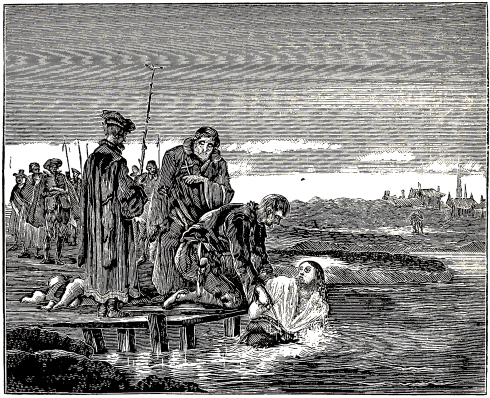
The same year 1592, on Mary Magdalene’s day,
Mattheus Mair was apprehended at Wier, in the
district of Baden. This was brought about by a
priest, who upon coming out of the church, and
noticing the brother, sent his servant maid after him,
to see whether he should leave the village. He further
commanded her, that she should so speak to
him, as though she also wanted to become of his
persuasion, and would like to go with him to his
people; in the meantime he should come, and send
other persons there, who should speak with him.
With such words the maid delayed the brother, till
the priest sent out some peasants, who apprehended
him, and conducted him into the town of Baden.
Six days after, namely, the 28th of July, as he
would not follow them, nor renounce his faith, the
ungodly pack of priests proceeded with him; however,
what they talked with him, or what he answered
them, this they did not allow to come to
the light. When he was led forth to death, there
were present his brother-in-law and several of his
friends, who interceded for him, and also offered to
give money for him; but they could obtain nothing,
yea, not even to speak with him.
Now as he was going forth to death, he asked
among the people, where his brother-in-law and
friends were, and how they might come to him;
saying that he had to charge them, that they should
tell his brethren and sisters, to take care of his wife
and child, for they were with a pious people. This
he spoke aloud among the people. Then one of
his friends among the people consoled him and said,
that he should not yield, but be valiant; he should
soon have overcome. Thereupon one smote the
friend, who had said this, for it, and said that he
was also a heretic, and ought to be treated like the
rest. Now when the executioner had thrust brother
Matheus into the water, he drew him out again
three or four times, and each time asked him
whether he would recant. But he always said, No,
as long as he was able to speak; hence he was
drowned, on the twenty-ninth day of the month of
July, through the power of God steadfastly persevering
in the faith. There was much said about his
death, by high and low, as that they had murdered
him, and the traitorous Judas and priest were
cursed; for this Matheus was a well-known, good
and pious man; hence God also gave him power to
continue steadfast in the faith unto his end.
Note.—The envy of some of the Calvanists in
the town of Middelborgh was at this time so great
against the defenseless sheep of Christ, who had
come to them from various papistic towns, to escape
the distress and persecution, and expected to rest
under their protection, that they paid no attention,
and had no regard, neither to humble supplications
nor the repeated commands of the Prince of Orange,
who in the years 1577 and 1578 had given orders to
the magistrates there, to let these people dwell in
peace; but disturbed the peace of said people, and
the practice of their religion. Hence Maurice, the
oldest son of the aforesaid Prince, of honorable
memory, following the footsteps of his father, issued,
for the third time, a prohibition concerning
the oppressing of the aforesaid people, to the end
that they might now certainly obtain liberty of conscience,
as appears from the following act:
Transcript.
Maurice, born Prince of Orange, Count of Nassau,
Marquis van der Vere, to the honorable, most
learned, wise, discreet, dear, particular, etc.
That which has been brought to our knowledge,
on behalf of Mailjaert de Poorter, and Joost Leonisse,
sawyers and wood-sellers, residing in the town
of Middelborgh, you will learn at length from the
accompanying request; and though we do not doubt
at all, but that you will conduct yourselves, with
the supplicants, in the points of their request and
complaint, entirely according to the import of the
resolution previously taken with regard to this, by
the Lords States of Holland and Zealand; and will
conform to such acts and letters as have been
granted to the supplicants and their fellow brethren
in the same profession, in the time of our lord and
father the Prince of Orange, of worshipful memory;
yet we would nevertheless hereby earnestly request
you, seeing this matter concerns not only the town
of Middelborgh in particular, but these United
Provinces in general, that you will regulate yourself
according to the import of the aforesaid resolutions,
in all quietness and friendship, allowing the
aforesaid supplicants and their fellow brethren to
enjoy such liberties as have been granted them by
said resolutions and acts respectively, until the
aforesaid Lords General States of these United
Provinces shall have further considered and disposed
of the aforesaid matter. And besides that,
we deem it reasonable and just, it is our pleasure.
And hereby, honorable, most learned, wise, discreet,
dear, particular, we commend you to God.
Gravenhage, on the 4th of March, 1593.
Signed:
Your very good friend,
Maurice de Nassau.
The superscription was: To the honorable, wise
and discreet, our dear, particular Burgomasters,
Judges and Rulers of Middelborgh, and was sealed
with his Excellency’s seal.
Below was written: Compared with the original,
and found to agree with it.
J. Milander.
Further Observation.—Upon this followed, it appears,
some rest, so that the scattered flock of
Christ began to increase some at that place, and to
extend its membership. In the meantime, however,
[in the dominion] of popery they were still persecuted
to death; of whom, among others that lost
their lives there, the following have come to our
notice; from which the distress of that time, though
there was rest in some places, can be inferred and
judged.
Aeltgen Baten was an aged woman, and Maeyken
Wouters a young woman of about twenty-four
years. Both were born at Sonhoven, in the seignioralty
of Vogelsanck, belonging under the territory
of Luyck, and resided there. Through the grace
of God they obtained the true knowledge of the holy
gospel, believed the same, amended their lives,
according to its requirements, and had themselves
baptized upon the faith in Jesus Christ, according to
his divine commandment and the practice of his dear
apostles. As this however could not be tolerated,
complaints were entered against them at Luyck,
where the Court is held, and where orders were
given to bring them thither as prisoners, which was
done in the following manner: The lords of Luyck
have certain beadles, called trappers, whom they
send through the country whenever they want to
have any one apprehended. They sent fourteen
of these trappers from Luyck to Sonhoven, to apprehend
these two women, or any others, and to
bring them to Luyck. They first captured Aeltgen,
and afterwards Maeyken and her brother (who was
still very young), who had made themselves ready
and it was the intention of both of them, if their
father should have been taken, to go with him and
not to forsake him; but as they did not catch the
father, her brother also escaped the trappers.
Thus they began to conduct these two lambs to
Luyck; but as they, on their way to Luyck, had to
pass through Hasselt, a town about a league distant
from Sonhoven, these two lambs were spoken
to by many of their acquaintances at Hasselt, and it
was greatly lamented, that they had to go to
Luyck, into prison, and much sympathy and solicitude
was expressed for them. Maeyken said to
them: “If the Lord has so ordered it, I would
rather go to Luyck (namely, for the testimony of
Christ), than home. And thus they proceeded
through the city, and went to Luyck, in all a distance
of about eight leagues. When they got there, they
were imprisoned ten weeks in the official’s tower.
During this time, they showed each other great love,
tending as it appears, much to edification and encouragement;
for the young sister would gladly
have borne in her own body, if it had been possible
to do so, all the hardships which her dear, old
sister suffered. They endured much vexation, being
threatened, frightened, and also entreated, in order
to turn them from the faith.
Once the bishop’s chaplain came to the young
sister, with bland words, and brought a can of wine
with him, in the hope that he should overcome her.
With words of greatest suavity he presented to her
the matter; yea, he got down upon his knees, and
with folded hands begged her to recant and to
believe the Romish church. But Maeyken proved
herself faithful, and repelled the devil’s deceit, so
that the tempter went away. On another occasion,
a man from her village, who was acquainted with
her, came to Luyck. He had heard that it was
reported that she should have to die, and his soul
was set on fire, and the matter excited his carnal
sympathy, thinking: “And must that young girl
die?” Hence he thought with himself, that he
would talk with her, in order to see whether he
might not move her. He therefore went to her in
prison, and called Maeyken out alone, and said:
“My dear Maeyken, O that you would obey, and
yield a point, to be released from these bonds.
When you get out, you can live as before.” Thereupon
she replied: “My dear friend (calling him by
name), would you advise me this, that I should
forsake God and become a child of the devil?”
The man said: “Then you will have to die.” Thereupon
Maeyken said: “I should rather have this
come to pass with us, than enjoy the light of day.”
When the man heard this, he became silent, so that
he turned around with weeping eyes, and said
nothing more to her. They were both tortured and
suspended on Thursday night; but they remained
silent and fainted away. Then they poured water
over Maeyken, upon which she cried aloud; but
more than that they did not obtain from either.
During the night they lay together quietly. On
Friday night they sang with great joy. Having
been thus imprisoned for a long time, they were
finally brought into the official’s court, and condemned
according to their spiritual law. When
they heard their sentence, they thanked the Lord
with a joyful heart, yea, with a laughing mouth.
They then delivered these two persons over to the
secular judge, who received them, and placed them
again in his prison, in which they suffered great
distress for a few days, on account of the uncomfortable
condition of the prison. However the Lord
ordered it, so that they took consolation and courage
in the Lord, and Aeltgen’s husband sent her
money and blankets for her needs, for which she
thought she had no further use, and hence refused
it altogether. She asked her dear sister Maeyken,
whether she would have it. Maeyken said:
“I have as little need of it as you, my dear sister;”
for they trusted soon to live in all fullness and joy
with the Lord. “Yes,” said Aeltgen, “if the door
stood open, I should not wish to go away.” And
since in all their sufferings they were so joyful in
God, they thanked God in heaven in their hearts,
and sang praises to him in prison.
Afterwards they wanted to sentence them by the
secular law, which it was said, was done by four
judicial persons, or judges, namely, that these two
persons should be drowned (for the word of God),
by being cast alive, bound, from the Meuse bridge.
On that same Saturday there came to them to
Luyck two men from their locality, to ask both
of them, whether they had some word to send yet.
Coming thus unbeknown, they found them in a
chamber, where sat the lords to sentence them, and
they were standing in their midst, and when Aeltgen
saw her acquaintance she said to him: “Nephew,
have you come to visit us once more? we trust to
offer up our sacrifice within one hour; we thank
you heartily for it, and I request you to please
tell my husband, to bring up my children in the
fear of God.” Maeyken also said: “Do bid my
father and mother many adieus.” This they spoke
while standing among the lords, expecting their
sentence. The men tarrying a little, one of the lords
bowed himself before Maeyken, begging her to recant
and to believe in the Romish church; and
her life should be spared. Thereupon Aeltgen said:
“We want to die, as Christ’s apostles did.” Now
when their last hour was approaching, both were
brought forth from prison. Hence, both of them
being rejoiced, they began to sing and to thank
and praise God; but alas! the poor lambs could
not long enjoy this; for what is granted to thieves
and murderers, namely, to speak, of this they were
deprived, and they were conducted back to prison,
where their mouths were gagged, and they were
thus, as dumb lambs, led to the slaughter and death.
When they arrived on the Meuse Bridge, many and
various reports of this matter were circulating among
the common people. When they arrived at the
place appointed, the executioner began to bind
them, but they had to keep silent, until the executioner
loosed the cloth that was before their mouths,
and tied it over their eyes. Then Aeltgen first said:
“O Lord, this is a beautiful city indeed; would
that it repented with Nineveh;” and commending
herself to God, the executioner forthwith cast her
from the bridge down into the water, and she was
instantly drowned.
The executioner then also released Maeyken’s
mouth, so that she was heard to speak, saying to
the executioner: “Grant me, that in my greatest
extremity I may pray to God and call upon him.”
The executioner said: “Pray to our lords the magistrates,
and believe with us in the Romish church;
and you shall save your life. Maeyken said: “I
have never done amiss to the magistrates; hence
I also need not to worship them;” but the executioner
gave her a short answer, and giving her no
time, cast her down from the bridge immediately;
she did not sink instantly as Aeltgen, but with
blooming cheeks she drifted upon the water for a long
time, until, it is said, she had reached the lower side
of the city.
Thus these two Christians ended their lives to the
honor of God, on the 24th of July, 1595.
The abundant mercy of God our heavenly Father,
through Jesus Christ his only Son our Lord, this I
wish you, my dear father and mother, brothers and
sisters, whom I love much from the heart, but our
heavenly Father above all, for he has called me,
that I should help him bear his sufferings, for which
I have asked him many times, if I might be worthy
of it. Hence I followed him with great joy.
My dear father and mother, think not (though I
am bodily separated from you and the flock of
Christ) that my Bridegroom will forsake me; think
what he has said: Though a mother should forsake
her child, yet will I never forsake mine elect, whom
my heavenly Father has given me. Is. 49:15.
Hence if it is his pleasure, I shall soon be delivered.
But if you now deliver me with temporal
wealth, you deprive our Bridegroom of his honor,
and believe not that he will deliver me.
Hence, my dear father and mother, grieve me no
more about paying the costs; for you have burdened
me greatly, day and night, because I sent
word to you so many times, that you should not
ransom me, and you did not write me an answer.
Hence, my dear father and mother, speak with
our friends, so that I may receive a comforting letter
from you or from the others, which would be to me
a great joy; for otherwise I desire no comfort from
men, only from our heavenly Father alone, who is
able to provide for us.
O dear friends, if I continue steadfast in that
which my heavenly Father lays upon me, what
great treasure I hope to gather thereby, which will
fall to me hereafter, which is a great joy to me.
O my dear father and mother, is this not a greater
joy to you, than if I had not done according to your
will, and had gone off with a young man, as you
have doubtless heard of other girls? Hence rejoice
and make melody to the Lord in your hearts, because
the Lord has made me, unworthy one, worthy
thereto and you have brought me up to God’s
praise. Remember that there is still more written,
where the Lord says: Blessed are ye, when men
persecute and revile you for my name’s sake; rejoice
and be exceeding glad then, for great shall be
your reward in heaven. Matt. 5:11,12.
Know, dear father and mother, that I have been
before so many lords and authorities, also priests
and Jesuits, who sought nothing but to murder my
soul. But the Lord our God gave me wisdom and
understanding, and a mouth to speak which, I believe,
was pleasing to our dear Lord. Very many
times they predicted my eternal damnation, and
said to me: “If you do not forsake your sect, and
live according to the holy Roman Church, as the
whole world does, you will, as truly as God is in
eternal life, never attain to repentance.” Then I
said to them: “I doubt not, but trust, that if we
finish it by the help of the Lord, we shall through
grace obtain the eternal joy.” Then they said to
me: “God has nothing to do with you; you are
a child of the devil; the devil has you by the throat,
who will confirm you even unto the fire. God created
you beautiful, and made you after his own
image; and is it not a pity now, that you will have
to die an ignominious death, and hereafter inherit
eternal fire?” I said to them: “I will rather die,
than apostatize from my faith, if it is God’s pleasure.
Thus I am ready, much rather to-day than to-morrow;
I will not fear men, who must die; but I will
much rather fear my heavenly Father, who has
given me my life; though I now, for his sake, lose
it, he can give it to me again.”
Then they left me. The omnipotent, strong and
mighty God, our heavenly Father, who always helps
us to triumph, and does not forsake them that have
put their hope in him, and never turn their faith
from him, the Lord our God, who sits in the highest
throne of glory, come to our aid; he alone is worthy
to receive praise and thanks, honor and glory, and
blessing forever and ever. Amen.
Hereby I most heartily greet my dear father and
mother, brother and sister, with the peace of the
Lord. Dear friends, when you offer up your prayers
before the Lord, do not forget me, since I shall not
forget you; may the Lord be our helper. Amen.
Once more, in particular I greet father and
mother, brother and sister, and further all believers
and lovers of the truth; let all pray heartily for me.
I hope to be diligent, as far as the Lord has given
me grace. God be with us all. Amen.
I had this letter written, when I was in prison for
the testimony of the truth, in the town of Luyck,
A. D. 1595. I, a feeble member of the Christian
church, bearing now in my body the marks of my
Lord. Adieu, now, all of you.
Maeyken Wouters.
At Brussels, under the reign of the archduke
Albert, there was apprehended for her faith and
following Christ, a young maiden named Anneken
van den Hove (being the servant-maid of Nicolaes
Rampaert’s sister), having been betrayed, as it was
said, by the pastor of the Savel church at Brussels.
This Anneken was imprisoned two years and
seven months, in which time she suffered much
temptation, from priests, monks, Jesuits and others,
who thereby sought to make her apostatize from
the faith she had accepted; but however great pains
they took with her, in the way of examining, tormenting,
fair promises, threats, long imprisonment,
and otherwise, she nevertheless constantly remained
steadfast in the faith in her Lord and Bridegroom,
so that finally, on the ninth of July 1597, certain
Jesuits came and asked her whether she would
suffer herself to be converted, for in that case she
should be released and set at liberty. Thereupon
she replied: “No.” They then offered to give her
six months more time for consideration; but she
desired neither day nor time, but said: They might
do what seemed good to them, for she longed to
get to the place where she might offer up unto the
Lord a sacrifice acceptable unto him. This answer
having been conveyed to the judges, information
was brought her about two hours afterwards, that
if she wanted to die, prepare herself, unless she
wished to turn.
Hence the justice of the Court, and also a few
Jesuits, went out with her about eight o’clock, half
a mile without the city of Brussels, where a pit or
grave was made, while in the meantime she fearlessly
undressed herself, and was thus put alive into
the pit, and the lower limbs having first been covered
with earth, the Jesuits who were present asked
her: Whether she would not yet turn and recant?
She said: “No;” but that she was glad that the
time of her departure was so near fulfilled. When
the Jesuits then laid before her, that she had to
expect not only this burying alive of the body into
the earth, but also the eternal pain of the fire in her
soul, in hell. She answered: That she had peace in
her conscience, being well assured that she died
saved, and had to expect the eternal, imperishable
life, full of joy and gladness in heaven, with God
and all his saints.
In the meantime they continued to throw earth
and (as has been stated to us) thick sods of heath
ground upon her body, up to her throat; but notwithstanding
all their asking, threatening, or promising
to release her and take her out of the pit,
if she would recant, it was all in vain, and she would
not hearken to it.
Hence they at last threw much additional earth
and sods upon her face and whole body, and
stamped with their feet upon it, in order that she
should die the sooner.
This was the end of this pious heroine of Jesus
Christ, who gave her body to the earth, that her
soul might obtain heaven; thus she fought a good
fight, finished her course, kept the faith, and valiantly
confirmed the truth unto death.
Since she then so loved her dear leader, Christ
Jesus, that she followed him not only to the marriage
at Cana, but also, so to speak, even to the
gallows-hill, there cannot be withheld from her the
honor and name of a faithful martyress, who suffered
all this for his name’s sake.
Hence she will also afterwards, when going forth
as a wise virgin, yea, as a dear friend of the Lord,
to meet her heavenly Bridegroom, be joyfully welcomed
and received in the heavenly halls of immortal
glory, together with all steadfast servants
of God.
O God, be merciful also unto us that are still living,
that continuing faithful unto the end, we may
with her, and all the saints receive thy blessed inheritance.
It was for a long time believed (which originated
in the assertions of some adherents of the Reformed
Church), that the aforementioned Anneken van den
Hove died for the sake of the Calvanistic or so-called
Reformed faith; but this was long ago justly
contradicted, by written as well as by oral testimonies;
among others, through a certain letter, which
was written in the month of July (when she was
offered up) by some one from Antwerp, to one of
his friends; in which it is stated, in papistic style,
that she was buried alive outside of the city of Brussels,
because she belonged to the Anabaptists.
One year subsequently, namely, 1598, there was
published, a printed work called the Apologia
Catholica, by Franciscus Kosterus, in which, on
page 160, these words are found: “Moreover, there
was no injustice done at Brussels, to Anneken van
den Hove, inasmuch as they proceeded against her
in accordance with the old laws of the Emperor’s;
nor need the Calvinists complain of the lords; for
she was found a Mennonist and Anabaptist, who,
Calvin himself confesses, ought to be punished.”
See the aforementioned book, printed at Antwerp,
by Joachim Trognesius, edition 1598, at the place
referred to.
Subsequently, in the year 1601, another tract was
printed and published at Antwerp, by Hieronymus
Verdussen, entitled: Brief and true account of the
sufferings of some pious and glorious martyrs, etc.;
wherein she, near the close, is pronounced an Anabaptist.
Moreover, a certain school teacher and sexton of
the papistic church at Aelst, who then resided in
Brussels, near the Stone Gate, where she was imprisoned,
and who often brought her food, made
the verbal statement, according to creditable testimony,
that she had such a faith and religion as the
Mennonites, etc.
It was also then, and shortly after that time a
common saying at Brussels, of those that had any
knowledge concerning her views, that she agreed
therein with the Anabaptists, etc.
We will abridge this century with which formerly
also our old Offerboeck was concluded; showing
the destruction of some tyrants, who were no
small cause of this last and severest persecution
of all.
Even as the old man whom King Antiochus had
sent out to Jerusalem, notwithstanding he set up
many abominations, and tyrannized against the law
of God, could nevertheless not suppress the people
of God and his law, but had to behold their increase
[even] under the persecution, and besides see that
the country was full of wars and commotions and
resisted the king; even so it also came to pass with
the aged Ferdinand Alvares de Toledo (also called
Duke of Alva), whom King Philip II had sent
from Spain into these Netherlands; however much
he endeavored to make every one accept the abomination
of idolatry, above God and his word, and
however dreadfully he raged, utterly to exterminate
the true lovers of the divine truth, and ardent followers
of the holy gospel, yet he could not, to the
satisfaction of his furious and blood-thirsty disposition,
accomplish his presumptuous undertaking.
For under his severe and bloody persecution, the
church of the godfearing, the pure bride of Christ,
still constantly bloomed as a beautiful rose among
pricking thorns, and was fruitful, to the praise of
the Most High.
But he himself, who sought to rule over all
Netherland lords, and to oppress others, met with
resistance from some of those whom he sought to
exterminate, who, however, were not of the defenseless
sheep of Christ, so that, after he had for about
seven years indulged his desire for bloodshed, slaying
and murdering for the faith (when the country
was full of war on his account), he had to depart in
disgrace, and with him one John Vergas, who was
a member of his council of blood; which many regarded
as a punishment of God for his wickedness.
But a still severer fate awaited Jacob Hessel, one of
the chief members of his deadly court, and Jan de
Vis, Bailiff of Ingelmunster; who, some time afterwards,
were taken out of prison, without previous
announcement, or sentence having been pronounced
conducted without the city of Ghent, and hanged
to a tree. And even as they had sentenced many
others to death unexpectedly, so they also had to
yield up their lives unexpectedly, and thus there
was meted to them with the same measure with
which they had measured to others. From this we
can easily perceive God’s just punishment upon
those who persecute and kill Christ and his members.
Likewise in the case of the high Bailiff of
Halewijn, named George de la Rave, who also participated
in the tyranny over the children of God,
by persecuting, dispersing and apprehending them,
and otherwise. In the year 1571 he assisted in apprehending,
among others, one Adriaen Jans Hoedmaecker
(who was burnt at Rijssel on account of
his faith), and in the year following, on the same
spot where Adriaen had been apprehended, he met
together with some intoxicated persons, with whom
he and his servants fell into an altercation and fight
in which he was wounded to such an extent, that
he had to lie in bed with the wound for a long time
and finally died a painful death in great distress of
mind. Hence he had several confessors come to
him, who could nevertheless not rid him of the
gnawing worm of a torturing conscience; but he
had to end his life as a tyrant in misery.
But especially can it be seen, how hard it is to
kick against the goads, in the case of one Pieter
Titelman, the Dean of Ronse, who was probably
the chiefest inquisitor in Flanders. He was about
this time in Kortrijck, smitten with a severe disease
by God, lice growing out of his wicked body
so abundantly, that he could not be kept clean
therefrom, notwithstanding he was supplied with
clean linen, and otherwise cleansed two or three
times a day. No remedy could be procured and he
died a most distressing and miserable death.
Concerning this Dean of Ronse it is also written,
that having gone forth on a certain occasion with a
small number of men, to apprehend these witnesses
of God, and thus to deliver them into the hands of
the torturers and slayers, he came; at evening, into
an inn, where he met a bailiff, who had gone out
with a great number of beadles, to apprehend vagrants
and wicked men. The bailiff asked Ronse
with surprise, how he dared trust his body with so
few servants, to apprehend other people; for if I
were to do so, said he, I would soon lose my life.
Thereupon Ronse replied, that he had no fear in
this respect, since he had gone out to catch only
good men, from whom he had no danger to apprehend.
Upon this the Bailiff, particularly reflecting
upon Ronse’s words, answered: “If you arrest the
good people, and I the bad, who then shall remain
free?” Hereby this Dean of Ronse certainly bore
testimony of himself, that he had laid his hands
on the just, who had not resisted him. So it
can also be perceived from this bailiff’s remark, that
he himself well knew that the magistracy’s power
ought to be used only for the punishment of the
evil, and the protection of the good; and that therefore
this Ronse and his adherents shamefully abused
their authority on these people.
It also happened at Dixmuyden, in Flanders, in
the year 1553, when the pious Wouter Capelle, who
is mentioned in this book, was burnt for the truth,
that there was a simple, harmless fellow, who was
arrested by the lords of Dixmuyden. He begged
in the streets, and was thus fed by good-hearted people.
And since the aforementioned Wouter Capelle,
(by trade a say-weaver) was very liberal in supplying
the poor with food, communicating to them
from the labor of his hands, it occurred, two or
three days before Wouter was apprehended, that
this simple fellow, late in the evening, came to
Wouter’s house. Wouter asked him whether he
wanted something to eat. He said: “Yes.” Hence
Wouter brought him a piece twice until he did
not wish any more. Now when it came to pass,
that Wouter Capelle was sentenced to be burnt, this
simple fellow cried: “You thieves and murderers,
you shed innocent blood; this man has done no evil
but has very kindly fed me.” And this he cried
constantly, and as Wouter was brought forth to be
burned, he also stepped near and wanted to run
into the fire with the condemned man, so that they
had to carry him away by force. And when he was
dead, the burnt body having been brought outside
of the city to the gallows-field, this simple fellow
daily resorted thither, heeding neither snow nor
rain, and stroked with his hands the burnt body,
and said: “O poor fellow, you have surely done no
evil, and yet they have shed your blood; and you
have fed me so kindly.” Finally, when the body
had been almost devoured by the birds, this man
on a certain occasion took off the whole skeleton,
laid it upon his shoulders, and ran in to the gate
with it. Hence many people followed him, to see
whither he should take it, but he went with it to
the lord burgomaster of the city, and when the latter
had opened his door, he threw the whole skeleton
down into the hall, and said (also other lords
being gathered there): “You thieves and murderers,
if you have eaten the flesh of this man, eat the
bones too.” And as the lords of Dixmuyden had
erected an iron stake in the place where the aforesaid
Wouter Capelle had been executed, for a token
and lasting memorial, that such a heretic (as they regarded
him) had been burned there; it came to pass
that the burgomaster of said city, into whose house
the skeleton had been thrown, became sick unto
death, and his sickness so affected him, that in his
delirium he cried out: That he had seen the angel
of God fly over the stake with the soul of the burnt
Wouter Capelle. And this he constantly cried, till
the lords caused the iron stake to be removed; then
he ceased his cry; but died most miserably shortly
afterwards. In consequence of this, it seems, those
of Dixmuyden were so frightened that afterwards
they shed no more innocent blood.
Concerning this avenging hand of God, which he
very signally exercised upon blood-thirsty tyrants
and persecutors of his people, you may also read in
an epistle of Menno Simon’s, S. G. folio 133,348
which the latter wrote in his time to Martin Mikron,
and which partly related to the aforementioned
Menno himself. It reads as follows:
“It is now about eighteen or nineteen years since
that a very eminent and distinguished man, who
was highly esteemed by the world, but whose name
and country I will not mention, wickedly advised,
how they should extirpate me and the pious. He
had scarcely finished his words and wicked thought,
when the avenging hand of the Most High touched
him. He dropped at the table, and thus in a moment
ended his impenitent, blood-thirsty, wicked,
ungodly life in a most dreadful manner, O terrible
judgment?” This happened about the year 1539.
“About the same time it happened to another
man, who thought that he would so set his trap for
me, that I could not escape, that he, in like manner,
at the same meal he was eating, while speaking
the words, was suddenly pierced by an arrow from
the Lord’s quiver, being smitten with a severe disease,
and thus had to give an account before the
almighty, avenging God, and was buried within
eight days from the time he had spoken these
words.
“Still another, who was to become an officer to
the Emperor in a certain place, fancied that he
should exterminate this people, if there was any virtue
in the imperial authority. He came to the place
where he was to be located and serve in his capacity;
and four or five days thereafter, the bell was
tolled and the requiem sung over him.
Behold, thus God the Lord annihilates the designs
of the ungodly who assail his holy mountain,
and brings to naught all those that hate his truth
and are inimical thereto.
“In the year 1554, it also occurred that three of
our brethren were at Wisbuy in Gotland, for the
purpose of earning a livelihood there. A preacher
of that city, whose name was Laurentius, who was
led by the spirit of his Father [the devil], cried after
them on the street, and reviled them as much as he
could, saying that they should not practice their
religion there, though it should cost him all that
was inside of his coat, namely, body and soul. A
few days afterwards he came to converse with one of
these brethren, another preacher also being present,
who was somewhat more reasonable in disposition.
He reviled, and carried on dreadfully; but the great
Lord smote him in the presence of them both, so
that he was suddenly deprived of his speech, and
within twenty-one hours (alas!) was numbered with
the dead. O terrible punishment and judgment of
God!
“A case almost similar occurred the same year at
Wismar, where they had accepted a crier, named
Doctor Smeedesteed, who said that he would rather
have a hat full of our blood, than a hat full of our
gold. He persuaded the magistrates (who gladly
have and want to hear such pillow makers) to proclaim
just before cold winter, to the poor children,
to clear the place before St. Martin’s day; or they
should be put where they should not like to be.
Smeedesteed was very joyous that he had accomplished
the fulfillment of his heart’s desire; but to
his sore judgment; for that very day the almighty,
great Lord laid the hand of his wrath upon him,
and within six or seven days took him away by an
awful and severe sickness. Yet the hardened, blind
and stupid world did not perceive it.
“A. D. 1555, it occurred again in that city, that
there was a preacher, named Vincentius (who still
lives there), who never grew tired of his ungodly
reviling and severe reproaching. On the day they
call the Lord’s Ascension day, he read from the
Scriptures (Mark 16:16): ‘He that believeth and is
baptized shall be saved,’ and said he should reproach
and revile us, as long as his mouth was
open. Instantly the strong power of God closed it,
and bound his tongue, and he fell down in the pulpit,
and was carried out by some of those present,
as one punished of God, and taken into his
house a dumb man. Behold, thus he can punish
those who would touch and injure the apple of his
eye.
“If I were to relate all the incidents which in my
time befell the enemies of the saints, it would require
a separate volume.” Thus far from Menno
Simons.
It is appropriate to add here, what happened to
the said godfearing Menno Simons himself. A traitor
sold him for a certain amount of money, binding
himself to deliver him into the hands of the tyrants,
or he would lose his own head in stead; in
which, however, to his own injury he did not succeed,
though he put forth his utmost diligence to
accomplish it. He repaired to their meeting, and
diligently spied out a place where they assembled;
but Menno in a miraculous manner escaped his
hands.
It occurred also, that the traitor and the officer,
who had gone out to seek and apprehend Menno,
unexpectedly met him in a small boat on a canal.
The traitor kept silence, till Menno had passed on a
piece, and then jumped on shore, to escape with less
peril. Then the traitor said: “See there, the bird
has escaped us.” The officer called him a villain,
and upbraided him for not speaking in time. The
traitor replied: “I could not speak, for my tongue
was held.” This was taken so amiss by the lords,
that they severely punished the traitor, for a rigorous
and instructive example to all bloodthirsty
traitors.
Thus there can, by these and similar examples
mentioned in divers places in this book, as also in
both Testaments, in murderous Cain, Pharaoh, Jezebel,
Antiochus, Herod, and many similar ones, be
manifestly seen and perceived the avenging hand of
the almighty God, and how grievously they offend
against the God of heaven and earth, who here
afflict, persecute and kill his people; and what intolerable
punishment they have to expect at the
coming of Christ from heaven; of which this temporal
punishment is but a beginning and foretaste,
seeing the Son of God, in the day when he will
arise to avenge Zion, will regard all that has been
inflicted upon his own, as though the apple of his
own eye had been touched. Then shall all persecutors
be sorry with too late repentance, and groan
for anguish of spirit, who here condemned and
killed the just, who did not resist them. Wis. 5:3;
James 5:6.
Hence the wise woman Judith says in her song
of praise: “Woe to the nations that rise up against
my kindred! for the Lord Almighty shall judge
them, and visit them in the day of judgment; for he
shall put fire and worms in their flesh, that they
shall burn, and feel it for ever.” Judith 16:17.
O how good were it for all tyrannical men, if they
would consider and lay to heart these and similar
passages of holy Scripture, and would fight no more
against the high God, for it will be required of them
at that day, before the judgment seat of Christ.
Since faith is a pure gift, which comes from God
alone, and hence can neither be given nor taken
away by any man, however highly esteemed he
may be. All princes and rulers ought also to commit
the matter of faith to the Creator of all things,
who alone is the discerner of the hearts and reins
of all men, and who knows and beholds the hidden
thoughts and intents of the heart, clear and uncovered
before his eyes; before whose high majesty
both the judge and the condemned must finally
appear together. He will judge the world in righteousness,
and offer faith to every one. Acts 17:31.
He shall then judge according to truth, as to who
believed and walked righteously or falsely. Hereunto
we would from the inmost of our soul, counsel
and entreat all lords and princes, as for their own
welfare. O that God Almighty would be pleased to
grant all princes and lords who have received the
sword of justice, the grace, that they would use
their sword and authority no further than only upon
the bodies and goods of men in civil matters, for
the punishment of evil-doers, and the protection
of the good; to which end the same has been given
them of God; and would let God Almighty be the
Lord and Judge over the faith, souls, and consciences
of men, which unquestionably belongs to him
(blessed be he) alone. And that they would moreover
consider, how very short and uncertain man’s
life is, and how soon these earthly kingdoms can
pass from one nation to another. And if the incoming
lords hold different views than the former
ones, city and country are instantly in great danger
of revolt, uproar and destruction, if they want to
force all their subjects to the religion which they
have accepted; or the common people must resort
to dissimulation and hypocrisy, to escape the punishment
threatened; for such lords seldom lack
preachers who for the sake of great prebends are
willing to preach according to the pleasure of the
lords.
And O that men would once consider, how many
thousands of persons have for many centuries been
deprived of life and property, on account of religious
differences, because the magistrates (through
the instigation of their preachers) would force them
to their religion; which nevertheless wrought no
improvement, but the conflict remained uninterrupted.
But how utterly blind and unreasonable
they proceed in this matter, it is easy to perceive;
since we certainly, most clearly and abundantly
find, that even the Lord’s apostles, which he had
sent and highly enlightened, could bring but a very
small proportion of men to one religion, and that in
their time, besides the innumerable multitude of unbelievers
and persecutors of the truth, were also
many false apostles and deceitful workers, who
preached Christ out of envy and strife, and not sincerely;
so that Christ was preached in many ways,
in season and out of season. 2 Cor. 11:13; Philippians
1:15,16. Who then shall believe that in this
last and evil time, in which iniquity prevails, whole
countries and kingdoms can be brought into the
obedience of the apostolical doctrine, through the
sword and constraint of the magistracy? The more
so, since Christ himself says, that at his coming it
shall be as it was in the days of Noah and Lot. Luke
17:26. Hence the Lord Jesus also seems to ask
doubtfully: Whether, when the Son of man cometh,
he shall find faith on the earth?
For the number of believers has from the beginning
of the world been very small among the children
of men; and not all men have faith, as Paul
says; and the whole world, according to the teaching
of the apostle, lieth in wickedness; and all that
is in the world, the lust of the flesh, the lust
of the eyes, and the pride of life, is not of the
Father, but of the world, and the world and the lust
thereof shall pass away; and Solomon seems to
compare this world and all her ungodliness to a
magnificently adorned woman, in the attire of a
harlot, subtle, wild and stubborn, so that her feet
could not abide in her house; whereby she seduced
and deceived the foolish youth, so that he followed
her in wickedness.
Compare with it now this present evil world; how
one can see every city and country polluted with
pride, boasting, cursing and swearing, tippling
houses, tennis-courts, dancing halls, and shameful
brothels, or houses of ill-fame, where one can perceive,
with open eyes, what a countless multitude
of people, especially of the young, gorgeously arrayed
and adorned in honor of the world and the
devil, allow themselves to be lured and seduced
thither; whereas it is certainly known, and also
unanimously acknowledged, by all the one another
opposing sects, according to the express words of
God, that the end of such a life and walk, without
true fruits of repentance, is eternal death. Nevertheless,
we do not find that the preachers, to prevent
this wickedness, work with the authorities to
punish and root out in every respect, by rigorous
decrees and corporal penalties, this indubitable evil
and soul deception; but in the point of religion (in
which through the craftiness and subtlety of men,
there are so very many articles of contention and
doubtful and conflicting views) we see them labor
with all their might, to punish, exterminate, and
use constraint upon the faith and consciences of
others, though the latter cannot be accused of any
of the evils mentioned. Yet experience teaches, that
many of these preachers are themselves so uncertain
and wavering in their faith, that they would rather
change their faith many times, according to the desire
of the authorities, as the chameleon its color,
before they would on this account forsake their large
salary. Hence it is our hearts’ wish and earnest
prayer to all rulers, that they would be pleased not
to hearken to such treacherous preachers, who seek
the loss and destruction of other people; but that
they would use their authority for the punishment
of evil doers and the protection of the good; so that
we may lead a quiet and peaceable life under them,
in all godliness and honesty; and at the last day
may, together find comfort and grace before the
judgment-seat of Christ, when we all shall stand so
greatly in need of grace and comfort. To this end
may the Lord strengthen and keep us by his Spirit.
Amen.
We will take leave of this sixteenth century with
a certain conclusion appended to the Martyrs Mirror
of the year 1631; wherein we will say nothing,
as far as respects the sense of the same, but what
our dear fellow believers have said in that work.
We have here presented to you, kind reader,
many beautiful examples (as we have found them in
printed works of former times, as well as in those
of more recent date, from different regions, from
the criminal records of city and country), of men,
women, youths and maidens, who faithfully followed
their Savior, Christ Jesus, in the true faith,
feared God from the inmost of their soul, and with
a pure heart sought eternal life; who flourished and
shone as bright lights, before all the world, in the
love and power of God, their mouths flowing in
wisdom with the holy word and doctrine of the
Lord; which appeared more in the manifestation of
the Spirit, than in elegant language or human wisdom;
for their thoughts, words and actions were all
to please their Leader and only Shepherd, for
whose name’s sake they gladly delivered up their
lives into temporal death, as not seeking to possess
a worldly and peaceful kingdom here upon this
earth, but, as true strangers, to journey to the eternal
and heavenly fatherland, well knowing and having
experienced, that they that will live godly must
suffer persecution. There must also be noticed the
difference between the children of God and the
children of unrighteousness, between the persecuted
and the persecutors, because we know, and it can
clearly be shown from the holy Scriptures, that
from the beginning of the world the unrighteous,
whose works were evil, always envied, reviled, persecuted
and oppressed those that were righteous
and practiced virtue, for an unreasonable zeal impelled
them to it. And it has been observed, that
many times the teachers or leaders, who ought to
have taught and led the people to the true religion,
and into the way of life, misled them to idolatry and
into the way of error and death. The shepherds,
who ought to have carefully fed the sheep of the
Lord with the word of God, and protected them
against the ravening wolves, have fattened themselves,
and paid no attention to the flock, but presented
to them mostly human doctrine and the
reasonings of their own mind; clothed themselves
with the wool of the sheep, and thus, in the appearance
of sheep but the nature of wolves, themselves
been disturbers and devourers of the flock,
or have delivered them into the talons of the eagle,
and the teeth of the lion. So also, the ministers of
God, who were endowed with great honor and dominion
by the Lord, and who had received the
sword to punish the wicked and to protect the good,
did not content themselves with these high offices
and honor, but, abusing their power, through instigation
or ignorant zeal, laid their hands in the
Lord’s husbandry, and inconsiderately plucked off
the wheat for the tares; and though it tended to the
salvation of the oppressed, it was nevertheless a
presumptuous procedure, thus to root out, destroy
and thoughtlessly condemn with an unjust judgment,
the green plants in the Lord’s field, before the harvest;
for no one but the Lord himself can truly
know who is worthy of the fire or of the garner.
Hence there are no savants upon earth wise
enough to step into any office of the only wise God,
and to execute the judgment which he has reserved
for himself; for who can fathom man’s heart, save
he that sees all things, and knows all mysteries,
who penetrates the hearts and reins, and knows the
thoughts of all men. Such things indeed are not
man’s province, for men are often, though they
think they are standing, cumbered with sin, unbelief
and perverted views, much more than they are
aware of; and all that men know and believe here
is but in part. Besides, the examiners of the faith
can easily be blinded or deceived by lies and a
hypocritical life.
Hence those who would defend persecuting and
killing for matters of faith, and represent and urge
it as right, accomplish no good by their fury, but
instead of good wheat they gather much impure
chaff, and fill the sheepfold with dissembling, hypocritical
goats. And if any one thinks, that it does
not behoove a king or prince to tolerate all sorts of
doctrines, persuasions or heretics in his country,
but that he may practice such a religion in it, as he
understands to be needful for the salvation of his
subjects, and to prohibit all others; such a one
must also consider this, that if in any country several
princes, differing in religion, should come to
rule one after another, and each one, seeking to enforce
his faith, pollute the land with the blood of its
inhabitants, such a country would be nothing else
than a hell, or a pool full of disquietude and oppression,
where the minds of men would be in such
lamentable misery, as ships, which on the dreary
and turbulent ocean are rocked hither and thither
in the storm by all sorts of winds, till they at last
suddenly perish. But how can they so greatly hate
and cast out any one for the faith, even though he
should err? this is not the nature of the children of
God, who do not oppress even the unrighteous,
even as it is not the nature of the sheep to devour
the wolves, but to flee from them, and suffer devouring.
And why will they force any one to the faith,
which only God can give to man? He that errs,
errs for himself; if he falls, he falls unto his Lord,
who can and will lift him up again, for he calls and
invites every one to it, offering to him water and
fire, life and death; each may choose what he will.
And this choosing, seeking or finding of a faith to
his salvation, is certainly as free to every citizen or
inhabitant, as it is to the king or prince; for does
not Christ call to him all that are burdened and
heavy laden? Hence no one may think, that such
calling concerns only the rulers, and that it is
enough for the subjects, to look to and follow them.
O no! each shall have to give an account for himself;
for at the last judgment every one’s heart,
whatever his rank or title, shall be equally closely
searched; the counsel of every heart shall be made
manifest; each shall receive reward according to his
own works; and it shall not concern only the princes
or the shepherds. No one shall there be responsible
for another, but every one shall find his own
burden heavy enough to carry. However, one
need not be surprised, as though some new or
strange thing happened, if God thus tries and purifies
his elect. For if even the Prince of life and of
salvation had to enter into his glory through much
suffering; if the way to get into the joyful kingdom
was so narrow for him, how shall his followers get
there, except by the same way? What guilt was
there in him? What wickedness, uproar, or crimes
did he commit? Why was this harmless, innocent,
spotless Lamb (which sought the harm of no one,
but the welfare of all) persecuted so malignantly?
What made the blind scribes so incensed at him?
and why were they so exceedingly eager to follow
the advice of inconsiderate Caiaphas? And was not
the cause of all this the fact that mad ignorance
urged them on? which so ofttimes inflamed the
heads of the people, so that they (as though it had
been a great service to God) wanted to exercise dominion
over the minds as well as over the bodies of
men, and use the sword to constrain the faith as well
as to civil unity. However not all rulers were infected
with this madness, for it was seen that the
Gentiles, who were called strangers to the knowledge
of God (as Felix, Festus, Agrippa, Gallius,
and the like), were more considerate in well administering
the office they had received, in careful
maintenance of the common peace, and, according
to Gamaliel’s wise counsel, committing to God the
dominion over the faith, than the envious Jews, who
according to the promise ought to have been children
of God and true branches in the true olive tree.
And thus we see, that God, who does all things according
to his good pleasure, at some times and
places, still grants such authorities who do not compel
their subjects in matters of faith, but only seek their
peace and welfare; even as we in our time lived to
see a Polish and also a French king, who did not so
strictly examine their subjects concerning their faith,
nor investigate whether the same agreed with the
common belief; but solely, whether their course of
action tended to hinder or advance the welfare of
the country, which they considered with sincere
love and sought to promote.
Herein also not too much praise can be bestowed
upon the Lords States of the United Netherlands,
who, however vehemently they have sometimes
been incited to it, do also not consent to such blind
zeal in the way of constraint of conscience and investigation
of faith. And since we are commanded to
pray God for the magistrates, that we may lead a
quiet, peaceable and godly life under them, how
much more are we bound to thank God for his loving
kindness, who also grants us the grace, that we
may dwell under the protection of such authorities
who oppose the wicked zeal of these blood-thirsty
tyrants of conscience (as we have now enjoyed it in
this country for about fifty years), and who according
to their ability execute their offices, leaving the
dominion and investigation of man’s heart and conscience
to God.
We are also most solemnly bound to pray the
Most High for them, that he will constantly keep
them in this purpose, and moreover give them wisdom
and understanding, so to rule their country
and people, that all may tend and conduce to the
peace of the subjects and the honor of God; that
he may also give them such believing hearts, that
they may truly know whereto they are set here by
God, and, finally, walk before him in such a godfearing
manner, that at the last day (when the crucified
Jesus Christ shall appear with his mighty
angels, in the clouds of heaven, as an almighty
Potentate, Victor and glorious King, to execute
vengeance upon all those that have not known
God, and not obeyed the Gospel) they may also
be glorified with all God’s saints, and appear with
the elect believers in the resurrection and the revelation
of the heavenly glory, to be clothed with the
same, by the power of Christ, and with him to inherit
the imperishable glory in perfection, and possess
it forever and ever, without end. Amen.

 FIRST PART.